Our mission
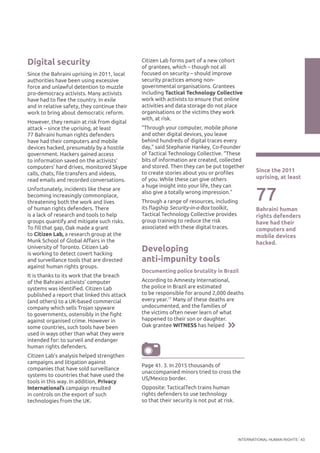
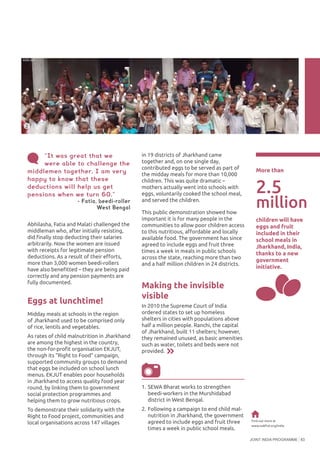
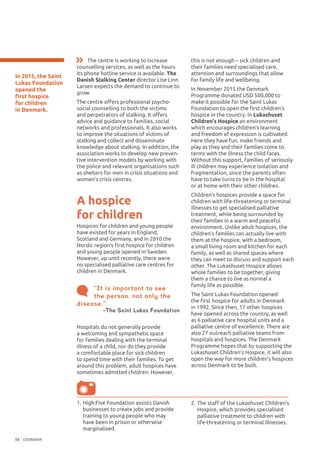
Contents
Oak Foundation commits
its resources to address issues
of global, social and environmental
concern, particularly those that
have a major impact on the lives
of the disadvantaged.
02 About Oak 60 Learning Differences
68 Special Interest
80 Joint India Programme
86 Denmark
90 Zimbabwe
94 Oak staff and addresses
10 Child Abuse
18 Environment
30 Housing & Homelessness
40 International Human Rights
48 Issues Affecting Women
Our history
Letter from the Trustees
Our grant-making in 2015
Capacity building
95 Footnotes
2
Our history
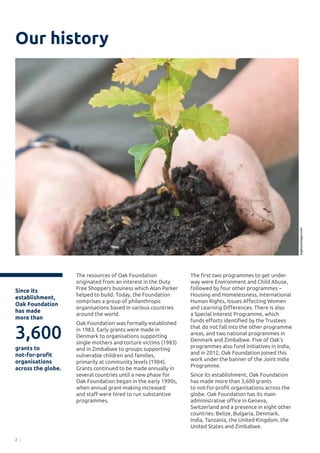
The resources of Oak Foundation
originated from an interest in the Duty
Free Shoppers business which Alan Parker
helped to build. Today, the Foundation
comprises a group of philanthropic
organisations based in various countries
around the world.
Oak Foundation was formally established
in 1983. Early grants were made in
Denmark to organisations supporting
single mothers and torture victims (1983)
and in Zimbabwe to groups supporting
vulnerable children and families,
primarily at community levels (1984).
Grants continued to be made annually in
several countries until a new phase for
Oak Foundation began in the early 1990s,
when annual grant-making increased
and staff were hired to run substantive
programmes.
The first two programmes to get under-
way were Environment and Child Abuse,
followed by four other programmes –
Housing and Homelessness, International
Human Rights, Issues Affecting Women
and Learning Differences. There is also
a Special Interest Programme, which
funds efforts identified by the Trustees
that do not fall into the other programme
areas, and two national programmes in
Denmark and Zimbabwe. Five of Oak’s
programmes also fund initiatives in India,
and in 2012, Oak Foundation joined this
work under the banner of the Joint India
Programme.
Since its establishment, Oak Foundation
has made more than 3,600 grants
to not-for-profit organisations across the
globe. Oak Foundation has its main
administrative office in Geneva,
Switzerland and a presence in eight other
countries: Belize, Bulgaria, Denmark,
India, Tanzania, the United Kingdom, the
United States and Zimbabwe.
3,600
Since its
establishment,
Oak Foundation
has made
more than
grants to
not-for-profit
organisations
across the globe.
©©gettyimages.com
3
Letter from the Trustees
2015 was, in the words of Charles
Dickens, “the best of times and the
worst of times”. Our partners were
affected by both the highs and the
lows of this historic and tumult-
uous year. On the one hand,
conflict, mass migration and
terrorist attacks resulted in wide-
spread fear, large scale suffering
and gross violations of human
rights. In contrast, a new set of
sustainable development goals
was adopted by the United
Nations in September and the
global climate change agreement
reached in Paris is stronger than
most of us dreamed possible.
These events – both good and
bad – have touched the heart of
our work, stretched the stamina
and resources of our partners to
breaking point and reinforced our
core priorities.
In 2015 Oak Foundation made
326 grants to 308 organisations in
39 countries. In addition, we
responded to these world events
through the following extra-
ordinary grants.
•	 Two one-year grants of USD 2.5
million each were made to
Médecins sans Frontières (MSF)
and Save the Children (STC), to
relieve the suffering of women
and children who are living in
camps and temporary settle-
ments in the countries surround-
ing Syria. MSF focuses on gaining
access for families to basic health
care and nutrition while STC is
establishing schools and commu-
nity centres that give children
safe places to learn and play.
•	 To complement our substantial
investment in climate mitigation,
we made five grants (totalling
USD 5 million) to organisations to
mobilise community and political
support in the run-up to the
Conference of the Parties
(COP21) in Paris, in December
2015. Details on these grants are
provided in the Special Initiative
section of this report on page 79.
In 2016 Oak Foundation plans to
build on this initial investment by
establishing a new fund focused
on strengthening the adaptive
The Trustees of Oak Foundation:
Caroline Turner, Kristian Parker,
Natalie Shipton, Jette Parker,
Alan Parker, Christopher Parker
capacity and resilience of com-
munities most impacted
by climate change – in particular
youth, indigenous peoples and
women. Initially, community
groups in three geographies –
the Arctic, the Bay of Bengal
and East Africa – will be helped
to respond to the impacts of
climate change on their land,
homes and livelihoods. In taking
this step, we hope to leverage
the support of other funders to
address the human dimensions
of climate change.
This report highlights the work of
our partners across a number of
fields. Areas given special
attention include:
•	 Responding to children on the
move, who leave their homes
and families for many reasons.
Some are fleeing conflict,
poverty, political oppression
or lack of opportunity. Others
are seeking jobs and education
to support their families or
secure a better future. Whatever
their motivation, all these
children run huge risks of
violence, abuse and exploitation.
They are also entitled to protec-
tion and other rights, which our
partners are determined
to provide.
•	 Creating sustainable cities,
which are challenged by the
sheer numbers of people seeking
housing, transport, employment
and services. Oak partners are
taking on these challenges –
improving mobility in Brazil,
re-organising bus systems in
China and strengthening trans-
port infrastructure in India,
among other innovations.
•	 Linking health and homeless
services by increasing awareness,
addressing barriers and using the
healthcare system as a way to
reach the most vulnerable. Oak is
helping groups demonstrate how
staff within the health system
can identify people who are
struggling to keep their homes
or whose health is strained by
poverty and isolation.
•	 Supporting technological
advances that promote
human rights by enhancing
digital security, developing
tools to end impunity and
extending the reach of human
rights defenders. Oak is
investing in a range of inter-
ventions to build grantees’
technological capacities. This
is particularly important in the
face of increasing constraints
on the activities and funding
sources of civil society groups
around the world.
•	 Building movements to end
violence against women by
addressing root causes,
revealing links to trafficking
and other forms of exploitation
and improving both laws and
services. Moldova provides
a good example of how a
comprehensive, rights-based,
women-centred approach can
begin to transform social
norms around violence.
•	 Engaging young people with
learning differences to
appreciate their strengths,
provide feedback on pro-
grammes designed to help them
and advocate for the help they
need to succeed. Oak supports
organisations that help young
people to build their skills and
confidence as learners, mentors
and citizens.
In these areas, as well as those
covered by the Special Interest
Programme and our grants in
Denmark and Zimbabwe, much
remains to be done. But we are
encouraged by achievements this
year, impressed by our partners’
determination and proud to have
the possibility to support their
work.
4
JOINT INDIA
LEARNING DIFFERENCES
ISSUES AFFECTING WOMEN
INTERNATIONAL HUMAN RIGHTS
organisations in
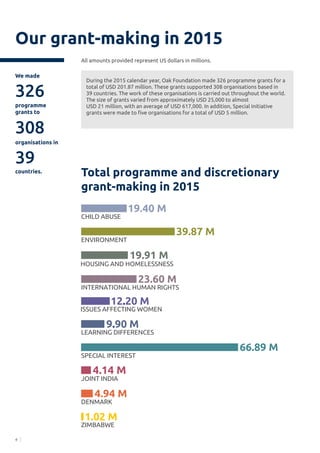
During the 2015 calendar year, Oak Foundation made 326 programme grants for a
total of USD 201.87 million. These grants supported 308 organisations based in
39 countries. The work of these organisations is carried out throughout the world.
The size of grants varied from approximately USD 25,000 to almost
USD 21 million, with an average of USD 617,000. In addition, Special Initiative
grants were made to five organisations for a total of USD 5 million.
Our grant-making in 2015
308
39
programme
grants to
countries.
326
We made
Total programme and discretionary
grant-making in 2015
All amounts provided represent US dollars in millions.
SPECIAL INTEREST
ENVIRONMENT
DENMARK
ZIMBABWE
CHILD ABUSE
HOUSING AND HOMELESSNESS
5
* The chart on page 5 excludes the Special Initiative grants.
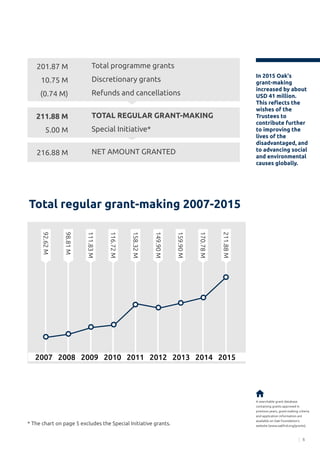
Total regular grant-making 2007-2015
A searchable grant database
containing grants approved in
previous years, grant-making criteria
and application information are
available on Oak Foundation’s
website (www.oakfnd.org/grants).
Total programme grants
Discretionary grants
Refunds and cancellations
TOTAL REGULAR GRANT-MAKING
Special Initiative*
NET AMOUNT GRANTED
201.87 M
10.75 M
(0.74 M)
211.88 M
5.00 M
216.88 M
In 2015 Oak's
grant-making
increased by about
USD 41 million.
This reflects the
wishes of the
Trustees to
contribute further
to improving the
lives of the
disadvantaged, and
to advancing social
and environmental
causes globally.
170.78M
92.62M
98.81M
111.83M
116.72M
158.32M
149.90M
159.90M
211.88M
2007 2008 2009 2010 2011 2012 2013 2014 2015
6
Capacity building
Intermediaries form deep connections
within their communities and bring an
expertise that large foundations are not
always equipped to deliver. Organisations
like Find Your Feet fully understand the
culture they operate in. They have the
best knowledge of the issues affecting
the specific context of their work, and
of how to raise awareness around them.
In addition, intermediaries facilitate
administering smaller grants, monitor
their impact and provide technical
assistance to their grantees. They also
provide counselling, training, networking
Capacity building
Oak Foundation supports initiatives that
build the capacity of our partners to carry
out their work. Each year we highlight a
different aspect of this work in the Annual
Report. This year we have focused on how
we work with intermediaries.
Building
capacity through
intermediaries:
working with
small groups to
create bigger
change
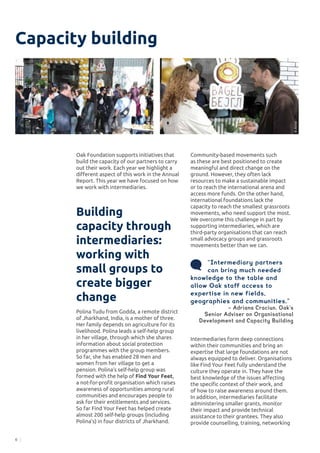
Polina Tudu from Godda, a remote district
of Jharkhand, India, is a mother of three.
Her family depends on agriculture for its
livelihood. Polina leads a self-help group
in her village, through which she shares
information about social protection
programmes with the group members.
So far, she has enabled 28 men and
women from her village to get a
pension. Polina’s self-help group was
formed with the help of Find Your Feet,
a not-for-profit organisation which raises
awareness of opportunities among rural
communities and encourages people to
ask for their entitlements and services.
So far Find Your Feet has helped create
almost 200 self-help groups (including
Polina’s) in four districts of Jharkhand.
©BagelБејгл
Community-based movements such
as these are best positioned to create
meaningful and direct change on the
ground. However, they often lack
resources to make a sustainable impact
or to reach the international arena and
access more funds. On the other hand,
international foundations lack the
capacity to reach the smallest grassroots
movements, who need support the most.
We overcome this challenge in part by
supporting intermediaries, which are
third-party organisations that can reach
small advocacy groups and grassroots
movements better than we can.
“Intermediary partners
can bring much needed
knowledge to the table and
allow Oak staff access to
expertise in new fields,
geographies and communities.”
− Adriana Craciun, Oak’s
Senior Adviser on Organisational
Development and Capacity Building
©Atina
©Atina
7
To find out more about the
Organisational Development and
Capacity Building Initiative at Oak
visit www.oakfnd.org/odcb
opportunities and financial support
to grassroots organisations who work
closest to the ground.
Preventing
homelessness in the UK
and institutionalisation
of children in Eastern
Europe
The UK-based Sheila McKechnie
Foundation (SMK) supports individuals,
organisations and communities working
for social change by helping them improve
their campaigning and communications
skills. Using funding from our Housing
and Homelessness Programme, SMK
has helped enhance the role played by
31 non-governmental organisations
working to prevent homelessness. SMK’s
assistance provides a new way of thinking,
a space for planning and concrete support
to plan and implement advocacy.
Crisis, a UK homeless charity, benefitted
from SMK’s support to refine its external
message and produce a campaigning
strategy. In addition to all the services
it provides for homeless people, Crisis
is now leading a “No One Turned Away”
campaign. This seeks to reform the law so
that no one who asks their local council
for help with housing gets turned away to
sleep on the streets.
SMK draws upon a wide network of
influential actors in advocacy and
supports organisations working
towards different campaigning goals.
It has also partnered with our Child
Abuse Programme, notably through
grants which support child rights
advocacy groups working to phase out
institutional childcare in Eastern Europe.
Institutional care is a generally accepted
form of alternative care for families
and minority groups in the region who
are disadvantaged due to poverty or
discrimination. However, studies have
shown that institutional care causes
lasting harm to many children. SMK works
with parters to enhance cooperation
among civil society, the corporate sector
and national and local authorities to help
keep children with their families. Where
this is not possible, partners support
advocacy groups to find family-based
alternative care for children.
Combating violence
against women in the
Balkans
Trag Foundation is a local Serbian
organisation that enhances local civil
society through funding and capacity
building. Oak partners with Trag
to strengthen the sustainability of
women’s organisations in Bosnia and
Herzegovina, Montenegro and Serbia.
These organisations provide services to
victims of domestic violence, trafficking
and exploitation and work to stop
the violation of women’s rights. Trag
provides grants, builds capacity and
facilitates networking among women’s
organisations. At the same time, Oak
strengthens Trag by helping it to include
a women’s rights perspective across all of
its work, and eventually across the work
of all of its grantee partners. Oak sees
this approach as a strategic investment in
the capacity and sustainability of women’s
rights organisations and as a way of
supporting civil society in the region.
Trag helps partners develop personalised
capacity-building plans which build
on strengths and enhance capacity.
Simultaneously this is a chance for Trag
to build its own capacity-building exper-
tise. To this end, Oak connected Trag with
NESsT, a US-based, not-for-profit organ-
isation that develops sustainable enter-
prises that solve critical social problems.
By building its own knowledge of financial
sustainability, Trag is better equipped to
support smaller organisations.
Together, NESsT and Trag are working
with ATINA, a Serbian women’s rights
organisation, to expand its sources of
sustainable funding. ATINA works with
women survivors of trafficking and
violence. It advocates for gender equality
and identifies and combats gender-
based violence and discrimination. It
provides safe accommodation, health
and psychological care, legal counselling,
informal education and economic
empowerment to survivors of trafficking
and sexual exploitation. Recently, ATINA
established what it anticipates will be a
viable business – the first bagel shop in
Serbia. Bagel Бејгл (or Bagel Bagel) gives
survivors of human trafficking a safe place
to work and an independent income.
Crisis
is leading a
“No One Turned
Away” campaign
to reform the law
so that no one
who asks their
local council for
help with housing
gets turned away
to sleep on the
streets.
8
The profits from the shop and Bagel
Бејгл’s small catering business also
provide sustainable funding to ATINA.
With the help of NESsT and Trag, ATINA
hopes to expand the Bagel Бејгл business.
This illustrates how ongoing support
such as that offered by Trag allows
organisations like ATINA to become
stronger and move towards financial
sustainability.
Building financially-
viable local
organisations
Oak also connected Trag with Resource
Alliance, which works to harness financial,
human and intellectual resources to help
individuals and organisations build
a better world. Resource Alliance is
working with Trag and other advocacy
organisations across the globe to help
them be more effective. This is done
by bringing them together through
conferences, workshops and programmes
that enable the sharing of ideas.
The Resource Alliance’s Emerge
Programme assists small grassroots
organisations to fundraise and use
resources efficiently. Four of Oak’s
partners benefitted from this programme
in 2015, and two more enhanced their
leadership capacity by attending the
Future Leaders Programme in 2014.
“For any organisation to be successful,
sustainable and capable of reacting
to both challenges and opportunities,
leadership capacity is essential,”
said Adriana Craciun. Through our
Special Interest Programme grants,
15 organisations will benefit from the
Emerge Programme and 30 managers
will benefit from the Future Leaders
Programme in the next three years.
Working with families to
stop violence in Mexico
Investigación en Salud y Demografía,
S.C. (Insad), a health and demographics
research consulting firm, helps our Issues
Affecting Women Programme partners in
Mexico measure the impact of their work.
Insad looks at what the organisations
have achieved, assessing their strategies,
gathering qualitative and quantitative
evidence and making recommendations
to track and expand the impact of their
work. Beyond its grant-making role, Oak
is committed to supporting its partners
to build evidence on the effectiveness
and impact of their work, in particular
advocacy organisations, helping them
to access other sources of funding.
The first partner Oak connected Insad
to was Las Hormigas. Las Hormigas
means “the ants” in Spanish, and it is a
community organisation in Ciudad Juarez,
Mexico that works with families to pre-
vent violence and destructive behaviour.
Its community centre provides a safe
space for people to see mental health
specialists who provide therapy for
individuals and families. Violence plagues
the communities of Anapra and Lomas
de Poleo, where 50 per cent of the
population live below the poverty line
and are socially, as well as economically,
marginalised. There is a lack of basic
public services and transport, as well as
constant migration to and from these
border communities. Long working hours
of parents put a stress on families,
particularly on single mothers.
Insad helped Las Hormigas analyse the
impact it had on these communities
through 24 in-depth interviews. The inter-
views revealed that almost everyone who
had been assisted by Las Hormigas had
been able to change some aspect of their
behaviour that was harmful, by dealing
with anger and aggression or improving
self esteem and communication skills.
Las Hormigas also works with children
with learning difficulties or who demon-
strate aggressive behaviour at school.
100 per cent of the parents interviewed
said that their children had shown im-
provement from the programme.1
“The great majority of those interviewed
reported that they wouldn’t have been
able to achieve personal change without
100%
of parents
of children
attending the
Las Hormigas
Educational
Programme
thought their
children had
shown
improvement
in behaviour.
“Belgrade now has its
Bagel Bagel shop - an
oasis of great taste where
you can treat yourself to
mouthwatering food and also
contribute to the struggle
for a better world.
	 	 − Marijana Savic,
Director, ATINA
9
the support of Las Hormigas,” said
Cecilia Vega, the principle researcher
on Las Hormigas from Insad.
Insad also provided support to Las
Hormigas staff to help them develop their
skills, implement monitoring methods and
expand. Because Insad was so successful
with Las Hormigas, Oak now partners with
Insad to assess the capacities and strategies
of all our partners in Mexico and help them
improve their impact.
Helping the people
of Myanmar
Our International Human Rights
Programme works with the intermediary
Partners Asia, which supports civil society
organisations and grassroots networks
in Myanmar to advance the rule of law.
Partners Asia connects community
initiatives with global resources. It also
works to train and build the capacity
of lawyers, activists and journalists.
“Across the world there is a lack of capacity
in fundraising and resource mobilisation,”
said Adriana. “This limits the scope and
reach of civil society and its ability to effect
change. Intermediaries help us reach those
who need it most.“With resources
to campaign effectively, become financially
sustainable and network with other
movements, small grassroots networks
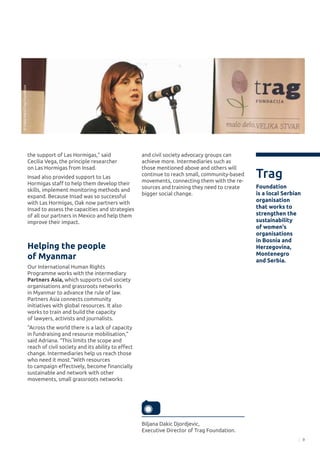
Biljana Dakic Djordjevic,
Executive Director of Trag Foundation.
and civil society advocacy groups can
achieve more. Intermediaries such as
those mentioned above and others will
continue to reach small, community-based
movements, connecting them with the re-
sources and training they need to create
bigger social change.
Trag
Foundation
is a local Serbian
organisation
that works to
strengthen the
sustainability
of women's
organisations
in Bosnia and
Herzegovina,
Montenegro
and Serbia.
©VladaMatić/TragFoundation
CHILD ABUSE10
Child Abuse
©RachelMcKee/OakFoundation
Violence, abuse and exploitation of children are
unfortunately not new. Forms of physical, sexual
and emotional abuse of children have come to be
recognised as crimes against children. The devastating
consequences that violence has on children’s
development and on societies as a whole are slowly
coming to light.
In the Child Abuse Programme, we envision a world
in which all children are protected from sexual abuse
and sexual exploitation. We support initiatives that:
eliminate the sexual exploitation of children;
engage men and boys in combating the sexual abuse
of children; and promote the prevention of violence
against children.
©JonathanHymas/SavetheChildren
CHILD ABUSE 11
Reflections
During the course of the year, the Child
Abuse Programme (CAP) made more than
45 grants, hired a new Programme Officer
in East Africa and organised a meeting
of partners to assess violence prevention
and sexual abuse prevention initiatives
in Eastern Europe. We remained close
to our partners’ concerns and successes.
We know that to achieve change in any
area, cooperation is essential – whether
this is within countries or between major
actors that develop global policy.
2015 has been an important year for
major events concerning children.
These include:
•	The UN adoption of the Sustainable
Development Goals in September
2015. We supported work behind the
scenes to ensure that the fight against
abuse, violence and exploitation
remained firmly embedded in the
final documents.
•	The planning of a Global Partnership
to End Violence against Children.
This will bring major UN agencies, civil
society organisations and governments
together around a set of evidence-
based programmes to reduce violence.
•	International efforts to advocate with
FIFA, other sporting institutions and the
World Bank. This will help ensure that
children’s rights are an integral part
of these organisations’ human rights
standards in working with countries
around the world.
CAP has funded innovative primary
prevention work to:
•	engage men in children’s lives and
support new fathers in care-giving roles;
45
grants were made
by the Child Abuse
Programme in
2015, totalling
USD 19.40 million.
•	research and challenge gender and
social norms that perpetuate violence
and exploitation of children and
adolescents;
•	search for a valid frame for prevention
of sexual exploitation of children and
adolescents which embraces both
the public health and child protection
perspectives; and
•	engage key actors in a new pact to
deliver violence prevention, including
in health and education.
A new fund in Africa has been created
through our partnership with other
private donors, the East Africa Children’s
Fund. It will bring funding to community-
based groups and non-governmental
organisations that are normally too
small to receive funding from major
philanthropic organisations. We are
confident that in targeting the many
groups that do essential work to eradicate
violence, sexual abuse and exploitation
at community levels, we will support the
mobilisation of an ever-growing number
of children, youth and communities to
demand change for children.
Given that our current strategy is an
ambitious one with long-ranging goals,
we have decided to extend it beyond
2016 for another two years – and to
build in progressive reviews of our goals
at different points in the years ahead.
This year’s annual report profiles Children
on the Move. It is a phenomenon which
will grow in the years ahead – it is also an
area in which children’s rights are easily
overlooked or challenged. Find out more at
www.oakfnd.org/childabuse
©JonathanHymas/SavetheChildren
“To say that these children may be ’at risk’
is a gross understatement!” said Florence
Bruce, Director of the Child Abuse
Programme. “When we met them they
were protected by the local community
and given food and a bed for the night
until an agreement could be reached by
local authorities as to what to do next.”
Birke and Emawayish were moving
alone within their own country and the
possibility of them being abused was
very real. Risks for children who move
for a range of reasons within or beyond
borders exist, even if the danger is not
always visible.
Children and mobility
Mobility of children is increasing within
and across countries and regions, as a
result of conflicts, political upheaval,
poverty, climate change, demographic
growth, urbanisation and discrimination.
*not their real names
Supporting
children on
the move
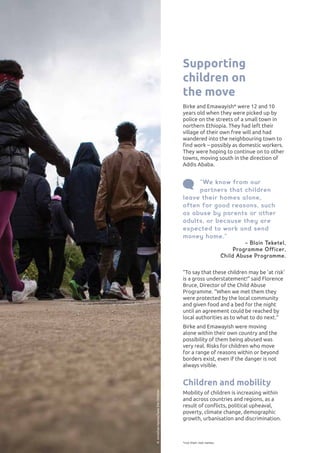
Birke and Emawayish* were 12 and 10
years old when they were picked up by
police on the streets of a small town in
northern Ethiopia. They had left their
village of their own free will and had
wandered into the neighbouring town to
find work – possibly as domestic workers.
They were hoping to continue on to other
towns, moving south in the direction of
Addis Ababa.
“We know from our
partners that children
leave their homes alone,
often for good reasons, such
as abuse by parents or other
adults, or because they are
expected to work and send
money home.”
− Blain Teketel,
Programme Officer,
Child Abuse Programme.
©JonathanHymas/SavetheChildren
CHILD ABUSE 13
Children also leave to increase their
opportunities or simply in search of
adventure. Sometimes entire families
have little alternative but to move.
Readers will doubtless have in mind the
tragic flow of children and families from
Syria and other countries moving beyond
borders to Europe in 2015, as well as the
refugees and migrants from Africa, many
of whom lost their lives just attempting
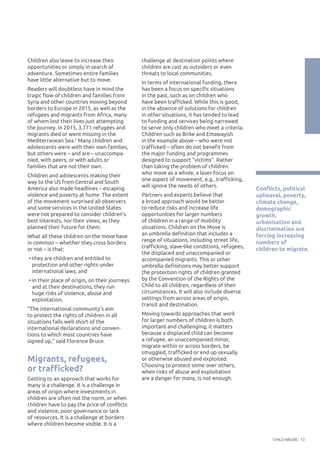
the journey. In 2015, 3,771 refugees and
migrants died or went missing in the
Mediterranean Sea.2
Many children and
adolescents were with their own families,
but others were – and are – unaccompa-
nied, with peers, or with adults or
families that are not their own.
Children and adolescents making their
way to the US from Central and South
America also made headlines – escaping
violence and poverty at home. The extent
of the movement surprised all observers
and some services in the United States
were not prepared to consider children’s
best interests, nor their views, as they
planned their future for them.
What all these children on the move have
in common – whether they cross borders
or not – is that:
• they are children and entitled to
protection and other rights under
international laws; and
• in their place of origin, on their journeys
and at their destinations, they run
huge risks of violence, abuse and
exploitation.
“The international community’s aim
to protect the rights of children in all
situations falls well short of the
international declarations and conven-
tions to which most countries have
signed up,” said Florence Bruce.
Migrants, refugees,
or trafficked?
Getting to an approach that works for
many is a challenge. It is a challenge in
areas of origin where investments in
children are often not the norm, or when
children have to pay the price of conflicts
and violence, poor governance or lack
of resources. It is a challenge at borders
where children become visible. It is a
challenge at destination points where
children are cast as outsiders or even
threats to local communities.
In terms of international funding, there
has been a focus on specific situations
in the past, such as on children who
have been trafficked. While this is good,
in the absence of solutions for children
in other situations, it has tended to lead
to funding and services being narrowed
to serve only children who meet a criteria.
Children such as Birke and Emawayish
in the example above – who were not
trafficked – often do not benefit from
the major funding and programmes
designed to support “victims”. Rather
than taking the problem of children
who move as a whole, a laser-focus on
one aspect of movement, e.g., trafficking,
will ignore the needs of others.
Partners and experts believe that
a broad approach would be better
to reduce risks and increase life
opportunities for larger numbers
of children in a range of mobility
situations. Children on the Move is
an umbrella definition that includes a
range of situations, including street life,
trafficking, slave-like conditions, refugees,
the displaced and unaccompanied or
accompanied migrants. This or other
umbrella definitions may better support
the protection rights of children granted
by the Convention of the Rights of the
Child to all children, regardless of their
circumstances. It will also include diverse
settings from across areas of origin,
transit and destination.
Moving towards approaches that work
for larger numbers of children is both
important and challenging; it matters
because a displaced child can become
a refugee, an unaccompanied minor,
migrate within or across borders, be
smuggled, trafficked or end up sexually
or otherwise abused and exploited.
Choosing to protect some over others,
when risks of abuse and exploitation
are a danger for many, is not enough.
Conflicts, political
upheaval, poverty,
climate change,
demographic
growth,
urbanisation and
discrimination are
forcing increasing
numbers of
children to migrate.
CHILD ABUSE14
In addition, AMWCY has established
listening centres where children can
go to talk and receive guidance.
“It is a good place to keep
an eye on children passing
by. If they seem to need help,
we approach them. Sometimes
we offer meals to those
who cannot buy food. Each
of us has committed to sponsor
a migrant child, taking them
home to sleep and walking with
them into the city the next
day.”
- Mariko, youth volunteer with
AMWCY in Mali
Oak’s funding
Over the years, the Child Abuse
Programme has moved its attention
from trafficking to recognising that all
children who move need support. It seeks
to recognise children’s agency and the
opportunities that mobility may offer to
some. Working with a mandate on child
abuse, the risks of abuse and exploitation
for children on the move are a key concern
to the Programme. This is why the Child
Abuse Programme funds groups of actors
at international, regional and national
levels to:
•	understand the problems better
and find local solutions;
•	help develop and test models that
increase access to support and
opportunities; and
•	support groups that make problems
and solutions more visible and bring
the rights of children to be protected
from violence and abuse to the fore.
Oak funds a range of initiatives globally
to end the abuse, exploitation and
violence against children on the move
and to increase their opportunities.
Over the years, Oak has supported:
learning; conferences on working for
and with children; children’s initiatives;
and organisations that support children
directly. Some of our grantees include
the following:
•	Terre des Hommes Netherlands, which
works with a network of organisations
to reduce the abuse of children in
northern Ethiopia (where there are high
numbers of children on the move) and
improve their access to support.
•	Speak Out!, a project of the Swiss
National Youth Council, which works
with unaccompanied children and youth
seeking asylum in Switzerland.
•	MARIO, an inter-agency initiative, which
works to protect children within and
across borders in Europe.
•	Plan International, Interagency
Group on Children on the Move, Save
the Children, and the International
Federation Terre des Hommes, which
have developed approaches to better
understand and match programmes
to children’s needs.
Children and youth are
part of the solution
There are pockets of promising practice
in parts of West Africa, where children
play a direct role in finding and shaping
their own solutions. They do this by:
informing peers; setting up a protective
network; and acting as advocates for their
own cause. The grassroots organisation
the African Movement of Working
Children and Youth (AMWCY) has been
supporting children on the move for
many years through a network it created
to support young migrants travelling
alone. This informal safety net supports
children and youth across communities
and countries.
Sixteen year old Mariko from Mali has met
many children on the move in the bustling
market facing her mother’s restaurant
in the outskirts of Bamako. She is one
of more than 30 youth volunteers with
AMWCY’s child migration programme
who meet at the restaurant every week.3
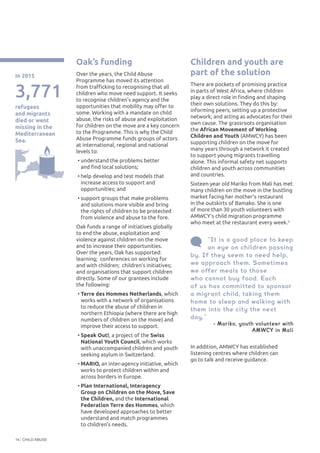
3,771
refugees
and migrants
died or went
missing in the
Mediterranean
Sea.
In 2015
CHILD ABUSE 15
©ValentinSimeonov/ARCFundBulgaria
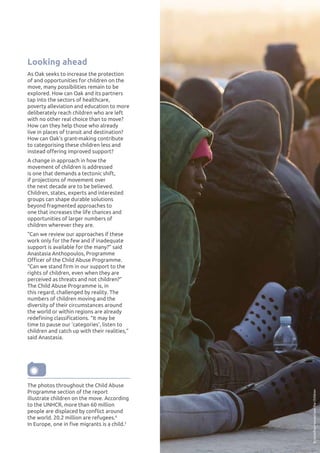
The photos throughout the Child Abuse
Programme section of the report
illustrate children on the move. According
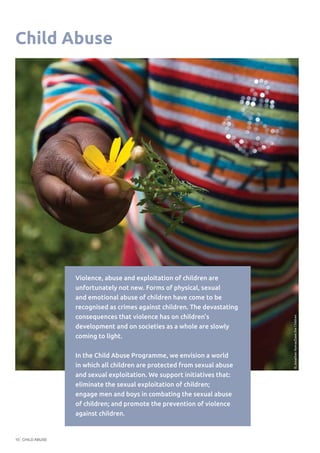
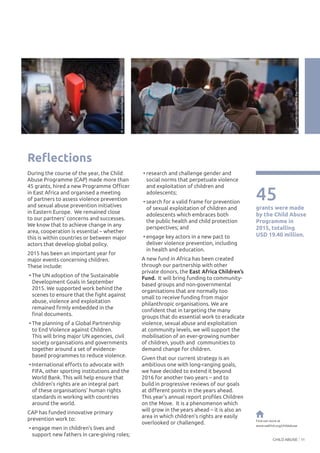
to the UNHCR, more than 60 million
people are displaced by conflict around
the world. 20.2 million are refugees.4
In Europe, one in five migrants is a child.5
Looking ahead
As Oak seeks to increase the protection
of and opportunities for children on the
move, many possibilities remain to be
explored. How can Oak and its partners
tap into the sectors of healthcare,
poverty alleviation and education to more
deliberately reach children who are left
with no other real choice than to move?
How can they help those who already
live in places of transit and destination?
How can Oak’s grant-making contribute
to categorising these children less and
instead offering improved support?
A change in approach in how the
movement of children is addressed
is one that demands a tectonic shift,
if projections of movement over
the next decade are to be believed.
Children, states, experts and interested
groups can shape durable solutions
beyond fragmented approaches to
one that increases the life chances and
opportunities of larger numbers of
children wherever they are.
“Can we review our approaches if these
work only for the few and if inadequate
support is available for the many?” said
Anastasia Anthopoulos, Programme
Officer of the Child Abuse Programme.
“Can we stand firm in our support to the
rights of children, even when they are
perceived as threats and not children?”
The Child Abuse Programme is, in
this regard, challenged by reality. The
numbers of children moving and the
diversity of their circumstances around
the world or within regions are already
redefining classifications. “It may be
time to pause our ’categories’, listen to
children and catch up with their realities,”
said Anastasia.
©JonathanHymas/SavetheChildren
CHILD ABUSE16
Ending
the sexual
exploitation
of children
Applied Research and
Communications Fund
USD 249,206 (36 months)
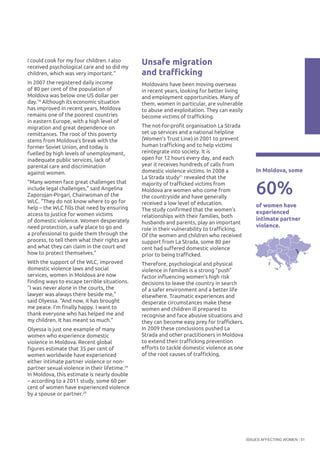
To empower young children
in Bulgaria and advance their
rights by increasing digital
literacy and strengthening
the knowledge and skills
of parents and teachers
to support them.
ECPAT International
USD 240,072 (12 months)
To support ECPAT in its pre-
parations for the 2016 ‘Year
of Action’ to end the sexual
exploitation of children.
ECPAT International
USD 85,000 (5 months)
To gain endorsement from
African Heads of State and
high-level officials to include
violence against children
targets in the final Sustainable
Development Goals.
Family for Every Child
USD 300,000 (36 months)
To increase knowledge and
strengthen practice on
recovery and reintegration
for children and adolescents
affected by child sexual
exploitation through an open,
vibrant, locally accessible
global learning network.
Save the Children Fund
USD 849,662 (18 months)
To support Save the Children’s
global work on Children on the
Move, prevention of sexual
violence and online child
abuse images in the Balkans.
SOS Femmes
USD 100,000 (12 months)
To support research on the
sexual exploitation of students
and to support the counselling
services of SOS Femmes for
students and young people
involved in different forms
of sex work.
Terre des Hommes
International Federation
USD 1,631,971 (36 months)
To support the rights of
children in and around mega
sporting events so that their
rights are respected,
implemented and enforced.
Engaging
men and boys
in ending
sexual abuse
Association Resource
Center for Women
MARTA
USD 250,000 (36 months)
To strengthen the protection
of children against sexual
exploitation and sexual abuse
in Latvia by advocating for
systemic change in legislation
and institutional practices.
Child Rights
International Network
(CRIN)
USD 250,000 (36 months)
To provide core support to
CRIN, a global research, policy
and advocacy organisation
that works to advance
children’s rights.
Le 2e observatoire
USD 328,949 (36 months)
To support the development
of guidelines for childcare
professionals and primary
school teachers to help
prevent gender discrimination
in the French-speaking part
of Switzerland.
Promundo US
USD 1,493,751 (36 months)
To provide core support to
Promundo for its work via
its offices in Brazil, sub-
Saharan Africa, the US and
Europe, and specific support
for work in Uganda, Moldova,
Bulgaria and Latvia.
Preventing
violence,
protecting
children
Animus Association
Foundation
USD 629,994 (60 months)
To combat bullying in schools
in Bulgaria so that children
feel safe and, along with
parents, professionals and
institutions, are empowered
to tackle the problem.
AssemblyO-Witter
gGmbH
USD 300,000 (12 months)
To support global advocacy
efforts in the prevention
of violence against children.
Association Kairos
USD 270,036 (36 months)
To support the Association
Kairos to protect teenagers
and young people in
Switzerland from risky
situations, including those
of sexual violence.
Bureau International
Catholique de l’Enfance
USD 1,062,746 (36 months)
To prevent the sexual abuse
of children and to provide the
best care to survivors through
participation, the promotion
of resilience and the develop-
ment of child-friendly environ-
ments.
Child Rights Connect
USD 486,979 (36 months)
To advocate for and devel-
op the capacity of national
civil society actors, including
children, to engage with the
international human rights
system to achieve children’s
enjoyment of their rights.
ChildFund Alliance
USD 100,000 (6 months)
To help establish a global part-
nership to end violence against
children as the platform
to implement and advance
violence prevention within
the Sustainable Development
Goals framework.
Citizens for Justice
USD 380,000 (24 months)
To support three civil society
organisations working
in Malawi, Tanzania and
Uganda to conduct research
on the impact on children
of World Bank supported
extractive industry (mining,
oil and gas) and advocate
for actions to mitigate their
negative impacts.
Grants
©MarioProject/TerredesHommes
©JonathanHymas/SavetheChildren
CHILD ABUSE 17
This is a list of our grants approved in 2015.
For a comprehensive list and full descriptions,
please visit our grant database at
www.oakfnd.org/grants
Consortium for
Street Children
USD 551,051 (29 months)
To find out how resilience-
informed programming
impacts children at risk
of sexual exploitation and
abuse, and if such program-
ming contributes to better
outcomes for children in
low- and middle-income
countries.
Emmanuel Development
Association
USD 500,000 (36 months)
To raise the awareness of
child trafficking among
communities in northern
Ethiopia and to use govern-
ment structures to prevent
the movement of children
and adolescents that leads to
trafficking and exploitation.
Ethiopian Sociology
Social Anthropology and
Social Work Association
USD 246,318 (36 months)
To build the capacities of
practitioners, academics
and students of social work,
sociology and anthropology
in violence prevention and
key research skills in Ethiopia.
Eurochild
USD 882,000 (37 months)
To provide core support
that will allow Eurochild to
implement its strategic plan
2014-2018 and to support
the organisation’s transition
towards a dynamic, member-
ship-led network with diverse
income sources.
Firelight Foundation
USD 300,000 (34 months)
To strengthen community-
based organisations in
Tanzania and Kenya so
that children and youth
are protected from abuse
and exploitation.
Firelight Foundation
USD 690,000 (36 months)
To communicate with faith-
based communities in the US
about the harmful impact of
institutional care on orphans
and other vulnerable children
and to help them transition to
alternative family and commu-
nity-based care options.
Forum on Sustainable
Child Empowerment
USD 699,712 (48 months)
To protect children on the
move in the southern part
of Ethiopia from abuse and
exploitation.
Global Health
Uganda Ltd.
USD 249,233 (18 months)
To promote dialogue among
key sectors in Uganda
on preventing violence
against children and to inform
the development of violence
prevention initiatives within
and across the sectors.
Harvard University
USD 99,652 (5 months)
To study how relevant
sectors understand and
respond to risks and abuse
of Children on the Move,
as well as what puts these
children at particular risk of
sexual abuse and exploitation.
INHOPE Foundation
USD 350,000 (36 months)
To expand the network of
INHOPE Hotlines, a network
of hotlines in 45 countries
worldwide committed to
eliminating child sexual
abuse on the internet.
Instituto PAPAI
USD 181,322 (18 months)
To consult children,
adolescents and youth
in Recife on what they think
needs to change in order
to develop a plan of action
and engage groups to deliver
these changes.
International Center
for Research and Policy
on Children
USD 175,000 (24 months)
To advocate for the imple-
mentation of the Rio policy
on street children in Brazil.
Naia Association
USD 249,871 (36 months)
To help educate healthcare
professionals on the crucial
role they play in the health
and wellbeing of children,
youth and families in Bulgaria.
National Center for
Child Abuse Prevention
USD 489,166 (36 months)
To strengthen the child
protection system at local and
national levels in Moldova.
Network of European
Foundations
USD 1,000,000 (36 months)
To develop an effective
intermediary philanthropic
institution in East Africa that
will support community-based
initiatives addressing children’s
rights, violence prevention and
prevention of sexual abuse
and sexual exploitation.
Network of European
Foundations
USD 250,000 (24 months)
To provide support to the
partners of Elevate Children
Funders Group Secretariat
and ensure that key goals,
targets and indicators relating
to violence against children
are maintained in the docu-
ments shaping the successor
framework of the millennium
development goals.
Network of European
Foundations
USD 609,000 (36 months)
To support the Evaluation
Challenge Fund to research
violence prevention against
children in low-income
countries and communicate
these findings to people
involved in policy design and
programming for children.
New Venture Fund
USD 25,000 (5 months)
To identify, map and align
donor investments behind
the Government of Moldova’s
national strategy on child and
family protection (2014-2020).
PANOS Eastern Africa
USD 248,886 (24 months)
To continue highlighting both
prevention of and response to
violence against children in the
media by linking child-focused
organisations with media out-
lets in Uganda and Tanzania.
Retrak
USD 296,557 (36 months)
To prevent unsafe migration
of children in southern
Ethiopia and improve the
protection of Children on the
Move in the destination towns
of Hosanna and Addis Ababa.
Save the Children Fund
USD 380,234 (36 months)
To facilitate stronger child
protection programming
and policy in Uganda,
Tanzania and Sierra Leone.
Sheila McKechnie
Foundation (SMK)
USD 355,763 (24 months)
To support SMK to continue
developing and delivering
a “Campaigning and
influencing support”
programme to the Child
Abuse Programme’s partners.
Swiss National Youth
Council (SNYC)
USD 534,981 (36 months)
To support SNYC to continue
its project "Speak out" for
unaccompanied migrant
children seeking asylum and
for children without docu-
ments.
Social Services Agency
USD 248,416 (36 months)
To provide a supportive and
safe family environment for
each child in Latvia who has
been left without parental
care.
The Duke of Edinburgh’s
International Award -
Bulgaria
USD 59,993 (15 months)
To empower young people
from institutions in Bulgaria
to develop life skills and
personal qualities that enable
them to be more independent
and self aware of their
capabilities by adapting and
piloting the Duke of Edinburgh
International Award Program.
University of Oxford -
Department of
International
Development
USD 369,683 (36 months)
To conduct a qualitative study
on violence affecting children
and use the findings to
identify policy and practice
gaps to promote violence
prevention and response work.
Workshop for Civic
Initiatives Foundation
USD 350,000 (36 months)
To enable grassroots
organisations in Bulgaria to
support children and youth
in the face of adversity or
challenging circumstances.
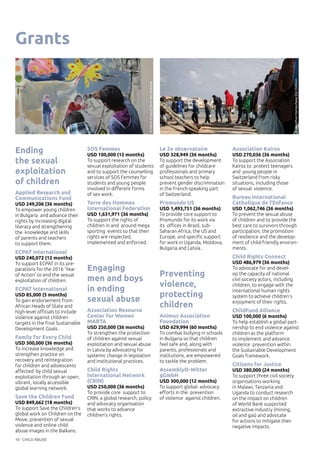
ENVIRONMENT18
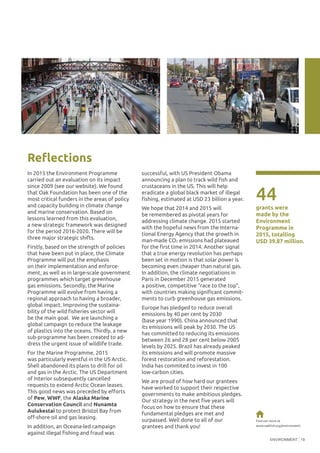
Greenhouse gas emissions are increasingly
influencing the climate, causing adverse effects on land
and in oceans. In addition, the mismanagement
of marine resources has led to a global fisheries crisis
and a severe loss of biodiversity, and poaching
is threatening the extinction of wildlife.
In the Environment Programme, our vision is to achieve
a low-carbon global economy, the recovery of marine
fisheries and habitats, and to stop illegal wildlife trade.
We hope to transform the way oceans are perceived and
exploited, for more socially and environmentally
sustainable societies, and for the protection
of endangered species. Our grant-making focuses
on three main areas: climate change mitigation, marine
resource conservation and illegal wildlife trade, which
is a recent addition to the Environment Programme’s
grant-making.
©RachelMcKee/OakFoundation
Environment
ENVIRONMENT 19
In 2015 the Environment Programme
carried out an evaluation on its impact
since 2009 (see our website). We found
that Oak Foundation has been one of the
most critical funders in the areas of policy
and capacity building in climate change
and marine conservation. Based on
lessons learned from this evaluation,
a new strategic framework was designed
for the period 2016-2020. There will be
three major strategic shifts.
Firstly, based on the strength of policies
that have been put in place, the Climate
Programme will put the emphasis
on their implementation and enforce-
ment, as well as in large-scale government
programmes which target greenhouse
gas emissions. Secondly, the Marine
Programme will evolve from having a
regional approach to having a broader,
global impact. Improving the sustaina-
bility of the wild fisheries sector will
be the main goal. We are launching a
global campaign to reduce the leakage
of plastics into the oceans. Thirdly, a new
sub-programme has been created to ad-
dress the urgent issue of wildlife trade.
For the Marine Programme, 2015
was particularly eventful in the US Arctic.
Shell abandoned its plans to drill for oil
and gas in the Arctic. The US Department
of Interior subsequently cancelled
requests to extend Arctic Ocean leases.
This good news was preceded by efforts
of Pew, WWF, the Alaska Marine
Conservation Council and Nunamta
Aulukestai to protect Bristol Bay from
off-shore oil and gas leasing.
In addition, an Oceana-led campaign
against illegal fishing and fraud was
successful, with US President Obama
announcing a plan to track wild fish and
crustaceans in the US. This will help
eradicate a global black market of illegal
fishing, estimated at USD 23 billion a year.
We hope that 2014 and 2015 will
be remembered as pivotal years for
addressing climate change. 2015 started
with the hopeful news from the Interna-
tional Energy Agency that the growth in
man-made CO2 emissions had plateaued
for the first time in 2014. Another signal
that a true energy revolution has perhaps
been set in motion is that solar power is
becoming even cheaper than natural gas.
In addition, the climate negotiations in
Paris in December 2015 generated
a positive, competitive “race to the top”,
with countries making significant commit-
ments to curb greenhouse gas emissions.
Europe has pledged to reduce overall
emissions by 40 per cent by 2030
(base year 1990). China announced that
its emissions will peak by 2030. The US
has committed to reducing its emissions
between 26 and 28 per cent below 2005
levels by 2025. Brazil has already peaked
its emissions and will promote massive
forest restoration and reforestation.
India has commited to invest in 100
low-carbon cities.
We are proud of how hard our grantees
have worked to support their respective
governments to make ambitious pledges.
Our strategy in the next five years will
focus on how to ensure that these
fundamental pledges are met and
surpassed. Well done to all of our
grantees and thank you!
44
grants were
made by the
Environment
Programme in
2015, totalling
USD 39.87 million.
©KamylaBorgesCunha/IEMA
©TheInstituteforTransportation
andDevelopmentPolicy
Reflections
Find out more at
www.oakfnd.org/environment
ENVIRONMENT20
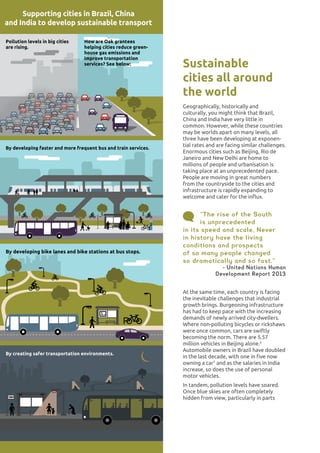
By creating safer transportation environments.
By developing bike lanes and bike stations at bus stops.
By developing faster and more frequent bus and train services.
How are Oak grantees
helping cities reduce green-
house gas emissions and
improve transportation
services? See below:
Pollution levels in big cities
are rising.
Supporting cities in Brazil, China
and India to develop sustainable transport
Sustainable
cities all around
the world
Geographically, historically and
culturally, you might think that Brazil,
China and India have very little in
common. However, while these countries
may be worlds apart on many levels, all
three have been developing at exponen-
tial rates and are facing similar challenges.
Enormous cities such as Beijing, Rio de
Janeiro and New Delhi are home to
millions of people and urbanisation is
taking place at an unprecedented pace.
People are moving in great numbers
from the countryside to the cities and
infrastructure is rapidly expanding to
welcome and cater for the influx.
“The rise of the South
is unprecedented
in its speed and scale. Never
in history have the living
conditions and prospects
of so many people changed
so dramatically and so fast.”
- United Nations Human
Development Report 2013
At the same time, each country is facing
the inevitable challenges that industrial
growth brings. Burgeoning infrastructure
has had to keep pace with the increasing
demands of newly arrived city-dwellers.
Where non-polluting bicycles or rickshaws
were once common, cars are swiftly
becoming the norm. There are 5.57
million vehicles in Beijing alone.6
Automobile owners in Brazil have doubled
in the last decade, with one in five now
owning a car7
and as the salaries in India
increase, so does the use of personal
motor vehicles.
In tandem, pollution levels have soared.
Once blue skies are often completely
hidden from view, particularly in parts
ENVIRONMENT 21
of India and China, as heavy grey smog
enshrouds many of these countries’
larger cities. At certain times of the year,
citizens are obliged to wear masks to help
them breathe through a thick fog of acrid
fumes. Traffic clogs the streets, making
getting around difficult. Brazil, China and
India are faced with having to find ways
to reduce pollution and cope with the
increasing pressure on public
infrastructure.
“Most transport systems are built on
the US model, which caters for cars,”
explained Karen Suassuna, Oak
Foundation Programme Officer for Brazil.
“But people are starting to realise that
this model doesn’t work for every
country. Mobility is a big issue in large
cities – buying more cars is not the
answer. Governments need to look for
sustainable ways to help people get
around cities quickly, while at the same
time reducing greenhouse gas emissions.”
Many people believe that now is a unique
moment in history. Brazil, China and
India have the chance to support new,
cleaner, greener transport systems that
will reduce traffic, pollution and transit
times, while improving the quality of life
of their citizens. “Now governments have
the chance to act,” explained Richard Liu,
Oak’s China Climate Programme Officer.
“While infrastructure is still being put
in place, Brazil, China and India could leap
forward and lead the world by setting
a firm foundation for a future green
economy.”
Oak supports several not-for-profit
organisations in these three countries,
which, while working to increase the
efficiency and speed of transport
services in some of the world’s largest
cities, are also trying to reduce green-
house gas emissions. These organisations
are working alongside governments to
improve urban transport, reduce
commute times and traffic, and build
greener, cleaner cities to improve the life
quality of their citizens for generations
to come. Read on to find out about our
grantees’ work in each country!
Brazil
It is widely known that the bulk of
Brazilian CO2 emissions derive from
the conversion of forests to pastures for
cattle ranching and agriculture. However,
due to decreasing deforestation rates,
the energy sector is the single major
source of increase in the country’s
emissions of late: they quadrupled
between 1970 and 2013.8
Oak supports the Instituto de Energia
e Meio Ambiente (IEMA) in São Paulo,
which works to address this problem
across the country. “There is clearly a
link between greenhouse gas emissions
and poor urban mobility conditions in
major Brazilian cities,” said André Luis
Ferreira, the president of IEMA. “That’s
why it’s important to work on expanding
and improving people’s accessibility to
good transport options in cities, while
simultaneously reducing greenhouse
gas emissions and air pollution.”
A 2014 IEMA study of urban mobility
in the city of Belo Horizonte in the south-
east of the country estimates that by
increasing public transport and cycling
options, greenhouse gas emissions can
be reduced by 29 per cent by 2020.9
Several cities have seen major invest-
ments in transport – in particular Rio
de Janeiro in the lead-up to the 2014
FIFA World Cup and the 2016 Olympics.
With the support of the Institute for
Transportation and Development Policy
(ITDP), some 150 kms of Bus Rapid
Transit (BRT), a low-carbon, economic
and faster transport system, have been
developed. Known as TransCarioca,
the Rio BRT corridor crosses 19 suburbs,
has 47 stations and carries an estimated
320,000 passengers a day. Since it
opened, some 500 regular buses
have been removed from the streets,
reducing congestion and greenhouse
gas emissions.10
This is a relief for many, especially for
citizens living in Rio’s outskirts, where
inadequate transport services are often
the norm. As well as cutting people off
from accessing the city easily, this can
have other serious knock-on effects.
For example, citizens can have a harder
time finding employment.
29%
By increasing
public transport
and cycling
options in Brazil,
greenhouse gas
emissions can
be reduced by
by 2020.
ENVIRONMENT22
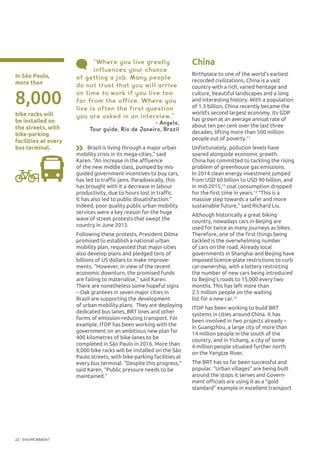
In São Paulo,
more than
bike racks will
be installed on
the streets, with
bike-parking
facilities at every
bus terminal.
8,000
“Where you live greatly
influences your chance
of getting a job. Many people
do not trust that you will arrive
on time to work if you live too
far from the office. Where you
live is often the first question
you are asked in an interview.”
- Angela,
Tour guide, Rio de Janeiro, Brazil
Brazil is living through a major urban
mobility crisis in its mega-cities,” said
Karen. “An increase in the affluence
of the new middle class, pumped by mis-
guided government incentives to buy cars,
has led to traffic jams. Paradoxically, this
has brought with it a decrease in labour
productivity, due to hours lost in traffic.
It has also led to public dissatisfaction.”
Indeed, poor quality public urban mobility
services were a key reason for the huge
wave of street protests that swept the
country in June 2013.
Following these protests, President Dilma
promised to establish a national urban
mobility plan, requested that major cities
also develop plans and pledged tens of
billions of US dollars to make improve-
ments. “However, in view of the recent
economic downturn, the promised funds
are failing to materialise,” said Karen.
There are nonetheless some hopeful signs
– Oak grantees in seven major cities in
Brazil are supporting the development
of urban mobility plans. They are deploying
dedicated bus lanes, BRT lines and other
forms of emission-reducing transport. For
example, ITDP has been working with the
government on an ambitious new plan for
400 kilometres of bike-lanes to be
completed in São Paulo in 2016. More than
8,000 bike racks will be installed on the São
Paulo streets, with bike-parking facilities at
every bus terminal. “Despite this progress,”
said Karen, “Public pressure needs to be
maintained.”
China
Birthplace to one of the world’s earliest
recorded civilizations, China is a vast
country with a rich, varied heritage and
culture, beautiful landscapes and a long
and interesting history. With a population
of 1.3 billion, China recently became the
world’s second largest economy. Its GDP
has grown at an average annual rate of
about ten per cent over the last three
decades, lifting more than 500 million
people out of poverty.11
Unfortunately, pollution levels have
soared alongside economic growth.
China has committed to tackling the rising
problem of greenhouse gas emissions.
In 2014 clean energy investment jumped
from USD 60 billion to USD 90 billion, and
in mid-2015,12
coal consumption dropped
for the first time in years.13
“This is a
massive step towards a safer and more
sustainable future,” said Richard Liu.
Although historically a great biking
country, nowadays cars in Beijing are
used for twice as many journeys as bikes.
Therefore, one of the first things being
tackled is the overwhelming number
of cars on the road. Already local
governments in Shanghai and Beijing have
imposed licence-plate restrictions to curb
car-ownership, with a lottery restricting
the number of new cars being introduced
to Beijing’s roads to 15,000 every two
months. This has left more than
2.5 million people on the waiting
list for a new car.14
ITDP has been working to build BRT
systems in cities around China. It has
been involved in two projects already –
in Guangzhou, a large city of more than
14 million people in the south of the
country, and in Yichang, a city of some
4 million people situated further north
on the Yangtze River.
The BRT has so far been successful and
popular. “Urban villages” are being built
around the stops it serves and Govern-
ment officials are using it as a “gold
standard” example in excellent transport
ENVIRONMENT 23
systems. Chinese BRT systems often
incorporate a double-lane, which allows
buses to pass each other when there is
a queue and this keeps the transport
system running swiftly, unlike earlier
versions of BRT. “I hear a lot of people
are not sure what to think about the new
BRT system,” said a Yichang taxi driver.
“I think it will improve the quality of life,
and hopefully the air in this city too.”
Indeed, in an ITDP survey, conducted
before the Guangzhou BRT was up and
running, only 25 per cent of people
reported that they were happy with
the air quality in the city. After the
introduction of BRT, this had risen to
64 per cent, demonstrating a clear im-
provement, at least in public perception,
of reduced greenhouse gas emissions.
In addition, various municipal govern-
ments across the country are introducing
other greener transport options, including
high quality bus, train and underground
train services, bike tracks, rental bikes
and other initiatives. Electric bikes are
a phenomenal new development – in less
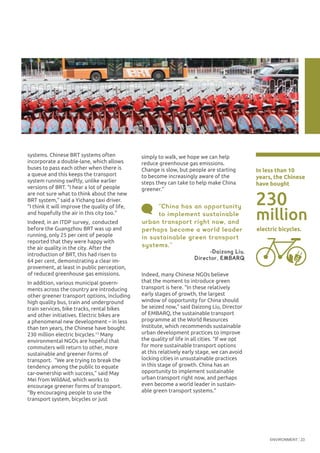
than ten years, the Chinese have bought
230 million electric bicycles.15
Many
environmental NGOs are hopeful that
commuters will return to other, more
sustainable and greener forms of
transport. “We are trying to break the
tendency among the public to equate
car-ownership with success,” said May
Mei from WildAid, which works to
encourage greener forms of transport.
“By encouraging people to use the
transport system, bicycles or just
Indeed, many Chinese NGOs believe
that the moment to introduce green
transport is here. “In these relatively
early stages of growth, the largest
window of opportunity for China should
be seized now,” said Daizong Liu, Director
of EMBARQ, the sustainable transport
programme at the World Resources
Institute, which recommends sustainable
urban development practices to improve
the quality of life in all cities. “If we opt
for more sustainable transport options
at this relatively early stage, we can avoid
locking cities in unsustainable practices
in this stage of growth. China has an
opportunity to implement sustainable
urban transport right now, and perhaps
even become a world leader in sustain-
able green transport systems.”
“China has an opportunity
to implement sustainable
urban transport right now, and
perhaps become a world leader
in sustainable green transport
systems.”
-Daizong Liu.
Director, EMBARQ
230
In less than 10
years, the Chinese
have bought
electric bicycles.
million
©RachelMcKee/OakFoundation
simply to walk, we hope we can help
reduce greenhouse gas emissions.
Change is slow, but people are starting
to become increasingly aware of the
steps they can take to help make China
greener.”
ENVIRONMENT24
“India’s public transport
systems are among the
most heavily used in the world.
At this point in time, it makes
sense to develop it well, so
that it runs sustainably, serving
citizens for years to come.”
- Sahba Chauhan,
Environment Programme Officer
for India
India
On a mission to eradicate poverty
by 2020, India introduced free-market
reforms in the early 1990s. Since then,
its cities have been growing rapidly and
are now home to about 40 per cent of the
total population. This has created a strain
on existing infrastructure, including on
roads and public transport systems.
Federal governments are planning
sustainable transport systems, but the
sheer speed of expansion has meant
that more technical capacity is needed.
Current transportation options tend to
emit high levels of carbon emissions and
public transport tends not to be safe, in
particular for women. A survey by Oak
grantee, the Mahila Housing Sewa Trust,16
carried out in Ranchi, Jharkhand, showed
that women and men face different
challenges when using public transport
in India.
Some
©TheInstituteforTransportation
andDevelopmentPolicy
Ranchi is the capital of Jharkhand,
a state in the northeast of the country
that remains largely rural but is urbanising
fast. Overall, nearly half of all trips made
in this city are on foot or by bike and a
third are by public transport. The survey
revealed that some 91 per cent of women
said they did not feel safe travelling in
shared rickshaws at night (a common form
of transport), in comparison to 61 per
cent of men. In addition, while 46 per cent
of women cyclists consider harassment
to be a problem, men cyclists do not.
Isolated roads are a problem for 59 per
cent of women cyclists, compared to
26 per cent of men. From these figures,
it is clear that public transport systems in
India need to take into consideration the
specific needs of women and girls, giving
priority to initiatives that make walking
and public transport safe, accessible
and convenient for all.
The ITDP believes that if there were
fewer economic constraints in the
country, many people would shift to
buying personal motor vehicles, following
in the footsteps of Brazil, China and the
West. Addressing the problems faced
by people who walk, cycle or use public
transport will encourage them to continue
to use these modes of transport, reducing
the congestion and pollution in the city,
even as it grows.
The Centre for Green Mobility (CGM), in
conjunction with the Delhi Development
Authority, has introduced a green mobility
policy on bicycle sharing and renting in
New Delhi. “This is an important step in
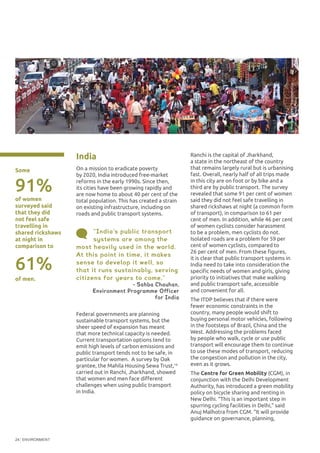
spurring cycling facilities in Delhi,” said
Anuj Malhotra from CGM. “It will provide
guidance on governance, planning,
of women
surveyed said
that they did
not feel safe
travelling in
shared rickshaws
at night in
comparison to
91%
61%
of men.
ENVIRONMENT 25
financing and operational structures
of cycle-sharing systems.” The CGM is also
providing technical assistance and advice
to the Delhi Development Authority,
the New Delhi Municipal Council and
Public Works Department in upgrading the
streets to have dedicated space for
cyclists and pedestrians.
Oak is pleased to be able to support India
as it moves forward into greener and more
sustainable transport systems.
Oak and green transport
In 2015 around 60 per cent of Oak’s climate-
related funding was dedicated to the issue
of transportation. This included: deploying
a low-carbon mass system of public
transportation/mobility within some major
cities; and supporting a transition away from
fossil fuels and towards electric vehicles.
We hope that these steps towards greener
transport will make a difference to the lives of
many, in terms of saving time, improving health
and ensuring the safety of all choosing to use
public transport options and bicycles.
60%
In 2015, around
of Oak’s climate-
related funding
was dedicated
to the issue
of transportation.
©TheInstitutefor
TransportationandDevelopmentPolicy
©TheInstitutefor
TransportationandDevelopmentPolicy
ENVIRONMENT26
Grants
©RachelMcKee/OakFoundation
©VirginiaRuan/OakFoundation
Climate
Change
Agencia Publica
USD 197,116 (24 months)
To provide core support
to Agencia Publica, which
produces high-quality non-
partisan investigative report-
ing guided by public interest
in Brazil and Latin America.
Center for Policy
Research (CPR)
USD 297,930 (36 months)
To continue to provide core
support to CPR to promote
the integration of climate
policies within the overall
development framework
in India.
Clean Air Asia
USD 500,000 (36 months)
To support Clean Air Asia
in promoting science-based
and stakeholder-inclusive air
quality management in China.
Climate Action
Network Europe
USD 283,364 (31 months)
To abolish fossil fuel subsidies
in Europe by 2020, in accor-
dance with the commitments
made by G20 leaders to
“phase out and rationalise
over the medium term
inefficient fossil fuel subsidies
while providing targeted
support for the poorest”.
ClimateWorks
Foundation, USA
USD 2,650,000 (26 months)
To establish Instituto Clima
e Sociedade in Brazil
as a fully operational
grant-making institution.
European Climate
Foundation (ECF)
USD 4,000,000 (36 months)
To support the efforts of the
ECF as it engages with not-
for-profit organisations,
businesses and governments
to balance the competitive-
ness, sustainability and
security of energy supply.
Fundación Avina
USD 600,000 (36 months)
To strengthen the Climate
Observatory as a network
and to ensure that Brazil
sustains an appropriate
level of ambition during
the post-2020 United
Nations Framework Conven-
tion on Climate Change.
Fundo Socioambiental
CASA
USD 100,000 (15 months)
To support communities
in Recife, Brazil to act on the
issues of sustainability and
social technology in their
communities.
Global Campaign for
Climate Action (GCCA)
USD 50,000 (6 months)
To support the maintenance
and development of services
and support to key stake-
holders aligned with GCCA’s
new strategy for 2016-2020,
following the UN conference
on climate change in
December 2015.
Guangdong Harmony
Foundation
USD 494,750 (36 months)
To advance Chinese social
and civic organisations in the
areas of green supply chain
management, industrial pol-
lution control and sustainable
community development.
Natural Resources
Defense Council Inc.
(NRDC)
USD 2,000,000 (60 months)
To provide core support
to NRDC to accelerate
change and tackle critical
gaps in China’s transition
to a low-carbon and
sustainable future.
New Venture Fund
USD 1,600,344 (36 months)
To cap the expansion of the tar
sands in Alberta, Canada and
eliminate the impact that tar
sands extraction, development
and transportation has on bio-
diversity and human health.
Nucleo de Apoio
à Pesquisa e Educação
Continuada
USD 207,405 (18 months)
To provide quantitative
analyses of the economic,
social and environmental costs
and benefits of public policies
for sustainable development.
Our Cities
USD 1,000,000 (36 months)
To promote inclusive and
sustainable cities in Brazil via
a platform for civic engage-
ment in Recife and in 25 other
cities across the country.
Purpose
USD 999,984 (18 months)
To accelerate innovative public
mobilisation campaigns and
to contribute to strategic
shifts in public opinion, power
balances, policy and markets
on climate and related issues.
Renew Canada
USD 300,000 (9 months)
To build support for climate
policies and a clean energy
transition in local communities
in Canada.
Right Livelihood
Award Foundation
USD 100,000 (12 months)
To honour Sheila Watt-
Cloutier as a Right Livelihood
2015 Laureate for her
outstanding advocacy for her
lifelong work to protect the
Inuit of the Arctic.
Shakti Sustainable
Energy Foundation
USD 400,000 (38 months)
To assist India in adopting
a clean energy, low carbon
development pathway.
West Coast
Environmental Law
Association
USD 100,000 (12 months)
To support the emergence
of a public and legal narrative
that fossil fuel companies and
other large-scale greenhouse
gas producers in the US should
pay compensation for the
damages caused by their
products and operations.
WildAid
USD 500,000 (36 months)
To create and conduct a series
of high profile public aware-
ness campaigns on reducing
greenhouse gas and air
pollution emissions from the
transportation sector in China
with a focus on new energy
vehicles and bicycles.
ENVIRONMENT 27
©VirginiaRuan/OakFoundation
©KristianParker/OakFoundation
World Economic Forum
USD 100,000 (7 months)
To support and enhance the
design and delivery of France’s
COP21 business engagement
strategy, to create a more
positive political environment
that will lead to a successful
COP21 outcome.
Marine
Alaska Longline
Fishermen’s Association
USD 350,000 (48 months)
To support fisheries
stewardship policy develop-
ment and advocacy work
at the state, federal and
national levels and secure
resource access for the next
generation of community-
based fishermen.
Environmental Justice
Foundation (EJF)
USD 500,000 (32 months)
To support EJF to secure
greater governance of the
South Korean fisheries.
Inuit Circumpolar
Council - Greenland
USD 366,243 (36 months)
To promote conservation
efforts in the area of
Pikialasorsuaq – the North
Water Polynya – that strike
a balance between socially
and culturally important
subsistence hunting and
the need to protect the
habitat for generations
to come.
Inuit Circumpolar
Council-Alaska
USD 275,000 (36 months)
To advance Inuit priorities
related to sustaining Inuit
culture and society, promoting
adaptation strategies for
sustainable Inuit communities
and increasing an under-
standing of the human
dimension within the Arctic.
Kawerak Inc.
USD 199,827 (36 months)
To improve and expand local,
tribal management of marine
mammals, particularly the
Pacific walrus, in coastal
Alaskan communities.
Marine Fish
Conservation Network
USD 350,000 (36 months)
To maintain and strengthen
the conservation and
management objectives of
the Magnuson-Stevens Fishery
Conservation and Manage-
ment Act in the United States.
Marine Stewardship
Council
USD 300,000 (36 months)
To contribute to more
sustainable approaches to
commercial fishing practices
in the Spanish fishery
sector by helping secure
livelihoods and improving
marine conservation.
McGill University
USD 77,446 (12 months)
To research and develop a
business and implementation
plan for a Circumpolar Inuit
News and Information
Network for Inuit people
across Russia, the United
States, Canada and
Greenland.
Native American
Rights Fund
USD 300,000 (36 months)
To protect the Bering Sea
Elder 39 member tribes’ rights
to subsistence hunt and fish
in traditional areas by giving
them a voice in decision-
making processes.
Nature Conservancy
USD 1,000,000 (12 months)
To help establish the second
largest marine protected area
in the Indian Ocean, covering
up to 400,000 square
kilometres.
Ocean Conservancy
USD 200,000 (12 months)
To develop systemic solutions
at a scale that will help stop
the flow of plastics and other
consumer waste from reach-
ing the ocean through locally
appropriate interventions.
Peace Development
Fund
USD 400,000 (36 months)
To advance the creation
of an ecologically connected
network of Arctic marine
protected areas, as well as
the development of a
regional seas programme,
through the Arctic Council.
Pew Charitable Trusts
USD 750,000 (36 months)
To promote science and
community-based
conservation of the Arctic
marine environment in the
United States, Canada,
Greenland and international
waters of the Central Arctic
Ocean.
University of
Alaska-Anchorage
USD 550,000 (36 months)
To strengthen the Alaska
Native Science and Engineer-
ing Program science
curriculum, particularly
in relation to Geographic
Information Systems.
Zoological Society
of London
USD 255,789 (24 months)
To reduce single-use plastic
bottles in London
by optimising the resources
and networks of the alliance
group Marine CoLABoration.
Mesoamerica
Environmental
Defense Inc.
USD 200,000 (24 months)
To create a permanent,
national, rights-based
fishery regime that will assist
in putting Belize’s ecologically
and economically important
coral reefs on a durable
path to recovery.
Julian Cho Society
USD 121,760 (24 months)
To assist 39 Maya
communities of southern
Belize to negotiate and
implement the settlement
order based on the
Caribbean Court of Justice’s
recent judgement that
reaffirmed Maya land rights.
ENVIRONMENT28
©VirginiaRuan/OakFoundation
©RachelMcKee/OakFoundation
Mesoamerican Reef Fund
USD 10,000,000 (60 months)
To establish a Belize Marine
Conservation Trust Fund in
order to provide long-term
financial sustainability for nat-
ural resources management
and conservation initiatives.
Oceana Inc.
USD 850,000 (30 months)
To work with the Government
of Belize to adopt a legislative
position against offshore oil
activities in Belize in order
to safeguard Belize’s world-
renowned marine resources.
Sarstoon Temash
Institute for Indigenous
Management (SATIIM)
USD 689,687 (60 months)
To build the institutional
self-reliance and capacity of
SATIIM so that it continues
to function as a national and
global leader in environmental
and human right defence and
sustainable development.
This is a list of grants approved in 2015.
For a comprehensive list and full
descriptions, please visit our grant database
at www.oakfnd.org/grants
United Nations
Development Program -
COMPACT
USD 500,000 (36 months)
To re-grant to civil society
organisations that engage
local communities in the con-
servation of the Belize Barrier
Reef Reserve System World
Heritage Site.
Wildlife Conservation
Society
USD 850,000 (36 months)
To achieve national impact
in marine protected areas
and fisheries management
by improving conservation
outcomes at Glovers Reef
and South Water Caye
Marine Reserves in Belize.
ENVIRONMENT 29
3
©RachelMcKee/OakFoundation
The photos throughout the Environment
Programme section of this report illustrate
green transport options in Brazil, China
and India. Oak supports grantees in these
three countries to help implement trans-
port options such as high quality bus, train
and underground train services, bike tracks,
rental bikes and electric bikes.
HOUSING AND HOMELESSNESS30
Housing and Homelessness
©MsBelindaSoncini/EldersLivingatHomeProgram,BostonMedicalCenter
1
In the Housing and Homelessness Programme, we focus
on preventing homelessness by funding sustainable
solutions that improve the economic and social wellbeing
of marginalised youth, adults and families. We have three
priorities: promoting economic self-sufficiency; increasing
the availability and supply of affordable housing; and
preventing homelessness.
Grants within the programme are wide-ranging in size.
We partner with organisations working both nationally
and locally in Boston, New York and Philadelphia
in the United States and in London, Belfast, South Wales,
Glasgow and Birmingham in the United Kingdom.
Within each location, we aim to fund projects relevant
to the three priorities. In addition, we have adopted
specific objectives that recognise particular issues in
some of the localities where we make grants.
©ProvidenceRow
HOUSING AND HOMELESSNESS 31
Reflections
The trend of contracting public
expenditure continues in the United King-
dom and the United States. In the UK we
are halfway through an unprecedented
ten-year period of year-on-year cuts to
public expenditure. In the US advocates
are battling to get the number of house-
holds helped through rental assistance
back up to pre-sequestration, 2013 levels.
The resources available to Oak’s Housing
and Homelessness Programme (HHP) can-
not begin to compensate for loss of public
funding, so we ask ourselves what should
the focus of our grant-making be? Our
conclusion is that there are many ways
that we can make an impact, despite
the operating environment. Two of
these ways are featured below:
•	 There are market forces and
systems failures that act to compound
poverty and in 2015 we made a num-
ber of grants that explore and respond
to these. In the UK a grant made to
the University of Bristol supports the
Personal Finance Research Institute to
revisit the ‘poverty premium’. We hope
this review will guide our future work
as well as the work of other stake-
holders. The market fails families who
need access to low-cost credit. Support
to Moneyline in the UK will enable the
expansion of services so that several
thousand families in Stoke will have ac-
cess to modest loans at a lower cost. In
the US we provided core funding to the
Center for Responsible Lending, which
continues to challenge predatory forces
across a range of financial products.
42
grants were
made by the
Housing and
Homelessness
Programme in
2015, totalling
USD 19.91 million.
Find out more at
www.oakfnd.org/housing
©ProvidenceRow
©ProvidenceRow
•	 We support advocacy efforts that
go beyond asking for increased
expenditure and which question the
way that existing resources are used
and distributed. Examples include:
the ‘Healthy Row House’ project in
Philadelphia, which explores how to
expand activity to repair the city’s
existing housing stock. ‘On solid Ground’
is a broad coalition, taking a fresh
approach to tackling Massachusetts’
enduring homelessness problem. In the
UK, Russell Webster, hosted by Clinks, is
designing a tool to help commissioners
and service providers decide whether
‘Payment-by-Results’ is an appropriate
way to structure funding for particular
services.
Working together and coordinating
services always results in a more holistic
outcome and when funding is tight it
has added potency. In this year’s report
we have detailed some of the ways that
our partners have been able to enhance
their services by strengthening the links
between the fields of health and
homelessness.
HOUSING AND HOMELESSNESS32
Bart was 34 and working as a security
guard when he was admitted to hospital
with acute myeloid leukaemia.
Health and
homelessness
services –
the power of
working together
“I had no savings and
was on the minimum
wage. I had been staying with
a friend, but was not able to
return there because my friend
was afraid that he might ‘catch’
the cancer.”
- Bart, one-time homeless person
Bart had to undergo chemotherapy, which
meant repeated visits to the hospital.
However, he had nowhere to live. The
London borough where he had previously
lived was reluctant to house him, despite
his medical reports.
There are many cases such as Bart’s.
Bad housing conditions, homelessness
and poor health are intrinsically linked
and it is well known that poor health
is both a cause and a result of
homelessness.
The complexity of providing quality
healthcare to the homeless is the reason
why the fields of homelessness and health
need to find ways to work together.
As it is, the healthcare system and
homeless organisations are set up to work
separately from each other. This hampers
the possibility of reaching the most
vulnerable. Medical professionals do not
know the housing status of their patients,
which limits the scope for intervention. In
addition, it is difficult to provide ongoing
healthcare to the homeless or those in
danger of losing their homes.
©ProvidenceRow
HOUSING AND HOMELESSNESS 33
Can health providers
detect early signs of
housing distress?
People at risk of losing their home are
not always that easy to reach. Medical
appointments are one way to make
contact with people who do not use
other services – they provide a window
of opportunity to talk through issues
that contribute to people’s ill health,
such as poor housing. Healthcare sessions
can provide ways to recognise the signs
that someone is struggling to keep his
or her home, or that the condition of
a person’s housing is contributing to
their ill-health.
The Govan Law Centre (GLC), based in
Scotland, provides free legal services to
people on low incomes for housing, debt,
discrimination, education, employment
and welfare.
GLC has established weekly Rights Hubs
in the four main psychiatric hospitals
in Glasgow. These Hubs help the most
vulnerable and marginalised people in the
city find out about their rights in regard
to welfare benefits, debt and housing.
In this way, GLC strengthens referral
routes between mental health services
and homelessness prevention services
across the city.
Healthcare
sessions provide
opportunities
to recognise the
signs that some-
one is struggling
to keep their
home or that the
condition of their
housing is causing
ill-health.
A lack of joined-up working across sectors
has often been cited by politicians and
policy-makers as a fundamental barrier
to resolving social problems. In 2013 the
Minister of State for Care and Support,
Norman Lamb, said, “People don’t want
healthcare or social care, they just want
the best care.”
“Working together produces better
outcomes for people,” said Amanda
Beswick, Director of Oak’s Housing and
Homelessness Programme. “Yet there
are some clear barriers to achieving this
common-sense logic, both structural
and cultural.”
Oak funds initiatives that work to
strengthen the links between the home-
lessness sector and health providers.
These include Pathway, which helped
Bart, mentioned above, find a home.
Integrated working across government
agencies or between not-for-profit
organisations is a common theme running
through HHP grant-making. Oak sees
firsthand the challenges and the benefits
when services work together. We asked
our grantees some important questions
about their work. Read on to find out
what they are doing to link the two
sectors of housing and healthcare.
“Our work is clearly
having a positive impact
on patients. This is in terms of
resolving housing and related
issues, but also in terms of
health, wellbeing, recovery and
discharge.”
- Alistair Sharp,
Govan Law Centre
“A key factor to our success was having
someone champion our cause,” said
Alistair. “In this case, it was one of the
National Health Services’ mental health
service operational managers – he
certainly opened doors for us. He saw the
immediate benefit and impact of our work
with patients. We developed a shared
vision of how benefits could be expanded
across other psychiatric hospitals in the
Glasgow area.”
The Boston Medical Center has always
had a progressive view on homelessness.
It is one of Boston’s largest hospitals and
has, for many years, helped homeless
people with medical problems.
Its Elders Living at Home programme
identifies housing problems that may
put older patients at risk of becoming
homeless. It then partners with the
Medical Legal Partnership to help
resolve these problems so that clients
can overcome barriers to securing and
maintaining suitable, permanent housing.
1.	The photos in the HHP section of the
report illustrate the work of Oak's part-
ners. They are working to help people
who have experienced homelessness
improve their health, find work and
keep their homes.
HOUSING AND HOMELESSNESS34
Chronically
homeless people
are among the
highest users
of medical care
in the United
States.
Permanent
supported
housing can
dramatically
reduce their need
for healthcare.
“Their bedside manner is
beautiful. If you forget,
they call your apartment, they
make sure you remember... It’s
beautiful. I don’t feel like my
doctor is here just for the pay-
cheque. It’s like she’s here for
the people.”
	 	 	 	 - Moira,	
     CUCS client
“The key to success has been
educating medical providers about all
of the challenges that their patients,
particularly their low-income patients,
face in their daily lives,” said Eileen
O’Brien from the Boston Medical Center.
“We help them understand how a lack of
housing or very unstable housing impacts
on their patients, and can undermine
their health no matter how many health
interventions the providers attempt.
They appreciate the programme because
it makes them better, more effective
practitioners, and they see that their
patients have better results. They are
now starting to embrace the approach
on a policy level as well.”
Does the US Affordable
Care Act provide
an opportunity for
better links between
housing and health?
Longterm or “chronically” homeless
people are among the highest users of
medical care in the United States and are
also some of the costliest patients. They
often rely on expensive emergency room
visits. Permanent supported housing
which specifically targets chronically
homeless people can both successfully
house these individuals and dramatically
reduce their need for healthcare. The
Affordable Care Act broadens the remit
of Medicaid by making it possible to
integrate housing support and health
services. However, the reality of this
work is challenging.
The Supportive Housing Network
of New York (SHNNY) works to ensure
that there is an adequate supply of
supportive housing in New York City. One
of its key themes in the coming years will
be supporting its members to manage the
implications of the Affordable Care Act.
“The Affordable Care Act opened the
door for the possibility of Medicaid to
pay for a portion of critical services in
supportive housing,” said Laura Mascuch
from SHNNY. “This will help keep the
most vulnerable people in New York
housed. SHNNY is working to ensure
that this potentially positive resource
does not undermine the integrity of the
supportive housing model, but instead
adds to our community’s ability to offer
person-centred housing to New York’s
most vulnerable homeless people.”
The Massachusetts Housing and
Shelter Alliance (MHSA) works to
secure Medicaid funding to cover the
costs of health services for people living
in supportive housing in Massachusetts.
“The greatest challenge in developing
permanent supportive housing is the need
to stress its importance in the healthcare
of long-term disabled homeless persons
without totally medicalising the issue
of homelessness,” said Joe Finn from
MHSA. “The way to overcome this is
by highlighting as key outcomes the
importance of social issues, housing,
nutrition, education and income.”
The Center for Urban Community
Services (CUCS) provides supportive
housing in New York City. The Janian
Medical Center was established by CUCS
in 2011 to carry out psychiatric outreach
work and expand CUCS’s services to
include primary medical services for
homeless people.
Early evidence from the initiative
shows that integrating healthcare and
supportive housing leads to reduced
hospital admissions, improved physical
and mental health and fewer visits to
the hospital emergency room.
“The Affordable Care Act has introduced a
storm of philosophical and programmatic
changes in a very condensed timeframe,”
said Tony Hannigan from CUCS. “Our
biggest challenge is to fund operations
while protecting person-centred care
in a way that works for both clients and
clinicians.”
HOUSING AND HOMELESSNESS 35
“The health and wellbeing programme
is such a powerful preventative measure,”
said Pam Orchard from Providence
Row. “We have found a joint working
arrangement with the Royal London
Hospital that works well. We will make the
service available to more people and work
to ensure financial sustainability in a time
of public sector austerity.”
Pathway is a model of integrated
healthcare for single homeless people
and rough sleepers that puts the patient
at the centre of healthcare practices. The
Pathway model was piloted at University
College Hospital, London and is now
internationally recognised and in place
in ten hospitals across the UK.
The Pathway team visits homeless
patients in hospitals and then works
with ward staff and other clinicians to
care for them. The team provides expert
support and advice to clinical colleagues
on how to treat patients with alcohol or
drugs issues, as well as those with mental
health problems. It also engages with the
patients, helps them to participate more
fully in decision-making about their care,
and brings focused but sensitive attention
to planning for their discharge.
“We have succeeded for several reasons,”
said Alex Bax from Pathway. “Firstly,
we have always tried to work within
and alongside the institutions and the
individuals of the National Health Service
and to be endlessly humble. We focus
always on how to improve things for
homeless patients practically.”
Can hospitals improve
their response to
homeless people?
Many homeless people rely on hospitals
for medical care, frequently using
accident and emergency rooms to
gain access to immediate treatment.
Vulnerable people easily fall between
the gaps in the labyrinth of hospital
structures, and sometimes receive
fragmented, uncoordinated care. In
addition, homelessness makes ongoing
care more difficult.
Read on to find out how Oak’s partners
have been successful in improving the
hospital environment for homeless
people.
Providence Row tackles the root causes
of homelessness in East London to help
people get off and stay off the streets.
It believes that working with people
to build skills and confidence is the
key to success. It does this through
trainee schemes, language classes and
employment support. Providence Row
also provides support for mental health
and addiction issues to help people rejoin
the community.
In addition, Providence Row works
to reach patients before they leave
hospital through its health and wellbeing
programme. It secures housing and
coordinates support services in the
community for those without homes. In
this way patients can continue to access
mainstream health and wellbeing services
once they leave hospital.
Homeless
people frequently
use accident and
emergency rooms
in hospitals
to gain access
to treatment.
©ReachtheCharity
©JanianMedicalCenterfor
UrbanCommunityServices
HOUSING AND HOMELESSNESS36
Trident Reach
provides a ‘street-
to-hospital-to-
home’ service for
people in the UK.
It secures housing
for patients
before they are
discharged from
hospital.
Tribute to
Professor
Aidan Halligan
The Pathway model was the
vision of Professor Aidan Halligan,
who passed away suddenly and
unexpectedly in April 2015. “Aidan’s
contribution was vital,” said Alex
Bax. “Without his raw energy, drive
and compassion, Pathway would not
have come into existence and our
approach would never have spread
as it has across the UK and now to
other countries. His sudden death
robbed Pathway of its founder, but
has left us with a legacy of moral
courage.”
“Levels of homelessness and
the resulting health harms are
overwhelmingly a consequence
of wider economic and social
circumstances, and of the
political choices we make as a
society. In healthcare you get
your authority from how much
you care. I hope that Pathway
has given more people more
permission to care, and from
that caring position, to change
the lives of the most excluded.”
- Professor Aidan Halligan
©ProvidenceRow
©ProvidenceRow
Trident Reach provides a ‘street-
to-hospital-to-home’ service for people
living in the West Midlands in the United
Kingdom. It secures appropriate housing
and support for patients before they
are discharged from hospital, ensures
support for the patient after they leave
and provides support and connections
within the community. This partnership
between NGOs, healthcare providers
and housing authorities aims to end
the revolving door of homeless people
being repeatedly re-admitted
to hospital.
“Frontline clinical teams appreciate
and value the expert guidance and rapid
response that the initiative offers,” said
Amy Hewett from Trident Reach. “Each
individual and organisation involved has
a clear understanding and knowledge
of what success looks like for both the
patient and strategically.”
HOUSING AND HOMELESSNESS 37
©ProvidenceRow
HOUSING AND HOMELESSNESS38
Grants
©Homestart
Economic
self-sufficiency
Center for Responsible
Lending (CRL)
USD 1,000,000 (48 months)
To provide core funding to
the CRL to help it eliminate
abusive financial practices
that disproportionately impact
low- and moderate- income
families and people of colour
in the United States.
Community Housing
Cymru (CHC)
USD 182,934 (24 months)
To enable CHC to develop
a new, self-sustaining enter-
prise that delivers financial
advice and products and
to develop its "Your Benefits
are Changing" campaign
in the UK.
Edinburgh Cyrenians
USD 80,000 (18 months)
To evaluate current practice
of the Good Food programme,
a social enterprise with a
mission to bring good food
and healthy lifestyles to
people who are experiencing
disadvantage, isolation,
poverty and homelessness.
Jericho Foundation
USD 476,323 (36 months)
To enable the Jericho
Foundation, based in
Birmingham in the United
Kingdom, to become
sustainable and increase
training and employment
opportunities for its clients.
Moneyline
USD 494,080 (36 months)
To increase the availability
of affordable lending and
credit to low-income
households in Stoke,
in the United Kingdom,
by supporting Moneyline
to expand its services.
Neighborhood Trust
Financial Partners
USD 480,000 (36 months)
To provide financial support
to low-income people in the
US by reaching out to
employers.
Second Step
USD 629,395 (48 months)
To develop peer mentoring
support in Bristol, the UK,
in order to reduce and prevent
homelessness and to enable
people with histories of
homelessness to lead more
independent, fulfilling lives.
Increasing
the supply
of low-income
housing
Boston Foundation Inc.
USD 25,000 (12 months)
To fund an award for the
Home Funders Innovation
Fund, which seeks new
solutions to increase the
supply of housing for low-
income families in Boston.
Center for Architecture
USD 820,228 (36 months)
To improve the condition of
thousands of privately-owned
row-houses in Philadelphia.
Chartered Institute
of Housing in Northern
Ireland
USD 245,816 (36 months)
To support the private rented
sector to provide higher living
standards, by promoting
professional standards in
both the management of
accommodation, and the
delivery of services to tenants.
Housing Alliance
of Pennsylvania (HAP)
USD 1,000,000 (60 months)
To provide core support to the
HAP, a not-for-profit organisa-
tion that works to ensure that
all those living in Pennsylvania,
especially those living on low
incomes, have access to safe,
decent and affordable homes.
National Low Income
Housing Coalition
(NLIHC)
USD 1,500,000 (60 months)
To provide core funding
to NLIHC which works
to achieve socially just public
policy that assures people
with the lowest incomes in the
United States have affordable
and decent homes.
New York Communities
Organizing Fund Inc.
USD 750,000 (36 months)
To ensure that housing
policies prioritise and deliver
affordable housing for the
most economically vulnerable
households in New York City.
Homelessness
prevention
Broad Street Ministry
USD 441,849 (48 months)
To provide and connect
ex-offenders in Philadelphia
with housing, support and
public benefits and to help
their reintegration back
into the community.
Cardinal Hume Centre
USD 479,638 (36 months)
To improve the quality and
effectiveness of immigration
casework for homeless and
vulnerably-housed migrants
through partnerships with
non-governmental
organisations in London.
City Life/Vida Urbana
USD 289,613 (12 months)
To support the “No One
Leaves” project in Boston,
the US, run by City Life/Vida
Urbana, a bilingual (Spanish/
English) community organi-
sation which fights for racial,
social and economic justice
and gender equality.
Common Ground
Communities Inc. DBA
Community Solutions
USD 400,000 (24 months)
To end veteran and chronic
homelessness by working
closely with 75 communities
in the US.
Depaul UK
USD 896,510 (48 months)
To improve the life chances
of homeless young people and
to support their integration
into communities.
©ProvidenceRow
©ReachtheCharity
HOUSING AND HOMELESSNESS 39
Institute for Public
Policy Research
USD 113,280 (12 months)
To build support for an
improved tool which supports
people seeking employment
in the UK and develop
a feasibility study for how
the approach could be
comprehensively piloted.
Merthyr and the
Valleys Mind
USD 205,538 (24 months)
To test and evaluate the
combination of mental health
referrals and homelessness
prevention work at the local
authority level in Wales.
National Alliance
to End Homelessness
USD 1,500,000 (60 months)
To provide core support to
the National Alliance to End
Homelessness to further its
mission of preventing and
ending homelessness in
the United States.
National Network
for Youth
USD 466,250 (36 months)
To develop the National Youth
Advisory Council in the US and
provide training to a larger
number of young homeless
people to become youth
advisors.
Nurse Family Partnership
USD 311,828 (36 months)
To provide low-income
mothers in Philadelphia in the
United States with dedicated
legal and advocacy services to
improve their children’s lives
and their own.
Praxis Community
Projects
USD 552,630 (60 months)
To develop a comprehen-
sive approach to supporting
homeless migrants in London
by developing partnerships
between the migrant and
homelessness sectors.
Providence Row
USD 351,501 (36 months)
To improve health and housing
outcomes for homeless
patients in East London
through a personalised health
and wellbeing programme
that prevents rough sleeping.
The Rock Trust
USD 268,358 (48 months)
To recruit a Development
Coordinator to increase
the Rock Trust’s capacity
to provide services in more
parts of Scotland and
to develop new initiatives.
The Welcome
Organisation
USD 489,006 (60 months)
To prepare the Welcome
Organisation in Belfast,
Northern Ireland, to identify,
develop and implement a
succession strategy to prepare
for the director’s retirement.
University of
Massachusetts
Foundation
USD 493,256 (36 months)
To conduct research on cliff
effects to inform the work of
the On Solid Ground Coalition,
a collaborative, cross policy
and research action initiative
led by UMASS Boston Center
for Social Policy, CHAPA and
Homes for Families.
Vicar’s Relief Fund
USD 1,140,240 (36 months)
To enhance the impact and
effectiveness of the St Martin-
in-the-Fields Charity’s Vicar’s
Relief Fund, which supports
people at risk of being made
homeless.
Women Acting
In Today’s Society
(WAITS)
USD 248,000 (36 months)
To support women in the
United Kingdom who are
experiencing domestic abuse
and are homeless to re-
integrate into their
communities, and to support
WAITS to become sustainable.
Learning
Chartered Institute
of Housing Cymru
USD 492,640 (60 months)
To help develop an intercon-
nected, cross-sectoral housing
system in Wales that brings
together the government,
local housing authorities,
registered social landlords,
tenant organisations, support
providers and the private
sector.
This is a list of our grants approved in
2015. For a comprehensive list and full
descriptions, please visit our grant
database at www.oakfnd.org/grants
Clinks
USD 78,254 (12 months)
To explore the viability of
the “Payment by Results”
commissioning model to
improve outcomes in a wide
range of public services in
the UK, by developing an
interactive tool for
commissioners and
providers.
Crisis UK
USD 209,640 (36 months)
To identify and share best
practice to inform further
models for accessing,
securing and maintaining
Private Rented Sector
accommodation for home-
less and vulnerable people.
Henry Street
Settlement
USD 100,000 (12 months)
To evaluate factors relating
to longer-term housing and
employment outcomes for
families leaving Henry Street’s
shelter services in New York
City.
Homeless Link
USD 338,090 (36 months)
To facilitate an annual
transatlantic practice
exchange between homeless-
ness professionals in the US
and the UK, with the aim of
introducing new ways to tackle
homelessness and developing
future leaders in the sector.
Institute for Voluntary
Action Research
USD 96,000 (12 months)
To improve evaluative
practice in foundations
through opportunities to
share experience and refine
thinking and practice.
Personal Finance
Research Centre,
University of Bristol
USD 155,173 (12 months)
To develop recommendations
to policy-makers and industry
regulators relating to the
“Poverty Premium”, which
refers to how poor households
pay more for essential goods
and services.
Pine Street Inn
USD 100,000 (12 months)
To provide new ways out
of shelters for mid- and
short-term homeless guests
in Boston, the US, especially
those with a history of
recidivism.
Other
Associação Fórum
Suape Espaço
Socioambiental
USD 239,397 (36 months)
To provide core support to
Forum Suape - Social and
Environmental Space, which
advocates for environment
and the interests of traditional
communities affected by the
Suape Industrial Port Complex
(CIPS), a major industrial
development in Brazil.
Acao Comunitaria
Caranguejo Uca
USD 97,560 (36 months)
To promote a green, inclusive
and sustainable economy via
digital media in Ilha de Deus
in Recife, Brazil.
Lift
USD 874,190 (48 months)
To develop the "Harlesden
Working Together" project
in London, the UK and
to generate activities that
address social exclusion
in practical and strategic
ways.
One25
USD 800,000 (60 months)
To provide core support
to One25, which works to
build supportive relationships
with Bristol’s street sex-
workers through a person-
centred approach.
INTERNATIONAL HUMAN RIGHTS40
Since 1948 the international community has developed
an extensive body of international legal standards and
institutions that relate to the promotion and protection
of human rights. However, many individuals who seek
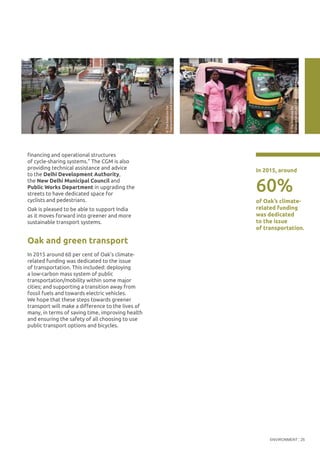
to uphold their rights or the rights of others are threatened
and punished because of their work, and their space for
activism is restricted. National security fears, the
economic crisis, hostility to human rights and the emergence
of a multi-polar international order also present threats
and opportunities. There remains a gulf between the theory
and the realisation of these rights in practice.
In the International Human Rights Programme (IHRP),
we work with partners to: end impunity for the gross
violations of human rights; uphold prohibitions on arbitrary
detention and torture; protect human rights defenders
at risk; and multiply and amplify influential voices on IHRP
global priorities.
International Human Rights
©WITNESS
1
INTERNATIONAL HUMAN RIGHTS 41
Reflections
The operating environment for many
International Human Rights Programme
grantees deteriorated in the course of
2015. Around the world, in authoritarian
as well as democratic states, governments
imposed a range of measures to restrict
civil society and intensify pressure on
civil human rights defenders. Concerns
over immigration gave rise to calls for
the adoption of increasingly punitive
approaches to regulate the movement of
people.
Alongside these developments,
advances in technology presented
both threats and opportunities for the
human rights movement. Within this
challenging context there were some
notable achievements. These include the
following:
Countering impunity, securing redress:
the trial of former Chadian President
Hissène Habré, accused of multiple gross
abuses in the 1980s, began in September
2015. This is the first trial of a former
African head of state by another African
state and constitutes a milestone in
international justice. It is also a testament
to the perseverance of victims and their
allies in the human rights community
(including multiple Oak grantees) in
a 25-year long battle for justice and
accountability.
To build on the momentum, Oak invested
in improving the means by which litigators
seek to hold perpetrators of gross abuses
to account. This includes a range of
innovative evidence-collection tools.
Combating torture: following a long
delay, and thanks to the support of
multiple Oak grantees, the report of the
US Senate Intelligence Committee on
the CIA’s Detention and Interrogation
Program was released. The report
confirmed that torture had been
employed systematically during Bush-
era interrogations of terror suspects
in a network of secret interrogation
facilities known as ‘black sites’, and
that robust measures were needed to
prevent its recurrence. We maintained
our longstanding commitment to
assisting victims of torture by supporting
rehabilitation centres in low- and middle-
income countries. We also extended
our efforts to test innovative models
of care for people who have suffered
from trauma and to evaluate existing
therapeutic approaches.
Detention and due process: grantees
responded creatively to the migration
crises in Europe and along the US-Mexican
border throughout 2015. Grantees
sought to: protect the most vulnerable,
including women and children; advocate
for the principles of lawful, time-bound
detention; ensure that humane conditions
were being respected; and encourage
appropriate alternatives to detention. In
2015 immigration detention became an
increasingly significant priority for Oak.
46grants were
made by the
International
Human Rights
Programme in
2015, totalling
USD 23.60 million.
Find out more at
www.oakfnd.org/humanrights
©TacticalTech
©AmericanCivilLibertiesUnion
2 3
1. WITNESS activists from Brazil and the
US share their experiences documenting
police violence.
2. TacticalTech trains human rights
defenders to use technology so that
their security is not put at risk.
INTERNATIONAL HUMAN RIGHTS42
Technology and
human rights
The way that people communicate and
access information has been transformed
over the last half-century. These
technological advances have empowered
those defending human rights.
However, they have also aided their
adversaries, and human rights defenders
are increasingly vulnerable to online
surveillance and hacking, as governments
and private actors restrict access to
certain information.
“In international law,
access to information
and free expression have
found tremendous accelerators
in the internet and other forms
of digital communication. At the
same time, efforts to control
speech and information are
also accelerating.”
- Carole Bogart,
Human Rights Watch
Protecting human rights defenders and
enabling their work, including through
harnessing the benefits of modern
technology, are some of Oak’s key
priorities. Oak developed a cluster
of grants in 2015 to both realise the
potential of technology and also
to mitigate attendant risks. Grants
covered three main areas:
•	digital security;
•	developing anti-impunity tools
and technologies; and
•	technological capacity-building.
Read on to find out more!
©TacticalTech
INTERNATIONAL HUMAN RIGHTS 43
77
Bahraini human
rights defenders
have had their
computers and
mobile devices
hacked.
Since the 2011
uprising, at least
Digital security
Since the Bahraini uprising in 2011, local
authorities have been using excessive
force and unlawful detention to muzzle
pro-democracy activists. Many activists
have had to flee the country. In exile
and in relative safety, they continue their
work to bring about democratic reform.
However, they remain at risk from digital
attack – since the uprising, at least
77 Bahraini human rights defenders
have had their computers and mobile
devices hacked, presumably by a hostile
government. Hackers gained access
to information saved on the activists’
computers’ hard drives, monitored Skype
calls, chats, file transfers and videos,
read emails and recorded conversations.
Unfortunately, incidents like these are
becoming increasingly commonplace,
threatening both the work and lives
of human rights defenders. There
is a lack of research and tools to help
groups quantify and mitigate such risks.
To fill that gap, Oak made a grant
to Citizen Lab, a research group at the
Munk School of Global Affairs in the
University of Toronto. Citizen Lab
is working to detect covert hacking
and surveillance tools that are directed
against human rights groups.
It is thanks to its work that the breach
of the Bahraini activists’ computer
systems was identified. Citizen Lab
published a report that linked this attack
(and others) to a UK-based commercial
company which sells Trojan spyware
to governments, ostensibly in the fight
against organised crime. However in
some countries, such tools have been
used in ways other than what they were
intended for: to surveil and endanger
human rights defenders.
Citizen Lab’s analysis helped strengthen
campaigns and litigation against
companies that have sold surveillance
systems to countries that have used the
tools in this way. In addition, Privacy
International’s campaign resulted
in controls on the export of such
technologies from the UK.
Citizen Lab forms part of a new cohort
of grantees, which – though not all
focused on security – should improve
security practices among non-
governmental organisations. Grantees
including Tactical Technology Collective
work with activists to ensure that online
activities and data storage do not place
organisations or the victims they work
with, at risk.
“Through your computer, mobile phone
and other digital devices, you leave
behind hundreds of digital traces every
day,” said Stephanie Hankey, Co-Founder
of Tactical Technology Collective. “These
bits of information are created, collected
and stored. Then they can be put together
to create stories about you or profiles
of you. While these can give others
a huge insight into your life, they can
also give a totally wrong impression.”
Through a range of resources, including
its flagship Security-in-a-Box toolkit,
Tactical Technology Collective provides
group training to reduce the risk
associated with these digital traces.
Developing
anti-impunity tools
Documenting police brutality in Brazil
According to Amnesty International,
the police in Brazil are estimated
to be responsible for around 2,000 deaths
every year.17
Many of these deaths are
undocumented, and the families of
the victims often never learn of what
happened to their son or daughter.
Oak grantee WITNESS has helped
Page 41. 3. In 2015 thousands of
unaccompanied minors tried to cross the
US/Mexico border.
Opposite: TacticalTech trains human
rights defenders to use technology
so that their security is not put at risk.
INTERNATIONAL HUMAN RIGHTS44
A recent example is the case of the
assassination of Lebanese Prime Minister
Rafik Hariri – prosecution rested almost
exclusively on the tracking of the
defendants’ cell phones.
Gathering witness statements
through technology
Unlocking the wealth of potential
evidence gathered by witnesses through
statements – in person, on social media
and through mobile phone recordings;
and corroborating this evidence to make
it admissible in court, is a challenge.
In 2015 Oak supported three
interventions to make this happen:
•	Carnegie Mellon University’s Human
Rights Center is pioneering the
development of advanced computing
methods and tools to analyse large
volumes of photographic and video
evidence;
•	UC Berkley’s Human Rights
Center works with the International
Criminal Court, investigators and
technology companies to ensure the
use of evidence gathered through
technological means in proceedings;
and
•	SITU Research applies spatial analysis
and visualisation techniques to present
evidence more effectively.
In a separate but related grant, the
American Association for the Advance-
ment of Science deployed geospatial
technology to document international
crimes from space.
WITNESS
supports civilian
activists and
investigators
who document
disappearances
and police
brutality in
Brazilian cities.
©AllOut
1
train activists to use mobile video
devices to capture human rights violations
when they occur. It has also empowered
communities to stand up against police
brutality.
“With the rise in the use of mobile phones
and social media, there is an increasing
flood of videos that human rights groups
hope will support criminal investigations
and proceedings,” said Executive Director
of WITNESS, Yvette Alberdingk Thijm.
“We believe that if we train activists and
citizens to capture better quality videos,
international human rights and criminal
justice stakeholders will be able to use
them to better effect,” she said.
“What WITNESS does
is create, support and
sustain a global network
of people who use video
as their tool, as their weapon.
This network reminds us that
we are not a single voice;
we are not alone.”
- Esra’a Al Shafei,
Bahraini activist
©CitizenLab
©WITNESS
2
WITNESS is one of several of Oak grantees
that work with activists to develop
and disseminate new technologies to
capture evidence of crimes. New kinds of
evidence, like video and satellite imagery,
are becoming increasingly important
in the investigation and prosecution of
international crimes.
INTERNATIONAL HUMAN RIGHTS 45
Capacity building
Maintaining a well-functioning and
up-to-date IT system is critical to the
effectiveness of any organisation. In 2015
Oak invested in a range of interventions
to build grantees’ technological capacity.
This included an extensive programme
of training built on face-to-face,
individualised, user-led approaches.
Oak also supported sustainable
IT programmes that were integrated
into the regular day-to-day operations
of the grantees.
The work of HURIDOCS and Beneficient
Technology’s Human Rights Programme
(Benetech) was critical to these
efforts. HURIDOCS worked closely
with organisations to examine their
information and management systems
over a number of years.
Benetech has
developed a
secure, encrypted
database which
permits human
rights groups
working in high-
threat situations
to safely store
information.
©TacticalTech
©WITNESS
Benetech has developed a secure,
encrypted database which permits
human rights groups working in high-
threat situations to store information
safely. It has accompanied grantees
to the field to train staff on how to
operate and customise this valuable
tool.
Looking to the future
In the context of an increasingly
difficult environment for activists and
human rights defenders around the
world, the International Human Rights
Programme will continue its work. This
includes protecting the fundamental
rights of the individual, supporting
those who champion that struggle and
ensuring that perpetrators of gross
abuses are held to account.
1.	Staff at work at Citizen Lab, an
organisation that researches, monitors
and analyses the exercise of political
power in cyberspace.
2.	WITNESS builds the capacity of human
rights activists to expose human rights
abuses through the use of video.
3.	TacticalTech trains human rights
defenders to use technology so that
their security is not put at risk.
4.	WITNESS activists discuss exposing
human rights abuses through the use
of video.
5.	page 47.1: A snapshot of
TacticalTech’s Visualising Information
for Advocacy guide in Arabic, a
book about how advocates and
activists use visual elements in their
campaigns.
3 4
INTERNATIONAL HUMAN RIGHTS46
Grants
Ending impunity
for gross
human rights
violations
Abdorrahman
Boroumand Foundation
USD 380,000 (18 months)
To preserve memory and
to support efforts towards
truth, justice and accounta-
bility for gross violations
of human rights in Iran
by maintaining an online
memorial to victims of
persecution and political
violence.
American Association
for the Advancement
of Science
USD 400,010 (24 months)
To research and develop
innovative, scientifically
rigorous applications of
geospatial technologies that
advance documentation
capabilities across the fields
of human rights, humanitarian
response, cultural heritage,
environmental justice and
human security.
Carnegie Mellon
University
USD 200,000 (24 months)
To develop and apply scientific
methods for collecting,
analysing and communicating
human rights information.
Center for Justice
and Accountability
USD 1,100,000 (36 months)
To contribute to international
efforts to end impunity for
gross violations of human
rights, through: investigations;
civil and criminal litigation;
denying safe havens for
perpetrators; providing
redress for victims; and
supporting transitional justice
efforts around the world.
Civitas Maxima
USD 208,333 (24 months)
To gather evidence on serious
crimes in selected jurisdictions
and pursue accountability
on behalf of victims in national
or international courts.
Community Partners
USD 650,000 (36 months)
To develop and apply
statistical methods to patterns
of massive human rights
violations so that the human
rights movement can make
more accurate, scientifically
quantitative arguments
about these.
Fund For Global
Human Rights
USD 2,199,750 (19 months)
To provide seven grants
of 18 months duration to
support work on various
aspects of the International
Human Rights Programme’s
ending impunity/ arbitrary
detention portfolios.
International Center
for Transitional Justice
USD 975,000 (36 months)
To help societies in transition
from political repression and
conflict find the truth behind
mass atrocities, communicate
this to wider society, and
support efforts to seek
accountability for these
as well as reparations for
the victims.
International Federation
for Human Rights (FIDH)
USD 913,500 (36 months)
To assist FIDH member
organisations in documenting
international crimes and in
engaging in strategic and
innovative litigation
addressing such crimes.
International Memorial
USD 490,000 (24 months)
To improve data management
of International Memorial’s
existing database comprising
2.6 million victims of Soviet
terror.
Physicians for
Human Rights
USD 1,500,000 (37 months)
To use medicine and science
to document and call
attention to severe human
rights violations.
Public Interest
Advocacy Centre Ltd
USD 249,349 (24 months)
To collect, analyse and
preserve evidence of serious
alleged violations of
international law.
Rights Watch (UK)
USD 248,000 (12 months)
To draw on the lessons of
Northern Ireland to promote,
protect and monitor human
rights, especially in the context
of UK engagement in conflict
and counter terrorism
measures.
SITU Studio
USD 100,000 (24 months)
To help human rights
organisations present their
evidence more persuasively
and effectively through the
application of spatial analysis
and visualisation.
Tides Center
USD 50,000 (12 months)
To support the International
Corporate Accountability
Roundtable’s efforts
to ensure remedial avenues
for corporate accountability
are promoted, strengthened
and extended.
TRIAL
(Track Impunity Always)
USD 244,792 (24 months)
To challenge the impunity
of individuals and corporate
actors involved in gross
human rights violations.
University of
California Berkeley
USD 450,000 (36 months)
To support the Human Rights
Center at UC Berkeley School
of Law to conduct research
on war crimes and other
serious violations of interna-
tional law in order to improve
conditions for survivors and
prevent future violence.
Freedom
from arbitrary
detention and
torture
Conectas
USD 901,307 (36 months)
To provide core support
to Conectas to pursue its
mission of defending and
promoting the realisation of
human rights and contributing
to the consolidation of the rule
of law in the Global South.
Fair Trials International
USD 988,800 (36 months)
To protect and promote the
fundamental rights of people
facing criminal charges around
the world, with a particular
focus on supporting Fair Trials’
work in Europe and expanding
its geographical reach.
Gabinete de Assessoria
Juridica as Organizacoes
Populares (GAJOP)
USD 205,984 (12 months)
To provide core support to
GAJOP to improve criminal
justice policy and monitor
conditions of detention
within Brazil’s prisons.
Global Dialogue
USD 705,600 (36 months)
To provide sub-grants to two
organisations, Detention
Action and Medical Justice,
working on immigration
detention issues in the UK.
Global Detention
Project (GDP)
USD 374,390 (18 months)
To support the institutional
strengthening of the GDP,
a Geneva-based research
centre that investigates
the use of immigration-
related detention as a
response to global
migration.
Helen Bamber
Foundation, The
USD 499,250 (36 months)
To assist in the delivery and
promotion of a compassion-
ate, holistic and effective
response to survivors of
torture and other human
rights abuses.
Instituto Pro Bono
USD 69,000 (12 months)
To support the work
of Instituto Pro Bono in the
development of a pro bono
legal sector in Brazil.
International Detention
Coalition
USD 962,640 (36 months)
To support the International
Detention Coalition’s efforts
to prevent and limit the use
of detention as a tool of
migration management
affecting refugees, asylum
seekers and other migrants.
INTERNATIONAL HUMAN RIGHTS 47
This is a list of our grants approved in 2015.
For a comprehensive list and full descrip-
tions, please visit our grant database at
www.oakfnd.org/grants
International Legal
Foundation
USD 1,050,000 (31 months)
To support the operations
of the New York headquarters
of the International Legal
Foundation in its efforts to in-
crease awareness of the global
crisis in indigent defence.
International
Rehabilitation Council
of Torture Victims
USD 693,000 (12 months)
To strengthen the clinical
and organisational capacity
of torture rehabilitation
centres worldwide through
training, peer exchanges,
knowledge dissemination
and advocacy on the right
to rehabilitation.
Lutheran Immigration
and Refugee Service
USD 100,000 (6 months)
To demonstrate the
effectiveness of
community-based case
management models
as an alternative to the
detention of families facing
immigration proceedings
in the United States.
National Law University
USD 249,603 (24 months)
To support the efforts of the
Centre on the Death Penalty
to promote greater awareness
of the application of the death
penalty in India.
Network of European
Foundations
USD 1,071,000 (36 months)
To enable the European
Programme for Integration
and Migration to support
and strengthen civil society
organisations active on
migration and integration
issues at the European level.
United Nations
Refugee Agency
USD 86,600 (9 months)
To support the second Global
Roundtable on Alternatives
to Detention convened by
the United Nations High
Commissioner for Refugees
in conjunction with the Inter-
national Detention Coalition
and other partners.
Supporting
and protecting
human rights
defenders
Awara
USD 84,420 (12 months)
To provide approximately
ten financial audits of
International Human Rights
Programme grantees
according to Generally
Accepted Accounting
Principles standards.
Beneficient Technology
Inc (Benetech Technology
Serving Humanity)
USD 900,000 (36 months)
To provide and support
effective, secure information
management and data
collection technology for
rights defenders, activists,
journalists and researchers
globally.
Civil Rights Defenders
USD 480,470 (24 months)
To improve the physical and
digital security of LGBT human
rights activists in northwest
Russia and human rights
activists in the North Caucasus;
to provide emergency support
for human rights defenders
at grave risk; and to promote
the international visibility
of Russian human rights
defenders.
EarthRights International
USD 390,000 (36 months)
To work in partnership with
communities and civil society
organisations in Myanmar to
promote and protect human
and environmental rights in
the country.
Fortify Rights
USD 230,000 (24 months)
To prevent and remedy human
rights violations in Myanmar
and neighbouring states
by investigating abuses, high-
lighting findings and providing
technical support to strength-
en individuals and communi-
ties advocating for change.
Global Dialogue
USD 249,100 (15 months)
To provide three one-off
grants to the Witness to Guan-
tanamo, the International Civil
Society Centre and the Movies
that Matter Foundation.
HURIDOCS
USD 600,000 (36 months)
To identify, develop and
implement documentation
management tools with a view
to increasing organisational ef-
fectiveness of leading human
rights NGOs in Eastern Europe
and Eurasia, Middle East and
North Africa, Asia, Sub-Saharan
Africa and North America.
The Engine Room
USD 239,668 (24 months)
To support further organisa-
tional development of the
Engine Room, which helps
human rights activists
integrate the use of data
and technology safely and
effectively into their work.
Broadening
human rights
constituencies
All Out (Purpose Action)
USD 500,000 (18 months)
To build an online global
movement to make political,
legal and cultural
interventions for equality
of LGBT people.
Human Rights Watch
USD 134,735 (29 months)
To provide fellowship
opportunities in Russia for
the country’s next generation
of human rights defenders.
People in Need
USD 784,350 (24 months)
To strengthen civil society
in Eastern Europe.
Proteus Fund - Inter-
national Human Rights
Funders Group (IHRFG)
USD 329,823 (36 months)
To provide core support to
the IHRFG, based in New York.
1
©TacticalTech
ISSUES AFFECTING WOMEN48
Issues Affecting Women
In the Issues Affecting Women Programme, we seek
to contribute to a world in which women are safe from
violence and are free to exercise their full and equal human
rights. We seek to build a strong and vibrant movement of
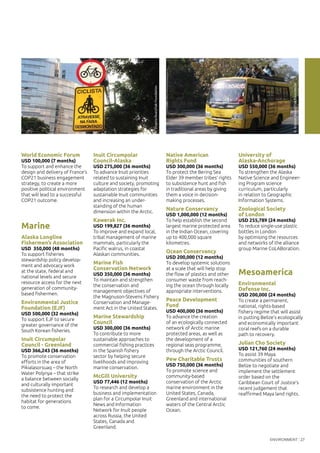
women who are empowered individually and collectively to
challenge patriarchal norms and tackle the root causes of
inequality.
We support organisations that work to end patterns
of violence and exploitation that disrupt women’s lives
by ensuring that rights-based laws and policies guarantee
an environment free from violence, and by transforming
harmful social norms. This is complemented by support
to a range of comprehensive services that empower
women to recover from the trauma of violence and rebuild
their lives. We particularly recognise the vital importance
of giving marginalised groups of women a chance
to exercise their influence and have their voices heard.
©JustAssociates
1
ISSUES AFFECTING WOMEN 49
Reflections
Ending violence against women in
situations of crisis is one of four
programme areas within the Issues
Affecting Women Programme (IAWP).
Under this programme, we provide
flexible and responsive support in crisis
zones where violence against women
is systemic and prevents rights-based
recovery. This includes in conflict, post-
conflict, refugee and immigration set-
tings, and following natural disasters.
We fund organisations that contribute
to building strong women’s rights move-
ments and sustainable peace. Although
this amounts to a small proportion of
overall grant-making, ending violence
against women in crisis situations remains
a critical issue that merits attention. It is
particularly urgent at this time, with
militarism on the rise as well as wide-
spread political, social and economic
insecurity.
We focus particularly on the links
between women, peace and security,
as affirmed by Security Council Resolution
1325. This resolution championed the
central role of women in all aspects
of conflict prevention and resolution
and in building sustainable peace.
This groundbreaking statement
celebrates its 15th birthday this year,
but much remains to be done to achieve
its implementation on the ground, and
women continue to be excluded from
peace processes. Violence against women
during conflict is still rife, and victims are
often denied justice while perpetrators
escape prosecution. Most importantly
there is a clear gap between rhetoric
and reality when it comes to political
commitment, in particular funding.
The resources committed to
implementing Resolution 1325 are
very low in comparison to the amount
invested in defence budgets every year.
Our partners, such as Solidarité
Féminine pour la Paix et le
Développement Intégral, Fonds pour
les Femmes Congolese, the Great Lakes
Women's Platform and the Women's
International League for Peace and
Freedom have been actively and persis-
tently pushing for the implementation of
Resolution 1325.
Funding and political support towards
this kind of work remains minimal. Local
women’s organisations on the frontlines
of building peace and justice within their
communities remain under-resourced.
Women continue to be excluded from
most peace processes, despite over-
whelming evidence that when women
are included, peace processes are far
more effective and sustainable.
28
grants were
made by the
Issues Affecting
Women
Programme
in 2015, totalling
USD 12.20 million.
Find out more at
www.oakfnd.org/women
3 3
1.	Just Associates builds women’s
collective power for justice in Malawi
and other countries.
2.	& 3. Nobel Peace Laureates, Leymah
Gbowee, Mairead Maguire and Jody
Williams, alongside WILPF Secretary
General Madeleine Rees, attended
WILPF’s 2015 Conference in the Hague
which brought together 1,000 women
peacemakers from all over the world.
2
©Women’sInternatioanlLeague
forPeaceandFreedom
©Women’sInternatioanlLeague
forPeaceandFreedom
ISSUES AFFECTING WOMEN50
In-depth country
profile: building
movements to
address violence
against women
in Moldova
One day before Orthodox Christmas
in January 2013 Olyessa came to Chisinau,
the capital of Moldova, from a village in
the north of the country, to escape the
extreme violence she and her children
faced in her family.
©SotisBaltiMunicipalityFamilyCrisisCenter
“My husband was a heavy
drinker. He was abusing
the children. Often he would
put us to sleep outside…
so he was treating us very
badly. We were all damaged
from my husband’s treatment
of us.”
- Olyessa, Moldova
She contacted the Women's Law Center
(WLC) for help. This not-for-profit
organisation was established in 2009
to provide pro bono legal support
to women victims of domestic violence
and to advocate for better national laws
on domestic violence. With the support
of the WLC, Olyessa received protection,
took her husband to court and eventually
divorced him.
“While the court case was going on, Ms.
Catalina, the lawyer from the WLC, used
to call me just to see how I was and to
see what I needed,” said Olyessa. “She
helped me tremendously. Last winter I
told her I had no food, no firewood, and
we were just about to have our electricity
cut off. So she got in touch with some
other centres in the area ... who then
came bringing me food like potatoes,
onions and flour. The WLC also paid for
my electricity and donated a stove so that
ISSUES AFFECTING WOMEN 51
Unsafe migration
and trafficking
Moldovans have been moving overseas
in recent years, looking for better living
and employment opportunities. Many of
them, women in particular, are vulnerable
to abuse and exploitation. They can easily
become victims of trafficking.
The not-for-profit organisation La Strada
set up services and a national helpline
(Women’s Trust Line) in 2001 to prevent
human trafficking and to help victims
reintegrate into society. It is
open for 12 hours every day, and each
year it receives hundreds of calls from
domestic violence victims. In 2008 a
La Strada study21
revealed that the
majority of trafficked victims from
Moldova are women who come from
the countryside and have generally
received a low level of education.
The study confirmed that the women’s
relationships with their families, both
husbands and parents, play an important
role in their vulnerability to trafficking.
Of the women and children who received
support from La Strada, some 80 per
cent had suffered domestic violence
prior to being trafficked.
Therefore, psychological and physical
violence in families is a strong “push”
factor influencing women’s high risk
decisions to leave the country in search
of a safer environment and a better life
elsewhere. Traumatic experiences and
desperate circumstances make these
women and children ill prepared to
recognise and face abusive situations and
they can become easy prey for traffickers.
In 2009 these conclusions pushed La
Strada and other practitioners in Moldova
to extend their trafficking prevention
efforts to tackle domestic violence as one
of the root causes of trafficking.
I could cook for my four children. I also
received psychological care and so did my
children, which was very important.”
In 2007 the registered daily income
of 80 per cent of the population of
Moldova was below one US dollar per
day.18
Although its economic situation
has improved in recent years, Moldova
remains one of the poorest countries
in eastern Europe, with a high level of
migration and great dependence on
remittances. The root of this poverty
stems from Moldova’s break with the
former Soviet Union, and today is
fuelled by high levels of unemployment,
inadequate public services, lack of
parental care and discrimination
against women.
“Many women face great challenges that
include legal challenges,” said Angelina
Zaporojan-Pirgari, Chairwoman of the
WLC. “They do not know where to go for
help – the WLC fills that need by ensuring
access to justice for women victims
of domestic violence. Women desperately
need protection, a safe place to go and
a professional to guide them through the
process, to tell them what their rights are
and what they can claim in the court and
how to protect themselves.”
With the support of the WLC, improved
domestic violence laws and social
services, women in Moldova are now
finding ways to escape terrible situations.
“I was never alone in the courts, the
lawyer was always there beside me,”
said Olyessa. “And now, it has brought
me peace. I’m finally happy. I want to
thank everyone who has helped me and
my children. It has meant so much.”
Olyessa is just one example of many
women who experience domestic
violence in Moldova. Recent global
figures estimate that 35 per cent of
women worldwide have experienced
either intimate partner violence or non-
partner sexual violence in their lifetime.19
In Moldova, this estimate is nearly double
– according to a 2011 study, some 60 per
cent of women have experienced violence
by a spouse or partner.20
of women have
experienced
intimate partner
violence.
60%
In Moldova, some
ISSUES AFFECTING WOMEN52
Addressing domestic
violence
Since 2011 Oak has provided nine
grants for a total of USD 2.2 million to
organisations and networks improving
services and legislation to help women
victims of domestic violence in Moldova.
Together, they have been working to:
advocate for the adoption, implemen-
tation and enforcement of domestic
violence legislation; meet the needs
of victims of violence through services
that are coordinated and comprehensive;
and promote the agency and self-
representation of survivors within
a rights-based framework.
Moldova adopted a domestic violence
law in 2007 called the Law on Preventing
and Combating Family Violence. The law
defined, for the first time, domestic
violence and called for protection orders
for women victims of domestic violence.
However, due to the lack of specific
directives on protection orders, the law
was rarely implemented in the years that
followed. “Initially no one was trying
to combat this problem and politicians
were even denying or rejecting that the
problem existed,” said Valentina Buliga,
Former Minister for Social, Labour and
Family Protection of the Republic
of Moldova.
The law was amended in 2010 to broaden
victims’ rights to protection and services.
In addition, a new provision in the criminal
code that criminalises domestic violence
was adopted.
In partnership with the Advocates
for Human Rights, the WLC has been
working to implement the Republic of
Moldova’s Domestic Violence Legislation.
In addition, the WLC has provided training
to the police, judges, prosecutors and
lawyers on effective response to cases
of domestic violence. According
to the WLC, so far more than 1,000
police officers throughout Moldova have
received training, as well as 250 judges,
prosecutors and lawyers. As a direct
result, the number of protection orders
issued has since increased. In 2011 there
were only 23 and by 2014 this figure
had grown to more than 900. This shows
clearly how Moldova is working hard,
both on the ground and at policy levels,
to tackle domestic violence.
“Now, Ministers of
Parliament, including
the Prime Minister of Moldova,
speak out openly about
domestic violence. Now we
place great emphasis on
strengthening the roles of all
the people involved in dealing
with this problem, from the
police to ministers, central
and local authorities.”
- Valentina Buliga,
Former Minister for Social,
Labour and Family Protection
of the Republic of Moldova
Since 2011, Oak
has provided
million to combat
domestic violence
in Moldova.
USD 2.2
©VirginiaRuan/OakFoundation
21
ISSUES AFFECTING WOMEN 53
– we tried everything to raise funds and
only managed to raise enough to pay for
our electricity, heat and water,” said Elena
Burca, director of Casa M.
Since receiving funds from Oak
Foundation, Casa M has improved its
structure by hiring a team of specialists,
nominating a new Board, recruiting
volunteers and forming new partnerships
with government and service providers.
The staff have been trained by experts
from Russia who helped the organisation
develop rights-based standards and
protocols for the services it provides,
as well as strengthen its organisational
structure. As a consequence, Casa M
has been able to act as a resource for
other non-governmental organisations
and state actors, by organising training
sessions and discussions. It has also
facilitated workshops with social
assistants, police and advocates from
the local communities who are taking
a stand against domestic violence.
In Moldova, the
Women’s Law
Center provided
training on how
to respond to
cases of domestic
violence to more
than
police officers
and
1,000
Casa Marioarei and
improving rights-based
services
According to a WAVE Survey,
conducted by the WLC in 2014, there
are 14 organisations in Moldova that
work with women survivors of violence
and their children. The total capacity for
the entire country is 181 beds, which
represents only half of the European
standard. This is due to many factors,
including a lack of specialised legal aid,
intervention services and government
funding. For example, two of the public
institutions have experienced periods of
non-operation for several months due
to a lack of state funding.
Casa Marioarei (Casa M) is the first
and only dedicated domestic violence
women’s shelter in Moldova. Established
in 2004, it has an accommodation capacity
of 25 people. The shelter offers free
temporary housing to women affected
by domestic violence and their children,
as well as social, medical and
psychological assistance. In addition,
Casa M gives free legal aid to victims
of domestic violence through counselling
and support in court.
Annually Casa M has the capacity
to provide services to about 2,000
women, but up until a few years ago,
operating at full capacity was impossible,
due to lack of funding. The shelter
struggled to stay open and cover its
basic operating costs. “In 2010 we were
considering closing the shelter. We had
worked for two years without finances
250
judges,
prosecutors
and lawyers.
©VirginiaRuan/OakFoundation
©CasaMarioarei
3 4
1.	Angelina Zaporojan-Pirgari, Chair-
woman of the Women’s Law Center at
an open forum with politicians to
address issues that women face in
Moldova in spring 2015.
2.	Valentina Buliga, Former Minister for
Social, Labour and Family Protection
of the Republic of Moldova.
3.	Staff at Casa Marioarei (Casa M),
the first domestic violence women’s
shelter in Moldova.
4.	Translates from Romanian to
“Life without violence”.
ISSUES AFFECTING WOMEN54
What’s next
Former Minister Valentina Buliga has
said that Moldova is currently in the
process of strengthening the legal
processes and frameworks surrounding
domestic violence. Key priorities for the
coming years include improving current
legislation by: introducing restraining
orders (including against stalking);
making it a criminal offence to violate
protection measures; signing and
ratifying the Istanbul Convention
(a Council of Europe convention against
domestic violence); increasing public
funds for the extension of services
and programmes for both victims and
perpetrators of domestic violence;
and setting up a special department
to coordinate the implementation
of public policy in preventing and
combating domestic violence.
In addition, Casa M developed
an internal data collection system to
track and monitor its work and is able
to demonstrate its achievements. “Our
great success is that 62 per cent of the
women and children who have come to
our shelter have left and are now living
a life without violence,” said Ms. Burca.
Building a strong
coalition
In addition to helping individual
organisations, Oak supported the
creation of the National Coalition
“Life Without Violence” in 2012. Led by
Angelina Zaporojan-Pirgari of the WLC,
the coalition is made up of 17 members
which work together to: advocate for
stronger legislation; create service
standards and improve services; build
individual organisations’ capacity; and
increase public awareness around
domestic violence.
“The Coalition has
enabled us to develop
a platform for dialogue
and learning. We received
capacity-building support from
organisations in Austria, Russia
and the United States among
others, showing us that we can
make a difference when
we work together and speak
with one voice.”
- Angelina Zaporojan-Pirgari
Women’s Law Center
“We have the political
will to continue reforms
on this and we will work on this
issue because we want to have
a society without violence.”
	 	 - Liliana Palihovici
Liberal Democratic Party
According to Liliana Palihovici of the
Liberal Democratic Party, the number
of domestic violence cases has, in recent
years, been increasing. This is because
more people are talking about the issue
and women are more actively seeking
help to get out of domestic violence
situations.
“There is so much that can be done and
with the dedication and perseverance
of the leaders in these organisations,
I have no doubt that change will continue
to happen,” said Florence Tercier,
director of Oak’s Issues Affecting Women
Programme. Oak will continue to support
domestic violence organisations to
improve the quality of services for victims
and their access to justice, and to address
the root causes of intra-familial violence
in Moldova. This will be done by: investing
in initiatives that create awareness
The Coalition has already been successful
in implementing changes in domestic
violence laws. It helps raise the profile
around the issue and advocates for state
funding for organisations providing
services to victims of domestic violence.
Since Moldova
began working
to strengthen
the legal
processes and
frameworks
surrounding
domestic
violence, more
women have been
actively seeking
help.
ISSUES AFFECTING WOMEN 55
among women and girls of their rights;
promoting a “positive masculinities”
approach; and offering services to violent
and abusive men who want to change
their behaviour.
In addition, in partnership with a
sociological institute, the WLC concluded
a survey in Moldova to assess men’s and
women’s attitudes and behaviour towards
gender equality. The findings of the
survey will help consolidate the efforts
of Moldovan networks and organisations
working on gender equality, domestic
violence, child protection and youth. Oak
is also supporting the development of
the first and only centre for domestic
violence aggressors situated in Drochia
to build its expertise and deliver a
dedicated counselling programme for
men who want to take responsibility for
their actions and change their abusive
behaviour. This service will be connected
to the criminal justice system and, over
time, should expand nationally.
We asked Jette Parker
why she chose to invest
in Moldova. This is her
response:
“I received a mail clipping from my
friend Linda Carter on the trafficking of
women in Moldova.22
“I felt inspired by that article to help
women in Moldova who have been
trafficked. When Florence Tercier and her
team looked deeper at the issue, I was
pleased to see that we are helping women
victims of domestic violence, one of the
root causes of trafficking.
“I feel incredibly lucky that I am able
to support women’s organisations around
the world. When I read an article or hear
about something such as trafficking,
I have the privilege to do something
to help and each year we are able to
give more. The Issues Affecting Women
Programme is very important to me.”
Building a strong coalition
to help end domestic violence
in Moldova
Advocate for
stronger legislation
Create service
standards and
improve services
Build individual
organisations’
capacity
Increase awareness
around domestic
violence
ISSUES AFFECTING WOMEN56
Interview with
Jette Parker
about the Issues
Affecting Women
Programme
When did you start
the Issues Affecting
Women Programme?
"I started the Issues Affecting Women’s
Programme at the very beginning when,
as a family, we started the original
programmes; however, I had been funding
issues related to women before I estab-
lished the programme itself. In Denmark,
for example, I supported a project called
Mother’s Help that focused on young,
single mothers. A social worker in
Denmark, who spearheaded the project,
found that many single mothers were
falling through the cracks and didn’t
know where to go for help. Mother’s
Help created a space where single
mothers could find a supportive network
and access to public services. I still
support Mother’s Help and the staff
continue to help many families
in Denmark."
Why did you start
the Issues Affecting
Women Programme?
"After our initial projects in Denmark
and on reading more about the issues
affecting women around the world,
I decided to form this programme to
address more difficult questions and
problems. It was the logical next step.
It is difficult for single mothers, but it
is even more difficult and important to
help women who have been trafficked,
exploited and abused. The more you
learn, the more you realise how much
help you can give people."
What do you like most
about this work?
"I feel incredibly lucky that I am able
to support women’s organisations around
the world. When I read an article or hear
about something such as trafficking,
I have the privilege to do something
to help and each year we are able to
give more. I would never be able to
do anything without the staff in our
programme and at the Foundation. I am
inspired by their passion and dedication
to improving the lives of people."
What do you think about
the current programme?
"Florence Tercier and her team are good
at finding projects around the world that
provide important and caring services
to victims of violence, while working
towards social change, and eradicating
violence and trafficking of women.
We also support a number of projects
through women’s funds that have made
a real difference to people as they are
able to reach small, local groups. We
started small with an idea to improve the
lives of women and now we have a well
established programme working on very
important issues. The Issues Affecting
Women’s Programme is very important
to me."
Is there a project that
stands out for you?
"It is not always the projects that stand
out for me – it is the people that I have
met. The most recent person I met was
Taiba Rahim. She is the President of Nai
Qala Association, which works to advance
education and health in remote and
neglected regions of Afghanistan. She is
truly inspirational. I also feel quite
happy that I have been able to support
the production of a few documentary
films, photo exhibitions and artistic
projects to call attention to the difficult
issues that these projects address."
What do you envision
for the future?
"It’s hard to imagine in five to ten years
where we will be, but when you have the
right people, passion and energy, we can
make a difference. I can see this in all
of our programmes and with all of our
staff – passion is what drives us and
we are doing a tremendous job."
Jette Parker, lead Trustee of the Issues
Affecting Women Programme
ISSUES AFFECTING WOMEN58
Grants
1
Aluna Acompañamiento
Psicosocial A.C.
USD 150,000 (36 months)
To provide core support
to Aluna, based in Mexico,
to assist civil society
organisations facing security
challenges and threats.
Animus Association
Foundation
USD 320,000 (36 months)
To continue efforts to combat
domestic violence in Bulgaria
by ensuring that the relevant
local structures can implement
the National Referral
Mechanism and Minimum
Standards for protecting
women from domestic
violence.
Association for Women’s
Rights in Development
(AWID)
USD 800,000 (36 months)
To provide AWID with core
support, enabling it to work
more effectively with diverse
partners, allies and its broader
constituency.
CARE Deutschland –
Luxemburg
USD 163,800 (24 months)
To improve living conditions
and social inclusion of
vulnerable women in
Montenegro – who are
vulnerable to trafficking
because of their poor
economic status – through
economic empowerment.
Catapult
USD 850,000 (36 months)
To provide core support
to Catapult to continue
building an innovative digital
funding platform to mobilise
resources from the corporate
sector and global citizens
for women's and girls’ rights
and to build a long-term
organisational sustainability
model.
Centro Feminista
de Estudos e Assessoria
USD 450,000 (36 months)
To mitigate violence against
women's rights activists in
Brazil by developing and
promoting improved self-
care and security strategies,
as a response to rising levels
of violence and intimidation
against women’s rights
activists.
Common Threads
USD 150,000 (36 months)
To assist healing for women
and girls who are victims
of sexual violence during
war, conflict, displacement
and its aftermath through
the Common Threads model,
an integrative and sustainable
recovery programme.
European Network
for the Work with
Perpetrators of Domestic
Violence (WWP)
USD 100,000 (13 months)
To support the WWP to
consolidate as a new formal
organisation, in order to
develop a shared European
standard of practice for
working with perpetrators
of domestic violence.
Focus on Labour
Exploitation (FLEX)
USD 100,000 (12 months)
To provide a planning grant
to FLEX, based in London, the
UK, to support its sustainable
growth as an organisation.
Fondo Centroamericano
de Mujeres
USD 600,000 (36 months)
To support the efforts
of women human rights
defenders in the Meso-
american region, ensuring
that they have a vehicle to
address and reduce the
violence they suffer.
Fonds pour les
Femmes Congolaises
USD 150,000 (36 months)
To end impunity for crimes
committed during the 18-year
conflict in the Democratic
Republic of the Congo,
including crimes of sexual
violence, by advocating for
the establishment of a
transitional justice system.
Foro Internacional
de Mujeres Indigenas
(FIMI)
USD 250,000 (36 months)
To provide support to FIMI’s
Indigenous Women’s Fund,
the first fund led for and
by indigenous women
around the world.
Girl Be Heard (GBH)
USD 204,683 (36 months)
To expand and amplify GBH’s
burgeoning youth-led feminist
movement by creating
theatrical performances
inspired by real stories
of young women and girls
around the world.
Global Fund for Women
USD 250,000 (29 months)
To support the coordination
of the Win Win Coalition
(which includes women’s
funds, research organisations
and communications
specialists) and its efforts
to reach and influence
corporate actors.
Graduate
Institute Geneva
USD 54,769 (12 months)
To establish a merit-based paid
traineeship within Oak’s Issues
Affecting Women Programme.
Hispanics in Philanthropy
USD 98,700 (12 months)
To support the Issues
Affecting Women Programme
to refine its Mexico strategy,
assist local grantees to ensure
their compliance and support
capacity-building needs and
processes.
International Center
for Research on Women
USD 365,000 (18 months)
To work with private sector
companies to raise awareness,
improve knowledge and
enable them to take action
towards improving the
quantity and quality of their
efforts to empower women
and advance their economic
status.
International Federation
for Human Rights
USD 378,000 (36 months)
To strengthen the contribution
of the International Criminal
Court in achieving justice for
victims of sexual violence and
ending impunity for its
perpetrators.
©NationalDomesticWorkersAlliance
ISSUES AFFECTING WOMEN 59
This is a list of our grants approved in
2015. For a comprehensive list and full
descriptions, please visit our grant
database at www.oakfnd.org/grants
International Women’s
Health Coalition
USD 450,000 (36 months)
To advance the sexual and
reproductive health and rights
of women and young people,
particularly adolescent girls,
in the Global South.
Just Associates (JASS)
USD 450,000 (36 months)
To provide core support
to JASS, an international
community of activists,
scholars and popular
educators grounded in local
and national action in more
than 27 countries, working
to strengthen and leverage
the voice, visibility and
collective organising power
of women to create
a just world.
Las Hormigas
USD 150,000 (36 months)
To support Las Hormigas
to provide psycho-educational
and emotional support
to vulnerable women, their
children and their families
in Ciudad Juarez, Mexico.
Mama Cash
USD 300,000 (36 months)
To support Red Umbrella
Fund’s grant-making
to build the capacity of self-
led sex worker organisations
to contribute to laws, policies
and practices that end the
criminalisation, exploitation
and trafficking of sex workers.
Peacebuilding UK
USD 750,000 (36 months)
To empower vulnerable girls
and young women in Chechnya
through an extra-curricular
course on life skills.
Semillas
USD 450,000 (36 months)
To provide core support
to Semillas so that it continues
to contribute to just and
equitable social change
from a gender perspective
in Mexico.
TRAG Foundation
USD 3,401,037 (36 months)
To strengthen women’s
movements and women’s civil
society organisations in Bosnia
and Herzegovina, Serbia and
Montenegro through financial
and institutional support and
capacity building of IAWP
grantees by Trag Foundation.
WAVE Network
USD 300,006 (24 months)
To provide advice, research
and capacity building support
to women’s organisations that
provide services to women
and children survivors
of domestic violence
in Eastern Europe.
WinVisible
USD 214,005 (36 months)
To provide core support
to WinVisible to uphold the
rights of disabled women
in the UK to live independently
and free from discrimination.
Women’s Law Center
USD 300,000 (36 months)
To improve the overall
response to domestic violence
in Moldova by strengthening
a network of civil society
organisations to enable
improved coordination,
increased capacities and
collective advocacy.
1.	The Latin American Women’s Rights
Service (LAWRS), based in the UK,
raises awareness of the services
it offers in London. LAWRS offers
practical and legal advice, advocacy,
information and counselling services
to Latin American women.
2.	Creating Resources for Empowerment
in Action (CREA) is a feminist
organisation based in New Delhi,
India.
2
©CreatingResourcesfor
EmpowermentinAction
LEARNING DIFFERENCES60
Learning Differences
In the Learning Differences Programme, we envision
a world where students with learning differences are
agents of their own learning success and are supported
by educators and environments that expect, embrace
and respond to diverse learner profiles.
We support teacher development, student engagement
and parental understanding to enable students to
follow their own individual paths to lifelong learning
success. We seek partners who design and create
learning environments that are informed by student
voices, neuroscience, personalised learning best
practices and universal design concepts.
©WilliePetersen/TeachforAmerica
LEARNING DIFFERENCES 61
16
grants were made
by the Learning
Differences
Programme in
2015, totalling
USD 9.90 million.
Find out more at
www.oakfnd.org/learning
Reflections
P 60 and 61: The photos on these pages
of the report were provided by Teach for
America (TFA), which recruits, develops
and mobilises leaders for educational
equality. Oak supports TFA to equip more
than 50,000 leaders to teach and advocate
for students with learning differences.
In 2015 the Learning Differences
Programme fine-tuned its strategy to
better serve students with a wide range
of learning profiles to achieve success
in public schools and during the transi-
tion to, and through, college and other
post-secondary opportunities. The revised
strategy is based on a set of core beliefs:
1.	Each learner possesses a diverse
set of cognitive, social and emotional
assets, knowledge, skills, interests
and preferences. These characteristics
interact to form a unique learner
profile that changes over time.
2.	Students, particularly those with
learning differences, can achieve
greater academic success when they
understand how they learn and use
that knowledge to plan for, and adapt
to, learning environments.
3.	Educators should be prepared for, and
have the tools, to respond to diverse
learner profiles in order to better serve
students with learning differences in
general education environments.
4.	Parents should have the knowledge
to understand their child’s unique
learner profile and the tools to
advocate for him/her.
5.	Education systems should define
student success, using accountability
frameworks with multiple indicators
of academic performance as well
as measures of social and emotional
wellbeing, persistence and
engagement.
We envision a world where students
with learning differences are agents
of their own learning success and are
supported by educators and environ-
ments that expect, embrace and
respond to diverse learner profiles.
We support partners who:
1.	strengthen teacher capacity;
2.	engage students;
3.	enhance parents’ knowledge
and support;
4.	personalise learning environments;
5.	build demand; and
6.	explore learner profiles.
Through these strategies, we will
continue our efforts to improve the
lives of those with learning differences
globally.
©SallyRyan/TeachforAmerica
©Jean-ChristianBourcart/TeachforAmerica
LEARNING DIFFERENCES62
After Becca arrived at ECU, she met other
college students who learned like her and
realised they shared similar, sometimes
humiliating, experiences as younger
students. So, when an opportunity arose
for her to mentor younger students, she
took it. She joined Eye to Eye, a near-peer
mentoring programme that connects
middle school students who have learning
differences with college students who
also do. Through an arts-based curriculum
and based on their own personal
experiences, the college students help
the middle school children begin to under-
stand themselves as learners and develop
the confidence and language to talk to
others about how they learn.
The experience was as transformational
for Becca as it was for the children she
mentored. “Being around kids who had
the same learning differences as me really
Engaging
the voices of
young people
with learning
differences
“For the majority of my life, I hid my
learning disability,” said Becca O’Hea,
a college senior at East Carolina University
(ECU). In middle and high school, Becca’s
parents advocated for her so that she
received special education services and
other assistance at school. Despite this
support, Becca did not often share her
learning differences with others.
“Sometimes when I told
people about my learning
differences, they would look
closely at me, as if trying to
see my dyslexia in my face.
Or, even more hurtfully, they
would say, ‘but I thought you
were smart.’”
– Becca O’Hea, college senior,
East Carolina University
©TeachForPakistan©ElliotHaney/CityYear
LEARNING DIFFERENCES 63
gave me the confidence to speak up for
myself, too. I couldn’t give them advice
and not take that advice myself,” she said.
The Learning Differences Programme
supports Eye to Eye because it engages
young people to share their voices with
others – including younger peers, families,
educators, policy-makers and the broader
culture. Oak Foundation values highly
the inclusion of stakeholders in the work
it supports. In the Learning Differences
Programme, these stakeholders include
not only teachers and parents, but more
importantly, young people themselves
who are experts on living with a learning
difference.
Engaging young voices to provide feed-
back or in the design of a programme
can expand people’s understanding of
learning differences and wipe out the
stigma associated with them. Eye to Eye
mentor Stephanie Whitham said “school
hurt.” She often felt that asking for the
support she needed for her learning
difference was a burden to teachers. One
even said that she needed to earn it, as if
she were a lazy student seeking an easy
way out. These false perceptions led some
of her teachers to say that she would
never graduate from college. Thankfully,
she had enough support from her family
to encourage her to go to college and
there she found Eye to Eye. “Through
Eye to Eye, I learned to recognise the
strengths I have as a learner,” she said.
This experience and the support from her
Eye to Eye peers helped her to continue
through college: she graduated from the
University of San Francisco this year.
Eye to Eye sees its main goal as devel-
oping a cadre of young leaders who,
by speaking out about their learning
differences, will change classroom
practices, policies and cultural percep-
tions. With Becca and Stephanie, Eye
to Eye has achieved this goal. Both have
gone on to share their experiences in
meaningful ways – Becca through the
STEPP programme at ECU and Stephanie
through Roadtrip Nation. Oak supported
both these organisations in 2015 –
read on to find out more!
In fact, Becca and her friends got so used
to sharing their experiences that they
arranged to speak with future teachers
in the ECU school of education. Through
their stories of being misunderstood or
demeaned, as well as the transformative
experience of having teachers who under-
stood them, they hoped these educators
would not develop negative mindsets
about those who learn differently.
Speaking up gave Becca hope. “A lot of
students with learning disabilities have
had teachers who were not always open
to hearing about learning differences:
they often seemed defensive.
“In STEPP, I met people
with learning disabilities
who had strong voices. Their
friendship and confidence gave
me the confidence to speak up,
too.”
– Becca O’Hea  
20%
of students
with learning
differences leave
school before
graduating in the
United States.
But this number
has dropped from
in the last
10 years.
36%
East Carolina University
The STEPP programme at ECU provides
young adults who have identified
learning disabilities with the support they
need to access college. This helps them
transition into and progress through
college to graduation.
To ensure the programme serves its
participants well, STEPP engages students
to improve its programme and to share
their stories across campus and beyond.
Every STEPP participant provides feed-
back through surveys and interviews
each year. Other opportunities to
contribute students’ voices include
serving on committees and panels as
well as planning events and blogging
about experiences on the university’s
website. When asked which of these
opportunities were most meaningful,
the students found value in active
engagement (e.g., planning an event),
where they could see the real impact
of their work on others. One student
valued these opportunities to speak
up and said “Any time I let my story
be heard it may help inspire or guide
someone who is stuck.”
LEARNING DIFFERENCES64
Lashon Amado, a Programme Associate,
and a YouthBuild Inc. graduate, has led
several youth leadership programmes
at YouthBuild Inc. He agrees that youth
should be authentically included in
shaping programmes that serve them and
advises organisations that are trying to
engage youth voices to avoid just having
them share their stories. “Adult allies
need to help develop young leaders, so
that they are even more prepared to
engage fully in the process and to help
them see that they are bringing more
than just their story to the table,” he says.
For instance, YouthBuild Inc. engages
young adults’ voices in a variety of ways
to shape the organisation’s programming
and influence the broader youth
development field. With Oak support,
YouthBuild Inc. is refining its post-
secondary and career guidance platform,
called MyBestBets, to ensure that it
works well for all learners. To this end,
YouthBuild Inc., with its partner Jobs
For the Future, is developing an advisory
committee of young people with learning
differences to provide user feedback and
other input on the design and function of
this important resource.
More than
©EyetoEye
©ElliotHaney/CityYear
25%
So when I saw how open these future
teachers were to hearing our stories,
it was really inspiring. Hopefully they will
remember what we shared when they
have a student like me in their classroom,”
she said.
Becca’s experience at STEPP has allowed
her to grow more knowledgeable about
the way she learns and to become more
confident in sharing her story. “My
learning disability has even shaped my
career plans,” she said, “I am going into
school psychology, so I can help others
who learn like me.”
YouthBuild Inc.
YouthBuild Inc. is an international
organisation that provides opportunities
for young adults who are not connected
to school or work to complete their
education, gain the skills they need for
employment and become leaders in their
communities. A core piece of this process
is helping these young people reclaim
their voices.
“Many young leaders have said that
they sometimes experience inauthentic
efforts from organisations, schools,
and adults who ask them to share their
stories. Young leaders quickly and deeply
recognize when their voices and opinions
are truly heard,” said Scott Emerick,
Senior Vice President of Education, Career
and Service Pathways at YouthBuild Inc.
of students who
have learning
differences
struggle with
their transition
into adulthood
after secondary
school, compared
to only
12%
of their peers.
“We have learned that we
need to help these young
adults realise that they are
the ones who have changed
their lives for the better –
not YouthBuild or any other
programme – and that this
gives them the expertise to be
an asset to their community or
on a committee.”
– Scott Emerick,
YouthBuild
LEARNING DIFFERENCES 65
National Center for
Learning Disabilities
Unfortunately, not all schools or
organisations seek input from students
who learn differently in the way that Eye
to Eye, Project STEPP and YouthBuild do.
Students with learning differences are
often not asked directly for their insights
or opinions and many programmes and
resources are designed for them and not
by or with them. This limits how effective
these programmes can be in helping
students with learning differences.
To begin to fill this gap, Oak supported
the National Center for Learning
Disabilities (NCLD) in 2013 to survey
1,200 young adults. More than two-
thirds of respondents had identified or
unidentified learning differences. This
survey revealed insights into the impact
of living with a learning difference not
only on academic performance, but also
in terms of social emotional development,
self-confidence and connections to peers
and community. For example, while
some young adults who learn differently
are thriving, many are struggling to
continue their education, find a job or
become more independent. The survey
revealed that these struggling young
adults did not usually have the three key
experiences earlier in life that are drivers
of a successful transition into adulthood.
These drivers include having supportive
parents who understand their learning
differences, developing real connections
to their peers and community, and finding
ways to build self-confidence – through
sports, mentoring or leadership, for
example.
This year, NCLD made the data publically
available to inform programme design
and resource development across the
globe. NCLD is using this invaluable
survey data to shape its own strategic
planning process and programmes for
young adults. This helps ensure that the
young people who shared their voices
through the survey make an impact.
Roadtrip Nation
Stephanie, the Eye to Eye mentor from
San Francisco, was facing a big, blank
space ahead of her as college graduation
approached. She had many years of
experience figuring out how to be a
student, but now needed to learn how to
be successful in a career. “It was a scary
time,” she said. The same week of her
graduation, she was given the opportunity
of a lifetime when she was chosen as
one of three young adults to be on the
Being Understood Roadtrip through the
organisation Roadtrip Nation. Stephanie
and two other young adults who have
learning differences – Noah and Nicole
– drove across the US to interview two
dozen people with learning differences
who have aligned their careers with their
passions. Before the trip, Stephanie was
worried that she might not be able to
find a job she loved because she learned
differently.
"Interviewing these people who found
great careers helped me realise that it
wasn't about me fitting into a career,
but about finding a career that fits me,"
she said.
Programmes to
help students
with learning
differences are
more effective
when students’
opinions and
insights are
taken into
account.
©RoadTripNation
©RoadTripNation
LEARNING DIFFERENCES66
Although Stephanie began the trip
feeling like she could see the positive
aspects of her learning differences, she
still never felt fully comfortable with
having a learning difference. “Twenty-
two years was a long time not to feel
okay about something that is an integral
part of me,” she said. But the Being
Understood Roadtrip allowed her to see
the country, learn about herself and meet
some inspiring people which “was one of
those moments in life when you get the
chance to feel like everything is going
to be OK,” she said. “As a post-college
graduation adult, that is a huge, huge
blessing.”
“I knew from working
with Eye to Eye that
there were incredible people
who learned like me. But I
had no idea how many were
so incredible because of their
learning differences! I want
more people to know about
that!”
- Stephanie,
Eye to Eye mentor
Stephanie’s experience shows the
transformative impact of community.
Meeting others who had learning
differences and who could share their
advice helped her feel like she could
move forward in life with confidence.
Roadtrip Nation will share Stephanie,
Noah and Nicole’s experiences by
creating a documentary of the trip that
will air on public television. In addition,
the interviews will be included in an
online archive for people seeking advice
on how to turn their interests into
careers. Stephanie is thrilled these
will be broadly shared.
As these Oak-supported projects show,
empowering youth and young adults
to share their voices can improve
programme design, strengthen education
systems, change cultural perceptions
of those who learn differently and
ultimately, help young people change
how they see themselves and interact
with the world.
©SallyRyan/TeachForAmerica
LEARNING DIFFERENCES 67
Grants
This is a list of our grants approved in
2015. For a comprehensive list and full
descriptions, please visit our grant
database at www.oakfnd.org/grants
Branching Minds
USD 425,000 (24 months)
To provide core support
to Branching Minds, a start-up
company in New York City,
in developing a web-based
tool designed to help teachers,
parents and students under-
stand, respect and support
individual learners.
Center for
Curriculum Redesign
USD 75,000 (12 months)
To explore the feasibility of
establishing and supporting an
international consortium for
the research and development
of new assessments in skills,
character and meta-cognitive
competencies.
City Year
USD 792,720 (36 months)
To establish a “School Design
Division”, through which City
Year will develop, test, refine
and disseminate new practices
for use in schools supported
by AmeriCorps members.
College Advising
Corps (CAC)
USD 675,000 (36 months)
To support CAC in guiding
young people with learning
differences in applying and
enrolling in college.
Culwell Consulting
Group LLC
USD 50,000 (5 months)
To support Philanthropy
Futures to accelerate the
Learner GPS initiative so that
students with a wide range
of learning profiles achieve
success within public
primary schools.
Digital Promise Global
USD 1,500,065 (18 months)
To develop guidelines and
support cross-sector networks
to understand and plan for all
learners.
East Carolina University
USD 660,109 (60 months)
To support students with
learning disabilities to enroll
in and graduate from East
Carolina University.
Eye to Eye National Inc.
USD 1,000,000 (48 months)
To provide core support to Eye
to Eye, a US-based mentoring
organisation that pairs young
adults who have learning
disabilities and/or attention
deficit disorders with middle
school students who also have
these learning differences.
National Center for
Learning Disabilities
(NCLD)
USD 500,000 (12 months)
To support NCLD’s operation
of Understood.org, a
comprehensive online re-
source in the United States
for parents of young people
with learning differences.
New Schools for
New Orleans
USD 620,000 (36 months)
To support New Schools for
New Orleans’ investments
in the design and launch of a
Special Education Coordinator
Fellowship and exploration
of using learner profiles in
personalised learning.
Roadtrip Nation
USD 300,000 (24 months)
To send a group of students
with learning and attention
issues on a roadtrip to
interview leaders from all
backgrounds who have
defined their own roads
in life, despite having had
a learning or attention
issue.
Teach For All
USD 1,500,000 (36 months)
To provide core support for
Teach For All to increase and
accelerate the impact of
network organisations
around the world in expanding
educational opportunity for
disadvantaged students.
Teach for America
(TFA)
USD 225,000 (12 months)
To support the planning
process for TFA's diverse
learners initiative, in order
to strengthen its efforts to
develop corps members into
educators and advocates for
those who learn differently.
©JeffLevick/TeachforAll
©ElonUniversity/ItTakesaVillageProject
Teach for America
(TFA)
USD 450,000 (36 months)
To provide core support
funding to TFA’s Eastern
North Carolina region.
Universal Design for
Learning Implementation
and Research Network
(UDL-IRN)
USD 100,000 (12 months)
To support the UDL-IRN,
based in Kansas, the United
States, to build a sustainable
organisation with a global
network to disseminate
models of best practices
on the implementation of
Universal Design for Learning
principles in schools.
YouthBuild Inc.
USD 1,025,000 (36 months)
To support YouthBuild on two
related strategies to improve
the educational and career
outcomes for individuals with
learning differences.
The photographs in the LDP section of
this report have been provided by LDP
grantees and illustrate diverse teaching
practices and learning environments
around the world.
SPECIAL INTEREST68
Special Interest
The Special Interest Programme reflects the
Trustees’ interest in making dynamic, diverse,
large, innovative and challenging grants. We are
committed to remaining flexible and to seizing
opportunities as they arise.
Special Interest grants cover a wide range of fields,
including health, humanitarian relief, education
and the arts. They are made to organisations whose
activities the Trustees wish to support, irrespective
of country or region.
1
©TaibaRahim/NaiQalaAssociation
SPECIAL INTEREST 69
Stories
The stories within this section represent
the diverse range of grants within the
Special Interest Programme.
Establishing
sustainable schools
in Afghanistan
Located in central Asia with Iran
to the west and Pakistan to the east,
Afghanistan is about the size of Texas.
High mountains with treacherous peaks
and dry deserts make up most of its
landscape. Extreme weather means
that the winters are very cold and the
summers extremely hot.
Outside of the capital Kabul, it can take
several days to get to some villages.
In remote areas, basic infrastructure such
as roads, schools and hospitals simply
does not exist. It is against this backdrop
that the children of Afghanistan try to
get an education as best as they can.
Hundreds of schools are officially
registered by the state in Afghanistan
but have no proper building to house
them. Children study under the shelter
of torn tents in the ruins of what once
was a school, or even in the open,
unprotected from the harsh sun, the
rain and the wind. “In spite of these bad
conditions, the children and their parents
are strongly committed to education,”
said Taiba Rahim, President of Nai Qala
Association, which works to advance
education and health in remote regions
of Afghanistan. Nai Qala believes that
improving access to education and health
is crucial to the Afghan people’s future.
“As the regions we work in are very
difficult to reach, it takes courage by all
involved to believe that a school or clinic
can actually be built in these regions,” said
Taiba. “Transporting building materials is
hugely challenging and the construction
team and staff live for months under
Find out more at
www.oakfnd.org/specialInterest
55
grants were
made by the
Special Interest
Programme in
2015, totalling
USD 66.89 million.
2 3
“I quit school two
years ago because the
classroom had no roof. The
condition of the school on
the dusty ground under very
hot sun, and also in the rain,
became unbearable. So instead
I helped my family by looking
after the sheep and going
to the mountain to collect
firewood for cooking. It was
very tough.”
- Shirinne, aged 15
©TaibaRahim/NaiQalaAssociation
1.	& 2. Children in remote parts
of Afghanistan often attend school
in makeshift tents or in the open air.
3 . Oak Foundation supported Nai Qala
	 to build a school (such as the one
	 featured in this photo), in Zeera Gag 	
	 village in the district of Panjab, 		
	 Bamyan, Afghanistan in 2015.
SPECIAL INTEREST70
An additional
100 girls and
boys registered
for school in the
village of Zeera
Gag in
Afghanistan
when the
construction
of the school
began.
“The implementation of the project is
progressing according to plan,” said
Taiba. “Already its impact is being felt:
the number of children registered for
school next year has gone up, with 100
additional girls and boys registered.”
Fifteen-year old Shirinne, mentioned
earlier in this article, is one of the
students who dropped out of school
two years ago due to poor conditions.
“This year I heard that a lady came to our
village and talked about the possibility
of building a proper school for children,”
she said. “My father told me this news
and went with me to the school to
register me. This makes me both happy
and hopeful. My father says I must study
to become someone who can help our
people.”
Oak is delighted with this news and
proud to be able to support the Nai
Qala Association.
1.	Hundreds of schools are officially
registered by the state in Afghanistan
but have no proper building to house
them. Many children, such as those
shown in this photo, attend school in
makeshift tents or in the open air.
2.	& 3. Learning Outside, based in North
Carolina, the United States, offers
children of all ages the chance to
experience and learn about the out-
doors, enhancing their lives and giving
them a love for the natural world.
difficult conditions.” Nai Qala works
with the communities to help them take
ownership of the building projects. The
men in the villages work to clear roads so
that the trucks, motorbikes or horses and
donkeys transporting the materials can
access the villages.
In addition, both the men and women
earn salaries to help in the construction of
the school – the men for the building work
and the women for preparing lunches and
dinners for everyone involved.
“This money helps lift the villagers out
of poverty,” said Taiba. “With their joint
salaries the families buy additional
livestock which they can breed to sell.
This helps them to work towards a
sustainable, brighter economical future.”
“It is two months that I am working on
the project to build the school,” said
villager Hussain Ali. “In such a remote
and isolated region it’s very challenging
to have a decent income, but now I am
earning money every day. I have managed
to buy clothes for my children, and a
year’s worth of food and grass for my
sheep. I have never had such an income.”
Nai Qala was founded in 2007 and has
successfully helped build six schools and
one clinic in the Ghazni and Bamiyan
provinces in central Afghanistan
so far. Oak Foundation supported Nai
Qala to construct several schools and one
clinic, including a school called Zeera Gag
in the district of Panjab, Bamyan in 2015.
This new school has eight classrooms and
will house more than 520 students and
14 teachers. Fully-equipped, it runs off its
own electricity supply and has a library of
books and study equipment to prepare
students for university.
©TaibaRahim/NaiQalaAssociation
1
SPECIAL INTEREST 71
“The children learn to
respect and trust each
other. Through nature, children
learn how to collaborate,
pursue things that interest
them and even teach other
children what they learn.”
- Wendy Banning, Director,
Learning Outside
Research confirms that children need
to spend time outdoors exposed to fresh
air, sunlight and natural elements such
as trees and grass if they are to be healthy
as they grow and develop. In addition,
if children have regular opportunities
for free and unstructured play outdoors,
they are smarter, happier, healthier and
get along better with others. However,
playing outdoors in a healthy environment
might not be possible for children who
live in built-up areas – heavy traffic,
pollution or a lack of green places to play
in, among other things, can prevent this.
That is why Learning Outside focuses
on children who do not have ready access
to opportunities to learn and explore the
outdoors.
Oak has been supporting the Learning
Outside programme since 2011. The
aim of the current grant is to develop
the organisation’s outdoor learning
programmes and help ensure its
financial stability.
Children who
play outdoors
regularly are
smarter, happier,
healthier and get
along better with
others.
Helping children form
connections with the
natural world
When children have a chance to discover
nature hands-on, their natural curiosity
helps ignite their innate desire to learn.
This is the belief of Learning Outside,
a farm situated at Triangle Land
Conservancy’s Irvin Nature Preserve in
North Carolina. It encompasses 269 acres
of pasture, forest and wetlands and offers
nature courses to children of all ages. It
believes that people learn and experience
the world around them differently in
natural settings, which is why discovering
nature first-hand leads to happier, more
successful learning experiences for
children both at home and at school.
Learning Outside offers children the
chance to experience and learn about
the outdoors, enhancing their lives and
giving them a love for the natural world.
Courses take place throughout the day
for different age groups, and there are
also camps during the school holidays.
Learning Outside’s approach integrates
the arts, sciences and humanities with
outdoor learning. Experienced and
knowledgeable naturalists, educators
and artists lead the programmes which
are held entirely outdoors, regardless
of the weather.
As well as cultivating a sense of steward-
ship for the environment among its
students, Learning Outside’s programmes
also emphasise community-building and
good interpersonal relationships.
3
©VirginiaRuan/OakFoundation
2
SPECIAL INTEREST72
Supporting vulnerable
child migrants
Unaccompanied migrant children have
been arriving in the US in increasing
numbers over the past ten years. Recently
these figures have grown to such a degree
that the US President has deemed the
situation a ‘humanitarian emergency’.
In 2012 the number of unaccompanied
children migrating across the border from
South and Central America was about
24,000. By 2014 that number had almost
tripled to more than 68,000.23
Just what is fuelling this mass exodus?
A new US Department of Homeland
Security report has attributed the
problem to poverty and regional violence
in South and Central American countries,
particularly Guatemala, Honduras and
El Salvador, where rates of homicide are
extraordinarily high. The report shows
that many of the unaccompanied minors
come from some of the most dangerous
cities in Central America and often they
are fleeing violence.24
These children have undertaken
dangerous journeys of thousands of miles
to travel to the US without their parents
or guardians in the hope of a better life.
Some have one parent they wish to join
already in the country. Approximately
73 per cent are male and 27 per cent
are female. Some 24 per cent of these
children are below the age of 14.25
The United States Committee for
Refugees and Immigrants (USCRI) works
to protect the rights and address the
needs of persons in forced or voluntary
migration worldwide. It helps newly-
arrived refugee families in practical ways,
for example in finding and furnishing
their first apartments, mastering the
public transportation system, enrolling
their children in school, finding a
doctor, learning English and obtaining
employment. It provides legal aid and
it also assists refugees during the
challenging process of overcoming past
trauma and grief by helping them develop
new support systems in America.
“Since 2011 we have
seen a great need for
an increase in mental health
and legal services. There
has been a decrease in state
funding that assists uninsured
or underinsured people
in this state.”
		 - Amy Schafer,
          	    Programme Officer, USCRI
However, there are barriers, both
linguistic and financial, to child migrants
accessing the legal and mental health
services they need. In addition they often
do not know how to navigate the system.
“The level of care that most of our clients
needs is high,” said Amy. “Often they’ve
suffered trauma, abuse – some have been
in psychiatric inpatient centres. We also
have many sexual assault victims, females
especially.”
Oak’s grant to USCRI will help it to supply
these much-needed services. “This grant
will help offer bilingual mental health
and legal services and I think it’s going to
benefit a lot of children who are not being
served, who have experienced a lot of
difficulties in their lives,” said Lena White,
a case manager and home study worker
with USCRI. “Without putting a financial
burden on their families, these children
will be able to get the visas and the legal
status that they qualify for.”
It is hoped that this will help increase
the children’s sense of security, giving
them hope for a brighter future. Over the
next two years, USCRI will hire clinicians,
programme managers, lawyers and legal
assistants. All will be bilingual (English
and Spanish speaking) and able to supply
the children with the services they need.
Many unaccompanied child migrants
have suffered great trauma in their home
countries and on their journeys to the
US. Having witnessed violent acts being
carried out against their family
and friends, or having experienced
them first-hand, many need specialised
mental healthcare services to address
post-traumatic stress disorder and
other mental health concerns.
In 2014 some
unaccompanied
children migrated
across the border
from South and
Central America to
the United States.
68,000
SPECIAL INTEREST 73
Believing in the profound strength of
every individual, GSS works with each
young person to help him or her identify
and build on their inherent abilities.
“Every day is a blessing
here. Even with the most
troublesome kid, it’s still
a blessing to know that that kid
just wants to be around me and
there’s something I can give
to that child... it’s a very
rewarding feeling.”
- Woody Bien-Aimé
Director at Red Hook Community
Center Beacon in Brooklyn
centres and schools for teenagers who
have fallen behind in regular high schools.
By providing at-risk youth with the
support they need, they can build strong
connections to their families and other
caring adults, to their schools and to their
communities. These connections create
a powerful sense of belonging. From this
foundation, young people are able to
tap into their rich potential, overcome
challenges and realise their dreams for
a better future.
2
Creating a sense of
belonging in New York
Many children who grow up in parts of
New York City can face tough odds in their
journeys to adulthood and independence.
They most likely attend overcrowded
public schools where far more students
fail than pass. Some lack strong family
support and may have experienced abuse
and emotional or physical neglect. They
live in high-stress neighbourhoods, where
poverty, substance abuse, violence and
criminal behaviour are commonplace.
This can be hard on youth, which is
reflected in the figures: according to
Good Shepherd Services (GSS), one in six
young people between 16 and 24 in New
York City are neither in school nor at work.
GSS works directly with communities in
New York City. It operates more than 80
programmes which help nearly 30,000
children, youth and families each year.
“GSS gives young people who often don’t
have opportunities the chance to shine
and build lives for themselves,” said
Jennifer Zanger, the Brooklyn Division
Director of community-based programmes
in Red Hook and Gowanus. “That includes
them finding satisfying careers, and a
sense that they can really impact things
in the world.”
Starting out as the Sisters of the Good
Shepherd in 1857, GSS has a long history.
In its early years it focused on caring for
troubled young women and in the early
1970s it broadened its work to provide
services to vulnerable families. These
include afterschool services, group homes
for young people who can no longer live
with their families, family counselling
In New York City,
young people
between 16 and
24 are neither
in school nor
at work.
1 in 6
©RachelMcKee/OakFoundation
1
1.	STEM Instructor Royal Isaac at Red
Hook school in Brooklyn teaches
a GSS after-school class.
2.	GSS students celebrate graduation
at South Brooklyn Community High
School, New York City.
©RachelMcKee/OakFoundation
SPECIAL INTEREST74
Using technology
to stop poaching
It is estimated that tens of thousands
of elephants are killed every year for
their ivory. Once transported to countries
in Asia, the tusks are usually shaped
into ornaments and trinkets. There is
also a huge demand for rhinoceros horn
and tiger skins and parts, often used in
traditional medicine.
Demand for these animals is so great
that illegal poaching now threatens
the survival of some species. Poaching
is recognised as among the five
most lucrative transnational criminal
activities,26
with major poaching rings
operating in many important and well-
known national parks. This illegal killing
and trade of some of the world’s most
iconic species has become one of the
greatest threats to global conservation.
The Royal Foundation of The Duke and
Duchess of Cambridge and Prince Harry
(The Royal Foundation), based in London,
is working to combat the illegal poaching
and trading of endangered species
around the world. Advances in technology
represent an opportunity to combat
poaching and illegal wildlife trade and
ultimately, to increase the populations of
a number of endangered species. A spatial
monitoring and research tool (SMART
Connect) is designed to help rangers with
surveillance and monitoring activities
to strengthen site-based protection.
It is being implemented in national parks
globally. In partnership with Oak, The
Royal Foundation will implement and
upgrade technologies such as SMART
Illegal poaching
is recognised
as one of the five
most lucrative
transnational
criminal
activities, with
major poaching
rings operating in
many well-known
national parks.
The staff are passionate about
their work. They also all grew up in the
communities themselves, so can identify
with the children and youth. “If they
don’t have us, sometimes they don’t have
anyone,” said one GSS teacher. “So there’s
not really an option anymore. We have
to be there for them.”
GSS offers a “Ladder to Leaders”
programme which provides young people
the chance to contribute back to their
communities by working with GSS,
including through paid work during the
summer months. It teaches children from
a young age how to be successful in life
and reach their full potential. “The
longevity of service in the GSS afterschool
world is quite unique,” said Jennifer.
“Often we know our participants from
when they are six years old until 25 years
later, when they become directors in our
programmes.”
“I believe that they love the fact that
they can grow up in the programme as
participants and then get their first work
experience with us,” said Laura Greene,
Senior Programme Director at Red Hook.
“Participants are always coming back –
looking for jobs – as well as just saying
thank you, once they are in college. We
have a number who participate in the
evening centre as a way of giving back
to the community that they come from ...
so I do believe they enjoy it.”
Over the next five years, GSS will work
on deepening services and expanding
opportunities for children, youth and
families in the high-poverty communities
of Red Hook, East New York and Bedford-
Stuyvesant in Brooklyn and the central
Bronx. Oak Foundation is delighted to be
able to support this work.
©SebastianTurner/OakFoundation
SPECIAL INTEREST 75
Connect in two important conservations
sites – one in Nepal and the other in the
Republic of the Congo.
In the Parsa Wildlife Reserve in Nepal,
The Royal Foundation’s on-site partner
the Zoological Society of London
will strengthen surveillance and
communication support systems for
anti-poaching operations with SMART
Connect. The result will be a greater
capacity to respond to wildlife incidents
in real time, preventing tiger deaths from
poaching and enabling law enforcement
agencies to collect evidence, such as
photographs, to be used in prosecuting
wildlife criminals.
“We have been trained in SMART data
collection and GPS handling,” said
Sailendra Raj Giri, monitoring and
surveillance officer at the Parsa Wildlife
Reserve. “This technology has been
very useful and we are in the process of
introducing it to set up a Rapid Response
Mechanism to stop all the illegal activities
and make Parsa Wildlife Reserve a safer
home for wildlife.”
While the focus is on tigers in Nepal,
other species such as Asian elephants,
leopards and gaur (also known as the
Indian bison) will also benefit from the
added protection.
In the Republic of the Congo, The
Royal Foundation’s on-site partner the
Wildlife Conservation Society works
with local staff to provide SMART
technology. By upgrading existing
technologies to SMART Connect, which
offers more protection, rangers will
have the technology they need to alert
law enforcers when they come across
poachers. Given the size of the national
parks in the Republic of the Congo, the
implementation of SMART Connect will
rely on satellite tracking devices and will
primarily be used to help rangers prevent
elephant poaching.
The Nouabale-Ndoki National Park
is an enormous park in the north of the
Republic of the Congo, stretching across
more than 3,900 square kilometres and
mostly comprised of tropical rainforest.
There are no people living in the park
and the impact of this surge in poaching
had, until recently, been restricted to the
park’s outskirts. However, the discovery
of an elephant’s carcass close to the
national park’s headquarters in February
2015 revealed a major poaching ring
operating in the area. SMART Connect
will be rolled out and once it is up and
running, Nouabale-Ndoki National Park
can be used as a pilot site for roll-out
in other locations.
“We are really excited about the impact
of implementing SMART Connect in
conservation parks in Nepal and Republic
of the Congo,” said Sian Bartram, director
of development at The Royal Foundation.
“We are sure it will make a difference
to our conservation efforts and we hope
we will be able to help park rangers keep
endangered animals safe.”
SMART Connect
is designed to
help rangers
strengthen site-
based protection
of national parks.
1
The photos on these pages of the
report illustrate the work of The Royal
Foundation of The Duke and Duchess
of Cambridge and Prince Harry. The
Foundation works to combat the illegal
poaching and trading of endangered
species globally.
©TheRoyalFoundation
©SebastianTurner/OakFoundation
SPECIAL INTEREST76
Grants
Association Nai Qala
USD 341,280 (7 months)
To support the construction
of a public school in the village
of Zeera Gag in the Bamyan
Province of Afghanistan.
Big Brothers Big
Sisters of America
USD 300,000 (24 months)
To develop a training module
that educates families on
keeping children safe from
potentially traumatic
experiences and relationships.
Book Harvest
USD 500,000 (60 months)
To support Book Harvest
in building a pipeline of books
for low-income children that
starts at birth and continues
through elementary school.
Campaign for the Fair
Sentencing of Youth
USD 375,000 (36 months)
To coordinate efforts
to implement fair, age-
appropriate sentences for
youth in the US, with a focus
on abolishing life without
parole sentences.
CARE USA
USD 1,268,177 (36 months)
To establish community
governance models in the
north, east and central
provinces in Sri Lanka among
communities which have
been marginalized through
poverty, civil conflict and
discrimination.
Center for Child
and Family Health
USD 300,000 (36 months)
To define, practice and
disseminate the highest
standards of care in preventing
and treating childhood trauma
in Durham, North Carolina.
Chapel Hill-Carrboro
Public School Foundation
USD 200,000 (48 months)
To provide support to Project
Achieve to teach high school
students with intellectual and
developmental disabilities
in Chapel Hill, North Carolina
the skills needed to transition
to independent adult living
from school.
Cherie Blair
Foundation for Women
USD 386,128 (25 months)
To empower women
entrepreneurs in communities
in north and south Palestine,
providing them with the tools
and skills needed to grow
profitable and sustainable
businesses that are market-
oriented, scalable and
facilitate job creation.
Children & the Arts
USD 312,000 (36 months)
To engage more than 9,000
children from schools and
hospice care in arts
programming in the UK.
Community
Empowerment Fund
USD 180,000 (36 months)
To cultivate opportunities,
assets and communities that
support the alleviation of
homelessness and poverty.
Courtauld Institute
of Art
USD 161,165 (18 months)
To support the full-time
appointment of Dr Rebecca
Arnold as Lecturer in the
History of Dress and Textiles
at The Courtauld Institute
of Art in London.
Courtauld Institute
of Art
USD 3,200,000 (60 months)
To renovate the Courtauld
Institute of Art in London
so that it is fit for purpose
as a leading art gallery and
academic institution.
Courtauld Institute
of Art
USD 589,402 (36 months)
To support the Courtauld’s
Young People and Galleries
Programme, which offers
students from low socio-
economic backgrounds
in London greater access
to art, art history and
expertise available from this
leading academic institution.
Durham’s Partnership
for Children
USD 300,000 (36 months)
To establish the Early
Childhood Training Institute
to help create an environment
in Durham, North Carolina
in which young children are
raised in healthy and
supportive families.
Ecole Polytechnique
Federale de Lausanne
USD 781,250 (36 months)
To understand the link
between stress and
pathological aggression
from a physiological and
neuro-physiological point
of view in order to develop
effective treatments for
individuals showing highly
aggressive behaviours.
El Futuro Inc.
USD 500,000 (48 months)
To provide bilingual and
culturally informed
behavioural health treatment
for under-served Spanish
speaking individuals and
families in North Carolina, US.
Foraelder Fonden
USD 2,458,027 (16 months)
To construct a new student
hall of residence for vulnerable
single parents in Copenhagen,
Denmark, including 12 small
apartments and a number
of common facilities.
Friends For All Children
USD 300,000 (36 months)
To support needs-driven
projects to improve the lives
of the poor and marginalised
in Cambodia, Vietnam,
Thailand and Burma.
Friends-International
Suisse
USD 312,500 (36 months)
To educate Swiss and
European audiences
about child abuse.
©VirginiaRuan/OakFoundation
©RachelMcKee/OakFoundation
SPECIAL INTEREST 77
Good Shepherd
International
Foundation ONLUS
USD 200,829 (36 months)
To promote skills training and
entrepreneurship activities
with Dalit and Tribal women
in five different communities
in India.
Good Shepherd Services
USD 5,000,000 (60 months)
To help Good Shepherd
Services support children,
youth and families in New York
City who face the greatest
challenges and build on their
strengths to help them gain
skills for success.
Guiding Lights
USD 263,500 (34 months)
To support a comprehensive
caregiver support centre for
family and professional
caregiving in North Carolina,
US.
Harlem Children’s
Zone (HCZ)
USD 250,000 (1 month)
To provide core support to
HCZ, based in New York City,
which offers programmes and
services to more than 12,000
children and their families
each year.
Havens Hospices
USD 405,710 (36 months)
To support the construction
of a new Fair Havens’ adult
hospice in Essex, the United
Kingdom, to increase the
number of patients
benefitting from Fair
Havens’ services.
International
Anti-Poaching
Foundation Inc.
USD 300,102 (12 months)
To disrupt poaching activities
in Mozambique's Greater
Lebombo Conservancy (GLC)
which forms the eastern
boundary to Kruger National
Park and up to 40 per cent of
the worlds remaining rhino.
Josh’s Hope Foundation
USD 230,000 (48 months)
To work with young adults
in North Carolina who have
serious mental health
conditions to improve their
outcomes in employment
and independent living, while
reducing the risk of homeless-
ness, incarceration and suicide.
Keeping Children Safe
USD 1,890,240 (46 months)
To provide core support
to Keeping Children Safe
to advocate for the adoption
of international standards
on child protection measures
and to help Oak Foundation
deliver on its own Safeguard-
ing Children Policy.
Laurel House Inc.
USD 250,000 (24 months)
To support the development
of a website (www.rtor.org)
that guides, supports and
provides best practice
resources for recovery-
oriented mental healthcare.
Let’s Breakthrough Inc.
USD 300,000 (24 months)
To uproot long-standing
norms and values that
condone or encourage
sexual violence on US
college campuses.
Médecins sans
Frontières Suisse
USD 2,500,000 (12 months)
To support Médecins Sans
Frontière’s humanitarian
operations aiding refugees
and internally displaced
people – particularly women
and children – in Syria,
Lebanon and Iraq.
Modrehjaelpen
(Mothers’ Aid)
USD 1,016,949 (36 months)
To expand counselling and
treatment efforts for single
mothers, pregnant women
and other vulnerable families
in Denmark.
North Carolina Museum
of Life and Science Inc.
USD 300,000 (24 months)
To change the way children
and families discover nature
and earth sciences through
nature play and science,
technology, engineering
and math.
Persephone
Productions Inc.
USD 194,000 (12 months)
To produce and air a docu-
mentary to raise awareness
among Americans about
the harms of institutional
care (such as orphanages)
on children.
Raleigh International
USD 250,000 (14 months)
To promote environmentally-
friendly sustainable develop-
ment in Nicaragua and
Tanzania by supporting
youth-led grassroot activities.
Red Barnet (Save the
Children Denmark)
USD 338,983 (12 months)
To provide conflict-affected
children, youth and their
families in a besieged area
in north-east Syria with a safe
space to access psychological
support.
©RachelMcKee/OakFoundation
©VirginiaRuan/OakFoundation
The photos on the grant pages of the
Special Interest section of the report
illustrate the varied work supported by
the Special Interest Programme. Work
supported by this Programme covers a
wide range of fields, including health,
humanitarian relief and education.
SPECIAL INTEREST78
Royal Foundation
of the Duke and Duchess
of Cambridge and
Prince Harry
USD 478,571 (12 months)
To implement new
technology which will
help wildlife rangers with
surveillance and monitoring
activities, thereby
strengthening their protection
of endangered species
including rhinoceroses,
elephants, big cats and
pangolin in the Republic of the
Congo and Nepal.
Save the Children Fund
USD 2,500,000 (12 months)
To improve access to
quality education services,
child protection and psycho-
social support services in Syria
and the surrounding region
for children affected by the
conflict in Syria.
Save the Children Fund
USD 800,000 (60 months)
To tackle the link between
social disadvantage and fewer
life chances for children
in poor areas of the UK.
Self-Help (Center for
Community Self-Help)
USD 1,500,000 (24 months)
To create and protect
ownership and economic
opportunity in the US by
helping single mothers break
out of economic hardship by
making homeownership
more affordable.
Stichting BirdLife Europe
USD 444,868 (36 months)
To reduce illegal bird killing
and trapping in Italy, Cyprus
and Malta by supporting
Stichting BirdLife Europe.
Student U
USD 1,000,000 (60 months)
To provide a full continuum
of services for economically
disadvantaged students in
Durham Public Schools in
North Carolina – beginning in
sixth grade – to successfully
graduate from high school
and college.
Swiss Philanthropy Circle
USD 288,525 (12 months)
To enable Swiss Philanthropy
Circle to bring together
likeminded philanthropists
in Switzerland to have a
greater collective impact
on issues of shared concern,
including increasing awareness
around the positive
contribution immigrants
make to Switzerland.
Swiss Philanthropy
Foundation
USD 2,295,000 (36 months)
To promote innovative collabo-
ration among individuals and
institutions, support bold and
results-oriented grant-making
and provide a trusted platform
for new philanthropic invest-
ment in new economy issues.
The Joint Committee
of Girl Guides in Denmark
(PFD)
USD 135,593 (12 months)
To develop a model,
template and implementation
procedure for Girl Guides and
Girl Scout organisations in
Asia Pacific and Africa by
deploying the Women At
Work And Children At School
entrepreneurship programme
combined with volunteer
activities.
The Resource Alliance
USD 634,635 (36 months)
To improve the effectiveness
of civil society organisations
to bring about social change.
The Royal Opera House
USD 20,981,422 (120 months)
To identify and nurture out-
standing young professional
singers, conductors,
répétiteurs and directors,
through the Jette Parker
Young Artists Programme,
to ensure that the supply of
talent in opera is maintained at
the highest level.
The Walking
Classroom Institute
USD 75,000 (5 months)
To help improve the physical,
mental and academic health
of children by establishing
and maintaining healthy
lifestyle habits.
The Yehudi
Menuhin School
USD 800,000 (60 months)
To enable exceptionally
talented young musicians,
regardless of race, creed
or financial background, to
attend a specialised music
and academic programme at
the Yehudi Menuhin School
in the United Kingdom.
Thorn
USD 300,000 (36 months)
To conduct research and
develop technology to help
combat the sexual abuse and
exploitation of children on
the internet.
Tivoli A/S
USD 183,150 (36 months)
To support the Queen Ingrid
Honorary Grant in 2016 and
2018 – in honour of the late
Queen Ingrid of Denmark.
United Way of the
Greater Triangle
USD 150,000 (24 months)
To create a regional system
leading to the self-sufficiency
of at-risk youth in communities
in North Carolina.
University of Oxford
USD 2,000,000 (60 months)
To contribute to the next
generation of researchers
in the field of infectious
diseases by supporting four
outstanding scientists in the
early stages of their careers
in Nepal, Vietnam, Zimbabwe
and Kenya.
University of Oxford
USD 4,000,000 (72 months)
To support the development
of new therapeutic approach-
es for multiple sclerosis, at the
University of Oxford, in the
United Kingdom.
US Committee for
Refugees and Immigrants
USD 1,000,000 (24 months)
To ensure long-term safety
and stability in the lives
of 600 unaccompanied
children in North Carolina
through comprehensive
mental health counselling,
direct representation and
increased legal capacity
building.
This is a list of our grants approved
in 2015. For a comprehensive list and
full descriptions, please visit our grant
database at www.oakfnd.org/grants
Wildlife Justice
Commission
USD 865,116 (24 months)
To expose, disrupt and
dismantle key trans-
national wildlife organised
crime networks.
SPECIAL INTEREST 79
Special Initiative
©internewsUSA
In 2015 Oak Foundation provided five
special initiative grants to organisations
that build on the values, approaches and
mission of the Foundation’s different
programme areas in addressing climate
change. The main goal of these grants
is to advance the urgent call for climate
mitigation as part of the 21st session
of the Conference of the Parties (COP 21)
to the UNFCC, which took place in Paris
at the beginning of December 2015.
For example, Oak's partner, Internews'
Earth Journalism Network, brought
40 journalists to the COP21 from 26
countries to cover the summit. “It is
fantastic to be able to bring journalists
from all around the world to cover this
critical climate summit in Paris,” said
James Fahn, executive director of the
Earth Journalism Network.
In addition, the Earth Journalism Network
also published stories of how climate
change is impacting people on its website
(http://climate.earthjournalism.net/) and
launched an innovative platform called
OpenEarth.net, which collects regional
stories, and eventually data, in one place.
It acts as a tool to help journalists cover
local stories of environmental change by
offering them an understanding of global
processes.
“With tools such as OpenEarth.net and
journalists around the world covering
arguably the most important issue of our
time, the hope is that we will continue
to tackle this and make a difference for
future generations,” said Mr Fahn.
In 2016 Oak plans to build on this initial
investment by establishing a new fund
focused on strengthening the adaptive
capacity and resilience of communities
most impacted by climate change –
in particular youth, indigenous peoples
and women. Initially, community groups
in three geographies – the Bay of Bengal,
the Arctic and East Africa – will be
targetted. In taking this step, we hope
to leverage investments among public
and private donors and to build the field
of climate resilience, together with our
philanthropic partners.
The Special
Initiative grants
reflect Oak
Foundation’s wish
to contribute
to climate justice.
Center for International
Environmental Law Inc.
USD 1,000,000 (48 months)
To secure climate justice for
those most impacted by
climate change.
Global Greengrants
Fund
USD 600,000 (12 months)
To increase youth advocacy
and organisational capacity
worldwide on the urgent
issue of climate change.
Internews USA
USD 1,500,000 (24 months)
To bring attention to the
human impact of climate
change by activating
Internews’ global network
of environmental journalists.
Grants
Tebtebba - Indigenous
Peoples’ International
Center for Policy
Research and Education
USD 1,000,000 (36 months)
To ensure that social and
environmental measures
and grievance mechanisms
which protect the interests
of indigenous peoples are
incorporated into the
establishment and operations
of the Green Climate Fund.
Women’s Environment
& Development
Organization
USD 899,760 (24 months)
To ensure strong, ambitious
global climate change commit-
ments at COP21 that respect
and advance women’s human
rights and gender equality and
build national, regional, and
global women’s constituencies
around environmental issues,
including adaptation and
resilience.
JOINT INDIA PROGRAMME80
Joint India Programme
The Indian government provides safety nets for the
most vulnerable but many people find it hard to ac-
cess them because of social and geographical barri-
ers. We recognise that it will take time to make these
provisions readily accessible for everyone and hope
to assist in this process.
In the Joint India Programme, we have five Oak Pro-
grammes that work together to address a combina-
tion of issues that affect populations with less access
to resources in Jharkhand and West Bengal located
in east India. Ultimately, we aim to: improve the lives
of the most marginalised groups; institutionalise
practices that address poverty and social injustice;
and build strong organisations at the grassroots.
©EKJUT
1
JOINT INDIA PROGRAMME 81
Reflections
In recent years the Indian Government
has put in place new laws designed to
alleviate poverty. Seen together, these
provisions have the potential to impact
positively on key issues, for example to:
•	guarantee citizenship rights;
•	improve household income through
employment guarantee schemes
and basic minimum wage levels; and
•	secure essential services key
to family wellbeing.
However, translating these entitlements
into reality for people living in poverty is
challenging. While the federal and state
governments have designed progressive
measures, it is not that easy to implement
them effectively. This is due to the diverse
social characteristics and sheer scale of
operations in such a large country.
11grants were made
by the Joint India
Programme in
2015, totalling
USD 4.14 million.
2 3
©SEWABharat
Find out more at
www.oakfnd.org/india
The Joint India
Programme
focuses on
Jharkhand and
West Bengal, in
the east of the
country.
The partners of the Joint India
Programme are committed to supporting
local governments in Jharkhand and West
Bengal. Our partners work to ensure that
entitlements are accessible to those who
need them most and that they closely
reflect the aspirations and needs of the
communities.
In some cases, our partners work with
governments to ensure optimum uptake
of entitlements by the people.
Simultaneously, they raise awareness
of what vulnerable social groups are
entitled to.
The following section demonstrates
some of the efforts of Oak partners.
1.	Eggs are now included on school lunch
menus, thanks to the work of the
organisation EKJUT and local
community groups. Following a
campaign to end child malnutrition
in Jharkhand, the government agreed
to include eggs and fruit three times
a week in public school meals.
2.	Oak supports organisations that
speak out against gender-based
violence in India, such as the
Association for Advocacy and
Legal Initiatives.
3.	SEWA Bharat is committed to
strengthening women in the informal
economy, such as beedi-workers in the
Murshidabad district in West Bengal.
©AssociationforAdvocacy
andLegalInitiatives
JOINT INDIA PROGRAMME82
2
©SEWABharat
Beedi-rollers can now
see a better future
Some 70 per cent of poor, landless
women in the Murshidabad district of
West Bengal roll beedis for a living.
Beedis are inexpensive thin cigarettes
wrapped in leaves and they are typically
rolled by women in their own homes as
part of a cottage industry.
Laws have been put in place to protect
these women’s minimum wages but
unscrupulous middlemen can still take
advantage of the fact that women are
dependent on them for raw materials and
customers. Beedi-rollers are vulnerable
to receiving wages that are too low or
else they are all too often paid irregularly.
Three women, Abhilasha, Fatia and Malati,
fell victim to a middleman who deducted
money from their wages on the pretext
that it would be paid to them later in
the form of a pension. The women were
scared to question the deductions in case
the middleman stopped giving them work.
SEWA Bharat, an organisation committed
to strengthening the movement of
women in the informal economy, helped
624 beedi-workers in Murshidabad district
to register with the Department of Social
Welfare. This helped them secure a beedi-
workers’ identity card and to thereby
get recognised as informal workers with
access to government schemes and
entitlements. Abhilasha, Fatia and Malati
attended meetings organised by SEWA
Bharat and realised that not only were the
deductions higher than they should be for
pensions, but they were being completely
undocumented as well.
Officials worked with the women and the
middlemen to clarify the entitlements
of beedi-workers. These range from
subsidies for housing, health check-
ups and treatment, connecting their
homes to electricity, maternity benefits,
scholarships for their children and a
set minimum wage. In the event of
them being denied their entitlements,
they can appeal before the head of the
government of that particular district.
1
JOINT INDIA PROGRAMME 83
Abhilasha, Fatia and Malati challenged the
middleman who, after initially resisting,
did finally stop deducting their salaries
arbitrarily. Now the women are issued
with receipts for legitimate pension
deductions. As a result of their efforts,
more than 3,000 women beedi-rollers
have also benefitted – they are being paid
correctly and any pension payments are
fully documented.
Eggs at lunchtime!
Midday meals at schools in the region
of Jharkhand used to be comprised only
of rice, lentils and vegetables.
As rates of child malnutrition in Jharkhand
are among the highest in the country,
the non-for-profit organisation EKJUT,
through its “Right to Food” campaign,
supported community groups to demand
that eggs be included on school lunch
menus. EKJUT enables poor households
in Jharkhand to access quality food year
round, by linking them to government
social protection programmes and
helping them to grow nutritious crops.
To demonstrate their solidarity with the
Right to Food project, communities and
local organisations across 147 villages
in 19 districts of Jharkhand came
together and, on one single day,
contributed eggs to be served as part of
the midday meals for more than 10,000
children. This was quite dramatic –
mothers actually went into schools with
eggs, voluntarily cooked the school meal,
and served the children.
This public demonstration showed how
important it is for many people in the
communities to allow poor children access
to this nutritious, affordable and locally
available food. The government has since
agreed to include eggs and fruit three
times a week in meals in public schools
across the state, reaching more than two
and a half million children in 24 districts.
Making the invisible
visible
In 2010 the Supreme Court of India
ordered states to set up homeless
shelters in cities with populations above
half a million people. Ranchi, the capital
of Jharkhand, built 11 shelters; however,
they remained unused, as basic amenities
such as water, toilets and beds were not
provided.
©BindraiInstituteforResearchStudyandAction
Find out more at
www.oakfnd.org/india
“It was great that we
were able to challenge the
middlemen together. I am very
happy to know that these
deductions will help us get
pensions when we turn 60.”
- Fatia, beedi-roller
West Bengal
More than
2.5
children will have
eggs and fruit
included in their
school meals in
Jharkhand, India,
thanks to a new
government
initiative.
1.	SEWA Bharat works to strengthen
beedi-workers in the Murshidabad
district in West Bengal.
2.	Following a campaign to end child mal-
nutrition in Jharkhand, the government
agreed to include eggs and fruit three
times a week in public school meals.
million
2
©EKJUT
JOINT INDIA PROGRAMME84
Find Your Feet
has helped
create almost
1 2
©FindyourFeet
©FindyourFeet
In partnership with other organisations,
Find Your Feet has also provided training
to village council representatives and
local government officials, as well
as service providers. By informing
communities and bringing communities
and service providers together, Find Your
Feet has enabled poor and vulnerable
communities to access their entitlements.
“The confidence I have
gained through training,
as well as the success
of gaining pensions, has made
me highly motivated
to do more. My next goal
is to work more with the Gram
Sabhas [local self- government]
to support planning and
development of the whole
village.”
- Polina Tudu,
Godda, Jharkhand,
EKJUT, through its Right to Shelter
project, carried out a survey on homeless
people to understand how shelters could
better meet their needs. To reach out
to homeless people, EKJUT visited
markets, religious places and railway
stations, and ran a campaign to
encourage homeless people to use the
shelters.
Four of the 11 shelters have since been
made functional and are gradually being
used. In addition, locally hired staff are
linking shelter users to social protection
schemes, such as to pensions for disability
or old age and health insurance.
Building connections
between citizens and
service providers
Find Your Feet supports long-term
rural development projects in India and
other countries. It works in Jharkhand to
raise awareness at the community level
and encourages people to ask for their
entitlements and services. To date, Find
Your Feet has helped create almost 200
self-help groups of women in four remote
districts of Jharkhand. Representatives
of these groups have formed district-
level forums to raise concerns to officials
e.g., the lack of water for drinking and
farming, irregular health services or the
poor condition of roads.
Polina Tudu is a tribal woman from Godda,
a remote district of Jharkhand. She lives
with her husband, their three children
and her mother-in-law. The family depend
on agriculture for their livelihood. Polina
leads a self-help group in her village,
200
self-help groups
of women in four
remote districts
of Jharkhand.
through which she shares information
about social protection programmes
with the group members. She also tries
to ensure that elected members
of the local village councils make these
entitlements accessible. So far, Polina
has enabled 28 men and women from
her village to get a pension.
JOINT INDIA PROGRAMME 85
4
Grants
3
Columbia Group for
Children in Adversity
USD 292,569 (16 months)
To develop, test and promote
community-owned child
protection mechanisms
in the state of Jharkhand.
Centre for Health and
Social Justice
USD 331,858 (36 months)
To strengthen the network
“Forum for Engaging Men”
in West Bengal and Jharkhand
to support men to become
responsible partners and
caring fathers.
Centre for Women
Development Studies
USD 58,263 (4 months)
To develop understanding
on the intersections of
different labour laws relevant
to migrant workers from
low-income groups in India.
Creating Resources for
Empowerment in Action
USD 639,217 (36 months)
To support leadership
development of women who
have been elected as political
representatives in Panchayati
Raj Institutions in India.
Feminist Approach
to Technology (FAT)
USD 322,649 (36 months)
To adapt FAT’s programmes in
Jharkhand so that women and
girls aged between 17-25 can:
explore opportunities relating
to science, technology, engi-
neering and maths; benefit
from academic and employ-
ment opportunities in these
areas; and develop leadership
through feminist use of
technology.
Fund For Global
Human Rights
USD 168,013 (36 months)
To support three marginalised
populations in West Bengal,
India on the Bangladesh
border.
Iswar Sankalpa
USD 469,274 (48 months)
To provide core support to
Iswar Sankalpa to enable it to
continue to work with
homeless men and women
with mental illnesses in
Kolkata, India.
Mahila Housing Trust
USD 417,682 (36 months)
To upgrade the skills of
women construction
workers in Ranchi, Jharkhand,
and create an enabling
environment whereby
women with enhanced skills
are able to find better work
opportunities, enjoy higher
wages and improved condi-
tions of work.
Socio Legal Information
Centre/Human Rights
Law Network (HRLN)
USD 720,739 (36 months)
To support the HRLN’s efforts
to increase access to justice
and legal redress for the poor
in India.
Srijan Foundation
USD 171,354 (36 months)
To support the Jharkhand
Anti-Trafficking Network to
help women in Jharkhand,
India, to migrate safely, thus
preventing the trafficking
of women and children.
©Anjali
©VirginiaRuan/OakFoundation
This is a list of our grants approved in 2015.
For a comprehensive list and full descriptions,
please visit our grant database at
www.oakfnd.org/grants
1.	Polina Tudu shares information about
social protection programmes that are
in place through a self-help group that
she runs in her village. So far, Polina has
enabled 28 men and women from her
village to get a pension.
2.	Here Polina Tudu is pictured with some
members of her community. She works
to inform people of their entitlements.
3.	ANJALI works for the recognition
of mental illness issues within India’s
mainstream health system. It speaks
for a large population of marginalised
people with mental illness about
a professional and inclusive system of
care and treatment.
4.	Oak supports many grassroots organi-
sations in India which work to improve
the lives of the must vulnerable.
DENMARK86
Denmark
The Denmark Programme is a national
programme. In this Programme, we provide
grants to organisations in Denmark and
Greenland.
We seek innovative solutions that improve
the daily lives and future prospects of
socially vulnerable and marginalised groups.
In particular, we focus on initiatives that
target ethnic minority women, homeless
people, mothers, children, immigrants
and refugees.
1
©MogensAndreassen
DENMARK 87
©PeterGlahn
21
grants were
made by the
Denmark
Programme in
2015, totalling
USD 4.94 million.
Supporting victims of stalking
More than 100,000 people are victims
of stalking each year in Denmark, and
this figure is increasing. A stalker may be
a former intimate partner of the victim,
a colleague, an acquaintance or even a
total stranger. Both men and women can
be victims or perpetrators. Victims of
stalking often do not know what to do
or where to turn. Professionals such as
police and social workers do not always
know how to respond to situations of
stalking, which can worsen the situation
or make it difficult to press charges.
But what is stalking, exactly? Stalking
consists of any behaviour that is intrusive
into another person’s life. This can include
physically following someone, harassing
him or her repeatedly with telephone
calls, letters, texts, or any other forms
of unwanted communication, or other
actions designed to disrupt the victim’s
life and cause anxiety and fear.
Stalking can cause social and psycho-
logical problems for the victim and his
or her family. There is no legislation in
Denmark specifically prohibiting stalking,
but a stalker may be prosecuted if he
or she violates a restraining order that
has previously been filed by the victim.
Because of the need for improved
legislation on the matter, the Danish
Stalking Center was founded in April
2010. In 2015 the Denmark Programme
began supporting the organisation, and
on 1 June 2015, the first centre in the
Nordic region opened to help victims of
stalking through intervention, counselling
and research. The centre also works
to gain knowledge about how best to
respond to stalking, for both victims
and professionals offering support.
2 3
©KerenRojas
1.	The Denmark Programme has support-
ed the implementation of an artificial
football field in Nørresundby, Northern
Jutland. This will allow children of all
backgrounds to play together, thereby
helping integration in the community.
2.	Refugee children from four Red Cross
Centres in Zealand say thank you for
a sports camp.
3.	Trampolinhuset, a community centre
in Copenhagen for asylum seekers,
organises a dance class for women.
Find out more at
www.oakfnd.org/denmark
“It is our experience that
more and more victims
of stalking are turning to
us for specialised help. The
vulnerable require therapy and
counselling to learn about what
they can actually do in their
specific situations. I’m really
happy that we can help them.”
-Lise Linn Larsen,
Danish Stalking Center
So far, people have travelled from all
over the country to receive help at the
centre in Copenhagen, which also offers
counselling and advice over the phone.
DENMARK88
In 2015, the Saint
Lukas Foundation
opened the
first hospice
for children
in Denmark.
A hospice
for children
Hospices for children and young people
have existed for years in England,
Scotland and Germany, and in 2010 the
Nordic region’s first hospice for children
and young people opened in Sweden.
However, up until recently, there were
no specialised palliative care centres for
children in Denmark.
this is not enough – sick children and
their families need specialised care,
attention and surroundings that allow
for family life and wellbeing.
In November 2015 the Denmark
Programme donated USD 500,000 to
make it possible for the Saint Lukas
Foundation to open the first children’s
hospice in the country. In Lukashuset
Children's Hospice an environment
which encourages children’s learning
and freedom of expression is cultivated.
Here they have fun, make friends and
play as they and their families come to
terms with the illness the child faces.
Without this support, families of seriously
ill children may experience isolation and
fragmentation, since the parents often
have to take turns to be in the hospital
or at home with their other children.
Children’s hospices provide a space for
children with life-threatening or terminal
illnesses to get specialised palliative
treatment, while being surrounded by
their families in a warm and peaceful
environment. Unlike adult hospices, the
children’s families can actually live with
them at the hospice, with a bedroom,
a small living room and kitchen for each
family, as well as shared spaces where
they can meet to discuss and support each
other. The Lukashuset Hospice allows
whole families to be together, giving
them a chance to live as normal a
family life as possible.
The Saint Lukas Foundation opened
the first hospice for adults in Denmark
in 1992. Since then, 17 other hospices
have opened across the country, as well
as 6 palliative care hospital units and a
palliative centre of excellence. There are
also 27 outreach palliative teams from
hospitals and hospices. The Denmark
Programme hopes that by supporting the
Lukashuset Children’s Hospice, it will also
open the way for more children’s hospices
across Denmark to be built.
“It is important to see
the person, not only the
disease.”
–The Saint Lukas Foundation
1.	High:Five Foundation assists Danish
businesses to create jobs and provide
training to young people who may
have been in prison or otherwise
marginalised.
2.	The staff of the Lukashuset Children’s
Hospice, which provides specialised
palliative treatment to children with
life-threatening or terminal illnesses.
The centre is working to increase
counselling services, as well as the hours
its phone hotline service is available. The
Danish Stalking Center director Lise Linn
Larsen expects the demand to continue to
grow.
The centre offers professional psycho-
social counselling to both the victims
and perpetrators of stalking. It offers
advice and guidance to families, social
networks and professionals. It also works
to improve the situations of victims of
stalking and collect and disseminate
knowledge about stalking. In addition, the
association works to develop new preven-
tive intervention models by working with
the police and relevant organisations such
as shelters for men in crisis situations and
women’s crisis centres.
Hospitals do not generally provide
a welcoming and sympathetic space
for families dealing with the terminal
illness of a child, nor do they provide
a comfortable place for sick children
to spend time with their families. To get
around this problem, adult hospices have
sometimes admitted children. However,
DENMARK 89
Grants
21 ©HansSøndergård
©LukashusetChildren’sHospice
Asyl Dialog Tanken –
Trampolinhuset
USD 159,322 (12 months)
To support Trampolinhuset,
a community centre in
Copenhagen for asylum-
seekers.
Danish Doc
Production Aps
USD 50,847 (12 months)
To support the production
of a documentary called “My
Life as a Trafficked Woman”.
Dansk Stalking Center
USD 677,966 (24 months)
To establish and support
the Danish Stalking Center
in Copenhagen to help victims
of stalking through interven-
tion, counselling and research.
Foreningen Det
Sociale Netværk
USD 169,492 (12 months)
To co-finance the project
“Build Bridges” – an initiative
targeted at newly-arrived
refugees in Denmark.
Foreningen
Grønlandske Børn
USD 158,305 (36 months)
To ensure that Greenlandic
children, on meeting with
social authorities, are
accompanied by a trained
adult to ensure that they
are supported in accessing
their entitlements.
Frivilligcenter
Ringkøbing-Skjern
USD 28,917 (12 months)
To provide free dental care
to marginalised people
living in Ringkøbing-Skjern
municipality in the west
of the country.
High:Five Foundation
USD 25,424 (12 months)
To provide support to
High:Five Foundation, which
assists Danish businesses in
creating jobs and providing
training for young people who
have left prison, as well as
other marginalised youth.
Joan-Søstrene
USD 29,661 (12 months)
To provide support to
Joan-Søstrene – a group of
women who help and advise
women who have suffered
violence, rape, incest or
sexual harassment.
Kofoeds Skole
USD 1,016,949 (36 months)
To set up a school in Greenland
to help marginalised Green-
landers living in or returning
to Greenland.
Kvindehuset i Lyngby
USD 79,660 (12 months)
To furnish rooms at the
Women Crisis Center in
Lyngby in the east of the
country, which is moving
to new and better facilities.
Lindholm IF
USD 372,881 (12 months)
To build a synthetic football
field in Nørresundby
in Northern Jutland.
LivaRehab
USD 242,128 (24 months)
To support LivaRehab, which
provides rehabilitation services
to female sex-workers in
Copenhagen by building up
socio-economic businesses
where the women can work.
LOKK
USD 84,746 (24 months)
To support a taskforce
(facilitated by LOKK) which
aims to break down taboos
surrounding partner violence
or violence in close relation-
ships in Copenhagen.
Muhabet København
USD 549,063 (24 months)
To provide core support
to Muhabet, a drop-in
centre in Copenhagen for the
mentally ill and traumatised,
which focuses particularly
on refugees and immigrants.
Reden International
USD 164,441 (24 months)
To provide support to Reden
International in Copenhagen
to pay annual wages to a
social worker.
Røde Kors
USD 423,534 (36 months)
To provide support
to undocumented migrants
in Copenhagen and Aarhus
through Røde Kors health
clinics.
Sankt Lukas Stiftelsen
USD 576,271 (24 months)
To provide support to the first
children’s hospice in Denmark,
called “Lukashuset”.
Sehested Media Aps
USD 41,525 (12 months)
To support Sehested Media
Aps in its efforts to increase
awareness around dyslexia.
SISU og Dansk
Røde Kors
USD 25,424 (12 months)
To provide support to a sports
camp for refugee children
aged between 8 and 16 years’
old.
Skibby Kirke
USD 25,424 (12 months)
To purchase a digital church
organ for Skibby church in
Frederikssund in Zealand in the
east of the country, where the
church is a central gathering
place for the local community.
Vor Frue sogn/
Den Sorte Gryde
USD 33,898 (12 months)
To provide support to Den
Sorte Gryde to supply food
to about 80 homeless people
every day in Copenhagen.
This is a list of our grants approved
in 2015. For a comprehensive list and
full descriptions, please visit our grant
database at www.oakfnd.org/grants
ZIMBABWE90
Zimbabwe
The Zimbabwe Programme is a national
programme through which we fund local
organisations involved in caring and
providing for the most disadvantaged and
vulnerable people in Zimbabwean society.
We support organisations operating in
the following priority areas: healthcare,
including HIV/AIDS; rural water supplies;
special needs education; and services that
help vulnerable women, children and
elderly persons.
©SimukaiChildProtectionProgramme
1
ZIMBABWE 91
The Zimbabwe Programme supports
various projects in Zimbabwe, with
the aim of helping the most vulnerable
and marginalised people. Some of the
projects, by region, include:
Harare
Mashambanzou Care Trust
Based in the capital Harare,
Mashambanzou was founded in 1989
by Sister Noreen Nolan of the Little
Company of Mary to provide care and
support to people in poor communities
living with and affected by HIV/AIDS. Staff
operate in the highly-populated suburbs
of Harare. The Trust works to implement a
family-centred approach to treatment and
support for people living with HIV/AIDS,
as well as those affected by the disease
(such as immediate family members).
Teams of social workers and nurses
carry out community outreach to find
vulnerable people in need. The Trust
also offers palliative care services to
critically ill patients.
Zimcare Trust
Zimcare Trust provides support to
people with special needs. A special
mention this year must be made of
two Zimcare members who represented
Zimbabwe in the Special Olympics
World Games in Los Angeles that took
place from 22 July to 4 August 2015.
Kudakwashe Makuyana, aged 31,
featured in the photo above, came
fourth in athletics and Dadirai Jack,
aged 36, came second in golf and
won a silver medal.
Zimbabwe projects
Manicaland
Simukai
The Simukai Child Protection
Programme, established in 2000, is
a community response to the plight
of street children, of whom many are
orphaned or have been abandoned and
suffer abuse and neglect. Simukai works
to raise awareness of child abuse. It
advocates for community action against
such abuse in all seven districts
of Manicaland.
Family AIDS Caring Trust (FACT),
Nyanga
FACT began operating in 1987 as
Zimbabwe’s first HIV/AIDS service
organisation. It has since transformed
itself into a community-centred
organisation. Nowadays, it finds ways for
people to make their livelihoods, conducts
research and develops capacity among
the communities to become sustainable.
The Nyanga community gender
empowerment project supports local
farmers groups with the aim of improving
living standards in the community.
©JuanCarlosRuan
18
grants were
made by
the Zimbabwe
Programme in
2015, totalling
USD 1.02 million.
Find out more at
www.oakfnd.org/zimbabwe
2
1.	Children from the Simukai Child 	
Protection Programme have some
fun running the three-legged race
together.
2.	Kudakwashe Makuyana, aged 31,
featured on the right, brandishes his
medal after coming fourth in athletics
in the Special Olympics World Games
in Los Angeles in summer 2015.
©ZimcareTrust
ZIMBABWE92
1.	A child at the Nzeve Deaf Children’s
Centre learns how to write using
special phonetic equipment.
2.	Supporters of the Nzeve Deaf
Children’s Centre raise awareness
on International Deaf Awareness Day.
3.	Development Aid from People
to People raises awareness around
reproductive and children’s rights
4.	FACT Chiredzi promotes gender
equality through its income savings
and lending project.
2
©NzeveDeafChildren’sCentre
Kubatana
This thriving and vibrant community-
oriented, not-for-profit organisation
aims to promote early adherence to anti-
retroviral treatment among HIV positive
people. A multi-service project, it has
a catchment area of more than 65 square
kilometres. It works to spread awareness
among youth on HIV/AIDS prevention.
It also provides cancer treatment,
counselling and testing, nutrition
and health education.
NZEVE Deaf Children’s Centre
Without the right care, children with
hearing difficulties can feel isolated and
cut off from their families, peers and
communities. At Nzeve Deaf Children's
Centre, staff work with parents and
siblings to teach them sign language
to help empower the hearing-impaired
community. Recently, in efforts to
promote access to justice for people with
disabilities, Nzeve provided local police
officers and nurses in the city of Mutare
in the east of the country with a sign
language course.
Masvingo
Family AIDS Caring Trust (FACT)
FACT has been working with 12 schools
in Chiredzi. Through gender-based
empowerment programmes, it has raised
awareness around child abuse and on the
prevention of the spread of HIV among
almost 6,000 children. FACT’s youth
programme also offers training to young
people in bricklaying, carpentry and
beauty care.
FACT’s community and home-based care
programme works with 500 community
leaders to spread awareness around
the prevention of mother-to-child
transmission of HIV. It has
also been promoting male involvement
in health-related activities to reduce
gender-based violence between couples.
Other parts of Zimbabwe
Development Aid from People to
People (DAPP)
For the last 34 years DAPP has been
working to establish long-term
development projects in Zimbabwe.
DAPP works in education, community
development, agriculture and rural
development, health (including HIV/
AIDS), economic development and
environmental conservation. DAPP’s
community-led projects empower people
with knowledge, skills and tools to
improve their wellbeing.
Nzeve Deaf
Children’s Centre
provides sign
language courses
to parents,
siblings and
members of
the community
to support
children with
hearing
difficulties.
1
©NzeveDeafChildren’sCentre
ZIMBABWE 93
HIV/AIDS
Bethany Project
USD 91,502 (12 months)
To empower communities
to care for and support
orphans and vulnerable
children and to prevent
HIV/AIDS.
Development Aid From
People to People in
Zimbabwe - HOPE
Humana People to People
USD 59,987 (12 months)
To improve the availability
and the utilisation of gender-
sensitive and youth friendly
HIV services in Bindura.
Family AIDS Caring
Trust, Chiredzi
USD 29,610 (12 months)
To contribute towards the
reduction of HIV prevalence
and mitigate its impact
on communities.
Family AIDS Caring
Trust, Rusape
USD 53,000 (12 months)
To facilitate the provision
of sustainable livelihoods,
health support, and HIV/
AIDS care and prevention to
vulnerable and marginalised
communities.
Family AIDS Caring
Trust, Mashonaland West
USD 54,411 (12 months)
To facilitate the provision of
sustainable livelihoods, health
support, and HIV/AIDS care
and prevention to vulnerable
and marginalised communities.
Family AIDS Caring
Trust, Nyanga
USD 53,498 (12 months)
To improve the quality of life
of vulnerable and marginalised
people through sustainable
development initiatives,
disease prevention and
provision of holistic quality
care services integrated to
the health delivery system
in Zimbabwe.
Island Hospice and
Bereavement Services
USD 79,990 (12 months)
To serve as centre of health
excellence that provides
palliative care and support.
Kubatana Vocational
Training Centre
USD 67,849 (12 months)
To provide primary healthcare
to the Kubatana community.
Mashambanzou
Care Trust
USD 64,767 (12 months)
To provide quality care
for poor people living with
HIV/AIDS and to empower
local communities to deal
effectively with the disease.
Midlands AIDS
Service Organization
USD 38,860 (12 months)
To help with the provision
of quality multi-faceted
HIV/AIDS programmes for
various groups in the Midlands
province by building capacity
for effective and sustainable
interventions.
National St Johns
Council for the
Republic of Zimbabwe
USD 59,441 (12 months)
To continue to train the
public to provide healthcare
to people with HIV/AIDS.
Special needs
Education
Isheanesu Multi-
purpose Centre for
Disabled Children
USD 19,200 (12 months)
To continue to provide care
and support for children with
a wide range of disabilities.
NZEVE Deaf Children’s
Centre
USD 45,563 (12 months)
To provide core support
to Nzeve Deaf Children’s
Centre and promote the
rights of children and youth
with disabilities to participate
fully in society.
Sir Humphrey Gibbs
Training Center
USD 17,369 (13 months)
To look after and care for
destitute adults by providing
education, skills training,
shelter, warmth and food.
Zimcare Trust
USD 147,718 (12 months)
To support Zimcare Head
Office and 14 centres so
that they continue to offer
specialised education and
rehabilitation services to the
developmentally disabled.
Zimcare Trust
USD 105,947 (7 months)
To facilitate an environment
in which all learning and care
programmes are anchored on
individual needs so that each
person is assisted to excel
within his or her abilities.
Other
Rotary Club
Harare Dawn
USD 8,490 (3 months)
To buy medical equipment
for use in some of Zimbabwe’s
hospitals, some of which are
critically short of medical
equipment.
Women,
children and
elderly at risk
Simukai Child
Protection Program
USD 35,000 (12 months)
To support Simukai Child
Protection Program in
providing for the social,
physical, psychological and
spiritual needs and rights of
vulnerable children and youth.
This is a list of our grants approved in 2015.
For a comprehensive list and full descriptions,
please visit our grant database at
www.oakfnd.org/grants
4
©DevelopmentAidfromPeopletoPeople
Grants
3
©FACTChiredzi
94
Oak staff and addresses
Switzerland
Oak Philanthropy Limited
58 avenue Louis Casaï
Cointrin – 1216 Geneva
Switzerland
Kathleen Cravero-
Kristoffersson,
President of the Foundation
Gary Goodman,
Secretary of the Foundation
Marianne Wright, Executive
Assistant to the President
and Trustees
Administration:
Vinit Rishi, Director
Adriana Craciun, Senior Advisor
Organisational Development
& Capacity Building
Eve Zeender, Finance Manager
Paul Murphy,
Grants Administrator and
Special Projects Officer
Imeobong Osakwe,
Grants Administrator
Audrey Georg, Accountant
Aurélie Boissière, Accountant
Neal Patel, Accountant
Samuel Ambaye, IT Business
Applications Manager
Shivani Yadav,
Application Support Specialist/
Business Analyst
Stephen Carden,
Special Projects Officer,
Finance & Due Diligence
Nelly Houdin,
Book-keeper
Boris Schopfer,
IT Infrastructure Manager
Nicolas Gardi,
IT Support Specialist
Donata Kitutu, Executive
Assistant to the Vice-Chair and
Human Resources Administrator
Nathalie Gachet, Office Logistics
Coordinator/Receptionist
Elodie Stauffer,
Recptionist
Gazmend Ibrahimi,
Office Facilities
Communications:
Email: commdept@oakfnd.org
Virginia Ruan,
Head of Communications
Rachel McKee, Writer/Editor
Child Abuse Programme:
Florence Bruce, Director
Anastasia Anthopoulos,
Programme Officer – International
Florence Jacot,
Programme Officer – Switzerland
Brigette DeLay, Programme
Officer – Policy and Partnerships
Mikaila Leonardi,
Programme Assistant
Environment Programme:
Leonardo Lacerda, Director
Stephen Campbell, Campaigns
Leader
Karen Suassuna, Programme
Officer – Climate Change and
Energy, Latin America and India
Richard Liu, Programme Officer –
Climate Change China
Paul Nichols,
Programme Associate
Lisa Sandström,
Programme Assistant
Issues Affecting Women
Programme:
Florence Tercier Holst-Roness,
Director
Katharina Samara Wickrama,
Programme Officer
Mia Vukojevic,
Programme Officer
Medina Haeri,
Programme Associate
Claire Geffroy,
Programme Assistant
Special Interest
Programme:
Rachel Quick,
Head of Programme
Diane Buczynski-Ruchonnet,
Programme Officer
William Duke,
Programme Assistant
Belize
Oak Foundation Belize
P.O. Box 1161 - 1216 Blue Marlin
Boulevard
Belize City - Belize
Environment Programme:
Imani Fairweather Morrison,
Programme Officer – Marine
Conservation Mesoamerican Reef
Angeline Valentine, Programme
Associate – Marine Conservation
Mesoamerican Reef
Bulgaria
Oak Philanthropy Limited
32 William Gladstone Street
Office 6, 2nd floor,
Sofia 1000 - Bulgaria
Child Abuse Programme:
Tanya Kovacheva, Programme
Officer – Eastern Europe
Presiana Manolova, Programme
Officer – Eastern Europe
Denmark
Oak Foundation Denmark
Kronprinsessegade 34, st.
1306 København K – Denmark
Email: Social@oakfnd.dk
Denmark Programme:
Esther Nørregård-Nielsen,
Director
Lotte Rohde, Administrator
Tanzania
Oak Foundation
(East Africa) Inc.
Child Abuse Programme:
Wilbert Muchunguzi,
Programme Officer – East Africa
Blain Teketel,
Programme Officer – East Africa
United Kingdom
Oak Philanthropy (UK) Limited
2nd Floor, 43 Palace Street
London SW1E 5HL
Housing and
Homelessness
Programme:
Amanda Beswick, Director
Louise Montgomery,
Programme Officer
Eileen O’Sullivan,
Programme Officer
Karen Ewen, Office and Systems
Administrator
International Human
Rights Programme:
Adrian Arena, Director
Tim Parritt, Programme Officer
Greg Mayne, Programme Officer
Sara Bianchi, Office and Finance
Administrator
United States
Oak Foundation USA
55 Vilcom Center Drive, Suite 340
Chapel Hill, NC 27514
North Carolina,
United States of America
Karen Phair,
Programme Assistant
Learning Differences
Programme:
Stacy Parker-Fisher, Director
Dana Brinson, Programme Officer
Kelli Joyce, Programme Associate
Environment Programme:
Anne Henshaw, Programme
Officer – Marine Conservation,
Arctic and North Pacific
Special Interest
Programme:
Millie Brobston,
Programme Officer
India
Oak Philanthropy Limited
(India liaison office)
1 st Floor – 12, Haralal Das Street
Near Entally Market
Kolkata - 700014 – India
Environment Programme:
Sahba Chauhan,
Programme Officer
Joint India Programme:
Paromita Chowdhury,
Programme Officer
Zimbabwe
Oak Zimbabwe Foundation
54, J. Chinamano Avenue,
Box HG251 Highlands,
Harare - Zimbabwe
Zimbabwe Programme:
Wonder Zindoga Maisiri,
Programme Officer
Merciful Machuwe Tizvioni,
Programme Assistant
Epiphania Mukundwa,
Office Support
Footnotes
1.	Cecilia Vega Romero and
Angélica Gomes Padilla,
“Evaluation study of Las
Hormigas”, Insad.
2.	International Organization
for Migration, Missing Migrants
Project
http://missingmigrants.iom.int
(accessed 12 January 2015)
3.	Claudia Delpero, `Friends in
need: the children’s support
network helping migrants in west
Africa`, the Guardian newspaper
http://www.theguardian.com/
global-development-profes-
sionals-network/2015/oct/06/
friends-in-need-the-childrens-sup-
port-network-helping-migrants-in-
west-africa
(accessed 7 January 2015).
4.	UNHCR, ‘2015 likely to break
records for forced displacement
– study’
http://www.unhcr.org/
print/5672c2576.html
(accessed 7 January 2015).
5.	IOM and UNICEF Data Brief:
Migration of Children to Europe
http://missingmigrants.iom.int/
sites/default/files/Mediterrane-
an_Update_18_December.pdf
(accessed 7 January 2015).
6.	“Beijing upgrades diesel buses
to cut air pollution” – The State
Council, the People’s Republic
of China
http://english.gov.cn/news/
top_news/2015/07/07/con-
tent_281475142013168.htm
(accessed 11 January 2016)
7.	Clarisse Linke and Thais Lima,
“TransCarioca: The World Cup’s
World Class Legacy”, Sao Paulo’s
Path to Sustainable Transport
(Issue 26, 2015), the Institute
for Transport and
Development Policy
https://www.itdp.org/sao-pau-
los-path-sustainable-transport-is-
sue-26-2015/
(accessed 11 January 2016)
8.	Setor energético quadruplica
emissões brasileiras de gases do
efeito estufa (GEEs)
http://www.mundosustentavel.
com.br/2015/08/setor-energeti-
co-quadruplica-emissoes-brasilei-
ras-de-gases-do-efeito-estufa-gees/
(accessed 11 January 2016)
9.	Estimativa de redução das
emissões atmosféricas resultante
da implantação do Plano de Mob-
ilidade Urbana de Belo Horizonte
– PlanMob-BH, IEMA e BHTrans,
2014
http://www.energiaeambi-
ente.org.br/wp-content/up-
loads/2015/10/2014-10-09-Es-
timativa-de-emissões-atmos-
féricas-do-Plano-de-Mobili-
dade-Urbana-de-Belo-
Horizonte-1.pdf
(accessed 11 January 2016)
10.	 Clarisse Linke and Thais Lima,
“TransCarioca: The World Cup’s
World Class Legacy”, Sao Paulo’s
Path to Sustainable Transport
(Issue 26, 2015), the Institute
for Transport and Development
Policy
https://www.itdp.org/sao-pau-
los-path-sustainable-transport-is-
sue-26-2015/
(accessed 11 January 2016)
11.	 Country overview, China, The
World Bank
http://www.worldbank.org/en/
country/china/overview
(accessed 11 January 2016)
12.	 Ed Crooks, Financial Times,
‘China extends lead over US as
top green energy backer’
http://www.ft.com/intl/cms/
s/0/8209e816-97de-11e4-b4be-
00144feabdc0.html#axzz3xnsd-
PARH
(accessed 20 January 2016)
13.	 Clean Technica, China
Electricity Demand Slows,
Coal Consumption Drops,
Hits Australia Hard
https://cleantechnica.
com/2016/01/19/china-electrici-
ty-demand-slows-coal-consump-
tion-drops-hits-australia-hard/
(accessed 20 January 2016)
14.	 Feng Suwei and Li Qiang, 	
Sustainable Urban Transport, ‘Car
Ownership Control in Chinese
Mega Cities: Shanghai, Beijing
and Guangzhou’
http://www.lta.gov.sg/ltaacademy/
doc/13Sep040-Feng_CarOwner-
shipControl.pdf
(accessed 20 January 2016)
15.	 Quartz, ‘Consider the e-bike:
Can 200 million Chinese be
wrong?’
http://qz.com/137518/consumers-
the-world-over-love-electric-bikes-
so-why-do-us-lawmakers-hate-
them/
(accessed 20 January 2016)
16.	 Mobility for all, A strategic
transportation plan for Ranchi,
the Institute for Transport and
Development Policy
https://www.itdp.org/wp-con-
tent/uploads/2015/09/Mobili-
ty-for-all-A-strategic-transporta-
tion-plan-for-Ranchi.pdf
(accessed 11 January 2016)
17.	 Amnesty International,
‘Brazil: Police ‘still have blood
on their hands’ 20 years after
Candelaria massacre’
http://www.amnestyusa.org/news/
news-item/brazil-police-still-have-
blood-on-their-hands-20-years-af-
ter-candelaria-massacre
(accessed on 19 January 2016)
18.	 Human Trafficking and
Modern-day Slavery, NGOs urge
Moldoa and Pridnestrovie to work
together in fight against sex slave
trade
http://gvnet.com/humantraffick-
ing/Moldova.htm
(accessed 13 January 2016)
19.	 UN Women, Facts and
Figures: Ending Violence against
Women
http://www.unwomen.org/
en/what-we-do/ending-vio-
lence-against-women/facts-and-
figures
(accessed 13 January 2016)
20.	 United Nations Moldova,
Violence against Women in the
Family in the Republic
of Moldova
http://www.statistica.md/public/
files/publicatii_electronice/Violen-
ta/Raport_violen_fem_eng.pdf
(accessed 13 January 2016)
21.	 La Strada, 2008, ‘Violation of
women’s rights – a cause and con-
sequence of trafficking in women’
https://ec.europa.eu/anti-traffick-
ing/publications/violation-wom-
ens-rights-cause-and-conse-
quence-trafficking-women_en
(accessed 19 January 2016)
22.	 William Finnegan, 2008,
The Countertraffickers, http://
www.newyorker.com/maga-
zine/2008/05/05/the-countertraf-
fickers
23.	 U.S. Customs and Border
Protection, ‘Southwest Border
Unaccompanied Alien Children
Statistics’
https://www.cbp.gov/newsroom/
stats/southwest-border-unaccom-
panied-children
(accessed 18 January 2016)
24.	 Pew Research Center,
‘DHS: Violence, poverty, is driving
children to flee Central America
to U.S.’
http://www.pewresearch.org/fact-
tank/2014/07/01/dhs-violence-
poverty-is-driving-children-to-flee-
central-america-to-u-s/
(accessed 18 January 2016)
25.	 California Senate Office of
Research, July 11, 2014, Federal
Update, Unaccompanied Minors:
A crisis at the U.S. border
http://latinocaucus.legislature.
ca.gov/sites/latinocaucus.legis-
lature.ca.gov/files/Federal%20
Update--Unaccompanied%20Mi-
nors%20FINAL%207-11-14.pdf
(accessed 18 January 2016)
26.	 U.S Department of State,
‘The Escalating International Wild-
life Trafficking Crisis: Ecological,
Economic, and National Security
Issues http://www.state.gov/j/inl/
rls/rm/2014/226421.htm
(accessed 18 January 2016)
Disclaimer
The editors have tried to ensure the accuracy of this
report but cannot accept responsibility for any errors
or omissions. The names of all children mentioned
in this publication have been changed. In addition, a few
grants are not listed in this Annual Report.
Oak Foundation would like to thank Lindsay Hawthorne,
Eva Hermes and Mia Moore for their help with the
production of this report.
Comments
Please email commdept@oakfnd.org if you would like
to provide feedback on this Annual Report.

Annual Report 2015 Oak Foundation

  • 2.
    Our mission Contents Oak Foundationcommits its resources to address issues of global, social and environmental concern, particularly those that have a major impact on the lives of the disadvantaged. 02 About Oak 60 Learning Differences 68 Special Interest 80 Joint India Programme 86 Denmark 90 Zimbabwe 94 Oak staff and addresses 10 Child Abuse 18 Environment 30 Housing & Homelessness 40 International Human Rights 48 Issues Affecting Women Our history Letter from the Trustees Our grant-making in 2015 Capacity building 95 Footnotes
  • 3.
    2 Our history The resourcesof Oak Foundation originated from an interest in the Duty Free Shoppers business which Alan Parker helped to build. Today, the Foundation comprises a group of philanthropic organisations based in various countries around the world. Oak Foundation was formally established in 1983. Early grants were made in Denmark to organisations supporting single mothers and torture victims (1983) and in Zimbabwe to groups supporting vulnerable children and families, primarily at community levels (1984). Grants continued to be made annually in several countries until a new phase for Oak Foundation began in the early 1990s, when annual grant-making increased and staff were hired to run substantive programmes. The first two programmes to get under- way were Environment and Child Abuse, followed by four other programmes – Housing and Homelessness, International Human Rights, Issues Affecting Women and Learning Differences. There is also a Special Interest Programme, which funds efforts identified by the Trustees that do not fall into the other programme areas, and two national programmes in Denmark and Zimbabwe. Five of Oak’s programmes also fund initiatives in India, and in 2012, Oak Foundation joined this work under the banner of the Joint India Programme. Since its establishment, Oak Foundation has made more than 3,600 grants to not-for-profit organisations across the globe. Oak Foundation has its main administrative office in Geneva, Switzerland and a presence in eight other countries: Belize, Bulgaria, Denmark, India, Tanzania, the United Kingdom, the United States and Zimbabwe. 3,600 Since its establishment, Oak Foundation has made more than grants to not-for-profit organisations across the globe. ©©gettyimages.com
  • 4.
    3 Letter from theTrustees 2015 was, in the words of Charles Dickens, “the best of times and the worst of times”. Our partners were affected by both the highs and the lows of this historic and tumult- uous year. On the one hand, conflict, mass migration and terrorist attacks resulted in wide- spread fear, large scale suffering and gross violations of human rights. In contrast, a new set of sustainable development goals was adopted by the United Nations in September and the global climate change agreement reached in Paris is stronger than most of us dreamed possible. These events – both good and bad – have touched the heart of our work, stretched the stamina and resources of our partners to breaking point and reinforced our core priorities. In 2015 Oak Foundation made 326 grants to 308 organisations in 39 countries. In addition, we responded to these world events through the following extra- ordinary grants. • Two one-year grants of USD 2.5 million each were made to Médecins sans Frontières (MSF) and Save the Children (STC), to relieve the suffering of women and children who are living in camps and temporary settle- ments in the countries surround- ing Syria. MSF focuses on gaining access for families to basic health care and nutrition while STC is establishing schools and commu- nity centres that give children safe places to learn and play. • To complement our substantial investment in climate mitigation, we made five grants (totalling USD 5 million) to organisations to mobilise community and political support in the run-up to the Conference of the Parties (COP21) in Paris, in December 2015. Details on these grants are provided in the Special Initiative section of this report on page 79. In 2016 Oak Foundation plans to build on this initial investment by establishing a new fund focused on strengthening the adaptive The Trustees of Oak Foundation: Caroline Turner, Kristian Parker, Natalie Shipton, Jette Parker, Alan Parker, Christopher Parker capacity and resilience of com- munities most impacted by climate change – in particular youth, indigenous peoples and women. Initially, community groups in three geographies – the Arctic, the Bay of Bengal and East Africa – will be helped to respond to the impacts of climate change on their land, homes and livelihoods. In taking this step, we hope to leverage the support of other funders to address the human dimensions of climate change. This report highlights the work of our partners across a number of fields. Areas given special attention include: • Responding to children on the move, who leave their homes and families for many reasons. Some are fleeing conflict, poverty, political oppression or lack of opportunity. Others are seeking jobs and education to support their families or secure a better future. Whatever their motivation, all these children run huge risks of violence, abuse and exploitation. They are also entitled to protec- tion and other rights, which our partners are determined to provide. • Creating sustainable cities, which are challenged by the sheer numbers of people seeking housing, transport, employment and services. Oak partners are taking on these challenges – improving mobility in Brazil, re-organising bus systems in China and strengthening trans- port infrastructure in India, among other innovations. • Linking health and homeless services by increasing awareness, addressing barriers and using the healthcare system as a way to reach the most vulnerable. Oak is helping groups demonstrate how staff within the health system can identify people who are struggling to keep their homes or whose health is strained by poverty and isolation. • Supporting technological advances that promote human rights by enhancing digital security, developing tools to end impunity and extending the reach of human rights defenders. Oak is investing in a range of inter- ventions to build grantees’ technological capacities. This is particularly important in the face of increasing constraints on the activities and funding sources of civil society groups around the world. • Building movements to end violence against women by addressing root causes, revealing links to trafficking and other forms of exploitation and improving both laws and services. Moldova provides a good example of how a comprehensive, rights-based, women-centred approach can begin to transform social norms around violence. • Engaging young people with learning differences to appreciate their strengths, provide feedback on pro- grammes designed to help them and advocate for the help they need to succeed. Oak supports organisations that help young people to build their skills and confidence as learners, mentors and citizens. In these areas, as well as those covered by the Special Interest Programme and our grants in Denmark and Zimbabwe, much remains to be done. But we are encouraged by achievements this year, impressed by our partners’ determination and proud to have the possibility to support their work.
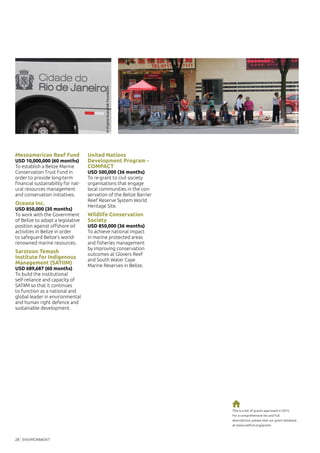
  • 5.
    4 JOINT INDIA LEARNING DIFFERENCES ISSUESAFFECTING WOMEN INTERNATIONAL HUMAN RIGHTS organisations in During the 2015 calendar year, Oak Foundation made 326 programme grants for a total of USD 201.87 million. These grants supported 308 organisations based in 39 countries. The work of these organisations is carried out throughout the world. The size of grants varied from approximately USD 25,000 to almost USD 21 million, with an average of USD 617,000. In addition, Special Initiative grants were made to five organisations for a total of USD 5 million. Our grant-making in 2015 308 39 programme grants to countries. 326 We made Total programme and discretionary grant-making in 2015 All amounts provided represent US dollars in millions. SPECIAL INTEREST ENVIRONMENT DENMARK ZIMBABWE CHILD ABUSE HOUSING AND HOMELESSNESS
  • 6.
    5 * The charton page 5 excludes the Special Initiative grants. Total regular grant-making 2007-2015 A searchable grant database containing grants approved in previous years, grant-making criteria and application information are available on Oak Foundation’s website (www.oakfnd.org/grants). Total programme grants Discretionary grants Refunds and cancellations TOTAL REGULAR GRANT-MAKING Special Initiative* NET AMOUNT GRANTED 201.87 M 10.75 M (0.74 M) 211.88 M 5.00 M 216.88 M In 2015 Oak's grant-making increased by about USD 41 million. This reflects the wishes of the Trustees to contribute further to improving the lives of the disadvantaged, and to advancing social and environmental causes globally. 170.78M 92.62M 98.81M 111.83M 116.72M 158.32M 149.90M 159.90M 211.88M 2007 2008 2009 2010 2011 2012 2013 2014 2015
  • 7.
    6 Capacity building Intermediaries formdeep connections within their communities and bring an expertise that large foundations are not always equipped to deliver. Organisations like Find Your Feet fully understand the culture they operate in. They have the best knowledge of the issues affecting the specific context of their work, and of how to raise awareness around them. In addition, intermediaries facilitate administering smaller grants, monitor their impact and provide technical assistance to their grantees. They also provide counselling, training, networking Capacity building Oak Foundation supports initiatives that build the capacity of our partners to carry out their work. Each year we highlight a different aspect of this work in the Annual Report. This year we have focused on how we work with intermediaries. Building capacity through intermediaries: working with small groups to create bigger change Polina Tudu from Godda, a remote district of Jharkhand, India, is a mother of three. Her family depends on agriculture for its livelihood. Polina leads a self-help group in her village, through which she shares information about social protection programmes with the group members. So far, she has enabled 28 men and women from her village to get a pension. Polina’s self-help group was formed with the help of Find Your Feet, a not-for-profit organisation which raises awareness of opportunities among rural communities and encourages people to ask for their entitlements and services. So far Find Your Feet has helped create almost 200 self-help groups (including Polina’s) in four districts of Jharkhand. ©BagelБејгл Community-based movements such as these are best positioned to create meaningful and direct change on the ground. However, they often lack resources to make a sustainable impact or to reach the international arena and access more funds. On the other hand, international foundations lack the capacity to reach the smallest grassroots movements, who need support the most. We overcome this challenge in part by supporting intermediaries, which are third-party organisations that can reach small advocacy groups and grassroots movements better than we can. “Intermediary partners can bring much needed knowledge to the table and allow Oak staff access to expertise in new fields, geographies and communities.” − Adriana Craciun, Oak’s Senior Adviser on Organisational Development and Capacity Building ©Atina ©Atina
  • 8.
    7 To find outmore about the Organisational Development and Capacity Building Initiative at Oak visit www.oakfnd.org/odcb opportunities and financial support to grassroots organisations who work closest to the ground. Preventing homelessness in the UK and institutionalisation of children in Eastern Europe The UK-based Sheila McKechnie Foundation (SMK) supports individuals, organisations and communities working for social change by helping them improve their campaigning and communications skills. Using funding from our Housing and Homelessness Programme, SMK has helped enhance the role played by 31 non-governmental organisations working to prevent homelessness. SMK’s assistance provides a new way of thinking, a space for planning and concrete support to plan and implement advocacy. Crisis, a UK homeless charity, benefitted from SMK’s support to refine its external message and produce a campaigning strategy. In addition to all the services it provides for homeless people, Crisis is now leading a “No One Turned Away” campaign. This seeks to reform the law so that no one who asks their local council for help with housing gets turned away to sleep on the streets. SMK draws upon a wide network of influential actors in advocacy and supports organisations working towards different campaigning goals. It has also partnered with our Child Abuse Programme, notably through grants which support child rights advocacy groups working to phase out institutional childcare in Eastern Europe. Institutional care is a generally accepted form of alternative care for families and minority groups in the region who are disadvantaged due to poverty or discrimination. However, studies have shown that institutional care causes lasting harm to many children. SMK works with parters to enhance cooperation among civil society, the corporate sector and national and local authorities to help keep children with their families. Where this is not possible, partners support advocacy groups to find family-based alternative care for children. Combating violence against women in the Balkans Trag Foundation is a local Serbian organisation that enhances local civil society through funding and capacity building. Oak partners with Trag to strengthen the sustainability of women’s organisations in Bosnia and Herzegovina, Montenegro and Serbia. These organisations provide services to victims of domestic violence, trafficking and exploitation and work to stop the violation of women’s rights. Trag provides grants, builds capacity and facilitates networking among women’s organisations. At the same time, Oak strengthens Trag by helping it to include a women’s rights perspective across all of its work, and eventually across the work of all of its grantee partners. Oak sees this approach as a strategic investment in the capacity and sustainability of women’s rights organisations and as a way of supporting civil society in the region. Trag helps partners develop personalised capacity-building plans which build on strengths and enhance capacity. Simultaneously this is a chance for Trag to build its own capacity-building exper- tise. To this end, Oak connected Trag with NESsT, a US-based, not-for-profit organ- isation that develops sustainable enter- prises that solve critical social problems. By building its own knowledge of financial sustainability, Trag is better equipped to support smaller organisations. Together, NESsT and Trag are working with ATINA, a Serbian women’s rights organisation, to expand its sources of sustainable funding. ATINA works with women survivors of trafficking and violence. It advocates for gender equality and identifies and combats gender- based violence and discrimination. It provides safe accommodation, health and psychological care, legal counselling, informal education and economic empowerment to survivors of trafficking and sexual exploitation. Recently, ATINA established what it anticipates will be a viable business – the first bagel shop in Serbia. Bagel Бејгл (or Bagel Bagel) gives survivors of human trafficking a safe place to work and an independent income. Crisis is leading a “No One Turned Away” campaign to reform the law so that no one who asks their local council for help with housing gets turned away to sleep on the streets.
  • 9.
    8 The profits fromthe shop and Bagel Бејгл’s small catering business also provide sustainable funding to ATINA. With the help of NESsT and Trag, ATINA hopes to expand the Bagel Бејгл business. This illustrates how ongoing support such as that offered by Trag allows organisations like ATINA to become stronger and move towards financial sustainability. Building financially- viable local organisations Oak also connected Trag with Resource Alliance, which works to harness financial, human and intellectual resources to help individuals and organisations build a better world. Resource Alliance is working with Trag and other advocacy organisations across the globe to help them be more effective. This is done by bringing them together through conferences, workshops and programmes that enable the sharing of ideas. The Resource Alliance’s Emerge Programme assists small grassroots organisations to fundraise and use resources efficiently. Four of Oak’s partners benefitted from this programme in 2015, and two more enhanced their leadership capacity by attending the Future Leaders Programme in 2014. “For any organisation to be successful, sustainable and capable of reacting to both challenges and opportunities, leadership capacity is essential,” said Adriana Craciun. Through our Special Interest Programme grants, 15 organisations will benefit from the Emerge Programme and 30 managers will benefit from the Future Leaders Programme in the next three years. Working with families to stop violence in Mexico Investigación en Salud y Demografía, S.C. (Insad), a health and demographics research consulting firm, helps our Issues Affecting Women Programme partners in Mexico measure the impact of their work. Insad looks at what the organisations have achieved, assessing their strategies, gathering qualitative and quantitative evidence and making recommendations to track and expand the impact of their work. Beyond its grant-making role, Oak is committed to supporting its partners to build evidence on the effectiveness and impact of their work, in particular advocacy organisations, helping them to access other sources of funding. The first partner Oak connected Insad to was Las Hormigas. Las Hormigas means “the ants” in Spanish, and it is a community organisation in Ciudad Juarez, Mexico that works with families to pre- vent violence and destructive behaviour. Its community centre provides a safe space for people to see mental health specialists who provide therapy for individuals and families. Violence plagues the communities of Anapra and Lomas de Poleo, where 50 per cent of the population live below the poverty line and are socially, as well as economically, marginalised. There is a lack of basic public services and transport, as well as constant migration to and from these border communities. Long working hours of parents put a stress on families, particularly on single mothers. Insad helped Las Hormigas analyse the impact it had on these communities through 24 in-depth interviews. The inter- views revealed that almost everyone who had been assisted by Las Hormigas had been able to change some aspect of their behaviour that was harmful, by dealing with anger and aggression or improving self esteem and communication skills. Las Hormigas also works with children with learning difficulties or who demon- strate aggressive behaviour at school. 100 per cent of the parents interviewed said that their children had shown im- provement from the programme.1 “The great majority of those interviewed reported that they wouldn’t have been able to achieve personal change without 100% of parents of children attending the Las Hormigas Educational Programme thought their children had shown improvement in behaviour. “Belgrade now has its Bagel Bagel shop - an oasis of great taste where you can treat yourself to mouthwatering food and also contribute to the struggle for a better world. − Marijana Savic, Director, ATINA
  • 10.
    9 the support ofLas Hormigas,” said Cecilia Vega, the principle researcher on Las Hormigas from Insad. Insad also provided support to Las Hormigas staff to help them develop their skills, implement monitoring methods and expand. Because Insad was so successful with Las Hormigas, Oak now partners with Insad to assess the capacities and strategies of all our partners in Mexico and help them improve their impact. Helping the people of Myanmar Our International Human Rights Programme works with the intermediary Partners Asia, which supports civil society organisations and grassroots networks in Myanmar to advance the rule of law. Partners Asia connects community initiatives with global resources. It also works to train and build the capacity of lawyers, activists and journalists. “Across the world there is a lack of capacity in fundraising and resource mobilisation,” said Adriana. “This limits the scope and reach of civil society and its ability to effect change. Intermediaries help us reach those who need it most.“With resources to campaign effectively, become financially sustainable and network with other movements, small grassroots networks Biljana Dakic Djordjevic, Executive Director of Trag Foundation. and civil society advocacy groups can achieve more. Intermediaries such as those mentioned above and others will continue to reach small, community-based movements, connecting them with the re- sources and training they need to create bigger social change. Trag Foundation is a local Serbian organisation that works to strengthen the sustainability of women's organisations in Bosnia and Herzegovina, Montenegro and Serbia. ©VladaMatić/TragFoundation
  • 11.
    CHILD ABUSE10 Child Abuse ©RachelMcKee/OakFoundation Violence,abuse and exploitation of children are unfortunately not new. Forms of physical, sexual and emotional abuse of children have come to be recognised as crimes against children. The devastating consequences that violence has on children’s development and on societies as a whole are slowly coming to light. In the Child Abuse Programme, we envision a world in which all children are protected from sexual abuse and sexual exploitation. We support initiatives that: eliminate the sexual exploitation of children; engage men and boys in combating the sexual abuse of children; and promote the prevention of violence against children. ©JonathanHymas/SavetheChildren
  • 12.
    CHILD ABUSE 11 Reflections Duringthe course of the year, the Child Abuse Programme (CAP) made more than 45 grants, hired a new Programme Officer in East Africa and organised a meeting of partners to assess violence prevention and sexual abuse prevention initiatives in Eastern Europe. We remained close to our partners’ concerns and successes. We know that to achieve change in any area, cooperation is essential – whether this is within countries or between major actors that develop global policy. 2015 has been an important year for major events concerning children. These include: • The UN adoption of the Sustainable Development Goals in September 2015. We supported work behind the scenes to ensure that the fight against abuse, violence and exploitation remained firmly embedded in the final documents. • The planning of a Global Partnership to End Violence against Children. This will bring major UN agencies, civil society organisations and governments together around a set of evidence- based programmes to reduce violence. • International efforts to advocate with FIFA, other sporting institutions and the World Bank. This will help ensure that children’s rights are an integral part of these organisations’ human rights standards in working with countries around the world. CAP has funded innovative primary prevention work to: • engage men in children’s lives and support new fathers in care-giving roles; 45 grants were made by the Child Abuse Programme in 2015, totalling USD 19.40 million. • research and challenge gender and social norms that perpetuate violence and exploitation of children and adolescents; • search for a valid frame for prevention of sexual exploitation of children and adolescents which embraces both the public health and child protection perspectives; and • engage key actors in a new pact to deliver violence prevention, including in health and education. A new fund in Africa has been created through our partnership with other private donors, the East Africa Children’s Fund. It will bring funding to community- based groups and non-governmental organisations that are normally too small to receive funding from major philanthropic organisations. We are confident that in targeting the many groups that do essential work to eradicate violence, sexual abuse and exploitation at community levels, we will support the mobilisation of an ever-growing number of children, youth and communities to demand change for children. Given that our current strategy is an ambitious one with long-ranging goals, we have decided to extend it beyond 2016 for another two years – and to build in progressive reviews of our goals at different points in the years ahead. This year’s annual report profiles Children on the Move. It is a phenomenon which will grow in the years ahead – it is also an area in which children’s rights are easily overlooked or challenged. Find out more at www.oakfnd.org/childabuse ©JonathanHymas/SavetheChildren ©JonathanHymas/SavetheChildren
  • 13.
    “To say thatthese children may be ’at risk’ is a gross understatement!” said Florence Bruce, Director of the Child Abuse Programme. “When we met them they were protected by the local community and given food and a bed for the night until an agreement could be reached by local authorities as to what to do next.” Birke and Emawayish were moving alone within their own country and the possibility of them being abused was very real. Risks for children who move for a range of reasons within or beyond borders exist, even if the danger is not always visible. Children and mobility Mobility of children is increasing within and across countries and regions, as a result of conflicts, political upheaval, poverty, climate change, demographic growth, urbanisation and discrimination. *not their real names Supporting children on the move Birke and Emawayish* were 12 and 10 years old when they were picked up by police on the streets of a small town in northern Ethiopia. They had left their village of their own free will and had wandered into the neighbouring town to find work – possibly as domestic workers. They were hoping to continue on to other towns, moving south in the direction of Addis Ababa. “We know from our partners that children leave their homes alone, often for good reasons, such as abuse by parents or other adults, or because they are expected to work and send money home.” − Blain Teketel, Programme Officer, Child Abuse Programme. ©JonathanHymas/SavetheChildren
  • 14.
    CHILD ABUSE 13 Childrenalso leave to increase their opportunities or simply in search of adventure. Sometimes entire families have little alternative but to move. Readers will doubtless have in mind the tragic flow of children and families from Syria and other countries moving beyond borders to Europe in 2015, as well as the refugees and migrants from Africa, many of whom lost their lives just attempting the journey. In 2015, 3,771 refugees and migrants died or went missing in the Mediterranean Sea.2 Many children and adolescents were with their own families, but others were – and are – unaccompa- nied, with peers, or with adults or families that are not their own. Children and adolescents making their way to the US from Central and South America also made headlines – escaping violence and poverty at home. The extent of the movement surprised all observers and some services in the United States were not prepared to consider children’s best interests, nor their views, as they planned their future for them. What all these children on the move have in common – whether they cross borders or not – is that: • they are children and entitled to protection and other rights under international laws; and • in their place of origin, on their journeys and at their destinations, they run huge risks of violence, abuse and exploitation. “The international community’s aim to protect the rights of children in all situations falls well short of the international declarations and conven- tions to which most countries have signed up,” said Florence Bruce. Migrants, refugees, or trafficked? Getting to an approach that works for many is a challenge. It is a challenge in areas of origin where investments in children are often not the norm, or when children have to pay the price of conflicts and violence, poor governance or lack of resources. It is a challenge at borders where children become visible. It is a challenge at destination points where children are cast as outsiders or even threats to local communities. In terms of international funding, there has been a focus on specific situations in the past, such as on children who have been trafficked. While this is good, in the absence of solutions for children in other situations, it has tended to lead to funding and services being narrowed to serve only children who meet a criteria. Children such as Birke and Emawayish in the example above – who were not trafficked – often do not benefit from the major funding and programmes designed to support “victims”. Rather than taking the problem of children who move as a whole, a laser-focus on one aspect of movement, e.g., trafficking, will ignore the needs of others. Partners and experts believe that a broad approach would be better to reduce risks and increase life opportunities for larger numbers of children in a range of mobility situations. Children on the Move is an umbrella definition that includes a range of situations, including street life, trafficking, slave-like conditions, refugees, the displaced and unaccompanied or accompanied migrants. This or other umbrella definitions may better support the protection rights of children granted by the Convention of the Rights of the Child to all children, regardless of their circumstances. It will also include diverse settings from across areas of origin, transit and destination. Moving towards approaches that work for larger numbers of children is both important and challenging; it matters because a displaced child can become a refugee, an unaccompanied minor, migrate within or across borders, be smuggled, trafficked or end up sexually or otherwise abused and exploited. Choosing to protect some over others, when risks of abuse and exploitation are a danger for many, is not enough. Conflicts, political upheaval, poverty, climate change, demographic growth, urbanisation and discrimination are forcing increasing numbers of children to migrate.
  • 15.
    CHILD ABUSE14 In addition,AMWCY has established listening centres where children can go to talk and receive guidance. “It is a good place to keep an eye on children passing by. If they seem to need help, we approach them. Sometimes we offer meals to those who cannot buy food. Each of us has committed to sponsor a migrant child, taking them home to sleep and walking with them into the city the next day.” - Mariko, youth volunteer with AMWCY in Mali Oak’s funding Over the years, the Child Abuse Programme has moved its attention from trafficking to recognising that all children who move need support. It seeks to recognise children’s agency and the opportunities that mobility may offer to some. Working with a mandate on child abuse, the risks of abuse and exploitation for children on the move are a key concern to the Programme. This is why the Child Abuse Programme funds groups of actors at international, regional and national levels to: • understand the problems better and find local solutions; • help develop and test models that increase access to support and opportunities; and • support groups that make problems and solutions more visible and bring the rights of children to be protected from violence and abuse to the fore. Oak funds a range of initiatives globally to end the abuse, exploitation and violence against children on the move and to increase their opportunities. Over the years, Oak has supported: learning; conferences on working for and with children; children’s initiatives; and organisations that support children directly. Some of our grantees include the following: • Terre des Hommes Netherlands, which works with a network of organisations to reduce the abuse of children in northern Ethiopia (where there are high numbers of children on the move) and improve their access to support. • Speak Out!, a project of the Swiss National Youth Council, which works with unaccompanied children and youth seeking asylum in Switzerland. • MARIO, an inter-agency initiative, which works to protect children within and across borders in Europe. • Plan International, Interagency Group on Children on the Move, Save the Children, and the International Federation Terre des Hommes, which have developed approaches to better understand and match programmes to children’s needs. Children and youth are part of the solution There are pockets of promising practice in parts of West Africa, where children play a direct role in finding and shaping their own solutions. They do this by: informing peers; setting up a protective network; and acting as advocates for their own cause. The grassroots organisation the African Movement of Working Children and Youth (AMWCY) has been supporting children on the move for many years through a network it created to support young migrants travelling alone. This informal safety net supports children and youth across communities and countries. Sixteen year old Mariko from Mali has met many children on the move in the bustling market facing her mother’s restaurant in the outskirts of Bamako. She is one of more than 30 youth volunteers with AMWCY’s child migration programme who meet at the restaurant every week.3 3,771 refugees and migrants died or went missing in the Mediterranean Sea. In 2015
  • 16.
    CHILD ABUSE 15 ©ValentinSimeonov/ARCFundBulgaria Thephotos throughout the Child Abuse Programme section of the report illustrate children on the move. According to the UNHCR, more than 60 million people are displaced by conflict around the world. 20.2 million are refugees.4 In Europe, one in five migrants is a child.5 Looking ahead As Oak seeks to increase the protection of and opportunities for children on the move, many possibilities remain to be explored. How can Oak and its partners tap into the sectors of healthcare, poverty alleviation and education to more deliberately reach children who are left with no other real choice than to move? How can they help those who already live in places of transit and destination? How can Oak’s grant-making contribute to categorising these children less and instead offering improved support? A change in approach in how the movement of children is addressed is one that demands a tectonic shift, if projections of movement over the next decade are to be believed. Children, states, experts and interested groups can shape durable solutions beyond fragmented approaches to one that increases the life chances and opportunities of larger numbers of children wherever they are. “Can we review our approaches if these work only for the few and if inadequate support is available for the many?” said Anastasia Anthopoulos, Programme Officer of the Child Abuse Programme. “Can we stand firm in our support to the rights of children, even when they are perceived as threats and not children?” The Child Abuse Programme is, in this regard, challenged by reality. The numbers of children moving and the diversity of their circumstances around the world or within regions are already redefining classifications. “It may be time to pause our ’categories’, listen to children and catch up with their realities,” said Anastasia. ©JonathanHymas/SavetheChildren
  • 17.
    CHILD ABUSE16 Ending the sexual exploitation ofchildren Applied Research and Communications Fund USD 249,206 (36 months) To empower young children in Bulgaria and advance their rights by increasing digital literacy and strengthening the knowledge and skills of parents and teachers to support them. ECPAT International USD 240,072 (12 months) To support ECPAT in its pre- parations for the 2016 ‘Year of Action’ to end the sexual exploitation of children. ECPAT International USD 85,000 (5 months) To gain endorsement from African Heads of State and high-level officials to include violence against children targets in the final Sustainable Development Goals. Family for Every Child USD 300,000 (36 months) To increase knowledge and strengthen practice on recovery and reintegration for children and adolescents affected by child sexual exploitation through an open, vibrant, locally accessible global learning network. Save the Children Fund USD 849,662 (18 months) To support Save the Children’s global work on Children on the Move, prevention of sexual violence and online child abuse images in the Balkans. SOS Femmes USD 100,000 (12 months) To support research on the sexual exploitation of students and to support the counselling services of SOS Femmes for students and young people involved in different forms of sex work. Terre des Hommes International Federation USD 1,631,971 (36 months) To support the rights of children in and around mega sporting events so that their rights are respected, implemented and enforced. Engaging men and boys in ending sexual abuse Association Resource Center for Women MARTA USD 250,000 (36 months) To strengthen the protection of children against sexual exploitation and sexual abuse in Latvia by advocating for systemic change in legislation and institutional practices. Child Rights International Network (CRIN) USD 250,000 (36 months) To provide core support to CRIN, a global research, policy and advocacy organisation that works to advance children’s rights. Le 2e observatoire USD 328,949 (36 months) To support the development of guidelines for childcare professionals and primary school teachers to help prevent gender discrimination in the French-speaking part of Switzerland. Promundo US USD 1,493,751 (36 months) To provide core support to Promundo for its work via its offices in Brazil, sub- Saharan Africa, the US and Europe, and specific support for work in Uganda, Moldova, Bulgaria and Latvia. Preventing violence, protecting children Animus Association Foundation USD 629,994 (60 months) To combat bullying in schools in Bulgaria so that children feel safe and, along with parents, professionals and institutions, are empowered to tackle the problem. AssemblyO-Witter gGmbH USD 300,000 (12 months) To support global advocacy efforts in the prevention of violence against children. Association Kairos USD 270,036 (36 months) To support the Association Kairos to protect teenagers and young people in Switzerland from risky situations, including those of sexual violence. Bureau International Catholique de l’Enfance USD 1,062,746 (36 months) To prevent the sexual abuse of children and to provide the best care to survivors through participation, the promotion of resilience and the develop- ment of child-friendly environ- ments. Child Rights Connect USD 486,979 (36 months) To advocate for and devel- op the capacity of national civil society actors, including children, to engage with the international human rights system to achieve children’s enjoyment of their rights. ChildFund Alliance USD 100,000 (6 months) To help establish a global part- nership to end violence against children as the platform to implement and advance violence prevention within the Sustainable Development Goals framework. Citizens for Justice USD 380,000 (24 months) To support three civil society organisations working in Malawi, Tanzania and Uganda to conduct research on the impact on children of World Bank supported extractive industry (mining, oil and gas) and advocate for actions to mitigate their negative impacts. Grants ©MarioProject/TerredesHommes ©JonathanHymas/SavetheChildren
  • 18.
    CHILD ABUSE 17 Thisis a list of our grants approved in 2015. For a comprehensive list and full descriptions, please visit our grant database at www.oakfnd.org/grants Consortium for Street Children USD 551,051 (29 months) To find out how resilience- informed programming impacts children at risk of sexual exploitation and abuse, and if such program- ming contributes to better outcomes for children in low- and middle-income countries. Emmanuel Development Association USD 500,000 (36 months) To raise the awareness of child trafficking among communities in northern Ethiopia and to use govern- ment structures to prevent the movement of children and adolescents that leads to trafficking and exploitation. Ethiopian Sociology Social Anthropology and Social Work Association USD 246,318 (36 months) To build the capacities of practitioners, academics and students of social work, sociology and anthropology in violence prevention and key research skills in Ethiopia. Eurochild USD 882,000 (37 months) To provide core support that will allow Eurochild to implement its strategic plan 2014-2018 and to support the organisation’s transition towards a dynamic, member- ship-led network with diverse income sources. Firelight Foundation USD 300,000 (34 months) To strengthen community- based organisations in Tanzania and Kenya so that children and youth are protected from abuse and exploitation. Firelight Foundation USD 690,000 (36 months) To communicate with faith- based communities in the US about the harmful impact of institutional care on orphans and other vulnerable children and to help them transition to alternative family and commu- nity-based care options. Forum on Sustainable Child Empowerment USD 699,712 (48 months) To protect children on the move in the southern part of Ethiopia from abuse and exploitation. Global Health Uganda Ltd. USD 249,233 (18 months) To promote dialogue among key sectors in Uganda on preventing violence against children and to inform the development of violence prevention initiatives within and across the sectors. Harvard University USD 99,652 (5 months) To study how relevant sectors understand and respond to risks and abuse of Children on the Move, as well as what puts these children at particular risk of sexual abuse and exploitation. INHOPE Foundation USD 350,000 (36 months) To expand the network of INHOPE Hotlines, a network of hotlines in 45 countries worldwide committed to eliminating child sexual abuse on the internet. Instituto PAPAI USD 181,322 (18 months) To consult children, adolescents and youth in Recife on what they think needs to change in order to develop a plan of action and engage groups to deliver these changes. International Center for Research and Policy on Children USD 175,000 (24 months) To advocate for the imple- mentation of the Rio policy on street children in Brazil. Naia Association USD 249,871 (36 months) To help educate healthcare professionals on the crucial role they play in the health and wellbeing of children, youth and families in Bulgaria. National Center for Child Abuse Prevention USD 489,166 (36 months) To strengthen the child protection system at local and national levels in Moldova. Network of European Foundations USD 1,000,000 (36 months) To develop an effective intermediary philanthropic institution in East Africa that will support community-based initiatives addressing children’s rights, violence prevention and prevention of sexual abuse and sexual exploitation. Network of European Foundations USD 250,000 (24 months) To provide support to the partners of Elevate Children Funders Group Secretariat and ensure that key goals, targets and indicators relating to violence against children are maintained in the docu- ments shaping the successor framework of the millennium development goals. Network of European Foundations USD 609,000 (36 months) To support the Evaluation Challenge Fund to research violence prevention against children in low-income countries and communicate these findings to people involved in policy design and programming for children. New Venture Fund USD 25,000 (5 months) To identify, map and align donor investments behind the Government of Moldova’s national strategy on child and family protection (2014-2020). PANOS Eastern Africa USD 248,886 (24 months) To continue highlighting both prevention of and response to violence against children in the media by linking child-focused organisations with media out- lets in Uganda and Tanzania. Retrak USD 296,557 (36 months) To prevent unsafe migration of children in southern Ethiopia and improve the protection of Children on the Move in the destination towns of Hosanna and Addis Ababa. Save the Children Fund USD 380,234 (36 months) To facilitate stronger child protection programming and policy in Uganda, Tanzania and Sierra Leone. Sheila McKechnie Foundation (SMK) USD 355,763 (24 months) To support SMK to continue developing and delivering a “Campaigning and influencing support” programme to the Child Abuse Programme’s partners. Swiss National Youth Council (SNYC) USD 534,981 (36 months) To support SNYC to continue its project "Speak out" for unaccompanied migrant children seeking asylum and for children without docu- ments. Social Services Agency USD 248,416 (36 months) To provide a supportive and safe family environment for each child in Latvia who has been left without parental care. The Duke of Edinburgh’s International Award - Bulgaria USD 59,993 (15 months) To empower young people from institutions in Bulgaria to develop life skills and personal qualities that enable them to be more independent and self aware of their capabilities by adapting and piloting the Duke of Edinburgh International Award Program. University of Oxford - Department of International Development USD 369,683 (36 months) To conduct a qualitative study on violence affecting children and use the findings to identify policy and practice gaps to promote violence prevention and response work. Workshop for Civic Initiatives Foundation USD 350,000 (36 months) To enable grassroots organisations in Bulgaria to support children and youth in the face of adversity or challenging circumstances.
  • 19.
    ENVIRONMENT18 Greenhouse gas emissionsare increasingly influencing the climate, causing adverse effects on land and in oceans. In addition, the mismanagement of marine resources has led to a global fisheries crisis and a severe loss of biodiversity, and poaching is threatening the extinction of wildlife. In the Environment Programme, our vision is to achieve a low-carbon global economy, the recovery of marine fisheries and habitats, and to stop illegal wildlife trade. We hope to transform the way oceans are perceived and exploited, for more socially and environmentally sustainable societies, and for the protection of endangered species. Our grant-making focuses on three main areas: climate change mitigation, marine resource conservation and illegal wildlife trade, which is a recent addition to the Environment Programme’s grant-making. ©RachelMcKee/OakFoundation Environment
  • 20.
    ENVIRONMENT 19 In 2015the Environment Programme carried out an evaluation on its impact since 2009 (see our website). We found that Oak Foundation has been one of the most critical funders in the areas of policy and capacity building in climate change and marine conservation. Based on lessons learned from this evaluation, a new strategic framework was designed for the period 2016-2020. There will be three major strategic shifts. Firstly, based on the strength of policies that have been put in place, the Climate Programme will put the emphasis on their implementation and enforce- ment, as well as in large-scale government programmes which target greenhouse gas emissions. Secondly, the Marine Programme will evolve from having a regional approach to having a broader, global impact. Improving the sustaina- bility of the wild fisheries sector will be the main goal. We are launching a global campaign to reduce the leakage of plastics into the oceans. Thirdly, a new sub-programme has been created to ad- dress the urgent issue of wildlife trade. For the Marine Programme, 2015 was particularly eventful in the US Arctic. Shell abandoned its plans to drill for oil and gas in the Arctic. The US Department of Interior subsequently cancelled requests to extend Arctic Ocean leases. This good news was preceded by efforts of Pew, WWF, the Alaska Marine Conservation Council and Nunamta Aulukestai to protect Bristol Bay from off-shore oil and gas leasing. In addition, an Oceana-led campaign against illegal fishing and fraud was successful, with US President Obama announcing a plan to track wild fish and crustaceans in the US. This will help eradicate a global black market of illegal fishing, estimated at USD 23 billion a year. We hope that 2014 and 2015 will be remembered as pivotal years for addressing climate change. 2015 started with the hopeful news from the Interna- tional Energy Agency that the growth in man-made CO2 emissions had plateaued for the first time in 2014. Another signal that a true energy revolution has perhaps been set in motion is that solar power is becoming even cheaper than natural gas. In addition, the climate negotiations in Paris in December 2015 generated a positive, competitive “race to the top”, with countries making significant commit- ments to curb greenhouse gas emissions. Europe has pledged to reduce overall emissions by 40 per cent by 2030 (base year 1990). China announced that its emissions will peak by 2030. The US has committed to reducing its emissions between 26 and 28 per cent below 2005 levels by 2025. Brazil has already peaked its emissions and will promote massive forest restoration and reforestation. India has commited to invest in 100 low-carbon cities. We are proud of how hard our grantees have worked to support their respective governments to make ambitious pledges. Our strategy in the next five years will focus on how to ensure that these fundamental pledges are met and surpassed. Well done to all of our grantees and thank you! 44 grants were made by the Environment Programme in 2015, totalling USD 39.87 million. ©KamylaBorgesCunha/IEMA ©TheInstituteforTransportation andDevelopmentPolicy Reflections Find out more at www.oakfnd.org/environment
  • 21.
    ENVIRONMENT20 By creating safertransportation environments. By developing bike lanes and bike stations at bus stops. By developing faster and more frequent bus and train services. How are Oak grantees helping cities reduce green- house gas emissions and improve transportation services? See below: Pollution levels in big cities are rising. Supporting cities in Brazil, China and India to develop sustainable transport Sustainable cities all around the world Geographically, historically and culturally, you might think that Brazil, China and India have very little in common. However, while these countries may be worlds apart on many levels, all three have been developing at exponen- tial rates and are facing similar challenges. Enormous cities such as Beijing, Rio de Janeiro and New Delhi are home to millions of people and urbanisation is taking place at an unprecedented pace. People are moving in great numbers from the countryside to the cities and infrastructure is rapidly expanding to welcome and cater for the influx. “The rise of the South is unprecedented in its speed and scale. Never in history have the living conditions and prospects of so many people changed so dramatically and so fast.” - United Nations Human Development Report 2013 At the same time, each country is facing the inevitable challenges that industrial growth brings. Burgeoning infrastructure has had to keep pace with the increasing demands of newly arrived city-dwellers. Where non-polluting bicycles or rickshaws were once common, cars are swiftly becoming the norm. There are 5.57 million vehicles in Beijing alone.6 Automobile owners in Brazil have doubled in the last decade, with one in five now owning a car7 and as the salaries in India increase, so does the use of personal motor vehicles. In tandem, pollution levels have soared. Once blue skies are often completely hidden from view, particularly in parts
  • 22.
    ENVIRONMENT 21 of Indiaand China, as heavy grey smog enshrouds many of these countries’ larger cities. At certain times of the year, citizens are obliged to wear masks to help them breathe through a thick fog of acrid fumes. Traffic clogs the streets, making getting around difficult. Brazil, China and India are faced with having to find ways to reduce pollution and cope with the increasing pressure on public infrastructure. “Most transport systems are built on the US model, which caters for cars,” explained Karen Suassuna, Oak Foundation Programme Officer for Brazil. “But people are starting to realise that this model doesn’t work for every country. Mobility is a big issue in large cities – buying more cars is not the answer. Governments need to look for sustainable ways to help people get around cities quickly, while at the same time reducing greenhouse gas emissions.” Many people believe that now is a unique moment in history. Brazil, China and India have the chance to support new, cleaner, greener transport systems that will reduce traffic, pollution and transit times, while improving the quality of life of their citizens. “Now governments have the chance to act,” explained Richard Liu, Oak’s China Climate Programme Officer. “While infrastructure is still being put in place, Brazil, China and India could leap forward and lead the world by setting a firm foundation for a future green economy.” Oak supports several not-for-profit organisations in these three countries, which, while working to increase the efficiency and speed of transport services in some of the world’s largest cities, are also trying to reduce green- house gas emissions. These organisations are working alongside governments to improve urban transport, reduce commute times and traffic, and build greener, cleaner cities to improve the life quality of their citizens for generations to come. Read on to find out about our grantees’ work in each country! Brazil It is widely known that the bulk of Brazilian CO2 emissions derive from the conversion of forests to pastures for cattle ranching and agriculture. However, due to decreasing deforestation rates, the energy sector is the single major source of increase in the country’s emissions of late: they quadrupled between 1970 and 2013.8 Oak supports the Instituto de Energia e Meio Ambiente (IEMA) in São Paulo, which works to address this problem across the country. “There is clearly a link between greenhouse gas emissions and poor urban mobility conditions in major Brazilian cities,” said André Luis Ferreira, the president of IEMA. “That’s why it’s important to work on expanding and improving people’s accessibility to good transport options in cities, while simultaneously reducing greenhouse gas emissions and air pollution.” A 2014 IEMA study of urban mobility in the city of Belo Horizonte in the south- east of the country estimates that by increasing public transport and cycling options, greenhouse gas emissions can be reduced by 29 per cent by 2020.9 Several cities have seen major invest- ments in transport – in particular Rio de Janeiro in the lead-up to the 2014 FIFA World Cup and the 2016 Olympics. With the support of the Institute for Transportation and Development Policy (ITDP), some 150 kms of Bus Rapid Transit (BRT), a low-carbon, economic and faster transport system, have been developed. Known as TransCarioca, the Rio BRT corridor crosses 19 suburbs, has 47 stations and carries an estimated 320,000 passengers a day. Since it opened, some 500 regular buses have been removed from the streets, reducing congestion and greenhouse gas emissions.10 This is a relief for many, especially for citizens living in Rio’s outskirts, where inadequate transport services are often the norm. As well as cutting people off from accessing the city easily, this can have other serious knock-on effects. For example, citizens can have a harder time finding employment. 29% By increasing public transport and cycling options in Brazil, greenhouse gas emissions can be reduced by by 2020.
  • 23.
    ENVIRONMENT22 In São Paulo, morethan bike racks will be installed on the streets, with bike-parking facilities at every bus terminal. 8,000 “Where you live greatly influences your chance of getting a job. Many people do not trust that you will arrive on time to work if you live too far from the office. Where you live is often the first question you are asked in an interview.” - Angela, Tour guide, Rio de Janeiro, Brazil Brazil is living through a major urban mobility crisis in its mega-cities,” said Karen. “An increase in the affluence of the new middle class, pumped by mis- guided government incentives to buy cars, has led to traffic jams. Paradoxically, this has brought with it a decrease in labour productivity, due to hours lost in traffic. It has also led to public dissatisfaction.” Indeed, poor quality public urban mobility services were a key reason for the huge wave of street protests that swept the country in June 2013. Following these protests, President Dilma promised to establish a national urban mobility plan, requested that major cities also develop plans and pledged tens of billions of US dollars to make improve- ments. “However, in view of the recent economic downturn, the promised funds are failing to materialise,” said Karen. There are nonetheless some hopeful signs – Oak grantees in seven major cities in Brazil are supporting the development of urban mobility plans. They are deploying dedicated bus lanes, BRT lines and other forms of emission-reducing transport. For example, ITDP has been working with the government on an ambitious new plan for 400 kilometres of bike-lanes to be completed in São Paulo in 2016. More than 8,000 bike racks will be installed on the São Paulo streets, with bike-parking facilities at every bus terminal. “Despite this progress,” said Karen, “Public pressure needs to be maintained.” China Birthplace to one of the world’s earliest recorded civilizations, China is a vast country with a rich, varied heritage and culture, beautiful landscapes and a long and interesting history. With a population of 1.3 billion, China recently became the world’s second largest economy. Its GDP has grown at an average annual rate of about ten per cent over the last three decades, lifting more than 500 million people out of poverty.11 Unfortunately, pollution levels have soared alongside economic growth. China has committed to tackling the rising problem of greenhouse gas emissions. In 2014 clean energy investment jumped from USD 60 billion to USD 90 billion, and in mid-2015,12 coal consumption dropped for the first time in years.13 “This is a massive step towards a safer and more sustainable future,” said Richard Liu. Although historically a great biking country, nowadays cars in Beijing are used for twice as many journeys as bikes. Therefore, one of the first things being tackled is the overwhelming number of cars on the road. Already local governments in Shanghai and Beijing have imposed licence-plate restrictions to curb car-ownership, with a lottery restricting the number of new cars being introduced to Beijing’s roads to 15,000 every two months. This has left more than 2.5 million people on the waiting list for a new car.14 ITDP has been working to build BRT systems in cities around China. It has been involved in two projects already – in Guangzhou, a large city of more than 14 million people in the south of the country, and in Yichang, a city of some 4 million people situated further north on the Yangtze River. The BRT has so far been successful and popular. “Urban villages” are being built around the stops it serves and Govern- ment officials are using it as a “gold standard” example in excellent transport
  • 24.
    ENVIRONMENT 23 systems. ChineseBRT systems often incorporate a double-lane, which allows buses to pass each other when there is a queue and this keeps the transport system running swiftly, unlike earlier versions of BRT. “I hear a lot of people are not sure what to think about the new BRT system,” said a Yichang taxi driver. “I think it will improve the quality of life, and hopefully the air in this city too.” Indeed, in an ITDP survey, conducted before the Guangzhou BRT was up and running, only 25 per cent of people reported that they were happy with the air quality in the city. After the introduction of BRT, this had risen to 64 per cent, demonstrating a clear im- provement, at least in public perception, of reduced greenhouse gas emissions. In addition, various municipal govern- ments across the country are introducing other greener transport options, including high quality bus, train and underground train services, bike tracks, rental bikes and other initiatives. Electric bikes are a phenomenal new development – in less than ten years, the Chinese have bought 230 million electric bicycles.15 Many environmental NGOs are hopeful that commuters will return to other, more sustainable and greener forms of transport. “We are trying to break the tendency among the public to equate car-ownership with success,” said May Mei from WildAid, which works to encourage greener forms of transport. “By encouraging people to use the transport system, bicycles or just Indeed, many Chinese NGOs believe that the moment to introduce green transport is here. “In these relatively early stages of growth, the largest window of opportunity for China should be seized now,” said Daizong Liu, Director of EMBARQ, the sustainable transport programme at the World Resources Institute, which recommends sustainable urban development practices to improve the quality of life in all cities. “If we opt for more sustainable transport options at this relatively early stage, we can avoid locking cities in unsustainable practices in this stage of growth. China has an opportunity to implement sustainable urban transport right now, and perhaps even become a world leader in sustain- able green transport systems.” “China has an opportunity to implement sustainable urban transport right now, and perhaps become a world leader in sustainable green transport systems.” -Daizong Liu. Director, EMBARQ 230 In less than 10 years, the Chinese have bought electric bicycles. million ©RachelMcKee/OakFoundation simply to walk, we hope we can help reduce greenhouse gas emissions. Change is slow, but people are starting to become increasingly aware of the steps they can take to help make China greener.”
  • 25.
    ENVIRONMENT24 “India’s public transport systemsare among the most heavily used in the world. At this point in time, it makes sense to develop it well, so that it runs sustainably, serving citizens for years to come.” - Sahba Chauhan, Environment Programme Officer for India India On a mission to eradicate poverty by 2020, India introduced free-market reforms in the early 1990s. Since then, its cities have been growing rapidly and are now home to about 40 per cent of the total population. This has created a strain on existing infrastructure, including on roads and public transport systems. Federal governments are planning sustainable transport systems, but the sheer speed of expansion has meant that more technical capacity is needed. Current transportation options tend to emit high levels of carbon emissions and public transport tends not to be safe, in particular for women. A survey by Oak grantee, the Mahila Housing Sewa Trust,16 carried out in Ranchi, Jharkhand, showed that women and men face different challenges when using public transport in India. Some ©TheInstituteforTransportation andDevelopmentPolicy Ranchi is the capital of Jharkhand, a state in the northeast of the country that remains largely rural but is urbanising fast. Overall, nearly half of all trips made in this city are on foot or by bike and a third are by public transport. The survey revealed that some 91 per cent of women said they did not feel safe travelling in shared rickshaws at night (a common form of transport), in comparison to 61 per cent of men. In addition, while 46 per cent of women cyclists consider harassment to be a problem, men cyclists do not. Isolated roads are a problem for 59 per cent of women cyclists, compared to 26 per cent of men. From these figures, it is clear that public transport systems in India need to take into consideration the specific needs of women and girls, giving priority to initiatives that make walking and public transport safe, accessible and convenient for all. The ITDP believes that if there were fewer economic constraints in the country, many people would shift to buying personal motor vehicles, following in the footsteps of Brazil, China and the West. Addressing the problems faced by people who walk, cycle or use public transport will encourage them to continue to use these modes of transport, reducing the congestion and pollution in the city, even as it grows. The Centre for Green Mobility (CGM), in conjunction with the Delhi Development Authority, has introduced a green mobility policy on bicycle sharing and renting in New Delhi. “This is an important step in spurring cycling facilities in Delhi,” said Anuj Malhotra from CGM. “It will provide guidance on governance, planning, of women surveyed said that they did not feel safe travelling in shared rickshaws at night in comparison to 91% 61% of men.
  • 26.
    ENVIRONMENT 25 financing andoperational structures of cycle-sharing systems.” The CGM is also providing technical assistance and advice to the Delhi Development Authority, the New Delhi Municipal Council and Public Works Department in upgrading the streets to have dedicated space for cyclists and pedestrians. Oak is pleased to be able to support India as it moves forward into greener and more sustainable transport systems. Oak and green transport In 2015 around 60 per cent of Oak’s climate- related funding was dedicated to the issue of transportation. This included: deploying a low-carbon mass system of public transportation/mobility within some major cities; and supporting a transition away from fossil fuels and towards electric vehicles. We hope that these steps towards greener transport will make a difference to the lives of many, in terms of saving time, improving health and ensuring the safety of all choosing to use public transport options and bicycles. 60% In 2015, around of Oak’s climate- related funding was dedicated to the issue of transportation. ©TheInstitutefor TransportationandDevelopmentPolicy ©TheInstitutefor TransportationandDevelopmentPolicy
  • 27.
    ENVIRONMENT26 Grants ©RachelMcKee/OakFoundation ©VirginiaRuan/OakFoundation Climate Change Agencia Publica USD 197,116(24 months) To provide core support to Agencia Publica, which produces high-quality non- partisan investigative report- ing guided by public interest in Brazil and Latin America. Center for Policy Research (CPR) USD 297,930 (36 months) To continue to provide core support to CPR to promote the integration of climate policies within the overall development framework in India. Clean Air Asia USD 500,000 (36 months) To support Clean Air Asia in promoting science-based and stakeholder-inclusive air quality management in China. Climate Action Network Europe USD 283,364 (31 months) To abolish fossil fuel subsidies in Europe by 2020, in accor- dance with the commitments made by G20 leaders to “phase out and rationalise over the medium term inefficient fossil fuel subsidies while providing targeted support for the poorest”. ClimateWorks Foundation, USA USD 2,650,000 (26 months) To establish Instituto Clima e Sociedade in Brazil as a fully operational grant-making institution. European Climate Foundation (ECF) USD 4,000,000 (36 months) To support the efforts of the ECF as it engages with not- for-profit organisations, businesses and governments to balance the competitive- ness, sustainability and security of energy supply. Fundación Avina USD 600,000 (36 months) To strengthen the Climate Observatory as a network and to ensure that Brazil sustains an appropriate level of ambition during the post-2020 United Nations Framework Conven- tion on Climate Change. Fundo Socioambiental CASA USD 100,000 (15 months) To support communities in Recife, Brazil to act on the issues of sustainability and social technology in their communities. Global Campaign for Climate Action (GCCA) USD 50,000 (6 months) To support the maintenance and development of services and support to key stake- holders aligned with GCCA’s new strategy for 2016-2020, following the UN conference on climate change in December 2015. Guangdong Harmony Foundation USD 494,750 (36 months) To advance Chinese social and civic organisations in the areas of green supply chain management, industrial pol- lution control and sustainable community development. Natural Resources Defense Council Inc. (NRDC) USD 2,000,000 (60 months) To provide core support to NRDC to accelerate change and tackle critical gaps in China’s transition to a low-carbon and sustainable future. New Venture Fund USD 1,600,344 (36 months) To cap the expansion of the tar sands in Alberta, Canada and eliminate the impact that tar sands extraction, development and transportation has on bio- diversity and human health. Nucleo de Apoio à Pesquisa e Educação Continuada USD 207,405 (18 months) To provide quantitative analyses of the economic, social and environmental costs and benefits of public policies for sustainable development. Our Cities USD 1,000,000 (36 months) To promote inclusive and sustainable cities in Brazil via a platform for civic engage- ment in Recife and in 25 other cities across the country. Purpose USD 999,984 (18 months) To accelerate innovative public mobilisation campaigns and to contribute to strategic shifts in public opinion, power balances, policy and markets on climate and related issues. Renew Canada USD 300,000 (9 months) To build support for climate policies and a clean energy transition in local communities in Canada. Right Livelihood Award Foundation USD 100,000 (12 months) To honour Sheila Watt- Cloutier as a Right Livelihood 2015 Laureate for her outstanding advocacy for her lifelong work to protect the Inuit of the Arctic. Shakti Sustainable Energy Foundation USD 400,000 (38 months) To assist India in adopting a clean energy, low carbon development pathway. West Coast Environmental Law Association USD 100,000 (12 months) To support the emergence of a public and legal narrative that fossil fuel companies and other large-scale greenhouse gas producers in the US should pay compensation for the damages caused by their products and operations. WildAid USD 500,000 (36 months) To create and conduct a series of high profile public aware- ness campaigns on reducing greenhouse gas and air pollution emissions from the transportation sector in China with a focus on new energy vehicles and bicycles.
  • 28.
    ENVIRONMENT 27 ©VirginiaRuan/OakFoundation ©KristianParker/OakFoundation World EconomicForum USD 100,000 (7 months) To support and enhance the design and delivery of France’s COP21 business engagement strategy, to create a more positive political environment that will lead to a successful COP21 outcome. Marine Alaska Longline Fishermen’s Association USD 350,000 (48 months) To support fisheries stewardship policy develop- ment and advocacy work at the state, federal and national levels and secure resource access for the next generation of community- based fishermen. Environmental Justice Foundation (EJF) USD 500,000 (32 months) To support EJF to secure greater governance of the South Korean fisheries. Inuit Circumpolar Council - Greenland USD 366,243 (36 months) To promote conservation efforts in the area of Pikialasorsuaq – the North Water Polynya – that strike a balance between socially and culturally important subsistence hunting and the need to protect the habitat for generations to come. Inuit Circumpolar Council-Alaska USD 275,000 (36 months) To advance Inuit priorities related to sustaining Inuit culture and society, promoting adaptation strategies for sustainable Inuit communities and increasing an under- standing of the human dimension within the Arctic. Kawerak Inc. USD 199,827 (36 months) To improve and expand local, tribal management of marine mammals, particularly the Pacific walrus, in coastal Alaskan communities. Marine Fish Conservation Network USD 350,000 (36 months) To maintain and strengthen the conservation and management objectives of the Magnuson-Stevens Fishery Conservation and Manage- ment Act in the United States. Marine Stewardship Council USD 300,000 (36 months) To contribute to more sustainable approaches to commercial fishing practices in the Spanish fishery sector by helping secure livelihoods and improving marine conservation. McGill University USD 77,446 (12 months) To research and develop a business and implementation plan for a Circumpolar Inuit News and Information Network for Inuit people across Russia, the United States, Canada and Greenland. Native American Rights Fund USD 300,000 (36 months) To protect the Bering Sea Elder 39 member tribes’ rights to subsistence hunt and fish in traditional areas by giving them a voice in decision- making processes. Nature Conservancy USD 1,000,000 (12 months) To help establish the second largest marine protected area in the Indian Ocean, covering up to 400,000 square kilometres. Ocean Conservancy USD 200,000 (12 months) To develop systemic solutions at a scale that will help stop the flow of plastics and other consumer waste from reach- ing the ocean through locally appropriate interventions. Peace Development Fund USD 400,000 (36 months) To advance the creation of an ecologically connected network of Arctic marine protected areas, as well as the development of a regional seas programme, through the Arctic Council. Pew Charitable Trusts USD 750,000 (36 months) To promote science and community-based conservation of the Arctic marine environment in the United States, Canada, Greenland and international waters of the Central Arctic Ocean. University of Alaska-Anchorage USD 550,000 (36 months) To strengthen the Alaska Native Science and Engineer- ing Program science curriculum, particularly in relation to Geographic Information Systems. Zoological Society of London USD 255,789 (24 months) To reduce single-use plastic bottles in London by optimising the resources and networks of the alliance group Marine CoLABoration. Mesoamerica Environmental Defense Inc. USD 200,000 (24 months) To create a permanent, national, rights-based fishery regime that will assist in putting Belize’s ecologically and economically important coral reefs on a durable path to recovery. Julian Cho Society USD 121,760 (24 months) To assist 39 Maya communities of southern Belize to negotiate and implement the settlement order based on the Caribbean Court of Justice’s recent judgement that reaffirmed Maya land rights.
  • 29.
    ENVIRONMENT28 ©VirginiaRuan/OakFoundation ©RachelMcKee/OakFoundation Mesoamerican Reef Fund USD10,000,000 (60 months) To establish a Belize Marine Conservation Trust Fund in order to provide long-term financial sustainability for nat- ural resources management and conservation initiatives. Oceana Inc. USD 850,000 (30 months) To work with the Government of Belize to adopt a legislative position against offshore oil activities in Belize in order to safeguard Belize’s world- renowned marine resources. Sarstoon Temash Institute for Indigenous Management (SATIIM) USD 689,687 (60 months) To build the institutional self-reliance and capacity of SATIIM so that it continues to function as a national and global leader in environmental and human right defence and sustainable development. This is a list of grants approved in 2015. For a comprehensive list and full descriptions, please visit our grant database at www.oakfnd.org/grants United Nations Development Program - COMPACT USD 500,000 (36 months) To re-grant to civil society organisations that engage local communities in the con- servation of the Belize Barrier Reef Reserve System World Heritage Site. Wildlife Conservation Society USD 850,000 (36 months) To achieve national impact in marine protected areas and fisheries management by improving conservation outcomes at Glovers Reef and South Water Caye Marine Reserves in Belize.
  • 30.
    ENVIRONMENT 29 3 ©RachelMcKee/OakFoundation The photosthroughout the Environment Programme section of this report illustrate green transport options in Brazil, China and India. Oak supports grantees in these three countries to help implement trans- port options such as high quality bus, train and underground train services, bike tracks, rental bikes and electric bikes.
  • 31.
    HOUSING AND HOMELESSNESS30 Housingand Homelessness ©MsBelindaSoncini/EldersLivingatHomeProgram,BostonMedicalCenter 1 In the Housing and Homelessness Programme, we focus on preventing homelessness by funding sustainable solutions that improve the economic and social wellbeing of marginalised youth, adults and families. We have three priorities: promoting economic self-sufficiency; increasing the availability and supply of affordable housing; and preventing homelessness. Grants within the programme are wide-ranging in size. We partner with organisations working both nationally and locally in Boston, New York and Philadelphia in the United States and in London, Belfast, South Wales, Glasgow and Birmingham in the United Kingdom. Within each location, we aim to fund projects relevant to the three priorities. In addition, we have adopted specific objectives that recognise particular issues in some of the localities where we make grants. ©ProvidenceRow
  • 32.
    HOUSING AND HOMELESSNESS31 Reflections The trend of contracting public expenditure continues in the United King- dom and the United States. In the UK we are halfway through an unprecedented ten-year period of year-on-year cuts to public expenditure. In the US advocates are battling to get the number of house- holds helped through rental assistance back up to pre-sequestration, 2013 levels. The resources available to Oak’s Housing and Homelessness Programme (HHP) can- not begin to compensate for loss of public funding, so we ask ourselves what should the focus of our grant-making be? Our conclusion is that there are many ways that we can make an impact, despite the operating environment. Two of these ways are featured below: • There are market forces and systems failures that act to compound poverty and in 2015 we made a num- ber of grants that explore and respond to these. In the UK a grant made to the University of Bristol supports the Personal Finance Research Institute to revisit the ‘poverty premium’. We hope this review will guide our future work as well as the work of other stake- holders. The market fails families who need access to low-cost credit. Support to Moneyline in the UK will enable the expansion of services so that several thousand families in Stoke will have ac- cess to modest loans at a lower cost. In the US we provided core funding to the Center for Responsible Lending, which continues to challenge predatory forces across a range of financial products. 42 grants were made by the Housing and Homelessness Programme in 2015, totalling USD 19.91 million. Find out more at www.oakfnd.org/housing ©ProvidenceRow ©ProvidenceRow • We support advocacy efforts that go beyond asking for increased expenditure and which question the way that existing resources are used and distributed. Examples include: the ‘Healthy Row House’ project in Philadelphia, which explores how to expand activity to repair the city’s existing housing stock. ‘On solid Ground’ is a broad coalition, taking a fresh approach to tackling Massachusetts’ enduring homelessness problem. In the UK, Russell Webster, hosted by Clinks, is designing a tool to help commissioners and service providers decide whether ‘Payment-by-Results’ is an appropriate way to structure funding for particular services. Working together and coordinating services always results in a more holistic outcome and when funding is tight it has added potency. In this year’s report we have detailed some of the ways that our partners have been able to enhance their services by strengthening the links between the fields of health and homelessness.
  • 33.
    HOUSING AND HOMELESSNESS32 Bartwas 34 and working as a security guard when he was admitted to hospital with acute myeloid leukaemia. Health and homelessness services – the power of working together “I had no savings and was on the minimum wage. I had been staying with a friend, but was not able to return there because my friend was afraid that he might ‘catch’ the cancer.” - Bart, one-time homeless person Bart had to undergo chemotherapy, which meant repeated visits to the hospital. However, he had nowhere to live. The London borough where he had previously lived was reluctant to house him, despite his medical reports. There are many cases such as Bart’s. Bad housing conditions, homelessness and poor health are intrinsically linked and it is well known that poor health is both a cause and a result of homelessness. The complexity of providing quality healthcare to the homeless is the reason why the fields of homelessness and health need to find ways to work together. As it is, the healthcare system and homeless organisations are set up to work separately from each other. This hampers the possibility of reaching the most vulnerable. Medical professionals do not know the housing status of their patients, which limits the scope for intervention. In addition, it is difficult to provide ongoing healthcare to the homeless or those in danger of losing their homes. ©ProvidenceRow
  • 34.
    HOUSING AND HOMELESSNESS33 Can health providers detect early signs of housing distress? People at risk of losing their home are not always that easy to reach. Medical appointments are one way to make contact with people who do not use other services – they provide a window of opportunity to talk through issues that contribute to people’s ill health, such as poor housing. Healthcare sessions can provide ways to recognise the signs that someone is struggling to keep his or her home, or that the condition of a person’s housing is contributing to their ill-health. The Govan Law Centre (GLC), based in Scotland, provides free legal services to people on low incomes for housing, debt, discrimination, education, employment and welfare. GLC has established weekly Rights Hubs in the four main psychiatric hospitals in Glasgow. These Hubs help the most vulnerable and marginalised people in the city find out about their rights in regard to welfare benefits, debt and housing. In this way, GLC strengthens referral routes between mental health services and homelessness prevention services across the city. Healthcare sessions provide opportunities to recognise the signs that some- one is struggling to keep their home or that the condition of their housing is causing ill-health. A lack of joined-up working across sectors has often been cited by politicians and policy-makers as a fundamental barrier to resolving social problems. In 2013 the Minister of State for Care and Support, Norman Lamb, said, “People don’t want healthcare or social care, they just want the best care.” “Working together produces better outcomes for people,” said Amanda Beswick, Director of Oak’s Housing and Homelessness Programme. “Yet there are some clear barriers to achieving this common-sense logic, both structural and cultural.” Oak funds initiatives that work to strengthen the links between the home- lessness sector and health providers. These include Pathway, which helped Bart, mentioned above, find a home. Integrated working across government agencies or between not-for-profit organisations is a common theme running through HHP grant-making. Oak sees firsthand the challenges and the benefits when services work together. We asked our grantees some important questions about their work. Read on to find out what they are doing to link the two sectors of housing and healthcare. “Our work is clearly having a positive impact on patients. This is in terms of resolving housing and related issues, but also in terms of health, wellbeing, recovery and discharge.” - Alistair Sharp, Govan Law Centre “A key factor to our success was having someone champion our cause,” said Alistair. “In this case, it was one of the National Health Services’ mental health service operational managers – he certainly opened doors for us. He saw the immediate benefit and impact of our work with patients. We developed a shared vision of how benefits could be expanded across other psychiatric hospitals in the Glasgow area.” The Boston Medical Center has always had a progressive view on homelessness. It is one of Boston’s largest hospitals and has, for many years, helped homeless people with medical problems. Its Elders Living at Home programme identifies housing problems that may put older patients at risk of becoming homeless. It then partners with the Medical Legal Partnership to help resolve these problems so that clients can overcome barriers to securing and maintaining suitable, permanent housing. 1. The photos in the HHP section of the report illustrate the work of Oak's part- ners. They are working to help people who have experienced homelessness improve their health, find work and keep their homes.
  • 35.
    HOUSING AND HOMELESSNESS34 Chronically homelesspeople are among the highest users of medical care in the United States. Permanent supported housing can dramatically reduce their need for healthcare. “Their bedside manner is beautiful. If you forget, they call your apartment, they make sure you remember... It’s beautiful. I don’t feel like my doctor is here just for the pay- cheque. It’s like she’s here for the people.” - Moira, CUCS client “The key to success has been educating medical providers about all of the challenges that their patients, particularly their low-income patients, face in their daily lives,” said Eileen O’Brien from the Boston Medical Center. “We help them understand how a lack of housing or very unstable housing impacts on their patients, and can undermine their health no matter how many health interventions the providers attempt. They appreciate the programme because it makes them better, more effective practitioners, and they see that their patients have better results. They are now starting to embrace the approach on a policy level as well.” Does the US Affordable Care Act provide an opportunity for better links between housing and health? Longterm or “chronically” homeless people are among the highest users of medical care in the United States and are also some of the costliest patients. They often rely on expensive emergency room visits. Permanent supported housing which specifically targets chronically homeless people can both successfully house these individuals and dramatically reduce their need for healthcare. The Affordable Care Act broadens the remit of Medicaid by making it possible to integrate housing support and health services. However, the reality of this work is challenging. The Supportive Housing Network of New York (SHNNY) works to ensure that there is an adequate supply of supportive housing in New York City. One of its key themes in the coming years will be supporting its members to manage the implications of the Affordable Care Act. “The Affordable Care Act opened the door for the possibility of Medicaid to pay for a portion of critical services in supportive housing,” said Laura Mascuch from SHNNY. “This will help keep the most vulnerable people in New York housed. SHNNY is working to ensure that this potentially positive resource does not undermine the integrity of the supportive housing model, but instead adds to our community’s ability to offer person-centred housing to New York’s most vulnerable homeless people.” The Massachusetts Housing and Shelter Alliance (MHSA) works to secure Medicaid funding to cover the costs of health services for people living in supportive housing in Massachusetts. “The greatest challenge in developing permanent supportive housing is the need to stress its importance in the healthcare of long-term disabled homeless persons without totally medicalising the issue of homelessness,” said Joe Finn from MHSA. “The way to overcome this is by highlighting as key outcomes the importance of social issues, housing, nutrition, education and income.” The Center for Urban Community Services (CUCS) provides supportive housing in New York City. The Janian Medical Center was established by CUCS in 2011 to carry out psychiatric outreach work and expand CUCS’s services to include primary medical services for homeless people. Early evidence from the initiative shows that integrating healthcare and supportive housing leads to reduced hospital admissions, improved physical and mental health and fewer visits to the hospital emergency room. “The Affordable Care Act has introduced a storm of philosophical and programmatic changes in a very condensed timeframe,” said Tony Hannigan from CUCS. “Our biggest challenge is to fund operations while protecting person-centred care in a way that works for both clients and clinicians.”
  • 36.
    HOUSING AND HOMELESSNESS35 “The health and wellbeing programme is such a powerful preventative measure,” said Pam Orchard from Providence Row. “We have found a joint working arrangement with the Royal London Hospital that works well. We will make the service available to more people and work to ensure financial sustainability in a time of public sector austerity.” Pathway is a model of integrated healthcare for single homeless people and rough sleepers that puts the patient at the centre of healthcare practices. The Pathway model was piloted at University College Hospital, London and is now internationally recognised and in place in ten hospitals across the UK. The Pathway team visits homeless patients in hospitals and then works with ward staff and other clinicians to care for them. The team provides expert support and advice to clinical colleagues on how to treat patients with alcohol or drugs issues, as well as those with mental health problems. It also engages with the patients, helps them to participate more fully in decision-making about their care, and brings focused but sensitive attention to planning for their discharge. “We have succeeded for several reasons,” said Alex Bax from Pathway. “Firstly, we have always tried to work within and alongside the institutions and the individuals of the National Health Service and to be endlessly humble. We focus always on how to improve things for homeless patients practically.” Can hospitals improve their response to homeless people? Many homeless people rely on hospitals for medical care, frequently using accident and emergency rooms to gain access to immediate treatment. Vulnerable people easily fall between the gaps in the labyrinth of hospital structures, and sometimes receive fragmented, uncoordinated care. In addition, homelessness makes ongoing care more difficult. Read on to find out how Oak’s partners have been successful in improving the hospital environment for homeless people. Providence Row tackles the root causes of homelessness in East London to help people get off and stay off the streets. It believes that working with people to build skills and confidence is the key to success. It does this through trainee schemes, language classes and employment support. Providence Row also provides support for mental health and addiction issues to help people rejoin the community. In addition, Providence Row works to reach patients before they leave hospital through its health and wellbeing programme. It secures housing and coordinates support services in the community for those without homes. In this way patients can continue to access mainstream health and wellbeing services once they leave hospital. Homeless people frequently use accident and emergency rooms in hospitals to gain access to treatment. ©ReachtheCharity ©JanianMedicalCenterfor UrbanCommunityServices
  • 37.
    HOUSING AND HOMELESSNESS36 TridentReach provides a ‘street- to-hospital-to- home’ service for people in the UK. It secures housing for patients before they are discharged from hospital. Tribute to Professor Aidan Halligan The Pathway model was the vision of Professor Aidan Halligan, who passed away suddenly and unexpectedly in April 2015. “Aidan’s contribution was vital,” said Alex Bax. “Without his raw energy, drive and compassion, Pathway would not have come into existence and our approach would never have spread as it has across the UK and now to other countries. His sudden death robbed Pathway of its founder, but has left us with a legacy of moral courage.” “Levels of homelessness and the resulting health harms are overwhelmingly a consequence of wider economic and social circumstances, and of the political choices we make as a society. In healthcare you get your authority from how much you care. I hope that Pathway has given more people more permission to care, and from that caring position, to change the lives of the most excluded.” - Professor Aidan Halligan ©ProvidenceRow ©ProvidenceRow Trident Reach provides a ‘street- to-hospital-to-home’ service for people living in the West Midlands in the United Kingdom. It secures appropriate housing and support for patients before they are discharged from hospital, ensures support for the patient after they leave and provides support and connections within the community. This partnership between NGOs, healthcare providers and housing authorities aims to end the revolving door of homeless people being repeatedly re-admitted to hospital. “Frontline clinical teams appreciate and value the expert guidance and rapid response that the initiative offers,” said Amy Hewett from Trident Reach. “Each individual and organisation involved has a clear understanding and knowledge of what success looks like for both the patient and strategically.”
  • 38.
    HOUSING AND HOMELESSNESS37 ©ProvidenceRow
  • 39.
    HOUSING AND HOMELESSNESS38 Grants ©Homestart Economic self-sufficiency Centerfor Responsible Lending (CRL) USD 1,000,000 (48 months) To provide core funding to the CRL to help it eliminate abusive financial practices that disproportionately impact low- and moderate- income families and people of colour in the United States. Community Housing Cymru (CHC) USD 182,934 (24 months) To enable CHC to develop a new, self-sustaining enter- prise that delivers financial advice and products and to develop its "Your Benefits are Changing" campaign in the UK. Edinburgh Cyrenians USD 80,000 (18 months) To evaluate current practice of the Good Food programme, a social enterprise with a mission to bring good food and healthy lifestyles to people who are experiencing disadvantage, isolation, poverty and homelessness. Jericho Foundation USD 476,323 (36 months) To enable the Jericho Foundation, based in Birmingham in the United Kingdom, to become sustainable and increase training and employment opportunities for its clients. Moneyline USD 494,080 (36 months) To increase the availability of affordable lending and credit to low-income households in Stoke, in the United Kingdom, by supporting Moneyline to expand its services. Neighborhood Trust Financial Partners USD 480,000 (36 months) To provide financial support to low-income people in the US by reaching out to employers. Second Step USD 629,395 (48 months) To develop peer mentoring support in Bristol, the UK, in order to reduce and prevent homelessness and to enable people with histories of homelessness to lead more independent, fulfilling lives. Increasing the supply of low-income housing Boston Foundation Inc. USD 25,000 (12 months) To fund an award for the Home Funders Innovation Fund, which seeks new solutions to increase the supply of housing for low- income families in Boston. Center for Architecture USD 820,228 (36 months) To improve the condition of thousands of privately-owned row-houses in Philadelphia. Chartered Institute of Housing in Northern Ireland USD 245,816 (36 months) To support the private rented sector to provide higher living standards, by promoting professional standards in both the management of accommodation, and the delivery of services to tenants. Housing Alliance of Pennsylvania (HAP) USD 1,000,000 (60 months) To provide core support to the HAP, a not-for-profit organisa- tion that works to ensure that all those living in Pennsylvania, especially those living on low incomes, have access to safe, decent and affordable homes. National Low Income Housing Coalition (NLIHC) USD 1,500,000 (60 months) To provide core funding to NLIHC which works to achieve socially just public policy that assures people with the lowest incomes in the United States have affordable and decent homes. New York Communities Organizing Fund Inc. USD 750,000 (36 months) To ensure that housing policies prioritise and deliver affordable housing for the most economically vulnerable households in New York City. Homelessness prevention Broad Street Ministry USD 441,849 (48 months) To provide and connect ex-offenders in Philadelphia with housing, support and public benefits and to help their reintegration back into the community. Cardinal Hume Centre USD 479,638 (36 months) To improve the quality and effectiveness of immigration casework for homeless and vulnerably-housed migrants through partnerships with non-governmental organisations in London. City Life/Vida Urbana USD 289,613 (12 months) To support the “No One Leaves” project in Boston, the US, run by City Life/Vida Urbana, a bilingual (Spanish/ English) community organi- sation which fights for racial, social and economic justice and gender equality. Common Ground Communities Inc. DBA Community Solutions USD 400,000 (24 months) To end veteran and chronic homelessness by working closely with 75 communities in the US. Depaul UK USD 896,510 (48 months) To improve the life chances of homeless young people and to support their integration into communities. ©ProvidenceRow ©ReachtheCharity
  • 40.
    HOUSING AND HOMELESSNESS39 Institute for Public Policy Research USD 113,280 (12 months) To build support for an improved tool which supports people seeking employment in the UK and develop a feasibility study for how the approach could be comprehensively piloted. Merthyr and the Valleys Mind USD 205,538 (24 months) To test and evaluate the combination of mental health referrals and homelessness prevention work at the local authority level in Wales. National Alliance to End Homelessness USD 1,500,000 (60 months) To provide core support to the National Alliance to End Homelessness to further its mission of preventing and ending homelessness in the United States. National Network for Youth USD 466,250 (36 months) To develop the National Youth Advisory Council in the US and provide training to a larger number of young homeless people to become youth advisors. Nurse Family Partnership USD 311,828 (36 months) To provide low-income mothers in Philadelphia in the United States with dedicated legal and advocacy services to improve their children’s lives and their own. Praxis Community Projects USD 552,630 (60 months) To develop a comprehen- sive approach to supporting homeless migrants in London by developing partnerships between the migrant and homelessness sectors. Providence Row USD 351,501 (36 months) To improve health and housing outcomes for homeless patients in East London through a personalised health and wellbeing programme that prevents rough sleeping. The Rock Trust USD 268,358 (48 months) To recruit a Development Coordinator to increase the Rock Trust’s capacity to provide services in more parts of Scotland and to develop new initiatives. The Welcome Organisation USD 489,006 (60 months) To prepare the Welcome Organisation in Belfast, Northern Ireland, to identify, develop and implement a succession strategy to prepare for the director’s retirement. University of Massachusetts Foundation USD 493,256 (36 months) To conduct research on cliff effects to inform the work of the On Solid Ground Coalition, a collaborative, cross policy and research action initiative led by UMASS Boston Center for Social Policy, CHAPA and Homes for Families. Vicar’s Relief Fund USD 1,140,240 (36 months) To enhance the impact and effectiveness of the St Martin- in-the-Fields Charity’s Vicar’s Relief Fund, which supports people at risk of being made homeless. Women Acting In Today’s Society (WAITS) USD 248,000 (36 months) To support women in the United Kingdom who are experiencing domestic abuse and are homeless to re- integrate into their communities, and to support WAITS to become sustainable. Learning Chartered Institute of Housing Cymru USD 492,640 (60 months) To help develop an intercon- nected, cross-sectoral housing system in Wales that brings together the government, local housing authorities, registered social landlords, tenant organisations, support providers and the private sector. This is a list of our grants approved in 2015. For a comprehensive list and full descriptions, please visit our grant database at www.oakfnd.org/grants Clinks USD 78,254 (12 months) To explore the viability of the “Payment by Results” commissioning model to improve outcomes in a wide range of public services in the UK, by developing an interactive tool for commissioners and providers. Crisis UK USD 209,640 (36 months) To identify and share best practice to inform further models for accessing, securing and maintaining Private Rented Sector accommodation for home- less and vulnerable people. Henry Street Settlement USD 100,000 (12 months) To evaluate factors relating to longer-term housing and employment outcomes for families leaving Henry Street’s shelter services in New York City. Homeless Link USD 338,090 (36 months) To facilitate an annual transatlantic practice exchange between homeless- ness professionals in the US and the UK, with the aim of introducing new ways to tackle homelessness and developing future leaders in the sector. Institute for Voluntary Action Research USD 96,000 (12 months) To improve evaluative practice in foundations through opportunities to share experience and refine thinking and practice. Personal Finance Research Centre, University of Bristol USD 155,173 (12 months) To develop recommendations to policy-makers and industry regulators relating to the “Poverty Premium”, which refers to how poor households pay more for essential goods and services. Pine Street Inn USD 100,000 (12 months) To provide new ways out of shelters for mid- and short-term homeless guests in Boston, the US, especially those with a history of recidivism. Other Associação Fórum Suape Espaço Socioambiental USD 239,397 (36 months) To provide core support to Forum Suape - Social and Environmental Space, which advocates for environment and the interests of traditional communities affected by the Suape Industrial Port Complex (CIPS), a major industrial development in Brazil. Acao Comunitaria Caranguejo Uca USD 97,560 (36 months) To promote a green, inclusive and sustainable economy via digital media in Ilha de Deus in Recife, Brazil. Lift USD 874,190 (48 months) To develop the "Harlesden Working Together" project in London, the UK and to generate activities that address social exclusion in practical and strategic ways. One25 USD 800,000 (60 months) To provide core support to One25, which works to build supportive relationships with Bristol’s street sex- workers through a person- centred approach.
  • 41.
    INTERNATIONAL HUMAN RIGHTS40 Since1948 the international community has developed an extensive body of international legal standards and institutions that relate to the promotion and protection of human rights. However, many individuals who seek to uphold their rights or the rights of others are threatened and punished because of their work, and their space for activism is restricted. National security fears, the economic crisis, hostility to human rights and the emergence of a multi-polar international order also present threats and opportunities. There remains a gulf between the theory and the realisation of these rights in practice. In the International Human Rights Programme (IHRP), we work with partners to: end impunity for the gross violations of human rights; uphold prohibitions on arbitrary detention and torture; protect human rights defenders at risk; and multiply and amplify influential voices on IHRP global priorities. International Human Rights ©WITNESS 1

  • 42.
    INTERNATIONAL HUMAN RIGHTS41 Reflections The operating environment for many International Human Rights Programme grantees deteriorated in the course of 2015. Around the world, in authoritarian as well as democratic states, governments imposed a range of measures to restrict civil society and intensify pressure on civil human rights defenders. Concerns over immigration gave rise to calls for the adoption of increasingly punitive approaches to regulate the movement of people. Alongside these developments, advances in technology presented both threats and opportunities for the human rights movement. Within this challenging context there were some notable achievements. These include the following: Countering impunity, securing redress: the trial of former Chadian President Hissène Habré, accused of multiple gross abuses in the 1980s, began in September 2015. This is the first trial of a former African head of state by another African state and constitutes a milestone in international justice. It is also a testament to the perseverance of victims and their allies in the human rights community (including multiple Oak grantees) in a 25-year long battle for justice and accountability. To build on the momentum, Oak invested in improving the means by which litigators seek to hold perpetrators of gross abuses to account. This includes a range of innovative evidence-collection tools. Combating torture: following a long delay, and thanks to the support of multiple Oak grantees, the report of the US Senate Intelligence Committee on the CIA’s Detention and Interrogation Program was released. The report confirmed that torture had been employed systematically during Bush- era interrogations of terror suspects in a network of secret interrogation facilities known as ‘black sites’, and that robust measures were needed to prevent its recurrence. We maintained our longstanding commitment to assisting victims of torture by supporting rehabilitation centres in low- and middle- income countries. We also extended our efforts to test innovative models of care for people who have suffered from trauma and to evaluate existing therapeutic approaches. Detention and due process: grantees responded creatively to the migration crises in Europe and along the US-Mexican border throughout 2015. Grantees sought to: protect the most vulnerable, including women and children; advocate for the principles of lawful, time-bound detention; ensure that humane conditions were being respected; and encourage appropriate alternatives to detention. In 2015 immigration detention became an increasingly significant priority for Oak. 46grants were made by the International Human Rights Programme in 2015, totalling USD 23.60 million. Find out more at www.oakfnd.org/humanrights ©TacticalTech ©AmericanCivilLibertiesUnion 2 3 1. WITNESS activists from Brazil and the US share their experiences documenting police violence. 2. TacticalTech trains human rights defenders to use technology so that their security is not put at risk.
  • 43.
    INTERNATIONAL HUMAN RIGHTS42 Technologyand human rights The way that people communicate and access information has been transformed over the last half-century. These technological advances have empowered those defending human rights. However, they have also aided their adversaries, and human rights defenders are increasingly vulnerable to online surveillance and hacking, as governments and private actors restrict access to certain information. “In international law, access to information and free expression have found tremendous accelerators in the internet and other forms of digital communication. At the same time, efforts to control speech and information are also accelerating.” - Carole Bogart, Human Rights Watch Protecting human rights defenders and enabling their work, including through harnessing the benefits of modern technology, are some of Oak’s key priorities. Oak developed a cluster of grants in 2015 to both realise the potential of technology and also to mitigate attendant risks. Grants covered three main areas: • digital security; • developing anti-impunity tools and technologies; and • technological capacity-building. Read on to find out more! ©TacticalTech
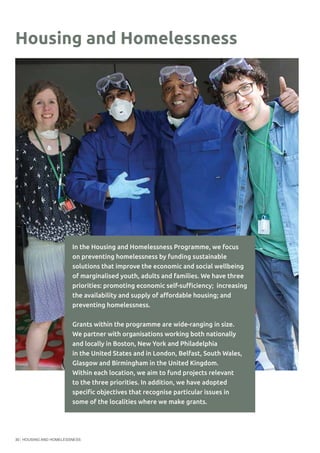
  • 44.
    INTERNATIONAL HUMAN RIGHTS43 77 Bahraini human rights defenders have had their computers and mobile devices hacked. Since the 2011 uprising, at least Digital security Since the Bahraini uprising in 2011, local authorities have been using excessive force and unlawful detention to muzzle pro-democracy activists. Many activists have had to flee the country. In exile and in relative safety, they continue their work to bring about democratic reform. However, they remain at risk from digital attack – since the uprising, at least 77 Bahraini human rights defenders have had their computers and mobile devices hacked, presumably by a hostile government. Hackers gained access to information saved on the activists’ computers’ hard drives, monitored Skype calls, chats, file transfers and videos, read emails and recorded conversations. Unfortunately, incidents like these are becoming increasingly commonplace, threatening both the work and lives of human rights defenders. There is a lack of research and tools to help groups quantify and mitigate such risks. To fill that gap, Oak made a grant to Citizen Lab, a research group at the Munk School of Global Affairs in the University of Toronto. Citizen Lab is working to detect covert hacking and surveillance tools that are directed against human rights groups. It is thanks to its work that the breach of the Bahraini activists’ computer systems was identified. Citizen Lab published a report that linked this attack (and others) to a UK-based commercial company which sells Trojan spyware to governments, ostensibly in the fight against organised crime. However in some countries, such tools have been used in ways other than what they were intended for: to surveil and endanger human rights defenders. Citizen Lab’s analysis helped strengthen campaigns and litigation against companies that have sold surveillance systems to countries that have used the tools in this way. In addition, Privacy International’s campaign resulted in controls on the export of such technologies from the UK. Citizen Lab forms part of a new cohort of grantees, which – though not all focused on security – should improve security practices among non- governmental organisations. Grantees including Tactical Technology Collective work with activists to ensure that online activities and data storage do not place organisations or the victims they work with, at risk. “Through your computer, mobile phone and other digital devices, you leave behind hundreds of digital traces every day,” said Stephanie Hankey, Co-Founder of Tactical Technology Collective. “These bits of information are created, collected and stored. Then they can be put together to create stories about you or profiles of you. While these can give others a huge insight into your life, they can also give a totally wrong impression.” Through a range of resources, including its flagship Security-in-a-Box toolkit, Tactical Technology Collective provides group training to reduce the risk associated with these digital traces. Developing anti-impunity tools Documenting police brutality in Brazil According to Amnesty International, the police in Brazil are estimated to be responsible for around 2,000 deaths every year.17 Many of these deaths are undocumented, and the families of the victims often never learn of what happened to their son or daughter. Oak grantee WITNESS has helped Page 41. 3. In 2015 thousands of unaccompanied minors tried to cross the US/Mexico border. Opposite: TacticalTech trains human rights defenders to use technology so that their security is not put at risk.
  • 45.
    INTERNATIONAL HUMAN RIGHTS44 Arecent example is the case of the assassination of Lebanese Prime Minister Rafik Hariri – prosecution rested almost exclusively on the tracking of the defendants’ cell phones. Gathering witness statements through technology Unlocking the wealth of potential evidence gathered by witnesses through statements – in person, on social media and through mobile phone recordings; and corroborating this evidence to make it admissible in court, is a challenge. In 2015 Oak supported three interventions to make this happen: • Carnegie Mellon University’s Human Rights Center is pioneering the development of advanced computing methods and tools to analyse large volumes of photographic and video evidence; • UC Berkley’s Human Rights Center works with the International Criminal Court, investigators and technology companies to ensure the use of evidence gathered through technological means in proceedings; and • SITU Research applies spatial analysis and visualisation techniques to present evidence more effectively. In a separate but related grant, the American Association for the Advance- ment of Science deployed geospatial technology to document international crimes from space. WITNESS supports civilian activists and investigators who document disappearances and police brutality in Brazilian cities. ©AllOut 1 train activists to use mobile video devices to capture human rights violations when they occur. It has also empowered communities to stand up against police brutality. “With the rise in the use of mobile phones and social media, there is an increasing flood of videos that human rights groups hope will support criminal investigations and proceedings,” said Executive Director of WITNESS, Yvette Alberdingk Thijm. “We believe that if we train activists and citizens to capture better quality videos, international human rights and criminal justice stakeholders will be able to use them to better effect,” she said. “What WITNESS does is create, support and sustain a global network of people who use video as their tool, as their weapon. This network reminds us that we are not a single voice; we are not alone.” - Esra’a Al Shafei, Bahraini activist ©CitizenLab ©WITNESS 2 WITNESS is one of several of Oak grantees that work with activists to develop and disseminate new technologies to capture evidence of crimes. New kinds of evidence, like video and satellite imagery, are becoming increasingly important in the investigation and prosecution of international crimes.
  • 46.
    INTERNATIONAL HUMAN RIGHTS45 Capacity building Maintaining a well-functioning and up-to-date IT system is critical to the effectiveness of any organisation. In 2015 Oak invested in a range of interventions to build grantees’ technological capacity. This included an extensive programme of training built on face-to-face, individualised, user-led approaches. Oak also supported sustainable IT programmes that were integrated into the regular day-to-day operations of the grantees. The work of HURIDOCS and Beneficient Technology’s Human Rights Programme (Benetech) was critical to these efforts. HURIDOCS worked closely with organisations to examine their information and management systems over a number of years. Benetech has developed a secure, encrypted database which permits human rights groups working in high- threat situations to safely store information. ©TacticalTech ©WITNESS Benetech has developed a secure, encrypted database which permits human rights groups working in high- threat situations to store information safely. It has accompanied grantees to the field to train staff on how to operate and customise this valuable tool. Looking to the future In the context of an increasingly difficult environment for activists and human rights defenders around the world, the International Human Rights Programme will continue its work. This includes protecting the fundamental rights of the individual, supporting those who champion that struggle and ensuring that perpetrators of gross abuses are held to account. 1. Staff at work at Citizen Lab, an organisation that researches, monitors and analyses the exercise of political power in cyberspace. 2. WITNESS builds the capacity of human rights activists to expose human rights abuses through the use of video. 3. TacticalTech trains human rights defenders to use technology so that their security is not put at risk. 4. WITNESS activists discuss exposing human rights abuses through the use of video. 5. page 47.1: A snapshot of TacticalTech’s Visualising Information for Advocacy guide in Arabic, a book about how advocates and activists use visual elements in their campaigns. 3 4
  • 47.
    INTERNATIONAL HUMAN RIGHTS46 Grants Endingimpunity for gross human rights violations Abdorrahman Boroumand Foundation USD 380,000 (18 months) To preserve memory and to support efforts towards truth, justice and accounta- bility for gross violations of human rights in Iran by maintaining an online memorial to victims of persecution and political violence. American Association for the Advancement of Science USD 400,010 (24 months) To research and develop innovative, scientifically rigorous applications of geospatial technologies that advance documentation capabilities across the fields of human rights, humanitarian response, cultural heritage, environmental justice and human security. Carnegie Mellon University USD 200,000 (24 months) To develop and apply scientific methods for collecting, analysing and communicating human rights information. Center for Justice and Accountability USD 1,100,000 (36 months) To contribute to international efforts to end impunity for gross violations of human rights, through: investigations; civil and criminal litigation; denying safe havens for perpetrators; providing redress for victims; and supporting transitional justice efforts around the world. Civitas Maxima USD 208,333 (24 months) To gather evidence on serious crimes in selected jurisdictions and pursue accountability on behalf of victims in national or international courts. Community Partners USD 650,000 (36 months) To develop and apply statistical methods to patterns of massive human rights violations so that the human rights movement can make more accurate, scientifically quantitative arguments about these. Fund For Global Human Rights USD 2,199,750 (19 months) To provide seven grants of 18 months duration to support work on various aspects of the International Human Rights Programme’s ending impunity/ arbitrary detention portfolios. International Center for Transitional Justice USD 975,000 (36 months) To help societies in transition from political repression and conflict find the truth behind mass atrocities, communicate this to wider society, and support efforts to seek accountability for these as well as reparations for the victims. International Federation for Human Rights (FIDH) USD 913,500 (36 months) To assist FIDH member organisations in documenting international crimes and in engaging in strategic and innovative litigation addressing such crimes. International Memorial USD 490,000 (24 months) To improve data management of International Memorial’s existing database comprising 2.6 million victims of Soviet terror. Physicians for Human Rights USD 1,500,000 (37 months) To use medicine and science to document and call attention to severe human rights violations. Public Interest Advocacy Centre Ltd USD 249,349 (24 months) To collect, analyse and preserve evidence of serious alleged violations of international law. Rights Watch (UK) USD 248,000 (12 months) To draw on the lessons of Northern Ireland to promote, protect and monitor human rights, especially in the context of UK engagement in conflict and counter terrorism measures. SITU Studio USD 100,000 (24 months) To help human rights organisations present their evidence more persuasively and effectively through the application of spatial analysis and visualisation. Tides Center USD 50,000 (12 months) To support the International Corporate Accountability Roundtable’s efforts to ensure remedial avenues for corporate accountability are promoted, strengthened and extended. TRIAL (Track Impunity Always) USD 244,792 (24 months) To challenge the impunity of individuals and corporate actors involved in gross human rights violations. University of California Berkeley USD 450,000 (36 months) To support the Human Rights Center at UC Berkeley School of Law to conduct research on war crimes and other serious violations of interna- tional law in order to improve conditions for survivors and prevent future violence. Freedom from arbitrary detention and torture Conectas USD 901,307 (36 months) To provide core support to Conectas to pursue its mission of defending and promoting the realisation of human rights and contributing to the consolidation of the rule of law in the Global South. Fair Trials International USD 988,800 (36 months) To protect and promote the fundamental rights of people facing criminal charges around the world, with a particular focus on supporting Fair Trials’ work in Europe and expanding its geographical reach. Gabinete de Assessoria Juridica as Organizacoes Populares (GAJOP) USD 205,984 (12 months) To provide core support to GAJOP to improve criminal justice policy and monitor conditions of detention within Brazil’s prisons. Global Dialogue USD 705,600 (36 months) To provide sub-grants to two organisations, Detention Action and Medical Justice, working on immigration detention issues in the UK. Global Detention Project (GDP) USD 374,390 (18 months) To support the institutional strengthening of the GDP, a Geneva-based research centre that investigates the use of immigration- related detention as a response to global migration. Helen Bamber Foundation, The USD 499,250 (36 months) To assist in the delivery and promotion of a compassion- ate, holistic and effective response to survivors of torture and other human rights abuses. Instituto Pro Bono USD 69,000 (12 months) To support the work of Instituto Pro Bono in the development of a pro bono legal sector in Brazil. International Detention Coalition USD 962,640 (36 months) To support the International Detention Coalition’s efforts to prevent and limit the use of detention as a tool of migration management affecting refugees, asylum seekers and other migrants.
  • 48.
    INTERNATIONAL HUMAN RIGHTS47 This is a list of our grants approved in 2015. For a comprehensive list and full descrip- tions, please visit our grant database at www.oakfnd.org/grants International Legal Foundation USD 1,050,000 (31 months) To support the operations of the New York headquarters of the International Legal Foundation in its efforts to in- crease awareness of the global crisis in indigent defence. International Rehabilitation Council of Torture Victims USD 693,000 (12 months) To strengthen the clinical and organisational capacity of torture rehabilitation centres worldwide through training, peer exchanges, knowledge dissemination and advocacy on the right to rehabilitation. Lutheran Immigration and Refugee Service USD 100,000 (6 months) To demonstrate the effectiveness of community-based case management models as an alternative to the detention of families facing immigration proceedings in the United States. National Law University USD 249,603 (24 months) To support the efforts of the Centre on the Death Penalty to promote greater awareness of the application of the death penalty in India. Network of European Foundations USD 1,071,000 (36 months) To enable the European Programme for Integration and Migration to support and strengthen civil society organisations active on migration and integration issues at the European level. United Nations Refugee Agency USD 86,600 (9 months) To support the second Global Roundtable on Alternatives to Detention convened by the United Nations High Commissioner for Refugees in conjunction with the Inter- national Detention Coalition and other partners. Supporting and protecting human rights defenders Awara USD 84,420 (12 months) To provide approximately ten financial audits of International Human Rights Programme grantees according to Generally Accepted Accounting Principles standards. Beneficient Technology Inc (Benetech Technology Serving Humanity) USD 900,000 (36 months) To provide and support effective, secure information management and data collection technology for rights defenders, activists, journalists and researchers globally. Civil Rights Defenders USD 480,470 (24 months) To improve the physical and digital security of LGBT human rights activists in northwest Russia and human rights activists in the North Caucasus; to provide emergency support for human rights defenders at grave risk; and to promote the international visibility of Russian human rights defenders. EarthRights International USD 390,000 (36 months) To work in partnership with communities and civil society organisations in Myanmar to promote and protect human and environmental rights in the country. Fortify Rights USD 230,000 (24 months) To prevent and remedy human rights violations in Myanmar and neighbouring states by investigating abuses, high- lighting findings and providing technical support to strength- en individuals and communi- ties advocating for change. Global Dialogue USD 249,100 (15 months) To provide three one-off grants to the Witness to Guan- tanamo, the International Civil Society Centre and the Movies that Matter Foundation. HURIDOCS USD 600,000 (36 months) To identify, develop and implement documentation management tools with a view to increasing organisational ef- fectiveness of leading human rights NGOs in Eastern Europe and Eurasia, Middle East and North Africa, Asia, Sub-Saharan Africa and North America. The Engine Room USD 239,668 (24 months) To support further organisa- tional development of the Engine Room, which helps human rights activists integrate the use of data and technology safely and effectively into their work. Broadening human rights constituencies All Out (Purpose Action) USD 500,000 (18 months) To build an online global movement to make political, legal and cultural interventions for equality of LGBT people. Human Rights Watch USD 134,735 (29 months) To provide fellowship opportunities in Russia for the country’s next generation of human rights defenders. People in Need USD 784,350 (24 months) To strengthen civil society in Eastern Europe. Proteus Fund - Inter- national Human Rights Funders Group (IHRFG) USD 329,823 (36 months) To provide core support to the IHRFG, based in New York. 1 ©TacticalTech
  • 49.
    ISSUES AFFECTING WOMEN48 IssuesAffecting Women In the Issues Affecting Women Programme, we seek to contribute to a world in which women are safe from violence and are free to exercise their full and equal human rights. We seek to build a strong and vibrant movement of women who are empowered individually and collectively to challenge patriarchal norms and tackle the root causes of inequality. We support organisations that work to end patterns of violence and exploitation that disrupt women’s lives by ensuring that rights-based laws and policies guarantee an environment free from violence, and by transforming harmful social norms. This is complemented by support to a range of comprehensive services that empower women to recover from the trauma of violence and rebuild their lives. We particularly recognise the vital importance of giving marginalised groups of women a chance to exercise their influence and have their voices heard. ©JustAssociates 1
  • 50.
    ISSUES AFFECTING WOMEN49 Reflections Ending violence against women in situations of crisis is one of four programme areas within the Issues Affecting Women Programme (IAWP). Under this programme, we provide flexible and responsive support in crisis zones where violence against women is systemic and prevents rights-based recovery. This includes in conflict, post- conflict, refugee and immigration set- tings, and following natural disasters. We fund organisations that contribute to building strong women’s rights move- ments and sustainable peace. Although this amounts to a small proportion of overall grant-making, ending violence against women in crisis situations remains a critical issue that merits attention. It is particularly urgent at this time, with militarism on the rise as well as wide- spread political, social and economic insecurity. We focus particularly on the links between women, peace and security, as affirmed by Security Council Resolution 1325. This resolution championed the central role of women in all aspects of conflict prevention and resolution and in building sustainable peace. This groundbreaking statement celebrates its 15th birthday this year, but much remains to be done to achieve its implementation on the ground, and women continue to be excluded from peace processes. Violence against women during conflict is still rife, and victims are often denied justice while perpetrators escape prosecution. Most importantly there is a clear gap between rhetoric and reality when it comes to political commitment, in particular funding. The resources committed to implementing Resolution 1325 are very low in comparison to the amount invested in defence budgets every year. Our partners, such as Solidarité Féminine pour la Paix et le Développement Intégral, Fonds pour les Femmes Congolese, the Great Lakes Women's Platform and the Women's International League for Peace and Freedom have been actively and persis- tently pushing for the implementation of Resolution 1325. Funding and political support towards this kind of work remains minimal. Local women’s organisations on the frontlines of building peace and justice within their communities remain under-resourced. Women continue to be excluded from most peace processes, despite over- whelming evidence that when women are included, peace processes are far more effective and sustainable. 28 grants were made by the Issues Affecting Women Programme in 2015, totalling USD 12.20 million. Find out more at www.oakfnd.org/women 3 3 1. Just Associates builds women’s collective power for justice in Malawi and other countries. 2. & 3. Nobel Peace Laureates, Leymah Gbowee, Mairead Maguire and Jody Williams, alongside WILPF Secretary General Madeleine Rees, attended WILPF’s 2015 Conference in the Hague which brought together 1,000 women peacemakers from all over the world. 2 ©Women’sInternatioanlLeague forPeaceandFreedom ©Women’sInternatioanlLeague forPeaceandFreedom
  • 51.
    ISSUES AFFECTING WOMEN50 In-depthcountry profile: building movements to address violence against women in Moldova One day before Orthodox Christmas in January 2013 Olyessa came to Chisinau, the capital of Moldova, from a village in the north of the country, to escape the extreme violence she and her children faced in her family. ©SotisBaltiMunicipalityFamilyCrisisCenter “My husband was a heavy drinker. He was abusing the children. Often he would put us to sleep outside… so he was treating us very badly. We were all damaged from my husband’s treatment of us.” - Olyessa, Moldova She contacted the Women's Law Center (WLC) for help. This not-for-profit organisation was established in 2009 to provide pro bono legal support to women victims of domestic violence and to advocate for better national laws on domestic violence. With the support of the WLC, Olyessa received protection, took her husband to court and eventually divorced him. “While the court case was going on, Ms. Catalina, the lawyer from the WLC, used to call me just to see how I was and to see what I needed,” said Olyessa. “She helped me tremendously. Last winter I told her I had no food, no firewood, and we were just about to have our electricity cut off. So she got in touch with some other centres in the area ... who then came bringing me food like potatoes, onions and flour. The WLC also paid for my electricity and donated a stove so that
  • 52.
    ISSUES AFFECTING WOMEN51 Unsafe migration and trafficking Moldovans have been moving overseas in recent years, looking for better living and employment opportunities. Many of them, women in particular, are vulnerable to abuse and exploitation. They can easily become victims of trafficking. The not-for-profit organisation La Strada set up services and a national helpline (Women’s Trust Line) in 2001 to prevent human trafficking and to help victims reintegrate into society. It is open for 12 hours every day, and each year it receives hundreds of calls from domestic violence victims. In 2008 a La Strada study21 revealed that the majority of trafficked victims from Moldova are women who come from the countryside and have generally received a low level of education. The study confirmed that the women’s relationships with their families, both husbands and parents, play an important role in their vulnerability to trafficking. Of the women and children who received support from La Strada, some 80 per cent had suffered domestic violence prior to being trafficked. Therefore, psychological and physical violence in families is a strong “push” factor influencing women’s high risk decisions to leave the country in search of a safer environment and a better life elsewhere. Traumatic experiences and desperate circumstances make these women and children ill prepared to recognise and face abusive situations and they can become easy prey for traffickers. In 2009 these conclusions pushed La Strada and other practitioners in Moldova to extend their trafficking prevention efforts to tackle domestic violence as one of the root causes of trafficking. I could cook for my four children. I also received psychological care and so did my children, which was very important.” In 2007 the registered daily income of 80 per cent of the population of Moldova was below one US dollar per day.18 Although its economic situation has improved in recent years, Moldova remains one of the poorest countries in eastern Europe, with a high level of migration and great dependence on remittances. The root of this poverty stems from Moldova’s break with the former Soviet Union, and today is fuelled by high levels of unemployment, inadequate public services, lack of parental care and discrimination against women. “Many women face great challenges that include legal challenges,” said Angelina Zaporojan-Pirgari, Chairwoman of the WLC. “They do not know where to go for help – the WLC fills that need by ensuring access to justice for women victims of domestic violence. Women desperately need protection, a safe place to go and a professional to guide them through the process, to tell them what their rights are and what they can claim in the court and how to protect themselves.” With the support of the WLC, improved domestic violence laws and social services, women in Moldova are now finding ways to escape terrible situations. “I was never alone in the courts, the lawyer was always there beside me,” said Olyessa. “And now, it has brought me peace. I’m finally happy. I want to thank everyone who has helped me and my children. It has meant so much.” Olyessa is just one example of many women who experience domestic violence in Moldova. Recent global figures estimate that 35 per cent of women worldwide have experienced either intimate partner violence or non- partner sexual violence in their lifetime.19 In Moldova, this estimate is nearly double – according to a 2011 study, some 60 per cent of women have experienced violence by a spouse or partner.20 of women have experienced intimate partner violence. 60% In Moldova, some
  • 53.
    ISSUES AFFECTING WOMEN52 Addressingdomestic violence Since 2011 Oak has provided nine grants for a total of USD 2.2 million to organisations and networks improving services and legislation to help women victims of domestic violence in Moldova. Together, they have been working to: advocate for the adoption, implemen- tation and enforcement of domestic violence legislation; meet the needs of victims of violence through services that are coordinated and comprehensive; and promote the agency and self- representation of survivors within a rights-based framework. Moldova adopted a domestic violence law in 2007 called the Law on Preventing and Combating Family Violence. The law defined, for the first time, domestic violence and called for protection orders for women victims of domestic violence. However, due to the lack of specific directives on protection orders, the law was rarely implemented in the years that followed. “Initially no one was trying to combat this problem and politicians were even denying or rejecting that the problem existed,” said Valentina Buliga, Former Minister for Social, Labour and Family Protection of the Republic of Moldova. The law was amended in 2010 to broaden victims’ rights to protection and services. In addition, a new provision in the criminal code that criminalises domestic violence was adopted. In partnership with the Advocates for Human Rights, the WLC has been working to implement the Republic of Moldova’s Domestic Violence Legislation. In addition, the WLC has provided training to the police, judges, prosecutors and lawyers on effective response to cases of domestic violence. According to the WLC, so far more than 1,000 police officers throughout Moldova have received training, as well as 250 judges, prosecutors and lawyers. As a direct result, the number of protection orders issued has since increased. In 2011 there were only 23 and by 2014 this figure had grown to more than 900. This shows clearly how Moldova is working hard, both on the ground and at policy levels, to tackle domestic violence. “Now, Ministers of Parliament, including the Prime Minister of Moldova, speak out openly about domestic violence. Now we place great emphasis on strengthening the roles of all the people involved in dealing with this problem, from the police to ministers, central and local authorities.” - Valentina Buliga, Former Minister for Social, Labour and Family Protection of the Republic of Moldova Since 2011, Oak has provided million to combat domestic violence in Moldova. USD 2.2 ©VirginiaRuan/OakFoundation ©VirginiaRuan/OakFoundation 21
  • 54.
    ISSUES AFFECTING WOMEN53 – we tried everything to raise funds and only managed to raise enough to pay for our electricity, heat and water,” said Elena Burca, director of Casa M. Since receiving funds from Oak Foundation, Casa M has improved its structure by hiring a team of specialists, nominating a new Board, recruiting volunteers and forming new partnerships with government and service providers. The staff have been trained by experts from Russia who helped the organisation develop rights-based standards and protocols for the services it provides, as well as strengthen its organisational structure. As a consequence, Casa M has been able to act as a resource for other non-governmental organisations and state actors, by organising training sessions and discussions. It has also facilitated workshops with social assistants, police and advocates from the local communities who are taking a stand against domestic violence. In Moldova, the Women’s Law Center provided training on how to respond to cases of domestic violence to more than police officers and 1,000 Casa Marioarei and improving rights-based services According to a WAVE Survey, conducted by the WLC in 2014, there are 14 organisations in Moldova that work with women survivors of violence and their children. The total capacity for the entire country is 181 beds, which represents only half of the European standard. This is due to many factors, including a lack of specialised legal aid, intervention services and government funding. For example, two of the public institutions have experienced periods of non-operation for several months due to a lack of state funding. Casa Marioarei (Casa M) is the first and only dedicated domestic violence women’s shelter in Moldova. Established in 2004, it has an accommodation capacity of 25 people. The shelter offers free temporary housing to women affected by domestic violence and their children, as well as social, medical and psychological assistance. In addition, Casa M gives free legal aid to victims of domestic violence through counselling and support in court. Annually Casa M has the capacity to provide services to about 2,000 women, but up until a few years ago, operating at full capacity was impossible, due to lack of funding. The shelter struggled to stay open and cover its basic operating costs. “In 2010 we were considering closing the shelter. We had worked for two years without finances 250 judges, prosecutors and lawyers. ©VirginiaRuan/OakFoundation ©CasaMarioarei 3 4 1. Angelina Zaporojan-Pirgari, Chair- woman of the Women’s Law Center at an open forum with politicians to address issues that women face in Moldova in spring 2015. 2. Valentina Buliga, Former Minister for Social, Labour and Family Protection of the Republic of Moldova. 3. Staff at Casa Marioarei (Casa M), the first domestic violence women’s shelter in Moldova. 4. Translates from Romanian to “Life without violence”.
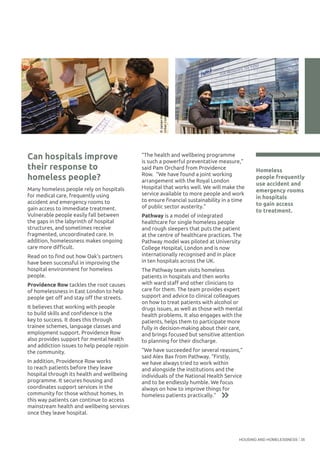
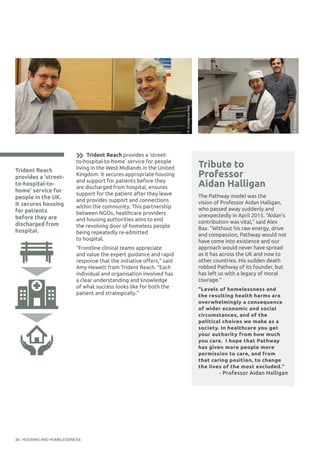
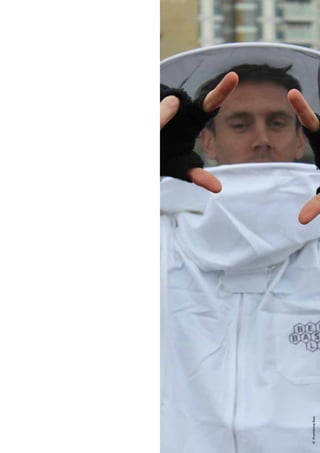
  • 55.
    ISSUES AFFECTING WOMEN54 What’snext Former Minister Valentina Buliga has said that Moldova is currently in the process of strengthening the legal processes and frameworks surrounding domestic violence. Key priorities for the coming years include improving current legislation by: introducing restraining orders (including against stalking); making it a criminal offence to violate protection measures; signing and ratifying the Istanbul Convention (a Council of Europe convention against domestic violence); increasing public funds for the extension of services and programmes for both victims and perpetrators of domestic violence; and setting up a special department to coordinate the implementation of public policy in preventing and combating domestic violence. In addition, Casa M developed an internal data collection system to track and monitor its work and is able to demonstrate its achievements. “Our great success is that 62 per cent of the women and children who have come to our shelter have left and are now living a life without violence,” said Ms. Burca. Building a strong coalition In addition to helping individual organisations, Oak supported the creation of the National Coalition “Life Without Violence” in 2012. Led by Angelina Zaporojan-Pirgari of the WLC, the coalition is made up of 17 members which work together to: advocate for stronger legislation; create service standards and improve services; build individual organisations’ capacity; and increase public awareness around domestic violence. “The Coalition has enabled us to develop a platform for dialogue and learning. We received capacity-building support from organisations in Austria, Russia and the United States among others, showing us that we can make a difference when we work together and speak with one voice.” - Angelina Zaporojan-Pirgari Women’s Law Center “We have the political will to continue reforms on this and we will work on this issue because we want to have a society without violence.” - Liliana Palihovici Liberal Democratic Party According to Liliana Palihovici of the Liberal Democratic Party, the number of domestic violence cases has, in recent years, been increasing. This is because more people are talking about the issue and women are more actively seeking help to get out of domestic violence situations. “There is so much that can be done and with the dedication and perseverance of the leaders in these organisations, I have no doubt that change will continue to happen,” said Florence Tercier, director of Oak’s Issues Affecting Women Programme. Oak will continue to support domestic violence organisations to improve the quality of services for victims and their access to justice, and to address the root causes of intra-familial violence in Moldova. This will be done by: investing in initiatives that create awareness The Coalition has already been successful in implementing changes in domestic violence laws. It helps raise the profile around the issue and advocates for state funding for organisations providing services to victims of domestic violence. Since Moldova began working to strengthen the legal processes and frameworks surrounding domestic violence, more women have been actively seeking help.
  • 56.
    ISSUES AFFECTING WOMEN55 among women and girls of their rights; promoting a “positive masculinities” approach; and offering services to violent and abusive men who want to change their behaviour. In addition, in partnership with a sociological institute, the WLC concluded a survey in Moldova to assess men’s and women’s attitudes and behaviour towards gender equality. The findings of the survey will help consolidate the efforts of Moldovan networks and organisations working on gender equality, domestic violence, child protection and youth. Oak is also supporting the development of the first and only centre for domestic violence aggressors situated in Drochia to build its expertise and deliver a dedicated counselling programme for men who want to take responsibility for their actions and change their abusive behaviour. This service will be connected to the criminal justice system and, over time, should expand nationally. We asked Jette Parker why she chose to invest in Moldova. This is her response: “I received a mail clipping from my friend Linda Carter on the trafficking of women in Moldova.22 “I felt inspired by that article to help women in Moldova who have been trafficked. When Florence Tercier and her team looked deeper at the issue, I was pleased to see that we are helping women victims of domestic violence, one of the root causes of trafficking. “I feel incredibly lucky that I am able to support women’s organisations around the world. When I read an article or hear about something such as trafficking, I have the privilege to do something to help and each year we are able to give more. The Issues Affecting Women Programme is very important to me.” Building a strong coalition to help end domestic violence in Moldova Advocate for stronger legislation Create service standards and improve services Build individual organisations’ capacity Increase awareness around domestic violence
  • 57.
    ISSUES AFFECTING WOMEN56 Interviewwith Jette Parker about the Issues Affecting Women Programme When did you start the Issues Affecting Women Programme? "I started the Issues Affecting Women’s Programme at the very beginning when, as a family, we started the original programmes; however, I had been funding issues related to women before I estab- lished the programme itself. In Denmark, for example, I supported a project called Mother’s Help that focused on young, single mothers. A social worker in Denmark, who spearheaded the project, found that many single mothers were falling through the cracks and didn’t know where to go for help. Mother’s Help created a space where single mothers could find a supportive network and access to public services. I still support Mother’s Help and the staff continue to help many families in Denmark." Why did you start the Issues Affecting Women Programme? "After our initial projects in Denmark and on reading more about the issues affecting women around the world, I decided to form this programme to address more difficult questions and problems. It was the logical next step. It is difficult for single mothers, but it is even more difficult and important to help women who have been trafficked, exploited and abused. The more you learn, the more you realise how much help you can give people." What do you like most about this work? "I feel incredibly lucky that I am able to support women’s organisations around the world. When I read an article or hear about something such as trafficking, I have the privilege to do something to help and each year we are able to give more. I would never be able to do anything without the staff in our programme and at the Foundation. I am inspired by their passion and dedication to improving the lives of people." What do you think about the current programme? "Florence Tercier and her team are good at finding projects around the world that provide important and caring services to victims of violence, while working towards social change, and eradicating violence and trafficking of women. We also support a number of projects through women’s funds that have made a real difference to people as they are able to reach small, local groups. We started small with an idea to improve the lives of women and now we have a well established programme working on very important issues. The Issues Affecting Women’s Programme is very important to me." Is there a project that stands out for you? "It is not always the projects that stand out for me – it is the people that I have met. The most recent person I met was Taiba Rahim. She is the President of Nai Qala Association, which works to advance education and health in remote and neglected regions of Afghanistan. She is truly inspirational. I also feel quite happy that I have been able to support the production of a few documentary films, photo exhibitions and artistic projects to call attention to the difficult issues that these projects address."
  • 58.
    What do youenvision for the future? "It’s hard to imagine in five to ten years where we will be, but when you have the right people, passion and energy, we can make a difference. I can see this in all of our programmes and with all of our staff – passion is what drives us and we are doing a tremendous job." Jette Parker, lead Trustee of the Issues Affecting Women Programme
  • 59.
    ISSUES AFFECTING WOMEN58 Grants 1 AlunaAcompañamiento Psicosocial A.C. USD 150,000 (36 months) To provide core support to Aluna, based in Mexico, to assist civil society organisations facing security challenges and threats. Animus Association Foundation USD 320,000 (36 months) To continue efforts to combat domestic violence in Bulgaria by ensuring that the relevant local structures can implement the National Referral Mechanism and Minimum Standards for protecting women from domestic violence. Association for Women’s Rights in Development (AWID) USD 800,000 (36 months) To provide AWID with core support, enabling it to work more effectively with diverse partners, allies and its broader constituency. CARE Deutschland – Luxemburg USD 163,800 (24 months) To improve living conditions and social inclusion of vulnerable women in Montenegro – who are vulnerable to trafficking because of their poor economic status – through economic empowerment. Catapult USD 850,000 (36 months) To provide core support to Catapult to continue building an innovative digital funding platform to mobilise resources from the corporate sector and global citizens for women's and girls’ rights and to build a long-term organisational sustainability model. Centro Feminista de Estudos e Assessoria USD 450,000 (36 months) To mitigate violence against women's rights activists in Brazil by developing and promoting improved self- care and security strategies, as a response to rising levels of violence and intimidation against women’s rights activists. Common Threads USD 150,000 (36 months) To assist healing for women and girls who are victims of sexual violence during war, conflict, displacement and its aftermath through the Common Threads model, an integrative and sustainable recovery programme. European Network for the Work with Perpetrators of Domestic Violence (WWP) USD 100,000 (13 months) To support the WWP to consolidate as a new formal organisation, in order to develop a shared European standard of practice for working with perpetrators of domestic violence. Focus on Labour Exploitation (FLEX) USD 100,000 (12 months) To provide a planning grant to FLEX, based in London, the UK, to support its sustainable growth as an organisation. Fondo Centroamericano de Mujeres USD 600,000 (36 months) To support the efforts of women human rights defenders in the Meso- american region, ensuring that they have a vehicle to address and reduce the violence they suffer. Fonds pour les Femmes Congolaises USD 150,000 (36 months) To end impunity for crimes committed during the 18-year conflict in the Democratic Republic of the Congo, including crimes of sexual violence, by advocating for the establishment of a transitional justice system. Foro Internacional de Mujeres Indigenas (FIMI) USD 250,000 (36 months) To provide support to FIMI’s Indigenous Women’s Fund, the first fund led for and by indigenous women around the world. Girl Be Heard (GBH) USD 204,683 (36 months) To expand and amplify GBH’s burgeoning youth-led feminist movement by creating theatrical performances inspired by real stories of young women and girls around the world. Global Fund for Women USD 250,000 (29 months) To support the coordination of the Win Win Coalition (which includes women’s funds, research organisations and communications specialists) and its efforts to reach and influence corporate actors. Graduate Institute Geneva USD 54,769 (12 months) To establish a merit-based paid traineeship within Oak’s Issues Affecting Women Programme. Hispanics in Philanthropy USD 98,700 (12 months) To support the Issues Affecting Women Programme to refine its Mexico strategy, assist local grantees to ensure their compliance and support capacity-building needs and processes. International Center for Research on Women USD 365,000 (18 months) To work with private sector companies to raise awareness, improve knowledge and enable them to take action towards improving the quantity and quality of their efforts to empower women and advance their economic status. International Federation for Human Rights USD 378,000 (36 months) To strengthen the contribution of the International Criminal Court in achieving justice for victims of sexual violence and ending impunity for its perpetrators. ©NationalDomesticWorkersAlliance
  • 60.
    ISSUES AFFECTING WOMEN59 This is a list of our grants approved in 2015. For a comprehensive list and full descriptions, please visit our grant database at www.oakfnd.org/grants International Women’s Health Coalition USD 450,000 (36 months) To advance the sexual and reproductive health and rights of women and young people, particularly adolescent girls, in the Global South. Just Associates (JASS) USD 450,000 (36 months) To provide core support to JASS, an international community of activists, scholars and popular educators grounded in local and national action in more than 27 countries, working to strengthen and leverage the voice, visibility and collective organising power of women to create a just world. Las Hormigas USD 150,000 (36 months) To support Las Hormigas to provide psycho-educational and emotional support to vulnerable women, their children and their families in Ciudad Juarez, Mexico. Mama Cash USD 300,000 (36 months) To support Red Umbrella Fund’s grant-making to build the capacity of self- led sex worker organisations to contribute to laws, policies and practices that end the criminalisation, exploitation and trafficking of sex workers. Peacebuilding UK USD 750,000 (36 months) To empower vulnerable girls and young women in Chechnya through an extra-curricular course on life skills. Semillas USD 450,000 (36 months) To provide core support to Semillas so that it continues to contribute to just and equitable social change from a gender perspective in Mexico. TRAG Foundation USD 3,401,037 (36 months) To strengthen women’s movements and women’s civil society organisations in Bosnia and Herzegovina, Serbia and Montenegro through financial and institutional support and capacity building of IAWP grantees by Trag Foundation. WAVE Network USD 300,006 (24 months) To provide advice, research and capacity building support to women’s organisations that provide services to women and children survivors of domestic violence in Eastern Europe. WinVisible USD 214,005 (36 months) To provide core support to WinVisible to uphold the rights of disabled women in the UK to live independently and free from discrimination. Women’s Law Center USD 300,000 (36 months) To improve the overall response to domestic violence in Moldova by strengthening a network of civil society organisations to enable improved coordination, increased capacities and collective advocacy. 1. The Latin American Women’s Rights Service (LAWRS), based in the UK, raises awareness of the services it offers in London. LAWRS offers practical and legal advice, advocacy, information and counselling services to Latin American women. 2. Creating Resources for Empowerment in Action (CREA) is a feminist organisation based in New Delhi, India. 2 ©CreatingResourcesfor EmpowermentinAction
  • 61.
    LEARNING DIFFERENCES60 Learning Differences Inthe Learning Differences Programme, we envision a world where students with learning differences are agents of their own learning success and are supported by educators and environments that expect, embrace and respond to diverse learner profiles. We support teacher development, student engagement and parental understanding to enable students to follow their own individual paths to lifelong learning success. We seek partners who design and create learning environments that are informed by student voices, neuroscience, personalised learning best practices and universal design concepts. ©WilliePetersen/TeachforAmerica
  • 62.
    LEARNING DIFFERENCES 61 16 grantswere made by the Learning Differences Programme in 2015, totalling USD 9.90 million. Find out more at www.oakfnd.org/learning Reflections P 60 and 61: The photos on these pages of the report were provided by Teach for America (TFA), which recruits, develops and mobilises leaders for educational equality. Oak supports TFA to equip more than 50,000 leaders to teach and advocate for students with learning differences. In 2015 the Learning Differences Programme fine-tuned its strategy to better serve students with a wide range of learning profiles to achieve success in public schools and during the transi- tion to, and through, college and other post-secondary opportunities. The revised strategy is based on a set of core beliefs: 1. Each learner possesses a diverse set of cognitive, social and emotional assets, knowledge, skills, interests and preferences. These characteristics interact to form a unique learner profile that changes over time. 2. Students, particularly those with learning differences, can achieve greater academic success when they understand how they learn and use that knowledge to plan for, and adapt to, learning environments. 3. Educators should be prepared for, and have the tools, to respond to diverse learner profiles in order to better serve students with learning differences in general education environments. 4. Parents should have the knowledge to understand their child’s unique learner profile and the tools to advocate for him/her. 5. Education systems should define student success, using accountability frameworks with multiple indicators of academic performance as well as measures of social and emotional wellbeing, persistence and engagement. We envision a world where students with learning differences are agents of their own learning success and are supported by educators and environ- ments that expect, embrace and respond to diverse learner profiles. We support partners who: 1. strengthen teacher capacity; 2. engage students; 3. enhance parents’ knowledge and support; 4. personalise learning environments; 5. build demand; and 6. explore learner profiles. Through these strategies, we will continue our efforts to improve the lives of those with learning differences globally. ©SallyRyan/TeachforAmerica ©Jean-ChristianBourcart/TeachforAmerica
  • 63.
    LEARNING DIFFERENCES62 After Beccaarrived at ECU, she met other college students who learned like her and realised they shared similar, sometimes humiliating, experiences as younger students. So, when an opportunity arose for her to mentor younger students, she took it. She joined Eye to Eye, a near-peer mentoring programme that connects middle school students who have learning differences with college students who also do. Through an arts-based curriculum and based on their own personal experiences, the college students help the middle school children begin to under- stand themselves as learners and develop the confidence and language to talk to others about how they learn. The experience was as transformational for Becca as it was for the children she mentored. “Being around kids who had the same learning differences as me really Engaging the voices of young people with learning differences “For the majority of my life, I hid my learning disability,” said Becca O’Hea, a college senior at East Carolina University (ECU). In middle and high school, Becca’s parents advocated for her so that she received special education services and other assistance at school. Despite this support, Becca did not often share her learning differences with others. “Sometimes when I told people about my learning differences, they would look closely at me, as if trying to see my dyslexia in my face. Or, even more hurtfully, they would say, ‘but I thought you were smart.’” – Becca O’Hea, college senior, East Carolina University ©TeachForPakistan©ElliotHaney/CityYear
  • 64.
    LEARNING DIFFERENCES 63 gaveme the confidence to speak up for myself, too. I couldn’t give them advice and not take that advice myself,” she said. The Learning Differences Programme supports Eye to Eye because it engages young people to share their voices with others – including younger peers, families, educators, policy-makers and the broader culture. Oak Foundation values highly the inclusion of stakeholders in the work it supports. In the Learning Differences Programme, these stakeholders include not only teachers and parents, but more importantly, young people themselves who are experts on living with a learning difference. Engaging young voices to provide feed- back or in the design of a programme can expand people’s understanding of learning differences and wipe out the stigma associated with them. Eye to Eye mentor Stephanie Whitham said “school hurt.” She often felt that asking for the support she needed for her learning difference was a burden to teachers. One even said that she needed to earn it, as if she were a lazy student seeking an easy way out. These false perceptions led some of her teachers to say that she would never graduate from college. Thankfully, she had enough support from her family to encourage her to go to college and there she found Eye to Eye. “Through Eye to Eye, I learned to recognise the strengths I have as a learner,” she said. This experience and the support from her Eye to Eye peers helped her to continue through college: she graduated from the University of San Francisco this year. Eye to Eye sees its main goal as devel- oping a cadre of young leaders who, by speaking out about their learning differences, will change classroom practices, policies and cultural percep- tions. With Becca and Stephanie, Eye to Eye has achieved this goal. Both have gone on to share their experiences in meaningful ways – Becca through the STEPP programme at ECU and Stephanie through Roadtrip Nation. Oak supported both these organisations in 2015 – read on to find out more! In fact, Becca and her friends got so used to sharing their experiences that they arranged to speak with future teachers in the ECU school of education. Through their stories of being misunderstood or demeaned, as well as the transformative experience of having teachers who under- stood them, they hoped these educators would not develop negative mindsets about those who learn differently. Speaking up gave Becca hope. “A lot of students with learning disabilities have had teachers who were not always open to hearing about learning differences: they often seemed defensive. “In STEPP, I met people with learning disabilities who had strong voices. Their friendship and confidence gave me the confidence to speak up, too.” – Becca O’Hea 20% of students with learning differences leave school before graduating in the United States. But this number has dropped from in the last 10 years. 36% East Carolina University The STEPP programme at ECU provides young adults who have identified learning disabilities with the support they need to access college. This helps them transition into and progress through college to graduation. To ensure the programme serves its participants well, STEPP engages students to improve its programme and to share their stories across campus and beyond. Every STEPP participant provides feed- back through surveys and interviews each year. Other opportunities to contribute students’ voices include serving on committees and panels as well as planning events and blogging about experiences on the university’s website. When asked which of these opportunities were most meaningful, the students found value in active engagement (e.g., planning an event), where they could see the real impact of their work on others. One student valued these opportunities to speak up and said “Any time I let my story be heard it may help inspire or guide someone who is stuck.”
  • 65.
    LEARNING DIFFERENCES64 Lashon Amado,a Programme Associate, and a YouthBuild Inc. graduate, has led several youth leadership programmes at YouthBuild Inc. He agrees that youth should be authentically included in shaping programmes that serve them and advises organisations that are trying to engage youth voices to avoid just having them share their stories. “Adult allies need to help develop young leaders, so that they are even more prepared to engage fully in the process and to help them see that they are bringing more than just their story to the table,” he says. For instance, YouthBuild Inc. engages young adults’ voices in a variety of ways to shape the organisation’s programming and influence the broader youth development field. With Oak support, YouthBuild Inc. is refining its post- secondary and career guidance platform, called MyBestBets, to ensure that it works well for all learners. To this end, YouthBuild Inc., with its partner Jobs For the Future, is developing an advisory committee of young people with learning differences to provide user feedback and other input on the design and function of this important resource. More than ©EyetoEye ©ElliotHaney/CityYear 25% So when I saw how open these future teachers were to hearing our stories, it was really inspiring. Hopefully they will remember what we shared when they have a student like me in their classroom,” she said. Becca’s experience at STEPP has allowed her to grow more knowledgeable about the way she learns and to become more confident in sharing her story. “My learning disability has even shaped my career plans,” she said, “I am going into school psychology, so I can help others who learn like me.” YouthBuild Inc. YouthBuild Inc. is an international organisation that provides opportunities for young adults who are not connected to school or work to complete their education, gain the skills they need for employment and become leaders in their communities. A core piece of this process is helping these young people reclaim their voices. “Many young leaders have said that they sometimes experience inauthentic efforts from organisations, schools, and adults who ask them to share their stories. Young leaders quickly and deeply recognize when their voices and opinions are truly heard,” said Scott Emerick, Senior Vice President of Education, Career and Service Pathways at YouthBuild Inc. of students who have learning differences struggle with their transition into adulthood after secondary school, compared to only 12% of their peers. “We have learned that we need to help these young adults realise that they are the ones who have changed their lives for the better – not YouthBuild or any other programme – and that this gives them the expertise to be an asset to their community or on a committee.” – Scott Emerick, YouthBuild
  • 66.
    LEARNING DIFFERENCES 65 NationalCenter for Learning Disabilities Unfortunately, not all schools or organisations seek input from students who learn differently in the way that Eye to Eye, Project STEPP and YouthBuild do. Students with learning differences are often not asked directly for their insights or opinions and many programmes and resources are designed for them and not by or with them. This limits how effective these programmes can be in helping students with learning differences. To begin to fill this gap, Oak supported the National Center for Learning Disabilities (NCLD) in 2013 to survey 1,200 young adults. More than two- thirds of respondents had identified or unidentified learning differences. This survey revealed insights into the impact of living with a learning difference not only on academic performance, but also in terms of social emotional development, self-confidence and connections to peers and community. For example, while some young adults who learn differently are thriving, many are struggling to continue their education, find a job or become more independent. The survey revealed that these struggling young adults did not usually have the three key experiences earlier in life that are drivers of a successful transition into adulthood. These drivers include having supportive parents who understand their learning differences, developing real connections to their peers and community, and finding ways to build self-confidence – through sports, mentoring or leadership, for example. This year, NCLD made the data publically available to inform programme design and resource development across the globe. NCLD is using this invaluable survey data to shape its own strategic planning process and programmes for young adults. This helps ensure that the young people who shared their voices through the survey make an impact. Roadtrip Nation Stephanie, the Eye to Eye mentor from San Francisco, was facing a big, blank space ahead of her as college graduation approached. She had many years of experience figuring out how to be a student, but now needed to learn how to be successful in a career. “It was a scary time,” she said. The same week of her graduation, she was given the opportunity of a lifetime when she was chosen as one of three young adults to be on the Being Understood Roadtrip through the organisation Roadtrip Nation. Stephanie and two other young adults who have learning differences – Noah and Nicole – drove across the US to interview two dozen people with learning differences who have aligned their careers with their passions. Before the trip, Stephanie was worried that she might not be able to find a job she loved because she learned differently. "Interviewing these people who found great careers helped me realise that it wasn't about me fitting into a career, but about finding a career that fits me," she said. Programmes to help students with learning differences are more effective when students’ opinions and insights are taken into account. ©RoadTripNation ©RoadTripNation
  • 67.
    LEARNING DIFFERENCES66 Although Stephaniebegan the trip feeling like she could see the positive aspects of her learning differences, she still never felt fully comfortable with having a learning difference. “Twenty- two years was a long time not to feel okay about something that is an integral part of me,” she said. But the Being Understood Roadtrip allowed her to see the country, learn about herself and meet some inspiring people which “was one of those moments in life when you get the chance to feel like everything is going to be OK,” she said. “As a post-college graduation adult, that is a huge, huge blessing.” “I knew from working with Eye to Eye that there were incredible people who learned like me. But I had no idea how many were so incredible because of their learning differences! I want more people to know about that!” - Stephanie, Eye to Eye mentor Stephanie’s experience shows the transformative impact of community. Meeting others who had learning differences and who could share their advice helped her feel like she could move forward in life with confidence. Roadtrip Nation will share Stephanie, Noah and Nicole’s experiences by creating a documentary of the trip that will air on public television. In addition, the interviews will be included in an online archive for people seeking advice on how to turn their interests into careers. Stephanie is thrilled these will be broadly shared. As these Oak-supported projects show, empowering youth and young adults to share their voices can improve programme design, strengthen education systems, change cultural perceptions of those who learn differently and ultimately, help young people change how they see themselves and interact with the world. ©SallyRyan/TeachForAmerica
  • 68.
    LEARNING DIFFERENCES 67 Grants Thisis a list of our grants approved in 2015. For a comprehensive list and full descriptions, please visit our grant database at www.oakfnd.org/grants Branching Minds USD 425,000 (24 months) To provide core support to Branching Minds, a start-up company in New York City, in developing a web-based tool designed to help teachers, parents and students under- stand, respect and support individual learners. Center for Curriculum Redesign USD 75,000 (12 months) To explore the feasibility of establishing and supporting an international consortium for the research and development of new assessments in skills, character and meta-cognitive competencies. City Year USD 792,720 (36 months) To establish a “School Design Division”, through which City Year will develop, test, refine and disseminate new practices for use in schools supported by AmeriCorps members. College Advising Corps (CAC) USD 675,000 (36 months) To support CAC in guiding young people with learning differences in applying and enrolling in college. Culwell Consulting Group LLC USD 50,000 (5 months) To support Philanthropy Futures to accelerate the Learner GPS initiative so that students with a wide range of learning profiles achieve success within public primary schools. Digital Promise Global USD 1,500,065 (18 months) To develop guidelines and support cross-sector networks to understand and plan for all learners. East Carolina University USD 660,109 (60 months) To support students with learning disabilities to enroll in and graduate from East Carolina University. Eye to Eye National Inc. USD 1,000,000 (48 months) To provide core support to Eye to Eye, a US-based mentoring organisation that pairs young adults who have learning disabilities and/or attention deficit disorders with middle school students who also have these learning differences. National Center for Learning Disabilities (NCLD) USD 500,000 (12 months) To support NCLD’s operation of Understood.org, a comprehensive online re- source in the United States for parents of young people with learning differences. New Schools for New Orleans USD 620,000 (36 months) To support New Schools for New Orleans’ investments in the design and launch of a Special Education Coordinator Fellowship and exploration of using learner profiles in personalised learning. Roadtrip Nation USD 300,000 (24 months) To send a group of students with learning and attention issues on a roadtrip to interview leaders from all backgrounds who have defined their own roads in life, despite having had a learning or attention issue. Teach For All USD 1,500,000 (36 months) To provide core support for Teach For All to increase and accelerate the impact of network organisations around the world in expanding educational opportunity for disadvantaged students. Teach for America (TFA) USD 225,000 (12 months) To support the planning process for TFA's diverse learners initiative, in order to strengthen its efforts to develop corps members into educators and advocates for those who learn differently. ©JeffLevick/TeachforAll ©ElonUniversity/ItTakesaVillageProject Teach for America (TFA) USD 450,000 (36 months) To provide core support funding to TFA’s Eastern North Carolina region. Universal Design for Learning Implementation and Research Network (UDL-IRN) USD 100,000 (12 months) To support the UDL-IRN, based in Kansas, the United States, to build a sustainable organisation with a global network to disseminate models of best practices on the implementation of Universal Design for Learning principles in schools. YouthBuild Inc. USD 1,025,000 (36 months) To support YouthBuild on two related strategies to improve the educational and career outcomes for individuals with learning differences. The photographs in the LDP section of this report have been provided by LDP grantees and illustrate diverse teaching practices and learning environments around the world.
  • 69.
    SPECIAL INTEREST68 Special Interest TheSpecial Interest Programme reflects the Trustees’ interest in making dynamic, diverse, large, innovative and challenging grants. We are committed to remaining flexible and to seizing opportunities as they arise. Special Interest grants cover a wide range of fields, including health, humanitarian relief, education and the arts. They are made to organisations whose activities the Trustees wish to support, irrespective of country or region. 1 ©TaibaRahim/NaiQalaAssociation
  • 70.
    SPECIAL INTEREST 69 Stories Thestories within this section represent the diverse range of grants within the Special Interest Programme. Establishing sustainable schools in Afghanistan Located in central Asia with Iran to the west and Pakistan to the east, Afghanistan is about the size of Texas. High mountains with treacherous peaks and dry deserts make up most of its landscape. Extreme weather means that the winters are very cold and the summers extremely hot. Outside of the capital Kabul, it can take several days to get to some villages. In remote areas, basic infrastructure such as roads, schools and hospitals simply does not exist. It is against this backdrop that the children of Afghanistan try to get an education as best as they can. Hundreds of schools are officially registered by the state in Afghanistan but have no proper building to house them. Children study under the shelter of torn tents in the ruins of what once was a school, or even in the open, unprotected from the harsh sun, the rain and the wind. “In spite of these bad conditions, the children and their parents are strongly committed to education,” said Taiba Rahim, President of Nai Qala Association, which works to advance education and health in remote regions of Afghanistan. Nai Qala believes that improving access to education and health is crucial to the Afghan people’s future. “As the regions we work in are very difficult to reach, it takes courage by all involved to believe that a school or clinic can actually be built in these regions,” said Taiba. “Transporting building materials is hugely challenging and the construction team and staff live for months under Find out more at www.oakfnd.org/specialInterest 55 grants were made by the Special Interest Programme in 2015, totalling USD 66.89 million. 2 3 “I quit school two years ago because the classroom had no roof. The condition of the school on the dusty ground under very hot sun, and also in the rain, became unbearable. So instead I helped my family by looking after the sheep and going to the mountain to collect firewood for cooking. It was very tough.” - Shirinne, aged 15 ©TaibaRahim/NaiQalaAssociation ©TaibaRahim/NaiQalaAssociation 1. & 2. Children in remote parts of Afghanistan often attend school in makeshift tents or in the open air. 3 . Oak Foundation supported Nai Qala to build a school (such as the one featured in this photo), in Zeera Gag village in the district of Panjab, Bamyan, Afghanistan in 2015.
  • 71.
    SPECIAL INTEREST70 An additional 100girls and boys registered for school in the village of Zeera Gag in Afghanistan when the construction of the school began. “The implementation of the project is progressing according to plan,” said Taiba. “Already its impact is being felt: the number of children registered for school next year has gone up, with 100 additional girls and boys registered.” Fifteen-year old Shirinne, mentioned earlier in this article, is one of the students who dropped out of school two years ago due to poor conditions. “This year I heard that a lady came to our village and talked about the possibility of building a proper school for children,” she said. “My father told me this news and went with me to the school to register me. This makes me both happy and hopeful. My father says I must study to become someone who can help our people.” Oak is delighted with this news and proud to be able to support the Nai Qala Association. 1. Hundreds of schools are officially registered by the state in Afghanistan but have no proper building to house them. Many children, such as those shown in this photo, attend school in makeshift tents or in the open air. 2. & 3. Learning Outside, based in North Carolina, the United States, offers children of all ages the chance to experience and learn about the out- doors, enhancing their lives and giving them a love for the natural world. difficult conditions.” Nai Qala works with the communities to help them take ownership of the building projects. The men in the villages work to clear roads so that the trucks, motorbikes or horses and donkeys transporting the materials can access the villages. In addition, both the men and women earn salaries to help in the construction of the school – the men for the building work and the women for preparing lunches and dinners for everyone involved. “This money helps lift the villagers out of poverty,” said Taiba. “With their joint salaries the families buy additional livestock which they can breed to sell. This helps them to work towards a sustainable, brighter economical future.” “It is two months that I am working on the project to build the school,” said villager Hussain Ali. “In such a remote and isolated region it’s very challenging to have a decent income, but now I am earning money every day. I have managed to buy clothes for my children, and a year’s worth of food and grass for my sheep. I have never had such an income.” Nai Qala was founded in 2007 and has successfully helped build six schools and one clinic in the Ghazni and Bamiyan provinces in central Afghanistan so far. Oak Foundation supported Nai Qala to construct several schools and one clinic, including a school called Zeera Gag in the district of Panjab, Bamyan in 2015. This new school has eight classrooms and will house more than 520 students and 14 teachers. Fully-equipped, it runs off its own electricity supply and has a library of books and study equipment to prepare students for university. ©TaibaRahim/NaiQalaAssociation 1
  • 72.
    SPECIAL INTEREST 71 “Thechildren learn to respect and trust each other. Through nature, children learn how to collaborate, pursue things that interest them and even teach other children what they learn.” - Wendy Banning, Director, Learning Outside Research confirms that children need to spend time outdoors exposed to fresh air, sunlight and natural elements such as trees and grass if they are to be healthy as they grow and develop. In addition, if children have regular opportunities for free and unstructured play outdoors, they are smarter, happier, healthier and get along better with others. However, playing outdoors in a healthy environment might not be possible for children who live in built-up areas – heavy traffic, pollution or a lack of green places to play in, among other things, can prevent this. That is why Learning Outside focuses on children who do not have ready access to opportunities to learn and explore the outdoors. Oak has been supporting the Learning Outside programme since 2011. The aim of the current grant is to develop the organisation’s outdoor learning programmes and help ensure its financial stability. Children who play outdoors regularly are smarter, happier, healthier and get along better with others. Helping children form connections with the natural world When children have a chance to discover nature hands-on, their natural curiosity helps ignite their innate desire to learn. This is the belief of Learning Outside, a farm situated at Triangle Land Conservancy’s Irvin Nature Preserve in North Carolina. It encompasses 269 acres of pasture, forest and wetlands and offers nature courses to children of all ages. It believes that people learn and experience the world around them differently in natural settings, which is why discovering nature first-hand leads to happier, more successful learning experiences for children both at home and at school. Learning Outside offers children the chance to experience and learn about the outdoors, enhancing their lives and giving them a love for the natural world. Courses take place throughout the day for different age groups, and there are also camps during the school holidays. Learning Outside’s approach integrates the arts, sciences and humanities with outdoor learning. Experienced and knowledgeable naturalists, educators and artists lead the programmes which are held entirely outdoors, regardless of the weather. As well as cultivating a sense of steward- ship for the environment among its students, Learning Outside’s programmes also emphasise community-building and good interpersonal relationships. 3 ©VirginiaRuan/OakFoundation ©VirginiaRuan/OakFoundation 2
  • 73.
    SPECIAL INTEREST72 Supporting vulnerable childmigrants Unaccompanied migrant children have been arriving in the US in increasing numbers over the past ten years. Recently these figures have grown to such a degree that the US President has deemed the situation a ‘humanitarian emergency’. In 2012 the number of unaccompanied children migrating across the border from South and Central America was about 24,000. By 2014 that number had almost tripled to more than 68,000.23 Just what is fuelling this mass exodus? A new US Department of Homeland Security report has attributed the problem to poverty and regional violence in South and Central American countries, particularly Guatemala, Honduras and El Salvador, where rates of homicide are extraordinarily high. The report shows that many of the unaccompanied minors come from some of the most dangerous cities in Central America and often they are fleeing violence.24 These children have undertaken dangerous journeys of thousands of miles to travel to the US without their parents or guardians in the hope of a better life. Some have one parent they wish to join already in the country. Approximately 73 per cent are male and 27 per cent are female. Some 24 per cent of these children are below the age of 14.25 The United States Committee for Refugees and Immigrants (USCRI) works to protect the rights and address the needs of persons in forced or voluntary migration worldwide. It helps newly- arrived refugee families in practical ways, for example in finding and furnishing their first apartments, mastering the public transportation system, enrolling their children in school, finding a doctor, learning English and obtaining employment. It provides legal aid and it also assists refugees during the challenging process of overcoming past trauma and grief by helping them develop new support systems in America. “Since 2011 we have seen a great need for an increase in mental health and legal services. There has been a decrease in state funding that assists uninsured or underinsured people in this state.” - Amy Schafer, Programme Officer, USCRI However, there are barriers, both linguistic and financial, to child migrants accessing the legal and mental health services they need. In addition they often do not know how to navigate the system. “The level of care that most of our clients needs is high,” said Amy. “Often they’ve suffered trauma, abuse – some have been in psychiatric inpatient centres. We also have many sexual assault victims, females especially.” Oak’s grant to USCRI will help it to supply these much-needed services. “This grant will help offer bilingual mental health and legal services and I think it’s going to benefit a lot of children who are not being served, who have experienced a lot of difficulties in their lives,” said Lena White, a case manager and home study worker with USCRI. “Without putting a financial burden on their families, these children will be able to get the visas and the legal status that they qualify for.” It is hoped that this will help increase the children’s sense of security, giving them hope for a brighter future. Over the next two years, USCRI will hire clinicians, programme managers, lawyers and legal assistants. All will be bilingual (English and Spanish speaking) and able to supply the children with the services they need. Many unaccompanied child migrants have suffered great trauma in their home countries and on their journeys to the US. Having witnessed violent acts being carried out against their family and friends, or having experienced them first-hand, many need specialised mental healthcare services to address post-traumatic stress disorder and other mental health concerns. In 2014 some unaccompanied children migrated across the border from South and Central America to the United States. 68,000
  • 74.
    SPECIAL INTEREST 73 Believingin the profound strength of every individual, GSS works with each young person to help him or her identify and build on their inherent abilities. “Every day is a blessing here. Even with the most troublesome kid, it’s still a blessing to know that that kid just wants to be around me and there’s something I can give to that child... it’s a very rewarding feeling.” - Woody Bien-Aimé Director at Red Hook Community Center Beacon in Brooklyn centres and schools for teenagers who have fallen behind in regular high schools. By providing at-risk youth with the support they need, they can build strong connections to their families and other caring adults, to their schools and to their communities. These connections create a powerful sense of belonging. From this foundation, young people are able to tap into their rich potential, overcome challenges and realise their dreams for a better future. 2 Creating a sense of belonging in New York Many children who grow up in parts of New York City can face tough odds in their journeys to adulthood and independence. They most likely attend overcrowded public schools where far more students fail than pass. Some lack strong family support and may have experienced abuse and emotional or physical neglect. They live in high-stress neighbourhoods, where poverty, substance abuse, violence and criminal behaviour are commonplace. This can be hard on youth, which is reflected in the figures: according to Good Shepherd Services (GSS), one in six young people between 16 and 24 in New York City are neither in school nor at work. GSS works directly with communities in New York City. It operates more than 80 programmes which help nearly 30,000 children, youth and families each year. “GSS gives young people who often don’t have opportunities the chance to shine and build lives for themselves,” said Jennifer Zanger, the Brooklyn Division Director of community-based programmes in Red Hook and Gowanus. “That includes them finding satisfying careers, and a sense that they can really impact things in the world.” Starting out as the Sisters of the Good Shepherd in 1857, GSS has a long history. In its early years it focused on caring for troubled young women and in the early 1970s it broadened its work to provide services to vulnerable families. These include afterschool services, group homes for young people who can no longer live with their families, family counselling In New York City, young people between 16 and 24 are neither in school nor at work. 1 in 6 ©RachelMcKee/OakFoundation 1 1. STEM Instructor Royal Isaac at Red Hook school in Brooklyn teaches a GSS after-school class. 2. GSS students celebrate graduation at South Brooklyn Community High School, New York City. ©RachelMcKee/OakFoundation
  • 75.
    SPECIAL INTEREST74 Using technology tostop poaching It is estimated that tens of thousands of elephants are killed every year for their ivory. Once transported to countries in Asia, the tusks are usually shaped into ornaments and trinkets. There is also a huge demand for rhinoceros horn and tiger skins and parts, often used in traditional medicine. Demand for these animals is so great that illegal poaching now threatens the survival of some species. Poaching is recognised as among the five most lucrative transnational criminal activities,26 with major poaching rings operating in many important and well- known national parks. This illegal killing and trade of some of the world’s most iconic species has become one of the greatest threats to global conservation. The Royal Foundation of The Duke and Duchess of Cambridge and Prince Harry (The Royal Foundation), based in London, is working to combat the illegal poaching and trading of endangered species around the world. Advances in technology represent an opportunity to combat poaching and illegal wildlife trade and ultimately, to increase the populations of a number of endangered species. A spatial monitoring and research tool (SMART Connect) is designed to help rangers with surveillance and monitoring activities to strengthen site-based protection. It is being implemented in national parks globally. In partnership with Oak, The Royal Foundation will implement and upgrade technologies such as SMART Illegal poaching is recognised as one of the five most lucrative transnational criminal activities, with major poaching rings operating in many well-known national parks. The staff are passionate about their work. They also all grew up in the communities themselves, so can identify with the children and youth. “If they don’t have us, sometimes they don’t have anyone,” said one GSS teacher. “So there’s not really an option anymore. We have to be there for them.” GSS offers a “Ladder to Leaders” programme which provides young people the chance to contribute back to their communities by working with GSS, including through paid work during the summer months. It teaches children from a young age how to be successful in life and reach their full potential. “The longevity of service in the GSS afterschool world is quite unique,” said Jennifer. “Often we know our participants from when they are six years old until 25 years later, when they become directors in our programmes.” “I believe that they love the fact that they can grow up in the programme as participants and then get their first work experience with us,” said Laura Greene, Senior Programme Director at Red Hook. “Participants are always coming back – looking for jobs – as well as just saying thank you, once they are in college. We have a number who participate in the evening centre as a way of giving back to the community that they come from ... so I do believe they enjoy it.” Over the next five years, GSS will work on deepening services and expanding opportunities for children, youth and families in the high-poverty communities of Red Hook, East New York and Bedford- Stuyvesant in Brooklyn and the central Bronx. Oak Foundation is delighted to be able to support this work. ©SebastianTurner/OakFoundation ©SebastianTurner/OakFoundation
  • 76.
    SPECIAL INTEREST 75 Connectin two important conservations sites – one in Nepal and the other in the Republic of the Congo. In the Parsa Wildlife Reserve in Nepal, The Royal Foundation’s on-site partner the Zoological Society of London will strengthen surveillance and communication support systems for anti-poaching operations with SMART Connect. The result will be a greater capacity to respond to wildlife incidents in real time, preventing tiger deaths from poaching and enabling law enforcement agencies to collect evidence, such as photographs, to be used in prosecuting wildlife criminals. “We have been trained in SMART data collection and GPS handling,” said Sailendra Raj Giri, monitoring and surveillance officer at the Parsa Wildlife Reserve. “This technology has been very useful and we are in the process of introducing it to set up a Rapid Response Mechanism to stop all the illegal activities and make Parsa Wildlife Reserve a safer home for wildlife.” While the focus is on tigers in Nepal, other species such as Asian elephants, leopards and gaur (also known as the Indian bison) will also benefit from the added protection. In the Republic of the Congo, The Royal Foundation’s on-site partner the Wildlife Conservation Society works with local staff to provide SMART technology. By upgrading existing technologies to SMART Connect, which offers more protection, rangers will have the technology they need to alert law enforcers when they come across poachers. Given the size of the national parks in the Republic of the Congo, the implementation of SMART Connect will rely on satellite tracking devices and will primarily be used to help rangers prevent elephant poaching. The Nouabale-Ndoki National Park is an enormous park in the north of the Republic of the Congo, stretching across more than 3,900 square kilometres and mostly comprised of tropical rainforest. There are no people living in the park and the impact of this surge in poaching had, until recently, been restricted to the park’s outskirts. However, the discovery of an elephant’s carcass close to the national park’s headquarters in February 2015 revealed a major poaching ring operating in the area. SMART Connect will be rolled out and once it is up and running, Nouabale-Ndoki National Park can be used as a pilot site for roll-out in other locations. “We are really excited about the impact of implementing SMART Connect in conservation parks in Nepal and Republic of the Congo,” said Sian Bartram, director of development at The Royal Foundation. “We are sure it will make a difference to our conservation efforts and we hope we will be able to help park rangers keep endangered animals safe.” SMART Connect is designed to help rangers strengthen site- based protection of national parks. 1 The photos on these pages of the report illustrate the work of The Royal Foundation of The Duke and Duchess of Cambridge and Prince Harry. The Foundation works to combat the illegal poaching and trading of endangered species globally. ©TheRoyalFoundation ©SebastianTurner/OakFoundation
  • 77.
    SPECIAL INTEREST76 Grants Association NaiQala USD 341,280 (7 months) To support the construction of a public school in the village of Zeera Gag in the Bamyan Province of Afghanistan. Big Brothers Big Sisters of America USD 300,000 (24 months) To develop a training module that educates families on keeping children safe from potentially traumatic experiences and relationships. Book Harvest USD 500,000 (60 months) To support Book Harvest in building a pipeline of books for low-income children that starts at birth and continues through elementary school. Campaign for the Fair Sentencing of Youth USD 375,000 (36 months) To coordinate efforts to implement fair, age- appropriate sentences for youth in the US, with a focus on abolishing life without parole sentences. CARE USA USD 1,268,177 (36 months) To establish community governance models in the north, east and central provinces in Sri Lanka among communities which have been marginalized through poverty, civil conflict and discrimination. Center for Child and Family Health USD 300,000 (36 months) To define, practice and disseminate the highest standards of care in preventing and treating childhood trauma in Durham, North Carolina. Chapel Hill-Carrboro Public School Foundation USD 200,000 (48 months) To provide support to Project Achieve to teach high school students with intellectual and developmental disabilities in Chapel Hill, North Carolina the skills needed to transition to independent adult living from school. Cherie Blair Foundation for Women USD 386,128 (25 months) To empower women entrepreneurs in communities in north and south Palestine, providing them with the tools and skills needed to grow profitable and sustainable businesses that are market- oriented, scalable and facilitate job creation. Children & the Arts USD 312,000 (36 months) To engage more than 9,000 children from schools and hospice care in arts programming in the UK. Community Empowerment Fund USD 180,000 (36 months) To cultivate opportunities, assets and communities that support the alleviation of homelessness and poverty. Courtauld Institute of Art USD 161,165 (18 months) To support the full-time appointment of Dr Rebecca Arnold as Lecturer in the History of Dress and Textiles at The Courtauld Institute of Art in London. Courtauld Institute of Art USD 3,200,000 (60 months) To renovate the Courtauld Institute of Art in London so that it is fit for purpose as a leading art gallery and academic institution. Courtauld Institute of Art USD 589,402 (36 months) To support the Courtauld’s Young People and Galleries Programme, which offers students from low socio- economic backgrounds in London greater access to art, art history and expertise available from this leading academic institution. Durham’s Partnership for Children USD 300,000 (36 months) To establish the Early Childhood Training Institute to help create an environment in Durham, North Carolina in which young children are raised in healthy and supportive families. Ecole Polytechnique Federale de Lausanne USD 781,250 (36 months) To understand the link between stress and pathological aggression from a physiological and neuro-physiological point of view in order to develop effective treatments for individuals showing highly aggressive behaviours. El Futuro Inc. USD 500,000 (48 months) To provide bilingual and culturally informed behavioural health treatment for under-served Spanish speaking individuals and families in North Carolina, US. Foraelder Fonden USD 2,458,027 (16 months) To construct a new student hall of residence for vulnerable single parents in Copenhagen, Denmark, including 12 small apartments and a number of common facilities. Friends For All Children USD 300,000 (36 months) To support needs-driven projects to improve the lives of the poor and marginalised in Cambodia, Vietnam, Thailand and Burma. Friends-International Suisse USD 312,500 (36 months) To educate Swiss and European audiences about child abuse. ©VirginiaRuan/OakFoundation ©RachelMcKee/OakFoundation
  • 78.
    SPECIAL INTEREST 77 GoodShepherd International Foundation ONLUS USD 200,829 (36 months) To promote skills training and entrepreneurship activities with Dalit and Tribal women in five different communities in India. Good Shepherd Services USD 5,000,000 (60 months) To help Good Shepherd Services support children, youth and families in New York City who face the greatest challenges and build on their strengths to help them gain skills for success. Guiding Lights USD 263,500 (34 months) To support a comprehensive caregiver support centre for family and professional caregiving in North Carolina, US. Harlem Children’s Zone (HCZ) USD 250,000 (1 month) To provide core support to HCZ, based in New York City, which offers programmes and services to more than 12,000 children and their families each year. Havens Hospices USD 405,710 (36 months) To support the construction of a new Fair Havens’ adult hospice in Essex, the United Kingdom, to increase the number of patients benefitting from Fair Havens’ services. International Anti-Poaching Foundation Inc. USD 300,102 (12 months) To disrupt poaching activities in Mozambique's Greater Lebombo Conservancy (GLC) which forms the eastern boundary to Kruger National Park and up to 40 per cent of the worlds remaining rhino. Josh’s Hope Foundation USD 230,000 (48 months) To work with young adults in North Carolina who have serious mental health conditions to improve their outcomes in employment and independent living, while reducing the risk of homeless- ness, incarceration and suicide. Keeping Children Safe USD 1,890,240 (46 months) To provide core support to Keeping Children Safe to advocate for the adoption of international standards on child protection measures and to help Oak Foundation deliver on its own Safeguard- ing Children Policy. Laurel House Inc. USD 250,000 (24 months) To support the development of a website (www.rtor.org) that guides, supports and provides best practice resources for recovery- oriented mental healthcare. Let’s Breakthrough Inc. USD 300,000 (24 months) To uproot long-standing norms and values that condone or encourage sexual violence on US college campuses. Médecins sans Frontières Suisse USD 2,500,000 (12 months) To support Médecins Sans Frontière’s humanitarian operations aiding refugees and internally displaced people – particularly women and children – in Syria, Lebanon and Iraq. Modrehjaelpen (Mothers’ Aid) USD 1,016,949 (36 months) To expand counselling and treatment efforts for single mothers, pregnant women and other vulnerable families in Denmark. North Carolina Museum of Life and Science Inc. USD 300,000 (24 months) To change the way children and families discover nature and earth sciences through nature play and science, technology, engineering and math. Persephone Productions Inc. USD 194,000 (12 months) To produce and air a docu- mentary to raise awareness among Americans about the harms of institutional care (such as orphanages) on children. Raleigh International USD 250,000 (14 months) To promote environmentally- friendly sustainable develop- ment in Nicaragua and Tanzania by supporting youth-led grassroot activities. Red Barnet (Save the Children Denmark) USD 338,983 (12 months) To provide conflict-affected children, youth and their families in a besieged area in north-east Syria with a safe space to access psychological support. ©RachelMcKee/OakFoundation ©VirginiaRuan/OakFoundation The photos on the grant pages of the Special Interest section of the report illustrate the varied work supported by the Special Interest Programme. Work supported by this Programme covers a wide range of fields, including health, humanitarian relief and education.
  • 79.
    SPECIAL INTEREST78 Royal Foundation ofthe Duke and Duchess of Cambridge and Prince Harry USD 478,571 (12 months) To implement new technology which will help wildlife rangers with surveillance and monitoring activities, thereby strengthening their protection of endangered species including rhinoceroses, elephants, big cats and pangolin in the Republic of the Congo and Nepal. Save the Children Fund USD 2,500,000 (12 months) To improve access to quality education services, child protection and psycho- social support services in Syria and the surrounding region for children affected by the conflict in Syria. Save the Children Fund USD 800,000 (60 months) To tackle the link between social disadvantage and fewer life chances for children in poor areas of the UK. Self-Help (Center for Community Self-Help) USD 1,500,000 (24 months) To create and protect ownership and economic opportunity in the US by helping single mothers break out of economic hardship by making homeownership more affordable. Stichting BirdLife Europe USD 444,868 (36 months) To reduce illegal bird killing and trapping in Italy, Cyprus and Malta by supporting Stichting BirdLife Europe. Student U USD 1,000,000 (60 months) To provide a full continuum of services for economically disadvantaged students in Durham Public Schools in North Carolina – beginning in sixth grade – to successfully graduate from high school and college. Swiss Philanthropy Circle USD 288,525 (12 months) To enable Swiss Philanthropy Circle to bring together likeminded philanthropists in Switzerland to have a greater collective impact on issues of shared concern, including increasing awareness around the positive contribution immigrants make to Switzerland. Swiss Philanthropy Foundation USD 2,295,000 (36 months) To promote innovative collabo- ration among individuals and institutions, support bold and results-oriented grant-making and provide a trusted platform for new philanthropic invest- ment in new economy issues. The Joint Committee of Girl Guides in Denmark (PFD) USD 135,593 (12 months) To develop a model, template and implementation procedure for Girl Guides and Girl Scout organisations in Asia Pacific and Africa by deploying the Women At Work And Children At School entrepreneurship programme combined with volunteer activities. The Resource Alliance USD 634,635 (36 months) To improve the effectiveness of civil society organisations to bring about social change. The Royal Opera House USD 20,981,422 (120 months) To identify and nurture out- standing young professional singers, conductors, répétiteurs and directors, through the Jette Parker Young Artists Programme, to ensure that the supply of talent in opera is maintained at the highest level. The Walking Classroom Institute USD 75,000 (5 months) To help improve the physical, mental and academic health of children by establishing and maintaining healthy lifestyle habits. The Yehudi Menuhin School USD 800,000 (60 months) To enable exceptionally talented young musicians, regardless of race, creed or financial background, to attend a specialised music and academic programme at the Yehudi Menuhin School in the United Kingdom. Thorn USD 300,000 (36 months) To conduct research and develop technology to help combat the sexual abuse and exploitation of children on the internet. Tivoli A/S USD 183,150 (36 months) To support the Queen Ingrid Honorary Grant in 2016 and 2018 – in honour of the late Queen Ingrid of Denmark. United Way of the Greater Triangle USD 150,000 (24 months) To create a regional system leading to the self-sufficiency of at-risk youth in communities in North Carolina. University of Oxford USD 2,000,000 (60 months) To contribute to the next generation of researchers in the field of infectious diseases by supporting four outstanding scientists in the early stages of their careers in Nepal, Vietnam, Zimbabwe and Kenya. University of Oxford USD 4,000,000 (72 months) To support the development of new therapeutic approach- es for multiple sclerosis, at the University of Oxford, in the United Kingdom. US Committee for Refugees and Immigrants USD 1,000,000 (24 months) To ensure long-term safety and stability in the lives of 600 unaccompanied children in North Carolina through comprehensive mental health counselling, direct representation and increased legal capacity building. This is a list of our grants approved in 2015. For a comprehensive list and full descriptions, please visit our grant database at www.oakfnd.org/grants Wildlife Justice Commission USD 865,116 (24 months) To expose, disrupt and dismantle key trans- national wildlife organised crime networks.
  • 80.
    SPECIAL INTEREST 79 SpecialInitiative ©internewsUSA In 2015 Oak Foundation provided five special initiative grants to organisations that build on the values, approaches and mission of the Foundation’s different programme areas in addressing climate change. The main goal of these grants is to advance the urgent call for climate mitigation as part of the 21st session of the Conference of the Parties (COP 21) to the UNFCC, which took place in Paris at the beginning of December 2015. For example, Oak's partner, Internews' Earth Journalism Network, brought 40 journalists to the COP21 from 26 countries to cover the summit. “It is fantastic to be able to bring journalists from all around the world to cover this critical climate summit in Paris,” said James Fahn, executive director of the Earth Journalism Network. In addition, the Earth Journalism Network also published stories of how climate change is impacting people on its website (http://climate.earthjournalism.net/) and launched an innovative platform called OpenEarth.net, which collects regional stories, and eventually data, in one place. It acts as a tool to help journalists cover local stories of environmental change by offering them an understanding of global processes. “With tools such as OpenEarth.net and journalists around the world covering arguably the most important issue of our time, the hope is that we will continue to tackle this and make a difference for future generations,” said Mr Fahn. In 2016 Oak plans to build on this initial investment by establishing a new fund focused on strengthening the adaptive capacity and resilience of communities most impacted by climate change – in particular youth, indigenous peoples and women. Initially, community groups in three geographies – the Bay of Bengal, the Arctic and East Africa – will be targetted. In taking this step, we hope to leverage investments among public and private donors and to build the field of climate resilience, together with our philanthropic partners. The Special Initiative grants reflect Oak Foundation’s wish to contribute to climate justice. Center for International Environmental Law Inc. USD 1,000,000 (48 months) To secure climate justice for those most impacted by climate change. Global Greengrants Fund USD 600,000 (12 months) To increase youth advocacy and organisational capacity worldwide on the urgent issue of climate change. Internews USA USD 1,500,000 (24 months) To bring attention to the human impact of climate change by activating Internews’ global network of environmental journalists. Grants Tebtebba - Indigenous Peoples’ International Center for Policy Research and Education USD 1,000,000 (36 months) To ensure that social and environmental measures and grievance mechanisms which protect the interests of indigenous peoples are incorporated into the establishment and operations of the Green Climate Fund. Women’s Environment & Development Organization USD 899,760 (24 months) To ensure strong, ambitious global climate change commit- ments at COP21 that respect and advance women’s human rights and gender equality and build national, regional, and global women’s constituencies around environmental issues, including adaptation and resilience.
  • 81.
    JOINT INDIA PROGRAMME80 JointIndia Programme The Indian government provides safety nets for the most vulnerable but many people find it hard to ac- cess them because of social and geographical barri- ers. We recognise that it will take time to make these provisions readily accessible for everyone and hope to assist in this process. In the Joint India Programme, we have five Oak Pro- grammes that work together to address a combina- tion of issues that affect populations with less access to resources in Jharkhand and West Bengal located in east India. Ultimately, we aim to: improve the lives of the most marginalised groups; institutionalise practices that address poverty and social injustice; and build strong organisations at the grassroots. ©EKJUT 1
  • 82.
    JOINT INDIA PROGRAMME81 Reflections In recent years the Indian Government has put in place new laws designed to alleviate poverty. Seen together, these provisions have the potential to impact positively on key issues, for example to: • guarantee citizenship rights; • improve household income through employment guarantee schemes and basic minimum wage levels; and • secure essential services key to family wellbeing. However, translating these entitlements into reality for people living in poverty is challenging. While the federal and state governments have designed progressive measures, it is not that easy to implement them effectively. This is due to the diverse social characteristics and sheer scale of operations in such a large country. 11grants were made by the Joint India Programme in 2015, totalling USD 4.14 million. 2 3 ©SEWABharat Find out more at www.oakfnd.org/india The Joint India Programme focuses on Jharkhand and West Bengal, in the east of the country. The partners of the Joint India Programme are committed to supporting local governments in Jharkhand and West Bengal. Our partners work to ensure that entitlements are accessible to those who need them most and that they closely reflect the aspirations and needs of the communities. In some cases, our partners work with governments to ensure optimum uptake of entitlements by the people. Simultaneously, they raise awareness of what vulnerable social groups are entitled to. The following section demonstrates some of the efforts of Oak partners. 1. Eggs are now included on school lunch menus, thanks to the work of the organisation EKJUT and local community groups. Following a campaign to end child malnutrition in Jharkhand, the government agreed to include eggs and fruit three times a week in public school meals. 2. Oak supports organisations that speak out against gender-based violence in India, such as the Association for Advocacy and Legal Initiatives. 3. SEWA Bharat is committed to strengthening women in the informal economy, such as beedi-workers in the Murshidabad district in West Bengal. ©AssociationforAdvocacy andLegalInitiatives
  • 83.
    JOINT INDIA PROGRAMME82 2 ©SEWABharat Beedi-rollerscan now see a better future Some 70 per cent of poor, landless women in the Murshidabad district of West Bengal roll beedis for a living. Beedis are inexpensive thin cigarettes wrapped in leaves and they are typically rolled by women in their own homes as part of a cottage industry. Laws have been put in place to protect these women’s minimum wages but unscrupulous middlemen can still take advantage of the fact that women are dependent on them for raw materials and customers. Beedi-rollers are vulnerable to receiving wages that are too low or else they are all too often paid irregularly. Three women, Abhilasha, Fatia and Malati, fell victim to a middleman who deducted money from their wages on the pretext that it would be paid to them later in the form of a pension. The women were scared to question the deductions in case the middleman stopped giving them work. SEWA Bharat, an organisation committed to strengthening the movement of women in the informal economy, helped 624 beedi-workers in Murshidabad district to register with the Department of Social Welfare. This helped them secure a beedi- workers’ identity card and to thereby get recognised as informal workers with access to government schemes and entitlements. Abhilasha, Fatia and Malati attended meetings organised by SEWA Bharat and realised that not only were the deductions higher than they should be for pensions, but they were being completely undocumented as well. Officials worked with the women and the middlemen to clarify the entitlements of beedi-workers. These range from subsidies for housing, health check- ups and treatment, connecting their homes to electricity, maternity benefits, scholarships for their children and a set minimum wage. In the event of them being denied their entitlements, they can appeal before the head of the government of that particular district. 1
  • 84.
    JOINT INDIA PROGRAMME83 Abhilasha, Fatia and Malati challenged the middleman who, after initially resisting, did finally stop deducting their salaries arbitrarily. Now the women are issued with receipts for legitimate pension deductions. As a result of their efforts, more than 3,000 women beedi-rollers have also benefitted – they are being paid correctly and any pension payments are fully documented. Eggs at lunchtime! Midday meals at schools in the region of Jharkhand used to be comprised only of rice, lentils and vegetables. As rates of child malnutrition in Jharkhand are among the highest in the country, the non-for-profit organisation EKJUT, through its “Right to Food” campaign, supported community groups to demand that eggs be included on school lunch menus. EKJUT enables poor households in Jharkhand to access quality food year round, by linking them to government social protection programmes and helping them to grow nutritious crops. To demonstrate their solidarity with the Right to Food project, communities and local organisations across 147 villages in 19 districts of Jharkhand came together and, on one single day, contributed eggs to be served as part of the midday meals for more than 10,000 children. This was quite dramatic – mothers actually went into schools with eggs, voluntarily cooked the school meal, and served the children. This public demonstration showed how important it is for many people in the communities to allow poor children access to this nutritious, affordable and locally available food. The government has since agreed to include eggs and fruit three times a week in meals in public schools across the state, reaching more than two and a half million children in 24 districts. Making the invisible visible In 2010 the Supreme Court of India ordered states to set up homeless shelters in cities with populations above half a million people. Ranchi, the capital of Jharkhand, built 11 shelters; however, they remained unused, as basic amenities such as water, toilets and beds were not provided. ©BindraiInstituteforResearchStudyandAction Find out more at www.oakfnd.org/india “It was great that we were able to challenge the middlemen together. I am very happy to know that these deductions will help us get pensions when we turn 60.” - Fatia, beedi-roller West Bengal More than 2.5 children will have eggs and fruit included in their school meals in Jharkhand, India, thanks to a new government initiative. 1. SEWA Bharat works to strengthen beedi-workers in the Murshidabad district in West Bengal. 2. Following a campaign to end child mal- nutrition in Jharkhand, the government agreed to include eggs and fruit three times a week in public school meals. million 2 ©EKJUT
  • 85.
    JOINT INDIA PROGRAMME84 FindYour Feet has helped create almost 1 2 ©FindyourFeet ©FindyourFeet In partnership with other organisations, Find Your Feet has also provided training to village council representatives and local government officials, as well as service providers. By informing communities and bringing communities and service providers together, Find Your Feet has enabled poor and vulnerable communities to access their entitlements. “The confidence I have gained through training, as well as the success of gaining pensions, has made me highly motivated to do more. My next goal is to work more with the Gram Sabhas [local self- government] to support planning and development of the whole village.” - Polina Tudu, Godda, Jharkhand, EKJUT, through its Right to Shelter project, carried out a survey on homeless people to understand how shelters could better meet their needs. To reach out to homeless people, EKJUT visited markets, religious places and railway stations, and ran a campaign to encourage homeless people to use the shelters. Four of the 11 shelters have since been made functional and are gradually being used. In addition, locally hired staff are linking shelter users to social protection schemes, such as to pensions for disability or old age and health insurance. Building connections between citizens and service providers Find Your Feet supports long-term rural development projects in India and other countries. It works in Jharkhand to raise awareness at the community level and encourages people to ask for their entitlements and services. To date, Find Your Feet has helped create almost 200 self-help groups of women in four remote districts of Jharkhand. Representatives of these groups have formed district- level forums to raise concerns to officials e.g., the lack of water for drinking and farming, irregular health services or the poor condition of roads. Polina Tudu is a tribal woman from Godda, a remote district of Jharkhand. She lives with her husband, their three children and her mother-in-law. The family depend on agriculture for their livelihood. Polina leads a self-help group in her village, 200 self-help groups of women in four remote districts of Jharkhand. through which she shares information about social protection programmes with the group members. She also tries to ensure that elected members of the local village councils make these entitlements accessible. So far, Polina has enabled 28 men and women from her village to get a pension.
  • 86.
    JOINT INDIA PROGRAMME85 4 Grants 3 Columbia Group for Children in Adversity USD 292,569 (16 months) To develop, test and promote community-owned child protection mechanisms in the state of Jharkhand. Centre for Health and Social Justice USD 331,858 (36 months) To strengthen the network “Forum for Engaging Men” in West Bengal and Jharkhand to support men to become responsible partners and caring fathers. Centre for Women Development Studies USD 58,263 (4 months) To develop understanding on the intersections of different labour laws relevant to migrant workers from low-income groups in India. Creating Resources for Empowerment in Action USD 639,217 (36 months) To support leadership development of women who have been elected as political representatives in Panchayati Raj Institutions in India. Feminist Approach to Technology (FAT) USD 322,649 (36 months) To adapt FAT’s programmes in Jharkhand so that women and girls aged between 17-25 can: explore opportunities relating to science, technology, engi- neering and maths; benefit from academic and employ- ment opportunities in these areas; and develop leadership through feminist use of technology. Fund For Global Human Rights USD 168,013 (36 months) To support three marginalised populations in West Bengal, India on the Bangladesh border. Iswar Sankalpa USD 469,274 (48 months) To provide core support to Iswar Sankalpa to enable it to continue to work with homeless men and women with mental illnesses in Kolkata, India. Mahila Housing Trust USD 417,682 (36 months) To upgrade the skills of women construction workers in Ranchi, Jharkhand, and create an enabling environment whereby women with enhanced skills are able to find better work opportunities, enjoy higher wages and improved condi- tions of work. Socio Legal Information Centre/Human Rights Law Network (HRLN) USD 720,739 (36 months) To support the HRLN’s efforts to increase access to justice and legal redress for the poor in India. Srijan Foundation USD 171,354 (36 months) To support the Jharkhand Anti-Trafficking Network to help women in Jharkhand, India, to migrate safely, thus preventing the trafficking of women and children. ©Anjali ©VirginiaRuan/OakFoundation This is a list of our grants approved in 2015. For a comprehensive list and full descriptions, please visit our grant database at www.oakfnd.org/grants 1. Polina Tudu shares information about social protection programmes that are in place through a self-help group that she runs in her village. So far, Polina has enabled 28 men and women from her village to get a pension. 2. Here Polina Tudu is pictured with some members of her community. She works to inform people of their entitlements. 3. ANJALI works for the recognition of mental illness issues within India’s mainstream health system. It speaks for a large population of marginalised people with mental illness about a professional and inclusive system of care and treatment. 4. Oak supports many grassroots organi- sations in India which work to improve the lives of the must vulnerable.
  • 87.
    DENMARK86 Denmark The Denmark Programmeis a national programme. In this Programme, we provide grants to organisations in Denmark and Greenland. We seek innovative solutions that improve the daily lives and future prospects of socially vulnerable and marginalised groups. In particular, we focus on initiatives that target ethnic minority women, homeless people, mothers, children, immigrants and refugees. 1 ©MogensAndreassen
  • 88.
    DENMARK 87 ©PeterGlahn 21 grants were madeby the Denmark Programme in 2015, totalling USD 4.94 million. Supporting victims of stalking More than 100,000 people are victims of stalking each year in Denmark, and this figure is increasing. A stalker may be a former intimate partner of the victim, a colleague, an acquaintance or even a total stranger. Both men and women can be victims or perpetrators. Victims of stalking often do not know what to do or where to turn. Professionals such as police and social workers do not always know how to respond to situations of stalking, which can worsen the situation or make it difficult to press charges. But what is stalking, exactly? Stalking consists of any behaviour that is intrusive into another person’s life. This can include physically following someone, harassing him or her repeatedly with telephone calls, letters, texts, or any other forms of unwanted communication, or other actions designed to disrupt the victim’s life and cause anxiety and fear. Stalking can cause social and psycho- logical problems for the victim and his or her family. There is no legislation in Denmark specifically prohibiting stalking, but a stalker may be prosecuted if he or she violates a restraining order that has previously been filed by the victim. Because of the need for improved legislation on the matter, the Danish Stalking Center was founded in April 2010. In 2015 the Denmark Programme began supporting the organisation, and on 1 June 2015, the first centre in the Nordic region opened to help victims of stalking through intervention, counselling and research. The centre also works to gain knowledge about how best to respond to stalking, for both victims and professionals offering support. 2 3 ©KerenRojas 1. The Denmark Programme has support- ed the implementation of an artificial football field in Nørresundby, Northern Jutland. This will allow children of all backgrounds to play together, thereby helping integration in the community. 2. Refugee children from four Red Cross Centres in Zealand say thank you for a sports camp. 3. Trampolinhuset, a community centre in Copenhagen for asylum seekers, organises a dance class for women. Find out more at www.oakfnd.org/denmark “It is our experience that more and more victims of stalking are turning to us for specialised help. The vulnerable require therapy and counselling to learn about what they can actually do in their specific situations. I’m really happy that we can help them.” -Lise Linn Larsen, Danish Stalking Center So far, people have travelled from all over the country to receive help at the centre in Copenhagen, which also offers counselling and advice over the phone.
  • 89.
    DENMARK88 In 2015, theSaint Lukas Foundation opened the first hospice for children in Denmark. A hospice for children Hospices for children and young people have existed for years in England, Scotland and Germany, and in 2010 the Nordic region’s first hospice for children and young people opened in Sweden. However, up until recently, there were no specialised palliative care centres for children in Denmark. this is not enough – sick children and their families need specialised care, attention and surroundings that allow for family life and wellbeing. In November 2015 the Denmark Programme donated USD 500,000 to make it possible for the Saint Lukas Foundation to open the first children’s hospice in the country. In Lukashuset Children's Hospice an environment which encourages children’s learning and freedom of expression is cultivated. Here they have fun, make friends and play as they and their families come to terms with the illness the child faces. Without this support, families of seriously ill children may experience isolation and fragmentation, since the parents often have to take turns to be in the hospital or at home with their other children. Children’s hospices provide a space for children with life-threatening or terminal illnesses to get specialised palliative treatment, while being surrounded by their families in a warm and peaceful environment. Unlike adult hospices, the children’s families can actually live with them at the hospice, with a bedroom, a small living room and kitchen for each family, as well as shared spaces where they can meet to discuss and support each other. The Lukashuset Hospice allows whole families to be together, giving them a chance to live as normal a family life as possible. The Saint Lukas Foundation opened the first hospice for adults in Denmark in 1992. Since then, 17 other hospices have opened across the country, as well as 6 palliative care hospital units and a palliative centre of excellence. There are also 27 outreach palliative teams from hospitals and hospices. The Denmark Programme hopes that by supporting the Lukashuset Children’s Hospice, it will also open the way for more children’s hospices across Denmark to be built. “It is important to see the person, not only the disease.” –The Saint Lukas Foundation 1. High:Five Foundation assists Danish businesses to create jobs and provide training to young people who may have been in prison or otherwise marginalised. 2. The staff of the Lukashuset Children’s Hospice, which provides specialised palliative treatment to children with life-threatening or terminal illnesses. The centre is working to increase counselling services, as well as the hours its phone hotline service is available. The Danish Stalking Center director Lise Linn Larsen expects the demand to continue to grow. The centre offers professional psycho- social counselling to both the victims and perpetrators of stalking. It offers advice and guidance to families, social networks and professionals. It also works to improve the situations of victims of stalking and collect and disseminate knowledge about stalking. In addition, the association works to develop new preven- tive intervention models by working with the police and relevant organisations such as shelters for men in crisis situations and women’s crisis centres. Hospitals do not generally provide a welcoming and sympathetic space for families dealing with the terminal illness of a child, nor do they provide a comfortable place for sick children to spend time with their families. To get around this problem, adult hospices have sometimes admitted children. However,
  • 90.
    DENMARK 89 Grants 21 ©HansSøndergård ©LukashusetChildren’sHospice AsylDialog Tanken – Trampolinhuset USD 159,322 (12 months) To support Trampolinhuset, a community centre in Copenhagen for asylum- seekers. Danish Doc Production Aps USD 50,847 (12 months) To support the production of a documentary called “My Life as a Trafficked Woman”. Dansk Stalking Center USD 677,966 (24 months) To establish and support the Danish Stalking Center in Copenhagen to help victims of stalking through interven- tion, counselling and research. Foreningen Det Sociale Netværk USD 169,492 (12 months) To co-finance the project “Build Bridges” – an initiative targeted at newly-arrived refugees in Denmark. Foreningen Grønlandske Børn USD 158,305 (36 months) To ensure that Greenlandic children, on meeting with social authorities, are accompanied by a trained adult to ensure that they are supported in accessing their entitlements. Frivilligcenter Ringkøbing-Skjern USD 28,917 (12 months) To provide free dental care to marginalised people living in Ringkøbing-Skjern municipality in the west of the country. High:Five Foundation USD 25,424 (12 months) To provide support to High:Five Foundation, which assists Danish businesses in creating jobs and providing training for young people who have left prison, as well as other marginalised youth. Joan-Søstrene USD 29,661 (12 months) To provide support to Joan-Søstrene – a group of women who help and advise women who have suffered violence, rape, incest or sexual harassment. Kofoeds Skole USD 1,016,949 (36 months) To set up a school in Greenland to help marginalised Green- landers living in or returning to Greenland. Kvindehuset i Lyngby USD 79,660 (12 months) To furnish rooms at the Women Crisis Center in Lyngby in the east of the country, which is moving to new and better facilities. Lindholm IF USD 372,881 (12 months) To build a synthetic football field in Nørresundby in Northern Jutland. LivaRehab USD 242,128 (24 months) To support LivaRehab, which provides rehabilitation services to female sex-workers in Copenhagen by building up socio-economic businesses where the women can work. LOKK USD 84,746 (24 months) To support a taskforce (facilitated by LOKK) which aims to break down taboos surrounding partner violence or violence in close relation- ships in Copenhagen. Muhabet København USD 549,063 (24 months) To provide core support to Muhabet, a drop-in centre in Copenhagen for the mentally ill and traumatised, which focuses particularly on refugees and immigrants. Reden International USD 164,441 (24 months) To provide support to Reden International in Copenhagen to pay annual wages to a social worker. Røde Kors USD 423,534 (36 months) To provide support to undocumented migrants in Copenhagen and Aarhus through Røde Kors health clinics. Sankt Lukas Stiftelsen USD 576,271 (24 months) To provide support to the first children’s hospice in Denmark, called “Lukashuset”. Sehested Media Aps USD 41,525 (12 months) To support Sehested Media Aps in its efforts to increase awareness around dyslexia. SISU og Dansk Røde Kors USD 25,424 (12 months) To provide support to a sports camp for refugee children aged between 8 and 16 years’ old. Skibby Kirke USD 25,424 (12 months) To purchase a digital church organ for Skibby church in Frederikssund in Zealand in the east of the country, where the church is a central gathering place for the local community. Vor Frue sogn/ Den Sorte Gryde USD 33,898 (12 months) To provide support to Den Sorte Gryde to supply food to about 80 homeless people every day in Copenhagen. This is a list of our grants approved in 2015. For a comprehensive list and full descriptions, please visit our grant database at www.oakfnd.org/grants
  • 91.
    ZIMBABWE90 Zimbabwe The Zimbabwe Programmeis a national programme through which we fund local organisations involved in caring and providing for the most disadvantaged and vulnerable people in Zimbabwean society. We support organisations operating in the following priority areas: healthcare, including HIV/AIDS; rural water supplies; special needs education; and services that help vulnerable women, children and elderly persons. ©SimukaiChildProtectionProgramme 1
  • 92.
    ZIMBABWE 91 The ZimbabweProgramme supports various projects in Zimbabwe, with the aim of helping the most vulnerable and marginalised people. Some of the projects, by region, include: Harare Mashambanzou Care Trust Based in the capital Harare, Mashambanzou was founded in 1989 by Sister Noreen Nolan of the Little Company of Mary to provide care and support to people in poor communities living with and affected by HIV/AIDS. Staff operate in the highly-populated suburbs of Harare. The Trust works to implement a family-centred approach to treatment and support for people living with HIV/AIDS, as well as those affected by the disease (such as immediate family members). Teams of social workers and nurses carry out community outreach to find vulnerable people in need. The Trust also offers palliative care services to critically ill patients. Zimcare Trust Zimcare Trust provides support to people with special needs. A special mention this year must be made of two Zimcare members who represented Zimbabwe in the Special Olympics World Games in Los Angeles that took place from 22 July to 4 August 2015. Kudakwashe Makuyana, aged 31, featured in the photo above, came fourth in athletics and Dadirai Jack, aged 36, came second in golf and won a silver medal. Zimbabwe projects Manicaland Simukai The Simukai Child Protection Programme, established in 2000, is a community response to the plight of street children, of whom many are orphaned or have been abandoned and suffer abuse and neglect. Simukai works to raise awareness of child abuse. It advocates for community action against such abuse in all seven districts of Manicaland. Family AIDS Caring Trust (FACT), Nyanga FACT began operating in 1987 as Zimbabwe’s first HIV/AIDS service organisation. It has since transformed itself into a community-centred organisation. Nowadays, it finds ways for people to make their livelihoods, conducts research and develops capacity among the communities to become sustainable. The Nyanga community gender empowerment project supports local farmers groups with the aim of improving living standards in the community. ©JuanCarlosRuan 18 grants were made by the Zimbabwe Programme in 2015, totalling USD 1.02 million. Find out more at www.oakfnd.org/zimbabwe 2 1. Children from the Simukai Child Protection Programme have some fun running the three-legged race together. 2. Kudakwashe Makuyana, aged 31, featured on the right, brandishes his medal after coming fourth in athletics in the Special Olympics World Games in Los Angeles in summer 2015. ©ZimcareTrust
  • 93.
    ZIMBABWE92 1. A child atthe Nzeve Deaf Children’s Centre learns how to write using special phonetic equipment. 2. Supporters of the Nzeve Deaf Children’s Centre raise awareness on International Deaf Awareness Day. 3. Development Aid from People to People raises awareness around reproductive and children’s rights 4. FACT Chiredzi promotes gender equality through its income savings and lending project. 2 ©NzeveDeafChildren’sCentre Kubatana This thriving and vibrant community- oriented, not-for-profit organisation aims to promote early adherence to anti- retroviral treatment among HIV positive people. A multi-service project, it has a catchment area of more than 65 square kilometres. It works to spread awareness among youth on HIV/AIDS prevention. It also provides cancer treatment, counselling and testing, nutrition and health education. NZEVE Deaf Children’s Centre Without the right care, children with hearing difficulties can feel isolated and cut off from their families, peers and communities. At Nzeve Deaf Children's Centre, staff work with parents and siblings to teach them sign language to help empower the hearing-impaired community. Recently, in efforts to promote access to justice for people with disabilities, Nzeve provided local police officers and nurses in the city of Mutare in the east of the country with a sign language course. Masvingo Family AIDS Caring Trust (FACT) FACT has been working with 12 schools in Chiredzi. Through gender-based empowerment programmes, it has raised awareness around child abuse and on the prevention of the spread of HIV among almost 6,000 children. FACT’s youth programme also offers training to young people in bricklaying, carpentry and beauty care. FACT’s community and home-based care programme works with 500 community leaders to spread awareness around the prevention of mother-to-child transmission of HIV. It has also been promoting male involvement in health-related activities to reduce gender-based violence between couples. Other parts of Zimbabwe Development Aid from People to People (DAPP) For the last 34 years DAPP has been working to establish long-term development projects in Zimbabwe. DAPP works in education, community development, agriculture and rural development, health (including HIV/ AIDS), economic development and environmental conservation. DAPP’s community-led projects empower people with knowledge, skills and tools to improve their wellbeing. Nzeve Deaf Children’s Centre provides sign language courses to parents, siblings and members of the community to support children with hearing difficulties. 1 ©NzeveDeafChildren’sCentre
  • 94.
    ZIMBABWE 93 HIV/AIDS Bethany Project USD91,502 (12 months) To empower communities to care for and support orphans and vulnerable children and to prevent HIV/AIDS. Development Aid From People to People in Zimbabwe - HOPE Humana People to People USD 59,987 (12 months) To improve the availability and the utilisation of gender- sensitive and youth friendly HIV services in Bindura. Family AIDS Caring Trust, Chiredzi USD 29,610 (12 months) To contribute towards the reduction of HIV prevalence and mitigate its impact on communities. Family AIDS Caring Trust, Rusape USD 53,000 (12 months) To facilitate the provision of sustainable livelihoods, health support, and HIV/ AIDS care and prevention to vulnerable and marginalised communities. Family AIDS Caring Trust, Mashonaland West USD 54,411 (12 months) To facilitate the provision of sustainable livelihoods, health support, and HIV/AIDS care and prevention to vulnerable and marginalised communities. Family AIDS Caring Trust, Nyanga USD 53,498 (12 months) To improve the quality of life of vulnerable and marginalised people through sustainable development initiatives, disease prevention and provision of holistic quality care services integrated to the health delivery system in Zimbabwe. Island Hospice and Bereavement Services USD 79,990 (12 months) To serve as centre of health excellence that provides palliative care and support. Kubatana Vocational Training Centre USD 67,849 (12 months) To provide primary healthcare to the Kubatana community. Mashambanzou Care Trust USD 64,767 (12 months) To provide quality care for poor people living with HIV/AIDS and to empower local communities to deal effectively with the disease. Midlands AIDS Service Organization USD 38,860 (12 months) To help with the provision of quality multi-faceted HIV/AIDS programmes for various groups in the Midlands province by building capacity for effective and sustainable interventions. National St Johns Council for the Republic of Zimbabwe USD 59,441 (12 months) To continue to train the public to provide healthcare to people with HIV/AIDS. Special needs Education Isheanesu Multi- purpose Centre for Disabled Children USD 19,200 (12 months) To continue to provide care and support for children with a wide range of disabilities. NZEVE Deaf Children’s Centre USD 45,563 (12 months) To provide core support to Nzeve Deaf Children’s Centre and promote the rights of children and youth with disabilities to participate fully in society. Sir Humphrey Gibbs Training Center USD 17,369 (13 months) To look after and care for destitute adults by providing education, skills training, shelter, warmth and food. Zimcare Trust USD 147,718 (12 months) To support Zimcare Head Office and 14 centres so that they continue to offer specialised education and rehabilitation services to the developmentally disabled. Zimcare Trust USD 105,947 (7 months) To facilitate an environment in which all learning and care programmes are anchored on individual needs so that each person is assisted to excel within his or her abilities. Other Rotary Club Harare Dawn USD 8,490 (3 months) To buy medical equipment for use in some of Zimbabwe’s hospitals, some of which are critically short of medical equipment. Women, children and elderly at risk Simukai Child Protection Program USD 35,000 (12 months) To support Simukai Child Protection Program in providing for the social, physical, psychological and spiritual needs and rights of vulnerable children and youth. This is a list of our grants approved in 2015. For a comprehensive list and full descriptions, please visit our grant database at www.oakfnd.org/grants 4 ©DevelopmentAidfromPeopletoPeople Grants 3 ©FACTChiredzi
  • 95.
    94 Oak staff andaddresses Switzerland Oak Philanthropy Limited 58 avenue Louis Casaï Cointrin – 1216 Geneva Switzerland Kathleen Cravero- Kristoffersson, President of the Foundation Gary Goodman, Secretary of the Foundation Marianne Wright, Executive Assistant to the President and Trustees Administration: Vinit Rishi, Director Adriana Craciun, Senior Advisor Organisational Development & Capacity Building Eve Zeender, Finance Manager Paul Murphy, Grants Administrator and Special Projects Officer Imeobong Osakwe, Grants Administrator Audrey Georg, Accountant Aurélie Boissière, Accountant Neal Patel, Accountant Samuel Ambaye, IT Business Applications Manager Shivani Yadav, Application Support Specialist/ Business Analyst Stephen Carden, Special Projects Officer, Finance & Due Diligence Nelly Houdin, Book-keeper Boris Schopfer, IT Infrastructure Manager Nicolas Gardi, IT Support Specialist Donata Kitutu, Executive Assistant to the Vice-Chair and Human Resources Administrator Nathalie Gachet, Office Logistics Coordinator/Receptionist Elodie Stauffer, Recptionist Gazmend Ibrahimi, Office Facilities Communications: Email: commdept@oakfnd.org Virginia Ruan, Head of Communications Rachel McKee, Writer/Editor Child Abuse Programme: Florence Bruce, Director Anastasia Anthopoulos, Programme Officer – International Florence Jacot, Programme Officer – Switzerland Brigette DeLay, Programme Officer – Policy and Partnerships Mikaila Leonardi, Programme Assistant Environment Programme: Leonardo Lacerda, Director Stephen Campbell, Campaigns Leader Karen Suassuna, Programme Officer – Climate Change and Energy, Latin America and India Richard Liu, Programme Officer – Climate Change China Paul Nichols, Programme Associate Lisa Sandström, Programme Assistant Issues Affecting Women Programme: Florence Tercier Holst-Roness, Director Katharina Samara Wickrama, Programme Officer Mia Vukojevic, Programme Officer Medina Haeri, Programme Associate Claire Geffroy, Programme Assistant Special Interest Programme: Rachel Quick, Head of Programme Diane Buczynski-Ruchonnet, Programme Officer William Duke, Programme Assistant Belize Oak Foundation Belize P.O. Box 1161 - 1216 Blue Marlin Boulevard Belize City - Belize Environment Programme: Imani Fairweather Morrison, Programme Officer – Marine Conservation Mesoamerican Reef Angeline Valentine, Programme Associate – Marine Conservation Mesoamerican Reef Bulgaria Oak Philanthropy Limited 32 William Gladstone Street Office 6, 2nd floor, Sofia 1000 - Bulgaria Child Abuse Programme: Tanya Kovacheva, Programme Officer – Eastern Europe Presiana Manolova, Programme Officer – Eastern Europe Denmark Oak Foundation Denmark Kronprinsessegade 34, st. 1306 København K – Denmark Email: Social@oakfnd.dk Denmark Programme: Esther Nørregård-Nielsen, Director Lotte Rohde, Administrator Tanzania Oak Foundation (East Africa) Inc. Child Abuse Programme: Wilbert Muchunguzi, Programme Officer – East Africa Blain Teketel, Programme Officer – East Africa United Kingdom Oak Philanthropy (UK) Limited 2nd Floor, 43 Palace Street London SW1E 5HL Housing and Homelessness Programme: Amanda Beswick, Director Louise Montgomery, Programme Officer Eileen O’Sullivan, Programme Officer Karen Ewen, Office and Systems Administrator International Human Rights Programme: Adrian Arena, Director Tim Parritt, Programme Officer Greg Mayne, Programme Officer Sara Bianchi, Office and Finance Administrator United States Oak Foundation USA 55 Vilcom Center Drive, Suite 340 Chapel Hill, NC 27514 North Carolina, United States of America Karen Phair, Programme Assistant Learning Differences Programme: Stacy Parker-Fisher, Director Dana Brinson, Programme Officer Kelli Joyce, Programme Associate Environment Programme: Anne Henshaw, Programme Officer – Marine Conservation, Arctic and North Pacific Special Interest Programme: Millie Brobston, Programme Officer India Oak Philanthropy Limited (India liaison office) 1 st Floor – 12, Haralal Das Street Near Entally Market Kolkata - 700014 – India Environment Programme: Sahba Chauhan, Programme Officer Joint India Programme: Paromita Chowdhury, Programme Officer Zimbabwe Oak Zimbabwe Foundation 54, J. Chinamano Avenue, Box HG251 Highlands, Harare - Zimbabwe Zimbabwe Programme: Wonder Zindoga Maisiri, Programme Officer Merciful Machuwe Tizvioni, Programme Assistant Epiphania Mukundwa, Office Support
  • 96.
    Footnotes 1. Cecilia Vega Romeroand Angélica Gomes Padilla, “Evaluation study of Las Hormigas”, Insad. 2. International Organization for Migration, Missing Migrants Project http://missingmigrants.iom.int (accessed 12 January 2015) 3. Claudia Delpero, `Friends in need: the children’s support network helping migrants in west Africa`, the Guardian newspaper http://www.theguardian.com/ global-development-profes- sionals-network/2015/oct/06/ friends-in-need-the-childrens-sup- port-network-helping-migrants-in- west-africa (accessed 7 January 2015). 4. UNHCR, ‘2015 likely to break records for forced displacement – study’ http://www.unhcr.org/ print/5672c2576.html (accessed 7 January 2015). 5. IOM and UNICEF Data Brief: Migration of Children to Europe http://missingmigrants.iom.int/ sites/default/files/Mediterrane- an_Update_18_December.pdf (accessed 7 January 2015). 6. “Beijing upgrades diesel buses to cut air pollution” – The State Council, the People’s Republic of China http://english.gov.cn/news/ top_news/2015/07/07/con- tent_281475142013168.htm (accessed 11 January 2016) 7. Clarisse Linke and Thais Lima, “TransCarioca: The World Cup’s World Class Legacy”, Sao Paulo’s Path to Sustainable Transport (Issue 26, 2015), the Institute for Transport and Development Policy https://www.itdp.org/sao-pau- los-path-sustainable-transport-is- sue-26-2015/ (accessed 11 January 2016) 8. Setor energético quadruplica emissões brasileiras de gases do efeito estufa (GEEs) http://www.mundosustentavel. com.br/2015/08/setor-energeti- co-quadruplica-emissoes-brasilei- ras-de-gases-do-efeito-estufa-gees/ (accessed 11 January 2016) 9. Estimativa de redução das emissões atmosféricas resultante da implantação do Plano de Mob- ilidade Urbana de Belo Horizonte – PlanMob-BH, IEMA e BHTrans, 2014 http://www.energiaeambi- ente.org.br/wp-content/up- loads/2015/10/2014-10-09-Es- timativa-de-emissões-atmos- féricas-do-Plano-de-Mobili- dade-Urbana-de-Belo- Horizonte-1.pdf (accessed 11 January 2016) 10. Clarisse Linke and Thais Lima, “TransCarioca: The World Cup’s World Class Legacy”, Sao Paulo’s Path to Sustainable Transport (Issue 26, 2015), the Institute for Transport and Development Policy https://www.itdp.org/sao-pau- los-path-sustainable-transport-is- sue-26-2015/ (accessed 11 January 2016) 11. Country overview, China, The World Bank http://www.worldbank.org/en/ country/china/overview (accessed 11 January 2016) 12. Ed Crooks, Financial Times, ‘China extends lead over US as top green energy backer’ http://www.ft.com/intl/cms/ s/0/8209e816-97de-11e4-b4be- 00144feabdc0.html#axzz3xnsd- PARH (accessed 20 January 2016) 13. Clean Technica, China Electricity Demand Slows, Coal Consumption Drops, Hits Australia Hard https://cleantechnica. com/2016/01/19/china-electrici- ty-demand-slows-coal-consump- tion-drops-hits-australia-hard/ (accessed 20 January 2016) 14. Feng Suwei and Li Qiang, Sustainable Urban Transport, ‘Car Ownership Control in Chinese Mega Cities: Shanghai, Beijing and Guangzhou’ http://www.lta.gov.sg/ltaacademy/ doc/13Sep040-Feng_CarOwner- shipControl.pdf (accessed 20 January 2016) 15. Quartz, ‘Consider the e-bike: Can 200 million Chinese be wrong?’ http://qz.com/137518/consumers- the-world-over-love-electric-bikes- so-why-do-us-lawmakers-hate- them/ (accessed 20 January 2016) 16. Mobility for all, A strategic transportation plan for Ranchi, the Institute for Transport and Development Policy https://www.itdp.org/wp-con- tent/uploads/2015/09/Mobili- ty-for-all-A-strategic-transporta- tion-plan-for-Ranchi.pdf (accessed 11 January 2016) 17. Amnesty International, ‘Brazil: Police ‘still have blood on their hands’ 20 years after Candelaria massacre’ http://www.amnestyusa.org/news/ news-item/brazil-police-still-have- blood-on-their-hands-20-years-af- ter-candelaria-massacre (accessed on 19 January 2016) 18. Human Trafficking and Modern-day Slavery, NGOs urge Moldoa and Pridnestrovie to work together in fight against sex slave trade http://gvnet.com/humantraffick- ing/Moldova.htm (accessed 13 January 2016) 19. UN Women, Facts and Figures: Ending Violence against Women http://www.unwomen.org/ en/what-we-do/ending-vio- lence-against-women/facts-and- figures (accessed 13 January 2016) 20. United Nations Moldova, Violence against Women in the Family in the Republic of Moldova http://www.statistica.md/public/ files/publicatii_electronice/Violen- ta/Raport_violen_fem_eng.pdf (accessed 13 January 2016) 21. La Strada, 2008, ‘Violation of women’s rights – a cause and con- sequence of trafficking in women’ https://ec.europa.eu/anti-traffick- ing/publications/violation-wom- ens-rights-cause-and-conse- quence-trafficking-women_en (accessed 19 January 2016) 22. William Finnegan, 2008, The Countertraffickers, http:// www.newyorker.com/maga- zine/2008/05/05/the-countertraf- fickers 23. U.S. Customs and Border Protection, ‘Southwest Border Unaccompanied Alien Children Statistics’ https://www.cbp.gov/newsroom/ stats/southwest-border-unaccom- panied-children (accessed 18 January 2016) 24. Pew Research Center, ‘DHS: Violence, poverty, is driving children to flee Central America to U.S.’ http://www.pewresearch.org/fact- tank/2014/07/01/dhs-violence- poverty-is-driving-children-to-flee- central-america-to-u-s/ (accessed 18 January 2016) 25. California Senate Office of Research, July 11, 2014, Federal Update, Unaccompanied Minors: A crisis at the U.S. border http://latinocaucus.legislature. ca.gov/sites/latinocaucus.legis- lature.ca.gov/files/Federal%20 Update--Unaccompanied%20Mi- nors%20FINAL%207-11-14.pdf (accessed 18 January 2016) 26. U.S Department of State, ‘The Escalating International Wild- life Trafficking Crisis: Ecological, Economic, and National Security Issues http://www.state.gov/j/inl/ rls/rm/2014/226421.htm (accessed 18 January 2016)
  • 97.
    Disclaimer The editors havetried to ensure the accuracy of this report but cannot accept responsibility for any errors or omissions. The names of all children mentioned in this publication have been changed. In addition, a few grants are not listed in this Annual Report. Oak Foundation would like to thank Lindsay Hawthorne, Eva Hermes and Mia Moore for their help with the production of this report. Comments Please email commdept@oakfnd.org if you would like to provide feedback on this Annual Report.