Collective Giving in 
Vietnam 
Modern Philanthropy 
A Discussion Among Vietnamese & American Women Philanthropists 
16 September 2014
Topics 
• A Tradition of Giving 
• Legal Framework 
• Key Players 
• Example 
• Challenges 
• Future Outlook
A Tradition 
of Collective Giving
Collective Giving: A Tradition 
“People in the same country should have pity on each 
other” 
“Nhiễu điều phủ lấy giá gương 
Người trong một nước thì thương nhau cùng” 
“The healthy leaf covers the torn” 
“Lá lành đùm lá rách” 
“Better to give someone a piece of food when he is 
hungry than to give him a box of food when he is full” 
“Một miếng khi đó i bằng một gó i khi no” 
*Vu Ngoc Phan, 1992. “Proverbs, Sayings and Folklore of Vietnam” Association of 
Research and Teaching Literature: Ho Chi Minh City.
Collective Giving: A Tradition 
• King Le Thanh Tong (15th Century) - local compassion funds 
• Nguyen Dynasty (17th - 20th Centuries) – promotion of 
compassion funds 
• Colonial period (1858 to 1945) – philanthropic associations 
• Post 1945 – legal framework for philanthropic associations 
• Prior to Doi Moi (1986) - mutual support organizations: 
– Phuongs 
– Hoi/Chi Hoi 
– Ho/Quy 
• Since Doi Moi (post 1986) – fundraising events and 
campaigns, giving circles, community fund (new) 
*Thanh N V and D D Hoa. 1999. ‘Vietnam’. In Thomas Silk (ed.) Philanthropy and Law in 
Asia- A Comparative Study of the Nonprofit Legal System in Ten Asia Pacific Societies.
Legal Framework for 
Collective Giving in 
Vietnam
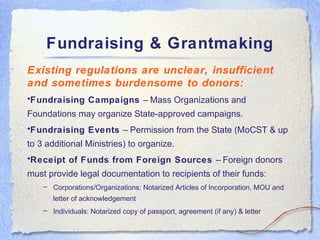
Fundraising & Grantmaking 
Existing regulations are unclear, insufficient 
and sometimes burdensome to donors: 
•Fundraising Campaigns – Mass Organizations and 
Foundations may organize State-approved campaigns. 
•Fundraising Events – Permission from the State (MoCST & up 
to 3 additional Ministries) to organize. 
•Receipt of Funds from Foreign Sources – Foreign donors 
must provide legal documentation to recipients of their funds: 
– Corporations/Organizations: Notarized Articles of Incorporation, MOU and 
letter of acknowledgement 
– Individuals: Notarized copy of passport, agreement (if any) & letter
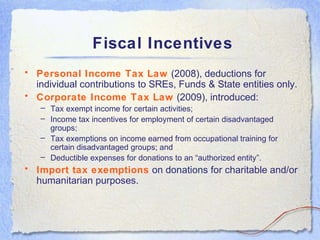
Fiscal Incentives 
• Personal Income Tax Law (2008), deductions for 
individual contributions to SREs, Funds & State entities only. 
• Corporate Income Tax Law (2009), introduced: 
– Tax exempt income for certain activities; 
– Income tax incentives for employment of certain disadvantaged 
groups; 
– Tax exemptions on income earned from occupational training for 
certain disadvantaged groups; and 
– Deductible expenses for donations to an “authorized entity”. 
• Import tax exemptions on donations for charitable and/or 
humanitarian purposes.
Collective Giving in 
Vietnam 
Key Players & Practices
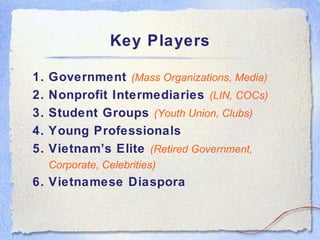
Key Players 
1. Government (Mass Organizations, Media) 
2. Nonprofit Intermediaries (LIN, COCs) 
3. Student Groups (Youth Union, Clubs) 
4. Young Professionals 
5. Vietnam’s Elite (Retired Government, 
Corporate, Celebrities) 
6. Vietnamese Diaspora
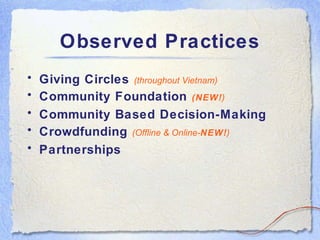
Observed Practices 
• Giving Circles (throughout Vietnam) 
• Community Foundation (NEW!) 
• Community Based Decision-Making 
• Crowdfunding (Offline & Online-NEW!) 
• Partnerships
Collective Giving 
Example in Vietnam
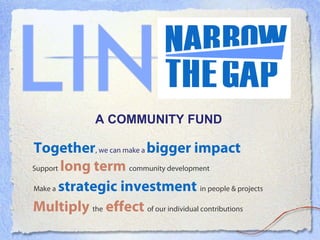
A COMMUNITY FUND 
Together, we can make a bigger impact 
Support long term community development 
Make a strategic investment in people & projects 
Multiply the effect of our individual contributions
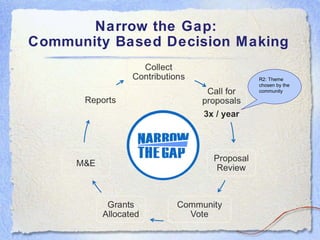
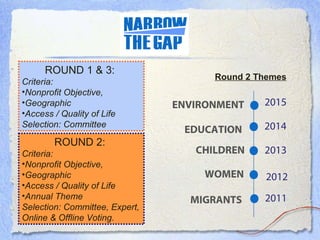
Narrow the Gap: 
Community Based Decision Making 
R2: Theme 
chosen by the 
community
ENVIRONMENT 2015 
EDUCATION 2014 
CHILDREN 2013 
WOMEN 2012 
MIGRANTS 2011 
ROUND 1 & 3: 
Criteria: 
•Nonprofit Objective, 
•Geographic 
•Access / Quality of Life 
Selection: Committee 
ROUND 2: 
Criteria: 
•Nonprofit Objective, 
•Geographic 
•Access / Quality of Life 
•Annual Theme 
Selection: Committee, Expert, 
Online & Offline Voting. 
Round 2 Themes
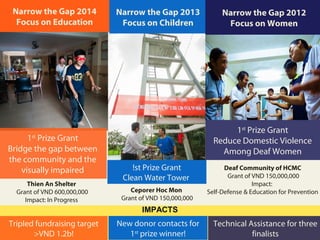
Narrow the Gap 2013 
Focus on Children 
!st Prize Grant 
Clean Water Tower 
Ceporer Hoc Mon 
Grant of VND 150,000,000 
Narrow the Gap 2012 
Focus on Women 
1st Prize Grant 
Reduce Domestic Violence 
Among Deaf Women 
Deaf Community of HCMC 
Grant of VND 150,000,000 
Impact: 
Self-Defense & Education for Prevention 
Narrow the Gap 2014 
Focus on Education 
1st Prize Grant 
Bridge the gap between 
the community and the 
visually impaired 
Thien An Shelter 
Grant of VND 600,000,000 
Impact: In Progress 
New donor contacts for 
1st prize winner! 
Tripled fundraising target 
>VND 1.2b! 
Technical Assistance for three 
finalists 
IMPACTS
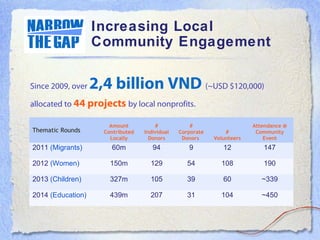
Increasing Local 
Community Engagement 
Since 2009, over 2,4 billion VND (~USD $120,000) 
allocated to 44 projects by local nonprofits. 
Thematic Rounds 
Amount 
Contributed 
Locally 
# 
Individual 
Donors 
# 
Corporate 
Donors 
# 
Volunteers 
Attendance @ 
Community 
Event 
2011 (Migrants) 60m 94 9 12 147 
2012 (Women) 150m 129 54 108 190 
2013 (Children) 327m 105 39 60 ~339 
2014 (Education) 439m 207 31 104 ~450
Future Outlook
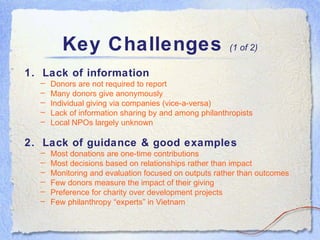
Key Challenges (1 of 2) 
1. Lack of information 
– Donors are not required to report 
– Many donors give anonymously 
– Individual giving via companies (vice-a-versa) 
– Lack of information sharing by and among philanthropists 
– Local NPOs largely unknown 
2. Lack of guidance & good examples 
– Most donations are one-time contributions 
– Most decisions based on relationships rather than impact 
– Monitoring and evaluation focused on outputs rather than outcomes 
– Few donors measure the impact of their giving 
– Preference for charity over development projects 
– Few philanthropy “experts” in Vietnam
Key Challenges (2 of 2) 
3. Insufficient Financial Governance & 
Management 
– Legal framework does not prevent / address this issue 
– Limited transparency, oversight and professionalism in fund 
management by donors and by NPOs 
– Misappropriation of donations by NPOs 
4. Limited Self-Regulation 
– No professional association for fundraisers or grantmakers 
– No codes of conduct for donors 
(Note: Vietnamese nonprofits are in the process of developing codes of conduct) 
– Criteria for recognition of best practices in question
Opportunities 
1. Booming Volunteerism 
– Gain understanding of L-T needs 
– Build capacity of NPOs 
1. Philanthropic Investment in NPOs 
– Capacity building for NPO staff 
– Investing in quality, nonprofit operations 
1. New Form of Diaspora Giving 
– 2nd generation moving towards collective giving 
– Connecting diaspora & local philanthropists 
4. Vietnamese People Driving Vietnam’s 
Development 
– Untapped potential for giving 
– Local donors increase accountability of local NPOs
Vietnamese Women 
in Philanthropy
Role of Vietnamese Women 
Observations (almost no data): 
•Women’s Roles in Nonprofit Organizations 
– Increasing leadership by women 
– Majority of staff are women 
•Women Influence Household Giving 
•Women more likely to support children’s issues 
(2012 CIMIGO Survey, Women = 49%, Men = 35%)
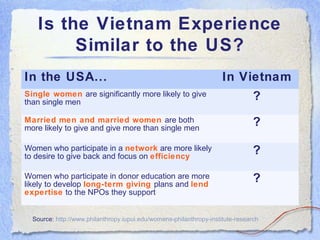
Is the Vietnam Experience 
Similar to the US? 
In the USA... In Vietnam 
Single women are significantly more likely to give 
than single men ? 
Married men and married women are both 
more likely to give and give more than single men ? 
Women who participate in a network are more likely 
to desire to give back and focus on efficiency ? 
Women who participate in donor education are more 
likely to develop long-term giving plans and lend 
expertise to the NPOs they support 
? 
Source: http://www.philanthropy.iupui.edu/womens-philanthropy-institute-research
Thank You! 
LIN Center for Community Development 
www.LINvn.org 
info@LINvn.org
Appendix
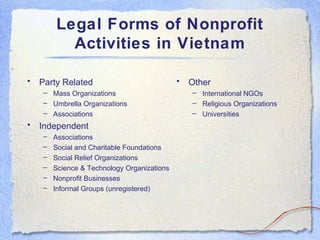
Legal Forms of Nonprofit 
Activities in Vietnam 
• Party Related 
– Mass Organizations 
– Umbrella Organizations 
– Associations 
• Independent 
– Associations 
– Social and Charitable Foundations 
– Social Relief Organizations 
– Science & Technology Organizations 
– Nonprofit Businesses 
– Informal Groups (unregistered) 
• Other 
– International NGOs 
– Religious Organizations 
– Universities
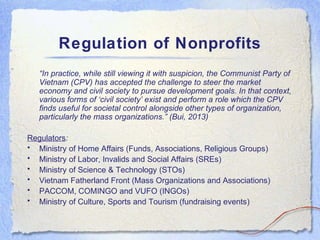
Regulation of Nonprofits 
“In practice, while still viewing it with suspicion, the Communist Party of 
Vietnam (CPV) has accepted the challenge to steer the market 
economy and civil society to pursue development goals. In that context, 
various forms of ‘civil society’ exist and perform a role which the CPV 
finds useful for societal control alongside other types of organization, 
particularly the mass organizations.” (Bui, 2013) 
Regulators: 
• Ministry of Home Affairs (Funds, Associations, Religious Groups) 
• Ministry of Labor, Invalids and Social Affairs (SREs) 
• Ministry of Science & Technology (STOs) 
• Vietnam Fatherland Front (Mass Organizations and Associations) 
• PACCOM, COMINGO and VUFO (INGOs) 
• Ministry of Culture, Sports and Tourism (fundraising events)