Over view 
UNV in Africa 
Volunteerism for 
Peace and Sustainable 
Development 
The United Nations Volunteers (UNV) programme 
is the UN organization that supports sustainable 
human development globally through the promotion 
of volunteerism, including the mobilization of 
volunteers. UNV serves the causes of peace and 
development by enhancing opportunities for people 
to participate in their own betterment. UNV is 
impartial, inclusive and embraces voluntary action in 
all its diversity. UNV is committed to the values of free 
will, commitment, engagement and solidarity, which 
are the foundation of volunteerism. 
UNV delivers peace and development results through 
volunteerism. To this end, UNV partners with civil 
society, UN entities, Governments and the private sector 
to advocate for volunteerism, integrate volunteerism 
into development planning and mobilize volunteers. The 
enormous potential of volunteerism is an inspiration 
to UNV and to volunteers around the world. UNV 
directly mobilizes more than 6,800 UN Volunteers 
every year nationally and internationally. They come 
from 159 countries to serve in 127 countries in over 
100 professional categories. Over two thirds of these 
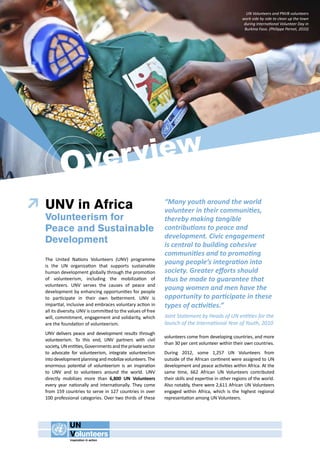
UN Volunteers and PNVB volunteers 
work side by side to clean up the town 
during International Volunteer Day in 
Burkina Faso. (Philippe Pernet, 2010) 
“Many youth around the world 
volunteer in their communities, 
thereby making tangible 
contributions to peace and 
development. Civic engagement 
is central to building cohesive 
communities and to promoting 
young people’s integration into 
society. Greater efforts should 
thus be made to guarantee that 
young women and men have the 
opportunity to participate in these 
types of activities.” 
Joint Statement by Heads of UN entities for the 
launch of the International Year of Youth, 2010 
volunteers come from developing countries, and more 
than 30 per cent volunteer within their own countries. 
During 2012, some 1,257 UN Volunteers from 
outside of the African continent were assigned to UN 
development and peace activities within Africa. At the 
same time, 662 African UN Volunteers contributed 
their skills and expertise in other regions of the world. 
Also notably, there were 2,611 African UN Volunteers 
engaged within Africa, which is the highest regional 
representation among UN Volunteers.
To help abolish female genital mutilation 
(FGM) in Sudan, UNV engages community 
volunteers who involve women, girls, men 
and older boys in peer education within 
local communities through sports and 
other activities. (Blazej Mikula, 2008) 
“We identified problems affecting 
our community, then we mobilized 
the community to address the 
deficits. For example, we offer study 
circles where skills can be gained 
and activities planned in HIV/AIDS 
awareness, conservation farming, 
livestock rearing and marketing. 
We are proud to say we have been 
successful and are open to the 
world to come and learn from us.” 
Youth Group Leader Joseph Banda, Zambia 
This overview summarizes UNV activities in Africa, highlighting UNV’s support in 
Africa to youth volunteer initiatives, peace building and community-based climate 
change adaptation. 
Expanding Youth Volunteering 
UNV promotes youth volunteerism as a people-centred 
resource for achieving the Millennium 
Development Goals (MDGs) and sustainable 
development. Through greater citizen participation, 
youth volunteering facilitates access to work and 
contributes to forming young leaders. In 2012, 
966, approximately 14% of all UN Volunteers, 
were between the ages of 21 and 29. Not a new 
development, to further strengthen its focus on 
youth, UNV launched the Youth Volunteering 
programme in 1976. Since then, UNV has partnered 
with ten universities including Nigeria, Burkina 
Faso, Uganda and Japan to provide an opportunity 
for youth to realise their full social, economic 
and human potential. These volunteers gain a 
strong sense of civic engagement to bring about 
transformational change in their communities. 
Supporting Regional Youth Volunteer 
Initiative in Africa 
UNV and the African Union Commission are 
partners in policy and advocacy on youth 
volunteering and infrastructures at national 
and regional levels in Africa. Throughout this 
partnership, UNV has advised the African Union 
on the establishment of a youth volunteer corps 
which brings together young people from the 
AU’s 54 member states to share their skills, 
knowledge and creativity to strengthen Africa’s 
relevance in a globalized world. The Economic 
Community of West African States (ECOWAS) and 
UNV are partners in a volunteer programme which 
provides West African citizens, particularly youth, 
with opportunities to engage in peacebuilding and 
development activities through volunteerism in 
Guinea, Guinea Bissau, Liberia and Sierra Leone. In 
2012, UNV and AUC signed a new Memorandum 
of Understanding (MOU) to collaborate and 
strengthen national and regional capacities for the 
development of youth volunteering programmes 
throughout the continent.
Youth Volunteer Initiative in Africa 
In Burkina Faso, Togo, Mali, Cape Verde, Niger and 
Senegal, UNV is supporting national governments 
and civil society partnerships to mobilize youth 
volunteers to work for the achievement of the MDGs 
in the areas of education, health, environment 
and economic development. In Rwanda, a joint 
youth programme, partly funded by the Japanese 
Government, promoted the rights of Rwandan 
youth and adolescents, and encourages them to take 
a responsible role in their society. The programme 
works with youth from 10 to 24 years old on policy 
development which empower adolescents and 
youth to think critically, understand their rights, and 
express themselves freely. 
The Asia Youth Volunteer Exchange Programme 
in Zambia, funded by the Japanese Government, 
mobilizes the skills of Asian volunteers and is an 
excellent example of South-South cooperation. 
This programme provides a mechanism for 
volunteers from Asia to work in Africa and transfer 
skills and knowledge in the agricultural and 
private sectors, especially to small to medium 
scale farmers. 
Community members sell surplus white 
maize or ‘millies’ at Ondangwa Open Market 
in Namibia. The maize was produced as 
part of a Community-based Adaptation 
project. For the first time, group members 
had surplus yields to market and generate 
income. (Tuhafeni Nghilunaye/Creative 
Enterprise Solutions, 2010) 
Supporting Community-Based Adaptation 
programme 
UN Volunteers mobilized over 5,800 local 
community volunteers, helped 49 NGOs/ 
community-based organizations (CBOs) partners 
develop project ideas and proposals and 
introduced innovative monitoring practices 
for sustainable community-driven adaptation 
projects in seven countries including Niger, 
Namibia and Morocco. UN Volunteers also 
trained Community-Based Adaptation Self-Help 
Group coordinators, conducted vulnerability 
reduction assessments, monitored and evaluated 
community projects, and developed knowledge-based 
management products. Of note is Namibia, 
where one community began an agriculture 
project to improve their own food security and 
boost incomes through growing staple foods such 
as pearl millet, maize and sunflowers. 
“By participating in UNV workshops, 
I learned a lot about my region from 
the elders and from discussions 
with the villagers. It also helped me 
understand the value of solidarity 
and collective work. I appreciate 
meeting people and partners who 
are supporting local development in 
the oasis. I now want to help more 
and more towards better conditions 
in the village.” 
Saadia Ihihi, Community Volunteer in Morocco
In Juba, South Sudan, UN Volunteer Naofumi 
Ikeda (Japan), a UNHCR Associate Protection 
Officer, is conducting registration interviews 
for refugee families coming from South 
Kordofan State in Sudan. (UNV, 2012) 
“Peacebuilding is relationship 
building... A Sudanese colleague 
said to me that my presence, as 
a volunteer, gives a morale boost, 
encouragement and hope for people 
in South Sudan.” 
Tomohiro Yamanaka, UNV/UNDP in South Sudan 
Peace Building 
Though the ‘Blue Helmets’ are the face of UN 
peacekeeping missions, they cannot operate 
without substantial civilian support. UN Volunteers 
make up a significant proportion of that support, 
working in a wide scope of functions, and can 
constitute up to a third of a peacekeeping mission’s 
international civilian component. UNV has been 
supporting the work of the United Nations 
Department of Peacekeeping Operations (DPKO) 
and the Department of Political Affairs (DPA) in war-torn 
and post-conflict areas since 1992. To date, 
more than 14,000 UN Volunteers have served in 
more than 40 different peacekeeping and political 
and peacebuilding operations. In addition, UNV 
supports the significant substantive and logistical 
support for the electoral process especially in 
fragile post-conflict environment. In 2012, 2,137 
African UN Volunteers served in UN peacekeeping 
missions including major peacekeeping missions in 
the Democratic Republic of Congo, South Sudan, 
Côte d’Ivoire and Liberia. 
Since 2007, the Japanese Government has 
funded the programme for Human Resource 
Development in Asia for Peacebuilding, where 
UNV has deployed skilled, trained and committed 
citizens from Japan and other Asian countries in 
the areas of conflict prevention and recovery, 
peace building and humanitarian assistance, and 
peacekeeping. A total of 113 UN Volunteers has 
served in this programme in 32 countries including 
Côte d’Ivoire, Ethiopia, Guinea Bissau, Kenya, 
Liberia, Rwanda, Sierra Leone, South Sudan, and 
Tanzania, to name but a few since 2007. 
The United Nations Volunteers (UNV) programme is the 
UN organization that promotes volunteerism to sup-port 
peace and development worldwide. Volunteerism 
can transform the pace and nature of development 
and it benefits both society at large and the individual 
volunteer. UNV contributes to peace and development 
by advocating for volunteerism globally, encouraging 
partners to integrate volunteerism into development 
programming, and mobilizing volunteers. 
UNV is administered by the United Nations Development 
Programme (UNDP). 
For more information about UNV, please visit www.unv.org

Unv prog. strat-ticad_gb-web2

  • 1.
    Over view UNVin Africa Volunteerism for Peace and Sustainable Development The United Nations Volunteers (UNV) programme is the UN organization that supports sustainable human development globally through the promotion of volunteerism, including the mobilization of volunteers. UNV serves the causes of peace and development by enhancing opportunities for people to participate in their own betterment. UNV is impartial, inclusive and embraces voluntary action in all its diversity. UNV is committed to the values of free will, commitment, engagement and solidarity, which are the foundation of volunteerism. UNV delivers peace and development results through volunteerism. To this end, UNV partners with civil society, UN entities, Governments and the private sector to advocate for volunteerism, integrate volunteerism into development planning and mobilize volunteers. The enormous potential of volunteerism is an inspiration to UNV and to volunteers around the world. UNV directly mobilizes more than 6,800 UN Volunteers every year nationally and internationally. They come from 159 countries to serve in 127 countries in over 100 professional categories. Over two thirds of these UN Volunteers and PNVB volunteers work side by side to clean up the town during International Volunteer Day in Burkina Faso. (Philippe Pernet, 2010) “Many youth around the world volunteer in their communities, thereby making tangible contributions to peace and development. Civic engagement is central to building cohesive communities and to promoting young people’s integration into society. Greater efforts should thus be made to guarantee that young women and men have the opportunity to participate in these types of activities.” Joint Statement by Heads of UN entities for the launch of the International Year of Youth, 2010 volunteers come from developing countries, and more than 30 per cent volunteer within their own countries. During 2012, some 1,257 UN Volunteers from outside of the African continent were assigned to UN development and peace activities within Africa. At the same time, 662 African UN Volunteers contributed their skills and expertise in other regions of the world. Also notably, there were 2,611 African UN Volunteers engaged within Africa, which is the highest regional representation among UN Volunteers.
  • 2.
    To help abolishfemale genital mutilation (FGM) in Sudan, UNV engages community volunteers who involve women, girls, men and older boys in peer education within local communities through sports and other activities. (Blazej Mikula, 2008) “We identified problems affecting our community, then we mobilized the community to address the deficits. For example, we offer study circles where skills can be gained and activities planned in HIV/AIDS awareness, conservation farming, livestock rearing and marketing. We are proud to say we have been successful and are open to the world to come and learn from us.” Youth Group Leader Joseph Banda, Zambia This overview summarizes UNV activities in Africa, highlighting UNV’s support in Africa to youth volunteer initiatives, peace building and community-based climate change adaptation. Expanding Youth Volunteering UNV promotes youth volunteerism as a people-centred resource for achieving the Millennium Development Goals (MDGs) and sustainable development. Through greater citizen participation, youth volunteering facilitates access to work and contributes to forming young leaders. In 2012, 966, approximately 14% of all UN Volunteers, were between the ages of 21 and 29. Not a new development, to further strengthen its focus on youth, UNV launched the Youth Volunteering programme in 1976. Since then, UNV has partnered with ten universities including Nigeria, Burkina Faso, Uganda and Japan to provide an opportunity for youth to realise their full social, economic and human potential. These volunteers gain a strong sense of civic engagement to bring about transformational change in their communities. Supporting Regional Youth Volunteer Initiative in Africa UNV and the African Union Commission are partners in policy and advocacy on youth volunteering and infrastructures at national and regional levels in Africa. Throughout this partnership, UNV has advised the African Union on the establishment of a youth volunteer corps which brings together young people from the AU’s 54 member states to share their skills, knowledge and creativity to strengthen Africa’s relevance in a globalized world. The Economic Community of West African States (ECOWAS) and UNV are partners in a volunteer programme which provides West African citizens, particularly youth, with opportunities to engage in peacebuilding and development activities through volunteerism in Guinea, Guinea Bissau, Liberia and Sierra Leone. In 2012, UNV and AUC signed a new Memorandum of Understanding (MOU) to collaborate and strengthen national and regional capacities for the development of youth volunteering programmes throughout the continent.
  • 3.
    Youth Volunteer Initiativein Africa In Burkina Faso, Togo, Mali, Cape Verde, Niger and Senegal, UNV is supporting national governments and civil society partnerships to mobilize youth volunteers to work for the achievement of the MDGs in the areas of education, health, environment and economic development. In Rwanda, a joint youth programme, partly funded by the Japanese Government, promoted the rights of Rwandan youth and adolescents, and encourages them to take a responsible role in their society. The programme works with youth from 10 to 24 years old on policy development which empower adolescents and youth to think critically, understand their rights, and express themselves freely. The Asia Youth Volunteer Exchange Programme in Zambia, funded by the Japanese Government, mobilizes the skills of Asian volunteers and is an excellent example of South-South cooperation. This programme provides a mechanism for volunteers from Asia to work in Africa and transfer skills and knowledge in the agricultural and private sectors, especially to small to medium scale farmers. Community members sell surplus white maize or ‘millies’ at Ondangwa Open Market in Namibia. The maize was produced as part of a Community-based Adaptation project. For the first time, group members had surplus yields to market and generate income. (Tuhafeni Nghilunaye/Creative Enterprise Solutions, 2010) Supporting Community-Based Adaptation programme UN Volunteers mobilized over 5,800 local community volunteers, helped 49 NGOs/ community-based organizations (CBOs) partners develop project ideas and proposals and introduced innovative monitoring practices for sustainable community-driven adaptation projects in seven countries including Niger, Namibia and Morocco. UN Volunteers also trained Community-Based Adaptation Self-Help Group coordinators, conducted vulnerability reduction assessments, monitored and evaluated community projects, and developed knowledge-based management products. Of note is Namibia, where one community began an agriculture project to improve their own food security and boost incomes through growing staple foods such as pearl millet, maize and sunflowers. “By participating in UNV workshops, I learned a lot about my region from the elders and from discussions with the villagers. It also helped me understand the value of solidarity and collective work. I appreciate meeting people and partners who are supporting local development in the oasis. I now want to help more and more towards better conditions in the village.” Saadia Ihihi, Community Volunteer in Morocco
  • 4.
    In Juba, SouthSudan, UN Volunteer Naofumi Ikeda (Japan), a UNHCR Associate Protection Officer, is conducting registration interviews for refugee families coming from South Kordofan State in Sudan. (UNV, 2012) “Peacebuilding is relationship building... A Sudanese colleague said to me that my presence, as a volunteer, gives a morale boost, encouragement and hope for people in South Sudan.” Tomohiro Yamanaka, UNV/UNDP in South Sudan Peace Building Though the ‘Blue Helmets’ are the face of UN peacekeeping missions, they cannot operate without substantial civilian support. UN Volunteers make up a significant proportion of that support, working in a wide scope of functions, and can constitute up to a third of a peacekeeping mission’s international civilian component. UNV has been supporting the work of the United Nations Department of Peacekeeping Operations (DPKO) and the Department of Political Affairs (DPA) in war-torn and post-conflict areas since 1992. To date, more than 14,000 UN Volunteers have served in more than 40 different peacekeeping and political and peacebuilding operations. In addition, UNV supports the significant substantive and logistical support for the electoral process especially in fragile post-conflict environment. In 2012, 2,137 African UN Volunteers served in UN peacekeeping missions including major peacekeeping missions in the Democratic Republic of Congo, South Sudan, Côte d’Ivoire and Liberia. Since 2007, the Japanese Government has funded the programme for Human Resource Development in Asia for Peacebuilding, where UNV has deployed skilled, trained and committed citizens from Japan and other Asian countries in the areas of conflict prevention and recovery, peace building and humanitarian assistance, and peacekeeping. A total of 113 UN Volunteers has served in this programme in 32 countries including Côte d’Ivoire, Ethiopia, Guinea Bissau, Kenya, Liberia, Rwanda, Sierra Leone, South Sudan, and Tanzania, to name but a few since 2007. The United Nations Volunteers (UNV) programme is the UN organization that promotes volunteerism to sup-port peace and development worldwide. Volunteerism can transform the pace and nature of development and it benefits both society at large and the individual volunteer. UNV contributes to peace and development by advocating for volunteerism globally, encouraging partners to integrate volunteerism into development programming, and mobilizing volunteers. UNV is administered by the United Nations Development Programme (UNDP). For more information about UNV, please visit www.unv.org