How to Make an
Annotated
Reading List?
The essential information needed in
making an Annotated Reading List
1. Citation in APA Format:
Cite the source using the required
citation style (APA). This should include
all relevant details such as the author’s
name, publication date, title, edition (if
applicable), publisher, and other
necessary elements of the citation style
you're using.
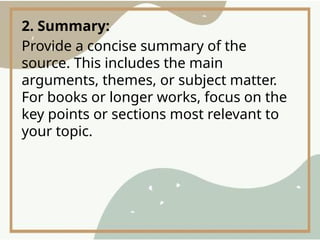
2. Summary:
Provide a concise summary of the
source. This includes the main
arguments, themes, or subject matter.
For books or longer works, focus on the
key points or sections most relevant to
your topic.
3. Evaluation:
Critically assess the quality, reliability, or
credibility of the source. You might
discuss the author’s background, the
quality of the research, or how well the
source contributes to the field of study.
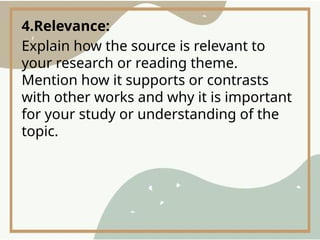
4.Relevance:
Explain how the source is relevant to
your research or reading theme.
Mention how it supports or contrasts
with other works and why it is important
for your study or understanding of the
topic.
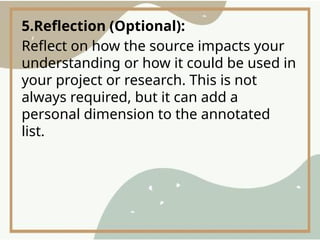
5.Reflection (Optional):
Reflect on how the source impacts your
understanding or how it could be used in
your project or research. This is not
always required, but it can add a
personal dimension to the annotated
list.
Example Outline for Annotated
Reading List
Citation: Full bibliographic citation in the required
format.
Summary: Briefly summarize the content and key
points.
Evaluation: Assess the source’s strengths,
weaknesses, and credibility.
Relevance: Explain how the source fits into your
research or reading theme.
Example Outline for Annotated
Reading List
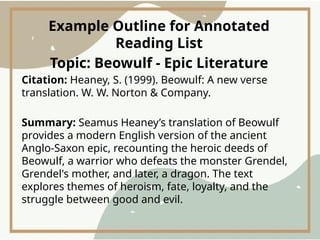
Topic: Beowulf - Epic Literature
Citation: Heaney, S. (1999). Beowulf: A new verse
translation. W. W. Norton & Company.
Summary: Seamus Heaney’s translation of Beowulf
provides a modern English version of the ancient
Anglo-Saxon epic, recounting the heroic deeds of
Beowulf, a warrior who defeats the monster Grendel,
Grendel's mother, and later, a dragon. The text
explores themes of heroism, fate, loyalty, and the
struggle between good and evil.
Evaluation: Heaney’s translation is highly regarded for
its poetic elegance and accessibility, maintaining the
spirit of the original text while making it approachable
for contemporary readers. However, some critics
argue that Heaney’s choices may occasionally deviate
from the literal meaning of the Old English text to
maintain poetic flow, which could affect the
translation’s accuracy in a scholarly context.
Relevance: This translation is particularly useful for
students and readers unfamiliar with Old English,
providing a clear understanding of the Beowulf epic. It
contributes to literary studies by bridging the gap
between modern readers and an ancient text that
plays a fundamental role in the study of English
literature, especially in the context of epic poetry and
mythology.
Reflection: Heaney’s translation helped me appreciate
the intricacies of ancient epic poetry while connecting
it to modern themes of heroism and morality. Reading
Beowulf through Heaney’s interpretation offered
insights into how translation can influence a reader’s
engagement with a text, especially when dealing with
ancient literature. It also made me think about the
lasting relevance of Beowulf's themes in contemporary
storytelling, especially the hero’s journey archetype.
Annotated-Reading-List in making the annotated

  • 1.
    How to Makean Annotated Reading List?
  • 2.
    The essential informationneeded in making an Annotated Reading List 1. Citation in APA Format: Cite the source using the required citation style (APA). This should include all relevant details such as the author’s name, publication date, title, edition (if applicable), publisher, and other necessary elements of the citation style you're using.
  • 3.
    2. Summary: Provide aconcise summary of the source. This includes the main arguments, themes, or subject matter. For books or longer works, focus on the key points or sections most relevant to your topic.
  • 4.
    3. Evaluation: Critically assessthe quality, reliability, or credibility of the source. You might discuss the author’s background, the quality of the research, or how well the source contributes to the field of study.
  • 5.
    4.Relevance: Explain how thesource is relevant to your research or reading theme. Mention how it supports or contrasts with other works and why it is important for your study or understanding of the topic.
  • 6.
    5.Reflection (Optional): Reflect onhow the source impacts your understanding or how it could be used in your project or research. This is not always required, but it can add a personal dimension to the annotated list.
  • 7.
    Example Outline forAnnotated Reading List Citation: Full bibliographic citation in the required format. Summary: Briefly summarize the content and key points. Evaluation: Assess the source’s strengths, weaknesses, and credibility. Relevance: Explain how the source fits into your research or reading theme.
  • 8.
    Example Outline forAnnotated Reading List Topic: Beowulf - Epic Literature Citation: Heaney, S. (1999). Beowulf: A new verse translation. W. W. Norton & Company. Summary: Seamus Heaney’s translation of Beowulf provides a modern English version of the ancient Anglo-Saxon epic, recounting the heroic deeds of Beowulf, a warrior who defeats the monster Grendel, Grendel's mother, and later, a dragon. The text explores themes of heroism, fate, loyalty, and the struggle between good and evil.
  • 9.
    Evaluation: Heaney’s translationis highly regarded for its poetic elegance and accessibility, maintaining the spirit of the original text while making it approachable for contemporary readers. However, some critics argue that Heaney’s choices may occasionally deviate from the literal meaning of the Old English text to maintain poetic flow, which could affect the translation’s accuracy in a scholarly context. Relevance: This translation is particularly useful for students and readers unfamiliar with Old English, providing a clear understanding of the Beowulf epic. It contributes to literary studies by bridging the gap between modern readers and an ancient text that plays a fundamental role in the study of English literature, especially in the context of epic poetry and mythology.
  • 10.
    Reflection: Heaney’s translationhelped me appreciate the intricacies of ancient epic poetry while connecting it to modern themes of heroism and morality. Reading Beowulf through Heaney’s interpretation offered insights into how translation can influence a reader’s engagement with a text, especially when dealing with ancient literature. It also made me think about the lasting relevance of Beowulf's themes in contemporary storytelling, especially the hero’s journey archetype.