This documentarywould look at how anime is viewed
as a whole and how opinions of it has changed,
especially over the years as it has grown and changed
contexts. Specifically we’d be looking at if anime has
grown into more of a general genre as opposed how it
was more niche in the beginnings.
I feel like this topic would be different from regular
from most documentaries because it is already aimed
at a niche audience since only a few people have
extensive knowledge on anime as a genre and not see it
as another cartoon.
I can imagine this kind of documentary being on
Challenge TV since that channel station normally
shows programs that are made for niche audience. For
example, Top 100 games of all time.
3.
The aimwould be to hopefully change a negative
perspective to how one sees anime and look into
how opinions may have changed over the years. It
would also be to explore what the opinions
actually are also and see how diverse they may be.
A secondary would be to partially advertise anime
to people in general to would normally not watch
it, to challenge them to try something new instead
of labeling it and the people who watch it.
4.
Voiceovers –A lot of voiceovers will be used by
the narrator to explain some facts over some
archive footage
Voxpops – Used to get random peoples views on
anime
Interview – To get a somewhat seasoned opinion
on how anime has changed over the years.
Archive footage – Footage of older and newer
anime will be used to show the diversity of the
genre as a whole
Music – Background music will be used to add
relevance to some of the points and to keep
viewers attention
5.
The primaryaudience would be all anime
watchers since they would know about anime
and would already know what is to know
about anime and they would probably
appreciate learning more about the genre and
recapping how it has grown and maybe even
learn more about other animes.
A secondary audience would definitely be
females 16-25 since they’re mainly the people
who seem to not watch or dislike anime the
most.
6.
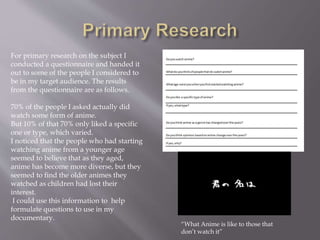
For primary researchon the subject I
conducted a questionnaire and handed it
out to some of the people I considered to
be in my target audience. The results
from the questionnaire are as follows.
70% of the people I asked actually did
watch some form of anime.
But 10% of that 70% only liked a specific
one or type, which varied.
I noticed that the people who had starting
watching anime from a younger age
seemed to believe that as they aged,
anime has become more diverse, but they
seemed to find the older animes they
watched as children had lost their
interest.
I could use this information to help
formulate questions to use in my
documentary.
“What Anime is like to those that
don’t watch it”
7.
For secondaryresearch into my documentary I looked on
the internet for articles and/or information that would be
relevant for the topic.
Whilst doing this I found a video titled “What Anime
sounds like to people who don’t watch it” This video clearly
looks like it was made as a joke but if you read the
comments on the video itself it shows people agreeing with
the message of the video.
Also whilst on the internet I came across the slang terms
“Weeaboo” and “Otaku” which are both descriptive words
used to describe kinds of people that watch anime, as I
researched these terms I learned that one is typically seen as
a negative trait to have and one is more liked among the the
anime viewing community and people in general.
As a final piece of secondary research into this topic I looked
up how anime is made and how important it is as part of the
Japanese culture but I figured that this piece of research
would be somewhat irrelevant to my documentary since I
wouldn’t be able to mention it in my documentary in detail
as it is seemingly off topic.
8.
I wouldpersonally film in both niche and more
general places such as , an arcade, a shopping
mall, a park, etc
9.
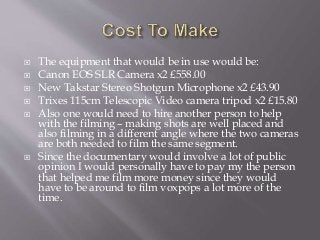
The equipmentthat would be in use would be:
Canon EOS SLR Camera x2 £558.00
New Takstar Stereo Shotgun Microphone x2 £43.90
Trixes 115cm Telescopic Video camera tripod x2 £15.80
Also one would need to hire another person to help
with the filming – making shots are well placed and
also filming in a different angle where the two cameras
are both needed to film the same segment.
Since the documentary would involve a lot of public
opinion I would personally have to pay my the person
that helped me film more money since they would
have to be around to film voxpops a lot more of the
time.



![3 [autosaved]](https://cdn.slidesharecdn.com/ss_thumbnails/3autosaved-180705223854-thumbnail.jpg?width=640&height=640&fit=bounds)


