Dave Jeffery
@DaveJ
Angular Classy
• Lightweight yet opinionated way to bring more
structure and a tea-spoon of sugar to Angular
controllers

• Popular-ish

• 700 stars on Github
• Has been #1 on Hacker News
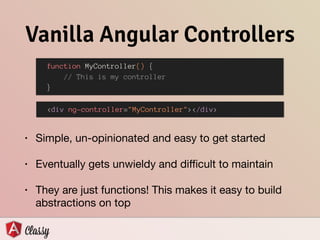
Vanilla Angular Controllers
• This is a vanilla (non-classy) Angular Controller:


• The controller gets instantiated using the following
HTML:


function MyController() {
// This is my controller
}
<div ng-controller="MyController"></div>
• Simple, un-opinionated and easy to get started

• Eventually gets unwieldy and difficult to maintain

• They are just functions! This makes it easy to build
abstractions on top
Vanilla Angular Controllers
• This is a vanilla (non-classy) Angular Controller:


• The controller gets instantiated using the following
HTML:


function MyController() {
// This is my controller
}
<div ng-controller="MyController"></div>
Clean & DRY
app.controller('AppCtrl',
['$scope', '$location', '$http',
function($scope, $location, $http) {
// ...
}]);
app.classy.controller({
name: 'AppCtrl',
inject: ['$scope', '$location', '$http'],
//...
});
Classy
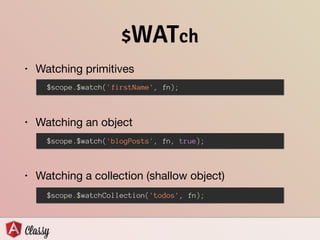
$WATch
• Watching primitives


• Watching an object


• Watching a collection (shallow object)


$scope.$watch('firstName', fn);
$scope.$watch('blogPosts', fn, true);
$scope.$watchCollection('todos', fn);
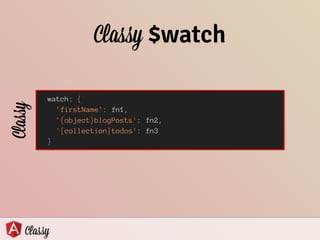
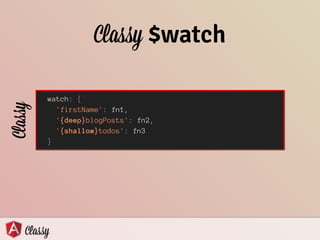
Classy $watch
watch: {
'firstName': fn1,
'{object}blogPosts': fn2,
'{collection}todos': fn3
}
Classy
Classy $watch
watch: {
'firstName': fn1,
'{object}blogPosts': fn2,
'{collection}todos': fn3
}
watch: {
'firstName': fn1,
'{deep}blogPosts': fn2,
'{shallow}todos': fn3
}
Classy
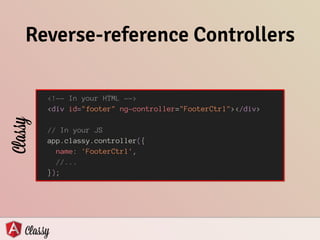
Reverse-reference Controllers
<!-- In your HTML -->
<div id="footer" ng-controller="FooterCtrl"></div>
!
// In your JS
app.classy.controller({
name: 'FooterCtrl',
//...
});
Classy
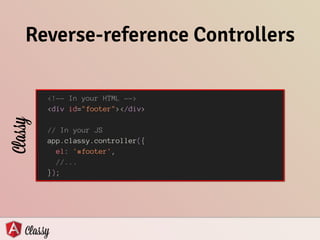
Reverse-reference Controllers
<!-- In your HTML -->
<div id="footer" ng-controller="FooterCtrl"></div>
!
// In your JS
app.classy.controller({
name: 'FooterCtrl',
//...
});
<!-- In your HTML -->
<div id="footer"></div>
!
// In your JS
app.classy.controller({
el: '#footer',
//...
});
Classy
What’s coming in 0.5
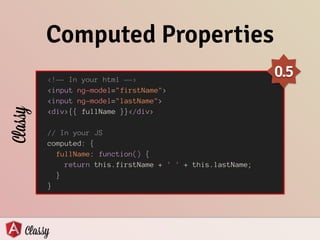
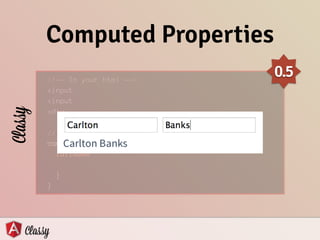
Computed Properties
<!—- In your html —->
<input ng-model="firstName">
<input ng-model="lastName">
<div>{{ fullName }}</div>
!
// In your JS
computed: {
fullName: function() {
return this.firstName + ' ' + this.lastName;
}
}
Classy
0.5
Computed Properties
<!—- In your html —->
<input
<input
<div
!
// In your JS
computed
fullName
}
}
Classy
0.5
Computed Properties
<!—- In your html —->
<input
<input
<div
!
// In your JS
computed
fullName
}
}
Classy
computed: {
fullName: {
watch: ['firstName', 'lastName'],
get: function() {
return this.firstName + ' ' + this.lastName;
},
set: function(newVal) {
var names = newValue.split(' ');
this.firstName = names[0];
this.lastName = names[names.length - 1];
}
}
}
0.5
Classy Plugins
• New version of Angular Classy will be modular,
making it easy to write your own Classy plugin.

• Some ideas:

• Resolve — Wait for a promise to resolve before initialising
• Mixins — Extend or mixin with other Classy controllers
• Events — $scope.$on
• Router — Define routes inline with the relevant controller
var app = angular.module('app', ['classy', 'classy-resolve']);
0.5
http://davej.github.io/angular-classy/
or just google “Angular Classy”
or talk to me afterwards

Angular Classy

  • 1.
  • 2.
    Angular Classy • Lightweightyet opinionated way to bring more structure and a tea-spoon of sugar to Angular controllers • Popular-ish • 700 stars on Github • Has been #1 on Hacker News
  • 3.
    Vanilla Angular Controllers •This is a vanilla (non-classy) Angular Controller:


 • The controller gets instantiated using the following HTML:
 
 
 function MyController() { // This is my controller } <div ng-controller="MyController"></div>
  • 4.
    • Simple, un-opinionatedand easy to get started • Eventually gets unwieldy and difficult to maintain • They are just functions! This makes it easy to build abstractions on top Vanilla Angular Controllers • This is a vanilla (non-classy) Angular Controller:


 • The controller gets instantiated using the following HTML:
 
 
 function MyController() { // This is my controller } <div ng-controller="MyController"></div>
  • 6.
    Clean & DRY app.controller('AppCtrl', ['$scope','$location', '$http', function($scope, $location, $http) { // ... }]); app.classy.controller({ name: 'AppCtrl', inject: ['$scope', '$location', '$http'], //... }); Classy
  • 8.
    $WATch • Watching primitives
 
 •Watching an object
 
 • Watching a collection (shallow object)
 
 $scope.$watch('firstName', fn); $scope.$watch('blogPosts', fn, true); $scope.$watchCollection('todos', fn);
  • 9.
    Classy $watch watch: { 'firstName':fn1, '{object}blogPosts': fn2, '{collection}todos': fn3 } Classy
  • 10.
    Classy $watch watch: { 'firstName':fn1, '{object}blogPosts': fn2, '{collection}todos': fn3 } watch: { 'firstName': fn1, '{deep}blogPosts': fn2, '{shallow}todos': fn3 } Classy
  • 11.
    Reverse-reference Controllers <!-- Inyour HTML --> <div id="footer" ng-controller="FooterCtrl"></div> ! // In your JS app.classy.controller({ name: 'FooterCtrl', //... }); Classy
  • 12.
    Reverse-reference Controllers <!-- Inyour HTML --> <div id="footer" ng-controller="FooterCtrl"></div> ! // In your JS app.classy.controller({ name: 'FooterCtrl', //... }); <!-- In your HTML --> <div id="footer"></div> ! // In your JS app.classy.controller({ el: '#footer', //... }); Classy
  • 13.
  • 14.
    Computed Properties <!—- Inyour html —-> <input ng-model="firstName"> <input ng-model="lastName"> <div>{{ fullName }}</div> ! // In your JS computed: { fullName: function() { return this.firstName + ' ' + this.lastName; } } Classy 0.5
  • 15.
    Computed Properties <!—- Inyour html —-> <input <input <div ! // In your JS computed fullName } } Classy 0.5
  • 16.
    Computed Properties <!—- Inyour html —-> <input <input <div ! // In your JS computed fullName } } Classy computed: { fullName: { watch: ['firstName', 'lastName'], get: function() { return this.firstName + ' ' + this.lastName; }, set: function(newVal) { var names = newValue.split(' '); this.firstName = names[0]; this.lastName = names[names.length - 1]; } } } 0.5
  • 17.
    Classy Plugins • Newversion of Angular Classy will be modular, making it easy to write your own Classy plugin.
 • Some ideas: • Resolve — Wait for a promise to resolve before initialising • Mixins — Extend or mixin with other Classy controllers • Events — $scope.$on • Router — Define routes inline with the relevant controller var app = angular.module('app', ['classy', 'classy-resolve']); 0.5
  • 18.
    http://davej.github.io/angular-classy/ or just google“Angular Classy” or talk to me afterwards