81.43.21-922
80
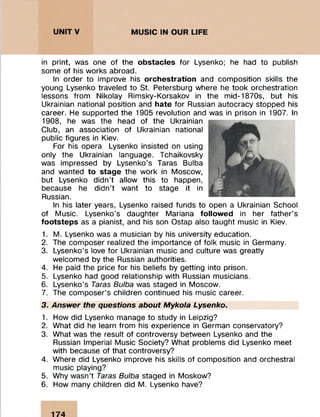
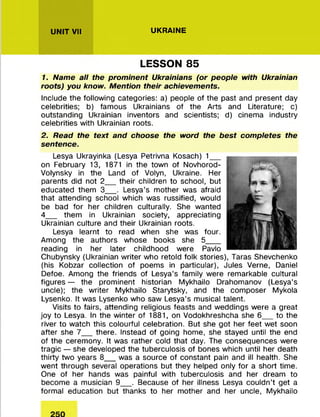
. .
80 « (8- )» 8
. – : , 2016. – 298 . : .
8 ,
,
( , , , ), ,
, , .
- ,
.
81.43.21-922
ISBN 978-966-308-655-2
© . ., 2016
© « », 2016
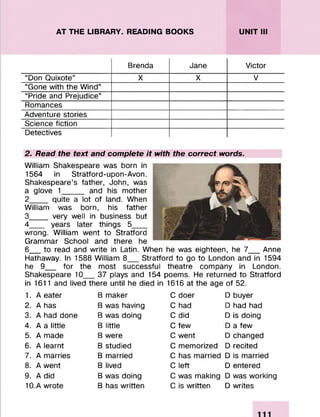
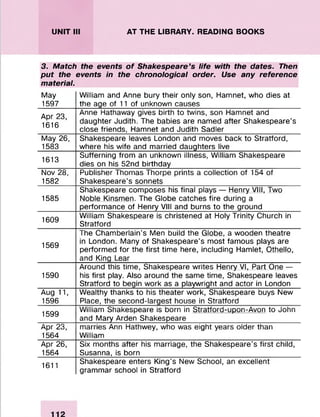
REVISION LESSONS
LESSON 1
1. Read the text and answer the questions.
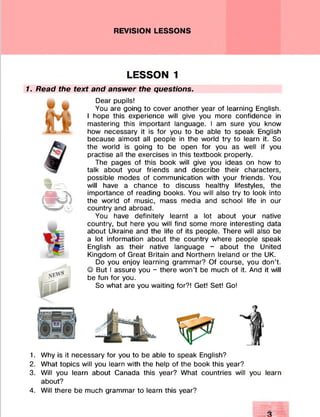
Dear pupils!
You are going to cover another year of learning English.
I hope this experience will give you more confidence in
mastering this important language. I am sure you know
how necessary it is for you to be able to speak English
because almost all people in the world try to learn it. So
the world is going to be open for you as well if you
practise all the exercises in this textbook properly.
The pages of this book will give you ideas on how to
talk about your friends and describe their characters,
possible modes of communication with your friends. You
will have a chance to discuss healthy lifestyles, the
importance of reading books. You will also try to look into
the world of music, mass media and school life in our
country and abroad.
You have definitely learnt a lot about your native
country, but here you will find some more interesting data
about Ukraine and the life of its people. There will also be
a lot information about the country where people speak
English as their native language - about the United
Kingdom of Great Britain and Northern Ireland or the UK.
Do you enjoy learning grammar? Of course, you don’t.
© But I assure you - there won’t be much of it. And it will
be fun for you.
So what are you waiting for?! Get! Set! Go!
1. Why is it necessary for you to be able to speak English?
2. What topics will you learn with the help of the book this year?
3. Will you learn about Canada this year? What countries will you learn
about?
4. Will there be much grammar to learn this year?
REVISION LESSONS
2. Read the dialogues. Complete them with the words from the
box. Act them out with your partner.
corner miss left on looking far
your where across next down lost
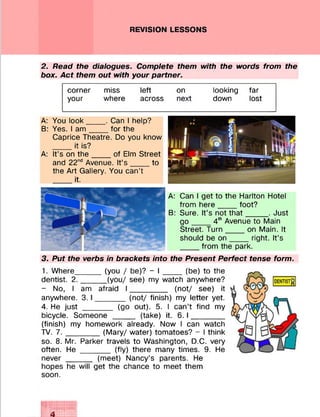
A: You look____ . Can I help?
B: Yes. I a m ____ for the
Caprice Theatre. Do you know
____ it is?
A: It’s on th e ____ of Elm Street
and 22nd Avenue. It’s ___ to
the Art Gallery. You can’t
____ it.
A: Can I get to the Harlton Hotel
from here _____ foot?
B: Sure. It’s not th a t_____ . Just
g o ____ 4th Avenue to Main
Street. Turn____ on Main. It
should be o n ____ right. It’s
____ from the park.
3. Put the verbs in brackets into the Present Perfect tense form.
1. Where_____ (you / be)? - I _____ (be) to the
dentist. 2 .______(you/ see) my watch anywhere?
- No, I am afraid I ________ (not/ see) it
anywhere. 3 .1_______ (not/ finish) my letter yet.
4. He just _______ (go out). 5. I can’t find my
bicycle. Someone _____ (take) it. 6.1_______
(finish) my homework already. Now I can watch
TV. 7 .________(Mary/ water) tomatoes? - I think
so. 8. Mr. Parker travels to Washington, D.C. very
often. He _______ (fly) there many times. 9. He
never _____ (meet) Nancy’s parents. He
hopes he will get the chance to meet them
soon.
4
REVISION LESSONS
4. Answer the questions.
1. Are weather forecasts important for people?
People of what occupations are interested in
weather forecast? Why?
2. How often can people hear to weather
forecasts on TV or radio during the day?
Where else can they get information about
the weather forecast?
3. When and where from do weathermen usually
collect information about the weather?
4. What is the usual weather if the barometer
shows high pressure in summer? In winter?
5. What is the usual result of weathermen’s work?
6. Do you and the members of your family usually listen to weather
forecast or watch it on television?
7. Have you ever got into trouble because of the wrong weather
forecast? How did it happen?
8. Have you ever got into trouble because you didn’t know weather
forecast for the day? How did it happen?
5. Describe an ideal day for:
a. going for a picnic;
b. a tour about the city;
c. a visit to a museum;
d. skiing or skating;
e. playing outdoors;
f. doing homework;
g. celebrating the New Year’s Day.
Model: If you go out for a picnic, you can do that on a bright clear
day. Then the sun shines, it doesn’t rain. It’s not foggy. It can
be a little windy, but not stormy. It is usually warm then.
REVISION LESSONS
3. Read the text and say whether the statements after it are true
or false. Correct the false ones.
In Britain it is very difficult to find a place
where you can try the national British meals.
On the contrary, there is a wide variety of
international restaurants in the UK: Indian,
Chinese and Italian restaurants are especially
popular, but there are also many others. Apart
from restaurants, there are also many take­
aways, where you can buy cooked meals to
take home.
There are many cafes and bars in the UK,
many of them are self-service. Sometimes a
waiter or waitress will serve you at the table.
Although the correct name for a midday meal is lunch, many
English families call it “dinner”. What is interesting enough is that
English people do not wish each other “Good Appetite”.
Tea is the number one drink in Britain and the average person has
about four cups of tea a day.
1. If you are in Britain it is quite easy to find
a typical British meal.
2. There are three meals in Britain:
breakfast, lunch and supper.
3. All restaurants in the UK are of a take­
away type.
4. It is OK during meals not to wish “Good
Appetite” in Britain.
5. Coffee is as popular as tea in the UK.
6. You must serve yourself in all British
cafes and bars.
4. Fill in the blanks with the words from the box.
appetizer chef fancy smoking
bar cook fast-food soup
breakfast dessert lunch tip
brunch dinner non-smoking waiter
buffet dishwasher salad
REVISION LESSONS
People who work in a restaurant:
The person who serves your food is called a __________ . The person
who cooks your food is called a _________________ if it is a cheap
restaurant, or a __________________ if it is an expensive restaurant.
A ________________is somebody who washes dishes. If the food and
service is good, people usually leave a ________________.
Meals and the time of day:
Most people e a t_________________after they wake up. Around noon
people have their midday meal, o r ____________ . A nd____________
is the meal that people eat in the evening. However, sometimes,
especially on Sunday, people like to sleep in, so instead of having
breakfast, they eat a meal between breakfast and lunch called
Parts of a meal:
At lunch or dinner sometimes people order a snack before the meal
called an _____________________ . A ________________ or a
_________________ is often served alongside the main meal. After
dinner, people sometimes treat themselves to _________________.
Types of restaurants:
It’s nice to eat at a ________________
restaurant, but that can be expensive.
Sometimes, if you are short on time or short on
money, you might go to a _________________
restaurant because the food is cheaper and
served faster. Some restaurants have a
____________________ , which means you take
a plate up to a table loaded with food and you
can put as much food as you want on your
plate. Other restaurants have a _____________
where you can get an alcoholic drink while you
are waiting for your table. Most restaurants
these days have a ______________ and a
_______________section.
8
V .y .y .y .lC C V .ilt
y.y.y.y.v.x
REVISION LESSONS
5. Answer the questions.
1. What do people in different countries call the holiday of Easter?
2. When does this holiday begin in the countries you have read
about?
3. What do people usually do on Easter Sunday?
4. What does this holiday have special for children?
5. What traditional food is present at Easter in different countries?
6. What kind of popularity does this holiday have in different
countries?
7. Had you gone to school before your parents left for work?
8. What had you done by 10 a.m. yesterday?
9. What had you done by the time you started to watch TV
yesterday?
10. When did you wake up yesterday?
6. Put the verbs in brackets into the Present Perfect or the Past
Perfect tense form. Say what the difference is between these
two tense forms.
1. You can have this newspaper. I _____ (finish) reading it. 2. It wasn’t
raining when I left for school. I t ____ (stop) by that time. 3. I am not hungry.
I already ____ (eat). 4. It was ten p. m. I already _____ (finish) my
homework and I was ready to go to bed. 5.Carol missed her lesson of
English yesterday because of a traffic jam. By the time she got to school,
her lesson already______(begin). 6. Our family had no car at that time. We
_____ (sell) our old car. 7. Do you want to watch that program? It just
______(start). 8. We are late. The party already______(start).
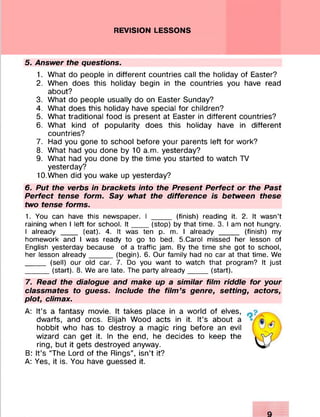
7. Read the dialogue and make up a similar film riddle for your
classmates to guess. Include the film’s genre, setting, actors,
plot, climax.
A: It’s a fantasy movie. It takes place in a world of elves, .
dwarfs, and ores. Elijah Wood acts in it. It’s about a
hobbit who has to destroy a magic ring before an evil
wizard can get it. In the end, he decides to keep the
ring, but it gets destroyed anyway.
B: It’s “The Lord of the Rings”, isn’t it?
A: Yes, it is. You have guessed it.
REVISION LESSONS
LESSON З
1. Read the dialogue and act it out with your classmate. Then
make up a similar one.
A: What’s your hobby?
В: I like to dance very much.
A: What kind of dances do you dance?
B: Well, my favourite dances are Tango, Waltz, Cha-cha, Rumba,
Samba, the ballroom dances, you know.
A: What about modern dances?
B: Well, I like modern dances as well, and I often dance Rock-n-roll
and Disco.
2. Pair work. Practise speaking as it is given in the model.
Model: A: I know that he doesn’t play the piano now.
B: But did he use to play the piano when he was younger?
A: Yes, he used to play it very well.
1. I know he isn’t very rich now...
2. I know she hasn’t got many friends now...
3. I know Peter doesn’t like cats any more...
4. I know Susan doesn’t run in the mornings...
5. I know he doesn’t go to bed early now...
3. Ask your classmate about his/ her shopping habits. Then
report to the class what you have found out.
1. Do you enjoy shopping? How often do you go shopping? How much time
do you spend each time you go?
2. What’s your favourite place to shop? Why?
3. Do you compare prices at different stores when you shop?
4. How important is good customer service when you are shopping?
5. Are you a price conscious shopper? What is your opinion of discount
([disgkaunt] знижка) stores?
6. When you buy something, do you read the label? Why or why not?
4. Suggest English words for the given definitions.
a. a shop that sells many different items indifferent departments. Harrods is
probably the world’s best known.
b. a large shop that sells mostly food and house hold items.
c. a shop that sells food.
d. a shop that sells fresh fruit and vegetables.
e. a shop that sells fresh meat.
REVISION LESSONS
f. a shop that sells fresh bread and cakes.
g. a shop that sells fresh fish.
h. a shop that sells medicines and toiletries.
i. a shop that sells newspapers and magazines.
j. a shop that sells glasses / contact lenses.
k. a shop that sells hard goods, such as nails and screws.
l. a shop that sells books.
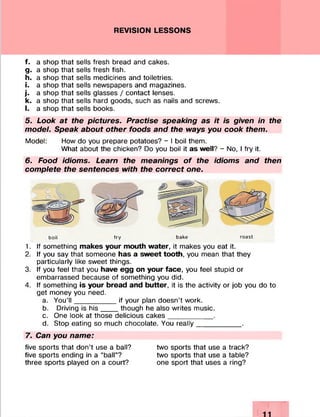
5. Look at the pictures. Practise speaking as it is given in the
model. Speak about other foods and the ways you cook them.
Model: How do you prepare potatoes? - I boil them.
What about the chicken? Do you boil it as well? - No, I fry it.
6. Food idioms. Learn the meanings of the idioms and then
complete the sentences with the correct one.
boil fry bake roast
1. If something makes your mouth water, it makes you eat it.
2. If you say that someone has a sweet tooth, you mean that they
particularly like sweet things.
3. If you feel that you have egg on your face, you feel stupid or
embarrassed because of something you did.
4. If something is your bread and butter, it is the activity or job you do to
get money you need.
a. You’l l __________ if your plan doesn’t work.
b. Driving is his____ though he also writes music.
c. One look at those delicious cakes___________ .
d. Stop eating so much chocolate. You really___________ .
7. Can you name:
five sports that don’t use a ball? two sports that use a track?
five sports ending in a “ball”? two sports that use a table?
three sports played on a court? one sport that uses a ring?
REVISION LESSONS
LESSON 4
7. Read and smile. Rote-play the dialogues with your partner.
a) Peter:
David:
b) Teacher:
Johnny:
Teacher:
Johnny:
What a strange pair of socks you are wearing; one is
green and the other is blue!
Yes, it is really strange. I’ve got another pair of socks
at home, and they are exactly the same.
What is the longest word?
Smiles.
Why? It has got only 6 letters.
Can’t you see there is a mile between the first and last S?
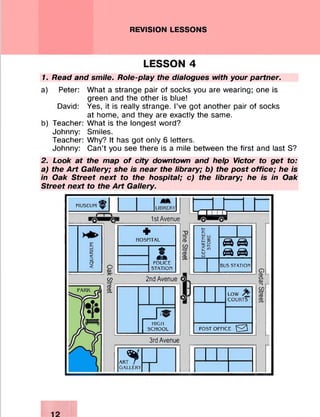
2. Look at the map of city downtown and help Victor to get to:
a) the Art Gallery; she is near the library; b) the post office; he is
in Oak Street next to the hospital; c) the library; he is in Oak
Street next to the Art Gallery.
MUSEUM ^ LI 13HERY
£
C£<D
a
< oCD
œ
CD
CD
p 1st Avenue
+
HOSPITAL
fam
POLICE
STATION
U n ± u
=3CD
GO
CD
CD
2nd Avenue
HIGH
SCHOOL
LOW
COURTS
POST OFFICE 0
3rd Avenue
$ART
GALLERY
DEPARTMENT
STORE
0 1 0
0 0
BUS STATION
O
8.CD
—I
GO
CD
CD
REVISION LESSONS
Model: Victor, go straight ahead/down/up......, turn right/left on .....
Street/Avenue, go along .... Street/Avenue.......... will be on
your right/left.
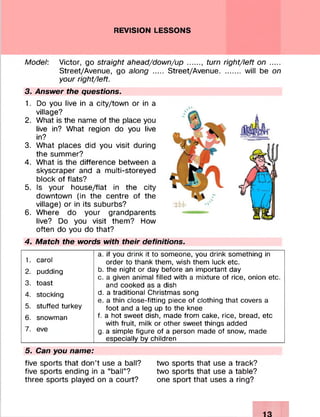
3. Answer the questions.
1. Do you live in a city/town or in a
village?
2. What is the name of the place you
live in? What region do you live
in?
3. What places did you visit during
the summer?
4. What is the difference between a
skyscraper and a multi-storeyed
block of flats?
5. Is your house/flat in the city
downtown (in the centre of the
village) or in its suburbs?
6. Where do your grandparents
live? Do you visit them? How
often do you do that?
4. Match the words with their definitions.
a. if you drink it to someone, you drink something in
order to thank them, wish them luck etc.
b. the night or day before an important day
c. a given animal filled with a mixture of rice, onion etc.
and cooked as a dish
d. a traditional Christmas song
e. a thin close-fitting piece of clothing that covers a
foot and a leg up to the knee
f. a hot sweet dish, made from cake, rice, bread, etc
with fruit, milk or other sweet things added
g. a simple figure of a person made of snow, made
especially by children__________________________
5. Can you name:
five sports that don’t use a ball? two sports that use a track?
five sports ending in a “ball”? two sports that use a table?
three sports played on a court? one sport that uses a ring?
1. carol
2. pudding
3. toast
4. stocking
5. stuffed turkey
6. snowman
7. eve
REVISION LESSONS
6. Fill in the blank spaces with the correct article (if necessary).
UK
Great Britain
Europe
Atlantic Ocean
Ben Nevis
USA
Irish Sea
Ireland
English Channel
British Isles
Thames
Carpathians
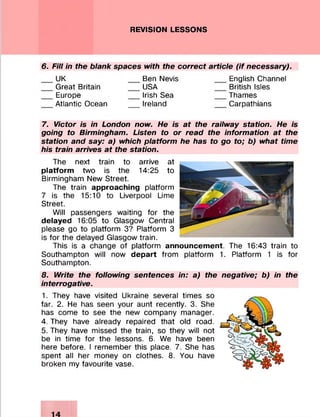
7. Victor is in London now. He is at the railway station. He is
going to Birmingham. Listen to or read the information at the
station and say: a) which platform he has to go to; b) what time
his train arrives at the station.
The next train to arrive at
platform two is the 14:25 to
Birmingham New Street.
The train approaching platform
7 is the 15:10 to Liverpool Lime
Street.
Will passengers waiting for the
delayed 16:05 to Glasgow Central
please go to platform 3? Platform 3
is for the delayed Glasgow train.
This is a change of platform announcement. The 16:43 train to
Southampton will now depart from platform 1. Platform 1 is for
Southampton.
8. Write the following sentences in: a) the negative; b) in the
interrogative.
1. They have visited Ukraine several times so
far. 2. He has seen your aunt recently. 3. She
has come to see the new company manager.
4. They have already repaired that old road.
5. They have missed the train, so they will not
be in time for the lessons. 6. We have been
here before. I remember this place. 7. She has
spent all her money on clothes. 8. You have
broken my favourite vase.
REVISION LESSONS
LESSON 5
1. Match the words with their definitions.
a. the place where your bags are checked for illegal
goods when you go into a country
b. an act of leaving a place, especially at the start of
a journey
c. a printed piece of paper which shows that you
have paid to enter a cinema, travel on a bus,
plane etc.
d. a small official document that you get from your
government, that proves who you are
e. the price you pay to travel somewhere by bus,
train, plane etc.
f. coming to a certain destination place
g. a list of the times at which buses, trains, planes
etc arrive and leave__________________________
2. Sort out the words into two groups: a) those used in the
singular; b) those used in the plural. Then complete the table
with the missing singular and plural forms.
Mice, louse, man, oxen, sheep, roofs, toys, teeth, child, families,
goose, woman, fish, feet, knives, photo, men, potatoes, pianos
Singular Plural
3. Complete the situations with your own sentences. Use the
ideas in brackets.
Model: (to get married) Jill and Jane were single. Now they are
husband and wife. - They have got married.
1. (to make a mess in the room) The room was clean when mother
left home for work. Now it is dirty and untidy. - The children
2. (to cut his hair) Joe’s hair was long. Now it is short. - He
3. (to have a baby) Jessica didn’t have children. Now a little boy calls
her “mother”. - She_________________ .
1. passport
2. customs
3. arrival
4. departure
5. timetable
6. fare
7. ticket
REVISION LESSONS
4. (to move to another place) Frank lived in Liverpool. Now you will
not find him in the streets of this city. - H e___________________ .
5. (to enter the university) Carol was a schoolgirl last year. This year
she studies at the university. - Carol__________________.
6. (to buy a new car) Jim’s parents didn’t have a car. Now you can
see his father driving a brand new Mercedes. - They
4. Make up conversations about places you visited and really
liked.
Model: A: (Last year) I visited__________ .
B: What is it like?
A: It’s ______________ .
B: What’s special about it?
A :__________________________.
5. Read the example of New Year Resolutions and complete the
table after the text.
This year is going to be better than the last year. I am going to
work and live a good life. First of all, I’ve decided to learn another
language. I haven’t decided yet, but maybe it will be French or
German. I’m also planning to go on a diet. And so, I’m going to join
a health club. Also, I’m going to jog every morning. I intend to live a
healthier life. I’m planning to keep eating lots of fruits and vegetables.
But, I am not going just to study and worry about my health. I am
also going to live a happier life. I’ve decided to go on a trip. I’m not
sure but I will go to France. I’d like to see the Eiffel Tower and Louver.
Resolutions
to study better
Resolutions to lead a
healthier life
Resolutions to lead a
happier life
REVISION LESSONS
6. Write down at least two resolutions of your own for each
section.
a. Resolutions to live a healthier life :_________________________
b. Resolutions to help my parents: __________________________
c. Resolutions to do well in school:__________________________
d. Resolutions to live a happier life:__________________________
e. Resolutions to be good to my friends:_____________________
f. Resolutions to protect the environment:____________________
g. Resolutions to be a good citizen:__________________________
7. Say whether the statements are true or false. Correct the
false ones.
a. Life in a city is always quiet and slow.
b. Village people buy their food in large supermarkets.
c. People in big cities do much gardening.
d. There are a lot of traffic jams in villages.
e. In villages people usually travel to work by bus or by train.
f. Life in a big city is very cheap and boring.
8. Mini project
1) Choose a place which you haven’t visited in Britain or in Ukraine.
Find it on the map and work out how far it is from where you live.
Make a list of things you would like to find out about the place.
2) Find out information about the place you have chosen from
different sources - your teacher, books in a library, the Internet:
- how to get there;
- what the main attractions are
(including the way and the cost to see them);
- what you can do and see there.
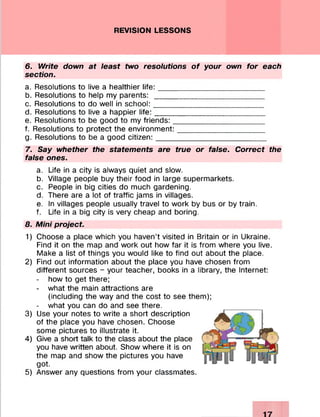
3) Use your notes to write a short description
of the place you have chosen. Choose
some pictures to illustrate it.
4) Give a short talk to the class about the place
you have written about. Show where it is on
the map and show the pictures you have
got.
5) Answer any questions from your classmates.
REVISION LESSONS
LESSON 6
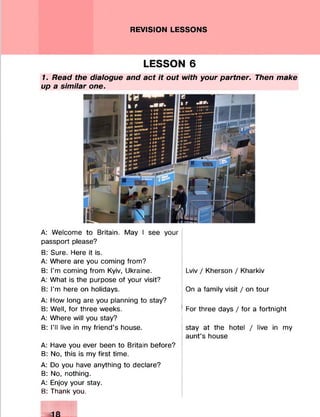
1. Read the dialogue and act it out with your partner. Then make
up a similar one.
A: Welcome to Britain. May I see your
passport please?
B: Sure. Here it is.
A: Where are you coming from?
B: I'm coming from Kyiv, Ukraine.
A: What is the purpose of your visit?
B: I'm here on holidays.
A: How long are you planning to stay?
B: Well, for three weeks.
A: Where will you stay?
B: I’ll live in my friend’s house.
A: Have you ever been to Britain before?
B: No, this is my first time.
A: Do you have anything to declare?
B: No, nothing.
A: Enjoy your stay.
B: Thank you.
Lviv / Kherson / Kharkiv
On a family visit / on tour
For three days / for a fortnight
stay at the hotel / live in my
aunt’s house
REVISION LESSONS
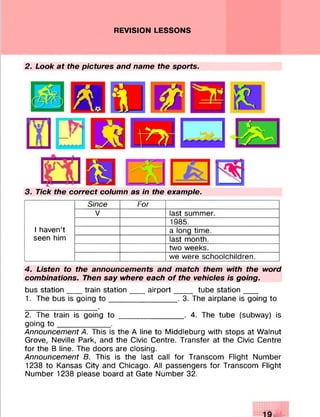
2. Look at the pictures and name the sports.
3. Tick the correct column as in the example.
I haven’t
seen him
Since For
V last summer.
1985.
a long time.
last month.
two weeks.
we were schoolchildren.
4. Listen to the announcements and match them with the word
combinations. Then say where each of the vehicles is going.
bus station___ train station____airport_____ tube station___
1. The bus is going to ________________. 3. The airplane is going to
2. The train is going to _______________ . 4. The tube (subway) is
going to ____________ .
Announcement A. This is the A line to Middleburg with stops at Walnut
Grove, Neville Park, and the Civic Centre. Transfer at the Civic Centre
for the B line. The doors are closing.
Announcement B. This is the last call for Transcom Flight Number
1238 to Kansas City and Chicago. All passengers for Transcom Flight
Number 1238 please board at Gate Number 32.
REVISION LESSONS
Announcement C. The 8:30 bus for Cleveland is now boarding at Gate
Number 16. this is an express bus with stops in Utica and Syracuse
only. Gate 16 for the 8:30 bus to Cleveland.
Announcement D. Your attention, please. The delayed 4:15 train from
Washington with service to Philadelphia and New York is now arriving
on Track Number 4. We apologize for the delay. Once again, the
delayed 4:15 train to Philadelphia and New York now boarding on
Track 4.
Focus on Grammar
Prepositions of Time
in at on
in the morning
(afternoon, evening)
in August (months)
in summer (seasons)
in 1992 (years)
in the 20th century
at 8 o’clock
at noon (night,
midnight)
at Easter
at Christmas
at the weekend
on Fridays
on Wednesday
(days)
on January 27th
(dates)
on Monday morning
on a cold day
on a summer night
5. Fiil in the blanks with the correct preposition (at, on, in).
1. September. 9. Christmas. 17. Saturday night.
2. March 25*’. 10. spring. 18. night.
3. the afternoon. 11. New Year’s
Day.
19. noon.
4. 1983. 12. 10 o’clock. 20. the weekend.
5. Friday. 13. midnight. 21. a summer day.
6. the evening. 14. Sundays. 22. Friday morning.
7. 9 o’clock. 15. Easter. 23. autumn.
8. a hot day. ^ 6 . the 19'"
century.
24. a winter night.
REVISION LESSONS
6. Put the verbs in brackets in the Present Perfect Continuous or
the Present Continuous.
1. Mark isn’t studying right now. He (watch) TV. He (watch) TV for half
an hour already. 2. Kate is standing at the corner. She (wait) for
the bus. She (wait) for twenty minutes. 3. Right now we’re in class.
We (do) the exercise. We (do) this exercise for a couple of minutes.
4. Scott and Rebecca (talk) right now. They (talk) on the phone for
over an hour. 5. I (sit) in class right now. I (sit) since afternoon. 6. You
look busy right now. What (you, do)? - I (work) on my physics
experiment. It's a long and difficult experiment. - How long (you,
work) on it? - I started planning it last January. I (work) on it since
then.
7. Answer the following questions. Use since or for in your
answer.
1. How long have you been studying English? 2. How long have you
been living in ________? 3. Who lives in a flat / a dormitory? How long
have you been living there? 4. How long have you been standing
up/sitting down? 5. I began to teach English in 1989. How long have I
been teaching English? 6. How long has your English teacher been
working in your school? 7. How old were you when you started to drink
coffee? How long have you been drinking coffee? 8. How long have
you been doing this exercise? 9. Do you wear glasses? How long have
you (not) been wearing glasses?
8. Where is it? Ask and answer questions as it is given in the
model.
Model: Where is the printer? - It’s on the table.
Where are the pencils? - They are in the cup.
UNIT I MY FRIENDS
LESSON 7
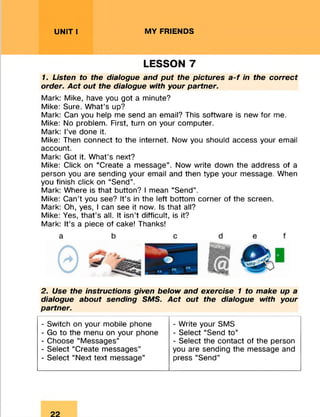
1. Listen to the dialogue and put the pictures a-f in the correct
order. Act out the dialogue with your partner.
Mark: Mike, have you got a minute?
Mike: Sure. What’s up?
Mark: Can you help me send an email? This software is new for me.
Mike: No problem. First, turn on your computer.
Mark: I’ve done it.
Mike: Then connect to the internet. Now you should access your email
account.
Mark: Got it. What’s next?
Mike: Click on “Create a message”. Now write down the address of a
person you are sending your email and then type your message. When
you finish click on “Send”.
Mark: Where is that button? I mean “Send”.
Mike: Can’t you see? It’s in the left bottom corner of the screen.
Mark: Oh, yes, I can see it now. Is that all?
Mike: Yes, that’s all. It isn’t difficult, is it?
Mark: It’s a piece of cake! Thanks!
2. Use the instructions given below and exercise 1 to make up a
dialogue about sending SMS. Act out the dialogue with your
partner.
- Switch on your mobile phone
- Go to the menu on your phone
- Choose “Messages”
- Select “Create messages”
- Select “Next text message”
- Write your SMS
- Select “Send to”
- Select the contact of the person
you are sending the message and
press “Send”
MY FRIENDS UNIT I
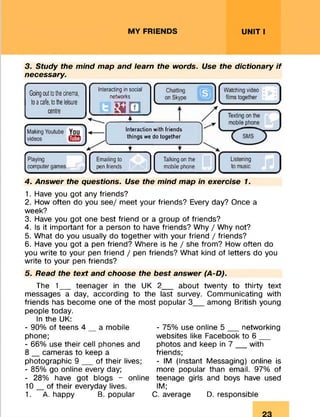
3. Study the mind map and learn the words. Use the dictionary if
necessary.
Going out tothe cinema,
to a cafe, tothe leisure
centre
Interacting in social
networks
m & m
Interaction with friends
things we do together
Emailing to
pen friends
Talking on the
mobile phone
4. Answer the questions. Use the mind map in exercise 1.
1. Have you got any friends?
2. How often do you see/ meet your friends? Every day? Once a
week?
3. Have you got one best friend or a group of friends?
4. Is it important for a person to have friends? Why / Why not?
5. What do you usually do together with your friend / friends?
6. Have you got a pen friend? Where is he / she from? How often do
you write to your pen friend / pen friends? What kind of letters do you
write to your pen friends?
5. Read the text and choose the best answer (A-D).
The 1__ teenager in the UK 2__ about twenty to thirty text
messages a day, according to the last survey. Communicating with
friends has become one of the most popular 3 among British young
people today.
In the UK:
- 90% of teens 4 _ a mobile
phone;
- 66% use their cell phones and
8 _ cameras to keep a
photographic 9 __ of their lives;
- 85% go online every day;
- 28% have got blogs - online
10_of their everyday lives.
1. A. happy B. popular
- 75% use online 5 __ networking
websites like Facebook to 6 __
photos and keep in 7 __ with
friends;
- IM (Instant Messaging) online is
more popular than email. 97% of
teenage girls and boys have used
IM;
C. average D. responsible
UNIT I MY FRIENDS
2. A. copies B. sends C. makes up D. deletes
3. A. subjects B. goals C. ambitions D. hobbies
4. A. own B. buy C. sell D. send
5. A. digital B. social C. cultural D. computer
6. A. take B. print out C. hand out D. share
7. A. touch B. class C. home D. talk
8. A. handmade B. digital C. film D. record
9. A. composition B. description C. record D. essay
10. A. books B. leaflets C. webpages D. diaries
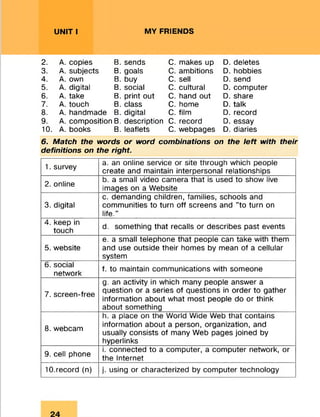
6. Match the words or word combinations on the left with their
definitions on the right.
1. survey
a. an online service or site through which people
create and maintain interpersonal relationships
2. online
b. a small video camera that is used to show live
images on a Website
3. digital
c. demanding children, families, schools and
communities to turn off screens and "to turn on
life."
4. keep in
touch
d. something that recalls or describes past events
5. website
e. a small telephone that people can take with them
and use outside their homes by mean of a cellular
system
6. social
network
f. to maintain communications with someone
7. screen-free
g. an activity in which many people answer a
question or a series of questions in order to gather
information about what most people do or think
about something
8. webcam
h. a place on the World Wide Web that contains
information about a person, organization, and
usually consists of many Web pages joined by
hyperlinks
9. cell phone
i. connected to a computer, a computer network, or
the Internet
10.record (n) j. using or characterized by computer technology
MY FRIENDS UNIT I
LESSON 8
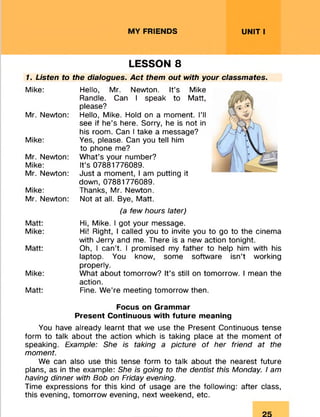
1. Listen to the dialogues. Act them out with your classmates.
Mike:
Mr. Newton:
Mike:
Mr. Newton:
Mike:
Mr. Newton:
Mike:
Mr. Newton:
Matt:
Mike:
Matt:
Mike:
Matt:
Hello, Mr. Newton. It’s Mike
Randle. Can I speak to Matt,
please?
Hello, Mike. Hold on a moment. I’ll
see if he’s here. Sorry, he is not in
his room. Can I take a message?
Yes, please. Can you tell him
to phone me?
What’s your number?
It’s 07881776089.
Just a moment, I am putting it
down, 07881776089.
Thanks, Mr. Newton.
Not at all. Bye, Matt.
(a few hours later)
Hi, Mike. I got your message.
Hi! Right, I called you to invite you to go to the cinema
with Jerry and me. There is a new action tonight.
Oh, I can’t. I promised my father to help him with his
laptop. You know, some software isn’t working
properly.
What about tomorrow? It’s still on tomorrow. I mean the
action.
Fine. We’re meeting tomorrow then.
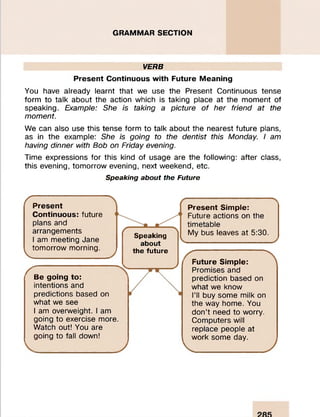
Focus on Grammar
Present Continuous with future meaning
You have already learnt that we use the Present Continuous tense
form to talk about the action which is taking place at the moment of
speaking. Example: She is taking a picture of her friend at the
moment.
We can also use this tense form to talk about the nearest future
plans, as in the example: She is going to the dentist this Monday. I am
having dinner with Bob on Friday evening.
Time expressions for this kind of usage are the following: after class,
this evening, tomorrow evening, next weekend, etc.
UNIT I MY FRIENDS
2. Fill in the blanks of the grammar rules with the words “Simple”
or “Continuous”.
We use the Present....
1. _____ for habits and routines.
2. _____for something happening now or about now.
3. _____ for a permanent situation or fact.
4. _____ for arrangements and plans in the future.
5. _____for timetables and schedules (example, bus, train,
cinema programmes etc.)
3. Listen to the dialogue and fill in the blanks with the Present
Simple or the Present Continuous tense form of the verbs in
brackets.
Jessica: Just a moment. My phone is ringing (ring). It’s Linda! Hi,
Linda!... I’m on the bus. We __ (watch) the school sports
day this afternoon. Yes, I __ (look) forward to it. My friend
Victor__ (run) very well.
Ben: __ she (phone) from New York?
Jessica: Be quiet, Ben. I am with my brother Ben. I have to go now,
Linda. But sports day__ (finish) at five o’clock. Let’s speak
later.
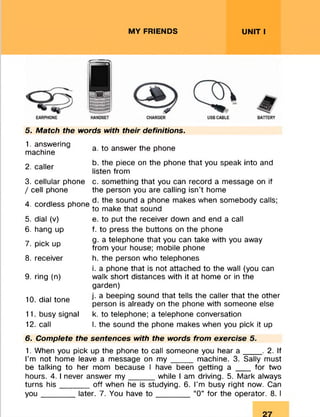
4. Look at the pictures and learn the words.
3 1*
touchscreen
M:<ro USB
Homo key
Menu key
FVswsr key
Lrght sensor
Back key
N otification
indicator
Volume keys
app tray key
Search key
Microphone
MY FRIENDS UNIT I
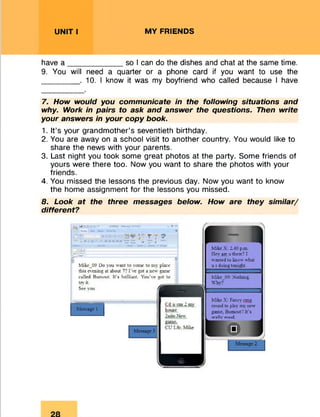
5. Match the words with their definitions.
1. answering
machine
a. to answer the phone
2. caller
b. the piece on the phone that you speak into and
listen from
3. cellular phone c. something that you can record a message on if
/ cell phone the person you are calling isn't home
4. cordless phone
d. the sound a phone makes when somebody calls;
to make that sound
5. dial (v)
6. hang up
7. pick up
8. receiver
9. ring (n)
10. dial tone
11. busy signal
12. call
e. to put the receiver down and end a call
f. to press the buttons on the phone
g. a telephone that you can take with you away
from your house; mobile phone
h. the person who telephones
i. a phone that is not attached to the wall (you can
walk short distances with it at home or in the
garden)
j. a beeping sound that tells the caller that the other
person is already on the phone with someone else
k. to telephone; a telephone conversation
l. the sound the phone makes when you pick it up
6. Complete the sentences with the words from exercise 5.
1. When you pick up the phone to call someone you hear a ____ . 2. If
I’m not home leave a message on m y _____ machine. 3. Sally must
be talking to her mom because I have been getting a ___ for two
hours. 4. I never answer m y______while I am driving. 5. Mark always
turns his _ _ _ _ _ off when he is studying. 6. I’m busy right now. Can
yo u ________later. 7. You have to ________ “0” for the operator. 8. I
UNIT I MY FRIENDS
have a _____________so I can do the dishes and chat at the same time.
9. You will need a quarter or a phone card if you want to use the
. 10. I know it was my boyfriend who called because I have
7. How would you communicate in the following situations and
why. Work in pairs to ask and answer the questions. Then write
your answers in your copy book.
1. It’s your grandmother’s seventieth birthday.
2. You are away on a school visit to another country. You would like to
share the news with your parents.
3. Last night you took some great photos at the party. Some friends of
yours were there too. Now you want to share the photos with your
friends.
4. You missed the lessons the previous day. Now you want to know
the home assignment for the lessons you missed.
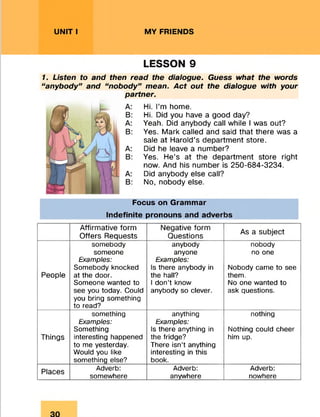
8. Look at the three messages below. How are they similar/
different?
H • “tfriiQfMT1AJ
»»•—— «
J Bi U ' A
• *1234 r ; ?
i T « "T*
Mike_09 Do you want to come to my place
this evening at about 7? I’ve got a new game
called Burnout. It's brilliant. You've got to
try it.
See you (ja
Message 1
Cd u tan. 2 my
house
2nite.New
«
Mike X: 2.40 p.in.
Ilev ate u there? I
wanted to know what
u r doing tonight.
Mike_09: Nothing.
Why?
Mike X: Fancy cmg
round to play my new
game. Burnout? It's
rrallv aood_
MY FRIENDS UNIT I
9. Rewrite the message below so that it looks similar to message
3 in exercise 8.
Message Insert Options
Untitled - Message (HTML)
Format Text
Paste
k
/
a- v : = ■■ J j ^ ^
Jr —
n / i i y  ^ ^ 1 ;s 3- Address Check . Follow
------------- 1 ‘ Book Names Up’
7
Spelling
D X
O'
Clipboard • Bas* Text Names Include • Options '• Proofing
a
Send
l To- j |
1<*"] L
$ubj«t
z
I’m really sorry I can’t make it to the film,
because I haven’t managed to finish all my
homework. I hope you’ll enjoy the film.
See you tomorrow,
Angela.
29
UNIT I MY FRIENDS
LESSON 9
1. Listen to and then read the dialogue. Guess what the words
“anybody” and “nobody” mean. Act out the dialogue with your
partner.
Hi. I’m home.
Hi. Did you have a good day?
Yeah. Did anybody call while I was out?
Yes. Mark called and said that there was a
sale at Harold’s department store.
Did he leave a number?
Yes. He’s at the department store right
now. And his number is 250-684-3234.
Did anybody else call?
No, nobody else.
Focus on Grammar
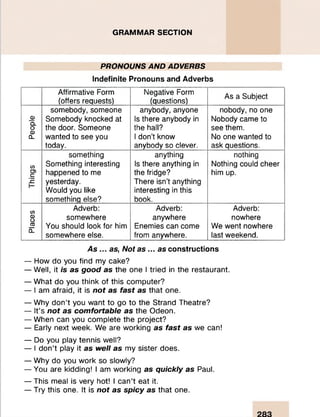
Indefinite pronouns and adverbs
Affirmative form
Offers Requests
Negative form
Questions
As a subject
People
somebody
someone
Examples:
Somebody knocked
at the door.
Someone wanted to
see you today. Could
you bring something
to read?
anybody
anyone
Examples:
Is there anybody in
the hall?
I don’t know
anybody so clever.
nobody
no one
Nobody came to see
them.
No one wanted to
ask questions.
Things
something
Examples:
Something
interesting happened
to me yesterday.
Would you like
something else?
anything
Examples:
Is there anything in
the fridge?
There isn’t anything
interesting in this
book.
nothing
Nothing could cheer
him up.
Places Adverb:
somewhere
Adverb:
anywhere
Adverb:
nowhere
MY FRIENDS UNIT I
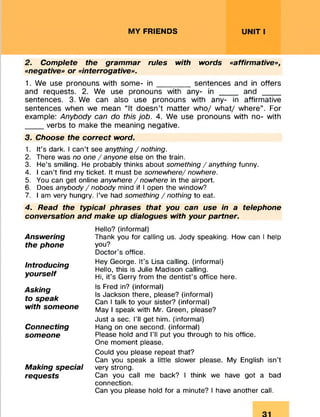
2. Complete the grammar rules with words «affirmative»,
«negative» or «interrogative».
1. We use pronouns with some- in _______ sentences and in offers
and requests. 2. We use pronouns with any- in ____ and ____
sentences. 3. We can also use pronouns with any- in affirmative
sentences when we mean “It doesn’t matter who/ what/ where”. For
example: Anybody can do this job. 4. We use pronouns with no- with
____ verbs to make the meaning negative.
3. Choose the correct word.
1. It’s dark. I can’t see anything / nothing.
2. There was no one /anyone else on the train.
3. He’s smiling. He probably thinks about something / anything funny.
4. I can’t find my ticket. It must be somewhere/ nowhere.
5. You can get online anywhere / nowhere in the airport.
6. Does anybody / nobody mind if I open the window?
7. I am very hungry. I’ve had something / nothing to eat.
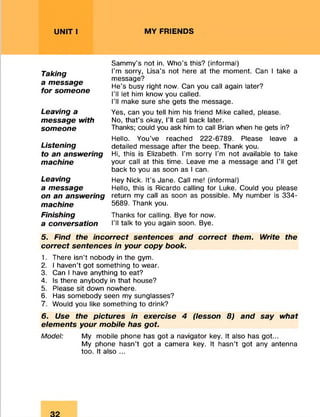
4. Read the typical phrases that you can use in a telephone
conversation and make up dialogues with your partner.
Hello? (informal)
Thank you for calling us. Jody speaking. How can I help
you?
Doctor's office.
Hey George. It’s Lisa calling, (informal)
Hello, this is Julie Madison calling.
Hi, it’s Gerry from the dentist’s office here.
Is Fred in? (informal)
Is Jackson there, please? (informal)
Can I talk to your sister? (informal)
May I speak with Mr. Green, please?
Just a sec. I’ll get him. (informal)
Hang on one second, (informal)
Please hold and I’ll put you through to his office.
One moment please.
Could you please repeat that?
Can you speak a little slower please. My English isn’t
very strong.
Can you call me back? I think we have got a bad
connection.
Can you please hold for a minute? I have another call.
Answering
the phone
Introducing
yourself
Asking
to speak
with someone
Connecting
someone
Making special
requests
UNIT I MY FRIENDS
Sammy’s not in. Who's this? (informal)
I’m sorry, Lisa’s not here at the moment. Can I take a
message?
He’s busy right now. Can you call again later?
I’ll let him know you called.
I’ll make sure she gets the message.
Yes, can you tell him his friend Mike called, please.
No, that’s okay, I’ll call back later.
Thanks; could you ask him to call Brian when he gets in?
Hello. You’ve reached 222-6789. Please leave a
detailed message after the beep. Thank you.
Hi, this is Elizabeth. I’m sorry I’m not available to take
your call at this time. Leave me a message and I’ll get
back to you as soon as I can.
Hey Nick. It’s Jane. Call me! (informal)
Hello, this is Ricardo calling for Luke. Could you please
return my call as soon as possible. My number is 334-
5689. Thank you.
Thanks for calling. Bye for now.
I’ll talk to you again soon. Bye.
5. Find the incorrect sentences and correct them. Write the
correct sentences in your copy book.
1. There isn’t nobody in the gym.
2. I haven’t got something to wear.
3. Can I have anything to eat?
4. Is there anybody in that house?
5. Please sit down nowhere.
6. Has somebody seen my sunglasses?
7. Would you like something to drink?6
6. Use the pictures in exercise 4 (lesson 8) and say what
elements your mobile has got.
Model: My mobile phone has got a navigator key. It also has got...
My phone hasn’t got a camera key. It hasn’t got any antenna
too. It also ...
Taking
a message
for someone
Leaving a
message with
someone
Listening
to an answering
machine
Leaving
a message
on an answering
machine
Finishing
a conversation
MY FRIENDS UNIT I
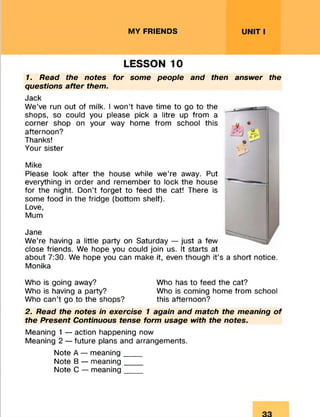
LESSON 10
1. Read the notes for some people and then answer the
questions after them.
Jack
We’ve run out of milk. I won’t have time to go to the
shops, so could you please pick a litre up from a
corner shop on your way home from school this
afternoon?
Thanks!
Your sister
Mike
Please look after the house while we’re away. Put
everything in order and remember to lock the house
for the night. Don’t forget to feed the cat! There is
some food in the fridge (bottom shelf).
Love,
Mum
Jane
We’re having a little party on Saturday — just a few
close friends. We hope you could join us. It starts at
about 7:30. We hope you can make it, even though it’s a short notice.
Monika
Who is going away? Who has to feed the cat?
Who is having a party? Who is coming home from school
Who can’t go to the shops? this afternoon?
2. Read the notes in exercise 1 again and match the meaning of
the Present Continuous tense form usage with the notes.
Meaning 1 — action happening now
Meaning 2 — future plans and arrangements.
Note A — meaning__ _
Note B — meaning____
Note C — meaning____
MY FRIENDS UNIT I
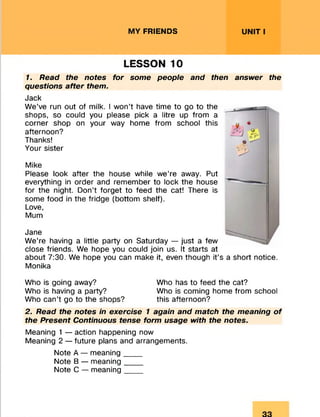
LESSON 10
1. Read the notes for some people and then answer the
questions after them.
Jack
We’ve run out of milk. I won’t have time to go to the
shops, so could you please pick a litre up from a
corner shop on your way home from school this
afternoon?
Thanks!
Your sister
Mike
Please look after the house while we’re away. Put
everything in order and remember to lock the house
for the night. Don’t forget to feed the cat! There is
some food in the fridge (bottom shelf).
Love,
Mum
Jane
We’re having a little party on Saturday — just a few
close friends. We hope you could join us. It starts at
about 7:30. We hope you can make it, even though it’s a short notice.
Monika
Who is going away? Who has to feed the cat?
Who is having a party? Who is coming home from school
Who can’t go to the shops? this afternoon?
2. Read the notes in exercise 1 again and match the meaning o f
the Present Continuous tense form usage with the notes.
Meaning 1 — action happening now
Meaning 2 — future plans and arrangements.
Note A — meaning__ _
Note B — meaning____
Note C — meaning____
UNIT I MY FRIENDS
Focus on Grammar
Grammar Review
3. Put the verbs in brackets into the Future Indefinite or the
Present Continuous tense form with the future meaning.
1. He (play) in a tennis match on Friday. 2. I am sure that I (recognize)
him 3. I (see) her tomorrow. 4. She (comeback) on Monday. 5. I (go)
again next year. 6. We (know) about the accident tonight. 7. I (believe)
it when I see it. 8. I hope that you (have) a good time tomorrow.
9. The window-cleaner (come) at eight tomorrow. 10. Tom (catch) the
7:40 train 11. Where you (meet) them? — I (meet) them at midnight in
the middle of the wood. 12. Look! I’ve broken the teapot. What
Mrs. Pitt (say)? — She (not mind)] she never liked that one.
4. Put the verbs in brackets into the Future Indefinite tense form
or use be going to form.
1. Did you remember to book seats? — Oh no, I forgot. I (telephone)
and book now. 2. The fire has gone out! — So it has. I (go) and get
some sticks. 3. He has just been taken to hospital with a broken leg.
— I’m sorry to hear that. I (send) him some grapes. 4. I can’t
understand this letter. — I (call) my cousin. He (translate) it for you.
5. You (buy) meat? — No, I (not eat) meat anymore. I (eat) vegetables.
6. You’ve bought a lot of paint. You (redecorate) your kitchen? 7. Why
are you peeling that bit of garlic? — I (put) it in the stew. 8. What you
MY FRIENDS UNIT I
(do) when you grow up? — I (be) an acrobat in a circus. 9. This dress
is too long. What you (do) with it? — I (shorten) the skirt. 10. That tree
makes the house very dark. — Very well, we (cut) it down. 11. How do
I get from here to London Bridge? — I don’t know, but I (ask) that
policeman. 12. My brother has just returned from America. — Oh
good, we (ask) him to our next party.
5. Choose the correct indefinite pronoun.
1. We didn’t buy something/ anything.
2. Someone/ Anyone phoned you earlier.
3. Did you see something/ anything interesting in the shops?
4. Something/ Anything strange happened last night.
5. Is someone/ anyone listening to me?
6. I am hungry. I haven’t eaten something/ anything today.
6. Writing notes. Imagine that you (as an exchange pupil abroad)
share a flat with your friend. You are going away for the
weekend. Use exercise 1 as the example and write a note to your
flat mate in which you:
Tell him/ her where you are going
Remind him/ her to do something
Ask him/ her to buy some food
Wish him/ her a good weekend
Say when you’ll be back home
UNIT I MY FRIENDS
LESSON 11
7. Read the dialogue and make up a similar one. Then act it out
with your partner.
A: Do you know Jack?
B: Jack? Who?
A: Jack Stanley.
B: Oh, yes, I do. Why? (а чому ти питаєш?)
A: They say (кажуть) he is a good boy.
B: Yes, he is. He gets on well with his friends. And he is also very
polite to his teachers and older people.
A: How does he treat his younger brother?
B: Very well. Jack helps him in everything.
Focus on Grammar
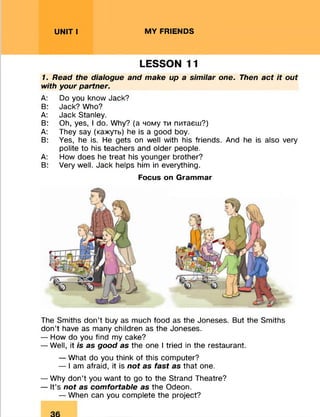
The Smiths don’t buy as much food as the Joneses. But the Smiths
don’t have as many children as the Joneses.
— How do you find my cake?
— Well, it is as good as the one I tried in the restaurant.
— What do you think of this computer?
— I am afraid, it is not as fast as that one.
— Why don’t you want to go to the Strand Theatre?
— It’s not as comfortable as the Odeon.
— When can you complete the project?
MY FRIENDS UNIT I
— Early next week. We are working as fast as we can!
— Do you play tennis well?
— I don’t play it as well as my sister does.
—*Why do you work so slowly?
— You are kidding! I am working as quickly as Paul.
— This meal is very hot! I can’t eat it.
— Try this one. It is not as spicy as that one.
2. Read the text. Practise speaking as it is given in the models.
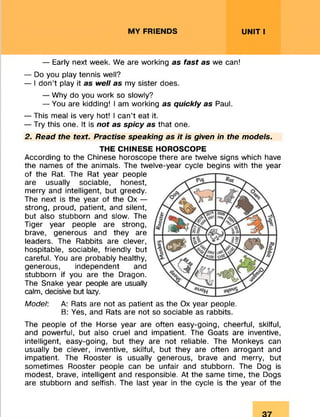
THE CHINESE HOROSCOPE
According to the Chinese horoscope there are twelve signs which have
the names of the animals. The twelve-year cycle begins with the year
of the Rat. The Rat year people
are usually sociable, honest,
merry and intelligent, but greedy.
The next is the year of the Ox —
strong, proud, patient, and silent,
but also stubborn and slow. The
Tiger year people are strong,
brave, generous and they are
leaders. The Rabbits are clever,
hospitable, sociable, friendly but
careful. You are probably healthy,
generous, independent and
stubborn if you are the Dragon.
The Snake year people are usually
calm, decisive but lazy.
Model: A: Rats are not as patient as the Ox year people.
B: Yes, and Rats are not so sociable as rabbits.
The people of the Horse year are often easy-going, cheerful, skilful,
and powerful, but also cruel and impatient. The Goats are inventive,
intelligent, easy-going, but they are not reliable. The Monkeys can
usually be clever, inventive, skilful, but they are often arrogant and
impatient. The Rooster is usually generous, brave and merry, but
sometimes Rooster people can be unfair and stubborn. The Dog is
modest, brave, intelligent and responsible. At the same time, the Dogs
are stubborn and selfish. The last year in the cycle is the year of the
UNIT I MY FRIENDS
Pig. The Pigs are usually honest, sociable and intelligent, but they are
very shy and slow.
Model: The Horse is as cheerful as the Rooster. But the Goats
are not as reliable as the Dog.
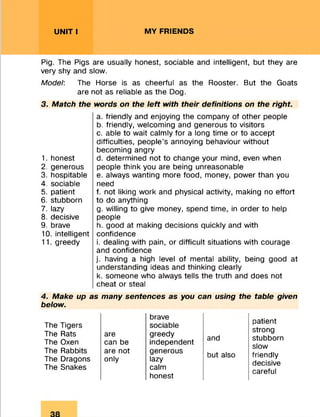
3. Match the words on the le ft with their definitions on the right.
1. honest
2. generous
3. hospitable
4. sociable
5. patient
6. stubborn
7. lazy
8. decisive
9. brave
10. intelligent
11. greedy
a. friendly and enjoying the company of other people
b. friendly, welcoming and generous to visitors
c. able to wait calmly for a long time or to accept
difficulties, people’s annoying behaviour without
becoming angry
d. determined not to change your mind, even when
people think you are being unreasonable
e. always wanting more food, money, power than you
need
f. not liking work and physical activity, making no effort
to do anything
g. willing to give money, spend time, in order to help
people
h. good at making decisions quickly and with
confidence
i. dealing with pain, or difficult situations with courage
and confidence
j. having a high level of mental ability, being good at
understanding ideas and thinking clearly
k. someone who always tells the truth and does not
cheat or steal
4. Make up as many sentences as you can using the table given
below.
The Tigers
The Rats
The Oxen
The Rabbits
The Dragons
The Snakes
are
can be
are not
only
brave
sociable
greedy
independent
generous
lazy
calm
honest
and
but also
patient
strong
stubborn
slow
friendly
decisive
careful
MY FRIENDS UNIT I
LESSON 12
7. Use the given word lists to make up dialogues as it is given in
the model.
Model: A: What are your strengths?
B: I am a hard-worker. I’m dependable. And I am always
eager to learn new things.
A: Are you a patient person?
B: I try to be.
strengths weaknesses
Are you...?  Is he / she...?
honest ttM i dishonest
hard- y------ — ■—/ ] lazy
working unreliable
reliable disorganized
organized indifferent
eager tardv
punctual inflexible
flexible impatient
patient
Focus on grammar!
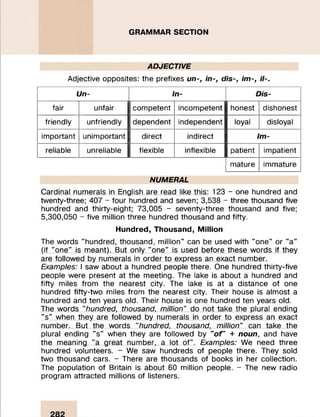
Adjective opposites: the prefixes u n i n - , dis-, im-, il-.
Un- In- Dis-
fair unfair competent incompetent honest dishonest
friendly unfriendly dependent independent loyal disloyal
important unimportant direct indirect Im-
reliable unreliable flexible inflexible patient impatient
mature immature
UNIT I MY FRIENDS
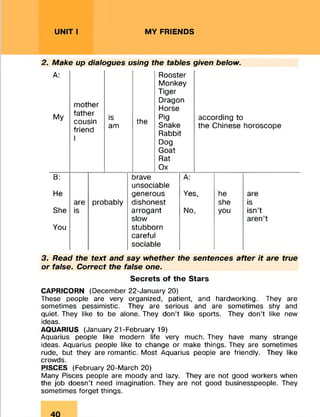
2. Make up dialogues using the tables given below.
A:
My
mother
father
cousin
friend
I
is
am
the
Rooster
Monkey
Tiger
Dragon
Horse
Pig
Snake
Rabbit
Dog
Goat
Rat
Ox
according to
the Chinese horoscope
B: brave A:
unsociable
He generous Yes, he are
are probably dishonest she is
She is arrogant No, you isn’t
slow aren’t
You stubborn
careful
sociable
3. Read the text and say whether the sentences after it are true
or false. Correct the false one.
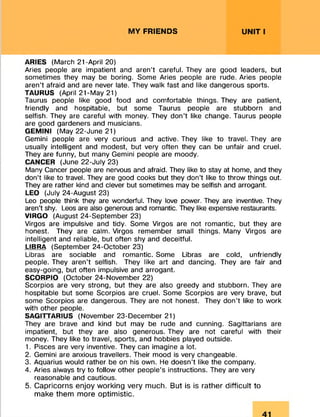
Secrets of the Stars
CAPRICORN (December 22-January 20)
These people are very organized, patient, and hardworking. They are
sometimes pessimistic. They are serious and are sometimes shy and
quiet. They like to be alone. They don’t like sports. They don’t like new
ideas.
AQUARIUS (January 21-February 19)
Aquarius people like modern life very much. They have many strange
ideas. Aquarius people like to change or make things. They are sometimes
rude, but they are romantic. Most Aquarius people are friendly. They like
crowds.
PISCES (February 20-March 20)
Many Pisces people are moody and lazy. They are not good workers when
the job doesn’t need imagination. They are not good businesspeople. They
sometimes forget things.
MY FRIENDS UNIT I
ARIES (March 21-April 20)
Aries people are impatient and aren’t careful. They are good leaders, but
sometimes they may be boring. Some Aries people are rude. Aries people
aren’t afraid and are never late. They walk fast and like dangerous sports.
TAURUS (April 21-May 21)
Taurus people like good food and comfortable things. They are patient,
friendly and hospitable, but some Taurus people are stubborn and
selfish. They are careful with money. They don’t like change. Taurus people
are good gardeners and musicians.
GEMINI (May 22-June 21)
Gemini people are very curious and active. They like to travel. They are
usually intelligent and modest, but very often they can be unfair and cruel.
They are funny, but many Gemini people are moody.
CANCER (June 22-July 23)
Many Cancer people are nervous and afraid. They like to stay at home, and they
don’t like to travel. They are good cooks but they don’t like to throw things out.
They are rather kind and clever but sometimes may be selfish and arrogant.
LEO (July 24-August 23)
Leo people think they are wonderful. They love power. They are inventive. They
aren’t shy. Leos are also generous and romantic. They like expensive restaurants.
VIRGO (August 24-September 23)
Virgos are impulsive and tidy. Some Virgos are not romantic, but they are
honest. They are calm. Virgos remember small things. Many Virgos are
intelligent and reliable, but often shy and deceitful.
LIBRA (September 24-October 23)
Libras are sociable and romantic. Some Libras are cold, unfriendly
people. They aren’t selfish. They like art and dancing. They are fair and
easy-going, but often impulsive and arrogant.
SCORPIO (October 24-November 22)
Scorpios are very strong, but they are also greedy and stubborn. They are
hospitable but some Scorpios are cruel. Some Scorpios are very brave, but
some Scorpios are dangerous. They are not honest. They don’t like to work
with other people.
SAGITTARIUS (November 23-December 21)
They are brave and kind but may be rude and cunning. Sagittarians are
impatient, but they are also generous. They are not careful with their
money. They like to travel, sports, and hobbies played outside.
1. Pisces are very inventive. They can imagine a lot.
2. Gemini are anxious travellers. Their mood is very changeable.
3. Aquarius would rather be on his own. He doesn’t like the company.
4. Aries always try to follow other people’s instructions. They are very
reasonable and cautious.
5. Capricorns enjoy working very much. But is is rather difficult to
make them more optimistic.
UNIT I MY FRIENDS
LESSON 13
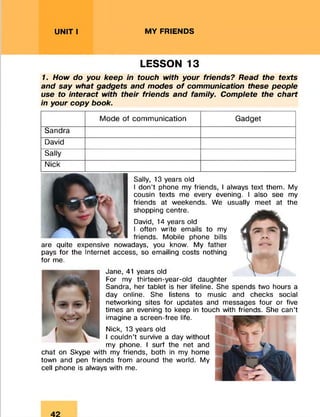
1. How do you keep in touch with your friends? Read the texts
and say what gadgets and modes of communication these people
use to interact with their friends and family. Complete the chart
in your copy book.
Mode of communication Gadget
Sandra
David
Sally
Nick
Sally, 13 years old
I don’t phone my friends, I always text them. My
cousin texts me every evening. I also see my
friends at weekends. We usually meet at the
shopping centre.
David, 14 years old
I often write emails to my
friends. Mobile phone bills
are quite expensive nowadays, you know. My father
pays for the Internet access, so emailing costs nothing
for me.
Jane, 41 years old
For my thirteen-year-old daughter
Sandra, her tablet is her lifeline. She spends two hours a
day online. She listens to music and checks social
networking sites for updates and messages four or five
times an evening to keep in touch with friends. She can’t
imagine a screen-free life.
Nick, 13 years old
I couldn’t survive a day without
my phone. I surf the net and
chat on Skype with my friends, both in my home
town and pen friends from around the world. My
cell phone is always with me.
MY FRIENDS UNIT I
2. Read the emails and put them in order.
1.
2.
3.
M File Edit Addresses Tools Message Window Help x
Message j Attachments j Special j Merge
To: Jane 3 ^
0 Save
Subj: Saturday
Date: Tue 27, Feb 2016 &
Great! See you then!
A
Victor
E
M File Edit Addresses Tools Message Window Help
Message | Attachments ] Special j Merge
To: Victor, 3 * * *
0 Sa*«
Subj: Saturday
Date: jue 27, Feb 2016 &
Thanks for the email. I’d love to come but I can’t. Unfortunately,
I’ve got a dentist’s appointment at eleven. Some other time
maybe.
Jane
LJ File Edit Addresses Tools Message Window Help T r i m
Message JAttachments | Special JMerge
To: Victor, & 3 ^
0 Si»*
Subj: Saturday
Date: jue 27, Feb 2016 <$>
Hi Vic,
That’s a good idea. I can meet you all outside the dentist’s then.
By the way, Laura can come. Luckily, she hasn’t got her tennis
class this Saturday. She lives near the dentist’s so she can meet
us there.
See you on Saturday!
J
UNIT I MY FRIENDS
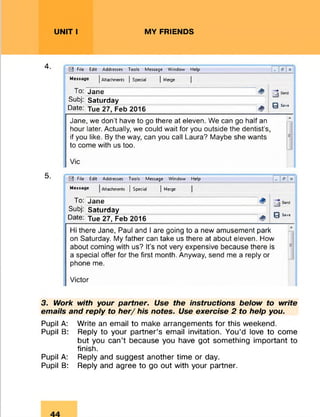
4.
5.
File Edit Addresses Tools Message Window Help _ fi" X
Message jAttachments | Special | Merge
To: Jane 4
0 Sav*
Subj: Saturday
Date: Tue 27, Feb 2016 <*>
Jane, we don’t have to go there at eleven. We can go half an
hour later. Actually, we could wait for you outside the dentist’s,
if you like. By the way, can you call Laura? Maybe she wants
to come with us too.
Vic
File Edit Addresses Tools Message Window Help _ e x
Message |Attachments | Special | Merge
To: Jane
0 Ss*«
Subj: Saturday
Date: Tue 27, Feb 2016 &
Hi there Jane, Paul and I are going to a new amusement park
on Saturday. My father can take us there at about eleven. How
about coming with us? It’s not very expensive because there is
a special offer for the first month. Anyway, send me a reply or
phone me.
Victor3
3. Work with your partner. Use the instructions below to write
emails and reply to h e r/ his notes. Use exercise 2 to help you.
Pupil A: Write an email to make arrangements for this weekend.
Pupil B: Reply to your partner’s email invitation. You’d love to come
but you can’t because you have got something important to
finish.
Pupil A: Reply and suggest another time or day.
Pupil B: Reply and agree to go out with your partner.
MY FRIENDS UNIT I
4. Put the verbs in brackets into the Future indefinite tense form
or use be going to form.
1. Why have you set your alarm to go off at five-thirty? — Because I
(get) up then. I have got a lot to do. 2. You look frozen. Sit down by
the fire and I (make) you a cup of tea. 3. They’ve bought a rope and
they (tow) the car to the garage. 4. My father hasn’t bought any
cigarettes because he (give) up smoking. 5. I have tried to explain but
she doesn’t understand English. — I (say) it to her in German: perhaps
she’ll understand that. 6. I’ve come without any money. — Never mind,
I (lend) you some. How much do you want? 7. There’s the phone
again. Take no notice. — You (not answer) it?
5. Complete the sentences with correct indefinite pronouns and
adverbs. Write the sentences in your copy book.
1. If you need some advice, a s k ___ here to help you. 2. There are
nice people____ in the world. 3. I thought_____knocked at the door,
but when I opened it, ___ was there. 4. I didn’t do ___ yesterday
because I was very tired. 5. Are you going ____ on your vacation?
6. Does___ want to go to the cinema or to the theatre?
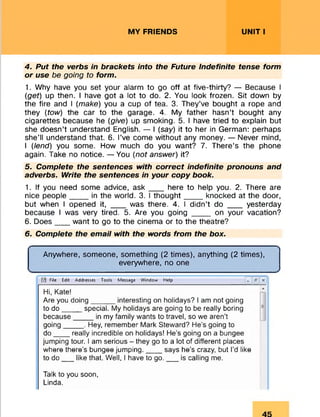
6. Complete the email with the words from the box.
Anywhere, someone, something (2 times), anything (2 times),
everywhere, no one
ta file Edit Addresses Tools Message Window Help 0 X
Hi, Kate!
Are you doing______interesting on holidays? I am not going
to do _____special. My holidays are going to be really boring
because_____in my family wants to travel, so we aren’t
going_____. Hey, remember Mark Steward? He’s going to
do ____really incredible on holidays! He’s going on a bungee
jumping tour. I am serious - they go to a lot of different places
where there’s bungee jumping.___ says he’s crazy, but I’d like
to do___like that. Well, I have to go.___ is calling me.
Talk to you soon,
Linda.
UNIT I MY FRIENDS
LESSON 14
REVISION LESSONS
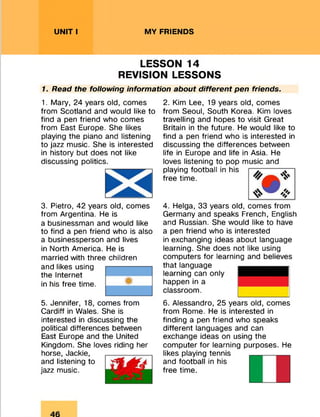
7. Read the following information about different pen friends.
1. Mary, 24 years old, comes
from Scotland and would like to
find a pen friend who comes
from East Europe. She likes
playing the piano and listening
to jazz music. She is interested
in history but does not like
discussing politics.
3. Pietro, 42 years old, comes
from Argentina. He is
a businessman and would like
to find a pen friend who is also
a businessperson and lives
in North America. He is
married with three children
and likes using
the Internet
in his free time.5
5. Jennifer, 18, comes from
Cardiff in Wales. She is
interested in discussing the
political differences between
East Europe and the United
Kingdom. She loves riding her
horse, Jackie,
and listening to
jazz music.
2. Kim Lee, 19 years old, comes
from Seoul, South Korea. Kim loves
travelling and hopes to visit Great
Britain in the future. He would like to
find a pen friend who is interested in
discussing the differences between
life in Europe and life in Asia. He
loves listening to pop music and
playing football in his
free time.
4. Helga, 33 years old, comes from
Germany and speaks French, English
and Russian. She would like to have
a pen friend who is interested
in exchanging ideas about language
learning. She does not like using
computers for learning and believes
that language
learning can only
happen in a
classroom.
6. Alessandro, 25 years old, comes
from Rome. He is interested in
finding a pen friend who speaks
different languages and can
exchange ideas on using the
computer for learning purposes. He
likes playing tennis
and football in his
free time.
MY FRIENDS UNIT I
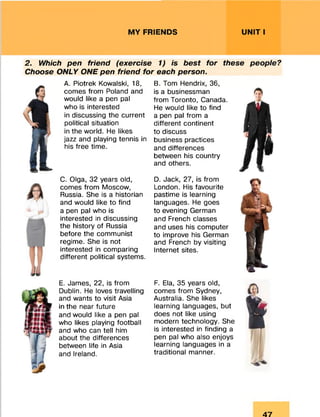
2. Which pen friend (exercise 1) is best for these people?
Choose ONLY ONE pen friend for each person.
A. Piotrek Kowalski, 18,
comes from Poland and
would like a pen pal
who is interested
in discussing the current
political situation
in the world. He likes
jazz and playing tennis in
his free time.
C. Olga, 32 years old,
comes from Moscow,
Russia. She is a historian
and would like to find
a pen pal who is
interested in discussing
the history of Russia
before the communist
regime. She is not
interested in comparing
different political systems.
E. James, 22, is from
Dublin. He loves travelling
and wants to visit Asia
in the near future
and would like a pen pal
who likes playing football
and who can tell him
about the differences
between life in Asia
and Ireland.
B. Tom Hendrix, 36,
is a businessman
from Toronto, Canada.
He would like to find
a pen pal from a
different continent
to discuss
business practices
and differences
between his country
and others.
D. Jack, 27, is from
London. His favourite
pastime is learning
languages. He goes
to evening German
and French classes
and uses his computer
to improve his German
and French by visiting
Internet sites.
F. Ela, 35 years old,
comes from Sydney,
Australia. She likes
learning languages, but
does not like using
modern technology. She
is interested in finding a
pen pal who also enjoys
learning languages in a
traditional manner.
47
UNIT I MY FRIENDS
LESSON 15
7. Read the dialogue and act it out with your partner.
Victor: Have you planned your vacations, Sam?
John: Yes, I am leaving on Saturday.
Victor: Where are you going?
John: To an adventure summer camp in Lutsk.
Victor: Wow! You are lucky. I have never been to an adventure
summer camp.
John: Would you like to come with me?
Victor: Thanks. I’d love to, but I’m afraid I can’t.
John: Why not? Have you got some other plans?
Victor: No. I just think my parents will not let me go.
John: I’ll try to talk to them. Moreover, it is not expensive.
Victor: Thanks John. You are a good friend.
2. Use the information and say what kind o f character is typical
for a person if:
1. She is a Horse and a Libra.
2. He is a Dragon and a Sagittarius.
3. She ia a Tiger and a Capricorn.
4. He is a Pig and a Pisces.
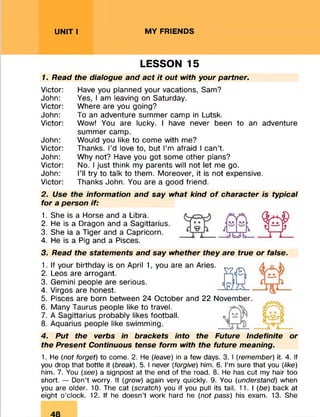
3. Read the statements and say whether they are true or false.
S2 fQ
1. If your birthday is on April 1, you are an Aries.
2. Leos are arrogant.
3. Gemini people are serious.
4. Virgos are honest.
5. Pisces are born between 24 October and 22 November.
6. Many Taurus people like to travel.
7. A Sagittarius probably likes football.
8. Aquarius people like swimming.
4. Put the verbs in brackets into the Future Indefinite or
the Present Continuous tense form with the future meaning.
1. He (not forget) to come. 2. He [leave) in a few days. 3. I (remember) it. 4. If
you drop that bottle it [break). 5. I never [forgive) him. 6. I’m sure that you [like)
him. 7. You [see) a signpost at the end of the road. 8. He has cut my hair too
short. — Don’t worry. It [grow) again very quickly. 9. You [understand) when
you are older. 10. The cat [scratch) you if you pull its tail. 11.1 [be) back at
eight o’clock. 12. If he doesn’t work hard he [not pass) his exam. 13. She
MY FRIENDS UNIT I
(go) on a cruise next summer. 14. lam sorry that the child saw the accident.
— I don’t think it matters. He soon (forget) all about it.
5. Write an email to your friend to invite him / her to your birthday
party. The plan given below will help you.
Dear ...,
Paragraph 1. Greetings. Opening remarks. Reasons for writing.
Paragraph 2. Give details about your party: the time, the guests you are
going to invite, the food, decorations, music, clothes,
location, things to do.
Paragraph 3. Closing remarks.
Best wishes,
6. You have received an email from your friend in which he / she
invites you to his / her birthday party. Write a message in which
you accept / refuse the invitation. The phrases below will help
you.7
Accepting the invitation Refusing the invitation
Thanks for inviting me. I’d love
to come. Expect me around 4 p.m.
Thanks, but I am afraid I can’t.
That sounds great! I’ll be there
at about ...
I’d love to come, but I really can’t
manage it. I’ve got ...
7. Say what zodiac and Chinese horoscope signs the members o f
your family are. Then describe their characters.
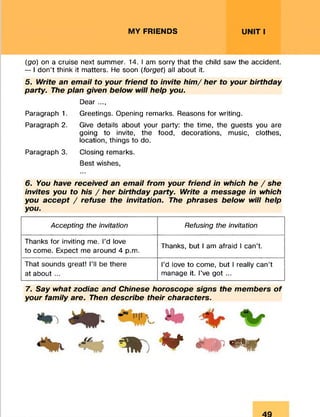
* * m * m * *
UNIT I MY FRIENDS
LESSON 16
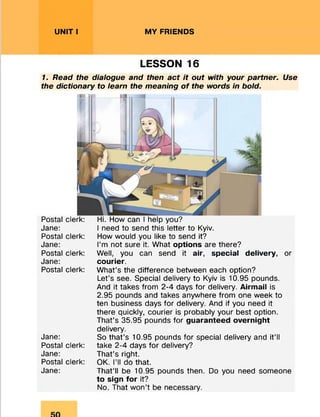
7. Read the dialogue and then act it out with your partner. Use
the dictionary to learn the meaning o f the words in bold.
Postal
Jane:
Postal
Jane:
Postal
Jane:
Postal
Jane:
Postal
Jane:
Postal
Jane:
clerk: Hi. How can I help you?
I need to send this letter to Kyiv,
clerk: How would you like to send it?
I’m not sure it. What options are there?
clerk: Well, you can send it air, special delivery, or
courier.
clerk: What’s the difference between each option?
Let’s see. Special delivery to Kyiv is 10.95 pounds.
And it takes from 2-4 days for delivery. Airmail is
2.95 pounds and takes anywhere from one week to
ten business days for delivery. And if you need it
there quickly, courier is probably your best option.
That’s 35.95 pounds for guaranteed overnight
delivery.
So that’s 10.95 pounds for special delivery and it’ll
clerk: take 2-4 days for delivery?
That’s right.
clerk: OK. I’ll do that.
That’ll be 10.95 pounds then. Do you need someone
to sign for it?
No. That won’t be necessary.
MY FRIENDS UNIT I
2. Read the text and choose the best answer to fill in the blanks.
Say what the writer means by “a true friend” .
Is There Such a Thing as a True Friend?
Such question is close to my heart and my 1_____ . When I was
younger I didn’t know the answer to it. As I grew older I 2_____ a lot
about friendship.
In some magazine I’ve read that you could have about 350 friends in
your 3_____ , but only five or six of them will be your true friends. Isn’t
that right? When I look down the list of 4______ I have got on my
mobile phone I see that most of the names are “friends’ names”. I am
sure that any person can say the same about his or her 5_____
contacts list. But if you ask yourself a question - “Who would I call in
case of a trouble?” - then you will 6_____one or two people on the
list you could ask for help. Only such people are true friends for me.
They will be friends with you no 7_____ how much money you have
got, how you look or what you do for a 8___ . They will run to help you
even if they are extremely busy at that very moment.
Have you got a true friend?3
1. A brain B head C mind D hat
2. A learnt B learn C learns D learnes
3. A mealtime B lifetime C bedtime D playtime
4. A contracts B contacts C figures D numbers
5. A mobile B tablet C computer D gadget
6. A chose B chosen C choose D chosed
7. A trouble B problem C matter D meaning
8. A living B career C job D life
3. Say what character traits a true friend should possess. Give
your reasons. There is a model to help you.
Model: A true friend should be reliable. He or she should keep his /
her friend’s secrets. He should be “a friend in need”, not
just a friend to gossip with. A true friend should ...
UNIT I MY FRIENDS
4. Give words for the given definitions.
Model: Behaving in an unpleasant or rude way because you think
you are more important than other people - arrogant
1 caring only about yourself, not about other
people
2 able to tell lies in order to get what you want
3 not right or fair
4 embarrassed about meeting and speaking to
other people
5 wanting to know about something
6 friendly and enjoying the company of other
people
7 able to wait calmly for a long time or to accept
difficulties, people’s annoying behaviour without
becoming angry
8 determined not to change your mind, even when
people think you are unreasonable
9 not liking work and physical activity, making no
effort to do anything
10 good at making decisions quickly and with
confidence56
5. Give the opposites for the adjectives given below. Then make
up five sentences o f your own with there adjectives.
Model: unreliable - reliable; sad - merry.
Dishonest, unsociable, greedy, modest, hard-working, impatient,
inhospitable, indecisive, fair, selfless.
6. Imagine you are looking for a pen friend. Write an advert
about yourself as a potential pen friend. Include the information
about your age, education, hobbies and interests. Invite people
to write to you. Use exercise 1 and 2, lesson 14, to help you.
MY FRIENDS UNIT I
LESSON 17
1. Read “ the words of wisdom” about friends and friendship. Which
statements do you agree with? Which do you not agree with?
1.“In life we never lose friends, we only learn who the TRUE ones are”.
2. “Fake friends are like shadows: they follow you in the sun, but leave
you in the dark”.
3. “Good friends care for each other, close friends understand each
other, but only true friends stay forever, beyond words, beyond distance,
beyond time”.
4. “True friends say good things behind your back and bad things to your
face”.
2. Complete the sentences with the correct indefinite or negative
pronouns. The first sentence is the model to help you.
1. Are you doing anything tonight?
2. Do you know____ who speaks Italian? I want to learn this language.
3. I m et____ interesting last week.
4. Look! There is ___ _ strange in your soup.
5. What did you do last night? - ___ interesting.
6. Where did you go yesterday? - I didn’t g o ____ . I stayed at home.
7. Have you found___ interesting for the topic in the Internet? -
There was___ interesting, but not much, I’m afraid.
8. . Open the door. There is ___ waiting outside. - Well,
there is ___ there. At least I couldn’t see____.
3. Look a t the pictu res and say which character adjectives they
represent.
Model: - reliable
53
UNIT I MY FRIENDS
4. Read the words in the box and discuss their meaning with your
partner. Then use the words from the box to complete the text
(there are more words than you need).
( -----------------------------------------------------------------------------------------------------------------------------------------------------------------------
Mobile phone, body language, computer network, email, blog, face-to-
face conversation, intranet, micro-blog, netbook, postal service, instant
messaging, sign language, texting (sms), landline telephone, smart
phone, telegraph, tablet
 ____________________________ 1____________________________/
900
BC
Early postal service in China. Horse riders carry messages on
horses.
1874 A.Bell has the first successful conversation.
1969 The first computer links universities in the United States.
1972
People send the first . The message explains how to use the @
symbol.
1983
Motorola makes their first . It measures 25 centimetres x 8
centimetres.
1996
People invent . You can now chat with your friends on your
computer.
2006
The site Twitter starts. A message can’t be longer than 140
characters.
2010
Apple launches the first with a touch screen. Bigger than a
smartphone but smaller than a netbook, it doesn’t have a keypad.
5. Use the mind map below to speak about friends and
friendship.
MY FRIENDS UNIT I
6. Project work. Work in groups o f four or five. A school in
Britain or the USA has asked you to design an English language
website o f your school. Look at the web page about Guilford
High School (http://ghs.guilfordschools.org/).
^ District Atxw t Our School Academics Parents A Students Teaching A I earning Contact Us
PowerSchool
Dining Services
Gl IS Athletics
Music Department
Theatre Arts
School Counseling
Health Services
Media Center
Mentoring Program
New Guilford High School
UPCOMING EVENTS NEWS & ANNOUNCEMENTS PRINCIPAL'S CORNER
• TA Rehearsal GHSFilm Club Prem ier- "One" - Friday, January
Date: Today 15th **The mission of Guilford High
Location: Auditorium School Is to focus on learning In a
a. Answer the questions given below.
Who wrote the web page about Guilford High School?
What kind of information does it give?
What kind of links are there on the web page?
What information is missing?
b. Think about your school. Decide what kind of information you want
to write about your school on the home page. Make notes.
c. Decide what links you want to have for your web page. Make a list
and then write notes for each link.
d. Decide what pictures you want to have on your website and how
you will organize the texts, pictures and links.
e. Design the website of your school.
LESSON 18 (OPTIONAL)
IP « iP
/^//////////////
M l i ! ixxxxxxxxxx;
HEALTHY LIFESTYLE
:
LESSON 19
1. Work in small groups. Prepare a food survey questionnaire for
the class project “How Healthy We Are” .
Ask about the following things: 1) person’s favourite food; 2) how
much they eat every day. The sample questions may be the following:
How much water do you drink every day? / How many bottles of water
do you drink every day? How often do you eat sweets? Then report the
results of your survey to the class. Use Grammar Review to help you.2
Grammar Review
Use in affirm ative
statem ents
Use in negative
statem ents
Use in questions
a little / a few /
a lot of / some
much / many / any much / many / any
Only use with
countable nouns
Only use with
uncountable nouns
Use with countable o r
uncountable nouns
a few / few /many a little / little / much any / a lot of / some
2. Listen to the dialogue and complete the table with the
underlined words. Act out the dialogue with your partner.
Linda: You know, preparing the questions for the survey makes me
think about the way and the food I eat. Maybe I need to
make some changes. I don’t think I eat many vegetables.
I should probably eat more food.
Brenda: Me too. I eat a lot of bananas. They are my favourite.
Linda: I don’t think I drink enough water.
Brenda: How much do you drink?
Linda: Three or four glasses a day. Do you think it’s enough?
Brenda: I don’t think so. You should increase to at least six or seven
glasses. What about milk? Do you drink any milk?
Linda: I do. I usually drink a glass of milk every morning. Do you eat
any meat?
Brenda: Yes, I eat a little meat - I’m not a vegetarian, but I don’t eat
any junk food. You know pizza, snacks, chips and stuff like
that. Do you?
Linda: I love pizza! I know it’s bad for my health. I sometimes buy
potato chips, not often definitely.
57
UNIT IIHEALTHY LIFESTYLE
Brenda: Linda, you should really make some changes in your eating
habits.
Countable nouns
Uncountable nouns
3. Complete the questions with how much / how many.
1. __________ slices of pizza do you eat for lunch? 2. ___________ pizza
do you eat for lunch? 3. ____________ tea do you drink every week?
4. ___________ bottles of milk do you drink every month? 5. __________
sugar do you put in your tea? 6. __________ teaspoons of sugar do you
put in your tea? 7. __________ cups of cocoa do you drink a day?
4. Complete the sentences with the correct expression in the
brackets.
1. I’d like ________ tea, please. (a little / a few)
2. Would you like ______ apple pie? (a little / a few)
3. I don’t eat _______ sweets. (much / many)
4. I don’t drink _______ water. (much / many)
5. My cousin doesn’t eat _______ meat. (some / any)
6. Linda, would you like _______ chips? (a little / a few)
5. Read the statements and guess whether they are true or
false. Then read the text and check your answers.
1. Too much sun can be really dangerous.
2. People with dark don’t need sunscreen.
3. You don’t need sunscreen on a cloudy day.
4. The sun causes damage by ultraviolet rays.
Everyone might agree that it’s healthy to have a suntan. Is it really
healthy? The answer is — No! A tan looks beautiful, but all that sun can
be very harmful to your health. Too much sun can make your skin dry
and look ugly or even worse — it can cause skin cancer. You should
put some sunscreen to protect your skin if you’re going to stay in the
sun for a longer period of time. Many people believe that only blonds
need to protect their skin. It’s true that light skin is more sensitive to
the sun, but it is also true that all types of skin can suffer from too
much sun. People also think they don’t need sunscreen on a cloudy
day. This is wrong. The dangerous ultraviolet rays can pass through
the clouds. So, be careful when you are going to lie in the sun.
::::::: : :: : : : y .y y y >
:::y.y.y.y.y.y.y.y.y.:-
:::i:j:::x x x x x x :-
:j :}:x x x x x x x x >
mxxxxxxxxx:*
::2:j:s:;:x x x x x x >
X X X y .X X X lV A ltlttiltiU K i
:<:-c
x x x x x x x x x x x x jc c ju
XXXXXXXXXXXXIXXJ
xxxxxxxxxx:;x:t:t:i:i 4444//////W W A V A V kW N V V V % 444 4
x>:>:x>:>:>:>:xxxxxxxxx:*x:*:*:{
>:>:>:>:xxxxxxxxxxx:<xxx2<:«:<
>:>:>:>:>:xxxxxxxxxxxxxx:<xx
xxxxxxxxxxxxxxxxxxxxxx
XXXXXXXXXXXXXXXXXXXXXX
Focus on Grammar
Modals: should, might, could
We use "should” to make recommendations or give advice. We can also use
it to express obligation. Examples:
When you go to Berlin, you should visit the palaces in Potsdam. People
with high cholesterol should eat low-fat food. - recommendation
You should focus more on your healthy habits. You really should start
eating better. Your brother shouldn’t smoke. It’s not good for his health. -
advice
I should be in the school by 9:00 AM. You shouldn’t eat before
swimming. - obligation / prohibition
We use "might" to express possibility. We can also use "might" to make
suggestions or requests. Examples:
Your English book might be in the living room. She might not be in the
kitchen. I saw her in the living room a few minutes before. - possibility
You might eat more fruit if you want to improve your lifestyle. You might
try the cheesecake. - suggestion
Might I borrow your pen? Might I have something to drink? - request
We use "could" to express possibility or past ability as well as to make
suggestions and requests. Examples:
Much fat in the food you eat could cause high blood pressure. -
possibility
Linda could ski very well by the age of 11. - past ability You could eat
more fruit and vegetables if you want to lose weight. - suggestion
Could I use your computer to email my friend? - request
6. Read the text in exercise 5 and the dialogue in exercise 2 and
find the modal verbs there. Say what meaning they express. Use
Focus on Grammar box to help you.
7. Writing. Write the questions you have prepared for the class
project “How Healthy We Are” in your copy book. Then write the
results o f the survey. There is a model to help you.
Model: Question 1: How much water do you drink a day?
Survey results: 13 out of 18 pupils in my class have said
they usually drink three glasses of water every day. The rest
5 pupils drink more than three glasses every day.
....... iSSNUSWAWAV//////////
& :
^nsswwXvXv//////////.;.•.
f/////W/jVVVW%SS<<WS^v!v/Xv!vi;!y!v
HEALTHY LIFESTYLE
»»MM«««««
8f«8£WK&»H
LESSON 20
Are you a live wire or a couch potato?
1. Look at the title o f this lesson. What do expressions “a live
wire” and “a couch potato” mean? Use the dictionary and the
pictures to help you. Which expression would you use to
characterize yourself? Give your reasons.
2. Read the statements and sort them out into two groups: “a
live wire group” and “a couch potato group” . Find the sentences
which express the future actions. Explain why we should use the
given grammar phenomena in each situation.
1. I am going to walk for more than half an hour today. 2. I’m going to spend
this weekend lying on a beach and doing nothing. 3. I’m going to play
football today. I am not going to watch football on TV today. 4. I’m not
planning to get up before ten tomorrow. 5. I’m going to play tennis this
weekend. 6. I’d like to spend more time in bed than I normally do. 7. I am
going to take a lift, I’m not going to walk up a flight of stairs. 8. I’m planning
to go skiing sometime this year. 9. I’m going to spend most of this evening in
front of a TV/computer screen. 10. I’d like to climb a mountain or go on a
cycling holiday one day. 11. I’m going to buy a more comfortable sofa when I
have enough money. 12. I’m going to watch a new soap opera and eat more
biscuits tonight.
3. Read the rules for the swimming pool and match them with the
signs.
Safe swimming
1. Take a shower before you enter the pool.
2. Don’t eat before swimming. It can lead to stomach cramps or you
might drown.
3. Call the lifeguards if you get into trouble.
iVVAVivIv.*/.'//////
SÏKÎÏSSÏSÏHgjf/Z/AVAVASSWi« ........
uuuv!vXvX;.v^///j
...........,•.•.•.•.•.•.•.•.•.• •.•.•.•.-,
 u u    v .*.*.*
.............
kïïîSvIwSKw///ivlvlviviv.'!*/////
f v .w ,
4. Pay attention to the signs which say “No diving!”. Don’t dive in such
areas.
5. Don’t jump in the way of dive-bombing. You might put the other
swimmers in danger.
6. Don’t wear outdoor boots in the pool.
7. Don’t run around in the pool. The surface is wet and you might slip
and fall.
a c
4. Read the rules in exercise 3 and change them as in the
model. Then write down all the modal verbs from the text.
Explain what they express.
Model: Don’t play or run around in the pool. The surface is wet and you
might slip and fall. - You shouldn’t play or run around in the pool.
Make sure you know where the lifeguards are. - You should make
sure you know where the lifeguards are.
5. Writing an essay. Sort out the linking expressions in the
correct paragraph.
in my opinion, in the first place, however, on the other hand, to sum
up, generally speaking, in addition, on the one hand, moreover, on
the whole, to begin with, in conclusion, in my view, for instance,
although, furthermore
Introduction Generally speaking,
Giving one side of the topic:
Adding ideas:
In the first place,
In my opinion,
Giving the other side of the topic:
Giving examples:
Conclusion:
............./////////^/////#
11111111
::::::::
;;•;•■•...
r////////w/XvX'Xv!%■!%%v
^ssv.v!v!v.v;v//////>
r***f .........r///////w.v.v.v.v.wss
iNvX*XvXvXv/
' ■>>XvXv!v!v;
mmm
SNNN>NW>
^/////////////
lllllll X-XviviviyXX
6. Do you prefer to play computer games or sports in your free
time? Why? Read the essay on the topic “ Video games are a
waste o f tim e” and put the paragraphs in order. Then fill in the
blanks with the correct expression from exercise 5.
A. _____, there are advantages and disadvantages to
playing video games, similar to everything else in our life.
The answer is to use your games console in a reasonable
way.
B. _____, all young people enjoy playing on their games
consoles. In each game there’s a challenge, which
encourages you to get on the next level and w in._______,
people say that such games increase a person’s mental
ability because a player needs to react quickly to
changing situations.
C . ____ , video games such as PlayStation, Nitendo and
others aren’t a waste of time. Many people,_____ , might
not agree with this statement. That’s why I am going to
look at both sides of the question.
D. ______, it’s true that children shouldn’t spend many
hours in front of the screen, because the eyes get tired, and the body needs
exercise, especially when you are a teenager.______, games consoles or TV
sets shouldn’t be in a child’s bedroom. ______, I’ve got mine in the living
room where I can’t play for hours.
7. Write a short essay to answer the question “Are mobile
phones a good invention?” The following ideas might help you.
Ideas “for” the mobile phones:
o The mobile phone is a quick and easy way to communicate with other
people
o Mobile phones are very flexible: you can use them to
send messages and photos, as well as talk to someone
o Mobile phones are more personal than emails because you can hear the
person you are talking to
Ideas “against" the mobile phones:
o Mobile phones produce harmful waves that can damage your health
o Expensive mobile phones attract the thieves; so you might become a
victim of some criminals
o The mobile phone can cause addiction to playing computer and online
games in young people
LESSON 21
How healthy is your lifestyle?
1. Answer the questions o f the questionnaire to find out how
healthy your lifestyle is. Compare your answers with your partner
and say who leads a healthier lifestyle: you or your partner.
1. What kind of drink do you usually have?
a. sweet fizzy drinks b. tea or cocoa
c. fruit juice or water
2. How many portions of fruit and vegetables do
you eat every day?
a. fewer than three b. three or four
c. five or more
3. Which of these things do you do?
a. smoke cigarettes b. spend time in smoky rooms
c. can’t go near cigarette smoke
4. How many times a week do you do physical
exercise?
a. never b. once or twice c. three times or more
5. How many hours do you sleep at night?
a. under 5 b. 5 to 7 hours c. 8 or more hours
Point calculator:
1. a = 0 points b = 0 points c = 5 points
2. a = 1 point b = 3 points c = 5 points
3. a = -20 points b = - 5 points c = 5 points
4. a = - 5 points b = 2 points c = 5 points
5. a = - 5 points b = 2 points c = 5 points
Less than 0 points - think how to change your lifestyle and improve it!
0-10 points - not bad but you should change some things!
11-20 - your lifestyle is healthy but think about how to improve it!
21 -25 - well done!
^ / .v X v!vi;!v!v!
..........
I! S P IIH^/////////XvX'XvIvXssiiur///////////.;.;.v.v.v.;.y.s XyXs,Isssv
2. Look at the results o f your answers to the
questions in exercise 1 and make conclusions
about the changes you should make to
improve your lifestyle. There is a model to
help you.
Model: The results of the questionnaire show that
I should change a lot of things in my life. First of
all, I should drink more water or fruit juice. I
should cut on drinking sweet fizzy drinks.
Secondly, I should....
3. Listen to the dialogue and act it out with your partner. Make
sure you know the meaning o f the words in bold type. Use the
dictionary if necessary.
Linda: You're really fit, Victor. Do you exercise very much?
Victor: Well, I almost always get up very early, and I do aerobics for
an hour.
Linda: You're kidding!!!
Victor: No. And then I often go rollerblading.
Linda: Wow!! How often do you exercise like that?
Victor: About five times a week. What about you?
Linda: Oh, I hardly ever exercise. I usually just watch TV in my
free time. I guess I'm a real couch potato!!!
Victor: Well, I used to be the same but then I had some serious
health problems and the doctor
advised me to take up regular
exercise. Now I don’t have any health
problems.
Linda: I’ll probably follow your example.
Otherwise I am going to have serious
health problems in the nearest future.4
4. Look at the picture. Say what the time is and what the people
are doing at this time. There is a model to help you. Then say
what kind o f a lifestyle the Wilsons are leading.
Model: Today is Monday. It’s 7 p.m. and the Wilsons are at home.
Mr. Wilson is watching TV. Mrs. Wilson is...
5. Use the picture in exercise 4. Imagine that today is Tuesday.
Look at the picture and read the text. Then read the Focus on
Grammar box.
Today is Tuesday. Yesterday was Monday. At 7 p.m. yesterday the Wilsons
were at home. When I entered the room Mr. Wilson was watching TV. Mrs.
Wilson was knitting and the children were playing: Tom was playing a
computer game and Carol was playing with her mobile phone. Their cat was
sleeping on the sofa. Focus on grammar?
6. Make up as many sentences as you can using the table given
below. Write your sentences in the copy book.
He
She
We
They
1
was
were
playing
watching
reading
skating
talking
a newspaper
in the yard
with friends
on the skating rink
a game
the guitar
at 10 pm yesterday
at 8 am yesterday
at 4 pm yesterday
: : : : : : : : :
/<•/////////#/##«..
liillllil;X;Xn%|
LESSON 22
1. Listen to the dialogue and do the quiz after it. Act out the
dialogue with your partner and then make up a similar one.
Judy: You exercise a lot, don’t you, Tom?
Tom: Yes, I work out at least three times a week.
Judy: What kind of exercise do you do?
Tom: I lift weights in the gym and swim in the pool.
And sometimes I go jogging after school.
Judy: I don’t exercise at all, but I’d like to start.
What kind of exercise should I do?
Tom: Well, what do you like?
Judy: I like walking. That’s exercise, isn’t it?
Tom: It sure is! And it’s a good way to start!
1. Tom exercises______a week.
a. less than three times b. three times or more
2. He____ at the gym.
a. swims b. goes jogging c. lifts weights
3. Judy wants to _____ exercising.
a. begin b. stop
4. She asks if walking is _____ .
a. good for her b. a type of exercise
Focus on Grammar
Past Continuous: interrogative and negative forms
Affirmative Interrogative Negative
When Linda met Was Victor exercising in the Victor wasn’t
Victor he was gym when Linda met him? exercising in the
exercising in the What was Victor doing in the gym when Linda
gym. gym when Linda met him?
Who was exercising in the
gym when Linda came there?
met him.
They were Were they watching TV at 7 They were not
watching TV at 7 p.m. yesterday? watching TV at 7
p.m. yesterday. What were they watching at
7 p.m. yesterday?
p.m. yesterday.
........
iccciii-iii
2. Read the sentences. Make up questions and negative sentences.
Then put questions to the underlined words or word combinations.
1. Jim was playing the piano when I came in. 2. They were telling jokes when
the teacher asked them to answer her question. 3. At 5 he was playing
football. 4. We were watching TV when his cousin from France called. 5. I
was having a bath when the telephone rang. 6. He was sleeping when
somebody knocked at the door.
3. If you have got an embarrassing story to share with somebody
write on this blog. Nobody is going to laugh at you. Read the
stories and write down the sentences in the Past Simple and
Past Continuous tense forms. Say what kind o f action they
express. Use Focus on Grammar boxes.
s -------------------------------------------------------------------- 
Last Saturday my friend and I were waiting at a
supermarket checkout when a boy outside started
waving at me. I wasn’t sure who he was, but I
smiled and waved back. My friend asked, “Who’s
that?” and I said casually, “Oh, just a friend”. Then a
girl behind me suddenly shouted, “Oh, hi!” and she
ran over to him. They were obviously good friends. I
felt really stupid with a silly smile on my face.
2
P
G
4A
Last Friday I went to the gym and exercised quite a lot there. So by
the end of my work out I felt really tired. I decided to go to the
cafeteria to have some juice and cool down a little. I took a glass of
fresh orange juice and a packet of dough-nuts to get some calories.
I also bought my favourite magazine to read while I was cooling
down. Then a girl came in the cafeteria and sat at my table. It
surprised me a little because there were many vacant tables there.
She took some coffee and a packet of dough nuts as well. I tried
not to pay attention and opened my magazine. Then I started eating
the dough nuts. As I was eating the girl in front of me was staring at
me with some kind of angry look. Then she suddenly stood up and
ran out of the cafeteria. I took one more dough nut and then
decided it was time to go home. I folded the magazine and there
under it was my packet of dough nuts. I felt awful.
A
mm ::: : : : : » :-j>î >j:o:c:c; c: c:c:c:c:
r//////XvX;XvIv!
mtmmammr////wXvlvXv!vX^r/W/WWA%%%%NW
iV/ / /f/fw .V .V .V .V tV .W ij
.............. •••■•■•■••
f///////W /.V .V .V .V A N % V
4. Complete the sentences with the Past Simple or Past
Continuous o f the verb in brackets. l/Vr/fe the sentences in your
copy book.
1. I broke (break) a glass while I was washing up (wash up). 2. When
Jack_____ (introduce) me to his friend, h e _____(forget) my name.
3. The chair____ (break ) when Sally________ (sit) down. 4. While
Peter______(walk) to school, h e _____(see) he was wearing different
socks. 5. As Tom ____ (answer) the teacher’s questions his tablet
____ (produce) a strange sound. 6. As they_____(walk) under the
tree the apple_____(fall) down from the tree.
5. Say which situation might be the most embarrassing for you.
Give your reasons.
o You forgot someone’s name
o You break something in your friend’s house
o You wear the wrong clothes to a party
o At your friend’s party you see somebody in the same clothes you
are wearing
o Your phone rings in the cinema or the theatre.
6. Choose one o f the embarrassing situations from exercise 5
(or remember the one that happened to you) and make up a
story similar to those mentioned in the blog in exercise 3. Use
the Past Simple and Past Continuous tense forms. Tell your story
to the classmates. Start as in the model.
Model: My most embarrassing moment was when I was ....
LESSON 23
1. Read the dialogue and act it out with your partner. Then say
whether the statements given after it are true or false. Correct
the false ones.
Receptionist:
Linda:
Receptionist:
Linda:
Receptionist:
Linda:
Receptionist:
Linda:
Receptionist:
Linda:
Receptionist:
Linda:
Receptionist:
Linda:
Good morning. Steel
City Leisure Centre.
How can I help you?
Can you give me some
information about
swimming please?
Yes, of course.
What time does the
swimming pool open?
Weekdays or weekends?
Weekends.
We open from 10 am to 9 pm on a Saturday and from
10 am to 7 pm on a Sunday.
Ok. Is there anything special for children?
Yes. There is a fun pool with wave machine and flumes
(водні гірки).
Is it good for non-swimmers?
Yes. We have a learners’ pool if the children can’t swim
at all.
How much does it cost?
It’s $ 4 for adults and $2,5 for children over five.
Under-fives are free. But there is also a family ticket,
$9,5 for two adults and two children.
That’s good. Thanks for help.
1. Linda wants to know about swimming pool opening hours for
weekdays.
2. There is a nice swimming pool for children at Steel City Leisure
Centre, but only for good children swimmers.
3. The wave machine doesn’t operate at the swimming pool.
4. The families of four can save their money when they buy a family
ticket. It is much cheaper than separate tickets for every member
of a family.
2. Read the sentences and complete them with was or were.
At 10 am yesterday:
1. My sister____ sleeping.
2. My parents____ watching TV.
3. My grandmother____ working
in her garden.
4. Jack and Linda____ talking on
the phone.
5. You____ listening to music.
6. W e____ doing our lessons.
7. My brother_____playing tennis.
8. Our friends____reading a book.3
3. Read the questions to a magazine and try to answer them.
Then read the expert’s answers and match them with the
questions. How many correct answers did you give?
,tolookatthe
VW _____________ ____“T
f y ô X sS z eat
J ^ ^ e it.W h o is n îZ 1
SpO»
P°oory°oCaf
4. Does
your
------- ~
eyesight?
*ith
^et
eyes?
S--------------" 
• 7. |listentomusiconmy
MP3player. Canthis
damagemyears? y
a. Well, have you ever seen a rabbit wearing glasses? But seriously,
no. Carrots are good for healthy eyes because they are rich
in vitamin A. However, eating a lot of carrots will not improve
your eyesight.
b. Yes, it can. Just fifteen minutes of loud music can cause hearing
problems. If you are wearing headphones and people around you
can hear the music, then the volume is too high.
c. No. Getting very cold and wet can affect your immune system
but cold weather doesn’t cause colds: viruses cause them. You
can catch some in unhealthy places with crowds of people.
d. It’s quite embarrassing for young people but it’s quite normal
to get spots. Stop eating chocolates for some time and see if it
makes any difference. Eat more fruit and vegetables every day.
They will give you vitamin C which is good for your skin.
e. Fish contains a fat which people call omega-3. It is really good
for your brain. There is some doubt if eating fish can improve
your intelligence but it’s generally healthy to eat fish at least twice
a week.
f. No, it isn’t. Good news for TV addicts. But don’t sit in
an uncomfortable position and close to the screen - it can cause
headaches. Also don’t watch TV for more than ten hours a week,
because you’ll be unfit and will get impatient and tired at school.
Focus on Grammar
Modal verb WILL
The verb will is a modal verb. We use it:
o to talk about or predict the future.
Example: You’ll be in time if you hurry. You'll be unfit if you eat
too much chocolate.
o to ask somebody to do something - as a request.
Example: Will you send this letter for me, please? You’ll water
the plants while I’m away, won’t you?
o to order somebody to do something - as an order.
Example: You’ll do it this minute! Will you be quiet!
m:*:>:>:xxxxxx:
m:>:>:>:xxxxxx:
hnxxxxxxxxx:
xxxxxxxxxxx:
‘.W . *.•.•.•.■.•........................
sm h m LIFESTYLE
4. Find modal WILL in the texts in exercise 3 and say what it
expresses in each situation. Make up 5 sentences o f your own
with the modal WILL to show all its uses. Use Focus on Grammar
to help you.
5. Read the texts in exercise 3 and make up a list o f the things
you should and shouldn’t do to lead a healthy lifestyle.
Model:
I should eat more carrot. It contains a lot of vitamin A.
I shouldn’t watch TV for more than 10 hours a week. Otherwise I will
be unfit.
6. Give the antonyms to the words given below. Remember some
other words which have their opposites with the prefixes un-, im-,
in-, ir-, H-. Make up sentences with the words you have provided.
Write your sentences in your copy book.
Unhealthy, uncomfortable, unfit, impatient
71/ I
LESSON 24
You Are What You Eat
1. a) Linda calls the theme park (парк з атракціонами) for
information about opening times and prices but she gets a
recorded message. Listen to the first part o f the message and
answer the questions.
b) Listen to the second part o f the message and make notes
about opening times and prices.
Part 1. Welcome to Dervent Dale Theme Park information line. If you have a
star key on your telephone, please press it twice now. For information about
opening hours and prices, please press 1. To book tickets, please press 2.
For information about overnight accommodation, please press 3. For all other
queries, please press 4.
1. Which key must she press first and how many times?
2. What number must she press to hear the opening times and prices?
Part 2. The Theme Park is open 10 a.m. to 11 p.m. every day from the 1st of
May to the 31st of October, and from 10 a.m. to 7 p.m. between November
and April, excluding Christmas Day and Boxing Day.
The price for an adult is $12,5 and $7,95 for a child under twelve. There is
no reduction for under-fives and all children must be paid for. There is a
family ticket for $35 which admits a family of four.
2. Read the tongue twisters as quickly as you can and learn
them.
Luke’s duck likes lakes. Luke Luck licks lakes. Luke’s duck licks lakes.
Duck takes licks in lakes Luke Luck likes. Luke Luck takes licks in
lakes duck likes.
There those thousand thinkers were thinking how did the other three
thieves go through.
3. Make up questions using the Past Simple or the Past
Continuous tense form.
1. A: What/ the students/ do/ when/ the fire bell/ ring? - What were
the students doing when the fire bell rang?
B: They were having their lunch.
A: What/ they/ do?
B: They call the fire brigade and left the building.
2. A: it/ rain/ when/ you/ get/ off the train?
B: Yes, it was. It was terrible.
KKXxxx»:t:i:ii
xxxxxxxx: i:t:i
K>:xxxxxx:t:i
хххххххххііш
A: What/ you/ do?
B: I ran home fast.
3. A: Where/ you be/ when/ you/ get/ my text message?
B: I was at home.
A: What/ you/ do?
B: I was exercising in the gym.
4. Look at the pictures and match them with the words from the
box.
1 2 3
w
1]
4 5 6
a. sugar b. cereals c. fats d. proteins e.vitamins
5. Complete the sentences with the words from exercise 4.
1. Fruit and vegetables contain many______ .
2. Meat has got a lot o f______.
3. I know I shouldn’t put much_____ in my tea or coffee.
4. I usually have ____with milk for my breakfast.
5. Dark bread is rich in _____ .
6. The food that contains a lot o f____ can cause high blood pressure.
6. Answer the questions. Write the answers in your copy book.
1. What food do you like? What food do you hate?
2. How many meals a day do you usually have?
3. Where and what time do you usually have your breakfast? What
does your typical breakfast consist of?
4. Do you eat snacks? What does your typical snack contain?
5. What do you do for health? How often do you see a doctor?
LESSON 25
Addiction - Watch Out!
1. Read the dialogue. Act it out in pairs. Find the sentences with
the Past Continuous tense form. Make them interrogative and
negative.
Buggy: Did you have a good time yesterday?
Jane: Yes. I enjoyed the party very much. Everyone was so
excited.
Buggy: What did you do at the party?
Jane: Well, it began at four o’clock but I came later. When I came
the guests were dancing. Then at about 7 o’clock we were
playing different games.
Buggy: Did Jack play his violin?
Jane: Yes, he was playing the violin when the telephone rang. It
was his cousin from France. So he didn’t finish his playing.
2. Look at the mind map and say what these problems might
cause.
Model: Addiction to watching TV can cause overweight problems and
then a person will get unfit.
Computer addicts usually spend too much time in front of the screen.
This can cause...
3. Let’s play a board game. Find the question you have to discuss
by rolling your dice twice. Answer the question and pass the dice
to the pupil on your left. The next pupil should do the same.
1. Talk on what
influences a
person’s health
2. What kinds of
physical activities
should you do to
improve your
health?
3. What do you
prefer: fast food
or homemade
food? Why?
4. Is it better
to climb the
stairs or to
use a lift?
8. What activities
do you do after
classes? Are they
healthy?
7. Name 5 steps
to a healthy
lifestyle?
6. What kind of
food do you eat
for dinner? Is it
healthy?
5. Why do
some people
become
addicted?
9. Is it important
to drink water?
Why or why not? r

0. How long should
i person sleep at
light to feel
lealthy?
11. Is smoking a
healthy habit?
Why?
12. What
health
problems
does fast
food lead to?
16. How much
time should a
child spend in
front of a TV or a
computer every
day?
15. What kind of
addiction do you
know?
1
£
c
r
4. How can
people avoid
addiction to
computers or
nobile phones?
f

/-
3. Does your
amily follow a
lealthy lifestyle
and how?
4. Put the verbs in brackets into the Past Simple or Past
Continuous tense form.
1. My mother called me around five. My
brother came home a little after that. When
he (come) home, I (talk) to my mother on the
phone. 2. While I (study) last night, Fred
(drop by) to visit me. 3. As I (cross) the road I
(step) on a banana skin and (fall) heavily. 4.
Yesterday afternoon I (go) to visit the Parker
family. When I (get) there around two
o’clock, Mrs. Parker (be) in the yard. She
(plant) flowers in her garden. Mr. Parker (be)
in the garage. He (work) on their car. He
(change) the oil. The children (play) in the
front yard. In other words, while Mr. Parker (fix) the oil in the car, the
children (play) with a ball in the yard.
Ill
5. Use the mind map to speak about a healthy lifestyle.
6. In your copy book write 8-9 sentences to give advice on how
to lead a healthy lifestyle.
Exercise 7. Do you know idioms about health and fitness? Read
the idioms and try to guess their meaning by matching them with
their explanations. Give Ukrainian equivalents for these
expressions.
back on your feet an extremely thin person
bag of bones have feelings of deep sadness or depression
full of beans able to eat all sorts of food and drink without any
indigestion, discomfort or bad effects
feel blue physically healthy again after an illness or an
accident.
cast iron stomach lively, active and healthy
clean bill of health in an excellent state of health or physical
condition.
fit as a fiddle look extremely healthy
look the picture of
health
a report or certificate declaring that the health is
satisfactory
Exercise 8. Fill in the blanks with the idioms from exercise 7.
My grandfather is nearly ninety but he's as_____ .
Nice to see you again Mr. Brown. I must say you_____ .
My grandmother had a bad ’flu but she's_____ again.
I'm going to see my grandmother. She's recently____.
He may be getting old but he's still____ .
When he came home from the war he was____ .
All candidates for the position must produce a _____ .
I don’t know how you can eat that spicy food. You must have a
LESSON 26
1. Complete the sentences with the correct form o f the verb to be.
1. They____ cleaning the room when their mother came home from
work. 2. I ____ sleeping when somebody knocked at the door. 3. We
____ doing physical exercises at 5 o’clock yesterday. 4. She ____
playing the piano at this time yesterday. 5. You _____ watching TV
when your brother came home. 6. Yesterday at 10 o’clock in the
evening h e ____ sleeping.
2. Put the verbs in brackets into the Past Simple or Past
Continuous tense form.
1. Sally ______ (eat) dinner yesterday at 5 p. m. when somebody
_______(knock) at the door. 2. I began to study at 4 p. m. yesterday.
Fred _____ (come) at four thirty. I (study) when Fred ___ _
(come). 3. When I ____ (come) in th e y ____ (sit) around the table.
Mr. Scott _____ (do) a crossword puzzle, Mr. Scott ____ (read) a
newspaper. 4. When the baby______ (wake up) his m other_____
(sit) in the arm-chair. 5. At 6:00 p.m. Bob sat down at the table and
began to eat. At 6:05 Bob (eat) dinner. While Bob (eat) dinner, Ann
(come) through the door. In other words, when Ann (come) through
the door, Bob (eat) dinner. Bob went to bed at 10:30. At 11:00 Bob
(sleep). While Bob (sleep), the phone (ring). In other words, when the
phone (ring), Bob (sleep). Bob left his house at 8:00 a.m. and (begin)
to walk to class. While he (walk) to class, he (see) Mrs. Smith.
3. Look at the picture and read the story o f Freddy’s lifestyle.
What kind o f advice would you give to help the boy become fit
and healthy?
Freddy likes junk food. Snacks like hamburgers and
pizzas are his favourite. He doesn’t do any sports.
He lies in bed until 10 o’clock in the morning. His
parents take him to school in their car. In the
evening he plays computer games or just watches
films on TV. When his friends ask him to go out and
play football he finds excuses not to go.
Model: Freddy, you should change your diet. You
should eat less junk food. You should eat more
vegetables and fruit. You should....
4. Read and choose the best answer to complete the text.
Healthy Eating Habits We Have Forgotten
Steven Lindale is a professor in the department of medicine at the
University of Lund in Sweden. He trained in 1___ medicine and became
interested in the effects of diets on our health. He has investigated a Stone Age
diet, that is, the food people ate thousands of years ago. As a result of his 2___
he decided to test 3__in Sweden to see how ancient diets could affect them.
Fourteen patients in his experiment 4__ a Stone Age diet while another
fourteen people followed a Mediterranean diet, which is also 5__with lots of
fruit and vegetables. All of the patients in the test had high blood sugar 6___,
the majority of them suffered from diabetes, and they all had problems with their
7__.
At the end of three months, the group which followed the Mediterranean
diet had 8__their blood sugar levels by a small amount, but the other group
had reduced such levels by a very large amount. The patients in both groups
had lost weight and had become much healthier.
1. A kitchen B family C country D state
2. A findings B researchings C explainings D discoverings
3. A doctors B nurses C patients D hospitals
4. A followed B ate C listened D bought
5. A rich B expensive C unhealthy D healthy
6. A amounts B kilos C levels D portions
7. A hurts B hearts C heads D heards
8. A reproduced B increased C reduced D enlarged
5. a) Answer the questions. Write your answers in your copy
book.
1. How many servings of fruits or vegetables do you eat a day?
2. How many times a week do you eat dinner at the table together with your
family?
3. How many times a week do you eat breakfast?
4. How many times a week do you eat takeout or fast food?
5. How many hours a day do you watch TV/movies or sit and play
video/computer games?
6. Do you have a TV in the room where you sleep?
7. Do you have a computer in the room where you sleep?
8. How much time a day do you spend in active play?
b) Look at your answers to the questions and make a conclusion
about your lifestyle.
:xxxxxxxxxxxxx:
ixxxxxx:
HEAlPTHYliffESTYLE
- • • • •
......tsssss/ / / / / a ;.v ,v .v .vs% ■»•»
i*.SNSN^wXw//////////>
.........t✓ v✓ ✓ ✓ // // . v .;. v .v .v .‘. s   •»%s
•ii4m*****S*S
LESSON 27
1. Look at the clocks and tell the time shown on them. Then say
what you were doing at those times yesterday.
2. Make up as many sentences as you can using the table below.
cooking.
Susan playing the piano.
At 10:30 a.m.
yesterday
I
my friends
my aunt
were
was
watching TV.
reading a book,
listening to the radio.
we talking on the phone,
sleeping.
3. Put the verbs in brackets into the Past Simple or Past
Continuous tense form.
Yesterday Tom and Janice (go)
to the zoo around one
o’clock. They (see) many
kinds of animals and (have) a
few adventures. While they
(walk) by the elephant, it
(begin) to squirt water at
them, so they (run) behind a
rock and (dry) themselves.
Later, while they (pass) the
giraffe area, one of the tall,
purple-tongued animals
(lower) its head toward Tom and (start) to nibble on his green hat.
Janice said, "Shoo!” At that point, the giraffe (stretch) its head toward
Janice and (try) to eat her ice cream cone. Janice (let, not) the giraffe
have the ice cream because she (stand) right in front of a sign that
said, "Don’t feed the animals". She (point) at the sign and (say) to the
giraffe, "Can’t you read?"
'X*X*M*M*M*.*M*.*////
i x x x m x x x x x : :>:>:>:xxxx:;::xxxxxxxxxx:c:e:!:i:j:in:
HEALTHY LIFESTYLE
S U U V .'.'.'.V .V .V .V ////
№ .
///////W .V .V .V .V A 'A
'
vvXvivXv////////
r ///. s y //.y .y . y .,.sv
4. Look at the pictures and say which o f them describe a healthy
lifestyle and which - unhealthy one. Give your reasons. Give
advice to people who lead an unhealthy lifestyle. There is a
model to help you.
Model: Picture 1 describes an unhealthy lifestyle. The boy is watching
television and eating chips and crisps. He should spend more time
outdoors. He should also eat healthy food, something like fruit and
vegetables, cereals and proteins.
5. Imagine your friend has become addicted to playing computer
games or playing games on his mobile phone (tablet). Write an
email to your friend giving advice on how to get rid o f his / her
addiction. Start your email as in the model.
Model: Dear ...,
I am writing to help you. I have noticed that you are playing games on
your tablet too much. I mean, you are spending too much time with
your tablet. I think you are getting addicted to it. It’s not good for your
health. As a friend, I really believe I should give you some pieces of
advice to change your lifestyle. First, you should limit the time you
spend with your tablet. You should also...
mmMM :>:>:>:xxx xx xxxxx:
:xxxxxxxxxxxxx: sggaaass
:xxxxx:
xxxxx:
^snsvXvXv.v/////^//
i*ttx-x*x-x*:«<««4 .........
»»«sOSSSKSS AV/AV.V,W%'/WAWAWSW'
LESSON 28
1. Fill in the blanks in the following story with the verbs in
brackets in the Past Simple or the Past Continuous tense form.
Use the dictionary if necessary.
A Strange Dayon
This is XR 101, Planet Zenon News.
I’m talking to little TQ 005 who has
an amazing story to tell. TQ, can
you tell us what ____ (happen)
yesterday?
We ____ (have) a normal Sunday
afternoon when something
unbelievable ____ (happen). Dad
____ (dig) craters in the backyard
while M om ____ (punch) our dinner
order into the computer. My sister,
RQ 005, ____ (check) the computer printout to make sure it ____
(match) what M om ____ (order) . My brother. PQ 005, _____(repair)
his rocket. My younger sister, VQ 005, and her friend ____ (do)
experiments in her laboratory when the trouble____ (begin).
I ____ (oil) my robot when suddenly it ____ (sound) its warning
alarm. When the alarm ____ (begin) to ring, everyone ____ (stop)
what th e y____ (do). We ____ (try) to find out why the alarm ____
(ring) when a strange object____(appear) in the sky. I t ______(seem)
to be coming directly toward us. And ina few minutes, i t _____ (land)
right in Dad’s newly made crater. We a ll____ (hold) our breath. While
we ____ (watch), one of the doors slowly ____ (open). Then two
of the ugliest creatures I’ve ever seen ____ (step) intothe doorway.
I ____ (hide) my eyes from the horrible sight when they_____ (begin)
coming closer. The robot____ (begin) to examine them as they_____
(approach). Whe n the robot’s arm ____ (reach) out to grab them, the
two creatures ____ (run) back into their ship and ____ (begin)
to take off again. As the ship____ (climb) back up to the sky, I _____
(see) the strange markings on the side that ____ (look) like this:
"Planet Earth”.
PlanetZenon
2. Make up a list o f top 10 healthy habits. Say why you believe
they are healthy. There is a model to help you.
Model: Doing morning exercises: It gives you energy for the whole
day. It keeps you active. It burns extra calories. It makes
you slim, fit and healthy.
3. Look at the pictures and say what words on the topic “Healthy
lifestyle” they stand for.
Model: Picture 1 stands for proteins, because meat contains a lot
of proteins.
4. Put the verbs in brackets into the Past Continuous or Past
Perfect tense form.
1. When I walked into the kitchen after dinner last night, my wife (wash)
the dishes, so I picked up a dish towel to help her. 2. By the time the lesson
was over this morning, the rain (stop) so I didn’t need my umbrella anymore.
3. When I left for school this morning, it (rain) so I used my umbrella.
4. Last night I started to study at 7:30. Dick came at 7:35. I (study) when
Dick came. 5. By the time I walked into the kitchen after dinner, my husband
(wash, already) the dishes and (put) them away. 6. Last night I started
to study at 7:30.1 finished studying at 9:00. Dick came at 9:30. By the time
Dick came, I (finish) my homework.
5. Complete the sentences and write them in your copy books.
1. I was reading a book at 8 p.m. yesterday evening when ... .
2. My mother was cooking a delicious cake in the kitchen at 6 p. m.
yesterday w hile......
3. Yesterday she called me at around 11 p.m. to find out what ...
at that time.
4. When I was younger I ......
5. In order to stay fit and healthy you should ... .
6. His health is in very bad condition. I think he should ... .
AT THE LIBRARY. READING BOOKS UNIT III
LESSON 29
1. Look at the picture o f the library plan and listen to the
librarian's instructions following them on the plan. Then fill in the
names o f the areas on the plan.
We are now at the main entrance to the library. There are many
different areas. Inside on the left there is the IT centre. It has got
computers. You can use the Internet and e-mail here. We have lots of
books, videos and cassettes on different subjects. Books about IT are
on the left between the study area and the IT centre. English
language books and bilingual dictionaries are next to the study area
on the right. The Maths books are in front of us. Science books are
behind Maths. The enquiry desk is immediately to the right of the
main entrance.
UNIT III AT THE LIBRARY. READING BOOKS
2. Look at the plan in exercise 1. Then ask and answer questions
using the charts below.
Where
> are the Maths books?
> is the IT centre?
> is the enquiry desk?
They are
It’s
between .... a n d ....
next to ...
in front of ...
opposite ...
on the left / right of...
3. Read or listen to the dialogue and act it out with your partner.
Pay attention to the words in bold.
Brenda: Hi, Victor. Are you waiting to take
out a book?
Victor: No, I have brought back those
which I have already read. You
know the rules: you should not
keep books for more than a
fortnight.
Brenda: True, true. Let me see. What is it?
Victor: It’s “The Moonstone” by Willkie
Collins.
Brenda: Oh! That’s the book I have wanted
to read for months.
Victor: Great. You can take it after me.
Brenda: I am so lucky to meet you here at
the library.
4. Look at the pictures o f a book and learn the words.
AT THE LIBRARY. READING BOOKS UNIT III
5. Match the words with their definitions. Use the dictionary if
necessary.
tail of a book
the part of a book to which the pages are attached
and on the cover of which usually appear the title
and author's and publisher’s names
foredge The top part of the book spine
spine the bottom part of the book spine
front cover the part of a book that faces inward when the book is on
the shelf; the part of a book opposite the spine
head of a book
any protective covering used to bind together the pages
of a book
bookworm
the front and back covers of a hardcover book, today
typically a cardboard base covered with cloth, paper, or
leather
boards separate paper covering for the book
book jacket a person devoted to reading books
6. Read the rhymes and learn one o f them.
Look in a Book A Book Speaks
Look When you drop me on the floor
in a book 1get stepped on - my sides are sore;
and you will see Torn-out pages make me groan;
words 1feel dizzy if I’m thrown;
and magic Every mark and every stain
and mystery. On my covers gives me pain;
Look Please don’t bend me, if you do
in a book 1don’t want to talk to you;
and you will find But we will both be friends together,
sense If you protect me from the weather
and nonsense And keep me clean so that 1look
of every kind. A tidy, neat and happy book.
Look Author Unknown
in a book In a Story Book
and you will know
all
the things
that can help you grow.
Ivy 0. Eastwick
At night when sunshine goes away,
And it’s too dark for me to play,
1like to come inside, and look
For new friends in a story book.
Author Unknown
7. Make up a similar dialogue as the one in exercise 3. Then
write it in your copy book.
UNIT III AT THE LIBRARY. READING BOOKS
LESSON 30
1. Read the notice for the students at the library. Pay attention
to the underlined word combinations.
To the readers!
The rules of using the library books:
1. The readers should attend the library at least two times a month.
2. The readers should use the books carefully.
3. The readers should not: a) turn a book upon its clear face
(вигинати книжку всередину обгорткою); b) fold the pages of a
book to make them look like a dog’s ear; c) tear, cut or colour
the pages of the book; d) write on the pages and the covers or
the foredge of a book.
4. The readers may keep books for two weeks. They should bring
the books back to the library in the due time (у належний час).
5. The readers should inform the librarians of any violations of
these rules by other readers._______________________________
2. Your friend or relative is waiting for some advice from you.
Use should or shouldn’t.
Model: Your cousin coughs very often because he smokes too much. Advise
him to stop smoking. - You should stop smoking, Alan.
1. Your friend has a bad toothache. Advise
him to see a doctor.
2. Your uncle is going to visit Greece.
Advise him to learn a few words of
Greek before he goes.
3. Your classmate is often late for the
lessons. This makes the teachers very
angry and brings her many troubles.
Advise her to set her alarm clock at an
earlier time.
4. Your friend feels hungry at school and
very often buys food at the student cafe. That’s why she spends a lot of
money on food. Advise her to bring some sandwiches to school from
home.
5. Your friend plays computer games for a long time. Her eyes hurt after
that. Advise her to reduce the time for playing computer games.
AT THE LIBRARY. READING BOOKS UNIT III
3. Read the text. Find modals in i t Explain the meaning o f the
sentences where these modals appear.
We are in a new age - the age of information technologies and global
economics. The old system of education can’t meet the needs of the
new age. We should have the opportunities to change our lives. A new
type of education should provide us with such opportunities.
Now learning is more than just schools, colleges or universities. In this
time of change learning should be lifelong not just for the young people.
We should learn throughout our lives to be part of the changing world.
Exercise 4. Look at the pictures and read the text. Compare an
ordinary book with an e-book. There is a model to help you.
Go to a bookstore and you’ll find thousands of books. They look
different and cover different topics. Yet, most books follow a similar
structure. They have an attention-getting
jacket, a cover, title page, table of
contents, chapter sections, and an
titleRpage index. So while the topics of the books
table of contents may be different, the structure of the
ychapters books is very similar. And so it is with
appendix elearning.
UNIT III AT THE LIBRARY. READING BOOKS
E-books may look different and may cover different topics, but most
e-books have a similar structure. They include a title screen, a menu,
instructions, objectives,
content, assessments, and exit
instructions. Think of it like a
sandwich. There’s the top
(welcome) and bottom (exit)
with a bunch of stuff in-
between.
Model: Table of contents in
an ordinary book looks similar
to “Menu” page of an e-book. An ordinary book table of
contents gives the number of the page a certain chapter is
on, while an e-book menu gives a link to the web page on
which a certain chapter is.
5. Answer the questions.
What would life be like without books?
What kinds of books do you like?
Do you think the Internet will make books disappear?
What do you think of the idea of e-books?
6. Find 10 spelling mistakes in the text given below and correct
them. Rewrite the correct text in your copy book.
Evrybody can learn a language. We have
alraedy learned at least one, but it takes time,
pateince and hard work. Answering tests is not
enought to become a fluent speaker. Our
English teacher adviced us to read widelly in
English, we need to read books, magasines,
and newspapers, also to take every oportunity
to listen to English throught satellite television,
films, and radoi, and to speak so that we can
use the language naturally.
Welcome screen
Menu with links to
chapters
Chapters
Index
Appendix
Exit instructions
AT THE LIBRARY. READING BOOKS UNIT III
LESSON 31
1. Look at the picture o f a modem library and learn the words.
1. reference librarian 7. magazine 13. videocassette
2. reference desk 8. newspaper 14. CD (compact disc)
3. library book 9. online catalog 15. record
4. microfilm reader 10. card catalog 16. checkout desk
5. microfilm 11. media section 17. library clerk / assistant
6. periodical section 12. audiocassette 18. encyclopedia
2. Look at the picture in exercise 1 and read the sentences. Pay
attention to the word combinations in bold. Then refer to Focus
on Grammar.
1. The books in a library are usually kept on the shelves. 2. The
information about library books is stored in the online catalog or in
the card catalog. 3. Magazines and newspapers are placed in the
periodical section. 4. Periodical section area can be found on your
right. 5. Microfilms can be read on the microfilm reader.
UNIT III AT THE LIBRARY. READING BOOKS
Focus on Grammar
Present Simple Passive
Sentences can be active or passive. In active sentences, the thing that
is doing the action is the subject of the sentence. The thing that is
receiving the action is the object.
In passive sentences, the thing that is receiving the action (the object
in active sentences) is the subject of the sentence and the thing that is
doing the action is the agent.
Interrogative form
The door is opened by him. — Is the door opened by him?
Negative form
The door is not opened by him.
3. Make up sentences in the Present Simple Passive. Then make
your sentences interrogative. You may add up agents o f the
action.
1. the documents / print. - The documents are printed by the
secretary. Are the documents printed by the secretary?
2. the book / read / not - The book is not read by the teacher.
The book is read by the pupils. Is the book read by pupils?
3. the window / open 7. the letter / send
4. the shoes / buy 8. the songs / sing / not
5. the car / wash 9. the food / eat / not
6. the litter / throw away 10. the shop / close / not
AT THE LIBRARY. READING BOOKS UNIT III
4. Read the book review and choose the best answer to fill in the
blanks. Find the sentences in the Present Simple Passive and
make them negative and interrogative.
If you want to read a humorous crime story, this book is 1___the one you
should choose. The narrator is Christopher, aged fifteen, who is 2__
unusual. He loves Sherlock Holmes stories. Christopher is 3___ intelligent,
but also has got some disease which affects the way he thinks about the
world. The story begins with a murder victim, a dog called Wellington.
Wellington’s body 4___found by Christopher, who tries to be a 5____. He
believes he can find the 6____. Then Christopher is arrested himself, but
even when he’s in trouble, his descriptions are 7__funny.
Finally Christopher finds the clue and 8___shocked to find out that his own
father may tell lies.
Model: Wellington’s body is found by Christopher. — Is Wellington’s body
found by Christopher? — Wellington’s body isn’t found by
Christopher.
1. A rather B quite C definitely D funnily
2. A nearly B quietly C usually D rather
3. A certainly B quickly C everywhere D nowhere
4. A been B is C did D has
5. A criminal B witness C thief D detective
6. A suspect B officer C innocent D arrest
7. A then B quite C here D possibly
8. A are B has C is D have
UNIT III AT THE LIBRARY. READING BOOKS
5. Match the words with their definitions.
a detective
story
activity that is against the law
narrator one who com m its the crim e of m urder
crime
a person who sees something (such as a crime)
happen
suspect
type of popular literature, a genre of fiction in which a
detective solves a crime or a series of crimes.
murder
a person who gives an account or tells the story of eve
nts
witness
not able to be trusted : causing feelings of doubt
or suspicion
murderer not guilty of a crime or other wrong act
innocent the crime of deliberately killing a person
6. Rewrite the sentences in the Present Simple Passive.
1. We set the table. - The table is set by us.
2. They don't help you. - You are not helped by them.
3. She pays a lot of money.
4. I draw a picture.
5. They wear blue shoes.
6. He doesn’t open the book.
7. You do not write the letter.
8. They earn much money.
9. His father speaks German.
10. My cousin plays computer games.
7. Get ready to speak about the library you have attended.
You should say:
- Where the library is located;
- What resources and information can be found there;
- What kind of help can be received by the readers;
- Who works in the library;
- What kind of books you have taken out to read at home;
- What rules are there in the library;
- Whether you enjoy attending the library.
AT THE LIBRARY. READING BOOKS UNIT III
LESSON 32.
THE WORLD OF BOOKS
1. Match the names o f the authors with the book titles. Give the
Ukrainian equivalents for the books. Which books have you read?
What are they about?
1. J. K. Rowling a. The Lord of the Flies
2. George Orwell b. The Adventures of Tom Sawyer
3. Mark Twain c. The Hobbit
4. J. R. R. Tolkien d. Gone with the Wind
5. Lewis Carroll e. Harry Potter and the Prisoner of Azkaban
6. William Golding f. Animal Farm
7. J. D. Salinger g. Alice’s Adventures in Wonderland
8. Margaret Mitchell h. The Catcher in the Rye
Exercise 2. Look at the mind map and study the words.
Books Literature Fiction V * [A detective story
-------tv---------
An encyclopedia
A documentary
report
Online (eg. blog) Reference
A CD-ROM An address or
phone book
Short stories
Non-fiction
A biography
A play
A romance
A historical novel
An atlas
Poetry
comic
Format A dictionary
A biography
novel
An e-book
hardback
paperback
An instruction
manual
Science-fictiion/
Fantasy
An adventure
3. Look at the book titles in exercise 1 again and say what kind
o f the book each title is. There is a model to help you.
Model: I guess (to my mind, in my view, I think), “The Lord of the
Flies” is an adventure novel.
UNIT III AT THE LIBRARY. READING BOOKS
4. Answer the following questions.
1. What book would you recommend for children?
2. How many books have you read in English?
3. Who is your favourite author?
4. Why doesn’t everybody enjoy reading?
5. Do you prefer to keep the books you read?
6. Which is better, the book or the movie?
7. Do you ever read the last page of a book before you start reading it?
8. How often do you want the story in a book to never end?
5. Go around the class, ask and answer to find a person who:
Reads books on the laptop after dinner.
Reads books on the train / bus while travelling to school.
Reads books in bed at night.
Uses encyclopaedias and dictionaries as reference books.
Likes online encyclopaedias.
Downloads books from the Internet.
Buys books in a bookshop.
Takes books from the library.
Model: Do you read books on your laptop after dinner or do you read
them on the bus while travelling to school? Where and when do you
read books?
6. Insert the passive form o f the verbs in the given spaces.
1. Bob mails the package. The package is mailed by Bob. 2. Mr. Can
delivers our mail. Our m ail_____by Mr. Can. 3. The children eat the
cake. The cake____ by the children. 4.
Linda writes that letter. The le tter____
by Linda. 5. The jeweler fixes my watch.
My watch ____ by the jeweler. 6. Ms.
Bond teaches our class. Our class__ _
by Ms. Bond. 7. That company employs
many people. Many people____ by that
company. 8. The secretary faxes the
letters. The letters ____ by the
secretary. 9. Mr. Adams does the work.
The w ork____ by Mr. Adams. 10. Mr.
Fox washes the windows. The windows
by Mr. Fox.
AT THE LIBRARY. READING BOOKS UNIT III
LESSON 33. ADVENTURE STORIES
1. Read the adjectives with definitions and choose those to
describe the adventure story you have read and liked.
Stimulating
Captivating
Gripping
Dynamic
Vigorous
Forceful
- making (a person) excited or interested in something
- attracting and holding the attention or interest
- holding the attention or interest intensely; fascinating
- always active or changing
- powerful in action or effect; energetic
- expressed in a way that is effective and that influences
people’s thoughts and ideas
2. Read about R. L. Stevenson. Look at the title o f the book and
the illustration and check the meaning o f the words in the box.
Which words do you expect to find in the text and why?
( 
captain, cloth, coast, horses, money, pirate, scoundrels, squire,
tremble, ship, software, search, sword
v_________________________________________________________/
Robert Louis Stevenson was born in 1850 in
Edinburgh, Scotland. He went to university to
study engineering, but then decided to
become a writer. Stevenson liked to travel,
although he often felt ill. Together with his
wife Stevenson went to live on the Pacific
Island of Samoa because the weather there
was good for his health. The islanders called
him “The teller of tales”. He died on Samoa in
1894.
R. L. Stevenson
UNIT III AT THE LIBRARY. READING BOOKS
Treasure Island
Dr Livesey was not at his house
but with the squire at his home, so
Captain Dance and I went on there.
I had never seen Squire
Trelawney so near. He was a big tall
man, with a red face, and was sitting
beside a fire with Dr Livesey. ‘Come
in, Mr Dance,’ he said.
Mr. Dance gave his report and
both men listened with deep interest.
‘And so, Jim’, said the doctor,
‘you have the thing that they were looking for, have you?’
‘Here it is, sir,’ I said, and gave him the papers tied inside the
cloth. The doctor looked at them and put them quietly in the pocket of
his coat. After that, Mr.Dance went away and I was given some food.
‘And now, squire’, said the doctor, ‘you have heard of this Flint, I
suppose?’
‘Heard of him!’ cried the squire. ‘He was the worst pirate that ever
sailed. The Spanish used to tremble just to hear his name!’
‘Well, I’ve heard of him myself’, said Dr Livesey. ‘But the question
is, did he have the money?’
‘Money!’ said the squire. ‘Of course Flint had money! Those
scoundrels were after it’.
‘Well, then, suppose I have here in my pocket a paper that shows
where Flint hid his treasure’, said the doctor. ‘Would the treasure be
worth looking for?’
‘Worth looking for!’ cried the squire, with great enthusiasm. ‘I’ll
prepare a ship at Bristol, take you and Hawkins with me, and have that
treasure if I have to search for a year!’
We opened the cloth and found two things - a book and a paper.
The book gave a list of all the money Flint had stolen from different
ships during twenty years at sea. The doctor opened the paper and
found a map of an island. There was a hill in the centre marked
Spyglass, and several names had been added later. There were three
big crosses - two in the north of the island and one in the south-west.
Beside the last cross were the words: Most of the treasure here. On
the back of the paper, the same person had written:
AT THE LIBRARY. READING BOOKS UNIT III
Tall tree. Spyglass shoulder, to the North of North North-East.
Skeleton Island East-South-East and by East.
The squire and Dr Livesey were delighted.
3. Read the extract from “ Treasure Island” and answer the
questions.
1. What did the narrator take to Squire Trelawney’s house?
2. Who was Flint?
3. Why was Squire Trelawney interested in Flint?
4. What information did Flint’s book contain?
5. Why were the men delighted when they looked at the map?
4. Read the text again to explain the following:
o How the writer shows that Dr Livesey was a calm and patient man;
o In what way Squire Trelawney is different from Dr Livesey;
o Who the word “they” refers to in the Dr Livesey’s question
addressed to Jim, the narrator: “You have the thing that they were
looking for, have you?”
5. Look at the text in exercise 2 again. Say how you can describe
the story and your feelings and emotions while reading this
adventure novel. Use exercise 1 and the model to help you.
Model: It’s a very gripping story. You never
know what is going to happen next. I mean,
you can’t predict the events. It’s really
dynamic and stimulating. The plot captivates
your attention from the beginning to the last
page of the book. I felt excited when I was
reading the novel.
6. Rewrite the sentences in the passive voice.
Model: 1. Everyone knows this fact very well. -
This fact is known very well (by everyone).
2. They can open the theatre next month. 3. People may soon forget it. 4.
You must write the answers to these questions. 5. Someone should take two
of my books. 6. We should read this book quickly. 7. What should one do in
such cases? 8. Do they say anything interesting about us? 9. Does the
teacher make the situation clear to you? 10. You should keep milk in a
refrigerator. 11.1 don’t think anyone can do it. 12. You must finish the work
by seven o’clock. 13. No one knows the secret. 14. Does anyone clean
all the rooms regularly?
UNIT III AT THE LIBRARY. READING BOOKS
LESSON 34.
ROMANCE
1. Read
Brenda:
Victor:
Brenda:
Victor:
Brenda:
Victor:
Brenda:
Victor:
Brenda:
Victor:
Brenda:
or listen to the dialogue and act it out with your partner
Hi, Victor. What are you doing?
Are you reading a book? Here,
in the street?
It’s so captivating! I just can’t
stop.
D O V E R T H R I F T - E D I T I O N S
JANE AUSTEN
(pride *£> Prejudice
What is it? Who is it written by?
By Jane Austin. It’s “Pride and
prejudice”.
I have read this book. It’s a
romance. Do you like romances?
I like all books which are
interesting. It’s not only about
love and marriage. It’s about
human relationships, moral
values, about Britain and its
culture of the past as well. I love
reading such books. Moreover, I
adore Jane Austin. She is one of my favourite writers.
Have you read “Sense and sensibility”?
No. Is it written by Jane Austin?
Yes, it is. I have got this book in English. I have already
read it, so if you like I can give it to you to read it and
practice your English.
It would be very kind of you! Can you bring it tomorrow?
Sure! See you tomorrow.
2. Look at the book cover and a short summary of the story. Are you
interested in reading such books? Why or why not. You may use the
words in the box to describe the novel of this kind.
Enchanting - delightfully charming or attractive
Tear-jerker - an excessively sentimental film, play, book
Sentimental - of feelings of tenderness, sadness, or nostalgia
Happy end story - the story with a happy end
Tragic - causing or characterized by extreme distress or sorrow
Dramatic - happening suddenly, very noticeable and surprising
_______________________________ ____ __________________________________ j
AT THE LIBRARY. READING BOOKS UNIT III
“Pride and Prejudice” is about the Bennet family and their five
daughters. Mrs Bennet wants to see them married, if possible to
husbands who are richer than her family. One of the daughters,
Elizabeth, is not impressed by Mr. Darcy when he doesn’t give her a
lot of attention at a dance. She considers him proud and arrogant.
However, as this enchanting story of love, marriage and mutual
understanding unfolds, Elizabeth finds out that a man can change his
manners, and a lady can change her mind.
3. Look through (scan) the text and answer the questions.
o Where does the scene take place?
o What is the relationship between Mr. Bingley and Mr. Darcy?
Mr. Bingley soon made himself acquainted with all the important people in the
room; He was lively and unreserved, danced every dance, was angry that the
ball finished so early, and talked of giving one himself at Netherfield. Such
friendly qualities speak for themselves.
What a contrast between him and his friend! Mr. Darcy danced only once
with Mrs.Hurst and once with Miss Bingley. He didn’t want to be introduced
to any other lady, and spent the rest of the evening walking around the
room, speaking occasionally to some people from his group. His character
was evident. He was the proudest, most disagreeable man in the world, and
everybody hoped he would never come here again. Mrs. Bennet was the
most violent against him, because he had offended one of her daughters.
Elizabeth Bennet was that daughter, because there were very few
gentlemen, to sit out two dances; and during part of the time, Mr.Darcy had
been standing near enough for her to hear a conversation between him and
Mr.Bingley.
‘Come on, Darcy’, he said, ‘you have to dance. I hate to see you
standing about by yourself in this stupid manner. You really should dance’.
‘I certainly won’t. You know I hate it, unless I know my partner very well.
At such an assembly as this it is impossible. Your sisters are with someone
else, and there is no other woman in the room whom it would not be a
punishment to me to dance with’.
‘Don’t be so choosy as you are!’ said Mr.Bingley. ‘Honestly, I’ve never
met so many pleasant girls in my life’.
‘You are dancing with the only pretty girl in the room’, said Mr.Darcy,
looking at the eldest Miss Bennet.
‘Oh! She’s the most beautiful creature I’ve ever seen! But one of her
sisters is sitting just behind you, she’s very pretty, and probably very
pleasant. Please let me ask my partner to introduce you’.
‘Which one do you mean?’ said Darcy, and turning round, he looked for a
moment at Elizabeth, until their eyes met, and then he looked away and
UNIT III AT THE LIBRARY. READING BOOKS
coldly said: ‘She is tolerable, but not so pretty as you are saying. I am in no
mood to pay attention to young ladies who are ignored by other men.’
4. Read the text in exercise 3 again and answer the questions.
1. Why did everybody hope that Mr. Darcy would never come again?
2. Why did Mrs. Bennet especially dislike him?
3. What was Mr. Darcy’s reaction when Mr. Bingley suggested to him
that he should dance?
4. Why did Elizabeth overhear the conversation between Mr. Bingley
and Mr. Darcy?
5. What reasons did Mr. Darcy give for his refusal to dance with
Elizabeth?
5. Use the model answer to speak about your favourite book.
Stick to the following plan:
1. The title and the author of the book.
2. A short plot description.
3. The reasons why you like the book.
Model answer: My favourite
book is “Harry Potter and
the Pilosopher’s Stone” by
J.K.Rowling. The story is
about a young orphan boy
called Harry Potter who lives
with his horrible aunt, uncle,
and cousin. When he is ten,
Harry leaves them and goes
to a school called Hogwarts,
where he studies magic and
witchcraft. The story is exciting, funny, and frightening. This book is
my favourite, because there are a lot of unusual human and animal
characters, such as Fluffy, the dog with three heads. Secondly, at the
end of the story Harry finds the magical philosopher’s stone, before
his enemies find it.
6. Write one paragraph about a book you have recently read.
Use the model in exercise 5.
AT THE LIBRARY. READING BOOKS UNIT III
LESSON 35.
SCIENCE FICTION
1. Match the words with their definitions.
stimulating
tear-jerker
captivating
vigorous
gripping
dynamic
happy end story
enchanting
forceful
sentimental
dramatic
tragic
expressed in a way that is effective and that
influences people’s thoughts and ideas
holding the attention or interest intensely; fascinating
delightfully charming or attractive
of feelings of tenderness, sadness, or nostalgia
causing or characterized by extreme distress or sorrow
attracting and holding the attention or interest
an excessively sentimental film, play, book
powerful in action or effect; energetic
happening suddenly, very noticeable and surprising
making (a person) excited or interested in something
always active or changing
the story with a happy end
2. Imagine you travel in a time machine to the year 3020. What
changes can you see in these areas? Use the model to help you.
- people; - health; - education; - transport; - money
Model: In the year 3020 people live longer than in our time because
health care system has developed greatly and helps people
to live longer. People don’t do much sport, that’s why they
are not fit, but the new medicines help them to stay quite
healthy. The education has become...
3. Read the extract from “The Time Machine” by H. G. Wells and
answer the questions after the text.
The Time Traveller has just met the Eloi.
‘At the top of a hill, I sat down and looked at our world. Here I could
see that these changes had been made. The air was free of unpleasant
insects, the earth was free of weeds. Everywhere there were fruit and
pleasant flowers. Beautiful birds flew here and there. And I saw no
diseases during my stay.
UNIT III AT THE LIBRARY. READING BOOKS
There had been social changes as well. I saw people living in fine
I hadn’t yet found them doing any
work. The shop, the
advertisement, buying and selling
- all of those things which are so
important to us had all
disappeared.
I thought of the small size of the
people and their low intelligence.
People had been strong,
energetic and intelligent, and had
used this energy to change their
living conditions. Difficulties make
people strong and clever and help
them to work together. But where were these dangers now?
1. What does the Time Traveller notice about the natural world?
2. How healthy were people?
3. What social change did he find surprising?
4. In what way can difficulties in life be good?
4. Change the sentences to the passive if possible. Say why a
sentence cannot be changed to the passive.
1. Jack walks to school every day. 2. We stay in a hotel. 3. Susie can
break the cup. 4. The leaves fall to the ground. 5. I sleep at my
friend’s house. 6. The player should catch the ball. 7. Ann’s cat
catches mice. 8. That book belongs to me. 9. The train arrives on
time. 10. The teacher explains the rules well. 11.1 agree with George.
12. Do you agree with me? 13. Dick should go to the doctor’s office.
14. We can meet tomorrow.
5. Read a sample book review and put the items of its plan in the
correct order.
“The Time Machine” is a science fiction book by
H.G.Wells, who was a famous British author. He
wrote the book in 1894. It is about a journey
through time in a time machine. The book
forecasts space travel and nuclear wars as well
as predicts genetically modified food.
The main character is an inventor who lives in
London. He’s called simply ‘The Time Traveller’.
buildings, beautifully dressed,
w
AT THE LIBRARY. READING BOOKS UNIT III
He builds a time machine and
sets off on a journey which
takes him into the future. He
arrives in the year 802,701. He
expects to find a better world
with more intelligent people and
great inventions. Instead he
discovers a world where people
have become happy, child-like
creature. These people, the Eloi, are not only physically smaller, but
also less intelligent than people in the present day. What’s more, they
have become weak. While he gets to know the Eloi, the Time Traveller
forgets about his time machine. He suddenly realizes that it has
mysteriously disappeared. During his search for it, he meets another
group of creatures, the Morlocks, who live underground. They are the
workers and they are strong, but they are also evil and violent. After
fighting the Morlocks, the Time Traveller finds his time machine, which
the Morlocks have stolen and hidden. He returns to the present time
to tell his friends the story of his time travel.
I’ve just finished this book and I enjoyed every minute of it. It’s one
of the most exciting books I’ve read.
a. The plot of the story.
b. Biographical notes about the author of the book.
c. The reasons for liking the book.
d. The title of the book.
e. Introduction of the main characters.
6. Use the texts in exercises 3 and 5 and write the questions to
the given answers.
1. H.G.Wells. - Who wrote “The Time Machine”?
2. 1894.
3. A science fiction book.
4. In a time machine.
5. In the year 802, 701.
6. They live underground.
7. Use the model review and the items of the plan in exercise 5
and write a review of the book you have read and liked.
UNIT III AT THE LIBRARY. READING BOOKS
REVISION LESSONS
LESSON 36
1. Read the text and answer the questions. Pay attention to the
words in bold. Use the dictionary if necessary.
Libraries: The Memory of Mankind
Imagine you travel back in
time to check out some ancient
books! To your big surprise you
will discover that libraries were
quite different long ago. Books
were rare and valuable, and no
librarians encouraged people
to take them home.
Five thousand years ago in
Mesopotamia, the Sumerians
tied their clay tablets together
and stored them in baskets. Librarians called the Keepers of the
Tablets who guarded the books, and ordinary people were not able to
check them out because they could break.
At about the same time in history, Egyptian scribes kept track of
papyrus scrolls in the temples, but the average Egyptian never saw
those books and definitely couldn’t take them home!
One of the biggest ancient libraries was the magnificent Chinese
Imperial Library in the Forbidden City, which belonged to the Emperor
of China. However, this library wasn’t like our public libraries today.
Ordinary people couldn’t even go into the Forbidden City. In the Hall of
Literary Glory, the emperor studied selections from his 36,000 books.
Few Chinese people had access to books 5,000 years ago.
The Greeks, on the other hand, gave everyone access to books
because they loved learning. Their libraries contained books on all
subjects ranging from mathematics to myths. They built the most
magnificent library in the world in Alexandria. Alexandria was on the
northern coast of Egypt, and the great library of Alexandria existed for
more than 900 years. It contained over 700,000 scrolls, which was the
equivalent of 100,000 modern books.
AT THE LIBRARY. READING BOOKS UNIT III
1. Why were the books rare and valuable in the ancient world?
2. Why were the books guarded
in Mesopotamia?
3. Could early Egyptians read
papyrus rolls? Why?
4. What was different in Greece
in comparison with China or
Egypt?
5. What was built in Alexandria
in ancient Greece? Can we see
it now? Why?
2. Make the outline of the text in exercise 1. Get ready to retell
the text according to the outline you have made.
3. Change the sentences from active to passive. Include the "by­
phrase" only if it contains important information.
Model: Someone might cancel the lesson. -
The lesson might be cancelled.
1. Someone might cancel the lesson.
2. A doctor can prescribe some
medicine. 3. People should plant
tomatoes in spring. 4. Mr. Hook must
send this letter. 5. Someone may build
a new post office on First Street.
6. People should read books.
7. People can reach me at the
following telephone number: 555-
3815. 8. People should place stamps
in the upper right-hand corner of an
envelope. 9. Someone must paint that
fence. 10. People cannot control the
weather. 11. Someone had to fix our
car before we left for Chicago. 12. All
of the students must do the task.
UNIT III AT THE LIBRARY. READING BOOKS
4. Sort out the words into three groups: Fiction, Non-fiction,
Reference.
A biography, an atlas, a romance, a dictionary, an address book,
a science fiction, an instruction manual, an adventure, poetry.
Fiction Non-fiction Reference
a romance
5. Use the words in the box and label the picture.
6. Take a book you have recently read. Look at the book. Say
and then write:
o What is written on the cover of the book;
o How many chapters the book consists of;
o What kind of information can be found in the table of contents;
o Whether there is an appendix in the book; what is written in the
appendix;
o Whether there is an index in the book; what kind of information it
contains;
o Whether there is a title page in the book;
Model: The title of the book (which is ....) and the name of the author (...)
are written on the cover of the book. The book consists o f .....
AT THE LIBRARY. READING BOOKS UNIT III
LESSON 37
1. Look at the pictures below and label the numbers. Use the
words from the box.
library card - periodical section - reference section - cart -
magazines - shelf - computer - checkout desk - librarian -
newspapers - books - information desk -
N
J
2. Read the sentences and correct them if necessary.
1. Information desk is a place in the library where newspapers can be
found. - Information desk is a place in a library where you can go to get
information, for example about where to find certain books in that library.
2. Periodical section is a place in a library where reference books can be
taken.
3. A librarian is a person who can give you information on where to find
certain books.
4. A library card is the card which can be used to buy books.
5. Check out desk is a place in the library where you can read books.
6. Reference section is a place in a library where fiction books can be
found.
UNIT III AT THE LIBRARY. READING BOOKS
3. Read short book reviews and match them with the pictures.
American classical novels
1. J.D.Salingers’s only published novel “The Catcher in the Rye” tells
the story of sixteen-year old Holden, who runs away from school after
failing his exams and spends three days in New York. Then he returns
home to his parents. What strikes me the most is the way Salinger
creates the atmosphere from the very beginning of the book, portrays
Holden as lazy and quite frankly, completely clueless about his future.
The Catcher in the Rye certainly isn’t everyone’s cup of tea, however I
find it an exciting an d captivating novel, which describes difficult reality
along with some humour, contrasting with moments of depression.
2. Mark Twain’s “Huckleberry Finn” is the story of a white boy, Huck
and a black slave, Jim, who try to escape down the Mississippi River
to freedom. Some people believe that Huck sets a bad example for
young people, but I find this book quite gripping and exciting, giving
the example of real friendship.
3. Margaret Mitchell spent a lot of years to write “Gone with the
Wind”, the story of the beautiful and rebellious Scarlett O’Hara. It’s a
story of peace and war, love and loss, hope and despair. Much of the
book is devoted to describing the development of Scarlett’s
personality. What I admire most about Margaret Mitchell is the way
she develops the characters. Each one is full of life and personality.
AT THE LIBRARY. READING BOOKS UNIT III
4. Sort out the words into three columns. You may use the words
more than once. Give your reasons.
Model: I guess the word “creature” should go to “a science fiction” column,
because in such stories creatures from other planets or time can be
described.
A detective story A romance A science fiction /
an adventure story
creature, sentimental, treasure, crime, travel, love, suspect, pirate, murder,
gentle, marry, witness, pretty, murderer, machine/device, captain, innocent,
gun, narrator, fight, space
5. Complete the sentences with the correct form of the verb
(active or passive) in brackets.
1. Yesterday our teacher (arrive)____five minutes late. 2. The morning paper
(read)____ by over 200,000 people every day. 3. My favourite TV program
often (interrupt) ____by special news. 4. That’s not my coat. It (belong)___to
Louise. 5. Our mail (deliver)___ before noon every day. 6. The "b" in "comb"
(pronounce, not) ____. It is silent. 7. A bad accident (happen) ____ on
Highway 95 lastnight. 8. Roberto (write)_____ compositions as a hobby. That
one (write)_by Paul. 9. Do you understand the explanation in the book? -
No, I don’t. I (confuse)____by it. 10. Where are you going to go to school
next year? - I (accept)___ by Shoreline Community College. 11.1 think football
is too violent. - I (agree)__ with you. I (prefer) baseball. 12. The Eiffel
Tower (be)_in Paris, France. It (visit)___ by millions of people every year.
6. Use the template below to write a review of the book you have
read.
A book reviewed by
Title; Author:
Characters; Who are they? Did you like them? How did they make you feel?
Plot; What happens? Is it fun to read?
Your opinion; Did you like the book? What is your favourite part? Why?
Are there any funny or scary parts? Did you learn anything from the book?
Your recommendation; Why do (or don’t) you recommend this book?
UNIT III AT THE LIBRARY. READING BOOKS
LESSON 38
1. Listen to the dialogue and fill in the table.
Brenda:
Jane:
Brenda:
Jane:
Victor:
Brenda:
Victor:
Jane:
Brenda:
Victor:
Brenda:
Victor:
Brenda:
Jane:
Hi, Jane and Victor!
What are you discussing
so lively?
We have read a book by
Miguel de Cervantes, you
know, the novel titled
“Don Quixote”.
So what?
Victor says he likes it,
but I don’t find it
exciting.
It’s funny and quite
adventurous.
Nothing of the kind. My
favourite book in World Literature is “Gone with the Wind” by
Margaret Mitchell.
O-oo... A tear-jerker! How can you read such stories?
You don’t understand, Victor. It’s a dramatic novel which
shows the difficult life of the American people at the time of
wars and slavery. It’s not only about love, if you mean that.
Do you agree with me, Brenda?
Absolutely! It’s a breathtaking and forceful book. I love it.
Though my favourite one is another romance, "The Pride and
Prejudice”, by Jane Austin.
Oh, come on! Do you really believe those “happy end” love
stories are true to life?
Victor, what is your favourite kind of books, then?
I enjoy adventure stories, detectives or science fiction.
Something which is stimulating, captivating, and vigorous.
I enjoy reading detective stories or adventures, but science
fiction - brr... It is not my kind.
It seems like we have got very similar taste in reading, Brenda.
AT THE LIBRARY. READING BOOKS UNIT III
Brenda Jane Victor
“Don Quixote” X X V
“Gone with the Wind”
“Pride and Prejudice”
Romances
Adventure stories
Science fiction
Detectives
2. Read the text and complete it with the correct words.
William Shakespeare was born in
1564 in Stratford-upon-Avon.
Shakespeare’s father, John, was
a glove 1_____ and his mother
2 ___ quite a lot of land. When
William was born, his father
3 ___ very well in business but
4 __ years later things 5___
wrong. William went to Stratford
Grammar School and there he
6__ to read and write in Latin. When he was eighteen, he 7___ Anne
Hathaway. In 1588 William 8__ Stratford to go to London and in 1594
he 9__ for the most successful theatre company in London.
Shakespeare 10 37 plays and 154 poems. He returned to Stratford
in 1611 and lived there until he died in 1616 at the age of 52.
1. A eater B maker C doer D buyer
2. A has B was having C had D had had
3. A had done B was doing C did D is doing
4. A a little B little C few D a few
5. A made B were C went D changed
6. A learnt B studied C memorized D recited
7. A marries B married C has married D is married
8. A went B lived C left D entered
9. A did B was doing C was making D was working
10.A wrote B has written C is written D writes
UNIT III AT THE LIBRARY. READING BOOKS
3. Match the events of Shakespeare’s life with the dates. Then
put the events in the chronological order. Use any reference
material.
May William and Anne bury their only son, Hamnet, who dies at
1597 the age of 11 of unknown causes
Apr 23,
1616
Anne Hathaway gives birth to twins, son Hamnet and
daughter Judith. The babies are named after Shakespeare's
close friends, Hamnet and Judith Sadler
May 26,
1583
Shakespeare leaves London and moves back to Stratford,
where his wife and married daughters live
1613
Sufferning from an unknown illness, William Shakespeare
dies on his 52nd birthday
Nov 28,
1582
Publisher Thomas Thorpe prints a collection of 154 of
Shakespeare’s sonnets
1585
Shakespeare composes his final plays — Henry VIII, Two
Noble Kinsmen. The Globe catches fire during a
performance of Henry VIII and burns to the ground
1609
William Shakespeare is christened at Holy Trinity Church in
Stratford
1569
The Chamberlain’s Men build the Globe, a wooden theatre
in London. Many of Shakespeare’s most famous plays are
performed for the first time here, including Hamlet, Othello,
and King Lear
1590
Around this time, Shakespeare writes Henry VI, Part One —
his first play. Also around the same time, Shakespeare leaves
Stratford to begin work as a playwright and actor in London
Aug 11,
1596
Wealthy thanks to his theater work, Shakespeare buys New
Place, the second-largest house in Stratford
1599
William Shakespeare is born in Stratford-upon-Avon to John
and Mary Arden Shakespeare
Apr 23,
1564
marries Ann Hathwey, who was eight years older than
William
Apr 26,
1564
Six months after his marriage, the Shakespeare’s first child,
Susanna, is born
1611
Shakespeare enters King's New School, an excellent
grammar school in Stratford
AT THE LIBRARY. READING BOOKS UNIT III
4. Complete the sentences with the correct form of the verbs
(active or passive) in brackets.
1. This book (should, return)____to the library today. 2. The other
books (can, return) ____ tomorrow. 3. These letters (should, mail)
____ tomorrow. 4. That letter (must, send)_____immediately. 5. Those
letter (arrive) ____ yesterday. 6. The mechanic (repair) ____ Tina’s
car last week. 7. Glass (make)____ from sand. 8. You (should carry,
not)____ large sums of money with you. 9. Large sums of money
(should, keep) _____ in a bank, don’t you think? 10. At our school,
the students’ marks (send) _____ to their parents four times each
year. 11. What products (manufacture) __ in your country? 12. In
prehistoric times, herds of horses (live) __ __in the Americas. But
then, for some unknown reason, they (disappear) ____ completely
from North and South America. Even though the early horses (die)
____ out of the Americas, they (survive)____ in Asia. 13. What is your
opinion? (Should protect, wild horses)____ by law?
5. Use the mind map to speak about books and reading.
LESSON 39 (OPTIONAL)
UNIT IV SCHOOL LIFE
LESSON 40
1. Read or listen to the dialogue and act it out with your partner.
Victor: I think a good book is a wonderful
birthday present.
Brenda: It surely is. But sometimes it’s rather
difficult to choose a book for your friend.
Victor: Then let’s go to the bookstore to choose
something appropriate for my sister’s
birthday.
Brenda: What is she interested in?
Victor: Well, she loves reading detective stories.
I am sure we’ll find an exciting detective
for her.
2. Read the text and say what each paragraph tells you about.
There is a model to help you. Pay attention to the words in bold.
Model: Paragraph 1 tells us mainly about the beginning of a school
life for every child - nursery and primary school.
Education in the UK
In Britain children start
school full-time when they are
five years old. They can go to a
nursery or to a play group
before starting school. At
primary school children learn to
read, write and study different
subjects. They must go to
school every day, but not at the
weekends. The school year
starts in September and finishes
in July.
At 11, all children begin secondary school. Secondary schools are
much bigger than primary schools. Sometimes as many as 2000
students go to one school. In some schools students must wear a
uniform. Some subjects are compulsory. These subjects are English,
SCHOOL LIFE UNIT IV
Math, Science and Information Technology (IT). Students can
choose to study other subjects, for example Arts and Languages.
When students are 15
or 16 they take important
exams. At the age of 16,
students in England, Wales
and Northern Ireland take
an examination called the
GCSE (General Certificate
of Secondary Education).
In Scotland, the equivalent
of the GCSE is the
Standard Grade. After this
they can choose to get a job or continue to study at school or
college. At the age of 18 some students continue their education and
go to university for three or four year courses.
3. Fill in the blanks in the sentences with the words in bold in
exercise 2.
1. _____ have become quite important in the modern world,
because most parents work nowadays and can’t stay home with their
small children.
2. I enjoyed studying in the _____ school. We had very few
lessons and home assignments were very easy. We also played a lot
after school. Now, as we are in the secondary school, the subjects are
difficult, and we have got up to 7 lessons a day.
3. My favourite school subject is _____. In future I am going to
be a computer programmer.
4. Are there any _ _subjects in your school? - Yes, most of
them are____ . We can only choose to study Arts and languages.
5. Will you stop studying at school when you reach 15, or will
you ___to study in high school? - I am going t o _____ , I guess. I
think work experience is quite necessary nowadays.
6. Biology, Physics, Chemistry are all the disciplines o f____ .
7. Do you have to wear a ____ to school? - No, we can put on
any clothes we like.
UNIT IV SCHOOL LIFE
4. Match the pictures with the subject names.
a. Biology, b. History, c. English, d. Math,
e. Physics, f. Arts, g. Literature, h. Chemistry
5. Take turns to ask and answer the following questions.
1. Do you like to study at school?
2. What new things do you learn at school every day?
3. What new things did you learn at school yesterday?
4. Have you got many friends at school? What’s your
best friend’s name?
5. Do you get on well with everybody in your class?
6. What do you usually do at school?
7. What is your favourite subject? Why?
8. How many times a week have you got your favourite subject?
6. What is your school timetable? What do you like (don’t like)
about it? Have a discussion is small groups.
Model: Our school timetable is rather busy. We have got 4 English
lessons a week. We have also got three lessons of Ukrainian language.
It’s good that we have got three lessons of Physical Education. But I
don’t think it’s good that we have got the last lesson of Math on
Thursday. We are too tired at the end of the school day, and it’s
difficult to cope with mathematical sums in that lesson.
7. Write down your school timetable in
English in your copy book.
Model: On Monday we have got seven
lessons. They are: Math, History, English,
Ukrainian Literature, Art, Physical Education.
On Tuesday...
SCHOOL LIFE UNIT IV
LESSON 41
1. Imagine you are a member of the Ministry of Education. Give
advice on how to place the subjects in the timetable for the
pupils of the 8thform.
Model: The lesson of Geometry should be the second in a usual
working day because it demands much thinking. In the first
lesson, pupils sometimes are still very sleepy. In the second
lesson their brain is fresh and can work well.
2. Read the text and make up a fact sheet about British
education. There is a model to help you.
Model: Terms of schooling: September through June
Schooling age: 5 to 16 (compulsory secondary education);
to 18 - ....
Schooling in Britain
Education is an important part
of British life. There are hundreds
of schools, colleges and
universities, including some of the
most famous in the world.
Education is free and
compulsory for all children between
the ages of 5 - 16. Some children
are educated at home rather than
in school.
About 94 per cent of pupils in
England, and the rest of the UK,
receive free education from public
funds, while 6 per cent attend independent fee paying schools or
homeschooling.
All government-run schools, state schools, follow the same National
Curriculum.
Teachers in secondary schools are always addressed by their
surname by parents and pupils alike, Mr, Mrs or Miss Smith....
The school year runs from September to July and is 39 weeks long.
For many areas the year is divided into six terms (some counties in
England still follow the traditional three terms a year):
UNIT IV SCHOOL LIFE
September to October
October to December
January to February
February to March
April to May
June to July
The main school holidays are:
Christmas - 2 weeks Spring - 2 weeks Summer - 6 weeks
There are also one week holidays: at the end of October; in the mid
February; at the end of May.
Most schools in England require children to wear a school uniform.
Boys wear long grey or black trousers (shorts may be worn in the
summer), a white shirt, a school tie (optional in most primary schools),
a jumper or sweater with the school logo on (the colour is the choice
of the schools) and black shoes. Girls may wear skirts. During the
summer term girls often wear summer school dresses.
The children attend school from Monday to Friday, from 08:55 - 15:15.
3. Should the schoolchildren wear a school uniform? Discuss in
small groups and then present your group opinion to the class.
Model: We strongly believe that schoolchildren should wear a
uniform because:
when they go on a school trip they all look the same and so
can’t get lost;
they stop worrying about what to wear each day;
this will make sure everyone is equal;
parents don’t have to shop for expensive and varied wardrobes
for their children to keep up with other children;
wearing a uniform stimulates discipline in students.
4. Read the ideas for “The school of tomorrow” project
expressed by pupils. Pay attention to word combinations in bold.
1. All important school decisions will be taken not only by the
headmaster, but also by all the teachers and the most diligent pupils.
2. School uniform will be worn only on special occasions.
3. The school timetable will be sent by an email to every pupil’s
mobile phone or tablet.
4. The marks for the study achievement will be shown on a big
screen in every classroom.
5. The home assignment will be sent to every pupil by email.
SCHOOL LIFE UNIT IV
Focus on Grammar! Future Simple Passive
will + be + Past Participle modal + be + Past Participle
Future Simple Active: The headmaster will take (should take)
an important decision about the school organization.
Future Simple Passive: An important decision about the school
organization will (should) be taken by the headmaster.
5. Make up sentences to describe what good things will be done
in your school in some years.
The classrooms built.
Trees and flowers repaired.
A fountain painted in different colours.
The benches redecorated.
The walls will be modernized.
The books opened.
A new cafeteria planted.
The sports stadium rebuilt.
A swimming pool given to pupils at every lesson.
6. Mini project.
1. Make a survey about favourite subjects of the pupils in your school.
2. Make up a table where you will fill in the data.
3. Find out the reasons which determine the choice of a favourite
subject (interesting information inthe lesson, personality of a
teacher, importance for the future career etc.).
4. Write a report on the survey results and present it to the rest of the
class. Answer any questions from your classmates.______________
5mform 6thform 7thform 8thform g* form
Favourite
subject
Reasons for
choices
For the pupils of the 5thform the favourite subject is Math.
They say it’s because they have got a great teacher.
For the pupils o f ......
Model:
UNIT IV SCHOOL LIFE
LESSON 42
1. Look at the pictures and match them with the words. Use the
dictionary if necessary.
1. locker 2. cafeteria 3. pen 4. pencil 5. notebook
6. blackboard 7. chalk 8. desk 9. gymnasium
2. Look at the plan of a new school which will be built soon. Say
what the new school will look like. Use the model.
Model: There will be two
laboratories in the school.
They will be built next to
the Staff Rooms. One
telephone booth will be
placed next to the
computer Lab.
There will be ....
SCHOOL LIFE UNIT IV
Focus on Grammar!
Future Simple Passive
Interrogative Form
The pupils will be given two new books this semester.
Will the pupils be given two new books this semester?
What will the pupils be given this semester?
When will the pupils be given new books?
Negative Form
The pupils will NOT be given two new books this semester.
3. Write questions to the sentences. There is a model to help
you.
1. This house will be sold soon. (When?) - Will this house be sold?
When will this house be sold?
2. A lot of money will be spent on rebuilding the school. (How much
money?).
3. All the quiz winners will be given prizes. (What prizes?)
4. The parents will be sent invitations to the school party. (Why?)
5. The tickets for the bus will be bought for all of the pupils. (When?)
6. The pupils will be met at the station. (By whom?)
7. They will be shown a lot of places of interest. (What places?)
8. Then they will be taken for lunch? (Where?)
4. Read the text and choose the word that best completes the
sentence. Use the information from the text to speak about your
English teacher.
Our English Teacher
I like to study English at school. This
1__ is one of my favourite ones. One
2__ for that is our teacher. Her name is
Inna Vasylivna. She speaks English 3__ .
Her 4__ is almost accent free. It is
always very interesting to be present in
her lessons. We learn several new words
in every lesson. She 5__ English
grammar very clearly, but the explanation
is always 6__ and easy to understand.
She never shouts at the pupils. She 7_
always has got something interesting to
them very much. And she
say about Great Britain or
UNIT IV SCHOOL LIFE
other English speaking 8__ . We sing English songs, play different
9__ games. We have great fun in her lessons.
Every pupil 10 comfortable in the lessons of English. Inna
Vasylivna thinks about everyone: those who are bright and those who
don’t catch up with the rest of the class. She gives extra assignment
for the bright pupils while the weaker pupils work on their usual tasks.
We love our teacher. She is the best English teacher in the whole
world!
1. A book B subject C predicate D teacher
2. A decision B choice C reason D cause
3. A beautifully B quickly C carefully D fluently
4. A pronunciation B grammar C writing D reading
5. A explained B is explaining C explains D will explain
6. A difficult B simple C complicated D complex
7. A laughs B beats C explains D respects
8. A cities B continents C countries D counties
9. A language B computer C board D street
10.A lives B speaks C feels D smiles
5. Let’s discuss the topic of language learning. Answer the
following questions.
1. How is our language different from animal
language?
2. Does language make the people of each
nationality different?
3. What languages do you like or dislike the
sound of?
4. Compare your own language with English.
5. Why do you think there are so many different
languages in the world?
6. What three languages would you really like to
speak, and why?
7. What are the most difficult areas of English for y
8. What do you find the easiest to learn in English?
6. Think of and then write 5 pieces of advice for the pupils to be
good language learners. There is a model to help you.
Model: In order to speak English well you should learn at least two
new words every day. I mean, two new words should be learnt
by you every day. You should.........
SCHOOL LIFE UNIT IV
LESSON 43
1. Listen to the dialogue and arrange the sentences in the
correct order.
Mary: He looks nice, doesn’t he?
Peter: Hi Mary, yes. I met him in the
headmaster’s office.
Peter: I didn’t because I had forgotten my
textbook.
Peter: Yes, I think so.
Mary: I hope so.
Peter: I hope he won't ask me.
Mary: Hi Peter did you see our new English
teacher?
Mary: Did you learn your lesson?
2. Rewrite the sentences in the passive voice.
1. Jane will buy a new computer. - A new computer will be bought
by Jane.
2. Her friend will recite a poem at the concert.
3. Millions of people will visit the museum.
4. Our teacher will check our test papers.
5. You should not do it.
6. They will not show the new film.
7. He won't see Sue.
8. They will not ask him.
3. Use Simple Future Active or Passive of the verbs in brackets
to complete the sentences.
Another test in English 1 will be written (to write) tomorrow. It 2 will
contain (to contain) five or more exercises. When all the pupils finish
writing, the exercise-books 3_____ (to collect) by the teacher. Our
exercise-books 4 ____ (to hand in) to the teacher. She 5 ____ (to
take) them home and 6 ____ (to check) them up. They 7____ (to
return) to the pupils at the next English lesson. We 8 ____ (to get) our
tests back and our mistakes 9____ (to correct). All pupils 10
_________(to give) marks for the tests. They 11_____(to put) into our
school record-books and into the class register-book. I hope I
12_____(to give) a good mark. Anyway, I 13_____(to see).
UNIT IV SCHOOL LIFE
4. Read the text and say whether the sentences are true or
false. Correct the false sentences.
Schools in Japan
Japanese school pupils spend 240 days a
year at school - that’s forty-five days more
than in the United Kingdom. The school year
begins in April. Classes are large with 40-45
pupils in each class. At the end of the school
day, all pupils take part in “o soji” - they sweep
the classrooms and corridors, empty rubbish
bins, clean the blackboards and pick up litter
outside the school. Then, the after-school clubs
begin.
After-school clubs are very important in
Japan. Popular sports clubs are baseball,
football and volleyball, as well as traditional
Japanese sports like karate, judo and kendo. Pupils can
also take up traditional activities such as calligraphy,
origami or others.
Over 60% of Japanese parents spend a lot of money
on evening classes in private schools for their children.
These classes prepare pupils for entrance exams to
university. Private schools are often near railway stations
to save travelling time for pupils.
One more thing - when tired Japanese pupils finally
get home, they can’t waste time on TV or computer
games. They have got an average of two hours of
homework a day plus three hours on Sundays.
1. British pupils study the same period of time as the Japanese
pupils do.
2. The schoolchildren have to tidy the school building.
3. The school year in Japan finishes in December.
4. The schoolchildren in Japan go home immediately after the
lessons are over.
5. Private evening classes are quite expensive in Japan.
6. The Japanese schoolchildren are not busy, so they have got
much time for leisure.
7. They have got much homework for the weekend.
SCHOOL LIFE UNIT IV
5. Find the words in the text in exercise 4 with the following
meaning.
1. To clean the floor with a brush
2. Rubbish on the ground.
3. To start an activity.
4. Decorative handwriting.
5. Folding paper to make shapes and figures.
6. Exhausted because of hard work.
7. The exams that school graduates take to get a degree.
6. Think of a future new thing in your school. Imagine this new
thing and describe it. Use the given questions as a plan. Write
your description in the copy book.
Where will it be located?
When will it be started?
What will it be made of?
How long will it take to build it?
What will it be called?
What will it be popular for with the pupils?
UNIT IV SCHOOL LIFE
LESSON 44
1. Complete the sentences with the correct form of the verbs in
brackets.
1. Our school will be_____(close) on Monday.
2. The letters will b e ____ (send) to your grandparents as soon as
possible.
3. It will b e _____(do) tomorrow. I promise!
4. Joanne’s new book will be____ (publish) next year.
5. Some good plays will be___ (put on) at the theatre.
6. Social problems will be____ (solve) next year.
7. We will be______(give) our marks soon. Probably next Monday.
8. This book will be _____(finish) next week.
9. The teachers will b e ______(give) flowers by their students at the
party.
10. The computer will be______(use) on Saturday.
2. Let’s discuss the topic of home schooling. Answer the
following questions.
1. Do you think home schooling is a good idea?
2. What are the advantages of home schooling?
3. What kind of children benefit from home schooling?
4. Do children who are home schooled get the social skills they need?
5. Is home schooling gaining popularity in Ukraine?
3. Listen to the interview and write three unusual things that
pupils at Sudbury School do or don’t do.
Interviewer: What’s happening in
the school right now? It’s 10 a.m. but
most schoolchildren are not in their
classrooms like in traditional schools.
What are they doing?
Teacher: Well, some are playing
basketball or riding their bikes. Most
of them love sports. Some are
painting pictures. Others are
discussing their last week school trip to the mountains. Some of them
are studying traditional subjects, like Biology or Maths. In this way, they
SCHOOL LIFE UNIT IV
are learning how to work with other people and how to organize their
learning.
Interviewer: Who runs the school?
Teacher: We all do. We meet once a week at the School Meeting
and we make all the important decisions. Each pupil and each teacher
has got one vote.
Interviewer: Linda, what is life like at the school?
Pupil: Well, it’s a challenge but we all love it, because I decide what
I learn and who teaches me. Many pupils don’t go to classes and they
don’t have traditional subjects. I read a lot and I talk to other pupils
and the teachers and we do a lot of things together. We learn things
when we need them. At the moment, we are reading a lot about the
Middle Ages because we’re preparing a play about the history, the
clothes and the lifestyles of that time.
4. Read the interview in exercise 3 again. Then answer these
questions:
Do you like the idea of this kind of school? Why/Why not?
Would you like to go to this school? Why/Why not?
5. Read the list of school facilities and then say which of them
your school has got/hasn’t got. Then say which facilities you
would like to see in your school and why. There is a model to
help you.
Model: My school hasn’t got a swimming pool, but it would be nice
to go the swimming pool after classes. Swimming is good for
our health and general fitness. Moreover, swimming is a
necessary skill for every person.
School facilities
My school has
got it
It would be good to
have this in our school
Library
Science laboratory
Computer laboratory
Cafeteria/canteen
Fine arts workshop
Sports stadium
Gymnasium
Swimming pool
Playground
Reading room
UNIT IV SCHOOL LIFE
Medical clinic
Audio-visual centre
Labour lesson
workshop
Concert hall
6. Look at the pictures and label them. Use the names of school
facilities given in exercise 5.
7. Imagine you are a headmaster of your school. Write 5-7
promises of how the school facilities will be renovated. There
is a model to help you.
Model: I know our cafeteria needs renovations. There
aren’t enough chairs and tables.
The cafeteria will be redecorated and more
tables and chairs will be brought there.
128
SCHOOL LIFE UNIT IV
LESSON 45
1. Read or listen to the dialogue and act it out with your partner.
Then make up a similar one.
Jane: A lot of top people in America went to
prep schools.
Victor: I haven’t heard of them. What kind of
schools are they?
Jane: They’re very expensive, private
boarding schools (uuKO/ia-imepHaT),
which offer a very high-quality
education.
Victor: Why do people spend so much to send
their children to them?
Jane: Well one of the main reasons is that so
many of their graduates get into the top universities like
Harvard, Yale and Princeton.
Victor: Oh, I see.
2. Fill in the blanks with suitable verbs from those suggested in
the box.
are, eat, ends, go, is, play, reads, starts, teaches, wear
1. In Great Britain, pupils_______a uniform.
2. They often_______ to school by bus.
3. The school day always__________ with Assembly.
4. The Head teacher_________the news.
5. At a break, they ________ with their friends in the school yard.
6. If they_______late, they must get a late slip.
7. The science teacher__________ in a laboratory.
8. At lunch time, most children _________ a packed lunch.
9. School usually__________ at 3:30 p.m.
10. When a teacher_________ away, the pupils go to the library.
3. Let’s discuss the topic o f home assignments. Answer the
following questions.
1. What comes to mind when you hear the word ‘homework’?
2. What kind of homework do you like most?
3. What happens when you don’t do your homework?
UNIT IV SCHOOL LIFE
4. How important do you think homework is?
5. Do you always understand the reasons why the teacher asks you to
do a particular homework activity?
6. Do you ever think homework is a waste of time?
7. Do you ever do your homework with friends or ask someone to
help you?
8. What was the last piece of homework you really loved doing?
4. Listen to the interview of six pupils on what they like about
their schools. Fill in the table with words you hear according to
the given categories.
Jane: What do I like about my school? Um... The computer lab. It’s
fun to work on the computers. I can also send emails to my
friends.
Steven: I like my school because it’s really modern. All classrooms
have got computers and projection devices.
Linda: I love the recreation room. You can relax and talk to friends at
lunch time or after school, or you can play video games. It’s fun!
Mark: The cafeteria. It’s attractive and the food is very delicious.
Sally: I like the classrooms. The desks are comfortable, and the
classrooms have got whiteboards - a lot nicer than those old
blackboards. Some classes have got interactive whiteboards.
John: I guess my favourite things are the football field and the
basketball court. They are both really good.
School items Desks, ....
Places / rooms Computer lab, ....
Technology
SCHOOL LIFE UNIT IV
5. Write 5-7 sentences saying what you like about your school.
Use exercise 4 as a model.
6. Mini project
Your ideal school
1. Think about the following things: location, day school or boarding
school, school trips, number of pupils in a class, facilities, uniform
or no uniform, school rules, after-school activities.
2. Plan your description:
General description (location, type of school, uniform, rules,
facilities);
A typical school day (lessons, lunch, breaks);
After school (clubs, activities, trips, homework).
3. Write your description in three paragraphs. Then present your
description to the rest of the class.
Model: My ideal school is near the sea. It’s a day school for boys and
girls. The pupils may not wear a uniform, but on school
festivals a uniform should be worn. There are no rules at this
school. The school has got a music studio, a swimming pool
and a computer for every student.
A typical school day lasts for five hours with a half hour break
for lunch. The lessons last for 30 minutes.
There is no
homework for the
pupils. All the tasks
are done during the
lessons. After school
the pupils swim in
the pool, or play
music in the music
studio. The pupils
are often taken on
exciting school trips
to different cities in
Ukraine.
131
UNIT IV SCHOOL LIFE
LESSON 46
1. There are a lot of idioms in English which use the school
words. Read some of them and then match the sentences to the
idioms.
a: "the teacher's pet" (the teacher’s favorite student)
example: My sister was always the teacher’s pet when she was in the
first grade at school.
b: "have one’s nose in a book" (be reading a book)
example: The boy loves to read and always has his nose in a book.
c: "take the roll" (call the names of students in an attendance book
and expect them to answer if they are there)
example: The teacher took the roll and then we started the lesson.
d: "cow college" (a school where farming/agriculture is studied)
example: My cousin plans to go to a cow college when he finishes
high school.
e: "count noses" (count the number of people)
example: The teacher stopped to count noses several times during the
field trip.
1. Sarah always buys dozens of books. She loves science fiction
books, novels and poetry. She always_________ .
2. The teacher always_________ before starting the lesson.
3. The teacher always___________ before going back to school after
a school trip.
4. Harry is t h e ________ : he always gets good marks and the
teacher is very friendly with him.
5. I went to a ________ and I started my own business. I now have
got one hundred cows.
2. Let’s discuss the topic of human intelligence. Answer the
following questions.
1. What is intelligence?
2. What would you say about your intelligence?
3. What can you do to increase your
intelligence?
4. Why are some people more intelligent than
others?
5. Does school make a person more intelligent?
SCHOOL LIFE UNIT IV
6. Do you think scientists will create Artificial Intelligence that is
greater than our intelligence?
7. Does intelligence make people more attractive?
8. Does speaking English well make you more intelligent than a friend
who cannot speak English at all?
9. Who is the most intelligent person you know? Why do you think so?
10. Do you think all world leaders are intelligent?
11. Are we all born with the same level of intelligence?
3. Turn the following sentences into passive voice.
1. They will build a new house next to ours next year. - A new house
will be built next to ours next year.
2. Jane will write a composition about the future of Ukrainian schools.
3. I will take some books from the library on Friday.
4. The teacher will check our test papers next week.
5. The headmaster will change our school rules soon.
6. Our English teacher will introduce some changes in our timetable.
4. Read the text and get ready to make up a text about a typical
day at school for pupils at your school.
School life for a 13 year old British boy
My School is a mixed 11-18
school. There about 1,150 pupils in
my school, including 200 in the eighth
form. It is called a Sudbury School
and specialises in Computers and
Maths. My school has got over 1200
computers.
I am in Year 8 and now I have to
decide what GCSEs I would like to
start working towards.
Some subjects are compulsory like Maths, English, Science and a
foreign language. I am not sure what other GSCEs I will take. This will
soon be decided.
My school day. I leave home at 6:45 and walk 20 minutes to catch
a bus to school. The bus is a special one just for children going to my
school. The journey on the bus takes an hour.
When I arrive at school, I collect my Tablet PC from the Flexi
(Flexible Learning Centre). Then I go to my Tutor Room for
Registration at 8:30.
UNIT IV SCHOOL LIFE
We listen to announcements to see what special things are
happening at school that day or that week.
At about 8:50 we leave Tutor Room to go to our first lesson. Every
day I have got a different lesson. Normally it is Humanities but I also
have Maths, Drama and Music, and French on the other days. Each
lesson lasts an hour.
All my lessons are in different rooms and places around the school.
I have got different teachers for each lesson. I have got a locker where
I can store some of my stuff.
Swipe cards. Every pupil carries a swipe card. We swipe into every
lesson to let the school know that we have attended that lesson.
On the swipe card there are two stripes, a black and a brown. The
brown is to swipe into lessons and the black is to get into the toilets
and buildings.
We can put money on our swipe cards instead of carrying cash
around when we want to pay for snacks at the canteen.
At 3:10 the school day is over. Sometimes I stay after school for clubs.
5. Read a description of a school. A new headmaster has
decided to change it. Look at the pictures and say what changes
will be made. Use the Future Simple Passive.
This school is not a very nice place. There’s graffiti on all the walls and
the paint is old and ugly. There’s litter on the ground outside the
school and in the halls. There are no rubbish bins. The school facilities
are ugly too. There aren’t many trees and flowers. There’s no grass
because the pupils don’t walk on the paths. When the bell rings, there
are many pupils outside the classrooms.
Model: This school will be changed into a good place for studies. The
walls will be painted and redecorated. The litter will be picked
from the ground and rubbish bins will be put in each corner....
SCHOOL LIFE UNIT IV
6. Speak about your school and your school life. Use the mind
map given below.
6. Read the text in exercise 4 and 5 and find the words which
mean the following:
1. required by a law or rule
2. an act of travelling from one place to another
3. pictures or words painted or drawn on a wall, building
4. a container that you put litter in
5. something (such as a building or large piece of equipment) that is
built for a specific purpose
6. a plastic card that you pass through a piece of electronic equipment
that reads the information stored on the card
7. unpleasant to look at, not pretty or attractive
8. the act of officially telling people about something
9. the act or process of entering names on an official list
135
UNIT IV SCHOOL LIFE
REVISION LESSONS
LESSON 47
1. Guess the word explained by the definition.
Model: a period of time when the children learn - lesson
1. the time between the lessons - _
2. a list which shows when lessons begin and end -
3. a large thing where the teacher writes on with a
piece of chalk - —
4. the material that you write and draw on - _
5. a small bag for your pens - _
6. a special word for a child in a school - _
7. the room where the children and a teacher are - _
8. the person who looks after the school - _
9. a formal written, spoken or practical test - _
10. the people who work at a school - _
2. Read the poem and learn it by heart.
The Wise Owl
A wise old owl
on sn ogb.
The. More be
sgw fbe less be
spofce,
Tbe More be
spobe fbe less
be begrd.
Why cqn’f Y°°
be libe. fbgf
Wise old bird?
136
SCHOOL LIFE UNIT IV
3. Read the text. Answer the questions and make up a plan to
retell it
University Cities
Oxford
Oxford is a city, and the county
town of Oxfordshire, in South East
England. It has a population of
134,248 people. Buildings in Oxford
reflect every English architectural
period since the arrival of the Saxons.
Oxford is home to the University of
Oxford, the oldest university in the
English-speaking world and the
world's second oldest university. The
university is made up of a variety of
institutions, including 38 constituent colleges and a
full range of academic departments. Being a city
university, it does not have a main campus; instead,
all the buildings and facilities are located in different
places throughout the city centre.
Nowadays, the city is a busy cosmopolitan town.
Still with its ancient University, but also home to many
businesses and a number of residential areas.
Cambridge
Welcome to Cambridge - home to the famous University, carols in
King's College Chapel and the river Cam. Cambridge is a compact city
with outstanding architecture old and new. The beauty of its ancient
centre is preserved with its walkable medieval streets, college courts,
gardens and bridges. Cambridge is easy to get - just 50 minutes from
central London. The city's population is
108,863 (including 22,153 students).
Cambridge is best known for the
University of Cambridge, which includes
the renowned Cavendish Laboratory,
King’s College Chapel, and the
Cambridge University Library. Founded
in 1209, Cambridge is the second oldest
university in the English-speaking world
UNIT IV SCHOOL LIFE
and the world’s fourth oldest university. Perhaps
most of all, the university is renowned for a long
and distinguished tradition in mathematics and the
sciences. Among the most famous of Cambridge
natural philosophers is Sir Isaac Newton, who
spent the majority of his life at the university and
conducted many of his now famous experiments
within the grounds of Trinity College. Sir Francis
Bacon, responsible for the development of the
scientific method, entered the university when he
was just twelve.
1. Which university is older: Oxford or Cambridge?
2. What prominent people were among the graduates of Cambridge?
3. What is the student population in Cambridge?
4. Where is the campus of Oxford university located?
5. What year was the beginning of the history for the University of
Cambridge?
4. Let’s discuss the topic of language learning. Answer the
following questions.
1. How is our language different from animal language?
2. Does language make the personalities of each nationality different?
3. What languages do you like or dislike the sound of?
4. What are your feelings towards your own language?
5. How would you compare your own language with English?
6. Why do you think there are so many different languages in the world?
7. What three languages would you really like to speak, and why?
8. What are the most difficult areas of English for you?
9. What do you find the easiest to learn in English?
5. Change the sentences into the passive voice.
1. Adam will help me. 2. He will help me with money. 3. Jenny will buy
a new phone. 4. The baby will break the toy. 5. Will he cook the food?
6. He will not steal the watch. 7. What will you eat for breakfast? 8.
She will not iron her skirt. 9. Jack will not post the letter. 10. We will
catch the train.
SCHOOL LIFE UNIT IV
LESSON 48
1. Let’s discuss the topic of education. Answer the following
questions.
1. What comes to mind when you hear the word ‘education’?
2. How important do you think education is?
3. What do you think of the idea of all education being online?
4. In which country do you think you can receive the best education?
5. What is a good education?
6. What do you think of the idea of lifelong education?
2. Read the text and make up a description of your school
according to the example suggested in the text.
A Typical English School
Welcome to the virtual tour of
Woodlands Junior School.
The school began in the 1983.
The main building of our school is two-
storied with four classes on each floor.
Our classrooms are large and every
classroom, in the main teaching block, has
got its own resource area.
In all classrooms there is a computer,
overhead projector, an interactive
whiteboard and flip chart.
We have got a well-equipped music
room where we play a variety of musical
instruments.
We have got an Opportunity Centre for
individual and small group work with
learning support assistances.
We have got our adventure playground.
We are very fortunate to have a large field.
Our students enjoy using it for games and
cross-country runs.
Many of our children are members of
our cross-country running teams. They
take part in events across the county.
139
UNIT IV SCHOOL LIFE
3. Complete the sentences with a suitable verb in an appropriate
form.
1. I am studying English at school.
2. We usually_____________ to a dialogue.
3. Sometimes, I can’t________ very well because it is noisy in the
classroom.
4. The teacher always________questions about the text.
5. The pupils try to ________the questions.
6. Then, we open our books and________the text.
7. If we don’t _______some words, the teacher explains them.
8. She usually________ English but sometimes she needs to
translate some words.
9. Finally, we take our pencils and _____ _ _ the lesson in our
copybooks.
10. We have to______ at home because we must do some exercises
and know our lessons.
4. Use the words in brackets in the Present or Future Simple
Passive.
1. Our son__ (give) sweets only on Saturdays. Not every day.
2. The dishes__ (wash) every day by Kate. She does it after breakfast.
3. The project__ (finish) by tomorrow. Don’t worry.
4. A new computer__ (buy) by my sister next week.
5. Some old film s__ (watch) by them every month.
6. I clean my room but the flowers__ (water) by my younger sister.
7. Don’t wear that old hat! You look like a clown and you__ (laugh) at.
8. New teachers__ (employ) by the school in two weeks.
5. Use the sentences to write the rules you should follow in the
lessons. Use the model.
Model: Be at your seat before the bell rings. - You should be at your
seat before the bell rings.
1. Come to class prepared. Have the proper books and writing utensils.
2. Sit up straight in your chair.
3. Raise your hand if you wish to speak.
4. Do not pass notes.
5. Do not talk while the teacher is talking or while another student is
speaking.
6. Do not get up from your seat without permission.
SCHOOL LIFE UNIT IV
LESSON 49
1. Read or listen to the funny school conversations and act them
out with your partner.
A. Teacher to her kindergarten class: “Hurry up or we’ll be late!”
Child: “What’s the rush?”
Teacher: “If we’re late, we’ll miss your next class!”
Child: “If you’re in such a hurry, go on without us.”
B. Teacher:
Student:
Why is a math book always unhappy?
Because it always has lots of problems.
C. Teacher:
Student:
Teacher:
Student:
Why are you late?
Because of the sign.
What sign?
The one that says, "School Ahead, Go Slow."
D. Teacher:
Student:
"He killed a person, tell me this sentence in future
tense."
"In future tense, he will go to prison.”
E. Mom:
Mark:
Mom:
Mark:
What did you do at school today?
We did a guessing game.
But I thought you were having a test paper in math.
That’s right!
2. Match the names of the school subjects with activities.
a) Maths 1) they learn to speak a foreign language
b) Chemistry 2) pupils learn about plants & animal life
c) Geography 3) pupils learn about the past
d) History 4) they learn to sing and play musical instruments
e) Biology 5) pupils learn numbers
f) English 6) they carry out experiments in the lab
g) Music 7) pupils learn about other countries
3. Classroom management phrases. Make up sentences out of
the given words.
1. Who’s today missing ? Who's missing today?
2. a of paper. Take sheet
3. please? window, the Can open I
UNIT IV SCHOOL LIFE
4. for What's the English?
5. don't understand. 1
6. 1agree with....
7. you please? Can repeat,
8. Stop on chair! your swinging
9. your hand! Raise
10. English? it good Is
11.1 sorry'm I’m late.
12. agree Do with...? you
4. Answer the following questionnaire by putting a True (T) or a
False (F) after each sentence- Then report to the rest of the
class about the results of the questionnaire.
A. I often study English, at home, in a library, on the train.
B. I need English for my work, to pass an exam, to get a job.
C. I don’t like making grammar mistakes when I speak English.
D. I began learning English because my parents felt it was necessary
for the future.
E. I love speaking English with other learners of the same level.
F. I go to English conversation classes because I simply want to, not
because I have to.
G. I think my teachers should force me to speak more in
conversation class.
H. I would love to go on a year-long world tour, even if I had little
money.
I. If I don't speak in conversation class, it is because the topic/task
is bad.
J. I watch English-language TV and films in English-even though I
understand nothing!
K. I hate it when one person does all the talking in conversation class.
L. Quite often, I am happy just to listen to the teacher.
M. I often feel a little stupid when I talk in conversation class.
N. I think the teacher is what motivates a student most.
O. I prefer learning grammar, vocabulary, etc to speaking English.
P. I wish I could go to a conversation class every day instead of just
twice a week.
Q. Basically, I think a conversation class should be for practising the
grammar you have just learnt.
R. I regularly ask the other students questions and comment on what
they say in conversation class.
SCHOOL LIFE UNIT IV
INTERPRETATION
A, E, F, H, J, P, R = True. This indicates a self-motivated, hard­
working learner. It also indicates a desire to socialize, to meet other
cultures. This is what language is for. The perfect student: A talker and
a worker!
B, D, G, I, K, N = True. There is a strong sense of obligation to learn,
which is not self-motivation. Also, this type of learner blames his
performance on others/external factors.
C, O = True. This can mean that you are a perfectionist. You pay
attention to formal detail. Can be good, but it can also be an obstacle
to communication. An anxious talker.
G, I, K, L, N = True. This indicates a degree of passiveness. If you
want to talk, don’t think about it - act! This learner could also lack
self-motivation.
M = True. It happens to everybody at the beginning. But you must get
over this after a few classes.
Q = True. This is a big issue. But how can you talk about the world
with a few set phrases? You may be a traditional learner expecting a
traditional class. Remember, the ultimate aim of English is to
communicate.
5. Let’s discuss the topic of school life. Answer the following
questions.
1. What is your first memory of school?
2. Why do you think it is that many
children don’t like school?
3. What’s the most important thing you
have learnt at school so far?
4. Do you think your school days will
be the best days of your life?
5. What’s the most important thing a
school should teach children?
6. Is school too dangerous these days?
7. What’s your image of school in
other countries?
8. What kind of discipline do you think
there should be in schools?
UNIT IV SCHOOL LIFE
LESSON 50
1. Find out what happens at school. Make up sentences out of
the given words.
Model:
1. starts and five. School at o'clock at finishes 7
School starts at five o’clock and finishes at 7.
2. that Ms Today she had so the classroom dirty to cleaners, call ’s
was Bunchett
3. cheat the to tried All no exams the students but during
succeeded, one
4. the the schedule, whole Because of every school class Saturday,
have will
5. get for ready students to test, his the asked Mr Pratchett
6. weather, trip The to cancelled due the director bad
7. early school the does morning start ? Why in so the
8. Teachers Fridays correct on their only, copies
9. was us so that hard finished yet Bunchett Ms ! it homework gave
haven’t Yesterday the I
10. school in use the cannot cellular phone during class. You the
2. Read the school jokes. Try to remember a funny story from
your school life and tell it to the rest of the class.
1. A class went on a school trip to Rome. On Sunday they all went
to church and when they came out the teacher said, 'I hope you
all behaved well’.
'Oh, yes, sir,’ said one girl. 'A kind
money but I said, "no thanks".
2. Our school has a strict dress code.
The only time we can dress the
way we like is on Halloween.
3. Teacher: Can you tell me
something important that didn’t
exist 100 years ago?
Pupil: Me!
4. Teacher: Why have you got
cotton wool in your ears, do you
have an infection?
Pupil: Well you keep saying that
things go in one ear and out the
SCHOOL LIFE UNIT IV
other so I am trying to keep them it all in!
5. Pupil: The art teacher doesn’t like what I'm making?
Dad: Why is that, what are you making?
Pupil: Mistakes!
6. Pupil: I don’t think I deserved zero on this test!
Teacher: I agree, but that’s the lowest mark I could give you!
7. Father: Why did you get such a low score in that test?
Son: Absence.
Father: You were absent on the day of the test?
Son: No, but the boy who sits next to me was!
3. Fill in the blanks with the word that best completes the
sentence. Use the dictionary if necessary.
1. I have a lot of very difficult_______this term.
a. exams b. exam c. examination
2. T o _______means to study hard in a short period of time
(usually before an exam).
a. cramp b. cram c. crumb
3. I thought that th e _______I wrote for my Spanish Literature class
was great, but I only got a C.
a. essay b. article c. work
4. Did you pass? No, I _______!
a. fled b. flipped c. failed
5. A _ _ _ _ _ student is someone who already has an undergraduate
degree, and is trying to get an M.A., M.S., Ph.D., etc.
a. graduating b. graduate c. gradual
6. A Masters _ _ _ _ _ is something you have to write in order to
obtain a Masters Degree.
a. theory b. work c. thesis
7. The maximum_______for undergraduate degree students is 21
credit hours in a semester.
a. course load b. class number c. load
8. A _ _ _ _ _ student, is one who doesn't have a full course load,
a. part-time b. part-study c. full-time
9. When you write a _______, you’re writing a formal written report
that includes both research findings and your own ideas.
a. test research b. paper research c. work
10. She is a very smart girl. She always gets good_______.
a. gradients b. notes c. grades
UNIT IV SCHOOL LIFE
4. Use the model and complete the sentences.
Model: Rules for students:
Students must attend their class.
Students have to do their homework.
Students aren’t allowed to be late for their class.
Students should concentrate on their class.
Students can lift up their hand and ask questions.
Students must not use their cell phones in class.
Students aren’t allowed to gossip.
Students have to come to class on time.
Students are required to do their homework.
Students must respect their teachers.
Rules for teachers
Teachers can’t hit students.
Teachers have to speak loudly and clearly.
Teachers are required to prepare for the class.
Teachers must come to class on time.
Teachers must treat all students equally.
Teachers have to turn off their cell phones in the class.
Things you have to do:
Students have to ____
Students need to ____
Students are required to ____
Students must____
Students should____
Things you ca n 't do:
Students can’t ____
Students must not____
Students shouldn’t ____
Students aren’t allowed to ____
Students aren’t permitted to ____
Things you can do if you want.
Students can____
Students are allowed to ____
Students are permitted to ____
It is OK if students____
It is all right if students____
SCHOOL LIFE UNIT IV
LESSON 51
1. Choose the word that best completes the sentence.
1. Tom went to boarding/ grammar school, so he only came home
during the holidays.
2. I believe children should go to a single sex/ comprehensive school
because it’s better for boys and girls to learn separately.
3. Most children go to state/public school where education is free.
4. Jane’s parents couldn’t send her to grammar/private school when
she was young, because it was very expensive to study there.
5. Eton and Harrow are famous state/public schools in Britain.
2. Turn the sentences into the Passive Voice.
1. The Minister of Education will visit the school next week. -
The school will be visited by the Minister of Education next week.
2. Charles Dickens wrote “David Copperfield”.
3. Students must wear a school uniform at all times.
4. Have the examiners announced the results of the test?
5. The school publishes the newsletter every month.
6. Someone has broken the window on the first floor of our school
building.
3. Fill in the gaps with by or with.
1. The exam hall was filled with nervous students.
2. The school was badly damaged____ the fire.
3. The new gym was opened____ the mayor.
4. The new school uniform was designed____ a young local designer.
5. The classroom walls were covered___ the student’s artwork.
4. Read the text and choose the word that best completes the
sentence.
As Head Librarian I have got a lot of responsibility.
As well as managing a staff of eight 1___, I also
supervise all the 2___ of the library.
This year we have had a large increase in the
number of 3___students. Due to extra demand for
the library time this has created, we’ve 4____our
hours. I have also been accepted into the Institute
for Learning and Teaching. I see thus as 5___ of
my role in supporting learning and as 6__ of the
teaching role that I have got within the library.
UNIT IV SCHOOL LIFE
I enjoy the 7 ___ the job provides, though times are hard 8___. The
budget we have to buy books has remained static for the past three years, yet
book prices have not and 9___to magazines and periodicals rise. This leaves
me with a number of difficult 10___ to make.
1. A person B persons C personal D personals
2. A operated B operates C operations D operatives
3. A medicine B medicines C medication D medical
4. A extending B extended C extension D extensioned
5. A recognition B recognizing C recognized D recognitional
6. A acknowledging B acknowledgecl C acknowledging^
D acknowledgement
7. A variability B variation C varied D variety
8. A finance B financial C financially D financed
9. A subscription B subscribing C subscribed D subscribes
10. A deciding B decided C decision D decisions
5. Match the literature genres with their descriptions.
1. A story about fighting between countries crime, detective
2. A story about falling in and out of love adventure
3. A story about spaceships and robots western
4. A story in which a lot of exciting things happen fairy tale
5. A story to make you scared horror
6. A story about witches and princesses science fiction
7. A story about cowboys and Indians romance
8. A story about murder and theft mystery
9. A story about the everyday life of young people war
10. A story in which strange and unexpected things
happen
family
6. Complete the sentences with the words from the box.
f . N
atlas, autobiography, cookbook, dictionary, guidebook, manual, play,
textbook
L
1. She looked in the____for a map of Austria.
2. It’s a great___with lots of good recipes for fish.
3. I read the____at home before we saw it at the theatre.
4. She tells stories about her childhood in her___.
5. If you don’t know a word, look it up in a ____.
6. I’m not sure how to copy photos from my digital camera to my computer
- I’ll look in the____.
7. We’re using an interesting____in our history classes.
8. When we went to New York, we stayed at a hotel that we found in the_.
SCHOOL LIFE UNIT IV
LESSON 52
1. Look at the pictures and match them with the names o f music
styles. Complete the table and then practise speaking as it is
given in the model.
( ----------------------------------------------------------- !-------------------------------------------------------------- 
pop music, jazz, folk music, rock music, Latin music,
country music, hip-hop and rap, classical music
love like don’t care for can’t stand
rock music, ....
Model: I love listening to rock music. I like listening to Latin music.
I don’t care for folk music, but I can’t stand hip-hop and rap.
My friend has got different tastes in music. He loves
listening to ....
2. Read the book review. In which paragraph does Jane:
Give her opinion about the book?
Describe what happens in the book?
Give brief information about the book and its author?
One of my favourite books is Northern Lights by Philip Pullman. It’s a fantasy
story set in Oxford and it’s the first part of a trilogy.
It’s the story of a girl called Lyra. She tries to save some children who have
been kidnapped by a strange woman called Mrs. Coulter. Lyra and some friends
travel north to look for the missing children, who include her best friend, Roger.
The ending is very exciting, with an interesting twist.
UNIT IV SCHOOL LIFE
I liked the book for a number of reasons. The author has created an amazing
fantasy world. The story is very gripping and I found it difficult to put down. The
characters are convincing. The book is sometimes compared with the Harry
Potter stories. But I think it’s more thought-provoking and less childish. I
thoroughly recommend it.
3. Read the review in exercise 2 again and say whether the
sentences are true or false. Correct the false sentences.
1. Northern Lights was written by
J.K. Rowling.
2. The story is set in London.
3. The main character is a girl.
4. Jane didn’t like the book.
5. Jane thinks the book is much better
than Harry Potter.
4. Look at the words and phrases in the box. How many o f them
can you find in the review?
r I liked the book because .
In the end, ...
It was written by (author).
It’s a (type of a story)...
It’s set in (place)
It’s the story of ....
It was made into a film.
The main character is (name) ..
There is a twist at the end.
I thoroughly recommend it.
The ending is ...
5. Read a short review o f “ The Lord o f the Rings” . Use the
phrases from exercise 4.
The "Lord of the Rings'9is a fantasy story. 1____ J.R.R. Tolkien. 2_____an
imaginary land called “Middle Earth”, and 3____ a group of hobbits who
have to destroy a magic ring. 4______called Frodo. 5_____they succeed in
destroying the ring. A few years ago 6_____ . Did you see it at the cinema?
Anyway, it’s a great book - 7______!
6. Write a review o f the book you have recently read. Use the
headings to make notes first. Then write your review.
Paragraph 1:
Paragraph 2:
Paragraph 3:
General information: title, author and type of the book.
Story and characters: Where is it set? Who are the main
characters? What happens?
Your opinion: Why did you like it? For example:
It’s funny/ moving/ exciting/ gripping/ interesting.
It contains lots of interesting characters.
I really wanted to know what was going to happen.
There are lots of surprises.
LESSON 53 (OPTIONAL)
LESSON 54
1. Read or listen to the dialogue. A ct it out with your partner.
Make up a similar one.
Jane: Do you like jazz, Victor?
Victor: No, I don't like it very much. Do you?
Jane: Well, yes, I do. I’m a real fan of
Wynton Marsalis.
Victor: Oh, does he play the piano?
Jane: No, he doesn’t ! He plays the
trumpet. So, what kind of music do
you like?
Victor: I like rock a lot.
Jane: Who’s your favourite group?
Victor: The Cranberries. I love their music.
How about you? Do you like them?
Jane: No, I don't. I can’t stand them!!
2. Read the text and answer the questions.
Music
Everybody will probably agree that music plays a very important
role in our life. We listen to music every day: concerts on TV or on the
radio, or even music accompaniment of the films and advertisement
melodies. We often sing when we feel happy, or when we celebrate
different holidays.
Most people also like to produce music - to play different musical
instruments. Very often girls prefer to play the piano, or the violin, but
boys usually play the guitar or the accordion. But some boys choose
the drums as their favourite musical instrument.
When many musical instruments play in a band, we call this band
an orchestra. Of course, the music of the orchestra sounds the best.
1. What musical instruments can you name?
2. What do we call a band in which many musical instruments play
the same melody?
3. What musical instruments do the girls usually play?
4. What musical instruments do the boys prefer to play?
5. Where and when can we listen to the music?
6. What role does music play in our life?
151
........:
UNITY MUSIC IN OUR LIFE
::: : ...
3. Use the words from the box to label the pictures.
4. Use the words from exercise 3 and sort them out into the
given categories. Add up more instruments to each category.
Use the dictionary if necessary.
Wind / woodwind instruments flute, ...
Brass instruments trumpet, ...
String instruments guitar, ...
Percussion instruments drums, ...
Keyboard instruments accordion, ...
5. Guess the names o f the musical instruments.
1. This musical instrument is both a stringed and a keyboard
instrument. Its ancestor is the harpsichord. It is th e ___ .
2. This percussion instrument makes a lot of noise. It is th e ___ .
3. This wind instrument is often used in jazz music. It is th e ____ .
4. This wind instrument is used by Lisa in the popular series
The Simpsons'. It is th e ___ .
5. This wind instrument is very small. It is th e ___ .
6. This stringed instrument is very popular. It can be electric. It is the___.
7. This percussion instrument has the form and the name of a geometric
figure. It is the___ .
8. This musical instrument produces a very tender sound. It is played
by Vanessa May.
6. Think o f any musical instrument and write its description. You
should include the following:
What the instrument is;
What category it belongs to (percussion, wind, brass, etc.);
What kind of sound it produces (loud, soft, tender, deep, rhythmic,
melodic);
Whether you can play this instrument;
Whether you would like to learn to play it and why.
7. Correct mistakes in the following sentences.
1. The piano is a percussion musical instrument.
2. The violin belongs to the brass group of musical instruments.
3. Cello is a wind musical instrument.
4. The trumpet has got keys, so it’s a keyboard musical instrument.
5. The drums are a string musical instrument.
153
: : : : : :
UNIT V MUSIC IN OUR LIFE
LESSON 55
1. Together with your partner make a list o f places you can hear
music without your personal choice.
2. Read the text and say whether you have listed the places
mentioned in the text.
Music is all around us - in shopping
centres, at football grounds, in taxis, at the
gym, and even in hospitals. We can’t hide
away from it. We also don’t have any
influence on what to listen. However, we
rarely think about who chooses the music,
and we have no idea how they decide what
music to play.
“It’s a science”, explains Jim Collins, who is DJ at the Bluewater
Shopping Centre. 1____ . “We usually play music in the dining areas in
the shops, entrance halls and the courtyards. There you can hear a
whole range of different music, from present day music hits to
timeless classic songs”.
“I make my selections with the help of the
buyers. I consult with them at different megastores.
In the morning I usually play some loud music.
2_____ . The busier the shopping centre gets, the
more relaxing the music needs to be.”
It’s difficult to say
whether the customers
ever listen to the music. Jim knows the answer.
He says that once they played a Christmas song
at Easter. In a few minutes a huge crowd came
to the reception to tell them to change the song.
“I don’t think the people care about the music on the football ground,
to be honest. 3_____”, says Bill Newman, an announcer at Prenton Park
football ground. “As usual, we play / Feel Good when our local team score,
and then we play Going Home when people are leaving the stadium”.
Several taxi drivers were asked by music experts as well. What is
important for them is to have music playing, but it’s not important for
them what they listen to. No one complains about that song is played,
but the minute it gets too loud, then people complain. 4____ .
154
3. Read the text again and fill in the missing sentences 1-4.
a. But if we’ve got a big cup match and we play We Will Rock You,
they clap.
b. They just turn on the radio and listen to whatever comes on.
c. It has got more than 27 million visitors who spend over 770 million
pounds a year.
d. But later on, it’s quieter.
Focus on Grammar!
Past Simple Passive
Form
Affirmative Interrogative
subject + form of the verb to be form of the verb to be
(was/ were) + past participle (was/were) + subject + past
participle
The book was taken Was the book taken
to the classroom. to the classroom?
Negative
subject + form of the verb to be (was/ were) + NOT + past participle
Those songs weren’t chosen by DJ.
4. Read the text in exercise 2 again and find a sentence in the
Past Simple Passive. Turn the sentence into the active voice.
5. Look through the text in exercise 2 and answer the questions.
1. When is relaxing music played in shopping centres?
2. How do we know that the people actually listen to what is played in
the shopping centres?
3. How is the choice of music decided on the football ground at
Prenton Park?
4. What do taxi drivers have to do so that their passengers don’t
complain?
5. Why do you think some people choose to play classical music?
155
6. Read the poems about music and learn one o f them by heart.
Music
Music brings joy,
to all of our hearts,
It's one of those,
emotional arts.
Sounds of melodies,
that we truly adore,
Brings us pure pleasure,
as our spirits do soar.
Music that touches us,
we can’t help but smile,
We’re free to choose,
genre or style.
Music clearly,
enlightens our days,
Makes us happy,
in so many ways.
v J
What's your
very favourite tune?
Is it from
that funny cartoon?
Songs are fun,
to listen and dance,
Shake and jump,
when you get a chance.
Play your music,
right after school,
It's not about,
trying to be cool.
When a super fun song,
enters your ear,
You'll get so excited,
suddenly you’ll cheer.
Go and pick songs,
that you like the best,
Enjoy your music,
with smiles and zest.
7. Turn the sentences into the passive voice.
1. Who wrote this book? - Who was this book written by? 2. The
children rang the bell a few minutes ago. 3. The children forgot the
whole story in a few days. 4. Did the president make his speech last
night? 5. Who wrote the music to this song? 6. She sang a song.
7. Somebody hit me. 8. She didn't win the prize. 9. They didn’t make
their beds. 10. I did not tell them. 11. Did he send the letters?
12. Everyone knew them. 13. All the students understood the
explanation. 14. Thomas and his brother built that house.
156
MUSIC IN OUR LIFE UNITV
LESSON 56
1. Read the sentences about music. Match the words in bold
with the definitions.
1. I prefer songs to instrumental music.
2. I love driving a car and singing along to
the songs on the radio.
3. I am a hopeless singer, so I usually just
whistle or hum along.
4. I don’t really enjoy recorded music on the
radio or on CDs. I prefer live music.
5. I am not really interested in the lyrics - it’s
the tune that’s important for me.
6. Dance music is my favourite - it has got a
great beat.
7. Sometimes I hear a song and then I can’t
get it out of my head. It’s very catchy.
a. the words
b. stop thinking about it
c. make a music noise with your lips together
d. music composed for instruments, not voices
e. music played in front of the audience
f. music played in a studio and put on a CD or tape
g. melody
h. sing as you listen
i. musical pulse or rhythm
2. Complete the sentences with the present or past simple
passive o f the verb in brackets.
1. How many newspapers__ (print) in Britain every day?
2. Who__ (this play / write) by?
3. German___ (speak) in Germany, Austria, and part of Switzerland.
4. The royal wedding____ (watch) by millions of people in 2011.
5. Nowadays, a lot of computers____ (make) in Korea.
6. The Harry Potter films_____(not direct) by Steven Spielberg.
7. How much_____(paper / recycle) in Poland each year?
8. In the UK, alcohol_____(not sell)to anyone under 18. It’s against
the law.
3. Read the text and then say what Britney speaks about herself.
Model: Britney says that her mother noticed a talent in her and...
BRITNEY SPEARS BY HERSELF
About my family...
My mom noticed that I had a talent and really
encouraged me to “go for it.” I realized after the
Mickey Mouse Club that I loved performing for not
only my family, but for everyone who would watch.
I really wanted to follow my dream, and my family
was always very supportive from the beginning. My
parents play a big role in my career. I’m so
thankful that they supported and believed in me.
Mom is involved in my website but...she's
a teacher and the people asked her if she would mind writing
something. She says it's very therapeutic for her. But it’s so important
that she stays my mom - that she's not a stage mom. I do my
business and when I come home I can just be me and my mum can
cook for me. I wouldn't like it if she was too involved.
The crazy little Jamie...
My little sister Jamie Lynn? She is crazy! When I was little, I was
really determined but I was still rather shy and I kept to myself. She’ll
tell you flat out that she is the biggest star! I asked her to be in my
performance for the Grammy’s, to be the little girl at the very
beginning that’s dreaming about being me and she said, 'You know, if
I do that, the next day all these producers will be calling me! I'm just
not ready to deal with that!
My hobbies?
I love to shop! I also love talking on the phone, going to movies
with friends and reading romance novels! I also have a deep passion
for dancing and singing... but dancing was really my first love!
My favourite songs...
I really like, “From the Bottom of My Broken Heart!” Not that it
relates to my life, I just like it! But my personal favourite song is
“Sometimes.” So I really want my fans to feel and hear how much
these songs mean to me.”
My favourite artists...
I like Michael Jackson, Whitney Houston, Mariah Carey, Prince,
Madonna, Monica, Matchbox 20, Natalie Imbruglia, N’SYNC and
Backstreet Boys. That’s only a few to mention!
158
::y § § g M ! § S l l l M • i:iiii:;;:ii:
:
MUSIC IN OUR LIFE UNITV
4. Read the text in exercise 3 again and say whether the
sentences are true or false. Correct the false sentences.
1. Britney’s aunt inspired the girl to take up a singing career.
2. Britney’s mother writes comments for the singer’s website.
3. Britney’s little sister Jamie believes that she sings better than her
star sister.
4. Britney can’t stand talking to her close people, like friends, on her
cell phone.
5. She doesn’t have any interests or activities for pleasure.
6. Britney hates all her songs.
7. Whitney Houston was on the list of Britney’s favourite singers.
5. Read Britney Spears fact file and make sentences in the Past
Simple Passive.
Model: December 2, 1981 - Britney’s birthday. - Britney was born
on December 2, 1981.
1996 the family moves to New York
1999 ’’Baby One More Time" brought the first success
2000 Britney releases her second album "Oops! I did it again"
2002 Britney plays a role in her first film debut “Crossroads”
2002
Forbes Magazine names Britney “Hollywood’s Most
Powerful”
2008-09
Music experts announce her the best selling female
artist of the 2000s
2005 Britney gives birth to her first son, Sean.
Feb 2005
Britney won her first Grammy for the single "Toxic" as
Best Dance Recording.
Sep 2006 Britney gives birth to her second son, Jayden.
6. Mini project.
1. Choose your favourite music celebrity (singer, musician).
2. Find the information about this person.
3. Make notes about his / her life and the path to fame.
4. Find pictures of this person (music and lyrics if it’s a singer, music
pieces if it’s a musician etc).
5. Make a presentation in front of the class about the person you
have chosen. Answer any questions from your classmates.
159
UNITY
•: ■
MUSIC IN OUR LIFE
LESSON 57.
MUSIC GENRES
::::::::: ::::::
1. Read the text and pay attention to the words in bold. Use the
dictionary if necessary. List the music genres that are mentioned
in the text.
Model: The following music genres are discussed in the text: pop
music, ...
People all over the world love listening to music. They love going to
concerts to hear live music, and they love listening to recordings of
their favourite artists.
Nearly all of the most important genres of popular music in the last
century have come from the USA. This is where African and European
musical traditions came together, and it’s this mixture of traditions that
gave birth to popular music.
Some people love listening to the melodies and lyrics of pop music,
and others love moving to the beat of dance music. Some prefer the
beautiful harmonies of classical music, and others like the complex
rhythms of jazz or the power and excitement of rock music. There are
those who like the strong beats and lyrics of hip hop, or the music of
other genres like country music, folk music and Latin music.
2. Match the words with their definitions.
1. beat
a. the combining of musical notes that sound good
when played or sung together
2. classical
music
b. a genre of popular music in Latin America and
Spain that has complex rhythms
3. country
music
c. a musical genre in which artists rap over beats
and sampled sounds
4. folk music
d. a pattern of beats and sounds that musicians
play in time to and dancers move to
5. genre
e. a genre in which artists improvise within a
rhythmic and harmonic framework
6. harmony
f. a popular music genre with short, melodic
songs that are easy to remember
7. hip hop /
t? _»t
rap
g. a genre of American music with origins in the
rural folk music of Europe
8. jazz
h. the regular pulse in music that dancers move to
and audiences clap to
9. Latin music
i. music played at a concert in front of an
audience
10.live
j. traditional music from a particular region or
country
11.pop music
k. a kind or style of music, movie, TV show,
painting, etc
12.rhythm
I. European orchestral and keyboard music that’s
written by composers
3. Fill in the blanks with the words from exercise 2.
1. Dance music always has got a strong____.
2. Jane loves listening to ____, especially the
music of Mozart and Beethoven. 3. Many
people were surprised when Ray Charles began
singing ____. 4. Did you hear any traditional
___ while you were in China? 5. In music
classes at school, the only ___ we studied
were classical music and jazz. 6. If singers
don’t sing in ___ , it can sound terrible. 7.
When my friend wants to listen to hip hop, she
always puts on Kanye West. 8. If you want to
hear great___ , listen to the recordings of John
Coltrane and Miles Davis. 9. I hadn’t heard
much ___ until I visited Mexico and South
America. 10. You don't hear ___ music in
dance clubs anymore, only recorded music. 11.
My uncle’s nearly 60, but he still likes listening
to ____. 12. The ____ of African music are
161
...
much more complex than those of European music.
4. Read or listen to the dialogue and act it out with your partner.
Jane: Hi, Victor! Victor, can you hear me? I say “ Hi!”
Victor: Oh, sorry, Jane. I couldn’t hear you. I was listening to music.
Jane: W hat kind of m usic is that?
Victor: It’s pop music. I love it. It’s Enrique Iglesias’s best single “I like it” .
Jane: I have never heard it.
Victor: It has got a catchy melody. When I first listened to it I kept
hum m ing it all day. In 2010 it was a smash hit.
Jane: Oh, I see. Probably I should listen not only to the father Iglesias,
but to his son as well.
Victor: Do you mean Julio Iglesias?
Jane: Yes, I do. Latin m usic is my favourite. I love the upbeat
rhythm , its fast tem po. It makes me feel relaxed and happy.
5. Work in pairs. Use the expression in the boxes and make up
similar dialogues as the one in exercise 4.
Words describing music: heavy, upbeat, catchy, aggressive, fast,
happy, lively, loud, m onotonous, relaxing, repetitive, rom antic, sad,
slow, m elancholic, jazzy, funky, orchestral
r
K
Expressions: It has got a catchy melody; It has got a fast tem po;
It's very cheesy; It's a tim eless classic; It brings back m em ories; It
was a smash hit; : It makes me feel relaxed / happy / excited /
nostalgic / sad ...;
6. Write 5-7 sentences about your favourite song. Use the
expressions from exercise 5
7. Turn the following sentences into the passive voice.
1. Som eone told him to stop behaving like a child. 2. A thief stole my
dog. 3. The judge gave him two weeks in which to pay the fine.
4. They make these artificial flowers of silk. 5. They feed the seals at
the zoo twice a day. 6. Who w rote it? 7. They showed her the easiest
way to do it. 8. Lightning struck the old oak. 9. A jellyfish stung her.
10. W hat did he w rite it with? - He w rote it in pencil.
162
UNITV
LESSON 58
1. Do you know modern pop singers? Match the photos with the
names.
Bruno Mars Justin Beiber One direction Rihanna Tylor Swift
2. Read the text and answer the questions after it.
The History of Blues
When m illions of Africans were
transported to Am erica as slaves in the 18th
and 19th centuries, their m elodies and
rhythm s w ent with them. They knew that
singing together made working easier, and it
was in these w ork songs that African
rhythm s and m elodies were preserved until
slavery ended in 1856. And when they
expressed their feelings by creating new
songs, African m elodies could be heard in
the tunes.
It was this new com bination of African and Western music that led to
the genre we now call '’blues". Some blues songs told stories of
heartbreak and pain, and these were often slow and sad. But others
were about love, or having fun, and these
were up-tempo (having a fast beat) and good to
dance to. Various blues styles developed over the
years, some in small towns of the American south
and others in cities like Chicago and New
Orleans. But wherever the music was played,
listeners heard a sound that influenced alm ost
every genre of popular music, from jazz
and soul (a style of music that com bines rhythm
and blues and gospel music) to hip hop. If you’d
like to hear some early blues, try searching for
the recordings of Blind Willie McTell, Bukka White
MUSIC IN OUR LIFE
and Lightnin' Hopkins. For later blues, try Billie Holiday, M uddy Waters,
Howlin’ W olf and John Lee Hooker.
1. When was the beginning of blues?
2. W hat people created blues music?
3. W hat kinds of stories were typical of blues songs?
4. W hat fam ous blues singers can you name?
5. W hat m usic genres were influenced by blues?
3. Read the text in exercise 2 and find the sentences in the passive
voice. Turn these sentences into the active voice. Add up the
necessary information. There is a model to help you.
Model: When millions of Africans were transported to Am erica as
slaves in the 18th and 19th centuries, their m elodies and
rhythm s w ent with them . - When the Europeans transported
millions of Africans as slaves to America in the 18th and 19th
centuries, their melodies and rhythms went with them.
4. Go round the class and ask your classmates about their music
preferences. Then complete the table and present your findings
to the rest o f the class.
Model: A: W hat style of m usic do you like?
B: I like hip hop and rap and some kind of rock.
A: Who is your favourite singer or m usician?
B: I often listen to Pink Floyd, Maroon 5 and others.
A: Which is your least favourite m usic genre?
B: I don’t listen to classical music. Rock’n ’roll
doesn’t interest me too. I know many people are
crazy about Elvis Presley, but his songs don’t
sound exciting to me.
tmms
C lassm ate’s name
and surnam e
Favourite styles and
singers/ musicians
Least favourite genres
and singers/ musicians
164
5. Listen to the CD review and complete the chart.
Enrique Iglesias is one of the most fulfilling artists
of the current pop scene. I decided to buy
Enrique’s Spanish albums after enjoying his
English album so much. First of all, I have to say
that his Spanish albums are very different from his
English one, they contain m ostly slow songs, but they’re still awesome!
Listening to his Spanish stuff made me become an even bigger fan!
Cosas Del Amor is just breathtaking! If you love gorgeous ballads, then
you should buy this album! Enrique’s ballads are what fantasies are
made of. I’ve never heard ballads filled with so much poetry and sung
so emotionally. I d on 't know Spanish, but luckily I was able to find
translations of the songs so I know what he’s singing about. These
songs are so rom antic and beautiful. ’’Nunca Te Olvidare" has got only
a piano and violins in the background; it’s stunning, sad, and
beautiful. Returning to the CD, it's very good, I highly recom m end it.
Singer: Enrique Iglesias__________________________
Album:______________________________________
Most popular song:____________________________
Album also includes:____________________________
Why you recommend the album:__________________
___________________________J
6. Mini project: CD review. Think o f your favourite CD and write
its review. Use the model in exercise 5 and the frame given
below.
The singer: The title of the CD:
is a(n) . He/she is a talented singer
with voice. H is/her songs are
The m ost popular song is . The album also includes
. I strongly recom m end the CD because
165
LESSON 59
1. Music is not only about singing. Somebody has to compose
melodies. Do you know prominent composers? Match the photos
with the names. What can you say about each musician?
A B C D E F
1. Fryderyk Franciszek Chopin - D
2. W olfgang Am adeus Mozart
3. Ludwig van Beethoven
4. Robert Schumann
5. Johann Sebastian Bach
6. Mykola Lysenko
2. Now match each composer’s name with the brief notes from
their biographies.
1. A German composer, one of the most famous and influential of all
com posers. His best-know n com positions include 9 sym phonies, 5
piano concertos, 1 violin concerto, 32 piano sonatas with the m ost
popular M oonlight sonata, 16 string quartets, his great opera, Fidelio.
During his last years he w ent com pletely deaf but kept w riting music.
2. Born in Salzburg, he showed m usic ability from his earliest
childhood. He was com petent on keyboard and violin by age five, and
he com posed from the age of five and perform ed before European
royalty. He com posed m ore than 600 works. The circum stances of his
early death are still a myth.
3. A Polish com poser and a virtuoso pianist of the Romantic era, who
w rote prim arily for the solo piano. At the age of 21 he settled in Paris
and during the last 18 years of his life, he gave only 30 public
perform ances. He supported him self by selling his compositions and
teaching piano, for which he was in high demand.
4. A German com poser and influential music critic. He left the study of
law, intending to pursue a career as a virtuoso pianist, but a hand
injury ended this dream . He then focused his musical energies on
com posing.
166
UNITV
5. A German com poser and organ m usician of the Baroque period. His
com positions include the Brandenburg Concertos, the Goldberg
Variations, the Mass in B minor, two Passions, and over three hundred
cantatas. He is now generally regarded as one of the greatest
com posers of all tim e.
6. A Ukrainian com poser, pianist, conductor and ethnom usicologist.
During his tim e at Kiev University, he collected and arranged Ukrainian
folksongs, which were published in seven volumes. One of his principal
sources was the kobzar Ostap Veresai (after whom he later named his
son).
3. Work in pairs. Ask and answer the questions given below.
1. Have you got m usic classes at school? Do you like them ?
2. Can you play a musical instrum ent? W hich? How well?
3. Can you read m usic note sheets? How well?
4. Have you got a good singing voice? W hat sort of songs do you like
singing?
5. Can you recognize m usic w ritten by any classical com posers?
Which ones?
6. How many musical instrum ents from an orchestra can you
recognize or name? Which ones?
4. Read the text about Wolfgang Mozart and put the paragraphs
a-g in the correct order. Then complete the blanks with the
correct linking words from the box.
“Music is my life and my life is music. Anyone who does not
understand this is not worthy of god.” - W. A. Mozart.
a. _____, despite his fam e he struggled to manage his finances and
moved between periods of poverty and prosperity. M ozart earned a
substantial sum from his successful operas, but he was extravagant in
spending and often ended up in financial difficulties.
b. M ozart was born in Salzburg to a musical fam ily. From an early age,
the young M ozart showed all the signs of a prodigious musical talent.
By the age of 5 he could read and write music, and he would entertain
people with his talents on the k e y b o a rd ._____he was 6 he was w riting
his first com positions. He w rote his first opera, M itridate Re di Ponto,
in 1770 when he was only 14 years old.
c . _____ in 1782, he m arried against the wishes of his family; he had
6 children but only 2 survived infancy.
UNITV MUSIC IN OUR LIFE :■■■■V- ■ :
d. M ozart was very productive until his health got very bad and he
died of kidney failure in 1791, aged 35.
e. The w ork of M ozart is epic in scope and proportion. He com posed
operas, sym phonies, concertos, and single pieces fo r the piano. In the
beginning of his career, M ozart had a powerful ability to learn and
rem em ber from the m usic he heard from others. But, as he m atured
he developed his very own style and interpretations.
f . ___M ozart was brought up a Roman Catholic, some of his greatest
works are religious in nature.
g. ______ his childhood, he would frequently tour various palaces
around Europe playing fo r royal g u e s ts .____he was 17, he accepted
a post as a court m usician in Salzburg, _____in 1781, he moved
perm anently to Vienna where he stayed for the rest of his life. In
Vienna, he becam e well known and was often in dem and as a
com poser and perform er.
5. The language o f music can be often found in many idioms.
Match the idioms with their meaning. Use the dictionary if
necessary. Make up your own sentences with each idiom.
Model: face the m usic - to accept criticism or punishm ent for
som ething you have done.
Example sentence: If she lies to me, then she'll face the music.
face the
m usjc to tell everyone proudly about your achievements
m usic to my ears
making very small changes to something in order
to make it w ork as well as possible
rings a
bell
to change your opinion com pletely, especially because
you know it will bring you an advantage
fine tuning
to accept criticism or punishm ent fo r som ething you
have done
blow your
own trum pet
to decide how to deal with a situation as it develops,
rather than acting according to plans made earlier
change your tune to be something that you are very pleased to hear
play it by
ear
som ething, esp. a name, is fam iliar to you
LESSON 60
1. Read or listen to the interview with Ruslana in 2005. Then say
the following:
W hat countries did she visit?
W hat awards did she get?
W hat m usic genres does she like listening to?
Interviewer: At w hat point in your life
you are now, at the tim e
when you are giving this
interview?
Ruslana: I am am bitious and have
got enough potential to
move forw ard. I am
working for the future, and
not just enjoying the fame.
I have got great ideas for new shows, new arrangem ents,
new songs and costum es.
Interviewer: Lately, you’ve been travelling and touring a lot, giving
press conferences and m eeting people. W hat have you
gained in these travels?
Ruslana: A lot of things, but the main one — a lot of experience.
Experience is not som ething that you can gain sitting at
home. I’ve learnt a lot of things about the world. In some
countries I’ve becom e quite w ell-known. In Turkey, for
example, they gave me the Person of the Year Award
which is usually given only to the Turks — and I’m a
foreigner. Also, in Turkey they w elcom ed me with a huge
picture made of flowers which said, Ruslana, we love you!
In Israel, Greece, and Cyprus I was given a very warm
reception, and in Germany, Sweden and Belgium there
are many Ruslana fan clubs. I’ve established good
relations with journalists and even with some officials. I’ve
been given presents; I’ve received invitations to com e to
stay at resorts as a way of appreciation.
Interviewer: Which m usic — apart of your own, of course — do you
like best?
Ruslana: I like “ethnic m usic” — folk m usic of Serbia, Turkey,
Moldova, Rumania, Hungary. But lately I’ve begun
listening to classical m usic too — after all, I was educated
. . . . . .
SSSSSSs
169
; : : : :
UNITV MUSIC IN OUR LIFE
;:
::::::.....::
Interviewer:
Ruslana:
Interviewer:
Ruslana:
Interviewer:
Ruslana:
at a music conservatory! Verdi’s Requiem, Brahm s’
Second C oncerto for the Piano and Orchestra,
Beethoven — but everybody likes him. And also I like hard
rock, real hard.
Did you get to m eet any celebrities or stars?
I did. Celine Dion was one of them . I m et many stars in
Las Vegas, at the awards presentation cerem ony when I
won the W orld M usic Award as a pop singer who had sold
the greatest num ber of CDs with her music outside her
country.
How does Ukraine look to you after all your travels?
I began to understand the Ukrainian m entality and
psychology much better. And I saw how beautiful my
country is.
Do you think you’ll preserve your “w ild” image throughout
your career?
I’m a person who is experim enting and fantasizing all the
tim e. The energy of the Carpathian folk culture and m usic
gives me many ideas and it will take many album s to get
these ideas im plem ented in music. And I think the spirit of
Wild Dances, the spirit of freedom and naturalness will
stay with me forever.
2. How can you characterize Ruslana on the basis o f what she
says in the interview? There is a model to help you.
Model: I think, Ruslana is an am bitious person. She seems very hard­
working. She also looks ....
3. Listen to the story o f “ Wild Dances” and fill in the fact file o f
the song. Then try to retell the story on the basis o f the
information you have got in the table.
" Wild Dances" is a single by Ukrainian singer-songw riter Ruslana.
The song won the Eurovision Song Contest 2004 held in Turkey with
an am ount of 280 points.
After qualifying second fo r the Eurovision Song Contest 2004, it
scored a total of 280 points in the final, making it the first and only
victory fo r Ukraine. With a m ixture of English and Ukrainian lyrics,
"W ild Dances" had the distinction of becom ing the first Eurovision
winner to be sung at least partly in a language other than English
since the rule-change of 1999, when countries were allowed to sing in
170
:: .............. ..... • ..... :::::
a language of their choosing, rather than one of their official
languages. With this win, Ukraine becam e the third ex-USSR m em ber
to win the Contest after Estonia and Latvia having previously done so.
The song was rem em bered for an energetic perform ance, which
Ruslana gave in a leather costum e, inspired by ethnic tradition of
Ukraine. The w ork on the song lasted fo r about 3 months. Editing and
sound engineering was done by Ruslana together with specialists from
Kiev, London and New York.
The year
of
Eurovision
The
country
which
hosted the
contest
The
number of
points the
song got in
the final
The
languages
of the lyrics
of the song
The other
former
USSR
countries
which won
Eurovision
The
duration of
work on
the song
4. Read the lyrics o f «Wild Dances». Find the music for the song.
Sing it together with your teacher and fill in the missing words.
Translate the song into Ukrainian.
Wild Dances
Just maybe I’m 1_______ ,
The world spins round and round and round
S hi-di-ri-di-duy, shi-d i-ri-di-da -na
S hi-di-ri-di-duy, shi-di-ri-di-da-na.
I w ant you to want me as I 2_______
Round and round and round
S hi-di-ri-di-duy, shi-d i-ri-di-da -na
S hi-di-ri-di-duy, shi-di-ri-di-da-na.
Forever and ever go, go, go wild dancers!!!
Day-na-day-na, wanna be loved,
Day-na, gonna take my wild 3
Day-na-day-na, 4_______above,
D ay-na-da-na-da, I’m wild ‘n’ dancing.
Hey!
Desire, inside two,
My 5 spins round and round and round
S hi-di-ri-di-duy, shi-d i-ri-di-da -na
S hi-di-ri-di-duy, shi-di-ri-di-da-na
171
UNITV MUSIC IN OUR LIFE ::::::::::::::::::::::::
5. Read the text and fill in the gaps with the words that best
complete the sentences.
Ruslana Stepanivna Lyzhychko (born 24 May 1973), known as
Ruslana, is a World Music Award and Eurovision Song 1____ winning
singer, holding the title of People’s Artist of Ukraine. Ruslana was
the UNICEF Goodwill Ambassador in Ukraine in 2004-2005. She is
recognized as the most 2___ Ukrainian female solo singer
internationally and was 3____ in the top 10 most influential women of
2013 by the Forbes magazine. The U.S. Secretary of State honoured
her with the International Women of Courage 4____ in March 2014.
She is a singer, songwriter, producer, musical conductor, multi­
instrumentalist, dancer, voice actress and social activist. She writes,
5____ and produces her own songs and music videos.
She won the 2004 Eurovision Song Contest with the song Wild
Dances and received 280 points, which at that time was a 6____ of
points. Following her 7___ , she rose to fame in Europe and became
one of the biggest pop stars from the Eastern part of the continent.
Her winning song Wild Dances has dominated the European 8____ for
97 weeks peaking at number one in Belgium for 10 consecutive
weeks. Her Eurovision winning song was included on the official 9___
called The Very Best of Eurovision at the celebration of the 60th
10____ of the contest.
Her repertoire includes songs performed mainly in Ukrainian and
English, but she also recorded songs in Spanish and Latin languages.
1. A festival
2. A rich
3. A included
4. A medal
5. A creates
6. A peak
7. A defeat
8. A tables
9. A album
10. A ceremony
B competition
B happy
B chosen
B award
B rewrites
B top
B victory
B tops
B single
B festival
C championship
C successful
C selected
C prize
C listens
C best
C win
C lists
C lyrics
C anniversary
D contest
D kind
D consisted
D diploma
D composes
D record
D fight
D charts
D song
D holiday
172
MUSIC IN OUR LIFE U N ITV
LESSON 61
1. Read or listen to the interview. A ct it out with your partner.
Then with your partner make up a similar interview.
Victor:
Jane:
Victor:
Jane:
Victor:
Jane:
Victor:
Jane:
Victor:
Jane:
Victor:
Jane:
Victor:
Jane:
What’s your favourite music?
It’s disco music.
Do you know when disco music started?
Oh, back in the 1970s, I think.
I see. How many disco CDs have you got?
Oh, hundreds. I have lost count of them!
Where do you keep them?
On the shelves in my room.
Which was the first disco record you bought?
Oh, I can’t remember.
Which piece of disco music do you like
I guess it’s Lost in Music by Sister Sledge.
How often do you listen to it?
Not very often. I have got much homework.
2. Read the text about a prominent Ukrainian composer. Pay
attention to the words in bold. Say whether the sentences after
the text are true or false. Correct the false ones.
Mykola Vitaliyovych Lysenko (22 March 1842 -
6 November 1912) was a Ukrainian composer,
pianist, conductor and ethnologist.
Lysenko was initially a student of Biology at the
Khark iv University, studying music privately. On a
scholarship which he won from the Russian Music
Society he took further professional music studies at
the Leipzig Conservatory. It is there that he
understood the importance of collecting, developing
and creating Ukrainian music rather than following
the work of Western classical composers.
On his return to Kiev he continued to create Ukrainian theme
compositions. His approach to composition was not supported by the
Russian Imperial Music Society which promoted a Great Russian
cultural presence in Ukraine. As a result Lysenko broke his relationship
with them, never composed any music set to the Russian language.
He also didn’t allow any translations of his works into the Russian
language. The Ems Ukaz, which banned the use of Ukrainian language
173
in print, was one of the obstacles for Lysenko; he had to publish
some of his works abroad.
In order to improve his orchestration and composition skills the
young Lysenko traveled to St. Petersburg where he took orchestration
lessons from Nikolay Rimsky-Korsakov in the mid-1870s, but his
Ukrainian national position and hate for Russian autocracy stopped his
career. He supported the 1905 revolution and was in prison in 1907. In
1908, he was the head of the Ukrainian
Club, an association of Ukrainian national
public figures in Kiev.
For his opera Lysenko insisted on using
only the Ukrainian language. Tchaikovsky
was impressed by Lysenko's Taras Bulba
and wanted to stage the work in Moscow,
but Lysenko didn’t allow this to happen,
because he didn’t want to stage it in
Russian.
In his later years, Lysenko raised funds to open a Ukrainian School
of Music. Lysenko's daughter Mariana followed in her father's
footsteps as a pianist, and his son Ostap also taught music in Kiev.
1. M. Lysenko was a musician by his university education.
2. The composer realized the importance of folk music in Germany.
3. Lysenko’s love for Ukrainian music and culture was greatly
welcomed by the Russian authorities.
4. He paid the price for his beliefs by getting into prison.
5. Lysenko had good relationship with Russian musicians.
6. Lysenko’s Taras Bulba was staged in Moscow.
7. The composer’s children continued his music career.
3. Answer the questions about Mykola Lysenko.
1. How did Lysenko manage to study in Leipzig?
2. What did he learn from his experience in German conservatory?
3. What was the result of controversy between Lysenko and the
Russian Imperial Music Society? What problems did Lysenko meet
with because of that controversy?
4. Where did Lysenko improve his skills of composition and orchestral
music playing?
5. Why wasn’t Taras Bulba staged in Moskow?
6. How many children did M. Lysenko have?
174
MUSIC IN OUR LIFE UNITV
4. Read the text in exercise 2 again and find the words which
mean the following:
1. something that makes the process difficult to go on
2. a sum of money granted to a student for his/her studies
3. to imitate another person
4. to produce (a play, performance) on a stage
5. a school of music
6. to prohibit, not to allow
7. a person who directs an orchestra or chorus
8. intense dislike
5. Put the following sentences into the passive voice.
1. Does the idea interest you? 2. The lawyer gave him the details of
his uncle’s will. 3. Beavers make these dams. 4. Most people opposed
this. 5. Anyone with the smallest intelligence could understand these
instructions. 6. We shall not admit children under sixteen to watch this
film. 7. A rainstorm flooded the camp. 8. The howling of wolves kept
him awake all night. 9. Ms. Hopkins invited her to dinner. 10. Thomas
Edison invented the phonograph. 19. Water surrounds an island. 11. A
maid will clean our hotel room. 12. A doctor examined the sick child.
13. The police arrested James Swan. 14. A large number of people
speak Spanish. 15. The secretary will answer the phone call. 16. The
teacher’s explanation confused Carlos. 17. My mistake embarrassed
me. 18. Helicopters fascinate children. 19. Shakespeare wrote Hamlet.
20. This news will amaze you.
6. Use the mind map to speak about music.
.......: : :
MUSIC IN OUR LIFE
REVISION LESSON
LESSON 62
1. Agree or disagree with the given statements. There is a model
to help you.
Model: Shopping centres would be nicer without music. - I don’t
agree completely. People spend much time shopping. It
would be boring to walk around the shop for several hours
without pleasant music on. Moreover, there are many people
in big shopping centres. They make much noise. Without
music this noise would be dreadful to hear.
1. MP3 players are cheaper than they used to be.
2. Classical music is more relaxing to listen than dance music.
3. The piano is harder to learn to play than the guitar.
4. CDs should be less expensive than they are.
5. Films are as enjoyable as music.
6. Music isn’t as important as many people say it is.
2. Use the words to write questions for a pop quiz. Then try to
answer the questions. Use the words who, which, or that
1. Name / female pop star / sold more records than any other
woman? - What is the name of the female pop star who has sold
more records than any other woman?
2. Band / Number One song in the USA was / Wonna Hold Your Hand?
3. Name / country / Bob Marley was born?
4. City / Nirvana and Pearl Jam formed?
5. Title / the most famous song / The Rolling Stones played?
6. Instruments / are used by every rock band?
3. Turn the following sentences from passive into active.
1. Was the window broken by him?
2. Where could such fine art be found?
3. Why was your servant abused by you??
4. Was your purse stolen by anyone?
5. Were your feelings hurt by anyone?
6. Were you invited by Alice?
7. By whom was the snake killed?
8. Why were you punished by him?
9. Who was laughed at by you?
176
4. Use the words and expressions from exercise 5 (lesson 55) to
describe the following pieces o f music. Find their songs in the
Internet and match the pictures o f CDs with the names and songs.
1. Sorry by Justin Beiber
2. Cake by The Ocean by DNCE
3. Hands to Myself by Selena Gomez
4. Out of the Woods by Taylor Swift
5. Work by Rihanna
6. HELLO BY ADELE
7. Something in the Way You Move by Ellie Goulding
8. Perfect by One Direction
5. Correct mistakes in the given statements.
Model: classical music - a pattern of beats and sounds that
musicians play in time to and dancers move to. It’s incorrect.
Classical music is a European orchestral and keyboard music
that’s written by composers.
1. country music - a genre of popular
music in Latin America and Spain
that has complex rhythms
3. hip hop / "rap" - a popular music
genre with short, melodic songs
that are easy to remember
5. jazz - a musical genre in which
artists rap over beats and sampled
sounds
2. folk music - a genre in which
artists improvise within a rhythmic
and harmonic framework
4. pop music - a genre of American
music with origins in the rural folk
music of Europe
6. live music - traditional music from
a particular region or country
6. Speak and then write about your favourite music genre. There
is a model to help you.
Model: My favourite style of music is pop music, because it is
breathtaking and full of energy. When I listen to pop music it makes
me remember happy moments and forget the problems of everyday
life. It helps me to relax when I’m tired, and entertains me when I’d
like to have fun.
LESSON 63
1. Listen to the presentation about Shakira and do the quiz.
Shakira Isabel Mebarak was born on
February 2, 1977 in Barranquilla, Columbia.
When she was a little girl Shakira was very
talented, she sang and wrote poetry and
stories. She wrote her first song at the age
of eight. Her first album, Magia, was
recorded at the age of thirteen. Shakira says
her music is a combination of different
cultures and styles. Her native Columbian
music is reflected in her songs. She also
loves Arabic music because her father is
Lebanese (he is from Lebanon). She sings
mainly in English and Spanish. Shakira’s
musical variety and talent for languages
make her a very international singer and
songwriter.
1. What is the name of the city Shakira was born?
a. Bogota b. Cartagena c. Barranquilla
2. What age was Shakira when she wrote her first song?
a. 8 b. 12 c. 18
3. When was her first album recorded?
a. when she was 10 b. when she was 13 c. when she was 20
4. What nationality is Shakira’s Dad?
a. American b. Japanese c. Lebanese d. Spanish
5. What languages does Shakira use while singing?
a. Spanish b. English c. Spanish
and English and Columbian and Arabic
6. What is Shakira’s second name?
a. Isabel b. Lisa c. Louise
17Й
2. Read the story and say whether the sentences are true or
false. Correct the false sentences.
Louise Farrenc (1804-1875) came from a family of artists but decided
to take up music. At seventeen, she married another musician and
they had a daughter. In her twenties, Louise started to compose music
and her works were popular around Europe. In 1842, she became the
first woman teacher at the Paris Conservatory. Louise’s daughter was
a brilliant pianist and often performed her mother’s works. When her
daughter died young, Louise stopped composing music forever.
1. Louise Farrenc was born to a family of musicians.
2. She married a man who was good at painting.
3. She, as well as many other women, taught music at the Paris
Conservatory.
4. Her daughter played the piano perfectly.
5. Louise refused to compose music because of her teaching career
at the Paris Conservatory.
3. Look at the pictures o f national Scottish and Ukrainian musical
instruments. Can you name them? Say what category o f musical
instruments they belong to (percussion, brass, string, etc.).
Describe the kind o f sound they produce.
Model: The Scottish national musical instrument, .., produces a loud
voiced sound, while the Ukrainian .... produces a very gentle
quiet sound. It also... .
179
4. Complete the sentences with the correct form o f the verbs
(active or passive) in brackets.
In prehistoric times, huge herds of
horses (live) ____ throughout the
Americas. But then, for some
unknown reason, they (disappear)
____ completely from North and
South America. Even though the e
arly horses (die) ____ out of the
Americas, they (survive) ____ in
Asia. Long ago, horses
(domesticate) ______ by central
Asian nomads. At first, horses
(use)_____in war and in hunting,
and oxen (use) _____for farming.
Later, horses also (become)____
farm animals. These animals
(reintroduce) ____ into the
Americas by Spaniards in the early fifteenth century. Spanish explorers
(come) ____ in ships to the New World with their horses on board.
When the explorers (return)_____ to Spain, they (leave)______ some
of their horses behind. These (develop)_____into wild herds. Native
American tribes in the western plains (begin)_____ to use horses
around 1600. Wild horses (capture) _____and (tame) ___ __ for use in
war and in hunting. In the I950s there were several million wild horses
in North America, By the 1970s, that number had become less than
20,000. The wild horses (hunt)____ and (kill)_____principally for use
as pet food. Today in the United States, wild horses (protect)____ by
law. They (can kill, n o t)____ for sport or profit. What is your opinion?
(Should protect, wild horses)____ by law?
5. Write ten sentences in the Past Simple Passive describing
what happened last month.
Model: My favourite cup was broken by my younger sister last week.
I was given a good mark in French yesterday.
My mother was sent to an important business trip two weeks ago.
180
LESSON 64
1. Read the poems and learn one o f them by heart.
Music is Fun Enjoy music!
Music is wonderful,
and so much fun for me,
When I sing, dance, and listen,
I feel very free.
When I’m dancing,
I think of a new move,
As I practice,
I gradually improve.
Singing is something,
I constantly do,
Even when,
I’m tying my shoe.
Listening to music,
is so fun and sweet,
When I hear my songs,
they wake both my feet.
It doesn’t matter,
which instrument you play,
As long as your hair,
is invisible or grey.
I’m not saying,
old musicians are best
Some actually require,
help getting dressed.
It all comes down,
to the art of the tune,
If you sing softly,
you’ll know how to croon.
Look at your lyrics,
you may need to change.
Some just may seem,
a little bit strange.
Those that master,
the low and high pitch,
Have a good shot at becoming,
famous and rich.
But if all fails,
continue to enjoy,
Because music to the ears,
is a beautiful toy.
2. Match the pictures with the words.
Instruments
string
wind
brass
percussion
keyboard
a. cello, b. viola, c. violin, d. acoustic guitar, e. bass,
f. ukulele, g. electric guitar, h. mandolin, i. harp, j. banjo
k. flute, I. piccolo, m. clarinet, n. oboe, o. bassoon,
p. saxophone, q. recorder
r. trombone, s. French horn, t. trumpet, u. tuba
v. kettle drum, w. bongos, x. conga, y. drums,
z. cymbals, aa. xylophone
bb. organ, cc. digital /electric piano, dd. grand piano,
ee. synthesizer, ff. accordion
181
::
UNITV MUSIC IN OUR LIFE
3. Read the text about Sviatoslav Vakarchuk and his band “ Okean
Elzy” . Put the paragraphs a-e in order. Make a fact file for the
pop star.
a. In 2003 Sviatoslav had become an Honorary Ambassador of Culture
in Ukraine. In 2005 he became a Goodwill Ambassador for the
United Nations Development Programme.
b. Vakarchuk supported the Orange Revolution (2004) and the
Revolution of Dignity (2013-2014). He is now involved in many social
and cultural projects. He is one of the most successful musicians in
Ukraine and has got a degree in theoretical physics. He has
released 9 studio albums together with his band, “Okean Elzy”.
c. Sviatoslav speaks Ukrainian, Russian, English and Polish fluently.
He answered all questions correctly and won the grand prize (1 million
hryvnias) for the first time on the Ukrainian version of Who Wants to
Be a Millionaire? He donated his winnings to orphanages in Ukraine.
d. Slava Vakarchuk (born May 14, 1975) is the lead vocalist of “Okean
Elzy”, the most successful rock band in Ukraine. His father, Ivan
Vakarchuk, is a professor of physics
at Lviv University and the former
Minister of Education and Science in
Ukraine.
e. In support of their latest album
“Zemlia” in spring 2013, the band
went on a stadium tour throughout
cities in Ukraine, Russia, Belarus,
USA, Canada, and a number of
countries in Western Europe. In the summer of 2014, “Okean Elzy”
performed a number of concerts on the biggest stadiums in
Ukraine. These concerts were dedicated to the band’s 20th
anniversary. Their performance in Kyiv on Olympiyskiy Stadium
brought over 75 thousand people, which broke the record for the
largest amount of people attending a concert by a Ukrainian band.
4. Answer the questions using passive constructions.
1. What foreign languages were you taught at school. 2. What should
someone be given when he’s hysterical? 3. In a cross-examination,
who is asked what by whom? 4. Wages or a salary - which is a
teacher paid? 5. What is a patient given before an operation? 6. If you
wrote to a school for information, what might you be sent? 7. What
would you most resent being told? 8. What opportunity would you like
to be offered? 9. How much is a Member of Parliament paid in your
country? 10. What would you need to be lent if you were hard up?
5. Find the lyrics o f your favourite song by Slava Vakarchuk and
“Okean Elzy”. Find the melody o f this song in the Internet. Translate
one stanza (куплет) into English and then sing your English version
to the music. Write your translation in your copy book.
LESSON 65
7. Use the picture o f the orchestra structure and describe the
position o f instruments and musicians in the orchestra p it.
Model: In the front left hand corner of the orchestra pit, the first violins
are usually located. In the back left hand corner of the pit, the piano
can be positioned and also percussion musical instruments are played
there. In the ....
xylophone
trombonestrumpets
cornet
clarinets
timpanipiano horns
violas >
English
v horn
2nd violins double
basses
cellos1st violins
/
triangle
tu ba / cymbals
glockenspiel
tubular
bells
i f f clarinet //III
4 t
'i/i/PT
bass drum snare
drum
gong
2. Change the following sentences from passive into active
construction.
1. The ship was put into quarantine and passengers and the crew were
forbidden to land. 2. My paintings will be exhibited for the first time by
New Arts Gallery. 3. Someone will be found to take her place. 4. He
was made to give his passport. 5. Why wasn’t the car locked and put
into the garage? 6. The stones were thrown by the student 7. The
football player was kicked on the leg by a member of the opposing
team. 8. The fire was finally got under control. 9. The problem of
school education will be discussed tomorrow at the teachers’ meeting.
MUSIC IN OUR LIFE UNITV
3. Read the text about Glastonbury festival and say whether you
would like to go and see such an even? Why/ Why not?
The first Glastonbury
Festival took place in 1970 and
was organised by Michael
Eavis, who still runs the festival
now on his farm in Somerset in
the south-west of England.
Michael charged people just J1
to enter, and the ticket included
free milk from the farm. Only
1,500 people attended on that
occasion, but this number has grown greatly since then. In 2011, there
were approximately 100 times more people in the crowd and tickets,
which cost J195 each, sold out within 4 hours. The festival takes place
almost every year in the last weekend of June and lasts for three days.
Although it is best known for contemporary music, Glastonbury hosts
other performing arts such as dance, comedy and theatre.
Countless famous British
musicians have played at the festival,
including Sir Paul McCartney, Oasis
and Coldplay, however the festival
also attracts international interest,
and such singers as Beyonce
Knowles, Stevie Wonder and Jay-Z
took part in it as well. In 2000, when
only 100,000 tickets were sold, about
250,000 people attended the event - many of whom jumped over the
fence to get there.
The festival has made substantial contributions to charity over the
years. In 2003, over a million pounds was donated to Greenpeace and
WaterAid.
4. Find the numbers given below in the text. Write a sentence to
say what they refer to. The first one is done for you.
1,500
The number of people who attended the first
Glastonbury festival
100,000
150,000
4
1970
2000
250,000
1
195
1,000,000
5. Your friend invites you to go to a music festival. Ask and then
write questions about the following:
Where it takes place;
What you can see there;
What style of music will be played during the festival;
What famous musicians will participate in the festival;
How long it will last;
Where you can stay;
How much the ticket costs.
Model: That’s a good idea, I mean, going to the festival. Where does
it take place?
What can we see there, I mean ....
186
:::::::::: : . i:iiii:;;:ii:
MUSIC IN OUR LIFE UNITV
. .. ::::::::::
•: : .....
LESSON 66
1. Read or listen to the dialogue and act it out with your partner.
Victor: Good morning. I wonder if you could help me. I am looking
for a book called “Computing Made Easy” .
Shop assistant: It’ll be over there in the “Science and Technology”
section.
Victor: I’ve looked but I can’t see it on the shelves.
Assistant: Let me just check on the computer... Do you know the
name of the author?
Victor: I think it’s Hammond.
Assistant: Ah, yes. No, I’m sorry, we don’t have it in stock. But I can
order it for you.
Victor: Yes, please. How much is it?
Assistant: 12,99 pounds.
Victor: And how long will it take?
Assistant: about a week or ten days.
Victor: That’s fine.
Assistant: Ok, if I could just take some details...
2. Work in pairs. Make up a dialogue following the chart below.
187
UNITY MUSIC IN OUR LIFE
3. Answer the following questions.
1. What do you call someone who: a) composes music? b) plays the
drums? c) sings? d) conducts an orchestra?
2. What instruments does____ play? a) a chellist; b) a guitarist;
c) a pianist; d) a violinist.
4. Read the text and choose the word that best completes the
sentences.
From the moment we 1 are born, we start learning about the world
2__ us. We learn a great deal of things over a very 3___ period of
time, and this forms the foundation of all our future learning. 4__ _ to
the age of six, we are extremely sensitive and we develop the
important skills that will prepare us for 5 ___ life. Therefore, it is very
important to have a good preschool programmer which helps us to
develop hand-eye co-ordination and problem-solving abilities, as well
as exposing us to a 6__ variety of stimuli and materials.
Maria Montessori created 7__ a programme,
which helps children to develop their intelligence
and 8__ _ of independence. The Montessori
Method, as it 9 __ , combines practical activities,
which stimulate the senses of touch and smell, with
mathematical and language development activities.
The children are completely free to choose which
activity to 10 ___ in and when. This encourages
their self-confidence and independence. This
11___ of teaching is very popular with 12 ___
parents of young children, as it involves learning
which focuses on the use of all the senses 13__
those important years.
1. A is B are C be D were
2. A against B among C around D along
3. A short B small C little D tiny
4. A Above B Over C Near D Up
5. A after B next C later D older
6. A broad B far C rich D wide
7. A so B such C quite D many
8. A appreciation B awareness C understanding D sense
9. A known B labelled C titled D branded
10.A play B do C participate D take
11. A plan B scheme C approach Dmethod
12. A lots B many C much D plenty
13.A during B while C at D for
5. Which type o f music do you associate with the following?
1. The 1930s, Louis Armstrong and Ella Fitzgerald, - jazz
2. The 1950s, “Rock around the Clock”, Elvis Presley.
3. The 1960s, Aretha Franklin and Stevie Wonder.
4. The 1970s, Bob Marley, Jamaica and the UK.
5. The 1980s, The Clash, short spiky hair and nose rings.
6. The 1990s, MC Hammer, fast, rhythmical talking with
an instrumental background.
6. Read the description o f different styles o f music. Match
the descriptions with the music styles.
a. music of African-American origin with improvisation and a strong
rhythm
b. popular music with a strong beat, usually played with electric
guitars and drums
c. a soft, soothing form of instrumental music often used to promote
relaxation
d. traditional songs often performed with simple instruments such as
the banjo and guitar
e. music that is popular today in the US, especially in the Southern
states. Often based on the music of cowboys in the American West,
it is accompanied by a banjo, violin, or guitar
LESSON 67. (OPTIONAL)
189
UNIT VI GREAT BRITAIN AND ITS PEOPLE
LESSON 68
Assistant:
Jane:
Assistant:
Jane:
Assistant:
Jane:
Assistant:
Jane:
Assistant:
Jane:
Assistant:
Jane:
Assistant:
North-East tourist information. How
can I help you?
Hello, I need some information.
What station are you travelling
from?
Birmingham New Street.
And where are you travelling to?
Leeds.
OK. When are you travelling?
On Friday the 18th.
And what sort of time?
Late morning.
OK. Right. Depart Birmingham New
Street 11:30, arrive Leeds 13: 33.
11:30. OK. Thank you very much.
You are welcome.
1. Read or listen to the telephone conversation and act it out
with your partner.
2. Look at the map o f Great Britain and match the numbers with
the geographical parts o f this country.
The South West
The Midlands
The North East
The South East
The North West
Scotland
East Anglia
Wales
Northern Ireland
GREAT BRITAIN AND ITS PEOPLE UNIT VI
3. Look at the table and make up sentences about the UK.
Model: The full name of the country is the United Kingdom of Great
Britain and Northern Ireland. Very often the name "United
Kingdom” is used. Sometimes the name "Great Britain” is used.
United Kingdom
(the United Kingdom of Great Britain & Northern Ireland)
Population: over 60,000,000 Capital: London
Official
language:
English Main religions:
Christian,
Muslim
Currency: British pound (GBP) Internet country
code:
.uk
Telephone country
code:
+44 Continent: Europe
Focus on Grammar!
Cardinal numerals in English are read like this: 123 - one hundred and
twenty-three; 407 - four hundred and seven; 3,538 - three thousand five
hundred and thirty-eight; 73,005 - seventy-three thousand and five;
5,300,050 - five million three hundred thousand and fifty.
HUNDRED, THOUSAND, MILLION
The words "hundred, thousand, million” can be used with "one" or "a"
(if "one" is meant). But only "one" is used before these words if they
are followed by numerals in order to express an exact number.
Examples: I saw about a hundred people there. One hundred thirty-five
people were present at the meeting. The lake is about a hundred and
fifty miles from the nearest city. The lake is at a distance of one
hundred fifty-two miles from the nearest city. Their house is almost a
hundred and ten years old. Their house is one hundred ten years old.
The words "hundred, thousand, million" do not take the plural ending
"s" when they are followed by numerals in order to express an exact
number. But the words "hundred, thousand, million" can take the
plural ending "s" when they are followed by " o f + noun, and have
the meaning "a great number, a lot of". Examples: We need three
hundred volunteers. - We saw hundreds of people there. They sold
two thousand cars. - There are thousands of books in her collection.
The population of Britain is about 60 million people. - The new radio
program attracted millions of listeners.
UNIT VI GREAT BRITAIN AND ITS PEOPLE
4. Choose the correct word combination.
1. Hundreds of people / hundreds people were in the streets of the
festival capital. 2. It was reported that there were fifteen thousand /
fifteen thousands people damaged in the earthquake. 3. There are
more than two million / two millions Polish immigrants in the United
States of America. 4. Millions of Ukrainians / millions Ukrainians live in
the United States of America. 5. Millions of trees /m illions trees are
lost in the world every year. We should start planting new trees as
soon as possible. 6. The population of Ukraine is about forty six million
people / millions people.
5. Match the manners the British people usually follow with their
explanations.
Do stand in line A smiling face is a welcoming face.
It is impolite to
stare at anyone in
public
It is impolite for men to wear hats indoors
especially in churches.
Do say “sorry” We only kiss people who are close friends and
relatives.
Do not pick your
nose in public
When yawning or coughing always do it with
your hand.
Do cover your
Mouth
In England we like to form orderly queues and
wait patiently for our turn e.g. boarding a bus.
Do say "Excuse
Me"
Privacy is highly regarded.
Do Smile When you are first introduced to someone, do
it with your own right hand.
Do not greet
people with a kiss
The British are disgusted by this. If your
nostrils need de-bugging, use a handkerchief.
Do take your hat
o ff when you go
indoors
If you accidentally bump into someone, say it.
They probably will too, even if it was your fault!
This is a habit and can be seen as very
amusing by an 'outsider'.
Do Shake Hands If someone is blocking your way and you would
like them to move, say this phrase and they will
move out of your way.
6. What manners would you recommend to a visitor coming to
Ukraine? Use exercise 5 as a model.
GREAT BRITAIN AND ITS PEOPLE UNIT VI
LESSON 69
1. Match the adjectives with their definitions.
1. not new
a. beautiful 2. not making much noise
b. boring 3. exciting because a lot of things are happening
c. busy 4. extremely attractive to look at, giving you great
d. crowded pleasure
e. dull 5. not quiet
f. exciting 6. not interesting in any way
g. interesting 7. calm and quiet without any worry or excitement
h. lively 8. too full of people
i. noisy 9. full of people, vehicles and movement
j. old 10. extremely unattractive and unpleasant to look at
k. peaceful 11. not interesting, bright or shiny
I. pretty 12. attracts your attention because it seems unusual or
m. quiet exciting
n. ugly 13. pleasant to look at but is not impressive
14. making you feel excited
2. How well you know Great Britain. Look at the map o f the UK.
Put the city names on the map.
3. Read the information about
British cities and complete the
table after it.
Birmingham is in the Midlands. It
was a major industrial city. This is
no longer the case, but it is still the
second largest city in England.
Cardiff is on the south coast of
Wales. It’s a pleasant city with
green open spaces. It was an
important port in the past. Now you
will find more offices in the port
than ships.
Edinburgh is on the east coast of
Scotland. It’s a beautiful city with a
castle and fine streets such as
UNIT VI GREAT BRITAIN AND ITS PEOPLE
Prince Street. Edinburgh has got a festival of m usic and dram a every
summ er.
Glasgow is on the river Clyde on the w est side of Scotland. It has a
fam ous museum and art gallery.
Liverpool is on the river Mersey, not far from M anchester. It’s fam ous
fo r its football team s and fo r the Beatles. In the past it was a m ajor
port and industrial city.
London is the capital of the United Kingdom . It’s in the south of
England. It’s an im portant financial centre. Its population is about 13
million people.
Manchester is in the north-w est of England. Like Liverpool it was a
big port and industrial city before. And M anchester has also two
fam ous football team s, M anchester United and M anchester City.
Newcastle is a lively city in the north-east of England. It’s well-known
fo r art, culture and its nightlife, and of course, its football team.
City's name Characteristic features Location
Birmingham
C ardiff
Edinburgh
Glasgow
Liverpool
London
M anchester
Newcastle
4. Ask and answer questions about places on the map (exercise 3).
Model: A: Do you know where M anchester is?
B: Yes, it’s a city in the north-w est of England.
GREAT BRITAIN AND ITS PEOPLE UNIT VI
5. Read the explanations and then match the pictures with the
words.
An island is a piece of land com pletely surrounded by water. An island
can be very small or very big. An island can be in a lake or in a river or
in the sea. If it is land with w ater all around it, it is an island. The "s " in
island is mute. The word island is pronounced / a il nd/, with its first
syllable stressed.
The word Iceland is the name of a country (som etim es called
Republic of Iceland). However, the country of Iceland is also an island
because it is surrounded by w ater (the North Atlantic Ocean). Iceland
begins with a capital 'T because it is a name. The word Iceland is
pronounced / a is l nd/, with its first syllable stressed.
Ireland is the name of an island to the w est of Great Britain. The
island of Ireland contains two political units: Republic of Ireland (also
called Eire), which is a country covering about 80% of the island of
Ireland; Northern Ireland, which covers about 20% of the island of
Ireland and is politically part of the United Kingdom. Ireland begins
with a capital "I" because it is a name. The word Ireland is
pronounced / a i rl nd/, with stress on first syllable.
6. Write in words.
254 trees, 836 universities, 3,000,000 people, 25,697 books,
39,956,378 students, 923,000 km, 5,384 kilogram s of sugar
UNIT VI GREAT BRITAIN AND ITS PEOPLE
LESSON 70
1. Read or listen to the dialogue and do the quiz. Act out the
dialogue with your partner. Then make up a similar one.
Custom er:
Clerk:
Custom er:
Clerk:
Custom er:
Clerk:
Custom er:
Clerk:
Custom er:
Clerk:
Excuse me. How often do trains
go to London?
Every half hour. The next one
leaves at 3:05.
And how long does it take to get
there?
About two and a half hours.
Would you like a ticket?
Yes, I would.
One-way or round-trip?
One-way, please.
That’ll be 73 pounds.
And where do I catch the train?
On track 11.
1. Trains go to London once every
2. The trip takes____ two hours.
3. It costs 73 pounds____.
a. hour
b. thirty minutes
a. less than
b. more than
a. to go there
b. to go there and come back.
2. Read the story about the British flag and get ready to retell it.
The form al name of the British national flag is Union Flag, but it is
com m only known as the Union Jack. It com bines the St. G eorge’s
cross of England, St. Andrew ’s cross of Scotland and St. Patrick’s
cross of Ireland. “Union” sym bolizes the union of England and
Scotland in 1606, while “Jack” refers to the flag by which a ship shows
its nationality.
The upright red cross on a white background is the cross of St.
George, the patron saint of England. St. G eorge’s Day falls on the 23rd
of April and is regarded as England’s national day. On this day some
patriotic Englishmen wear a rose pinned to their jackets. A red rose is
the national em blem of England from the tim e of the War of Roses.
The white diagonal cross on a blue background is the cross of St.
Andrew, the patron saint of Scotland, who was crucified in 69 AD on a
cross form ed like the letter “X” . St. Andrew ’s Day (30th of Novem ber)
GREAT BRITAIN AND ITS PEOPLE UNIT VI
is regarded as S cotland’s national day. On this day The Scots wear a
thistle in their buttonholes. As a national em blem of Scotland thistle
apparently was first used in the 15th century as a sym bol of defence.
The O rder of the Thistle is one of the highest orders of knighthood. It
was founded in 1687, and is mainly given to Scottish noblem en.
The diagonal red cross on a white background is the cross of St.
Patrick, the patron saint of Ireland. He was a bishop and a m issionary
in Ireland and died in 461. St. Patrick’s Day (17th of M arch) is
regarded as a national day in Northern Ireland and an official bank
holiday there. The national emblem of Ireland is sham rock. According
to the legend, it was the plant chosen by St. Patrick to illustrate the
Christian doctrine of the Trinity to the Irish.
The national flag of the UK came into being in 1606 as a result of
the union with Scotland, when St. Andrew ’s cross was added to the
O riginal Union Flag
(1606)
+
T
Ireland
C urrent Union Flag
(1801)
UNIT VI GREAT BRITAIN AND ITS PEOPLE
cross of St. George. In 1807 Northern Ireland becam e part of the UK
and St. Patrick’s cross was added to the other two.
The welsh flag, called the Welsh dragon, represents a red dragon
on a white and green background. St. David’s Day (1st of M arch) is the
church festival of St. David, a 6th century bishop and monk, the patron
saint of Wales. This holiday is regarded as the national holiday in
Wales. On this day many W elshmen wear either a yellow daffodil or a
leek pinned to their jackets.
One can see two animals on the British coat of arms. One of them
is the lion. The “king of beast” has been used as a sym bol of national
strength and of the British m onarchy fo r many centuries. The other
one is the unicorn. It is a m ythical animal that looks like a horse with a
long straight horn growing from its forehead, and is a sym bol of purity.
3. Read the text in exercise 2 and correct mistakes in the table.
4 . Read the text in exercise 2 and make up its plan. Then try to
retell the text according to your plan.
Model: 1. The reason fo r the name “the Union Jack” . Retelling: The
British flag is called the Union Jack. “ Union” - because it sym bolizes
GREAT BRITAIN AND ITS PEOPLE UNIT VI
the union of all parts of Britain that make up a country. “Jack” -
because that was the name fo r the flag which is put on a ship to show
the country or nationality it belongs to.
2. The English flag. Retelling ....
3. The Scottish flag. Retelling....
Exercise 5. How well do you know about Britain? Match the
questions with the answers.
W hat is the official name of
the UK?
C ardiff
Why is the whole of Ireland
not in the UK?
Belfast
What are people called in
the UK?
England, Scotland, Wales and Ireland
(though m ost of Ireland is now
independent. Only Northern Ireland is
part of the UK now)
What is the capital of Wales? On January 1, 1801 and constitutes
the greater part of the British Isles.
W hat is the capital of
Northern Ireland?
the United Kingdom of Great Britain
and Northern Ireland
W hat countries make up the
UK?
Before 1922 the UK included Ireland,
but when the Irish Free State ceased
to be part of the Union the title
changed to include ’Northern Ireland'.
When was the UK form ed
(made)?
British, although they have different
nationalities.
Exercise 6.Mini project. Work in groups. Prepare a class
presentation about one of the following flags.
In your presentation, you should include the following inform ation:
W hat country the flag represents.
W hat is shown on the flag.
W hat the history behind the flag is.
UNIT VI GREAT BRITAIN AND ITS PEOPLE
LESSON 71
1. Look at the map of Great Britain. Read the beginning of the
description of the countryfs geographical position and finalize it
using the given prompts and the word combinations in bold.
North
Atlantic
Ocean Northern
Ireland
Ireland
1. The UK is situated north-west of the European continent between
the Atlantic Ocean and the North Sea. It has a total land area of
244,100 square kilometres, of which nearly 99% is land and the
rem ainder inland water. From north to south it is about 1,000
kilometres long.
2. In the north east, the UK is washed by the North Sea. In the west,
.....(Atlantic Ocean).
3. The island of Great Britain ..... (west, the Irish Sea). The island of
Ireland ....(the Irish Sea, the Atlantic Ocean).
4. In the south, Great Britain .... (the English Channel).
5. Northern Ireland .... (to the west of the island of Great Britain).
GREAT BRITAIN AND ITS PEOPLE UNIT VI
2. Read the text and then say what changes have occurred in the
process of getting the British citizenship. Pay attention to the
words in bold.
Model: The cerem ony of swearing an oath of allegiance has been
broadened.
The governm ent has introduced ...
About ninety thousand
people apply to becom e
British citizens every year.
Now each of them will have to
take a w ritten test before they
can qualify as citizens.
For years the future British
citizens sim ply had to swear
an oath of allegiance in
front of a lawyer and then
receive a certificate. But in
2004 Britain introduced a
compulsory citizenship
cerem ony which required new citizens to take a broader oath
prom ising to respect Britain's rights, freedom s and laws and all of this
in front of civic dignitaries dressed in full regalia. The governm ent
now has gone even further: it has introduced a test to check the
knowledge of the country and its language.
The test contains tw enty-four questions on life in the United
Kingdom and lasts fo r 45 minutes. If applicants don’t pass the first
tim e they can try again and again. The questions range from simple
tests of knowledge (such as - w hat's the m inimum age fo r buying
alcohol?)to exploring m ore com plex cultural issues (How interested are
young people in politics?) The governm ent believes the test is part of
a process that will help new citizens feel they belong to the country.
Supporters of such changes point to other countries which have
got sim ilar schem es - particularly the United States where citizenship
cerem onies have long been common practice. O pponents however
say it's all too nationalistic and puts u n d u e p re ssu re o n n e w co m e rs,
working against the efforts to build a m ulti-cultural society in Britain.
UNIT VI GREAT BRITAIN AND ITS PEOPLE
3. Read the text in exercise 2 again and match the words on the
left with their definitions on the right.
to swear an oath of allegiance a. unnecessary influence
applicants b. something which must be done
have long been common practice c. just arriving (to the country)
civic
dignitaries
d. to promise officially that you will follow the laws of a
country
opponents e. traditional and official ceremonial costumes
regalia f. government officials
compulsory g. people who have applied to become British citizens
undue pressure h. have been done regularly for a long time
newcomers i. people who are against something
4. British stereotypes. Listen to the interviews with three people
and then put a name according to the expressed opinions about
the British.
Kate, age 15: I think the British are quite m iserable - in fact, we
like a good joke, but we are a bit gloom y and pessim istic. When it
com es to sport, for example, we cheer on British team s, but we aren’t
really surprised when they lose. We accept underachievem ent as the
norm. I think Am ericans are different: they expect to win.
Sam, age 14: We, the British, seem to be cold and unfriendly.
People d on ’t chat. We d on ’t say hello to our neighbours. I would rarely
recognize my neighbours in the street. Som etim es it’s difficult to make
friends. We seem to be rather reserved. I have been to some eastern
European countries, like Poland, Ukraine - there the people are more
sociable and friendly. I som etim es envy them .
Jake, age 17: Britain is a m ulticultural country. There are many
people of different ethnic groups, and you can hear about 300
languages in the street. New people are arriving all the tim e, so the
country is changing day by day. It’s a very com petitive, fast-m oving
state. People here are not afraid of work, they know what they want
and how to get it.
1. They aren’t very hospitable.
2. Theywork very hard.
3. They don’t talk to each other very much.
4. They’ve got a good sense of humour.
5. Theyare quite motivated.
6. Theyaren’t optimistic.
GREAT BRITAIN AND ITS PEOPLE UNIT VI
5. Look at the picture and make up sentences according to the
stereotype statements. There is a model to help you.
Model: I live in the past. - The British are very conservative. They are
very slow to introduce new things. They seem to live in the past (It
looks like they live in the past).
I live in the
past
I don’t care what
people think
I never refuse I don’t speak a
a drink foreign language
I’m a different
person when
the sun’s out
I’m lost
without my
dog
I’m not bothered
about a bit of dust
I wouldn’t live
anywhere else!
6. How would you describe people: a) from your home town /
city / village / Ukraine? b) from another country you have been to
/ you have read about? Use the model to write your descriptions.
Model: People in my town seem to be friendly and talkative. You can
see many people chatting to each other. At the same tim e
they are rather hard-w orking, m odest and reliable.
I have read much about the French. They are very optim istic.
They also seem to be quite funny. Som etim es they laugh very
loudly just in the street or in some public places. They are also
very polite, but quite often they can be arrogant.
UNIT VI GREAT BRITAIN AND ITS PEOPLE
LESSON 72. WALES
1. Read or listen to the dialogue. Act it out with your partner.
(People are singing “Hen Wlad Fy Nhadau”)
Victor: Jane, do you understand what those people are singing?
Jane: Not m uch, because I can’t speak Welsh, but I know that it is
the national anthem of Wales. It’s called “ Land of my fathers” .
Victor: You, the British, can’t live com fortably in Wales.
Jane: Why have you made such a conclusion?
Victor: Because you d on ’t speak Welsh.
Jane: We don’t, but m ost Welsh people speak English fluently. That’s
why we don’t have any problem s in this country. We are
understood everywhere in Wales.
2. Match the facts about Wales with the correct category.
1. Flag a. Snowdon, 1085 m etres
2. Capital city b. Cymraeg (Welsh)
3. Area c. 1st of M arch
4. The language d. Dragon
5. Population e. Cardiff, Swansea and Newport
6. Largest lake f. Towy 103 km
7. The highest mountain
peak
g. 2,918,700
8. Official animal h. C ardiff
9. National day i. 20,779 sq km
10. Longest river j. Red dragon on a green and white
field.
11. M ajor cities k. Bala (4.4 sq km)
3. Read the text and check some of the answers in exercise 2.
Wales is in north-w est Europe and is part of Great Britain with
C ardiff as the capital city. The name Wales com es from the Cymraeg
word Gwalia, meaning in English
"H om eland” . It later becam e Latinized as
Walia, then by the Norm ans to Wales.
Wales (Cymru in W elsh) is a land of
rugby, singing and beautiful scenery situated
on the western side of the UK. Its population
is just under three million which is about 5 %
GREAT BRITAIN AND ITS PEOPLE UNIT VI
of the total UK population. The main cities, besides Cardiff, are
Swansea and Newport. Wales is m ountainous country with its highest
peak named Snowdon.
Technically, Wales is a principality. This means that it is ruled by a prince.
Traditionally the Prince of Wales is the eldest son of the English monarch.
The country has not been politically independent since 1282, when it was
conquered by King Edward I of England. It was ruled from London until
1999, when the first elections to the Welsh National Assem bly were
held. The Assem bly has some powers specific to people in Wales and
can make decisions on areas such as education and health. As Wales
rem ains part of the UK, the M em bers of Parliament from Wales have
seats in the UK Parliament at W estm inster. The laws which passed by
the Parliament in W estm inster still apply to Wales.
Wales is known for its great actors: Richard Burton, and today Sir
Anthony Hopkins and Catherine Zeta Jones. The other prom inent
people from Wales are: Laura Ashley, a fam ous fashion creator; David
UNIT VI GREAT BRITAIN AND ITS PEOPLE
Lloyd George - past British Prime M inister; Sir George Everest - a
fam ous traveller and explorer, The highest peak in the world is named
after him; Tom Jones - a fam ous m usician.
The country is also known fo r its Celtic traditions and the Red
Dragon on its flag.
4. Read the text in exercise 3 again and answer the questions.
1. W hat does the name of Wales mean as translated into English?
2. Who is believed to rule Wales according to its status?
3. When was Wales conquered by King Edward I?
4. Which year did the first elections to the Welsh government take place?
5. What famous British people who are originally from Wales do you know?
5. Match the descriptions of four famous Welsh people with the
names given in the box.
A - She was born
in South Wales,
near Swansea, in
1969. She started
acting at an early
age and has
starred in
blockbusters like
‘Trie Mask of
Zorro”, “Traffic”
and “Chicago”.
She is married
to Hollywood star
Michael Douglas
and has two
children.
B - He was born
in South Wales
in 1940. He is a
singer and his
most famous
songs are “It’s
not unusuar,
“Delilah” or
more recently,
“Sex Bomb”. He
is well known for
wearing tight
trousers and
exotic shirts on
stage.
C - He was
born in 1937 in
Port Talbot,
South Wales but
now he lives in
Hollywood. He’s
a very famous
actor. He
played the
character of
Hannibal Lecter
in 1991 in ‘Trie
Silence of the
Lambs”.
D - This
football player
was born in
Cardiff and
plays for
Manchester
United and the
Welsh national
football team.
He has played
for Manchester
United since
1991, so is one
of the longest
serving players
in the team.
GREAT BRITAIN AND ITS PEOPLE UNIT VI
6. Group work. Imagine you have won a trip to Wales. You will go
with your class and will stay for one week. There are lots of
things you can do on holiday in Wales. Here are some of the
options. Discuss the options with a group. You must choose the
three you would prefer to do. There is a model to help you.
Model:
Student A:
The idea of watching a rugby m atch is good but we can do that on
television from home. I guess, visiting C ardiff Castle is a more
im portant option. We w on ’t have another chance to see it in real.
Student B:
That’s a good idea. I think we all should agree to that. I would also
suggest ... .
Student C:
To my mind, visiting the Castle is fine, but not everyone is interested in
Welsh history. W hat about going on a tour in Swansea? It’s a lovely
city with many attractions and sights. ...
a.
b.
c.
d.
e.
f.
g-
h.
i.
j-
W atch a rugby match.
Learn to speak Welsh.
Go horse-riding in the
countryside.
Do a Welsh cookery course.
Visit C ardiff Castle.
Learn to surf at the beach.
Listen to a concert of Welsh
singers.
Go shopping in C ardiff city centre.
Go on a tour in Swansea.
Go mountain biking in the countryside.
UNIT VI GREAT BRITAIN AND ITS PEOPLE
LESSON 73
1. Scan the text in exercise 2 and answer the following
questions.
1. Who built the Thames Tunnel?
2. Why did they need to build a tunnel?
3. Who uses the tunnel today?
2. Read the text and choose the answer that best completes the
sentence. Then get ready to retell the story.
Two hundred years ago
in 1806 Isambard Kingdom
Brunei was born. He was
the son of a French civil
engineer - civil engineers
plan, 1___and build roads,
bridges and public
buildings. And Isambard
Kingdom Brunei follow ed
the same 2___path as his father and becam e one of the w orld’s m ost
fam ous engineers. During his life Brunei designed and built docks -
enclosed areas of 3___where ships are 4____, unloaded and repaired.
He also designed and built railways, steam ships and much more. With
his father, Brunei designed and built the historic Thames Tunnel which
is now used by the East London line of the London Underground train
5___. The Thames Tunnel is 35 feet wide and 1,300 feet long, beneath
the River Thames between Rotherhithe and W apping.
They needed a way of 6 stuff across the river as well as up and
down it. It was im possible to build a bridge here because of 3,000 tall-
masted ships. The only way to do it was to move stuff under the river
but no one had ever done that before. Actually,that was the first tunnel
under a river anywhere in the world. People understood that the best
way to build below the ground is to build above the ground and sink it.
1. A draw
2. A career
3. A sand
4. A uploaded
5. A structure
6. A taking
B invent
B job
B water
B downloaded
B system
B transporting
C devise
C work
C wood
C loaded
C plan
C moving
D design
D occupation
D glass
D overloaded
D com plex
D getting
GREAT BRITAIN AND ITS PEOPLE UNIT VI
3. Match the words with their definitions.
tunnel
a. som eone who plans, designs and builds roads,
bridges and public buildings
steam ship b. to move downwards
civil engineer
c. a passage that goes under the ground, through a
hill
enclosed
d. large com m ercial boat, especially one driven by
steam
to sink e. surrounded with
4. Look at the table and write down about the population in
certain places in Great Britain. There is a model to help you.
Model: The population of England in 2004 was fifty million ninety-
three thousand eight hundred people. In 2005 it was ....
Administrative
Division
Population
(mid 2004)
Population
(mid 2005)
Population
(mid 2006)
Population
(mid 2007)
England 50,093,800 50,431,700 50,762,900 51.1 million
Northern Irela
nd
1,710,300 1,724,400 1,741,600 1.8 million
Scotland 5,078,400 5,094,800 5,116,900 5.1 million
Wales 2,952,500 2,958,600 2,965,900 3.0 million
United
Kingdom 59,834.900 60,209.500 60,587,600 60,975,000
5. Here are some facts about British climate and weather. Read
the information and then give advice on how to get prepared for
the trip to Britain. There is a model to help you.
Model: They say it doesn’t rain in Britain every day, but you should
take an um brella in your suitcase. If you want to relax in fine
weather and get suntanned while you are in Britain, you should
go in July or August, because these are the warm est m onths
of the year with average tem peratures of 24-29°C ...
UNIT VI GREAT BRITAIN AND ITS PEOPLE
Contrary to popular belief, it DOES NOT rain every day in England
or in the rest of the UK! However, it is always advisable to bring some
type of w aterproof clothing and keep yourself psychologically
prepared!
Britain is an island country and the surrounding sea gives England
a varied clim ate. You never know what the weather will be like from
one day to the other. It can be sunny one day and rainy the next. As
Britain has such a variable clim ate changing from day to day, it is
difficult to predict the weather. In general there are warm
sum m ers and cool winters. The sum m ers are cooler than those on the
continent, but the w inters are m ilder.
The overall clim ate in England is called tem perate m aritim e. This
means that it is mild with tem peratures not much lower than 0°C in
w inter and not much higher than 32°C in summ er.
July and August are norm ally the w arm est m onth in England.
Around the coasts, February is norm ally the coldest month, but
inland there is little to choose between January and February as the
coldest month.
Probably the best m onths to travel in England are May, June,
Septem ber and O ctober. These m onths generally have the m ost
pleasant tem peratures and less rain. July and August are the w arm est
months, but they are also the w ettest. The sunniest parts of the Britain
are along the south coast of England.
The main influence on the British clim ate is close proxim ity to the
Atlantic Ocean, northern latitude, and the warm ing of the waters
around the land by the Gulf Stream (a warm current of the northern
Atlantic Ocean).
6. Look at the picture. Read or listen to the weather forecast
and say whether the sentences are true or false. Correct the
false sentences.
Good evening, and here is the weather forecast fo r tom orrow .
Scotland will be cold and it will snow a little in the m orning. In the
north east it will be a w et day and rain may move to Wales and the
M idlands during the afternoon. In the east it will be generally dry, but
dull and cloudy. In the south and the southw est it will be a bright clear
day with sunshine, but it may rain during the evening. In the south east
it may be foggy during the m orning, but the afternoon will be clear. It
may be windy later during the day.
GREAT BRITAIN AND ITS PEOPLE UNIT VI
1. It will be a good day in the south w est of England.
2. It will rain in the north east.
3. The m ornings will be clear in the south east.
4. It will not rain tom orrow in the south.
5. It may rain in the M idlands and Wales.
6. It will snow in the m orning in Wales.
6. Give words for the given definitions. You can find the words in
the text in exercise 5.
1. lo ca te d near or next to th e sea - maritime
2. having much variation or diversity
3. situated in the interior part of a country or region
4. nearness in place, time
5. the angular distance north or south from the equator of a point on
the earth’s surface, m easured on the meridian of the point
6. a portion of an ocean or sea partly enclosed by land
7. d esig n e d to p re ve n t w a te r fro m e n te rin g or passing th ro u g h
UNIT VI GREAT BRITAIN AND ITS PEOPLE
LESSON 74. NORTHERN IRELAND
1. Look at the photos. What do you know about Northern
Ireland? Work in pairs and try to choose the right answers.
1. W hat is the population of Northern Ireland?
a. 1,810,863 million people b. 2,810,863 million people c.
3,810,863 million people
2. W hat language do people usually speak in Northern Ireland?
a. English b. Welsh c. Irish
3. W hat is the clim ate like in Northern Ireland?
a. hot and dry b. cold and snowy c. rainy and wet
4. W hat is the capital of Northern Ireland?
a. Belfast b. Dublin c. C ardiff
5. Who was the captain of “the Titanic”?
a. Captain W illiam James Smith c. Captain Edward John Smith
b. Captain Samuel Edward Smith d. Captain John Fredrick Smith
212
GREAT BRITAIN AND ITS PEOPLE UNIT VI
2. Read the brochure about Northern
answers to questions in exercise 1.
Ireland and find the
Northern Ireland has a
population of about two million
people. The official language is
English but people usually
speak Irish. People call the
island of Ireland the “Emerald
Isle” because it is very green. It
often rains in Northern Ireland.
The countryside is very
beautiful and Irish people are
very friendly.
Great People of Northern
Ireland
Some of the best world famous
people are from Northern
Ireland. For example, Gary
Moore, a prominent guitarist,
Thomas Andrews, a world
famous architect and others.
>
Belfast - a great capital
Have a great time in Belfast.
There are wonderful shops,
restaurants, music life and lots
of cultural attractions. Walk
around the busy streets, visit
the museums, or relax in one
of the parks. Belfast is the
home of the Belfast
Telegraph, Irish News, and The
News Letter, the
oldest English-
language newspaper in the
world still in publication. Go to
Belfast Strand Cinema where
you can watch the best films of
the world.
V
Legends
Go to Dunluce Castle and see
the famous Dunluce Stone.
People say this stone has got
magic powers and you become
a brilliant speaker when you
touch it! What is more: do you
know that Titanic was build in
Belfast? Visit its renowned
shipyards.
<
Around the country
Explore Northern Ireland: drive,
walk or cycle around the beautiful
coast and the green countryside.
Stop in wonderful old towns and
villages and visit historic castles
and churches.
j
r Fun activities
Horse riding, fishing, cycling and
walking are popular activities.
There are fantastic beaches, too.
Try surfing or scuba diving - or
just have a swim!
<
UNIT VI GREAT BRITAIN AND ITS PEOPLE
3. Read the brochure again and say whether the sentences are
true or false. Correct the false sentences.
1. Northern Ireland is very green.
2. The Irish people are not very hospitable and friendly.
3. There are good shops in Belfast.
4. When you touch the Dunluce Stone, you becom e happy.
5. There are many historic buildings in Northern Ireland.
6. Skiing is a popular activity in Northern Ireland.
7. The beaches are really good.
4. Find the synonyms for the words “famous” and “places of
interest” in the text in exercise 2.
5. Work with your partner. Take turns to ask and answer
questions.
1. W hat images spring to mind when you hear ’Northern Ireland'?
2. W hat are the good things and bad things about Northern Ireland?
3. W hat is Northern Ireland m ost fam ous for?
4. W hat do you know about Northern Ireland’s history?
5. W hat do you think about Northern Ireland people?
6. W hat do you know about the geography of NorthernIreland?
7. Who are the m ost fam ous Northern Ireland people you know?
6. Choose any city in Great Britain. Find information about this
city and prepare a similar brochure as the one in exercise 2.
Write it down in your copy book.
214
GREAT BRITAIN AND ITS PEOPLE UNIT VI
LESSON 75. SCOTLAND
1. Read or listen to the dialogue. Act it out with your partner and
then make up a similar one.
Jane: W here in Britain would you like to
live Victor?
Victor: In Scotland.
Jane: That’s a good choice. Can you give
any reasons?
Victor: It’s a very beautiful country. There
are high snowy m ountains and
green plains and valleys. Moreover,
Scotland has got very heroic past. I
have read a lot about brave Scots
who fought fearlessly for the
independence of their home land.
Jane: W hat about its clim ate and
weather? The winters in Scotland
can be rather cold, you know.
Victor: I love winters with snow and some
cold. W hat I love about Scotland is
its w onderful cities with many
historic buildings, castles and
fortresses, and a lot of m odern
houses too.
Jane: Your story about Scotland is so good. You have alm ost
persuaded me to move to this part of Britain.
2. Work in pairs. Guess the answers to the questions about
Scotland.
1. W hat is the capital of Scotland?
a. Glasgow b. Edinburgh c. Dublin
2. W hat is the population of Scotland?
a. 5 million b. 10 million c. 15 million
3. Which rare animals can you find in Scotland?
a. brown bears b. golden eagles c. wolves
4. Which of the scientists is not Scottish?
a. A. G .Bell (invented the telephone)
b. T. Edison (invented a light bulb)
c. A. Fleming (discovered penicillin)
UNIT VI GREAT BRITAIN AND ITS PEOPLE
3. Read the text and check your guesses from exercise 2.
Scotland is part of the United
Kingdom of Great Britain and
Northern Ireland, but it has got its
own parliam ent, football and rugby
team s, and there are special
Scottish banknotes. The country has
a population of about five million
people. In Edinburgh, which is the
capital city, there are lots of m odern facilities like shops, restaurants,
sports clubs, etc. The old town looks very much interesting. There is a
historic castle there as well.
Scotland has lovely m ountains
and lakes (called “lochs” ). There are
nearly eight hundred islands, so you
shouldn’t be surprised to see some
seals there. There are some animals
which are in danger of extinction.
These are brown bears and wolves.
Golden eagles are special birds in
Scotland, because it is the only
place in the UK where you can see
them . If luck strikes you, you m ight
see the Loch Ness M onster!
Scottish people are very proud of their country and its culture.
There were a lot of scientific achievem ents as well. Television was
invented by John Logie Baird. The telephone was first constructed by
A. Bell. Penicillin was discovered
by a prom inent Scottish scientist
Alexander Fleming. There are
fam ous Scots in the world of
literature too. The w riters Arthur
Conan Doyle (Sherlock Holmes
was w ritten by this w riter) and
Robert Louis Stevenson (Treasure
Island) are from Scotland. Every
year on the 25th of January, the
Scots celebrate the birthday of
their national poet, Robert Burns.
GREAT BRITAIN AND ITS PEOPLE UNIT VI
4. Read the text again and say whether the sentences are true
or false. Correct the false sentences.
1. All houses in Edinburgh are modern.
2. There are over 800 Scottish islands.
3. Golden eagles can be found anywhere in Great Britain.
4. Robert Stevenson is the author of Sherlock Holmes.
5. Robert Burns is a fam ous Scottish scientist.
5. Mini presentation. Divide the class into several groups. Each
group should collect some information about Britain and the
British (you can check w w w .projectbritain.com for a start). Then
have all-class presentation on what you have found. The
following are the topics to look for:
1. Custom s and traditions.
2. Britain today.
3. Daily life of the British.
4. English character.
5. Sports and leisure
6. Activities in Britain.
7. Food and drink.
8. History.
9. Education.
10. Government.
11 .Tourist inform ation.
6. Use the mind map given below to speak about Great Britain.
UNIT VI GREAT BRITAIN AND ITS PEOPLE
REVISION LESSONS
LESSON 7 6 . LONDON AND THE LONDONERS
1. Read or listen to the dialogue and put it in the correct order
as you listen. Act it out with your partner and then make up a
similar one.
Victor: Never mind, it goes
all around London.
Jane: Let’s look at the map
first. I don’t w ant to
get lost in the tube.
Victor: Come one Jane, shall
we go to Piccadilly
Circus or to Trafalgar
Square?
Victor: W here is the nearest
underground station,
Jane?
Jane: You’ve got a nice sense of hum our, Victor!
Jane: Just there, at the corner of the street.
2. Complete the conversations below with the best answer:
1. You are going to London on a train. You w ant to know what tim e
you will arrive. You ask the passenger next to you:_________
a. Excuse me, what tim e does this train arrive in London?
b. Hello. Are we nearly there?
c. Do you know if this train will arrive in London?
d. You're welcom e. We will arrive in the morning.
2. Your friend Jane is m eeting you at the station. Jane calls you on
your m obile and asks:__________
a. What tim e will you m eet the train?
b. Is the station near London?
c. What tim e does your train arrive?
d. When is your train going to be near me?
3. Your train arrives on tim e and Jane is waiting to see you. You have
not seen each other fo r a long tim e. You say to Jane:__________
a. W e’ve been able to m eet fo r such a long tim e.
b. It's been a long tim e since we had tim e.
c. I saw you before, maybe a year ago.
d. Long tim e no see.
GREAT BRITAIN AND ITS PEOPLE UNIT VI
3. Study the facts about London. Then make up a similar fact
sheet about Kyiv. Compare the two cities. Use the model to help
you.
Model: Kyiv is a sm aller city than London. But it is younger. And it has
a lower population density...
London is the biggest city in Britain and in Europe.
London occupies over 620 square miles.
London has a population of 7,172,036 (2001).
About 12 per cent of Britain’s overall population live in London.
London has the highest population density in Britain, with 4,699
people per square kilom etre.
London is in the southeast of England.
London is the seat of central governm ent in Britain.
The tallest building in London is the Canary W harf Tower.
London was the first city in the world to have an underground
railway, known as the ’Tube’.
Some of the m ost im portant people from countries all over the
world visit the Queen at Buckingham Palace.
There are over 100 theatres in London, including 50 in the W est
End. London theatre accounts fo r 45% of all UK theatre adm issions
and over 70% of box-office revenues.
UNIT VI GREAT BRITAIN AND ITS PEOPLE
4. Answer the questions.
1. W hat com es to mind when you hear the word ‘London’?
2. Do you think London is the greatest city in the world?
3. W hat are your favourite images of London?
4. W hat do you know about life in London?
5. W hat is your image of Londoners?
6. W ould you like to live in London? W hy/ why not?
7. W hat things can tourists do in London?
8. W hat do you think of the different London accents?
9. Is London the best place to live in the UK?
5. Do the quiz about London.
1. The Roman name for London was:
a) Anglium
b) Capitalum
c) Londinium
a) Danube
b) Thames
c) Rhine
2. The river in London is called the...
3. In the photo, you can see
a) Big Ben
b) Hyde Park
c) Tower Bridge
a) the m etro
b) the snake
c) the tube
4. Londoners call the London underground railway
5. The Queen lives in ....
a) Buckingham Palace a) 2008
b) Downing Street b) 2010
c) Trafalgar Square c) 2012
6. The London Olym pics were in ...
7. ..... is not a London football team .
a) Arsenal
b) Everton
c) Chelsea
6. Write down in full words all the figures you can find in exercise
3. There is a model to help you.
Model: 620 square miles - six hundred and twenty square miles.
GREAT BRITAIN AND ITS PEOPLE UNIT VI
LESSON 77
1. Read or listen to the dialogue and act it out with your partner.
Victor: Listen. W hat do you think of this song?
Jane: It’s good - I like it. Who is it?
Victor: A new band.... Some local guys. Do
you like them ?
Jane: They are local? Really? They’re pretty
good. W ho’s the lead singer? I like
her. She sounds like Mariah Carey.
Victor: Yes, everybody says that. It’s my
friend, Kate.
Jane: W ho’s the boy singing with her? I’m
not sure about him.
Victor: Uh... actually, th a t’s me. I’m in the
band, too.
2. Complete the questions with personal pronouns and the
questions - with everybody, nothing or nobody.
1. A: I listen to hip-hop a lot. Do you listen to Jt,_ too?
B: Yes. Everybody in my class listens to hip-hop.
2. A: Ricky Martin - he was on TV last night. Do you k n o w ___?
B: Of course I d o ._____knows Ricky Martin.
3. A: I don’t really like classical music. Do you ever listen t o ___?
B: Yes, but with earphones - _____in my fam ily likes it.
4. A: I like Alicia Keys. She’s a good singer. What do you think o f ___ ?
B: O h ,____m u c h .______is a fan of Alicia Keys in my class.
A: My favourite band is Coldplay. I think they’re great. Do you lik e __ ?
B: Yeah. They’re the b e s t._____plays rock like they do.
3. Choose the correct word.
1. The Beatles were a famous British orchestra/band. 2. Coldplay’s new
song has gone straight into the top/box ten. 3. We haven’t seen this
group on scene/stage. 4. The spectators/audience sang along with the
band. 5. I always wanted to hear them perform live/living. 6. Social
surroundings seem to affect/effect the music and lyrics of different
musicians. 7. He was tapping his foot to the rhythm/rhyme of the music.
8. He plays music entirely from mind/memory. 9. Live music can be
transmitted/broadcast over the radio, TV or the Internet. 10. Some
amateur musicians have private/personal music lessons with a teacher.
UNIT VI GREAT BRITAIN AND ITS PEOPLE
4. Read the text and match the headings with the paragraphs.
Body image Mobile phones Bullies Clothes and looks
School School uniform Free time
A. British teenagers spend m ost of their tim e at school. Pupils in
Britain can leave school at 16 (year 11). This is also the age when
m ost pupils take their first im portant exams, GCSEs. They take
between five and ten subjects and that means a lot of studying.
They are spending m ore tim e on hom ework than teenagers have
ever done before.
B. Visit alm ost any school in Britain and the first
thing yo u ’ll notice is the school uniform .
Although school uniform has its advantages,
by the tim e m ost teenagers are 15 or 16 they
are tired of wearing it.
C. Fifty per cent of teenagers in Britain say they
have been bullied because of their race,
looks, accent, intelligence or for no reason at
all. Sixteen teenagers in Britain kill them selves
every year because of bullying, a problem
now called “ bullycide” .
D. In Britain, teenagers judge you by the shirt or trainers you are
wearing. Forty per cent of British teenagers believe it’s im portant to
wear designer labels. Teenage feet in Britain wear Nike or Adidas
and the m ore expensive, the better.
E. Teenagers in Britain w orry about their looks and their weight, like in
many other western countries. M ore than 70 per cent of girls in
Britain are on a diet, although only one in eight of them is
overweight!
F. Like teenagers all over the world, British teenagers love to chat.
The m obile phone is an essential thing fo r m ost British teenagers.
More than 90 per cent of 12 to 16-year-olds have one. Many
experts believe that m obiles stop teenagers spending m oney on
cigarettes and sweets.
G. M usic is the num ber one interest fo r British teens. But they
certainly don’t all like the same music. UK garage, hip-hop and new
metal are all popular. Teenagers love going out too. However,
finding som ewhere to go isn’t always easy. It’s no surprise that
British teenagers spend more tim e online than European or
Am erican teens and use chat room s to make a new friend.
GREAT BRITAIN AND ITS PEOPLE UNIT VI
5. Fill in the gaps with the words from the box.
about of by for
on (2x) out on in
1. How much tim e do you usually s p e n d _____hom ework?
2. Are you tir e d _____w earing/ not wearing a school uniform ?
3. Do you judge p e o p le ____their behavior or clothes?
4. Do you usually notice d iffe re n c e s designer labels?
5. Are pupils of your school b u llie d _____the clothes they wear?
6. Do you w o rry ____your weight?
7. Why are you eating so little? Are y o u ___a diet?
8. W hat do you spend money____? Mobile, sweets, books, etc?
9. Do you like g o in g ____at the weekend?
6. Turn the following sentences into the Passive Voice.
1.
2.
3.
4.
5.
6.
7.
8.
They print this newspaper in London. -
This newspaper is printed in London.
They wear these shoes in Holland.
They built that church five hundred years ago.
They’ve stolen my bike.
They d on ’t eat pork in Iran.
They make pasta in Italy.
They didn’t translate his first novel.
They’ve caught the robbers.
223
UNIT VII UKRAINE
LESSON 78
1. Look at the pictures o f Ukrainian cities. Match their names
with the pictures. Say what you know about each city.
a. Kharkiv b. Lutsk c. Zaporizhya d. Lviv e. Chernivtsi f. Odesa
2. Read the text and answer the questions after it. Pay attention
to the words in bold.
Climate
A certain place has some weather during a long period of time. We
say it is a climate. Climate has a very important influence on plants,
animals and humans. It’s different in various parts of the world.
In Ukraine climate is usually mild and moderate, sometimes wet.
But recently climate has changed a lot. Though it hasn’t changed
naturally. We can say that the climate has been changed by
people. Scientists think the world is becoming hotter. Winters have
become warmer. Sometimes there is little snow in January, and there
were winters when it rained on the New Year’s Eve.
Many people say that it is so because of the greenhouse effect
(парниковий ефект). It works like this: sunlight gives us heat; some of the
heat warms the atmosphere, and some of the heat goes back into space.
But much heat cannot go there, as during the last 100 years people have
produced a lot of carbon dioxide (вуглекислий газ). This gas in the
UKRAINE UNIT VII
atmosphere is like glass in a greenhouse. It lets heat get in, but it doesn’t
let much heat go out. So the atmosphere becomes warmer.
Where does the carbon dioxide come from? People and animals
breathe in oxygen (кисень) and breathe out carbon dioxide. We
produce carbon dioxide when we burn things. Trees take this gas from
the air and produce oxygen but in the last several years people have
cut down too many trees, as a result, there aren’t enough trees to
take this dangerous gas. So there is more and more carbon dioxide.
As we can see, climate changes in different parts of the world from
year to year. These changes can be dangerous for our planet. That’s why
we must do something to stop these changes, otherwise we may all die.
1. What is climate?
2. Is climate always the same in different parts
of the world? Does it change?
3. What can you say about the climate in Ukraine?
4. What do you know about the greenhouse effect?
5. Why doesn’t all the heat go back into space?
6. Why does the atmosphere become warmer?
7. How can the greenhouse effect influence
the climate on our planet in the future?
3. Match the words with their definitions.
moderate a person
carbon
dioxide
something to the contrary; in a different way or manner
greenhouse the power to change or affect someone or something; the
power to cause changes without directly forcing them to happen
otherwise the whole mass of air that surrounds the Earth
oxygen average in size or amount (neither too much nor too little)
atmosphere different from each other
influence
a gas that is produced when people and animals breathe out
or when certain fuels are burned and that is used by plants
for energy in photosynthesis
various a chemical that is found in the air, that has no colour, taste,
or smell, and that is necessary for life
human a building or part of a building that has glass walls and a
glass roof and that is used for growing plants
UNIT VII UKRAINE
Focus on Grammar!
Present Perfect Passive
Read the sentence in bold type in the second paragraph of the text in
exercise 2. Compare it with the previous sentence. What can you say about
these two sentences?
The present perfect passive is useful when you want to describe something
that was done in the past without a lot of information about when it was
done, how, why, etc.
S + (has or have) + been + past participle
Compare:
Active: Thomas has written many books.
Passive: Many books have been written by Thomas.
Interrogative form
(has or have) +S + been + past participle
4. Turn the following sentences into the Passive Voice.
Model: Zookeepers have captured the lion in the forest. -
The lion has been captured in the forest by the zookeepers.
1. Everybody has celebrated Joana’s birthday. 2. They have cleaned the
classroom. 3. Kerrie has paid the bill. 4. I have eaten a hamburger. 5. I have
opened the present. 6. They have not read the book. 7. You have not
sent the parcel. 8. Linda has cleaned the kitchen. 9. Our m other has
watered the plants. 10. The headm aster has finished the report.
5. Fill in the blanks with the words from the box.
f >
humans, otherwise, various, moderate, atmosphere,
influence, oxygen, greenhouse
<________________________________________________________________________________>
1. Her doctor recom m ended 1 m oderate exercise. 2. She has remained
under the 2_____of her friends. 3. 3______ som etim es don’t pay
attention to what will happen in the future. 4. We needed to move the
plants into the 4_____before the first frost killed them . 5. I didn’t like
the ending, but 5_____it was a very good book. 6. He has lived in
places as 6_____as New York and Beijing. 7. Changes in the 7 _ ___
have been noticed by the experts. 8. You may get sleepy in your room
if there isn’t enough 8_____there.
6. Make up your own sentences with the words from the box in
exercise 5. Write your sentences in the copy book.
UKRAINE UNIT VII
LESSON 79
1. Read or listen to the dialogue and act it out with your partner.
Victor: Jane, did you know that Ukraine is
larger than Britain?
Jane: Well, I have never thought about that. Is
it really larger?
Victor: It is! I am not kidding. W hat is more,
Ukraine is the second largest country in
Europe.
Jane: You don’t say so! I d id n ’t know that!
W hat about France? Is it sm aller than Ukraine?
Victor: Yes, it is. But it’s the third largest country after Russia and
Ukraine.
Jane: How do you know all that?
Victor: I love Geography. That’s my favourite subject.
Jane: I see.
2. Read the text about Ukraine's geography and say whether the
sentences are true or false. Correct the false sentences.
UNIT VII UKRAINE
The geography of Ukraine varies greatly from
one region of the country to another, but the
majority of the country lies within the East
European Plain. Ukraine is the second-
largest country by area in Europe after the
Russian Federation. Its various regions have
diverse geographic and climatic features
ranging from the highlands to the lowlands.
Ukraine has a strategic position in East
Central Europe: lying on the northern
shores of the Black Sea and the Sea of
Azov, it borders a num ber of European
countries - Poland, Slovakia and Hungary
in the west, Belarus in the north, Moldova
and Romania in the south-w est and Russia in the east. The total
geographic area of Ukraine is 603,550 square kilom etres.
The m ost part of its area is flat. The m ountains in Ukraine cover
only 5 per cent its territory. There are the Crimean M ountains in the
south and the Carpathians in the west. Hoverla is the highest peak of
the Ukrainian Carpathians. It is 2,061 m etres high.
There are seven m ajor rivers in Ukraine: Desna, Dnipro, Dnister,
Danube, Prypyat, Siverian Donets, and Southern Buh.
The climate of Ukraine is determ ined by its geographical location.
Ukraine’s territory lies in the tem perate belt and its climate is
tem perately continental with cold winters and warm summers, only the
southern coast of the Crimea is subtropical. Ukraine's climates are
influenced by the humid air from the Atlantic Ocean. The average yearly
tem perature in Ukraine varies between + 5 ..+ 7 C in the north and
+11..+13 C in the south. January is the coldest month and July is the
hottest one. The average tem perature in January is 7 degrees below
zero. The average tem perature in July is 23 degrees above zero.
The highest rainfall is observed in the western part of Ukraine, in the
Carpathians. This is the wettest place in Ukraine. The rains are few on
the coastline of the Black Sea and the Sea of Azov. On the main part of
the country rain falls enough to cultivate different agricultural plants.
There are m ore than three hundred cities and towns in Ukraine.
The biggest of them are the industrial centres such as Kharkiv,
Donetsk, Dnipropetrovsk, Lviv. Odesa, Mykolayiv, Kherson are the
m ost im portant ports of Ukraine. All parts of Ukraine have got sim ilar
clim atic and geographic features.
UKRAINE UNIT VII
1. Poland is located to the east of Ukraine.
2. M ountains occupy the m ajor part of our country.
3. M ost of Ukraine’s clim ate is subtropical.
4. January, February and Decem ber are cold m onths in Ukraine.
5. The driest area of Ukraine is the south of the country.
6. Ukraine’s territory is washed by two seas.
7. The clim ate of our country is greatly influenced by humid air from
the Black Sea.
3. Look at the map in exercise 2 and say what countries does
Ukraine border on. Pay attention to the structures in bold.
Model: In the east Ukraine borders on Russia (or Russian Federation). In
the west, Ukraine is bordered by Poland. It also has borders with ....
4. Look at the map o f Europe. Use the model in exercise 3 and
say what neighbours do such countries border on:
1. Slovakia 2. Austria
3. Germany 4. M oldova
5. Turn the following sentences into the Passive Voice.
1. Has she phoned him? 2. Have they noticed us? 3. The government
has repaired the road. 4. The student has learned lessons. 5. The school
has ordered new books. 6. My cousin has prepared the meal. 7. My pen
friend has sent the email to me. 8. The children have eaten all the
strawberries. 9. I have downloaded a very nice song from the Internet.
6. Answers the questions below. Write them. Use the model to
help you.
Model: What is the capital of Ukraine?
- The capital of Ukraine is Kyiv.
1. W hat are the m ost im portant
Ukrainian rivers?
2. W hat m ountains can you find in
the w est of Ukraine?
3. W hich part of Ukraine receives
m ore rainfall?
4. W hat is the total area of Ukraine?
5. Does Ukraine border on Turkey? W hat kind of border is that?
6. W hat is the average w inter tem perature in Ukraine (in January, for
example)?
UNIT VII UKRAINE
LESSON 80
1. Look at the pictures and try to match them with the names.
( 
Dnistrovsky Canyon, Svityaz Lake, Podilsky Tovtry, Hranitno-
Stepove Pobuzhzhya, Ascania Nova, Marble Cave, Synevyr Lake
^________________________________________________________________________________ >
2. Read the text and complete it with the sentences from the
box. Pay attention to the words in bold.
Seven Natural Wonders of Ukraine
Ascania Nova, a natural preserve in the land of Khersonshchyna. It
covers an area of 11 thousand hectares. It is m ostly steppe with more
than 400 species of grass and flowers. The section of the preserve,
The Park, spreads over an area of about 200 hectares and consists of
several parts. There are about 150 species of trees and bushes in the
UKRAINE UNIT VII
park. 1_____. M ore than 60 species of birds and many species of
steppe mammals inhabit the Park and the preserve. Among the birds
you can see white and black swans, flamingos, cranes, grey
partridges, and larks, a steppe eagle. Camels, lamas, zebras and
wild horses can be found here too. Tourists have a chance to travel
across certain sections of the preserve on foot, on horseback or in
tourist buses.
Dnistrovsky Canyon is a 250-kilom etre stretch of the Dnister River
from the Zolota Lypa River to the Zbruch River. 2_____. In the villages
located in the canyon, there are old churches and cave monasteries,
ruins of fortresses, and other historical and architectural landmarks.
Svityaz lake is the biggest and deepest lake in Ukraine. It spreads
over a territory of 2,672 hectares. 3______. Svityaz is one of the
Shatsky Lakes, fam ous fo r their great scenic natural beauty. The water
in the lake is clean and has a nice, soft taste.
Podilsky Tovtry, the Land of Khm elnychchyna. It is a national park.
The Tovtry is a range of low hills that can be seen from the
surrounding plain. 4______. Similar geological features have been
found in Great Britain and the USA. Mineral waters of the area are
known for their excellent quality.
Hranitno-Stepove Pobuzhzhya.This area includes several places in
the land of Mykolayivshchyna which create a rocky canyon of the River
Pivdenny Buh. 5______.The Island of Hard attracts tourists as a place
which used to be one of the fam ous Cossack centres.
Marble Cave.lt is the m ost beautiful cave among other natural
caves in the Crimean Mountains. The cave has several “halls” which
are connected by corridors of over two thousand m etres in length.
6______. About one kilom eter of corridors and caves has been opened
fo r tourists.
Synevyr lake, the land of Transcarpathia. It is the m ost attractive
lake of the Ukrainian Carpathians. It’s located 989 m etres above the
sea level; its w ater area is over 4 hectares; its maximum depth is 22
m etres, and the average depth is over 8 m etres. The lake is over
10,000 years old.8______. Right in the centre of the lake you can see a
tiny island.
UNIT VII UKRAINE
A. Plants and animals of that area
together with the rocks and the
river make up a true w onder that
has got beautiful waterfalls and
other scenic attractions.
B. The corridors run underground
at the depth of sixty m etres.
C. Its maximum length is 9,225
m etres, and its maximum width is
about 4,000 m etres. The maximum
depth is 58.4 m etres and the
average depth is 6.9 metres. In a
storm , waves are as impressive as
on a regular sea.
D. The lake is surrounded by
m ountain slopes with trees, many
of which are hundreds of years old.
E. These lim estone hills are the
last rem aining traces of the
reefs that once existed in what
was the M iocene Sea; the reefs
were form ed by countless
num bers of sea shells.
F. Typical are maples, Crimean
pines, oaks, elms, fur-trees,
ashes, white acacias and
weeping willows that grow on
the banks of the picturesque
pond which is located in the
centre of the park.
G. The canyon provides a
dram atic view with m ighty rocks
stretching across the river in
several places!_________________
3. Give words for the given definitions.
1. An area where plants, animals,
minerals, etc., are protected. - a
natural preserve
2. A large, flat area of land with
grass and very few trees.
3. A type of animal that feeds milk
to its young and that usually has
hair or fur covering most of its skin.
4. A large bird that has very good
eyesight and that kills other birds
and animals fo r food.
5. A deep valley with steep rock
sides and often a stream or river
flowing through it.
6. A large hole that was form ed
by natural processes in the
side of a cliff or hill or under
the ground.
7. A large area of flat land
w ithout trees.
8. An area in a stream or river
where running water falls down
from a high place.
9. A type of white stone that is
com m only used in building.
10. An area of moving water
that is raised above the main
surface of an ocean, a lake.
4. In the text in exercise 2, find the sentences in the Present
Perfect Passive and make them active.
Model: The preserve has been turned into a popular tourist attraction.
- The people have turned the preserve into a popular tourist
attraction.
UKRAINE UNIT VII
5. Look at the pictures, name them and say which things can or
cannot be found in the area o f the seven natural wonders o f
Ukraine. Use exercise 2 to help you.
Model: It’s a weeping willow. It can be found in Ascania Nova.
6. Use the text in exercise 2 to answer the following questions.
Write the answers in your copy book.
1. Which region of Ukraine is Svityaz lake located? W hat do you know
about the lake?
2. W hat kind of territore is Ascania Nova situated? W hat species of
plants and animals can be seen there?
3. W hat are the attractions of Dnistrovsky Canyon?
4. W hat rem inds of the existence of the M iocene Sea reefs in
Hranitno-Stepove Pobuzhzhya?
5. W hat do you know about the M arble Cave?
6. W hat can be seen in the m iddle of Synevir lake? W here is the lake
located?
UNIT VII UKRAINE
LESSON 81. PROMINENT UKRAINIANS
1. Read or listen to the dialogue and act it out with your partner.
Jane: Victor, do you know who invented the PayPal and designed the
platform for Facebook?
Victor: No, I don’t. Why are you asking me? I am not an IT expert.
Jane: Shame on you! Max Levchin did it. He is a Ukrainian. You should
know the prominent people of your motherland.
Victor: That’s great! I didn’t know that.
Jane: Sylvester Stallone is a Ukrainian by origin too. The same can be
said about David Copperfield.
Victor: Wow! You have inspired me to learn more about famous
Ukrainians.
2. Outstanding Ukrainians in sports. Read the text
and choose the words that best complete the
sentence.
A. Andriy Shevchenko is a Ukrainian footballer who 1___
for the Ukraine national team as a forward. He is the
third-highest goalscorer in Champions League history
and the third top goalscorer in all European competitions
(67 goals). His most prestigious awards were the Golden
Ball in 2004 and the UEFA Champions League in 2003
with Milan.
B. Liliya Podkopayeva is the 1996 Olympic all-around
champion. She 2__ widely known as one of the best
gymnasts in history. She is the proud owner of 45 gold,
21 silver and 14 bronze medals.
C. Serhiy Bubka is six times world champion, European
champion (1986) and Olympic champion (1988). He 3___
the world record for men's pole vaulting 35 times (17
outdoor and 18 indoor records). He was the first to clear
6.0 metres and the first and only to clear 6.10 metres.
He 4__ the current outdoor world record of 6.14
metres, set in 1994 in Italy and the current indoor world
record of 6.15 meters, set in 1993 in Ukraine.
D. Yana Klochkova is a Ukrainian swimmer, who 5___five
Olympic medals. 4 gold medals 6__ in the 200 meter
individual event and the 400 meter individual event at the
2000 and 2004 Summer Olympics. Her silver medal
came in the 800 meter freestyle at the 2000 Summer
Olympics.
UKRAINE UNIT VII
1. A has been played
2. A have been
3. A broke
4. A is holding
5. A has been won
6. A are com ing
B will play
B was been
B is broken
B holds
B won
B have com e
C has played D plays
C is D will be
C has been broken D breaks
C has held D held
C has won D had won
C have been com e D came
3. Write all the synonyms you know for the word «famous». Then
make up a sentence with each synonym.
4. Read a person’s fact sheet and tell a story about him / her.
There is a model to help you.
Model: Roberta Bondar was born on Decem ber 4, 1945 in Sault Ste.
Marie, which is in Ontario, Canada. She com es from a fam ily of ethnic
Ukrainians.......
- Born: 4
Decem ber
1945, Sault
Ste. Marie,
Ontario,
Canada, in
fam ily of
ethnic
Ukrainians;
- Canada’s
first fem ale
Roberta astronaut and
Bondar the first
neurologist in
space;
- has received many honours
(the O rder of Canada, the
O rder of Ontario, the NASA
Space Medal, over 22
honorary degrees, etc.);
- on the list of Canadian
M edical Hall of Fame
- Born: 15 July
1975, Kyiv,
Ukraine;
- com puter
scientist and
entrepreneur’
- co-founder
(with Peter
Thiel) of PayPal;
- 1991: moved
to the United
States with his
family, settled
in Chicago,
Illinois;
- developed a popular paym ent
product known as PayPal;
- 2004: founded Slide, a personal
m edia-sharing service for social
networking sites such as M ySpace
and Facebook;
- 2010: sold Slide to Google fo r $182
million;
- 2010, August 25: becam e G oogle’s
newest Vice President of Engineering.
Roberta
Bondar
Max Rafael
Levchin
UNIT VII UKRAINE
5. Mini p ro je ct Work in pairs. Prepare a presentation about
world famous Ukrainians in the following spheres: a) modern
information technologies; b) science and inventions; c) music
and art; d) film industry.
In your presentation, you should include the following inform ation:
A person’s name, date of birth, the place of birth;
The Ukrainian roots;
Current place of residence;
W hat achievem ents have been / were gained;
6. Write the sentences in the Passive Voice.
1. Charles Darwin w rote ‘T h e Origin of Species”. 2. Som eone
published ‘T h e Origin of Species” in 1859. 3. They serve very delicious
food at that restaurant. 4.Has anyone ever hypnotized you? 5.
Som ething confused me in class yesterday. 6. Som ething
em barrassed me yesterday. 7. The governm ent authorities have
changed the name of this street from Bay Avenue to Martin Luther
King Way. 8. The film m akers film ed many of the Tarzan movies in the
rain forest in Puerto Rico. 9. They established the Red Cross in 1864.
10. When did som eone establish this school?
7. Sort out the word into the given columns.
plain, maple, eagle, hill, subtropical, mild, pond, steppe, coastline,
crane, canyon, tem perate belt, cave, partridge, continental, highland,
lake, lark, elm, lowland, pine, mountain slope, weeping willow, rock,
waterfall, river, rainfall, the Black Sea, river bank/
climatic
features
land water basins plants animals
UKRAINE UNIT VII
LESSON 81. UKRAINIAN SUPERSTITIONS
1. Read or listen to the dialogue and act it out with your partner.
Jane: Victor, Stop! D on’t go!
Victor: Why? W hat’s wrong? Are you OK, Jane?
Jane: Stop laughing at me, Victor. A black cat has just crossed the
street in front of you.
Victor: So... why should I stop?
Jane: It is a bad sign for a person to keep going along the street a
black cat has just crossed.
Victor: Jane, do you believe in those silly superstitions?
Jane: I do believe! Last year I left home and forgot my m obile there.
I had to return back to take my mobile. I am sure you have
heard of the superstition - never return home even if you have
forgotten som ething there. At school that day I got a bad mark
in every subject. W hat could it be?
Victor: It could be the way you did your hom ework - and you did it
badly.
2. What superstitions do you know? Try to say them in English.
Model: Do not take out litter or water from your house after the
sunset.Do not give knives or scissors as presents. If you want
som ebody to have them as a gift from you make sure these
items are “bought” from you fo r a sym bolic price.
3. Read the text and arrange it in the correct order. The first
paragraph has already been chosen for you.
a. Superstitions can be divided into several groups. “ Don’t do it”
superstitions are particularly num erous and have roots in a very
distant past. M ost of them have died out, but some are still
practised. Such superstitions are of the kind that many people
would not ignore them .
b. There are superstitions that belong to the cultural tradition and
these are enorm ous in their variety. Many persons, even in the
m ost developed and largely irreligious societies, have held,
seriously or half-seriously, irrational beliefs concerning m ethods of
fighting bad influence or bringing good, foretelling the future, and
healing or preventing sickness or accidents. A few specific folk
traditions, such as a belief in the evil eye or in the power of
amulets, have been found in m ost periods of history and in m ost
UNIT VII UKRAINE
parts of the world. Others may be limited to one country, region, or
village, to one family, or to one social or vocational group.
c. “ Don’t whistle indoors!” is an order that a boy has heard from his
grandma. “Why?” some boys ask. “Because if you do, there’ll be no
money in this house!” But it’s not an explanation, of course. It is one
of the most characteristic features of any superstition that in most
cases, there seems to be no rational explanation. Many attem pts have
been made to discover the circum stances that gave rise to this or that
superstition, or dig deep into the roots of the age-old traditions, or
study the subconscious of the people who believe in suppestitions,
but it seems not much success has been achieved.
d. The word “superstition” suggests a belief or practice fo r which there
appears to be no rational reason. Every religious system tends to
accum ulate superstitions — a Christian, fo r example, may believe
that in tim e of trouble he will be guided by the Bible if he opens it
at random and reads the text that first strikes his eye. In fact, all
religious beliefs and practices may seem superstitious to the
person w ithout religion.
e. People may develop their personal superstitions, but w e ’ll deal with
superstitions that have gained wide popularity in Ukraine and are
still practised.
f. Though no results of a large-scale research into the superstitions of
the Ukrainians are available, it is probably quite safe to say that
many people in Ukraine today feel uncom fortable if a black cat walks
across your path in front of you. They would feel something has to
be done to fight the possible ill effects on them that they, for no
apparent reason, believe may be caused by that small and harmless
animal just peacefully taking a walk and minding its own business —
many would look for a cross or wood to touch; some would spit over
the left shoulder three times, change the direction of their walk or try
to walk around the place the black cat has walked across, or wait for
someone else to cross the imaginary line along which the cat has
walked — the person who does it would thus take the evil power of
the black cat magic upon himself. M ost of those who do such things
would not be able to explain why they do it, but would adm it that the
black cat walking in front of them can bring bad luck.Some research
suggests that in old times, it was widely believed that it was the devil
himself that walked around in the shape of a black cat.
g. To sum up, it is possible to say that the study of superstitions may
help understand better certain aspects of ancient beliefs and
UKRAINE UNIT VII
conditions of life, and can even reveal some unexpected “shady
corners” of the human mind.
h. Some superstitions have becom e so w ide-spread that many people
think that they keep som e traditions rather than believe in these
irrational superstitions. Prohibition to w ork on Sunday, fo r example
goes much deeper into the past than seem s at first glance.
Ethnographic m aterials of the nineteenth century show that there
was a belief that existed in a very distant past —“working on
Sunday may turn you into a w erew olf.”
1 2 3 4 5 6 7 8
d
4. Write down all the superstitions mentioned in the text in
exercise 3.
5. Match the pictures with the superstitions.
1. D on’t kill a spider in the house.
2. If a glass breaks at the wedding - the newly m arried couple will
soon get divorced.
3. D on’t cross the ca t’s walking in front of you.
4. If you w ant to reach w hat you’ve planned, knock your finger against
the wood three tim es.
5. D on’t do anything im portant on Friday 13 - it will not turn out well.
6. Find the passive structure sentences in the text in exercise 3
and turn them into the Active Voice.
Model: A Christian, for example, may believe that in tim e of trouble he
will be guided by the Bible if he opens it at random and reads the text
that first strikes his eye. - A Christian, for example, may believe that in
time of trouble the Bible will guide him if he opens it at random and
reads the text that first strikes his eye.
UNIT VII UKRAINE
LESSON 82
1. Speak about your visits to different places in Ukraine.
Model: I have been to Lviv two tim es (twice).
I have visited Lugansk region several tim es.
I was in Cherkasy in 2003.
I have never been in Poltava. I am planning to go there next
summ er.
Rivnr
I
Volyn
Lviv
mm
Trmopil
Khmel
Chernihiv •»**«*» *
«
•W|n
IvjnoTrjnkivtk
7hytom yr
* ** Vinnytsii
Sumy
• M v
Kiev
HP Chuxaf
Cherkaty
Poltava
Kharkiv
Luhamk
y
Kirovohrad
«OvwmM
Dniprojxtrovsk
•WVvy,R»
Odessa
Mykolaiv
J ■ <■
Zjpori/hu
Krtvtta«
Donetsk
i Crimea
.£+* * * y
»w vm ri
•V'Wi*
2. Read the city presentations and say whether the sentences are
true or false. Correct the false sentences.
Chernivtsi. Chernivtsi celebrates the
day of the City on O ctober 8. It is this
date that wasfound in the first known
w ritten m ention about it in 1408.
Another recent celebration in Chernivtsi
was the 130th anniversary of the
Chernivtsi National University, which is
named after Yury Fedkovych, a
UKRAINE UNIT VII
prominent poet, playwright, translator, folklorist, and public figure in
the Land of Bukovyna in the second half of the nineteenth century.
The university was founded in October 1875 and at present it has
fifteen departments and is considered to be one of the leading schools
in Western Ukraine.
Poltava. Poltava has always been known as
a hospitable place, with beautiful churches
and gardens. The first written mention of
Poltava dates to the year 1174; at that time
it was named as Ltava.
On June 27 1709, a major battle was fought
not far from Poltava. The battle was lost and
with it Ukrainian independence. Ukraine
found itself completely absorbed by the Russian Empire.
Like in most other ancient cities of the world, the most interesting part
of Poltava is its old section. It is there, on Ivanova Hora, that you find
the restored house where the Ukrainian poet Ivan Kotlyarevsky once
lived. His long and comic poem Eneyida was the first literary work
written in the new Ukrainian literary language.
Odesa. Once upon a time, there lived a Spanish
adventurer, Don Jose de Ribas, who came to the
Russian imperial court closer to the end of the
eighteen century. He made an impressive military
career. When he was appointed the governor of
Odesa, he suggested the Empress Catherine II to
build a big port at the Black Sea coast.The Belgian
architect Franz de Vollan was invited to design the
layout of the city. Don Jose de Ribas became Osyp
Deribas to suit the local speech, the first “mayor” of
Odesa.
Lviv. Once, the king of the Lands of Halych and Volyn
named Danylo, went on a tour of his kingdom,
accompanied by his son Lev. When they were crossing
the Poltva River, the king looked around and exclaimed
in admiration, “My son, look at that hill! It would be a
shame not to build a castle on it, and a town around it!
And then I would name it after you, and give it to you!”
This is what one of the popular legends says about the
foundation of Lviv, one of the most important cities of
Ukraine, and one of the most beautiful too.
241
UNIT VII UKRAINE
Among the cities of Ukraine Lviv stands out as a
place of impressive architectural landmarks of
many architectural styles and epochs. In its long
history Lviv has seen many wars and invaders —
Tartars, Poles, Lithuanians, Turks, Austrians and
others tried to establish their rule over Lviv.
It was in Lviv that the first Ukrainian newspaper,
Gazette de Leopol, was published in 1776. Lviv
was a place that inspired the creativeness of
Ukrainian and Polish artists, scholars and writers. Ivan Franko, the
prominent Ukrainian author of the late nineteenth-early twentieth
century; Adam Mickiewisz, one of the best Polish poets of the
nineteenth century; Stanislav Lyudkevych, the remarkable composer,
Mykhailo Hrushevsky, the historian and first president of the Ukrainian
People’s Republic — all of them were either born or lived in Lviv.
1. Chernivtsi was founded in 1875.
2. Yurij Fedkovych is a famous Ukrainian composer.
3. The battle at Poltava determined the sad future of Ukraine.
4. Don Jose de Ribas was a Belgian architect who designed the
construction process of Odesa.
5. Lviv was named after the son of King Danylo.
6. The first cup of coffee was made in Lviv in 1776.
3. Look at the pictures and make up short conversations as in
the model.
YES
I'm from Ukraine
rJO
it’s not t
of Russia
Model: A: A lot of people
in the world consider
Ukraine a part of Russia.
B: It’s a common
stereotype, but it is
wrong. Ukraine isn’t part
of Russia. My country is
an independent state.
YES
I'm from Ukraine
we have another
more famous
Shevchenko
NO
we don't have
snow the whole
year
NO
Russian is not
my lançuaçe
UKRAINE UNIT VII
4. Answer the questions. Write the answers in your copy book.
1. When was Poltava founded?
2. What architectural landmarks in Poltava can you name?
3. What famous people lived and created in Lviv?
4. How was Odesa’s port built?
5. Who was the first major of Odesa?
6. What year was Chernivtsi National University founded?
5. Use the mind map to speak about Ukraine.
6. Read the text in exercise 2 and compare the cities. Use
additional reference materials. Follow the given criteria: age;
population; location; architecture.
Model: Lviv is older than Chernivtsi. Lviv was founded in 1256, while
Chernivtsi was founded in 1408. At the same time, Lviv and
Chernivtsi are located in the western part of Ukraine.
In my opinion, Odesa is more beautiful than Poltava, because
you can see many different styles of architecture in Odesa.
There aren’t many architectural landmarks in Poltava.
7. Use exercise 2 as a model and write a description o f your
favourite Ukrainian town or city. You should include the
information about: the history o f the place; its geographical
position; historical and architectural sights; famous people;
modern life.
UKRAINEUNIT VII
REVISION LESSONS
LESSON 83
1. Match the words in column A with the words in column B.
A: European
St.Sophia
Kyiv-Cave
Majdan
St. Andrew
Cathedral of
Dnipro
Kyiv Opera
2. Answer the questions.
B: Church
Nezaleznosti
River
House
Square
Monastery
Cathedral
St.Volodymyr
1.
2.
3.
4.
5.
What famous places in Kyiv do you
know? Why are they so famous?
Who lived in Kyiv-Cave Monastery?
What do you know about these
people?
What art galleries and museums are
worth visiting (варті, щоб їх
відвідати) in Kyiv?
What famous places in Kyiv do you
know that are good for doing
shopping?
What would you suggest to visit in Kyiv to
a person who is interested in theatrical playing?
3. Read the poem and try to learn three stanzas by heart.
ODE TO THE UKRAINE: A PROPHECY
From ashes of forgotten centuries
Like Phoenix bird, we see the rise again.
And Flourishing throughout the future years
O glorious and beautiful Ukraine
Cruelly held beneath the Russian heel.
Deprived of human rights and liberty.
Within our very hears we strongly feel
The transformation of your destiny.
244
UKRAINE UNIT VII
Although the man-made evil holds its sway,
We all must strive to reach our final goal.
No human power on this Earth can stay
The inner will of the national soul.
Go read the annals of world’s history,
Where much less cruel powers in the past
Fell from the blows of righteous victory.
The end to Moscow’s rule must come to last.
Faith of our Fathers shall, at last, prevail.
Beyond man’s reach: behind the dim unknown,
Almighty God abides, Who cannot fail
In keeping watch above His very own.
We, Too, must have strong faith to truth adhere.
Work hard, so we may freedom's cause enhance.
Help to create ideal atmosphere
That would ensure Ukraine’s deliverance.
By VOLODIMIR BARABASH
4. Match the names o f outstanding Ukrainians (or people with
Ukrainian roots) with the description o f their achievements. Use
any reference material if necessary.
born in a family of immigrants from Kiev; an
actor with a career in film, television, and
theatre since 1960. Some of his most
noted films are Midnight Cowboy, Lenny, All
the President's Men, Kramer vs. Kramer,
Tootsie, Rain Man, and Wag the Dog.
an actor, filmmaker, screenwriter, film
director and occasional painter. Two of the
notable characters he has portrayed
include boxer Rocky Balboa and soldier
John Rambo.
Olga Kurylenko
UNIT VII UKRAINE
Mila Kunis
a worldwide famous film director,
screenwriter, film producer and video game
designer. His grandfather of his mother’s
side came from Odessa, on father’s side -
from a small Ukrainian village. His favorite
dish - Ukrainian borsch.
Dustin Hoffman
a Ukrainian-born actress, supermodel,
fashion designer, singer and public figure,
who was on the cover of more than a
hundred magazines, and starred in such
movies as Return to the Blue Lagoon
(1991), The Fifth Element (1997), Joan of
Arc (1999), Ultraviolet (2006), and the
Resident Evil (2002).
her family moved from Ukraine to LA when
she was 7. In 2010, she won the Marcello
Mastroianni Award for Best Young Actor or
Actress at the 67th Venice International
Film Festival for her performance as Lily in
Black Swan.
Steven Spielberg
following a successful career in France, this
actress has crossed over into American
movie roles in Hitman (2007). She played
the Bond girl, Camille, in Quantum of
Solace (2008) a sequel to 2006's Casino
Royale.
5. Write the sentences in the Passive Voice.
1. Teachers don’t teach calculus in elementary
school. 2. No one delivers the mail on holidays.
3. Will someone deliver the mail tomorrow? 4. The
plant workers made my tape recorder in Japan. 5.
Where did they make your tape recorder? 6. My
grandfather has made that table. 7. No one has ever
hypnotized me. 8. Have my directions confused you?
UKRAINE UNIT VII
LESSON 84
1. Let’s revise the vocabulary o f this unit. Say the words which
mean the following:
a. A gas which is the result of breathing
out by people or animals;
b. A necessary chemical component
found in the air;
c. A building with glass walls and roof
used for growing plants;
d. A large area of flat land without trees;
e. Something that shows where an area
ends and another area begins;
f. The amount of rain that falls on a
particular area;
g. An area where plants, animals,
minerals are protected;
h. Ground that goes upward or
downward;
i. A large animal that has got a long neck and one or two humps on
its back and that is used for desert travel;
2. List the adjectives which can be used to describe Ukrainians
as a nation. Then use the list to describe and compare the
people o f Ukraine with other nations based on the common
stereotypes and your personal experience. There is a model to
help you.
Model:
In my opinion, Ukrainians are very hospitable and friendly. We always
meet the strangers and guests with bread and salt. I know that people
of my country are hard-working. They are also kind and have got a
sense of humour. Ukrainians are quite educated and clever, that’s why
so many important discoveries have been made by people of Ukrainian
origin.
Ukrainians are more hard-working than Italians, for example. People in
Italy don’t work for some hours in the afternoon. They have got a
siesta and sleep. Ukrainians, on the contrary, have a very short break
for lunch.
UNIT VII UKRAINE
3. Take turns to ask and answer the questions.
1. What are the general characteristic
features of the climate in Ukraine? Is it
the same in all parts of our country?
2. What influences the climate in general?
What influences the climate in Ukraine?
3. Does the climate influence the life of
people in Ukraine? In what ways? Have
there been noticed any changes in the
climate in Ukraine for the recent years?
4. Describe typical winter weather in
different parts of Ukraine.
5. Describe typical summer weather in different parts of Ukraine.
6. What do you know about the greenhouse effect?
7. What can you say about the geographical position of Ukraine?
4. Fill in the blanks with the words from the box.
1. There were 1_____levels of chemicals in the lake. 2. Her ideas
have gradually gained 2_____in the class. 3. Emily Dickinson had a
major 3____ on his poetry. 4. Art allows us to express things that we
would not be able to express 4___ 5. We have eaten 5________
dishes, ranging from very sweet to rather sour. 6. The planets have
different 6_____ . 7. No living creature can live without 7_____ .
otherwise, various, moderate, atmosphere, influence (2 times),
oxygen
V ■ ■ ■ W
5. Turn the following sentences from the Passive into the Active
Voice. The first sentence has already been done for you.
1. The pages have been cut from this book. That’s why I can’t learn
this lesson. - Someone has cut the pages from this book. That's
why I can't learn this lesson.
2. This newspaper hasn’t been read yet.
3. The stones were thrown by the student who was afterwards seen in
the central street of the town.
4. This activity has been used by many teachers worldwide.
5. The football player was pushed to the ground by his opponent.
6. The fire was finally got under control by the firefighters.
UKRAINE UNIT VII
7. The plan hasn’t been well thought by the leader at all.6. Mini
project. Find information about a beautiful natural wonder of
Ukraine and get ready with a presentation about this place. In your
presentation, you should:
- say the name of the place and its location;
- give some historical background of the place (if possible);
- prove its beauty and describe the place;
- mention the most remarkable features that would inspire people to
visit this place.
- create a PowerPoint presentation with images of the place.
Model: My presentation today will be about Sofiyivka, a beautiful
park which is located near the town of Uman, Cherkasy
region. It was designed by a loving husband, Polish king
Philip Potocki, as a gift for his wife, Sofia. She was a lady of
exceptional beauty.
The park has got many alleys, ponds and lakes with many
rare species of trees, bushes and flowers. There are a lot of
relaxation areas with benches, fountains and beautiful
sculptures. Sofiyivka is a masterpiece of horticulture
(мистецтво садівництва).
249
UNIT VII UKRAINE
LESSON 85
1. Name all the prominent Ukrainians (or people with Ukrainian
roots) you know. Mention their achievements.
Include the following categories: a) people of the past and present day
celebrities; b) famous Ukrainians of the Arts and Literature; c)
outstanding Ukrainian inventors and scientists; d) cinema industry
celebrities with Ukrainian roots.
2. Read the text and choose the word the best completes the
sentence.
Lesya Ukrayinka (Lesya Petrivna Kosach) 1__
on February 13, 1871 in the town of Novhorod-
Volynsky in the Land of Volyn, Ukraine. Her
parents did not 2__ their children to school, but
educated them 3__ . Lesya’s mother was afraid
that attending school which was russified, would
be bad for her children culturally. She wanted
4__ them in Ukrainian society, appreciating
Ukrainian culture and their Ukrainian roots.
Lesya learnt to read when she was four.
Among the authors whose books she 5___
reading in her later childhood were Pavlo
Chubynsky (Ukrainian writer who retold folk stories), Taras Shevchenko
(his Kobzar collection of poems in particular), Jules Verne, Daniel
Defoe. Among the friends of Lesya’s family were remarkable cultural
figures — the prominent historian Mykhailo Drahomanov (Lesya’s
uncle); the writer Mykhailo Starytsky, and the composer Mykola
Lysenko. It was Lysenko who saw Lesya’s musical talent.
Visits to fairs, attending religious feasts and weddings were a great
joy to Lesya. In the winter of 1881, on Vodokhreshcha she 6__ to the
river to watch this colourful celebration. But she got her feet wet soon
after she 7__ there. Instead of going home, she stayed until the end
of the ceremony. It was rather cold that day. The consequences were
tragic — she developed the tuberculosis of bones which until her death
thirty two years 8__ was a source of constant pain and ill health. She
went through several operations but they helped only for a short time.
One of her hands was painful with tuberculosis and her dream to
become a musician 9__ . Because of her illness Lesya couldn’t get a
formal education but thanks to her mother and her uncle, Mykhailo
UKRAINE UNIT VII
Drahomanov, she became a widely 10__ person, could read and
speak many languages.
Lesya spent her last ten years mostly
abroad — the Caucasus, the Crimea, Italy
and Egypt, with only occasional visits to
Ukraine, but the state of her health
remained bad. But she kept writing. The
choice of the penname was not
accidental. Lesya wanted to emphasize
her Ukrainian roots. Her poetry, no
matter where she was, was always rich in
soft and kind melodies of her native land.
In 1907 she married Klyment Kvitka, a music critic and folklorist
whom she 11__ for a long time. They settled first in the Crimea, then
moved to Georgia.
Finally, in 1912, Lesya wrote“Lisova pisnya” (The Forest Song). She
wrote it in eleven days. It was her best work, a reflection of her soul
and heart. The image of Mavka 12__ by Lesya on the basis of her
own life:
“Yes, I’m alive, I’ll live forever,
What’s in my heart can never die!”
But Lesya died on August 1, 1913 at a health resort in Surami, Georgia.
1. A born B has been born C was born D bore
2. A sent B sended C have sent D send
3. A at home B in the house C from home D in home
4. A raise B rise C risen D be raised
5. A enjoys B enjoyed C has anjoyed D was enjoyed
6. A has gone B was going C gone D went
7. A had come B came C was coming D has come
8. A late B lated C later D lates
9. A is ruined B has been ruined C was ruined D were ruined
10. A educating B education C educated D educatedly
11. A knew B known C has known D had known
12. A was created B created C is created D has been
created
3. Read the text in exercise 2 again and find the words which
mean the following:
1. the production of an image by or as if by a mirror
2. something that is an origin or source
3. a name used by a writer instead of the writer’s real name
UNIT VII UKRAINE
4. a serious disease that mostly affects the lungs and in which there is
fever, cough, and difficulty in breathing
5. something that happens as a result of a particular action or set of
conditions
6. a reproduction or imitation of the form of a person or thing
4. Read the fragment o f the poem by Volodymyr Sosiura “Love
Ukraine ” and learn it by heart.
Love Ukraine
Love Ukraine, like sun that you love
Like wind, like grass, and like water,
Whenever you’re happy, in moments of gladness,
At times of trouble, do love.
Love Ukraine when asleep or awake
The glamorous your Ukraine
The beauty of it, always alive and new
And language of hers full of charm.
Amongst the brother-made nations, like garden in dew
She shines through the ages again
Love Ukraine with all of your heart
And all of the deeds that you make...”
5. Write the sentences in the Passive Voice.
1.No one will collect the garbage tomorrow. 2. People spell "writing"
with one "t". 3. People don’t spell "writing" with two "t’s". 4. People spell
"written" with two "t’s". 5. The construction workers will build a new
hospital next year. 6. When did they build the Suez Canal? 7. Olga
wrote that composition. 8. The University of Minnesota has accepted
my brother.
6. Imagine your pen friend from Great Britain has decided to visit
Ukraine. In his letter he / she asks you to arrange a four-day
tour around your country. Write a letter to your pen friend
suggesting the ideas for the tour. Give your reasons why he /
she should visit the places you suggest. Use lesson 14 to help
you remember the structure o f a letter.
LESSON 86 (OPTIONAL)
UNIT VIII
LESSON 87. WORKING IN THE MEDIA
1. Guess what life is like for a journalist interviewing celebrities:
do journalists enjoy this? Do they earn a lot o f money? How busy
are they? Are they popular themselves? Read or listen to the
conversation to confirm your guesses.
The interviewer:
Jake, how many famous people
have you interviewed in your
career?
Jake Houston, celebrity journalist:
Hundreds of pop stars and film
stars.
The interviewer:
So, who have you met?
Jake Houston:
From the world of music, I’ve met Kylie Minogue, Robbie Williams,
the boys from “Oasis”, and a lot more. The film stars I’ve done
interviews with include Tom Hanks, Patrick Swayze, Goldie Hawn,
Ben Stiller, Sandra Bullock. I can’t remember all the names right now.
The interviewer:
I see. Do you just phone the celebrities and ask to interview them?
Jake Houston:
Not exactly. It’s not that easy. At the beginning of my career I had
to pay to people who had contacts with celebrities to ask them for
interviews. But now I run the company called Celebritext. I have
been working in the media for quite a lot of years. We specialize
in doing celebrity interviews, so I’ve
got lots of contacts in the industry.
When a new movie or CD comes
out, the film or record company
contacts me and says that the star
is happy to give some interviews. I
don’t always do the interviews
myself. The other journalists at my
company do that as well. When the interview has been done, I
then sell it to newspapers or magazines all round the world.
The interviewer:
And what are the stars like when you meet them?
Jake Houston:
It depends. Mostly they are really friendly. Robbie Williams was
very funny. I have had some arguments as well, but not strong
ones. For example, Tom Hanks and I had an argument about space
exploration when I interviewed him for the movie “Apollo 13“.
The interviewer:
Who would you like to interview in the future?
Jake Houston:
I haven’t met Madonna yet. I’d love to interview her, but it’s quite
difficult to get an interview with her.
The interviewer:
Have you enjoyed this interview today?
Jake Houston:
Very much! Actually, it’s the first time I’ve been interviewed.
I usually ask the questions, but I do not answer them!
2. Say whether the sentences are true or false. Correct the false
ones.
1. Jake has interviewed a lot of celebrities.
2. He enjoyed his interview with Tom Hanks.
3. He does the interview only for Celebritext.
4. Other people often interview Jake.
5. At the beginning of Jake’s professional activity he could easily ask
any celebrity for an interview.
3. Read the interview in exercise 1 and choose the correct
answer.
1. Why does Jake know a lot of people in the media?
a. Because he specializes in doing celebrity interviews
b. Because he runs his own company in London
c. Because he’s been working in the media for a long time
d. Because film and record companies contact him
2. When does a film or record company contact Jake?
a. When the celebrities are in good mood
b. When the company has produced a new product
c. When the company needs to find a new journalist
d. When Jake has done an interview with a star
3. Jake does not always__
a. Win the arguments he has with the stars
b. Find it easy to think good questions
c. Respect the celebrities he interviews
d. Agree with what the stars say in interviews
4. Jake sometimes asks other people t o __ .
a. Do the interviews for him
b. Sell the interviews for him
c. Contact the film or record company for him
d. Contact the celebrity for him
Focus on Grammar!
Adverbs of degree: Quite / Rather / Almost
Quite is often used to show the degree of certain quality.
Both quite and rather are used to modify adjectives and adverbs to
mean "more than a little, but not very":
He's quite well-known.
She greeted me quite cheerfully.
You seem rather unhappy today.
It was a rather sad story.
Rather has less force than quite. Rather means "to a degree."
Quite, in contrast, means "to a significant degree". When someone is
rather sad, the degree of sadness is less than if the person
is quite sad.
Is he well-known? Oh yes, quite!
I quite agree with you!
We can use rather with comparatives. Quite is never used with them.
Their new house is rather smaller than their old one.
(NOT: Their house is gBtte^mafTer than the old one.)
Almost means ‘nearly’, ‘not quite’ ‘not completely’. It is an adverb of
degree. When almost modifies a verb, it normally goes before it.
I have almost finished the job.
If the verb is a form of be, almost goes after it.
There were almost sixty people there.
Almost can modify an adjective, and then almost goes before it.
I am almost ready to leave.
He is almost certain to win.
Almost can be used with every, all, nothing and no one.
He calls him mom almost every day.
She has broken almost all of her toys.
Almost no one wished him on his birthday.
There was almost nothing to do.
Almost can be used with expressions of time and quantity.
I spent almost two months (OR nearly two months) in Australia.
That used laptop costs almost 3000 hrn. (= ... nearly 3000 hrn.)
Almost can be used with always and never. It cannot be used with
sometimes, occasionally or often.
He is almost always late for work.
She is almost never on time for school.
4. Complete the sentences with almost, quite, or rather.
1. __ all people in the world want to lead a better life. 2. The film
was____ good but the book was much better. 3. “What was the
examination like?” “___ difficult, I am afraid.” 4. I was___pleased with
the hotel but she was___disappointed. 5 .___ all junior high students in
Japan and Korea have to study hard to pass high school examinations. 6.
She lives__ near me, so we can see each other___often. 7. John is a
hard working student but he is ___ slow. 8. I have been told a strange
ghost story. It is ___incredible. 9. I ___ had a bad accident yesterday. I
have to drive more carefully. 10. The cat __ scratched my leg, but I
managed to take it away. 11. We had __ arrived in the city when it
started to snow. 12. She has been to ____all countries in Asia.
5. Choose the correct word.
1. It’s quite/rather colder today than it was yesterday.
2. Ann didn’t like the book but I thought it was quite/rather good.
3. He quite/rather agrees with you.
4. She is clever but rather/quite lazy.
5. What he said was quite/rather true.
6. I don’t rather/quite understand what he means.
7. It’s quite/rather an interesting novel.
8. I didn’t expect to see them in my town. It was quite/rather a surprise.
6. Complete the sentences with some words from the
conversation in exercise 1.
1. A ____ is a person who writes for newspapers and magazines.
2. Famous people, particularly pop stars, actors and TV presenters,
are sometimes known a s _____ . 3. Newspapers, magazines, TV, radio
and films are all examples of th e ____ . 4. When a film ___ _ out, you
can go and see it at the cinema. 5. There’s an interesting ___ with
Gwyneth Paltrow in this week’s “Gossip”.
7. Make up your own sentences with almost, quite, rather (three
sentences for each adverb).
LESSON 88
1. Work with your partner and discuss what qualities a journalist
needs.
2. Read or listen to the article and check your ideas. List the
skills necessary for effective professional activity o f a journalist
as mentioned in the text.
If you want to work in the media or as a journalist, it’s a good idea
to learn as many relevant skills as possible. Any good job involves
using lots of different skills, and that’s what your goal is!
For example, learning about digital technology is a good start. You
never know when you may have the opportunity to take that important
photograph! Knowing a foreign language is quite important too. The
ability to communicate in a foreign language “opens a lot of doors”.
Getting some work experience during the holidays on the local
newspaper is also a good idea. That’s the best way of making
important contacts. Of course, if you consider a career of a journalist,
you will need to be good at writing. You can find a website that
encourages new writers to send in their work or start your blog to try
yourself in writing.
Finally, if you really want to follow a career in the media, it’s
important to do your best to succeed, to be hard-working and never
give up!
3. Match the skills on your list (exercise 2) with the pictures.
257
4. Read the introduction and the conclusion of the article in
exercise 2 again. What does each of them do?
Introduction:
a. Gives the reader an idea of what the rest of the article is going to
be about
b. Starts im m ediately with the first point the w riter wants to m ention
Conclusion:
a. Gives further detailed inform ation
b. Makes a general statem ent about the topic
5. Use the article in exercise 2 and write an introduction and a
conclusion for an article on the topic: “How to become a TV
news reporter”.
6. Use the plan of the article on the topic suggested in exercise
5 and the expressions from the box and write the whole article.
Introduction:
Paragraph 1:
Paragraph 2:
Paragraph 3:
Conclusion:
about working in the news
how to - start inform ation about the job
Useful experience
enthusiasm and hard w ork
future success
Personal advice
expressions:
Ideas for the main body
of the article
It’s no good....
You may be able to ....
It’s all about ....
The best thing to do is ....
Make sure you ....
You m ight need to ...
Do som ething useful/ spare tim e
Train as junior reporter
Visit local newspaper
A sk/ positions available
Show enthusiasm
Do your b est/ volunteer fo r tasks
1. Read or listen to the conversation with a journalist and say
what she is talking about: a) types of journalists; b) types of
stories; c) types of newspapers. Act out the conversation with
your partner.
Interviewer: Alison, I suppose the question m ost people ask is about
the stories journalists write. W hat makes a good story?
Alison, a journalist: All good stories need certain com ponents, certain
factors that make them interesting fo r the reader. And there are
two main types. Firstly, if som ething strange has happened that
readers can relate to. The stories of strange or funny situations, in
which ordinary people can find them selves, or the stories we can all
understand.
Interviewer: And the other type?
Alison: the other type concerns celebrities: film stars, the royal family,
politicians, sportspeople. I think people enjoy reading about
celebrities who have done som ething wrong, because it shows their
human side: even if you are rich and famous, you can still make
mistakes.
2. Read the text about newspapers in the UK. Find some of the
words in bold in the pictures.
Journalists write the
stories, but the editor
controls the contents of the
newspaper. H e/ She decides
which stories should go on
the front page. Editors also
write the headlines fo r the
main stories. The Sunday
papers have more sections
than the daily papers, fo r
example, they have a sports section with reports of different sporting
events, a financial section with articles about m oney and a review
section. This often has interviews with celebrities like film stars and
singers. Newspapers are cheap in the UK and they make lots of
m oney by including advertisements. Online news is one of the
fastest growing areas of the media in Britain.
LESSON 89
3. Sort out the words and phrases in bold type in exercise 2 in
the correct column.
People
Things you find in a
newspaper
Other
journalists, ... main stories, ... the Sunday papers, ...
4. Complete the sentences with quite or rather. Use focus on
Grammar (lesson 87) to help you/
1. ‘How was the m ovie?’ ‘__ good. Not the best one I have seen this
year’ . 2. She didn’t r u n ___fast enough fo r a record. 3. I speak French
___well - enough fo r everyday purposes. 4. In our team , we play____
well. 5. He m anaged to do it! It w a s ___incredible! 6. My fa th e r’s new
job is w ell-paid, b u t ___noisy with all those machines. 7. I found the
w a te r cool this after noon at the swimm ing pool. 8. It was ____
expensive to go to Sydney, but a good idea! 9. I ___understand
you why you had to leave the concert. 10. This exercise was ____
easy, w asn’t it?
5. Take turns to ask and answer the questions.
1. Is the system of newspapers in Ukraine similar to that of Great Britain?
2. Do you read a daily newspaper? Which one? What is your favourite
section? 3. Do you read a Sunday newspaper? Which one? What are
your favourite sections? 4. Would you like to be a journalist or an editor?
Why or why not? 5. Do you believe everything you read in the
newspapers? W hy/ Why not? 6. Are some of the newspapers more
believable than others? Which ones?
6. Read the story and complete it with the correct tense form o f
the verbs in brackets.
I believe that magazines are not useful fo r me so I stopped reading
them a long tim e ago. My history teacher 1____ (advise) me to start
reading newspapers, which can help me 2___ (understand) the world
better. He 3____(suggest) to try “The G uardian” and 4____ (offer) me
his copy. I 5___(love) reading the sports pages but I 6____(enjoy) the
political and econom ic news yet.Anyway, I 7____ (prom ise) to read
everything. Now I 8 _ _ (want) to buy some magazines, like
“ Newsweek” or “Tim e” , and see if I 9 ___(enjoy) reading them as well.
7. Listen to the second part of the conversation with Alison, a
journalist and put the topics she discusses in the order they
appear in the conversation. Pay attention to the words in bold.
a. W riting about people’s private lives.
b. Celebrities who need publicity.
c. Newspapers which w rite only about celebrities.
d. Famous people who do som ething wrong.
Alison: You know, people like reading about
scandals in a politician’s activity, actors
and their bad behaviour and the stuff like
that.
Interviewer: There has been a lot of criticism
of journalists fo r w riting too much about
people’s private life. W hat’s your opinion?
Is it right to break into som eone’s private
life for a story?
Alison: In my opinion, it depends on who it is
and what is reported. Is it right to follow
normal people on holiday and take photos
of them and their family? No, I don’t think
so. But if these people are fam ous or they
are spending public money, politicians, for
example, we should definitely check what
they are doing.
Interviewer: So it depends on each individual case?
Alison: I think so, yes.
Interviewer: But what do you think of those newspapers which follow
celebrities tw enty-four hours a day and take pictures of them ?
Alison: Well, there are different types of newspapers. Some are full of
gossip and celebrity news. They d on ’t contain serious news. They
sell because the public wants to see fam ous people in their private
mom ents.
Interviewer: Doesn’t that seem wrong to you?
Alison: I am not sure about that. I don’t think so. If you becom e a film
star or a TV celebrity you know w hat’s going to happen to your life.
Many celebrities need that publicity to keep them in the public
eye. Celebrities need photographers and photographers need
celebrities.
LESSON 90
2. Match the words or phrases with their definitions.
publicity
relating to, or affecting all the people or the whole
area of a nation or state
in the public
eye
one’s personal relationships and activities distinct from
his or her public or professional life
scandal the m anner of conducting oneself
public
to enter som ething w ithout perm ission, usually using
force
private life
attention that is given to som eone or som ething by
newspapers, magazines, television news program s
behaviour known and talked about by many people
break into
a talk about the shocking or immoral things that
people have done
4. Read the headlines and say what features differ them from
regular sentences.
Model: I can see that the nouns in the headlines are usually
used w ithout articles.
Skirts for men come into fashion.
Doctors discover cure for cancer.
Brad Pitts star in world’s most expensive film.
Talking mouse created by scientists.
Healthy chocolate developed by food scientists.
Computer virus likely to crash all computers worldwide.
Ancient city in Asia discovered by archeologists.
4. Work with your partner. Choose four stories from the
headlines in exercise 4 to go on the front page in this week’s
Sunday newspaper.
Model:
A: I believe the article about a new cure for cancer
should g o on the front page?
B: I am not sure about that. It isn’t interesting fo r all
people. Only doctors would like to read it.
A: I d on’t think so. So many people in the world suffer
from this dreadful disease. I am sure it m ust be
useful fo r everybody.
B: All right. You have got the point.
5. Fill in the blanks with the words and phrases from exercise 2.
The words may be used more than once.
1. I couldn’t wait and ___ their conversation. 2. We need to keep
education in the ___ if we w ant support fo r im provem ents in our
schools. 3. There was a m a jo r____involving the m ayor’s ties with the
Mob. 4. I’m surprised by her b a d _____toward her friends. 5. She was
reserved and shy in _____. 6. Illness kept the actor out of ____ fo r
eighteen months. 7. An acceptable s o c ia l____in one country may be
unacceptable in another country. 8. She has received a lot o f ____for
her latest novel. 9. The gossip magazine is filled with rum ors a n d ____.
10. He tried to live an ordinary___ . 11. An arrest fo r drunk driving is
b a d ____fo r any celebrity.
6. Choose the correct word.
1. Let’s put this story on the headline / front page / review section.
It’s quite attention grabbing.
2. Did you read the interview / report/ celebrity with Ani Lorak?
3. Today’s main story/ front page/ review was about a fam ous
politician.
4. You can read about new books in the headline / interview / review
section.
5. A lot of editors / journalists / reports have interviewed her, but we
still know nothing about this film star.
6. The free press / The Daily papers / Online news on the Internet is
more up-to-date than newspapers.
LESSON 91
1. Listen to the conversations and act them out with your
partner. Have you experienced any of the problems like those
mentioned in the conversations? Make up similar dialogues.
1. A: W hat’s the m atter?
B: The printer’s broken, again. I need to finish
this article fo r the edito r’s check.
A: Oh, dear. Shall I call the engineer?
B: I’d be so grateful.
2. A: Oh no! My com puter keeps freezing!
B: Try turning it off and on again.
A: Thanks.
3. A: W hat’s wrong?
B: The photocopier isn’t working. I think the
paper’s run out.
A: W hat if the paper’s stuck in it?
B: I hope not.
A: D on’t worry. I’ll deal with it.
2. Complete the newspaper headlines using the words below.
f
saves, inherits, takes, escapes, deliver, survives
t___________________________________________________ _
1. Traffic police officer in M adrid helps a woman
t o ___baby in a car.
2. Lost d riv e r____a wrong turn fo r 5,000 miles.
3. Circus m o n ke y___and destroys a restaurant.
4. Top chef _ _ giant lobster from cooking pot.
5. S a ilo r____four m onths at sea.
6. C a t____$350,000 house and $100,000
from owner.
3. Would you read any of the stories under the headlines given in
exercise 2? Say which stories and why you would like to read
them.
Model:
I would like to read a story about a driver who had to drive 5,000
because of the wrong turn. I don’t believe this could happen. So I
would like to check if the story is true or invented.
4. Read the texts and match them with the headlines from
exercise 2. Then match the stories with the pictures.
A. A driver who went on a day-trip to Calais
ended up in Gibraltar after a five-day mystery
tour. Mrs Bright was going to France to buy
presents fo r her friends. But, driving around
Calais in search of the superm arket, she took
a wrong turn and lost her way. W ithout a map,
unable to speak French, she was too
embarrassed to ask fo r directions and found
herself in Gibraltar.
B. A giant lobster, saved from the cooking
pot by Antony Bizarre, a top chef at one of
the restaurants in Victoria, Australia, has
been returned to the sea. Antony said he was
planning to serve the lobster at his expensive
restaurant, but decided he couldn’t boil such
a fine creature. Then the creature was taken
to the coast and freed.
C. Philip, a grey and white cat, has becom e
Britain’s m ost fam ous pet. The eight-year-old
cat got a very expensive house plus $ 100,
000 after his ow ner’s death as a heritage.
Mrs. Barela’s neighbours will use $100,000
to buy food fo r her lucky Philip.
D. A monkey, who escaped from a local
circus in Lehre, Germany, cause $10,000 of
dam age to a pizzeria after the owner of the
restaurant tried to feed it on bread and
salad. It dropped a vase, then started
throwing paper towels and finally turned on
the w ater taps flooding the restaurant
bathroom .
E. “He was eating a seagull when we
found him ” , said a m em ber of the South
African navy team that rescued a
Vietnamese im m igrant, Pam Hung Kuk
from the Atlantic Ocean. Kuk took a day-
trip from Cape Town in his boat. He got
lost in a storm , and then found four
m onths later. “ He was living on seagulls, a
turtle and rain water. It’s a m iracle he’s
still alive” , said the rescue ships’s captain.
F. M adrid traffic police helped to deliver
another baby yesterday. “ I was taking a
break in a cafe by the road when a taxi
driver shouted fo r help” , said Carlos
Venire. His passenger was having a baby.
It was a boy. The wom an said she would
call him Carlos as a way to say “thank
you” .
Gi O O T )
stakT
SOT VOO'Vfc ST«U-
(-,0T ^ WAV*TOGO
5. Read the texts in exercise 4 again and answer the questions.
1. W here did Mrs. Bright w ant to go? Why didn’t she ask for
directions?
2. W hat did Pam Hung Kuk eat for four months?
3. Why is Philip the cat so fam ous?
4. W hat dam age did the m onkey do to the pizzeria?
5. Why d id n ’t the chef cook the lobster? W hat did the chef do with
Billy?
6. Why did the taxi driver ask fo r help? How did the lady express
gratitude to the police officer?
6. Think of 3 headlines for the tabloid you work as the editor.
Write the headlines and choose the only one to go on the front
page of your newspaper.
l& S 8 fiS B B S Sm
LESSON 92
1. Read or listen to the text and fill in the gaps with the words
from the box.
The ____ British newspaper was
published in 1621, and had the title
“Corante, or W eekly News from Italy, G
erm any, Hungary, Poland, Bohemia,
France and Low C ountries” . It was a
single sheet of paper and was s o ld ____.
O ther newspapers soon sprang up, but
they were strictly controlled by t h e _____
and journalists were not free to write
w hat they liked until the eighteenth
century. In 1702, the first daily
newspaper was launched. For the next
150 years the governm ents im posed
heavy taxes on newspapers, which made
them too ____fo r ordinary people to buy. Prices began to fall in the
1860s, when m ore people were able to read and were curious to find
out what was happening in the world. Many new newspapers were
launched around this tim e and the era of daily paper popularity began.
Nowadays there are basically two types of _____ newspapers in
Britain: serious “quality” papers that carry news and analysis (for
example, “The Daily Telegraph” , “The Tim es” , “The G uardian” ), and
popular “tabloid” papers that have some news but are largely devoted
to gossip a n d ____(for example, “The Sun” , “The Daily M irror” , “The
Daily M ail” ).
Unfortunately, the circulation figures fo r newspapers in Britain are
now low, because of t h e _____in recent years of news websites, and
many of them are run by the newspapers them selves. As soon as you
get t h e ___to the Internet from com puters or m obile phones, you are
instantly updated with breaking news. However, newspapers have
survived the invention of radio and television, and m ost experts agree
that despite t h e ____they now face from the Internet, newspapers will
never die out as they are cheap, convenient and easy to carry around.
Earliest, com petition, expensive, governm ent, weekly, national,
access, entertainm ent, em ergence
s______________________________________________________________________________________ >
2. Read the text again and choose the correct answer.
1. The earliest newspaper was published in 1621/1702.
2. In the seventeenth century the governm ent/ journalists controlled
the newspapers.
3. For many years ordinary people couldn’t buy newspapers because
the papers cost a lot of m oney/ the governm ent taxed newspapers.
4. “The Daily M ail” is an example of a quality new spaper/ tabloid
newspaper.
5. Sales of newspapers in Britain are fa llin g / rising.
6. The w riter believes that newspapers w ill/ w on ’t survive.
3. Read the text about the paparazzi and say who you agree with
more, the celebrity or the photographer. Give your reasons.
Model: In my opinion, the celebrity people suffer more. It’s true that
they realize the disadvantages of fam e, but they are people, and
they also need a normal private life. I w ouldn’t like to be in the
public eye fo r tw enty-four hours a day. I agree with the celebrity.
The public enjoy reading about stars in magazines - and they hope
to see new photos of them with every article. Who takes these photos?
They are called the paparazzi: photographers who spend hours each
day following fam ous people and waiting for them outside clubs, hotels
and restaurants.
The Celebrity: I refuse to co ­
operate with the paparazzi. I never
agree to pose fo r photos, and I try not
to go to clubs and restaurants. Often,
I can’t leave the house w ithout m ake­
up because I know that th e y’re waiting
fo r me in the street outside. Of
course, I realize that the fam e has a
price, and I don’t expect to lead a
com pletely normal life - but we have no privacy at all. Can you
imagine that? I do believe it’s really unfair.
The Photographer: M ost fam ous people pretend to hate the
paparazzi, but alm ost all of them want to be in the magazines - stars
need publicity. Ok, they lose a lot of privacy - but they still manage to
have a better life than m ost other people. I can say a lot of celebrities
enjoy the attention. It’s the paparazzi who have a bad tim e. Som etim es
we spend all night following celebrities and fail to get a good picture!
's::
268
4. Work in groups of four. Two of you are paparazzi, the other
two are celebrities.
The task for celebrities: think of reasons why celebrities have the right
to privacy, and how paparazzi and celebrity newspapers should be
controlled. Make notes.
The task for paparazzi: think of reasons why it is fine for newspapers
and magazines to publish photos of celebrities and write stories about
their private lives. Make notes.
Then together in a group have a discussion and present your opinions.
You may use the phrases from the box.
5. Write a list of Ukrainian newspapers you know. You may
include both local and national newspapers. Then sort them out
into quality and tabloid newspaper types. Give your reasons.
Model: I think “Bu/var” is a tabloid newspaper, because there are
many gossips and scandal articles about fam ous singers, film
stars and politicians there.
LESSON 93
1. Read or listen to the dialogue and act it out with your partner.
Then make up a similar one.
Journalist: Good evening, M r Tomkins. I’m from The Daily M irror. Can
you share with me w hat happened to you yesterday?
Mr. Tom kins: W ell... I was driving home from w ork yesterday when...
Journalist: When was it? I mean, when were you driving home?
Mr. Tomkins: Oh, I d on’t rem em ber exactly. It was quite late, probably
around eight. I was driving quite slow when suddenly som ething
fell out of the sky and hit my car.
Journalist: Wow! W hat was it?
Mr. Tom kins: You w on ’t believe it! That was a huge tortoise!
Journalist: Unbelievable!
Mr. Tomkins: I stopped the car and got out. The tortoise was lying on
the road. I was about to call the police when I saw two people
running tow ards my car.
Journalist: Who were those people?
Mr. Tom kins: I then found out they were the owners of the tortoise.
Luckily the tortoise was not hurt much because I w asn’t driving
fast, you know. But my car looks quite dam aged now. The owners
of the tortoise prom ised to help in repairs. They left the balcony
door open and the tortoise crawled out of the flat and fell o ff the
balcony right onto my car.
Journalist: W hat a story! The people will read about it in tom orrow ’s
paper. Thank you so m uch, Mr. Tomkins.
2. Here are the top 15 Most Popular News Websites. Match them
with their logos.
Yahoo! News
Google News
Huffington Post
CNN
NewYorkTimes
Fox News
NBC News
Mail Online
The Guardian
W ashington Post
WSJ
_ Los
Angeles
?virnrç
H lo ilö
'ŸAHoOf
□BS
NEWS
£l)c
Dasljinqton
JJost
ne
guardian ^NEWS
ABC News - BBC News - USA Today - LA Times
3. Browse the news websites listed in exercise 2 and say what
kind o f information you can get from each Internet resource.
Model:
CNN news website publishes the news from around the world. I have
found articles about the news from the USA, China, Italy and other
countries. The articles range from politics to scientific discoveries.
There has also been the news about celebrities (the issue I read had
an article about Q. Tarantino).
5. Compare a printed newspaper with a news website. Answer
the following questions.
Which newspaper gives more news?
Which newspaper is more convenient for you to read?
Which newspaper do you believe more?
Imagine you have a chance to choose to work in a regular newspaper
as a journalist or in a news website. What is your choice? Give your
reasons.
6. Use the mind map to speak about the media.
REVISION LESSONS
LESSON 94
1. Read the magazine article about Leonardo DiCaprio and
choose the word that best completes the sentence.
‘Tm going to be famous", Leonardo DiCaprio told himself when he
was a child. Here he talks about how being a world film star has, and
hasn't 1 his life.
He came from a poor family
“I didn’t exactly grow up rich”, he said smiling to
2 _. In fact Leonardo lived in quite a dangerous area
3 _ Hollywood. “All my friends at school had much
more money than I did”.
He doesn't think of himself as a pin-up (a poster
showing a famous or attractive person).
“There are always going to be new faces - they
come and go like everything else. Two of my movies,
“Romeo and Juliet” and “Titanic” have 4 __ love
stories so people think of me as a pin-up. But I’ve
never thought of 5__ as one”.
Has he ever been in love?
“I’ve been 6__ when you were going to ask me that”. And the
answer? “You’ll just have to work that out for 7___ ”.
He knows about the problems of being famous
“I still live in the same place I’ve always lived and know the same
people I’ve always 8__ . But I can’t do all the things I could do when I
was younger”.
He wants a rest
“I’ve been filming non-stop 9__ a long time now and I want to
have a rest. I’ve missed a lot of things since I’ve been working in
movies. I’ve got lots of interests. So I’m going to take some time off
for myself”.
1. A change B changing C changed
2. A myself B himself C yourself
3. A of B by C to
4. A being B be C been
5. A I B me C myself
6. A wonder B wondering C wondered
7. A you B your C yourself
8. A knew B knowing C known
9. A by B for C since
2. Put the sentences from the news
Simple Active or Passive.
stories into the Present
1. A top politician____ (remove) from office.
2. The boss of HAW Steel___ (give) $ 1,000,000 bonus by company
directors.
3. Workers in a car factory in Scotland__ (stop) work for forty-eight
hours.
4. Injured football star___ (tell) to rest for three weeks.
5. The body of a famous climber__ (find) in Austrian mountains.
6. Philip Roth___ (win) the big prize - again.
7. Tesco supermarkets__ (open) their doors to Sunday night
shoppers.
8. A new health report finds that fewer games__ (play) at school
than ever before.
3. Read the statements and express your opinion on them. Use
the phrases from the box.
1. Political news is boring.
2. Newspapers should be free from any censorship.
3. There is too much sport in the media.
4. The Internet has changed the way people find out the news.
5. Journalists shouldn’t write about people’s private lives.
I strongly believe that..., I think..., I don’t think so and the reason
is that..., In my opinion..., In my view..., To my mind..., I do
believe..., I absolutely agree with the idea that...
V________________________________________________________ /
4. Choose the correct word or phrase.
1. He’s interviewed/ He’s been interviewing/ He interviewed three
celebrities so far this week.
2. I am writing/ I’ve written/ I’ve been writing this short story for three
hours now and I still haven’t finished yet.
3. She’s been a journalist from/ since/ for 2006.
4. I haven’t read David Beckham’s autobiography yet/ still/ already.
5. Have you ever gone/ been/ been going to a TV studio?
6. Jake just has sold/ has just sold/ has sold just an interview with
Jodie Foster.
7. I still/ yet/ already don’t understand the difference between present
perfect simple and continuous.
5. Complete the sentences using quite + one o f the following:
r '
a busy day, a good voice, a nice time, a lot of mistakes, a nice day,
a long way, a strong wind, a frightening experience
S_____________________________________________________________________________________________________________________________________________ 4
1. The weather was better than we had expected. It was quite a nice day.
2. Tom often sings. He’s g o t_____ .
3. The bus stop wasn’t very near the hotel. We had to walk____ .
4. I’m tired. I’ve had___ _.
5. Our holiday was OK. We had____ .
6. It’s warm today but there’s .
7. I hope that never happens again. It was____ .
8. She speaks English fluently but she makes_____ .
6. Imagine you are going to interview a famous person. Choose
the celebrity you would like to interview and get ready with
possible questions you might ask him / her during the interview.
LESSON 95
1. Choose the correct words to complete the sentences.
1. “The Big Issue” is a popular magazine, that is/ are published every
week.
2. Some of the articles is /a re written by famous people.
3. About 160,000 copies of each issue is/ are sold in the UK.
4. The magazine is /a re sold by homeless people for 1.40 pounds
a copy.
5. The people who sell the magazine is/are known as ‘vendors’
(a person offering something for sale, especially a trader in the
street).
6. About half of the money from sales is/are kept by the vendors.
7. Special badges is/are worn by the vendors.
2. Correct mistakes in the following sentences.
1. The story has told many times.
2. Last week’s article was written our leading journalist.
3. The magazine sold in twenty countries now.
4. This news report been brought to you by Fox Cable News, USA.
5. The newspaper will printed at 3:00 a.m.
6. The World Wide Web invented by Tim Berners-Lee.
7. These days, over 10,000 books published every week.
8. The growth of television can’t stopped.
3. Complete the sentences with the following words or phrases.
'------------------------------------------------------------------------------------------------- >
sections, record, contestant, article, profit, accidents,
documentary, plastic surgery, performance, the front page
1. Did you read about the fire? It was on ___ of almost all the
newspapers.
2. I saw an interesting___ about Ancient Egypt on TV yesterday.
3. I’m sure that actor’s had___ He looks twenty years younger.
4. Which__ of the paper do you read? I like the sports pages.
5. The company made a ___ of $ 50, 000 this year.
6. O ne__ on “Who wants to be a millionaire?” created
7. Speeding drivers cause a lot o f____ .
8. George Michael gave a live___ on MTV. He sang brilliantly.
9. Asafa Powell broke the__for the 100 metres. He ran it in 9,77 seconds.
10. There’s a n __about immigrants in the newspapers today.
4. Read the text and choose the answer that best completes the
sentence.
1___ as a journalist for the last five years, but 2_____freelance for ten
years.Before that,____ for a newspaper.4 into a new office here in
Manchester, which I’m really happy with.5__ all morning to arrange an
interview with the famous 100m runner, Carlos Santiago.
Unfortunately, so far, his secretary 6__ that he’ll be available next
week. I’ll keep trying this afternoon. In the past week, 7__ four
interviews, and four stories which I wrote last week 8__ in newspapers
and magazines. What are my ambitions? Well, 9__ an award for my
work, so I’d like that to happen. I 10__ an interview on TV. That would
be great too!
1. A I am working B I’ve been working C I worked
2. A I’ve only been B I’m only
C I’ve only been being
3. A. I’ve worked B I’ve been working C I worked
4. A I just move B I’ve just moved
C I was just moving
5. A I try B I’ve been trying C I’m trying
6. A didn’t confirm B hasn’t been confirming
C hasn’t confirmed
7. A I’m doing B I’ve done
C I’ve been doing
8. A have appeared B have been appearing C appear
9. A I’ve never won B I’ve never been winning
C I’m never winning
10. A also never did B have also never done
C have also never been doing
5. Make up your own sentences (7-10) with the following words
and phrases.
Model: I wouldn’t like to work as paparazzi - you just have to wait the
whole day for one picture of a celebrity.
Paparazzi, private life, celebrities, publicity, in the public eye, quality
newspapers, tabloids, journalist, gossips, to interview, news section,
sports section, review section, editor, front page, magazine.
LESSON 96
1. Read or listen to the text and say what the author’s opinion
about magazines for teenagers is.
A lot of us like buying magazines, don’t we? We enjoy reading about
films, fashion and sport. And for girls, magazines are also a good place to
find out about important things like health and relationships.
From magazines, you can learn how to put on make-up and how to
stop biting your nails. They suggest the way to lead a healthy lifestyle and
give practical tips: how to give up eating sweets and how to start doing
exercise at home.
They advise us to do those things but the advice comes together with
the adverts which tell us to buy various things: body lotions that will help
you to lose weight, shoes that will make you look more attractive and
energy drinks that will keep you active all night.
Of course, advertisers know that we are important customers, but I
think we should stop and think what we are buying. Don’t be manipulated
by rich companies which worry about their money, but not how healthy
you are. You should decide to be yourself!
2. Take turns to ask and answer questions.
1. Do you buy magazines? Which ones? Give the titles.
2. What kind of articles do you usually look for in your favourite magazine?
3. How often do you read teenager magazine/ Do you read them online or
in a printed form?
4. What was the last article you read in a magazine about?
3. Shark attacks always hit the news. Here
are two stories from summer 1983. One is
from “ The Times” (the quality paper), the
other one is from “The Daily Express” (the
tabloid). Read the articles and guess which is
from which newspaper.
Shark kills two off Barrier Reef
Melbourne - The skipper of a trawler, wrecked off
the Northern Queensland coast near the Barrier Reef
on Sunday night is recovering in hospital after a 36-
hour fight during which his two-member crew were
taken by a shark.
Jaws is dead. The
incredible monster
of the deep which
has been terrorizing
America’s Eastern
Seaboard was killed
in a terrifying
battle. And it was
just like a scene
from the famous
horror movies.
4. Interview your friend . Use the questions below .
Would you Tike to
be famous?
Why?/Why not?
Which famous person Is it important to read a How often do
would you like to meet newspaper regularly? you use the
most? Why? Why?/Why not? internet? What
Have you ever seen
or met a famous
person in real Irfe?
What have you
been reading
recently?
j
Is TV just for
entertainment, or does
it educate us too?
do you use it
for?
5. Look at the information about three magazines and complete
the sentences using the following words in the correct form.
size:
popular:
comes out:
100 pages
vw_________
once a month
95 pages
w w v______
once a week
75 pages
once a month
cost: $1.20 $1.50
1. “Now!” is ___ magazine (expensive). -
Now!” is the most expensive magazine.
2. “Yes!” is ___ “Hi!” (cheap).
3. “Hi!” is _____“Yes!” (cheap).
4. “Hi!” is _____magazine (big).
5. “Yes!” is ____ “Hi!” b ut_____“Now!” (big).
6. “Yes!” is _____ magazine (popular).
7. “Now!” is ____ (popular).
8. “Hi!” is ____ “Yes!” (popular).
9. “Yes!” comes o u t____ “Hi!” and “Now!” (often)
10. “Hi!” comes o u t___ “Now!” (often).
1. Read or listen to the joke and act it out with your partner.
Mum: Wake up! You’re going to be
late for school!
Son: I don’t want to go to school
today.
Mum: Why not?
Son: The teachers don’t like me,
and the children don’t like
me.
Mum: But you must go to school.
Son: Why?
Mum: Because you’re the headmaster.
2. Work in pairs. Practise speaking about your favourite and
least favourite music styles and singers. You can use the words
amusing, boring, depressing, exciting, great, impressive, irritating,
moving, passionate, relaxing, sad, silly, lovely
s__________________________________________________________
Model: A: What do you think about rap?
B: I don’t like it, it’s rhythmic but repetitive. It’s my least
favourite music style. What about you?
A: I love opera. It’s soft and beautiful.
B: I think it’s boring. And it’s not soft. It can be very loud.
3. Read or listen to what the schoolchildren say about their
school life and match the names and the statements about them.
LESSON 97
1. A teenager who likes doing projects in a
lesson
2. A teenager who doesn’t like maths
3. A teenager who does very well in all
subjects except one
4. A teenager who likes meeting school
friends but doesn’t enjoy doing homework
5. A teenager who likes sports activities at
school
Linda
At the moment, there’s a competition at
school and one of the events is lip
synching. You do a dance routine to
music. It looks like you’re singing, but
you’re not. I confess that I like school very
much. I’m good at all of my subjects, but
not geography. I never do well in it.
Steve
I don’t like home assignment, but I like
coming to school to see my friends. I play
football and volleyball at school after
lessons. I started playing volleyball three
years ago. It’s a lot of fun. I’ve got some
awards for it. I’m also good at science, but
I don’t like it.
Jane
Drama is an incredible class because you
can be someone else. You have to
understand how other people feel. It’s like
the childhood fantasy of being a princess.
My teacher is really easy-going. I hate
algebra because I don’t understand it and
it’s boring. I don’t like sport.
Max
I really like my English teacher. I can ask
her anything. I like the stories we read and
the projects we do. Sometimes we act out
the stories. At the moment, we’re studying
Greek mythology. I enjoy the activities at
school, like the special football game we
play once a year. The girls play football
and the boys are cheerleaders. Last year, I
was a cheerleader and it was a lot of fun.
280
4. Match each future activity with a prediction. Then work in
pairs and take turns to ask follow-up questions and act out the
short conversations with your partner.
1. My cousin’s getting married in May.
2. We’re going trick-or-treating on
Halloween.
3. My parents are going to get me
something special on Christmas.
4. My sister’s graduating from law school
soon.
5. I’m going to get my dad a tie for his
birthday.
a. I think he’s going to love it!
b. She’s going to be a great lawyer.
c. It’s going to be a fun wedding.
d. It’s going to rain, but we don’t care.
e. I think they’re going to get me a laptop.
5. The Internet is a powerful tool and means o f communication
around the world. Develop your website in which you should put
information on what you’ve learnt in English this year. Use the
steps to follow.
- Look through your English textbook
and copy books and make notes on
the most important information you
could include in your website.
- Choose the most interesting in your
opinion.
- Draw a scheme for your website.
- Think about the titles for different
pages of your website.
- Prepare a three-minute
presentation about your future website and share it with your
classmates.
- Think of three reasons why your website might be interesting for
other English learners your age.
- Develop your website and include the information you’ve chosen.
LESSONS 98-105 (OPTIONAL)
GRAMMAR SECTION
ADJECTIVE
Adjective opposites: the prefixes un-, in-, dis-, im-, il-.
Un- In- Dis-
fair unfair competent incompetent honest dishonest
friendly unfriendly dependent independent loyal disloyal
important unimportant direct indirect Im-
reliable unreliable flexible inflexible patient impatient
mature immature
NUMERAL
Cardinal numerals in English are read like this: 123 - one hundred and
twenty-three; 407 - four hundred and seven; 3,538 - three thousand five
hundred and thirty-eight; 73,005 - seventy-three thousand and five;
5,300,050 - five million three hundred thousand and fifty.
Hundred, Thousand, Million
The words "hundred, thousand, million" can be used with "one" or "a"
(if "one" is meant). But only "one" is used before these words if they
are followed by numerals in order to express an exact number.
Examples: I saw about a hundred people there. One hundred thirty-five
people were present at the meeting. The lake is about a hundred and
fifty miles from the nearest city. The lake is at a distance of one
hundred fifty-two miles from the nearest city. Their house is almost a
hundred and ten years old. Their house is one hundred ten years old.
The words "hundred, thousand, million" do not take the plural ending
"s" when they are followed by numerals in order to express an exact
number. But the words "hundred, thousand, million" can take the
plural ending "s" when they are followed by "oF + noun, and have
the meaning "a great number, a lot of". Examples: We need three
hundred volunteers. - We saw hundreds of people there. They sold
two thousand cars. - There are thousands of books in her collection.
The population of Britain is about 60 million people. - The new radio
program attracted millions of listeners.
GRAMMAR SECTION
PRONOUNS AND ADVERBS
Indefinite Pronouns and Adverbs
Affirmative Form
(offers requests)
Negative Form
(questions)
As a Subject
People
somebody, someone
Somebody knocked at
the door. Someone
wanted to see you
today.
anybody, anyone
Is there anybody in
the hall?
1don’t know
anybody so clever.
nobody, no one
Nobody came to
see them.
No one wanted to
ask questions.
Things
something
Something interesting
happened to me
yesterday.
Would you like
something else?
anything
Is there anything in
the fridge?
There isn’t anything
interesting in this
book.
nothing
Nothing could cheer
him up.
Places
Adverb:
somewhere
You should look for him
somewhere else.
Adverb:
anywhere
Enemies can come
from anywhere.
Adverb:
nowhere
We went nowhere
last weekend.
A s ... as, Not as ... as constructions
— How do you find my cake?
—*Well, it is as good as the one I tried in the restaurant.
— What do you think of this computer?
— I am afraid, it is not as fast as that one.
—*Why don’t you want to go to the Strand Theatre?
— It’s not as comfortable as the Odeon.
— When can you complete the project?
— Early next week. We are working as fast as we can!
— Do you play tennis well?
— I don’t play it as well as my sister does.
— Why do you work so slowly?
— You are kidding! I am working as quickly as Paul.
— This meal is very hot! I can’t eat it.
— Try this one. It is not as spicy as that one.
GRAMMAR SECTION
Adverbs of degree: Quite / Rather / Almost
Quite is often used to show the degree of certain quality. Besides, we
can use some other adverbs. Both quite and rather are used to
modify adjectives and adverbs to mean "more than a little, but not
very":
He's quite well-known.
She greeted me quite cheerfully.
You seem rather unhappy today.
It was a rather sad story.
Rather has less force than quite. Rather means "to a degree."
Quite, in contrast, means "to a significant degree". When someone is
rather sad, the degree of sadness is less than if the person
is quite sad.
Is he well-known? Oh yes, quite!
I quite agree with you!
We can use rather with comparatives. Quite is never used with them.
Their new house is rather smaller than their old one.
(NOT: Their house is quite smaller than the old one.)
Almost means ‘nearly’, ‘not quite’ ‘not completely’. It is an adverb of
degree. When almost modifies a verb, it normally goes before it.
I have almost finished the job.
If the verb is a form of be, almost goes after it.
There were almost sixty people there.
Almost can modify an adjective, and then almost goes before it.
I am almost ready to leave.
He is almost certain to win.
Almost can be used with every, all, nothing and no one.
He calls him mom almost every day.
She has broken almost all of her toys.
Almost no one wished him on his birthday.
There was almost nothing to do.
Almost can be used with expressions of time and quantity.
I spent almost two months (OR nearly two months) in Australia.
That used laptop costs almost 3000 hrn. (= ... nearly 3000 hrn.)
Almost can be used with always and never. It cannot be used with
sometimes, occasionally or often.
He is almost always late for work.
She is almost never on time for school.
GRAMMAR SECTION
VERB
P re s e n t C o n tin u o u s w ith F u tu re M e a n in g
You have already learnt that we use the Present Continuous tense
form to talk about the action which is taking place at the moment of
speaking. Example: She is taking a picture of her friend at the
moment.
We can also use this tense form to talk about the nearest future plans,
as in the example: She is going to the dentist this Monday. I am
having dinner with Bob on Friday evening.
Time expressions for this kind of usage are the following: after class,
this evening, tomorrow evening, next weekend, etc.
Speaking about the Future
r
V
P re s e n t
C o n tin u o u s: future
plans and
arrangements
I am meeting Jane
tomorrow morning.
Speaking
about
the future
P re s e n t S im p le :
Future actions on the
timetable
My bus leaves at 5:30.
^ J r F u tu re S im p le :
Promises and
Be g o in g to : prediction based on
intentions and what we know
predictions based on I’ll buy some milk on
what we see the way home. You
1am overweight. 1am don’t need to worry.
going to exercise more. Computers will
Watch out! You are replace people at
going to fall down! work some day.
V
GRAMMAR SECTION
M o d a ls: SHO ULD, M IG H T, COULD
We use "s h o u ld " to make recommendations or give advice. We can
also use it to express obligation. Examples:
When you go to Berlin, you should visit the palaces in
Potsdam. People with high cholesterol should eat low-fat food. -
recommendation
You should focus more on your healthy habits. You really
should start eating better. Your brother shouldn’t smoke. It’s not
good for his health. - advice
I should be in the school by 9:00 AM. You shouldn’t eat before
swimming. - obligation /prohibition
We use "m ig h t" to express possibility. We can also use "might"
to make suggestions or requests. Examples:
Your English book might be in the living room. She might not be
in the kitchen. I saw her in the living room a few minutes before.
- possibility
You might eat more fruit if you want to improve your
lifestyle. You might try the cheesecake. - suggestion
Might I borrow your pen? Might I have something to drink? -
request
We use "c o u ld " to express possibility or past ability as well as to
make suggestions and requests. Examples:
Much fat in the food you eat could cause high blood pressure. -
possibility
Linda could ski very well by the age of 11. - past ability
You could eat more fruit and vegetables if you want to lose
weight. - suggestion
Could I use your computer to email my friend? - request
GRAMMAR SECTION
Past Continuous: Interrogative and Negative Forms
Affirmative Interrogative Negative
When Linda met W as Victor exercising in the Victor w asn ’t
Victor he w as gym when Linda met him? exercising in the
exercising in the What w as Victor doing in the gym when Linda
gym. gym when Linda met him?
Who w as exercising in the
gym when Linda came there?
met him.
They w ere W ere they w atching TV at 7 They w ere not
w atching TV at 7 p.m. yesterday? w atching TV at 7
p.m. yesterday. What w ere they w atching at
7 p.m. yesterday?
p.m. yesterday.
Modal Verb WILL
The verb will is a modal verb. We use it:
o to talk about or predict the future.
Example: You’ll be in time if you hurry. You’ll be unfit if you eat
too much chocolate.
o to ask somebody to do something - as a request.
Example: Will you send this letter for me, please? You’ll water
the plants while I’m away, won’t you?
o to order somebody to do something - as an order.
Example: You’ll do it this minute! Will you be quiet!
GRAMMAR SECTION
Present Simple Passive
sub
H
ject verb object
e opens the door.
Thed
i-
O
O
1
?opened by him.
subject verb agent
Participle II
(3rd form)
- ed
(modal verb) + be + past participle
Sentences can be active or
passive. In active sentences, the thing that is doing the action is the
subject of the sentence. The thing that is receiving the action is the
object. In passive sentences, the thing that is receiving the action (the
object in active sentences) is the subject of the sentence and the thing
that is doing the action is the agent.
Future Simple Passive
will + be 4- Past Participle______ modal + be + Past Participle
Future Simple Active: The headmaster will take (should take)
an important decision about the school organization.
Future Simple Passive: An important decision about the school
organization will (should) be taken by the headmaster.
Future Simple Passive
Interrogative Form
The pupils will be given two new books this semester.
Will the pupils be given two new books this semester?
What will the pupils be given this semester?
When will the pupils be given new books?
Negative Form
The pupils will NOT be given two new books this semester.
GRAMMAR SECTION
Past Simple Passive
Form
Affirmative Interrogative Negative
subject + form of the
verb to be (was/
were) + past
participle
form of the verb to
be (was/were) +
subject + past
participle
subject + form of the
verb to be (was/
were) + NOT + past
participle
The book was taken
to the classroom.
Was the book taken
to the classroom?
Those songs weren’t
chosen by DJ.
Present Perfect Passive
Read the sentence in bold type in the second paragraph of the text in
exercise 2. Compare it with the previous sentence. What can you say about
these two sentences?
The present perfect passive is useful when you want to describe something
that was done in the past without a lot of information about when it was
done, how, why, etc.
S + (has or have) + been + past participle
Compare:
Active: Thomas has written many books.
Passive: Many books have been written by Thomas.
Interrogative form
(has or have) +S + been + past participle
PREPOSITIONS
Prepositions o f Time
in at on in at on in at on
in the morning
(afternoon, evening)
in August (months)
in summer (seasons)
in 1992 (years)
in the 20th century
at 8 o’clock
at noon (night,
midnight)
at Easter
at Christmas
at the weekend
on Fridays
on Wednesday (days)
on January 27th (dates)
on Monday morning
on a cold day
on a summer night
IRREGULAR VERBS
Infinitive
to be
to bear
to beat
to become
to begin
to bite
to blow
to break
to bring
to build
to burn
to buy
to catch
to choose
to come
to cost
to cut
to do
to draw
to drink
to drive
to eat
to fall
to feed
to feel
to fight
to fly
to forbid
to forget
to forgive
Past Simple
was / were
bore
beat
became
began
bit
blew
broke
brought
built
burnt / burned
bought
caught
chose
came
cost
cut
did
drew
drank
drove
ate
fell
fed
felt
fought
flew
forbade
forgot
forgave
Past Participle
been
born / borne
beaten
become
begun
bitten
blown
broken
brought
built
burnt / burned
bought
caught
chosen
come
cost
cut
done
drawn
drunk
driven
eaten
fallen
fed
felt
fought
flown
forbidden
forgotten
forgiven
Переклад
бути
нести
бити
ставати
починати
вкусити
дути
ламати
приносити
будувати
горіти
купляти
хапати
вибирати
приходити
коштувати
різати
робити
малювати
пити
керувати
їсти
падати
годувати
відчувати
боротися
літати
забороняти
забувати
пробачати
IRREGULAR VERBS
to freeze froze frozen заморожувати
to get got got / gotten отримувати
to give gave given давати
to go went gone йти
to grow grew grown рости
to hang hung hung висіти
to have had had мати (щось)
to hear heard heard чути
to hide hid hidden ховатися
to hit hit hit вдаряти
to hold held held тримати
to hurt hurt hurt завдавати болю
to keep kept kept тримати
to know knew known знати
to lead led led вести
to leave left left полишати
to let let let дозволяти
to lose lost lost втрачати
to make made made робити, створювати
to mean meant meant означати
to meet met met зустрічати
to pay paid paid платити
to put put put класти
to read read read читати
to ride rode ridden їхати
to ring rang rung дзвонити
to rise rose risen підніматись
to run run run бігти
to say said said казати
to see saw seen бачити
to seek sought sought шукати
to sell sold sold продавати
to send sent sent надсилати
IRREGULAR VERBS
to set set
to shake shook
to shoot shot
to show showed
to shut shut
to sing sang
to sink sank
to sit sat
to sleep slept
to smell smelt
to speak spoke
to spend spent
to stand stood
to steal stole
to swim swam
to take took
to teach taught
to tear tore
to tell told
to think thought
to throw threw
to understand understood
to wake woke
to wear wore
to win won
to write wrote
set встановлювати
shaken трясти
shot стріляти
shown/
showed
показувати
shut закривати
sung співати
sunk опускатися
sat сидіти
slept спати
smelt пахнути
spoken розмовляти
spent витрачати
stood стояти
stole красти
swum плисти
taken брати
taught вчити
torn рвати
told розповідати
thought думати
thrown кидати
understood розуміти
woken прокидатися
worn одягати
won вигравати
written писати
VOCABULARY
REVISION dial (v) disorganized
LESSONS hang up indifferent
appetizer pick up tardy
bar mobile phone inflexible
breakfast receiver impatient
brunch ring (n) mature
buffet dial tone immature
chef busy signal Rooster
cook horoscope Ox
dessert honest unsociable
dinner generous generous
dishwasher hospitable arrogant
fancy sociable Capricorn
fast-food patient Aquarius
lunch stubborn Pisces
non-smoking lazy Aries
salad decisive Taurus
smoking brave Gemini
soup intelligent Cancer
tip greedy Leo
waiter friendly Virgo
platform welcoming Libra
approach determined Scorpio
delay unreasonable Sagittarius
announcement confidence option
depart courage special delivery
passport cheat courier
customs steal airmail
arrival sociable guarantee
departure greedy overnight
timetable independent sign for
fare generous gadget
ticket lazy selfless.
go on a diet calm body language
intend patient
hardworking
computer network
email
UNIT ONE. MY reliable blog
FRIENDS organized face-toface
answering machine eager conversation
to answer the phone punctual intranet
caller flexible micro-blog
cellular phone / cell weakness netbook
phone dishonest postal service
cordless phone unreliable instant messaging
VOCABULARY
sign language
texting (sms)
landline telephone
smart phone
telegraph
tablet
UNIT TWO. HEALTHY
LIFESTYLE
increase
junk food
pizza
snacks
chips
stuff
chips
definitely
cocoa
sunscreen
addiction
fit
to be kidding
to go rollerblading
couch potato
otherwise
wave machine and
flumes
eyesight.
headphones
volume
immune system
virus
embarrassing
intelligence
generally
TV addicts
unfit
addiction
proteins
vitamin
fibre
amazing
crater
backyard
punch
check
printout
make sure
match
repair
rocket
climb
fortnight.
UNIT THREE. AT THE
LIBRARY. READING
BOOKS
bilingual
study area
enquiry desk
tail of a book
foredge
book spine
front cover
protective covering
bookworm
hardcover(book)
cardboard
leather
book jacket
dizzy
attend the library
turn a book upon its
clear face
fold
dog’s ear
cover
foredge
inform
violations
e-books
similar
structure
screen
menu
instructions
objectives
content
assessments
in-between
reference librarian
magazine
videocassette
reference desk
newspaper
CD (compact disc)
library book
online catalogue
record
microfilm reader
card catalogue
checkout desk
microfilm
media section
library clerk /
assistant
periodical section
audiocassette
encyclopaedia
a detective
story narrator
crime
murder
suspect
genre
fiction
witness
suspicion
guilty
innocent
deliberately
stimulating
captivating
gripping
dynamic
vigorous
forceful
squire
cloth
scoundrels
tremble
software
VOCABULARY
sword foredge communicate.
delighted spine M.A.
sense M.S.
sensibility UNIT FOUR. Ph.D.
mutual SCHOOL LIFE
enchanting full-time UNIT FIVE. MUSIC IN
tear-jerker nursery OUR LIFE
sentimental primary school jazz
tenderness secondary school trumpet
sadness uniform woodwind instrument
nostalgia compulsory flute
happy end story Science brass instrument
tragic Information string instrument
extreme Technology percussion
distress get a job instrument
sorrow continue keyboard instrument
dramatic education accordion
noticeable Physics harpsichord
science fiction Chemistry geometric
insects Schooling rhythmic
Time Traveller locker melodic
Morlock cafeteria complex rhythms
mankind rubbish country music
check out handwriting. musical genre
rare medical clinic improvise
valuable audio-visual centre harmonic
encouraged labour lesson framework
clay tablets workshop hip hop
papyrus concert hall rap
scroll teacher’s pet origin
temple have one’s nose in a rural
magnificent book timeless
emperor take the roll relaxed
access cow college nostalgic
contain count noses concertos
myths constituent sonatas
exist full range quartets
byphrase campus opera
front cover facilities deaf
head located solo piano
tail cosmopolitan town organ musician
front and back walkable Baroque
boards medieval Variations
text block well-equipped Mass in B minor
VOCABULARY
Passion
cantata
be regarded (as)
composer
pianist
conductor
ethnomusicologist
folksong
principal sources
kobzar
despite
fame
prosperity
substantial
successful
extravagant
prodigious
infancy
kidney failure
single pieces
interpretation
award
appreciation.
interviewer
ethnic music
mentality
psychology
characterize
songwriter
producer
musical conductor
multiinstrumentalist
voice actress
social activist
repertoire includes
songs performed
composer
conductor
ethnologist
scholarship
conservatory
compositions
banned
obstacle
orchestration
hate
to stage
followed
footsteps
cello
viola
violin
acoustic guitar
bass
ukulele
electric guitar
mandolin
harp
banjo
piccolo
clarinet
oboe
bassoon
saxophone
recorder
trombone
French horn
tuba
kettle drum
bongos
conga
drums
cymbals
xylophone
organ
digital / electric
piano
grand piano
synthesizer
accordion
UNIT SIX. GREAT
BRITAIN AND ITS
PEOPLE
The Midlands
East Anglia
Muslim
Currency
Internet country
code
Telephone country
code
boring
crowded
dull
peaceful
ugly
island
Iceland
Eire
be washed
apply
citizens
qualify
swear
oath
allegiance
compulsory
citizenship
civic dignitaries
regalia
common practice
opponent
undue pressure
newcomers
tunnel
Belief
surrounding
varied climate
maritime
portion
enclose
blockbuster
scientific
television
invent
emblems
landmarks
stereotypes
Danube
Rhine
influence
VOCABULARY
humans
moderate
greenhouse effect
carbon dioxide
greenhouse
oxygen
otherwise
UNIT SEVEN.
UKRAINE
Desna
Dnister
Prypyat
Siverian Donets
Southern Buh
Crimea
the Black Sea
the Sea of Azov
Slovakia
Austria
Moldova
swan
flamingo
crane
partridge
lark
steppe
eagle
camels
lama
zebras
wild horses
canyon
cave
hill
plain
six times world
champion
maple
subtropical
mild
pond
steppe
coastline
temperate belt
continental
highland
lake
elm
lowland
pine
mountain slope
weeping willow
waterfall
rainfall
Independence
absorbed
prophecy
abide
fail
adhere
enhance
deliverance
worldwide
screenwriter
game designer
UNIT EIGHT. MASS
MEDIA:
NEWSPAPERS AND
MAGAZINES
glamorous
dew
celebrities
film star
royal family
politician
sportspeople
journalists
editor
front page
headlines
main story
section
daily paper
sports section
financial section
articles
review section
interviews
celebrity
advertisements
online news
mass media
scandal
behaviour
private life
break into
public
publicity
in the public eye
differ
archaeologists.
tabloids
paparazzi
FINAL REVISION
LESSONS
atlas
autobiography
cookbook
dictionary
guidebook
manual
play
bullycide
judge
pork
pasta
CONTENTS
REVISION LESSONS.................................................................3
UNIT I
MY FRIENDS............................................................................. 22
UNIT II
HEALTHY LIFESTYLE............................................................... 56
UNIT III
AT THE LIBRARY. READINGBOOKS...................................... 83
UNIT IV
SCHOOL LIFE ........................................................................... 114
UNITV
MUSIC IN OUR LIFE.................................................................151
UNIT VI
GREAT BRITAIN AND ITSPEOPLE......................................... 190
UNIT VII
UKRAINE.................................................................................... 224
UNIT VIII
MASS MEDIA: NEWSPAPERS AND MAGAZINES................253
GRAMMAR SECTION............................................................... 282
IRREGULAR VERBS.................................................................. 290
VOCALABULARY 293
(8- )
8
’
,
’
_________ 2016 . 70 100 1/16.
. Arial. .
- . . _______. .- . . _____. ______ . . ____.
« »
46006, . , . , 8
’
28 09.06.2005 .

Anglijska 8-klas-morska-2016

  • 2.
    81.43.21-922 80 . . 80 «(8- )» 8 . – : , 2016. – 298 . : . 8 , , ( , , , ), , , , . - , . 81.43.21-922 ISBN 978-966-308-655-2 © . ., 2016 © « », 2016
  • 3.
    REVISION LESSONS LESSON 1 1.Read the text and answer the questions. Dear pupils! You are going to cover another year of learning English. I hope this experience will give you more confidence in mastering this important language. I am sure you know how necessary it is for you to be able to speak English because almost all people in the world try to learn it. So the world is going to be open for you as well if you practise all the exercises in this textbook properly. The pages of this book will give you ideas on how to talk about your friends and describe their characters, possible modes of communication with your friends. You will have a chance to discuss healthy lifestyles, the importance of reading books. You will also try to look into the world of music, mass media and school life in our country and abroad. You have definitely learnt a lot about your native country, but here you will find some more interesting data about Ukraine and the life of its people. There will also be a lot information about the country where people speak English as their native language - about the United Kingdom of Great Britain and Northern Ireland or the UK. Do you enjoy learning grammar? Of course, you don’t. © But I assure you - there won’t be much of it. And it will be fun for you. So what are you waiting for?! Get! Set! Go! 1. Why is it necessary for you to be able to speak English? 2. What topics will you learn with the help of the book this year? 3. Will you learn about Canada this year? What countries will you learn about? 4. Will there be much grammar to learn this year?
  • 4.
    REVISION LESSONS 2. Readthe dialogues. Complete them with the words from the box. Act them out with your partner. corner miss left on looking far your where across next down lost A: You look____ . Can I help? B: Yes. I a m ____ for the Caprice Theatre. Do you know ____ it is? A: It’s on th e ____ of Elm Street and 22nd Avenue. It’s ___ to the Art Gallery. You can’t ____ it. A: Can I get to the Harlton Hotel from here _____ foot? B: Sure. It’s not th a t_____ . Just g o ____ 4th Avenue to Main Street. Turn____ on Main. It should be o n ____ right. It’s ____ from the park. 3. Put the verbs in brackets into the Present Perfect tense form. 1. Where_____ (you / be)? - I _____ (be) to the dentist. 2 .______(you/ see) my watch anywhere? - No, I am afraid I ________ (not/ see) it anywhere. 3 .1_______ (not/ finish) my letter yet. 4. He just _______ (go out). 5. I can’t find my bicycle. Someone _____ (take) it. 6.1_______ (finish) my homework already. Now I can watch TV. 7 .________(Mary/ water) tomatoes? - I think so. 8. Mr. Parker travels to Washington, D.C. very often. He _______ (fly) there many times. 9. He never _____ (meet) Nancy’s parents. He hopes he will get the chance to meet them soon. 4
  • 5.
    REVISION LESSONS 4. Answerthe questions. 1. Are weather forecasts important for people? People of what occupations are interested in weather forecast? Why? 2. How often can people hear to weather forecasts on TV or radio during the day? Where else can they get information about the weather forecast? 3. When and where from do weathermen usually collect information about the weather? 4. What is the usual weather if the barometer shows high pressure in summer? In winter? 5. What is the usual result of weathermen’s work? 6. Do you and the members of your family usually listen to weather forecast or watch it on television? 7. Have you ever got into trouble because of the wrong weather forecast? How did it happen? 8. Have you ever got into trouble because you didn’t know weather forecast for the day? How did it happen? 5. Describe an ideal day for: a. going for a picnic; b. a tour about the city; c. a visit to a museum; d. skiing or skating; e. playing outdoors; f. doing homework; g. celebrating the New Year’s Day. Model: If you go out for a picnic, you can do that on a bright clear day. Then the sun shines, it doesn’t rain. It’s not foggy. It can be a little windy, but not stormy. It is usually warm then.
  • 6.
    REVISION LESSONS 3. Readthe text and say whether the statements after it are true or false. Correct the false ones. In Britain it is very difficult to find a place where you can try the national British meals. On the contrary, there is a wide variety of international restaurants in the UK: Indian, Chinese and Italian restaurants are especially popular, but there are also many others. Apart from restaurants, there are also many take­ aways, where you can buy cooked meals to take home. There are many cafes and bars in the UK, many of them are self-service. Sometimes a waiter or waitress will serve you at the table. Although the correct name for a midday meal is lunch, many English families call it “dinner”. What is interesting enough is that English people do not wish each other “Good Appetite”. Tea is the number one drink in Britain and the average person has about four cups of tea a day. 1. If you are in Britain it is quite easy to find a typical British meal. 2. There are three meals in Britain: breakfast, lunch and supper. 3. All restaurants in the UK are of a take­ away type. 4. It is OK during meals not to wish “Good Appetite” in Britain. 5. Coffee is as popular as tea in the UK. 6. You must serve yourself in all British cafes and bars. 4. Fill in the blanks with the words from the box. appetizer chef fancy smoking bar cook fast-food soup breakfast dessert lunch tip brunch dinner non-smoking waiter buffet dishwasher salad
  • 7.
    REVISION LESSONS People whowork in a restaurant: The person who serves your food is called a __________ . The person who cooks your food is called a _________________ if it is a cheap restaurant, or a __________________ if it is an expensive restaurant. A ________________is somebody who washes dishes. If the food and service is good, people usually leave a ________________. Meals and the time of day: Most people e a t_________________after they wake up. Around noon people have their midday meal, o r ____________ . A nd____________ is the meal that people eat in the evening. However, sometimes, especially on Sunday, people like to sleep in, so instead of having breakfast, they eat a meal between breakfast and lunch called Parts of a meal: At lunch or dinner sometimes people order a snack before the meal called an _____________________ . A ________________ or a _________________ is often served alongside the main meal. After dinner, people sometimes treat themselves to _________________. Types of restaurants: It’s nice to eat at a ________________ restaurant, but that can be expensive. Sometimes, if you are short on time or short on money, you might go to a _________________ restaurant because the food is cheaper and served faster. Some restaurants have a ____________________ , which means you take a plate up to a table loaded with food and you can put as much food as you want on your plate. Other restaurants have a _____________ where you can get an alcoholic drink while you are waiting for your table. Most restaurants these days have a ______________ and a _______________section. 8 V .y .y .y .lC C V .ilt y.y.y.y.v.x
  • 8.
    REVISION LESSONS 5. Answerthe questions. 1. What do people in different countries call the holiday of Easter? 2. When does this holiday begin in the countries you have read about? 3. What do people usually do on Easter Sunday? 4. What does this holiday have special for children? 5. What traditional food is present at Easter in different countries? 6. What kind of popularity does this holiday have in different countries? 7. Had you gone to school before your parents left for work? 8. What had you done by 10 a.m. yesterday? 9. What had you done by the time you started to watch TV yesterday? 10. When did you wake up yesterday? 6. Put the verbs in brackets into the Present Perfect or the Past Perfect tense form. Say what the difference is between these two tense forms. 1. You can have this newspaper. I _____ (finish) reading it. 2. It wasn’t raining when I left for school. I t ____ (stop) by that time. 3. I am not hungry. I already ____ (eat). 4. It was ten p. m. I already _____ (finish) my homework and I was ready to go to bed. 5.Carol missed her lesson of English yesterday because of a traffic jam. By the time she got to school, her lesson already______(begin). 6. Our family had no car at that time. We _____ (sell) our old car. 7. Do you want to watch that program? It just ______(start). 8. We are late. The party already______(start). 7. Read the dialogue and make up a similar film riddle for your classmates to guess. Include the film’s genre, setting, actors, plot, climax. A: It’s a fantasy movie. It takes place in a world of elves, . dwarfs, and ores. Elijah Wood acts in it. It’s about a hobbit who has to destroy a magic ring before an evil wizard can get it. In the end, he decides to keep the ring, but it gets destroyed anyway. B: It’s “The Lord of the Rings”, isn’t it? A: Yes, it is. You have guessed it.
  • 9.
    REVISION LESSONS LESSON З 1.Read the dialogue and act it out with your classmate. Then make up a similar one. A: What’s your hobby? В: I like to dance very much. A: What kind of dances do you dance? B: Well, my favourite dances are Tango, Waltz, Cha-cha, Rumba, Samba, the ballroom dances, you know. A: What about modern dances? B: Well, I like modern dances as well, and I often dance Rock-n-roll and Disco. 2. Pair work. Practise speaking as it is given in the model. Model: A: I know that he doesn’t play the piano now. B: But did he use to play the piano when he was younger? A: Yes, he used to play it very well. 1. I know he isn’t very rich now... 2. I know she hasn’t got many friends now... 3. I know Peter doesn’t like cats any more... 4. I know Susan doesn’t run in the mornings... 5. I know he doesn’t go to bed early now... 3. Ask your classmate about his/ her shopping habits. Then report to the class what you have found out. 1. Do you enjoy shopping? How often do you go shopping? How much time do you spend each time you go? 2. What’s your favourite place to shop? Why? 3. Do you compare prices at different stores when you shop? 4. How important is good customer service when you are shopping? 5. Are you a price conscious shopper? What is your opinion of discount ([disgkaunt] знижка) stores? 6. When you buy something, do you read the label? Why or why not? 4. Suggest English words for the given definitions. a. a shop that sells many different items indifferent departments. Harrods is probably the world’s best known. b. a large shop that sells mostly food and house hold items. c. a shop that sells food. d. a shop that sells fresh fruit and vegetables. e. a shop that sells fresh meat.
  • 10.
    REVISION LESSONS f. ashop that sells fresh bread and cakes. g. a shop that sells fresh fish. h. a shop that sells medicines and toiletries. i. a shop that sells newspapers and magazines. j. a shop that sells glasses / contact lenses. k. a shop that sells hard goods, such as nails and screws. l. a shop that sells books. 5. Look at the pictures. Practise speaking as it is given in the model. Speak about other foods and the ways you cook them. Model: How do you prepare potatoes? - I boil them. What about the chicken? Do you boil it as well? - No, I fry it. 6. Food idioms. Learn the meanings of the idioms and then complete the sentences with the correct one. boil fry bake roast 1. If something makes your mouth water, it makes you eat it. 2. If you say that someone has a sweet tooth, you mean that they particularly like sweet things. 3. If you feel that you have egg on your face, you feel stupid or embarrassed because of something you did. 4. If something is your bread and butter, it is the activity or job you do to get money you need. a. You’l l __________ if your plan doesn’t work. b. Driving is his____ though he also writes music. c. One look at those delicious cakes___________ . d. Stop eating so much chocolate. You really___________ . 7. Can you name: five sports that don’t use a ball? two sports that use a track? five sports ending in a “ball”? two sports that use a table? three sports played on a court? one sport that uses a ring?
  • 11.
    REVISION LESSONS LESSON 4 7.Read and smile. Rote-play the dialogues with your partner. a) Peter: David: b) Teacher: Johnny: Teacher: Johnny: What a strange pair of socks you are wearing; one is green and the other is blue! Yes, it is really strange. I’ve got another pair of socks at home, and they are exactly the same. What is the longest word? Smiles. Why? It has got only 6 letters. Can’t you see there is a mile between the first and last S? 2. Look at the map of city downtown and help Victor to get to: a) the Art Gallery; she is near the library; b) the post office; he is in Oak Street next to the hospital; c) the library; he is in Oak Street next to the Art Gallery. MUSEUM ^ LI 13HERY £ C£<D a < oCD œ CD CD p 1st Avenue + HOSPITAL fam POLICE STATION U n ± u =3CD GO CD CD 2nd Avenue HIGH SCHOOL LOW COURTS POST OFFICE 0 3rd Avenue $ART GALLERY DEPARTMENT STORE 0 1 0 0 0 BUS STATION O 8.CD —I GO CD CD
  • 12.
    REVISION LESSONS Model: Victor,go straight ahead/down/up......, turn right/left on ..... Street/Avenue, go along .... Street/Avenue.......... will be on your right/left. 3. Answer the questions. 1. Do you live in a city/town or in a village? 2. What is the name of the place you live in? What region do you live in? 3. What places did you visit during the summer? 4. What is the difference between a skyscraper and a multi-storeyed block of flats? 5. Is your house/flat in the city downtown (in the centre of the village) or in its suburbs? 6. Where do your grandparents live? Do you visit them? How often do you do that? 4. Match the words with their definitions. a. if you drink it to someone, you drink something in order to thank them, wish them luck etc. b. the night or day before an important day c. a given animal filled with a mixture of rice, onion etc. and cooked as a dish d. a traditional Christmas song e. a thin close-fitting piece of clothing that covers a foot and a leg up to the knee f. a hot sweet dish, made from cake, rice, bread, etc with fruit, milk or other sweet things added g. a simple figure of a person made of snow, made especially by children__________________________ 5. Can you name: five sports that don’t use a ball? two sports that use a track? five sports ending in a “ball”? two sports that use a table? three sports played on a court? one sport that uses a ring? 1. carol 2. pudding 3. toast 4. stocking 5. stuffed turkey 6. snowman 7. eve
  • 13.
    REVISION LESSONS 6. Fillin the blank spaces with the correct article (if necessary). UK Great Britain Europe Atlantic Ocean Ben Nevis USA Irish Sea Ireland English Channel British Isles Thames Carpathians 7. Victor is in London now. He is at the railway station. He is going to Birmingham. Listen to or read the information at the station and say: a) which platform he has to go to; b) what time his train arrives at the station. The next train to arrive at platform two is the 14:25 to Birmingham New Street. The train approaching platform 7 is the 15:10 to Liverpool Lime Street. Will passengers waiting for the delayed 16:05 to Glasgow Central please go to platform 3? Platform 3 is for the delayed Glasgow train. This is a change of platform announcement. The 16:43 train to Southampton will now depart from platform 1. Platform 1 is for Southampton. 8. Write the following sentences in: a) the negative; b) in the interrogative. 1. They have visited Ukraine several times so far. 2. He has seen your aunt recently. 3. She has come to see the new company manager. 4. They have already repaired that old road. 5. They have missed the train, so they will not be in time for the lessons. 6. We have been here before. I remember this place. 7. She has spent all her money on clothes. 8. You have broken my favourite vase.
  • 14.
    REVISION LESSONS LESSON 5 1.Match the words with their definitions. a. the place where your bags are checked for illegal goods when you go into a country b. an act of leaving a place, especially at the start of a journey c. a printed piece of paper which shows that you have paid to enter a cinema, travel on a bus, plane etc. d. a small official document that you get from your government, that proves who you are e. the price you pay to travel somewhere by bus, train, plane etc. f. coming to a certain destination place g. a list of the times at which buses, trains, planes etc arrive and leave__________________________ 2. Sort out the words into two groups: a) those used in the singular; b) those used in the plural. Then complete the table with the missing singular and plural forms. Mice, louse, man, oxen, sheep, roofs, toys, teeth, child, families, goose, woman, fish, feet, knives, photo, men, potatoes, pianos Singular Plural 3. Complete the situations with your own sentences. Use the ideas in brackets. Model: (to get married) Jill and Jane were single. Now they are husband and wife. - They have got married. 1. (to make a mess in the room) The room was clean when mother left home for work. Now it is dirty and untidy. - The children 2. (to cut his hair) Joe’s hair was long. Now it is short. - He 3. (to have a baby) Jessica didn’t have children. Now a little boy calls her “mother”. - She_________________ . 1. passport 2. customs 3. arrival 4. departure 5. timetable 6. fare 7. ticket
  • 15.
    REVISION LESSONS 4. (tomove to another place) Frank lived in Liverpool. Now you will not find him in the streets of this city. - H e___________________ . 5. (to enter the university) Carol was a schoolgirl last year. This year she studies at the university. - Carol__________________. 6. (to buy a new car) Jim’s parents didn’t have a car. Now you can see his father driving a brand new Mercedes. - They 4. Make up conversations about places you visited and really liked. Model: A: (Last year) I visited__________ . B: What is it like? A: It’s ______________ . B: What’s special about it? A :__________________________. 5. Read the example of New Year Resolutions and complete the table after the text. This year is going to be better than the last year. I am going to work and live a good life. First of all, I’ve decided to learn another language. I haven’t decided yet, but maybe it will be French or German. I’m also planning to go on a diet. And so, I’m going to join a health club. Also, I’m going to jog every morning. I intend to live a healthier life. I’m planning to keep eating lots of fruits and vegetables. But, I am not going just to study and worry about my health. I am also going to live a happier life. I’ve decided to go on a trip. I’m not sure but I will go to France. I’d like to see the Eiffel Tower and Louver. Resolutions to study better Resolutions to lead a healthier life Resolutions to lead a happier life
  • 16.
    REVISION LESSONS 6. Writedown at least two resolutions of your own for each section. a. Resolutions to live a healthier life :_________________________ b. Resolutions to help my parents: __________________________ c. Resolutions to do well in school:__________________________ d. Resolutions to live a happier life:__________________________ e. Resolutions to be good to my friends:_____________________ f. Resolutions to protect the environment:____________________ g. Resolutions to be a good citizen:__________________________ 7. Say whether the statements are true or false. Correct the false ones. a. Life in a city is always quiet and slow. b. Village people buy their food in large supermarkets. c. People in big cities do much gardening. d. There are a lot of traffic jams in villages. e. In villages people usually travel to work by bus or by train. f. Life in a big city is very cheap and boring. 8. Mini project 1) Choose a place which you haven’t visited in Britain or in Ukraine. Find it on the map and work out how far it is from where you live. Make a list of things you would like to find out about the place. 2) Find out information about the place you have chosen from different sources - your teacher, books in a library, the Internet: - how to get there; - what the main attractions are (including the way and the cost to see them); - what you can do and see there. 3) Use your notes to write a short description of the place you have chosen. Choose some pictures to illustrate it. 4) Give a short talk to the class about the place you have written about. Show where it is on the map and show the pictures you have got. 5) Answer any questions from your classmates.
  • 17.
    REVISION LESSONS LESSON 6 1.Read the dialogue and act it out with your partner. Then make up a similar one. A: Welcome to Britain. May I see your passport please? B: Sure. Here it is. A: Where are you coming from? B: I'm coming from Kyiv, Ukraine. A: What is the purpose of your visit? B: I'm here on holidays. A: How long are you planning to stay? B: Well, for three weeks. A: Where will you stay? B: I’ll live in my friend’s house. A: Have you ever been to Britain before? B: No, this is my first time. A: Do you have anything to declare? B: No, nothing. A: Enjoy your stay. B: Thank you. Lviv / Kherson / Kharkiv On a family visit / on tour For three days / for a fortnight stay at the hotel / live in my aunt’s house
  • 18.
    REVISION LESSONS 2. Lookat the pictures and name the sports. 3. Tick the correct column as in the example. I haven’t seen him Since For V last summer. 1985. a long time. last month. two weeks. we were schoolchildren. 4. Listen to the announcements and match them with the word combinations. Then say where each of the vehicles is going. bus station___ train station____airport_____ tube station___ 1. The bus is going to ________________. 3. The airplane is going to 2. The train is going to _______________ . 4. The tube (subway) is going to ____________ . Announcement A. This is the A line to Middleburg with stops at Walnut Grove, Neville Park, and the Civic Centre. Transfer at the Civic Centre for the B line. The doors are closing. Announcement B. This is the last call for Transcom Flight Number 1238 to Kansas City and Chicago. All passengers for Transcom Flight Number 1238 please board at Gate Number 32.
  • 19.
    REVISION LESSONS Announcement C.The 8:30 bus for Cleveland is now boarding at Gate Number 16. this is an express bus with stops in Utica and Syracuse only. Gate 16 for the 8:30 bus to Cleveland. Announcement D. Your attention, please. The delayed 4:15 train from Washington with service to Philadelphia and New York is now arriving on Track Number 4. We apologize for the delay. Once again, the delayed 4:15 train to Philadelphia and New York now boarding on Track 4. Focus on Grammar Prepositions of Time in at on in the morning (afternoon, evening) in August (months) in summer (seasons) in 1992 (years) in the 20th century at 8 o’clock at noon (night, midnight) at Easter at Christmas at the weekend on Fridays on Wednesday (days) on January 27th (dates) on Monday morning on a cold day on a summer night 5. Fiil in the blanks with the correct preposition (at, on, in). 1. September. 9. Christmas. 17. Saturday night. 2. March 25*’. 10. spring. 18. night. 3. the afternoon. 11. New Year’s Day. 19. noon. 4. 1983. 12. 10 o’clock. 20. the weekend. 5. Friday. 13. midnight. 21. a summer day. 6. the evening. 14. Sundays. 22. Friday morning. 7. 9 o’clock. 15. Easter. 23. autumn. 8. a hot day. ^ 6 . the 19'" century. 24. a winter night.
  • 20.
    REVISION LESSONS 6. Putthe verbs in brackets in the Present Perfect Continuous or the Present Continuous. 1. Mark isn’t studying right now. He (watch) TV. He (watch) TV for half an hour already. 2. Kate is standing at the corner. She (wait) for the bus. She (wait) for twenty minutes. 3. Right now we’re in class. We (do) the exercise. We (do) this exercise for a couple of minutes. 4. Scott and Rebecca (talk) right now. They (talk) on the phone for over an hour. 5. I (sit) in class right now. I (sit) since afternoon. 6. You look busy right now. What (you, do)? - I (work) on my physics experiment. It's a long and difficult experiment. - How long (you, work) on it? - I started planning it last January. I (work) on it since then. 7. Answer the following questions. Use since or for in your answer. 1. How long have you been studying English? 2. How long have you been living in ________? 3. Who lives in a flat / a dormitory? How long have you been living there? 4. How long have you been standing up/sitting down? 5. I began to teach English in 1989. How long have I been teaching English? 6. How long has your English teacher been working in your school? 7. How old were you when you started to drink coffee? How long have you been drinking coffee? 8. How long have you been doing this exercise? 9. Do you wear glasses? How long have you (not) been wearing glasses? 8. Where is it? Ask and answer questions as it is given in the model. Model: Where is the printer? - It’s on the table. Where are the pencils? - They are in the cup.
  • 21.
    UNIT I MYFRIENDS LESSON 7 1. Listen to the dialogue and put the pictures a-f in the correct order. Act out the dialogue with your partner. Mark: Mike, have you got a minute? Mike: Sure. What’s up? Mark: Can you help me send an email? This software is new for me. Mike: No problem. First, turn on your computer. Mark: I’ve done it. Mike: Then connect to the internet. Now you should access your email account. Mark: Got it. What’s next? Mike: Click on “Create a message”. Now write down the address of a person you are sending your email and then type your message. When you finish click on “Send”. Mark: Where is that button? I mean “Send”. Mike: Can’t you see? It’s in the left bottom corner of the screen. Mark: Oh, yes, I can see it now. Is that all? Mike: Yes, that’s all. It isn’t difficult, is it? Mark: It’s a piece of cake! Thanks! 2. Use the instructions given below and exercise 1 to make up a dialogue about sending SMS. Act out the dialogue with your partner. - Switch on your mobile phone - Go to the menu on your phone - Choose “Messages” - Select “Create messages” - Select “Next text message” - Write your SMS - Select “Send to” - Select the contact of the person you are sending the message and press “Send”
  • 22.
    MY FRIENDS UNITI 3. Study the mind map and learn the words. Use the dictionary if necessary. Going out tothe cinema, to a cafe, tothe leisure centre Interacting in social networks m & m Interaction with friends things we do together Emailing to pen friends Talking on the mobile phone 4. Answer the questions. Use the mind map in exercise 1. 1. Have you got any friends? 2. How often do you see/ meet your friends? Every day? Once a week? 3. Have you got one best friend or a group of friends? 4. Is it important for a person to have friends? Why / Why not? 5. What do you usually do together with your friend / friends? 6. Have you got a pen friend? Where is he / she from? How often do you write to your pen friend / pen friends? What kind of letters do you write to your pen friends? 5. Read the text and choose the best answer (A-D). The 1__ teenager in the UK 2__ about twenty to thirty text messages a day, according to the last survey. Communicating with friends has become one of the most popular 3 among British young people today. In the UK: - 90% of teens 4 _ a mobile phone; - 66% use their cell phones and 8 _ cameras to keep a photographic 9 __ of their lives; - 85% go online every day; - 28% have got blogs - online 10_of their everyday lives. 1. A. happy B. popular - 75% use online 5 __ networking websites like Facebook to 6 __ photos and keep in 7 __ with friends; - IM (Instant Messaging) online is more popular than email. 97% of teenage girls and boys have used IM; C. average D. responsible
  • 23.
    UNIT I MYFRIENDS 2. A. copies B. sends C. makes up D. deletes 3. A. subjects B. goals C. ambitions D. hobbies 4. A. own B. buy C. sell D. send 5. A. digital B. social C. cultural D. computer 6. A. take B. print out C. hand out D. share 7. A. touch B. class C. home D. talk 8. A. handmade B. digital C. film D. record 9. A. composition B. description C. record D. essay 10. A. books B. leaflets C. webpages D. diaries 6. Match the words or word combinations on the left with their definitions on the right. 1. survey a. an online service or site through which people create and maintain interpersonal relationships 2. online b. a small video camera that is used to show live images on a Website 3. digital c. demanding children, families, schools and communities to turn off screens and "to turn on life." 4. keep in touch d. something that recalls or describes past events 5. website e. a small telephone that people can take with them and use outside their homes by mean of a cellular system 6. social network f. to maintain communications with someone 7. screen-free g. an activity in which many people answer a question or a series of questions in order to gather information about what most people do or think about something 8. webcam h. a place on the World Wide Web that contains information about a person, organization, and usually consists of many Web pages joined by hyperlinks 9. cell phone i. connected to a computer, a computer network, or the Internet 10.record (n) j. using or characterized by computer technology
  • 24.
    MY FRIENDS UNITI LESSON 8 1. Listen to the dialogues. Act them out with your classmates. Mike: Mr. Newton: Mike: Mr. Newton: Mike: Mr. Newton: Mike: Mr. Newton: Matt: Mike: Matt: Mike: Matt: Hello, Mr. Newton. It’s Mike Randle. Can I speak to Matt, please? Hello, Mike. Hold on a moment. I’ll see if he’s here. Sorry, he is not in his room. Can I take a message? Yes, please. Can you tell him to phone me? What’s your number? It’s 07881776089. Just a moment, I am putting it down, 07881776089. Thanks, Mr. Newton. Not at all. Bye, Matt. (a few hours later) Hi, Mike. I got your message. Hi! Right, I called you to invite you to go to the cinema with Jerry and me. There is a new action tonight. Oh, I can’t. I promised my father to help him with his laptop. You know, some software isn’t working properly. What about tomorrow? It’s still on tomorrow. I mean the action. Fine. We’re meeting tomorrow then. Focus on Grammar Present Continuous with future meaning You have already learnt that we use the Present Continuous tense form to talk about the action which is taking place at the moment of speaking. Example: She is taking a picture of her friend at the moment. We can also use this tense form to talk about the nearest future plans, as in the example: She is going to the dentist this Monday. I am having dinner with Bob on Friday evening. Time expressions for this kind of usage are the following: after class, this evening, tomorrow evening, next weekend, etc.
  • 25.
    UNIT I MYFRIENDS 2. Fill in the blanks of the grammar rules with the words “Simple” or “Continuous”. We use the Present.... 1. _____ for habits and routines. 2. _____for something happening now or about now. 3. _____ for a permanent situation or fact. 4. _____ for arrangements and plans in the future. 5. _____for timetables and schedules (example, bus, train, cinema programmes etc.) 3. Listen to the dialogue and fill in the blanks with the Present Simple or the Present Continuous tense form of the verbs in brackets. Jessica: Just a moment. My phone is ringing (ring). It’s Linda! Hi, Linda!... I’m on the bus. We __ (watch) the school sports day this afternoon. Yes, I __ (look) forward to it. My friend Victor__ (run) very well. Ben: __ she (phone) from New York? Jessica: Be quiet, Ben. I am with my brother Ben. I have to go now, Linda. But sports day__ (finish) at five o’clock. Let’s speak later. 4. Look at the pictures and learn the words. 3 1* touchscreen M:<ro USB Homo key Menu key FVswsr key Lrght sensor Back key N otification indicator Volume keys app tray key Search key Microphone
  • 26.
    MY FRIENDS UNITI 5. Match the words with their definitions. 1. answering machine a. to answer the phone 2. caller b. the piece on the phone that you speak into and listen from 3. cellular phone c. something that you can record a message on if / cell phone the person you are calling isn't home 4. cordless phone d. the sound a phone makes when somebody calls; to make that sound 5. dial (v) 6. hang up 7. pick up 8. receiver 9. ring (n) 10. dial tone 11. busy signal 12. call e. to put the receiver down and end a call f. to press the buttons on the phone g. a telephone that you can take with you away from your house; mobile phone h. the person who telephones i. a phone that is not attached to the wall (you can walk short distances with it at home or in the garden) j. a beeping sound that tells the caller that the other person is already on the phone with someone else k. to telephone; a telephone conversation l. the sound the phone makes when you pick it up 6. Complete the sentences with the words from exercise 5. 1. When you pick up the phone to call someone you hear a ____ . 2. If I’m not home leave a message on m y _____ machine. 3. Sally must be talking to her mom because I have been getting a ___ for two hours. 4. I never answer m y______while I am driving. 5. Mark always turns his _ _ _ _ _ off when he is studying. 6. I’m busy right now. Can yo u ________later. 7. You have to ________ “0” for the operator. 8. I
  • 27.
    UNIT I MYFRIENDS have a _____________so I can do the dishes and chat at the same time. 9. You will need a quarter or a phone card if you want to use the . 10. I know it was my boyfriend who called because I have 7. How would you communicate in the following situations and why. Work in pairs to ask and answer the questions. Then write your answers in your copy book. 1. It’s your grandmother’s seventieth birthday. 2. You are away on a school visit to another country. You would like to share the news with your parents. 3. Last night you took some great photos at the party. Some friends of yours were there too. Now you want to share the photos with your friends. 4. You missed the lessons the previous day. Now you want to know the home assignment for the lessons you missed. 8. Look at the three messages below. How are they similar/ different? H • “tfriiQfMT1AJ »»•—— « J Bi U ' A • *1234 r ; ? i T « "T* Mike_09 Do you want to come to my place this evening at about 7? I’ve got a new game called Burnout. It's brilliant. You've got to try it. See you (ja Message 1 Cd u tan. 2 my house 2nite.New « Mike X: 2.40 p.in. Ilev ate u there? I wanted to know what u r doing tonight. Mike_09: Nothing. Why? Mike X: Fancy cmg round to play my new game. Burnout? It's rrallv aood_
  • 28.
    MY FRIENDS UNITI 9. Rewrite the message below so that it looks similar to message 3 in exercise 8. Message Insert Options Untitled - Message (HTML) Format Text Paste k / a- v : = ■■ J j ^ ^ Jr — n / i i y ^ ^ 1 ;s 3- Address Check . Follow ------------- 1 ‘ Book Names Up’ 7 Spelling D X O' Clipboard • Bas* Text Names Include • Options '• Proofing a Send l To- j | 1<*"] L $ubj«t z I’m really sorry I can’t make it to the film, because I haven’t managed to finish all my homework. I hope you’ll enjoy the film. See you tomorrow, Angela. 29
  • 29.
    UNIT I MYFRIENDS LESSON 9 1. Listen to and then read the dialogue. Guess what the words “anybody” and “nobody” mean. Act out the dialogue with your partner. Hi. I’m home. Hi. Did you have a good day? Yeah. Did anybody call while I was out? Yes. Mark called and said that there was a sale at Harold’s department store. Did he leave a number? Yes. He’s at the department store right now. And his number is 250-684-3234. Did anybody else call? No, nobody else. Focus on Grammar Indefinite pronouns and adverbs Affirmative form Offers Requests Negative form Questions As a subject People somebody someone Examples: Somebody knocked at the door. Someone wanted to see you today. Could you bring something to read? anybody anyone Examples: Is there anybody in the hall? I don’t know anybody so clever. nobody no one Nobody came to see them. No one wanted to ask questions. Things something Examples: Something interesting happened to me yesterday. Would you like something else? anything Examples: Is there anything in the fridge? There isn’t anything interesting in this book. nothing Nothing could cheer him up. Places Adverb: somewhere Adverb: anywhere Adverb: nowhere
  • 30.
    MY FRIENDS UNITI 2. Complete the grammar rules with words «affirmative», «negative» or «interrogative». 1. We use pronouns with some- in _______ sentences and in offers and requests. 2. We use pronouns with any- in ____ and ____ sentences. 3. We can also use pronouns with any- in affirmative sentences when we mean “It doesn’t matter who/ what/ where”. For example: Anybody can do this job. 4. We use pronouns with no- with ____ verbs to make the meaning negative. 3. Choose the correct word. 1. It’s dark. I can’t see anything / nothing. 2. There was no one /anyone else on the train. 3. He’s smiling. He probably thinks about something / anything funny. 4. I can’t find my ticket. It must be somewhere/ nowhere. 5. You can get online anywhere / nowhere in the airport. 6. Does anybody / nobody mind if I open the window? 7. I am very hungry. I’ve had something / nothing to eat. 4. Read the typical phrases that you can use in a telephone conversation and make up dialogues with your partner. Hello? (informal) Thank you for calling us. Jody speaking. How can I help you? Doctor's office. Hey George. It’s Lisa calling, (informal) Hello, this is Julie Madison calling. Hi, it’s Gerry from the dentist’s office here. Is Fred in? (informal) Is Jackson there, please? (informal) Can I talk to your sister? (informal) May I speak with Mr. Green, please? Just a sec. I’ll get him. (informal) Hang on one second, (informal) Please hold and I’ll put you through to his office. One moment please. Could you please repeat that? Can you speak a little slower please. My English isn’t very strong. Can you call me back? I think we have got a bad connection. Can you please hold for a minute? I have another call. Answering the phone Introducing yourself Asking to speak with someone Connecting someone Making special requests
  • 31.
    UNIT I MYFRIENDS Sammy’s not in. Who's this? (informal) I’m sorry, Lisa’s not here at the moment. Can I take a message? He’s busy right now. Can you call again later? I’ll let him know you called. I’ll make sure she gets the message. Yes, can you tell him his friend Mike called, please. No, that’s okay, I’ll call back later. Thanks; could you ask him to call Brian when he gets in? Hello. You’ve reached 222-6789. Please leave a detailed message after the beep. Thank you. Hi, this is Elizabeth. I’m sorry I’m not available to take your call at this time. Leave me a message and I’ll get back to you as soon as I can. Hey Nick. It’s Jane. Call me! (informal) Hello, this is Ricardo calling for Luke. Could you please return my call as soon as possible. My number is 334- 5689. Thank you. Thanks for calling. Bye for now. I’ll talk to you again soon. Bye. 5. Find the incorrect sentences and correct them. Write the correct sentences in your copy book. 1. There isn’t nobody in the gym. 2. I haven’t got something to wear. 3. Can I have anything to eat? 4. Is there anybody in that house? 5. Please sit down nowhere. 6. Has somebody seen my sunglasses? 7. Would you like something to drink?6 6. Use the pictures in exercise 4 (lesson 8) and say what elements your mobile has got. Model: My mobile phone has got a navigator key. It also has got... My phone hasn’t got a camera key. It hasn’t got any antenna too. It also ... Taking a message for someone Leaving a message with someone Listening to an answering machine Leaving a message on an answering machine Finishing a conversation
  • 32.
    MY FRIENDS UNITI LESSON 10 1. Read the notes for some people and then answer the questions after them. Jack We’ve run out of milk. I won’t have time to go to the shops, so could you please pick a litre up from a corner shop on your way home from school this afternoon? Thanks! Your sister Mike Please look after the house while we’re away. Put everything in order and remember to lock the house for the night. Don’t forget to feed the cat! There is some food in the fridge (bottom shelf). Love, Mum Jane We’re having a little party on Saturday — just a few close friends. We hope you could join us. It starts at about 7:30. We hope you can make it, even though it’s a short notice. Monika Who is going away? Who has to feed the cat? Who is having a party? Who is coming home from school Who can’t go to the shops? this afternoon? 2. Read the notes in exercise 1 again and match the meaning of the Present Continuous tense form usage with the notes. Meaning 1 — action happening now Meaning 2 — future plans and arrangements. Note A — meaning__ _ Note B — meaning____ Note C — meaning____
  • 33.
    MY FRIENDS UNITI LESSON 10 1. Read the notes for some people and then answer the questions after them. Jack We’ve run out of milk. I won’t have time to go to the shops, so could you please pick a litre up from a corner shop on your way home from school this afternoon? Thanks! Your sister Mike Please look after the house while we’re away. Put everything in order and remember to lock the house for the night. Don’t forget to feed the cat! There is some food in the fridge (bottom shelf). Love, Mum Jane We’re having a little party on Saturday — just a few close friends. We hope you could join us. It starts at about 7:30. We hope you can make it, even though it’s a short notice. Monika Who is going away? Who has to feed the cat? Who is having a party? Who is coming home from school Who can’t go to the shops? this afternoon? 2. Read the notes in exercise 1 again and match the meaning o f the Present Continuous tense form usage with the notes. Meaning 1 — action happening now Meaning 2 — future plans and arrangements. Note A — meaning__ _ Note B — meaning____ Note C — meaning____
  • 34.
    UNIT I MYFRIENDS Focus on Grammar Grammar Review 3. Put the verbs in brackets into the Future Indefinite or the Present Continuous tense form with the future meaning. 1. He (play) in a tennis match on Friday. 2. I am sure that I (recognize) him 3. I (see) her tomorrow. 4. She (comeback) on Monday. 5. I (go) again next year. 6. We (know) about the accident tonight. 7. I (believe) it when I see it. 8. I hope that you (have) a good time tomorrow. 9. The window-cleaner (come) at eight tomorrow. 10. Tom (catch) the 7:40 train 11. Where you (meet) them? — I (meet) them at midnight in the middle of the wood. 12. Look! I’ve broken the teapot. What Mrs. Pitt (say)? — She (not mind)] she never liked that one. 4. Put the verbs in brackets into the Future Indefinite tense form or use be going to form. 1. Did you remember to book seats? — Oh no, I forgot. I (telephone) and book now. 2. The fire has gone out! — So it has. I (go) and get some sticks. 3. He has just been taken to hospital with a broken leg. — I’m sorry to hear that. I (send) him some grapes. 4. I can’t understand this letter. — I (call) my cousin. He (translate) it for you. 5. You (buy) meat? — No, I (not eat) meat anymore. I (eat) vegetables. 6. You’ve bought a lot of paint. You (redecorate) your kitchen? 7. Why are you peeling that bit of garlic? — I (put) it in the stew. 8. What you
  • 35.
    MY FRIENDS UNITI (do) when you grow up? — I (be) an acrobat in a circus. 9. This dress is too long. What you (do) with it? — I (shorten) the skirt. 10. That tree makes the house very dark. — Very well, we (cut) it down. 11. How do I get from here to London Bridge? — I don’t know, but I (ask) that policeman. 12. My brother has just returned from America. — Oh good, we (ask) him to our next party. 5. Choose the correct indefinite pronoun. 1. We didn’t buy something/ anything. 2. Someone/ Anyone phoned you earlier. 3. Did you see something/ anything interesting in the shops? 4. Something/ Anything strange happened last night. 5. Is someone/ anyone listening to me? 6. I am hungry. I haven’t eaten something/ anything today. 6. Writing notes. Imagine that you (as an exchange pupil abroad) share a flat with your friend. You are going away for the weekend. Use exercise 1 as the example and write a note to your flat mate in which you: Tell him/ her where you are going Remind him/ her to do something Ask him/ her to buy some food Wish him/ her a good weekend Say when you’ll be back home
  • 36.
    UNIT I MYFRIENDS LESSON 11 7. Read the dialogue and make up a similar one. Then act it out with your partner. A: Do you know Jack? B: Jack? Who? A: Jack Stanley. B: Oh, yes, I do. Why? (а чому ти питаєш?) A: They say (кажуть) he is a good boy. B: Yes, he is. He gets on well with his friends. And he is also very polite to his teachers and older people. A: How does he treat his younger brother? B: Very well. Jack helps him in everything. Focus on Grammar The Smiths don’t buy as much food as the Joneses. But the Smiths don’t have as many children as the Joneses. — How do you find my cake? — Well, it is as good as the one I tried in the restaurant. — What do you think of this computer? — I am afraid, it is not as fast as that one. — Why don’t you want to go to the Strand Theatre? — It’s not as comfortable as the Odeon. — When can you complete the project?
  • 37.
    MY FRIENDS UNITI — Early next week. We are working as fast as we can! — Do you play tennis well? — I don’t play it as well as my sister does. —*Why do you work so slowly? — You are kidding! I am working as quickly as Paul. — This meal is very hot! I can’t eat it. — Try this one. It is not as spicy as that one. 2. Read the text. Practise speaking as it is given in the models. THE CHINESE HOROSCOPE According to the Chinese horoscope there are twelve signs which have the names of the animals. The twelve-year cycle begins with the year of the Rat. The Rat year people are usually sociable, honest, merry and intelligent, but greedy. The next is the year of the Ox — strong, proud, patient, and silent, but also stubborn and slow. The Tiger year people are strong, brave, generous and they are leaders. The Rabbits are clever, hospitable, sociable, friendly but careful. You are probably healthy, generous, independent and stubborn if you are the Dragon. The Snake year people are usually calm, decisive but lazy. Model: A: Rats are not as patient as the Ox year people. B: Yes, and Rats are not so sociable as rabbits. The people of the Horse year are often easy-going, cheerful, skilful, and powerful, but also cruel and impatient. The Goats are inventive, intelligent, easy-going, but they are not reliable. The Monkeys can usually be clever, inventive, skilful, but they are often arrogant and impatient. The Rooster is usually generous, brave and merry, but sometimes Rooster people can be unfair and stubborn. The Dog is modest, brave, intelligent and responsible. At the same time, the Dogs are stubborn and selfish. The last year in the cycle is the year of the
  • 38.
    UNIT I MYFRIENDS Pig. The Pigs are usually honest, sociable and intelligent, but they are very shy and slow. Model: The Horse is as cheerful as the Rooster. But the Goats are not as reliable as the Dog. 3. Match the words on the le ft with their definitions on the right. 1. honest 2. generous 3. hospitable 4. sociable 5. patient 6. stubborn 7. lazy 8. decisive 9. brave 10. intelligent 11. greedy a. friendly and enjoying the company of other people b. friendly, welcoming and generous to visitors c. able to wait calmly for a long time or to accept difficulties, people’s annoying behaviour without becoming angry d. determined not to change your mind, even when people think you are being unreasonable e. always wanting more food, money, power than you need f. not liking work and physical activity, making no effort to do anything g. willing to give money, spend time, in order to help people h. good at making decisions quickly and with confidence i. dealing with pain, or difficult situations with courage and confidence j. having a high level of mental ability, being good at understanding ideas and thinking clearly k. someone who always tells the truth and does not cheat or steal 4. Make up as many sentences as you can using the table given below. The Tigers The Rats The Oxen The Rabbits The Dragons The Snakes are can be are not only brave sociable greedy independent generous lazy calm honest and but also patient strong stubborn slow friendly decisive careful
  • 39.
    MY FRIENDS UNITI LESSON 12 7. Use the given word lists to make up dialogues as it is given in the model. Model: A: What are your strengths? B: I am a hard-worker. I’m dependable. And I am always eager to learn new things. A: Are you a patient person? B: I try to be. strengths weaknesses Are you...? Is he / she...? honest ttM i dishonest hard- y------ — ■—/ ] lazy working unreliable reliable disorganized organized indifferent eager tardv punctual inflexible flexible impatient patient Focus on grammar! Adjective opposites: the prefixes u n i n - , dis-, im-, il-. Un- In- Dis- fair unfair competent incompetent honest dishonest friendly unfriendly dependent independent loyal disloyal important unimportant direct indirect Im- reliable unreliable flexible inflexible patient impatient mature immature
  • 40.
    UNIT I MYFRIENDS 2. Make up dialogues using the tables given below. A: My mother father cousin friend I is am the Rooster Monkey Tiger Dragon Horse Pig Snake Rabbit Dog Goat Rat Ox according to the Chinese horoscope B: brave A: unsociable He generous Yes, he are are probably dishonest she is She is arrogant No, you isn’t slow aren’t You stubborn careful sociable 3. Read the text and say whether the sentences after it are true or false. Correct the false one. Secrets of the Stars CAPRICORN (December 22-January 20) These people are very organized, patient, and hardworking. They are sometimes pessimistic. They are serious and are sometimes shy and quiet. They like to be alone. They don’t like sports. They don’t like new ideas. AQUARIUS (January 21-February 19) Aquarius people like modern life very much. They have many strange ideas. Aquarius people like to change or make things. They are sometimes rude, but they are romantic. Most Aquarius people are friendly. They like crowds. PISCES (February 20-March 20) Many Pisces people are moody and lazy. They are not good workers when the job doesn’t need imagination. They are not good businesspeople. They sometimes forget things.
  • 41.
    MY FRIENDS UNITI ARIES (March 21-April 20) Aries people are impatient and aren’t careful. They are good leaders, but sometimes they may be boring. Some Aries people are rude. Aries people aren’t afraid and are never late. They walk fast and like dangerous sports. TAURUS (April 21-May 21) Taurus people like good food and comfortable things. They are patient, friendly and hospitable, but some Taurus people are stubborn and selfish. They are careful with money. They don’t like change. Taurus people are good gardeners and musicians. GEMINI (May 22-June 21) Gemini people are very curious and active. They like to travel. They are usually intelligent and modest, but very often they can be unfair and cruel. They are funny, but many Gemini people are moody. CANCER (June 22-July 23) Many Cancer people are nervous and afraid. They like to stay at home, and they don’t like to travel. They are good cooks but they don’t like to throw things out. They are rather kind and clever but sometimes may be selfish and arrogant. LEO (July 24-August 23) Leo people think they are wonderful. They love power. They are inventive. They aren’t shy. Leos are also generous and romantic. They like expensive restaurants. VIRGO (August 24-September 23) Virgos are impulsive and tidy. Some Virgos are not romantic, but they are honest. They are calm. Virgos remember small things. Many Virgos are intelligent and reliable, but often shy and deceitful. LIBRA (September 24-October 23) Libras are sociable and romantic. Some Libras are cold, unfriendly people. They aren’t selfish. They like art and dancing. They are fair and easy-going, but often impulsive and arrogant. SCORPIO (October 24-November 22) Scorpios are very strong, but they are also greedy and stubborn. They are hospitable but some Scorpios are cruel. Some Scorpios are very brave, but some Scorpios are dangerous. They are not honest. They don’t like to work with other people. SAGITTARIUS (November 23-December 21) They are brave and kind but may be rude and cunning. Sagittarians are impatient, but they are also generous. They are not careful with their money. They like to travel, sports, and hobbies played outside. 1. Pisces are very inventive. They can imagine a lot. 2. Gemini are anxious travellers. Their mood is very changeable. 3. Aquarius would rather be on his own. He doesn’t like the company. 4. Aries always try to follow other people’s instructions. They are very reasonable and cautious. 5. Capricorns enjoy working very much. But is is rather difficult to make them more optimistic.
  • 42.
    UNIT I MYFRIENDS LESSON 13 1. How do you keep in touch with your friends? Read the texts and say what gadgets and modes of communication these people use to interact with their friends and family. Complete the chart in your copy book. Mode of communication Gadget Sandra David Sally Nick Sally, 13 years old I don’t phone my friends, I always text them. My cousin texts me every evening. I also see my friends at weekends. We usually meet at the shopping centre. David, 14 years old I often write emails to my friends. Mobile phone bills are quite expensive nowadays, you know. My father pays for the Internet access, so emailing costs nothing for me. Jane, 41 years old For my thirteen-year-old daughter Sandra, her tablet is her lifeline. She spends two hours a day online. She listens to music and checks social networking sites for updates and messages four or five times an evening to keep in touch with friends. She can’t imagine a screen-free life. Nick, 13 years old I couldn’t survive a day without my phone. I surf the net and chat on Skype with my friends, both in my home town and pen friends from around the world. My cell phone is always with me.
  • 43.
    MY FRIENDS UNITI 2. Read the emails and put them in order. 1. 2. 3. M File Edit Addresses Tools Message Window Help x Message j Attachments j Special j Merge To: Jane 3 ^ 0 Save Subj: Saturday Date: Tue 27, Feb 2016 & Great! See you then! A Victor E M File Edit Addresses Tools Message Window Help Message | Attachments ] Special j Merge To: Victor, 3 * * * 0 Sa*« Subj: Saturday Date: jue 27, Feb 2016 & Thanks for the email. I’d love to come but I can’t. Unfortunately, I’ve got a dentist’s appointment at eleven. Some other time maybe. Jane LJ File Edit Addresses Tools Message Window Help T r i m Message JAttachments | Special JMerge To: Victor, & 3 ^ 0 Si»* Subj: Saturday Date: jue 27, Feb 2016 <$> Hi Vic, That’s a good idea. I can meet you all outside the dentist’s then. By the way, Laura can come. Luckily, she hasn’t got her tennis class this Saturday. She lives near the dentist’s so she can meet us there. See you on Saturday! J
  • 44.
    UNIT I MYFRIENDS 4. 5. File Edit Addresses Tools Message Window Help _ fi" X Message jAttachments | Special | Merge To: Jane 4 0 Sav* Subj: Saturday Date: Tue 27, Feb 2016 <*> Jane, we don’t have to go there at eleven. We can go half an hour later. Actually, we could wait for you outside the dentist’s, if you like. By the way, can you call Laura? Maybe she wants to come with us too. Vic File Edit Addresses Tools Message Window Help _ e x Message |Attachments | Special | Merge To: Jane 0 Ss*« Subj: Saturday Date: Tue 27, Feb 2016 & Hi there Jane, Paul and I are going to a new amusement park on Saturday. My father can take us there at about eleven. How about coming with us? It’s not very expensive because there is a special offer for the first month. Anyway, send me a reply or phone me. Victor3 3. Work with your partner. Use the instructions below to write emails and reply to h e r/ his notes. Use exercise 2 to help you. Pupil A: Write an email to make arrangements for this weekend. Pupil B: Reply to your partner’s email invitation. You’d love to come but you can’t because you have got something important to finish. Pupil A: Reply and suggest another time or day. Pupil B: Reply and agree to go out with your partner.
  • 45.
    MY FRIENDS UNITI 4. Put the verbs in brackets into the Future indefinite tense form or use be going to form. 1. Why have you set your alarm to go off at five-thirty? — Because I (get) up then. I have got a lot to do. 2. You look frozen. Sit down by the fire and I (make) you a cup of tea. 3. They’ve bought a rope and they (tow) the car to the garage. 4. My father hasn’t bought any cigarettes because he (give) up smoking. 5. I have tried to explain but she doesn’t understand English. — I (say) it to her in German: perhaps she’ll understand that. 6. I’ve come without any money. — Never mind, I (lend) you some. How much do you want? 7. There’s the phone again. Take no notice. — You (not answer) it? 5. Complete the sentences with correct indefinite pronouns and adverbs. Write the sentences in your copy book. 1. If you need some advice, a s k ___ here to help you. 2. There are nice people____ in the world. 3. I thought_____knocked at the door, but when I opened it, ___ was there. 4. I didn’t do ___ yesterday because I was very tired. 5. Are you going ____ on your vacation? 6. Does___ want to go to the cinema or to the theatre? 6. Complete the email with the words from the box. Anywhere, someone, something (2 times), anything (2 times), everywhere, no one ta file Edit Addresses Tools Message Window Help 0 X Hi, Kate! Are you doing______interesting on holidays? I am not going to do _____special. My holidays are going to be really boring because_____in my family wants to travel, so we aren’t going_____. Hey, remember Mark Steward? He’s going to do ____really incredible on holidays! He’s going on a bungee jumping tour. I am serious - they go to a lot of different places where there’s bungee jumping.___ says he’s crazy, but I’d like to do___like that. Well, I have to go.___ is calling me. Talk to you soon, Linda.
  • 46.
    UNIT I MYFRIENDS LESSON 14 REVISION LESSONS 7. Read the following information about different pen friends. 1. Mary, 24 years old, comes from Scotland and would like to find a pen friend who comes from East Europe. She likes playing the piano and listening to jazz music. She is interested in history but does not like discussing politics. 3. Pietro, 42 years old, comes from Argentina. He is a businessman and would like to find a pen friend who is also a businessperson and lives in North America. He is married with three children and likes using the Internet in his free time.5 5. Jennifer, 18, comes from Cardiff in Wales. She is interested in discussing the political differences between East Europe and the United Kingdom. She loves riding her horse, Jackie, and listening to jazz music. 2. Kim Lee, 19 years old, comes from Seoul, South Korea. Kim loves travelling and hopes to visit Great Britain in the future. He would like to find a pen friend who is interested in discussing the differences between life in Europe and life in Asia. He loves listening to pop music and playing football in his free time. 4. Helga, 33 years old, comes from Germany and speaks French, English and Russian. She would like to have a pen friend who is interested in exchanging ideas about language learning. She does not like using computers for learning and believes that language learning can only happen in a classroom. 6. Alessandro, 25 years old, comes from Rome. He is interested in finding a pen friend who speaks different languages and can exchange ideas on using the computer for learning purposes. He likes playing tennis and football in his free time.
  • 47.
    MY FRIENDS UNITI 2. Which pen friend (exercise 1) is best for these people? Choose ONLY ONE pen friend for each person. A. Piotrek Kowalski, 18, comes from Poland and would like a pen pal who is interested in discussing the current political situation in the world. He likes jazz and playing tennis in his free time. C. Olga, 32 years old, comes from Moscow, Russia. She is a historian and would like to find a pen pal who is interested in discussing the history of Russia before the communist regime. She is not interested in comparing different political systems. E. James, 22, is from Dublin. He loves travelling and wants to visit Asia in the near future and would like a pen pal who likes playing football and who can tell him about the differences between life in Asia and Ireland. B. Tom Hendrix, 36, is a businessman from Toronto, Canada. He would like to find a pen pal from a different continent to discuss business practices and differences between his country and others. D. Jack, 27, is from London. His favourite pastime is learning languages. He goes to evening German and French classes and uses his computer to improve his German and French by visiting Internet sites. F. Ela, 35 years old, comes from Sydney, Australia. She likes learning languages, but does not like using modern technology. She is interested in finding a pen pal who also enjoys learning languages in a traditional manner. 47
  • 48.
    UNIT I MYFRIENDS LESSON 15 7. Read the dialogue and act it out with your partner. Victor: Have you planned your vacations, Sam? John: Yes, I am leaving on Saturday. Victor: Where are you going? John: To an adventure summer camp in Lutsk. Victor: Wow! You are lucky. I have never been to an adventure summer camp. John: Would you like to come with me? Victor: Thanks. I’d love to, but I’m afraid I can’t. John: Why not? Have you got some other plans? Victor: No. I just think my parents will not let me go. John: I’ll try to talk to them. Moreover, it is not expensive. Victor: Thanks John. You are a good friend. 2. Use the information and say what kind o f character is typical for a person if: 1. She is a Horse and a Libra. 2. He is a Dragon and a Sagittarius. 3. She ia a Tiger and a Capricorn. 4. He is a Pig and a Pisces. 3. Read the statements and say whether they are true or false. S2 fQ 1. If your birthday is on April 1, you are an Aries. 2. Leos are arrogant. 3. Gemini people are serious. 4. Virgos are honest. 5. Pisces are born between 24 October and 22 November. 6. Many Taurus people like to travel. 7. A Sagittarius probably likes football. 8. Aquarius people like swimming. 4. Put the verbs in brackets into the Future Indefinite or the Present Continuous tense form with the future meaning. 1. He (not forget) to come. 2. He [leave) in a few days. 3. I (remember) it. 4. If you drop that bottle it [break). 5. I never [forgive) him. 6. I’m sure that you [like) him. 7. You [see) a signpost at the end of the road. 8. He has cut my hair too short. — Don’t worry. It [grow) again very quickly. 9. You [understand) when you are older. 10. The cat [scratch) you if you pull its tail. 11.1 [be) back at eight o’clock. 12. If he doesn’t work hard he [not pass) his exam. 13. She
  • 49.
    MY FRIENDS UNITI (go) on a cruise next summer. 14. lam sorry that the child saw the accident. — I don’t think it matters. He soon (forget) all about it. 5. Write an email to your friend to invite him / her to your birthday party. The plan given below will help you. Dear ..., Paragraph 1. Greetings. Opening remarks. Reasons for writing. Paragraph 2. Give details about your party: the time, the guests you are going to invite, the food, decorations, music, clothes, location, things to do. Paragraph 3. Closing remarks. Best wishes, 6. You have received an email from your friend in which he / she invites you to his / her birthday party. Write a message in which you accept / refuse the invitation. The phrases below will help you.7 Accepting the invitation Refusing the invitation Thanks for inviting me. I’d love to come. Expect me around 4 p.m. Thanks, but I am afraid I can’t. That sounds great! I’ll be there at about ... I’d love to come, but I really can’t manage it. I’ve got ... 7. Say what zodiac and Chinese horoscope signs the members o f your family are. Then describe their characters. * * m * m * *
  • 50.
    UNIT I MYFRIENDS LESSON 16 7. Read the dialogue and then act it out with your partner. Use the dictionary to learn the meaning o f the words in bold. Postal Jane: Postal Jane: Postal Jane: Postal Jane: Postal Jane: Postal Jane: clerk: Hi. How can I help you? I need to send this letter to Kyiv, clerk: How would you like to send it? I’m not sure it. What options are there? clerk: Well, you can send it air, special delivery, or courier. clerk: What’s the difference between each option? Let’s see. Special delivery to Kyiv is 10.95 pounds. And it takes from 2-4 days for delivery. Airmail is 2.95 pounds and takes anywhere from one week to ten business days for delivery. And if you need it there quickly, courier is probably your best option. That’s 35.95 pounds for guaranteed overnight delivery. So that’s 10.95 pounds for special delivery and it’ll clerk: take 2-4 days for delivery? That’s right. clerk: OK. I’ll do that. That’ll be 10.95 pounds then. Do you need someone to sign for it? No. That won’t be necessary.
  • 51.
    MY FRIENDS UNITI 2. Read the text and choose the best answer to fill in the blanks. Say what the writer means by “a true friend” . Is There Such a Thing as a True Friend? Such question is close to my heart and my 1_____ . When I was younger I didn’t know the answer to it. As I grew older I 2_____ a lot about friendship. In some magazine I’ve read that you could have about 350 friends in your 3_____ , but only five or six of them will be your true friends. Isn’t that right? When I look down the list of 4______ I have got on my mobile phone I see that most of the names are “friends’ names”. I am sure that any person can say the same about his or her 5_____ contacts list. But if you ask yourself a question - “Who would I call in case of a trouble?” - then you will 6_____one or two people on the list you could ask for help. Only such people are true friends for me. They will be friends with you no 7_____ how much money you have got, how you look or what you do for a 8___ . They will run to help you even if they are extremely busy at that very moment. Have you got a true friend?3 1. A brain B head C mind D hat 2. A learnt B learn C learns D learnes 3. A mealtime B lifetime C bedtime D playtime 4. A contracts B contacts C figures D numbers 5. A mobile B tablet C computer D gadget 6. A chose B chosen C choose D chosed 7. A trouble B problem C matter D meaning 8. A living B career C job D life 3. Say what character traits a true friend should possess. Give your reasons. There is a model to help you. Model: A true friend should be reliable. He or she should keep his / her friend’s secrets. He should be “a friend in need”, not just a friend to gossip with. A true friend should ...
  • 52.
    UNIT I MYFRIENDS 4. Give words for the given definitions. Model: Behaving in an unpleasant or rude way because you think you are more important than other people - arrogant 1 caring only about yourself, not about other people 2 able to tell lies in order to get what you want 3 not right or fair 4 embarrassed about meeting and speaking to other people 5 wanting to know about something 6 friendly and enjoying the company of other people 7 able to wait calmly for a long time or to accept difficulties, people’s annoying behaviour without becoming angry 8 determined not to change your mind, even when people think you are unreasonable 9 not liking work and physical activity, making no effort to do anything 10 good at making decisions quickly and with confidence56 5. Give the opposites for the adjectives given below. Then make up five sentences o f your own with there adjectives. Model: unreliable - reliable; sad - merry. Dishonest, unsociable, greedy, modest, hard-working, impatient, inhospitable, indecisive, fair, selfless. 6. Imagine you are looking for a pen friend. Write an advert about yourself as a potential pen friend. Include the information about your age, education, hobbies and interests. Invite people to write to you. Use exercise 1 and 2, lesson 14, to help you.
  • 53.
    MY FRIENDS UNITI LESSON 17 1. Read “ the words of wisdom” about friends and friendship. Which statements do you agree with? Which do you not agree with? 1.“In life we never lose friends, we only learn who the TRUE ones are”. 2. “Fake friends are like shadows: they follow you in the sun, but leave you in the dark”. 3. “Good friends care for each other, close friends understand each other, but only true friends stay forever, beyond words, beyond distance, beyond time”. 4. “True friends say good things behind your back and bad things to your face”. 2. Complete the sentences with the correct indefinite or negative pronouns. The first sentence is the model to help you. 1. Are you doing anything tonight? 2. Do you know____ who speaks Italian? I want to learn this language. 3. I m et____ interesting last week. 4. Look! There is ___ _ strange in your soup. 5. What did you do last night? - ___ interesting. 6. Where did you go yesterday? - I didn’t g o ____ . I stayed at home. 7. Have you found___ interesting for the topic in the Internet? - There was___ interesting, but not much, I’m afraid. 8. . Open the door. There is ___ waiting outside. - Well, there is ___ there. At least I couldn’t see____. 3. Look a t the pictu res and say which character adjectives they represent. Model: - reliable 53
  • 54.
    UNIT I MYFRIENDS 4. Read the words in the box and discuss their meaning with your partner. Then use the words from the box to complete the text (there are more words than you need). ( ----------------------------------------------------------------------------------------------------------------------------------------------------------------------- Mobile phone, body language, computer network, email, blog, face-to- face conversation, intranet, micro-blog, netbook, postal service, instant messaging, sign language, texting (sms), landline telephone, smart phone, telegraph, tablet ____________________________ 1____________________________/ 900 BC Early postal service in China. Horse riders carry messages on horses. 1874 A.Bell has the first successful conversation. 1969 The first computer links universities in the United States. 1972 People send the first . The message explains how to use the @ symbol. 1983 Motorola makes their first . It measures 25 centimetres x 8 centimetres. 1996 People invent . You can now chat with your friends on your computer. 2006 The site Twitter starts. A message can’t be longer than 140 characters. 2010 Apple launches the first with a touch screen. Bigger than a smartphone but smaller than a netbook, it doesn’t have a keypad. 5. Use the mind map below to speak about friends and friendship.
  • 55.
    MY FRIENDS UNITI 6. Project work. Work in groups o f four or five. A school in Britain or the USA has asked you to design an English language website o f your school. Look at the web page about Guilford High School (http://ghs.guilfordschools.org/). ^ District Atxw t Our School Academics Parents A Students Teaching A I earning Contact Us PowerSchool Dining Services Gl IS Athletics Music Department Theatre Arts School Counseling Health Services Media Center Mentoring Program New Guilford High School UPCOMING EVENTS NEWS & ANNOUNCEMENTS PRINCIPAL'S CORNER • TA Rehearsal GHSFilm Club Prem ier- "One" - Friday, January Date: Today 15th **The mission of Guilford High Location: Auditorium School Is to focus on learning In a a. Answer the questions given below. Who wrote the web page about Guilford High School? What kind of information does it give? What kind of links are there on the web page? What information is missing? b. Think about your school. Decide what kind of information you want to write about your school on the home page. Make notes. c. Decide what links you want to have for your web page. Make a list and then write notes for each link. d. Decide what pictures you want to have on your website and how you will organize the texts, pictures and links. e. Design the website of your school. LESSON 18 (OPTIONAL)
  • 56.
    IP « iP /^////////////// Ml i ! ixxxxxxxxxx; HEALTHY LIFESTYLE : LESSON 19 1. Work in small groups. Prepare a food survey questionnaire for the class project “How Healthy We Are” . Ask about the following things: 1) person’s favourite food; 2) how much they eat every day. The sample questions may be the following: How much water do you drink every day? / How many bottles of water do you drink every day? How often do you eat sweets? Then report the results of your survey to the class. Use Grammar Review to help you.2 Grammar Review Use in affirm ative statem ents Use in negative statem ents Use in questions a little / a few / a lot of / some much / many / any much / many / any Only use with countable nouns Only use with uncountable nouns Use with countable o r uncountable nouns a few / few /many a little / little / much any / a lot of / some 2. Listen to the dialogue and complete the table with the underlined words. Act out the dialogue with your partner. Linda: You know, preparing the questions for the survey makes me think about the way and the food I eat. Maybe I need to make some changes. I don’t think I eat many vegetables. I should probably eat more food. Brenda: Me too. I eat a lot of bananas. They are my favourite. Linda: I don’t think I drink enough water. Brenda: How much do you drink? Linda: Three or four glasses a day. Do you think it’s enough? Brenda: I don’t think so. You should increase to at least six or seven glasses. What about milk? Do you drink any milk? Linda: I do. I usually drink a glass of milk every morning. Do you eat any meat? Brenda: Yes, I eat a little meat - I’m not a vegetarian, but I don’t eat any junk food. You know pizza, snacks, chips and stuff like that. Do you? Linda: I love pizza! I know it’s bad for my health. I sometimes buy potato chips, not often definitely.
  • 57.
    57 UNIT IIHEALTHY LIFESTYLE Brenda:Linda, you should really make some changes in your eating habits. Countable nouns Uncountable nouns 3. Complete the questions with how much / how many. 1. __________ slices of pizza do you eat for lunch? 2. ___________ pizza do you eat for lunch? 3. ____________ tea do you drink every week? 4. ___________ bottles of milk do you drink every month? 5. __________ sugar do you put in your tea? 6. __________ teaspoons of sugar do you put in your tea? 7. __________ cups of cocoa do you drink a day? 4. Complete the sentences with the correct expression in the brackets. 1. I’d like ________ tea, please. (a little / a few) 2. Would you like ______ apple pie? (a little / a few) 3. I don’t eat _______ sweets. (much / many) 4. I don’t drink _______ water. (much / many) 5. My cousin doesn’t eat _______ meat. (some / any) 6. Linda, would you like _______ chips? (a little / a few) 5. Read the statements and guess whether they are true or false. Then read the text and check your answers. 1. Too much sun can be really dangerous. 2. People with dark don’t need sunscreen. 3. You don’t need sunscreen on a cloudy day. 4. The sun causes damage by ultraviolet rays. Everyone might agree that it’s healthy to have a suntan. Is it really healthy? The answer is — No! A tan looks beautiful, but all that sun can be very harmful to your health. Too much sun can make your skin dry and look ugly or even worse — it can cause skin cancer. You should put some sunscreen to protect your skin if you’re going to stay in the sun for a longer period of time. Many people believe that only blonds need to protect their skin. It’s true that light skin is more sensitive to the sun, but it is also true that all types of skin can suffer from too much sun. People also think they don’t need sunscreen on a cloudy day. This is wrong. The dangerous ultraviolet rays can pass through the clouds. So, be careful when you are going to lie in the sun.
  • 58.
    ::::::: : ::: : : y .y y y > :::y.y.y.y.y.y.y.y.y.:- :::i:j:::x x x x x x :- :j :}:x x x x x x x x > mxxxxxxxxx:* ::2:j:s:;:x x x x x x > X X X y .X X X lV A ltlttiltiU K i :<:-c x x x x x x x x x x x x jc c ju XXXXXXXXXXXXIXXJ xxxxxxxxxx:;x:t:t:i:i 4444//////W W A V A V kW N V V V % 444 4 x>:>:x>:>:>:>:xxxxxxxxx:*x:*:*:{ >:>:>:>:xxxxxxxxxxx:<xxx2<:«:< >:>:>:>:>:xxxxxxxxxxxxxx:<xx xxxxxxxxxxxxxxxxxxxxxx XXXXXXXXXXXXXXXXXXXXXX Focus on Grammar Modals: should, might, could We use "should” to make recommendations or give advice. We can also use it to express obligation. Examples: When you go to Berlin, you should visit the palaces in Potsdam. People with high cholesterol should eat low-fat food. - recommendation You should focus more on your healthy habits. You really should start eating better. Your brother shouldn’t smoke. It’s not good for his health. - advice I should be in the school by 9:00 AM. You shouldn’t eat before swimming. - obligation / prohibition We use "might" to express possibility. We can also use "might" to make suggestions or requests. Examples: Your English book might be in the living room. She might not be in the kitchen. I saw her in the living room a few minutes before. - possibility You might eat more fruit if you want to improve your lifestyle. You might try the cheesecake. - suggestion Might I borrow your pen? Might I have something to drink? - request We use "could" to express possibility or past ability as well as to make suggestions and requests. Examples: Much fat in the food you eat could cause high blood pressure. - possibility Linda could ski very well by the age of 11. - past ability You could eat more fruit and vegetables if you want to lose weight. - suggestion Could I use your computer to email my friend? - request 6. Read the text in exercise 5 and the dialogue in exercise 2 and find the modal verbs there. Say what meaning they express. Use Focus on Grammar box to help you. 7. Writing. Write the questions you have prepared for the class project “How Healthy We Are” in your copy book. Then write the results o f the survey. There is a model to help you. Model: Question 1: How much water do you drink a day? Survey results: 13 out of 18 pupils in my class have said they usually drink three glasses of water every day. The rest 5 pupils drink more than three glasses every day.
  • 59.
    ....... iSSNUSWAWAV////////// & : ^nsswwXvXv//////////.;.•. f/////W/jVVVW%SS<<WS^v!v/Xv!vi;!y!v HEALTHYLIFESTYLE »»MM««««« 8f«8£WK&»H LESSON 20 Are you a live wire or a couch potato? 1. Look at the title o f this lesson. What do expressions “a live wire” and “a couch potato” mean? Use the dictionary and the pictures to help you. Which expression would you use to characterize yourself? Give your reasons. 2. Read the statements and sort them out into two groups: “a live wire group” and “a couch potato group” . Find the sentences which express the future actions. Explain why we should use the given grammar phenomena in each situation. 1. I am going to walk for more than half an hour today. 2. I’m going to spend this weekend lying on a beach and doing nothing. 3. I’m going to play football today. I am not going to watch football on TV today. 4. I’m not planning to get up before ten tomorrow. 5. I’m going to play tennis this weekend. 6. I’d like to spend more time in bed than I normally do. 7. I am going to take a lift, I’m not going to walk up a flight of stairs. 8. I’m planning to go skiing sometime this year. 9. I’m going to spend most of this evening in front of a TV/computer screen. 10. I’d like to climb a mountain or go on a cycling holiday one day. 11. I’m going to buy a more comfortable sofa when I have enough money. 12. I’m going to watch a new soap opera and eat more biscuits tonight. 3. Read the rules for the swimming pool and match them with the signs. Safe swimming 1. Take a shower before you enter the pool. 2. Don’t eat before swimming. It can lead to stomach cramps or you might drown. 3. Call the lifeguards if you get into trouble.
  • 60.
    iVVAVivIv.*/.'////// SÏKÎÏSSÏSÏHgjf/Z/AVAVASSWi« ........ uuuv!vXvX;.v^///j ...........,•.•.•.•.•.•.•.•.•.• •.•.•.•.-, u u v .*.*.* ............. kïïîSvIwSKw///ivlvlviviv.'!*///// f v .w , 4. Pay attention to the signs which say “No diving!”. Don’t dive in such areas. 5. Don’t jump in the way of dive-bombing. You might put the other swimmers in danger. 6. Don’t wear outdoor boots in the pool. 7. Don’t run around in the pool. The surface is wet and you might slip and fall. a c 4. Read the rules in exercise 3 and change them as in the model. Then write down all the modal verbs from the text. Explain what they express. Model: Don’t play or run around in the pool. The surface is wet and you might slip and fall. - You shouldn’t play or run around in the pool. Make sure you know where the lifeguards are. - You should make sure you know where the lifeguards are. 5. Writing an essay. Sort out the linking expressions in the correct paragraph. in my opinion, in the first place, however, on the other hand, to sum up, generally speaking, in addition, on the one hand, moreover, on the whole, to begin with, in conclusion, in my view, for instance, although, furthermore Introduction Generally speaking, Giving one side of the topic: Adding ideas: In the first place, In my opinion, Giving the other side of the topic: Giving examples: Conclusion:
  • 61.
    ............./////////^/////# 11111111 :::::::: ;;•;•■•... r////////w/XvX'Xv!%■!%%v ^ssv.v!v!v.v;v//////> r***f .........r///////w.v.v.v.v.wss iNvX*XvXvXv/ ' ■>>XvXv!v!v; mmm SNNN>NW> ^///////////// lllllllX-XviviviyXX 6. Do you prefer to play computer games or sports in your free time? Why? Read the essay on the topic “ Video games are a waste o f tim e” and put the paragraphs in order. Then fill in the blanks with the correct expression from exercise 5. A. _____, there are advantages and disadvantages to playing video games, similar to everything else in our life. The answer is to use your games console in a reasonable way. B. _____, all young people enjoy playing on their games consoles. In each game there’s a challenge, which encourages you to get on the next level and w in._______, people say that such games increase a person’s mental ability because a player needs to react quickly to changing situations. C . ____ , video games such as PlayStation, Nitendo and others aren’t a waste of time. Many people,_____ , might not agree with this statement. That’s why I am going to look at both sides of the question. D. ______, it’s true that children shouldn’t spend many hours in front of the screen, because the eyes get tired, and the body needs exercise, especially when you are a teenager.______, games consoles or TV sets shouldn’t be in a child’s bedroom. ______, I’ve got mine in the living room where I can’t play for hours. 7. Write a short essay to answer the question “Are mobile phones a good invention?” The following ideas might help you. Ideas “for” the mobile phones: o The mobile phone is a quick and easy way to communicate with other people o Mobile phones are very flexible: you can use them to send messages and photos, as well as talk to someone o Mobile phones are more personal than emails because you can hear the person you are talking to Ideas “against" the mobile phones: o Mobile phones produce harmful waves that can damage your health o Expensive mobile phones attract the thieves; so you might become a victim of some criminals o The mobile phone can cause addiction to playing computer and online games in young people
  • 62.
    LESSON 21 How healthyis your lifestyle? 1. Answer the questions o f the questionnaire to find out how healthy your lifestyle is. Compare your answers with your partner and say who leads a healthier lifestyle: you or your partner. 1. What kind of drink do you usually have? a. sweet fizzy drinks b. tea or cocoa c. fruit juice or water 2. How many portions of fruit and vegetables do you eat every day? a. fewer than three b. three or four c. five or more 3. Which of these things do you do? a. smoke cigarettes b. spend time in smoky rooms c. can’t go near cigarette smoke 4. How many times a week do you do physical exercise? a. never b. once or twice c. three times or more 5. How many hours do you sleep at night? a. under 5 b. 5 to 7 hours c. 8 or more hours Point calculator: 1. a = 0 points b = 0 points c = 5 points 2. a = 1 point b = 3 points c = 5 points 3. a = -20 points b = - 5 points c = 5 points 4. a = - 5 points b = 2 points c = 5 points 5. a = - 5 points b = 2 points c = 5 points Less than 0 points - think how to change your lifestyle and improve it! 0-10 points - not bad but you should change some things! 11-20 - your lifestyle is healthy but think about how to improve it! 21 -25 - well done!
  • 63.
    ^ / .vX v!vi;!v!v! .......... I! S P IIH^/////////XvX'XvIvXssiiur///////////.;.;.v.v.v.;.y.s XyXs,Isssv 2. Look at the results o f your answers to the questions in exercise 1 and make conclusions about the changes you should make to improve your lifestyle. There is a model to help you. Model: The results of the questionnaire show that I should change a lot of things in my life. First of all, I should drink more water or fruit juice. I should cut on drinking sweet fizzy drinks. Secondly, I should.... 3. Listen to the dialogue and act it out with your partner. Make sure you know the meaning o f the words in bold type. Use the dictionary if necessary. Linda: You're really fit, Victor. Do you exercise very much? Victor: Well, I almost always get up very early, and I do aerobics for an hour. Linda: You're kidding!!! Victor: No. And then I often go rollerblading. Linda: Wow!! How often do you exercise like that? Victor: About five times a week. What about you? Linda: Oh, I hardly ever exercise. I usually just watch TV in my free time. I guess I'm a real couch potato!!! Victor: Well, I used to be the same but then I had some serious health problems and the doctor advised me to take up regular exercise. Now I don’t have any health problems. Linda: I’ll probably follow your example. Otherwise I am going to have serious health problems in the nearest future.4 4. Look at the picture. Say what the time is and what the people are doing at this time. There is a model to help you. Then say what kind o f a lifestyle the Wilsons are leading. Model: Today is Monday. It’s 7 p.m. and the Wilsons are at home. Mr. Wilson is watching TV. Mrs. Wilson is...
  • 64.
    5. Use thepicture in exercise 4. Imagine that today is Tuesday. Look at the picture and read the text. Then read the Focus on Grammar box. Today is Tuesday. Yesterday was Monday. At 7 p.m. yesterday the Wilsons were at home. When I entered the room Mr. Wilson was watching TV. Mrs. Wilson was knitting and the children were playing: Tom was playing a computer game and Carol was playing with her mobile phone. Their cat was sleeping on the sofa. Focus on grammar? 6. Make up as many sentences as you can using the table given below. Write your sentences in the copy book. He She We They 1 was were playing watching reading skating talking a newspaper in the yard with friends on the skating rink a game the guitar at 10 pm yesterday at 8 am yesterday at 4 pm yesterday
  • 65.
    : : :: : : : : : /<•/////////#/##«.. liillllil;X;Xn%| LESSON 22 1. Listen to the dialogue and do the quiz after it. Act out the dialogue with your partner and then make up a similar one. Judy: You exercise a lot, don’t you, Tom? Tom: Yes, I work out at least three times a week. Judy: What kind of exercise do you do? Tom: I lift weights in the gym and swim in the pool. And sometimes I go jogging after school. Judy: I don’t exercise at all, but I’d like to start. What kind of exercise should I do? Tom: Well, what do you like? Judy: I like walking. That’s exercise, isn’t it? Tom: It sure is! And it’s a good way to start! 1. Tom exercises______a week. a. less than three times b. three times or more 2. He____ at the gym. a. swims b. goes jogging c. lifts weights 3. Judy wants to _____ exercising. a. begin b. stop 4. She asks if walking is _____ . a. good for her b. a type of exercise Focus on Grammar Past Continuous: interrogative and negative forms Affirmative Interrogative Negative When Linda met Was Victor exercising in the Victor wasn’t Victor he was gym when Linda met him? exercising in the exercising in the What was Victor doing in the gym when Linda gym. gym when Linda met him? Who was exercising in the gym when Linda came there? met him. They were Were they watching TV at 7 They were not watching TV at 7 p.m. yesterday? watching TV at 7 p.m. yesterday. What were they watching at 7 p.m. yesterday? p.m. yesterday.
  • 66.
    ........ iccciii-iii 2. Read thesentences. Make up questions and negative sentences. Then put questions to the underlined words or word combinations. 1. Jim was playing the piano when I came in. 2. They were telling jokes when the teacher asked them to answer her question. 3. At 5 he was playing football. 4. We were watching TV when his cousin from France called. 5. I was having a bath when the telephone rang. 6. He was sleeping when somebody knocked at the door. 3. If you have got an embarrassing story to share with somebody write on this blog. Nobody is going to laugh at you. Read the stories and write down the sentences in the Past Simple and Past Continuous tense forms. Say what kind o f action they express. Use Focus on Grammar boxes. s -------------------------------------------------------------------- Last Saturday my friend and I were waiting at a supermarket checkout when a boy outside started waving at me. I wasn’t sure who he was, but I smiled and waved back. My friend asked, “Who’s that?” and I said casually, “Oh, just a friend”. Then a girl behind me suddenly shouted, “Oh, hi!” and she ran over to him. They were obviously good friends. I felt really stupid with a silly smile on my face. 2 P G 4A Last Friday I went to the gym and exercised quite a lot there. So by the end of my work out I felt really tired. I decided to go to the cafeteria to have some juice and cool down a little. I took a glass of fresh orange juice and a packet of dough-nuts to get some calories. I also bought my favourite magazine to read while I was cooling down. Then a girl came in the cafeteria and sat at my table. It surprised me a little because there were many vacant tables there. She took some coffee and a packet of dough nuts as well. I tried not to pay attention and opened my magazine. Then I started eating the dough nuts. As I was eating the girl in front of me was staring at me with some kind of angry look. Then she suddenly stood up and ran out of the cafeteria. I took one more dough nut and then decided it was time to go home. I folded the magazine and there under it was my packet of dough nuts. I felt awful. A
  • 67.
    mm ::: :: : : » :-j>î >j:o:c:c; c: c:c:c:c: r//////XvX;XvIv! mtmmammr////wXvlvXv!vX^r/W/WWA%%%%NW iV/ / /f/fw .V .V .V .V tV .W ij .............. •••■•■•■•• f///////W /.V .V .V .V A N % V 4. Complete the sentences with the Past Simple or Past Continuous o f the verb in brackets. l/Vr/fe the sentences in your copy book. 1. I broke (break) a glass while I was washing up (wash up). 2. When Jack_____ (introduce) me to his friend, h e _____(forget) my name. 3. The chair____ (break ) when Sally________ (sit) down. 4. While Peter______(walk) to school, h e _____(see) he was wearing different socks. 5. As Tom ____ (answer) the teacher’s questions his tablet ____ (produce) a strange sound. 6. As they_____(walk) under the tree the apple_____(fall) down from the tree. 5. Say which situation might be the most embarrassing for you. Give your reasons. o You forgot someone’s name o You break something in your friend’s house o You wear the wrong clothes to a party o At your friend’s party you see somebody in the same clothes you are wearing o Your phone rings in the cinema or the theatre. 6. Choose one o f the embarrassing situations from exercise 5 (or remember the one that happened to you) and make up a story similar to those mentioned in the blog in exercise 3. Use the Past Simple and Past Continuous tense forms. Tell your story to the classmates. Start as in the model. Model: My most embarrassing moment was when I was ....
  • 68.
    LESSON 23 1. Readthe dialogue and act it out with your partner. Then say whether the statements given after it are true or false. Correct the false ones. Receptionist: Linda: Receptionist: Linda: Receptionist: Linda: Receptionist: Linda: Receptionist: Linda: Receptionist: Linda: Receptionist: Linda: Good morning. Steel City Leisure Centre. How can I help you? Can you give me some information about swimming please? Yes, of course. What time does the swimming pool open? Weekdays or weekends? Weekends. We open from 10 am to 9 pm on a Saturday and from 10 am to 7 pm on a Sunday. Ok. Is there anything special for children? Yes. There is a fun pool with wave machine and flumes (водні гірки). Is it good for non-swimmers? Yes. We have a learners’ pool if the children can’t swim at all. How much does it cost? It’s $ 4 for adults and $2,5 for children over five. Under-fives are free. But there is also a family ticket, $9,5 for two adults and two children. That’s good. Thanks for help. 1. Linda wants to know about swimming pool opening hours for weekdays. 2. There is a nice swimming pool for children at Steel City Leisure Centre, but only for good children swimmers. 3. The wave machine doesn’t operate at the swimming pool. 4. The families of four can save their money when they buy a family ticket. It is much cheaper than separate tickets for every member of a family.
  • 69.
    2. Read thesentences and complete them with was or were. At 10 am yesterday: 1. My sister____ sleeping. 2. My parents____ watching TV. 3. My grandmother____ working in her garden. 4. Jack and Linda____ talking on the phone. 5. You____ listening to music. 6. W e____ doing our lessons. 7. My brother_____playing tennis. 8. Our friends____reading a book.3 3. Read the questions to a magazine and try to answer them. Then read the expert’s answers and match them with the questions. How many correct answers did you give? ,tolookatthe VW _____________ ____“T f y ô X sS z eat J ^ ^ e it.W h o is n îZ 1 SpO» P°oory°oCaf 4. Does your ------- ~ eyesight? *ith ^et eyes? S--------------" • 7. |listentomusiconmy MP3player. Canthis damagemyears? y
  • 70.
    a. Well, haveyou ever seen a rabbit wearing glasses? But seriously, no. Carrots are good for healthy eyes because they are rich in vitamin A. However, eating a lot of carrots will not improve your eyesight. b. Yes, it can. Just fifteen minutes of loud music can cause hearing problems. If you are wearing headphones and people around you can hear the music, then the volume is too high. c. No. Getting very cold and wet can affect your immune system but cold weather doesn’t cause colds: viruses cause them. You can catch some in unhealthy places with crowds of people. d. It’s quite embarrassing for young people but it’s quite normal to get spots. Stop eating chocolates for some time and see if it makes any difference. Eat more fruit and vegetables every day. They will give you vitamin C which is good for your skin. e. Fish contains a fat which people call omega-3. It is really good for your brain. There is some doubt if eating fish can improve your intelligence but it’s generally healthy to eat fish at least twice a week. f. No, it isn’t. Good news for TV addicts. But don’t sit in an uncomfortable position and close to the screen - it can cause headaches. Also don’t watch TV for more than ten hours a week, because you’ll be unfit and will get impatient and tired at school. Focus on Grammar Modal verb WILL The verb will is a modal verb. We use it: o to talk about or predict the future. Example: You’ll be in time if you hurry. You'll be unfit if you eat too much chocolate. o to ask somebody to do something - as a request. Example: Will you send this letter for me, please? You’ll water the plants while I’m away, won’t you? o to order somebody to do something - as an order. Example: You’ll do it this minute! Will you be quiet! m:*:>:>:xxxxxx: m:>:>:>:xxxxxx: hnxxxxxxxxx: xxxxxxxxxxx:
  • 71.
    ‘.W . *.•.•.•.■.•........................ smh m LIFESTYLE 4. Find modal WILL in the texts in exercise 3 and say what it expresses in each situation. Make up 5 sentences o f your own with the modal WILL to show all its uses. Use Focus on Grammar to help you. 5. Read the texts in exercise 3 and make up a list o f the things you should and shouldn’t do to lead a healthy lifestyle. Model: I should eat more carrot. It contains a lot of vitamin A. I shouldn’t watch TV for more than 10 hours a week. Otherwise I will be unfit. 6. Give the antonyms to the words given below. Remember some other words which have their opposites with the prefixes un-, im-, in-, ir-, H-. Make up sentences with the words you have provided. Write your sentences in your copy book. Unhealthy, uncomfortable, unfit, impatient 71/ I
  • 72.
    LESSON 24 You AreWhat You Eat 1. a) Linda calls the theme park (парк з атракціонами) for information about opening times and prices but she gets a recorded message. Listen to the first part o f the message and answer the questions. b) Listen to the second part o f the message and make notes about opening times and prices. Part 1. Welcome to Dervent Dale Theme Park information line. If you have a star key on your telephone, please press it twice now. For information about opening hours and prices, please press 1. To book tickets, please press 2. For information about overnight accommodation, please press 3. For all other queries, please press 4. 1. Which key must she press first and how many times? 2. What number must she press to hear the opening times and prices? Part 2. The Theme Park is open 10 a.m. to 11 p.m. every day from the 1st of May to the 31st of October, and from 10 a.m. to 7 p.m. between November and April, excluding Christmas Day and Boxing Day. The price for an adult is $12,5 and $7,95 for a child under twelve. There is no reduction for under-fives and all children must be paid for. There is a family ticket for $35 which admits a family of four. 2. Read the tongue twisters as quickly as you can and learn them. Luke’s duck likes lakes. Luke Luck licks lakes. Luke’s duck licks lakes. Duck takes licks in lakes Luke Luck likes. Luke Luck takes licks in lakes duck likes. There those thousand thinkers were thinking how did the other three thieves go through. 3. Make up questions using the Past Simple or the Past Continuous tense form. 1. A: What/ the students/ do/ when/ the fire bell/ ring? - What were the students doing when the fire bell rang? B: They were having their lunch. A: What/ they/ do? B: They call the fire brigade and left the building. 2. A: it/ rain/ when/ you/ get/ off the train? B: Yes, it was. It was terrible. KKXxxx»:t:i:ii xxxxxxxx: i:t:i K>:xxxxxx:t:i хххххххххііш
  • 73.
    A: What/ you/do? B: I ran home fast. 3. A: Where/ you be/ when/ you/ get/ my text message? B: I was at home. A: What/ you/ do? B: I was exercising in the gym. 4. Look at the pictures and match them with the words from the box. 1 2 3 w 1] 4 5 6 a. sugar b. cereals c. fats d. proteins e.vitamins 5. Complete the sentences with the words from exercise 4. 1. Fruit and vegetables contain many______ . 2. Meat has got a lot o f______. 3. I know I shouldn’t put much_____ in my tea or coffee. 4. I usually have ____with milk for my breakfast. 5. Dark bread is rich in _____ . 6. The food that contains a lot o f____ can cause high blood pressure. 6. Answer the questions. Write the answers in your copy book. 1. What food do you like? What food do you hate? 2. How many meals a day do you usually have? 3. Where and what time do you usually have your breakfast? What does your typical breakfast consist of? 4. Do you eat snacks? What does your typical snack contain? 5. What do you do for health? How often do you see a doctor?
  • 74.
    LESSON 25 Addiction -Watch Out! 1. Read the dialogue. Act it out in pairs. Find the sentences with the Past Continuous tense form. Make them interrogative and negative. Buggy: Did you have a good time yesterday? Jane: Yes. I enjoyed the party very much. Everyone was so excited. Buggy: What did you do at the party? Jane: Well, it began at four o’clock but I came later. When I came the guests were dancing. Then at about 7 o’clock we were playing different games. Buggy: Did Jack play his violin? Jane: Yes, he was playing the violin when the telephone rang. It was his cousin from France. So he didn’t finish his playing. 2. Look at the mind map and say what these problems might cause. Model: Addiction to watching TV can cause overweight problems and then a person will get unfit. Computer addicts usually spend too much time in front of the screen. This can cause...
  • 75.
    3. Let’s playa board game. Find the question you have to discuss by rolling your dice twice. Answer the question and pass the dice to the pupil on your left. The next pupil should do the same. 1. Talk on what influences a person’s health 2. What kinds of physical activities should you do to improve your health? 3. What do you prefer: fast food or homemade food? Why? 4. Is it better to climb the stairs or to use a lift? 8. What activities do you do after classes? Are they healthy? 7. Name 5 steps to a healthy lifestyle? 6. What kind of food do you eat for dinner? Is it healthy? 5. Why do some people become addicted? 9. Is it important to drink water? Why or why not? r 0. How long should i person sleep at light to feel lealthy? 11. Is smoking a healthy habit? Why? 12. What health problems does fast food lead to? 16. How much time should a child spend in front of a TV or a computer every day? 15. What kind of addiction do you know? 1 £ c r 4. How can people avoid addiction to computers or nobile phones? f /- 3. Does your amily follow a lealthy lifestyle and how? 4. Put the verbs in brackets into the Past Simple or Past Continuous tense form. 1. My mother called me around five. My brother came home a little after that. When he (come) home, I (talk) to my mother on the phone. 2. While I (study) last night, Fred (drop by) to visit me. 3. As I (cross) the road I (step) on a banana skin and (fall) heavily. 4. Yesterday afternoon I (go) to visit the Parker family. When I (get) there around two o’clock, Mrs. Parker (be) in the yard. She (plant) flowers in her garden. Mr. Parker (be) in the garage. He (work) on their car. He (change) the oil. The children (play) in the front yard. In other words, while Mr. Parker (fix) the oil in the car, the children (play) with a ball in the yard.
  • 76.
    Ill 5. Use themind map to speak about a healthy lifestyle. 6. In your copy book write 8-9 sentences to give advice on how to lead a healthy lifestyle. Exercise 7. Do you know idioms about health and fitness? Read the idioms and try to guess their meaning by matching them with their explanations. Give Ukrainian equivalents for these expressions. back on your feet an extremely thin person bag of bones have feelings of deep sadness or depression full of beans able to eat all sorts of food and drink without any indigestion, discomfort or bad effects feel blue physically healthy again after an illness or an accident. cast iron stomach lively, active and healthy clean bill of health in an excellent state of health or physical condition. fit as a fiddle look extremely healthy look the picture of health a report or certificate declaring that the health is satisfactory Exercise 8. Fill in the blanks with the idioms from exercise 7. My grandfather is nearly ninety but he's as_____ . Nice to see you again Mr. Brown. I must say you_____ . My grandmother had a bad ’flu but she's_____ again. I'm going to see my grandmother. She's recently____. He may be getting old but he's still____ . When he came home from the war he was____ . All candidates for the position must produce a _____ . I don’t know how you can eat that spicy food. You must have a
  • 77.
    LESSON 26 1. Completethe sentences with the correct form o f the verb to be. 1. They____ cleaning the room when their mother came home from work. 2. I ____ sleeping when somebody knocked at the door. 3. We ____ doing physical exercises at 5 o’clock yesterday. 4. She ____ playing the piano at this time yesterday. 5. You _____ watching TV when your brother came home. 6. Yesterday at 10 o’clock in the evening h e ____ sleeping. 2. Put the verbs in brackets into the Past Simple or Past Continuous tense form. 1. Sally ______ (eat) dinner yesterday at 5 p. m. when somebody _______(knock) at the door. 2. I began to study at 4 p. m. yesterday. Fred _____ (come) at four thirty. I (study) when Fred ___ _ (come). 3. When I ____ (come) in th e y ____ (sit) around the table. Mr. Scott _____ (do) a crossword puzzle, Mr. Scott ____ (read) a newspaper. 4. When the baby______ (wake up) his m other_____ (sit) in the arm-chair. 5. At 6:00 p.m. Bob sat down at the table and began to eat. At 6:05 Bob (eat) dinner. While Bob (eat) dinner, Ann (come) through the door. In other words, when Ann (come) through the door, Bob (eat) dinner. Bob went to bed at 10:30. At 11:00 Bob (sleep). While Bob (sleep), the phone (ring). In other words, when the phone (ring), Bob (sleep). Bob left his house at 8:00 a.m. and (begin) to walk to class. While he (walk) to class, he (see) Mrs. Smith. 3. Look at the picture and read the story o f Freddy’s lifestyle. What kind o f advice would you give to help the boy become fit and healthy? Freddy likes junk food. Snacks like hamburgers and pizzas are his favourite. He doesn’t do any sports. He lies in bed until 10 o’clock in the morning. His parents take him to school in their car. In the evening he plays computer games or just watches films on TV. When his friends ask him to go out and play football he finds excuses not to go. Model: Freddy, you should change your diet. You should eat less junk food. You should eat more vegetables and fruit. You should....
  • 78.
    4. Read andchoose the best answer to complete the text. Healthy Eating Habits We Have Forgotten Steven Lindale is a professor in the department of medicine at the University of Lund in Sweden. He trained in 1___ medicine and became interested in the effects of diets on our health. He has investigated a Stone Age diet, that is, the food people ate thousands of years ago. As a result of his 2___ he decided to test 3__in Sweden to see how ancient diets could affect them. Fourteen patients in his experiment 4__ a Stone Age diet while another fourteen people followed a Mediterranean diet, which is also 5__with lots of fruit and vegetables. All of the patients in the test had high blood sugar 6___, the majority of them suffered from diabetes, and they all had problems with their 7__. At the end of three months, the group which followed the Mediterranean diet had 8__their blood sugar levels by a small amount, but the other group had reduced such levels by a very large amount. The patients in both groups had lost weight and had become much healthier. 1. A kitchen B family C country D state 2. A findings B researchings C explainings D discoverings 3. A doctors B nurses C patients D hospitals 4. A followed B ate C listened D bought 5. A rich B expensive C unhealthy D healthy 6. A amounts B kilos C levels D portions 7. A hurts B hearts C heads D heards 8. A reproduced B increased C reduced D enlarged 5. a) Answer the questions. Write your answers in your copy book. 1. How many servings of fruits or vegetables do you eat a day? 2. How many times a week do you eat dinner at the table together with your family? 3. How many times a week do you eat breakfast? 4. How many times a week do you eat takeout or fast food? 5. How many hours a day do you watch TV/movies or sit and play video/computer games? 6. Do you have a TV in the room where you sleep? 7. Do you have a computer in the room where you sleep? 8. How much time a day do you spend in active play? b) Look at your answers to the questions and make a conclusion about your lifestyle.
  • 79.
    :xxxxxxxxxxxxx: ixxxxxx: HEAlPTHYliffESTYLE - • •• • ......tsssss/ / / / / a ;.v ,v .v .vs% ■»•» i*.SNSN^wXw//////////> .........t✓ v✓ ✓ ✓ // // . v .;. v .v .v .‘. s •»%s •ii4m*****S*S LESSON 27 1. Look at the clocks and tell the time shown on them. Then say what you were doing at those times yesterday. 2. Make up as many sentences as you can using the table below. cooking. Susan playing the piano. At 10:30 a.m. yesterday I my friends my aunt were was watching TV. reading a book, listening to the radio. we talking on the phone, sleeping. 3. Put the verbs in brackets into the Past Simple or Past Continuous tense form. Yesterday Tom and Janice (go) to the zoo around one o’clock. They (see) many kinds of animals and (have) a few adventures. While they (walk) by the elephant, it (begin) to squirt water at them, so they (run) behind a rock and (dry) themselves. Later, while they (pass) the giraffe area, one of the tall, purple-tongued animals (lower) its head toward Tom and (start) to nibble on his green hat. Janice said, "Shoo!” At that point, the giraffe (stretch) its head toward Janice and (try) to eat her ice cream cone. Janice (let, not) the giraffe have the ice cream because she (stand) right in front of a sign that said, "Don’t feed the animals". She (point) at the sign and (say) to the giraffe, "Can’t you read?"
  • 80.
    'X*X*M*M*M*.*M*.*//// i x xx m x x x x x : :>:>:>:xxxx:;::xxxxxxxxxx:c:e:!:i:j:in: HEALTHY LIFESTYLE S U U V .'.'.'.V .V .V .V //// № . ///////W .V .V .V .V A 'A ' vvXvivXv//////// r ///. s y //.y .y . y .,.sv 4. Look at the pictures and say which o f them describe a healthy lifestyle and which - unhealthy one. Give your reasons. Give advice to people who lead an unhealthy lifestyle. There is a model to help you. Model: Picture 1 describes an unhealthy lifestyle. The boy is watching television and eating chips and crisps. He should spend more time outdoors. He should also eat healthy food, something like fruit and vegetables, cereals and proteins. 5. Imagine your friend has become addicted to playing computer games or playing games on his mobile phone (tablet). Write an email to your friend giving advice on how to get rid o f his / her addiction. Start your email as in the model. Model: Dear ..., I am writing to help you. I have noticed that you are playing games on your tablet too much. I mean, you are spending too much time with your tablet. I think you are getting addicted to it. It’s not good for your health. As a friend, I really believe I should give you some pieces of advice to change your lifestyle. First, you should limit the time you spend with your tablet. You should also...
  • 81.
    mmMM :>:>:>:xxx xxxxxxx: :xxxxxxxxxxxxx: sggaaass :xxxxx: xxxxx: ^snsvXvXv.v/////^// i*ttx-x*x-x*:«<««4 ......... »»«sOSSSKSS AV/AV.V,W%'/WAWAWSW' LESSON 28 1. Fill in the blanks in the following story with the verbs in brackets in the Past Simple or the Past Continuous tense form. Use the dictionary if necessary. A Strange Dayon This is XR 101, Planet Zenon News. I’m talking to little TQ 005 who has an amazing story to tell. TQ, can you tell us what ____ (happen) yesterday? We ____ (have) a normal Sunday afternoon when something unbelievable ____ (happen). Dad ____ (dig) craters in the backyard while M om ____ (punch) our dinner order into the computer. My sister, RQ 005, ____ (check) the computer printout to make sure it ____ (match) what M om ____ (order) . My brother. PQ 005, _____(repair) his rocket. My younger sister, VQ 005, and her friend ____ (do) experiments in her laboratory when the trouble____ (begin). I ____ (oil) my robot when suddenly it ____ (sound) its warning alarm. When the alarm ____ (begin) to ring, everyone ____ (stop) what th e y____ (do). We ____ (try) to find out why the alarm ____ (ring) when a strange object____(appear) in the sky. I t ______(seem) to be coming directly toward us. And ina few minutes, i t _____ (land) right in Dad’s newly made crater. We a ll____ (hold) our breath. While we ____ (watch), one of the doors slowly ____ (open). Then two of the ugliest creatures I’ve ever seen ____ (step) intothe doorway. I ____ (hide) my eyes from the horrible sight when they_____ (begin) coming closer. The robot____ (begin) to examine them as they_____ (approach). Whe n the robot’s arm ____ (reach) out to grab them, the two creatures ____ (run) back into their ship and ____ (begin) to take off again. As the ship____ (climb) back up to the sky, I _____ (see) the strange markings on the side that ____ (look) like this: "Planet Earth”. PlanetZenon
  • 82.
    2. Make upa list o f top 10 healthy habits. Say why you believe they are healthy. There is a model to help you. Model: Doing morning exercises: It gives you energy for the whole day. It keeps you active. It burns extra calories. It makes you slim, fit and healthy. 3. Look at the pictures and say what words on the topic “Healthy lifestyle” they stand for. Model: Picture 1 stands for proteins, because meat contains a lot of proteins. 4. Put the verbs in brackets into the Past Continuous or Past Perfect tense form. 1. When I walked into the kitchen after dinner last night, my wife (wash) the dishes, so I picked up a dish towel to help her. 2. By the time the lesson was over this morning, the rain (stop) so I didn’t need my umbrella anymore. 3. When I left for school this morning, it (rain) so I used my umbrella. 4. Last night I started to study at 7:30. Dick came at 7:35. I (study) when Dick came. 5. By the time I walked into the kitchen after dinner, my husband (wash, already) the dishes and (put) them away. 6. Last night I started to study at 7:30.1 finished studying at 9:00. Dick came at 9:30. By the time Dick came, I (finish) my homework. 5. Complete the sentences and write them in your copy books. 1. I was reading a book at 8 p.m. yesterday evening when ... . 2. My mother was cooking a delicious cake in the kitchen at 6 p. m. yesterday w hile...... 3. Yesterday she called me at around 11 p.m. to find out what ... at that time. 4. When I was younger I ...... 5. In order to stay fit and healthy you should ... . 6. His health is in very bad condition. I think he should ... .
  • 83.
    AT THE LIBRARY.READING BOOKS UNIT III LESSON 29 1. Look at the picture o f the library plan and listen to the librarian's instructions following them on the plan. Then fill in the names o f the areas on the plan. We are now at the main entrance to the library. There are many different areas. Inside on the left there is the IT centre. It has got computers. You can use the Internet and e-mail here. We have lots of books, videos and cassettes on different subjects. Books about IT are on the left between the study area and the IT centre. English language books and bilingual dictionaries are next to the study area on the right. The Maths books are in front of us. Science books are behind Maths. The enquiry desk is immediately to the right of the main entrance.
  • 84.
    UNIT III ATTHE LIBRARY. READING BOOKS 2. Look at the plan in exercise 1. Then ask and answer questions using the charts below. Where > are the Maths books? > is the IT centre? > is the enquiry desk? They are It’s between .... a n d .... next to ... in front of ... opposite ... on the left / right of... 3. Read or listen to the dialogue and act it out with your partner. Pay attention to the words in bold. Brenda: Hi, Victor. Are you waiting to take out a book? Victor: No, I have brought back those which I have already read. You know the rules: you should not keep books for more than a fortnight. Brenda: True, true. Let me see. What is it? Victor: It’s “The Moonstone” by Willkie Collins. Brenda: Oh! That’s the book I have wanted to read for months. Victor: Great. You can take it after me. Brenda: I am so lucky to meet you here at the library. 4. Look at the pictures o f a book and learn the words.
  • 85.
    AT THE LIBRARY.READING BOOKS UNIT III 5. Match the words with their definitions. Use the dictionary if necessary. tail of a book the part of a book to which the pages are attached and on the cover of which usually appear the title and author's and publisher’s names foredge The top part of the book spine spine the bottom part of the book spine front cover the part of a book that faces inward when the book is on the shelf; the part of a book opposite the spine head of a book any protective covering used to bind together the pages of a book bookworm the front and back covers of a hardcover book, today typically a cardboard base covered with cloth, paper, or leather boards separate paper covering for the book book jacket a person devoted to reading books 6. Read the rhymes and learn one o f them. Look in a Book A Book Speaks Look When you drop me on the floor in a book 1get stepped on - my sides are sore; and you will see Torn-out pages make me groan; words 1feel dizzy if I’m thrown; and magic Every mark and every stain and mystery. On my covers gives me pain; Look Please don’t bend me, if you do in a book 1don’t want to talk to you; and you will find But we will both be friends together, sense If you protect me from the weather and nonsense And keep me clean so that 1look of every kind. A tidy, neat and happy book. Look Author Unknown in a book In a Story Book and you will know all the things that can help you grow. Ivy 0. Eastwick At night when sunshine goes away, And it’s too dark for me to play, 1like to come inside, and look For new friends in a story book. Author Unknown 7. Make up a similar dialogue as the one in exercise 3. Then write it in your copy book.
  • 86.
    UNIT III ATTHE LIBRARY. READING BOOKS LESSON 30 1. Read the notice for the students at the library. Pay attention to the underlined word combinations. To the readers! The rules of using the library books: 1. The readers should attend the library at least two times a month. 2. The readers should use the books carefully. 3. The readers should not: a) turn a book upon its clear face (вигинати книжку всередину обгорткою); b) fold the pages of a book to make them look like a dog’s ear; c) tear, cut or colour the pages of the book; d) write on the pages and the covers or the foredge of a book. 4. The readers may keep books for two weeks. They should bring the books back to the library in the due time (у належний час). 5. The readers should inform the librarians of any violations of these rules by other readers._______________________________ 2. Your friend or relative is waiting for some advice from you. Use should or shouldn’t. Model: Your cousin coughs very often because he smokes too much. Advise him to stop smoking. - You should stop smoking, Alan. 1. Your friend has a bad toothache. Advise him to see a doctor. 2. Your uncle is going to visit Greece. Advise him to learn a few words of Greek before he goes. 3. Your classmate is often late for the lessons. This makes the teachers very angry and brings her many troubles. Advise her to set her alarm clock at an earlier time. 4. Your friend feels hungry at school and very often buys food at the student cafe. That’s why she spends a lot of money on food. Advise her to bring some sandwiches to school from home. 5. Your friend plays computer games for a long time. Her eyes hurt after that. Advise her to reduce the time for playing computer games.
  • 87.
    AT THE LIBRARY.READING BOOKS UNIT III 3. Read the text. Find modals in i t Explain the meaning o f the sentences where these modals appear. We are in a new age - the age of information technologies and global economics. The old system of education can’t meet the needs of the new age. We should have the opportunities to change our lives. A new type of education should provide us with such opportunities. Now learning is more than just schools, colleges or universities. In this time of change learning should be lifelong not just for the young people. We should learn throughout our lives to be part of the changing world. Exercise 4. Look at the pictures and read the text. Compare an ordinary book with an e-book. There is a model to help you. Go to a bookstore and you’ll find thousands of books. They look different and cover different topics. Yet, most books follow a similar structure. They have an attention-getting jacket, a cover, title page, table of contents, chapter sections, and an titleRpage index. So while the topics of the books table of contents may be different, the structure of the ychapters books is very similar. And so it is with appendix elearning.
  • 88.
    UNIT III ATTHE LIBRARY. READING BOOKS E-books may look different and may cover different topics, but most e-books have a similar structure. They include a title screen, a menu, instructions, objectives, content, assessments, and exit instructions. Think of it like a sandwich. There’s the top (welcome) and bottom (exit) with a bunch of stuff in- between. Model: Table of contents in an ordinary book looks similar to “Menu” page of an e-book. An ordinary book table of contents gives the number of the page a certain chapter is on, while an e-book menu gives a link to the web page on which a certain chapter is. 5. Answer the questions. What would life be like without books? What kinds of books do you like? Do you think the Internet will make books disappear? What do you think of the idea of e-books? 6. Find 10 spelling mistakes in the text given below and correct them. Rewrite the correct text in your copy book. Evrybody can learn a language. We have alraedy learned at least one, but it takes time, pateince and hard work. Answering tests is not enought to become a fluent speaker. Our English teacher adviced us to read widelly in English, we need to read books, magasines, and newspapers, also to take every oportunity to listen to English throught satellite television, films, and radoi, and to speak so that we can use the language naturally. Welcome screen Menu with links to chapters Chapters Index Appendix Exit instructions
  • 89.
    AT THE LIBRARY.READING BOOKS UNIT III LESSON 31 1. Look at the picture o f a modem library and learn the words. 1. reference librarian 7. magazine 13. videocassette 2. reference desk 8. newspaper 14. CD (compact disc) 3. library book 9. online catalog 15. record 4. microfilm reader 10. card catalog 16. checkout desk 5. microfilm 11. media section 17. library clerk / assistant 6. periodical section 12. audiocassette 18. encyclopedia 2. Look at the picture in exercise 1 and read the sentences. Pay attention to the word combinations in bold. Then refer to Focus on Grammar. 1. The books in a library are usually kept on the shelves. 2. The information about library books is stored in the online catalog or in the card catalog. 3. Magazines and newspapers are placed in the periodical section. 4. Periodical section area can be found on your right. 5. Microfilms can be read on the microfilm reader.
  • 90.
    UNIT III ATTHE LIBRARY. READING BOOKS Focus on Grammar Present Simple Passive Sentences can be active or passive. In active sentences, the thing that is doing the action is the subject of the sentence. The thing that is receiving the action is the object. In passive sentences, the thing that is receiving the action (the object in active sentences) is the subject of the sentence and the thing that is doing the action is the agent. Interrogative form The door is opened by him. — Is the door opened by him? Negative form The door is not opened by him. 3. Make up sentences in the Present Simple Passive. Then make your sentences interrogative. You may add up agents o f the action. 1. the documents / print. - The documents are printed by the secretary. Are the documents printed by the secretary? 2. the book / read / not - The book is not read by the teacher. The book is read by the pupils. Is the book read by pupils? 3. the window / open 7. the letter / send 4. the shoes / buy 8. the songs / sing / not 5. the car / wash 9. the food / eat / not 6. the litter / throw away 10. the shop / close / not
  • 91.
    AT THE LIBRARY.READING BOOKS UNIT III 4. Read the book review and choose the best answer to fill in the blanks. Find the sentences in the Present Simple Passive and make them negative and interrogative. If you want to read a humorous crime story, this book is 1___the one you should choose. The narrator is Christopher, aged fifteen, who is 2__ unusual. He loves Sherlock Holmes stories. Christopher is 3___ intelligent, but also has got some disease which affects the way he thinks about the world. The story begins with a murder victim, a dog called Wellington. Wellington’s body 4___found by Christopher, who tries to be a 5____. He believes he can find the 6____. Then Christopher is arrested himself, but even when he’s in trouble, his descriptions are 7__funny. Finally Christopher finds the clue and 8___shocked to find out that his own father may tell lies. Model: Wellington’s body is found by Christopher. — Is Wellington’s body found by Christopher? — Wellington’s body isn’t found by Christopher. 1. A rather B quite C definitely D funnily 2. A nearly B quietly C usually D rather 3. A certainly B quickly C everywhere D nowhere 4. A been B is C did D has 5. A criminal B witness C thief D detective 6. A suspect B officer C innocent D arrest 7. A then B quite C here D possibly 8. A are B has C is D have
  • 92.
    UNIT III ATTHE LIBRARY. READING BOOKS 5. Match the words with their definitions. a detective story activity that is against the law narrator one who com m its the crim e of m urder crime a person who sees something (such as a crime) happen suspect type of popular literature, a genre of fiction in which a detective solves a crime or a series of crimes. murder a person who gives an account or tells the story of eve nts witness not able to be trusted : causing feelings of doubt or suspicion murderer not guilty of a crime or other wrong act innocent the crime of deliberately killing a person 6. Rewrite the sentences in the Present Simple Passive. 1. We set the table. - The table is set by us. 2. They don't help you. - You are not helped by them. 3. She pays a lot of money. 4. I draw a picture. 5. They wear blue shoes. 6. He doesn’t open the book. 7. You do not write the letter. 8. They earn much money. 9. His father speaks German. 10. My cousin plays computer games. 7. Get ready to speak about the library you have attended. You should say: - Where the library is located; - What resources and information can be found there; - What kind of help can be received by the readers; - Who works in the library; - What kind of books you have taken out to read at home; - What rules are there in the library; - Whether you enjoy attending the library.
  • 93.
    AT THE LIBRARY.READING BOOKS UNIT III LESSON 32. THE WORLD OF BOOKS 1. Match the names o f the authors with the book titles. Give the Ukrainian equivalents for the books. Which books have you read? What are they about? 1. J. K. Rowling a. The Lord of the Flies 2. George Orwell b. The Adventures of Tom Sawyer 3. Mark Twain c. The Hobbit 4. J. R. R. Tolkien d. Gone with the Wind 5. Lewis Carroll e. Harry Potter and the Prisoner of Azkaban 6. William Golding f. Animal Farm 7. J. D. Salinger g. Alice’s Adventures in Wonderland 8. Margaret Mitchell h. The Catcher in the Rye Exercise 2. Look at the mind map and study the words. Books Literature Fiction V * [A detective story -------tv--------- An encyclopedia A documentary report Online (eg. blog) Reference A CD-ROM An address or phone book Short stories Non-fiction A biography A play A romance A historical novel An atlas Poetry comic Format A dictionary A biography novel An e-book hardback paperback An instruction manual Science-fictiion/ Fantasy An adventure 3. Look at the book titles in exercise 1 again and say what kind o f the book each title is. There is a model to help you. Model: I guess (to my mind, in my view, I think), “The Lord of the Flies” is an adventure novel.
  • 94.
    UNIT III ATTHE LIBRARY. READING BOOKS 4. Answer the following questions. 1. What book would you recommend for children? 2. How many books have you read in English? 3. Who is your favourite author? 4. Why doesn’t everybody enjoy reading? 5. Do you prefer to keep the books you read? 6. Which is better, the book or the movie? 7. Do you ever read the last page of a book before you start reading it? 8. How often do you want the story in a book to never end? 5. Go around the class, ask and answer to find a person who: Reads books on the laptop after dinner. Reads books on the train / bus while travelling to school. Reads books in bed at night. Uses encyclopaedias and dictionaries as reference books. Likes online encyclopaedias. Downloads books from the Internet. Buys books in a bookshop. Takes books from the library. Model: Do you read books on your laptop after dinner or do you read them on the bus while travelling to school? Where and when do you read books? 6. Insert the passive form o f the verbs in the given spaces. 1. Bob mails the package. The package is mailed by Bob. 2. Mr. Can delivers our mail. Our m ail_____by Mr. Can. 3. The children eat the cake. The cake____ by the children. 4. Linda writes that letter. The le tter____ by Linda. 5. The jeweler fixes my watch. My watch ____ by the jeweler. 6. Ms. Bond teaches our class. Our class__ _ by Ms. Bond. 7. That company employs many people. Many people____ by that company. 8. The secretary faxes the letters. The letters ____ by the secretary. 9. Mr. Adams does the work. The w ork____ by Mr. Adams. 10. Mr. Fox washes the windows. The windows by Mr. Fox.
  • 95.
    AT THE LIBRARY.READING BOOKS UNIT III LESSON 33. ADVENTURE STORIES 1. Read the adjectives with definitions and choose those to describe the adventure story you have read and liked. Stimulating Captivating Gripping Dynamic Vigorous Forceful - making (a person) excited or interested in something - attracting and holding the attention or interest - holding the attention or interest intensely; fascinating - always active or changing - powerful in action or effect; energetic - expressed in a way that is effective and that influences people’s thoughts and ideas 2. Read about R. L. Stevenson. Look at the title o f the book and the illustration and check the meaning o f the words in the box. Which words do you expect to find in the text and why? ( captain, cloth, coast, horses, money, pirate, scoundrels, squire, tremble, ship, software, search, sword v_________________________________________________________/ Robert Louis Stevenson was born in 1850 in Edinburgh, Scotland. He went to university to study engineering, but then decided to become a writer. Stevenson liked to travel, although he often felt ill. Together with his wife Stevenson went to live on the Pacific Island of Samoa because the weather there was good for his health. The islanders called him “The teller of tales”. He died on Samoa in 1894. R. L. Stevenson
  • 96.
    UNIT III ATTHE LIBRARY. READING BOOKS Treasure Island Dr Livesey was not at his house but with the squire at his home, so Captain Dance and I went on there. I had never seen Squire Trelawney so near. He was a big tall man, with a red face, and was sitting beside a fire with Dr Livesey. ‘Come in, Mr Dance,’ he said. Mr. Dance gave his report and both men listened with deep interest. ‘And so, Jim’, said the doctor, ‘you have the thing that they were looking for, have you?’ ‘Here it is, sir,’ I said, and gave him the papers tied inside the cloth. The doctor looked at them and put them quietly in the pocket of his coat. After that, Mr.Dance went away and I was given some food. ‘And now, squire’, said the doctor, ‘you have heard of this Flint, I suppose?’ ‘Heard of him!’ cried the squire. ‘He was the worst pirate that ever sailed. The Spanish used to tremble just to hear his name!’ ‘Well, I’ve heard of him myself’, said Dr Livesey. ‘But the question is, did he have the money?’ ‘Money!’ said the squire. ‘Of course Flint had money! Those scoundrels were after it’. ‘Well, then, suppose I have here in my pocket a paper that shows where Flint hid his treasure’, said the doctor. ‘Would the treasure be worth looking for?’ ‘Worth looking for!’ cried the squire, with great enthusiasm. ‘I’ll prepare a ship at Bristol, take you and Hawkins with me, and have that treasure if I have to search for a year!’ We opened the cloth and found two things - a book and a paper. The book gave a list of all the money Flint had stolen from different ships during twenty years at sea. The doctor opened the paper and found a map of an island. There was a hill in the centre marked Spyglass, and several names had been added later. There were three big crosses - two in the north of the island and one in the south-west. Beside the last cross were the words: Most of the treasure here. On the back of the paper, the same person had written:
  • 97.
    AT THE LIBRARY.READING BOOKS UNIT III Tall tree. Spyglass shoulder, to the North of North North-East. Skeleton Island East-South-East and by East. The squire and Dr Livesey were delighted. 3. Read the extract from “ Treasure Island” and answer the questions. 1. What did the narrator take to Squire Trelawney’s house? 2. Who was Flint? 3. Why was Squire Trelawney interested in Flint? 4. What information did Flint’s book contain? 5. Why were the men delighted when they looked at the map? 4. Read the text again to explain the following: o How the writer shows that Dr Livesey was a calm and patient man; o In what way Squire Trelawney is different from Dr Livesey; o Who the word “they” refers to in the Dr Livesey’s question addressed to Jim, the narrator: “You have the thing that they were looking for, have you?” 5. Look at the text in exercise 2 again. Say how you can describe the story and your feelings and emotions while reading this adventure novel. Use exercise 1 and the model to help you. Model: It’s a very gripping story. You never know what is going to happen next. I mean, you can’t predict the events. It’s really dynamic and stimulating. The plot captivates your attention from the beginning to the last page of the book. I felt excited when I was reading the novel. 6. Rewrite the sentences in the passive voice. Model: 1. Everyone knows this fact very well. - This fact is known very well (by everyone). 2. They can open the theatre next month. 3. People may soon forget it. 4. You must write the answers to these questions. 5. Someone should take two of my books. 6. We should read this book quickly. 7. What should one do in such cases? 8. Do they say anything interesting about us? 9. Does the teacher make the situation clear to you? 10. You should keep milk in a refrigerator. 11.1 don’t think anyone can do it. 12. You must finish the work by seven o’clock. 13. No one knows the secret. 14. Does anyone clean all the rooms regularly?
  • 98.
    UNIT III ATTHE LIBRARY. READING BOOKS LESSON 34. ROMANCE 1. Read Brenda: Victor: Brenda: Victor: Brenda: Victor: Brenda: Victor: Brenda: Victor: Brenda: or listen to the dialogue and act it out with your partner Hi, Victor. What are you doing? Are you reading a book? Here, in the street? It’s so captivating! I just can’t stop. D O V E R T H R I F T - E D I T I O N S JANE AUSTEN (pride *£> Prejudice What is it? Who is it written by? By Jane Austin. It’s “Pride and prejudice”. I have read this book. It’s a romance. Do you like romances? I like all books which are interesting. It’s not only about love and marriage. It’s about human relationships, moral values, about Britain and its culture of the past as well. I love reading such books. Moreover, I adore Jane Austin. She is one of my favourite writers. Have you read “Sense and sensibility”? No. Is it written by Jane Austin? Yes, it is. I have got this book in English. I have already read it, so if you like I can give it to you to read it and practice your English. It would be very kind of you! Can you bring it tomorrow? Sure! See you tomorrow. 2. Look at the book cover and a short summary of the story. Are you interested in reading such books? Why or why not. You may use the words in the box to describe the novel of this kind. Enchanting - delightfully charming or attractive Tear-jerker - an excessively sentimental film, play, book Sentimental - of feelings of tenderness, sadness, or nostalgia Happy end story - the story with a happy end Tragic - causing or characterized by extreme distress or sorrow Dramatic - happening suddenly, very noticeable and surprising _______________________________ ____ __________________________________ j
  • 99.
    AT THE LIBRARY.READING BOOKS UNIT III “Pride and Prejudice” is about the Bennet family and their five daughters. Mrs Bennet wants to see them married, if possible to husbands who are richer than her family. One of the daughters, Elizabeth, is not impressed by Mr. Darcy when he doesn’t give her a lot of attention at a dance. She considers him proud and arrogant. However, as this enchanting story of love, marriage and mutual understanding unfolds, Elizabeth finds out that a man can change his manners, and a lady can change her mind. 3. Look through (scan) the text and answer the questions. o Where does the scene take place? o What is the relationship between Mr. Bingley and Mr. Darcy? Mr. Bingley soon made himself acquainted with all the important people in the room; He was lively and unreserved, danced every dance, was angry that the ball finished so early, and talked of giving one himself at Netherfield. Such friendly qualities speak for themselves. What a contrast between him and his friend! Mr. Darcy danced only once with Mrs.Hurst and once with Miss Bingley. He didn’t want to be introduced to any other lady, and spent the rest of the evening walking around the room, speaking occasionally to some people from his group. His character was evident. He was the proudest, most disagreeable man in the world, and everybody hoped he would never come here again. Mrs. Bennet was the most violent against him, because he had offended one of her daughters. Elizabeth Bennet was that daughter, because there were very few gentlemen, to sit out two dances; and during part of the time, Mr.Darcy had been standing near enough for her to hear a conversation between him and Mr.Bingley. ‘Come on, Darcy’, he said, ‘you have to dance. I hate to see you standing about by yourself in this stupid manner. You really should dance’. ‘I certainly won’t. You know I hate it, unless I know my partner very well. At such an assembly as this it is impossible. Your sisters are with someone else, and there is no other woman in the room whom it would not be a punishment to me to dance with’. ‘Don’t be so choosy as you are!’ said Mr.Bingley. ‘Honestly, I’ve never met so many pleasant girls in my life’. ‘You are dancing with the only pretty girl in the room’, said Mr.Darcy, looking at the eldest Miss Bennet. ‘Oh! She’s the most beautiful creature I’ve ever seen! But one of her sisters is sitting just behind you, she’s very pretty, and probably very pleasant. Please let me ask my partner to introduce you’. ‘Which one do you mean?’ said Darcy, and turning round, he looked for a moment at Elizabeth, until their eyes met, and then he looked away and
  • 100.
    UNIT III ATTHE LIBRARY. READING BOOKS coldly said: ‘She is tolerable, but not so pretty as you are saying. I am in no mood to pay attention to young ladies who are ignored by other men.’ 4. Read the text in exercise 3 again and answer the questions. 1. Why did everybody hope that Mr. Darcy would never come again? 2. Why did Mrs. Bennet especially dislike him? 3. What was Mr. Darcy’s reaction when Mr. Bingley suggested to him that he should dance? 4. Why did Elizabeth overhear the conversation between Mr. Bingley and Mr. Darcy? 5. What reasons did Mr. Darcy give for his refusal to dance with Elizabeth? 5. Use the model answer to speak about your favourite book. Stick to the following plan: 1. The title and the author of the book. 2. A short plot description. 3. The reasons why you like the book. Model answer: My favourite book is “Harry Potter and the Pilosopher’s Stone” by J.K.Rowling. The story is about a young orphan boy called Harry Potter who lives with his horrible aunt, uncle, and cousin. When he is ten, Harry leaves them and goes to a school called Hogwarts, where he studies magic and witchcraft. The story is exciting, funny, and frightening. This book is my favourite, because there are a lot of unusual human and animal characters, such as Fluffy, the dog with three heads. Secondly, at the end of the story Harry finds the magical philosopher’s stone, before his enemies find it. 6. Write one paragraph about a book you have recently read. Use the model in exercise 5.
  • 101.
    AT THE LIBRARY.READING BOOKS UNIT III LESSON 35. SCIENCE FICTION 1. Match the words with their definitions. stimulating tear-jerker captivating vigorous gripping dynamic happy end story enchanting forceful sentimental dramatic tragic expressed in a way that is effective and that influences people’s thoughts and ideas holding the attention or interest intensely; fascinating delightfully charming or attractive of feelings of tenderness, sadness, or nostalgia causing or characterized by extreme distress or sorrow attracting and holding the attention or interest an excessively sentimental film, play, book powerful in action or effect; energetic happening suddenly, very noticeable and surprising making (a person) excited or interested in something always active or changing the story with a happy end 2. Imagine you travel in a time machine to the year 3020. What changes can you see in these areas? Use the model to help you. - people; - health; - education; - transport; - money Model: In the year 3020 people live longer than in our time because health care system has developed greatly and helps people to live longer. People don’t do much sport, that’s why they are not fit, but the new medicines help them to stay quite healthy. The education has become... 3. Read the extract from “The Time Machine” by H. G. Wells and answer the questions after the text. The Time Traveller has just met the Eloi. ‘At the top of a hill, I sat down and looked at our world. Here I could see that these changes had been made. The air was free of unpleasant insects, the earth was free of weeds. Everywhere there were fruit and pleasant flowers. Beautiful birds flew here and there. And I saw no diseases during my stay.
  • 102.
    UNIT III ATTHE LIBRARY. READING BOOKS There had been social changes as well. I saw people living in fine I hadn’t yet found them doing any work. The shop, the advertisement, buying and selling - all of those things which are so important to us had all disappeared. I thought of the small size of the people and their low intelligence. People had been strong, energetic and intelligent, and had used this energy to change their living conditions. Difficulties make people strong and clever and help them to work together. But where were these dangers now? 1. What does the Time Traveller notice about the natural world? 2. How healthy were people? 3. What social change did he find surprising? 4. In what way can difficulties in life be good? 4. Change the sentences to the passive if possible. Say why a sentence cannot be changed to the passive. 1. Jack walks to school every day. 2. We stay in a hotel. 3. Susie can break the cup. 4. The leaves fall to the ground. 5. I sleep at my friend’s house. 6. The player should catch the ball. 7. Ann’s cat catches mice. 8. That book belongs to me. 9. The train arrives on time. 10. The teacher explains the rules well. 11.1 agree with George. 12. Do you agree with me? 13. Dick should go to the doctor’s office. 14. We can meet tomorrow. 5. Read a sample book review and put the items of its plan in the correct order. “The Time Machine” is a science fiction book by H.G.Wells, who was a famous British author. He wrote the book in 1894. It is about a journey through time in a time machine. The book forecasts space travel and nuclear wars as well as predicts genetically modified food. The main character is an inventor who lives in London. He’s called simply ‘The Time Traveller’. buildings, beautifully dressed, w
  • 103.
    AT THE LIBRARY.READING BOOKS UNIT III He builds a time machine and sets off on a journey which takes him into the future. He arrives in the year 802,701. He expects to find a better world with more intelligent people and great inventions. Instead he discovers a world where people have become happy, child-like creature. These people, the Eloi, are not only physically smaller, but also less intelligent than people in the present day. What’s more, they have become weak. While he gets to know the Eloi, the Time Traveller forgets about his time machine. He suddenly realizes that it has mysteriously disappeared. During his search for it, he meets another group of creatures, the Morlocks, who live underground. They are the workers and they are strong, but they are also evil and violent. After fighting the Morlocks, the Time Traveller finds his time machine, which the Morlocks have stolen and hidden. He returns to the present time to tell his friends the story of his time travel. I’ve just finished this book and I enjoyed every minute of it. It’s one of the most exciting books I’ve read. a. The plot of the story. b. Biographical notes about the author of the book. c. The reasons for liking the book. d. The title of the book. e. Introduction of the main characters. 6. Use the texts in exercises 3 and 5 and write the questions to the given answers. 1. H.G.Wells. - Who wrote “The Time Machine”? 2. 1894. 3. A science fiction book. 4. In a time machine. 5. In the year 802, 701. 6. They live underground. 7. Use the model review and the items of the plan in exercise 5 and write a review of the book you have read and liked.
  • 104.
    UNIT III ATTHE LIBRARY. READING BOOKS REVISION LESSONS LESSON 36 1. Read the text and answer the questions. Pay attention to the words in bold. Use the dictionary if necessary. Libraries: The Memory of Mankind Imagine you travel back in time to check out some ancient books! To your big surprise you will discover that libraries were quite different long ago. Books were rare and valuable, and no librarians encouraged people to take them home. Five thousand years ago in Mesopotamia, the Sumerians tied their clay tablets together and stored them in baskets. Librarians called the Keepers of the Tablets who guarded the books, and ordinary people were not able to check them out because they could break. At about the same time in history, Egyptian scribes kept track of papyrus scrolls in the temples, but the average Egyptian never saw those books and definitely couldn’t take them home! One of the biggest ancient libraries was the magnificent Chinese Imperial Library in the Forbidden City, which belonged to the Emperor of China. However, this library wasn’t like our public libraries today. Ordinary people couldn’t even go into the Forbidden City. In the Hall of Literary Glory, the emperor studied selections from his 36,000 books. Few Chinese people had access to books 5,000 years ago. The Greeks, on the other hand, gave everyone access to books because they loved learning. Their libraries contained books on all subjects ranging from mathematics to myths. They built the most magnificent library in the world in Alexandria. Alexandria was on the northern coast of Egypt, and the great library of Alexandria existed for more than 900 years. It contained over 700,000 scrolls, which was the equivalent of 100,000 modern books.
  • 105.
    AT THE LIBRARY.READING BOOKS UNIT III 1. Why were the books rare and valuable in the ancient world? 2. Why were the books guarded in Mesopotamia? 3. Could early Egyptians read papyrus rolls? Why? 4. What was different in Greece in comparison with China or Egypt? 5. What was built in Alexandria in ancient Greece? Can we see it now? Why? 2. Make the outline of the text in exercise 1. Get ready to retell the text according to the outline you have made. 3. Change the sentences from active to passive. Include the "by­ phrase" only if it contains important information. Model: Someone might cancel the lesson. - The lesson might be cancelled. 1. Someone might cancel the lesson. 2. A doctor can prescribe some medicine. 3. People should plant tomatoes in spring. 4. Mr. Hook must send this letter. 5. Someone may build a new post office on First Street. 6. People should read books. 7. People can reach me at the following telephone number: 555- 3815. 8. People should place stamps in the upper right-hand corner of an envelope. 9. Someone must paint that fence. 10. People cannot control the weather. 11. Someone had to fix our car before we left for Chicago. 12. All of the students must do the task.
  • 106.
    UNIT III ATTHE LIBRARY. READING BOOKS 4. Sort out the words into three groups: Fiction, Non-fiction, Reference. A biography, an atlas, a romance, a dictionary, an address book, a science fiction, an instruction manual, an adventure, poetry. Fiction Non-fiction Reference a romance 5. Use the words in the box and label the picture. 6. Take a book you have recently read. Look at the book. Say and then write: o What is written on the cover of the book; o How many chapters the book consists of; o What kind of information can be found in the table of contents; o Whether there is an appendix in the book; what is written in the appendix; o Whether there is an index in the book; what kind of information it contains; o Whether there is a title page in the book; Model: The title of the book (which is ....) and the name of the author (...) are written on the cover of the book. The book consists o f .....
  • 107.
    AT THE LIBRARY.READING BOOKS UNIT III LESSON 37 1. Look at the pictures below and label the numbers. Use the words from the box. library card - periodical section - reference section - cart - magazines - shelf - computer - checkout desk - librarian - newspapers - books - information desk - N J 2. Read the sentences and correct them if necessary. 1. Information desk is a place in the library where newspapers can be found. - Information desk is a place in a library where you can go to get information, for example about where to find certain books in that library. 2. Periodical section is a place in a library where reference books can be taken. 3. A librarian is a person who can give you information on where to find certain books. 4. A library card is the card which can be used to buy books. 5. Check out desk is a place in the library where you can read books. 6. Reference section is a place in a library where fiction books can be found.
  • 108.
    UNIT III ATTHE LIBRARY. READING BOOKS 3. Read short book reviews and match them with the pictures. American classical novels 1. J.D.Salingers’s only published novel “The Catcher in the Rye” tells the story of sixteen-year old Holden, who runs away from school after failing his exams and spends three days in New York. Then he returns home to his parents. What strikes me the most is the way Salinger creates the atmosphere from the very beginning of the book, portrays Holden as lazy and quite frankly, completely clueless about his future. The Catcher in the Rye certainly isn’t everyone’s cup of tea, however I find it an exciting an d captivating novel, which describes difficult reality along with some humour, contrasting with moments of depression. 2. Mark Twain’s “Huckleberry Finn” is the story of a white boy, Huck and a black slave, Jim, who try to escape down the Mississippi River to freedom. Some people believe that Huck sets a bad example for young people, but I find this book quite gripping and exciting, giving the example of real friendship. 3. Margaret Mitchell spent a lot of years to write “Gone with the Wind”, the story of the beautiful and rebellious Scarlett O’Hara. It’s a story of peace and war, love and loss, hope and despair. Much of the book is devoted to describing the development of Scarlett’s personality. What I admire most about Margaret Mitchell is the way she develops the characters. Each one is full of life and personality.
  • 109.
    AT THE LIBRARY.READING BOOKS UNIT III 4. Sort out the words into three columns. You may use the words more than once. Give your reasons. Model: I guess the word “creature” should go to “a science fiction” column, because in such stories creatures from other planets or time can be described. A detective story A romance A science fiction / an adventure story creature, sentimental, treasure, crime, travel, love, suspect, pirate, murder, gentle, marry, witness, pretty, murderer, machine/device, captain, innocent, gun, narrator, fight, space 5. Complete the sentences with the correct form of the verb (active or passive) in brackets. 1. Yesterday our teacher (arrive)____five minutes late. 2. The morning paper (read)____ by over 200,000 people every day. 3. My favourite TV program often (interrupt) ____by special news. 4. That’s not my coat. It (belong)___to Louise. 5. Our mail (deliver)___ before noon every day. 6. The "b" in "comb" (pronounce, not) ____. It is silent. 7. A bad accident (happen) ____ on Highway 95 lastnight. 8. Roberto (write)_____ compositions as a hobby. That one (write)_by Paul. 9. Do you understand the explanation in the book? - No, I don’t. I (confuse)____by it. 10. Where are you going to go to school next year? - I (accept)___ by Shoreline Community College. 11.1 think football is too violent. - I (agree)__ with you. I (prefer) baseball. 12. The Eiffel Tower (be)_in Paris, France. It (visit)___ by millions of people every year. 6. Use the template below to write a review of the book you have read. A book reviewed by Title; Author: Characters; Who are they? Did you like them? How did they make you feel? Plot; What happens? Is it fun to read? Your opinion; Did you like the book? What is your favourite part? Why? Are there any funny or scary parts? Did you learn anything from the book? Your recommendation; Why do (or don’t) you recommend this book?
  • 110.
    UNIT III ATTHE LIBRARY. READING BOOKS LESSON 38 1. Listen to the dialogue and fill in the table. Brenda: Jane: Brenda: Jane: Victor: Brenda: Victor: Jane: Brenda: Victor: Brenda: Victor: Brenda: Jane: Hi, Jane and Victor! What are you discussing so lively? We have read a book by Miguel de Cervantes, you know, the novel titled “Don Quixote”. So what? Victor says he likes it, but I don’t find it exciting. It’s funny and quite adventurous. Nothing of the kind. My favourite book in World Literature is “Gone with the Wind” by Margaret Mitchell. O-oo... A tear-jerker! How can you read such stories? You don’t understand, Victor. It’s a dramatic novel which shows the difficult life of the American people at the time of wars and slavery. It’s not only about love, if you mean that. Do you agree with me, Brenda? Absolutely! It’s a breathtaking and forceful book. I love it. Though my favourite one is another romance, "The Pride and Prejudice”, by Jane Austin. Oh, come on! Do you really believe those “happy end” love stories are true to life? Victor, what is your favourite kind of books, then? I enjoy adventure stories, detectives or science fiction. Something which is stimulating, captivating, and vigorous. I enjoy reading detective stories or adventures, but science fiction - brr... It is not my kind. It seems like we have got very similar taste in reading, Brenda.
  • 111.
    AT THE LIBRARY.READING BOOKS UNIT III Brenda Jane Victor “Don Quixote” X X V “Gone with the Wind” “Pride and Prejudice” Romances Adventure stories Science fiction Detectives 2. Read the text and complete it with the correct words. William Shakespeare was born in 1564 in Stratford-upon-Avon. Shakespeare’s father, John, was a glove 1_____ and his mother 2 ___ quite a lot of land. When William was born, his father 3 ___ very well in business but 4 __ years later things 5___ wrong. William went to Stratford Grammar School and there he 6__ to read and write in Latin. When he was eighteen, he 7___ Anne Hathaway. In 1588 William 8__ Stratford to go to London and in 1594 he 9__ for the most successful theatre company in London. Shakespeare 10 37 plays and 154 poems. He returned to Stratford in 1611 and lived there until he died in 1616 at the age of 52. 1. A eater B maker C doer D buyer 2. A has B was having C had D had had 3. A had done B was doing C did D is doing 4. A a little B little C few D a few 5. A made B were C went D changed 6. A learnt B studied C memorized D recited 7. A marries B married C has married D is married 8. A went B lived C left D entered 9. A did B was doing C was making D was working 10.A wrote B has written C is written D writes
  • 112.
    UNIT III ATTHE LIBRARY. READING BOOKS 3. Match the events of Shakespeare’s life with the dates. Then put the events in the chronological order. Use any reference material. May William and Anne bury their only son, Hamnet, who dies at 1597 the age of 11 of unknown causes Apr 23, 1616 Anne Hathaway gives birth to twins, son Hamnet and daughter Judith. The babies are named after Shakespeare's close friends, Hamnet and Judith Sadler May 26, 1583 Shakespeare leaves London and moves back to Stratford, where his wife and married daughters live 1613 Sufferning from an unknown illness, William Shakespeare dies on his 52nd birthday Nov 28, 1582 Publisher Thomas Thorpe prints a collection of 154 of Shakespeare’s sonnets 1585 Shakespeare composes his final plays — Henry VIII, Two Noble Kinsmen. The Globe catches fire during a performance of Henry VIII and burns to the ground 1609 William Shakespeare is christened at Holy Trinity Church in Stratford 1569 The Chamberlain’s Men build the Globe, a wooden theatre in London. Many of Shakespeare’s most famous plays are performed for the first time here, including Hamlet, Othello, and King Lear 1590 Around this time, Shakespeare writes Henry VI, Part One — his first play. Also around the same time, Shakespeare leaves Stratford to begin work as a playwright and actor in London Aug 11, 1596 Wealthy thanks to his theater work, Shakespeare buys New Place, the second-largest house in Stratford 1599 William Shakespeare is born in Stratford-upon-Avon to John and Mary Arden Shakespeare Apr 23, 1564 marries Ann Hathwey, who was eight years older than William Apr 26, 1564 Six months after his marriage, the Shakespeare’s first child, Susanna, is born 1611 Shakespeare enters King's New School, an excellent grammar school in Stratford
  • 113.
    AT THE LIBRARY.READING BOOKS UNIT III 4. Complete the sentences with the correct form of the verbs (active or passive) in brackets. 1. This book (should, return)____to the library today. 2. The other books (can, return) ____ tomorrow. 3. These letters (should, mail) ____ tomorrow. 4. That letter (must, send)_____immediately. 5. Those letter (arrive) ____ yesterday. 6. The mechanic (repair) ____ Tina’s car last week. 7. Glass (make)____ from sand. 8. You (should carry, not)____ large sums of money with you. 9. Large sums of money (should, keep) _____ in a bank, don’t you think? 10. At our school, the students’ marks (send) _____ to their parents four times each year. 11. What products (manufacture) __ in your country? 12. In prehistoric times, herds of horses (live) __ __in the Americas. But then, for some unknown reason, they (disappear) ____ completely from North and South America. Even though the early horses (die) ____ out of the Americas, they (survive)____ in Asia. 13. What is your opinion? (Should protect, wild horses)____ by law? 5. Use the mind map to speak about books and reading. LESSON 39 (OPTIONAL)
  • 114.
    UNIT IV SCHOOLLIFE LESSON 40 1. Read or listen to the dialogue and act it out with your partner. Victor: I think a good book is a wonderful birthday present. Brenda: It surely is. But sometimes it’s rather difficult to choose a book for your friend. Victor: Then let’s go to the bookstore to choose something appropriate for my sister’s birthday. Brenda: What is she interested in? Victor: Well, she loves reading detective stories. I am sure we’ll find an exciting detective for her. 2. Read the text and say what each paragraph tells you about. There is a model to help you. Pay attention to the words in bold. Model: Paragraph 1 tells us mainly about the beginning of a school life for every child - nursery and primary school. Education in the UK In Britain children start school full-time when they are five years old. They can go to a nursery or to a play group before starting school. At primary school children learn to read, write and study different subjects. They must go to school every day, but not at the weekends. The school year starts in September and finishes in July. At 11, all children begin secondary school. Secondary schools are much bigger than primary schools. Sometimes as many as 2000 students go to one school. In some schools students must wear a uniform. Some subjects are compulsory. These subjects are English,
  • 115.
    SCHOOL LIFE UNITIV Math, Science and Information Technology (IT). Students can choose to study other subjects, for example Arts and Languages. When students are 15 or 16 they take important exams. At the age of 16, students in England, Wales and Northern Ireland take an examination called the GCSE (General Certificate of Secondary Education). In Scotland, the equivalent of the GCSE is the Standard Grade. After this they can choose to get a job or continue to study at school or college. At the age of 18 some students continue their education and go to university for three or four year courses. 3. Fill in the blanks in the sentences with the words in bold in exercise 2. 1. _____ have become quite important in the modern world, because most parents work nowadays and can’t stay home with their small children. 2. I enjoyed studying in the _____ school. We had very few lessons and home assignments were very easy. We also played a lot after school. Now, as we are in the secondary school, the subjects are difficult, and we have got up to 7 lessons a day. 3. My favourite school subject is _____. In future I am going to be a computer programmer. 4. Are there any _ _subjects in your school? - Yes, most of them are____ . We can only choose to study Arts and languages. 5. Will you stop studying at school when you reach 15, or will you ___to study in high school? - I am going t o _____ , I guess. I think work experience is quite necessary nowadays. 6. Biology, Physics, Chemistry are all the disciplines o f____ . 7. Do you have to wear a ____ to school? - No, we can put on any clothes we like.
  • 116.
    UNIT IV SCHOOLLIFE 4. Match the pictures with the subject names. a. Biology, b. History, c. English, d. Math, e. Physics, f. Arts, g. Literature, h. Chemistry 5. Take turns to ask and answer the following questions. 1. Do you like to study at school? 2. What new things do you learn at school every day? 3. What new things did you learn at school yesterday? 4. Have you got many friends at school? What’s your best friend’s name? 5. Do you get on well with everybody in your class? 6. What do you usually do at school? 7. What is your favourite subject? Why? 8. How many times a week have you got your favourite subject? 6. What is your school timetable? What do you like (don’t like) about it? Have a discussion is small groups. Model: Our school timetable is rather busy. We have got 4 English lessons a week. We have also got three lessons of Ukrainian language. It’s good that we have got three lessons of Physical Education. But I don’t think it’s good that we have got the last lesson of Math on Thursday. We are too tired at the end of the school day, and it’s difficult to cope with mathematical sums in that lesson. 7. Write down your school timetable in English in your copy book. Model: On Monday we have got seven lessons. They are: Math, History, English, Ukrainian Literature, Art, Physical Education. On Tuesday...
  • 117.
    SCHOOL LIFE UNITIV LESSON 41 1. Imagine you are a member of the Ministry of Education. Give advice on how to place the subjects in the timetable for the pupils of the 8thform. Model: The lesson of Geometry should be the second in a usual working day because it demands much thinking. In the first lesson, pupils sometimes are still very sleepy. In the second lesson their brain is fresh and can work well. 2. Read the text and make up a fact sheet about British education. There is a model to help you. Model: Terms of schooling: September through June Schooling age: 5 to 16 (compulsory secondary education); to 18 - .... Schooling in Britain Education is an important part of British life. There are hundreds of schools, colleges and universities, including some of the most famous in the world. Education is free and compulsory for all children between the ages of 5 - 16. Some children are educated at home rather than in school. About 94 per cent of pupils in England, and the rest of the UK, receive free education from public funds, while 6 per cent attend independent fee paying schools or homeschooling. All government-run schools, state schools, follow the same National Curriculum. Teachers in secondary schools are always addressed by their surname by parents and pupils alike, Mr, Mrs or Miss Smith.... The school year runs from September to July and is 39 weeks long. For many areas the year is divided into six terms (some counties in England still follow the traditional three terms a year):
  • 118.
    UNIT IV SCHOOLLIFE September to October October to December January to February February to March April to May June to July The main school holidays are: Christmas - 2 weeks Spring - 2 weeks Summer - 6 weeks There are also one week holidays: at the end of October; in the mid February; at the end of May. Most schools in England require children to wear a school uniform. Boys wear long grey or black trousers (shorts may be worn in the summer), a white shirt, a school tie (optional in most primary schools), a jumper or sweater with the school logo on (the colour is the choice of the schools) and black shoes. Girls may wear skirts. During the summer term girls often wear summer school dresses. The children attend school from Monday to Friday, from 08:55 - 15:15. 3. Should the schoolchildren wear a school uniform? Discuss in small groups and then present your group opinion to the class. Model: We strongly believe that schoolchildren should wear a uniform because: when they go on a school trip they all look the same and so can’t get lost; they stop worrying about what to wear each day; this will make sure everyone is equal; parents don’t have to shop for expensive and varied wardrobes for their children to keep up with other children; wearing a uniform stimulates discipline in students. 4. Read the ideas for “The school of tomorrow” project expressed by pupils. Pay attention to word combinations in bold. 1. All important school decisions will be taken not only by the headmaster, but also by all the teachers and the most diligent pupils. 2. School uniform will be worn only on special occasions. 3. The school timetable will be sent by an email to every pupil’s mobile phone or tablet. 4. The marks for the study achievement will be shown on a big screen in every classroom. 5. The home assignment will be sent to every pupil by email.
  • 119.
    SCHOOL LIFE UNITIV Focus on Grammar! Future Simple Passive will + be + Past Participle modal + be + Past Participle Future Simple Active: The headmaster will take (should take) an important decision about the school organization. Future Simple Passive: An important decision about the school organization will (should) be taken by the headmaster. 5. Make up sentences to describe what good things will be done in your school in some years. The classrooms built. Trees and flowers repaired. A fountain painted in different colours. The benches redecorated. The walls will be modernized. The books opened. A new cafeteria planted. The sports stadium rebuilt. A swimming pool given to pupils at every lesson. 6. Mini project. 1. Make a survey about favourite subjects of the pupils in your school. 2. Make up a table where you will fill in the data. 3. Find out the reasons which determine the choice of a favourite subject (interesting information inthe lesson, personality of a teacher, importance for the future career etc.). 4. Write a report on the survey results and present it to the rest of the class. Answer any questions from your classmates.______________ 5mform 6thform 7thform 8thform g* form Favourite subject Reasons for choices For the pupils of the 5thform the favourite subject is Math. They say it’s because they have got a great teacher. For the pupils o f ...... Model:
  • 120.
    UNIT IV SCHOOLLIFE LESSON 42 1. Look at the pictures and match them with the words. Use the dictionary if necessary. 1. locker 2. cafeteria 3. pen 4. pencil 5. notebook 6. blackboard 7. chalk 8. desk 9. gymnasium 2. Look at the plan of a new school which will be built soon. Say what the new school will look like. Use the model. Model: There will be two laboratories in the school. They will be built next to the Staff Rooms. One telephone booth will be placed next to the computer Lab. There will be ....
  • 121.
    SCHOOL LIFE UNITIV Focus on Grammar! Future Simple Passive Interrogative Form The pupils will be given two new books this semester. Will the pupils be given two new books this semester? What will the pupils be given this semester? When will the pupils be given new books? Negative Form The pupils will NOT be given two new books this semester. 3. Write questions to the sentences. There is a model to help you. 1. This house will be sold soon. (When?) - Will this house be sold? When will this house be sold? 2. A lot of money will be spent on rebuilding the school. (How much money?). 3. All the quiz winners will be given prizes. (What prizes?) 4. The parents will be sent invitations to the school party. (Why?) 5. The tickets for the bus will be bought for all of the pupils. (When?) 6. The pupils will be met at the station. (By whom?) 7. They will be shown a lot of places of interest. (What places?) 8. Then they will be taken for lunch? (Where?) 4. Read the text and choose the word that best completes the sentence. Use the information from the text to speak about your English teacher. Our English Teacher I like to study English at school. This 1__ is one of my favourite ones. One 2__ for that is our teacher. Her name is Inna Vasylivna. She speaks English 3__ . Her 4__ is almost accent free. It is always very interesting to be present in her lessons. We learn several new words in every lesson. She 5__ English grammar very clearly, but the explanation is always 6__ and easy to understand. She never shouts at the pupils. She 7_ always has got something interesting to them very much. And she say about Great Britain or
  • 122.
    UNIT IV SCHOOLLIFE other English speaking 8__ . We sing English songs, play different 9__ games. We have great fun in her lessons. Every pupil 10 comfortable in the lessons of English. Inna Vasylivna thinks about everyone: those who are bright and those who don’t catch up with the rest of the class. She gives extra assignment for the bright pupils while the weaker pupils work on their usual tasks. We love our teacher. She is the best English teacher in the whole world! 1. A book B subject C predicate D teacher 2. A decision B choice C reason D cause 3. A beautifully B quickly C carefully D fluently 4. A pronunciation B grammar C writing D reading 5. A explained B is explaining C explains D will explain 6. A difficult B simple C complicated D complex 7. A laughs B beats C explains D respects 8. A cities B continents C countries D counties 9. A language B computer C board D street 10.A lives B speaks C feels D smiles 5. Let’s discuss the topic of language learning. Answer the following questions. 1. How is our language different from animal language? 2. Does language make the people of each nationality different? 3. What languages do you like or dislike the sound of? 4. Compare your own language with English. 5. Why do you think there are so many different languages in the world? 6. What three languages would you really like to speak, and why? 7. What are the most difficult areas of English for y 8. What do you find the easiest to learn in English? 6. Think of and then write 5 pieces of advice for the pupils to be good language learners. There is a model to help you. Model: In order to speak English well you should learn at least two new words every day. I mean, two new words should be learnt by you every day. You should.........
  • 123.
    SCHOOL LIFE UNITIV LESSON 43 1. Listen to the dialogue and arrange the sentences in the correct order. Mary: He looks nice, doesn’t he? Peter: Hi Mary, yes. I met him in the headmaster’s office. Peter: I didn’t because I had forgotten my textbook. Peter: Yes, I think so. Mary: I hope so. Peter: I hope he won't ask me. Mary: Hi Peter did you see our new English teacher? Mary: Did you learn your lesson? 2. Rewrite the sentences in the passive voice. 1. Jane will buy a new computer. - A new computer will be bought by Jane. 2. Her friend will recite a poem at the concert. 3. Millions of people will visit the museum. 4. Our teacher will check our test papers. 5. You should not do it. 6. They will not show the new film. 7. He won't see Sue. 8. They will not ask him. 3. Use Simple Future Active or Passive of the verbs in brackets to complete the sentences. Another test in English 1 will be written (to write) tomorrow. It 2 will contain (to contain) five or more exercises. When all the pupils finish writing, the exercise-books 3_____ (to collect) by the teacher. Our exercise-books 4 ____ (to hand in) to the teacher. She 5 ____ (to take) them home and 6 ____ (to check) them up. They 7____ (to return) to the pupils at the next English lesson. We 8 ____ (to get) our tests back and our mistakes 9____ (to correct). All pupils 10 _________(to give) marks for the tests. They 11_____(to put) into our school record-books and into the class register-book. I hope I 12_____(to give) a good mark. Anyway, I 13_____(to see).
  • 124.
    UNIT IV SCHOOLLIFE 4. Read the text and say whether the sentences are true or false. Correct the false sentences. Schools in Japan Japanese school pupils spend 240 days a year at school - that’s forty-five days more than in the United Kingdom. The school year begins in April. Classes are large with 40-45 pupils in each class. At the end of the school day, all pupils take part in “o soji” - they sweep the classrooms and corridors, empty rubbish bins, clean the blackboards and pick up litter outside the school. Then, the after-school clubs begin. After-school clubs are very important in Japan. Popular sports clubs are baseball, football and volleyball, as well as traditional Japanese sports like karate, judo and kendo. Pupils can also take up traditional activities such as calligraphy, origami or others. Over 60% of Japanese parents spend a lot of money on evening classes in private schools for their children. These classes prepare pupils for entrance exams to university. Private schools are often near railway stations to save travelling time for pupils. One more thing - when tired Japanese pupils finally get home, they can’t waste time on TV or computer games. They have got an average of two hours of homework a day plus three hours on Sundays. 1. British pupils study the same period of time as the Japanese pupils do. 2. The schoolchildren have to tidy the school building. 3. The school year in Japan finishes in December. 4. The schoolchildren in Japan go home immediately after the lessons are over. 5. Private evening classes are quite expensive in Japan. 6. The Japanese schoolchildren are not busy, so they have got much time for leisure. 7. They have got much homework for the weekend.
  • 125.
    SCHOOL LIFE UNITIV 5. Find the words in the text in exercise 4 with the following meaning. 1. To clean the floor with a brush 2. Rubbish on the ground. 3. To start an activity. 4. Decorative handwriting. 5. Folding paper to make shapes and figures. 6. Exhausted because of hard work. 7. The exams that school graduates take to get a degree. 6. Think of a future new thing in your school. Imagine this new thing and describe it. Use the given questions as a plan. Write your description in the copy book. Where will it be located? When will it be started? What will it be made of? How long will it take to build it? What will it be called? What will it be popular for with the pupils?
  • 126.
    UNIT IV SCHOOLLIFE LESSON 44 1. Complete the sentences with the correct form of the verbs in brackets. 1. Our school will be_____(close) on Monday. 2. The letters will b e ____ (send) to your grandparents as soon as possible. 3. It will b e _____(do) tomorrow. I promise! 4. Joanne’s new book will be____ (publish) next year. 5. Some good plays will be___ (put on) at the theatre. 6. Social problems will be____ (solve) next year. 7. We will be______(give) our marks soon. Probably next Monday. 8. This book will be _____(finish) next week. 9. The teachers will b e ______(give) flowers by their students at the party. 10. The computer will be______(use) on Saturday. 2. Let’s discuss the topic of home schooling. Answer the following questions. 1. Do you think home schooling is a good idea? 2. What are the advantages of home schooling? 3. What kind of children benefit from home schooling? 4. Do children who are home schooled get the social skills they need? 5. Is home schooling gaining popularity in Ukraine? 3. Listen to the interview and write three unusual things that pupils at Sudbury School do or don’t do. Interviewer: What’s happening in the school right now? It’s 10 a.m. but most schoolchildren are not in their classrooms like in traditional schools. What are they doing? Teacher: Well, some are playing basketball or riding their bikes. Most of them love sports. Some are painting pictures. Others are discussing their last week school trip to the mountains. Some of them are studying traditional subjects, like Biology or Maths. In this way, they
  • 127.
    SCHOOL LIFE UNITIV are learning how to work with other people and how to organize their learning. Interviewer: Who runs the school? Teacher: We all do. We meet once a week at the School Meeting and we make all the important decisions. Each pupil and each teacher has got one vote. Interviewer: Linda, what is life like at the school? Pupil: Well, it’s a challenge but we all love it, because I decide what I learn and who teaches me. Many pupils don’t go to classes and they don’t have traditional subjects. I read a lot and I talk to other pupils and the teachers and we do a lot of things together. We learn things when we need them. At the moment, we are reading a lot about the Middle Ages because we’re preparing a play about the history, the clothes and the lifestyles of that time. 4. Read the interview in exercise 3 again. Then answer these questions: Do you like the idea of this kind of school? Why/Why not? Would you like to go to this school? Why/Why not? 5. Read the list of school facilities and then say which of them your school has got/hasn’t got. Then say which facilities you would like to see in your school and why. There is a model to help you. Model: My school hasn’t got a swimming pool, but it would be nice to go the swimming pool after classes. Swimming is good for our health and general fitness. Moreover, swimming is a necessary skill for every person. School facilities My school has got it It would be good to have this in our school Library Science laboratory Computer laboratory Cafeteria/canteen Fine arts workshop Sports stadium Gymnasium Swimming pool Playground Reading room
  • 128.
    UNIT IV SCHOOLLIFE Medical clinic Audio-visual centre Labour lesson workshop Concert hall 6. Look at the pictures and label them. Use the names of school facilities given in exercise 5. 7. Imagine you are a headmaster of your school. Write 5-7 promises of how the school facilities will be renovated. There is a model to help you. Model: I know our cafeteria needs renovations. There aren’t enough chairs and tables. The cafeteria will be redecorated and more tables and chairs will be brought there. 128
  • 129.
    SCHOOL LIFE UNITIV LESSON 45 1. Read or listen to the dialogue and act it out with your partner. Then make up a similar one. Jane: A lot of top people in America went to prep schools. Victor: I haven’t heard of them. What kind of schools are they? Jane: They’re very expensive, private boarding schools (uuKO/ia-imepHaT), which offer a very high-quality education. Victor: Why do people spend so much to send their children to them? Jane: Well one of the main reasons is that so many of their graduates get into the top universities like Harvard, Yale and Princeton. Victor: Oh, I see. 2. Fill in the blanks with suitable verbs from those suggested in the box. are, eat, ends, go, is, play, reads, starts, teaches, wear 1. In Great Britain, pupils_______a uniform. 2. They often_______ to school by bus. 3. The school day always__________ with Assembly. 4. The Head teacher_________the news. 5. At a break, they ________ with their friends in the school yard. 6. If they_______late, they must get a late slip. 7. The science teacher__________ in a laboratory. 8. At lunch time, most children _________ a packed lunch. 9. School usually__________ at 3:30 p.m. 10. When a teacher_________ away, the pupils go to the library. 3. Let’s discuss the topic o f home assignments. Answer the following questions. 1. What comes to mind when you hear the word ‘homework’? 2. What kind of homework do you like most? 3. What happens when you don’t do your homework?
  • 130.
    UNIT IV SCHOOLLIFE 4. How important do you think homework is? 5. Do you always understand the reasons why the teacher asks you to do a particular homework activity? 6. Do you ever think homework is a waste of time? 7. Do you ever do your homework with friends or ask someone to help you? 8. What was the last piece of homework you really loved doing? 4. Listen to the interview of six pupils on what they like about their schools. Fill in the table with words you hear according to the given categories. Jane: What do I like about my school? Um... The computer lab. It’s fun to work on the computers. I can also send emails to my friends. Steven: I like my school because it’s really modern. All classrooms have got computers and projection devices. Linda: I love the recreation room. You can relax and talk to friends at lunch time or after school, or you can play video games. It’s fun! Mark: The cafeteria. It’s attractive and the food is very delicious. Sally: I like the classrooms. The desks are comfortable, and the classrooms have got whiteboards - a lot nicer than those old blackboards. Some classes have got interactive whiteboards. John: I guess my favourite things are the football field and the basketball court. They are both really good. School items Desks, .... Places / rooms Computer lab, .... Technology
  • 131.
    SCHOOL LIFE UNITIV 5. Write 5-7 sentences saying what you like about your school. Use exercise 4 as a model. 6. Mini project Your ideal school 1. Think about the following things: location, day school or boarding school, school trips, number of pupils in a class, facilities, uniform or no uniform, school rules, after-school activities. 2. Plan your description: General description (location, type of school, uniform, rules, facilities); A typical school day (lessons, lunch, breaks); After school (clubs, activities, trips, homework). 3. Write your description in three paragraphs. Then present your description to the rest of the class. Model: My ideal school is near the sea. It’s a day school for boys and girls. The pupils may not wear a uniform, but on school festivals a uniform should be worn. There are no rules at this school. The school has got a music studio, a swimming pool and a computer for every student. A typical school day lasts for five hours with a half hour break for lunch. The lessons last for 30 minutes. There is no homework for the pupils. All the tasks are done during the lessons. After school the pupils swim in the pool, or play music in the music studio. The pupils are often taken on exciting school trips to different cities in Ukraine. 131
  • 132.
    UNIT IV SCHOOLLIFE LESSON 46 1. There are a lot of idioms in English which use the school words. Read some of them and then match the sentences to the idioms. a: "the teacher's pet" (the teacher’s favorite student) example: My sister was always the teacher’s pet when she was in the first grade at school. b: "have one’s nose in a book" (be reading a book) example: The boy loves to read and always has his nose in a book. c: "take the roll" (call the names of students in an attendance book and expect them to answer if they are there) example: The teacher took the roll and then we started the lesson. d: "cow college" (a school where farming/agriculture is studied) example: My cousin plans to go to a cow college when he finishes high school. e: "count noses" (count the number of people) example: The teacher stopped to count noses several times during the field trip. 1. Sarah always buys dozens of books. She loves science fiction books, novels and poetry. She always_________ . 2. The teacher always_________ before starting the lesson. 3. The teacher always___________ before going back to school after a school trip. 4. Harry is t h e ________ : he always gets good marks and the teacher is very friendly with him. 5. I went to a ________ and I started my own business. I now have got one hundred cows. 2. Let’s discuss the topic of human intelligence. Answer the following questions. 1. What is intelligence? 2. What would you say about your intelligence? 3. What can you do to increase your intelligence? 4. Why are some people more intelligent than others? 5. Does school make a person more intelligent?
  • 133.
    SCHOOL LIFE UNITIV 6. Do you think scientists will create Artificial Intelligence that is greater than our intelligence? 7. Does intelligence make people more attractive? 8. Does speaking English well make you more intelligent than a friend who cannot speak English at all? 9. Who is the most intelligent person you know? Why do you think so? 10. Do you think all world leaders are intelligent? 11. Are we all born with the same level of intelligence? 3. Turn the following sentences into passive voice. 1. They will build a new house next to ours next year. - A new house will be built next to ours next year. 2. Jane will write a composition about the future of Ukrainian schools. 3. I will take some books from the library on Friday. 4. The teacher will check our test papers next week. 5. The headmaster will change our school rules soon. 6. Our English teacher will introduce some changes in our timetable. 4. Read the text and get ready to make up a text about a typical day at school for pupils at your school. School life for a 13 year old British boy My School is a mixed 11-18 school. There about 1,150 pupils in my school, including 200 in the eighth form. It is called a Sudbury School and specialises in Computers and Maths. My school has got over 1200 computers. I am in Year 8 and now I have to decide what GCSEs I would like to start working towards. Some subjects are compulsory like Maths, English, Science and a foreign language. I am not sure what other GSCEs I will take. This will soon be decided. My school day. I leave home at 6:45 and walk 20 minutes to catch a bus to school. The bus is a special one just for children going to my school. The journey on the bus takes an hour. When I arrive at school, I collect my Tablet PC from the Flexi (Flexible Learning Centre). Then I go to my Tutor Room for Registration at 8:30.
  • 134.
    UNIT IV SCHOOLLIFE We listen to announcements to see what special things are happening at school that day or that week. At about 8:50 we leave Tutor Room to go to our first lesson. Every day I have got a different lesson. Normally it is Humanities but I also have Maths, Drama and Music, and French on the other days. Each lesson lasts an hour. All my lessons are in different rooms and places around the school. I have got different teachers for each lesson. I have got a locker where I can store some of my stuff. Swipe cards. Every pupil carries a swipe card. We swipe into every lesson to let the school know that we have attended that lesson. On the swipe card there are two stripes, a black and a brown. The brown is to swipe into lessons and the black is to get into the toilets and buildings. We can put money on our swipe cards instead of carrying cash around when we want to pay for snacks at the canteen. At 3:10 the school day is over. Sometimes I stay after school for clubs. 5. Read a description of a school. A new headmaster has decided to change it. Look at the pictures and say what changes will be made. Use the Future Simple Passive. This school is not a very nice place. There’s graffiti on all the walls and the paint is old and ugly. There’s litter on the ground outside the school and in the halls. There are no rubbish bins. The school facilities are ugly too. There aren’t many trees and flowers. There’s no grass because the pupils don’t walk on the paths. When the bell rings, there are many pupils outside the classrooms. Model: This school will be changed into a good place for studies. The walls will be painted and redecorated. The litter will be picked from the ground and rubbish bins will be put in each corner....
  • 135.
    SCHOOL LIFE UNITIV 6. Speak about your school and your school life. Use the mind map given below. 6. Read the text in exercise 4 and 5 and find the words which mean the following: 1. required by a law or rule 2. an act of travelling from one place to another 3. pictures or words painted or drawn on a wall, building 4. a container that you put litter in 5. something (such as a building or large piece of equipment) that is built for a specific purpose 6. a plastic card that you pass through a piece of electronic equipment that reads the information stored on the card 7. unpleasant to look at, not pretty or attractive 8. the act of officially telling people about something 9. the act or process of entering names on an official list 135
  • 136.
    UNIT IV SCHOOLLIFE REVISION LESSONS LESSON 47 1. Guess the word explained by the definition. Model: a period of time when the children learn - lesson 1. the time between the lessons - _ 2. a list which shows when lessons begin and end - 3. a large thing where the teacher writes on with a piece of chalk - — 4. the material that you write and draw on - _ 5. a small bag for your pens - _ 6. a special word for a child in a school - _ 7. the room where the children and a teacher are - _ 8. the person who looks after the school - _ 9. a formal written, spoken or practical test - _ 10. the people who work at a school - _ 2. Read the poem and learn it by heart. The Wise Owl A wise old owl on sn ogb. The. More be sgw fbe less be spofce, Tbe More be spobe fbe less be begrd. Why cqn’f Y°° be libe. fbgf Wise old bird? 136
  • 137.
    SCHOOL LIFE UNITIV 3. Read the text. Answer the questions and make up a plan to retell it University Cities Oxford Oxford is a city, and the county town of Oxfordshire, in South East England. It has a population of 134,248 people. Buildings in Oxford reflect every English architectural period since the arrival of the Saxons. Oxford is home to the University of Oxford, the oldest university in the English-speaking world and the world's second oldest university. The university is made up of a variety of institutions, including 38 constituent colleges and a full range of academic departments. Being a city university, it does not have a main campus; instead, all the buildings and facilities are located in different places throughout the city centre. Nowadays, the city is a busy cosmopolitan town. Still with its ancient University, but also home to many businesses and a number of residential areas. Cambridge Welcome to Cambridge - home to the famous University, carols in King's College Chapel and the river Cam. Cambridge is a compact city with outstanding architecture old and new. The beauty of its ancient centre is preserved with its walkable medieval streets, college courts, gardens and bridges. Cambridge is easy to get - just 50 minutes from central London. The city's population is 108,863 (including 22,153 students). Cambridge is best known for the University of Cambridge, which includes the renowned Cavendish Laboratory, King’s College Chapel, and the Cambridge University Library. Founded in 1209, Cambridge is the second oldest university in the English-speaking world
  • 138.
    UNIT IV SCHOOLLIFE and the world’s fourth oldest university. Perhaps most of all, the university is renowned for a long and distinguished tradition in mathematics and the sciences. Among the most famous of Cambridge natural philosophers is Sir Isaac Newton, who spent the majority of his life at the university and conducted many of his now famous experiments within the grounds of Trinity College. Sir Francis Bacon, responsible for the development of the scientific method, entered the university when he was just twelve. 1. Which university is older: Oxford or Cambridge? 2. What prominent people were among the graduates of Cambridge? 3. What is the student population in Cambridge? 4. Where is the campus of Oxford university located? 5. What year was the beginning of the history for the University of Cambridge? 4. Let’s discuss the topic of language learning. Answer the following questions. 1. How is our language different from animal language? 2. Does language make the personalities of each nationality different? 3. What languages do you like or dislike the sound of? 4. What are your feelings towards your own language? 5. How would you compare your own language with English? 6. Why do you think there are so many different languages in the world? 7. What three languages would you really like to speak, and why? 8. What are the most difficult areas of English for you? 9. What do you find the easiest to learn in English? 5. Change the sentences into the passive voice. 1. Adam will help me. 2. He will help me with money. 3. Jenny will buy a new phone. 4. The baby will break the toy. 5. Will he cook the food? 6. He will not steal the watch. 7. What will you eat for breakfast? 8. She will not iron her skirt. 9. Jack will not post the letter. 10. We will catch the train.
  • 139.
    SCHOOL LIFE UNITIV LESSON 48 1. Let’s discuss the topic of education. Answer the following questions. 1. What comes to mind when you hear the word ‘education’? 2. How important do you think education is? 3. What do you think of the idea of all education being online? 4. In which country do you think you can receive the best education? 5. What is a good education? 6. What do you think of the idea of lifelong education? 2. Read the text and make up a description of your school according to the example suggested in the text. A Typical English School Welcome to the virtual tour of Woodlands Junior School. The school began in the 1983. The main building of our school is two- storied with four classes on each floor. Our classrooms are large and every classroom, in the main teaching block, has got its own resource area. In all classrooms there is a computer, overhead projector, an interactive whiteboard and flip chart. We have got a well-equipped music room where we play a variety of musical instruments. We have got an Opportunity Centre for individual and small group work with learning support assistances. We have got our adventure playground. We are very fortunate to have a large field. Our students enjoy using it for games and cross-country runs. Many of our children are members of our cross-country running teams. They take part in events across the county. 139
  • 140.
    UNIT IV SCHOOLLIFE 3. Complete the sentences with a suitable verb in an appropriate form. 1. I am studying English at school. 2. We usually_____________ to a dialogue. 3. Sometimes, I can’t________ very well because it is noisy in the classroom. 4. The teacher always________questions about the text. 5. The pupils try to ________the questions. 6. Then, we open our books and________the text. 7. If we don’t _______some words, the teacher explains them. 8. She usually________ English but sometimes she needs to translate some words. 9. Finally, we take our pencils and _____ _ _ the lesson in our copybooks. 10. We have to______ at home because we must do some exercises and know our lessons. 4. Use the words in brackets in the Present or Future Simple Passive. 1. Our son__ (give) sweets only on Saturdays. Not every day. 2. The dishes__ (wash) every day by Kate. She does it after breakfast. 3. The project__ (finish) by tomorrow. Don’t worry. 4. A new computer__ (buy) by my sister next week. 5. Some old film s__ (watch) by them every month. 6. I clean my room but the flowers__ (water) by my younger sister. 7. Don’t wear that old hat! You look like a clown and you__ (laugh) at. 8. New teachers__ (employ) by the school in two weeks. 5. Use the sentences to write the rules you should follow in the lessons. Use the model. Model: Be at your seat before the bell rings. - You should be at your seat before the bell rings. 1. Come to class prepared. Have the proper books and writing utensils. 2. Sit up straight in your chair. 3. Raise your hand if you wish to speak. 4. Do not pass notes. 5. Do not talk while the teacher is talking or while another student is speaking. 6. Do not get up from your seat without permission.
  • 141.
    SCHOOL LIFE UNITIV LESSON 49 1. Read or listen to the funny school conversations and act them out with your partner. A. Teacher to her kindergarten class: “Hurry up or we’ll be late!” Child: “What’s the rush?” Teacher: “If we’re late, we’ll miss your next class!” Child: “If you’re in such a hurry, go on without us.” B. Teacher: Student: Why is a math book always unhappy? Because it always has lots of problems. C. Teacher: Student: Teacher: Student: Why are you late? Because of the sign. What sign? The one that says, "School Ahead, Go Slow." D. Teacher: Student: "He killed a person, tell me this sentence in future tense." "In future tense, he will go to prison.” E. Mom: Mark: Mom: Mark: What did you do at school today? We did a guessing game. But I thought you were having a test paper in math. That’s right! 2. Match the names of the school subjects with activities. a) Maths 1) they learn to speak a foreign language b) Chemistry 2) pupils learn about plants & animal life c) Geography 3) pupils learn about the past d) History 4) they learn to sing and play musical instruments e) Biology 5) pupils learn numbers f) English 6) they carry out experiments in the lab g) Music 7) pupils learn about other countries 3. Classroom management phrases. Make up sentences out of the given words. 1. Who’s today missing ? Who's missing today? 2. a of paper. Take sheet 3. please? window, the Can open I
  • 142.
    UNIT IV SCHOOLLIFE 4. for What's the English? 5. don't understand. 1 6. 1agree with.... 7. you please? Can repeat, 8. Stop on chair! your swinging 9. your hand! Raise 10. English? it good Is 11.1 sorry'm I’m late. 12. agree Do with...? you 4. Answer the following questionnaire by putting a True (T) or a False (F) after each sentence- Then report to the rest of the class about the results of the questionnaire. A. I often study English, at home, in a library, on the train. B. I need English for my work, to pass an exam, to get a job. C. I don’t like making grammar mistakes when I speak English. D. I began learning English because my parents felt it was necessary for the future. E. I love speaking English with other learners of the same level. F. I go to English conversation classes because I simply want to, not because I have to. G. I think my teachers should force me to speak more in conversation class. H. I would love to go on a year-long world tour, even if I had little money. I. If I don't speak in conversation class, it is because the topic/task is bad. J. I watch English-language TV and films in English-even though I understand nothing! K. I hate it when one person does all the talking in conversation class. L. Quite often, I am happy just to listen to the teacher. M. I often feel a little stupid when I talk in conversation class. N. I think the teacher is what motivates a student most. O. I prefer learning grammar, vocabulary, etc to speaking English. P. I wish I could go to a conversation class every day instead of just twice a week. Q. Basically, I think a conversation class should be for practising the grammar you have just learnt. R. I regularly ask the other students questions and comment on what they say in conversation class.
  • 143.
    SCHOOL LIFE UNITIV INTERPRETATION A, E, F, H, J, P, R = True. This indicates a self-motivated, hard­ working learner. It also indicates a desire to socialize, to meet other cultures. This is what language is for. The perfect student: A talker and a worker! B, D, G, I, K, N = True. There is a strong sense of obligation to learn, which is not self-motivation. Also, this type of learner blames his performance on others/external factors. C, O = True. This can mean that you are a perfectionist. You pay attention to formal detail. Can be good, but it can also be an obstacle to communication. An anxious talker. G, I, K, L, N = True. This indicates a degree of passiveness. If you want to talk, don’t think about it - act! This learner could also lack self-motivation. M = True. It happens to everybody at the beginning. But you must get over this after a few classes. Q = True. This is a big issue. But how can you talk about the world with a few set phrases? You may be a traditional learner expecting a traditional class. Remember, the ultimate aim of English is to communicate. 5. Let’s discuss the topic of school life. Answer the following questions. 1. What is your first memory of school? 2. Why do you think it is that many children don’t like school? 3. What’s the most important thing you have learnt at school so far? 4. Do you think your school days will be the best days of your life? 5. What’s the most important thing a school should teach children? 6. Is school too dangerous these days? 7. What’s your image of school in other countries? 8. What kind of discipline do you think there should be in schools?
  • 144.
    UNIT IV SCHOOLLIFE LESSON 50 1. Find out what happens at school. Make up sentences out of the given words. Model: 1. starts and five. School at o'clock at finishes 7 School starts at five o’clock and finishes at 7. 2. that Ms Today she had so the classroom dirty to cleaners, call ’s was Bunchett 3. cheat the to tried All no exams the students but during succeeded, one 4. the the schedule, whole Because of every school class Saturday, have will 5. get for ready students to test, his the asked Mr Pratchett 6. weather, trip The to cancelled due the director bad 7. early school the does morning start ? Why in so the 8. Teachers Fridays correct on their only, copies 9. was us so that hard finished yet Bunchett Ms ! it homework gave haven’t Yesterday the I 10. school in use the cannot cellular phone during class. You the 2. Read the school jokes. Try to remember a funny story from your school life and tell it to the rest of the class. 1. A class went on a school trip to Rome. On Sunday they all went to church and when they came out the teacher said, 'I hope you all behaved well’. 'Oh, yes, sir,’ said one girl. 'A kind money but I said, "no thanks". 2. Our school has a strict dress code. The only time we can dress the way we like is on Halloween. 3. Teacher: Can you tell me something important that didn’t exist 100 years ago? Pupil: Me! 4. Teacher: Why have you got cotton wool in your ears, do you have an infection? Pupil: Well you keep saying that things go in one ear and out the
  • 145.
    SCHOOL LIFE UNITIV other so I am trying to keep them it all in! 5. Pupil: The art teacher doesn’t like what I'm making? Dad: Why is that, what are you making? Pupil: Mistakes! 6. Pupil: I don’t think I deserved zero on this test! Teacher: I agree, but that’s the lowest mark I could give you! 7. Father: Why did you get such a low score in that test? Son: Absence. Father: You were absent on the day of the test? Son: No, but the boy who sits next to me was! 3. Fill in the blanks with the word that best completes the sentence. Use the dictionary if necessary. 1. I have a lot of very difficult_______this term. a. exams b. exam c. examination 2. T o _______means to study hard in a short period of time (usually before an exam). a. cramp b. cram c. crumb 3. I thought that th e _______I wrote for my Spanish Literature class was great, but I only got a C. a. essay b. article c. work 4. Did you pass? No, I _______! a. fled b. flipped c. failed 5. A _ _ _ _ _ student is someone who already has an undergraduate degree, and is trying to get an M.A., M.S., Ph.D., etc. a. graduating b. graduate c. gradual 6. A Masters _ _ _ _ _ is something you have to write in order to obtain a Masters Degree. a. theory b. work c. thesis 7. The maximum_______for undergraduate degree students is 21 credit hours in a semester. a. course load b. class number c. load 8. A _ _ _ _ _ student, is one who doesn't have a full course load, a. part-time b. part-study c. full-time 9. When you write a _______, you’re writing a formal written report that includes both research findings and your own ideas. a. test research b. paper research c. work 10. She is a very smart girl. She always gets good_______. a. gradients b. notes c. grades
  • 146.
    UNIT IV SCHOOLLIFE 4. Use the model and complete the sentences. Model: Rules for students: Students must attend their class. Students have to do their homework. Students aren’t allowed to be late for their class. Students should concentrate on their class. Students can lift up their hand and ask questions. Students must not use their cell phones in class. Students aren’t allowed to gossip. Students have to come to class on time. Students are required to do their homework. Students must respect their teachers. Rules for teachers Teachers can’t hit students. Teachers have to speak loudly and clearly. Teachers are required to prepare for the class. Teachers must come to class on time. Teachers must treat all students equally. Teachers have to turn off their cell phones in the class. Things you have to do: Students have to ____ Students need to ____ Students are required to ____ Students must____ Students should____ Things you ca n 't do: Students can’t ____ Students must not____ Students shouldn’t ____ Students aren’t allowed to ____ Students aren’t permitted to ____ Things you can do if you want. Students can____ Students are allowed to ____ Students are permitted to ____ It is OK if students____ It is all right if students____
  • 147.
    SCHOOL LIFE UNITIV LESSON 51 1. Choose the word that best completes the sentence. 1. Tom went to boarding/ grammar school, so he only came home during the holidays. 2. I believe children should go to a single sex/ comprehensive school because it’s better for boys and girls to learn separately. 3. Most children go to state/public school where education is free. 4. Jane’s parents couldn’t send her to grammar/private school when she was young, because it was very expensive to study there. 5. Eton and Harrow are famous state/public schools in Britain. 2. Turn the sentences into the Passive Voice. 1. The Minister of Education will visit the school next week. - The school will be visited by the Minister of Education next week. 2. Charles Dickens wrote “David Copperfield”. 3. Students must wear a school uniform at all times. 4. Have the examiners announced the results of the test? 5. The school publishes the newsletter every month. 6. Someone has broken the window on the first floor of our school building. 3. Fill in the gaps with by or with. 1. The exam hall was filled with nervous students. 2. The school was badly damaged____ the fire. 3. The new gym was opened____ the mayor. 4. The new school uniform was designed____ a young local designer. 5. The classroom walls were covered___ the student’s artwork. 4. Read the text and choose the word that best completes the sentence. As Head Librarian I have got a lot of responsibility. As well as managing a staff of eight 1___, I also supervise all the 2___ of the library. This year we have had a large increase in the number of 3___students. Due to extra demand for the library time this has created, we’ve 4____our hours. I have also been accepted into the Institute for Learning and Teaching. I see thus as 5___ of my role in supporting learning and as 6__ of the teaching role that I have got within the library.
  • 148.
    UNIT IV SCHOOLLIFE I enjoy the 7 ___ the job provides, though times are hard 8___. The budget we have to buy books has remained static for the past three years, yet book prices have not and 9___to magazines and periodicals rise. This leaves me with a number of difficult 10___ to make. 1. A person B persons C personal D personals 2. A operated B operates C operations D operatives 3. A medicine B medicines C medication D medical 4. A extending B extended C extension D extensioned 5. A recognition B recognizing C recognized D recognitional 6. A acknowledging B acknowledgecl C acknowledging^ D acknowledgement 7. A variability B variation C varied D variety 8. A finance B financial C financially D financed 9. A subscription B subscribing C subscribed D subscribes 10. A deciding B decided C decision D decisions 5. Match the literature genres with their descriptions. 1. A story about fighting between countries crime, detective 2. A story about falling in and out of love adventure 3. A story about spaceships and robots western 4. A story in which a lot of exciting things happen fairy tale 5. A story to make you scared horror 6. A story about witches and princesses science fiction 7. A story about cowboys and Indians romance 8. A story about murder and theft mystery 9. A story about the everyday life of young people war 10. A story in which strange and unexpected things happen family 6. Complete the sentences with the words from the box. f . N atlas, autobiography, cookbook, dictionary, guidebook, manual, play, textbook L 1. She looked in the____for a map of Austria. 2. It’s a great___with lots of good recipes for fish. 3. I read the____at home before we saw it at the theatre. 4. She tells stories about her childhood in her___. 5. If you don’t know a word, look it up in a ____. 6. I’m not sure how to copy photos from my digital camera to my computer - I’ll look in the____. 7. We’re using an interesting____in our history classes. 8. When we went to New York, we stayed at a hotel that we found in the_.
  • 149.
    SCHOOL LIFE UNITIV LESSON 52 1. Look at the pictures and match them with the names o f music styles. Complete the table and then practise speaking as it is given in the model. ( ----------------------------------------------------------- !-------------------------------------------------------------- pop music, jazz, folk music, rock music, Latin music, country music, hip-hop and rap, classical music love like don’t care for can’t stand rock music, .... Model: I love listening to rock music. I like listening to Latin music. I don’t care for folk music, but I can’t stand hip-hop and rap. My friend has got different tastes in music. He loves listening to .... 2. Read the book review. In which paragraph does Jane: Give her opinion about the book? Describe what happens in the book? Give brief information about the book and its author? One of my favourite books is Northern Lights by Philip Pullman. It’s a fantasy story set in Oxford and it’s the first part of a trilogy. It’s the story of a girl called Lyra. She tries to save some children who have been kidnapped by a strange woman called Mrs. Coulter. Lyra and some friends travel north to look for the missing children, who include her best friend, Roger. The ending is very exciting, with an interesting twist.
  • 150.
    UNIT IV SCHOOLLIFE I liked the book for a number of reasons. The author has created an amazing fantasy world. The story is very gripping and I found it difficult to put down. The characters are convincing. The book is sometimes compared with the Harry Potter stories. But I think it’s more thought-provoking and less childish. I thoroughly recommend it. 3. Read the review in exercise 2 again and say whether the sentences are true or false. Correct the false sentences. 1. Northern Lights was written by J.K. Rowling. 2. The story is set in London. 3. The main character is a girl. 4. Jane didn’t like the book. 5. Jane thinks the book is much better than Harry Potter. 4. Look at the words and phrases in the box. How many o f them can you find in the review? r I liked the book because . In the end, ... It was written by (author). It’s a (type of a story)... It’s set in (place) It’s the story of .... It was made into a film. The main character is (name) .. There is a twist at the end. I thoroughly recommend it. The ending is ... 5. Read a short review o f “ The Lord o f the Rings” . Use the phrases from exercise 4. The "Lord of the Rings'9is a fantasy story. 1____ J.R.R. Tolkien. 2_____an imaginary land called “Middle Earth”, and 3____ a group of hobbits who have to destroy a magic ring. 4______called Frodo. 5_____they succeed in destroying the ring. A few years ago 6_____ . Did you see it at the cinema? Anyway, it’s a great book - 7______! 6. Write a review o f the book you have recently read. Use the headings to make notes first. Then write your review. Paragraph 1: Paragraph 2: Paragraph 3: General information: title, author and type of the book. Story and characters: Where is it set? Who are the main characters? What happens? Your opinion: Why did you like it? For example: It’s funny/ moving/ exciting/ gripping/ interesting. It contains lots of interesting characters. I really wanted to know what was going to happen. There are lots of surprises. LESSON 53 (OPTIONAL)
  • 151.
    LESSON 54 1. Reador listen to the dialogue. A ct it out with your partner. Make up a similar one. Jane: Do you like jazz, Victor? Victor: No, I don't like it very much. Do you? Jane: Well, yes, I do. I’m a real fan of Wynton Marsalis. Victor: Oh, does he play the piano? Jane: No, he doesn’t ! He plays the trumpet. So, what kind of music do you like? Victor: I like rock a lot. Jane: Who’s your favourite group? Victor: The Cranberries. I love their music. How about you? Do you like them? Jane: No, I don't. I can’t stand them!! 2. Read the text and answer the questions. Music Everybody will probably agree that music plays a very important role in our life. We listen to music every day: concerts on TV or on the radio, or even music accompaniment of the films and advertisement melodies. We often sing when we feel happy, or when we celebrate different holidays. Most people also like to produce music - to play different musical instruments. Very often girls prefer to play the piano, or the violin, but boys usually play the guitar or the accordion. But some boys choose the drums as their favourite musical instrument. When many musical instruments play in a band, we call this band an orchestra. Of course, the music of the orchestra sounds the best. 1. What musical instruments can you name? 2. What do we call a band in which many musical instruments play the same melody? 3. What musical instruments do the girls usually play? 4. What musical instruments do the boys prefer to play? 5. Where and when can we listen to the music? 6. What role does music play in our life? 151
  • 152.
    ........: UNITY MUSIC INOUR LIFE ::: : ... 3. Use the words from the box to label the pictures. 4. Use the words from exercise 3 and sort them out into the given categories. Add up more instruments to each category. Use the dictionary if necessary. Wind / woodwind instruments flute, ... Brass instruments trumpet, ... String instruments guitar, ... Percussion instruments drums, ... Keyboard instruments accordion, ... 5. Guess the names o f the musical instruments. 1. This musical instrument is both a stringed and a keyboard instrument. Its ancestor is the harpsichord. It is th e ___ . 2. This percussion instrument makes a lot of noise. It is th e ___ . 3. This wind instrument is often used in jazz music. It is th e ____ . 4. This wind instrument is used by Lisa in the popular series The Simpsons'. It is th e ___ . 5. This wind instrument is very small. It is th e ___ . 6. This stringed instrument is very popular. It can be electric. It is the___. 7. This percussion instrument has the form and the name of a geometric figure. It is the___ . 8. This musical instrument produces a very tender sound. It is played by Vanessa May.
  • 153.
    6. Think of any musical instrument and write its description. You should include the following: What the instrument is; What category it belongs to (percussion, wind, brass, etc.); What kind of sound it produces (loud, soft, tender, deep, rhythmic, melodic); Whether you can play this instrument; Whether you would like to learn to play it and why. 7. Correct mistakes in the following sentences. 1. The piano is a percussion musical instrument. 2. The violin belongs to the brass group of musical instruments. 3. Cello is a wind musical instrument. 4. The trumpet has got keys, so it’s a keyboard musical instrument. 5. The drums are a string musical instrument. 153
  • 154.
    : : :: : : UNIT V MUSIC IN OUR LIFE LESSON 55 1. Together with your partner make a list o f places you can hear music without your personal choice. 2. Read the text and say whether you have listed the places mentioned in the text. Music is all around us - in shopping centres, at football grounds, in taxis, at the gym, and even in hospitals. We can’t hide away from it. We also don’t have any influence on what to listen. However, we rarely think about who chooses the music, and we have no idea how they decide what music to play. “It’s a science”, explains Jim Collins, who is DJ at the Bluewater Shopping Centre. 1____ . “We usually play music in the dining areas in the shops, entrance halls and the courtyards. There you can hear a whole range of different music, from present day music hits to timeless classic songs”. “I make my selections with the help of the buyers. I consult with them at different megastores. In the morning I usually play some loud music. 2_____ . The busier the shopping centre gets, the more relaxing the music needs to be.” It’s difficult to say whether the customers ever listen to the music. Jim knows the answer. He says that once they played a Christmas song at Easter. In a few minutes a huge crowd came to the reception to tell them to change the song. “I don’t think the people care about the music on the football ground, to be honest. 3_____”, says Bill Newman, an announcer at Prenton Park football ground. “As usual, we play / Feel Good when our local team score, and then we play Going Home when people are leaving the stadium”. Several taxi drivers were asked by music experts as well. What is important for them is to have music playing, but it’s not important for them what they listen to. No one complains about that song is played, but the minute it gets too loud, then people complain. 4____ . 154
  • 155.
    3. Read thetext again and fill in the missing sentences 1-4. a. But if we’ve got a big cup match and we play We Will Rock You, they clap. b. They just turn on the radio and listen to whatever comes on. c. It has got more than 27 million visitors who spend over 770 million pounds a year. d. But later on, it’s quieter. Focus on Grammar! Past Simple Passive Form Affirmative Interrogative subject + form of the verb to be form of the verb to be (was/ were) + past participle (was/were) + subject + past participle The book was taken Was the book taken to the classroom. to the classroom? Negative subject + form of the verb to be (was/ were) + NOT + past participle Those songs weren’t chosen by DJ. 4. Read the text in exercise 2 again and find a sentence in the Past Simple Passive. Turn the sentence into the active voice. 5. Look through the text in exercise 2 and answer the questions. 1. When is relaxing music played in shopping centres? 2. How do we know that the people actually listen to what is played in the shopping centres? 3. How is the choice of music decided on the football ground at Prenton Park? 4. What do taxi drivers have to do so that their passengers don’t complain? 5. Why do you think some people choose to play classical music? 155
  • 156.
    6. Read thepoems about music and learn one o f them by heart. Music Music brings joy, to all of our hearts, It's one of those, emotional arts. Sounds of melodies, that we truly adore, Brings us pure pleasure, as our spirits do soar. Music that touches us, we can’t help but smile, We’re free to choose, genre or style. Music clearly, enlightens our days, Makes us happy, in so many ways. v J What's your very favourite tune? Is it from that funny cartoon? Songs are fun, to listen and dance, Shake and jump, when you get a chance. Play your music, right after school, It's not about, trying to be cool. When a super fun song, enters your ear, You'll get so excited, suddenly you’ll cheer. Go and pick songs, that you like the best, Enjoy your music, with smiles and zest. 7. Turn the sentences into the passive voice. 1. Who wrote this book? - Who was this book written by? 2. The children rang the bell a few minutes ago. 3. The children forgot the whole story in a few days. 4. Did the president make his speech last night? 5. Who wrote the music to this song? 6. She sang a song. 7. Somebody hit me. 8. She didn't win the prize. 9. They didn’t make their beds. 10. I did not tell them. 11. Did he send the letters? 12. Everyone knew them. 13. All the students understood the explanation. 14. Thomas and his brother built that house. 156
  • 157.
    MUSIC IN OURLIFE UNITV LESSON 56 1. Read the sentences about music. Match the words in bold with the definitions. 1. I prefer songs to instrumental music. 2. I love driving a car and singing along to the songs on the radio. 3. I am a hopeless singer, so I usually just whistle or hum along. 4. I don’t really enjoy recorded music on the radio or on CDs. I prefer live music. 5. I am not really interested in the lyrics - it’s the tune that’s important for me. 6. Dance music is my favourite - it has got a great beat. 7. Sometimes I hear a song and then I can’t get it out of my head. It’s very catchy. a. the words b. stop thinking about it c. make a music noise with your lips together d. music composed for instruments, not voices e. music played in front of the audience f. music played in a studio and put on a CD or tape g. melody h. sing as you listen i. musical pulse or rhythm 2. Complete the sentences with the present or past simple passive o f the verb in brackets. 1. How many newspapers__ (print) in Britain every day? 2. Who__ (this play / write) by? 3. German___ (speak) in Germany, Austria, and part of Switzerland. 4. The royal wedding____ (watch) by millions of people in 2011. 5. Nowadays, a lot of computers____ (make) in Korea. 6. The Harry Potter films_____(not direct) by Steven Spielberg. 7. How much_____(paper / recycle) in Poland each year? 8. In the UK, alcohol_____(not sell)to anyone under 18. It’s against the law.
  • 158.
    3. Read thetext and then say what Britney speaks about herself. Model: Britney says that her mother noticed a talent in her and... BRITNEY SPEARS BY HERSELF About my family... My mom noticed that I had a talent and really encouraged me to “go for it.” I realized after the Mickey Mouse Club that I loved performing for not only my family, but for everyone who would watch. I really wanted to follow my dream, and my family was always very supportive from the beginning. My parents play a big role in my career. I’m so thankful that they supported and believed in me. Mom is involved in my website but...she's a teacher and the people asked her if she would mind writing something. She says it's very therapeutic for her. But it’s so important that she stays my mom - that she's not a stage mom. I do my business and when I come home I can just be me and my mum can cook for me. I wouldn't like it if she was too involved. The crazy little Jamie... My little sister Jamie Lynn? She is crazy! When I was little, I was really determined but I was still rather shy and I kept to myself. She’ll tell you flat out that she is the biggest star! I asked her to be in my performance for the Grammy’s, to be the little girl at the very beginning that’s dreaming about being me and she said, 'You know, if I do that, the next day all these producers will be calling me! I'm just not ready to deal with that! My hobbies? I love to shop! I also love talking on the phone, going to movies with friends and reading romance novels! I also have a deep passion for dancing and singing... but dancing was really my first love! My favourite songs... I really like, “From the Bottom of My Broken Heart!” Not that it relates to my life, I just like it! But my personal favourite song is “Sometimes.” So I really want my fans to feel and hear how much these songs mean to me.” My favourite artists... I like Michael Jackson, Whitney Houston, Mariah Carey, Prince, Madonna, Monica, Matchbox 20, Natalie Imbruglia, N’SYNC and Backstreet Boys. That’s only a few to mention! 158
  • 159.
    ::y § §g M ! § S l l l M • i:iiii:;;:ii: : MUSIC IN OUR LIFE UNITV 4. Read the text in exercise 3 again and say whether the sentences are true or false. Correct the false sentences. 1. Britney’s aunt inspired the girl to take up a singing career. 2. Britney’s mother writes comments for the singer’s website. 3. Britney’s little sister Jamie believes that she sings better than her star sister. 4. Britney can’t stand talking to her close people, like friends, on her cell phone. 5. She doesn’t have any interests or activities for pleasure. 6. Britney hates all her songs. 7. Whitney Houston was on the list of Britney’s favourite singers. 5. Read Britney Spears fact file and make sentences in the Past Simple Passive. Model: December 2, 1981 - Britney’s birthday. - Britney was born on December 2, 1981. 1996 the family moves to New York 1999 ’’Baby One More Time" brought the first success 2000 Britney releases her second album "Oops! I did it again" 2002 Britney plays a role in her first film debut “Crossroads” 2002 Forbes Magazine names Britney “Hollywood’s Most Powerful” 2008-09 Music experts announce her the best selling female artist of the 2000s 2005 Britney gives birth to her first son, Sean. Feb 2005 Britney won her first Grammy for the single "Toxic" as Best Dance Recording. Sep 2006 Britney gives birth to her second son, Jayden. 6. Mini project. 1. Choose your favourite music celebrity (singer, musician). 2. Find the information about this person. 3. Make notes about his / her life and the path to fame. 4. Find pictures of this person (music and lyrics if it’s a singer, music pieces if it’s a musician etc). 5. Make a presentation in front of the class about the person you have chosen. Answer any questions from your classmates. 159
  • 160.
    UNITY •: ■ MUSIC INOUR LIFE LESSON 57. MUSIC GENRES ::::::::: :::::: 1. Read the text and pay attention to the words in bold. Use the dictionary if necessary. List the music genres that are mentioned in the text. Model: The following music genres are discussed in the text: pop music, ... People all over the world love listening to music. They love going to concerts to hear live music, and they love listening to recordings of their favourite artists. Nearly all of the most important genres of popular music in the last century have come from the USA. This is where African and European musical traditions came together, and it’s this mixture of traditions that gave birth to popular music. Some people love listening to the melodies and lyrics of pop music, and others love moving to the beat of dance music. Some prefer the beautiful harmonies of classical music, and others like the complex rhythms of jazz or the power and excitement of rock music. There are those who like the strong beats and lyrics of hip hop, or the music of other genres like country music, folk music and Latin music. 2. Match the words with their definitions. 1. beat a. the combining of musical notes that sound good when played or sung together 2. classical music b. a genre of popular music in Latin America and Spain that has complex rhythms 3. country music c. a musical genre in which artists rap over beats and sampled sounds 4. folk music d. a pattern of beats and sounds that musicians play in time to and dancers move to 5. genre e. a genre in which artists improvise within a rhythmic and harmonic framework
  • 161.
    6. harmony f. apopular music genre with short, melodic songs that are easy to remember 7. hip hop / t? _»t rap g. a genre of American music with origins in the rural folk music of Europe 8. jazz h. the regular pulse in music that dancers move to and audiences clap to 9. Latin music i. music played at a concert in front of an audience 10.live j. traditional music from a particular region or country 11.pop music k. a kind or style of music, movie, TV show, painting, etc 12.rhythm I. European orchestral and keyboard music that’s written by composers 3. Fill in the blanks with the words from exercise 2. 1. Dance music always has got a strong____. 2. Jane loves listening to ____, especially the music of Mozart and Beethoven. 3. Many people were surprised when Ray Charles began singing ____. 4. Did you hear any traditional ___ while you were in China? 5. In music classes at school, the only ___ we studied were classical music and jazz. 6. If singers don’t sing in ___ , it can sound terrible. 7. When my friend wants to listen to hip hop, she always puts on Kanye West. 8. If you want to hear great___ , listen to the recordings of John Coltrane and Miles Davis. 9. I hadn’t heard much ___ until I visited Mexico and South America. 10. You don't hear ___ music in dance clubs anymore, only recorded music. 11. My uncle’s nearly 60, but he still likes listening to ____. 12. The ____ of African music are 161
  • 162.
    ... much more complexthan those of European music. 4. Read or listen to the dialogue and act it out with your partner. Jane: Hi, Victor! Victor, can you hear me? I say “ Hi!” Victor: Oh, sorry, Jane. I couldn’t hear you. I was listening to music. Jane: W hat kind of m usic is that? Victor: It’s pop music. I love it. It’s Enrique Iglesias’s best single “I like it” . Jane: I have never heard it. Victor: It has got a catchy melody. When I first listened to it I kept hum m ing it all day. In 2010 it was a smash hit. Jane: Oh, I see. Probably I should listen not only to the father Iglesias, but to his son as well. Victor: Do you mean Julio Iglesias? Jane: Yes, I do. Latin m usic is my favourite. I love the upbeat rhythm , its fast tem po. It makes me feel relaxed and happy. 5. Work in pairs. Use the expression in the boxes and make up similar dialogues as the one in exercise 4. Words describing music: heavy, upbeat, catchy, aggressive, fast, happy, lively, loud, m onotonous, relaxing, repetitive, rom antic, sad, slow, m elancholic, jazzy, funky, orchestral r K Expressions: It has got a catchy melody; It has got a fast tem po; It's very cheesy; It's a tim eless classic; It brings back m em ories; It was a smash hit; : It makes me feel relaxed / happy / excited / nostalgic / sad ...; 6. Write 5-7 sentences about your favourite song. Use the expressions from exercise 5 7. Turn the following sentences into the passive voice. 1. Som eone told him to stop behaving like a child. 2. A thief stole my dog. 3. The judge gave him two weeks in which to pay the fine. 4. They make these artificial flowers of silk. 5. They feed the seals at the zoo twice a day. 6. Who w rote it? 7. They showed her the easiest way to do it. 8. Lightning struck the old oak. 9. A jellyfish stung her. 10. W hat did he w rite it with? - He w rote it in pencil. 162
  • 163.
    UNITV LESSON 58 1. Doyou know modern pop singers? Match the photos with the names. Bruno Mars Justin Beiber One direction Rihanna Tylor Swift 2. Read the text and answer the questions after it. The History of Blues When m illions of Africans were transported to Am erica as slaves in the 18th and 19th centuries, their m elodies and rhythm s w ent with them. They knew that singing together made working easier, and it was in these w ork songs that African rhythm s and m elodies were preserved until slavery ended in 1856. And when they expressed their feelings by creating new songs, African m elodies could be heard in the tunes. It was this new com bination of African and Western music that led to the genre we now call '’blues". Some blues songs told stories of heartbreak and pain, and these were often slow and sad. But others were about love, or having fun, and these were up-tempo (having a fast beat) and good to dance to. Various blues styles developed over the years, some in small towns of the American south and others in cities like Chicago and New Orleans. But wherever the music was played, listeners heard a sound that influenced alm ost every genre of popular music, from jazz and soul (a style of music that com bines rhythm and blues and gospel music) to hip hop. If you’d like to hear some early blues, try searching for the recordings of Blind Willie McTell, Bukka White MUSIC IN OUR LIFE
  • 164.
    and Lightnin' Hopkins.For later blues, try Billie Holiday, M uddy Waters, Howlin’ W olf and John Lee Hooker. 1. When was the beginning of blues? 2. W hat people created blues music? 3. W hat kinds of stories were typical of blues songs? 4. W hat fam ous blues singers can you name? 5. W hat m usic genres were influenced by blues? 3. Read the text in exercise 2 and find the sentences in the passive voice. Turn these sentences into the active voice. Add up the necessary information. There is a model to help you. Model: When millions of Africans were transported to Am erica as slaves in the 18th and 19th centuries, their m elodies and rhythm s w ent with them . - When the Europeans transported millions of Africans as slaves to America in the 18th and 19th centuries, their melodies and rhythms went with them. 4. Go round the class and ask your classmates about their music preferences. Then complete the table and present your findings to the rest o f the class. Model: A: W hat style of m usic do you like? B: I like hip hop and rap and some kind of rock. A: Who is your favourite singer or m usician? B: I often listen to Pink Floyd, Maroon 5 and others. A: Which is your least favourite m usic genre? B: I don’t listen to classical music. Rock’n ’roll doesn’t interest me too. I know many people are crazy about Elvis Presley, but his songs don’t sound exciting to me. tmms C lassm ate’s name and surnam e Favourite styles and singers/ musicians Least favourite genres and singers/ musicians 164
  • 165.
    5. Listen tothe CD review and complete the chart. Enrique Iglesias is one of the most fulfilling artists of the current pop scene. I decided to buy Enrique’s Spanish albums after enjoying his English album so much. First of all, I have to say that his Spanish albums are very different from his English one, they contain m ostly slow songs, but they’re still awesome! Listening to his Spanish stuff made me become an even bigger fan! Cosas Del Amor is just breathtaking! If you love gorgeous ballads, then you should buy this album! Enrique’s ballads are what fantasies are made of. I’ve never heard ballads filled with so much poetry and sung so emotionally. I d on 't know Spanish, but luckily I was able to find translations of the songs so I know what he’s singing about. These songs are so rom antic and beautiful. ’’Nunca Te Olvidare" has got only a piano and violins in the background; it’s stunning, sad, and beautiful. Returning to the CD, it's very good, I highly recom m end it. Singer: Enrique Iglesias__________________________ Album:______________________________________ Most popular song:____________________________ Album also includes:____________________________ Why you recommend the album:__________________ ___________________________J 6. Mini project: CD review. Think o f your favourite CD and write its review. Use the model in exercise 5 and the frame given below. The singer: The title of the CD: is a(n) . He/she is a talented singer with voice. H is/her songs are The m ost popular song is . The album also includes . I strongly recom m end the CD because 165
  • 166.
    LESSON 59 1. Musicis not only about singing. Somebody has to compose melodies. Do you know prominent composers? Match the photos with the names. What can you say about each musician? A B C D E F 1. Fryderyk Franciszek Chopin - D 2. W olfgang Am adeus Mozart 3. Ludwig van Beethoven 4. Robert Schumann 5. Johann Sebastian Bach 6. Mykola Lysenko 2. Now match each composer’s name with the brief notes from their biographies. 1. A German composer, one of the most famous and influential of all com posers. His best-know n com positions include 9 sym phonies, 5 piano concertos, 1 violin concerto, 32 piano sonatas with the m ost popular M oonlight sonata, 16 string quartets, his great opera, Fidelio. During his last years he w ent com pletely deaf but kept w riting music. 2. Born in Salzburg, he showed m usic ability from his earliest childhood. He was com petent on keyboard and violin by age five, and he com posed from the age of five and perform ed before European royalty. He com posed m ore than 600 works. The circum stances of his early death are still a myth. 3. A Polish com poser and a virtuoso pianist of the Romantic era, who w rote prim arily for the solo piano. At the age of 21 he settled in Paris and during the last 18 years of his life, he gave only 30 public perform ances. He supported him self by selling his compositions and teaching piano, for which he was in high demand. 4. A German com poser and influential music critic. He left the study of law, intending to pursue a career as a virtuoso pianist, but a hand injury ended this dream . He then focused his musical energies on com posing. 166
  • 167.
    UNITV 5. A Germancom poser and organ m usician of the Baroque period. His com positions include the Brandenburg Concertos, the Goldberg Variations, the Mass in B minor, two Passions, and over three hundred cantatas. He is now generally regarded as one of the greatest com posers of all tim e. 6. A Ukrainian com poser, pianist, conductor and ethnom usicologist. During his tim e at Kiev University, he collected and arranged Ukrainian folksongs, which were published in seven volumes. One of his principal sources was the kobzar Ostap Veresai (after whom he later named his son). 3. Work in pairs. Ask and answer the questions given below. 1. Have you got m usic classes at school? Do you like them ? 2. Can you play a musical instrum ent? W hich? How well? 3. Can you read m usic note sheets? How well? 4. Have you got a good singing voice? W hat sort of songs do you like singing? 5. Can you recognize m usic w ritten by any classical com posers? Which ones? 6. How many musical instrum ents from an orchestra can you recognize or name? Which ones? 4. Read the text about Wolfgang Mozart and put the paragraphs a-g in the correct order. Then complete the blanks with the correct linking words from the box. “Music is my life and my life is music. Anyone who does not understand this is not worthy of god.” - W. A. Mozart. a. _____, despite his fam e he struggled to manage his finances and moved between periods of poverty and prosperity. M ozart earned a substantial sum from his successful operas, but he was extravagant in spending and often ended up in financial difficulties. b. M ozart was born in Salzburg to a musical fam ily. From an early age, the young M ozart showed all the signs of a prodigious musical talent. By the age of 5 he could read and write music, and he would entertain people with his talents on the k e y b o a rd ._____he was 6 he was w riting his first com positions. He w rote his first opera, M itridate Re di Ponto, in 1770 when he was only 14 years old. c . _____ in 1782, he m arried against the wishes of his family; he had 6 children but only 2 survived infancy.
  • 168.
    UNITV MUSIC INOUR LIFE :■■■■V- ■ : d. M ozart was very productive until his health got very bad and he died of kidney failure in 1791, aged 35. e. The w ork of M ozart is epic in scope and proportion. He com posed operas, sym phonies, concertos, and single pieces fo r the piano. In the beginning of his career, M ozart had a powerful ability to learn and rem em ber from the m usic he heard from others. But, as he m atured he developed his very own style and interpretations. f . ___M ozart was brought up a Roman Catholic, some of his greatest works are religious in nature. g. ______ his childhood, he would frequently tour various palaces around Europe playing fo r royal g u e s ts .____he was 17, he accepted a post as a court m usician in Salzburg, _____in 1781, he moved perm anently to Vienna where he stayed for the rest of his life. In Vienna, he becam e well known and was often in dem and as a com poser and perform er. 5. The language o f music can be often found in many idioms. Match the idioms with their meaning. Use the dictionary if necessary. Make up your own sentences with each idiom. Model: face the m usic - to accept criticism or punishm ent for som ething you have done. Example sentence: If she lies to me, then she'll face the music. face the m usjc to tell everyone proudly about your achievements m usic to my ears making very small changes to something in order to make it w ork as well as possible rings a bell to change your opinion com pletely, especially because you know it will bring you an advantage fine tuning to accept criticism or punishm ent fo r som ething you have done blow your own trum pet to decide how to deal with a situation as it develops, rather than acting according to plans made earlier change your tune to be something that you are very pleased to hear play it by ear som ething, esp. a name, is fam iliar to you
  • 169.
    LESSON 60 1. Reador listen to the interview with Ruslana in 2005. Then say the following: W hat countries did she visit? W hat awards did she get? W hat m usic genres does she like listening to? Interviewer: At w hat point in your life you are now, at the tim e when you are giving this interview? Ruslana: I am am bitious and have got enough potential to move forw ard. I am working for the future, and not just enjoying the fame. I have got great ideas for new shows, new arrangem ents, new songs and costum es. Interviewer: Lately, you’ve been travelling and touring a lot, giving press conferences and m eeting people. W hat have you gained in these travels? Ruslana: A lot of things, but the main one — a lot of experience. Experience is not som ething that you can gain sitting at home. I’ve learnt a lot of things about the world. In some countries I’ve becom e quite w ell-known. In Turkey, for example, they gave me the Person of the Year Award which is usually given only to the Turks — and I’m a foreigner. Also, in Turkey they w elcom ed me with a huge picture made of flowers which said, Ruslana, we love you! In Israel, Greece, and Cyprus I was given a very warm reception, and in Germany, Sweden and Belgium there are many Ruslana fan clubs. I’ve established good relations with journalists and even with some officials. I’ve been given presents; I’ve received invitations to com e to stay at resorts as a way of appreciation. Interviewer: Which m usic — apart of your own, of course — do you like best? Ruslana: I like “ethnic m usic” — folk m usic of Serbia, Turkey, Moldova, Rumania, Hungary. But lately I’ve begun listening to classical m usic too — after all, I was educated . . . . . . SSSSSSs 169
  • 170.
    ; : :: : UNITV MUSIC IN OUR LIFE ;: ::::::.....:: Interviewer: Ruslana: Interviewer: Ruslana: Interviewer: Ruslana: at a music conservatory! Verdi’s Requiem, Brahm s’ Second C oncerto for the Piano and Orchestra, Beethoven — but everybody likes him. And also I like hard rock, real hard. Did you get to m eet any celebrities or stars? I did. Celine Dion was one of them . I m et many stars in Las Vegas, at the awards presentation cerem ony when I won the W orld M usic Award as a pop singer who had sold the greatest num ber of CDs with her music outside her country. How does Ukraine look to you after all your travels? I began to understand the Ukrainian m entality and psychology much better. And I saw how beautiful my country is. Do you think you’ll preserve your “w ild” image throughout your career? I’m a person who is experim enting and fantasizing all the tim e. The energy of the Carpathian folk culture and m usic gives me many ideas and it will take many album s to get these ideas im plem ented in music. And I think the spirit of Wild Dances, the spirit of freedom and naturalness will stay with me forever. 2. How can you characterize Ruslana on the basis o f what she says in the interview? There is a model to help you. Model: I think, Ruslana is an am bitious person. She seems very hard­ working. She also looks .... 3. Listen to the story o f “ Wild Dances” and fill in the fact file o f the song. Then try to retell the story on the basis o f the information you have got in the table. " Wild Dances" is a single by Ukrainian singer-songw riter Ruslana. The song won the Eurovision Song Contest 2004 held in Turkey with an am ount of 280 points. After qualifying second fo r the Eurovision Song Contest 2004, it scored a total of 280 points in the final, making it the first and only victory fo r Ukraine. With a m ixture of English and Ukrainian lyrics, "W ild Dances" had the distinction of becom ing the first Eurovision winner to be sung at least partly in a language other than English since the rule-change of 1999, when countries were allowed to sing in 170
  • 171.
    :: .............. .....• ..... ::::: a language of their choosing, rather than one of their official languages. With this win, Ukraine becam e the third ex-USSR m em ber to win the Contest after Estonia and Latvia having previously done so. The song was rem em bered for an energetic perform ance, which Ruslana gave in a leather costum e, inspired by ethnic tradition of Ukraine. The w ork on the song lasted fo r about 3 months. Editing and sound engineering was done by Ruslana together with specialists from Kiev, London and New York. The year of Eurovision The country which hosted the contest The number of points the song got in the final The languages of the lyrics of the song The other former USSR countries which won Eurovision The duration of work on the song 4. Read the lyrics o f «Wild Dances». Find the music for the song. Sing it together with your teacher and fill in the missing words. Translate the song into Ukrainian. Wild Dances Just maybe I’m 1_______ , The world spins round and round and round S hi-di-ri-di-duy, shi-d i-ri-di-da -na S hi-di-ri-di-duy, shi-di-ri-di-da-na. I w ant you to want me as I 2_______ Round and round and round S hi-di-ri-di-duy, shi-d i-ri-di-da -na S hi-di-ri-di-duy, shi-di-ri-di-da-na. Forever and ever go, go, go wild dancers!!! Day-na-day-na, wanna be loved, Day-na, gonna take my wild 3 Day-na-day-na, 4_______above, D ay-na-da-na-da, I’m wild ‘n’ dancing. Hey! Desire, inside two, My 5 spins round and round and round S hi-di-ri-di-duy, shi-d i-ri-di-da -na S hi-di-ri-di-duy, shi-di-ri-di-da-na 171
  • 172.
    UNITV MUSIC INOUR LIFE :::::::::::::::::::::::: 5. Read the text and fill in the gaps with the words that best complete the sentences. Ruslana Stepanivna Lyzhychko (born 24 May 1973), known as Ruslana, is a World Music Award and Eurovision Song 1____ winning singer, holding the title of People’s Artist of Ukraine. Ruslana was the UNICEF Goodwill Ambassador in Ukraine in 2004-2005. She is recognized as the most 2___ Ukrainian female solo singer internationally and was 3____ in the top 10 most influential women of 2013 by the Forbes magazine. The U.S. Secretary of State honoured her with the International Women of Courage 4____ in March 2014. She is a singer, songwriter, producer, musical conductor, multi­ instrumentalist, dancer, voice actress and social activist. She writes, 5____ and produces her own songs and music videos. She won the 2004 Eurovision Song Contest with the song Wild Dances and received 280 points, which at that time was a 6____ of points. Following her 7___ , she rose to fame in Europe and became one of the biggest pop stars from the Eastern part of the continent. Her winning song Wild Dances has dominated the European 8____ for 97 weeks peaking at number one in Belgium for 10 consecutive weeks. Her Eurovision winning song was included on the official 9___ called The Very Best of Eurovision at the celebration of the 60th 10____ of the contest. Her repertoire includes songs performed mainly in Ukrainian and English, but she also recorded songs in Spanish and Latin languages. 1. A festival 2. A rich 3. A included 4. A medal 5. A creates 6. A peak 7. A defeat 8. A tables 9. A album 10. A ceremony B competition B happy B chosen B award B rewrites B top B victory B tops B single B festival C championship C successful C selected C prize C listens C best C win C lists C lyrics C anniversary D contest D kind D consisted D diploma D composes D record D fight D charts D song D holiday 172
  • 173.
    MUSIC IN OURLIFE U N ITV LESSON 61 1. Read or listen to the interview. A ct it out with your partner. Then with your partner make up a similar interview. Victor: Jane: Victor: Jane: Victor: Jane: Victor: Jane: Victor: Jane: Victor: Jane: Victor: Jane: What’s your favourite music? It’s disco music. Do you know when disco music started? Oh, back in the 1970s, I think. I see. How many disco CDs have you got? Oh, hundreds. I have lost count of them! Where do you keep them? On the shelves in my room. Which was the first disco record you bought? Oh, I can’t remember. Which piece of disco music do you like I guess it’s Lost in Music by Sister Sledge. How often do you listen to it? Not very often. I have got much homework. 2. Read the text about a prominent Ukrainian composer. Pay attention to the words in bold. Say whether the sentences after the text are true or false. Correct the false ones. Mykola Vitaliyovych Lysenko (22 March 1842 - 6 November 1912) was a Ukrainian composer, pianist, conductor and ethnologist. Lysenko was initially a student of Biology at the Khark iv University, studying music privately. On a scholarship which he won from the Russian Music Society he took further professional music studies at the Leipzig Conservatory. It is there that he understood the importance of collecting, developing and creating Ukrainian music rather than following the work of Western classical composers. On his return to Kiev he continued to create Ukrainian theme compositions. His approach to composition was not supported by the Russian Imperial Music Society which promoted a Great Russian cultural presence in Ukraine. As a result Lysenko broke his relationship with them, never composed any music set to the Russian language. He also didn’t allow any translations of his works into the Russian language. The Ems Ukaz, which banned the use of Ukrainian language 173
  • 174.
    in print, wasone of the obstacles for Lysenko; he had to publish some of his works abroad. In order to improve his orchestration and composition skills the young Lysenko traveled to St. Petersburg where he took orchestration lessons from Nikolay Rimsky-Korsakov in the mid-1870s, but his Ukrainian national position and hate for Russian autocracy stopped his career. He supported the 1905 revolution and was in prison in 1907. In 1908, he was the head of the Ukrainian Club, an association of Ukrainian national public figures in Kiev. For his opera Lysenko insisted on using only the Ukrainian language. Tchaikovsky was impressed by Lysenko's Taras Bulba and wanted to stage the work in Moscow, but Lysenko didn’t allow this to happen, because he didn’t want to stage it in Russian. In his later years, Lysenko raised funds to open a Ukrainian School of Music. Lysenko's daughter Mariana followed in her father's footsteps as a pianist, and his son Ostap also taught music in Kiev. 1. M. Lysenko was a musician by his university education. 2. The composer realized the importance of folk music in Germany. 3. Lysenko’s love for Ukrainian music and culture was greatly welcomed by the Russian authorities. 4. He paid the price for his beliefs by getting into prison. 5. Lysenko had good relationship with Russian musicians. 6. Lysenko’s Taras Bulba was staged in Moscow. 7. The composer’s children continued his music career. 3. Answer the questions about Mykola Lysenko. 1. How did Lysenko manage to study in Leipzig? 2. What did he learn from his experience in German conservatory? 3. What was the result of controversy between Lysenko and the Russian Imperial Music Society? What problems did Lysenko meet with because of that controversy? 4. Where did Lysenko improve his skills of composition and orchestral music playing? 5. Why wasn’t Taras Bulba staged in Moskow? 6. How many children did M. Lysenko have? 174
  • 175.
    MUSIC IN OURLIFE UNITV 4. Read the text in exercise 2 again and find the words which mean the following: 1. something that makes the process difficult to go on 2. a sum of money granted to a student for his/her studies 3. to imitate another person 4. to produce (a play, performance) on a stage 5. a school of music 6. to prohibit, not to allow 7. a person who directs an orchestra or chorus 8. intense dislike 5. Put the following sentences into the passive voice. 1. Does the idea interest you? 2. The lawyer gave him the details of his uncle’s will. 3. Beavers make these dams. 4. Most people opposed this. 5. Anyone with the smallest intelligence could understand these instructions. 6. We shall not admit children under sixteen to watch this film. 7. A rainstorm flooded the camp. 8. The howling of wolves kept him awake all night. 9. Ms. Hopkins invited her to dinner. 10. Thomas Edison invented the phonograph. 19. Water surrounds an island. 11. A maid will clean our hotel room. 12. A doctor examined the sick child. 13. The police arrested James Swan. 14. A large number of people speak Spanish. 15. The secretary will answer the phone call. 16. The teacher’s explanation confused Carlos. 17. My mistake embarrassed me. 18. Helicopters fascinate children. 19. Shakespeare wrote Hamlet. 20. This news will amaze you. 6. Use the mind map to speak about music.
  • 176.
    .......: : : MUSICIN OUR LIFE REVISION LESSON LESSON 62 1. Agree or disagree with the given statements. There is a model to help you. Model: Shopping centres would be nicer without music. - I don’t agree completely. People spend much time shopping. It would be boring to walk around the shop for several hours without pleasant music on. Moreover, there are many people in big shopping centres. They make much noise. Without music this noise would be dreadful to hear. 1. MP3 players are cheaper than they used to be. 2. Classical music is more relaxing to listen than dance music. 3. The piano is harder to learn to play than the guitar. 4. CDs should be less expensive than they are. 5. Films are as enjoyable as music. 6. Music isn’t as important as many people say it is. 2. Use the words to write questions for a pop quiz. Then try to answer the questions. Use the words who, which, or that 1. Name / female pop star / sold more records than any other woman? - What is the name of the female pop star who has sold more records than any other woman? 2. Band / Number One song in the USA was / Wonna Hold Your Hand? 3. Name / country / Bob Marley was born? 4. City / Nirvana and Pearl Jam formed? 5. Title / the most famous song / The Rolling Stones played? 6. Instruments / are used by every rock band? 3. Turn the following sentences from passive into active. 1. Was the window broken by him? 2. Where could such fine art be found? 3. Why was your servant abused by you?? 4. Was your purse stolen by anyone? 5. Were your feelings hurt by anyone? 6. Were you invited by Alice? 7. By whom was the snake killed? 8. Why were you punished by him? 9. Who was laughed at by you? 176
  • 177.
    4. Use thewords and expressions from exercise 5 (lesson 55) to describe the following pieces o f music. Find their songs in the Internet and match the pictures o f CDs with the names and songs. 1. Sorry by Justin Beiber 2. Cake by The Ocean by DNCE 3. Hands to Myself by Selena Gomez 4. Out of the Woods by Taylor Swift 5. Work by Rihanna 6. HELLO BY ADELE 7. Something in the Way You Move by Ellie Goulding 8. Perfect by One Direction 5. Correct mistakes in the given statements. Model: classical music - a pattern of beats and sounds that musicians play in time to and dancers move to. It’s incorrect. Classical music is a European orchestral and keyboard music that’s written by composers. 1. country music - a genre of popular music in Latin America and Spain that has complex rhythms 3. hip hop / "rap" - a popular music genre with short, melodic songs that are easy to remember 5. jazz - a musical genre in which artists rap over beats and sampled sounds 2. folk music - a genre in which artists improvise within a rhythmic and harmonic framework 4. pop music - a genre of American music with origins in the rural folk music of Europe 6. live music - traditional music from a particular region or country 6. Speak and then write about your favourite music genre. There is a model to help you. Model: My favourite style of music is pop music, because it is breathtaking and full of energy. When I listen to pop music it makes me remember happy moments and forget the problems of everyday life. It helps me to relax when I’m tired, and entertains me when I’d like to have fun.
  • 178.
    LESSON 63 1. Listento the presentation about Shakira and do the quiz. Shakira Isabel Mebarak was born on February 2, 1977 in Barranquilla, Columbia. When she was a little girl Shakira was very talented, she sang and wrote poetry and stories. She wrote her first song at the age of eight. Her first album, Magia, was recorded at the age of thirteen. Shakira says her music is a combination of different cultures and styles. Her native Columbian music is reflected in her songs. She also loves Arabic music because her father is Lebanese (he is from Lebanon). She sings mainly in English and Spanish. Shakira’s musical variety and talent for languages make her a very international singer and songwriter. 1. What is the name of the city Shakira was born? a. Bogota b. Cartagena c. Barranquilla 2. What age was Shakira when she wrote her first song? a. 8 b. 12 c. 18 3. When was her first album recorded? a. when she was 10 b. when she was 13 c. when she was 20 4. What nationality is Shakira’s Dad? a. American b. Japanese c. Lebanese d. Spanish 5. What languages does Shakira use while singing? a. Spanish b. English c. Spanish and English and Columbian and Arabic 6. What is Shakira’s second name? a. Isabel b. Lisa c. Louise 17Й
  • 179.
    2. Read thestory and say whether the sentences are true or false. Correct the false sentences. Louise Farrenc (1804-1875) came from a family of artists but decided to take up music. At seventeen, she married another musician and they had a daughter. In her twenties, Louise started to compose music and her works were popular around Europe. In 1842, she became the first woman teacher at the Paris Conservatory. Louise’s daughter was a brilliant pianist and often performed her mother’s works. When her daughter died young, Louise stopped composing music forever. 1. Louise Farrenc was born to a family of musicians. 2. She married a man who was good at painting. 3. She, as well as many other women, taught music at the Paris Conservatory. 4. Her daughter played the piano perfectly. 5. Louise refused to compose music because of her teaching career at the Paris Conservatory. 3. Look at the pictures o f national Scottish and Ukrainian musical instruments. Can you name them? Say what category o f musical instruments they belong to (percussion, brass, string, etc.). Describe the kind o f sound they produce. Model: The Scottish national musical instrument, .., produces a loud voiced sound, while the Ukrainian .... produces a very gentle quiet sound. It also... . 179
  • 180.
    4. Complete thesentences with the correct form o f the verbs (active or passive) in brackets. In prehistoric times, huge herds of horses (live) ____ throughout the Americas. But then, for some unknown reason, they (disappear) ____ completely from North and South America. Even though the e arly horses (die) ____ out of the Americas, they (survive) ____ in Asia. Long ago, horses (domesticate) ______ by central Asian nomads. At first, horses (use)_____in war and in hunting, and oxen (use) _____for farming. Later, horses also (become)____ farm animals. These animals (reintroduce) ____ into the Americas by Spaniards in the early fifteenth century. Spanish explorers (come) ____ in ships to the New World with their horses on board. When the explorers (return)_____ to Spain, they (leave)______ some of their horses behind. These (develop)_____into wild herds. Native American tribes in the western plains (begin)_____ to use horses around 1600. Wild horses (capture) _____and (tame) ___ __ for use in war and in hunting. In the I950s there were several million wild horses in North America, By the 1970s, that number had become less than 20,000. The wild horses (hunt)____ and (kill)_____principally for use as pet food. Today in the United States, wild horses (protect)____ by law. They (can kill, n o t)____ for sport or profit. What is your opinion? (Should protect, wild horses)____ by law? 5. Write ten sentences in the Past Simple Passive describing what happened last month. Model: My favourite cup was broken by my younger sister last week. I was given a good mark in French yesterday. My mother was sent to an important business trip two weeks ago. 180
  • 181.
    LESSON 64 1. Readthe poems and learn one o f them by heart. Music is Fun Enjoy music! Music is wonderful, and so much fun for me, When I sing, dance, and listen, I feel very free. When I’m dancing, I think of a new move, As I practice, I gradually improve. Singing is something, I constantly do, Even when, I’m tying my shoe. Listening to music, is so fun and sweet, When I hear my songs, they wake both my feet. It doesn’t matter, which instrument you play, As long as your hair, is invisible or grey. I’m not saying, old musicians are best Some actually require, help getting dressed. It all comes down, to the art of the tune, If you sing softly, you’ll know how to croon. Look at your lyrics, you may need to change. Some just may seem, a little bit strange. Those that master, the low and high pitch, Have a good shot at becoming, famous and rich. But if all fails, continue to enjoy, Because music to the ears, is a beautiful toy. 2. Match the pictures with the words. Instruments string wind brass percussion keyboard a. cello, b. viola, c. violin, d. acoustic guitar, e. bass, f. ukulele, g. electric guitar, h. mandolin, i. harp, j. banjo k. flute, I. piccolo, m. clarinet, n. oboe, o. bassoon, p. saxophone, q. recorder r. trombone, s. French horn, t. trumpet, u. tuba v. kettle drum, w. bongos, x. conga, y. drums, z. cymbals, aa. xylophone bb. organ, cc. digital /electric piano, dd. grand piano, ee. synthesizer, ff. accordion 181 ::
  • 182.
    UNITV MUSIC INOUR LIFE 3. Read the text about Sviatoslav Vakarchuk and his band “ Okean Elzy” . Put the paragraphs a-e in order. Make a fact file for the pop star. a. In 2003 Sviatoslav had become an Honorary Ambassador of Culture in Ukraine. In 2005 he became a Goodwill Ambassador for the United Nations Development Programme. b. Vakarchuk supported the Orange Revolution (2004) and the Revolution of Dignity (2013-2014). He is now involved in many social and cultural projects. He is one of the most successful musicians in Ukraine and has got a degree in theoretical physics. He has released 9 studio albums together with his band, “Okean Elzy”. c. Sviatoslav speaks Ukrainian, Russian, English and Polish fluently. He answered all questions correctly and won the grand prize (1 million hryvnias) for the first time on the Ukrainian version of Who Wants to Be a Millionaire? He donated his winnings to orphanages in Ukraine. d. Slava Vakarchuk (born May 14, 1975) is the lead vocalist of “Okean Elzy”, the most successful rock band in Ukraine. His father, Ivan
  • 183.
    Vakarchuk, is aprofessor of physics at Lviv University and the former Minister of Education and Science in Ukraine. e. In support of their latest album “Zemlia” in spring 2013, the band went on a stadium tour throughout cities in Ukraine, Russia, Belarus, USA, Canada, and a number of countries in Western Europe. In the summer of 2014, “Okean Elzy” performed a number of concerts on the biggest stadiums in Ukraine. These concerts were dedicated to the band’s 20th anniversary. Their performance in Kyiv on Olympiyskiy Stadium brought over 75 thousand people, which broke the record for the largest amount of people attending a concert by a Ukrainian band. 4. Answer the questions using passive constructions. 1. What foreign languages were you taught at school. 2. What should someone be given when he’s hysterical? 3. In a cross-examination, who is asked what by whom? 4. Wages or a salary - which is a teacher paid? 5. What is a patient given before an operation? 6. If you wrote to a school for information, what might you be sent? 7. What would you most resent being told? 8. What opportunity would you like to be offered? 9. How much is a Member of Parliament paid in your country? 10. What would you need to be lent if you were hard up? 5. Find the lyrics o f your favourite song by Slava Vakarchuk and “Okean Elzy”. Find the melody o f this song in the Internet. Translate one stanza (куплет) into English and then sing your English version to the music. Write your translation in your copy book.
  • 184.
    LESSON 65 7. Usethe picture o f the orchestra structure and describe the position o f instruments and musicians in the orchestra p it. Model: In the front left hand corner of the orchestra pit, the first violins are usually located. In the back left hand corner of the pit, the piano can be positioned and also percussion musical instruments are played there. In the .... xylophone trombonestrumpets cornet clarinets timpanipiano horns violas > English v horn 2nd violins double basses cellos1st violins / triangle tu ba / cymbals glockenspiel tubular bells i f f clarinet //III 4 t 'i/i/PT bass drum snare drum gong 2. Change the following sentences from passive into active construction. 1. The ship was put into quarantine and passengers and the crew were forbidden to land. 2. My paintings will be exhibited for the first time by New Arts Gallery. 3. Someone will be found to take her place. 4. He was made to give his passport. 5. Why wasn’t the car locked and put into the garage? 6. The stones were thrown by the student 7. The football player was kicked on the leg by a member of the opposing team. 8. The fire was finally got under control. 9. The problem of school education will be discussed tomorrow at the teachers’ meeting.
  • 185.
    MUSIC IN OURLIFE UNITV 3. Read the text about Glastonbury festival and say whether you would like to go and see such an even? Why/ Why not? The first Glastonbury Festival took place in 1970 and was organised by Michael Eavis, who still runs the festival now on his farm in Somerset in the south-west of England. Michael charged people just J1 to enter, and the ticket included free milk from the farm. Only 1,500 people attended on that occasion, but this number has grown greatly since then. In 2011, there were approximately 100 times more people in the crowd and tickets, which cost J195 each, sold out within 4 hours. The festival takes place almost every year in the last weekend of June and lasts for three days. Although it is best known for contemporary music, Glastonbury hosts other performing arts such as dance, comedy and theatre. Countless famous British musicians have played at the festival, including Sir Paul McCartney, Oasis and Coldplay, however the festival also attracts international interest, and such singers as Beyonce Knowles, Stevie Wonder and Jay-Z took part in it as well. In 2000, when only 100,000 tickets were sold, about 250,000 people attended the event - many of whom jumped over the fence to get there. The festival has made substantial contributions to charity over the years. In 2003, over a million pounds was donated to Greenpeace and WaterAid.
  • 186.
    4. Find thenumbers given below in the text. Write a sentence to say what they refer to. The first one is done for you. 1,500 The number of people who attended the first Glastonbury festival 100,000 150,000 4 1970 2000 250,000 1 195 1,000,000 5. Your friend invites you to go to a music festival. Ask and then write questions about the following: Where it takes place; What you can see there; What style of music will be played during the festival; What famous musicians will participate in the festival; How long it will last; Where you can stay; How much the ticket costs. Model: That’s a good idea, I mean, going to the festival. Where does it take place? What can we see there, I mean .... 186
  • 187.
    :::::::::: : .i:iiii:;;:ii: MUSIC IN OUR LIFE UNITV . .. :::::::::: •: : ..... LESSON 66 1. Read or listen to the dialogue and act it out with your partner. Victor: Good morning. I wonder if you could help me. I am looking for a book called “Computing Made Easy” . Shop assistant: It’ll be over there in the “Science and Technology” section. Victor: I’ve looked but I can’t see it on the shelves. Assistant: Let me just check on the computer... Do you know the name of the author? Victor: I think it’s Hammond. Assistant: Ah, yes. No, I’m sorry, we don’t have it in stock. But I can order it for you. Victor: Yes, please. How much is it? Assistant: 12,99 pounds. Victor: And how long will it take? Assistant: about a week or ten days. Victor: That’s fine. Assistant: Ok, if I could just take some details... 2. Work in pairs. Make up a dialogue following the chart below. 187
  • 188.
    UNITY MUSIC INOUR LIFE 3. Answer the following questions. 1. What do you call someone who: a) composes music? b) plays the drums? c) sings? d) conducts an orchestra? 2. What instruments does____ play? a) a chellist; b) a guitarist; c) a pianist; d) a violinist. 4. Read the text and choose the word that best completes the sentences. From the moment we 1 are born, we start learning about the world 2__ us. We learn a great deal of things over a very 3___ period of time, and this forms the foundation of all our future learning. 4__ _ to the age of six, we are extremely sensitive and we develop the important skills that will prepare us for 5 ___ life. Therefore, it is very important to have a good preschool programmer which helps us to develop hand-eye co-ordination and problem-solving abilities, as well as exposing us to a 6__ variety of stimuli and materials. Maria Montessori created 7__ a programme, which helps children to develop their intelligence and 8__ _ of independence. The Montessori Method, as it 9 __ , combines practical activities, which stimulate the senses of touch and smell, with mathematical and language development activities. The children are completely free to choose which activity to 10 ___ in and when. This encourages their self-confidence and independence. This 11___ of teaching is very popular with 12 ___ parents of young children, as it involves learning which focuses on the use of all the senses 13__ those important years. 1. A is B are C be D were 2. A against B among C around D along 3. A short B small C little D tiny 4. A Above B Over C Near D Up 5. A after B next C later D older 6. A broad B far C rich D wide 7. A so B such C quite D many 8. A appreciation B awareness C understanding D sense 9. A known B labelled C titled D branded 10.A play B do C participate D take
  • 189.
    11. A planB scheme C approach Dmethod 12. A lots B many C much D plenty 13.A during B while C at D for 5. Which type o f music do you associate with the following? 1. The 1930s, Louis Armstrong and Ella Fitzgerald, - jazz 2. The 1950s, “Rock around the Clock”, Elvis Presley. 3. The 1960s, Aretha Franklin and Stevie Wonder. 4. The 1970s, Bob Marley, Jamaica and the UK. 5. The 1980s, The Clash, short spiky hair and nose rings. 6. The 1990s, MC Hammer, fast, rhythmical talking with an instrumental background. 6. Read the description o f different styles o f music. Match the descriptions with the music styles. a. music of African-American origin with improvisation and a strong rhythm b. popular music with a strong beat, usually played with electric guitars and drums c. a soft, soothing form of instrumental music often used to promote relaxation d. traditional songs often performed with simple instruments such as the banjo and guitar e. music that is popular today in the US, especially in the Southern states. Often based on the music of cowboys in the American West, it is accompanied by a banjo, violin, or guitar LESSON 67. (OPTIONAL) 189
  • 190.
    UNIT VI GREATBRITAIN AND ITS PEOPLE LESSON 68 Assistant: Jane: Assistant: Jane: Assistant: Jane: Assistant: Jane: Assistant: Jane: Assistant: Jane: Assistant: North-East tourist information. How can I help you? Hello, I need some information. What station are you travelling from? Birmingham New Street. And where are you travelling to? Leeds. OK. When are you travelling? On Friday the 18th. And what sort of time? Late morning. OK. Right. Depart Birmingham New Street 11:30, arrive Leeds 13: 33. 11:30. OK. Thank you very much. You are welcome. 1. Read or listen to the telephone conversation and act it out with your partner. 2. Look at the map o f Great Britain and match the numbers with the geographical parts o f this country. The South West The Midlands The North East The South East The North West Scotland East Anglia Wales Northern Ireland
  • 191.
    GREAT BRITAIN ANDITS PEOPLE UNIT VI 3. Look at the table and make up sentences about the UK. Model: The full name of the country is the United Kingdom of Great Britain and Northern Ireland. Very often the name "United Kingdom” is used. Sometimes the name "Great Britain” is used. United Kingdom (the United Kingdom of Great Britain & Northern Ireland) Population: over 60,000,000 Capital: London Official language: English Main religions: Christian, Muslim Currency: British pound (GBP) Internet country code: .uk Telephone country code: +44 Continent: Europe Focus on Grammar! Cardinal numerals in English are read like this: 123 - one hundred and twenty-three; 407 - four hundred and seven; 3,538 - three thousand five hundred and thirty-eight; 73,005 - seventy-three thousand and five; 5,300,050 - five million three hundred thousand and fifty. HUNDRED, THOUSAND, MILLION The words "hundred, thousand, million” can be used with "one" or "a" (if "one" is meant). But only "one" is used before these words if they are followed by numerals in order to express an exact number. Examples: I saw about a hundred people there. One hundred thirty-five people were present at the meeting. The lake is about a hundred and fifty miles from the nearest city. The lake is at a distance of one hundred fifty-two miles from the nearest city. Their house is almost a hundred and ten years old. Their house is one hundred ten years old. The words "hundred, thousand, million" do not take the plural ending "s" when they are followed by numerals in order to express an exact number. But the words "hundred, thousand, million" can take the plural ending "s" when they are followed by " o f + noun, and have the meaning "a great number, a lot of". Examples: We need three hundred volunteers. - We saw hundreds of people there. They sold two thousand cars. - There are thousands of books in her collection. The population of Britain is about 60 million people. - The new radio program attracted millions of listeners.
  • 192.
    UNIT VI GREATBRITAIN AND ITS PEOPLE 4. Choose the correct word combination. 1. Hundreds of people / hundreds people were in the streets of the festival capital. 2. It was reported that there were fifteen thousand / fifteen thousands people damaged in the earthquake. 3. There are more than two million / two millions Polish immigrants in the United States of America. 4. Millions of Ukrainians / millions Ukrainians live in the United States of America. 5. Millions of trees /m illions trees are lost in the world every year. We should start planting new trees as soon as possible. 6. The population of Ukraine is about forty six million people / millions people. 5. Match the manners the British people usually follow with their explanations. Do stand in line A smiling face is a welcoming face. It is impolite to stare at anyone in public It is impolite for men to wear hats indoors especially in churches. Do say “sorry” We only kiss people who are close friends and relatives. Do not pick your nose in public When yawning or coughing always do it with your hand. Do cover your Mouth In England we like to form orderly queues and wait patiently for our turn e.g. boarding a bus. Do say "Excuse Me" Privacy is highly regarded. Do Smile When you are first introduced to someone, do it with your own right hand. Do not greet people with a kiss The British are disgusted by this. If your nostrils need de-bugging, use a handkerchief. Do take your hat o ff when you go indoors If you accidentally bump into someone, say it. They probably will too, even if it was your fault! This is a habit and can be seen as very amusing by an 'outsider'. Do Shake Hands If someone is blocking your way and you would like them to move, say this phrase and they will move out of your way. 6. What manners would you recommend to a visitor coming to Ukraine? Use exercise 5 as a model.
  • 193.
    GREAT BRITAIN ANDITS PEOPLE UNIT VI LESSON 69 1. Match the adjectives with their definitions. 1. not new a. beautiful 2. not making much noise b. boring 3. exciting because a lot of things are happening c. busy 4. extremely attractive to look at, giving you great d. crowded pleasure e. dull 5. not quiet f. exciting 6. not interesting in any way g. interesting 7. calm and quiet without any worry or excitement h. lively 8. too full of people i. noisy 9. full of people, vehicles and movement j. old 10. extremely unattractive and unpleasant to look at k. peaceful 11. not interesting, bright or shiny I. pretty 12. attracts your attention because it seems unusual or m. quiet exciting n. ugly 13. pleasant to look at but is not impressive 14. making you feel excited 2. How well you know Great Britain. Look at the map o f the UK. Put the city names on the map. 3. Read the information about British cities and complete the table after it. Birmingham is in the Midlands. It was a major industrial city. This is no longer the case, but it is still the second largest city in England. Cardiff is on the south coast of Wales. It’s a pleasant city with green open spaces. It was an important port in the past. Now you will find more offices in the port than ships. Edinburgh is on the east coast of Scotland. It’s a beautiful city with a castle and fine streets such as
  • 194.
    UNIT VI GREATBRITAIN AND ITS PEOPLE Prince Street. Edinburgh has got a festival of m usic and dram a every summ er. Glasgow is on the river Clyde on the w est side of Scotland. It has a fam ous museum and art gallery. Liverpool is on the river Mersey, not far from M anchester. It’s fam ous fo r its football team s and fo r the Beatles. In the past it was a m ajor port and industrial city. London is the capital of the United Kingdom . It’s in the south of England. It’s an im portant financial centre. Its population is about 13 million people. Manchester is in the north-w est of England. Like Liverpool it was a big port and industrial city before. And M anchester has also two fam ous football team s, M anchester United and M anchester City. Newcastle is a lively city in the north-east of England. It’s well-known fo r art, culture and its nightlife, and of course, its football team. City's name Characteristic features Location Birmingham C ardiff Edinburgh Glasgow Liverpool London M anchester Newcastle 4. Ask and answer questions about places on the map (exercise 3). Model: A: Do you know where M anchester is? B: Yes, it’s a city in the north-w est of England.
  • 195.
    GREAT BRITAIN ANDITS PEOPLE UNIT VI 5. Read the explanations and then match the pictures with the words. An island is a piece of land com pletely surrounded by water. An island can be very small or very big. An island can be in a lake or in a river or in the sea. If it is land with w ater all around it, it is an island. The "s " in island is mute. The word island is pronounced / a il nd/, with its first syllable stressed. The word Iceland is the name of a country (som etim es called Republic of Iceland). However, the country of Iceland is also an island because it is surrounded by w ater (the North Atlantic Ocean). Iceland begins with a capital 'T because it is a name. The word Iceland is pronounced / a is l nd/, with its first syllable stressed. Ireland is the name of an island to the w est of Great Britain. The island of Ireland contains two political units: Republic of Ireland (also called Eire), which is a country covering about 80% of the island of Ireland; Northern Ireland, which covers about 20% of the island of Ireland and is politically part of the United Kingdom. Ireland begins with a capital "I" because it is a name. The word Ireland is pronounced / a i rl nd/, with stress on first syllable. 6. Write in words. 254 trees, 836 universities, 3,000,000 people, 25,697 books, 39,956,378 students, 923,000 km, 5,384 kilogram s of sugar
  • 196.
    UNIT VI GREATBRITAIN AND ITS PEOPLE LESSON 70 1. Read or listen to the dialogue and do the quiz. Act out the dialogue with your partner. Then make up a similar one. Custom er: Clerk: Custom er: Clerk: Custom er: Clerk: Custom er: Clerk: Custom er: Clerk: Excuse me. How often do trains go to London? Every half hour. The next one leaves at 3:05. And how long does it take to get there? About two and a half hours. Would you like a ticket? Yes, I would. One-way or round-trip? One-way, please. That’ll be 73 pounds. And where do I catch the train? On track 11. 1. Trains go to London once every 2. The trip takes____ two hours. 3. It costs 73 pounds____. a. hour b. thirty minutes a. less than b. more than a. to go there b. to go there and come back. 2. Read the story about the British flag and get ready to retell it. The form al name of the British national flag is Union Flag, but it is com m only known as the Union Jack. It com bines the St. G eorge’s cross of England, St. Andrew ’s cross of Scotland and St. Patrick’s cross of Ireland. “Union” sym bolizes the union of England and Scotland in 1606, while “Jack” refers to the flag by which a ship shows its nationality. The upright red cross on a white background is the cross of St. George, the patron saint of England. St. G eorge’s Day falls on the 23rd of April and is regarded as England’s national day. On this day some patriotic Englishmen wear a rose pinned to their jackets. A red rose is the national em blem of England from the tim e of the War of Roses. The white diagonal cross on a blue background is the cross of St. Andrew, the patron saint of Scotland, who was crucified in 69 AD on a cross form ed like the letter “X” . St. Andrew ’s Day (30th of Novem ber)
  • 197.
    GREAT BRITAIN ANDITS PEOPLE UNIT VI is regarded as S cotland’s national day. On this day The Scots wear a thistle in their buttonholes. As a national em blem of Scotland thistle apparently was first used in the 15th century as a sym bol of defence. The O rder of the Thistle is one of the highest orders of knighthood. It was founded in 1687, and is mainly given to Scottish noblem en. The diagonal red cross on a white background is the cross of St. Patrick, the patron saint of Ireland. He was a bishop and a m issionary in Ireland and died in 461. St. Patrick’s Day (17th of M arch) is regarded as a national day in Northern Ireland and an official bank holiday there. The national emblem of Ireland is sham rock. According to the legend, it was the plant chosen by St. Patrick to illustrate the Christian doctrine of the Trinity to the Irish. The national flag of the UK came into being in 1606 as a result of the union with Scotland, when St. Andrew ’s cross was added to the O riginal Union Flag (1606) + T Ireland C urrent Union Flag (1801)
  • 198.
    UNIT VI GREATBRITAIN AND ITS PEOPLE cross of St. George. In 1807 Northern Ireland becam e part of the UK and St. Patrick’s cross was added to the other two. The welsh flag, called the Welsh dragon, represents a red dragon on a white and green background. St. David’s Day (1st of M arch) is the church festival of St. David, a 6th century bishop and monk, the patron saint of Wales. This holiday is regarded as the national holiday in Wales. On this day many W elshmen wear either a yellow daffodil or a leek pinned to their jackets. One can see two animals on the British coat of arms. One of them is the lion. The “king of beast” has been used as a sym bol of national strength and of the British m onarchy fo r many centuries. The other one is the unicorn. It is a m ythical animal that looks like a horse with a long straight horn growing from its forehead, and is a sym bol of purity. 3. Read the text in exercise 2 and correct mistakes in the table. 4 . Read the text in exercise 2 and make up its plan. Then try to retell the text according to your plan. Model: 1. The reason fo r the name “the Union Jack” . Retelling: The British flag is called the Union Jack. “ Union” - because it sym bolizes
  • 199.
    GREAT BRITAIN ANDITS PEOPLE UNIT VI the union of all parts of Britain that make up a country. “Jack” - because that was the name fo r the flag which is put on a ship to show the country or nationality it belongs to. 2. The English flag. Retelling .... 3. The Scottish flag. Retelling.... Exercise 5. How well do you know about Britain? Match the questions with the answers. W hat is the official name of the UK? C ardiff Why is the whole of Ireland not in the UK? Belfast What are people called in the UK? England, Scotland, Wales and Ireland (though m ost of Ireland is now independent. Only Northern Ireland is part of the UK now) What is the capital of Wales? On January 1, 1801 and constitutes the greater part of the British Isles. W hat is the capital of Northern Ireland? the United Kingdom of Great Britain and Northern Ireland W hat countries make up the UK? Before 1922 the UK included Ireland, but when the Irish Free State ceased to be part of the Union the title changed to include ’Northern Ireland'. When was the UK form ed (made)? British, although they have different nationalities. Exercise 6.Mini project. Work in groups. Prepare a class presentation about one of the following flags. In your presentation, you should include the following inform ation: W hat country the flag represents. W hat is shown on the flag. W hat the history behind the flag is.
  • 200.
    UNIT VI GREATBRITAIN AND ITS PEOPLE LESSON 71 1. Look at the map of Great Britain. Read the beginning of the description of the countryfs geographical position and finalize it using the given prompts and the word combinations in bold. North Atlantic Ocean Northern Ireland Ireland 1. The UK is situated north-west of the European continent between the Atlantic Ocean and the North Sea. It has a total land area of 244,100 square kilometres, of which nearly 99% is land and the rem ainder inland water. From north to south it is about 1,000 kilometres long. 2. In the north east, the UK is washed by the North Sea. In the west, .....(Atlantic Ocean). 3. The island of Great Britain ..... (west, the Irish Sea). The island of Ireland ....(the Irish Sea, the Atlantic Ocean). 4. In the south, Great Britain .... (the English Channel). 5. Northern Ireland .... (to the west of the island of Great Britain).
  • 201.
    GREAT BRITAIN ANDITS PEOPLE UNIT VI 2. Read the text and then say what changes have occurred in the process of getting the British citizenship. Pay attention to the words in bold. Model: The cerem ony of swearing an oath of allegiance has been broadened. The governm ent has introduced ... About ninety thousand people apply to becom e British citizens every year. Now each of them will have to take a w ritten test before they can qualify as citizens. For years the future British citizens sim ply had to swear an oath of allegiance in front of a lawyer and then receive a certificate. But in 2004 Britain introduced a compulsory citizenship cerem ony which required new citizens to take a broader oath prom ising to respect Britain's rights, freedom s and laws and all of this in front of civic dignitaries dressed in full regalia. The governm ent now has gone even further: it has introduced a test to check the knowledge of the country and its language. The test contains tw enty-four questions on life in the United Kingdom and lasts fo r 45 minutes. If applicants don’t pass the first tim e they can try again and again. The questions range from simple tests of knowledge (such as - w hat's the m inimum age fo r buying alcohol?)to exploring m ore com plex cultural issues (How interested are young people in politics?) The governm ent believes the test is part of a process that will help new citizens feel they belong to the country. Supporters of such changes point to other countries which have got sim ilar schem es - particularly the United States where citizenship cerem onies have long been common practice. O pponents however say it's all too nationalistic and puts u n d u e p re ssu re o n n e w co m e rs, working against the efforts to build a m ulti-cultural society in Britain.
  • 202.
    UNIT VI GREATBRITAIN AND ITS PEOPLE 3. Read the text in exercise 2 again and match the words on the left with their definitions on the right. to swear an oath of allegiance a. unnecessary influence applicants b. something which must be done have long been common practice c. just arriving (to the country) civic dignitaries d. to promise officially that you will follow the laws of a country opponents e. traditional and official ceremonial costumes regalia f. government officials compulsory g. people who have applied to become British citizens undue pressure h. have been done regularly for a long time newcomers i. people who are against something 4. British stereotypes. Listen to the interviews with three people and then put a name according to the expressed opinions about the British. Kate, age 15: I think the British are quite m iserable - in fact, we like a good joke, but we are a bit gloom y and pessim istic. When it com es to sport, for example, we cheer on British team s, but we aren’t really surprised when they lose. We accept underachievem ent as the norm. I think Am ericans are different: they expect to win. Sam, age 14: We, the British, seem to be cold and unfriendly. People d on ’t chat. We d on ’t say hello to our neighbours. I would rarely recognize my neighbours in the street. Som etim es it’s difficult to make friends. We seem to be rather reserved. I have been to some eastern European countries, like Poland, Ukraine - there the people are more sociable and friendly. I som etim es envy them . Jake, age 17: Britain is a m ulticultural country. There are many people of different ethnic groups, and you can hear about 300 languages in the street. New people are arriving all the tim e, so the country is changing day by day. It’s a very com petitive, fast-m oving state. People here are not afraid of work, they know what they want and how to get it. 1. They aren’t very hospitable. 2. Theywork very hard. 3. They don’t talk to each other very much. 4. They’ve got a good sense of humour. 5. Theyare quite motivated. 6. Theyaren’t optimistic.
  • 203.
    GREAT BRITAIN ANDITS PEOPLE UNIT VI 5. Look at the picture and make up sentences according to the stereotype statements. There is a model to help you. Model: I live in the past. - The British are very conservative. They are very slow to introduce new things. They seem to live in the past (It looks like they live in the past). I live in the past I don’t care what people think I never refuse I don’t speak a a drink foreign language I’m a different person when the sun’s out I’m lost without my dog I’m not bothered about a bit of dust I wouldn’t live anywhere else! 6. How would you describe people: a) from your home town / city / village / Ukraine? b) from another country you have been to / you have read about? Use the model to write your descriptions. Model: People in my town seem to be friendly and talkative. You can see many people chatting to each other. At the same tim e they are rather hard-w orking, m odest and reliable. I have read much about the French. They are very optim istic. They also seem to be quite funny. Som etim es they laugh very loudly just in the street or in some public places. They are also very polite, but quite often they can be arrogant.
  • 204.
    UNIT VI GREATBRITAIN AND ITS PEOPLE LESSON 72. WALES 1. Read or listen to the dialogue. Act it out with your partner. (People are singing “Hen Wlad Fy Nhadau”) Victor: Jane, do you understand what those people are singing? Jane: Not m uch, because I can’t speak Welsh, but I know that it is the national anthem of Wales. It’s called “ Land of my fathers” . Victor: You, the British, can’t live com fortably in Wales. Jane: Why have you made such a conclusion? Victor: Because you d on ’t speak Welsh. Jane: We don’t, but m ost Welsh people speak English fluently. That’s why we don’t have any problem s in this country. We are understood everywhere in Wales. 2. Match the facts about Wales with the correct category. 1. Flag a. Snowdon, 1085 m etres 2. Capital city b. Cymraeg (Welsh) 3. Area c. 1st of M arch 4. The language d. Dragon 5. Population e. Cardiff, Swansea and Newport 6. Largest lake f. Towy 103 km 7. The highest mountain peak g. 2,918,700 8. Official animal h. C ardiff 9. National day i. 20,779 sq km 10. Longest river j. Red dragon on a green and white field. 11. M ajor cities k. Bala (4.4 sq km) 3. Read the text and check some of the answers in exercise 2. Wales is in north-w est Europe and is part of Great Britain with C ardiff as the capital city. The name Wales com es from the Cymraeg word Gwalia, meaning in English "H om eland” . It later becam e Latinized as Walia, then by the Norm ans to Wales. Wales (Cymru in W elsh) is a land of rugby, singing and beautiful scenery situated on the western side of the UK. Its population is just under three million which is about 5 %
  • 205.
    GREAT BRITAIN ANDITS PEOPLE UNIT VI of the total UK population. The main cities, besides Cardiff, are Swansea and Newport. Wales is m ountainous country with its highest peak named Snowdon. Technically, Wales is a principality. This means that it is ruled by a prince. Traditionally the Prince of Wales is the eldest son of the English monarch. The country has not been politically independent since 1282, when it was conquered by King Edward I of England. It was ruled from London until 1999, when the first elections to the Welsh National Assem bly were held. The Assem bly has some powers specific to people in Wales and can make decisions on areas such as education and health. As Wales rem ains part of the UK, the M em bers of Parliament from Wales have seats in the UK Parliament at W estm inster. The laws which passed by the Parliament in W estm inster still apply to Wales. Wales is known for its great actors: Richard Burton, and today Sir Anthony Hopkins and Catherine Zeta Jones. The other prom inent people from Wales are: Laura Ashley, a fam ous fashion creator; David
  • 206.
    UNIT VI GREATBRITAIN AND ITS PEOPLE Lloyd George - past British Prime M inister; Sir George Everest - a fam ous traveller and explorer, The highest peak in the world is named after him; Tom Jones - a fam ous m usician. The country is also known fo r its Celtic traditions and the Red Dragon on its flag. 4. Read the text in exercise 3 again and answer the questions. 1. W hat does the name of Wales mean as translated into English? 2. Who is believed to rule Wales according to its status? 3. When was Wales conquered by King Edward I? 4. Which year did the first elections to the Welsh government take place? 5. What famous British people who are originally from Wales do you know? 5. Match the descriptions of four famous Welsh people with the names given in the box. A - She was born in South Wales, near Swansea, in 1969. She started acting at an early age and has starred in blockbusters like ‘Trie Mask of Zorro”, “Traffic” and “Chicago”. She is married to Hollywood star Michael Douglas and has two children. B - He was born in South Wales in 1940. He is a singer and his most famous songs are “It’s not unusuar, “Delilah” or more recently, “Sex Bomb”. He is well known for wearing tight trousers and exotic shirts on stage. C - He was born in 1937 in Port Talbot, South Wales but now he lives in Hollywood. He’s a very famous actor. He played the character of Hannibal Lecter in 1991 in ‘Trie Silence of the Lambs”. D - This football player was born in Cardiff and plays for Manchester United and the Welsh national football team. He has played for Manchester United since 1991, so is one of the longest serving players in the team.
  • 207.
    GREAT BRITAIN ANDITS PEOPLE UNIT VI 6. Group work. Imagine you have won a trip to Wales. You will go with your class and will stay for one week. There are lots of things you can do on holiday in Wales. Here are some of the options. Discuss the options with a group. You must choose the three you would prefer to do. There is a model to help you. Model: Student A: The idea of watching a rugby m atch is good but we can do that on television from home. I guess, visiting C ardiff Castle is a more im portant option. We w on ’t have another chance to see it in real. Student B: That’s a good idea. I think we all should agree to that. I would also suggest ... . Student C: To my mind, visiting the Castle is fine, but not everyone is interested in Welsh history. W hat about going on a tour in Swansea? It’s a lovely city with many attractions and sights. ... a. b. c. d. e. f. g- h. i. j- W atch a rugby match. Learn to speak Welsh. Go horse-riding in the countryside. Do a Welsh cookery course. Visit C ardiff Castle. Learn to surf at the beach. Listen to a concert of Welsh singers. Go shopping in C ardiff city centre. Go on a tour in Swansea. Go mountain biking in the countryside.
  • 208.
    UNIT VI GREATBRITAIN AND ITS PEOPLE LESSON 73 1. Scan the text in exercise 2 and answer the following questions. 1. Who built the Thames Tunnel? 2. Why did they need to build a tunnel? 3. Who uses the tunnel today? 2. Read the text and choose the answer that best completes the sentence. Then get ready to retell the story. Two hundred years ago in 1806 Isambard Kingdom Brunei was born. He was the son of a French civil engineer - civil engineers plan, 1___and build roads, bridges and public buildings. And Isambard Kingdom Brunei follow ed the same 2___path as his father and becam e one of the w orld’s m ost fam ous engineers. During his life Brunei designed and built docks - enclosed areas of 3___where ships are 4____, unloaded and repaired. He also designed and built railways, steam ships and much more. With his father, Brunei designed and built the historic Thames Tunnel which is now used by the East London line of the London Underground train 5___. The Thames Tunnel is 35 feet wide and 1,300 feet long, beneath the River Thames between Rotherhithe and W apping. They needed a way of 6 stuff across the river as well as up and down it. It was im possible to build a bridge here because of 3,000 tall- masted ships. The only way to do it was to move stuff under the river but no one had ever done that before. Actually,that was the first tunnel under a river anywhere in the world. People understood that the best way to build below the ground is to build above the ground and sink it. 1. A draw 2. A career 3. A sand 4. A uploaded 5. A structure 6. A taking B invent B job B water B downloaded B system B transporting C devise C work C wood C loaded C plan C moving D design D occupation D glass D overloaded D com plex D getting
  • 209.
    GREAT BRITAIN ANDITS PEOPLE UNIT VI 3. Match the words with their definitions. tunnel a. som eone who plans, designs and builds roads, bridges and public buildings steam ship b. to move downwards civil engineer c. a passage that goes under the ground, through a hill enclosed d. large com m ercial boat, especially one driven by steam to sink e. surrounded with 4. Look at the table and write down about the population in certain places in Great Britain. There is a model to help you. Model: The population of England in 2004 was fifty million ninety- three thousand eight hundred people. In 2005 it was .... Administrative Division Population (mid 2004) Population (mid 2005) Population (mid 2006) Population (mid 2007) England 50,093,800 50,431,700 50,762,900 51.1 million Northern Irela nd 1,710,300 1,724,400 1,741,600 1.8 million Scotland 5,078,400 5,094,800 5,116,900 5.1 million Wales 2,952,500 2,958,600 2,965,900 3.0 million United Kingdom 59,834.900 60,209.500 60,587,600 60,975,000 5. Here are some facts about British climate and weather. Read the information and then give advice on how to get prepared for the trip to Britain. There is a model to help you. Model: They say it doesn’t rain in Britain every day, but you should take an um brella in your suitcase. If you want to relax in fine weather and get suntanned while you are in Britain, you should go in July or August, because these are the warm est m onths of the year with average tem peratures of 24-29°C ...
  • 210.
    UNIT VI GREATBRITAIN AND ITS PEOPLE Contrary to popular belief, it DOES NOT rain every day in England or in the rest of the UK! However, it is always advisable to bring some type of w aterproof clothing and keep yourself psychologically prepared! Britain is an island country and the surrounding sea gives England a varied clim ate. You never know what the weather will be like from one day to the other. It can be sunny one day and rainy the next. As Britain has such a variable clim ate changing from day to day, it is difficult to predict the weather. In general there are warm sum m ers and cool winters. The sum m ers are cooler than those on the continent, but the w inters are m ilder. The overall clim ate in England is called tem perate m aritim e. This means that it is mild with tem peratures not much lower than 0°C in w inter and not much higher than 32°C in summ er. July and August are norm ally the w arm est m onth in England. Around the coasts, February is norm ally the coldest month, but inland there is little to choose between January and February as the coldest month. Probably the best m onths to travel in England are May, June, Septem ber and O ctober. These m onths generally have the m ost pleasant tem peratures and less rain. July and August are the w arm est months, but they are also the w ettest. The sunniest parts of the Britain are along the south coast of England. The main influence on the British clim ate is close proxim ity to the Atlantic Ocean, northern latitude, and the warm ing of the waters around the land by the Gulf Stream (a warm current of the northern Atlantic Ocean). 6. Look at the picture. Read or listen to the weather forecast and say whether the sentences are true or false. Correct the false sentences. Good evening, and here is the weather forecast fo r tom orrow . Scotland will be cold and it will snow a little in the m orning. In the north east it will be a w et day and rain may move to Wales and the M idlands during the afternoon. In the east it will be generally dry, but dull and cloudy. In the south and the southw est it will be a bright clear day with sunshine, but it may rain during the evening. In the south east it may be foggy during the m orning, but the afternoon will be clear. It may be windy later during the day.
  • 211.
    GREAT BRITAIN ANDITS PEOPLE UNIT VI 1. It will be a good day in the south w est of England. 2. It will rain in the north east. 3. The m ornings will be clear in the south east. 4. It will not rain tom orrow in the south. 5. It may rain in the M idlands and Wales. 6. It will snow in the m orning in Wales. 6. Give words for the given definitions. You can find the words in the text in exercise 5. 1. lo ca te d near or next to th e sea - maritime 2. having much variation or diversity 3. situated in the interior part of a country or region 4. nearness in place, time 5. the angular distance north or south from the equator of a point on the earth’s surface, m easured on the meridian of the point 6. a portion of an ocean or sea partly enclosed by land 7. d esig n e d to p re ve n t w a te r fro m e n te rin g or passing th ro u g h
  • 212.
    UNIT VI GREATBRITAIN AND ITS PEOPLE LESSON 74. NORTHERN IRELAND 1. Look at the photos. What do you know about Northern Ireland? Work in pairs and try to choose the right answers. 1. W hat is the population of Northern Ireland? a. 1,810,863 million people b. 2,810,863 million people c. 3,810,863 million people 2. W hat language do people usually speak in Northern Ireland? a. English b. Welsh c. Irish 3. W hat is the clim ate like in Northern Ireland? a. hot and dry b. cold and snowy c. rainy and wet 4. W hat is the capital of Northern Ireland? a. Belfast b. Dublin c. C ardiff 5. Who was the captain of “the Titanic”? a. Captain W illiam James Smith c. Captain Edward John Smith b. Captain Samuel Edward Smith d. Captain John Fredrick Smith 212
  • 213.
    GREAT BRITAIN ANDITS PEOPLE UNIT VI 2. Read the brochure about Northern answers to questions in exercise 1. Ireland and find the Northern Ireland has a population of about two million people. The official language is English but people usually speak Irish. People call the island of Ireland the “Emerald Isle” because it is very green. It often rains in Northern Ireland. The countryside is very beautiful and Irish people are very friendly. Great People of Northern Ireland Some of the best world famous people are from Northern Ireland. For example, Gary Moore, a prominent guitarist, Thomas Andrews, a world famous architect and others. > Belfast - a great capital Have a great time in Belfast. There are wonderful shops, restaurants, music life and lots of cultural attractions. Walk around the busy streets, visit the museums, or relax in one of the parks. Belfast is the home of the Belfast Telegraph, Irish News, and The News Letter, the oldest English- language newspaper in the world still in publication. Go to Belfast Strand Cinema where you can watch the best films of the world. V Legends Go to Dunluce Castle and see the famous Dunluce Stone. People say this stone has got magic powers and you become a brilliant speaker when you touch it! What is more: do you know that Titanic was build in Belfast? Visit its renowned shipyards. < Around the country Explore Northern Ireland: drive, walk or cycle around the beautiful coast and the green countryside. Stop in wonderful old towns and villages and visit historic castles and churches. j r Fun activities Horse riding, fishing, cycling and walking are popular activities. There are fantastic beaches, too. Try surfing or scuba diving - or just have a swim! <
  • 214.
    UNIT VI GREATBRITAIN AND ITS PEOPLE 3. Read the brochure again and say whether the sentences are true or false. Correct the false sentences. 1. Northern Ireland is very green. 2. The Irish people are not very hospitable and friendly. 3. There are good shops in Belfast. 4. When you touch the Dunluce Stone, you becom e happy. 5. There are many historic buildings in Northern Ireland. 6. Skiing is a popular activity in Northern Ireland. 7. The beaches are really good. 4. Find the synonyms for the words “famous” and “places of interest” in the text in exercise 2. 5. Work with your partner. Take turns to ask and answer questions. 1. W hat images spring to mind when you hear ’Northern Ireland'? 2. W hat are the good things and bad things about Northern Ireland? 3. W hat is Northern Ireland m ost fam ous for? 4. W hat do you know about Northern Ireland’s history? 5. W hat do you think about Northern Ireland people? 6. W hat do you know about the geography of NorthernIreland? 7. Who are the m ost fam ous Northern Ireland people you know? 6. Choose any city in Great Britain. Find information about this city and prepare a similar brochure as the one in exercise 2. Write it down in your copy book. 214
  • 215.
    GREAT BRITAIN ANDITS PEOPLE UNIT VI LESSON 75. SCOTLAND 1. Read or listen to the dialogue. Act it out with your partner and then make up a similar one. Jane: W here in Britain would you like to live Victor? Victor: In Scotland. Jane: That’s a good choice. Can you give any reasons? Victor: It’s a very beautiful country. There are high snowy m ountains and green plains and valleys. Moreover, Scotland has got very heroic past. I have read a lot about brave Scots who fought fearlessly for the independence of their home land. Jane: W hat about its clim ate and weather? The winters in Scotland can be rather cold, you know. Victor: I love winters with snow and some cold. W hat I love about Scotland is its w onderful cities with many historic buildings, castles and fortresses, and a lot of m odern houses too. Jane: Your story about Scotland is so good. You have alm ost persuaded me to move to this part of Britain. 2. Work in pairs. Guess the answers to the questions about Scotland. 1. W hat is the capital of Scotland? a. Glasgow b. Edinburgh c. Dublin 2. W hat is the population of Scotland? a. 5 million b. 10 million c. 15 million 3. Which rare animals can you find in Scotland? a. brown bears b. golden eagles c. wolves 4. Which of the scientists is not Scottish? a. A. G .Bell (invented the telephone) b. T. Edison (invented a light bulb) c. A. Fleming (discovered penicillin)
  • 216.
    UNIT VI GREATBRITAIN AND ITS PEOPLE 3. Read the text and check your guesses from exercise 2. Scotland is part of the United Kingdom of Great Britain and Northern Ireland, but it has got its own parliam ent, football and rugby team s, and there are special Scottish banknotes. The country has a population of about five million people. In Edinburgh, which is the capital city, there are lots of m odern facilities like shops, restaurants, sports clubs, etc. The old town looks very much interesting. There is a historic castle there as well. Scotland has lovely m ountains and lakes (called “lochs” ). There are nearly eight hundred islands, so you shouldn’t be surprised to see some seals there. There are some animals which are in danger of extinction. These are brown bears and wolves. Golden eagles are special birds in Scotland, because it is the only place in the UK where you can see them . If luck strikes you, you m ight see the Loch Ness M onster! Scottish people are very proud of their country and its culture. There were a lot of scientific achievem ents as well. Television was invented by John Logie Baird. The telephone was first constructed by A. Bell. Penicillin was discovered by a prom inent Scottish scientist Alexander Fleming. There are fam ous Scots in the world of literature too. The w riters Arthur Conan Doyle (Sherlock Holmes was w ritten by this w riter) and Robert Louis Stevenson (Treasure Island) are from Scotland. Every year on the 25th of January, the Scots celebrate the birthday of their national poet, Robert Burns.
  • 217.
    GREAT BRITAIN ANDITS PEOPLE UNIT VI 4. Read the text again and say whether the sentences are true or false. Correct the false sentences. 1. All houses in Edinburgh are modern. 2. There are over 800 Scottish islands. 3. Golden eagles can be found anywhere in Great Britain. 4. Robert Stevenson is the author of Sherlock Holmes. 5. Robert Burns is a fam ous Scottish scientist. 5. Mini presentation. Divide the class into several groups. Each group should collect some information about Britain and the British (you can check w w w .projectbritain.com for a start). Then have all-class presentation on what you have found. The following are the topics to look for: 1. Custom s and traditions. 2. Britain today. 3. Daily life of the British. 4. English character. 5. Sports and leisure 6. Activities in Britain. 7. Food and drink. 8. History. 9. Education. 10. Government. 11 .Tourist inform ation. 6. Use the mind map given below to speak about Great Britain.
  • 218.
    UNIT VI GREATBRITAIN AND ITS PEOPLE REVISION LESSONS LESSON 7 6 . LONDON AND THE LONDONERS 1. Read or listen to the dialogue and put it in the correct order as you listen. Act it out with your partner and then make up a similar one. Victor: Never mind, it goes all around London. Jane: Let’s look at the map first. I don’t w ant to get lost in the tube. Victor: Come one Jane, shall we go to Piccadilly Circus or to Trafalgar Square? Victor: W here is the nearest underground station, Jane? Jane: You’ve got a nice sense of hum our, Victor! Jane: Just there, at the corner of the street. 2. Complete the conversations below with the best answer: 1. You are going to London on a train. You w ant to know what tim e you will arrive. You ask the passenger next to you:_________ a. Excuse me, what tim e does this train arrive in London? b. Hello. Are we nearly there? c. Do you know if this train will arrive in London? d. You're welcom e. We will arrive in the morning. 2. Your friend Jane is m eeting you at the station. Jane calls you on your m obile and asks:__________ a. What tim e will you m eet the train? b. Is the station near London? c. What tim e does your train arrive? d. When is your train going to be near me? 3. Your train arrives on tim e and Jane is waiting to see you. You have not seen each other fo r a long tim e. You say to Jane:__________ a. W e’ve been able to m eet fo r such a long tim e. b. It's been a long tim e since we had tim e. c. I saw you before, maybe a year ago. d. Long tim e no see.
  • 219.
    GREAT BRITAIN ANDITS PEOPLE UNIT VI 3. Study the facts about London. Then make up a similar fact sheet about Kyiv. Compare the two cities. Use the model to help you. Model: Kyiv is a sm aller city than London. But it is younger. And it has a lower population density... London is the biggest city in Britain and in Europe. London occupies over 620 square miles. London has a population of 7,172,036 (2001). About 12 per cent of Britain’s overall population live in London. London has the highest population density in Britain, with 4,699 people per square kilom etre. London is in the southeast of England. London is the seat of central governm ent in Britain. The tallest building in London is the Canary W harf Tower. London was the first city in the world to have an underground railway, known as the ’Tube’. Some of the m ost im portant people from countries all over the world visit the Queen at Buckingham Palace. There are over 100 theatres in London, including 50 in the W est End. London theatre accounts fo r 45% of all UK theatre adm issions and over 70% of box-office revenues.
  • 220.
    UNIT VI GREATBRITAIN AND ITS PEOPLE 4. Answer the questions. 1. W hat com es to mind when you hear the word ‘London’? 2. Do you think London is the greatest city in the world? 3. W hat are your favourite images of London? 4. W hat do you know about life in London? 5. W hat is your image of Londoners? 6. W ould you like to live in London? W hy/ why not? 7. W hat things can tourists do in London? 8. W hat do you think of the different London accents? 9. Is London the best place to live in the UK? 5. Do the quiz about London. 1. The Roman name for London was: a) Anglium b) Capitalum c) Londinium a) Danube b) Thames c) Rhine 2. The river in London is called the... 3. In the photo, you can see a) Big Ben b) Hyde Park c) Tower Bridge a) the m etro b) the snake c) the tube 4. Londoners call the London underground railway 5. The Queen lives in .... a) Buckingham Palace a) 2008 b) Downing Street b) 2010 c) Trafalgar Square c) 2012 6. The London Olym pics were in ... 7. ..... is not a London football team . a) Arsenal b) Everton c) Chelsea 6. Write down in full words all the figures you can find in exercise 3. There is a model to help you. Model: 620 square miles - six hundred and twenty square miles.
  • 221.
    GREAT BRITAIN ANDITS PEOPLE UNIT VI LESSON 77 1. Read or listen to the dialogue and act it out with your partner. Victor: Listen. W hat do you think of this song? Jane: It’s good - I like it. Who is it? Victor: A new band.... Some local guys. Do you like them ? Jane: They are local? Really? They’re pretty good. W ho’s the lead singer? I like her. She sounds like Mariah Carey. Victor: Yes, everybody says that. It’s my friend, Kate. Jane: W ho’s the boy singing with her? I’m not sure about him. Victor: Uh... actually, th a t’s me. I’m in the band, too. 2. Complete the questions with personal pronouns and the questions - with everybody, nothing or nobody. 1. A: I listen to hip-hop a lot. Do you listen to Jt,_ too? B: Yes. Everybody in my class listens to hip-hop. 2. A: Ricky Martin - he was on TV last night. Do you k n o w ___? B: Of course I d o ._____knows Ricky Martin. 3. A: I don’t really like classical music. Do you ever listen t o ___? B: Yes, but with earphones - _____in my fam ily likes it. 4. A: I like Alicia Keys. She’s a good singer. What do you think o f ___ ? B: O h ,____m u c h .______is a fan of Alicia Keys in my class. A: My favourite band is Coldplay. I think they’re great. Do you lik e __ ? B: Yeah. They’re the b e s t._____plays rock like they do. 3. Choose the correct word. 1. The Beatles were a famous British orchestra/band. 2. Coldplay’s new song has gone straight into the top/box ten. 3. We haven’t seen this group on scene/stage. 4. The spectators/audience sang along with the band. 5. I always wanted to hear them perform live/living. 6. Social surroundings seem to affect/effect the music and lyrics of different musicians. 7. He was tapping his foot to the rhythm/rhyme of the music. 8. He plays music entirely from mind/memory. 9. Live music can be transmitted/broadcast over the radio, TV or the Internet. 10. Some amateur musicians have private/personal music lessons with a teacher.
  • 222.
    UNIT VI GREATBRITAIN AND ITS PEOPLE 4. Read the text and match the headings with the paragraphs. Body image Mobile phones Bullies Clothes and looks School School uniform Free time A. British teenagers spend m ost of their tim e at school. Pupils in Britain can leave school at 16 (year 11). This is also the age when m ost pupils take their first im portant exams, GCSEs. They take between five and ten subjects and that means a lot of studying. They are spending m ore tim e on hom ework than teenagers have ever done before. B. Visit alm ost any school in Britain and the first thing yo u ’ll notice is the school uniform . Although school uniform has its advantages, by the tim e m ost teenagers are 15 or 16 they are tired of wearing it. C. Fifty per cent of teenagers in Britain say they have been bullied because of their race, looks, accent, intelligence or for no reason at all. Sixteen teenagers in Britain kill them selves every year because of bullying, a problem now called “ bullycide” . D. In Britain, teenagers judge you by the shirt or trainers you are wearing. Forty per cent of British teenagers believe it’s im portant to wear designer labels. Teenage feet in Britain wear Nike or Adidas and the m ore expensive, the better. E. Teenagers in Britain w orry about their looks and their weight, like in many other western countries. M ore than 70 per cent of girls in Britain are on a diet, although only one in eight of them is overweight! F. Like teenagers all over the world, British teenagers love to chat. The m obile phone is an essential thing fo r m ost British teenagers. More than 90 per cent of 12 to 16-year-olds have one. Many experts believe that m obiles stop teenagers spending m oney on cigarettes and sweets. G. M usic is the num ber one interest fo r British teens. But they certainly don’t all like the same music. UK garage, hip-hop and new metal are all popular. Teenagers love going out too. However, finding som ewhere to go isn’t always easy. It’s no surprise that British teenagers spend more tim e online than European or Am erican teens and use chat room s to make a new friend.
  • 223.
    GREAT BRITAIN ANDITS PEOPLE UNIT VI 5. Fill in the gaps with the words from the box. about of by for on (2x) out on in 1. How much tim e do you usually s p e n d _____hom ework? 2. Are you tir e d _____w earing/ not wearing a school uniform ? 3. Do you judge p e o p le ____their behavior or clothes? 4. Do you usually notice d iffe re n c e s designer labels? 5. Are pupils of your school b u llie d _____the clothes they wear? 6. Do you w o rry ____your weight? 7. Why are you eating so little? Are y o u ___a diet? 8. W hat do you spend money____? Mobile, sweets, books, etc? 9. Do you like g o in g ____at the weekend? 6. Turn the following sentences into the Passive Voice. 1. 2. 3. 4. 5. 6. 7. 8. They print this newspaper in London. - This newspaper is printed in London. They wear these shoes in Holland. They built that church five hundred years ago. They’ve stolen my bike. They d on ’t eat pork in Iran. They make pasta in Italy. They didn’t translate his first novel. They’ve caught the robbers. 223
  • 224.
    UNIT VII UKRAINE LESSON78 1. Look at the pictures o f Ukrainian cities. Match their names with the pictures. Say what you know about each city. a. Kharkiv b. Lutsk c. Zaporizhya d. Lviv e. Chernivtsi f. Odesa 2. Read the text and answer the questions after it. Pay attention to the words in bold. Climate A certain place has some weather during a long period of time. We say it is a climate. Climate has a very important influence on plants, animals and humans. It’s different in various parts of the world. In Ukraine climate is usually mild and moderate, sometimes wet. But recently climate has changed a lot. Though it hasn’t changed naturally. We can say that the climate has been changed by people. Scientists think the world is becoming hotter. Winters have become warmer. Sometimes there is little snow in January, and there were winters when it rained on the New Year’s Eve. Many people say that it is so because of the greenhouse effect (парниковий ефект). It works like this: sunlight gives us heat; some of the heat warms the atmosphere, and some of the heat goes back into space. But much heat cannot go there, as during the last 100 years people have produced a lot of carbon dioxide (вуглекислий газ). This gas in the
  • 225.
    UKRAINE UNIT VII atmosphereis like glass in a greenhouse. It lets heat get in, but it doesn’t let much heat go out. So the atmosphere becomes warmer. Where does the carbon dioxide come from? People and animals breathe in oxygen (кисень) and breathe out carbon dioxide. We produce carbon dioxide when we burn things. Trees take this gas from the air and produce oxygen but in the last several years people have cut down too many trees, as a result, there aren’t enough trees to take this dangerous gas. So there is more and more carbon dioxide. As we can see, climate changes in different parts of the world from year to year. These changes can be dangerous for our planet. That’s why we must do something to stop these changes, otherwise we may all die. 1. What is climate? 2. Is climate always the same in different parts of the world? Does it change? 3. What can you say about the climate in Ukraine? 4. What do you know about the greenhouse effect? 5. Why doesn’t all the heat go back into space? 6. Why does the atmosphere become warmer? 7. How can the greenhouse effect influence the climate on our planet in the future? 3. Match the words with their definitions. moderate a person carbon dioxide something to the contrary; in a different way or manner greenhouse the power to change or affect someone or something; the power to cause changes without directly forcing them to happen otherwise the whole mass of air that surrounds the Earth oxygen average in size or amount (neither too much nor too little) atmosphere different from each other influence a gas that is produced when people and animals breathe out or when certain fuels are burned and that is used by plants for energy in photosynthesis various a chemical that is found in the air, that has no colour, taste, or smell, and that is necessary for life human a building or part of a building that has glass walls and a glass roof and that is used for growing plants
  • 226.
    UNIT VII UKRAINE Focuson Grammar! Present Perfect Passive Read the sentence in bold type in the second paragraph of the text in exercise 2. Compare it with the previous sentence. What can you say about these two sentences? The present perfect passive is useful when you want to describe something that was done in the past without a lot of information about when it was done, how, why, etc. S + (has or have) + been + past participle Compare: Active: Thomas has written many books. Passive: Many books have been written by Thomas. Interrogative form (has or have) +S + been + past participle 4. Turn the following sentences into the Passive Voice. Model: Zookeepers have captured the lion in the forest. - The lion has been captured in the forest by the zookeepers. 1. Everybody has celebrated Joana’s birthday. 2. They have cleaned the classroom. 3. Kerrie has paid the bill. 4. I have eaten a hamburger. 5. I have opened the present. 6. They have not read the book. 7. You have not sent the parcel. 8. Linda has cleaned the kitchen. 9. Our m other has watered the plants. 10. The headm aster has finished the report. 5. Fill in the blanks with the words from the box. f > humans, otherwise, various, moderate, atmosphere, influence, oxygen, greenhouse <________________________________________________________________________________> 1. Her doctor recom m ended 1 m oderate exercise. 2. She has remained under the 2_____of her friends. 3. 3______ som etim es don’t pay attention to what will happen in the future. 4. We needed to move the plants into the 4_____before the first frost killed them . 5. I didn’t like the ending, but 5_____it was a very good book. 6. He has lived in places as 6_____as New York and Beijing. 7. Changes in the 7 _ ___ have been noticed by the experts. 8. You may get sleepy in your room if there isn’t enough 8_____there. 6. Make up your own sentences with the words from the box in exercise 5. Write your sentences in the copy book.
  • 227.
    UKRAINE UNIT VII LESSON79 1. Read or listen to the dialogue and act it out with your partner. Victor: Jane, did you know that Ukraine is larger than Britain? Jane: Well, I have never thought about that. Is it really larger? Victor: It is! I am not kidding. W hat is more, Ukraine is the second largest country in Europe. Jane: You don’t say so! I d id n ’t know that! W hat about France? Is it sm aller than Ukraine? Victor: Yes, it is. But it’s the third largest country after Russia and Ukraine. Jane: How do you know all that? Victor: I love Geography. That’s my favourite subject. Jane: I see. 2. Read the text about Ukraine's geography and say whether the sentences are true or false. Correct the false sentences.
  • 228.
    UNIT VII UKRAINE Thegeography of Ukraine varies greatly from one region of the country to another, but the majority of the country lies within the East European Plain. Ukraine is the second- largest country by area in Europe after the Russian Federation. Its various regions have diverse geographic and climatic features ranging from the highlands to the lowlands. Ukraine has a strategic position in East Central Europe: lying on the northern shores of the Black Sea and the Sea of Azov, it borders a num ber of European countries - Poland, Slovakia and Hungary in the west, Belarus in the north, Moldova and Romania in the south-w est and Russia in the east. The total geographic area of Ukraine is 603,550 square kilom etres. The m ost part of its area is flat. The m ountains in Ukraine cover only 5 per cent its territory. There are the Crimean M ountains in the south and the Carpathians in the west. Hoverla is the highest peak of the Ukrainian Carpathians. It is 2,061 m etres high. There are seven m ajor rivers in Ukraine: Desna, Dnipro, Dnister, Danube, Prypyat, Siverian Donets, and Southern Buh. The climate of Ukraine is determ ined by its geographical location. Ukraine’s territory lies in the tem perate belt and its climate is tem perately continental with cold winters and warm summers, only the southern coast of the Crimea is subtropical. Ukraine's climates are influenced by the humid air from the Atlantic Ocean. The average yearly tem perature in Ukraine varies between + 5 ..+ 7 C in the north and +11..+13 C in the south. January is the coldest month and July is the hottest one. The average tem perature in January is 7 degrees below zero. The average tem perature in July is 23 degrees above zero. The highest rainfall is observed in the western part of Ukraine, in the Carpathians. This is the wettest place in Ukraine. The rains are few on the coastline of the Black Sea and the Sea of Azov. On the main part of the country rain falls enough to cultivate different agricultural plants. There are m ore than three hundred cities and towns in Ukraine. The biggest of them are the industrial centres such as Kharkiv, Donetsk, Dnipropetrovsk, Lviv. Odesa, Mykolayiv, Kherson are the m ost im portant ports of Ukraine. All parts of Ukraine have got sim ilar clim atic and geographic features.
  • 229.
    UKRAINE UNIT VII 1.Poland is located to the east of Ukraine. 2. M ountains occupy the m ajor part of our country. 3. M ost of Ukraine’s clim ate is subtropical. 4. January, February and Decem ber are cold m onths in Ukraine. 5. The driest area of Ukraine is the south of the country. 6. Ukraine’s territory is washed by two seas. 7. The clim ate of our country is greatly influenced by humid air from the Black Sea. 3. Look at the map in exercise 2 and say what countries does Ukraine border on. Pay attention to the structures in bold. Model: In the east Ukraine borders on Russia (or Russian Federation). In the west, Ukraine is bordered by Poland. It also has borders with .... 4. Look at the map o f Europe. Use the model in exercise 3 and say what neighbours do such countries border on: 1. Slovakia 2. Austria 3. Germany 4. M oldova 5. Turn the following sentences into the Passive Voice. 1. Has she phoned him? 2. Have they noticed us? 3. The government has repaired the road. 4. The student has learned lessons. 5. The school has ordered new books. 6. My cousin has prepared the meal. 7. My pen friend has sent the email to me. 8. The children have eaten all the strawberries. 9. I have downloaded a very nice song from the Internet. 6. Answers the questions below. Write them. Use the model to help you. Model: What is the capital of Ukraine? - The capital of Ukraine is Kyiv. 1. W hat are the m ost im portant Ukrainian rivers? 2. W hat m ountains can you find in the w est of Ukraine? 3. W hich part of Ukraine receives m ore rainfall? 4. W hat is the total area of Ukraine? 5. Does Ukraine border on Turkey? W hat kind of border is that? 6. W hat is the average w inter tem perature in Ukraine (in January, for example)?
  • 230.
    UNIT VII UKRAINE LESSON80 1. Look at the pictures and try to match them with the names. ( Dnistrovsky Canyon, Svityaz Lake, Podilsky Tovtry, Hranitno- Stepove Pobuzhzhya, Ascania Nova, Marble Cave, Synevyr Lake ^________________________________________________________________________________ > 2. Read the text and complete it with the sentences from the box. Pay attention to the words in bold. Seven Natural Wonders of Ukraine Ascania Nova, a natural preserve in the land of Khersonshchyna. It covers an area of 11 thousand hectares. It is m ostly steppe with more than 400 species of grass and flowers. The section of the preserve, The Park, spreads over an area of about 200 hectares and consists of several parts. There are about 150 species of trees and bushes in the
  • 231.
    UKRAINE UNIT VII park.1_____. M ore than 60 species of birds and many species of steppe mammals inhabit the Park and the preserve. Among the birds you can see white and black swans, flamingos, cranes, grey partridges, and larks, a steppe eagle. Camels, lamas, zebras and wild horses can be found here too. Tourists have a chance to travel across certain sections of the preserve on foot, on horseback or in tourist buses. Dnistrovsky Canyon is a 250-kilom etre stretch of the Dnister River from the Zolota Lypa River to the Zbruch River. 2_____. In the villages located in the canyon, there are old churches and cave monasteries, ruins of fortresses, and other historical and architectural landmarks. Svityaz lake is the biggest and deepest lake in Ukraine. It spreads over a territory of 2,672 hectares. 3______. Svityaz is one of the Shatsky Lakes, fam ous fo r their great scenic natural beauty. The water in the lake is clean and has a nice, soft taste. Podilsky Tovtry, the Land of Khm elnychchyna. It is a national park. The Tovtry is a range of low hills that can be seen from the surrounding plain. 4______. Similar geological features have been found in Great Britain and the USA. Mineral waters of the area are known for their excellent quality. Hranitno-Stepove Pobuzhzhya.This area includes several places in the land of Mykolayivshchyna which create a rocky canyon of the River Pivdenny Buh. 5______.The Island of Hard attracts tourists as a place which used to be one of the fam ous Cossack centres. Marble Cave.lt is the m ost beautiful cave among other natural caves in the Crimean Mountains. The cave has several “halls” which are connected by corridors of over two thousand m etres in length. 6______. About one kilom eter of corridors and caves has been opened fo r tourists. Synevyr lake, the land of Transcarpathia. It is the m ost attractive lake of the Ukrainian Carpathians. It’s located 989 m etres above the sea level; its w ater area is over 4 hectares; its maximum depth is 22 m etres, and the average depth is over 8 m etres. The lake is over 10,000 years old.8______. Right in the centre of the lake you can see a tiny island.
  • 232.
    UNIT VII UKRAINE A.Plants and animals of that area together with the rocks and the river make up a true w onder that has got beautiful waterfalls and other scenic attractions. B. The corridors run underground at the depth of sixty m etres. C. Its maximum length is 9,225 m etres, and its maximum width is about 4,000 m etres. The maximum depth is 58.4 m etres and the average depth is 6.9 metres. In a storm , waves are as impressive as on a regular sea. D. The lake is surrounded by m ountain slopes with trees, many of which are hundreds of years old. E. These lim estone hills are the last rem aining traces of the reefs that once existed in what was the M iocene Sea; the reefs were form ed by countless num bers of sea shells. F. Typical are maples, Crimean pines, oaks, elms, fur-trees, ashes, white acacias and weeping willows that grow on the banks of the picturesque pond which is located in the centre of the park. G. The canyon provides a dram atic view with m ighty rocks stretching across the river in several places!_________________ 3. Give words for the given definitions. 1. An area where plants, animals, minerals, etc., are protected. - a natural preserve 2. A large, flat area of land with grass and very few trees. 3. A type of animal that feeds milk to its young and that usually has hair or fur covering most of its skin. 4. A large bird that has very good eyesight and that kills other birds and animals fo r food. 5. A deep valley with steep rock sides and often a stream or river flowing through it. 6. A large hole that was form ed by natural processes in the side of a cliff or hill or under the ground. 7. A large area of flat land w ithout trees. 8. An area in a stream or river where running water falls down from a high place. 9. A type of white stone that is com m only used in building. 10. An area of moving water that is raised above the main surface of an ocean, a lake. 4. In the text in exercise 2, find the sentences in the Present Perfect Passive and make them active. Model: The preserve has been turned into a popular tourist attraction. - The people have turned the preserve into a popular tourist attraction.
  • 233.
    UKRAINE UNIT VII 5.Look at the pictures, name them and say which things can or cannot be found in the area o f the seven natural wonders o f Ukraine. Use exercise 2 to help you. Model: It’s a weeping willow. It can be found in Ascania Nova. 6. Use the text in exercise 2 to answer the following questions. Write the answers in your copy book. 1. Which region of Ukraine is Svityaz lake located? W hat do you know about the lake? 2. W hat kind of territore is Ascania Nova situated? W hat species of plants and animals can be seen there? 3. W hat are the attractions of Dnistrovsky Canyon? 4. W hat rem inds of the existence of the M iocene Sea reefs in Hranitno-Stepove Pobuzhzhya? 5. W hat do you know about the M arble Cave? 6. W hat can be seen in the m iddle of Synevir lake? W here is the lake located?
  • 234.
    UNIT VII UKRAINE LESSON81. PROMINENT UKRAINIANS 1. Read or listen to the dialogue and act it out with your partner. Jane: Victor, do you know who invented the PayPal and designed the platform for Facebook? Victor: No, I don’t. Why are you asking me? I am not an IT expert. Jane: Shame on you! Max Levchin did it. He is a Ukrainian. You should know the prominent people of your motherland. Victor: That’s great! I didn’t know that. Jane: Sylvester Stallone is a Ukrainian by origin too. The same can be said about David Copperfield. Victor: Wow! You have inspired me to learn more about famous Ukrainians. 2. Outstanding Ukrainians in sports. Read the text and choose the words that best complete the sentence. A. Andriy Shevchenko is a Ukrainian footballer who 1___ for the Ukraine national team as a forward. He is the third-highest goalscorer in Champions League history and the third top goalscorer in all European competitions (67 goals). His most prestigious awards were the Golden Ball in 2004 and the UEFA Champions League in 2003 with Milan. B. Liliya Podkopayeva is the 1996 Olympic all-around champion. She 2__ widely known as one of the best gymnasts in history. She is the proud owner of 45 gold, 21 silver and 14 bronze medals. C. Serhiy Bubka is six times world champion, European champion (1986) and Olympic champion (1988). He 3___ the world record for men's pole vaulting 35 times (17 outdoor and 18 indoor records). He was the first to clear 6.0 metres and the first and only to clear 6.10 metres. He 4__ the current outdoor world record of 6.14 metres, set in 1994 in Italy and the current indoor world record of 6.15 meters, set in 1993 in Ukraine. D. Yana Klochkova is a Ukrainian swimmer, who 5___five Olympic medals. 4 gold medals 6__ in the 200 meter individual event and the 400 meter individual event at the 2000 and 2004 Summer Olympics. Her silver medal came in the 800 meter freestyle at the 2000 Summer Olympics.
  • 235.
    UKRAINE UNIT VII 1.A has been played 2. A have been 3. A broke 4. A is holding 5. A has been won 6. A are com ing B will play B was been B is broken B holds B won B have com e C has played D plays C is D will be C has been broken D breaks C has held D held C has won D had won C have been com e D came 3. Write all the synonyms you know for the word «famous». Then make up a sentence with each synonym. 4. Read a person’s fact sheet and tell a story about him / her. There is a model to help you. Model: Roberta Bondar was born on Decem ber 4, 1945 in Sault Ste. Marie, which is in Ontario, Canada. She com es from a fam ily of ethnic Ukrainians....... - Born: 4 Decem ber 1945, Sault Ste. Marie, Ontario, Canada, in fam ily of ethnic Ukrainians; - Canada’s first fem ale Roberta astronaut and Bondar the first neurologist in space; - has received many honours (the O rder of Canada, the O rder of Ontario, the NASA Space Medal, over 22 honorary degrees, etc.); - on the list of Canadian M edical Hall of Fame - Born: 15 July 1975, Kyiv, Ukraine; - com puter scientist and entrepreneur’ - co-founder (with Peter Thiel) of PayPal; - 1991: moved to the United States with his family, settled in Chicago, Illinois; - developed a popular paym ent product known as PayPal; - 2004: founded Slide, a personal m edia-sharing service for social networking sites such as M ySpace and Facebook; - 2010: sold Slide to Google fo r $182 million; - 2010, August 25: becam e G oogle’s newest Vice President of Engineering. Roberta Bondar Max Rafael Levchin
  • 236.
    UNIT VII UKRAINE 5.Mini p ro je ct Work in pairs. Prepare a presentation about world famous Ukrainians in the following spheres: a) modern information technologies; b) science and inventions; c) music and art; d) film industry. In your presentation, you should include the following inform ation: A person’s name, date of birth, the place of birth; The Ukrainian roots; Current place of residence; W hat achievem ents have been / were gained; 6. Write the sentences in the Passive Voice. 1. Charles Darwin w rote ‘T h e Origin of Species”. 2. Som eone published ‘T h e Origin of Species” in 1859. 3. They serve very delicious food at that restaurant. 4.Has anyone ever hypnotized you? 5. Som ething confused me in class yesterday. 6. Som ething em barrassed me yesterday. 7. The governm ent authorities have changed the name of this street from Bay Avenue to Martin Luther King Way. 8. The film m akers film ed many of the Tarzan movies in the rain forest in Puerto Rico. 9. They established the Red Cross in 1864. 10. When did som eone establish this school? 7. Sort out the word into the given columns. plain, maple, eagle, hill, subtropical, mild, pond, steppe, coastline, crane, canyon, tem perate belt, cave, partridge, continental, highland, lake, lark, elm, lowland, pine, mountain slope, weeping willow, rock, waterfall, river, rainfall, the Black Sea, river bank/ climatic features land water basins plants animals
  • 237.
    UKRAINE UNIT VII LESSON81. UKRAINIAN SUPERSTITIONS 1. Read or listen to the dialogue and act it out with your partner. Jane: Victor, Stop! D on’t go! Victor: Why? W hat’s wrong? Are you OK, Jane? Jane: Stop laughing at me, Victor. A black cat has just crossed the street in front of you. Victor: So... why should I stop? Jane: It is a bad sign for a person to keep going along the street a black cat has just crossed. Victor: Jane, do you believe in those silly superstitions? Jane: I do believe! Last year I left home and forgot my m obile there. I had to return back to take my mobile. I am sure you have heard of the superstition - never return home even if you have forgotten som ething there. At school that day I got a bad mark in every subject. W hat could it be? Victor: It could be the way you did your hom ework - and you did it badly. 2. What superstitions do you know? Try to say them in English. Model: Do not take out litter or water from your house after the sunset.Do not give knives or scissors as presents. If you want som ebody to have them as a gift from you make sure these items are “bought” from you fo r a sym bolic price. 3. Read the text and arrange it in the correct order. The first paragraph has already been chosen for you. a. Superstitions can be divided into several groups. “ Don’t do it” superstitions are particularly num erous and have roots in a very distant past. M ost of them have died out, but some are still practised. Such superstitions are of the kind that many people would not ignore them . b. There are superstitions that belong to the cultural tradition and these are enorm ous in their variety. Many persons, even in the m ost developed and largely irreligious societies, have held, seriously or half-seriously, irrational beliefs concerning m ethods of fighting bad influence or bringing good, foretelling the future, and healing or preventing sickness or accidents. A few specific folk traditions, such as a belief in the evil eye or in the power of amulets, have been found in m ost periods of history and in m ost
  • 238.
    UNIT VII UKRAINE partsof the world. Others may be limited to one country, region, or village, to one family, or to one social or vocational group. c. “ Don’t whistle indoors!” is an order that a boy has heard from his grandma. “Why?” some boys ask. “Because if you do, there’ll be no money in this house!” But it’s not an explanation, of course. It is one of the most characteristic features of any superstition that in most cases, there seems to be no rational explanation. Many attem pts have been made to discover the circum stances that gave rise to this or that superstition, or dig deep into the roots of the age-old traditions, or study the subconscious of the people who believe in suppestitions, but it seems not much success has been achieved. d. The word “superstition” suggests a belief or practice fo r which there appears to be no rational reason. Every religious system tends to accum ulate superstitions — a Christian, fo r example, may believe that in tim e of trouble he will be guided by the Bible if he opens it at random and reads the text that first strikes his eye. In fact, all religious beliefs and practices may seem superstitious to the person w ithout religion. e. People may develop their personal superstitions, but w e ’ll deal with superstitions that have gained wide popularity in Ukraine and are still practised. f. Though no results of a large-scale research into the superstitions of the Ukrainians are available, it is probably quite safe to say that many people in Ukraine today feel uncom fortable if a black cat walks across your path in front of you. They would feel something has to be done to fight the possible ill effects on them that they, for no apparent reason, believe may be caused by that small and harmless animal just peacefully taking a walk and minding its own business — many would look for a cross or wood to touch; some would spit over the left shoulder three times, change the direction of their walk or try to walk around the place the black cat has walked across, or wait for someone else to cross the imaginary line along which the cat has walked — the person who does it would thus take the evil power of the black cat magic upon himself. M ost of those who do such things would not be able to explain why they do it, but would adm it that the black cat walking in front of them can bring bad luck.Some research suggests that in old times, it was widely believed that it was the devil himself that walked around in the shape of a black cat. g. To sum up, it is possible to say that the study of superstitions may help understand better certain aspects of ancient beliefs and
  • 239.
    UKRAINE UNIT VII conditionsof life, and can even reveal some unexpected “shady corners” of the human mind. h. Some superstitions have becom e so w ide-spread that many people think that they keep som e traditions rather than believe in these irrational superstitions. Prohibition to w ork on Sunday, fo r example goes much deeper into the past than seem s at first glance. Ethnographic m aterials of the nineteenth century show that there was a belief that existed in a very distant past —“working on Sunday may turn you into a w erew olf.” 1 2 3 4 5 6 7 8 d 4. Write down all the superstitions mentioned in the text in exercise 3. 5. Match the pictures with the superstitions. 1. D on’t kill a spider in the house. 2. If a glass breaks at the wedding - the newly m arried couple will soon get divorced. 3. D on’t cross the ca t’s walking in front of you. 4. If you w ant to reach w hat you’ve planned, knock your finger against the wood three tim es. 5. D on’t do anything im portant on Friday 13 - it will not turn out well. 6. Find the passive structure sentences in the text in exercise 3 and turn them into the Active Voice. Model: A Christian, for example, may believe that in tim e of trouble he will be guided by the Bible if he opens it at random and reads the text that first strikes his eye. - A Christian, for example, may believe that in time of trouble the Bible will guide him if he opens it at random and reads the text that first strikes his eye.
  • 240.
    UNIT VII UKRAINE LESSON82 1. Speak about your visits to different places in Ukraine. Model: I have been to Lviv two tim es (twice). I have visited Lugansk region several tim es. I was in Cherkasy in 2003. I have never been in Poltava. I am planning to go there next summ er. Rivnr I Volyn Lviv mm Trmopil Khmel Chernihiv •»**«*» * « •W|n IvjnoTrjnkivtk 7hytom yr * ** Vinnytsii Sumy • M v Kiev HP Chuxaf Cherkaty Poltava Kharkiv Luhamk y Kirovohrad «OvwmM Dniprojxtrovsk •WVvy,R» Odessa Mykolaiv J ■ <■ Zjpori/hu Krtvtta« Donetsk i Crimea .£+* * * y »w vm ri •V'Wi* 2. Read the city presentations and say whether the sentences are true or false. Correct the false sentences. Chernivtsi. Chernivtsi celebrates the day of the City on O ctober 8. It is this date that wasfound in the first known w ritten m ention about it in 1408. Another recent celebration in Chernivtsi was the 130th anniversary of the Chernivtsi National University, which is named after Yury Fedkovych, a
  • 241.
    UKRAINE UNIT VII prominentpoet, playwright, translator, folklorist, and public figure in the Land of Bukovyna in the second half of the nineteenth century. The university was founded in October 1875 and at present it has fifteen departments and is considered to be one of the leading schools in Western Ukraine. Poltava. Poltava has always been known as a hospitable place, with beautiful churches and gardens. The first written mention of Poltava dates to the year 1174; at that time it was named as Ltava. On June 27 1709, a major battle was fought not far from Poltava. The battle was lost and with it Ukrainian independence. Ukraine found itself completely absorbed by the Russian Empire. Like in most other ancient cities of the world, the most interesting part of Poltava is its old section. It is there, on Ivanova Hora, that you find the restored house where the Ukrainian poet Ivan Kotlyarevsky once lived. His long and comic poem Eneyida was the first literary work written in the new Ukrainian literary language. Odesa. Once upon a time, there lived a Spanish adventurer, Don Jose de Ribas, who came to the Russian imperial court closer to the end of the eighteen century. He made an impressive military career. When he was appointed the governor of Odesa, he suggested the Empress Catherine II to build a big port at the Black Sea coast.The Belgian architect Franz de Vollan was invited to design the layout of the city. Don Jose de Ribas became Osyp Deribas to suit the local speech, the first “mayor” of Odesa. Lviv. Once, the king of the Lands of Halych and Volyn named Danylo, went on a tour of his kingdom, accompanied by his son Lev. When they were crossing the Poltva River, the king looked around and exclaimed in admiration, “My son, look at that hill! It would be a shame not to build a castle on it, and a town around it! And then I would name it after you, and give it to you!” This is what one of the popular legends says about the foundation of Lviv, one of the most important cities of Ukraine, and one of the most beautiful too. 241
  • 242.
    UNIT VII UKRAINE Amongthe cities of Ukraine Lviv stands out as a place of impressive architectural landmarks of many architectural styles and epochs. In its long history Lviv has seen many wars and invaders — Tartars, Poles, Lithuanians, Turks, Austrians and others tried to establish their rule over Lviv. It was in Lviv that the first Ukrainian newspaper, Gazette de Leopol, was published in 1776. Lviv was a place that inspired the creativeness of Ukrainian and Polish artists, scholars and writers. Ivan Franko, the prominent Ukrainian author of the late nineteenth-early twentieth century; Adam Mickiewisz, one of the best Polish poets of the nineteenth century; Stanislav Lyudkevych, the remarkable composer, Mykhailo Hrushevsky, the historian and first president of the Ukrainian People’s Republic — all of them were either born or lived in Lviv. 1. Chernivtsi was founded in 1875. 2. Yurij Fedkovych is a famous Ukrainian composer. 3. The battle at Poltava determined the sad future of Ukraine. 4. Don Jose de Ribas was a Belgian architect who designed the construction process of Odesa. 5. Lviv was named after the son of King Danylo. 6. The first cup of coffee was made in Lviv in 1776. 3. Look at the pictures and make up short conversations as in the model. YES I'm from Ukraine rJO it’s not t of Russia Model: A: A lot of people in the world consider Ukraine a part of Russia. B: It’s a common stereotype, but it is wrong. Ukraine isn’t part of Russia. My country is an independent state. YES I'm from Ukraine we have another more famous Shevchenko NO we don't have snow the whole year NO Russian is not my lançuaçe
  • 243.
    UKRAINE UNIT VII 4.Answer the questions. Write the answers in your copy book. 1. When was Poltava founded? 2. What architectural landmarks in Poltava can you name? 3. What famous people lived and created in Lviv? 4. How was Odesa’s port built? 5. Who was the first major of Odesa? 6. What year was Chernivtsi National University founded? 5. Use the mind map to speak about Ukraine. 6. Read the text in exercise 2 and compare the cities. Use additional reference materials. Follow the given criteria: age; population; location; architecture. Model: Lviv is older than Chernivtsi. Lviv was founded in 1256, while Chernivtsi was founded in 1408. At the same time, Lviv and Chernivtsi are located in the western part of Ukraine. In my opinion, Odesa is more beautiful than Poltava, because you can see many different styles of architecture in Odesa. There aren’t many architectural landmarks in Poltava. 7. Use exercise 2 as a model and write a description o f your favourite Ukrainian town or city. You should include the information about: the history o f the place; its geographical position; historical and architectural sights; famous people; modern life.
  • 244.
    UKRAINEUNIT VII REVISION LESSONS LESSON83 1. Match the words in column A with the words in column B. A: European St.Sophia Kyiv-Cave Majdan St. Andrew Cathedral of Dnipro Kyiv Opera 2. Answer the questions. B: Church Nezaleznosti River House Square Monastery Cathedral St.Volodymyr 1. 2. 3. 4. 5. What famous places in Kyiv do you know? Why are they so famous? Who lived in Kyiv-Cave Monastery? What do you know about these people? What art galleries and museums are worth visiting (варті, щоб їх відвідати) in Kyiv? What famous places in Kyiv do you know that are good for doing shopping? What would you suggest to visit in Kyiv to a person who is interested in theatrical playing? 3. Read the poem and try to learn three stanzas by heart. ODE TO THE UKRAINE: A PROPHECY From ashes of forgotten centuries Like Phoenix bird, we see the rise again. And Flourishing throughout the future years O glorious and beautiful Ukraine Cruelly held beneath the Russian heel. Deprived of human rights and liberty. Within our very hears we strongly feel The transformation of your destiny. 244
  • 245.
    UKRAINE UNIT VII Althoughthe man-made evil holds its sway, We all must strive to reach our final goal. No human power on this Earth can stay The inner will of the national soul. Go read the annals of world’s history, Where much less cruel powers in the past Fell from the blows of righteous victory. The end to Moscow’s rule must come to last. Faith of our Fathers shall, at last, prevail. Beyond man’s reach: behind the dim unknown, Almighty God abides, Who cannot fail In keeping watch above His very own. We, Too, must have strong faith to truth adhere. Work hard, so we may freedom's cause enhance. Help to create ideal atmosphere That would ensure Ukraine’s deliverance. By VOLODIMIR BARABASH 4. Match the names o f outstanding Ukrainians (or people with Ukrainian roots) with the description o f their achievements. Use any reference material if necessary. born in a family of immigrants from Kiev; an actor with a career in film, television, and theatre since 1960. Some of his most noted films are Midnight Cowboy, Lenny, All the President's Men, Kramer vs. Kramer, Tootsie, Rain Man, and Wag the Dog. an actor, filmmaker, screenwriter, film director and occasional painter. Two of the notable characters he has portrayed include boxer Rocky Balboa and soldier John Rambo. Olga Kurylenko
  • 246.
    UNIT VII UKRAINE MilaKunis a worldwide famous film director, screenwriter, film producer and video game designer. His grandfather of his mother’s side came from Odessa, on father’s side - from a small Ukrainian village. His favorite dish - Ukrainian borsch. Dustin Hoffman a Ukrainian-born actress, supermodel, fashion designer, singer and public figure, who was on the cover of more than a hundred magazines, and starred in such movies as Return to the Blue Lagoon (1991), The Fifth Element (1997), Joan of Arc (1999), Ultraviolet (2006), and the Resident Evil (2002). her family moved from Ukraine to LA when she was 7. In 2010, she won the Marcello Mastroianni Award for Best Young Actor or Actress at the 67th Venice International Film Festival for her performance as Lily in Black Swan. Steven Spielberg following a successful career in France, this actress has crossed over into American movie roles in Hitman (2007). She played the Bond girl, Camille, in Quantum of Solace (2008) a sequel to 2006's Casino Royale. 5. Write the sentences in the Passive Voice. 1. Teachers don’t teach calculus in elementary school. 2. No one delivers the mail on holidays. 3. Will someone deliver the mail tomorrow? 4. The plant workers made my tape recorder in Japan. 5. Where did they make your tape recorder? 6. My grandfather has made that table. 7. No one has ever hypnotized me. 8. Have my directions confused you?
  • 247.
    UKRAINE UNIT VII LESSON84 1. Let’s revise the vocabulary o f this unit. Say the words which mean the following: a. A gas which is the result of breathing out by people or animals; b. A necessary chemical component found in the air; c. A building with glass walls and roof used for growing plants; d. A large area of flat land without trees; e. Something that shows where an area ends and another area begins; f. The amount of rain that falls on a particular area; g. An area where plants, animals, minerals are protected; h. Ground that goes upward or downward; i. A large animal that has got a long neck and one or two humps on its back and that is used for desert travel; 2. List the adjectives which can be used to describe Ukrainians as a nation. Then use the list to describe and compare the people o f Ukraine with other nations based on the common stereotypes and your personal experience. There is a model to help you. Model: In my opinion, Ukrainians are very hospitable and friendly. We always meet the strangers and guests with bread and salt. I know that people of my country are hard-working. They are also kind and have got a sense of humour. Ukrainians are quite educated and clever, that’s why so many important discoveries have been made by people of Ukrainian origin. Ukrainians are more hard-working than Italians, for example. People in Italy don’t work for some hours in the afternoon. They have got a siesta and sleep. Ukrainians, on the contrary, have a very short break for lunch.
  • 248.
    UNIT VII UKRAINE 3.Take turns to ask and answer the questions. 1. What are the general characteristic features of the climate in Ukraine? Is it the same in all parts of our country? 2. What influences the climate in general? What influences the climate in Ukraine? 3. Does the climate influence the life of people in Ukraine? In what ways? Have there been noticed any changes in the climate in Ukraine for the recent years? 4. Describe typical winter weather in different parts of Ukraine. 5. Describe typical summer weather in different parts of Ukraine. 6. What do you know about the greenhouse effect? 7. What can you say about the geographical position of Ukraine? 4. Fill in the blanks with the words from the box. 1. There were 1_____levels of chemicals in the lake. 2. Her ideas have gradually gained 2_____in the class. 3. Emily Dickinson had a major 3____ on his poetry. 4. Art allows us to express things that we would not be able to express 4___ 5. We have eaten 5________ dishes, ranging from very sweet to rather sour. 6. The planets have different 6_____ . 7. No living creature can live without 7_____ . otherwise, various, moderate, atmosphere, influence (2 times), oxygen V ■ ■ ■ W 5. Turn the following sentences from the Passive into the Active Voice. The first sentence has already been done for you. 1. The pages have been cut from this book. That’s why I can’t learn this lesson. - Someone has cut the pages from this book. That's why I can't learn this lesson. 2. This newspaper hasn’t been read yet. 3. The stones were thrown by the student who was afterwards seen in the central street of the town. 4. This activity has been used by many teachers worldwide. 5. The football player was pushed to the ground by his opponent. 6. The fire was finally got under control by the firefighters.
  • 249.
    UKRAINE UNIT VII 7.The plan hasn’t been well thought by the leader at all.6. Mini project. Find information about a beautiful natural wonder of Ukraine and get ready with a presentation about this place. In your presentation, you should: - say the name of the place and its location; - give some historical background of the place (if possible); - prove its beauty and describe the place; - mention the most remarkable features that would inspire people to visit this place. - create a PowerPoint presentation with images of the place. Model: My presentation today will be about Sofiyivka, a beautiful park which is located near the town of Uman, Cherkasy region. It was designed by a loving husband, Polish king Philip Potocki, as a gift for his wife, Sofia. She was a lady of exceptional beauty. The park has got many alleys, ponds and lakes with many rare species of trees, bushes and flowers. There are a lot of relaxation areas with benches, fountains and beautiful sculptures. Sofiyivka is a masterpiece of horticulture (мистецтво садівництва). 249
  • 250.
    UNIT VII UKRAINE LESSON85 1. Name all the prominent Ukrainians (or people with Ukrainian roots) you know. Mention their achievements. Include the following categories: a) people of the past and present day celebrities; b) famous Ukrainians of the Arts and Literature; c) outstanding Ukrainian inventors and scientists; d) cinema industry celebrities with Ukrainian roots. 2. Read the text and choose the word the best completes the sentence. Lesya Ukrayinka (Lesya Petrivna Kosach) 1__ on February 13, 1871 in the town of Novhorod- Volynsky in the Land of Volyn, Ukraine. Her parents did not 2__ their children to school, but educated them 3__ . Lesya’s mother was afraid that attending school which was russified, would be bad for her children culturally. She wanted 4__ them in Ukrainian society, appreciating Ukrainian culture and their Ukrainian roots. Lesya learnt to read when she was four. Among the authors whose books she 5___ reading in her later childhood were Pavlo Chubynsky (Ukrainian writer who retold folk stories), Taras Shevchenko (his Kobzar collection of poems in particular), Jules Verne, Daniel Defoe. Among the friends of Lesya’s family were remarkable cultural figures — the prominent historian Mykhailo Drahomanov (Lesya’s uncle); the writer Mykhailo Starytsky, and the composer Mykola Lysenko. It was Lysenko who saw Lesya’s musical talent. Visits to fairs, attending religious feasts and weddings were a great joy to Lesya. In the winter of 1881, on Vodokhreshcha she 6__ to the river to watch this colourful celebration. But she got her feet wet soon after she 7__ there. Instead of going home, she stayed until the end of the ceremony. It was rather cold that day. The consequences were tragic — she developed the tuberculosis of bones which until her death thirty two years 8__ was a source of constant pain and ill health. She went through several operations but they helped only for a short time. One of her hands was painful with tuberculosis and her dream to become a musician 9__ . Because of her illness Lesya couldn’t get a formal education but thanks to her mother and her uncle, Mykhailo
  • 251.
    UKRAINE UNIT VII Drahomanov,she became a widely 10__ person, could read and speak many languages. Lesya spent her last ten years mostly abroad — the Caucasus, the Crimea, Italy and Egypt, with only occasional visits to Ukraine, but the state of her health remained bad. But she kept writing. The choice of the penname was not accidental. Lesya wanted to emphasize her Ukrainian roots. Her poetry, no matter where she was, was always rich in soft and kind melodies of her native land. In 1907 she married Klyment Kvitka, a music critic and folklorist whom she 11__ for a long time. They settled first in the Crimea, then moved to Georgia. Finally, in 1912, Lesya wrote“Lisova pisnya” (The Forest Song). She wrote it in eleven days. It was her best work, a reflection of her soul and heart. The image of Mavka 12__ by Lesya on the basis of her own life: “Yes, I’m alive, I’ll live forever, What’s in my heart can never die!” But Lesya died on August 1, 1913 at a health resort in Surami, Georgia. 1. A born B has been born C was born D bore 2. A sent B sended C have sent D send 3. A at home B in the house C from home D in home 4. A raise B rise C risen D be raised 5. A enjoys B enjoyed C has anjoyed D was enjoyed 6. A has gone B was going C gone D went 7. A had come B came C was coming D has come 8. A late B lated C later D lates 9. A is ruined B has been ruined C was ruined D were ruined 10. A educating B education C educated D educatedly 11. A knew B known C has known D had known 12. A was created B created C is created D has been created 3. Read the text in exercise 2 again and find the words which mean the following: 1. the production of an image by or as if by a mirror 2. something that is an origin or source 3. a name used by a writer instead of the writer’s real name
  • 252.
    UNIT VII UKRAINE 4.a serious disease that mostly affects the lungs and in which there is fever, cough, and difficulty in breathing 5. something that happens as a result of a particular action or set of conditions 6. a reproduction or imitation of the form of a person or thing 4. Read the fragment o f the poem by Volodymyr Sosiura “Love Ukraine ” and learn it by heart. Love Ukraine Love Ukraine, like sun that you love Like wind, like grass, and like water, Whenever you’re happy, in moments of gladness, At times of trouble, do love. Love Ukraine when asleep or awake The glamorous your Ukraine The beauty of it, always alive and new And language of hers full of charm. Amongst the brother-made nations, like garden in dew She shines through the ages again Love Ukraine with all of your heart And all of the deeds that you make...” 5. Write the sentences in the Passive Voice. 1.No one will collect the garbage tomorrow. 2. People spell "writing" with one "t". 3. People don’t spell "writing" with two "t’s". 4. People spell "written" with two "t’s". 5. The construction workers will build a new hospital next year. 6. When did they build the Suez Canal? 7. Olga wrote that composition. 8. The University of Minnesota has accepted my brother. 6. Imagine your pen friend from Great Britain has decided to visit Ukraine. In his letter he / she asks you to arrange a four-day tour around your country. Write a letter to your pen friend suggesting the ideas for the tour. Give your reasons why he / she should visit the places you suggest. Use lesson 14 to help you remember the structure o f a letter. LESSON 86 (OPTIONAL)
  • 253.
    UNIT VIII LESSON 87.WORKING IN THE MEDIA 1. Guess what life is like for a journalist interviewing celebrities: do journalists enjoy this? Do they earn a lot o f money? How busy are they? Are they popular themselves? Read or listen to the conversation to confirm your guesses. The interviewer: Jake, how many famous people have you interviewed in your career? Jake Houston, celebrity journalist: Hundreds of pop stars and film stars. The interviewer: So, who have you met? Jake Houston: From the world of music, I’ve met Kylie Minogue, Robbie Williams, the boys from “Oasis”, and a lot more. The film stars I’ve done interviews with include Tom Hanks, Patrick Swayze, Goldie Hawn, Ben Stiller, Sandra Bullock. I can’t remember all the names right now. The interviewer: I see. Do you just phone the celebrities and ask to interview them? Jake Houston: Not exactly. It’s not that easy. At the beginning of my career I had to pay to people who had contacts with celebrities to ask them for interviews. But now I run the company called Celebritext. I have been working in the media for quite a lot of years. We specialize in doing celebrity interviews, so I’ve got lots of contacts in the industry. When a new movie or CD comes out, the film or record company contacts me and says that the star is happy to give some interviews. I don’t always do the interviews myself. The other journalists at my company do that as well. When the interview has been done, I then sell it to newspapers or magazines all round the world. The interviewer: And what are the stars like when you meet them? Jake Houston:
  • 254.
    It depends. Mostlythey are really friendly. Robbie Williams was very funny. I have had some arguments as well, but not strong ones. For example, Tom Hanks and I had an argument about space exploration when I interviewed him for the movie “Apollo 13“. The interviewer: Who would you like to interview in the future? Jake Houston: I haven’t met Madonna yet. I’d love to interview her, but it’s quite difficult to get an interview with her. The interviewer: Have you enjoyed this interview today? Jake Houston: Very much! Actually, it’s the first time I’ve been interviewed. I usually ask the questions, but I do not answer them! 2. Say whether the sentences are true or false. Correct the false ones. 1. Jake has interviewed a lot of celebrities. 2. He enjoyed his interview with Tom Hanks. 3. He does the interview only for Celebritext. 4. Other people often interview Jake. 5. At the beginning of Jake’s professional activity he could easily ask any celebrity for an interview. 3. Read the interview in exercise 1 and choose the correct answer. 1. Why does Jake know a lot of people in the media? a. Because he specializes in doing celebrity interviews b. Because he runs his own company in London c. Because he’s been working in the media for a long time d. Because film and record companies contact him 2. When does a film or record company contact Jake? a. When the celebrities are in good mood b. When the company has produced a new product c. When the company needs to find a new journalist d. When Jake has done an interview with a star 3. Jake does not always__ a. Win the arguments he has with the stars b. Find it easy to think good questions c. Respect the celebrities he interviews
  • 255.
    d. Agree withwhat the stars say in interviews 4. Jake sometimes asks other people t o __ . a. Do the interviews for him b. Sell the interviews for him c. Contact the film or record company for him d. Contact the celebrity for him Focus on Grammar! Adverbs of degree: Quite / Rather / Almost Quite is often used to show the degree of certain quality. Both quite and rather are used to modify adjectives and adverbs to mean "more than a little, but not very": He's quite well-known. She greeted me quite cheerfully. You seem rather unhappy today. It was a rather sad story. Rather has less force than quite. Rather means "to a degree." Quite, in contrast, means "to a significant degree". When someone is rather sad, the degree of sadness is less than if the person is quite sad. Is he well-known? Oh yes, quite! I quite agree with you! We can use rather with comparatives. Quite is never used with them. Their new house is rather smaller than their old one. (NOT: Their house is gBtte^mafTer than the old one.) Almost means ‘nearly’, ‘not quite’ ‘not completely’. It is an adverb of degree. When almost modifies a verb, it normally goes before it. I have almost finished the job. If the verb is a form of be, almost goes after it. There were almost sixty people there. Almost can modify an adjective, and then almost goes before it. I am almost ready to leave. He is almost certain to win. Almost can be used with every, all, nothing and no one. He calls him mom almost every day. She has broken almost all of her toys. Almost no one wished him on his birthday. There was almost nothing to do. Almost can be used with expressions of time and quantity. I spent almost two months (OR nearly two months) in Australia. That used laptop costs almost 3000 hrn. (= ... nearly 3000 hrn.)
  • 256.
    Almost can beused with always and never. It cannot be used with sometimes, occasionally or often. He is almost always late for work. She is almost never on time for school. 4. Complete the sentences with almost, quite, or rather. 1. __ all people in the world want to lead a better life. 2. The film was____ good but the book was much better. 3. “What was the examination like?” “___ difficult, I am afraid.” 4. I was___pleased with the hotel but she was___disappointed. 5 .___ all junior high students in Japan and Korea have to study hard to pass high school examinations. 6. She lives__ near me, so we can see each other___often. 7. John is a hard working student but he is ___ slow. 8. I have been told a strange ghost story. It is ___incredible. 9. I ___ had a bad accident yesterday. I have to drive more carefully. 10. The cat __ scratched my leg, but I managed to take it away. 11. We had __ arrived in the city when it started to snow. 12. She has been to ____all countries in Asia. 5. Choose the correct word. 1. It’s quite/rather colder today than it was yesterday. 2. Ann didn’t like the book but I thought it was quite/rather good. 3. He quite/rather agrees with you. 4. She is clever but rather/quite lazy. 5. What he said was quite/rather true. 6. I don’t rather/quite understand what he means. 7. It’s quite/rather an interesting novel. 8. I didn’t expect to see them in my town. It was quite/rather a surprise. 6. Complete the sentences with some words from the conversation in exercise 1. 1. A ____ is a person who writes for newspapers and magazines. 2. Famous people, particularly pop stars, actors and TV presenters, are sometimes known a s _____ . 3. Newspapers, magazines, TV, radio and films are all examples of th e ____ . 4. When a film ___ _ out, you can go and see it at the cinema. 5. There’s an interesting ___ with Gwyneth Paltrow in this week’s “Gossip”. 7. Make up your own sentences with almost, quite, rather (three sentences for each adverb).
  • 257.
    LESSON 88 1. Workwith your partner and discuss what qualities a journalist needs. 2. Read or listen to the article and check your ideas. List the skills necessary for effective professional activity o f a journalist as mentioned in the text. If you want to work in the media or as a journalist, it’s a good idea to learn as many relevant skills as possible. Any good job involves using lots of different skills, and that’s what your goal is! For example, learning about digital technology is a good start. You never know when you may have the opportunity to take that important photograph! Knowing a foreign language is quite important too. The ability to communicate in a foreign language “opens a lot of doors”. Getting some work experience during the holidays on the local newspaper is also a good idea. That’s the best way of making important contacts. Of course, if you consider a career of a journalist, you will need to be good at writing. You can find a website that encourages new writers to send in their work or start your blog to try yourself in writing. Finally, if you really want to follow a career in the media, it’s important to do your best to succeed, to be hard-working and never give up! 3. Match the skills on your list (exercise 2) with the pictures. 257
  • 258.
    4. Read theintroduction and the conclusion of the article in exercise 2 again. What does each of them do? Introduction: a. Gives the reader an idea of what the rest of the article is going to be about b. Starts im m ediately with the first point the w riter wants to m ention Conclusion: a. Gives further detailed inform ation b. Makes a general statem ent about the topic 5. Use the article in exercise 2 and write an introduction and a conclusion for an article on the topic: “How to become a TV news reporter”. 6. Use the plan of the article on the topic suggested in exercise 5 and the expressions from the box and write the whole article. Introduction: Paragraph 1: Paragraph 2: Paragraph 3: Conclusion: about working in the news how to - start inform ation about the job Useful experience enthusiasm and hard w ork future success Personal advice expressions: Ideas for the main body of the article It’s no good.... You may be able to .... It’s all about .... The best thing to do is .... Make sure you .... You m ight need to ... Do som ething useful/ spare tim e Train as junior reporter Visit local newspaper A sk/ positions available Show enthusiasm Do your b est/ volunteer fo r tasks
  • 259.
    1. Read orlisten to the conversation with a journalist and say what she is talking about: a) types of journalists; b) types of stories; c) types of newspapers. Act out the conversation with your partner. Interviewer: Alison, I suppose the question m ost people ask is about the stories journalists write. W hat makes a good story? Alison, a journalist: All good stories need certain com ponents, certain factors that make them interesting fo r the reader. And there are two main types. Firstly, if som ething strange has happened that readers can relate to. The stories of strange or funny situations, in which ordinary people can find them selves, or the stories we can all understand. Interviewer: And the other type? Alison: the other type concerns celebrities: film stars, the royal family, politicians, sportspeople. I think people enjoy reading about celebrities who have done som ething wrong, because it shows their human side: even if you are rich and famous, you can still make mistakes. 2. Read the text about newspapers in the UK. Find some of the words in bold in the pictures. Journalists write the stories, but the editor controls the contents of the newspaper. H e/ She decides which stories should go on the front page. Editors also write the headlines fo r the main stories. The Sunday papers have more sections than the daily papers, fo r example, they have a sports section with reports of different sporting events, a financial section with articles about m oney and a review section. This often has interviews with celebrities like film stars and singers. Newspapers are cheap in the UK and they make lots of m oney by including advertisements. Online news is one of the fastest growing areas of the media in Britain. LESSON 89
  • 260.
    3. Sort outthe words and phrases in bold type in exercise 2 in the correct column. People Things you find in a newspaper Other journalists, ... main stories, ... the Sunday papers, ... 4. Complete the sentences with quite or rather. Use focus on Grammar (lesson 87) to help you/ 1. ‘How was the m ovie?’ ‘__ good. Not the best one I have seen this year’ . 2. She didn’t r u n ___fast enough fo r a record. 3. I speak French ___well - enough fo r everyday purposes. 4. In our team , we play____ well. 5. He m anaged to do it! It w a s ___incredible! 6. My fa th e r’s new job is w ell-paid, b u t ___noisy with all those machines. 7. I found the w a te r cool this after noon at the swimm ing pool. 8. It was ____ expensive to go to Sydney, but a good idea! 9. I ___understand you why you had to leave the concert. 10. This exercise was ____ easy, w asn’t it? 5. Take turns to ask and answer the questions. 1. Is the system of newspapers in Ukraine similar to that of Great Britain? 2. Do you read a daily newspaper? Which one? What is your favourite section? 3. Do you read a Sunday newspaper? Which one? What are your favourite sections? 4. Would you like to be a journalist or an editor? Why or why not? 5. Do you believe everything you read in the newspapers? W hy/ Why not? 6. Are some of the newspapers more believable than others? Which ones? 6. Read the story and complete it with the correct tense form o f the verbs in brackets. I believe that magazines are not useful fo r me so I stopped reading them a long tim e ago. My history teacher 1____ (advise) me to start reading newspapers, which can help me 2___ (understand) the world better. He 3____(suggest) to try “The G uardian” and 4____ (offer) me his copy. I 5___(love) reading the sports pages but I 6____(enjoy) the political and econom ic news yet.Anyway, I 7____ (prom ise) to read everything. Now I 8 _ _ (want) to buy some magazines, like “ Newsweek” or “Tim e” , and see if I 9 ___(enjoy) reading them as well.
  • 261.
    7. Listen tothe second part of the conversation with Alison, a journalist and put the topics she discusses in the order they appear in the conversation. Pay attention to the words in bold. a. W riting about people’s private lives. b. Celebrities who need publicity. c. Newspapers which w rite only about celebrities. d. Famous people who do som ething wrong. Alison: You know, people like reading about scandals in a politician’s activity, actors and their bad behaviour and the stuff like that. Interviewer: There has been a lot of criticism of journalists fo r w riting too much about people’s private life. W hat’s your opinion? Is it right to break into som eone’s private life for a story? Alison: In my opinion, it depends on who it is and what is reported. Is it right to follow normal people on holiday and take photos of them and their family? No, I don’t think so. But if these people are fam ous or they are spending public money, politicians, for example, we should definitely check what they are doing. Interviewer: So it depends on each individual case? Alison: I think so, yes. Interviewer: But what do you think of those newspapers which follow celebrities tw enty-four hours a day and take pictures of them ? Alison: Well, there are different types of newspapers. Some are full of gossip and celebrity news. They d on ’t contain serious news. They sell because the public wants to see fam ous people in their private mom ents. Interviewer: Doesn’t that seem wrong to you? Alison: I am not sure about that. I don’t think so. If you becom e a film star or a TV celebrity you know w hat’s going to happen to your life. Many celebrities need that publicity to keep them in the public eye. Celebrities need photographers and photographers need celebrities. LESSON 90
  • 262.
    2. Match thewords or phrases with their definitions. publicity relating to, or affecting all the people or the whole area of a nation or state in the public eye one’s personal relationships and activities distinct from his or her public or professional life scandal the m anner of conducting oneself public to enter som ething w ithout perm ission, usually using force private life attention that is given to som eone or som ething by newspapers, magazines, television news program s behaviour known and talked about by many people break into a talk about the shocking or immoral things that people have done 4. Read the headlines and say what features differ them from regular sentences. Model: I can see that the nouns in the headlines are usually used w ithout articles. Skirts for men come into fashion. Doctors discover cure for cancer. Brad Pitts star in world’s most expensive film. Talking mouse created by scientists. Healthy chocolate developed by food scientists. Computer virus likely to crash all computers worldwide. Ancient city in Asia discovered by archeologists.
  • 263.
    4. Work withyour partner. Choose four stories from the headlines in exercise 4 to go on the front page in this week’s Sunday newspaper. Model: A: I believe the article about a new cure for cancer should g o on the front page? B: I am not sure about that. It isn’t interesting fo r all people. Only doctors would like to read it. A: I d on’t think so. So many people in the world suffer from this dreadful disease. I am sure it m ust be useful fo r everybody. B: All right. You have got the point. 5. Fill in the blanks with the words and phrases from exercise 2. The words may be used more than once. 1. I couldn’t wait and ___ their conversation. 2. We need to keep education in the ___ if we w ant support fo r im provem ents in our schools. 3. There was a m a jo r____involving the m ayor’s ties with the Mob. 4. I’m surprised by her b a d _____toward her friends. 5. She was reserved and shy in _____. 6. Illness kept the actor out of ____ fo r eighteen months. 7. An acceptable s o c ia l____in one country may be unacceptable in another country. 8. She has received a lot o f ____for her latest novel. 9. The gossip magazine is filled with rum ors a n d ____. 10. He tried to live an ordinary___ . 11. An arrest fo r drunk driving is b a d ____fo r any celebrity. 6. Choose the correct word. 1. Let’s put this story on the headline / front page / review section. It’s quite attention grabbing. 2. Did you read the interview / report/ celebrity with Ani Lorak? 3. Today’s main story/ front page/ review was about a fam ous politician. 4. You can read about new books in the headline / interview / review section. 5. A lot of editors / journalists / reports have interviewed her, but we still know nothing about this film star. 6. The free press / The Daily papers / Online news on the Internet is more up-to-date than newspapers.
  • 264.
    LESSON 91 1. Listento the conversations and act them out with your partner. Have you experienced any of the problems like those mentioned in the conversations? Make up similar dialogues. 1. A: W hat’s the m atter? B: The printer’s broken, again. I need to finish this article fo r the edito r’s check. A: Oh, dear. Shall I call the engineer? B: I’d be so grateful. 2. A: Oh no! My com puter keeps freezing! B: Try turning it off and on again. A: Thanks. 3. A: W hat’s wrong? B: The photocopier isn’t working. I think the paper’s run out. A: W hat if the paper’s stuck in it? B: I hope not. A: D on’t worry. I’ll deal with it. 2. Complete the newspaper headlines using the words below. f saves, inherits, takes, escapes, deliver, survives t___________________________________________________ _ 1. Traffic police officer in M adrid helps a woman t o ___baby in a car. 2. Lost d riv e r____a wrong turn fo r 5,000 miles. 3. Circus m o n ke y___and destroys a restaurant. 4. Top chef _ _ giant lobster from cooking pot. 5. S a ilo r____four m onths at sea. 6. C a t____$350,000 house and $100,000 from owner. 3. Would you read any of the stories under the headlines given in exercise 2? Say which stories and why you would like to read them. Model: I would like to read a story about a driver who had to drive 5,000 because of the wrong turn. I don’t believe this could happen. So I would like to check if the story is true or invented.
  • 265.
    4. Read thetexts and match them with the headlines from exercise 2. Then match the stories with the pictures. A. A driver who went on a day-trip to Calais ended up in Gibraltar after a five-day mystery tour. Mrs Bright was going to France to buy presents fo r her friends. But, driving around Calais in search of the superm arket, she took a wrong turn and lost her way. W ithout a map, unable to speak French, she was too embarrassed to ask fo r directions and found herself in Gibraltar. B. A giant lobster, saved from the cooking pot by Antony Bizarre, a top chef at one of the restaurants in Victoria, Australia, has been returned to the sea. Antony said he was planning to serve the lobster at his expensive restaurant, but decided he couldn’t boil such a fine creature. Then the creature was taken to the coast and freed. C. Philip, a grey and white cat, has becom e Britain’s m ost fam ous pet. The eight-year-old cat got a very expensive house plus $ 100, 000 after his ow ner’s death as a heritage. Mrs. Barela’s neighbours will use $100,000 to buy food fo r her lucky Philip. D. A monkey, who escaped from a local circus in Lehre, Germany, cause $10,000 of dam age to a pizzeria after the owner of the restaurant tried to feed it on bread and salad. It dropped a vase, then started throwing paper towels and finally turned on the w ater taps flooding the restaurant bathroom .
  • 266.
    E. “He waseating a seagull when we found him ” , said a m em ber of the South African navy team that rescued a Vietnamese im m igrant, Pam Hung Kuk from the Atlantic Ocean. Kuk took a day- trip from Cape Town in his boat. He got lost in a storm , and then found four m onths later. “ He was living on seagulls, a turtle and rain water. It’s a m iracle he’s still alive” , said the rescue ships’s captain. F. M adrid traffic police helped to deliver another baby yesterday. “ I was taking a break in a cafe by the road when a taxi driver shouted fo r help” , said Carlos Venire. His passenger was having a baby. It was a boy. The wom an said she would call him Carlos as a way to say “thank you” . Gi O O T ) stakT SOT VOO'Vfc ST«U- (-,0T ^ WAV*TOGO 5. Read the texts in exercise 4 again and answer the questions. 1. W here did Mrs. Bright w ant to go? Why didn’t she ask for directions? 2. W hat did Pam Hung Kuk eat for four months? 3. Why is Philip the cat so fam ous? 4. W hat dam age did the m onkey do to the pizzeria? 5. Why d id n ’t the chef cook the lobster? W hat did the chef do with Billy? 6. Why did the taxi driver ask fo r help? How did the lady express gratitude to the police officer? 6. Think of 3 headlines for the tabloid you work as the editor. Write the headlines and choose the only one to go on the front page of your newspaper.
  • 267.
    l& S 8fiS B B S Sm LESSON 92 1. Read or listen to the text and fill in the gaps with the words from the box. The ____ British newspaper was published in 1621, and had the title “Corante, or W eekly News from Italy, G erm any, Hungary, Poland, Bohemia, France and Low C ountries” . It was a single sheet of paper and was s o ld ____. O ther newspapers soon sprang up, but they were strictly controlled by t h e _____ and journalists were not free to write w hat they liked until the eighteenth century. In 1702, the first daily newspaper was launched. For the next 150 years the governm ents im posed heavy taxes on newspapers, which made them too ____fo r ordinary people to buy. Prices began to fall in the 1860s, when m ore people were able to read and were curious to find out what was happening in the world. Many new newspapers were launched around this tim e and the era of daily paper popularity began. Nowadays there are basically two types of _____ newspapers in Britain: serious “quality” papers that carry news and analysis (for example, “The Daily Telegraph” , “The Tim es” , “The G uardian” ), and popular “tabloid” papers that have some news but are largely devoted to gossip a n d ____(for example, “The Sun” , “The Daily M irror” , “The Daily M ail” ). Unfortunately, the circulation figures fo r newspapers in Britain are now low, because of t h e _____in recent years of news websites, and many of them are run by the newspapers them selves. As soon as you get t h e ___to the Internet from com puters or m obile phones, you are instantly updated with breaking news. However, newspapers have survived the invention of radio and television, and m ost experts agree that despite t h e ____they now face from the Internet, newspapers will never die out as they are cheap, convenient and easy to carry around. Earliest, com petition, expensive, governm ent, weekly, national, access, entertainm ent, em ergence s______________________________________________________________________________________ >
  • 268.
    2. Read thetext again and choose the correct answer. 1. The earliest newspaper was published in 1621/1702. 2. In the seventeenth century the governm ent/ journalists controlled the newspapers. 3. For many years ordinary people couldn’t buy newspapers because the papers cost a lot of m oney/ the governm ent taxed newspapers. 4. “The Daily M ail” is an example of a quality new spaper/ tabloid newspaper. 5. Sales of newspapers in Britain are fa llin g / rising. 6. The w riter believes that newspapers w ill/ w on ’t survive. 3. Read the text about the paparazzi and say who you agree with more, the celebrity or the photographer. Give your reasons. Model: In my opinion, the celebrity people suffer more. It’s true that they realize the disadvantages of fam e, but they are people, and they also need a normal private life. I w ouldn’t like to be in the public eye fo r tw enty-four hours a day. I agree with the celebrity. The public enjoy reading about stars in magazines - and they hope to see new photos of them with every article. Who takes these photos? They are called the paparazzi: photographers who spend hours each day following fam ous people and waiting for them outside clubs, hotels and restaurants. The Celebrity: I refuse to co ­ operate with the paparazzi. I never agree to pose fo r photos, and I try not to go to clubs and restaurants. Often, I can’t leave the house w ithout m ake­ up because I know that th e y’re waiting fo r me in the street outside. Of course, I realize that the fam e has a price, and I don’t expect to lead a com pletely normal life - but we have no privacy at all. Can you imagine that? I do believe it’s really unfair. The Photographer: M ost fam ous people pretend to hate the paparazzi, but alm ost all of them want to be in the magazines - stars need publicity. Ok, they lose a lot of privacy - but they still manage to have a better life than m ost other people. I can say a lot of celebrities enjoy the attention. It’s the paparazzi who have a bad tim e. Som etim es we spend all night following celebrities and fail to get a good picture! 's:: 268
  • 269.
    4. Work ingroups of four. Two of you are paparazzi, the other two are celebrities. The task for celebrities: think of reasons why celebrities have the right to privacy, and how paparazzi and celebrity newspapers should be controlled. Make notes. The task for paparazzi: think of reasons why it is fine for newspapers and magazines to publish photos of celebrities and write stories about their private lives. Make notes. Then together in a group have a discussion and present your opinions. You may use the phrases from the box. 5. Write a list of Ukrainian newspapers you know. You may include both local and national newspapers. Then sort them out into quality and tabloid newspaper types. Give your reasons. Model: I think “Bu/var” is a tabloid newspaper, because there are many gossips and scandal articles about fam ous singers, film stars and politicians there.
  • 270.
    LESSON 93 1. Reador listen to the dialogue and act it out with your partner. Then make up a similar one. Journalist: Good evening, M r Tomkins. I’m from The Daily M irror. Can you share with me w hat happened to you yesterday? Mr. Tom kins: W ell... I was driving home from w ork yesterday when... Journalist: When was it? I mean, when were you driving home? Mr. Tomkins: Oh, I d on’t rem em ber exactly. It was quite late, probably around eight. I was driving quite slow when suddenly som ething fell out of the sky and hit my car. Journalist: Wow! W hat was it? Mr. Tom kins: You w on ’t believe it! That was a huge tortoise! Journalist: Unbelievable! Mr. Tomkins: I stopped the car and got out. The tortoise was lying on the road. I was about to call the police when I saw two people running tow ards my car. Journalist: Who were those people? Mr. Tom kins: I then found out they were the owners of the tortoise. Luckily the tortoise was not hurt much because I w asn’t driving fast, you know. But my car looks quite dam aged now. The owners of the tortoise prom ised to help in repairs. They left the balcony door open and the tortoise crawled out of the flat and fell o ff the balcony right onto my car. Journalist: W hat a story! The people will read about it in tom orrow ’s paper. Thank you so m uch, Mr. Tomkins. 2. Here are the top 15 Most Popular News Websites. Match them with their logos. Yahoo! News Google News Huffington Post CNN NewYorkTimes Fox News NBC News Mail Online The Guardian W ashington Post WSJ _ Los Angeles ?virnrç H lo ilö 'ŸAHoOf □BS NEWS £l)c Dasljinqton JJost ne guardian ^NEWS ABC News - BBC News - USA Today - LA Times
  • 271.
    3. Browse thenews websites listed in exercise 2 and say what kind o f information you can get from each Internet resource. Model: CNN news website publishes the news from around the world. I have found articles about the news from the USA, China, Italy and other countries. The articles range from politics to scientific discoveries. There has also been the news about celebrities (the issue I read had an article about Q. Tarantino). 5. Compare a printed newspaper with a news website. Answer the following questions. Which newspaper gives more news? Which newspaper is more convenient for you to read? Which newspaper do you believe more? Imagine you have a chance to choose to work in a regular newspaper as a journalist or in a news website. What is your choice? Give your reasons. 6. Use the mind map to speak about the media.
  • 272.
    REVISION LESSONS LESSON 94 1.Read the magazine article about Leonardo DiCaprio and choose the word that best completes the sentence. ‘Tm going to be famous", Leonardo DiCaprio told himself when he was a child. Here he talks about how being a world film star has, and hasn't 1 his life. He came from a poor family “I didn’t exactly grow up rich”, he said smiling to 2 _. In fact Leonardo lived in quite a dangerous area 3 _ Hollywood. “All my friends at school had much more money than I did”. He doesn't think of himself as a pin-up (a poster showing a famous or attractive person). “There are always going to be new faces - they come and go like everything else. Two of my movies, “Romeo and Juliet” and “Titanic” have 4 __ love stories so people think of me as a pin-up. But I’ve never thought of 5__ as one”. Has he ever been in love? “I’ve been 6__ when you were going to ask me that”. And the answer? “You’ll just have to work that out for 7___ ”. He knows about the problems of being famous “I still live in the same place I’ve always lived and know the same people I’ve always 8__ . But I can’t do all the things I could do when I was younger”. He wants a rest “I’ve been filming non-stop 9__ a long time now and I want to have a rest. I’ve missed a lot of things since I’ve been working in movies. I’ve got lots of interests. So I’m going to take some time off for myself”.
  • 273.
    1. A changeB changing C changed 2. A myself B himself C yourself 3. A of B by C to 4. A being B be C been 5. A I B me C myself 6. A wonder B wondering C wondered 7. A you B your C yourself 8. A knew B knowing C known 9. A by B for C since 2. Put the sentences from the news Simple Active or Passive. stories into the Present 1. A top politician____ (remove) from office. 2. The boss of HAW Steel___ (give) $ 1,000,000 bonus by company directors. 3. Workers in a car factory in Scotland__ (stop) work for forty-eight hours. 4. Injured football star___ (tell) to rest for three weeks. 5. The body of a famous climber__ (find) in Austrian mountains. 6. Philip Roth___ (win) the big prize - again. 7. Tesco supermarkets__ (open) their doors to Sunday night shoppers. 8. A new health report finds that fewer games__ (play) at school than ever before. 3. Read the statements and express your opinion on them. Use the phrases from the box. 1. Political news is boring. 2. Newspapers should be free from any censorship. 3. There is too much sport in the media. 4. The Internet has changed the way people find out the news. 5. Journalists shouldn’t write about people’s private lives. I strongly believe that..., I think..., I don’t think so and the reason is that..., In my opinion..., In my view..., To my mind..., I do believe..., I absolutely agree with the idea that... V________________________________________________________ /
  • 274.
    4. Choose thecorrect word or phrase. 1. He’s interviewed/ He’s been interviewing/ He interviewed three celebrities so far this week. 2. I am writing/ I’ve written/ I’ve been writing this short story for three hours now and I still haven’t finished yet. 3. She’s been a journalist from/ since/ for 2006. 4. I haven’t read David Beckham’s autobiography yet/ still/ already. 5. Have you ever gone/ been/ been going to a TV studio? 6. Jake just has sold/ has just sold/ has sold just an interview with Jodie Foster. 7. I still/ yet/ already don’t understand the difference between present perfect simple and continuous. 5. Complete the sentences using quite + one o f the following: r ' a busy day, a good voice, a nice time, a lot of mistakes, a nice day, a long way, a strong wind, a frightening experience S_____________________________________________________________________________________________________________________________________________ 4 1. The weather was better than we had expected. It was quite a nice day. 2. Tom often sings. He’s g o t_____ . 3. The bus stop wasn’t very near the hotel. We had to walk____ . 4. I’m tired. I’ve had___ _. 5. Our holiday was OK. We had____ . 6. It’s warm today but there’s . 7. I hope that never happens again. It was____ . 8. She speaks English fluently but she makes_____ . 6. Imagine you are going to interview a famous person. Choose the celebrity you would like to interview and get ready with possible questions you might ask him / her during the interview.
  • 275.
    LESSON 95 1. Choosethe correct words to complete the sentences. 1. “The Big Issue” is a popular magazine, that is/ are published every week. 2. Some of the articles is /a re written by famous people. 3. About 160,000 copies of each issue is/ are sold in the UK. 4. The magazine is /a re sold by homeless people for 1.40 pounds a copy. 5. The people who sell the magazine is/are known as ‘vendors’ (a person offering something for sale, especially a trader in the street). 6. About half of the money from sales is/are kept by the vendors. 7. Special badges is/are worn by the vendors. 2. Correct mistakes in the following sentences. 1. The story has told many times. 2. Last week’s article was written our leading journalist. 3. The magazine sold in twenty countries now. 4. This news report been brought to you by Fox Cable News, USA. 5. The newspaper will printed at 3:00 a.m. 6. The World Wide Web invented by Tim Berners-Lee. 7. These days, over 10,000 books published every week. 8. The growth of television can’t stopped. 3. Complete the sentences with the following words or phrases. '------------------------------------------------------------------------------------------------- > sections, record, contestant, article, profit, accidents, documentary, plastic surgery, performance, the front page 1. Did you read about the fire? It was on ___ of almost all the newspapers. 2. I saw an interesting___ about Ancient Egypt on TV yesterday. 3. I’m sure that actor’s had___ He looks twenty years younger. 4. Which__ of the paper do you read? I like the sports pages. 5. The company made a ___ of $ 50, 000 this year. 6. O ne__ on “Who wants to be a millionaire?” created 7. Speeding drivers cause a lot o f____ . 8. George Michael gave a live___ on MTV. He sang brilliantly. 9. Asafa Powell broke the__for the 100 metres. He ran it in 9,77 seconds. 10. There’s a n __about immigrants in the newspapers today.
  • 276.
    4. Read thetext and choose the answer that best completes the sentence. 1___ as a journalist for the last five years, but 2_____freelance for ten years.Before that,____ for a newspaper.4 into a new office here in Manchester, which I’m really happy with.5__ all morning to arrange an interview with the famous 100m runner, Carlos Santiago. Unfortunately, so far, his secretary 6__ that he’ll be available next week. I’ll keep trying this afternoon. In the past week, 7__ four interviews, and four stories which I wrote last week 8__ in newspapers and magazines. What are my ambitions? Well, 9__ an award for my work, so I’d like that to happen. I 10__ an interview on TV. That would be great too! 1. A I am working B I’ve been working C I worked 2. A I’ve only been B I’m only C I’ve only been being 3. A. I’ve worked B I’ve been working C I worked 4. A I just move B I’ve just moved C I was just moving 5. A I try B I’ve been trying C I’m trying 6. A didn’t confirm B hasn’t been confirming C hasn’t confirmed 7. A I’m doing B I’ve done C I’ve been doing 8. A have appeared B have been appearing C appear 9. A I’ve never won B I’ve never been winning C I’m never winning 10. A also never did B have also never done C have also never been doing 5. Make up your own sentences (7-10) with the following words and phrases. Model: I wouldn’t like to work as paparazzi - you just have to wait the whole day for one picture of a celebrity. Paparazzi, private life, celebrities, publicity, in the public eye, quality newspapers, tabloids, journalist, gossips, to interview, news section, sports section, review section, editor, front page, magazine.
  • 277.
    LESSON 96 1. Reador listen to the text and say what the author’s opinion about magazines for teenagers is. A lot of us like buying magazines, don’t we? We enjoy reading about films, fashion and sport. And for girls, magazines are also a good place to find out about important things like health and relationships. From magazines, you can learn how to put on make-up and how to stop biting your nails. They suggest the way to lead a healthy lifestyle and give practical tips: how to give up eating sweets and how to start doing exercise at home. They advise us to do those things but the advice comes together with the adverts which tell us to buy various things: body lotions that will help you to lose weight, shoes that will make you look more attractive and energy drinks that will keep you active all night. Of course, advertisers know that we are important customers, but I think we should stop and think what we are buying. Don’t be manipulated by rich companies which worry about their money, but not how healthy you are. You should decide to be yourself! 2. Take turns to ask and answer questions. 1. Do you buy magazines? Which ones? Give the titles. 2. What kind of articles do you usually look for in your favourite magazine? 3. How often do you read teenager magazine/ Do you read them online or in a printed form? 4. What was the last article you read in a magazine about? 3. Shark attacks always hit the news. Here are two stories from summer 1983. One is from “ The Times” (the quality paper), the other one is from “The Daily Express” (the tabloid). Read the articles and guess which is from which newspaper. Shark kills two off Barrier Reef Melbourne - The skipper of a trawler, wrecked off the Northern Queensland coast near the Barrier Reef on Sunday night is recovering in hospital after a 36- hour fight during which his two-member crew were taken by a shark. Jaws is dead. The incredible monster of the deep which has been terrorizing America’s Eastern Seaboard was killed in a terrifying battle. And it was just like a scene from the famous horror movies.
  • 278.
    4. Interview yourfriend . Use the questions below . Would you Tike to be famous? Why?/Why not? Which famous person Is it important to read a How often do would you like to meet newspaper regularly? you use the most? Why? Why?/Why not? internet? What Have you ever seen or met a famous person in real Irfe? What have you been reading recently? j Is TV just for entertainment, or does it educate us too? do you use it for? 5. Look at the information about three magazines and complete the sentences using the following words in the correct form. size: popular: comes out: 100 pages vw_________ once a month 95 pages w w v______ once a week 75 pages once a month cost: $1.20 $1.50 1. “Now!” is ___ magazine (expensive). - Now!” is the most expensive magazine. 2. “Yes!” is ___ “Hi!” (cheap). 3. “Hi!” is _____“Yes!” (cheap). 4. “Hi!” is _____magazine (big). 5. “Yes!” is ____ “Hi!” b ut_____“Now!” (big). 6. “Yes!” is _____ magazine (popular). 7. “Now!” is ____ (popular). 8. “Hi!” is ____ “Yes!” (popular). 9. “Yes!” comes o u t____ “Hi!” and “Now!” (often) 10. “Hi!” comes o u t___ “Now!” (often).
  • 279.
    1. Read orlisten to the joke and act it out with your partner. Mum: Wake up! You’re going to be late for school! Son: I don’t want to go to school today. Mum: Why not? Son: The teachers don’t like me, and the children don’t like me. Mum: But you must go to school. Son: Why? Mum: Because you’re the headmaster. 2. Work in pairs. Practise speaking about your favourite and least favourite music styles and singers. You can use the words amusing, boring, depressing, exciting, great, impressive, irritating, moving, passionate, relaxing, sad, silly, lovely s__________________________________________________________ Model: A: What do you think about rap? B: I don’t like it, it’s rhythmic but repetitive. It’s my least favourite music style. What about you? A: I love opera. It’s soft and beautiful. B: I think it’s boring. And it’s not soft. It can be very loud. 3. Read or listen to what the schoolchildren say about their school life and match the names and the statements about them. LESSON 97 1. A teenager who likes doing projects in a lesson 2. A teenager who doesn’t like maths 3. A teenager who does very well in all subjects except one 4. A teenager who likes meeting school friends but doesn’t enjoy doing homework 5. A teenager who likes sports activities at school
  • 280.
    Linda At the moment,there’s a competition at school and one of the events is lip synching. You do a dance routine to music. It looks like you’re singing, but you’re not. I confess that I like school very much. I’m good at all of my subjects, but not geography. I never do well in it. Steve I don’t like home assignment, but I like coming to school to see my friends. I play football and volleyball at school after lessons. I started playing volleyball three years ago. It’s a lot of fun. I’ve got some awards for it. I’m also good at science, but I don’t like it. Jane Drama is an incredible class because you can be someone else. You have to understand how other people feel. It’s like the childhood fantasy of being a princess. My teacher is really easy-going. I hate algebra because I don’t understand it and it’s boring. I don’t like sport. Max I really like my English teacher. I can ask her anything. I like the stories we read and the projects we do. Sometimes we act out the stories. At the moment, we’re studying Greek mythology. I enjoy the activities at school, like the special football game we play once a year. The girls play football and the boys are cheerleaders. Last year, I was a cheerleader and it was a lot of fun. 280
  • 281.
    4. Match eachfuture activity with a prediction. Then work in pairs and take turns to ask follow-up questions and act out the short conversations with your partner. 1. My cousin’s getting married in May. 2. We’re going trick-or-treating on Halloween. 3. My parents are going to get me something special on Christmas. 4. My sister’s graduating from law school soon. 5. I’m going to get my dad a tie for his birthday. a. I think he’s going to love it! b. She’s going to be a great lawyer. c. It’s going to be a fun wedding. d. It’s going to rain, but we don’t care. e. I think they’re going to get me a laptop. 5. The Internet is a powerful tool and means o f communication around the world. Develop your website in which you should put information on what you’ve learnt in English this year. Use the steps to follow. - Look through your English textbook and copy books and make notes on the most important information you could include in your website. - Choose the most interesting in your opinion. - Draw a scheme for your website. - Think about the titles for different pages of your website. - Prepare a three-minute presentation about your future website and share it with your classmates. - Think of three reasons why your website might be interesting for other English learners your age. - Develop your website and include the information you’ve chosen. LESSONS 98-105 (OPTIONAL)
  • 282.
    GRAMMAR SECTION ADJECTIVE Adjective opposites:the prefixes un-, in-, dis-, im-, il-. Un- In- Dis- fair unfair competent incompetent honest dishonest friendly unfriendly dependent independent loyal disloyal important unimportant direct indirect Im- reliable unreliable flexible inflexible patient impatient mature immature NUMERAL Cardinal numerals in English are read like this: 123 - one hundred and twenty-three; 407 - four hundred and seven; 3,538 - three thousand five hundred and thirty-eight; 73,005 - seventy-three thousand and five; 5,300,050 - five million three hundred thousand and fifty. Hundred, Thousand, Million The words "hundred, thousand, million" can be used with "one" or "a" (if "one" is meant). But only "one" is used before these words if they are followed by numerals in order to express an exact number. Examples: I saw about a hundred people there. One hundred thirty-five people were present at the meeting. The lake is about a hundred and fifty miles from the nearest city. The lake is at a distance of one hundred fifty-two miles from the nearest city. Their house is almost a hundred and ten years old. Their house is one hundred ten years old. The words "hundred, thousand, million" do not take the plural ending "s" when they are followed by numerals in order to express an exact number. But the words "hundred, thousand, million" can take the plural ending "s" when they are followed by "oF + noun, and have the meaning "a great number, a lot of". Examples: We need three hundred volunteers. - We saw hundreds of people there. They sold two thousand cars. - There are thousands of books in her collection. The population of Britain is about 60 million people. - The new radio program attracted millions of listeners.
  • 283.
    GRAMMAR SECTION PRONOUNS ANDADVERBS Indefinite Pronouns and Adverbs Affirmative Form (offers requests) Negative Form (questions) As a Subject People somebody, someone Somebody knocked at the door. Someone wanted to see you today. anybody, anyone Is there anybody in the hall? 1don’t know anybody so clever. nobody, no one Nobody came to see them. No one wanted to ask questions. Things something Something interesting happened to me yesterday. Would you like something else? anything Is there anything in the fridge? There isn’t anything interesting in this book. nothing Nothing could cheer him up. Places Adverb: somewhere You should look for him somewhere else. Adverb: anywhere Enemies can come from anywhere. Adverb: nowhere We went nowhere last weekend. A s ... as, Not as ... as constructions — How do you find my cake? —*Well, it is as good as the one I tried in the restaurant. — What do you think of this computer? — I am afraid, it is not as fast as that one. —*Why don’t you want to go to the Strand Theatre? — It’s not as comfortable as the Odeon. — When can you complete the project? — Early next week. We are working as fast as we can! — Do you play tennis well? — I don’t play it as well as my sister does. — Why do you work so slowly? — You are kidding! I am working as quickly as Paul. — This meal is very hot! I can’t eat it. — Try this one. It is not as spicy as that one.
  • 284.
    GRAMMAR SECTION Adverbs ofdegree: Quite / Rather / Almost Quite is often used to show the degree of certain quality. Besides, we can use some other adverbs. Both quite and rather are used to modify adjectives and adverbs to mean "more than a little, but not very": He's quite well-known. She greeted me quite cheerfully. You seem rather unhappy today. It was a rather sad story. Rather has less force than quite. Rather means "to a degree." Quite, in contrast, means "to a significant degree". When someone is rather sad, the degree of sadness is less than if the person is quite sad. Is he well-known? Oh yes, quite! I quite agree with you! We can use rather with comparatives. Quite is never used with them. Their new house is rather smaller than their old one. (NOT: Their house is quite smaller than the old one.) Almost means ‘nearly’, ‘not quite’ ‘not completely’. It is an adverb of degree. When almost modifies a verb, it normally goes before it. I have almost finished the job. If the verb is a form of be, almost goes after it. There were almost sixty people there. Almost can modify an adjective, and then almost goes before it. I am almost ready to leave. He is almost certain to win. Almost can be used with every, all, nothing and no one. He calls him mom almost every day. She has broken almost all of her toys. Almost no one wished him on his birthday. There was almost nothing to do. Almost can be used with expressions of time and quantity. I spent almost two months (OR nearly two months) in Australia. That used laptop costs almost 3000 hrn. (= ... nearly 3000 hrn.) Almost can be used with always and never. It cannot be used with sometimes, occasionally or often. He is almost always late for work. She is almost never on time for school.
  • 285.
    GRAMMAR SECTION VERB P res e n t C o n tin u o u s w ith F u tu re M e a n in g You have already learnt that we use the Present Continuous tense form to talk about the action which is taking place at the moment of speaking. Example: She is taking a picture of her friend at the moment. We can also use this tense form to talk about the nearest future plans, as in the example: She is going to the dentist this Monday. I am having dinner with Bob on Friday evening. Time expressions for this kind of usage are the following: after class, this evening, tomorrow evening, next weekend, etc. Speaking about the Future r V P re s e n t C o n tin u o u s: future plans and arrangements I am meeting Jane tomorrow morning. Speaking about the future P re s e n t S im p le : Future actions on the timetable My bus leaves at 5:30. ^ J r F u tu re S im p le : Promises and Be g o in g to : prediction based on intentions and what we know predictions based on I’ll buy some milk on what we see the way home. You 1am overweight. 1am don’t need to worry. going to exercise more. Computers will Watch out! You are replace people at going to fall down! work some day. V
  • 286.
    GRAMMAR SECTION M od a ls: SHO ULD, M IG H T, COULD We use "s h o u ld " to make recommendations or give advice. We can also use it to express obligation. Examples: When you go to Berlin, you should visit the palaces in Potsdam. People with high cholesterol should eat low-fat food. - recommendation You should focus more on your healthy habits. You really should start eating better. Your brother shouldn’t smoke. It’s not good for his health. - advice I should be in the school by 9:00 AM. You shouldn’t eat before swimming. - obligation /prohibition We use "m ig h t" to express possibility. We can also use "might" to make suggestions or requests. Examples: Your English book might be in the living room. She might not be in the kitchen. I saw her in the living room a few minutes before. - possibility You might eat more fruit if you want to improve your lifestyle. You might try the cheesecake. - suggestion Might I borrow your pen? Might I have something to drink? - request We use "c o u ld " to express possibility or past ability as well as to make suggestions and requests. Examples: Much fat in the food you eat could cause high blood pressure. - possibility Linda could ski very well by the age of 11. - past ability You could eat more fruit and vegetables if you want to lose weight. - suggestion Could I use your computer to email my friend? - request
  • 287.
    GRAMMAR SECTION Past Continuous:Interrogative and Negative Forms Affirmative Interrogative Negative When Linda met W as Victor exercising in the Victor w asn ’t Victor he w as gym when Linda met him? exercising in the exercising in the What w as Victor doing in the gym when Linda gym. gym when Linda met him? Who w as exercising in the gym when Linda came there? met him. They w ere W ere they w atching TV at 7 They w ere not w atching TV at 7 p.m. yesterday? w atching TV at 7 p.m. yesterday. What w ere they w atching at 7 p.m. yesterday? p.m. yesterday. Modal Verb WILL The verb will is a modal verb. We use it: o to talk about or predict the future. Example: You’ll be in time if you hurry. You’ll be unfit if you eat too much chocolate. o to ask somebody to do something - as a request. Example: Will you send this letter for me, please? You’ll water the plants while I’m away, won’t you? o to order somebody to do something - as an order. Example: You’ll do it this minute! Will you be quiet!
  • 288.
    GRAMMAR SECTION Present SimplePassive sub H ject verb object e opens the door. Thed i- O O 1 ?opened by him. subject verb agent Participle II (3rd form) - ed (modal verb) + be + past participle Sentences can be active or passive. In active sentences, the thing that is doing the action is the subject of the sentence. The thing that is receiving the action is the object. In passive sentences, the thing that is receiving the action (the object in active sentences) is the subject of the sentence and the thing that is doing the action is the agent. Future Simple Passive will + be 4- Past Participle______ modal + be + Past Participle Future Simple Active: The headmaster will take (should take) an important decision about the school organization. Future Simple Passive: An important decision about the school organization will (should) be taken by the headmaster. Future Simple Passive Interrogative Form The pupils will be given two new books this semester. Will the pupils be given two new books this semester? What will the pupils be given this semester? When will the pupils be given new books? Negative Form The pupils will NOT be given two new books this semester.
  • 289.
    GRAMMAR SECTION Past SimplePassive Form Affirmative Interrogative Negative subject + form of the verb to be (was/ were) + past participle form of the verb to be (was/were) + subject + past participle subject + form of the verb to be (was/ were) + NOT + past participle The book was taken to the classroom. Was the book taken to the classroom? Those songs weren’t chosen by DJ. Present Perfect Passive Read the sentence in bold type in the second paragraph of the text in exercise 2. Compare it with the previous sentence. What can you say about these two sentences? The present perfect passive is useful when you want to describe something that was done in the past without a lot of information about when it was done, how, why, etc. S + (has or have) + been + past participle Compare: Active: Thomas has written many books. Passive: Many books have been written by Thomas. Interrogative form (has or have) +S + been + past participle PREPOSITIONS Prepositions o f Time in at on in at on in at on in the morning (afternoon, evening) in August (months) in summer (seasons) in 1992 (years) in the 20th century at 8 o’clock at noon (night, midnight) at Easter at Christmas at the weekend on Fridays on Wednesday (days) on January 27th (dates) on Monday morning on a cold day on a summer night
  • 290.
    IRREGULAR VERBS Infinitive to be tobear to beat to become to begin to bite to blow to break to bring to build to burn to buy to catch to choose to come to cost to cut to do to draw to drink to drive to eat to fall to feed to feel to fight to fly to forbid to forget to forgive Past Simple was / were bore beat became began bit blew broke brought built burnt / burned bought caught chose came cost cut did drew drank drove ate fell fed felt fought flew forbade forgot forgave Past Participle been born / borne beaten become begun bitten blown broken brought built burnt / burned bought caught chosen come cost cut done drawn drunk driven eaten fallen fed felt fought flown forbidden forgotten forgiven Переклад бути нести бити ставати починати вкусити дути ламати приносити будувати горіти купляти хапати вибирати приходити коштувати різати робити малювати пити керувати їсти падати годувати відчувати боротися літати забороняти забувати пробачати
  • 291.
    IRREGULAR VERBS to freezefroze frozen заморожувати to get got got / gotten отримувати to give gave given давати to go went gone йти to grow grew grown рости to hang hung hung висіти to have had had мати (щось) to hear heard heard чути to hide hid hidden ховатися to hit hit hit вдаряти to hold held held тримати to hurt hurt hurt завдавати болю to keep kept kept тримати to know knew known знати to lead led led вести to leave left left полишати to let let let дозволяти to lose lost lost втрачати to make made made робити, створювати to mean meant meant означати to meet met met зустрічати to pay paid paid платити to put put put класти to read read read читати to ride rode ridden їхати to ring rang rung дзвонити to rise rose risen підніматись to run run run бігти to say said said казати to see saw seen бачити to seek sought sought шукати to sell sold sold продавати to send sent sent надсилати
  • 292.
    IRREGULAR VERBS to setset to shake shook to shoot shot to show showed to shut shut to sing sang to sink sank to sit sat to sleep slept to smell smelt to speak spoke to spend spent to stand stood to steal stole to swim swam to take took to teach taught to tear tore to tell told to think thought to throw threw to understand understood to wake woke to wear wore to win won to write wrote set встановлювати shaken трясти shot стріляти shown/ showed показувати shut закривати sung співати sunk опускатися sat сидіти slept спати smelt пахнути spoken розмовляти spent витрачати stood стояти stole красти swum плисти taken брати taught вчити torn рвати told розповідати thought думати thrown кидати understood розуміти woken прокидатися worn одягати won вигравати written писати
  • 293.
    VOCABULARY REVISION dial (v)disorganized LESSONS hang up indifferent appetizer pick up tardy bar mobile phone inflexible breakfast receiver impatient brunch ring (n) mature buffet dial tone immature chef busy signal Rooster cook horoscope Ox dessert honest unsociable dinner generous generous dishwasher hospitable arrogant fancy sociable Capricorn fast-food patient Aquarius lunch stubborn Pisces non-smoking lazy Aries salad decisive Taurus smoking brave Gemini soup intelligent Cancer tip greedy Leo waiter friendly Virgo platform welcoming Libra approach determined Scorpio delay unreasonable Sagittarius announcement confidence option depart courage special delivery passport cheat courier customs steal airmail arrival sociable guarantee departure greedy overnight timetable independent sign for fare generous gadget ticket lazy selfless. go on a diet calm body language intend patient hardworking computer network email UNIT ONE. MY reliable blog FRIENDS organized face-toface answering machine eager conversation to answer the phone punctual intranet caller flexible micro-blog cellular phone / cell weakness netbook phone dishonest postal service cordless phone unreliable instant messaging
  • 294.
    VOCABULARY sign language texting (sms) landlinetelephone smart phone telegraph tablet UNIT TWO. HEALTHY LIFESTYLE increase junk food pizza snacks chips stuff chips definitely cocoa sunscreen addiction fit to be kidding to go rollerblading couch potato otherwise wave machine and flumes eyesight. headphones volume immune system virus embarrassing intelligence generally TV addicts unfit addiction proteins vitamin fibre amazing crater backyard punch check printout make sure match repair rocket climb fortnight. UNIT THREE. AT THE LIBRARY. READING BOOKS bilingual study area enquiry desk tail of a book foredge book spine front cover protective covering bookworm hardcover(book) cardboard leather book jacket dizzy attend the library turn a book upon its clear face fold dog’s ear cover foredge inform violations e-books similar structure screen menu instructions objectives content assessments in-between reference librarian magazine videocassette reference desk newspaper CD (compact disc) library book online catalogue record microfilm reader card catalogue checkout desk microfilm media section library clerk / assistant periodical section audiocassette encyclopaedia a detective story narrator crime murder suspect genre fiction witness suspicion guilty innocent deliberately stimulating captivating gripping dynamic vigorous forceful squire cloth scoundrels tremble software
  • 295.
    VOCABULARY sword foredge communicate. delightedspine M.A. sense M.S. sensibility UNIT FOUR. Ph.D. mutual SCHOOL LIFE enchanting full-time UNIT FIVE. MUSIC IN tear-jerker nursery OUR LIFE sentimental primary school jazz tenderness secondary school trumpet sadness uniform woodwind instrument nostalgia compulsory flute happy end story Science brass instrument tragic Information string instrument extreme Technology percussion distress get a job instrument sorrow continue keyboard instrument dramatic education accordion noticeable Physics harpsichord science fiction Chemistry geometric insects Schooling rhythmic Time Traveller locker melodic Morlock cafeteria complex rhythms mankind rubbish country music check out handwriting. musical genre rare medical clinic improvise valuable audio-visual centre harmonic encouraged labour lesson framework clay tablets workshop hip hop papyrus concert hall rap scroll teacher’s pet origin temple have one’s nose in a rural magnificent book timeless emperor take the roll relaxed access cow college nostalgic contain count noses concertos myths constituent sonatas exist full range quartets byphrase campus opera front cover facilities deaf head located solo piano tail cosmopolitan town organ musician front and back walkable Baroque boards medieval Variations text block well-equipped Mass in B minor
  • 296.
    VOCABULARY Passion cantata be regarded (as) composer pianist conductor ethnomusicologist folksong principalsources kobzar despite fame prosperity substantial successful extravagant prodigious infancy kidney failure single pieces interpretation award appreciation. interviewer ethnic music mentality psychology characterize songwriter producer musical conductor multiinstrumentalist voice actress social activist repertoire includes songs performed composer conductor ethnologist scholarship conservatory compositions banned obstacle orchestration hate to stage followed footsteps cello viola violin acoustic guitar bass ukulele electric guitar mandolin harp banjo piccolo clarinet oboe bassoon saxophone recorder trombone French horn tuba kettle drum bongos conga drums cymbals xylophone organ digital / electric piano grand piano synthesizer accordion UNIT SIX. GREAT BRITAIN AND ITS PEOPLE The Midlands East Anglia Muslim Currency Internet country code Telephone country code boring crowded dull peaceful ugly island Iceland Eire be washed apply citizens qualify swear oath allegiance compulsory citizenship civic dignitaries regalia common practice opponent undue pressure newcomers tunnel Belief surrounding varied climate maritime portion enclose blockbuster scientific television invent emblems landmarks stereotypes Danube Rhine influence
  • 297.
    VOCABULARY humans moderate greenhouse effect carbon dioxide greenhouse oxygen otherwise UNITSEVEN. UKRAINE Desna Dnister Prypyat Siverian Donets Southern Buh Crimea the Black Sea the Sea of Azov Slovakia Austria Moldova swan flamingo crane partridge lark steppe eagle camels lama zebras wild horses canyon cave hill plain six times world champion maple subtropical mild pond steppe coastline temperate belt continental highland lake elm lowland pine mountain slope weeping willow waterfall rainfall Independence absorbed prophecy abide fail adhere enhance deliverance worldwide screenwriter game designer UNIT EIGHT. MASS MEDIA: NEWSPAPERS AND MAGAZINES glamorous dew celebrities film star royal family politician sportspeople journalists editor front page headlines main story section daily paper sports section financial section articles review section interviews celebrity advertisements online news mass media scandal behaviour private life break into public publicity in the public eye differ archaeologists. tabloids paparazzi FINAL REVISION LESSONS atlas autobiography cookbook dictionary guidebook manual play bullycide judge pork pasta
  • 298.
    CONTENTS REVISION LESSONS.................................................................3 UNIT I MYFRIENDS............................................................................. 22 UNIT II HEALTHY LIFESTYLE............................................................... 56 UNIT III AT THE LIBRARY. READINGBOOKS...................................... 83 UNIT IV SCHOOL LIFE ........................................................................... 114 UNITV MUSIC IN OUR LIFE.................................................................151 UNIT VI GREAT BRITAIN AND ITSPEOPLE......................................... 190 UNIT VII UKRAINE.................................................................................... 224 UNIT VIII MASS MEDIA: NEWSPAPERS AND MAGAZINES................253 GRAMMAR SECTION............................................................... 282 IRREGULAR VERBS.................................................................. 290 VOCALABULARY 293
  • 299.
    (8- ) 8 ’ , ’ _________ 2016. 70 100 1/16. . Arial. . - . . _______. .- . . _____. ______ . . ____. « » 46006, . , . , 8 ’ 28 09.06.2005 .