American
ENGLISH FILE
Christina Latham-Koenig
Clive Oxenden
Online Practice
SECOND EDI TION
OXFORD
American
ENGLISH FILE
Christina Latham-Koenig
Clive Oxenden
Paul Seligson and Clive Oxenden arethe original co-authors of
EnglishFile 1and EnglishFile 2
OXFORD
U N I V E R S I T Y P R E S S
Contents
Grammar Vocabulary Pronunciation
1
4 A What motivates you? discourse markers (1): connectors work word stress and rhythm
8 B Who ami? have personality; family rhythm and intonation
12 H 4 COLLOQUIAL ENGLISH 1 Family secrets, On the street
2
14 A Whose language is it? pronouns language terminology sound-spelling
relationships
18 B Once upon a time the past: narrative tenses, used to,
and would
word building: abstract nouns word stress with suffixes
22 REVIEW AND CHECK 1 & 2
3
24 A Don't get mad, get even! get phrases with get words and phrases of
French origin
28 B History goes to the movies discourse markers (2): adverbs and
adverbial expressions
history and warfare stress in word families
32 ■ < COLLOQUIAL ENGLISH 2 & 3 Fact or fiction?, On the street
4
34 A Breaking the silence speculation and deduction sounds and the human voice consonant clusters
38 B Lost in translation adding emphasis (1): inversion describing books words with “silent"
syllables
42 REVIEW AND CHECK 3 & 4
5
44 A Are there 31 hours in a day? distancing time linking
48 B Do you have Affluenza? unreal uses of past tenses money eaand ear
52 COLLOQUIAL ENGLISH 4 & 5 Women and money, On the street
Contents
Grammar Vocabulary Pronunciation
6
54 A Help yourself verb + object + infinitive or gerund compound adjectives intonation in polite
requests
58 B Can't live without it conditional sentences phone language; adjectives +
prepositions
sounds and spelling: ///,
/tf/,/3/,/d3/
62 REVIEW AND CHECK 5 & 6
Grammar Vocabulary Pronunciation
7
64 A Who's in control? permission, obligation, and
necessity
word formation: prefixes intonation in
exclamations
68 B Just any old bed? verbs of the senses place and movement extra stress on important
words
72 M i COLLOQUIAL ENGLISH 6 & 7 Art and artists, On the street
8
74 A Trick or treatment? gerunds and infinitives health and medicine; similes word stress
78 B A moving experience expressing future plans and
arrangements
travel and tourism homophones
82 REVIEW AND CHECK 7 & 8
9
84 A Pets and pests ellipsis and substitution the natural world weak and strong
pronunciation of auxiliary
verbs and to
88 B A recipe for disaster nouns: compound and
possessive forms
preparing food -ed adjective endings and
linking
92 COLLOQUIAL ENGLISH 8 & 9 Cooking around the world, On the street
10
94 A The promised land? adding emphasis (2): cleft
sentences
words that are often confused intonation in cleft
sentences
98 B Sports on trial comparison word building: adjectives, nouns,
and verbs
homographs
102 REVIEW AND CHECK 9 & 10
104 Writing
118 Communication
123 Listening
138 Grammar Bank
158 Vocabulary Bank
168 Sound Bank
FromTheTimes
G discourse markers (1): connectors
V work
P word stress and rhythm
What motivates you?
I owe my success to having listened
respectfully to the very best advice, and then
going away and doing the exact opposite.
1 READING & SPEA KIN G
a Think of a person you consider to be successful.
What makes you think they are successful? What,
in your view, are the reasons for their success?
b Read the article and match the headings with the
paragraphs. There is one heading you don’t need.
A A fierce spirit
B Being my own person
C Learning from my mistakes
D Needing to show them they were wrong
E The courage to go out and seek my fortune
c Read the article again and write the initials (e.g., AP) of the
person next to the questions below.
Who...?
1 □ found it hard to manage on their own
2 □ was motivated by the same desire until they became successful
3 □ thinks that a conflict helped them become stronger
4 I i was made fun of by a member of their family
5 □ is grateful for something their parents did wrong
6 HD asked a parent for advice
7 □ learned an important lesson from a parent
8 M was treated in the same way at school and at work
I didn’t get where I am today without...
Successful people talk about their inspiration and motivation
Revenge is a terrific motivating force for young
creative people and it certainly kept me going
right through to the publication of myfirst novel.
I learned to read late, and as a result the nuns
at my school inTennessee had me marked
down as being somewhere between slow and
stupid. They taught me for 12 years and even
after I'dcaught up and gotten smarter, Iwas
still thought of as dumb. “They’ll be sorry when
they discover I’m a great writer,"I'dsay to myself.
“In retirement, the single thing they'll be most
proud of will be that they had me as a student."
And so it continued rightthrough into the
workplace where, in my first teachingjob after
leaving graduate school, the male head of the
department would come to me whenever the
secretarial staff were off. “Type this up for me,
willyou, Ann?’he’d say habitually. “One day,” I
would think, gritting my teeth, “One day...”
There must have been something unique
or, at least, different about me as a boy,
because I recall it would sometimes amuse
my brother and his friends to throw cans
at me. Why? Because of the clothes I wore,
which they didn’t like, or because I wouldn’t
do whatever it was that they wanted me
to, or just because it was fun. But being
different is fine. It was my father who
encouraged in me the notion that Iand I
alone am responsible for my own life, for
what I do and don't do, for my opinions and
beliefs, and it’s proved to be a great source
of strength. I'moften asked if I read and
take notice of critics. Which ones? Those
who love the work? Who hate it? Or are
indifferent? As a director, as in life, you have
to know your own mind and be prepared to
stick to your guns.
I E Marcus Wareing,
UK chef
One of my instructors at Southport
Catering College knew Anton Edelmann,
the chef at the Savoy, and recommended
me to him. Iwas very nervous about leaving
my comfort zone and coming to London.
I was a loner who’d never made friends
because I was always working, and I was
happy enough being alone and busy.
But Idid come to London, and even though
it was a very tough environment, Iworked
like a real trouper and was very quick to
learn. The hardest part was being away
from my family and having to deal with
other people while having no management
or interpersonal skills whatsoever. So I
called my dad every day, to fill him in on the
good and bad, and ask him how he would
deal with this or that.
4
1A
G.K. Chesterton,
English poet and novelist
c Ann Patchett,
US novelist
dumb /cl,m/adj. GEO smart NAmE stupid
graduate school noun NArnE US college for
post-graduate studies
Southport a town in northwest England
the Savoy one of London’s most
prestigious hotels
LE X IS IN CO N TEXTd Talk in small groups.
1 From reading the text, what
impression do you get ofthe
four people's personalities?
2 Which of them do you most
identify with? Why?
3 What or who motivates you...?
• in your work or studies
• to improve your English
• to improve other skills, e.g.,
sports, music, other activities
(give examples)
The family is a microcosm of society.
It’s where your spirit and beliefs are first
tested. My mother and father wanted
only the best for me and my sister,
but had very rigid ideas of what that
“best” should be. For me to become a
lawyer or even an engineer would have
satisfied them, but a writer? Never. I was
a determined and rebellious kid, though,
and having failed to change my mind by
conventional methods, they looked for
more dramatic and extreme ones. In a
sense, though, I thank them for that. I
wouldn’t have gotten where I am without
fighting to live the life I wanted for
myself. I tong since forgave them. We all
make mistakes, parents included.
e Look at the highlighted phrases and guess the meaning of the ones you
don’t know from the context. Then match them with the definitions 1-7.
1 __________________ to know what you want or like
2 __________________ m o (informal) to refuse to change your mind about
sth even when other people are trying to persuade you that you are wrong
3 __________________ in one way
4 __________________ (colloquial) the working or living environment in
which we fed safe and unthreatened
5 __________________ rnrz>to be determined to continue to do sth in a
difficult or unpleasant situation
6 ___'n (on)_________ ramro to tell sb about what has happened
7 __________________ nmE» (with sb) to reach the same level or standard
as sb who is better or more advanced
f Choose five more words or phrases from the text that you think are useful,
g Read the information about looking up idioms in a dictionary.
Looking up idioms in a dictionary
You can usually find the definition of an idiom under one of its “full” words
(nouns, verbs, adverbs or adjectives, but NOT prepositions and articles), in
a section marked, for example, nrrtv So the definition ofstick toyour guns
will probably be given under stick or guns.
A After some very common verbs, e.g., be, get and adjectives, e.g., good,
bad, the idioms are usually under the entries for the next “full” word.
Phrasal verbs are always after the main verb, e.g., get back and get
over would be under get.
h Now look at the following idioms with mind. What do you think they
mean? Check with a dictionary.
speak your mind mind your own business
cross your mind be of tw o minds about sth
2 GRAM M AR discourse markers (1): connectors
a Without looking back at the text, with a partner try to remember how these
sentences continue. Don’t worry ifyou can’t remember the exact words.
1 Ann Patchett: “I learned to read late, and as a result..
2 John Malkovich: “It would sometimes amuse my brother and his friends
to throw cans at me. Why? Because of...”
3 Marcus Wareing: “But I did come to London, and even though...,
I worked like a real trouper and was very quick to learn.”
4 Marcus Wareing: “So I called my dad every day, to ...”
b Compare your answers with the text,
c Which of the bold connectors in a introduces...?
1 a result as a result 3 a purpose __________
2 a reason __________ 4 a contrast __________
d V" p.138 Grammar Bank 1A. Learn more about connectors, and practice
them.
e 12))) Listen to the sentences. When the speakers pause, write down how
you think the sentences might continue.
f 13))) Now listen to the whole sentences. Are they similar to whatyou wrote?
3 ı 4>)) SONG The Anthem
Online Practice 1A
EE Paulo Coelho,
Brazilian writer
4 SPEA KIN G & LISTEN IN G
a A survey by Chiumento, a human resources
consulting firm, established the ten factors that
make people happy at work. With a partner,
try to agree which are the two most important
and the two least important factors.
What makes people happy at work?
□ Being part of a successful team.
IZ] Doing something rewarding,
θ Doing varied work.
□ Earning a competitive salary.
C] Doing enjoyable work.
□ Feeling that you are making a difference.
□ Having a good boss or manager.
□ Having a good work-life balance.
EHHaving friendly, supportive co-workers
□ Having your achievements recognized.
Source: Chiumento's Happiness at Work Index
b The survey also established some other factors
related to being happy at work. With your partner,
discuss whether you think the following are probably
true or false according to the research, and say why.
1 Statistically there are more happy people at work
than unhappy people.
2 Employees of bigger companies or organizations are
happier than those who work for smaller companies.
3 Men are generally happier than women with their work.
4 Full-time workers are happier than part-time workers.
5 People with higher positions in a company are
happier than the people below them.
6 The longer you stay in onejob, the happier you become.
7 Workers over 55 are the happiest.
c 15))) Now listen to a radio program about
the survey and check your answers to a and b.
Were you right?
d Look at the photos and read the short article about
innocent drinks. Does it look like a company you
would like to work for? Why (not)?
Working where the grass
is always greener
In a Sunday Times survey, innocent drinks w as found to be one of
the com panies with the happiest em ployees. This London-based
com pany w as set up by three college students in 1999 and
started o ff m aking sm oothies, a drink made with fruit juice and
yogurt. It now em ploys over 200 people, and has added vegetable
pots to its products. The com pany calls itself “innocent” because
it only uses pure fresh ingredients. Part of its m arketing strategy
is to use delivery vans which are decorated to look like cow s or
grassy fields. The com pany also prides itself on being “a happy
place to work” and “people-orientated/’ with a relaxed working
environment, which includes having a grass floor in the office!
* V y.
6
e 16))) Now listen to the second part of the program
where Becka Walton, who works for innocent drinks, is
interviewed. Answer the questions.
1 In general, does she agree that there is a happy and
relaxed working atmosphere at innocent drinks?
2 Does she mention any downsides?
f Listen again, pausing after each of Becka’s answers.
Answer questions 1-6 with a partner.
1 What made Becka apply for a job at the company?
2 What example does she give of how the company
creates a team environment?
3 What examples does she give of the relaxed
atmosphere?
4 What does she say about staff turnover?
5 Does she agree that a competitive salary is not an
important factor in determining job satisfaction?
6 What does Becka say about the company's product?
g Now listen again with the audioscript on page 123. Is
there anything you found difficult to understand? Why?
Listening to English in the media
Try to listen to as much English as you can outside
class in a format you can listen to repeatedly,
e.g., a website, a podcast, a video clip, or a DVD.
A good way of getting the most out of it is:
• first listen and try to get used to the speaker(s) and
get a general idea ofwhat they are talking about.
• then listen again, pausing and checking that you
understand the main points.
• listen again with an audioscript or English subtitles,
if they are available, to help you figure out what you
didn’t understand (maybe because of the speaker’s
accent or speed, or use of vocabulary).
h Do Becka’s answers confirm that you would / wouldn’t
like to work for innocent drinks? Why (not)?
5 V O C A B U LA R Y work
a Match the two halves of the expressions used in
the interview.
b 17))) Listen and check. With a partner, say what you
think the expressions mean.
c > - p.158 Vocabulary Bank Work.
d With a partner, explain the difference between...
a demanding job and a challenging job
wages and salary
a profession and a career
skills and qualifications
beingfired and being laid off
getting a raise and getting promoted
goodjob prospects and good opportunitiesfo r advancement
being out o fwork and being off work
6 PRONUNCIATION word stress and rhythm
a Underline the stressed syllable in the bold words.
1 I managed to get a challenging and motivating job.
2 I don't have any qualifications or experience.
3 There's no job security and Icould be laid off.
4 I’ve had a very rewarding career in publishing.
5 The job has a competitive salary and excellent benefits.
6 It's a stimulating work environment with good
opportunities for advancement.
7 The employees don'tenjoythework,sinceit’sverymonotonous.
8 After she retired, she didvolunteer workat her localhospital.
b 18))) Listen and check.
c Listen again and focus on the rhythm of the sentences.
Which words are not stressed in the sentences? Practice
saying the sentences with good stress and rhythm.
7 SPEA KIN G
a Think about two jobs you could talk about. Use the
questions below to help you. Add any other information
that you think is relevant. Use the words and phrases in
Vocabulary Bank W ork p.158 to help you.
A job you would love to do
What do you think the advantages of the job would be?
What makes you think you might be good at it?
Do you know' anyone who does it?
Can you think of any drawbacks?
A job you would hate to do
What do you think the downsides of the job would be?
Do you know anyone who does it?
Have you ever done anything similar?
Can you think of any positive aspects of the job?
b 19))) Listen to two people doing the task. What pros and
cons do they mention? What two “noises” do they use to
give themselves time to think?
c Work in groups o f three. Take turns describing the jobs you
would love to do.
d Now do the same for the jobs you would hate to do.
e Decide which of the jobs described you think is the
most attractive.
8 W RITING
> - p. 104 Writing Ajob application. Analyze an email in
response to a job advertisement and write a cover letter.
Online Practice 1A
1 short-term
2 work-life
3 work
4 staff
5 competitive
A balance
B salary
C turnover
D contracts
E environment
G have
V personality; family
P rhythm and intonation
IB Who am I?
I've learned that you can tell a lot about a person by
the way he / she handles these three things: a rainy day
lost luggage, and tangled Christmas tree lights.
Maya Angelou,
American author
1 READING & SPEA KIN G
a Look at the adjectives that describe personality below. With
a partner, say ifyou consider them to be positive or negative
qualities, and why. Would you use any of them to describe yourself?
cautious conscientious curious easygoing independent logical
loyal mature quiet rebellious self-sufficient sensitive
b With a partner, read the questionnaire on page 9 and each
circle the answer that best describes you. Try to guess the
meaning of any unfamiliar words or expressions.
c >• Communication Who a m I? p.118. Find out what personality
type you and your partner have and read the descriptions. How
accurate do you think the description ofyour personality is?
L E X I S IN C O N T E X T
Collocation
Collocation is the waywordscombine to provide natural-sounding
speech and writing, e.g., we say a rough itinerary, not an approximate
itinerary. Noticing and recordingwords that go togetherwill
improvethe accuracy and fluency ofyourspeakingandwriting.
d Complete the questions with a verb from the list in the right form.
All these collocations appear in W halsyour personality type?
catch face get go with hurt keep make plan tell
1 Do you usually__________ your vacation a long time
in advance, or at the last minute?
2 What do you do if you’re reading a text in English and you
stuck on a particular word?
3 Do you always__________ sure that you have your cell phone
with you when you leave the house?
4 When you’re shopping for clothes, do you usually buy the
first thing that__________ your eye, or do you look at a lot
of things before you make a decision?
5 When you have to make a decision, do you usually__________
your gut feeling, or do you ask other people for advice?
6 Do you tend to __________ problems head on, or do you try
to avoid conflict?
7 In what situations do you think it's better to__________
a white lie in order not to__________ people's feelings?
8 When you reply to a friend's email, do you usually write a lot
or__________ it short?
e Ask and answer the questions with a partner.
f Choose five more words or phrases from the questionnaire
that you think are useful for you.
2 GRAMMAR have
a Match sentences 1-8 with A-H.
1 He's not very sociable.
2 My dad’s so absentminded!
3 My brother-in-law’s not very ambitious.
4 He’s kind of a hypochondriac.
5 My nephew is a little egocentric.
6 He's incredibly intolerant.
7 Chris is so rebellious!
8 I think our boss is kind of stingy.
A Ithinkit's because he doesn’t have anybrothers
or sisters.
B He often has lunch with us, but he never pays.
C He’s got to make an effort to be more open-minded.
D He has a realtendencyto arguewith people inauthority.
E He has been working at the same job for 15 years.
F He hasn’t been to a party in year's.
G He has to write everything down otherwise he
forgets things.
H He has his blood pressure checked every week.
b With a partner, look at sentences A-H and answer
the questions.
1 In which sentences is have
a) a main verb b) an auxiliary verb?
2 What implications does this have for making
questions and negatives?
c >• p.139 Grammar Bank IB. Learn more about have,
and practice it.
d With a partner, for each of the sentences below say if
it’s true for you or not and why.
• I can’t stand having my picture taken, and I’d hate
to have my portrait painted.
• 1have lots of friends online (some ofwhom I’ve
never met), but I only have a few close friends that
I see regularly face-to-face.
• I’ve never bought a CD from a store. I download all
my music from the Internet.
• I’m very competitive. Whenever 1play a sport or
game 1always have to win.
• I’ve got to find a way to exercise more. I’m really out
of shape.
• I have a few possessions that are really important
to me and that I would hate to lose.
• I’ve been learning English for so long that it’s
getting difficult to motivate myself.
8
WHAT’S YOUR PERSONALITY TYPE?
PLANNER OR SPONTANEOUS
1 Are you...?
a a perfectionist who hates leaving things unfinished
b som eone who hates being under pressure and tends to
over-prepare
c a little disorganized and forgetful
d som eone who puts th in gs o ff until the last minute
2 Imagine you have bought a piece of furniture that requires
assem bly (e.g., a wardrobe or a cabinet). Which of these are
you more likely to do?
a Check that you have all the item s and the tools you need
before you start.
b Carefully read the instructions and follow them to the letter,
c Quickly read through the instructions to get the basic idea
o f w hat you have to do.
d S ta rt assem bling it right away. Check the instructions
only if you ge t stuck.
3 Before you go on vacation, w hich o f th e se do you do?
a Plan every detail o f your vacation.
b Put together a rough itinerary, but m ake sure you leave
yourself plenty o f free time.
c G et an idea of w hat kinds of things you can do, but not
m ake a decision until you g e t there,
d Book the vacation at the la st m inute and plan hardly
anything in advance.
4 >• Communication What can you see? p.118
Which option b e st describes w hat you w rote down?
a It's basically a list o f w hat appears in the picture.
b It tells the sto ry o f w hat’s happening in the picture,
c It tries to explain w hat the picture m eans,
d It’s a lot o f ideas that the picture m ade you think of.
5 You need to give a friend directions to your house. Do you...?
a w rite down a list of detailed directions
b send a link to a w ebsite that provides directions
c give rough directions
d draw a sim ple m ap show ing only the basic directions
6 When you go shopping at the supermarket, do you...?
a alw ays go down the sam e aisles in the sam e order
b carefully ch eck prices and com pare products
c buy w hatever catch e s your eye
d go around a different w ay each tim e, according to w hat
you w ant to buy
7 If an argum ent sta rts when you are with friends,
do you...?
a face it head on and say w hat you think
b try to find a solution yourself
c try to keep everyone happy
d do anything to avoid hurting people’s feelings
8 Im agine you had the choice betw een tw o apartm ents to
rent. Would you...?
a write down w hat your ideal apartm ent would be like
and then see which one w as the m ost sim ilar
b m ake a list of the pros and cons o f each one
c ju st go with your gu t feeling
d consider carefully how each apartm ent would affe ct
other m em bers o f your fam ily
9 Im agine a friend of yours started going out with
som eone new, and they asked you for your opinion.
If you really didn't like the person, would you...?
a tell them exactly w hat you thought
b be honest, but as ta ctfu l as possible
c try to avoid answ ering the question directly
d tell a “w hite lie”
EXTROVERT OR INTROVERT
10 You are out with a group o f friends. Do you...?
a say hardly anything
b say a little less than m ost people
c ta lk a lot
d do nearly all the talking
11 When you m eet a new group o f people, do you...?
a try to sta y with people you already know
b have to think hard about how to keep the
conversation going
c try to get to know a s m any people a s possible
d ju st try to enjoy yourself
12 If the phone rings w hile you are in the m iddle of
som ething, do you...?
a ignore it and continue with w hat you're doing
b answ er it quickly, but say you'll call back
c have a conversation, but m ake sure you keep it short
d w elcom e the interruption and enjoy a nice long chat
Online Practice IB 9
HEADS OR HEARTS
FACTS OR IDEAS
3 LISTEN IN G & SPEA KIN G
a Look at the painting The Family o f Carlos IV by Goya and
answer the questions with a partner, giving your reasons.
1 In the painting you can see the king, the queen, and their
six children (three sons and three daughters). Who do you
think is the eldest son and heir to the throne?
2 Now try to identify the king's sister and brother. Which
ones do you think they are?
3 Who do you think the woman (5) is and why might she
be looking away?
4 The queen’s brother is also in the picture. Who do you
think he is?
5 Who do you think is probably the most important person
in the family?
6 Who do you think the man (2) in the background on the left
might be?
b 1 10))) Listen to an audio guide telling you about the
painting and check your answers to a.
c Listen again. Which of the king's children...?
A Fernando B Maria Isabel C Francisco
D Carlota E Maria Luisa
1 had an arranged marriage
2 eventually became a king /queen
3 had a similar personality to their mother
4 did not look like their father
5 married someone related to the Queen
d Imagine that you are going to have a portrait of your
family painted. Decide who you want in it and where
they are going to stand, and make a rough diagram.
e Show the diagram to your partner and explain who
the people are and say something about each of
them, including their personality.
10
4 V O C A B U LA R Y family
a Look at the family portrait again. What is the relationship
between...?
10 and 7 brother-in-law and sister-in-law
6 and 12 ___________________________
8 and 4 ___________________________
13 and 9 ___________________________
b > - p.159 Vocabulary Bank Family.
c Test your memory. Take the quiz with a partner.
d Answer the questions below with a partner. Try to use the
bold words.
• Who do you take after in your fam ily? In w hat way?
• Who are you closest to in your family?
• Is there anyone in your fam ily you don’t get along with?
• Are there any subjects on which you don't see eye to eye with
other m em bers of your family?
• Are there any people in your fam ily who aren’t on
speaking terms?
• Are there any physical characteristics that run in your family?
• How often do you have family get-togethers? Do you
enjoy them?
• Is there a black sheep in your fam ily?
5 PRONUNCIATION & SPEA KIN G
rhythm and intonation
a Work in groups of three or four. You are going
to debate some of the topics below. Each student
must choose a different topic and make brief
notes about what he or she thinks.
Children are left far too much on their own
nowadays. It would be better if one parent
didn't work and stayed at home to take care of
the children after school.
Working parents should not use their own parents
to look after their children. Grandparents should
be allowed to relax and enjoy their retirement.
Your parents brought you up, so it's your
responsibility to take care of them when they’re old.
In the 21st century, friends are the new family.
It’s better to be an only child than to have
brothers and sisters. You get all your parents'
love and attention.
The family is a trap from which it can be difficult
to escape.
b 1 ID)) Listen to the phrases and underline the
stressed syllables. Then listen again and repeat
them, copying the rhythm and intonation.
agreeing
1 I definitely agree.
2 I totally agree.
3 That's what l think, too.
4 Absolutely!
half-agreeing
5 I see your point, but...
6 l see what you mean, but...
7 I agree up to a point, but...
disagreeing
8 I completely disagree.
9 I don't agree at all.
c Have a short debate on the topics you have each
chosen. The person who made the notes should
give their opinion first, and then the rest of the
group says what they think. Try to use language
from the box in b to agree or disagree with the
other people in your group.
Online Practice IB 11
What do you call...?
1 your grandm other’s mother
2 all your relatives, including aunts, uncles,
cousins, etc.
3 a fam ily where there is only a mother
or a father
W hat's the difference between...?
4 a stepbrother and a half-brother
5 a nuclear fam ily and an extended fam ily
6 take after your father and look like
your father
Replace the highlighted phrase with an idiom.
7 My sister and my cousin don't speak to
each other.
8 My brother and I don’t have the sam e
opinions about politics.
9 Who is the dominant spouse in their
marriage?
10 They're a strange family. I'm sure they
have a few dark secrets.
Family quiz
Colloquial English Family secrets
VIDE0 TH E INTERVIEW Part 1
a Read the biographical information about David
Torchiano. Why do you think he was interested in
finding out about his family background?
David Torchiano is an amateur genealogist who has spent
many years researching his family tree. He was born and
raised in New York City. His mother's side of the family is from
Croatia and his father's side of the family is from Southern
Italy. He currently works for The New York Times and has his
own analytics start-up company as well as a sushi supper club.
b 1 12))) Watch or listen to Part 1 of an interview with
him. Mark sentences 1-5 below T (true) or F (false).
1 One of the reasons David started researching
his family history was because he never met his
grandparents on his mother's side.
2 David begins his research by talking to distant
family members.
3 David believes that the Internet doesn't help the way he
uses other resources.
4 David has used online message boards to overcome
obstacles he has encountered.
5 David's main resource for obtaining official
documents is local offices.
c Now listen again and say why the F sentences are false.
VIDEO Part 2
a 113))) Watch or listen to part 2. What does he say
about...?
1 his first time at Ellis Island
2 finding the documentation for his father’s side
3 his great uncle and how he helped the rest of the family
immigrate to the US
4 unexpected information he found out
5 how his parents met in New York
6 his advice for people who want to research their
family trees
b Answer the questions with a partner.
1 From David’s interview', what impression do you get
about the process for researching family trees?
2 Do you think it’s an easy process? Why (not)?
3 What hurdles might a person face?
Glossary
Ellis Island an island in upper New York Bay that served as a
former US immigration station from 1892 to 1954. Ellis Island
also has documentation on the millions of immigrants who
passed through the station. The documentation includes
passenger records that outline arrival information, passenger
details, and the ship of travel.
political asylum /pa'litikl a'saibrn/ protection that a government
gives to people who have left their own country, usually
because they were in danger for political reasons,
refugee camp /refyu'd3i kajmp/ a place where people who have
been forced to leave their country or home live temporarily in
tents or temporary buildings,
melting pot a place or situation in which large numbers of
people, ideas, etc. are mixed together
1
2 LOOKING AT LANGUAGE
O Phrasal verbs
David Torchiano uses phrasal verbs th a t m akes his
interview less form al. Phrasal verbs are a com bination
of a verb plus a particle (preposition or adverb).
The particle can change the m eaning of the verb
com pletely and the phrasal verb can have a m eaning
th a t is different from the individual words in isolation.
a 114))) Listen to some extracts from the interview and
complete the phrases.
1 And the more that I went to_____________________ it,
the more interesting the stories became to me.
2 And then I started to_____________________ from
there using Ancestry.com or you know, different
resources.
3 You know, even just going to the public library and
seeing if I could_____________________ documents
that way.
4 ... I was able to find on my dad’s side when his
great uncle_____________________ a lot of the
documentation that, or the documentation when he
actually_____________________.
5 When I_____________________ his documentation it
was a very emotional moment.
6 And slowly but surely he was able to bring the
majority of the family, who at the time was living
in Southern Italy which at that time there wasn’t
much_____________________ in Southern Italy...
7 ... you know, the whole family started to
_____________________ and my mom became very
close with my would be grandmother, or her would be
mother-in-law.
b Listen to the interview again with the audioscript on
page 124. What do you think the phrasal verbs mean?
3 VIDEO
ON TH E ST R E E T
a 115))) You are going to hear four people talking
about their family trees. What three questions do they
answer? Who has personally done some research into
their family tree? Who seems to know least about it?
b Listen again. Who...?
1 □ has ancestors whose lives were saved because they
were ill
2 □ has twins in their ancestry
3 □ has a parent who is from a different place than
their grandparents
4 U has family who went to a specific place to
do research
5 □ has family living in Canada
6 □ would like to know what pastimes one oftheir
ancestors had
7 □ has an ancestor who was an athlete
a 116))) Listen and complete the phrases with two or
three words. What do you think they mean?
Useful phrases
1 ...due to the m easles they had t o _____________
_____________ at the last minute.
2 I know a ____________________________ about my
family tree.
3 My mother and her sister have researched her family
__________________________________________ so I know a
bit from them...
4 I only know ____________________________my
grandparents...
4 SPEA KIN G
Answer the questions with a partner. Practice using
phrasal verbs and where possible the useful phrases.
1 Have you ever researched your family tree? Why (not)?
2 How much do you know about your family tree?
3 Do you think it’s important for people to know about
their ancestry? Why (not)?
4 Can you think ofany reasons why people might not
want to research their family backgrounds?
Online Practice 13
Brent Aurelia Jam es Tim
FromtheFinancialTimes
G pronouns
V language term inology
P sound-spelling relationships
IfEnglish is supposed to be the lingua
franca, how come there's no word
in English for lingua franca?
Whose language is it?
anonymous
1 READING & SPEA KIN G
a Do you think these statements are probably
true or false?
1 40 percent of the world’s population can
communicate in English reasonably well.
2 Most conversations in English today are between
non-native speakers.
3 In business meetings and international
conferences conducted in English, non-native
speakers prefer it when there is no native
speaker present.
b Read the first part of the article Whose language?
and check your answers to a.
c Before you read the second part of the article, with a partner
correct the mistakes in sentences 1-6 below. Do you ever make
any of these mistakes? How important do you think they are?
1 “I think the movie start at 8:00.”
2 “Is there restaurant in the hotel?”
3 “I think the women usually talk faster than the men.”
4 “My friend gave me some very good advices.”
5 “I called to my brother but his cell phone was turned off.”
6 “We discussed about global warming in class yesterday.”
d Now read the second part of the article and answer the questions.
1 Which ofthe mistakes insentences 1-6 aboveare mentioned in the text?
2 Does the writer ofthe article think that grammatical correctness matters
a) in written English b) in spoken English?
H
ow many people can speak English? Some experts estimate
that 1.5 billion people — around one-quarter of the world's
population — can communicate reasonably well in English.
Never in recorded history has a language been as widely spoken
as English is today. The reason why millions are learning it is
simple: it is the language of international business and therefore
the key to prosperity. It is not just that multinational companies
such as Microsoft, Google, and Vodafone conduct their business in
English; it is the language in which the Chinese speak to Brazilians
and Germans to Indonesians.
David Graddol, the author of English Next says it is tempting to
view the story of English simply as a triumph for its native speakers
in North America, Britain and Ireland, and Australasia — but that
would be a mistake. Global English has entered a more complex
phase, changing in ways that the English-speaking countries
cannot control and might not like.
An important question one might ask is: whose English will it be
in the future? Non-native speakers now outnumber native English
speakers by three to one. The majority of encounters in English
today take place between non-native speakers. According to David
Graddol, many business meetings held in English appear to run
more smoothly when there are no native English speakers present.
This is because native speakers are often poor at ensuring that they
are understood in international discussions. They tend to think they
need to avoid longer Latin-based words, but in fact comprehension
problems are more often caused by their use of colloquial English,
especially idioms, metaphors, and phrasal verbs. On one occasion,
at an international student conference in Amsterdam, conducted in
English, the only British representative was asked to be “less English”
so that the others could understand her.
P
rofessor Barbara Seidlhofer, Professor of English and
Applied Linguistics at the University of Vienna, records and
transcribes spoken English interactions between speakers
of the language around the world. She says her team has noticed
that non-native speakers are varying standard English grammar
in several ways. Even the most competent speakers sometimes
omit the “s” in the third person singular. Many omit definite and
indefinite articles where they are required in standard English,
or put them in where standard English does not use them. Nouns
that are not plural in native-speaker English are used as plurals
by non-native speakers (e.g., “informations,” “knowledges,”
“advices”). Other variations include “make a discussion,”
“discuss about something,” or “phone to somebody.”
Many native English speakers will insist that these are not
variations, they are mistakes. “Knowledges” and “phone to
somebody” are sim ply wrong. Many non-native speakers who
teach English around the world would agree. But language
changes, and so do notions of grammatical correctness.
Those who insist on standard English grammar remain in a
powerful position. Academics who want their work published in
international journals have to adhere to the grammatical rules
followed by native English-speaking elites.
But spoken English is another matter. Why should non-native
speakers bother with what native speakers regard as correct?
Their main aim, after all, is to be understood by one another, and
in most cases there is no native speaker present.
Professor Seidlhofer says, “I
think that what we are looking
at is the emergence of a new
international attitude, the
recognition and awareness
that in many international
contexts non-native speakers
do not need to speak like
native speakers, to compare
themselves to them, and thus
always feel ‘less good.'”
14
2A
Whose
language?
LE X IS IN CO NTEXT
Being aware of register
When you read a formal text you will often find words and phrases that
the dictionary lists asformal. When you record them, make a note of the
neutral /informal alternative, e.g., ensure (formal), make sure (neutral).
e Look at the highlighted words in both parts of the text. They are
all formal in register. Match them to their neutral equivalents below.
f Answer the questions in small groups.
1 To what extent do you agree that...?
• when non-native speakers of English talk to each other, they should not
worry about making mistakes as long as they can communicate
• non-native speakers do not need to speak like native speakers, nor
should they feel inferior to them
• certain grammar mistakes should be considered variants of English,
not mistakes
2 How important is it toyou to be able to...?
• speak English accurately
• write accurately in English
• pass international tests in English
• read academic texts or literature in English
• communicate with native speakers of English
• communicate with non-native speakers ofEnglish
2 GRAMMAR pronouns
a Are the bold pronouns right (/) or wrong (X)? Correct any
mistakes. Which of the mistakes (if any) do you think interfere
with communication?
1 Can the person who has not turned off their phone please
do so immediately?
2 It used to be a movie theater near here, but it closed down.
3 We’ve known each other for years, since we were children.
4 Inever use an electric razor when I shave myself. Iprefer the
old-fashioned kind.
5 Two men were sitting in the cafe, talking to themselves about the game.
6 David himselfadmitted that he should never have spoken to her
like that.
7 They have a terrible relationship. They don’t understand one other
at all.
8 One never knows what the future holds.
b V- p.140 Grammar Bank 2A. Learn more about pronouns, and
practice them.
3 SPEAKIN G
a 1 17))) Look at some useful phrases for
giving your opinion in English. Underline
the words that you think have extra stress.
Listen and check.
Emphasizing that something is your
own opinion
b Read some comments from around the
world about learning or using English.
Compare wirh a partner and say if you
think the situation is the same or different
in your country, and how you feel about it.
Use the expressions from a.
“If you ask me, the one thing that
would really improve the level of
English here would be if they stopped
dubbing all the American TV programs
and movies, and had them in English with subtitles
instead. But Idon’t think they’ll ever do it. The
politicians wouldn't dare.”
“In my opinion, nowadays public
figures should really be able to
speak good English. I feel really
embarrassed when I hear how some
of our politicians or athletes speak."
Rie, Osaka, Japan
“Personally Ithink that pop groups in
my country shouldn’t sing in English.
I mean, I know it's more universal, but
not everybody in Brazil understands
English. Ithink they should sing in Portuguese.”
Marcelo, Curitiba, Brazil
“In some universities in my country,
they are now teaching other
subjects in English, apart from the
normal English language classes. In
general I think it’s a really good idea — as long as
the teachers’ English is good, of course.”
Alejandro, Santiago, Chile
“In Italian they use a lot of English
words like weekend, stress, OK, cool,
know-how, words like that. Ipersonally
hate it. Ithink we should use our own
words for these things, not just borrow
from English. And people even use some words
that don't exist, like footing, when the English word
isjogging."
Paola, Milan Italy
Maite, Spain
Online Practice 2A 15
1 __________verb to be (still)
2 __________adj. bad
3 __________verb to do
4 __________verb to follow
5 __________noun idea
6 __________verb to leave out
7 __________verb to need
8 __________verb to look at
9 __________adj. so
10 __________ verb to write down
1 I’d say that...
2 If you ask me,...
3 Personally, I think
that...
4 Personally speaking,...
5 In my opinion,...
6 In my view...
7 I feel that...
8 My feeling is
that...
9 As far as I’m
concerned...
4 LISTEN IN G & SPEA KIN G
a You’re going to hear Cristina from Romania and Pun from
Thailand, who both live in the US, talking about their
experiences of being non-native speakers of English. Before you
listen, check that you understand the words in the glossary.
hit it out of the park meet a goal even more than was expected. This
expression comes from baseball, when the ball is hit so far that it flies
outside of the ballpark or stadium.
slam dunk something that is achieved easily. This expression com es from
basketball, when a player jumps above the basket and “dunks” it in the
hoop without opposition.
b Answer the following questions with a partner.
1 Do you find it easier to understand native or non-native
speakers of English?
2 How do you feel about having your English corrected?
c 1 18))) Now listen to Cristina and Pun answer the questions.
What do they say? Who do you identify with most? Why?
d Answer the following questions with a partner.
3 Do you have any funny or embarrassing stories related to
misunderstanding someone?
4 Is there anything you still find difficult about English?
e 1 19))) Now listen to Cristina and Pun answering the
questions. Answer the following questions with a partner.
5 What anecdotes do they tell?
6 What do they still find difficult? Do you agree with them
about what is difficult?
5 V O CA BU LA R Y language
terminology
a Match the words with their definitions.
collocation colloquial an idiom a metaphor
a phrasal verb register slang a synonym
16
Cristina Pun
b Take the Language quiz on page 17 with a partner.
All the words and expressions are from File 1.
1 ___________ noun a group ofwords with a
different meaning from the meanings of the
individual words, e.g., to putyourfoot inyour
mouth (= to say something inappropriate and
embarrassing)
2 __________ noun a frequent combination of
words in a language. It is often the only possible
combination to express a concept, e.g., heavy rain
(not strong rain)
3 ___________ noun the style ofwritten or spoken
language that is appropriate for the situation
(formal, informal, neutral), e.g., Canyon lend me
five bucks? (informal) Shouldyou requirefurther
assistance... (formal)
4 _________ noun a verb combined with an adverb
or preposition, or sometimes both, to give a new
meaning, e.g., throwaway, lookfor, make upfor
5 __________ noun very informal words and
expressions that are more common in spoken
language, especially used by a particular group
of people, e.g., teenagers. They often go in and
out of fashion very quickly. They can sometimes
cause offense. I had to walk home. I didn’t have
enough dough (= money)fo r a taxi.
6 __________ adj. (of language) words and phrases
used in conversation or writing to friends but
not in formal speech or writing, e.g., kids
(= children),you know what I mean, etc.
7 __________ noun a word or expression that has
the same or nearly the same meaning as another,
e.g., lately /recently
8 ___________ noun a word or phrase not used
literally, hut used to describe sb /sth in a more
graphic way and to make the description more
powerful, e.g., When she heard the doorbell ring,
shefe w to answer it. (= she ran fast, she didn't
literallyfly)
LanauaaeMHU
Q Idioms
Can you remember what these idioms mean?
1 If you really think you're right, you should sticktoyourguns.
2 When you talk to your boss, I think
you should speakyour mind.
3 It started to rain harder, but we
grittedourteeth and continued on.
4 My husband and I don'tsee eye to
eye about our children's education.
5 I don't think there's any doubt
about who wears thepants
in their family!
Replace the word or phrase in italics with a phrasal verb that means the
same. Use the bold verb.
1 I've missed a few classes so HI need to get back to the same level as
the otherstudents, catch_________
2 We'll have to postpone the meeting until next week, p u t_________
3 Your daughter doesn't look or behave
likeyou at all! take_________
4 After her mother died, she was taken
care ofuntilshe was older by her
grandmother, bring_________
5 My son wants to be a pilot when he
becomes an adult, grow_________
Q Synonyms and register
a Match the words or expressions 1-8 with synonyms A-H.
b Which word is more formal in each pair?
Q Collocation
Circle the right word in each pair.
1 I fully/completely disagree with you.
2 The main disadvantage of working here is that there's no job
safety /security.
3 I'm very near/close to my cousin Claudia - we tell each other everything.
4 I have some distant /far relatives in Turkey, but I've never met them.
5 He really hurt/damaged my feelings when he criticized the way I dressed.
6 P R O N U N C IA T IO N sound-spelling
relationships
According to research, when a non-native speaker
is talking to another person in English, the main
reason for a breakdown in communication is incorrect
pronunciation — often the mispronunciation of
individual sounds.
Although many people think that English pronunciation
has no rules, especially regarding sounds and spelling,
estimates suggest that around 80 percent ofwords are
pronounced according to a rule or pattern.
a With a partner look at the groups of words and say them
aloud. Are the pink letters all pronounced the same, or is
one word different? Circle the different word ifthere is one.
1 /h/ hurt heir adhere hardly himself
2/oo/ throw7 elbow lower power grow
3/ai/ alike despite river transcribe quite
4/w/ whenever why whose where which
5 /d3/ jealous journalist reject job enjoy
6 /tJ/ change achieve machine catch charge
7/s/ salary satisfying spontaneous synonym sure
8/o/ awful saw flaw drawback law
9 /or/ short corner work ignore reporter
10 hr/ firm dirty third T-shirt require
b 1 20))) Listen and check. What’s the pronunciation rule?
Can you think o f any more exceptions?
c Cover the phonetic spellings and definitions, and use
your instinct to say the words below. Then uncover and
check the pronunciation and meaning.
whirl
/war]/ verb, noun m verb 1 to m ove, or m ake sb/sth m ove
around quickly in a circle or in a particular direction syn spin
jaw
Id jp l noun • noun 1 [C] either o f the tw o bones at the
b otto m o f the face that contain the teeth and m ove w hen
you talk or eat
workshop
/ˈ workJap/ noun ■ noun 1 [U] a ro o m o r building in w hich
things are m ade or repaired using tools or m achinery
hierarchy
/'haiararki/ noun ■ noun 1 [C, U] a system , especially in a
society or organization, in w hich people are organized into
d ifferen t levels o f im p ortance from highest to lowest
Online Practice 2A 17
Q Phrasal verbs
1 one
2 so
3 because of
4 benefits
5 omit
6 however
7 adhere to
8 need
A follow
B perks
C but
D consequently
E you
F owing to
G require
H leave out
G the past: narrative tenses, used to and would
V word building: a b stra ct nouns
P word stre ss with su ffixe s
When you finally go back to your old
hometown, you find it wasn’t the old home
you missed but your childhood.
1 READING
a Read some extracts where different people recall
aspects of their childhood. Choose the heading which
best fits each text. There are two headings you
don’t need.
Washing Fears First love Food Ambitions
Sickness School Sundays Toys and games
My bad dreams were of two kinds, those
about specters and those about insects. The
latter was, beyond comparison, the worse: to
this day I would rather meet a ghost than
a tarantula.
C.S. Lewis British author of The Chronicles of
Narnia
I was one of a group of boys who sat on the
floor of our professor's office for a weekly
lesson in "spoken English." One day the
professor put a large sheet of white paper
on the wall. The paper had a little black dot
in the right-hand corner. When the professor
asked, "Boys, what do you see?" we all
shouted together ”A black dot!" The professor
stepped back and said, "So, not a single one
of you saw the white sheet of paper. You only
saw the black dot. This is the awful thing
about human nature. People never see the
goodness of things, and the broader picture.
Don't go through life with that attitude."
Life teaches you lessons in surprising ways
and when you least expect it. One of the most
important lessons I ever learned came from
a sheet of paper and a black dot. They may
seem like small things, but they were enough
to prompt big changes in my outlook on life.
Kofi Annan Ghanaian ex-Secretary-General of the
United Nations
miasma /mahezma/ a mass of dirty, bad-smelling air (used metaphorically
here) (Para 5)
bucks dollars (Para 7)
scrub board a handheld washboard, used to help in cleaning clothes
(Para 7)
Their dream, and this went on quite far into my
professional life, was that I would be the best
at music school but not quite good enough
for a concert career. I would then go back to
Japan, live with them, teach piano and make a
lot of money, because it can be very lucrative.
And I'd play one recital a year where they could
turn up with great pride and people would
say "Mr. Uchida, aren't you lucky with your
daughter?"
Mitsuko Uchida Japanese classical pianist
On wet days there was Mathilde. Mathilde
was a large American rocking horse that had
been given to my sister and brother when
they were children in America. Mathilde had
a splendid action — much better than that of
any English rocking horse I have ever known.
She sprang forward and back, up and down,
and ridden at full pressure was liable to
unseat you. Her springs, which needed oiling,
made a terrific groaning, and added to the
pleasure and danger. Splendid exercise again.
No wonder I was a skinny child.
Agatha Christie British author of detective fiction
18
Once upon a time
Sam Ewing, American writer
L E X I S IN C O N T E X T
b Read the texts again carefully. Find a synonym in
each paragraph for...
1 __________________ (literary) ghosts
2 __________________ attitude toward
3 __________________ profitable
4 __________________ (old-fashioned) excellent
__________________ likely to
__________________ it's not surprising
__________________ (informal usually
disapproving) very thin
5 __________________ unhappiness
6 __________________ (formal) tell off
7 __________________ to mix with liquid
A good dictionary will give information about the
register of a word, e .g form al informal literary, old-
fashioned, taboo, etc. When you record new
vocabulary, write down this information, too.
c Choose five more words or phrases from the text
which you think are useful.
As a child, my idea of the West was that
it was a miasma of poverty and misery,
like that of the homeless "Little Match
Girl" in the Hans Christian Andersen
story. When I was at boarding school
and did not want to finish my food,
the teacher would say, "Think of all
the starving children in the capitalist
world."
Jung Chang Chinese author of Wild Swans
My family still laughs at the story,
which I remember well, of when I was
five years old in Berlin, and arranged to
run away with a little boy because I had
been scolded. They watched me pack
my clothes and go down the stairs.
The little boy, six or seven, was waiting
around the corner.
AnaYs Nin French author
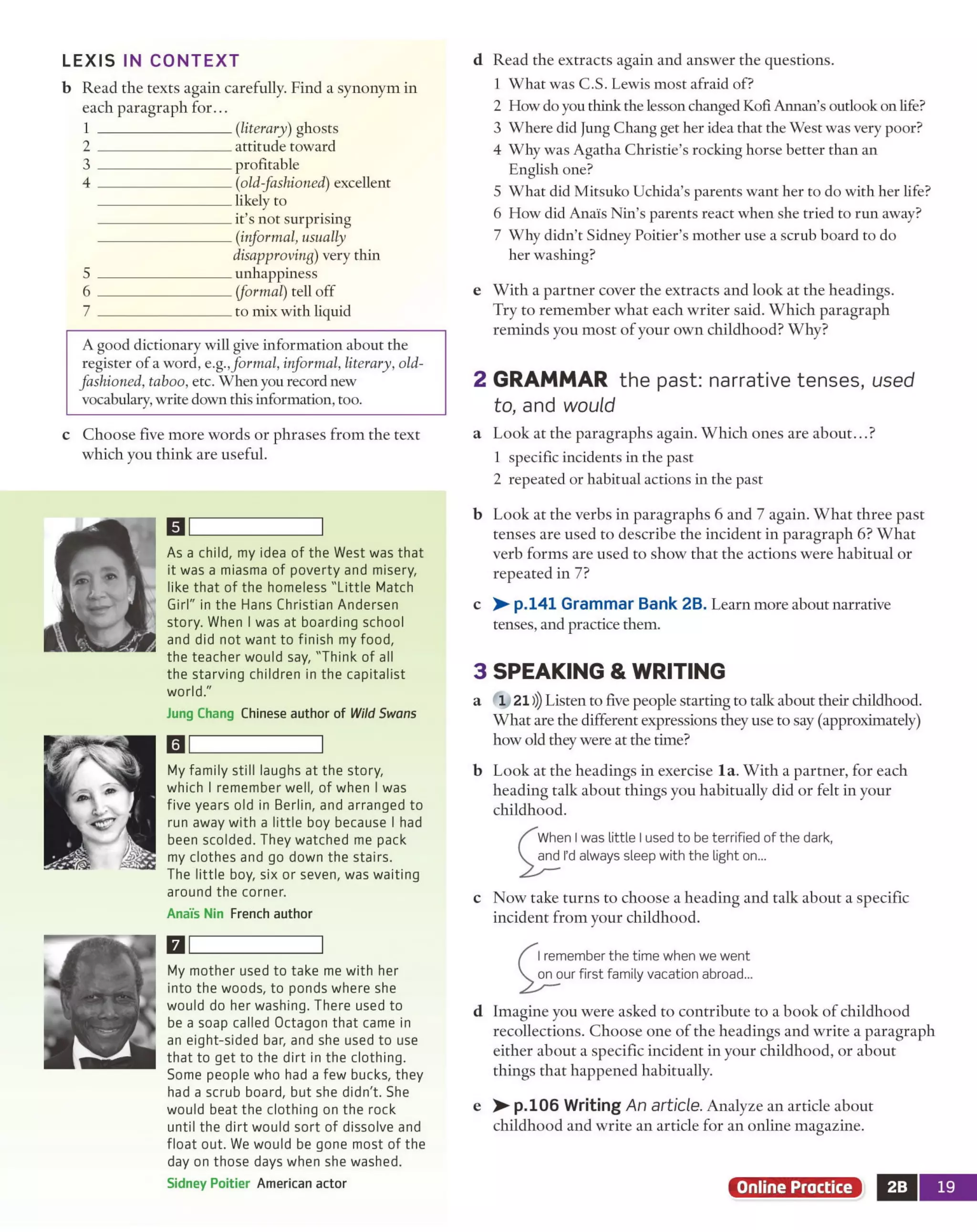
My mother used to take me with her
into the woods, to ponds where she
would do her washing. There used to
be a soap called Octagon that came in
an eight-sided bar, and she used to use
that to get to the dirt in the clothing.
Some people who had a few bucks, they
had a scrub board, but she didn't. She
would beat the clothing on the rock
until the dirt would sort of dissolve and
float out. We would be gone most of the
day on those days when she washed.
Sidney Poitier American actor
d Read the extracts again and answer the questions.
1 What was C.S. Lewis most afraid of?
2 How doyou think the lesson changed Kofi Arman's outlook on life?
3 Where did jung Chang get her idea that the West was very poor?
4 Why was Agatha Christie’s rocking horse better than an
English one?
5 What did Mitsuko Uchida’s parents want her to do with her life?
6 How did Anais Nin's parents react when she tried to run away?
7 Why didn’t Sidney Poitier's mother use a scrub board to do
her washing?
e With a partner cover the extracts and look at the headings.
Try to remember what each writer said. Which paragraph
reminds you most of your own childhood? Why?
2 GRAM M AR the past: narrative tenses, used
to, and would
a Look at the paragraphs again. Which ones are about...?
1 specific incidents in the past
2 repeated or habitual actions in the past
b Look at the verbs in paragraphs 6 and 7 again. What three past
tenses are used to describe the incident in paragraph 6? What
verb forms are used to show that the actions were habitual or
repeated in 7?
c p.141 Grammar Bank 2B. Learn more about narrative
tenses, and practice them.
3 SPEA KIN G & W RITING
a 1 21))) Listen to five people starting to talk about their childhood.
What are the different expressions they use to say (approximately)
how old they were at the time?
b Look at the headings in exercise la . With a partner, for each
heading talk about things you habitually did or felt in your
childhood.
When I was little I used to be terrified of the dark,
and I’d always sleep with the light on...
c Now take turns to choose a heading and talk about a specific
incident from your childhood.
I remember the time when we went
on our first family vacation abroad...
d Imagine you were asked to contribute to a book of childhood
recollections. Choose one of the headings and write a paragraph
either about a specific incident in your childhood, or about
things that happened habitually.
e > - p. 106 W riting An article. Analyze an article about
childhood and write an article for an online magazine.
2B 19Online Practice
4 LISTEN IN G & SPEA KIN G
a 1 22))) Listen to five people talking about their earliest memory. Match the speakers to the emotion they felt at the time.
b Listen again. How old was each person? What was
their memory?
c Now you're going to hear about some research that
has been done on first memories. Before you listen,
discuss the following questions with a partner.
1 How far back in our lives can we usually remember?
a To when we were a baby (0-2 years old)
b To when we were a toddler (2-4 years)
c To when we were a small child (5+)
2 Why can’t we remember things before that age?
3 What kinds ofa) emotions and b) events might people be
more likely to remember?
4 Are our first memories mostlvvisual or ofsounds and smells?J
5 Why might some people’s first memories be unreliable?
d 1 23))) Listen and check your answers with what the
speaker says. Were you surprised by anything?
e 1 24))) Now listen to the story of Jean Piaget's first
memory and write down what you think are the key words.
Listen again and try to add more detail. Compare your
words with a partner and then together retell the story.
f Talk to a partner.
Do you have any very early memories of the feelings or
incidents below? Do you know approximately how old
you were at the time?
feeling surprised
feeling pain
feeling shame or embarrassment
the birth of a brother or sister
a day out
managing to do something for the first time
the death of a pet
a festival or celebration
getting a wonderful or disappointing present
20
surprise sadness fear disappointment happiness
5 V O CA BU LA R Y & PRONUNCIATION
word building: abstract nouns; word stress with suffixes
An abstract noun is one that is used to express an idea, a concept, an experience, or
a quality, rather than an object. Embarrassment and memory are abstract nouns,
whereas bed and pants are not. Some abstract nouns are uncountable in English,
but may not be in your language, e.g., knowledge.
a Make abstract nouns from the words below and put them in the right columns.
adult afraid ashamed believe bored celebrate child compete
dead free friend happy hate imagine sick kind
lose member neighbor partner poor relation sad wise
+hood +ship +dom
-ı-ness +tion word changes
b 1 25))) Underline the stressed syllable in these words. Listen and check.
Which ending(s) cause(s) a change in stress?
1 adult adulthood 4 free freedom
2 celebrate celebration 5 happy happiness
3 compete competition 6 relation relationship
c With a partner, guess which of the abstract nouns in a is missing from
each quotation.
1 Love, friendship and respect do not unite people as much as a
common for som ething.W
Anton Chekhov, Russian writer
266________ ___is, of all passions, that which weakens the judgement most.
Cardinal de Retz, French clergyman and writer
3 To be without som e of the things you w ant is an indispensable part of
Bertrand Russell, British philosopher
4 ________ is more im portant than knowledge.
Albert Einstein, physicist
5 Overcoming___________ is not a gesture of charity. It is an act of justice.
Nelson Mandela, former president of South Africa
6 There are only tw o em otions in a plane: and terror.? ?
Orson Welles, US movie director
7 : I enjoy convalescence. It is the part that m akes___________ worthwhile.
George Bernard Shaw, Irish dramatist
8 The enemies o f___________ do not argue. They shout and they shoot.
William Inge, British clergyman and writer
d Say in your own words what the quotations mean. Do you agree with them?
6 fi,'26») SONG KidJO
Online Practice 2B 21
Review and Check
GRAMMAR V O CA BU LA RY
a Complete the sentences with one word.
1 Everybody seemed to enjoy the barbecue even______
the weather wasn’t very warm.
2 Will the person who left one of______personal belongings
at the security check please go hack and collect it?
3 When I was little, my family______spend summers at a
cottage by the sea.
4 This street looks so different from when I was a child.
Didn't______use to be a candy store on the corner?
5 If we lived closer to ______another, we would probably
spend more time together.
6 The Chinese economy is growing, and______a result
the standard of living in China is rising.
7 Sun-mee always seems pretty reserved to me — she never
talks about______
8 She wore a baggy dress______people wouldn't notice
that she had put on weight.
9 We need to ______the heating system repaired soon,
before it starts getting cold.
10 We were very delayed______ofan accident on the highway.
b Rewrite the sentences using the bold word(s).
1 I broke my glasses. I need to pay someone to repair
them. HAVE
I broke my glasses. I need__________________
2 If you learn a few phrases, the local people will
appreciate it. ONE
__________________ the local people will appreciate it.
3 They managed to get to the meeting on time even
though the traffic was heavy. D E SP IT E
They managed to get to the meeting on time
4 It was foggy, so the flight was canceled. DUE
The flight__________________
5 Jane sees Martha about twice a month. EACH
Jane and Martha__________________ about twice a month.
6 The children managed towrapthe present ontheirown. BY
The children managed to wrap the present
7 The last time 1saw him was in 1998. SEEN
I __________________ 1998.
8 She wore dark glasses so that she wouldn't be recognized.
SO AS
She wore dark glasses__________________
9 If we buy a dishwasher, it won't be necessary to do the
dishes. HAVE
Ifwe buy a dishwasher__________________
10 I can't believe the risks I itsed to take when I was younger.
W OULD
I can’t believe the risks__________________when I
was younger.
22
a Complete the idioms.
1 I know' you don’t want my mother to come and stay, but
you’ll just have to grit your______and put up with it.
2 Don’t worry about what other people think. You need
to know your own______
3 He’s got a terrible temper. In fact it must______in the
family, because his dad’s just the same.
4 Maria definitely wears the______in that family. Tom
lets her walk all over him.
5 I know I’m right and even if everyone in the company
disagrees I’m going to stick to my______!
6 My brothers are always getting into arguments. In fact
they're not on speaking______at the moment.
b Circle the right word.
1 She’d like to have a career /profession in show business.
2 It's a part-time /temporary job — I only work mornings.
3 Your sisters are so like /alike — they could be twins!
4 My father remarried and had two girls with his second
wife, so I have two half-sisters /stepsisters.
5 She doesn't take after /look like either of her parents.
She’s very reserved, and they're both really outgoing.
6 “Pay” is a synonym /metaphor for “salary,” but it's more
informal.
c Complete with the right preposition or adverb.
1 Who’s in charge______the sales conference this year?
2 She's been______school for such a long time it will be
hard to catch______with the others when she goes back.
3 My mother was very sick when I was a child so I was
mainly brought______by my grandmother.
4 Can we put the meeting______till next week? 1have
too much work at the moment.
5 If you go and talk to Elena, she'll fill you______on how
the sales campaign has gone.
6 I think we need to deal______this situation head
______ It’s no good just hoping it will go away.
d Complete the sentences with an adjective or noun
formed from the bold word.
1 I wish there were a few more good restaurants in our
N EIG H BO R
2 She has a terrible______of the dark. She has to sleep
with the lights on. AFRAID
3 Don’t let this misunderstanding get in the way of our
FRIEN D
4 I'm so sorry for your______ LO SE
5 _____ of speech is one of the most basic human rights.
FR EE
6 My mother always gave me good advice with her words
o f______ W ISE
1&2
CAN YOU U N DERSTAN D T H IS T E X T ?
a Do you think being bilingual is an advantage or a
disadvantage? Why?
b Read the article. Then mark the sentences T (true) or F
(false).
1 There are fewer job opportunities for monolingualworkers.
2 On average, people who speak more than one language
earn more money.
3 Most job recruiters think it's important to be bilingual.
4 At the Willard Hotel, some positions require
bilingualism.
5 Willard Hotel employees applying for management jobs
have an advantage if they are bilingual.
6 Mandarin is considered the business language rather
than Cantonese.
7 People who speak both English and Spanish are most
likely to be hired.
8 Mainly service industries need bilingual employees.
c Read the article again. Choose five new words or
phrases. Check their meaning and pronunciation and try
to learn them.
CAN YOU UNDERSTAND TH IS PROGRAM?
a Which of the following statements about bilingualism
do you think are true?
] More than halfthe world’s children grow up speaking
two or more languages.
I I Being bilingual strengthens the brain.
] Learning more than one language at a time is confusing
to children.
i I Children who are exposed to two languages fall behind
monolingual children at school.
j For bilinguals, the brain keeps the two languages separate.
3 1 Bilingual speakers’ brains perform mental exercises all
the time.
] When bilingual speakers get older, they lose their mental
abilities faster than people who speak only one language.
b 127))) Now listen to a radio program about bilingualism
and check your answers to a. Were you right?
c Do you know anyone who grew up bilingual? Does that
person have any of the characteristics described in the
program? Which ones?
In today's global economy, the ability to communicate in another
language has become a significant advantage in the workforce.
Research has found that people who speak at least one foreign
language have an average annual household income that’s
$10,000 higher than the household income of those who only
speak English. And about 17 percent of those who speak at least
one foreign language earn more than $100,000 a year.
A recent survey found that nearly 9 out of 10 headhunters in
Europe, Latin America, and Asia say that being at least bilingual
is critical for success in today’s business environment. And
66 percent of North American recruiters agreed that being
bilingual will be increasingly important in the next 10 years.
“In today’s global economy you really have to understand the
way business is done overseas to maximize your potential. A
second language equips you for that,” says Alister Wellesley,
managing partner of a Connecticut-based recruiting firm. “If
you’re doing business overseas, or with someone from overseas,
you obtain a certain degree of respect if you’re able to talk in
their native language.”
Language skills can also be key for service industries. At the
Willard InterContinental Washington, a luxury hotel a few
blocks from the White House, a staff of about 570 represents
42 nations, speaking 19 languages. The Willard's front-of-house
employees such as the concierge speak at least two languages.
Bilingualism is not an absolute requirement, but it is desirable,
according to Wendi Colby, director of human resources.
Workers with skills in a second language may have an edge when
it comes to climbing Willard's professional ladder. "The individual
that spoke more languages would have a better chance for a
managerial role, whatever the next level would bet Colby says.
“They are able to deal with a wide array of clients, employees.”
So which languages can give you a leg up on thejob market?
Insiders agree the most popular - and marketable - languages
are Spanish, German, French, Italian, Russian and Japanese, with a
growing emphasis on Mandarin, given China's booming economy.
“We see demand from a full range of industries,” says Wellesley.
“It really depends on which company you're working for and the
country in which they’re located."
H ow Being Bilingual Can Boost
Tour Career
Whether you’re fresh out
of college or a seasoned
executive, insiders agree
that fluency in a second
language can not only
help you stand out among
prospective employers,
it can also open doors to
opportunities that those
without foreign language skills might miss.
Online Practice
G get
V phrases w ith get
P words and phrases of French origin
Don’t get mad, get even!
1 READING & SPEA KIN G
a Read 10 top breakup lines from a website.
Which one do you think is the best /worst
way of starting a breakup conversation?
“We need to talk.”
“It’s not you; it’s me.”
“When I said I was working late, I was lying.”
“Do you remember when I said that
everything w as all right...?”
“You are like a brother / sister to me.”
“I think we’d be better o ff as friends.”
"I don’t love you anymore.”
“I need som e tim e to be on my own.”
“You’re a fantastic person, but you’re too
good for me.”
“Can I have my keys back, please?”
b Now read three true stories about people
getting revenge on a former partner.
Answer the questions with a partner.
Whose revenge do you think was...?
1 the most ingenious
2 the most satisfying
3 the most embarrassing for the person it
was done to
4 the least justifiable
5 the most likely to have a long-lasting effect
L E X I S IN C O N T E X T
c Read the stories again and choose the
right word or phrase for gaps 1-12.
50 ways to say
“Revenge may be wicked, but it’s natural”according to 19th
century British novelist William Makepeace Thackeray, and
it remains as true today as it was then.
n 1 • f hat do you do when love has run its course? How do you say “it's over'?
™ According to the music band Train, there are “50 ways to say goodbye/
V V and singer Paul Simon sings, There must be 50 ways to leave your lover.”
Some years ago, fellow singer Phil Collins infamously 1______ his second wife by fax.
In these more technologically advanced days, the Finnish Prime Minister recently sent a
breakup message via text message. Less cowardly is the face-to-face approach (“We need
to talk" / ’This just isn’t working" / “I love you like a friend/’ etc.).
When Frenchwoman Sophie Calle received an email on her cell phone, she was
devastated to discover that it was a message of adieu in which her partner claimed that
the breakup would “hurt me more than it will hurt you." Here is a short extract:
"Whatever happens, you must know that I will never stop loving you in my own way —
the way fve loved you ever since fve known you, which will stay part of me, and never
die...I wish things had turned out differently. Take care of yourself...”
With hindsight, the man almost certainly wishes that he had followed his first instinct (“It
seems to me it would be better to say what I have to say to you face-to-face"), particularly
as the woman he was dumping is a conceptual artist who specializes in 2______ private
pain into art. And that is exactly what she did with her “Dear Sophie" email.
Too heartbroken to reply, she decided she would "take care of herself’ by sending
the man’s email to 107 women (including an actress, a poet, a ballet dancer, a singer,
a novelist, a psychotherapist, an etiquette consultant, an editor, a policewoman, and
even a student). She asked all of them to read the email and to analyze it or interpret
it according to their job while she filmed or photographed the result. The psychiatrist
concluded that the man was a “twisted manipulator while the etiquette consultant
criticized his manners, and the editor3______ his grammar and syntax.
‘The idea came to me very quickly. At first it was therapy, then art took over. After a
month, I had gotten over him. There was no suffering. The project had 4______ the man."
The resulting exhibition “Tenez soin de vows”(‘Take care of yourself) was put on at
the Bibliotheque Nationale in Paris and was latera huge success at the Venice Biennale. And
after becoming, 5______ , the notorious “star" of an exhibition, it’s a sure bet that when
Sophie’s ex-lover dumps his girlfriends in the future, he will never ever say, “Take care
of yourself.”
24
Ivana, ex-wife of millionaire
Donald Trump, giving
advice to wronged wives
Don't get mad, get everything.
1 a rejected
2 a turning
3 a praised
4 a replaced
5 a unwillingly
6 a stuck
7 a invented
8 a peak
9 a get over
10 a find
11 a reciprocal
12 a smoke
b dumped
b purring
b blamed
b substituted
b obviously
b attached
b created
b top
b get back
b make
b mutual
b fuel
c broke up
c creating
c ridiculed
c revived
c unbearably
c posted
c made up
c crowning
c get rid of
c take
c shared
c gasoline
d Without looking back at the stories, try to
remember what these numbers refer to.
goodbye
n erhaps, when she embarked on a relationship with a
famous composer, actress Jane Slavin was right to wonder
if things were too good to be true.
Jane first 6______ a message on his Facebook page last July. It said,
“You are one of my favorite composers."
He instantly replied, and within minutes he had added her to a
list of online "friends." Later he emailed her asking for a date. “He
invited me to a concert and it went on from there. It was an amazing
adventure," she says. “It all seemed so magical to be with someone
so hugely talented." However, three months into their relationship,
he sim ply stopped emailing her. “It went from BO emails a day to
nothing. No phone calls, no texts, no emails. I thought he died!" So,
suddenly and inexplicably rejected, Jane returned to the Internet.
“I put the words ‘lovely lady' into Google and downloaded a
stunning-looking photograph of a woman, and I gave her a name,
Lucia. I then 7______ a social networking page for her, and emailed
him. The email from ‘Lucia’ said, ‘I don't have any friends on
MySpace. I’m a great fan of your music. Will you be my friend?” By
the end of the first day, he had sent her more than 100 emails.
The 8______ moment of her revenge came when “Lucia" agreed to
a rendezvous in a little cafe in London. At the appointed time, Jane
walked in and said, “Hi, how are you? I haven't heard from you for
ages.” He looked horrified.
“He said he was meeting a new personal assistant. I said, ‘Do you
mind if I sit down?’ and he said, ‘Yes, I do, she's going to be here
any minute now.' I said, ‘I'll sit down for just a second.' I opened
my bag and pulled out copies of all his messages to Lucia. When
he asked, ‘Is she a friend of yours?’ I leaned across the table and
whispered to him, ‘Lucia is all Jane.'”
“Lucia was my revenge,” says Jane. “It helped me 9______ him.
I have no regrets."
n tephanie found an inspired way to '6______ revenge on her
boyfriend, Jason. She had been seeing him for about six
^ J months when they decided to make their relationship
exclusive. She thought things were going well until she discovered
that he was seeing someone else on the side. Soon after, a
11______ friend told Stephanie that Jason wasn't having a love affair
with just one woman; there were three others!
Initially, she had no plans to get back at him. She called Jason to
break up, but when she got his voice mail, she thought of a much
better idea. He had given her his password, so she logged in to his
voice mail and recorded a new outgoing message. She explained
what a cheater he was. And then, to add 12______ to the fire, she
changed his password so he couldn't rerecord the message.
50 107 30 more than 100
6 1 3
e Look at some famous sayings about revenge.
Which saying do you think best fits each of
the three stories in b? Do you agree with any
of them?
“Revenge is sweet.”
“Revenge is a dish best served cold.”
“In revenge, woman is more barbarous than man,”
“An eye for an eve makes the whole world blind.”
2 PRONUNCIATION words and
phrases of French origin
A number of French words and phrases are used
in English. They are usually said in a way that is
close to their French pronunciation, and so do not
necessarily follow normal English pronunciation
patterns, e.g., ballet (/bte'ler/), rendezvous (/Tandeivu/).
These wordswill appear in a good English dictionary.
a Look at the sentences below, and underline a
French word or expression in each one. What do
you think they mean? Do you use any of them in
your language?
1 Imade a real faux pas when I mentioned his ex-wife.
2 When we were introduced I had a sense of
deja vu, though I knew we’d never met before.
3 For our first date, he took me to an avant-garde
music concert — there was no second date.
4 She’s engaged to a well-known local entrepreneur.
5 I know it’s a cliche, but it really was love at
first sight.
6 On our anniversary, he always buys a huge
bouquet of flowers — he’s so predictable!
7 I met Jane's fiance last night. They told me
they're getting married next year.
b 2 2))) Listen and focus on how the French
expressions are pronounced. Then practice
saying the sentences.
3 V O CA BU LA R Y phrases with get
a Can you remember expressions with get from
the texts in 1 that mean...?
a take revenge on someone
b recover from (a broken relationship with someone)
b > - p.160 Vocabulary Bank get
2)3d) SONG 50 Ways To Say
Goodbye Jl
Online Practice ■ 3A 25
5 SPEA KIN G & LISTEN IN G
a Look at the back cover information
from a new book. Then discuss the
questions there with a partner. Why
is the book called Love by Numbers?
b 2 4))) Listen to some extracts from
Love by Numbers, in which the author
talks about the research which has been
done on the topics mentioned on the
back cover. According to the research
what are the correct answers to the
questions?
c Listen again and answer the questions
below.
1 What two examples are given to show
how friends can strengthen a couple's
relationship?
2 What three causes of arguments in
a car are mentioned? Which one is
becoming less common?
3 What do psychologists say about “love
being blind”?
4 What are the main advantages and
disadvantages of online dating? What
three pieces of advice are given about
posting a profile on a dating site?
5 What percentage of people still
thought about their first loves? What
percentage of people already in a
relationship got involved with their first
love again after getting back in touch?
6 According to the Canadian study,
what are the most popular ways of
taking revenge?
d To what extent did the research back
up your discussions in a? Were you
surprised by any of the statistics?
Is your relationship unlikely to succeed if your friends
dislike your partner?
Where is the most common place for couples
to have an argument?
Do opposites really attract?
How successful is Internet dating?
Should you try to get back in touch with an ex?
Does taking revenge on an ex-partner make you feel better?
There is academic research out there that can answer these
questions: Dr. Luisa Dillner, author of the column "Love by
Numbers," has sifted through it to give you the facts about
flirting, dating, marrying, and much more...
Popular Psychology
LE X IS IN CO N TEXT
e 2 5))) Listen again to some extracts and complete the expressions
with two words.What do you think the expressions mean?
1 When friends tell a couple that they are a ____________ and how much
they enjoy going out with them...
2 ... suggesting that you can____________ anyone, if you get the chance to
meet them.
3 Most people also____________ someone as good-looking or as plain
as they are.
4 After three months you can “see” again, and then you usually______
______the person.
5 A study in the US of over 3,000 adults found that 15 percent knew
someone in a ______-______relationship that started online.
6 The biggest______-______, apparently, is profiles with poor spelling.
7 80 percent of these people ended up____________ with their lost love again.
8 Another study by Stephen Hoshimura at the University of Montana
asked people what act of revenge they had______________
6 GRAM M AR get
a Look at some sentences from the listening, all ofwhich
contain the verb get. Answer the questions with a partner.
A Online dating agencies advise getting a picture taken
that makes you look friendly, rather than seductive.
B Dr. Nancy Kalish of California State University
conducted another study which got randomly selected
American adults to agree to be interviewed about their
first loves.
C Also when a couple stays together for a while, their two
groups of friends start to make friends with each other,
and as a result, the couple’s relationship gets stronger.
In which sentence...?
1 □ does get mean become
2 □ does get mean make or persuade
3 □ could you replace get with have with no change
in meaning
b p.142 Grammar Bank 3A. Learn more about get,
and practice it.
c Read the get questionnaire and check (/) ten questions
you’d like to ask someone else in the class. Ask and
answer in pairs.
get questionnaire
Are you the kind of person who
regularly ge ts rid of old clothes,
or do you tend to keep things
forever?
Did you use to get into trouble a lot
when you were a child?
Do you consider yourself a person
who usually g e ts their own way?
Why (not)?
Do you tend to keep up to date with your work or
studies, or do you often get behind?
Do you think young drivers get stopped by the police
more than older drivers? Do you think this is fair?
Have you ever gotten caught cheating on a test? Have
you ever cheated on a test and gotten away with it?
Do you think going on vacation
together is a good way to really
ge t to know people?
Have you ever gotten the short
end of the stick in a purchase
or business transaction?
How often and where do you
usually ge t your hair cut?
If one of your gadgets or electrical appliances stops
working, do you usually try to fix it yourself first, or
do you im mediately call to ge t an expert to fix it?
If you are m eeting someone, do you usually get there
on time, or are you often either early or late?
If you were able to get ju st one room in your house
redecorated, which would it be and why?
Do you think women are better than
men at getting presents for people?
If you were invited to a karaoke
evening, would you try to get out of
going?
If you were supposed to get a flight
the day after there had been a serious
plane crash, would you cancel it?
Is there anyone in your fam ily or
group of friends who really g e ts on
your nerves?
What kinds of things do/did your parents get you to
do in the house?
What worries you m ost about getting old?
Where would you go if you really wanted to get away
from it all and relax?
Online Practice 3A 27
G discourse m arkers (2): adverbs and adverbial expressions
V history and w arfare
P stre ss in word fam ilies
History goes to the movies
Dilys Powell,
British movie critic
1 V O C A B U LA R Y history and warfare
a Which of the movies below do you consider to be historical films? Why (not)?
300 Che Part 1 and Part 2 The King's Speech Gladiator Schindler's List
Lincoln Hotel Rwanda Shakespeare in Love Titanic Les Miserables
b Read the descriptions of three famous scenes from movies. Complete each text with words from the list.
The scenes you*11never forget
— our movie critics choose their favorite moments.
Braveheart Mel Gibson, 1995
arrows outnumbered overthrow rebel troops victorious
The movie is set in 13th-century Scotland. Mel Gibson plays
the Scottish 1rebel William Wallace, who tries to 2__________
the English who ruled Scotland at that time. One of the most
memorable scenes is the Battle of Stirling, when Wallace’s
army, hopelessly 3__________ , waits in an open field for the
English to attack. The English fire thousands of 4__________
into the air, but the Scots defend themselves with shields. Then
the English knights on horseback charge at full speed, but at
the last moment, the Scottish 5__________ raise their spears,
and the English knights are thrown from their horses and
killed. A fierce battle then takes place, and Wallace’s army is
6__________ The scene is not a model of historical accuracy,
but with its spectacular special effects and stunts,
it's a lot. of fun to watch. “They may take our lives, but they
will never take our freedom!”
Gone with the Wind victor Fleming, 1939
besieged Civil War looted side
Gone with the Wind is based on the best-selling book by
Margaret Mitchell. It tells the story of a manipulative woman,
Scarlett O’Hara (played by Vivien Leigh), and an unscrupulous
man, Rhett Butler (Clark Gable), who cany on a turbulent love
affair in the American South during the 1__________ The
Confederates, the 2__________ Scarlett’s family supports, are
losing, and Scarlett is living in Atlanta, which is 3__________
by the Union Army. She escapes and goes home onty to find
her mother dead, her father disoriented, and her family home
4__________ She asks for food and is told the soldiers have
taken everything. In this dramatic scene, Scarlett, starving and
desperate, suddenly sees a turnip in the ground. She falls on
it, pulls it from the ground and eats it. She then rises from the
ground, looks around the ruined land and vows, “As God is my
witness, I’ll never be hungry again.”
3B
You com e out of Gone with the Windfeeling
that history isn't so disturbing after all. One
can alw ays make a dress out of a curtain.
“They will never
take our freedom!”
“As God is my witness...”
c 2 6))) Listen and check.
d Re-read the texts and try to memorize the information.
Then in groups of three, cover the texts and take turns
describing what happens in each of the scenes.
2 PRONUNCIATION stress in word families
It is often useful to learn words in “families,” e.g. to rebel, a
rebel rebellion, etc. However, you should check whether the
stressed syllable changeswithin the “family.”
Spartacus Stanley Kubrick, 1960
capture casualties defeat forces rebellion weapons
This epic movie tells the story of the rise and fall of a slave in die
Roman Empire. Spartacus (Kirk Douglas) is trained as a gladiator,
but he rebels against his Roman owner and escapes. He forms an
army of slaves and becomes their leader. Although they have
fewer 1__________ and are less well organized, they win several
victories against the Roman 2__________ that are sent to put
down die ;i__________ But a final, climactic battle just outside
Rome results in the total 4__________ of the rebel army, with
heavy 5__________ on both sides, and the 6___________of
many of the survivors, including Spartacus. Crassus (Laurence
Olivier), the Roman general, promises the captives that they
will not be punished if they identify Spartacus. In this powerful
scene, one by one, each surviving soldier stands and shouts out,
“I am Spartacus!” Crassus finally condemns them all.
a Complete the chart.
noun person adjective verb
capture /
captor
captive
civil /
civilized
execution
history historian /
historic
looting looter
rebellion rebellious
siege
surviving
withdraw
victorious
b 2 7))) Underline the stressed syllable in all the
words. Listen and check. Then test a partner on the
words in the chart.
3 SPEA KIN G & W RITING
In this dramatic scene, Scarlett, starving and desperate,
suddenly sees a turnip in the ground. She falls on it,
pulls it from the ground and eats it.
We normally use the simple present (“the dramatic
present”) when we describe a scene from a movie, or
its plot.
a Work in groups of three or four. Each think of a
movie you really enjoyed that was set in a historical
period or based on a real event. Make notes under
the following headings to help you to talk about it.
• Where and when is the movie set?
• Who are the main characters and who are they
played by?
• What is it about?
• What is the most memorable scene?
• What makes it so powerful /moving /dramatic, etc.?
b Describe the movie and the scene to others in the
group, and see if they can name the title of the movie.
c Now write a paragraph describing the movie and
the scene using the three texts in lb as models.
Online Practice 3B 29
“I am Spartacus!”
HISTORY GOES TO
THE MOVIES
4 READING
a How important do you think it is for a historical film to get
all the facts right? Why?
b Quickly read part of the preface of the book History Goes to the Movies
by American author Joseph Roquemore. What kind of book is it?
a It compares historical films to what really happened,
b It is a guide to the best ever historical films,
c It analyzes the effect historical films have on young people.
When asked in 1993 to comment on accusations that the movie In the Name o f the
Father grossly distorts contemporary British and Irish history, female lead Emma
Thompson responded that she couldn’t care less. Ever since the premiere in 1915
of The Birth o f a Nation, filmmakers have rewritten history to create top-dollar
entertainment. The films are very persuasive: well-made movies hold your interest
continuously, riveting your attention on “what happens next,” and pulling you
forward with no time to reflect on individual scenes until the final credits roll. The
result; you don’t remember much about a movie after watching it for the first time.
Very few people can recall even half the plot in reasonable sequence, and still fewer
can remember facial expressions or voice intonation associated with specific dialogue
sequences (including politically and morally loaded conversations). For this reason,
movies have extraordinary power — unmatched by any other medium — to leave you
with a strong sense of what is right and what is wrong, who is bad and who is good,
even though critical details presented in the movies may be biased or false.
Well, so what? They’re just movies. In fact they’re not just movies. Millions of
Americans are fanatical history lovers, and they pack theaters every time new movies
about historical figures or events come to town. Saving Private Ryan and Titanic
raked in viewers and cash for months. Many high school teachers screen movies in the
classroom. Clearly countless Americans get most of their histoxy from television and the
big screen.
Some of the industry’s finest historical and period films premiered during the past
decades. Bui the 1960s also triggered a flurry of politically charged history-based movies a>
full of factual distortions and, occasionally, outright lies. Today the trend continues on a %
fl)
larger scale: many movies released in the 1990s and the first decade of the 21st century e
reflect blatant disdain, at least as intense as Ms. Thompson’s, for solid, reliable history. “
History Goes to the Movies is a source of information and, it is hoped, entertainment
for everyone interested in the actual history behind a wide selection of movies grouped
into twelve sections — 11 covering historical periods and events and a twelfth containing
biographies and period films. Each movie review includes an essay on the history covered
in one or more movies, and a brief plot summary. Star ratings (five stars: don’t miss it) reflect
each movie’s historical accuracy and — to a much lesser extent — its power
to amuse.
Obviously, expecting textbook accuracy from movies would be ridiculous — and producers
have delivered a remarkable number of historically faithful movies. But some of them get
too much of their history wrong. History Goes to the Movies is a guide, however imperfect, for
readers and viewers aiming to get it right.
5 LISTEN IN G & SPEA KIN Gc Now read the text again carefully and choose a,
b, or c. Compare with a partner and explain why
you think the answer you chose is right.
1 Emma Thompson said that___that the movieIn
the Name o f the Father was historically inaccurate,
a it was upsetting
b it didn’t matter
c it was obvious
2 When people see a movie they tend to remember
a a great deal of what people said
b what happened in chronological order
c who the heroes and villains were
3 According to the author, what most Americans
know about history comes from___
a what they learned in high school
b textbooks
c movies they have seen at the movie theater
and on TV
4 Movies made in recent years have been
historically inaccurate because filmmakers___
a don't check the facts
b are not concerned about historical accuracy
c want to make politically correct movies
5 The star system Joseph Roquemore uses refers___
a equally to historical accuracy and
entertainment value
b more to entertainment value than historical
accuracy
c more to historical accuracy than
entertainment value
L E X I S IN C O N T E X T
d Look at the highlighted words and expressions
related to the movies. With a partner say what
they mean. Check any you're not sure of in a
dictionary.
e Complete the sentences with a word or
expression from d.
1 The latest James Bond movie is expected to be
early next summer.
2 After years as a respected theater actress, she
has finally been given her chance to appear on
the_________
3 I can’t stand it when people get up and leave
the theater as soon as the movie ends while I’m
trying to watch the_________
4 The special effects were fantastic but the
was pretty implausible.
5 Many of the biggest names were there at last
night’s _________
a Two of the movies mentioned in History Goes to the Movies
are Titanic and Braveheart. Have you seen either of them? How
historically accurate did you think they were?
b 2 8))) Listen to a movie critic talking about them. How many
stars did the author Joseph Roquemore give each movie? Does
the movie critic agree?
6 GRAM M AR discourse markers (2): adverbs
and adverbial expressions
a 2 9))) Listen to some extracts from what the movie critic said and
complete the phrases below with one to three words. What do
they tell you about what the speaker is going to say next?
1 _________________ ,these characters and their stoiy are fictitious...
2 __________________ , I think his assessment is about right.
3 William Wallace is portrayed as a kind of poor primitive
tribesman living in a village-----------------------------, he was the
son of a rich landowner.
4 __________________ , the Scots stopped wearing woad hundreds
ofyears earlier.
5 __________________ , the reason why the Scots won the battle is
because the English soldiers got trapped on the narrow bridge.
b ► p.143 Grammar Bank 3B. Learn more about adverbs and
adverbial expressions, and practice them.
c > - Com m unication Guess the sentence A p.119 B p.119.
c Listen again and take notes on what was inaccurate
about the two movies. Compare your notes with a partner.
How serious do you think the inaccuracies were?
Braveheart 1995 Director Mel Gibson
Inaccuracies:
d Can you think of any movies you have seen that you think were
very inaccurate? Did this detract from your enjoyment of the film?
Online Practice 3B 31
Titanic 1997 Director Jam es Cameron
Inaccuracies:
2&3 Colloquial English Fact or fiction?
■ < TH E IN TERVIEW Part 1
a R e a d th e b io g ra p h ic a l in fo rm a tio n a b o u t A d ria n
H o d g e s. A re th e re an y h is to ric a l d ra m a s o n T V o r in
th e m o v ie th e a te rs at th e m o m e n t? H av e y o u se e n any
o f th e m ?
A drian H odges is a British television and movie
screenwriter. He began his career as a journalist for Screen
International, a magazine publication that covers movie
industry news from around the world. He has over 25
television and movie credits as a writer and a producer, some
of which are historical dramas. For instance, he wrote for
The Last King which is an account of Charles II's reign on the
throne and Rome which chronicles the lives of the Romans in
the last days of the Republic.
b 2 -10)}) W a tc h o r liste n to P a r t 1 o f a n in te rv ie w w ith
h im . M a rk se n te n c e s 1-5 b e lo w T (tru e ) o r F (false).
1 A d ria n believes h isto ric a l d ra m a s are p o p u la r b ecau se
th e y ’re fu ll o f in te re stin g sto rie s th a t p eo p le reco g n ize.
2 It’s n o t alw ays possible to tell a h isto ric a l sto ry in a w ay
th a t reso n a tes w ith th e p resen t.
3 A cco rd in g to A d rian , h isto ric a l d ra m a s are so m etim es
less exp en siv e th a n c o n te m p o ra ry pieces.
4 “D re ssin g ” a m ovie sp ecifically m ea n s selectin g
a p p ro p ria te c o stu m e s fo r th e actors.
5 M a k in g a m ovie th a t d o e sn 't have a n y a n a c h ro n ism s is
costly a n d expensive.
c N o w liste n a g a in a n d say w h y th e F se n te n c e s a re false.
Glossary
Caligula /ka'ligyate/ the third Roman emperor, reigning from 37 to
41 A.D.
period film s /'piriad filmz/ movies that are set during the life of a
particular person or in the history of a particular country,
a glaring anachronism /'gleritj a'nekramzam/ something in a book
or a film that is very obviously placed in the wrong period of
history
the Senate Pscnatla political institution in ancient Rome
toga /'tooga/clothing worn by the citizens of ancient Rome
VIDEO Part 2
a 2 11))) W a tc h o r lis te n to p a r t 2. A n s w e r th e q u e s tio n s
w ith a p a rtn e r.
W h a t d o e s A d ria n say a b o u t...?
1 th e im p o rta n c e o f a c cu ra cy in h isto ric a l d ra m a
2 th e e x te n t to w h ich you can ch an g e d e ta ils w hen you
are w ritin g a h isto ric a l d ra m a
3 th e d ifferen ce b e tw e en w ritin g a d ra m a b ased o n
a n c ie n t h isto ry an d o n e based o n rec e n t h isto ry
4 th e w rite r's resp o n sib ility to be tru th fu l to h isto ry
5 th e d a n g e r o f a film b e c o m in g th e “received version
o f th e tr u th ”
6 w hy Spartacus is a g o o d exam ple o f th is
7 th e film Braveheart
b A n s w e r th e q u e s tio n s w ith a p a rtn e r.
1 T o w h a t e x te n t d o you ag ree w ith w h at he says ab o u t
th e im p o rta n c e o f accu racy in h isto ric a l film s?
2 C a n you th in k o f any o th e r h isto ric a l film s a p a rt fro m
Spartacus w h e re th e film is th e o n ly v ersio n o f th e
tru th th a t p eo p le know ?
Glossary
Macbeth /mak'beO/a play by Shakespeare about a king of
Scotland William the Conqueror, Charles II, Victoria English
monarchs from the 11th, 17th, and 19th century
to play fast and loose with (oldfashioned) to treat
something in a way that shows you feel no responsibility or
respect for it
the received version /n'sivd Va^n/ the version accepted by most
people as being correct
2 LOOKING AT LAN G U AGE
O Idiom s and idiom atic expressions
Adrian Hodges uses a lot of idioms and idiomatic
expressions to make his language more expressive.
Idioms and idiomatic expressions are phrases where
the words together have a meaning that is different
from the meanings of the individual words.
a 2 12))) L iste n to so m e e x tra c ts fro m th e in te rv ie w and
c o m p le te th e p h ra se s.
1 ...b u t th e th in g a b o u t h isto ry is it's _______________w ith
g o o d sto ries, m an y o f w h ich p eo p le know , p a rt, o r at
least vaguely know .
2 You have to m ak e su re th e re a re n o c ars, n o airp lan e s,
everv sh o t h as to to m ak e su re th a tJ ---------------------
th ere 's n o th in g in it w h ich , w h ich b e tra y s th e p erio d .
3 S o u n fo rtu n a te ly , all o f th a t c o sts m on ey and you
have to have b ig g er c ro w d s in m any cases. Rome
w a s _______________.
4 ... it’s m u ch e a s ie r______________ th e d e ta ils o f w h a t
h ap p e n ed in R o m e th a n it i s _______________th e d etails
o f w h a t h ap p e n ed in th e Iraq W ar sa y ...
5 You c a n ’t say th is is tru e w h e n _______________it isn ’t.
6 S o Spartacus th e film , m ad e in 1 9 6 2 ,1th in k ,
_______________, h as beco m e, I th in k , fo r n early
ev ery b o d y w h o k n o w s a n y th in g a b o u t S p a rta c u s th e
o n ly v ersio n o f th e tru th .
7 T h e re a re o th e r ex am p les, you know , a lo t o f p eo p le felt
th a t th e v ersio n o f W illia m W allace th a t w a s p rese n ted
in Braveheart w as re a lly _______________o f w h a t h isto ry
could s ta n d ...
b L iste n a g a in w ith th e a u d io s c rip t o n p a g e 127. W h a t d o
y o u th in k th e id io m s m ea n ?
3 VIDEO
ON TH E ST R E E T
a 2 13))) Y ou a re g o in g to h e a r five p e o p le ta lk in g a b o u t
h is to r y W h a t tw o q u e s tio n s d o th e y a n sw e r? W h o
c h o o s e s a) th e m o s t r e c e n t b) th e m o s t d is ta n t p a s t in
a n s w e r to th e f ir s t q u e stio n ?
Esther Aurelia Brent Jam es Amy
b L iste n a g a in . W h o d o th e y a d m ire a n d w hy?
1
2
3 ____________________________________________________
4 __________________________________________________
5 ____________________________________________________
c 2 14))) L iste n a n d c o m p le te th e p h ra s e s w ith o n e to
th re e w o rd s. W h a t d o y o u th in k th e y m e a n ?
Useful phrases
1 I really admire Abraham Lincoln because of all the
work that he did w ith ____________________________
_____________ of American history....
2 I love h is _____________ and I love to be in his plays.
3 If I could have lived in another historical period I would
choose th e ____________________________
4 I like jazz music a lot and that was sort of the
of bebop in New York.
5 I think his writing’s absolutely phenomenal and very
m u ch __________________________________________ time.
4 SPEA KIN G
A n s w e r th e q u e s tio n s w ith a p a rtn e r. P ra c tic e u s in g
id io m s a n d id io m a tic e x p re s s io n s to e x p re ss h o w y o u
feel a b o u t w h a t y o u a re sa y in g , a n d w h e re p o ssib le th e
u s e fu l p h ra se s.
1 W h a t’s th e b e st h isto ric a l m ovie o r d ra m a you've seen?
W h a t m ak es it so g reat?
2 W h ic h p e rio d o f h isto ry d o you fin d th e m o st
in te restin g ? W h a t m ak es it so u n iq u e?
3 If you could be an y p e rso n fro m th e p ast, w h o w ould
you be? W h a t w ould you d o sim ilarly o r d ifferently?
4 I f y o u c o u ld ch an g e an y m o m e n t o r ev en t in h isto ry
w h a t w o u ld it be? W hy?
5 If you w ere c o n trib u tin g to a h isto ry b o o k o f th e p ast
tw e n ty y ears, w hich m o m e n t w ould you reco rd ? W h a t
m ak es th e m o m e n t sp ecial?
Online Practice 33
G speculation and deduction
V sounds and the human voice
P consonant clu sters
Breaking the silence
Noise is the m ost im pertinent
of all form s of interruption.
Arthur Schopenhauer,
German philosopher
d
e
f
1 V O C A B U LA R Y &
W RITING sounds and the
human voice
a H o w n o isy is it w h e re y o u w o rk o r
stu d y ? W h a t n o ise s c a n y o u h e a r?
D o any o f th e n o ise s a ffe c t y o u r
c o n c e n tra tio n ?
b L o o k a t a list o f th e m o s t a n n o y in g
n o ise s in a n office (n o t in o rd e r).
W h ic h o n e d o y o u th in k w a s v o ted
th e m o st irrita tin g ?
2.15))) N o w liste n to th e n o ise s, in
reverse o rd er (8 = the least annoying).
N u m b e r th e p h ra se s in b. W h ich o f
th e se n o ise s d o you fin d irrita tin g ?
A re th e re any th a t d o n 't really
b o th e r you?
M ak e a list o f o th e r a n n o y in g
n o ise s. T h e n tak e a class v o te o n
w h ic h o n e is th e m o s t an n o y in g .
> - p.161 Vocabulary Bank Sounds
and th e human voice.
2 17))) L iste n to th e s o u n d s an d
m ak e a n o te o f w h a t th ey a re . T h e n
w rite th re e p a ra g ra p h s b a se d o n
th e s o u n d s y o u h e a rd . B eg in each
p a ra g ra p h as follow s:
1 It w as 12:30 at n ig h t and M ike had
ju st fallen a sle e p ...
2 A m anda w as w alking dow n
P ark S tre e t...
3 It w as a cold w in ter n ig h t in
N o v e m b e r...
A
c c o rd in g to a n a tio n w id e p o ll, m a n y o ffic e w o rk e rs
are b e in g d riv e n c ra z y b y n o is e s m a d e by th e ir c o -w o rk e rs .
T h e p ro b le m can be p a rtic u la rly s e rio u s w h e re
tw o o r th re e p e o p le sh a re a s m a ll o ffic e and
in c o m p a n ie s w h ic h h a ve "o p e n p la n " o ffic e s .
A m p lifo n , th e o rg a n iza tio n w h ic h c o n d u c te d
th e o n lin e o p in io n p o ll, said : " P e o p le are e a sily
a n n o y e d by so u n d s in th e o ffic e b u t v e r y fe w
d o a n y th in g a b o u t it. M o st p e o p le ju s t s u ffe r
in s ile n c e ." T h e m o s t irrita tin g n o ise s
(n o tin o rd e r) w e re :
O t h e r p e o p le ’s c e ll p h o n e rin g to n e s
P e o p le m a k in g p e r s o n a l p h o n e c a lls
P e o p le s lu r p in g te a a n d c o ffe e
P e o p le ty p in g on c o m p u te r k e y b o a rd s
T h e b o s s ’s v o ic e
T h e c ru n c h o f p e o p le e a tin g c h ip s
T h e " h o ld " m u s ic o n th e
te le p h o n e
T h e h u m o f th e a ir c o n d itio n in g
It drives me crazy!Office noises we just can't stand...
34
4A
2 PRONUNCIATION
consonant clusters
C o n so n a n t clusters (com binations o f tw o o r
th ree co n so n an t sounds, e.g., clothes, spring)
c a n be difficu lt to p ro n o u n ce , especially if
it is a c o m b in a tio n th a t is n o t c o m m o n in
y o u r lan g u ag e.
T h re e -c o n s o n a n t clu sters a t th e b e g in n in g
o f w o rd s alw ays b eg in w ith s, e.g., scream.
T h re e -c o n s o n a n t c lu ste rs at th e e n d o f
w o rd s a re o fte n e ith e r p lu ra ls (months),
th ird p e rso n sin g u la r v e rb s (wants), o r
re g u la r p a s t te n s e s (asked).
a 2 18))) R ead th e in fo rm a tio n b o x a n d
liste n to th e w o rd s below . T h e n p rac tic e
sa y in g th e m .
A t th e b e g in n in g o f a w o rd :
tw o sounds: th re e sounds:
click screech
slam scream
c ra sh splash
slurp
d rip
sn o re
stu tte r
A t th e e n d o f a w o rd :
tw o so u n d s: three sounds:
sh o u ts
sniffs
yelled
h um m ed
crunched
m um bled
gasps
rattled
b 2 19))) L isten a n d re p e a t th e se n te n c e s.
1 She sc re a m e d w h en her friend sp la sh e d
her in the sw im m ing pool.
2 T h e b r a k e s s c re e c h e d a n d th e n there
w as a tre m e n d o u s c rash .
3 M y co -w o rk er slu rp s and g a s p s for
b rea th w hen he d r in k s anything.
c W rite th re e se n te n c e s o f y o u r o w n , each
u sin g tw o o f th e w o rd s fro m a. G iv e th e m
to y o u r p a rtn e r to say.
3 LISTEN IN G & SPEA KIN G
a W h e n y o u g o o u t fo r co ffee o r a m eal, d o y o u p re fe r a q u iet re s ta u ra n t
o r so m e w h ere m o re lively?
b 2 20))) L iste n to a ra d io p ro g ra m a b o u t n o ise lev els in N e w Y ork
C ity ’s r e s ta u ra n ts a n d s u b w a y sy ste m . P u t a c h e ck ( / ) n e x t to th e
b e s t s u m m a ry o f w h a t th e r e p o r te r says.
New Yorkers are so used to the noise levels in
the city that loud noises don't bother them.
Some New York City restaurants and subways
are so noisy that they are causing hearing
damage to workers and customers.
New Yorkers aren’t aware of the dangerous
noise levels around the city because they are
focused on their jobs and other priorities.
c L o o k a t th e g lo ssary a n d listen to th e p ro g ra m again. T h e n w ith a
p a rtn e r try to a n sw e r th e q u estio n s.
decibel a unit for measuring how loud a sound is
jackhammer a large powerful tool, worked by air pressure, used especially for breaking
up road surfaces
tempo the speed of music
earmuffs a pair of pads attached to a headband and worn to protect the ears from the
cold or noise
1 W h a t are th e tw o noises in th e re sta u ra n t th a t th e re p o rte r
co m p lain s about?
2 H o w does th e re sta u ra n t w o rk er she interview s feel a b o u t th e noise
in h e r w orkplace?
3 W h a t noise does th e re p o rte r use fo r co m p ariso n ? Is it lo u d er or
so fter th a n in th e re sta u ra n t she visited?
4 W hy is th e restau ran t w orker getting headaches and hearing buzzing in
her ears? W h at is the daily perm issible exposure tim e for 95 decibels?
5 W h a t effect does faster tem p o o f m usic have o n custom ers? W hy do
restau ran ts th in k it’s good for business?
6 W h a t noise does th e re p o rte r use to co m p are th e noise levels in the
N ew Y ork C ity subw ays?
7 W h a t are so m e sy m p to m s o f h earin g loss? D o sy m p to m s m ean
p e rm a n en t dam age?
8 W h a t can cause su d d en h ea rin g loss?
9 W h a t does th e co m m u te r m ean w h en she says, “1 just w an t to
co m m u te in quiet so m etim es, b u t it’s a lu x u ry ”?
d D o y o u th in k re s ta u ra n ts a n d su b w ay sy ste m s have a re sp o n sib ility
to p ro te c t p e o p le fro m h e a rin g d am ag e?
e T alk to a p a rtn e r.
W h a t kind o f so u n d s o r m usic (if any) d o you th in k you should h av e...?
in bars and restaurants
in class at a language school
in an office
in an elevator
at a hotel reception area
at a beauty salon
in a supermarket
in a clothing store
on public transportation
in the weights room of a gym
while you’re having a massage
at the dentist’s office while you’re being treated
when a plane is taking off and landing
when you’re put on hold on the phone
Online Practice 4A 35
4 GRAM M AR speculation and
deduction
a W ith a p a rtn e r, circle th e rig h t fo rm . T ry to say
w h y th e o th e r o n e is w ro n g .
1 A T h a t so u n d s like th e n e ig h b o rs' dog.
B It can’t be / can 't have been. T h ey w en t aw ay
for th e w eekend a n d they to o k th e dog
w ith them .
2 T h e re 's no sound com ing fro m his ro o m . H e
probably hasn’t j hasn’tprobably w oken up yet.
3 A D id n 't you h ear th a t b a n g in th e m iddle o f
th e n ig h t? It w oke m e up.
B Yes, I did. It must be / must have been
th e w ind.
4 C an you tu rn the m usic dow n? If w e m ake to o
m uch noise, th e w om an u p sta irs will likely / is
likely to call th e police.
5 A C a n I sp eak to R aym ond, please?
B S orry, h e 's n o t back yet. H e must work /
must be working late.
b V ’ p.144 Grammar Bank 4A. L e a rn m o re a b o u t
sp e c u la tio n a n d d ed u ctio n , a n d p ractice th em .
5 READING & SPEA KIN G
a R e a d th e in tro d u c tio n to th e a rtic le a n d lo o k at
th e p h o to s. W h a t d o y o u th in k th e article
is g o in g to b e a b o u t?
b R e a d th e re s t o f th e a rticle. W h a t is S u sie
R e a ’s p ro je c t? W h a t p a ra d o x o f m o d e rn life
d o e s h e r p ro je c t h ig h lig h t?
c L o o k at th e p h o to s o f p e o p le S u sie se es
ev ery day in L o n d o n . W ith a p a rtn e r,
sp e c u la te a b o u t...
w h a t they m ig h t do.
h o w old they m u st be.
w h e re they m ig h t be from ,
w h at kind o f p e rso n they m ig h t be.
Breaking the silence
Have you ever wondered who the people are you see every day
on the way to work? You’ve never spoken to them, but you see
them every single morning. You know what clothes they wear, the
newspaper they read, the way they always stand at the same place
at the bus stop or at the train platform. They also see you there
every day. But they’re still strangers...
A community is now a non-geographical concept. Friends and family are
scattered widely, with communication maintained by cell phone and
email. Our real-life neighborhood becomes an unknown zone. We can
look at the television or the Internet to find out about what's happening
thousands of miles away, day and night. But the streets outside? It can be
a no-man's land that we navigate, but never really know.
Photographer Susie Rea lives in London and her latest project, entitled
Intimate Strangers, aims to discover more about the strangers she passes
every day. She says, “In London you don't talk to strangers or ask who they
are and what they do. Day to day, I find myself inventing the answers;
creating snapshots of lives in my head that are entirely imagined.”
So what would happen if you stopped that stranger and introduced
yourself? Would they shake your hand and become an acquaintance?
Susie decided to find out.
Susie's starting point was seeing a man in a Panama hat every day. He was
always wearing it and it intrigued her to think about who he might be.
“I thought he must be a writer or a teacher wearing a hat like that.” But
approaching him was difficult. “It's not easy to suddenly talk to someone
you recognize, but have never spoken to...it was a very weird experience.”
Add comments on this story.
d 2 21))) L isten to S u sie talk a b o u t th e p eople. W h a t
d id you find o u t a b o u t th em ? W ere you su rp rise d
by anything?
e W h a t kind o f p e rso n d o you th in k S usie is? W h a t
d o y o u th in k o f h e r e x p e rim e n t? C a n y o u im ag in e
so m e o n e d o in g th e sa m e p ro je c t w h e re you live?
f R ead so m e re a d e rs’ re sp o n se s to S u sie R e a ’s
e x p e rim e n t. C o m p le te th e m w ith o n e o f th e p h ra se s
below . T h e re are tw o p h ra se s you d o n ’t need.
A We exchanged a"good morning" and a smile
B But inall this time Inever actuallyfound out
what her name was
C It is a joy to be able to walk silently among strangers.
D It just goes to show how far a friendly gesture might go.
E Maybe ifwe got to know the people who share our community
F Maybe soon we'll be brave enough to say
hello to some of our"intimate strangers."
G My partner commutes to the city every day for work.
H Now I really regret not speaking to her
I Then in l 997 a hurricane hit the state
LEX IS IN CO NTEXT
g L o o k at th e h ig h lig h te d w o rd s a n d p h ra s e s and
fig u re o u t th e m e a n in g o f any th a t y o u d o n ’t know .
C h e c k w ith y o u r d ictio n ary .
h H ave you h ad any ex p erien ces sim ilar to th o se o f th e
p eo p le w h o w ro te to th e w ebsite? H o w w ell d o you
k n o w your n e ig h b o rs and p eo p le you pass every day?
W o u ld you like to g et to k n o w th em b e tte r?
For about l 8months I saw the same woman when I was on the way to
work and I nicknamed her "The Iranian Lady."1 ILJand finding out if
she really was from Iran.
Rafic, New York City
This sounds like a fascinating project! You could say the same thing about
your next-door neighbors.You see the same people day in and day out,
but you never find out what they're really like.2□ , the world would be
a safer place.
Fern, Thailand
I catch a bus to work once a week and it's always the same people. For the
last six months, I've been chatting with a woman from our street, and we
talk about all sorts of things, from the weather to childcare problems.
3L J until last week — and that's only because she told my little girl.
Tatiana, Ecuador
I loved the article! And it definitely applies to where my parents live.
My parents and I had been living on the same street for more than
10 years and had never really gotten to know our neighbors.4□ and
an enormous tree blew down and crashed through our roof.The
neighbors all came by and offered us food and any help we needed.
But then everything went back to normal. My parents still live in the
same house, and they've never spoken to the neighbors since.
Heather, Florida
I used to pass the same woman every day as I walked to work
and never said hello or even acknowledged her. I decided it was
ridiculous, so one morning I went up to her and said, "Hello."5 □ for
the next couple of weeks. But then she changed her route to work.
Even though it was only a greeting and a smile, it seems some people
just prefer to be left alone.
Ji-hae, South Korea
The reason why I choose to live in London is that I love the fact that I
don't have to get to know my neighbors and pretend to be interested
in their small talk. 6□ If you want to be overly friendly with your
neighbors, go and live in the north of England! London is fine as it is,
thank you very much!
Carl, North London
I commute into the city every day, and I used to see the same
gentleman on the station platform every morning. We would exchange
nods and smiles, and eventually he came up to me and we started
chatting. Then we met for dinner and got to know each other better
We are now engaged and are getting married next July.7 □
Camilla, Brazil
6 W RITING
W rite your ow n 5 0 -7 0 w o rd resp o n se to S u sie's article.
Online Practice 4A 37
G adding em phasis (1): inversion
V describing books
P words with “sile n t” syllab le s
4B Lost in translation
A room without books is like
a body without a soul.
Cicero, Roman orator
and philosopher
1 READING
a In g ro u p s o f fo u r o r five, tak e th e q u iz.
First andlastlines quiz
Look at some famous first and last lines from novels.
Which do you think are first lines and which last lines?
Write F or L.
Match the first and last lines to the novels they are from.
1984by George Orwell, 1949
Goldfinger by Ian Fleming, 1959
Gone With The Wind by Margaret Mitchell, 1936
AnnaKarenina by LeoTolstoy, 1877
OneHundredYearsOfSolitudeby Gabriel Garcia Marquez, 1967
HarryPotterandthePhilosopher'sStone by J.K. Rowling, 1997
Little Women by Louisa May Alcott, 1868
TheDa VinciCode by Dan Brown, 2003
PeterPan by J.M. Barrie, 1911
PrideandPrejudice by Jane Austen, 1813
b W h ic h d o you th in k is th e b e s t first line? D o e s it m ak e y o u w a n t to re a d th e b o o k ?
W h ic h ( if an y ) o f th e se b o o k s h av e y o u a lre ad y re a d ? W h a t d id y o u th in k o f it / th em ?
All children, except one, grow up.
It is a tru th universally acknow ledged th a t
a single m an in possession o f a good fortune
m u st be in w a n t o f a wife.
“Oh, my girls, however long you may live, I never
can w ish you a greater happiness than this!”
Jam es B ond...sat in th e final d eparture
lounge o f M iam i A irp o rt a n d th o u g h t about
life and death.
M r. and M rs. D ursley, o f n u m b er four, Privet
D rive, w ere p roud to say th a t they w ere
perfectly norm al, th an k you very m uch.
“Tom orrow , I'll th in k o f som e w ay to get him
back. A fter all, tom orrow is a n o th e r day.”
H appy fam ilies are all alike; every u n h ap p y
fam ily is u n h ap p y in its ow n way.
...tears trickled dow n the sides o f his nose. But
it w as all right, everything w as all right, the
struggle w as finished. H e h ad w on the victory
over h im se lf H e loved Big Brother.
M any years later, as h e faced the firing squad,
Colonel A ureliano Buendfa w as to rem em ber
th a t d ista n t aftern o o n w h en his fath er took
h im to discover ice.
R enow ned cu rato r Jacques S auniere staggered
th rough th e vaulted archw ay o f th e m useum ’s
g ran d gallery.
2 V O CA BU LA RY & SPEA KIN G describing books
a C o m p lete so m e rea d e rs’ c o m m e n ts a b o u t b o o k s w ith a n adjective
fro m th e list.
d e p re ssin g e n te rta in in g fast-p aced riv e tin g h a u n tin g
slow'-paced im plausible intriguing m oving thought-provoking
b Take tu rn s w ith a p a rtn e r c h o o sin g a n adjective fro m th e list and
saying a b o o k o r a film th a t you could u se th e adjective to describe.
c 2 22))) L isten to a m a n talking to a frien d a b o u t a b o o k h e c o u ld n 't
p u t d o w n . W rite d o w n fo u r p o sitiv e a d je c tiv e s h e u se s to
d e sc rib e th e b o o k .
d N o w talk to a p a rtn e r a b o u t y o u r re a d in g p re fe re n c e s. T ry to use
a v a rie ty o f a d jectiv es to d e sc rib e th e b o o k s.
3 G RA M M A R adding emphasis (1):
inversion
a M a tc h th e halves to m ake se n te n c es fro m novels.
1 (_] H is voice w as low, b ut I w as able to hear w hat
he said, though only later did I understand...
2 □ Never h ad h e been so u n n a tu ra l and
artificial, even w ith an o u tsid er or w hen
m aking a form al call,...
3 D Not only w as V enus M aria a n adored and
controversial su p erstar,...
4 ~ ] Not until now have I been ready to confess...
5 D No sooner had one cam paign come to an e n d ...
A as he w as that day.
(AnnoKarenina by Leo Tolstoy, translated
by Constance Garnett)
B w h at h e m eant.
(Girlwith a PearlEarring by Tracy Chevalier)
C th a t I am a w riter.
(Tough GuysDon'tDance by Norman Mailer)
D she w as also Lucky’s best girlfriend.
(DangerousKissby Jackie Collins)
E th an the candidates began anticipating the next.
(Imperium by Robert Harris)
b L o o k a t th e v erb s a fte r th e b o l d ad v erb ial
e x p re ssio n s. W h a t is u n u su a l a b o u t th e w o rd
o rd e r? W h a t is th e e ffect o f p u ttin g th e ad v erb ial
e x p re ssio n a t th e b e g in n in g o f th e se n te n c e?
c > - p.145 Grammar Bank 4B. L e a rn m o re a b o u t
in v e rsio n , a n d p ra c tic e it.
d Im a g in e y o u a re a n o v elist. C o m p le te th e se n te n c e s
in y o u r o w n w o rd s u s in g in v e rsio n to m ak e th e m
as d ra m a tic as p o ssib le .
1 N o t u n til th e last m o m e n t...
2 N ever in m y life ...
3 N o t o n ly ...b u t...
4 N o so o n e r...th a n I rea liz e d ...
Tell your partner about a book...
that you have read but that you can’t
remember anything about.
that you decided to read after seeing the movie.
th a t you think w ould m ake a good m ovie.
th a t you couldn't put down.
th a t you sta rte d but couldn't finish.
that you bought, but never opened.
Online Practice ■ 4B 39
that you feel you should have read, but you haven’t.
that you were made to read at school and hated.
A w onderful book. S o ___________ it brought tears to m y eyes!
A A A A A
A ___________ novel that raised many interesting questions. ☆ ☆ ☆
R a th e r____________I really had to make an effort to finish it.
A ___________ story. I w as hooked from the very first page.
A A A A A
W vTW W W
A light b u t___________ novel, perfect for beach reading! ☆ ☆ ☆
The plot w a s ____________It w as im possible to predict how it
would end. ☆ ☆ ☆ ☆
The ch aracters were to ta lly ____________I couldn’t take any of
them seriously, ir
A ___________ story which jum ps from p ast to present and back
again at breakneck speed. ☆ ☆ ☆ ☆
A w ell-w ritten novel, but s o ___________ it m ade me feel
a lm o st suicidal!
A ___________ tale which stayed with me long after I’d finished
reading it. ☆ ☆ ☆ ☆
TRANSLATION
4 PRONUNCIATION words with “silent” syllables
a 2 23))) Y ou a re g o in g to h e a r te n se n te n c e s. F o r e a c h o n e ,
w rite d o w n th e la st w o rd y o u h ear.
b R ead th e in fo rm a tio n b o x below . T h e n c ro ss o u t th e vow els
th a t a re n o t p ro n o u n c e d in th e w o rd s y o u w ro te d o w n in a.
S o m e c o m m o n m u lti-sy llab le w o rd s in E n g lish h av e vow els
th a t a re o fte n n o t p ro n o u n c e d , e.g., th e m id d le e in vegetable
a n d th e se c o n d o in chocolate. W h e n th is h a p p e n s, th e w o rd
lo se s a n u n s tre s se d syllable. If y o u p ro n o u n c e th e se vow els,
y o u w ill still b e u n d e rs to o d , b u t lea v in g th e m o u t w ill m ak e
y o u r sp e ec h so u n d m o re n a tu ra l, a n d b e in g aw a re o f th e m w ill
h e lp y o u to u n d e rs ta n d th e s e w o rd s in ra p id sp eech .
c 2 24))) L iste n a n d ch eck . P ra c tic e sa y in g th e w o rd s.
5 READING
a W o u ld y o u p re fe r to re a d a novel w ritte n in E n g lish in th e o rig in a l
v e rsio n o r tra n s la te d in to y o u r lan g u a g e ? W h y ?
T
he importance of the lowly translator to our
understanding of foreign literature shouldn’t be
underestimated. Like ghosts hovering over the text,
these rarely mentioned linguists can profoundly
alter the tone and style of a book. The difference a
translator can make to the style and flow of a novel
can be vast. Here are two interpretations of the
opening lines of The Wind-Up Bird Chronicle (1997)
by the Japanese novelist Haruki Murakami.
Extract 1
“ W hen th e ph o n e rang I w as in the kitchen,
boiling a potful o f spaghetti a n d w h istlin g along
w ith a n FM broadcast o f the ov ertu re to R ossini’s
The Thieving Magpie, w h ich has to be th e perfect
m usic for cooking p a sta .”
b Y ou a re g o in g to re a d a n a rtic le a b o u t tra n s la tio n . B e fo re you
re a d th e a rticle , lo o k at th e tw o e x tra c ts, w h ic h a re d iffe re n t
tra n s la tio n s fro m th e Ja p an e se o f th e first lin e s o f a novel by
H a ru k i M u ra k a m i. A n sw e r rh e q u e stio n s w ith a p a rtn e r.
1 W h a t details d o you find o ut in th e first tran slatio n th a t you d o n ’t
in th e second, and vice versa?
2 W h a t differences d o you notice
a) in ten ses and vocabulary b) in th e len g th o f sentences?
3 W h ic h tran slatio n d o you p refer? W hy?
c N o w re a d th e w h o le article a n d a n s w e r th e q u e stio n s.
1 W h a t is th e a u th o r's a ttitu d e tow ard tran slato rs?
2 W hose translation m ade m any readers fall in love w ith M urakam i? W hy?
3 In w hat w av w ere C o n stan ce G a rn e tt’s tran slatio n s controversial?
4 W h a t m eta p h o r d o es K o rn e i C hukovsky use to d escrib e h er
tran slatio n s? W h a t d o you th in k he m ea n s by it?
5 W h y d o you th in k A ndrew ' B rom field chose to tra n sla te War and
Peace in such a d ifferen t way?
L E X I S IN C O N T E X T
d L o o k a t th e h ig h lig h te d a d jectiv es a n d a d v e rb s, a n d g u ess
th e m e a n in g o f th e o n e s y o u d o n ’t know . T h e n m a tc h th e m
to m e a n in g s 1 -1 2 .
e W h ic h tra n s la tio n o f War and Peace d o y o u th in k y o u w o u ld p re fe r
to re a d ? W h y ?
Extract 2
I’m in the kitchen cooking spaghetti w h en
the w om an calls. A n o th e r m om ent u n til the
spaghetti is done; th ere I am , w h istlin g the
prelude to R ossini’s La Gazza Ladra along w ith
th e FM radio. Perfect spaghetti-cooking music.
The first is written by Murakami's officially
sanctioned translator, Jay Rubin, and flow s neatly
and cleanly. The second, written by Alfred
Birnbaum, is much more staccato, even neurotic.
The former gained Murakami a wider English-
speaking audience; however countless fans are
besotted with Birnbaum's quirky style — to them
he has become the voice of Murakami.
40
1 ____________ adv. hardly
2 ____________ adv. deeply
3 ____________ adv. it could b e argued
4 ____________ adj. e n o rm o u s
5 ____________ adj. w ith little co lo r o r excitem ent
6 ____________ adj. difficu lt to deal w ith
7 ____________ adj. original, strange
8 ____________ adj. hum ble, low in statu s
9 ____________ adj. w ith sh o rt sh arp sounds
10 ____________ adv. in a n orderly w ay
11 ____________ adj. flat and even
12 ____________ adj. tru e a n d accu rate
FromTheObserver
Constance Garnett with Tolstoy and Dostoevsky
T
ranslating can also be a controversial
business. Constance Garnett (1861-1946)
was arguably the first to bring the Russian
literary giants to English-speaking readers, and
churned out 70 English translations of major
works throughout her lifetime. She worked
incredibly quickly, making mistakes and
skipping awkward passages and phrases. Yet
one of Garnett’s greatest crimes, according
to Russian critics, was that she applied
Victorian sensibilities to works by the likes of
Tolstoy and Dostoevsky. Kornei Chukovsky,
commenting on Dostoevsky’s Notes from
Underground, wrote: “With Constance Garnett
it becomes a safe, bland script: not a volcano,
but a smooth lawn mowed in the English
manner — which is to say a complete distortion
of the original." Russian-born American poet
Joseph Brodsky remarked: ‘The reason
English-speaking readers can barely tell the
difference between Tolstoy and Dostoevsky
is that they aren’t reading the prose of either
one. They’re reading Constance Garnett."
Translators continued to use Garnett's texts
as a guide for decades, until the acclaimed
Richard Pevear and Larissa Volokhonsky set
out to finally produce faithful versions of
the Russian masterworks in the 1990s. Yet
in October 2007 British translator Andrew
Bromfield’s edition of War and Peace blew the
debate wide open. Shortening the novel from
1,267 pages to just 886, and giving it a happy
ending, his publisher Ecco boasted that the
Bromfield edition w as ‘tw ice as short, four
tim es as interesting...More peace and less war.”
6 LISTEN IN G
a Y ou a re g o in g to liste n to a n in te rv ie w w ith L a ra P ena,
a p ro fe ssio n a l tra n s la to r w o rk in g in M exico. B efo re y o u listen , th in k o f
th re e q u e stio n s y o u m ig h t ask h e r a b o u t tra n sla tin g .
b 2 25)))L iste n to th e in terv iew . D id sh e a n sw e r any o f th e q u e stio n s you
o r o th e r s tu d e n ts c a m e u p w ith ?
c L iste n ag ain . C h o o s e a, b, o r c.
1 O ne o f the reasons w hy Lara decided to becom e a translator w as b ec au se ...
a she th o u g h t teach in g E nglish w as boring.
b she really enjoyed th e p o stg rad u ate co u rse th a t she took,
c she w anted to b e self-em ployed.
2 M o st people w h o tran slate novels in to E n g lish ...
a d o n ’t d o any o th e r kind o f tra n sla tio n w ork.
b p refer tran slatin g a u th o rs w h o are n o lo n g er alive,
c o ften only ever tra n sla te one p a rticu la r w riter.
3 S he m en tio n s th e ad v ertisin g slogan for C oca-C ola™ as a n exam ple o f ...
a how difficu lt it is to convey h u m o r in a n o th e r language.
b how you c a n n o t alw ays tra n sla te so m eth in g w ord for w ord,
c how d ifferen t cu ltu res m ay n o t have th e sam e a ttitu d e to advertising.
4 The Sound o f Music w as tran slated into G e rm a n a s ...
a “A ll d rea m in g to g e th e r”
b “T ears and d ream s”
c “M y songs, m y d re a m s”
5 W hich o f these is n o t m entioned as a problem w h en translating m ovie scripts?
a H aving e n o u g h ro o m o n th e screen.
b C onveying th e perso n ality o f th e speaker,
c M isu n d erstan d in g th e a c to rs’ w ords.
6 T he problem wdth translating sw ear w ords in a m ovie script is th a t...
a they m ay be m o re offensive in o th e r languages.
b they m ay n o t b e translatable,
c you can ’t use ta b o o w o rd s in som e co u n tries.
7 W h ich o f th ese is m en tio n ed as one o f th e d raw b ack s o f being
a freelance tran slato r?
a A low salary,
b N o paid vacation days,
c T im e pressure.
8 L ara’s advice to w ould-be tra n sla to rs is t o ...
a specialize.
b stu d y abroad,
c take a tra n sla tio n course.
d D o e s b e in g a tra n s la to r a p p e a l to y o u as a c a re e r? W h y (n o t)?
7 W RITING
a C h o o s e a fa m o u s novel in y o u r o w n la n g u a g e , p re fe ra b ly o n e th a t h a s a
d ra m a tic b e g in n in g o r e n d in g . T ra n sla te e ith e r th e
first few se n te n c e s o r th e la st few in to E n g lish .
b R ead so m e o th e r stu d e n ts' tran slatio n s and see if you can identify th e novels,
c > - p.108 W ritin g A review. W rite a re v ie w o f a re c e n t b o o k o r m o v ie.
8 2 26))) SO NG Story Of Your Life «f3___________
Online Practice ■ 4B 41
Review and Check
GRAM M AR V O CA BU LA RY
a R ig h t ( / ) o r w r o n g (/)? C o r r e c t th e m is ta k e s in
th e h ig h lig h te d p h ra s e s .
1 N o t only w e saw th e sights in N ew Y ork, we
also m anaged to d o so m e sh o p p in g as well.
2 D ave is incredibly late, isn 't he? I th in k he
m ig h t get lost.
3 O n ly w h en th e m ain ch aracter dies d o es h er
h u sb an d realize how m uch he loved her.
4 T h e w a ite r d id n 't probably notice th a t they
had left w ith o u t paying.
5 Basic, 1 th in k she still h a sn ’t g o tten over the
b reak u p o f h e r m arriage.
6 I th in k it’s unlikely th a t I w ill be given a
w o rk p erm it.
7 W e have interview ed all th re e can d id ates and
all o f all w e th in k th a t Joe is th e m o st suitable
p e rso n for th e p o sitio n .
8 W h a t a w o n d erfu l sm ell! S o m ebody m u st bake
som e bread.
9 You definitely w o n ’t pass your driving test if
you drive th a t fast!
10 I called you yesterday. You should have got
a m essage.
b C o m p le te w ith th e v erb in p a re n th e s e s in th e
rig h t fo rm .
1 S h e’s unlikely____________before 7 :00. (arrive)
2 N o t until all th e guests had g o n e ____________
able to sit d ow n and rest, (we / be)
3 M aria is b o u n d ____________th e new s —
everybody w as talking about it yesterday, (hear)
4 N o s o o n e r____________m arrie d th a n James
lost his job. (they / get)
5 N e v e r____________such a w o n d erfu l view.
It com pletely to o k m y b re a th away. (I / see)
6 M y neighbor can’t ____________very long hours.
H e ’s always h o m e by early aftern o o n , (work)
c C o m p le te th e g et p h ra se s w ith th e c o rre c t w o rd s.
1 M y w ife w an ts m e to g e t____________o f my
old m otorcycle b ecause it’s taking up ro o m in
th e garage.
2 A ly g o t____________ch eatin g o n h e r final test,
so h e r teach er failed h e r fro m th e class.
3 She seem s unfriendly, b u t once you get
h e r you'll like her.
4 I d o n ’t th in k K eith w ill ever g e t____________
cleaning his ro o m o n his ow n — his m o th e r
alw ays cleaned it for him .
5 )uan needs to g e t____________M aria. It’s been
th re e years since they've b ro k en up.
42
a C o m p le te th e m issin g w o rd s.
1 T h e play w as so si____________-____________th a t I lost in terest
and fell asleep in the first act.
2 C arlo s is unem ployed and found th e d o cu m en tary ab o u t the
to u g h jo b m ark et d e ____________
3 H aru k i M u rak am i's b o o k s are so g r ____________I have a hard
tim e p u ttin g th em dow n.
4 A n n ie th o u g h t th ere w as a n in____________p ossibility th a t the
detective in th e m ovie w as actually th e crim inal.
5 T h e sto ry w as so h a ____________th a t I could n o t sto p th in k in g
ab o u t it.
b C o m p le te th e v erb s in th e p a s t sim ple.
1 M abel si____________th e d o o r an d w alked o ff angrily.
2 “T h a n k s d arlin g ,” she w h____________softly in his ear.
3 H e w h____________a hap p y tu n e as he w alked d o w n th e street.
4 “I'm afraid it's too late,” she si____________ _ “M aybe an o th er tim e.”
5 T h e w in d w as so stro n g th a t the w indow s r a ____________
6 T h e brakes sc____________and th e car sto p p e d just in tim e.
c W rite th e w o rd s fo r th e d e fin itio n s.
1 ____________(noun and verb) to m ake sh o rt, light, regular
rep eated so u n d s
2 ____________(noun and verb) (o f liquid) to fall in sm all d ro p s
3 ____________________ (noun) p o lite conversation ab o u t
o rd in ary o r u n im p o rta n t subjects
4 ____________- ____________ (adj.) som ething th at m akes you think
5 ____________(adj) w ith little color, excitem ent, o r in terest
6 ____________(verb) to sp eak o r say so m eth in g in a quiet voice,
in a w ay th a t is n o t clear
7 ____________(adj.) series o f events th a t fo rm th e sto ry o f a
novel, play, m ovie, etc.
8 ____________(noun and verb) to go b ack and fo rth to w ork
o r school
9 ____________(noun) a n a tte m p t by som e o f th e p eo p le in a
co u n try to change th e ir g o v ern m en t, u sin g violence
10 ____________(adj.) very great; felt o r experienced very strongly
d W rite sy n o n y m s fo r th e fo llo w in g w o rd s o r p h ra s e s .
1 to hold forcefully c
2 unlikely to be tru e i
3 p a rty o r faction s
4 m ilitary p ow er f
5 d eath s c
6 con q u er d
7 hardly b a ____________
8 en o rm o u s V
3&4
CAN YO U U N D ERSTAN D T H IS T E X T ?
a R e a d th e a rtic le o n c e . D o y o u th in k y o u w o u ld feel
p e a c e fu l s p e n d in g tim e in th e q u ie te s t p lac e o n e a rth ?
b R e a d th e a rtic le a g a in . T h e n m a rk th e se n te n c e s
T (tru e ), F (false), o r D S (d o e sn ’t say).
1 T h e w rite r u sed to live in N ew York.
2 T h e ch am b er in th e O rfield L aboratories is quiet because it
is o u t in th e countryside, aw ay fro m any cities.
3 M o st p eo p le b eco m e d istre sse d by ab so lu te silence.
4 A cco rd in g to th e w rite r, p eo p le n eed so u n d to re a ssu re
th em th a t th in g s are w o rk in g properly.
5 A v io lin ist c o u ld n ’t sta n d b ein g in th e c h a m b e r b ecau se he
w a s h av in g a p a n ic attack .
6 T h e o n ly so u n d s th e w rite r could h e a r in th e c h a m b e r
w ere fro m h is o w n body.
7 O th e rs have stayed in th e c h a m b e r for lo n g er th a n the
w rite r did.
8 W h ile he w as in th e c h am b er, th e w rite r w as frig h ten ed
a n d an x io u s.
9 T h e w rite r felt p eacefu l a n d relaxed a fte r leav in g th e
ch am b er.
10 T h e w rite r still lives in th e city, n o lo n g er b o th e re d by
th e noise.
c C h o o s e five n e w w o rd s o r p h ra s e s fro m th e te x t. C h e c k
th e ir m e a n in g a n d p ro n u n c ia tio n a n d try to le a rn th e m .
CAN YOU UNDERSTAND TH IS PROGRAM ?
a W h y d o p e o p le ta k e rev en g e? D o y o u th in k th e y e n jo y
g e ttin g ev en w h e n th e y h av e th e c h a n c e ?
b 2 27))) L iste n to a n e x p e rt g iv in g a ta lk a b o u t rev en g e.
T h e n a n s w e r th e q u e s tio n s in a a g a in .
c L iste n a g a in a n d a n s w e r th e q u e s tio n s below .
1 T h e sp e ak e r says she p la n n e d to tak e revenge o n so m eo n e.
W h o an d w hy?
2 W h a t w as h e r p lan fo r ta k in g revenge? D id she c a rry
it out?
3 In th e S w iss study, w hy d id so m e o f th e p a rtic ip a n ts w an t
to g et even w ith th e ir p a rtn e rs?
4 H o w d id th e p a rtic ip a n ts feel w h en th ey w ere tak in g
revenge? H o w did th e re se a rc h e rs know ?
5 W h a t does th e stu d y tell u s a b o u t tru s t and revenge?
6 H o w d o es th e sp eak er su g g est av oiding situ a tio n s th a t
could cause p eo p le to tak e revenge?
My quest started
when I was in the
New York subway. My children
were whining, four trains came
screaming into the station at once
and I put my hands over my ears and
cowered — the noise was deafening. In
cities, the ever-present dull background roar of planes,
cars, machinery and voices is a fact of life. There is no
escape from it and I was beginning to be driven mad by it.
In an attempt to recapture some peace, I decided to
go on a m ission to find the quietest place on Earth; to
discover whether absolute silence exists. The place I was
most excited about visiting was the anechoic chamber at
Orfield Laboratories in Minnesota. This is a sm all room,
massively insulated with layers of concrete and steel
to block out exterior sources of noise. It is the quietest
place on earth — 99.9 percent sound-absorbent.
Ironically far from being peaceful, most people find its
perfect quiet upsetting. The presence of sound means
things are working; it’s business as usual — when sound
is absent, that signals malfunction.
I had heard being in an anechoic chamber for longer
than 15 minutes can cause extreme symptoms, from
claustrophobia and nausea to panic attacks. A violinist
tried it and hammered on the door after a few seconds,
demanding to be let out because he was so disturbed by
the silence.
I booked a 45-minute session — no one had managed
to stay in for that long before. When the heavy door shut
behind me, I was plunged into darkness (lights can make
a noise). For the first few seconds, being in such a quiet
place felt like nirvana, a balm for my jangled nerves. I
strained to hear something and heard...nothing.
Then, after a minute or two, I became aware of the sound
of my breathing, so I held my breath. The dull thump
of my heartbeat became apparent — nothing I could
do about that. Then I stopped obsessing about what
bodily functions I could hear and began to enjoy it. I
didn't feel afraid and came out only because my time
was up. Everyone was impressed that I'd beaten the
record, but having spent so long searching for quiet, I
was comfortable with the feeling of absolute stillness.
Afterwards I felt wonderfully rested and calm.
My desire for silence changed my life. I found that
making space for moments of quiet in my day is the key
to happiness — they give you a chance to think about
what you want in life. If you can occasionally become
master of your own sound environment — from turning off
the TV to moving to the country, as I did — you become a
lot more accepting of the noises of everyday life.
Online Practice | 4 3
HiHEtOlUIEiliEgH
IRteGEtONl
positive emission tomography (PET) a medical test that produces an
image of your brain or of another part inside your body
G distancing
V time
P linking
Half our life is spent trying to find something
to do with the time we have rushed
through life trying to save.
Will Rogers, American humorist
5A Are there 31 hours in a day?
1 READING & SPEA KIN G
a T alk to a p a rtn e r.
1 W hich o f the follow ing d o you do? To w hat extent do you
th in k doing one th in g affects how well you d o th e other?
• Talk o n a h an d s-free set w hile you are driving.
• Talk o n the p h o n e w h ile you are d o in g housew ork
o r cooking.
• C h eck y o u r em ail o r c h at o n lin e w hile you are
w o rk in g o r studying.
• L ook at a w ebsite w hile you are having a conversation
o n th e phone.
• L isten to m usic w hile you are stu d y in g o r w orking.
• L isten to m usic w hile you are exercising.
• S end a tex t w hile talk in g to a friend.
2 A re th ere any o th e r activities you d o sim ultaneously?
3 H ave you ever m ad e a m istake o r had a n accid en t because
you w ere m ultitasking?
4 D o you think m ultitasking helps you to use your tim e better?
b W o rk in p a irs, A a n d B . Y ou a re g o in g to re a d d iffe re n t
a rtic le s a b o u t n e w re se a rc h in to m u ltita sk in g . R e a d y o u r
tex ts a n d b e read y to tell y o u r p a rtn e r a b o u t th e follow ing:
• w h a t th e research has show n
• w h a t kind o f m u ltitask in g p eo p le do
a) d u rin g th e day b) in th e evening
• M ark V ickery and his w ife's experience
• w h a t he th in k s th e p ro s and cons are
• a typical teen ag er’s a ttitu d e to w ard m ultitasking
• w h a t th e rese a rc h has sh o w n a b o u t m u ltitask in g
• w h a t th in g s w e c a n d o successfully sim u ltan eo u sly
• w h a t h ap p en s w h e n w e try to d o tw o o r m o re related
task s sim ultaneously
• p ro b lem s th a t arise fro m m u ltitask in g w h ile w e
are driving
c N o w tell each o th e r th e m a in p o in ts o f th e a rtic le s
y o u read .
Multitasking =31/7
ı The latest research suggests that typical middle-class
city dwellers now have so many time-saving gadgets
that they can fit into 24 hours the same quantity of
tasks that a decade ago would have taken 31 hours
to complete.
2 For many people, the frenzy starts over breakfast,
reading emails on a hand-held BlackBerry® while
making toast. It carries on in the car where a driver with
a Bluetooth® earpiece holds a conference call while
keeping an ear on the radio and checking the GPS.
3 Work is then a blizzard of emails, phone calls, and
meetings, often happening simultaneously. However,
according to OTX, an American consumer research
organization, the most intense period of multitasking
appears to he in the evening. “People will he pressing
the television remote control while using a wireless
laptop computer balanced on their knee, emailing
and texting friends on a smartphone, and holding a
conversation with friends or family members,” said
Patrick Moriarty, one of the authors of the report.
“They may be far more mentally engaged than they
are in the office."
4 According to the study, while television remains the
main focus of attention in the evening, nearly half the
respondents were also using computers and phones to
catch up with friends, update their Facebook™ or other
social networks, or download and listen to music.
5 Mark Vickery, 35, agreed that for him and his
wife Susan, a doctor, the evening was the peak of
multitasking. “Both of us are out of the house during
the day," said Vickery, a marketing manager. "When
we come back in the evening we tend to use a lot of
technology on the go. We'll be using online banking,
Facebook™, email, and programming the TV shows we
want to watch later.
6 On the one hand it's good — you get more done. On
the other hand, when I left college seven years ago,
life was much simpler. There was more talking face-to-
face and more time spent over dinner"
BlackBerry® hand-held device that makes available email,
phone, web browsing, etc.
Bluetooth® technology that makes it possible for various
devices and peripherals to communicate with each other and
with the Internet without the need for cables
GPS a navigation system that receives information via satellite
FromTheTimes
LE X IS IN CO NTEXT
The great myth
of multitasking
ı You open the door to your teenage daughter's room.
"What are you doing?" you ask.
"Nothing much/she answers. "Uploading pictures, doing
my homework, helping Jade with hers online..."
"All at the same time?"
"Sure, it's easy."
2 While your daughter may be convinced that she can do
all these things at the same time, a number of recently
published neuroscience research papers argue that this is
not in fact the case. Apparently what is really happening
is that our brains juggle these tasks, rapidly switching
from one to the other and choosing a sequence in which
to do them.
3 This may seem counterintuitive. Multitasking is a perfectly
natural everyday occurrence. We can cook dinner while
engrossed in a show on TV or we can talk to a friend while
walking down the street without bumping into anybody or
getting run over. However, research suggests that there is an
enormous difference between how the brain can deal with
what are referred to as "highly practiced tasks,"such as stirring
or walking, and how it responds when, for example, you think
about adding another ingredient or you decide to change the
direction you are walking. In this case, our brains require us to
concentrate on the activity at hand.
4 The problem, it seems, occurs when human beings try to
carry out two or more tasks that are in some way related.
We can see the effect of this if we look at what happens
when people use cell phones while driving (even if they
are hands-free). Most people feel they are capable of
driving and having a conversation at the same time. This
is fine until they need to process language while driving,
for example on a road sign. Then the language channel
of the brain gets clogged and the brain can no longer
cope. A similar thing occurs if the conversation changes to
something visual, for example your friend describing what
his new apartment looks like. In this case, as you try to
imagine what he is describing, the visual channel of the
brain is overloaded and you can no longer concentrate on
the road.
5 David E. Meyer, director of the Brain, Cognition, and Action
laboratory at the University of Michigan, who is considered
to be one of the world's experts in this field, believes
that human beings "will never, ever be able to overcome
the inherent limitations in the brain for processing
information during multitasking. It just can't be done, any
more than the best of all humans will ever be able to run a
one-minute mile."
d W o rk w ith th e sa m e p a rtn e r. F in d w o rd s w h ic h m ean :
A 1 ____________noun a sm all to o l o r device th a t does
so m eth in g usefu l (P ara 1)
2 ____________noun a state o f g rea t activity (Para 2)
3 ____________noun a snow storm ; a large quantity o f things
th a t m ay seem to b e attack in g you (Para 3)
4 ____________EEEE* to find o u t w h at people have been
doing; to get th e latest new s (P ara 4)
5 ____________noun th e to p o f a m o u n tain , th e p o in t
w h en sb / sth is b est, h ig h est, o r stro n g est (Para 5)
B 6 ____________verb to throw a set o f three or m ore objects
in the air and catch and throw them again quickly, one
at a time; to try to deal w ith tw o o r m ore activities at
the sam e tim e (Para 2)
7 ____________adj. so in terested in sth th a t you give it
all your a tte n tio n (P ara 3)
8 ____________verb to deal successfully w ith sth difficult
(P ara 4)
9 ____________verb to block (P ara 4)
10 verb to succeed in dealing w ith a problem
that has been preventing you from achieving sth (Para 5)
M e ta p h o r s
W h e n you lo o k u p a w o rd in th e d ictio n ary , th e first
m e a n in g (s) listed w ill n o rm ally b e th e literal m ean in g (s),
a n d m e ta p h o ric a l m ea n in g s w ill b e listed later. H ow ever,
if you k n o w th e literal m e a n in g o f a w o rd o r p h ra se
you c a n o fte n g u ess th e m e ta p h o ric a l m e a n in g in a text,
e.g., i f y o u k n o w th e literal m e a n in g o f blizzard y o u can
easily u n d e rsta n d th e m e ta p h o r a blizzard o f emails.
e A fte r re a d in g th e tw o a rticle s, d o y o u th in k th a t
m u ltita sk in g sav es y o u tim e , o r a re y o u p ro b a b ly
w a s tin g tim e by d o in g th in g s le ss effectively? G ive
e x a m p le s fro m y o u r o w n ex p e rien c e .
2 GRAM M AR distancing
a L o o k a t th e h ig h lig h te d p h ra s e s in th e tw o articles.
W h a t d o th ey have in c o m m o n ?
b >■ p.146 Grammar Bank 5A. R ead th e ru le s a n d d o
th e ex ercises.
c Y ou a re a jo u rn alist. Y o u r e d ito r h a s asked you to w rite a
p a ra g ra p h a b o u t o n e o f th e n ew s sto rie s w ith th e headlines
below . H ow ever, sh e h a s asked you to b e carefu l w h at
you say, as th e facts haven’t b een confirm ed yet. C h o o se one
sto ry an d w rite a p a ra g ra p h o f ap p ro x im ately 1 0 0 w o rd s.
EATING SUGAR HELPS YOU STUDY BETTER!
Actor’s wife seeks divorce
PO LIT IC IA N L IN K E D T O C H A R IT Y S C A N D A L
Is jungle plant the key to eternal youth?
Online Practice 5A 45
3 PRONUNCIATION & LISTEN IN G
linking
a R ead th e in fo rm a tio n a b o u t a ra d io call-in show .
W h o o r w h a t a re th e “T im e B a n d its”?
The Tim e Bandits
T h e y c re e p u p o n u s w h e n w e le a s t e x p e c t it
a n d s te a l o n e o f th e th in g s w e v a lu e m o s t —
o u r tim e . T h e y a re th e tim e b a n d its — th e
p e o p le (an d situ a tio n s) t h a t w a s te o u r p re c io u s
m in u te s a n d m a k e o u r liv es e v e n m o re ru sh e d .
How can we stop the time bandits?
C all o u r e x p e rt, R ic h a rd A n d e rso n , a n d tell
u s a b o u t y o u r " tim e b a n d its ” a n d f in d o u t
h o w to d e a l w i t h th e m .
b 3 2))) B efore you listen to th e w h o le p ro g ra m , listen
a n d c o m p le te so m e e x tra c ts.
1 I th in k th a t's a c o m m o n p ro b le m __________________
o f us.
2 __________________d o n 't com plain a lo u d ...
3 _______________ , th e re 's th is frien d o f m ine a n d ...
4 ______________________________________________ o n tim e.
5 It’s ju s t______________________________________ tim e.
6 It's b e e n __________________ to y o u ...
c R ead th e in fo rm a tio n a b o u t linking. T h e n lo o k b ack
a t th e e x tra cts. W h ic h w o rd s are linked? W h y ? N o w
p ra c tic e say in g th e se n te n c es an d p h ra se s try in g to
link th e w o rd s.
Linking
W h e n p e o p le sp e a k quickly, th e y u su ally lin k w o rd s
to g e th e r, i.e., th e so u n d a t th e e n d o f o n e w o rd is
lin k ed to th e so u n d a t th e b e g in n in g o f th e n ex t.
B ein g a w a re o f lin k in g w ill h e lp y o u u n d e rs ta n d
rap id sp e e c h b e tte r, a n d m ak e y o u r o w n E n g lish
s o u n d m o re n a tu ra l. S o m e o f th e ru le s fo r lin k in g
w o rd s are:
1 A c o n so n a n t so u n d at th e end o f a w o rd is linked to
a vow el so u n d at th e b eg in n in g o f th e next,
e.g., I met hima long timejjgo.
2 W h e n a w o rd en d in g in -r o r -re (e.g., are) is
follow ed by a w ord beginning w ith a vowel sound,
an /r/ sound is added to link th e w o rd s to g eth er, e.g.,
Weveearly.
3 W h en a w ord ending w ith a consonant sound
is followed by a w ord beginning w ith the sam e
consonant sound, one long consonant sound is
m ade, e.g., I need somemore time.
d 3 3))) N o w lis te n to five c a lle rs to th e r a d io sh o w .
W rite a s e n te n c e to s u m m a r iz e th e ir p ro b le m .
C aller 1 She wastes a lot o f time talking to afriend on the phone.
A dvice □
C aller 2 _____________________________________________________
A dvice □
C aller 3 _____________________________________________________
A dvice □
C aller 4 _____________________________________________________
A dvice □
C aller 5 _____________________________________________________
A dvice □
e W ith a p a rtn e r, im a g in e y o u a re th e e x p e rt. D isc u ss and
d e c id e w h a t advice y o u m ig h t give th e five callers.
f 3 4)))N o w liste n to th e e x p e rt’s ad v ice (A -E ), an d m atc h
th e ad v ice w ith th e p ro b le m s.
g 3 5))) L iste n to th e w h o le p ro g ra m a n d ch eck y o u r
a n sw e rs to f. W as any o f th e e x p e rt's ad v ice sim ila r to
y o u rs? W h a t d iffe re n c e s w e re th ere ?
h D o y o u h av e a n y “tim e b a n d its ”? W h a t d o y o u d o a b o u t
th e m ? A re th e re any id eas in th e ad v ice th e e x p e rt gave
th a t y o u m ig h t use?
46
5 SPEA KIN G
W o rk w ith a p a rtn e r a n d a n sw e r th e q u e stio n s in th e Time questionnaire.
b 3 6))) L iste n to th e e x tra c ts a n d ch eck . W h a t d o th e e x p re ssio n s m ea n ?
c > - p.162 Vocabulary Bank tim e.
On a typical weekday morning, are you usually pressed
for time?
Do you have any electronic gadgets that you think really
save you time?
What do you usually do to kill time while you’re waiting
at an airport or at a station?
When you go shopping, do you Like to buy things as
quickly as possible or do you prefer to take your time?
Is there anything or anybody who is taking up a Lot of
your time at the moment?
Are you usually on time when you meet friends? Does it
bother you when other people aren’t on time?
Do you Like to get to the airport or station with time to
spare or at the Last minute?
When you were younger, did your parents give
you a hard time if you came home Late?
When you take a test, do you tend to
have time Left at the end or do you
usually run out of time?
A b o u t yo u D o yo u agree?
Both spouses need to take
the same amount of time off when
they have a baby.
Retired people have too much time
on their hands. They should be
encouraged to continue working Longer.
Everyone would benefit from seeing a
psychotherapist from time to time.
By the time they are 21, all young
people should be Living independently
of their parents.
It’s only a matter of time before
governments impose a complete ban
on alcohol and smoking.
Online Practice I 5A ! 47
Do you have Affluenza?
Tennessee Williams,
Am erican dram atist
affluent
/'tefluant/ adj. ■ having a lot of money
and a good standard of living
influenza
/mflu'enzo/ noun • (formal) the flu,
an infectious illness
P ro d u ct d escrip tio n
There is currently an epidemic of
"affluenza" throughout the world — an
obsessive, envious, keeping-up-with-
the-Joneses — that has resulted in
huge increases in depression and
anxiety among millions. Over a nine-
month period, best-selling author and
psychologist Oliver James traveled
around the world to try and find out
why. He discovered how, despite very
different cultures and levels of wealth,
"affluenza" is spreading. Cities he visited
include Sydney, Singapore, Moscow,
Copenhagen, New York, and Shanghai,
and in each place he interviewed several
groups of people in the hope of finding
out not only why this is happening, but
also how one can increase the strength
of one's emotional immune system. He
asks: why do so many more people want
what they don't have and want to be
someone they're not, despite being richer
and freer from traditional constraints?
1 READING & SPEA KIN G
a L o o k a t th e le sso n title. “A fflu e n z a ”
is a n in v en te d w o rd , m a d e by
p u ttin g tw o w o rd s to g e th e r,
affluent a n d influenza. L o o k at
th e d ic tio n a ry d e fin itio n s, and
d e c id e w h a t y o u th in k it m e a n s
Affluenza: How to Be
Successful and Stay Sane
by Oliver Jam es
REVIEW
The sick society
Affluenza by Oliver James
In his earlier book Britain on the Couch, Oliver James
asserted that “advanced capitalism makes money out
of misery and dissatisfaction, as if it were encouraging us
to fill up our emotional emptiness w ith material goods.”
In this book, he explores the idea further, and it’s terrific.
A lot of readers, w anting to put their finger on w hy the
affluent world they live in makes them so uneasy, will w ant
to cheer. Here he is saying, loud and clear, that capitalism is
bad for your mental health. And then he tells us why this is
the case, and w hat we can do about it.
“My focus,” explains James, “is on why we are so messed
up, not w ith giving a false promise of the possibility of
happiness.” So why are we so messed up? It’s because of
what James calls “selfish capitalism,” or, more catchily,
Affluenza, a virus-like condition that spreads through
affluent countries. In these countries, notably English-
speaking ones, people define themselves by how much
money they make. They are also ruled by superficial values —
how attractive they look, how famous they are, how much
they are able to show off.
It’s a wonderfully clear and cogent thesis.Affluenza, as
defined by Oliver James, is clearly recognizable as our way
of life. It spreads because it feeds off itself; w hen you try
to make yourself feel better by buying a car, or building
muscles in the gym, or spraying on a fake tan, or getting a
facelift, you actually make yourself feel worse, which makes
you w ant to buy more things.
The author's antidote forAffluenza is simple: look inward,
not outward. Don't be a sheep. Try to be “beautiful” rather
than “attractive.” Embrace the family. Don't see life as a
competition. Don't w atch too much TV. Simple, perhaps.
But will it be enough?
c R ead b o th tex ts a g ain an d a n sw e r th e q u e stio n s w ith
a p a rtn e r.
1 H o w did O liver Jam es d o his research for th is book?
2 W h a t d id he w a n t to find out?
3 A ccording to O liver Jam es, w hy d o w e feel th e need to
buy m aterial goods?
4 W h at four things do sufferers o f “affluenza” value m ost?
5 E xplain w hat the review er m eans by “it feeds o ff itself.”
6 W h a t d o you th in k th e advice “be b eau tifu l ra th e r
th a n attrac tiv e ” m eans?
d W o u ld y o u like to re a d th is b o o k ? W h y (n o t)?
48
FromTheGuardian
5B
G unreal u se s o f p ast ten ses
V money
P ea and ear
You can be young without money,
but you can't be old without it.
b R ead th e p ro d u c t d e sc rip tio n fro m .
a n o n lin e b o o k reta ile r a n d a review
o f O liver Jam es' b o o k Affluenza.
1 C h eck your answ er to a.
2 Is th e jo u rn a list’s review positive
o r negative? U nd erlin e th e p arts
o f th e tex t w h ich tell you.
e C o m p le te th e q u e s tio n n a ire b elo w
fro m th e b o o k Ajfluenza.
HAVE YOU CONTRACTED
THE “AFFLUENZA”VIRUS?
Put a check (/ ) or put an (/) next to
the following statements:
I would like to be a wealthy person.
I would like to have my name
known by many people.
I would like to successfu lly
hide the signs of aging.
I would like to be admired
by many people.
I would like to have people
comment often about how
attractive I look.
I like to keep up with the latest hair
and fashion trends.
I often compare what I own with
what others own.
Po ssessio ns can be just as
important as people.
Shopping or thinking about what
to buy greatly preoccupies me.
I’m less concerned with what
work I do than with what I get
paid for it.
I admire people who own
expensive homes, cars,
and clothes.
My life would be better if I owned
certain things I don’t have now.
The things I will own will say a lot
about how well I’ve done in life.
I want a lot of luxury in life.
f > - Communication Do you have
“affluenza”? p.119. A c c o rd in g to
y o u r a n sw e rs, are y o u su ffe rin g
fro m “a fflu e n z a ”? D o y o u th in k th e
q u e s tio n n a ire is fair?
g Talk to a p artn er. D o you agree w ith
th e a u th o r o f A jfluenza th a t...?
• in o u r society people are defined
by how m uch m on ey they e a rn
• now adays people are ru led by
superficial values
• people today have an unhealthy
in terest in th e lives o f celebrities
• people buy th in g s to m ake
them selves feel happier
• being affluent m akes people unhappy
2 V O CA BU LA RY money
a C a n y o u re m e m b e r w o rd s fro m th e te x t w h ic h m e a n ...?
1 rich: a ____________, w ____________
2 to have so m eth in g th a t belongs to you: o ____________
3 (the en jo y m en t of) special and expensive things, e.g., food, clothes,
su rro u n d in g s: 1_____I______
b > - p.163 Vocabulary Bank Money.
c C h o o s e th e rig h t w o rd fro m each p a ir a c c o rd in g to m e a n in g , c o llo c atio n ,
o r reg iste r.
1 M om , can you lend m e som e m oney? I’m broke / penniless.
2 I’m try in g to get a loan / mortgage fro m the b an k to buy a car.
3 W e're going to have to be a little c arefu l this m o n th if w e d o n 't w a n t to end up
in th e red / black.
4 T h e com pany has b e e n in / on d eb t for th e last six m o n th s a n d m ay go o u t
o f business.
5 O n e o f m y cousins is absolutely affluent / loaded — she in h erited a fo rtu n e
fro m h e r parents.
6 W h e n y o u ’re a b ro ad , you get a b e tte r currency / exchange rate if you take
m on ey o u t at a n A TM .
7 W e like living h ere b ecause w e have a m uch b e tte r cost / standard o f living.
8 I need to get a b e tte r job. W e c a n 't make / get en d s m eet.
d T ake tu rn s tellin g y o u r p a rtn e r a b o u t a p e rs o n y o u k n o w w h o ...
is p retty tight-fisted. buys and sells shares o f stock,
lives beyond th eir m eans. charges h ig h fees for w h a t they do.
has m o re m oney th a n sense. has difficulty m aking en d s m eet,
w as given a g ran t to stu d y ab ro ad . has sp en t a fo rtu n e o n cosm etic surgery.
3 PRONUNCIATION ea and ear
a S ay th e se n te n c e s below . D o th e p in k le tte rs m ak e th e sa m e o r d iffe re n t
s o u n d s in each se n te n c e?
1 M y g reat-g ran d fath er w as very w ealthy, b u t incredibly cheap.
2 I ju st had a really good idea!
3 E ven th o u g h I left hom e early, 1 nearly m issed th e flight.
4 I heard th a t he d o e sn ’t e a rn m uch.
b 3 7))) L iste n a n d check.
c P u t th e w o rd s fro m th e list in th e rig h t c o lu m n s.
appear bear beat break cheer creak deal death earring
earth fear hear heart jealous learn neatly pear please
pleasure scream spread steak unhealthy wear
d 3 8))) L isten and check. W h a t are the m o st com m on pronunciations o f ea and ear?
AW h en you com e across a new w o rd w ith ea o r ear,
you sh o u ld check th e p ro n u n ciatio n in a dictionary.
Online Practice 5B 4 9
W
h e n b i l l A N D I g o t M A R R I E D , h is relax ed a ttitu d e
to w a rd m o n ey a m u se d m e. H e ’s a te a c h e r a n d en jo y s his
job. 1 w o rk in m e d ic a l sales: m o re stre ssfu l, b u t it pays w ell. 1 have,
how ever, b e c o m e secretly , o v erw h elm in g ly , e n v io u s o f m y frie n d s,
w h o c a n rely o n th e ir h u s b a n d s a s th e b re a d w in n e rs.
O u r first h o m e w a s a tiny a p a rtm e n t in a lovely area, w h ich w as fine
even w h e n o u r first d a u g h te r w a s b o rn . O u r seco n d d a u g h te r’s arrival
tw o years later p u t a stra in o n space a n d finances, so w e h ad to m ove —
a n d I h a d to le a rn to b ite m y to n g u e so as n o t to se e m u n g ra te fu l.
It w a s th e n th a t I n o tic e d th a t m y b e s t frie n d C a ro l’s sta n d a rd o f
liv in g w as b e tte r th a n o u rs: h e r h u sb a n d is a c h ie f su rg e o n , a n d th e ir
first h o m e w a s a fiv e -b e d ro o m h o u se . W e b o u g h t a th re e -b e d ro o m
h o u s e o n a n ice s tre e t, b u t I c o u ld n ’t h elp c o m p a rin g it w ith frie n d s'
h o u se s. I’ve h a d p ro m o tio n s , b u t Bill h a s n o p lan s to ap p ly fo r
a n y th in g ab o v e c la ssro o m te a c h e r, h is c u rre n t p o sitio n ; I th in k h e
sh o u ld g o fo r a n a s sis ta n t p rin c ip a l p o sitio n .
Bill is a g rea t d a d , and w ith th e girls n o w rea c h in g th e ir teen s,
I a p p re c ia te h o w w ell h e g ets a lo n g w ith th e m and p u ts so m u ch e ffo rt
in to th e ir h o m e w o rk a n d h o b b ies. B u t a lth o u g h I’d n ev er a d m it th is
to frie n d s, 1 believe th a t th e re ’s m o re to life th a n b e in g g o o d p a re n ts.
C a ro l is h av in g a fa n ta stic p a rty fo r h e r 4 0 th b irth d a y , as w ell as a
w eek in P aris w ith h e r h u sb a n d and a w eekend in N e w Y ork w ith
th e ir 14-year-old d au g h ter. I p rete n d ed to b e th rilled , b u t w a s green
w ith envy. I k n o w m an y p eo p le c a n ’t tak e a v acatio n at all, b u t w e m ix
w ith p eo p le w h o have n o m o rtg a g es, w o rk p a rt-tim e o r n o t a t all, can
affo rd p riv ate ed u catio n and have th re e o r fo u r v acatio n s a year.
I feel re se n tfu l, esp ecially sin c e it’s th e m e n w h o b rin g in th e
m o n ey ; a n d ev en i f B ill w e re th e sc h o o l p rin c ip a l, h e w o u ld n ’t c o m e
clo se. W h e n I go o u t w ith m y g irlfrie n d s I h e a r S u sa n w h in e a b o u t
J o h n ’s b u sin ess trip s, a n d I have to sto p m y self fro m sh o u tin g th a t his
$ 3 5 0 ,0 0 0 salary m u st m ak e u p fo r so m e o f his absences. O r T risha:
she in h erited a h ouse fro m h e r p aren ts, w hich m ean s th a t although her
h u sb an d is o n a n o rm al salary, she d o esn ’t have to w ork, and sp en d s h er
tim e at th e gym . Bill tells o u r girls th a t they can achieve an y th in g and I
agree, b u t w h en they sta rt dating, I’ll try to guide th em (behind his back)
to w ard m e n w h o can give th e m th e kind o f life I've never had.
F em in ism 's fine, b u t th e re ’s a lo t to b e said fo r hav in g y o u r bills paid.
principal /'prinsapl/ the director of a school
chief surgeon /tj'if 'sardaan/ a surgeon of the highest rank in a hospital
c R e a d th e te x t a g ain a n d th e n d isc u ss th e
fo llo w in g w ith a p a rtn e r:
1 how and w hy th e w o m an ’s opinion
o f h er h u sb an d 's a ttitu d e to m oney
changed over th e years.
2 w h at is it a b o u t h er frien d s th a t m akes
her feel so envious.
3 how she plans to “guide” her ow n daughters.
L E X I S IN C O N T E X T
d W ith a p a rtn e r, say in y o u r o w n w o rd s
w h a t th e w o m a n m e a n s by th e s e id io m s
a n d p h ra se s.
1 rely o n th e ir h u sb an d s as the
b read w in n ers (1.5)
2 p u t a stra in o n space an d finances (1.8)
3 inn> to bite m y to n g u e (1.9)
4 QEESSb go fo r a n assistan t p rin cip al
p o sitio n (1.16)
5 reaching th e ir teen s (1.17)
6 03S> g reen w ith envy (1.23)
7 he w o u ld n 't co m e close (1.28)
8 w h in e a b o u t (1.29)
9 rainro m ake u p fo r som e o f his absences
(1.31)
10 E O b eh in d his back (1.35)
11 th e re 's a lot to be said for (1.37)
e W h ic h o f th e se sen te n c es b e st su m s up
y o u r re a c tio n to th e w o m a n ’s co n fessio n ?
“S h e 's refreshingly h o n e st!”
“I'd h a te to be m arrie d to her. I pity her
p o o r hu sb an d (and h er d au g h ters).”
“It's d ep ressin g th a t a w o m an c a n th in k
like th is in th e 2 1 st cen tu ry .”
“S h e ’s only saying w h at a lot o f w o m en
th in k b u t d o n 't dare say.”
“It's a little over the top, but she has a point.”
“S h e ’s unbelievably m aterialistic.”
50
5 3 9))) SONG Material Girl JO
4 READING
a D o y o u k n o w o f any c o u p le s in w h ic h y o u th in k o n e s p o u s e m a rrie d fo r
m o n ey ? A re / W ere th e m a rria g e s su c ce ssfu l, as fa r as y o u k n o w ?
b Y ou a re g o in g to re a d o n e o f a se rie s o f a rtic le s fro m The Times called
Family Secrets, w h ic h a re u n s ig n e d a n d u se fic titio u s n a m e s , a n d in
w h ic h re a d e rs o f th e n e w sp a p e r c o n fe ss a se cre t. R e a d th e article o n ce.
W h a t is y o u r in itia l re a c tio n to w h a t th e w o m a n says?
I wish I had married
for money, not love
6 GRAM M AR
unreal uses of past tenses
a L o o k at th e h ig h lig h te d v e rb s in th ese
se n te n c e s. W h ic h o n e s a re really a b o u t
th e p a st? W h a t tim e d o th e o th e rs
re fe r to?
1 W h e n Bill and I g o t m arrie d , his
a ttitu d e to w ard m oney am used m e.
2 If Bill g o t p ro m o ted , o u r stan d ard
o f living w ould go up.
3 I w ish w e w ere b e tte r off.
4 I w as so jealous w hen I heard about
C a ro l’s w eekend in N ew York.
5 1th in k it's tim e w e th o u g h t about
m oving to a bigger house.
6 I’d ra th e r m y d au g h ters m arried
a m an w ith m oney.
7 I w ish I'd m a rrie d m y first boyfriend!
8 If I'd m arrie d S ean, I w ould have
a m uch b e tte r stan d ard o f living.
b > - p.147 Grammar Bank 5B. L e a rn
m o re a b o u t u n re a l u se s o f p a s t te n se s,
a n d p ra c tic e th e m .
c M ak e q u e stio n s to ask a p a rtn e r.
Do you ever wish...?
• you could m eet a w ealthy significant
other
• you had been bom in another decade
or century
• you could have a year off to travel
• you could learn a new skill
• you had a boring but high-paying job or
a stim ulating but low-paying job
• you had chosen to study different
subjects at school / college
• you had more free time for
your hobbies
• you lived in another town or city
• you had bitten your tongue and not
said som ething
• you were self-em ployed or you worked
for som eone else
7 LISTEN IN G
a Y ou are g o in g to listen to a le c tu re given
by M ich ael N o rto n , A ssista n t P ro fe sso r
in th e M a rk e tin g u n it a t H a rv a rd
B u sin e ss S ch o o l, w h o h a s recen tly
b e e n re se a rc h in g th e re la tio n sh ip
b etw een m on ey and happiness. B efore
y o u listen , w h a t d o y o u th in k his
c o n clu sio n w ill be? C h o o se fro m a -c .
H aving m ore m oney than they had b efo re...
a never m akes p eo p le happier, regardless
o f w h at they d o w ith it.
b can m ake people h ap p ier if they spend
so m e o f it o n o th e r people,
c alw ays m ak es people h a p p ier even if
th e a m o u n t o f ex tra m oney is sm all.
b 3 10))) R ead th e g lo ssary . T h e n liste n to
th e first p a rt o f th e le c tu re . D id you
p re d ic t c o rre c tly ?
c L iste n a g ain a n d a n sw e r th e q u e stio n s.
1 W h at is the paradox that puzzled N orton?
2 W h a t did he a n d his colleagues th in k
th e reaso n for th is w as?
3 W h a t did th e research show ?
d 3 11))) N o w listen to th e rest o f th e lec tu re an d c h o o se th e c o rre c t answ er.
1 T h e research in to p rosocial sp en d in g d one w ith em ployees in B oston
show ed th a t th e im p o rta n t facto r w a s...
a th e size o f th e b o n u s they received,
b th e p ercen tag e o f th e b o n u s th a t they sp e n t o n others,
c th e to ta l a m o u n t o f m oney th a t they sp e n t o n others.
2 T h e second study show ed t h a t __________ w ill affect y o u r happiness.
a even sp en d in g a sm all a m o u n t o n o th ers
b only sp en d in g a large a m o u n t o n o th ers
c only regularly sp en d in g m oney o n oth ers
3 P revious research show ed th a t people b eco m e h ap p ier w h e n th e y ...
a get a t least a te n p e rc e n t raise in th e ir salary.
b are rich and th e n b ecom e extrem ely rich,
c have very little m on ey a n d th e n b ecom e reaso n ab ly w ell off.
4 N o rto n and his researchers also w anted to test w hether know ing in advance
about prosocial sp e n d in g __________ the effect o n people’s happiness.
a w ould m inim ize
b w ould elim inate
c w ould increase
5 T h e research show ed th a t this k n o w le d g e __________ th e positive effect
o f p rosocial spending.
a d id n o t reduce
b greatly reduced
c slightly reduced
e A re you c o n v in ced by th e re su lts o f N o r to n ’s re se a rc h ? W h y (n o t)?
the University of British Columbia
one of the top Canadian universities
domain /doo'mem/ area, field
field study research or study that
is done in the real world rather
than in a library or laboratory
Boston a university city on the
east coast of the US
profit-sharing bonus an extra
payment made to workers when
the company has made a profit
Online Practice 5B 51
Women and money
1 ■ < TH E IN TERVIEW Part 1
a R e a d th e b io g ra p h ic a l in fo rm a tio n a b o u t S a rita G u p ta .
W h o e x a c tly d o e s W o m e n ’s W o rld B a n k in g try to h elp ,
a n d h o w ?
Sarita Gupta is an executive with more than 25 years'
experience in promoting awareness and raising funds
for international non-profit organizations. She's worked
for different initiatives that tackle poverty around the
world. From 2007 to 2010, she was the Vice President of
Development and Communications at Women's World
Banking. The mission of the Women's World Banking is to
strengthen and expand its global network of microfinance
institutions and banks to help support low-income women
access financial services and information. The organization
believes that with the right tools, women can overcome
poverty by building assets and protection in times of
economic stress.
b 3 « 1 2 ))) W a tc h o r liste n to P a r t 1 o f a n in te rv ie w w ith
h er. M a rk se n te n c e s 1-5 b e lo w T (tru e ) o r F (false).
1 T h e id ea b e h in d W o m en ’s W orld B a n k in g o rig in a te d
in 1975 at a U n ited N a tio n s m e e tin g in M exico.
2 T h e m em b e rs a t th e m e e tin g d ecided to fo cu s o n
a n u m b e r o f issues su ch as e d u c atio n and
d o m estic violence.
3 M u h a m m a d Y unus is cre d ite d for p io n e e rin g th e
co n c ep t o f m ic ro fin an c e .
4 O n e o f D r. Y unus's in n o v a tio n s w as c re a tin g a
sy stem w h ere th e p o o r w ould pay back th e ir loans
in lu m p sum s.
5 T h e in cen tiv e sy stem en co u rag es th e p o o r to b o rro w
sm all a m o u n ts th a t th e y can successfu lly p ay back.
c N o w liste n a g a in a n d say w h y th e F se n te n c e s a re false.
G lossary
microfinance /‘maikroofamajns/ nounthe provision offinancial
services to low-income clients, to help poor people out
of poverty
Muhammad Yunus Bangladeshi developer of the microcredit
movement, and winner ofthe 2006 Nobel Peace prize
collateral /ke'kxtaral/noun property or sth valuable that you
promise to give to sb if you cannot pay back moneythat
you borrow
peer /pir/nouna person who has the same social status as you
W S * r r _ı
Part 2
a 3 13))) W a tc h o r liste n to p a r t 2. M a k e n o te s fo r each
c a se s tu d y a b o u t:
T h e c o u n try th e w o m a n lived in
T h e situ a tio n she w a s in
T h e b u sin e ss she set up
b A n s w e r th e q u e s tio n s w ith a p a rtn e r.
1 S a rita m e n tio n s h o w th e several d ecad es o f “the
W e ste rn W o rld ” g iv in g m assive aid to developing
n a tio n s w as n o t w o rk in g . W h y d o you th in k it
w a s n 't effective?
2 T o w h at e x te n t d o you th in k m ic ro fin a n c e w ould be
u se fu l in y o u r c o u n try ?
3 W h a t o b stacles m ig h t local p eo p le face w ith th e D r.
Y u n u s’s in n o v atio n s?
VIDEO
G lossary
the DR the Dominican Republic
cantina /kam'tina' noun Spanish for a cafeteria or kitchen
embroider /lm'braidar/ verbto decorate doth with a pattern of
stitches usually using colored thread
middleman /'midlmien/ nouna person or a company that buys
goods from the company that makes them and sells them to
somebody else
4&5
5 2
2 LOOKING AT LAN G U AGE
O Restating information
Sarita Gupta often restate s inform ation in a slightly
different w ay to make her point clear. This can useful
for clarifying com plicated technical inform ation and
m aking it com prehensible.
a 3 14))) L iste n to s o m e e x tra c ts fro m th e in te rv ie w a n d
c o m p le te th e p h ra se s.
1 So if w e could o n ly d iscu ss o n e issu e, so rt
o f ______________________ , p u t all o u r en erg ies b e h in d it,
w h a t w o u ld th a t b e ...
2 “W h a t is it t h a t ______________________ ? W h a t is it th a t
th ey n e e d ? ”
3 A n d th e th ird w as really a n in cen tiv e sy stem , th a t th e
p o o r ______________________ , th ey o n ly b o rro w e d w h at
th ey c o u ld use in th e ir b u sin e ss a n d th e n pay b a c k ...
4 .. .and w h at she did w as to s ta rt o u t,____________________
fro m h e r k itch en , m a k in g excess food a n d sellin g it to
th e facto ry w o rk e rs...
5 .. .a n d th is is g o in g to e n su re in co m e in h e r old age,
b ecau se at som e p o in t she's g o in g to b e to o o ld to w o rk
in th e k itch en a n d to be, you know , sta n d in g o n h er
feet b e h in d th e c a n tin a c o u n te r a n d sh e ’s lo o k in g at
th ese re n ta l ro o m s th a t she h a s b een able to p u t o n as
h e r,______________________ .
6 .. .a n d w h a t she really w a n te d to d o w a s to am ass
e n o u g h in co m e so th a t she w ould c u t o u t th e m id d le
m a n , b ecau se she b a sic a lly ______________________ ,
b ecau se she w as h a n d in g it over to a m id d le m an.
3 VIDEO
ON TH E ST R E E T
a 3 15))) Y ou a re g o in g to h e a r five p e o p le ta lk in g a b o u t
m o n ey . W h a t th re e q u e s tio n s d o th e y a n sw e r? D o th e
m a jo rity o f sp e a k e rs c o n s id e r th e m se lv e s g o o d o r b ad
w ith m o n ey ?
Andrew Jam es Nazia Jerry Katie
b L iste n a g a in . W h o ...?
1 D gives b o th argum ents for w om en being b etter
m anagers o f m oney than m en
2 EH gives a specific exam ple o f how m en an d w o m en
sp e n d m o n ey in d iffe re n t w ays
3 □ is still financially d ep en d en t o n th eir parents
4 □ co n fesses to b ein g e x tra v ag a n t o n one th in g
5 □ has m et people from genders w ho w ere b o th good
a n d bad w ith m oney
c 3 16))) L iste n a n d c o m p le te th e p h ra s e s w ith o n e to
th re e w o rd s. W h a t d o y o u th in k th e y m e a n ?
Useful phrases
1 I've been kind of on a _____________of buying T-shirts.
2 Ijust found out recently that I have a really
________________________________________ , one of the
highest you can get.
3 ...they spend most of the time shopping and
with friends.
4 Itry to make sure my savings get a _____________
_____________of interest.
5 I never__________________________ of cash.
4 SPEA KIN G
A n s w e r th e q u e s tio n s w ith a p a rtn e r. P ra c tic e re s ta tin g
in fo rm a tio n to c la rify h o w y o u feel a b o u t w h a t y o u are
sa y in g , a n d w h e re p o ssib le th e u se fu l p h ra se s.
1 D o you th in k w o m e n are b e tte r a t m a n a g in g m on ey
th a n m en? W h y (not)?
2 W o u ld h av in g m o re m o n ey w o u ld m ak e you h ap p ier?
W h y (not)?
3 W h a t c h a ra c te ristic s d o p eo p le n eed to be g o o d at
m an a g in g m oney?
4 D o you th in k it’s a g o o d id ea to give m on ey to good
cau ses / ch arities?
5 A re lim its to th e th in g s m o n ey c a n buy?
Online Practice 5 3
G verb + object + infinitive or gerund
V com pound adjectives
P intonation in polite requests
A kleptom aniac is a person
who helps him self because
he can't help him self
1 READING & SPEA KIN G
a W h a t d o y o u u n d e rs ta n d by th e te rm “self-help
b o o k ”? C a n y o u th in k o f any w h ic h h av e b e e n
b e s t sellers in y o u r c o u n try ?
b L o o k a t th e fro n t co v er o f a re c e n t self-help
b o o k , a n d re a d th e d e s c rip tio n fro m th e b ack
co v er below . A n sw e r th e
q u e stio n s w ith a p a rtn e r.
1 W h o is th is b o o k w ritte n
fo r and how w ould it help
th e reader?
2 C a n you guess th e answ ers
to th e tw o questions at the
beginning?
3 D o es th is d escrip tio n
m ake you w an t to read
th e book? W h y o r
w hy not?
YES!
50 secrets from the science of persuasion
Small changes can make a big difference in your
powers of persuasion.
• What one word can you start using today to increase
your persuasiveness by more than fifty percent?
• Why can asking for less often result in more?
Every day we face the challenge of persuading others to
do what we want. But what makes people say yes to our
requests? Persuasion is not only an art, it is also a science,
and researchers who study it have uncovered a series of
hidden rules for moving people in your direction. Based
on more than sixty years of research into the psychology
of persuasion, Yes! reveals fifty simple but remarkably
effective strategies that will make you much more
persuasive at work and in your personal life, too.
Co-written by the world’s most quoted expert on influence,
Professor Robert Cialdini, Yes! presents dozens of surprising
discoveries from the science of persuasion in short,
enjoyable, and insightful chapters that you can apply
immediately to become a more effective persuader.
Often counterintuitive, the findings presented in Yes! will
steer you away from common pitfalls while empowering
you with little known but proven wisdom.
Whether you are in advertising, marketing, management,
or sales, or just curious about how to be more influential
in everyday life, Yes! shows how making small, scientifically
proven changes to your approach can have a dramatic
effect on your persuasive powers.
c W o rk in pairs A a n d B . E ach read a d ifferen t ex tract
fro m th e b o o k to find th e follow ing info rm atio n .
W h a t is the technique suggested?
W h at experim ent(s) w ere done to prove th at it worked?
d Tell your p a rtn e r in your o w n w ords ab o u t the technique and th e research.
A single word will help your persuasion.
Let’sthinkaboutwaitinginline.Whether you're at a bank, a supermarket,
or an amusement park, waiting in line is probably not your idea of
fun. Under what circumstances would you be willing to let another
person cut in front of you? Is it possible that just a single word from
a requester could drastically' increase the likelihood that you’d say,
“Yes, go ahead?”
Yes, and the word is because. Behavioral scientist Ellen Langer and her
colleagues decided to put die persuasive power of this word to the test.
In one study, she arranged for a stranger to approach someone waiting
to use a photocopier and ask, “Excuse me Ijust have five pages. May
I use the machine?” In this situation, 60 percent ofthe people agreed
to allow the stranger to go ahead of them. However, when the stranger
followed the request with a reason (“because I’m in a rush”) almost
everyone (94 percent of the people) complied. Then Langer repeated
the experiment This time the stranger also used the word became,but
followed it with a completely meaningless reason (“because I have to
make copies”). Even with this meaningless reason, 93 percent agreed to let
the stranger go first.
This study demonstrates the unique motivational influence of the
word because.
Of course like most things, the power of became has its limits. In the
previous study the request was small — five copies. Langer repeated
the experiment, but told the person to ask to make 20 copies. This time,
when the stranger did not use the word because, only 24 percent agreed,
and when the meaningless reason was added, this produced no increase
in compliance at all. However, when the request was made with a good
reason, 50 percent of the people asked agreed.
These findings sene as a reminder to alwaysbe sure to accompany your
request with a rationale, even when you think the reasons mightbe pretty
clear. Too often we mistakenly assume that other people understand the
reasons behind our requests. Rather than telling your children to “come
to the table for dinner now” or “go to bed immediately,” a more effective
strategy would be to provide a reason why you are asking them to take
that action — and notjust “because I said so.”
54
6A Help yourself
Henry Morgan,
American humorist
e D isc u ss w ith a p a rtn e r:
• W h a t did you th in k o f the
tw o strategies? D o you th in k
they w ould w ork o n you?
• D o you th in k they w ould
help you in situ atio n s
w h ere you need to persuade
so m eo n e to d o som ething?
R
Asking for a little can go a long way.
Throughout this book we've attempted to provide evidence to support
our claims that we can successfully and ethically move people to say
yes. But in certain situations and environments it's also important
to understand why people say no to reasonable requests, such as a
request to donate to a legitimate charity.
Along with several colleagues, one of us set out to do just that.
We thought that, when asked to make a donation, even those who
would like to support the charity in some way say no, because they
can't afford to donate very much, and they assume that the small
amount that they can afford wouldn't do much to help the cause.
Based on this reasoning, we thought that one way to urge people to
donate in such a situation would be to inform them that even an
extremely small sum would be helpful.
To test this hypothesis our research assistants went door to
door to request donations for the American Cancer Society. After
introducing themselves, they asked the residents, “Would you be
willing to help by giving a donation?” For half the residents the
request ended there. For the other half, however, the research
assistant added “Even a penny will help.”
When we analyzed the results we found that, consistent with our
hypothesis, people in the “even a penny will help” half of the sample
were almost twice as likely to donate to the cause. And the amount
the individuals gave was also found to be more or less the same
in both halves, so the people in the “even a penny” half did not
donate less.
The study suggests that if you want somebody to do something for
you, simply pointing out that even a little assistance on their part
would be acceptable is likely to be an effective strategy. Applications
in the workplace might be: to a co-worker regarding a joint project,
“Just an hour of your time would really help;” to a co-worker whose
handwriting is illegible, “Just a little more clarity would help.” The
chances are that this little step in the right direction won't prove so
little after all.
2 GRAM M AR
verb + object + infinitive or gerund
a R ig h t ( / ) o r w ro n g ( /) ? W ith a p a rtn e r, c o rre c t any
m ista k e s in th e h ig h lig h te d p h ra se s.
1 T h e m a n w ith Spare Change News w as try in g to
p ersu ad e p eo p le to buy his new spaper.
2 W h e n I w as a child I w as o ften m ade d o th e dishes.
3 I w ant that you finish these exercises in five m inutes.
4 I’ll m eet you there at 7:00 — and please d o n 't keep
m e waiting!
5 D o you th in k you could let m e have the rep o rts
b efo re th e e n d o f th e w eek?
6 I d o n 't m in d you n o t fin ish everything, b u t
a t least e a t your vegetables!
7 I suggest you tak in g the 7:30 tra in — it'll be less
stressfu l th a n try in g to catch th e earlier one.
8 H e convinced E lisa to join u s for dinner.
9 M y fath e r reco m m en d ed th a t w e should go to the
m u seu m b efo re lunch, w h en it’s less crow ded.
10 T h e job involves m e to travel ab ro ad at least tw ice
a m o n th .
b p.148 Grammar Bank 6A. L e a rn m o re a b o u t
v e rb + o b je c t + in fin itiv e o r g e ru n d , a n d p ra c tic e it.
3 PRONUNCIATION
intonation in polite requests
a 3 17))) L iste n a n d w rite d o w n six req u e sts.
1 ____________________________ ? It’s a little stu ffy in here.
2 T o Penn S ta tio n --------------------------------------------?
3 ____________________________ ? I need so m eo n e to help
m e w ith th is rep o rt.
4 If y o u ’re going to th e c a fe te ria ,_____________________?
5 ____________________________ , a n d n o t th is one?
6 ____________________________ ? M y c a r’s in th e shop.
b 3 18))) N o w liste n to th e sa m e re q u e sts said tw ice.
W h ic h o f th e tw o d o y o u th in k s o u n d s th e m o st
p o lite? W h y ? H o w d o e s th e o th e r o n e so u n d ?
l a b 2 a b 3 a b
4 a b 5 a b 6 a b
c 3 19))) L iste n to th e p o lite re q u e sts a g ain and
re p e a t, c o p y in g th e in to n a tio n .
d T h in k o f so m e th in g y o u w o u ld really like so m e o n e
to d o fo r y o u , e.g., give y o u a rid e h o m e , tak e care
o f a p e t fo r th e w eek en d , le n d y o u so m e m o n ey , go
so m e w h e re w ith y o u , etc. A sk o th e r stu d e n ts, a n d see
if y o u c a n fin d th re e p e o p le w h o are p re p a re d to h elp
y ou. T ry to b e a s p e rsu a siv e as p o ssib le . R e m e m b e r
th e ad v ice y o u re a d in th e e x tra c t fro m Yes! a n d u se
p o lite in to n a tio n .
From Yes! 50 secrets from the science o f persuasion
by Noah J. Goldstein, Steve J. Martin, and Robert B. Cialdini Online Practice 6A 55
4 LISTEN IN G & SPEA KIN G
a L o o k a t th e covers o f fo u r m o re self-help b o o k s. W h ic h o f th e fo u r, i f any, m ig h t y o u b e te m p te d to b uy?
W h ic h o n e w o u ld y o u d efin ite ly n o t b uy?
b N o w read a n e x tra c t fro m each b o o k . W a s it m o re o r less w h a t y o u e x p e c te d fro m th e co v er? W h y (n o t)?
c 3 20))) N o w listen to a ra d io p ro g ra m in w h ich p e o p le d isc u ss th e se
self-h elp b o o k s. H o w m an y o f th e b o o k s d id th e y fin d h elp fu l?
d L iste n a g ain a n d m a tc h th e b o o k s (A -D ) to th e sta te m e n ts.
1 It is packaged w ith su p p lem en tary m aterial.
2 It w as n o t th e first b o o k o f this kind th a t th e review er had read.
3 It w ill help th e review er socially.
4 T h e review er m ay try o u t th in g s reco m m en d ed by th e book.
5 T h e review er chose it because o f a recen t event in th eir p erso n al life.
6 T h e review er in ten d s to read m o re a b o u t th e subject.
7 T h e b o o k is very one-sided.
8 T h e b o o k p ro m ises to help you by changing th e w ay you think.
BOOKSHOP
“No, I w on’t show you where
the self-help books are.”
Whenever there is an obvious flaw in your argument that is apparent to everyone
around you, don't be fazed. Instead, say with great self-assurance that this is not a
flaw at all but the operation of another important psychological process of which
you were already fully aware. In fact, you have been researching it. Here is where your
powers of imagination come into play. Make up a phrase to label it, which will always
begin with “The”and end with “Effect.” The middle is up to you, and the more obscure
and ponderous, the better. "The Indirect McCollough Effect” is a real example, and
“The Coaxial Reverse Bunion Effect” isn’t. But no one will know the difference.
We can be m assively depressed or m icroscopically annoyed by som ething
com pletely trivial, but if we associate food with com fort, w e’ll eat. We both ate when
our children weren’t feeling well, and we both ate w hen the plum ber had failed to
turn up. We ate because it w as raining. We ate because w e’d had a tiny argum ent
with our husbands. We ate because w e’d stubbed our toe, or because som ebody
w as in the hospital. The gravity or otherw ise o f the situation had nothing to do with
it. We ate because, for w hatever reason, we felt sad.
We believe once you get engaged a wedding date should be set — no endless engagements.
When a man proposes, it should be with a ring and a wedding date within one year,
not longer, unless you are young (under twenty-five years old) in which case a two-year
engagement is fine. If your fiance is stalling on a wedding date, you may have to give him
back the ring and move on.
1 Imagine that it’s five years from today, and your life is filled with the most
wonderful things imaginable. Your life is truly rich in every way! Write a paragraph or
two about what has happened in each of the following areas:
Health Career / Finances Relationships Spirituality Lifestyle
2 Go back to each paragraph you’ve written and circle, underline, or highlight each
key goal or milestone that emerged.
3 Now, for each of the major goals or milestones, ask yourself 'What do Iwant this for?
What will having this give me?”Your answers should bejust a few words long —things
like “a feeling ofjoy,”“a sense of achievement; “freedom,”or “making a contribution.”
56
L E X I S IN C O N T E X T
e 3 21))) L o o k a t so m e e x tra c ts fro m th e listen in g
w h ich all include m o d ifie rs. L iste n a n d co m p lete
th e p h ra se s w ith b e tw e e n tw o a n d fo u r w o rd s.
W h a t d o they m ean ?
1 W ell, I h a v e _____________________ frien d s w ho
are in to psychology...
2 ...I see m yself a s _____________________ ex p e rt on
diet books.
3 A ccording to th is bo o k , m ak in g a m arriag e w ork
i s _____________________ th e w ife.
4 T h e husband d o esn ’t have t o _____________________
5 T h e w ife ju st h as to try to be exactly w h at her
h u sb an d w an ts h e r to be, and th e n everything
w ill b e _____________________
f D o e s w h a t th e sp e a k e rs said c h a n g e y o u r m in d
a b o u t re a d in g o n e o f th e b o o k s?
g L o o k at a list o f so m e typical self-help to p ics. H ave
you u se d any b o o k s, D V D s, m ag a z in e s,
o r w e b site s re la te d to a n y o f th e se are a s?
D id y o u fin d th e m h elp fu l?
childcare
health, nutrition, and diets
fitness
personality and relationships
men and women
astrology
business, money, and economics
DIY and home improvements
food and cooking
improving your appearance
6 V O CA BU LA R Y compound adjectives
A com pound adjective is an adjective m ade up o f tw o parts. It is
usually w ritten w ith a hyphen before a noun, e.g., a self-help book, a
bad-temperedperson, a well-offperson, a one-sided article.
T he second w ord in com pound adjectives is o ften a past participle.
a C o m b in e w o rd s fro m e a c h circle to m ak e te n c o m p o u n d
a d jectiv es to c o m p le te q u e stio n s 1 -1 0 .
second
last long
duty
J w o rn
a ir hom e
narrow Parr
well
1 H ave you ever b o u g h t a _____________________c a r o r m otorcycle?
D id you have any p ro b lem s w ith it?
2 D o you th in k it’s possible for people to m ain tain a
_____________________ relatio n sh ip if they are living
in d ifferen t to w n s o r co u n tries?
3 D o you usually d o a lot o f _____________________ review ing
th e n ig h t b efo re a test?
4 D o you so m etim es buy th in g s in th e _____________________ sh o p
w h en you travel by plane? W h a t kin d s o f th in g s d o you buy?
5 D o you have any old clothes th a t you still like w earin g even
th o u g h they are a little _____________________ ?
6 D o you p re fe r_____________________ food to re sta u ra n t m eals?
W hy (not)?
7 In the sum m er do you spend m uch tim e i n _____________________
buildings o r cars? D o you consider it a necessity o r a luxury?
8 W ould you like to have a _____________________ job,
i.e., only w o rk a few h o u rs a day? W h y (not)?
9 D o you th in k as p eo p le get o ld er they ten d to get m o re
and into leran t?
10 D o you th in k c h ild ren should be asked to leave re sta u ra n ts
if they are n o t re a so n a b ly _____________________ ?
b A sk a n d a n sw e r th e q u e stio n s w ith a p a rtn e r.
c N o w c o m b in e w o rd s to m ak e te n m o re c o m p o u n d adjectives. W rite
th re e q u e stio n s to ask a p a rtn e r u sin g so m e o f th e ad jectiv es.
m ass
n ear high
kind
blue first
hands
easy ,e ft
ab sen t
Online Practice ■ 6A 5
made
co n d itio n ed tim e
m in u te c
c u t free
hand
behaved m inded
term
improving memory
study tips
3 2 2 ))) SONG Never Say Never
class
heeled . , ,
m inded
free
sighted
going
p ro d u ced
handed
h earted
eyed
G conditional sentences
V phone language; adjectives + prepositions
P sounds and spelling: /ʃ/, /tJ7, ŋ , hty
Can’t live without it
Every form o f addiction is bad, no m atter
w hether the narcotic be alcohol,
morphine, or idealism.
Carl Jung,
Swiss psychologist
1 V O CA BU LA R Y & LISTEN IN G
a H o w g o o d is y o u r “p h o n e v o c a b u la ry ”? T ake th e
q u iz w ith a p a rtn e r.
Phone quiz
What two verbs are m ost com m only used to
m ean “to telephone” som ebody?
2
W hat are the m issin g verbs in these
p h rases?
a Can yo u ____ me a call this afternoon?
b I need to ____ a few c a lls now. I’ll get back
to you later.
3
W hat’s the m issin g w ord in these
phrasal verbs?
a Sorry, I have to h a n g ____ now. I’m in a hurry.
b I'm going to have to ____ my phone off now
— my flight’s boarding.
c We were suddenly c u t ____ in the middle of
a conversation.
d I never have to w rite ____ phone numbers
because I use an app to transfer and store
contacts.
e I’m ru n n in g ____ of minutes on my cell
phone plan, so I don't know how long we can
keep on talking.
f I tried calling her office all day but I couldn't
g e t _____The lines were busy.
g Sorry, I can’t hear you very well. Could you
____ up a little?
h If you hold, I’ll____ you through to the
accounts department.
4
C om plete the m issin g w ords.
a I need to c ____ my phone — the battery’s
very low.
b Do you want my cell phone number or my
I_________ ?
c I’ve been calling Tom on his cell phone, but
it’s b____ all the time.
d I know he's been trying to call me all day
because I have three m____ calls from him.
e If you don't know the number, call
d____ assistance.
f You have reached the v____ m_____ for
555-4890. Please leave a m essage when you
hear the tone.
g There are usually p____ p_____ in public
places such as airports and stations for
people who don't have or can't use a cell
phone for some reason.
b H o w w ould n o t hav in g a cell p h o n e o r sm a rtp h o n e affect
y o u r life? R ead th e article. W h a t is th e w rite r’s ex p erim en t?
W h a t d o you th in k he m ea n s by “cold tu rk e y ”?
Has our cell phone use gone
a little too far?
Could you survive one whole week without
your cell/smartphone? That’s right, no iPhone®,
no Blackberry®, no Android™? Believe it or not,
I tried this. Yes I am still alive.
I
know w h a t som e o f you m ay b e w ondering: w h y in the
w orld w ould anyone w a n t to be w ith o u t a cell p h o n e for
a n entire w eek? A fter all, in the sp an o f only a few years,
sm artp h o n es have b eco m e p a rt o f us. W e c a n h ard ly live
w ith o u t th em . A cco rd in g to a recen t study, a b o u t a th ird o f
sm artp h o n e users check th eir p h o n e s before g ettin g o u t o f b ed
in th e m orning. 4 0 p e rc e n t o f us use th em in the b ath ro o m .
A n d 6 4 p e rc e n t o f us have tex ted w hile driving. W e use them
as cam eras, a p p o in tm e n t books, a la rm clocks, a n d to m ake
th e o d d p h o n e call (although increasingly less frequently).
1 c a n ’t h e lp w o n d e rin g if w e ’ve g o n e a little lo o far.
O n e d a y I c a m e h o m e fro m w o rk a ro u n d 6 :0 0 p .m . a n d
sat d o w n to d in n e r w ith m y w ife a n d tw o kids (five-year-
o ld tw ins. Yes, tw in s a re c u te , th a n k you). I s ta rte d n o tic in g
th a t d u rin g d in n e r b o th m y w ife a n d I w e re c h e c k in g o u r
p h o n e s fairly regularly.
T h e m o re I th o u g h t a b o u t it th e m o re I w as, frankly,
d isa p p o in te d in m yself. I g et h o m e fro m w o rk a t 6 :0 0 a n d
m y kids go to sleep at 7:30. T h a t’s a n h o u r a n d a half. C a n
1 really n o t try a n d focus m y a tte n tio n o n m y fam ily for 90
m in u tes w ith o u t b e in g d istracted?
N o w 1 su p p o se I c o u ld h av e trie d to g ra d u a lly d e c re a se
m y cell p h o n e use at h o m e , b u t th a t w o u ld h av e b e e n to o
easy. In ste a d , I w o n d e re d if 1 c o u ld g o a w h o le w eek w ith
a b so lu te ly n o cell p h o n e . G o ld turkey.
W e w e re g o in g a w a y fo r a fam ily v a c a tio n fo r a w e e k a n d I
th o u g h t th a t th is p ro v id e d th e rig h t o p p o rtu n ity . S o w e left,
for th e a irp o rt w ith b o th cell p h o n e s b a c k a t h o m e. 1 really
h o p e d th ey w o u ld b e O K b y them selves.
ByRichardRabkin
5 8
2 PRONUNCIATION sounds and spelling:
i l l , / t j/ , ŋ , / d 3/
a L ook at th e w o rd s below fro m Vocabulary & Listening. D ecid e w h at
so u n d s th e pink letters m ake, and w rite th e w o rd s in th e rig h t colum n.
addiction anxious arrangement attachm ent century
conclusion condition crucial decision engaged future
journalist m essage obsession occasion officially
pleasure pressure surgery switched technician
NO CELL PHONE
Challenge
c 3 23))) L iste n to R ic h a rd d e sc rib in g h is w eek
w ith o u t a cell p h o n e . L o o k a t th e se n te n c es
b elo w a n d p u t a ch eck ( / ) n e x t to th e th in g s
th a t h a p p e n e d .
H e started to m iss his cell phone at the airport.
It felt as if his leg w as vib ratin g even w ithout
a cell ph o n e in his pocket.
H e co u ld n 't find his w ife w h en they got
sep arated at th e m all.
H e and his w ife co u ld n ’t locate th eir car at
th e m all w ith o u t a phone.
T hey tried to search for a restaurant they'd
heard about.
T hey didn't know how to find the restaurant
they w anted and w ent hom e instead.
d L isten again for m o re detail a b o u t w h at happened
d u rin g th e w eek. C o m p are w ith a p a rtn e r and
retell th e events th a t R ichard describes.
b 3 25))) L iste n a n d ch eck . P ra c tic e sa y in g th e w o rd s.
c N o w p ra c tic e say in g th e se se n te n c e s.
1 A d d ictio n s and o b sessions can m ake you anxious.
2 W e need to m ake so m e crucial decisions in th e n e a r fu tu re.
3 It's a p leasu re to atten d this social occasion.
4 T h e m essage said they w ere engaged and m aking w edding arran g em en ts.
3 GRAM M AR conditional sentences
a M a tc h th e h alv es o f th e c o n d itio n a l se n te n c e s.
b W h ic h se n te n c e s re fe r to p re s e n t o r fu tu re s itu a tio n s a n d w h ic h o n e s
re fe r to th e p a st? W h a t is d iffe re n t a b o u t se n te n c e 2?
c > - p.149 Grammar Bank 6B. L e a rn m o re a b o u t c o n d itio n a l se n te n c e s,
a n d p ra c tic e th e m .
e 3 24))) N o w liste n to w h a t R ic h a rd says
a b o u t th e a d v a n ta g e s o f th e n o cell p h o n e
ch allen g e. W h a t tw o in c id e n ts d o e s h e
d e sc rib e ? W h a t d e c isio n s d id h e an d h is w ife
m ak e a fte r r e tu rn in g h o m e?
f If you had d o n e th e sam e ex p e rim e n t as the
w riter, d o you th in k you w ould have co m e to the
sam e conclusion?
Play-Doh® a soft clay-like material that children use
for making models or shapes
d In g ro u p s o f th re e o r fo u r, d isc u ss th e q u e stio n s.
• W h a t gadgets d o you use th a t you w o u ld n 't be able to live w ithout?
• S u p p o sin g th e In te rn et h a d n ’t b een invented, to w h at ex ten t w ould
it affect th e w ay you w ork / study / use your free tim e?
• If you could go back in tim e, is th ere an y th in g you w ould change
a b o u t your career / studies?
• W ould you be p rep ared to go and w o rk o r stu d y in a n o th e r co u n try
even if you d id n 't sp eak th e language a t all?
• W h a t language w ould you have chosen to stu d y if you h a d n 't had
to le a rn E nglish?
Online Practice 6B 59
One-Week
1 If I’d had m y cell phone,
2 If I w a sn 't a scientist,
3 If I played w ith m y children
m o re often,
4 If I’d kno w n exactly w here
m y frien d lived,
5 If I lost m y phone,
6 If I w ere asked to take the
“n o cell p h o n e challenge,”
A I w o u ld n 't k now w h at to do.
B I'd create m o re m em o ries
for them .
C I w o u ld n 't d o it.
D I’d have tex ted h e r w hen
I finished.
E I w o u ld n ’t have g o t lost.
F I w ould never have d o n e the
experim ent.
The word “addict” for m ost people conjures
up im ages of substance abuse. But today
there is a new breed of addicts...
4 READING
a O th e r th a n cell p h o n e s, w h a t o th e r g ad g ets
o r a c tiv itie s d o y o u th in k p e o p le a re a d d ic te d to
o r o b se sse d w ith in th e 2 1 s t c e n tu ry ?
b R ead th e article once. W h a t exactly are “b eh av io ral
a d d ic tio n s”? In w h a t w ay a re they d iffe re n t fro m w h a t
m ost people think o f as addictions? H o w can they be treated?
D
r. Mark Collins is the head of the addictions unit
at an expensive clinic. “Over the last 18 months we have
noticed a big rise in the number of behavioral addictions,
so-called to distinguish them from substance dependencies,” he
says. “People look down on people addicted to substances but then
go and spend five hours in an Internet chat room,” says Collins.
Behavioral addictions include compulsive attachments to plastic
surgery, the Internet, cell phones, and even tanning beds.
It seems that in our fast-paced, high-pressure modern life, we are
increasingly turning to comfort behavior, activities that temporarily
make us feel happier, less stressed and lonely. And experts warn that
these are the very things that can lead us into dependency no matter
how harmless they may seem at first. And while behavioral addictions
may sound less serious than being hooked on alcohol or drugs,
according to experts, their potential for destroying lives may actually
be very similar. They can lead to obsession, debt, and the breakdown
of relationships.
Shopaholic
For 26-year-old sales manager Emily Lane, it was her love of
shopping that got dangerously out of hand. Her compulsive
spending on designer clothes, shoes, and handbags left her
over $40,000 in debt and destroyed her relationship with her
boyfriend, James. She admits that many of the items she
bought remain unused, but that she found it impossible to stop
spending. “Coming home with armfuls of bags gave me an
enormous high, and I needed to keep on buying more clothes,
shoes, and accessories to keep getting it. I would shop during
my lunch hour, after work, and on weekends, but I couldn’t see
that I had a problem until Jam es broke up with me over it.”
D
r. Robert Lefever, of the Promis Recovery Center, who
has himself overcome an addiction to work, explains,
“Deep down sufferers are usually depressed. In that state
you can get hooked on anything that changes the way you
feel, and even if you try to stop the behavior, you will find it
extremely hard, at least without becoming bad-tempered or
anxious.”
Dr. Lefever believes that compulsive behavior often
manifests itself in clusters. There is, for example, the “eating
disorder cluster” which also includes shopping and spending,
work, cosmetic surgery, and exercise, and the “relationship
cluster” which includes compulsive helping of others, and
addiction to love and being in love. “If you are addicted to one
thing in the cluster, you are at risk of becoming addicted to the
others,” he says.
Whatever your age, Lefever believes that if you have a
serious compulsive problem that is interfering with your
life, then the most effective treatment is a stay in a clinic,
or therapy with a psychologist who understands addiction.
“Addiction is treatable,” he says. “And I see this every day, in
myself and in other people.”
60
FromtheDailyMail
Are we hooked
on addiction?
Internet addiction
Caroline Harrison, 37, a full-time mother of three, admits to
compulsively using the Internet. “I was surfing, looking for something
about my youngest child's skin problem when I found this amazing
parenting website with lively message boards,” she says. “Soon I
found I couldn’t go a day without logging on. I started spending all
evening “chatting” with my new online friends instead of spending time
with my husband. It never crossed my mind that it could be addictive.
But now I feel edgy and tense if I can’t access my computer. It's as if
I can't help myself. The people there seem more real and supportive
than my own family and friends. I often feel depressed and lonely in
real life because my husband works long hours, so being on the site
makes me feel good. Well, temporarily good.”
Tanning obsession
Even more worrying is the behavior of 14-year-old Tracey Barlow,
who is now seeking treatment for her addiction to tanning. The
teenager has been visiting tanning salons three times a week, and at
one stage was having tanning sessions five days a week. Her skin is
already prematurely aged, and she has been warned that she risks
getting skin cancer, but despite being warned about the risks she
says she feels overwhelmingly anxious if she perceives her tan to
be fading. “It's like a sickness with her,” says her despairing mother.
“She hates being pale.”
c R e a d th e article ag ain . T h e n c h o o se
a, b , o r c fro m th e o p tio n s below .
1 A ccording to ex p erts, behavioral
a d d ic tio n s___
a are n o t as serio u s as being
addicted to substances
b are m o re serio u s th a n being
addicted to substances
c can be ju st as serio u s as b eing
addicted to substances
2 C aro lin e H a rriso n says th a t she feels
th e n e e d ____
a to do som ething about her addiction
b to ch at online every day
c to sp en d m o re tim e w ith her
husband
3 T racey B a rlo w ___
a is slightly less addicted th a n she
used to be
b can n o longer afford to pay for
so m any tan n in g sessions
c has developed an illness as a result
o f h e r addiction
4 E m ily L ane th in k s th a t____
a if she h a d n 't b een a shopaholic, her
boyfriend w ouldn’t have left her
b her b o y frien d sh o u ld have helped
h e r overcom e h e r ad d ictio n
c th e m oney sh e ow ed cau sed the
b reak-up w ith h er b o yfriend
5 D r. Lefever th in k s t h a t ___
a if you are addicted to coffee,
you m ig h t also becom e addicted
to sh o p p in g
b if you have an eatin g disorder,
you w ill probably becom e
addicted to sh o p p in g
c if you are addicted to going to
th e gym , you m ay also becom e
addicted to having cosm etic
surgery
L E X I S IN C O N T E X T
d L o o k a t th e h ighlighted w o rd s
a n d p h ra s e s rela te d to a d d ic tio n s.
W ith a p a rtn e r, d e c id e w h a t you
th in k th ey m ea n .
e D o you th in k th e a d d ic tio n s re fe rre d
to in th e a rtic le a re a p ro b le m in y o u r
c o u n try ?
5 V O CA BU LA RY adjectives + prepositions
a C o m p le te th e p re p o s itio n s c o lu m n w ith o n e fro m th e list,
for of on to with
p rep o sitio n s
1 A lot o f people are obsessedId celebrities and th e ir lifestyles.
2 Som e young people are becom ing addictedθ social netw orking w ebsites.
3 People are usually very kind and helpful□ foreign to u rists.
4 M ost young people are dependent□ their parents until their m id-tw enties.
5 People are totally fedup□ th e n u m b er o f com m ercials o n TV.
6 O lder people aren’t as openEHnew ideas and fashions as younger people are.
7 People are sick□ being b o m b ard ed w ith d ep ressin g new s by th e m edia.
8 O u r c o u n try is famousw orldw ide □ its cuisine.
9 A lot o f people are hooked□ L atin -A m erican so ap operas.
10 A s a nation w e are very proudIS o u r technological achievem ents.
11 M any p eo p le w h o are fondEHanim als a d o p t p ets fro m anim al shelters.
b C o v er th e p rep o sitio n s co lu m n and say th e sentence w ith th e c o rre c t p rep o sitio n .
c W ith a p a rtn e r, say to w h a t e x te n t th e se n te n c e s a re tru e fo r y o u r c o u n try ,
a n d give ex am p les.
6 LISTEN IN G & SPEA KIN G
a 3 26))) L iste n to five p e o p le ta lk in g a b o u t o b se ssio n s. W h a t a re th e y o r th e
p e o p le th ey m e n tio n o b se sse d w ith o r a d d ic te d to?
b L iste n a g ain a n d a n sw e r w ith th e n u m b e r(s) o f th e sp eak er. W h o ...?
□ A says th a t th e ir o b sessio n sta rte d as a result o f a fam ily incident
Cd B d o e sn ’t really th in k th a t they are obsessive
□ C th in k s th a t th e o b session m akes th e p e rso n u n p lea sa n t to be aro u n d
[ I D says th a t the o b sessio n sta rte d b ecause o f a fam ily m em b er
□ E d o e sn 't th in k th a t th e o b session serves any p u rp o se
c T alk in sm all g ro u p s. T ry to th in k o f so m e o n e fo r as m an y c a te g o rie s as p o ssib le.
7
Do you know anyone who is
How long has it been going on?
Does it interfere with his / her life?
Does it affect the people around him / her?
Does he / she talk about it?
How serious do you think it is?
Do you think he / she should do something about it?
W RITING
> - p.110 Writing D iscu rsive e s s a y (1): a b a la n ced argum ent.
A n a ly z e a m o d e l essay a n d w rite a d isc u rsiv e essay.
Online Practice 6B 61
“addicted” to...?
• a machine or gadget
• a particular TV series
• work
• shopping
• anything else
obsessed with...?
• organizing / cleaning
• their appearance
• keeping in shape
• healthy eating
• anything else
GRAM M AR V O CA BU LA RY
a C h o o s e th e b e st a n sw er, a, b, o r c.
1 _______by th e fo u n d er o f th e com pany at th e press event th a t he
has sold th e com pany.
a It is said b It h as b een a n n o u n ced c It is u n d ersto o d
2 _______n e w research , eatin g a lo t o f salt m ay n o t have long-
te rm h ealth effects.
a A p p aren tly b A ccording to c C o n sid erin g
3 I’d _______you d id n 't step in the h ouse w ith your d irty shoes.
a p refe r th a t b p refe r it c w ish
4 I really w ish w e _______th a t sofa — it gets d irty m uch to o easily.
a h av en 't b o u g h t b h a d n ’t b o u g h t c d o n ’t buy
5 _______had she h eard such h o rrib le insults.
a N ever b H ardly c N o so o n er
6 If only s h e _______talking o n th e p h o n e at work!
a sh o u ld n ’t keep b w o u ld n ’t keep c d o e sn 't keep
7 I’d lik e _______at a b o u t 6:00, if th a t’s possible.
a th a t they com e b th em com ing c th em to com e
8 If w e h ad n 't had to w ork late to n ig h t,_______the gam e rig h t now.
a I’d be w atch in g b I’d have w atch ed c I’ll w atch
9 I dislike p e o p le _______in fro n t o f m e in a line even if they give
m e a reason.
a cu t b to cu t c cu ttin g
10 I’ll pay for th e c la sse s_______you p ro m ise n o t to m iss any.
a su p p o sin g b u n less c providing
b
62
P u t th e v e rb in p a re n th e s e s in th e rig h t fo rm .
1 M y parents always encouraged m e _______foreign languages.
(learn)
2 If I h a d n ’t read th e b o o k b efo re I saw' th e m ovie, I th in k I _______
th e m ovie m ore, (enjoy)
3 M y n ew job involves m e _______to N o rth A m erica tw o o r th ree
tim es a year, (travel)
4 T h ey are incredibly gen ero u s people and they w o u ld n ’t let m e
for anything, (pay)
5 D aniel c a n stay th e n ig h t as long as h e _______sleeping o n the
sofa, (n o t m ind)
6 S u p p o sin g o u r team d rew o u r last gam e, w h o _______the league
in th a t case? (w in)
7 M arcu s m ig h t have h u rt his head badly if h e _______a helm et
w hen he fell o ff his bike, (not w ear)
8 W e w ould like y o u _______our annual conference this year, (attend)
9 _______y o u _______ m e earlier th a t you w ere com ing, I w ould
have taken th e day off. (tell)
10 T h e ch ild ren are staying in d o o rs today. I d o n ’t w an t to risk
th e m _______a cold ju st b efo re o u r vacation, (catch)
11 If m y h u sb an d h a d n ’t in h erited a lot o f m oney, w e definitely
in a h o u se like this now . (n o t live)
12 It’s im possible to im agine how beau tifu l th e Taj M ahal is unless
y o u _______it w ith y o u r ow n eyes, (see)
a C o m p le te th e m issin g w o rd s.
1 W e th o u g h t w e w ere going to be late, b u t w e
arriv ed w ith plenty o f tim e to s_______
2 I just g o t o u t o f a relatio n sh ip an d lost my
job. I ju st can ’t c _______w ith it all.
3 A ddictions m ay se e m h _______, b u t they can
have serio u s health a n d financial risks.
4 S he w a sn ’t an sw erin g h e r cell p h o n e so I
left a m essage o n h er v______m _______
5 M y father-in-law is ra th e r in to lera n t and
n arro w -m _______
6 W e can call d irecto ry a_______and get the
n u m b er o f th e restau ran t.
7 I’m g ettin g a little near-s_______ I th in k I
need glasses.
8 Jane gets all h e r vintage clo th es fro m a
seco n d -h _______store.
9 Y ou’d b e tte r th ro w th o se jean s away.
T h ey ’re com pletely w _______out.
10 L ara sp e n t h e r paycheck o n a h an d b ag and
sh e’s com pletely b _______
11 T h e s_______ o f living is h ig h er in
N ew York C ity th a n it is in Phuket.
b C o m p le te th e p h ra sa l verbs.
1 1w as on the phone w ith m y sister w hen we
suddenly got c u t _______and her line w ent dead.
2 I tried to call Bill at th e office, b u t I co u ld n ’t
th r o u g h . A ll th e lines w ere busy.
3 Y ou’ll have to s p e a k _______a little. M y
g ran d m o th er is very deaf.
4 I’m only th e recep tio n ist. Please hold and I’ll
you th r o u g h to M r. R ichardson.
5 I’ve r u n _______o f m inutes o n m y cell phone.
6 G in a g o t so an g ry w ith m e o n th e p h o n e last
nig h t th a t she h u n g _______o n m e.
c C o m p le te w ith a p re p o sitio n .
1 I'm so p r o u d _______you. I never th o u g h t you
w ould pass.
2 Luke is nearly 30, b u t h e 's still d ep en d en t
his p aren ts.
3 I'm com pletely fed u p _______m y job. I dread
going to w o rk every m orning.
4 M y sister is totally h o o k e d _______th a t new
reality show o n TV.
5 W e’re going to drive to M exico C ity, since my
w ife isn ’t very fo n d _______flying.
5&6 Review and Check
CAN YO U U N D ERSTAN D T H IS T E X T ?
a R e a d th e a rtic le o n ce. D o y o u w e a r a w ris tw a tc h ? W o u ld
y o u lik e to h av e a w a tc h lik e th e o n e s d e s c rib e d in th e tex t?
b R e a d th e a rtic le a g a in . T h e n m a rk th e se n te n c e s
T (tru e ) o r F (false).
1 W earin g a w ristw atch becam e less c o m m o n w h en cell
p h o n es and sm a rtp h o n e s sta rte d gaining popularity.
2 O ld er people w ear w ristw atch es m o re th an younger people.
3 W atch es w ere first m ad e in th e 1880s.
4 T h e first w atch es w ere w o rn o n th e w rist.
5 M ost people w ore w ristw a tc h es for m o st o f the
2 0 th century.
6 N ew er sm a rt w atch es d o m uch m o re th a n tell the tim e.
7 You can take a v ideo w ith the new sm a rt w atches.
8 You still n eed a p h o n e to talk; n o w ristw a tc h allow s users
to d o th a t yet.
9 T h e w rite r th in k s new er w ristw atch es have som e
advantages over s m a rt phones.
10 T h e w rite r believes th a t sm a rt w ristw atch es are to o
expensive for m o st p eo p le to afford.
c C h o o s e five n e w w o rd s o r p h ra s e s fro m th e te x t. C h e c k
th e ir m e a n in g a n d p ro n u n c ia tio n a n d try to le a rn th e m .
CAN YOU UNDERSTAND TH IS INTERVIEW ?
a W h e re d o y o u se e o r h e a r a d v e rtis e m e n ts to b u y p ro d u c ts?
W h ic h o n e s p e rs u a d e y o u to b u y s o m e th in g ?
b 3 27))) L iste n to S a m P o ck er, a u th o r o f th e b o o k
Retail Anarchy, ta lk in g a b o u t p ro d u c ts th a t a re so ld to
c o n s u m e rs. T h e n p u t a c h e ck ( / ) n e x t to th e th in g s h e says.
W h e n th e econom y is b ad , people go sh o p p in g less.
E ven w h en they have less m oney to sp en d , people w an t to
buy th in g s they d o n 't need.
C o m p an ies are n o t so in terested in m aking quality
p ro d u c ts anym ore.
People are o ften unaw are o f m arketing tactics th a t get
th e m to spend th e ir m oney.
H e ad m ires successful ideas like F reeze-an d -E at F ruit
T ubes and L o b ster Fest.
S om e d isco u n t airlines offer a good value.
C o m p a n ie s n e e d to fo c u s m o re o n m a rk e tin g th e ir
p ro d u c ts e ffe c tiv e ly
c C a n y o u th in k o f an y silly o r u se le ss p ro d u c ts th a t are
m a rk e te d su c ce ssfu lly ? W h y d o p e o p le w a n t to b u y th e m ?
The wristwatch will rise again
Conventional wisdom says people don't wear wristwatches anymore —
especially young people. The story goes that because we now have
cell phones, we no longer need to put anything on our wrists. But
wristwatches have been coming in and out of fashion for centuries —
a trend driven by technology. And now, technology is bringing the
wristwatch back to an arm near you.
Why people think the wristwatch is dead
High school and college students don't wear wristwatches anymore,
at least not the kind that merely tell the time. In fact, young people
don't even recognize the pointingitoithe-wrist gesture as having
anything to do with time, as sign language for"what time is it?"Because
young people grew up with cell phones as timepieces rather than
wristwatches, they don't associate the wrist with the time.
But all these naked wrists are part of a back-and-forth cycle rather than a
one-way trend leading to the end of the wristwatch.
The watch wars
The watch was arguably the world's first mobile consumer gadget when
it arrived in the 16th century. The first watches were worn around the
neck or attached to clothing, because they were too large for pockets —
or wrists. In the 1880s the first wristwatches were used by the German
navy, and from then until the present day the use of wristwatches by
sailors and soldiers has been constant.
The wristwatch formed a standard part of the wardrobes of both men and
women from the 1930s until around 2000. But then, cell phones — and later
smartphones — became universal, and wristwatches began losing ground.
Why the wristwatch will rise again
Using a cell phone to tell the time isn't ideal. For example, you can't
check the time during a movie without annoying others. And although
you can use a smart phone to measure your speed and distance while
jogging, you have to leave it behind when swimming.
Now, just in time (pun intended!), here come smart wristwatches.
In the era of being connected, watches are no longer limited to just
telling the time. All kinds of stuff is being crammed into new smart
wristwatches. There are now cell phone wristwatches, HD video camera
wristwatches, and watches with a constant Bluetooth® connection to
your smartphone. In fact, some smart watches can sync with most of
your electronic devices. And all of these wristwatches are becoming
more and more mainstream as they get better and cheaper.
Wearing a big-brand device on your wrist isthe Next Big Thing in consumer
electronics. And why not?The wrist isa great place to put a gadget.
Online Practice 63
G permission, obligation, and necessity
V word formation: prefixes
P intonation in exclamations
Bad laws are the worst
sort of tyranny
Who’s in control?
Edm und Burke, Irish writer
and philosopher
1 READING & SPEA KIN G
a R e a d th e en cy clo p e d ia e n try fo r th e e x p re ssio n “n a n n y
s ta te .” W ith a p a rtn e r, s u m m a riz e in o n e se n te n c e w h a t
th e e x p re ssio n m e a n s.
—
Nanny state
In general, this expression is used in reference to policies
where the state is characterized as being excessive in its
desire to protect (“nanny”), govern, or control particular
aspects of society or groups of people. Policies such as
mandatory helmet laws, high taxes on junk food, bans
on large sodas and sugary drinks, gun control, political
correctness, and censorship, are often criticized as “nanny
state" actions. Such actions result from the belief that
the state (or, more often, one of its local authorities) has
a duty to protect citizens from their own harmful behavior,
and assumes that the state knows best what constitutes
harmful behavior.
b N o w lo o k a t th e title o f th e a rtic le below . W h a t d o
y o u th in k it w ill b e a b o u t?
c R e a d th e a rtic le a n d m a rk th e se n te n c e s b elo w T (tru e ),
F (false), o r D S (d o e s n ’t say).
1 T h e use o f tra n s-fa ts is lim ited in N ew York restau ran ts.
2 W h e n y o u 're cro ssin g rhe stre e t in F o rt Lee, N ew Jersey,
it’s illegal to talk o n a cell phone.
3 K ids in T ennessee are n o t allow ed to w ear jeans.
4 C h ild re n ’s toys a re b a n n ed in fast-fo o d m eals in
S an F rancisco.
5 In K ansas, noise fro m tires is restricted .
6 In H ilto n H ead , S o u th C aro lin a, you are n o t allow ed to
keep tra sh in your car.
7 You are n o t p e rm itted to sw ear w h en you are in a car in
R ockville, M aryland.
8 T h e U S g o v ern m en t lim its th e a m o u n t o f salt and sugar
in packaged foods.
Is the Nanny State
out of Control?
W
ant to buy a greasy donut in New York, wear your jeans low
in Tennessee, use foul language in Maryland, or keep trash in
your car in South Carolina? You'd better think twice, because
some of these things might be against the law. Local politicians in
different parts of the United States have been proposing laws described
as enhancing the "Nanny State," leaving many to wonder whether the
government is going too far and interfering too much with individual
choice.
Former New York Mayor Michael Bloomberg stood out for his
attempts to control the diets of New Yorkers. As mayor, he called for
fast-food restaurants to include calorie information on menu boards and
banned the use of trans-fats by all the restaurants in New York City. But
the control isn't limited to food.
We've all come across pedestrians carelessly crossing the street
without looking at the oncoming traffic because they are too busy
texting on their phones. In Fort Lee, New Jersey, these pedestrians will
have to wait to text because they will be fined $85 for the offense of
texting while crossing the street.
In the state ofTennessee, children will have to think twice before
putting on their pants. Under the saggy-pants law, any children found
exposing their underwear or body parts in an "inappropriate manner"
will be fined $250 or up to 160 hours of community service.
Children in San Francisco, California, must travel to other cities if they
want a free toy with their Happy Meal, thanks to the local government's
ban on free toys in children's fast-food meals.
Did you know it’s unlawful for drivers to screech their tires in Kansas?
And in Hilton Head, South Carolina, it is illegal to keep garbage in your car
A violation is considered a public nuisance and is subject to a fine of up to
$500 and/or jail time of up to 30 days.
Even if your car is free of trash, you'd better keep your language clean,
or you may have to answer to the law in Rockville, Maryland. It doesn't
matter where you are in Rockville, if someone else hears you swearing,
whether you're on the street, sidewalk, or in your home, you'll have to
keep your voice down if using expletives.
Not to be outdone, the US government is also thinking of ways
to regulate people's food choices.The Food and Drug Administration
has been looking into ways to crack down on food advertisements as
well as limits on salt and sugar in food items sold in supermarkets and
restaurants.
Clearly the Nanny State has gotten out of control. People don't need
more government workers enforcing absurd regulations. Yet there's
a larger issue at stake. We must ask ourselves: Do we really want the
government taking charge of public behavior, even "for our own good"? Is
this really fitting for a country of free citizens?
expletive a swear word, i.e., a rude word used
when someone is angry
trans-fat also trans-fatty acid, an unhealthy
kind of fat which encourages the development
of cholesterol
64
7A
LEXIS IN CONTEXT
d L o o k a t th e fo llo w in g p h ra sa l v erb s
a n d p re p o sitio n a l v e rb s in c o n te x t.
W ith a p a rtn e r say w h a t y o u th in k
th e y m e a n .
stan d o u t (1.9)
call for (1.10)
com e across (1.14)
an sw er to (1.30)
keep (your voice) d o w n (1.33)
lo o k in to (1.36)
e R e a d th e a rtic le a g a in . U n d e rlin e
p h r a s e s a n d s e n te n c e s th a t s h o w th e
w r ite r ’s a ttitu d e to w a rd th e law s in
s o m e p a rts o f th e U S . W h a t is th e
w r ite r 's p o in t o f v iew ? D o y o u a g re e
w ith th e w r ite r ’s o p in io n ?
f W h ic h o f th e law s m e n tio n e d in th e
a rtic le w o u ld y o u like to see p assed
in th e a re a w h e re you live? W h y ? A re
th e re law s o r re g u la tio n s w h e re y o u live
w h ich you c o n sid e r to b e “n a n n y s ta te ”?
2 GRAM M AR permission, obligation, and necessity
a L o o k at th e pairs o f sen ten ces. W ith a p artn er, say if they are th e sam e o r
d ifferen t in m eaning. In w h ich pair o f sen ten ces is th ere a difference in register?
1 It is not permitted to take food o r d rin k s into the library.
You’re not allowed to take food o r d rin k s in to th e library.
2 You’d better tu rn your cell p h o n e off.
You should tu rn your cell p h o n e off.
3 W e’re supposed to sp eak E nglish all th e tim e in class.
We have to speak E nglish all th e tim e in class.
4 You don’t have to w ear a su it — th e p a rty 's going to be casual.
You don’t need to w ear a suit — the party's going to be casual.
5 I should have b o u g h t m y m o th e r a p resen t.
I had to buy m y m o th e r a present.
b ^ p.150 Grammar Bank 7A. L e a rn m o re a b o u t p e rm issio n , o b lig a tio n , a n d
n ecessity , a n d p ra c tic e th e m .
3 SPEA KIN G
a T alk in sm all g ro u p s. Im a g in e th e fo llo w in g law s have b e e n p ro p o se d fo r th e
a re a w h e re y o u live. W o u ld y o u b e in fa v o r o f th e m o r d o y o u th in k th e y are
to o “n a n n y s ta te ”? T ry to u se th e bold e x p re ssio n s in y o u r a n sw e rs.
On the road
® Bicyclists should have to pass a test to get a bicycling license before they are
allowed on the road.
® Car drivers should not be allowed to eat or drink while driving.
S It should be against the law for pedestrians to cross the street while wearing headphones.
At home
8 It should be compulsory for people to turn off all electrical appliances at night in order to
save energy.
S It should be illegal to leave children under 12 alone in the house.
® It should be against the law for parents to give fast food to obese children.
Public health
<S Smoking on the street should be banned.
8 Restaurants should not be allowed to serve more than one large sugary drink per person.
S> People who abuse their health should be made to pay higher health insurance premiums.
Society
8 It should be against the law not to vote in elections.
® All advertising aimed at children under the age of 12 should be banned.
® Couples should be required to attend three months of marriage counseling before they are
allowed to get divorced.
Education
S> Teachers should not be allowed to use red pens to correct exercises as this
is psychologically harmful to students.
S> Schoolchildren should not be given grades on tests, only general comments, so that they
can't compare themselves with other children.
® Competitive sports should be banned in the school system, so that children's self-esteem is
not affected by losing.
b In y o u r g ro u p s, a g re e o n a n e w law o r re g u la tio n th a t y o u w o u ld like
to see in tro d u c e d fo r tw o o f th e c ateg o ries. T h e n try to co n v in ce o th e r g ro u p s
to v o te in fav o r o f p a ssin g y o u r law.
Online Practice ■ 7A 65
4 V O C A B U LA R Y word formation:
prefixes
...passing a law prev en tin g stu d e n ts fro m exposing
u n d erw ear in a n "in d ecen t m an n er.”
A nd in H ilto n H ead, S o u th C arolina, it is illeg al to
sto re trash in your car.
a L ook at th e tw o h ig h lig h ted w o rd s fro m Is the Nanny
State Out o f Control? w h ich b o th have prefixes. W h a t
d o th e prefixes add to th e m e a n in g o f th e b a se w ord?
b L o o k a t so m e m o re h ig h lig h te d w o rd s w ith prefix es
fro m p re v io u s le sso n s a n d w ith a p a rtn e r say w h a t
th e p refix m e a n s.
1 N o n -n ativ e speakers now o u tn u m b e r native E nglish
speakers by th re e to one.
2 I th in k th is m ovie is very o v e rra te d . Personally,
I th o u g h t it w as p re tty m ediocre.
3 R eaw ak en in g a ro m an ce can be a n incendiary
experience.
4 T h e ch aracter o f C ap ta in S m ith w as m isrep re sen te d
in th e m ovie Titanic.
5 T h e im p o rta n c e o f th e low ly tra n sla to r to our
u n d e rsta n d in g o f foreign literatu re should n o t be
u n d e re stim a te d .
6 W h e n people spend th at m oney p ro so cially o n oth ers
(giving gifts to friends, d o n atin g to charities) they are
happier th an w hen they spend it on them selves.
7 H e r sk in is already p re m a tu re ly aged.
8 T h e U S dollar h as been dev alu ed so m uch th at
foreign vacations can be very expensive.
c A dd a p refix fro m a o r b above to th e b o l d w o rd
a n d m ak e any o th e r n e c essa ry ch an g es to co m p lete
th e se n te n c es.
66
1 I c o m p letely ____________A lan. I th o u g h t h e lacked
resolve, b u t Isee Iw as w rong, judge
2 T h is p a ra g ra p h in your essay is totally unclear.
Y ou're going to have t o ____________it. write
3 1rese n t how my b o ss criticizes m y ideas and
m y w ork, value
4 M y w ife a n d I have a ____________signal for w h en
w e w a n t to leave a d in n er o r a party, arrange
5 Ic a n ’t read m y d o c to r’s han d w ritin g . It’s
c o m p letely _____________legible
6 H aving to take care o f m y sister’s five dogs is terribly
convenient
7 T h e team seem s kind o f ____________since th e coach
w as fired, motivate
8 I’d h ard ly stu d ied a t all fo r th e test, so I felt very
prepare
9 W e’re n o t going b ack to th a t resta u ra n t — they
u s last tim e w e w ent, charge
10 T h e h o tel has a n ___________ sw im m in g p o o l th a t’s
o p en fro m June to S eptem ber, door
5 LISTEN IN G & SPEA KIN G
a D iv id e in to te a m s. T ry to a g re e o n a n sw e rs to th e q u e stio n s
below , w h ic h c o m e fro m a q u iz b o o k b a se d o n a p o p u la r
T V show .
b > - Communication Ql quiz. A p.120 B p.121.
QiQuiz
From The Book of General Ignorance
1 What was Tutankhamun's curse?
2 What do chameleons do, and why?
3 What man-made structures can
be seen from the moon?
4 What do kilts and whisky
have in common?
5 Which metaL is the best
conductor?
6 Which African mammal kills
more humans than any other?
c 3 28))) L isten to so m eo n e talking a b o u t the T V
q u iz sh o w and b o o k s th a t th e q u estio n s below cam e
fro m . A n sw er th e questions w ith a partner.
1 W hy did they call the show QI?
2 W h a t is th e basic principle behind th e show and
its books?
3 W h a t exam ples d o es he give from th e books?
4 W h y is it so p opular?
5 W h a t are the tw o reaso n s Lloyd and M itchinson
give fo r w hy ch ild ren o ften d o badly in school?
7 What would probably have killed
you in an 18th-century sea battle?
8 What did the American
Thomas Edison invent
that English speakers
use every day?
9 How does television damage
your health?
10 Why is a marathon 26.219
miles Long?
d 3 29))) N o w listen to the speaker explaining how the QI principles
could change education. C h eck ( / ) th e seven suggestions m entioned.
• C h ild ren should n o t sta rt school before they are seven years old.
• L earn in g should never feel like h ard w ork.
• C h ild re n should be able to ch o o se th e ir o w n cu rricu lu m .
• T h e sam e im p o rta n c e should be given to a rts as to science and
m athem atics.
• C h ild re n sh o u ld n 't be expected to lea rn to read u n til they
actually w an t to.
• C h ild ren sh o u ld n ’t b e forced to go to school every day i f they
d o n ’t w an t to.
• T here should be no evaluation o r assessm ent o f children by teachers.
• C h ild re n should m ake th e ir ow n classro o m ru les and should be
resp o n sib le fo r en fo rc in g th em .
• C h ild ren should teach each o th er skills th a t they have m astered,
e.g., how to ride a bike o r play a m usical instrum ent.
• C h ild ren should learn th eo ries th ro u g h practical activities.
• C hildren should spend at least half their tim e outdoors, interacting
w ith nature.
• T h e re should be n o official g rad u atio n age.
e W h a t d o y o u th in k o f L loyd a n d M itc h in s o n ’s su g g e stio n s?
D o you th in k any o f th e o th e r su g g e stio n s in d w o u ld im p ro v e
le a rn in g in schools?
6 PRONUNCIATION intonation in exclamations
a 3 30))) L iste n to th e d ialo g u e s, a n d c o m p le te th e e x clam atio n s.
A D id you know th a t in C alifo rn ia schools th ey ’re n o t allow ed to
say “m o m ” and “d a d ” an y m o re in case they o ffend so m eo n e from
a sin g le-p aren t fam ily?
B __________________________________________ !
A D id you know th a t A m erica w as n am ed for th e Italian explorer
A m erigo V espucci?
B ____________________ ! I always w ondered w here the nam e cam e from.
b L iste n a g ain a n d fo c u s o n th e in to n a tio n in th e e x clam atio n s.
A n sw e r th e q u e stio n s w ith a p a rtn e r.
1 D o es th e in to n a tio n o n th e adjectives in th e exclam ations go
?
a u p c up and d ow n
b d ow n d d o w n and up
2 W h a t co n so n an t sound is added b etw een How and th e adjective?
W hy?
c P ra c tic e sa y in g so m e m o re c o m m o n e x c la m a tio n s w ith
What a n d How.
What a great idea! What an amazing coincidence! What a terrible
experience! How annoying! How embarrassing! How weird!
d > - Communication W hat a ridiculous idea! A p. 1 2 0 B p.122.
R e sp o n d to w h a t y o u r p a rtn e r says w ith a n ex clam atio n .
7 W RITING
> p . 112 Writing A report. A n a ly z e a m o d e l re p o r t
a n d w rite a re p o rt. Online Practice ■ 7A 67
G verbs o f the se n se s
V place and m ovem ent
P extra stre ss on im portant words
There are painters who transform the sun into
a yellow spot, but there are others who, with
the help of their art and their intelligence,
transform a yellow spot into the sun.
look as if look at (x2) looks like see
1 W h en p e o p le _________ som e installations, they th in k “W ell, I could do
th a t.” T h ey d o n ’t _________th a t th e re ’s any ex p ertise involved at all.
2 A nd th en o f course, he had to arra n g e it in a p a rticu la r way, p u t the
anim al in a p articu lar pose, so th a t i t _________ it's alive, although o f
course w e all know th a t it isn’t.
3 I m ean the bed is som ething th at y o u _________and you think “Yeah, th at
_________my bed in the m orning.”
1 LISTEN IN G & SPEA KIN G
L o o k at th e p h o to s. F o u r o f th e o b je c ts are
fa m o u s a n d e x p e n siv e w o rk s o f a rt. T h e
o th e r fo u r are o rd in a ry o b jec ts. W ith a
p a rtn e r, d e c id e w h ic h a re th e w o rk s o f a rt.
>- Communication Four w orks o f art p.120.
D id y o u g u e ss rig h t? W h a t d o y o u th in k
th e artists w ere try in g to com m unicate?
4 2))) L isten to a n a rt e x p e rt talk in g
a b o u t tw o o f th e w o rk s o f a r t a n d
a n sw e r th e q u e stio n s.
1 W h a t a re ...?
a installations
b m o d ern scu lp tu res
2 W h a t basic sim ilarity is th ere b etw een
installations and o th e r m o re trad itio n al
fo rm s o f art?
3 W h y m ig h t a rtists today ch o o se to create"
an in stallatio n ra th e r th a n a painting?
4 W h y are so m e p eo p le skeptical w hen
they see a n installation?
5 W h a t special skills did D am ien H irst
need to create Awayfrom the Flock?
6 W h a t does it com m unicate?
7 H ow is T racey E m in ’s My Bed d ifferen t
fro m h er real bed?
8 W h a t does it com m unicate?
9 W h y m ig h t it co m m u n icate m ore
th an a trad itio n al self-p o rtrait?
L iste n a g ain a n d ch eck y o u r an sw ers.
T alk in sm a ll g ro u p s.
1 D o es w h a t th e ex p e rt said change the
w ay you see th e tw o w orks o f art?
W h a t did you agree / d isag ree w ith?
2 W ould you pay to go and see any o f the
fo u r w orks o f art? W h y (not)?
3 H ave you seen any installation art?
W h a t did you th in k o f it?
4 If you w ere going to m ake a n installatio n
to rep re sen t your life, w h a t o b jects w ould
you include?
5 D o you have a fa v o rite ...?
• p o rtra it
• landscape painting • self-p o rtrait
• still-life • a b stra c t p ain tin g
D o you have any o th er favorite w orks o f art?
2 GRAMMAR verbs of the senses
a 4 3))) C o m p lete th re e sen ten ces fro m th e listening w ith the rig h t fo rm o f
o n e o f th e follow ing verbs. L isten ag ain a n d check.
Just any old bed?
Pablo Picasso,
Spanish painter
68
A n sw e r th e q u e stio n s w ith a p a rtn e r.
1 W h a t’s th e gram m atical difference betw een look as i f and look like, and
th e difference in m eaning b etw een look at and see?
2 O th e r th an sight, w h at are th e o th e r fo u r senses?
3 W h a t verbs do you asso ciate w ith them ?
V- p.151 Grammar Bank 7B. L e a rn m o re a b o u t v e rb s o f th e se n se s,
a n d p ra c tic e th e m .
A sk a n d a n sw e r th e q u e stio n s w ith a p a rtn e r.
• A re th ere any paintings o r im ages th a t you like o r dislike looking at
because o f h o w they m ake you feel?
• If you w ere offered plastic surgery to m ake you lo o k like a celebrity,
w h ich celebrity w ould you choose, and w hy?
• W h a t m akes a voice so u n d attractiv e / u n attractiv e to you?
• A re th ere any sounds o r kinds o f m usic th at you d o n ’t like h earing because
they m ake you feel uncom fortable?
• D o you th in k p eo p le ten d to dislike foods m o re b ecau se o f th e ir sm ell,
th e ir taste , o r th e ir texture?
• W h a t kinds o f p e rfu m e o r cologne d o you really like o r dislike on
y o u rself o r o n o th e r p eople? W hy?
• W ould you be p rep ared to touch th ese c reatu res in a zo o ? W hy (not)?
a snake a tara n tu la a lion a lizard a rat a p a rro t
• A re th ere c e rtain m aterials you n ever w ear o r love to w ear because o f
th e w ay they feel?
“My word,”
I said,
“That really is
a remarkable likeness
of a cold fried egg
on a chipped plate.
How much is it?”
3 PRONUNCIATION extra stress on important words
a 4 4))) R e a d a n d liste n to th e p o e m a n d a n sw e r th e q u e stio n s.
“Actually,"
they said
“It is a cold fried egg
on a chipped plate.
It is one of a series
created
by Laura Carambo.
£ 1 5 0 ,0 0 0 .”
1 W here does the conversation take place?
2 W h o are “th ey ”?
3 W h a t does th e speaker do, and w hy?
4 W h a t d o you th in k th e p o e t is try in g to com m unicate?
b L isten to th e p o e m again. W h y d o you th in k so m e o f th e w o rd s are in italics?
In p a irs, p ra c tic e re a d in g it alo u d .
c 4 5))) R e a d th e in fo rm a tio n b o x below . T h e n liste n to th e se n te n c e
I wanted to buy a condo in Boston p ro n o u n c e d in five d iffe re n t w ays.
L iste n a g a in a n d m a tc h each v e rsio n to th e c o n tin u a tio n s below .
Extra stress on important words
S o m etim es w e give e x tra em p h asis to a w ord in a sentence to convey
m eaning. T h ese m ay even be w o rd s w h ich are n o t usually stressed , e.g.
articles o r p ro n o u n s.
T h is is n o t just any cold fried egg o n any chipped plate. (= they are special)
I d o n 't w an t this bag. (= I w a n t a n o th e r one)
Excuse m e. I ordered a chicken sandw ich. (= n o t the one you've b ro u g h t m e)
A D _____, b u t m y w ife d id n 't.
B □ _____, b u t m y w ife w an ted a house.
C [D _____, b u t w e c o u ld n ’t afford one.
D D _____, n o t in S an Francisco.
E □ _____, n o t ren t one.
d 4 6))) L iste n a n d ch eck . T h e n p ra c tic e sa y in g th e five c o m p le te
se n te n c e s, stre s sin g a d iffe re n t w o rd e a c h tim e.
And I said
“?????”
And they said
“This is not just
any cold fried egg
on any chipped plate.
It is this cold fried egg
on this chipped plate.
Carambo's work celebrates
the thisness of things.
She shows us how this and the other
move in a perpetual dance,
mediating between
and uniting
the amphimetropic opposites
of our Janus-faced universe/'
Well
I could see that it all made sense
And between you and me,
I’ve looked at the reviews
and the auction catalogs,
and 1reckon
I got a real bargain.
Come and look.
by Michael Swan
e >- Communication S tre ssin g th e right word. A p .1 2 0 B p.122. Online Practice 7B 69
amphimetropic an invented word
£150,000 = 150,000 pounds. The pound is the unit
o f currency o f the U K.
4 READING
R ead a n d liste n to th e sto ry a n d a n sw e r th e q u e stio n s, s e c tio n by se ctio n .
G
eorge an d A lice Smith detrained at Biarritz one summer
noon and in an hour had run through their hotel onto the
beach into the ocean and back out to bake upon the sand. To
see George Smith sprawled burning there, you’d think him only
a tourist flown to Europe and soon to be transported home.
But here was a man who loved art more than life itself.
“George?” His wife loomed over him. “I know what you’ve
been thinking. I can read your lips.”
He lay perfectly still, waiting.
“And?”
“Picasso," she said.
He winced. Some day she would learn to pronounce that name.
“Please," she said. “Relax. I know you heard the rumor this
morning, but you should see your eyes — your tic is back.
All right, Picasso's here, down the coast a few miles away,
visiting friends in some small fishing town. But you must
forget it or our vacation's ruined.”
"I wish I'd never heard the rumor," he said honestly.
“If only,” she said, “you liked other painters."
Others? Yes, there were others. He could breakfast most
congenially on Caravaggio still-lifes of autumn pears and
midnight plums. For lunch: those fire-squirting, thick-wormed
Van Gogh sunflowers. But the great feast? The paintings he
saved his palate for? Who else but the creator of Cirl Before
a Mirror and Guernica?
4 7)))
l W h a t d o you find o u t ab o u t the ch a ra c te rs G eo rg e and
Alice S m ith fro m this first section?
2 G u ess w h at th ese verbs m ig h t m e a n fro m th e context:
detrained (1.1), sprawled (1.4), loomed (1.7), and
winced (1.12).
“I keep thinking,” he said aloud, "if we saved our money...”
"We'll never have five thousand dollars.”
“I know,” he said quietly. “But it's nice thinking we might
bring it off some day. Wouldn't it be great to just step up to
him, and say ‘Pablo, here's five thousand! Give us the sea, the
sand, that sky, or any old thing you want, we'll be happy...”
After a moment, his wife touched his arm.
“I think you'd better go in the water now,” she said.
"Yes," he said. “I’d better do just that."
During the afternoon George Smith came out and went into
the ocean with the vast spilling motions of now warm, now
cool people who at last, with the sun's decline, their bodies
all lobster colors, trudged for their wedding-cake hotels.
The beach lay deserted for endless mile on mile save for two
people. One was George Smith, towel over shoulder. Far along
the shore another shorter, square-cut man walked alone in
the tranquil weather. He was deeper tanned, his close-shaven
head dyed almost mahogany by the sun, and his eyes were
clear and bright as water in his face. So the shoreline stage
was set, and in a few minutes the two men would meet.
4 8»)
3 W h a t is G e o rg e 's d ream ?
4 W h a t d o you u n d e rsta n d by th e m e ta p h o rs... ?
“their bodies all lobster colors” “their w edding-cake hotels”
“th e shoreline stage w as se t”
5 W h a t im p ressio n d o you get o f w h at th e o th e r m a n
o n th e beach looks like?
The stranger stood alone. Glancing about, he saw his
aloneness, saw the waters of the lovely bay, saw the sun sliding
down the late colors of the day, and then half-turning spied
a small wooden object on the sand. It was no more than the
slender stick from a lime ice-cream delicacy long since melted
away. Smiling he picked the stick up. With another glance
around to re-insure his solitude, the man stooped again and
holding the stick gently with light sweeps of his hand began to
do the one thing in all the world he knew best how to do.
He began to draw incredible figures along the sand. He
sketched one figure and then moved over and still looking
down, completely focused on his work now, drew a second and
a third figure, and after that a fourth and a fifth and a sixth.
George Smith, printing the shoreline with his feet, gazed here,
gazed there, and then saw the man ahead. George Smith,
drawing nearer, saw that the man, deeply tanned, was bending
down. Nearer yet, and it was obvious what the man was up
to. George Smith chuckled. Of course, of course... along on
the beach this man — how old? Sixty-five? Seventy? — was
scribbling and doodling away. How the sand flew! How the
wild portraits flung themselves out there on the shore! How...
George Smith took one more step and stopped, very still.
The stranger was drawing and drawing and did not seem to
sense that anyone stood im mediately behind him and the
world of his drawings in the sand.
4 9)))
6 W h a t d o es th e stra n g e r sta rt doing, and how does
G eo rg e react?
7 L o o k at th e tw o g ro u p s o f th re e w ords. W h a t’s the
co n n ectio n b e tw e en th e th ree?
a glance (1.46) spied (1.48) gazed (.60)
b sketched (1.56) scribbling (1.64) doodling (1.65)
George Smith looked down at the sand. And, after a long
while, looking, he began to tremble.
For there on the flat shore were pictures of Grecian lions and
Mediterranean goats and maidens and children dancing. And
the sand, in the dying light, was the color of copper on which
was now slashed a message that any man in any time might
read and savor down the years.
70
In a Season of Calm Weatherby Ray Bradbury
The artist stopped.
George Smith drew back and stood away.
The artist glanced up, surprised to find someone so near. Then he
simply stood there, looking from George Smith to his own creations
flung like idle footprints down the way. He smiled at last and
shrugged as if to say, “Look what I've done; see what a child? You
will forgive me, won't you? One day or another we are all fools...
you, too, perhaps? So allow an old fool this, eh? Good! Good!"
But George Smith could only look at the little man with the
sun-dark skin and the clear sharp eyes, and say the man's
name once, in a whisper, to himself.
They stood thus for perhaps another five seconds, George
Smith staring at the sand-frieze, and the artist watching
George Smith with amused curiosity.
George Smith opened his mouth, closed it, put out his hand,
took it back. He stepped towards the pictures, stepped away.
Then he moved along the line of figures, like a man viewing a
precious series of marbles cast up from some ancient ruin on
the shore. His eyes did not blink, his hand wanted to touch
but did not dare to touch. He wanted to run but did not run.
4 10)))
8 W h a t is th e a rtist’s a ttitu d e to G eo rg e, an d G e o rg e ’s to
th e artist?
9 L ook at these verbs in the text: tremble ( l .72), slash (1.76),
draw back (1.79), shrug (1 .8 3 ), stare (1.90), blink (1.96).
W h a t kind o f actio n s d o you th in k they are?
10 W h y m ig h t G eo rg e have “w an ted to ru n ”?
He looked suddenly at the hotel. Run, yes! Run! What? Crab a
shovel, dig, excavate, save a chunk of this all too crum bling
sand? Find a repairman, race him back here with plaster-of-
Paris to cast a mould of some small fragile part of these?
No, no. Silly, silly. Or...? His eyes flicked to his hotel window.
The camera! Run, get it, get back, and hurry along the shore,
clicking, changing film , clicking until...
George Smith whirled to face the sun. It burned faintly on his
face, his eyes were two small fires from it. The sun was half
underwater and, as he watched, it sank the rest of the way in
a matter of seconds.
The artist had drawn nearer and now was gazing into George
Smith's face with great friendliness as if he were guessing
every thought. Now he was nodding his head in a little bow.
Now the ice-cream stick had fallen casually from his fingers.
Now he was saying good night, good night. Now he was
gone, walking back down the beach towards the south.
George Smith stood looking after him. After a full minute, he did
the only thing he could possibly do. He started at the beginning
of the fantastic frieze and he walked slowly along the shore.
And when he came to the end of the anim als and men he
turned around and started back in the other direction, just
staring down as if he had lost something and did not quite
know where to find it. He kept on doing this until there was
no more light in the sky, or on the sand to see by.
4 ID ))
11 W h a t is G e o rg e 's dilem m a? W h a t o p tio n s d o es he
consider? W h a t d o es he decide to d o in th e end? W hy?
12 L ook at th ese verbs in th e text: grab (1.98),flick (1.102),
whirl (1.105), nod (1.111). W h a t kind o f m ovem ents do
you th in k they are?
He sat down at the supper table.
"You're late,” said his wife. “I just had to come down alone.
I'm ravenous."
“That's all right," he said.
"Anything interesting happen on your walk?” she asked.
“No,” he said.
"You look funny; George, you didn't swim out too far, did you,
and almost drown? I can tell by your face. You did swim out
too far, didn't you?"
“Yes," he said.
"Well," she said, watching him closely.
“Don't ever do that again. Now — what'll you have?"
He picked up the menu and started to
read it and stopped suddenly.
"What's wrong?" asked his wife.
He turned his head and shut his eyes
for a moment.
“Listen.”
She listened.
“I don't hear anything," she said.
“Don’t you?”
“No. What is it?"
“Just the tide,” he said, after
a while, sitting there, his
eyes still shut. Ju st the tide,
com ing in.”
4 /12)))
13 W h y d o you th in k G eo rg e d id n ’t tell his w ife ab o u t
his experience?
14 H ow d o you th in k he is feeling as he listen s to th e tide
com e in?
5 V O C A B U LA R Y place and movement
a L o o k a t six se n te n c e s fro m th e sto ry . W ith o u t lo o k in g
b a c k a t th e sto ry , c o m p le te th e se n te n c e s w ith a w o rd fro m
th e list. T h e n ch eck w ith th e sto ry .
along away back (x3) into onto
around through towards (x2) upon
1 G eo rg e a n d A lice.. .in a n h o u r had ru n through th eir
h o te l____________the b e a c h ____________ th e ocean and
____________o u t to b a k e ____________ th e sand (1.2).
2 H e s te p p e d ____________th e p ictu re, s te p p e d _____________
T h e n he m o v e d ____________th e line o f figures, like a m an
view ing a precious series o f m arb les... (1.93).
3 N ow he w as saying good night, good n ig h t. N ow he w as gone,
w alk in g ____________dow n the b e a c h ____________ the so u th (1.113).
4 A nd w h e n he cam e to th e en d o f th e anim als and m en he
tu r n e d ____________a n d s ta r te d ____________ in th e o th e r
d irectio n (1.118).
b > - p.164 Vocabulary Bank Place and movement.
6 4,13))) SONG All The Rowboats Jl
Online Practice 1 7B 71
Colloquial English Art and artists
1 ■ < TH E INTERVIEW Part 1
a R e a d th e b io g ra p h ic a l in fo rm a tio n a b o u t P a tric ia
M e lv in . W h y d o y o u th in k sh e c h o se to s tu d y in P a ris
a n d A m s te rd a m ?
Patricia Melvin is an American piein air painter from
New York City. She paints cityscapes, landscapes, portraits,
still-life, and people. She is primarily self-taught, but she has
studied in Paris and Amsterdam, where she began her piein
air painting career. Over the past twenty-five years she’s had
soio and group exhibitions around the world and features in
various publications. She has a permanent collection in the
Cahoon Museum of American Art in Massachusetts.
b 4 14))) W a tc h o r lis te n to P a r t 1 o f a n in te rv ie w w ith
h er. M a rk se n te n c e s 1-5 b e lo w T (tru e ) o r F (false).
1 P atricia believes N ew Y ork is a special place b ecau se
n o m a tte r how lo n g p eo p le have lived th ere, th ey feel
o w n e rsh ip o f th e place.
2 P a tric ia d o e sn ’t p a in t w hile she is o n lo ca tio n , b u t fro m
m em o ry a n d sketches.
3 P atricia believes th a t a p a in tin g is a w o rk -in -p ro g ress
th a t can tak e y ears to com plete.
4 P a tric ia likes to p a in t in th e city b ecau se o f all the
d istra c tio n s.
5 P atricia p refers to use p h o to s w h en p a in tin g people.
c N o w liste n a g a in a n d say w h y th e F se n te n c e s a re false.
G lossary
piein air a French term that means "open air” and is used to
describe the act of painting outdoors,
in situ /in 'saitu/ noun (from Latin) in the original or correct place
sketch /sketf/ nouna simple picture that is drawn quickly and
doesn’t have many details
pose /pooz/ nouna particular position in which sb stands, sits
etc. especially in order to be painted
canvas /'karnvas/ nouna piece of strong, heavy material used for
painting on
the Hudson /hxdsan/ one of the rivers that flows through
New York
VIDEO Part 2
a 4 15))) W a tc h o r lis te n to p a r t 2. A n s w e r th e q u e s tio n s
w ith a p a rtn e r.
W h a t d o e s she say a b o u t...?
1 th e H u d so n R iver; h e r p a re n ts
2 su n rise
3 th e ad v an tag es o f p a in tin g d u rin g th e sp rin g
4 th e p laces w h ere sh e’d like to p a in t
5 w h at a n a rtis t has to sacrifice a n d w hy
b A n s w e r th e q u e s tio n s w ith a p a rtn e r.
1 P atricia m e n tio n s th a t b ein g an a rtis t re q u ire s a lot o f
sacrifice. T o w h a t e x te n t d o you th in k it’s tru e ?
2 If y o u w ere a n a rtist, w h a t w o u ld you c h o o se to p a in t
a n d w hy?
72
6&7
2 LOOKING A T LANGUAGE
Expressing time
Patricia Melvin uses several poetic phrases to express
tim e. Using phrases to clarify tim e provides context
for events and em phasizes im portant m om ents.
a 4 1 6 ))) L iste n to s o m e e x tra c ts fro m th e in te rv ie w a n d
c o m p le te th e p h ra s e s .
1 I w a s b o rn h ere a n d raise d n e a rb y a n d so I have
m em o rie s o f N ew Y ork C ity ______________________ a n d
to m e it w as alw ays a m ag ical place.
2 T h in g s like th a t h a p p e n ______________________ o f a
p a in tin g a n d th ey can be ju st p erfect.
3 .. .so i f I sta rte d p a in tin g ______________________, it’s
h a rd to fin ish it late r in a d iffe re n t se a so n o r la te r o n in
th e sam e seaso n .
4 I’ve w o rk ed o n som e p a in tin g s ______________________
a n d so m e tim e s I’ll co m e back to a p a in tin g
______________________ w h en th e seaso n a n d th e
d iffe re n t light is rig h t for th a t p ain tin g .
5 I love p a in tin g p o rtraits, b ut it's very rare to find som eone
w h o w ill sit for a few h o u rs,______________________, and
I d o n ’t like to do p o rtra its fro m photos.
6 .. .an d also m y m o th e r p a in te d so m e, so I,
______________________ , vshe p a in te d , so, th ere w ere a lot
o f in flu e n ce s o n m e.
7 It re q u ire s ______________________ , it re q u ire s b e in g free
to su d d en ly c h a n g e y o u r p lan s at a m o m e n t’s n o tice
VIDEO ON TH E S T R E E T
4 17))) Y ou a re g o in g to h e a r fo u r p e o p le ta lk in g a b o u t
a rt. W h a t th re e q u e s tio n s d o th e y a n sw e r? W h ic h
sp e a k e r(s) go to a r t g a lle rie s m o s t / le a st o fte n ?
Ezra Jackie Aurelia Amy
b L iste n a g a in . M a tc h th e s p e a k e rs to th e sta te m e n ts .
1 □ T hey liked seeing an artist's w ork th rough
his lifetim e.
2 □ T h eir favorite artist is a fam ous photographer.
3 □ T hey don't have any paintings in the hom e.
4 □ T hey have a p h o to g rap h o f a fam ous landm ark.
5 □ T hey studied a subject in w hich they h ad to go
to a rt galleries.
6 □ T h ey w ould p ro b ab ly go to a rt g alleries m o re
o fte n if th ey lived in a big city.
c 4 18))) L iste n a n d c o m p le te th e p h ra s e s w ith o n e to
th re e w o rd s. W h a t d o y o u th in k th e y m e a n ?
Useful phrases
1 ...it actually takes you through like a _____________ of his
life and all the paintings that he painted throughout the
different ages of his life.
2 I majored in Fine Arts in college so I did a lot of
of the Chelsea galleries over there.
3 I'd say in general in regards to a _____________
____________________________, I really love photography
and printmaking.
4 You can see th e ____________________________through
the triangle and it creates a beautiful setting...
5 It’s a painting that my best friend did for our family because
she’s a n ___________________________________________
4 SPEA KIN G
A n s w e r th e q u e s tio n s w ith a p a rtn e r. P ra c tic e u s in g
p h ra s e s to c la rify tim e a n d w h e re p o ssib le th e
u s e fu l p h ra se s.
1 W h o is y o u r favorite a rtist? W h a t d o you a p p reciate
a b o u t th e a rtist?
2 W h a t d o you believe is th e g re a te st so u rc e o f
in sp ira tio n fo r a rtists (e.g., e n v iro n m en t, p eo p le, o th e r
a rtists, etc.)? W h y d o you th in k it’s so im p o rta n t?
3 D o you th in k th a t c e rta in ty p e s o f a rt are m o re
valuable th a n o th e rs? W h y (not)?
4 D o you go to m u se u m s o r a rt g alleries? H o w o ften
d o you go?
5 D o you th in k a rtw o rk sh o u ld be k ep t in m u se u m s o r
a rt galleries in ste a d o f p eo p le’s h o m es? W h y (not)?
Online Practice 7 3
G gerunds and infinitives
V health and m edicine; sim iles
P word stre ss
The art of medicine consists
in am using the patient while
nature cures the disease.
Trick or treatment?
Voltaire, French author
and philosopher
1 SPEA KIN G & LISTEN IN G
a H o w m u ch m e d ic al v o c a b u la ry d o y o u k n o w ?
T ake th e q u iz w ith a p a rtn e r.
c 4 19))) N o w liste n to a d o c to r ta lk in g a b o u t th e se
beliefs. W e re y o u rig h t?
d L iste n ag ain . W h y is each b e lie f tru e o r a m y th ?
T ake n o te s an d th e n c o m p a re w ith a p a rtn e r.
L E X I S IN C O N T E X T
e 4 20))) C o m p le te th e e x tra c ts fro m th e liste n in g
w ith th e m issin g w o rd . L iste n a n d check.
1 If y o u 're w ___________ your w eight, w hat m atte rs is
what you eat, n o t when you e a t it.
2 C olds, w e know , a re caused by v ____________, w hich
you catch fro m an in fected p e rso n ...
3 B ut recent research has found th a t being exposed
to cold tem p eratu res does, in fact, low er o u r b o d y ’s
d____________
4 A s a m a tte r o f fact th ere is a m edical co n d itio n
called “n ig h t-eatin g s____________,” w hich affects
tw o p e rc e n t o f th e p o p u latio n .
5 R ead in g in th e d a rk o r in dim light can cause a
te m p o ra ry s____________o n th e eyes, b u t it quickly
goes aw ay once you re tu rn to b rig h t light.
6 .. .o u r body h eat, and certain chem icals in o u r
s____________
b L o o k at so m e c o m m o n ly -h e ld b eliefs related to h e a lth
a n d m e d ic in e below . W ith a p a rtn e r, d isc u ss each o n e
a n d d e c id e i f y o u th in k it is tru e o r a m y th .
f D id any o f th is in fo rm a tio n s u rp ris e y ou? W ill it
a ffe c t th e w a y y o u behave? A re th e re any o th e r
stro n g ly -h e ld beliefs a b o u t h e a lth a n d m e d ic in e in
y o u r c o u n try w h ic h y o u th in k a re p ro b a b ly m y th s?
Never shower in a thunderstorm.
Surprising facts and misleading myths about
our health and the world we live in...
Truth or myth?
1 Avoid eating late at night if you don't want to gain weight.
2 If you stay out in the cold and wind, you are more likely to
catch a cold.
3 Never take a shower during a thunderstorm — you might
get electrocuted.
4 Reading in dim light will ruin your eyesight.
5 Som e people attract m osquitoes more than others.
6 Bottled w ater is safer than tap water.
8A
Medical Quiz
1 When m ight you get...?
a a bruise
b a blister
c a rash
2 W hy m ight you
be given...?
a a c a s t
b a bandage
c antibiotics
d stitch e s
e an X-ray
f an ultrasound
3 W hen m ight you
need to see...?
a a prim ary care physician
b a sp e cia list
c a surgeon
4 W hat are the
sym p to m s of..?
a a cold
b the flu
c food poisoning
d a heart a tta ck
e asthm a
5 W hat m ight happen
to you if you...?
a had to sta n d for a
long tim e in a hot,
crow ded room
b drank too m uch
co ffee
c w ere stu n g on your
hand by a w asp
d turned on a light
w ith w et hands
74
2 VOCABULARY similes
a R e a d th e in fo rm a tio n a b o u t sim ile s. T h e n c o m p le te se n te n c e s
1—10 w ith a w o rd fro m th e list.
A sim ile is a fixed in fo rm a l / co llo q u ial ex p re ssio n o f
c o m p a riso n u sin g as o r like. S im iles a d d e m p h a sis to an
adjective, ad v erb , o r verb, e.g., I think Jane’s underweight
fo r her age — she’s as light as a feath er. (=very light).
bat dream dog
flash gold horse log
mule post sheet
1 M y h u sb a n d 's as stubborn
as a _____________H e refuses
to go to the d o c to r ab o u t
his b ad back.
2 S h e ’s as white as a
____________ I th in k she's
going to faint.
3 H e 's as sick as a __________
H e sh o u ld go to th e h o sp ital a n d see a doctor.
4 H e ’s as deaf as a ____________ Y ou’ll have to speak
u p a little.
5 S he sleeps like a __________ I d o n 't th in k she's ever had
p ro b lem s w ith insom nia.
6 Y our m o th e r’s as blind as a __________ I th in k she should
get h er eyes tested.
7 S h e’s b e e n as good as____________ S he to o k all h er
m edicine w ith o u t m aking any fuss.
8 M y new m ed icatio n works like a ____________ I feel a
h u n d red tim es better.
9 W h e n I p ressed th e b u tto n th e n u rse cam e as quick as
a ____________, and im m ediately changed m y IV bag, w hich
w as ru n n in g out.
10 M y son eats like a __________ .
I so m etim es th in k he has w orm s.
b T ry to th in k o f th re e p e o p le
o r th in g s y o u c o u ld d e sc rib e
w ith th e s e sim iles. C o m p a re
w ith a p a rtn e r.
3 GRAMMAR gerunds and infinitives
a 4 21))) L iste n a n d w rite th e v e rb s o r p h ra se s in
th e rig h t b ox.
b U se y o u r in stin c t. C ro s s o u t th e w ro n g fo rm .
C h e c k ( / ) if b o th are p o ssib le.
1 I re g re t not going / not having gone to the
d o c to r earlier.
2 I h ate telling / being told th a t I've gained w eight.
3 I w ould like to have brought / to bring you som e
flow ers, b u t l d id n 't have tim e.
4 l w as u n w ise not to take / not to have taken all
th e antibiotics.
5 Is th ere anyw here to park / park near the hospital?
6 I have en o u g h tablets to last Ifor lasting u n til the
end o f th e m o n th .
7 It’s n o use worrying / to worry u n til you know
w h a t's w ro n g w ith you.
8 S he w as th e first w om an to become / becoming a
pro fesso r o f card iac surgery.
c p.152 Grammar Bank 8A. L e a rn m o re a b o u t
g e ru n d s a n d in fin itiv e s, a n d p ra c tic e th e m .
d > - Communication G uess the senten ce.
A p.121 B p.122.
Online Practice 8A 7 5
+ to + in fin itiv e
+ g e ru n d
+ b a s e f o rm
4 VOCABULARY &PRONUNCIATION
health and medicine; word stress
a L o o k a t so m e w o rd s w h ic h d e sc rib e ty p e s o f a lte rn a tiv e m ed icin e.
D o y o u k n o w w h a t any o f th e m are, a n d w h a t th e y 're u se d for?
a R ead a review fro m The Sunday Times a b o u t
a n ew b o o k o n alternative m ed icin e a n d an sw er
th e q u e stio n s w ith a p a rtn e r.
1 D o the authors o f the book believe th a t alternative
m edicine is a trick o r a valid fo rm o f treatm ent?
2 D o they th in k th ere are any exceptions?
3 D o es th e review er agree?
b 4 22))) N o w liste n to e ig h t d e fin itio n s a n d m a tc h th e m
w ith th e w o rd s.
c 4 23))) L isten a n d check. T h e n u n d erlin e th e m a in stre sse d syllable.
Trick or treatment?
Alternative Medicine on Trial
76
5
a
b
c
4 24))) L iste n a n d u n d e rlin e th e m a in stre sse d syllable in
th e fo llo w in g w o rd s. In w h ic h w o rd fam ilies d o e s th e
stre s s ch an g e?
an acupuncturist a chiropractor a homeopath homeopathic medicine
hypnosis a hypnotherapist an osteopath a reflexologist
LISTENING &SPEAKING
W h a t fo rm s o f a lte rn a tiv e m e d ic in e a re p o p u la r in y o u r c o u n try ?
W h y d o y o u th in k so m e p e o p le a re sk ep tical a b o u t th em ?
4 25))) L iste n to fo u r p e o p le ta lk in g a b o u t th e ir e x p e rie n c e s
w ith a lte rn a tiv e m ed ic in e . C o m p le te th e c h a rt.
W hat did
they use?
W hat for? Was it
successful?
S peaker A
S peaker B
S peaker C
S p eak er D
L iste n ag ain . W rite th e n u m b e r o f th e sp eak er.
W ho...?
1 to o k m o re th a n th e reco m m en d ed dose
2 had a physical side effect
3 felt slightly b e tte r im m ediately a fte r th e tre a tm e n t
4 had b een unw ell for som e tim e before trying alternative m edicine
5 has b e e n using altern ativ e m edicine for a very lo n g tim e
6 th o u g h t th a t th e dose they had to take w as very high
7 tried altern ativ e m edicine b ecau se o f a previous bad experience
8 never gave th e ir ch ild ren conventional m edicine
“For 2,400 years," wrote the historian of medicine,
David Wootton, "patients believed doctors were doing
them good; for 2,300 years they were wrong.” Only
in the past 100 years have treatments in mainstream
medicine been consistently subject to clinical trial,
to discover what works and what doesn't. Much
medicine, though, still stands defiantly outside this
mainstream. Can these alternative therapies really
claim to be medically effective judged by today's
standards, or are they no better than the blood­
letting and snake oil of darker centuries?
Simon Singh, a science writer, and Edzard Ernst, a
doctor, have set out to reveal the truth about "the
potions, lotions, pills, needles, pummeling, and
energizing that lie beyond the realms of conventional
medicine." Their conclusions are damning. “Most
forms of alternative medicine,” say the authors,
“for most conditions remain either unproven or are
demonstrably ineffective, and several alternative
therapies put patients at risk of harm."
One by one, they go through the most influential
alternative therapies (acupuncture, homeopathy,
chiropractic, and herbal medicines) and subject
them to scientific scrutiny. In each case, they
ask what the evidence is for saying that a given
therapy "works." Acupuncture, homeopathy, and
chiropractic all come out badly. Singh and Ernst
build a compelling case that these therapies are
at worst positively dangerous — chiropractic neck
manipulation can result in injury or death — and
at best, are more or less useless. For example,
tests done in Germany have shown that "real"
acupuncture works no better in easing migraines
than sham acupuncture, a random application of
wrongly positioned needles, working as a placebo.
Singh and Ernst do not deny that placebos are
powerful things. This being so, does it matter if
homeopathy really “works” in scientific terms? If
it makes me feel better to rub arnica cream into a
bruise, what harm is done? The authors argue that
it does matter, for three reasons.
6 READING &SPEAKING
ch iro p ractic
reflexology
h y p n o th erap y
acu p u n ctu re
h o m eopathy
o steo p ath y
aro m ath erap y
h erb al m edicine
H ave y o u ev er u se d a n y a lte rn a tiv e m ed ic in e , o r d o you k n o w
a n y o n e w h o h a s? W a s y o u r / th e ir ex p erien ce positive o r n eg ativ e?
First, if, as the evidence indicates, homeopathy is
merely a placebo, then the price tag is a rip-off.
A second problem lies in the ethics of the doctor-
patient relationship. In order to make the placebo
effect work, doctors would have to suppress their
knowledge that homeopathy was bogus. “In
fact, the best way to exploit the placebo effect
is to lie excessively to make the pill seem extra-
special, by using statements such as ‘this remedy
has been imported from Timbuktu,' etc." Third,
and most worrying, by putting his or her faith in
homeopathy, a patient may fail to seek out more
effective conventional treatment. In the case of a
minor bruise, this doesn't matter. It's altogether more
serious when it comes to asthma or even cancer.
Does this mean that all alternative therapies are to be
dismissed? In the case of herbal medicines, Singh anc
Ernst admit that some are effective, but even here
they argue that, once an alternative treatment passes
proper tests, it is accepted into the mainstream and
ceases to be alternative. Two examples they give
are fish oils for preventing heart disease, as well as
osteopathy (a gentler alternative to chiropractic).
They would like to see all alternative medicines jump
through the same expensive hoops as mainstream
drugs. Until they have passed such tests, they shoulc
come with cautions (“Warning: this product is a
placebo"), though of course any such warning would
work against the placebo effect.
The authors admit that, in the 19th century, patients
were sometimes better off with homeopathy (i.e., no
treatment at all) than with the mainstream practices
of “bloodletting, vomiting, sweating, and blistering,
which generally stressed an already weakened body,”
but point out that today's medicine is, of course,
infinitely more effective in the treatment of disease.
However, in my opinion, mainstream medicine is
hopelessly primitive when it comes to preventing
disease. The “evidence-based” medicine that Singh
and Ernst are so fond of does not look so great when
we consider the profiteering of big pharmaceutical
companies, which would rather sell us drugs
to manage our diseases than help us stay well.
Alternative medicine flourishes in the space that
conventional medicine, which, focusing on cure
rather than prevention, neglects. Is it any wonder
that some people — against all the evidence —
prefer the warm lies of the alternative practitioners
to the cold drugs of the men in white coats?
b R ead th e a rtic le a g ain a n d c h o o se th e rig h t a n sw e rs.
1 “M ain stream m ed icin e” (1.4) refers to ...
a m edicine th a t is considered n o rm a l and used by m o st d o cto rs,
b all kinds o f m ed icin e, including altern ativ e m edicine,
c m edicine th a t has been given to p atie n ts for th o u sa n d s o f years.
2 “D a m n in g ” (1.16) m e a n s ...
a ra th e r unclear. b extrem ely negative. c am biguous.
3 In p arag rap h 3, th e G e rm a n tests a re cited to show th a t...
a acu p u n ctu re is the least effective o f th e th re e th erap ies m entioned,
b any b en efits fro m acu p u n ctu re are due to th e placebo effect,
c som e alternative th erap ies can be d angerous.
4 W h a t m o st co n cern s th e a u th o rs a b o u t altern ativ e m edicine is th a t...
a seriously sick p atien ts m ay ch o o se to use it and n o t get effective
m ain stream treatm en t.
b it is rid icu lo u sly expensive co n sid erin g th a t it does n o real good,
c doctors w ould have to be dishonest in order for the placebo effect to work.
5 Fish oils are given as an exam ple o f a m edicine th a t...
a d o e sn 't really w ork.
b h as n o t p assed p ro p e r tests,
c sh o u ld n o longer b e co n sid ered alternative.
6 T he review er believes that som e people use alternative m edicine becau se...
a th e p ractitio n ers pay m o re a tte n tio n to th em th a n m ain stre am d o cto rs,
b it is ch eap er th a n having to pay th e high prices charged by big
p h arm aceu tical com panies.
c they believe all th e evidence a b o u t altern ativ e m edicine.
LEX IS IN CONTEXT
D o y o u a g re e w ith th e fo llo w in g p o in ts m a d e in th e a rtic le ?
• A ltern ativ e m ed icin e only w orks b ecau se o f th e p lacebo effect.
• M ain stream m edicine is far m o re effective in treatin g
serio u s diseases.
• S om e alternative m edicine c a n actu ally be harm fu l.
• All alternative m edicines should be tested in the sam e w ay th at
conventional m edicines are.
• D ru g co m p an ies have n o in terest in prev en tin g o r eradicating
diseases, only in co n tro llin g th em .
• A lternative m edicine d o es m o re th an m ain stream m edicine to
prevent illness.
bloodletting medical treatment used in the past in which some of a patient’s blood
was removed
pummel to keep hitting hard with your hand or fist
placebo a substance that has no physical effects, given to patients who do not need
medicine but think that they do, or when testing new drugs
Online Practice 8A 77
c F ind th e o p p o s ite o f th e bold w o rd o r e x p re ssio n in th e tex t.
1 alternative medicine
2 a proven th eo ry
3 effective tre a tm e n t
4 a useful rem edy
5 real acu p u n ctu re
6 a bargain
conventional o r ____________m edicine
a n __________ th eo ry
____________tre a tm e n t
a ____________rem ed y
____________(or bogus) acu p u n ctu re
a ____________
G expressing future plans and arrangem ents
V travel and tourism
P hom ophones
A moving experience
I have found out there ain't no surer way
to find out w hether you like people or
hate them than to travel with them.
Mark Twain,
Am erican writer
1 READING & SPEA KIN G
a T h e g u id e b o o k se rie s The Rough Guide h a s p u b lish e d a b o o k called 25 Wonders o f the World.
T h in k o f five places, sig h ts, o r m o n u m e n ts th a t y o u w o u ld p u t in it. C o m p a re y o u r list w ith a p a rtn e r.
b R ead th e article o n ce. W h y is it called “ M y 2 5 ,0 0 0 W o n d e rs o f th e W o rld ”?
T
he buses at the Uluru Sunset Viewing Area were parked
three deep. Guides were putting up tables and setting out
beverages and snacks. Ten minutes to go. Are we ready? Five minutes,
folks. Got your cameras? OK, here it comes...
Whether an American backpacker or a wealthy traveler, Danish,
British, or French, we all saw that sunset over Uluru, or Ayers Rock,
in what seems to be the prescribed tourist manner: mouth full of corn
chips, glass full of Chateau Somewhere, and a loved one posing in a
photo’s foreground, as the all-time No 1 Australian icon behind us
glowed briefly red.
Back on the bus, our guide declared our sunset to be “pretty good,"
although not the best she’d witnessed in her six years. Behind me,
Adam, a student from Manchester, reinserted his iPod earphones:
“Well, that’s enough of that rock.” Indeed. Shattered from getting up
at five in order to see Uluru at dawn, I felt empty and bored. What
was the point? What made this rock the definitive sunset rock event?
Why had we come here? Well, I suppose my sons would remember it
always. Except they’d missed the magical moment while they checked
out a rival tour group’s snack table, which had better chips.
So now I’ve visited four of the “25 Wonders of the World," as decreed
by Rough Guides. And I think this will be the last. While in my heart I
can see myself wandering enchanted through China’s Forbidden City,
in my head I know I would be standing grumpily at the back of a group
listening to some Imperial Palace Tour Guide. At the Grand Canyon I
would be getting angry with tourists watching it through their cameras —
eyes are not good enough, since they lack a recording facility.
As we become richer and consumer goods are more widely
affordable, and satisfy us only briefly before becoming obsolete,
we turn to travel to provide us with “experiences.” These will endure,
set us apart from stay-at-home people and, maybe, fill our lives with
happiness and meaning. Books with helpful titles like 7,000 Places
to See Before You Die are best sellers. I bet many backpacks on the
And yet viewing the main sight of any destination
is rarely the highlight of a trip. Mostly it sits there on
your itinerary like a duty visit to a dull relative.
Machu Picchu Inca Trail are filled with copies, with little checkmarks
penciled in the margins after each must-see sight has been visited.
Travel is now the biggest industry on the planet, bigger than
armaments or pharmaceuticals. And yet viewing the main sight of
any destination is rarely the highlight of a trip. Mostly it sits there
on your itinerary like a duty visit to a dull relative. The guilt of not
visiting the Sistine Chapel, because we preferred to stay in a bar
drinking Iimoncello, almost spoiled a weekend in Rome.
In Queensland, the Great Barrier Reef reproached us. How could
we travel 15,000 miles without seeing it? How would we explain back
home that we were too lazy, and preferred to stay playing a ball game
in our hotel pool? In the end we went to the reef and it was fine. But
it won’t rank highly in the things I’ll never forget about Australia. Like
the fact that the money is made of waterproof plastic: how gloriously
Australian is that? Even after a day’s surfing, the $50 bill you left in
your surfing shorts is still OK to buy you a drink! And the news story
that during a recent tsunami warning, the surfers at Bondi Beach
refused to leave the sea: what, and miss the ride of their lives? Or the
stern warning at the carry-on luggage X-ray machine at Alice Springs
airport: “No jokes must be made while being processed by this facility" —
to forestall, no doubt, disrespectful Aussie comments: “You won’t find
the bomb, mate. It’s in my suitcase.”
The more I travel, the clearer it seems that the truth of a place is
in the tiny details of everyday life, not in its most glorious statues
or scenery. Put down your camera, throw away your list, the real
wonders of the world number infinitely more than 25.
78
FromTheTimesbyJaniceTurner
c R e a d th e article ag ain . T h e n a n sw e r
th e q u e stio n s w ith a p a rtn e r.
1 W h a t d o you th in k th e a u th o r m ean s by
“the p rescrib ed to u rist m a n n e r” in 1.7?
D o es she th in k it’s a good thing?
2 W h a t w ere h e r m ain em o tio n s after
seeing th e sunset?
3 W hy does she think th at U luru is probably
th e last “w o n d er o f th e w orld” she w ill see?
4 W h a t kind o f to u rists is she criticizing
w h en she says “eyes are n o t good
e n o u g h ...” in 1.26?
5 W h a t does she say th a t a lot o f backpackers
c arry w ith th e m now adays? W hy?
6 W h a t does she co m p are visiting the
m ain to u rist sights to? W hy?
7 W h a t does she m ean by “th e G reat
B arrier R e e f rep ro ach ed u s”?
8 W h a t th re e asp ects o f A ustralia did
she find really m em orable? W hy?
d T alk to a p a rtn e r.
1 H ave you e v e r...?
• b een to see a fam ous sight and th o u g h t
it w a s overrated
• been to see a fam ous sight th at lived
u p to y o u r ex p ectatio n s
• felt guilty a b o u t n o t seeing a sight
w h en you w ere o n vacation som ew here
• been disappointed at n ot being able
to see a fam ous sight
2 T hink o f the last place you visited as a
tourist. C a n you think o f a “tiny detail o f
everyday life" th at m ade the place o r the
m om ent special?
3 W h a t “real w o n d ers o f th e w orld” w ould
you reco m m en d to p eo p le v isiting your
c o u n try / tow n?
2 V O C A B U LA R Y & SPEA KIN G
travel and tourism
a F ind w o rd s fro m th e tex t in 1 th a t m e a n ...
1 ____________a person w ho travels cheaply
carry in g th eir eq u ip m en t and clothes
in a bag they c arry o n th eir back.
2 ____________an interesting place in
a to w n o r city o ften visited by to u rists.
3 ____________th e place w h ere you are going.
4 ____________a p lan o f a trip including th e
ro u te an d th e places th a t you visit. , , , , r , .
d L o o k a t y o u r p a rtn e r s a n sw e rs ag ain . W h a t k in d o f tra v e le r d o you
ɔ ____________the n a tu ra l features of an area, th in k he I sh e is?
e.g., m o u n tain s, valleys, riv ers, o r forests.
What kind of a traveler are you?
1 You are in Naples, Italy, for work, and you have one free day.
You can...
a go on a day trip to Pompeii, which is about an hour away,
h spend the day shopping,walking, and gettingto know the city,
c stay in your hotel, go to the pool, and have a great meal.
2 Your family is planning a vacation. Which would you try to
persuade them to choose?
a Going on a safari in Botswana, with accommodationsin tents,
b Renting a villaon a livelyhutvery touristy Greek island,
c A package tour to Brazil, with several day trips to the main
sights included.
3 You and three friends want to go away for a short vacation together.
The possibilities are...
a a three-day getaway in a foreign city, stavingat acheap hotel,
b three days in a luxury spa hotel in your country.
c a week camping somewhere off the beaten track with beautiful scenery.
4 You have to go on a business trip from San Francisco to Tokyo that
involves a long-distance flight. There are two possible itineraries:
a an economy-class flight that leaves very early in the morning, with a
24-hour layover in Hawaii.
(Flying time: San Francisco-Hawaii 5 hours; Hawaii —
Tokyo 8 hours)
h a business-class flight that leaves at midday, but with no layover. (Flying
time: 11 hours)
5 You and a friend really want to visit Vietnam, which you have heard is
very beautiful. You can...
a book a package tour through a travel agent,
including guided tours of famous sights,
h go hackpacking, hooking your flight beforehand,
hut finding accommodations as you go.
c buy a good guidebook and arrange the trip
yourself, hooking hotels and transportation on
the Internet.
6 You are booking a flight with a budget airline to
a major city, where you are going to spend the
weekend with some friends. Besides the flight,
would you also...?
a take out insurance
b pay extra to offset your carbon footprint
c pay extra to check a suitcase
b > - p.165 Vocabulary Bank Travel
and tourism .
Online Practice ■ 8B 79
Expressing preferences
I'd p re fe r t o ... I (definitely) w o u ld n ’t . ..
I’d (m uch) r a th e r ... (th a n ...) G iv en th e choice, I 'd ...
I'd go w ith o p tio n b, b e c a u s e ... If it w ere u p to m e, I 'd ...
c C o m p le te th e q u e stio n n a ire w ith a p a rtn e r. W h ic h a lte rn a tiv e w ould
y o u c h o o se in each case, a n d w hy? T ry to u se th e e x p re ssio n s below .
3 PRONUNCIATION homophones
“ W e visited th e s ite o f th e B attle o f G e tty sb u rg .”
“ 1 d id n 't have tim e to see m an y o f th e to u ris t s ig h ts in
N ew Y ork.”
site a n d sight are h o m o p h o n e s. T h ey a re w o rd s th a t are
spelled d ifferen tly a n d have d iffe re n t m ean in g s, b u t are
p ro n o u n c e d exactly th e sam e.
a W ith a p a rtn e r, th in k o f h o m o p h o n e s fo r th e bold w ords:
1 W e 're going to have to w a it fo r tw o h o u rs before the
flight to check in. /w eit/
W h a t’s the m ax im u m ____________for carry-on luggage
o n this flight?
2 W e’re bored! W e d o n 't w a n t to visit any m ore
m useum s! /b o rd /
T h e p assen g ers are w aiting t o ____________th e plane.
3 W e sp e n t sp rin g break in C an cu n . /b reik /
T h e a irp o rt b u s had t o ____________su d d en ly w hen
a tru ck pulled o u t in fro n t o f us.
4 It’s n o t fair! Jan e’s fam ily’s going to T h ailan d and w e ’re
ju st going to N ew Jersey, /fcr/
H ow m uch is th e a ir ____________to A ustralia?
5 W h e re ’s th e piece o f p a p e r w ith o u r flight details? /pis/
W e w an t to go so m ew h ere o ff th e b e a te n track for som e
and quiet.
6 I slep t in a te n t o n a n old arm y cot. /k a t/
W e just b a re ly ____________th e tra in — it left seconds
a fte r w e g ot o n it.
7 I w as w alking m y p o o d le o n th e beach w h e n I w as told
th a t dogs a re n 't allowed th ere, /a 'la o d /
M y g ran d fa th e r had fo rg o tten his glasses, so he asked
m e to read th e m e n u ____________to him .
8 I can take you to th e beach o n m y m otorcycle, b u t you'll
have to hold o n to m y w a is t really tight, /w eist/
D o n ’t b o th e r going to see th e battlefield. It’s a
____________o f tim e. It’s just an em p ty m eadow .
9 W e’re staying at a b eau tifu l h o tel for o u r h o n ey m o o n —
w e've booked th e b rid al s u ite , /sw it/
I d o n 't really like th e local d esserts, they’re to o
for m e.
10 W e w alked along th e p ie r, w atch in g th e fishing boats
re tu rn in g w ith th e ir catch, /p ir/
S earch in g for elep h an ts, th e safari guide co n tin u ed to
____________in to th e distance.
11 If y o u 're tak in g o u t travel in su ran ce, m ake su re you give
th em th e serial n u m b ers o f y o u r gadgets, /'sirial/
T h e re w a sn ’t m uch choice for b reak fast — ju st to ast
a n d ____________
b T est a p a rtn e r. A say o n e o f th e h o m o p h o n e s , B say w h a t
th e tw o sp e llin g s a n d m e a n in g s a re . T h e n sw a p ro les.
80
4 GRAMMAR
expressing future plans and arrangements
a H o w d o y o u u su ally g et to th e p lace w h e re y o u w o rk o r
study? H o w long does it take you? D o you k now any people
w h o trav el fo r m o re th a n a n h o u r each w ay ev ery day?
b R e a d a n article a b o u t “e x tre m e c o m m u tin g .” W h a t are
th e p ro s a n d c o n s fo r M a j-B ritt H a g sted ?
Extremecommuting"
— wouldyou do it?
J
ob recruiters say that it is
getting more and more difficult
today to convince candidates
to relocate. Instead people are
increasingly open to"extreme
commuting"as an alternative to
relocation. Extreme commuting
is the term used to describe a daily
commute by car or train that takes more than 90 minutes each way,
or commuting to work each week by airplane. Family ties are the
leading reason for resistance to relocating, according to half the
recruiters surveyed, while lifestyle preferences (25 percent) and
housing market costs (10 percent) are also contributing factors.
Maj-Britt Hagsted works in publishing in New York City. She
commutes every day to get from her home in Westport,
Connecticut to her office in Manhattan, and then back again.
"Commuting usually eats up about four hours of my day. The
morning commute involves getting up at the crack of dawn.
Going home is a little more tiring because I have to contend
with rush-hour traffic. If I leave the office by 6:00 p.m. I'll usually
struggle through my front door by around 8:00 p.m. Then I'll have
half an hour to run, an hour to eat, watch TV, and spend time with
my family before I go to bed.
I do it because living in Westport allows me to escape the city.
Also, it's a great place to raise a family. As for me, I enjoy my job
so I feel it's worth the commute.The long commute does have its
advantages, too. It gives me some precious 'me time'when I can
read books or interesting articles on my iPad."
c 5 2))) L iste n to M a j-B ritt o n a ty p ical m o rn in g a n d a n sw e r
th e q u e stio n s.
1 W h a t tim e d o es she leave hom e?
2 W h a t fo u r d ifferen t w ays d o es she travel?
3 W h a t tim e d o es she get to w ork?
d 5 3))) N o w liste n a n d c o m p le te so m e o f M a j-B ritt’s
se n te n c e s. W h a t d o th ey have in c o m m o n ?
1 I ____________for w o rk in tw en ty m inutes.
2 I’m ____________get o n th e co m m u ter bus to th e train station.
3 M y tr a in ____________at 7:15.
4 It’s ____________arriv e at W e stp o rt tra in sta tio n in ab o u t
3 0 m in u tes, d ep e n d in g o n th e traffic.
5 I need to b e o n tim e today — I ____________a client at 8:45.
e > • p.153 Grammar Bank 8B. L e a rn m o re a b o u t e x p re ssin g
fu tu re p lan s a n d a rra n g e m e n ts, a n d p ra c tic e it.
5 LISTEN IN G & SPEA KIN G
LEXIS IN CONTEXT
d L ook at th e h ig h lig h ted ex p ressio n s. W h a t d o
you th in k they m ea n ? C a n y o u re m e m b e r h o w
th e sen te n c es co n tin u ed ?
1 .. .w h en I a rriv ed at th e a irp o rt, m y h e a rt san k
b e c au se ...
2 .. .1 w as still hoping to m ake it in tim e fo r...
3 ...then to m y h o rro r I realized th a t...
4 By th is p o in t th e co -p ilo t h im se lf had
realized th a t...
5 b u t p resu m a b ly because o f th e p ressu re
o r th e cold — I d o n 't k now w h a t...
6 T o m y re lie f w e la n d e d ...
7 T h e n o n th e w ay b ack th e p ilo ts w e re ...
8 .. .n o th in g w a s going particularly w ro n g , b u t I
noticed th a t...
e If y o u w e re ask ed to sp e a k o n th e p ro g ra m A
journey to remember, w h a t trav el e x p erien ce
w o u ld y o u ta lk a b o u t? (It c o u ld b e a n ex o tic trip
w h e n y o u w ere tra v e lin g so m e w h e re , o r just
so m e th in g u n ex p ected th a t h ap p e n ed o n y o u r
w ay to w o rk o r school.) W o rk in g ro u p s o f th ree
o r fo u r and tell each o th e r a b o u t y o u r ex p erien ce.
a 5 4))) You are g o in g to listen to a ra d io p ro g ra m , Ajourney to
remember, in w h ic h a n o rc h e stra c o n d u c to r d e scrib es a trip he
to o k by a ir taxi. L iste n to p a rt 1 a n d a n sw e r th e q u estio n s.
1 W h ere w as he going to / fro m , and w hy?
2 W h y did he ch o o se to u se a n a ir taxi?
3 W h a t p ro b lem did he find w hen he g ot to th e a irp o rt?
4 W h at problem did he notice w hen he got o n the plane?
5 If you had b een in th a t situ atio n , w hat w ould you have done?
b 5 5))) L iste n to p a rt 2 a n d tak e n o te s a b o u t th e p ro b le m s
th a t a ro s e d u rin g th e flight.
c 5 6))) L iste n to p a r t 3 a n d a n sw e r th e q u e stio n s.
1 W h a t happened next? D id he m ake it in tim e for his rehearsal?
2 A fter th a t experience, w ould you have m ade th e re tu rn
trip w ith th e sam e com pany?
3 W h a t did he do? W h a t h ap p en ed o n th e w ay back?
6 W RITING
> - p .1 1 4 W ritin g Discursive essay (2): taking sides.
W rite a n essa y th a t s u p p o rts y o u r a rg u m e n t.
A journey
to remember
Famous people recount
travel experiences they
remember and sometimes
would rather forget...
7 5 7 )) SONG Over The Rainbow J3
Online Practice 8B 81
Review and Check
GRAMMAR V O CA BU LA R Y
a P u t th e v e rb in p a re n th e se s in th e rig h t fo rm .
1 D o you th in k 1s h o u ld ____________to
M ario? (apologize)
2 R ick h a te s ____________th a t he d o e sn 't
dance very well, (adm it)
3 I w ould lo v e ____________th e ex h ib itio n , b u t
it finished th e day b efo re w e arrived, (see)
4 A lex s e e m s ____________a lot recently. D o
you th in k h e 's stu d y in g en o u g h ? (go out)
5 Isn’t there anyw here________ here? (sit dow n)
6 Y ou’d b e tte r ____________to th e d o cto r
a b o u t th a t cough, (go)
7 T h e re ’s n o p o in t____________h im . H e
alw ays has his cell p h o n e tu rn e d o ff w hile
h e 's driving, (call)
8 It’s im p o rta n t fo r c e le b ritie s____________at
all th e rig h t parties, (see)
9 Y ou're n o t su p p o s e d ____________y o u r cell
p h o n e at w ork, b u t everyone does, (use)
10 L et's go get a coffee. T h e m eetin g isn 't due
____________for te n m in u tes, (begin)
b C ircle th e rig h t p h ra se s. C h e c k ( /) if b o th
are p o ssib le .
1 I’m supposed to take / 1 have to take the
m edicine every day.
2 I can hear / 1am hearing voices in the
a p a rtm e n t n ex t d o o r. I th o u g h t the
n eig h b o rs w ere away.
3 It looks as if / as though th ere 's going to be a
sto rm to n ig h t.
4 You should have listened / You should listen to
m y advice, b u t it’s to o late now.
5 I'll be I have been w o rk in g in the office this
a fte rn o o n , so you can call m e there.
6 You look I You seem a little d ow n today. Is
ev ery th in g O K ?
7 T h is coffee tastes like / tastes oj tea. It's
undrinkable!
8 Y ou'd b e tte r get o n th e train now . It is to / is
a b o u t to leave.
9 I’ll have a whitesuit on / be wearing a whitesuit,
so you’ll easily recognize m e at the airport.
10 It sm ells as if / like if so m eo n e h as b u rn ed
th e toast.
82
a C irc le th e rig h t w o rd .
1 W e drove under / below th e b rid g e and into the cen ter o f to w n .
2 It w as a very exhausting travel / trip to B uenos A ires.
3 I w as so tired I slept like a bat / log last night.
4 I've b een w alk in g all day a n d my new shoes have given m e a
blister I bruise o n m y toe.
5 T h e a c to r scribbled / sketched his a u to g rap h on th e piece o f paper.
6 M y h u sb an d is as stu b b o rn as a horse / mule.
7 W hy d o n 't w e go for a w alk along / through th e riverbank?
8 I only glanced / gazed at th e w o m an , b u t I w ould say she w as
S p an ish o r Italian.
9 H e never h ears th e doorbell. H e 's as d e a f as a wall / post.
10 It’s a very q u iet place com pletely o ff th e b eaten road / track.
b W rite w o rd s fo r th e d e fin itio n s.
1 _______-_______ noun a p ain tin g o r d raw in g th a t you d o o f y o u rself
2 _______ verb to o p en and sh u t your eves quickly
3 _______noun a piece o f m o d ern sc u lp tu re m ade u sin g objects,
so u n d , etc.
4 _______ noun a C h in ese m eth o d o f tre a tin g p a in and d isease using
needles
5 _______ verb to shake because you are nervous, frightened, excited, etc.
6 _______ noun a kind o f tre a tm e n t th a t u ses hypnosis to tre a t
physical o r em o tio n al problem s
7 _______ verb to d raw lines o r shapes, especially w h en you are b o red
o r th in k in g a b o u t so m eth in g else
8 _______ noun th e n a tu ra l featu res o f an area, e.g., m o u n tain s,
valleys, riv ers, o r forests
c C o m p lete th e sen ten ces using th e b o ld w ord and a prefix.
1 T h e m an d id n 't speak clearly, and I to ta lly ____________w h at he said.
UNDERSTAND
2 I get v e ry ____________w h en I feel th a t I’m n o t m aking any progress.
MOTIVATE
3 E ven th o u g h th e S co ttish soldiers w ere c o m p le te ly ____________by
th e E nglish, they w o n th e battle. NUMBER
4 T h e m ovie isn ’t as good as everyone says it is. I th in k it is very
RATE
5 L ook, I th in k they h a v e ____________us. T h e check should be 80
dollars, n o t 60. CHARGE
6 W h e n I am traveling, I usually u s e ____________p h o n e card s to m ake
calls. PAY
7 T h e m ee tin g has b een p o stp o n ed an d w ill b e ____________fo r a later
d ate. SCHEDULE
8 I th in k try in g to m ake p eo p le h ap p ie r by im p o sin g all kinds o f new
law s o n th em is ________ . LOGICAL
7&8
CAN YOU U N D ERSTAN D T H IS T E X T ?
a R e a d th e a rtic le . T h e n m a rk th e se n te n c e s T (tru e ) o r
F (false).
1 A fter A m b er Y oung co n tacted a n online h e a lth service, a
d o c to r visited h er h o m e in M in n eso ta.
2 eM ed icin e is lim ited to em ergencies.
3 W h e n K ris Taylor w as in th e ho sp ital, his d o c to r w as in a
d ifferen t city.
4 K ris Taylor c o u ld n 't see his d o cto r, b u t his d o c to r could
see him .
5 S pecialists in B o ston h elp ed w ith G ib so n 's knee surgery
in th e S o u th Pole using telecom m unication.
6 eM edicine h as b een ex p an d in g rapidly since th e 1970s.
7 M o st p atie n ts are satisfied w ith th e low er co sts and
convenience o f eM edicine.
b C h o o s e five n e w w o rd s o r p h ra s e s fro m th e te x t. C h e c k
th e ir m e a n in g a n d p ro n u n c ia tio n a n d try to le a rn th e m .
CAN YOU UNDERSTAND TH IS PROGRAM?
a 5 8))) Y ou a re g o in g to h e a r a ra d io p ro g ra m w ith tw o
d iffe re n t o p in io n s a b o u t w h e th e r o r n o t to c lim b U lu ru .
L iste n a n d c h o o se th e c o rre c t a n sw e rs.
1 T our o p e ra to r R o b ert C o w an is for/against clim bing
U lu ru . H is co m p an y 's o w ners and to u r guides have/
haven’t clim bed th e rock.
2 Jo urnalist D om inic H ughes is for/against clim bing U lu ru .
H e believes/doesn’t believe in th e sacred sto ries o f the
A n an g u people.
b L iste n to th e p ro g ra m ag ain . T h e n m a rk th e se n te n c e s
T (tru e ) o r F (false). I f th e se n te n c e is false, e x p la in w hy.
1 M o re and m o re people have b een clim bing U lu ru recently.
2 T h e A boriginal p eo p le ask to u rists not to clim b.
3 A ccording to C o w an , th e to u r o p erato r, it's m o stly w ealthy
to u rists w h o w a n t to clim b.
4 C o w a n ’s to u r com pany does n o t allow th eir p assengers to
clim b U luru.
5 If th e clim b is p ro h ib ited , C o w a n 's to u r com pany w ill m ake
m o re m oney.
6 H ughes, th e jo u rn alist, th o u g h t his frien d h ad good reaso n s
to say n o to clim bing.
7 H ughes believes you can resp ect o th e rs’ beliefs w ith o u t
follow ing th em .
8 In th e en d , H u g h es convinced his frien d to clim b U lu ru .
c A fte r liste n in g to th e a rg u m e n ts o n b o th sid e s, w o u ld you
clim b U lu ru ?
eMedicine is here
Tired offeeling "like the walking dead," Amber Young sat on her
bed near tears one recent Friday night in Woodbury, Minnesota.
Then she logged onto an Internet site run by an online health
care company and "met" with a doctor hundreds of miles away
in Texas. After talking with the physician via instant messaging
and then by telephone. Young was diagnosed with an upper
respiratory illness and prescribed antibiotics that her husband
picked up at a local pharmacy.
"I was as suspicious as anyone about getting treated
over the computer," said Young, 34. "But I could not
have been happier with the service."
Experts say Internet- and telephone-based medical services are
transforming health care, giving consumers access to inexpensive,
round-the-clock care for routine problems — often without having
to leave home or work. Yet "eMedicine" isn't limited to non-
emergency problems. When Arizona resident Kris Taylor, 32, was
admitted to a nearby hospital's intensive-care unit (ICU), he was
diagnosed with a potentially life-threatening diabetic reaction.
In the "elCU," Taylor was treated by a doctor in a different city, via
a two-way camera in the patient's room. From far away, the doctor
evaluated Taylor's condition and regularly communicated with him
and his nurses.Taylor received medications to treat his diabetes
and was out of the hospital's ICU within 48 hours. As a patient,
Taylor was satisfied that the doctor, located miles away, checked
him several times during the day and night.
Another, more extreme, case of eMedicine took place when
doctors in Boston helped a physician at a South Pole station
surgically repair the damaged knee of a meteorologist spending
the winter in Antarctica. Using a "telemedicine" connection,
two specialists in Boston, an orthopedic surgeon and an
anesthesiologist, helped South Pole physician Dr. Timothy
Pollard repair a damaged tendon in the left knee of Dar Gibson, a
meteorologist who had injured his knee in a fall.
The field of eMedicine developed in the 1970s as a way to deliver
health care to patients in remote areas, though its growth was
slow.That has changed in recent years thanks to the development
of high-speed communications networks and the push to lower
health costs.
Nonetheless, some doctors and patients resist eMedicine,
despite overwhelmingly positive reviews from consumers who
have actually used it — those patients often say it is more
convenient and less costly than traditional health care.
Online Practice 8 3
FromTheDailyTelegraph G ellipsis and substitution
V the natural world
P weak and strong pronunciation of auxiliary verbs and to
Pets andpests
I loathe people who keep dogs. They
are cowards who haven't got the
guts to bite people themselves.
August Strindberg,
Swedish dramatist
1 READING
a L o o k a t th e p h o to s o f a n im a ls. W h a t kin d s o f p eo p le d o you th in k w o u ld c h o o se th e m as p e ts?
b R ead a n article a b o u t p e ts and th e ir o w n e rs. W h ic h o f th e o w n e rs d o y o u th in k
h a s m o s t in c o m m o n w ith th e ir p et(s)?
Pets and owners “become more alike over time”
Pets and their owners are just like married couples and become more alike over time,
according to recent research. In a recent study, 2,500 pet owners were asked to complete
an online questionnaire about their personalities and those of their pets. The study showed
that many dog lovers, cat owners, and even reptile owners shared many of the same traits
such as happiness, intelligence, and sense of humor as their pets.
The dog owner
Paul Keevil, a photographer and
artist, believes he and his pet
dog Crosby are growing more
grumpy together as they get
older. Mr Keevil bred Crosby,
a rare Dandie Dinmont terrier,
and has kept him as a pet for the past eight years. Not
only does he think they look alike, he says they have
increasingly developed the same personality over the
years. “I'm becoming a little more bad-tempered as I get
older,” Mr. Keevil said, “and so is he. We like our own
space, and we are not as tolerant as we used to be. I
certainly enjoy my food as much as he does, although
I'm a little fussier. Other than that, I think I am a little bit
more intelligent.” He added “I think it's possible that pets
and owners do grow alike as they get older. It may also
be that there is something subliminal when it comes to us
choosing our pets. If someone is happy and cheerful, then
they tend to choose a dog that is always wagging its tail."
The fish owner
Sarah Ogilvie believes she is far more
serene since acquiring a similarly
relaxed goldfish called Garfield. A
marketing consultant who works in
a stressful environment, Ms. Ogilvie
says she looks forward to coming
home from work to see him swimming
lazily in his tank. “I just sit in my armchair
and watch him swirl around,” she said. “It's
better than watching TV by far. I’m sure he recognizes
me — he always comes up to the glass when I walk
toward him, but maybe that's because I feed him. He's
more friendly than a lot of those aquarium fish you see in
big offices. He's quite a character. Am I happier because of
Garfield? I think I probably am. They say that being near
water is calming in itself, so maybe that has something
to do with it.”
The cat owner
Laila El Baradei said that she and her cat shared
one behavior trait: they both enjoy harassing
her husband. The 30-year-old London lawyer
has owned Philphil (Arabic for Papa) for four
years. "She bites my husband's toes and attacks
him on my behalf, constantly harassing him
when he's trying to do something,” Mrs. El Baradei said. “In that sense
she is like me — and shares my sense of humor. We both like to snuggle
up at night. I get very cold, and warm myself up, and Philphil sleeps on
the radiator.” While Mrs. El Baradei admitted to numerous similarities,
she hoped there were differences. “While she is smart, I'd
like to think I am more intelligent than my cat."
The reptile owner
Graham Martin, who keeps lizards, said
their personalities change to become
more like his. "I've had bearded dragons
calmly sitting and watching TV when I do.
If you have lots of energy, they pick up on that,
and if you are afraid, they are too. They tend to
reflect whoever has brought them up. If they've had
a stressed owner, then they can be very stressed, they can
behave like complete lunatics. But generally, because I'm calm, they tend
to calm themselves down."
The bird owner
Friends tell Juliet Eberle that she is eccentric, just like her five birds. “It's
not so much me who thinks that, but I think some of my friends do,” she
conceded, ‘‘and if enough people say it, then it might be true.” Ms. Eberle
said that she had undoubtedly picked up some of her birds' traits. “The
way I talk sometimes and bob my head has become more parrot-like/'
she admitted. Her parrots include a huge Mealy Amazon called Molly, two
Eclectus parrots, and a pair of African greys. They all have
individual traits she sees in herself.
“Molly loves people," said Ms. Eberle.
“At times she's kind of a show-off,
like me. And the greys have a great
sense of humor."
8 4
9A
c N o w re a d th e a rtic le a g a in a n d fin d a n sw e rs to
th e q u e stio n s below . A n sw e r w ith D (th e d o g
o w n e r), F (th e fish o w n e r), C (th e c a t o w n e r),
R (th e re p tile o w n e r), o r B (th e b ird o w n er).
W h o ...?
1 finds th a t th eir p et creates a d ifferen t
a tm o sp h e re fro m th e a tm o sp h ere at w o rk CH
2 enjoys th e sam e p astim es as th e ir p e t □
3 th in k s th a t having a p et has changed th em D
4 says th a t o th e r people th in k th a t they and th eir
p et have sim ilar p erso n alities □
5 th in k s th a t people u n consciously buy p ets th at
are like th em EH
6 th in k s th a t p e ts’ p erso n alities ch an g e acco rd in g
to th e o w n ers they have had LJ
7 th in k s th a t they and th eir p e t have developed in
th e sam e w ay sim u ltan eo u sly D
8 th in k s th a t th e ir p ets a re changing to becom e
m o re like th e m □
9 th in k s th a t they now have g estu res they have
picked u p fro m th e ir p ets EH
10 sleeps in th e sam e w ay as th e ir p et □
L E X I S IN CONTEXT
d F in d th e fo llo w in g w o rd s in th e te x t rela te d
to p erso n a lity .
Introduction
1 ___________________ (iadj..) sim ilar to sb / sth
2 ___________________ (noun) a particular quality
in y o u r personality
The dog owner
3 ___________________ (adj.) b ad -tem p ered
4 ___________________ (adj.) able to accept w hat
o th e r p eo p le d o and th in k
5 ___________________ (adj) concerned about
u n im p o rta n t details
The fish owner
6 ___________________ (ad/.) c;dm
The cat owner
7 ________________(a 4i-) ciever
The reptile owner
8 ___________________ (noun) crazy people
The bird owner
9 ___________________ (ad/.) stran g e o r u nusual
10 (noun) a p e rso n w h o tries
to im p ress o th e r p eo p le by show ing how good
he o r she is at doing sth
e T h in k o f p e ts y o u h a v e o r h a v e h a d , o r p e o p le
y o u k n o w w h o h a v e p e ts . D o y o u a g re e w ith th e
a rtic le th a t p e ts a n d th e ir o w n e rs b e c o m e m o re
a lik e o v e r tim e ?
2 GRAM M AR ellipsis and substitution
a C o m p le te th e se n te n c e s f ro m th e te x t w ith a n a u x ilia ry verb.
W h a t is th e ir fu n c tio n in th e se n te n c e s?
1 “I’m becoming a little more bad-tempered as I get older, and so
___________ he.”
2 “I certainly enjoy my food as much as h e ____________,”
3 "Am I happier because of Garfield? Ithink I probably___________
4 “I've had bearded dragons calmly sitting and watching TV when I
5 “It’s not so much me who thinks that, but I think some of my
friends____________”
b > • p .1 5 4 G ra m m a r B an k 9A . L e a rn m o re a b o u t e llip sis and
s u b s titu tio n , a n d p ra c tic e th e m .
3 PRONUNCIATION weak and strong
pronuncation of auxiliary verbs and to
a 5 9))) R e a d th e d ialo g u e s a n d u n d e rlin e th e a u x ilia rie s o r to
w h e n y o u th in k th e y a re stre sse d . L iste n a n d ch eck . T h e n
p ra c tic e say in g th e d ialo g u e.
A Do you like dogs?
B No, I don’t, but my husband does.
A So does mine. We have three German shepherds.
A I took a cruise to Alaska last summer
B Lucky you. I’d love to do that.
Did you see any whales?
A No. I wanted to, but I got seasick,
and I mostly stayed in my cabin.
A Allie doesn’t have any pets,
does she?
B She does have a pet. She has
a hamster.
A Ugh. I don’t like hamsters.
B Neither do I. They’re too much
like mice.
b A n sw e r th e q u e stio n s w ith a p a rtn e r.
1 A re auxiliary verbs stressed (S) o r unstressed (U) in the following?
• in q u estio n tags
• in sh o rt answ ers
• in wh- questions
• in negative sentences
• w h en they are used for em p h asis
• w ith so and neither
• w h en they are th e last w o rd in a sentence
2 W h a t vow el so u n d d o u n stressed auxiliaries usually have?
3 H o w is to p ro n o u n ced
a) w h en it's u n stressed b) w hen it's stressed?
4 W h e n is to stressed?
c > • C o m m u n ic a tio n Match the sen ten ces A p.121 B p.122.
M a tc h th e se n te n c e halves.
Online Practice 9A 85
4 V O C A B U LA R Y the natural world 5 LISTEN IN G
a W o rk w ith a p a rtn e r. H o w m an y o f th e q u iz
q u e stio n s c a n y o u a n sw er?
a W h a t a n im a ls a re c o n sid e re d p e s ts in y o u r c o u n try ? W h a t a n im a ls th a t
live in y o u r c o u n try c a n b e d a n g e ro u s?
Animals, birds, and insects
1 W h a t d o you call a y o u n g ...?
a d o g ____________
b c a t ____________
c h o rse ____________
d cow ____________
2 W h ic h c re a tu re s live in ...?
a a n est ____________
b a hive ____________
c a stable ____________
d a kennel ____________
e a ta n k ____________
f a cage ____________
3 W h a t anim als m ake th e follow ing
noises?
a squeak ____________
b b a rk ____________
c neigh /n et/ ____________
d m eow ____________
e ro a r ____________
f g ru n t ____________
b 5 10))) 5 ID )) L iste n to tw o e x tra c ts fro m d iffe re n t n ew s b ro a d c a sts,
o n e a b o u t a w o o d p e c k e r an d o n e a b o u t sn a k es. W h a t d o th e sto rie s have
in c o m m o n ?
c R ead s u m m a rie s o f th e tw o s to rie s. C a n y o u re m e m b e r a n y o f th e
m issin g w o rd s? L iste n a g ain a n d c o m p le te th e s u m m a rie s w ith o n e
w o rd in e a c h b lan k .
c C h o o s e five circles. Tell y o u r p a rtn e r
so m e th in g a b o u t a p e rs o n y o u k n o w w h o ...
breeds
anim als
Q In August, 1992, a huge
I __________ hit Southern Florida.
Because of the force of the storm, an
exotic pet dealer’s 2_________________
w as destroyed and m any of the 900
Burm ese 3________________ snakes
living there escaped to the wetlands.
Today, their population has
4________________ and thousands of
them are loose.
These snakes pose a threat to sm all anim als whose population
has been 5________________ by more than 98 percent. The snakes
have even been known to swallow larger animals, such a s 6
_________________and 7__________________
No one knows exactly how many of these snakes are in the
Everglades, but their numbers are estim ated to be between
8________________ and 9_________________
Wildlife officials are encouraging people to 10_________________
and kill the snakes. The im portant thing is to prevent them from
II __________ to other areas.
d A re any sp e c ie s o f w ild a n im a l a p ro b le m w h e re y o u live? W h a t is
b e in g d o n e a b o u t it?
86
has a b ark
th a t is w orse
th a n th e ir bite
Q The first morning after Louisa Hobson
returned home from a business trip,
she w as awoken by the sound of a
ı _________________
It w asn’t pecking on 2________________ ,
as you would expect, but at a
neighbor’s m etal drainage pipe. The
noise would start a t 3_________________
each morning and go on for hours.
In desperation, Louisa decided to ask
friends on Facebook how to 4________________ the bird.
A lot of people were 5________________ that Louisa would want
to harm the bird. She didn’t know that it w as a 6_________________
species and actually thought of it as a 7_________________
Then a friend suggested getting a plastic 8________________ to
scare it away, and Louisa decided to try it. A fter that, the bird
w as gone.
b > - p .1 6 6 V o c a b u la ry B ank The natural world.
goes
h u n tin g
o r fishing
regularly
h as an
u nusual
pet
doesn't eat m eat
or fish because o f
their principles
is allergic to
bee o r w asp
stings
has a dog
th a t barks
incessantly is o ften in
th e do g h o u se
w ith th eir
spouse
has been
b itten by
a snake
is an
anim al
rig h ts
activist
h as a fear
o f anim als
is a m em ber o f
a n o rg an izatio n
th a t p ro tects the
environm ent
d o e sn 't
believe in
w earin g fur
h as b een
attacked by a
w ild anim al
c a n 't eat
shellfish
6 SPEAKING
a 5 12))) L isten to so m e s h o rt ex tra cts o f p eo p le d isc u ssin g th e issues
b elo w a n d c o m p le te th e p h ra s e s w ith a n ad v erb .
C o m m o n a d v e r b c o llo c a tio n s
1 N o w th a t's so m e th in g I fe e l________________________a b o u t...
2 W ell, I d o n 't fe e l________________________ a b o u t it e ith e r w ay.
3 I have to say I a m ____________a g a in st z o o s n o w a d a y s...
4 O h no, I ____________d isag ree w ith you th e r e ...
5 W ell, 1 c o u ld n 't d isag ree w ith y o u ____________
6 W ell, I d o n 't____________a g ree w ith y o u ...
7 W ell, I 'm ____________c o n v in ced th a t th e a n im a l d o es n o t w a n t
to b e th e re ...
8 W ell, I 'm ____________s u re th a t kids could g et th e sam e a m o u n t
o f p lea su re fro m seein g an im als in th e w ild.
b W o rk in g ro u p s o f th re e o r fo u r. Y ou a re g o in g to d e b a te
so m e o f th e issues below . E ach c h o o se a d iffe re n t issue,
fo r w h ich you w ill s ta rt a d eb ate. P lan w h a t y o u are g o in g
to say, m a k in g a few n o te s to h elp you.
In a civilized society there is no place for
entertainm ent that involves cruelty to anim als.
Animal rights activists are correct when they
object to animals being used in experiments.
Zoos now adays serve no useful
purpose and should be outlawed.
It is hypocritical for people who call themselves
animal lovers to eat meat and fish.
People w ho live in apartm ents should not be
allowed to have pets that require exercise.
c H old y o u r debates. O n w h ich topic, as a group, d o you m o st strongly
a) a g re e b) d isa g re e? T ry to in c o rp o ra te lan g u ag e fro m a.
7 '’s i3))) SONG Talking Bird SS
Online Practice 9A 8 7
Animal debates
People should not be allowed to keep very
aggressive breeds of dog such as Rottweilers as pets.
Anim als raised for food should be
kept in hum ane conditions.
H unting as a sport should be banned.
G nouns: com pound and p o sse ssive form s
V preparing food
P -ed adjective endings and linking
There is one thing more exasperating than
a wife who can cook and won’t, and
th at’s a wife who can't cook and will.
A recipe for disaster
1 V O C A B U LA R Y preparing food
a Im ag in e y o u are in a re s ta u ra n t a n d are given th e m en u
below . S tu d y it fo r a c o u p le o f m in u tes, a n d c h o o se w h a t to
have. C o m p a re w ith a p a rtn e r.
Ben's Bistro
starters
cobb salad
grilled chicken, avocado, blue cheese,
and arugula with raspberry vinaigrette
steamed mussels
with coconut and chili peppers
grilled sardines
with parsley, lemon, and garlic
$7.95
$9.95
$8.50
main courses
thai chicken curry $17.95
stir-fried chicken, Thai spices, peppers, onions,
cashew nuts, and coconut milk with jasmine rice
or egg noodles
pork sausages $15.95
with garlic mashed potatoes and onion puree
herb crusted lamb chops $17.50
with potatoes, steamed green beans, and
balsamic sauce
smoked salmon $15.95
with mashed potatoes, poached egg, and
hollandaise sauce
baked eggplant
stuffed with basmati rice, pecorino cheese,
and pistachios
$14.95
desserts
plum and almond tart
with amaretto custard
$8.95
apple and blackberry pie
with vanilla ice cream
$9.50
please note that the menu is subject to change
a service charge of 15% will be added to your bill
b C o m p le te th e c h a rt w ith w o rd s fro m th e m e n u .
T ry to fin d a t le a st th re e fo r each c o lu m n .
W ays o f
p rep arin g
food
V egetables F ru it
Sauces and
dressings
Fish and
seafood
c W h a t f ru its , v e g e ta b le s , a n d fish / s e a fo o d a re re a lly
p o p u la r in y o u r re g io n / c o u n tr y ? D o y o u k n o w h o w
to say th e m in E n g lis h ?
d >• p.167 Vocabulary Bank Preparing food.
2 PRONUNCIATION
-ed adjective endings and linking
a W rite th e w o rd s in th e c h a rt a c c o rd in g to h o w th e -ed
e n d in g is p ro n o u n c e d .
baked boiled chopped grated grilled mashed
melted minced peeled scrambled sliced steamed
stir-fried stuffed toasted whipped
b 5 14))) L iste n an d check.
c 5 15))) P ra c tic e sa y in g th e p h ra se s below , lin k in g th e
tw o w o rd s to g e th e r. L iste n a n d ch eck . W h y are th e
w o rd s lin k ed ?
baked apples scram bled eggs stu ffed eggplant
boiled eggs sliced o n io n s to asted alm onds
peeled o ran g es steam ed asp arag u s
d 5 16))) H o w d o y o u th in k y o u say th e se p h ra se s? L isten
a n d check.
ch o p p ed to m ato es stir-fried to fu grilled tu n a
e W h a t ad jectiv es c a n you p u t in fro n t o f th e se ite m s to
d e scrib e th e w ay they are co o k ed , fo r ex am p lefried eggs?
eggs m eat chicken vegetables
88
Robert Frost,
American poet
A
Pu
II
T3
II
"2
-ed - /id /
3 LISTEN IN G
a 5 17))) L iste n to th re e p e o p le d e sc rib in g c o o k in g d isa ste rs a n d c o m p le te th e in fo rm a tio n in th e c h a rt.
W h o were they
cooking for?
W h at ingredients do
they mention?
W hat went wrong? W h at happened
in the end?
Speaker 1
Speaker 2
Speaker 3
L E X I S IN C O N T E X T
b 5 18)}) L iste n to so m e e x tra c ts fro m th e listen in g . W h a t d o y o u th in k th e m issin g w o rd s are?
H o w d o y o u th in k th ey are sp elled an d w h a t d o you th in k th ey m ea n ?
1 I im agined th em enjoying th e food a n d _____________________each bite.
2 .. .th e w a te r w as already bo ilin g a n d th e salt q u ic k ly _____________________
3 I _____________________th e steak s in the ho n ey fo r a few' hours...
4 T h e steaks w ere to o sw e e t,_____________________, a n d _____________________!
c H ave y o u ev er h a d a c o o k in g d isa ster, o r e x p e rie n c e d s o m e b o d y else’s? W h a t w a s th e d ish
b e in g m ad e ? W h a t w e n t w ro n g ?
4 SPEAKIN G
Online Practice
b In g ro u p s, d isc u ss th e q u e stio n s.
1 W h o is th e b e st co o k in your fam ily?
W h a t dishes d o they m ake particularly well?
2 D o you like cooking? W hy (not)? W h a t (if anything) w ould you c o o k ...?
a if you w ere alone at h o m e b if you had frien d s com ing over
3 D o you have a dish that is your speciality o r th at you often make?
H ow do you m ake it?
4 D o you enjoy read in g co o k b o o k s to find new recipes?
a W o rk in g ro u p s o f th re e . Im ag in e y o u have frie n d s c o m in g o v e r th is even in g ,
a n d th e re is n o w h e re n e a r w h e re you can e a t o u t o r o rd e r ta k e o u t. A ll y o u have
in th e h o u se (b e sid e s o il, salt, flo u r, su g ar, etc.) a re th e in g re d ie n ts below .
D e c id e w h a t y o u 're g o in g to se rv e a n d h o w y o u ’re g o in g to c o o k it.
9B 89
5 GRAMMAR
nouns: compound and possessive forms
a C ircle th e rig h t p h ra se in each pair. If y o u th in k b o th
a re p o ssib le , e x p lain w h a t th e d iffe re n c e b e tw e e n
th e m is.
1 a recip e b o o k / a recip e's book
2 a tu n a salad / a salad o f tu n a
3 ch ild ren ’s p o rtio n s / c h ild ren p o rtio n s
4 a coffee cup / a cup o f coffee
5 a c h e f h a t / a c h e f’s h at
6 a c a n o p e n e r / a can s o p e n e r
7 Jam es’ kitchen / Jam es’s kitchen
8 a John’s friend / a frien d o f Jo h n ’s
b > - p.155 Grammar Bank 9B. L e a rn m o re a b o u t
n o u n s , an d p ra c tic e th e m .
6 READING
a R e a d th e in tro d u c tio n to a b o o k called My Last Supper
a n d fin d th e a n sw e rs to th e q u e stio n s.
1 W h a t is the “M y last su p p e r” gam e?
2 W h o plays th e gam e in th e book?
3 D o you reco g n ize any o f th e chefs? H ave you d ined at
any o f th e ir restau ran ts?
b R ead th e in tro d u c tio n ag ain a n d a n sw e r th e q u e stio n s
w ith a p a rtn e r.
1 W hy does A n thony B o u rd ain th in k chefs are g o o d at the
“ M y last su p p e r” gam e?
2 W hy does he th in k th e ir an sw ers are su rp risin g ?
D o you agree?
3 W h a t im p ressio n d o es he give o f a typical c h e f’s
ch aracter? D o you th in k it is accurate?
4 W h a t, acco rd in g to A n thony B ourdain, is th e difference
b etw een co o k in g and eating? D o you agree?
My Last Supper
9 0
IN T R O D U C T IO N
BY C H E F A N T H O N Y B O U R D A I N
C H EFS have been playing the "My last supper” game, in one version or
another, since humans first gathered around the flames to cook. Whether
late at night, after their kitchens had closed, sitting at a wobbly table on the
periphery of Les Halles in nineteenth century Paris and drinking vin ordinaire,
or while nibbling bits of chicken from skewers in after-hours izakayas in Tokyo,
or perched at the darkened bar of a closed New York City restaurant, enjoying
vintages they couldn’t otherwise afford, someone always piped up, “If you were
to die tomorrow, what single dish, what mouthful of food from anywhere in the
world or any time in your life would you choose as your last?”
I’ve played the game myself, hundreds oftimes, with my crew in Manhattan,
line cooks in San Francisco and Portland, chefs from Sydney to Kuala Lumpur
to Sao Paulo - and with many of the subjects in this book. It’s remarkable how
simple, rustic, and unpretentious most of their selections are. These are people
who, more often than not, have dined widely and well. They know what a fresh
white truffle tastes like. The finest beluga for them holds no mysteries. With
chefs traveling so much these days, many have enjoyed every variety of edible
exotica. Which is to say, chefs know good stuff. And they get a lot of it.
And yet, when we ask ourselves and each other the question, what would we
wantas that last taste of life, we seem to crave reminders of simpler, harder
times. A crust of bread and butter. Poor-people food. When we think of what
we would eat last, we revert from the loud obsessive dominating control freaks
we have become to the children we once were. Not that all of us were happy
children, but we were children just the same. If cooking professionally is about
control - about manipulating the people, the ingredients, and the strange
physical forces of the kitchen universe to do our bidding, always anticipating,
always preparing, always dominating one’s environment - then eating well is
about submission. About letting go.
Les Halles the traditional central market of Paris,
which was demolished in 1971
izakaya a type of Japanese drinking establishment
w hich also serves food to accoinpan)' the drinks
■ f l W I J t H W
g n
R aym ond
B lanc
r
Lidia
B a stian ich
LEXIS IN CONTEXTc N o w lo o k at th e q u e stio n s an d so m e o f
th e a n sw e rs. W h o se choices d o y o u m o st
ag ree w ith?
T H E Q U E S T I O N S
1 What would your last meal on earth be?
2 What would the setting for the meal be?
3 Would there be music?
4 Who would your dining companions be?
d R ead th e a n sw e rs a g ain a n d c o m p le te
th e se n te n c e s in y o u r o w n w o rd s.
1 F e rra n A d ria and G u illau m e B rahini
d iffer fro m th e o th ers in th e ir choice o f
food b e c au se ...
2 T h e m o st com m only ch o sen settin g is ...
3 Jam ie O liver and T etsuya W ak u d a are
th e only chefs w h o w o u ld n 't...
4 R aym ond B lanc w ould p articu larly like
to have his p a rtn e r N atalia w ith him
b e c au se ...
e R ead th e article again and underline any w o rd s fo r item s o f food o r d rin k th a t you
did n o t know . C o m p are w ith a partner, and check their m ean in g w ith a dictionary.
A re any o f th ese w o rd s ones th a t you w ouldn’t consider to be English?
g W ith a p a rtn e r, a n sw e r th e fo u r q u e stio n s, a n d e x p lain y o u r ch o ices.
7 W RITING
> - p .1 1 6 W ritin g A complaint. W rite a le tte r o f c o m p la in t.
T H E A N SW ER S
LIDIA BAST1ANICH ITALIAN
1 My last meal would consist ofa plate ofsliced San Daniele
prosciutto with some ripe black figs; linguine with white dam sauce;
a plate of Gran Padano; and perfectly ripe juicy peaches.
2 The setting would be in my house overlooking the Adriatic, while
the waves crashed against the rocky shore.
3 Scheherazadewould be playing in surround sound.
4 I would like my family and closest friends with me.
JAMIE OLI VER BRITISH
1 I would have a big pot of spaghetti all’arrabbiata made with three
types of chilies - my perfect comfort food. If I were going to have
dessert, it would be homemade rice pudding with roasted peaches.
The rice pudding would be served very cold and topped with the
hot caramelized peaches.
2 I would be in my house in Essex, cuddled up on the sofa with my
wife. There would be some silly show on television and a fire going.
The window would be open just a crack, with the fresh air cooling
the back of my neck after all those chilies.
3 Just the TV playing in the background.
4 My wife Jools would be sitting beside me.
FERRAN ADRIA SPANISH
1 I love seafood, so my last meal would be a tasting menu that
featured a variety of seafood, prepared in many different ways, and
inspired by the cuisine at Kiccho Restaurant in Kyoto, Japan. I would
finish the meal with fruit from the Amazon that I had never tasted
before.
2 I wouldn't like to have my last meal on earth, but if there were no
alternative I would have it at Kiccho. The restaurant is a Japanese
house with a beautiful Zen garden.
3 I would like to listen to fusion music, and the same Berber music
thatthey have in Yahout restaurant in Marrakesh. To see Berber
musicians performing transports you to ancestral times and places,
while at the same time it sounds so progressive and modern.
4 My companions would be my wife, my family, and my friends.
GUILLAUME BRAHIMI FRENCH
1 Definitely a multicourse feast, starting with oysters and caviar,
followed by some foie gras, then a nice piece of rib eye steak, and
lastly some cheese.
2 At home. As a chef, I’m home too little, so it is always a great luxury
to be in my house, seated in my favorite chair, with my children
bouncing and playing around me.
3 I love opera. I’d like to hear my favorite of all time, Verdi’s
La Traviata.
4 My family. I have three daughters ages one, four, and seven, and
am very close to my family in France. We’re a very Latin bunch, so it
would involve lots oftalking, hugging, tears, and laughter.
T etsuya w a k u d a Japanese
1 My passion is fishing and boating. Since my favorite food in the
world is tuna, I want my last meal to be like this: I would be on the
boat, fishing; we would catch a tuna, let it settle for a few days,
and then eat it. I would prepare it many ways - sashimi, carpaccio,
lightly seared, tartare.
2 On a boat of any size, any place; it doesn’t matter to me as long as I
am on the water.
3 There would just be the sounds ofthe water and the wind.
4 I would be with my sailing teacher and my fishing teacher.
RAYMOND BLANC FRENCH
1 I imagine the food would be something humble and simple,
something very casual with comfortable flavors like a big fat local
saucisse de Morteau with some Gruyere to accompany it, and a
crusty traditional baguette. That would be just fine.
2 We would definitely be in France, somewhere near where my
parents live in Besan^on.
3 The Rolling Stones come to mind. Afterwards I am likely to need
peace and quiet, so Arvo Part, the Estonian composer, would
perform his Spiegel im Spiegel.That would be perfect.
4 I would dine with my friend Rene, who has been my best friend since
I was two. My two sons would have to be there, since they are not
only my sons but my best friends as well. My partner Natalia would
bring a little humor to the whole process. Being Russian, she has
a great knowledge ofthe grieving process. The Russians love their
dead, and mourn them openly for years. Their cemeteries are in the
woods, and they plant trees there to shade the graves. Once a year
they go to them with vodka and bread and let their grieving out
Online Practice ■ 9B 91
N o w find w o rd s in th e te x t to m atc h th e d e fin itio n s below .
In tro d u c tio n 1 ________ verb take sm all b ites o f sth , especially food
2 _______noun a long, th in piece o f m etal th a t is pu sh ed
th ro u g h pieces o f m eat o r vegetables to hold th e m to g eth er
w hile they are cooking
3 _______adj. th a t can be eaten
4 _______verb have a very strong desire for sth, especially food
5 _______noun th e h ard o u te r surface o f bread
L id ia B a stian ich 6 ________ adj. fully grow n and ready to be eaten
F e rra n A d ria 7 _______ noun a lot o f different dishes served in sm all quantities
T etsuya W a k u d a 8 ________ verb capture a fish
R a y m o n d B lanc 9 ________ verb (formal) have d in n er
T e tsu y a
W ak u d a
Cooking around the worldColloquial English
VIDE0 TH E INTERVIEW Part 1
a R e a d th e b io g ra p h ic a l in fo rm a tio n a b o u t C h a n te lle
N ic h o lso n . W h a t p a r t h a v e Jo sh E m m e t, G o rd o n
R a m sa y a n d M a rc u s W a re in g p lay ed in h e r c a re e r?
C h an telle N icholson is a New Zealand chef and she's
worked for award-winning restaurants such as the Savoy and
the Berkeley. She originally started out pursuing a law degree
then worked in banking before following a career path in the
culinary industry. She received her first cooking opportunity
when Josh Emett, then of the Savoy, discovered her through
the Gordon Ramsay Scholarship competition and offered
her a job. She worked for several years as a sous-chef at the
Marcus Wareing restaurant in London, and she considers him
her mentor.
b 5 »19))) W a tc h o r liste n to P a r t 1 o f a n in te rv ie w w ith
h er. M a rk se n te n c e s 1-5 b e lo w T (tru e ) o r F (false).
1 T h e re w ere 12 ap p lic an ts fo r th e first ro u n d o f the
G o rd o n R am say S ch o larsh ip .
2 C h a n te lle believed th a t M a rc u s W arein g w as a g rea t
m e n to r b ecau se he had a good b u sin ess sen se a n d w as a
p e rfe c tio n ist.
3 P eople are tre a te d d ifferen tly acco rd in g to th e th in g s
th ey o rd er o ff th e m enu.
4 S o m e in g re d ie n ts are co n sid ered m o re im p o rta n t th a n
o th e rs at th e re sta u ra n t.
5 T h e re s ta u ra n t fo cu ses o n m a k in g in g re d ie n ts taste
d ifferen tly th a n th ey really do.
c N o w liste n a g a in a n d say w h y th e F se n te n c e s a re false.
G lossary
foodie informal a person who is very interested infood
and cooking
the Gordon Ramsay scholarship a scholarship for young chefs
set up by the celebrity chef Gordon Ramsay, where the winner
gets work experience and a cash prize
Josh Emett the head chef at the Savoy Grill (at the Savoy Hotel
in London)
Marcus Wareing well-respected British chefwho ran the Savoy
Grill and now runs several other highly prestigious London
restaurants
beetroot a dark red root vegetable
video P a r t 2
a 5 20))) W a tc h o r lis te n to p a r t 2. W h a t d o e s sh e say
a b o u t...?
1 th e d ifferen ce b e tw e en a so u s-c h e f and a head c h e f
2 th e h o u rs sh e w o rk s
3 th in g s th a t cause stre ss in th e k itch en
4 w h y she d o e sn ’t co o k at h o m e v ery m uch
5 h e r last m eal o n e a rth
b A n s w e r th e q u e s tio n s w ith a p a rtn e r.
1 W h a t im p re ssio n d o you g et o f C h a n te lle's a ttitu d e
to w a rd h e r job?
2 Is it a jo b th a t w ould ap p eal to you?
O G lossary
delicacy a type of food considered to be very special
scallops a kind ofshellfish
Tarte Tatin a French cake usually made with apples or pears
9 2
8&9
2 LOOKING A T LANGUAGE
O Distancing
Chantelle often uses language to distance herself
when she is answ ering questions by using certain
words or phrases, e.g., “I gu e ss in a sense,” “I mean,
"etc. that don't add m eaning but which we use to
so ften and distance the things we say.
a 5 21))) L iste n to s o m e e x tra c ts fro m th e in te rv ie w a n d
c o m p le te th e p h ra se s.
1 ______________________ m y p a re n ts w h en I w as younger.
2 ______________________ , it w as alw ays so m e th in g th a t I
w as in te rested in fro m a n early age a n d I used to b e the
k itc h e n q u ite a lot.
3 ...h e’s q u ite ,______________________ I w o u ld n ’t w a n t to
w o rk for any o th e r c h e f o f th a t h ig h c a lib er really.
4 S o in th a t sen se h e ’s a g re a t k in d o f m en to r,
5 W e ,______________________ , w e ’re m o re a b o u t M arcu s,
M a rc u s is a p e rso n th a t’s very re sp e c tfu l o f in g red ien ts
a n d basically tre a ts ,______________________ , w ill tre a t a
c a rro t th e sam e w ay as a piece o f foie g ra s ...
6 B asically a so u s-c h e f is ,______________________ a second
c h ef...
VIDEO
ON TH E S T R E E T
a 5 22))) Y ou a re g o in g to h e a r th re e p e o p le ta lk in g
a b o u t fo o d . W h a t th re e q u e s tio n s a re th e y a sk ed ?
W h o is m o s t / le a st p o sitiv e a b o u t th e c u isin e in th e ir
c o u n try ? W h ic h is th e m o s t p o p u la r fo re ig n c u isin e ?
Victor Jackie Ezra
b L iste n a g a in a n d a n s w e r th e q u e stio n s.
Victor
1 W h a t exam ples d o es he give o f A m e ric a n cuisine?
2 W h a t d o es he say a b o u t food in C a lifo rn ia co m p a red
to o th e r p a rts o f th e c o u n try ?
3 W h a t d o es h e m e a n w h e n h e says “b u z z w o rd s”? W h a t
ex am p les d o es he give?
J a c k ie
4 W h a t d o es she say a b o u t th e cu isin e in N ew Y ork C ity?
5 W h a t’s h e r favorite ty p e o f cu isin e? W hy?
Ezra
6 W h a t d o es he say a b o u t food in N ew Y ork co m p a red to
o th e r a reas in th e U S?
7 W h a t d o es he like a b o u t his fav o rite cuisine?
c 5 23))) L iste n a n d c o m p le te th e p h ra s e s w ith tw o
w o rd s. W h a t d o y o u th in k th e y m e a n ?
Useful phrases
1 I have a ____________________________defining what
American cuisine is.
2 Living in a rather, I suppose,_____________
3 l a m a very h e avy_____________ -_______________
4 If you're in New York, American food is a lack of a better
term is a _____________________________
5 You have Italian, Chinese, T h ai,_____________ -
_____________ , wherever you go.
4 SPEA KIN G
A n s w e r th e q u e s tio n s w ith a p a rtn e r. P ra c tic e u sin g
d is ta n c in g to give y o u rs e lf tim e to th in k , a n d w h e re
p o ssib le th e u s e fu l p h ra s e s .
1 W h a t's y o u r favorite ty p e o f cu isin e? W h y d o you like
it so m uch?
2 D o you th in k people fro m y o u r c o u n try a re g o o d cooks?
3 D o you th in k th e cu isin e in y o u r c o u n try is healthy?
4 W h a t are th e d iffe re n t ty p es o f re s ta u ra n ts in y o u r
city? W h ic h o n es d o you go to m o st o ften ?
5 In general, d o you believe th a t food in expensive
re s ta u ra n ts is w o rth th e p rice tag?
Online Practice 9 3
G adding emphasis (2): d eft sentences
V words that are often confused
P intonation in cleft sentences
We can have no “50-50” allegiance in this
country. Either a man is an American and
nothing else, or he is not an American at all.
Theodore Roosevelt,
American President
1 LISTEN IN G & SPEA KIN G
a C a n y o u th in k o f so m e re a s o n s w hy p e o p le d e c id e to g o a n d live
in a n o th e r c o u n try , o r in a n o th e r c ity in th e ir c o u n try ? C a n you
im a g in e d o in g it y o u rse lf?
b T alk to a p a rtn e r. W h a t d o y o u th in k a re th e p ro s a n d c o n s of...?
• living in a c o u n try w hich is n o t y o u r ow n
• living in a city in your co u n try w hich is n o t your ow n
c 5 24))) 5 25))) Y ou are g o in g to listen to tw o p e o p le w h o
e m ig ra te d to a n o th e r co u n try . T ake b rie f n o te s in th e ch art.
d C o m p a re th e in fo rm a tio n in th e c h a rt. W h o d o y o u th in k feels
m o re p o sitiv e a b o u t th e ir a d o p te d c o u n try ?
Renata, from
Poland, who lives
in Spain
Jung-hwa from
South Korea, who
lives in the US
1 W h y did they go th ere
in th e first place?
2 H o w long have they
b een living there?
3 W h a t is th e positive
side o f living there?
4 W h a t is th e dow nside?
5 W h a t d o they m iss m o st
about then hom e country?
6 D o they th in k they'll
ever go back to th eir
co u n try ? W hy (not)?
LEXIS IN CONTEXT
e L ook at so m e expressions th a t R en ata and Jung-hw a used. In w hat
c o n te x t d id th ey u se th e m ? W h a t d o y o u th in k th e y m ea n ?
Renata
1 It w as a bit of a fluke really.
2 .. .the paperwork, w h ich w ould have b e e n very com plicated.
3 But bit by bit w e m anaged to find jobs and som ew here to live.
4 O f course — loads of things!
Jung-hwa
5 Ihad n o idea how th in g s w ere going to unfold.
6 I'm still living the dream...
7 ... th e b est place to see people at their best and worst.
f
9 4
T alk to a p a rtn e r.
1 D o you have any friends w ho have em igrated to a n o th e r co u n try or
w h o are foreigners w h o have co m e to live in y o u r co u n ty ? W h ere
have they gone to o r com e from ?
2 H o w d o you th in k they w ould an sw er th e q u estio n s th a t R en ata
and Jung-hw a an sw er in d?
10A The promised land?
Spain
2 GRAMMAR adding emphasis (2): cleft sentences
a S e n te n c e s 1 - 4 b elo w convey id e a s w h ic h th e sp e a k e rs e x p re sse d ,
b u t th ey p h ra se d th e m in a slightly d iffe re n t w ay. C a n y o u re m e m b e r
w h a t th e y a c tu a lly said ?
1 In fact, m y h u sb an d first cam e u p w ith th e idea o f m oving here.
“In fact, i t ____________________________________________________________ ”
2 If y o u 're p rep ared to w o rk h ard you can get w h at you w an t, and th at's
w h a t I like best.
“W h a t_______________________________________________________________ ”
3 I first cam e here b ecause I alw ays w an ted to im prove m y E n g lish an d live
abroad.
“T h e re a s o n __________________________________________________________ ”
4 M y a ttitu d e tow ard co m m u n icatio n has definitely changed a lot.
“O n e th in g ___________________________________________________________”
b 5 26))) L iste n a n d ch eck . N o w lo o k at th e p a irs o f se n te n c e s. W h a t’s
th e d iffe re n c e b e tw e e n th em ?
c ^ p.156 Grammar Bank 10A. L e a rn m o re a b o u t c le ft s e n te n c e s , a n d
p ra c tic e th e m .
3 PRO N U N CIATIO N & SP E A K IN G intonation in
deft sentences
C le ft se n te n c es b e g in n in g w ith What... o r The person / place, etc.
typically have a fall-risin g to n e at th e e n d o f th e what... clause.
What I hate about my job is having to get up early.
The reasonwhy 1went to Japan was because Iwanted to learn the language.
C le ft se n te n c es b e g in n in g w ith It... typically have a falling to n e in th e
clause b e g in n in g w ith It.
It was her mother who really broke up our marriage.
>S''^
It’s the commuting that Ifind so tiring.
a 5 27))) R ead th e in fo rm a tio n in th e b o x an d listen to e a c h e x am p le
se n te n c e tw ice.
b 5 28))) L iste n a n d re p e a t th e se n te n c e s below , co p y in g th e
in to n a tio n p a tte rn s .
1 W h a t I d o n 't u n d erstan d is w hy she d id n ’t call m e.
2 T h e th in g th a t im p resses m e m o st ab o u t Jack is his enthusiasm .
3 T h e re a so n w hy I left early w as b ecause I had a n im p o rta n t m eeting.
4 T h e place w h ere I w ould m o st like to live is T hailan d .
5 It w as th e n eig h b o rs th a t m ad e o u r lives so difficult.
6 It w as th en th a t I realized I’d left m y keys behind.
c C o m p le te th e se n te n c e s in y o u r o w n w o rd s. T h e n u se th e m to s ta rt
c o n v e rsa tio n s w ith y o u r p a rtn e r.
What I would find most difficult about living abroad is...
What I love about the summer is...
What I least like about this town is...
The person I most admire in my family is...
The place where I would most like to live is...
The reason why I decided to come to this school was...
What I love about...
What I hate about...
The reason why I...
Online Practice 10A 9 5
S outh Korea
th e US
4 READING & SPEA KIN G
a Y ou a re g o in g to read a n e x tra c t fro m The Joy Luck Club,
a b e st-se llin g b o o k by A m y T an a b o u t first a n d seco n d
g e n e ra tio n im m ig ra n ts , w h ic h h a s also b e e n m a d e in to
a m o v ie. B efo re y o u re a d , a n sw e r th e q u e stio n s b elo w
w ith a p a rtn e r.
1 D o you know' any second g en eratio n im m ig ran ts to
y o u r co u n try ?
W h a t c o u n try did th e ir p aren ts originally co m e from ?
D o the parents in the family still keep up their language
and culture? W h at about the children?
2 D o you th in k som e ch ild ren o f im m ig ran ts m ight have
a conflict o f identity? W hy (not)?
b N o w re a d a n e x tra c t fro m th e b o o k . T o w h a t e x te n t do
y o u th in k W averly is h a v in g a n id en tity crisis? W h a t
d o e s h e r m o th e r feel a b o u t it?
The Joy Luck Club is the story of four Chinese mothers
and their first-generation Chinese-American daughters;
two generations of women struggling to come to
terms with their cultural identity Here Undo Jong, one
o f the mothers, talks about her daughter, Waverly
LIN D O JO N G
Double Face
M y d aughter w anted to go to C hina for h e r second
honeym oon, b u t now she is afraid.
“ W h at if I b lend in so w ell they th in k I’m one o f them ?”
W averly asked me. “W h at if they d o n ’t let m e com e back
to the U n ited States?”
“ W hen you go to C hina,” I told her, “you don’t even need to
open your m outh. T hey already know you are an outsider”.
“ W h at are you talking about?” she asked. M y d aughter
likes to speak back. She likes to question w h a t I say.
“A ii-ya,” I said. “ E ven if you p u t o n th eir clothes, even if
you take o ff y o u r m akeup and hide y o u r fancy jew elry,
they know . T h ey k n o w ju s t w atching you w alk, the w ay
you carry y o u r face. T h ey k now you do n o t belong.”
M y d aughter did n o t look pleased w h en I told h e r this,
th a t she d id n ’t look C hinese. She had a so u r A m erican
look o n h e r face. O h, m aybe ten years ago, she w ould have
clapped h e r h an d s — hurray! — as if th is w ere good new s.
But now she w an ts to be Chinese, it is so fashionable. A nd
I k n o w it is too late. All those years I tried to teach her!
She follow ed m y C hinese w ays only u n til she learned how
to w alk o u t the door by h erself a n d go to school. So now
the only C hinese w ords she can say are sh-sh, houche, chr
fan a n d gwan deny shweijyau. H ow can she talk to people
in C hina w ith those w ords only? Pee-pee, choo-choo train,
eat, close light, sleep. H ow can she th in k she can blend
in? O nly h e r sk in an d h e r h a ir are Chinese. Inside — she
is all A m erican-m ade.
It’s m y fault she is th is way. I w an ted m y children to
have the b est com bination: A m erican circum stances and
C hinese character. H ow could I k n o w these tw o things
do n o t m ix?
I taught, h e r h o w A m erican circum stances w ork. If you
are b o rn poor here, it’s no lasting sham e. You are first in
lin e for a scholarship. If th e ro o f crashes o n j'cm r head,
no need to cry over th is b ad luck. You can sue anybody,
m ake the landlord fix it. You do n ot have to sit like a
B uddha u n d e r a tree lettin g pigeons drop th eir dirty
b usiness o n y o u r head. You can buy a n um brella. O r go
inside a C atholic church. In A m erica, nobody says you
have to keep the circum stances som ebody else gives you.
She learn ed these things, b u t I co u ld n 't teach h e r about
C hinese character. H ow to obey p aren ts and listen
to y o u r m o th er’s m ind. H ow n o t to show y o u r ow n
thoughts, to p u t y o u r feelings beh in d y o u r face, so you
can take advantage o f h id d en o p portunities. W hy easy
things are n o t w o rth pursuing. H o w to k n o w y o u r ow n
w o rth and polish it, never flashing it aro u n d like a cheap
ring. W hy C hinese th in k in g is best.
N o, this k in d o f th in k in g d id n 't stick to her. She w as
too busy chew ing gum , blow ing bubbles bigger th a n h er
cheeks. O nly th at k in d o f th in k in g stuck.
“F inish y o u r coffee,” I told h e r yesterday. “ D o n 't throw
your blessings aw ay.”
“D o n ’t be so old-fashioned, M a,” she told me, finishing
h e r coffee dow n th e sink. “ I’m my ow n p erso n .”
A n d I th in k , H o w can she be h e r ow n person? W hen
did I give h e r up?
96
FromTheJoyLuckClubbyAmyTan
c R e a d th e e x tra c t ag ain . T h e n w ith
a p a rtn e r c h o o se a, b, o r c.
1 L indo th in k s h e r d au g h ter w ill n o t be
m istak en fo r a n ativ e-b o rn C h in ese
m ainly b ecause o f th e w ay s h e _____
a speaks
b looks
c m oves
d dresses
2 L indo's d a u g h te r_____
a w ishes she had learned to speak
Chinese
b never behaved like a C h in e se p erso n
c has fo rg o tten all th e C h in ese she
ever knew
d becam e less C hinese as she
grew older
3 W h a t L indo m o st likes a b o u t the
A m erican w ay o f life is t h a t _____
a you d o n ’t have to accep t your fate
b ed u catio n is free fo r everybody
c you can choose y o u r religion
d o th e r people alw ays help you
4 W h ich o f th ese is not a n aspect
o f C h in e se ch aracter, according
to L indo?
a h id in g your real feelings
b doing w hat your parents tell you to do
c show ing o ff
d b ein g aw are o f your stren g th s
5 L indo gives the exam ple o f th e chew ing
g u m to show t h a t _____
a her d au g h ter w as stu p id as a child
b A m erican habits w ere very easily
acquired by h e r d au g h ter
c th e A m erican w ay o f life is in ferio r
to th e C hinese
d young people d o n ’t pay a tten tio n
to adults
L E X IS IN C O N T E X T
d L o o k a t th e fo llo w in g v e rb s in th e
te x t a n d g u e ss th e ir m ean in g ,
b lend in (1.25)
sue (1.35)
o bey (1.42)
p u rsu e (1.46)
p o lish (1.47)
flash a ro u n d (1.47)
stick to (1.49)
e W h o se p ro b le m s d o y o u id en tify w ith
m o s t, th e m o th e r ’s o r th e d a u g h te r's?
W h y ?
5 V O CA BU LA RY words that are often confused
a T h e w o rd s foreigner, outsider, an d stranger are o fte n co n fu se d . W h a t is th e
d iffe re n c e in m e a n in g ?
b L o o k a t so m e o th e r w o rd s th a t are o fte n c o n fu se d . F o r each p air, c o m p le te
th e se n te n c e s w ith th e rig h t w o rd . (Y ou m ay n e e d to c h a n g e th e fo rm .)
1 s u it /s u t/ / s u ite /sw it/
a T h e hotel upgraded us and gave u s a __________ instead o f a double room .
b You should definitely w ear a __________ to th e interview — you'll m ake
a b e tte r im pression.
2 b e s id e / b e s id e s
a L et’s n o t go o u t to n ig h t. I'm tired , a n d __________ I w an t to read.
b T h ey live in th a t new a p a rtm e n t b u ild in g __________ th e school.
3 la y / lie
a P le a se __________ d o w n a n d relax. T h is w ill only take a m inute.
b If y o u __________ h er o n th e sofa gently, I’m su re she w o n 't w ake up.
4 a c tu a lly / c u r r e n tly
a T h e in flatio n ra te i s __________ tw o percent.
b I th o u g h t I w o u ld n 't enjoy th e m ovie, b u t __________ it w as very funny.
5 a n n o u n c e / a d v e rtis e
a It is ru m o re d th a t th e P resid en t w ill__________ th e latest recip ien t o f the
M edal o f H o n o r th is week.
b T h e com pany is p lan n in g t o __________ th e n ew p ro d u c t b o th o n T V and
online.
6 a ffe c t / e ffe c t
a H ow d o es th e c ris is __________ you?
b W h a t is th e m a in __________ o f th e crisis?
7 a s h a m e d / e m b a r r a s s e d
a A s so o n as th e p lu m b e r arrived, the leak stopped! I w as s o ___________
b W h en m y teach er told m y fath er I had cheated on th e test,
I felt s o _________
8 d e n y / r e f u s e
a T h e accused d o es n o t __________ being in the hoiise, b u t he in sists th a t
he did n o t touch anything.
b T h e m an co n tin u es t o __________ to an sw er th e question.
9 c o m p r o m is e / c o m m itm e n t
a I know we w ill n ever agree a b o u t w h a t to do, b u t w e should try to reach
a ___________
b T h e c o m p a n y 's__________ to p ro v id in g quality at a reaso n ab le price has
b een cru cial to its success.
1 0 e c o n o m ic / e c o n o m ic a l
a I th in k w e should buy th e T oyota. It's n icer looking, and it's m uch m o re
__________ o n gasoline.
b I d o n 't agree w ith th e g o v ern m en t’s __________ policy.
c C o m p le te th e se n te n c e s w ith w o rd s fro m b . T h e n w ith a p a rtn e r say i f y o u
th in k th e y a re m o re tru e o f m e n o r w o m e n , o r e q u ally tru e o f b o th .
1 T h ey let p erso n al p ro b le m s____________th e m at w ork.
2 T h ey fe e l____________w h en they have to talk a b o u t feelings.
3 T h ey a re afraid o f m aking a lo n g -te rm ____________to a relationship.
4 T h ey ten d to buy th in g s because they a r e ____________on TV.
5 T h ey o ften say they can d o so m eth in g w ell w h e n ____________they c a n ’t.
6 T h e y ____________to ad m it they are w ro n g in an argum ent.
6 5 29D) SONG The Outside S3
Online Practice 10A 97
G comparison
V word building: adjectives, nouns, and verbs
P hom ographs
10B Sports on trial
Sports do not build character.
They reveal it.
1 READING & SPEA KIN G
a L o o k at th e p h o to s. D o y o u d o any o f th e activities,
o r have y o u ever d o n e th em ? Is / W as y o u r e x p e rien c e
p o sitiv e o r negative?
b R ead a n article c o m p a rin g fo u r ty p es o f w o rk o u ts. T h e n ,
acco rd in g to th e text, w o rk as quickly as you c a n to m atc h
o n e o r m o re w o rk o u ts w ith each o f th e sta te m e n ts below .
F o r w hich o f th e w o rk o u ts are th ese statem en ts true?
1 T h e re are tw o d ifferen t varieties.
2 You can easily get addicted.
3 You can easily get b o red if you d o n 't vary w hat
you d o enough.
4 S om e specific m uscles b eco m e stronger.
5 You w ork o n the lower body m ore than the upper body.
6 It takes th e longest tim e to show any benefits.
7 H aving th e rig h t in stru c to r strongly influences
your enjoym ent.
8 It is difficu lt to actually im prove.
9 You can aggravate an existing injury if you d o n 't
d o it properly.
10 You m ay n o t actually im prove y o u r level o f fitness.
11 You w ill learn to stan d better.
12 You w ill lose w eig h t th e quickest.
c R ead th e te x t ag ain . F o r each p a ir o f w o rk o u ts, w h ich
d o y o u th in k , a c c o rd in g to th e a rticle , w a s th e w in n e r?
L E X IS IN C O N T E X T
d L o o k a t th e d e fin itio n s below . C a n y o u re m e m b e r
w h a t any o f th e w o rd s are ? F in d th e o n e s y o u c a n ’t
re m e m b e r in th e tex t.
1 ________ nounone long step (also vb to walk with longsteps)
2 ________ noun th e row o f sm all b o n es th a t are
co n n ected to g eth er d o w n th e m iddle o f th e back
3 _________noun a p erio d o f physical exercise th at you do
to keep fit
4 _________(to) adj. likely to su ffer fro m
5 _________noun a place w h ere tw o b o n es are joined
to g eth er in th e body
6 _________verb th e a c t o f p u ttin g y o u r arm s o r legs out
straig h t and c o n tractin g your m uscles
7 _________noun a n exercise in w h ich you lie o n your
sto m ach and raise your body o ff th e g ro u n d w ith your
h an d s u n til y o u r a rm s are straig h t
8 _________noun a n exercise fo r m aking your sto m ach
m uscles stro n g , in w hich you lie o n th e flo o r o n your
back and raise th e to p p a rt o f your body
9 ________ noun th e m ain p a rt o f th e b o d y a p a rt from
th e head, a rm s, a n d legs
RUNNING
How quickly w ill it make a difference? After two
to three weeks if running three or more times a week.
How many calories does it bum? Around 612 per hour if you
run six miles per hour. You will bum more calories running off­
road as your legs have to work harder on so ft ground.
Will it keep me m otivated? Running on a treadm ill like a
ham ster can be tedious: run outside, changing your route
and terrain whenever you can. As you improve your level of
fitness, challenge yourself more by entering fun runs.
What are the specific benefits? The basic running action
strengthens the ham string, quadriceps, iliopsoas m uscles at
the front of the hip, c a lf and the gluteus m axim us m uscles
each tim e you take a stride forward. The pumping action of
your arm s will strengthen the upper body to som e extent.
And it’s am ong the best form s of aerobic exercise.
What are the risk factors? Your feet absorb three to four
tim es your body weight every tim e they strike the ground,
and a shock reverberates up through your legs and into your
spine. Good running shoes help to cushion the blow and
reduce the risk of injury to the knees and other joints.
AEROBICS
How quickly will it make a difference? After four to five
w eeks of tw ice-w eekly classes.
How many calories does it bum? 374 per hour.
Will it keep me motivated? It depends on your instructor. Classes
that stick to exactly the same format every week can become
too predictable for both m uscles and mind. As with all class-
based workouts, there is little scope for progress, so there will
come a time when you will want to try something different.
What are the specific benefits? Aerobics cla sse s incorporate
an elem ent of dance that will improve coordination and
spatial awareness.
What are the risk factors? Low-impact aerobics — at least one
foot remains in contact with the floor at all times — are preferable
to high-impact classes for anyone prone to back and joint problems.
WINNER
Heywood Broun,
American journalist
BATTLE OF THE
N:<•!11
Running or aerobics? Yoga or Pilates?
Making the decision to get in shape is easy —
choosing how to go about it is the
difficult part. Peta Bee offers som e advice.
RUNNING
BU AEROBICS
98
How quickly w ill it make a difference? After eight w eeks
of three sessions per week.
How many calories does it burn? 102 per hour for a general,
stretch-based class. Power yoga bums 245 per hour.
Will it keep me m otivated? Yoga is all about attaining a
sense of unity between body and mind rather than setting
and achieving personal goals. However, you will feel a
sense of accom plishm ent as you m aster the poses, and
there are m any different types to try.
W hat are the specific benefits? In a study for the American
Council on Exercise (ACE), Professor John Porcari found
that women who did three yoga cla sse s a week for eight
w eeks experienced a 13 percent improvement in flexibility,
with significant gains in shoulder and torso flexibility. They
were able to perform six more push-ups and 14 more sit-
ups at the end of the study com pared to the beginning.
What are the risk factors? Don’t fall for the line that
celebrities get fit on yoga alone. According to the ACE,
even power yoga constitutes only a “light aerobic workout.”
PILATES
How quickly w ill it make a difference? After five to six
w eeks of three sessions per week.
How m any calories does it burn? 1 7 0 -2 3 7 per hour.
Will it keep me m otivated? Once you start noticing positive
changes in the w ay you move and hold your body, Pilates is
hard to give up.
What are the specific benefits? Widely used by dancers
and top athletes, it improves postural awareness and
strength. Studies have shown that Pilates exercises
can develop the deeply embedded traversus abdominal
m uscles, which support the torso.
What are the risk factors? Another study found the
cardiovascular benefits of Pilates to be limited. Even an
advanced 55-minute session raised participants’ heart rates
to a maximum of only 62 percent (below the recommended
6 4 -94 percent said to constitute an aerobic workout) and was
deemed the energy equivalent of walking 3.5 miles an hour.
If you have back pain, make sure your instructor is also a
physiotherapist, as poor technique can make m atters worse.
WINNER
e M a tc h th e v e rb s o n th e left w ith th e ir c o llo c ate s in th e
tex t. W h ic h tw o v e rb s are sim ila r in m e a n in g ?
m aster a sen se o f unity
challenge th e poses
a tta in calories
p e rfo rm p erso n al goals
set / achieve six p u sh -u p s
b u rn y o u rself m o re by e n terin g fu n ru n s
f T h in k o f a s p o r t o r activ ity w h ic h y o u have d o n e o r k n o w
so m e th in g a b o u t. W h a t is it g o o d fo r? W h a t is it n o t
so g o o d fo r? Tell y o u r p a rtn e r a b o u t it, a n sw e rin g th e
q u e stio n s in th e tex t.
2 V O CA BU LA RY
word building: adjectives, nouns, and verbs
a W ith o u t lo o k in g b a c k at th e te x t, c o m p le te se n te n c e s
1 an d 2 w ith a w o rd m a d e fro m strong.
1 T h e p u m p in g actio n o f your arm s w ill____________the
u p p er b o d y to som e extent.
2 W idely u sed by d an cers and to p athletes, it im proves
p o stu ra l aw aren ess a n d ____________
b C o m p le te th e ch art.
Adjective Noun Verb
stro n g
long
deep
sh o rt
w ide
high
w eak
thick
flat
c C o m p le te th e se n te n c e s w ith w o rd s fro m b in th e
rig h t fo rm .
1 I o ften have t o ____________new' p an ts b ecause th ey 're
usually to o long for m e.
2 C a n you m easu re t h e ____________a n d ____________ o f the
living ro o m ? I w an t to o rd er a new carp et.
3 I’m m o re o r less th e s a m e ____________as m y sister, b ut
m y b ro th e r's m uch taller th an us.
4 P eople's joints ten d t o ____________as they get older.
5 A W h a t's t h e ____________ o f the w ater here?
B A bout th irty feet, I think.
6 If you w ant t o ____________the sauce, add butter and flour.
7 People d o sit-ups to try t o ____________th e ir stom ach.
8 H e's alm ost unbeatable. H e doesn’t have any real
9 T h is ro ad needs to b e ____________ It's far to o narrow .
10 M y g ran d fa th e r su ffers f ro m ____________o f b reath . H e
used to be a heavy sm oker.
Online Practice 10B 99
vs.m rm
I YOGA
3 GRAMMAR comparison
a R ig h t ( / ) o r w ro n g ( /) ? C o rre c t th e m ista k e s in th e
h ig h lig h te d p h ra se s
1 T h e m o re exciting the gam e gets, th e crow d gets louder.
2 T h e players o n th eir te a m can ru n m uch faster th a n
th e players o n o u r team .
3 R ich ard s g o t a little m o re votes th an B row n did for
th e M o st V aluable Player aw ard.
4 I d o n 't enjoy sp o rts so m uch as m y b ro th e r does.
5 T h e re are m uch m o re seats in Yankee S tad iu m th a n in
C arn eg ie Hall.
6 T h e ch e ap e r th e tickets, th e best.
7 T h e baseball gam e lasted tw ice as long as w e expected.
b p.157 Grammar Bank 10B. L e a rn m o re a b o u t c o m p a riso n ,
a n d p ra c tic e it.
c In g ro u p s o f th re e , d isc u ss e a c h o f th e to p ic s b e lo w fo r a t
le a st tw o m in u te s.
• T h e nicer th e food is, th e w o rse it is fo r you.
• T h e m o re expensive th e clothes are, th e lo n g er they last.
• T h e o ld er you get, th e less to le ran t you becom e.
• T h e m o re in terestin g a job, th e less well paid it is.
• T h e sm aller th e country, th e m o re p atrio tic th e people are.
• T h e bigger th e fam ily, the m o re fu n th e ch ild ren have.
FOUL PLAYWhat’s wrong with sports?
In his book, Foul play, sports journalist Joe Humphreys
challenges the idea that sports are a positive influence
on athletes, spectators, and the world as a whole.
A cco rd in g to Hum phreys:
1 Sp o rts bring out the w orst in people, both fa n s and athletes.
Th ey do not im prove ch ara cte r or help to develop virtu es su ch as
fair play and re sp e ct for opponents. □ □
2 Sports don't m ake you happy. Spectators a s well a s athletes have
higher than norm al levels o f stress, anxiety, and hopelessness
because o f their involvem ent with professional sports. □ □
3 Sports are like a religion in their ability to “m ove the m asse s.” □ □
4 Doping is no w orse than any other kind o f ch e a tin g and really
no different from u sin g other kinds o f te ch n o lo gy to gain an
ad van tage, e.g., high-tech running sh o es. □ □
5 It’s ridiculous to expect professional athletes to be role models. □ □
6 Sp o rts o ccu p y a disproportionately high p lace in th e m edia, often
m aking th e headlines in n ew spapers and on TV. □ □
100
4 SPEAKING &LISTENING
a L o o k a t th e in fo rm a tio n a b o u t th e b o o k Foul
Play. C h e c k ( / ) th e p o in ts y o u a g re e w ith o r p u t
a n X b e sid e th e o n e s y o u d isa g re e w ith . Be re a d y
to say w h y y o u a g re e / d isa g re e.
b In g ro u p s o f th re e o r fo u r, d isc u ss each p o in t,
ex p lain in g w hy y o u a g ree o r d isag ree a n d giving
ex am p les w h e re p o ssib le. T ry to d ecid e w h e th e r as
a g ro u p you agree o r disagree w ith th e statem en ts.
c 5 30))) N o w listen to R o n
K a n to w sk i, a s p o rts jo u rn a list
in L as V egas, talk in g a b o u t
th e to p ic s in a . M a rk th e
s ta te m e n ts A if he a g re e s, PA
if h e p a rtia lly a g re e s, a n d D if
he d isag rees. D o his o p in io n s
co in cid e w ith w h a t y o u said in
y o u r g ro u p s?
d L iste n a g ain a n d w rite a b r ie f s u m m a ry o f each
o f th e re a s o n s h e gives.
5 PRONUNCIATION homographs
a R ead th e in fo rm a tio n b o x a b o u t h o m o g ra p h s.
H o m o g ra p h s are w o rd s th a t a re sp elled th e sam e b u t have
different m eanings and can be p ronounced differently, e.g:
b o w /b a o / = m ove your head o r the to p half o f your b o d y forw ards
an d d o w n w a rd s, as a sig n o f re sp e c t o r to say goodbye
b o w /b a o / = 1 a w ea p o n used fo r sh o o tin g a rro w s 2 a hair
d e c o ra tio n m ad e o f rib b o n
T h e re a re n o t very m an y w o rd s like th is, b u t th e c o m m o n o n es
are so m e tim e s m isp ro n o u n c e d , a n d le a rn in g th e c o rre c t
p ro n u n c ia tio n w ill avoid m isu n d e rsta n d in g s.
b L o o k at th e se n te n c e s w h ic h c o n ta in h o m o g ra p h s . M a tc h th e m
w ith p ro n u n c ia tio n a o r b.
c lo s e a /k lo u z / o r b /k lo o s/?
1 EH It w as a really close race, and they had to use a video replay
to see w h o w on.
2 □ W h a t tim e does th e ticket office close? W e need to get o u r
tickets for th e gam e o n Saturday.
u p s e t a /'A p sst/ o r b M p'set/?
3 □ T h e low est-ranked baseball team in o u r division pulled o ff an
am azin g u p ser w h en they played th e to p team a n d defeated
th em five to four.
4 D H e w a s really u p se t b ecause he m issed a n easy sh o t th at
w ould have w o n th e basketball gam e fo r th e team .
minute a /'m m a t/ o r b /m a i'n u t/?
5 Q H e w a s disqualified b ecau se they found a m in u te q u an tity
o f a b an n ed substance in his blood sam ple.
6 Ed H e scored a goal ju st one m in u te b efo re th e referee blew the
final w histle.
tear a / t s r / o r b /tir/?
7 I I If you te a r a m uscle o r a ligam ent, you m ay n o t be able
to tra in fo r six m o n th s.
8 □ A s she listened to th e natio n al a n th e m play, a te a r rolled
d o w n h e r cheek.
content a /'k a n te n t/ o r b /k a n 'ts n t/?
9 □ P rofessional ath letes never seem c o n te n t w ith th e ir co n tracts.
T h ey ’re alw ays try in g to negotiate b e tte r term s.
10 mi T h e c o n te n t o f th e p ro g ra m w a s a tw o -h o u r analysis
o f th e gam e.
w o u n d a /w u n d / o r b /w a o n d /?
11 D H e w ou n d the tape tightly around his ankle to prevent a sprain.
12 [Z1 You could see his head w o u n d b leed in g a s he w as tak en o ff
th e field.
u s e a /y u z/ o r b /yus/?
13 EH If you u se a h ig h -tech sw im suit, you w ill be able to sw im
m uch faster.
14 □ It’s n o use com plaining; th e u m p ire ’s decision is final,
c 5 31))) L iste n a n d ch eck . P ra c tic e sa y in g th e se n te n c e s.
Online Practice 10B 101
ReviewandCheck
GRAMMAR
a R ig h t (/) o r w ro n g (X)? C o r r e c t th e m istak e s in
th e h ig h lig h te d p h ra se s.
1 H e's m y b ro th e r’s friend.
2 D o you have a can s o pener?
3 S he has fa r m o re m oney th an I do.
4 W h a t’s th e n am e o f th e sto re w h ere you b o u g h t
th a t skirt?
5 H e ’s n o t nearly as stu p id as he looks.
6 I’d love to d rin k a coffee cup.
7 T h e sky g o t m o re and m o re dark, until
it seem ed as if it w ere night.
8 S ao Paulo is the largest city o f Brazil.
b C ircle th e rig h t p h ra se s. C h e c k ( / ) if b o th
are p o ssib le .
1 The capital city o fJapan / Japan’s capital city is
Tokyo.
2 I found a n old photo album / album o fphotos.
3 W e’ll be at Tom’s / at Tom’s house at 9.
4 T h e b est place to hide valuables is in th e children
bedroom / children’s bedroom.
5 S h e’sfar more / much more intelligent th a n her
b ro th er.
6 I've never b een to P atagonia, b u t my sister
did I has.
7 I th in k her latest novel is by much / byfar the
b e st b o o k sh e's w ritten .
8 It's only afew / a little m o re w eeks before
w e go back to th e U S.
c R e w rite th e se n te n c e s u sin g th e bold w o rd .
1 I d id n ’t b rin g su n scre e n b ecause th e w eath er
fo recast said rain . R E A S O N
T h e _______because the w eather forecast said rain.
2 I spoke to th e head o f cu sto m e r service.
P E R S O N
_______th e head o f cu sto m e r service.
3 I d o n 't like th e w ay m y b o ss blam es o th er
p eople. W H A T
_______th e w ay m y b o ss blam es o th e r people.
4 I only said th a t I th o u g h t she w a s m aking a big
m istake. A L L
_______I thought th at she w as m aking a big m istake.
5 A boy from m y school w as chosen to carry the
O lym pic torch. I T
_______w as chosen to c arry th e O lym pic torch.
VOCABULARY
a W rite th e w o rd s fo r th e d e fin itio n s.
1 ______________________________________noun a th in g you use
to cu t vegetables on
2 _____________________ verb to co o k at a very low heat
3 _____________________ verb to m ove sth a ro u n d , e.g., a sauce using
a spoon
4 _____________________ verb to fill, e.g., a vegetable w ith a n o th er
type o f food
5 _____________________ verb m ake liquid as a resu lt o f h eatin g
6 _____________________ noun a flow o f cool air
7 _____________________ noun th e row o f sm all b o n e s th a t are
co n n ected to g eth er d ow n th e m iddle o f your back
8 _____________________ noun a b u ild in g w h ere h o rses are kept
9 _____________________ adj. (o f fru it and crops) fully g ro w n and
ready to be eaten
10 _____________________ noun a young cow
b C o m p le te th e se n te n c e s w ith a verb.
1 If y o u 're hungry, th e re 's som e p asta left over fro m yesterday. You
c o u ld _______it in th e m icrow ave.
2 To m ake a n om elet, first break tw o eggs in to a bow l and th e n
th e m lightly w ith a fork.
3 O uch! T h a t hurt! I th in k a w asp ju s t_______m e!
4 Relax! D o n 't_______it so seriously — it's n o t th e end o f th e w orld.
5 W e th o u g h t th a t th e p ain tin g m y g ran d m o th er left m e w as
w o rth less, b u t i t _______o u t to he a very valuable w o rk by a
w ell-know n M exican painter.
6 T h e m o u s e _______loudly w h en I accidentally step p ed o n it.
7 Y o u 'd _______ m o re calories if you did p o w er yoga instead o f
n o rm a l yoga.
8 ______ yourself a realistic goal, and then gradually w ork tow ard it.
c C o m p le te th e sen te n c e w ith a w o rd fo rm e d fro m th e bold w ord.
1 A n im a l_______are try in g to get a w orldw ide b an o n ex p erim en ts
involving anim als. A C T I V E
2 T h e r e a l_______o f the m ovie is its w itty dialogue. S T R O N G
3 I need to get so m eo n e t o _______m y new jeans. I'm n o good at
sew ing. S H O R T
4 T h e pole-vaulter Sergei B ubka w as th e first m a n to clear the
o f six m eters. H I G H
5 I’m n o t ready to get m arrie d just now b ecau se I feel it's to o big
o f a _______ C O M M I T
6 C o v er th e m o u sse w ith _______cream and th e n d eco rate w ith
g rated chocolate. W H I P
7 I ru n th e a ir c o n d itio n e r in m y ro o m nearly all su m m er, b u t it
isn ’t v e ry _______ E C O N O M Y
9&10
102
CAN YOU UNDERSTAND THIS TEXT?
a R e a d th e a rtic le o n ce. W h a t te c h n o lo g ic a l a d v a n ce s
d e s c rib e d in th e a rtic le h a v e a ffe c te d s p o rts ? D o y o u
k n o w o f a n y o th e rs?
b R e a d th e a rtic le a g a in . T h e n m a rk th e se n te n c e s T (tru e )
o r F (false).
1 S om e c o m p etitiv e ice sk aters have c re ated a new
tech n o lo g y for d e sig n in g skates.
2 H a p tic s p o rts c lo th in g h elp s a th le te s im p ro v e th e ir
p e rfo rm a n c e th ro u g h in stru c tio n a l videos.
3 E u ro p ean rugby tea m s are only u sin g R F ID tags to assess
gam es.
4 In sta n t play w ith o u t R F ID tag s c a n tra n s m it c o o rd in a te s
o f players and th e b all at 2 0 0 0 tim e s p e r second.
5 T h e “H aw k-E ye” system is used to im prove players'
p erfo rm an ces in th e gam es.
6 Live c am eras a n d m ic ro p h o n e s are b e in g used today to
give fan s a m o re in tim a te view o f th e gam e.
c C h o o s e five n e w w o rd s o r p h ra s e s fro m th e te x t. C h e c k
th e ir m e a n in g a n d p ro n u n c ia tio n a n d try to le a rn th e m .
CANYOU UNDERSTANDTHIS INTERVIEW?
a D o y o u ev er e a t to o m u c h ? I f so , w h e n w a s th e la st tim e ?
D o y o u k n o w w h y y o u o v e ra te?
b 5 32))) Y ou a re g o in g to h e a r a n in te rv ie w w ith D r. B rian
W a n sin k , a n e x p e rt in fo o d p sy chology. T h e n p u t a ch eck
( / ) n e x t to th e th in g s h e says.
T h e larg est n u m b e r o f re sp o n d e n ts said th ey over ate
b ecau se they w ere hungry.
W h e n p eo p le w ere g iven bad p o p c o rn a n d th ey w e re n ’t
h u n g ry , th ey ate m o re fro m th e bigger bag.
C a n d y c a n cause se rio u s h e a lth p ro b lem s a n d h eart-
related diseases.
S im ple th in g s like th e p lacem en t o f fo o d can affect th e
w ay p eo p le eat.
W h e n a p e rso n eats w ith so m e o n e w h o 's a fast eater,
th ey are m o re likely to c o n su m e m o re calo rie s th a n if
th ey ate alone.
P eople c a n 't tell if th e y ’re fu ll b ecau se o f th e w ay th e
h u m a n b ra in is p ro g ra m m e d .
M in d le ss e a tin g is so m e th in g th a t c a n n o t be changed.
c D o y o u k n o w a n y o n e w h o e a ts “m in d lessly ,” th a t is,
w ith o u t p a y in g a tte n tio n to h o w m u ch th e y 're e a tin g ? C an
y o u id e n tify any c u e s th a t c a u se th e m to e a t th a t w ay?
How is
technology affecting sports?
Technology plays a major role in sports:
it has changed the way athletes perform,
the way professional sports are officiated,
and the way fans watch the game.
Because athletes are always looking
for an edge against the competition,
many are taking advantage of the latest trends in technology.
For example, some competitive ice skaters are taking
their experience on the ice to the design table. They have
developed a new way to make skates using a process called
rapid prototyping, using C A D (computer-assisted design). This
process allows athletes to get a custom pair of boots made
in record time and be on the ice with them faster than ever
before.
Even more remarkable is a state-of-the-art clothing line
that allows athletes to coach themselves. Unlike a video or
instructional pamphlet, the “ Haptic Sports Garm ent” senses
your every move and lets you know which areas you need to
improve. The garment uses vibrations to help improve posture,
target key muscle groups and even help maintain optimal speeds.
Years ago, the instant replay was considered a giant
technological leap, because for the first time, it allowed judges
and fans to watch video of a disputed play almost immediately
after it happened. But there is no longer a need for instant
replay with the new R FID tags (Radio Frequency Identification
Technology), which European rugby teams are experimenting
with. This amazing m icro-location technology can transm it the
exact coordinates of the ball and players at an astounding 2000
times per second. It can also be used to calculate movement,
speed, accuracy, and even force of impact. It essentially
eliminates the guess w ork from officiating.
The “ Haw k-Eye” system is an example of successful technology
that has been used in professional tennis for several years now.
High-speed cameras mounted around the stadium, combined
with a 3D (three-dimensional) model of the tennis court, can
track the position of the tennis ball in 3D space. This not only
affects the game itself, but also the ability of players to self-
analyze at a new level of detail.
W here will technology take us next? W ill there one day be
tiny live cameras and m icrophones inserted into basketballs,
footballs, and baseballs that allow fans to get an even closer
view of the action? W ill we all one day be playing video games
with holographic players on a life size field? It may all sound
far-fetched but the technology is there, and it may be on the
market sooner than you think.
Online Practice 103
Writing A job application
Key success factors
• conveying a positive im age o f yourselfw ithout
appearing arrogant
• using appropriate, professional-sounding language
• avoiding basic m istakes w hich w ill m ake you
lo o k careless
AN ALYZIN G A MODEL T E X T
a Y ou see th e fo llo w in g a d v e rtise m e n t o n a w o rld
m u sic festival w eb site. W o u ld y o u b e in te re ste d in
a p p ly in g fo r th e jo b ? W h y (n o t)?
Festival staff required to work at the WorldMusic
Festival, a world music festival event in California from
July 12th to 14th
Responsibilities
To ensure the safety and comfort of the public and to
assist in the running of a successful festival.
To reduce any crowd-related problems, including
maintaining a state of calm to minimize any injury.
To prevent unauthorized access to the site by
members of the public.
Requirements
You must be aged 18 or over on the date of the
festival and be eligible to work in the US.
You must be physically fit and healthy and able to
work under pressure.
You should have a high level of English, and some
experience dealing with the public.
How to apply
Email your cover letter and resume to Jane Richards
(J.Richards@ bkyworldm usic.org).
b R ead th e first d ra ft o f a n e m a il w ritte n in re s p o n s e to th e
a d v e rtise m e n t. W h a t in fo rm a tio n d o e s K u rt give in th e th re e
m ain p a ra g ra p h s?
-------------------------- '
To: J.Richards@ bkyworldm usic.org
From: Kurt Fischer
Subject: Application
M s.
Dear M iss Richards,
My-name-is-Kuft -Fisehefi I am writing to apply for a staff position
advertised in the World Music Festival website.
I am a final year student at the University of Campinas and I am
pursuing a degree in physical education. I have a high level of
spoken English (Cl on the CEFR), as I lived in the United States
during six months as part of a exchange program between my
school and a High school in Utah. I made many American friends
during this period but we lost touch when I came home.
As you will see from my resume, I have some relevent
experience because I have worked for the last three summers
helping to organize a tennis tournament in my town, Ouro Preto.
I was in charge of selling tickets at the entrance gate, so I am
used to handing money and, on ocasion, having to refuse people
entry. The tournament organizer would be happy to provide a
reference. He is, in fact, distantly related to my mother.
I am very enthusiastic on world music, and would welcome the
chance to be part of this event. I believe I would be suitable for the
job advertised as, apart of my experience, I am a very cheerful and
outgoing person and get along well with people. Friends describe
me as being calm and pacient, and I think I would be able to cope
if I had to deal with angry or difficult members of the public. I
would definitely know how to look after myself if I got into a fight!
I attach a resume, and if you require any further information,
I would be happy to provide it. I would also be grateful if you
could send me an information regarding acommodation during
the festival.
I look forward to hearing from you.
Yours sincerely,
Kurt Fischer
Improving your first draft
C h eck y o u r piece o f w ritin g fo r c o rrect p aragraphing, m istakes,
irrelevant inform ation, w ordy sen ten ces, and language w h ich is
in an in ap p ro p ria te register.
c R e a d th e d ra ft a g ain an d try to im p ro v e it.
1 C ro ss o u t th re e sen ten ces (n o t in cluding th e exam ple) w hich
a re irrelev an t o r in ap p ro p riate.
2 T ry to find and c o rre c t 12 m istakes in spelling (including
capital letters), g ram m ar, and vocabulary.
d D o you th in k th e festival o rg a n iz e rs w o u ld have given h im an
in te rv ie w if h e h ad se n t h is first d raft?104
U S E F U L LA N G U A G E
e L o o k at 1 -1 0 below . W ith o u t lo o k in g
b a c k a t th e d ra ft, c a n y o u re m e m b e r
h o w K u rt e x p re sse d th e se id eas in a less
in fo rm a l w ay? U se th e bold w o rd (s) to
h e lp y ou. T h e n lo o k at th e te x t a g a in to
c h e c k y o u r a n sw e rs.
1 T h is letter is to ask you to give m e
a festival s ta ff job. APPLY
I am writing to applyfar a staffposition.
2 I’m a sen io r at college and I’m doing
R E . FINAL YEAR / PURSUE
3 I can sp eak E nglish very well. HIGH
4 I’ve d o n e th is kind o f job before.
RELEVANT
5 M y job w as to sell tickets. C H A R G E
6 I’d love to w ork at th e festival.
W ELCO M E
7 I th in k I'll be good at th is job.
SUITABLE
8 If you need to know an y th in g else,
I’ll tell you. R EQ U IR E / PROVIDE
9 L et m e have som e in fo rm a tio n ab o u t
acco m m o d atio n s. GRATEFUL
10 H o p e to h ear fro m you soon!
FORWARD
PLAN NING W HAT TO W RITE
Brainstorm the content
a R ead th e jo b a d v e rtise m e n t b elo w a n d
u n d e rlin e th e in fo rm a tio n y o u w ill n e e d
to re s p o n d to . T h e n m ak e n o te s a b o u t
• w h at p erso n al in fo rm a tio n you th in k
you need to include.
< p - y
• any relevant experience o r qualifications you have.
• w h at asp ects o f y o u r perso n ality you th in k w ould m ake you suitable for
th e job, and how you could illu strate them .
Do you want to work for us?
Are you the right person for the job?
We are looking for fun, energetic, experienced people of any age to work as camp
counselors at our day and residential summer camps in July and / or August.
Children are between 7 and 15 years old and participate in a wide range of sports
and activities from swimming and water sports to survival skills and cooking.
Do you enjoy working with children? Are you good at working on a team?
Do you have any relevant experience or qualifications? Do you speak English
either as a first language or fluently?
You can earn between $300 and $400 per week (food and accommodations
provided). Minimum contract: one month.
Interested? Send an email with your cover letter and resume to Richard
Cunningham at summercamp@bt.com
b C o m p a re n o tes w ith a p a rtn e r, a n d d iscu ss h o w relev an t y o u th in k each
o th e r ’s in fo rm a tio n is, w h a t y o u th in k y o u sh o u ld leave o u t, a n d w h a t
else y o u m ig h t w a n t to include.
TIPS for w ritin g a cover letter / em ail to apply for a job, g ran t, etc.
• M ake su re you use a p p ro p riate sen ten ces to o p en th e letter.
• O rg an ize th e m ain body o f th e letter in to clear p arag rap h s.
• M ake su re you u se a suitable style:
D o n ’t use co n tra ctio n s o r very in fo rm a l expressions.
U se fo rm al vocabulary w h ere ap p ro p riate , e.g., require in stead o f need,
as in stead o f because.
T h e use o f a co n d itio n al can o fte n m ake a req u est so u n d m o re polite,
e.g., I would be grateful if..., I would welcome the chance to...
• W h en you say w hy you th in k you are suitable for the job, d o n 't “oversell”
yourself. Be factu al and positive, b u t n o t arro g an t.
• M ake su re you use th e a p p ro p riate p h rases to close th e letter.
W RITING
Y ou have d ecid ed to a p p ly fo r th e jo b a d v ertised above. W rite a cover letter
o r em ail. It sh o u ld be a p p ro x im a te ly 2 5 0 w o rd s.
DRAFT y o u r letter.
• W rite an in tro d u c to ry sen ten ce to explain w hy you a re w riting.
• P arag rap h 1: give relevant p erso n al in fo rm atio n .
• P arag rap h 2: talk ab o u t relevant ex perience and q ualifications you have.
• P arag rap h 3: explain w hy you th in k you w ould b e suitable for th e job.
• W rite a closing sentence.
EDIT th e letter, c u ttin g any irrelevant in fo rm a tio n , and m aking su re it is the
rig h t length.
CHECK th e letter fo r m istakes in g ram m ar, spelling, p u n ctu a tio n , and register.
W ritin g 105
WritingAn article
Key success factors
• getting and keeping the read er’s attention
• using ric h and p recise vocabulary
AN A LYZIN G A M ODEL T E X T
a Y ou a re g o in g to re a d a n article a b o u t
c h ild h o o d c o v e rin g th e a re a s below . W h a t
in fo rm a tio n w o u ld you in clu d e i f y o u w ere
w ritin g a b o u t y o u r c o u n try ?
• W h at are th e m ain differences betw een a child’s
life 50 years ago and a child’s life now ?
• W h y have th ese changes o ccu rred ?
• D o you th in k th e changes are positive
o r negative?
b N o w read th e article. D id th e w rite r include any
o f y o u r ideas? W ith a p a rtn e r, c h o o se w h a t you
th in k is th e b e st title fro m th e o p tio n s b elo w
a n d say w hy y o u p re fe r it to th e o th ers.
How childhood has changed
Changing childhood
My childhood
C h ild re n ’s live s have changed dramatically over the last 50 years.
But do they have a happier childhood than you or I did?
It's difficult to look back on one's own childhood without some
element of nostalgia. I have four brothers and sisters, and my
memories are all about being with them, playing board games
on the living room floor, or spending days outside with the other
neighborhood children, racing around on our bikes, or exploring the
nearby woods. My parents hardly ever appear in these memories,
except as providers either of meals or of severe scoldings after
some particularly hazardous adventure.
These days, in the US at least, the nature of childhood has changed
dramatically. First, families are smaller, and there are many more only
children, it is common for both parents to work outside the home
and there is the feeling that there just isn't time to bring up a large
family, or that no one could possibly afford to have more than one
child. As a result, today's boys and girls spend much of their time
alone. Another major change is that youngsters today tend to spend
a huge proportion of their free time at home, inside. This is due more
than anything to the fact that parents worry much more than they
used to about real or imagined dangers, so they wouldn't dream of
letting their children play outside by themselves.
Finally, the kinds of toys children have and the way they play is
totally different. Computer and video gam es have replaced the
board gam es and more active pastim es of my childhood. The irony
is that so many of these devices are called “interactive.” The fact
that you can play electronic gam es on your own further increases
the sense of isolation felt by many young people today.
Do these changes mean that children today have a less idyllic
childhood than I had? I personally believe that they do, but perhaps
every generation feels exactly the same.
106
c A n sw e r w ith a p a rtn e r.
1 W h a t is th e effect o f th e d ire c t q u estio n in
th e in tro d u ctio n ? W h e re is it answ ered?
2 W h a t does the first m ain p a ra g ra p h (not
including th e in tro d u c to ry sentence) focus
on? W h a t exam ples are given?
3 W h a t are th e changes th a t th e w rite r has
focused o n in th e th ird m ain p arag rap h ,
and w h at rea so n s have b een given for the
changes? D o you agree?
4 U n d erlin e th e d isco u rse m ark ers th a t have
b een used to link th e p o in ts in th e second
and th ird m ain p a rag rap h s, e.g., First...
Using synonyms
W h e n you w rite , try n o t to re p e a t th e sam e
w o rd s a n d p h ra se s to o o ften . In stead , w h ere
p o ssib le, use a sy n o n y m o r sim ilar ex p ressio n
i f you c a n th in k o f one. T h is w ill b o th m ake
th e te x t m o re varied for th e re a d e r a n d help
th e article link to g eth er. A g o o d m o n o lin g u al
d ic tio n a ry o r th e sa u ru s c a n help you.
d F ind sy n o n y m s in th e article f o r ...
1 at th e p re se n t tim e __________ / ___________
2 c h ild re n __________ / ___________/ ___________
3 alone, w ith o u t a d u lts __________ / ___________
4 gam es __________
Using richer vocabulary
You can m ake your w riting m ore colorful and
interesting to read by dying to use a richer range
o fvocabulary instead o f the m ost obvious words.
e W ith o u t lo o k in g b a c k at th e article, try to
rem em b er how the w ords in italics w ere changed
to m ak e th e a rtic le m o re en jo y ab le to read .
1 C h ild re n 's lives have changed in a big way
2 .. .b ein g in th e stre e t w ith th e o th e r children
who lived near us
3 .. -going a ro u n d o n o u r b ik e s...
4 .. .after som e particularly dangerous adventure.
5 M y p aren ts d o n 't a p p ear very often in these
m e m o rie s...
6 .. .th in k th a t n o one has enough money
to have m o re th a n one child.
7 .. .th a t ch ild ren have a less happy child h o o d
th a n I had?
< p . ! 9
PLAN NING W HAT TO W RITE
Brainstorm possible content
a L o o k a t th e te s t q u e s tio n below .
Many aspects of life have changed over the last 30 years.These include:
marriage
dating
the role of women or / and men
Write an article for an online magazine about how one of these areas has changed
in your country and say whether you think these changes are positive or negative.
W ith a p a rtn e r b ra in s to rm fo r each to p ic ...
1 w h at th e situ a tio n used to be like a n d w h a t th e big changes are.
2 w h e th e r th e situ a tio n has changed a lot in your country.
3 w hether you think the changes are positive or negative and why.
N o w decide w h ich a re a you are g o in g to w rite a b o u t and w h ich
id eas y o u w a n t to include.
R em em ber th at this is an article, n o t an essay. You don’t necessarily
w ant to include the m ost im p o rtan t points, b u t the ones th a t you
could say som ething interesting about, o r w here you can th in k o f any
interesting personal exam ples.
b T h in k o f a p o ssib le title fo r y o u r article.
TIPS for w ritin g an article
• G ive y o u r article a n in terestin g title.
• T here is no fixed structure for an article, but it is im portant to have cleat-
paragraphs. U se discourse m arkers to link your po in ts o r argum ents.
• M ake su re you use a suitable style, neither very form al n o r inform al.
• M ake the in tro d u ctio n reaso n ab ly sh o rt. You could use a question
o r q u estio n s w hich you th en an sw er in the article.
• T ry to engage the reader, e.g., by referring to your personal experience.
• T ry to vary your vocabulary u sin g synonym s w h ere possible.
W RITING
You are g o in g to w rite th e article in a p p ro x im ately 2 5 0 w o rd s.
DRAFT your article, w ith
• a b rie f introduction, w hich refers to the changes and asks a question.
• tw o o r th ree m ain p arag rap h s saying w hat the situ atio n used to be
like, and how it h as changed.
• a conclusion, w hich refers back to th e question in th e introduction,
and says w h e th e r you th in k th e ch an g es are positive o r negative.
EDIT th e article, c u ttin g any irrelev an t in fo rm a tio n and m ak in g sure
it is th e rig h t length.
CHECK th e article for m istak es in g ram m ar, spelling,
p u n ctu a tio n , and reg ister
Writing 107
Writing A review
Key success factors
• b eing able to express a reasonably
so p h isticated o p in io n
• using a range o f vocabulary to describe
w h at you are review ing (plot, dialogue,
ch aracters, etc.)
• b eing able to su m m arize
AN ALYZIN G A MODEL T E X T
a W h ic h o f th e fo llo w in g w o u ld n o rm a lly
in flu e n c e y o u to re a d a c e rta in b o o k ?
• A friend o f yours recom m ended it.
• It's a b est seller — everybody is read in g it.
• You saw and enjoyed a m ovie based o n it.
• You w ere told to read it at school.
• You read a good review o f it.
b R ead th is n e w sp a p e r b o o k review . In
w h ich p a ra g ra p h d o you fin d th e follow ing
in fo rm a tio n ? W rite 1 -4 in th e b o x es, o r
D S if th e rev iew d o e sn ’t say. D o e s th e
review m ak e you w a n t to re a d th e b o o k ?
T h e stro n g p o in ts o f th e book
T h e basic o u tlin e o f th e plot
W h a t h ap p en s in th e end
W h e re a n d w h en th e sto ry is set
T h e w eaknesses o f th e book
W h e th e r th e review er reco m m en d s
th e b o o k o r n o t
H ow good th e E n g lish tran slatio n is
W h o th e a u th o r is
W h o th e m ain ch aracters are
H ow m uch th e b o o k costs
W h o th e b o o k is su itab le for
W h e n w ritin g a b o o k o r m ovie review ,
give y o u r re a d e r a b r ie f id ea o f th e p lo t
(w ith o u t g iv in g aw ay th e w h o le story!).
T ry to m ake y o u r d e sc rip tio n a s co n cise as
p o ssib le to leave you sp ace to give
y o u r ow n o p in io n .
108
FROM
The Girl Who
Played with Fire
The Girl Who Played with Fire is th e seco n d novel in th e M illennium
trilogy by Sw edish w rite r Stieg Larsson. A thriller, se t in m odern-
day Sw eden, it im m ed iately b ecam e a n in tern atio n al b e st seller.
In th is book th e s a m e m a in c h a ra c te rs fro m th e first book
reappear, jo u rn alist M ikael Blom kvist a n d th e extraordinary girl
Lisbeth Salander, a freelance investigator. This tim e Lisbeth herself
b e c o m e s th e su sp e c t o f a trip le m u rd er. T h ree p eo p le a re sh o t
o n th e sam e day, a n d h e r fingerprints are found o n th e m u rd er
w eapon. She goes quickly into hiding, an d Mikael, w h o se life she
saved in th e previous book, is d eterm in ed to prove h e r innocence.
D e v a sta te d by th e fa c t th a t tw o o f th e m u rd e r v ictim s w ere
colleagues o f his, b u t convinced th a t Lisbeth can n o t possibly have
b e e n involved, h e w orks first o n his ow n, a n d th e n w ith th e police,
to discover w h a t really h a p p e n e d . M ean w h ile L isbeth, carefully
keeping o u t of everyone's sight, is m aking h e r ow n investigations...
T he g rea t stre n g th o f th is book, a n d w h a t m ak es L arsson's books
so different from o th e r rec e n t detective fiction a n d thrillers,
is th e c h a ra c te r o f Lisbeth. M ost fam o u s fictional detectives
o r investigators te n d to b e e ith e r m iddle-aged policem en w ith
m arita l problem s, fem ale forensic scientists, o r m iddle-aged
m a le intellectuals. Lisbeth, how ever, is a young slightly autistic
girl from a b ro k en hom e, w ho is also a c o m p u te r genius. She
is a n intriguing character, a n d in th is book w e find o u t a lot
m o re a b o u t her, a m o n g o th e r th in g s w h o h e r fa th e r is, a n d w hy
sh e sp e n t h e r teen ag e y ears in a psychiatric hospital. My only
criticism o f th e novel w ould b e th a t th e early su b -p lo t ab o u t
G renada is n o t very rele v an t a n d could h av e b e e n cut.
N ot only is th is a com plex a n d absolutely gripping novel, b u t it
also tackles real pro b lem s in society, a n d m o st u n u su a lly I th in k
for a sequel, is even b e tte r th a n its predecessor. For all lovers of
crim e novels a n d th rillers th e M illennium trilogy is a m u st.
c L o o k at th e se e x tra c ts fro m th e se c o n d p a ra g ra p h . W h ic h w o rd s did
th e a u th o r leave o u t to m ak e it m o re co n cise? T h e n re a d th e ru le s fo r
Participle clauses to check.
Because he is devastated by the fact th a t tw o o f th e m u rd e r
v ictim s w ere c o lleag u es o f his, b u t he is convinced that L isbeth
c a n n o t p o ssib ly h a v e b e e n involved, h e w o rk s first o n h is ow n, a n d
th e n w ith th e police, to d isco v er w h a t rea lly h a p p e n e d .
M ean w h ile L isbeth, who is carefully keeping out of everyone’s
sight, is m a k in g h e r o w n in v e stig a tio n s...
Participle clauses
T h e w rite r uses participles (devastated, convinced, keeping) instead o f a
subject + verb. P ast participles replace verbs in th e passive, and present
participles (-ingforms) replace verbs in the active. T he subject o f the
clause is usually the sam e as the subject o f the m ain clause.
Participle clauses can be used:
• instead o f a conjunction (after, as, when, because, although, etc.) + subject
+ verb, e.g., Devastated by thefact... instead o f Because he is devastated...
• in stead o f a relative clause, e.g., carefully keeping in stead o f who is
carefully keeping.
d R e w rite th e h ig h lig h te d p h ra se s to m ak e th e m m o re c o n c ise u sin g
p a rtic ip le clau ses.
1 A s she believes h im to be th e m u rd erer, A nya is absolutely terrified .
2 S im o n , w h o realizes th a t th e police are after him , tries to escape.
3 It w as first published in 1903, and it h as b e e n rep rin ted m any tim es.
4 It is set d u rin g W orld W ar I, a n d it tells th e sto ry o f a young soldier.
5 W h e n he h ears th e sh o t, M ark ru sh es in to th e house.
e U n d e rlin e th e a d v e rb s o f d e g re e in th e se p h ra s e s fro m th e review .
W h a t e ffe c t d o th ey have o n th e adjectiv es?
Lisbeth, how ever, is a young, slightly au tistic girl from a b ro k en h o m e ...
N ot only is th is a com plex a n d absolutely gripping n o v el...
f U se y o u r in stin c t. C ro s s o u t any ad v e rb s th a t d o n ’t fit in th e se
se n te n c e s. C h e c k ( / ) i f all a re p o ssib le.
1 M y only criticism is th a t th e plot is somewhat / slightly / a little
im plausible.
2 T h e last ch ap ter is really / very / absolutely fascinating.
3 T h e end o f th e novel is fairly / pretty / quite disappointing.
4 T h e d en o u em en t is somewhat / incredibly / extremely thrilling.
g W h e re all th e a d v e rb s are p o ssib le , is th e re any d iffe re n c e in m e a n in g
o r reg iste r?
< p . 4 1
PLAN NING W HAT TO W RITE
Brainstorm the content
a T h in k o f a b o o k o r m ovie th a t y o u have
read o r se e n recently. W rite a p a ra g ra p h o f
a p p ro x im ately 100 w o rd s e x p lain in g w h o
th e m a in c h a ra c te rs are a n d su m m a riz in g
th e p lo t, b u t w ith o u t giving aw ay th e
e n d in g . U se th e p re se n t ten se , a n d try to
in clu d e at least o n e p a rticip le clause.
b E x ch an g e y o u r p a ra g ra p h w ith o th e r
stu d e n ts to see if they c a n id en tify th e b o o k
o r m ovie.
T IP S f o r w r itin g a b o o k / film re v ie w
• O rg an ize the review in to clear paragraphs.
• M ake su re you use a suitable style, n eith er
very fo rm al n o r inform al.
• U se th e p resen t ten se w h en you describe
th e plot. U sing participle clauses w ill help
to keep it concise.
• T ry to use a range o f adjectives th at describe
as precisely as possible how the b o o k or
m ovie m ade you feel, e.g., gripping, moving,
etc. (see page 39). U se adverbs o f degree to
m odify them , e.g., absolutelygripping.
• R em em b er th a t a positive review w ill
include som e criticism as well as praise.
W RITING
A s tu d e n t m ag a z in e h a s ask ed fo r review s
o f re c e n t b o o k s an d m o v ies. Y ou a re g o in g
to w rite a c o m p le te review .
DRAFT your review . It should be
approxim ately 2 5 0 w ords.
• P arag rap h 1: T h e title o f th e b o o k o r
m ovie, and th e a u th o r o r d irecto r. W h ere
and w h en it is set.
• P aragraph 2: T h e plot, including
in fo rm a tio n a b o u t th e m ain characters.
• P aragraph 3: W h a t you liked, and any
criticism s you m ay have.
• P aragraph 4: A su m m ary o f y o u r opinion
and a reco m m en d atio n .
EDIT th e review , m aking sure you've
covered all th e m ain p o in ts and m ak in g sure
it is th e rig h t length.
CHECK th e review for m istakes in gram m ar,
spelling, p u n c tu a tio n , and register.
Writing 109
Writing Discursive essay (1):a balanced argument
Key success factors
• b ein g able to c o n stru c t an arg u m en t
• b ein g able to link p o in ts to g eth e r in a logical sequence
• u sin g a p p ro p riate discourse m ark ers to co n n ect, co n trast,
and balance po in ts
ANALYZING A MODEL TEXT
a Y ou have b e e n ask ed to w rite th e fo llo w in g essay:
Textmessaging isan importantadvance incommunication— o r is it?
W ith a p a rtn e r, d isc u ss th re e re a s o n s y o u th in k
te x t m e ssa g in g re p re s e n ts a n im p o rta n t a d v a n ce in
c o m m u n ic a tio n a n d th re e re a s o n s w h y it d o e s n o t. O rd e r
th e m 1 -3 a c c o rd in g to th e ir im p o rta n c e .
b R ead th e m o d e l essay a n d se e i f th e w rite r h a s m e n tio n e d
so m e o r all o f y o u r a rg u m e n ts . D o e s th e w rite r p u t th e
m a in a rg u m e n t first in b o th p a ra g ra p h s?
c L ook at th e th re e in tro d u cto ry p arag rap h s below and choose
w h ich o n e you th in k is b e s t fo r th e essay. C o m p a re w ith a
p a rtn e r, a n d d isc u ss w h y you th in k it is th e b e st, a n d w h y
th e o th e r tw o a re less su ita b le . T h e n d o th e sam e w ith th e
c o n c lu d in g p a ra g ra p h s.
Introductory paragraphs
1 Since th e first te x t w as se n t in 1992, te x t m essag in g h a s
b eco m e one o f th e m o st p o p u la r fo rm s o f co m m u n icatio n ,
especially a m o n g th e y o u n g er g en eratio n , w ith billions of
m essag es being se n t every year. But h a s th is technology
really im proved in te rp erso n al co m m u n icatio n ?
2 T ext m e ssa g in g c le a rly h a s im p o rta n t a d v a n ta g e s a n d
disadvantages. In th is essay, I a m first going to analyze th e
ad v an tag es o f th is technology, a n d th e n I will o u tlin e som e
im portant disadvantages before finally draw ing m y conclusions.
3 C an y o u im ag in e life w ith o u t sen d in g a n d receiving texts?
Probably not, as th is c h e ap a n d co n v en ien t technology h as
b eco m e su ch a cru cial tool for organizing o u r social lives
a n d co m m u n ic a tin g in sta n tly w ith o u r friends a n d family.
How did w e m a n a g e before it w as invented?
Concluding paragraphs
1 In c o n c lu sio n , te x t m e ssa g in g h a s im p o rta n t a d v a n ta g e s
a n d d isa d v a n ta g e s, b u t o n th e w h o le, I b eliev e th a t it
h a s im p ro v e d o u r lives in a sig n ific a n t way.
2 In m y view, te x t m essaging h a s im proved co m m u n icatio n
considerably a n d it is highly useful, for exam ple, if you are
trying to c o n ta c t so m eo n e in a very noisy place, su c h as a
concert, w h ere it w ould b e im possible to h e a r a p h o n e call.
In conclusion, it is a n in dispensable piece of technology.
3 To su m up, a lth o u g h te x t m essages a re a ch eap a n d useful
w ay o f co m m u n icatin g , th ey h a v e arguably led to young
people b eing less ab le to express th em selv es correctly in
w riting. O n th e w hole, I believe th a t te x t m essag in g does
n o t rep re sen t a n ad v an ce in com m unication.
Texting is
an im portant
advance in
com m unication
- or is it? "Just think of it as if
you're reading a long
text-message."
IiiyrocU uH aft
Being a b le to se n d sh o rt, w ritte n m e ssa g e s via cell
p h o n e h a s c le a rly a d v a n c e d c o m m u n ic a tio n in
c e rta in resp ects.
T h e g re a te s t b e n e fit o f te x tin g is th a t it allow s u s to
c o m m u n ic a te in s ta n tly w ith o th e r p e o p le w h e re v er
th e y are, b u t w ith o u t in te rru p tin g th e m in th e w ay
th a t a p h o n e call w o u ld , a n d allo w in g th e m to
rep ly w h e n e v e r it is c o n v e n ie n t fo r th e m to do so.
In ad d itio n , se n d in g a te x t, fo r e x a m p le to a rra n g e
w h e re to m e e t so m e o n e , is a quick, co n cise, a n d
e ffic ie n t w ay o f c o m m u n ic a tin g , as p e o p le n o rm a lly
only in c lu d e th e key in fo rm a tio n . Finally, te x t
m e ssa g in g is a v e ry c h e a p fo rm o f c o m m u n ic a tio n ,
w h ic h is a p a rtic u la r a d v a n ta g e for y o u n g p eo p le
o r for p e o p le w h o a re trav elin g , w h e n cell p h o n e
c o n v e rsa tio n s c a n b e p ro h ib itiv ely expensive.
O n th e o th e r h a n d , how ever, th e re a re stro n g
a rg u m e n ts to su g g e st th a t te x t m e ssa g in g h a s h a d
a n e g a tiv e e ffect o n h o w w e c o m m u n ic a te . O ne
d o w n sid e is th a t th e re is a te n d e n c y for p eo p le to
u se te x ts a s a n e x c u se to g et o u t o f c o n v e rsa tio n s
w h ic h m ig h t b e u n c o m fo rta b le to h a v e e ith e r
fac e -to -fa c e o r o n th e p h o n e. A n o th e r d ra w b a c k is
th a t p eo p le in cre asin g ly te x t w h ile th e y a re w ith
o th e r p eople, su d d e n ly b re a k in g o ff a c o n v e rsa tio n
a n d fo cu sin g o n th e ir p h o n e sc re e n s. H ow ever,
p e rh a p s th e m o s t im p o rta n t a n d w o rry in g d o w n sid e
o f te x tin g is th e e ffect it is h a v in g o n w ritte n
c o m m u n ic a tio n . T each ers w o rld w id e c o m p la in th a t
th e id io sy n c ra tic la n g u a g e o f te x t m essag es, su c h
as a b b re v ia te d w o rd s a n d th e u se o f le tte rs a n d
n u m b e rs to convey m e a n in g h a s led to a g e n e ra tio n
o f y o u n g p e o p le b e in g u n a b le to sp ell o r fo rm
c o rre c t se n te n c e s.
Ccmclaxlwt
110
MjiwceKts lit quuw
Introductions and conclusions
In a n essay it is im p o rta n t th a t th e in tro d u c tio n engages
th e rea d e r's atte n tio n . It should in tro d u ce th e topic, b u t
sh o u ld n o t include th e specific p o in ts th a t you are going
to m en tio n in th e b o d y o f th e text.
A good in tro d u c to ry p a ra g ra p h d escrib es th e p resen t
situ a tio n and gives su p p o rtin g evidence. It should refer to
th e statem en t o r q u estio n you have b een asked to discuss.
T h is can o fte n be d one in th e fo rm o f a q u estio n to the
rea d e r w hich the su b seq u en t p ara g ra p h s should answ er.
T h e conclusion sh o u ld briefly su m u p th e arg u m en ts
you have m ade, and can include y o u r p erso n al opinion.
T h e o p in io n you express should follow logically fro m the
arg u m en ts you have presen ted .
USEFUL LANGUAGE
d C o m p le te th e m issin g w o rd s. S o m e (b u t n o t all) a re in
th e m o d e l essay.
PLANNING WHAT TO WRITE
B r a i n s t o r m t h e c o n t e n t
Budget airlines have revolutionized travel — but at whatprice?
The growth o f online shopping has greatly improved lifefor
the consumer.
a L ook at th e essay titles above, and w ith a p a rtn e r choose
o n e o f th em . B rain sto rm the p ro s and cons. T h e n decide o n
th re e m ain argum ents o n each side th at are relevant to the title.
b W rite a n in tro d u c tio n fo r th e essay. F ollow th is p a tte rn :
1 W rite an in tro d u c to ry sen ten ce a b o u t how b udget
airlines o r o n lin e sh o p p in g affect o u r lives now adays.
2 W rite a seco n d sen ten ce su p p o rtin g th e first one.
3 A sk a question th a t you in ten d to an sw er in th e essay.
c C o m p a re y o u r in tro d u c tio n w ith a p a rtn e r. T ogether,
m ak e a final version.
TIPS for w ritin g a discursive essay in w h ich you p u t fo rth
b o th sides o f a n arg u m en t
• B rainstorm po in ts for and against and decide w hich tw o
o r th re e you th in k a re th e m o st im p o rtan t.
• U se a n eu tral o r form al style.
• W rite a clear intro d u ctio n th a t engages the reader.
You could end w ith a question you a re going to answ er.
• Link your ideas together w ith varied discourse m arkers
and linking phrases, e.g., due to, this can lead to, etc.
because a n essay should show th e developm ent o f a logical
argum ent; it's n o t just a list o f ran d o m ideas and opinions.
• M ake su re your conclusion is a su m m ary o f w hat you have
previously said and refers back to w hat you w ere asked to
w rite about. It is im p o rtan t th a t this is n o t just a repetition
o f y o u r argum ents. It is a su m m ary o f w hat you believe
your arg u m en ts have proven.
WRITING
W rite th e essay in a p p ro x im a te ly 2 5 0 w o rd s.
DRAFT your essay in fo u r p aragraphs:
• in tro d u ctio n
• argum ents in favor o f budget airlines o r online shopping
• arg u m en ts ag ain st b u d g et airlines o r o n lin e sh o p p in g
• conclusion, saying w h e th e r you th in k th e advantages
o u tw eig h the disadvantages o r vice versa
EDIT th e essay, cu ttin g any irrelevant in fo rm atio n and
m aking sure it is th e rig h t length.
CHECK th e essay for m istakes in g ram m ar, spelling,
p u n c tu a tio n , a n d register
Writing 111
< p .6 1
Expressing the main points in an argum ent
S tex tin g allow s us to
1 T h e greatest b __________ is th a t com m unicate instantly
2 First and most im__________ w ith o th e r people.
^ _ p eo p le use tex ts as
3 O ne d__________ o f texting is that
& a n excuse to get o u t
4 A n o th e r dr__________ to tex t c
of conversations.
m essaging is th a t
Adding supporting inform ation to a main
argum ent, or introducing other related
argum ents
5 In a_________.
, . sending a tex t is a
6 W hat ism_________ . . .
quick, concise, and
7 N oto_________that, but . ’
0 . . . r efficient w ay of
8 A n o th e r p o in t in f__________ .
c : , com m unicating,
o f th is technology is th a t
D escribing cause and effect
9 Text m essaging can r---------in / a n inability to
can 1---------to w rite correctly.
10 O th e r p ro b lem s can arise te x t m essaging,
because o f/ d_________ to
W eighing up argum ents
I believe th a t it
11 On the wh , does n o t represent
12 A ------------- in a---------------, an advance in
13 All things c----------------, co m m u n icatio n .
Key success factors
• being clear and concise
• m aking sensible reco m m en d atio n s b ased on
your o b serv atio n s
AN ALYZIN G A MODEL T E X T
a T h e o w n e rs o f a lan g u a g e sc h o o l are d o in g
so m e re se a rc h in to s tu d e n t sa tisfa c tio n , and
h av e ask ed sev eral s tu d e n ts to in te rv ie w all
th e s tu d e n ts a t th e sch o o l a n d w rite a re p o rt.
R ead th e ir re p o r t a n d th en , fro m m em o ry , tell
a p a rtn e r w h a t th e s c h o o l’s m ain s tre n g th s
an d w e a k n e sse s a re in each area.
b W ith o u t lo o k in g b a c k a t th e m o d el te x t, try to
re m e m b e r h o w so m e o f th e h ig h lig h te d p h ra se s
b elo w w e re e x p re sse d in a less in fo rm a l w ay.
G o b a c k a n d ch eck th e te x t fo r th o se y o u c a n ’t
re m e m b e r.
1 W h a t this re p o rt is for is ...
T h e ________________________ is ...
2 .. its to find o u t how happy stu d e n ts are w ith
the classes and facilities.
... is t o ________________________ w ith th e classes
a n d facilities.
3 In general, stu d e n ts th o u g h t th e teach ers w ere
very good.
In general, s tu d e n ts _________________________
4 A b o u t class sizes, m o st stu d en ts th in k th a t there
should n o m o re th a n 12 stu d en ts in a class.
________________________ , m o st stu d e n ts th in k
th a t th ere should n o m o re th an 12 stu d e n ts in
a class.
5 A s for how long th e classes last, they officially
last a n h o u r...
A s f o r ________________________ , they officially
last an h o u r...
6 W e suggest buying m o re c o m p u te rs...
W e su g g e st________________________ m o re
c o m p u te rs...
7 M ost stu d en ts are extrem ely p o sitiv e...
________________________ are extrem ely
p o sitiv e...
8 .. .th at if you m ake th e changes w e suggest, it
w ill b e a n even b e tte r place to study.
...th a t i f ________________________ , it will be an
even b e tte r place to study.
English Time Language School:
A report
Introduction
The aim of this report is to assess student satisfaction with the classes
and facilities at the English Time Language School, and to make
suggestions for improvements.
Testing and registration of new students
Most students were satisfied with the testing process for new students.
However, they complained about the long lines at registration. We
believe it would be preferable either to have more staff available to deal
with registration, or to give students a specific day and time to register.
The classes
In general, students rated the teachers very highly. Their main criticisms
had to do with class sizes and the length of classes. With regard to class
sizes, most students think there should be no more than 12 students
in a class. As for the duration of classes, they officially last an hour, but
in practice they are usually only 45 minutes because of latecomers. We
propose that all students who arrive more than five minutes late should
have to wait until the break for admittance.
The self-study center
It is generally thought that the self-study center, while useful, has two
major drawbacks. There are not enough computers, and at peak times
they are always occupied. Also, the center closes at 7 p.m., so students
who come to the later classes cannot use the center at all. We suggest
purchasing more computers and extending the center's hours to 9 p.m.
The cafeteria
The cafeteria was replaced last year by vending machines for drinks and
snacks. Although it is true that people often had to wait to be served, most
students greatly preferred the cafeteria and would like it to be reopened.
Conclusion
Overall, the majority of students are extremely positive about the
school, and feel that if the suggested changes are implemented, it will
be an even better place to study.
112
Writing A report
USEFUL LANGUAGE
c C o m p le te th e m issin g w o rd s.
Some common expressions for
generalizing
1 G en erally sp__________________ ,
people th in k ...
2 In g_____________________ , people
think...
3 T h e general v__________________
is th a t c e rtain im p ro v em en ts need
to be m ade.
4 It is generally c o ________________
/ thought...
5 Ov__________________ , the
m ajority o f stu d e n ts th in k ...
d R e w rite th e follow ing sen ten ces.
M aking suggestions
1 Please buy new co m p u ters
W e suggest
2 You should im prove the
reg istra tio n process.
It would be advisable
3 W h y d o n 't you m ake th e classes
sm aller?
W e propose
4 You really should extend the
c e n te r's h o u rs.
I strongly recommend
5 It w ould be m uch b e tte r if classes
lasted a n hour.
It would be far preferable for classes
< p .6 7
PLAN NING W HAT TO W RITE
Brainstorm the content
a R e a d th e fo llo w in g ta sk a n d all th e re le v a n t in fo rm a tio n . T h e n w ith
a p a rtn e r d ecid e
1 how m any headings you w ill need and w h at they sh o u ld be.
2 how to express th e relevant in fo rm a tio n in your o w n w ords.
3 w h at suggestions for im p ro v em en ts could be m ad e u n d e r each heading.
b T o g e th er, su g g e st im p ro v e m e n ts to th e stu d y trip s b e g in n in g w ith a
d iffe re n t e x p re ssio n each tim e.
Your language school has just started four-week study trips to the US.
You have been asked by the principal of the school to get feedback from all
the students who participated and write a report detailing w hat students
were positive about, w hat problems they had, and m aking suggestions for
improving future study trips.
You have made notes covering the views of the majority of participants:
People with families much happier than ones who stayed in the
dormitories, because they were able to speak to the families,
school o k and classes good but almost everyone complained about the
luuch (just a sandwich). Some thought six hours a day too much.
People not very interested in some weekend culturalprograms. Trips to New
York city and Philadelphia great, ejettysburg and valley Forge boring.
On all trips too much sightseeing and not enough time for shopping!
TIPS fo r w ritin g a re p o rt
• L ook carefully at w ho th e re p o rt is fo r and w h at they n eed to know . T his
w ill help you choose w h at in fo rm a tio n you have to include.
• In th e in tro d u c tio n , state w h a t th e p u rp o se o f the re p o rt is.
• D ecide w h a t th e sectio n s are going to be w ith in th e areas o f th e re p o rt and
th in k o f h ead in g s for them .
• For each p arag rap h , state th e situ a tio n (stren g th s and w eaknesses) and
th e n m ake a reco m m en d atio n .
• If o n a test you are given in fo rm a tio n o n w h ich to b ase your re p o rt, try n o t
to use exactly th e sam e w ords.
• T ry to use a variety o f expressions for generalizing and m aking suggestions.
• U se a n a p p ro p riate p ro fessio n al style, avoiding very in fo rm al expressions.
W RITING
Y ou a re g o in g to w rite th e re p o rt. It sh o u ld b e a p p ro x im a te ly 2 5 0 w o rd s.
DRAFT y o u r rep o rt, using th e headings and suggestions you w orked on in
th e p lan n in g stage.
EDIT th e re p o rt, deciding if th ere is any in fo rm atio n th a t should be left out
and m aking sure th e re p o rt is th e rig h t length.
CHECK the rep o rt for m istakes in gram m ar, spelling, punctuation, and register.
Writing 113
Writing Discursive essay (2): taking sides
Key success factors
• c o n stru c tin g an arg u m en t
• su stain in g your case w ith exam ples
• sh o w in g th a t you have considered the
o p p o sin g view p o in t
AN ALYZIN G A MODEL T E X T
a You have b een asked to w rite th e follow ing essay:
Tourismalways does a place more harm thangood.
D iscu ss th e q u estio n w ith a p a rtn er. D o you
th in k th a t the effect o f to u rism o n a country,
city, o r region is in general m o re positive or
m o re negative? W hy?
Topic sentences
In a w ell-w ritten essay, th e first sen ten ce o f a
p a ra g ra p h estab lish es w h a t th e p arag rap h is
going to be about. T h is is so m etim es called
th e “topic sen ten ce.”
b R ead th e to p ic se n te n c e s b elo w o n e by o n e
a n d , in p airs, im ag in e h o w th e p a ra g ra p h w ill
c o n tin u e . D o you th in k th e essay w ill b e in
favor o f o r a g a in st to u rism ?
A T h e in fra stru c tu re o f an area is also often
im proved as a result o f to u rism .
B It is o fte n claim ed th a t p o p u lar to u rist
d estin a tio n s are spoiled as a resu lt o f
over-developm ent.
C T o u rism rem ain s one o f th e w o rld 's great
gro w th in d u stries.
D Badly behaved to u rists can o ften be a source
o f annoyance fo r th e local p o p u latio n .
E A n o th e r p o in t in favor o f to u rism is th at
g o v ern m en ts are b eco m in g aw are o f the
need to p ro te c t to u rist a reas in o rd e r to
a ttra c t visitors.
F T h e m ain positive effect o f to u rism is on
local eco n o m ies and em ploym ent.
c N o w re a d th e m o d e l essay a n d fill in th e
b la n k s w ith a to p ic se n te n c e . T h e re is o n e
se n te n c e y o u d o n ’t need.
114
Tourism always does a place
more harm than good
1 ___ People today are traveling farther and farther, no
longer just in the summer but throughout the year. Although
some people argue that mass tourism has a negative effect on
destinations, in my view its influences are generally positive.
2 _______ Tourists need places to stay and things to do, and
this creates a wide range of skilled and unskilled jobs for local
people. Vacationers also spend a great deal of money, which
stimulates the economy of the region as well as benefiting
the country as a whole.
3 _______ For example, when tourists start visiting an area,
roads and public transportation tend to improve, or an airport
may be built, all of which benefit local people as well as tourists.
4 _______ Not only is this leading to better conservation of
historic buildings and monuments in towns and cities, but also of
areas of natural beauty and endangered habitats in rural areas.
5 _______ For instance, many people argue that tourist
development just leads to a proliferation of ugly hotels and
apartment buildings. This may have been true in the past,
but nowadays there are many more restrictions placed on
both planners and builders to ensure that the character and
architectural harmony of the place is maintained.
To sum up, I believe that tourism has, on the whole, a positive
influence provided its development is property planned and
controlled. Tourist destinations have a lot to gain from visitors
and the business they bring. In my opinion, it is possible for
both tourists and local people to benefit, and for popular
tourist destinations to have a sustainable future.
d R ead e a c h p a ra g ra p h ag ain , in clu d in g
th e c o rre c t to p ic se n te n c e . A n sw e r th e
q u e stio n s w ith a p a rtn e r.
1 W h ere d o es th e w rite r state his opinion
ab o u t to urism ?
2 H o w m any arg u m e n ts are given to su p p o rt
his view ?
3 W h a t is th e p u rp o se o f p a ra g ra p h 5?
U s in g s y n o n y m s a n d r ic h e r v o c a b u la ry
W h e n you are w ritin g a n essay, rem em b er
to vary and en ric h your vocabulary by using
synonym s w h ere ap p ro p riate.
e F in d sy n o n y m s in th e essay fo r th e
fo llo w in g w o rd s an d e x p re ssio n s:
1 to u rists __________ __________
2 effects __________
3 for exam ple __________
4 to p ro fit fro m __________
U S E F U L LA N G U A G E
f C o m p le te th e m issin g w o rd s in th e
e x p re ssio n s. S o m e (b u t n o t all) are in th e
m o d e l essay.
Giving personal opinions
1 I f __________th a t...
2 l b __________th a t...
3 In m y v__________ th e influences o f
to u rism are generally positive.
4 In m y o____________
5 P __________ , 1 th in k th a t...
Expressing opposite argum ents
6 S om e people a r ____________
7 It is o ften cl__________ th a t p o p u lar
d estin atio n s are spoiled by to u rism .
8 T h e re are th__________ w h o sa y ...
R efuting them
9 T h is m __________ h___________been
tru e in th e p ast, b u t n o w a d a y s...
10 T h e re are a n u m b e r o f fl___________in
this arg u m en t.
11 T h a t is sim ply n o t th e c ___________
PLAN NING W HAT TO W RITE
B r a i n s t o r m t h e c o n t e n t
a R ead th e essay title s below . F o r e a c h o n e , d e c id e w h ic h side
o f th e a rg u m e n t y o u a re g o in g to tak e , a n d th in k o f th re e o r
fo u r re a so n s.
Drivers should be chargedfor using highways and roads linking major
towns and cities.
Marrying someonefrom a different country will always be more
problematic than marrying someonefrom your own country.
b C o m p a re w ith a p a rtn e r. D e c id e w h ich you th in k a re th e th re e
m o st im p o rta n t rea so n s. D ecid e if th e re are any typical o p p o sin g
a rg u m e n ts w h ich you could refu te.
c C h o o se w h ic h o f th e essays you are g o in g to w rite . W rite to p ic
se n te n c es fo r th e m a in p a ra g ra p h s. S h o w y o u r to p ic se n te n c es
to a p a rtn e r a n d see i f you can im p ro v e each o th e r’s sen ten ces.
TIPS for w ritin g a discursive essay w h ere you take one side o f
a n arg u m en t
• O rg an ize y o u r essay in to p arag rap h s, w ith a clear in tro d u ctio n
and conclusion (see page 110).
• Begin each p arag rap h w ith a clear to p ic sentence and th en
develop th e idea.
• U se synonym s to avoid rep e a tin g yourself.
• U se a v ariety o f p h rases for giving y o u r o p inion, o r in tro d u cin g
a n o p p o sin g a rg u m e n t a n d refu tin g it.
W RITING
Y ou a re g o in g to w rite o n e o f th e essays ab o v e. It sh o u ld be
a p p ro x im a te ly 2 5 0 w o rd s.
DRAFT your essay in fo u r p aragraphs:
• a n in tro d u c to ry p arag rap h w h ere you in tro d u ce th e to p ic and
state y o u r opinion.
• th re e o r fo u r p arag rap h s giving y o u r reaso n s.
• if relevant, a p arag rap h statin g one o r m o re co m m o n c o u n ter­
arg u m en ts, and refu tin g each one.
• a conclusion, sta tin g w h at your arg u m en ts have show n.
EDIT th e essay, m aking su re y o u r arg u m e n ts link to g eth e r and
m aking su re it is th e rig h t length.
CHECK th e essay fo r m istakes in g ram m ar, spelling, p u n c tu a tio n ,
and register.
<p .8 1
Writing 115
Writing A complaint
K e y su c c e ss fa c to rs
• b ein g able to su m m arize th e issue
clearly
• m ain tain in g a n assertive b u t
resp ectfu l tone
• b ein g clear and reaso n ab le about
w h at you expect to be d one
AN ALYZIN G A MODEL T E X T
a H av e y o u ev er h ad a v ery bad
e x p e rie n c e a t a re s ta u ra n t o r a h o tel?
W h a t h a p p e n e d ? D id y o u m ak e a
c o m p la in t e ith e r in p e rs o n o r in
w ritin g ? W h a t re s p o n s e d id y o u get?
b R e a d th e m o d e l lette r. W h a t ex actly is
th e c o m p la in t a b o u t?
c W ith a p a rtn e r d isc u ss w h ic h p h ra s e is
b e tte r fo r each b lan k an d w hy.
1 a I'm so rry to say
b I am afraid to say
2 a did n o t live u p to o u r ex p ectatio n s
b w a s a com plete d isaster
3 a w as su p p o sed to provide
b w a s going to give u s
4 a it d id n 't h ap p en
b this w as n o t th e case
5 a fed up
b dissatisfied
6 a w e w ere told
b they told us
7 a to o u r g rea t d isap p o in tm en t
b really irritatin g ly
8 a a p a c k o f li e s
b totally in accu rate and m isleading
9 a w e are ow ed a n apology
b you o u g h t to say so rry
10 a som e fo rm o f c o m p en satio n
b a lot o f m on ey back
D e a r S ir o r M ad am ,
I a m w ritin g to c o m p la in a b o u t a C a rib b e a n c ru is e w e b o o k ed
th ro u g h y o u r co m p an y .
1__________ th a t th e Isla n d E x c u rsio n C ru ise (b o o k in g
re fe re n c e C I38591) 2__________ a n d d id n o t r e f le c t th e
d e s c rip tio n on y o u r w ebsite.
A c c o rd in g to y o u r w e b site , th e c ru is e 3__________ “a ll th e
c o m fo rts o f a fiv e -s ta r h o tel.” U n fo rtu n a te ly , 4__________ a n d it
le ft u s a n d th e o th e r g u e s ts fe e lin g e x tre m e ly 5___________
W h en w e f ir s t b o a rd e d th e sh ip a n d w e n t to o u r c a b in , th e r e
w as a n e x tre m e ly u n p le a s a n t o d o r c o m in g fro m th e b a th ro o m .
W h e n w e c o m p la in e d to th e c ru is e m a n a g e r, 6__________ th a t
th e r e h ad b e e n a p ro b le m w ith th e sh ip 's s e w a g e -tre a tm e n t
sy ste m , a n d so it c o u ld n ’t b e h e lp e d . H o p in g to m a k e th e
b e s t o f th in g s , w e h e a d e d to th e b u ffe t, w h ic h w as a d v e rtis e d
a s “a p a n -C a rib b e a n ta s te se n sa tio n .” W h e n w e g o t th e re , ‘
__________ , w e fo u n d h ot d ogs, h a m b u rg e rs , so m e w ilte d sa la d ,
a n d little e lse . T o a d d in s u lt to in ju ry , on th e th ir d d a y o f th e
c ru is e , w e d isc o v e re d th a t o u r tw o ta b le t c o m p u te rs, k e p t in
th e ro o m sa fe , w e re so m eh o w sto le n o u t o f th a t sa fe . W h e n w e
in fo rm e d a n o ffic e r o f th e sh ip a b o u t it, w e re c e iv e d a p o lo g ies
a n d e x c u se s, b u t n o th in g m o re.
I feel stro n g ly th a t th e d e s c rip tio n o f y o u r o n -b o a rd fa c ilitie s
on y o u r w e b site sh o u ld b e c h a n g e d , a s it is 8___________W e
w e re e x tre m e ly d isa p p o in te d b y th e e x p e rie n c e s w e h ad on
sh ip , a n d u n d e r th e c irc u m s ta n c e s w e b e lie v e th a t 9__________
a n d th a t w e sh o u ld re c e iv e 10___________
I lo o k fo rw a rd to h e a rin g y o u r v iew s on th is m a tte r.
S in c e re ly
116
U S E F U L LA N G U A G E
d W ith o u t lo o k in g b ack a t th e lette r, try to re m e m b e r h o w th e
w rite r ex p ressed th e follow ing in a m o re fo rm al way.
1 In th is letter I w an t to c o m p la in ...
2 It said o n your w eb site...
3 T h e b a th ro o m sm elled really bad.
4 I really th in k th a t you should change th e d escrip tio n on
y o u r w eb site...
5 I'd like to know w h at you th in k a b o u t this.
PLAN N IN G W HAT TO W RITE
B r a i n s t o r m t h e c o n t e n t
a R ead p a rt o f an em ail to H a n n a h fro m a frie n d . W h a t exactly is th e
“B o ard first” serv ice? W h a t p ro b le m d id sh e have?
Hi Hannah,
Just got back from Florida. That's the last time I fly with GreenAir!
It says on their website that there's this “Board first” service,
meaning that if you pay $40 extra per person you can get on
the plane first. Since I was with the kids, I thought it'd be worth
the extra money so we could all sit together. Anyway when it
was time to board we went through the gate first, but instead
of going directly onto the plane, it turned out that the plane was
miles away from the gate, and there was a bus to take us there.
So what happened? All the people who hadn't paid the extra
money got onto the same bus, and then got off the bus before
us! So we paid $1 20 for nothing — we were alm ost the last ones
on the plane and couldn't sit together!
I'm going to email GreenAir and complain. It's a complete rip-off!
And if they don't do anything about it, I'll file a complaint with
the Department of Transportation.
Apart from that, the vacation was great. Florida was a dream...
< p .9 1
b You are going to w rite th e em ail to G reenA ir.
W ith a p a rtn e r...
• u n d erlin e th e relevant in fo rm a tio n in
th e em ail.
• su m m a riz e exactly w h at it is th a t you are
dissatisfied w ith.
• th in k o f reaso n s w hy your co m p lain t
is justified.
• d iscu ss w h at w ould be reaso n ab le for
G re e n A ir to d o to co m p en sate you for
the inconvenience.
• decide w h a t o th er d etails you th in k m ig h t be
im p o rta n t to include in th e em ail, e.g., the
d a te and the flight n u m b er, and invent them .
TIPS for w ritin g an em ail o r letter o f co m p lain t
• M ake a note o f all th e relevant details you w ant
to include before you sta rt d raftin g your em ail.
• D ecide w hat action you w ant the person you
are w riting to to take.
• U se ap p ro p riate expressions for op en in g and
closing th e em ail.
• U se a fo rm al style, and be clear and assertive
b u t n o t aggressive.
• T ry to use a variety o f expressions for
generalizing and m aking suggestions.
• U se th e passive, e.g., we were told, we are owed
an apology, etc. to m ake it m ore im personal
o r to m ake it clear th a t you are n o t accusing
individuals.
W RITING
Y ou a re g o in g to w rite a n e m a il to th e airline.
It sh o u ld b e a p p ro x im a te ly 2 5 0 w o rd s.
DRAFT y o u r em ail, explaining w hy you are
w ritin g , w h at th e co m p lain t relates to , giving
th e details, a n d asking for som e actio n from
th e airline.
EDIT th e em ail, m aking su re you are happy
w ith th e c o n te n t and to n e th ro u g h o u t, and
m aking su re it is th e rig h t length.
CHECK th e em ail for m istakes in gram m ar,
spelling, p u n ctu a tio n , and register.
Writing 117
Communication
IB WHAT CAN YOU SEE? Students A + B
L ook at th e p ictu re below. W rite d o w n o n a piece o f p aper
w h at you see. A llow y o u rself a b o u t 3 0 seconds for this.
p .8 a n d c o n tin u e c h o o sin g y o u r a n sw ers.
IB WHOAM I? Students A + B
a F o r each section, find o u t w hich personality type you are.
1 m o re a and b = planner 3 m o re a and b = head
m o re c and d = spontaneous m o re c and d = heart
2 m o re a a n d b = facts 4 m o re a and b = introvert
m o re c and d = ideas m o re c and d = extrovert
b W ith y o u r fo u r ty p es, find o u t w h ich o f th e categ o ries below
you fit into. T h e n read th e description o f y o u r personality type.
c N o w find o u t w h a t your p a rtn e r’s perso n ality ty p e is, and read
th e description.
BIG THINKER = Spontaneous + Ideas + Heart + Extrovert
How they see themselves talkative, curious, logical, self-sufficient
What they are like ingenious, bored by routine, can be rude, rebellious,
critical of others
COUNSELOR = Planner + Ideas + Heart + Introvert
How they see themselves gentle, peaceful, cautious
What they are like relaxed and creative, deeply private, can be
difficult to get to know
GO-GETTER = Spontaneous + Facts + Head + Extrovert
How they see themselves inventive, enthusiastic, determined, alert
What they are like resourceful, tough-minded, may become frustrated
by routines and constraints
IDEALIST = Spontaneous + Ideas + Heart + Introvert
How they see themselves bright, forgiving, curious
What they are like generallyeasygoing, flexible, can be stubborn, may
refuse to compromise
INNOVATOR = Spontaneous + Ideas + Heart + Extrovert
How they see themselves imaginative, sociable, sympathetic
What they are like energetic, sensitive, creative, sometimes illogical,
rebellious, unfocused
LEADER = Planner + Ideas + Head + Extrovert
How they see themselves bright, independent, logical
What they are like organized, good at solving large-scale problems,
can be critical and aggressive
MASTERMIND = Planner + Ideas + Head + Introvert
How they see themselves logical, thorough, bright
What they are like efficient, independent, rarely change their minds,
critical of those who don't understand them
MENTOR = Planner + Ideas + Heart t- Extrovert
How they see themselves intelligent, outgoing, sensitive
What they are like articulate, warm, lively, extremely sensitive to
people's needs, may become overbearing
NURTURER = Planner + Facts + Heart + Introvert
How they see themselves gentle, conscientious, mature
What they are like caring, may have trouble making decisionsthat could
hurt others, tend to avoid conflict, others may take advantage of them
PEACEMAKER = Spontaneous + Facts + Heart + Introvert
How they see themselves steady, gentle, sympathetic,
What they are like sensitive to the feelings of others and the world
around them, can be self-critical, often difficult to get to know
PERFORMER = Spontaneous + Facts + Heart + Extrovert
How they see themselves enthusiastic, sociable, sensitive
What they are like fun-loving, outgoing, often good motivators, can
be unreliable
PROVIDER = Planner + Facts + Heart + Extrovert
How they see themselves sympathetic, easygoing, steady
What they are like warm, caring, traditional, tend to avoid conflict,
not afraid to express their beliefs
REALIST = Planner + Facts + Head -t- Introvert
How they see themselves mature, stable, conscientious
What they are like loyal, straightforward, good at meeting
deadlines, respect facts and rules, can be obsessed with schedules,
critical of others, may not have faith in other people's abilities
RESOLVER = Spontaneous + Facts + Head + Introvert
How they see themselves understanding, stable, easygoing
What they are like independent, rational, good at finding solutions,
natural risk takers, they enjoy an adrenaline rush, often focus on short-term
results, sometimes lose sight of the bigger picture
STRATEGIST = Spontaneous + Ideas + Head + Introvert
How they see themselves bright, logical, individualistic
What they are like quiet, easygoing, intellectually curious, logical, may
be critical or sarcastic, can be insensitive to the emotional needs of others
SUPERVISOR = Planner + Facts + Head t- Extrovert
How they see themselves stable, practical, sociable
What they are like natural organizers and administrators, irritated
when people don't follow procedures, other people find them bossy
118
3B G U ESS TH E SEN TEN C E
Student A
a L o o k a t se n te n c e s 1 -5 a n d im a g in e w h a t
th e m issin g p h ra s e c o u ld b e. R e m e m b e r
0 = p o sitiv e v erb a n d H = n eg ativ e verb.
1 A lot o f p eo p le say th e b o o k is b etter th a n
th e m ovie, b u t actu ally I ___________EE]
2 It w asn ’t a p articu larly nice day for the
b arb ecu e b ut a t le a s t___________E l
3 T h e sea w as blue, th e su n w as shining,
and th e picnic w as m arvelous. A ll in all, it
0
4 O n th e one h an d , dogs are m uch b etter
com pany th a n any o th e r p ets, b u t o n th e
o th e r h an d y o u __________ at le a st tw ice
a day. 0
5 M ake sure y o u r suitcase w eighs less th an
40 p o u n d s, o th e rw ise y o u ___________EE]
b R ead y o u r se n te n c e s to B. K eep try in g
d iffe re n t p o ssib ilitie s u n til y o u g e t each
se n te n c e ex a ctly rig h t.
c L iste n to y o u r p a rtn e r ’s se n te n c e s. Tell th e m
to k e e p g u e ssin g u n til th ey g e t it ex actly th e
sa m e as y o u rs.
6 I’m n o t su re you w ould enjoy th e play,
and in any case it w ill be very difficult
to get tickets.
7 S o m e o f th e teach ers a re n 't very
stim ulating, b u t o n the w hole I th in k it’s a
good school.
8 L au ra’s h u sb an d only th in k s o f h im self and
he alw ays gets his o w n way. In o th e r w ords,
he’s totally selfish.
9 I d o n 't feel like going to M ira n d a ’s birthday
p arty and besides, Id o n 't have anything
to wear.
10 It's n o big su rp rise th a t L eo d id n ’t d o very
well o n his test. A fter all, he didn’t study
at all.
3B G U ESS TH E SEN TEN C E
Student B
a L o o k at se n te n c e s 6 - 1 0 a n d im a g in e w h a t
th e m issin g p h ra s e c o u ld b e. R e m e m b e r
EE] = p o sitiv e v erb a n d E ] = n eg ativ e verb.
6 I’m n o t su re you w ould enjoy th e play,
and in any case it w ill be very difficult
0
7 S o m e o f th e teach ers a re n 't very stim ulating,
b u t o n th e w hole I th in k ___________[±]
8 L au ra’s h u sb an d only th in k s o f h im self and
he alw ays gets his ow n way. In o th e r w ords,
0
9 I d o n ’t feel like going to M iran d a’s birth d ay
p arty and besides, I d o n ’t ___________0
10 It's n o big su rp rise th a t L eo d id n ’t d o very
well o n his test. A fter all, h e ___________E l
b L iste n to y o u r p a rtn e r ’s se n te n c e s. Tell th e m
to k e e p g u e ssin g u n til th ey g e t it ex actly th e
sa m e as y o u rs.
1 A lot o f p eo p le say th e b o o k is b e tte r th an
th e m ovie, b u t actu ally I preferred the film.
2 It w a sn 't a p articu larly nice day for the
b arb ecu e b u t a t least it didn’t rain.
3 T h e sea w as blue, th e su n w as shining, and
th e picnic w as m arvelous. A ll in all, it was
a great day.
4 O n th e one hand, dogs are m uch b etter
com pany th a n any o th e r p ets, b u t o n th e
o th e r h an d you have to take them for a
walk a t least tw ice a day.
5 M ake su re y o u r su itcase w eighs less th a n
4 0 p o u n d s, o th e rw ise you may have to
pay extra.
c N o w re a d y o u r se n te n c e s to A. K eep try in g
d iffe re n t p o ssib ilitie s u n til y o u g et each
se n te n c e e x actly rig h t.
5B DO YOU HAVE “AFFLUENZA”?
Students A + B
If you answ ered “yes” to any o f th e questions,
th en you have th e viru s. T h e m o re “y es”
answ ers, th e w orse you have it.
Communication 119
Communication
7A Ql QUIZ Student A
a R ead th e an sw ers to q u estio n s 1 -5 and rem e m b e r th e info rm atio n .
b E x p la in th e a n sw e rs to B in y o u r o w n w o rd s. B w ill tell you
th e a n sw e rs to 6 -1 0 .
1 What was Tutankhamun's curse?
There wasn't one. The story of the curse was made up by a reporter. When
the British archaeologist Howard Carter discovered the tomb of King
Tutankhamun in Cairo in 1922, a reporter who was writing for the British
newspaper the Daily Express reported that there was an inscription above the
door of the tomb that said, "They who enter this sacred tomb shall swiftly
be visited by wings of death." In fact, there is no such inscription, but
the story of the curse spread around the world and after that every time a
member of the expedition died, people said it was because of the curse.
2 What do chameleons do, and why?
We all Learn at school that chameleons change color as a form of camouflage,
for example they change to gray so that they can hide on a rock, but in
fact this is a total myth. Chameleons do change color, but not to match the
background. They change color when they are frightened or after a fight and
they sometimes change color due to changes in light or temperature.
3 What man-made structures can be seen from the moon?
No points if you said The Great Wall of China! In fact no man-made
structures can be seen from the moon — even continents are barely visible.
You can see the Great Wall of China from space (which starts about 62 miles
from the earth's surface), as well as oceans, railways, cities, and even some
buildings, but not from the moon.
4 What do kilts and whisky have in common?
The answer is that neither of them is Scottish in origin! Kilts were invented
by the Irish and whisky by the Chinese.
5 Which metal is the best conductor?
Many people think that the answer is copper, but actually this is the second-
best conductor. The best conductor is silver, but copper is more commonly
used in electrical equipment simply because it is much cheapen
7A W HAT A RID ICU LO U S IDEA! Student A
7 B FOUR W ORKS OF A R T
Students A + B
Student A
a R ead y o u r sentences to B. H e / S he will respond w ith an exclam ation.
• D id you know th a t y o u ’re n o t su p p o sed to call a fem ale acto r
an actress b ecau se it’s considered sexist?
• I g o t a ticket fro m a p olicem an yesterday for talking o n my cell
p h o n e w hile I w as parked.
• M y parents w ere robbed last night. They took all m y m o m ’s jewelry.
• I th o u g h t w e could go to th e m ovies and th e n have d in n er at the
n ew Italian place d o w n th e street.
• D id you know my p aren ts w ere b o th b o rn on exactly the sam e day?
• I really p u t m y fo o t in m y m o u th at th e party. I called T o m ’s w ife
“A n n a,” b u t th a t’s his ex-w ife’s nam e!
• You w o n ’t believe it, b u t m y sister ju st w o n $ 2 0 0 ,0 0 0 in th e lottery!
b R e sp o n d to B ’s se n te n c e s w ith a n ex c la m a tio n b e g in n in g w ith
e ith e r H ow ...! o r What (a)...! M ak e su re y o u u se ex p ressiv e
in to n a tio n , a n d link th e w o rd s w h e re a p p ro p ria te .
120
a R ead y o u r se n te n c e 1 to B. H e / S h e w ill re sp o n d ,
g iv in g o n e w o rd e x tra stre ss. C o n tin u e w ith 2 -6 .
1 T h a t girl really looks like your sister.
2 D id you say she w as A m erican?
3 Is th e shoe sto re th e one a fte r the traffic lights?
4 S hould w e get h er this b ag th en ?
5 1th o u g h t you said you read th e hook?
6 I left your briefcase o n y o u r bed.
b N o w respond to B w ith your n u m b er 7 below, giving extra
stress to one o f th e w ords. C o n tin u e w ith 8 -1 2 .
7 H e’s n o t m y dog. H e’s m y girlfriend’s / boyfriend’s dog.
8 S o rry , I asked for a tu n a salad.
9 I gave him the money. H e’d never be able to pay m e back.
10 It looks expensive, b u t actually it w as really cheap.
11 I am going o u t. I haven’t b e e n o u t for a long tim e.
12 T h ey lo st 2 -1 you m ean.
My Bed (1999) Tracey Emin
Away from the flock (1994) Damien Hirst
Felt suit (1970)
Joseph Bueys
Balloon dog (yellow) (1994-2000) Jeff Koons
7B ST R E SSIN G TH E RIG H T WORD
8A G U ESS TH E SEN TEN C E Student A
a L ook at sentences 1 -7 and im agine w h at the m issing phrase could be.
1 I w ould lo v e __________ th e b o ss’s face w h e n you told h im you
w ere leaving. 0
2 T h e re 's n o p o in t___________H e never goes to parties. 0
3 It's n o g o o d __________ pay you back. S h e's com pletely broke. (±1
4 W e w ould r a th e r __________ vacation in July, b u t in th e end we
had to go in A ugust. [+]
5 I absolutely h a te __________ I sh o u ld do. 1 p refer to m ake m y
ownmistakes.El
6 You'd b e tte r__________ . T here are cam eras on this road. ErJ
7 Jack com pletely d e n ie d __________ his ex-girlfriend again, b u t
I d o n 't believe him . 0
b R ead y o u r se n te n c e s to B. K eep try in g d iffe re n t p o ssib ilitie s
u n til y o u g et each se n te n c e e x actly rig h t.
c N o w liste n to y o u r p a r tn e r ’s se n te n c e s. Tell th e m to keep
g u e ssin g u n til th ey g et it ex actly th e sa m e as y o u rs.
8 It’s a very rew arding job th a t involves working on a team .
9 Lucy seem s to be seeing D anny a lot recently. D o you th in k
they’re dating?
10 W e h o p e to have found a n ew a p a rtm e n t by th e end o f the year.
11 O u r p lan is to rent a h ouse in th e n o rth o f Italy for tw o w eeks
in S eptem ber.
12 T h e re ’s absolutely nothing to do in this to w n . T h e re isn 't even
a m ovie theater.
13 M y fath er w as th e first p e rso n in my fam ily to go to college.
14 I really reg ret not having known m y g ran d fath er. H e died
before I w as b o rn .
9A M ATCH TH E SE N T E N C E S Student A
a R ead y o u r se n te n c es to B. M ake su re you stre ss au x iliaries and
to w h e re a p p ro p ria te . B w ill c h o o se a re sp o n se .
1 H ave you ever b een to C an ad a?
2 I absolutely h ate getting u p early.
3 Is L ina com ing sw im m in g th is aftern o o n ?
4 Y our b ro th e r lives in S an D iego, d o e sn 't he?
5 You d o like cabbage, d o n 't you?
b N o w B w ill re a d y o u h is / h e r se n te n c e s. C h o o s e a re sp o n se
fro m below . M ak e s u re y o u s tre s s a u x ilia rie s an d to w h e re
a p p ro p ria te .
H e is! H e m ade th e varsity team th is year.
I d o n 't, b u t m y sister does. I’m to o lazy!
N o, th ere w eren ’t. W h ere w ere you, by th e way?
She said she w anted to, b u t she w a sn 't sure if sh e'd be able to.
W e’d like to , b u t w e're n o t su re if w e can afford to.
Practice all ten m ini-dialogues again, m aking su re you get the stress right.
a R ead th e a n sw e rs to q u e stio n s 6 - 1 0 a n d try to
re m e m b e r th e in fo rm a tio n .
b A w ill tell y o u th e a n sw e rs to 1 -5 . T h e n ex p lain
th e a n sw e rs to 6 - 1 0 to A in y o u r o w n w o rd s.
6 Which African mammal kills more humans than
any other?
The hippopotamus. Most attacks occur because somebody
in a rowboat accidentally hits a hippopotamus on the
head and it decides to overturn the boat, or because a
hippo leaves the water and tramples on people who are
walking by the side of a river.
7 What would probably have killed you in an
18th-century sea battle?
A splinter. In spite of what you see in Hollywood movies,
cannonballs didn't actually explode, they just smashed
through the sides of the ship and made huge splinters
of wood fly around the decks, and these splinters killed
anyone they came into contact with.
8 What did the American Thomas Edison invent
that English speakers use every day?
Of course Edison is famous for inventing the electric light
bulb, but English speakers also have to thank him for
suggesting the word "hello" as the best way to answer the
telephone. Before "hello" was used telephone operators
used to say "Are you there?" or "Who are you?" when
they answered the phone. And the man who invented
the telephone, Alexander Bell, actually preferred "Ahoy!
Ahoy!," which is what sailors use to attract attention.
9 How does television damage your health?
Not by sitting too dose to it! Until the 1960s televisions
used to emit low levels of radiation, which made it
dangerous to sit too dose, but this is not the case
anymore. The real damage caused to our health by TV is
obesity, because of the lazy lifestyle it creates.
10 Why is a marathon 26.219 miles long?
Many people think that it is because this was the exact
distance a Greek messenger ran from Marathon to Athens
to announce that the Persians had been defeated by the
Greeks. This distance was approximately 25 miles, and this
is the reason why at the first three modern Olympic Games
the marathons were roughly that length. However, the
reason why the modern-day marathon is exactly 26.219
miles is because of the British Royal Family. In 1908 when
the Games were held in London, the starting line was put
outside Windsor Castle so that half of the royal family
could see it from their windows, and the finish line was in
front of the royal box in White City, London, where the rest
of the royal family was waiting. The distance was exactly
26.219 miles, and this became the standard length of the
marathon.
Communicationc 121
7A Ql QUIZ Student B
122
Communication
7A W HAT A RIDICULOUS IDEA!
Student B
a R e sp o n d to A ’s se n te n c e s w ith a n
e x c la m a tio n b e g in n in g w ith e ith e r
H ow ...! o r What a .. I M ak e su re y o u use
e x p re ssiv e in to n a tio n , a n d link th e w o rd s
w h e re a p p ro p ria te .
b R ead y o u r se n te n c e s to A . H e / S h e w ill
re s p o n d w ith a n ex clam atio n .
• I w as at h o m e all m o rn in g w aiting fo r th e
electrician to com e and he d id n 't show up.
• W e’re going to N ew Y ork o n Friday fo r a
long w eekend.
• Jack’s going to take Sue to th e th ea ter and
th en have a candlelight d in n er at th e new
Italian restau ran t.
• M y sister g o t m arrie d o n S atu rd ay and it
rained all day.
• E ven th o u g h I g o t 70 p e rc e n t o n the test,
th e teach er refu sed to pass m e.
• M y d a u g h te r’s goldfish died this m orning.
• M a ria ’s h u sb an d collects p h o to s o f
A ngelina Jolie. H e has h u n d red s o f th em .
7B ST R E SSIN G TH E RIG H T
WORD Student B
a A is g o in g to re a d y o u a se n te n c e . R e sp o n d
w ith y o u r n u m b e r 1 below , g iv in g e x tra
s tre s s to o n e o f th e w o rd s. C o n tin u e
w ith 2 -6 .
1 S he is m y sister.
2 N o , I said she w as C anadian.
3 N o , it’s th e one b efo re th e traffic lights.
4 P ersonally, I still th in k sh e’d p refer th at
one.
5 I b o u g h t it, b u t I h av en 't read it yet.
6 C o u ld you p u t it u n d er m y bed, please?
b R ead y o u r se n te n c e 7 to A . H e / S h e w ill
re s p o n d , g iv in g o n e w o rd e x tra stre ss.
C o n tin u e w ith 8 - 1 2 .
7 Is th a t your dog?
8 H ere you are. A tu n a sandw ich and
a cola.
9 D id you lend John th e m on ey he needed
to buy th e car?
10 T h a t co at looks really expensive.
11 Y ou're n o t going o u t to n ig h t, are you?
12 C h icag o w o n 2 -1 o n Saturday.
8A G U ESS TH E SEN TEN C E Student B
a L o o k a t se n te n c e s 8 - 1 4 an d im a g in e w h a t th e m issin g p h ra se
c o u ld be.
8 It's a very rew ard in g job th a t involves__________ team . 0
9 Lucy se e m s __________ D anny a lot recently. D o you th in k th ey ’re dating?
θ
10 W e h o p e __________ a n ew a p a rtm e n t by th e end o f the year. 0
11 O u r plan i s __________ a h ouse in th e n o rth o f Italy for tw o w eeks
in S eptem ber. EE]
12 T h ere's absolutely__________ in this tow n. T here isn 't even a m ovie theater.
□
13 M y fath er w as th e first p e rso n in m y fa m ily __________ college. 0
14 I really re g re t__________ m y grandfather. H e died before 1w as born. 0
b L iste n to y o u r p a rtn e r's se n te n c e s. Tell th e m to k eep g u e ssin g u n til they
g e t it ex actly th e sa m e as y o u rs.
1 Iw ould love to have seen th e b o ss's face w h en you told him you
w ere leaving.
2 T h e re ’s n o p o in t inviting him. H e n ever goes to parties.
3 It's n o good expecting her to pay you back. S h e ’s com pletely broke.
4 W e w ould rath e r have gone on vacation in Julv, b u t in th e end w e
had to go in A ugust.
5 I absolutely h a te being told what I sh o u ld do. I p refer to m ake
m y o w n m istakes.
6 You’d b etter not drive so fast. T h ere are cam eras on this road.
7 jack com pletely denied having seen his ex-girlfriend again, b u t
I d o n 't believe him .
c N o w re a d y o u r se n te n c e s to A. K eep try in g d iffe re n t p o ssib ilitie s u n til
y o u g et each se n te n c e ex actly rig h t.
9A M ATCH TH E SEN T EN C ES Student B
a A w ill read you his / h e r sen ten ces. C h o o se a re sp o n se fro m below . M ake
su re you stress auxiliaries a n d to w h ere ap p ro p riate.
D 1 love it. It’s cauliflow er I c a n 't stand,
n N o, b u t I’d love to if 1 ever g o t th e chance.
□ She isn 't b ut h e r ch ild ren are. S he d id n ’t w an t to.
□ So d o I. Luckily I d o n 't o ften have to.
D Yes, and so d o es m y sister.
b R e a d y o u r se n te n c e s to A. M ak e su re y o u s tre s s a u x ilia rie s a n d
to w h e re a p p ro p ria te . B w ill c h o o se a re sp o n se .
6 A re you going to go skiing d u rin g w in ter break?
7 W ere th ere m any people in class yesterday?
8 D o you d o a lot o f gardening?
9 E rica d id say she w as com ing, d id n 't she?
10 A dam isn 't p articu larly good at tennis, is he?
c P ra c tic e all te n m in i-d ia lo g u e s ag ain , m a k in g su re y o u g et th e s tre s s rig h t.
Listening
1 5)))
H ost Welcome to W o rkp la ce and on today’s
program we’re looking at the results oftwo
recently published surveys, which both deal with
the same topic— happiness at work. )ohn, tell us
about the first survey.
John Well, this was done by a human resources
consulting firm, who interviewed more than
1,000 workers, and established atop ten list
of the factors that make people happy at work.
The most important factor for the majority of
the people interviewed was having friendly,
supportive co-workers.
Host Mm..hm.
John In fact, 73 percent of people interviewed put
their relationship with co-workers as being the
key factor contributing to happiness atwork,
which is a very high percentage. The second
most important factor was having work that is
enjoyable per se,that is people actually liking
what they do.
Host Uh-huh.
John The two least important factors were
having your achievements recognized, and
surprisingly, earning acompetitive salary.
Host I see.So we'renot mainiy motivated by money?
John Apparently not.
Host Any oilier interesting information in the
survey?
John Yes, forexample 25 percent oftheworking
people interviewed described themselves as “very
happy”atwork. However, 20 percent ofemployees
described themselvesas being “unhappy.”
H ost That’s an awful lot ofunhappy people at
work every day.
John It is, isn’t it? And there were several
more interesting conclusions revealed by
the survey. First of all, small is beautiful:
people definitely prefer working for smaller
organizations or companies with fewer
than 100 employees. We also find out that,
generally speaking, women were happier in
their work than men.
Host Yes, we’re a miserable bunch, aren't we?
John And part-time workers, who only work four
or five hours a day, are happier than those who
work full-time.The researchers concluded that
this is probably due to a better work-life balance.
H ost Are liosses happier than their employees?
John Yes, perhaps not surprisingly, the higher up
people are in a company, the happier they are.
So senior managers enjoy their jobs more than
people working under them.
Host Uh-huh. Does the period oftime you spend
with the same company affect how happy you are?
John Well, according to the survey, happiness
declines the longer people stay with the same
company or organization. The most contented
people were those who’d been with a company
for less than two years, and the least contented
were those who’d been in the same place ofwork
for more than ten years.
H ost So you can stay too long in the same place.
John So it seems. And lastly, according to the
survey, apparently the happiestworkers ofall
are those who are 55 years old or older, probably
because they feel they’re working at the peak of
their abilities.
H ost But I guess they haven’tspent more than ten
years in the same job.
John Exactly. So how long have you been here,
Michael?
H ost Eight years! Maybe I should start thinking
about looking for a new job...
1 6)))
H ost The second survey we’re looking at on
today’s program is a S u n d a y T im e s survey that
was all about the best U K companies to work
for. Apparently, one of the best small companies
to work for is in n o ce n t d rin k s. Well, I have with
me in the studio Becka Walton, who works for
inno cent d rin k s. Becka, tell us what made you
apply for the job atin no cent.
Becka Well, I’ve always really liked them as a
company, I've always followed their website and
their weekly newsletter, I’ve always thought that
they would be people that I would like to work
for, so it was just a matter ofkeeping an eye on
their jobs page and waiting for a position that I
thought 1could do.
Host Now, in a receni survey about what makes
people happy at work, in nocent was listed as one
ofthe top companies to work for. You obviously
think it is a happy company. Now why do you
think that?
Becka Well, I can see how we would have scored
very highly on that scale, I think there’s a really
big emphasis on a team environment at work,
we’re all mixed up so nobody sits according
to the group ofpeople that they work with,
which means that you get to make friends in
different areas of the business. Everybody’s
aware of the projects that people are working
on, the pressures that they’re under, so it makes
for a really good team environment. I think
that’s important.
Host And how does that compare with other
companies that you’ve worked for?
Becka Oh, I haven’t really worked for any big
companies before — in n o ce n t is the biggest
company that I’ve worked for. I know friends
ofmine complain about really stuffy work
environments, but the atmosphere at in nocent
is really informal, things are pretty relaxed and
a lot of my friends are surprised that we don’t
have to dress up to come to work, often people
don’t even wear shoes, and we have a grassy
floor in our office, and it’s just kind of a relaxed
place to work.
Host What would you change about die company
if there was something thatyou could change?
Becka Oh, I, I’m not really sure how to answer that
question, I think that, a thing that does come up
when we survey people is the work-life balance,
1 think people are really passionate about their
jobs, and that’s a good tiling, but it can lead to
people working very long hours.
H ost So you’re overworked?
Becka I wouldn’t go that far, but it would be easy
to be overworked, yes.
Host You're obviously very happy with your work,
but is there a high staffturnover rate? Do people
generally stay for a long time?
Becka I know that Daisy, my first manager, was
the first female employed by the company.
She stayed for ten years which is along time,
so I think that shows she was pretty happy.
Obviously we have people on short-term
contracts, but as a general rule I would say that
people are happy and people do tend to stay at
in n o ce n t for a pretty long time.
Host O K, in the other survey, the one about the ten
things that make people happy at work, the issue
ofa competitive salary was the last on the list.
What’s your view on that?
Becka Well, I’ve thought about that and I
hope it doesn’t make me sound shallow, but
I struggled io think of ten things that were
more important than the money. I mean it’s
important to maintain a good work-life balance
and to, I suppose, have fun at work and to
enjoy the people you work with, but 1think
it’s really important to feel like the financial
compensation for whatyou do is adequate.
Host O K. And finally, Ishould ask you,
do you drink smoothiesyourselfand if you do,
are they always in no cent?
Becka 1really love, I re a lly love smoothies and if
1didn’t, it would be the wrong place for me to
work, and naturally, they're always in nocent
smoothies. 1think the working environment is
reflected in the passion that we all have and I
think that’s because we know vvehave a really
good product.
Host Thank you very much, Becka Walton.
1 1 0 )))
ln thespring of 1800, the court painter, Francisco
de Goya wascommissionedby theSpanish King
Carlos IV, direct ancestorofKing Juan Carlos, to
paint aportrait oftheroyal family. At thetime, the
royal family was all stayingat thesummer palace
ofAranjuez, near Madrid. First on the left is Prince
Carlos, the King’s secondson,and next tohim is his
older brother Prince Fernando, who was the heir to
thethrone. Fernando grew up hating his parents,
especially his mother, but in fact, hetook after his
mother in that he was very vainand authoritarian, and
when heeventually became king hewas extremely
unpopular.The old woman justbehind Prince
Fernando is Maria Josefa, the King’ssister. Single
and childless, shedied shortlyafter the painting was
finished. Next to MariaJosefa is ayoung woman
whose facewecannot seebecause sheis lookingaway,
and sheis the “mystery person”in thispainting.Tliere
are two theories about her identity. One theory is
thatsheis Princess Maria Amalia, one ofthe King’s
daughters, who’d died in childbirth threeyears before
thepicture waspainted.The fact that she’s looking
awaywould beto showthatsitewas, in fact,dead.
I lowever, the other morepopular theory is thatshe
represents thewoman that Crown Prince Fernando
would oneday marry. It would havebeenimportant
to put her in thepicture toshow that the Prince
would marry one day,and haveason tocarry on the
dynasty. Ifthis theory is true, thewoman would be
lookingawaybecause shedidn’tactually existatthat
time. In fact,Fernando did marry, not once but four
times.The younggirl next to the mystery woman is
Princess Maria Isabel, the King's youngest daughter.
She wenton tomarry and had twelve children. Next
to her is the Queen, Maria Luisa. Goya madeherthe
central figure in thepainting because she had avery
Listening 123
strong personality, and shecompletely dominated
her husband the King. As ayoungwoman she had
beenvery beautiful. In middle age,asshe is here,she
wasstillvery vain. She tried tocompensate for the
fact thather beauty was fadingbywearingexquisite
dresses andjewelery, aswecan seein the picture. The
little boy with the Queen is heryoungest son, Prince
Francisco. He was avery sensitiveboy and he suffered
all his lifedue tothe fact that he looked incredibly like
one ofhis mother’s lovers. As a result, peopleassumed
that hewas not the King’sson. The King, who is
standing nextto him, wasaweak man. Although lie
came tothe throne full ofideasand dreams, hiswife
and his advisors madesure thathe never managed
to achieve any ofthem and hedied frustrated and
disappointed.The King’s brother is standingbehind
him, andon his right, althoughyou can onlyactually
seepart ofher head, is the King's eldestdaughter
Carlota. 1Ier parentsarranged a marriage for her
when was very young. She was an ambitious girl and
eventually became Queen ofPortugal. The final group
ofthree figures shows theQueen’s brother, Don Luis
de Parma, hiswife, Maria Luisa and their first child, a
babyboy. In fact,Maria Luisa was notonly Don Luis's
wife, shewasalso hisniece.as shewas the King’s
second daughter. In fact, Don Luis was supposed to
havemarried the King’s eldestdaughter, Carlota, but
hefell in lovewith Princess Maria Luisa, who was
livelyand intelligent, and heinsisted on marrying
her.The royal family didn’t all posetogether forthe
painting— itwould havetaken too long.
Instead Goya made individual studies ofeach
family member and later used them to create this
work. The painting took him twoyears tocomplete,
and it was the last royal portrait lie ever painted.
Incidentally, he included himselfin the painting — he
is standing in the background on the left, behind
the two princes. Carlos IV called this painting “the
family all together picture," and it was originally
hung in the Royal Palace in Madrid.
1 12)))
Interviewer Where did your family originate
from?
David My mom’s side oft he family is from what
is now Croatia. When she was born it was in
between Italy and Yugoslavia. And my dad’s side
of the family is from Italy.
Interviewer Why did you start researchingyour
family tree?
David The reason that I started researchingwas
because I have two older sisters and they’re
both ten and eleven years older than me. So,
growing up I actually never met my dad's
parents, my grandparents on my father’s side.
And my grandparents on my mother’s side
were very old. Luckily my grandmother lived
until she was a hundred but I didn’treally get
to know my grandfather that well. So, just out
ofcuriosity I wasjust trying tounderstand
my immediate family, my grandparents and
in talking to my mom, in talking to my father,
just kind oflearning that they themselves lead
very interesting kind of journeys over here. And
the more that I went to look into it, the more
interesting the stories became to me.
Interviewer When you start researching, what's
the first step the first thing you do?
David The first thing that Ido when researching,
or the first thing that I did when 1started
researching, for me it was very organic and I just
started talking to my parents. And then they
started talking, or, they introduced meto family
that I had met when I was a child but I had talked
to my cousin who's ajudge in Italy, or my cousin
in the Bronx who knows my dad’s side ofthe
family. So that was kind ofmy immediate. And
then I started to branch out from there using
Ancestry.com or you know, different resources.
You know, even just going to the public library
and seeing ifl could dig up documents that way.
Interviewer In practical terms, how important is
the Internet in researching family history?
David I think the Internet obviously is extremely
important. 1mean, itjust makes finding
information and being able to look atso many
different resources so much easier.Something
that would take probably months or ayearyou
could probably do in a few days or afew weeks
online. And just the communities ofpeoplethat
you can be introduced tothat have done similar
things toyou, I think that’s a hugebenefit aswell.
So you can start talking to people who giveyou
advice, you know, justgoing to messageboards
and seeing what people havedone in the past. And
a lot oftimes hurdles thatyou might come across,
they havealready solved them for you, they have
hints foryou about how toget past them. So, 1
think that's, tome, has beenthe biggest help.
Interviewer How far back haveyou been able to
trace your family?
D avid I’ve been able to go back about four
generations with my family. I’m still searching
and still talking with some family members in
Italy about what information they know and
trying to use local offices there tosee ifl can
gei marriage licenses, and birth certificates of
my grandparents and their parents. But, it’s, the
further backyou go it becomes a little bit more
difficult. So, I'm atabout four generations now.
1 13)))
Interviewer Why did you go to Ellis Island?
David 1fell, I feel Ellis Island was a good place
because it was such a hub ofactivity and there
is so much information that is atyour disposal
so again, it kind ofallows you to see when your
family came here, it’s that initial stepping stone
that they started with.
Interviewer How did you feel when you went
there?
David Ir was the first time that I had been to Ellis
Island and having grown up in New York that’s
kind ofquite surprising that I had never been
there. For me it was just, 1felt like i was kind of
walking through history a little bit and having it,
it was much different, you know, when my great
uncle was coming through, but it, you kind of
still get thesense ofdie hope and the freedom
that you know, knowing that my immediate
family was trying to just leavesuch poverty and,
you know, really seeing that American dream
and having that hope, you kind ofjust get that
sense ofso many people were coming through
here and this wasjust like 1finally made it and
you kind of feel that as you’rewalking around.
Interviewer And what did you find out about your
family there?
D avid When I went to Ellis Island I was able to
find on my dad's side when his great uncle came
over a lot ofthe documentation that, or the
documentation when heactually came over.
Interviewer And how did that make you feelwhen
you found that?
David When 1came across his documentation
it was a very emotional moment. It made the
whole, it made an aspect ofthe story very
concrete for me just knowing that he, you know,
did come across and he kind ofwent through
the hallways ofEllis Island and you know, it
allowed meto create in my own mind avery
specific concrete event that happened. So, often
times when you’re doing research it can be very
abstract and you’re just kind of learning a piece
ofthis and a piece ofthat. But seeing something
very physical just kind ofbrought it home for me.
Interviewer And your dad’s great uncle helped the
rest of the family tocome?
David My dad's great uncle actually sponsored
the majority ofmy dad’s family to come over
so along with my grandparents, my uncle, my
father, my other dad's, the other side of my
father’s family, his cousins, their parents, so he
was the, kind of the first person thatyou know,
when he came over hewas I believe fifteen and
just kind ofworking in the streets, working as
an icevendor, working construction. And slowly
but surely hewas able to bring the majority
ofthe family, who at the time was living in
Southern Italy which at that time there wasn’t
much going on in Southern Italy, to come over
and you know, plant roots in New York.
Without him, I mean, I probably wouldn’t
be here ’cause my dad would have never come
over and then my mom. So, you know, I think the
courage that he had to come over, especially by
himself, and to bring the rest of my family over
was something very heroic to do.
Interviewer During all the research which you did
intoyour family tree did you find out anything
which surprised you?
David I did find some surprising stories. When my
mom left, she had a passport just to go visit her
sister in Italy and shebasically left the country
illegally and she seeked political asylum in Italy
and she had to live in a refugee camp for about
a year. And my aunt atthe time, they wouldn’t
allow her a passport so she had to basically cross
the border running through the woods with
her two kids in the middle ofthe night. So, you
know, asyou start to just hear these even first
account stories, second account stories, you
know, just very interesting to understand the
difficulties that your family had to go through
sometimes to just create a better life for, you
know, at the time they didn't know I was gonna
bearound.
Interviewer And what did you find out about how
your parents met in New York?
David In talking to my parents, when my mom
came over in 1960 and my father came over in
1961, even though they had very similar cultures
they also had very, a lot ofdifferences. So they
didn’t actually speak the same language and
having met in English school 1thought, you
know, that was pretty surprising. Even though
they both lived in New York it kind ofbrought
a sense ofhow New York and the US really is a
melting pot. And, you know, it took a little while
for them to kind of, well, 1guess my mom to
warm up to my dad. But once they understood
that a lot of their cultural backgrounds were very
similar, you know, the whole family started to
hang out and my mom became very close with
my would be grandmother, or her would be
mother-in-law.
Interviewer What would you say to somebody
who is thinking ofresearching their family tree?
David I would recommend for anybody looking to
start, who is possibly thinking about doing some
research into family history to just start talking
to your family. That’s how I started and it’s very
easy,you know, assuming thatyour family is
there and they have the history. You know, it’s,
it’s away tojust kind ofstart and for me it’s led
down this path where I’ve decided to you know,
research further and further. But I also did feel
it was a bit ofan obligation for me to understand
so that I can pass it along to my kids and to my
grandchildren. Because, you know, ifl just would
have never started asking my mom, I wouldn’t be
able to tell my kids about my uncle’s coining over
from you know, into, to America in the nineteen
twenties and you know, working as an ice vendor,
124 Listening
or my great uncle rowing across in the middle of
the night to escape Yugoslavia. So to me it’s led
to a lot ofi nformation that now I've, you know,
I can pass along, and, you know, to me it’s, that,
that aspect is important.
1 18)))
Interviewer Do you find it easier to understand
native or non-native speakers ofEnglish?
C ristin a Well, I’ve been in the United States for
seven years now, and I’ve been exposed toa lot
of different accents, not only people from the
United States, but from different parts ofthe
world, so I’m used to it. in terms of regional
accents in the US, I still sometimes have trouble
with Southern accents...they’re a little more
challenging for me, because I don’t live in the
South. The most stressful thing, I think, is
talking on the phone, because you don’t have the
face-to-face interaction, so it can be tricky.
Interviewer Do you find it easier to understand
native or non-native speakers ofEnglish?
Pun I find native speakers easier to understand,
because they speak more clearly than non-native
speakers. But, some native speakers can be
difficult to understand too because they talk too
fast. And even though I can usually understand
native speakers better, I have more confidence
when I’m talking to a non-native speaker
because I know that n e ith er ofus speaks perfect
English, so I’m not as worried about making
mistakes or being embarrassed.
Interviewer How do you feel about having your
English corrected?
C ristin a Well, it hasn’thappened much lately,
but I don't mind, becausethat's how we learn,
you know, vvelearn from our own mistakes.
Sometimes when I’m tired, I might make amistake
with the third-person form, you know, but usually
peopleare quitetolerant.And sometimes i catch
myo w n mistakes, so I'm able to correct myself.
Interviewer How do you feelabout having your
English corrected?
Pun 1love to have native speakers correct my
English, because it helps to pinpoint my
mistake. But some people can overdo it. For
example, I had this co-worker at my job, and
every time we had a conversation, he used to
correct my mistakes — if someone corrects
you constantly, you just don’t want to speak
anymore. But when they give me words that l
didn’t know before, then it’s appreciated.
ı 19)))
Interviewer Do you have any funny
or embarrassingstories related to
misunderstanding someone?
Cristin a Yes, this happeneda fewyears ago. I was
trying to organize an evening outwith some
friends, and one ofmy friends picked a place for
all ofusto meet, and hesaid, “Let’s all meetat
Hideout.” He meantH -I-D -E-O -U -T you know,
like a hiding place,which wasthe name ofa bar.
But i completely misunderstood him and thought
hesaid “high doubt,” two words, like H-l-G-H
D-O-U-B-T. So, this caused a lotofconfusion
because I passed on the information to a bunch
ofother peopleand everybody got extremely
confused and wecouldn’tfind the place.We had
to call him to find out whereit was, and then vveall
figured out that I had misunderstood and gotten
the nameofthe place wrong. Yeah, it took us a
while, but in the endweall got togetherand had a
good laugh. So itall worked out.
Interviewer Do you have any funny
or embarrassing stories related to
misunderstanding someone?
Pun Yeah, usually related to idioms. For example,
I once took a business course, and the professor
liked to use the phrase, "get a foot in the door.”
I didn’t know what that expression meant and
kept thinking, why do we needto put a foot in the
door? Then aclassmate told me it doesn’t mean
you R E A L L Y stick your foot in thedoor, it means
you initiate, or start, something...And here’s
another one: “sugar-free.” I knew that “free”
means no cost, but I kept seeing “sugar-free”
things in stores. I thought that“sugar-free”meant
they put in m ore sugar, like e xtra sugar, and itwas
free to thecustomer. But instead, it meant there
was NO sugar atall. I was really surprised by that.
Interviewer Is there anything you still find
difficult about English?
C ristin a I find that certain idioms related to
sports don't come easily to me because 1don’t
know anything about baseball or baskeibalIor
American football, and there’s quite a few idioms
in American English that come from those
sports, like “hit it out ofthepark” or “slam dunk.”
So even though I do understand them in context,
i don't use them, because 1don’talways see the
connection...Oh, and spelling. Romanian is a
phonetic language, so spelling isn’t necessarily as
important as it is in English. Sometimes I haveto
write words out in English, maybe because I’m a
visual learner. I have tovisualize the letters in my
head before I can spell the word.
Interviewer Is there anythingyou still find
difficult about English?
Pun 11mm. Sometimes when I read anewword,
I’m not sure where to put the stress, for example,
I’ll say STAtistics instead ofstaTIStics. And
I always used to say aCAdemic...for the word
acaDEMic. You see, the Thai language is very
different from English, so sometimes it’s hard.
But mostly my problem is that I’m constantly
monitoring my own speech because I’m afraid
ofmaking mistakes.
1 22)))
Interviewer What’syour earliest memory?
Speaker 1 I was born on the Atlantic coast of New
England, and my earliest memory is swimming
between my mother and my father in the
Atlantic Ocean.
Interviewer Oh, wow.
Speaker 1 Because I swam before 1could walk.
And it was wonderful.
Interviewer How amazing! How old wereyou then?
Speaker 1 I think I was like, actually, I must have
been really, really young, maybe, maybe I’d
already walked by that point, I must have been
one and a halfwhen I had that memory. Really
young, it was really, it was a beautiful experience
then, and remembering it makes me very happy.
Speaker 2 My earliest memory is ofbeing
completely by myself lost in what seemed to be
a great big forest, it probably wasn’t. 1was about
18 months old and vvewere living in Virginia,
which is where I was born, and I was on a kind
ofa path in the middle ofa really, really dark
forest and I remember looking behind me and
it was just darkness and big dark trees and the
same ahead of me, and just having this feeling of
being completely on my own, and calling out for
my sister, Lynn, who was seven years older than
me, who was supposed to be watching me and
not being able to find her.
Speaker 3 I guess 1was about three or maybe four,
and I remember sitting on my father’s shoulders
and we were going to the zoo and there was an
elephant, and the elephant took my ice cream.
Speaker 4 I remember it was 1966 and I was
sitting at a bus stop with my grandmother, and
I’d been given a brand new dime, it was brand
new, it was so shiny, and it was beautiful, and I
remembered deciding then and there that this
was going to be my earliest memory, I was going
to remember this day in 1966 when I was sitting
there with this brand new dime. And then I
remember the bus came, and when we went to
get on, my grandma was a dime short, so that
was the end of my dime.
Speaker 5 One of my very earliest memories
is pulling away in a car looking out ofthe
window seeing our dog Sam through a window,
whimpering and looking really sad like he was
already missing us. We were basically having to
say goodbye to Sam because we were moving
to an apartment where they didn’t allow dogs.
So we were having to say goodbye to him,
and it was very sad, he was like whining and
whimpering in his new home and vvewere
pulling away. It was horrible.
1 23)))
Host Are our first memories reliable, or are
they always based on something people have
told us? What age do most people’s first
memories come from? (olin Fisher has been
reading a fascinaiing new book about memory
by Professor Draaisma called H o w M e m o ry
Sh a p e s o u r Past, and he’s going to answer these
questions for us and more. Hello John.
John Hello.
Host Let’s start atthe beginning. At what age do
first memories generally occur?
John Well, according to both past and present
research, 80 percent of our first memories are
ofthings that happened to us between the ages
of two and four. It's very unusual to remember
anything that happened before that age.
H ost Why is that?
John There seem to betwo main reasons,
according to Professor Draaisma. The first
reason is that before the age of two, children
don’t have a clear sense ofthemselves as
individuals — they can’t usually identify
themselves in a photograph. And you know
how a very small child enjoys seeing himselfin
a mirror, but he doesn’t actually realize that the
person he can see is in fact himself. Children of
this age also have problems with the pronouns /
andyoii. And a memory without /is impossible.
That’s to say,we can’t begin to have memories
until we have an awareness ofself
Host And the second reason?
John The second reason is relatedto language.
Accordingto the research, first memories
coincide with the developmentoflinguistic
skills, with achild learning to talk. And as far
as autobiographical memory is concerned, it’s
essential for achild to beable to use the past tense,
so that heor shecan talk about something that
happened in the past, and then rememberit.
Host I see. What are first memories usually about?
I mean, is it possible to generalize at all?
John Early memories seem to be related tostrong
emotions, such as happiness, unhappiness, pain,
and surprise. Recent research suggests that
three quarters of first memories are related to
fear, to frightening experiences like being left
alone, or a large dog, or having an accident —
things like falling offa swing in a park. And
ofcourse this makes sense, and bears out the
evolutionary theory that the human memory is
linked to self-preservation. You remember these
things in order to be prepared if they happen
again, so that you can protect yourself.
Host Are first memories only related to emotions,
or are there any specific events that tend to
become first memories?
Listening 125
John The events that are most often remembered,
and they are always related to one ofthe
emotions I mentioned before, are the birth of
a baby brother or sister, a death, or a family
visit. Festive celebrations with bright lights
were also frequently mentioned, much more
frequently than events we might have expected
to be significant, like a child’s first day at
school. Another interesting aspect is that first
memories tend to be very visual. They’re almost
invariably described as pictures, not smells
or sounds.
H ost First memories are often considered
unreliable, in that perhaps sometimes they’re not
real memories, just things other people have told
us about ourselves or that we haveseen in photos.
Is that true, according to Professor Draaisma?
John Absolutely! He cites the famous case ofthe
Swiss psychologist, Jean Piaget...
1 24)))
Host First memories are often considered
unreliable, in that perhaps sometimes they’re
not real memories, just things other people have
told us about ourselves or that we have seen
in photos. Is that true, according to Professor
Draaisma?
John Absolutely! He cites the famous case of
the Swiss psychologist, Jean Piaget. Piaget
had always thought that his first memory
was ofsitting in his stroller as a one-year-old
baby when a man tried to kidnap him. He
remembered his nanny fighting the kidnapper
tosave him. The nanny was then given awatch
as a reward by Jean’s parents. But many years
later, I think when jean was 15, the parents
received a letter from the nanny in which she
returned the watch to them. The nanny, who
was by now an old woman, confessed in the
letter that she’d made up the whole story, and
that was why she was returning the watch.
O f course ]ean had heard the story told so
many times that hewas convinced that he'd
remembered the whole incident.
2 4»)
1 No relationship is an island; it’ssurrounded by
friends and family, all ofwhom have something
to say about it. In a study undertaken by Illinois
University, researchers found that both men and
women felt happier and were more committed to
each other when their friends approved oftheir
relationship. When friends tell a couple that they
are agood match, and how much they enjoy going
outwith them, that couple starts believing that
they really are a couple. A Iso when a couple stays
together for a while, their two groups of friends
start to make friends with each other, and as a
result thecouple’s relationship gets stronger.
2 Cars are small, confined spaces, which makes
them ideal to fight in. A survey conducted for a
driving magazine found that one driver in ten
will be arguing with a partner within 15 minutes
ofstarting the trip. About 40 percent ofthe
arguments are caused by men criticizing their
partner’s driving, and another 10 percent by the
man taking control of thecar stereo. At least
disputes about map readingcan now be resolved
by GPS!
3 Relationship research would say that it’s
conclusively proven that like attracts like, in
other words that we are generally attracted
to people who are similar to us. This research
shows that couples usually share religious and
political beliefs and are about thesame age. They
are fairly similar in education, intelligence, and
what they think matters in life. Most people
also go for someone as good-looking or as plain
as they are. You may, however, be familiar with
the phrase “love is blind,” suggesting that you
can fall for anyone, ifyou get the chance to
meet them. But psychologists argue that such
“blindness” is temporary: after three months
you can “see” again, and then you usually get
over the person.
4 Today the Internet is one ofthe most popular
ways for people to find dates. On the one hand,
the opportunity toremain anonymous for a
while is an advantage. People feel that they can
express their emotions more readily online and
get to know each other more quickly. On the
other hand, people can lie more easily, the most
common lies being aboutweight, age, and of
course about already being married. But ifyou
have reasonable expectations, online dating is
a good way tostart looking for dates, increase
your success by posting a picture and a truthful
profile. Online dating agencies advise getting
a picture taken that makesyou look friendly,
rather than seductive. Best ofall, use a dictionary
when writing your profile. The biggest turn-off,
apparently, is profiles with poor spelling. But
onceyou’ve found a date, will the relationship
last? A study in the US ofover 3,000 adults
found that 1S percent knew someone in a long­
term relationship that had started online and
according to research thesuccess rates ofthese
relationships are very similar to offline methods
ofmeeting people, such as meeting people at
work or at aparty.
5 Early loves are incredibly powerful and, with
the Internet, increasingly accessible. A survey
in T im e magazine found out that nearly 60
percent of people interviewed still thought
about their first loves. Dr. Nancy Kalish of
California State University conducted another
study which got randomly selected American
adults to agree to be interviewed about their
first loves. One third said they would reunite
with their first loves if they could. Then, by
advertising in the media, Dr. Kalish got data on
2,500 first love couples who got back in contact
with each other. With the ones who were single
when they found their lost loves, things moved
quickly with 40 percent ofthem together again
within three weeks, and most ofthem then
getting married (and slill together several years
later). But there was a different story with the
couples who were already in committed, usually
happy relationships. Most oftliese people had
casually Googled their old love on a whim with
no plan for what to do if they found that person.
80 percent ofthese people ended up getting
involved with their lost love again, and generally
they became unhappy as aresult. Dr. Kalish
strongly warns people who aren’t single not
to do an online search for lost loves because
ofthe destruction it can cause families and
relationships.
6 You’ve just been dumped by your partner and
you want revenge. But will it make you feel
better? In a Canadian study, the most popular
methods of revenge were flirting with friends
or enemies oftheir ex, damaging their car, or
breaking something they own, and writing
nasty letters or emails. The question is, what
will the revenge achieve? Another study by
Stephen Hoshimura at the University of
Montana asked people what act of revenge
they had carried out, and what they had wanted
to achieve, and how they felt afterward. The
research showed that most people felt anxious
and sorry afterward rather than feeling any
happier. But most of all, they still felt angry.
It seems that unfortunately, for most people,
revenge is n o t sweet.
2 8)))
In the book H is to ry G o es to the M o vies, the author
joseph Roquemore rates movies according to
their historical accuracy on a scale of one to five
stars— five stars means a movie’s very accurate,
and no stars means it’s very inaccurate. I’m going
to look attwo ofthe best-known movies that
Roquemore features in his book. The first movie
is the Oscar-winning movie T ita n ic , which was
directed by James Cameron in 1997.The movie is
historically accurate regarding the events leading
up to the collision with the iceberg— theTitanic
was sailing too fast and the captain ignored
warnings about ice. The collision and sinking
are also very accurately portrayed with amazing
special effects. However, where the movies falls
short is in its characterization. I have tosay I
entirely agree with Roquemore when he criticizes
director James Cameron for what he calls “class­
conscious overkill.” What he means by that is
Cameron depicts all the third-class passengers in
the movie as brave and good, and all the first-
class passengers as selfish, stupid, cowardly, or
downright evil. And this can’t have been the case.
Then a large part ofthe movie focuses on the love
story between jack, a third-class passenger, played
by Leonardo DiCaprio, and Rose, a first-class
passenger, played by Kate Winslet. Obviously,
these characters and their story are fictitious and
were just added, presumably to sell the movie to
ayounger audience. But many historians have
pointed out that a romance between jack and Rose
is totally improbable, because at that time therewas
complete class segregation on theship. Roquemore
also criticizes the movie’s portrayal of Captain
Smith. He's madeout to beindecisive and basically
useless throughout the disaster. But thiscontradicts
everythingwhich was said about him by survivors
ofthe sinking. And for me, though, even more
indefensible was the movie’s portrayal of theship’s
First Officer, William Murdoch. On the night ofthe
sinking, he behavedheroically. In his hometown in
Scotland there’seven a memorial to him, but in the
movie he’sshown taking a bribe from a passenger
(in exchange for aplace in a lifeboat), shooting
passengers dead, and finally shootinghimselfin
the head. In fact, the movie studio 20th Century
Fox, which produced T ita n ic, was eventually forced
to admit that therewas no historical evidence that
Murdoch did any ofthese things, and that they’d
included thesedetails purely and simply to make
the story more interesting. RoquemoregivesT ita n ic
three stars, describing it as “Great pyrotechnics—
mediocre history.” All in all, I think his assessment
is about right. The main eventsare true but the
characterization is definitely the weak point of
the movie.
Moving on to the second movie, Braveheart, this
is one ofthe movies that Roquemore gives five stars
for historical accuracy. He gives the movie five stars
because despite what he calls some “small fictions”
he thinks Braveheart is, 1quote, “true to the spirit of
William Wallace.” Well, that may be the case, but I'm
afraid I have to take exception to the phrase “small
fictions." The historian Elizabeth Ewan described
Braveheart as a movie which “almost totally sacrifices
historical accuracy for epic adventure.” William
Wallace is portrayed as a kind of poor primitive
tribesman living in a village. In fact, he was ilie soil of
a rich landowner and he later became a knight. You’ll
remember too that in the movie Mel Gibson wears
woad,a kind of blue face paint. Apparently, the Scots
stopped wearing woad hundreds of years earlier. And
126 Listening
while we’re on the subject ofcostume, in the movie
the Scottisli soldiers wear kilts. No surprises there
you might think, but in the 13th century, which is
when the events of the movie areset, the Scots did not
wear kilts, and in fact, they didn’t start wearing them
until four centuries later. Another ofthese “fictions”
is that in Braveheart, William Wallace has a romance
with the beautiful French princess, Isabelle. However,
the historical reality is that Wallace never met Isabelle
and even if he had, she would only have been nine
years old at the time! Finally, anyone who’s seen die
movie will rememberthe famous battle scene. The
battle was called the Battleof Stirling because it was
fought on Stirling Bridge in Scotland. Basically, the
reasonwhy the Scots won the battle is because the
English soldiers got trapped on die narrow bridge.
In Braveheart the bridge does not appear at all in the
battle. In fact, Mel Gibson originally planned to film
the scene on the actual bridge, but he found that the
bridge kept “getting in theway.” Apparently, when
he mentioned this to one of the Scottish history
advisers on the movie, the man's reply was “Aye,
that’s what the English found.” Mel Gibson defended
all the inaccuracies in the movie saying that the
movie’s version of history was more “compelling
cinematically.” Admittedly, itis a very entertaining
movie, and it doesgive you a strong feeling for
William Wallace and how he must have inspired his
countrymen, but I don’t think you can give this movie
five stars or even two stars for historical accuracy.
2 10)))
Interviewer You've written a number of
screenplays for historical dramas, for example,
R o m e , why do you think there is so much
demand for historical drama and film?
Adrian Well, film and T V is always about good
stories. 1know that seems a fairly obvious thing
to say, but the thing about history is it’s jam-
packed full with good stories, many ofwhich
people know, part, or at least vaguely know. If
you say, “I’m going to do a film about Robin
Hood,” you know that part ofyour audience at
thevery least will already have some knowledge
of that story and they will think, "Oh yeah, I
quite like that story, so maybe there’s something
in there that, for me in that film.” And there
are many other examples, Rome is a, you know,
is a canvas full ofstories that have, you know,
lasted for 2,000 years. So, you know, many
people have vaguely heard about Julius Caesar,
some of them know that story very very well,
and so on and so on, or Caligula or whoever. So
history is just an endlessly useful way oftelling
great stories from the past in a way that means
something in the present. In a perfect world, you
get a double hit, you, you tell a classic story, but
you also tell it in away that makes it resonate
with the present.
Interviewer Are historical films necessarily
any more expensive than films set in the
modern day?
A drian Yeah, period is always more expensive.
It’s just something about the fact thatyou have
to dress the film in a way that you don’t have to
dress a contemporary film. By “dress” I mean,
not just dress people who have to wear costumes
that are authentic to the period. Ifyour film
is set in 1800 they all have to look as though
they were, you know, dressed exactly as in that
period. That all costs money. But “dressed” also
in terms of theway you make the houses look,
the way you make all your decorations look,
your furniture, everything has to be authentic to
the period. You have to make sure there are no
cars, no airplanes, every shot has to be weighed
up to make sure that there’s nothing in it which,
which betrays the period. There’s nothing
more ridiculous than a period film where you
see aglaring anachronism, some detail that’s
horribly wrong. So unfortunately, all of that
costs money and you have to have bigger crowds
in many cases. R o m e was a case in point. We
needed big crowds. In the Senate you have to
have, a certain number of Senators, all ofthem
have to be dressed in, you know, in togas and so
on. So I’m afraid it is just an expensive way of
making films, yeah.
2 ID ))
Interviewer How important is historical accuracy
in a historical film?
Adrian The notion ofaccuracy in history is a really
difficult one in drama because, you know, it’s
like saying, well, was M acbeth accurate, was a
Shakespearean drama accurate.The thing is it’s
not about historical accuracy; it’s about whether
you can make a dramawork from history that
means something to an audience now. So 1
tend to take the view that in a way accuracy
isn’t theissue when it conies tothe drama. If
you’re writing a drama, you have the right as a
writer to createthe drama that works foryou,
soyou can certainly change details.The trutli is
nobody really knows how people spoke in Rome
or how people spoke in the courts of Charles
II or William the Conqueror or Victoria, or
whoever. You have an ideafrom writing, from
books, plays, and so on. We know when certain
things happened, what sort of dateshappened.
I think it’s really a question ofjudgement. Ifyou
make history ridiculous, ifyou change detail
to the point where history is an absurdity, then
obviously things become more difficult. The
truth is that the more recent history is, themore
difficult it is not tobeauthentic to it.
In a way, it’smuch easier to play fast and
loosewith the details ofwhat happened in Rome
than it is to play fast and loose with the details of
vvliat happened in the Iraq War, say,you know.
So it’s all amatter of perspective in some ways.
It’s something that you have to beaware ofand
which you try to be faithful to, but you can’t
ultimately say a drama has to be bound by the
rules of history, because that’s not what drama is.
Interviewer Do you think the writer has a
responsibility to represent any kind ofhisiorical
truth?
Adrian Not unless that’s his intention. Ifit’s
your intention to be truthful to history and
you put a piece out saying this is the true story
o f say, the murder of Julius Caesar exactly
as the historical record has it, then ofcourse,
you do have an obligation, because ifyou
then deliberately tell lies about it, you are,
you know, you're deceiving your audience.
I f however, you say you’re writing a drama
about the assassination ofjulius Caesar purely
from your own perspective and entirely in a
fictional context, then you have the right to tell
the story however you like. I don’t think you
have any obligation except to the story that
you’re telling. What you can’t be is deliberately
dishonest. You can’t say this is true when you
know full well it isn’t.
Interviewer Can you think ofany examples where
you feel the facts have been twisted too far?
Adrian Well, 1think the notion ofwhether a film,
a historical film has gone too far in presenting
a dramatized fictional version ofthe truth is
really a matter ofpersonal taste. The danger
is with any historical film that ift hat becomes
the only thing that (lie audience seeson tliar
subject, ifit becomes the received version of the
truth, as it were, because people don’t always
make the distinction between movies and
reality in history, then obviously if that film is
grossly irresponsible or grossly fantastic in its
presentation ofthe truth, that could, I suppose,
become controversial. I mean, ifyou know, 1
think that the only thing anybody is ever likely to
know about Spartacus, for example, the movie,
is Kirk Douglas and al1his friends standing up
and saying, “I am Spartacus, I am Spartacus,”
which is a wonderful moment and it stands for
the notion of freedom, ofindividual choice and so
on. So Sp a rta cu s the film, made in 1962, i think,
if memory serves, has become, I think, for nearly
everybody who knows anythingabout Spartacus
the only version ofthe truth. Now in fact, we
don’tknow ifany ofthat is true really. There are
some accounts ofthehistorical Spartacus, but
very very few and what, virtually theonly thing
that’s known about it is that there was a man
called Spartacus and there was a rebellion and
many people were, you know, were crucified
at theend ofit, as in the film. Whether that’s
irresponsible I don’tknow, I can’tsay thai 1think
it is, I think in away it’s, S p a rta cu s is a film that
had a resonance in the modern era.There are
other examples,you know, a lot of people felt
that the version ofWilliam Wallace that was
presented in Braveheart was really pushing the
limits ofwhat history could stand, thewhole, in
effect, his whole career was invented in the film,
or at least, you know buiit on to such adegree
that some people felt that perhaps it was more
about thenotion ofScotland as an independent
country than itwas about history asan authentic
spectacle. Butyou know, again thesethings are a
matter ofpurely personal taste. I mean, I enjoyed
Braveheart immensely.
2 20)))
Host All ofus are sensitive to sudden noise. We
react if our neighbor suddenly turns on the
radio full blast or ifa dog starts barking loudly
in the street. But are we aware ofsounds which
we are constantly surrounded by? The music in a
restaurant, the noise ofthe subway. Do we even
notice these sounds? A nd do we realize just how
harmful they can be?
Here weare inside a well-known restaurant;
you can actually hear the thumping of the music
out in the street and people trying to talk above
the noise. Let’s talk to awaitress about the effect
ofthe noise on her.
Host How long have-
W aitress Sorry, 1can’t hearyou.
Host Let’s go outside...How long haveyou
worked here?
W aitress I’ve worked at this restaurant for a
month now. Recently, I’ve been getting bad
headaches, and sometimes I wake up with my
ears buzzing. But I stay on the job because the
money is good.
Host How long is your shift?
W aitress Eight to nine hours.
Host It’s no wonder she’s been getting headaches.
The music level in there was 95 decibels. It’s
the equivalent ofa jackhammer at 50 feet in
the ground. One study shows that sustained
exposure may result in hearing loss at 90 to
95 decibels. And according to the Occupational
Safety and Health Administration (OSHA), the
daily permissible noise level for 95 decibels is
4 hours. She’s working twice the permitted time
which explains the headaches and buzzing in
her ears. So why does the restaurant play such
loud music? Studies show that loud and fast-
tempo music encourages customers to drink and
chew more quickly. Some restaurants are using
this to deliberately control their sound systems
Listening 127
and set noise levels to increase profits. So, yes,
there may be a price to pay for the loud music,
but the reward is cold hard cash.
Now we're inside the New York City Subway
where millions of people pass through to get
around the city. We can hear the subway cars on
thetracks, doors opening and closing...
We can hear commuters talking, people’s
footsteps on the platform...
Let’s listen a little closer. What else can
we hear?
Let's talk to a train conductor who is exposed
to thesesounds on a daily basis.
Train Conductor We all wear these ear “muffs,”
they look like headphones but they’re not. I
find them uncomfortable and I don’t really
see the point in wearing them. I take them off
sometimes because I like thesounds ofthe
subway going along the track. There's almost
something relaxing about it. Probably the reason
I’ve been doing this for more than ten years.
Host What our conductor doesn’tknow is that
a study recorded the noise levels in New York
City's subway systems and found that the
average maximum noise levels inside thesubway
cars were 95 decibels. On the platform, noise
levels were higher at 100 decibels. The same
study found that more than 30 minutes a day in
the New York City subways has the potential to
cause hearing loss. To put this into perspective,
100 decibels is equivalent to a jet take-off. Now
imagine listening to a jet take-offover and over
again. Experts say that hearing loss typically
occurs gradually with extended exposure to
loud noise. Over time, people exposed to loud
noises can have trouble understanding what
people are saying and things will begin to sound
muffled. It can also cause a condition called
tinnitus which is a constant ringing, roaring,
buzzing, etc. in the ears. Around 37 million
Americans are affected with this condition.
I lowever, hearing a ringing or buzzing may not
necessarily mean you have permanent damage.
Sometimes, your hearing may recover, but over
time, constant exposure lo loud noises will
eventually cause permanent damage. And while
sudden hearing loss is not as common, it can
result from one-time exposure at above 120
decibels. The louder the sound, the shorter the
permissible exposure time.
Let's see if commuters notice the noise levels
in the subway.
Commuter 1 I guess it’s a little noisy in here, but I
think it’s just as loud on the streets. Sometimes,
I think the streets are louder.
Commuter 2 I’m not really focused on the noise
because all I need to focus on is getting from
one place to another and it’s hard to do that
sometimes in the middle ofrush hour when there
are all these people trying to fit into already
packed subway cars.
Commuter 3 Yes, it's loud in here. And it gets
even louder when there are performers playing
music on the platform. I just want to commute in
quiet sometimes, but it’s a luxury, I know.
Commuter 4 The subway is loud. People try to
talk above ihe subway sounds and when there
are hundreds of people it’s a lot of loud noise, i
can't stand it sometimes.
Host So what doyou do?
Commuter 4 That’s when 1put on my headphones
and turn the volume up.
2 2D))
1 All I knew about the man with the beard and
the Panama hat was that our paths crossed at
about twenty past eight in the morning on the
street 1walked down daily. The rest ofhis story
was my own invention, until 1spoke to him last
week. F.iran is a self-taught jeweler and artist.
He passes me each day on his way back from the
synagogue at the end ofthe streetwhere he’s
training to be a rabbi.
2 I pass number 220 once or twice a day depending
on my route and from time to time I see an older
gentleman standing outside it leaning on the
gatepost. I wonder when I pass him what he
seesand what he has seen. When I talk to him
he tells me his name is Clarence, and he’s from
Barbados. He arrived in Britain in 1957 and has
been here ever since. He is in his 80s and has
close family who live nearby.
3 As 1leave for work in the morning, the man who
cleans my street is usually positioned with his
cart atthe corner ofthe firstjunction I pass and
he never fails to smile and say “Good morning.”
When I introduced myselfto him, he told me that
his name was Gerard and he’s from Ireland. He
moved to London when he was a child.
4 Always togeiher, theyoung man and the dog
who work at the hardware store are regularly to
be found in the doorway ofthe shop, side by side,
observing thecomings and goings on the street.
Shyan is from Iran and his dog is German. Both
have lived in London for many years. Shyan tells
me that he's not sure ifhe is a Londoner, but says
lhat he kisses theground every time he returns
to the city from a trip abroad.
5 The bun shop at the end ofthe road is an
old-fashioned bakery where you can get a no-
nonsense cup ofinstant coffee and a doughnut
covered in hundreds and thousands. When I
pass it, the two ladies behind the counter are
always busy feeding the local community. Tara
is from St. Lucia though her accent has faded.
Her nickname at work is Cleopatra because
she spends so long on her hair. Riia is from the
Philippines and she does not like eating buns.
2 25)))
Interviewer What madeyou want to bea translator?
Translator It was something that I’d donewhen
I was in college, and when i moved to Mexico
it was difficult to get ajob that wasn’t teaching
English, so I went back to the US and I took
a postgraduate course in translation. After
taking the course I swore that I would never be a
translator, I thought it would be too boring, but
I kept doing translation work, and eventually
I decided it was for me because I liked the idea
ofworking for myself, and it didn’t require too
much investment to get started. And actually,
I enjoy working with words, and it’s very
satisfying when you feel that you’ve produced a
reasonable translation ofthe original text.
Interviewer Yes, what do you think is the most
difficult kind oftext to translate?
Translator Literary texts, like novels, poetry,
or drama because you have to give alot of
consideration to the author, and to the way it’s
been written in the original language.
Interviewer in order to translate a novel well, do
you think you need to be a novelist yourself?
Translator I think that’s true ideally,yes.
Interviewer And is that the case? 1mean are
most of the well-known translators ofnovels,
generally speaking, novelists in their own right?
Translator Yes, Ithink in English anyway. People
who translate into English tend to be published
authors, and they tend to specialize in a
particular author in the other language.
Interviewer Isec.
Translator And ofcourse ifit’sa living author,
then it’s so much easier because you can actually
communicate with the author and say, you
know, like, “What did you really mean here?”
Interviewer Another thing I’ve heard that is very
hard to translate is advertising, for example
slogans.
Translator Well, with advertising, the problem is
that it has to be something punchy, and it’s very
difficult to translate that. For example, one of
the Coca-Cola™ ads, the slogan in English was
“the real thing,” but you just couldn't translate
that literally into Spanish, it just wouldn’t have
had the same power. In fact, it became Se n sa cid n
de vtvir, which is “sensation of living,” which
sounds really good in Spanish but it would
sound weird in English.
Interviewer What about movie titles?
Translator They’re very difficult too. People
always complain that they haven't been
translated accurately, but of course it’s
impossible because sometimes a literal
translation just doesn’twork.
Interviewer For example?
Translator O K, well, think of,you know, the
Julie Andrews movie, T h e S o u n d o f M u sic. Well,
that works in English because it's a phrase
that you know, you know like “I can hear the
sound of music.” But it doesn’twork at all in
other languages, and in Spanish itwas called
“Sonrisasy lagrimas” which means “Smiles
and tears,” in German it was called “Meine
Liedcr — meine Traiime,” which means “My
songs, my dreams,” and in Italian it was “Tutti
insieme appassionatamente,” which means
I think “A ll together passionately” or 1don’t
know, something like that! In fact, I think it was
translated differently all over the world.
Interviewer Do you think there are special
problems translating movie scripts for the
subtitles?
Translator Yes, a lot. There are special
constraints, for example the translation has to
fit on the screen as the actor is speaking, and so
sometimes the translation is a paraphrase rather
than adirect translation, and ofcourse, well,
going back to untranslatable things, really the
big problems are cultural, and humor, because
they’re just not the same.
Interviewer 1see.
Translator You can get the ideaacross, butyou
might need pages to explain it, and, you know, by
that time the movie’s moved on. I also sometimes
think that the translators are given the movie on
DVD, 1mean, you know, rather than awritten
script, and that sometimes they’ve simply
misheard or they didn’t understand what the
people said. And that’s the only explanation I can
come up with for some of the mistranslations
that I’ve seen. Although sometimes it might be
that some things like humor and jokes, especially
ones that depend on wordplay are just, you know,
they’re simply untranslatable.
Interviewer Right.
Translator And often it’s very difficult to get
the right register, for example with slang and
swear words, because if you literally translate
taboo words or swear words, even if they exist
in the oilier language, ihey may well be far
more offensive.
Interviewer What are the pros and cons ofbeing
a translator?
Translator Well, it’s a lonely job I suppose, you
know, you’re on your own most of the time, it’s
hard work, you're sitting there and, you know,
you're working long hours, and you can’t plan
things because you don’t know when more work
is going to come in, and people always have
tight deadlines. You know, it’s really rare that
somebody’ll call you up and say “1want this
translation in three months.”That just doesn’t
really happen.
128 Listening
Interviewer And the pros?
Translator Well, the pros are that it givesyou
freedom because you can do it anywhere ifyou
have an Internet connection and electricity, and
I suppose you can organize your time, because
you’re freelance, you know, you're your own
boss, which is good. I like that.
Interviewer What advice would you give someone
who’s thinking of going into translation?
Translator I’d say that in addition to the language,
get a speciality. Get another degree in anything
that interestsyou, like economics, law, history,
art because you really need to know about the
subjects thatyou’re translating into.
3 5»)
Host And now it’s time for our weekly dose of
Tim e B a n d a s, the part of the show where we try
to deal with your time issues. Today we’re going
to be talking toour time management guru,
Richard. And now we’re going to line 1, which is
Jade from Chicago. H i )ade.
Caller 1 H i guys! OK, Ihave this friend who’s
always calling me and, well, she just won’t let
meget offthe phone — I waste so much time
just listening to her telling me every single thing
she’s been doing and every little problem that
she has.
Host Uh-huh, Ithink that's a common problem for
all of us — so Richard, what advice do you have
forjade?
Richard Well, say you’d love to talk, but you can’t
right now and you’ll call back another time.
How about that? Or say you only have five
minutes and really mean it, I mean say goodbye
when the five minutes are up. Use a finishing up
expression like, “Oh, it’s been great talking to
you, but 1really have to go now."
Caller 1 O K, thankyou.
Richard No problem.
Host That’s great advice Richard. I’ll have to
remember to use that with my mother-in-law.
A ll right then, we’re going to line 2 now. We’re
talking to Nick from St. Louis. H i Nick.
Caller 2 Hi, there! What Iwanted to say was 1am a
very punctual person, you know, it’ssomething
I pride myselfon, and I really spend a lot of my
time, I should say waste my time, waiting for
people. Like, for example there’s this friend of
mine, and we’ll often have like an informal lunch
together or something, and I will always arrive
on time, 1will get to the restaurant on time, but I
have lo wait for him, well, it’s atleast ten minutes,
sometimes more, for him to show up.
Host O K, Nick, thanks. Now over toyou, Richard.
Richard Well, Nick, i really know what you mean,
because I have friends like that too! I think
the best thing to do, and I’m speaking from
experience, is send your friend atext or email
on the morning that you're getting together, and
tell them you’re a little short on time today so
you don't want to hang around too much. And
ask him or her to let you know if they’re going to
be late! That should get the message across.
Host That’s great advice, Richard. O K then,
moving punctually on to line 3 which isjudy
from Sioux City, Iowa. Hello Judy.
Caller 3 Oh hello. Oh my. Well, it’s my husband.
He always expects me to help him find wliaiever
he can’t find, you know, usually his car keys or
a particular shirt he wants to wear. Even when
I’m busy, and I spend loo much (ime helping
him, and not getting around to doing what I’m
supposed to be doing.
Host O K 1see. Well Richard, what do you make
ofthat?
Richard Rule number one, Judy. Never, ever,
drop what you’re doing to go and help. Now, if
lie shouts at you from another room, just tell
him you can’t hear what he’s saying. Lei him
come to you. Pretend you're really busy even if
you aren't.
Caller 3 Oh, 111try.
Host That’s fantastic, Richard. Thank you. Now,
moving on to caller 4, who’s Wendy from
Columbus, Ohio. Wendy, what’s your problem?
Caller 4 H i. Every morning when I get up, I spend
a lot of time just standing in front ofthe closet
trying to decide what towear. It's just such a
waste of time, especially since I end up wearing
the same thing again and again anyway.
Host I know liovvyou feel, Wendy. Richard, what’s
your advice?
Richard O K. I think Ican help you, Wendy. Igot
this advice from a friend of mine who works
in fashion. She recommendsyou completely
reorganize your closet. Set aside ten minutes
one day, make a list ofyour five favorite outfits,
and hang them all together.
C aller4 Uh-huh.
Richard Then stick the list inside the door ofthe
closet. And when you can’t think ofwhat to wear,
just look atthe list and wear one of the outfits.
My friend swears it saves her a lot oftime.
Caller 4 Wow! Thankyou.
Host That’s great advice, Richard. 1should
remember that myself. Now, we’re almost out of
time, so we need to take our last caller and that
is Sue from Minneapolis. Hello Sue.
Caller 5 Oh, hi. Am I on?
Host Yes, you are. What’s your problem?
Caller 5 1have kids and I work full time, so
asyou can imagine I don’t have much spare
time, and I’m often in a hurry when I go to the
supermarket. And somehow I always manage
to havesomeone in front of me in the line
who seems to have all the time in the world,
you know, who’s really slow and, even more
annoying, gets into a conversation with the
cashier. Do you have any tips?
Host Any tips for Sue, there Richard?
Richard Ofcourse, of course, well, first of all,
don’t complain aloud, because that could easily
annoy the other person and make them take
even longer. No, the thing to do is just politely
interrupt and ask the cashier a question. Now
that should bring the person ahead ofyou back
to reality, and it w ill remind the cashier that
there are other people waiting to check out.
Caller 5 A ll right.
Richard All right?
Host That’s great advice, Richard. I think a lot of
people could use that. Well, I’m afraid time’s up
for now, but thankyou all foryourcalls...
3 10)))
One ofthe most puzzling paradoxes in social science
is that although people spend so much oftheir time
trying to make more money, having more money
doesn't seem tomake them that much happier. My
colleagues Liz Dunn and l.ara Aknin — both at the
University of British Columbia — and i wondered if
the issue was not that money co u ld n ’t buy happiness,
but that people simply weren’tspending it in the
right way tomake themselves happier. Liz had the
great idea ofexploring whether, ifwe encouraged
people to spend money in different ways, we could
uncover the domains in which money might lead
to happiness. We conducted a number ofstudies in
which we showed that money can buy happiness,
when people spend that money “prosocially”on
others (for example, giving gifts to friends, donating
to charities, etc.) rather than on themselves (say,
buying flat-screen televisions).
3 ID))
So what are the psychological factors involved
when it comes to individuals and the feelings they
encounter when they are giving away their money?
Does it matter how wealthy you are?We found that
it was the relative percentage oftheir money that
people spend on others — rather than the absolute
amount — that predicted their happiness. We did
a study to look at the happiness of 16 employees
of a Boston-based company before and after they
received bonuses ofbetween $3,000 and $8,000.
This showed that thesize of the bonus that
people received had no impact on their long-term
happiness. It was the percentage ofthat bonus they
spent on others that increased their well-being. In
another study, we showed that spendingas little as
$5 over the course ofa day, on another person, led
to demonstrable increases in happiness.
In other words, people don’t have to be wealthy
and donate hundreds of thousands ofdollars to
charity to experience the benefits of prosocial
spending; small changes — a few dollars reallocated
from oneselfto another — can make a difference.
O f course many ofus equate having money with
happiness, and a large body of research does show
that people become happier as they move from
beingvery poor to lower middle class, but after this
point the impact of income on happiness is much
weaker.
Think ofsomeone who makes $100,000 one
year and SI 10,000 the next — do we really expect
this additional income suddenly to make this
person fulfilled, without a care in the world? Being
informed about a raise certainly makes us happy,
but the $10,000 doesn't make our siblings or in­
laws any less difficult to deal with over the course
of the following year. Although people believe that
having money leads to happiness, our research
suggests that this is only the case if at least some of
that money is given to others.
We had one final question. We wanted to know'
whether k n o w in g about the effect ofprosocial
spending might erase it, if people engaged in
prosocial spending in a calculated manner in order
to “get happy." We conducted a research project
in conjunction with ihe N ew Y o rk T itn e s in which
readers who had been told about our findings were
invited to complete a briefsurvey in which they
reported their happiness, as well as how much
money they'd spent on others and on themselves
so far that day. Consistent with our previous
research, we found that spending more on others
was associated with greater happiness among this
sample ofapproximately 1,000 N ew Y o rk Tim es
readers, even though the respondents had been
exposed to our previous findings.
3 12)))
Interviewer Could you tell mewho founded
Women’s World Banking and why?
Sarita The idea behind Women’s World Banking
came out in a meeting that was held in
Mexico in 1975. It was a United Nations first
International Year ofthe Women and really
they were gathering women from around the
world io discuss women and human rights and
there was a small group that started to think if
we could work on only one issue, because they
were discussing domestic violence, you know,
economic access, education, the whole plethora
of human rights. So if we could only discuss
one issue, sort of focus on one issue, put all our
energies behind it, what would that be, what
would be that catalyst? And they decided that it
Listening 129
would be economic independence for women.
So that if a woman has the access to financial
independence, then she can choose, and she can
have greater access to education, opportunity,
well-being, and that's where the idea came about
and Women’s World Banking was really set up,
the first mission was to give women all over the
world greater access to the economies in their
own countries.
Interviewer Where did the idea of microfinance
come from?
Sarita The idea behind microfinance again goes
back to the mid-70s. There had been, by that
time, several decades ofwhat we call “the
Western World” giving massive amounts of
aid to the developing world and a realization
that a lot ofit was not working, there were
still many people who were left poor. So, you
know, Muhammad Yunus is credited as being
the father ofmicrofinance. He's an economist
living in Bangladesh, a very poor country,
and he looked around and he said, “What is it
that the poor lack? What is it that they need?”
And the answer is obvious: they need money.
And all ofus, in order to get started, have had
access to credit. So the poor can’tget access
to credit, they can’t go to relatives to borrow
because generally the relatives are as poor as
they themselves are, and they certainly cannot
go into a bank and borrow because they have
no collateral.
Interviewer How did Dr. Yunus solve these
problems?
Sarita There are really three innovations that he
came up with that are brilliant in hindsight.
One was, O K the poor have no collateral,
but let's figure out away to create collateral,
which means collateral is basically ifyou’re
not going to pay back the loan that somebody’s
held responsible. So he came up with a lending
methodology where there was agroup of
peers that were given the loan and they would
be lending to each other and the group held
each member accountable for paying back.
The second innovation that he came up with
is that it is very difficult for the poor to gather
a lump sum to pay back a loan, but ifyou can
break up that payment into very small regular
payments that are coming out ofyour daily
income, then it’s feasible to pay back the loan.
So what microcredit did was to break up the
loan payment into these very sort of regular
small payments. And the third was really
an incentive system, that the poor were not
encouraged to borrow a large amount, they
only borrowed what they could use in their
business and then pay back, and ifthey paid
back successfully, then they were eligible for a
larger loan.
3 13)))
Interviewer Do you have any examples of
individual success stories?
Sarita Oh, 1love talking about individual success
stories, because this is what sort ofgets us up
in the morning and, you know, gets us to come
towork and stay late,and do this, this work.
Since I’ve been at Women’s World Banking I've
been to the Dominican Republic, Jordan, and
India, so I’m happy to give you a story from
each ofthe three countries. The D R is a more
established economy, if you will, and so the
woman I met had already had successive loans
that she had taken from our partner in the DR
and, uh, what she did was to start out, she was
basically selling food from her kitchen, making
excess food and selling it to the factory workers,
took out a loan, sort of increased that business
and then set up alittle cantina out of her living
room. So that along with food, she was selling
cigarettes, beer,candy, etc. That business did
well, took out another loan and built a room on
top ofher house and started to rent it out. And
so over seven years what she’s been able to do is
to completely build a new home for herselfand
rent out the old one and this is going to ensure
income in her old age, because at some point
she’s going to be too old to work in the kitchen
and to be,you know, standing on her feetbehind
the cantina counter and she’s looking at these
rental rooms that she has been able to put on as
her, her old age security.
In Jordan, I’ll tell you about ayoung woman
that we met. You know, sort ofthe cultural norm
in Jordan is that a fairly old husband can marry
again and marry a fairly youngwoman, so the
one that vvemet, her husband was now too old
and sick so while hetook care ofhaving a roof
over her head, she had absolutely no means of
earning more money for herselfor her kids, and
at her socio-economic level it’s not considered
proper for awoman to go out and work. So the
only thing that shewas able todo, was she had
taken a loan to buy cosmetics, and was selling
them from her living room to her neighbors and
this was considered to be an O K business for her
because primarily she was dealing wiih other
women, but it gave her that sort of extra money
to use for herself.
And then in India where I was recently in
the city ofHyderabad, and Hyderabad is this
up-and-coming city,you know', it’s gleaming.
Indians themselves are thinking ofit as the next
cyber city. But across town they have slums,
where even now, both men and women have
not gone to school, they’re not educated, and
their only recourse is to work in the informal
economy. So the family that we met, the husband
was a vegetable cart seller, so he took his cart and
went out into the more affluent neighborhoods.
The son had dropped out ofschool tojoin his
father to push a similar cart, and the mother
had taken a loan toembroider saris. And she did
this at home, sort ofin her spare time and what
she really wanted todo was to amass enough
income so that she would cut out the middle
man, because she basically got halfofwhat the
sari was worth, because shewas handing it over
to a middle man. So that ifshe could buy the
materials herself, embroider it herself, and sell it
herselfto the store, she could in effect double her
income without doubling her labor.
3 20)))
H ost Hello, good afternoon and welcome to
today’s edition ofthe B o o k Program . Did you
know that on every list ofbestsellers, there’s
always one kind ofbook that’s guaranteed tobe
there, and that’s a self-help book? From how to
make a fortune to how to bring up your children,
there’s a book that can give you advice on any
problem you could possibly have. Today, our four
regular guests have each chosen a bestselling
self-help book to talk about. First, Matt Crossley.
What did you choose, Matt?
Matt Well, I have quite a few friends who are into
psychology, and when I talk with them I always
wish I could make an intelligent comment to
show that I know something about psychology
too — which, in fact, I don’t. So I chose The
B lu ffe rs G u id e to P sycho lo gy. T h e B lu ffe rs
G u id e s are a series ofbooks that are supposed
to help you to talk about a subject even ifyou
don’t really know anything about it. So there are
B lu ffe rs G u id e s to economics, to opera, to wine,
all kinds ofthings.
Host And what did you think?
M att Well, I have to say I was really impressed.
It’s a light-hearted introduction to psychology,
which is both funny but at the same time
extremely informative and scientifically-based.
My feeling is that even people who really do
know about psychology would find it a good
read, and speaking personally, it actually made
mewant to find out some more about certain
things, like the gestalt theory....
H ost So you’d recommend it?
Matt Absolutely! I now understand some ofthe
terminology of psychology and a little about the
main theories, but above all I had a great time
reading it. I actually laughed out loud at one
point just reading one ofthe glossary entries.
H ost So, The B lu ffe rs G u id e to P sych o lo g y is
recommended reading. Anita, how about you?
A nita Well, I chose adiet book called N e ris a n d
In d ia ’s Id io t-P ro o f D ie t. 1chose it mainly because
India Knight is a columnist I like, and 1often
read her articles in T h e S u n d a y Tim es, which are
usually very witty, and also because I see myself
as kind ofan expert on diet books. I mean I’ve
read them all and I’ve tried them all over the last
ten years.
Host And your verdict?
A n ita Well, I’ll just start by saying that I haven’t
actually tried out the diet yet, so I don’t know
ifit really works, but I thought that the book
was great. As Matt said about T h e B lu ffe rs
G u id e , this book made me laugh, which is not
somethingyou can usually say about a diet
book. But for me the two best points were
first ofall that, it’s written by two women
who are overweight and they followed the
diet themselves. Most diet books seem to be
written either by men or by stick-thin women
who’ve never had a weight problem in their
lives. So the fact that the authors had tried out
the diet themselves gave it credibility for me.
And then the second reason is that more than
halfthe book is these two women talking about
all the reasons that made them put on weight
in the first place, and I’m sure that all these
psychological reasons are at the heart of most
people's weight problems.
Host So, do you think you’ll give the diet a try?
A nita Well, I don’t know, maybe. The diet obviously
worked for them, because they’re honest enough
to include “photos in thebook.” So...
Host Thank you Anita. So it’s thumbs up for the
Id io t-P ro o f D ie t. Kate, what was your choice?
Kate Well, asyou know James and I recently got
married, and when i saw the title ofthis book,
it’s called T h e R u le s o f M a rria g e — “time-tested
secrets for making marriage work,” I thought,
“That’s the book for me.”
Host 1see. And was it?
Kate Definitely not. To tell you the truth, I was
actually horrified. The book is supposed to be
a kind of manual of dos and don’ts for what to
do from the engagement onwards, and if you
ask me it was something that could have been
written fifty years ago, or more. The message
is more or less that once you've caught your
husband, you have to keep him satisfied in every
possible way. And ifyou don't like it, then all
they suggest is that you whine and complain
toyour girlfriends. Accordingto thisbook,
making a marriage work is entirely up to the
wife. The husband doesn't have to do anything
at all. The wife just has to try to be exactly
what her husband wants her to be, and then
everything will be just fine. I can’tbelieve that
in the 21st century such awful advice is being
published and presumably, since it’s a best-
seller, being read by thousands of women.
130 Listening
Host So you wouldn’t recommend T h e R u le s o f
M arriage?
Kate Absoluiely not! In fact, 1think it should
be banned.
Host So, now onto our last guest today, Daniel.
And your book is...?
Daniel My book is Paul McKenna's, /C a n M ake
Yo u R ic h . And 1don’t need to explain why I
chose this book.
Host So do you think reading Paul McKenna’s
book will help make you rich?
Daniel No, 1don’tthink so. Infact, Ifeela little
like Kate did about her book. I couldn’t take it
seriously at all. The book promises to help you
seethe world in adifferent way,which will make
you “think rich” and eventually “live rich,” all by
doing menial exercises, which are supposed to
helpyou find outwhatyouwant and focus on it. it
comes with some kind ofhypnosis-style CD , and
I can’tactually tellyou much about it because I fell
asleep after the first five minutes. Still, 1suppose
that means it’s relaxing. But after reading it, my
suggestion would be, ifyou want to get rich, start
by notwasting money on buying this book.
Host So a big thumbs down for Paul McKenna
too. Matt, Anita, Kate, and Daniel, thank you
very much.
3 23)))
It didn’ttakelong for thewithdrawal symptomsto
setin. What was Isupposedtodowhen I wasstanding
in line waitingattheairport? And whydid I feelmy leg
vibratingeven though therewas nothingin my pocket?
When we got to our destination we had other
problems. For example, my wife and I went
shopping ata mall one day. We decided tosplit up
so shecould shop for clothes and I could go tothe
electronics stores (predictable, 1know). My wife
said, “O K when you’re done just text me...uh...”
We both looked at each other. What do we do?
How on earth do we find one another? “Well. I
guess this is good-bye,” I said. “Forever.”
My wife and I racked our brains for what
seemed like hours, trying to come up with a
reasonable method to locate one another. “When
we’re done why don’t we meet at the car?” my wife
offered, proudly. This is what prehistoric humans
used to do— meet at thecar.
Another time, wewere downtown, relatively far
from where we were staying. It was getting close to
dinner time and we needed to find a restaurant.
“Why don’t wego to that place that my friend
was telling us about,” my wife suggested.
“Sure. Where is it?” I asked.
“I don’t know. Why don’t we Google., .oh.”
To make a long story short, we turned around
and drove home.
3 24)))
So modern technology has its advantages - no
question about that.
But there were positives during the no cell phone
challenge as well. Two examples:
The first was when we took our kids to the
Children’s Museum. As 1mentioned, my kids are
five years old so let’s use the term “museum” lightly.
No art history or ancient artifacts here. More like
finger paint and buttons to press that make burping
noises. At one point, my kids went into a Play-Doh
activity room. They sat down at a table and started
to, well, squeeze. My first thought was-tim e to surf
the web on my iPhone!
My second thought was: sigh.
So 1had no choice but to sit down at the table
and play with Play-Doh. And you know what?
It was awesome. We made Play-Doh spaghetti
and Play-Doh people.That Play-Doh time was a
family moment that 1will probably remember for a
lifetime, and if I’d had a cell phone with me it never
would have happened.
A few days later I was sitting with my kids in an
outdoor mall waiting for my wife who was shopping
(again). This was another time when I would have
no doubt pulled out my cell phone. But because I
had no choice, instead 1began to think. I looked at
my kids and I realized how lucky we were to be on
vacation, sharing this time together. I thought about
the fond memories I had from vacations that I went
on with my parents when I was a kid and as 1looked
at my kids I realized that we were now creating these
memories for them.
As the week came to a close we returned home
back to real life - jobs, bills, and yes, cell phones.
No, 1am not going to tell you that my wife and I
threw out our cell phones at the end ofour one-
week experiment. But we did institute a rule-no
cell phones during dinner, and perhaps more
importantly, we gained some perspective and
confidence to try and tune out the distractions and
live our lives “in the moment."
So what do you say - the one week no cell phone
challenge - areyou up to it?
3 26)))
Speaker 1 What’s the question? Do 1have
any obsessions? Well, 1don’t consider them
obsessions, but I do have a habit oforganizing
myselfin ways that other people might consider
obsessive. I’ve walked into a friend’s apartment
where Iwas staying for a week or two, and
instantly alphabetized their collection o fCD s
or D VD s ofmaybe a hundred or so because if
I was going to be there, and 1needed to find a
piece of music, it just means...it was a lot easier
to find it when it’s alphabetized.
Interviewer Are all your book collections and
record collections at home alphabetized?
Speaker 1 Absolutely. It just saves...I do it once
and it saves a lot oftime when I’m looking for
things afterward. It’s just practical. Idon’t think
it’s obsessive.
Interviewer Do you have any personal
obsessions, for example, you know, collecting
things, exercise, neatness, that kind ofthing?
Speaker 2 Well, Ido, Ihave a real obsession with
cleaning, and it’s awful, it’s the bane ofmy
existence, it’s absolutely terrible, 1cannot relax
unless everything is absolutely, you know, clean
and organized. I've had to dial it back a little bit
because my husband’s very laid-back and I just
haven’t been allowed to be as obsessed as I have
been in the past, and ofcourse having children
stops the obsession a little bit because there are
toys and stuffeverywhere...
Interviewer Uh-huh. Where did the obsession
come from?
Speaker 2 Well, Ithink it’s just, it’s a security
thing, and 1feel when everything’s neat and
clean I feel safe and comfortable, and l think
it’s because when I was in my early teens my
parents split up, they divorced, and that’s when
it started, I started cleaning. We had a smoked
glass coffee table with chrome legs and 1used
to clean that because 1couldn’t stand the
fingerprints on it and that’s where it began, that
then escalated and I started cleaning the kitchen
and the bathroom...
Interviewer Oh my goodness, as a teenager?
Speaker 2 Yes and thenvacuumingcame into the
picture, and I started vacuuming, but ironically
I have a couple offriends, and their obsession
with cleaning started with the same thing,
their parents split up, at about the same age, in
their early teens, and they have obsessionswith
cleaning, too. One who I work with, not very far
from heretoday, and another girlfriend who, I
took aclass, wemet during the class, and she has
the same problems, so 1don’tknow whether it’s,
there’s anything tothat.
Interviewer Do you dean when you’re upset or
do you...?
Speaker 2 Yes.
Interviewer Or do you just clean all the time...
when you’re upset?
Speaker 2 Particularly when I’m upset. It occupies
meand everything is fine, but I have ahandle on
it now, and I’m a lot better than I used to be.
Interviewer W ill you come over to my place
and clean?
Speaker 2 Hah-hah, that’s what everybody says.
Speaker 3 Well, my mother is completely,
pathologically addicted to checking her hair in
the mirror all the time, she has a real hang-up
about her hair, she’s completely obsessed with
it. She spends hours and hours checking out her
hair and...
Interviewer Does it interfere with her life?
Speaker 3 i think it’s really time consuming and
yes, 1think it does, I mean she can get really
upset, and ifshe goes to the hairstylist and has
anything done, she gets really upset for days if
it’s slightly wrong, or she’s really self-conscious
about it.
Interviewer Just about her hair?
Speaker 3 Uh-huh.
Interviewer How long has this been going on?
Speaker 3 Ever since she was a child. Ifound out
that her brother had curly hair when hewas a
child, beautiful curly hair, and big brown eyes,
and 1think he was kindofthe favorite child, I
think he was the favored one...
Interviewer Andshe lias straight hair...
Speaker 3 And she has straight hair, and 1think
that’s where it comes from. But she’s absolutely,
she’s really hung up about it.
Speaker 4 There’s a name for this condition but I
can’t remember what it is and I’m not sure what
it’s called but I count things. If I come into a
room, 1will count the number of lights on the
ceiling. The only thing is, I don’t know how
many there really are, because I count things so
ihat ihey turn out to be in multiples of three or
nine, and I also count panes in windows, I will
count panels in doors. But 1like them always to
add up to 3 or 30 or 90 so it’s a pretty useless
thing, but it’s just something I do.
Speaker 5 Oh yes, my friend is obsessed with
healthy eating, absolutely obsessed, and it
makes going out for dinner with her really
boring because you can’t...anything on the
menu she just goes on and on about how this is
bad, rhat’s bad, allergy to this, allergy to that,
getting the waiter over to talk and, you know
about certain things that are in each dish and
it’s just so, it really does interfere with like her
social life, or having fun with her because she’s
just completely obsessed with what she eats and
it’s just, I don’t know, it’s kind ofboring.
3 28)))
Why is it that so many children don't seem to learn
anything at school? A T V producer-turned-writer
has come up with some very revolutionary ideas.
A few years ago, T V producer John L.loyd thought
up a formula for a new quiz show. The show is
called Q I, which stands for “Quite Interesting,”
and which is also IQ backwards. It’s a comedic
quiz show hosted by actor Stephen Fry, where
Listening 131
panelists have to answer unusual general knowledge
questions, and it's become unexpectedly popular
with 15- to 25-year-olds. Along with co-author John
Mitchinson, Lloyd has since written a number ofQ l
books, for example T h e B o o k o f G e n e ra l Ignorance,
and these have also been incredibly successful.
Lloyd's basic principle is very simple: everything you
thinkyou know is probably wrong, and everything
is interesting. The Q l B o o k o f G e n e ra l Igno ra nce, for
example, contains 240 questions, all ofwhich reveal
surprising answers. So we learn, for example, that
goldfish havevery long memories, that you’re more
likely to be killed by an asteroid than by lightning,
or that Julius Caesar was not actually born by
Caesarian section. The popularity ofthese books
proves Lloyd's other thesis: that human beings, and
children in particular, are naturally curious and
have a desire to learn. And this, he believes, has
several implications for education. According to
Lloyd and Mitchinson, there are two reasons why
children, in spite ofbeing curious, tend to do badly
in school. First, even the best schools can take a
fascinating subject, such as electricity or classical
civilization, and make it boring, by turning it into
facts which have to be learned by heart and then
regurgitated for tests. Second, Q/’s popularity
seems to prove that learning takes place most
effectively when it's done voluntarily. The same
teenagers who will happily choose to read a Q l book
will often sit at the back ofa geography class and go
tosleep, or worse still, disrupt the rest ofthe class.
3 29)))
So how could we change our schools so that
children enjoy learning? What would a “Q l school”
be like?These are Lloyd and Mitchinson’s basic
suggestions. The first principle is that education
should be more play than work. The more learning
involves things like storytelling and making
things, the more interested children will become.
Second, they believe that the best people tocontrol
what children learn are the children themselves.
Children should be encouraged to follow their
curiosity. They will end up learning to read, for
example, because they want to, in order to read
about something they’re interested in. Third, they
argue that children should be in control ofwhen
and how they learn. The Q l school would not be
mandatory, so students wouldn’t have to go if they
didn't want to, and there would be no tests. There
would only be projects, or goals that the children
set themselves with the teacher helping them. So
a project could be something like making a video
or building a chair. Fourth, there should never
be theory without practice. You can't learn about
vegetables and what kinds ofplants they are from
books and pictures; you need to go and plant them
and watch them grow. The fifth and last point Lloyd
and Mitchinson make is there's no reason why
school has to stop at 17 or 18. The Q l school would
be a place where you would be able to continue
learning all your life, a mini-university where the
young and old could continue to find out about all
the things they are naturally curious about.
4 2)))
Interviewer For most people, art for the last few
centuries hasmeant paintings and sculptures,
and suddenly there are all these new kinds
o fsculptures and installations, that for most
people don’t seem like art. First ofall, could
you please explain exactly what these kinds of
sculptures and installations are?
Expert Urn...well, installations are really mixed-
media works that take up a whole gallery or
space, while the modern sculptures you’re
referring to are assemblies ofobjects that may
take up a little less space, but that you probably
wouldn’t think ofas traditional works ofart
when you first see them.
Interviewer So how would you explain to people
that installations are also art?
Expert Um...well, an installation, or this new
kind ofmodern sculpture, is really no different
from apainting or a traditional sculpture ifyou
think about where the artist starts from. That
is, they have an idea about somethingthey want
tocommunicate, and then they decide ho w to
communicate that idea, so that could be in paint,
or it could be in stone, or it could be in wood or
metal, or it could be through an installation,
which could be a kind ofassembly ofdifferent
types ofobjects. In all three methods, in all
these different media, they would still be
trying to say the same thing. They would then
choose the medium that was suitable for them,
or which they’d been trained in, orwhich was
suitable for that particular idea they wanted to
communicate. A lot ofartists have beentrained
in how to make ail installation perhaps more
than they have been trained in drawing today.
Interviewer But I think a lot ofpeople would
think that while drawing and painting require a
level ofexpertise that the average person doesn’t
have, when people look at some installations,
they think, “Well, 1could do that.” They don’t
see that there’s any expertise involved at all.
Expert Well, it’s just different skills. For example,
take Damien Hirst and A w a y fro m the F lo c k ,
which is a sheep in some formaldehyde, in a
case. First ofall, he had to have the idea, and this
was a very original idea, no one had ever done
anything like that before. He came up with the
idea ofan animal, a sheep isolated from its flock,
and he came up with the idea of preserving this
animal in formaldehyde, which is something
that scientists have certainly done before, but
artists hadn’t. And then he had to research how
the animal could be properly preserved in this
substance, the formaldehyde, and how in ten
or twenty years it would still be there and in
good condition for people to look at, so there is
a technical side to it as well. And then of course,
lie had to arrange it in a particular way. put the
animal in a particular pose, so that it looks as
ifit's alive, although ofcourse we all know that
it isn’t. And so it’s a combination ofan original
idea and some very specific skills.
Interviewer And what is he trying tocommunicate
to us throughit?
Expert Urn...well, as Isaid, the sheep looks alive,
even though we all know it isn’t, and so I think
it’s a kind ofstatement about death and life, just
as lots ofclassical works ofart, paintings, are
about life and death, and it’s not so different
from those, it’s just that it’s expressed in a
different way. I think the important thing is
what it gets the viewers to think about and to
reflect on, and that’s the same with all art. I
mean there isn’t really any difference.
Interviewer O K, so l can understand that you
need a certain amount oftechnical ability to
create the sheep in formaldehyde, butwhat
about the bed? I mean the bed is something that
you look at andyou think, “Yeah, that looks like
my bed in the morning.”
Expert Well, Tracey Emin’s bed isn't actually
her bed as it is in the morning when she gets up
every day; it is a bed, and there are sheets and
pillows, and lots o fother objects, but she has
assembled these objects to represent herself,
this is an autobiographical piece just like a
self-portrait, without her face or her body in
it, but it still represents her. It’s the story of her
life, it's her relationship with all the men in her
life and other people. You look on the floor
and there are lots of pieces of her, there are
her slippers, her toy dog, and newspapers that
she’s read, and boitles ofwater. So it’s a story
of her life, and it’s arranged in a very particular
way, it’s not random, not just like your bed or
my bed, it’s a bed that she’s very specifically
organized to communicate something about
herself I mean it’s a different set of skills, from
painting a self-portrait, but maybe it actually
communicates a whole lot more to us, to
viewers, than some self-portraits do, because
we can actually look at it and understand, as
contemporary viewers, a lot about her life.
And incidentally, Tracey Emin is, in fact,
extremely skilled at drawing, so if she’d wanted
to draw a self-portrait, for example, she could
have done that. But she chose this way of
communicating her message.
4 14)))
Interviewer What is it about New York that
inspires you?
Patricia I was born here and raised nearby and so I
have memories ofNew York City from my early
childhood and to me it was always a magical
place. Anything is possible here and everything
seems to happen here. And as my aunt once said
to me, she said, “People who live in New York
even if they’ve only been here for one year, they
feel like they own the place,” and I think that it’s
because New York is almost more ofan event
than a place, where everything’s changing and
becoming something new all the time, and I
think that’s why it draws creative people and it’s
very inspiring.
Interviewer Do you always paint in situ or do you
sometimes use photos?
Patricia 1always paint in situ, almost always. I use
sketches and I work a little from memory and
from sketches. I touch tilings up a little in the
studio sometimes or finish things. But 1like to
be in the location because it’s always changing,
and I take pieces of the scene, things that happen
at different times, a bird flying by might be very
beautiful or a person walking in the street and
assuming a certain gesture or pose that’s perfect
for the composition. Things like that happen
over the course ofa painting and they can be just
perfect. But a photo is very static and kind of flat
and it doesn’t interest me to work from that.
Interviewer Does that mean you have towork
very fast?
Patricia Actually I do, I have learned to work
very fast because there are so many things that
change on the street including being blocked by
trucks and I do often work very fast, the seasons
are constantly changing. People think ofthe
four seasons but really nature changes almost
every day, or every day so if I started painting at
one point, it’s hard to finish it later in adifferent
season or later on in the same season.
Interviewer What techniques do you use?
Patricia I use the traditional technique. I use oil
paint and brushes and canvas.
Interviewer How long does it normally take you
to finish a painting from start to finish?
Patricia Oh, there, every painting is different,
they can take a few hours or a few years. I’ve
worked on some paintings for years and years
and sometimes I’ll come back to a painting
the following year when the season and the
different light is right for that painting.
132 Listening
Interviewer As well as the city picturesyou also
paint outside New York in the countryside.
What similarities and differences are there in
painting the city and painting the countryside?
Patricia The city is very geometric, and I love,
I happen to love geometry, I love angles,
criss-crossing on the composition and different
shapes, geometric shapes but the countryside,
when i first started painting it was very difficult
for me for that reason, because you don’t have
the perspective of the streets and the angles of
the roofs and so on to lead your eye through the
painting. It’s, it waswonderful experience to
learn how to make your eye move across agrassy
field as opposed to down a street where it’s so
clear and easy kind of, to figure out.
Interviewer So what are the advantages and
disadvantages ofpainting in the country and
the city?
Patricia The countryside is a wonderful place for
me to paint. I love it because I’m usually alone,
pretty much alone there and I’m not distracted
by passers-by. In New York City there are just
so many distractions with people coming up to
me and they're usually well-meaning but it’s just
an interruption, it's a distraction from my work.
And the countryside is so beautiful that 1love
painting there.
Interviewer Do you ever paint portraits?
Patricia i do occasionally. I love painting
portraits, but it’s very rare to find someone who
w ill sit for a few hours, for a couple ofsessions,
and I don't like to do portraits from photos. I've
tried it and 1don’t like the results.
4 15)))
Interviewer What kinds ofthings have influenced
you as an artist?
Patricia I think one o fthe greatest influences
on mewas growing up on the banks of the
Hudson, which is such a beautiful place in the
different light and different times ofyear. I
think that was a main influence on me to want
to be a landscape painter. Also there were lots of
paintings in the house where I grew up, and my
parents loved painting very much and also my
mother painted some, so I, especially after we
all grew up, she painted, so, there were a lot of
influences on me.
Interviewer What’s your favorite time ofday
for painting?
Patricia Actually my favorite time ofday is
sunrise, but 1don’t always get up in time for
that, so early morning and also late afternoon.
Interview er Do you have a favorite time o fyear
or season?
Patricia Yes, I do actually. I love to paint just
before the spring when the air is so crisp and
clear, and there aren't yet any leaves on the
trees, so that I can really see down the streets, so
there’s something magical in New York about
that time ofyear, around March and then of
course, when spring comes and the blossoms
and the trees start to come out, it’s just magical,
but it lasts a very short time.
Interview er Are there any other cities thatyou’d
like to go and paint in?
Patricia Oh, there are thousands ofcities I’d love
to go to paint in, the ancient cities, the older
cities, Paris, Amsterdam, Florence, Venice,
many places in Sicily, in Greece, I’d love to go to
Turkey and paint on the Mediterranean and any
place where there’s antiquity and where there’s
water or mountains. But it is hard to travel and
paint, it’s much better to go to one place and
settle in and paint for a while in one place to
get to really know the landscape. That’s what 1
prefer to do.
Interviewer What do you think are the pros and
cons of an artist’s life?
Patricia 1think to be an artist usually it requires
a lot ofsacrifice, and I know that sounds like
a cliche, but it’s true because it requires an
enormous amount oftime, it requires being free
to suddenly change your plans at a moment’s
notice. For example, being a landscape painter is
completely insane, I could begoing out the door
with one painting under my arm towork on it and
the weather could change and I’d beworking on
a different painting, or I could have planswith
someone and suddenly change them, or drop the
plans because theweather’s right for aparticular
painting. That’s a real big sacrifice in terms of
your social life and also, of course, finances, if, as
I do, 1tend to put painting before anythingelse.
Well, it’s hard to earn money and be adedicated
artist atthe same time, I think. They contradict
one another to some degree.
4 19)))
Interviewer We have in the studio Dr. Linda
Blakey, who is helping us separate the medical
facts from all the myths and old wives’ tales that
are out there. So, my first question, Linda, is
there any truth in the beliefthat if you eat a large
meal in the evening, you’re more likely to gain
weight than ifyou cat the same amount of food
earlier in the day?
D octor Well, there’s a clear answer to that: if
you’re watching your weight, what matters
is w hat you eat, not when you eat it. A calorie
at midday is no different from a calorie at
midnight, and the idea that your metabolism
slows down in the evening is actually a myth.
As a matter of fact, there is a medical condition
called “night-eatingsyndrome,”which affects
two percent of the population, and people who
suffer from it eatvery little during the day, but
often wake up and eat during the night. These
people oil average are no more overweight than
people who do not suffer from this syndrome.
Interviewer So I can go out for a big meal in the
evening and not feel guilty about it?
D octor Absolutely — as long as you don’t have a
big lunch, too.
Interviewer Well, that’s good. The next question
I'd like to ask you about is catching colds. It’s
always seemed obvious to me that if you stay out
in the cold and wind, you're more likely to catch
a cold. But I also remember reading somewhere
that this was a myth. What’s the truth about
that one?
D octor Well, colds, we know, are caused by
viruses, which you catch from an infected
person, for example, when they cough or sneeze.
Now for many years doctors believed that the
only reason why it was more common to catch
a cold in the winter was because people stayed
indoors more, and so they infected one another.
But recent research has found that being
exposed to cold temperatures does in fact lower
our body’s defenses, so that means that if you
get cold, you’re more likely to become infected
by a cold virus, or to develop a cold if you’ve
already been infected. It’s not amyth, it’s true.
Interviewer O K.That all makes sense to me. Now
something my parents used to tell mewas that
it's dangerous to take a bath or a shower during a
thunderstorm, because I might get electrocuted.
I’ve always thought it was crazy, is it an old
wives’ tale?
D octor In fact, that’s actually true. Between
ten and twenty people a year get an electric
shock while taking a bath or shower during a
thunderstorm, and some ofthem die as aresult.
Interviewer Wow.
D octor It’s due to the fact that metal pipes are
excellent conductors of electricity, as is tap
water. So even though statistically it’s not very
likely to happen toyou, especially ifyou live in
a grounded building, you should probably avoid
showering during a storm.
Interviewer O K, i’ll remember that! Now the
next one is something I’m always saying to my
children: “Turn the light on. You can't possibly
read in that dim light!” And they always tell me
they can read perfectly well. But reading in dim
light must be bad for their eyes, right?
D octor Well, that’s one that parents around
the world have been telling their children for
generations, but it actually has no real scientific
basis. Reading in the dark or in dim light can
cause a temporary strain on the eyes, but it
quickly goes away once you return to bright light.
Interviewer Well, now I know. Now the next
one affects me directly. Every summer in the
mosquito season, I get really badly bitten, even
when I pul insect repellent on, but my wife never
gets bitten at all. She says that mosquitoes don’t
like her. Is that possible?
D octor It’s irritating, isn’t it?
Interviewer Yes.
D octor As amatteroffact, it seemstobetrue.
Female mosquitoes,which are theonesthat bite,
areattracted to thecarbon dioxide weexhale, our
body heat,and certain chemicals in our sweat. But
some lucky people produce chemicals that either
preventmosquitoes from detectingthem orthat
actually drive them away. Unfortunately, I’m not
oneofthose lucky peopleeither,butyourwife
obviously is.
Interviewer The last thing 1would like you to
clarify for us is the idea that bottled water is
purer than tap water. Now I know it’s one thing
to drink bottled water ifyou’re traveling in a
country where the water hasn’tbeen treated
or isn't safe to drink. But what about here in
United States?
D octor We’re all a bit suspicious ofwhat conies
out ofour taps, and that’s why sales ofbottled
water have risen so much over the last decade.
But what many people don’t realize is that
bottled water isn’t subjected to the same regular
testing that tap water is, and in some tests a
third of the samples ofbottled water analyzed
were contaminated. In any case a quarter ofalI
bottled watersold is just filtered tap water.
4 25)))
Interviewer Have you ever used alternative
medicine?
Speaker A Yes.
Interviewer What did you use?
Speaker A Acupuncture.
Interviewer And did it work?
Speaker A Well, it actually did. I had a terrible
time of, I lost my sense oftaste and smell...
Interviewer Wow!
Speaker A ...which started offwith a cold and
then I completely lost my sense oftaste and
smell for about three or four months, and it
was very debilitating, and it was really pretty
frightening.
Interviewer lean imagine.
Speaker A You suddenly realize that there is no
point in eating atall because you can't enjoy
any ofit, and all the beauty oflife kind ofgoes,
it’s an incredible thing of not having one of
Listening 133
your senses. And somebody recommended
acupuncture to me, and 1went along and I said,
“Do you think you can do anything about it?”
and she said, “Yes, I think 1can.” She said, “So,
here’s a rose,” which was in her room.
Interviewer Right...
Speaker A .. and she said, “Putyour nose into
it and tell mewhat you can smell.” I put my
nose into it and I couldn’t smell anything at all,
absolutely nothing at all. And she laid me down
and half an hour of needles later, I got up and she
said, “Try smelling that rose again," and I put my
nose into it and there was this faint, faint smell
ofrose, which was the most beautiful thing I’ve
ever smelled in my entire life.
Interviewer So that was it? You were cured?
Speaker A No, well, over the course ofthe next
two weeks, very, very slowly it came back. I was
walking down Cambria Avenue and a woman
walked past and I went “Ooh perfume,” and 1
literally turned and followed her, ifshe’d seen
me she would have thought I was really weird
because I practically had my nose in her hair, but
anyway, it all came back.
Interviewer Wow!
Speaker B Ever since my children were born, well,
even before my children were born, which is a
really long time ago now, we’ve used alternative
medicine, or as I like to call it, complementary
medicine. We use homeopathy. And none of my
children ever had an antibiotic while they were
growing up, and I think that’s something to be
proud of. They have used them since they’ve
been adults, for various reasons, often because
they have to work, but apart from that no
antibiotics, and 1don’t think I’ve had any in the
last thirty years or so.
Interviewer Kate, have you ever used alternative
medicine?
Speaker C Well, the time I remember was during
the birth ofmy second child. My first was a
pretty dramatic experience, so I though! I'd
go and find out if I could make it easier. 1went
to a homeopath who gave me a lot of pills, and
said that when contractions started I should
take one and then, you know, an hour later take
another one, and an hour later take two, but
within halfan hour, I'd taken all three bottles
and was still in agony.
Interviewer No.
Speaker C Yeah.
Interviewer They had no effect at all?
Speaker C No.
Interviewer So did you call the person? “These
aren’tworking!”
Speaker C No, Inever did, but Iwouldn’t
recommend homeopathy for childbirth.
Interviewer I can understand why not.
Interviewer So Adam, what’syour take
on alternative medicine, do you have any
experience?
Speaker D One, just one, and I was taking avery
long flight from Miami to Vancouver and I
don't like flying, though 1don’t take anything
for it, bill when 1got there I was only there for
just a few days and I wanted to enjoy my waking
hours, and the jet lag was crazy so Ibought
some herbal sleeping pills.
Interviewer Oh, 1see.
Speaker D So 1didn’t want to use really heavy,
real sleeping pills, I’ve never used those, so
I went to buy some herbal sleeping pills and
put them in my bag and then I got there and 1
looked atthe package and it said, “Take eight
halfan hour before bedtime,” so I thought that
was a lot, but that’s what it said, so I took eight,
but it was kind oflike having a lot ofgrass in
my mouth, it was like swallowing a lot ofgrass
before bed and it didn’tagree with me, so I was
like burping up, like a lot ofgrass and I was
burping so I wasn’tsleeping, so I wasn’treally
convinced about them.
Interviewer So a great night’s sleep.
Speaker D it was wonderful. A lot ofgrass.
5 4)))
I was in Warsaw in Poland for a week because
I had rehearsals and a concert there, but oil the
Wednesday, Thursday, and Friday ofthat week I
also had rehearsals in Berlin. I needed to be able
to have the rehearsal in Warsaw in the morning,
then fly to Berlin for the rehearsal there in the late
afternoon, and then straight back to Warsaw late
at night in time for the next morning rehearsal.
The only way to get to Berlin and back in time was
to fly. So 1hired an air taxi. As soon as I left the
rehearsal, there was acar waiting to take me to the
airport, and when I arrived at the airport my heart
sank because the weather was not so good, and the
operations manager said, “Look, I’m terribly sorry.
We can’t flv at the moment because of the weather.”
Finally, the weather cleared and they said we could
fly, so 1was still hoping tomake it in time for my
rehearsal, llowever, we got into the plane and 1
didn’thave a very good impression ofit: it looked a
bit old, and there was a little hole where the air was
coming ihrough where the door had been shut on
my side.
5 5)))
I thought, “Well, never mind,” and l put on my seat
belt and finally we took off
The weatherwas not good, and after about five
or ten minutes 1was terribly cold and 1thought,
well, 1know it can be cold — and it was also very
noisy-normally they give you headphones but for some
reason theydidn’t, so the noise was very loud and it
got very very cold, and then to my horror I realized
that the co-pilot’s door wasn’t shut properly! By this
point theco-pilot himselfhad realized thatthe door
wasn’tshut, so he turned to me and said, “Problema!”
and then he startedgesticulating to the pilot, who was
already having difficulties because theweather was
very badand it was raining very hard and therewas a
bit ofa storm. 1was feeling extremely uncomfortable
by now,wishing that I was on the ground, but then
came the real drama because the pilot was trying to
indicate to the co-pilot how to shut the door properly.
Now what do you do ifyou’re driving a car andyou
realize thatyou haven’tshut the door properly? You
usually stop, open thedoor again and then shut it
with a bang or sometimesyou don’t even stop, you
just while you’re driving slowly, youdo that. Anyway,
this idiotic co-pilot, he proceeded to do precisely that.
He then opened the door completely, in order toshut
it properly, and I was just behind them, as this is a
small plane so right in front ofme wasjust open air,
this open door — I was absolutelyterrified, cold air
rushing in, and then he tried to shutit properly, but
presumably because of the pressure or tlie cold I don’t
know what he couldn’t do so, and had he not had his
seat belt on hewould have fallen out ofthe plane, so
he was holding on, partly for dear life, partly to try
and shut it,unsuccessfully. The pilot was shouting at
him but hecouldn't correct thesituation because,you
know, lie hadto keep the plane in the air which was
now extremely precarious and the plane was going up
and down.
5 6)))
Then suddenly I felt that we were going right down
and I prayed that we were going to land. To my
reliefwe landed in one piece, so at least my life
was no longer in danger, but as far as the rehearsal
was concerned, l realized with horror that because
of this emergency in the air the pilot had had to
land at the nearest town, which was still quite a
long way from Berlin. I had to phone the rehearsal
people to say I was going to be late and I was feeling
thoroughly miserable. However, we eventually took
offand arrived in Berlin, and I did my rehearsal,
and fortunately it had been the type of rehearsal
where my lateness had not caused a real problem.
Then on tlie way back, the pilots were waiting for
me at the airport — this was now about ten o’clock
at night or 9:30. So thistime we took off, and I said,
“Are you quite sure the door is properly shut? Quite
sure?” and they said, “Yes, yes,” and I said “We’re
very late now. I want you to get back to Warsaw as
fast as possible,” and they said “Yes, the wind is in
our favor, this aircraft can go very fast. We should
be back soon in Warsaw, don’tworry, everything
will go fine,” so we took o ff and things were, well,
nothing was going particularly wrong, but I noticed
that they were going rather slowly, but it was still
so noisy that I couldn’t communicate with them
and ask, “Why are you going so slowly?” Eventually
when we landed I said, “Why were you going so
slowly? I told you to go as fast as possible," and the
pilot said, “I’m terribly sorry, I didn’t know this
plane very well and we were having a fuel problem,
so we were running out of fuel." So on the way there
I’d nearly fallen tothe ground through an open
door, and now we’d been in danger of falling to the
ground because oflack of fuel.
5 10)))
Interviewer Woodpeckers play an important role
in controlling insect pests, yet they can be pests
themselves when they cause structural damage
to buildings and create disturbing noises.
Woodpeckers are a protected species and by law
cannot be harmed, despite the trouble they can
cause homeowners. Louisa Hobson was such a
homeowner. So, Louisa, tell us what happened.
Louisa Well I was out oftown in the spring,
traveling on business, and I don’t know if this
started while I was away, but as soon as I got
home, the first morning, 1was awoken very
early by this pecking sound, and I could tell it
was a woodpecker. It was so loud that I knew it
couldn’t have been pecking on normal wood. So
I got up and looked for the source but couldn’t
find it at first. After a few days I discovered
this woodpecker was pecking at my neighbor's
drainage pipe.
Interviewer And this was a metal pipe, outdoors?
Louisa Right. And he would do this starting at
5:00 in the morning, and continue for hours,
and even though I’m not usually home in the
morning, we could hear him on weekends,
throughout the morning. He was just focused on
this one metal pipe.
Interviewer So what did you do, at first?
Louisa Well, I spoke to the neighbor, who didn't
really know what to do, so then I decided to
go on Facebook and send out a plea asking if
anyone knew how to kill a woodpecker.
Interviewer Ah, and the response?
Louisa Oh, a lot of people were horrified that I
would even think about hurting such a beautiful
creature as a woodpecker.
Interviewer Sure.
Louisa 1got some very angry messages. Then I
realized it might sound bad to someone who’s
not living through it...but when you’re being
woken up at 5:00 every morning, you start to go
a little bit crazy. You feel like it’s an awful pest
that you’ve just got to get rid of.
134 Listening
Interviewer And did you know, at the time, that
woodpeckers are a protected species?
Louisa I didn’tknow that, so it’s a good thing I
didn’t actually try to kill it.
Interviewer Did you receive any helpful
suggestions?
Louisa Yes, actually, a friend suggested getting a
fake owl...I’d always thought they were just bad
decorations, but I discussed it with my neighbor,
and he was willing to try it. So we got this plastic
owl, and my neighbor affixed it to the outside
wall, but it didn’t help. But then lie moved the
owl closer to where the bird was. And after that
we never saw the woodpecker again.
Interviewer So the owl really did work, and there
was a happy ending.
Louisa Yes, thank goodness. But I tell you, I’m
not aviolent person, but 1was ready to kill that
woodpecker...it was driving me nuts!
5 ID))
Announcer Did you know that tens ofthousands
of Burmese pythons live in Florida’s Everglades?
The story o fhow they got there is remarkable.
In August 1992, Hurricane Andrew, a category
5 hurricane, hit Southern Florida hard. The
immediate damages were obvious: it caused
devastation in the area and claimed 40 lives. But
no one imagined the storm’s most frightening
consequence, which would not become apparent
for years.
When Hurricane Andrew hit, an exotic pet
dealer's animal warehouse was destroyed...
giant python snakes, native to Southeast Asia,
were being kept in the warehouse, and many of
the 900 Burmese Python snakes living there
found their way into the Florida Everglades.
Right now, thousands ofthese Burmese Pythons
are on the loose in the wetlands ofFlonda...
their population is growing, and officials fear
they could eventually spread into other states.
Wildlife experts are worried. The snakes’
size and power pose a huge threat to native
animals and endangered species. Small
animals, like rabbits, have disappeared from
the Everglades, thanks to the Pythons, who
just swallow up thesmaller animals. The
numbers ofother mammals, such as opossums
and raccoons, have dropped by more than 98
percent. An expert animal handler says:
Expert These pythons are massive.Recently,
acollege student captured an18-foot, 8-incii
Burmese python. He was lucky that itdidn't kill
him. The problem is that despite their size, they
are not easy tocatch. They hide in the watersand
they are quick, if apython findsyou beforeyou
find it, ittracksyou with its (ongue, and when it
attacks, it will bitedeepand hard.
Announcer Pythons have even been known to
swallow deer and even alligators. And while
attacks on humans are extremely rare, Burmese
Pythons can pose a danger to people.
The actual number ofBurmese Pythons in
the Everglades is unclear. Estimates range from
10,000 up to 150,000. In order to control the
increasing population, Florida wildlife officials
have issued permits to reptile experts to hunt
and kill the pythons. They hope this will prevent
them from migrating to other areas. Ifyou’re
not a reptile expert, the best thing to do is to stay
away from one!
5 17)))
Speaker 1 There was this girl who Ihad liked for
a few months. She had no idea, ofcourse. I was
having lunch with her and another friend when
the friend kept talking about what a great cook
I was. I think he was trying to help me out. So i
invited the two of them to come over for dinner
and I decided that this was my big chance. I
planned to cook my best dish, seafood pasta. I
can usually make that in an hour, but that day, I
was so nervous, and she kept insisting ihai she
watch me cook that my hands kept shaking. 1
could feel my face turning red and I couldn’t
focus on the cooking. They were getting hungry
and i just kept chopping onions, cleaning the
squid, and peeling theshrimp because I couldn’t
look up and face her. And I also wanted things
to be perfect. I imagined them enjoying the food
and relishing each bite, it took me three hours to
cook and by the time it was all done, they ate it in
fifteen minutes. They didn't seem to notice how
much effort 1had put into it!
Interviewer Have you had any awful, memorable
disasters in the kitchen?
Speaker 2 One particular one when Iwas cooking
for my mother-in-law for the first time. She was
visiting from Italy and so I wanted to make a
in the sense they’re both great things that need
to be looked after and treated in the right way to
get the maximum kind of flavor out of them, and
I guess we're more about making a carrot taste
like a carrot as opposed to making a carrot taste
like a beetroot, which, in a sense, I think some
people get a little carried away with.
5 20)))
Interviewer You are the sous-chefhere. Can you
tell us, what exactly is the difference between a
chefand a sous-chef?
Chantcllc Basically a sous-chefis, it basically
translates to a second chef so you have the head
chefand then you have the sous-chefs under the
head chef, so they run the kitchen in the head
chef’s absence.
Interviewer How many hours do you work?
Chantcllc We, they are long days for most people.
I mean, westart at about 7:00 in the morning,
and we normally finish, kind of, between ɪ 2:00
and 1:00 in the morning, so it’s a long day, but
in a sense it’s something that you get used to the
more you do it.
Interviewer Does it get very stressful in the
kitchen?
Chantelle It can. The biggest thing is organization.
It can be, it makes abig difference, kind of the
way diners come in aswell, ifthey all come in at
once then it doesget a bit, because you, you’re
always conscious ofthe fact thatyou don’twant
to keep people waiting too longbut you don't
want to, in the other sense, just push out the food,
Interviewer So did your parents eattheir dinner?
Speaker 3 Uni,yes, but they put a lot ofsalt and
pepper on it and ate it.
5 19)))
Interviewer Who taught you how to cook?
Chantelle It would probably be my parents
when I was younger. It was more, it was always
something that 1was interested in from an early
age and I used to be in the kitchen quite a lot.
Interviewer How did you end up as a chefin
London?
Chantelle One kind of afternoon when I
was reading the, afoodie magazine in New
Zealand, and it mentioned the Gordon Ramsay
scholarship, and we had tosubmit a menu kind
of a three-course menu and talk about the food,
talk about what you'd done, so I thought, “Well,
why not give that a go?” So I submitted an entry
and then got a phone call kind ofsix weeks
later saying I’d got into the semi final, which
was basically 12 people, 11 of them all chefs,
so I kind of felt a bit like a fish out of water, but
you know, whilst 1was there I metjosh Emmet,
who was the head chefat the Savoy G rill, which
was run by Marcus, and at the end of it hesaid
“Well, you know, there's a job at the Savoy Grill
if you want one,” and ii was just too good an
opportunity to turn down, um, so it all kind of
happened relatively quickly because 1thought
well, I can’t turn this opportunity down. I
was kind ofat a point in my career where I
was looking for another job anyway. So I just
thought, “Well, I'll do it."
Interviewer Top chefs have a reputation of
being difficult. What’s Marcus Wareing like to
work for?
Chantelle He is very, he’s quite, I mean I wouldn’t
want to work for any other chefof that high
calibre really. He's a very, he’s a person
that’s very, he’sgot a real eye for detail, and
a perfectionist. But he’s also got a very good
business sense, which is a great thing to learn
from as well, because he oversees the whole
operation. So in that sense he’s a great kind of
mentor, I guess. I mean ifhe gets upset with
people, it's because ofwhat’s going on on the
plate or in the restaurant. There’s no kind o f
there’s no ego there at all, it’s all about what goes
out on the plate and what happens, and how the
guests are treated, he’s very much aperson that
people, when people come to the restaurant he
wants them to have an amazing experience, no
matter if they’re kind ofbuyinga £30 bottle of
wine or £3,000 bottle ofwine.
Interviewer Is this restaurant into the new trends
in cooking, using science in the kitchen and
things like that?
Chantelle We are more, not traditional but we use
traditional techniques, classic techniques. We,
I guess in a sense, we’re more about, Marcus,
Marcus is a person that’s very respectful of
ingredients and basically treats, you know, will
treat a carrot the same way as a piece of foie gras
in the sense they’re both great things that need
to be looked after and treated in the right way to
get the maximum kind of flavor out of them, and
I guess we're more about making a carrot taste
like a carrot as opposed to making a carrot taste
like a beetroot, which, in a sense, I think some
people get a little carried away with.
5 20)))
Interviewer You are the sous-chefhere. Can you
tell us, what exactly is the difference between a
chefand a sous-chef?
Chantcllc Basically a sous-chefis, it basically
translates to a second chef, so you have the head
chefand then you have the sous-chefs under the
head chef so they run the kitchen in the head
chef’s absence.
Interviewer How many hours do you work?
Chantcllc We, they are long days for most people.
I mean, westart at about 7:00 in the morning,
and we normally finish, kind of, between ɪ 2:00
and 1:00 in the morning, so it’s a long day, but
in asense it’s something that you get used to the
more you do it.
Interviewer Does it get very stressful in the
kitchen?
Chantelle It can. The biggest thing is organization.
It can be, it makes abig difference, kind of the
way diners come in as well, ifthey all come in at
once then it doesget a bit, because you, you’re
always conscious ofthe fact thatyou don’twant
to keep people waiting too longbut you don’t
Listening 135
want to, in the other sense, just push out the food,
because they’re here for the experience. So it can
get stressful in some situations and when, ifyou
cook somethingand something, and it’s not right
and you can’tserve it, thetime it takes to kind of
begin the whole process again, a) for those, the
guests that have ordered that particular dish,
they havetowait a long time, but also it creates
a backlog in a sense, so it can get stressful, but
again it’ssomething that's managed, and ifyou're
organized and kind ofabit forward-thinking
and always one step ahead, then it becomes, it
minimizes the stress completely.
Interviewer And presumably the long hours
don’t help?
Chantelle Again the hours don’t, don’t help the
stress because obviously the more tired people
are, then the more stressed they can get. But in
a sense the people that work here are quite, very
focused, very, very passionate about what they
do, you kind ofhave to be to be able to put in the
time that we all put in. So the stress is, I think
it’s something that can be managed.
Interviewer Do you cook at home, if so, what kind
of food?
Chantelle Ah, not much, I don’t cook at home
much, a) because I’m not really there a huge
amount and b) when you have what we have here
to go to a kind o fsmall, small kitchen it’s a bit,
I find it a bit difficult, in a sense because you're
used to having such great equipment and kind
ofovens, and everything around you, and then
you go back to a little flat and kind oftrying to
do it, it’s just not quite the same. But then when I
have time off, if I’m on holiday or somethinglike
that, I of course enjoy kind ofgoing to a market
or even asupermarket and getting kind of local
ingredients and doing it that way.
Interviewer What would you have asyour last
meal on earth?
Chantelle Wow, it’s abigquestion, probably would
start with, something like foiegras, because it
is such a kind ofdelicacy and then aseafood,
probably scallops, main course would probably
besome beef, a rib ofbeefwith some beautiful
vegetables,seasonal vegetables, then I'd definitely
haveto have cheese, I becauseI’m abig fan of
cheeses, especially the European cheeses, they’re
just, that’s onething that I really loveaboutthe,
kind o f the U K and Europe andthen probably to
finish, probably apearTarteTatin.
5 24)))
Interviewer Why did you decide to come to
Spain?
Renata Well, it’s a bit complicated. It wasa bitofa
fluke really. In fact,it was my husband who first
cameupwith theideaofmoving here. He’s from
Peru, andwhen I met him lie wasstudying catering
in Poland, in Poznan where I live, and hecould
sort ofspeak a little Polish, but notvery well. So
itwould havebeenvery difficult for him toget
ajob in Poland. Not tomention thepaperwork,
which would have beenvery complicated, too.
At thattime, when wegot married I mean,I had
just finished university, whereI studied Spanish,
and I gotajob teachingSpanish in aschool. So we
thought about whatweweregoing to do because if
westayed in Poland, 1would have had to bethe one
thatworked. So as I spoke Spanish, and ofcourse
hedid too, wedecided totry living in Spain.
Interviewer When was this?
Renata About four years ago. We came with
nothing, with just a bit of money and two
suitcases— and that was it. But bit by bit, we
managed to find jobs and somewhere to live. We
were very lucky, the guy who rented us our first
flat was a chef and he gave my husband a job,
and I managed to get a job teaching Spanish to
Polish immigrants here.
Interviewer What’s the plus side for you about
living in Spain?
Renata What I like bestis that ifyou’re preparedto
work hard,you can getwhatyou want,you can
get agood standardofliving quiteeasily.Then
the weather is nice, it’s not ascold asin Poland —
though actually 1really miss thesnow. Here in
Valencia it never snows. Another good thing here
is thatyou havethe seaand mountains quiteclose
by,which wedidn’t havein Poznan.
Interviewer What about the downside?
Renata The traffic. 1absolutely hate driving here,
nobody obeys the traffic rules, they drive really
crazily. And what else?The food is different, but
it's O K. My husband would say the noise, the
people here are so noisy. In Peru, people aren't
nearly as noisy— they live in their houses— if
you want toseesomeone,you go to their house—
they're not in the street all the time like they are
here. I agree with him. And I think people gossip
a lot here too. They’re always talking about what
everyone else is doing, and I don't like that.
Interviewer There must be thingsyou miss
about Poland.
Renata O f course — loads of things! The food!
My family and my friends. The little corners
of my town that I love, my favorite cafes and
cinemas. That’s what I miss most.
Interviewer Might you go back to Poland one day?
Renata I personally would love to go back, but
I’m not sure if we ever will. It would be very
difficult, especially for my husband. But you
never know — or maybe we’ll end up in Peru!
5 25)))
Jung-hwa I’ve been living in New York City for
just over five years now.The reason I first came
here is because I always wanted to improve
my English and live abroad. 1came alone, and
I didn’thave any family or friends in the US. 1
had no idea how things were going tounfold. It
was all terrifying and exciting atthe same time.
South Korea is a relatively homogenous country,
so I was completely fascinated and shocked by
the diversity in New York City. I was surrounded
by people ofdifferent races who spoke languages
that I had never heard before. Even if people
were speaking English, l didn’t notice because
ofall the different accents. It was all so different
from what I had been used to back in Korea.
You see,what 1like best about living here is
thatin someway I’m still “living thedream.” 1
was only planning tostay ayear, butfiveyears
later,I have a master’s degree from N YU and
I’m working as ateacher’s assistant. I get to meet
peoplefrom all overthe world, and people have
such different backgrounds that l find myself
learning all thetime. In South Korea, people are
moreconservative and cautious about expressing
their views. One thing that hasdefinitely changed
a lot is my attitude toward communication. In
the past, I alwayswent for thepolitically-correct
answer, and I had to spend some time looking for
the “right" words to phrase my opinions. But I've
gotten used to the idea ofthe “right to express
oneself” and now l feel more comfortable with
expressing my thoughts in amore straightforward
and honestway.
The thing l love about living in New York
City is the people, but it’s also thesame reason
1get frustrated and fed up. i find that people,
especially New Yorkers, have little patience.
And as much as expressing oneselfis agreat
thing, I find that some people take the “right to
express oneself” a little too far. I think the New
York City subway system during rush hour is
a really good example and the best place tosee
people at their best and worst. I’ve seen people
express their frustration and anger with other
commuters by cursing and yelling. Sometimes,
things will get really heated and fights will break
out. That really surprises me because in Korea,
no matter how crowded or packed it gets, people
don’t usually yell at one another.
All in all, 1loveliving hereand I’ve madesome
really good friends, but 1still get homesick from
time totime. I can easily communicate with my
family or friends backin Korea usingthe Internet,
butit doesn't completely get rid of my longing
for home. And asmuch as I lovethe people,
sometimes I feel like the pacein New York City
can beoverwhelming. I do often think about
going home and returning one day.
5 30)))
Interviewer There’s a deeply held beliefthat
sports teach us valuable lessons about life and
ultimately makes us better people. In your
opinion, is that true?
Kantow ski Call me old-fashioned, but I actually
do believe that, having played sports myself
when I was younger. There are some things that
sports can teach you. just in general terms, it
teaches you to respect authority — for example,
when there’s a referee in the game, there’s an
authority figure. And it teachesyou how to get
along with others and cooperate. When I was
a kid, we would play ball sometimes without
supervision, and we’d have to get along by
choosing up sides for the teams. When there
was an issue with the rules, we’d have to get
together and come up with a compromise.
So, yes, I think there are a lot of lessons to be
learned, especially when you're young, that help
you later on in life.
Now, when it comes to individual sports,
the effect is even more evident than in team
sports. It takes an incredible amount of
discipline, for example with tennis and golfand
track, which aren’t team sports. It’s a matter of
getting up early, training on your own, and all
the repetition that you need to do, sometimes
without supervision. A lot of people who aspire
to be professional athletes can’t afford a trainer
or a coach, especially when they’reyoung. So
the discipline involved in individual sports is a
valuable lesson in life as well.
Interviewer On the whole, would you say
that sports bring about more happiness or
unhappiness in the world?
Kantow ski Well, as long as there’s some
perspective there, and you look at sports as
a sort oftemporary escape from real life, as
entertainment — Ii ke going to a movie — if
you have that kind of perspective, then I think
sports can enhance your life. And life is better
with diversions. With sports, a lot ofpeople look
forward to following their teams: it gives them a
sense of family, a sense o fcommunity, and some
wonderful memories. And as entertainment,
sports have tremendous value.
But again, there has to be some perspective.
When you go past the level of sports as
entertainment, as diversion, as a pastime, when
it gets into the obsession area, then it’s probably
136 Listening
not a good tliing. People who get too carried
away by whether their team wins or loses are not
in a healthy situation. As long asyou can look at
sports as a diversion, it's fine. Part of the secret
oflife, and this certainly applies to sports, is to
do it in moderation, and being a sports fan is no
different. But overall, 1would say sports create a
great deal ofhappiness.
Interviewer Do you think there’s a sense that
sports have replaced religion in modern society?
Kantowski That’s agreat question. Probably
for a lot ofpeople, it has. I’m thinking of some
ofthese major sporting events that draw
worldwide interest, like the World Cup, for
instance. You see the passion o fthe fans, and
I think that passion is wonderful, as long as it
doesn’t carry over into fanatical levels. Again,
we get back to that obsession thing, and once
you’ve crossed that line where sports are no
longer just entertainment, diversion, and
pastime — when it crosses the line, then yes, it
can border on religion for a lot of people.
Interviewer Do you think there’s any difference
between using technology to gain an advantage
(for example high tech swimsuits) and doping, I
mean taking performance-enhancing drugs?
Kantowski That’s a profound question. Ithink if
you’re really honest about it, it’s hard to see the
difference. I mean, if you think about a sport
like tennis or maybe go lf and you consider
the advances in technology in the equipment,
and if you go back to the 1930sand i940sand
think about the small wood tennis racquets and
the wooden golfclubs., .ifthose players had
had today’s equipment in their hands, it would
have made a huge difference in their game, a
b ig g e r impact on their game than performance-
enhancing drugs! The advances in technology
have really done more to increase performance
than drugs have. We’re all quick to criticize,
and there’s a stigma attached to using drugs
that doesn’texist with the equipment, but in a
lot ofways they’re similar. I think equipment,
technology, diet, and education — all those
things have done more to enhance athletic
prowess and performance than drugs.
Interviewer We expect athletes to be positive role
models. Is there any reason why we should?
Kantowski Years ago, people looked up to
athletes, and they were our heroes. But there’s
no reason why they should be role models —
they’re in the public eye more than others, but
they’re human, like everyone else. All the money
and adulation is difficult for these athletes to
handle, paradoxically. Money and fame tend
to bring down a lot of celebrities, like actors
and rock stars, not just athletes. There’s a lot of
temptation and money involved that you don’t
see in other professions.
Also, there’s more pressure nowadays, with
the way the media has changed, and with social
media. Everyone is looking for a sensational
story, and athletes are more prone to being
caught in scandals than ever before.
1fit were up to me, parents and teachers,
people like that, would be the real role models.
Interviewer Right. Do sports occupy a
disproportionately high place in the media and
have we lost all sense of proportion when it
comes to sports?
Kantowski There is a disproportionate amount
of interest in sports. There’s an insane amount
of hype around some of these big events, like
the Super Bowl and the World Cup. The media
knows that there’s a captive audience, and more
is better! You know, the first Super Bowl didn’t
even sellout, yet in today’s world it's considered
the most important event you can imagine, so it
just shows how perspectives have shifted.
But the media reflects interest more than they
create it— they’re giving the public what they
want. I’m not sure the media is totally to blame,
either; it’s just a form of economics.
Listening 137
1A discourse markers (1): connectors
result
1 It w as freezing cold, so I w ore a thick coat.
2 It snowed hard all night. As aresult,the airport was dosed the following morning.
W e regret that you do n o t have the necessary qualifications, and therefore /
consequently we are unable to offer you the job.
1 So is the m ost com m on way o f introducing a clause o f result.
2 As a result, therefore, and consequently (m ore form al than so) are often used at
the beginning o f a sentence or clause.
• W hen the m arker is at the beginning o f a clause, it is usually preceded by a
com m a, o r com m a + and
• Therefore and consequently can also be used before a m ain verb,
e.g., We have therefore / consequently decided not to offeryou thejob.
reason
1 I have stopped w riting to her because / as / since she never answ ers me.
2 T he plane w as late because o f the fog.
Flight 341 has been delayed due to / owing to adverse w eather
conditions.
1 Because, since, and as (m ore form al) are used to introduce clauses giving a
reason and are synonym s. As is often used at the beginning o f a sentence,
e.g., As the weather isso awful, we’ve decided not to go out.
2 Because o f due to, and owing to also express the reason for som ething. They
are usually followed by a noun.
• Due to and owing to are m ore form al than because of
purpose
1 I took a language course to / in order to / so as to improve my English.
2 She closed the door quietly so a s notto / inorder not to wake the baby.
3 They moved to Quito so (that) diey could see their grandchildren m ore often.
4 I’m n o t going to tell A nn in case she tells everyone else.
1 To, in order to and so ns to introduce a clause o f purpose and are all followed
by an infinitive. So as to and in order to are m ore form al.
2 For negative purpose use in order not to o r so as not to, N O T She d osetHke-
thorytrietlymotto wake thc-bctby.
3 You can also use so (that) + can / could + verb o r will / would + verb to express
purpose. You can leave out that in inform al speech and w riting.
• You m ust use so (that) w hen there is a change o f subject in the result clause,
e.g., Sheput a blanket over the baby so (that) he wouldn’tbe cold.
4 Use in case + clause w hen som ething is done in o rder to be ready for future
situations / problem s o r to avoid them .
contrast
1 W e enjoyed the concert, but we didn’t have very good seats.
A gnes w as attracted to the stranger, yet som ething in h er head was telling
her n o t to get close to him .
W e enjoyed the concert. However, we d id n 't have very good seats.
A gnes w as attracted to the stranger. Nevertheless, som ething in h er head
was telling her n o t to get close to him .
2 W e enjoyed the concert although / even though / though we didn't have
very good seats.
3 In spite o fb e in g attracted to the stranger, som ething in A gnes's head was
telling h er n ot to get close to him .
Despite h er attraction to the stranger...
Despite the fact that she w as attracted to the stranger...
1 But is the m ost com m on and inform al way o f introducing contrast, and is
usually used to link tw o contrasting points w ithin a sentence.
• Yet is used in the sam e way, but is m ore form al / literary.
• Howeverand nevertheless are usually used at the beginning o f a sentence, to connect
it to the previous one. They are usually followed by a com m a.
• Nevertheless (or nonetheless) is m ore form al / literary than however.
2 Even though is m ore em phatic than although. Though is m ore com m on in
inform al speech.
A Though can also be used at the end o f a p h ra se as a com m ent adverb,
e.g., H e's veryfriendly — a little stingy, though.
3 After inspite ofand despiteyou m ust use a gerund, a noun, err thefact that +clause.
< p.5
a C ircle th e rig h t c o n n e c to r in each se n ten ce.
(Even though)/ Despite she’s working really
hard, I don’t think she'll be able to catch up
with the rest o f the class.
1 We can't afford to take a vacation this year
as I so we are broke.
2 Could we rearrange my schedule so that /
in case I don't have so many classes on a
Friday afternoon?
3 At the meeting Carla stuck to her guns due
to I in spite o f the fact that everybody was
against her.
4 The restaurant chain has had a very difficult
year. Nevertheless / As a result, they haven't
had to dose any of their restaurants.
5 He makes a good salary though / since the
job itself is very monotonous.
b Circle the correct option according
to register.
Sales have decreased over the last three
months. So I(Therefore) we will not be
taking on any new staff
1 I've been off work for the last three days
because o f / owing to this nasty cough.
2 Jane texted me to say she's going to be a little
late, so / consequently let's start without her.
3 The company has reported declining sales
this year, in spite o f / but they have so far
managed to avoid any staff cuts.
4 I stopped at a gas station to / in order to fill
up the tank.
5 I thought it was an amazing movie. It was
really depressing, though / however.
6 We sincerely apologize for the delay, which
was due to / because o f the late arrival of the
incoming aircraft.
c C o m b in e th e tw o sen ten ces u sin g th e bold
w ord(s), m ak in g any n ecessary changes.
We always turn off the TV at night. We don't
want to waste electricity, so as
W e always turn o ff the T V at night so as not to
waste electricity.
1 Our seats were a long way from the stage.
We enjoyed the play. In spite
2 We were really late. The traffic W'as heavy,
because of
3 I took the price tag off the bag. I didn’t want
her to know how much it had cost, so that
4 Keep the receipt for the sweater. Your dad
might not like it. in ease
5 Susanna is an only child. She isn’t at all
spoiled. Even though
6 Prices have increased. Production costs have
risen, due to
138
GRAMMAR BANK
have
h a ve
1 They have a large, rather dilapidated house in Florida.
2 H e doesn’t have lunch at hom e. Are you havinglunch?
3 T hey’ve been m arried for 15 years.
H ow long has A nna been going out w ith James?
4 W e're going to have the kitchen repainted next week.
I had my eyes examined w hen I got my new glasses.
5 H e's got a iot to learn about raising children.
1 Use have as a main verb for possession.
Have w ith this m eaning is a stative (non-action) verb and is
n o t used in continuous tenses. Use auxiliaries do / did to make
questions and negatives.
2 U se have + object as a main verb for actions, e.g., have a snack,
a drink, a meal, etc.
Have w ith this m eaning is a dynam ic (action) verb and can be
used in continuous tenses.
3 Use have as the auxiliary verb to form the present perfect
sim ple and continuous. M ake questions by inverting have and
the subject, and negatives w ith haven’t / hasn’t
• W e also use have for o th er perfect form s, e.g., the future perfect,
the perfect infinitive, etc.
4 Use have +object + past participle to say th a t you ask o r pay
another person to do som ething for you, e.g., Where doyou have
your hair cut? Get is a m ore natural alternative to have in the
structure have something done, e.g.. Where do you getyour
hair cut?
5 Havegot is som etim es used in inform al spoken English for
possession. T he m eaning is exactly the sam e as have.
• Have here is an auxiliary verb, so m ake questions by inverting
have and the subject and negatives w ith haven’t / hasn’t.
• Havegot has a present m eaning. W e use had for the past, N O T
hatlypt.
have to
1 I have to learn to be patient w ith my younger cousins.
2 Do we really have to spend New' Year’s day w ith your
parents again?
3 I’ve got to go now. I’m m eeting my girlfriend for lunch.
1 Use have to to express obligation, especially obligation im posed
by others, and rules and regulations. Have to is a m ain verb.
2 U se the auxiliary verbs do and did to form questions w ith
have to.
3 Havegot to is an alternative way to express obligation th at is
som etim es used in inform al spoken English.
• Havegot to is norm ally used for a specific obligation rather than
a general o r repeated obligation. Com pare:
I’ve got to make a quickphone call (specific) and I have to wear a
suit to work (general).
• W e do n ot usually use have got to in questions. Instead, use
have to. Doyou have to work tonight? N O T Haveyou got to work
tonight?
See 7A permission, obligation, and necessity on page 150 for
m ore inform ation on have to and have got to.
a R ig h t (/) o r w ro n g (/)?C o rre c t th e m istakes in the
highlighted phrases.
A You look exhausted.
B Yes, I’ve been having m eetings all day w ith
people. /
1 Are you going to have your nails done w hen you go to
the salon?
2 A W hy don’t you w ant to com e?
B I’ve got a lot o f chores to do.
3 H as your husband to work tom orrow or is he taking the
day o ff too?
4 T he em ployees don’t have to dress form ally in this
com pany — they can w ear w hat they like.
5 H ow long have you been having your condo in
New York?
6 W hat tim e are we having dinner tonight?
7 My parents had got m any problem s w ith my sister
w hen she w as a teenager.
8 I d o n ’t have a vacation for 18 m onths. I really need
a break.
9 Have w e got to do this exercise now, o r can we do it
later for hom ew ork?
b R ew rite th e sen ten ces u sin g a fo rm o f have.
I started w orking for M icrosoft in 2001 and I still
work there.
I’ve been workingfor Microsoft since 2001.
1 S he’s an only child.
S h e __________________________________________________
2 W e used to pay som eone to take a fam ily photograph
every year.
W e u se d ______________________________________________
3 W earing a hard hat is obligatory for all visitors to
this site.
A ll___________________________________________________
4 H is last nam e is really long.
H e ___________________________________________________
5 H e lacks the right qualifications for this job.
H e ___________________________________________________
6 It’s n o t necessary for us to do it now. W e can do it later.
W e ___________________________________________________
7 W e knew alm ost everyone at the party —
it w as really enjoyable.
W e knew alm ost everyone at the party —
w e ___________________________________________________
8 W hen did you sta rt having problem s at school?
H ow lo n g ____________________________________________ ?
9 I need som eone to fix the central heating system . I think
the th erm o stat is broken.
I n e e d _______________________________________________
I think the th erm o stat is broken.
IB
< p . 8
Online Practice
pronouns2A
g e n e ric p ro n o u n s
1 Y ou can learn a language faster ifyou go to live in a country w here it is spoken.
2 O n e should never criticize w ithout being sure o f the facts.
3 W hen w e talk about an accent, w e m ust n o t confuse this w ith pronunciation.
4 T h e y always say th at it's never to o late to learn a new language.
T h e y should make it a requirem ent for people to learn tw o foreign
languages at school.
5 If som eone goes to live in a foreign country, th e y will have to get used to
a different way o f life.
Could the person w ho left th e ir bag in the library please com e and see me?
1 W e often use you to m ean people in general.
2 W e can also use one + 3rd person singular o f the verb to m ean people in
general. One is m ore form al than you and is rarely used in spoken English.
3 We can also be used to make a general statem ent w hich includes the reader /
listener.
4 In inform al English, we also often use they to talk about o th er people in
general, o r people in authority, e.g., They always say... (they = people in
general), They should make ita requirement... (they =the governm ent).
5 W e often use they, them, and their to refer to one person w ho may be m ale or
female, instead o f using he or she, his or her, etc.
reflexive a n d re c ip ro c a l p ro n o u n s
1 You need to take care o f y o u rs e lf w ith that cold.
H e ’s very egocentric. H e always talks about h im self.
2 I m anaged to com plete the crossw ord! I was really proud o f m yself.
3 W e decorated the house o u rse lv e s.
T here's no w ay I'm going to do it for you. D o it y o u rself!
4 I don’t feel very com fortable going to the movies b y m yself.
5 My classm ate and I d o n 't talk to e a c h o th e r anym ore.
M y m o th er and sister d o n 't understand o n e a n o th e r at all.
1 W e often use reflexive pronouns w hen the subject and object o f a verb are the
sam e person.
W e d o n 't usually use reflexive pronouns w ith wash, shave,feel, relax,
concentrate N O T relaxyourself.
2 W e also use reflexive pronouns after m ost prepositions w hen the com plem ent
is the sam e as the subject.
A A fter prepositions o f place, we use object pronouns, n o t reflexive
pronouns, e.g., She put the bag next to her on the seat N O T next to herself.
3 W e can also use reflexive pronouns to em phasize the subject, e.g.. We decorated
the house ourselves (= we did it, n o t professional decorators).
4 By + reflexive pronoun = alone, on your own.
5 W e use each other o r one another for reciprocal actions, i.e., A does the action
to B and B does the action to A.
• C om pare They bought themselves some new shoes (= A bought som e for A, and
B bought som e for B).
They bought each other some new shoes (= A bought som e for B and B bought
som e for A).
it a n d there
1 I t’s five m iles to C hicago. I t ’s 10 o'clock.
2 I t w a s great to hear th at you and M artina are getting m arried!
I t u s e d to b e difficult to buy fresh pasta here, b u t now you can get it
everyw here.
3 T h e r e ’s a big crow d o f people in the dow ntow n area.
T h e r e u s e d to b e a movie theater on that street, but there isn’t one anymore.
T h e r e a re three m eetings this week.
1 W e use it +be to talk about time, tem perature, and distance.
2 W e also use it +be as a “preparatory” subject before adjectives. It was great to
hearfrom you is m ore natural than To hearfrom you was great.
3 W e use there +be +noun to say if people and things are present o r exist (or
not). You cannot use It... here. N O T it used to be a movie theater on that street.
a C ircle th e rig h t p ro n o u n . C h e c k ( / ) if y o u
th in k b o th a re p o ssib le .
They h u rt one another /(themselves) very
badly w hen they fell o ff their m otorcycle.
1 One I You can often tell w here people are
from by the way they dress.
2 C an you p u t my case o n the rack above
yourself/ you?
3 M arga and her sister look so m uch like
each other / one another. A re they tw ins?
4 A nna is very unselfish — she never puts her /
herselffirst.
5 E ither Suzie o r M ark has left her / their bag
behind, because there's only one in the back
o f the car.
6 W hen a person goes to live abroad, it may take
them Ihim a while to pick up the language.
7 They / One say that eating tom atoes can help
protect the body against certain diseases.
b C o m p le te th e se n te n c e w ith a p ro n o u n
w h e re n ecessary .
In form al circum stances you should address
people by their title and last nam e.
1 If anyone has n o t yet p a id _______ tuition,
_______ should go to registration immediately.
2 Isabel is very hot-tem pered. She finds it very
hard to c o n tro l________
3 I w ouldn’t stay in th at hotel-------------say the
room s are tiny and the service is aw'ful.
4 T here is a total lack o f com m unication.
They don’t u n d erstan d _______ at all.
5 M ila gets distracted too easily. She doesn't
co n cen trate_______ very well.
6 A re you going to have the apartm ent
repainted o r wall you do i t _______ ?
7 There are lots o f bookshelves in the apartm ent,
which is great a s _______ can never have too
many!
c C o m p le te th e se n te n c e s w ith it o r there.
There w'as a very interesting article about
urban architecture in the newspaper yesterday.
1 N ow adays_______ ’s illegal to text while
you're driving-------------have been a lot o f
accidents caused by that.
2 L ook________ 's a spelling m istake in this
w ord------------should bey, not g.
3 H ow m any m iles is _______ to San Diego
from here?
4 ----------- 's scorching today-------------m ust be
at least 95 degrees.
5 _______ ’s no need to hurry. T he train
doesn't leave for a while.
6 _______ ’s not w'orth reading the new spaper
today________’s absolutely nothing
interesting in it.
< p . ! 5
0 D the past: narrative tenses, used to
m D and would
narrative tenses: describing specific incidents in the past
T his happened w hen Iwas about five years old. My father
had gone away on business for a few days, and my brother and I
were sleeping in my parents’ bedroom . Before we went to bed
th at night, Ihad been reading a very scary story about a wicked
w itch. In the m iddle o f the night, I woke up suddenly and saw
th at a figure in a dark coat was standing at the end o f my bed.
I screamed at the top o f my lungs.
• W hen we describe specific incidents in the past, we use narrative
tenses, i.e., the simple past, past continuous, and past perfect or
past perfect continuous.
• Use the sim ple past to talk about the m ain actions in a story (We
went to bed... I woke up... I screamed).
• Use the past continuous to set the scene (We were sleeping in my
parents’bedroom) and to describe actions in progress in the past
(Somebody was standing at the end of my bed).
• U se the past perfect and the past perfect continuous to talk
about the earlier past, i.e., things th at happened before the m ain
events (Myfather had gone away.. .1 had been reading a story).
used to and would: describing repeated actions in the past
1 Every sum m er my fam ily rented an old house in N ew port,
R hode Island. My sister and Iused to walk to the h arbor
every m orning and w atch the fisherm en cleaning their nets.
2 Every night before we w ent to bed my m o th er would tell u s a
story, b u t she would never read them from a book — she
would always make them up herself.
3 W hen I w as a teenager, my friends were always teasing me
because o f my red hair.
1 W e often use used to + infinitive as an alternative to the sim ple past
to talk about things that we did repeatedly in the past.
• W e can also use used to + infinitive to talk about situations or
states which have changed, e.g., I used to have much longer hair
when I wasyounger.
2 W e also use would + infinitive as an alternative to used to to talk
about things that we did repeatedly in the past.
• However, w e don't use would w ith stative verbs, i.e., to talk about
situations o r states w hich have changed: N O T / would have much
longerhetir when Hvctsyounger.
3 W e can also use always + past continuous for things that
happened repeatedly, especially w hen they w ere irritating habits.
A W hen we describe past habits o r repeated past actions we
tend, for stylistic reasons, to use a m ixture o f used to, would,
o r the sim ple past (w ith adverbs o f frequency). Used to and
would m ake it d e a r that you are talking about som ething that
happened regularly and often convey a sense o f nostalgia.
GRAMMAR BANK
a C ircle th e rig h t fo rm . C h e c k ( / ) if b o th are c o rre c t.
C orinne and [(used to be)I would be very close, but
recently we've grow n apart.
1 W hen I cam e into the room , my aunt sat / was sitting
w ith h er back to me. W hen she tu rn ed around, I could
see th at her eyes w ere red, and I w as .sure that she had
been crying / had cried.
2 O u r grandm other always used to have / would always have
a little surprise w aiting for u s w hen we visited.
3 My uncle lived / used to live on his ow n because his wife
died I had died several years earlier.
4 W hen my b ro th er w as a child, he didn’tuse to look / he
wouldn’t look at all like my father, b u t the older he gets
the m ore he looks like him .
5 W hen I w as small, I was always getting / 1always used to
get into trouble at school and my parents used to punish /
wouldpunish m e by n o t letting m e play w ith my friends
o n the weekend.
6 W e suddenly heard a trem endous crash, and we saw
th at a car crashed / had crashed into a tree, and gasoline
poured I waspouring o u t o f the ear o n to the street.
b P u t th e v erb s in th e rig h t fo rm , u sin g a n a rra tiv e ten se
o r would I used to.
M y earliest m em ory
W h en I was about four o r five, my grandm other, w ho
was M exican, was living (live) in Los Angeles, and we
children often 1_______(spend) weekends at her apartm ent.
My grandfather 2---------- (die) a couple o f years earlier, so I
suppose she was in need o f company. W e loved going there,
since my grandm other 3_______(cook) special meals for us
and 4---------- (take) us for beautiful walks along Venice Beach,
which w asn't far at all. O ne occasion that I rem em ber really
well was when 15_______(invite) to stay w ith her on my own,
w ithout my brothers and sisters. O n the first day, after lunch,
my grandm other 6_______(tell) m e that she 7_______ (go) to
take a nap, and that I should take a nap, too. 18_______(try)
to sleep but I couldn’t, so after a while 19_______(get) up and
10 _____(decide) to explore the apartm ent. Everything was
very quiet so I wras convinced that my grandm other
11 _____(sleep). T he room I m o s t12_______ (want) to
explore was my grandfather's study, I imagine, exactly
because 1 13_______(tell) not to go in there. I opened the door
and w ent in, and was immediately attracted to his large old
desk. 1 14_______(climb) onto the chair, and 15_______ (see)
on the desk a green pen in a kind o f stand, w ith a bottle o f ink.
1 16_______(ask) my parents for a real pen for a long time, but
they 17_______(refuse), foreseeing the m ess that 1w as alm ost
bound to make w ith the ink. I picked up the pen and then
tried to open the bottle o f ink. A t that m om ent, 1 18_______
(hear) my grandm other’s voice saying “Christina? W here are
you? W hat are you doing?” To my horror 1 19_______(realize)
that my grandm other 20_______(get up) out o f bed and
21 _____(come) toward the study. Two seconds later she
22 _____(open) the door. I will never forget the awful feeling
o f sham e that she 23______ (catch) me doing som ething that
she 24_______(forbid) m e to do.
< p . ! 9
Online Practice 141
3A get
1 l got an em ail from M arc today.
If you're going to the p ost office, could you get m e som e stam ps?
W hen do you think we'll get to Beijing?
2 W e'd better go hom e. It's getting dark.
I seem to have gotten very forgetful recently.
T he traffic gets worse on the local roads every day.
I d o n 't think my m other will ever get used to living on h er ow n.
3 W e need to get someone to fix the central heating system — it's not
w orking properly.
C ould you get Jane to finish the report? I'mto o busy to do it
this afternoon.
4 I'm going to get my hair cut next week.
I need to get my passport renewed — it expires in a couple o f m onths.
5 D id you know D an got fired last week?
My husband got pulled over for speeding again. T h at’s the third tim e
this year.
Get is one o f the m ost com m on verbs in English and can be used in m any
different ways.
1 Get + noun / pronoun can m ean “receive,” “bring,” “fetch,” “obtain,” “buy,”
o r “catch,” and w ith to + a place it m eans “arrive at / in.”
2 W e use get +adjective o r com parative adjective to m ean “becom e.”
• C om pare be + adjective and get + adjective.
It’s dark. Ils getting dark.
I’m used to the climate in Seattle now. I’mgetting used to the climate in Seattle.
3 W e can use get + object + infinitive to m ean “make som ebody do
som ething” o r “persuade som ebody to do som ething.”
4 In inform al spoken English w e som etim es use get (+ object + past
participle) instead o f have (+ object + past participle) to say that you ask or
pay another person to do som ething for you. See 1B h a ve o n page 139.
5 W e can use get (+ past participle) instead o f be to make a passive structure.
T his is m ore inform al than using be.
a R eplace get w ith a n o th e r v erb so th a t the
se n te n c e h as th e sam e m eaning.
I g ot fined yesterday for returning an
overdue book to the library, was
1 M y father is getting increasingly forgetful
in his old age-----------------
2 D o you know anyw here near here w here I
can get a new spaper?__________
3 C ould you try to get your b ro th er to com e
tonight to o ? __________
4 W e had to g e t the ro o f repaired because it
was dam aged in the sto rm -----------------
5 1g ot an em ail o u t o f the blue today from
an old school friend-----------------
6 I am going to school today to get my
registration f o rm .__________
7 D o you think they'll get here in tim e for
lu n ch ?__________
8 If you're going upstairs, could you get
m e my jacket, the one th at's o n my bed?
9 She got caught for cheating on the test.
10 H ow can I g e t you to change your m ind?
b C o m p le te th e se n te n c e w ith th e rig h t fo rm
o f get and th e w o rd in p a re n th ese s. You
m ay n eed to ch an g e th e fo rm o f th e v erb s in
p aren th eses.
1 always get lost (always / lose) w hen I’m
driving. I think I'm going to start using
my GPS.
1 I ____________________________just in tim e. It
w as about to expire, (my visa / renew )
2 M y husband has only been in the
U K for tw o m onths, and he just can't
____________________________on the left.
H e gets very confused at traffic circles.
(used / drive)
3 M onica's fiance____________________________
in a car crash. H e w as lucky to survive,
(alm ost / kill)
4 1c a n ____________________________tom orrow
night so w e can go out. (my sister / babysit)
5 If you can 't find your keys, we'll have to
____________________________ (all the locks /
change)
6 A You're tw'o hours late! W h at happened?
B M y cell phone w ent dead and I
didn’t print o u t the directions, so I
____________________________! (lost)
7 I w ent to the eye doctor yesterday to
____________________________ (eyes /
examine)
8 A W h at happened to your eye?
B I ____________________________ by a
m osquito last night, (bite)
3B discourse markers (2): adverbs and
adverbial expressions
A 1really like your shirt. D oesn't
H arry have one just like it?
B Speaking ofH arry, did he get the
job he applied for?
To change the direction o f a
conversation, b u t m aking a link
w ith w hat has just been said.
So let's m eet at five o ’clock then. By the
way / Incidentally, could you lend me
some m oney until the weekend?
To introduce som ething you
have just thought o f o r to
change the subject completely.
A D id you see the game last night?
B N o, Ididn't. Actually / In fact /
As a matter offact Id o n 't really
like football.
To introduce additional
surprising o r unexpected
inform ation.
W e didn't go away for the weekend
because I had too m uch work. In any
case / Anyway the w eather w as awful,
so we didn't miss anything.
To introduce the idea that what
you said before is less im portant
than w'hat you are going to say.
To retu rn to the m ain topic
after a digression.
Yes, it was a bad accident. At least
nobody was killed, though.
Tom ’s com ing to the m eeting, or
at least he said he was.
To introduce a positive
point after .some negative
inform ation. To make w hat you
have just said less definite.
As I was saying, if M ark gets the job
we'll have to reorganize the department.
To return to a previoussubject, often
after you have been interrupted.
On the whole, 1think that wom en
m ake b etter journalists than men.
To generalize.
I like both condos, but all in all, I think I
prefer the one next to the cathedral.
To say th at you are taking
everything into consideration.
Ithink we should buy them . After
all, we'll never find them anywhere
cheaper th an this.
To introduce a strong argum ent
that the o th er person may not
have taken into consideration.
I d o n 't think I'll go to N ick's party.
It will finish very late. Besides, I
w on't know m any people there.
To add additional inform ation
o r argum ents.
Basically, my job involves com puter
skills and people skills.
To introduce the m ost hnportant
o r fundam ental point.
Obviously,you can't get a real idea o flife in
Japan unless you can speak the language.
To introduce a fact th at is very
clear to see o r understand.
S he’s very selfish. I mean, she never
thinks about oth er people at all.
To make things clearer o r give
m ore details.
A lot o f people booed, and som e
people even left early. In other
words, it w as a com plete disaster.
To say som ething again in
another way.
Please try n ot to make a m ess w hen
you make the cake. Otherwise I'm
going to have to clean the kitchen again.
To say w hat the result w ould be
if som ething did n o t happen or
if the situation were different.
T h at's all you need to know about the
travel arrangem ents.
Asfarasaccommodations are concerned,
As regards / Regarding accom m od­
ations, the options are living w ith a
family o r living in a dorm itory.
To introduce a new topic o r to
announce a change o f subject.
T he governm ent is going to help first-
time buyers. Thatis to say, drey are going
to make mortgages m ore easily available.
To introduce an explanation or
clarification o f a point you have
just made.
On (the) one hand, m ore young
people today carry knives. On (the)
otherhand,the total num ber o f violent
crim es has dropped.
To balance contrasting facts
o r points. On the other hand is
also used alone to introduce a
contrasting fact o r point.
a
GRAMMAR BANK
C ircle th e a p p ro p riate discourse m arkers in th e dialogue.
A W h at a good movie! I really enjoyed it. D id n 't you?
B(Actually)! Incidentally, I d id n 't like it very m uch.
A W hy not?
B 1Basically j After all I thought it w as incredibly far­
fetched. I couldn't believe in the characters at all, and
the plot was totally im plausible.
A I w ouldn't call it far-fetched. 2A t least / In any case it
w asn't supposed to be a true story.
B I know, b u t it w as set in a very specific historical period.
3 Otherwise / Obviously you can 't expect the dialogue to
be totally authentic, 41mean / on the other hand nobody
know s exactly how people spoke in the 17th century, but
5at least I anyway the period details should be right.
T here w as a clock in the king’s palace, and they did n 't
have clocks until the eighteenth century! 6A11 in all / That
is to say I thought it w as a pretty aw ful movie.
A W e'll have to agree to disagree then. 7By the way / As
a matter offact, do you know w hat tim e the last train
leaves? I don’t w ant to m iss it. 8Otherwise / In any case
I'll have to get a taxi hom e.
B A t 11:40. D on’t worry, w e have plenty o f tim e. 9Infact /
Besides, I think we even have tim e to get som ething
to eat. D o you feel like a quick pizza? T h ere's a good
Italian restaurant just around the corner.
A Yes, let's go. ,0As I was saying / Speaking o/Italian food,
I m ade a w onderful risotto w ith m ushroom s last night...
b C om plete the sentences w ith appropriate discourse
m arkers. S o m e tim e s m o re th a n o n e a n sw e r m ay
b e possible.
T he food was delicious and the service w as excellent.
All in all the m eal w as a great success.
1 jason is an excellent teacher, although__________ I think
female teachers are usually better with four- and five-year-olds.
2 A D id you end up buying the shoes?
B N o, they were to o expensive. A n d __________ I
decided th at I didn’t really like them that much.
3 I really think you should apply for the m anager position.
__________ , you have nothing to lose, and you m ight just
get it, w ho knows?
4 A I just read a great book th at Sim on lent me.
B __________ Sim on, did you know he's m oving to
New- York?
5 A H ow w as your day?
B Fine. I finished work a little earlier than usual.
----------------, did you rem em ber to get a birthday present
for your mom?
6 It was a very gray, overcast day, b u t__________ it didn't rain.
7 A D o your w ife's parents live near you?
B __________ , they live in the apartm ent below us. It's
n o t ideal but it does have som e advantages.
8 They hired m e as a kind o f troubleshooter — __________
som ebody w ho resolves problem s w henever they occur.
9 __________ salary___________, you will be paid on the
30th o r 31st o f each m onth, w ith a bonus in D ecem ber
and in July.
10 You'd b etter hurry up w ith your hom ew ork----------------
you w on’t be able to w atch T V tonight.
< p .3 1
Online Practice 143
speculation and deduction
modal verbs: must / may might / can’t / should
1 D ia must be very well o ff — she has an enorm ous house.
You must have seen him — he w as standing right in front o f you!
2 They can’t be playing very well — they’re losing 3-0.
You can’t / couldn’t have spent very long on this essay — you've only
w ritten 100 words.
3 I haven't seen the sales manager today. H e may/ might/ couldbe offsick.
T he keys to the storage cabinet have disappeared. D o you think som eone
may / might / could have taken them ?
H e may / might not have heard the m essage 1left on his voice m ail.
4 If1m ail the letter today, it should arrive on Friday.
I m ailed the letter a week ago. It should have arrived by now.
1 As well as for obligation, we also use must + infinitive to say that we are alm ost
sure som ething is true about the present, and must have + past participle to say
that we are alm ost sure som ething was true or happened in the past.
2 W e use can't and can't / couldn't + perfect infinitive (N O T mustn't / mustn't
hrtve) to say that we are alm ost sure that som ething isn't true in the present
o r didn’t happen / w asn't true in the past.
3 W e use may / might / could + infinitive and may / might / could + perfect
infinitive to say th at we think it's possible th a t som ething is true in the
present o r was true / happened in the past.
• Com pare:
He might not have done it. (= M aybe he d id n 't do it.)
He couldn’t have done it. (= It is im possible th at he did it.)
4 Use should + infinitive (or should have + past participle) to describe a situation
you expect to happen (or would expect to have happened in the past).
A C om pare the use o f the infinitive and the continuous infinitive after
these m odals.
He must work really hard. He nevergets home before 9:00 p.m.
= deduction about a habitual action
There’s a light on in his office. He must still be working. = deduction
about an action in progress at the m om ent o f speaking
4A
adjectives and adverbs for speculation
1 H e’s bound j sure to be here in a m inute. H e left an hour ago.
She’s sure to know. S he’s an expert on the subject.
2 I think she’s likely to agree to o u r proposal — we've given her som e
very good reasons.
T he doctors say that at his age he’s unlikely to recover.
I think it’s very likely that the m eeting will be over by 6:00.
It’s unlikely that the governm ent will raise interest rates this year.
3 S he’ll definitely pass the test. She's w orked really hard.
She definitely won’t pass the test. She h asn 't done any w ork at all.
H e’ll probably be here around 8:00. H e usually leaves w ork at 7:30.
He probablywon’t be here until about 8:15. H e's stuck in a traffic jam.
1 Bound and sure are adjectives. W e use be bound o r be sure + infinitive to say
that we think som ething is certain to be true or to happen.
2 Likely / unlikely are also adjectives (not adverbs). W e can use subject + be
likely / unlikely + infinitive, or it is likely / unlikely + that + clause.
3 Definitely and probably are adverbs. They go before a m ain verb and after the
auxiliary (if there is one) in S sentences and before the auxiliary verb in E]
sentences.
• W ith be they go after the verb hi 0 sentences and before it in 0 sentences,
e.g., He’sprobably Japanese. The painting definitely isn’tgenuine.
A be likely to and willprobably are very sim ilar in m eaning, b u t be likely to
is m ore form al. Com pare:
The new coach is likely to be appointed today.
The new coach willprobably be appointed today.
a R ig h t ( / ) o r w ro n g ( /) ? C o rre c t th e m istak es in
th e highlighted phrases.
A W hen’s Jim arriving?
B I'm not sure, b u t he likely isn 't to be here before
7:00. X he isn’t likely to be here
1 My glasses aren't in their usual place. Som eone
m ust move them .
2 A D o you know w here A nn is?
B She should be in the library. T h at's w here she
said she was going.
3 A W h a t’s that noise in the garage?
B I think it can be the neighbor's cat.
4 I’m sure Brazil will win tonight. T hey're unlikely
to lose three tim es in a row.
5 I d o n 't think we should use that photo o f Tina in
the brochure. She w on't definitely like it.
6 Julian is bound be late — he always is.
7 N o on e's answ ering the phone at the store.
T hey’ve probably gone hom e.
8 I d o n 't think Yasuko has gone to bed yet. I think
she m ust still study.
9 It’s very likely that the boss will retire hi a year or two.
b R e w rite th e sen te n c es u sin g th e bold w o rd .
M aybe he got lost. H e has no sense o f direction.
MIGHT
H e might havegotten lost.He has no sense o fdirection.
1 I don’t think he'll have tim e to stop by and see us.
H e's on a very tight schedule. PROBABLY
H e __________________________ He's on a very tight
schedule.
2 I'm n o t sure she'll ever get over the break-up.
MAY
S h e _________________________ the break-up.
3 T hey will probably have heard the new s by now.
SHOULD
T h e y __________________________now.
4 I'm sure I d id n 't leave my credit card in the
restaurant. I rem em ber putting it in my wallet.
CAN’T
I __________________________ I rem em ber putting
it in my wallet.
5 I’m sure your sister will like the scarf. It's just her style.
BOUND
Your sister__________________________ It's just
her style.
6 T he com pany director probably w on't resign,
despite the disastrous sales figures. UNLIKELY
T he com pany d ire c to r__________________________ ,
despite the disastrous sales figures.
7 I'm sure he was in love w ith her otherw ise he
w ouldn't have m arried her. M U S T
H e __________________________ otherw ise he
w ouldn't have m arried her.
8 A re you sure you locked the back door?
DEFINITELY
D id __________________________the back door?
9 A ccording to press reports, the couple will
probably get divorced soon. LIKELY
Accordmg to press reports, it's ___________________
soon.
< p .3 6
144
GRAMMAR BANK
4B adding emphasis (1): inversion
1 Not only is my brother lazy, (but) he's also very selfish.
Not until you can behave like an adult will we treat you like
an adult.
Never have I heard such a ridiculous argum ent.
No sooner had the football gam e started than it began to
snow heavily.
2 Not only did you forget to shut the w indow, (but) you also
forgot to lock the door!
Not until you becom e a parent yourself do you understand
w hat it really m eans.
3 T he train began to move. Only then was I able to relax.
Only when you leave hom e do you realize how expensive
everything is.
Hardly had I sat down when the train began to move.
Rarely have I met a m ore irritating person.
In form al English, especially in w riting, we som etim es change
the norm al w ord order to m ake the sentence m ore em phatic
o r dram atic.
1 T his stru ctu re is com m on w ith negative adverbial expressions
such as Not only.. Not until..., Never..., and No sooner... than
(= a form al way o f saying as soon as).
• W hen we use inversion after the above expressions, we change
the order o f the subject and (auxiliary) verb N O T Not only my
brother is lazy... .
C om pare:
My brother is not only lazy, but lie’s also very selfish.
(= norm al w ord order)
Not only is my brother lazy, but lie’s also very selfish.
(= inversion to m ake the sentence m ore em phatic)
2 In the sim ple present and sim ple past tense, rather than simply
inverting the subject and verb we use do / does / did +subject +
m ain verb N O T N trt-emlyforgot-yotrttrsh ttt the w indow....
3 Inversion is also used after the expressions Only then..., Only
when..., Hardly / Scarcely... when, and Rarely...
A Inversion should only be used occasionally for dram atic
effect. O verusing it will make your English sound
unnatural.
R e w rite th e sen te n c es to m ake th e m m o re em p h atic.
I had just sat dow n w hen the train left.
No .sooner had I sat down than the train left.
1 I d id n 't realize my m istake until years later.
Not until_____________________________________
2 W e had never seen such m agnificent scenery.
Never________________________________________
3 T hey n o t only disliked her, b u t they also hated her family.
Not only______________________________________
4 W e only understood w hat he had really suffered w hen we
read his autobiography.
Only when____________________________________
5 W e had just started to eat w hen we heard som eone
knocking at the door.
Hardly_______________________________________
6 I have rarely read such a badly w ritten novel.
Rarely_______________________________________
7 W e did n ot put dow n our tools and rest until the sun set.
Not until_____________________________________
8 T he hotel room was n o t only depressing, b ut it w'as cold
as well.
Not only______________________________________
9 T hey only lit the fire when it was unusually cold.
Only when____________________________________
10 Shortly after he had gone to sleep there w as a knock on
the door.
No sooner____________________________________
11 I only realized the full scale o f the disaster w hen I w atched
the six o ’clock news.
Iw atched the six o'clock news. Only then____________
12 1had only just destroyed the evidence w hen the police arrived.
Scarcely______________________________________ .
13 H e has never regretted the decision he m ade th at day.
Never________________________________________
14 1 spoke to the m anager and the problem w as resolved.
Only when____________________________________
< p .3 9
Online Practice 145
distancing
seem / a p p ea r
1 It seems / appears (that) there is a direct relationship betw een your
position in the fam ily and your personality.
T he new m anager seems / appears to be very friendly.
Excuse m e. There seems to be a m istake w ith the bill.
2 It would seem / appear (that) Mr. H ill had been using the com pany’s
assets to pay o ff his private debts.
5A
1 W e often use seem and appear to give inform ation w ithout stating that
we definitely know it is true, and in this way distancing ourselves from
the inform ation.
W e can use It seems / appears + that + clause, o r subject + seem / appear +
infinitive.
2 W e use It would seem / appear + that + clause to distance us even further
from the inform ation, and to make it sound less sure. T his is m ore form al
th an It seems / appears...
the passive with verbs ofsaying and reporting
1 It is said that using a w ashing m achine saves people o n average
47 m inutes a day.
It has been announced by a W hite H ouse spokesm an that the
President has been taken to hospital.
2 T he com pany director is expected to resign in the next few days.
The missing couple is understood to havebeen living in Panam a for the
last five years.
3 There are thought to be over a thousand species in danger
o f extinction.
A nother way o f distancing ourselves from the facts, especially in form al w ritten
English, is to use the passive form o f verbs like say, think, etc. to introduce them .
W e can use:
1 It + passive verb + that + clause.
• Verbs com m only used in this p attern are: agree, announce, believe, expect,
hope, report, say, suggest, think, and understand.
2 subject + passive verb + fo + infinitive.
• Verbs com m only used in this pattern are believe, expect, report, say, think,
and understand.
3 There can also be used + passive verb + to + infinitive.
Com pare:
It issaid that there are more thanjive millionpeople living inpoverty in
this country.
There are said to be more thanfive million people living inpoverty in thiscountry.
other distancing expressions: a p p a ren tly, according to, m a y / m ig h t
1 Apparently, M aurice and Yvette have separated.
2 According to new' research, the idea th at we have to drink tw o liters o f
w ater a day is a m yth.
3 Dinosaurs mayhave died out due to extremely rapid climate change.
T here are rum ors th at the band, w hich broke up in the late 80s, might be
planning to get back together and record a new album .
1 W e can use apparently (usually either at the beginning or the end o f a
phrase) to m ean that w e have heard / read som ething, b u t th at it may n ot be
true. T his is very com m on in inform al conversation.
2 W e can use according to to specify w here inform ation has com e from . We
use it to attribute opinions to som ebody else N O T Accordingncrme:—
3 U sing may / might also suggests th a t som ething is a possibility, but not
necessarily true.
a C o m p le te th e se n te n c e s w ith o n e w o rd to
d ista n c e th e sp e a k e r fro m th e in fo rm a tio n .
S o m e tim e s th e re is m o re th a n o n e p o ssib ility .
Apparently. Lisa and D ani are going to get
m arried. Have you heard anything?
1 I t _______th a t the less children sleep, the m ore
likely they are to behave badly.
2 I t _______appear that som eone has been stealing
personal item s from the changing room s.
3 M ark _______to have aged a lot over the last year.
4 H e may n o t look it, b u t he is _______to be one
o f the w ealthiest people in the country.
5 _______to som e sources, the latest research is
seriously flawed.
6 D espite the fact that there will be an autopsy,
his d e a th _______have been from natural causes.
7 _______are thought to be several reasons why
the species died out.
8 T he m issing couple is _______to have had
financial difficulties.
9 It is u n d e rsto o d _______the board m em ber will
be resigning in the near future.
b R ew rite th e seco n d sen ten ce so th a t it m ean s
th e sam e as th e first.
People say th at eating garlic prevents you from
catching colds.
It is said that eating garlic preventsyoufrom
catching colds.
1 A pparently, people w ho w ork night shifts
die younger.
It w o u ld ______________________________________
2 It is possible that the prisoners escaped to France.
T he prisoners m ay____________________________
3 W e expect th at the Prim e M inister will make a
statem ent this afternoon.
T he Prim e M inister is _________________________
4 T he com pany has announced th at the new drug
will go on sale shortly.
I t ____________________________________________
5 People believe th at im provem ents in diet and
lifestyle are responsible for the rise in life
expectancy.
Im provem ents in diet and lifestyle_____________
6 T he m anual says you have to charge the phone
for at least 12 hours.
A ccording____________________________________
7 It appears th at the governm ent is intending to
low er interest rates.
T he governm ent______________________________
8 People have suggested th at the painting is a fake.
I t ____________________________________________
9 It seem s that there are m ore bicyclists around
than there used to be.
T h e re ________________________________________
146
GRAMMAR BANK
5B unreal uses of past tenses
1 It's a difficult problem . I wish I knew the answ er to it!
I wish I hadn’t spoken to Jane like th at — you know how
sensitive she is.
2 Ifonly I knew the answer!
If only you hadn’t forgotten the m ap, we'd be there by now.
3 I’d rather you left your dog outside — I’m allergic to anim als.
A re you sure this is a good tim e to talk? Would you rather
I called back later?
4 D o n 't you think it’s time you found a job? It's been six
m onths since you finished college!
It’s time the governm ent did som ething about
unem ploym ent.
1 W e use wish + sim ple past to talk about things we w ould like to
be different in the present / future (but w hich are im possible
o r unlikely).
• W e use wish + past perfect to talk about things that happened /
d id n ’t happen in the past and th at we now regret.
• W e som etim es use that after wish, e.g., I wish that l knew the answer.
2 You can also use Ifonly... instead o f wish w ith the sim ple past
and past perfect. T his can be used by itself (Ifonly I knew!) or
w ith another clause.
• Ifonly is m ore em phatic than wish.
A W hen we w ant to talk about things we w ant to happen or
stop happening because they annoy us, we use wish o r Ifonly
+ person / thing + would +infinitive, e.g., I wish the bus would
come! Ifonly he wouldn’t keep whistling when I’m working!
3 W e use would rather + subject + past tense to express
a preference.
• W e can also use would rather + infinitive w ithout to w hen there
is no change o f subject, e.g., I’d rather not talk about it. However,
we cannot use this structure w hen the subject changes after
would rather, e.g., I’d ratheryou didn’t talk about it N O T ffh
rcitheryou not talk about it.
4 W e use the sim ple past after It’s time + subject to say that
som ething has to be done now o r in the near future.
• W e can also use It’s time + to + infinitive w hen we d o n 't w ant to
specify the subject, e.g., It’s time to go now.
• YVe som etim es use high before time for em phasis.
a P u t th e v erb s in p a re n th e se s in th e rig h t fo rm .
I w ish I hadn’t lent G ary th at m oney now. W ho knows
w hen he’ll pay m e back? (not lend)
1 It's tim e the governm ent__________ th at interest rates
are far too high, (realize)
2 M y wife w ould rather w e __________ closer to the
dow ntow n area, (live)
3 I wish y o u __________ to stay a little longer — w e're
having such a good time! (be able)
4 W ould you rather w e __________ the subject now?
(not discuss)
5 1 think it’s tim e the com pany__________ expecting us to
p u t in so m uch overtim e for no extra pay. (stop)
6 If only I __________ a little m ore w hen I w as earning a
regular salary, I w ouldn't be so hard up now. (save)
7 I'd rather y o u __________ m e in cash, if you d o n 't m ind.
(pay)
8 If only w e __________ the nam e o f the store, we could
G oogle it and see w here it is. (know)
9 D o you w ish y o u __________ to college o r do you think
you m ade the right decision to leave school and start
w orking? (go)
b R e w rite th e se n te n c e s u sin g th e b o ld w o rd (s).
T he children ought to go to bed. It's nearly nine o'clock.
T IM E
It’s time the children went to bed. It's nearly nine o'clock.
1 I'd prefer you n o t to ru n in here, if you d o n 't m ind.
R A T H E R
_____________________________________ , if you don't m ind
2 I would like to be able to afford to travel m ore.
W IS H
___________________________________________ travel m ore
3 W e shouldn’t have painted the room blue — it looks
awful.
IF O N L Y
_______________________________________— it looks awful
4 D o n 't you think you should sta rt to look for a job?
T IM E
D on't you th in k ______________________________ for a job?
5 H e should be less stingy! T h en he'd enjoy life m ore.
IF O N L Y
___________________________________, he'd enjoy life
m ore.
6 W ould you prefer us to com e an o th er day?
R A T H E R
__________________________________________ another day:
7 1 should have bought the purple sw eater and not the
beige one.
W IS H
___________________________________ the purple sw eater
and n o t the beige one.
Online Practice 147
p.51
6A verb + object + infinitive or gerund
verb +object + to + infinitive
1 W e expect the flight to arrive at 7:50.
It took me forever to get there.
She advised him not to travel by train.
2 Iwantyou to call the airline.
I’d like you to send me the bill.
3 I'mwaiting for my friend to arrive.
W e've arranged for a taxi to come at 6:30.
1 W e often use the following verbs + object + to + infinitive: ask, advise, allow,
beg, cause, enable, encourage, expect,force, intend, invite, mean, order, persuade,
remind, take (time), teach, tell, warn.
• A fter advise, persuade, remind, teach, tell, and warn you can also use an object +
that clause, e.g., The airline advises thatyou carryyour passport at all times.
2 W e also often use object + infinitive w ith want, would like, wouldprefer.
• A fter these verbs a that clause is im possible. N O T Iwonklhntrihcityou thinh.
3 A fter som e verbs, including love, hate, arrange, ask, plan, and wait, we putfor
im m ediately after the verb before the object + fo + infinitive.
verb +object +base form
Please let me explain!
H e made me feel really guilty.
C an you help me do the dishes?
W e can use object + base form after let, make, and help.
A W hen make sb do sth is used in the passive, it is followed by the
infinitive w ith to, e.g., We were made to clean our rooms every morning.
verb +object +gerund
Please d o n 't keep me waiting!
I dislike people telling me w hat to do.
I don’t mind you running in the yard, b u t please d o n 't run in the house.
C o m p lete th e seco n d se n te n c e so th a t it
m ea n s th e sam e as th e first.
“Be especially careful because o f the snow
and ice,” the police told drivers.
T he police w arned drivers to be especially
careful because o f the snow and ice.
1 I d o n 't like it w hen people answ er their cell
phones in restaurants.
I dislike p eo p le______________________
_______in restaurants.
2 I felt uncom fortable because o f the
situation at work.
T he situation at w ork m ad e______________
3 You are going to stay w ith an A m erican
family. W e have m ade the arrangem ents.
W e have a rra n g e d ______________________
_______w ith an A m erican family.
4 I d o n 't have a problem if Jane com es, b u t I'd
prefer th at her boyfriend didn't.
I don’t m in d ______________ , b u t I'd prefer
th at h er boyfriend didn't.
5 A na needs som eone to w ater h er plants.
She'll probably ask Sandra.
A na ask ed ______________________ her
plants.
6 You paid for everything, w hich w asn’t w hat
I expected.
I d id n 't e x p e ct______________________
_______everything.
7 She w ants her children to get in the car now.
She ordered_____________________________
in the car.
8 If you get this job, you will have to travel a lot.
T his job will involve______________________
9 I told H annah n o t to forget to do the dishes.
I rem inded______________________the dishes.
10 D id you really use to be shy? I can’t
im agine it!
I can't im agine______________ shy!
11 W e were able to buy a bigger condo thanks
to the m oney my uncle left me.
T he m oney my u n d e left m e enabled
______________________ a bigger condo.
12 T he guards w ouldn't let us cross the border.
T he guards p revented______________
_______the border.
13 1 could call back later if you’re busy now.
W ould you p refe r______________________
_______later?
14 T he car m ight break dow n o n vacation. We
d o n ’t w ant to take the risk.
W e d o n 't w ant to risk ______________
______________ while w e’re on vacation.
< p .5 5
GRAMMAR BANK
conditional sentences
real and unreal
1 They won’t get a table unless they’ve already made a
reservation.
Can l borrow your dictionary for a m inute if you’re not
using it?
If it stops raining, I’m going to walk into tow n.
2 H ow would you know if he wasn’t telling the truth?
If we had a little m ore tim e here, we could go on an all-day
river trip.
3 I would have picked you up if I had known w hat tim e your
flight arrived.
IfI’d been looking w here l w as going, l would’ve seen the
hole in the road.
6B
1 Type 1 conditional sentences are used to talk about a possible
present o r future situation and its result.
You can use any present tense in the ifclause and any form o f the
future in the o th er clause.
2 Type 2 conditional sentences are used to talk about hypothetical
o r im probable situations in the present o r future.
You can use the past tense (sim ple o r continuous) in the ifclause
and would + infinitive (or could / might) in the o th er clause.
3 Type 3 conditional sentences are used to talk about a
hypothetical situation in the past.
You can use the past perfect (sim ple o r continuous) in the if
clause and would have + past participle (or could / might have) in
the o th er clause.
mixed conditionals
I wouldn’t be in this m ess if I had listened to your advice.
Jane would have left M ike by now if she didn’t still love him .
If we w ant to refer to the present and the past in the sam e sentence,
we can m ix tenses from tw o different types o f conditional, e.g.:
I wouldn’t be in thismess (type 2) ifI had listened toyour advice (type 3).
Jane would have left Mike by now (type 3) ifshe didn’tstill love him
(type 2).
alternatives to i f in conditional sentences
1 I'll tell you w hat happened as long as / so long as you
prom ise n o t to tell anyone else.
Provided / Providing (that) the bank lends us all the m oney
we need, w e're going to buy that condo w e liked.
They agreed to lend u s the car on the condition (that) we
returned it by the weekend.
2 I’m going to sell the car whether you agree w ith m e or not.
3 E v en i f I get the job, I'm going to continue living w ith my
parents for a while.
4 Suppose you lost your job, w hat would you do?
5 Had I known th at you w ere com ing, I w ould have bought
som e coffee.
a R ig h t (/) o r w ro n g (/)?C o rre c t th e m istak es in
th e h ig h lig h te d p h ra se s.
If you h ad n 't been here last night, I d o n 't know' w hat
I would do. what I would have done
1 T hey w ouldn't have m ade you m arketing m anager if
they d id n 't think you w ere right for the job.
2 T he governm ent w ould accept m ore refugees if the
cam p isn 't so crow ded.
3 If you've done all your hom ew ork, you can go out
this evening.
4 W e w ouldn't be living in Singapore now' if my
com pany h ad n 't been taken over by a m ultinational.
5 H annah would be on the varsity team if she d id n ’t
get injured last m onth.
6 If you've ever been to N ew York, you will know
exactly w hat I'm talking about.
7 T hey w ould get divorced long if they d id n 't have
young children.
8 If the storm w asn't at night, m ore people w ould have
died.
9 If their flight h asn't been delayed, they will have
arrived by now.
b C o m p lete th e sen te n c es w ith one w ord. D o n 't use if.
Suppose we m issed the last train, how would we
get hom e?
1 M y father has agreed to lend m e the m oney
I pay it back by the end o f the year.
2 ____________if I had played my best, I still w ouldn't
have beaten him.
3 I'll tell you exactly w hat happened a s ____________
as you prom ise n o t to tell anyone.
4 ____________the rebels n o t surrendered, there
w ould have been a lot m ore casualties.
5 T he com pany will only hire m e o n th e ___________
th at I sign a tw-o-year contract.
6 W e’ve decided w e're going to go ahead w ith the
ev en t____________we sell all the tickets o r not.
7 I'm convinced Amy w on't get back together w ith
her b o y frien d ,____________if he apologizes.
8 You can go to the p a rty ____________long as you are
hom e by m idnight at the latest.
9 ____________we do buy a dog, w ho's going to take it
for walks?
10 I'm going to m ake a d o cto r’s appointm ent for you
you like it o r not.
11 ____________the plane n o t caught fire, there would
have been m ore survivors.
< p .5 9
Online Practice 149
permission, obligation, and necessity
can, m u st, sh o u ld , o u g h t to , h a d b e tte r
1 I couldn’t take any photos in the gallery, so I bought som e postcards o f
the paintings.
Passengers on the bus must not distract the driver.
W e should / ought to take the highway hom e — it's m uch quicker.
2 W e should have taken the highw ay hom e — it w ould have been quicker.
3 You’d better send the packages today o r they w on't get there in tim e.
1 T he m ost com m on m odal verbs for talking about perm ission and
obligation are can / could, must, and should / ought to. Must is the m ost
form al and often occurs on public signs o r notices having to do w ith laws,
rules, etc.
2 W e can use should have + past participle to talk about past events w hich did
n o t happen and w hich we regret.
3 Had better is stronger and m ore urgent than should / ought to and is often used to
give strong advice or a w arning. It normally refers to the im m ediate future.
• T he negative is had better not N O T hadn’t better,
have to / h a ve g o t to
1 All passengers will have to fill in an im m igration form o n arrival.
You don’t have to tip here unless you think the service was especially good.
2 I’ve got to buy a birthday present for my brother.
1 W e also use have to to express obligations. It can be used in any tense.
2 W e can also use have got to to express obligation. It is less form al than have
to and m ostly used in spoken English.
need
1 You usually need to check in at least tw o hours before a flight leaves.
I don’t need to take a jacket. It's going to be h o t today.
2 W e didn’tneed to makea reservation. T he restaurant is empty!
3 W e had plenty o f gas so we didn’t need to stop, w hich saved tim e.
1 W e use need / don’t need + to + infinitive to say th at som ething is necessary /
unnecessary. You can use these form s for habitual, general, and specific
necessity.J
2 W hen som ething w as n ot necessary, b u t you did it, you can use didn’t need
to + infinitive.
3 W hen som ething was not necessary, so you did not do it, you also use didn’t
needto.
be a b le to , be a llo w ed to , be p e r m itte d to , be su p p o sed to
1 S tarting tom orrow ' we won’t be able to park on this street.
You’re not allowed to sm oke in any public buildings in o u r country.
2 It is not permitted to use a cell phone w hile taking a test.
3 W e are supposed to check in at 3:30. W h at’s the tim e now'?
You aren’t supposed to park here — it’s a hospital entrance.
1 W e often use be able to o r be allowed to + infinitive to talk about w hat is
possible or perm itted instead o f can, particularly w hen we w ant to use a form
w hich can does n o t have.
2 be permitted to +infinitive is used in form al situations, e.g., notices and
announcem ents, to say w hat can / can't be done according to the law o r to
rules and regulations.
3 W e can also use be supposed to +infinitive to say w hat people should or
shouldn't do, often because o f rules. T here is often a suggestion th at the rules
are n o t necessarily obeyed, e.g. Students are not supposed to have guests after
12:00, but everyone does.
7A
a C o m p le te th e seco n d se n te n c e so th a t it m ean s
th e sam e as th e first.
W e couldn't go out at night w hen we w ere at
boarding school.
W e w eren't allowed to go out at night when we
were at boarding school.
1 Officially you can't park here— but everyone does.
You a re n 't___________________________ here.
2 1 regret losing my tem per last night.
I shouldn't______________________ last night.
3 You can’t take flash photographs in this
m useum .
Flash photography is_________________________
in this museum.
4 W earing a seat belt in the back seat o f the car
is com pulsory.
Y ou___________________________ in the back
seat o f the car.
5 Sw im m ing in the lake is strictly prohibited.
You a re n 't______________________ in the lake.
6 W earing a tie is optional in this restaurant.
You d o n ’t ________________ in this restaurant.
7 The best tlihig to do would be to seek legal advice.
You really______________________ legal advice.
8 I need to finish the sales rep o rt by Friday.
I'v e___________________________ by Friday.
9 You d o n ’t have to bring your car — we can go
in mine.
Y ou____________________ — we can go in m ine.
b C o m p le te th e sen te n c es withthreew ords.
If you d o n 't finish your hom ew ork, you w on’t
be able to watchTV.
1 You d o n 't___________________________to go
into the a rt gallery. E ntrance is free.
2 Y o u 'd __________________________ late — you
know w hat jane is like about punctuality!
3 Y ou___________________________you d id n 't like
the pasta. You know how sensitive he is about
his cooking.
4 It w as a difficult trip because we
trains three tim es.
5 A lot o f people think th at governm ents
___________________________m ore to protect
young people's health.
6 You a re n 't___________________________your
cell phone w hile you are driving.
7 W e did n 't___________________________sweaters
after all — it's really warm!
8 A m I ___________________________a suit to the
w edding o r is it casual?
< p .6 5
150
GRAMMAR BANK
verbs of the senses
hear, see, smell,feel, taste
l can hear a noise dow nstairs.
Can you se e the blue circle at the top o f the painting?
1 can smell som ething burning. A re you sure you tu rn ed the stove off?
I can feel a draft. Is there a w indow open?
I can’t taste the garlic in the soup.
• The five basic verbs o f the senses, hear, see, smell,feel, and taste are stative (non action)
verbs. W e norm ally use can w ith these verbs to refer to som ething happening at
the m om ent.
• W e d o n 't usually use verbs o f the senses in the continuous form N O T frm r
hearing a noise. I’mjccling a pain behind my eye.
• hear and see can also be dynam ic verbs and used in the continuous form , b u t w ith
a different m eaning:
I’ve been hearing good things aboutyou recently. (= I have been receiving information.)
I’mseeingJames tonight. = (I have arranged to m eet him .)
see I hear + infinitive or gerund
1 I heard the girl play a piece by C hopin.
I saw the m an hit his dog.
2 Iheard the girl playing a piece by Chopin.
I saw the m an hitting his dog.
• W e often use see / hear +object + verb in the infinitive or gerund. T he m eaning
is slightly different:
1 see I hear +object + verb in infinitive = you saw o r heard the w hole action.
2 seeIhear+ object + verb in gerund =you saw / heard an action in progress or a repeated action.
• T he sam e distinction also applies to verbs after watch and notice.
look,feel, smell, sound, taste + adjective / noun
1 You look tired. T h at smells delicious. T his m usic sounds awful.
T hese shoes feel uncom fortable. T he soup tastes a little salty.
2 You look likeyour mother. It sounds like thunder. This tastes like tea, n o t coffee.
3 She looked as if / as though she had been crying.
4 T his sm ells / tastes ofgarlic. This sm ells / tastes like garlic.
W hen we talk about the hnpression som ething or som eone gives us through the
senses, we use look,feel, smell sound, and taste.
• A fter these verbs we can use
1 an adjective.
2 like + a noun.
3 as ifI as though + a clause.
4 C om pare smell / taste ofand smell / taste like.
It tastes I smells o fgarlic (= it has the taste / smell o f garlic).
IttastesIsmellslikegarlic(= it's taste / smell is similar to garlic, but it probably isn't garlic).
seem
1 You seem w orried. Is som ething w rong?
2 You seem to be a little dow n today. A re you OK?
T he w aiter seems to have made a m istake w ith the bill.
3 It seemed like a good idea at the tim e, b ut in fact it w asn’t.
It seems as if/ as though every tim e Iw ash the car it rains.
• W e use seem w hen som ething / som ebody gives us an im pression o f being or
doing som ething through a com bination o f the senses and w hat vve know, b u t not
purely through just one sense, e.g., the visual sense. C om pare seem and look:
You look worried. (= I get this im pression from your face.)
You seem worried. (= I get this im pression from the way you are behaving in general,
e.g., voice, actions, etc.)
• A fter seem we can use
1 an adjective.
2 an infinitive (simple or perfect or continuous).
3 like + noun o r as if / as though + a verb phrase.
• seem is not used in the continuous form.
7B
a R ig h t ( / ) o r w ro n g ( /) ? C o rre c t th e
m istakes in th e h ig h lig h te d p h ra se s.
I'm smelling som ething funny in here.
W h at on earth is it? / I cansmell
somethingfunny
1 K erry says she h a sn 't been feeling very well
recently — do you know' w hat’s the m atter
w ith her?
2 W e could hardly sleep at all, as we could hear
the w ind how ling through the trees all night.
3 I was very d o se to w here it happened.
I actually heard the bom b exploding.
4 D o you know w hat this piece is? It sounds
o f Beethoven's 7th, b u t I'm n o t quite sure.
5 I think we should send the coffee back. It
tastes like m ud.
6 They said this bag w as leather, b u t it's
feeling m ore like plastic.
7 You and Raquel seemed to be getting along
very well last night. W hat did you think o f her?
b C ircle th e rig h t fo rm . C h eck (/) if b o th
a re possible.
T he salesperson looks /(seems)to have
forgotten about us.
1 H e looked / seemed very angry about
som ething.
2 It looks Iseems as if children today are only
interested in playing w ith gadgets.
3 It doesn’t look / seem possible th at ten years
have passed since we last m et.
4 jane is looking / isseeming very tired, don't
you think?
5 You look I seem m uch m ore like your father
than your m other.
c C o m p le te th e sen te n c es w ith o n e w ord.
T he clouds are very black. It looks as if it's
going to rain.
1 T his tastes a little __________ a soup my
m other used to make. W h at's in it?
2 I haven’t m et the boss yet. I've only spoken
to him on the phone. H e __________ very
nice, though.
3 She m ust have gone o u t because I heard the
front d o o r__________ about five m inutes ago.
4 T he engine sounds a s __________ there’s
som ething w rong w ith it. I think we should
stop at the next service station.
5 M y m other's favorite perfum e is one that
sm ells__________ roses. A pparently it's
m ade from thousands o f petals.
6 W e stopped for a m inute and w atched the
m e n __________ on the edge o f the pier,
b u t since they d id n 't seem to be catching
anything, we walked on by.
7 W ould you m ind speaking up a little? I
h ear you very well.
< p .6 9
Online Practice 151
8A gerunds and infinitives
complex gerunds and infinitives
1 She loves being told how pretty she is.
I'm tired o f being lied to. 1 w ant the truth.
It's very difficult to get promoted in this company.
My car needs to be serviced.
2 H e thanked them for having helped him .
Havingstudied one language before makes it easier to learn another.
H ow w onderful to have finished all our tests!
By the tim e I’m 3 0 ,1hope to have started a family.
3 Iw ould like to have seen your face w hen they told you you won
the com petition!
W e w'ould rather have stayed ina m ore central hotel, b u t they were
all full.
4 I’d like to be lying on the beach right now.
She seem s to be coughing a lot — do you think she’s OK?
1 W e rise a passive gerund (being done) or a passive infinitive (to be done) to
describe actions done to the subject.
2 W e use a perfect gerund (havingdone) o r a perfect infinitive (to have done) to
em phasize that an action is com pleted o r in the past.
• T here is often no difference betw een using a sim ple gerund or infinitive
and a perfect gerund o r infinitive, e.g.,
He denied stealing / having stolen the money.
It was ourfault. It wasfoolish not to lock / not to have locked the car.
3 W e use the perfect infinitive after would like, would love, would hate,
wouldprefer, and would rather to talk about an earlier action. Com pare:
I would like to visit Bali. (= w hen I go to Indonesia in the future.)
I wouldlike to have visitedBali. (=I was in Indonesia, but I didn't visit it.)
4 W e use a continuous infinitive (to be + verb + -ing) to say that an action /
event is in progress around the tim e we are talking about.
other uses ofgerunds and infinitives
1 It’s no use worrying. T here's nothing you can do.
Is there any point (in) asking him ? H e never has anything useful to say.
It’s no good talking to my dad because he doesn’t listen to me.
2 We had anagreementto sharethe costs.
O ur planis to leaveon Saturday.
3 You can 't visit the M etropolitan M useum o f A rt in a day — there's too
much to see.
T here w asn 't enough snow' for us to ski.
4 Is there anything to cat? T h ere’s nowhere to go at night.
5 I d o n ’t know where to go o r what to do.
6 H e’s the youngest player ever to play for Peru.
1 W e use the gerund after certain expressions with itor there, e.g., It’s no use,
There’s no point, It’s not worth, etc.
W e use the infinitive w ith to:
2 after nouns form ed from verbs that take the infinitive, e.g., agree, plan, hope, etc.
3 after expressions w ith quantifiers, e.g., enough, too much, a lot,plenty of, etc.
• W hen we w ant to refer to the subject o f the infinitive verb we usefor + person
o r object pronoun before the infinitive. This can be used before any mfrnitive
strucnire, e.g., after adjectives:
It’s very difficultf o r m e to decide.
4 after something, anywhere, etc.
5 after question words (except why).
6 after superlatives imdfirst, second, last, etc., e.g., Who was thefirst person to walk
on the moon?
a P u t th e v erb s in p a re n th e se s in th e c o rre c t fo rm
o f th e g e ru n d o r infinitive.
I hate being told (tell) w hat to do. I prefer to
make my ow n decisions.
1 I w as really sm a rt__________ (follow) my
m other’s advice. She w as exactly right.
2 I’d love----------------(be) there w hen you told
him you were leaving.
3 If I had a serious disease, I w ould prefer
(tell) the truth.
4 It’s no use__________ (run). The train has left by
now.
5 M ark seem s__________ (w'ork) to o hard these
days. H e looks very tired.
6 By the tim e I’m 5 5 ,1 ex p ect__________ (save)
enough to be able to just w ork part-tim e.
7 T he m an d en ied __________ (com m it) the
crim e.
8 T here will be plenty o f tim e to get som ething
(eat) at the airport.
9 It’s no g o o d __________ (call) hhn because he
didn't take his cell phone w ith him .
10 W ho was die second m an __________ (walk) on
the moon?
11 There wasn't enough room for u s__________
(sit down).
b R e w rite th e se n te n c e s w ith th e b o ld w o rd .
D o n 't get angry. T hat w on't help. P O IN T
There’s no point getting angry.
1 W e d o n 't have m any eggs so we can’t make an
om elet. E N O U G H
W e __________________________________________
m ake an om elet.
2 I hate it w hen people wake m e up from a sound
sleep. W O K E N
I __________________________________________
from a sound sleep.
3 A re you sorry you didn’t have m ore children?
R E G R E T
m ore children?
4 It's am azing w hat she's m anaged to achieve
considering she d id n 't finish school.
W I T H O U T
It's am azing w hat she’s m anaged to achieve
5 I really w ish I’d been able to go to your birthday
party. L O V E
I __________________________________________ to
your birthday party.
6 T he children look as if they're having a good
tim e, d o n 't you think? S E E M
d o n 't you think?
7 W e're n o t planning to redecorate the kitchen
until we've finished the rest o f the house. P L A N
O u r __________________________________________
until w e’ve finished the rest o f the house.
< p .7 5
152
GRAMMAR BANK
expressing future plans and arrangements
present and future forms
1 I’m seeing Sarah tom orrow . We’re having lunch together.
2 I’m going to get my hair cut tom orrow .
She’s going to get the last train hom e.
3 I’m meeting Cathy this evening. I’m going to tell h er that
it's all over.
4 I’ll be going to the superm arket later — do you w ant anything?
Will we be having d in n er at the usual tim e? I’m going to
see a movie, and it starts at 8:00.
5 T he train leaves in five m inutes. O ur classes start next
Tuesday.J
1 T he present continuous is the m ost com m on way to talk about
arrangem ents, e.g., fixed plans for the future, w hen the tim e and
place have been decided.
2 be going to is the m ost com m on way to express future plans and
intentions, and to imply th at a decision lias been made.
3 In m ost cases you can use either going to o r the present
continuous, b ut there is a subtle change o f em phasis. The
present continuous em phasizes th at a tim e and place to do
som ething has been decided; going to em phasizes die intention.
C om pare:
I’m meeting Cathy. (= W e've arranged to m eet.)
I’mgoing to meet Cathy. (= It's my intention, but arrangem ents
m ay o r m ay n o t have been m ade.)
W e do n ot use the present continuous w hen it is d e a r that
som ething is just an intention, not som ething that has been
arranged N O T I’m telling her that it’s all over.
4 T he future continuous can often be used instead o f the present
continuous to refer to future arrangem ents.
• W e som etim es use it to em phasize th at we are talking about
som ething that w ill happen anyway rather than som ething we
have arranged. C om pare:
I’mseeing Sarah tomorrow. (= I have arranged it.)
I’ll be seeing Sarah at the party tomorrow. (= It will happen
anyway, but 1 didn't arrange it.)
• It is often used to make polite requests for inform ation about
arrangem ents, e.g., Willyou be meeting us at the airport?
5 W e can also use the sim ple present to talk about future events
w hich are scheduled o r p a rt o f a regular routine.
other ways ofexpressing future arrangements
1 M y sister is due to arrive at 7 :30. C an you m eet her at the
station?
2 M y sister is about to have a baby, so I need to keep my cell
phone tu rn ed on.
It is believed th at the m ayor is at the point of resigning.
3 It has been announced th at the President is to visit
Brazil next m onth.
1 be due to + infinitive can be used to say that som ething is
arranged or expected.
• W e also use due on its ow n to m ean “expected,” e.g., The next train
is due infive minutes.
2 W e use be about to + infinitive to say that som ething is going to
happen very soon.
• W e can also use be on thepoint o f + gerund w ith a sim ilar
m eaning, b u t this is slightly m ore form al and im plies som ething
is m ore im m inent.
3 W e can use be + to + infinitive in a form al style to talk about
official plans and arrangem ents.
8B
a C ircle th e rig h t fo rm . C h eck ( / ) if b o th are possible.
I see l(l'tnseeing)som e friends after class tonight.
1 T he train is going to leave soon / is about to leave.
2 D o n ’t call m e betw een 5:00 and 6:00 because I’ll be
getting I I’ll get a m assage.
3 A W h at are you going to do this evening?
B I'm not sure. I'm probably going to watch / watching
the game.
4 W hen are you going to pay me / paying me back the
m oney I lent you?
5 M y dad is retiring / will be retiring at the end o f this year.
6 M y flight is due to arrive / arrives at 6:00.
7 You’ll easily recognize me. I'llbe wearing / 1wear a
w hite suit.
8 T he President is to open / isgoing to open the new gallery
o n Saturday.
9 I’ll be seeing / I’mgoing to see John at w ork tom orrow .
I can give him your m essage then.
b L o o k a t th e se n te n c e s y o u have ch eck ed . Is th ere
any d iffe re n c e in m e a n in g o r re g iste r b e tw e e n th e
tw o fo rm s?
c R e w rite th e sen te n c es w ith th e b o ld w ord.
I’m m eeting M yriam tonight.
G O IN G
I'm going to meet M yriam tonight.
1 W e're going to go o u t in a m inute. C ould you call m e back
later?
A B O U T
___________________________________________C ould you
call m e back later?
2 O ur m anager is going to be prom oted in the next few
m onths.
D U E
__________________________________________ in the next
few' m onths.
3 A re you going to the cafeteria at lunchtim e? If so, could
you get m e a sandwich?
W IL L
__________________________________________ ? If so, could
you get m e a sandwich?
4 T he Board o f D irectors are about to sign a new agreem ent.
P O IN T
__________________________________________ a new'
agreem ent.
5 Jam es will be at the m eeting so I’ll see him there.
S E E IN G
__________________________________________ at the meeting.
< p .8 0
Online Practice 153
ellipsis and substitution
ellipsis: leaving out subjects and auxiliaries
1 H e got up and (he) took a shower.
She came to the m eeting but (she) didn’t say anything.
W e should call him or (we should) send him an em ail.
W e usually have dinner at 10:00, and then (wc) watch TV.
2 T hey locked the door and w indow s before they left.
W hy d o n 't we look at the photos after we finish dinner.
H e ’s stressed because he has to o m uch work.
She w as horrified when she saw the m ess he had left.
I m et Sam while I was working in Italy.
1 After and,but, and or we often leave out a repeated subject or a repeated
subject and auxiliary verb, especially when the clauses are short.
• A fter then we can also leave out a repeated subject pronoun.
2 You cannot leave o u t the subject pronoun after before, after, because,
when, and while.
ellipsis: leaving out verb phrases or adjectives
1 Laura has never been to the US, b u t h er sister has.
G ary thinks he's right, b u t he isn’t.
Idid n 't like the movie, b ut M ike did.
They said I would love the movie, b u t 1 don’t think 1would.
2 Ithought Iwould be able to com e tonight, b ut in fact Ican’t.
I know you never learned to drive, b u t I really think you should
have.
A You must see his latest movie!
B Ialready have.
3 Ihaven't been to Egypt, b u t I’d love to.
T he students cheated on the exam, even though I told them not to.
1 W e often leave out a repeated verb phrase or adjective, and just repeat
the auxiliary o r m odal verb, or the verb be, e.g.: Laura has never been
to the US, but her sister has been-tkere; Gary thinks lie’s right, but he
isn’ttight.
• If the verb ve d o n 't w ant to repeat is in the present o r sim ple past,
we substitute the verb w ith do / does / did.
2 W e can use a different auxiliary o r m odal verb from that used in the
first p art o f the sentence.
3 We can also leave out a repeated verb phrase after the infinitive with to.This
is called a reduced infinitive, e.g., Ihaven’tbeento Egypt, butI'dloveto (go).
substitution: so and n o t
1 I'll have finished the w ork by Friday, o r at least 1 hope so.
A W ill you be w orking o n Saturday?
B 1 suppose so, unless we get everything done tom orrow .
M ark loves anim als, and his sister even more so.
2 A D o you think it’ll rain tonight?
B Ihope not.
A She d id n 't pass the test, did she?
B N o, I’m afraid not.
T he children may be back, b ut Idon’t think so.
Iknow she liked the present, even though she didn’t say so.
1 W e often use so instead erfrepeating a whole 0 clause after verbs
o f thinking (assume, believe, expect, guess, hope, imagine, presume,
suppose, think) and also after be afraid, appear / seem, and say.
2 W ith negative clauses we use [±] verb + not ( e.g., / hope not) with be
afraid, assume, guess, hope, presume, and suspect.
• W e usually use E l verb + so (e.g., I don’t think so) w ith believe, expect,
imagine, and think.
9A
a C ro ss o u t th e w o rd s / p h ra se s w h ich c o u ld be
left out.
T hey look happy, b ut they aren’t really happy.
1 Everyone else loved the hotel we stayed in, but I
didn’t like it.
2 N obody expects u s to w in, b u t you never know,
we m ight win.
3 I did n 't take the job in the end, but now I think
th at I should have taken it.
4 I got into the car and I tu rn ed the radio on.
5 I'd love to com e over for dinner, b ut I'm afraid
I can't come over for dinner.
6 W e d o n 't go to the theater very often now', but
we used to go before we had children.
7 I w on’t be able to go to the exhibition, b u t my
wife will be able to go.
b C o m p le te th e sen te n c es w ith a m o d al o r an
auxiliary verb in th e rig h t fo rm .
I’d like to help you this week, b u t I can’t.
1 I’m n ot vegetarian, b u t my w ife ----------------
2 I w'ould love to fly a plane, b u t I know that I
never__________ .
3 N obody believes m e w hen I say that I’m going to
resign, b u t I ___________
4 W e thought that K aren w ould get the job, but
s h e ___________
5 In the end they d id n 't com e, even though they
had prom ised th at th e y ___________
6 If you haven't seen the m ovie yet, y o u ___________
It's absolutely fantastic!
7 If I could help you, I w ould, b u t I'm afraid I
8 1 don’t speak Arabic, b u t my frie n d ___________
c W rite th e resp o n se s u sin g th e rig h t fo rm o f th e
v erb in p a re n th e se s an d a red u ced infinitive o r
a d d in g so o r not.
A W ould you like to com e over for dinner?
B I'd love to. (love)
1 A The w eather forecast said it would snow this
weekend.
B I ___________________________ .1 was planning
to do som e gardening, (hope)
2 A D o you run?
B I ---------------------------------------- , b u t I gave it up
recently, (use)
3 A If you think sh e's com ing dow n w ith the flu,
you shouldn’t send h er to school tom orrow .
B I ___________________________ She m ight
infect the o th er children, (suppose)
4 A Have you spoken to M artin yet?
B No, but I __________________________ after the
m eeting, (try)
5 A D o you think w e should leave early to avoid
the traffic?
B I ___________________________, though I’m really
enjoying myself, (guess)
6 A W hy are you going to try skydiving?
B I d o n 't know. 1___________________________
(always / want)
< p .8 5154
GRAMMAR BANK
9B nouns: compound and possessive forms
apostrophe s
1 I borrow ed my f a th e r ’s car.
I accidentally stepped on the cat’s tail.
T he company’s m ain office is in N ew York.
The government’s decision to raise taxes has not been well received.
Sarong is one o f B a li’s m ost fam ous restaurants.
2 It's Chris’s book.
It’s my friends’w edding.
T h at's the children’s room .
T he blonde girl is Alex and Maria’s daughter.
3 W e had dinner at T o m ’s last night.
Possessive form s express the idea o f “having” (in a very general sense)
w hich exists betw een tw o nouns.
1 W e norm ally use a possessive (+ ’s) w hen som ething belongs
to a particular person o r thing, e.g., a person, an anim al, an
organization, a group o f people, or a place.
• W ith places we can also say, e.g., Sarong is one o fthe mostfamous
restaurants in Bali.
2 If a nam e (or singular noun) finishes in s, we either add is, e.g., Chris’s
book, o r put an apostrophe at the end o f the w ord, e.g., Chris’book.
W ith plural nouns we put the apostrophe after the s, e.g.,friends’.
W ith irregular plurals w hich d o n 't end in s (people,children, men,
etc.) we add is.
• If there are tw o people, we add th e 's to the second name.
3 W h e n 's refers to “the house o f” or “the store of,” we often om it the
w ord house o r store.
using of(instead ofapostrophe s)
1 C an you rem em ber the nam e ofthe movie?
My b ro th er lives at the end of the street.
T he problem s of old age are m any and varied.
2 Helen is the sister of my cousin in Rom e I told you about.
3 Jim is a friend ofmy brother's.
1 W e norm ally use an of phrase, not is, w ith things o r abstract nouns,
especially w hen one thing is p art o f another.
2 W e use ofto express possession w ith a long phrase,
e.g., N O T my cousin in R om e I told you a h o u fs sister.
3 W ith friend, we often say afriend o f + nam e / n o u n + 's.
compound nouns
1 Ineed the can opener. D o you know w here it is?
I bought a huge flowerpot in a garden center near my house.
My brother is a company director and my sister is ;ı history
teacher.
I opened the car door, got in, and put on my seat belt.
2 T here w as a milk bottle on the table and tw o em pty soda cans.
1 W e use com pound nouns, n ot possessive form s, to refer to people or
things in term s o f w hat they are for, w hat they are m ade o f w hat work
they do, o r w hat kind they are. The second noun is the m ain thing
o r person, and can be singular o r plural. T he first noun gives m ore
inform ation about the second noun. It is usually singular, unless it has
no singular form , e.g.Jeans store.
can opener =an opener for cans, history teacher =a teacher o f history
A C om pound nouns are usually tw o separate w ords, b ut they
are occasionally joined together as one word, e.g., sunglasses,
bathroom o r hyphenated, e.g., house-hunter,fortune-teller.
2 W ith containers, a com pound noun (a milk bottle) focuses on the
container (usually empty), whereas the container + a possessive noun
(a bottle of milk) focuses on the contents (the container is usually full).
• O ther com m on examples are a milk carton / a glass ofjuice, ajamjar / a
jar ofjam, a tuna can / a can o ftuna,a matchbox j a box o fmatches, etc.
a C ircle th e rig h t p h ra se . C h e c k (/) if b o th
a re p o ssib le .
Should I make chicken soupp/ soup o fchicken for
dinner tonight?
1 I enjoy spending tim e w ith my friend’s children /
myfriends’children.
2 D idn't I m eet you atJenny’s / atfenny’s house one night?
3 T he hero dies at the end o fthe movie / the movie’s end.
4 She's the wife of myfriend who livesin Brazil /
myfriend who lives in Brazil’s wife.
5 I w ant to introduce you to Jake. H e’s a colleague of
my sister’s / a my sister’s colleague.
6 W hen you go to the superm arket, can you buy me
a milk bottle j a bottle ofmilk?
7 T he photo of the house / house’sphoto m ade m e w ant
to buy it.
8 I'm looking for a dogs collar / dog collar th at w ould fit
a large rottw eiler.
9 W e bought a beautiful table ofglass / glass table for
the living room .
10 M achu Picchu is Peru’s mostpopular tourist attraction /
the most popular tourist attraction in Peru.
11 T h ere's a glass ofjuice / ajuice glass on the table.
D id you leave it there?
b W h a t d ifferen ce, if any, is th e re b e tw e e n th e tw o
p h ra se s in th e sen ten ce(s) you have checked?
c C o m b in e a w o rd fro m e a c h list to m ak e c o m p o u n d
o r p o sse ssiv e n o u n s to fill in th e b lan k s, a d d in g ’s
o r ’ w h e re n e c essa ry .
Alice and Yen bottle cats children dessert
garage government marketing ocean female
bedroom bowls door intuition manager
menu opener program view wedding
1always leave the light on in the children’s bedroom —
my youngest child is a little afraid o f the dark.
1 I can 't find th e ___________It's usually in this draw er,
b u t it's n ot there now.
2 I t's __________ next week and I d o n 't have anything to
w ear yet.
3 I'm in the m ood for som ething sw eet. C ould I see the
, please?
4 W hen I asked C laire how she knew I had recently
broken up w ith my girlfriend, she said it w as just
h e r __________
5 C an I introduce you to Jenny K im , o u r ----------------?
S he's been w ith o u r com pany for six years.
6 D o n 't forget to lock th e __________ w hen you go out.
7 W e w ould like a room w ith a (n )__________ , if th a t’s
possible.
8 Fraud and abuse has been discovered in th e __________
providing relief funds to storm victims.
9 M ake sure you fill th e __________ w ith w ater every day.
< p .9 0
Online Practice 155
adding emphasis (2): cleft sentences
W hen we w ant to focus attention o n or emphasize one part o f a sentence, we can
do this by adding certain words or phrases to the beginning o f the sentence. This
is som ethnes called a “cleft sentence.”
More emphatic sentence
1 W e can make som e kinds o f sentences m ore em phatic by beginning w ith
What (= the thing) o r All (= the only thing) + clause + be, and then the part
o f the sentence we w ant to em phasize.
2 To em phasize an event o r sequence o f events, w e can begin w ith What
happens is (that)...What happened was (that)...
3 W e can also make p a rt o f a sentence m ore em phatic by beginning w ith an
expression like The person who..., The place where..., Thefirst / last time
that..., The reason why..., etc. + clause + be, w ith the em phasized p art o f the
sentence at the end.
4 W e can also use It is / was +the em phasized p art o f the sentence
+ a relative clause.________________________________________________________
A If the em phasized p art is a pronoun, we norm ally use the object
pronoun after It is/ was, e.g., It was me who paid the bill. N O T It was I who
pmtH htTnih
a C o m p le te th e sen te n c es w ith o n e w ord.
T he last tim e I saw my b ro th er w as at his 40th
birthday party.
1 __________ w as my father w ho told m e n ot to
m arry him .
2 __________ I hate about Sundays is know ing you
have to w ork the next day.
3 T h e __________ why 1w ant you to com e early is
so th at we can have som e tim e on o u r ow n before
the others arrive.
4 A fter you've sent in your resum e, w h a t__________
next is that you get called for an interview.
5 It's n o t my fault you can’t find th em !__________
1did w as organize your desk a little.
6 T h e __________ w here w e're going to have lunch
is a kind o f artist's cafe near the theater.
7 __________ happened w as that I lost the piece o f
paper w ith my flight details on it.
8 It w as__________ who told Angela about the party.
I'm terribly sorry. I d id n 't know you hadn't
invited her.
b R ew rite th e sen te n c es w ith th e boldw ord.
Ionly need a sm all piece o f paper. ALL
All I need is a sm all piece o f paper.
1 She left her husband because he cheated on her.
REASON
___________________________he cheated on her.
2 W e stopped in an absolutely beautiful place
for lunch. PLACE
___________________________w as absolutely
beautiful.
3 W e got stuck in an enorm ous traffic jam.
HAPPENED
___________________________w e got stuck in an
enorm ous traffic jam.
4 They didn’t apologize for arriving late, which
really annoyed me. WHAT
___________________________they didn't
apologize for arriving late.
5 A girl from my tow n w on the silver m edal. IT
won the silver medal.
6 I only said th at I d id n 't like h er dress. ALL
___________________________that I d id n 't like
h er dress.
7 1like my A unt Em ily best o f all my relatives.
PERSON
__________________________ is my A unt Emily.
8 You pick up your tickets at the box office.
HAPPENS
___________________________you pick up your
tickets at the box office.
9 R ight now you need to sit dow n and put your
feet up. WHAT
---------------------------------------- to sit dow n and put
your feet up.
10 1 first m et Serena at a conference in Taiwan.
TIME
___________________________at a conference in
Taiwan.
156 < p .9 5
1 beginning with W h a t or A ll
I need a coffee. What I need is a coffee.
Id o n 't like the w eather here. What I don’t like here is the weather.
I just w ant to travel. All I want is to travel.
1only touched it! All I did was touch it.
2 beginningwith W h a t h a p p en s is... / W h a t h a p p en ed w a s...
You take a test and then you have What happens is (that) you take a
an interview. test and then you have an interview.
W e left o u r passports at hom e. What happened was (that) we left
o u r passports at hom e.
3 beginning with T h e p e rso n w h o ..., T h e p la c e w h e re ...,
T h e fir s t / la st tim e ..., T h e re a so n w h y ..., etc.
I spoke to the m anager. The person (who / that) I spoke to
was the m anager.
W e stayed in a five-star hotel. The place where we stayed was a
five-star hotel.
I last saw him o n Saturday. The last time I saw him was on
Saturday.
I bought it because it w as cheap. The reason (why / that) I bought
it was th at / because it w as cheap.
4 beginning with It
A boy in my class w on the prize. It was a boy in my class who won
the prize.
W e had the m eeting last Friday. It was last Friday when we had the
m eeting.
T hey charged us extra for the bread. It was the bread (that) they
charged u s extra for.
10A
GRAMMAR BANK
comparison
modifiers with a s ...a s...
My sister's almost as tall as m e / almost as tall as l am.
She's just as bossy now as w hen she w as a child.
T h eir house is nearly as big asyours.
H is latest m ovie isn 't half as good as his previous one.
O u r new' apartm ent is twice as big aso u r old one.
T he vacation cost three times as much as I’d expected.
W e often use the m odifiers almost,just, and nearly, and half twice, three times,
etc. w ith as...as...
• A fter as...as... w e can either use a subject pronoun + auxiliary verb, o r an
object pronoun, e.g., She drives asfast as I do O R She drives asfast as me.
A Twice can only be used before as..m s... N O T Ournem ipartment is hH.cr
btgger-thcmxmrohlonr
H ow ever three times,four times, etc. can be used w ith as... as... o r w ith a
com parative adjective or adverb, e.g., The vacation cost three times more
than I’d expected.
modifiers with comparative adjectives or adverbs
1 T he play w as m uch better than I’d expected.
H e’s driving a lot m ore carefully since he got points on his license.
T he H aw aiian coffee is far m ore expensive than the C olom bian one.
2 She earns m uch m ore m oney than I do.
W om en today have many m ore opportunities than they used to.
3 S he’s a little better than she w as yesterday.
T he later train is slightly cheaper than the earlier one.
C ould you tw o talk a bit m ore quietly, please? I’m trying to concentrate.
4 A W ould you like some m ore coffee? B Just a litde more, please.
W e only have a few m ore m inutes before the show' starts.
5 T he taxi driver drove faster and faster.
It’s getting m ore and m ore difficult to make ends m eet nowadays.
1 We use much,a lot, orfar + comparative adjective or adverb for a big difference.
2 W hen we use more + noun for big differences, w e use much Ifar / a lot more
+ an uncountable noun and many /far / a lot more + a plural countable noun.
3 W e use slightlyo r a little + comparative adjective o r adverb for a small difference.
4 W hen we use more +n o u n for sm all differences, we use a little / slightly / a
little bit more + an uncountable noun and afew o r slightly + a plural
countable noun.
5 W e som etim es repeat a com parative adjective o r adverb for em phasis.
W hen the com parative is form ed w ith more, the adjective / adverb is only used
after the second more (N O T Ifs-getting more difficult andmonffeffitttit).
modifiers with superlatives
It w as by far the nicest o f all the hotels w e stayed at.
T h at w as easily the best fish I’ve had in a long tim e.
I’m almost the oldest in my class.
• W e often use by far / easily, and nearly / almost to m odify superlative
adjectives o r adverbs.
th e... th e... +comparatives
The more dangerous a sp o rt (is), the more exciting it is to watch.
The bigger the car (is), the more expensive it is to run.
The faster 1speak in English, the more mistakes Imake.
A W hen do you w ant me to do it? B The sooner the better.
W e can use com paratives w ith the...the... to say th at things change or
vary together.
• W hen the verb in the first p art is be, it can be left out, e.g., The more
dangerous a sport (is), the more some people seem to be attracted to it.
• W e often use m ore + noun in this structure, e.g., The more coffeeyou drink,
the less wellyou sleep.
• W hen the second com parative is better, a reduced stru ctu re can be used,
e.g., the bigger the better, etc. and also in set phrases like the more the merrier.
10B
a A dd o n e w o rd to m ake the sentence correct.
M y new- broadband server is tw ice as fast
the old one. twice asfast as
1 O ur team is terrible — the m ore im portant
the gam e, w orse we play.
2 T h a t w as far the best m eal I have ever had in
any restaurant.
3 H e’s just good a player as he used to be.
4 Yoga is lot easier th an I expected it to be.
5 T his m orning I w as alm ost late for w ork as
1 was yesterday.
6 G enerally speaking, the earlier you book the
flight, the cheaper is.
7 Fortunately, o u r new boss is far laid-back
about punctuality than our previous one.
8 D an ’s slice is little bigger than m ine — th at’s
n ot fair!
9 H e ’s easily m ost talented player to play o n our
team in the past five years.
b C ircle th e rig h t w o rd o r p h rase. C h eck ( / ) if
b o th are possible.
T h at hotel is much more expensive Ifar more
expensive than ours. %A
1 T here are tw ice as m any cars on the road than /
as there used to be.
2 I think our kitchen is slightly bigger / a little
bigger than yours.
3 I think her new movie was byfar / by muchher
best one.
4 A W hen do you need it by?
B The sooner better I The sooner the better.
5 T heir condo cost twice as muchas / twice more
thanours.
6 T he harder I try, the worse I do 11do worse.
7 It’s getting easier and easier / every time easier
to do all your shopping online.
8 W e need afew more / a little more days to train
for the fun run.
9 T here w ere many more / much more people in
the Pilates class than w e had expected.
< p.100
Online Practice 157
Work VOCABULARY BANK
1 ADJECTIVES DESCRIBING A JOB
M a tc h se n te n c e s 1 - 6 w ith A -F .
1 M y jo b is very challenging.
2 I’m a cash ier in a su p erm ark et. I really enjoy m y job,
b u t it can b e a little monotonous / repetitive.
3 I’m an elem en tary school teacher. I th in k w orking w ith
young ch ild ren is very rewarding.
4 1 w o rk in a sm all graphic design com pany, and I th in k
m y job is really motivating.
5 B eing a su rg eo n is very demanding.
6 I w ork at a n acco u n tin g firm . M y job is incredibly
tedious.
A E verything takes a long tim e an d it's boring.
B I have to do exactly the sam e thing every day.
C It m akes m e happy because I th in k it's useful and im p o rtan t.
D It tests m y abilities in a w ay th a t keeps m e interested.
E It’s very h ig h p ressu re, req u ires a lot o f skill, and
you have to w o rk long hours.
F T he kind o f w ork I d o and the people I w ork w ith
m ake m e w ant to w ork harder / do better.
2 NOUNS THAT ARE OFTEN CONFUSED
C o m p le te th e n o u n c o lu m n w ith th e b e st w o rd fro m each g ro u p . S o m e tim e s y o u n e e d to u se a w o rd tw ice,
career / position / profession
1 M y sister h a s applied for th e o f head o f h u m an reso u rces at a m u ltin atio n al com pany b ased in Seoul.
2 N u rsin g is a rew ard in g , b u t one th a t is n o t usually very highly paid.
3 It's difficult for a w om an to have a successful and b rin g u p young children at th e sam e tim e,
wage / salary / bonus / perks
4 T h e (informal The money) isn ’t fantastic — a b o u t 2 0 ,0 0 0 dollars a year — b u t the w o rk is rew arding.
5 I’m a w aiter and I get paid every Friday. T he hourly isn’t very high b u t I can earn a lot fro m tips if I d o m y job well.
6 T h e com pany m ade a huge p ro fit th is year and so all th e em ployees w ere given a
7 O n e o f th e (formal benefits) o f this job is th a t Iget free h ealth insu ran ce,
staff / employer / employees
8 T h e com pany has a o f nearly 6 0 0
9 Iw o u ld n 't d escrib e th e facto ry o w n er as a very generous
10 It's a g reat hotel and th e is very friendly,
skills / training / qualifications
11 A ll th e m an ag ers w ere se n t o n a th ree-w eek course.
12 H e left school w ith o u t any at all. H e failed all his tests.
13 T h e re are c e rtain you need to be a w eb designer. F o r exam ple, you need to be able to use w ords effectively.
Noun
3 COLLOCATIONS
C o m p le te th e p h ra s e s w ith th e m issin g w o rd s.
1 I'm a manager. I'm in ch_________ of the sales
department. I have to d_________ with some very
difficult clients. I'm also res_________ for publicity.
I'm o__________work at the moment. I'm on
maternity leave.
2 I'm part of a t__________ I always work with other
people. I have the opp__________to travel, which is
something Iappreciate. I have good opportunities for
ad__________in this job. I think I can go far. I'm hoping
to get pr__________to senior manager next year
3 I'm hoping to get a r__________ I think my
salary is very low. It's a temp_________ job
— I'm only on a short-t_________ contract,
sol have nojob sec__________
4 I wasf__________from my last job. My
boss didn't like the way I worked. Now I'm
self-employed. I r_________ my own
business and I'm much happier. I only work
p_________ -t__________, from l 0:00
to 2:00, and in the afternoon I'm taking
a continuing education course.
5 Iwas laid o_________ .
There were too many workers and
the company was losing money.
I've been o_________ ofwork
for three months now, and my job
p________ aren't great. I've been
doing some vol_________ work
at the local community center It's
un__________, but at least I'm
getting some more work
exp_________
Can you remember the words on this page?
Test yourself or a partner. -< p.7
158
Family
2 DESCRIBING FAMILIES
C ircle th e rig h t w o rd o r e x p re ssio n fro m th e p a ir o n th e rig h t. C h e c k ( / ) th e se n te n c e s
w h e re b o th o p tio n s are p o ssib le.
1 H e his m o th er. T h ey have exactly th e sam e sen se o f hum or.
2 Jack is a relative. H e 's m y fa th e r’s second cousin.
3 S h e's child. S he has n o b ro th e rs o r sisters.
4 M y sister and I are very m uch . W e're b o th cheerful and hard-w orking.
5 T hey are a very fam ily. T h ey enjoy sp en d in g tim e together.
6 A fter their parents died, the rarely m et.
7 H is m o th e r died w h en he w as young. H e w as by his father.
8 M y fath er w as a farm er, so I in the country, su rro u n d e d by anim als.
9 M y niece has a lot recently. S h e 's now alm o st as tall as I am .
10 1 have a very good w ith m y cousins. W e see a lo t o f each other.
11 It’s going to be a sm all wedding. O nly a few friends and have been invited.
12 M y originally cam e fro m Peru.
3 FAMILY IDIOMS
M a tc h th e id io m s 1 - 8 w ith th e ir m e a n in g s A -H .
1 M y sister is the black sheep o f th e fam ily.
2 M y father do esn 't see eye to eye w ith my b rother
about politics.
3 M y au n t and I are not on speaking terms.
4 W e usually have a fam ily get-together on N ew Y ear's Day.
5 M y sister-in-law wears the pants in th a t fam ily!
6 Red hair runs in the family.
7 M o st fam ilies have a skeleton in the closet.
8 H e's your b ro th er! H o w can you say th a t about
y o u r own flesh and blood?
A having very d ifferen t o p in io n s o n the m atter
B m aking th e decisions and telling th e o th er spouse w hat to do
C n o t talking to each o th e r
D S o m eth in g h ap p en ed in th e p a st th a t they w ould
p refer to keep secret.
E You are related to each other.
F d ifferen t fro m th e rest o f th e fam ily w h o d o n ’t
approve o f th e p erso n
G several p eo p le in th e fam ily have it
H W e all m eet at so m e o n e ’s h ouse for a m eal.
Can you remember the words on this page? Test yourself or a partner.
< p .ll
Online Practice
VOCABULARY BANK
1 21ST CENTURY FAMILIES IN THE US
R ead th e in fo rm a tio n a b o u t 2 1 s t c e n tu ry fam ilies in th e U S . W h a t d o th e bold e x p re ssio n s m e a n ?
W ith a p a rtn e r, say i f th e sa m e is tru e in y o u r c o u n try .
T h e nuclear family is n o lo n g er th e n o rm . B ecause o f
divorce and people rem arry in g , m any ch ild ren live w ith
stepparents and have half-brothers o r half-sisters, or
stepbrothers and stepsisters.
Members o f extended families n o lo n g er live close to
each o th e r in th e sam e to w n , b u t are very o fte n spread
out a ro u n d th e c o u n try o r even ab ro ad , so m any people
rarely see th eir relatives.
O n e in four fam ilies is a single-parent family. A ccording
to a recent survey, over 8 0 percent o f single parents are
w om en. As a result m any children grow up today w ith o u t
a father figure.
D u e to th e fact th a t people are living longer, m any
m o re children have great-grandparents, o r even
great-great-grandparents.
takes after / looks like
far / distant
a single / an only
alike / like
close / near
brothers and sisters / siblings
educated / brought up
grew / grew up
grown / grown up
relation / relationship
relations / relatives
ancestors / descendants
159
get V O C A B U LA R Y BAN K
1 EX P R E SSIO N S W ITH GET
a C o m p le te th e se n te n c e s w ith a n e x p re ssio n fro m th e list.
get even get a hold of get in trouble get out of the way get rid of
get the chance get the impression get the joke get to know get back at
b W ith a p a rtn e r, say w h a t y o u th in k th e e x p re ssio n s m ea n .
2 IDIOM S W ITH GET
a M a tc h th e se n te n c e halves.
1 Get real!
2 Get a life!
3 I’m not getting anywhere w ith this crossw ord.
4 S he really gets on my nerves.
5 S he really needs to get her act together.
6 T hey get along really well
7 W h en I bought this com puter, Igot the short end of
the stick.
8 M y b o y frien d ju st never gets the message.
9 S he alw ays gets her own way.
W ith a p a rtn e r, say w h a t y o u th in k th e id io m s m ean .
A It’s ju st to o difficu lt for m e.
B T h ey seem to have exactly th e sam e ta ste s and interests.
C H er test is in tw o weeks and she h asn 't even started studying.
D I paid over $2,000 for it, but it isn’t even w orth $200.
E Everything about her irritates me, her voice, her smile — everything!
F H e just does w h atev er she tells h im to.
G I keep dropping hints about his aw ful cooking but he pays
no attention.
H T h e re ’s n o w ay you can affo rd th a t car!
I Y ou're 4 0 and y o u ’re still living w ith y o u r parents!
b
3 PH R A SA L V ER B S W ITH GET
M a tc h th e p h ra sa l v erb s w ith th e ir m ea n in g s.
1 D o you w an t to try to get together for d in n e r n ex t w eekend?
2 Ih o p e m y b ro th e r gets over his b rea k u p soon. H e's very depressed.
3 I've tried to talk ab o u t it, b u t Ijust can ’t get through to him .
4 H ow did you get into journalism ?
5 T h e b e st w ay to get around th e city is by taxi — th ey ’re very cheap here.
6 S h e's ch eated o n tests several tim es, b u t she alw ays gets away with it.
7 M y w ife is o u t o f w ork, so w e'll just have to get by o n less m oney.
8 She gets ahead by taking credit for o th er p eo p le’s w ork.
9 T h is terrib le w eath er is really getting m e down.
10 I w a n t to get out of going to A n n 's party. C a n you th in k o f a good excuse?
11 T h a n k s for y o u r em ail. I'll get back to you as so o n as possible.
Can you remember the expressions on this page? Test yourself or a partner.
< p .2 5
A recover fro m
B sta rt a career o r p rofession
C m ove fro m place to place
D m ake so m eo n e u n d erstan d
E m anage w ith w h at you have
F advance in w ork o r society
G depress
H w rite o r sp eak to sb again later
1 avoid a responsibility o r obligation
J m eet socially
K d o so m eth in g w ro n g w ith o u t getting
cau g h t o r pu n ish ed
160
1 I ____________y o u ’re a little annoyed w ith m e. H ave I d o n e so m eth in g w rong?
2 W h e n Alice found o u t h er sister broke h e r lap to p , she decided t o ____________and
b reak h e r siste r’s cell phone.
3 Since w e sto p p e d w orking to g eth e r w e h ard ly e v e r____________to see each other.
4 I d id n 't laugh b ecau se I d id n 't____________
5 W h e n y o u ____________him , I th in k y o u ’ll really like him .
6 1 need to sp eak to M arin a urgently, b u t I just c a n ’t ____________her.
7 I w a n t t o ____________th a t aw ful p ain tin g , b u t I can ’t b ecau se it w as a w ed d in g p re se n t fro m m y m other-in-law .
8 I’m going to ____________m y b rother for telling m y parents I got hom e late. N ext tim e he asks to b orrow m y bike, I w on’t lend it to him.
9 H e ’s going t o ____________w ith his w ife if she finds o u t th a t h e 's b e e n em ailing his ex-girlfriend.
10 I tried to w alk p ast him , b u t he w o u ld n 't____________H e ju st sto o d th ere, b locking my way.
"Well, I’ve m anaged to get rid o f the
annoying double vision effect on your TV.”
Sounds and the human voice V O C A B U LA R Y BAN K
1 SO U N D S 2 TH E HUMAN VO ICE
a 2 16))) A ll th e w o rd s in th e list c a n b e b o th n o u n s a n d re g u la r
v e rb s, a n d th e y d e sc rib e so u n d s. M a n y o f th e w o rd s are
o n o m a to p o e ic , (i.e., th e y so u n d like th e so u n d th e y d e scrib e).
L iste n to th e s o u n d s a n d th e w o rd s.
bang buzz click crash creak crunch drip hiss
honk hum rattle roar screech slam slurp sniff
snore splash tap tick whistle
b N o w c o m p le te th e Sounds c o lu m n w ith a w o rd fro m th e list.
1 T h is clock h as a very loud
2 D o n 't ! G e t a tissue and blow your nose.
3 To d o w n lo ad th e new so ftw are ju st o n the
“d o w n lo a d ” icon.
4 T here w as a as he jum ped into the sw im m ing pool.
5 D id you h ear th a t ? It so u n d ed like a gun.
6 I h eard a flo o rb o ard and I knew so m eb o d y had
com e into th e ro o m .
7 I lay there hearing the o f a fly, b u t I couldn't
see it anyw here.
8 I h ate p eo p le w h o at m e w h en I slow d o w n at
a yellow light.
9 W h e n I’m n erv o u s I o ften m y fingers o n th e table.
10 D o n 't y o u r soup! E at it quietly.
11 T h e snake rea re d its head an d gave a n angry
12 Please tu rn th e faucet o ff p ro p erly o th erw ise it’ll
13 W e could h ear th e o f the crow d in th e baseball
stad iu m fro m o u r hotel.
14 S om e o f th e players w en t o n playing b ecau se
they h a d n ’t h eard th e
15 I d o n 't rem e m b e r th e w o rd s o f th e song, b u t I
can th e tu n e.
16 Please d o n ’t th e door. C lose it gently.
17 1 heard th e o f th e ir feet w alking th ro u g h the
crisp snow .
18 1 can ’t sh are a ro o m w ith you if you — I w o n ’t be
able to sleep.
19 Every tim e a b u s o r tru ck goes by, th e w indow s
2 0 I h eard th e o f brakes as th e d riv er tried to sto p
and th e n a loud
a M a tc h th e v erb s a n d d e fin itio n s.
giggle groan mumble scream sigh
sob stutter whisper yell
—1 ____________to m ake a loud, h ig h cry b ecause
you a re h u rt, frig h ten ed , o r excited
2 ____________(atsb) to sh o u t loudly, e.g.,
b ecau se you are angry
3 ____________(at sth) to laugh in a silly w ay
4 ____________(to sb) to speak very quietly so that
o th er people can 't hear w hat you are saying
5 ____________to sp eak o r say sth in a quiet voice
in a w ay th a t is n o t clear
6 ____________to m ake a lo n g deep so u n d
b ecau se you are in p ain o r annoyed
7 ____________to sp eak w ith difficulty, often
rep e a tin g so u n d s o r w ords
8 ____________to cry noisily, tak in g sudden
sh a rp b reath s
9 ____________to take in and th e n let o u t a long
deep b rea th th a t can b e h eard , e.g., to show
th a t you are d isap p o in ted
b A n sw e r th e q u e stio n s u s in g o n e o f th e
v e rb s above.
W h a t d o p eo p le d o ...?
• w h en they are nervous
• w h e n they are terrified
• w h en they lose th e ir tem p er
• w h en they are n o t su p p o sed to be m aking
any noise
• w h en they sp eak w ith o u t o p en in g th eir
m o u th en o u g h
• w h e n they are relieved
• w h e n they are d isap p o in ted
• w h en they are deeply saddened
Can you remember the words on this page?
Test yourself or a partner.
< p . 3 4
Online Practice 161
Sounds
time V O C A B U LA R Y BAN K
1 V ER B S W ITH TIME
C o m p le te th e se n te n c e s w ith th e rig h t v e rb fro m th e list.
give have kill make up for run out of save spare spend take up waste take (x2)
1 I____________a lot of time playing gam es o n m y c o m p u te r instead o f studying.
2 If you take th e highw ay, y o u 'll____________time — it's m uch quicker th a n th e local roads.
3 Ihad th re e h o u rs to w ait fo r m y flight, so Isat th ere doing sudoku p u zzles t o ____________time.
4 T h e re ’s n o hurry, s o ____________your time.
5 W h e n m y m o th e r w as young she n ever had th e chance to travel. N o w sh e ’s retire d and w a n ts t o ____________
lost time — she h a s booked a trip a ro u n d th e w orld.
6 T h e novel is 7 0 0 pages lo n g and I’m a slow reader. It’s going t o ____________me a long time to finish it.
7 I'd b e tte r go h o m e now . If I'm late again, m y dad w ill____________me a hard time.
8 Iw ould like to go cam p in g w ith m y frien d s th is w eekend, b u t m y final tests are n ex t w eek, so I
c a n 't____________the time.
9 M y c h ild re n ____________all my time — Inever seem to get to read a b o o k o r w atch a m ovie!
10 N ew Y ork’s such a fantastic city! Y ou're going t o ___________the time ofyour life there.
11 L et’s n o t sp en d to o lo n g at th e m u seu m o r w e’ll ___________ time. W e have to get th e train back at 10:30
and th ere are lots o f o th e r th in g s I w an t to see.
2 PREPO SITIO N A L P H R A SES W ITH TIME
C o m p le te th e p re p o s itio n s c o lu m n w ith a p re p o s itio n fro m th e list,
a t (x2) before by for from in off on to
1 I’m really p u n ctu al, so I h ate it w h en o th e r p eo p le a re n ’t time.
2 I’ve n ever heard o f th a t singer. H e m u st have been my time.
3 the time w e g o t to o u r hotel, it w as nearly m idnight.
4 Im issed th e b irth o f m y first child. 1w as o n a plane the time.
5 H e ’s b e e n w o rk in g to o h ard recently. H e n eed s som e time
6 If w e d o n ’t take a taxi, w e w o n ’t get to th e a irp o rt time th e flight.
7 Id o n ’t e a t o u t very o ften , b u t Id o get tak eo u t time time.
8 H e su ffers fro m back pain, and it m akes h im a little irritab le times.
3 EX P R E SSIO N S W ITH TIME
Match sentences 1-10 with A-}.
1 T h e referee’s looking a t his w atch.
2 H e hardly spoke to m e at lunch.
3 I’m really looking fo rw ard to m y vacation.
4 I’m sorry, I c a n 't help you th is w eek.
5 I can ’t affo rd a n ew com puter.
6 S h e's sure to find a job eventually.
7 I th in k I n eed to take u p a hobby.
8 S to p w ritin g , please.
9 I really th o u g h t I w as going to be late.
10 You look very young in th a t p hoto.
A B ut in the end I got to th e a irp o rt with time to spare
B H e sp e n t the whole time talking o n his cell phone.
C Time’s up. T h e test is over.
D I’m a little short on time.
E I’ve got time on my hands since 1retired.
F I'll have to m ake d o w ith this o n e for the time being.
G It's only a question of time.
H It m u st have b een taken a long time ago.
I There isn’t much time left.
J T h is time next week I'll b e lying o n th e beach.
Can you remember the expressions on this page? Test yourself or a partner.
< p . 4 7
Prepositions
Money V O C A B U LA R Y BAN K
1 NOUNS FOR M ONEY
OR PAYM ENTS
M a tc h th e w o rd s a n d d e fin itio n s.
budget charge down payment
donation fare fees fine grant
installment loan lump sum
overdraft savings will
1 ____________ th e m on ey th at
is available to a p e rso n o r
o rg an izatio n
2 ____________ a sum o f m oney
th at is given by the governm ent or
another organization to be used for
a particular purpose, e.g., education
3 ____________ m oney th a t a b ank
lends and som eb o d y b o rro w s
4 ____________ an am o u n t o f m oney
you pay for p ro fessio n al advice
o r services, e.g., to a law yer or
arch itect
5 ____________ th e m oney you pay
to travel by bus, plane, taxi, etc.
6 ____________the a m o u n t o f
m on ey sb asks fo r goods
and services, etc.
7 ____________ m oney th a t you
keep in th e b an k and d o n 't spend
8 ____________ m oney th a t you give
to a n o rg an iz atio n such as
a ch arity in o rd er to help th em
9 ____________ a su m o f m oney th a t
m u st b e paid as p u n ish m e n t for
b reaking a law o r a rule
10 ____________ one o f a n u m b er o f
paym ents th a t are paid regularly
u n til sth h as b e e n paid for
11 ____________ a sum o f m oney
th a t is given as th e first p a rt
o f a larger p ay m en t
12 ____________a legal d o c u m e n t
th a t says w h at is to h ap p en to
sb ’s m oney and p ro p e rty after
they die
13 ____________th e a m o u n t o f
m on ey th a t you ow e to a b ank
w h en you have sp e n t m o re than
is in your b an k account
14 ____________a n a m o u n t o f m oney
th a t is paid at one tim e and n o t
o n sep arate occasions
2 M ONEY IN TO DAY’S SO C IE T Y
a W ith a p a rtn e r, say w h a t y o u th in k th e bold p h ra s e s m ea n .
1 W e live in a consumer society, w hich is d o m in ated by sp en d in g m oney
and buying m aterial possessions.
2 T h e standard ofHving has risen a lot over th e last ten years.
3 People’s income has gone up, but inflation is high, so the cost ofHving has also risen.
4 H ouse prices are rising, and m any young people can’t afford to buy a home.
5 P eople w h o have m o rtgages o r loans have to pay high interest rates.
6 A lot o f people are in debt cist , and have problem s paying their mortgages
7 Som e people m ake m oney by buying and selling shares ofstock on th e stock market.
8 O u r currency is u n stab le a n d exchange rates flu ctu ate a lot.
b W h ic h a sp e c ts o f th e se n te n c e s ab o v e are tru e in y o u r c o u n try ?
3 A D JE C T IV E S RELATED TO M ONEY
L o o k a t th e Oxford Learner’s Thesaurus e n trie s fo r rich a n d p o o r.
M a tc h th e sy n o n y m s to th e ir d e fin itio n s.
rich adj. rich, affluent, loaded, wealthy, well-off
1 __________ / ___________ having a lot o f m oney, property, o r valuable possessions
2 __________ (ratherformal) rich and w ith a good standard o f living.
The~ Western countries are better equipped toface theproblems ofglobal warming.
3 __________ (often used in negative sentences) rich: His parents are not very - .
4 __________ [not before noun] (very informal) very rich: Let her pay. She’s ~ .
poor adj. poor, broke, hard up, penniless
1 __________ having very little m oney; n o t having e n o u g h m on ey fo r basic needs
2 __________(literary) having no money, very poor: Shearrivedin 1978asa virtually~refugee.
3 __________ (informal) having very little m oney, especially for a sh o rt period o f time:
After he lost hisfob he was so - he couldn't afford to eat out at all.
4 __________ [n o t b efo re n oun] (informal) having no m oney: I’m always - by the end
o f the month.
4 IDIOM S RELATED TO M ONEY
a M a tc h se n te n c e s 1- 8 w ith A -H .
1 M a ria h as a ten -b e d ro o m house.
2 jac k ’s broke again.
3 T h e d in n er special is only $6.99.
4 H er in co m e d o e sn 't cover h e r expenses.
5 O u r com pany lost m oney th is year.
6 D o you think M ark will lend m e the m oney?
7 D an has b o u g h t tw o sp o rts cars.
8 T h ey have a lu x u rio u s lifestyle w hich
they c a n ’t really afford.
A H e has m ore money than sense.
B N o way. H e's really tight-fisted.
C W e're in the red (opp in the black).
D It m u st have cost a fortune.
E T h a t so u n d s like a good deal.
F I’m n o t su rp rised . H e spends
money like water.
G They're living beyond their means.
H S he can’t make ends meet.
b W ith a p a rtn e r say w h a t y o u th in k th e bold id io m s m ea n .
Can you remember the words and expressions on this page?
Test yourself or a partner.
< p .4 9
Online Practice 163
Placeandmovement VOCABULARY BANK
a C o m p le te th e c o lu m n o n th e rig h t w ith o n e o f th e w o rd s. S o m e tim e s th e re is m o re th a n o n e p o ssib ility .
1 above / over
a S he lives in an a p a rtm e n t a store,
b In a few m in u tes w e'll be flying H o C h i M in h C ity,
c T h e plane flew th e clouds.
2 below / under
a W e kept a n eye o p en for sp eed cam eras as w e drove th e bridge,
b S he lives o n th e floor us.
c T h e re ’s a w a step a p e r b ask et th e table.
A b e n e a th (formal) = below , e.g., He considered suchjobs beneath him.
3 off / away
a I fell m y bike and cu t m y knee,
b She w alked fro m m e an d d id n 't look back,
c T h e th ie f ra n w ith h e r cam era.
4 in / inside / into
a W e decided to e a t because it w as cold o n th e terrace,
b H e p o u red som e juice his glass and d ran k it.
c Please keep this d o c u m e n t a safe place.
5 on / on top / on top of / onto
a D o n ’t leave th e tow el th e floor. Pick it up.
b I’m going to p u t your b o o k s th e sh e lf so th ey ’re n o t in th e way.
c T h e to d d ler clim bed th e chair and th e n sto o d up.
d It’s a chocolate cake w ith cream
A u p o n (formal) = o n , e.g., The child sat upon hisfather’s knee.
6 outside / out / out of
a Take your h an d s your pockets,
b L et’s m eet th e m ovie theater.
c H e to o k his w allet and gave th e d riv er a tw en ty -d o llar bill.
7 across / through
a W e w alked a very dense fo rest u n til w e cam e o u t into a clearing,
b H e w as w alking th e ro ad o n a cro ssw alk w h e n he w as h it by a car.
c W e can go th e p ark to g et to K ate’s house. It’s a sh o rtcu t.
8 along / past / around
a H e w alked th e c o rrid o r u n til he reached th e door.
b If you go th e su p erm ark et, th e ch u rch is o n your left.
c She drove th e traffic circle tw ice because she w asn ’t sure w hich exit to take.
9 to / toward
a Jane h as gone th e hair salon.
b If you w alk the beach, you’ll see the hair salon o n the right after about 100 feet.
10 in / at
a I called D avid at hom e, b u t they told m e he w as th e cafe,
b T h e re are som e so fas and arm ch airs th e cafe, so w e can relax a n d read
th e new spaper.
c T u rn left th e lights, and y o u ’ll see it o n your right.
b Testyourselfwith thewordsonthepagebycoveringtheright-handcolumn
andtrying torememberthemissing wordsin thesentences.
<p .7 1
Travel andtourism VOCABULARY BANK
1 NOUNS AND NOUN PHRASES
a C o m p le te th e m issin g w o rd s. W h a t d o you
th in k th ey m ea n ?
— guided t
Every day at 12:30 p.m.
The tourlasts 75 minute
Cheap r -trip
flights to California and
the Far East.
CALIFORNIA
from $1,577
JAPAN from $1,173
b C o m p le te each d e fin itio n w ith th e c o rre c t w o rd .
adapted from the Oxford Learners Thesaurus
2 VERB PHRASES
C o m p le te th e c o llo c a tio n s w ith th e rig h t verb.
cancel extend go go on postpone / put off
start off / start out take out
1 ____________ travel in su ran ce
2 ____________ o n a jo u rn ey / early
3 ____________ a trip / a visit (= finish later th a n planned)
4 ____________ cam p in g / backpacking / sig h tseein g
5 ____________ a n outing / a trip / vacation / a safari / a cruise
6 ____________ a trip / a visit (= reschedule it for a later tim e)
7 ____________ a trip / a flight / a visit (= decide n o t to go)
3 ADJECTIVES AND PHRASES TO DESCRIBE
PLACES
M a tc h th e a d je c tiv e s a n d d e fin itio n s.
breathtaking dull lively off the beaten track
overcrowded overrated picturesque spoiled touristy
1 ____________ w ith a b e tte r rep u ta tio n th a n it really deserves
2 ____________ b o rin g
3 ____________ designed to a ttra c t a lot o f to u rists
4 ____________ changed for th e w o rse
5 ____________ full o f life and energy
6 ____________ far aw ay fro m o th e r people, h o u ses, etc.
7 ____________ w ith to o m any p eo p le o r th in g s in it
8 ____________ very im pressive o r su rp risin g , sp ectacu lar
9 ____________ pretty, especially in a w ay th a t looks old-fashioned
Can you remember the words on this page? Test yourself
or a partner.
< p .7 9
Online Practice 165
______________[c] an act of traveling from one place to another, and usually
back again: a business ~ , a school ~ to Ecuador Tomorrow there will
he a boat ~ to the island. They had to make several ~ to bring all the
equipment over.
______________ [c] an act of traveling from one place to another, especially
when they are a long distance apart: it was a long and difficult ~ across
the mountains. They continued their ~ on foot.
______________[u] the activity of going to different places for business
or pleasure, especially over long distances: Her interests include music
and foreign ~. Continued fighting makes ~ in the area dangerous,
air / train / space ~. ~ insurance / ~ documents / ~ guide.
Grand
Central
Terminal
I visitThinevellir
! National Park,
I located 31 miles east o(
Reykjavik this is one of Iceland’s
most spectacular landscapes
| and the s of the
I ancient Icelandic parliament.
FLY new
b airline that
offers cheap flights to
hundreds of destinations.
Day t to
Niagara
Falls
— bus leaves at
9:00 a.rn., return
approx. 6:30 p.m.
Flight to .
Australiawith one night
in Singapore (4-star hotel).
Eight-day tour to
CHINA
— three days in
Mexico City
________________$ 487.
The natural world V O C A B U LA R Y BAN K
1 ANIM ALS, BIRDS, AND INSECTS 3 ANIM AL IDIOMS
a
b
M a tc h th e w o rd s a n d p ic tu re s.
C a n you n a m e a n an im a l o r in se c t w h ich
c a n ...?
a bite
b sting
c scratch
d kick
e spit
R ead th e se n te n c e s a n d try to g u e ss th e m e a n in g o f th e bold id io m s.
T h e n m a tc h th e m to d e fin itio n s A --0 .
1 Iworked like a dog o n th is p ro ject, so Ih o p e I'm going to get the credit
for it.
2 Itold him w hat Ithought o f h im but it’s like water offa duck’s back for him .
3 H e w as like afish out ofwaterw hen he left his small tow n and w ent to live
in Los Angeles.
4 You think you've passed th e test, b u t don’t count your chickens
(before they hatch).
5 I decided to take the bull by the horns and w ent to see m y boss.
6 W h e n they divorced, N ick’s w ife got the lion’s share o f everything
thev ow ned.J
7 Jim Phelps w as a dark horse in the m ayoral election, b u t he ended up w inning.
8 I’m in the doghouse b ecause I fo rg o t o u r w edding anniversary.
9 H e made a real pig ofhim selfat the dinner. H e had second helpings
o f everything.
10 W h e n m y car broke d o w n at th e end o f such a n aw ful day, it w as really
the last straw (th at breaks th e cam el’s back).
11 T h e com pany says th ey ’re n o t going to lay anyone o ff w ith the
restru c tu rin g , but I smell a rat.
12 If w e have th e m eetin g in S alt Lake C ity, w e can go and visit m y m o th e r at
th e sam e tim e and kill two birds with one stone.
2 IS S U E S RELATIN G TO
AN IM ALS
a L o o k a t th e bold w o rd s a n d p h ra se s w ith
a p a rtn e r a n d say w h a t th ey m ea n .
In your country are there...?
1 any o rg an izatio n s th a t protect anim als
and th eir environment, o r animal
charities
2 animal rights activists, w h o organize
p ro te sts ag ain st th e use o f anim als for
e n te rta in m e n t, p ro d u c t testin g o r in
m edical research
3 n atio n al o r regional celebrations
w h ere anim als a re treated cruelly
4 n atio n al p ark s o r co n serv atio n areas
w h ere anim als live in the wild
5 endangered species / ‘spi fiz/
6 anim als th a t are hunted for sport
7 anim als th a t are b ein g bred in captivity
in o rd er to rein tro d u ce th em in to th e w ild
8 anim als th a t are kept o r tran sp o rted in
inhum ane conditions, e.g. veal calves
b A n sw e r th e q u e stio n s. G ive ex am p les.
13 M y boss can seem kind o f aggressive, b ut in fact herbark is worse than
her bite.
14 A fter playing so badly he w alked o ff with his tail between his legs.
15 Iw ouldn’t b rin g u p th e subject again if Iw ere you. I’d let sleeping dogs lie.
A face a difficu lt situ atio n directly and w ith courage
B w o rk very hard
C n o t m en tio n som ething th a t happened in the p ast to avoid argum ents
o r pro b lem s
D criticism d o e sn 't affect him
E m anage to achieve tw o th in g s by doing o n e actio n
F a little-know n p articip an t in a co m p etitio n w ho su rp rises everyone
by w inning
G th e largest o r b e st p a rt
H n o t be to o co n fid en t th a t so m eth in g w ill be successful
I e a t and d rin k to o m uch, be very greedy
J th e last in a series o f bad events th a t m akes you unable to accept
th e situ a tio n any longer
K feeling ash am ed , e m b arrassed , o r u n h ap p y b ecau se you have b een
defeated o r pu n ish ed
L som ebody (usually your p artn er) is annoyed w ith you about som ething
M sb w hose w o rd s are w orse th an th e ir actions
N th in k th a t sth is w ro n g o r th a t sb is try in g to deceive you
O feel u n co m fo rtab le o r aw kw ard in u n fam iliar su rro u n d in g s
D o y o u h av e th e sa m e o r sim ila r id io m s in y o u r lan g u ag e?
Can you remember the words and phrases on this page?
Test yourself or a partner.
< p .8 6
w ings
a shell
paw s
a beak
h o rn s
a tail
claws
fur
fins
V O C A B U LA R Y BAN K
Preparing food
M a tc h th e w o rd s a n d th e p ic tu re s.
h eat (sth in th e m icrow ave)
b e a t (eggs)
stir (a sauce)
m ix (the in gredients)
d rain (the pasta)
p o u r
sim m er
a saucep an /'sospaan/
a fry in g pan
a cutting b o ard
a baking pan
an oven
baked figs
p o ach ed eggs
m elted chocolate
steam ed m u ssels
m ash ed p o tato es
ro a st lam b
stu ffed p ep p ers
scram bled eggs
g rated cheese
ch o p p ed onions
peeled sh rim p
w h ip p ed cream
sliced b read
p ressed sandw ich
g ro u n d b e e f
p o rk ribs
turkey b reast
shellfish
h erb s
spices
Can you remember the words
and phrases on this page?
Test yourself or a partner.
< p .8 8
Online Practice 167
English sounds SO UND BAN K
1 tre e /tri/
2 fish /frJV
3 e a r /ir/
4 c a t /k<et/
5 egg /egI
6 ch air /tjs r/
7 clock /k la k /
8 saw /so/
9 horse /hors/
10 b o o t /b u t/
11 bull /boV
12 to u rist / ‘to rist/
13 up /np/
14 co m p u ter /k sm 'p y u ta r/
15 bird /b ard /
16 ow l /a o l/
17 p h o n e /fo o n /
18 car /k a r/
19 tra in /trein /
20 boy /hot/
21 bike /bark/
22 p a rro t /'p ierat/
23 bag /bteg/
24 keys /kiz/
25 girl /g arl/
26 flow er /'fla o a r/
27 vase /vets/
28 tie /tat/
29 dog /dog/
30 snake /sneik/
31 z e b ra /'zib ra/
32 show er /'Ja o a r/
33 television /itslav rjn /
3 4 th u m b /0Am/
35 m o th e r /'m A dar/
3 6 chess /tfes/
3 7 jazz /d 3<ez/
3 8 leg /leg/
3 9 rig h t /ra it/
4 0 w itch /w itjy
41 yacht lyoXl
4 2 m onkey /'trm tjki/
4 3 nose /n o o z /
4 4 sin g er /'sip a r/
4 5 h o u se /h a u s/
vow els vow els follow ed by /r/ d ip h th o n g s voiced c o n so n a n ts unvoiced c o n so n a n ts
O XFO R D
UNIVERSITY PRESS
198 Madison Avenue
New York, NY10016 USA
Great Clarendon Street. Oxford, 0 x 2 6d p ,
United Kingdom
Oxford University Press is a department ofthe University of
Oxford, ɪɪ furthers ihe University’s objective o fexcellence in
research, scholarship, and education by publishing worldwide.
Oxford is a registered trade mark ofOxford University Press in
the UKand in certain other countries.
©Oxford University Press 2014
The moral rights ofthe author have been asserted
First published in 2014
2 0 1 8 2 0 1 7 2 0 1 6 2015 2014
10 9 8 7 6 5 4 3 2 1
No unauthorized photocopying
All rights reserved. No part ofthis publication may be
reproduced, stored in a retrieval system, or transmitted, in
any form or by any means, without the prior permission in
writing ofOxford University Press, or as expressly permitted
by law. by license or underterms agreed with the appropriate
reprographics rights organization. Enquiries concerning
reproduction outside the scope ofthe above should be sent
to the ELTRights Department, Oxford University Press, at the
address above.
You must not circulate this work in any other form and you
must impose this same condition on any acquirer
Links to third party websites are provided by Oxford in
good faith and for information only. Oxford disclaims any
responsibility for the materials contained in any third party
website referenced in this work.
General Manager: Laura Pearson
Executive Publishing Manager: Brik Gunderson
Senior Managing Editor: Louisavan Houten
Development Editor: Hana Yoo
Design Director: Susan Sanguily
Executive Design Manager: Maj-Britt Hagsted
Associate Design Manager: Michael Steinhofer
Senior Designer: Yin LingWong
Electronic Production Manager:Julie Armstrong
Production Artists: Elissa Santos,Julie Sussman-Percz
Image Manager: Trisha Masterson
Image Editors: Liaht Pashayan
Production Coordinator: Brad Tucker
ISBN: 9 7 8 O 19 4 7 7 6 3 0 1 MULTI-PACK ʌ (PACK)
ISBN: 9 7 8 0 1 9 4 7 7 5 9 4 6 s t u d e n t boo k/w o r k b o o k ʌ
(pa ck c o m p o n e n t )
ISBN: 9 7 8 o 19 4 7 7 6 7 8 3
ICHECKER CD-ROM (PACK COMPONENT)
ISBNi 9 7 8 O 19 4 7 2 0 7 7 9 ONLINE PRACTICE (PACK COMPONENT)
Printed in China
This book is printed on paper from certified and well-managed
sources.
STUDENT BOOK ACKNOWLEDGEMENTS
Theauthorsandpublisheraregratefultothosewhohavegivenpennissionto
reproducethefollowingextractsandadaptationsofcopyrightmaterial:
p.4-5 "I didn't get where I am today without..r The Times
Magazine (Ann Patchett, 3 November 2007;John Malkovich,
29 December 2007; Marcus Wareing, 31 March 2007; Paulo
Coehlo. 1 March 2008). Reproduced by permission, p.14
Extracts from “Whose language?" by Michael Skapinker,
8 November 2007, from TheFinancial Times, www.ft.com.
Reproduced by permission, p.18 Extract from "Fingers on the
pulse" by Nicholas Wroe, The Guardian, 21 December 2002,
© Guardian News & Media Ltd. 2002. Reprinted by permission.
p.19 Briefquote |“My mother used to take me with her into
the woods.... washed"] from TheMeasure ofa Man:A Spiritual
Biographyby Sidney Poitier. Copyright © 2000 by Sidney Poitier.
Reprinted by pennission o f HarperCollins Publishers, p.18
Extracts from When we WereYoung:A Compendium ofChildhood
byJohn Burningham. Published by Bloomsbury. Reproduced
by pennissioa p.23 “How being bilingual can boost your
career" by Paula Andruss. Collegeview.com, © Copyright
Hobsons 2014. All rights reserved worldwide. Reprinted by
permission, p.24 Extracts adapted from “The best way to end
an afrail'? Not with an e-mail o fadieu" byJane Shilling. 2 May
2008, The Times. Reproduced by pennission. p.25 Extracts from
“How an actress who was seduced and then spurned by one of
Britain’s leading composers humiliated him on the internet"
by Barbara Davies, 12January 2008, Daily Mali. Reproduced
by pennissioa p.25 Adapted extract from “The most heinous
revenge stories ever" by Zoe Ruderman from Cosmopolitain.
com. Reprinted by permission ofHearst Communications, Inc.
p.26 Extracts adapted from Lovebynumbers by Luisa Dillner.
© Luisa Dillner 2009. Reproduced by permission o f Profile
Books, London, p.30 Reprinted from HistoryGoesto the Movies
byJoseph Roquemore, published in 1999 by Main Street Books
(New York &London) © 1998 byJoseph Roquemore. Reprinted
by pennission o f Ihe Author, p.34 From “Crisp-munching
tops office irritations." 30July 2008, from www.metro.co.uk.
Reproduced by permission, p.36 Extract from tapescript from
article “In pictures: talking to strangers”by photographer
Susie Rea. © Susie Rea. Reproduced by permission ofSusie
Rea. p.43 From “Experience: I’ve been to the quietest place on
Earth” by George Mirhelson Foy, TheGuardian, 18 May 2012, ©
Guardian News & Media Ltd. 2012. Reprinted by pennission.
p.44 Extracts from “Study finds we get 31 hours into a day"
byJohn Harlow, 13 April 2008, TheSunday Times. Reproduced
by permission, p.48 Affluenza - Product Description. Copyright
in the Product Description is held by Nielsen Book Services
Limited. Reproduced by permission, p.48 Extracts from 'The
sick society - OliverJames's Affluenza shows how wealth and
misery go hand in Hand" by William Leith, 27January 2007,
The Guardian. © Guardian News & Media Ltd. 2007. Reproduced
by permission, p.51 Extract from "Spending on Happiness - Q
&ʌ with Michael I. Norton" by Sarah Jane Gilbert. 2June
2008. Harvard Business School, WorkingKnowledge. Reproduced
by permission, p.54 Extract from T h e persuaders: Robert
Cialdini and the Science of Persuasion" by David Finkelstein,
5 November 2007, TheTimes. Reproduced by Permission.
p.54 Extracts from Yes'50 Secretsfrom the ScienceofPersuasion
by Dr. Noah J. Goldstein. SteveJ. Martin and Dr. Robert B.
Cialdini. Reproduced by kind permission o f the authors, p.56
Extract from TheBluffer’s Guide to Psychology by Warren Mansell.
Published by Oval Books. London. Reproduced by pennission.
p.56 Extract from Nerisand India’s Idiot-ProofDiet by India Knight
and Neris Thomas (Penguin Books, 2007). © Neris Thomas and
India Knight. 2007. Reproduced by permission ofʌ. p. Watt on
behalfof India Knight and Rose Pictures and Penguin Books
Ltd. p.56 Extract from The Rulesfor Marriageby Ellen Fein and
Sherrie Schneider. Published by Grand Central Publishing.
Reproduced by permission, p.56 Extract from I Can Make You
Rich by Paul McKenna, published by Bantam Press. Reprinted
by permission o fThe Random House Group Ltd. and Paul
McKenna, p.58 and p.130 (track 6.6) from "The one-week
no cell phone challenge” by Richard Rabkin from aish.com.
Reprinted by permission of the author, p.60 Extracts from
"Are we hooked on addiction?" by Leah Hardy. 21 November
2005, You Magazine. Reproduced by pennission. p.63 Extract
from “The wristwatch will rise again" by Mike Elgan from
Computerworld.com. Reprinted by permission ofThe YGS
Group, p.60 Extracts from Q7: TheBookofGeneral Ignorance by
John Uoyd and John Mitchinson. Reproduced by permission of
Faber and Faber Ltd. p.60 Extracts from "The QI equation for
an enriched IQ" by Tom llodgkinsori. ɪ 1 May 2008, TheSunday
Times. Reproduced by pennission ofTom Hodgkinson. pp.70 -
71 Extracts from In a season ofcalmweatherfrom AMedicinefor
Melancholy by Ray Bradbury. Reprinted by pennission ofDon
Congdon Associates. Inc. © 1956 by HMH Publishing Company,
renewed 1984 by Ray Bradbury, pp.76 - 77 Extracts from "Trick
or treatment? Alternative Medicine on Trial by Simon Singh
and Edzard Ernst” by Bee Wilson, 20 April 2008, 'TheSunday
Times. Reproduced by pennission. p.78 Extracts from “Here are
my 25,000 wonders o fthe world" byJanice Turner, 5 May 2007,
The Times. Reproduced by permission, p.84 Extracts from “Pets
and owners 'become more alike over time" by Nic Fleming, 29
October 2007, The Telegraph. © Telegraph Media Group Limited
2007. Reproduced by permission p.91 Extract from MyLast
Supperby Melanie Ounea © Melanie Dunea, 2007, Bloomsbury
Publishing Pic. Reprinted by permission, p.103 Adapted from
“How technology is affecting sports" by Michael Coco from
Sporlsnelworker.com. Reprinted by permission, p.96 Extract
from TheJoyLuck Guh by Amy Tan. Reproduced by pennission of
Abner Stein, pp.98 - 99 Extracts from “Battle o f the workouts"
by Peta Bee, 6 March 2007, The Guardian. © Guardian News &
Media Ltd. 2007. Reproduced by Pennission. p.103 Interview
reprinted and recorded using actors with permission from Dr
Brian Wansink and Nutrition Health Letter. Sources: pp.9 and
36 www.bbc.co.uk, p,83 www.kaiserhealthnews.org / National
science Foundation (NSF)/ TheArizona Republic.
Wewould alsoliketo thank thefollowingfor permission to reproduce
thefollowingphotographs: Cover: Gemenacom/shutterstock,
Andrey_Popov/shutterstock, Wavebreakmedia/shutterstock,
Image Source/Getty Images. Lane Oatey/BIueJean Images/
Getty Images, BJI/BlueJean Images/Getty Images. Image Source/
Corbis. Yuri Arcurs/Tetra Images/Corbis. Wavebreak Media
Ltd./Corbis; pg.4 (1) Melissa Ann Pinney, (2)Jim Spellman/
Wirelmage/Getty Images. (3) Rex Features; pg.5 Ralph
Orlowski/Getty Images; pg.6 Innocent Drinks Company; pg.10
The King and Queen ofSpain, Charles IVand Maria Luisa, with
their family, 1800 (oil on canvas), Goya y Luddites, Francisco
Jose de (1746 - 1828)/ Prado, Madrid, Spain/Giraudon/The
Bridgeman Art Library; pg.12Jeremy Woodhouse/Getty Images;
pg.14 Wavcbrcak Media Ltd./Corbis; pg.15 (1) David R.Frazier/
Photolibrary Inc/ Alamy, (2) Yosuke Tanaka/Aflo/Corbis, (3)Jon
Feingersh/Blend Images/Corbis, (4) Zubin Shroff/Getty Images.
(5) Hemis/Alamy; pg.16 (left) Courtesy ofCristina Zurawski,
(right) ChaseJarvis/ Corbis; pg. Is (top) Lisa Pines/Getty Images.
(1) AFarchive/ Alamy, (2) REUTERS/Dave Kaup. (3) Photoshot/
Getty Images, (4) Bcttmann/Corbis; pg.19 (5) Karl Blanchet/
ZUMAPRESS.com, (6) Everett Collection Inc/Alamy, (7) Hubert
Boesl/dpa/Corbis; pg.23 Nicholas Kamm/AFP/Getty Images;
pg.24 Elisabetta Villa/ Getty Images; pg.28 (left) ICON/Ladd Co/
Paramount/The Kobal Collection, (right) Maiy Evans/Selznick
International Pictures/ MGM/Ronald Grant/Everett Collection;
pg.29 (bottom) Mary Evans/Universal/Ronald Grant/Everett
Collection, (top) Everett Collection; pg.30 Main Street Books;
pg.32 Rex Fealures/HBO/ Everett; pg.35 Kumar Sriskandan/
Alamy; pp36 - 7 Susie Rea; pp38 - 9 MM Studios; pg.40 Adam
Sidman/The Harvard Crimson; pg.41 (Dostoievsky) Portrait
of Fyodor Mikhaylovich Dostoievsky (1821 - 81) (b/w photo)
by Chapiro, Constantin (19th century). Archives Larousse,
Paris, France/Giraudon/The Bridgeman Art Library, (Garnett)
Many thanks to the family o fConstance Garnett for kindly
providing the photograph ofher, (Tolstoy) Pictorial Press Ltd/
Alamy; pg.43 DeAgostini/Getty Images; pg.44 Fotosearch;
pg.46 Fox Photos/Getty Images; pg.47 Gerard Hennand/
Getty Images; pg.54 foodfolio/Alamy; pg.56 (a)Oval Books,
London, (b) Penguin Books, (c) Grand Central Publishing,
(d) The Random House Group Ltd., (bottom) Baloo-Rex May/
Cartoonstock; pg.57 Streeter, Betsy/Cartoonstock; pg.59 Uros
Zunic/shutterstock; pg.63 GH1 WENN Photos/Newscom; pg.65
(top) Eri Morita/Getty Images, (left) ONOKY-Julien de Wilde/
Getty Images, (right) Joseph Reid/Alamy; pg. 66 (Earth) Chris
Walsh/Getty Images, (kilt) Victoria Snowber/Getty Images,
(lizard)Arco Images GmbH/Alamy, (Tut) Richard Nowit/Getty
Images; pg.67 (Edison) The Ait Archive/Culver Pictures, (race)
Sylvain Grandadam/Getty Images, (ship) HMS victory at the
Battle ofTrafiilgar, McConnell. James Edwin (1903 - 95)/
Private Collection/© Look and Learryrhe Bridgeman Art
Library; pg.68 (bed) Prcsselect/Alamy, (blocks) Mike Good/
Getty Images, (boxes) Panoramic Images/Getty Images,
(chair) Louis Patchwork chair www.thebaobabtrce.co.uk
designed & photographed by Heidi Awforcl, (dog) cJefT Koons
Metropolitan Museum ofArt, New York,JeffKoons on the Roof.
April 22 - October 26, 2008, (lamb) Susan Watts/NY Daily News
Archive via Getty Images, (suit) Bruce Bisping/Minneapolis Star
Tribune/ZUMAPRESS. Com/Alamy, (yam)Thomas Northcut/
Getty Images; pg.69 MM Studios; pg.70 Wilfried Krecichwost/
Getty Images: pg.71 Michel MAKO/Gamma-Rapho via Getty
Images: pg.74 CNRI/ PHOTOTAKE/Alamy; pg.76 (acupuncture)
Tim Malyon & Paul Biddle/Science Photo Library, (mods) AJ
Photo/Science Photo Library; pg.77 Will & Deni Mcintyre/
Science Photo Library; pg.78 Rex Features; pg.80 MLHarris/
Corbis; pg.81 (airport) TEH ENG KOON/AFP/Getty Images,
(bikes) REUTERS/Darren Staples, (car)joson/Getly Images,
(plane) David Gowans/AIamy; pg.83 Daniel Berehulak/Getty
Images: pg.84 (birds) Apex News and Pictures Agency/Alamy,
(cat) LifeStyle/Alamy, (dog, lizard) Rex Features, (fish)Andrew
Paterson/Alamy; pg.86 (snake)Joe McDonald/Getly Images,
(woodpecker)John E Marriott/ʌɪɪ Canada Photos/Corbis: pg.87
(cat) Peter Cavanagh/Alamy, (chickens) Ulrich Baumgarten
via Getty Images, (dog) OUP/Moodboard, (monkey) Roland
Symons/Photolibrary; pg.90 (Adrift) XavierTorres-Bacchetta/
Corbis Outline, (Bastianich) Brad Barket/Getty Images for
Grana Padano, (Blanc)Alessandro Abbonizio/AFP/Getty Images,
(Brahimi) Don Arnold/Wirelmage/Getty Images. (Oliver)Jenny
Lewis/Corbis Outline; pg.91 Jack Atley/Bloombergvia Getty
Images; pg.92 (chef) Dave M. Benett/Getty Images For Shooting
Stars, (scallops)Jupiterimages/Getty linages; pg.94 (couple)
Renata Higinio Salas, (Poland)Jochen Tack/Alamy, (Spain| Rex
Features; pg.95 (Korea) Robert Koehler/Getty Images, (US) OUP/
Oliver Lopez Asis, (woman) OUP/Michael Steinhofer; pg.96
(book) The Random House Group Ltd., (movie) Buena Vista/
Hollywood/The Kobal Collection; pg.98 (aerobics) amriphoto/
Getty Images, (run) Ableimages/Superstock; pg.99 (pilates) Kate
Mitchell/Corbis, (yoga) EpicstockMedia/shutterstock: pg.l00
(fans) REUTERS/Maxi Goetze, (shoes) Wally McNamee/Corbis,
(tennis) Behrouz Mehri/AFP/Getly Images; pg.101 (journalist)
Courtesy o f Ron Kantowski, (soccer) lan Walton/Getty Images;
pg.103AP Photo/Anja Niedringhaus; pg.104 Louise Wilson/
Getty Images; pg.106 (bike) Roy Ooms/Masterfile, (video) Hola
Images/Photolibraiy; pg.108 Quercus Editions Ltd.; pg.110
Carpenter, Dave/Cartoonstock; pg.112 Phil Boorman/Cetty
Images; pg.114 Bobbie Lerryn/Alamy; pg,116Jack Hobhouse/
Alamy; pg.l 18 The Art Archive/Nationai Galleiy London/Eileen
Tweedy; pg. 120 (bed) Presselect/Alamy, (lamb) Susan Watts/
NY Daily News Archive via Getty Images, (suit) Bruce Bisping/
Minneapolis Star Tribune/ZUMAPRESS. Com/Alamy. (dog) ojeff
Koons Metropolitan Museum ofArt, New York,Jeff Koons on
the Roof, April 22 - October 26, 2008; pg.161 (bee} Photolibrary,
com, (faucet)Jose Luis Pelaez/Getty Images, (laugh) Aurora
Photos/Alamy, (mouse) Fabrice Lerouge/Getty Images, (pool)
victoria Snowber/Getty Images, (scream) Andreas Rentz/
Getty Images, (whisper) Britt Erlanson/Getty Images; pg.163
Toshifiimi Kitamura/AFP/Getty Images: pg-164 (bottom) Tony
Metaxas/ Getty Images, (lop) patrick nairne/Alainy; pg.l65
(Australia)Jerry Driendl /Getty Images, (Ireland) subtik/Getty
Images, (Mexico) stockcam/istock, (NYC) Mari/istock; pg.167 (1)
OUP/Photodisc, (2.4 ,6, 12) OUP/Howard Shooter, (3) Wallace
and Wyant/Getty Images. (5) Dave King/Getty Images. (7)
imagebroker/Alamy, (8) Kevin Summers/Getty Images, (9) Rex
Features. (10) Ulga/ shutterstock, (11) lan O’Leary/Getty Images.
(13) OUP/Comstock Images. (14, 21) PhotoUbrary.com, (15)
Momoko Takeda/Getty Images, (16) Diana Miller/Getty Images,
(17) Heidi Coppock-Beard/Getty Images, (18) Still Images/Getty
Images, (19. 25) OUP/ Food Collection, (20) Dorling Kindersley/
Getty Images, (22) Chris Alack/Getty Images, (23) Tom Grill/
Getty Images. (24) Renee Comet/Getty Images. (26) OUP/Polka
Dot Images. (27) OUP/ fstop, (28) Anthony Blake/Photolibraiy.
(29) Martin Brigdale/ Photolibrary, (30) Peter Williams/
Photolibrary, (31)JofIT.ee/ Photolibrary, (32) Evan Sklar/Getty
Images.
Pronunciation chart artworkby: Ellis Nadler
Illustrations by: Cover: Chellie Carroll:Jonathan Burton
pp.41,60 - 61: Cartoonstock/Ian Baker pp.85,162; Cartoonstock
pp.56.57,160; Phil Disley pp.ll; Atsushi Hara / Dutch Unde,
pg. 17; Tim Marrs, pg. 48; Ellis Nadler - pronunciation
symbols:Joe Mclaren pp.9,50,51;Jerome Mircault / Colagene.
pg. 34.79; Oxford Illustrators p.10; Kath Walker Illustrations
pp.27,74,75,159; Annabel Wright pp.20 - 21: The Art Market
(Samara Bryan) p.101; Kath Wyatt pp.166.

American English File 5 Student Book (Second Edition)

  • 1.
    American ENGLISH FILE Christina Latham-Koenig CliveOxenden Online Practice SECOND EDI TION OXFORD
  • 2.
    American ENGLISH FILE Christina Latham-Koenig CliveOxenden Paul Seligson and Clive Oxenden arethe original co-authors of EnglishFile 1and EnglishFile 2 OXFORD U N I V E R S I T Y P R E S S
  • 3.
    Contents Grammar Vocabulary Pronunciation 1 4A What motivates you? discourse markers (1): connectors work word stress and rhythm 8 B Who ami? have personality; family rhythm and intonation 12 H 4 COLLOQUIAL ENGLISH 1 Family secrets, On the street 2 14 A Whose language is it? pronouns language terminology sound-spelling relationships 18 B Once upon a time the past: narrative tenses, used to, and would word building: abstract nouns word stress with suffixes 22 REVIEW AND CHECK 1 & 2 3 24 A Don't get mad, get even! get phrases with get words and phrases of French origin 28 B History goes to the movies discourse markers (2): adverbs and adverbial expressions history and warfare stress in word families 32 ■ < COLLOQUIAL ENGLISH 2 & 3 Fact or fiction?, On the street 4 34 A Breaking the silence speculation and deduction sounds and the human voice consonant clusters 38 B Lost in translation adding emphasis (1): inversion describing books words with “silent" syllables 42 REVIEW AND CHECK 3 & 4 5 44 A Are there 31 hours in a day? distancing time linking 48 B Do you have Affluenza? unreal uses of past tenses money eaand ear 52 COLLOQUIAL ENGLISH 4 & 5 Women and money, On the street
  • 4.
    Contents Grammar Vocabulary Pronunciation 6 54A Help yourself verb + object + infinitive or gerund compound adjectives intonation in polite requests 58 B Can't live without it conditional sentences phone language; adjectives + prepositions sounds and spelling: ///, /tf/,/3/,/d3/ 62 REVIEW AND CHECK 5 & 6 Grammar Vocabulary Pronunciation 7 64 A Who's in control? permission, obligation, and necessity word formation: prefixes intonation in exclamations 68 B Just any old bed? verbs of the senses place and movement extra stress on important words 72 M i COLLOQUIAL ENGLISH 6 & 7 Art and artists, On the street 8 74 A Trick or treatment? gerunds and infinitives health and medicine; similes word stress 78 B A moving experience expressing future plans and arrangements travel and tourism homophones 82 REVIEW AND CHECK 7 & 8 9 84 A Pets and pests ellipsis and substitution the natural world weak and strong pronunciation of auxiliary verbs and to 88 B A recipe for disaster nouns: compound and possessive forms preparing food -ed adjective endings and linking 92 COLLOQUIAL ENGLISH 8 & 9 Cooking around the world, On the street 10 94 A The promised land? adding emphasis (2): cleft sentences words that are often confused intonation in cleft sentences 98 B Sports on trial comparison word building: adjectives, nouns, and verbs homographs 102 REVIEW AND CHECK 9 & 10 104 Writing 118 Communication 123 Listening 138 Grammar Bank 158 Vocabulary Bank 168 Sound Bank
  • 5.
    FromTheTimes G discourse markers(1): connectors V work P word stress and rhythm What motivates you? I owe my success to having listened respectfully to the very best advice, and then going away and doing the exact opposite. 1 READING & SPEA KIN G a Think of a person you consider to be successful. What makes you think they are successful? What, in your view, are the reasons for their success? b Read the article and match the headings with the paragraphs. There is one heading you don’t need. A A fierce spirit B Being my own person C Learning from my mistakes D Needing to show them they were wrong E The courage to go out and seek my fortune c Read the article again and write the initials (e.g., AP) of the person next to the questions below. Who...? 1 □ found it hard to manage on their own 2 □ was motivated by the same desire until they became successful 3 □ thinks that a conflict helped them become stronger 4 I i was made fun of by a member of their family 5 □ is grateful for something their parents did wrong 6 HD asked a parent for advice 7 □ learned an important lesson from a parent 8 M was treated in the same way at school and at work I didn’t get where I am today without... Successful people talk about their inspiration and motivation Revenge is a terrific motivating force for young creative people and it certainly kept me going right through to the publication of myfirst novel. I learned to read late, and as a result the nuns at my school inTennessee had me marked down as being somewhere between slow and stupid. They taught me for 12 years and even after I'dcaught up and gotten smarter, Iwas still thought of as dumb. “They’ll be sorry when they discover I’m a great writer,"I'dsay to myself. “In retirement, the single thing they'll be most proud of will be that they had me as a student." And so it continued rightthrough into the workplace where, in my first teachingjob after leaving graduate school, the male head of the department would come to me whenever the secretarial staff were off. “Type this up for me, willyou, Ann?’he’d say habitually. “One day,” I would think, gritting my teeth, “One day...” There must have been something unique or, at least, different about me as a boy, because I recall it would sometimes amuse my brother and his friends to throw cans at me. Why? Because of the clothes I wore, which they didn’t like, or because I wouldn’t do whatever it was that they wanted me to, or just because it was fun. But being different is fine. It was my father who encouraged in me the notion that Iand I alone am responsible for my own life, for what I do and don't do, for my opinions and beliefs, and it’s proved to be a great source of strength. I'moften asked if I read and take notice of critics. Which ones? Those who love the work? Who hate it? Or are indifferent? As a director, as in life, you have to know your own mind and be prepared to stick to your guns. I E Marcus Wareing, UK chef One of my instructors at Southport Catering College knew Anton Edelmann, the chef at the Savoy, and recommended me to him. Iwas very nervous about leaving my comfort zone and coming to London. I was a loner who’d never made friends because I was always working, and I was happy enough being alone and busy. But Idid come to London, and even though it was a very tough environment, Iworked like a real trouper and was very quick to learn. The hardest part was being away from my family and having to deal with other people while having no management or interpersonal skills whatsoever. So I called my dad every day, to fill him in on the good and bad, and ask him how he would deal with this or that. 4 1A G.K. Chesterton, English poet and novelist c Ann Patchett, US novelist dumb /cl,m/adj. GEO smart NAmE stupid graduate school noun NArnE US college for post-graduate studies Southport a town in northwest England the Savoy one of London’s most prestigious hotels
  • 6.
    LE X ISIN CO N TEXTd Talk in small groups. 1 From reading the text, what impression do you get ofthe four people's personalities? 2 Which of them do you most identify with? Why? 3 What or who motivates you...? • in your work or studies • to improve your English • to improve other skills, e.g., sports, music, other activities (give examples) The family is a microcosm of society. It’s where your spirit and beliefs are first tested. My mother and father wanted only the best for me and my sister, but had very rigid ideas of what that “best” should be. For me to become a lawyer or even an engineer would have satisfied them, but a writer? Never. I was a determined and rebellious kid, though, and having failed to change my mind by conventional methods, they looked for more dramatic and extreme ones. In a sense, though, I thank them for that. I wouldn’t have gotten where I am without fighting to live the life I wanted for myself. I tong since forgave them. We all make mistakes, parents included. e Look at the highlighted phrases and guess the meaning of the ones you don’t know from the context. Then match them with the definitions 1-7. 1 __________________ to know what you want or like 2 __________________ m o (informal) to refuse to change your mind about sth even when other people are trying to persuade you that you are wrong 3 __________________ in one way 4 __________________ (colloquial) the working or living environment in which we fed safe and unthreatened 5 __________________ rnrz>to be determined to continue to do sth in a difficult or unpleasant situation 6 ___'n (on)_________ ramro to tell sb about what has happened 7 __________________ nmE» (with sb) to reach the same level or standard as sb who is better or more advanced f Choose five more words or phrases from the text that you think are useful, g Read the information about looking up idioms in a dictionary. Looking up idioms in a dictionary You can usually find the definition of an idiom under one of its “full” words (nouns, verbs, adverbs or adjectives, but NOT prepositions and articles), in a section marked, for example, nrrtv So the definition ofstick toyour guns will probably be given under stick or guns. A After some very common verbs, e.g., be, get and adjectives, e.g., good, bad, the idioms are usually under the entries for the next “full” word. Phrasal verbs are always after the main verb, e.g., get back and get over would be under get. h Now look at the following idioms with mind. What do you think they mean? Check with a dictionary. speak your mind mind your own business cross your mind be of tw o minds about sth 2 GRAM M AR discourse markers (1): connectors a Without looking back at the text, with a partner try to remember how these sentences continue. Don’t worry ifyou can’t remember the exact words. 1 Ann Patchett: “I learned to read late, and as a result.. 2 John Malkovich: “It would sometimes amuse my brother and his friends to throw cans at me. Why? Because of...” 3 Marcus Wareing: “But I did come to London, and even though..., I worked like a real trouper and was very quick to learn.” 4 Marcus Wareing: “So I called my dad every day, to ...” b Compare your answers with the text, c Which of the bold connectors in a introduces...? 1 a result as a result 3 a purpose __________ 2 a reason __________ 4 a contrast __________ d V" p.138 Grammar Bank 1A. Learn more about connectors, and practice them. e 12))) Listen to the sentences. When the speakers pause, write down how you think the sentences might continue. f 13))) Now listen to the whole sentences. Are they similar to whatyou wrote? 3 ı 4>)) SONG The Anthem Online Practice 1A EE Paulo Coelho, Brazilian writer
  • 7.
    4 SPEA KING & LISTEN IN G a A survey by Chiumento, a human resources consulting firm, established the ten factors that make people happy at work. With a partner, try to agree which are the two most important and the two least important factors. What makes people happy at work? □ Being part of a successful team. IZ] Doing something rewarding, θ Doing varied work. □ Earning a competitive salary. C] Doing enjoyable work. □ Feeling that you are making a difference. □ Having a good boss or manager. □ Having a good work-life balance. EHHaving friendly, supportive co-workers □ Having your achievements recognized. Source: Chiumento's Happiness at Work Index b The survey also established some other factors related to being happy at work. With your partner, discuss whether you think the following are probably true or false according to the research, and say why. 1 Statistically there are more happy people at work than unhappy people. 2 Employees of bigger companies or organizations are happier than those who work for smaller companies. 3 Men are generally happier than women with their work. 4 Full-time workers are happier than part-time workers. 5 People with higher positions in a company are happier than the people below them. 6 The longer you stay in onejob, the happier you become. 7 Workers over 55 are the happiest. c 15))) Now listen to a radio program about the survey and check your answers to a and b. Were you right? d Look at the photos and read the short article about innocent drinks. Does it look like a company you would like to work for? Why (not)? Working where the grass is always greener In a Sunday Times survey, innocent drinks w as found to be one of the com panies with the happiest em ployees. This London-based com pany w as set up by three college students in 1999 and started o ff m aking sm oothies, a drink made with fruit juice and yogurt. It now em ploys over 200 people, and has added vegetable pots to its products. The com pany calls itself “innocent” because it only uses pure fresh ingredients. Part of its m arketing strategy is to use delivery vans which are decorated to look like cow s or grassy fields. The com pany also prides itself on being “a happy place to work” and “people-orientated/’ with a relaxed working environment, which includes having a grass floor in the office! * V y. 6
  • 8.
    e 16))) Nowlisten to the second part of the program where Becka Walton, who works for innocent drinks, is interviewed. Answer the questions. 1 In general, does she agree that there is a happy and relaxed working atmosphere at innocent drinks? 2 Does she mention any downsides? f Listen again, pausing after each of Becka’s answers. Answer questions 1-6 with a partner. 1 What made Becka apply for a job at the company? 2 What example does she give of how the company creates a team environment? 3 What examples does she give of the relaxed atmosphere? 4 What does she say about staff turnover? 5 Does she agree that a competitive salary is not an important factor in determining job satisfaction? 6 What does Becka say about the company's product? g Now listen again with the audioscript on page 123. Is there anything you found difficult to understand? Why? Listening to English in the media Try to listen to as much English as you can outside class in a format you can listen to repeatedly, e.g., a website, a podcast, a video clip, or a DVD. A good way of getting the most out of it is: • first listen and try to get used to the speaker(s) and get a general idea ofwhat they are talking about. • then listen again, pausing and checking that you understand the main points. • listen again with an audioscript or English subtitles, if they are available, to help you figure out what you didn’t understand (maybe because of the speaker’s accent or speed, or use of vocabulary). h Do Becka’s answers confirm that you would / wouldn’t like to work for innocent drinks? Why (not)? 5 V O C A B U LA R Y work a Match the two halves of the expressions used in the interview. b 17))) Listen and check. With a partner, say what you think the expressions mean. c > - p.158 Vocabulary Bank Work. d With a partner, explain the difference between... a demanding job and a challenging job wages and salary a profession and a career skills and qualifications beingfired and being laid off getting a raise and getting promoted goodjob prospects and good opportunitiesfo r advancement being out o fwork and being off work 6 PRONUNCIATION word stress and rhythm a Underline the stressed syllable in the bold words. 1 I managed to get a challenging and motivating job. 2 I don't have any qualifications or experience. 3 There's no job security and Icould be laid off. 4 I’ve had a very rewarding career in publishing. 5 The job has a competitive salary and excellent benefits. 6 It's a stimulating work environment with good opportunities for advancement. 7 The employees don'tenjoythework,sinceit’sverymonotonous. 8 After she retired, she didvolunteer workat her localhospital. b 18))) Listen and check. c Listen again and focus on the rhythm of the sentences. Which words are not stressed in the sentences? Practice saying the sentences with good stress and rhythm. 7 SPEA KIN G a Think about two jobs you could talk about. Use the questions below to help you. Add any other information that you think is relevant. Use the words and phrases in Vocabulary Bank W ork p.158 to help you. A job you would love to do What do you think the advantages of the job would be? What makes you think you might be good at it? Do you know' anyone who does it? Can you think of any drawbacks? A job you would hate to do What do you think the downsides of the job would be? Do you know anyone who does it? Have you ever done anything similar? Can you think of any positive aspects of the job? b 19))) Listen to two people doing the task. What pros and cons do they mention? What two “noises” do they use to give themselves time to think? c Work in groups o f three. Take turns describing the jobs you would love to do. d Now do the same for the jobs you would hate to do. e Decide which of the jobs described you think is the most attractive. 8 W RITING > - p. 104 Writing Ajob application. Analyze an email in response to a job advertisement and write a cover letter. Online Practice 1A 1 short-term 2 work-life 3 work 4 staff 5 competitive A balance B salary C turnover D contracts E environment
  • 9.
    G have V personality;family P rhythm and intonation IB Who am I? I've learned that you can tell a lot about a person by the way he / she handles these three things: a rainy day lost luggage, and tangled Christmas tree lights. Maya Angelou, American author 1 READING & SPEA KIN G a Look at the adjectives that describe personality below. With a partner, say ifyou consider them to be positive or negative qualities, and why. Would you use any of them to describe yourself? cautious conscientious curious easygoing independent logical loyal mature quiet rebellious self-sufficient sensitive b With a partner, read the questionnaire on page 9 and each circle the answer that best describes you. Try to guess the meaning of any unfamiliar words or expressions. c >• Communication Who a m I? p.118. Find out what personality type you and your partner have and read the descriptions. How accurate do you think the description ofyour personality is? L E X I S IN C O N T E X T Collocation Collocation is the waywordscombine to provide natural-sounding speech and writing, e.g., we say a rough itinerary, not an approximate itinerary. Noticing and recordingwords that go togetherwill improvethe accuracy and fluency ofyourspeakingandwriting. d Complete the questions with a verb from the list in the right form. All these collocations appear in W halsyour personality type? catch face get go with hurt keep make plan tell 1 Do you usually__________ your vacation a long time in advance, or at the last minute? 2 What do you do if you’re reading a text in English and you stuck on a particular word? 3 Do you always__________ sure that you have your cell phone with you when you leave the house? 4 When you’re shopping for clothes, do you usually buy the first thing that__________ your eye, or do you look at a lot of things before you make a decision? 5 When you have to make a decision, do you usually__________ your gut feeling, or do you ask other people for advice? 6 Do you tend to __________ problems head on, or do you try to avoid conflict? 7 In what situations do you think it's better to__________ a white lie in order not to__________ people's feelings? 8 When you reply to a friend's email, do you usually write a lot or__________ it short? e Ask and answer the questions with a partner. f Choose five more words or phrases from the questionnaire that you think are useful for you. 2 GRAMMAR have a Match sentences 1-8 with A-H. 1 He's not very sociable. 2 My dad’s so absentminded! 3 My brother-in-law’s not very ambitious. 4 He’s kind of a hypochondriac. 5 My nephew is a little egocentric. 6 He's incredibly intolerant. 7 Chris is so rebellious! 8 I think our boss is kind of stingy. A Ithinkit's because he doesn’t have anybrothers or sisters. B He often has lunch with us, but he never pays. C He’s got to make an effort to be more open-minded. D He has a realtendencyto arguewith people inauthority. E He has been working at the same job for 15 years. F He hasn’t been to a party in year's. G He has to write everything down otherwise he forgets things. H He has his blood pressure checked every week. b With a partner, look at sentences A-H and answer the questions. 1 In which sentences is have a) a main verb b) an auxiliary verb? 2 What implications does this have for making questions and negatives? c >• p.139 Grammar Bank IB. Learn more about have, and practice it. d With a partner, for each of the sentences below say if it’s true for you or not and why. • I can’t stand having my picture taken, and I’d hate to have my portrait painted. • 1have lots of friends online (some ofwhom I’ve never met), but I only have a few close friends that I see regularly face-to-face. • I’ve never bought a CD from a store. I download all my music from the Internet. • I’m very competitive. Whenever 1play a sport or game 1always have to win. • I’ve got to find a way to exercise more. I’m really out of shape. • I have a few possessions that are really important to me and that I would hate to lose. • I’ve been learning English for so long that it’s getting difficult to motivate myself. 8
  • 10.
    WHAT’S YOUR PERSONALITYTYPE? PLANNER OR SPONTANEOUS 1 Are you...? a a perfectionist who hates leaving things unfinished b som eone who hates being under pressure and tends to over-prepare c a little disorganized and forgetful d som eone who puts th in gs o ff until the last minute 2 Imagine you have bought a piece of furniture that requires assem bly (e.g., a wardrobe or a cabinet). Which of these are you more likely to do? a Check that you have all the item s and the tools you need before you start. b Carefully read the instructions and follow them to the letter, c Quickly read through the instructions to get the basic idea o f w hat you have to do. d S ta rt assem bling it right away. Check the instructions only if you ge t stuck. 3 Before you go on vacation, w hich o f th e se do you do? a Plan every detail o f your vacation. b Put together a rough itinerary, but m ake sure you leave yourself plenty o f free time. c G et an idea of w hat kinds of things you can do, but not m ake a decision until you g e t there, d Book the vacation at the la st m inute and plan hardly anything in advance. 4 >• Communication What can you see? p.118 Which option b e st describes w hat you w rote down? a It's basically a list o f w hat appears in the picture. b It tells the sto ry o f w hat’s happening in the picture, c It tries to explain w hat the picture m eans, d It’s a lot o f ideas that the picture m ade you think of. 5 You need to give a friend directions to your house. Do you...? a w rite down a list of detailed directions b send a link to a w ebsite that provides directions c give rough directions d draw a sim ple m ap show ing only the basic directions 6 When you go shopping at the supermarket, do you...? a alw ays go down the sam e aisles in the sam e order b carefully ch eck prices and com pare products c buy w hatever catch e s your eye d go around a different w ay each tim e, according to w hat you w ant to buy 7 If an argum ent sta rts when you are with friends, do you...? a face it head on and say w hat you think b try to find a solution yourself c try to keep everyone happy d do anything to avoid hurting people’s feelings 8 Im agine you had the choice betw een tw o apartm ents to rent. Would you...? a write down w hat your ideal apartm ent would be like and then see which one w as the m ost sim ilar b m ake a list of the pros and cons o f each one c ju st go with your gu t feeling d consider carefully how each apartm ent would affe ct other m em bers o f your fam ily 9 Im agine a friend of yours started going out with som eone new, and they asked you for your opinion. If you really didn't like the person, would you...? a tell them exactly w hat you thought b be honest, but as ta ctfu l as possible c try to avoid answ ering the question directly d tell a “w hite lie” EXTROVERT OR INTROVERT 10 You are out with a group o f friends. Do you...? a say hardly anything b say a little less than m ost people c ta lk a lot d do nearly all the talking 11 When you m eet a new group o f people, do you...? a try to sta y with people you already know b have to think hard about how to keep the conversation going c try to get to know a s m any people a s possible d ju st try to enjoy yourself 12 If the phone rings w hile you are in the m iddle of som ething, do you...? a ignore it and continue with w hat you're doing b answ er it quickly, but say you'll call back c have a conversation, but m ake sure you keep it short d w elcom e the interruption and enjoy a nice long chat Online Practice IB 9 HEADS OR HEARTS FACTS OR IDEAS
  • 11.
    3 LISTEN ING & SPEA KIN G a Look at the painting The Family o f Carlos IV by Goya and answer the questions with a partner, giving your reasons. 1 In the painting you can see the king, the queen, and their six children (three sons and three daughters). Who do you think is the eldest son and heir to the throne? 2 Now try to identify the king's sister and brother. Which ones do you think they are? 3 Who do you think the woman (5) is and why might she be looking away? 4 The queen’s brother is also in the picture. Who do you think he is? 5 Who do you think is probably the most important person in the family? 6 Who do you think the man (2) in the background on the left might be? b 1 10))) Listen to an audio guide telling you about the painting and check your answers to a. c Listen again. Which of the king's children...? A Fernando B Maria Isabel C Francisco D Carlota E Maria Luisa 1 had an arranged marriage 2 eventually became a king /queen 3 had a similar personality to their mother 4 did not look like their father 5 married someone related to the Queen d Imagine that you are going to have a portrait of your family painted. Decide who you want in it and where they are going to stand, and make a rough diagram. e Show the diagram to your partner and explain who the people are and say something about each of them, including their personality. 10
  • 12.
    4 V OC A B U LA R Y family a Look at the family portrait again. What is the relationship between...? 10 and 7 brother-in-law and sister-in-law 6 and 12 ___________________________ 8 and 4 ___________________________ 13 and 9 ___________________________ b > - p.159 Vocabulary Bank Family. c Test your memory. Take the quiz with a partner. d Answer the questions below with a partner. Try to use the bold words. • Who do you take after in your fam ily? In w hat way? • Who are you closest to in your family? • Is there anyone in your fam ily you don’t get along with? • Are there any subjects on which you don't see eye to eye with other m em bers of your family? • Are there any people in your fam ily who aren’t on speaking terms? • Are there any physical characteristics that run in your family? • How often do you have family get-togethers? Do you enjoy them? • Is there a black sheep in your fam ily? 5 PRONUNCIATION & SPEA KIN G rhythm and intonation a Work in groups of three or four. You are going to debate some of the topics below. Each student must choose a different topic and make brief notes about what he or she thinks. Children are left far too much on their own nowadays. It would be better if one parent didn't work and stayed at home to take care of the children after school. Working parents should not use their own parents to look after their children. Grandparents should be allowed to relax and enjoy their retirement. Your parents brought you up, so it's your responsibility to take care of them when they’re old. In the 21st century, friends are the new family. It’s better to be an only child than to have brothers and sisters. You get all your parents' love and attention. The family is a trap from which it can be difficult to escape. b 1 ID)) Listen to the phrases and underline the stressed syllables. Then listen again and repeat them, copying the rhythm and intonation. agreeing 1 I definitely agree. 2 I totally agree. 3 That's what l think, too. 4 Absolutely! half-agreeing 5 I see your point, but... 6 l see what you mean, but... 7 I agree up to a point, but... disagreeing 8 I completely disagree. 9 I don't agree at all. c Have a short debate on the topics you have each chosen. The person who made the notes should give their opinion first, and then the rest of the group says what they think. Try to use language from the box in b to agree or disagree with the other people in your group. Online Practice IB 11 What do you call...? 1 your grandm other’s mother 2 all your relatives, including aunts, uncles, cousins, etc. 3 a fam ily where there is only a mother or a father W hat's the difference between...? 4 a stepbrother and a half-brother 5 a nuclear fam ily and an extended fam ily 6 take after your father and look like your father Replace the highlighted phrase with an idiom. 7 My sister and my cousin don't speak to each other. 8 My brother and I don’t have the sam e opinions about politics. 9 Who is the dominant spouse in their marriage? 10 They're a strange family. I'm sure they have a few dark secrets. Family quiz
  • 13.
    Colloquial English Familysecrets VIDE0 TH E INTERVIEW Part 1 a Read the biographical information about David Torchiano. Why do you think he was interested in finding out about his family background? David Torchiano is an amateur genealogist who has spent many years researching his family tree. He was born and raised in New York City. His mother's side of the family is from Croatia and his father's side of the family is from Southern Italy. He currently works for The New York Times and has his own analytics start-up company as well as a sushi supper club. b 1 12))) Watch or listen to Part 1 of an interview with him. Mark sentences 1-5 below T (true) or F (false). 1 One of the reasons David started researching his family history was because he never met his grandparents on his mother's side. 2 David begins his research by talking to distant family members. 3 David believes that the Internet doesn't help the way he uses other resources. 4 David has used online message boards to overcome obstacles he has encountered. 5 David's main resource for obtaining official documents is local offices. c Now listen again and say why the F sentences are false. VIDEO Part 2 a 113))) Watch or listen to part 2. What does he say about...? 1 his first time at Ellis Island 2 finding the documentation for his father’s side 3 his great uncle and how he helped the rest of the family immigrate to the US 4 unexpected information he found out 5 how his parents met in New York 6 his advice for people who want to research their family trees b Answer the questions with a partner. 1 From David’s interview', what impression do you get about the process for researching family trees? 2 Do you think it’s an easy process? Why (not)? 3 What hurdles might a person face? Glossary Ellis Island an island in upper New York Bay that served as a former US immigration station from 1892 to 1954. Ellis Island also has documentation on the millions of immigrants who passed through the station. The documentation includes passenger records that outline arrival information, passenger details, and the ship of travel. political asylum /pa'litikl a'saibrn/ protection that a government gives to people who have left their own country, usually because they were in danger for political reasons, refugee camp /refyu'd3i kajmp/ a place where people who have been forced to leave their country or home live temporarily in tents or temporary buildings, melting pot a place or situation in which large numbers of people, ideas, etc. are mixed together 1
  • 14.
    2 LOOKING ATLANGUAGE O Phrasal verbs David Torchiano uses phrasal verbs th a t m akes his interview less form al. Phrasal verbs are a com bination of a verb plus a particle (preposition or adverb). The particle can change the m eaning of the verb com pletely and the phrasal verb can have a m eaning th a t is different from the individual words in isolation. a 114))) Listen to some extracts from the interview and complete the phrases. 1 And the more that I went to_____________________ it, the more interesting the stories became to me. 2 And then I started to_____________________ from there using Ancestry.com or you know, different resources. 3 You know, even just going to the public library and seeing if I could_____________________ documents that way. 4 ... I was able to find on my dad’s side when his great uncle_____________________ a lot of the documentation that, or the documentation when he actually_____________________. 5 When I_____________________ his documentation it was a very emotional moment. 6 And slowly but surely he was able to bring the majority of the family, who at the time was living in Southern Italy which at that time there wasn’t much_____________________ in Southern Italy... 7 ... you know, the whole family started to _____________________ and my mom became very close with my would be grandmother, or her would be mother-in-law. b Listen to the interview again with the audioscript on page 124. What do you think the phrasal verbs mean? 3 VIDEO ON TH E ST R E E T a 115))) You are going to hear four people talking about their family trees. What three questions do they answer? Who has personally done some research into their family tree? Who seems to know least about it? b Listen again. Who...? 1 □ has ancestors whose lives were saved because they were ill 2 □ has twins in their ancestry 3 □ has a parent who is from a different place than their grandparents 4 U has family who went to a specific place to do research 5 □ has family living in Canada 6 □ would like to know what pastimes one oftheir ancestors had 7 □ has an ancestor who was an athlete a 116))) Listen and complete the phrases with two or three words. What do you think they mean? Useful phrases 1 ...due to the m easles they had t o _____________ _____________ at the last minute. 2 I know a ____________________________ about my family tree. 3 My mother and her sister have researched her family __________________________________________ so I know a bit from them... 4 I only know ____________________________my grandparents... 4 SPEA KIN G Answer the questions with a partner. Practice using phrasal verbs and where possible the useful phrases. 1 Have you ever researched your family tree? Why (not)? 2 How much do you know about your family tree? 3 Do you think it’s important for people to know about their ancestry? Why (not)? 4 Can you think ofany reasons why people might not want to research their family backgrounds? Online Practice 13 Brent Aurelia Jam es Tim
  • 15.
    FromtheFinancialTimes G pronouns V languageterm inology P sound-spelling relationships IfEnglish is supposed to be the lingua franca, how come there's no word in English for lingua franca? Whose language is it? anonymous 1 READING & SPEA KIN G a Do you think these statements are probably true or false? 1 40 percent of the world’s population can communicate in English reasonably well. 2 Most conversations in English today are between non-native speakers. 3 In business meetings and international conferences conducted in English, non-native speakers prefer it when there is no native speaker present. b Read the first part of the article Whose language? and check your answers to a. c Before you read the second part of the article, with a partner correct the mistakes in sentences 1-6 below. Do you ever make any of these mistakes? How important do you think they are? 1 “I think the movie start at 8:00.” 2 “Is there restaurant in the hotel?” 3 “I think the women usually talk faster than the men.” 4 “My friend gave me some very good advices.” 5 “I called to my brother but his cell phone was turned off.” 6 “We discussed about global warming in class yesterday.” d Now read the second part of the article and answer the questions. 1 Which ofthe mistakes insentences 1-6 aboveare mentioned in the text? 2 Does the writer ofthe article think that grammatical correctness matters a) in written English b) in spoken English? H ow many people can speak English? Some experts estimate that 1.5 billion people — around one-quarter of the world's population — can communicate reasonably well in English. Never in recorded history has a language been as widely spoken as English is today. The reason why millions are learning it is simple: it is the language of international business and therefore the key to prosperity. It is not just that multinational companies such as Microsoft, Google, and Vodafone conduct their business in English; it is the language in which the Chinese speak to Brazilians and Germans to Indonesians. David Graddol, the author of English Next says it is tempting to view the story of English simply as a triumph for its native speakers in North America, Britain and Ireland, and Australasia — but that would be a mistake. Global English has entered a more complex phase, changing in ways that the English-speaking countries cannot control and might not like. An important question one might ask is: whose English will it be in the future? Non-native speakers now outnumber native English speakers by three to one. The majority of encounters in English today take place between non-native speakers. According to David Graddol, many business meetings held in English appear to run more smoothly when there are no native English speakers present. This is because native speakers are often poor at ensuring that they are understood in international discussions. They tend to think they need to avoid longer Latin-based words, but in fact comprehension problems are more often caused by their use of colloquial English, especially idioms, metaphors, and phrasal verbs. On one occasion, at an international student conference in Amsterdam, conducted in English, the only British representative was asked to be “less English” so that the others could understand her. P rofessor Barbara Seidlhofer, Professor of English and Applied Linguistics at the University of Vienna, records and transcribes spoken English interactions between speakers of the language around the world. She says her team has noticed that non-native speakers are varying standard English grammar in several ways. Even the most competent speakers sometimes omit the “s” in the third person singular. Many omit definite and indefinite articles where they are required in standard English, or put them in where standard English does not use them. Nouns that are not plural in native-speaker English are used as plurals by non-native speakers (e.g., “informations,” “knowledges,” “advices”). Other variations include “make a discussion,” “discuss about something,” or “phone to somebody.” Many native English speakers will insist that these are not variations, they are mistakes. “Knowledges” and “phone to somebody” are sim ply wrong. Many non-native speakers who teach English around the world would agree. But language changes, and so do notions of grammatical correctness. Those who insist on standard English grammar remain in a powerful position. Academics who want their work published in international journals have to adhere to the grammatical rules followed by native English-speaking elites. But spoken English is another matter. Why should non-native speakers bother with what native speakers regard as correct? Their main aim, after all, is to be understood by one another, and in most cases there is no native speaker present. Professor Seidlhofer says, “I think that what we are looking at is the emergence of a new international attitude, the recognition and awareness that in many international contexts non-native speakers do not need to speak like native speakers, to compare themselves to them, and thus always feel ‘less good.'” 14 2A Whose language?
  • 16.
    LE X ISIN CO NTEXT Being aware of register When you read a formal text you will often find words and phrases that the dictionary lists asformal. When you record them, make a note of the neutral /informal alternative, e.g., ensure (formal), make sure (neutral). e Look at the highlighted words in both parts of the text. They are all formal in register. Match them to their neutral equivalents below. f Answer the questions in small groups. 1 To what extent do you agree that...? • when non-native speakers of English talk to each other, they should not worry about making mistakes as long as they can communicate • non-native speakers do not need to speak like native speakers, nor should they feel inferior to them • certain grammar mistakes should be considered variants of English, not mistakes 2 How important is it toyou to be able to...? • speak English accurately • write accurately in English • pass international tests in English • read academic texts or literature in English • communicate with native speakers of English • communicate with non-native speakers ofEnglish 2 GRAMMAR pronouns a Are the bold pronouns right (/) or wrong (X)? Correct any mistakes. Which of the mistakes (if any) do you think interfere with communication? 1 Can the person who has not turned off their phone please do so immediately? 2 It used to be a movie theater near here, but it closed down. 3 We’ve known each other for years, since we were children. 4 Inever use an electric razor when I shave myself. Iprefer the old-fashioned kind. 5 Two men were sitting in the cafe, talking to themselves about the game. 6 David himselfadmitted that he should never have spoken to her like that. 7 They have a terrible relationship. They don’t understand one other at all. 8 One never knows what the future holds. b V- p.140 Grammar Bank 2A. Learn more about pronouns, and practice them. 3 SPEAKIN G a 1 17))) Look at some useful phrases for giving your opinion in English. Underline the words that you think have extra stress. Listen and check. Emphasizing that something is your own opinion b Read some comments from around the world about learning or using English. Compare wirh a partner and say if you think the situation is the same or different in your country, and how you feel about it. Use the expressions from a. “If you ask me, the one thing that would really improve the level of English here would be if they stopped dubbing all the American TV programs and movies, and had them in English with subtitles instead. But Idon’t think they’ll ever do it. The politicians wouldn't dare.” “In my opinion, nowadays public figures should really be able to speak good English. I feel really embarrassed when I hear how some of our politicians or athletes speak." Rie, Osaka, Japan “Personally Ithink that pop groups in my country shouldn’t sing in English. I mean, I know it's more universal, but not everybody in Brazil understands English. Ithink they should sing in Portuguese.” Marcelo, Curitiba, Brazil “In some universities in my country, they are now teaching other subjects in English, apart from the normal English language classes. In general I think it’s a really good idea — as long as the teachers’ English is good, of course.” Alejandro, Santiago, Chile “In Italian they use a lot of English words like weekend, stress, OK, cool, know-how, words like that. Ipersonally hate it. Ithink we should use our own words for these things, not just borrow from English. And people even use some words that don't exist, like footing, when the English word isjogging." Paola, Milan Italy Maite, Spain Online Practice 2A 15 1 __________verb to be (still) 2 __________adj. bad 3 __________verb to do 4 __________verb to follow 5 __________noun idea 6 __________verb to leave out 7 __________verb to need 8 __________verb to look at 9 __________adj. so 10 __________ verb to write down 1 I’d say that... 2 If you ask me,... 3 Personally, I think that... 4 Personally speaking,... 5 In my opinion,... 6 In my view... 7 I feel that... 8 My feeling is that... 9 As far as I’m concerned...
  • 17.
    4 LISTEN ING & SPEA KIN G a You’re going to hear Cristina from Romania and Pun from Thailand, who both live in the US, talking about their experiences of being non-native speakers of English. Before you listen, check that you understand the words in the glossary. hit it out of the park meet a goal even more than was expected. This expression comes from baseball, when the ball is hit so far that it flies outside of the ballpark or stadium. slam dunk something that is achieved easily. This expression com es from basketball, when a player jumps above the basket and “dunks” it in the hoop without opposition. b Answer the following questions with a partner. 1 Do you find it easier to understand native or non-native speakers of English? 2 How do you feel about having your English corrected? c 1 18))) Now listen to Cristina and Pun answer the questions. What do they say? Who do you identify with most? Why? d Answer the following questions with a partner. 3 Do you have any funny or embarrassing stories related to misunderstanding someone? 4 Is there anything you still find difficult about English? e 1 19))) Now listen to Cristina and Pun answering the questions. Answer the following questions with a partner. 5 What anecdotes do they tell? 6 What do they still find difficult? Do you agree with them about what is difficult? 5 V O CA BU LA R Y language terminology a Match the words with their definitions. collocation colloquial an idiom a metaphor a phrasal verb register slang a synonym 16 Cristina Pun b Take the Language quiz on page 17 with a partner. All the words and expressions are from File 1. 1 ___________ noun a group ofwords with a different meaning from the meanings of the individual words, e.g., to putyourfoot inyour mouth (= to say something inappropriate and embarrassing) 2 __________ noun a frequent combination of words in a language. It is often the only possible combination to express a concept, e.g., heavy rain (not strong rain) 3 ___________ noun the style ofwritten or spoken language that is appropriate for the situation (formal, informal, neutral), e.g., Canyon lend me five bucks? (informal) Shouldyou requirefurther assistance... (formal) 4 _________ noun a verb combined with an adverb or preposition, or sometimes both, to give a new meaning, e.g., throwaway, lookfor, make upfor 5 __________ noun very informal words and expressions that are more common in spoken language, especially used by a particular group of people, e.g., teenagers. They often go in and out of fashion very quickly. They can sometimes cause offense. I had to walk home. I didn’t have enough dough (= money)fo r a taxi. 6 __________ adj. (of language) words and phrases used in conversation or writing to friends but not in formal speech or writing, e.g., kids (= children),you know what I mean, etc. 7 __________ noun a word or expression that has the same or nearly the same meaning as another, e.g., lately /recently 8 ___________ noun a word or phrase not used literally, hut used to describe sb /sth in a more graphic way and to make the description more powerful, e.g., When she heard the doorbell ring, shefe w to answer it. (= she ran fast, she didn't literallyfly)
  • 18.
    LanauaaeMHU Q Idioms Can youremember what these idioms mean? 1 If you really think you're right, you should sticktoyourguns. 2 When you talk to your boss, I think you should speakyour mind. 3 It started to rain harder, but we grittedourteeth and continued on. 4 My husband and I don'tsee eye to eye about our children's education. 5 I don't think there's any doubt about who wears thepants in their family! Replace the word or phrase in italics with a phrasal verb that means the same. Use the bold verb. 1 I've missed a few classes so HI need to get back to the same level as the otherstudents, catch_________ 2 We'll have to postpone the meeting until next week, p u t_________ 3 Your daughter doesn't look or behave likeyou at all! take_________ 4 After her mother died, she was taken care ofuntilshe was older by her grandmother, bring_________ 5 My son wants to be a pilot when he becomes an adult, grow_________ Q Synonyms and register a Match the words or expressions 1-8 with synonyms A-H. b Which word is more formal in each pair? Q Collocation Circle the right word in each pair. 1 I fully/completely disagree with you. 2 The main disadvantage of working here is that there's no job safety /security. 3 I'm very near/close to my cousin Claudia - we tell each other everything. 4 I have some distant /far relatives in Turkey, but I've never met them. 5 He really hurt/damaged my feelings when he criticized the way I dressed. 6 P R O N U N C IA T IO N sound-spelling relationships According to research, when a non-native speaker is talking to another person in English, the main reason for a breakdown in communication is incorrect pronunciation — often the mispronunciation of individual sounds. Although many people think that English pronunciation has no rules, especially regarding sounds and spelling, estimates suggest that around 80 percent ofwords are pronounced according to a rule or pattern. a With a partner look at the groups of words and say them aloud. Are the pink letters all pronounced the same, or is one word different? Circle the different word ifthere is one. 1 /h/ hurt heir adhere hardly himself 2/oo/ throw7 elbow lower power grow 3/ai/ alike despite river transcribe quite 4/w/ whenever why whose where which 5 /d3/ jealous journalist reject job enjoy 6 /tJ/ change achieve machine catch charge 7/s/ salary satisfying spontaneous synonym sure 8/o/ awful saw flaw drawback law 9 /or/ short corner work ignore reporter 10 hr/ firm dirty third T-shirt require b 1 20))) Listen and check. What’s the pronunciation rule? Can you think o f any more exceptions? c Cover the phonetic spellings and definitions, and use your instinct to say the words below. Then uncover and check the pronunciation and meaning. whirl /war]/ verb, noun m verb 1 to m ove, or m ake sb/sth m ove around quickly in a circle or in a particular direction syn spin jaw Id jp l noun • noun 1 [C] either o f the tw o bones at the b otto m o f the face that contain the teeth and m ove w hen you talk or eat workshop /ˈ workJap/ noun ■ noun 1 [U] a ro o m o r building in w hich things are m ade or repaired using tools or m achinery hierarchy /'haiararki/ noun ■ noun 1 [C, U] a system , especially in a society or organization, in w hich people are organized into d ifferen t levels o f im p ortance from highest to lowest Online Practice 2A 17 Q Phrasal verbs 1 one 2 so 3 because of 4 benefits 5 omit 6 however 7 adhere to 8 need A follow B perks C but D consequently E you F owing to G require H leave out
  • 19.
    G the past:narrative tenses, used to and would V word building: a b stra ct nouns P word stre ss with su ffixe s When you finally go back to your old hometown, you find it wasn’t the old home you missed but your childhood. 1 READING a Read some extracts where different people recall aspects of their childhood. Choose the heading which best fits each text. There are two headings you don’t need. Washing Fears First love Food Ambitions Sickness School Sundays Toys and games My bad dreams were of two kinds, those about specters and those about insects. The latter was, beyond comparison, the worse: to this day I would rather meet a ghost than a tarantula. C.S. Lewis British author of The Chronicles of Narnia I was one of a group of boys who sat on the floor of our professor's office for a weekly lesson in "spoken English." One day the professor put a large sheet of white paper on the wall. The paper had a little black dot in the right-hand corner. When the professor asked, "Boys, what do you see?" we all shouted together ”A black dot!" The professor stepped back and said, "So, not a single one of you saw the white sheet of paper. You only saw the black dot. This is the awful thing about human nature. People never see the goodness of things, and the broader picture. Don't go through life with that attitude." Life teaches you lessons in surprising ways and when you least expect it. One of the most important lessons I ever learned came from a sheet of paper and a black dot. They may seem like small things, but they were enough to prompt big changes in my outlook on life. Kofi Annan Ghanaian ex-Secretary-General of the United Nations miasma /mahezma/ a mass of dirty, bad-smelling air (used metaphorically here) (Para 5) bucks dollars (Para 7) scrub board a handheld washboard, used to help in cleaning clothes (Para 7) Their dream, and this went on quite far into my professional life, was that I would be the best at music school but not quite good enough for a concert career. I would then go back to Japan, live with them, teach piano and make a lot of money, because it can be very lucrative. And I'd play one recital a year where they could turn up with great pride and people would say "Mr. Uchida, aren't you lucky with your daughter?" Mitsuko Uchida Japanese classical pianist On wet days there was Mathilde. Mathilde was a large American rocking horse that had been given to my sister and brother when they were children in America. Mathilde had a splendid action — much better than that of any English rocking horse I have ever known. She sprang forward and back, up and down, and ridden at full pressure was liable to unseat you. Her springs, which needed oiling, made a terrific groaning, and added to the pleasure and danger. Splendid exercise again. No wonder I was a skinny child. Agatha Christie British author of detective fiction 18 Once upon a time Sam Ewing, American writer
  • 20.
    L E XI S IN C O N T E X T b Read the texts again carefully. Find a synonym in each paragraph for... 1 __________________ (literary) ghosts 2 __________________ attitude toward 3 __________________ profitable 4 __________________ (old-fashioned) excellent __________________ likely to __________________ it's not surprising __________________ (informal usually disapproving) very thin 5 __________________ unhappiness 6 __________________ (formal) tell off 7 __________________ to mix with liquid A good dictionary will give information about the register of a word, e .g form al informal literary, old- fashioned, taboo, etc. When you record new vocabulary, write down this information, too. c Choose five more words or phrases from the text which you think are useful. As a child, my idea of the West was that it was a miasma of poverty and misery, like that of the homeless "Little Match Girl" in the Hans Christian Andersen story. When I was at boarding school and did not want to finish my food, the teacher would say, "Think of all the starving children in the capitalist world." Jung Chang Chinese author of Wild Swans My family still laughs at the story, which I remember well, of when I was five years old in Berlin, and arranged to run away with a little boy because I had been scolded. They watched me pack my clothes and go down the stairs. The little boy, six or seven, was waiting around the corner. AnaYs Nin French author My mother used to take me with her into the woods, to ponds where she would do her washing. There used to be a soap called Octagon that came in an eight-sided bar, and she used to use that to get to the dirt in the clothing. Some people who had a few bucks, they had a scrub board, but she didn't. She would beat the clothing on the rock until the dirt would sort of dissolve and float out. We would be gone most of the day on those days when she washed. Sidney Poitier American actor d Read the extracts again and answer the questions. 1 What was C.S. Lewis most afraid of? 2 How doyou think the lesson changed Kofi Arman's outlook on life? 3 Where did jung Chang get her idea that the West was very poor? 4 Why was Agatha Christie’s rocking horse better than an English one? 5 What did Mitsuko Uchida’s parents want her to do with her life? 6 How did Anais Nin's parents react when she tried to run away? 7 Why didn’t Sidney Poitier's mother use a scrub board to do her washing? e With a partner cover the extracts and look at the headings. Try to remember what each writer said. Which paragraph reminds you most of your own childhood? Why? 2 GRAM M AR the past: narrative tenses, used to, and would a Look at the paragraphs again. Which ones are about...? 1 specific incidents in the past 2 repeated or habitual actions in the past b Look at the verbs in paragraphs 6 and 7 again. What three past tenses are used to describe the incident in paragraph 6? What verb forms are used to show that the actions were habitual or repeated in 7? c p.141 Grammar Bank 2B. Learn more about narrative tenses, and practice them. 3 SPEA KIN G & W RITING a 1 21))) Listen to five people starting to talk about their childhood. What are the different expressions they use to say (approximately) how old they were at the time? b Look at the headings in exercise la . With a partner, for each heading talk about things you habitually did or felt in your childhood. When I was little I used to be terrified of the dark, and I’d always sleep with the light on... c Now take turns to choose a heading and talk about a specific incident from your childhood. I remember the time when we went on our first family vacation abroad... d Imagine you were asked to contribute to a book of childhood recollections. Choose one of the headings and write a paragraph either about a specific incident in your childhood, or about things that happened habitually. e > - p. 106 W riting An article. Analyze an article about childhood and write an article for an online magazine. 2B 19Online Practice
  • 21.
    4 LISTEN ING & SPEA KIN G a 1 22))) Listen to five people talking about their earliest memory. Match the speakers to the emotion they felt at the time. b Listen again. How old was each person? What was their memory? c Now you're going to hear about some research that has been done on first memories. Before you listen, discuss the following questions with a partner. 1 How far back in our lives can we usually remember? a To when we were a baby (0-2 years old) b To when we were a toddler (2-4 years) c To when we were a small child (5+) 2 Why can’t we remember things before that age? 3 What kinds ofa) emotions and b) events might people be more likely to remember? 4 Are our first memories mostlvvisual or ofsounds and smells?J 5 Why might some people’s first memories be unreliable? d 1 23))) Listen and check your answers with what the speaker says. Were you surprised by anything? e 1 24))) Now listen to the story of Jean Piaget's first memory and write down what you think are the key words. Listen again and try to add more detail. Compare your words with a partner and then together retell the story. f Talk to a partner. Do you have any very early memories of the feelings or incidents below? Do you know approximately how old you were at the time? feeling surprised feeling pain feeling shame or embarrassment the birth of a brother or sister a day out managing to do something for the first time the death of a pet a festival or celebration getting a wonderful or disappointing present 20 surprise sadness fear disappointment happiness
  • 22.
    5 V OCA BU LA R Y & PRONUNCIATION word building: abstract nouns; word stress with suffixes An abstract noun is one that is used to express an idea, a concept, an experience, or a quality, rather than an object. Embarrassment and memory are abstract nouns, whereas bed and pants are not. Some abstract nouns are uncountable in English, but may not be in your language, e.g., knowledge. a Make abstract nouns from the words below and put them in the right columns. adult afraid ashamed believe bored celebrate child compete dead free friend happy hate imagine sick kind lose member neighbor partner poor relation sad wise +hood +ship +dom -ı-ness +tion word changes b 1 25))) Underline the stressed syllable in these words. Listen and check. Which ending(s) cause(s) a change in stress? 1 adult adulthood 4 free freedom 2 celebrate celebration 5 happy happiness 3 compete competition 6 relation relationship c With a partner, guess which of the abstract nouns in a is missing from each quotation. 1 Love, friendship and respect do not unite people as much as a common for som ething.W Anton Chekhov, Russian writer 266________ ___is, of all passions, that which weakens the judgement most. Cardinal de Retz, French clergyman and writer 3 To be without som e of the things you w ant is an indispensable part of Bertrand Russell, British philosopher 4 ________ is more im portant than knowledge. Albert Einstein, physicist 5 Overcoming___________ is not a gesture of charity. It is an act of justice. Nelson Mandela, former president of South Africa 6 There are only tw o em otions in a plane: and terror.? ? Orson Welles, US movie director 7 : I enjoy convalescence. It is the part that m akes___________ worthwhile. George Bernard Shaw, Irish dramatist 8 The enemies o f___________ do not argue. They shout and they shoot. William Inge, British clergyman and writer d Say in your own words what the quotations mean. Do you agree with them? 6 fi,'26») SONG KidJO Online Practice 2B 21
  • 23.
    Review and Check GRAMMARV O CA BU LA RY a Complete the sentences with one word. 1 Everybody seemed to enjoy the barbecue even______ the weather wasn’t very warm. 2 Will the person who left one of______personal belongings at the security check please go hack and collect it? 3 When I was little, my family______spend summers at a cottage by the sea. 4 This street looks so different from when I was a child. Didn't______use to be a candy store on the corner? 5 If we lived closer to ______another, we would probably spend more time together. 6 The Chinese economy is growing, and______a result the standard of living in China is rising. 7 Sun-mee always seems pretty reserved to me — she never talks about______ 8 She wore a baggy dress______people wouldn't notice that she had put on weight. 9 We need to ______the heating system repaired soon, before it starts getting cold. 10 We were very delayed______ofan accident on the highway. b Rewrite the sentences using the bold word(s). 1 I broke my glasses. I need to pay someone to repair them. HAVE I broke my glasses. I need__________________ 2 If you learn a few phrases, the local people will appreciate it. ONE __________________ the local people will appreciate it. 3 They managed to get to the meeting on time even though the traffic was heavy. D E SP IT E They managed to get to the meeting on time 4 It was foggy, so the flight was canceled. DUE The flight__________________ 5 Jane sees Martha about twice a month. EACH Jane and Martha__________________ about twice a month. 6 The children managed towrapthe present ontheirown. BY The children managed to wrap the present 7 The last time 1saw him was in 1998. SEEN I __________________ 1998. 8 She wore dark glasses so that she wouldn't be recognized. SO AS She wore dark glasses__________________ 9 If we buy a dishwasher, it won't be necessary to do the dishes. HAVE Ifwe buy a dishwasher__________________ 10 I can't believe the risks I itsed to take when I was younger. W OULD I can’t believe the risks__________________when I was younger. 22 a Complete the idioms. 1 I know' you don’t want my mother to come and stay, but you’ll just have to grit your______and put up with it. 2 Don’t worry about what other people think. You need to know your own______ 3 He’s got a terrible temper. In fact it must______in the family, because his dad’s just the same. 4 Maria definitely wears the______in that family. Tom lets her walk all over him. 5 I know I’m right and even if everyone in the company disagrees I’m going to stick to my______! 6 My brothers are always getting into arguments. In fact they're not on speaking______at the moment. b Circle the right word. 1 She’d like to have a career /profession in show business. 2 It's a part-time /temporary job — I only work mornings. 3 Your sisters are so like /alike — they could be twins! 4 My father remarried and had two girls with his second wife, so I have two half-sisters /stepsisters. 5 She doesn't take after /look like either of her parents. She’s very reserved, and they're both really outgoing. 6 “Pay” is a synonym /metaphor for “salary,” but it's more informal. c Complete with the right preposition or adverb. 1 Who’s in charge______the sales conference this year? 2 She's been______school for such a long time it will be hard to catch______with the others when she goes back. 3 My mother was very sick when I was a child so I was mainly brought______by my grandmother. 4 Can we put the meeting______till next week? 1have too much work at the moment. 5 If you go and talk to Elena, she'll fill you______on how the sales campaign has gone. 6 I think we need to deal______this situation head ______ It’s no good just hoping it will go away. d Complete the sentences with an adjective or noun formed from the bold word. 1 I wish there were a few more good restaurants in our N EIG H BO R 2 She has a terrible______of the dark. She has to sleep with the lights on. AFRAID 3 Don’t let this misunderstanding get in the way of our FRIEN D 4 I'm so sorry for your______ LO SE 5 _____ of speech is one of the most basic human rights. FR EE 6 My mother always gave me good advice with her words o f______ W ISE 1&2
  • 24.
    CAN YOU UN DERSTAN D T H IS T E X T ? a Do you think being bilingual is an advantage or a disadvantage? Why? b Read the article. Then mark the sentences T (true) or F (false). 1 There are fewer job opportunities for monolingualworkers. 2 On average, people who speak more than one language earn more money. 3 Most job recruiters think it's important to be bilingual. 4 At the Willard Hotel, some positions require bilingualism. 5 Willard Hotel employees applying for management jobs have an advantage if they are bilingual. 6 Mandarin is considered the business language rather than Cantonese. 7 People who speak both English and Spanish are most likely to be hired. 8 Mainly service industries need bilingual employees. c Read the article again. Choose five new words or phrases. Check their meaning and pronunciation and try to learn them. CAN YOU UNDERSTAND TH IS PROGRAM? a Which of the following statements about bilingualism do you think are true? ] More than halfthe world’s children grow up speaking two or more languages. I I Being bilingual strengthens the brain. ] Learning more than one language at a time is confusing to children. i I Children who are exposed to two languages fall behind monolingual children at school. j For bilinguals, the brain keeps the two languages separate. 3 1 Bilingual speakers’ brains perform mental exercises all the time. ] When bilingual speakers get older, they lose their mental abilities faster than people who speak only one language. b 127))) Now listen to a radio program about bilingualism and check your answers to a. Were you right? c Do you know anyone who grew up bilingual? Does that person have any of the characteristics described in the program? Which ones? In today's global economy, the ability to communicate in another language has become a significant advantage in the workforce. Research has found that people who speak at least one foreign language have an average annual household income that’s $10,000 higher than the household income of those who only speak English. And about 17 percent of those who speak at least one foreign language earn more than $100,000 a year. A recent survey found that nearly 9 out of 10 headhunters in Europe, Latin America, and Asia say that being at least bilingual is critical for success in today’s business environment. And 66 percent of North American recruiters agreed that being bilingual will be increasingly important in the next 10 years. “In today’s global economy you really have to understand the way business is done overseas to maximize your potential. A second language equips you for that,” says Alister Wellesley, managing partner of a Connecticut-based recruiting firm. “If you’re doing business overseas, or with someone from overseas, you obtain a certain degree of respect if you’re able to talk in their native language.” Language skills can also be key for service industries. At the Willard InterContinental Washington, a luxury hotel a few blocks from the White House, a staff of about 570 represents 42 nations, speaking 19 languages. The Willard's front-of-house employees such as the concierge speak at least two languages. Bilingualism is not an absolute requirement, but it is desirable, according to Wendi Colby, director of human resources. Workers with skills in a second language may have an edge when it comes to climbing Willard's professional ladder. "The individual that spoke more languages would have a better chance for a managerial role, whatever the next level would bet Colby says. “They are able to deal with a wide array of clients, employees.” So which languages can give you a leg up on thejob market? Insiders agree the most popular - and marketable - languages are Spanish, German, French, Italian, Russian and Japanese, with a growing emphasis on Mandarin, given China's booming economy. “We see demand from a full range of industries,” says Wellesley. “It really depends on which company you're working for and the country in which they’re located." H ow Being Bilingual Can Boost Tour Career Whether you’re fresh out of college or a seasoned executive, insiders agree that fluency in a second language can not only help you stand out among prospective employers, it can also open doors to opportunities that those without foreign language skills might miss. Online Practice
  • 25.
    G get V phrasesw ith get P words and phrases of French origin Don’t get mad, get even! 1 READING & SPEA KIN G a Read 10 top breakup lines from a website. Which one do you think is the best /worst way of starting a breakup conversation? “We need to talk.” “It’s not you; it’s me.” “When I said I was working late, I was lying.” “Do you remember when I said that everything w as all right...?” “You are like a brother / sister to me.” “I think we’d be better o ff as friends.” "I don’t love you anymore.” “I need som e tim e to be on my own.” “You’re a fantastic person, but you’re too good for me.” “Can I have my keys back, please?” b Now read three true stories about people getting revenge on a former partner. Answer the questions with a partner. Whose revenge do you think was...? 1 the most ingenious 2 the most satisfying 3 the most embarrassing for the person it was done to 4 the least justifiable 5 the most likely to have a long-lasting effect L E X I S IN C O N T E X T c Read the stories again and choose the right word or phrase for gaps 1-12. 50 ways to say “Revenge may be wicked, but it’s natural”according to 19th century British novelist William Makepeace Thackeray, and it remains as true today as it was then. n 1 • f hat do you do when love has run its course? How do you say “it's over'? ™ According to the music band Train, there are “50 ways to say goodbye/ V V and singer Paul Simon sings, There must be 50 ways to leave your lover.” Some years ago, fellow singer Phil Collins infamously 1______ his second wife by fax. In these more technologically advanced days, the Finnish Prime Minister recently sent a breakup message via text message. Less cowardly is the face-to-face approach (“We need to talk" / ’This just isn’t working" / “I love you like a friend/’ etc.). When Frenchwoman Sophie Calle received an email on her cell phone, she was devastated to discover that it was a message of adieu in which her partner claimed that the breakup would “hurt me more than it will hurt you." Here is a short extract: "Whatever happens, you must know that I will never stop loving you in my own way — the way fve loved you ever since fve known you, which will stay part of me, and never die...I wish things had turned out differently. Take care of yourself...” With hindsight, the man almost certainly wishes that he had followed his first instinct (“It seems to me it would be better to say what I have to say to you face-to-face"), particularly as the woman he was dumping is a conceptual artist who specializes in 2______ private pain into art. And that is exactly what she did with her “Dear Sophie" email. Too heartbroken to reply, she decided she would "take care of herself’ by sending the man’s email to 107 women (including an actress, a poet, a ballet dancer, a singer, a novelist, a psychotherapist, an etiquette consultant, an editor, a policewoman, and even a student). She asked all of them to read the email and to analyze it or interpret it according to their job while she filmed or photographed the result. The psychiatrist concluded that the man was a “twisted manipulator while the etiquette consultant criticized his manners, and the editor3______ his grammar and syntax. ‘The idea came to me very quickly. At first it was therapy, then art took over. After a month, I had gotten over him. There was no suffering. The project had 4______ the man." The resulting exhibition “Tenez soin de vows”(‘Take care of yourself) was put on at the Bibliotheque Nationale in Paris and was latera huge success at the Venice Biennale. And after becoming, 5______ , the notorious “star" of an exhibition, it’s a sure bet that when Sophie’s ex-lover dumps his girlfriends in the future, he will never ever say, “Take care of yourself.” 24 Ivana, ex-wife of millionaire Donald Trump, giving advice to wronged wives Don't get mad, get everything. 1 a rejected 2 a turning 3 a praised 4 a replaced 5 a unwillingly 6 a stuck 7 a invented 8 a peak 9 a get over 10 a find 11 a reciprocal 12 a smoke b dumped b purring b blamed b substituted b obviously b attached b created b top b get back b make b mutual b fuel c broke up c creating c ridiculed c revived c unbearably c posted c made up c crowning c get rid of c take c shared c gasoline
  • 26.
    d Without lookingback at the stories, try to remember what these numbers refer to. goodbye n erhaps, when she embarked on a relationship with a famous composer, actress Jane Slavin was right to wonder if things were too good to be true. Jane first 6______ a message on his Facebook page last July. It said, “You are one of my favorite composers." He instantly replied, and within minutes he had added her to a list of online "friends." Later he emailed her asking for a date. “He invited me to a concert and it went on from there. It was an amazing adventure," she says. “It all seemed so magical to be with someone so hugely talented." However, three months into their relationship, he sim ply stopped emailing her. “It went from BO emails a day to nothing. No phone calls, no texts, no emails. I thought he died!" So, suddenly and inexplicably rejected, Jane returned to the Internet. “I put the words ‘lovely lady' into Google and downloaded a stunning-looking photograph of a woman, and I gave her a name, Lucia. I then 7______ a social networking page for her, and emailed him. The email from ‘Lucia’ said, ‘I don't have any friends on MySpace. I’m a great fan of your music. Will you be my friend?” By the end of the first day, he had sent her more than 100 emails. The 8______ moment of her revenge came when “Lucia" agreed to a rendezvous in a little cafe in London. At the appointed time, Jane walked in and said, “Hi, how are you? I haven't heard from you for ages.” He looked horrified. “He said he was meeting a new personal assistant. I said, ‘Do you mind if I sit down?’ and he said, ‘Yes, I do, she's going to be here any minute now.' I said, ‘I'll sit down for just a second.' I opened my bag and pulled out copies of all his messages to Lucia. When he asked, ‘Is she a friend of yours?’ I leaned across the table and whispered to him, ‘Lucia is all Jane.'” “Lucia was my revenge,” says Jane. “It helped me 9______ him. I have no regrets." n tephanie found an inspired way to '6______ revenge on her boyfriend, Jason. She had been seeing him for about six ^ J months when they decided to make their relationship exclusive. She thought things were going well until she discovered that he was seeing someone else on the side. Soon after, a 11______ friend told Stephanie that Jason wasn't having a love affair with just one woman; there were three others! Initially, she had no plans to get back at him. She called Jason to break up, but when she got his voice mail, she thought of a much better idea. He had given her his password, so she logged in to his voice mail and recorded a new outgoing message. She explained what a cheater he was. And then, to add 12______ to the fire, she changed his password so he couldn't rerecord the message. 50 107 30 more than 100 6 1 3 e Look at some famous sayings about revenge. Which saying do you think best fits each of the three stories in b? Do you agree with any of them? “Revenge is sweet.” “Revenge is a dish best served cold.” “In revenge, woman is more barbarous than man,” “An eye for an eve makes the whole world blind.” 2 PRONUNCIATION words and phrases of French origin A number of French words and phrases are used in English. They are usually said in a way that is close to their French pronunciation, and so do not necessarily follow normal English pronunciation patterns, e.g., ballet (/bte'ler/), rendezvous (/Tandeivu/). These wordswill appear in a good English dictionary. a Look at the sentences below, and underline a French word or expression in each one. What do you think they mean? Do you use any of them in your language? 1 Imade a real faux pas when I mentioned his ex-wife. 2 When we were introduced I had a sense of deja vu, though I knew we’d never met before. 3 For our first date, he took me to an avant-garde music concert — there was no second date. 4 She’s engaged to a well-known local entrepreneur. 5 I know it’s a cliche, but it really was love at first sight. 6 On our anniversary, he always buys a huge bouquet of flowers — he’s so predictable! 7 I met Jane's fiance last night. They told me they're getting married next year. b 2 2))) Listen and focus on how the French expressions are pronounced. Then practice saying the sentences. 3 V O CA BU LA R Y phrases with get a Can you remember expressions with get from the texts in 1 that mean...? a take revenge on someone b recover from (a broken relationship with someone) b > - p.160 Vocabulary Bank get 2)3d) SONG 50 Ways To Say Goodbye Jl Online Practice ■ 3A 25
  • 27.
    5 SPEA KING & LISTEN IN G a Look at the back cover information from a new book. Then discuss the questions there with a partner. Why is the book called Love by Numbers? b 2 4))) Listen to some extracts from Love by Numbers, in which the author talks about the research which has been done on the topics mentioned on the back cover. According to the research what are the correct answers to the questions? c Listen again and answer the questions below. 1 What two examples are given to show how friends can strengthen a couple's relationship? 2 What three causes of arguments in a car are mentioned? Which one is becoming less common? 3 What do psychologists say about “love being blind”? 4 What are the main advantages and disadvantages of online dating? What three pieces of advice are given about posting a profile on a dating site? 5 What percentage of people still thought about their first loves? What percentage of people already in a relationship got involved with their first love again after getting back in touch? 6 According to the Canadian study, what are the most popular ways of taking revenge? d To what extent did the research back up your discussions in a? Were you surprised by any of the statistics? Is your relationship unlikely to succeed if your friends dislike your partner? Where is the most common place for couples to have an argument? Do opposites really attract? How successful is Internet dating? Should you try to get back in touch with an ex? Does taking revenge on an ex-partner make you feel better? There is academic research out there that can answer these questions: Dr. Luisa Dillner, author of the column "Love by Numbers," has sifted through it to give you the facts about flirting, dating, marrying, and much more... Popular Psychology LE X IS IN CO N TEXT e 2 5))) Listen again to some extracts and complete the expressions with two words.What do you think the expressions mean? 1 When friends tell a couple that they are a ____________ and how much they enjoy going out with them... 2 ... suggesting that you can____________ anyone, if you get the chance to meet them. 3 Most people also____________ someone as good-looking or as plain as they are. 4 After three months you can “see” again, and then you usually______ ______the person. 5 A study in the US of over 3,000 adults found that 15 percent knew someone in a ______-______relationship that started online. 6 The biggest______-______, apparently, is profiles with poor spelling. 7 80 percent of these people ended up____________ with their lost love again. 8 Another study by Stephen Hoshimura at the University of Montana asked people what act of revenge they had______________
  • 28.
    6 GRAM MAR get a Look at some sentences from the listening, all ofwhich contain the verb get. Answer the questions with a partner. A Online dating agencies advise getting a picture taken that makes you look friendly, rather than seductive. B Dr. Nancy Kalish of California State University conducted another study which got randomly selected American adults to agree to be interviewed about their first loves. C Also when a couple stays together for a while, their two groups of friends start to make friends with each other, and as a result, the couple’s relationship gets stronger. In which sentence...? 1 □ does get mean become 2 □ does get mean make or persuade 3 □ could you replace get with have with no change in meaning b p.142 Grammar Bank 3A. Learn more about get, and practice it. c Read the get questionnaire and check (/) ten questions you’d like to ask someone else in the class. Ask and answer in pairs. get questionnaire Are you the kind of person who regularly ge ts rid of old clothes, or do you tend to keep things forever? Did you use to get into trouble a lot when you were a child? Do you consider yourself a person who usually g e ts their own way? Why (not)? Do you tend to keep up to date with your work or studies, or do you often get behind? Do you think young drivers get stopped by the police more than older drivers? Do you think this is fair? Have you ever gotten caught cheating on a test? Have you ever cheated on a test and gotten away with it? Do you think going on vacation together is a good way to really ge t to know people? Have you ever gotten the short end of the stick in a purchase or business transaction? How often and where do you usually ge t your hair cut? If one of your gadgets or electrical appliances stops working, do you usually try to fix it yourself first, or do you im mediately call to ge t an expert to fix it? If you are m eeting someone, do you usually get there on time, or are you often either early or late? If you were able to get ju st one room in your house redecorated, which would it be and why? Do you think women are better than men at getting presents for people? If you were invited to a karaoke evening, would you try to get out of going? If you were supposed to get a flight the day after there had been a serious plane crash, would you cancel it? Is there anyone in your fam ily or group of friends who really g e ts on your nerves? What kinds of things do/did your parents get you to do in the house? What worries you m ost about getting old? Where would you go if you really wanted to get away from it all and relax? Online Practice 3A 27
  • 29.
    G discourse markers (2): adverbs and adverbial expressions V history and w arfare P stre ss in word fam ilies History goes to the movies Dilys Powell, British movie critic 1 V O C A B U LA R Y history and warfare a Which of the movies below do you consider to be historical films? Why (not)? 300 Che Part 1 and Part 2 The King's Speech Gladiator Schindler's List Lincoln Hotel Rwanda Shakespeare in Love Titanic Les Miserables b Read the descriptions of three famous scenes from movies. Complete each text with words from the list. The scenes you*11never forget — our movie critics choose their favorite moments. Braveheart Mel Gibson, 1995 arrows outnumbered overthrow rebel troops victorious The movie is set in 13th-century Scotland. Mel Gibson plays the Scottish 1rebel William Wallace, who tries to 2__________ the English who ruled Scotland at that time. One of the most memorable scenes is the Battle of Stirling, when Wallace’s army, hopelessly 3__________ , waits in an open field for the English to attack. The English fire thousands of 4__________ into the air, but the Scots defend themselves with shields. Then the English knights on horseback charge at full speed, but at the last moment, the Scottish 5__________ raise their spears, and the English knights are thrown from their horses and killed. A fierce battle then takes place, and Wallace’s army is 6__________ The scene is not a model of historical accuracy, but with its spectacular special effects and stunts, it's a lot. of fun to watch. “They may take our lives, but they will never take our freedom!” Gone with the Wind victor Fleming, 1939 besieged Civil War looted side Gone with the Wind is based on the best-selling book by Margaret Mitchell. It tells the story of a manipulative woman, Scarlett O’Hara (played by Vivien Leigh), and an unscrupulous man, Rhett Butler (Clark Gable), who cany on a turbulent love affair in the American South during the 1__________ The Confederates, the 2__________ Scarlett’s family supports, are losing, and Scarlett is living in Atlanta, which is 3__________ by the Union Army. She escapes and goes home onty to find her mother dead, her father disoriented, and her family home 4__________ She asks for food and is told the soldiers have taken everything. In this dramatic scene, Scarlett, starving and desperate, suddenly sees a turnip in the ground. She falls on it, pulls it from the ground and eats it. She then rises from the ground, looks around the ruined land and vows, “As God is my witness, I’ll never be hungry again.” 3B You com e out of Gone with the Windfeeling that history isn't so disturbing after all. One can alw ays make a dress out of a curtain. “They will never take our freedom!” “As God is my witness...”
  • 30.
    c 2 6)))Listen and check. d Re-read the texts and try to memorize the information. Then in groups of three, cover the texts and take turns describing what happens in each of the scenes. 2 PRONUNCIATION stress in word families It is often useful to learn words in “families,” e.g. to rebel, a rebel rebellion, etc. However, you should check whether the stressed syllable changeswithin the “family.” Spartacus Stanley Kubrick, 1960 capture casualties defeat forces rebellion weapons This epic movie tells the story of the rise and fall of a slave in die Roman Empire. Spartacus (Kirk Douglas) is trained as a gladiator, but he rebels against his Roman owner and escapes. He forms an army of slaves and becomes their leader. Although they have fewer 1__________ and are less well organized, they win several victories against the Roman 2__________ that are sent to put down die ;i__________ But a final, climactic battle just outside Rome results in the total 4__________ of the rebel army, with heavy 5__________ on both sides, and the 6___________of many of the survivors, including Spartacus. Crassus (Laurence Olivier), the Roman general, promises the captives that they will not be punished if they identify Spartacus. In this powerful scene, one by one, each surviving soldier stands and shouts out, “I am Spartacus!” Crassus finally condemns them all. a Complete the chart. noun person adjective verb capture / captor captive civil / civilized execution history historian / historic looting looter rebellion rebellious siege surviving withdraw victorious b 2 7))) Underline the stressed syllable in all the words. Listen and check. Then test a partner on the words in the chart. 3 SPEA KIN G & W RITING In this dramatic scene, Scarlett, starving and desperate, suddenly sees a turnip in the ground. She falls on it, pulls it from the ground and eats it. We normally use the simple present (“the dramatic present”) when we describe a scene from a movie, or its plot. a Work in groups of three or four. Each think of a movie you really enjoyed that was set in a historical period or based on a real event. Make notes under the following headings to help you to talk about it. • Where and when is the movie set? • Who are the main characters and who are they played by? • What is it about? • What is the most memorable scene? • What makes it so powerful /moving /dramatic, etc.? b Describe the movie and the scene to others in the group, and see if they can name the title of the movie. c Now write a paragraph describing the movie and the scene using the three texts in lb as models. Online Practice 3B 29 “I am Spartacus!”
  • 31.
    HISTORY GOES TO THEMOVIES 4 READING a How important do you think it is for a historical film to get all the facts right? Why? b Quickly read part of the preface of the book History Goes to the Movies by American author Joseph Roquemore. What kind of book is it? a It compares historical films to what really happened, b It is a guide to the best ever historical films, c It analyzes the effect historical films have on young people. When asked in 1993 to comment on accusations that the movie In the Name o f the Father grossly distorts contemporary British and Irish history, female lead Emma Thompson responded that she couldn’t care less. Ever since the premiere in 1915 of The Birth o f a Nation, filmmakers have rewritten history to create top-dollar entertainment. The films are very persuasive: well-made movies hold your interest continuously, riveting your attention on “what happens next,” and pulling you forward with no time to reflect on individual scenes until the final credits roll. The result; you don’t remember much about a movie after watching it for the first time. Very few people can recall even half the plot in reasonable sequence, and still fewer can remember facial expressions or voice intonation associated with specific dialogue sequences (including politically and morally loaded conversations). For this reason, movies have extraordinary power — unmatched by any other medium — to leave you with a strong sense of what is right and what is wrong, who is bad and who is good, even though critical details presented in the movies may be biased or false. Well, so what? They’re just movies. In fact they’re not just movies. Millions of Americans are fanatical history lovers, and they pack theaters every time new movies about historical figures or events come to town. Saving Private Ryan and Titanic raked in viewers and cash for months. Many high school teachers screen movies in the classroom. Clearly countless Americans get most of their histoxy from television and the big screen. Some of the industry’s finest historical and period films premiered during the past decades. Bui the 1960s also triggered a flurry of politically charged history-based movies a> full of factual distortions and, occasionally, outright lies. Today the trend continues on a % fl) larger scale: many movies released in the 1990s and the first decade of the 21st century e reflect blatant disdain, at least as intense as Ms. Thompson’s, for solid, reliable history. “ History Goes to the Movies is a source of information and, it is hoped, entertainment for everyone interested in the actual history behind a wide selection of movies grouped into twelve sections — 11 covering historical periods and events and a twelfth containing biographies and period films. Each movie review includes an essay on the history covered in one or more movies, and a brief plot summary. Star ratings (five stars: don’t miss it) reflect each movie’s historical accuracy and — to a much lesser extent — its power to amuse. Obviously, expecting textbook accuracy from movies would be ridiculous — and producers have delivered a remarkable number of historically faithful movies. But some of them get too much of their history wrong. History Goes to the Movies is a guide, however imperfect, for readers and viewers aiming to get it right.
  • 32.
    5 LISTEN ING & SPEA KIN Gc Now read the text again carefully and choose a, b, or c. Compare with a partner and explain why you think the answer you chose is right. 1 Emma Thompson said that___that the movieIn the Name o f the Father was historically inaccurate, a it was upsetting b it didn’t matter c it was obvious 2 When people see a movie they tend to remember a a great deal of what people said b what happened in chronological order c who the heroes and villains were 3 According to the author, what most Americans know about history comes from___ a what they learned in high school b textbooks c movies they have seen at the movie theater and on TV 4 Movies made in recent years have been historically inaccurate because filmmakers___ a don't check the facts b are not concerned about historical accuracy c want to make politically correct movies 5 The star system Joseph Roquemore uses refers___ a equally to historical accuracy and entertainment value b more to entertainment value than historical accuracy c more to historical accuracy than entertainment value L E X I S IN C O N T E X T d Look at the highlighted words and expressions related to the movies. With a partner say what they mean. Check any you're not sure of in a dictionary. e Complete the sentences with a word or expression from d. 1 The latest James Bond movie is expected to be early next summer. 2 After years as a respected theater actress, she has finally been given her chance to appear on the_________ 3 I can’t stand it when people get up and leave the theater as soon as the movie ends while I’m trying to watch the_________ 4 The special effects were fantastic but the was pretty implausible. 5 Many of the biggest names were there at last night’s _________ a Two of the movies mentioned in History Goes to the Movies are Titanic and Braveheart. Have you seen either of them? How historically accurate did you think they were? b 2 8))) Listen to a movie critic talking about them. How many stars did the author Joseph Roquemore give each movie? Does the movie critic agree? 6 GRAM M AR discourse markers (2): adverbs and adverbial expressions a 2 9))) Listen to some extracts from what the movie critic said and complete the phrases below with one to three words. What do they tell you about what the speaker is going to say next? 1 _________________ ,these characters and their stoiy are fictitious... 2 __________________ , I think his assessment is about right. 3 William Wallace is portrayed as a kind of poor primitive tribesman living in a village-----------------------------, he was the son of a rich landowner. 4 __________________ , the Scots stopped wearing woad hundreds ofyears earlier. 5 __________________ , the reason why the Scots won the battle is because the English soldiers got trapped on the narrow bridge. b ► p.143 Grammar Bank 3B. Learn more about adverbs and adverbial expressions, and practice them. c > - Com m unication Guess the sentence A p.119 B p.119. c Listen again and take notes on what was inaccurate about the two movies. Compare your notes with a partner. How serious do you think the inaccuracies were? Braveheart 1995 Director Mel Gibson Inaccuracies: d Can you think of any movies you have seen that you think were very inaccurate? Did this detract from your enjoyment of the film? Online Practice 3B 31 Titanic 1997 Director Jam es Cameron Inaccuracies:
  • 33.
    2&3 Colloquial EnglishFact or fiction? ■ < TH E IN TERVIEW Part 1 a R e a d th e b io g ra p h ic a l in fo rm a tio n a b o u t A d ria n H o d g e s. A re th e re an y h is to ric a l d ra m a s o n T V o r in th e m o v ie th e a te rs at th e m o m e n t? H av e y o u se e n any o f th e m ? A drian H odges is a British television and movie screenwriter. He began his career as a journalist for Screen International, a magazine publication that covers movie industry news from around the world. He has over 25 television and movie credits as a writer and a producer, some of which are historical dramas. For instance, he wrote for The Last King which is an account of Charles II's reign on the throne and Rome which chronicles the lives of the Romans in the last days of the Republic. b 2 -10)}) W a tc h o r liste n to P a r t 1 o f a n in te rv ie w w ith h im . M a rk se n te n c e s 1-5 b e lo w T (tru e ) o r F (false). 1 A d ria n believes h isto ric a l d ra m a s are p o p u la r b ecau se th e y ’re fu ll o f in te re stin g sto rie s th a t p eo p le reco g n ize. 2 It’s n o t alw ays possible to tell a h isto ric a l sto ry in a w ay th a t reso n a tes w ith th e p resen t. 3 A cco rd in g to A d rian , h isto ric a l d ra m a s are so m etim es less exp en siv e th a n c o n te m p o ra ry pieces. 4 “D re ssin g ” a m ovie sp ecifically m ea n s selectin g a p p ro p ria te c o stu m e s fo r th e actors. 5 M a k in g a m ovie th a t d o e sn 't have a n y a n a c h ro n ism s is costly a n d expensive. c N o w liste n a g a in a n d say w h y th e F se n te n c e s a re false. Glossary Caligula /ka'ligyate/ the third Roman emperor, reigning from 37 to 41 A.D. period film s /'piriad filmz/ movies that are set during the life of a particular person or in the history of a particular country, a glaring anachronism /'gleritj a'nekramzam/ something in a book or a film that is very obviously placed in the wrong period of history the Senate Pscnatla political institution in ancient Rome toga /'tooga/clothing worn by the citizens of ancient Rome VIDEO Part 2 a 2 11))) W a tc h o r lis te n to p a r t 2. A n s w e r th e q u e s tio n s w ith a p a rtn e r. W h a t d o e s A d ria n say a b o u t...? 1 th e im p o rta n c e o f a c cu ra cy in h isto ric a l d ra m a 2 th e e x te n t to w h ich you can ch an g e d e ta ils w hen you are w ritin g a h isto ric a l d ra m a 3 th e d ifferen ce b e tw e en w ritin g a d ra m a b ased o n a n c ie n t h isto ry an d o n e based o n rec e n t h isto ry 4 th e w rite r's resp o n sib ility to be tru th fu l to h isto ry 5 th e d a n g e r o f a film b e c o m in g th e “received version o f th e tr u th ” 6 w hy Spartacus is a g o o d exam ple o f th is 7 th e film Braveheart b A n s w e r th e q u e s tio n s w ith a p a rtn e r. 1 T o w h a t e x te n t d o you ag ree w ith w h at he says ab o u t th e im p o rta n c e o f accu racy in h isto ric a l film s? 2 C a n you th in k o f any o th e r h isto ric a l film s a p a rt fro m Spartacus w h e re th e film is th e o n ly v ersio n o f th e tru th th a t p eo p le know ? Glossary Macbeth /mak'beO/a play by Shakespeare about a king of Scotland William the Conqueror, Charles II, Victoria English monarchs from the 11th, 17th, and 19th century to play fast and loose with (oldfashioned) to treat something in a way that shows you feel no responsibility or respect for it the received version /n'sivd Va^n/ the version accepted by most people as being correct
  • 34.
    2 LOOKING ATLAN G U AGE O Idiom s and idiom atic expressions Adrian Hodges uses a lot of idioms and idiomatic expressions to make his language more expressive. Idioms and idiomatic expressions are phrases where the words together have a meaning that is different from the meanings of the individual words. a 2 12))) L iste n to so m e e x tra c ts fro m th e in te rv ie w and c o m p le te th e p h ra se s. 1 ...b u t th e th in g a b o u t h isto ry is it's _______________w ith g o o d sto ries, m an y o f w h ich p eo p le know , p a rt, o r at least vaguely know . 2 You have to m ak e su re th e re a re n o c ars, n o airp lan e s, everv sh o t h as to to m ak e su re th a tJ --------------------- th ere 's n o th in g in it w h ich , w h ich b e tra y s th e p erio d . 3 S o u n fo rtu n a te ly , all o f th a t c o sts m on ey and you have to have b ig g er c ro w d s in m any cases. Rome w a s _______________. 4 ... it’s m u ch e a s ie r______________ th e d e ta ils o f w h a t h ap p e n ed in R o m e th a n it i s _______________th e d etails o f w h a t h ap p e n ed in th e Iraq W ar sa y ... 5 You c a n ’t say th is is tru e w h e n _______________it isn ’t. 6 S o Spartacus th e film , m ad e in 1 9 6 2 ,1th in k , _______________, h as beco m e, I th in k , fo r n early ev ery b o d y w h o k n o w s a n y th in g a b o u t S p a rta c u s th e o n ly v ersio n o f th e tru th . 7 T h e re a re o th e r ex am p les, you know , a lo t o f p eo p le felt th a t th e v ersio n o f W illia m W allace th a t w a s p rese n ted in Braveheart w as re a lly _______________o f w h a t h isto ry could s ta n d ... b L iste n a g a in w ith th e a u d io s c rip t o n p a g e 127. W h a t d o y o u th in k th e id io m s m ea n ? 3 VIDEO ON TH E ST R E E T a 2 13))) Y ou a re g o in g to h e a r five p e o p le ta lk in g a b o u t h is to r y W h a t tw o q u e s tio n s d o th e y a n sw e r? W h o c h o o s e s a) th e m o s t r e c e n t b) th e m o s t d is ta n t p a s t in a n s w e r to th e f ir s t q u e stio n ? Esther Aurelia Brent Jam es Amy b L iste n a g a in . W h o d o th e y a d m ire a n d w hy? 1 2 3 ____________________________________________________ 4 __________________________________________________ 5 ____________________________________________________ c 2 14))) L iste n a n d c o m p le te th e p h ra s e s w ith o n e to th re e w o rd s. W h a t d o y o u th in k th e y m e a n ? Useful phrases 1 I really admire Abraham Lincoln because of all the work that he did w ith ____________________________ _____________ of American history.... 2 I love h is _____________ and I love to be in his plays. 3 If I could have lived in another historical period I would choose th e ____________________________ 4 I like jazz music a lot and that was sort of the of bebop in New York. 5 I think his writing’s absolutely phenomenal and very m u ch __________________________________________ time. 4 SPEA KIN G A n s w e r th e q u e s tio n s w ith a p a rtn e r. P ra c tic e u s in g id io m s a n d id io m a tic e x p re s s io n s to e x p re ss h o w y o u feel a b o u t w h a t y o u a re sa y in g , a n d w h e re p o ssib le th e u s e fu l p h ra se s. 1 W h a t’s th e b e st h isto ric a l m ovie o r d ra m a you've seen? W h a t m ak es it so g reat? 2 W h ic h p e rio d o f h isto ry d o you fin d th e m o st in te restin g ? W h a t m ak es it so u n iq u e? 3 If you could be an y p e rso n fro m th e p ast, w h o w ould you be? W h a t w ould you d o sim ilarly o r d ifferently? 4 I f y o u c o u ld ch an g e an y m o m e n t o r ev en t in h isto ry w h a t w o u ld it be? W hy? 5 If you w ere c o n trib u tin g to a h isto ry b o o k o f th e p ast tw e n ty y ears, w hich m o m e n t w ould you reco rd ? W h a t m ak es th e m o m e n t sp ecial? Online Practice 33
  • 35.
    G speculation anddeduction V sounds and the human voice P consonant clu sters Breaking the silence Noise is the m ost im pertinent of all form s of interruption. Arthur Schopenhauer, German philosopher d e f 1 V O C A B U LA R Y & W RITING sounds and the human voice a H o w n o isy is it w h e re y o u w o rk o r stu d y ? W h a t n o ise s c a n y o u h e a r? D o any o f th e n o ise s a ffe c t y o u r c o n c e n tra tio n ? b L o o k a t a list o f th e m o s t a n n o y in g n o ise s in a n office (n o t in o rd e r). W h ic h o n e d o y o u th in k w a s v o ted th e m o st irrita tin g ? 2.15))) N o w liste n to th e n o ise s, in reverse o rd er (8 = the least annoying). N u m b e r th e p h ra se s in b. W h ich o f th e se n o ise s d o you fin d irrita tin g ? A re th e re any th a t d o n 't really b o th e r you? M ak e a list o f o th e r a n n o y in g n o ise s. T h e n tak e a class v o te o n w h ic h o n e is th e m o s t an n o y in g . > - p.161 Vocabulary Bank Sounds and th e human voice. 2 17))) L iste n to th e s o u n d s an d m ak e a n o te o f w h a t th ey a re . T h e n w rite th re e p a ra g ra p h s b a se d o n th e s o u n d s y o u h e a rd . B eg in each p a ra g ra p h as follow s: 1 It w as 12:30 at n ig h t and M ike had ju st fallen a sle e p ... 2 A m anda w as w alking dow n P ark S tre e t... 3 It w as a cold w in ter n ig h t in N o v e m b e r... A c c o rd in g to a n a tio n w id e p o ll, m a n y o ffic e w o rk e rs are b e in g d riv e n c ra z y b y n o is e s m a d e by th e ir c o -w o rk e rs . T h e p ro b le m can be p a rtic u la rly s e rio u s w h e re tw o o r th re e p e o p le sh a re a s m a ll o ffic e and in c o m p a n ie s w h ic h h a ve "o p e n p la n " o ffic e s . A m p lifo n , th e o rg a n iza tio n w h ic h c o n d u c te d th e o n lin e o p in io n p o ll, said : " P e o p le are e a sily a n n o y e d by so u n d s in th e o ffic e b u t v e r y fe w d o a n y th in g a b o u t it. M o st p e o p le ju s t s u ffe r in s ile n c e ." T h e m o s t irrita tin g n o ise s (n o tin o rd e r) w e re : O t h e r p e o p le ’s c e ll p h o n e rin g to n e s P e o p le m a k in g p e r s o n a l p h o n e c a lls P e o p le s lu r p in g te a a n d c o ffe e P e o p le ty p in g on c o m p u te r k e y b o a rd s T h e b o s s ’s v o ic e T h e c ru n c h o f p e o p le e a tin g c h ip s T h e " h o ld " m u s ic o n th e te le p h o n e T h e h u m o f th e a ir c o n d itio n in g It drives me crazy!Office noises we just can't stand... 34 4A
  • 36.
    2 PRONUNCIATION consonant clusters Co n so n a n t clusters (com binations o f tw o o r th ree co n so n an t sounds, e.g., clothes, spring) c a n be difficu lt to p ro n o u n ce , especially if it is a c o m b in a tio n th a t is n o t c o m m o n in y o u r lan g u ag e. T h re e -c o n s o n a n t clu sters a t th e b e g in n in g o f w o rd s alw ays b eg in w ith s, e.g., scream. T h re e -c o n s o n a n t c lu ste rs at th e e n d o f w o rd s a re o fte n e ith e r p lu ra ls (months), th ird p e rso n sin g u la r v e rb s (wants), o r re g u la r p a s t te n s e s (asked). a 2 18))) R ead th e in fo rm a tio n b o x a n d liste n to th e w o rd s below . T h e n p rac tic e sa y in g th e m . A t th e b e g in n in g o f a w o rd : tw o sounds: th re e sounds: click screech slam scream c ra sh splash slurp d rip sn o re stu tte r A t th e e n d o f a w o rd : tw o so u n d s: three sounds: sh o u ts sniffs yelled h um m ed crunched m um bled gasps rattled b 2 19))) L isten a n d re p e a t th e se n te n c e s. 1 She sc re a m e d w h en her friend sp la sh e d her in the sw im m ing pool. 2 T h e b r a k e s s c re e c h e d a n d th e n there w as a tre m e n d o u s c rash . 3 M y co -w o rk er slu rp s and g a s p s for b rea th w hen he d r in k s anything. c W rite th re e se n te n c e s o f y o u r o w n , each u sin g tw o o f th e w o rd s fro m a. G iv e th e m to y o u r p a rtn e r to say. 3 LISTEN IN G & SPEA KIN G a W h e n y o u g o o u t fo r co ffee o r a m eal, d o y o u p re fe r a q u iet re s ta u ra n t o r so m e w h ere m o re lively? b 2 20))) L iste n to a ra d io p ro g ra m a b o u t n o ise lev els in N e w Y ork C ity ’s r e s ta u ra n ts a n d s u b w a y sy ste m . P u t a c h e ck ( / ) n e x t to th e b e s t s u m m a ry o f w h a t th e r e p o r te r says. New Yorkers are so used to the noise levels in the city that loud noises don't bother them. Some New York City restaurants and subways are so noisy that they are causing hearing damage to workers and customers. New Yorkers aren’t aware of the dangerous noise levels around the city because they are focused on their jobs and other priorities. c L o o k a t th e g lo ssary a n d listen to th e p ro g ra m again. T h e n w ith a p a rtn e r try to a n sw e r th e q u estio n s. decibel a unit for measuring how loud a sound is jackhammer a large powerful tool, worked by air pressure, used especially for breaking up road surfaces tempo the speed of music earmuffs a pair of pads attached to a headband and worn to protect the ears from the cold or noise 1 W h a t are th e tw o noises in th e re sta u ra n t th a t th e re p o rte r co m p lain s about? 2 H o w does th e re sta u ra n t w o rk er she interview s feel a b o u t th e noise in h e r w orkplace? 3 W h a t noise does th e re p o rte r use fo r co m p ariso n ? Is it lo u d er or so fter th a n in th e re sta u ra n t she visited? 4 W hy is th e restau ran t w orker getting headaches and hearing buzzing in her ears? W h at is the daily perm issible exposure tim e for 95 decibels? 5 W h a t effect does faster tem p o o f m usic have o n custom ers? W hy do restau ran ts th in k it’s good for business? 6 W h a t noise does th e re p o rte r use to co m p are th e noise levels in the N ew Y ork C ity subw ays? 7 W h a t are so m e sy m p to m s o f h earin g loss? D o sy m p to m s m ean p e rm a n en t dam age? 8 W h a t can cause su d d en h ea rin g loss? 9 W h a t does th e co m m u te r m ean w h en she says, “1 just w an t to co m m u te in quiet so m etim es, b u t it’s a lu x u ry ”? d D o y o u th in k re s ta u ra n ts a n d su b w ay sy ste m s have a re sp o n sib ility to p ro te c t p e o p le fro m h e a rin g d am ag e? e T alk to a p a rtn e r. W h a t kind o f so u n d s o r m usic (if any) d o you th in k you should h av e...? in bars and restaurants in class at a language school in an office in an elevator at a hotel reception area at a beauty salon in a supermarket in a clothing store on public transportation in the weights room of a gym while you’re having a massage at the dentist’s office while you’re being treated when a plane is taking off and landing when you’re put on hold on the phone Online Practice 4A 35
  • 37.
    4 GRAM MAR speculation and deduction a W ith a p a rtn e r, circle th e rig h t fo rm . T ry to say w h y th e o th e r o n e is w ro n g . 1 A T h a t so u n d s like th e n e ig h b o rs' dog. B It can’t be / can 't have been. T h ey w en t aw ay for th e w eekend a n d they to o k th e dog w ith them . 2 T h e re 's no sound com ing fro m his ro o m . H e probably hasn’t j hasn’tprobably w oken up yet. 3 A D id n 't you h ear th a t b a n g in th e m iddle o f th e n ig h t? It w oke m e up. B Yes, I did. It must be / must have been th e w ind. 4 C an you tu rn the m usic dow n? If w e m ake to o m uch noise, th e w om an u p sta irs will likely / is likely to call th e police. 5 A C a n I sp eak to R aym ond, please? B S orry, h e 's n o t back yet. H e must work / must be working late. b V ’ p.144 Grammar Bank 4A. L e a rn m o re a b o u t sp e c u la tio n a n d d ed u ctio n , a n d p ractice th em . 5 READING & SPEA KIN G a R e a d th e in tro d u c tio n to th e a rtic le a n d lo o k at th e p h o to s. W h a t d o y o u th in k th e article is g o in g to b e a b o u t? b R e a d th e re s t o f th e a rticle. W h a t is S u sie R e a ’s p ro je c t? W h a t p a ra d o x o f m o d e rn life d o e s h e r p ro je c t h ig h lig h t? c L o o k at th e p h o to s o f p e o p le S u sie se es ev ery day in L o n d o n . W ith a p a rtn e r, sp e c u la te a b o u t... w h a t they m ig h t do. h o w old they m u st be. w h e re they m ig h t be from , w h at kind o f p e rso n they m ig h t be. Breaking the silence Have you ever wondered who the people are you see every day on the way to work? You’ve never spoken to them, but you see them every single morning. You know what clothes they wear, the newspaper they read, the way they always stand at the same place at the bus stop or at the train platform. They also see you there every day. But they’re still strangers... A community is now a non-geographical concept. Friends and family are scattered widely, with communication maintained by cell phone and email. Our real-life neighborhood becomes an unknown zone. We can look at the television or the Internet to find out about what's happening thousands of miles away, day and night. But the streets outside? It can be a no-man's land that we navigate, but never really know. Photographer Susie Rea lives in London and her latest project, entitled Intimate Strangers, aims to discover more about the strangers she passes every day. She says, “In London you don't talk to strangers or ask who they are and what they do. Day to day, I find myself inventing the answers; creating snapshots of lives in my head that are entirely imagined.” So what would happen if you stopped that stranger and introduced yourself? Would they shake your hand and become an acquaintance? Susie decided to find out. Susie's starting point was seeing a man in a Panama hat every day. He was always wearing it and it intrigued her to think about who he might be. “I thought he must be a writer or a teacher wearing a hat like that.” But approaching him was difficult. “It's not easy to suddenly talk to someone you recognize, but have never spoken to...it was a very weird experience.”
  • 38.
    Add comments onthis story. d 2 21))) L isten to S u sie talk a b o u t th e p eople. W h a t d id you find o u t a b o u t th em ? W ere you su rp rise d by anything? e W h a t kind o f p e rso n d o you th in k S usie is? W h a t d o y o u th in k o f h e r e x p e rim e n t? C a n y o u im ag in e so m e o n e d o in g th e sa m e p ro je c t w h e re you live? f R ead so m e re a d e rs’ re sp o n se s to S u sie R e a ’s e x p e rim e n t. C o m p le te th e m w ith o n e o f th e p h ra se s below . T h e re are tw o p h ra se s you d o n ’t need. A We exchanged a"good morning" and a smile B But inall this time Inever actuallyfound out what her name was C It is a joy to be able to walk silently among strangers. D It just goes to show how far a friendly gesture might go. E Maybe ifwe got to know the people who share our community F Maybe soon we'll be brave enough to say hello to some of our"intimate strangers." G My partner commutes to the city every day for work. H Now I really regret not speaking to her I Then in l 997 a hurricane hit the state LEX IS IN CO NTEXT g L o o k at th e h ig h lig h te d w o rd s a n d p h ra s e s and fig u re o u t th e m e a n in g o f any th a t y o u d o n ’t know . C h e c k w ith y o u r d ictio n ary . h H ave you h ad any ex p erien ces sim ilar to th o se o f th e p eo p le w h o w ro te to th e w ebsite? H o w w ell d o you k n o w your n e ig h b o rs and p eo p le you pass every day? W o u ld you like to g et to k n o w th em b e tte r? For about l 8months I saw the same woman when I was on the way to work and I nicknamed her "The Iranian Lady."1 ILJand finding out if she really was from Iran. Rafic, New York City This sounds like a fascinating project! You could say the same thing about your next-door neighbors.You see the same people day in and day out, but you never find out what they're really like.2□ , the world would be a safer place. Fern, Thailand I catch a bus to work once a week and it's always the same people. For the last six months, I've been chatting with a woman from our street, and we talk about all sorts of things, from the weather to childcare problems. 3L J until last week — and that's only because she told my little girl. Tatiana, Ecuador I loved the article! And it definitely applies to where my parents live. My parents and I had been living on the same street for more than 10 years and had never really gotten to know our neighbors.4□ and an enormous tree blew down and crashed through our roof.The neighbors all came by and offered us food and any help we needed. But then everything went back to normal. My parents still live in the same house, and they've never spoken to the neighbors since. Heather, Florida I used to pass the same woman every day as I walked to work and never said hello or even acknowledged her. I decided it was ridiculous, so one morning I went up to her and said, "Hello."5 □ for the next couple of weeks. But then she changed her route to work. Even though it was only a greeting and a smile, it seems some people just prefer to be left alone. Ji-hae, South Korea The reason why I choose to live in London is that I love the fact that I don't have to get to know my neighbors and pretend to be interested in their small talk. 6□ If you want to be overly friendly with your neighbors, go and live in the north of England! London is fine as it is, thank you very much! Carl, North London I commute into the city every day, and I used to see the same gentleman on the station platform every morning. We would exchange nods and smiles, and eventually he came up to me and we started chatting. Then we met for dinner and got to know each other better We are now engaged and are getting married next July.7 □ Camilla, Brazil 6 W RITING W rite your ow n 5 0 -7 0 w o rd resp o n se to S u sie's article. Online Practice 4A 37
  • 39.
    G adding emphasis (1): inversion V describing books P words with “sile n t” syllab le s 4B Lost in translation A room without books is like a body without a soul. Cicero, Roman orator and philosopher 1 READING a In g ro u p s o f fo u r o r five, tak e th e q u iz. First andlastlines quiz Look at some famous first and last lines from novels. Which do you think are first lines and which last lines? Write F or L. Match the first and last lines to the novels they are from. 1984by George Orwell, 1949 Goldfinger by Ian Fleming, 1959 Gone With The Wind by Margaret Mitchell, 1936 AnnaKarenina by LeoTolstoy, 1877 OneHundredYearsOfSolitudeby Gabriel Garcia Marquez, 1967 HarryPotterandthePhilosopher'sStone by J.K. Rowling, 1997 Little Women by Louisa May Alcott, 1868 TheDa VinciCode by Dan Brown, 2003 PeterPan by J.M. Barrie, 1911 PrideandPrejudice by Jane Austen, 1813 b W h ic h d o you th in k is th e b e s t first line? D o e s it m ak e y o u w a n t to re a d th e b o o k ? W h ic h ( if an y ) o f th e se b o o k s h av e y o u a lre ad y re a d ? W h a t d id y o u th in k o f it / th em ? All children, except one, grow up. It is a tru th universally acknow ledged th a t a single m an in possession o f a good fortune m u st be in w a n t o f a wife. “Oh, my girls, however long you may live, I never can w ish you a greater happiness than this!” Jam es B ond...sat in th e final d eparture lounge o f M iam i A irp o rt a n d th o u g h t about life and death. M r. and M rs. D ursley, o f n u m b er four, Privet D rive, w ere p roud to say th a t they w ere perfectly norm al, th an k you very m uch. “Tom orrow , I'll th in k o f som e w ay to get him back. A fter all, tom orrow is a n o th e r day.” H appy fam ilies are all alike; every u n h ap p y fam ily is u n h ap p y in its ow n way. ...tears trickled dow n the sides o f his nose. But it w as all right, everything w as all right, the struggle w as finished. H e h ad w on the victory over h im se lf H e loved Big Brother. M any years later, as h e faced the firing squad, Colonel A ureliano Buendfa w as to rem em ber th a t d ista n t aftern o o n w h en his fath er took h im to discover ice. R enow ned cu rato r Jacques S auniere staggered th rough th e vaulted archw ay o f th e m useum ’s g ran d gallery.
  • 40.
    2 V OCA BU LA RY & SPEA KIN G describing books a C o m p lete so m e rea d e rs’ c o m m e n ts a b o u t b o o k s w ith a n adjective fro m th e list. d e p re ssin g e n te rta in in g fast-p aced riv e tin g h a u n tin g slow'-paced im plausible intriguing m oving thought-provoking b Take tu rn s w ith a p a rtn e r c h o o sin g a n adjective fro m th e list and saying a b o o k o r a film th a t you could u se th e adjective to describe. c 2 22))) L isten to a m a n talking to a frien d a b o u t a b o o k h e c o u ld n 't p u t d o w n . W rite d o w n fo u r p o sitiv e a d je c tiv e s h e u se s to d e sc rib e th e b o o k . d N o w talk to a p a rtn e r a b o u t y o u r re a d in g p re fe re n c e s. T ry to use a v a rie ty o f a d jectiv es to d e sc rib e th e b o o k s. 3 G RA M M A R adding emphasis (1): inversion a M a tc h th e halves to m ake se n te n c es fro m novels. 1 (_] H is voice w as low, b ut I w as able to hear w hat he said, though only later did I understand... 2 □ Never h ad h e been so u n n a tu ra l and artificial, even w ith an o u tsid er or w hen m aking a form al call,... 3 D Not only w as V enus M aria a n adored and controversial su p erstar,... 4 ~ ] Not until now have I been ready to confess... 5 D No sooner had one cam paign come to an e n d ... A as he w as that day. (AnnoKarenina by Leo Tolstoy, translated by Constance Garnett) B w h at h e m eant. (Girlwith a PearlEarring by Tracy Chevalier) C th a t I am a w riter. (Tough GuysDon'tDance by Norman Mailer) D she w as also Lucky’s best girlfriend. (DangerousKissby Jackie Collins) E th an the candidates began anticipating the next. (Imperium by Robert Harris) b L o o k a t th e v erb s a fte r th e b o l d ad v erb ial e x p re ssio n s. W h a t is u n u su a l a b o u t th e w o rd o rd e r? W h a t is th e e ffect o f p u ttin g th e ad v erb ial e x p re ssio n a t th e b e g in n in g o f th e se n te n c e? c > - p.145 Grammar Bank 4B. L e a rn m o re a b o u t in v e rsio n , a n d p ra c tic e it. d Im a g in e y o u a re a n o v elist. C o m p le te th e se n te n c e s in y o u r o w n w o rd s u s in g in v e rsio n to m ak e th e m as d ra m a tic as p o ssib le . 1 N o t u n til th e last m o m e n t... 2 N ever in m y life ... 3 N o t o n ly ...b u t... 4 N o so o n e r...th a n I rea liz e d ... Tell your partner about a book... that you have read but that you can’t remember anything about. that you decided to read after seeing the movie. th a t you think w ould m ake a good m ovie. th a t you couldn't put down. th a t you sta rte d but couldn't finish. that you bought, but never opened. Online Practice ■ 4B 39 that you feel you should have read, but you haven’t. that you were made to read at school and hated. A w onderful book. S o ___________ it brought tears to m y eyes! A A A A A A ___________ novel that raised many interesting questions. ☆ ☆ ☆ R a th e r____________I really had to make an effort to finish it. A ___________ story. I w as hooked from the very first page. A A A A A W vTW W W A light b u t___________ novel, perfect for beach reading! ☆ ☆ ☆ The plot w a s ____________It w as im possible to predict how it would end. ☆ ☆ ☆ ☆ The ch aracters were to ta lly ____________I couldn’t take any of them seriously, ir A ___________ story which jum ps from p ast to present and back again at breakneck speed. ☆ ☆ ☆ ☆ A w ell-w ritten novel, but s o ___________ it m ade me feel a lm o st suicidal! A ___________ tale which stayed with me long after I’d finished reading it. ☆ ☆ ☆ ☆
  • 41.
    TRANSLATION 4 PRONUNCIATION wordswith “silent” syllables a 2 23))) Y ou a re g o in g to h e a r te n se n te n c e s. F o r e a c h o n e , w rite d o w n th e la st w o rd y o u h ear. b R ead th e in fo rm a tio n b o x below . T h e n c ro ss o u t th e vow els th a t a re n o t p ro n o u n c e d in th e w o rd s y o u w ro te d o w n in a. S o m e c o m m o n m u lti-sy llab le w o rd s in E n g lish h av e vow els th a t a re o fte n n o t p ro n o u n c e d , e.g., th e m id d le e in vegetable a n d th e se c o n d o in chocolate. W h e n th is h a p p e n s, th e w o rd lo se s a n u n s tre s se d syllable. If y o u p ro n o u n c e th e se vow els, y o u w ill still b e u n d e rs to o d , b u t lea v in g th e m o u t w ill m ak e y o u r sp e ec h so u n d m o re n a tu ra l, a n d b e in g aw a re o f th e m w ill h e lp y o u to u n d e rs ta n d th e s e w o rd s in ra p id sp eech . c 2 24))) L iste n a n d ch eck . P ra c tic e sa y in g th e w o rd s. 5 READING a W o u ld y o u p re fe r to re a d a novel w ritte n in E n g lish in th e o rig in a l v e rsio n o r tra n s la te d in to y o u r lan g u a g e ? W h y ? T he importance of the lowly translator to our understanding of foreign literature shouldn’t be underestimated. Like ghosts hovering over the text, these rarely mentioned linguists can profoundly alter the tone and style of a book. The difference a translator can make to the style and flow of a novel can be vast. Here are two interpretations of the opening lines of The Wind-Up Bird Chronicle (1997) by the Japanese novelist Haruki Murakami. Extract 1 “ W hen th e ph o n e rang I w as in the kitchen, boiling a potful o f spaghetti a n d w h istlin g along w ith a n FM broadcast o f the ov ertu re to R ossini’s The Thieving Magpie, w h ich has to be th e perfect m usic for cooking p a sta .” b Y ou a re g o in g to re a d a n a rtic le a b o u t tra n s la tio n . B e fo re you re a d th e a rticle , lo o k at th e tw o e x tra c ts, w h ic h a re d iffe re n t tra n s la tio n s fro m th e Ja p an e se o f th e first lin e s o f a novel by H a ru k i M u ra k a m i. A n sw e r rh e q u e stio n s w ith a p a rtn e r. 1 W h a t details d o you find o ut in th e first tran slatio n th a t you d o n ’t in th e second, and vice versa? 2 W h a t differences d o you notice a) in ten ses and vocabulary b) in th e len g th o f sentences? 3 W h ic h tran slatio n d o you p refer? W hy? c N o w re a d th e w h o le article a n d a n s w e r th e q u e stio n s. 1 W h a t is th e a u th o r's a ttitu d e tow ard tran slato rs? 2 W hose translation m ade m any readers fall in love w ith M urakam i? W hy? 3 In w hat w av w ere C o n stan ce G a rn e tt’s tran slatio n s controversial? 4 W h a t m eta p h o r d o es K o rn e i C hukovsky use to d escrib e h er tran slatio n s? W h a t d o you th in k he m ea n s by it? 5 W h y d o you th in k A ndrew ' B rom field chose to tra n sla te War and Peace in such a d ifferen t way? L E X I S IN C O N T E X T d L o o k a t th e h ig h lig h te d a d jectiv es a n d a d v e rb s, a n d g u ess th e m e a n in g o f th e o n e s y o u d o n ’t know . T h e n m a tc h th e m to m e a n in g s 1 -1 2 . e W h ic h tra n s la tio n o f War and Peace d o y o u th in k y o u w o u ld p re fe r to re a d ? W h y ? Extract 2 I’m in the kitchen cooking spaghetti w h en the w om an calls. A n o th e r m om ent u n til the spaghetti is done; th ere I am , w h istlin g the prelude to R ossini’s La Gazza Ladra along w ith th e FM radio. Perfect spaghetti-cooking music. The first is written by Murakami's officially sanctioned translator, Jay Rubin, and flow s neatly and cleanly. The second, written by Alfred Birnbaum, is much more staccato, even neurotic. The former gained Murakami a wider English- speaking audience; however countless fans are besotted with Birnbaum's quirky style — to them he has become the voice of Murakami. 40 1 ____________ adv. hardly 2 ____________ adv. deeply 3 ____________ adv. it could b e argued 4 ____________ adj. e n o rm o u s 5 ____________ adj. w ith little co lo r o r excitem ent 6 ____________ adj. difficu lt to deal w ith 7 ____________ adj. original, strange 8 ____________ adj. hum ble, low in statu s 9 ____________ adj. w ith sh o rt sh arp sounds 10 ____________ adv. in a n orderly w ay 11 ____________ adj. flat and even 12 ____________ adj. tru e a n d accu rate
  • 42.
    FromTheObserver Constance Garnett withTolstoy and Dostoevsky T ranslating can also be a controversial business. Constance Garnett (1861-1946) was arguably the first to bring the Russian literary giants to English-speaking readers, and churned out 70 English translations of major works throughout her lifetime. She worked incredibly quickly, making mistakes and skipping awkward passages and phrases. Yet one of Garnett’s greatest crimes, according to Russian critics, was that she applied Victorian sensibilities to works by the likes of Tolstoy and Dostoevsky. Kornei Chukovsky, commenting on Dostoevsky’s Notes from Underground, wrote: “With Constance Garnett it becomes a safe, bland script: not a volcano, but a smooth lawn mowed in the English manner — which is to say a complete distortion of the original." Russian-born American poet Joseph Brodsky remarked: ‘The reason English-speaking readers can barely tell the difference between Tolstoy and Dostoevsky is that they aren’t reading the prose of either one. They’re reading Constance Garnett." Translators continued to use Garnett's texts as a guide for decades, until the acclaimed Richard Pevear and Larissa Volokhonsky set out to finally produce faithful versions of the Russian masterworks in the 1990s. Yet in October 2007 British translator Andrew Bromfield’s edition of War and Peace blew the debate wide open. Shortening the novel from 1,267 pages to just 886, and giving it a happy ending, his publisher Ecco boasted that the Bromfield edition w as ‘tw ice as short, four tim es as interesting...More peace and less war.” 6 LISTEN IN G a Y ou a re g o in g to liste n to a n in te rv ie w w ith L a ra P ena, a p ro fe ssio n a l tra n s la to r w o rk in g in M exico. B efo re y o u listen , th in k o f th re e q u e stio n s y o u m ig h t ask h e r a b o u t tra n sla tin g . b 2 25)))L iste n to th e in terv iew . D id sh e a n sw e r any o f th e q u e stio n s you o r o th e r s tu d e n ts c a m e u p w ith ? c L iste n ag ain . C h o o s e a, b, o r c. 1 O ne o f the reasons w hy Lara decided to becom e a translator w as b ec au se ... a she th o u g h t teach in g E nglish w as boring. b she really enjoyed th e p o stg rad u ate co u rse th a t she took, c she w anted to b e self-em ployed. 2 M o st people w h o tran slate novels in to E n g lish ... a d o n ’t d o any o th e r kind o f tra n sla tio n w ork. b p refer tran slatin g a u th o rs w h o are n o lo n g er alive, c o ften only ever tra n sla te one p a rticu la r w riter. 3 S he m en tio n s th e ad v ertisin g slogan for C oca-C ola™ as a n exam ple o f ... a how difficu lt it is to convey h u m o r in a n o th e r language. b how you c a n n o t alw ays tra n sla te so m eth in g w ord for w ord, c how d ifferen t cu ltu res m ay n o t have th e sam e a ttitu d e to advertising. 4 The Sound o f Music w as tran slated into G e rm a n a s ... a “A ll d rea m in g to g e th e r” b “T ears and d ream s” c “M y songs, m y d re a m s” 5 W hich o f these is n o t m entioned as a problem w h en translating m ovie scripts? a H aving e n o u g h ro o m o n th e screen. b C onveying th e perso n ality o f th e speaker, c M isu n d erstan d in g th e a c to rs’ w ords. 6 T he problem wdth translating sw ear w ords in a m ovie script is th a t... a they m ay be m o re offensive in o th e r languages. b they m ay n o t b e translatable, c you can ’t use ta b o o w o rd s in som e co u n tries. 7 W h ich o f th ese is m en tio n ed as one o f th e d raw b ack s o f being a freelance tran slato r? a A low salary, b N o paid vacation days, c T im e pressure. 8 L ara’s advice to w ould-be tra n sla to rs is t o ... a specialize. b stu d y abroad, c take a tra n sla tio n course. d D o e s b e in g a tra n s la to r a p p e a l to y o u as a c a re e r? W h y (n o t)? 7 W RITING a C h o o s e a fa m o u s novel in y o u r o w n la n g u a g e , p re fe ra b ly o n e th a t h a s a d ra m a tic b e g in n in g o r e n d in g . T ra n sla te e ith e r th e first few se n te n c e s o r th e la st few in to E n g lish . b R ead so m e o th e r stu d e n ts' tran slatio n s and see if you can identify th e novels, c > - p.108 W ritin g A review. W rite a re v ie w o f a re c e n t b o o k o r m o v ie. 8 2 26))) SO NG Story Of Your Life «f3___________ Online Practice ■ 4B 41
  • 43.
    Review and Check GRAMM AR V O CA BU LA RY a R ig h t ( / ) o r w r o n g (/)? C o r r e c t th e m is ta k e s in th e h ig h lig h te d p h ra s e s . 1 N o t only w e saw th e sights in N ew Y ork, we also m anaged to d o so m e sh o p p in g as well. 2 D ave is incredibly late, isn 't he? I th in k he m ig h t get lost. 3 O n ly w h en th e m ain ch aracter dies d o es h er h u sb an d realize how m uch he loved her. 4 T h e w a ite r d id n 't probably notice th a t they had left w ith o u t paying. 5 Basic, 1 th in k she still h a sn ’t g o tten over the b reak u p o f h e r m arriage. 6 I th in k it’s unlikely th a t I w ill be given a w o rk p erm it. 7 W e have interview ed all th re e can d id ates and all o f all w e th in k th a t Joe is th e m o st suitable p e rso n for th e p o sitio n . 8 W h a t a w o n d erfu l sm ell! S o m ebody m u st bake som e bread. 9 You definitely w o n ’t pass your driving test if you drive th a t fast! 10 I called you yesterday. You should have got a m essage. b C o m p le te w ith th e v erb in p a re n th e s e s in th e rig h t fo rm . 1 S h e’s unlikely____________before 7 :00. (arrive) 2 N o t until all th e guests had g o n e ____________ able to sit d ow n and rest, (we / be) 3 M aria is b o u n d ____________th e new s — everybody w as talking about it yesterday, (hear) 4 N o s o o n e r____________m arrie d th a n James lost his job. (they / get) 5 N e v e r____________such a w o n d erfu l view. It com pletely to o k m y b re a th away. (I / see) 6 M y neighbor can’t ____________very long hours. H e ’s always h o m e by early aftern o o n , (work) c C o m p le te th e g et p h ra se s w ith th e c o rre c t w o rd s. 1 M y w ife w an ts m e to g e t____________o f my old m otorcycle b ecause it’s taking up ro o m in th e garage. 2 A ly g o t____________ch eatin g o n h e r final test, so h e r teach er failed h e r fro m th e class. 3 She seem s unfriendly, b u t once you get h e r you'll like her. 4 I d o n ’t th in k K eith w ill ever g e t____________ cleaning his ro o m o n his ow n — his m o th e r alw ays cleaned it for him . 5 )uan needs to g e t____________M aria. It’s been th re e years since they've b ro k en up. 42 a C o m p le te th e m issin g w o rd s. 1 T h e play w as so si____________-____________th a t I lost in terest and fell asleep in the first act. 2 C arlo s is unem ployed and found th e d o cu m en tary ab o u t the to u g h jo b m ark et d e ____________ 3 H aru k i M u rak am i's b o o k s are so g r ____________I have a hard tim e p u ttin g th em dow n. 4 A n n ie th o u g h t th ere w as a n in____________p ossibility th a t the detective in th e m ovie w as actually th e crim inal. 5 T h e sto ry w as so h a ____________th a t I could n o t sto p th in k in g ab o u t it. b C o m p le te th e v erb s in th e p a s t sim ple. 1 M abel si____________th e d o o r an d w alked o ff angrily. 2 “T h a n k s d arlin g ,” she w h____________softly in his ear. 3 H e w h____________a hap p y tu n e as he w alked d o w n th e street. 4 “I'm afraid it's too late,” she si____________ _ “M aybe an o th er tim e.” 5 T h e w in d w as so stro n g th a t the w indow s r a ____________ 6 T h e brakes sc____________and th e car sto p p e d just in tim e. c W rite th e w o rd s fo r th e d e fin itio n s. 1 ____________(noun and verb) to m ake sh o rt, light, regular rep eated so u n d s 2 ____________(noun and verb) (o f liquid) to fall in sm all d ro p s 3 ____________________ (noun) p o lite conversation ab o u t o rd in ary o r u n im p o rta n t subjects 4 ____________- ____________ (adj.) som ething th at m akes you think 5 ____________(adj) w ith little color, excitem ent, o r in terest 6 ____________(verb) to sp eak o r say so m eth in g in a quiet voice, in a w ay th a t is n o t clear 7 ____________(adj.) series o f events th a t fo rm th e sto ry o f a novel, play, m ovie, etc. 8 ____________(noun and verb) to go b ack and fo rth to w ork o r school 9 ____________(noun) a n a tte m p t by som e o f th e p eo p le in a co u n try to change th e ir g o v ern m en t, u sin g violence 10 ____________(adj.) very great; felt o r experienced very strongly d W rite sy n o n y m s fo r th e fo llo w in g w o rd s o r p h ra s e s . 1 to hold forcefully c 2 unlikely to be tru e i 3 p a rty o r faction s 4 m ilitary p ow er f 5 d eath s c 6 con q u er d 7 hardly b a ____________ 8 en o rm o u s V 3&4
  • 44.
    CAN YO UU N D ERSTAN D T H IS T E X T ? a R e a d th e a rtic le o n c e . D o y o u th in k y o u w o u ld feel p e a c e fu l s p e n d in g tim e in th e q u ie te s t p lac e o n e a rth ? b R e a d th e a rtic le a g a in . T h e n m a rk th e se n te n c e s T (tru e ), F (false), o r D S (d o e sn ’t say). 1 T h e w rite r u sed to live in N ew York. 2 T h e ch am b er in th e O rfield L aboratories is quiet because it is o u t in th e countryside, aw ay fro m any cities. 3 M o st p eo p le b eco m e d istre sse d by ab so lu te silence. 4 A cco rd in g to th e w rite r, p eo p le n eed so u n d to re a ssu re th em th a t th in g s are w o rk in g properly. 5 A v io lin ist c o u ld n ’t sta n d b ein g in th e c h a m b e r b ecau se he w a s h av in g a p a n ic attack . 6 T h e o n ly so u n d s th e w rite r could h e a r in th e c h a m b e r w ere fro m h is o w n body. 7 O th e rs have stayed in th e c h a m b e r for lo n g er th a n the w rite r did. 8 W h ile he w as in th e c h am b er, th e w rite r w as frig h ten ed a n d an x io u s. 9 T h e w rite r felt p eacefu l a n d relaxed a fte r leav in g th e ch am b er. 10 T h e w rite r still lives in th e city, n o lo n g er b o th e re d by th e noise. c C h o o s e five n e w w o rd s o r p h ra s e s fro m th e te x t. C h e c k th e ir m e a n in g a n d p ro n u n c ia tio n a n d try to le a rn th e m . CAN YOU UNDERSTAND TH IS PROGRAM ? a W h y d o p e o p le ta k e rev en g e? D o y o u th in k th e y e n jo y g e ttin g ev en w h e n th e y h av e th e c h a n c e ? b 2 27))) L iste n to a n e x p e rt g iv in g a ta lk a b o u t rev en g e. T h e n a n s w e r th e q u e s tio n s in a a g a in . c L iste n a g a in a n d a n s w e r th e q u e s tio n s below . 1 T h e sp e ak e r says she p la n n e d to tak e revenge o n so m eo n e. W h o an d w hy? 2 W h a t w as h e r p lan fo r ta k in g revenge? D id she c a rry it out? 3 In th e S w iss study, w hy d id so m e o f th e p a rtic ip a n ts w an t to g et even w ith th e ir p a rtn e rs? 4 H o w d id th e p a rtic ip a n ts feel w h en th ey w ere tak in g revenge? H o w did th e re se a rc h e rs know ? 5 W h a t does th e stu d y tell u s a b o u t tru s t and revenge? 6 H o w d o es th e sp eak er su g g est av oiding situ a tio n s th a t could cause p eo p le to tak e revenge? My quest started when I was in the New York subway. My children were whining, four trains came screaming into the station at once and I put my hands over my ears and cowered — the noise was deafening. In cities, the ever-present dull background roar of planes, cars, machinery and voices is a fact of life. There is no escape from it and I was beginning to be driven mad by it. In an attempt to recapture some peace, I decided to go on a m ission to find the quietest place on Earth; to discover whether absolute silence exists. The place I was most excited about visiting was the anechoic chamber at Orfield Laboratories in Minnesota. This is a sm all room, massively insulated with layers of concrete and steel to block out exterior sources of noise. It is the quietest place on earth — 99.9 percent sound-absorbent. Ironically far from being peaceful, most people find its perfect quiet upsetting. The presence of sound means things are working; it’s business as usual — when sound is absent, that signals malfunction. I had heard being in an anechoic chamber for longer than 15 minutes can cause extreme symptoms, from claustrophobia and nausea to panic attacks. A violinist tried it and hammered on the door after a few seconds, demanding to be let out because he was so disturbed by the silence. I booked a 45-minute session — no one had managed to stay in for that long before. When the heavy door shut behind me, I was plunged into darkness (lights can make a noise). For the first few seconds, being in such a quiet place felt like nirvana, a balm for my jangled nerves. I strained to hear something and heard...nothing. Then, after a minute or two, I became aware of the sound of my breathing, so I held my breath. The dull thump of my heartbeat became apparent — nothing I could do about that. Then I stopped obsessing about what bodily functions I could hear and began to enjoy it. I didn't feel afraid and came out only because my time was up. Everyone was impressed that I'd beaten the record, but having spent so long searching for quiet, I was comfortable with the feeling of absolute stillness. Afterwards I felt wonderfully rested and calm. My desire for silence changed my life. I found that making space for moments of quiet in my day is the key to happiness — they give you a chance to think about what you want in life. If you can occasionally become master of your own sound environment — from turning off the TV to moving to the country, as I did — you become a lot more accepting of the noises of everyday life. Online Practice | 4 3 HiHEtOlUIEiliEgH IRteGEtONl positive emission tomography (PET) a medical test that produces an image of your brain or of another part inside your body
  • 45.
    G distancing V time Plinking Half our life is spent trying to find something to do with the time we have rushed through life trying to save. Will Rogers, American humorist 5A Are there 31 hours in a day? 1 READING & SPEA KIN G a T alk to a p a rtn e r. 1 W hich o f the follow ing d o you do? To w hat extent do you th in k doing one th in g affects how well you d o th e other? • Talk o n a h an d s-free set w hile you are driving. • Talk o n the p h o n e w h ile you are d o in g housew ork o r cooking. • C h eck y o u r em ail o r c h at o n lin e w hile you are w o rk in g o r studying. • L ook at a w ebsite w hile you are having a conversation o n th e phone. • L isten to m usic w hile you are stu d y in g o r w orking. • L isten to m usic w hile you are exercising. • S end a tex t w hile talk in g to a friend. 2 A re th ere any o th e r activities you d o sim ultaneously? 3 H ave you ever m ad e a m istake o r had a n accid en t because you w ere m ultitasking? 4 D o you think m ultitasking helps you to use your tim e better? b W o rk in p a irs, A a n d B . Y ou a re g o in g to re a d d iffe re n t a rtic le s a b o u t n e w re se a rc h in to m u ltita sk in g . R e a d y o u r tex ts a n d b e read y to tell y o u r p a rtn e r a b o u t th e follow ing: • w h a t th e research has show n • w h a t kind o f m u ltitask in g p eo p le do a) d u rin g th e day b) in th e evening • M ark V ickery and his w ife's experience • w h a t he th in k s th e p ro s and cons are • a typical teen ag er’s a ttitu d e to w ard m ultitasking • w h a t th e rese a rc h has sh o w n a b o u t m u ltitask in g • w h a t th in g s w e c a n d o successfully sim u ltan eo u sly • w h a t h ap p en s w h e n w e try to d o tw o o r m o re related task s sim ultaneously • p ro b lem s th a t arise fro m m u ltitask in g w h ile w e are driving c N o w tell each o th e r th e m a in p o in ts o f th e a rtic le s y o u read . Multitasking =31/7 ı The latest research suggests that typical middle-class city dwellers now have so many time-saving gadgets that they can fit into 24 hours the same quantity of tasks that a decade ago would have taken 31 hours to complete. 2 For many people, the frenzy starts over breakfast, reading emails on a hand-held BlackBerry® while making toast. It carries on in the car where a driver with a Bluetooth® earpiece holds a conference call while keeping an ear on the radio and checking the GPS. 3 Work is then a blizzard of emails, phone calls, and meetings, often happening simultaneously. However, according to OTX, an American consumer research organization, the most intense period of multitasking appears to he in the evening. “People will he pressing the television remote control while using a wireless laptop computer balanced on their knee, emailing and texting friends on a smartphone, and holding a conversation with friends or family members,” said Patrick Moriarty, one of the authors of the report. “They may be far more mentally engaged than they are in the office." 4 According to the study, while television remains the main focus of attention in the evening, nearly half the respondents were also using computers and phones to catch up with friends, update their Facebook™ or other social networks, or download and listen to music. 5 Mark Vickery, 35, agreed that for him and his wife Susan, a doctor, the evening was the peak of multitasking. “Both of us are out of the house during the day," said Vickery, a marketing manager. "When we come back in the evening we tend to use a lot of technology on the go. We'll be using online banking, Facebook™, email, and programming the TV shows we want to watch later. 6 On the one hand it's good — you get more done. On the other hand, when I left college seven years ago, life was much simpler. There was more talking face-to- face and more time spent over dinner" BlackBerry® hand-held device that makes available email, phone, web browsing, etc. Bluetooth® technology that makes it possible for various devices and peripherals to communicate with each other and with the Internet without the need for cables GPS a navigation system that receives information via satellite FromTheTimes
  • 46.
    LE X ISIN CO NTEXT The great myth of multitasking ı You open the door to your teenage daughter's room. "What are you doing?" you ask. "Nothing much/she answers. "Uploading pictures, doing my homework, helping Jade with hers online..." "All at the same time?" "Sure, it's easy." 2 While your daughter may be convinced that she can do all these things at the same time, a number of recently published neuroscience research papers argue that this is not in fact the case. Apparently what is really happening is that our brains juggle these tasks, rapidly switching from one to the other and choosing a sequence in which to do them. 3 This may seem counterintuitive. Multitasking is a perfectly natural everyday occurrence. We can cook dinner while engrossed in a show on TV or we can talk to a friend while walking down the street without bumping into anybody or getting run over. However, research suggests that there is an enormous difference between how the brain can deal with what are referred to as "highly practiced tasks,"such as stirring or walking, and how it responds when, for example, you think about adding another ingredient or you decide to change the direction you are walking. In this case, our brains require us to concentrate on the activity at hand. 4 The problem, it seems, occurs when human beings try to carry out two or more tasks that are in some way related. We can see the effect of this if we look at what happens when people use cell phones while driving (even if they are hands-free). Most people feel they are capable of driving and having a conversation at the same time. This is fine until they need to process language while driving, for example on a road sign. Then the language channel of the brain gets clogged and the brain can no longer cope. A similar thing occurs if the conversation changes to something visual, for example your friend describing what his new apartment looks like. In this case, as you try to imagine what he is describing, the visual channel of the brain is overloaded and you can no longer concentrate on the road. 5 David E. Meyer, director of the Brain, Cognition, and Action laboratory at the University of Michigan, who is considered to be one of the world's experts in this field, believes that human beings "will never, ever be able to overcome the inherent limitations in the brain for processing information during multitasking. It just can't be done, any more than the best of all humans will ever be able to run a one-minute mile." d W o rk w ith th e sa m e p a rtn e r. F in d w o rd s w h ic h m ean : A 1 ____________noun a sm all to o l o r device th a t does so m eth in g usefu l (P ara 1) 2 ____________noun a state o f g rea t activity (Para 2) 3 ____________noun a snow storm ; a large quantity o f things th a t m ay seem to b e attack in g you (Para 3) 4 ____________EEEE* to find o u t w h at people have been doing; to get th e latest new s (P ara 4) 5 ____________noun th e to p o f a m o u n tain , th e p o in t w h en sb / sth is b est, h ig h est, o r stro n g est (Para 5) B 6 ____________verb to throw a set o f three or m ore objects in the air and catch and throw them again quickly, one at a time; to try to deal w ith tw o o r m ore activities at the sam e tim e (Para 2) 7 ____________adj. so in terested in sth th a t you give it all your a tte n tio n (P ara 3) 8 ____________verb to deal successfully w ith sth difficult (P ara 4) 9 ____________verb to block (P ara 4) 10 verb to succeed in dealing w ith a problem that has been preventing you from achieving sth (Para 5) M e ta p h o r s W h e n you lo o k u p a w o rd in th e d ictio n ary , th e first m e a n in g (s) listed w ill n o rm ally b e th e literal m ean in g (s), a n d m e ta p h o ric a l m ea n in g s w ill b e listed later. H ow ever, if you k n o w th e literal m e a n in g o f a w o rd o r p h ra se you c a n o fte n g u ess th e m e ta p h o ric a l m e a n in g in a text, e.g., i f y o u k n o w th e literal m e a n in g o f blizzard y o u can easily u n d e rsta n d th e m e ta p h o r a blizzard o f emails. e A fte r re a d in g th e tw o a rticle s, d o y o u th in k th a t m u ltita sk in g sav es y o u tim e , o r a re y o u p ro b a b ly w a s tin g tim e by d o in g th in g s le ss effectively? G ive e x a m p le s fro m y o u r o w n ex p e rien c e . 2 GRAM M AR distancing a L o o k a t th e h ig h lig h te d p h ra s e s in th e tw o articles. W h a t d o th ey have in c o m m o n ? b >■ p.146 Grammar Bank 5A. R ead th e ru le s a n d d o th e ex ercises. c Y ou a re a jo u rn alist. Y o u r e d ito r h a s asked you to w rite a p a ra g ra p h a b o u t o n e o f th e n ew s sto rie s w ith th e headlines below . H ow ever, sh e h a s asked you to b e carefu l w h at you say, as th e facts haven’t b een confirm ed yet. C h o o se one sto ry an d w rite a p a ra g ra p h o f ap p ro x im ately 1 0 0 w o rd s. EATING SUGAR HELPS YOU STUDY BETTER! Actor’s wife seeks divorce PO LIT IC IA N L IN K E D T O C H A R IT Y S C A N D A L Is jungle plant the key to eternal youth? Online Practice 5A 45
  • 47.
    3 PRONUNCIATION &LISTEN IN G linking a R ead th e in fo rm a tio n a b o u t a ra d io call-in show . W h o o r w h a t a re th e “T im e B a n d its”? The Tim e Bandits T h e y c re e p u p o n u s w h e n w e le a s t e x p e c t it a n d s te a l o n e o f th e th in g s w e v a lu e m o s t — o u r tim e . T h e y a re th e tim e b a n d its — th e p e o p le (an d situ a tio n s) t h a t w a s te o u r p re c io u s m in u te s a n d m a k e o u r liv es e v e n m o re ru sh e d . How can we stop the time bandits? C all o u r e x p e rt, R ic h a rd A n d e rso n , a n d tell u s a b o u t y o u r " tim e b a n d its ” a n d f in d o u t h o w to d e a l w i t h th e m . b 3 2))) B efore you listen to th e w h o le p ro g ra m , listen a n d c o m p le te so m e e x tra c ts. 1 I th in k th a t's a c o m m o n p ro b le m __________________ o f us. 2 __________________d o n 't com plain a lo u d ... 3 _______________ , th e re 's th is frien d o f m ine a n d ... 4 ______________________________________________ o n tim e. 5 It’s ju s t______________________________________ tim e. 6 It's b e e n __________________ to y o u ... c R ead th e in fo rm a tio n a b o u t linking. T h e n lo o k b ack a t th e e x tra cts. W h ic h w o rd s are linked? W h y ? N o w p ra c tic e say in g th e se n te n c es an d p h ra se s try in g to link th e w o rd s. Linking W h e n p e o p le sp e a k quickly, th e y u su ally lin k w o rd s to g e th e r, i.e., th e so u n d a t th e e n d o f o n e w o rd is lin k ed to th e so u n d a t th e b e g in n in g o f th e n ex t. B ein g a w a re o f lin k in g w ill h e lp y o u u n d e rs ta n d rap id sp e e c h b e tte r, a n d m ak e y o u r o w n E n g lish s o u n d m o re n a tu ra l. S o m e o f th e ru le s fo r lin k in g w o rd s are: 1 A c o n so n a n t so u n d at th e end o f a w o rd is linked to a vow el so u n d at th e b eg in n in g o f th e next, e.g., I met hima long timejjgo. 2 W h e n a w o rd en d in g in -r o r -re (e.g., are) is follow ed by a w ord beginning w ith a vowel sound, an /r/ sound is added to link th e w o rd s to g eth er, e.g., Weveearly. 3 W h en a w ord ending w ith a consonant sound is followed by a w ord beginning w ith the sam e consonant sound, one long consonant sound is m ade, e.g., I need somemore time. d 3 3))) N o w lis te n to five c a lle rs to th e r a d io sh o w . W rite a s e n te n c e to s u m m a r iz e th e ir p ro b le m . C aller 1 She wastes a lot o f time talking to afriend on the phone. A dvice □ C aller 2 _____________________________________________________ A dvice □ C aller 3 _____________________________________________________ A dvice □ C aller 4 _____________________________________________________ A dvice □ C aller 5 _____________________________________________________ A dvice □ e W ith a p a rtn e r, im a g in e y o u a re th e e x p e rt. D isc u ss and d e c id e w h a t advice y o u m ig h t give th e five callers. f 3 4)))N o w liste n to th e e x p e rt’s ad v ice (A -E ), an d m atc h th e ad v ice w ith th e p ro b le m s. g 3 5))) L iste n to th e w h o le p ro g ra m a n d ch eck y o u r a n sw e rs to f. W as any o f th e e x p e rt's ad v ice sim ila r to y o u rs? W h a t d iffe re n c e s w e re th ere ? h D o y o u h av e a n y “tim e b a n d its ”? W h a t d o y o u d o a b o u t th e m ? A re th e re any id eas in th e ad v ice th e e x p e rt gave th a t y o u m ig h t use? 46
  • 48.
    5 SPEA KING W o rk w ith a p a rtn e r a n d a n sw e r th e q u e stio n s in th e Time questionnaire. b 3 6))) L iste n to th e e x tra c ts a n d ch eck . W h a t d o th e e x p re ssio n s m ea n ? c > - p.162 Vocabulary Bank tim e. On a typical weekday morning, are you usually pressed for time? Do you have any electronic gadgets that you think really save you time? What do you usually do to kill time while you’re waiting at an airport or at a station? When you go shopping, do you Like to buy things as quickly as possible or do you prefer to take your time? Is there anything or anybody who is taking up a Lot of your time at the moment? Are you usually on time when you meet friends? Does it bother you when other people aren’t on time? Do you Like to get to the airport or station with time to spare or at the Last minute? When you were younger, did your parents give you a hard time if you came home Late? When you take a test, do you tend to have time Left at the end or do you usually run out of time? A b o u t yo u D o yo u agree? Both spouses need to take the same amount of time off when they have a baby. Retired people have too much time on their hands. They should be encouraged to continue working Longer. Everyone would benefit from seeing a psychotherapist from time to time. By the time they are 21, all young people should be Living independently of their parents. It’s only a matter of time before governments impose a complete ban on alcohol and smoking. Online Practice I 5A ! 47
  • 49.
    Do you haveAffluenza? Tennessee Williams, Am erican dram atist affluent /'tefluant/ adj. ■ having a lot of money and a good standard of living influenza /mflu'enzo/ noun • (formal) the flu, an infectious illness P ro d u ct d escrip tio n There is currently an epidemic of "affluenza" throughout the world — an obsessive, envious, keeping-up-with- the-Joneses — that has resulted in huge increases in depression and anxiety among millions. Over a nine- month period, best-selling author and psychologist Oliver James traveled around the world to try and find out why. He discovered how, despite very different cultures and levels of wealth, "affluenza" is spreading. Cities he visited include Sydney, Singapore, Moscow, Copenhagen, New York, and Shanghai, and in each place he interviewed several groups of people in the hope of finding out not only why this is happening, but also how one can increase the strength of one's emotional immune system. He asks: why do so many more people want what they don't have and want to be someone they're not, despite being richer and freer from traditional constraints? 1 READING & SPEA KIN G a L o o k a t th e le sso n title. “A fflu e n z a ” is a n in v en te d w o rd , m a d e by p u ttin g tw o w o rd s to g e th e r, affluent a n d influenza. L o o k at th e d ic tio n a ry d e fin itio n s, and d e c id e w h a t y o u th in k it m e a n s Affluenza: How to Be Successful and Stay Sane by Oliver Jam es REVIEW The sick society Affluenza by Oliver James In his earlier book Britain on the Couch, Oliver James asserted that “advanced capitalism makes money out of misery and dissatisfaction, as if it were encouraging us to fill up our emotional emptiness w ith material goods.” In this book, he explores the idea further, and it’s terrific. A lot of readers, w anting to put their finger on w hy the affluent world they live in makes them so uneasy, will w ant to cheer. Here he is saying, loud and clear, that capitalism is bad for your mental health. And then he tells us why this is the case, and w hat we can do about it. “My focus,” explains James, “is on why we are so messed up, not w ith giving a false promise of the possibility of happiness.” So why are we so messed up? It’s because of what James calls “selfish capitalism,” or, more catchily, Affluenza, a virus-like condition that spreads through affluent countries. In these countries, notably English- speaking ones, people define themselves by how much money they make. They are also ruled by superficial values — how attractive they look, how famous they are, how much they are able to show off. It’s a wonderfully clear and cogent thesis.Affluenza, as defined by Oliver James, is clearly recognizable as our way of life. It spreads because it feeds off itself; w hen you try to make yourself feel better by buying a car, or building muscles in the gym, or spraying on a fake tan, or getting a facelift, you actually make yourself feel worse, which makes you w ant to buy more things. The author's antidote forAffluenza is simple: look inward, not outward. Don't be a sheep. Try to be “beautiful” rather than “attractive.” Embrace the family. Don't see life as a competition. Don't w atch too much TV. Simple, perhaps. But will it be enough? c R ead b o th tex ts a g ain an d a n sw e r th e q u e stio n s w ith a p a rtn e r. 1 H o w did O liver Jam es d o his research for th is book? 2 W h a t d id he w a n t to find out? 3 A ccording to O liver Jam es, w hy d o w e feel th e need to buy m aterial goods? 4 W h at four things do sufferers o f “affluenza” value m ost? 5 E xplain w hat the review er m eans by “it feeds o ff itself.” 6 W h a t d o you th in k th e advice “be b eau tifu l ra th e r th a n attrac tiv e ” m eans? d W o u ld y o u like to re a d th is b o o k ? W h y (n o t)? 48 FromTheGuardian 5B G unreal u se s o f p ast ten ses V money P ea and ear You can be young without money, but you can't be old without it. b R ead th e p ro d u c t d e sc rip tio n fro m . a n o n lin e b o o k reta ile r a n d a review o f O liver Jam es' b o o k Affluenza. 1 C h eck your answ er to a. 2 Is th e jo u rn a list’s review positive o r negative? U nd erlin e th e p arts o f th e tex t w h ich tell you.
  • 50.
    e C om p le te th e q u e s tio n n a ire b elo w fro m th e b o o k Ajfluenza. HAVE YOU CONTRACTED THE “AFFLUENZA”VIRUS? Put a check (/ ) or put an (/) next to the following statements: I would like to be a wealthy person. I would like to have my name known by many people. I would like to successfu lly hide the signs of aging. I would like to be admired by many people. I would like to have people comment often about how attractive I look. I like to keep up with the latest hair and fashion trends. I often compare what I own with what others own. Po ssessio ns can be just as important as people. Shopping or thinking about what to buy greatly preoccupies me. I’m less concerned with what work I do than with what I get paid for it. I admire people who own expensive homes, cars, and clothes. My life would be better if I owned certain things I don’t have now. The things I will own will say a lot about how well I’ve done in life. I want a lot of luxury in life. f > - Communication Do you have “affluenza”? p.119. A c c o rd in g to y o u r a n sw e rs, are y o u su ffe rin g fro m “a fflu e n z a ”? D o y o u th in k th e q u e s tio n n a ire is fair? g Talk to a p artn er. D o you agree w ith th e a u th o r o f A jfluenza th a t...? • in o u r society people are defined by how m uch m on ey they e a rn • now adays people are ru led by superficial values • people today have an unhealthy in terest in th e lives o f celebrities • people buy th in g s to m ake them selves feel happier • being affluent m akes people unhappy 2 V O CA BU LA RY money a C a n y o u re m e m b e r w o rd s fro m th e te x t w h ic h m e a n ...? 1 rich: a ____________, w ____________ 2 to have so m eth in g th a t belongs to you: o ____________ 3 (the en jo y m en t of) special and expensive things, e.g., food, clothes, su rro u n d in g s: 1_____I______ b > - p.163 Vocabulary Bank Money. c C h o o s e th e rig h t w o rd fro m each p a ir a c c o rd in g to m e a n in g , c o llo c atio n , o r reg iste r. 1 M om , can you lend m e som e m oney? I’m broke / penniless. 2 I’m try in g to get a loan / mortgage fro m the b an k to buy a car. 3 W e're going to have to be a little c arefu l this m o n th if w e d o n 't w a n t to end up in th e red / black. 4 T h e com pany has b e e n in / on d eb t for th e last six m o n th s a n d m ay go o u t o f business. 5 O n e o f m y cousins is absolutely affluent / loaded — she in h erited a fo rtu n e fro m h e r parents. 6 W h e n y o u ’re a b ro ad , you get a b e tte r currency / exchange rate if you take m on ey o u t at a n A TM . 7 W e like living h ere b ecause w e have a m uch b e tte r cost / standard o f living. 8 I need to get a b e tte r job. W e c a n 't make / get en d s m eet. d T ake tu rn s tellin g y o u r p a rtn e r a b o u t a p e rs o n y o u k n o w w h o ... is p retty tight-fisted. buys and sells shares o f stock, lives beyond th eir m eans. charges h ig h fees for w h a t they do. has m o re m oney th a n sense. has difficulty m aking en d s m eet, w as given a g ran t to stu d y ab ro ad . has sp en t a fo rtu n e o n cosm etic surgery. 3 PRONUNCIATION ea and ear a S ay th e se n te n c e s below . D o th e p in k le tte rs m ak e th e sa m e o r d iffe re n t s o u n d s in each se n te n c e? 1 M y g reat-g ran d fath er w as very w ealthy, b u t incredibly cheap. 2 I ju st had a really good idea! 3 E ven th o u g h I left hom e early, 1 nearly m issed th e flight. 4 I heard th a t he d o e sn ’t e a rn m uch. b 3 7))) L iste n a n d check. c P u t th e w o rd s fro m th e list in th e rig h t c o lu m n s. appear bear beat break cheer creak deal death earring earth fear hear heart jealous learn neatly pear please pleasure scream spread steak unhealthy wear d 3 8))) L isten and check. W h a t are the m o st com m on pronunciations o f ea and ear? AW h en you com e across a new w o rd w ith ea o r ear, you sh o u ld check th e p ro n u n ciatio n in a dictionary. Online Practice 5B 4 9
  • 51.
    W h e nb i l l A N D I g o t M A R R I E D , h is relax ed a ttitu d e to w a rd m o n ey a m u se d m e. H e ’s a te a c h e r a n d en jo y s his job. 1 w o rk in m e d ic a l sales: m o re stre ssfu l, b u t it pays w ell. 1 have, how ever, b e c o m e secretly , o v erw h elm in g ly , e n v io u s o f m y frie n d s, w h o c a n rely o n th e ir h u s b a n d s a s th e b re a d w in n e rs. O u r first h o m e w a s a tiny a p a rtm e n t in a lovely area, w h ich w as fine even w h e n o u r first d a u g h te r w a s b o rn . O u r seco n d d a u g h te r’s arrival tw o years later p u t a stra in o n space a n d finances, so w e h ad to m ove — a n d I h a d to le a rn to b ite m y to n g u e so as n o t to se e m u n g ra te fu l. It w a s th e n th a t I n o tic e d th a t m y b e s t frie n d C a ro l’s sta n d a rd o f liv in g w as b e tte r th a n o u rs: h e r h u sb a n d is a c h ie f su rg e o n , a n d th e ir first h o m e w a s a fiv e -b e d ro o m h o u se . W e b o u g h t a th re e -b e d ro o m h o u s e o n a n ice s tre e t, b u t I c o u ld n ’t h elp c o m p a rin g it w ith frie n d s' h o u se s. I’ve h a d p ro m o tio n s , b u t Bill h a s n o p lan s to ap p ly fo r a n y th in g ab o v e c la ssro o m te a c h e r, h is c u rre n t p o sitio n ; I th in k h e sh o u ld g o fo r a n a s sis ta n t p rin c ip a l p o sitio n . Bill is a g rea t d a d , and w ith th e girls n o w rea c h in g th e ir teen s, I a p p re c ia te h o w w ell h e g ets a lo n g w ith th e m and p u ts so m u ch e ffo rt in to th e ir h o m e w o rk a n d h o b b ies. B u t a lth o u g h I’d n ev er a d m it th is to frie n d s, 1 believe th a t th e re ’s m o re to life th a n b e in g g o o d p a re n ts. C a ro l is h av in g a fa n ta stic p a rty fo r h e r 4 0 th b irth d a y , as w ell as a w eek in P aris w ith h e r h u sb a n d and a w eekend in N e w Y ork w ith th e ir 14-year-old d au g h ter. I p rete n d ed to b e th rilled , b u t w a s green w ith envy. I k n o w m an y p eo p le c a n ’t tak e a v acatio n at all, b u t w e m ix w ith p eo p le w h o have n o m o rtg a g es, w o rk p a rt-tim e o r n o t a t all, can affo rd p riv ate ed u catio n and have th re e o r fo u r v acatio n s a year. I feel re se n tfu l, esp ecially sin c e it’s th e m e n w h o b rin g in th e m o n ey ; a n d ev en i f B ill w e re th e sc h o o l p rin c ip a l, h e w o u ld n ’t c o m e clo se. W h e n I go o u t w ith m y g irlfrie n d s I h e a r S u sa n w h in e a b o u t J o h n ’s b u sin ess trip s, a n d I have to sto p m y self fro m sh o u tin g th a t his $ 3 5 0 ,0 0 0 salary m u st m ak e u p fo r so m e o f his absences. O r T risha: she in h erited a h ouse fro m h e r p aren ts, w hich m ean s th a t although her h u sb an d is o n a n o rm al salary, she d o esn ’t have to w ork, and sp en d s h er tim e at th e gym . Bill tells o u r girls th a t they can achieve an y th in g and I agree, b u t w h en they sta rt dating, I’ll try to guide th em (behind his back) to w ard m e n w h o can give th e m th e kind o f life I've never had. F em in ism 's fine, b u t th e re ’s a lo t to b e said fo r hav in g y o u r bills paid. principal /'prinsapl/ the director of a school chief surgeon /tj'if 'sardaan/ a surgeon of the highest rank in a hospital c R e a d th e te x t a g ain a n d th e n d isc u ss th e fo llo w in g w ith a p a rtn e r: 1 how and w hy th e w o m an ’s opinion o f h er h u sb an d 's a ttitu d e to m oney changed over th e years. 2 w h at is it a b o u t h er frien d s th a t m akes her feel so envious. 3 how she plans to “guide” her ow n daughters. L E X I S IN C O N T E X T d W ith a p a rtn e r, say in y o u r o w n w o rd s w h a t th e w o m a n m e a n s by th e s e id io m s a n d p h ra se s. 1 rely o n th e ir h u sb an d s as the b read w in n ers (1.5) 2 p u t a stra in o n space an d finances (1.8) 3 inn> to bite m y to n g u e (1.9) 4 QEESSb go fo r a n assistan t p rin cip al p o sitio n (1.16) 5 reaching th e ir teen s (1.17) 6 03S> g reen w ith envy (1.23) 7 he w o u ld n 't co m e close (1.28) 8 w h in e a b o u t (1.29) 9 rainro m ake u p fo r som e o f his absences (1.31) 10 E O b eh in d his back (1.35) 11 th e re 's a lot to be said for (1.37) e W h ic h o f th e se sen te n c es b e st su m s up y o u r re a c tio n to th e w o m a n ’s co n fessio n ? “S h e 's refreshingly h o n e st!” “I'd h a te to be m arrie d to her. I pity her p o o r hu sb an d (and h er d au g h ters).” “It's d ep ressin g th a t a w o m an c a n th in k like th is in th e 2 1 st cen tu ry .” “S h e ’s only saying w h at a lot o f w o m en th in k b u t d o n 't dare say.” “It's a little over the top, but she has a point.” “S h e ’s unbelievably m aterialistic.” 50 5 3 9))) SONG Material Girl JO 4 READING a D o y o u k n o w o f any c o u p le s in w h ic h y o u th in k o n e s p o u s e m a rrie d fo r m o n ey ? A re / W ere th e m a rria g e s su c ce ssfu l, as fa r as y o u k n o w ? b Y ou a re g o in g to re a d o n e o f a se rie s o f a rtic le s fro m The Times called Family Secrets, w h ic h a re u n s ig n e d a n d u se fic titio u s n a m e s , a n d in w h ic h re a d e rs o f th e n e w sp a p e r c o n fe ss a se cre t. R e a d th e article o n ce. W h a t is y o u r in itia l re a c tio n to w h a t th e w o m a n says? I wish I had married for money, not love
  • 52.
    6 GRAM MAR unreal uses of past tenses a L o o k at th e h ig h lig h te d v e rb s in th ese se n te n c e s. W h ic h o n e s a re really a b o u t th e p a st? W h a t tim e d o th e o th e rs re fe r to? 1 W h e n Bill and I g o t m arrie d , his a ttitu d e to w ard m oney am used m e. 2 If Bill g o t p ro m o ted , o u r stan d ard o f living w ould go up. 3 I w ish w e w ere b e tte r off. 4 I w as so jealous w hen I heard about C a ro l’s w eekend in N ew York. 5 1th in k it's tim e w e th o u g h t about m oving to a bigger house. 6 I’d ra th e r m y d au g h ters m arried a m an w ith m oney. 7 I w ish I'd m a rrie d m y first boyfriend! 8 If I'd m arrie d S ean, I w ould have a m uch b e tte r stan d ard o f living. b > - p.147 Grammar Bank 5B. L e a rn m o re a b o u t u n re a l u se s o f p a s t te n se s, a n d p ra c tic e th e m . c M ak e q u e stio n s to ask a p a rtn e r. Do you ever wish...? • you could m eet a w ealthy significant other • you had been bom in another decade or century • you could have a year off to travel • you could learn a new skill • you had a boring but high-paying job or a stim ulating but low-paying job • you had chosen to study different subjects at school / college • you had more free time for your hobbies • you lived in another town or city • you had bitten your tongue and not said som ething • you were self-em ployed or you worked for som eone else 7 LISTEN IN G a Y ou are g o in g to listen to a le c tu re given by M ich ael N o rto n , A ssista n t P ro fe sso r in th e M a rk e tin g u n it a t H a rv a rd B u sin e ss S ch o o l, w h o h a s recen tly b e e n re se a rc h in g th e re la tio n sh ip b etw een m on ey and happiness. B efore y o u listen , w h a t d o y o u th in k his c o n clu sio n w ill be? C h o o se fro m a -c . H aving m ore m oney than they had b efo re... a never m akes p eo p le happier, regardless o f w h at they d o w ith it. b can m ake people h ap p ier if they spend so m e o f it o n o th e r people, c alw ays m ak es people h a p p ier even if th e a m o u n t o f ex tra m oney is sm all. b 3 10))) R ead th e g lo ssary . T h e n liste n to th e first p a rt o f th e le c tu re . D id you p re d ic t c o rre c tly ? c L iste n a g ain a n d a n sw e r th e q u e stio n s. 1 W h at is the paradox that puzzled N orton? 2 W h a t did he a n d his colleagues th in k th e reaso n for th is w as? 3 W h a t did th e research show ? d 3 11))) N o w listen to th e rest o f th e lec tu re an d c h o o se th e c o rre c t answ er. 1 T h e research in to p rosocial sp en d in g d one w ith em ployees in B oston show ed th a t th e im p o rta n t facto r w a s... a th e size o f th e b o n u s they received, b th e p ercen tag e o f th e b o n u s th a t they sp e n t o n others, c th e to ta l a m o u n t o f m oney th a t they sp e n t o n others. 2 T h e second study show ed t h a t __________ w ill affect y o u r happiness. a even sp en d in g a sm all a m o u n t o n o th ers b only sp en d in g a large a m o u n t o n o th ers c only regularly sp en d in g m oney o n oth ers 3 P revious research show ed th a t people b eco m e h ap p ier w h e n th e y ... a get a t least a te n p e rc e n t raise in th e ir salary. b are rich and th e n b ecom e extrem ely rich, c have very little m on ey a n d th e n b ecom e reaso n ab ly w ell off. 4 N o rto n and his researchers also w anted to test w hether know ing in advance about prosocial sp e n d in g __________ the effect o n people’s happiness. a w ould m inim ize b w ould elim inate c w ould increase 5 T h e research show ed th a t this k n o w le d g e __________ th e positive effect o f p rosocial spending. a d id n o t reduce b greatly reduced c slightly reduced e A re you c o n v in ced by th e re su lts o f N o r to n ’s re se a rc h ? W h y (n o t)? the University of British Columbia one of the top Canadian universities domain /doo'mem/ area, field field study research or study that is done in the real world rather than in a library or laboratory Boston a university city on the east coast of the US profit-sharing bonus an extra payment made to workers when the company has made a profit Online Practice 5B 51
  • 53.
    Women and money 1■ < TH E IN TERVIEW Part 1 a R e a d th e b io g ra p h ic a l in fo rm a tio n a b o u t S a rita G u p ta . W h o e x a c tly d o e s W o m e n ’s W o rld B a n k in g try to h elp , a n d h o w ? Sarita Gupta is an executive with more than 25 years' experience in promoting awareness and raising funds for international non-profit organizations. She's worked for different initiatives that tackle poverty around the world. From 2007 to 2010, she was the Vice President of Development and Communications at Women's World Banking. The mission of the Women's World Banking is to strengthen and expand its global network of microfinance institutions and banks to help support low-income women access financial services and information. The organization believes that with the right tools, women can overcome poverty by building assets and protection in times of economic stress. b 3 « 1 2 ))) W a tc h o r liste n to P a r t 1 o f a n in te rv ie w w ith h er. M a rk se n te n c e s 1-5 b e lo w T (tru e ) o r F (false). 1 T h e id ea b e h in d W o m en ’s W orld B a n k in g o rig in a te d in 1975 at a U n ited N a tio n s m e e tin g in M exico. 2 T h e m em b e rs a t th e m e e tin g d ecided to fo cu s o n a n u m b e r o f issues su ch as e d u c atio n and d o m estic violence. 3 M u h a m m a d Y unus is cre d ite d for p io n e e rin g th e co n c ep t o f m ic ro fin an c e . 4 O n e o f D r. Y unus's in n o v a tio n s w as c re a tin g a sy stem w h ere th e p o o r w ould pay back th e ir loans in lu m p sum s. 5 T h e in cen tiv e sy stem en co u rag es th e p o o r to b o rro w sm all a m o u n ts th a t th e y can successfu lly p ay back. c N o w liste n a g a in a n d say w h y th e F se n te n c e s a re false. G lossary microfinance /‘maikroofamajns/ nounthe provision offinancial services to low-income clients, to help poor people out of poverty Muhammad Yunus Bangladeshi developer of the microcredit movement, and winner ofthe 2006 Nobel Peace prize collateral /ke'kxtaral/noun property or sth valuable that you promise to give to sb if you cannot pay back moneythat you borrow peer /pir/nouna person who has the same social status as you W S * r r _ı Part 2 a 3 13))) W a tc h o r liste n to p a r t 2. M a k e n o te s fo r each c a se s tu d y a b o u t: T h e c o u n try th e w o m a n lived in T h e situ a tio n she w a s in T h e b u sin e ss she set up b A n s w e r th e q u e s tio n s w ith a p a rtn e r. 1 S a rita m e n tio n s h o w th e several d ecad es o f “the W e ste rn W o rld ” g iv in g m assive aid to developing n a tio n s w as n o t w o rk in g . W h y d o you th in k it w a s n 't effective? 2 T o w h at e x te n t d o you th in k m ic ro fin a n c e w ould be u se fu l in y o u r c o u n try ? 3 W h a t o b stacles m ig h t local p eo p le face w ith th e D r. Y u n u s’s in n o v atio n s? VIDEO G lossary the DR the Dominican Republic cantina /kam'tina' noun Spanish for a cafeteria or kitchen embroider /lm'braidar/ verbto decorate doth with a pattern of stitches usually using colored thread middleman /'midlmien/ nouna person or a company that buys goods from the company that makes them and sells them to somebody else 4&5 5 2
  • 54.
    2 LOOKING ATLAN G U AGE O Restating information Sarita Gupta often restate s inform ation in a slightly different w ay to make her point clear. This can useful for clarifying com plicated technical inform ation and m aking it com prehensible. a 3 14))) L iste n to s o m e e x tra c ts fro m th e in te rv ie w a n d c o m p le te th e p h ra se s. 1 So if w e could o n ly d iscu ss o n e issu e, so rt o f ______________________ , p u t all o u r en erg ies b e h in d it, w h a t w o u ld th a t b e ... 2 “W h a t is it t h a t ______________________ ? W h a t is it th a t th ey n e e d ? ” 3 A n d th e th ird w as really a n in cen tiv e sy stem , th a t th e p o o r ______________________ , th ey o n ly b o rro w e d w h at th ey c o u ld use in th e ir b u sin e ss a n d th e n pay b a c k ... 4 .. .and w h at she did w as to s ta rt o u t,____________________ fro m h e r k itch en , m a k in g excess food a n d sellin g it to th e facto ry w o rk e rs... 5 .. .a n d th is is g o in g to e n su re in co m e in h e r old age, b ecau se at som e p o in t she's g o in g to b e to o o ld to w o rk in th e k itch en a n d to be, you know , sta n d in g o n h er feet b e h in d th e c a n tin a c o u n te r a n d sh e ’s lo o k in g at th ese re n ta l ro o m s th a t she h a s b een able to p u t o n as h e r,______________________ . 6 .. .a n d w h a t she really w a n te d to d o w a s to am ass e n o u g h in co m e so th a t she w ould c u t o u t th e m id d le m a n , b ecau se she b a sic a lly ______________________ , b ecau se she w as h a n d in g it over to a m id d le m an. 3 VIDEO ON TH E ST R E E T a 3 15))) Y ou a re g o in g to h e a r five p e o p le ta lk in g a b o u t m o n ey . W h a t th re e q u e s tio n s d o th e y a n sw e r? D o th e m a jo rity o f sp e a k e rs c o n s id e r th e m se lv e s g o o d o r b ad w ith m o n ey ? Andrew Jam es Nazia Jerry Katie b L iste n a g a in . W h o ...? 1 D gives b o th argum ents for w om en being b etter m anagers o f m oney than m en 2 EH gives a specific exam ple o f how m en an d w o m en sp e n d m o n ey in d iffe re n t w ays 3 □ is still financially d ep en d en t o n th eir parents 4 □ co n fesses to b ein g e x tra v ag a n t o n one th in g 5 □ has m et people from genders w ho w ere b o th good a n d bad w ith m oney c 3 16))) L iste n a n d c o m p le te th e p h ra s e s w ith o n e to th re e w o rd s. W h a t d o y o u th in k th e y m e a n ? Useful phrases 1 I've been kind of on a _____________of buying T-shirts. 2 Ijust found out recently that I have a really ________________________________________ , one of the highest you can get. 3 ...they spend most of the time shopping and with friends. 4 Itry to make sure my savings get a _____________ _____________of interest. 5 I never__________________________ of cash. 4 SPEA KIN G A n s w e r th e q u e s tio n s w ith a p a rtn e r. P ra c tic e re s ta tin g in fo rm a tio n to c la rify h o w y o u feel a b o u t w h a t y o u are sa y in g , a n d w h e re p o ssib le th e u se fu l p h ra se s. 1 D o you th in k w o m e n are b e tte r a t m a n a g in g m on ey th a n m en? W h y (not)? 2 W o u ld h av in g m o re m o n ey w o u ld m ak e you h ap p ier? W h y (not)? 3 W h a t c h a ra c te ristic s d o p eo p le n eed to be g o o d at m an a g in g m oney? 4 D o you th in k it’s a g o o d id ea to give m on ey to good cau ses / ch arities? 5 A re lim its to th e th in g s m o n ey c a n buy? Online Practice 5 3
  • 55.
    G verb +object + infinitive or gerund V com pound adjectives P intonation in polite requests A kleptom aniac is a person who helps him self because he can't help him self 1 READING & SPEA KIN G a W h a t d o y o u u n d e rs ta n d by th e te rm “self-help b o o k ”? C a n y o u th in k o f any w h ic h h av e b e e n b e s t sellers in y o u r c o u n try ? b L o o k a t th e fro n t co v er o f a re c e n t self-help b o o k , a n d re a d th e d e s c rip tio n fro m th e b ack co v er below . A n sw e r th e q u e stio n s w ith a p a rtn e r. 1 W h o is th is b o o k w ritte n fo r and how w ould it help th e reader? 2 C a n you guess th e answ ers to th e tw o questions at the beginning? 3 D o es th is d escrip tio n m ake you w an t to read th e book? W h y o r w hy not? YES! 50 secrets from the science of persuasion Small changes can make a big difference in your powers of persuasion. • What one word can you start using today to increase your persuasiveness by more than fifty percent? • Why can asking for less often result in more? Every day we face the challenge of persuading others to do what we want. But what makes people say yes to our requests? Persuasion is not only an art, it is also a science, and researchers who study it have uncovered a series of hidden rules for moving people in your direction. Based on more than sixty years of research into the psychology of persuasion, Yes! reveals fifty simple but remarkably effective strategies that will make you much more persuasive at work and in your personal life, too. Co-written by the world’s most quoted expert on influence, Professor Robert Cialdini, Yes! presents dozens of surprising discoveries from the science of persuasion in short, enjoyable, and insightful chapters that you can apply immediately to become a more effective persuader. Often counterintuitive, the findings presented in Yes! will steer you away from common pitfalls while empowering you with little known but proven wisdom. Whether you are in advertising, marketing, management, or sales, or just curious about how to be more influential in everyday life, Yes! shows how making small, scientifically proven changes to your approach can have a dramatic effect on your persuasive powers. c W o rk in pairs A a n d B . E ach read a d ifferen t ex tract fro m th e b o o k to find th e follow ing info rm atio n . W h a t is the technique suggested? W h at experim ent(s) w ere done to prove th at it worked? d Tell your p a rtn e r in your o w n w ords ab o u t the technique and th e research. A single word will help your persuasion. Let’sthinkaboutwaitinginline.Whether you're at a bank, a supermarket, or an amusement park, waiting in line is probably not your idea of fun. Under what circumstances would you be willing to let another person cut in front of you? Is it possible that just a single word from a requester could drastically' increase the likelihood that you’d say, “Yes, go ahead?” Yes, and the word is because. Behavioral scientist Ellen Langer and her colleagues decided to put die persuasive power of this word to the test. In one study, she arranged for a stranger to approach someone waiting to use a photocopier and ask, “Excuse me Ijust have five pages. May I use the machine?” In this situation, 60 percent ofthe people agreed to allow the stranger to go ahead of them. However, when the stranger followed the request with a reason (“because I’m in a rush”) almost everyone (94 percent of the people) complied. Then Langer repeated the experiment This time the stranger also used the word became,but followed it with a completely meaningless reason (“because I have to make copies”). Even with this meaningless reason, 93 percent agreed to let the stranger go first. This study demonstrates the unique motivational influence of the word because. Of course like most things, the power of became has its limits. In the previous study the request was small — five copies. Langer repeated the experiment, but told the person to ask to make 20 copies. This time, when the stranger did not use the word because, only 24 percent agreed, and when the meaningless reason was added, this produced no increase in compliance at all. However, when the request was made with a good reason, 50 percent of the people asked agreed. These findings sene as a reminder to alwaysbe sure to accompany your request with a rationale, even when you think the reasons mightbe pretty clear. Too often we mistakenly assume that other people understand the reasons behind our requests. Rather than telling your children to “come to the table for dinner now” or “go to bed immediately,” a more effective strategy would be to provide a reason why you are asking them to take that action — and notjust “because I said so.” 54 6A Help yourself Henry Morgan, American humorist
  • 56.
    e D iscu ss w ith a p a rtn e r: • W h a t did you th in k o f the tw o strategies? D o you th in k they w ould w ork o n you? • D o you th in k they w ould help you in situ atio n s w h ere you need to persuade so m eo n e to d o som ething? R Asking for a little can go a long way. Throughout this book we've attempted to provide evidence to support our claims that we can successfully and ethically move people to say yes. But in certain situations and environments it's also important to understand why people say no to reasonable requests, such as a request to donate to a legitimate charity. Along with several colleagues, one of us set out to do just that. We thought that, when asked to make a donation, even those who would like to support the charity in some way say no, because they can't afford to donate very much, and they assume that the small amount that they can afford wouldn't do much to help the cause. Based on this reasoning, we thought that one way to urge people to donate in such a situation would be to inform them that even an extremely small sum would be helpful. To test this hypothesis our research assistants went door to door to request donations for the American Cancer Society. After introducing themselves, they asked the residents, “Would you be willing to help by giving a donation?” For half the residents the request ended there. For the other half, however, the research assistant added “Even a penny will help.” When we analyzed the results we found that, consistent with our hypothesis, people in the “even a penny will help” half of the sample were almost twice as likely to donate to the cause. And the amount the individuals gave was also found to be more or less the same in both halves, so the people in the “even a penny” half did not donate less. The study suggests that if you want somebody to do something for you, simply pointing out that even a little assistance on their part would be acceptable is likely to be an effective strategy. Applications in the workplace might be: to a co-worker regarding a joint project, “Just an hour of your time would really help;” to a co-worker whose handwriting is illegible, “Just a little more clarity would help.” The chances are that this little step in the right direction won't prove so little after all. 2 GRAM M AR verb + object + infinitive or gerund a R ig h t ( / ) o r w ro n g ( /) ? W ith a p a rtn e r, c o rre c t any m ista k e s in th e h ig h lig h te d p h ra se s. 1 T h e m a n w ith Spare Change News w as try in g to p ersu ad e p eo p le to buy his new spaper. 2 W h e n I w as a child I w as o ften m ade d o th e dishes. 3 I w ant that you finish these exercises in five m inutes. 4 I’ll m eet you there at 7:00 — and please d o n 't keep m e waiting! 5 D o you th in k you could let m e have the rep o rts b efo re th e e n d o f th e w eek? 6 I d o n 't m in d you n o t fin ish everything, b u t a t least e a t your vegetables! 7 I suggest you tak in g the 7:30 tra in — it'll be less stressfu l th a n try in g to catch th e earlier one. 8 H e convinced E lisa to join u s for dinner. 9 M y fath e r reco m m en d ed th a t w e should go to the m u seu m b efo re lunch, w h en it’s less crow ded. 10 T h e job involves m e to travel ab ro ad at least tw ice a m o n th . b p.148 Grammar Bank 6A. L e a rn m o re a b o u t v e rb + o b je c t + in fin itiv e o r g e ru n d , a n d p ra c tic e it. 3 PRONUNCIATION intonation in polite requests a 3 17))) L iste n a n d w rite d o w n six req u e sts. 1 ____________________________ ? It’s a little stu ffy in here. 2 T o Penn S ta tio n --------------------------------------------? 3 ____________________________ ? I need so m eo n e to help m e w ith th is rep o rt. 4 If y o u ’re going to th e c a fe te ria ,_____________________? 5 ____________________________ , a n d n o t th is one? 6 ____________________________ ? M y c a r’s in th e shop. b 3 18))) N o w liste n to th e sa m e re q u e sts said tw ice. W h ic h o f th e tw o d o y o u th in k s o u n d s th e m o st p o lite? W h y ? H o w d o e s th e o th e r o n e so u n d ? l a b 2 a b 3 a b 4 a b 5 a b 6 a b c 3 19))) L iste n to th e p o lite re q u e sts a g ain and re p e a t, c o p y in g th e in to n a tio n . d T h in k o f so m e th in g y o u w o u ld really like so m e o n e to d o fo r y o u , e.g., give y o u a rid e h o m e , tak e care o f a p e t fo r th e w eek en d , le n d y o u so m e m o n ey , go so m e w h e re w ith y o u , etc. A sk o th e r stu d e n ts, a n d see if y o u c a n fin d th re e p e o p le w h o are p re p a re d to h elp y ou. T ry to b e a s p e rsu a siv e as p o ssib le . R e m e m b e r th e ad v ice y o u re a d in th e e x tra c t fro m Yes! a n d u se p o lite in to n a tio n . From Yes! 50 secrets from the science o f persuasion by Noah J. Goldstein, Steve J. Martin, and Robert B. Cialdini Online Practice 6A 55
  • 57.
    4 LISTEN ING & SPEA KIN G a L o o k a t th e covers o f fo u r m o re self-help b o o k s. W h ic h o f th e fo u r, i f any, m ig h t y o u b e te m p te d to b uy? W h ic h o n e w o u ld y o u d efin ite ly n o t b uy? b N o w read a n e x tra c t fro m each b o o k . W a s it m o re o r less w h a t y o u e x p e c te d fro m th e co v er? W h y (n o t)? c 3 20))) N o w listen to a ra d io p ro g ra m in w h ich p e o p le d isc u ss th e se self-h elp b o o k s. H o w m an y o f th e b o o k s d id th e y fin d h elp fu l? d L iste n a g ain a n d m a tc h th e b o o k s (A -D ) to th e sta te m e n ts. 1 It is packaged w ith su p p lem en tary m aterial. 2 It w as n o t th e first b o o k o f this kind th a t th e review er had read. 3 It w ill help th e review er socially. 4 T h e review er m ay try o u t th in g s reco m m en d ed by th e book. 5 T h e review er chose it because o f a recen t event in th eir p erso n al life. 6 T h e review er in ten d s to read m o re a b o u t th e subject. 7 T h e b o o k is very one-sided. 8 T h e b o o k p ro m ises to help you by changing th e w ay you think. BOOKSHOP “No, I w on’t show you where the self-help books are.” Whenever there is an obvious flaw in your argument that is apparent to everyone around you, don't be fazed. Instead, say with great self-assurance that this is not a flaw at all but the operation of another important psychological process of which you were already fully aware. In fact, you have been researching it. Here is where your powers of imagination come into play. Make up a phrase to label it, which will always begin with “The”and end with “Effect.” The middle is up to you, and the more obscure and ponderous, the better. "The Indirect McCollough Effect” is a real example, and “The Coaxial Reverse Bunion Effect” isn’t. But no one will know the difference. We can be m assively depressed or m icroscopically annoyed by som ething com pletely trivial, but if we associate food with com fort, w e’ll eat. We both ate when our children weren’t feeling well, and we both ate w hen the plum ber had failed to turn up. We ate because it w as raining. We ate because w e’d had a tiny argum ent with our husbands. We ate because w e’d stubbed our toe, or because som ebody w as in the hospital. The gravity or otherw ise o f the situation had nothing to do with it. We ate because, for w hatever reason, we felt sad. We believe once you get engaged a wedding date should be set — no endless engagements. When a man proposes, it should be with a ring and a wedding date within one year, not longer, unless you are young (under twenty-five years old) in which case a two-year engagement is fine. If your fiance is stalling on a wedding date, you may have to give him back the ring and move on. 1 Imagine that it’s five years from today, and your life is filled with the most wonderful things imaginable. Your life is truly rich in every way! Write a paragraph or two about what has happened in each of the following areas: Health Career / Finances Relationships Spirituality Lifestyle 2 Go back to each paragraph you’ve written and circle, underline, or highlight each key goal or milestone that emerged. 3 Now, for each of the major goals or milestones, ask yourself 'What do Iwant this for? What will having this give me?”Your answers should bejust a few words long —things like “a feeling ofjoy,”“a sense of achievement; “freedom,”or “making a contribution.” 56
  • 58.
    L E XI S IN C O N T E X T e 3 21))) L o o k a t so m e e x tra c ts fro m th e listen in g w h ich all include m o d ifie rs. L iste n a n d co m p lete th e p h ra se s w ith b e tw e e n tw o a n d fo u r w o rd s. W h a t d o they m ean ? 1 W ell, I h a v e _____________________ frien d s w ho are in to psychology... 2 ...I see m yself a s _____________________ ex p e rt on diet books. 3 A ccording to th is bo o k , m ak in g a m arriag e w ork i s _____________________ th e w ife. 4 T h e husband d o esn ’t have t o _____________________ 5 T h e w ife ju st h as to try to be exactly w h at her h u sb an d w an ts h e r to be, and th e n everything w ill b e _____________________ f D o e s w h a t th e sp e a k e rs said c h a n g e y o u r m in d a b o u t re a d in g o n e o f th e b o o k s? g L o o k at a list o f so m e typical self-help to p ics. H ave you u se d any b o o k s, D V D s, m ag a z in e s, o r w e b site s re la te d to a n y o f th e se are a s? D id y o u fin d th e m h elp fu l? childcare health, nutrition, and diets fitness personality and relationships men and women astrology business, money, and economics DIY and home improvements food and cooking improving your appearance 6 V O CA BU LA R Y compound adjectives A com pound adjective is an adjective m ade up o f tw o parts. It is usually w ritten w ith a hyphen before a noun, e.g., a self-help book, a bad-temperedperson, a well-offperson, a one-sided article. T he second w ord in com pound adjectives is o ften a past participle. a C o m b in e w o rd s fro m e a c h circle to m ak e te n c o m p o u n d a d jectiv es to c o m p le te q u e stio n s 1 -1 0 . second last long duty J w o rn a ir hom e narrow Parr well 1 H ave you ever b o u g h t a _____________________c a r o r m otorcycle? D id you have any p ro b lem s w ith it? 2 D o you th in k it’s possible for people to m ain tain a _____________________ relatio n sh ip if they are living in d ifferen t to w n s o r co u n tries? 3 D o you usually d o a lot o f _____________________ review ing th e n ig h t b efo re a test? 4 D o you so m etim es buy th in g s in th e _____________________ sh o p w h en you travel by plane? W h a t kin d s o f th in g s d o you buy? 5 D o you have any old clothes th a t you still like w earin g even th o u g h they are a little _____________________ ? 6 D o you p re fe r_____________________ food to re sta u ra n t m eals? W hy (not)? 7 In the sum m er do you spend m uch tim e i n _____________________ buildings o r cars? D o you consider it a necessity o r a luxury? 8 W ould you like to have a _____________________ job, i.e., only w o rk a few h o u rs a day? W h y (not)? 9 D o you th in k as p eo p le get o ld er they ten d to get m o re and into leran t? 10 D o you th in k c h ild ren should be asked to leave re sta u ra n ts if they are n o t re a so n a b ly _____________________ ? b A sk a n d a n sw e r th e q u e stio n s w ith a p a rtn e r. c N o w c o m b in e w o rd s to m ak e te n m o re c o m p o u n d adjectives. W rite th re e q u e stio n s to ask a p a rtn e r u sin g so m e o f th e ad jectiv es. m ass n ear high kind blue first hands easy ,e ft ab sen t Online Practice ■ 6A 5 made co n d itio n ed tim e m in u te c c u t free hand behaved m inded term improving memory study tips 3 2 2 ))) SONG Never Say Never class heeled . , , m inded free sighted going p ro d u ced handed h earted eyed
  • 59.
    G conditional sentences Vphone language; adjectives + prepositions P sounds and spelling: /ʃ/, /tJ7, ŋ , hty Can’t live without it Every form o f addiction is bad, no m atter w hether the narcotic be alcohol, morphine, or idealism. Carl Jung, Swiss psychologist 1 V O CA BU LA R Y & LISTEN IN G a H o w g o o d is y o u r “p h o n e v o c a b u la ry ”? T ake th e q u iz w ith a p a rtn e r. Phone quiz What two verbs are m ost com m only used to m ean “to telephone” som ebody? 2 W hat are the m issin g verbs in these p h rases? a Can yo u ____ me a call this afternoon? b I need to ____ a few c a lls now. I’ll get back to you later. 3 W hat’s the m issin g w ord in these phrasal verbs? a Sorry, I have to h a n g ____ now. I’m in a hurry. b I'm going to have to ____ my phone off now — my flight’s boarding. c We were suddenly c u t ____ in the middle of a conversation. d I never have to w rite ____ phone numbers because I use an app to transfer and store contacts. e I’m ru n n in g ____ of minutes on my cell phone plan, so I don't know how long we can keep on talking. f I tried calling her office all day but I couldn't g e t _____The lines were busy. g Sorry, I can’t hear you very well. Could you ____ up a little? h If you hold, I’ll____ you through to the accounts department. 4 C om plete the m issin g w ords. a I need to c ____ my phone — the battery’s very low. b Do you want my cell phone number or my I_________ ? c I’ve been calling Tom on his cell phone, but it’s b____ all the time. d I know he's been trying to call me all day because I have three m____ calls from him. e If you don't know the number, call d____ assistance. f You have reached the v____ m_____ for 555-4890. Please leave a m essage when you hear the tone. g There are usually p____ p_____ in public places such as airports and stations for people who don't have or can't use a cell phone for some reason. b H o w w ould n o t hav in g a cell p h o n e o r sm a rtp h o n e affect y o u r life? R ead th e article. W h a t is th e w rite r’s ex p erim en t? W h a t d o you th in k he m ea n s by “cold tu rk e y ”? Has our cell phone use gone a little too far? Could you survive one whole week without your cell/smartphone? That’s right, no iPhone®, no Blackberry®, no Android™? Believe it or not, I tried this. Yes I am still alive. I know w h a t som e o f you m ay b e w ondering: w h y in the w orld w ould anyone w a n t to be w ith o u t a cell p h o n e for a n entire w eek? A fter all, in the sp an o f only a few years, sm artp h o n es have b eco m e p a rt o f us. W e c a n h ard ly live w ith o u t th em . A cco rd in g to a recen t study, a b o u t a th ird o f sm artp h o n e users check th eir p h o n e s before g ettin g o u t o f b ed in th e m orning. 4 0 p e rc e n t o f us use th em in the b ath ro o m . A n d 6 4 p e rc e n t o f us have tex ted w hile driving. W e use them as cam eras, a p p o in tm e n t books, a la rm clocks, a n d to m ake th e o d d p h o n e call (although increasingly less frequently). 1 c a n ’t h e lp w o n d e rin g if w e ’ve g o n e a little lo o far. O n e d a y I c a m e h o m e fro m w o rk a ro u n d 6 :0 0 p .m . a n d sat d o w n to d in n e r w ith m y w ife a n d tw o kids (five-year- o ld tw ins. Yes, tw in s a re c u te , th a n k you). I s ta rte d n o tic in g th a t d u rin g d in n e r b o th m y w ife a n d I w e re c h e c k in g o u r p h o n e s fairly regularly. T h e m o re I th o u g h t a b o u t it th e m o re I w as, frankly, d isa p p o in te d in m yself. I g et h o m e fro m w o rk a t 6 :0 0 a n d m y kids go to sleep at 7:30. T h a t’s a n h o u r a n d a half. C a n 1 really n o t try a n d focus m y a tte n tio n o n m y fam ily for 90 m in u tes w ith o u t b e in g d istracted? N o w 1 su p p o se I c o u ld h av e trie d to g ra d u a lly d e c re a se m y cell p h o n e use at h o m e , b u t th a t w o u ld h av e b e e n to o easy. In ste a d , I w o n d e re d if 1 c o u ld g o a w h o le w eek w ith a b so lu te ly n o cell p h o n e . G o ld turkey. W e w e re g o in g a w a y fo r a fam ily v a c a tio n fo r a w e e k a n d I th o u g h t th a t th is p ro v id e d th e rig h t o p p o rtu n ity . S o w e left, for th e a irp o rt w ith b o th cell p h o n e s b a c k a t h o m e. 1 really h o p e d th ey w o u ld b e O K b y them selves. ByRichardRabkin 5 8
  • 60.
    2 PRONUNCIATION soundsand spelling: i l l , / t j/ , ŋ , / d 3/ a L ook at th e w o rd s below fro m Vocabulary & Listening. D ecid e w h at so u n d s th e pink letters m ake, and w rite th e w o rd s in th e rig h t colum n. addiction anxious arrangement attachm ent century conclusion condition crucial decision engaged future journalist m essage obsession occasion officially pleasure pressure surgery switched technician NO CELL PHONE Challenge c 3 23))) L iste n to R ic h a rd d e sc rib in g h is w eek w ith o u t a cell p h o n e . L o o k a t th e se n te n c es b elo w a n d p u t a ch eck ( / ) n e x t to th e th in g s th a t h a p p e n e d . H e started to m iss his cell phone at the airport. It felt as if his leg w as vib ratin g even w ithout a cell ph o n e in his pocket. H e co u ld n 't find his w ife w h en they got sep arated at th e m all. H e and his w ife co u ld n ’t locate th eir car at th e m all w ith o u t a phone. T hey tried to search for a restaurant they'd heard about. T hey didn't know how to find the restaurant they w anted and w ent hom e instead. d L isten again for m o re detail a b o u t w h at happened d u rin g th e w eek. C o m p are w ith a p a rtn e r and retell th e events th a t R ichard describes. b 3 25))) L iste n a n d ch eck . P ra c tic e sa y in g th e w o rd s. c N o w p ra c tic e say in g th e se se n te n c e s. 1 A d d ictio n s and o b sessions can m ake you anxious. 2 W e need to m ake so m e crucial decisions in th e n e a r fu tu re. 3 It's a p leasu re to atten d this social occasion. 4 T h e m essage said they w ere engaged and m aking w edding arran g em en ts. 3 GRAM M AR conditional sentences a M a tc h th e h alv es o f th e c o n d itio n a l se n te n c e s. b W h ic h se n te n c e s re fe r to p re s e n t o r fu tu re s itu a tio n s a n d w h ic h o n e s re fe r to th e p a st? W h a t is d iffe re n t a b o u t se n te n c e 2? c > - p.149 Grammar Bank 6B. L e a rn m o re a b o u t c o n d itio n a l se n te n c e s, a n d p ra c tic e th e m . e 3 24))) N o w liste n to w h a t R ic h a rd says a b o u t th e a d v a n ta g e s o f th e n o cell p h o n e ch allen g e. W h a t tw o in c id e n ts d o e s h e d e sc rib e ? W h a t d e c isio n s d id h e an d h is w ife m ak e a fte r r e tu rn in g h o m e? f If you had d o n e th e sam e ex p e rim e n t as the w riter, d o you th in k you w ould have co m e to the sam e conclusion? Play-Doh® a soft clay-like material that children use for making models or shapes d In g ro u p s o f th re e o r fo u r, d isc u ss th e q u e stio n s. • W h a t gadgets d o you use th a t you w o u ld n 't be able to live w ithout? • S u p p o sin g th e In te rn et h a d n ’t b een invented, to w h at ex ten t w ould it affect th e w ay you w ork / study / use your free tim e? • If you could go back in tim e, is th ere an y th in g you w ould change a b o u t your career / studies? • W ould you be p rep ared to go and w o rk o r stu d y in a n o th e r co u n try even if you d id n 't sp eak th e language a t all? • W h a t language w ould you have chosen to stu d y if you h a d n 't had to le a rn E nglish? Online Practice 6B 59 One-Week 1 If I’d had m y cell phone, 2 If I w a sn 't a scientist, 3 If I played w ith m y children m o re often, 4 If I’d kno w n exactly w here m y frien d lived, 5 If I lost m y phone, 6 If I w ere asked to take the “n o cell p h o n e challenge,” A I w o u ld n 't k now w h at to do. B I'd create m o re m em o ries for them . C I w o u ld n 't d o it. D I’d have tex ted h e r w hen I finished. E I w o u ld n ’t have g o t lost. F I w ould never have d o n e the experim ent.
  • 61.
    The word “addict”for m ost people conjures up im ages of substance abuse. But today there is a new breed of addicts... 4 READING a O th e r th a n cell p h o n e s, w h a t o th e r g ad g ets o r a c tiv itie s d o y o u th in k p e o p le a re a d d ic te d to o r o b se sse d w ith in th e 2 1 s t c e n tu ry ? b R ead th e article once. W h a t exactly are “b eh av io ral a d d ic tio n s”? In w h a t w ay a re they d iffe re n t fro m w h a t m ost people think o f as addictions? H o w can they be treated? D r. Mark Collins is the head of the addictions unit at an expensive clinic. “Over the last 18 months we have noticed a big rise in the number of behavioral addictions, so-called to distinguish them from substance dependencies,” he says. “People look down on people addicted to substances but then go and spend five hours in an Internet chat room,” says Collins. Behavioral addictions include compulsive attachments to plastic surgery, the Internet, cell phones, and even tanning beds. It seems that in our fast-paced, high-pressure modern life, we are increasingly turning to comfort behavior, activities that temporarily make us feel happier, less stressed and lonely. And experts warn that these are the very things that can lead us into dependency no matter how harmless they may seem at first. And while behavioral addictions may sound less serious than being hooked on alcohol or drugs, according to experts, their potential for destroying lives may actually be very similar. They can lead to obsession, debt, and the breakdown of relationships. Shopaholic For 26-year-old sales manager Emily Lane, it was her love of shopping that got dangerously out of hand. Her compulsive spending on designer clothes, shoes, and handbags left her over $40,000 in debt and destroyed her relationship with her boyfriend, James. She admits that many of the items she bought remain unused, but that she found it impossible to stop spending. “Coming home with armfuls of bags gave me an enormous high, and I needed to keep on buying more clothes, shoes, and accessories to keep getting it. I would shop during my lunch hour, after work, and on weekends, but I couldn’t see that I had a problem until Jam es broke up with me over it.” D r. Robert Lefever, of the Promis Recovery Center, who has himself overcome an addiction to work, explains, “Deep down sufferers are usually depressed. In that state you can get hooked on anything that changes the way you feel, and even if you try to stop the behavior, you will find it extremely hard, at least without becoming bad-tempered or anxious.” Dr. Lefever believes that compulsive behavior often manifests itself in clusters. There is, for example, the “eating disorder cluster” which also includes shopping and spending, work, cosmetic surgery, and exercise, and the “relationship cluster” which includes compulsive helping of others, and addiction to love and being in love. “If you are addicted to one thing in the cluster, you are at risk of becoming addicted to the others,” he says. Whatever your age, Lefever believes that if you have a serious compulsive problem that is interfering with your life, then the most effective treatment is a stay in a clinic, or therapy with a psychologist who understands addiction. “Addiction is treatable,” he says. “And I see this every day, in myself and in other people.” 60 FromtheDailyMail Are we hooked on addiction? Internet addiction Caroline Harrison, 37, a full-time mother of three, admits to compulsively using the Internet. “I was surfing, looking for something about my youngest child's skin problem when I found this amazing parenting website with lively message boards,” she says. “Soon I found I couldn’t go a day without logging on. I started spending all evening “chatting” with my new online friends instead of spending time with my husband. It never crossed my mind that it could be addictive. But now I feel edgy and tense if I can’t access my computer. It's as if I can't help myself. The people there seem more real and supportive than my own family and friends. I often feel depressed and lonely in real life because my husband works long hours, so being on the site makes me feel good. Well, temporarily good.” Tanning obsession Even more worrying is the behavior of 14-year-old Tracey Barlow, who is now seeking treatment for her addiction to tanning. The teenager has been visiting tanning salons three times a week, and at one stage was having tanning sessions five days a week. Her skin is already prematurely aged, and she has been warned that she risks getting skin cancer, but despite being warned about the risks she says she feels overwhelmingly anxious if she perceives her tan to be fading. “It's like a sickness with her,” says her despairing mother. “She hates being pale.”
  • 62.
    c R ea d th e article ag ain . T h e n c h o o se a, b , o r c fro m th e o p tio n s below . 1 A ccording to ex p erts, behavioral a d d ic tio n s___ a are n o t as serio u s as being addicted to substances b are m o re serio u s th a n being addicted to substances c can be ju st as serio u s as b eing addicted to substances 2 C aro lin e H a rriso n says th a t she feels th e n e e d ____ a to do som ething about her addiction b to ch at online every day c to sp en d m o re tim e w ith her husband 3 T racey B a rlo w ___ a is slightly less addicted th a n she used to be b can n o longer afford to pay for so m any tan n in g sessions c has developed an illness as a result o f h e r addiction 4 E m ily L ane th in k s th a t____ a if she h a d n 't b een a shopaholic, her boyfriend w ouldn’t have left her b her b o y frien d sh o u ld have helped h e r overcom e h e r ad d ictio n c th e m oney sh e ow ed cau sed the b reak-up w ith h er b o yfriend 5 D r. Lefever th in k s t h a t ___ a if you are addicted to coffee, you m ig h t also becom e addicted to sh o p p in g b if you have an eatin g disorder, you w ill probably becom e addicted to sh o p p in g c if you are addicted to going to th e gym , you m ay also becom e addicted to having cosm etic surgery L E X I S IN C O N T E X T d L o o k a t th e h ighlighted w o rd s a n d p h ra s e s rela te d to a d d ic tio n s. W ith a p a rtn e r, d e c id e w h a t you th in k th ey m ea n . e D o you th in k th e a d d ic tio n s re fe rre d to in th e a rtic le a re a p ro b le m in y o u r c o u n try ? 5 V O CA BU LA RY adjectives + prepositions a C o m p le te th e p re p o s itio n s c o lu m n w ith o n e fro m th e list, for of on to with p rep o sitio n s 1 A lot o f people are obsessedId celebrities and th e ir lifestyles. 2 Som e young people are becom ing addictedθ social netw orking w ebsites. 3 People are usually very kind and helpful□ foreign to u rists. 4 M ost young people are dependent□ their parents until their m id-tw enties. 5 People are totally fedup□ th e n u m b er o f com m ercials o n TV. 6 O lder people aren’t as openEHnew ideas and fashions as younger people are. 7 People are sick□ being b o m b ard ed w ith d ep ressin g new s by th e m edia. 8 O u r c o u n try is famousw orldw ide □ its cuisine. 9 A lot o f people are hooked□ L atin -A m erican so ap operas. 10 A s a nation w e are very proudIS o u r technological achievem ents. 11 M any p eo p le w h o are fondEHanim als a d o p t p ets fro m anim al shelters. b C o v er th e p rep o sitio n s co lu m n and say th e sentence w ith th e c o rre c t p rep o sitio n . c W ith a p a rtn e r, say to w h a t e x te n t th e se n te n c e s a re tru e fo r y o u r c o u n try , a n d give ex am p les. 6 LISTEN IN G & SPEA KIN G a 3 26))) L iste n to five p e o p le ta lk in g a b o u t o b se ssio n s. W h a t a re th e y o r th e p e o p le th ey m e n tio n o b se sse d w ith o r a d d ic te d to? b L iste n a g ain a n d a n sw e r w ith th e n u m b e r(s) o f th e sp eak er. W h o ...? □ A says th a t th e ir o b sessio n sta rte d as a result o f a fam ily incident Cd B d o e sn ’t really th in k th a t they are obsessive □ C th in k s th a t th e o b session m akes th e p e rso n u n p lea sa n t to be aro u n d [ I D says th a t the o b sessio n sta rte d b ecause o f a fam ily m em b er □ E d o e sn 't th in k th a t th e o b session serves any p u rp o se c T alk in sm all g ro u p s. T ry to th in k o f so m e o n e fo r as m an y c a te g o rie s as p o ssib le. 7 Do you know anyone who is How long has it been going on? Does it interfere with his / her life? Does it affect the people around him / her? Does he / she talk about it? How serious do you think it is? Do you think he / she should do something about it? W RITING > - p.110 Writing D iscu rsive e s s a y (1): a b a la n ced argum ent. A n a ly z e a m o d e l essay a n d w rite a d isc u rsiv e essay. Online Practice 6B 61 “addicted” to...? • a machine or gadget • a particular TV series • work • shopping • anything else obsessed with...? • organizing / cleaning • their appearance • keeping in shape • healthy eating • anything else
  • 63.
    GRAM M ARV O CA BU LA RY a C h o o s e th e b e st a n sw er, a, b, o r c. 1 _______by th e fo u n d er o f th e com pany at th e press event th a t he has sold th e com pany. a It is said b It h as b een a n n o u n ced c It is u n d ersto o d 2 _______n e w research , eatin g a lo t o f salt m ay n o t have long- te rm h ealth effects. a A p p aren tly b A ccording to c C o n sid erin g 3 I’d _______you d id n 't step in the h ouse w ith your d irty shoes. a p refe r th a t b p refe r it c w ish 4 I really w ish w e _______th a t sofa — it gets d irty m uch to o easily. a h av en 't b o u g h t b h a d n ’t b o u g h t c d o n ’t buy 5 _______had she h eard such h o rrib le insults. a N ever b H ardly c N o so o n er 6 If only s h e _______talking o n th e p h o n e at work! a sh o u ld n ’t keep b w o u ld n ’t keep c d o e sn 't keep 7 I’d lik e _______at a b o u t 6:00, if th a t’s possible. a th a t they com e b th em com ing c th em to com e 8 If w e h ad n 't had to w ork late to n ig h t,_______the gam e rig h t now. a I’d be w atch in g b I’d have w atch ed c I’ll w atch 9 I dislike p e o p le _______in fro n t o f m e in a line even if they give m e a reason. a cu t b to cu t c cu ttin g 10 I’ll pay for th e c la sse s_______you p ro m ise n o t to m iss any. a su p p o sin g b u n less c providing b 62 P u t th e v e rb in p a re n th e s e s in th e rig h t fo rm . 1 M y parents always encouraged m e _______foreign languages. (learn) 2 If I h a d n ’t read th e b o o k b efo re I saw' th e m ovie, I th in k I _______ th e m ovie m ore, (enjoy) 3 M y n ew job involves m e _______to N o rth A m erica tw o o r th ree tim es a year, (travel) 4 T h ey are incredibly gen ero u s people and they w o u ld n ’t let m e for anything, (pay) 5 D aniel c a n stay th e n ig h t as long as h e _______sleeping o n the sofa, (n o t m ind) 6 S u p p o sin g o u r team d rew o u r last gam e, w h o _______the league in th a t case? (w in) 7 M arcu s m ig h t have h u rt his head badly if h e _______a helm et w hen he fell o ff his bike, (not w ear) 8 W e w ould like y o u _______our annual conference this year, (attend) 9 _______y o u _______ m e earlier th a t you w ere com ing, I w ould have taken th e day off. (tell) 10 T h e ch ild ren are staying in d o o rs today. I d o n ’t w an t to risk th e m _______a cold ju st b efo re o u r vacation, (catch) 11 If m y h u sb an d h a d n ’t in h erited a lot o f m oney, w e definitely in a h o u se like this now . (n o t live) 12 It’s im possible to im agine how beau tifu l th e Taj M ahal is unless y o u _______it w ith y o u r ow n eyes, (see) a C o m p le te th e m issin g w o rd s. 1 W e th o u g h t w e w ere going to be late, b u t w e arriv ed w ith plenty o f tim e to s_______ 2 I just g o t o u t o f a relatio n sh ip an d lost my job. I ju st can ’t c _______w ith it all. 3 A ddictions m ay se e m h _______, b u t they can have serio u s health a n d financial risks. 4 S he w a sn ’t an sw erin g h e r cell p h o n e so I left a m essage o n h er v______m _______ 5 M y father-in-law is ra th e r in to lera n t and n arro w -m _______ 6 W e can call d irecto ry a_______and get the n u m b er o f th e restau ran t. 7 I’m g ettin g a little near-s_______ I th in k I need glasses. 8 Jane gets all h e r vintage clo th es fro m a seco n d -h _______store. 9 Y ou’d b e tte r th ro w th o se jean s away. T h ey ’re com pletely w _______out. 10 L ara sp e n t h e r paycheck o n a h an d b ag and sh e’s com pletely b _______ 11 T h e s_______ o f living is h ig h er in N ew York C ity th a n it is in Phuket. b C o m p le te th e p h ra sa l verbs. 1 1w as on the phone w ith m y sister w hen we suddenly got c u t _______and her line w ent dead. 2 I tried to call Bill at th e office, b u t I co u ld n ’t th r o u g h . A ll th e lines w ere busy. 3 Y ou’ll have to s p e a k _______a little. M y g ran d m o th er is very deaf. 4 I’m only th e recep tio n ist. Please hold and I’ll you th r o u g h to M r. R ichardson. 5 I’ve r u n _______o f m inutes o n m y cell phone. 6 G in a g o t so an g ry w ith m e o n th e p h o n e last nig h t th a t she h u n g _______o n m e. c C o m p le te w ith a p re p o sitio n . 1 I'm so p r o u d _______you. I never th o u g h t you w ould pass. 2 Luke is nearly 30, b u t h e 's still d ep en d en t his p aren ts. 3 I'm com pletely fed u p _______m y job. I dread going to w o rk every m orning. 4 M y sister is totally h o o k e d _______th a t new reality show o n TV. 5 W e’re going to drive to M exico C ity, since my w ife isn ’t very fo n d _______flying. 5&6 Review and Check
  • 64.
    CAN YO UU N D ERSTAN D T H IS T E X T ? a R e a d th e a rtic le o n ce. D o y o u w e a r a w ris tw a tc h ? W o u ld y o u lik e to h av e a w a tc h lik e th e o n e s d e s c rib e d in th e tex t? b R e a d th e a rtic le a g a in . T h e n m a rk th e se n te n c e s T (tru e ) o r F (false). 1 W earin g a w ristw atch becam e less c o m m o n w h en cell p h o n es and sm a rtp h o n e s sta rte d gaining popularity. 2 O ld er people w ear w ristw atch es m o re th an younger people. 3 W atch es w ere first m ad e in th e 1880s. 4 T h e first w atch es w ere w o rn o n th e w rist. 5 M ost people w ore w ristw a tc h es for m o st o f the 2 0 th century. 6 N ew er sm a rt w atch es d o m uch m o re th a n tell the tim e. 7 You can take a v ideo w ith the new sm a rt w atches. 8 You still n eed a p h o n e to talk; n o w ristw a tc h allow s users to d o th a t yet. 9 T h e w rite r th in k s new er w ristw atch es have som e advantages over s m a rt phones. 10 T h e w rite r believes th a t sm a rt w ristw atch es are to o expensive for m o st p eo p le to afford. c C h o o s e five n e w w o rd s o r p h ra s e s fro m th e te x t. C h e c k th e ir m e a n in g a n d p ro n u n c ia tio n a n d try to le a rn th e m . CAN YOU UNDERSTAND TH IS INTERVIEW ? a W h e re d o y o u se e o r h e a r a d v e rtis e m e n ts to b u y p ro d u c ts? W h ic h o n e s p e rs u a d e y o u to b u y s o m e th in g ? b 3 27))) L iste n to S a m P o ck er, a u th o r o f th e b o o k Retail Anarchy, ta lk in g a b o u t p ro d u c ts th a t a re so ld to c o n s u m e rs. T h e n p u t a c h e ck ( / ) n e x t to th e th in g s h e says. W h e n th e econom y is b ad , people go sh o p p in g less. E ven w h en they have less m oney to sp en d , people w an t to buy th in g s they d o n 't need. C o m p an ies are n o t so in terested in m aking quality p ro d u c ts anym ore. People are o ften unaw are o f m arketing tactics th a t get th e m to spend th e ir m oney. H e ad m ires successful ideas like F reeze-an d -E at F ruit T ubes and L o b ster Fest. S om e d isco u n t airlines offer a good value. C o m p a n ie s n e e d to fo c u s m o re o n m a rk e tin g th e ir p ro d u c ts e ffe c tiv e ly c C a n y o u th in k o f an y silly o r u se le ss p ro d u c ts th a t are m a rk e te d su c ce ssfu lly ? W h y d o p e o p le w a n t to b u y th e m ? The wristwatch will rise again Conventional wisdom says people don't wear wristwatches anymore — especially young people. The story goes that because we now have cell phones, we no longer need to put anything on our wrists. But wristwatches have been coming in and out of fashion for centuries — a trend driven by technology. And now, technology is bringing the wristwatch back to an arm near you. Why people think the wristwatch is dead High school and college students don't wear wristwatches anymore, at least not the kind that merely tell the time. In fact, young people don't even recognize the pointingitoithe-wrist gesture as having anything to do with time, as sign language for"what time is it?"Because young people grew up with cell phones as timepieces rather than wristwatches, they don't associate the wrist with the time. But all these naked wrists are part of a back-and-forth cycle rather than a one-way trend leading to the end of the wristwatch. The watch wars The watch was arguably the world's first mobile consumer gadget when it arrived in the 16th century. The first watches were worn around the neck or attached to clothing, because they were too large for pockets — or wrists. In the 1880s the first wristwatches were used by the German navy, and from then until the present day the use of wristwatches by sailors and soldiers has been constant. The wristwatch formed a standard part of the wardrobes of both men and women from the 1930s until around 2000. But then, cell phones — and later smartphones — became universal, and wristwatches began losing ground. Why the wristwatch will rise again Using a cell phone to tell the time isn't ideal. For example, you can't check the time during a movie without annoying others. And although you can use a smart phone to measure your speed and distance while jogging, you have to leave it behind when swimming. Now, just in time (pun intended!), here come smart wristwatches. In the era of being connected, watches are no longer limited to just telling the time. All kinds of stuff is being crammed into new smart wristwatches. There are now cell phone wristwatches, HD video camera wristwatches, and watches with a constant Bluetooth® connection to your smartphone. In fact, some smart watches can sync with most of your electronic devices. And all of these wristwatches are becoming more and more mainstream as they get better and cheaper. Wearing a big-brand device on your wrist isthe Next Big Thing in consumer electronics. And why not?The wrist isa great place to put a gadget. Online Practice 63
  • 65.
    G permission, obligation,and necessity V word formation: prefixes P intonation in exclamations Bad laws are the worst sort of tyranny Who’s in control? Edm und Burke, Irish writer and philosopher 1 READING & SPEA KIN G a R e a d th e en cy clo p e d ia e n try fo r th e e x p re ssio n “n a n n y s ta te .” W ith a p a rtn e r, s u m m a riz e in o n e se n te n c e w h a t th e e x p re ssio n m e a n s. — Nanny state In general, this expression is used in reference to policies where the state is characterized as being excessive in its desire to protect (“nanny”), govern, or control particular aspects of society or groups of people. Policies such as mandatory helmet laws, high taxes on junk food, bans on large sodas and sugary drinks, gun control, political correctness, and censorship, are often criticized as “nanny state" actions. Such actions result from the belief that the state (or, more often, one of its local authorities) has a duty to protect citizens from their own harmful behavior, and assumes that the state knows best what constitutes harmful behavior. b N o w lo o k a t th e title o f th e a rtic le below . W h a t d o y o u th in k it w ill b e a b o u t? c R e a d th e a rtic le a n d m a rk th e se n te n c e s b elo w T (tru e ), F (false), o r D S (d o e s n ’t say). 1 T h e use o f tra n s-fa ts is lim ited in N ew York restau ran ts. 2 W h e n y o u 're cro ssin g rhe stre e t in F o rt Lee, N ew Jersey, it’s illegal to talk o n a cell phone. 3 K ids in T ennessee are n o t allow ed to w ear jeans. 4 C h ild re n ’s toys a re b a n n ed in fast-fo o d m eals in S an F rancisco. 5 In K ansas, noise fro m tires is restricted . 6 In H ilto n H ead , S o u th C aro lin a, you are n o t allow ed to keep tra sh in your car. 7 You are n o t p e rm itted to sw ear w h en you are in a car in R ockville, M aryland. 8 T h e U S g o v ern m en t lim its th e a m o u n t o f salt and sugar in packaged foods. Is the Nanny State out of Control? W ant to buy a greasy donut in New York, wear your jeans low in Tennessee, use foul language in Maryland, or keep trash in your car in South Carolina? You'd better think twice, because some of these things might be against the law. Local politicians in different parts of the United States have been proposing laws described as enhancing the "Nanny State," leaving many to wonder whether the government is going too far and interfering too much with individual choice. Former New York Mayor Michael Bloomberg stood out for his attempts to control the diets of New Yorkers. As mayor, he called for fast-food restaurants to include calorie information on menu boards and banned the use of trans-fats by all the restaurants in New York City. But the control isn't limited to food. We've all come across pedestrians carelessly crossing the street without looking at the oncoming traffic because they are too busy texting on their phones. In Fort Lee, New Jersey, these pedestrians will have to wait to text because they will be fined $85 for the offense of texting while crossing the street. In the state ofTennessee, children will have to think twice before putting on their pants. Under the saggy-pants law, any children found exposing their underwear or body parts in an "inappropriate manner" will be fined $250 or up to 160 hours of community service. Children in San Francisco, California, must travel to other cities if they want a free toy with their Happy Meal, thanks to the local government's ban on free toys in children's fast-food meals. Did you know it’s unlawful for drivers to screech their tires in Kansas? And in Hilton Head, South Carolina, it is illegal to keep garbage in your car A violation is considered a public nuisance and is subject to a fine of up to $500 and/or jail time of up to 30 days. Even if your car is free of trash, you'd better keep your language clean, or you may have to answer to the law in Rockville, Maryland. It doesn't matter where you are in Rockville, if someone else hears you swearing, whether you're on the street, sidewalk, or in your home, you'll have to keep your voice down if using expletives. Not to be outdone, the US government is also thinking of ways to regulate people's food choices.The Food and Drug Administration has been looking into ways to crack down on food advertisements as well as limits on salt and sugar in food items sold in supermarkets and restaurants. Clearly the Nanny State has gotten out of control. People don't need more government workers enforcing absurd regulations. Yet there's a larger issue at stake. We must ask ourselves: Do we really want the government taking charge of public behavior, even "for our own good"? Is this really fitting for a country of free citizens? expletive a swear word, i.e., a rude word used when someone is angry trans-fat also trans-fatty acid, an unhealthy kind of fat which encourages the development of cholesterol 64 7A
  • 66.
    LEXIS IN CONTEXT dL o o k a t th e fo llo w in g p h ra sa l v erb s a n d p re p o sitio n a l v e rb s in c o n te x t. W ith a p a rtn e r say w h a t y o u th in k th e y m e a n . stan d o u t (1.9) call for (1.10) com e across (1.14) an sw er to (1.30) keep (your voice) d o w n (1.33) lo o k in to (1.36) e R e a d th e a rtic le a g a in . U n d e rlin e p h r a s e s a n d s e n te n c e s th a t s h o w th e w r ite r ’s a ttitu d e to w a rd th e law s in s o m e p a rts o f th e U S . W h a t is th e w r ite r 's p o in t o f v iew ? D o y o u a g re e w ith th e w r ite r ’s o p in io n ? f W h ic h o f th e law s m e n tio n e d in th e a rtic le w o u ld y o u like to see p assed in th e a re a w h e re you live? W h y ? A re th e re law s o r re g u la tio n s w h e re y o u live w h ich you c o n sid e r to b e “n a n n y s ta te ”? 2 GRAM M AR permission, obligation, and necessity a L o o k at th e pairs o f sen ten ces. W ith a p artn er, say if they are th e sam e o r d ifferen t in m eaning. In w h ich pair o f sen ten ces is th ere a difference in register? 1 It is not permitted to take food o r d rin k s into the library. You’re not allowed to take food o r d rin k s in to th e library. 2 You’d better tu rn your cell p h o n e off. You should tu rn your cell p h o n e off. 3 W e’re supposed to sp eak E nglish all th e tim e in class. We have to speak E nglish all th e tim e in class. 4 You don’t have to w ear a su it — th e p a rty 's going to be casual. You don’t need to w ear a suit — the party's going to be casual. 5 I should have b o u g h t m y m o th e r a p resen t. I had to buy m y m o th e r a present. b ^ p.150 Grammar Bank 7A. L e a rn m o re a b o u t p e rm issio n , o b lig a tio n , a n d n ecessity , a n d p ra c tic e th e m . 3 SPEA KIN G a T alk in sm all g ro u p s. Im a g in e th e fo llo w in g law s have b e e n p ro p o se d fo r th e a re a w h e re y o u live. W o u ld y o u b e in fa v o r o f th e m o r d o y o u th in k th e y are to o “n a n n y s ta te ”? T ry to u se th e bold e x p re ssio n s in y o u r a n sw e rs. On the road ® Bicyclists should have to pass a test to get a bicycling license before they are allowed on the road. ® Car drivers should not be allowed to eat or drink while driving. S It should be against the law for pedestrians to cross the street while wearing headphones. At home 8 It should be compulsory for people to turn off all electrical appliances at night in order to save energy. S It should be illegal to leave children under 12 alone in the house. ® It should be against the law for parents to give fast food to obese children. Public health <S Smoking on the street should be banned. 8 Restaurants should not be allowed to serve more than one large sugary drink per person. S> People who abuse their health should be made to pay higher health insurance premiums. Society 8 It should be against the law not to vote in elections. ® All advertising aimed at children under the age of 12 should be banned. ® Couples should be required to attend three months of marriage counseling before they are allowed to get divorced. Education S> Teachers should not be allowed to use red pens to correct exercises as this is psychologically harmful to students. S> Schoolchildren should not be given grades on tests, only general comments, so that they can't compare themselves with other children. ® Competitive sports should be banned in the school system, so that children's self-esteem is not affected by losing. b In y o u r g ro u p s, a g re e o n a n e w law o r re g u la tio n th a t y o u w o u ld like to see in tro d u c e d fo r tw o o f th e c ateg o ries. T h e n try to co n v in ce o th e r g ro u p s to v o te in fav o r o f p a ssin g y o u r law. Online Practice ■ 7A 65
  • 67.
    4 V OC A B U LA R Y word formation: prefixes ...passing a law prev en tin g stu d e n ts fro m exposing u n d erw ear in a n "in d ecen t m an n er.” A nd in H ilto n H ead, S o u th C arolina, it is illeg al to sto re trash in your car. a L ook at th e tw o h ig h lig h ted w o rd s fro m Is the Nanny State Out o f Control? w h ich b o th have prefixes. W h a t d o th e prefixes add to th e m e a n in g o f th e b a se w ord? b L o o k a t so m e m o re h ig h lig h te d w o rd s w ith prefix es fro m p re v io u s le sso n s a n d w ith a p a rtn e r say w h a t th e p refix m e a n s. 1 N o n -n ativ e speakers now o u tn u m b e r native E nglish speakers by th re e to one. 2 I th in k th is m ovie is very o v e rra te d . Personally, I th o u g h t it w as p re tty m ediocre. 3 R eaw ak en in g a ro m an ce can be a n incendiary experience. 4 T h e ch aracter o f C ap ta in S m ith w as m isrep re sen te d in th e m ovie Titanic. 5 T h e im p o rta n c e o f th e low ly tra n sla to r to our u n d e rsta n d in g o f foreign literatu re should n o t be u n d e re stim a te d . 6 W h e n people spend th at m oney p ro so cially o n oth ers (giving gifts to friends, d o n atin g to charities) they are happier th an w hen they spend it on them selves. 7 H e r sk in is already p re m a tu re ly aged. 8 T h e U S dollar h as been dev alu ed so m uch th at foreign vacations can be very expensive. c A dd a p refix fro m a o r b above to th e b o l d w o rd a n d m ak e any o th e r n e c essa ry ch an g es to co m p lete th e se n te n c es. 66 1 I c o m p letely ____________A lan. I th o u g h t h e lacked resolve, b u t Isee Iw as w rong, judge 2 T h is p a ra g ra p h in your essay is totally unclear. Y ou're going to have t o ____________it. write 3 1rese n t how my b o ss criticizes m y ideas and m y w ork, value 4 M y w ife a n d I have a ____________signal for w h en w e w a n t to leave a d in n er o r a party, arrange 5 Ic a n ’t read m y d o c to r’s han d w ritin g . It’s c o m p letely _____________legible 6 H aving to take care o f m y sister’s five dogs is terribly convenient 7 T h e team seem s kind o f ____________since th e coach w as fired, motivate 8 I’d h ard ly stu d ied a t all fo r th e test, so I felt very prepare 9 W e’re n o t going b ack to th a t resta u ra n t — they u s last tim e w e w ent, charge 10 T h e h o tel has a n ___________ sw im m in g p o o l th a t’s o p en fro m June to S eptem ber, door 5 LISTEN IN G & SPEA KIN G a D iv id e in to te a m s. T ry to a g re e o n a n sw e rs to th e q u e stio n s below , w h ic h c o m e fro m a q u iz b o o k b a se d o n a p o p u la r T V show . b > - Communication Ql quiz. A p.120 B p.121. QiQuiz From The Book of General Ignorance 1 What was Tutankhamun's curse? 2 What do chameleons do, and why? 3 What man-made structures can be seen from the moon? 4 What do kilts and whisky have in common? 5 Which metaL is the best conductor? 6 Which African mammal kills more humans than any other?
  • 68.
    c 3 28)))L isten to so m eo n e talking a b o u t the T V q u iz sh o w and b o o k s th a t th e q u estio n s below cam e fro m . A n sw er th e questions w ith a partner. 1 W hy did they call the show QI? 2 W h a t is th e basic principle behind th e show and its books? 3 W h a t exam ples d o es he give from th e books? 4 W h y is it so p opular? 5 W h a t are the tw o reaso n s Lloyd and M itchinson give fo r w hy ch ild ren o ften d o badly in school? 7 What would probably have killed you in an 18th-century sea battle? 8 What did the American Thomas Edison invent that English speakers use every day? 9 How does television damage your health? 10 Why is a marathon 26.219 miles Long? d 3 29))) N o w listen to the speaker explaining how the QI principles could change education. C h eck ( / ) th e seven suggestions m entioned. • C h ild ren should n o t sta rt school before they are seven years old. • L earn in g should never feel like h ard w ork. • C h ild re n should be able to ch o o se th e ir o w n cu rricu lu m . • T h e sam e im p o rta n c e should be given to a rts as to science and m athem atics. • C h ild re n sh o u ld n 't be expected to lea rn to read u n til they actually w an t to. • C h ild ren sh o u ld n ’t b e forced to go to school every day i f they d o n ’t w an t to. • T here should be no evaluation o r assessm ent o f children by teachers. • C h ild re n should m ake th e ir ow n classro o m ru les and should be resp o n sib le fo r en fo rc in g th em . • C h ild ren should teach each o th er skills th a t they have m astered, e.g., how to ride a bike o r play a m usical instrum ent. • C h ild ren should learn th eo ries th ro u g h practical activities. • C hildren should spend at least half their tim e outdoors, interacting w ith nature. • T h e re should be n o official g rad u atio n age. e W h a t d o y o u th in k o f L loyd a n d M itc h in s o n ’s su g g e stio n s? D o you th in k any o f th e o th e r su g g e stio n s in d w o u ld im p ro v e le a rn in g in schools? 6 PRONUNCIATION intonation in exclamations a 3 30))) L iste n to th e d ialo g u e s, a n d c o m p le te th e e x clam atio n s. A D id you know th a t in C alifo rn ia schools th ey ’re n o t allow ed to say “m o m ” and “d a d ” an y m o re in case they o ffend so m eo n e from a sin g le-p aren t fam ily? B __________________________________________ ! A D id you know th a t A m erica w as n am ed for th e Italian explorer A m erigo V espucci? B ____________________ ! I always w ondered w here the nam e cam e from. b L iste n a g ain a n d fo c u s o n th e in to n a tio n in th e e x clam atio n s. A n sw e r th e q u e stio n s w ith a p a rtn e r. 1 D o es th e in to n a tio n o n th e adjectives in th e exclam ations go ? a u p c up and d ow n b d ow n d d o w n and up 2 W h a t co n so n an t sound is added b etw een How and th e adjective? W hy? c P ra c tic e sa y in g so m e m o re c o m m o n e x c la m a tio n s w ith What a n d How. What a great idea! What an amazing coincidence! What a terrible experience! How annoying! How embarrassing! How weird! d > - Communication W hat a ridiculous idea! A p. 1 2 0 B p.122. R e sp o n d to w h a t y o u r p a rtn e r says w ith a n ex clam atio n . 7 W RITING > p . 112 Writing A report. A n a ly z e a m o d e l re p o r t a n d w rite a re p o rt. Online Practice ■ 7A 67
  • 69.
    G verbs of the se n se s V place and m ovem ent P extra stre ss on im portant words There are painters who transform the sun into a yellow spot, but there are others who, with the help of their art and their intelligence, transform a yellow spot into the sun. look as if look at (x2) looks like see 1 W h en p e o p le _________ som e installations, they th in k “W ell, I could do th a t.” T h ey d o n ’t _________th a t th e re ’s any ex p ertise involved at all. 2 A nd th en o f course, he had to arra n g e it in a p a rticu la r way, p u t the anim al in a p articu lar pose, so th a t i t _________ it's alive, although o f course w e all know th a t it isn’t. 3 I m ean the bed is som ething th at y o u _________and you think “Yeah, th at _________my bed in the m orning.” 1 LISTEN IN G & SPEA KIN G L o o k at th e p h o to s. F o u r o f th e o b je c ts are fa m o u s a n d e x p e n siv e w o rk s o f a rt. T h e o th e r fo u r are o rd in a ry o b jec ts. W ith a p a rtn e r, d e c id e w h ic h a re th e w o rk s o f a rt. >- Communication Four w orks o f art p.120. D id y o u g u e ss rig h t? W h a t d o y o u th in k th e artists w ere try in g to com m unicate? 4 2))) L isten to a n a rt e x p e rt talk in g a b o u t tw o o f th e w o rk s o f a r t a n d a n sw e r th e q u e stio n s. 1 W h a t a re ...? a installations b m o d ern scu lp tu res 2 W h a t basic sim ilarity is th ere b etw een installations and o th e r m o re trad itio n al fo rm s o f art? 3 W h y m ig h t a rtists today ch o o se to create" an in stallatio n ra th e r th a n a painting? 4 W h y are so m e p eo p le skeptical w hen they see a n installation? 5 W h a t special skills did D am ien H irst need to create Awayfrom the Flock? 6 W h a t does it com m unicate? 7 H ow is T racey E m in ’s My Bed d ifferen t fro m h er real bed? 8 W h a t does it com m unicate? 9 W h y m ig h t it co m m u n icate m ore th an a trad itio n al self-p o rtrait? L iste n a g ain a n d ch eck y o u r an sw ers. T alk in sm a ll g ro u p s. 1 D o es w h a t th e ex p e rt said change the w ay you see th e tw o w orks o f art? W h a t did you agree / d isag ree w ith? 2 W ould you pay to go and see any o f the fo u r w orks o f art? W h y (not)? 3 H ave you seen any installation art? W h a t did you th in k o f it? 4 If you w ere going to m ake a n installatio n to rep re sen t your life, w h a t o b jects w ould you include? 5 D o you have a fa v o rite ...? • p o rtra it • landscape painting • self-p o rtrait • still-life • a b stra c t p ain tin g D o you have any o th er favorite w orks o f art? 2 GRAMMAR verbs of the senses a 4 3))) C o m p lete th re e sen ten ces fro m th e listening w ith the rig h t fo rm o f o n e o f th e follow ing verbs. L isten ag ain a n d check. Just any old bed? Pablo Picasso, Spanish painter 68
  • 70.
    A n swe r th e q u e stio n s w ith a p a rtn e r. 1 W h a t’s th e gram m atical difference betw een look as i f and look like, and th e difference in m eaning b etw een look at and see? 2 O th e r th an sight, w h at are th e o th e r fo u r senses? 3 W h a t verbs do you asso ciate w ith them ? V- p.151 Grammar Bank 7B. L e a rn m o re a b o u t v e rb s o f th e se n se s, a n d p ra c tic e th e m . A sk a n d a n sw e r th e q u e stio n s w ith a p a rtn e r. • A re th ere any paintings o r im ages th a t you like o r dislike looking at because o f h o w they m ake you feel? • If you w ere offered plastic surgery to m ake you lo o k like a celebrity, w h ich celebrity w ould you choose, and w hy? • W h a t m akes a voice so u n d attractiv e / u n attractiv e to you? • A re th ere any sounds o r kinds o f m usic th at you d o n ’t like h earing because they m ake you feel uncom fortable? • D o you th in k p eo p le ten d to dislike foods m o re b ecau se o f th e ir sm ell, th e ir taste , o r th e ir texture? • W h a t kinds o f p e rfu m e o r cologne d o you really like o r dislike on y o u rself o r o n o th e r p eople? W hy? • W ould you be p rep ared to touch th ese c reatu res in a zo o ? W hy (not)? a snake a tara n tu la a lion a lizard a rat a p a rro t • A re th ere c e rtain m aterials you n ever w ear o r love to w ear because o f th e w ay they feel? “My word,” I said, “That really is a remarkable likeness of a cold fried egg on a chipped plate. How much is it?” 3 PRONUNCIATION extra stress on important words a 4 4))) R e a d a n d liste n to th e p o e m a n d a n sw e r th e q u e stio n s. “Actually," they said “It is a cold fried egg on a chipped plate. It is one of a series created by Laura Carambo. £ 1 5 0 ,0 0 0 .” 1 W here does the conversation take place? 2 W h o are “th ey ”? 3 W h a t does th e speaker do, and w hy? 4 W h a t d o you th in k th e p o e t is try in g to com m unicate? b L isten to th e p o e m again. W h y d o you th in k so m e o f th e w o rd s are in italics? In p a irs, p ra c tic e re a d in g it alo u d . c 4 5))) R e a d th e in fo rm a tio n b o x below . T h e n liste n to th e se n te n c e I wanted to buy a condo in Boston p ro n o u n c e d in five d iffe re n t w ays. L iste n a g a in a n d m a tc h each v e rsio n to th e c o n tin u a tio n s below . Extra stress on important words S o m etim es w e give e x tra em p h asis to a w ord in a sentence to convey m eaning. T h ese m ay even be w o rd s w h ich are n o t usually stressed , e.g. articles o r p ro n o u n s. T h is is n o t just any cold fried egg o n any chipped plate. (= they are special) I d o n 't w an t this bag. (= I w a n t a n o th e r one) Excuse m e. I ordered a chicken sandw ich. (= n o t the one you've b ro u g h t m e) A D _____, b u t m y w ife d id n 't. B □ _____, b u t m y w ife w an ted a house. C [D _____, b u t w e c o u ld n ’t afford one. D D _____, n o t in S an Francisco. E □ _____, n o t ren t one. d 4 6))) L iste n a n d ch eck . T h e n p ra c tic e sa y in g th e five c o m p le te se n te n c e s, stre s sin g a d iffe re n t w o rd e a c h tim e. And I said “?????” And they said “This is not just any cold fried egg on any chipped plate. It is this cold fried egg on this chipped plate. Carambo's work celebrates the thisness of things. She shows us how this and the other move in a perpetual dance, mediating between and uniting the amphimetropic opposites of our Janus-faced universe/' Well I could see that it all made sense And between you and me, I’ve looked at the reviews and the auction catalogs, and 1reckon I got a real bargain. Come and look. by Michael Swan e >- Communication S tre ssin g th e right word. A p .1 2 0 B p.122. Online Practice 7B 69 amphimetropic an invented word £150,000 = 150,000 pounds. The pound is the unit o f currency o f the U K.
  • 71.
    4 READING R eada n d liste n to th e sto ry a n d a n sw e r th e q u e stio n s, s e c tio n by se ctio n . G eorge an d A lice Smith detrained at Biarritz one summer noon and in an hour had run through their hotel onto the beach into the ocean and back out to bake upon the sand. To see George Smith sprawled burning there, you’d think him only a tourist flown to Europe and soon to be transported home. But here was a man who loved art more than life itself. “George?” His wife loomed over him. “I know what you’ve been thinking. I can read your lips.” He lay perfectly still, waiting. “And?” “Picasso," she said. He winced. Some day she would learn to pronounce that name. “Please," she said. “Relax. I know you heard the rumor this morning, but you should see your eyes — your tic is back. All right, Picasso's here, down the coast a few miles away, visiting friends in some small fishing town. But you must forget it or our vacation's ruined.” "I wish I'd never heard the rumor," he said honestly. “If only,” she said, “you liked other painters." Others? Yes, there were others. He could breakfast most congenially on Caravaggio still-lifes of autumn pears and midnight plums. For lunch: those fire-squirting, thick-wormed Van Gogh sunflowers. But the great feast? The paintings he saved his palate for? Who else but the creator of Cirl Before a Mirror and Guernica? 4 7))) l W h a t d o you find o u t ab o u t the ch a ra c te rs G eo rg e and Alice S m ith fro m this first section? 2 G u ess w h at th ese verbs m ig h t m e a n fro m th e context: detrained (1.1), sprawled (1.4), loomed (1.7), and winced (1.12). “I keep thinking,” he said aloud, "if we saved our money...” "We'll never have five thousand dollars.” “I know,” he said quietly. “But it's nice thinking we might bring it off some day. Wouldn't it be great to just step up to him, and say ‘Pablo, here's five thousand! Give us the sea, the sand, that sky, or any old thing you want, we'll be happy...” After a moment, his wife touched his arm. “I think you'd better go in the water now,” she said. "Yes," he said. “I’d better do just that." During the afternoon George Smith came out and went into the ocean with the vast spilling motions of now warm, now cool people who at last, with the sun's decline, their bodies all lobster colors, trudged for their wedding-cake hotels. The beach lay deserted for endless mile on mile save for two people. One was George Smith, towel over shoulder. Far along the shore another shorter, square-cut man walked alone in the tranquil weather. He was deeper tanned, his close-shaven head dyed almost mahogany by the sun, and his eyes were clear and bright as water in his face. So the shoreline stage was set, and in a few minutes the two men would meet. 4 8») 3 W h a t is G e o rg e 's d ream ? 4 W h a t d o you u n d e rsta n d by th e m e ta p h o rs... ? “their bodies all lobster colors” “their w edding-cake hotels” “th e shoreline stage w as se t” 5 W h a t im p ressio n d o you get o f w h at th e o th e r m a n o n th e beach looks like? The stranger stood alone. Glancing about, he saw his aloneness, saw the waters of the lovely bay, saw the sun sliding down the late colors of the day, and then half-turning spied a small wooden object on the sand. It was no more than the slender stick from a lime ice-cream delicacy long since melted away. Smiling he picked the stick up. With another glance around to re-insure his solitude, the man stooped again and holding the stick gently with light sweeps of his hand began to do the one thing in all the world he knew best how to do. He began to draw incredible figures along the sand. He sketched one figure and then moved over and still looking down, completely focused on his work now, drew a second and a third figure, and after that a fourth and a fifth and a sixth. George Smith, printing the shoreline with his feet, gazed here, gazed there, and then saw the man ahead. George Smith, drawing nearer, saw that the man, deeply tanned, was bending down. Nearer yet, and it was obvious what the man was up to. George Smith chuckled. Of course, of course... along on the beach this man — how old? Sixty-five? Seventy? — was scribbling and doodling away. How the sand flew! How the wild portraits flung themselves out there on the shore! How... George Smith took one more step and stopped, very still. The stranger was drawing and drawing and did not seem to sense that anyone stood im mediately behind him and the world of his drawings in the sand. 4 9))) 6 W h a t d o es th e stra n g e r sta rt doing, and how does G eo rg e react? 7 L o o k at th e tw o g ro u p s o f th re e w ords. W h a t’s the co n n ectio n b e tw e en th e th ree? a glance (1.46) spied (1.48) gazed (.60) b sketched (1.56) scribbling (1.64) doodling (1.65) George Smith looked down at the sand. And, after a long while, looking, he began to tremble. For there on the flat shore were pictures of Grecian lions and Mediterranean goats and maidens and children dancing. And the sand, in the dying light, was the color of copper on which was now slashed a message that any man in any time might read and savor down the years. 70 In a Season of Calm Weatherby Ray Bradbury
  • 72.
    The artist stopped. GeorgeSmith drew back and stood away. The artist glanced up, surprised to find someone so near. Then he simply stood there, looking from George Smith to his own creations flung like idle footprints down the way. He smiled at last and shrugged as if to say, “Look what I've done; see what a child? You will forgive me, won't you? One day or another we are all fools... you, too, perhaps? So allow an old fool this, eh? Good! Good!" But George Smith could only look at the little man with the sun-dark skin and the clear sharp eyes, and say the man's name once, in a whisper, to himself. They stood thus for perhaps another five seconds, George Smith staring at the sand-frieze, and the artist watching George Smith with amused curiosity. George Smith opened his mouth, closed it, put out his hand, took it back. He stepped towards the pictures, stepped away. Then he moved along the line of figures, like a man viewing a precious series of marbles cast up from some ancient ruin on the shore. His eyes did not blink, his hand wanted to touch but did not dare to touch. He wanted to run but did not run. 4 10))) 8 W h a t is th e a rtist’s a ttitu d e to G eo rg e, an d G e o rg e ’s to th e artist? 9 L ook at these verbs in the text: tremble ( l .72), slash (1.76), draw back (1.79), shrug (1 .8 3 ), stare (1.90), blink (1.96). W h a t kind o f actio n s d o you th in k they are? 10 W h y m ig h t G eo rg e have “w an ted to ru n ”? He looked suddenly at the hotel. Run, yes! Run! What? Crab a shovel, dig, excavate, save a chunk of this all too crum bling sand? Find a repairman, race him back here with plaster-of- Paris to cast a mould of some small fragile part of these? No, no. Silly, silly. Or...? His eyes flicked to his hotel window. The camera! Run, get it, get back, and hurry along the shore, clicking, changing film , clicking until... George Smith whirled to face the sun. It burned faintly on his face, his eyes were two small fires from it. The sun was half underwater and, as he watched, it sank the rest of the way in a matter of seconds. The artist had drawn nearer and now was gazing into George Smith's face with great friendliness as if he were guessing every thought. Now he was nodding his head in a little bow. Now the ice-cream stick had fallen casually from his fingers. Now he was saying good night, good night. Now he was gone, walking back down the beach towards the south. George Smith stood looking after him. After a full minute, he did the only thing he could possibly do. He started at the beginning of the fantastic frieze and he walked slowly along the shore. And when he came to the end of the anim als and men he turned around and started back in the other direction, just staring down as if he had lost something and did not quite know where to find it. He kept on doing this until there was no more light in the sky, or on the sand to see by. 4 ID )) 11 W h a t is G e o rg e 's dilem m a? W h a t o p tio n s d o es he consider? W h a t d o es he decide to d o in th e end? W hy? 12 L ook at th ese verbs in th e text: grab (1.98),flick (1.102), whirl (1.105), nod (1.111). W h a t kind o f m ovem ents do you th in k they are? He sat down at the supper table. "You're late,” said his wife. “I just had to come down alone. I'm ravenous." “That's all right," he said. "Anything interesting happen on your walk?” she asked. “No,” he said. "You look funny; George, you didn't swim out too far, did you, and almost drown? I can tell by your face. You did swim out too far, didn't you?" “Yes," he said. "Well," she said, watching him closely. “Don't ever do that again. Now — what'll you have?" He picked up the menu and started to read it and stopped suddenly. "What's wrong?" asked his wife. He turned his head and shut his eyes for a moment. “Listen.” She listened. “I don't hear anything," she said. “Don’t you?” “No. What is it?" “Just the tide,” he said, after a while, sitting there, his eyes still shut. Ju st the tide, com ing in.” 4 /12))) 13 W h y d o you th in k G eo rg e d id n ’t tell his w ife ab o u t his experience? 14 H ow d o you th in k he is feeling as he listen s to th e tide com e in? 5 V O C A B U LA R Y place and movement a L o o k a t six se n te n c e s fro m th e sto ry . W ith o u t lo o k in g b a c k a t th e sto ry , c o m p le te th e se n te n c e s w ith a w o rd fro m th e list. T h e n ch eck w ith th e sto ry . along away back (x3) into onto around through towards (x2) upon 1 G eo rg e a n d A lice.. .in a n h o u r had ru n through th eir h o te l____________the b e a c h ____________ th e ocean and ____________o u t to b a k e ____________ th e sand (1.2). 2 H e s te p p e d ____________th e p ictu re, s te p p e d _____________ T h e n he m o v e d ____________th e line o f figures, like a m an view ing a precious series o f m arb les... (1.93). 3 N ow he w as saying good night, good n ig h t. N ow he w as gone, w alk in g ____________dow n the b e a c h ____________ the so u th (1.113). 4 A nd w h e n he cam e to th e en d o f th e anim als and m en he tu r n e d ____________a n d s ta r te d ____________ in th e o th e r d irectio n (1.118). b > - p.164 Vocabulary Bank Place and movement. 6 4,13))) SONG All The Rowboats Jl Online Practice 1 7B 71
  • 73.
    Colloquial English Artand artists 1 ■ < TH E INTERVIEW Part 1 a R e a d th e b io g ra p h ic a l in fo rm a tio n a b o u t P a tric ia M e lv in . W h y d o y o u th in k sh e c h o se to s tu d y in P a ris a n d A m s te rd a m ? Patricia Melvin is an American piein air painter from New York City. She paints cityscapes, landscapes, portraits, still-life, and people. She is primarily self-taught, but she has studied in Paris and Amsterdam, where she began her piein air painting career. Over the past twenty-five years she’s had soio and group exhibitions around the world and features in various publications. She has a permanent collection in the Cahoon Museum of American Art in Massachusetts. b 4 14))) W a tc h o r lis te n to P a r t 1 o f a n in te rv ie w w ith h er. M a rk se n te n c e s 1-5 b e lo w T (tru e ) o r F (false). 1 P atricia believes N ew Y ork is a special place b ecau se n o m a tte r how lo n g p eo p le have lived th ere, th ey feel o w n e rsh ip o f th e place. 2 P a tric ia d o e sn ’t p a in t w hile she is o n lo ca tio n , b u t fro m m em o ry a n d sketches. 3 P atricia believes th a t a p a in tin g is a w o rk -in -p ro g ress th a t can tak e y ears to com plete. 4 P a tric ia likes to p a in t in th e city b ecau se o f all the d istra c tio n s. 5 P atricia p refers to use p h o to s w h en p a in tin g people. c N o w liste n a g a in a n d say w h y th e F se n te n c e s a re false. G lossary piein air a French term that means "open air” and is used to describe the act of painting outdoors, in situ /in 'saitu/ noun (from Latin) in the original or correct place sketch /sketf/ nouna simple picture that is drawn quickly and doesn’t have many details pose /pooz/ nouna particular position in which sb stands, sits etc. especially in order to be painted canvas /'karnvas/ nouna piece of strong, heavy material used for painting on the Hudson /hxdsan/ one of the rivers that flows through New York VIDEO Part 2 a 4 15))) W a tc h o r lis te n to p a r t 2. A n s w e r th e q u e s tio n s w ith a p a rtn e r. W h a t d o e s she say a b o u t...? 1 th e H u d so n R iver; h e r p a re n ts 2 su n rise 3 th e ad v an tag es o f p a in tin g d u rin g th e sp rin g 4 th e p laces w h ere sh e’d like to p a in t 5 w h at a n a rtis t has to sacrifice a n d w hy b A n s w e r th e q u e s tio n s w ith a p a rtn e r. 1 P atricia m e n tio n s th a t b ein g an a rtis t re q u ire s a lot o f sacrifice. T o w h a t e x te n t d o you th in k it’s tru e ? 2 If y o u w ere a n a rtist, w h a t w o u ld you c h o o se to p a in t a n d w hy? 72 6&7
  • 74.
    2 LOOKING AT LANGUAGE Expressing time Patricia Melvin uses several poetic phrases to express tim e. Using phrases to clarify tim e provides context for events and em phasizes im portant m om ents. a 4 1 6 ))) L iste n to s o m e e x tra c ts fro m th e in te rv ie w a n d c o m p le te th e p h ra s e s . 1 I w a s b o rn h ere a n d raise d n e a rb y a n d so I have m em o rie s o f N ew Y ork C ity ______________________ a n d to m e it w as alw ays a m ag ical place. 2 T h in g s like th a t h a p p e n ______________________ o f a p a in tin g a n d th ey can be ju st p erfect. 3 .. .so i f I sta rte d p a in tin g ______________________, it’s h a rd to fin ish it late r in a d iffe re n t se a so n o r la te r o n in th e sam e seaso n . 4 I’ve w o rk ed o n som e p a in tin g s ______________________ a n d so m e tim e s I’ll co m e back to a p a in tin g ______________________ w h en th e seaso n a n d th e d iffe re n t light is rig h t for th a t p ain tin g . 5 I love p a in tin g p o rtraits, b ut it's very rare to find som eone w h o w ill sit for a few h o u rs,______________________, and I d o n ’t like to do p o rtra its fro m photos. 6 .. .an d also m y m o th e r p a in te d so m e, so I, ______________________ , vshe p a in te d , so, th ere w ere a lot o f in flu e n ce s o n m e. 7 It re q u ire s ______________________ , it re q u ire s b e in g free to su d d en ly c h a n g e y o u r p lan s at a m o m e n t’s n o tice VIDEO ON TH E S T R E E T 4 17))) Y ou a re g o in g to h e a r fo u r p e o p le ta lk in g a b o u t a rt. W h a t th re e q u e s tio n s d o th e y a n sw e r? W h ic h sp e a k e r(s) go to a r t g a lle rie s m o s t / le a st o fte n ? Ezra Jackie Aurelia Amy b L iste n a g a in . M a tc h th e s p e a k e rs to th e sta te m e n ts . 1 □ T hey liked seeing an artist's w ork th rough his lifetim e. 2 □ T h eir favorite artist is a fam ous photographer. 3 □ T hey don't have any paintings in the hom e. 4 □ T hey have a p h o to g rap h o f a fam ous landm ark. 5 □ T hey studied a subject in w hich they h ad to go to a rt galleries. 6 □ T h ey w ould p ro b ab ly go to a rt g alleries m o re o fte n if th ey lived in a big city. c 4 18))) L iste n a n d c o m p le te th e p h ra s e s w ith o n e to th re e w o rd s. W h a t d o y o u th in k th e y m e a n ? Useful phrases 1 ...it actually takes you through like a _____________ of his life and all the paintings that he painted throughout the different ages of his life. 2 I majored in Fine Arts in college so I did a lot of of the Chelsea galleries over there. 3 I'd say in general in regards to a _____________ ____________________________, I really love photography and printmaking. 4 You can see th e ____________________________through the triangle and it creates a beautiful setting... 5 It’s a painting that my best friend did for our family because she’s a n ___________________________________________ 4 SPEA KIN G A n s w e r th e q u e s tio n s w ith a p a rtn e r. P ra c tic e u s in g p h ra s e s to c la rify tim e a n d w h e re p o ssib le th e u s e fu l p h ra se s. 1 W h o is y o u r favorite a rtist? W h a t d o you a p p reciate a b o u t th e a rtist? 2 W h a t d o you believe is th e g re a te st so u rc e o f in sp ira tio n fo r a rtists (e.g., e n v iro n m en t, p eo p le, o th e r a rtists, etc.)? W h y d o you th in k it’s so im p o rta n t? 3 D o you th in k th a t c e rta in ty p e s o f a rt are m o re valuable th a n o th e rs? W h y (not)? 4 D o you go to m u se u m s o r a rt g alleries? H o w o ften d o you go? 5 D o you th in k a rtw o rk sh o u ld be k ep t in m u se u m s o r a rt galleries in ste a d o f p eo p le’s h o m es? W h y (not)? Online Practice 7 3
  • 75.
    G gerunds andinfinitives V health and m edicine; sim iles P word stre ss The art of medicine consists in am using the patient while nature cures the disease. Trick or treatment? Voltaire, French author and philosopher 1 SPEA KIN G & LISTEN IN G a H o w m u ch m e d ic al v o c a b u la ry d o y o u k n o w ? T ake th e q u iz w ith a p a rtn e r. c 4 19))) N o w liste n to a d o c to r ta lk in g a b o u t th e se beliefs. W e re y o u rig h t? d L iste n ag ain . W h y is each b e lie f tru e o r a m y th ? T ake n o te s an d th e n c o m p a re w ith a p a rtn e r. L E X I S IN C O N T E X T e 4 20))) C o m p le te th e e x tra c ts fro m th e liste n in g w ith th e m issin g w o rd . L iste n a n d check. 1 If y o u 're w ___________ your w eight, w hat m atte rs is what you eat, n o t when you e a t it. 2 C olds, w e know , a re caused by v ____________, w hich you catch fro m an in fected p e rso n ... 3 B ut recent research has found th a t being exposed to cold tem p eratu res does, in fact, low er o u r b o d y ’s d____________ 4 A s a m a tte r o f fact th ere is a m edical co n d itio n called “n ig h t-eatin g s____________,” w hich affects tw o p e rc e n t o f th e p o p u latio n . 5 R ead in g in th e d a rk o r in dim light can cause a te m p o ra ry s____________o n th e eyes, b u t it quickly goes aw ay once you re tu rn to b rig h t light. 6 .. .o u r body h eat, and certain chem icals in o u r s____________ b L o o k at so m e c o m m o n ly -h e ld b eliefs related to h e a lth a n d m e d ic in e below . W ith a p a rtn e r, d isc u ss each o n e a n d d e c id e i f y o u th in k it is tru e o r a m y th . f D id any o f th is in fo rm a tio n s u rp ris e y ou? W ill it a ffe c t th e w a y y o u behave? A re th e re any o th e r stro n g ly -h e ld beliefs a b o u t h e a lth a n d m e d ic in e in y o u r c o u n try w h ic h y o u th in k a re p ro b a b ly m y th s? Never shower in a thunderstorm. Surprising facts and misleading myths about our health and the world we live in... Truth or myth? 1 Avoid eating late at night if you don't want to gain weight. 2 If you stay out in the cold and wind, you are more likely to catch a cold. 3 Never take a shower during a thunderstorm — you might get electrocuted. 4 Reading in dim light will ruin your eyesight. 5 Som e people attract m osquitoes more than others. 6 Bottled w ater is safer than tap water. 8A Medical Quiz 1 When m ight you get...? a a bruise b a blister c a rash 2 W hy m ight you be given...? a a c a s t b a bandage c antibiotics d stitch e s e an X-ray f an ultrasound 3 W hen m ight you need to see...? a a prim ary care physician b a sp e cia list c a surgeon 4 W hat are the sym p to m s of..? a a cold b the flu c food poisoning d a heart a tta ck e asthm a 5 W hat m ight happen to you if you...? a had to sta n d for a long tim e in a hot, crow ded room b drank too m uch co ffee c w ere stu n g on your hand by a w asp d turned on a light w ith w et hands 74
  • 76.
    2 VOCABULARY similes aR e a d th e in fo rm a tio n a b o u t sim ile s. T h e n c o m p le te se n te n c e s 1—10 w ith a w o rd fro m th e list. A sim ile is a fixed in fo rm a l / co llo q u ial ex p re ssio n o f c o m p a riso n u sin g as o r like. S im iles a d d e m p h a sis to an adjective, ad v erb , o r verb, e.g., I think Jane’s underweight fo r her age — she’s as light as a feath er. (=very light). bat dream dog flash gold horse log mule post sheet 1 M y h u sb a n d 's as stubborn as a _____________H e refuses to go to the d o c to r ab o u t his b ad back. 2 S h e ’s as white as a ____________ I th in k she's going to faint. 3 H e 's as sick as a __________ H e sh o u ld go to th e h o sp ital a n d see a doctor. 4 H e ’s as deaf as a ____________ Y ou’ll have to speak u p a little. 5 S he sleeps like a __________ I d o n 't th in k she's ever had p ro b lem s w ith insom nia. 6 Y our m o th e r’s as blind as a __________ I th in k she should get h er eyes tested. 7 S h e’s b e e n as good as____________ S he to o k all h er m edicine w ith o u t m aking any fuss. 8 M y new m ed icatio n works like a ____________ I feel a h u n d red tim es better. 9 W h e n I p ressed th e b u tto n th e n u rse cam e as quick as a ____________, and im m ediately changed m y IV bag, w hich w as ru n n in g out. 10 M y son eats like a __________ . I so m etim es th in k he has w orm s. b T ry to th in k o f th re e p e o p le o r th in g s y o u c o u ld d e sc rib e w ith th e s e sim iles. C o m p a re w ith a p a rtn e r. 3 GRAMMAR gerunds and infinitives a 4 21))) L iste n a n d w rite th e v e rb s o r p h ra se s in th e rig h t b ox. b U se y o u r in stin c t. C ro s s o u t th e w ro n g fo rm . C h e c k ( / ) if b o th are p o ssib le. 1 I re g re t not going / not having gone to the d o c to r earlier. 2 I h ate telling / being told th a t I've gained w eight. 3 I w ould like to have brought / to bring you som e flow ers, b u t l d id n 't have tim e. 4 l w as u n w ise not to take / not to have taken all th e antibiotics. 5 Is th ere anyw here to park / park near the hospital? 6 I have en o u g h tablets to last Ifor lasting u n til the end o f th e m o n th . 7 It’s n o use worrying / to worry u n til you know w h a t's w ro n g w ith you. 8 S he w as th e first w om an to become / becoming a pro fesso r o f card iac surgery. c p.152 Grammar Bank 8A. L e a rn m o re a b o u t g e ru n d s a n d in fin itiv e s, a n d p ra c tic e th e m . d > - Communication G uess the senten ce. A p.121 B p.122. Online Practice 8A 7 5 + to + in fin itiv e + g e ru n d + b a s e f o rm
  • 77.
    4 VOCABULARY &PRONUNCIATION healthand medicine; word stress a L o o k a t so m e w o rd s w h ic h d e sc rib e ty p e s o f a lte rn a tiv e m ed icin e. D o y o u k n o w w h a t any o f th e m are, a n d w h a t th e y 're u se d for? a R ead a review fro m The Sunday Times a b o u t a n ew b o o k o n alternative m ed icin e a n d an sw er th e q u e stio n s w ith a p a rtn e r. 1 D o the authors o f the book believe th a t alternative m edicine is a trick o r a valid fo rm o f treatm ent? 2 D o they th in k th ere are any exceptions? 3 D o es th e review er agree? b 4 22))) N o w liste n to e ig h t d e fin itio n s a n d m a tc h th e m w ith th e w o rd s. c 4 23))) L isten a n d check. T h e n u n d erlin e th e m a in stre sse d syllable. Trick or treatment? Alternative Medicine on Trial 76 5 a b c 4 24))) L iste n a n d u n d e rlin e th e m a in stre sse d syllable in th e fo llo w in g w o rd s. In w h ic h w o rd fam ilies d o e s th e stre s s ch an g e? an acupuncturist a chiropractor a homeopath homeopathic medicine hypnosis a hypnotherapist an osteopath a reflexologist LISTENING &SPEAKING W h a t fo rm s o f a lte rn a tiv e m e d ic in e a re p o p u la r in y o u r c o u n try ? W h y d o y o u th in k so m e p e o p le a re sk ep tical a b o u t th em ? 4 25))) L iste n to fo u r p e o p le ta lk in g a b o u t th e ir e x p e rie n c e s w ith a lte rn a tiv e m ed ic in e . C o m p le te th e c h a rt. W hat did they use? W hat for? Was it successful? S peaker A S peaker B S peaker C S p eak er D L iste n ag ain . W rite th e n u m b e r o f th e sp eak er. W ho...? 1 to o k m o re th a n th e reco m m en d ed dose 2 had a physical side effect 3 felt slightly b e tte r im m ediately a fte r th e tre a tm e n t 4 had b een unw ell for som e tim e before trying alternative m edicine 5 has b e e n using altern ativ e m edicine for a very lo n g tim e 6 th o u g h t th a t th e dose they had to take w as very high 7 tried altern ativ e m edicine b ecau se o f a previous bad experience 8 never gave th e ir ch ild ren conventional m edicine “For 2,400 years," wrote the historian of medicine, David Wootton, "patients believed doctors were doing them good; for 2,300 years they were wrong.” Only in the past 100 years have treatments in mainstream medicine been consistently subject to clinical trial, to discover what works and what doesn't. Much medicine, though, still stands defiantly outside this mainstream. Can these alternative therapies really claim to be medically effective judged by today's standards, or are they no better than the blood­ letting and snake oil of darker centuries? Simon Singh, a science writer, and Edzard Ernst, a doctor, have set out to reveal the truth about "the potions, lotions, pills, needles, pummeling, and energizing that lie beyond the realms of conventional medicine." Their conclusions are damning. “Most forms of alternative medicine,” say the authors, “for most conditions remain either unproven or are demonstrably ineffective, and several alternative therapies put patients at risk of harm." One by one, they go through the most influential alternative therapies (acupuncture, homeopathy, chiropractic, and herbal medicines) and subject them to scientific scrutiny. In each case, they ask what the evidence is for saying that a given therapy "works." Acupuncture, homeopathy, and chiropractic all come out badly. Singh and Ernst build a compelling case that these therapies are at worst positively dangerous — chiropractic neck manipulation can result in injury or death — and at best, are more or less useless. For example, tests done in Germany have shown that "real" acupuncture works no better in easing migraines than sham acupuncture, a random application of wrongly positioned needles, working as a placebo. Singh and Ernst do not deny that placebos are powerful things. This being so, does it matter if homeopathy really “works” in scientific terms? If it makes me feel better to rub arnica cream into a bruise, what harm is done? The authors argue that it does matter, for three reasons. 6 READING &SPEAKING ch iro p ractic reflexology h y p n o th erap y acu p u n ctu re h o m eopathy o steo p ath y aro m ath erap y h erb al m edicine H ave y o u ev er u se d a n y a lte rn a tiv e m ed ic in e , o r d o you k n o w a n y o n e w h o h a s? W a s y o u r / th e ir ex p erien ce positive o r n eg ativ e?
  • 78.
    First, if, asthe evidence indicates, homeopathy is merely a placebo, then the price tag is a rip-off. A second problem lies in the ethics of the doctor- patient relationship. In order to make the placebo effect work, doctors would have to suppress their knowledge that homeopathy was bogus. “In fact, the best way to exploit the placebo effect is to lie excessively to make the pill seem extra- special, by using statements such as ‘this remedy has been imported from Timbuktu,' etc." Third, and most worrying, by putting his or her faith in homeopathy, a patient may fail to seek out more effective conventional treatment. In the case of a minor bruise, this doesn't matter. It's altogether more serious when it comes to asthma or even cancer. Does this mean that all alternative therapies are to be dismissed? In the case of herbal medicines, Singh anc Ernst admit that some are effective, but even here they argue that, once an alternative treatment passes proper tests, it is accepted into the mainstream and ceases to be alternative. Two examples they give are fish oils for preventing heart disease, as well as osteopathy (a gentler alternative to chiropractic). They would like to see all alternative medicines jump through the same expensive hoops as mainstream drugs. Until they have passed such tests, they shoulc come with cautions (“Warning: this product is a placebo"), though of course any such warning would work against the placebo effect. The authors admit that, in the 19th century, patients were sometimes better off with homeopathy (i.e., no treatment at all) than with the mainstream practices of “bloodletting, vomiting, sweating, and blistering, which generally stressed an already weakened body,” but point out that today's medicine is, of course, infinitely more effective in the treatment of disease. However, in my opinion, mainstream medicine is hopelessly primitive when it comes to preventing disease. The “evidence-based” medicine that Singh and Ernst are so fond of does not look so great when we consider the profiteering of big pharmaceutical companies, which would rather sell us drugs to manage our diseases than help us stay well. Alternative medicine flourishes in the space that conventional medicine, which, focusing on cure rather than prevention, neglects. Is it any wonder that some people — against all the evidence — prefer the warm lies of the alternative practitioners to the cold drugs of the men in white coats? b R ead th e a rtic le a g ain a n d c h o o se th e rig h t a n sw e rs. 1 “M ain stream m ed icin e” (1.4) refers to ... a m edicine th a t is considered n o rm a l and used by m o st d o cto rs, b all kinds o f m ed icin e, including altern ativ e m edicine, c m edicine th a t has been given to p atie n ts for th o u sa n d s o f years. 2 “D a m n in g ” (1.16) m e a n s ... a ra th e r unclear. b extrem ely negative. c am biguous. 3 In p arag rap h 3, th e G e rm a n tests a re cited to show th a t... a acu p u n ctu re is the least effective o f th e th re e th erap ies m entioned, b any b en efits fro m acu p u n ctu re are due to th e placebo effect, c som e alternative th erap ies can be d angerous. 4 W h a t m o st co n cern s th e a u th o rs a b o u t altern ativ e m edicine is th a t... a seriously sick p atien ts m ay ch o o se to use it and n o t get effective m ain stream treatm en t. b it is rid icu lo u sly expensive co n sid erin g th a t it does n o real good, c doctors w ould have to be dishonest in order for the placebo effect to work. 5 Fish oils are given as an exam ple o f a m edicine th a t... a d o e sn 't really w ork. b h as n o t p assed p ro p e r tests, c sh o u ld n o longer b e co n sid ered alternative. 6 T he review er believes that som e people use alternative m edicine becau se... a th e p ractitio n ers pay m o re a tte n tio n to th em th a n m ain stre am d o cto rs, b it is ch eap er th a n having to pay th e high prices charged by big p h arm aceu tical com panies. c they believe all th e evidence a b o u t altern ativ e m edicine. LEX IS IN CONTEXT D o y o u a g re e w ith th e fo llo w in g p o in ts m a d e in th e a rtic le ? • A ltern ativ e m ed icin e only w orks b ecau se o f th e p lacebo effect. • M ain stream m edicine is far m o re effective in treatin g serio u s diseases. • S om e alternative m edicine c a n actu ally be harm fu l. • All alternative m edicines should be tested in the sam e w ay th at conventional m edicines are. • D ru g co m p an ies have n o in terest in prev en tin g o r eradicating diseases, only in co n tro llin g th em . • A lternative m edicine d o es m o re th an m ain stream m edicine to prevent illness. bloodletting medical treatment used in the past in which some of a patient’s blood was removed pummel to keep hitting hard with your hand or fist placebo a substance that has no physical effects, given to patients who do not need medicine but think that they do, or when testing new drugs Online Practice 8A 77 c F ind th e o p p o s ite o f th e bold w o rd o r e x p re ssio n in th e tex t. 1 alternative medicine 2 a proven th eo ry 3 effective tre a tm e n t 4 a useful rem edy 5 real acu p u n ctu re 6 a bargain conventional o r ____________m edicine a n __________ th eo ry ____________tre a tm e n t a ____________rem ed y ____________(or bogus) acu p u n ctu re a ____________
  • 79.
    G expressing futureplans and arrangem ents V travel and tourism P hom ophones A moving experience I have found out there ain't no surer way to find out w hether you like people or hate them than to travel with them. Mark Twain, Am erican writer 1 READING & SPEA KIN G a T h e g u id e b o o k se rie s The Rough Guide h a s p u b lish e d a b o o k called 25 Wonders o f the World. T h in k o f five places, sig h ts, o r m o n u m e n ts th a t y o u w o u ld p u t in it. C o m p a re y o u r list w ith a p a rtn e r. b R ead th e article o n ce. W h y is it called “ M y 2 5 ,0 0 0 W o n d e rs o f th e W o rld ”? T he buses at the Uluru Sunset Viewing Area were parked three deep. Guides were putting up tables and setting out beverages and snacks. Ten minutes to go. Are we ready? Five minutes, folks. Got your cameras? OK, here it comes... Whether an American backpacker or a wealthy traveler, Danish, British, or French, we all saw that sunset over Uluru, or Ayers Rock, in what seems to be the prescribed tourist manner: mouth full of corn chips, glass full of Chateau Somewhere, and a loved one posing in a photo’s foreground, as the all-time No 1 Australian icon behind us glowed briefly red. Back on the bus, our guide declared our sunset to be “pretty good," although not the best she’d witnessed in her six years. Behind me, Adam, a student from Manchester, reinserted his iPod earphones: “Well, that’s enough of that rock.” Indeed. Shattered from getting up at five in order to see Uluru at dawn, I felt empty and bored. What was the point? What made this rock the definitive sunset rock event? Why had we come here? Well, I suppose my sons would remember it always. Except they’d missed the magical moment while they checked out a rival tour group’s snack table, which had better chips. So now I’ve visited four of the “25 Wonders of the World," as decreed by Rough Guides. And I think this will be the last. While in my heart I can see myself wandering enchanted through China’s Forbidden City, in my head I know I would be standing grumpily at the back of a group listening to some Imperial Palace Tour Guide. At the Grand Canyon I would be getting angry with tourists watching it through their cameras — eyes are not good enough, since they lack a recording facility. As we become richer and consumer goods are more widely affordable, and satisfy us only briefly before becoming obsolete, we turn to travel to provide us with “experiences.” These will endure, set us apart from stay-at-home people and, maybe, fill our lives with happiness and meaning. Books with helpful titles like 7,000 Places to See Before You Die are best sellers. I bet many backpacks on the And yet viewing the main sight of any destination is rarely the highlight of a trip. Mostly it sits there on your itinerary like a duty visit to a dull relative. Machu Picchu Inca Trail are filled with copies, with little checkmarks penciled in the margins after each must-see sight has been visited. Travel is now the biggest industry on the planet, bigger than armaments or pharmaceuticals. And yet viewing the main sight of any destination is rarely the highlight of a trip. Mostly it sits there on your itinerary like a duty visit to a dull relative. The guilt of not visiting the Sistine Chapel, because we preferred to stay in a bar drinking Iimoncello, almost spoiled a weekend in Rome. In Queensland, the Great Barrier Reef reproached us. How could we travel 15,000 miles without seeing it? How would we explain back home that we were too lazy, and preferred to stay playing a ball game in our hotel pool? In the end we went to the reef and it was fine. But it won’t rank highly in the things I’ll never forget about Australia. Like the fact that the money is made of waterproof plastic: how gloriously Australian is that? Even after a day’s surfing, the $50 bill you left in your surfing shorts is still OK to buy you a drink! And the news story that during a recent tsunami warning, the surfers at Bondi Beach refused to leave the sea: what, and miss the ride of their lives? Or the stern warning at the carry-on luggage X-ray machine at Alice Springs airport: “No jokes must be made while being processed by this facility" — to forestall, no doubt, disrespectful Aussie comments: “You won’t find the bomb, mate. It’s in my suitcase.” The more I travel, the clearer it seems that the truth of a place is in the tiny details of everyday life, not in its most glorious statues or scenery. Put down your camera, throw away your list, the real wonders of the world number infinitely more than 25. 78 FromTheTimesbyJaniceTurner
  • 80.
    c R ea d th e article ag ain . T h e n a n sw e r th e q u e stio n s w ith a p a rtn e r. 1 W h a t d o you th in k th e a u th o r m ean s by “the p rescrib ed to u rist m a n n e r” in 1.7? D o es she th in k it’s a good thing? 2 W h a t w ere h e r m ain em o tio n s after seeing th e sunset? 3 W hy does she think th at U luru is probably th e last “w o n d er o f th e w orld” she w ill see? 4 W h a t kind o f to u rists is she criticizing w h en she says “eyes are n o t good e n o u g h ...” in 1.26? 5 W h a t does she say th a t a lot o f backpackers c arry w ith th e m now adays? W hy? 6 W h a t does she co m p are visiting the m ain to u rist sights to? W hy? 7 W h a t does she m ean by “th e G reat B arrier R e e f rep ro ach ed u s”? 8 W h a t th re e asp ects o f A ustralia did she find really m em orable? W hy? d T alk to a p a rtn e r. 1 H ave you e v e r...? • b een to see a fam ous sight and th o u g h t it w a s overrated • been to see a fam ous sight th at lived u p to y o u r ex p ectatio n s • felt guilty a b o u t n o t seeing a sight w h en you w ere o n vacation som ew here • been disappointed at n ot being able to see a fam ous sight 2 T hink o f the last place you visited as a tourist. C a n you think o f a “tiny detail o f everyday life" th at m ade the place o r the m om ent special? 3 W h a t “real w o n d ers o f th e w orld” w ould you reco m m en d to p eo p le v isiting your c o u n try / tow n? 2 V O C A B U LA R Y & SPEA KIN G travel and tourism a F ind w o rd s fro m th e tex t in 1 th a t m e a n ... 1 ____________a person w ho travels cheaply carry in g th eir eq u ip m en t and clothes in a bag they c arry o n th eir back. 2 ____________an interesting place in a to w n o r city o ften visited by to u rists. 3 ____________th e place w h ere you are going. 4 ____________a p lan o f a trip including th e ro u te an d th e places th a t you visit. , , , , r , . d L o o k a t y o u r p a rtn e r s a n sw e rs ag ain . W h a t k in d o f tra v e le r d o you ɔ ____________the n a tu ra l features of an area, th in k he I sh e is? e.g., m o u n tain s, valleys, riv ers, o r forests. What kind of a traveler are you? 1 You are in Naples, Italy, for work, and you have one free day. You can... a go on a day trip to Pompeii, which is about an hour away, h spend the day shopping,walking, and gettingto know the city, c stay in your hotel, go to the pool, and have a great meal. 2 Your family is planning a vacation. Which would you try to persuade them to choose? a Going on a safari in Botswana, with accommodationsin tents, b Renting a villaon a livelyhutvery touristy Greek island, c A package tour to Brazil, with several day trips to the main sights included. 3 You and three friends want to go away for a short vacation together. The possibilities are... a a three-day getaway in a foreign city, stavingat acheap hotel, b three days in a luxury spa hotel in your country. c a week camping somewhere off the beaten track with beautiful scenery. 4 You have to go on a business trip from San Francisco to Tokyo that involves a long-distance flight. There are two possible itineraries: a an economy-class flight that leaves very early in the morning, with a 24-hour layover in Hawaii. (Flying time: San Francisco-Hawaii 5 hours; Hawaii — Tokyo 8 hours) h a business-class flight that leaves at midday, but with no layover. (Flying time: 11 hours) 5 You and a friend really want to visit Vietnam, which you have heard is very beautiful. You can... a book a package tour through a travel agent, including guided tours of famous sights, h go hackpacking, hooking your flight beforehand, hut finding accommodations as you go. c buy a good guidebook and arrange the trip yourself, hooking hotels and transportation on the Internet. 6 You are booking a flight with a budget airline to a major city, where you are going to spend the weekend with some friends. Besides the flight, would you also...? a take out insurance b pay extra to offset your carbon footprint c pay extra to check a suitcase b > - p.165 Vocabulary Bank Travel and tourism . Online Practice ■ 8B 79 Expressing preferences I'd p re fe r t o ... I (definitely) w o u ld n ’t . .. I’d (m uch) r a th e r ... (th a n ...) G iv en th e choice, I 'd ... I'd go w ith o p tio n b, b e c a u s e ... If it w ere u p to m e, I 'd ... c C o m p le te th e q u e stio n n a ire w ith a p a rtn e r. W h ic h a lte rn a tiv e w ould y o u c h o o se in each case, a n d w hy? T ry to u se th e e x p re ssio n s below .
  • 81.
    3 PRONUNCIATION homophones “W e visited th e s ite o f th e B attle o f G e tty sb u rg .” “ 1 d id n 't have tim e to see m an y o f th e to u ris t s ig h ts in N ew Y ork.” site a n d sight are h o m o p h o n e s. T h ey a re w o rd s th a t are spelled d ifferen tly a n d have d iffe re n t m ean in g s, b u t are p ro n o u n c e d exactly th e sam e. a W ith a p a rtn e r, th in k o f h o m o p h o n e s fo r th e bold w ords: 1 W e 're going to have to w a it fo r tw o h o u rs before the flight to check in. /w eit/ W h a t’s the m ax im u m ____________for carry-on luggage o n this flight? 2 W e’re bored! W e d o n 't w a n t to visit any m ore m useum s! /b o rd / T h e p assen g ers are w aiting t o ____________th e plane. 3 W e sp e n t sp rin g break in C an cu n . /b reik / T h e a irp o rt b u s had t o ____________su d d en ly w hen a tru ck pulled o u t in fro n t o f us. 4 It’s n o t fair! Jan e’s fam ily’s going to T h ailan d and w e ’re ju st going to N ew Jersey, /fcr/ H ow m uch is th e a ir ____________to A ustralia? 5 W h e re ’s th e piece o f p a p e r w ith o u r flight details? /pis/ W e w an t to go so m ew h ere o ff th e b e a te n track for som e and quiet. 6 I slep t in a te n t o n a n old arm y cot. /k a t/ W e just b a re ly ____________th e tra in — it left seconds a fte r w e g ot o n it. 7 I w as w alking m y p o o d le o n th e beach w h e n I w as told th a t dogs a re n 't allowed th ere, /a 'la o d / M y g ran d fa th e r had fo rg o tten his glasses, so he asked m e to read th e m e n u ____________to him . 8 I can take you to th e beach o n m y m otorcycle, b u t you'll have to hold o n to m y w a is t really tight, /w eist/ D o n ’t b o th e r going to see th e battlefield. It’s a ____________o f tim e. It’s just an em p ty m eadow . 9 W e’re staying at a b eau tifu l h o tel for o u r h o n ey m o o n — w e've booked th e b rid al s u ite , /sw it/ I d o n 't really like th e local d esserts, they’re to o for m e. 10 W e w alked along th e p ie r, w atch in g th e fishing boats re tu rn in g w ith th e ir catch, /p ir/ S earch in g for elep h an ts, th e safari guide co n tin u ed to ____________in to th e distance. 11 If y o u 're tak in g o u t travel in su ran ce, m ake su re you give th em th e serial n u m b ers o f y o u r gadgets, /'sirial/ T h e re w a sn ’t m uch choice for b reak fast — ju st to ast a n d ____________ b T est a p a rtn e r. A say o n e o f th e h o m o p h o n e s , B say w h a t th e tw o sp e llin g s a n d m e a n in g s a re . T h e n sw a p ro les. 80 4 GRAMMAR expressing future plans and arrangements a H o w d o y o u u su ally g et to th e p lace w h e re y o u w o rk o r study? H o w long does it take you? D o you k now any people w h o trav el fo r m o re th a n a n h o u r each w ay ev ery day? b R e a d a n article a b o u t “e x tre m e c o m m u tin g .” W h a t are th e p ro s a n d c o n s fo r M a j-B ritt H a g sted ? Extremecommuting" — wouldyou do it? J ob recruiters say that it is getting more and more difficult today to convince candidates to relocate. Instead people are increasingly open to"extreme commuting"as an alternative to relocation. Extreme commuting is the term used to describe a daily commute by car or train that takes more than 90 minutes each way, or commuting to work each week by airplane. Family ties are the leading reason for resistance to relocating, according to half the recruiters surveyed, while lifestyle preferences (25 percent) and housing market costs (10 percent) are also contributing factors. Maj-Britt Hagsted works in publishing in New York City. She commutes every day to get from her home in Westport, Connecticut to her office in Manhattan, and then back again. "Commuting usually eats up about four hours of my day. The morning commute involves getting up at the crack of dawn. Going home is a little more tiring because I have to contend with rush-hour traffic. If I leave the office by 6:00 p.m. I'll usually struggle through my front door by around 8:00 p.m. Then I'll have half an hour to run, an hour to eat, watch TV, and spend time with my family before I go to bed. I do it because living in Westport allows me to escape the city. Also, it's a great place to raise a family. As for me, I enjoy my job so I feel it's worth the commute.The long commute does have its advantages, too. It gives me some precious 'me time'when I can read books or interesting articles on my iPad." c 5 2))) L iste n to M a j-B ritt o n a ty p ical m o rn in g a n d a n sw e r th e q u e stio n s. 1 W h a t tim e d o es she leave hom e? 2 W h a t fo u r d ifferen t w ays d o es she travel? 3 W h a t tim e d o es she get to w ork? d 5 3))) N o w liste n a n d c o m p le te so m e o f M a j-B ritt’s se n te n c e s. W h a t d o th ey have in c o m m o n ? 1 I ____________for w o rk in tw en ty m inutes. 2 I’m ____________get o n th e co m m u ter bus to th e train station. 3 M y tr a in ____________at 7:15. 4 It’s ____________arriv e at W e stp o rt tra in sta tio n in ab o u t 3 0 m in u tes, d ep e n d in g o n th e traffic. 5 I need to b e o n tim e today — I ____________a client at 8:45. e > • p.153 Grammar Bank 8B. L e a rn m o re a b o u t e x p re ssin g fu tu re p lan s a n d a rra n g e m e n ts, a n d p ra c tic e it.
  • 82.
    5 LISTEN ING & SPEA KIN G LEXIS IN CONTEXT d L ook at th e h ig h lig h ted ex p ressio n s. W h a t d o you th in k they m ea n ? C a n y o u re m e m b e r h o w th e sen te n c es co n tin u ed ? 1 .. .w h en I a rriv ed at th e a irp o rt, m y h e a rt san k b e c au se ... 2 .. .1 w as still hoping to m ake it in tim e fo r... 3 ...then to m y h o rro r I realized th a t... 4 By th is p o in t th e co -p ilo t h im se lf had realized th a t... 5 b u t p resu m a b ly because o f th e p ressu re o r th e cold — I d o n 't k now w h a t... 6 T o m y re lie f w e la n d e d ... 7 T h e n o n th e w ay b ack th e p ilo ts w e re ... 8 .. .n o th in g w a s going particularly w ro n g , b u t I noticed th a t... e If y o u w e re ask ed to sp e a k o n th e p ro g ra m A journey to remember, w h a t trav el e x p erien ce w o u ld y o u ta lk a b o u t? (It c o u ld b e a n ex o tic trip w h e n y o u w ere tra v e lin g so m e w h e re , o r just so m e th in g u n ex p ected th a t h ap p e n ed o n y o u r w ay to w o rk o r school.) W o rk in g ro u p s o f th ree o r fo u r and tell each o th e r a b o u t y o u r ex p erien ce. a 5 4))) You are g o in g to listen to a ra d io p ro g ra m , Ajourney to remember, in w h ic h a n o rc h e stra c o n d u c to r d e scrib es a trip he to o k by a ir taxi. L iste n to p a rt 1 a n d a n sw e r th e q u estio n s. 1 W h ere w as he going to / fro m , and w hy? 2 W h y did he ch o o se to u se a n a ir taxi? 3 W h a t p ro b lem did he find w hen he g ot to th e a irp o rt? 4 W h at problem did he notice w hen he got o n the plane? 5 If you had b een in th a t situ atio n , w hat w ould you have done? b 5 5))) L iste n to p a rt 2 a n d tak e n o te s a b o u t th e p ro b le m s th a t a ro s e d u rin g th e flight. c 5 6))) L iste n to p a r t 3 a n d a n sw e r th e q u e stio n s. 1 W h a t happened next? D id he m ake it in tim e for his rehearsal? 2 A fter th a t experience, w ould you have m ade th e re tu rn trip w ith th e sam e com pany? 3 W h a t did he do? W h a t h ap p en ed o n th e w ay back? 6 W RITING > - p .1 1 4 W ritin g Discursive essay (2): taking sides. W rite a n essa y th a t s u p p o rts y o u r a rg u m e n t. A journey to remember Famous people recount travel experiences they remember and sometimes would rather forget... 7 5 7 )) SONG Over The Rainbow J3 Online Practice 8B 81
  • 83.
    Review and Check GRAMMARV O CA BU LA R Y a P u t th e v e rb in p a re n th e se s in th e rig h t fo rm . 1 D o you th in k 1s h o u ld ____________to M ario? (apologize) 2 R ick h a te s ____________th a t he d o e sn 't dance very well, (adm it) 3 I w ould lo v e ____________th e ex h ib itio n , b u t it finished th e day b efo re w e arrived, (see) 4 A lex s e e m s ____________a lot recently. D o you th in k h e 's stu d y in g en o u g h ? (go out) 5 Isn’t there anyw here________ here? (sit dow n) 6 Y ou’d b e tte r ____________to th e d o cto r a b o u t th a t cough, (go) 7 T h e re ’s n o p o in t____________h im . H e alw ays has his cell p h o n e tu rn e d o ff w hile h e 's driving, (call) 8 It’s im p o rta n t fo r c e le b ritie s____________at all th e rig h t parties, (see) 9 Y ou're n o t su p p o s e d ____________y o u r cell p h o n e at w ork, b u t everyone does, (use) 10 L et's go get a coffee. T h e m eetin g isn 't due ____________for te n m in u tes, (begin) b C ircle th e rig h t p h ra se s. C h e c k ( /) if b o th are p o ssib le . 1 I’m supposed to take / 1 have to take the m edicine every day. 2 I can hear / 1am hearing voices in the a p a rtm e n t n ex t d o o r. I th o u g h t the n eig h b o rs w ere away. 3 It looks as if / as though th ere 's going to be a sto rm to n ig h t. 4 You should have listened / You should listen to m y advice, b u t it’s to o late now. 5 I'll be I have been w o rk in g in the office this a fte rn o o n , so you can call m e there. 6 You look I You seem a little d ow n today. Is ev ery th in g O K ? 7 T h is coffee tastes like / tastes oj tea. It's undrinkable! 8 Y ou'd b e tte r get o n th e train now . It is to / is a b o u t to leave. 9 I’ll have a whitesuit on / be wearing a whitesuit, so you’ll easily recognize m e at the airport. 10 It sm ells as if / like if so m eo n e h as b u rn ed th e toast. 82 a C irc le th e rig h t w o rd . 1 W e drove under / below th e b rid g e and into the cen ter o f to w n . 2 It w as a very exhausting travel / trip to B uenos A ires. 3 I w as so tired I slept like a bat / log last night. 4 I've b een w alk in g all day a n d my new shoes have given m e a blister I bruise o n m y toe. 5 T h e a c to r scribbled / sketched his a u to g rap h on th e piece o f paper. 6 M y h u sb an d is as stu b b o rn as a horse / mule. 7 W hy d o n 't w e go for a w alk along / through th e riverbank? 8 I only glanced / gazed at th e w o m an , b u t I w ould say she w as S p an ish o r Italian. 9 H e never h ears th e doorbell. H e 's as d e a f as a wall / post. 10 It’s a very q u iet place com pletely o ff th e b eaten road / track. b W rite w o rd s fo r th e d e fin itio n s. 1 _______-_______ noun a p ain tin g o r d raw in g th a t you d o o f y o u rself 2 _______ verb to o p en and sh u t your eves quickly 3 _______noun a piece o f m o d ern sc u lp tu re m ade u sin g objects, so u n d , etc. 4 _______ noun a C h in ese m eth o d o f tre a tin g p a in and d isease using needles 5 _______ verb to shake because you are nervous, frightened, excited, etc. 6 _______ noun a kind o f tre a tm e n t th a t u ses hypnosis to tre a t physical o r em o tio n al problem s 7 _______ verb to d raw lines o r shapes, especially w h en you are b o red o r th in k in g a b o u t so m eth in g else 8 _______ noun th e n a tu ra l featu res o f an area, e.g., m o u n tain s, valleys, riv ers, o r forests c C o m p lete th e sen ten ces using th e b o ld w ord and a prefix. 1 T h e m an d id n 't speak clearly, and I to ta lly ____________w h at he said. UNDERSTAND 2 I get v e ry ____________w h en I feel th a t I’m n o t m aking any progress. MOTIVATE 3 E ven th o u g h th e S co ttish soldiers w ere c o m p le te ly ____________by th e E nglish, they w o n th e battle. NUMBER 4 T h e m ovie isn ’t as good as everyone says it is. I th in k it is very RATE 5 L ook, I th in k they h a v e ____________us. T h e check should be 80 dollars, n o t 60. CHARGE 6 W h e n I am traveling, I usually u s e ____________p h o n e card s to m ake calls. PAY 7 T h e m ee tin g has b een p o stp o n ed an d w ill b e ____________fo r a later d ate. SCHEDULE 8 I th in k try in g to m ake p eo p le h ap p ie r by im p o sin g all kinds o f new law s o n th em is ________ . LOGICAL 7&8
  • 84.
    CAN YOU UN D ERSTAN D T H IS T E X T ? a R e a d th e a rtic le . T h e n m a rk th e se n te n c e s T (tru e ) o r F (false). 1 A fter A m b er Y oung co n tacted a n online h e a lth service, a d o c to r visited h er h o m e in M in n eso ta. 2 eM ed icin e is lim ited to em ergencies. 3 W h e n K ris Taylor w as in th e ho sp ital, his d o c to r w as in a d ifferen t city. 4 K ris Taylor c o u ld n 't see his d o cto r, b u t his d o c to r could see him . 5 S pecialists in B o ston h elp ed w ith G ib so n 's knee surgery in th e S o u th Pole using telecom m unication. 6 eM edicine h as b een ex p an d in g rapidly since th e 1970s. 7 M o st p atie n ts are satisfied w ith th e low er co sts and convenience o f eM edicine. b C h o o s e five n e w w o rd s o r p h ra s e s fro m th e te x t. C h e c k th e ir m e a n in g a n d p ro n u n c ia tio n a n d try to le a rn th e m . CAN YOU UNDERSTAND TH IS PROGRAM? a 5 8))) Y ou a re g o in g to h e a r a ra d io p ro g ra m w ith tw o d iffe re n t o p in io n s a b o u t w h e th e r o r n o t to c lim b U lu ru . L iste n a n d c h o o se th e c o rre c t a n sw e rs. 1 T our o p e ra to r R o b ert C o w an is for/against clim bing U lu ru . H is co m p an y 's o w ners and to u r guides have/ haven’t clim bed th e rock. 2 Jo urnalist D om inic H ughes is for/against clim bing U lu ru . H e believes/doesn’t believe in th e sacred sto ries o f the A n an g u people. b L iste n to th e p ro g ra m ag ain . T h e n m a rk th e se n te n c e s T (tru e ) o r F (false). I f th e se n te n c e is false, e x p la in w hy. 1 M o re and m o re people have b een clim bing U lu ru recently. 2 T h e A boriginal p eo p le ask to u rists not to clim b. 3 A ccording to C o w an , th e to u r o p erato r, it's m o stly w ealthy to u rists w h o w a n t to clim b. 4 C o w a n ’s to u r com pany does n o t allow th eir p assengers to clim b U luru. 5 If th e clim b is p ro h ib ited , C o w a n 's to u r com pany w ill m ake m o re m oney. 6 H ughes, th e jo u rn alist, th o u g h t his frien d h ad good reaso n s to say n o to clim bing. 7 H ughes believes you can resp ect o th e rs’ beliefs w ith o u t follow ing th em . 8 In th e en d , H u g h es convinced his frien d to clim b U lu ru . c A fte r liste n in g to th e a rg u m e n ts o n b o th sid e s, w o u ld you clim b U lu ru ? eMedicine is here Tired offeeling "like the walking dead," Amber Young sat on her bed near tears one recent Friday night in Woodbury, Minnesota. Then she logged onto an Internet site run by an online health care company and "met" with a doctor hundreds of miles away in Texas. After talking with the physician via instant messaging and then by telephone. Young was diagnosed with an upper respiratory illness and prescribed antibiotics that her husband picked up at a local pharmacy. "I was as suspicious as anyone about getting treated over the computer," said Young, 34. "But I could not have been happier with the service." Experts say Internet- and telephone-based medical services are transforming health care, giving consumers access to inexpensive, round-the-clock care for routine problems — often without having to leave home or work. Yet "eMedicine" isn't limited to non- emergency problems. When Arizona resident Kris Taylor, 32, was admitted to a nearby hospital's intensive-care unit (ICU), he was diagnosed with a potentially life-threatening diabetic reaction. In the "elCU," Taylor was treated by a doctor in a different city, via a two-way camera in the patient's room. From far away, the doctor evaluated Taylor's condition and regularly communicated with him and his nurses.Taylor received medications to treat his diabetes and was out of the hospital's ICU within 48 hours. As a patient, Taylor was satisfied that the doctor, located miles away, checked him several times during the day and night. Another, more extreme, case of eMedicine took place when doctors in Boston helped a physician at a South Pole station surgically repair the damaged knee of a meteorologist spending the winter in Antarctica. Using a "telemedicine" connection, two specialists in Boston, an orthopedic surgeon and an anesthesiologist, helped South Pole physician Dr. Timothy Pollard repair a damaged tendon in the left knee of Dar Gibson, a meteorologist who had injured his knee in a fall. The field of eMedicine developed in the 1970s as a way to deliver health care to patients in remote areas, though its growth was slow.That has changed in recent years thanks to the development of high-speed communications networks and the push to lower health costs. Nonetheless, some doctors and patients resist eMedicine, despite overwhelmingly positive reviews from consumers who have actually used it — those patients often say it is more convenient and less costly than traditional health care. Online Practice 8 3
  • 85.
    FromTheDailyTelegraph G ellipsisand substitution V the natural world P weak and strong pronunciation of auxiliary verbs and to Pets andpests I loathe people who keep dogs. They are cowards who haven't got the guts to bite people themselves. August Strindberg, Swedish dramatist 1 READING a L o o k a t th e p h o to s o f a n im a ls. W h a t kin d s o f p eo p le d o you th in k w o u ld c h o o se th e m as p e ts? b R ead a n article a b o u t p e ts and th e ir o w n e rs. W h ic h o f th e o w n e rs d o y o u th in k h a s m o s t in c o m m o n w ith th e ir p et(s)? Pets and owners “become more alike over time” Pets and their owners are just like married couples and become more alike over time, according to recent research. In a recent study, 2,500 pet owners were asked to complete an online questionnaire about their personalities and those of their pets. The study showed that many dog lovers, cat owners, and even reptile owners shared many of the same traits such as happiness, intelligence, and sense of humor as their pets. The dog owner Paul Keevil, a photographer and artist, believes he and his pet dog Crosby are growing more grumpy together as they get older. Mr Keevil bred Crosby, a rare Dandie Dinmont terrier, and has kept him as a pet for the past eight years. Not only does he think they look alike, he says they have increasingly developed the same personality over the years. “I'm becoming a little more bad-tempered as I get older,” Mr. Keevil said, “and so is he. We like our own space, and we are not as tolerant as we used to be. I certainly enjoy my food as much as he does, although I'm a little fussier. Other than that, I think I am a little bit more intelligent.” He added “I think it's possible that pets and owners do grow alike as they get older. It may also be that there is something subliminal when it comes to us choosing our pets. If someone is happy and cheerful, then they tend to choose a dog that is always wagging its tail." The fish owner Sarah Ogilvie believes she is far more serene since acquiring a similarly relaxed goldfish called Garfield. A marketing consultant who works in a stressful environment, Ms. Ogilvie says she looks forward to coming home from work to see him swimming lazily in his tank. “I just sit in my armchair and watch him swirl around,” she said. “It's better than watching TV by far. I’m sure he recognizes me — he always comes up to the glass when I walk toward him, but maybe that's because I feed him. He's more friendly than a lot of those aquarium fish you see in big offices. He's quite a character. Am I happier because of Garfield? I think I probably am. They say that being near water is calming in itself, so maybe that has something to do with it.” The cat owner Laila El Baradei said that she and her cat shared one behavior trait: they both enjoy harassing her husband. The 30-year-old London lawyer has owned Philphil (Arabic for Papa) for four years. "She bites my husband's toes and attacks him on my behalf, constantly harassing him when he's trying to do something,” Mrs. El Baradei said. “In that sense she is like me — and shares my sense of humor. We both like to snuggle up at night. I get very cold, and warm myself up, and Philphil sleeps on the radiator.” While Mrs. El Baradei admitted to numerous similarities, she hoped there were differences. “While she is smart, I'd like to think I am more intelligent than my cat." The reptile owner Graham Martin, who keeps lizards, said their personalities change to become more like his. "I've had bearded dragons calmly sitting and watching TV when I do. If you have lots of energy, they pick up on that, and if you are afraid, they are too. They tend to reflect whoever has brought them up. If they've had a stressed owner, then they can be very stressed, they can behave like complete lunatics. But generally, because I'm calm, they tend to calm themselves down." The bird owner Friends tell Juliet Eberle that she is eccentric, just like her five birds. “It's not so much me who thinks that, but I think some of my friends do,” she conceded, ‘‘and if enough people say it, then it might be true.” Ms. Eberle said that she had undoubtedly picked up some of her birds' traits. “The way I talk sometimes and bob my head has become more parrot-like/' she admitted. Her parrots include a huge Mealy Amazon called Molly, two Eclectus parrots, and a pair of African greys. They all have individual traits she sees in herself. “Molly loves people," said Ms. Eberle. “At times she's kind of a show-off, like me. And the greys have a great sense of humor." 8 4 9A
  • 86.
    c N ow re a d th e a rtic le a g a in a n d fin d a n sw e rs to th e q u e stio n s below . A n sw e r w ith D (th e d o g o w n e r), F (th e fish o w n e r), C (th e c a t o w n e r), R (th e re p tile o w n e r), o r B (th e b ird o w n er). W h o ...? 1 finds th a t th eir p et creates a d ifferen t a tm o sp h e re fro m th e a tm o sp h ere at w o rk CH 2 enjoys th e sam e p astim es as th e ir p e t □ 3 th in k s th a t having a p et has changed th em D 4 says th a t o th e r people th in k th a t they and th eir p et have sim ilar p erso n alities □ 5 th in k s th a t people u n consciously buy p ets th at are like th em EH 6 th in k s th a t p e ts’ p erso n alities ch an g e acco rd in g to th e o w n ers they have had LJ 7 th in k s th a t they and th eir p e t have developed in th e sam e w ay sim u ltan eo u sly D 8 th in k s th a t th e ir p ets a re changing to becom e m o re like th e m □ 9 th in k s th a t they now have g estu res they have picked u p fro m th e ir p ets EH 10 sleeps in th e sam e w ay as th e ir p et □ L E X I S IN CONTEXT d F in d th e fo llo w in g w o rd s in th e te x t rela te d to p erso n a lity . Introduction 1 ___________________ (iadj..) sim ilar to sb / sth 2 ___________________ (noun) a particular quality in y o u r personality The dog owner 3 ___________________ (adj.) b ad -tem p ered 4 ___________________ (adj.) able to accept w hat o th e r p eo p le d o and th in k 5 ___________________ (adj) concerned about u n im p o rta n t details The fish owner 6 ___________________ (ad/.) c;dm The cat owner 7 ________________(a 4i-) ciever The reptile owner 8 ___________________ (noun) crazy people The bird owner 9 ___________________ (ad/.) stran g e o r u nusual 10 (noun) a p e rso n w h o tries to im p ress o th e r p eo p le by show ing how good he o r she is at doing sth e T h in k o f p e ts y o u h a v e o r h a v e h a d , o r p e o p le y o u k n o w w h o h a v e p e ts . D o y o u a g re e w ith th e a rtic le th a t p e ts a n d th e ir o w n e rs b e c o m e m o re a lik e o v e r tim e ? 2 GRAM M AR ellipsis and substitution a C o m p le te th e se n te n c e s f ro m th e te x t w ith a n a u x ilia ry verb. W h a t is th e ir fu n c tio n in th e se n te n c e s? 1 “I’m becoming a little more bad-tempered as I get older, and so ___________ he.” 2 “I certainly enjoy my food as much as h e ____________,” 3 "Am I happier because of Garfield? Ithink I probably___________ 4 “I've had bearded dragons calmly sitting and watching TV when I 5 “It’s not so much me who thinks that, but I think some of my friends____________” b > • p .1 5 4 G ra m m a r B an k 9A . L e a rn m o re a b o u t e llip sis and s u b s titu tio n , a n d p ra c tic e th e m . 3 PRONUNCIATION weak and strong pronuncation of auxiliary verbs and to a 5 9))) R e a d th e d ialo g u e s a n d u n d e rlin e th e a u x ilia rie s o r to w h e n y o u th in k th e y a re stre sse d . L iste n a n d ch eck . T h e n p ra c tic e say in g th e d ialo g u e. A Do you like dogs? B No, I don’t, but my husband does. A So does mine. We have three German shepherds. A I took a cruise to Alaska last summer B Lucky you. I’d love to do that. Did you see any whales? A No. I wanted to, but I got seasick, and I mostly stayed in my cabin. A Allie doesn’t have any pets, does she? B She does have a pet. She has a hamster. A Ugh. I don’t like hamsters. B Neither do I. They’re too much like mice. b A n sw e r th e q u e stio n s w ith a p a rtn e r. 1 A re auxiliary verbs stressed (S) o r unstressed (U) in the following? • in q u estio n tags • in sh o rt answ ers • in wh- questions • in negative sentences • w h en they are used for em p h asis • w ith so and neither • w h en they are th e last w o rd in a sentence 2 W h a t vow el so u n d d o u n stressed auxiliaries usually have? 3 H o w is to p ro n o u n ced a) w h en it's u n stressed b) w hen it's stressed? 4 W h e n is to stressed? c > • C o m m u n ic a tio n Match the sen ten ces A p.121 B p.122. M a tc h th e se n te n c e halves. Online Practice 9A 85
  • 87.
    4 V OC A B U LA R Y the natural world 5 LISTEN IN G a W o rk w ith a p a rtn e r. H o w m an y o f th e q u iz q u e stio n s c a n y o u a n sw er? a W h a t a n im a ls a re c o n sid e re d p e s ts in y o u r c o u n try ? W h a t a n im a ls th a t live in y o u r c o u n try c a n b e d a n g e ro u s? Animals, birds, and insects 1 W h a t d o you call a y o u n g ...? a d o g ____________ b c a t ____________ c h o rse ____________ d cow ____________ 2 W h ic h c re a tu re s live in ...? a a n est ____________ b a hive ____________ c a stable ____________ d a kennel ____________ e a ta n k ____________ f a cage ____________ 3 W h a t anim als m ake th e follow ing noises? a squeak ____________ b b a rk ____________ c neigh /n et/ ____________ d m eow ____________ e ro a r ____________ f g ru n t ____________ b 5 10))) 5 ID )) L iste n to tw o e x tra c ts fro m d iffe re n t n ew s b ro a d c a sts, o n e a b o u t a w o o d p e c k e r an d o n e a b o u t sn a k es. W h a t d o th e sto rie s have in c o m m o n ? c R ead s u m m a rie s o f th e tw o s to rie s. C a n y o u re m e m b e r a n y o f th e m issin g w o rd s? L iste n a g ain a n d c o m p le te th e s u m m a rie s w ith o n e w o rd in e a c h b lan k . c C h o o s e five circles. Tell y o u r p a rtn e r so m e th in g a b o u t a p e rs o n y o u k n o w w h o ... breeds anim als Q In August, 1992, a huge I __________ hit Southern Florida. Because of the force of the storm, an exotic pet dealer’s 2_________________ w as destroyed and m any of the 900 Burm ese 3________________ snakes living there escaped to the wetlands. Today, their population has 4________________ and thousands of them are loose. These snakes pose a threat to sm all anim als whose population has been 5________________ by more than 98 percent. The snakes have even been known to swallow larger animals, such a s 6 _________________and 7__________________ No one knows exactly how many of these snakes are in the Everglades, but their numbers are estim ated to be between 8________________ and 9_________________ Wildlife officials are encouraging people to 10_________________ and kill the snakes. The im portant thing is to prevent them from II __________ to other areas. d A re any sp e c ie s o f w ild a n im a l a p ro b le m w h e re y o u live? W h a t is b e in g d o n e a b o u t it? 86 has a b ark th a t is w orse th a n th e ir bite Q The first morning after Louisa Hobson returned home from a business trip, she w as awoken by the sound of a ı _________________ It w asn’t pecking on 2________________ , as you would expect, but at a neighbor’s m etal drainage pipe. The noise would start a t 3_________________ each morning and go on for hours. In desperation, Louisa decided to ask friends on Facebook how to 4________________ the bird. A lot of people were 5________________ that Louisa would want to harm the bird. She didn’t know that it w as a 6_________________ species and actually thought of it as a 7_________________ Then a friend suggested getting a plastic 8________________ to scare it away, and Louisa decided to try it. A fter that, the bird w as gone. b > - p .1 6 6 V o c a b u la ry B ank The natural world. goes h u n tin g o r fishing regularly h as an u nusual pet doesn't eat m eat or fish because o f their principles is allergic to bee o r w asp stings has a dog th a t barks incessantly is o ften in th e do g h o u se w ith th eir spouse has been b itten by a snake is an anim al rig h ts activist h as a fear o f anim als is a m em ber o f a n o rg an izatio n th a t p ro tects the environm ent d o e sn 't believe in w earin g fur h as b een attacked by a w ild anim al c a n 't eat shellfish
  • 88.
    6 SPEAKING a 512))) L isten to so m e s h o rt ex tra cts o f p eo p le d isc u ssin g th e issues b elo w a n d c o m p le te th e p h ra s e s w ith a n ad v erb . C o m m o n a d v e r b c o llo c a tio n s 1 N o w th a t's so m e th in g I fe e l________________________a b o u t... 2 W ell, I d o n 't fe e l________________________ a b o u t it e ith e r w ay. 3 I have to say I a m ____________a g a in st z o o s n o w a d a y s... 4 O h no, I ____________d isag ree w ith you th e r e ... 5 W ell, 1 c o u ld n 't d isag ree w ith y o u ____________ 6 W ell, I d o n 't____________a g ree w ith y o u ... 7 W ell, I 'm ____________c o n v in ced th a t th e a n im a l d o es n o t w a n t to b e th e re ... 8 W ell, I 'm ____________s u re th a t kids could g et th e sam e a m o u n t o f p lea su re fro m seein g an im als in th e w ild. b W o rk in g ro u p s o f th re e o r fo u r. Y ou a re g o in g to d e b a te so m e o f th e issues below . E ach c h o o se a d iffe re n t issue, fo r w h ich you w ill s ta rt a d eb ate. P lan w h a t y o u are g o in g to say, m a k in g a few n o te s to h elp you. In a civilized society there is no place for entertainm ent that involves cruelty to anim als. Animal rights activists are correct when they object to animals being used in experiments. Zoos now adays serve no useful purpose and should be outlawed. It is hypocritical for people who call themselves animal lovers to eat meat and fish. People w ho live in apartm ents should not be allowed to have pets that require exercise. c H old y o u r debates. O n w h ich topic, as a group, d o you m o st strongly a) a g re e b) d isa g re e? T ry to in c o rp o ra te lan g u ag e fro m a. 7 '’s i3))) SONG Talking Bird SS Online Practice 9A 8 7 Animal debates People should not be allowed to keep very aggressive breeds of dog such as Rottweilers as pets. Anim als raised for food should be kept in hum ane conditions. H unting as a sport should be banned.
  • 89.
    G nouns: compound and p o sse ssive form s V preparing food P -ed adjective endings and linking There is one thing more exasperating than a wife who can cook and won’t, and th at’s a wife who can't cook and will. A recipe for disaster 1 V O C A B U LA R Y preparing food a Im ag in e y o u are in a re s ta u ra n t a n d are given th e m en u below . S tu d y it fo r a c o u p le o f m in u tes, a n d c h o o se w h a t to have. C o m p a re w ith a p a rtn e r. Ben's Bistro starters cobb salad grilled chicken, avocado, blue cheese, and arugula with raspberry vinaigrette steamed mussels with coconut and chili peppers grilled sardines with parsley, lemon, and garlic $7.95 $9.95 $8.50 main courses thai chicken curry $17.95 stir-fried chicken, Thai spices, peppers, onions, cashew nuts, and coconut milk with jasmine rice or egg noodles pork sausages $15.95 with garlic mashed potatoes and onion puree herb crusted lamb chops $17.50 with potatoes, steamed green beans, and balsamic sauce smoked salmon $15.95 with mashed potatoes, poached egg, and hollandaise sauce baked eggplant stuffed with basmati rice, pecorino cheese, and pistachios $14.95 desserts plum and almond tart with amaretto custard $8.95 apple and blackberry pie with vanilla ice cream $9.50 please note that the menu is subject to change a service charge of 15% will be added to your bill b C o m p le te th e c h a rt w ith w o rd s fro m th e m e n u . T ry to fin d a t le a st th re e fo r each c o lu m n . W ays o f p rep arin g food V egetables F ru it Sauces and dressings Fish and seafood c W h a t f ru its , v e g e ta b le s , a n d fish / s e a fo o d a re re a lly p o p u la r in y o u r re g io n / c o u n tr y ? D o y o u k n o w h o w to say th e m in E n g lis h ? d >• p.167 Vocabulary Bank Preparing food. 2 PRONUNCIATION -ed adjective endings and linking a W rite th e w o rd s in th e c h a rt a c c o rd in g to h o w th e -ed e n d in g is p ro n o u n c e d . baked boiled chopped grated grilled mashed melted minced peeled scrambled sliced steamed stir-fried stuffed toasted whipped b 5 14))) L iste n an d check. c 5 15))) P ra c tic e sa y in g th e p h ra se s below , lin k in g th e tw o w o rd s to g e th e r. L iste n a n d ch eck . W h y are th e w o rd s lin k ed ? baked apples scram bled eggs stu ffed eggplant boiled eggs sliced o n io n s to asted alm onds peeled o ran g es steam ed asp arag u s d 5 16))) H o w d o y o u th in k y o u say th e se p h ra se s? L isten a n d check. ch o p p ed to m ato es stir-fried to fu grilled tu n a e W h a t ad jectiv es c a n you p u t in fro n t o f th e se ite m s to d e scrib e th e w ay they are co o k ed , fo r ex am p lefried eggs? eggs m eat chicken vegetables 88 Robert Frost, American poet A Pu II T3 II "2 -ed - /id /
  • 90.
    3 LISTEN ING a 5 17))) L iste n to th re e p e o p le d e sc rib in g c o o k in g d isa ste rs a n d c o m p le te th e in fo rm a tio n in th e c h a rt. W h o were they cooking for? W h at ingredients do they mention? W hat went wrong? W h at happened in the end? Speaker 1 Speaker 2 Speaker 3 L E X I S IN C O N T E X T b 5 18)}) L iste n to so m e e x tra c ts fro m th e listen in g . W h a t d o y o u th in k th e m issin g w o rd s are? H o w d o y o u th in k th ey are sp elled an d w h a t d o you th in k th ey m ea n ? 1 I im agined th em enjoying th e food a n d _____________________each bite. 2 .. .th e w a te r w as already bo ilin g a n d th e salt q u ic k ly _____________________ 3 I _____________________th e steak s in the ho n ey fo r a few' hours... 4 T h e steaks w ere to o sw e e t,_____________________, a n d _____________________! c H ave y o u ev er h a d a c o o k in g d isa ster, o r e x p e rie n c e d s o m e b o d y else’s? W h a t w a s th e d ish b e in g m ad e ? W h a t w e n t w ro n g ? 4 SPEAKIN G Online Practice b In g ro u p s, d isc u ss th e q u e stio n s. 1 W h o is th e b e st co o k in your fam ily? W h a t dishes d o they m ake particularly well? 2 D o you like cooking? W hy (not)? W h a t (if anything) w ould you c o o k ...? a if you w ere alone at h o m e b if you had frien d s com ing over 3 D o you have a dish that is your speciality o r th at you often make? H ow do you m ake it? 4 D o you enjoy read in g co o k b o o k s to find new recipes? a W o rk in g ro u p s o f th re e . Im ag in e y o u have frie n d s c o m in g o v e r th is even in g , a n d th e re is n o w h e re n e a r w h e re you can e a t o u t o r o rd e r ta k e o u t. A ll y o u have in th e h o u se (b e sid e s o il, salt, flo u r, su g ar, etc.) a re th e in g re d ie n ts below . D e c id e w h a t y o u 're g o in g to se rv e a n d h o w y o u ’re g o in g to c o o k it. 9B 89
  • 91.
    5 GRAMMAR nouns: compoundand possessive forms a C ircle th e rig h t p h ra se in each pair. If y o u th in k b o th a re p o ssib le , e x p lain w h a t th e d iffe re n c e b e tw e e n th e m is. 1 a recip e b o o k / a recip e's book 2 a tu n a salad / a salad o f tu n a 3 ch ild ren ’s p o rtio n s / c h ild ren p o rtio n s 4 a coffee cup / a cup o f coffee 5 a c h e f h a t / a c h e f’s h at 6 a c a n o p e n e r / a can s o p e n e r 7 Jam es’ kitchen / Jam es’s kitchen 8 a John’s friend / a frien d o f Jo h n ’s b > - p.155 Grammar Bank 9B. L e a rn m o re a b o u t n o u n s , an d p ra c tic e th e m . 6 READING a R e a d th e in tro d u c tio n to a b o o k called My Last Supper a n d fin d th e a n sw e rs to th e q u e stio n s. 1 W h a t is the “M y last su p p e r” gam e? 2 W h o plays th e gam e in th e book? 3 D o you reco g n ize any o f th e chefs? H ave you d ined at any o f th e ir restau ran ts? b R ead th e in tro d u c tio n ag ain a n d a n sw e r th e q u e stio n s w ith a p a rtn e r. 1 W hy does A n thony B o u rd ain th in k chefs are g o o d at the “ M y last su p p e r” gam e? 2 W hy does he th in k th e ir an sw ers are su rp risin g ? D o you agree? 3 W h a t im p ressio n d o es he give o f a typical c h e f’s ch aracter? D o you th in k it is accurate? 4 W h a t, acco rd in g to A n thony B ourdain, is th e difference b etw een co o k in g and eating? D o you agree? My Last Supper 9 0 IN T R O D U C T IO N BY C H E F A N T H O N Y B O U R D A I N C H EFS have been playing the "My last supper” game, in one version or another, since humans first gathered around the flames to cook. Whether late at night, after their kitchens had closed, sitting at a wobbly table on the periphery of Les Halles in nineteenth century Paris and drinking vin ordinaire, or while nibbling bits of chicken from skewers in after-hours izakayas in Tokyo, or perched at the darkened bar of a closed New York City restaurant, enjoying vintages they couldn’t otherwise afford, someone always piped up, “If you were to die tomorrow, what single dish, what mouthful of food from anywhere in the world or any time in your life would you choose as your last?” I’ve played the game myself, hundreds oftimes, with my crew in Manhattan, line cooks in San Francisco and Portland, chefs from Sydney to Kuala Lumpur to Sao Paulo - and with many of the subjects in this book. It’s remarkable how simple, rustic, and unpretentious most of their selections are. These are people who, more often than not, have dined widely and well. They know what a fresh white truffle tastes like. The finest beluga for them holds no mysteries. With chefs traveling so much these days, many have enjoyed every variety of edible exotica. Which is to say, chefs know good stuff. And they get a lot of it. And yet, when we ask ourselves and each other the question, what would we wantas that last taste of life, we seem to crave reminders of simpler, harder times. A crust of bread and butter. Poor-people food. When we think of what we would eat last, we revert from the loud obsessive dominating control freaks we have become to the children we once were. Not that all of us were happy children, but we were children just the same. If cooking professionally is about control - about manipulating the people, the ingredients, and the strange physical forces of the kitchen universe to do our bidding, always anticipating, always preparing, always dominating one’s environment - then eating well is about submission. About letting go. Les Halles the traditional central market of Paris, which was demolished in 1971 izakaya a type of Japanese drinking establishment w hich also serves food to accoinpan)' the drinks ■ f l W I J t H W g n R aym ond B lanc r Lidia B a stian ich
  • 92.
    LEXIS IN CONTEXTcN o w lo o k at th e q u e stio n s an d so m e o f th e a n sw e rs. W h o se choices d o y o u m o st ag ree w ith? T H E Q U E S T I O N S 1 What would your last meal on earth be? 2 What would the setting for the meal be? 3 Would there be music? 4 Who would your dining companions be? d R ead th e a n sw e rs a g ain a n d c o m p le te th e se n te n c e s in y o u r o w n w o rd s. 1 F e rra n A d ria and G u illau m e B rahini d iffer fro m th e o th ers in th e ir choice o f food b e c au se ... 2 T h e m o st com m only ch o sen settin g is ... 3 Jam ie O liver and T etsuya W ak u d a are th e only chefs w h o w o u ld n 't... 4 R aym ond B lanc w ould p articu larly like to have his p a rtn e r N atalia w ith him b e c au se ... e R ead th e article again and underline any w o rd s fo r item s o f food o r d rin k th a t you did n o t know . C o m p are w ith a partner, and check their m ean in g w ith a dictionary. A re any o f th ese w o rd s ones th a t you w ouldn’t consider to be English? g W ith a p a rtn e r, a n sw e r th e fo u r q u e stio n s, a n d e x p lain y o u r ch o ices. 7 W RITING > - p .1 1 6 W ritin g A complaint. W rite a le tte r o f c o m p la in t. T H E A N SW ER S LIDIA BAST1ANICH ITALIAN 1 My last meal would consist ofa plate ofsliced San Daniele prosciutto with some ripe black figs; linguine with white dam sauce; a plate of Gran Padano; and perfectly ripe juicy peaches. 2 The setting would be in my house overlooking the Adriatic, while the waves crashed against the rocky shore. 3 Scheherazadewould be playing in surround sound. 4 I would like my family and closest friends with me. JAMIE OLI VER BRITISH 1 I would have a big pot of spaghetti all’arrabbiata made with three types of chilies - my perfect comfort food. If I were going to have dessert, it would be homemade rice pudding with roasted peaches. The rice pudding would be served very cold and topped with the hot caramelized peaches. 2 I would be in my house in Essex, cuddled up on the sofa with my wife. There would be some silly show on television and a fire going. The window would be open just a crack, with the fresh air cooling the back of my neck after all those chilies. 3 Just the TV playing in the background. 4 My wife Jools would be sitting beside me. FERRAN ADRIA SPANISH 1 I love seafood, so my last meal would be a tasting menu that featured a variety of seafood, prepared in many different ways, and inspired by the cuisine at Kiccho Restaurant in Kyoto, Japan. I would finish the meal with fruit from the Amazon that I had never tasted before. 2 I wouldn't like to have my last meal on earth, but if there were no alternative I would have it at Kiccho. The restaurant is a Japanese house with a beautiful Zen garden. 3 I would like to listen to fusion music, and the same Berber music thatthey have in Yahout restaurant in Marrakesh. To see Berber musicians performing transports you to ancestral times and places, while at the same time it sounds so progressive and modern. 4 My companions would be my wife, my family, and my friends. GUILLAUME BRAHIMI FRENCH 1 Definitely a multicourse feast, starting with oysters and caviar, followed by some foie gras, then a nice piece of rib eye steak, and lastly some cheese. 2 At home. As a chef, I’m home too little, so it is always a great luxury to be in my house, seated in my favorite chair, with my children bouncing and playing around me. 3 I love opera. I’d like to hear my favorite of all time, Verdi’s La Traviata. 4 My family. I have three daughters ages one, four, and seven, and am very close to my family in France. We’re a very Latin bunch, so it would involve lots oftalking, hugging, tears, and laughter. T etsuya w a k u d a Japanese 1 My passion is fishing and boating. Since my favorite food in the world is tuna, I want my last meal to be like this: I would be on the boat, fishing; we would catch a tuna, let it settle for a few days, and then eat it. I would prepare it many ways - sashimi, carpaccio, lightly seared, tartare. 2 On a boat of any size, any place; it doesn’t matter to me as long as I am on the water. 3 There would just be the sounds ofthe water and the wind. 4 I would be with my sailing teacher and my fishing teacher. RAYMOND BLANC FRENCH 1 I imagine the food would be something humble and simple, something very casual with comfortable flavors like a big fat local saucisse de Morteau with some Gruyere to accompany it, and a crusty traditional baguette. That would be just fine. 2 We would definitely be in France, somewhere near where my parents live in Besan^on. 3 The Rolling Stones come to mind. Afterwards I am likely to need peace and quiet, so Arvo Part, the Estonian composer, would perform his Spiegel im Spiegel.That would be perfect. 4 I would dine with my friend Rene, who has been my best friend since I was two. My two sons would have to be there, since they are not only my sons but my best friends as well. My partner Natalia would bring a little humor to the whole process. Being Russian, she has a great knowledge ofthe grieving process. The Russians love their dead, and mourn them openly for years. Their cemeteries are in the woods, and they plant trees there to shade the graves. Once a year they go to them with vodka and bread and let their grieving out Online Practice ■ 9B 91 N o w find w o rd s in th e te x t to m atc h th e d e fin itio n s below . In tro d u c tio n 1 ________ verb take sm all b ites o f sth , especially food 2 _______noun a long, th in piece o f m etal th a t is pu sh ed th ro u g h pieces o f m eat o r vegetables to hold th e m to g eth er w hile they are cooking 3 _______adj. th a t can be eaten 4 _______verb have a very strong desire for sth, especially food 5 _______noun th e h ard o u te r surface o f bread L id ia B a stian ich 6 ________ adj. fully grow n and ready to be eaten F e rra n A d ria 7 _______ noun a lot o f different dishes served in sm all quantities T etsuya W a k u d a 8 ________ verb capture a fish R a y m o n d B lanc 9 ________ verb (formal) have d in n er T e tsu y a W ak u d a
  • 93.
    Cooking around theworldColloquial English VIDE0 TH E INTERVIEW Part 1 a R e a d th e b io g ra p h ic a l in fo rm a tio n a b o u t C h a n te lle N ic h o lso n . W h a t p a r t h a v e Jo sh E m m e t, G o rd o n R a m sa y a n d M a rc u s W a re in g p lay ed in h e r c a re e r? C h an telle N icholson is a New Zealand chef and she's worked for award-winning restaurants such as the Savoy and the Berkeley. She originally started out pursuing a law degree then worked in banking before following a career path in the culinary industry. She received her first cooking opportunity when Josh Emett, then of the Savoy, discovered her through the Gordon Ramsay Scholarship competition and offered her a job. She worked for several years as a sous-chef at the Marcus Wareing restaurant in London, and she considers him her mentor. b 5 »19))) W a tc h o r liste n to P a r t 1 o f a n in te rv ie w w ith h er. M a rk se n te n c e s 1-5 b e lo w T (tru e ) o r F (false). 1 T h e re w ere 12 ap p lic an ts fo r th e first ro u n d o f the G o rd o n R am say S ch o larsh ip . 2 C h a n te lle believed th a t M a rc u s W arein g w as a g rea t m e n to r b ecau se he had a good b u sin ess sen se a n d w as a p e rfe c tio n ist. 3 P eople are tre a te d d ifferen tly acco rd in g to th e th in g s th ey o rd er o ff th e m enu. 4 S o m e in g re d ie n ts are co n sid ered m o re im p o rta n t th a n o th e rs at th e re sta u ra n t. 5 T h e re s ta u ra n t fo cu ses o n m a k in g in g re d ie n ts taste d ifferen tly th a n th ey really do. c N o w liste n a g a in a n d say w h y th e F se n te n c e s a re false. G lossary foodie informal a person who is very interested infood and cooking the Gordon Ramsay scholarship a scholarship for young chefs set up by the celebrity chef Gordon Ramsay, where the winner gets work experience and a cash prize Josh Emett the head chef at the Savoy Grill (at the Savoy Hotel in London) Marcus Wareing well-respected British chefwho ran the Savoy Grill and now runs several other highly prestigious London restaurants beetroot a dark red root vegetable video P a r t 2 a 5 20))) W a tc h o r lis te n to p a r t 2. W h a t d o e s sh e say a b o u t...? 1 th e d ifferen ce b e tw e en a so u s-c h e f and a head c h e f 2 th e h o u rs sh e w o rk s 3 th in g s th a t cause stre ss in th e k itch en 4 w h y she d o e sn ’t co o k at h o m e v ery m uch 5 h e r last m eal o n e a rth b A n s w e r th e q u e s tio n s w ith a p a rtn e r. 1 W h a t im p re ssio n d o you g et o f C h a n te lle's a ttitu d e to w a rd h e r job? 2 Is it a jo b th a t w ould ap p eal to you? O G lossary delicacy a type of food considered to be very special scallops a kind ofshellfish Tarte Tatin a French cake usually made with apples or pears 9 2 8&9
  • 94.
    2 LOOKING AT LANGUAGE O Distancing Chantelle often uses language to distance herself when she is answ ering questions by using certain words or phrases, e.g., “I gu e ss in a sense,” “I mean, "etc. that don't add m eaning but which we use to so ften and distance the things we say. a 5 21))) L iste n to s o m e e x tra c ts fro m th e in te rv ie w a n d c o m p le te th e p h ra se s. 1 ______________________ m y p a re n ts w h en I w as younger. 2 ______________________ , it w as alw ays so m e th in g th a t I w as in te rested in fro m a n early age a n d I used to b e the k itc h e n q u ite a lot. 3 ...h e’s q u ite ,______________________ I w o u ld n ’t w a n t to w o rk for any o th e r c h e f o f th a t h ig h c a lib er really. 4 S o in th a t sen se h e ’s a g re a t k in d o f m en to r, 5 W e ,______________________ , w e ’re m o re a b o u t M arcu s, M a rc u s is a p e rso n th a t’s very re sp e c tfu l o f in g red ien ts a n d basically tre a ts ,______________________ , w ill tre a t a c a rro t th e sam e w ay as a piece o f foie g ra s ... 6 B asically a so u s-c h e f is ,______________________ a second c h ef... VIDEO ON TH E S T R E E T a 5 22))) Y ou a re g o in g to h e a r th re e p e o p le ta lk in g a b o u t fo o d . W h a t th re e q u e s tio n s a re th e y a sk ed ? W h o is m o s t / le a st p o sitiv e a b o u t th e c u isin e in th e ir c o u n try ? W h ic h is th e m o s t p o p u la r fo re ig n c u isin e ? Victor Jackie Ezra b L iste n a g a in a n d a n s w e r th e q u e stio n s. Victor 1 W h a t exam ples d o es he give o f A m e ric a n cuisine? 2 W h a t d o es he say a b o u t food in C a lifo rn ia co m p a red to o th e r p a rts o f th e c o u n try ? 3 W h a t d o es h e m e a n w h e n h e says “b u z z w o rd s”? W h a t ex am p les d o es he give? J a c k ie 4 W h a t d o es she say a b o u t th e cu isin e in N ew Y ork C ity? 5 W h a t’s h e r favorite ty p e o f cu isin e? W hy? Ezra 6 W h a t d o es he say a b o u t food in N ew Y ork co m p a red to o th e r a reas in th e U S? 7 W h a t d o es he like a b o u t his fav o rite cuisine? c 5 23))) L iste n a n d c o m p le te th e p h ra s e s w ith tw o w o rd s. W h a t d o y o u th in k th e y m e a n ? Useful phrases 1 I have a ____________________________defining what American cuisine is. 2 Living in a rather, I suppose,_____________ 3 l a m a very h e avy_____________ -_______________ 4 If you're in New York, American food is a lack of a better term is a _____________________________ 5 You have Italian, Chinese, T h ai,_____________ - _____________ , wherever you go. 4 SPEA KIN G A n s w e r th e q u e s tio n s w ith a p a rtn e r. P ra c tic e u sin g d is ta n c in g to give y o u rs e lf tim e to th in k , a n d w h e re p o ssib le th e u s e fu l p h ra s e s . 1 W h a t's y o u r favorite ty p e o f cu isin e? W h y d o you like it so m uch? 2 D o you th in k people fro m y o u r c o u n try a re g o o d cooks? 3 D o you th in k th e cu isin e in y o u r c o u n try is healthy? 4 W h a t are th e d iffe re n t ty p es o f re s ta u ra n ts in y o u r city? W h ic h o n es d o you go to m o st o ften ? 5 In general, d o you believe th a t food in expensive re s ta u ra n ts is w o rth th e p rice tag? Online Practice 9 3
  • 95.
    G adding emphasis(2): d eft sentences V words that are often confused P intonation in cleft sentences We can have no “50-50” allegiance in this country. Either a man is an American and nothing else, or he is not an American at all. Theodore Roosevelt, American President 1 LISTEN IN G & SPEA KIN G a C a n y o u th in k o f so m e re a s o n s w hy p e o p le d e c id e to g o a n d live in a n o th e r c o u n try , o r in a n o th e r c ity in th e ir c o u n try ? C a n you im a g in e d o in g it y o u rse lf? b T alk to a p a rtn e r. W h a t d o y o u th in k a re th e p ro s a n d c o n s of...? • living in a c o u n try w hich is n o t y o u r ow n • living in a city in your co u n try w hich is n o t your ow n c 5 24))) 5 25))) Y ou are g o in g to listen to tw o p e o p le w h o e m ig ra te d to a n o th e r co u n try . T ake b rie f n o te s in th e ch art. d C o m p a re th e in fo rm a tio n in th e c h a rt. W h o d o y o u th in k feels m o re p o sitiv e a b o u t th e ir a d o p te d c o u n try ? Renata, from Poland, who lives in Spain Jung-hwa from South Korea, who lives in the US 1 W h y did they go th ere in th e first place? 2 H o w long have they b een living there? 3 W h a t is th e positive side o f living there? 4 W h a t is th e dow nside? 5 W h a t d o they m iss m o st about then hom e country? 6 D o they th in k they'll ever go back to th eir co u n try ? W hy (not)? LEXIS IN CONTEXT e L ook at so m e expressions th a t R en ata and Jung-hw a used. In w hat c o n te x t d id th ey u se th e m ? W h a t d o y o u th in k th e y m ea n ? Renata 1 It w as a bit of a fluke really. 2 .. .the paperwork, w h ich w ould have b e e n very com plicated. 3 But bit by bit w e m anaged to find jobs and som ew here to live. 4 O f course — loads of things! Jung-hwa 5 Ihad n o idea how th in g s w ere going to unfold. 6 I'm still living the dream... 7 ... th e b est place to see people at their best and worst. f 9 4 T alk to a p a rtn e r. 1 D o you have any friends w ho have em igrated to a n o th e r co u n try or w h o are foreigners w h o have co m e to live in y o u r co u n ty ? W h ere have they gone to o r com e from ? 2 H o w d o you th in k they w ould an sw er th e q u estio n s th a t R en ata and Jung-hw a an sw er in d? 10A The promised land? Spain
  • 96.
    2 GRAMMAR addingemphasis (2): cleft sentences a S e n te n c e s 1 - 4 b elo w convey id e a s w h ic h th e sp e a k e rs e x p re sse d , b u t th ey p h ra se d th e m in a slightly d iffe re n t w ay. C a n y o u re m e m b e r w h a t th e y a c tu a lly said ? 1 In fact, m y h u sb an d first cam e u p w ith th e idea o f m oving here. “In fact, i t ____________________________________________________________ ” 2 If y o u 're p rep ared to w o rk h ard you can get w h at you w an t, and th at's w h a t I like best. “W h a t_______________________________________________________________ ” 3 I first cam e here b ecause I alw ays w an ted to im prove m y E n g lish an d live abroad. “T h e re a s o n __________________________________________________________ ” 4 M y a ttitu d e tow ard co m m u n icatio n has definitely changed a lot. “O n e th in g ___________________________________________________________” b 5 26))) L iste n a n d ch eck . N o w lo o k at th e p a irs o f se n te n c e s. W h a t’s th e d iffe re n c e b e tw e e n th em ? c ^ p.156 Grammar Bank 10A. L e a rn m o re a b o u t c le ft s e n te n c e s , a n d p ra c tic e th e m . 3 PRO N U N CIATIO N & SP E A K IN G intonation in deft sentences C le ft se n te n c es b e g in n in g w ith What... o r The person / place, etc. typically have a fall-risin g to n e at th e e n d o f th e what... clause. What I hate about my job is having to get up early. The reasonwhy 1went to Japan was because Iwanted to learn the language. C le ft se n te n c es b e g in n in g w ith It... typically have a falling to n e in th e clause b e g in n in g w ith It. It was her mother who really broke up our marriage. >S''^ It’s the commuting that Ifind so tiring. a 5 27))) R ead th e in fo rm a tio n in th e b o x an d listen to e a c h e x am p le se n te n c e tw ice. b 5 28))) L iste n a n d re p e a t th e se n te n c e s below , co p y in g th e in to n a tio n p a tte rn s . 1 W h a t I d o n 't u n d erstan d is w hy she d id n ’t call m e. 2 T h e th in g th a t im p resses m e m o st ab o u t Jack is his enthusiasm . 3 T h e re a so n w hy I left early w as b ecause I had a n im p o rta n t m eeting. 4 T h e place w h ere I w ould m o st like to live is T hailan d . 5 It w as th e n eig h b o rs th a t m ad e o u r lives so difficult. 6 It w as th en th a t I realized I’d left m y keys behind. c C o m p le te th e se n te n c e s in y o u r o w n w o rd s. T h e n u se th e m to s ta rt c o n v e rsa tio n s w ith y o u r p a rtn e r. What I would find most difficult about living abroad is... What I love about the summer is... What I least like about this town is... The person I most admire in my family is... The place where I would most like to live is... The reason why I decided to come to this school was... What I love about... What I hate about... The reason why I... Online Practice 10A 9 5 S outh Korea th e US
  • 97.
    4 READING &SPEA KIN G a Y ou a re g o in g to read a n e x tra c t fro m The Joy Luck Club, a b e st-se llin g b o o k by A m y T an a b o u t first a n d seco n d g e n e ra tio n im m ig ra n ts , w h ic h h a s also b e e n m a d e in to a m o v ie. B efo re y o u re a d , a n sw e r th e q u e stio n s b elo w w ith a p a rtn e r. 1 D o you know' any second g en eratio n im m ig ran ts to y o u r co u n try ? W h a t c o u n try did th e ir p aren ts originally co m e from ? D o the parents in the family still keep up their language and culture? W h at about the children? 2 D o you th in k som e ch ild ren o f im m ig ran ts m ight have a conflict o f identity? W hy (not)? b N o w re a d a n e x tra c t fro m th e b o o k . T o w h a t e x te n t do y o u th in k W averly is h a v in g a n id en tity crisis? W h a t d o e s h e r m o th e r feel a b o u t it? The Joy Luck Club is the story of four Chinese mothers and their first-generation Chinese-American daughters; two generations of women struggling to come to terms with their cultural identity Here Undo Jong, one o f the mothers, talks about her daughter, Waverly LIN D O JO N G Double Face M y d aughter w anted to go to C hina for h e r second honeym oon, b u t now she is afraid. “ W h at if I b lend in so w ell they th in k I’m one o f them ?” W averly asked me. “W h at if they d o n ’t let m e com e back to the U n ited States?” “ W hen you go to C hina,” I told her, “you don’t even need to open your m outh. T hey already know you are an outsider”. “ W h at are you talking about?” she asked. M y d aughter likes to speak back. She likes to question w h a t I say. “A ii-ya,” I said. “ E ven if you p u t o n th eir clothes, even if you take o ff y o u r m akeup and hide y o u r fancy jew elry, they know . T h ey k n o w ju s t w atching you w alk, the w ay you carry y o u r face. T h ey k now you do n o t belong.” M y d aughter did n o t look pleased w h en I told h e r this, th a t she d id n ’t look C hinese. She had a so u r A m erican look o n h e r face. O h, m aybe ten years ago, she w ould have clapped h e r h an d s — hurray! — as if th is w ere good new s. But now she w an ts to be Chinese, it is so fashionable. A nd I k n o w it is too late. All those years I tried to teach her! She follow ed m y C hinese w ays only u n til she learned how to w alk o u t the door by h erself a n d go to school. So now the only C hinese w ords she can say are sh-sh, houche, chr fan a n d gwan deny shweijyau. H ow can she talk to people in C hina w ith those w ords only? Pee-pee, choo-choo train, eat, close light, sleep. H ow can she th in k she can blend in? O nly h e r sk in an d h e r h a ir are Chinese. Inside — she is all A m erican-m ade. It’s m y fault she is th is way. I w an ted m y children to have the b est com bination: A m erican circum stances and C hinese character. H ow could I k n o w these tw o things do n o t m ix? I taught, h e r h o w A m erican circum stances w ork. If you are b o rn poor here, it’s no lasting sham e. You are first in lin e for a scholarship. If th e ro o f crashes o n j'cm r head, no need to cry over th is b ad luck. You can sue anybody, m ake the landlord fix it. You do n ot have to sit like a B uddha u n d e r a tree lettin g pigeons drop th eir dirty b usiness o n y o u r head. You can buy a n um brella. O r go inside a C atholic church. In A m erica, nobody says you have to keep the circum stances som ebody else gives you. She learn ed these things, b u t I co u ld n 't teach h e r about C hinese character. H ow to obey p aren ts and listen to y o u r m o th er’s m ind. H ow n o t to show y o u r ow n thoughts, to p u t y o u r feelings beh in d y o u r face, so you can take advantage o f h id d en o p portunities. W hy easy things are n o t w o rth pursuing. H o w to k n o w y o u r ow n w o rth and polish it, never flashing it aro u n d like a cheap ring. W hy C hinese th in k in g is best. N o, this k in d o f th in k in g d id n 't stick to her. She w as too busy chew ing gum , blow ing bubbles bigger th a n h er cheeks. O nly th at k in d o f th in k in g stuck. “F inish y o u r coffee,” I told h e r yesterday. “ D o n 't throw your blessings aw ay.” “D o n ’t be so old-fashioned, M a,” she told me, finishing h e r coffee dow n th e sink. “ I’m my ow n p erso n .” A n d I th in k , H o w can she be h e r ow n person? W hen did I give h e r up? 96 FromTheJoyLuckClubbyAmyTan
  • 98.
    c R ea d th e e x tra c t ag ain . T h e n w ith a p a rtn e r c h o o se a, b, o r c. 1 L indo th in k s h e r d au g h ter w ill n o t be m istak en fo r a n ativ e-b o rn C h in ese m ainly b ecause o f th e w ay s h e _____ a speaks b looks c m oves d dresses 2 L indo's d a u g h te r_____ a w ishes she had learned to speak Chinese b never behaved like a C h in e se p erso n c has fo rg o tten all th e C h in ese she ever knew d becam e less C hinese as she grew older 3 W h a t L indo m o st likes a b o u t the A m erican w ay o f life is t h a t _____ a you d o n ’t have to accep t your fate b ed u catio n is free fo r everybody c you can choose y o u r religion d o th e r people alw ays help you 4 W h ich o f th ese is not a n aspect o f C h in e se ch aracter, according to L indo? a h id in g your real feelings b doing w hat your parents tell you to do c show ing o ff d b ein g aw are o f your stren g th s 5 L indo gives the exam ple o f th e chew ing g u m to show t h a t _____ a her d au g h ter w as stu p id as a child b A m erican habits w ere very easily acquired by h e r d au g h ter c th e A m erican w ay o f life is in ferio r to th e C hinese d young people d o n ’t pay a tten tio n to adults L E X IS IN C O N T E X T d L o o k a t th e fo llo w in g v e rb s in th e te x t a n d g u e ss th e ir m ean in g , b lend in (1.25) sue (1.35) o bey (1.42) p u rsu e (1.46) p o lish (1.47) flash a ro u n d (1.47) stick to (1.49) e W h o se p ro b le m s d o y o u id en tify w ith m o s t, th e m o th e r ’s o r th e d a u g h te r's? W h y ? 5 V O CA BU LA RY words that are often confused a T h e w o rd s foreigner, outsider, an d stranger are o fte n co n fu se d . W h a t is th e d iffe re n c e in m e a n in g ? b L o o k a t so m e o th e r w o rd s th a t are o fte n c o n fu se d . F o r each p air, c o m p le te th e se n te n c e s w ith th e rig h t w o rd . (Y ou m ay n e e d to c h a n g e th e fo rm .) 1 s u it /s u t/ / s u ite /sw it/ a T h e hotel upgraded us and gave u s a __________ instead o f a double room . b You should definitely w ear a __________ to th e interview — you'll m ake a b e tte r im pression. 2 b e s id e / b e s id e s a L et’s n o t go o u t to n ig h t. I'm tired , a n d __________ I w an t to read. b T h ey live in th a t new a p a rtm e n t b u ild in g __________ th e school. 3 la y / lie a P le a se __________ d o w n a n d relax. T h is w ill only take a m inute. b If y o u __________ h er o n th e sofa gently, I’m su re she w o n 't w ake up. 4 a c tu a lly / c u r r e n tly a T h e in flatio n ra te i s __________ tw o percent. b I th o u g h t I w o u ld n 't enjoy th e m ovie, b u t __________ it w as very funny. 5 a n n o u n c e / a d v e rtis e a It is ru m o re d th a t th e P resid en t w ill__________ th e latest recip ien t o f the M edal o f H o n o r th is week. b T h e com pany is p lan n in g t o __________ th e n ew p ro d u c t b o th o n T V and online. 6 a ffe c t / e ffe c t a H ow d o es th e c ris is __________ you? b W h a t is th e m a in __________ o f th e crisis? 7 a s h a m e d / e m b a r r a s s e d a A s so o n as th e p lu m b e r arrived, the leak stopped! I w as s o ___________ b W h en m y teach er told m y fath er I had cheated on th e test, I felt s o _________ 8 d e n y / r e f u s e a T h e accused d o es n o t __________ being in the hoiise, b u t he in sists th a t he did n o t touch anything. b T h e m an co n tin u es t o __________ to an sw er th e question. 9 c o m p r o m is e / c o m m itm e n t a I know we w ill n ever agree a b o u t w h a t to do, b u t w e should try to reach a ___________ b T h e c o m p a n y 's__________ to p ro v id in g quality at a reaso n ab le price has b een cru cial to its success. 1 0 e c o n o m ic / e c o n o m ic a l a I th in k w e should buy th e T oyota. It's n icer looking, and it's m uch m o re __________ o n gasoline. b I d o n 't agree w ith th e g o v ern m en t’s __________ policy. c C o m p le te th e se n te n c e s w ith w o rd s fro m b . T h e n w ith a p a rtn e r say i f y o u th in k th e y a re m o re tru e o f m e n o r w o m e n , o r e q u ally tru e o f b o th . 1 T h ey let p erso n al p ro b le m s____________th e m at w ork. 2 T h ey fe e l____________w h en they have to talk a b o u t feelings. 3 T h ey a re afraid o f m aking a lo n g -te rm ____________to a relationship. 4 T h ey ten d to buy th in g s because they a r e ____________on TV. 5 T h ey o ften say they can d o so m eth in g w ell w h e n ____________they c a n ’t. 6 T h e y ____________to ad m it they are w ro n g in an argum ent. 6 5 29D) SONG The Outside S3 Online Practice 10A 97
  • 99.
    G comparison V wordbuilding: adjectives, nouns, and verbs P hom ographs 10B Sports on trial Sports do not build character. They reveal it. 1 READING & SPEA KIN G a L o o k at th e p h o to s. D o y o u d o any o f th e activities, o r have y o u ever d o n e th em ? Is / W as y o u r e x p e rien c e p o sitiv e o r negative? b R ead a n article c o m p a rin g fo u r ty p es o f w o rk o u ts. T h e n , acco rd in g to th e text, w o rk as quickly as you c a n to m atc h o n e o r m o re w o rk o u ts w ith each o f th e sta te m e n ts below . F o r w hich o f th e w o rk o u ts are th ese statem en ts true? 1 T h e re are tw o d ifferen t varieties. 2 You can easily get addicted. 3 You can easily get b o red if you d o n 't vary w hat you d o enough. 4 S om e specific m uscles b eco m e stronger. 5 You w ork o n the lower body m ore than the upper body. 6 It takes th e longest tim e to show any benefits. 7 H aving th e rig h t in stru c to r strongly influences your enjoym ent. 8 It is difficu lt to actually im prove. 9 You can aggravate an existing injury if you d o n 't d o it properly. 10 You m ay n o t actually im prove y o u r level o f fitness. 11 You w ill learn to stan d better. 12 You w ill lose w eig h t th e quickest. c R ead th e te x t ag ain . F o r each p a ir o f w o rk o u ts, w h ich d o y o u th in k , a c c o rd in g to th e a rticle , w a s th e w in n e r? L E X IS IN C O N T E X T d L o o k a t th e d e fin itio n s below . C a n y o u re m e m b e r w h a t any o f th e w o rd s are ? F in d th e o n e s y o u c a n ’t re m e m b e r in th e tex t. 1 ________ nounone long step (also vb to walk with longsteps) 2 ________ noun th e row o f sm all b o n es th a t are co n n ected to g eth er d o w n th e m iddle o f th e back 3 _________noun a p erio d o f physical exercise th at you do to keep fit 4 _________(to) adj. likely to su ffer fro m 5 _________noun a place w h ere tw o b o n es are joined to g eth er in th e body 6 _________verb th e a c t o f p u ttin g y o u r arm s o r legs out straig h t and c o n tractin g your m uscles 7 _________noun a n exercise in w h ich you lie o n your sto m ach and raise your body o ff th e g ro u n d w ith your h an d s u n til y o u r a rm s are straig h t 8 _________noun a n exercise fo r m aking your sto m ach m uscles stro n g , in w hich you lie o n th e flo o r o n your back and raise th e to p p a rt o f your body 9 ________ noun th e m ain p a rt o f th e b o d y a p a rt from th e head, a rm s, a n d legs RUNNING How quickly w ill it make a difference? After two to three weeks if running three or more times a week. How many calories does it bum? Around 612 per hour if you run six miles per hour. You will bum more calories running off­ road as your legs have to work harder on so ft ground. Will it keep me m otivated? Running on a treadm ill like a ham ster can be tedious: run outside, changing your route and terrain whenever you can. As you improve your level of fitness, challenge yourself more by entering fun runs. What are the specific benefits? The basic running action strengthens the ham string, quadriceps, iliopsoas m uscles at the front of the hip, c a lf and the gluteus m axim us m uscles each tim e you take a stride forward. The pumping action of your arm s will strengthen the upper body to som e extent. And it’s am ong the best form s of aerobic exercise. What are the risk factors? Your feet absorb three to four tim es your body weight every tim e they strike the ground, and a shock reverberates up through your legs and into your spine. Good running shoes help to cushion the blow and reduce the risk of injury to the knees and other joints. AEROBICS How quickly will it make a difference? After four to five w eeks of tw ice-w eekly classes. How many calories does it bum? 374 per hour. Will it keep me motivated? It depends on your instructor. Classes that stick to exactly the same format every week can become too predictable for both m uscles and mind. As with all class- based workouts, there is little scope for progress, so there will come a time when you will want to try something different. What are the specific benefits? Aerobics cla sse s incorporate an elem ent of dance that will improve coordination and spatial awareness. What are the risk factors? Low-impact aerobics — at least one foot remains in contact with the floor at all times — are preferable to high-impact classes for anyone prone to back and joint problems. WINNER Heywood Broun, American journalist BATTLE OF THE N:<•!11 Running or aerobics? Yoga or Pilates? Making the decision to get in shape is easy — choosing how to go about it is the difficult part. Peta Bee offers som e advice. RUNNING BU AEROBICS 98
  • 100.
    How quickly will it make a difference? After eight w eeks of three sessions per week. How many calories does it burn? 102 per hour for a general, stretch-based class. Power yoga bums 245 per hour. Will it keep me m otivated? Yoga is all about attaining a sense of unity between body and mind rather than setting and achieving personal goals. However, you will feel a sense of accom plishm ent as you m aster the poses, and there are m any different types to try. W hat are the specific benefits? In a study for the American Council on Exercise (ACE), Professor John Porcari found that women who did three yoga cla sse s a week for eight w eeks experienced a 13 percent improvement in flexibility, with significant gains in shoulder and torso flexibility. They were able to perform six more push-ups and 14 more sit- ups at the end of the study com pared to the beginning. What are the risk factors? Don’t fall for the line that celebrities get fit on yoga alone. According to the ACE, even power yoga constitutes only a “light aerobic workout.” PILATES How quickly w ill it make a difference? After five to six w eeks of three sessions per week. How m any calories does it burn? 1 7 0 -2 3 7 per hour. Will it keep me m otivated? Once you start noticing positive changes in the w ay you move and hold your body, Pilates is hard to give up. What are the specific benefits? Widely used by dancers and top athletes, it improves postural awareness and strength. Studies have shown that Pilates exercises can develop the deeply embedded traversus abdominal m uscles, which support the torso. What are the risk factors? Another study found the cardiovascular benefits of Pilates to be limited. Even an advanced 55-minute session raised participants’ heart rates to a maximum of only 62 percent (below the recommended 6 4 -94 percent said to constitute an aerobic workout) and was deemed the energy equivalent of walking 3.5 miles an hour. If you have back pain, make sure your instructor is also a physiotherapist, as poor technique can make m atters worse. WINNER e M a tc h th e v e rb s o n th e left w ith th e ir c o llo c ate s in th e tex t. W h ic h tw o v e rb s are sim ila r in m e a n in g ? m aster a sen se o f unity challenge th e poses a tta in calories p e rfo rm p erso n al goals set / achieve six p u sh -u p s b u rn y o u rself m o re by e n terin g fu n ru n s f T h in k o f a s p o r t o r activ ity w h ic h y o u have d o n e o r k n o w so m e th in g a b o u t. W h a t is it g o o d fo r? W h a t is it n o t so g o o d fo r? Tell y o u r p a rtn e r a b o u t it, a n sw e rin g th e q u e stio n s in th e tex t. 2 V O CA BU LA RY word building: adjectives, nouns, and verbs a W ith o u t lo o k in g b a c k at th e te x t, c o m p le te se n te n c e s 1 an d 2 w ith a w o rd m a d e fro m strong. 1 T h e p u m p in g actio n o f your arm s w ill____________the u p p er b o d y to som e extent. 2 W idely u sed by d an cers and to p athletes, it im proves p o stu ra l aw aren ess a n d ____________ b C o m p le te th e ch art. Adjective Noun Verb stro n g long deep sh o rt w ide high w eak thick flat c C o m p le te th e se n te n c e s w ith w o rd s fro m b in th e rig h t fo rm . 1 I o ften have t o ____________new' p an ts b ecause th ey 're usually to o long for m e. 2 C a n you m easu re t h e ____________a n d ____________ o f the living ro o m ? I w an t to o rd er a new carp et. 3 I’m m o re o r less th e s a m e ____________as m y sister, b ut m y b ro th e r's m uch taller th an us. 4 P eople's joints ten d t o ____________as they get older. 5 A W h a t's t h e ____________ o f the w ater here? B A bout th irty feet, I think. 6 If you w ant t o ____________the sauce, add butter and flour. 7 People d o sit-ups to try t o ____________th e ir stom ach. 8 H e's alm ost unbeatable. H e doesn’t have any real 9 T h is ro ad needs to b e ____________ It's far to o narrow . 10 M y g ran d fa th e r su ffers f ro m ____________o f b reath . H e used to be a heavy sm oker. Online Practice 10B 99 vs.m rm I YOGA
  • 101.
    3 GRAMMAR comparison aR ig h t ( / ) o r w ro n g ( /) ? C o rre c t th e m ista k e s in th e h ig h lig h te d p h ra se s 1 T h e m o re exciting the gam e gets, th e crow d gets louder. 2 T h e players o n th eir te a m can ru n m uch faster th a n th e players o n o u r team . 3 R ich ard s g o t a little m o re votes th an B row n did for th e M o st V aluable Player aw ard. 4 I d o n 't enjoy sp o rts so m uch as m y b ro th e r does. 5 T h e re are m uch m o re seats in Yankee S tad iu m th a n in C arn eg ie Hall. 6 T h e ch e ap e r th e tickets, th e best. 7 T h e baseball gam e lasted tw ice as long as w e expected. b p.157 Grammar Bank 10B. L e a rn m o re a b o u t c o m p a riso n , a n d p ra c tic e it. c In g ro u p s o f th re e , d isc u ss e a c h o f th e to p ic s b e lo w fo r a t le a st tw o m in u te s. • T h e nicer th e food is, th e w o rse it is fo r you. • T h e m o re expensive th e clothes are, th e lo n g er they last. • T h e o ld er you get, th e less to le ran t you becom e. • T h e m o re in terestin g a job, th e less well paid it is. • T h e sm aller th e country, th e m o re p atrio tic th e people are. • T h e bigger th e fam ily, the m o re fu n th e ch ild ren have. FOUL PLAYWhat’s wrong with sports? In his book, Foul play, sports journalist Joe Humphreys challenges the idea that sports are a positive influence on athletes, spectators, and the world as a whole. A cco rd in g to Hum phreys: 1 Sp o rts bring out the w orst in people, both fa n s and athletes. Th ey do not im prove ch ara cte r or help to develop virtu es su ch as fair play and re sp e ct for opponents. □ □ 2 Sports don't m ake you happy. Spectators a s well a s athletes have higher than norm al levels o f stress, anxiety, and hopelessness because o f their involvem ent with professional sports. □ □ 3 Sports are like a religion in their ability to “m ove the m asse s.” □ □ 4 Doping is no w orse than any other kind o f ch e a tin g and really no different from u sin g other kinds o f te ch n o lo gy to gain an ad van tage, e.g., high-tech running sh o es. □ □ 5 It’s ridiculous to expect professional athletes to be role models. □ □ 6 Sp o rts o ccu p y a disproportionately high p lace in th e m edia, often m aking th e headlines in n ew spapers and on TV. □ □ 100
  • 102.
    4 SPEAKING &LISTENING aL o o k a t th e in fo rm a tio n a b o u t th e b o o k Foul Play. C h e c k ( / ) th e p o in ts y o u a g re e w ith o r p u t a n X b e sid e th e o n e s y o u d isa g re e w ith . Be re a d y to say w h y y o u a g re e / d isa g re e. b In g ro u p s o f th re e o r fo u r, d isc u ss each p o in t, ex p lain in g w hy y o u a g ree o r d isag ree a n d giving ex am p les w h e re p o ssib le. T ry to d ecid e w h e th e r as a g ro u p you agree o r disagree w ith th e statem en ts. c 5 30))) N o w listen to R o n K a n to w sk i, a s p o rts jo u rn a list in L as V egas, talk in g a b o u t th e to p ic s in a . M a rk th e s ta te m e n ts A if he a g re e s, PA if h e p a rtia lly a g re e s, a n d D if he d isag rees. D o his o p in io n s co in cid e w ith w h a t y o u said in y o u r g ro u p s? d L iste n a g ain a n d w rite a b r ie f s u m m a ry o f each o f th e re a s o n s h e gives. 5 PRONUNCIATION homographs a R ead th e in fo rm a tio n b o x a b o u t h o m o g ra p h s. H o m o g ra p h s are w o rd s th a t a re sp elled th e sam e b u t have different m eanings and can be p ronounced differently, e.g: b o w /b a o / = m ove your head o r the to p half o f your b o d y forw ards an d d o w n w a rd s, as a sig n o f re sp e c t o r to say goodbye b o w /b a o / = 1 a w ea p o n used fo r sh o o tin g a rro w s 2 a hair d e c o ra tio n m ad e o f rib b o n T h e re a re n o t very m an y w o rd s like th is, b u t th e c o m m o n o n es are so m e tim e s m isp ro n o u n c e d , a n d le a rn in g th e c o rre c t p ro n u n c ia tio n w ill avoid m isu n d e rsta n d in g s. b L o o k at th e se n te n c e s w h ic h c o n ta in h o m o g ra p h s . M a tc h th e m w ith p ro n u n c ia tio n a o r b. c lo s e a /k lo u z / o r b /k lo o s/? 1 EH It w as a really close race, and they had to use a video replay to see w h o w on. 2 □ W h a t tim e does th e ticket office close? W e need to get o u r tickets for th e gam e o n Saturday. u p s e t a /'A p sst/ o r b M p'set/? 3 □ T h e low est-ranked baseball team in o u r division pulled o ff an am azin g u p ser w h en they played th e to p team a n d defeated th em five to four. 4 D H e w a s really u p se t b ecause he m issed a n easy sh o t th at w ould have w o n th e basketball gam e fo r th e team . minute a /'m m a t/ o r b /m a i'n u t/? 5 Q H e w a s disqualified b ecau se they found a m in u te q u an tity o f a b an n ed substance in his blood sam ple. 6 Ed H e scored a goal ju st one m in u te b efo re th e referee blew the final w histle. tear a / t s r / o r b /tir/? 7 I I If you te a r a m uscle o r a ligam ent, you m ay n o t be able to tra in fo r six m o n th s. 8 □ A s she listened to th e natio n al a n th e m play, a te a r rolled d o w n h e r cheek. content a /'k a n te n t/ o r b /k a n 'ts n t/? 9 □ P rofessional ath letes never seem c o n te n t w ith th e ir co n tracts. T h ey ’re alw ays try in g to negotiate b e tte r term s. 10 mi T h e c o n te n t o f th e p ro g ra m w a s a tw o -h o u r analysis o f th e gam e. w o u n d a /w u n d / o r b /w a o n d /? 11 D H e w ou n d the tape tightly around his ankle to prevent a sprain. 12 [Z1 You could see his head w o u n d b leed in g a s he w as tak en o ff th e field. u s e a /y u z/ o r b /yus/? 13 EH If you u se a h ig h -tech sw im suit, you w ill be able to sw im m uch faster. 14 □ It’s n o use com plaining; th e u m p ire ’s decision is final, c 5 31))) L iste n a n d ch eck . P ra c tic e sa y in g th e se n te n c e s. Online Practice 10B 101
  • 103.
    ReviewandCheck GRAMMAR a R igh t (/) o r w ro n g (X)? C o r r e c t th e m istak e s in th e h ig h lig h te d p h ra se s. 1 H e's m y b ro th e r’s friend. 2 D o you have a can s o pener? 3 S he has fa r m o re m oney th an I do. 4 W h a t’s th e n am e o f th e sto re w h ere you b o u g h t th a t skirt? 5 H e ’s n o t nearly as stu p id as he looks. 6 I’d love to d rin k a coffee cup. 7 T h e sky g o t m o re and m o re dark, until it seem ed as if it w ere night. 8 S ao Paulo is the largest city o f Brazil. b C ircle th e rig h t p h ra se s. C h e c k ( / ) if b o th are p o ssib le . 1 The capital city o fJapan / Japan’s capital city is Tokyo. 2 I found a n old photo album / album o fphotos. 3 W e’ll be at Tom’s / at Tom’s house at 9. 4 T h e b est place to hide valuables is in th e children bedroom / children’s bedroom. 5 S h e’sfar more / much more intelligent th a n her b ro th er. 6 I've never b een to P atagonia, b u t my sister did I has. 7 I th in k her latest novel is by much / byfar the b e st b o o k sh e's w ritten . 8 It's only afew / a little m o re w eeks before w e go back to th e U S. c R e w rite th e se n te n c e s u sin g th e bold w o rd . 1 I d id n ’t b rin g su n scre e n b ecause th e w eath er fo recast said rain . R E A S O N T h e _______because the w eather forecast said rain. 2 I spoke to th e head o f cu sto m e r service. P E R S O N _______th e head o f cu sto m e r service. 3 I d o n 't like th e w ay m y b o ss blam es o th er p eople. W H A T _______th e w ay m y b o ss blam es o th e r people. 4 I only said th a t I th o u g h t she w a s m aking a big m istake. A L L _______I thought th at she w as m aking a big m istake. 5 A boy from m y school w as chosen to carry the O lym pic torch. I T _______w as chosen to c arry th e O lym pic torch. VOCABULARY a W rite th e w o rd s fo r th e d e fin itio n s. 1 ______________________________________noun a th in g you use to cu t vegetables on 2 _____________________ verb to co o k at a very low heat 3 _____________________ verb to m ove sth a ro u n d , e.g., a sauce using a spoon 4 _____________________ verb to fill, e.g., a vegetable w ith a n o th er type o f food 5 _____________________ verb m ake liquid as a resu lt o f h eatin g 6 _____________________ noun a flow o f cool air 7 _____________________ noun th e row o f sm all b o n e s th a t are co n n ected to g eth er d ow n th e m iddle o f your back 8 _____________________ noun a b u ild in g w h ere h o rses are kept 9 _____________________ adj. (o f fru it and crops) fully g ro w n and ready to be eaten 10 _____________________ noun a young cow b C o m p le te th e se n te n c e s w ith a verb. 1 If y o u 're hungry, th e re 's som e p asta left over fro m yesterday. You c o u ld _______it in th e m icrow ave. 2 To m ake a n om elet, first break tw o eggs in to a bow l and th e n th e m lightly w ith a fork. 3 O uch! T h a t hurt! I th in k a w asp ju s t_______m e! 4 Relax! D o n 't_______it so seriously — it's n o t th e end o f th e w orld. 5 W e th o u g h t th a t th e p ain tin g m y g ran d m o th er left m e w as w o rth less, b u t i t _______o u t to he a very valuable w o rk by a w ell-know n M exican painter. 6 T h e m o u s e _______loudly w h en I accidentally step p ed o n it. 7 Y o u 'd _______ m o re calories if you did p o w er yoga instead o f n o rm a l yoga. 8 ______ yourself a realistic goal, and then gradually w ork tow ard it. c C o m p le te th e sen te n c e w ith a w o rd fo rm e d fro m th e bold w ord. 1 A n im a l_______are try in g to get a w orldw ide b an o n ex p erim en ts involving anim als. A C T I V E 2 T h e r e a l_______o f the m ovie is its w itty dialogue. S T R O N G 3 I need to get so m eo n e t o _______m y new jeans. I'm n o good at sew ing. S H O R T 4 T h e pole-vaulter Sergei B ubka w as th e first m a n to clear the o f six m eters. H I G H 5 I’m n o t ready to get m arrie d just now b ecau se I feel it's to o big o f a _______ C O M M I T 6 C o v er th e m o u sse w ith _______cream and th e n d eco rate w ith g rated chocolate. W H I P 7 I ru n th e a ir c o n d itio n e r in m y ro o m nearly all su m m er, b u t it isn ’t v e ry _______ E C O N O M Y 9&10 102
  • 104.
    CAN YOU UNDERSTANDTHIS TEXT? a R e a d th e a rtic le o n ce. W h a t te c h n o lo g ic a l a d v a n ce s d e s c rib e d in th e a rtic le h a v e a ffe c te d s p o rts ? D o y o u k n o w o f a n y o th e rs? b R e a d th e a rtic le a g a in . T h e n m a rk th e se n te n c e s T (tru e ) o r F (false). 1 S om e c o m p etitiv e ice sk aters have c re ated a new tech n o lo g y for d e sig n in g skates. 2 H a p tic s p o rts c lo th in g h elp s a th le te s im p ro v e th e ir p e rfo rm a n c e th ro u g h in stru c tio n a l videos. 3 E u ro p ean rugby tea m s are only u sin g R F ID tags to assess gam es. 4 In sta n t play w ith o u t R F ID tag s c a n tra n s m it c o o rd in a te s o f players and th e b all at 2 0 0 0 tim e s p e r second. 5 T h e “H aw k-E ye” system is used to im prove players' p erfo rm an ces in th e gam es. 6 Live c am eras a n d m ic ro p h o n e s are b e in g used today to give fan s a m o re in tim a te view o f th e gam e. c C h o o s e five n e w w o rd s o r p h ra s e s fro m th e te x t. C h e c k th e ir m e a n in g a n d p ro n u n c ia tio n a n d try to le a rn th e m . CANYOU UNDERSTANDTHIS INTERVIEW? a D o y o u ev er e a t to o m u c h ? I f so , w h e n w a s th e la st tim e ? D o y o u k n o w w h y y o u o v e ra te? b 5 32))) Y ou a re g o in g to h e a r a n in te rv ie w w ith D r. B rian W a n sin k , a n e x p e rt in fo o d p sy chology. T h e n p u t a ch eck ( / ) n e x t to th e th in g s h e says. T h e larg est n u m b e r o f re sp o n d e n ts said th ey over ate b ecau se they w ere hungry. W h e n p eo p le w ere g iven bad p o p c o rn a n d th ey w e re n ’t h u n g ry , th ey ate m o re fro m th e bigger bag. C a n d y c a n cause se rio u s h e a lth p ro b lem s a n d h eart- related diseases. S im ple th in g s like th e p lacem en t o f fo o d can affect th e w ay p eo p le eat. W h e n a p e rso n eats w ith so m e o n e w h o 's a fast eater, th ey are m o re likely to c o n su m e m o re calo rie s th a n if th ey ate alone. P eople c a n 't tell if th e y ’re fu ll b ecau se o f th e w ay th e h u m a n b ra in is p ro g ra m m e d . M in d le ss e a tin g is so m e th in g th a t c a n n o t be changed. c D o y o u k n o w a n y o n e w h o e a ts “m in d lessly ,” th a t is, w ith o u t p a y in g a tte n tio n to h o w m u ch th e y 're e a tin g ? C an y o u id e n tify any c u e s th a t c a u se th e m to e a t th a t w ay? How is technology affecting sports? Technology plays a major role in sports: it has changed the way athletes perform, the way professional sports are officiated, and the way fans watch the game. Because athletes are always looking for an edge against the competition, many are taking advantage of the latest trends in technology. For example, some competitive ice skaters are taking their experience on the ice to the design table. They have developed a new way to make skates using a process called rapid prototyping, using C A D (computer-assisted design). This process allows athletes to get a custom pair of boots made in record time and be on the ice with them faster than ever before. Even more remarkable is a state-of-the-art clothing line that allows athletes to coach themselves. Unlike a video or instructional pamphlet, the “ Haptic Sports Garm ent” senses your every move and lets you know which areas you need to improve. The garment uses vibrations to help improve posture, target key muscle groups and even help maintain optimal speeds. Years ago, the instant replay was considered a giant technological leap, because for the first time, it allowed judges and fans to watch video of a disputed play almost immediately after it happened. But there is no longer a need for instant replay with the new R FID tags (Radio Frequency Identification Technology), which European rugby teams are experimenting with. This amazing m icro-location technology can transm it the exact coordinates of the ball and players at an astounding 2000 times per second. It can also be used to calculate movement, speed, accuracy, and even force of impact. It essentially eliminates the guess w ork from officiating. The “ Haw k-Eye” system is an example of successful technology that has been used in professional tennis for several years now. High-speed cameras mounted around the stadium, combined with a 3D (three-dimensional) model of the tennis court, can track the position of the tennis ball in 3D space. This not only affects the game itself, but also the ability of players to self- analyze at a new level of detail. W here will technology take us next? W ill there one day be tiny live cameras and m icrophones inserted into basketballs, footballs, and baseballs that allow fans to get an even closer view of the action? W ill we all one day be playing video games with holographic players on a life size field? It may all sound far-fetched but the technology is there, and it may be on the market sooner than you think. Online Practice 103
  • 105.
    Writing A jobapplication Key success factors • conveying a positive im age o f yourselfw ithout appearing arrogant • using appropriate, professional-sounding language • avoiding basic m istakes w hich w ill m ake you lo o k careless AN ALYZIN G A MODEL T E X T a Y ou see th e fo llo w in g a d v e rtise m e n t o n a w o rld m u sic festival w eb site. W o u ld y o u b e in te re ste d in a p p ly in g fo r th e jo b ? W h y (n o t)? Festival staff required to work at the WorldMusic Festival, a world music festival event in California from July 12th to 14th Responsibilities To ensure the safety and comfort of the public and to assist in the running of a successful festival. To reduce any crowd-related problems, including maintaining a state of calm to minimize any injury. To prevent unauthorized access to the site by members of the public. Requirements You must be aged 18 or over on the date of the festival and be eligible to work in the US. You must be physically fit and healthy and able to work under pressure. You should have a high level of English, and some experience dealing with the public. How to apply Email your cover letter and resume to Jane Richards (J.Richards@ bkyworldm usic.org). b R ead th e first d ra ft o f a n e m a il w ritte n in re s p o n s e to th e a d v e rtise m e n t. W h a t in fo rm a tio n d o e s K u rt give in th e th re e m ain p a ra g ra p h s? -------------------------- ' To: J.Richards@ bkyworldm usic.org From: Kurt Fischer Subject: Application M s. Dear M iss Richards, My-name-is-Kuft -Fisehefi I am writing to apply for a staff position advertised in the World Music Festival website. I am a final year student at the University of Campinas and I am pursuing a degree in physical education. I have a high level of spoken English (Cl on the CEFR), as I lived in the United States during six months as part of a exchange program between my school and a High school in Utah. I made many American friends during this period but we lost touch when I came home. As you will see from my resume, I have some relevent experience because I have worked for the last three summers helping to organize a tennis tournament in my town, Ouro Preto. I was in charge of selling tickets at the entrance gate, so I am used to handing money and, on ocasion, having to refuse people entry. The tournament organizer would be happy to provide a reference. He is, in fact, distantly related to my mother. I am very enthusiastic on world music, and would welcome the chance to be part of this event. I believe I would be suitable for the job advertised as, apart of my experience, I am a very cheerful and outgoing person and get along well with people. Friends describe me as being calm and pacient, and I think I would be able to cope if I had to deal with angry or difficult members of the public. I would definitely know how to look after myself if I got into a fight! I attach a resume, and if you require any further information, I would be happy to provide it. I would also be grateful if you could send me an information regarding acommodation during the festival. I look forward to hearing from you. Yours sincerely, Kurt Fischer Improving your first draft C h eck y o u r piece o f w ritin g fo r c o rrect p aragraphing, m istakes, irrelevant inform ation, w ordy sen ten ces, and language w h ich is in an in ap p ro p ria te register. c R e a d th e d ra ft a g ain an d try to im p ro v e it. 1 C ro ss o u t th re e sen ten ces (n o t in cluding th e exam ple) w hich a re irrelev an t o r in ap p ro p riate. 2 T ry to find and c o rre c t 12 m istakes in spelling (including capital letters), g ram m ar, and vocabulary. d D o you th in k th e festival o rg a n iz e rs w o u ld have given h im an in te rv ie w if h e h ad se n t h is first d raft?104
  • 106.
    U S EF U L LA N G U A G E e L o o k at 1 -1 0 below . W ith o u t lo o k in g b a c k a t th e d ra ft, c a n y o u re m e m b e r h o w K u rt e x p re sse d th e se id eas in a less in fo rm a l w ay? U se th e bold w o rd (s) to h e lp y ou. T h e n lo o k at th e te x t a g a in to c h e c k y o u r a n sw e rs. 1 T h is letter is to ask you to give m e a festival s ta ff job. APPLY I am writing to applyfar a staffposition. 2 I’m a sen io r at college and I’m doing R E . FINAL YEAR / PURSUE 3 I can sp eak E nglish very well. HIGH 4 I’ve d o n e th is kind o f job before. RELEVANT 5 M y job w as to sell tickets. C H A R G E 6 I’d love to w ork at th e festival. W ELCO M E 7 I th in k I'll be good at th is job. SUITABLE 8 If you need to know an y th in g else, I’ll tell you. R EQ U IR E / PROVIDE 9 L et m e have som e in fo rm a tio n ab o u t acco m m o d atio n s. GRATEFUL 10 H o p e to h ear fro m you soon! FORWARD PLAN NING W HAT TO W RITE Brainstorm the content a R ead th e jo b a d v e rtise m e n t b elo w a n d u n d e rlin e th e in fo rm a tio n y o u w ill n e e d to re s p o n d to . T h e n m ak e n o te s a b o u t • w h at p erso n al in fo rm a tio n you th in k you need to include. < p - y • any relevant experience o r qualifications you have. • w h at asp ects o f y o u r perso n ality you th in k w ould m ake you suitable for th e job, and how you could illu strate them . Do you want to work for us? Are you the right person for the job? We are looking for fun, energetic, experienced people of any age to work as camp counselors at our day and residential summer camps in July and / or August. Children are between 7 and 15 years old and participate in a wide range of sports and activities from swimming and water sports to survival skills and cooking. Do you enjoy working with children? Are you good at working on a team? Do you have any relevant experience or qualifications? Do you speak English either as a first language or fluently? You can earn between $300 and $400 per week (food and accommodations provided). Minimum contract: one month. Interested? Send an email with your cover letter and resume to Richard Cunningham at summercamp@bt.com b C o m p a re n o tes w ith a p a rtn e r, a n d d iscu ss h o w relev an t y o u th in k each o th e r ’s in fo rm a tio n is, w h a t y o u th in k y o u sh o u ld leave o u t, a n d w h a t else y o u m ig h t w a n t to include. TIPS for w ritin g a cover letter / em ail to apply for a job, g ran t, etc. • M ake su re you use a p p ro p riate sen ten ces to o p en th e letter. • O rg an ize th e m ain body o f th e letter in to clear p arag rap h s. • M ake su re you u se a suitable style: D o n ’t use co n tra ctio n s o r very in fo rm a l expressions. U se fo rm al vocabulary w h ere ap p ro p riate , e.g., require in stead o f need, as in stead o f because. T h e use o f a co n d itio n al can o fte n m ake a req u est so u n d m o re polite, e.g., I would be grateful if..., I would welcome the chance to... • W h en you say w hy you th in k you are suitable for the job, d o n 't “oversell” yourself. Be factu al and positive, b u t n o t arro g an t. • M ake su re you use th e a p p ro p riate p h rases to close th e letter. W RITING Y ou have d ecid ed to a p p ly fo r th e jo b a d v ertised above. W rite a cover letter o r em ail. It sh o u ld be a p p ro x im a te ly 2 5 0 w o rd s. DRAFT y o u r letter. • W rite an in tro d u c to ry sen ten ce to explain w hy you a re w riting. • P arag rap h 1: give relevant p erso n al in fo rm atio n . • P arag rap h 2: talk ab o u t relevant ex perience and q ualifications you have. • P arag rap h 3: explain w hy you th in k you w ould b e suitable for th e job. • W rite a closing sentence. EDIT th e letter, c u ttin g any irrelevant in fo rm a tio n , and m aking su re it is the rig h t length. CHECK th e letter fo r m istakes in g ram m ar, spelling, p u n ctu a tio n , and register. W ritin g 105
  • 107.
    WritingAn article Key successfactors • getting and keeping the read er’s attention • using ric h and p recise vocabulary AN A LYZIN G A M ODEL T E X T a Y ou a re g o in g to re a d a n article a b o u t c h ild h o o d c o v e rin g th e a re a s below . W h a t in fo rm a tio n w o u ld you in clu d e i f y o u w ere w ritin g a b o u t y o u r c o u n try ? • W h at are th e m ain differences betw een a child’s life 50 years ago and a child’s life now ? • W h y have th ese changes o ccu rred ? • D o you th in k th e changes are positive o r negative? b N o w read th e article. D id th e w rite r include any o f y o u r ideas? W ith a p a rtn e r, c h o o se w h a t you th in k is th e b e st title fro m th e o p tio n s b elo w a n d say w hy y o u p re fe r it to th e o th ers. How childhood has changed Changing childhood My childhood C h ild re n ’s live s have changed dramatically over the last 50 years. But do they have a happier childhood than you or I did? It's difficult to look back on one's own childhood without some element of nostalgia. I have four brothers and sisters, and my memories are all about being with them, playing board games on the living room floor, or spending days outside with the other neighborhood children, racing around on our bikes, or exploring the nearby woods. My parents hardly ever appear in these memories, except as providers either of meals or of severe scoldings after some particularly hazardous adventure. These days, in the US at least, the nature of childhood has changed dramatically. First, families are smaller, and there are many more only children, it is common for both parents to work outside the home and there is the feeling that there just isn't time to bring up a large family, or that no one could possibly afford to have more than one child. As a result, today's boys and girls spend much of their time alone. Another major change is that youngsters today tend to spend a huge proportion of their free time at home, inside. This is due more than anything to the fact that parents worry much more than they used to about real or imagined dangers, so they wouldn't dream of letting their children play outside by themselves. Finally, the kinds of toys children have and the way they play is totally different. Computer and video gam es have replaced the board gam es and more active pastim es of my childhood. The irony is that so many of these devices are called “interactive.” The fact that you can play electronic gam es on your own further increases the sense of isolation felt by many young people today. Do these changes mean that children today have a less idyllic childhood than I had? I personally believe that they do, but perhaps every generation feels exactly the same. 106
  • 108.
    c A nsw e r w ith a p a rtn e r. 1 W h a t is th e effect o f th e d ire c t q u estio n in th e in tro d u ctio n ? W h e re is it answ ered? 2 W h a t does the first m ain p a ra g ra p h (not including th e in tro d u c to ry sentence) focus on? W h a t exam ples are given? 3 W h a t are th e changes th a t th e w rite r has focused o n in th e th ird m ain p arag rap h , and w h at rea so n s have b een given for the changes? D o you agree? 4 U n d erlin e th e d isco u rse m ark ers th a t have b een used to link th e p o in ts in th e second and th ird m ain p a rag rap h s, e.g., First... Using synonyms W h e n you w rite , try n o t to re p e a t th e sam e w o rd s a n d p h ra se s to o o ften . In stead , w h ere p o ssib le, use a sy n o n y m o r sim ilar ex p ressio n i f you c a n th in k o f one. T h is w ill b o th m ake th e te x t m o re varied for th e re a d e r a n d help th e article link to g eth er. A g o o d m o n o lin g u al d ic tio n a ry o r th e sa u ru s c a n help you. d F ind sy n o n y m s in th e article f o r ... 1 at th e p re se n t tim e __________ / ___________ 2 c h ild re n __________ / ___________/ ___________ 3 alone, w ith o u t a d u lts __________ / ___________ 4 gam es __________ Using richer vocabulary You can m ake your w riting m ore colorful and interesting to read by dying to use a richer range o fvocabulary instead o f the m ost obvious words. e W ith o u t lo o k in g b a c k at th e article, try to rem em b er how the w ords in italics w ere changed to m ak e th e a rtic le m o re en jo y ab le to read . 1 C h ild re n 's lives have changed in a big way 2 .. .b ein g in th e stre e t w ith th e o th e r children who lived near us 3 .. -going a ro u n d o n o u r b ik e s... 4 .. .after som e particularly dangerous adventure. 5 M y p aren ts d o n 't a p p ear very often in these m e m o rie s... 6 .. .th in k th a t n o one has enough money to have m o re th a n one child. 7 .. .th a t ch ild ren have a less happy child h o o d th a n I had? < p . ! 9 PLAN NING W HAT TO W RITE Brainstorm possible content a L o o k a t th e te s t q u e s tio n below . Many aspects of life have changed over the last 30 years.These include: marriage dating the role of women or / and men Write an article for an online magazine about how one of these areas has changed in your country and say whether you think these changes are positive or negative. W ith a p a rtn e r b ra in s to rm fo r each to p ic ... 1 w h at th e situ a tio n used to be like a n d w h a t th e big changes are. 2 w h e th e r th e situ a tio n has changed a lot in your country. 3 w hether you think the changes are positive or negative and why. N o w decide w h ich a re a you are g o in g to w rite a b o u t and w h ich id eas y o u w a n t to include. R em em ber th at this is an article, n o t an essay. You don’t necessarily w ant to include the m ost im p o rtan t points, b u t the ones th a t you could say som ething interesting about, o r w here you can th in k o f any interesting personal exam ples. b T h in k o f a p o ssib le title fo r y o u r article. TIPS for w ritin g an article • G ive y o u r article a n in terestin g title. • T here is no fixed structure for an article, but it is im portant to have cleat- paragraphs. U se discourse m arkers to link your po in ts o r argum ents. • M ake su re you use a suitable style, neither very form al n o r inform al. • M ake the in tro d u ctio n reaso n ab ly sh o rt. You could use a question o r q u estio n s w hich you th en an sw er in the article. • T ry to engage the reader, e.g., by referring to your personal experience. • T ry to vary your vocabulary u sin g synonym s w h ere possible. W RITING You are g o in g to w rite th e article in a p p ro x im ately 2 5 0 w o rd s. DRAFT your article, w ith • a b rie f introduction, w hich refers to the changes and asks a question. • tw o o r th ree m ain p arag rap h s saying w hat the situ atio n used to be like, and how it h as changed. • a conclusion, w hich refers back to th e question in th e introduction, and says w h e th e r you th in k th e ch an g es are positive o r negative. EDIT th e article, c u ttin g any irrelev an t in fo rm a tio n and m ak in g sure it is th e rig h t length. CHECK th e article for m istak es in g ram m ar, spelling, p u n ctu a tio n , and reg ister Writing 107
  • 109.
    Writing A review Keysuccess factors • b eing able to express a reasonably so p h isticated o p in io n • using a range o f vocabulary to describe w h at you are review ing (plot, dialogue, ch aracters, etc.) • b eing able to su m m arize AN ALYZIN G A MODEL T E X T a W h ic h o f th e fo llo w in g w o u ld n o rm a lly in flu e n c e y o u to re a d a c e rta in b o o k ? • A friend o f yours recom m ended it. • It's a b est seller — everybody is read in g it. • You saw and enjoyed a m ovie based o n it. • You w ere told to read it at school. • You read a good review o f it. b R ead th is n e w sp a p e r b o o k review . In w h ich p a ra g ra p h d o you fin d th e follow ing in fo rm a tio n ? W rite 1 -4 in th e b o x es, o r D S if th e rev iew d o e sn ’t say. D o e s th e review m ak e you w a n t to re a d th e b o o k ? T h e stro n g p o in ts o f th e book T h e basic o u tlin e o f th e plot W h a t h ap p en s in th e end W h e re a n d w h en th e sto ry is set T h e w eaknesses o f th e book W h e th e r th e review er reco m m en d s th e b o o k o r n o t H ow good th e E n g lish tran slatio n is W h o th e a u th o r is W h o th e m ain ch aracters are H ow m uch th e b o o k costs W h o th e b o o k is su itab le for W h e n w ritin g a b o o k o r m ovie review , give y o u r re a d e r a b r ie f id ea o f th e p lo t (w ith o u t g iv in g aw ay th e w h o le story!). T ry to m ake y o u r d e sc rip tio n a s co n cise as p o ssib le to leave you sp ace to give y o u r ow n o p in io n . 108 FROM The Girl Who Played with Fire The Girl Who Played with Fire is th e seco n d novel in th e M illennium trilogy by Sw edish w rite r Stieg Larsson. A thriller, se t in m odern- day Sw eden, it im m ed iately b ecam e a n in tern atio n al b e st seller. In th is book th e s a m e m a in c h a ra c te rs fro m th e first book reappear, jo u rn alist M ikael Blom kvist a n d th e extraordinary girl Lisbeth Salander, a freelance investigator. This tim e Lisbeth herself b e c o m e s th e su sp e c t o f a trip le m u rd er. T h ree p eo p le a re sh o t o n th e sam e day, a n d h e r fingerprints are found o n th e m u rd er w eapon. She goes quickly into hiding, an d Mikael, w h o se life she saved in th e previous book, is d eterm in ed to prove h e r innocence. D e v a sta te d by th e fa c t th a t tw o o f th e m u rd e r v ictim s w ere colleagues o f his, b u t convinced th a t Lisbeth can n o t possibly have b e e n involved, h e w orks first o n his ow n, a n d th e n w ith th e police, to discover w h a t really h a p p e n e d . M ean w h ile L isbeth, carefully keeping o u t of everyone's sight, is m aking h e r ow n investigations... T he g rea t stre n g th o f th is book, a n d w h a t m ak es L arsson's books so different from o th e r rec e n t detective fiction a n d thrillers, is th e c h a ra c te r o f Lisbeth. M ost fam o u s fictional detectives o r investigators te n d to b e e ith e r m iddle-aged policem en w ith m arita l problem s, fem ale forensic scientists, o r m iddle-aged m a le intellectuals. Lisbeth, how ever, is a young slightly autistic girl from a b ro k en hom e, w ho is also a c o m p u te r genius. She is a n intriguing character, a n d in th is book w e find o u t a lot m o re a b o u t her, a m o n g o th e r th in g s w h o h e r fa th e r is, a n d w hy sh e sp e n t h e r teen ag e y ears in a psychiatric hospital. My only criticism o f th e novel w ould b e th a t th e early su b -p lo t ab o u t G renada is n o t very rele v an t a n d could h av e b e e n cut. N ot only is th is a com plex a n d absolutely gripping novel, b u t it also tackles real pro b lem s in society, a n d m o st u n u su a lly I th in k for a sequel, is even b e tte r th a n its predecessor. For all lovers of crim e novels a n d th rillers th e M illennium trilogy is a m u st.
  • 110.
    c L oo k at th e se e x tra c ts fro m th e se c o n d p a ra g ra p h . W h ic h w o rd s did th e a u th o r leave o u t to m ak e it m o re co n cise? T h e n re a d th e ru le s fo r Participle clauses to check. Because he is devastated by the fact th a t tw o o f th e m u rd e r v ictim s w ere c o lleag u es o f his, b u t he is convinced that L isbeth c a n n o t p o ssib ly h a v e b e e n involved, h e w o rk s first o n h is ow n, a n d th e n w ith th e police, to d isco v er w h a t rea lly h a p p e n e d . M ean w h ile L isbeth, who is carefully keeping out of everyone’s sight, is m a k in g h e r o w n in v e stig a tio n s... Participle clauses T h e w rite r uses participles (devastated, convinced, keeping) instead o f a subject + verb. P ast participles replace verbs in th e passive, and present participles (-ingforms) replace verbs in the active. T he subject o f the clause is usually the sam e as the subject o f the m ain clause. Participle clauses can be used: • instead o f a conjunction (after, as, when, because, although, etc.) + subject + verb, e.g., Devastated by thefact... instead o f Because he is devastated... • in stead o f a relative clause, e.g., carefully keeping in stead o f who is carefully keeping. d R e w rite th e h ig h lig h te d p h ra se s to m ak e th e m m o re c o n c ise u sin g p a rtic ip le clau ses. 1 A s she believes h im to be th e m u rd erer, A nya is absolutely terrified . 2 S im o n , w h o realizes th a t th e police are after him , tries to escape. 3 It w as first published in 1903, and it h as b e e n rep rin ted m any tim es. 4 It is set d u rin g W orld W ar I, a n d it tells th e sto ry o f a young soldier. 5 W h e n he h ears th e sh o t, M ark ru sh es in to th e house. e U n d e rlin e th e a d v e rb s o f d e g re e in th e se p h ra s e s fro m th e review . W h a t e ffe c t d o th ey have o n th e adjectiv es? Lisbeth, how ever, is a young, slightly au tistic girl from a b ro k en h o m e ... N ot only is th is a com plex a n d absolutely gripping n o v el... f U se y o u r in stin c t. C ro s s o u t any ad v e rb s th a t d o n ’t fit in th e se se n te n c e s. C h e c k ( / ) i f all a re p o ssib le. 1 M y only criticism is th a t th e plot is somewhat / slightly / a little im plausible. 2 T h e last ch ap ter is really / very / absolutely fascinating. 3 T h e end o f th e novel is fairly / pretty / quite disappointing. 4 T h e d en o u em en t is somewhat / incredibly / extremely thrilling. g W h e re all th e a d v e rb s are p o ssib le , is th e re any d iffe re n c e in m e a n in g o r reg iste r? < p . 4 1 PLAN NING W HAT TO W RITE Brainstorm the content a T h in k o f a b o o k o r m ovie th a t y o u have read o r se e n recently. W rite a p a ra g ra p h o f a p p ro x im ately 100 w o rd s e x p lain in g w h o th e m a in c h a ra c te rs are a n d su m m a riz in g th e p lo t, b u t w ith o u t giving aw ay th e e n d in g . U se th e p re se n t ten se , a n d try to in clu d e at least o n e p a rticip le clause. b E x ch an g e y o u r p a ra g ra p h w ith o th e r stu d e n ts to see if they c a n id en tify th e b o o k o r m ovie. T IP S f o r w r itin g a b o o k / film re v ie w • O rg an ize the review in to clear paragraphs. • M ake su re you use a suitable style, n eith er very fo rm al n o r inform al. • U se th e p resen t ten se w h en you describe th e plot. U sing participle clauses w ill help to keep it concise. • T ry to use a range o f adjectives th at describe as precisely as possible how the b o o k or m ovie m ade you feel, e.g., gripping, moving, etc. (see page 39). U se adverbs o f degree to m odify them , e.g., absolutelygripping. • R em em b er th a t a positive review w ill include som e criticism as well as praise. W RITING A s tu d e n t m ag a z in e h a s ask ed fo r review s o f re c e n t b o o k s an d m o v ies. Y ou a re g o in g to w rite a c o m p le te review . DRAFT your review . It should be approxim ately 2 5 0 w ords. • P arag rap h 1: T h e title o f th e b o o k o r m ovie, and th e a u th o r o r d irecto r. W h ere and w h en it is set. • P aragraph 2: T h e plot, including in fo rm a tio n a b o u t th e m ain characters. • P aragraph 3: W h a t you liked, and any criticism s you m ay have. • P aragraph 4: A su m m ary o f y o u r opinion and a reco m m en d atio n . EDIT th e review , m aking sure you've covered all th e m ain p o in ts and m ak in g sure it is th e rig h t length. CHECK th e review for m istakes in gram m ar, spelling, p u n c tu a tio n , and register. Writing 109
  • 111.
    Writing Discursive essay(1):a balanced argument Key success factors • b ein g able to c o n stru c t an arg u m en t • b ein g able to link p o in ts to g eth e r in a logical sequence • u sin g a p p ro p riate discourse m ark ers to co n n ect, co n trast, and balance po in ts ANALYZING A MODEL TEXT a Y ou have b e e n ask ed to w rite th e fo llo w in g essay: Textmessaging isan importantadvance incommunication— o r is it? W ith a p a rtn e r, d isc u ss th re e re a s o n s y o u th in k te x t m e ssa g in g re p re s e n ts a n im p o rta n t a d v a n ce in c o m m u n ic a tio n a n d th re e re a s o n s w h y it d o e s n o t. O rd e r th e m 1 -3 a c c o rd in g to th e ir im p o rta n c e . b R ead th e m o d e l essay a n d se e i f th e w rite r h a s m e n tio n e d so m e o r all o f y o u r a rg u m e n ts . D o e s th e w rite r p u t th e m a in a rg u m e n t first in b o th p a ra g ra p h s? c L ook at th e th re e in tro d u cto ry p arag rap h s below and choose w h ich o n e you th in k is b e s t fo r th e essay. C o m p a re w ith a p a rtn e r, a n d d isc u ss w h y you th in k it is th e b e st, a n d w h y th e o th e r tw o a re less su ita b le . T h e n d o th e sam e w ith th e c o n c lu d in g p a ra g ra p h s. Introductory paragraphs 1 Since th e first te x t w as se n t in 1992, te x t m essag in g h a s b eco m e one o f th e m o st p o p u la r fo rm s o f co m m u n icatio n , especially a m o n g th e y o u n g er g en eratio n , w ith billions of m essag es being se n t every year. But h a s th is technology really im proved in te rp erso n al co m m u n icatio n ? 2 T ext m e ssa g in g c le a rly h a s im p o rta n t a d v a n ta g e s a n d disadvantages. In th is essay, I a m first going to analyze th e ad v an tag es o f th is technology, a n d th e n I will o u tlin e som e im portant disadvantages before finally draw ing m y conclusions. 3 C an y o u im ag in e life w ith o u t sen d in g a n d receiving texts? Probably not, as th is c h e ap a n d co n v en ien t technology h as b eco m e su ch a cru cial tool for organizing o u r social lives a n d co m m u n ic a tin g in sta n tly w ith o u r friends a n d family. How did w e m a n a g e before it w as invented? Concluding paragraphs 1 In c o n c lu sio n , te x t m e ssa g in g h a s im p o rta n t a d v a n ta g e s a n d d isa d v a n ta g e s, b u t o n th e w h o le, I b eliev e th a t it h a s im p ro v e d o u r lives in a sig n ific a n t way. 2 In m y view, te x t m essaging h a s im proved co m m u n icatio n considerably a n d it is highly useful, for exam ple, if you are trying to c o n ta c t so m eo n e in a very noisy place, su c h as a concert, w h ere it w ould b e im possible to h e a r a p h o n e call. In conclusion, it is a n in dispensable piece of technology. 3 To su m up, a lth o u g h te x t m essages a re a ch eap a n d useful w ay o f co m m u n icatin g , th ey h a v e arguably led to young people b eing less ab le to express th em selv es correctly in w riting. O n th e w hole, I believe th a t te x t m essag in g does n o t rep re sen t a n ad v an ce in com m unication. Texting is an im portant advance in com m unication - or is it? "Just think of it as if you're reading a long text-message." IiiyrocU uH aft Being a b le to se n d sh o rt, w ritte n m e ssa g e s via cell p h o n e h a s c le a rly a d v a n c e d c o m m u n ic a tio n in c e rta in resp ects. T h e g re a te s t b e n e fit o f te x tin g is th a t it allow s u s to c o m m u n ic a te in s ta n tly w ith o th e r p e o p le w h e re v er th e y are, b u t w ith o u t in te rru p tin g th e m in th e w ay th a t a p h o n e call w o u ld , a n d allo w in g th e m to rep ly w h e n e v e r it is c o n v e n ie n t fo r th e m to do so. In ad d itio n , se n d in g a te x t, fo r e x a m p le to a rra n g e w h e re to m e e t so m e o n e , is a quick, co n cise, a n d e ffic ie n t w ay o f c o m m u n ic a tin g , as p e o p le n o rm a lly only in c lu d e th e key in fo rm a tio n . Finally, te x t m e ssa g in g is a v e ry c h e a p fo rm o f c o m m u n ic a tio n , w h ic h is a p a rtic u la r a d v a n ta g e for y o u n g p eo p le o r for p e o p le w h o a re trav elin g , w h e n cell p h o n e c o n v e rsa tio n s c a n b e p ro h ib itiv ely expensive. O n th e o th e r h a n d , how ever, th e re a re stro n g a rg u m e n ts to su g g e st th a t te x t m e ssa g in g h a s h a d a n e g a tiv e e ffect o n h o w w e c o m m u n ic a te . O ne d o w n sid e is th a t th e re is a te n d e n c y for p eo p le to u se te x ts a s a n e x c u se to g et o u t o f c o n v e rsa tio n s w h ic h m ig h t b e u n c o m fo rta b le to h a v e e ith e r fac e -to -fa c e o r o n th e p h o n e. A n o th e r d ra w b a c k is th a t p eo p le in cre asin g ly te x t w h ile th e y a re w ith o th e r p eople, su d d e n ly b re a k in g o ff a c o n v e rsa tio n a n d fo cu sin g o n th e ir p h o n e sc re e n s. H ow ever, p e rh a p s th e m o s t im p o rta n t a n d w o rry in g d o w n sid e o f te x tin g is th e e ffect it is h a v in g o n w ritte n c o m m u n ic a tio n . T each ers w o rld w id e c o m p la in th a t th e id io sy n c ra tic la n g u a g e o f te x t m essag es, su c h as a b b re v ia te d w o rd s a n d th e u se o f le tte rs a n d n u m b e rs to convey m e a n in g h a s led to a g e n e ra tio n o f y o u n g p e o p le b e in g u n a b le to sp ell o r fo rm c o rre c t se n te n c e s. Ccmclaxlwt 110 MjiwceKts lit quuw
  • 112.
    Introductions and conclusions Ina n essay it is im p o rta n t th a t th e in tro d u c tio n engages th e rea d e r's atte n tio n . It should in tro d u ce th e topic, b u t sh o u ld n o t include th e specific p o in ts th a t you are going to m en tio n in th e b o d y o f th e text. A good in tro d u c to ry p a ra g ra p h d escrib es th e p resen t situ a tio n and gives su p p o rtin g evidence. It should refer to th e statem en t o r q u estio n you have b een asked to discuss. T h is can o fte n be d one in th e fo rm o f a q u estio n to the rea d e r w hich the su b seq u en t p ara g ra p h s should answ er. T h e conclusion sh o u ld briefly su m u p th e arg u m en ts you have m ade, and can include y o u r p erso n al opinion. T h e o p in io n you express should follow logically fro m the arg u m en ts you have presen ted . USEFUL LANGUAGE d C o m p le te th e m issin g w o rd s. S o m e (b u t n o t all) a re in th e m o d e l essay. PLANNING WHAT TO WRITE B r a i n s t o r m t h e c o n t e n t Budget airlines have revolutionized travel — but at whatprice? The growth o f online shopping has greatly improved lifefor the consumer. a L ook at th e essay titles above, and w ith a p a rtn e r choose o n e o f th em . B rain sto rm the p ro s and cons. T h e n decide o n th re e m ain argum ents o n each side th at are relevant to the title. b W rite a n in tro d u c tio n fo r th e essay. F ollow th is p a tte rn : 1 W rite an in tro d u c to ry sen ten ce a b o u t how b udget airlines o r o n lin e sh o p p in g affect o u r lives now adays. 2 W rite a seco n d sen ten ce su p p o rtin g th e first one. 3 A sk a question th a t you in ten d to an sw er in th e essay. c C o m p a re y o u r in tro d u c tio n w ith a p a rtn e r. T ogether, m ak e a final version. TIPS for w ritin g a discursive essay in w h ich you p u t fo rth b o th sides o f a n arg u m en t • B rainstorm po in ts for and against and decide w hich tw o o r th re e you th in k a re th e m o st im p o rtan t. • U se a n eu tral o r form al style. • W rite a clear intro d u ctio n th a t engages the reader. You could end w ith a question you a re going to answ er. • Link your ideas together w ith varied discourse m arkers and linking phrases, e.g., due to, this can lead to, etc. because a n essay should show th e developm ent o f a logical argum ent; it's n o t just a list o f ran d o m ideas and opinions. • M ake su re your conclusion is a su m m ary o f w hat you have previously said and refers back to w hat you w ere asked to w rite about. It is im p o rtan t th a t this is n o t just a repetition o f y o u r argum ents. It is a su m m ary o f w hat you believe your arg u m en ts have proven. WRITING W rite th e essay in a p p ro x im a te ly 2 5 0 w o rd s. DRAFT your essay in fo u r p aragraphs: • in tro d u ctio n • argum ents in favor o f budget airlines o r online shopping • arg u m en ts ag ain st b u d g et airlines o r o n lin e sh o p p in g • conclusion, saying w h e th e r you th in k th e advantages o u tw eig h the disadvantages o r vice versa EDIT th e essay, cu ttin g any irrelevant in fo rm atio n and m aking sure it is th e rig h t length. CHECK th e essay for m istakes in g ram m ar, spelling, p u n c tu a tio n , a n d register Writing 111 < p .6 1 Expressing the main points in an argum ent S tex tin g allow s us to 1 T h e greatest b __________ is th a t com m unicate instantly 2 First and most im__________ w ith o th e r people. ^ _ p eo p le use tex ts as 3 O ne d__________ o f texting is that & a n excuse to get o u t 4 A n o th e r dr__________ to tex t c of conversations. m essaging is th a t Adding supporting inform ation to a main argum ent, or introducing other related argum ents 5 In a_________. , . sending a tex t is a 6 W hat ism_________ . . . quick, concise, and 7 N oto_________that, but . ’ 0 . . . r efficient w ay of 8 A n o th e r p o in t in f__________ . c : , com m unicating, o f th is technology is th a t D escribing cause and effect 9 Text m essaging can r---------in / a n inability to can 1---------to w rite correctly. 10 O th e r p ro b lem s can arise te x t m essaging, because o f/ d_________ to W eighing up argum ents I believe th a t it 11 On the wh , does n o t represent 12 A ------------- in a---------------, an advance in 13 All things c----------------, co m m u n icatio n .
  • 113.
    Key success factors •being clear and concise • m aking sensible reco m m en d atio n s b ased on your o b serv atio n s AN ALYZIN G A MODEL T E X T a T h e o w n e rs o f a lan g u a g e sc h o o l are d o in g so m e re se a rc h in to s tu d e n t sa tisfa c tio n , and h av e ask ed sev eral s tu d e n ts to in te rv ie w all th e s tu d e n ts a t th e sch o o l a n d w rite a re p o rt. R ead th e ir re p o r t a n d th en , fro m m em o ry , tell a p a rtn e r w h a t th e s c h o o l’s m ain s tre n g th s an d w e a k n e sse s a re in each area. b W ith o u t lo o k in g b a c k a t th e m o d el te x t, try to re m e m b e r h o w so m e o f th e h ig h lig h te d p h ra se s b elo w w e re e x p re sse d in a less in fo rm a l w ay. G o b a c k a n d ch eck th e te x t fo r th o se y o u c a n ’t re m e m b e r. 1 W h a t this re p o rt is for is ... T h e ________________________ is ... 2 .. its to find o u t how happy stu d e n ts are w ith the classes and facilities. ... is t o ________________________ w ith th e classes a n d facilities. 3 In general, stu d e n ts th o u g h t th e teach ers w ere very good. In general, s tu d e n ts _________________________ 4 A b o u t class sizes, m o st stu d en ts th in k th a t there should n o m o re th a n 12 stu d en ts in a class. ________________________ , m o st stu d e n ts th in k th a t th ere should n o m o re th an 12 stu d e n ts in a class. 5 A s for how long th e classes last, they officially last a n h o u r... A s f o r ________________________ , they officially last an h o u r... 6 W e suggest buying m o re c o m p u te rs... W e su g g e st________________________ m o re c o m p u te rs... 7 M ost stu d en ts are extrem ely p o sitiv e... ________________________ are extrem ely p o sitiv e... 8 .. .th at if you m ake th e changes w e suggest, it w ill b e a n even b e tte r place to study. ...th a t i f ________________________ , it will be an even b e tte r place to study. English Time Language School: A report Introduction The aim of this report is to assess student satisfaction with the classes and facilities at the English Time Language School, and to make suggestions for improvements. Testing and registration of new students Most students were satisfied with the testing process for new students. However, they complained about the long lines at registration. We believe it would be preferable either to have more staff available to deal with registration, or to give students a specific day and time to register. The classes In general, students rated the teachers very highly. Their main criticisms had to do with class sizes and the length of classes. With regard to class sizes, most students think there should be no more than 12 students in a class. As for the duration of classes, they officially last an hour, but in practice they are usually only 45 minutes because of latecomers. We propose that all students who arrive more than five minutes late should have to wait until the break for admittance. The self-study center It is generally thought that the self-study center, while useful, has two major drawbacks. There are not enough computers, and at peak times they are always occupied. Also, the center closes at 7 p.m., so students who come to the later classes cannot use the center at all. We suggest purchasing more computers and extending the center's hours to 9 p.m. The cafeteria The cafeteria was replaced last year by vending machines for drinks and snacks. Although it is true that people often had to wait to be served, most students greatly preferred the cafeteria and would like it to be reopened. Conclusion Overall, the majority of students are extremely positive about the school, and feel that if the suggested changes are implemented, it will be an even better place to study. 112 Writing A report
  • 114.
    USEFUL LANGUAGE c Co m p le te th e m issin g w o rd s. Some common expressions for generalizing 1 G en erally sp__________________ , people th in k ... 2 In g_____________________ , people think... 3 T h e general v__________________ is th a t c e rtain im p ro v em en ts need to be m ade. 4 It is generally c o ________________ / thought... 5 Ov__________________ , the m ajority o f stu d e n ts th in k ... d R e w rite th e follow ing sen ten ces. M aking suggestions 1 Please buy new co m p u ters W e suggest 2 You should im prove the reg istra tio n process. It would be advisable 3 W h y d o n 't you m ake th e classes sm aller? W e propose 4 You really should extend the c e n te r's h o u rs. I strongly recommend 5 It w ould be m uch b e tte r if classes lasted a n hour. It would be far preferable for classes < p .6 7 PLAN NING W HAT TO W RITE Brainstorm the content a R e a d th e fo llo w in g ta sk a n d all th e re le v a n t in fo rm a tio n . T h e n w ith a p a rtn e r d ecid e 1 how m any headings you w ill need and w h at they sh o u ld be. 2 how to express th e relevant in fo rm a tio n in your o w n w ords. 3 w h at suggestions for im p ro v em en ts could be m ad e u n d e r each heading. b T o g e th er, su g g e st im p ro v e m e n ts to th e stu d y trip s b e g in n in g w ith a d iffe re n t e x p re ssio n each tim e. Your language school has just started four-week study trips to the US. You have been asked by the principal of the school to get feedback from all the students who participated and write a report detailing w hat students were positive about, w hat problems they had, and m aking suggestions for improving future study trips. You have made notes covering the views of the majority of participants: People with families much happier than ones who stayed in the dormitories, because they were able to speak to the families, school o k and classes good but almost everyone complained about the luuch (just a sandwich). Some thought six hours a day too much. People not very interested in some weekend culturalprograms. Trips to New York city and Philadelphia great, ejettysburg and valley Forge boring. On all trips too much sightseeing and not enough time for shopping! TIPS fo r w ritin g a re p o rt • L ook carefully at w ho th e re p o rt is fo r and w h at they n eed to know . T his w ill help you choose w h at in fo rm a tio n you have to include. • In th e in tro d u c tio n , state w h a t th e p u rp o se o f the re p o rt is. • D ecide w h a t th e sectio n s are going to be w ith in th e areas o f th e re p o rt and th in k o f h ead in g s for them . • For each p arag rap h , state th e situ a tio n (stren g th s and w eaknesses) and th e n m ake a reco m m en d atio n . • If o n a test you are given in fo rm a tio n o n w h ich to b ase your re p o rt, try n o t to use exactly th e sam e w ords. • T ry to use a variety o f expressions for generalizing and m aking suggestions. • U se a n a p p ro p riate p ro fessio n al style, avoiding very in fo rm al expressions. W RITING Y ou a re g o in g to w rite th e re p o rt. It sh o u ld b e a p p ro x im a te ly 2 5 0 w o rd s. DRAFT y o u r rep o rt, using th e headings and suggestions you w orked on in th e p lan n in g stage. EDIT th e re p o rt, deciding if th ere is any in fo rm atio n th a t should be left out and m aking sure th e re p o rt is th e rig h t length. CHECK the rep o rt for m istakes in gram m ar, spelling, punctuation, and register. Writing 113
  • 115.
    Writing Discursive essay(2): taking sides Key success factors • c o n stru c tin g an arg u m en t • su stain in g your case w ith exam ples • sh o w in g th a t you have considered the o p p o sin g view p o in t AN ALYZIN G A MODEL T E X T a You have b een asked to w rite th e follow ing essay: Tourismalways does a place more harm thangood. D iscu ss th e q u estio n w ith a p a rtn er. D o you th in k th a t the effect o f to u rism o n a country, city, o r region is in general m o re positive or m o re negative? W hy? Topic sentences In a w ell-w ritten essay, th e first sen ten ce o f a p a ra g ra p h estab lish es w h a t th e p arag rap h is going to be about. T h is is so m etim es called th e “topic sen ten ce.” b R ead th e to p ic se n te n c e s b elo w o n e by o n e a n d , in p airs, im ag in e h o w th e p a ra g ra p h w ill c o n tin u e . D o you th in k th e essay w ill b e in favor o f o r a g a in st to u rism ? A T h e in fra stru c tu re o f an area is also often im proved as a result o f to u rism . B It is o fte n claim ed th a t p o p u lar to u rist d estin a tio n s are spoiled as a resu lt o f over-developm ent. C T o u rism rem ain s one o f th e w o rld 's great gro w th in d u stries. D Badly behaved to u rists can o ften be a source o f annoyance fo r th e local p o p u latio n . E A n o th e r p o in t in favor o f to u rism is th at g o v ern m en ts are b eco m in g aw are o f the need to p ro te c t to u rist a reas in o rd e r to a ttra c t visitors. F T h e m ain positive effect o f to u rism is on local eco n o m ies and em ploym ent. c N o w re a d th e m o d e l essay a n d fill in th e b la n k s w ith a to p ic se n te n c e . T h e re is o n e se n te n c e y o u d o n ’t need. 114 Tourism always does a place more harm than good 1 ___ People today are traveling farther and farther, no longer just in the summer but throughout the year. Although some people argue that mass tourism has a negative effect on destinations, in my view its influences are generally positive. 2 _______ Tourists need places to stay and things to do, and this creates a wide range of skilled and unskilled jobs for local people. Vacationers also spend a great deal of money, which stimulates the economy of the region as well as benefiting the country as a whole. 3 _______ For example, when tourists start visiting an area, roads and public transportation tend to improve, or an airport may be built, all of which benefit local people as well as tourists. 4 _______ Not only is this leading to better conservation of historic buildings and monuments in towns and cities, but also of areas of natural beauty and endangered habitats in rural areas. 5 _______ For instance, many people argue that tourist development just leads to a proliferation of ugly hotels and apartment buildings. This may have been true in the past, but nowadays there are many more restrictions placed on both planners and builders to ensure that the character and architectural harmony of the place is maintained. To sum up, I believe that tourism has, on the whole, a positive influence provided its development is property planned and controlled. Tourist destinations have a lot to gain from visitors and the business they bring. In my opinion, it is possible for both tourists and local people to benefit, and for popular tourist destinations to have a sustainable future.
  • 116.
    d R eade a c h p a ra g ra p h ag ain , in clu d in g th e c o rre c t to p ic se n te n c e . A n sw e r th e q u e stio n s w ith a p a rtn e r. 1 W h ere d o es th e w rite r state his opinion ab o u t to urism ? 2 H o w m any arg u m e n ts are given to su p p o rt his view ? 3 W h a t is th e p u rp o se o f p a ra g ra p h 5? U s in g s y n o n y m s a n d r ic h e r v o c a b u la ry W h e n you are w ritin g a n essay, rem em b er to vary and en ric h your vocabulary by using synonym s w h ere ap p ro p riate. e F in d sy n o n y m s in th e essay fo r th e fo llo w in g w o rd s an d e x p re ssio n s: 1 to u rists __________ __________ 2 effects __________ 3 for exam ple __________ 4 to p ro fit fro m __________ U S E F U L LA N G U A G E f C o m p le te th e m issin g w o rd s in th e e x p re ssio n s. S o m e (b u t n o t all) are in th e m o d e l essay. Giving personal opinions 1 I f __________th a t... 2 l b __________th a t... 3 In m y v__________ th e influences o f to u rism are generally positive. 4 In m y o____________ 5 P __________ , 1 th in k th a t... Expressing opposite argum ents 6 S om e people a r ____________ 7 It is o ften cl__________ th a t p o p u lar d estin atio n s are spoiled by to u rism . 8 T h e re are th__________ w h o sa y ... R efuting them 9 T h is m __________ h___________been tru e in th e p ast, b u t n o w a d a y s... 10 T h e re are a n u m b e r o f fl___________in this arg u m en t. 11 T h a t is sim ply n o t th e c ___________ PLAN NING W HAT TO W RITE B r a i n s t o r m t h e c o n t e n t a R ead th e essay title s below . F o r e a c h o n e , d e c id e w h ic h side o f th e a rg u m e n t y o u a re g o in g to tak e , a n d th in k o f th re e o r fo u r re a so n s. Drivers should be chargedfor using highways and roads linking major towns and cities. Marrying someonefrom a different country will always be more problematic than marrying someonefrom your own country. b C o m p a re w ith a p a rtn e r. D e c id e w h ich you th in k a re th e th re e m o st im p o rta n t rea so n s. D ecid e if th e re are any typical o p p o sin g a rg u m e n ts w h ich you could refu te. c C h o o se w h ic h o f th e essays you are g o in g to w rite . W rite to p ic se n te n c es fo r th e m a in p a ra g ra p h s. S h o w y o u r to p ic se n te n c es to a p a rtn e r a n d see i f you can im p ro v e each o th e r’s sen ten ces. TIPS for w ritin g a discursive essay w h ere you take one side o f a n arg u m en t • O rg an ize y o u r essay in to p arag rap h s, w ith a clear in tro d u ctio n and conclusion (see page 110). • Begin each p arag rap h w ith a clear to p ic sentence and th en develop th e idea. • U se synonym s to avoid rep e a tin g yourself. • U se a v ariety o f p h rases for giving y o u r o p inion, o r in tro d u cin g a n o p p o sin g a rg u m e n t a n d refu tin g it. W RITING Y ou a re g o in g to w rite o n e o f th e essays ab o v e. It sh o u ld be a p p ro x im a te ly 2 5 0 w o rd s. DRAFT your essay in fo u r p aragraphs: • a n in tro d u c to ry p arag rap h w h ere you in tro d u ce th e to p ic and state y o u r opinion. • th re e o r fo u r p arag rap h s giving y o u r reaso n s. • if relevant, a p arag rap h statin g one o r m o re co m m o n c o u n ter­ arg u m en ts, and refu tin g each one. • a conclusion, sta tin g w h at your arg u m en ts have show n. EDIT th e essay, m aking su re y o u r arg u m e n ts link to g eth e r and m aking su re it is th e rig h t length. CHECK th e essay fo r m istakes in g ram m ar, spelling, p u n c tu a tio n , and register. <p .8 1 Writing 115
  • 117.
    Writing A complaint Ke y su c c e ss fa c to rs • b ein g able to su m m arize th e issue clearly • m ain tain in g a n assertive b u t resp ectfu l tone • b ein g clear and reaso n ab le about w h at you expect to be d one AN ALYZIN G A MODEL T E X T a H av e y o u ev er h ad a v ery bad e x p e rie n c e a t a re s ta u ra n t o r a h o tel? W h a t h a p p e n e d ? D id y o u m ak e a c o m p la in t e ith e r in p e rs o n o r in w ritin g ? W h a t re s p o n s e d id y o u get? b R e a d th e m o d e l lette r. W h a t ex actly is th e c o m p la in t a b o u t? c W ith a p a rtn e r d isc u ss w h ic h p h ra s e is b e tte r fo r each b lan k an d w hy. 1 a I'm so rry to say b I am afraid to say 2 a did n o t live u p to o u r ex p ectatio n s b w a s a com plete d isaster 3 a w as su p p o sed to provide b w a s going to give u s 4 a it d id n 't h ap p en b this w as n o t th e case 5 a fed up b dissatisfied 6 a w e w ere told b they told us 7 a to o u r g rea t d isap p o in tm en t b really irritatin g ly 8 a a p a c k o f li e s b totally in accu rate and m isleading 9 a w e are ow ed a n apology b you o u g h t to say so rry 10 a som e fo rm o f c o m p en satio n b a lot o f m on ey back D e a r S ir o r M ad am , I a m w ritin g to c o m p la in a b o u t a C a rib b e a n c ru is e w e b o o k ed th ro u g h y o u r co m p an y . 1__________ th a t th e Isla n d E x c u rsio n C ru ise (b o o k in g re fe re n c e C I38591) 2__________ a n d d id n o t r e f le c t th e d e s c rip tio n on y o u r w ebsite. A c c o rd in g to y o u r w e b site , th e c ru is e 3__________ “a ll th e c o m fo rts o f a fiv e -s ta r h o tel.” U n fo rtu n a te ly , 4__________ a n d it le ft u s a n d th e o th e r g u e s ts fe e lin g e x tre m e ly 5___________ W h en w e f ir s t b o a rd e d th e sh ip a n d w e n t to o u r c a b in , th e r e w as a n e x tre m e ly u n p le a s a n t o d o r c o m in g fro m th e b a th ro o m . W h e n w e c o m p la in e d to th e c ru is e m a n a g e r, 6__________ th a t th e r e h ad b e e n a p ro b le m w ith th e sh ip 's s e w a g e -tre a tm e n t sy ste m , a n d so it c o u ld n ’t b e h e lp e d . H o p in g to m a k e th e b e s t o f th in g s , w e h e a d e d to th e b u ffe t, w h ic h w as a d v e rtis e d a s “a p a n -C a rib b e a n ta s te se n sa tio n .” W h e n w e g o t th e re , ‘ __________ , w e fo u n d h ot d ogs, h a m b u rg e rs , so m e w ilte d sa la d , a n d little e lse . T o a d d in s u lt to in ju ry , on th e th ir d d a y o f th e c ru is e , w e d isc o v e re d th a t o u r tw o ta b le t c o m p u te rs, k e p t in th e ro o m sa fe , w e re so m eh o w sto le n o u t o f th a t sa fe . W h e n w e in fo rm e d a n o ffic e r o f th e sh ip a b o u t it, w e re c e iv e d a p o lo g ies a n d e x c u se s, b u t n o th in g m o re. I feel stro n g ly th a t th e d e s c rip tio n o f y o u r o n -b o a rd fa c ilitie s on y o u r w e b site sh o u ld b e c h a n g e d , a s it is 8___________W e w e re e x tre m e ly d isa p p o in te d b y th e e x p e rie n c e s w e h ad on sh ip , a n d u n d e r th e c irc u m s ta n c e s w e b e lie v e th a t 9__________ a n d th a t w e sh o u ld re c e iv e 10___________ I lo o k fo rw a rd to h e a rin g y o u r v iew s on th is m a tte r. S in c e re ly 116
  • 118.
    U S EF U L LA N G U A G E d W ith o u t lo o k in g b ack a t th e lette r, try to re m e m b e r h o w th e w rite r ex p ressed th e follow ing in a m o re fo rm al way. 1 In th is letter I w an t to c o m p la in ... 2 It said o n your w eb site... 3 T h e b a th ro o m sm elled really bad. 4 I really th in k th a t you should change th e d escrip tio n on y o u r w eb site... 5 I'd like to know w h at you th in k a b o u t this. PLAN N IN G W HAT TO W RITE B r a i n s t o r m t h e c o n t e n t a R ead p a rt o f an em ail to H a n n a h fro m a frie n d . W h a t exactly is th e “B o ard first” serv ice? W h a t p ro b le m d id sh e have? Hi Hannah, Just got back from Florida. That's the last time I fly with GreenAir! It says on their website that there's this “Board first” service, meaning that if you pay $40 extra per person you can get on the plane first. Since I was with the kids, I thought it'd be worth the extra money so we could all sit together. Anyway when it was time to board we went through the gate first, but instead of going directly onto the plane, it turned out that the plane was miles away from the gate, and there was a bus to take us there. So what happened? All the people who hadn't paid the extra money got onto the same bus, and then got off the bus before us! So we paid $1 20 for nothing — we were alm ost the last ones on the plane and couldn't sit together! I'm going to email GreenAir and complain. It's a complete rip-off! And if they don't do anything about it, I'll file a complaint with the Department of Transportation. Apart from that, the vacation was great. Florida was a dream... < p .9 1 b You are going to w rite th e em ail to G reenA ir. W ith a p a rtn e r... • u n d erlin e th e relevant in fo rm a tio n in th e em ail. • su m m a riz e exactly w h at it is th a t you are dissatisfied w ith. • th in k o f reaso n s w hy your co m p lain t is justified. • d iscu ss w h at w ould be reaso n ab le for G re e n A ir to d o to co m p en sate you for the inconvenience. • decide w h a t o th er d etails you th in k m ig h t be im p o rta n t to include in th e em ail, e.g., the d a te and the flight n u m b er, and invent them . TIPS for w ritin g an em ail o r letter o f co m p lain t • M ake a note o f all th e relevant details you w ant to include before you sta rt d raftin g your em ail. • D ecide w hat action you w ant the person you are w riting to to take. • U se ap p ro p riate expressions for op en in g and closing th e em ail. • U se a fo rm al style, and be clear and assertive b u t n o t aggressive. • T ry to use a variety o f expressions for generalizing and m aking suggestions. • U se th e passive, e.g., we were told, we are owed an apology, etc. to m ake it m ore im personal o r to m ake it clear th a t you are n o t accusing individuals. W RITING Y ou a re g o in g to w rite a n e m a il to th e airline. It sh o u ld b e a p p ro x im a te ly 2 5 0 w o rd s. DRAFT y o u r em ail, explaining w hy you are w ritin g , w h at th e co m p lain t relates to , giving th e details, a n d asking for som e actio n from th e airline. EDIT th e em ail, m aking su re you are happy w ith th e c o n te n t and to n e th ro u g h o u t, and m aking su re it is th e rig h t length. CHECK th e em ail for m istakes in gram m ar, spelling, p u n ctu a tio n , and register. Writing 117
  • 119.
    Communication IB WHAT CANYOU SEE? Students A + B L ook at th e p ictu re below. W rite d o w n o n a piece o f p aper w h at you see. A llow y o u rself a b o u t 3 0 seconds for this. p .8 a n d c o n tin u e c h o o sin g y o u r a n sw ers. IB WHOAM I? Students A + B a F o r each section, find o u t w hich personality type you are. 1 m o re a and b = planner 3 m o re a and b = head m o re c and d = spontaneous m o re c and d = heart 2 m o re a a n d b = facts 4 m o re a and b = introvert m o re c and d = ideas m o re c and d = extrovert b W ith y o u r fo u r ty p es, find o u t w h ich o f th e categ o ries below you fit into. T h e n read th e description o f y o u r personality type. c N o w find o u t w h a t your p a rtn e r’s perso n ality ty p e is, and read th e description. BIG THINKER = Spontaneous + Ideas + Heart + Extrovert How they see themselves talkative, curious, logical, self-sufficient What they are like ingenious, bored by routine, can be rude, rebellious, critical of others COUNSELOR = Planner + Ideas + Heart + Introvert How they see themselves gentle, peaceful, cautious What they are like relaxed and creative, deeply private, can be difficult to get to know GO-GETTER = Spontaneous + Facts + Head + Extrovert How they see themselves inventive, enthusiastic, determined, alert What they are like resourceful, tough-minded, may become frustrated by routines and constraints IDEALIST = Spontaneous + Ideas + Heart + Introvert How they see themselves bright, forgiving, curious What they are like generallyeasygoing, flexible, can be stubborn, may refuse to compromise INNOVATOR = Spontaneous + Ideas + Heart + Extrovert How they see themselves imaginative, sociable, sympathetic What they are like energetic, sensitive, creative, sometimes illogical, rebellious, unfocused LEADER = Planner + Ideas + Head + Extrovert How they see themselves bright, independent, logical What they are like organized, good at solving large-scale problems, can be critical and aggressive MASTERMIND = Planner + Ideas + Head + Introvert How they see themselves logical, thorough, bright What they are like efficient, independent, rarely change their minds, critical of those who don't understand them MENTOR = Planner + Ideas + Heart t- Extrovert How they see themselves intelligent, outgoing, sensitive What they are like articulate, warm, lively, extremely sensitive to people's needs, may become overbearing NURTURER = Planner + Facts + Heart + Introvert How they see themselves gentle, conscientious, mature What they are like caring, may have trouble making decisionsthat could hurt others, tend to avoid conflict, others may take advantage of them PEACEMAKER = Spontaneous + Facts + Heart + Introvert How they see themselves steady, gentle, sympathetic, What they are like sensitive to the feelings of others and the world around them, can be self-critical, often difficult to get to know PERFORMER = Spontaneous + Facts + Heart + Extrovert How they see themselves enthusiastic, sociable, sensitive What they are like fun-loving, outgoing, often good motivators, can be unreliable PROVIDER = Planner + Facts + Heart + Extrovert How they see themselves sympathetic, easygoing, steady What they are like warm, caring, traditional, tend to avoid conflict, not afraid to express their beliefs REALIST = Planner + Facts + Head -t- Introvert How they see themselves mature, stable, conscientious What they are like loyal, straightforward, good at meeting deadlines, respect facts and rules, can be obsessed with schedules, critical of others, may not have faith in other people's abilities RESOLVER = Spontaneous + Facts + Head + Introvert How they see themselves understanding, stable, easygoing What they are like independent, rational, good at finding solutions, natural risk takers, they enjoy an adrenaline rush, often focus on short-term results, sometimes lose sight of the bigger picture STRATEGIST = Spontaneous + Ideas + Head + Introvert How they see themselves bright, logical, individualistic What they are like quiet, easygoing, intellectually curious, logical, may be critical or sarcastic, can be insensitive to the emotional needs of others SUPERVISOR = Planner + Facts + Head t- Extrovert How they see themselves stable, practical, sociable What they are like natural organizers and administrators, irritated when people don't follow procedures, other people find them bossy 118
  • 120.
    3B G UESS TH E SEN TEN C E Student A a L o o k a t se n te n c e s 1 -5 a n d im a g in e w h a t th e m issin g p h ra s e c o u ld b e. R e m e m b e r 0 = p o sitiv e v erb a n d H = n eg ativ e verb. 1 A lot o f p eo p le say th e b o o k is b etter th a n th e m ovie, b u t actu ally I ___________EE] 2 It w asn ’t a p articu larly nice day for the b arb ecu e b ut a t le a s t___________E l 3 T h e sea w as blue, th e su n w as shining, and th e picnic w as m arvelous. A ll in all, it 0 4 O n th e one h an d , dogs are m uch b etter com pany th a n any o th e r p ets, b u t o n th e o th e r h an d y o u __________ at le a st tw ice a day. 0 5 M ake sure y o u r suitcase w eighs less th an 40 p o u n d s, o th e rw ise y o u ___________EE] b R ead y o u r se n te n c e s to B. K eep try in g d iffe re n t p o ssib ilitie s u n til y o u g e t each se n te n c e ex a ctly rig h t. c L iste n to y o u r p a rtn e r ’s se n te n c e s. Tell th e m to k e e p g u e ssin g u n til th ey g e t it ex actly th e sa m e as y o u rs. 6 I’m n o t su re you w ould enjoy th e play, and in any case it w ill be very difficult to get tickets. 7 S o m e o f th e teach ers a re n 't very stim ulating, b u t o n the w hole I th in k it’s a good school. 8 L au ra’s h u sb an d only th in k s o f h im self and he alw ays gets his o w n way. In o th e r w ords, he’s totally selfish. 9 I d o n 't feel like going to M ira n d a ’s birthday p arty and besides, Id o n 't have anything to wear. 10 It's n o big su rp rise th a t L eo d id n ’t d o very well o n his test. A fter all, he didn’t study at all. 3B G U ESS TH E SEN TEN C E Student B a L o o k at se n te n c e s 6 - 1 0 a n d im a g in e w h a t th e m issin g p h ra s e c o u ld b e. R e m e m b e r EE] = p o sitiv e v erb a n d E ] = n eg ativ e verb. 6 I’m n o t su re you w ould enjoy th e play, and in any case it w ill be very difficult 0 7 S o m e o f th e teach ers a re n 't very stim ulating, b u t o n th e w hole I th in k ___________[±] 8 L au ra’s h u sb an d only th in k s o f h im self and he alw ays gets his ow n way. In o th e r w ords, 0 9 I d o n ’t feel like going to M iran d a’s birth d ay p arty and besides, I d o n ’t ___________0 10 It's n o big su rp rise th a t L eo d id n ’t d o very well o n his test. A fter all, h e ___________E l b L iste n to y o u r p a rtn e r ’s se n te n c e s. Tell th e m to k e e p g u e ssin g u n til th ey g e t it ex actly th e sa m e as y o u rs. 1 A lot o f p eo p le say th e b o o k is b e tte r th an th e m ovie, b u t actu ally I preferred the film. 2 It w a sn 't a p articu larly nice day for the b arb ecu e b u t a t least it didn’t rain. 3 T h e sea w as blue, th e su n w as shining, and th e picnic w as m arvelous. A ll in all, it was a great day. 4 O n th e one hand, dogs are m uch b etter com pany th a n any o th e r p ets, b u t o n th e o th e r h an d you have to take them for a walk a t least tw ice a day. 5 M ake su re y o u r su itcase w eighs less th a n 4 0 p o u n d s, o th e rw ise you may have to pay extra. c N o w re a d y o u r se n te n c e s to A. K eep try in g d iffe re n t p o ssib ilitie s u n til y o u g et each se n te n c e e x actly rig h t. 5B DO YOU HAVE “AFFLUENZA”? Students A + B If you answ ered “yes” to any o f th e questions, th en you have th e viru s. T h e m o re “y es” answ ers, th e w orse you have it. Communication 119
  • 121.
    Communication 7A Ql QUIZStudent A a R ead th e an sw ers to q u estio n s 1 -5 and rem e m b e r th e info rm atio n . b E x p la in th e a n sw e rs to B in y o u r o w n w o rd s. B w ill tell you th e a n sw e rs to 6 -1 0 . 1 What was Tutankhamun's curse? There wasn't one. The story of the curse was made up by a reporter. When the British archaeologist Howard Carter discovered the tomb of King Tutankhamun in Cairo in 1922, a reporter who was writing for the British newspaper the Daily Express reported that there was an inscription above the door of the tomb that said, "They who enter this sacred tomb shall swiftly be visited by wings of death." In fact, there is no such inscription, but the story of the curse spread around the world and after that every time a member of the expedition died, people said it was because of the curse. 2 What do chameleons do, and why? We all Learn at school that chameleons change color as a form of camouflage, for example they change to gray so that they can hide on a rock, but in fact this is a total myth. Chameleons do change color, but not to match the background. They change color when they are frightened or after a fight and they sometimes change color due to changes in light or temperature. 3 What man-made structures can be seen from the moon? No points if you said The Great Wall of China! In fact no man-made structures can be seen from the moon — even continents are barely visible. You can see the Great Wall of China from space (which starts about 62 miles from the earth's surface), as well as oceans, railways, cities, and even some buildings, but not from the moon. 4 What do kilts and whisky have in common? The answer is that neither of them is Scottish in origin! Kilts were invented by the Irish and whisky by the Chinese. 5 Which metal is the best conductor? Many people think that the answer is copper, but actually this is the second- best conductor. The best conductor is silver, but copper is more commonly used in electrical equipment simply because it is much cheapen 7A W HAT A RID ICU LO U S IDEA! Student A 7 B FOUR W ORKS OF A R T Students A + B Student A a R ead y o u r sentences to B. H e / S he will respond w ith an exclam ation. • D id you know th a t y o u ’re n o t su p p o sed to call a fem ale acto r an actress b ecau se it’s considered sexist? • I g o t a ticket fro m a p olicem an yesterday for talking o n my cell p h o n e w hile I w as parked. • M y parents w ere robbed last night. They took all m y m o m ’s jewelry. • I th o u g h t w e could go to th e m ovies and th e n have d in n er at the n ew Italian place d o w n th e street. • D id you know my p aren ts w ere b o th b o rn on exactly the sam e day? • I really p u t m y fo o t in m y m o u th at th e party. I called T o m ’s w ife “A n n a,” b u t th a t’s his ex-w ife’s nam e! • You w o n ’t believe it, b u t m y sister ju st w o n $ 2 0 0 ,0 0 0 in th e lottery! b R e sp o n d to B ’s se n te n c e s w ith a n ex c la m a tio n b e g in n in g w ith e ith e r H ow ...! o r What (a)...! M ak e su re y o u u se ex p ressiv e in to n a tio n , a n d link th e w o rd s w h e re a p p ro p ria te . 120 a R ead y o u r se n te n c e 1 to B. H e / S h e w ill re sp o n d , g iv in g o n e w o rd e x tra stre ss. C o n tin u e w ith 2 -6 . 1 T h a t girl really looks like your sister. 2 D id you say she w as A m erican? 3 Is th e shoe sto re th e one a fte r the traffic lights? 4 S hould w e get h er this b ag th en ? 5 1th o u g h t you said you read th e hook? 6 I left your briefcase o n y o u r bed. b N o w respond to B w ith your n u m b er 7 below, giving extra stress to one o f th e w ords. C o n tin u e w ith 8 -1 2 . 7 H e’s n o t m y dog. H e’s m y girlfriend’s / boyfriend’s dog. 8 S o rry , I asked for a tu n a salad. 9 I gave him the money. H e’d never be able to pay m e back. 10 It looks expensive, b u t actually it w as really cheap. 11 I am going o u t. I haven’t b e e n o u t for a long tim e. 12 T h ey lo st 2 -1 you m ean. My Bed (1999) Tracey Emin Away from the flock (1994) Damien Hirst Felt suit (1970) Joseph Bueys Balloon dog (yellow) (1994-2000) Jeff Koons 7B ST R E SSIN G TH E RIG H T WORD
  • 122.
    8A G UESS TH E SEN TEN C E Student A a L ook at sentences 1 -7 and im agine w h at the m issing phrase could be. 1 I w ould lo v e __________ th e b o ss’s face w h e n you told h im you w ere leaving. 0 2 T h e re 's n o p o in t___________H e never goes to parties. 0 3 It's n o g o o d __________ pay you back. S h e's com pletely broke. (±1 4 W e w ould r a th e r __________ vacation in July, b u t in th e end we had to go in A ugust. [+] 5 I absolutely h a te __________ I sh o u ld do. 1 p refer to m ake m y ownmistakes.El 6 You'd b e tte r__________ . T here are cam eras on this road. ErJ 7 Jack com pletely d e n ie d __________ his ex-girlfriend again, b u t I d o n 't believe him . 0 b R ead y o u r se n te n c e s to B. K eep try in g d iffe re n t p o ssib ilitie s u n til y o u g et each se n te n c e e x actly rig h t. c N o w liste n to y o u r p a r tn e r ’s se n te n c e s. Tell th e m to keep g u e ssin g u n til th ey g et it ex actly th e sa m e as y o u rs. 8 It’s a very rew arding job th a t involves working on a team . 9 Lucy seem s to be seeing D anny a lot recently. D o you th in k they’re dating? 10 W e h o p e to have found a n ew a p a rtm e n t by th e end o f the year. 11 O u r p lan is to rent a h ouse in th e n o rth o f Italy for tw o w eeks in S eptem ber. 12 T h e re ’s absolutely nothing to do in this to w n . T h e re isn 't even a m ovie theater. 13 M y fath er w as th e first p e rso n in my fam ily to go to college. 14 I really reg ret not having known m y g ran d fath er. H e died before I w as b o rn . 9A M ATCH TH E SE N T E N C E S Student A a R ead y o u r se n te n c es to B. M ake su re you stre ss au x iliaries and to w h e re a p p ro p ria te . B w ill c h o o se a re sp o n se . 1 H ave you ever b een to C an ad a? 2 I absolutely h ate getting u p early. 3 Is L ina com ing sw im m in g th is aftern o o n ? 4 Y our b ro th e r lives in S an D iego, d o e sn 't he? 5 You d o like cabbage, d o n 't you? b N o w B w ill re a d y o u h is / h e r se n te n c e s. C h o o s e a re sp o n se fro m below . M ak e s u re y o u s tre s s a u x ilia rie s an d to w h e re a p p ro p ria te . H e is! H e m ade th e varsity team th is year. I d o n 't, b u t m y sister does. I’m to o lazy! N o, th ere w eren ’t. W h ere w ere you, by th e way? She said she w anted to, b u t she w a sn 't sure if sh e'd be able to. W e’d like to , b u t w e're n o t su re if w e can afford to. Practice all ten m ini-dialogues again, m aking su re you get the stress right. a R ead th e a n sw e rs to q u e stio n s 6 - 1 0 a n d try to re m e m b e r th e in fo rm a tio n . b A w ill tell y o u th e a n sw e rs to 1 -5 . T h e n ex p lain th e a n sw e rs to 6 - 1 0 to A in y o u r o w n w o rd s. 6 Which African mammal kills more humans than any other? The hippopotamus. Most attacks occur because somebody in a rowboat accidentally hits a hippopotamus on the head and it decides to overturn the boat, or because a hippo leaves the water and tramples on people who are walking by the side of a river. 7 What would probably have killed you in an 18th-century sea battle? A splinter. In spite of what you see in Hollywood movies, cannonballs didn't actually explode, they just smashed through the sides of the ship and made huge splinters of wood fly around the decks, and these splinters killed anyone they came into contact with. 8 What did the American Thomas Edison invent that English speakers use every day? Of course Edison is famous for inventing the electric light bulb, but English speakers also have to thank him for suggesting the word "hello" as the best way to answer the telephone. Before "hello" was used telephone operators used to say "Are you there?" or "Who are you?" when they answered the phone. And the man who invented the telephone, Alexander Bell, actually preferred "Ahoy! Ahoy!," which is what sailors use to attract attention. 9 How does television damage your health? Not by sitting too dose to it! Until the 1960s televisions used to emit low levels of radiation, which made it dangerous to sit too dose, but this is not the case anymore. The real damage caused to our health by TV is obesity, because of the lazy lifestyle it creates. 10 Why is a marathon 26.219 miles long? Many people think that it is because this was the exact distance a Greek messenger ran from Marathon to Athens to announce that the Persians had been defeated by the Greeks. This distance was approximately 25 miles, and this is the reason why at the first three modern Olympic Games the marathons were roughly that length. However, the reason why the modern-day marathon is exactly 26.219 miles is because of the British Royal Family. In 1908 when the Games were held in London, the starting line was put outside Windsor Castle so that half of the royal family could see it from their windows, and the finish line was in front of the royal box in White City, London, where the rest of the royal family was waiting. The distance was exactly 26.219 miles, and this became the standard length of the marathon. Communicationc 121 7A Ql QUIZ Student B
  • 123.
    122 Communication 7A W HATA RIDICULOUS IDEA! Student B a R e sp o n d to A ’s se n te n c e s w ith a n e x c la m a tio n b e g in n in g w ith e ith e r H ow ...! o r What a .. I M ak e su re y o u use e x p re ssiv e in to n a tio n , a n d link th e w o rd s w h e re a p p ro p ria te . b R ead y o u r se n te n c e s to A . H e / S h e w ill re s p o n d w ith a n ex clam atio n . • I w as at h o m e all m o rn in g w aiting fo r th e electrician to com e and he d id n 't show up. • W e’re going to N ew Y ork o n Friday fo r a long w eekend. • Jack’s going to take Sue to th e th ea ter and th en have a candlelight d in n er at th e new Italian restau ran t. • M y sister g o t m arrie d o n S atu rd ay and it rained all day. • E ven th o u g h I g o t 70 p e rc e n t o n the test, th e teach er refu sed to pass m e. • M y d a u g h te r’s goldfish died this m orning. • M a ria ’s h u sb an d collects p h o to s o f A ngelina Jolie. H e has h u n d red s o f th em . 7B ST R E SSIN G TH E RIG H T WORD Student B a A is g o in g to re a d y o u a se n te n c e . R e sp o n d w ith y o u r n u m b e r 1 below , g iv in g e x tra s tre s s to o n e o f th e w o rd s. C o n tin u e w ith 2 -6 . 1 S he is m y sister. 2 N o , I said she w as C anadian. 3 N o , it’s th e one b efo re th e traffic lights. 4 P ersonally, I still th in k sh e’d p refer th at one. 5 I b o u g h t it, b u t I h av en 't read it yet. 6 C o u ld you p u t it u n d er m y bed, please? b R ead y o u r se n te n c e 7 to A . H e / S h e w ill re s p o n d , g iv in g o n e w o rd e x tra stre ss. C o n tin u e w ith 8 - 1 2 . 7 Is th a t your dog? 8 H ere you are. A tu n a sandw ich and a cola. 9 D id you lend John th e m on ey he needed to buy th e car? 10 T h a t co at looks really expensive. 11 Y ou're n o t going o u t to n ig h t, are you? 12 C h icag o w o n 2 -1 o n Saturday. 8A G U ESS TH E SEN TEN C E Student B a L o o k a t se n te n c e s 8 - 1 4 an d im a g in e w h a t th e m issin g p h ra se c o u ld be. 8 It's a very rew ard in g job th a t involves__________ team . 0 9 Lucy se e m s __________ D anny a lot recently. D o you th in k th ey ’re dating? θ 10 W e h o p e __________ a n ew a p a rtm e n t by th e end o f the year. 0 11 O u r plan i s __________ a h ouse in th e n o rth o f Italy for tw o w eeks in S eptem ber. EE] 12 T h ere's absolutely__________ in this tow n. T here isn 't even a m ovie theater. □ 13 M y fath er w as th e first p e rso n in m y fa m ily __________ college. 0 14 I really re g re t__________ m y grandfather. H e died before 1w as born. 0 b L iste n to y o u r p a rtn e r's se n te n c e s. Tell th e m to k eep g u e ssin g u n til they g e t it ex actly th e sa m e as y o u rs. 1 Iw ould love to have seen th e b o ss's face w h en you told him you w ere leaving. 2 T h e re ’s n o p o in t inviting him. H e n ever goes to parties. 3 It's n o good expecting her to pay you back. S h e ’s com pletely broke. 4 W e w ould rath e r have gone on vacation in Julv, b u t in th e end w e had to go in A ugust. 5 I absolutely h a te being told what I sh o u ld do. I p refer to m ake m y o w n m istakes. 6 You’d b etter not drive so fast. T h ere are cam eras on this road. 7 jack com pletely denied having seen his ex-girlfriend again, b u t I d o n 't believe him . c N o w re a d y o u r se n te n c e s to A. K eep try in g d iffe re n t p o ssib ilitie s u n til y o u g et each se n te n c e ex actly rig h t. 9A M ATCH TH E SEN T EN C ES Student B a A w ill read you his / h e r sen ten ces. C h o o se a re sp o n se fro m below . M ake su re you stress auxiliaries a n d to w h ere ap p ro p riate. D 1 love it. It’s cauliflow er I c a n 't stand, n N o, b u t I’d love to if 1 ever g o t th e chance. □ She isn 't b ut h e r ch ild ren are. S he d id n ’t w an t to. □ So d o I. Luckily I d o n 't o ften have to. D Yes, and so d o es m y sister. b R e a d y o u r se n te n c e s to A. M ak e su re y o u s tre s s a u x ilia rie s a n d to w h e re a p p ro p ria te . B w ill c h o o se a re sp o n se . 6 A re you going to go skiing d u rin g w in ter break? 7 W ere th ere m any people in class yesterday? 8 D o you d o a lot o f gardening? 9 E rica d id say she w as com ing, d id n 't she? 10 A dam isn 't p articu larly good at tennis, is he? c P ra c tic e all te n m in i-d ia lo g u e s ag ain , m a k in g su re y o u g et th e s tre s s rig h t.
  • 124.
    Listening 1 5))) H ostWelcome to W o rkp la ce and on today’s program we’re looking at the results oftwo recently published surveys, which both deal with the same topic— happiness at work. )ohn, tell us about the first survey. John Well, this was done by a human resources consulting firm, who interviewed more than 1,000 workers, and established atop ten list of the factors that make people happy at work. The most important factor for the majority of the people interviewed was having friendly, supportive co-workers. Host Mm..hm. John In fact, 73 percent of people interviewed put their relationship with co-workers as being the key factor contributing to happiness atwork, which is a very high percentage. The second most important factor was having work that is enjoyable per se,that is people actually liking what they do. Host Uh-huh. John The two least important factors were having your achievements recognized, and surprisingly, earning acompetitive salary. Host I see.So we'renot mainiy motivated by money? John Apparently not. Host Any oilier interesting information in the survey? John Yes, forexample 25 percent oftheworking people interviewed described themselves as “very happy”atwork. However, 20 percent ofemployees described themselvesas being “unhappy.” H ost That’s an awful lot ofunhappy people at work every day. John It is, isn’t it? And there were several more interesting conclusions revealed by the survey. First of all, small is beautiful: people definitely prefer working for smaller organizations or companies with fewer than 100 employees. We also find out that, generally speaking, women were happier in their work than men. Host Yes, we’re a miserable bunch, aren't we? John And part-time workers, who only work four or five hours a day, are happier than those who work full-time.The researchers concluded that this is probably due to a better work-life balance. H ost Are liosses happier than their employees? John Yes, perhaps not surprisingly, the higher up people are in a company, the happier they are. So senior managers enjoy their jobs more than people working under them. Host Uh-huh. Does the period oftime you spend with the same company affect how happy you are? John Well, according to the survey, happiness declines the longer people stay with the same company or organization. The most contented people were those who’d been with a company for less than two years, and the least contented were those who’d been in the same place ofwork for more than ten years. H ost So you can stay too long in the same place. John So it seems. And lastly, according to the survey, apparently the happiestworkers ofall are those who are 55 years old or older, probably because they feel they’re working at the peak of their abilities. H ost But I guess they haven’tspent more than ten years in the same job. John Exactly. So how long have you been here, Michael? H ost Eight years! Maybe I should start thinking about looking for a new job... 1 6))) H ost The second survey we’re looking at on today’s program is a S u n d a y T im e s survey that was all about the best U K companies to work for. Apparently, one of the best small companies to work for is in n o ce n t d rin k s. Well, I have with me in the studio Becka Walton, who works for inno cent d rin k s. Becka, tell us what made you apply for the job atin no cent. Becka Well, I’ve always really liked them as a company, I've always followed their website and their weekly newsletter, I’ve always thought that they would be people that I would like to work for, so it was just a matter ofkeeping an eye on their jobs page and waiting for a position that I thought 1could do. Host Now, in a receni survey about what makes people happy at work, in nocent was listed as one ofthe top companies to work for. You obviously think it is a happy company. Now why do you think that? Becka Well, I can see how we would have scored very highly on that scale, I think there’s a really big emphasis on a team environment at work, we’re all mixed up so nobody sits according to the group ofpeople that they work with, which means that you get to make friends in different areas of the business. Everybody’s aware of the projects that people are working on, the pressures that they’re under, so it makes for a really good team environment. I think that’s important. Host And how does that compare with other companies that you’ve worked for? Becka Oh, I haven’t really worked for any big companies before — in n o ce n t is the biggest company that I’ve worked for. I know friends ofmine complain about really stuffy work environments, but the atmosphere at in nocent is really informal, things are pretty relaxed and a lot of my friends are surprised that we don’t have to dress up to come to work, often people don’t even wear shoes, and we have a grassy floor in our office, and it’s just kind of a relaxed place to work. Host What would you change about die company if there was something thatyou could change? Becka Oh, I, I’m not really sure how to answer that question, I think that, a thing that does come up when we survey people is the work-life balance, 1 think people are really passionate about their jobs, and that’s a good tiling, but it can lead to people working very long hours. H ost So you’re overworked? Becka I wouldn’t go that far, but it would be easy to be overworked, yes. Host You're obviously very happy with your work, but is there a high staffturnover rate? Do people generally stay for a long time? Becka I know that Daisy, my first manager, was the first female employed by the company. She stayed for ten years which is along time, so I think that shows she was pretty happy. Obviously we have people on short-term contracts, but as a general rule I would say that people are happy and people do tend to stay at in n o ce n t for a pretty long time. Host O K, in the other survey, the one about the ten things that make people happy at work, the issue ofa competitive salary was the last on the list. What’s your view on that? Becka Well, I’ve thought about that and I hope it doesn’t make me sound shallow, but I struggled io think of ten things that were more important than the money. I mean it’s important to maintain a good work-life balance and to, I suppose, have fun at work and to enjoy the people you work with, but 1think it’s really important to feel like the financial compensation for whatyou do is adequate. Host O K. And finally, Ishould ask you, do you drink smoothiesyourselfand if you do, are they always in no cent? Becka 1really love, I re a lly love smoothies and if 1didn’t, it would be the wrong place for me to work, and naturally, they're always in nocent smoothies. 1think the working environment is reflected in the passion that we all have and I think that’s because we know vvehave a really good product. Host Thank you very much, Becka Walton. 1 1 0 ))) ln thespring of 1800, the court painter, Francisco de Goya wascommissionedby theSpanish King Carlos IV, direct ancestorofKing Juan Carlos, to paint aportrait oftheroyal family. At thetime, the royal family was all stayingat thesummer palace ofAranjuez, near Madrid. First on the left is Prince Carlos, the King’s secondson,and next tohim is his older brother Prince Fernando, who was the heir to thethrone. Fernando grew up hating his parents, especially his mother, but in fact, hetook after his mother in that he was very vainand authoritarian, and when heeventually became king hewas extremely unpopular.The old woman justbehind Prince Fernando is Maria Josefa, the King’ssister. Single and childless, shedied shortlyafter the painting was finished. Next to MariaJosefa is ayoung woman whose facewecannot seebecause sheis lookingaway, and sheis the “mystery person”in thispainting.Tliere are two theories about her identity. One theory is thatsheis Princess Maria Amalia, one ofthe King’s daughters, who’d died in childbirth threeyears before thepicture waspainted.The fact that she’s looking awaywould beto showthatsitewas, in fact,dead. I lowever, the other morepopular theory is thatshe represents thewoman that Crown Prince Fernando would oneday marry. It would havebeenimportant to put her in thepicture toshow that the Prince would marry one day,and haveason tocarry on the dynasty. Ifthis theory is true, thewoman would be lookingawaybecause shedidn’tactually existatthat time. In fact,Fernando did marry, not once but four times.The younggirl next to the mystery woman is Princess Maria Isabel, the King's youngest daughter. She wenton tomarry and had twelve children. Next to her is the Queen, Maria Luisa. Goya madeherthe central figure in thepainting because she had avery Listening 123
  • 125.
    strong personality, andshecompletely dominated her husband the King. As ayoungwoman she had beenvery beautiful. In middle age,asshe is here,she wasstillvery vain. She tried tocompensate for the fact thather beauty was fadingbywearingexquisite dresses andjewelery, aswecan seein the picture. The little boy with the Queen is heryoungest son, Prince Francisco. He was avery sensitiveboy and he suffered all his lifedue tothe fact that he looked incredibly like one ofhis mother’s lovers. As a result, peopleassumed that hewas not the King’sson. The King, who is standing nextto him, wasaweak man. Although lie came tothe throne full ofideasand dreams, hiswife and his advisors madesure thathe never managed to achieve any ofthem and hedied frustrated and disappointed.The King’s brother is standingbehind him, andon his right, althoughyou can onlyactually seepart ofher head, is the King's eldestdaughter Carlota. 1Ier parentsarranged a marriage for her when was very young. She was an ambitious girl and eventually became Queen ofPortugal. The final group ofthree figures shows theQueen’s brother, Don Luis de Parma, hiswife, Maria Luisa and their first child, a babyboy. In fact,Maria Luisa was notonly Don Luis's wife, shewasalso hisniece.as shewas the King’s second daughter. In fact, Don Luis was supposed to havemarried the King’s eldestdaughter, Carlota, but hefell in lovewith Princess Maria Luisa, who was livelyand intelligent, and heinsisted on marrying her.The royal family didn’t all posetogether forthe painting— itwould havetaken too long. Instead Goya made individual studies ofeach family member and later used them to create this work. The painting took him twoyears tocomplete, and it was the last royal portrait lie ever painted. Incidentally, he included himselfin the painting — he is standing in the background on the left, behind the two princes. Carlos IV called this painting “the family all together picture," and it was originally hung in the Royal Palace in Madrid. 1 12))) Interviewer Where did your family originate from? David My mom’s side oft he family is from what is now Croatia. When she was born it was in between Italy and Yugoslavia. And my dad’s side of the family is from Italy. Interviewer Why did you start researchingyour family tree? David The reason that I started researchingwas because I have two older sisters and they’re both ten and eleven years older than me. So, growing up I actually never met my dad's parents, my grandparents on my father’s side. And my grandparents on my mother’s side were very old. Luckily my grandmother lived until she was a hundred but I didn’treally get to know my grandfather that well. So, just out ofcuriosity I wasjust trying tounderstand my immediate family, my grandparents and in talking to my mom, in talking to my father, just kind oflearning that they themselves lead very interesting kind of journeys over here. And the more that I went to look into it, the more interesting the stories became to me. Interviewer When you start researching, what's the first step the first thing you do? David The first thing that Ido when researching, or the first thing that I did when 1started researching, for me it was very organic and I just started talking to my parents. And then they started talking, or, they introduced meto family that I had met when I was a child but I had talked to my cousin who's ajudge in Italy, or my cousin in the Bronx who knows my dad’s side ofthe family. So that was kind ofmy immediate. And then I started to branch out from there using Ancestry.com or you know, different resources. You know, even just going to the public library and seeing ifl could dig up documents that way. Interviewer In practical terms, how important is the Internet in researching family history? David I think the Internet obviously is extremely important. 1mean, itjust makes finding information and being able to look atso many different resources so much easier.Something that would take probably months or ayearyou could probably do in a few days or afew weeks online. And just the communities ofpeoplethat you can be introduced tothat have done similar things toyou, I think that’s a hugebenefit aswell. So you can start talking to people who giveyou advice, you know, justgoing to messageboards and seeing what people havedone in the past. And a lot oftimes hurdles thatyou might come across, they havealready solved them for you, they have hints foryou about how toget past them. So, 1 think that's, tome, has beenthe biggest help. Interviewer How far back haveyou been able to trace your family? D avid I’ve been able to go back about four generations with my family. I’m still searching and still talking with some family members in Italy about what information they know and trying to use local offices there tosee ifl can gei marriage licenses, and birth certificates of my grandparents and their parents. But, it’s, the further backyou go it becomes a little bit more difficult. So, I'm atabout four generations now. 1 13))) Interviewer Why did you go to Ellis Island? David 1fell, I feel Ellis Island was a good place because it was such a hub ofactivity and there is so much information that is atyour disposal so again, it kind ofallows you to see when your family came here, it’s that initial stepping stone that they started with. Interviewer How did you feel when you went there? David Ir was the first time that I had been to Ellis Island and having grown up in New York that’s kind ofquite surprising that I had never been there. For me it was just, 1felt like i was kind of walking through history a little bit and having it, it was much different, you know, when my great uncle was coming through, but it, you kind of still get thesense ofdie hope and the freedom that you know, knowing that my immediate family was trying to just leavesuch poverty and, you know, really seeing that American dream and having that hope, you kind ofjust get that sense ofso many people were coming through here and this wasjust like 1finally made it and you kind of feel that as you’rewalking around. Interviewer And what did you find out about your family there? D avid When I went to Ellis Island I was able to find on my dad's side when his great uncle came over a lot ofthe documentation that, or the documentation when heactually came over. Interviewer And how did that make you feelwhen you found that? David When 1came across his documentation it was a very emotional moment. It made the whole, it made an aspect ofthe story very concrete for me just knowing that he, you know, did come across and he kind ofwent through the hallways ofEllis Island and you know, it allowed meto create in my own mind avery specific concrete event that happened. So, often times when you’re doing research it can be very abstract and you’re just kind of learning a piece ofthis and a piece ofthat. But seeing something very physical just kind ofbrought it home for me. Interviewer And your dad’s great uncle helped the rest of the family tocome? David My dad's great uncle actually sponsored the majority ofmy dad’s family to come over so along with my grandparents, my uncle, my father, my other dad's, the other side of my father’s family, his cousins, their parents, so he was the, kind of the first person thatyou know, when he came over hewas I believe fifteen and just kind ofworking in the streets, working as an icevendor, working construction. And slowly but surely hewas able to bring the majority ofthe family, who at the time was living in Southern Italy which at that time there wasn’t much going on in Southern Italy, to come over and you know, plant roots in New York. Without him, I mean, I probably wouldn’t be here ’cause my dad would have never come over and then my mom. So, you know, I think the courage that he had to come over, especially by himself, and to bring the rest of my family over was something very heroic to do. Interviewer During all the research which you did intoyour family tree did you find out anything which surprised you? David I did find some surprising stories. When my mom left, she had a passport just to go visit her sister in Italy and shebasically left the country illegally and she seeked political asylum in Italy and she had to live in a refugee camp for about a year. And my aunt atthe time, they wouldn’t allow her a passport so she had to basically cross the border running through the woods with her two kids in the middle ofthe night. So, you know, asyou start to just hear these even first account stories, second account stories, you know, just very interesting to understand the difficulties that your family had to go through sometimes to just create a better life for, you know, at the time they didn't know I was gonna bearound. Interviewer And what did you find out about how your parents met in New York? David In talking to my parents, when my mom came over in 1960 and my father came over in 1961, even though they had very similar cultures they also had very, a lot ofdifferences. So they didn’t actually speak the same language and having met in English school 1thought, you know, that was pretty surprising. Even though they both lived in New York it kind ofbrought a sense ofhow New York and the US really is a melting pot. And, you know, it took a little while for them to kind of, well, 1guess my mom to warm up to my dad. But once they understood that a lot of their cultural backgrounds were very similar, you know, the whole family started to hang out and my mom became very close with my would be grandmother, or her would be mother-in-law. Interviewer What would you say to somebody who is thinking ofresearching their family tree? David I would recommend for anybody looking to start, who is possibly thinking about doing some research into family history to just start talking to your family. That’s how I started and it’s very easy,you know, assuming thatyour family is there and they have the history. You know, it’s, it’s away tojust kind ofstart and for me it’s led down this path where I’ve decided to you know, research further and further. But I also did feel it was a bit ofan obligation for me to understand so that I can pass it along to my kids and to my grandchildren. Because, you know, ifl just would have never started asking my mom, I wouldn’t be able to tell my kids about my uncle’s coining over from you know, into, to America in the nineteen twenties and you know, working as an ice vendor, 124 Listening
  • 126.
    or my greatuncle rowing across in the middle of the night to escape Yugoslavia. So to me it’s led to a lot ofi nformation that now I've, you know, I can pass along, and, you know, to me it’s, that, that aspect is important. 1 18))) Interviewer Do you find it easier to understand native or non-native speakers ofEnglish? C ristin a Well, I’ve been in the United States for seven years now, and I’ve been exposed toa lot of different accents, not only people from the United States, but from different parts ofthe world, so I’m used to it. in terms of regional accents in the US, I still sometimes have trouble with Southern accents...they’re a little more challenging for me, because I don’t live in the South. The most stressful thing, I think, is talking on the phone, because you don’t have the face-to-face interaction, so it can be tricky. Interviewer Do you find it easier to understand native or non-native speakers ofEnglish? Pun I find native speakers easier to understand, because they speak more clearly than non-native speakers. But, some native speakers can be difficult to understand too because they talk too fast. And even though I can usually understand native speakers better, I have more confidence when I’m talking to a non-native speaker because I know that n e ith er ofus speaks perfect English, so I’m not as worried about making mistakes or being embarrassed. Interviewer How do you feel about having your English corrected? C ristin a Well, it hasn’thappened much lately, but I don't mind, becausethat's how we learn, you know, vvelearn from our own mistakes. Sometimes when I’m tired, I might make amistake with the third-person form, you know, but usually peopleare quitetolerant.And sometimes i catch myo w n mistakes, so I'm able to correct myself. Interviewer How do you feelabout having your English corrected? Pun 1love to have native speakers correct my English, because it helps to pinpoint my mistake. But some people can overdo it. For example, I had this co-worker at my job, and every time we had a conversation, he used to correct my mistakes — if someone corrects you constantly, you just don’t want to speak anymore. But when they give me words that l didn’t know before, then it’s appreciated. ı 19))) Interviewer Do you have any funny or embarrassingstories related to misunderstanding someone? Cristin a Yes, this happeneda fewyears ago. I was trying to organize an evening outwith some friends, and one ofmy friends picked a place for all ofusto meet, and hesaid, “Let’s all meetat Hideout.” He meantH -I-D -E-O -U -T you know, like a hiding place,which wasthe name ofa bar. But i completely misunderstood him and thought hesaid “high doubt,” two words, like H-l-G-H D-O-U-B-T. So, this caused a lotofconfusion because I passed on the information to a bunch ofother peopleand everybody got extremely confused and wecouldn’tfind the place.We had to call him to find out whereit was, and then vveall figured out that I had misunderstood and gotten the nameofthe place wrong. Yeah, it took us a while, but in the endweall got togetherand had a good laugh. So itall worked out. Interviewer Do you have any funny or embarrassing stories related to misunderstanding someone? Pun Yeah, usually related to idioms. For example, I once took a business course, and the professor liked to use the phrase, "get a foot in the door.” I didn’t know what that expression meant and kept thinking, why do we needto put a foot in the door? Then aclassmate told me it doesn’t mean you R E A L L Y stick your foot in thedoor, it means you initiate, or start, something...And here’s another one: “sugar-free.” I knew that “free” means no cost, but I kept seeing “sugar-free” things in stores. I thought that“sugar-free”meant they put in m ore sugar, like e xtra sugar, and itwas free to thecustomer. But instead, it meant there was NO sugar atall. I was really surprised by that. Interviewer Is there anything you still find difficult about English? C ristin a I find that certain idioms related to sports don't come easily to me because 1don’t know anything about baseball or baskeibalIor American football, and there’s quite a few idioms in American English that come from those sports, like “hit it out ofthepark” or “slam dunk.” So even though I do understand them in context, i don't use them, because 1don’talways see the connection...Oh, and spelling. Romanian is a phonetic language, so spelling isn’t necessarily as important as it is in English. Sometimes I haveto write words out in English, maybe because I’m a visual learner. I have tovisualize the letters in my head before I can spell the word. Interviewer Is there anythingyou still find difficult about English? Pun 11mm. Sometimes when I read anewword, I’m not sure where to put the stress, for example, I’ll say STAtistics instead ofstaTIStics. And I always used to say aCAdemic...for the word acaDEMic. You see, the Thai language is very different from English, so sometimes it’s hard. But mostly my problem is that I’m constantly monitoring my own speech because I’m afraid ofmaking mistakes. 1 22))) Interviewer What’syour earliest memory? Speaker 1 I was born on the Atlantic coast of New England, and my earliest memory is swimming between my mother and my father in the Atlantic Ocean. Interviewer Oh, wow. Speaker 1 Because I swam before 1could walk. And it was wonderful. Interviewer How amazing! How old wereyou then? Speaker 1 I think I was like, actually, I must have been really, really young, maybe, maybe I’d already walked by that point, I must have been one and a halfwhen I had that memory. Really young, it was really, it was a beautiful experience then, and remembering it makes me very happy. Speaker 2 My earliest memory is ofbeing completely by myself lost in what seemed to be a great big forest, it probably wasn’t. 1was about 18 months old and vvewere living in Virginia, which is where I was born, and I was on a kind ofa path in the middle ofa really, really dark forest and I remember looking behind me and it was just darkness and big dark trees and the same ahead of me, and just having this feeling of being completely on my own, and calling out for my sister, Lynn, who was seven years older than me, who was supposed to be watching me and not being able to find her. Speaker 3 I guess 1was about three or maybe four, and I remember sitting on my father’s shoulders and we were going to the zoo and there was an elephant, and the elephant took my ice cream. Speaker 4 I remember it was 1966 and I was sitting at a bus stop with my grandmother, and I’d been given a brand new dime, it was brand new, it was so shiny, and it was beautiful, and I remembered deciding then and there that this was going to be my earliest memory, I was going to remember this day in 1966 when I was sitting there with this brand new dime. And then I remember the bus came, and when we went to get on, my grandma was a dime short, so that was the end of my dime. Speaker 5 One of my very earliest memories is pulling away in a car looking out ofthe window seeing our dog Sam through a window, whimpering and looking really sad like he was already missing us. We were basically having to say goodbye to Sam because we were moving to an apartment where they didn’t allow dogs. So we were having to say goodbye to him, and it was very sad, he was like whining and whimpering in his new home and vvewere pulling away. It was horrible. 1 23))) Host Are our first memories reliable, or are they always based on something people have told us? What age do most people’s first memories come from? (olin Fisher has been reading a fascinaiing new book about memory by Professor Draaisma called H o w M e m o ry Sh a p e s o u r Past, and he’s going to answer these questions for us and more. Hello John. John Hello. Host Let’s start atthe beginning. At what age do first memories generally occur? John Well, according to both past and present research, 80 percent of our first memories are ofthings that happened to us between the ages of two and four. It's very unusual to remember anything that happened before that age. H ost Why is that? John There seem to betwo main reasons, according to Professor Draaisma. The first reason is that before the age of two, children don’t have a clear sense ofthemselves as individuals — they can’t usually identify themselves in a photograph. And you know how a very small child enjoys seeing himselfin a mirror, but he doesn’t actually realize that the person he can see is in fact himself. Children of this age also have problems with the pronouns / andyoii. And a memory without /is impossible. That’s to say,we can’t begin to have memories until we have an awareness ofself Host And the second reason? John The second reason is relatedto language. Accordingto the research, first memories coincide with the developmentoflinguistic skills, with achild learning to talk. And as far as autobiographical memory is concerned, it’s essential for achild to beable to use the past tense, so that heor shecan talk about something that happened in the past, and then rememberit. Host I see. What are first memories usually about? I mean, is it possible to generalize at all? John Early memories seem to be related tostrong emotions, such as happiness, unhappiness, pain, and surprise. Recent research suggests that three quarters of first memories are related to fear, to frightening experiences like being left alone, or a large dog, or having an accident — things like falling offa swing in a park. And ofcourse this makes sense, and bears out the evolutionary theory that the human memory is linked to self-preservation. You remember these things in order to be prepared if they happen again, so that you can protect yourself. Host Are first memories only related to emotions, or are there any specific events that tend to become first memories? Listening 125
  • 127.
    John The eventsthat are most often remembered, and they are always related to one ofthe emotions I mentioned before, are the birth of a baby brother or sister, a death, or a family visit. Festive celebrations with bright lights were also frequently mentioned, much more frequently than events we might have expected to be significant, like a child’s first day at school. Another interesting aspect is that first memories tend to be very visual. They’re almost invariably described as pictures, not smells or sounds. H ost First memories are often considered unreliable, in that perhaps sometimes they’re not real memories, just things other people have told us about ourselves or that we haveseen in photos. Is that true, according to Professor Draaisma? John Absolutely! He cites the famous case ofthe Swiss psychologist, Jean Piaget... 1 24))) Host First memories are often considered unreliable, in that perhaps sometimes they’re not real memories, just things other people have told us about ourselves or that we have seen in photos. Is that true, according to Professor Draaisma? John Absolutely! He cites the famous case of the Swiss psychologist, Jean Piaget. Piaget had always thought that his first memory was ofsitting in his stroller as a one-year-old baby when a man tried to kidnap him. He remembered his nanny fighting the kidnapper tosave him. The nanny was then given awatch as a reward by Jean’s parents. But many years later, I think when jean was 15, the parents received a letter from the nanny in which she returned the watch to them. The nanny, who was by now an old woman, confessed in the letter that she’d made up the whole story, and that was why she was returning the watch. O f course ]ean had heard the story told so many times that hewas convinced that he'd remembered the whole incident. 2 4») 1 No relationship is an island; it’ssurrounded by friends and family, all ofwhom have something to say about it. In a study undertaken by Illinois University, researchers found that both men and women felt happier and were more committed to each other when their friends approved oftheir relationship. When friends tell a couple that they are agood match, and how much they enjoy going outwith them, that couple starts believing that they really are a couple. A Iso when a couple stays together for a while, their two groups of friends start to make friends with each other, and as a result thecouple’s relationship gets stronger. 2 Cars are small, confined spaces, which makes them ideal to fight in. A survey conducted for a driving magazine found that one driver in ten will be arguing with a partner within 15 minutes ofstarting the trip. About 40 percent ofthe arguments are caused by men criticizing their partner’s driving, and another 10 percent by the man taking control of thecar stereo. At least disputes about map readingcan now be resolved by GPS! 3 Relationship research would say that it’s conclusively proven that like attracts like, in other words that we are generally attracted to people who are similar to us. This research shows that couples usually share religious and political beliefs and are about thesame age. They are fairly similar in education, intelligence, and what they think matters in life. Most people also go for someone as good-looking or as plain as they are. You may, however, be familiar with the phrase “love is blind,” suggesting that you can fall for anyone, ifyou get the chance to meet them. But psychologists argue that such “blindness” is temporary: after three months you can “see” again, and then you usually get over the person. 4 Today the Internet is one ofthe most popular ways for people to find dates. On the one hand, the opportunity toremain anonymous for a while is an advantage. People feel that they can express their emotions more readily online and get to know each other more quickly. On the other hand, people can lie more easily, the most common lies being aboutweight, age, and of course about already being married. But ifyou have reasonable expectations, online dating is a good way tostart looking for dates, increase your success by posting a picture and a truthful profile. Online dating agencies advise getting a picture taken that makesyou look friendly, rather than seductive. Best ofall, use a dictionary when writing your profile. The biggest turn-off, apparently, is profiles with poor spelling. But onceyou’ve found a date, will the relationship last? A study in the US ofover 3,000 adults found that 1S percent knew someone in a long­ term relationship that had started online and according to research thesuccess rates ofthese relationships are very similar to offline methods ofmeeting people, such as meeting people at work or at aparty. 5 Early loves are incredibly powerful and, with the Internet, increasingly accessible. A survey in T im e magazine found out that nearly 60 percent of people interviewed still thought about their first loves. Dr. Nancy Kalish of California State University conducted another study which got randomly selected American adults to agree to be interviewed about their first loves. One third said they would reunite with their first loves if they could. Then, by advertising in the media, Dr. Kalish got data on 2,500 first love couples who got back in contact with each other. With the ones who were single when they found their lost loves, things moved quickly with 40 percent ofthem together again within three weeks, and most ofthem then getting married (and slill together several years later). But there was a different story with the couples who were already in committed, usually happy relationships. Most oftliese people had casually Googled their old love on a whim with no plan for what to do if they found that person. 80 percent ofthese people ended up getting involved with their lost love again, and generally they became unhappy as aresult. Dr. Kalish strongly warns people who aren’t single not to do an online search for lost loves because ofthe destruction it can cause families and relationships. 6 You’ve just been dumped by your partner and you want revenge. But will it make you feel better? In a Canadian study, the most popular methods of revenge were flirting with friends or enemies oftheir ex, damaging their car, or breaking something they own, and writing nasty letters or emails. The question is, what will the revenge achieve? Another study by Stephen Hoshimura at the University of Montana asked people what act of revenge they had carried out, and what they had wanted to achieve, and how they felt afterward. The research showed that most people felt anxious and sorry afterward rather than feeling any happier. But most of all, they still felt angry. It seems that unfortunately, for most people, revenge is n o t sweet. 2 8))) In the book H is to ry G o es to the M o vies, the author joseph Roquemore rates movies according to their historical accuracy on a scale of one to five stars— five stars means a movie’s very accurate, and no stars means it’s very inaccurate. I’m going to look attwo ofthe best-known movies that Roquemore features in his book. The first movie is the Oscar-winning movie T ita n ic , which was directed by James Cameron in 1997.The movie is historically accurate regarding the events leading up to the collision with the iceberg— theTitanic was sailing too fast and the captain ignored warnings about ice. The collision and sinking are also very accurately portrayed with amazing special effects. However, where the movies falls short is in its characterization. I have tosay I entirely agree with Roquemore when he criticizes director James Cameron for what he calls “class­ conscious overkill.” What he means by that is Cameron depicts all the third-class passengers in the movie as brave and good, and all the first- class passengers as selfish, stupid, cowardly, or downright evil. And this can’t have been the case. Then a large part ofthe movie focuses on the love story between jack, a third-class passenger, played by Leonardo DiCaprio, and Rose, a first-class passenger, played by Kate Winslet. Obviously, these characters and their story are fictitious and were just added, presumably to sell the movie to ayounger audience. But many historians have pointed out that a romance between jack and Rose is totally improbable, because at that time therewas complete class segregation on theship. Roquemore also criticizes the movie’s portrayal of Captain Smith. He's madeout to beindecisive and basically useless throughout the disaster. But thiscontradicts everythingwhich was said about him by survivors ofthe sinking. And for me, though, even more indefensible was the movie’s portrayal of theship’s First Officer, William Murdoch. On the night ofthe sinking, he behavedheroically. In his hometown in Scotland there’seven a memorial to him, but in the movie he’sshown taking a bribe from a passenger (in exchange for aplace in a lifeboat), shooting passengers dead, and finally shootinghimselfin the head. In fact, the movie studio 20th Century Fox, which produced T ita n ic, was eventually forced to admit that therewas no historical evidence that Murdoch did any ofthese things, and that they’d included thesedetails purely and simply to make the story more interesting. RoquemoregivesT ita n ic three stars, describing it as “Great pyrotechnics— mediocre history.” All in all, I think his assessment is about right. The main eventsare true but the characterization is definitely the weak point of the movie. Moving on to the second movie, Braveheart, this is one ofthe movies that Roquemore gives five stars for historical accuracy. He gives the movie five stars because despite what he calls some “small fictions” he thinks Braveheart is, 1quote, “true to the spirit of William Wallace.” Well, that may be the case, but I'm afraid I have to take exception to the phrase “small fictions." The historian Elizabeth Ewan described Braveheart as a movie which “almost totally sacrifices historical accuracy for epic adventure.” William Wallace is portrayed as a kind of poor primitive tribesman living in a village. In fact, he was ilie soil of a rich landowner and he later became a knight. You’ll remember too that in the movie Mel Gibson wears woad,a kind of blue face paint. Apparently, the Scots stopped wearing woad hundreds of years earlier. And 126 Listening
  • 128.
    while we’re onthe subject ofcostume, in the movie the Scottisli soldiers wear kilts. No surprises there you might think, but in the 13th century, which is when the events of the movie areset, the Scots did not wear kilts, and in fact, they didn’t start wearing them until four centuries later. Another ofthese “fictions” is that in Braveheart, William Wallace has a romance with the beautiful French princess, Isabelle. However, the historical reality is that Wallace never met Isabelle and even if he had, she would only have been nine years old at the time! Finally, anyone who’s seen die movie will rememberthe famous battle scene. The battle was called the Battleof Stirling because it was fought on Stirling Bridge in Scotland. Basically, the reasonwhy the Scots won the battle is because the English soldiers got trapped on die narrow bridge. In Braveheart the bridge does not appear at all in the battle. In fact, Mel Gibson originally planned to film the scene on the actual bridge, but he found that the bridge kept “getting in theway.” Apparently, when he mentioned this to one of the Scottish history advisers on the movie, the man's reply was “Aye, that’s what the English found.” Mel Gibson defended all the inaccuracies in the movie saying that the movie’s version of history was more “compelling cinematically.” Admittedly, itis a very entertaining movie, and it doesgive you a strong feeling for William Wallace and how he must have inspired his countrymen, but I don’t think you can give this movie five stars or even two stars for historical accuracy. 2 10))) Interviewer You've written a number of screenplays for historical dramas, for example, R o m e , why do you think there is so much demand for historical drama and film? Adrian Well, film and T V is always about good stories. 1know that seems a fairly obvious thing to say, but the thing about history is it’s jam- packed full with good stories, many ofwhich people know, part, or at least vaguely know. If you say, “I’m going to do a film about Robin Hood,” you know that part ofyour audience at thevery least will already have some knowledge of that story and they will think, "Oh yeah, I quite like that story, so maybe there’s something in there that, for me in that film.” And there are many other examples, Rome is a, you know, is a canvas full ofstories that have, you know, lasted for 2,000 years. So, you know, many people have vaguely heard about Julius Caesar, some of them know that story very very well, and so on and so on, or Caligula or whoever. So history is just an endlessly useful way oftelling great stories from the past in a way that means something in the present. In a perfect world, you get a double hit, you, you tell a classic story, but you also tell it in away that makes it resonate with the present. Interviewer Are historical films necessarily any more expensive than films set in the modern day? A drian Yeah, period is always more expensive. It’s just something about the fact thatyou have to dress the film in a way that you don’t have to dress a contemporary film. By “dress” I mean, not just dress people who have to wear costumes that are authentic to the period. Ifyour film is set in 1800 they all have to look as though they were, you know, dressed exactly as in that period. That all costs money. But “dressed” also in terms of theway you make the houses look, the way you make all your decorations look, your furniture, everything has to be authentic to the period. You have to make sure there are no cars, no airplanes, every shot has to be weighed up to make sure that there’s nothing in it which, which betrays the period. There’s nothing more ridiculous than a period film where you see aglaring anachronism, some detail that’s horribly wrong. So unfortunately, all of that costs money and you have to have bigger crowds in many cases. R o m e was a case in point. We needed big crowds. In the Senate you have to have, a certain number of Senators, all ofthem have to be dressed in, you know, in togas and so on. So I’m afraid it is just an expensive way of making films, yeah. 2 ID )) Interviewer How important is historical accuracy in a historical film? Adrian The notion ofaccuracy in history is a really difficult one in drama because, you know, it’s like saying, well, was M acbeth accurate, was a Shakespearean drama accurate.The thing is it’s not about historical accuracy; it’s about whether you can make a dramawork from history that means something to an audience now. So 1 tend to take the view that in a way accuracy isn’t theissue when it conies tothe drama. If you’re writing a drama, you have the right as a writer to createthe drama that works foryou, soyou can certainly change details.The trutli is nobody really knows how people spoke in Rome or how people spoke in the courts of Charles II or William the Conqueror or Victoria, or whoever. You have an ideafrom writing, from books, plays, and so on. We know when certain things happened, what sort of dateshappened. I think it’s really a question ofjudgement. Ifyou make history ridiculous, ifyou change detail to the point where history is an absurdity, then obviously things become more difficult. The truth is that the more recent history is, themore difficult it is not tobeauthentic to it. In a way, it’smuch easier to play fast and loosewith the details ofwhat happened in Rome than it is to play fast and loose with the details of vvliat happened in the Iraq War, say,you know. So it’s all amatter of perspective in some ways. It’s something that you have to beaware ofand which you try to be faithful to, but you can’t ultimately say a drama has to be bound by the rules of history, because that’s not what drama is. Interviewer Do you think the writer has a responsibility to represent any kind ofhisiorical truth? Adrian Not unless that’s his intention. Ifit’s your intention to be truthful to history and you put a piece out saying this is the true story o f say, the murder of Julius Caesar exactly as the historical record has it, then ofcourse, you do have an obligation, because ifyou then deliberately tell lies about it, you are, you know, you're deceiving your audience. I f however, you say you’re writing a drama about the assassination ofjulius Caesar purely from your own perspective and entirely in a fictional context, then you have the right to tell the story however you like. I don’t think you have any obligation except to the story that you’re telling. What you can’t be is deliberately dishonest. You can’t say this is true when you know full well it isn’t. Interviewer Can you think ofany examples where you feel the facts have been twisted too far? Adrian Well, 1think the notion ofwhether a film, a historical film has gone too far in presenting a dramatized fictional version ofthe truth is really a matter ofpersonal taste. The danger is with any historical film that ift hat becomes the only thing that (lie audience seeson tliar subject, ifit becomes the received version of the truth, as it were, because people don’t always make the distinction between movies and reality in history, then obviously if that film is grossly irresponsible or grossly fantastic in its presentation ofthe truth, that could, I suppose, become controversial. I mean, ifyou know, 1 think that the only thing anybody is ever likely to know about Spartacus, for example, the movie, is Kirk Douglas and al1his friends standing up and saying, “I am Spartacus, I am Spartacus,” which is a wonderful moment and it stands for the notion of freedom, ofindividual choice and so on. So Sp a rta cu s the film, made in 1962, i think, if memory serves, has become, I think, for nearly everybody who knows anythingabout Spartacus the only version ofthe truth. Now in fact, we don’tknow ifany ofthat is true really. There are some accounts ofthehistorical Spartacus, but very very few and what, virtually theonly thing that’s known about it is that there was a man called Spartacus and there was a rebellion and many people were, you know, were crucified at theend ofit, as in the film. Whether that’s irresponsible I don’tknow, I can’tsay thai 1think it is, I think in away it’s, S p a rta cu s is a film that had a resonance in the modern era.There are other examples,you know, a lot of people felt that the version ofWilliam Wallace that was presented in Braveheart was really pushing the limits ofwhat history could stand, thewhole, in effect, his whole career was invented in the film, or at least, you know buiit on to such adegree that some people felt that perhaps it was more about thenotion ofScotland as an independent country than itwas about history asan authentic spectacle. Butyou know, again thesethings are a matter ofpurely personal taste. I mean, I enjoyed Braveheart immensely. 2 20))) Host All ofus are sensitive to sudden noise. We react if our neighbor suddenly turns on the radio full blast or ifa dog starts barking loudly in the street. But are we aware ofsounds which we are constantly surrounded by? The music in a restaurant, the noise ofthe subway. Do we even notice these sounds? A nd do we realize just how harmful they can be? Here weare inside a well-known restaurant; you can actually hear the thumping of the music out in the street and people trying to talk above the noise. Let’s talk to awaitress about the effect ofthe noise on her. Host How long have- W aitress Sorry, 1can’t hearyou. Host Let’s go outside...How long haveyou worked here? W aitress I’ve worked at this restaurant for a month now. Recently, I’ve been getting bad headaches, and sometimes I wake up with my ears buzzing. But I stay on the job because the money is good. Host How long is your shift? W aitress Eight to nine hours. Host It’s no wonder she’s been getting headaches. The music level in there was 95 decibels. It’s the equivalent ofa jackhammer at 50 feet in the ground. One study shows that sustained exposure may result in hearing loss at 90 to 95 decibels. And according to the Occupational Safety and Health Administration (OSHA), the daily permissible noise level for 95 decibels is 4 hours. She’s working twice the permitted time which explains the headaches and buzzing in her ears. So why does the restaurant play such loud music? Studies show that loud and fast- tempo music encourages customers to drink and chew more quickly. Some restaurants are using this to deliberately control their sound systems Listening 127
  • 129.
    and set noiselevels to increase profits. So, yes, there may be a price to pay for the loud music, but the reward is cold hard cash. Now we're inside the New York City Subway where millions of people pass through to get around the city. We can hear the subway cars on thetracks, doors opening and closing... We can hear commuters talking, people’s footsteps on the platform... Let’s listen a little closer. What else can we hear? Let's talk to a train conductor who is exposed to thesesounds on a daily basis. Train Conductor We all wear these ear “muffs,” they look like headphones but they’re not. I find them uncomfortable and I don’t really see the point in wearing them. I take them off sometimes because I like thesounds ofthe subway going along the track. There's almost something relaxing about it. Probably the reason I’ve been doing this for more than ten years. Host What our conductor doesn’tknow is that a study recorded the noise levels in New York City's subway systems and found that the average maximum noise levels inside thesubway cars were 95 decibels. On the platform, noise levels were higher at 100 decibels. The same study found that more than 30 minutes a day in the New York City subways has the potential to cause hearing loss. To put this into perspective, 100 decibels is equivalent to a jet take-off. Now imagine listening to a jet take-offover and over again. Experts say that hearing loss typically occurs gradually with extended exposure to loud noise. Over time, people exposed to loud noises can have trouble understanding what people are saying and things will begin to sound muffled. It can also cause a condition called tinnitus which is a constant ringing, roaring, buzzing, etc. in the ears. Around 37 million Americans are affected with this condition. I lowever, hearing a ringing or buzzing may not necessarily mean you have permanent damage. Sometimes, your hearing may recover, but over time, constant exposure lo loud noises will eventually cause permanent damage. And while sudden hearing loss is not as common, it can result from one-time exposure at above 120 decibels. The louder the sound, the shorter the permissible exposure time. Let's see if commuters notice the noise levels in the subway. Commuter 1 I guess it’s a little noisy in here, but I think it’s just as loud on the streets. Sometimes, I think the streets are louder. Commuter 2 I’m not really focused on the noise because all I need to focus on is getting from one place to another and it’s hard to do that sometimes in the middle ofrush hour when there are all these people trying to fit into already packed subway cars. Commuter 3 Yes, it's loud in here. And it gets even louder when there are performers playing music on the platform. I just want to commute in quiet sometimes, but it’s a luxury, I know. Commuter 4 The subway is loud. People try to talk above ihe subway sounds and when there are hundreds of people it’s a lot of loud noise, i can't stand it sometimes. Host So what doyou do? Commuter 4 That’s when 1put on my headphones and turn the volume up. 2 2D)) 1 All I knew about the man with the beard and the Panama hat was that our paths crossed at about twenty past eight in the morning on the street 1walked down daily. The rest ofhis story was my own invention, until 1spoke to him last week. F.iran is a self-taught jeweler and artist. He passes me each day on his way back from the synagogue at the end ofthe streetwhere he’s training to be a rabbi. 2 I pass number 220 once or twice a day depending on my route and from time to time I see an older gentleman standing outside it leaning on the gatepost. I wonder when I pass him what he seesand what he has seen. When I talk to him he tells me his name is Clarence, and he’s from Barbados. He arrived in Britain in 1957 and has been here ever since. He is in his 80s and has close family who live nearby. 3 As 1leave for work in the morning, the man who cleans my street is usually positioned with his cart atthe corner ofthe firstjunction I pass and he never fails to smile and say “Good morning.” When I introduced myselfto him, he told me that his name was Gerard and he’s from Ireland. He moved to London when he was a child. 4 Always togeiher, theyoung man and the dog who work at the hardware store are regularly to be found in the doorway ofthe shop, side by side, observing thecomings and goings on the street. Shyan is from Iran and his dog is German. Both have lived in London for many years. Shyan tells me that he's not sure ifhe is a Londoner, but says lhat he kisses theground every time he returns to the city from a trip abroad. 5 The bun shop at the end ofthe road is an old-fashioned bakery where you can get a no- nonsense cup ofinstant coffee and a doughnut covered in hundreds and thousands. When I pass it, the two ladies behind the counter are always busy feeding the local community. Tara is from St. Lucia though her accent has faded. Her nickname at work is Cleopatra because she spends so long on her hair. Riia is from the Philippines and she does not like eating buns. 2 25))) Interviewer What madeyou want to bea translator? Translator It was something that I’d donewhen I was in college, and when i moved to Mexico it was difficult to get ajob that wasn’t teaching English, so I went back to the US and I took a postgraduate course in translation. After taking the course I swore that I would never be a translator, I thought it would be too boring, but I kept doing translation work, and eventually I decided it was for me because I liked the idea ofworking for myself, and it didn’t require too much investment to get started. And actually, I enjoy working with words, and it’s very satisfying when you feel that you’ve produced a reasonable translation ofthe original text. Interviewer Yes, what do you think is the most difficult kind oftext to translate? Translator Literary texts, like novels, poetry, or drama because you have to give alot of consideration to the author, and to the way it’s been written in the original language. Interviewer in order to translate a novel well, do you think you need to be a novelist yourself? Translator I think that’s true ideally,yes. Interviewer And is that the case? 1mean are most of the well-known translators ofnovels, generally speaking, novelists in their own right? Translator Yes, Ithink in English anyway. People who translate into English tend to be published authors, and they tend to specialize in a particular author in the other language. Interviewer Isec. Translator And ofcourse ifit’sa living author, then it’s so much easier because you can actually communicate with the author and say, you know, like, “What did you really mean here?” Interviewer Another thing I’ve heard that is very hard to translate is advertising, for example slogans. Translator Well, with advertising, the problem is that it has to be something punchy, and it’s very difficult to translate that. For example, one of the Coca-Cola™ ads, the slogan in English was “the real thing,” but you just couldn't translate that literally into Spanish, it just wouldn’t have had the same power. In fact, it became Se n sa cid n de vtvir, which is “sensation of living,” which sounds really good in Spanish but it would sound weird in English. Interviewer What about movie titles? Translator They’re very difficult too. People always complain that they haven't been translated accurately, but of course it’s impossible because sometimes a literal translation just doesn’twork. Interviewer For example? Translator O K, well, think of,you know, the Julie Andrews movie, T h e S o u n d o f M u sic. Well, that works in English because it's a phrase that you know, you know like “I can hear the sound of music.” But it doesn’twork at all in other languages, and in Spanish itwas called “Sonrisasy lagrimas” which means “Smiles and tears,” in German it was called “Meine Liedcr — meine Traiime,” which means “My songs, my dreams,” and in Italian it was “Tutti insieme appassionatamente,” which means I think “A ll together passionately” or 1don’t know, something like that! In fact, I think it was translated differently all over the world. Interviewer Do you think there are special problems translating movie scripts for the subtitles? Translator Yes, a lot. There are special constraints, for example the translation has to fit on the screen as the actor is speaking, and so sometimes the translation is a paraphrase rather than adirect translation, and ofcourse, well, going back to untranslatable things, really the big problems are cultural, and humor, because they’re just not the same. Interviewer 1see. Translator You can get the ideaacross, butyou might need pages to explain it, and, you know, by that time the movie’s moved on. I also sometimes think that the translators are given the movie on DVD, 1mean, you know, rather than awritten script, and that sometimes they’ve simply misheard or they didn’t understand what the people said. And that’s the only explanation I can come up with for some of the mistranslations that I’ve seen. Although sometimes it might be that some things like humor and jokes, especially ones that depend on wordplay are just, you know, they’re simply untranslatable. Interviewer Right. Translator And often it’s very difficult to get the right register, for example with slang and swear words, because if you literally translate taboo words or swear words, even if they exist in the oilier language, ihey may well be far more offensive. Interviewer What are the pros and cons ofbeing a translator? Translator Well, it’s a lonely job I suppose, you know, you’re on your own most of the time, it’s hard work, you're sitting there and, you know, you're working long hours, and you can’t plan things because you don’t know when more work is going to come in, and people always have tight deadlines. You know, it’s really rare that somebody’ll call you up and say “1want this translation in three months.”That just doesn’t really happen. 128 Listening
  • 130.
    Interviewer And thepros? Translator Well, the pros are that it givesyou freedom because you can do it anywhere ifyou have an Internet connection and electricity, and I suppose you can organize your time, because you’re freelance, you know, you're your own boss, which is good. I like that. Interviewer What advice would you give someone who’s thinking of going into translation? Translator I’d say that in addition to the language, get a speciality. Get another degree in anything that interestsyou, like economics, law, history, art because you really need to know about the subjects thatyou’re translating into. 3 5») Host And now it’s time for our weekly dose of Tim e B a n d a s, the part of the show where we try to deal with your time issues. Today we’re going to be talking toour time management guru, Richard. And now we’re going to line 1, which is Jade from Chicago. H i )ade. Caller 1 H i guys! OK, Ihave this friend who’s always calling me and, well, she just won’t let meget offthe phone — I waste so much time just listening to her telling me every single thing she’s been doing and every little problem that she has. Host Uh-huh, Ithink that's a common problem for all of us — so Richard, what advice do you have forjade? Richard Well, say you’d love to talk, but you can’t right now and you’ll call back another time. How about that? Or say you only have five minutes and really mean it, I mean say goodbye when the five minutes are up. Use a finishing up expression like, “Oh, it’s been great talking to you, but 1really have to go now." Caller 1 O K, thankyou. Richard No problem. Host That’s great advice Richard. I’ll have to remember to use that with my mother-in-law. A ll right then, we’re going to line 2 now. We’re talking to Nick from St. Louis. H i Nick. Caller 2 Hi, there! What Iwanted to say was 1am a very punctual person, you know, it’ssomething I pride myselfon, and I really spend a lot of my time, I should say waste my time, waiting for people. Like, for example there’s this friend of mine, and we’ll often have like an informal lunch together or something, and I will always arrive on time, 1will get to the restaurant on time, but I have lo wait for him, well, it’s atleast ten minutes, sometimes more, for him to show up. Host O K, Nick, thanks. Now over toyou, Richard. Richard Well, Nick, i really know what you mean, because I have friends like that too! I think the best thing to do, and I’m speaking from experience, is send your friend atext or email on the morning that you're getting together, and tell them you’re a little short on time today so you don't want to hang around too much. And ask him or her to let you know if they’re going to be late! That should get the message across. Host That’s great advice, Richard. O K then, moving punctually on to line 3 which isjudy from Sioux City, Iowa. Hello Judy. Caller 3 Oh hello. Oh my. Well, it’s my husband. He always expects me to help him find wliaiever he can’t find, you know, usually his car keys or a particular shirt he wants to wear. Even when I’m busy, and I spend loo much (ime helping him, and not getting around to doing what I’m supposed to be doing. Host O K 1see. Well Richard, what do you make ofthat? Richard Rule number one, Judy. Never, ever, drop what you’re doing to go and help. Now, if lie shouts at you from another room, just tell him you can’t hear what he’s saying. Lei him come to you. Pretend you're really busy even if you aren't. Caller 3 Oh, 111try. Host That’s fantastic, Richard. Thank you. Now, moving on to caller 4, who’s Wendy from Columbus, Ohio. Wendy, what’s your problem? Caller 4 H i. Every morning when I get up, I spend a lot of time just standing in front ofthe closet trying to decide what towear. It's just such a waste of time, especially since I end up wearing the same thing again and again anyway. Host I know liovvyou feel, Wendy. Richard, what’s your advice? Richard O K. I think Ican help you, Wendy. Igot this advice from a friend of mine who works in fashion. She recommendsyou completely reorganize your closet. Set aside ten minutes one day, make a list ofyour five favorite outfits, and hang them all together. C aller4 Uh-huh. Richard Then stick the list inside the door ofthe closet. And when you can’t think ofwhat to wear, just look atthe list and wear one of the outfits. My friend swears it saves her a lot oftime. Caller 4 Wow! Thankyou. Host That’s great advice, Richard. 1should remember that myself. Now, we’re almost out of time, so we need to take our last caller and that is Sue from Minneapolis. Hello Sue. Caller 5 Oh, hi. Am I on? Host Yes, you are. What’s your problem? Caller 5 1have kids and I work full time, so asyou can imagine I don’t have much spare time, and I’m often in a hurry when I go to the supermarket. And somehow I always manage to havesomeone in front of me in the line who seems to have all the time in the world, you know, who’s really slow and, even more annoying, gets into a conversation with the cashier. Do you have any tips? Host Any tips for Sue, there Richard? Richard Ofcourse, of course, well, first of all, don’t complain aloud, because that could easily annoy the other person and make them take even longer. No, the thing to do is just politely interrupt and ask the cashier a question. Now that should bring the person ahead ofyou back to reality, and it w ill remind the cashier that there are other people waiting to check out. Caller 5 A ll right. Richard All right? Host That’s great advice, Richard. I think a lot of people could use that. Well, I’m afraid time’s up for now, but thankyou all foryourcalls... 3 10))) One ofthe most puzzling paradoxes in social science is that although people spend so much oftheir time trying to make more money, having more money doesn't seem tomake them that much happier. My colleagues Liz Dunn and l.ara Aknin — both at the University of British Columbia — and i wondered if the issue was not that money co u ld n ’t buy happiness, but that people simply weren’tspending it in the right way tomake themselves happier. Liz had the great idea ofexploring whether, ifwe encouraged people to spend money in different ways, we could uncover the domains in which money might lead to happiness. We conducted a number ofstudies in which we showed that money can buy happiness, when people spend that money “prosocially”on others (for example, giving gifts to friends, donating to charities, etc.) rather than on themselves (say, buying flat-screen televisions). 3 ID)) So what are the psychological factors involved when it comes to individuals and the feelings they encounter when they are giving away their money? Does it matter how wealthy you are?We found that it was the relative percentage oftheir money that people spend on others — rather than the absolute amount — that predicted their happiness. We did a study to look at the happiness of 16 employees of a Boston-based company before and after they received bonuses ofbetween $3,000 and $8,000. This showed that thesize of the bonus that people received had no impact on their long-term happiness. It was the percentage ofthat bonus they spent on others that increased their well-being. In another study, we showed that spendingas little as $5 over the course ofa day, on another person, led to demonstrable increases in happiness. In other words, people don’t have to be wealthy and donate hundreds of thousands ofdollars to charity to experience the benefits of prosocial spending; small changes — a few dollars reallocated from oneselfto another — can make a difference. O f course many ofus equate having money with happiness, and a large body of research does show that people become happier as they move from beingvery poor to lower middle class, but after this point the impact of income on happiness is much weaker. Think ofsomeone who makes $100,000 one year and SI 10,000 the next — do we really expect this additional income suddenly to make this person fulfilled, without a care in the world? Being informed about a raise certainly makes us happy, but the $10,000 doesn't make our siblings or in­ laws any less difficult to deal with over the course of the following year. Although people believe that having money leads to happiness, our research suggests that this is only the case if at least some of that money is given to others. We had one final question. We wanted to know' whether k n o w in g about the effect ofprosocial spending might erase it, if people engaged in prosocial spending in a calculated manner in order to “get happy." We conducted a research project in conjunction with ihe N ew Y o rk T itn e s in which readers who had been told about our findings were invited to complete a briefsurvey in which they reported their happiness, as well as how much money they'd spent on others and on themselves so far that day. Consistent with our previous research, we found that spending more on others was associated with greater happiness among this sample ofapproximately 1,000 N ew Y o rk Tim es readers, even though the respondents had been exposed to our previous findings. 3 12))) Interviewer Could you tell mewho founded Women’s World Banking and why? Sarita The idea behind Women’s World Banking came out in a meeting that was held in Mexico in 1975. It was a United Nations first International Year ofthe Women and really they were gathering women from around the world io discuss women and human rights and there was a small group that started to think if we could work on only one issue, because they were discussing domestic violence, you know, economic access, education, the whole plethora of human rights. So if we could only discuss one issue, sort of focus on one issue, put all our energies behind it, what would that be, what would be that catalyst? And they decided that it Listening 129
  • 131.
    would be economicindependence for women. So that if a woman has the access to financial independence, then she can choose, and she can have greater access to education, opportunity, well-being, and that's where the idea came about and Women’s World Banking was really set up, the first mission was to give women all over the world greater access to the economies in their own countries. Interviewer Where did the idea of microfinance come from? Sarita The idea behind microfinance again goes back to the mid-70s. There had been, by that time, several decades ofwhat we call “the Western World” giving massive amounts of aid to the developing world and a realization that a lot ofit was not working, there were still many people who were left poor. So, you know, Muhammad Yunus is credited as being the father ofmicrofinance. He's an economist living in Bangladesh, a very poor country, and he looked around and he said, “What is it that the poor lack? What is it that they need?” And the answer is obvious: they need money. And all ofus, in order to get started, have had access to credit. So the poor can’tget access to credit, they can’t go to relatives to borrow because generally the relatives are as poor as they themselves are, and they certainly cannot go into a bank and borrow because they have no collateral. Interviewer How did Dr. Yunus solve these problems? Sarita There are really three innovations that he came up with that are brilliant in hindsight. One was, O K the poor have no collateral, but let's figure out away to create collateral, which means collateral is basically ifyou’re not going to pay back the loan that somebody’s held responsible. So he came up with a lending methodology where there was agroup of peers that were given the loan and they would be lending to each other and the group held each member accountable for paying back. The second innovation that he came up with is that it is very difficult for the poor to gather a lump sum to pay back a loan, but ifyou can break up that payment into very small regular payments that are coming out ofyour daily income, then it’s feasible to pay back the loan. So what microcredit did was to break up the loan payment into these very sort of regular small payments. And the third was really an incentive system, that the poor were not encouraged to borrow a large amount, they only borrowed what they could use in their business and then pay back, and ifthey paid back successfully, then they were eligible for a larger loan. 3 13))) Interviewer Do you have any examples of individual success stories? Sarita Oh, 1love talking about individual success stories, because this is what sort ofgets us up in the morning and, you know, gets us to come towork and stay late,and do this, this work. Since I’ve been at Women’s World Banking I've been to the Dominican Republic, Jordan, and India, so I’m happy to give you a story from each ofthe three countries. The D R is a more established economy, if you will, and so the woman I met had already had successive loans that she had taken from our partner in the DR and, uh, what she did was to start out, she was basically selling food from her kitchen, making excess food and selling it to the factory workers, took out a loan, sort of increased that business and then set up alittle cantina out of her living room. So that along with food, she was selling cigarettes, beer,candy, etc. That business did well, took out another loan and built a room on top ofher house and started to rent it out. And so over seven years what she’s been able to do is to completely build a new home for herselfand rent out the old one and this is going to ensure income in her old age, because at some point she’s going to be too old to work in the kitchen and to be,you know, standing on her feetbehind the cantina counter and she’s looking at these rental rooms that she has been able to put on as her, her old age security. In Jordan, I’ll tell you about ayoung woman that we met. You know, sort ofthe cultural norm in Jordan is that a fairly old husband can marry again and marry a fairly youngwoman, so the one that vvemet, her husband was now too old and sick so while hetook care ofhaving a roof over her head, she had absolutely no means of earning more money for herselfor her kids, and at her socio-economic level it’s not considered proper for awoman to go out and work. So the only thing that shewas able todo, was she had taken a loan to buy cosmetics, and was selling them from her living room to her neighbors and this was considered to be an O K business for her because primarily she was dealing wiih other women, but it gave her that sort of extra money to use for herself. And then in India where I was recently in the city ofHyderabad, and Hyderabad is this up-and-coming city,you know', it’s gleaming. Indians themselves are thinking ofit as the next cyber city. But across town they have slums, where even now, both men and women have not gone to school, they’re not educated, and their only recourse is to work in the informal economy. So the family that we met, the husband was a vegetable cart seller, so he took his cart and went out into the more affluent neighborhoods. The son had dropped out ofschool tojoin his father to push a similar cart, and the mother had taken a loan toembroider saris. And she did this at home, sort ofin her spare time and what she really wanted todo was to amass enough income so that she would cut out the middle man, because she basically got halfofwhat the sari was worth, because shewas handing it over to a middle man. So that ifshe could buy the materials herself, embroider it herself, and sell it herselfto the store, she could in effect double her income without doubling her labor. 3 20))) H ost Hello, good afternoon and welcome to today’s edition ofthe B o o k Program . Did you know that on every list ofbestsellers, there’s always one kind ofbook that’s guaranteed tobe there, and that’s a self-help book? From how to make a fortune to how to bring up your children, there’s a book that can give you advice on any problem you could possibly have. Today, our four regular guests have each chosen a bestselling self-help book to talk about. First, Matt Crossley. What did you choose, Matt? Matt Well, I have quite a few friends who are into psychology, and when I talk with them I always wish I could make an intelligent comment to show that I know something about psychology too — which, in fact, I don’t. So I chose The B lu ffe rs G u id e to P sycho lo gy. T h e B lu ffe rs G u id e s are a series ofbooks that are supposed to help you to talk about a subject even ifyou don’t really know anything about it. So there are B lu ffe rs G u id e s to economics, to opera, to wine, all kinds ofthings. Host And what did you think? M att Well, I have to say I was really impressed. It’s a light-hearted introduction to psychology, which is both funny but at the same time extremely informative and scientifically-based. My feeling is that even people who really do know about psychology would find it a good read, and speaking personally, it actually made mewant to find out some more about certain things, like the gestalt theory.... H ost So you’d recommend it? Matt Absolutely! I now understand some ofthe terminology of psychology and a little about the main theories, but above all I had a great time reading it. I actually laughed out loud at one point just reading one ofthe glossary entries. H ost So, The B lu ffe rs G u id e to P sych o lo g y is recommended reading. Anita, how about you? A nita Well, I chose adiet book called N e ris a n d In d ia ’s Id io t-P ro o f D ie t. 1chose it mainly because India Knight is a columnist I like, and 1often read her articles in T h e S u n d a y Tim es, which are usually very witty, and also because I see myself as kind ofan expert on diet books. I mean I’ve read them all and I’ve tried them all over the last ten years. Host And your verdict? A n ita Well, I’ll just start by saying that I haven’t actually tried out the diet yet, so I don’t know ifit really works, but I thought that the book was great. As Matt said about T h e B lu ffe rs G u id e , this book made me laugh, which is not somethingyou can usually say about a diet book. But for me the two best points were first ofall that, it’s written by two women who are overweight and they followed the diet themselves. Most diet books seem to be written either by men or by stick-thin women who’ve never had a weight problem in their lives. So the fact that the authors had tried out the diet themselves gave it credibility for me. And then the second reason is that more than halfthe book is these two women talking about all the reasons that made them put on weight in the first place, and I’m sure that all these psychological reasons are at the heart of most people's weight problems. Host So, do you think you’ll give the diet a try? A nita Well, I don’t know, maybe. The diet obviously worked for them, because they’re honest enough to include “photos in thebook.” So... Host Thank you Anita. So it’s thumbs up for the Id io t-P ro o f D ie t. Kate, what was your choice? Kate Well, asyou know James and I recently got married, and when i saw the title ofthis book, it’s called T h e R u le s o f M a rria g e — “time-tested secrets for making marriage work,” I thought, “That’s the book for me.” Host 1see. And was it? Kate Definitely not. To tell you the truth, I was actually horrified. The book is supposed to be a kind of manual of dos and don’ts for what to do from the engagement onwards, and if you ask me it was something that could have been written fifty years ago, or more. The message is more or less that once you've caught your husband, you have to keep him satisfied in every possible way. And ifyou don't like it, then all they suggest is that you whine and complain toyour girlfriends. Accordingto thisbook, making a marriage work is entirely up to the wife. The husband doesn't have to do anything at all. The wife just has to try to be exactly what her husband wants her to be, and then everything will be just fine. I can’tbelieve that in the 21st century such awful advice is being published and presumably, since it’s a best- seller, being read by thousands of women. 130 Listening
  • 132.
    Host So youwouldn’t recommend T h e R u le s o f M arriage? Kate Absoluiely not! In fact, 1think it should be banned. Host So, now onto our last guest today, Daniel. And your book is...? Daniel My book is Paul McKenna's, /C a n M ake Yo u R ic h . And 1don’t need to explain why I chose this book. Host So do you think reading Paul McKenna’s book will help make you rich? Daniel No, 1don’tthink so. Infact, Ifeela little like Kate did about her book. I couldn’t take it seriously at all. The book promises to help you seethe world in adifferent way,which will make you “think rich” and eventually “live rich,” all by doing menial exercises, which are supposed to helpyou find outwhatyouwant and focus on it. it comes with some kind ofhypnosis-style CD , and I can’tactually tellyou much about it because I fell asleep after the first five minutes. Still, 1suppose that means it’s relaxing. But after reading it, my suggestion would be, ifyou want to get rich, start by notwasting money on buying this book. Host So a big thumbs down for Paul McKenna too. Matt, Anita, Kate, and Daniel, thank you very much. 3 23))) It didn’ttakelong for thewithdrawal symptomsto setin. What was Isupposedtodowhen I wasstanding in line waitingattheairport? And whydid I feelmy leg vibratingeven though therewas nothingin my pocket? When we got to our destination we had other problems. For example, my wife and I went shopping ata mall one day. We decided tosplit up so shecould shop for clothes and I could go tothe electronics stores (predictable, 1know). My wife said, “O K when you’re done just text me...uh...” We both looked at each other. What do we do? How on earth do we find one another? “Well. I guess this is good-bye,” I said. “Forever.” My wife and I racked our brains for what seemed like hours, trying to come up with a reasonable method to locate one another. “When we’re done why don’t we meet at the car?” my wife offered, proudly. This is what prehistoric humans used to do— meet at thecar. Another time, wewere downtown, relatively far from where we were staying. It was getting close to dinner time and we needed to find a restaurant. “Why don’t wego to that place that my friend was telling us about,” my wife suggested. “Sure. Where is it?” I asked. “I don’t know. Why don’t we Google., .oh.” To make a long story short, we turned around and drove home. 3 24))) So modern technology has its advantages - no question about that. But there were positives during the no cell phone challenge as well. Two examples: The first was when we took our kids to the Children’s Museum. As 1mentioned, my kids are five years old so let’s use the term “museum” lightly. No art history or ancient artifacts here. More like finger paint and buttons to press that make burping noises. At one point, my kids went into a Play-Doh activity room. They sat down at a table and started to, well, squeeze. My first thought was-tim e to surf the web on my iPhone! My second thought was: sigh. So 1had no choice but to sit down at the table and play with Play-Doh. And you know what? It was awesome. We made Play-Doh spaghetti and Play-Doh people.That Play-Doh time was a family moment that 1will probably remember for a lifetime, and if I’d had a cell phone with me it never would have happened. A few days later I was sitting with my kids in an outdoor mall waiting for my wife who was shopping (again). This was another time when I would have no doubt pulled out my cell phone. But because I had no choice, instead 1began to think. I looked at my kids and I realized how lucky we were to be on vacation, sharing this time together. I thought about the fond memories I had from vacations that I went on with my parents when I was a kid and as 1looked at my kids I realized that we were now creating these memories for them. As the week came to a close we returned home back to real life - jobs, bills, and yes, cell phones. No, 1am not going to tell you that my wife and I threw out our cell phones at the end ofour one- week experiment. But we did institute a rule-no cell phones during dinner, and perhaps more importantly, we gained some perspective and confidence to try and tune out the distractions and live our lives “in the moment." So what do you say - the one week no cell phone challenge - areyou up to it? 3 26))) Speaker 1 What’s the question? Do 1have any obsessions? Well, 1don’t consider them obsessions, but I do have a habit oforganizing myselfin ways that other people might consider obsessive. I’ve walked into a friend’s apartment where Iwas staying for a week or two, and instantly alphabetized their collection o fCD s or D VD s ofmaybe a hundred or so because if I was going to be there, and 1needed to find a piece of music, it just means...it was a lot easier to find it when it’s alphabetized. Interviewer Are all your book collections and record collections at home alphabetized? Speaker 1 Absolutely. It just saves...I do it once and it saves a lot oftime when I’m looking for things afterward. It’s just practical. Idon’t think it’s obsessive. Interviewer Do you have any personal obsessions, for example, you know, collecting things, exercise, neatness, that kind ofthing? Speaker 2 Well, Ido, Ihave a real obsession with cleaning, and it’s awful, it’s the bane ofmy existence, it’s absolutely terrible, 1cannot relax unless everything is absolutely, you know, clean and organized. I've had to dial it back a little bit because my husband’s very laid-back and I just haven’t been allowed to be as obsessed as I have been in the past, and ofcourse having children stops the obsession a little bit because there are toys and stuffeverywhere... Interviewer Uh-huh. Where did the obsession come from? Speaker 2 Well, Ithink it’s just, it’s a security thing, and 1feel when everything’s neat and clean I feel safe and comfortable, and l think it’s because when I was in my early teens my parents split up, they divorced, and that’s when it started, I started cleaning. We had a smoked glass coffee table with chrome legs and 1used to clean that because 1couldn’t stand the fingerprints on it and that’s where it began, that then escalated and I started cleaning the kitchen and the bathroom... Interviewer Oh my goodness, as a teenager? Speaker 2 Yes and thenvacuumingcame into the picture, and I started vacuuming, but ironically I have a couple offriends, and their obsession with cleaning started with the same thing, their parents split up, at about the same age, in their early teens, and they have obsessionswith cleaning, too. One who I work with, not very far from heretoday, and another girlfriend who, I took aclass, wemet during the class, and she has the same problems, so 1don’tknow whether it’s, there’s anything tothat. Interviewer Do you dean when you’re upset or do you...? Speaker 2 Yes. Interviewer Or do you just clean all the time... when you’re upset? Speaker 2 Particularly when I’m upset. It occupies meand everything is fine, but I have ahandle on it now, and I’m a lot better than I used to be. Interviewer W ill you come over to my place and clean? Speaker 2 Hah-hah, that’s what everybody says. Speaker 3 Well, my mother is completely, pathologically addicted to checking her hair in the mirror all the time, she has a real hang-up about her hair, she’s completely obsessed with it. She spends hours and hours checking out her hair and... Interviewer Does it interfere with her life? Speaker 3 i think it’s really time consuming and yes, 1think it does, I mean she can get really upset, and ifshe goes to the hairstylist and has anything done, she gets really upset for days if it’s slightly wrong, or she’s really self-conscious about it. Interviewer Just about her hair? Speaker 3 Uh-huh. Interviewer How long has this been going on? Speaker 3 Ever since she was a child. Ifound out that her brother had curly hair when hewas a child, beautiful curly hair, and big brown eyes, and 1think he was kindofthe favorite child, I think he was the favored one... Interviewer Andshe lias straight hair... Speaker 3 And she has straight hair, and 1think that’s where it comes from. But she’s absolutely, she’s really hung up about it. Speaker 4 There’s a name for this condition but I can’t remember what it is and I’m not sure what it’s called but I count things. If I come into a room, 1will count the number of lights on the ceiling. The only thing is, I don’t know how many there really are, because I count things so ihat ihey turn out to be in multiples of three or nine, and I also count panes in windows, I will count panels in doors. But 1like them always to add up to 3 or 30 or 90 so it’s a pretty useless thing, but it’s just something I do. Speaker 5 Oh yes, my friend is obsessed with healthy eating, absolutely obsessed, and it makes going out for dinner with her really boring because you can’t...anything on the menu she just goes on and on about how this is bad, rhat’s bad, allergy to this, allergy to that, getting the waiter over to talk and, you know about certain things that are in each dish and it’s just so, it really does interfere with like her social life, or having fun with her because she’s just completely obsessed with what she eats and it’s just, I don’t know, it’s kind ofboring. 3 28))) Why is it that so many children don't seem to learn anything at school? A T V producer-turned-writer has come up with some very revolutionary ideas. A few years ago, T V producer John L.loyd thought up a formula for a new quiz show. The show is called Q I, which stands for “Quite Interesting,” and which is also IQ backwards. It’s a comedic quiz show hosted by actor Stephen Fry, where Listening 131
  • 133.
    panelists have toanswer unusual general knowledge questions, and it's become unexpectedly popular with 15- to 25-year-olds. Along with co-author John Mitchinson, Lloyd has since written a number ofQ l books, for example T h e B o o k o f G e n e ra l Ignorance, and these have also been incredibly successful. Lloyd's basic principle is very simple: everything you thinkyou know is probably wrong, and everything is interesting. The Q l B o o k o f G e n e ra l Igno ra nce, for example, contains 240 questions, all ofwhich reveal surprising answers. So we learn, for example, that goldfish havevery long memories, that you’re more likely to be killed by an asteroid than by lightning, or that Julius Caesar was not actually born by Caesarian section. The popularity ofthese books proves Lloyd's other thesis: that human beings, and children in particular, are naturally curious and have a desire to learn. And this, he believes, has several implications for education. According to Lloyd and Mitchinson, there are two reasons why children, in spite ofbeing curious, tend to do badly in school. First, even the best schools can take a fascinating subject, such as electricity or classical civilization, and make it boring, by turning it into facts which have to be learned by heart and then regurgitated for tests. Second, Q/’s popularity seems to prove that learning takes place most effectively when it's done voluntarily. The same teenagers who will happily choose to read a Q l book will often sit at the back ofa geography class and go tosleep, or worse still, disrupt the rest ofthe class. 3 29))) So how could we change our schools so that children enjoy learning? What would a “Q l school” be like?These are Lloyd and Mitchinson’s basic suggestions. The first principle is that education should be more play than work. The more learning involves things like storytelling and making things, the more interested children will become. Second, they believe that the best people tocontrol what children learn are the children themselves. Children should be encouraged to follow their curiosity. They will end up learning to read, for example, because they want to, in order to read about something they’re interested in. Third, they argue that children should be in control ofwhen and how they learn. The Q l school would not be mandatory, so students wouldn’t have to go if they didn't want to, and there would be no tests. There would only be projects, or goals that the children set themselves with the teacher helping them. So a project could be something like making a video or building a chair. Fourth, there should never be theory without practice. You can't learn about vegetables and what kinds ofplants they are from books and pictures; you need to go and plant them and watch them grow. The fifth and last point Lloyd and Mitchinson make is there's no reason why school has to stop at 17 or 18. The Q l school would be a place where you would be able to continue learning all your life, a mini-university where the young and old could continue to find out about all the things they are naturally curious about. 4 2))) Interviewer For most people, art for the last few centuries hasmeant paintings and sculptures, and suddenly there are all these new kinds o fsculptures and installations, that for most people don’t seem like art. First ofall, could you please explain exactly what these kinds of sculptures and installations are? Expert Urn...well, installations are really mixed- media works that take up a whole gallery or space, while the modern sculptures you’re referring to are assemblies ofobjects that may take up a little less space, but that you probably wouldn’t think ofas traditional works ofart when you first see them. Interviewer So how would you explain to people that installations are also art? Expert Um...well, an installation, or this new kind ofmodern sculpture, is really no different from apainting or a traditional sculpture ifyou think about where the artist starts from. That is, they have an idea about somethingthey want tocommunicate, and then they decide ho w to communicate that idea, so that could be in paint, or it could be in stone, or it could be in wood or metal, or it could be through an installation, which could be a kind ofassembly ofdifferent types ofobjects. In all three methods, in all these different media, they would still be trying to say the same thing. They would then choose the medium that was suitable for them, or which they’d been trained in, orwhich was suitable for that particular idea they wanted to communicate. A lot ofartists have beentrained in how to make ail installation perhaps more than they have been trained in drawing today. Interviewer But I think a lot ofpeople would think that while drawing and painting require a level ofexpertise that the average person doesn’t have, when people look at some installations, they think, “Well, 1could do that.” They don’t see that there’s any expertise involved at all. Expert Well, it’s just different skills. For example, take Damien Hirst and A w a y fro m the F lo c k , which is a sheep in some formaldehyde, in a case. First ofall, he had to have the idea, and this was a very original idea, no one had ever done anything like that before. He came up with the idea ofan animal, a sheep isolated from its flock, and he came up with the idea of preserving this animal in formaldehyde, which is something that scientists have certainly done before, but artists hadn’t. And then he had to research how the animal could be properly preserved in this substance, the formaldehyde, and how in ten or twenty years it would still be there and in good condition for people to look at, so there is a technical side to it as well. And then of course, lie had to arrange it in a particular way. put the animal in a particular pose, so that it looks as ifit's alive, although ofcourse we all know that it isn’t. And so it’s a combination ofan original idea and some very specific skills. Interviewer And what is he trying tocommunicate to us throughit? Expert Urn...well, as Isaid, the sheep looks alive, even though we all know it isn’t, and so I think it’s a kind ofstatement about death and life, just as lots ofclassical works ofart, paintings, are about life and death, and it’s not so different from those, it’s just that it’s expressed in a different way. I think the important thing is what it gets the viewers to think about and to reflect on, and that’s the same with all art. I mean there isn’t really any difference. Interviewer O K, so l can understand that you need a certain amount oftechnical ability to create the sheep in formaldehyde, butwhat about the bed? I mean the bed is something that you look at andyou think, “Yeah, that looks like my bed in the morning.” Expert Well, Tracey Emin’s bed isn't actually her bed as it is in the morning when she gets up every day; it is a bed, and there are sheets and pillows, and lots o fother objects, but she has assembled these objects to represent herself, this is an autobiographical piece just like a self-portrait, without her face or her body in it, but it still represents her. It’s the story of her life, it's her relationship with all the men in her life and other people. You look on the floor and there are lots of pieces of her, there are her slippers, her toy dog, and newspapers that she’s read, and boitles ofwater. So it’s a story of her life, and it’s arranged in a very particular way, it’s not random, not just like your bed or my bed, it’s a bed that she’s very specifically organized to communicate something about herself I mean it’s a different set of skills, from painting a self-portrait, but maybe it actually communicates a whole lot more to us, to viewers, than some self-portraits do, because we can actually look at it and understand, as contemporary viewers, a lot about her life. And incidentally, Tracey Emin is, in fact, extremely skilled at drawing, so if she’d wanted to draw a self-portrait, for example, she could have done that. But she chose this way of communicating her message. 4 14))) Interviewer What is it about New York that inspires you? Patricia I was born here and raised nearby and so I have memories ofNew York City from my early childhood and to me it was always a magical place. Anything is possible here and everything seems to happen here. And as my aunt once said to me, she said, “People who live in New York even if they’ve only been here for one year, they feel like they own the place,” and I think that it’s because New York is almost more ofan event than a place, where everything’s changing and becoming something new all the time, and I think that’s why it draws creative people and it’s very inspiring. Interviewer Do you always paint in situ or do you sometimes use photos? Patricia 1always paint in situ, almost always. I use sketches and I work a little from memory and from sketches. I touch tilings up a little in the studio sometimes or finish things. But 1like to be in the location because it’s always changing, and I take pieces of the scene, things that happen at different times, a bird flying by might be very beautiful or a person walking in the street and assuming a certain gesture or pose that’s perfect for the composition. Things like that happen over the course ofa painting and they can be just perfect. But a photo is very static and kind of flat and it doesn’t interest me to work from that. Interviewer Does that mean you have towork very fast? Patricia Actually I do, I have learned to work very fast because there are so many things that change on the street including being blocked by trucks and I do often work very fast, the seasons are constantly changing. People think ofthe four seasons but really nature changes almost every day, or every day so if I started painting at one point, it’s hard to finish it later in adifferent season or later on in the same season. Interviewer What techniques do you use? Patricia I use the traditional technique. I use oil paint and brushes and canvas. Interviewer How long does it normally take you to finish a painting from start to finish? Patricia Oh, there, every painting is different, they can take a few hours or a few years. I’ve worked on some paintings for years and years and sometimes I’ll come back to a painting the following year when the season and the different light is right for that painting. 132 Listening
  • 134.
    Interviewer As wellas the city picturesyou also paint outside New York in the countryside. What similarities and differences are there in painting the city and painting the countryside? Patricia The city is very geometric, and I love, I happen to love geometry, I love angles, criss-crossing on the composition and different shapes, geometric shapes but the countryside, when i first started painting it was very difficult for me for that reason, because you don’t have the perspective of the streets and the angles of the roofs and so on to lead your eye through the painting. It’s, it waswonderful experience to learn how to make your eye move across agrassy field as opposed to down a street where it’s so clear and easy kind of, to figure out. Interviewer So what are the advantages and disadvantages ofpainting in the country and the city? Patricia The countryside is a wonderful place for me to paint. I love it because I’m usually alone, pretty much alone there and I’m not distracted by passers-by. In New York City there are just so many distractions with people coming up to me and they're usually well-meaning but it’s just an interruption, it's a distraction from my work. And the countryside is so beautiful that 1love painting there. Interviewer Do you ever paint portraits? Patricia i do occasionally. I love painting portraits, but it’s very rare to find someone who w ill sit for a few hours, for a couple ofsessions, and I don't like to do portraits from photos. I've tried it and 1don’t like the results. 4 15))) Interviewer What kinds ofthings have influenced you as an artist? Patricia I think one o fthe greatest influences on mewas growing up on the banks of the Hudson, which is such a beautiful place in the different light and different times ofyear. I think that was a main influence on me to want to be a landscape painter. Also there were lots of paintings in the house where I grew up, and my parents loved painting very much and also my mother painted some, so I, especially after we all grew up, she painted, so, there were a lot of influences on me. Interviewer What’s your favorite time ofday for painting? Patricia Actually my favorite time ofday is sunrise, but 1don’t always get up in time for that, so early morning and also late afternoon. Interview er Do you have a favorite time o fyear or season? Patricia Yes, I do actually. I love to paint just before the spring when the air is so crisp and clear, and there aren't yet any leaves on the trees, so that I can really see down the streets, so there’s something magical in New York about that time ofyear, around March and then of course, when spring comes and the blossoms and the trees start to come out, it’s just magical, but it lasts a very short time. Interview er Are there any other cities thatyou’d like to go and paint in? Patricia Oh, there are thousands ofcities I’d love to go to paint in, the ancient cities, the older cities, Paris, Amsterdam, Florence, Venice, many places in Sicily, in Greece, I’d love to go to Turkey and paint on the Mediterranean and any place where there’s antiquity and where there’s water or mountains. But it is hard to travel and paint, it’s much better to go to one place and settle in and paint for a while in one place to get to really know the landscape. That’s what 1 prefer to do. Interviewer What do you think are the pros and cons of an artist’s life? Patricia 1think to be an artist usually it requires a lot ofsacrifice, and I know that sounds like a cliche, but it’s true because it requires an enormous amount oftime, it requires being free to suddenly change your plans at a moment’s notice. For example, being a landscape painter is completely insane, I could begoing out the door with one painting under my arm towork on it and the weather could change and I’d beworking on a different painting, or I could have planswith someone and suddenly change them, or drop the plans because theweather’s right for aparticular painting. That’s a real big sacrifice in terms of your social life and also, of course, finances, if, as I do, 1tend to put painting before anythingelse. Well, it’s hard to earn money and be adedicated artist atthe same time, I think. They contradict one another to some degree. 4 19))) Interviewer We have in the studio Dr. Linda Blakey, who is helping us separate the medical facts from all the myths and old wives’ tales that are out there. So, my first question, Linda, is there any truth in the beliefthat if you eat a large meal in the evening, you’re more likely to gain weight than ifyou cat the same amount of food earlier in the day? D octor Well, there’s a clear answer to that: if you’re watching your weight, what matters is w hat you eat, not when you eat it. A calorie at midday is no different from a calorie at midnight, and the idea that your metabolism slows down in the evening is actually a myth. As a matter of fact, there is a medical condition called “night-eatingsyndrome,”which affects two percent of the population, and people who suffer from it eatvery little during the day, but often wake up and eat during the night. These people oil average are no more overweight than people who do not suffer from this syndrome. Interviewer So I can go out for a big meal in the evening and not feel guilty about it? D octor Absolutely — as long as you don’t have a big lunch, too. Interviewer Well, that’s good. The next question I'd like to ask you about is catching colds. It’s always seemed obvious to me that if you stay out in the cold and wind, you're more likely to catch a cold. But I also remember reading somewhere that this was a myth. What’s the truth about that one? D octor Well, colds, we know, are caused by viruses, which you catch from an infected person, for example, when they cough or sneeze. Now for many years doctors believed that the only reason why it was more common to catch a cold in the winter was because people stayed indoors more, and so they infected one another. But recent research has found that being exposed to cold temperatures does in fact lower our body’s defenses, so that means that if you get cold, you’re more likely to become infected by a cold virus, or to develop a cold if you’ve already been infected. It’s not amyth, it’s true. Interviewer O K.That all makes sense to me. Now something my parents used to tell mewas that it's dangerous to take a bath or a shower during a thunderstorm, because I might get electrocuted. I’ve always thought it was crazy, is it an old wives’ tale? D octor In fact, that’s actually true. Between ten and twenty people a year get an electric shock while taking a bath or shower during a thunderstorm, and some ofthem die as aresult. Interviewer Wow. D octor It’s due to the fact that metal pipes are excellent conductors of electricity, as is tap water. So even though statistically it’s not very likely to happen toyou, especially ifyou live in a grounded building, you should probably avoid showering during a storm. Interviewer O K, i’ll remember that! Now the next one is something I’m always saying to my children: “Turn the light on. You can't possibly read in that dim light!” And they always tell me they can read perfectly well. But reading in dim light must be bad for their eyes, right? D octor Well, that’s one that parents around the world have been telling their children for generations, but it actually has no real scientific basis. Reading in the dark or in dim light can cause a temporary strain on the eyes, but it quickly goes away once you return to bright light. Interviewer Well, now I know. Now the next one affects me directly. Every summer in the mosquito season, I get really badly bitten, even when I pul insect repellent on, but my wife never gets bitten at all. She says that mosquitoes don’t like her. Is that possible? D octor It’s irritating, isn’t it? Interviewer Yes. D octor As amatteroffact, it seemstobetrue. Female mosquitoes,which are theonesthat bite, areattracted to thecarbon dioxide weexhale, our body heat,and certain chemicals in our sweat. But some lucky people produce chemicals that either preventmosquitoes from detectingthem orthat actually drive them away. Unfortunately, I’m not oneofthose lucky peopleeither,butyourwife obviously is. Interviewer The last thing 1would like you to clarify for us is the idea that bottled water is purer than tap water. Now I know it’s one thing to drink bottled water ifyou’re traveling in a country where the water hasn’tbeen treated or isn't safe to drink. But what about here in United States? D octor We’re all a bit suspicious ofwhat conies out ofour taps, and that’s why sales ofbottled water have risen so much over the last decade. But what many people don’t realize is that bottled water isn’t subjected to the same regular testing that tap water is, and in some tests a third of the samples ofbottled water analyzed were contaminated. In any case a quarter ofalI bottled watersold is just filtered tap water. 4 25))) Interviewer Have you ever used alternative medicine? Speaker A Yes. Interviewer What did you use? Speaker A Acupuncture. Interviewer And did it work? Speaker A Well, it actually did. I had a terrible time of, I lost my sense oftaste and smell... Interviewer Wow! Speaker A ...which started offwith a cold and then I completely lost my sense oftaste and smell for about three or four months, and it was very debilitating, and it was really pretty frightening. Interviewer lean imagine. Speaker A You suddenly realize that there is no point in eating atall because you can't enjoy any ofit, and all the beauty oflife kind ofgoes, it’s an incredible thing of not having one of Listening 133
  • 135.
    your senses. Andsomebody recommended acupuncture to me, and 1went along and I said, “Do you think you can do anything about it?” and she said, “Yes, I think 1can.” She said, “So, here’s a rose,” which was in her room. Interviewer Right... Speaker A .. and she said, “Putyour nose into it and tell mewhat you can smell.” I put my nose into it and I couldn’t smell anything at all, absolutely nothing at all. And she laid me down and half an hour of needles later, I got up and she said, “Try smelling that rose again," and I put my nose into it and there was this faint, faint smell ofrose, which was the most beautiful thing I’ve ever smelled in my entire life. Interviewer So that was it? You were cured? Speaker A No, well, over the course ofthe next two weeks, very, very slowly it came back. I was walking down Cambria Avenue and a woman walked past and I went “Ooh perfume,” and 1 literally turned and followed her, ifshe’d seen me she would have thought I was really weird because I practically had my nose in her hair, but anyway, it all came back. Interviewer Wow! Speaker B Ever since my children were born, well, even before my children were born, which is a really long time ago now, we’ve used alternative medicine, or as I like to call it, complementary medicine. We use homeopathy. And none of my children ever had an antibiotic while they were growing up, and I think that’s something to be proud of. They have used them since they’ve been adults, for various reasons, often because they have to work, but apart from that no antibiotics, and 1don’t think I’ve had any in the last thirty years or so. Interviewer Kate, have you ever used alternative medicine? Speaker C Well, the time I remember was during the birth ofmy second child. My first was a pretty dramatic experience, so I though! I'd go and find out if I could make it easier. 1went to a homeopath who gave me a lot of pills, and said that when contractions started I should take one and then, you know, an hour later take another one, and an hour later take two, but within halfan hour, I'd taken all three bottles and was still in agony. Interviewer No. Speaker C Yeah. Interviewer They had no effect at all? Speaker C No. Interviewer So did you call the person? “These aren’tworking!” Speaker C No, Inever did, but Iwouldn’t recommend homeopathy for childbirth. Interviewer I can understand why not. Interviewer So Adam, what’syour take on alternative medicine, do you have any experience? Speaker D One, just one, and I was taking avery long flight from Miami to Vancouver and I don't like flying, though 1don’t take anything for it, bill when 1got there I was only there for just a few days and I wanted to enjoy my waking hours, and the jet lag was crazy so Ibought some herbal sleeping pills. Interviewer Oh, 1see. Speaker D So 1didn’t want to use really heavy, real sleeping pills, I’ve never used those, so I went to buy some herbal sleeping pills and put them in my bag and then I got there and 1 looked atthe package and it said, “Take eight halfan hour before bedtime,” so I thought that was a lot, but that’s what it said, so I took eight, but it was kind oflike having a lot ofgrass in my mouth, it was like swallowing a lot ofgrass before bed and it didn’tagree with me, so I was like burping up, like a lot ofgrass and I was burping so I wasn’tsleeping, so I wasn’treally convinced about them. Interviewer So a great night’s sleep. Speaker D it was wonderful. A lot ofgrass. 5 4))) I was in Warsaw in Poland for a week because I had rehearsals and a concert there, but oil the Wednesday, Thursday, and Friday ofthat week I also had rehearsals in Berlin. I needed to be able to have the rehearsal in Warsaw in the morning, then fly to Berlin for the rehearsal there in the late afternoon, and then straight back to Warsaw late at night in time for the next morning rehearsal. The only way to get to Berlin and back in time was to fly. So 1hired an air taxi. As soon as I left the rehearsal, there was acar waiting to take me to the airport, and when I arrived at the airport my heart sank because the weather was not so good, and the operations manager said, “Look, I’m terribly sorry. We can’t flv at the moment because of the weather.” Finally, the weather cleared and they said we could fly, so 1was still hoping tomake it in time for my rehearsal, llowever, we got into the plane and 1 didn’thave a very good impression ofit: it looked a bit old, and there was a little hole where the air was coming ihrough where the door had been shut on my side. 5 5))) I thought, “Well, never mind,” and l put on my seat belt and finally we took off The weatherwas not good, and after about five or ten minutes 1was terribly cold and 1thought, well, 1know it can be cold — and it was also very noisy-normally they give you headphones but for some reason theydidn’t, so the noise was very loud and it got very very cold, and then to my horror I realized that the co-pilot’s door wasn’t shut properly! By this point theco-pilot himselfhad realized thatthe door wasn’tshut, so he turned to me and said, “Problema!” and then he startedgesticulating to the pilot, who was already having difficulties because theweather was very badand it was raining very hard and therewas a bit ofa storm. 1was feeling extremely uncomfortable by now,wishing that I was on the ground, but then came the real drama because the pilot was trying to indicate to the co-pilot how to shut the door properly. Now what do you do ifyou’re driving a car andyou realize thatyou haven’tshut the door properly? You usually stop, open thedoor again and then shut it with a bang or sometimesyou don’t even stop, you just while you’re driving slowly, youdo that. Anyway, this idiotic co-pilot, he proceeded to do precisely that. He then opened the door completely, in order toshut it properly, and I was just behind them, as this is a small plane so right in front ofme wasjust open air, this open door — I was absolutelyterrified, cold air rushing in, and then he tried to shutit properly, but presumably because of the pressure or tlie cold I don’t know what he couldn’t do so, and had he not had his seat belt on hewould have fallen out ofthe plane, so he was holding on, partly for dear life, partly to try and shut it,unsuccessfully. The pilot was shouting at him but hecouldn't correct thesituation because,you know, lie hadto keep the plane in the air which was now extremely precarious and the plane was going up and down. 5 6))) Then suddenly I felt that we were going right down and I prayed that we were going to land. To my reliefwe landed in one piece, so at least my life was no longer in danger, but as far as the rehearsal was concerned, l realized with horror that because of this emergency in the air the pilot had had to land at the nearest town, which was still quite a long way from Berlin. I had to phone the rehearsal people to say I was going to be late and I was feeling thoroughly miserable. However, we eventually took offand arrived in Berlin, and I did my rehearsal, and fortunately it had been the type of rehearsal where my lateness had not caused a real problem. Then on tlie way back, the pilots were waiting for me at the airport — this was now about ten o’clock at night or 9:30. So thistime we took off, and I said, “Are you quite sure the door is properly shut? Quite sure?” and they said, “Yes, yes,” and I said “We’re very late now. I want you to get back to Warsaw as fast as possible,” and they said “Yes, the wind is in our favor, this aircraft can go very fast. We should be back soon in Warsaw, don’tworry, everything will go fine,” so we took o ff and things were, well, nothing was going particularly wrong, but I noticed that they were going rather slowly, but it was still so noisy that I couldn’t communicate with them and ask, “Why are you going so slowly?” Eventually when we landed I said, “Why were you going so slowly? I told you to go as fast as possible," and the pilot said, “I’m terribly sorry, I didn’t know this plane very well and we were having a fuel problem, so we were running out of fuel." So on the way there I’d nearly fallen tothe ground through an open door, and now we’d been in danger of falling to the ground because oflack of fuel. 5 10))) Interviewer Woodpeckers play an important role in controlling insect pests, yet they can be pests themselves when they cause structural damage to buildings and create disturbing noises. Woodpeckers are a protected species and by law cannot be harmed, despite the trouble they can cause homeowners. Louisa Hobson was such a homeowner. So, Louisa, tell us what happened. Louisa Well I was out oftown in the spring, traveling on business, and I don’t know if this started while I was away, but as soon as I got home, the first morning, 1was awoken very early by this pecking sound, and I could tell it was a woodpecker. It was so loud that I knew it couldn’t have been pecking on normal wood. So I got up and looked for the source but couldn’t find it at first. After a few days I discovered this woodpecker was pecking at my neighbor's drainage pipe. Interviewer And this was a metal pipe, outdoors? Louisa Right. And he would do this starting at 5:00 in the morning, and continue for hours, and even though I’m not usually home in the morning, we could hear him on weekends, throughout the morning. He was just focused on this one metal pipe. Interviewer So what did you do, at first? Louisa Well, I spoke to the neighbor, who didn't really know what to do, so then I decided to go on Facebook and send out a plea asking if anyone knew how to kill a woodpecker. Interviewer Ah, and the response? Louisa Oh, a lot of people were horrified that I would even think about hurting such a beautiful creature as a woodpecker. Interviewer Sure. Louisa 1got some very angry messages. Then I realized it might sound bad to someone who’s not living through it...but when you’re being woken up at 5:00 every morning, you start to go a little bit crazy. You feel like it’s an awful pest that you’ve just got to get rid of. 134 Listening
  • 136.
    Interviewer And didyou know, at the time, that woodpeckers are a protected species? Louisa I didn’tknow that, so it’s a good thing I didn’t actually try to kill it. Interviewer Did you receive any helpful suggestions? Louisa Yes, actually, a friend suggested getting a fake owl...I’d always thought they were just bad decorations, but I discussed it with my neighbor, and he was willing to try it. So we got this plastic owl, and my neighbor affixed it to the outside wall, but it didn’t help. But then lie moved the owl closer to where the bird was. And after that we never saw the woodpecker again. Interviewer So the owl really did work, and there was a happy ending. Louisa Yes, thank goodness. But I tell you, I’m not aviolent person, but 1was ready to kill that woodpecker...it was driving me nuts! 5 ID)) Announcer Did you know that tens ofthousands of Burmese pythons live in Florida’s Everglades? The story o fhow they got there is remarkable. In August 1992, Hurricane Andrew, a category 5 hurricane, hit Southern Florida hard. The immediate damages were obvious: it caused devastation in the area and claimed 40 lives. But no one imagined the storm’s most frightening consequence, which would not become apparent for years. When Hurricane Andrew hit, an exotic pet dealer's animal warehouse was destroyed... giant python snakes, native to Southeast Asia, were being kept in the warehouse, and many of the 900 Burmese Python snakes living there found their way into the Florida Everglades. Right now, thousands ofthese Burmese Pythons are on the loose in the wetlands ofFlonda... their population is growing, and officials fear they could eventually spread into other states. Wildlife experts are worried. The snakes’ size and power pose a huge threat to native animals and endangered species. Small animals, like rabbits, have disappeared from the Everglades, thanks to the Pythons, who just swallow up thesmaller animals. The numbers ofother mammals, such as opossums and raccoons, have dropped by more than 98 percent. An expert animal handler says: Expert These pythons are massive.Recently, acollege student captured an18-foot, 8-incii Burmese python. He was lucky that itdidn't kill him. The problem is that despite their size, they are not easy tocatch. They hide in the watersand they are quick, if apython findsyou beforeyou find it, ittracksyou with its (ongue, and when it attacks, it will bitedeepand hard. Announcer Pythons have even been known to swallow deer and even alligators. And while attacks on humans are extremely rare, Burmese Pythons can pose a danger to people. The actual number ofBurmese Pythons in the Everglades is unclear. Estimates range from 10,000 up to 150,000. In order to control the increasing population, Florida wildlife officials have issued permits to reptile experts to hunt and kill the pythons. They hope this will prevent them from migrating to other areas. Ifyou’re not a reptile expert, the best thing to do is to stay away from one! 5 17))) Speaker 1 There was this girl who Ihad liked for a few months. She had no idea, ofcourse. I was having lunch with her and another friend when the friend kept talking about what a great cook I was. I think he was trying to help me out. So i invited the two of them to come over for dinner and I decided that this was my big chance. I planned to cook my best dish, seafood pasta. I can usually make that in an hour, but that day, I was so nervous, and she kept insisting ihai she watch me cook that my hands kept shaking. 1 could feel my face turning red and I couldn’t focus on the cooking. They were getting hungry and i just kept chopping onions, cleaning the squid, and peeling theshrimp because I couldn’t look up and face her. And I also wanted things to be perfect. I imagined them enjoying the food and relishing each bite, it took me three hours to cook and by the time it was all done, they ate it in fifteen minutes. They didn't seem to notice how much effort 1had put into it! Interviewer Have you had any awful, memorable disasters in the kitchen? Speaker 2 One particular one when Iwas cooking for my mother-in-law for the first time. She was visiting from Italy and so I wanted to make a in the sense they’re both great things that need to be looked after and treated in the right way to get the maximum kind of flavor out of them, and I guess we're more about making a carrot taste like a carrot as opposed to making a carrot taste like a beetroot, which, in a sense, I think some people get a little carried away with. 5 20))) Interviewer You are the sous-chefhere. Can you tell us, what exactly is the difference between a chefand a sous-chef? Chantcllc Basically a sous-chefis, it basically translates to a second chef so you have the head chefand then you have the sous-chefs under the head chef, so they run the kitchen in the head chef’s absence. Interviewer How many hours do you work? Chantcllc We, they are long days for most people. I mean, westart at about 7:00 in the morning, and we normally finish, kind of, between ɪ 2:00 and 1:00 in the morning, so it’s a long day, but in a sense it’s something that you get used to the more you do it. Interviewer Does it get very stressful in the kitchen? Chantelle It can. The biggest thing is organization. It can be, it makes abig difference, kind of the way diners come in aswell, ifthey all come in at once then it doesget a bit, because you, you’re always conscious ofthe fact thatyou don’twant to keep people waiting too longbut you don't want to, in the other sense, just push out the food, Interviewer So did your parents eattheir dinner? Speaker 3 Uni,yes, but they put a lot ofsalt and pepper on it and ate it. 5 19))) Interviewer Who taught you how to cook? Chantelle It would probably be my parents when I was younger. It was more, it was always something that 1was interested in from an early age and I used to be in the kitchen quite a lot. Interviewer How did you end up as a chefin London? Chantelle One kind of afternoon when I was reading the, afoodie magazine in New Zealand, and it mentioned the Gordon Ramsay scholarship, and we had tosubmit a menu kind of a three-course menu and talk about the food, talk about what you'd done, so I thought, “Well, why not give that a go?” So I submitted an entry and then got a phone call kind ofsix weeks later saying I’d got into the semi final, which was basically 12 people, 11 of them all chefs, so I kind of felt a bit like a fish out of water, but you know, whilst 1was there I metjosh Emmet, who was the head chefat the Savoy G rill, which was run by Marcus, and at the end of it hesaid “Well, you know, there's a job at the Savoy Grill if you want one,” and ii was just too good an opportunity to turn down, um, so it all kind of happened relatively quickly because 1thought well, I can’t turn this opportunity down. I was kind ofat a point in my career where I was looking for another job anyway. So I just thought, “Well, I'll do it." Interviewer Top chefs have a reputation of being difficult. What’s Marcus Wareing like to work for? Chantelle He is very, he’s quite, I mean I wouldn’t want to work for any other chefof that high calibre really. He's a very, he’s a person that’s very, he’sgot a real eye for detail, and a perfectionist. But he’s also got a very good business sense, which is a great thing to learn from as well, because he oversees the whole operation. So in that sense he’s a great kind of mentor, I guess. I mean ifhe gets upset with people, it's because ofwhat’s going on on the plate or in the restaurant. There’s no kind o f there’s no ego there at all, it’s all about what goes out on the plate and what happens, and how the guests are treated, he’s very much aperson that people, when people come to the restaurant he wants them to have an amazing experience, no matter if they’re kind ofbuyinga £30 bottle of wine or £3,000 bottle ofwine. Interviewer Is this restaurant into the new trends in cooking, using science in the kitchen and things like that? Chantelle We are more, not traditional but we use traditional techniques, classic techniques. We, I guess in a sense, we’re more about, Marcus, Marcus is a person that’s very respectful of ingredients and basically treats, you know, will treat a carrot the same way as a piece of foie gras in the sense they’re both great things that need to be looked after and treated in the right way to get the maximum kind of flavor out of them, and I guess we're more about making a carrot taste like a carrot as opposed to making a carrot taste like a beetroot, which, in a sense, I think some people get a little carried away with. 5 20))) Interviewer You are the sous-chefhere. Can you tell us, what exactly is the difference between a chefand a sous-chef? Chantcllc Basically a sous-chefis, it basically translates to a second chef, so you have the head chefand then you have the sous-chefs under the head chef so they run the kitchen in the head chef’s absence. Interviewer How many hours do you work? Chantcllc We, they are long days for most people. I mean, westart at about 7:00 in the morning, and we normally finish, kind of, between ɪ 2:00 and 1:00 in the morning, so it’s a long day, but in asense it’s something that you get used to the more you do it. Interviewer Does it get very stressful in the kitchen? Chantelle It can. The biggest thing is organization. It can be, it makes abig difference, kind of the way diners come in as well, ifthey all come in at once then it doesget a bit, because you, you’re always conscious ofthe fact thatyou don’twant to keep people waiting too longbut you don’t Listening 135
  • 137.
    want to, inthe other sense, just push out the food, because they’re here for the experience. So it can get stressful in some situations and when, ifyou cook somethingand something, and it’s not right and you can’tserve it, thetime it takes to kind of begin the whole process again, a) for those, the guests that have ordered that particular dish, they havetowait a long time, but also it creates a backlog in a sense, so it can get stressful, but again it’ssomething that's managed, and ifyou're organized and kind ofabit forward-thinking and always one step ahead, then it becomes, it minimizes the stress completely. Interviewer And presumably the long hours don’t help? Chantelle Again the hours don’t, don’t help the stress because obviously the more tired people are, then the more stressed they can get. But in a sense the people that work here are quite, very focused, very, very passionate about what they do, you kind ofhave to be to be able to put in the time that we all put in. So the stress is, I think it’s something that can be managed. Interviewer Do you cook at home, if so, what kind of food? Chantelle Ah, not much, I don’t cook at home much, a) because I’m not really there a huge amount and b) when you have what we have here to go to a kind o fsmall, small kitchen it’s a bit, I find it a bit difficult, in a sense because you're used to having such great equipment and kind ofovens, and everything around you, and then you go back to a little flat and kind oftrying to do it, it’s just not quite the same. But then when I have time off, if I’m on holiday or somethinglike that, I of course enjoy kind ofgoing to a market or even asupermarket and getting kind of local ingredients and doing it that way. Interviewer What would you have asyour last meal on earth? Chantelle Wow, it’s abigquestion, probably would start with, something like foiegras, because it is such a kind ofdelicacy and then aseafood, probably scallops, main course would probably besome beef, a rib ofbeefwith some beautiful vegetables,seasonal vegetables, then I'd definitely haveto have cheese, I becauseI’m abig fan of cheeses, especially the European cheeses, they’re just, that’s onething that I really loveaboutthe, kind o f the U K and Europe andthen probably to finish, probably apearTarteTatin. 5 24))) Interviewer Why did you decide to come to Spain? Renata Well, it’s a bit complicated. It wasa bitofa fluke really. In fact,it was my husband who first cameupwith theideaofmoving here. He’s from Peru, andwhen I met him lie wasstudying catering in Poland, in Poznan where I live, and hecould sort ofspeak a little Polish, but notvery well. So itwould havebeenvery difficult for him toget ajob in Poland. Not tomention thepaperwork, which would have beenvery complicated, too. At thattime, when wegot married I mean,I had just finished university, whereI studied Spanish, and I gotajob teachingSpanish in aschool. So we thought about whatweweregoing to do because if westayed in Poland, 1would have had to bethe one thatworked. So as I spoke Spanish, and ofcourse hedid too, wedecided totry living in Spain. Interviewer When was this? Renata About four years ago. We came with nothing, with just a bit of money and two suitcases— and that was it. But bit by bit, we managed to find jobs and somewhere to live. We were very lucky, the guy who rented us our first flat was a chef and he gave my husband a job, and I managed to get a job teaching Spanish to Polish immigrants here. Interviewer What’s the plus side for you about living in Spain? Renata What I like bestis that ifyou’re preparedto work hard,you can getwhatyou want,you can get agood standardofliving quiteeasily.Then the weather is nice, it’s not ascold asin Poland — though actually 1really miss thesnow. Here in Valencia it never snows. Another good thing here is thatyou havethe seaand mountains quiteclose by,which wedidn’t havein Poznan. Interviewer What about the downside? Renata The traffic. 1absolutely hate driving here, nobody obeys the traffic rules, they drive really crazily. And what else?The food is different, but it's O K. My husband would say the noise, the people here are so noisy. In Peru, people aren't nearly as noisy— they live in their houses— if you want toseesomeone,you go to their house— they're not in the street all the time like they are here. I agree with him. And I think people gossip a lot here too. They’re always talking about what everyone else is doing, and I don't like that. Interviewer There must be thingsyou miss about Poland. Renata O f course — loads of things! The food! My family and my friends. The little corners of my town that I love, my favorite cafes and cinemas. That’s what I miss most. Interviewer Might you go back to Poland one day? Renata I personally would love to go back, but I’m not sure if we ever will. It would be very difficult, especially for my husband. But you never know — or maybe we’ll end up in Peru! 5 25))) Jung-hwa I’ve been living in New York City for just over five years now.The reason I first came here is because I always wanted to improve my English and live abroad. 1came alone, and I didn’thave any family or friends in the US. 1 had no idea how things were going tounfold. It was all terrifying and exciting atthe same time. South Korea is a relatively homogenous country, so I was completely fascinated and shocked by the diversity in New York City. I was surrounded by people ofdifferent races who spoke languages that I had never heard before. Even if people were speaking English, l didn’t notice because ofall the different accents. It was all so different from what I had been used to back in Korea. You see,what 1like best about living here is thatin someway I’m still “living thedream.” 1 was only planning tostay ayear, butfiveyears later,I have a master’s degree from N YU and I’m working as ateacher’s assistant. I get to meet peoplefrom all overthe world, and people have such different backgrounds that l find myself learning all thetime. In South Korea, people are moreconservative and cautious about expressing their views. One thing that hasdefinitely changed a lot is my attitude toward communication. In the past, I alwayswent for thepolitically-correct answer, and I had to spend some time looking for the “right" words to phrase my opinions. But I've gotten used to the idea ofthe “right to express oneself” and now l feel more comfortable with expressing my thoughts in amore straightforward and honestway. The thing l love about living in New York City is the people, but it’s also thesame reason 1get frustrated and fed up. i find that people, especially New Yorkers, have little patience. And as much as expressing oneselfis agreat thing, I find that some people take the “right to express oneself” a little too far. I think the New York City subway system during rush hour is a really good example and the best place tosee people at their best and worst. I’ve seen people express their frustration and anger with other commuters by cursing and yelling. Sometimes, things will get really heated and fights will break out. That really surprises me because in Korea, no matter how crowded or packed it gets, people don’t usually yell at one another. All in all, 1loveliving hereand I’ve madesome really good friends, but 1still get homesick from time totime. I can easily communicate with my family or friends backin Korea usingthe Internet, butit doesn't completely get rid of my longing for home. And asmuch as I lovethe people, sometimes I feel like the pacein New York City can beoverwhelming. I do often think about going home and returning one day. 5 30))) Interviewer There’s a deeply held beliefthat sports teach us valuable lessons about life and ultimately makes us better people. In your opinion, is that true? Kantow ski Call me old-fashioned, but I actually do believe that, having played sports myself when I was younger. There are some things that sports can teach you. just in general terms, it teaches you to respect authority — for example, when there’s a referee in the game, there’s an authority figure. And it teachesyou how to get along with others and cooperate. When I was a kid, we would play ball sometimes without supervision, and we’d have to get along by choosing up sides for the teams. When there was an issue with the rules, we’d have to get together and come up with a compromise. So, yes, I think there are a lot of lessons to be learned, especially when you're young, that help you later on in life. Now, when it comes to individual sports, the effect is even more evident than in team sports. It takes an incredible amount of discipline, for example with tennis and golfand track, which aren’t team sports. It’s a matter of getting up early, training on your own, and all the repetition that you need to do, sometimes without supervision. A lot of people who aspire to be professional athletes can’t afford a trainer or a coach, especially when they’reyoung. So the discipline involved in individual sports is a valuable lesson in life as well. Interviewer On the whole, would you say that sports bring about more happiness or unhappiness in the world? Kantow ski Well, as long as there’s some perspective there, and you look at sports as a sort oftemporary escape from real life, as entertainment — Ii ke going to a movie — if you have that kind of perspective, then I think sports can enhance your life. And life is better with diversions. With sports, a lot ofpeople look forward to following their teams: it gives them a sense of family, a sense o fcommunity, and some wonderful memories. And as entertainment, sports have tremendous value. But again, there has to be some perspective. When you go past the level of sports as entertainment, as diversion, as a pastime, when it gets into the obsession area, then it’s probably 136 Listening
  • 138.
    not a goodtliing. People who get too carried away by whether their team wins or loses are not in a healthy situation. As long asyou can look at sports as a diversion, it's fine. Part of the secret oflife, and this certainly applies to sports, is to do it in moderation, and being a sports fan is no different. But overall, 1would say sports create a great deal ofhappiness. Interviewer Do you think there’s a sense that sports have replaced religion in modern society? Kantowski That’s agreat question. Probably for a lot ofpeople, it has. I’m thinking of some ofthese major sporting events that draw worldwide interest, like the World Cup, for instance. You see the passion o fthe fans, and I think that passion is wonderful, as long as it doesn’t carry over into fanatical levels. Again, we get back to that obsession thing, and once you’ve crossed that line where sports are no longer just entertainment, diversion, and pastime — when it crosses the line, then yes, it can border on religion for a lot of people. Interviewer Do you think there’s any difference between using technology to gain an advantage (for example high tech swimsuits) and doping, I mean taking performance-enhancing drugs? Kantowski That’s a profound question. Ithink if you’re really honest about it, it’s hard to see the difference. I mean, if you think about a sport like tennis or maybe go lf and you consider the advances in technology in the equipment, and if you go back to the 1930sand i940sand think about the small wood tennis racquets and the wooden golfclubs., .ifthose players had had today’s equipment in their hands, it would have made a huge difference in their game, a b ig g e r impact on their game than performance- enhancing drugs! The advances in technology have really done more to increase performance than drugs have. We’re all quick to criticize, and there’s a stigma attached to using drugs that doesn’texist with the equipment, but in a lot ofways they’re similar. I think equipment, technology, diet, and education — all those things have done more to enhance athletic prowess and performance than drugs. Interviewer We expect athletes to be positive role models. Is there any reason why we should? Kantowski Years ago, people looked up to athletes, and they were our heroes. But there’s no reason why they should be role models — they’re in the public eye more than others, but they’re human, like everyone else. All the money and adulation is difficult for these athletes to handle, paradoxically. Money and fame tend to bring down a lot of celebrities, like actors and rock stars, not just athletes. There’s a lot of temptation and money involved that you don’t see in other professions. Also, there’s more pressure nowadays, with the way the media has changed, and with social media. Everyone is looking for a sensational story, and athletes are more prone to being caught in scandals than ever before. 1fit were up to me, parents and teachers, people like that, would be the real role models. Interviewer Right. Do sports occupy a disproportionately high place in the media and have we lost all sense of proportion when it comes to sports? Kantowski There is a disproportionate amount of interest in sports. There’s an insane amount of hype around some of these big events, like the Super Bowl and the World Cup. The media knows that there’s a captive audience, and more is better! You know, the first Super Bowl didn’t even sellout, yet in today’s world it's considered the most important event you can imagine, so it just shows how perspectives have shifted. But the media reflects interest more than they create it— they’re giving the public what they want. I’m not sure the media is totally to blame, either; it’s just a form of economics. Listening 137
  • 139.
    1A discourse markers(1): connectors result 1 It w as freezing cold, so I w ore a thick coat. 2 It snowed hard all night. As aresult,the airport was dosed the following morning. W e regret that you do n o t have the necessary qualifications, and therefore / consequently we are unable to offer you the job. 1 So is the m ost com m on way o f introducing a clause o f result. 2 As a result, therefore, and consequently (m ore form al than so) are often used at the beginning o f a sentence or clause. • W hen the m arker is at the beginning o f a clause, it is usually preceded by a com m a, o r com m a + and • Therefore and consequently can also be used before a m ain verb, e.g., We have therefore / consequently decided not to offeryou thejob. reason 1 I have stopped w riting to her because / as / since she never answ ers me. 2 T he plane w as late because o f the fog. Flight 341 has been delayed due to / owing to adverse w eather conditions. 1 Because, since, and as (m ore form al) are used to introduce clauses giving a reason and are synonym s. As is often used at the beginning o f a sentence, e.g., As the weather isso awful, we’ve decided not to go out. 2 Because o f due to, and owing to also express the reason for som ething. They are usually followed by a noun. • Due to and owing to are m ore form al than because of purpose 1 I took a language course to / in order to / so as to improve my English. 2 She closed the door quietly so a s notto / inorder not to wake the baby. 3 They moved to Quito so (that) diey could see their grandchildren m ore often. 4 I’m n o t going to tell A nn in case she tells everyone else. 1 To, in order to and so ns to introduce a clause o f purpose and are all followed by an infinitive. So as to and in order to are m ore form al. 2 For negative purpose use in order not to o r so as not to, N O T She d osetHke- thorytrietlymotto wake thc-bctby. 3 You can also use so (that) + can / could + verb o r will / would + verb to express purpose. You can leave out that in inform al speech and w riting. • You m ust use so (that) w hen there is a change o f subject in the result clause, e.g., Sheput a blanket over the baby so (that) he wouldn’tbe cold. 4 Use in case + clause w hen som ething is done in o rder to be ready for future situations / problem s o r to avoid them . contrast 1 W e enjoyed the concert, but we didn’t have very good seats. A gnes w as attracted to the stranger, yet som ething in h er head was telling her n o t to get close to him . W e enjoyed the concert. However, we d id n 't have very good seats. A gnes w as attracted to the stranger. Nevertheless, som ething in h er head was telling her n o t to get close to him . 2 W e enjoyed the concert although / even though / though we didn't have very good seats. 3 In spite o fb e in g attracted to the stranger, som ething in A gnes's head was telling h er n ot to get close to him . Despite h er attraction to the stranger... Despite the fact that she w as attracted to the stranger... 1 But is the m ost com m on and inform al way o f introducing contrast, and is usually used to link tw o contrasting points w ithin a sentence. • Yet is used in the sam e way, but is m ore form al / literary. • Howeverand nevertheless are usually used at the beginning o f a sentence, to connect it to the previous one. They are usually followed by a com m a. • Nevertheless (or nonetheless) is m ore form al / literary than however. 2 Even though is m ore em phatic than although. Though is m ore com m on in inform al speech. A Though can also be used at the end o f a p h ra se as a com m ent adverb, e.g., H e's veryfriendly — a little stingy, though. 3 After inspite ofand despiteyou m ust use a gerund, a noun, err thefact that +clause. < p.5 a C ircle th e rig h t c o n n e c to r in each se n ten ce. (Even though)/ Despite she’s working really hard, I don’t think she'll be able to catch up with the rest o f the class. 1 We can't afford to take a vacation this year as I so we are broke. 2 Could we rearrange my schedule so that / in case I don't have so many classes on a Friday afternoon? 3 At the meeting Carla stuck to her guns due to I in spite o f the fact that everybody was against her. 4 The restaurant chain has had a very difficult year. Nevertheless / As a result, they haven't had to dose any of their restaurants. 5 He makes a good salary though / since the job itself is very monotonous. b Circle the correct option according to register. Sales have decreased over the last three months. So I(Therefore) we will not be taking on any new staff 1 I've been off work for the last three days because o f / owing to this nasty cough. 2 Jane texted me to say she's going to be a little late, so / consequently let's start without her. 3 The company has reported declining sales this year, in spite o f / but they have so far managed to avoid any staff cuts. 4 I stopped at a gas station to / in order to fill up the tank. 5 I thought it was an amazing movie. It was really depressing, though / however. 6 We sincerely apologize for the delay, which was due to / because o f the late arrival of the incoming aircraft. c C o m b in e th e tw o sen ten ces u sin g th e bold w ord(s), m ak in g any n ecessary changes. We always turn off the TV at night. We don't want to waste electricity, so as W e always turn o ff the T V at night so as not to waste electricity. 1 Our seats were a long way from the stage. We enjoyed the play. In spite 2 We were really late. The traffic W'as heavy, because of 3 I took the price tag off the bag. I didn’t want her to know how much it had cost, so that 4 Keep the receipt for the sweater. Your dad might not like it. in ease 5 Susanna is an only child. She isn’t at all spoiled. Even though 6 Prices have increased. Production costs have risen, due to 138
  • 140.
    GRAMMAR BANK have h ave 1 They have a large, rather dilapidated house in Florida. 2 H e doesn’t have lunch at hom e. Are you havinglunch? 3 T hey’ve been m arried for 15 years. H ow long has A nna been going out w ith James? 4 W e're going to have the kitchen repainted next week. I had my eyes examined w hen I got my new glasses. 5 H e's got a iot to learn about raising children. 1 Use have as a main verb for possession. Have w ith this m eaning is a stative (non-action) verb and is n o t used in continuous tenses. Use auxiliaries do / did to make questions and negatives. 2 U se have + object as a main verb for actions, e.g., have a snack, a drink, a meal, etc. Have w ith this m eaning is a dynam ic (action) verb and can be used in continuous tenses. 3 Use have as the auxiliary verb to form the present perfect sim ple and continuous. M ake questions by inverting have and the subject, and negatives w ith haven’t / hasn’t • W e also use have for o th er perfect form s, e.g., the future perfect, the perfect infinitive, etc. 4 Use have +object + past participle to say th a t you ask o r pay another person to do som ething for you, e.g., Where doyou have your hair cut? Get is a m ore natural alternative to have in the structure have something done, e.g.. Where do you getyour hair cut? 5 Havegot is som etim es used in inform al spoken English for possession. T he m eaning is exactly the sam e as have. • Have here is an auxiliary verb, so m ake questions by inverting have and the subject and negatives w ith haven’t / hasn’t. • Havegot has a present m eaning. W e use had for the past, N O T hatlypt. have to 1 I have to learn to be patient w ith my younger cousins. 2 Do we really have to spend New' Year’s day w ith your parents again? 3 I’ve got to go now. I’m m eeting my girlfriend for lunch. 1 Use have to to express obligation, especially obligation im posed by others, and rules and regulations. Have to is a m ain verb. 2 U se the auxiliary verbs do and did to form questions w ith have to. 3 Havegot to is an alternative way to express obligation th at is som etim es used in inform al spoken English. • Havegot to is norm ally used for a specific obligation rather than a general o r repeated obligation. Com pare: I’ve got to make a quickphone call (specific) and I have to wear a suit to work (general). • W e do n ot usually use have got to in questions. Instead, use have to. Doyou have to work tonight? N O T Haveyou got to work tonight? See 7A permission, obligation, and necessity on page 150 for m ore inform ation on have to and have got to. a R ig h t (/) o r w ro n g (/)?C o rre c t th e m istakes in the highlighted phrases. A You look exhausted. B Yes, I’ve been having m eetings all day w ith people. / 1 Are you going to have your nails done w hen you go to the salon? 2 A W hy don’t you w ant to com e? B I’ve got a lot o f chores to do. 3 H as your husband to work tom orrow or is he taking the day o ff too? 4 T he em ployees don’t have to dress form ally in this com pany — they can w ear w hat they like. 5 H ow long have you been having your condo in New York? 6 W hat tim e are we having dinner tonight? 7 My parents had got m any problem s w ith my sister w hen she w as a teenager. 8 I d o n ’t have a vacation for 18 m onths. I really need a break. 9 Have w e got to do this exercise now, o r can we do it later for hom ew ork? b R ew rite th e sen ten ces u sin g a fo rm o f have. I started w orking for M icrosoft in 2001 and I still work there. I’ve been workingfor Microsoft since 2001. 1 S he’s an only child. S h e __________________________________________________ 2 W e used to pay som eone to take a fam ily photograph every year. W e u se d ______________________________________________ 3 W earing a hard hat is obligatory for all visitors to this site. A ll___________________________________________________ 4 H is last nam e is really long. H e ___________________________________________________ 5 H e lacks the right qualifications for this job. H e ___________________________________________________ 6 It’s n o t necessary for us to do it now. W e can do it later. W e ___________________________________________________ 7 W e knew alm ost everyone at the party — it w as really enjoyable. W e knew alm ost everyone at the party — w e ___________________________________________________ 8 W hen did you sta rt having problem s at school? H ow lo n g ____________________________________________ ? 9 I need som eone to fix the central heating system . I think the th erm o stat is broken. I n e e d _______________________________________________ I think the th erm o stat is broken. IB < p . 8 Online Practice
  • 141.
    pronouns2A g e ne ric p ro n o u n s 1 Y ou can learn a language faster ifyou go to live in a country w here it is spoken. 2 O n e should never criticize w ithout being sure o f the facts. 3 W hen w e talk about an accent, w e m ust n o t confuse this w ith pronunciation. 4 T h e y always say th at it's never to o late to learn a new language. T h e y should make it a requirem ent for people to learn tw o foreign languages at school. 5 If som eone goes to live in a foreign country, th e y will have to get used to a different way o f life. Could the person w ho left th e ir bag in the library please com e and see me? 1 W e often use you to m ean people in general. 2 W e can also use one + 3rd person singular o f the verb to m ean people in general. One is m ore form al than you and is rarely used in spoken English. 3 We can also be used to make a general statem ent w hich includes the reader / listener. 4 In inform al English, we also often use they to talk about o th er people in general, o r people in authority, e.g., They always say... (they = people in general), They should make ita requirement... (they =the governm ent). 5 W e often use they, them, and their to refer to one person w ho may be m ale or female, instead o f using he or she, his or her, etc. reflexive a n d re c ip ro c a l p ro n o u n s 1 You need to take care o f y o u rs e lf w ith that cold. H e ’s very egocentric. H e always talks about h im self. 2 I m anaged to com plete the crossw ord! I was really proud o f m yself. 3 W e decorated the house o u rse lv e s. T here's no w ay I'm going to do it for you. D o it y o u rself! 4 I don’t feel very com fortable going to the movies b y m yself. 5 My classm ate and I d o n 't talk to e a c h o th e r anym ore. M y m o th er and sister d o n 't understand o n e a n o th e r at all. 1 W e often use reflexive pronouns w hen the subject and object o f a verb are the sam e person. W e d o n 't usually use reflexive pronouns w ith wash, shave,feel, relax, concentrate N O T relaxyourself. 2 W e also use reflexive pronouns after m ost prepositions w hen the com plem ent is the sam e as the subject. A A fter prepositions o f place, we use object pronouns, n o t reflexive pronouns, e.g., She put the bag next to her on the seat N O T next to herself. 3 W e can also use reflexive pronouns to em phasize the subject, e.g.. We decorated the house ourselves (= we did it, n o t professional decorators). 4 By + reflexive pronoun = alone, on your own. 5 W e use each other o r one another for reciprocal actions, i.e., A does the action to B and B does the action to A. • C om pare They bought themselves some new shoes (= A bought som e for A, and B bought som e for B). They bought each other some new shoes (= A bought som e for B and B bought som e for A). it a n d there 1 I t’s five m iles to C hicago. I t ’s 10 o'clock. 2 I t w a s great to hear th at you and M artina are getting m arried! I t u s e d to b e difficult to buy fresh pasta here, b u t now you can get it everyw here. 3 T h e r e ’s a big crow d o f people in the dow ntow n area. T h e r e u s e d to b e a movie theater on that street, but there isn’t one anymore. T h e r e a re three m eetings this week. 1 W e use it +be to talk about time, tem perature, and distance. 2 W e also use it +be as a “preparatory” subject before adjectives. It was great to hearfrom you is m ore natural than To hearfrom you was great. 3 W e use there +be +noun to say if people and things are present o r exist (or not). You cannot use It... here. N O T it used to be a movie theater on that street. a C ircle th e rig h t p ro n o u n . C h e c k ( / ) if y o u th in k b o th a re p o ssib le . They h u rt one another /(themselves) very badly w hen they fell o ff their m otorcycle. 1 One I You can often tell w here people are from by the way they dress. 2 C an you p u t my case o n the rack above yourself/ you? 3 M arga and her sister look so m uch like each other / one another. A re they tw ins? 4 A nna is very unselfish — she never puts her / herselffirst. 5 E ither Suzie o r M ark has left her / their bag behind, because there's only one in the back o f the car. 6 W hen a person goes to live abroad, it may take them Ihim a while to pick up the language. 7 They / One say that eating tom atoes can help protect the body against certain diseases. b C o m p le te th e se n te n c e w ith a p ro n o u n w h e re n ecessary . In form al circum stances you should address people by their title and last nam e. 1 If anyone has n o t yet p a id _______ tuition, _______ should go to registration immediately. 2 Isabel is very hot-tem pered. She finds it very hard to c o n tro l________ 3 I w ouldn’t stay in th at hotel-------------say the room s are tiny and the service is aw'ful. 4 T here is a total lack o f com m unication. They don’t u n d erstan d _______ at all. 5 M ila gets distracted too easily. She doesn't co n cen trate_______ very well. 6 A re you going to have the apartm ent repainted o r wall you do i t _______ ? 7 There are lots o f bookshelves in the apartm ent, which is great a s _______ can never have too many! c C o m p le te th e se n te n c e s w ith it o r there. There w'as a very interesting article about urban architecture in the newspaper yesterday. 1 N ow adays_______ ’s illegal to text while you're driving-------------have been a lot o f accidents caused by that. 2 L ook________ 's a spelling m istake in this w ord------------should bey, not g. 3 H ow m any m iles is _______ to San Diego from here? 4 ----------- 's scorching today-------------m ust be at least 95 degrees. 5 _______ ’s no need to hurry. T he train doesn't leave for a while. 6 _______ ’s not w'orth reading the new spaper today________’s absolutely nothing interesting in it. < p . ! 5
  • 142.
    0 D thepast: narrative tenses, used to m D and would narrative tenses: describing specific incidents in the past T his happened w hen Iwas about five years old. My father had gone away on business for a few days, and my brother and I were sleeping in my parents’ bedroom . Before we went to bed th at night, Ihad been reading a very scary story about a wicked w itch. In the m iddle o f the night, I woke up suddenly and saw th at a figure in a dark coat was standing at the end o f my bed. I screamed at the top o f my lungs. • W hen we describe specific incidents in the past, we use narrative tenses, i.e., the simple past, past continuous, and past perfect or past perfect continuous. • Use the sim ple past to talk about the m ain actions in a story (We went to bed... I woke up... I screamed). • Use the past continuous to set the scene (We were sleeping in my parents’bedroom) and to describe actions in progress in the past (Somebody was standing at the end of my bed). • U se the past perfect and the past perfect continuous to talk about the earlier past, i.e., things th at happened before the m ain events (Myfather had gone away.. .1 had been reading a story). used to and would: describing repeated actions in the past 1 Every sum m er my fam ily rented an old house in N ew port, R hode Island. My sister and Iused to walk to the h arbor every m orning and w atch the fisherm en cleaning their nets. 2 Every night before we w ent to bed my m o th er would tell u s a story, b u t she would never read them from a book — she would always make them up herself. 3 W hen I w as a teenager, my friends were always teasing me because o f my red hair. 1 W e often use used to + infinitive as an alternative to the sim ple past to talk about things that we did repeatedly in the past. • W e can also use used to + infinitive to talk about situations or states which have changed, e.g., I used to have much longer hair when I wasyounger. 2 W e also use would + infinitive as an alternative to used to to talk about things that we did repeatedly in the past. • However, w e don't use would w ith stative verbs, i.e., to talk about situations o r states w hich have changed: N O T / would have much longerhetir when Hvctsyounger. 3 W e can also use always + past continuous for things that happened repeatedly, especially w hen they w ere irritating habits. A W hen we describe past habits o r repeated past actions we tend, for stylistic reasons, to use a m ixture o f used to, would, o r the sim ple past (w ith adverbs o f frequency). Used to and would m ake it d e a r that you are talking about som ething that happened regularly and often convey a sense o f nostalgia. GRAMMAR BANK a C ircle th e rig h t fo rm . C h e c k ( / ) if b o th are c o rre c t. C orinne and [(used to be)I would be very close, but recently we've grow n apart. 1 W hen I cam e into the room , my aunt sat / was sitting w ith h er back to me. W hen she tu rn ed around, I could see th at her eyes w ere red, and I w as .sure that she had been crying / had cried. 2 O u r grandm other always used to have / would always have a little surprise w aiting for u s w hen we visited. 3 My uncle lived / used to live on his ow n because his wife died I had died several years earlier. 4 W hen my b ro th er w as a child, he didn’tuse to look / he wouldn’t look at all like my father, b u t the older he gets the m ore he looks like him . 5 W hen I w as small, I was always getting / 1always used to get into trouble at school and my parents used to punish / wouldpunish m e by n o t letting m e play w ith my friends o n the weekend. 6 W e suddenly heard a trem endous crash, and we saw th at a car crashed / had crashed into a tree, and gasoline poured I waspouring o u t o f the ear o n to the street. b P u t th e v erb s in th e rig h t fo rm , u sin g a n a rra tiv e ten se o r would I used to. M y earliest m em ory W h en I was about four o r five, my grandm other, w ho was M exican, was living (live) in Los Angeles, and we children often 1_______(spend) weekends at her apartm ent. My grandfather 2---------- (die) a couple o f years earlier, so I suppose she was in need o f company. W e loved going there, since my grandm other 3_______(cook) special meals for us and 4---------- (take) us for beautiful walks along Venice Beach, which w asn't far at all. O ne occasion that I rem em ber really well was when 15_______(invite) to stay w ith her on my own, w ithout my brothers and sisters. O n the first day, after lunch, my grandm other 6_______(tell) m e that she 7_______ (go) to take a nap, and that I should take a nap, too. 18_______(try) to sleep but I couldn’t, so after a while 19_______(get) up and 10 _____(decide) to explore the apartm ent. Everything was very quiet so I wras convinced that my grandm other 11 _____(sleep). T he room I m o s t12_______ (want) to explore was my grandfather's study, I imagine, exactly because 1 13_______(tell) not to go in there. I opened the door and w ent in, and was immediately attracted to his large old desk. 1 14_______(climb) onto the chair, and 15_______ (see) on the desk a green pen in a kind o f stand, w ith a bottle o f ink. 1 16_______(ask) my parents for a real pen for a long time, but they 17_______(refuse), foreseeing the m ess that 1w as alm ost bound to make w ith the ink. I picked up the pen and then tried to open the bottle o f ink. A t that m om ent, 1 18_______ (hear) my grandm other’s voice saying “Christina? W here are you? W hat are you doing?” To my horror 1 19_______(realize) that my grandm other 20_______(get up) out o f bed and 21 _____(come) toward the study. Two seconds later she 22 _____(open) the door. I will never forget the awful feeling o f sham e that she 23______ (catch) me doing som ething that she 24_______(forbid) m e to do. < p . ! 9 Online Practice 141
  • 143.
    3A get 1 lgot an em ail from M arc today. If you're going to the p ost office, could you get m e som e stam ps? W hen do you think we'll get to Beijing? 2 W e'd better go hom e. It's getting dark. I seem to have gotten very forgetful recently. T he traffic gets worse on the local roads every day. I d o n 't think my m other will ever get used to living on h er ow n. 3 W e need to get someone to fix the central heating system — it's not w orking properly. C ould you get Jane to finish the report? I'mto o busy to do it this afternoon. 4 I'm going to get my hair cut next week. I need to get my passport renewed — it expires in a couple o f m onths. 5 D id you know D an got fired last week? My husband got pulled over for speeding again. T h at’s the third tim e this year. Get is one o f the m ost com m on verbs in English and can be used in m any different ways. 1 Get + noun / pronoun can m ean “receive,” “bring,” “fetch,” “obtain,” “buy,” o r “catch,” and w ith to + a place it m eans “arrive at / in.” 2 W e use get +adjective o r com parative adjective to m ean “becom e.” • C om pare be + adjective and get + adjective. It’s dark. Ils getting dark. I’m used to the climate in Seattle now. I’mgetting used to the climate in Seattle. 3 W e can use get + object + infinitive to m ean “make som ebody do som ething” o r “persuade som ebody to do som ething.” 4 In inform al spoken English w e som etim es use get (+ object + past participle) instead o f have (+ object + past participle) to say that you ask or pay another person to do som ething for you. See 1B h a ve o n page 139. 5 W e can use get (+ past participle) instead o f be to make a passive structure. T his is m ore inform al than using be. a R eplace get w ith a n o th e r v erb so th a t the se n te n c e h as th e sam e m eaning. I g ot fined yesterday for returning an overdue book to the library, was 1 M y father is getting increasingly forgetful in his old age----------------- 2 D o you know anyw here near here w here I can get a new spaper?__________ 3 C ould you try to get your b ro th er to com e tonight to o ? __________ 4 W e had to g e t the ro o f repaired because it was dam aged in the sto rm ----------------- 5 1g ot an em ail o u t o f the blue today from an old school friend----------------- 6 I am going to school today to get my registration f o rm .__________ 7 D o you think they'll get here in tim e for lu n ch ?__________ 8 If you're going upstairs, could you get m e my jacket, the one th at's o n my bed? 9 She got caught for cheating on the test. 10 H ow can I g e t you to change your m ind? b C o m p le te th e se n te n c e w ith th e rig h t fo rm o f get and th e w o rd in p a re n th ese s. You m ay n eed to ch an g e th e fo rm o f th e v erb s in p aren th eses. 1 always get lost (always / lose) w hen I’m driving. I think I'm going to start using my GPS. 1 I ____________________________just in tim e. It w as about to expire, (my visa / renew ) 2 M y husband has only been in the U K for tw o m onths, and he just can't ____________________________on the left. H e gets very confused at traffic circles. (used / drive) 3 M onica's fiance____________________________ in a car crash. H e w as lucky to survive, (alm ost / kill) 4 1c a n ____________________________tom orrow night so w e can go out. (my sister / babysit) 5 If you can 't find your keys, we'll have to ____________________________ (all the locks / change) 6 A You're tw'o hours late! W h at happened? B M y cell phone w ent dead and I didn’t print o u t the directions, so I ____________________________! (lost) 7 I w ent to the eye doctor yesterday to ____________________________ (eyes / examine) 8 A W h at happened to your eye? B I ____________________________ by a m osquito last night, (bite)
  • 144.
    3B discourse markers(2): adverbs and adverbial expressions A 1really like your shirt. D oesn't H arry have one just like it? B Speaking ofH arry, did he get the job he applied for? To change the direction o f a conversation, b u t m aking a link w ith w hat has just been said. So let's m eet at five o ’clock then. By the way / Incidentally, could you lend me some m oney until the weekend? To introduce som ething you have just thought o f o r to change the subject completely. A D id you see the game last night? B N o, Ididn't. Actually / In fact / As a matter offact Id o n 't really like football. To introduce additional surprising o r unexpected inform ation. W e didn't go away for the weekend because I had too m uch work. In any case / Anyway the w eather w as awful, so we didn't miss anything. To introduce the idea that what you said before is less im portant than w'hat you are going to say. To retu rn to the m ain topic after a digression. Yes, it was a bad accident. At least nobody was killed, though. Tom ’s com ing to the m eeting, or at least he said he was. To introduce a positive point after .some negative inform ation. To make w hat you have just said less definite. As I was saying, if M ark gets the job we'll have to reorganize the department. To return to a previoussubject, often after you have been interrupted. On the whole, 1think that wom en m ake b etter journalists than men. To generalize. I like both condos, but all in all, I think I prefer the one next to the cathedral. To say th at you are taking everything into consideration. Ithink we should buy them . After all, we'll never find them anywhere cheaper th an this. To introduce a strong argum ent that the o th er person may not have taken into consideration. I d o n 't think I'll go to N ick's party. It will finish very late. Besides, I w on't know m any people there. To add additional inform ation o r argum ents. Basically, my job involves com puter skills and people skills. To introduce the m ost hnportant o r fundam ental point. Obviously,you can't get a real idea o flife in Japan unless you can speak the language. To introduce a fact th at is very clear to see o r understand. S he’s very selfish. I mean, she never thinks about oth er people at all. To make things clearer o r give m ore details. A lot o f people booed, and som e people even left early. In other words, it w as a com plete disaster. To say som ething again in another way. Please try n ot to make a m ess w hen you make the cake. Otherwise I'm going to have to clean the kitchen again. To say w hat the result w ould be if som ething did n o t happen or if the situation were different. T h at's all you need to know about the travel arrangem ents. Asfarasaccommodations are concerned, As regards / Regarding accom m od­ ations, the options are living w ith a family o r living in a dorm itory. To introduce a new topic o r to announce a change o f subject. T he governm ent is going to help first- time buyers. Thatis to say, drey are going to make mortgages m ore easily available. To introduce an explanation or clarification o f a point you have just made. On (the) one hand, m ore young people today carry knives. On (the) otherhand,the total num ber o f violent crim es has dropped. To balance contrasting facts o r points. On the other hand is also used alone to introduce a contrasting fact o r point. a GRAMMAR BANK C ircle th e a p p ro p riate discourse m arkers in th e dialogue. A W h at a good movie! I really enjoyed it. D id n 't you? B(Actually)! Incidentally, I d id n 't like it very m uch. A W hy not? B 1Basically j After all I thought it w as incredibly far­ fetched. I couldn't believe in the characters at all, and the plot was totally im plausible. A I w ouldn't call it far-fetched. 2A t least / In any case it w asn't supposed to be a true story. B I know, b u t it w as set in a very specific historical period. 3 Otherwise / Obviously you can 't expect the dialogue to be totally authentic, 41mean / on the other hand nobody know s exactly how people spoke in the 17th century, but 5at least I anyway the period details should be right. T here w as a clock in the king’s palace, and they did n 't have clocks until the eighteenth century! 6A11 in all / That is to say I thought it w as a pretty aw ful movie. A W e'll have to agree to disagree then. 7By the way / As a matter offact, do you know w hat tim e the last train leaves? I don’t w ant to m iss it. 8Otherwise / In any case I'll have to get a taxi hom e. B A t 11:40. D on’t worry, w e have plenty o f tim e. 9Infact / Besides, I think we even have tim e to get som ething to eat. D o you feel like a quick pizza? T h ere's a good Italian restaurant just around the corner. A Yes, let's go. ,0As I was saying / Speaking o/Italian food, I m ade a w onderful risotto w ith m ushroom s last night... b C om plete the sentences w ith appropriate discourse m arkers. S o m e tim e s m o re th a n o n e a n sw e r m ay b e possible. T he food was delicious and the service w as excellent. All in all the m eal w as a great success. 1 jason is an excellent teacher, although__________ I think female teachers are usually better with four- and five-year-olds. 2 A D id you end up buying the shoes? B N o, they were to o expensive. A n d __________ I decided th at I didn’t really like them that much. 3 I really think you should apply for the m anager position. __________ , you have nothing to lose, and you m ight just get it, w ho knows? 4 A I just read a great book th at Sim on lent me. B __________ Sim on, did you know he's m oving to New- York? 5 A H ow w as your day? B Fine. I finished work a little earlier than usual. ----------------, did you rem em ber to get a birthday present for your mom? 6 It was a very gray, overcast day, b u t__________ it didn't rain. 7 A D o your w ife's parents live near you? B __________ , they live in the apartm ent below us. It's n o t ideal but it does have som e advantages. 8 They hired m e as a kind o f troubleshooter — __________ som ebody w ho resolves problem s w henever they occur. 9 __________ salary___________, you will be paid on the 30th o r 31st o f each m onth, w ith a bonus in D ecem ber and in July. 10 You'd b etter hurry up w ith your hom ew ork---------------- you w on’t be able to w atch T V tonight. < p .3 1 Online Practice 143
  • 145.
    speculation and deduction modalverbs: must / may might / can’t / should 1 D ia must be very well o ff — she has an enorm ous house. You must have seen him — he w as standing right in front o f you! 2 They can’t be playing very well — they’re losing 3-0. You can’t / couldn’t have spent very long on this essay — you've only w ritten 100 words. 3 I haven't seen the sales manager today. H e may/ might/ couldbe offsick. T he keys to the storage cabinet have disappeared. D o you think som eone may / might / could have taken them ? H e may / might not have heard the m essage 1left on his voice m ail. 4 If1m ail the letter today, it should arrive on Friday. I m ailed the letter a week ago. It should have arrived by now. 1 As well as for obligation, we also use must + infinitive to say that we are alm ost sure som ething is true about the present, and must have + past participle to say that we are alm ost sure som ething was true or happened in the past. 2 W e use can't and can't / couldn't + perfect infinitive (N O T mustn't / mustn't hrtve) to say that we are alm ost sure that som ething isn't true in the present o r didn’t happen / w asn't true in the past. 3 W e use may / might / could + infinitive and may / might / could + perfect infinitive to say th at we think it's possible th a t som ething is true in the present o r was true / happened in the past. • Com pare: He might not have done it. (= M aybe he d id n 't do it.) He couldn’t have done it. (= It is im possible th at he did it.) 4 Use should + infinitive (or should have + past participle) to describe a situation you expect to happen (or would expect to have happened in the past). A C om pare the use o f the infinitive and the continuous infinitive after these m odals. He must work really hard. He nevergets home before 9:00 p.m. = deduction about a habitual action There’s a light on in his office. He must still be working. = deduction about an action in progress at the m om ent o f speaking 4A adjectives and adverbs for speculation 1 H e’s bound j sure to be here in a m inute. H e left an hour ago. She’s sure to know. S he’s an expert on the subject. 2 I think she’s likely to agree to o u r proposal — we've given her som e very good reasons. T he doctors say that at his age he’s unlikely to recover. I think it’s very likely that the m eeting will be over by 6:00. It’s unlikely that the governm ent will raise interest rates this year. 3 S he’ll definitely pass the test. She's w orked really hard. She definitely won’t pass the test. She h asn 't done any w ork at all. H e’ll probably be here around 8:00. H e usually leaves w ork at 7:30. He probablywon’t be here until about 8:15. H e's stuck in a traffic jam. 1 Bound and sure are adjectives. W e use be bound o r be sure + infinitive to say that we think som ething is certain to be true or to happen. 2 Likely / unlikely are also adjectives (not adverbs). W e can use subject + be likely / unlikely + infinitive, or it is likely / unlikely + that + clause. 3 Definitely and probably are adverbs. They go before a m ain verb and after the auxiliary (if there is one) in S sentences and before the auxiliary verb in E] sentences. • W ith be they go after the verb hi 0 sentences and before it in 0 sentences, e.g., He’sprobably Japanese. The painting definitely isn’tgenuine. A be likely to and willprobably are very sim ilar in m eaning, b u t be likely to is m ore form al. Com pare: The new coach is likely to be appointed today. The new coach willprobably be appointed today. a R ig h t ( / ) o r w ro n g ( /) ? C o rre c t th e m istak es in th e highlighted phrases. A W hen’s Jim arriving? B I'm not sure, b u t he likely isn 't to be here before 7:00. X he isn’t likely to be here 1 My glasses aren't in their usual place. Som eone m ust move them . 2 A D o you know w here A nn is? B She should be in the library. T h at's w here she said she was going. 3 A W h a t’s that noise in the garage? B I think it can be the neighbor's cat. 4 I’m sure Brazil will win tonight. T hey're unlikely to lose three tim es in a row. 5 I d o n 't think we should use that photo o f Tina in the brochure. She w on't definitely like it. 6 Julian is bound be late — he always is. 7 N o on e's answ ering the phone at the store. T hey’ve probably gone hom e. 8 I d o n 't think Yasuko has gone to bed yet. I think she m ust still study. 9 It’s very likely that the boss will retire hi a year or two. b R e w rite th e sen te n c es u sin g th e bold w o rd . M aybe he got lost. H e has no sense o f direction. MIGHT H e might havegotten lost.He has no sense o fdirection. 1 I don’t think he'll have tim e to stop by and see us. H e's on a very tight schedule. PROBABLY H e __________________________ He's on a very tight schedule. 2 I'm n o t sure she'll ever get over the break-up. MAY S h e _________________________ the break-up. 3 T hey will probably have heard the new s by now. SHOULD T h e y __________________________now. 4 I'm sure I d id n 't leave my credit card in the restaurant. I rem em ber putting it in my wallet. CAN’T I __________________________ I rem em ber putting it in my wallet. 5 I’m sure your sister will like the scarf. It's just her style. BOUND Your sister__________________________ It's just her style. 6 T he com pany director probably w on't resign, despite the disastrous sales figures. UNLIKELY T he com pany d ire c to r__________________________ , despite the disastrous sales figures. 7 I'm sure he was in love w ith her otherw ise he w ouldn't have m arried her. M U S T H e __________________________ otherw ise he w ouldn't have m arried her. 8 A re you sure you locked the back door? DEFINITELY D id __________________________the back door? 9 A ccording to press reports, the couple will probably get divorced soon. LIKELY Accordmg to press reports, it's ___________________ soon. < p .3 6 144
  • 146.
    GRAMMAR BANK 4B addingemphasis (1): inversion 1 Not only is my brother lazy, (but) he's also very selfish. Not until you can behave like an adult will we treat you like an adult. Never have I heard such a ridiculous argum ent. No sooner had the football gam e started than it began to snow heavily. 2 Not only did you forget to shut the w indow, (but) you also forgot to lock the door! Not until you becom e a parent yourself do you understand w hat it really m eans. 3 T he train began to move. Only then was I able to relax. Only when you leave hom e do you realize how expensive everything is. Hardly had I sat down when the train began to move. Rarely have I met a m ore irritating person. In form al English, especially in w riting, we som etim es change the norm al w ord order to m ake the sentence m ore em phatic o r dram atic. 1 T his stru ctu re is com m on w ith negative adverbial expressions such as Not only.. Not until..., Never..., and No sooner... than (= a form al way o f saying as soon as). • W hen we use inversion after the above expressions, we change the order o f the subject and (auxiliary) verb N O T Not only my brother is lazy... . C om pare: My brother is not only lazy, but lie’s also very selfish. (= norm al w ord order) Not only is my brother lazy, but lie’s also very selfish. (= inversion to m ake the sentence m ore em phatic) 2 In the sim ple present and sim ple past tense, rather than simply inverting the subject and verb we use do / does / did +subject + m ain verb N O T N trt-emlyforgot-yotrttrsh ttt the w indow.... 3 Inversion is also used after the expressions Only then..., Only when..., Hardly / Scarcely... when, and Rarely... A Inversion should only be used occasionally for dram atic effect. O verusing it will make your English sound unnatural. R e w rite th e sen te n c es to m ake th e m m o re em p h atic. I had just sat dow n w hen the train left. No .sooner had I sat down than the train left. 1 I d id n 't realize my m istake until years later. Not until_____________________________________ 2 W e had never seen such m agnificent scenery. Never________________________________________ 3 T hey n o t only disliked her, b u t they also hated her family. Not only______________________________________ 4 W e only understood w hat he had really suffered w hen we read his autobiography. Only when____________________________________ 5 W e had just started to eat w hen we heard som eone knocking at the door. Hardly_______________________________________ 6 I have rarely read such a badly w ritten novel. Rarely_______________________________________ 7 W e did n ot put dow n our tools and rest until the sun set. Not until_____________________________________ 8 T he hotel room was n o t only depressing, b ut it w'as cold as well. Not only______________________________________ 9 T hey only lit the fire when it was unusually cold. Only when____________________________________ 10 Shortly after he had gone to sleep there w as a knock on the door. No sooner____________________________________ 11 I only realized the full scale o f the disaster w hen I w atched the six o ’clock news. Iw atched the six o'clock news. Only then____________ 12 1had only just destroyed the evidence w hen the police arrived. Scarcely______________________________________ . 13 H e has never regretted the decision he m ade th at day. Never________________________________________ 14 1 spoke to the m anager and the problem w as resolved. Only when____________________________________ < p .3 9 Online Practice 145
  • 147.
    distancing seem / ap p ea r 1 It seems / appears (that) there is a direct relationship betw een your position in the fam ily and your personality. T he new m anager seems / appears to be very friendly. Excuse m e. There seems to be a m istake w ith the bill. 2 It would seem / appear (that) Mr. H ill had been using the com pany’s assets to pay o ff his private debts. 5A 1 W e often use seem and appear to give inform ation w ithout stating that we definitely know it is true, and in this way distancing ourselves from the inform ation. W e can use It seems / appears + that + clause, o r subject + seem / appear + infinitive. 2 W e use It would seem / appear + that + clause to distance us even further from the inform ation, and to make it sound less sure. T his is m ore form al th an It seems / appears... the passive with verbs ofsaying and reporting 1 It is said that using a w ashing m achine saves people o n average 47 m inutes a day. It has been announced by a W hite H ouse spokesm an that the President has been taken to hospital. 2 T he com pany director is expected to resign in the next few days. The missing couple is understood to havebeen living in Panam a for the last five years. 3 There are thought to be over a thousand species in danger o f extinction. A nother way o f distancing ourselves from the facts, especially in form al w ritten English, is to use the passive form o f verbs like say, think, etc. to introduce them . W e can use: 1 It + passive verb + that + clause. • Verbs com m only used in this p attern are: agree, announce, believe, expect, hope, report, say, suggest, think, and understand. 2 subject + passive verb + fo + infinitive. • Verbs com m only used in this pattern are believe, expect, report, say, think, and understand. 3 There can also be used + passive verb + to + infinitive. Com pare: It issaid that there are more thanjive millionpeople living inpoverty in this country. There are said to be more thanfive million people living inpoverty in thiscountry. other distancing expressions: a p p a ren tly, according to, m a y / m ig h t 1 Apparently, M aurice and Yvette have separated. 2 According to new' research, the idea th at we have to drink tw o liters o f w ater a day is a m yth. 3 Dinosaurs mayhave died out due to extremely rapid climate change. T here are rum ors th at the band, w hich broke up in the late 80s, might be planning to get back together and record a new album . 1 W e can use apparently (usually either at the beginning or the end o f a phrase) to m ean that w e have heard / read som ething, b u t th at it may n ot be true. T his is very com m on in inform al conversation. 2 W e can use according to to specify w here inform ation has com e from . We use it to attribute opinions to som ebody else N O T Accordingncrme:— 3 U sing may / might also suggests th a t som ething is a possibility, but not necessarily true. a C o m p le te th e se n te n c e s w ith o n e w o rd to d ista n c e th e sp e a k e r fro m th e in fo rm a tio n . S o m e tim e s th e re is m o re th a n o n e p o ssib ility . Apparently. Lisa and D ani are going to get m arried. Have you heard anything? 1 I t _______th a t the less children sleep, the m ore likely they are to behave badly. 2 I t _______appear that som eone has been stealing personal item s from the changing room s. 3 M ark _______to have aged a lot over the last year. 4 H e may n o t look it, b u t he is _______to be one o f the w ealthiest people in the country. 5 _______to som e sources, the latest research is seriously flawed. 6 D espite the fact that there will be an autopsy, his d e a th _______have been from natural causes. 7 _______are thought to be several reasons why the species died out. 8 T he m issing couple is _______to have had financial difficulties. 9 It is u n d e rsto o d _______the board m em ber will be resigning in the near future. b R ew rite th e seco n d sen ten ce so th a t it m ean s th e sam e as th e first. People say th at eating garlic prevents you from catching colds. It is said that eating garlic preventsyoufrom catching colds. 1 A pparently, people w ho w ork night shifts die younger. It w o u ld ______________________________________ 2 It is possible that the prisoners escaped to France. T he prisoners m ay____________________________ 3 W e expect th at the Prim e M inister will make a statem ent this afternoon. T he Prim e M inister is _________________________ 4 T he com pany has announced th at the new drug will go on sale shortly. I t ____________________________________________ 5 People believe th at im provem ents in diet and lifestyle are responsible for the rise in life expectancy. Im provem ents in diet and lifestyle_____________ 6 T he m anual says you have to charge the phone for at least 12 hours. A ccording____________________________________ 7 It appears th at the governm ent is intending to low er interest rates. T he governm ent______________________________ 8 People have suggested th at the painting is a fake. I t ____________________________________________ 9 It seem s that there are m ore bicyclists around than there used to be. T h e re ________________________________________ 146
  • 148.
    GRAMMAR BANK 5B unrealuses of past tenses 1 It's a difficult problem . I wish I knew the answ er to it! I wish I hadn’t spoken to Jane like th at — you know how sensitive she is. 2 Ifonly I knew the answer! If only you hadn’t forgotten the m ap, we'd be there by now. 3 I’d rather you left your dog outside — I’m allergic to anim als. A re you sure this is a good tim e to talk? Would you rather I called back later? 4 D o n 't you think it’s time you found a job? It's been six m onths since you finished college! It’s time the governm ent did som ething about unem ploym ent. 1 W e use wish + sim ple past to talk about things we w ould like to be different in the present / future (but w hich are im possible o r unlikely). • W e use wish + past perfect to talk about things that happened / d id n ’t happen in the past and th at we now regret. • W e som etim es use that after wish, e.g., I wish that l knew the answer. 2 You can also use Ifonly... instead o f wish w ith the sim ple past and past perfect. T his can be used by itself (Ifonly I knew!) or w ith another clause. • Ifonly is m ore em phatic than wish. A W hen we w ant to talk about things we w ant to happen or stop happening because they annoy us, we use wish o r Ifonly + person / thing + would +infinitive, e.g., I wish the bus would come! Ifonly he wouldn’t keep whistling when I’m working! 3 W e use would rather + subject + past tense to express a preference. • W e can also use would rather + infinitive w ithout to w hen there is no change o f subject, e.g., I’d rather not talk about it. However, we cannot use this structure w hen the subject changes after would rather, e.g., I’d ratheryou didn’t talk about it N O T ffh rcitheryou not talk about it. 4 W e use the sim ple past after It’s time + subject to say that som ething has to be done now o r in the near future. • W e can also use It’s time + to + infinitive w hen we d o n 't w ant to specify the subject, e.g., It’s time to go now. • YVe som etim es use high before time for em phasis. a P u t th e v erb s in p a re n th e se s in th e rig h t fo rm . I w ish I hadn’t lent G ary th at m oney now. W ho knows w hen he’ll pay m e back? (not lend) 1 It's tim e the governm ent__________ th at interest rates are far too high, (realize) 2 M y wife w ould rather w e __________ closer to the dow ntow n area, (live) 3 I wish y o u __________ to stay a little longer — w e're having such a good time! (be able) 4 W ould you rather w e __________ the subject now? (not discuss) 5 1 think it’s tim e the com pany__________ expecting us to p u t in so m uch overtim e for no extra pay. (stop) 6 If only I __________ a little m ore w hen I w as earning a regular salary, I w ouldn't be so hard up now. (save) 7 I'd rather y o u __________ m e in cash, if you d o n 't m ind. (pay) 8 If only w e __________ the nam e o f the store, we could G oogle it and see w here it is. (know) 9 D o you w ish y o u __________ to college o r do you think you m ade the right decision to leave school and start w orking? (go) b R e w rite th e se n te n c e s u sin g th e b o ld w o rd (s). T he children ought to go to bed. It's nearly nine o'clock. T IM E It’s time the children went to bed. It's nearly nine o'clock. 1 I'd prefer you n o t to ru n in here, if you d o n 't m ind. R A T H E R _____________________________________ , if you don't m ind 2 I would like to be able to afford to travel m ore. W IS H ___________________________________________ travel m ore 3 W e shouldn’t have painted the room blue — it looks awful. IF O N L Y _______________________________________— it looks awful 4 D o n 't you think you should sta rt to look for a job? T IM E D on't you th in k ______________________________ for a job? 5 H e should be less stingy! T h en he'd enjoy life m ore. IF O N L Y ___________________________________, he'd enjoy life m ore. 6 W ould you prefer us to com e an o th er day? R A T H E R __________________________________________ another day: 7 1 should have bought the purple sw eater and not the beige one. W IS H ___________________________________ the purple sw eater and n o t the beige one. Online Practice 147 p.51
  • 149.
    6A verb +object + infinitive or gerund verb +object + to + infinitive 1 W e expect the flight to arrive at 7:50. It took me forever to get there. She advised him not to travel by train. 2 Iwantyou to call the airline. I’d like you to send me the bill. 3 I'mwaiting for my friend to arrive. W e've arranged for a taxi to come at 6:30. 1 W e often use the following verbs + object + to + infinitive: ask, advise, allow, beg, cause, enable, encourage, expect,force, intend, invite, mean, order, persuade, remind, take (time), teach, tell, warn. • A fter advise, persuade, remind, teach, tell, and warn you can also use an object + that clause, e.g., The airline advises thatyou carryyour passport at all times. 2 W e also often use object + infinitive w ith want, would like, wouldprefer. • A fter these verbs a that clause is im possible. N O T Iwonklhntrihcityou thinh. 3 A fter som e verbs, including love, hate, arrange, ask, plan, and wait, we putfor im m ediately after the verb before the object + fo + infinitive. verb +object +base form Please let me explain! H e made me feel really guilty. C an you help me do the dishes? W e can use object + base form after let, make, and help. A W hen make sb do sth is used in the passive, it is followed by the infinitive w ith to, e.g., We were made to clean our rooms every morning. verb +object +gerund Please d o n 't keep me waiting! I dislike people telling me w hat to do. I don’t mind you running in the yard, b u t please d o n 't run in the house. C o m p lete th e seco n d se n te n c e so th a t it m ea n s th e sam e as th e first. “Be especially careful because o f the snow and ice,” the police told drivers. T he police w arned drivers to be especially careful because o f the snow and ice. 1 I d o n 't like it w hen people answ er their cell phones in restaurants. I dislike p eo p le______________________ _______in restaurants. 2 I felt uncom fortable because o f the situation at work. T he situation at w ork m ad e______________ 3 You are going to stay w ith an A m erican family. W e have m ade the arrangem ents. W e have a rra n g e d ______________________ _______w ith an A m erican family. 4 I d o n 't have a problem if Jane com es, b u t I'd prefer th at her boyfriend didn't. I don’t m in d ______________ , b u t I'd prefer th at h er boyfriend didn't. 5 A na needs som eone to w ater h er plants. She'll probably ask Sandra. A na ask ed ______________________ her plants. 6 You paid for everything, w hich w asn’t w hat I expected. I d id n 't e x p e ct______________________ _______everything. 7 She w ants her children to get in the car now. She ordered_____________________________ in the car. 8 If you get this job, you will have to travel a lot. T his job will involve______________________ 9 I told H annah n o t to forget to do the dishes. I rem inded______________________the dishes. 10 D id you really use to be shy? I can’t im agine it! I can't im agine______________ shy! 11 W e were able to buy a bigger condo thanks to the m oney my uncle left me. T he m oney my u n d e left m e enabled ______________________ a bigger condo. 12 T he guards w ouldn't let us cross the border. T he guards p revented______________ _______the border. 13 1 could call back later if you’re busy now. W ould you p refe r______________________ _______later? 14 T he car m ight break dow n o n vacation. We d o n ’t w ant to take the risk. W e d o n 't w ant to risk ______________ ______________ while w e’re on vacation. < p .5 5
  • 150.
    GRAMMAR BANK conditional sentences realand unreal 1 They won’t get a table unless they’ve already made a reservation. Can l borrow your dictionary for a m inute if you’re not using it? If it stops raining, I’m going to walk into tow n. 2 H ow would you know if he wasn’t telling the truth? If we had a little m ore tim e here, we could go on an all-day river trip. 3 I would have picked you up if I had known w hat tim e your flight arrived. IfI’d been looking w here l w as going, l would’ve seen the hole in the road. 6B 1 Type 1 conditional sentences are used to talk about a possible present o r future situation and its result. You can use any present tense in the ifclause and any form o f the future in the o th er clause. 2 Type 2 conditional sentences are used to talk about hypothetical o r im probable situations in the present o r future. You can use the past tense (sim ple o r continuous) in the ifclause and would + infinitive (or could / might) in the o th er clause. 3 Type 3 conditional sentences are used to talk about a hypothetical situation in the past. You can use the past perfect (sim ple o r continuous) in the if clause and would have + past participle (or could / might have) in the o th er clause. mixed conditionals I wouldn’t be in this m ess if I had listened to your advice. Jane would have left M ike by now if she didn’t still love him . If we w ant to refer to the present and the past in the sam e sentence, we can m ix tenses from tw o different types o f conditional, e.g.: I wouldn’t be in thismess (type 2) ifI had listened toyour advice (type 3). Jane would have left Mike by now (type 3) ifshe didn’tstill love him (type 2). alternatives to i f in conditional sentences 1 I'll tell you w hat happened as long as / so long as you prom ise n o t to tell anyone else. Provided / Providing (that) the bank lends us all the m oney we need, w e're going to buy that condo w e liked. They agreed to lend u s the car on the condition (that) we returned it by the weekend. 2 I’m going to sell the car whether you agree w ith m e or not. 3 E v en i f I get the job, I'm going to continue living w ith my parents for a while. 4 Suppose you lost your job, w hat would you do? 5 Had I known th at you w ere com ing, I w ould have bought som e coffee. a R ig h t (/) o r w ro n g (/)?C o rre c t th e m istak es in th e h ig h lig h te d p h ra se s. If you h ad n 't been here last night, I d o n 't know' w hat I would do. what I would have done 1 T hey w ouldn't have m ade you m arketing m anager if they d id n 't think you w ere right for the job. 2 T he governm ent w ould accept m ore refugees if the cam p isn 't so crow ded. 3 If you've done all your hom ew ork, you can go out this evening. 4 W e w ouldn't be living in Singapore now' if my com pany h ad n 't been taken over by a m ultinational. 5 H annah would be on the varsity team if she d id n ’t get injured last m onth. 6 If you've ever been to N ew York, you will know exactly w hat I'm talking about. 7 T hey w ould get divorced long if they d id n 't have young children. 8 If the storm w asn't at night, m ore people w ould have died. 9 If their flight h asn't been delayed, they will have arrived by now. b C o m p lete th e sen te n c es w ith one w ord. D o n 't use if. Suppose we m issed the last train, how would we get hom e? 1 M y father has agreed to lend m e the m oney I pay it back by the end o f the year. 2 ____________if I had played my best, I still w ouldn't have beaten him. 3 I'll tell you exactly w hat happened a s ____________ as you prom ise n o t to tell anyone. 4 ____________the rebels n o t surrendered, there w ould have been a lot m ore casualties. 5 T he com pany will only hire m e o n th e ___________ th at I sign a tw-o-year contract. 6 W e’ve decided w e're going to go ahead w ith the ev en t____________we sell all the tickets o r not. 7 I'm convinced Amy w on't get back together w ith her b o y frien d ,____________if he apologizes. 8 You can go to the p a rty ____________long as you are hom e by m idnight at the latest. 9 ____________we do buy a dog, w ho's going to take it for walks? 10 I'm going to m ake a d o cto r’s appointm ent for you you like it o r not. 11 ____________the plane n o t caught fire, there would have been m ore survivors. < p .5 9 Online Practice 149
  • 151.
    permission, obligation, andnecessity can, m u st, sh o u ld , o u g h t to , h a d b e tte r 1 I couldn’t take any photos in the gallery, so I bought som e postcards o f the paintings. Passengers on the bus must not distract the driver. W e should / ought to take the highway hom e — it's m uch quicker. 2 W e should have taken the highw ay hom e — it w ould have been quicker. 3 You’d better send the packages today o r they w on't get there in tim e. 1 T he m ost com m on m odal verbs for talking about perm ission and obligation are can / could, must, and should / ought to. Must is the m ost form al and often occurs on public signs o r notices having to do w ith laws, rules, etc. 2 W e can use should have + past participle to talk about past events w hich did n o t happen and w hich we regret. 3 Had better is stronger and m ore urgent than should / ought to and is often used to give strong advice or a w arning. It normally refers to the im m ediate future. • T he negative is had better not N O T hadn’t better, have to / h a ve g o t to 1 All passengers will have to fill in an im m igration form o n arrival. You don’t have to tip here unless you think the service was especially good. 2 I’ve got to buy a birthday present for my brother. 1 W e also use have to to express obligations. It can be used in any tense. 2 W e can also use have got to to express obligation. It is less form al than have to and m ostly used in spoken English. need 1 You usually need to check in at least tw o hours before a flight leaves. I don’t need to take a jacket. It's going to be h o t today. 2 W e didn’tneed to makea reservation. T he restaurant is empty! 3 W e had plenty o f gas so we didn’t need to stop, w hich saved tim e. 1 W e use need / don’t need + to + infinitive to say th at som ething is necessary / unnecessary. You can use these form s for habitual, general, and specific necessity.J 2 W hen som ething w as n ot necessary, b u t you did it, you can use didn’t need to + infinitive. 3 W hen som ething was not necessary, so you did not do it, you also use didn’t needto. be a b le to , be a llo w ed to , be p e r m itte d to , be su p p o sed to 1 S tarting tom orrow ' we won’t be able to park on this street. You’re not allowed to sm oke in any public buildings in o u r country. 2 It is not permitted to use a cell phone w hile taking a test. 3 W e are supposed to check in at 3:30. W h at’s the tim e now'? You aren’t supposed to park here — it’s a hospital entrance. 1 W e often use be able to o r be allowed to + infinitive to talk about w hat is possible or perm itted instead o f can, particularly w hen we w ant to use a form w hich can does n o t have. 2 be permitted to +infinitive is used in form al situations, e.g., notices and announcem ents, to say w hat can / can't be done according to the law o r to rules and regulations. 3 W e can also use be supposed to +infinitive to say w hat people should or shouldn't do, often because o f rules. T here is often a suggestion th at the rules are n o t necessarily obeyed, e.g. Students are not supposed to have guests after 12:00, but everyone does. 7A a C o m p le te th e seco n d se n te n c e so th a t it m ean s th e sam e as th e first. W e couldn't go out at night w hen we w ere at boarding school. W e w eren't allowed to go out at night when we were at boarding school. 1 Officially you can't park here— but everyone does. You a re n 't___________________________ here. 2 1 regret losing my tem per last night. I shouldn't______________________ last night. 3 You can’t take flash photographs in this m useum . Flash photography is_________________________ in this museum. 4 W earing a seat belt in the back seat o f the car is com pulsory. Y ou___________________________ in the back seat o f the car. 5 Sw im m ing in the lake is strictly prohibited. You a re n 't______________________ in the lake. 6 W earing a tie is optional in this restaurant. You d o n ’t ________________ in this restaurant. 7 The best tlihig to do would be to seek legal advice. You really______________________ legal advice. 8 I need to finish the sales rep o rt by Friday. I'v e___________________________ by Friday. 9 You d o n ’t have to bring your car — we can go in mine. Y ou____________________ — we can go in m ine. b C o m p le te th e sen te n c es withthreew ords. If you d o n 't finish your hom ew ork, you w on’t be able to watchTV. 1 You d o n 't___________________________to go into the a rt gallery. E ntrance is free. 2 Y o u 'd __________________________ late — you know w hat jane is like about punctuality! 3 Y ou___________________________you d id n 't like the pasta. You know how sensitive he is about his cooking. 4 It w as a difficult trip because we trains three tim es. 5 A lot o f people think th at governm ents ___________________________m ore to protect young people's health. 6 You a re n 't___________________________your cell phone w hile you are driving. 7 W e did n 't___________________________sweaters after all — it's really warm! 8 A m I ___________________________a suit to the w edding o r is it casual? < p .6 5 150
  • 152.
    GRAMMAR BANK verbs ofthe senses hear, see, smell,feel, taste l can hear a noise dow nstairs. Can you se e the blue circle at the top o f the painting? 1 can smell som ething burning. A re you sure you tu rn ed the stove off? I can feel a draft. Is there a w indow open? I can’t taste the garlic in the soup. • The five basic verbs o f the senses, hear, see, smell,feel, and taste are stative (non action) verbs. W e norm ally use can w ith these verbs to refer to som ething happening at the m om ent. • W e d o n 't usually use verbs o f the senses in the continuous form N O T frm r hearing a noise. I’mjccling a pain behind my eye. • hear and see can also be dynam ic verbs and used in the continuous form , b u t w ith a different m eaning: I’ve been hearing good things aboutyou recently. (= I have been receiving information.) I’mseeingJames tonight. = (I have arranged to m eet him .) see I hear + infinitive or gerund 1 I heard the girl play a piece by C hopin. I saw the m an hit his dog. 2 Iheard the girl playing a piece by Chopin. I saw the m an hitting his dog. • W e often use see / hear +object + verb in the infinitive or gerund. T he m eaning is slightly different: 1 see I hear +object + verb in infinitive = you saw o r heard the w hole action. 2 seeIhear+ object + verb in gerund =you saw / heard an action in progress or a repeated action. • T he sam e distinction also applies to verbs after watch and notice. look,feel, smell, sound, taste + adjective / noun 1 You look tired. T h at smells delicious. T his m usic sounds awful. T hese shoes feel uncom fortable. T he soup tastes a little salty. 2 You look likeyour mother. It sounds like thunder. This tastes like tea, n o t coffee. 3 She looked as if / as though she had been crying. 4 T his sm ells / tastes ofgarlic. This sm ells / tastes like garlic. W hen we talk about the hnpression som ething or som eone gives us through the senses, we use look,feel, smell sound, and taste. • A fter these verbs we can use 1 an adjective. 2 like + a noun. 3 as ifI as though + a clause. 4 C om pare smell / taste ofand smell / taste like. It tastes I smells o fgarlic (= it has the taste / smell o f garlic). IttastesIsmellslikegarlic(= it's taste / smell is similar to garlic, but it probably isn't garlic). seem 1 You seem w orried. Is som ething w rong? 2 You seem to be a little dow n today. A re you OK? T he w aiter seems to have made a m istake w ith the bill. 3 It seemed like a good idea at the tim e, b ut in fact it w asn’t. It seems as if/ as though every tim e Iw ash the car it rains. • W e use seem w hen som ething / som ebody gives us an im pression o f being or doing som ething through a com bination o f the senses and w hat vve know, b u t not purely through just one sense, e.g., the visual sense. C om pare seem and look: You look worried. (= I get this im pression from your face.) You seem worried. (= I get this im pression from the way you are behaving in general, e.g., voice, actions, etc.) • A fter seem we can use 1 an adjective. 2 an infinitive (simple or perfect or continuous). 3 like + noun o r as if / as though + a verb phrase. • seem is not used in the continuous form. 7B a R ig h t ( / ) o r w ro n g ( /) ? C o rre c t th e m istakes in th e h ig h lig h te d p h ra se s. I'm smelling som ething funny in here. W h at on earth is it? / I cansmell somethingfunny 1 K erry says she h a sn 't been feeling very well recently — do you know' w hat’s the m atter w ith her? 2 W e could hardly sleep at all, as we could hear the w ind how ling through the trees all night. 3 I was very d o se to w here it happened. I actually heard the bom b exploding. 4 D o you know w hat this piece is? It sounds o f Beethoven's 7th, b u t I'm n o t quite sure. 5 I think we should send the coffee back. It tastes like m ud. 6 They said this bag w as leather, b u t it's feeling m ore like plastic. 7 You and Raquel seemed to be getting along very well last night. W hat did you think o f her? b C ircle th e rig h t fo rm . C h eck (/) if b o th a re possible. T he salesperson looks /(seems)to have forgotten about us. 1 H e looked / seemed very angry about som ething. 2 It looks Iseems as if children today are only interested in playing w ith gadgets. 3 It doesn’t look / seem possible th at ten years have passed since we last m et. 4 jane is looking / isseeming very tired, don't you think? 5 You look I seem m uch m ore like your father than your m other. c C o m p le te th e sen te n c es w ith o n e w ord. T he clouds are very black. It looks as if it's going to rain. 1 T his tastes a little __________ a soup my m other used to make. W h at's in it? 2 I haven’t m et the boss yet. I've only spoken to him on the phone. H e __________ very nice, though. 3 She m ust have gone o u t because I heard the front d o o r__________ about five m inutes ago. 4 T he engine sounds a s __________ there’s som ething w rong w ith it. I think we should stop at the next service station. 5 M y m other's favorite perfum e is one that sm ells__________ roses. A pparently it's m ade from thousands o f petals. 6 W e stopped for a m inute and w atched the m e n __________ on the edge o f the pier, b u t since they d id n 't seem to be catching anything, we walked on by. 7 W ould you m ind speaking up a little? I h ear you very well. < p .6 9 Online Practice 151
  • 153.
    8A gerunds andinfinitives complex gerunds and infinitives 1 She loves being told how pretty she is. I'm tired o f being lied to. 1 w ant the truth. It's very difficult to get promoted in this company. My car needs to be serviced. 2 H e thanked them for having helped him . Havingstudied one language before makes it easier to learn another. H ow w onderful to have finished all our tests! By the tim e I’m 3 0 ,1hope to have started a family. 3 Iw ould like to have seen your face w hen they told you you won the com petition! W e w'ould rather have stayed ina m ore central hotel, b u t they were all full. 4 I’d like to be lying on the beach right now. She seem s to be coughing a lot — do you think she’s OK? 1 W e rise a passive gerund (being done) or a passive infinitive (to be done) to describe actions done to the subject. 2 W e use a perfect gerund (havingdone) o r a perfect infinitive (to have done) to em phasize that an action is com pleted o r in the past. • T here is often no difference betw een using a sim ple gerund or infinitive and a perfect gerund o r infinitive, e.g., He denied stealing / having stolen the money. It was ourfault. It wasfoolish not to lock / not to have locked the car. 3 W e use the perfect infinitive after would like, would love, would hate, wouldprefer, and would rather to talk about an earlier action. Com pare: I would like to visit Bali. (= w hen I go to Indonesia in the future.) I wouldlike to have visitedBali. (=I was in Indonesia, but I didn't visit it.) 4 W e use a continuous infinitive (to be + verb + -ing) to say that an action / event is in progress around the tim e we are talking about. other uses ofgerunds and infinitives 1 It’s no use worrying. T here's nothing you can do. Is there any point (in) asking him ? H e never has anything useful to say. It’s no good talking to my dad because he doesn’t listen to me. 2 We had anagreementto sharethe costs. O ur planis to leaveon Saturday. 3 You can 't visit the M etropolitan M useum o f A rt in a day — there's too much to see. T here w asn 't enough snow' for us to ski. 4 Is there anything to cat? T h ere’s nowhere to go at night. 5 I d o n ’t know where to go o r what to do. 6 H e’s the youngest player ever to play for Peru. 1 W e use the gerund after certain expressions with itor there, e.g., It’s no use, There’s no point, It’s not worth, etc. W e use the infinitive w ith to: 2 after nouns form ed from verbs that take the infinitive, e.g., agree, plan, hope, etc. 3 after expressions w ith quantifiers, e.g., enough, too much, a lot,plenty of, etc. • W hen we w ant to refer to the subject o f the infinitive verb we usefor + person o r object pronoun before the infinitive. This can be used before any mfrnitive strucnire, e.g., after adjectives: It’s very difficultf o r m e to decide. 4 after something, anywhere, etc. 5 after question words (except why). 6 after superlatives imdfirst, second, last, etc., e.g., Who was thefirst person to walk on the moon? a P u t th e v erb s in p a re n th e se s in th e c o rre c t fo rm o f th e g e ru n d o r infinitive. I hate being told (tell) w hat to do. I prefer to make my ow n decisions. 1 I w as really sm a rt__________ (follow) my m other’s advice. She w as exactly right. 2 I’d love----------------(be) there w hen you told him you were leaving. 3 If I had a serious disease, I w ould prefer (tell) the truth. 4 It’s no use__________ (run). The train has left by now. 5 M ark seem s__________ (w'ork) to o hard these days. H e looks very tired. 6 By the tim e I’m 5 5 ,1 ex p ect__________ (save) enough to be able to just w ork part-tim e. 7 T he m an d en ied __________ (com m it) the crim e. 8 T here will be plenty o f tim e to get som ething (eat) at the airport. 9 It’s no g o o d __________ (call) hhn because he didn't take his cell phone w ith him . 10 W ho was die second m an __________ (walk) on the moon? 11 There wasn't enough room for u s__________ (sit down). b R e w rite th e se n te n c e s w ith th e b o ld w o rd . D o n 't get angry. T hat w on't help. P O IN T There’s no point getting angry. 1 W e d o n 't have m any eggs so we can’t make an om elet. E N O U G H W e __________________________________________ m ake an om elet. 2 I hate it w hen people wake m e up from a sound sleep. W O K E N I __________________________________________ from a sound sleep. 3 A re you sorry you didn’t have m ore children? R E G R E T m ore children? 4 It's am azing w hat she's m anaged to achieve considering she d id n 't finish school. W I T H O U T It's am azing w hat she’s m anaged to achieve 5 I really w ish I’d been able to go to your birthday party. L O V E I __________________________________________ to your birthday party. 6 T he children look as if they're having a good tim e, d o n 't you think? S E E M d o n 't you think? 7 W e're n o t planning to redecorate the kitchen until we've finished the rest o f the house. P L A N O u r __________________________________________ until w e’ve finished the rest o f the house. < p .7 5 152
  • 154.
    GRAMMAR BANK expressing futureplans and arrangements present and future forms 1 I’m seeing Sarah tom orrow . We’re having lunch together. 2 I’m going to get my hair cut tom orrow . She’s going to get the last train hom e. 3 I’m meeting Cathy this evening. I’m going to tell h er that it's all over. 4 I’ll be going to the superm arket later — do you w ant anything? Will we be having d in n er at the usual tim e? I’m going to see a movie, and it starts at 8:00. 5 T he train leaves in five m inutes. O ur classes start next Tuesday.J 1 T he present continuous is the m ost com m on way to talk about arrangem ents, e.g., fixed plans for the future, w hen the tim e and place have been decided. 2 be going to is the m ost com m on way to express future plans and intentions, and to imply th at a decision lias been made. 3 In m ost cases you can use either going to o r the present continuous, b ut there is a subtle change o f em phasis. The present continuous em phasizes th at a tim e and place to do som ething has been decided; going to em phasizes die intention. C om pare: I’m meeting Cathy. (= W e've arranged to m eet.) I’mgoing to meet Cathy. (= It's my intention, but arrangem ents m ay o r m ay n o t have been m ade.) W e do n ot use the present continuous w hen it is d e a r that som ething is just an intention, not som ething that has been arranged N O T I’m telling her that it’s all over. 4 T he future continuous can often be used instead o f the present continuous to refer to future arrangem ents. • W e som etim es use it to em phasize th at we are talking about som ething that w ill happen anyway rather than som ething we have arranged. C om pare: I’mseeing Sarah tomorrow. (= I have arranged it.) I’ll be seeing Sarah at the party tomorrow. (= It will happen anyway, but 1 didn't arrange it.) • It is often used to make polite requests for inform ation about arrangem ents, e.g., Willyou be meeting us at the airport? 5 W e can also use the sim ple present to talk about future events w hich are scheduled o r p a rt o f a regular routine. other ways ofexpressing future arrangements 1 M y sister is due to arrive at 7 :30. C an you m eet her at the station? 2 M y sister is about to have a baby, so I need to keep my cell phone tu rn ed on. It is believed th at the m ayor is at the point of resigning. 3 It has been announced th at the President is to visit Brazil next m onth. 1 be due to + infinitive can be used to say that som ething is arranged or expected. • W e also use due on its ow n to m ean “expected,” e.g., The next train is due infive minutes. 2 W e use be about to + infinitive to say that som ething is going to happen very soon. • W e can also use be on thepoint o f + gerund w ith a sim ilar m eaning, b u t this is slightly m ore form al and im plies som ething is m ore im m inent. 3 W e can use be + to + infinitive in a form al style to talk about official plans and arrangem ents. 8B a C ircle th e rig h t fo rm . C h eck ( / ) if b o th are possible. I see l(l'tnseeing)som e friends after class tonight. 1 T he train is going to leave soon / is about to leave. 2 D o n ’t call m e betw een 5:00 and 6:00 because I’ll be getting I I’ll get a m assage. 3 A W h at are you going to do this evening? B I'm not sure. I'm probably going to watch / watching the game. 4 W hen are you going to pay me / paying me back the m oney I lent you? 5 M y dad is retiring / will be retiring at the end o f this year. 6 M y flight is due to arrive / arrives at 6:00. 7 You’ll easily recognize me. I'llbe wearing / 1wear a w hite suit. 8 T he President is to open / isgoing to open the new gallery o n Saturday. 9 I’ll be seeing / I’mgoing to see John at w ork tom orrow . I can give him your m essage then. b L o o k a t th e se n te n c e s y o u have ch eck ed . Is th ere any d iffe re n c e in m e a n in g o r re g iste r b e tw e e n th e tw o fo rm s? c R e w rite th e sen te n c es w ith th e b o ld w ord. I’m m eeting M yriam tonight. G O IN G I'm going to meet M yriam tonight. 1 W e're going to go o u t in a m inute. C ould you call m e back later? A B O U T ___________________________________________C ould you call m e back later? 2 O ur m anager is going to be prom oted in the next few m onths. D U E __________________________________________ in the next few' m onths. 3 A re you going to the cafeteria at lunchtim e? If so, could you get m e a sandwich? W IL L __________________________________________ ? If so, could you get m e a sandwich? 4 T he Board o f D irectors are about to sign a new agreem ent. P O IN T __________________________________________ a new' agreem ent. 5 Jam es will be at the m eeting so I’ll see him there. S E E IN G __________________________________________ at the meeting. < p .8 0 Online Practice 153
  • 155.
    ellipsis and substitution ellipsis:leaving out subjects and auxiliaries 1 H e got up and (he) took a shower. She came to the m eeting but (she) didn’t say anything. W e should call him or (we should) send him an em ail. W e usually have dinner at 10:00, and then (wc) watch TV. 2 T hey locked the door and w indow s before they left. W hy d o n 't we look at the photos after we finish dinner. H e ’s stressed because he has to o m uch work. She w as horrified when she saw the m ess he had left. I m et Sam while I was working in Italy. 1 After and,but, and or we often leave out a repeated subject or a repeated subject and auxiliary verb, especially when the clauses are short. • A fter then we can also leave out a repeated subject pronoun. 2 You cannot leave o u t the subject pronoun after before, after, because, when, and while. ellipsis: leaving out verb phrases or adjectives 1 Laura has never been to the US, b u t h er sister has. G ary thinks he's right, b u t he isn’t. Idid n 't like the movie, b ut M ike did. They said I would love the movie, b u t 1 don’t think 1would. 2 Ithought Iwould be able to com e tonight, b ut in fact Ican’t. I know you never learned to drive, b u t I really think you should have. A You must see his latest movie! B Ialready have. 3 Ihaven't been to Egypt, b u t I’d love to. T he students cheated on the exam, even though I told them not to. 1 W e often leave out a repeated verb phrase or adjective, and just repeat the auxiliary o r m odal verb, or the verb be, e.g.: Laura has never been to the US, but her sister has been-tkere; Gary thinks lie’s right, but he isn’ttight. • If the verb ve d o n 't w ant to repeat is in the present o r sim ple past, we substitute the verb w ith do / does / did. 2 W e can use a different auxiliary o r m odal verb from that used in the first p art o f the sentence. 3 We can also leave out a repeated verb phrase after the infinitive with to.This is called a reduced infinitive, e.g., Ihaven’tbeento Egypt, butI'dloveto (go). substitution: so and n o t 1 I'll have finished the w ork by Friday, o r at least 1 hope so. A W ill you be w orking o n Saturday? B 1 suppose so, unless we get everything done tom orrow . M ark loves anim als, and his sister even more so. 2 A D o you think it’ll rain tonight? B Ihope not. A She d id n 't pass the test, did she? B N o, I’m afraid not. T he children may be back, b ut Idon’t think so. Iknow she liked the present, even though she didn’t say so. 1 W e often use so instead erfrepeating a whole 0 clause after verbs o f thinking (assume, believe, expect, guess, hope, imagine, presume, suppose, think) and also after be afraid, appear / seem, and say. 2 W ith negative clauses we use [±] verb + not ( e.g., / hope not) with be afraid, assume, guess, hope, presume, and suspect. • W e usually use E l verb + so (e.g., I don’t think so) w ith believe, expect, imagine, and think. 9A a C ro ss o u t th e w o rd s / p h ra se s w h ich c o u ld be left out. T hey look happy, b ut they aren’t really happy. 1 Everyone else loved the hotel we stayed in, but I didn’t like it. 2 N obody expects u s to w in, b u t you never know, we m ight win. 3 I did n 't take the job in the end, but now I think th at I should have taken it. 4 I got into the car and I tu rn ed the radio on. 5 I'd love to com e over for dinner, b ut I'm afraid I can't come over for dinner. 6 W e d o n 't go to the theater very often now', but we used to go before we had children. 7 I w on’t be able to go to the exhibition, b u t my wife will be able to go. b C o m p le te th e sen te n c es w ith a m o d al o r an auxiliary verb in th e rig h t fo rm . I’d like to help you this week, b u t I can’t. 1 I’m n ot vegetarian, b u t my w ife ---------------- 2 I w'ould love to fly a plane, b u t I know that I never__________ . 3 N obody believes m e w hen I say that I’m going to resign, b u t I ___________ 4 W e thought that K aren w ould get the job, but s h e ___________ 5 In the end they d id n 't com e, even though they had prom ised th at th e y ___________ 6 If you haven't seen the m ovie yet, y o u ___________ It's absolutely fantastic! 7 If I could help you, I w ould, b u t I'm afraid I 8 1 don’t speak Arabic, b u t my frie n d ___________ c W rite th e resp o n se s u sin g th e rig h t fo rm o f th e v erb in p a re n th e se s an d a red u ced infinitive o r a d d in g so o r not. A W ould you like to com e over for dinner? B I'd love to. (love) 1 A The w eather forecast said it would snow this weekend. B I ___________________________ .1 was planning to do som e gardening, (hope) 2 A D o you run? B I ---------------------------------------- , b u t I gave it up recently, (use) 3 A If you think sh e's com ing dow n w ith the flu, you shouldn’t send h er to school tom orrow . B I ___________________________ She m ight infect the o th er children, (suppose) 4 A Have you spoken to M artin yet? B No, but I __________________________ after the m eeting, (try) 5 A D o you think w e should leave early to avoid the traffic? B I ___________________________, though I’m really enjoying myself, (guess) 6 A W hy are you going to try skydiving? B I d o n 't know. 1___________________________ (always / want) < p .8 5154
  • 156.
    GRAMMAR BANK 9B nouns:compound and possessive forms apostrophe s 1 I borrow ed my f a th e r ’s car. I accidentally stepped on the cat’s tail. T he company’s m ain office is in N ew York. The government’s decision to raise taxes has not been well received. Sarong is one o f B a li’s m ost fam ous restaurants. 2 It's Chris’s book. It’s my friends’w edding. T h at's the children’s room . T he blonde girl is Alex and Maria’s daughter. 3 W e had dinner at T o m ’s last night. Possessive form s express the idea o f “having” (in a very general sense) w hich exists betw een tw o nouns. 1 W e norm ally use a possessive (+ ’s) w hen som ething belongs to a particular person o r thing, e.g., a person, an anim al, an organization, a group o f people, or a place. • W ith places we can also say, e.g., Sarong is one o fthe mostfamous restaurants in Bali. 2 If a nam e (or singular noun) finishes in s, we either add is, e.g., Chris’s book, o r put an apostrophe at the end o f the w ord, e.g., Chris’book. W ith plural nouns we put the apostrophe after the s, e.g.,friends’. W ith irregular plurals w hich d o n 't end in s (people,children, men, etc.) we add is. • If there are tw o people, we add th e 's to the second name. 3 W h e n 's refers to “the house o f” or “the store of,” we often om it the w ord house o r store. using of(instead ofapostrophe s) 1 C an you rem em ber the nam e ofthe movie? My b ro th er lives at the end of the street. T he problem s of old age are m any and varied. 2 Helen is the sister of my cousin in Rom e I told you about. 3 Jim is a friend ofmy brother's. 1 W e norm ally use an of phrase, not is, w ith things o r abstract nouns, especially w hen one thing is p art o f another. 2 W e use ofto express possession w ith a long phrase, e.g., N O T my cousin in R om e I told you a h o u fs sister. 3 W ith friend, we often say afriend o f + nam e / n o u n + 's. compound nouns 1 Ineed the can opener. D o you know w here it is? I bought a huge flowerpot in a garden center near my house. My brother is a company director and my sister is ;ı history teacher. I opened the car door, got in, and put on my seat belt. 2 T here w as a milk bottle on the table and tw o em pty soda cans. 1 W e use com pound nouns, n ot possessive form s, to refer to people or things in term s o f w hat they are for, w hat they are m ade o f w hat work they do, o r w hat kind they are. The second noun is the m ain thing o r person, and can be singular o r plural. T he first noun gives m ore inform ation about the second noun. It is usually singular, unless it has no singular form , e.g.Jeans store. can opener =an opener for cans, history teacher =a teacher o f history A C om pound nouns are usually tw o separate w ords, b ut they are occasionally joined together as one word, e.g., sunglasses, bathroom o r hyphenated, e.g., house-hunter,fortune-teller. 2 W ith containers, a com pound noun (a milk bottle) focuses on the container (usually empty), whereas the container + a possessive noun (a bottle of milk) focuses on the contents (the container is usually full). • O ther com m on examples are a milk carton / a glass ofjuice, ajamjar / a jar ofjam, a tuna can / a can o ftuna,a matchbox j a box o fmatches, etc. a C ircle th e rig h t p h ra se . C h e c k (/) if b o th a re p o ssib le . Should I make chicken soupp/ soup o fchicken for dinner tonight? 1 I enjoy spending tim e w ith my friend’s children / myfriends’children. 2 D idn't I m eet you atJenny’s / atfenny’s house one night? 3 T he hero dies at the end o fthe movie / the movie’s end. 4 She's the wife of myfriend who livesin Brazil / myfriend who lives in Brazil’s wife. 5 I w ant to introduce you to Jake. H e’s a colleague of my sister’s / a my sister’s colleague. 6 W hen you go to the superm arket, can you buy me a milk bottle j a bottle ofmilk? 7 T he photo of the house / house’sphoto m ade m e w ant to buy it. 8 I'm looking for a dogs collar / dog collar th at w ould fit a large rottw eiler. 9 W e bought a beautiful table ofglass / glass table for the living room . 10 M achu Picchu is Peru’s mostpopular tourist attraction / the most popular tourist attraction in Peru. 11 T h ere's a glass ofjuice / ajuice glass on the table. D id you leave it there? b W h a t d ifferen ce, if any, is th e re b e tw e e n th e tw o p h ra se s in th e sen ten ce(s) you have checked? c C o m b in e a w o rd fro m e a c h list to m ak e c o m p o u n d o r p o sse ssiv e n o u n s to fill in th e b lan k s, a d d in g ’s o r ’ w h e re n e c essa ry . Alice and Yen bottle cats children dessert garage government marketing ocean female bedroom bowls door intuition manager menu opener program view wedding 1always leave the light on in the children’s bedroom — my youngest child is a little afraid o f the dark. 1 I can 't find th e ___________It's usually in this draw er, b u t it's n ot there now. 2 I t's __________ next week and I d o n 't have anything to w ear yet. 3 I'm in the m ood for som ething sw eet. C ould I see the , please? 4 W hen I asked C laire how she knew I had recently broken up w ith my girlfriend, she said it w as just h e r __________ 5 C an I introduce you to Jenny K im , o u r ----------------? S he's been w ith o u r com pany for six years. 6 D o n 't forget to lock th e __________ w hen you go out. 7 W e w ould like a room w ith a (n )__________ , if th a t’s possible. 8 Fraud and abuse has been discovered in th e __________ providing relief funds to storm victims. 9 M ake sure you fill th e __________ w ith w ater every day. < p .9 0 Online Practice 155
  • 157.
    adding emphasis (2):cleft sentences W hen we w ant to focus attention o n or emphasize one part o f a sentence, we can do this by adding certain words or phrases to the beginning o f the sentence. This is som ethnes called a “cleft sentence.” More emphatic sentence 1 W e can make som e kinds o f sentences m ore em phatic by beginning w ith What (= the thing) o r All (= the only thing) + clause + be, and then the part o f the sentence we w ant to em phasize. 2 To em phasize an event o r sequence o f events, w e can begin w ith What happens is (that)...What happened was (that)... 3 W e can also make p a rt o f a sentence m ore em phatic by beginning w ith an expression like The person who..., The place where..., Thefirst / last time that..., The reason why..., etc. + clause + be, w ith the em phasized p art o f the sentence at the end. 4 W e can also use It is / was +the em phasized p art o f the sentence + a relative clause.________________________________________________________ A If the em phasized p art is a pronoun, we norm ally use the object pronoun after It is/ was, e.g., It was me who paid the bill. N O T It was I who pmtH htTnih a C o m p le te th e sen te n c es w ith o n e w ord. T he last tim e I saw my b ro th er w as at his 40th birthday party. 1 __________ w as my father w ho told m e n ot to m arry him . 2 __________ I hate about Sundays is know ing you have to w ork the next day. 3 T h e __________ why 1w ant you to com e early is so th at we can have som e tim e on o u r ow n before the others arrive. 4 A fter you've sent in your resum e, w h a t__________ next is that you get called for an interview. 5 It's n o t my fault you can’t find th em !__________ 1did w as organize your desk a little. 6 T h e __________ w here w e're going to have lunch is a kind o f artist's cafe near the theater. 7 __________ happened w as that I lost the piece o f paper w ith my flight details on it. 8 It w as__________ who told Angela about the party. I'm terribly sorry. I d id n 't know you hadn't invited her. b R ew rite th e sen te n c es w ith th e boldw ord. Ionly need a sm all piece o f paper. ALL All I need is a sm all piece o f paper. 1 She left her husband because he cheated on her. REASON ___________________________he cheated on her. 2 W e stopped in an absolutely beautiful place for lunch. PLACE ___________________________w as absolutely beautiful. 3 W e got stuck in an enorm ous traffic jam. HAPPENED ___________________________w e got stuck in an enorm ous traffic jam. 4 They didn’t apologize for arriving late, which really annoyed me. WHAT ___________________________they didn't apologize for arriving late. 5 A girl from my tow n w on the silver m edal. IT won the silver medal. 6 I only said th at I d id n 't like h er dress. ALL ___________________________that I d id n 't like h er dress. 7 1like my A unt Em ily best o f all my relatives. PERSON __________________________ is my A unt Emily. 8 You pick up your tickets at the box office. HAPPENS ___________________________you pick up your tickets at the box office. 9 R ight now you need to sit dow n and put your feet up. WHAT ---------------------------------------- to sit dow n and put your feet up. 10 1 first m et Serena at a conference in Taiwan. TIME ___________________________at a conference in Taiwan. 156 < p .9 5 1 beginning with W h a t or A ll I need a coffee. What I need is a coffee. Id o n 't like the w eather here. What I don’t like here is the weather. I just w ant to travel. All I want is to travel. 1only touched it! All I did was touch it. 2 beginningwith W h a t h a p p en s is... / W h a t h a p p en ed w a s... You take a test and then you have What happens is (that) you take a an interview. test and then you have an interview. W e left o u r passports at hom e. What happened was (that) we left o u r passports at hom e. 3 beginning with T h e p e rso n w h o ..., T h e p la c e w h e re ..., T h e fir s t / la st tim e ..., T h e re a so n w h y ..., etc. I spoke to the m anager. The person (who / that) I spoke to was the m anager. W e stayed in a five-star hotel. The place where we stayed was a five-star hotel. I last saw him o n Saturday. The last time I saw him was on Saturday. I bought it because it w as cheap. The reason (why / that) I bought it was th at / because it w as cheap. 4 beginning with It A boy in my class w on the prize. It was a boy in my class who won the prize. W e had the m eeting last Friday. It was last Friday when we had the m eeting. T hey charged us extra for the bread. It was the bread (that) they charged u s extra for. 10A
  • 158.
    GRAMMAR BANK comparison modifiers witha s ...a s... My sister's almost as tall as m e / almost as tall as l am. She's just as bossy now as w hen she w as a child. T h eir house is nearly as big asyours. H is latest m ovie isn 't half as good as his previous one. O u r new' apartm ent is twice as big aso u r old one. T he vacation cost three times as much as I’d expected. W e often use the m odifiers almost,just, and nearly, and half twice, three times, etc. w ith as...as... • A fter as...as... w e can either use a subject pronoun + auxiliary verb, o r an object pronoun, e.g., She drives asfast as I do O R She drives asfast as me. A Twice can only be used before as..m s... N O T Ournem ipartment is hH.cr btgger-thcmxmrohlonr H ow ever three times,four times, etc. can be used w ith as... as... o r w ith a com parative adjective or adverb, e.g., The vacation cost three times more than I’d expected. modifiers with comparative adjectives or adverbs 1 T he play w as m uch better than I’d expected. H e’s driving a lot m ore carefully since he got points on his license. T he H aw aiian coffee is far m ore expensive than the C olom bian one. 2 She earns m uch m ore m oney than I do. W om en today have many m ore opportunities than they used to. 3 S he’s a little better than she w as yesterday. T he later train is slightly cheaper than the earlier one. C ould you tw o talk a bit m ore quietly, please? I’m trying to concentrate. 4 A W ould you like some m ore coffee? B Just a litde more, please. W e only have a few m ore m inutes before the show' starts. 5 T he taxi driver drove faster and faster. It’s getting m ore and m ore difficult to make ends m eet nowadays. 1 We use much,a lot, orfar + comparative adjective or adverb for a big difference. 2 W hen we use more + noun for big differences, w e use much Ifar / a lot more + an uncountable noun and many /far / a lot more + a plural countable noun. 3 W e use slightlyo r a little + comparative adjective o r adverb for a small difference. 4 W hen we use more +n o u n for sm all differences, we use a little / slightly / a little bit more + an uncountable noun and afew o r slightly + a plural countable noun. 5 W e som etim es repeat a com parative adjective o r adverb for em phasis. W hen the com parative is form ed w ith more, the adjective / adverb is only used after the second more (N O T Ifs-getting more difficult andmonffeffitttit). modifiers with superlatives It w as by far the nicest o f all the hotels w e stayed at. T h at w as easily the best fish I’ve had in a long tim e. I’m almost the oldest in my class. • W e often use by far / easily, and nearly / almost to m odify superlative adjectives o r adverbs. th e... th e... +comparatives The more dangerous a sp o rt (is), the more exciting it is to watch. The bigger the car (is), the more expensive it is to run. The faster 1speak in English, the more mistakes Imake. A W hen do you w ant me to do it? B The sooner the better. W e can use com paratives w ith the...the... to say th at things change or vary together. • W hen the verb in the first p art is be, it can be left out, e.g., The more dangerous a sport (is), the more some people seem to be attracted to it. • W e often use m ore + noun in this structure, e.g., The more coffeeyou drink, the less wellyou sleep. • W hen the second com parative is better, a reduced stru ctu re can be used, e.g., the bigger the better, etc. and also in set phrases like the more the merrier. 10B a A dd o n e w o rd to m ake the sentence correct. M y new- broadband server is tw ice as fast the old one. twice asfast as 1 O ur team is terrible — the m ore im portant the gam e, w orse we play. 2 T h a t w as far the best m eal I have ever had in any restaurant. 3 H e’s just good a player as he used to be. 4 Yoga is lot easier th an I expected it to be. 5 T his m orning I w as alm ost late for w ork as 1 was yesterday. 6 G enerally speaking, the earlier you book the flight, the cheaper is. 7 Fortunately, o u r new boss is far laid-back about punctuality than our previous one. 8 D an ’s slice is little bigger than m ine — th at’s n ot fair! 9 H e ’s easily m ost talented player to play o n our team in the past five years. b C ircle th e rig h t w o rd o r p h rase. C h eck ( / ) if b o th are possible. T h at hotel is much more expensive Ifar more expensive than ours. %A 1 T here are tw ice as m any cars on the road than / as there used to be. 2 I think our kitchen is slightly bigger / a little bigger than yours. 3 I think her new movie was byfar / by muchher best one. 4 A W hen do you need it by? B The sooner better I The sooner the better. 5 T heir condo cost twice as muchas / twice more thanours. 6 T he harder I try, the worse I do 11do worse. 7 It’s getting easier and easier / every time easier to do all your shopping online. 8 W e need afew more / a little more days to train for the fun run. 9 T here w ere many more / much more people in the Pilates class than w e had expected. < p.100 Online Practice 157
  • 159.
    Work VOCABULARY BANK 1ADJECTIVES DESCRIBING A JOB M a tc h se n te n c e s 1 - 6 w ith A -F . 1 M y jo b is very challenging. 2 I’m a cash ier in a su p erm ark et. I really enjoy m y job, b u t it can b e a little monotonous / repetitive. 3 I’m an elem en tary school teacher. I th in k w orking w ith young ch ild ren is very rewarding. 4 1 w o rk in a sm all graphic design com pany, and I th in k m y job is really motivating. 5 B eing a su rg eo n is very demanding. 6 I w ork at a n acco u n tin g firm . M y job is incredibly tedious. A E verything takes a long tim e an d it's boring. B I have to do exactly the sam e thing every day. C It m akes m e happy because I th in k it's useful and im p o rtan t. D It tests m y abilities in a w ay th a t keeps m e interested. E It’s very h ig h p ressu re, req u ires a lot o f skill, and you have to w o rk long hours. F T he kind o f w ork I d o and the people I w ork w ith m ake m e w ant to w ork harder / do better. 2 NOUNS THAT ARE OFTEN CONFUSED C o m p le te th e n o u n c o lu m n w ith th e b e st w o rd fro m each g ro u p . S o m e tim e s y o u n e e d to u se a w o rd tw ice, career / position / profession 1 M y sister h a s applied for th e o f head o f h u m an reso u rces at a m u ltin atio n al com pany b ased in Seoul. 2 N u rsin g is a rew ard in g , b u t one th a t is n o t usually very highly paid. 3 It's difficult for a w om an to have a successful and b rin g u p young children at th e sam e tim e, wage / salary / bonus / perks 4 T h e (informal The money) isn ’t fantastic — a b o u t 2 0 ,0 0 0 dollars a year — b u t the w o rk is rew arding. 5 I’m a w aiter and I get paid every Friday. T he hourly isn’t very high b u t I can earn a lot fro m tips if I d o m y job well. 6 T h e com pany m ade a huge p ro fit th is year and so all th e em ployees w ere given a 7 O n e o f th e (formal benefits) o f this job is th a t Iget free h ealth insu ran ce, staff / employer / employees 8 T h e com pany has a o f nearly 6 0 0 9 Iw o u ld n 't d escrib e th e facto ry o w n er as a very generous 10 It's a g reat hotel and th e is very friendly, skills / training / qualifications 11 A ll th e m an ag ers w ere se n t o n a th ree-w eek course. 12 H e left school w ith o u t any at all. H e failed all his tests. 13 T h e re are c e rtain you need to be a w eb designer. F o r exam ple, you need to be able to use w ords effectively. Noun 3 COLLOCATIONS C o m p le te th e p h ra s e s w ith th e m issin g w o rd s. 1 I'm a manager. I'm in ch_________ of the sales department. I have to d_________ with some very difficult clients. I'm also res_________ for publicity. I'm o__________work at the moment. I'm on maternity leave. 2 I'm part of a t__________ I always work with other people. I have the opp__________to travel, which is something Iappreciate. I have good opportunities for ad__________in this job. I think I can go far. I'm hoping to get pr__________to senior manager next year 3 I'm hoping to get a r__________ I think my salary is very low. It's a temp_________ job — I'm only on a short-t_________ contract, sol have nojob sec__________ 4 I wasf__________from my last job. My boss didn't like the way I worked. Now I'm self-employed. I r_________ my own business and I'm much happier. I only work p_________ -t__________, from l 0:00 to 2:00, and in the afternoon I'm taking a continuing education course. 5 Iwas laid o_________ . There were too many workers and the company was losing money. I've been o_________ ofwork for three months now, and my job p________ aren't great. I've been doing some vol_________ work at the local community center It's un__________, but at least I'm getting some more work exp_________ Can you remember the words on this page? Test yourself or a partner. -< p.7 158
  • 160.
    Family 2 DESCRIBING FAMILIES Circle th e rig h t w o rd o r e x p re ssio n fro m th e p a ir o n th e rig h t. C h e c k ( / ) th e se n te n c e s w h e re b o th o p tio n s are p o ssib le. 1 H e his m o th er. T h ey have exactly th e sam e sen se o f hum or. 2 Jack is a relative. H e 's m y fa th e r’s second cousin. 3 S h e's child. S he has n o b ro th e rs o r sisters. 4 M y sister and I are very m uch . W e're b o th cheerful and hard-w orking. 5 T hey are a very fam ily. T h ey enjoy sp en d in g tim e together. 6 A fter their parents died, the rarely m et. 7 H is m o th e r died w h en he w as young. H e w as by his father. 8 M y fath er w as a farm er, so I in the country, su rro u n d e d by anim als. 9 M y niece has a lot recently. S h e 's now alm o st as tall as I am . 10 1 have a very good w ith m y cousins. W e see a lo t o f each other. 11 It’s going to be a sm all wedding. O nly a few friends and have been invited. 12 M y originally cam e fro m Peru. 3 FAMILY IDIOMS M a tc h th e id io m s 1 - 8 w ith th e ir m e a n in g s A -H . 1 M y sister is the black sheep o f th e fam ily. 2 M y father do esn 't see eye to eye w ith my b rother about politics. 3 M y au n t and I are not on speaking terms. 4 W e usually have a fam ily get-together on N ew Y ear's Day. 5 M y sister-in-law wears the pants in th a t fam ily! 6 Red hair runs in the family. 7 M o st fam ilies have a skeleton in the closet. 8 H e's your b ro th er! H o w can you say th a t about y o u r own flesh and blood? A having very d ifferen t o p in io n s o n the m atter B m aking th e decisions and telling th e o th er spouse w hat to do C n o t talking to each o th e r D S o m eth in g h ap p en ed in th e p a st th a t they w ould p refer to keep secret. E You are related to each other. F d ifferen t fro m th e rest o f th e fam ily w h o d o n ’t approve o f th e p erso n G several p eo p le in th e fam ily have it H W e all m eet at so m e o n e ’s h ouse for a m eal. Can you remember the words on this page? Test yourself or a partner. < p .ll Online Practice VOCABULARY BANK 1 21ST CENTURY FAMILIES IN THE US R ead th e in fo rm a tio n a b o u t 2 1 s t c e n tu ry fam ilies in th e U S . W h a t d o th e bold e x p re ssio n s m e a n ? W ith a p a rtn e r, say i f th e sa m e is tru e in y o u r c o u n try . T h e nuclear family is n o lo n g er th e n o rm . B ecause o f divorce and people rem arry in g , m any ch ild ren live w ith stepparents and have half-brothers o r half-sisters, or stepbrothers and stepsisters. Members o f extended families n o lo n g er live close to each o th e r in th e sam e to w n , b u t are very o fte n spread out a ro u n d th e c o u n try o r even ab ro ad , so m any people rarely see th eir relatives. O n e in four fam ilies is a single-parent family. A ccording to a recent survey, over 8 0 percent o f single parents are w om en. As a result m any children grow up today w ith o u t a father figure. D u e to th e fact th a t people are living longer, m any m o re children have great-grandparents, o r even great-great-grandparents. takes after / looks like far / distant a single / an only alike / like close / near brothers and sisters / siblings educated / brought up grew / grew up grown / grown up relation / relationship relations / relatives ancestors / descendants 159
  • 161.
    get V OC A B U LA R Y BAN K 1 EX P R E SSIO N S W ITH GET a C o m p le te th e se n te n c e s w ith a n e x p re ssio n fro m th e list. get even get a hold of get in trouble get out of the way get rid of get the chance get the impression get the joke get to know get back at b W ith a p a rtn e r, say w h a t y o u th in k th e e x p re ssio n s m ea n . 2 IDIOM S W ITH GET a M a tc h th e se n te n c e halves. 1 Get real! 2 Get a life! 3 I’m not getting anywhere w ith this crossw ord. 4 S he really gets on my nerves. 5 S he really needs to get her act together. 6 T hey get along really well 7 W h en I bought this com puter, Igot the short end of the stick. 8 M y b o y frien d ju st never gets the message. 9 S he alw ays gets her own way. W ith a p a rtn e r, say w h a t y o u th in k th e id io m s m ean . A It’s ju st to o difficu lt for m e. B T h ey seem to have exactly th e sam e ta ste s and interests. C H er test is in tw o weeks and she h asn 't even started studying. D I paid over $2,000 for it, but it isn’t even w orth $200. E Everything about her irritates me, her voice, her smile — everything! F H e just does w h atev er she tells h im to. G I keep dropping hints about his aw ful cooking but he pays no attention. H T h e re ’s n o w ay you can affo rd th a t car! I Y ou're 4 0 and y o u ’re still living w ith y o u r parents! b 3 PH R A SA L V ER B S W ITH GET M a tc h th e p h ra sa l v erb s w ith th e ir m ea n in g s. 1 D o you w an t to try to get together for d in n e r n ex t w eekend? 2 Ih o p e m y b ro th e r gets over his b rea k u p soon. H e's very depressed. 3 I've tried to talk ab o u t it, b u t Ijust can ’t get through to him . 4 H ow did you get into journalism ? 5 T h e b e st w ay to get around th e city is by taxi — th ey ’re very cheap here. 6 S h e's ch eated o n tests several tim es, b u t she alw ays gets away with it. 7 M y w ife is o u t o f w ork, so w e'll just have to get by o n less m oney. 8 She gets ahead by taking credit for o th er p eo p le’s w ork. 9 T h is terrib le w eath er is really getting m e down. 10 I w a n t to get out of going to A n n 's party. C a n you th in k o f a good excuse? 11 T h a n k s for y o u r em ail. I'll get back to you as so o n as possible. Can you remember the expressions on this page? Test yourself or a partner. < p .2 5 A recover fro m B sta rt a career o r p rofession C m ove fro m place to place D m ake so m eo n e u n d erstan d E m anage w ith w h at you have F advance in w ork o r society G depress H w rite o r sp eak to sb again later 1 avoid a responsibility o r obligation J m eet socially K d o so m eth in g w ro n g w ith o u t getting cau g h t o r pu n ish ed 160 1 I ____________y o u ’re a little annoyed w ith m e. H ave I d o n e so m eth in g w rong? 2 W h e n Alice found o u t h er sister broke h e r lap to p , she decided t o ____________and b reak h e r siste r’s cell phone. 3 Since w e sto p p e d w orking to g eth e r w e h ard ly e v e r____________to see each other. 4 I d id n 't laugh b ecau se I d id n 't____________ 5 W h e n y o u ____________him , I th in k y o u ’ll really like him . 6 1 need to sp eak to M arin a urgently, b u t I just c a n ’t ____________her. 7 I w a n t t o ____________th a t aw ful p ain tin g , b u t I can ’t b ecau se it w as a w ed d in g p re se n t fro m m y m other-in-law . 8 I’m going to ____________m y b rother for telling m y parents I got hom e late. N ext tim e he asks to b orrow m y bike, I w on’t lend it to him. 9 H e ’s going t o ____________w ith his w ife if she finds o u t th a t h e 's b e e n em ailing his ex-girlfriend. 10 I tried to w alk p ast him , b u t he w o u ld n 't____________H e ju st sto o d th ere, b locking my way. "Well, I’ve m anaged to get rid o f the annoying double vision effect on your TV.”
  • 162.
    Sounds and thehuman voice V O C A B U LA R Y BAN K 1 SO U N D S 2 TH E HUMAN VO ICE a 2 16))) A ll th e w o rd s in th e list c a n b e b o th n o u n s a n d re g u la r v e rb s, a n d th e y d e sc rib e so u n d s. M a n y o f th e w o rd s are o n o m a to p o e ic , (i.e., th e y so u n d like th e so u n d th e y d e scrib e). L iste n to th e s o u n d s a n d th e w o rd s. bang buzz click crash creak crunch drip hiss honk hum rattle roar screech slam slurp sniff snore splash tap tick whistle b N o w c o m p le te th e Sounds c o lu m n w ith a w o rd fro m th e list. 1 T h is clock h as a very loud 2 D o n 't ! G e t a tissue and blow your nose. 3 To d o w n lo ad th e new so ftw are ju st o n the “d o w n lo a d ” icon. 4 T here w as a as he jum ped into the sw im m ing pool. 5 D id you h ear th a t ? It so u n d ed like a gun. 6 I h eard a flo o rb o ard and I knew so m eb o d y had com e into th e ro o m . 7 I lay there hearing the o f a fly, b u t I couldn't see it anyw here. 8 I h ate p eo p le w h o at m e w h en I slow d o w n at a yellow light. 9 W h e n I’m n erv o u s I o ften m y fingers o n th e table. 10 D o n 't y o u r soup! E at it quietly. 11 T h e snake rea re d its head an d gave a n angry 12 Please tu rn th e faucet o ff p ro p erly o th erw ise it’ll 13 W e could h ear th e o f the crow d in th e baseball stad iu m fro m o u r hotel. 14 S om e o f th e players w en t o n playing b ecau se they h a d n ’t h eard th e 15 I d o n 't rem e m b e r th e w o rd s o f th e song, b u t I can th e tu n e. 16 Please d o n ’t th e door. C lose it gently. 17 1 heard th e o f th e ir feet w alking th ro u g h the crisp snow . 18 1 can ’t sh are a ro o m w ith you if you — I w o n ’t be able to sleep. 19 Every tim e a b u s o r tru ck goes by, th e w indow s 2 0 I h eard th e o f brakes as th e d riv er tried to sto p and th e n a loud a M a tc h th e v erb s a n d d e fin itio n s. giggle groan mumble scream sigh sob stutter whisper yell —1 ____________to m ake a loud, h ig h cry b ecause you a re h u rt, frig h ten ed , o r excited 2 ____________(atsb) to sh o u t loudly, e.g., b ecau se you are angry 3 ____________(at sth) to laugh in a silly w ay 4 ____________(to sb) to speak very quietly so that o th er people can 't hear w hat you are saying 5 ____________to sp eak o r say sth in a quiet voice in a w ay th a t is n o t clear 6 ____________to m ake a lo n g deep so u n d b ecau se you are in p ain o r annoyed 7 ____________to sp eak w ith difficulty, often rep e a tin g so u n d s o r w ords 8 ____________to cry noisily, tak in g sudden sh a rp b reath s 9 ____________to take in and th e n let o u t a long deep b rea th th a t can b e h eard , e.g., to show th a t you are d isap p o in ted b A n sw e r th e q u e stio n s u s in g o n e o f th e v e rb s above. W h a t d o p eo p le d o ...? • w h en they are nervous • w h e n they are terrified • w h en they lose th e ir tem p er • w h en they are n o t su p p o sed to be m aking any noise • w h en they sp eak w ith o u t o p en in g th eir m o u th en o u g h • w h e n they are relieved • w h e n they are d isap p o in ted • w h en they are deeply saddened Can you remember the words on this page? Test yourself or a partner. < p . 3 4 Online Practice 161 Sounds
  • 163.
    time V OC A B U LA R Y BAN K 1 V ER B S W ITH TIME C o m p le te th e se n te n c e s w ith th e rig h t v e rb fro m th e list. give have kill make up for run out of save spare spend take up waste take (x2) 1 I____________a lot of time playing gam es o n m y c o m p u te r instead o f studying. 2 If you take th e highw ay, y o u 'll____________time — it's m uch quicker th a n th e local roads. 3 Ihad th re e h o u rs to w ait fo r m y flight, so Isat th ere doing sudoku p u zzles t o ____________time. 4 T h e re ’s n o hurry, s o ____________your time. 5 W h e n m y m o th e r w as young she n ever had th e chance to travel. N o w sh e ’s retire d and w a n ts t o ____________ lost time — she h a s booked a trip a ro u n d th e w orld. 6 T h e novel is 7 0 0 pages lo n g and I’m a slow reader. It’s going t o ____________me a long time to finish it. 7 I'd b e tte r go h o m e now . If I'm late again, m y dad w ill____________me a hard time. 8 Iw ould like to go cam p in g w ith m y frien d s th is w eekend, b u t m y final tests are n ex t w eek, so I c a n 't____________the time. 9 M y c h ild re n ____________all my time — Inever seem to get to read a b o o k o r w atch a m ovie! 10 N ew Y ork’s such a fantastic city! Y ou're going t o ___________the time ofyour life there. 11 L et’s n o t sp en d to o lo n g at th e m u seu m o r w e’ll ___________ time. W e have to get th e train back at 10:30 and th ere are lots o f o th e r th in g s I w an t to see. 2 PREPO SITIO N A L P H R A SES W ITH TIME C o m p le te th e p re p o s itio n s c o lu m n w ith a p re p o s itio n fro m th e list, a t (x2) before by for from in off on to 1 I’m really p u n ctu al, so I h ate it w h en o th e r p eo p le a re n ’t time. 2 I’ve n ever heard o f th a t singer. H e m u st have been my time. 3 the time w e g o t to o u r hotel, it w as nearly m idnight. 4 Im issed th e b irth o f m y first child. 1w as o n a plane the time. 5 H e ’s b e e n w o rk in g to o h ard recently. H e n eed s som e time 6 If w e d o n ’t take a taxi, w e w o n ’t get to th e a irp o rt time th e flight. 7 Id o n ’t e a t o u t very o ften , b u t Id o get tak eo u t time time. 8 H e su ffers fro m back pain, and it m akes h im a little irritab le times. 3 EX P R E SSIO N S W ITH TIME Match sentences 1-10 with A-}. 1 T h e referee’s looking a t his w atch. 2 H e hardly spoke to m e at lunch. 3 I’m really looking fo rw ard to m y vacation. 4 I’m sorry, I c a n 't help you th is w eek. 5 I can ’t affo rd a n ew com puter. 6 S h e's sure to find a job eventually. 7 I th in k I n eed to take u p a hobby. 8 S to p w ritin g , please. 9 I really th o u g h t I w as going to be late. 10 You look very young in th a t p hoto. A B ut in the end I got to th e a irp o rt with time to spare B H e sp e n t the whole time talking o n his cell phone. C Time’s up. T h e test is over. D I’m a little short on time. E I’ve got time on my hands since 1retired. F I'll have to m ake d o w ith this o n e for the time being. G It's only a question of time. H It m u st have b een taken a long time ago. I There isn’t much time left. J T h is time next week I'll b e lying o n th e beach. Can you remember the expressions on this page? Test yourself or a partner. < p . 4 7 Prepositions
  • 164.
    Money V OC A B U LA R Y BAN K 1 NOUNS FOR M ONEY OR PAYM ENTS M a tc h th e w o rd s a n d d e fin itio n s. budget charge down payment donation fare fees fine grant installment loan lump sum overdraft savings will 1 ____________ th e m on ey th at is available to a p e rso n o r o rg an izatio n 2 ____________ a sum o f m oney th at is given by the governm ent or another organization to be used for a particular purpose, e.g., education 3 ____________ m oney th a t a b ank lends and som eb o d y b o rro w s 4 ____________ an am o u n t o f m oney you pay for p ro fessio n al advice o r services, e.g., to a law yer or arch itect 5 ____________ th e m oney you pay to travel by bus, plane, taxi, etc. 6 ____________the a m o u n t o f m on ey sb asks fo r goods and services, etc. 7 ____________ m oney th a t you keep in th e b an k and d o n 't spend 8 ____________ m oney th a t you give to a n o rg an iz atio n such as a ch arity in o rd er to help th em 9 ____________ a su m o f m oney th a t m u st b e paid as p u n ish m e n t for b reaking a law o r a rule 10 ____________ one o f a n u m b er o f paym ents th a t are paid regularly u n til sth h as b e e n paid for 11 ____________ a sum o f m oney th a t is given as th e first p a rt o f a larger p ay m en t 12 ____________a legal d o c u m e n t th a t says w h at is to h ap p en to sb ’s m oney and p ro p e rty after they die 13 ____________th e a m o u n t o f m on ey th a t you ow e to a b ank w h en you have sp e n t m o re than is in your b an k account 14 ____________a n a m o u n t o f m oney th a t is paid at one tim e and n o t o n sep arate occasions 2 M ONEY IN TO DAY’S SO C IE T Y a W ith a p a rtn e r, say w h a t y o u th in k th e bold p h ra s e s m ea n . 1 W e live in a consumer society, w hich is d o m in ated by sp en d in g m oney and buying m aterial possessions. 2 T h e standard ofHving has risen a lot over th e last ten years. 3 People’s income has gone up, but inflation is high, so the cost ofHving has also risen. 4 H ouse prices are rising, and m any young people can’t afford to buy a home. 5 P eople w h o have m o rtgages o r loans have to pay high interest rates. 6 A lot o f people are in debt cist , and have problem s paying their mortgages 7 Som e people m ake m oney by buying and selling shares ofstock on th e stock market. 8 O u r currency is u n stab le a n d exchange rates flu ctu ate a lot. b W h ic h a sp e c ts o f th e se n te n c e s ab o v e are tru e in y o u r c o u n try ? 3 A D JE C T IV E S RELATED TO M ONEY L o o k a t th e Oxford Learner’s Thesaurus e n trie s fo r rich a n d p o o r. M a tc h th e sy n o n y m s to th e ir d e fin itio n s. rich adj. rich, affluent, loaded, wealthy, well-off 1 __________ / ___________ having a lot o f m oney, property, o r valuable possessions 2 __________ (ratherformal) rich and w ith a good standard o f living. The~ Western countries are better equipped toface theproblems ofglobal warming. 3 __________ (often used in negative sentences) rich: His parents are not very - . 4 __________ [not before noun] (very informal) very rich: Let her pay. She’s ~ . poor adj. poor, broke, hard up, penniless 1 __________ having very little m oney; n o t having e n o u g h m on ey fo r basic needs 2 __________(literary) having no money, very poor: Shearrivedin 1978asa virtually~refugee. 3 __________ (informal) having very little m oney, especially for a sh o rt period o f time: After he lost hisfob he was so - he couldn't afford to eat out at all. 4 __________ [n o t b efo re n oun] (informal) having no m oney: I’m always - by the end o f the month. 4 IDIOM S RELATED TO M ONEY a M a tc h se n te n c e s 1- 8 w ith A -H . 1 M a ria h as a ten -b e d ro o m house. 2 jac k ’s broke again. 3 T h e d in n er special is only $6.99. 4 H er in co m e d o e sn 't cover h e r expenses. 5 O u r com pany lost m oney th is year. 6 D o you think M ark will lend m e the m oney? 7 D an has b o u g h t tw o sp o rts cars. 8 T h ey have a lu x u rio u s lifestyle w hich they c a n ’t really afford. A H e has m ore money than sense. B N o way. H e's really tight-fisted. C W e're in the red (opp in the black). D It m u st have cost a fortune. E T h a t so u n d s like a good deal. F I’m n o t su rp rised . H e spends money like water. G They're living beyond their means. H S he can’t make ends meet. b W ith a p a rtn e r say w h a t y o u th in k th e bold id io m s m ea n . Can you remember the words and expressions on this page? Test yourself or a partner. < p .4 9 Online Practice 163
  • 165.
    Placeandmovement VOCABULARY BANK aC o m p le te th e c o lu m n o n th e rig h t w ith o n e o f th e w o rd s. S o m e tim e s th e re is m o re th a n o n e p o ssib ility . 1 above / over a S he lives in an a p a rtm e n t a store, b In a few m in u tes w e'll be flying H o C h i M in h C ity, c T h e plane flew th e clouds. 2 below / under a W e kept a n eye o p en for sp eed cam eras as w e drove th e bridge, b S he lives o n th e floor us. c T h e re ’s a w a step a p e r b ask et th e table. A b e n e a th (formal) = below , e.g., He considered suchjobs beneath him. 3 off / away a I fell m y bike and cu t m y knee, b She w alked fro m m e an d d id n 't look back, c T h e th ie f ra n w ith h e r cam era. 4 in / inside / into a W e decided to e a t because it w as cold o n th e terrace, b H e p o u red som e juice his glass and d ran k it. c Please keep this d o c u m e n t a safe place. 5 on / on top / on top of / onto a D o n ’t leave th e tow el th e floor. Pick it up. b I’m going to p u t your b o o k s th e sh e lf so th ey ’re n o t in th e way. c T h e to d d ler clim bed th e chair and th e n sto o d up. d It’s a chocolate cake w ith cream A u p o n (formal) = o n , e.g., The child sat upon hisfather’s knee. 6 outside / out / out of a Take your h an d s your pockets, b L et’s m eet th e m ovie theater. c H e to o k his w allet and gave th e d riv er a tw en ty -d o llar bill. 7 across / through a W e w alked a very dense fo rest u n til w e cam e o u t into a clearing, b H e w as w alking th e ro ad o n a cro ssw alk w h e n he w as h it by a car. c W e can go th e p ark to g et to K ate’s house. It’s a sh o rtcu t. 8 along / past / around a H e w alked th e c o rrid o r u n til he reached th e door. b If you go th e su p erm ark et, th e ch u rch is o n your left. c She drove th e traffic circle tw ice because she w asn ’t sure w hich exit to take. 9 to / toward a Jane h as gone th e hair salon. b If you w alk the beach, you’ll see the hair salon o n the right after about 100 feet. 10 in / at a I called D avid at hom e, b u t they told m e he w as th e cafe, b T h e re are som e so fas and arm ch airs th e cafe, so w e can relax a n d read th e new spaper. c T u rn left th e lights, and y o u ’ll see it o n your right. b Testyourselfwith thewordsonthepagebycoveringtheright-handcolumn andtrying torememberthemissing wordsin thesentences. <p .7 1
  • 166.
    Travel andtourism VOCABULARYBANK 1 NOUNS AND NOUN PHRASES a C o m p le te th e m issin g w o rd s. W h a t d o you th in k th ey m ea n ? — guided t Every day at 12:30 p.m. The tourlasts 75 minute Cheap r -trip flights to California and the Far East. CALIFORNIA from $1,577 JAPAN from $1,173 b C o m p le te each d e fin itio n w ith th e c o rre c t w o rd . adapted from the Oxford Learners Thesaurus 2 VERB PHRASES C o m p le te th e c o llo c a tio n s w ith th e rig h t verb. cancel extend go go on postpone / put off start off / start out take out 1 ____________ travel in su ran ce 2 ____________ o n a jo u rn ey / early 3 ____________ a trip / a visit (= finish later th a n planned) 4 ____________ cam p in g / backpacking / sig h tseein g 5 ____________ a n outing / a trip / vacation / a safari / a cruise 6 ____________ a trip / a visit (= reschedule it for a later tim e) 7 ____________ a trip / a flight / a visit (= decide n o t to go) 3 ADJECTIVES AND PHRASES TO DESCRIBE PLACES M a tc h th e a d je c tiv e s a n d d e fin itio n s. breathtaking dull lively off the beaten track overcrowded overrated picturesque spoiled touristy 1 ____________ w ith a b e tte r rep u ta tio n th a n it really deserves 2 ____________ b o rin g 3 ____________ designed to a ttra c t a lot o f to u rists 4 ____________ changed for th e w o rse 5 ____________ full o f life and energy 6 ____________ far aw ay fro m o th e r people, h o u ses, etc. 7 ____________ w ith to o m any p eo p le o r th in g s in it 8 ____________ very im pressive o r su rp risin g , sp ectacu lar 9 ____________ pretty, especially in a w ay th a t looks old-fashioned Can you remember the words on this page? Test yourself or a partner. < p .7 9 Online Practice 165 ______________[c] an act of traveling from one place to another, and usually back again: a business ~ , a school ~ to Ecuador Tomorrow there will he a boat ~ to the island. They had to make several ~ to bring all the equipment over. ______________ [c] an act of traveling from one place to another, especially when they are a long distance apart: it was a long and difficult ~ across the mountains. They continued their ~ on foot. ______________[u] the activity of going to different places for business or pleasure, especially over long distances: Her interests include music and foreign ~. Continued fighting makes ~ in the area dangerous, air / train / space ~. ~ insurance / ~ documents / ~ guide. Grand Central Terminal I visitThinevellir ! National Park, I located 31 miles east o( Reykjavik this is one of Iceland’s most spectacular landscapes | and the s of the I ancient Icelandic parliament. FLY new b airline that offers cheap flights to hundreds of destinations. Day t to Niagara Falls — bus leaves at 9:00 a.rn., return approx. 6:30 p.m. Flight to . Australiawith one night in Singapore (4-star hotel). Eight-day tour to CHINA — three days in Mexico City ________________$ 487.
  • 167.
    The natural worldV O C A B U LA R Y BAN K 1 ANIM ALS, BIRDS, AND INSECTS 3 ANIM AL IDIOMS a b M a tc h th e w o rd s a n d p ic tu re s. C a n you n a m e a n an im a l o r in se c t w h ich c a n ...? a bite b sting c scratch d kick e spit R ead th e se n te n c e s a n d try to g u e ss th e m e a n in g o f th e bold id io m s. T h e n m a tc h th e m to d e fin itio n s A --0 . 1 Iworked like a dog o n th is p ro ject, so Ih o p e I'm going to get the credit for it. 2 Itold him w hat Ithought o f h im but it’s like water offa duck’s back for him . 3 H e w as like afish out ofwaterw hen he left his small tow n and w ent to live in Los Angeles. 4 You think you've passed th e test, b u t don’t count your chickens (before they hatch). 5 I decided to take the bull by the horns and w ent to see m y boss. 6 W h e n they divorced, N ick’s w ife got the lion’s share o f everything thev ow ned.J 7 Jim Phelps w as a dark horse in the m ayoral election, b u t he ended up w inning. 8 I’m in the doghouse b ecause I fo rg o t o u r w edding anniversary. 9 H e made a real pig ofhim selfat the dinner. H e had second helpings o f everything. 10 W h e n m y car broke d o w n at th e end o f such a n aw ful day, it w as really the last straw (th at breaks th e cam el’s back). 11 T h e com pany says th ey ’re n o t going to lay anyone o ff w ith the restru c tu rin g , but I smell a rat. 12 If w e have th e m eetin g in S alt Lake C ity, w e can go and visit m y m o th e r at th e sam e tim e and kill two birds with one stone. 2 IS S U E S RELATIN G TO AN IM ALS a L o o k a t th e bold w o rd s a n d p h ra se s w ith a p a rtn e r a n d say w h a t th ey m ea n . In your country are there...? 1 any o rg an izatio n s th a t protect anim als and th eir environment, o r animal charities 2 animal rights activists, w h o organize p ro te sts ag ain st th e use o f anim als for e n te rta in m e n t, p ro d u c t testin g o r in m edical research 3 n atio n al o r regional celebrations w h ere anim als a re treated cruelly 4 n atio n al p ark s o r co n serv atio n areas w h ere anim als live in the wild 5 endangered species / ‘spi fiz/ 6 anim als th a t are hunted for sport 7 anim als th a t are b ein g bred in captivity in o rd er to rein tro d u ce th em in to th e w ild 8 anim als th a t are kept o r tran sp o rted in inhum ane conditions, e.g. veal calves b A n sw e r th e q u e stio n s. G ive ex am p les. 13 M y boss can seem kind o f aggressive, b ut in fact herbark is worse than her bite. 14 A fter playing so badly he w alked o ff with his tail between his legs. 15 Iw ouldn’t b rin g u p th e subject again if Iw ere you. I’d let sleeping dogs lie. A face a difficu lt situ atio n directly and w ith courage B w o rk very hard C n o t m en tio n som ething th a t happened in the p ast to avoid argum ents o r pro b lem s D criticism d o e sn 't affect him E m anage to achieve tw o th in g s by doing o n e actio n F a little-know n p articip an t in a co m p etitio n w ho su rp rises everyone by w inning G th e largest o r b e st p a rt H n o t be to o co n fid en t th a t so m eth in g w ill be successful I e a t and d rin k to o m uch, be very greedy J th e last in a series o f bad events th a t m akes you unable to accept th e situ a tio n any longer K feeling ash am ed , e m b arrassed , o r u n h ap p y b ecau se you have b een defeated o r pu n ish ed L som ebody (usually your p artn er) is annoyed w ith you about som ething M sb w hose w o rd s are w orse th an th e ir actions N th in k th a t sth is w ro n g o r th a t sb is try in g to deceive you O feel u n co m fo rtab le o r aw kw ard in u n fam iliar su rro u n d in g s D o y o u h av e th e sa m e o r sim ila r id io m s in y o u r lan g u ag e? Can you remember the words and phrases on this page? Test yourself or a partner. < p .8 6 w ings a shell paw s a beak h o rn s a tail claws fur fins
  • 168.
    V O CA B U LA R Y BAN K Preparing food M a tc h th e w o rd s a n d th e p ic tu re s. h eat (sth in th e m icrow ave) b e a t (eggs) stir (a sauce) m ix (the in gredients) d rain (the pasta) p o u r sim m er a saucep an /'sospaan/ a fry in g pan a cutting b o ard a baking pan an oven baked figs p o ach ed eggs m elted chocolate steam ed m u ssels m ash ed p o tato es ro a st lam b stu ffed p ep p ers scram bled eggs g rated cheese ch o p p ed onions peeled sh rim p w h ip p ed cream sliced b read p ressed sandw ich g ro u n d b e e f p o rk ribs turkey b reast shellfish h erb s spices Can you remember the words and phrases on this page? Test yourself or a partner. < p .8 8 Online Practice 167
  • 169.
    English sounds SOUND BAN K 1 tre e /tri/ 2 fish /frJV 3 e a r /ir/ 4 c a t /k<et/ 5 egg /egI 6 ch air /tjs r/ 7 clock /k la k / 8 saw /so/ 9 horse /hors/ 10 b o o t /b u t/ 11 bull /boV 12 to u rist / ‘to rist/ 13 up /np/ 14 co m p u ter /k sm 'p y u ta r/ 15 bird /b ard / 16 ow l /a o l/ 17 p h o n e /fo o n / 18 car /k a r/ 19 tra in /trein / 20 boy /hot/ 21 bike /bark/ 22 p a rro t /'p ierat/ 23 bag /bteg/ 24 keys /kiz/ 25 girl /g arl/ 26 flow er /'fla o a r/ 27 vase /vets/ 28 tie /tat/ 29 dog /dog/ 30 snake /sneik/ 31 z e b ra /'zib ra/ 32 show er /'Ja o a r/ 33 television /itslav rjn / 3 4 th u m b /0Am/ 35 m o th e r /'m A dar/ 3 6 chess /tfes/ 3 7 jazz /d 3<ez/ 3 8 leg /leg/ 3 9 rig h t /ra it/ 4 0 w itch /w itjy 41 yacht lyoXl 4 2 m onkey /'trm tjki/ 4 3 nose /n o o z / 4 4 sin g er /'sip a r/ 4 5 h o u se /h a u s/ vow els vow els follow ed by /r/ d ip h th o n g s voiced c o n so n a n ts unvoiced c o n so n a n ts
  • 170.
    O XFO RD UNIVERSITY PRESS 198 Madison Avenue New York, NY10016 USA Great Clarendon Street. Oxford, 0 x 2 6d p , United Kingdom Oxford University Press is a department ofthe University of Oxford, ɪɪ furthers ihe University’s objective o fexcellence in research, scholarship, and education by publishing worldwide. Oxford is a registered trade mark ofOxford University Press in the UKand in certain other countries. ©Oxford University Press 2014 The moral rights ofthe author have been asserted First published in 2014 2 0 1 8 2 0 1 7 2 0 1 6 2015 2014 10 9 8 7 6 5 4 3 2 1 No unauthorized photocopying All rights reserved. No part ofthis publication may be reproduced, stored in a retrieval system, or transmitted, in any form or by any means, without the prior permission in writing ofOxford University Press, or as expressly permitted by law. by license or underterms agreed with the appropriate reprographics rights organization. Enquiries concerning reproduction outside the scope ofthe above should be sent to the ELTRights Department, Oxford University Press, at the address above. You must not circulate this work in any other form and you must impose this same condition on any acquirer Links to third party websites are provided by Oxford in good faith and for information only. Oxford disclaims any responsibility for the materials contained in any third party website referenced in this work. General Manager: Laura Pearson Executive Publishing Manager: Brik Gunderson Senior Managing Editor: Louisavan Houten Development Editor: Hana Yoo Design Director: Susan Sanguily Executive Design Manager: Maj-Britt Hagsted Associate Design Manager: Michael Steinhofer Senior Designer: Yin LingWong Electronic Production Manager:Julie Armstrong Production Artists: Elissa Santos,Julie Sussman-Percz Image Manager: Trisha Masterson Image Editors: Liaht Pashayan Production Coordinator: Brad Tucker ISBN: 9 7 8 O 19 4 7 7 6 3 0 1 MULTI-PACK ʌ (PACK) ISBN: 9 7 8 0 1 9 4 7 7 5 9 4 6 s t u d e n t boo k/w o r k b o o k ʌ (pa ck c o m p o n e n t ) ISBN: 9 7 8 o 19 4 7 7 6 7 8 3 ICHECKER CD-ROM (PACK COMPONENT) ISBNi 9 7 8 O 19 4 7 2 0 7 7 9 ONLINE PRACTICE (PACK COMPONENT) Printed in China This book is printed on paper from certified and well-managed sources. STUDENT BOOK ACKNOWLEDGEMENTS Theauthorsandpublisheraregratefultothosewhohavegivenpennissionto reproducethefollowingextractsandadaptationsofcopyrightmaterial: p.4-5 "I didn't get where I am today without..r The Times Magazine (Ann Patchett, 3 November 2007;John Malkovich, 29 December 2007; Marcus Wareing, 31 March 2007; Paulo Coehlo. 1 March 2008). Reproduced by permission, p.14 Extracts from “Whose language?" by Michael Skapinker, 8 November 2007, from TheFinancial Times, www.ft.com. Reproduced by permission, p.18 Extract from "Fingers on the pulse" by Nicholas Wroe, The Guardian, 21 December 2002, © Guardian News & Media Ltd. 2002. Reprinted by permission. p.19 Briefquote |“My mother used to take me with her into the woods.... washed"] from TheMeasure ofa Man:A Spiritual Biographyby Sidney Poitier. Copyright © 2000 by Sidney Poitier. Reprinted by pennission o f HarperCollins Publishers, p.18 Extracts from When we WereYoung:A Compendium ofChildhood byJohn Burningham. Published by Bloomsbury. Reproduced by pennissioa p.23 “How being bilingual can boost your career" by Paula Andruss. Collegeview.com, © Copyright Hobsons 2014. All rights reserved worldwide. Reprinted by permission, p.24 Extracts adapted from “The best way to end an afrail'? Not with an e-mail o fadieu" byJane Shilling. 2 May 2008, The Times. Reproduced by pennission. p.25 Extracts from “How an actress who was seduced and then spurned by one of Britain’s leading composers humiliated him on the internet" by Barbara Davies, 12January 2008, Daily Mali. Reproduced by pennissioa p.25 Adapted extract from “The most heinous revenge stories ever" by Zoe Ruderman from Cosmopolitain. com. Reprinted by permission ofHearst Communications, Inc. p.26 Extracts adapted from Lovebynumbers by Luisa Dillner. © Luisa Dillner 2009. Reproduced by permission o f Profile Books, London, p.30 Reprinted from HistoryGoesto the Movies byJoseph Roquemore, published in 1999 by Main Street Books (New York &London) © 1998 byJoseph Roquemore. Reprinted by pennission o f Ihe Author, p.34 From “Crisp-munching tops office irritations." 30July 2008, from www.metro.co.uk. Reproduced by permission, p.36 Extract from tapescript from article “In pictures: talking to strangers”by photographer Susie Rea. © Susie Rea. Reproduced by permission ofSusie Rea. p.43 From “Experience: I’ve been to the quietest place on Earth” by George Mirhelson Foy, TheGuardian, 18 May 2012, © Guardian News & Media Ltd. 2012. Reprinted by pennission. p.44 Extracts from “Study finds we get 31 hours into a day" byJohn Harlow, 13 April 2008, TheSunday Times. Reproduced by permission, p.48 Affluenza - Product Description. Copyright in the Product Description is held by Nielsen Book Services Limited. Reproduced by permission, p.48 Extracts from 'The sick society - OliverJames's Affluenza shows how wealth and misery go hand in Hand" by William Leith, 27January 2007, The Guardian. © Guardian News & Media Ltd. 2007. Reproduced by permission, p.51 Extract from "Spending on Happiness - Q &ʌ with Michael I. Norton" by Sarah Jane Gilbert. 2June 2008. Harvard Business School, WorkingKnowledge. Reproduced by permission, p.54 Extract from T h e persuaders: Robert Cialdini and the Science of Persuasion" by David Finkelstein, 5 November 2007, TheTimes. Reproduced by Permission. p.54 Extracts from Yes'50 Secretsfrom the ScienceofPersuasion by Dr. Noah J. Goldstein. SteveJ. Martin and Dr. Robert B. Cialdini. Reproduced by kind permission o f the authors, p.56 Extract from TheBluffer’s Guide to Psychology by Warren Mansell. Published by Oval Books. London. Reproduced by pennission. p.56 Extract from Nerisand India’s Idiot-ProofDiet by India Knight and Neris Thomas (Penguin Books, 2007). © Neris Thomas and India Knight. 2007. Reproduced by permission ofʌ. p. Watt on behalfof India Knight and Rose Pictures and Penguin Books Ltd. p.56 Extract from The Rulesfor Marriageby Ellen Fein and Sherrie Schneider. Published by Grand Central Publishing. Reproduced by permission, p.56 Extract from I Can Make You Rich by Paul McKenna, published by Bantam Press. Reprinted by permission o fThe Random House Group Ltd. and Paul McKenna, p.58 and p.130 (track 6.6) from "The one-week no cell phone challenge” by Richard Rabkin from aish.com. Reprinted by permission of the author, p.60 Extracts from "Are we hooked on addiction?" by Leah Hardy. 21 November 2005, You Magazine. Reproduced by pennission. p.63 Extract from “The wristwatch will rise again" by Mike Elgan from Computerworld.com. Reprinted by permission ofThe YGS Group, p.60 Extracts from Q7: TheBookofGeneral Ignorance by John Uoyd and John Mitchinson. Reproduced by permission of Faber and Faber Ltd. p.60 Extracts from "The QI equation for an enriched IQ" by Tom llodgkinsori. ɪ 1 May 2008, TheSunday Times. Reproduced by pennission ofTom Hodgkinson. pp.70 - 71 Extracts from In a season ofcalmweatherfrom AMedicinefor Melancholy by Ray Bradbury. Reprinted by pennission ofDon Congdon Associates. Inc. © 1956 by HMH Publishing Company, renewed 1984 by Ray Bradbury, pp.76 - 77 Extracts from "Trick or treatment? Alternative Medicine on Trial by Simon Singh and Edzard Ernst” by Bee Wilson, 20 April 2008, 'TheSunday Times. Reproduced by pennission. p.78 Extracts from “Here are my 25,000 wonders o fthe world" byJanice Turner, 5 May 2007, The Times. Reproduced by permission, p.84 Extracts from “Pets and owners 'become more alike over time" by Nic Fleming, 29 October 2007, The Telegraph. © Telegraph Media Group Limited 2007. Reproduced by permission p.91 Extract from MyLast Supperby Melanie Ounea © Melanie Dunea, 2007, Bloomsbury Publishing Pic. Reprinted by permission, p.103 Adapted from “How technology is affecting sports" by Michael Coco from Sporlsnelworker.com. Reprinted by permission, p.96 Extract from TheJoyLuck Guh by Amy Tan. Reproduced by pennission of Abner Stein, pp.98 - 99 Extracts from “Battle o f the workouts" by Peta Bee, 6 March 2007, The Guardian. © Guardian News & Media Ltd. 2007. Reproduced by Pennission. p.103 Interview reprinted and recorded using actors with permission from Dr Brian Wansink and Nutrition Health Letter. Sources: pp.9 and 36 www.bbc.co.uk, p,83 www.kaiserhealthnews.org / National science Foundation (NSF)/ TheArizona Republic. Wewould alsoliketo thank thefollowingfor permission to reproduce thefollowingphotographs: Cover: Gemenacom/shutterstock, Andrey_Popov/shutterstock, Wavebreakmedia/shutterstock, Image Source/Getty Images. Lane Oatey/BIueJean Images/ Getty Images, BJI/BlueJean Images/Getty Images. Image Source/ Corbis. Yuri Arcurs/Tetra Images/Corbis. Wavebreak Media Ltd./Corbis; pg.4 (1) Melissa Ann Pinney, (2)Jim Spellman/ Wirelmage/Getty Images. (3) Rex Features; pg.5 Ralph Orlowski/Getty Images; pg.6 Innocent Drinks Company; pg.10 The King and Queen ofSpain, Charles IVand Maria Luisa, with their family, 1800 (oil on canvas), Goya y Luddites, Francisco Jose de (1746 - 1828)/ Prado, Madrid, Spain/Giraudon/The Bridgeman Art Library; pg.12Jeremy Woodhouse/Getty Images; pg.14 Wavcbrcak Media Ltd./Corbis; pg.15 (1) David R.Frazier/ Photolibrary Inc/ Alamy, (2) Yosuke Tanaka/Aflo/Corbis, (3)Jon Feingersh/Blend Images/Corbis, (4) Zubin Shroff/Getty Images. (5) Hemis/Alamy; pg.16 (left) Courtesy ofCristina Zurawski, (right) ChaseJarvis/ Corbis; pg. Is (top) Lisa Pines/Getty Images. (1) AFarchive/ Alamy, (2) REUTERS/Dave Kaup. (3) Photoshot/ Getty Images, (4) Bcttmann/Corbis; pg.19 (5) Karl Blanchet/ ZUMAPRESS.com, (6) Everett Collection Inc/Alamy, (7) Hubert Boesl/dpa/Corbis; pg.23 Nicholas Kamm/AFP/Getty Images; pg.24 Elisabetta Villa/ Getty Images; pg.28 (left) ICON/Ladd Co/ Paramount/The Kobal Collection, (right) Maiy Evans/Selznick International Pictures/ MGM/Ronald Grant/Everett Collection; pg.29 (bottom) Mary Evans/Universal/Ronald Grant/Everett Collection, (top) Everett Collection; pg.30 Main Street Books; pg.32 Rex Fealures/HBO/ Everett; pg.35 Kumar Sriskandan/ Alamy; pp36 - 7 Susie Rea; pp38 - 9 MM Studios; pg.40 Adam Sidman/The Harvard Crimson; pg.41 (Dostoievsky) Portrait of Fyodor Mikhaylovich Dostoievsky (1821 - 81) (b/w photo) by Chapiro, Constantin (19th century). Archives Larousse, Paris, France/Giraudon/The Bridgeman Art Library, (Garnett) Many thanks to the family o fConstance Garnett for kindly providing the photograph ofher, (Tolstoy) Pictorial Press Ltd/ Alamy; pg.43 DeAgostini/Getty Images; pg.44 Fotosearch; pg.46 Fox Photos/Getty Images; pg.47 Gerard Hennand/ Getty Images; pg.54 foodfolio/Alamy; pg.56 (a)Oval Books, London, (b) Penguin Books, (c) Grand Central Publishing, (d) The Random House Group Ltd., (bottom) Baloo-Rex May/ Cartoonstock; pg.57 Streeter, Betsy/Cartoonstock; pg.59 Uros Zunic/shutterstock; pg.63 GH1 WENN Photos/Newscom; pg.65 (top) Eri Morita/Getty Images, (left) ONOKY-Julien de Wilde/ Getty Images, (right) Joseph Reid/Alamy; pg. 66 (Earth) Chris Walsh/Getty Images, (kilt) Victoria Snowber/Getty Images, (lizard)Arco Images GmbH/Alamy, (Tut) Richard Nowit/Getty Images; pg.67 (Edison) The Ait Archive/Culver Pictures, (race) Sylvain Grandadam/Getty Images, (ship) HMS victory at the Battle ofTrafiilgar, McConnell. James Edwin (1903 - 95)/ Private Collection/© Look and Learryrhe Bridgeman Art Library; pg.68 (bed) Prcsselect/Alamy, (blocks) Mike Good/ Getty Images, (boxes) Panoramic Images/Getty Images, (chair) Louis Patchwork chair www.thebaobabtrce.co.uk designed & photographed by Heidi Awforcl, (dog) cJefT Koons Metropolitan Museum ofArt, New York,JeffKoons on the Roof. April 22 - October 26, 2008, (lamb) Susan Watts/NY Daily News Archive via Getty Images, (suit) Bruce Bisping/Minneapolis Star Tribune/ZUMAPRESS. Com/Alamy, (yam)Thomas Northcut/ Getty Images; pg.69 MM Studios; pg.70 Wilfried Krecichwost/ Getty Images: pg.71 Michel MAKO/Gamma-Rapho via Getty Images: pg.74 CNRI/ PHOTOTAKE/Alamy; pg.76 (acupuncture) Tim Malyon & Paul Biddle/Science Photo Library, (mods) AJ Photo/Science Photo Library; pg.77 Will & Deni Mcintyre/ Science Photo Library; pg.78 Rex Features; pg.80 MLHarris/ Corbis; pg.81 (airport) TEH ENG KOON/AFP/Getty Images, (bikes) REUTERS/Darren Staples, (car)joson/Getly Images, (plane) David Gowans/AIamy; pg.83 Daniel Berehulak/Getty Images: pg.84 (birds) Apex News and Pictures Agency/Alamy, (cat) LifeStyle/Alamy, (dog, lizard) Rex Features, (fish)Andrew Paterson/Alamy; pg.86 (snake)Joe McDonald/Getly Images, (woodpecker)John E Marriott/ʌɪɪ Canada Photos/Corbis: pg.87 (cat) Peter Cavanagh/Alamy, (chickens) Ulrich Baumgarten via Getty Images, (dog) OUP/Moodboard, (monkey) Roland Symons/Photolibrary; pg.90 (Adrift) XavierTorres-Bacchetta/ Corbis Outline, (Bastianich) Brad Barket/Getty Images for Grana Padano, (Blanc)Alessandro Abbonizio/AFP/Getty Images, (Brahimi) Don Arnold/Wirelmage/Getty Images. (Oliver)Jenny Lewis/Corbis Outline; pg.91 Jack Atley/Bloombergvia Getty Images; pg.92 (chef) Dave M. Benett/Getty Images For Shooting Stars, (scallops)Jupiterimages/Getty linages; pg.94 (couple) Renata Higinio Salas, (Poland)Jochen Tack/Alamy, (Spain| Rex Features; pg.95 (Korea) Robert Koehler/Getty Images, (US) OUP/ Oliver Lopez Asis, (woman) OUP/Michael Steinhofer; pg.96 (book) The Random House Group Ltd., (movie) Buena Vista/ Hollywood/The Kobal Collection; pg.98 (aerobics) amriphoto/ Getty Images, (run) Ableimages/Superstock; pg.99 (pilates) Kate Mitchell/Corbis, (yoga) EpicstockMedia/shutterstock: pg.l00 (fans) REUTERS/Maxi Goetze, (shoes) Wally McNamee/Corbis, (tennis) Behrouz Mehri/AFP/Getly Images; pg.101 (journalist) Courtesy o f Ron Kantowski, (soccer) lan Walton/Getty Images; pg.103AP Photo/Anja Niedringhaus; pg.104 Louise Wilson/ Getty Images; pg.106 (bike) Roy Ooms/Masterfile, (video) Hola Images/Photolibraiy; pg.108 Quercus Editions Ltd.; pg.110 Carpenter, Dave/Cartoonstock; pg.112 Phil Boorman/Cetty Images; pg.114 Bobbie Lerryn/Alamy; pg,116Jack Hobhouse/ Alamy; pg.l 18 The Art Archive/Nationai Galleiy London/Eileen Tweedy; pg. 120 (bed) Presselect/Alamy, (lamb) Susan Watts/ NY Daily News Archive via Getty Images, (suit) Bruce Bisping/ Minneapolis Star Tribune/ZUMAPRESS. Com/Alamy. (dog) ojeff Koons Metropolitan Museum ofArt, New York,Jeff Koons on the Roof, April 22 - October 26, 2008; pg.161 (bee} Photolibrary, com, (faucet)Jose Luis Pelaez/Getty Images, (laugh) Aurora Photos/Alamy, (mouse) Fabrice Lerouge/Getty Images, (pool) victoria Snowber/Getty Images, (scream) Andreas Rentz/ Getty Images, (whisper) Britt Erlanson/Getty Images; pg.163 Toshifiimi Kitamura/AFP/Getty Images: pg-164 (bottom) Tony Metaxas/ Getty Images, (lop) patrick nairne/Alainy; pg.l65 (Australia)Jerry Driendl /Getty Images, (Ireland) subtik/Getty Images, (Mexico) stockcam/istock, (NYC) Mari/istock; pg.167 (1) OUP/Photodisc, (2.4 ,6, 12) OUP/Howard Shooter, (3) Wallace and Wyant/Getty Images. (5) Dave King/Getty Images. (7) imagebroker/Alamy, (8) Kevin Summers/Getty Images, (9) Rex Features. (10) Ulga/ shutterstock, (11) lan O’Leary/Getty Images. (13) OUP/Comstock Images. (14, 21) PhotoUbrary.com, (15) Momoko Takeda/Getty Images, (16) Diana Miller/Getty Images, (17) Heidi Coppock-Beard/Getty Images, (18) Still Images/Getty Images, (19. 25) OUP/ Food Collection, (20) Dorling Kindersley/ Getty Images, (22) Chris Alack/Getty Images, (23) Tom Grill/ Getty Images. (24) Renee Comet/Getty Images. (26) OUP/Polka Dot Images. (27) OUP/ fstop, (28) Anthony Blake/Photolibraiy. (29) Martin Brigdale/ Photolibrary, (30) Peter Williams/ Photolibrary, (31)JofIT.ee/ Photolibrary, (32) Evan Sklar/Getty Images. Pronunciation chart artworkby: Ellis Nadler Illustrations by: Cover: Chellie Carroll:Jonathan Burton pp.41,60 - 61: Cartoonstock/Ian Baker pp.85,162; Cartoonstock pp.56.57,160; Phil Disley pp.ll; Atsushi Hara / Dutch Unde, pg. 17; Tim Marrs, pg. 48; Ellis Nadler - pronunciation symbols:Joe Mclaren pp.9,50,51;Jerome Mircault / Colagene. pg. 34.79; Oxford Illustrators p.10; Kath Walker Illustrations pp.27,74,75,159; Annabel Wright pp.20 - 21: The Art Market (Samara Bryan) p.101; Kath Wyatt pp.166.