FIRST ANIMALS IN ASIA
1. INTRODUCTION
1.1ANIMALS IN ASIA
Horse of Przewalski (Equus przewalskii)
1.2.ANIMALS IN ASIA
Seal of Baikal (Pusa sibirica)
1.3.ANIMALS IN ASIA
Tiger (Panthera tigris)
1. INTRODUCTION
• The continent of Asia is the largest and most populous,
and the most extensive of the Eurasian supercontinent.
Bounded on the north by the Arctic Ocean, on the east
by the Bering Strait separates America and the Pacific
Ocean, the Indian Ocean to the south and west (from
west and south of the border up) the Red Sea, the
isthmus of Suez (which separates it from Africa), a
stretch of the Mediterranean, and separating it from
Europe, the Straits of Dardanelles, the sea of Marmara
and the Bosphorus the Black Sea, the Caucasus and
Ural mountains and the Caspian Sea.
1.1.ANIMALS IN ASIA
1.1.Horse of Przewalskii
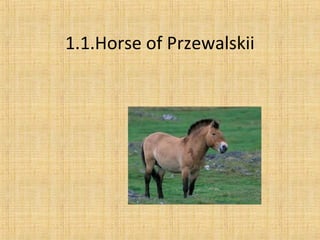
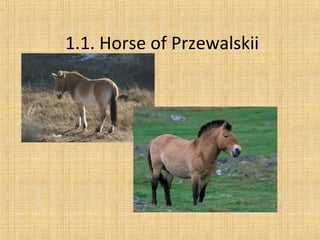
• This horse is different from most of their domestic counterparts for the structure
of his skull where his nose is convex unlike most domestic breeds is concave. Is
small in size, proportionally shorter legs, solid structure, long tail and larger head
compared to the rest of the body. The hair is short but strong, yellowish to dark
brown, being white muzzle and dark or black in mane (when erect) and the tail.
The typical size is 2.1 meters long and weighing about 350 pounds as adults.
Przewalski's horses are social animals that live in herds of varying size or directed
by a dominant male stud, and the rest of the members are females with cubs less
than 2 years. Once over this age, leave the group: males try to take his own flock
or try to snatch another, while females will be integrated into various other
groups, thus ensuring genetic exchange. Like any horse, these animals are fed
mainly grass. Her main predators are wolves
1.1.Horse of Przewalskii
1.1. Horse of Przewalskii
1.2. ANIMALS IN ASIA
1.2. Seal of Baikal
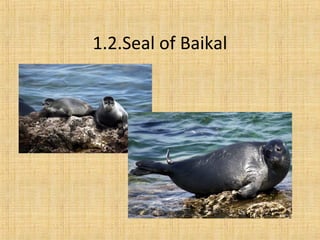
• The Baikal seal, or Nerpa (Pusa sibirica, obsolete: Phoca sibirica) is
a species of seal endemic to Lake Baikal Siberia. Like the Caspian
seal, is related to the Arctic ringed seal. The Baikal seal is the
smallest of the true seals, and with the exception of the
subpopulation of seals living in the Hudson Bay in Quebec are the
only species of pinnipeds that live in fresh water.
•
It's a mystery how they got to the lake Baikal seals such as are
hundreds of kilometers from the sea. Maybe there was a passage of
water that, at some point, connecting the lake with the Arctic Ocean.
An estimated 60,000 of Baikal seals and now its hunting is
prohibited.
1.2. Seal of Baikal
1.2.Seal of Baikal
1.3.ANIMALS IN ASIA
1.3.Tiger
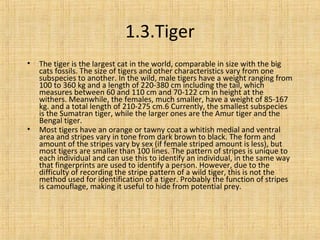
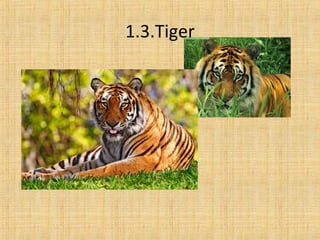
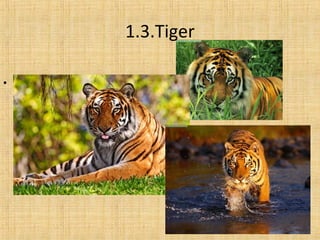
• The tiger is the largest cat in the world, comparable in size with the big
cats fossils. The size of tigers and other characteristics vary from one
subspecies to another. In the wild, male tigers have a weight ranging from
100 to 360 kg and a length of 220-380 cm including the tail, which
measures between 60 and 110 cm and 70-122 cm in height at the
withers. Meanwhile, the females, much smaller, have a weight of 85-167
kg. and a total length of 210-275 cm.6 Currently, the smallest subspecies
is the Sumatran tiger, while the larger ones are the Amur tiger and the
Bengal tiger.
• Most tigers have an orange or tawny coat a whitish medial and ventral
area and stripes vary in tone from dark brown to black. The form and
amount of the stripes vary by sex (if female striped amount is less), but
most tigers are smaller than 100 lines. The pattern of stripes is unique to
each individual and can use this to identify an individual, in the same way
that fingerprints are used to identify a person. However, due to the
difficulty of recording the stripe pattern of a wild tiger, this is not the
method used for identification of a tiger. Probably the function of stripes
is camouflage, making it useful to hide from potential prey.
1.3.Tiger
1.3.Tiger
1.3.Tiger
•
1.4.Farewell
• This concludes our presentation.
• We hope you enjoyed it.
• Thanks for listening to us.
• See you in the next presentation.
•

Angles

  • 1.
  • 2.
    1. INTRODUCTION 1.1ANIMALS INASIA Horse of Przewalski (Equus przewalskii) 1.2.ANIMALS IN ASIA Seal of Baikal (Pusa sibirica) 1.3.ANIMALS IN ASIA Tiger (Panthera tigris)
  • 3.
    1. INTRODUCTION • Thecontinent of Asia is the largest and most populous, and the most extensive of the Eurasian supercontinent. Bounded on the north by the Arctic Ocean, on the east by the Bering Strait separates America and the Pacific Ocean, the Indian Ocean to the south and west (from west and south of the border up) the Red Sea, the isthmus of Suez (which separates it from Africa), a stretch of the Mediterranean, and separating it from Europe, the Straits of Dardanelles, the sea of Marmara and the Bosphorus the Black Sea, the Caucasus and Ural mountains and the Caspian Sea.
  • 4.
  • 5.
    1.1.Horse of Przewalskii •This horse is different from most of their domestic counterparts for the structure of his skull where his nose is convex unlike most domestic breeds is concave. Is small in size, proportionally shorter legs, solid structure, long tail and larger head compared to the rest of the body. The hair is short but strong, yellowish to dark brown, being white muzzle and dark or black in mane (when erect) and the tail. The typical size is 2.1 meters long and weighing about 350 pounds as adults. Przewalski's horses are social animals that live in herds of varying size or directed by a dominant male stud, and the rest of the members are females with cubs less than 2 years. Once over this age, leave the group: males try to take his own flock or try to snatch another, while females will be integrated into various other groups, thus ensuring genetic exchange. Like any horse, these animals are fed mainly grass. Her main predators are wolves
  • 6.
  • 7.
    1.1. Horse ofPrzewalskii
  • 8.
    1.1. Horse ofPrzewalskii
  • 9.
  • 10.
    1.2. Seal ofBaikal • The Baikal seal, or Nerpa (Pusa sibirica, obsolete: Phoca sibirica) is a species of seal endemic to Lake Baikal Siberia. Like the Caspian seal, is related to the Arctic ringed seal. The Baikal seal is the smallest of the true seals, and with the exception of the subpopulation of seals living in the Hudson Bay in Quebec are the only species of pinnipeds that live in fresh water. • It's a mystery how they got to the lake Baikal seals such as are hundreds of kilometers from the sea. Maybe there was a passage of water that, at some point, connecting the lake with the Arctic Ocean. An estimated 60,000 of Baikal seals and now its hunting is prohibited.
  • 11.
  • 12.
  • 13.
  • 14.
    1.3.Tiger • The tigeris the largest cat in the world, comparable in size with the big cats fossils. The size of tigers and other characteristics vary from one subspecies to another. In the wild, male tigers have a weight ranging from 100 to 360 kg and a length of 220-380 cm including the tail, which measures between 60 and 110 cm and 70-122 cm in height at the withers. Meanwhile, the females, much smaller, have a weight of 85-167 kg. and a total length of 210-275 cm.6 Currently, the smallest subspecies is the Sumatran tiger, while the larger ones are the Amur tiger and the Bengal tiger. • Most tigers have an orange or tawny coat a whitish medial and ventral area and stripes vary in tone from dark brown to black. The form and amount of the stripes vary by sex (if female striped amount is less), but most tigers are smaller than 100 lines. The pattern of stripes is unique to each individual and can use this to identify an individual, in the same way that fingerprints are used to identify a person. However, due to the difficulty of recording the stripe pattern of a wild tiger, this is not the method used for identification of a tiger. Probably the function of stripes is camouflage, making it useful to hide from potential prey.
  • 15.
  • 16.
  • 17.
  • 18.
    1.4.Farewell • This concludesour presentation. • We hope you enjoyed it. • Thanks for listening to us. • See you in the next presentation.
  • 19.