Project number: 2017-1-UK01-KA201-036769
Project title: Augmented reality and new media against online promotion
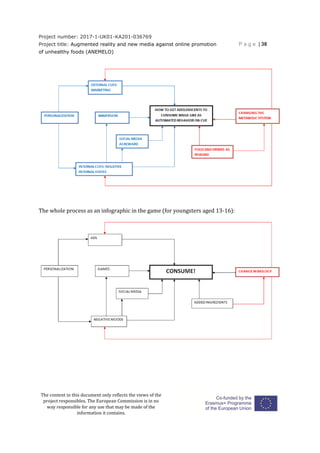
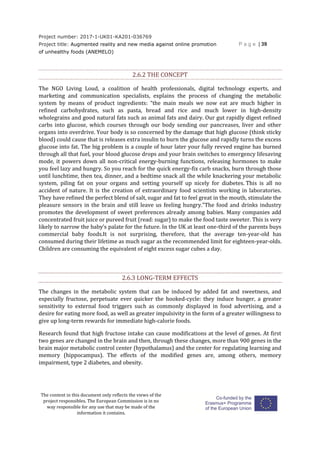
of unhealthy foods (ANEMELO)
P a g e | 1
The content in this document only reflects the views of the
project responsibles. The European Commission is in no
way responsible for any use that may be made of the
information it contains.
ANEMELO HANDBOOK
BACKGROUND INFORMATION
Version: 2.0
Date: 28.1.2019
Author: Onno Hansen-Staszyński (Ezzev Foundation)
Revision: Beata Staszyńska-Hansen (Ezzev Foundation), Bram Alkema, Arjan Haring, Rolf Visser,
Geert van Dijk
Project number: 2017-1-UK01-KA201-036769
Project title: Augmented reality and new media against online promotion
of unhealthy foods (ANEMELO)
P a g e | 2
The content in this document only reflects the views of the
project responsibles. The European Commission is in no
way responsible for any use that may be made of the
information it contains.
INTRODUCTION
This document encompasses the draft version of the background information for the teacher
Handbook that will be created within the project Augmented reality and new media against
online promotion of unhealthy foods (ANEMELO).
The background information in this document concerns adolescent habit forming in general and
ways in which producers of junk food and drinks can stimulate habit forming in adolescents by
nudging them to eat and drink their products binge-like as an automated behavior on cue, either
by internal cues or by external cues.
Project number: 2017-1-UK01-KA201-036769
Project title: Augmented reality and new media against online promotion
of unhealthy foods (ANEMELO)
P a g e | 3
The content in this document only reflects the views of the
project responsibles. The European Commission is in no
way responsible for any use that may be made of the
information it contains.
TABLE OF CONTENTS
Introduction........................................................................................................................................................................2
Table of Contents..............................................................................................................................................................3
1. General background information..........................................................................................................................6
1.1 Habit formation.....................................................................................................................................................6
1.1.1 The concept....................................................................................................................................................6
1.1.2 Changing already formed habits............................................................................................................7
1.2 The adolescent brain...........................................................................................................................................8
1.2.1 Introduction...................................................................................................................................................8
1.2.2 Adolescence....................................................................................................................................................9
1.2.3 Adolescents and habit formation....................................................................................................... 10
1.3 Sources overview.............................................................................................................................................. 11
1.3.1 Habit formation ......................................................................................................................................... 11
1.3.2 The adolescent brain............................................................................................................................... 11
2. Background information........................................................................................................................................ 13
2.1 Level 1: Marketing ............................................................................................................................................ 13
2.1.1 Introduction................................................................................................................................................ 13
2.1.2 Triggering behavior by advertising................................................................................................... 13
2.1.2.1 Advertisment provides cues........................................................................................................ 14
2.1.3 Ad filtering and awareness................................................................................................................... 15
2.1.4 Marketing and habit formation........................................................................................................... 16
2.2. Level 2: Immersion.......................................................................................................................................... 17
2.2.1 Introduction................................................................................................................................................ 17
2.2.2 Strengthening both consumption and the narrative.................................................................. 17
2.2.3 Repeat behavior ........................................................................................................................................ 18
2.2.4 Immersion and habit formation ......................................................................................................... 18
2.3. Level 3: Personalization ................................................................................................................................ 20
Project number: 2017-1-UK01-KA201-036769
Project title: Augmented reality and new media against online promotion
of unhealthy foods (ANEMELO)
P a g e | 4
The content in this document only reflects the views of the
project responsibles. The European Commission is in no
way responsible for any use that may be made of the
information it contains.
2.3.1 Introduction................................................................................................................................................ 20
2.3.2 Profiling ........................................................................................................................................................ 20
2.3.2.1 The concept......................................................................................................................................... 21
2.3.2.2 Profiling instruments...................................................................................................................... 22
2.3.2.3 Profiling and adolescents.............................................................................................................. 22
2.3.3 Target audience analysis ....................................................................................................................... 22
2.3.3.1 The concept......................................................................................................................................... 22
2.3.3.2 TAA in practice.................................................................................................................................. 23
2.3.3.3 TAA and adolescents....................................................................................................................... 24
2.3.4 Persuasion profiling................................................................................................................................. 24
2.3.4.1 The concept......................................................................................................................................... 24
2.3.5 Hazards of profiling, persuasion profiling and TAA................................................................... 25
2.3.6 Personalizing communication and habit formation................................................................... 27
2.4. Level 4: Food and drinks as reward ......................................................................................................... 30
2.4.1 Dopamine..................................................................................................................................................... 30
2.4.2 Adolescents and dopamine................................................................................................................... 30
2.4.3 Sugar, fat and habit formation............................................................................................................. 31
2.4.4 Sugar, fat and adolescent habit formation...................................................................................... 32
2.4.5 Long-term effects...................................................................................................................................... 32
2.5 Level 5: Social media as reward.................................................................................................................. 34
2.5.1 Introduction................................................................................................................................................ 34
2.5.2 The concept................................................................................................................................................. 34
2.5.3 The impact of social media ................................................................................................................... 35
2.5.4 Social media and adolescents .............................................................................................................. 35
2.6 Level 6: Changing the metabolic system.................................................................................................. 37
2.6.1 Introduction................................................................................................................................................ 37
2.6.2 The concept................................................................................................................................................. 39
2.6.3 Long-term effects...................................................................................................................................... 39
Project number: 2017-1-UK01-KA201-036769
Project title: Augmented reality and new media against online promotion
of unhealthy foods (ANEMELO)
P a g e | 5
The content in this document only reflects the views of the
project responsibles. The European Commission is in no
way responsible for any use that may be made of the
information it contains.
2.6.4 Discussion.................................................................................................................................................... 40
2.6.5 Energy in and energy out....................................................................................................................... 41
2.7 Sources overview.............................................................................................................................................. 43
2.7.1 Level 1: Marketing.................................................................................................................................... 43
2.7.2 Level 2: Immersion................................................................................................................................... 45
2.7.3 Level 3: Personalization......................................................................................................................... 46
2.7.4 Level 4: Food and drinks as reward.................................................................................................. 55
2.7.5 Level 5: Social media as reward.......................................................................................................... 57
2.7.6 Level 6: Changing the metabolic system......................................................................................... 59
Project number: 2017-1-UK01-KA201-036769
Project title: Augmented reality and new media against online promotion
of unhealthy foods (ANEMELO)
P a g e | 6
The content in this document only reflects the views of the
project responsibles. The European Commission is in no
way responsible for any use that may be made of the
information it contains.
1. GENERAL BACKGROUND INFORMATION
1.1 HABIT FORMATION
1.1.1 THE CONCEPT
In his book Hooked Nir Eyal describes how consumer habits are formed through conscious
engineering by companies. According to him, succesful companies have found a way to link their
products to specific consumer daily routines and emotions. They offer solutions that are to come
to mind immediately whenever a consumer enters the specific daily routine or experiences the
specific emotion. This enables companies to sell their products to consumers without spending
significant resources on advertising.
Eyal distinguishes four steps in the so-called Hooked Model companies use to automate their
sales. The first step is the cue that is to be the starting-point of consumer behavior: the trigger.
This trigger can be external or internal. External triggers can take the form of advertising or of
favorable press mentions. Internal triggers are negative consumer emotions: “Feelings of
boredom, loneliness, frustration, confusion, and indecisiveness often instigate a slight pain or
irritation and prompts an almost instantaneous and often mindless action to quell the negative
sensation.”
The second step is the action that is evoked by the trigger. Without an action following a cue, the
cue is worthless in the process of habit formation. The initiation of the action should be easier for
the consumer than thinking so that the consumer’s response to the cue can be automated over
time.
The action following the trigger equals behavior in anticipation of a reward. The experiencing of
the reward is step three. This reward should be more than a predictable result of the action, it
should trigger desire. The reward provided should evoke a further craving in consumers.
The best way to evoke consumer craving is to provide variable rewards, as was found by
psychologist Michael Zeiler. While predictable rewards lead to routine, variable awards spark
interest and attention. Rewards can take the form of social confirmation, of material objects such
as food and physical objects, and of rewards of the Self: “intrinsic rewards of mastery,
competence, and competition”.
The fourth and final step in the Hooked Model is investment. This builds on the fact that the more
time and effort are invested into a product or service, the more these are valued. Ever more
investment leads to ever more commitment to a product or service.
Eyal stresses that it is not enough to get consumers to complete the four-step cycle once: “to
create the habit, users must first use the product through multiple cycles of the Hook Model.
Project number: 2017-1-UK01-KA201-036769
Project title: Augmented reality and new media against online promotion
of unhealthy foods (ANEMELO)
P a g e | 7
The content in this document only reflects the views of the
project responsibles. The European Commission is in no
way responsible for any use that may be made of the
information it contains.
Therefore, external triggers must be used to bring users back around again and again to start
another cycle.”
1.1.2 CHANGING ALREADY FORMED HABITS
To change a habit once it is forged is not easy. Charles Duhigg nevertheless presents an option
to attempt it. His approach also consists of four steps.
Step one, according to Duhigg, is to identify the routine: “it’s the behavior you want to
change”. Step two is to experiment with rewards: “By experimenting with different rewards, you
can isolate what you are ACTUALLY craving, which is essential in redesigning the habit.” Step
three is to isolate the cue: “identify categories of behaviors ahead of time to scrutinize in order
to see patterns.” Five possible categories need to be taken into account: location, time,
emotional state, other people, and immediately preceding action. Duhigg’s fourth step is to have
a plan: “you can change to a better routine by planning for the cue and choosing a behavior that
delivers the reward you are craving.” In other words, Duhigg advises to interfere in Eyal’s step
two (action) but not in steps one (cues) and three (rewards). In his view bad behavior thus can
be replaced with good behavior.
Creating a new habit takes a lot of time and perseverance. During this time it helps to frame
one’s determination in terms of “I don’t” (consume junk food or drinks) rather than “I can’t”
(consume junk food or drinks). The first frame shows one’s power over a situation and declares
what kind of person one is. The second frame hands over power to an unnamed outside agent.
Adam Alter agrees with Duhigg’s proposition but adds: “Though [Duhigg’s] Golden Rule is a
useful guide, different addictions demand diferent routine overrides. ... Each underlying motive
implies a different solution. ... Even if the solution doesn’t come easy, the first step is
understanding why the addiction was rewarding in the first place, and which psychological
needs it was frustrating in the process.”
Cult experts Steven Hassan describes a similar process for changing negative thoughts and
associations: identifying the negative thought or association and writing it down, drafting a
thought or association that is to replace the negative thought, identifying the triggers that evoke
the negative thought or association, and then visualizing the triggers happening and actively
replacing the evoked negative thought or association by the new thought or association.
Project number: 2017-1-UK01-KA201-036769
Project title: Augmented reality and new media against online promotion
of unhealthy foods (ANEMELO)
P a g e | 8
The content in this document only reflects the views of the
project responsibles. The European Commission is in no
way responsible for any use that may be made of the
information it contains.
1.2 THE ADOLESCENT BRAIN
1.2.1 INTRODUCTION
Researcher Ronald Dahl points at a health paradox for adolescents. On the one hand
adolescence is a developmental period of strength and resilience: “Compared to young children,
adolescents are stronger, bigger, and faster, and are achieving maturational improvements in
reaction time, reasoning abilities, immune function, and the capacity to withstand cold, heat,
injury, and physical stress.” On the other hand during adolescence “overall morbidity and
mortality rates increase 200%” when compared to younger children.
One of the major causes of Dahl’s health paradox is the restructuring process of the brain that
takes place during adolescence. While the brain of younger children mainly consists of grey
matter that facilitates the learning of almost anything, as a kind of all-purpose organ, in the
adolescent brain the amount of grey matter is significantly reduced while the amount of white
matter is significantly increased: rarely used brain connections are eliminated while important
brain connections are strengthened by means of a white insulation that enables high-speed
connections and shorter regeneration time. As a result the brain specializes and becomes more
effective.
While the reduction of grey matter (“pruning”) proceeds in a region-specific, nonlinear fashion,
the strengthening of white matter (“myelination”) starts at the back of the brain and slowly
proceeds forward. This means that the brain parts associated with body regulation, movement
and emotions are upgraded first and the brain parts responsible for the control and
coordination of thoughts and behavior stay under construction until one reaches one’s late mid-
twenties. The effect of the reconstruction of the adolescent brain is that in situations in which
emotions clash with reflection, emotions nearly always win out. Adolescent brains are not less
capable of reflection and control, but their capability to consider and reconsider is ineffective in
situations in which emotions flare up.
Besides the changes in grey and white matter another major change related to the adolescent
brain takes place: the dramatic growth of the dopamine system. As will be described in chapter
3.4 the neurotransmitter dopamine is an important factor in learning, as it is linked to desire,
rewards and establishing whether a situation, experience or outcome is worth noticing.
The process of brain reconstruction is not the only developmental process taking place during
adolescence. Hormonal changes cause the adolescent body to grow fast and to change its
composition (f.i. store more fat). Sex hormones prepare the adolescent body for reproduction.
All these large developmental processes take place independently of each other and the order in
which their separate phases become active may differ significantly per individual.
Project number: 2017-1-UK01-KA201-036769
Project title: Augmented reality and new media against online promotion
of unhealthy foods (ANEMELO)
P a g e | 9
The content in this document only reflects the views of the
project responsibles. The European Commission is in no
way responsible for any use that may be made of the
information it contains.
1.2.2 ADOLESCENCE
Adolescence is a period in which young children start to find their own way in life. The adults on
whom they have relied before become relatively less important. Peers and youngsters, who are
slightly older such as popular vloggers, for a significant part take over the function of parents
and teachers as role models.
Positive peer comments start to trigger large rewards in the adolescent brain, comparable to the
intake of psychoactive substances. Since adolescents are far more sensitive to rewards than
adults this means peer pressure is a major factor in the lives of adolescents.
While their ability to think abstractly is slowly developing, adolescents’ lack of life experience
hinders them in coming to balanced decisions. For a lack of data, adolescents approach
challenges rationally, which takes time, and hyperrationally which means without a context. At
any point during this prolonged process emotions might be triggered to simply overtake the
decision-making process.
In addition, adolescents are rather reward driven. They expect bigger rewards for activities in
comparison to adults and younger children, they assess pleasant situations as less risky,
downplay the meaning of cons, love intensity and passion and have a lower base level of
satisfaction in life. As a result, it is hard for adolescents to learn from their mistakes, understand
the consequences of their actions to the end and keep themselves far from activities that are
forbidden. Adolescents therefore are more impulsive, risk-prone and prefer short-term goals.
The presence of peers, and the quest for peer acceptance, is an important motivation for risk-
taking, but also isolation from one’s peer group is. This isolation looks slightly different for girls
(being excluded from groups of girls who discuss what is going on around them) and for boys
(being excluded from group activities such as team sports or gaming). Other stimulants of risk-
taking are low grades at school, a loss of trust of parents or other important adults, a negative
home situation and impulsivity in the form of a preference for sensation seeking or for first
acting and then thinking.
Risk-taking is an essential precondition for adolescents to find out what is important for them in
life and to select peers as friends and sexual partners. Therapists call adolescence a second
chance for youngsters, since they are able to reorganize the life they had thus far. It is a time in
which a basic identity is created that forms the basis for the adolescent’s adult life. Memories
formed during adolescents are deeply seated. This can be seen in Alzheimer patients who
cannot remember what they did yesterday but do remember their life as a young individual.
While most adolescents do not experience extreme problems as a result of risk-taking, around
twenty percent do. Examples of extreme problems are: addiction to psychoactive substances,
serious accidents, violence, murder, sex-related health problems, mental health problems such
Project number: 2017-1-UK01-KA201-036769
Project title: Augmented reality and new media against online promotion
of unhealthy foods (ANEMELO)
P a g e | 10
The content in this document only reflects the views of the
project responsibles. The European Commission is in no
way responsible for any use that may be made of the
information it contains.
as depression, eating disorders, self-mutilation and suicide. It is important to keep in mind that
these problems are not the result of a lack of knowledge or understanding. As researcher
Laurence Steinberg summarizes: “the factors that lead adolescents to engage in risky activity
are social and emotional, not cognitive”.
1.2.3 ADOLESCENTS AND HABIT FORMATION
Because of its reconstruction the adolescent brain is at its peak of openness to learning and
experiencing. This holds good for harmonious activities as well as for obsessive. The adolescent
brain can quickly learn a new language, become ever better in sports and in playing a musical
instrument, but can also rapidly train itself to smoke cigarettes or marijuana, drink alcohol or
eat junk food. The plasticity of the brain during adolescence is so substantial, that significant IQ
changes occur: one third of all youngsters acquire a higher IQ at this age while one third of them
significantly lowers their IQ.
The adolescent openness to risky and intensely rewarding experiences leaves them more
vulnerable to the risk of getting addicted in comparison to adults. Adolescent addictions, in turn,
can last throughout the youngsters’ whole lives: the majority of adult addicts started their
addiction during adolescence. The younger adolescents start taking psychoactive substances,
the more impact these substances are likely to have and the more risk they run to stay addicted
throughout their lives. This is the logic behind setting age limits on drinking alcohol.
Those adolescents who get addicted have a higher chance on other major problems such as
mental health problems. These mental health problems are likely to continue into their adult
life, just as addictions are.
Project number: 2017-1-UK01-KA201-036769
Project title: Augmented reality and new media against online promotion
of unhealthy foods (ANEMELO)
P a g e | 11
The content in this document only reflects the views of the
project responsibles. The European Commission is in no
way responsible for any use that may be made of the
information it contains.
1.3 SOURCES OVERVIEW
1.3.1 HABIT FORMATION
 Adam Alter (2017) Irresistible.
 Charles Duhigg (2012) The power of habit.
 Nir Eyal (2014) Hooked.
 Steven Hassan (2013) Freedom of mind.
 Simone Stolzoff (2018) The formula for phone addiction might double as a cure. In
Wired, 2.1.2018. https://www.wired.com/story/phone-addiction-formula/
1.3.2 THE ADOLESCENT BRAIN
 Decca Aitkenhead (2018) ‘Teens get a bad rap’: the neuroscientist championing moody
adolescents. The Guardian, 17.8.2018.
https://www.theguardian.com/science/2018/aug/17/teens-get-a-bad-rap-the-
neuroscientist-championing-moody-adolescents
 Jane Anderson et al. (2016) The teenage brain: under construction. American College of
Pediatricians. May 2016.. https://www.acpeds.org/the-college-speaks/position-
statements/parenting-issues/the-teenage-brain-under-construction
 Aurélien Bernheim et al. (2013) Controversies about the enhanced vulnerability of the
adolescent brain to develop addiction. In: Frontiers in pharmacology.
 Sarah-Jayne Blakemore et al. (2006) Development of the adolescent brain: implications
for executive function and social cognition. In: Journal of child psychology and psychiatry,
47:3/4.
 Sarah-Jayne Blakemore (2012) Imaging brain development: The adolescent brain.
In: NeuroImage 61, 2012.
 Eveline Crone (2017) The adolescent brain – changes in learning, decision-making and
social relations. Taylor & Francis Ltd.
 Ronald Dahl (2004) Adolescent brain development: a period of vulnerabilities and
opportunities. In: Annals of the New York Academy of Sciences.
 Dopamine Neurotransmitter. The role of neurotransmitter dopamine in movement and
cognition. (nd) In: Psychologist World.
https://www.psychologistworld.com/biological/neurotransmitters/dopamine
 Nicole Hair et al. (2015) Association of Child Poverty, Brain Development, and Academic
Achievement. In: JAMA Pediatr. 2015 September.
 Daniel Hoops and Cecilia Flores (2017) Making Dopamine Connections in Adolescence.
In: Trends in Neurosciences, Volume 40, Issue 12, p709–719, December 2017.
DOI: https://doi.org/10.1016/j.tins.2017.09.004
Project number: 2017-1-UK01-KA201-036769
Project title: Augmented reality and new media against online promotion
of unhealthy foods (ANEMELO)
P a g e | 12
The content in this document only reflects the views of the
project responsibles. The European Commission is in no
way responsible for any use that may be made of the
information it contains.
 Frances Jensen and Amy Ellis Nutt (2015) The teenage brain – a neuroscientist’s survival
guide to raising adolescens and young adults. Harper.
 Krista Lisdahl et al. (2013) Dare to delay? The impacts of adolescent alcohol and
marijuana use onset on cognition, brain structure and function. In: Frontiers in
psychiatry, July 2013.
 Dan Lubman et al. (2014) Cannabis and adolescent brain development.
In: Pharmacology & Therapeutics.
 Amy C. Reichelt (2016) Adolescent Maturational Transitions in the Prefrontal Cortex
and Dopamine Signaling as a Risk Factor for the Development of Obesity and High
Fat/High Sugar Diet Induced Cognitive Deficits. In: Front. Behav. Neurosci., 13 October
2016 | https://doi.org/10.3389/fnbeh.2016.00189
https://www.frontiersin.org/articles/10.3389/fnbeh.2016.00189/full
 Daniel Romer (2010) Adolescent risk taking, impulsivity, and brain development:
implications for prevention. In: Dev. Psychobiol. 52 (3), April 2010.
 Daniel Siegel (2013) Brainstorm.
 Daniel Siegel (2014) Dopamine and Teenage Logic. In: The Atlantic, 24.1.2014
https://www.theatlantic.com/health/archive/2014/01/dopamine-and-teenage-
logic/282895/
 Lindsay Squeglia et al. (2015) Brain Development in Heavy Drinking Adolescents. In: Am
J Psychiatry. 2015 June 1.
 Laurence Steinberg (2008) A social Neuroscience Perspective on Adolescent Risk-
Taking. In: Dev Rev. 2008 Mar; 28(1): 78–106. doi: 10.1016/j.dr.2007.08.002.
https://www.ncbi.nlm.nih.gov/pmc/articles/PMC2396566/
 Laurence Steinberg (2010) Commentary: A behavioral scientist looks at the science of
adolescent brain development. In: Brain Cogn., Feb 2010.
 Linda Van Leijenhorst et al. (2010) What Motivates the Adolescent? Brain Regions
Mediating Reward Sensitivity across Adolescence. In: Cerebral Cortex, January 2010.
 Erin Walsh (2016) Dopamine and the teenage brain, In: Dr. Dave Walsh, 1.11.2016
http://drdavewalsh.com/posts/223
 Alice Walton (2018) New Research Suggests That Food Really Does Affect How We
Think. Forbes, 21.12.2018
https://www.forbes.com/sites/alicegwalton/2018/12/21/new-research-suggests-that-
food-really-does-affect-how-we-think/?ss=healthcare#2c3b00217556
 Emma Young (2017) Iceland knows how to stop teen substance abuse but the rest of the
world isn’t listening. In: Independent, 17.1.2017. https://www.independent.co.uk/life-
style/health-and-families/iceland-knows-how-to-stop-teen-substance-abuse-but-the-
rest-of-the-world-isn-t-listening-a7526316.html
Project number: 2017-1-UK01-KA201-036769
Project title: Augmented reality and new media against online promotion
of unhealthy foods (ANEMELO)
P a g e | 13
The content in this document only reflects the views of the
project responsibles. The European Commission is in no
way responsible for any use that may be made of the
information it contains.
2. BACKGROUND INFORMATION
2.1 LEVEL 1: MARKETING
2.1.1 INTRODUCTION
Most adolescents think that marketing is the same as advertising. Indeed advertising is the most
noticeable part of marketing, since it is prominent by design. But marketing has more and more
subtle components. Examples of marketing tactics are: the way products and packages are
designed (featuring cartoon characters or celebrities), the availability of the products in shops,
the placement of products on the shelves (near the register), the chosen price ranges (now 2 for
1), and upselling: influencing customers to buy larger meals and drinks or to add high-calorie
toppings or sides to their order.
On top of these marketing tools public consumption proves to friends what eating behavior is
permissable, how big servings should be and what brands are “cool” and which aren’t. This
signalling behavior is as much part of promotion as the advertising itself. A lot of marketing
research, sales planning goes into alignment of event triggers coming from product design,
packaging, placement, price and promotion.
Promotion can be described as “any form of communication or message that is designed to, or
has the effect of, increasing the recognition, appeal and/ or consumption of particular products
and services”. Advertising, the most recognizable part of marketing for adolescents, is “the paid
public presentation and promotion of ideas, goods, or services by a sponsor that is intended to
bring a product to the attention of consumers through a variety of media channels such as
broadcast and cable television (TV), radio, print, billboards, the Internet, or personal contact”. It
is advertising on mass media that provides adolescents with cues that nudge them towards
immediate binge-like automated snack eating and drinking behavior.
2.1.2 TRIGGERING BEHAVIOR BY ADVERTISING
The mere exposure of adolescents to marketing messages is sufficient to nudge them to changes
in their behavior as desired by the sender of the marketing messages. Exposing adolescents to
alcohol-related messages, for instance, increases the probability of them starting to drink
Project number: 2017-1-UK01-KA201-036769
Project title: Augmented reality and new media against online promotion
of unhealthy foods (ANEMELO)
P a g e | 14
The content in this document only reflects the views of the
project responsibles. The European Commission is in no
way responsible for any use that may be made of the
information it contains.
alcohol within the next months by 9% - 15%. Every alcohol-related advertisement, seen by
adolescents, increases the number of alcoholic drinks they consume by 1%.
Research on advertising attention found that adolescents pay more attention to food and
beverage advertising than to any other form of advertising. This makes food and drink
advertising effective when aimed at them: exposing children and adolescents to food and drinks
advertisements increases their food intake. One study for instance found that children, aged 7-
11, watching cartoons with food advertisements ate 45% more snack food than children in the
same age group watching the same show with non-food related advertisements.
The majority of food and drinks advertisements that children and adults are exposed to
promote high-calorie, low-nutrient foods, that are high in fats, salt or sugar (HFSS), especially
sugary breakfast cereals, confectionary, high fat savory snacks, soft drinks and quick service
restaurants.
While TV advertising still is the main medium for food advertising in the EU, it is in decline
while internet and digital marketing are on the rise. Parents are mostly unaware of the amount
of advertisements for unhealthy food and drinks that children and adolescents are exposed to
online.
Studies link the increase in overweight and obese adolescents to the advertising of sugar and
fat-dense junk foods. Amy Reichelt of RMIT University concludes: “Advertising for food and
beverages communicates food cues, priming the consumption of unhealthy foods and
beverages.”
2.1.2.1 ADVERTISMENT PROVIDES CUES
The exposure of adolescents to products by means of advertisements consists of more than just
displaying products or brand characteristics. In advertisements narratives are presented in
which unhealthy products are not shown as being unhealthy but rather as containing healthy
ingredients that empower consumers to live a good life. The promoted image of unhealthy
products is that these products are normal and innocent: they can be enjoyed every day, even in
larger quantities, without negative effects. The advertisement narrative links positive and
agreeable emotions and experiences to unhealthy food products.
One of the strategies followed by producers of unhealthy foods and drinks is to support
academic research that substantiates claims about the healthy character of some ingredients in
their products while trying to suppress studies that might expose hazards of consuming their
unhealthy products. The desired outcomes of academic studies are used by marketers to steer
the discussion about the products in a positive direction and create a positive narrative around
the products and brands.
Project number: 2017-1-UK01-KA201-036769
Project title: Augmented reality and new media against online promotion
of unhealthy foods (ANEMELO)
P a g e | 15
The content in this document only reflects the views of the
project responsibles. The European Commission is in no
way responsible for any use that may be made of the
information it contains.
2.1.3 AD FILTERING AND AWARENESS
Most people are unaware of the influence of the external cues provided by advertising. And if
they are aware, they think advertising only effects others. The pro-health coalition Living Loud
hypothesizes that this is the result of a conscious effort by advertising specialists: “Great
advertising is designed to quietly influence people, to go consciously unnoticed, that’s why 62%
of people think advertising doesn’t affect their purchase decisions.”
Marketers have various instruments to increase the chances that their messages remain
consciously unnoticed. An effective instrument is to blur the lines between advertising and
other types of information. Marketers use hybrid content types such as advertorials and try to
seamlessly integrate marketing material into general content so that it becomes ever more
difficult to distinguish advertisements from regular information. Creating positive narratives
around products and brands instead of straightforward promoting the sales of products, as
described above, is another effective instrument.
Younger children do not have a mature understanding yet of the persuasion tactics used by
marketers. This understanding is slowly acquired, although outdated developmental models of
adolescent development claimed otherwise. A slow shift in the judgment about the truthfulness
of advertisements by youngsters provides an indicator of this. While 8% of 8-11 year olds think
that TV advertisements “always” tell the truth about the products they are selling, 4% of 12-15
year olds do. For “mostly” telling the truth the percentages are 31% (8-11) and 34% (12-15)
and for “sometimes” 45% (8-11) and 48% (12-15). With regard to internet advertising 4% of 8-
11 year olds thinks that these “always” tell the truth, against 2% 12-15 year olds. 28% (8-11)
and 27% (12-15) think that internet advertisements “often” tell the truth, and 50% (8-11) and
58% (12-15) think they “sometimes” speak the truth. This example highlights that adolescents
do not suddenly become more marketing literate. Age cuts for the legal age that marketers may
expose children to marketing will therefore always be arbitrary.
In order to understand the persuasion tactics used by marketers it is essential that children and
adolescents recognize advertisements for what they are. And here lies a challenge, partially
because of marketer efforts to blur the lines between advertisements and content and partially
because of relatively low digital skills that children and adolescents display. Researcher danah
boyd writes: “Just because teens are comfortable using social media to hang out does not mean
that they’re fluent in or with technology. Many teens are not nearly as digitally adept as the
often-used assumption that they are “digital natives” would suggest. .... As sociologist Eszter
Hargittai has quipped, many teens are more likely to be digital naives than digital natives.”
As a result, children and adolescents have a low awareness of the amount of advertising they
see and frequently understate this amount. Quite often they do not recognize advertisements as
such. For instance, it was found that a majority of adolescents cannot identify advertisements on
the search results page of Google, despite them being distinguished in a box with the word ‘Ad’
in it. Another finding is that almost half of the adolescents are not aware that vloggers, who are
Project number: 2017-1-UK01-KA201-036769
Project title: Augmented reality and new media against online promotion
of unhealthy foods (ANEMELO)
P a g e | 16
The content in this document only reflects the views of the
project responsibles. The European Commission is in no
way responsible for any use that may be made of the
information it contains.
an important point of reference to them, may be paid to endorse products. WHO claims that
among adolescents conscious awareness of food and drinks marketing, as well as the ability and
the motivation to resist are “often not present”.
Children and adolescents do not perceive themselves as having low marketing literacy. On the
contrary many see themselves as “empowered consumers capable of limiting their exposure to
or influence by marketing”. Many claim to have strategies to avoid advertising, such as looking
away, using the time to do something else or ignoring advertisements by mentally filtering them
out.
2.1.4 MARKETING AND HABIT FORMATION
Marketing efforts by food and drinks producers are the first step in getting children and
adolescents to form and sustain the habit of consuming unhealthy food and drinks products.
Exposure to these external cues in the form of advertisement is to trigger children and
adolescents into action: the immediate consumption of an unhealthy food or drinks product.
The experience of the actual consumption of a product that follows the exposure to external
cues (see chapter 10), together with the systematic loading of the brand with positive
narratives, providing value in the form of immersive experiences that alleviate negative internal
states (internal cues, see chapter 8), offering personalized communication (chapter 9), using
social media channels and variable rewards (chapter 11), and changing the consumers’
metabolic system (chapter 12) are to take children and adolescents from one-off consumption
to eating and drinking unhealthy products binge-like as an automated behavior on cue.
Project number: 2017-1-UK01-KA201-036769
Project title: Augmented reality and new media against online promotion
of unhealthy foods (ANEMELO)
P a g e | 17
The content in this document only reflects the views of the
project responsibles. The European Commission is in no
way responsible for any use that may be made of the
information it contains.
2.2. LEVEL 2: IMMERSION
2.2.1 INTRODUCTION
According to the British Heart Foundation food and drinks producers use specialized online
marketing instruments to capture the attention of youngsters: in their marketing material they
include images of other children, cartoon characters, or of celebrities or other familiar persons;
they offer competitions, games or apps that are appealing to the target group; they hand out free
gifts or prizes such as free downloads or free merchandise that is appealing to the target group;
and provide links to social networking websites. These instruments enable marketers to
capture youngsters’ attention for longer periods of time and provide a deeper sense of
engagement compared to traditional forms of advertising.
The vast majority of food and drinks producers who employ these online instruments to target
youngsters, either within their own online environment or on the most popular sites for
youngsters, are producers of products that are high in calories and low in nutritional value. The
products promoted in the online environments are predominantly not permitted to be
advertised on TV. The WHO calls these methods “stealth marketing techniques”.
The specialized online marketing instruments are effective, far more effective than TV
campaigns. Researchers found a positive relationship between immersive environments and
popularity and engagement. For instance, among the 20 most popular gaming websites for
children, 11 contain advergames promoting unhealthy food products.
The reason the specialized marketing instruments are effective is that children and adolescents
feel entertained by them. Youngsters engage with them to escape negative internal states that
they experience far more frequently than adults, such as feelings of boredom, loneliness,
frustration, confusion, and indecisiveness. These negative feelings “often instigate a slight pain
or irritation and prompt an almost instantaneous and often mindless action to quell the
negative sensation.” The specialized food and drinks marketing instruments provide youngsters
with a relief from their inner anxiety and present an entertaining, immersive world of unhealthy
food and drinks as the immediate answer to many of the challenges they face.
2.2.2 STRENGTHENING BOTH CONSUMPTION AND THE NARRATIVE
The aim of the specialized market instruments is to trigger immediate consumption, to expose
children and adolescents to the brand narratives behind the products and to get youngsters to
draw in their friends.
Project number: 2017-1-UK01-KA201-036769
Project title: Augmented reality and new media against online promotion
of unhealthy foods (ANEMELO)
P a g e | 18
The content in this document only reflects the views of the
project responsibles. The European Commission is in no
way responsible for any use that may be made of the
information it contains.
A study concerning advergames promoting HFSS-products (high in fat, salt or sugar) showed
that exposure to these advergames is linked to an increased consumption of HFSS-products,
while exposure to advergames promoting fruit led to an increased consumption of fruit, but not
at the expense of HFSS foods. As a result of youngsters playing another advergame, it was found
that 30% reported to have asked their parents to buy the advertised product.
Youngsters within a branded environment are intended to experience the claim that the brand
helps consumers live a good life. Nesquick, for instance, presented in an advergame a Nesquick
bunny that jumped higher after eating the cereal. Children who played the game were found to
be more likely to think Nesquick made them fit. Another cereal advergame evoked more
positive expectations among children about the taste of the cereal. After the game children were
also more likely to believe that the cereal is healthy. In general, it has been established by
research that immersive marketing content can establish increased brand recognition,
increased positive brand associations and brand trust.
2.2.3 REPEAT BEHAVIOR
The immersive nature of the specialized marketing instruments stimulates not only longer and
deeper youngster engagement but also repeat visits and repeat product consumption by them.
Brand recognition, brand trust and positive brand associations lead to a brand relationship and
greater consumer engagement which, in turn, are important elements in the creation of brand
loyalty.
Spending more time and repeated time is like an investment users make in the brand. According
to Eyal this is the last step in getting hooked: people who invest time and effort in a product or
service, value it more. This is supported by research: individuals within online brand
communities tend to focus on the benefits, rather than their costs, of their engagement.
2.2.4 IMMERSION AND HABIT FORMATION
Humans possess two different brain systems to interpret the world around them and to come to
decisions. The first system, aptly called System 1, is the default system. This system works like
an automatic pilot: it operates automatically and quickly, with little or no effort and no sense of
voluntary control. Most of the time System 1 helps individuals make the right judgments about
situations, relying on the wisdom of the group and on one’s unconscious life experiences and
successful solutions that have been gathered.
System 2, on the other hand, “allocates attention to the effortful mental activities that demand it
… The operations of System 2 are often associated with the subjective experience of agency,
Project number: 2017-1-UK01-KA201-036769
Project title: Augmented reality and new media against online promotion
of unhealthy foods (ANEMELO)
P a g e | 19
The content in this document only reflects the views of the
project responsibles. The European Commission is in no
way responsible for any use that may be made of the
information it contains.
choice, and concentration.” System 2 helps individuals focus on a subject, think things through
well, reflect and come to a conscious decision.
The human brain is constantly looking for shortcuts through reality to save energy. That is why
System 1 is the brain’s default interpretation and decision-making system: it provides solutions
without taking up to much effort. Attention is only focused when individuals assess something
as important and there are no other urgent tasks. Since the adolescent brain experiences a
complete rewiring, it is harder for youngsters to focus on anything while the need to save effort
for them is even more important.
If the brain finds an answer to a situation that works time and again, the answer becomes
automatic behavior to save effort. Sequences of actions are “chunked” into routine and stored in
the brain for later use when the appropriate trigger presents itself. This way, individuals do not
have to invest energy in daily activities like dressing, choosing what to eat, or how to react to a
negative internal state.
The specialized marketing instruments used by junk food and drinks producers facilitate
automatic behavior. In case of the occurrence of a negative internal state within children or
adolescents the immersive marketing tools help take youngsters shortcuts through reality. The
shortcuts that they offer are easier than thinking or confronting uneasy feelings. Creating
automated behavior as a response to problems is the key precondition for turning behavior into
a behavioral addiction.
Project number: 2017-1-UK01-KA201-036769
Project title: Augmented reality and new media against online promotion
of unhealthy foods (ANEMELO)
P a g e | 20
The content in this document only reflects the views of the
project responsibles. The European Commission is in no
way responsible for any use that may be made of the
information it contains.
2.3. LEVEL 3: PERSONALIZATION
2.3.1 INTRODUCTION
Personalization of communication messages to adolescents by food and drinks industry
representatives can strengthen the nudging of adolescents towards the aim of getting them to
eat and drink unhealthy products binge-like as an automated behavior on cue.
Two types of instruments can be used to strengthen external cues (product producer content
that is to trigger consumption of the product in the form of advertising and marketing): profiling
and persuasion profiling.
A third type of instrument called ‘target audience analysis’ can be used to tune in more
effectively to adolescents’ internal cues (emotions or experiences that become associated with a
product so that the product will be consumed when these emotions or experiences occur).
2.3.2 PROFILING
In order to be able to personalize online mass communication for their clients specialized online
advertising companies use a technique called ‘profiling’.
Profiling consists of the creation of profiles of internet users’ preferences and interests, based
on tracking their behaviors on and across websites. Internet users’ online behaviors are
recorded as a digital trail that they leave behind while performing online activities such as
liking, clicking, opening websites, registering at websites, agreeing to two-step verification
security features, searching, communicating with other internet users and linking to them, and
buying products online. The resulting user data are stored in databases owned by specialized
online advertising companies. Sometimes internet users share their data willingly and
consciously, but often their data are being gathered without them knowing it and used for
purposes they never agreed on.
The profiles that are created by specialized online advertising companies help their clients to
make predictions about the profiled internet users’ future actions and preferences. Based on
these predictions businesses are able to provide personalized services and information and
offer targeted advertising: personalized advertising that is assumed to be in line with the
profiled internet users’ preferences and interests. In addition, profiles are used by businesses to
make decisions with regard to the profiled internet users, for instance on whether they pose a
financial risk.
Project number: 2017-1-UK01-KA201-036769
Project title: Augmented reality and new media against online promotion
of unhealthy foods (ANEMELO)
P a g e | 21
The content in this document only reflects the views of the
project responsibles. The European Commission is in no
way responsible for any use that may be made of the
information it contains.
Specialized government organizations use profiling as well. These organizations also gather and
interpret online user information. Their aim is to increase security in society by tracking down
suspicious internet users and to detect fraud.
2.3.2.1 THE CONCEPT
The basic idea behind profiling is that individual internet users are not unique and
unpredictable but are more or less like other individual internet users. It is assumed that the
more an individual internet user exhibits online behaviors similar to other individual internet
users, the more the preferences and interests of this individual user are similar to the
preferences and interests of these other internet users.
This means that if some internet users have bought a product, this product is deemed to be also
desirable for internet users who are similar to them. Therefore, it is thought to make sense to
direct advertisements promoting the product to these similar internet users. In the same
fashion, if some internet users perform a certain action online or offline, such as liking a page, it
seems likely that similar internet users will also be willing to perform this action. And that these
similar internet users are similar to the other internet users in other ways too.
This does not mean that the individual internet user’s past behavior is unimportant. A recent
trend is to put more weight to an internet user’s own history relative to the dynamic profiles of
similar other users.
To enable profiling the activities of every individual in the world, online or offline, are captured
in shadow profiles in databases and individually linked to a catalogue of categories that allow
user classification. The catalogue of categories can be extensive: Facebook’s catalogue contains
over 52,000 categories. It is kept unclear by companies how they acquire insights in the
activities of individuals, but it can be safely assumed that they stem from the company’s own
monitoring and data bought from companies that specialize in registering offline and online
activities that are linked to identifiable individuals and sell their data.
Thanks to profiling businesses are hoping to be able to send their advertising messages to
individuals who are actually interested in their products, or are interpreted as being interested,
and are able to personalize the services and information that they offer to individual internet
users to attain higher user satisfaction.
A recent development in profiling is employing Artificial Intelligence that more broadly predicts
how internet users will behave, what they will buy, and what they will think. Facebook for
instance experiments with a self-improving, artificial intelligence-powered prediction engine
named “FBLearner Flow”. Personalised assistants like Amazon’s Alexa refer these AI-based
interpretations back to the user.
Project number: 2017-1-UK01-KA201-036769
Project title: Augmented reality and new media against online promotion
of unhealthy foods (ANEMELO)
P a g e | 22
The content in this document only reflects the views of the
project responsibles. The European Commission is in no
way responsible for any use that may be made of the
information it contains.
2.3.2.2 PROFILING INSTRUMENTS
The simplest profiling instruments simply register what individual internet users do within a
single app or site. To be able to do this effectively the instruments must be able to identify
return visits, either by requiring users to log in or to identify their smartphones, laptops or
other devices, with or without user consent. More complicated instruments monitor what
individual users do across multiple apps or sites. This can be achieved by providing a log-in tool
that allows users to log-in to multiple apps and sites, providing services within multiple apps or
sites, such as ‘Likes’ and sharing options, or identify individual user devices. An alternative
option is to reverse-engineer big data sets of formally anonymised user activities and make
them re-identifiable.
2.3.2.3 PROFILING AND ADOLESCENTS
More than half of 12-15 year olds who go online are aware of personalized advertizing. One in
five of 12-15 year olds think that everybody sees the same advertisements; one in four is not
sure.
According to WHO, unhealthy food and drinks producers use targeting to influence adolescents.
They analyze their engagement with advertisings, purchase histories, flavour preferences, geo-
location data to enable real-time targeting online and offline and, for instance, weather
dependent targeting (think for instance: ice-cream). WHO claims that also especially vulnerable
subgroups are targeted whose rates of overweight and obesity are significantly higher.
2.3.3 TARGET AUDIENCE ANALYSIS
A more recent technique to enable personalized online communication on a mass scale is target
audience analysis (TAA). TAA does not just gather online internet users’ behavior data to
predict their future behavior like profiling does. It strives to understand and then influence
individual internet users’ behaviors, values, attitudes, beliefs and norms. To that aim it gathers a
broad range of data, from whether the individuals feel in control of their lives to who they
respect and what media habits they have.
TAA strives to create “psychographic profiles” for individual internet users, based on the five
factor personality model as developed by Tupes and Christal, Digman, and Goldberg. The five
factor personality model discerns five personality dimensions, often called “the Big Five”:
Openness, Conscientiousness, Extroversion, Agreeableness, and Neuroticism.
2.3.3.1 THE CONCEPT
Project number: 2017-1-UK01-KA201-036769
Project title: Augmented reality and new media against online promotion
of unhealthy foods (ANEMELO)
P a g e | 23
The content in this document only reflects the views of the
project responsibles. The European Commission is in no
way responsible for any use that may be made of the
information it contains.
In 2013 Kosinski, Stillwell and Graepel published an influential paper in which the five factor
personality model was linked to easily available digital records of behavior: Facebook Likes.
Initially using a “Big Five” personality test, information from individual internet users’ Facebook
profiles and online surveys they created a model by means of which they were able to predict a
range of highly sensitive personal attributes just by analyzing an individual users’ Likes. The
sensitive personal attributes encompassed among others: sexual orientation, ethnicity, religious
and political views, personality traits, intelligence, happiness, use of addictive substances, age,
and gender. For dichotomous attributes such as “single or in a relationship” or “uses drugs” they
achieved a 60%-95% prediction accuracy. For numeric variables such as “openness” or “age”
the prediction accuracy was much lower: 17%-75%.
In 2014 Youyou, Kosinski and Stillwell followed up with a paper that presented findings of a
separate study: computer predictions based on an analysis of Facebook Likes were found to be
more accurate in assessing an individual’s “Big Five” scores than their work colleagues,
cohabitants or friends, family members and nearly equaled the scores of the individual’s spouse.
The computer predictions also outperformed humans on attributes such as an individual’s
substance use, political attitudes, and physical health.
A new method developed by Wang and Kosinski is using deep neural networks to analyze faces
to determine sexual preferences with an up to 91% accuracy.
2.3.3.2 TAA IN PRACTICE
The most known organization to use TAA in order to micro-target and try and influence
individual internet users is Cambridge Analytica. The company was linked to a handful of
election campaigns in Africa and, notoriously, to the 2016 Trump election campaign and maybe
the 2015-2016 Brexit Leave-campaign. As was described by Kosinski, Stillwell and Graepel the
company combined “Big Five” personality tests in the form of online quizes with information
scraped from many million individual internet users’ Facebook profiles to create psychographic
profiles. These profiles were used to micro-target individual internet users on Google, Snapchat,
Twitter, Facebook and YouTube with personalized messages that aimed to influence the future
behavior of these users: dissuade individuals with unwanted behaviors, values, attitudes, beliefs
and norms from voting while persuading individuals in doubt to decide and vote for the option
preferred by the Cambridge Analytica sponsors. This was called: “behavioral microtargeting
with psychographic messaging”.
In 2018 details of Cambridge Analytica’s activities were revealed by whistleblowers and
numerous press publications. They caused a public and political uproar, mainly because a large
majority of the Facebook data that were seemingly used by Cambridge Analytica were used
without consent or even knowledge of the individual internet users involved. As a result of the
uproar Cambridge Analytica filed for bankruptcy. Cambridge Analytica was only one of many
Project number: 2017-1-UK01-KA201-036769
Project title: Augmented reality and new media against online promotion
of unhealthy foods (ANEMELO)
P a g e | 24
The content in this document only reflects the views of the
project responsibles. The European Commission is in no
way responsible for any use that may be made of the
information it contains.
companies employing TAA and one of the many companies that were granted access to user
data by Facebook.
2.3.3.3 TAA AND ADOLESCENTS
WHO claims that unhealthy food and drinks marketing does target adolescents when they are at
their most vulnerable, for instance when an adolescent experiences frustration for not reaching
another game level.
2.3.4 PERSUASION PROFILING
An alternative to TAA is persuasion profiling based on the work by Robert Cialdini. Cialdini
identified six “weapons of influence” to which the System 1 decision-making system (see
chapter 3.2.4) is vulnerable: reciprocation, commitment and consistency, social proof, liking,
authority, and scarcity. When these principles of persuasion are used on other individuals their
default reaction is to go along with what is proposed. Concretely this means that if individuals
receive a gift, they are more open to a request by the giver. The same thing happens when
individuals have publically taken a first step, when a lot of other people do the same thing, when
individuals are asked by a person they like or value as an expert, and when they believe there is
little time or little of something left.
2.3.4.1 THE CONCEPT
It has been found that each of Cialdini’s principles of persuasion work offline as well as online.
They are at their most effective when they are used separately.
Cialdini’s principles work between humans online, but also between machines and humans:
internet users are easily swayed by machine compliments and feel a loyalty towards the
machines they worked with. According to some studies machines are even more trusted by
humans than other humans and might have an ever bigger potential to influence individuals.
Research has found that different individuals are susceptible to different persuasion principles.
While for some internet users social proof is a convincing argument when deciding between
options, for others scarcity or authority are more effective weapons of influence while social
proof for instance for them might even work counterproductive.
The individual persuasion principles that work for an individual internet user are relatively
stable over time and work for that internet user on all fields, from buying junk food and drinks
Project number: 2017-1-UK01-KA201-036769
Project title: Augmented reality and new media against online promotion
of unhealthy foods (ANEMELO)
P a g e | 25
The content in this document only reflects the views of the
project responsibles. The European Commission is in no
way responsible for any use that may be made of the
information it contains.
products to voting in an election. Stored internet user persuasion profiles therefore open up the
option to personalize nudging individuals towards one choice rather than another.
2.3.5 HAZARDS OF PROFILING, PERSUASION PROFILING AND TAA
As the Cambridge Analytica case show using personalization instruments is not without risks.
First of all, there is the new European Regulation on the protection of natural persons (GDPR,
2016), valid from May 25, 2018. Its aim is to strengthen European citizens’ rights on data
protection. It concerns all organizations and individuals gathering and storing EU-citizens’
personal data. The country of origin of the organizations and individuals processing the data is
irrelevant.
Regarding personal data (defined as information related to identified or identifiable natural
persons) the Regulation requests transparency on how and why data gatherers use these data,
limits the use of the data gathered to the purposes explicitly communicated at the moment of
the collection, limits the data collection to the minimum needed to serve the purpose for which
they are gathered, requires the data gathered to be accurate, limits the storage of the data for
only as long as required by the purpose for which they were gathered, and installs security
measures against unauthorized use or accidental loss of the data. In addition, data gatherers are
required to manage and track compliance to the Regulation. Thus, profiling, TAA, and maybe
also persuasion profiling may only be legally employed under precondition of active and specific
consent. The common practice of gathering data without active and specific consent in the
European Union could lead to serious financial sanctions and has already led to less Facebook
users in Europe.
Some large tech companies try to find loopholes in the GDPR. Facebook allows individual users
to view what the company has stored on them but does not provide them with all the data it has
gathered on them. Google seems to try and misuse the GDPR requirements mainly to optimize
its profits even further. Both Google and Facebook by design employ various tricks to get their
users to share personal data.
The next step by the European Commission is likely to be the preparation of a code for social
media companies in which users are to be informed why they are targeted to view specific
advertisements or stories.
Secondly, profiling and TAA are not popular among internet users, and especially not among
younger internet users. Persuasion profiling is unknown to them. The younger the internet
users, the less positive they generally are about the personalization instruments. As a result, any
supposed overreach of the instruments can result in a public scandal in which trust and
confidentially issues are raised. Nevertheless, it seems that public outrage can be avoided when
large discounts are provided. For instance, a Burger King app in the USA tracked down people
Project number: 2017-1-UK01-KA201-036769
Project title: Augmented reality and new media against online promotion
of unhealthy foods (ANEMELO)
P a g e | 26
The content in this document only reflects the views of the
project responsibles. The European Commission is in no
way responsible for any use that may be made of the
information it contains.
who were near to a McDonald’s store and offered them a Whopper for a penny. Over 50,000
people acted upon that deal.
Thirdly, the profiles resulting from profiling, persuasion profiling and TAA are far from
infallible. They are based on insufficiently proven political, moral and ideological assumptions
and imprecise mechanisms. Their best possible outcome is not a description of reality but a
prediction about an individual’s future behavior that has a chance of actually happening. At the
same time, the instruments can have major effects. Based on profiling or TAA, individuals can be
stigmatized and as such be excluded from products or services, be charged more than others for
the same products and services (such as health insurances), be lured into buying products or
services with the highest profit margin for the seller, be intensively monitored or be persecuted
or deported. Personalization tools in the future might also be used to protect users against
themselves and to guide their behavior, as Google’s think experiment Selfish Ledger proposes.
Fourthly, psychologist Dan McAdams suggests that focusing on the ‘big five’ as defining human
identity is too narrow. To him the big five represent an individual’s personality’s basic traits. On
top of this first level he describes two higher levels: level two - “characteristic adaptations”,
including personal goals, defense and coping mechanisms, values, beliefs, and life-stage
concerns, and level 3 - “life story” that is “like a work of historical fiction that makes plenty of
references to real events and connects them by dramatizations and interpretations that might
or might not be true”.
Fifthly, there is a lack of oversight over marketers using profiling and TAA and they are rarely
held accountable. For those being profiled there is a lack of redress. It remains to be seen
whether these negative sides of personalization marketing will be sufficiently countered by the
GDPR.
The most visible example of linking consequences to constructed profiles can be found in China
where a “social credit system” collects individual user data both online and offline and nudges
behavior TAA-style towards behaviors the government endorses. The credit system aims to
“allow the trustworthy to roam everywhere under heaven while making it hard for the
discredited to take a single step.” In practice this means that people who are interpreted to have
a negative profile are banned from buying airplane or train tickets for a year, are less eligible for
a mortgage or a job, have less schooling options for their children and have less chances of
getting a date. Those who are interpreted to have a positive profile receive special rewards. The
social credit system currently is voluntary but will be obligatory in 2020.
In the Netherlands a fraud detection system called “System Risk Indication”, or SyRI, creates
risk profiles for all citizens using public information that was published by these citizens and
information that they provided to government institutions for other purposes. Anyone who
appears to match a certain profile is investigated further. In the UK a similar system exists to
detect social welfare fraud.
Facebook has also been working on a reputation score system to rate user trustworthiness.
Project number: 2017-1-UK01-KA201-036769
Project title: Augmented reality and new media against online promotion
of unhealthy foods (ANEMELO)
P a g e | 27
The content in this document only reflects the views of the
project responsibles. The European Commission is in no
way responsible for any use that may be made of the
information it contains.
2.3.6 PERSONALIZING COMMUNICATION AND HABIT FORMATION
Studies show that targeting individual internet users with individual persuasion principles
changes the outcome of decision-processes significantly: one in five individuals is influenced to
make another choice. But not all personalization based on profiling strengthens the
effectiveness of external cues (product producer content that is to trigger consumption of the
product in the form of advertising and marketing). Important is, besides choosing the right
persuasion principle, the moment of the external cue, the depth of the cue and the breath of the
cue. For immediate reminders a high level of personalization is effective but for later reminders
a medium level is more effective. For trusted producers high depth and narrow breath is
effective, while for less trusted producers high depth rather raises privacy concerns.
The effectiveness of TAA on strengthening internal cues (emotions or experiences that become
associated with a product so that the product will be consumed when these emotions or
experiences occur) is less clear. The internal cues provided by Nir Eyal as being conductive to
habit formation (feelings of boredom, loneliness, frustration, confusion, and indecisiveness) are
not easily identified by TAA. In the 2013 paper by Kosinski, Stillwell and Graepel the attribute
that seems the closest to these cues, satisfaction with life, showed a prediction accuracy of only
17%, the lowest of all studied attributes: “The relatively lower prediction accuracy for
[satisfaction with life] ... may be attributable to the difficulty of distinguishing long-term
happiness from mood swings which vary over time. ... users’ Likes accrue over a longer period
and, so, may be suitable only for predicting long-term happiness.” In the 2014 study by Youyou,
Kosinski and Stillwell found that computer predictions outperformed humans on twelve of the
thirteen studied attributes but not on life satisfaction.
The doubts surrounding the effectiveness of TAA with regard to the attribute life satisfaction in
specific did not stop Cambridge Analytica to include it in its list of potential attributes of the
psychographic profiles they offered their clients.
Facebook itself tinkered in 2014 with TAA regarding life satisfaction in an experiment on
689,000 Facebook users. During the experiment the platform studied the effects of reducing
user exposure to their friends’ posts with positive emotional content and to friends’ posts with
negative emotional content. Facebook concluded that posted emotions are contagious. The
experiment caused a public outcry.
In 2017 Facebook took the question of identifying internal adolescent cues related to habit
formation a step further. An internal Facebook report claimed that the social network can
establish when young users feel “stressed”, “defeated”, “overwhelmed”, “anxious”, “nervous”,
“stupid”, “silly”, “useless”, and a “failure” by means of real-time monitoring of posts and pictures.
This report was allegedly presented to a client, an Australian bank, but this is denied by
Project number: 2017-1-UK01-KA201-036769
Project title: Augmented reality and new media against online promotion
of unhealthy foods (ANEMELO)
P a g e | 28
The content in this document only reflects the views of the
project responsibles. The European Commission is in no
way responsible for any use that may be made of the
information it contains.
Facebook. Facebook stated that it does not “offer tools to target people based on their emotional
state”.
In 2018 The Guardian and the Danish Broadcasting Corporation found that “Facebook allows
advertisers to target users it thinks are interested in subjects such as homosexuality, Islam or
liberalism, despite religion, sexuality and political beliefs explicitly being marked out as
sensitive information under new data protection laws [GDPR].” No user consent is requested by
Facebook if the profiling is based on inferred information. Facebook argues that this is no
profiling of users but a profiling of user interests. It made the same claim in 2016 regarding a
racial affinity tool it had created for advertisers arguing that affinity does not equal ethnicity.
Besides Facebook Spotify is a growing source for interpretations of personality and mood. A
2017 New York University study for instance searched for correlations between individual
songs listened to by users and high scores on the psychopathy scale. A Spotify employee
declared: “Nothing says more about someone than the music they listen to and their porn
habits.”
It is unclear how effective TAA might be in using internal user cues to influence user behavior.
Of the three requirements needed to be effective (alternative messages must be available to
send to different types of internet users, individual internet users must be identified and a
method must be available to measure success) the crucial requirement, a method to measure
success, often is absent.
During the 2018 uproar about Cambridge Analytica the effectiveness of TAA was fundamentally
questioned, especially since company representatives did not seem to rely on TAA only but
seemed willing to add dirty tricks to their digital toolkit in order to achieve changes in the
behavior of the individual internet users they micro-targeted with their messages. Potential
clients also disclosed that these representatives were “surprisingly vague about its specifics and
too quick to dismissively cry ‘Analytics’”.
Scientist Aleksandr Kogan, who worked with Cambridge Analytics, does not believe that micro-
targeting is an effective way to use datasets. According to him the accuracy of the data in the
profiles is extremely exaggerated. In his opinion the possibility to be completely wrong about a
profiled person is much higher than the possibility to be completely right.
Sandra Matz, a colleague of Kosinski and Stillwell, states that there might have been some
impact on people who have no idea what they’re voting for, but, according to her, different
targeting methods would have gotten similar results. Business psychologist Andrew Redman
and MIT Sloan professor Dean Eckles agree with her. The only advantage that Eckles sees is that
the method is cheaper than comparable methods.
On the other end of the spectrum stands Brad Parscale, Donald Trump’s digital director. He
claims that the targeted ads on Facebook by the Trump campaign are the reason Trump won the
2016 elections. Former Google design ethicist Tristan Harris sees the identification of internal
Project number: 2017-1-UK01-KA201-036769
Project title: Augmented reality and new media against online promotion
of unhealthy foods (ANEMELO)
P a g e | 29
The content in this document only reflects the views of the
project responsibles. The European Commission is in no
way responsible for any use that may be made of the
information it contains.
adolescent cues by Facebook as an example of the kind of granular information that is “a perfect
model of what buttons you can push in a particular person” to keep people hooked.
Project number: 2017-1-UK01-KA201-036769
Project title: Augmented reality and new media against online promotion
of unhealthy foods (ANEMELO)
P a g e | 30
The content in this document only reflects the views of the
project responsibles. The European Commission is in no
way responsible for any use that may be made of the
information it contains.
2.4. LEVEL 4: FOOD AND DRINKS AS REWARD
2.4.1 DOPAMINE
Of all chemicals that play a part in human functioning dopamine probably is the best known. It
has been called the Kim Kardashian of neurotransmitters because it has acquired a celebrity
status within pop culture as the pleasure chemical. But, dopamine is far more than that.
Dopamine plays a role in controlling the flow of information in the brain, supporting memory,
attention and problem solving, as well as planning and controlling body movements. As such,
dopamine, or rather the loss of dopamine, has been linked for instance to Parkinson’s disease.
Certainly, dopamine is released by rewarding experiences, but sometimes unpleasant
experiences evoke a dopamine release too. Dopamine is also produced when a pleasurable
activity is expected, whether it will happen or not. Therefore, neuroscientists see dopamine
rather as involved in desire than in pleasure only. Dopamine seems to be important in
establishing whether a situation, experience or potential outcome is worth noticing. It co-
decides about the importance individuals attach to stimuli. In the end, dopamine is not about
“liking” something, it is about “wanting” something. This wanting can be very intense and it can
occur even without actually liking something.
2.4.2 ADOLESCENTS AND DOPAMINE
During adolescence the dopamine system evolves dramatically. The basic level of dopamine
production seems to be lower during adolescence in comparison to younger children and adults
while seemingly important actions trigger more dopamine and the resulting high dopamine
levels are far less kept in check. Since expected and experienced rewards involve higher levels
of dopamine, risky and unhealthy but seemingly pleasant activities are associated by
adolescents with positive consequences.
This does not mean that the logical thinking and basic information-processing abilities of
adolescents are impaired. Adolescents perform no worse than adults at perceiving risks or
assessing their vulnerability to risks. Rather, the parts of the brain that enable adolescents to
calmly assess, reflect and come to a decision are less developed during adolescence than the
dopamine system and have a weaker voice in choosing which types of behavior to pursue. In
case of stimuli that are deemed important, dopamine wins out in decision-making. Reward-
seeking adolescents thus are more prone to engage in risky and unhealthy behavior than
younger children or adults.
Project number: 2017-1-UK01-KA201-036769
Project title: Augmented reality and new media against online promotion
of unhealthy foods (ANEMELO)
P a g e | 31
The content in this document only reflects the views of the
project responsibles. The European Commission is in no
way responsible for any use that may be made of the
information it contains.
Between adolescents large variations in the amount of dopamine released can be found.
According to studies some adolescents are “high risk takers”, while others are “low risk takers”.
Alcohol and other addictive psychoactive substances can induce adolescents who generally are
not seen as “high risk takers” to take more risks. The presence of friends is another factor: it
doubles the amount of risk-taking behavior among adolescents. Social acceptance and
compliments by friends trigger high amounts of dopamine to be released.
2.4.3 SUGAR, FAT AND HABIT FORMATION
The consumption of high sugar food and drinks, and especially those that are fructose-ridden,
leads to a release of dopamine. Withdrawal from high sugar foods, on the other hand, can lead to
cravings. Researchers found that the rewards and cravings that are evoked by sweetness, and
especially by a binge-like consumption of sugar, are even more profound than that of addictive
drugs like cocaine.
Every addictive drug, be it amphetamine, cocaine, nicotine, alcohol or sugar, causes the
dopamine system to release many times more dopamine than usual. These unnaturally large
rewards are not filtered in the brain because the brain pathways that tame impulses are still
weak and easily overrun. The drug-related rewards go directly into the brain and overstimulate
the brain.
The release of large amounts of dopamine as a result of consuming sweet foods and drinks, and
ever more also as a result of the expectation of the taste of these foods and drinks, is crucial in
the process of habit forming. Dopamine draws attention to important actions, noting that a
reward is on its way, and, if the reward is met, it enables the behavior to become a habit. If the
reward is not met, behavior will be adapted in the future.
When released in natural amounts dopamine stimulates learning. The dopamine released in
large amounts by long-term binge-like consumption stimulates bad learning, i.e. addiction.
Natasha Dow Shultz comments: “When that happens, we lose our willpower. Evolution has not
prepared our brains for these drugs, so they become overwhelmed and screwed up. We are
abusing a useful and necessary system. We shouldn’t do it, even though we can.”
When the overstimulation occurs over a longer period of time the dopamine system starts to
release less and less dopamine as a reaction to the repeated triggers so that increasing amounts
of junk food and drinks or psychoactive substances are needed to claim the same level of
rewards. At the same time, the production of dopamine between hits decreases ever more,
leading to more intense craving. In this way an addiction spiral is created.
Project number: 2017-1-UK01-KA201-036769
Project title: Augmented reality and new media against online promotion
of unhealthy foods (ANEMELO)
P a g e | 32
The content in this document only reflects the views of the
project responsibles. The European Commission is in no
way responsible for any use that may be made of the
information it contains.
2.4.4 SUGAR, FAT AND ADOLESCENT HABIT FORMATION
Studies have found that for adolescents external cues, and especially food-related cues, are
more likely to draw their attention compared to adults. These cues evoke responses that are
independent of whether adolescents are actually hungry: snacking of unhealthy food can be
triggered by food advertisements even when an adolescent is in no need of food. This is mainly
caused by the increased adolescent sensitivity to reward-related cues.
When stimulated by external rewards, more dopamine is released by the adolescent brain than
by the adult brain while checks on dopamine production in the adolescent brain are still mostly
under construction. This means that the desire for high fat and high sugar food and drinks
products and the consumption of these products trigger a higher dopamine production and thus
is more important for adolescents. The result is hardly surprising: adolescents consume more
unhealthy food and drinks products compared to adults. Adolescents eat more fast food, eat
more often in fast food restaurants, and have a higher intake of sugar. They also are more prone
to unhealthy food overconsumption. Research has found that the independent money
adolescents typically have is used to buy junk food and drinks as an identity marker to set them
apart from adults.
Increased impulsiveness and higher risk-taking among adolescents lead to higher adolescent
vulnerability to addiction. The increased amounts of dopamine released as a result of the desire
for and the consumption of unhealthy food and drinks stimulate a learning process in which
snacking fast food becomes a bad habit. This habit formation is only very ineffectively countered
by logical thinking and balanced reflection. Concern about the negative consequences of ever
more automated binge-like eating and drinking of unhealthy product is often drown out by
impulse snacking and the positive short-term rewards that are expected by adolescents. The
adolescent brain is not yet very skilled in seeing the big picture.
2.4.5 LONG-TERM EFFECTS
The dopamine-related long-term effects of high fat and high sugar products overconsumption
are profound, especially in case of prolonged binge-like consumption. The overconsumption of
unhealthy food and drinks can have an impact on behavior as well as on mental processes like
perception, memory, judgment, and reasoning. This impact is comparable to effects resulting
from the intake of psychoactive substances.
Changes in behavior that might be caused by long-term overconsumption are: intolerance to
delayed gratification, exaggerated emotional responses, and the development of responses that
are not appropriate to the context to which an individual reacts.
Project number: 2017-1-UK01-KA201-036769
Project title: Augmented reality and new media against online promotion
of unhealthy foods (ANEMELO)
P a g e | 33
The content in this document only reflects the views of the
project responsibles. The European Commission is in no
way responsible for any use that may be made of the
information it contains.
Long-term overconsumption can also lead to, among others, deficits in long-term memory
formation, learning impairments, higher levels of anxiety, and higher risks of developing
neuropsychiatric disorders, including depression, eating disorders and addiction.
Habits formed as a result of these changes can be self-sustaining. Research links obesity to
impulsive and risky decision-making, anxiety, drug abuse and ADHD. Obese individuals overall
have an even higher sensitivity to external cues, like images of high-calorie food images such as
commonly displayed in food advertising.
The changes in the adolescent dopamine system are very likely to continue in adult life, thereby
making the formed habits, and their associated changes, permanent.
Project number: 2017-1-UK01-KA201-036769
Project title: Augmented reality and new media against online promotion
of unhealthy foods (ANEMELO)
P a g e | 34
The content in this document only reflects the views of the
project responsibles. The European Commission is in no
way responsible for any use that may be made of the
information it contains.
2.5 LEVEL 5: SOCIAL MEDIA AS REWARD
2.5.1 INTRODUCTION
Adding high doses of fat and sugar to their products is not the only option producers of
unhealthy food and drinks have to trigger adolescent dopamine. Another powerful option is
using social media as a channel of communication with youngsters. Social media like Facebook
and Instagram are designed to hook users by means of providing little hits of dopamine every
now and then.
While the dopamine shots get users to form habits, social media communication channels in
addition enable junk food marketers to build one-on-one relationships with consumers.
Teenagers are an important user group for social marketing since they are heavy users of
mobile devices and social media. Because of their sensitivity to peer attention and compliments
they are also eager to share experiences and content with their peers on social media.
Social media provide producers of junk food and drinks the opportunity for direct
communication with youngsters and for publishing their marketing messages immediately into
youngsters’ media feeds. Social media extend the reach of unhealthy products to adolescents’
social networks.
2.5.2 THE CONCEPT
Sean Parker, the founding president of Facebook, sheds light on the relation between social
media and triggering dopamine: “The thought process that went into building these
applications, Facebook being the first of them, … was all about: ‘How do we consume as much of
your time and conscious attention as possible? … that means that we need to give you a little
dopamine hit every once in a while, because someone liked or commented on a photo or a post
or whatever. And that’s going to get you to contribute more content, and that’s going to get you
… more likes and comments … It’s a social validation feedback loop … you’re exploiting a
vulnerability in human psychology. … The inventors, creators – it’s me, it’s Mark [Zuckerberg],
it’s Kevin Systrom on Instagram, it’s all of these people – understood this consciously. And we
did it anyway.” This is why tech gurus like Steve Jobs made sure that their children had limited
access only to technology.
The effectiveness of social media is based on the principle of variable rewards. Whereas high fat,
high sugar products always provide similar rewards in the form of dopamine, social media are
less predictable. Social media users do not know if and when they will receive Likes and
Project number: 2017-1-UK01-KA201-036769
Project title: Augmented reality and new media against online promotion
of unhealthy foods (ANEMELO)
P a g e | 35
The content in this document only reflects the views of the
project responsibles. The European Commission is in no
way responsible for any use that may be made of the
information it contains.
comments, and how much. This unpredictability lies at the heart of for instance gambling
addictions.
Social media companies are well aware of the power of variable rewards. When an app called
Lovematically was launched that let users automatically like every picture on their newsfeed,
and thus eliminated the variability out of the reward system, Instagram shut it down after two
hours for violating its Terms of Use.
For Nir Eyal variable rewards form the third phase in the process of habit formation. He
explains why this type of rewards is so powerful: “Experiences with finite variability become
increasingly predictable with use and lose their appeal over time. … Variable rewards … satisfy
users’ needs while leaving them wanting to reengage with the product.”
2.5.3 THE IMPACT OF SOCIAL MEDIA
Social media are competing among themselves to grab as much digital attention as they can
because digital attention equals revenue streams. The fierce competition forces social media
sites to employ any means possible to draw people in and keep them in. In a provocative
internal memo Facebook vice-president Andrew ‘Bozz’ Bosworth wrote: “We connect people. …
Maybe it costs a life by exposing someone to bullies. Maybe someone dies in a terrorist attack
coordinated on our tools. And we still connect people. The ugly truth is that we believe in
connecting people so deeply that anything that allows us to connect more people more often is
*de facto* good. …That’s why all the work we do in growth is justified.”
Although Facebook representatives, including Zuckerberg and Bosworth, have publicly
distanced themselves from these statements, Bosworth’s ugly truth is probably not far from
describing the philosophy of many social media founders and developers to expand by any
means possible and think about the consequences later. According to Chamath Palihapitiya,
former Facebook vice-president of user growth the short-term, dopamine-driven feedback
loops lead to the destruction of “how society works. No civil discourse, no cooperation,
misinformation, mistruth”. Sean Parker agrees: “It literally changes your relationship with
society, with each other. It probably interferes with productivity in weird ways. God only knows
what it’s doing to our children’s brains.” Media watchdog Common Sense, adds: “Tech
companies are conducting a massive real-time experiment on our kids”. James Williams, a
former Google executive, summarizes the critique on the industry most succinctly: “the
technology industry [isn’t] designing products; it [is] designing users”.
2.5.4 SOCIAL MEDIA AND ADOLESCENTS
Project number: 2017-1-UK01-KA201-036769
Project title: Augmented reality and new media against online promotion
of unhealthy foods (ANEMELO)
P a g e | 36
The content in this document only reflects the views of the
project responsibles. The European Commission is in no
way responsible for any use that may be made of the
information it contains.
Research found that the longer people dwell on social media sites like Facebook, the more
negative their mood is afterwards. This effect does not occur when people are merely browsing
on the internet while feeling bored. Several potential reasons have been found for this negative
effect of social media use. This effect seems to be caused, first of all, by a feeling that nothing
meaningful has been done while being on Facebook. Secondly, many users, and especially girls,
compare themselves negatively to the curated self-presentations by others. In general, it seems
that when people spend a lot of time on social media while only passively consuming
information, that is: reading but not interacting with people, they tend to feel worse afterwards.
The social media dopamine feedback loop only seems to function when people use social media
to interact with others and receive affirmation. Even scrolling through one’s own Facebook
pages helps individuals to feel better, because the activity reminds them of past affirmations.
Social media allow junk food producers to enter the dopamine-steered adolescent domain of
peer pressure. By means of personalization, immersion, and games, they provide dopamine
rewards for adolescents. They do not only entertain youngsters but also affirm them, thus
imitating their meaningful interactions with peers and helping them to avoid the
disappointment that usually follows just wasting time on social media. Especially the games that
marketers of unhealthy food and drinks provide bring excitement, evoking small shots of
dopamine. The rewards in the games can be as small as a sound or a white flash on the screen
emerging as a reaction to player activities or as big as winning a game. The phenomenon of
dopamine highs triggered by a game is known as “fiero”. The game micro-feedback that
immerses players is called “juice”.
By following-up on the expectation of social media rewards by adolescents and allowing them to
avoid negative moods caused by not finding peer affirmation, producers of high fat high sugar
products stimulate learning: dopamine as a reward follows dopamine released by the
expectation of rewards. This process causes the stimuli provided by the marketers to seem
important to adolescents. It enables high fat high sugar product marketers to effectively push
their advertisements and narrations to youngsters.
Marketers employ social media directly by means of profiles and games, or indirectly through
vloggers on YouTube. As was described in section 2.2.2 peers and slightly older youngsters such
as vloggers for a significant part take over the function of parents and teachers as role models. A
study found that youngsters who saw vloggers promote junk food and drinks afterwards
consumed 448 calories while youngsters who saw vloggers promote healthy food and drinks or
non-food and drinks products consumed 357 calories.
Project number: 2017-1-UK01-KA201-036769
Project title: Augmented reality and new media against online promotion
of unhealthy foods (ANEMELO)
P a g e | 37
The content in this document only reflects the views of the
project responsibles. The European Commission is in no
way responsible for any use that may be made of the
information it contains.
2.6 LEVEL 6: CHANGING THE METABOLIC SYSTEM
2.6.1 INTRODUCTION
In the previous chapters a number of important instruments were presented that are available
to producers of junk food and drinks in order to nudge adolescents to eat and drink their
products binge-like as an automated behavior on cue.
In chapter 3.1 the most commonly used type of external triggers, advertising, was discussed as
part of Nir Eyal’s step one to activate adolescents in a four-step process of getting them hooked.
In chapter 3.2 it was shown how Eyal’s second type of cues, internal triggers, can be made
instrumental to activate adolescents into action. Both types of triggers can be employed more
effectively by means of personalization, as was put forward in chapter 3.3.
In chapters 3.4 and 3.5 Eyal’s step three was described: rewards that follow upon adolescent
activities that are triggered by external and internal cues. Adding significant amounts of fat and
sugar to food and drinks product evoke predictable releases of dopamine, while communicating
by means of social networks trigger variable dopamine hits.
The marketing instruments portrayed in chapters 3.1 (advertising), 3.2 (immersion), 3.3
(personalization) and 3.5 (social media) lead to Nir Eyal’s fourth step: investment. These
instruments do not just aim at immediate consumption of unhealthy food and drinks but also
aim at ensuring future repeat consumption. The logic behind this is, according to Eyal, that the
more time and effort is invested into a product or service, the more the product or service is
valued.
The ever more positive valuation of junk food and drinks that is the consequence of step four
leads adolescents back to step two, an action that is easier than thinking, again and again
nudged towards this action by means of external triggers and the experience that the action
helps them to escape their frequent negative internal states.
While the marketing instruments create a product-specific lasting consumption loyalty enabling
automated binge-like eating and drinking, biological instruments lay a general groundwork for
eating and drinking high fat high sugar products by means of stimulating addiction-like
behavior (chapter 3.4) and by changing the metabolic system.
The whole process as an infographic:
Project number: 2017-1-UK01-KA201-036769
Project title: Augmented reality and new media against online promotion
of unhealthy foods (ANEMELO)
P a g e | 38
The content in this document only reflects the views of the
project responsibles. The European Commission is in no
way responsible for any use that may be made of the
information it contains.
The whole process as an infographic in the game (for youngsters aged 13-16):
Project number: 2017-1-UK01-KA201-036769
Project title: Augmented reality and new media against online promotion
of unhealthy foods (ANEMELO)
P a g e | 39
The content in this document only reflects the views of the
project responsibles. The European Commission is in no
way responsible for any use that may be made of the
information it contains.
2.6.2 THE CONCEPT
The NGO Living Loud, a coalition of health professionals, digital technology experts, and
marketing and communication specialists, explains the process of changing the metabolic
system by means of product ingredients: “the main meals we now eat are much higher in
refined carbohydrates, such as pasta, bread and rice and much lower in high-density
wholegrains and good natural fats such as animal fats and dairy. Our gut rapidly digest refined
carbs into glucose, which courses through our body sending our pancreases, liver and other
organs into overdrive. Your body is so concerned by the damage that high glucose (think sticky
blood) could cause that is releases extra insulin to burn the glucose and rapidly turns the excess
glucose into fat. The big problem is a couple of hour later your fully revved engine has burned
through all that fuel, your blood glucose drops and your brain switches to emergency lifesaving
mode, it powers down all non-critical energy-burning functions, releasing hormones to make
you feel lazy and hungry. So you reach for the quick energy-fix carb snacks, burn through those
until lunchtime, then tea, dinner, and a bedtime snack all the while knackering your metabolic
system, piling fat on your organs and setting yourself up nicely for diabetes. This is all no
accident of nature. It is the creation of extraordinary food scientists working in laboratories.
They have refined the perfect blend of salt, sugar and fat to feel great in the mouth, stimulate the
pleasure sensors in the brain and still leave us feeling hungry.”The food and drinks industry
promotes the development of sweet preferences already among babies. Many companies add
concentrated fruit juice or pureed fruit (read: sugar) to make the food taste sweeter. This is very
likely to narrow the baby’s palate for the future. In the UK at least one-third of the parents buys
commercial baby foods.It is not surprising, therefore, that the average ten-year-old has
consumed during their lifetime as much sugar as the recommended limit for eighteen-year-olds.
Children are consuming the equivalent of eight excess sugar cubes a day.
2.6.3 LONG-TERM EFFECTS
The changes in the metabolic system that can be induced by added fat and sweetness, and
especially fructose, perpetuate ever quicker the hooked-cycle: they induce hunger, a greater
sensitivity to external food triggers such as commonly displayed in food advertising, and a
desire for eating more food, as well as greater impulsivity in the form of a greater willingness to
give up long-term rewards for immediate high-calorie foods.
Research found that high fructose intake can cause modifications at the level of genes. At first
two genes are changed in the brain and then, through these changes, more than 900 genes in the
brain major metabolic control center (hypothalamus) and the center for regulating learning and
memory (hippocampus). The effects of the modified genes are, among others, memory
impairment, type 2 diabetes, and obesity.
Project number: 2017-1-UK01-KA201-036769
Project title: Augmented reality and new media against online promotion
of unhealthy foods (ANEMELO)
P a g e | 40
The content in this document only reflects the views of the
project responsibles. The European Commission is in no
way responsible for any use that may be made of the
information it contains.
Obesity, in turn, is associated by research with impulsivity, anxiety, drug abuse and ADHD.
Obese are shown to be triggered even more by external junk food and drinks images. Those who
have obesity during adolescence usually also have obesity in adulthood.
2.6.4 DISCUSSION
Although the description above stems from many scientific studies, on the moment it is hard to
provide a definitive account of the processes related to high intakes of unhealthy food and
drinks. Some of the research on the effects of sugar has been performed on rats, rather than on
humans.
As a result, larger health organizations take a rather cautious stand on the effects of sugar. WHO
for instance writes: “Free sugars contribute to the overall energy density of diets, and may
promote a positive energy balance. Sustaining energy balance is critical to maintaining healthy
body weight and ensuring optimal nutrient intake. There is increasing concern that intake of
free sugars – particularly in the form of sugar-sweetened beverages – increases overall energy
intake and may reduce the intake of foods containing more nutritionally adequate calories,
leading to an unhealthy diet, weight gain and increased risk of NCDs [Noncommunicable
diseases]. Another concern is the association between intake of free sugars and dental caries.”
The stance by larger health organizations follows the dominant paradigm that obesity is the
effect of taking more energy in (by means of consumption) than using up energy (by means of
body activities). According to this paradigm sugar is no more than a form of energy intake. The
answer to obesity, according to the paradigm, is more exercise (more energy out) while
reducing the overall intake of energy, including the intake of sugar and fat. The dominant
paradigm ignores the sugar-related changes in the metabolic system that occur, as well as the
addictive-like qualities of sugar. Within the dominant paradigm sugar is just another form of
energy in.
The narrative that sugar is just another form of energy in has been promoted by the food and
drinks industry for quite some time now. Cristin Kearns and her colleagues found that industry
representatives have deliberately derailed the discussion about sugar for decades. The industry
for instance has suppressed the outcomes of studies that linked eating lots of sugar to heart
disease while at the same time sponsoring a research program that successfully cast doubt
about the hazards of sugar. Natasha Schüll Dow found the same type of behavior within the
gambling industry.
The biggest downside of the dominant paradigm is that it blames the victim, among them
adolescents who assumedly eat too much and exercise too little, while letting the food and
drinks industry off the hook. George Monbiot writes: “After spending billions on overriding our
willpower, they [food and drinks companies] blame us for failing to exercise it.” According to
Project number: 2017-1-UK01-KA201-036769
Project title: Augmented reality and new media against online promotion
of unhealthy foods (ANEMELO)
P a g e | 41
The content in this document only reflects the views of the
project responsibles. The European Commission is in no
way responsible for any use that may be made of the
information it contains.
him a large part of the general public and the vast majority of policymakers as a result indulge
in fat shaming.
There is a parallel to be found here with the tobacco industry, the gambling industry, and the
tech industry. Representatives of these industries also tried to frame the problem of addiction
as a problem not inherent to their products but as a problem of a specific niche category of
people only: people who are somehow predisposed to become addicts. Industry marketers push
this narrative into the public debate while trying to silence alternative narratives.
This industry narrative is unsubstantiated. Research by Peter Milner and James Olds showed
that anyone can become an addict under the right circumstances. Adam Alter summarizes the
implications of their findings: “there is so much more to addiction than an addictive personality.
Addicts aren’t simply weaker specimens than non-addicts; they aren’t morally corrupt where
non-addicts are virtuous. Instead, many, if not most, of them are unlucky. ... Even the sturdier of
our ranks – the young G.I.s who were free of addiction when they left for Vietnam – are prone to
weakness when they find themselves in the wrong setting. And even the most determined
addicts-in-recovery will relapse when they revisit the people and places that remind them of the
drug.”
And last but not least, the industry narrative is factually untrue. In comparison to the nineteen
seventies, for instance, people currently on average take in less calories while their physical
activity is at a comparable level. According to the industry narrative this should mean that
people in the nineteen seventies should have been more obese than they are currently since
they had more energy coming in while having similar amounts of energy going out. But, in the
nineteen seventies almost no one was obese while at the present time obesity is rampant. The
main difference between the nineteen seventies and the present day is that the average intake
of sugar has rocketed: while the direct purchases of sugar have sharply declined, the sugar that
is consumed in drinks and confectionery has risen sharply.
2.6.5 ENERGY IN AND ENERGY OUT
The doubts that are cast on the dominant paradigm do not imply that the amount of
consumption by youngsters and the amount of body activities by them are totally irrelevant.
Rather, the relation between energy in and energy out are more complicated than those
portrayed in the paradigm.
Research in the field of metabolic flexibility shows that in a situation of little or no exercise
mainly carbohydrates (sugars) are used as fuel for bodily activities. This type of fuel is in short
supply in the human body. The alternative fuel present in the body, fatty acids, remain unused,
although it is present in large amounts. This leads to a situation in which the fat reserves in the
body are kept at a stable level, or are even added to, while the quick depletion of carbohydrates
Project number: 2017-1-UK01-KA201-036769
Project title: Augmented reality and new media against online promotion
of unhealthy foods (ANEMELO)
P a g e | 42
The content in this document only reflects the views of the
project responsibles. The European Commission is in no
way responsible for any use that may be made of the
information it contains.
in the body leads to exhaustion and a craving for sugars. The same process occurs in case of
short, intense exercises only.
The situation changes when individuals exercise for longer periods of time. The duration of the
exercises forces the body to metabolic flexibility: to use both sugars and fatty acids as fuel. This
flexibility does not just concern the periods in which the exercises are performed but also
extends to periods of inactivity.
In case of longer periods of inactivity the ability to flexibly use both sugars and fatty acids as fuel
diminishes. This means that individuals do not lose fat, even when they do exercise profoundly,
and permanently crave for sugars. This process, fortunately, is reversible. A combination of
intense exercising, better sleeping patterns, lower stress levels, and a more balanced intake of
food and drinks can restore the metabolic flexibility within 6 to 9 weeks.
In the end, it probably all boils down to this: while exercise makes people healthier, it does not
undo the effects of bad diets. The effect of calories in cannot be undone by it. The one thing that
does seem to help against overweight and obesity is taking less calories in and staying away
from junk food and drinks.
Project number: 2017-1-UK01-KA201-036769
Project title: Augmented reality and new media against online promotion
of unhealthy foods (ANEMELO)
P a g e | 43
The content in this document only reflects the views of the
project responsibles. The European Commission is in no
way responsible for any use that may be made of the
information it contains.
2.7 SOURCES OVERVIEW
2.7.1 LEVEL 1: MARKETING
Bram Alkema, new marketing strategies specialist at Beeckestijn, has revised this section.
● danah boyd (2014) It’s complicated.
● Beth Bradshaw (2018) Junk food marketing to children: A study of parents perceptions.
Food Active, 18.6.2018 http://www.foodactive.org.uk/junk-food-marketing-to-children-
a-study-of-parents-perceptions/
● British Heart Foundation (2014) Briefing: Junk food marketing to children campaign.
https://www.sustainweb.org/resources/files/other_docs/CFC_junk_food_marketing_to_
children_joint_briefing_2014.pdf
● Dennis Campbell (2018) Half of food and drink TV ads seen by children are for
unhealthy products – study. The Guardian, 31.5.2018.
https://www.theguardian.com/society/2018/may/31/half-of-tv-ads-seen-by-children-
are-for-junk-food-and-drink-report
● Barbie Clarke, Siv Svanaes (nd) Literature Review of Research on Online Food and
Beverage Marketing to Children. Produced for the Committee of Advertising Practice
(CAP). Family Kids & Youth. https://www.asa.org.uk/asset/cd73763f-8619-4939-
be6421d122566ea7/
● T. Donohue, L. Lucy, et al. (1980) Do Kids Know What TV Commercials Intend?
In: Journal of Advertising Research 20 (5): 58.
● Melanie Ehrenkrantz (2018) Facebook Forced to Block 20,000 Posts About Snack Food
Conspiracy After PepsiCo Sues: Report. Gizmodo, 27.7.2018
https://gizmodo.com/facebook-forced-to-block-20-000-posts-about-snack-food-
1827892990
● Katrine Ejlerskov et al. (2018) Supermarket policies on less-healthy food at checkouts:
Natural experimental evaluation using interrupted time series analyses of purchases. In:
PLOS Medicine, 18.12.2018
https://journals.plos.org/plosmedicine/article?id=10.1371/journal.pmed.1002712
● Molly Gleming (2018) Why the battle over junk food marketing could ‘fundamentally
change’ the industry. Marketing Week, 25.6.2018
https://www.marketingweek.com/2018/06/25/ad-industry-faces-fight-on-junk-food-
advertising/
● Nic Fleming (2018) The dark truth about chocolate. The Guardian, 25.3.2018.
https://www.theguardian.com/lifeandstyle/2018/mar/25/chocolate-the-dark-truth-is-
it-good-for-you-health-wellbeing-blood-pressure-flavanols
● Food and non-alcoholic beverage marketing to children and adolescents (nd). EU Science
Hub. https://ec.europa.eu/jrc/en/health-knowledge-gateway/promotion-
prevention/other-policies/marketing
Project number: 2017-1-UK01-KA201-036769
Project title: Augmented reality and new media against online promotion
of unhealthy foods (ANEMELO)
P a g e | 44
The content in this document only reflects the views of the
project responsibles. The European Commission is in no
way responsible for any use that may be made of the
information it contains.
● Onno Hansen-Staszyński, Beata Staszyńska-Hansen (2015) Youngster identities in the
context of online communication, new technologies and visual information.
https://www.slideshare.net/onnohansen/outcomes-20102015
● N. Holmberg, H. Sandberg, et al. (2014) Advert Saliency Distracts Children’s Visual
Attention During Task-Oriented Internet Use. In: Frontiers in Psychology 5 (51).
● L. Kelly, G. Kerr, et al. (2010) Avoidance of Advertising in Social Networking Sites: The
Teenage Perspective. In: Journal of Interactive Advertising 10 (2): 12.
● Cristin Kearns et al. (2017) Sugar industry sponsorship of germ-free rodent studies
linking sucrose to hyperlipidemia and cancer: An historical analysis of internal
documents. In: PLOS Biology. https://doi.org/10.1371/journal.pbio.2003460
● Laura Lake (2017) The key differences between marketing and advertising. The Balance,
15.11.2017. https://www.thebalance.com/marketing-vs-advertising-what-s-the-
difference-2294825
● Living loud (2017) Snackify: how advertising conditioned us to snack. 4.4.2017.
https://www.livingloud.org.uk/single-post/2017/04/04/Snack-storming-how-
advertising-conditioned-us-to-snack
● C. Martinez, G. Jarlbro, et al. (2013) Children’s Views and Practices Regarding Online
Advertising. In: Nordicom Review 34 (2): 16.
● C. Oates, S. Li, et al. (2014) Becoming Knowledgeable Consumers: The Ability of Young
Children to Recognise When They Are Being Targeted by Marketers in Different
Media. Child and Teen Consumption Conference. Edinburgh, Scotland.
● Ofcom (2017) Children and parents: media use and attitudes report 2017.
● Katie Page (nd) Research. https://www.drkatiepage.com/research/
● Simon Parkin (2018) Has dopamine got us hooked on tech. The Guardian, 4.3.2018.
https://www.theguardian.com/technology/2018/mar/04/has-dopamine-got-us-
hooked-on-tech-facebook-apps-addiction
● Suzanne Plantinga, Manuel Kaal (2018) De mediawijsheid van jongeren in beeld.
Mediawijzer, 27.11.2018 https://www.mediawijzer.net/wp-
content/uploads/sites/6/2018/11/Mediawijsheid-jongeren_27-november1.pdf
● Ignacio Redondo (2012) The Effectiveness of Casual Advergames on Adolescents’ Brand
Attitudes. In: European Journal of Marketing 46 (11/12): 18.
https://www.emeraldinsight.com/doi/abs/10.1108/03090561211260031?mbSc=1&fu
llSc=1&journalCode=ejm
● Amy C. Reichelt (2016) Adolescent Maturational Transitions in the Prefrontal Cortex
and Dopamine Signaling as a Risk Factor for the Development of Obesity and High
Fat/High Sugar Diet Induced Cognitive Deficits. In: Front. Behav. Neurosci., 13 October
2016 | https://doi.org/10.3389/fnbeh.2016.00189
https://www.frontiersin.org/articles/10.3389/fnbeh.2016.00189/full
● V. Rideout (2014) Advertising to Children and Teens: Current Practices. A Research
Brief. San Francisco, Common Sense Media.
https://www.commonsensemedia.org/file/csm-advertisingresearchbrief-20141pdf
● John D. Roedder (1999) Consumer socialization of children: A retrospective look at
twenty-five years of research. In: Journal of Consumer Research 26 (3): 31.
● Lesley A. Smith and David R. Foxcroft (2009) The effect of alcohol advertising, marketing
and portrayal on drinking behavior in young people: systematic review of prospective
Project number: 2017-1-UK01-KA201-036769
Project title: Augmented reality and new media against online promotion
of unhealthy foods (ANEMELO)
P a g e | 45
The content in this document only reflects the views of the
project responsibles. The European Commission is in no
way responsible for any use that may be made of the
information it contains.
cohort studies. In: BMC Public Health 2009 9:51 https://doi.org/10.1186/1471-2458-9-
51. https://bmcpublichealth.biomedcentral.com/articles/10.1186/1471-2458-9-51
● Nick Triggle (2017) Public ‘tricked’ into buying unhealthy food. BBC News, 7.9.2017.
http://www.bbc.com/news/health-41129960
● Aukje Verhoeven, Poppy Watson, Sanne de Wit (2018) Failing to pay heed to food
warnings in a food-associated environment. In: Appetite, vol. 120, 1 January 2018.
https://www.sciencedirect.com/science/article/pii/S0195666317310140?via%3Dihub
● M. K. J. Waiguny and M. R. Nelson, et al. (2013) The Relationship of Persuasion
Knowledge, Identification of Commercial Intent and Persuasion Outcomes in
Advergames—the Role of Media Context and Presence. In: Journal of Consumer Policy.
● WHO (2016) Tackling food marketing to children in a digital world: trans-disciplinary
perspectives. http://www.euro.who.int/__data/assets/pdf_file/0017/322226/Tackling-
food-marketing-children-digital-world-trans-disciplinary-perspectives-en.pdf
2.7.2 LEVEL 2: IMMERSION
 Decca Aitkenhead, Sarfraz Manzoor and Clover Stroud (2018) ‘We’re never going to
bed’: children rewrite the house rules. The Guardian, 31.3.2018.
https://www.theguardian.com/lifeandstyle/2018/mar/31/never-going-to-bed-
children-rewrite-house-rules
 S. An, H Kang (2014) Advertising or Games?: Advergames on the Internet Gaming Sites
targeting Children. In: INTERNATIONAL JOURNAL OF ADVERTISING 33 (3): 509
 Anil Ananthaswamy (2015) The man who wasn’t there.
 British Heart Foundation (2014) Briefing: Junk food marketing to children campaign.
https://www.sustainweb.org/resources/files/other_docs/CFC_junk_food_marketing_to_
children_joint_briefing_2014.pdf
 E.P. Bucy, S. C. Kim, et al. (2011) Host Selling in Cyberspace: Product Personalities and
Character Advertising on Popular Children’s Websites. In: New Media and Society 13 (8):
21.
 A.D. Cheyne, L. Dorfman, et al. (2013). “Marketing Sugary Cereals to Children in the
Digital Age: A Content Analysis of 17 Child-Targeted Websites.” Journal of Health
Communication 0 (1): 20.
 Nir Eyal (2014) Hooked.
 Dorin Harpaz et al. (2018) Measuring Artificial Sweeteners Toxicity Using a
Bioluminescent Bacterial Panel. In: Molecules 2018, 23(10), 2454;
doi:10.3390/molecules23102454 https://www.mdpi.com/1420-
3049/23/10/2454/htm
 Jony Oktavan Haryanto, Luiz Moutinho and Arnaldo Coelho (2016) Is brand loyalty
really present in the children's market? A comparative study from Indonesia, Portugal,
and Brazil. In: Journal of Business Research, Volume 69, Issue 10, October 2016.
https://doi.org/10.1016/j.jbusres.2016.06.013
https://www.sciencedirect.com/science/article/abs/pii/S0148296316304441
Project number: 2017-1-UK01-KA201-036769
Project title: Augmented reality and new media against online promotion
of unhealthy foods (ANEMELO)
P a g e | 46
The content in this document only reflects the views of the
project responsibles. The European Commission is in no
way responsible for any use that may be made of the
information it contains.
 J.L. Harris, M. B. Schwartz, et al. (2013) Measuring Progress in Nutrition and Marketing to
Children and Teens. Yale Rudd Center for Food Policy and Obesity.
 Bruce Hood (2013) The self illusion.
 Simon Hudson et al. (2016) The influence of social media interactions on consumer–
brand relationships: A three-country study of brand perceptions and marketing
behaviors. In: International Journal of Research in Marketing, Volume 33, Issue 1, March
2016. https://doi.org/10.1016/j.ijresmar.2015.06.004
https://www.sciencedirect.com/science/article/abs/pii/S0167811615000841
 Daniel Kahneman (2011) Thinking, fast and slow.
 L. Kervin, S. C. Jones, et al. (2012) Online Advertising: Examining the Content and
Messages Within Websites Targeted at Children. In: E-Learning and Digital Media 9 (1):
22.
 Living loud (2017) Snackify: how advertising conditioned us to snack. 4.4.2017.
https://www.livingloud.org.uk/single-post/2017/04/04/Snack-storming-how-
advertising-conditioned-us-to-snack
 Leonard Mlodinow (2012) Sublimal.
 V. Rideout (2014) Advertising to Children and Teens: Current Practices. A Research
Brief. San Francisco, Common Sense Media.
https://www.commonsensemedia.org/file/csm-advertisingresearchbrief-20141pdf
 N. J. Rifon, E.T Quilliam, H. Paek, L.J Weatherspoon, S. Kim and K.C. Smreker (2014) Age
Dependent Effects of Food Advergame Brand Integration and Interactivity.
In: International Journal of Advertising. 33 (3): 475.
 A.E. Staiano, S. L. Calvert (2012) Digital Gaming and Pediatric Obesity: At the
Intersection of Science and Social Policy. In: Social Issues Policy Review 6 (1): 23.
 Richard Thaler, Cass Sunstein (2008) Nudge.
 M. K. J. Waiguny and M. R. Nelson, et al. (2013) The Relationship of Persuasion
Knowledge, Identification of Commercial Intent and Persuasion Outcomes in
Advergames—the Role of Media Context and Presence. In: Journal of Consumer Policy.
 WHO (2016) Tackling food marketing to children in a digital world: trans-disciplinary
perspectives. http://www.euro.who.int/__data/assets/pdf_file/0017/322226/Tackling-
food-marketing-children-digital-world-trans-disciplinary-perspectives-en.pdf
 Timothy Wilson (2002) Strangers to ourselves.
 Xiabing Zheng et al. (2015) Building brand loyalty through user engagement in online
brand communities in social networking sites. In: Information Technology & People, Vol.
28 Issue: 1. https://doi.org/10.1108/ITP-08-2013-0144
https://www.emeraldinsight.com/doi/full/10.1108/ITP-08-2013-0144
2.7.3 LEVEL 3: PERSONALIZATION
Arjan Haring, scientific advisor at the Jheronimus Bosch Academy of Data Science, provided
advice on persuasion profiling.
Project number: 2017-1-UK01-KA201-036769
Project title: Augmented reality and new media against online promotion
of unhealthy foods (ANEMELO)
P a g e | 47
The content in this document only reflects the views of the
project responsibles. The European Commission is in no
way responsible for any use that may be made of the
information it contains.
 Lindsay Abrams (2013) Study: Facebook Likes predict obesity. The Atlantic, 29.4.2013.
https://www.theatlantic.com/health/archive/2013/04/study-facebook-likes-predict-
obesity/275350/
 Kerry Allen (2018) Fan Bingbing: Vanished Chinese star 'not socially responsible'. BBC,
11.9.2018. https://www.bbc.com/news/world-asia-china-45426882#
 Marshall Allen (2018) Why health insurers track when you buy plus-size clothes or
binge-watch TV. PBS, 17.7.2018. https://www.pbs.org/newshour/health/why-health-
insurers-track-when-you-buy-plus-size-clothes-or-binge-watch-tv
 Julia Angwin, Surya Mattu and Terry Parris Jr. (2016) Facebook doesn’t tell users
everything it really knows about them. ProPublica, 27.12.2016.
https://www.propublica.org/article/facebook-doesnt-tell-users-everything-it-really-
knows-about-them
 Stephen Armstrong (2018) Cambridge Analytica ‘mindfuck tool’ could be totally useless.
Wired, 22.3.2018 https://www.wired.co.uk/article/cambridge-analytica-facebook-
psychographics
 Article 29 Working Party (2018) Guidelines on Automated individual decision-making and
Profiling for the purposes of Regulation 2016/679, wp251rev.01. 13.2.2018
http://ec.europa.eu/newsroom/article29/item-detail.cfm?item_id=612053
 Associated Press (2018) Google records your location even when you tell it not to. The
Guardian, 13.8.2018. https://www.theguardian.com/technology/2018/aug/13/google-
location-tracking-android-iphone-mobile
 Autoriteit Consument & Markt (2018) Digitaal misbruiken van voorspelbaar
consumentengedrag moet stoppen. https://www.acm.nl/nl/publicaties/digitaal-
misbruiken-van-voorspelbaar-consumentengedrag-moet-stoppen
 BBC (2018) Facebook fined £500,000 for Cambridge Analytica scandal. BBC, 25.10.2018
https://www.bbc.com/news/technology-45976300#
 Bibi van den Berg (2015a) Constructing self-presentation. In: Dynamic Identity
workshop.
 Bibi van den Berg (2015b) Self-presentation and profiling. In: Dynamic Identity
workshop.
 Bibi van den Berg (2015c) Mirror, mirror on the wall... In: Dynamic Identity workshop.
 Angus Berwick (2018) How ZTE helps Venezuela create China-style social control.
Reuters, 14.11.2018 https://www.reuters.com/investigates/special-report/venezuela-
zte/?fbclid=IwAR1FLVGq0IqP1sRbbLxYErB0cweseK9A-zIM__SwblWyGTjtw_A_efe3k_Q
 Alexander Bleier, Maik Eisenbeiss (2015a) Personalized Online Advertising
Effectiveness: The Interplay of What, When, and Where. In: Marketing Science. Vol. 35,
Issue 5. https://doi.org/10.1287/mksc.2015.0930
 Sam Biddle (2018) Facebook uses Artificial Intelligence to predict your future actions
for advertisers, says confidential document. The Intercept, 13.4.2018.
https://theintercept.com/2018/04/13/facebook-advertising-data-artificial-
intelligence-ai/
Project number: 2017-1-UK01-KA201-036769
Project title: Augmented reality and new media against online promotion
of unhealthy foods (ANEMELO)
P a g e | 48
The content in this document only reflects the views of the
project responsibles. The European Commission is in no
way responsible for any use that may be made of the
information it contains.
 Bij voorbaar verdacht (2018) Rechter: FNV mag deelnemen aan rechtszaak tegen
overheid rond risicoprofilering. 16.10.2018 https://bijvoorbaatverdacht.nl/fnv-mag-
deelnemen-aan-syri-rechtszaak/
 Alexander Bleier, Maik Eisenbeiss (2015b) The importance of trust for personalized
online advertising. In: Journal of retailing. Volume 91, Issue 3. September 2015.
https://doi.org/10.1016/j.jretai.2015.04.001
 Robert Booth (2014) Facebook reveals news feed experiment to control emotions. The
Guardian, 30.6.2014.
https://www.theguardian.com/technology/2014/jun/29/facebook-users-emotions-
news-feeds
 Rachel Botsman (2017) Big data meets Big Brother as China moves to rate its citizens.
Wired, 21.10.2017. https://www.wired.co.uk/article/chinese-government-social-credit-
score-privacy-invasion
 Carole Cadwalladr (2018a) ‘I created Steve Bannon’s psychological warfare tool’: meet
the data war whistleblower. The Guardian, 17.3.2018.
https://www.theguardian.com/news/2018/mar/17/data-war-whistleblower-
christopher-wylie-faceook-nix-bannon-trump
 Carole Cadwalladr, Emma Graham-Harrison (2018b) How Cambridge Analytica turned
Facebook ‘likes’ into a lucrative political tool. The Guardian, 17.3.2018.
https://www.theguardian.com/technology/2018/mar/17/facebook-cambridge-
analytica-kogan-data-algorithm
 Carole Cadwalladr (2018c) Elizabeth Denham: ‘Data crimes are real crimes’. The
Guardian, 15.7.2018. https://www.theguardian.com/uk-news/2018/jul/15/elizabeth-
denham-data-protection-information-commissioner-facebook-cambridge-analytica
 Matthew Carney (2018) Leave no dark corner. ABC, 18.9.2018
https://www.abc.net.au/news/2018-09-18/china-social-credit-a-model-citizen-in-a-
digital-dictatorship/10200278
 Michelle Castillo (2018) Facebook loses users in Europe, flat in North America. CNBC,
25.7.2018. https://www.cnbc.com/2018/07/25/facebooks-north-american-daily-
active-users-after-scandals.html
 Rene Chun (2018) China’s new frontiers in dystopian tech. The Atlantic, April 2018.
https://www.theatlantic.com/magazine/archive/2018/04/big-in-china-machines-that-
scan-your-face/554075/
 Robert Cialdini (1984) Influence.
 Nicholas Confessore, Danny Hakim (2017) Data firm says ‘secret sauce’ aided Trump;
many scoff. The New York Times, 6.3.2017.
https://www.nytimes.com/2017/03/06/us/politics/cambridge-analytica.html
 Josh Constine (2018) Google+ to shut down after coverup of data-exposing bug.
TechCrunch, 8.10.2018 https://techcrunch.com/2018/10/08/google-plus-hack/
 Jordan Crook (2018) Twitter also sold data access to Cambridge Analytica-linked
researcher. TechCrunch, 30.4.2018. https://techcrunch.com/2018/04/30/twitter-also-
sold-data-access-to-cambridge-analytica-researcher/
Project number: 2017-1-UK01-KA201-036769
Project title: Augmented reality and new media against online promotion
of unhealthy foods (ANEMELO)
P a g e | 49
The content in this document only reflects the views of the
project responsibles. The European Commission is in no
way responsible for any use that may be made of the
information it contains.
 Steven van Dalen, Alexander Gilder, Eric Hooydonk, Marc Ponsen (2016) Data
Protection, Profiling and Anti-Fraud Systems. Universiteit Utrecht, 31.3.2016.
https://www.uu.nl/masters/en/file/6015/download?token=D9HyLPN7
 Dark Patterns (nd) Dark patterns. https://darkpatterns.org/
 Alex Davies (2018) Burger King’s 1-cent Whopper offers a taste of the Robocar future.
Wired, 12.11.2018 https://www.wired.com/story/burger-king-whopper-detour-
mcdonalds-self-driving-car-advertising/
 J.M. Digman (1990) Personality structure: Emergence of the five-factormodel. In: Annual
Review of Psychology, 41, 417-440.
 Elizabeth Dwoskin (2018) Facebook is rating the trustworthiness of its users on a scale
from zero to 1. The Washington Post, 21.8.2018.
https://www.washingtonpost.com/technology/2018/08/21/facebook-is-rating-
trustworthiness-its-users-scale-zero-one/?utm_term=.86eded7bb586
 Charles Duhigg (2012) The power of habit.
 Nir Eyal (2013) Hooked.
 Sheera Frenkel et al. (2018) Delay, Deny and Deflect: How Facebook’s Leaders Fought
Through Crisis. The New York Times, 14.11.2018
https://www.nytimes.com/2018/11/14/technology/facebook-data-russia-election-
racism.html
 Ryan Gallagher, Lee Fang (2018) Google suppresses memo revealing plans to closely
track search users in China. The Intercept, 21.9.2018
https://theintercept.com/2018/09/21/google-suppresses-memo-revealing-plans-to-
closely-track-search-users-in-china/
 Abhimanyu Ghoshal This Chinese app reportedly maps nearby debtors to get you to
shame them. The Next Web, 18.1.2019
https://thenextweb.com/asia/2019/01/18/chinese-province-launches-an-app-to-
highlight-debtors-around-you/
 L.R. Goldberg (1993) The structure of phenotypic personality traits. In: American
Psychologist, 48, 26-34.
 David A. Graham (2018) Not even Cambridge Analytic believed its hype. The Atlantic,
20.3.2018. https://www.theatlantic.com/politics/archive/2018/03/cambridge-
analyticas-self-own/556016/
 Joshua Green, Sasha Issenberg (2016) Inside the Trump Bunker, With Days to Go.
Bloomberg, 27.10.2016, https://www.bloomberg.com/news/articles/2016-10-
27/inside-the-trump-bunker-with-12-days-to-go
 Jonathan Haidt (2006) The happiness hypothesis.
 Mark Harris (2018) Amazon's Alexa knows what you forgot and can guess what you're
thinking. The Guardian, 20.9.2018
https://www.theguardian.com/technology/2018/sep/20/alexa-amazon-hunches-
artificial-intelligence
 Drew Harwell (2018) Wanted: The ‘perfect babysitter.’ Must pass AI scan for respect
and attitude. The Washingto Post, 23.11.2018
https://www.washingtonpost.com/technology/2018/11/16/wanted-perfect-
babysitter-must-pass-ai-scan-respect-attitude/?utm_term=.931048473d27
Project number: 2017-1-UK01-KA201-036769
Project title: Augmented reality and new media against online promotion
of unhealthy foods (ANEMELO)
P a g e | 50
The content in this document only reflects the views of the
project responsibles. The European Commission is in no
way responsible for any use that may be made of the
information it contains.
 Alex Hern (2016) Facebook’s ‘ethnicity affinity’ advertising sparks concern of racial
profiling. The Guardian, 22.3.2016.
https://www.theguardian.com/technology/2016/mar/22/facebooks-ethnic-affinity-
advertising-concerns-racial-profiling
 Alex Hern (2017) Facebook stops advertisers illegally discriminating by race. The
Guardian, 9.2.2018. https://www.theguardian.com/technology/2017/feb/09/facebook-
stops-advertisers-illegal-discriminating-race
 Alex Hern (2018a) Far more than 87m Facebook users had data compromised, MPs told.
The Guardian, 17.4.2018. https://www.theguardian.com/uk-
news/2018/apr/17/facebook-users-data-compromised-far-more-than-87m-mps-told-
cambridge-analytica
 Alex Hern (2018b) Facebook lets advertisers target users based on sensitive interests.
The Guardian, 16.5.2018.
https://www.theguardian.com/technology/2018/may/16/facebook-lets-advertisers-
target-users-based-on-sensitive-interests
 Alex Hern (2018c) Facebook labels Russian users as ‘interested in treason’. The
Guardian, 11.7.2018.
https://www.theguardian.com/technology/2018/jul/11/facebook-labels-russian-
users-as-interested-in-treason
 Alex Hern (2018d) Google 'betrays patient trust' with DeepMind Health move. The
Guardian, 14.11.2018
https://www.theguardian.com/technology/2018/nov/14/google-betrays-patient-trust-
deepmind-healthcare-move
 Alex Hern (2018e) Facebook discussed cashing in on user data, emails suggest. The
Guardian, 5.12.2018
https://www.theguardian.com/technology/2018/dec/05/facebook-discussed-cashing-
in-on-user-data-emails-suggest
 Alex Hern (2018f) Facebook users cannot avoid location-based ads, investigation finds.
The Guardian, 19.12.2018
https://www.theguardian.com/technology/2018/dec/19/facebook-users-avoid-
location-based-ads-settings-investigation-reveals
 Amelia Hill (2018) Home Office faces pressure over deportation of highly skilled
migrants. The Guardian, 20.5.2018. https://www.theguardian.com/uk-
news/2018/may/20/home-office-faces-pressure-over-deportation-of-highly-skilled-
migrants-paragraph-322
 Kashmir Hill (2017) How Facebook Figures Out Everyone You've Ever Met. Gizmodo,
17.7.2017. https://gizmodo.com/how-facebook-figures-out-everyone-youve-ever-met-
1819822691
 Kashmir Hill (2018) Facebook Is Giving Advertisers Access to Your Shadow Contact
Information. Gizmodo, 26.9.2018 https://gizmodo.com/facebook-is-giving-advertisers-
access-to-your-shadow-co-1828476051
 Simone van der Hof (2015a) Experience profiling. In: Dynamic Identity workshop.
 Simone van der Hof (2015) Online profiling of children in Europe – a legal perspective.
In: Dynamic Identity workshop.
Project number: 2017-1-UK01-KA201-036769
Project title: Augmented reality and new media against online promotion
of unhealthy foods (ANEMELO)
P a g e | 51
The content in this document only reflects the views of the
project responsibles. The European Commission is in no
way responsible for any use that may be made of the
information it contains.
 Mara Hvistendahl (2017) Inside China’s vast new experiment in social ranking. Wired,
14.12.2017. https://www.wired.com/story/age-of-social-credit/
 Sasha Issenberg (2015) Cruz-Connected Data Miner Aims to Get Inside U.S. Voters'
Heads. Bloomberg, 12.11.2015. https://www.bloomberg.com/news/features/2015-11-
12/is-the-republican-party-s-killer-data-app-for-real-
 Amar Kalia et al. (2018) Revealed: how Italy's populists used Facebook to win power.
The Guardian, 17.12.2018
https://www.theguardian.com/world/2018/dec/17/revealed-how-italy-populists-
used-facebook-win-election-matteo-salvini-luigi-di-maio
 Dake Kang (2018) Chinese ‘gait recognition’ tech IDs people by how they walk. AP,
6.11.2018 https://apnews.com/bf75dd1c26c947b7826d270a16e2658a
 Maurits Kaptein (2015) Persuasion profiling.
 Ryan Kh (2018) What to consider when gauging the effectiveness of collected data. In:
SmartData Collective, 8.8.2018. https://www.smartdatacollective.com/what-to-
consider-when-gauging-effectiveness-collected-data/
 Christopher Knaus (2018) Facial image matching system risks 'chilling effect' on
freedoms, rights groups say. The Guardian, 7.11.2018
https://www.theguardian.com/world/2018/nov/07/facial-image-matching-system-
risks-chilling-effect-on-freedoms-rights-groups-say
 Michal Kosinski, David Stillwell, Thore Graepel (2013) Private traits and attributes are
predictable from digital records of human behavior. In: PNAS March 11, 2013.
201218772; published ahead of print March 11, 2013.
https://doi.org/10.1073/pnas.1218772110.
http://www.pnas.org/content/early/2013/03/06/1218772110
 Adam Kramer, Jamie Guillory, Jeffrey Hancock (2014) Experimental evidence of
massive-scale emotional contagion through social networks. In: PNAS June 17, 2014. 111
(24) 8788-8790. https://doi.org/10.1073/pnas.1320040111.
 Issie Lapowsky (2018) How the LAPD uses daa to predict crime. Wired, 22.5.2018.
https://www.wired.com/story/los-angeles-police-department-predictive-policing
 Dave Lee (2018) Facebook investigates data firm Crimson Hexagon. BBC, 21.7.2018.
https://www.bbc.com/news/technology-44909293
 Don Lee (2018) At this Chinese school, Big Brother was watching students — and
charting every smile or frown. Los Angelos Times, 30.6.2018
https://www.latimes.com/world/la-fg-china-face-surveillance-2018-story.html
 Sam Levin (2017a) Facebook told advertisers it can identify teens feeling ‘insecure’ and
‘worthless. The Guardian, 1.5.2017. https://www.theThe
Guardian.com/technology/2017/may/01/facebook-advertising-data-insecure-teens
 Sam Levin (2017b) New AI can guess whether you're gay or straight from a photograph.
The Guardian, 8.9.2017. https://www.theguardian.com/technology/2017/sep/07/new-
artificial-intelligence-can-tell-whether-youre-gay-or-straight-from-a-photograph
 Sam Levin (2018) 'They don't care': Facebook factchecking in disarray as journalists
push to cut ties. The Guardian, 13.12.2018
https://www.theguardian.com/technology/2018/dec/13/they-dont-care-facebook-
fact-checking-in-disarray-as-journalists-push-to-cut-ties
Project number: 2017-1-UK01-KA201-036769
Project title: Augmented reality and new media against online promotion
of unhealthy foods (ANEMELO)
P a g e | 52
The content in this document only reflects the views of the
project responsibles. The European Commission is in no
way responsible for any use that may be made of the
information it contains.
 Paul Lewis (2017) ‘Our minds can be hijacked’: the tech insiders who fear a smartphone
dystopia. The Guardian, 5.10.2017. https://www.theThe
Guardian.com/technology/2017/oct/05/smartphone-addiction-silicon-valley-dystopia
 Paul Lewis (2018a) ‘Utterly horrifying’: ex-Facebook insider says covert data harvesting
was routine. The Guardian, 20.3.2018
https://www.theguardian.com/news/2018/mar/20/facebook-data-cambridge-
analytica-sandy-parakilas
 Paul Lewis, Paul Hilder (2018b) Leaked: Cambridge Analytica’s blueprint for Trump’s
victory. The Guardian, 23.3.2018. https://www.theguardian.com/uk-
news/2018/mar/23/leaked-cambridge-analyticas-blueprint-for-trump-victory
 Paul Lewis (2018c) 'I was shocked it was so easy': meet the professor who says facial
recognition can tell if you're gay. The Guardian, 7.7.2018.
https://www.theguardian.com/technology/2018/jul/07/artificial-intelligence-can-tell-
your-sexuality-politics-surveillance-paul-lewis
 Natasha Lomas (2018a) Google accused of using GDPR to impose unfair terms on
publishers. TechCrunch, 1.5.2018. https://techcrunch.com/2018/05/01/google-
accused-of-using-gdpr-to-impose-unfair-terms-on-publishers/
 Natasha Lomas (2018b) Facebook’s dark ads problem is systematic. TechCrunch,
28.4.2018. https://techcrunch.com/2018/04/28/facebooks-dark-ads-problem-is-
systemic/
 Dave Maass (2018) Federal Researchers Complete Second Round of Problematic Tattoo
Recognition Experiments. EFF, 13.11.2018
https://www.eff.org/deeplinks/2018/11/federal-researchers-complete-second-round-
problematic-tattoo-recognition
 Arwa Mahdawi (2018) Spotify can tell if you’re sad. Here’s why that should scare you.
The Guardian, 16.9.2018
https://www.theguardian.com/commentisfree/2018/sep/16/spotify-can-tell-if-youre-
sad-heres-why-that-should-scare-you
 Aaron Maté (2018) New Studies Show Pundits Are Wrong About Russian Social-Media
Involvement in US Politics. The Nation, 28.12.2018
https://www.thenation.com/article/russiagate-elections-interference/
 Jane Mayer (2018) New evidence emerges of Steve Bannon an Cambridge nalytica’s role
in Brexit. The New Yorker, 17.11.2018 https://www.newyorker.com/news/news-
desk/new-evidence-emerges-of-steve-bannon-and-cambridge-analyticas-role-in-brexit
 Megan McArdle (2018) Facebook is America’s scapegoat du jour. The Washington Post,
22.3.2018. https://www.washingtonpost.com/opinions/facebook-is-americas-
scapegoat-du-jour/2018/03/22/58699078-2dff-11e8-b0b0-
f706877db618_story.html?utm_term=.b12ae1d95f32
 Martin Moore (2018) How the online business model encourages prejudice. The
Observer, 28.10.2018 https://www.theguardian.com/technology/2018/oct/28/how-
target-ads-threaten-the-internet-giants-facebook
 Kevin Morris (2013) Facebook Shadow Profiles: What You Need to Know. Mashable,
26.6.2013. https://mashable.com/2013/06/26/facebook-shadow-profiles/
Project number: 2017-1-UK01-KA201-036769
Project title: Augmented reality and new media against online promotion
of unhealthy foods (ANEMELO)
P a g e | 53
The content in this document only reflects the views of the
project responsibles. The European Commission is in no
way responsible for any use that may be made of the
information it contains.
 John Naughton (2017) Trump digital director says Facebook helped win the White
House. The Guardian, 8.10.2017.
https://www.theguardian.com/technology/2017/oct/08/trump-digital-director-brad-
parscale-facebook-advertising
 New analysis shows how Facebook and Google push users into sharing personal data
(2018). ForbrukerRadet, 27.6.2018 https://www.forbrukerradet.no/side/facebook-and-
google-manipulate-users-into-sharing-personal-data/
 Amy Ellis Nutt (2017) What music do psychopaths like? More Bieber, less Bach. The
Washington Post, 12.11.2017 https://www.washingtonpost.com/news/health-
science/wp/2017/11/12/what-music-do-psychopaths-like-more-bieber-less-
bach/?noredirect=on&utm_term=.33fddd193b4e
 Ofcom (2017) Children and parents: media use and attitudes report 2017.
 Sean O’Kane (2018) China will ban people with poor ‘social credit’ from planes and
trains. The Verge, 16.3.2018. https://www.theverge.com/2018/3/16/17130366/china-
social-credit-travel-plane-train-tickets
 Donie O’Sullivan (2018) Russians sought to recruit 'assets' through social media, Senate
told. CNN, 17.12.2018 https://edition.cnn.com/2018/12/17/tech/russia-2016-
election-social-media-report/index.html
 Profiling and SyRI (2015) The Public Interest Litigation Project, 11.12.2015
https://pilpnjcm.nl/en/dossiers/profiling-and-syri/
 Jennifer Rankin (2018) Tech firms could face new EU regulations over fake news. The
Guardian, 24.4.2018. https://www.theguardian.com/media/2018/apr/24/eu-to-warn-
social-media-firms-over-fake-news-and-data-mining
 Regulation (EU) 2016/679 of the European Parliament and of the Council of 27 April 2016
on the protection of natural persons with regard to the processing of personal data and on
the free movement of such data, and repealing Directive 95/46/EC (General Data
Protection Regulation - GDPR) (2016). https://eur-lex.europa.eu/legal-
content/EN/TXT/PDF/?uri=CELEX:32016R0679&from=EN
 Matthew Rosenberg, Nicholas Confessore, Carole Cadwalladr (2018) How Trump
Consultants Exploited the Facebook Data of Millions. New York Times, 17.3.2018.
https://www.nytimes.com/2018/03/17/us/politics/cambridge-analytica-trump-
campaign.html
 Vlad Savov (2018a) Google’s Selfish Ledger is an unsettling vision of Silicon Valley social
engineering. The Verge, 17.5.2018.
https://www.theverge.com/2018/5/17/17344250/google-x-selfish-ledger-video-data-
privacy
 Vlad Savov (2018b) Google’s Selfish Ledger ideas can also be found in its patent
applications. The Verge, 19.5.2018.
https://www.theverge.com/2018/5/19/17246152/google-selfish-ledger-patent-
applications
 Saqib Shah (2018) Facebook admits using two-factor phone numbers to target ads.
Engadget, 28.9.2018 https://www.engadget.com/2018/09/28/facebook-two-factor-
phone-numbers-ads/
Project number: 2017-1-UK01-KA201-036769
Project title: Augmented reality and new media against online promotion
of unhealthy foods (ANEMELO)
P a g e | 54
The content in this document only reflects the views of the
project responsibles. The European Commission is in no
way responsible for any use that may be made of the
information it contains.
 Noah Smith (2018) Google's prototype Chinese search engine links searches to phone
numbers. The Guardian, 19.9.2018
https://www.theguardian.com/technology/2018/sep/18/google-china-dragonfly-
search-engine
 Olivia Solon, Oliver Laughland (2018a) Cambridge Analytica closing after Facebook data
harvesting scandal. The Guardian, 2.5.2018. https://www.theguardian.com/uk-
news/2018/may/02/cambridge-analytica-closing-down-after-facebook-row-reports-
say
 Olivia Solon (2018b) 'Data is a fingerprint': why you aren't as anonymous as you think
online. The Guardian, 13.7.2018.
https://www.theguardian.com/world/2018/jul/13/anonymous-browsing-data-
medical-records-identity-privacy
 Mimi Tatlow-Golden et al. (2018a) Children are far from protected from junk food ads –
especially on social media. The Conversation, 27.2.2018
https://theconversation.com/children-are-far-from-protected-from-junk-food-ads-
especially-on-social-media-92382
 Mimi Tatlow-Golden et al. (2018b) How children are vulnerable to junk food ads on
social media. Independent, 20.3.2018 https://www.independent.co.uk/life-style/health-
and-families/healthy-living/children-junk-food-adverts-vulnerable-social-media-
a8254186.html?fbclid=IwAR2sr1O6y_mxY7btpsbN7WB1PeKPCfwANE1Su3Udww2hOH
4IM0XJAvH7Zs4
 Nitasha Tiku (2017) Get ready for the next big privacy backlash against Facebook.
Wired, 21.5.2017. https://www.wired.com/2017/05/welcome-next-phase-facebook-
backlash/
 Nitasha Tiku (2018) What’s not included in Facebook’s ‘Dowload your data’. Wired,
23.4.2018. https://www.wired.com/story/whats-not-included-in-facebooks-download-
your-data/
 Hayley Tsukayama, Jamie Williams (2018) If A Pre-Trial Risk Assessment Tool Does Not
Satisfy These Criteria, It Needs to Stay Out of the Courtroom. EFF, 6.11.2018
https://www.eff.org/deeplinks/2018/11/if-pre-trial-risk-assessment-tool-does-not-
satisfy-these-criteria-it-needs-stay
 E.C. Tupes and R.E. Christal, R.E. (1961) Recurrent Personality Factors Based on Trait
Ratings. Technical Report ASD-TR-61-97, Lackland Air Force Base, TX: Personnel
Laboratory, Air Force Systems Command.
 Sherry Turkle (2011) Alone together.
 Arjen de Vries (2015a) Online profiling – how and why? In: Dynamic Identity workshop.
 Arjen de Vries and Bibi van den Berg (2015b) Profiling teory. In: Dynamic Identity
workshop.
 Yilun Wang, Michael Kosinski (2017) Deep neural networks are more accurate than
humans at detecting sexual orientation from facial images. OSF, 15.2.2017.
https://osf.io/zn79k/
 Holly Watt (2018) MoD granted 'List X' status to Cambridge Analytica parent company.
The Guardian, 21.3.2018 https://www.theguardian.com/uk-news/2018/mar/21/mod-
cambridge-analytica-parent-company-scl-group-list-x
Project number: 2017-1-UK01-KA201-036769
Project title: Augmented reality and new media against online promotion
of unhealthy foods (ANEMELO)
P a g e | 55
The content in this document only reflects the views of the
project responsibles. The European Commission is in no
way responsible for any use that may be made of the
information it contains.
 Matthew Weaver (2018) I am used as a scapegoat – academic who mined Facebook data.
The Guardian, 21.3.2018. https://www.theguardian.com/uk-
news/2018/mar/21/facebook-row-i-am-being-used-as-scapegoat-says-academic-
aleksandr-kogan-cambridge-analytica
 WHO (2016) Tackling food marketing to children in a digital world: trans-disciplinary
perspectives. http://www.euro.who.int/__data/assets/pdf_file/0017/322226/Tackling-
food-marketing-children-digital-world-trans-disciplinary-perspectives-en.pdf
 C. Wilking, M. Gottlieb, et al. (2013) State Law Approaches to Address Digital Food
Marketing to Youth. Boston, Public Health Advocacy Institute.
 James Williams (2018) Technology is driving us to distraction. The Guardian, 27.5.2018.
https://www.theguardian.com/commentisfree/2018/may/27/world-distraction-
demands-new-focus
 Julia Carrie Wong (2018a) ‘It might work too well’: the dark art of political advertising
online. The Guardian, 19.3.2018.
https://www.theguardian.com/technology/2018/mar/19/facebook-political-ads-
social-media-history-online-democracy
 Julia Carrie Wong (2018b) Cambridge Analytica-linked academic spurns idea Facebook
swayed election. The Guardian, 20.6.2018.
https://www.theguardian.com/technology/2018/jun/19/aleksandr-kogan-facebook-
cambridge-analytica-senate-testimony
 Wu Youyou, Michal Kosinski, David Stillwell (2015) Computer-based personality
judgments are more accurate than those made by humans. In: PNAS January 27,
2015. 112 (4) 1036-1040; published ahead of print January 12,
2015. https://doi.org/10.1073/pnas.1418680112.
http://www.pnas.org/content/112/4/1036
2.7.4 LEVEL 4: FOOD AND DRINKS AS REWARD
 Serge Ahmed (2013) Sugar addiction: pushing the drug-sugar analogy to the limit.
In: Curr Opin Clin Nutr Metab Care. 2013 Jul; 16(4):434-9. doi:
10.1097/MCO.0b013e328361c8b8.
 Jane Anderson et al. (2016) THE TEENAGE BRAIN: UNDER CONSTRUCTION. AMERICAN
COLLEGE OF PEDIATRICIANS. MAY 2016. https://www.acpeds.org/the-college-
speaks/position-statements/parenting-issues/the-teenage-brain-under-construction
 M.N. Avena et al. (2006) Sucrose sham feeding on a binge schedule releases accumbens
dopamine repeatedly and eliminates the acetylcholine satiety response.
In: Neuroscience. 2006; 139(3):813-20. Epub 2006 Feb 7
 M.N. Avena et al. (2008) Evidence for sugar addiction: Behavioral and neurochemical
effects of intermittent, excessive sugar intake. In: Neurosci Biobehav Rev. 2008; 32(1):
20–39.
 Aurélien Bernheim et al. (2013) Controversies about the enhanced vulnerability of the
adolescent brain to develop addiction. In: Frontiers in pharmacology.
Project number: 2017-1-UK01-KA201-036769
Project title: Augmented reality and new media against online promotion
of unhealthy foods (ANEMELO)
P a g e | 56
The content in this document only reflects the views of the
project responsibles. The European Commission is in no
way responsible for any use that may be made of the
information it contains.
 Sarah-Jayne Blakemore et al. (2006) Development of the adolescent brain: implications
for executive function and social cognition. In: Journal of child psychology and psychiatry,
47:3/4.
 Sarah-Jayne Blakemore (2012) Imaging brain development: The adolescent brain.
In: NeuroImage 61, 2012.
 Eveline Crone (2017) The adolescent brain – changes in learning, decision-making and
social relations. Taylor & Francis Ltd.
 Ronald Dahl (2004) Adolescent brain development: a period of vulnerabilities and
opportunities. In: Annals of the New York Academy of Sciences.
 Eric Dolan (2018) Study suggests ‘sugar coma’ is real — glucose ingestion leads to
worse cognitive performance. PsyPost, 1.1.2018
https://www.psypost.org/2018/01/study-suggests-sugar-coma-real-glucose-
ingestion-leads-worse-cognitive-performance-50514
 Dopamine Neurotransmitter (nd) The role of neurotransmitter dopamine in movement
and cognition. In: Psychologist World.
https://www.psychologistworld.com/biological/neurotransmitters/dopamine
 Rachel Ginieis et al. (2018) The “sweet” effect: Comparative assessments of dietary
sugars on cognitive performance. In: Physiology & Behavior Volume 184, 1 February
2018 https://www.sciencedirect.com/science/article/abs/pii/S0031938417304328
 Daniel Hoops, Cecilia Flores (2017) Making Dopamine Connections in Adolescence. In:
Trends in Neurosciences, Volume 40, Issue 12, p709–719, December 2017.
DOI: https://doi.org/10.1016/j.tins.2017.09.004.
http://www.cell.com/trends/neurosciences/abstract/S0166-2236(17)30179-0
 Frances Jensen and Amy Ellis Nutt (2015) The teenage brain – a neuroscientist’s survival
guide to raising adolescens and young adults. Harper.
 Paul Klenowski et al. (2016) Prolonged Consumption of Sucrose in a Binge-Like Manner,
Alters the Morphology of Medium Spiny Neurons in the Nucleus Accumbens Shell.
In: Front Behav Neurosci. 2016; 10: 54.
 Krista Lisdahl et al. (2013) Dare to delay? The impacts of adolescent alcohol and
marijuana use onset on cognition, brain structure and function. In: Frontiers in
psychiatry, July 2013.
 Dan Lubman et al. (2014) Cannabis and adolescent brain development.
In: Pharmacology & Therapeutics.
 Katie Page et al. (2013) Abdominal fat is associated with a greater brain reward
response to high-calorie food cues in Hispanic women. In: Obesity (Silver Spring). 2013
Oct; 21(10): 2029-36. doi: 10.1002/oby.20344. Epub 2013 May 29.
 Amy C. Reichelt (2016) Adolescent Maturational Transitions in the Prefrontal Cortex
and Dopamine Signaling as a Risk Factor for the Development of Obesity and High
Fat/High Sugar Diet Induced Cognitive Deficits. In: Front. Behav. Neurosci., 13 October
2016 | https://doi.org/10.3389/fnbeh.2016.00189
https://www.frontiersin.org/articles/10.3389/fnbeh.2016.00189/full
 Daniel Romer (2010) Adolescent risk taking, impulsivity, and brain development:
implications for prevention. In: Dev. Psychobiol. 52 (3), April 2010.
 Daniel Siegel (2014) Dopamine and Teenage Logic. In: The Atlantic, 24.1.2014
Project number: 2017-1-UK01-KA201-036769
Project title: Augmented reality and new media against online promotion
of unhealthy foods (ANEMELO)
P a g e | 57
The content in this document only reflects the views of the
project responsibles. The European Commission is in no
way responsible for any use that may be made of the
information it contains.
 Laurence Steinberg (2008) A Social Neuroscience Perspective on Adolescent Risk-
Taking. In: Dev Rev. 2008 Mar; 28(1): 78–106. doi: 10.1016/j.dr.2007.08.002
 Laurence Steinberg (2010) Commentary: A behavioral scientist looks at the science of
adolescent brain development. In: Brain Cogn., Feb 2010.
 The Conversation (2019) Memories of eating influence your next meal — and new
research pinpoints the brain cells involved. In: PsyPost, 16.1.2019
https://www.psypost.org/2019/01/memories-of-eating-influence-your-next-meal-and-
new-research-pinpoints-the-brain-cells-involved-52962
 Linda Van Leijenhorst et al. (2010) What Motivates the Adolescent? Brain Regions
Mediating Reward Sensitivity across Adolescence. In: Cerebral Cortex, January 2010.
 Erin Walsh (2016) Dopamine and the teenage brain, In: Dr. Dave Walsh, 1.11.2016
http://drdavewalsh.com/posts/223
 Margaret Westwater, Paul Fletcher, Hisham Ziauddeen (2016) Sugar addiction: the state
of the science. In: Eur J Nutr. 2016; 55(Suppl 2).
https://www.ncbi.nlm.nih.gov/pmc/articles/PMC5174153/
 World Health Organization (2015). Guideline: Sugars intake for adults and children.
http://apps.who.int/iris/bitstream/10665/149782/1/9789241549028_eng.pdf
 Emma Young (2017) Iceland knows how to stop teen substance abuse but the rest of
the world isn’t listening. In: Independent, 17.1.2017.
https://www.independent.co.uk/life-style/health-and-families/iceland-knows-how-to-
stop-teen-substance-abuse-but-the-rest-of-the-world-isn-t-listening-a7526316.html
2.7.5 LEVEL 5: SOCIAL MEDIA AS REWARD
 Adam Alter (2017) Irresistible.
 Denis Campbell (2019) Depression in girls linked to higher use of social media. The
Guardian, 4.1.2019 https://www.theguardian.com/society/2019/jan/04/depression-
in-girls-linked-to-higher-use-of-social-media
 Eric Dolan (2018) Giving up Facebook leads to a drop in the stress-related hormone
cortisol, study finds. PsyPost, 1.4.2018 https://www.psypost.org/2018/04/giving-
facebook-leads-drop-stress-related-hormone-cortisol-study-finds-50983
 Nir Eyal (2014) Hooked.
 Christopher Ferguson (2018) A psychologist explains why technology’s impact on your
brain is probably overblown. Quartz, 23.5.2018.
https://work.qz.com/1285458/technology-addiction-a-psychologist-explains-the-top-
myths/
 B.A. Feinstein et al. (2013). Negative social comparison on Facebook and depressive
symptoms: Rumination as a mechanism. In: Psychology of Popular Media Culture, 2(3),
161-170. http://dx.doi.org/10.1037/a0033111 http://psycnet.apa.org/record/2013-
25137-002
 David Ginsberg and Moira Burke (2017) Hard Questions: Is Spending Time on Social
Media Bad for Us? Facebook blog, 15.12.2017.
Project number: 2017-1-UK01-KA201-036769
Project title: Augmented reality and new media against online promotion
of unhealthy foods (ANEMELO)
P a g e | 58
The content in this document only reflects the views of the
project responsibles. The European Commission is in no
way responsible for any use that may be made of the
information it contains.
https://newsroom.fb.com/news/2017/12/hard-questions-is-spending-time-on-social-
media-bad-for-us/
 Alex Hern (2018) Instagram is supposed to be friendly. So why is it making people so
miserable? The Guardian, 17.9.2018
https://www.theguardian.com/technology/2018/sep/17/instagram-is-supposed-to-
be-friendly-so-why-is-it-making-people-so-miserable
 Sam Levin (2018) Facebook VP wrote site's actions were 'de facto good' – even if they
led to deaths. The Guardian, 30.3.2018.
https://www.theguardian.com/technology/2018/mar/29/facebook-memo-mission-
andrew-bosworth
 Paul Lewis (2017) ‘Our minds can be hijacked’: the tech insiders who fear a smartphone
dystopia. The Guardian, 5.10.2017. https://www.theThe
Guardian.com/technology/2017/oct/05/smartphone-addiction-silicon-valley-dystopia
 Taylor Lorenz (2018) Generation Z is already bored by the internet. Daily Beast,
3.4.2018. https://www.thedailybeast.com/generation-z-is-already-bored-by-the-
internet
 Ryan Mac, Charlie Warzel and Alex Kantrowitz (2018) Growth At Any Cost: Top
Facebook Executive Defended Data Collection In 2016 Memo — And Warned That
Facebook Could Get People Killed. Buzzfeed, 30.3.2018.
https://www.buzzfeed.com/ryanmac/growth-at-any-cost-top-facebook-executive-
defended-data
 Christina Sagioglou, Tobias Greitemeyer (2014) Facebook’s emotional consequences:
Why Facebook causes a decrease in mood and why people still use it. In: Computers in
Human Behavior, Volume 35, June 2014.
https://www.sciencedirect.com/science/article/pii/S0747563214001241
 Moya Sarner (2018) The age of envy: how to be happy when everyone else's life looks
perfect. The Guardian, 9.10.2018
https://www.theguardian.com/lifeandstyle/2018/oct/09/age-envy-be-happy-
everyone-else-perfect-social-media
 Natasha Dow Schüll (2012) Addiction by design.
 H.B. Shakya, N.A. Christiakis (2017) Association of Facebook Use With Compromised
Well-Being: A Longitudinal Study. In: Am J Epidemiol. 2017 Feb 1;185(3):203-211. doi:
10.1093/aje/kww189. https://www.ncbi.nlm.nih.gov/pubmed/28093386
 Olivia Solon (2017) Ex-Facebook president Sean Parker: site made to exploit human
'vulnerability'. The Guardian, 9.11.2017.
https://www.theguardian.com/technology/2017/nov/09/facebook-sean-parker-
vulnerability-brain-psychology
 Zeynep Tufekci (2018) Why Zuckerberg’s 14-year apology tour hasn’t fixed Facebook.
Wired, 6.4.2018. https://www.wired.com/story/why-zuckerberg-15-year-apology-tour-
hasnt-fixed-facebook/
 YouTube stars 'might encourage kids to eat more calories' (2018) BBC, 26.5.2018.
https://www.bbc.com/news/health-44258509
Project number: 2017-1-UK01-KA201-036769
Project title: Augmented reality and new media against online promotion
of unhealthy foods (ANEMELO)
P a g e | 59
The content in this document only reflects the views of the
project responsibles. The European Commission is in no
way responsible for any use that may be made of the
information it contains.
2.7.6 LEVEL 6: CHANGING THE METABOLIC SYSTEM
Geert van Dijk, physical training and capacity research specialist at Centrum voor Bewegen,
"Onderzoek en Training", provided advice on metabolic flexibility.
 Adam Alter (2017) Irresistible.
 Julia Belluz, Javier Zarracina (2017) Why you shouldn't exercise to lose weight,
explained with 60+ studies. Vox, 31.10.2017
https://www.vox.com/2016/4/28/11518804/weight-loss-exercise-myth-burn-calories
 Julia Belluz (2018) Nutrition research is deeply biased by food companies. A new book
explains why. Vox, 11.11.2018
https://www.vox.com/2018/10/31/18037756/superfoods-food-science-marion-
nestle-book
 Sarah Boseley (2019) Average 10-year-old has eaten 18 years' worth of sugar. The
Guardian, 2.1.2019 https://www.theguardian.com/society/2019/jan/02/average-10-
year-old-18-years-worth-of-sugar-public-health-england
 Nir Eyal (2014) Hooked.
 Bret Goodpaster and Lauren Sparks (2017) Metabolic flexibility in health and disease.
In: Cell Metabolism 25, May 2, 2017.
 Ada Garcia (2019) Stop adding sugar to our babies' food. The Guardian, 3.1.2019
https://www.theguardian.com/commentisfree/2019/jan/03/babies-sweet-food-sugar-
childhood-obesity-industry
 Stephan Guyenet (2017). Bad sugar or bad journalism? An expert review of “The Case
Against Sugar”. Guyenet’s website, 26.1.2017. http://www.stephanguyenet.com/bad-
sugar-or-bad-journalism-an-expert-review-of-the-case-against-sugar/
 Ellen den Hollander (2019) Onder deze namen verstoppen fabrikanten suiker in ons
eten. AD, 17.1.2019 https://www.ad.nl/koken-en-eten/onder-deze-namen-verstoppen-
fabrikanten-suiker-in-ons-eten~aac0ac47/
 Cristin Kearns et al. (2017) Sugar industry sponsorship of germ-free rodent studies
linking sucrose to hyperlipidemia and cancer: An historical analysis of internal
documents. In: PLOS Biology. https://doi.org/10.1371/journal.pbio.2003460
 Paul Klenowski et al. (2016) Prolonged Consumption of Sucrose in a Binge-Like Manner,
Alters the Morphology of Medium Spiny Neurons in the Nucleus Accumbens Shell.
In: Front Behav Neurosci. 2016; 10: 54.
 Living loud (2017) Snackify: how advertising conditioned us to snack. 4.4.2017.
https://www.livingloud.org.uk/single-post/2017/04/04/Snack-storming-how-
advertising-conditioned-us-to-snack
 Vasanti Malik et al. (2010) Sugar-Sweetened Beverages and Risk of Metabolic Syndrome
and Type 2 Diabetes. In: Diabetes Care 2010 Nov; 33(11): 2477-
2483. https://doi.org/10.2337/dc10-1079.
 Quingying Meng et al. (2016) Systems Nutrigenomics Reveals Brain Gene Networks
Linking Metabolic and Brain Disorders. In: EBioMedicine. Volume 7, May 2016, Pages
157–166.
Project number: 2017-1-UK01-KA201-036769
Project title: Augmented reality and new media against online promotion
of unhealthy foods (ANEMELO)
P a g e | 60
The content in this document only reflects the views of the
project responsibles. The European Commission is in no
way responsible for any use that may be made of the
information it contains.
 Allison M. Meyers, Devry Mourra, Jeff A. Beeler (2017) High fructose corn syrup induces
metabolic dysregulation and altered dopamine signaling in the absence of obesity. In:
Plosone, https://doi.org/10.1371/journal.pone.0190206
 George Monbiot (2018) We’re in an age of obesity. How did it happen? You’d be
surprised. The Guardian, 15.8.2018.
https://www.theguardian.com/commentisfree/2018/aug/15/age-of-obesity-shaming-
overweight-people
 Katie Page et al. (2013) Effects of fructose vs glucose on regional cerebral blood flow in
brain regions involved with appetite and reward pathways. In: JAMA. 2013 Jan 2;309(1):
63-70. doi: 10.1001/jama.2012.116975.
 Katie Page (2015) Fructose, Glucose, and Your Brain. The Page Lab for Brain Regulation
of Appetite Control & Eating Behavior at
USC. https://www.drkatiepage.com/2015/05/215/
 Press Association (2015) Baby foods found too sweet to encourage variety of tastes in
children. The Guardian, 30.8.2015
https://www.theguardian.com/lifeandstyle/2015/aug/30/baby-foods-found-too-
sweet-to-encourage-variety-of-tastes-in-children
 Thomas Reinehr (2017) Long-term effects of adolescent obesity: time to act. In: Nature
Reviews Endocrinology doi:10.1038/nrendo.2017.147
 Scientific Advisory Committee on Nutrition (2015). Carbohydrates and
Health. https://www.gov.uk/government/uploads/system/uploads/attachment_data/fi
le/445503/SACN_Carbohydrates_and_Health.pdf
 Seth (2017). The Case Against The Case Against Sugar. In: The science of nutrition,
20.7.2017. https://nutritionsciencefactcheck.com/2017/07/20/the-case-against-the-
case-against-sugar/
 Gary Taubes (2016). The case against sugar. In: Aeon. https://aeon.co/essays/sugar-is-
a-toxic-agent-that-creates-conditions-for-disease
 Gary Taubes (2017) Is sugar the world’s most popular drug? The Guardian, 5.1.2017.
https://www.theguardian.com/society/2017/jan/05/is-sugar-worlds-most-popular-
drug Ingrid Toews et al. (2019) Association between intake of non-sugar sweeteners
and health outcomes: systematic review and meta-analyses of randomised and non-
randomised controlled trials and observational studies. In: BMJ, 2.1.2019
https://www.bmj.com/content/364/bmj.k4718

Anemelo handbook background information v2

  • 1.
    Project number: 2017-1-UK01-KA201-036769 Projecttitle: Augmented reality and new media against online promotion of unhealthy foods (ANEMELO) P a g e | 1 The content in this document only reflects the views of the project responsibles. The European Commission is in no way responsible for any use that may be made of the information it contains. ANEMELO HANDBOOK BACKGROUND INFORMATION Version: 2.0 Date: 28.1.2019 Author: Onno Hansen-Staszyński (Ezzev Foundation) Revision: Beata Staszyńska-Hansen (Ezzev Foundation), Bram Alkema, Arjan Haring, Rolf Visser, Geert van Dijk
  • 2.
    Project number: 2017-1-UK01-KA201-036769 Projecttitle: Augmented reality and new media against online promotion of unhealthy foods (ANEMELO) P a g e | 2 The content in this document only reflects the views of the project responsibles. The European Commission is in no way responsible for any use that may be made of the information it contains. INTRODUCTION This document encompasses the draft version of the background information for the teacher Handbook that will be created within the project Augmented reality and new media against online promotion of unhealthy foods (ANEMELO). The background information in this document concerns adolescent habit forming in general and ways in which producers of junk food and drinks can stimulate habit forming in adolescents by nudging them to eat and drink their products binge-like as an automated behavior on cue, either by internal cues or by external cues.
  • 3.
    Project number: 2017-1-UK01-KA201-036769 Projecttitle: Augmented reality and new media against online promotion of unhealthy foods (ANEMELO) P a g e | 3 The content in this document only reflects the views of the project responsibles. The European Commission is in no way responsible for any use that may be made of the information it contains. TABLE OF CONTENTS Introduction........................................................................................................................................................................2 Table of Contents..............................................................................................................................................................3 1. General background information..........................................................................................................................6 1.1 Habit formation.....................................................................................................................................................6 1.1.1 The concept....................................................................................................................................................6 1.1.2 Changing already formed habits............................................................................................................7 1.2 The adolescent brain...........................................................................................................................................8 1.2.1 Introduction...................................................................................................................................................8 1.2.2 Adolescence....................................................................................................................................................9 1.2.3 Adolescents and habit formation....................................................................................................... 10 1.3 Sources overview.............................................................................................................................................. 11 1.3.1 Habit formation ......................................................................................................................................... 11 1.3.2 The adolescent brain............................................................................................................................... 11 2. Background information........................................................................................................................................ 13 2.1 Level 1: Marketing ............................................................................................................................................ 13 2.1.1 Introduction................................................................................................................................................ 13 2.1.2 Triggering behavior by advertising................................................................................................... 13 2.1.2.1 Advertisment provides cues........................................................................................................ 14 2.1.3 Ad filtering and awareness................................................................................................................... 15 2.1.4 Marketing and habit formation........................................................................................................... 16 2.2. Level 2: Immersion.......................................................................................................................................... 17 2.2.1 Introduction................................................................................................................................................ 17 2.2.2 Strengthening both consumption and the narrative.................................................................. 17 2.2.3 Repeat behavior ........................................................................................................................................ 18 2.2.4 Immersion and habit formation ......................................................................................................... 18 2.3. Level 3: Personalization ................................................................................................................................ 20
  • 4.
    Project number: 2017-1-UK01-KA201-036769 Projecttitle: Augmented reality and new media against online promotion of unhealthy foods (ANEMELO) P a g e | 4 The content in this document only reflects the views of the project responsibles. The European Commission is in no way responsible for any use that may be made of the information it contains. 2.3.1 Introduction................................................................................................................................................ 20 2.3.2 Profiling ........................................................................................................................................................ 20 2.3.2.1 The concept......................................................................................................................................... 21 2.3.2.2 Profiling instruments...................................................................................................................... 22 2.3.2.3 Profiling and adolescents.............................................................................................................. 22 2.3.3 Target audience analysis ....................................................................................................................... 22 2.3.3.1 The concept......................................................................................................................................... 22 2.3.3.2 TAA in practice.................................................................................................................................. 23 2.3.3.3 TAA and adolescents....................................................................................................................... 24 2.3.4 Persuasion profiling................................................................................................................................. 24 2.3.4.1 The concept......................................................................................................................................... 24 2.3.5 Hazards of profiling, persuasion profiling and TAA................................................................... 25 2.3.6 Personalizing communication and habit formation................................................................... 27 2.4. Level 4: Food and drinks as reward ......................................................................................................... 30 2.4.1 Dopamine..................................................................................................................................................... 30 2.4.2 Adolescents and dopamine................................................................................................................... 30 2.4.3 Sugar, fat and habit formation............................................................................................................. 31 2.4.4 Sugar, fat and adolescent habit formation...................................................................................... 32 2.4.5 Long-term effects...................................................................................................................................... 32 2.5 Level 5: Social media as reward.................................................................................................................. 34 2.5.1 Introduction................................................................................................................................................ 34 2.5.2 The concept................................................................................................................................................. 34 2.5.3 The impact of social media ................................................................................................................... 35 2.5.4 Social media and adolescents .............................................................................................................. 35 2.6 Level 6: Changing the metabolic system.................................................................................................. 37 2.6.1 Introduction................................................................................................................................................ 37 2.6.2 The concept................................................................................................................................................. 39 2.6.3 Long-term effects...................................................................................................................................... 39
  • 5.
    Project number: 2017-1-UK01-KA201-036769 Projecttitle: Augmented reality and new media against online promotion of unhealthy foods (ANEMELO) P a g e | 5 The content in this document only reflects the views of the project responsibles. The European Commission is in no way responsible for any use that may be made of the information it contains. 2.6.4 Discussion.................................................................................................................................................... 40 2.6.5 Energy in and energy out....................................................................................................................... 41 2.7 Sources overview.............................................................................................................................................. 43 2.7.1 Level 1: Marketing.................................................................................................................................... 43 2.7.2 Level 2: Immersion................................................................................................................................... 45 2.7.3 Level 3: Personalization......................................................................................................................... 46 2.7.4 Level 4: Food and drinks as reward.................................................................................................. 55 2.7.5 Level 5: Social media as reward.......................................................................................................... 57 2.7.6 Level 6: Changing the metabolic system......................................................................................... 59
  • 6.
    Project number: 2017-1-UK01-KA201-036769 Projecttitle: Augmented reality and new media against online promotion of unhealthy foods (ANEMELO) P a g e | 6 The content in this document only reflects the views of the project responsibles. The European Commission is in no way responsible for any use that may be made of the information it contains. 1. GENERAL BACKGROUND INFORMATION 1.1 HABIT FORMATION 1.1.1 THE CONCEPT In his book Hooked Nir Eyal describes how consumer habits are formed through conscious engineering by companies. According to him, succesful companies have found a way to link their products to specific consumer daily routines and emotions. They offer solutions that are to come to mind immediately whenever a consumer enters the specific daily routine or experiences the specific emotion. This enables companies to sell their products to consumers without spending significant resources on advertising. Eyal distinguishes four steps in the so-called Hooked Model companies use to automate their sales. The first step is the cue that is to be the starting-point of consumer behavior: the trigger. This trigger can be external or internal. External triggers can take the form of advertising or of favorable press mentions. Internal triggers are negative consumer emotions: “Feelings of boredom, loneliness, frustration, confusion, and indecisiveness often instigate a slight pain or irritation and prompts an almost instantaneous and often mindless action to quell the negative sensation.” The second step is the action that is evoked by the trigger. Without an action following a cue, the cue is worthless in the process of habit formation. The initiation of the action should be easier for the consumer than thinking so that the consumer’s response to the cue can be automated over time. The action following the trigger equals behavior in anticipation of a reward. The experiencing of the reward is step three. This reward should be more than a predictable result of the action, it should trigger desire. The reward provided should evoke a further craving in consumers. The best way to evoke consumer craving is to provide variable rewards, as was found by psychologist Michael Zeiler. While predictable rewards lead to routine, variable awards spark interest and attention. Rewards can take the form of social confirmation, of material objects such as food and physical objects, and of rewards of the Self: “intrinsic rewards of mastery, competence, and competition”. The fourth and final step in the Hooked Model is investment. This builds on the fact that the more time and effort are invested into a product or service, the more these are valued. Ever more investment leads to ever more commitment to a product or service. Eyal stresses that it is not enough to get consumers to complete the four-step cycle once: “to create the habit, users must first use the product through multiple cycles of the Hook Model.
  • 7.
    Project number: 2017-1-UK01-KA201-036769 Projecttitle: Augmented reality and new media against online promotion of unhealthy foods (ANEMELO) P a g e | 7 The content in this document only reflects the views of the project responsibles. The European Commission is in no way responsible for any use that may be made of the information it contains. Therefore, external triggers must be used to bring users back around again and again to start another cycle.” 1.1.2 CHANGING ALREADY FORMED HABITS To change a habit once it is forged is not easy. Charles Duhigg nevertheless presents an option to attempt it. His approach also consists of four steps. Step one, according to Duhigg, is to identify the routine: “it’s the behavior you want to change”. Step two is to experiment with rewards: “By experimenting with different rewards, you can isolate what you are ACTUALLY craving, which is essential in redesigning the habit.” Step three is to isolate the cue: “identify categories of behaviors ahead of time to scrutinize in order to see patterns.” Five possible categories need to be taken into account: location, time, emotional state, other people, and immediately preceding action. Duhigg’s fourth step is to have a plan: “you can change to a better routine by planning for the cue and choosing a behavior that delivers the reward you are craving.” In other words, Duhigg advises to interfere in Eyal’s step two (action) but not in steps one (cues) and three (rewards). In his view bad behavior thus can be replaced with good behavior. Creating a new habit takes a lot of time and perseverance. During this time it helps to frame one’s determination in terms of “I don’t” (consume junk food or drinks) rather than “I can’t” (consume junk food or drinks). The first frame shows one’s power over a situation and declares what kind of person one is. The second frame hands over power to an unnamed outside agent. Adam Alter agrees with Duhigg’s proposition but adds: “Though [Duhigg’s] Golden Rule is a useful guide, different addictions demand diferent routine overrides. ... Each underlying motive implies a different solution. ... Even if the solution doesn’t come easy, the first step is understanding why the addiction was rewarding in the first place, and which psychological needs it was frustrating in the process.” Cult experts Steven Hassan describes a similar process for changing negative thoughts and associations: identifying the negative thought or association and writing it down, drafting a thought or association that is to replace the negative thought, identifying the triggers that evoke the negative thought or association, and then visualizing the triggers happening and actively replacing the evoked negative thought or association by the new thought or association.
  • 8.
    Project number: 2017-1-UK01-KA201-036769 Projecttitle: Augmented reality and new media against online promotion of unhealthy foods (ANEMELO) P a g e | 8 The content in this document only reflects the views of the project responsibles. The European Commission is in no way responsible for any use that may be made of the information it contains. 1.2 THE ADOLESCENT BRAIN 1.2.1 INTRODUCTION Researcher Ronald Dahl points at a health paradox for adolescents. On the one hand adolescence is a developmental period of strength and resilience: “Compared to young children, adolescents are stronger, bigger, and faster, and are achieving maturational improvements in reaction time, reasoning abilities, immune function, and the capacity to withstand cold, heat, injury, and physical stress.” On the other hand during adolescence “overall morbidity and mortality rates increase 200%” when compared to younger children. One of the major causes of Dahl’s health paradox is the restructuring process of the brain that takes place during adolescence. While the brain of younger children mainly consists of grey matter that facilitates the learning of almost anything, as a kind of all-purpose organ, in the adolescent brain the amount of grey matter is significantly reduced while the amount of white matter is significantly increased: rarely used brain connections are eliminated while important brain connections are strengthened by means of a white insulation that enables high-speed connections and shorter regeneration time. As a result the brain specializes and becomes more effective. While the reduction of grey matter (“pruning”) proceeds in a region-specific, nonlinear fashion, the strengthening of white matter (“myelination”) starts at the back of the brain and slowly proceeds forward. This means that the brain parts associated with body regulation, movement and emotions are upgraded first and the brain parts responsible for the control and coordination of thoughts and behavior stay under construction until one reaches one’s late mid- twenties. The effect of the reconstruction of the adolescent brain is that in situations in which emotions clash with reflection, emotions nearly always win out. Adolescent brains are not less capable of reflection and control, but their capability to consider and reconsider is ineffective in situations in which emotions flare up. Besides the changes in grey and white matter another major change related to the adolescent brain takes place: the dramatic growth of the dopamine system. As will be described in chapter 3.4 the neurotransmitter dopamine is an important factor in learning, as it is linked to desire, rewards and establishing whether a situation, experience or outcome is worth noticing. The process of brain reconstruction is not the only developmental process taking place during adolescence. Hormonal changes cause the adolescent body to grow fast and to change its composition (f.i. store more fat). Sex hormones prepare the adolescent body for reproduction. All these large developmental processes take place independently of each other and the order in which their separate phases become active may differ significantly per individual.
  • 9.
    Project number: 2017-1-UK01-KA201-036769 Projecttitle: Augmented reality and new media against online promotion of unhealthy foods (ANEMELO) P a g e | 9 The content in this document only reflects the views of the project responsibles. The European Commission is in no way responsible for any use that may be made of the information it contains. 1.2.2 ADOLESCENCE Adolescence is a period in which young children start to find their own way in life. The adults on whom they have relied before become relatively less important. Peers and youngsters, who are slightly older such as popular vloggers, for a significant part take over the function of parents and teachers as role models. Positive peer comments start to trigger large rewards in the adolescent brain, comparable to the intake of psychoactive substances. Since adolescents are far more sensitive to rewards than adults this means peer pressure is a major factor in the lives of adolescents. While their ability to think abstractly is slowly developing, adolescents’ lack of life experience hinders them in coming to balanced decisions. For a lack of data, adolescents approach challenges rationally, which takes time, and hyperrationally which means without a context. At any point during this prolonged process emotions might be triggered to simply overtake the decision-making process. In addition, adolescents are rather reward driven. They expect bigger rewards for activities in comparison to adults and younger children, they assess pleasant situations as less risky, downplay the meaning of cons, love intensity and passion and have a lower base level of satisfaction in life. As a result, it is hard for adolescents to learn from their mistakes, understand the consequences of their actions to the end and keep themselves far from activities that are forbidden. Adolescents therefore are more impulsive, risk-prone and prefer short-term goals. The presence of peers, and the quest for peer acceptance, is an important motivation for risk- taking, but also isolation from one’s peer group is. This isolation looks slightly different for girls (being excluded from groups of girls who discuss what is going on around them) and for boys (being excluded from group activities such as team sports or gaming). Other stimulants of risk- taking are low grades at school, a loss of trust of parents or other important adults, a negative home situation and impulsivity in the form of a preference for sensation seeking or for first acting and then thinking. Risk-taking is an essential precondition for adolescents to find out what is important for them in life and to select peers as friends and sexual partners. Therapists call adolescence a second chance for youngsters, since they are able to reorganize the life they had thus far. It is a time in which a basic identity is created that forms the basis for the adolescent’s adult life. Memories formed during adolescents are deeply seated. This can be seen in Alzheimer patients who cannot remember what they did yesterday but do remember their life as a young individual. While most adolescents do not experience extreme problems as a result of risk-taking, around twenty percent do. Examples of extreme problems are: addiction to psychoactive substances, serious accidents, violence, murder, sex-related health problems, mental health problems such
  • 10.
    Project number: 2017-1-UK01-KA201-036769 Projecttitle: Augmented reality and new media against online promotion of unhealthy foods (ANEMELO) P a g e | 10 The content in this document only reflects the views of the project responsibles. The European Commission is in no way responsible for any use that may be made of the information it contains. as depression, eating disorders, self-mutilation and suicide. It is important to keep in mind that these problems are not the result of a lack of knowledge or understanding. As researcher Laurence Steinberg summarizes: “the factors that lead adolescents to engage in risky activity are social and emotional, not cognitive”. 1.2.3 ADOLESCENTS AND HABIT FORMATION Because of its reconstruction the adolescent brain is at its peak of openness to learning and experiencing. This holds good for harmonious activities as well as for obsessive. The adolescent brain can quickly learn a new language, become ever better in sports and in playing a musical instrument, but can also rapidly train itself to smoke cigarettes or marijuana, drink alcohol or eat junk food. The plasticity of the brain during adolescence is so substantial, that significant IQ changes occur: one third of all youngsters acquire a higher IQ at this age while one third of them significantly lowers their IQ. The adolescent openness to risky and intensely rewarding experiences leaves them more vulnerable to the risk of getting addicted in comparison to adults. Adolescent addictions, in turn, can last throughout the youngsters’ whole lives: the majority of adult addicts started their addiction during adolescence. The younger adolescents start taking psychoactive substances, the more impact these substances are likely to have and the more risk they run to stay addicted throughout their lives. This is the logic behind setting age limits on drinking alcohol. Those adolescents who get addicted have a higher chance on other major problems such as mental health problems. These mental health problems are likely to continue into their adult life, just as addictions are.
  • 11.
    Project number: 2017-1-UK01-KA201-036769 Projecttitle: Augmented reality and new media against online promotion of unhealthy foods (ANEMELO) P a g e | 11 The content in this document only reflects the views of the project responsibles. The European Commission is in no way responsible for any use that may be made of the information it contains. 1.3 SOURCES OVERVIEW 1.3.1 HABIT FORMATION  Adam Alter (2017) Irresistible.  Charles Duhigg (2012) The power of habit.  Nir Eyal (2014) Hooked.  Steven Hassan (2013) Freedom of mind.  Simone Stolzoff (2018) The formula for phone addiction might double as a cure. In Wired, 2.1.2018. https://www.wired.com/story/phone-addiction-formula/ 1.3.2 THE ADOLESCENT BRAIN  Decca Aitkenhead (2018) ‘Teens get a bad rap’: the neuroscientist championing moody adolescents. The Guardian, 17.8.2018. https://www.theguardian.com/science/2018/aug/17/teens-get-a-bad-rap-the- neuroscientist-championing-moody-adolescents  Jane Anderson et al. (2016) The teenage brain: under construction. American College of Pediatricians. May 2016.. https://www.acpeds.org/the-college-speaks/position- statements/parenting-issues/the-teenage-brain-under-construction  Aurélien Bernheim et al. (2013) Controversies about the enhanced vulnerability of the adolescent brain to develop addiction. In: Frontiers in pharmacology.  Sarah-Jayne Blakemore et al. (2006) Development of the adolescent brain: implications for executive function and social cognition. In: Journal of child psychology and psychiatry, 47:3/4.  Sarah-Jayne Blakemore (2012) Imaging brain development: The adolescent brain. In: NeuroImage 61, 2012.  Eveline Crone (2017) The adolescent brain – changes in learning, decision-making and social relations. Taylor & Francis Ltd.  Ronald Dahl (2004) Adolescent brain development: a period of vulnerabilities and opportunities. In: Annals of the New York Academy of Sciences.  Dopamine Neurotransmitter. The role of neurotransmitter dopamine in movement and cognition. (nd) In: Psychologist World. https://www.psychologistworld.com/biological/neurotransmitters/dopamine  Nicole Hair et al. (2015) Association of Child Poverty, Brain Development, and Academic Achievement. In: JAMA Pediatr. 2015 September.  Daniel Hoops and Cecilia Flores (2017) Making Dopamine Connections in Adolescence. In: Trends in Neurosciences, Volume 40, Issue 12, p709–719, December 2017. DOI: https://doi.org/10.1016/j.tins.2017.09.004
  • 12.
    Project number: 2017-1-UK01-KA201-036769 Projecttitle: Augmented reality and new media against online promotion of unhealthy foods (ANEMELO) P a g e | 12 The content in this document only reflects the views of the project responsibles. The European Commission is in no way responsible for any use that may be made of the information it contains.  Frances Jensen and Amy Ellis Nutt (2015) The teenage brain – a neuroscientist’s survival guide to raising adolescens and young adults. Harper.  Krista Lisdahl et al. (2013) Dare to delay? The impacts of adolescent alcohol and marijuana use onset on cognition, brain structure and function. In: Frontiers in psychiatry, July 2013.  Dan Lubman et al. (2014) Cannabis and adolescent brain development. In: Pharmacology & Therapeutics.  Amy C. Reichelt (2016) Adolescent Maturational Transitions in the Prefrontal Cortex and Dopamine Signaling as a Risk Factor for the Development of Obesity and High Fat/High Sugar Diet Induced Cognitive Deficits. In: Front. Behav. Neurosci., 13 October 2016 | https://doi.org/10.3389/fnbeh.2016.00189 https://www.frontiersin.org/articles/10.3389/fnbeh.2016.00189/full  Daniel Romer (2010) Adolescent risk taking, impulsivity, and brain development: implications for prevention. In: Dev. Psychobiol. 52 (3), April 2010.  Daniel Siegel (2013) Brainstorm.  Daniel Siegel (2014) Dopamine and Teenage Logic. In: The Atlantic, 24.1.2014 https://www.theatlantic.com/health/archive/2014/01/dopamine-and-teenage- logic/282895/  Lindsay Squeglia et al. (2015) Brain Development in Heavy Drinking Adolescents. In: Am J Psychiatry. 2015 June 1.  Laurence Steinberg (2008) A social Neuroscience Perspective on Adolescent Risk- Taking. In: Dev Rev. 2008 Mar; 28(1): 78–106. doi: 10.1016/j.dr.2007.08.002. https://www.ncbi.nlm.nih.gov/pmc/articles/PMC2396566/  Laurence Steinberg (2010) Commentary: A behavioral scientist looks at the science of adolescent brain development. In: Brain Cogn., Feb 2010.  Linda Van Leijenhorst et al. (2010) What Motivates the Adolescent? Brain Regions Mediating Reward Sensitivity across Adolescence. In: Cerebral Cortex, January 2010.  Erin Walsh (2016) Dopamine and the teenage brain, In: Dr. Dave Walsh, 1.11.2016 http://drdavewalsh.com/posts/223  Alice Walton (2018) New Research Suggests That Food Really Does Affect How We Think. Forbes, 21.12.2018 https://www.forbes.com/sites/alicegwalton/2018/12/21/new-research-suggests-that- food-really-does-affect-how-we-think/?ss=healthcare#2c3b00217556  Emma Young (2017) Iceland knows how to stop teen substance abuse but the rest of the world isn’t listening. In: Independent, 17.1.2017. https://www.independent.co.uk/life- style/health-and-families/iceland-knows-how-to-stop-teen-substance-abuse-but-the- rest-of-the-world-isn-t-listening-a7526316.html
  • 13.
    Project number: 2017-1-UK01-KA201-036769 Projecttitle: Augmented reality and new media against online promotion of unhealthy foods (ANEMELO) P a g e | 13 The content in this document only reflects the views of the project responsibles. The European Commission is in no way responsible for any use that may be made of the information it contains. 2. BACKGROUND INFORMATION 2.1 LEVEL 1: MARKETING 2.1.1 INTRODUCTION Most adolescents think that marketing is the same as advertising. Indeed advertising is the most noticeable part of marketing, since it is prominent by design. But marketing has more and more subtle components. Examples of marketing tactics are: the way products and packages are designed (featuring cartoon characters or celebrities), the availability of the products in shops, the placement of products on the shelves (near the register), the chosen price ranges (now 2 for 1), and upselling: influencing customers to buy larger meals and drinks or to add high-calorie toppings or sides to their order. On top of these marketing tools public consumption proves to friends what eating behavior is permissable, how big servings should be and what brands are “cool” and which aren’t. This signalling behavior is as much part of promotion as the advertising itself. A lot of marketing research, sales planning goes into alignment of event triggers coming from product design, packaging, placement, price and promotion. Promotion can be described as “any form of communication or message that is designed to, or has the effect of, increasing the recognition, appeal and/ or consumption of particular products and services”. Advertising, the most recognizable part of marketing for adolescents, is “the paid public presentation and promotion of ideas, goods, or services by a sponsor that is intended to bring a product to the attention of consumers through a variety of media channels such as broadcast and cable television (TV), radio, print, billboards, the Internet, or personal contact”. It is advertising on mass media that provides adolescents with cues that nudge them towards immediate binge-like automated snack eating and drinking behavior. 2.1.2 TRIGGERING BEHAVIOR BY ADVERTISING The mere exposure of adolescents to marketing messages is sufficient to nudge them to changes in their behavior as desired by the sender of the marketing messages. Exposing adolescents to alcohol-related messages, for instance, increases the probability of them starting to drink
  • 14.
    Project number: 2017-1-UK01-KA201-036769 Projecttitle: Augmented reality and new media against online promotion of unhealthy foods (ANEMELO) P a g e | 14 The content in this document only reflects the views of the project responsibles. The European Commission is in no way responsible for any use that may be made of the information it contains. alcohol within the next months by 9% - 15%. Every alcohol-related advertisement, seen by adolescents, increases the number of alcoholic drinks they consume by 1%. Research on advertising attention found that adolescents pay more attention to food and beverage advertising than to any other form of advertising. This makes food and drink advertising effective when aimed at them: exposing children and adolescents to food and drinks advertisements increases their food intake. One study for instance found that children, aged 7- 11, watching cartoons with food advertisements ate 45% more snack food than children in the same age group watching the same show with non-food related advertisements. The majority of food and drinks advertisements that children and adults are exposed to promote high-calorie, low-nutrient foods, that are high in fats, salt or sugar (HFSS), especially sugary breakfast cereals, confectionary, high fat savory snacks, soft drinks and quick service restaurants. While TV advertising still is the main medium for food advertising in the EU, it is in decline while internet and digital marketing are on the rise. Parents are mostly unaware of the amount of advertisements for unhealthy food and drinks that children and adolescents are exposed to online. Studies link the increase in overweight and obese adolescents to the advertising of sugar and fat-dense junk foods. Amy Reichelt of RMIT University concludes: “Advertising for food and beverages communicates food cues, priming the consumption of unhealthy foods and beverages.” 2.1.2.1 ADVERTISMENT PROVIDES CUES The exposure of adolescents to products by means of advertisements consists of more than just displaying products or brand characteristics. In advertisements narratives are presented in which unhealthy products are not shown as being unhealthy but rather as containing healthy ingredients that empower consumers to live a good life. The promoted image of unhealthy products is that these products are normal and innocent: they can be enjoyed every day, even in larger quantities, without negative effects. The advertisement narrative links positive and agreeable emotions and experiences to unhealthy food products. One of the strategies followed by producers of unhealthy foods and drinks is to support academic research that substantiates claims about the healthy character of some ingredients in their products while trying to suppress studies that might expose hazards of consuming their unhealthy products. The desired outcomes of academic studies are used by marketers to steer the discussion about the products in a positive direction and create a positive narrative around the products and brands.
  • 15.
    Project number: 2017-1-UK01-KA201-036769 Projecttitle: Augmented reality and new media against online promotion of unhealthy foods (ANEMELO) P a g e | 15 The content in this document only reflects the views of the project responsibles. The European Commission is in no way responsible for any use that may be made of the information it contains. 2.1.3 AD FILTERING AND AWARENESS Most people are unaware of the influence of the external cues provided by advertising. And if they are aware, they think advertising only effects others. The pro-health coalition Living Loud hypothesizes that this is the result of a conscious effort by advertising specialists: “Great advertising is designed to quietly influence people, to go consciously unnoticed, that’s why 62% of people think advertising doesn’t affect their purchase decisions.” Marketers have various instruments to increase the chances that their messages remain consciously unnoticed. An effective instrument is to blur the lines between advertising and other types of information. Marketers use hybrid content types such as advertorials and try to seamlessly integrate marketing material into general content so that it becomes ever more difficult to distinguish advertisements from regular information. Creating positive narratives around products and brands instead of straightforward promoting the sales of products, as described above, is another effective instrument. Younger children do not have a mature understanding yet of the persuasion tactics used by marketers. This understanding is slowly acquired, although outdated developmental models of adolescent development claimed otherwise. A slow shift in the judgment about the truthfulness of advertisements by youngsters provides an indicator of this. While 8% of 8-11 year olds think that TV advertisements “always” tell the truth about the products they are selling, 4% of 12-15 year olds do. For “mostly” telling the truth the percentages are 31% (8-11) and 34% (12-15) and for “sometimes” 45% (8-11) and 48% (12-15). With regard to internet advertising 4% of 8- 11 year olds thinks that these “always” tell the truth, against 2% 12-15 year olds. 28% (8-11) and 27% (12-15) think that internet advertisements “often” tell the truth, and 50% (8-11) and 58% (12-15) think they “sometimes” speak the truth. This example highlights that adolescents do not suddenly become more marketing literate. Age cuts for the legal age that marketers may expose children to marketing will therefore always be arbitrary. In order to understand the persuasion tactics used by marketers it is essential that children and adolescents recognize advertisements for what they are. And here lies a challenge, partially because of marketer efforts to blur the lines between advertisements and content and partially because of relatively low digital skills that children and adolescents display. Researcher danah boyd writes: “Just because teens are comfortable using social media to hang out does not mean that they’re fluent in or with technology. Many teens are not nearly as digitally adept as the often-used assumption that they are “digital natives” would suggest. .... As sociologist Eszter Hargittai has quipped, many teens are more likely to be digital naives than digital natives.” As a result, children and adolescents have a low awareness of the amount of advertising they see and frequently understate this amount. Quite often they do not recognize advertisements as such. For instance, it was found that a majority of adolescents cannot identify advertisements on the search results page of Google, despite them being distinguished in a box with the word ‘Ad’ in it. Another finding is that almost half of the adolescents are not aware that vloggers, who are
  • 16.
    Project number: 2017-1-UK01-KA201-036769 Projecttitle: Augmented reality and new media against online promotion of unhealthy foods (ANEMELO) P a g e | 16 The content in this document only reflects the views of the project responsibles. The European Commission is in no way responsible for any use that may be made of the information it contains. an important point of reference to them, may be paid to endorse products. WHO claims that among adolescents conscious awareness of food and drinks marketing, as well as the ability and the motivation to resist are “often not present”. Children and adolescents do not perceive themselves as having low marketing literacy. On the contrary many see themselves as “empowered consumers capable of limiting their exposure to or influence by marketing”. Many claim to have strategies to avoid advertising, such as looking away, using the time to do something else or ignoring advertisements by mentally filtering them out. 2.1.4 MARKETING AND HABIT FORMATION Marketing efforts by food and drinks producers are the first step in getting children and adolescents to form and sustain the habit of consuming unhealthy food and drinks products. Exposure to these external cues in the form of advertisement is to trigger children and adolescents into action: the immediate consumption of an unhealthy food or drinks product. The experience of the actual consumption of a product that follows the exposure to external cues (see chapter 10), together with the systematic loading of the brand with positive narratives, providing value in the form of immersive experiences that alleviate negative internal states (internal cues, see chapter 8), offering personalized communication (chapter 9), using social media channels and variable rewards (chapter 11), and changing the consumers’ metabolic system (chapter 12) are to take children and adolescents from one-off consumption to eating and drinking unhealthy products binge-like as an automated behavior on cue.
  • 17.
    Project number: 2017-1-UK01-KA201-036769 Projecttitle: Augmented reality and new media against online promotion of unhealthy foods (ANEMELO) P a g e | 17 The content in this document only reflects the views of the project responsibles. The European Commission is in no way responsible for any use that may be made of the information it contains. 2.2. LEVEL 2: IMMERSION 2.2.1 INTRODUCTION According to the British Heart Foundation food and drinks producers use specialized online marketing instruments to capture the attention of youngsters: in their marketing material they include images of other children, cartoon characters, or of celebrities or other familiar persons; they offer competitions, games or apps that are appealing to the target group; they hand out free gifts or prizes such as free downloads or free merchandise that is appealing to the target group; and provide links to social networking websites. These instruments enable marketers to capture youngsters’ attention for longer periods of time and provide a deeper sense of engagement compared to traditional forms of advertising. The vast majority of food and drinks producers who employ these online instruments to target youngsters, either within their own online environment or on the most popular sites for youngsters, are producers of products that are high in calories and low in nutritional value. The products promoted in the online environments are predominantly not permitted to be advertised on TV. The WHO calls these methods “stealth marketing techniques”. The specialized online marketing instruments are effective, far more effective than TV campaigns. Researchers found a positive relationship between immersive environments and popularity and engagement. For instance, among the 20 most popular gaming websites for children, 11 contain advergames promoting unhealthy food products. The reason the specialized marketing instruments are effective is that children and adolescents feel entertained by them. Youngsters engage with them to escape negative internal states that they experience far more frequently than adults, such as feelings of boredom, loneliness, frustration, confusion, and indecisiveness. These negative feelings “often instigate a slight pain or irritation and prompt an almost instantaneous and often mindless action to quell the negative sensation.” The specialized food and drinks marketing instruments provide youngsters with a relief from their inner anxiety and present an entertaining, immersive world of unhealthy food and drinks as the immediate answer to many of the challenges they face. 2.2.2 STRENGTHENING BOTH CONSUMPTION AND THE NARRATIVE The aim of the specialized market instruments is to trigger immediate consumption, to expose children and adolescents to the brand narratives behind the products and to get youngsters to draw in their friends.
  • 18.
    Project number: 2017-1-UK01-KA201-036769 Projecttitle: Augmented reality and new media against online promotion of unhealthy foods (ANEMELO) P a g e | 18 The content in this document only reflects the views of the project responsibles. The European Commission is in no way responsible for any use that may be made of the information it contains. A study concerning advergames promoting HFSS-products (high in fat, salt or sugar) showed that exposure to these advergames is linked to an increased consumption of HFSS-products, while exposure to advergames promoting fruit led to an increased consumption of fruit, but not at the expense of HFSS foods. As a result of youngsters playing another advergame, it was found that 30% reported to have asked their parents to buy the advertised product. Youngsters within a branded environment are intended to experience the claim that the brand helps consumers live a good life. Nesquick, for instance, presented in an advergame a Nesquick bunny that jumped higher after eating the cereal. Children who played the game were found to be more likely to think Nesquick made them fit. Another cereal advergame evoked more positive expectations among children about the taste of the cereal. After the game children were also more likely to believe that the cereal is healthy. In general, it has been established by research that immersive marketing content can establish increased brand recognition, increased positive brand associations and brand trust. 2.2.3 REPEAT BEHAVIOR The immersive nature of the specialized marketing instruments stimulates not only longer and deeper youngster engagement but also repeat visits and repeat product consumption by them. Brand recognition, brand trust and positive brand associations lead to a brand relationship and greater consumer engagement which, in turn, are important elements in the creation of brand loyalty. Spending more time and repeated time is like an investment users make in the brand. According to Eyal this is the last step in getting hooked: people who invest time and effort in a product or service, value it more. This is supported by research: individuals within online brand communities tend to focus on the benefits, rather than their costs, of their engagement. 2.2.4 IMMERSION AND HABIT FORMATION Humans possess two different brain systems to interpret the world around them and to come to decisions. The first system, aptly called System 1, is the default system. This system works like an automatic pilot: it operates automatically and quickly, with little or no effort and no sense of voluntary control. Most of the time System 1 helps individuals make the right judgments about situations, relying on the wisdom of the group and on one’s unconscious life experiences and successful solutions that have been gathered. System 2, on the other hand, “allocates attention to the effortful mental activities that demand it … The operations of System 2 are often associated with the subjective experience of agency,
  • 19.
    Project number: 2017-1-UK01-KA201-036769 Projecttitle: Augmented reality and new media against online promotion of unhealthy foods (ANEMELO) P a g e | 19 The content in this document only reflects the views of the project responsibles. The European Commission is in no way responsible for any use that may be made of the information it contains. choice, and concentration.” System 2 helps individuals focus on a subject, think things through well, reflect and come to a conscious decision. The human brain is constantly looking for shortcuts through reality to save energy. That is why System 1 is the brain’s default interpretation and decision-making system: it provides solutions without taking up to much effort. Attention is only focused when individuals assess something as important and there are no other urgent tasks. Since the adolescent brain experiences a complete rewiring, it is harder for youngsters to focus on anything while the need to save effort for them is even more important. If the brain finds an answer to a situation that works time and again, the answer becomes automatic behavior to save effort. Sequences of actions are “chunked” into routine and stored in the brain for later use when the appropriate trigger presents itself. This way, individuals do not have to invest energy in daily activities like dressing, choosing what to eat, or how to react to a negative internal state. The specialized marketing instruments used by junk food and drinks producers facilitate automatic behavior. In case of the occurrence of a negative internal state within children or adolescents the immersive marketing tools help take youngsters shortcuts through reality. The shortcuts that they offer are easier than thinking or confronting uneasy feelings. Creating automated behavior as a response to problems is the key precondition for turning behavior into a behavioral addiction.
  • 20.
    Project number: 2017-1-UK01-KA201-036769 Projecttitle: Augmented reality and new media against online promotion of unhealthy foods (ANEMELO) P a g e | 20 The content in this document only reflects the views of the project responsibles. The European Commission is in no way responsible for any use that may be made of the information it contains. 2.3. LEVEL 3: PERSONALIZATION 2.3.1 INTRODUCTION Personalization of communication messages to adolescents by food and drinks industry representatives can strengthen the nudging of adolescents towards the aim of getting them to eat and drink unhealthy products binge-like as an automated behavior on cue. Two types of instruments can be used to strengthen external cues (product producer content that is to trigger consumption of the product in the form of advertising and marketing): profiling and persuasion profiling. A third type of instrument called ‘target audience analysis’ can be used to tune in more effectively to adolescents’ internal cues (emotions or experiences that become associated with a product so that the product will be consumed when these emotions or experiences occur). 2.3.2 PROFILING In order to be able to personalize online mass communication for their clients specialized online advertising companies use a technique called ‘profiling’. Profiling consists of the creation of profiles of internet users’ preferences and interests, based on tracking their behaviors on and across websites. Internet users’ online behaviors are recorded as a digital trail that they leave behind while performing online activities such as liking, clicking, opening websites, registering at websites, agreeing to two-step verification security features, searching, communicating with other internet users and linking to them, and buying products online. The resulting user data are stored in databases owned by specialized online advertising companies. Sometimes internet users share their data willingly and consciously, but often their data are being gathered without them knowing it and used for purposes they never agreed on. The profiles that are created by specialized online advertising companies help their clients to make predictions about the profiled internet users’ future actions and preferences. Based on these predictions businesses are able to provide personalized services and information and offer targeted advertising: personalized advertising that is assumed to be in line with the profiled internet users’ preferences and interests. In addition, profiles are used by businesses to make decisions with regard to the profiled internet users, for instance on whether they pose a financial risk.
  • 21.
    Project number: 2017-1-UK01-KA201-036769 Projecttitle: Augmented reality and new media against online promotion of unhealthy foods (ANEMELO) P a g e | 21 The content in this document only reflects the views of the project responsibles. The European Commission is in no way responsible for any use that may be made of the information it contains. Specialized government organizations use profiling as well. These organizations also gather and interpret online user information. Their aim is to increase security in society by tracking down suspicious internet users and to detect fraud. 2.3.2.1 THE CONCEPT The basic idea behind profiling is that individual internet users are not unique and unpredictable but are more or less like other individual internet users. It is assumed that the more an individual internet user exhibits online behaviors similar to other individual internet users, the more the preferences and interests of this individual user are similar to the preferences and interests of these other internet users. This means that if some internet users have bought a product, this product is deemed to be also desirable for internet users who are similar to them. Therefore, it is thought to make sense to direct advertisements promoting the product to these similar internet users. In the same fashion, if some internet users perform a certain action online or offline, such as liking a page, it seems likely that similar internet users will also be willing to perform this action. And that these similar internet users are similar to the other internet users in other ways too. This does not mean that the individual internet user’s past behavior is unimportant. A recent trend is to put more weight to an internet user’s own history relative to the dynamic profiles of similar other users. To enable profiling the activities of every individual in the world, online or offline, are captured in shadow profiles in databases and individually linked to a catalogue of categories that allow user classification. The catalogue of categories can be extensive: Facebook’s catalogue contains over 52,000 categories. It is kept unclear by companies how they acquire insights in the activities of individuals, but it can be safely assumed that they stem from the company’s own monitoring and data bought from companies that specialize in registering offline and online activities that are linked to identifiable individuals and sell their data. Thanks to profiling businesses are hoping to be able to send their advertising messages to individuals who are actually interested in their products, or are interpreted as being interested, and are able to personalize the services and information that they offer to individual internet users to attain higher user satisfaction. A recent development in profiling is employing Artificial Intelligence that more broadly predicts how internet users will behave, what they will buy, and what they will think. Facebook for instance experiments with a self-improving, artificial intelligence-powered prediction engine named “FBLearner Flow”. Personalised assistants like Amazon’s Alexa refer these AI-based interpretations back to the user.
  • 22.
    Project number: 2017-1-UK01-KA201-036769 Projecttitle: Augmented reality and new media against online promotion of unhealthy foods (ANEMELO) P a g e | 22 The content in this document only reflects the views of the project responsibles. The European Commission is in no way responsible for any use that may be made of the information it contains. 2.3.2.2 PROFILING INSTRUMENTS The simplest profiling instruments simply register what individual internet users do within a single app or site. To be able to do this effectively the instruments must be able to identify return visits, either by requiring users to log in or to identify their smartphones, laptops or other devices, with or without user consent. More complicated instruments monitor what individual users do across multiple apps or sites. This can be achieved by providing a log-in tool that allows users to log-in to multiple apps and sites, providing services within multiple apps or sites, such as ‘Likes’ and sharing options, or identify individual user devices. An alternative option is to reverse-engineer big data sets of formally anonymised user activities and make them re-identifiable. 2.3.2.3 PROFILING AND ADOLESCENTS More than half of 12-15 year olds who go online are aware of personalized advertizing. One in five of 12-15 year olds think that everybody sees the same advertisements; one in four is not sure. According to WHO, unhealthy food and drinks producers use targeting to influence adolescents. They analyze their engagement with advertisings, purchase histories, flavour preferences, geo- location data to enable real-time targeting online and offline and, for instance, weather dependent targeting (think for instance: ice-cream). WHO claims that also especially vulnerable subgroups are targeted whose rates of overweight and obesity are significantly higher. 2.3.3 TARGET AUDIENCE ANALYSIS A more recent technique to enable personalized online communication on a mass scale is target audience analysis (TAA). TAA does not just gather online internet users’ behavior data to predict their future behavior like profiling does. It strives to understand and then influence individual internet users’ behaviors, values, attitudes, beliefs and norms. To that aim it gathers a broad range of data, from whether the individuals feel in control of their lives to who they respect and what media habits they have. TAA strives to create “psychographic profiles” for individual internet users, based on the five factor personality model as developed by Tupes and Christal, Digman, and Goldberg. The five factor personality model discerns five personality dimensions, often called “the Big Five”: Openness, Conscientiousness, Extroversion, Agreeableness, and Neuroticism. 2.3.3.1 THE CONCEPT
  • 23.
    Project number: 2017-1-UK01-KA201-036769 Projecttitle: Augmented reality and new media against online promotion of unhealthy foods (ANEMELO) P a g e | 23 The content in this document only reflects the views of the project responsibles. The European Commission is in no way responsible for any use that may be made of the information it contains. In 2013 Kosinski, Stillwell and Graepel published an influential paper in which the five factor personality model was linked to easily available digital records of behavior: Facebook Likes. Initially using a “Big Five” personality test, information from individual internet users’ Facebook profiles and online surveys they created a model by means of which they were able to predict a range of highly sensitive personal attributes just by analyzing an individual users’ Likes. The sensitive personal attributes encompassed among others: sexual orientation, ethnicity, religious and political views, personality traits, intelligence, happiness, use of addictive substances, age, and gender. For dichotomous attributes such as “single or in a relationship” or “uses drugs” they achieved a 60%-95% prediction accuracy. For numeric variables such as “openness” or “age” the prediction accuracy was much lower: 17%-75%. In 2014 Youyou, Kosinski and Stillwell followed up with a paper that presented findings of a separate study: computer predictions based on an analysis of Facebook Likes were found to be more accurate in assessing an individual’s “Big Five” scores than their work colleagues, cohabitants or friends, family members and nearly equaled the scores of the individual’s spouse. The computer predictions also outperformed humans on attributes such as an individual’s substance use, political attitudes, and physical health. A new method developed by Wang and Kosinski is using deep neural networks to analyze faces to determine sexual preferences with an up to 91% accuracy. 2.3.3.2 TAA IN PRACTICE The most known organization to use TAA in order to micro-target and try and influence individual internet users is Cambridge Analytica. The company was linked to a handful of election campaigns in Africa and, notoriously, to the 2016 Trump election campaign and maybe the 2015-2016 Brexit Leave-campaign. As was described by Kosinski, Stillwell and Graepel the company combined “Big Five” personality tests in the form of online quizes with information scraped from many million individual internet users’ Facebook profiles to create psychographic profiles. These profiles were used to micro-target individual internet users on Google, Snapchat, Twitter, Facebook and YouTube with personalized messages that aimed to influence the future behavior of these users: dissuade individuals with unwanted behaviors, values, attitudes, beliefs and norms from voting while persuading individuals in doubt to decide and vote for the option preferred by the Cambridge Analytica sponsors. This was called: “behavioral microtargeting with psychographic messaging”. In 2018 details of Cambridge Analytica’s activities were revealed by whistleblowers and numerous press publications. They caused a public and political uproar, mainly because a large majority of the Facebook data that were seemingly used by Cambridge Analytica were used without consent or even knowledge of the individual internet users involved. As a result of the uproar Cambridge Analytica filed for bankruptcy. Cambridge Analytica was only one of many
  • 24.
    Project number: 2017-1-UK01-KA201-036769 Projecttitle: Augmented reality and new media against online promotion of unhealthy foods (ANEMELO) P a g e | 24 The content in this document only reflects the views of the project responsibles. The European Commission is in no way responsible for any use that may be made of the information it contains. companies employing TAA and one of the many companies that were granted access to user data by Facebook. 2.3.3.3 TAA AND ADOLESCENTS WHO claims that unhealthy food and drinks marketing does target adolescents when they are at their most vulnerable, for instance when an adolescent experiences frustration for not reaching another game level. 2.3.4 PERSUASION PROFILING An alternative to TAA is persuasion profiling based on the work by Robert Cialdini. Cialdini identified six “weapons of influence” to which the System 1 decision-making system (see chapter 3.2.4) is vulnerable: reciprocation, commitment and consistency, social proof, liking, authority, and scarcity. When these principles of persuasion are used on other individuals their default reaction is to go along with what is proposed. Concretely this means that if individuals receive a gift, they are more open to a request by the giver. The same thing happens when individuals have publically taken a first step, when a lot of other people do the same thing, when individuals are asked by a person they like or value as an expert, and when they believe there is little time or little of something left. 2.3.4.1 THE CONCEPT It has been found that each of Cialdini’s principles of persuasion work offline as well as online. They are at their most effective when they are used separately. Cialdini’s principles work between humans online, but also between machines and humans: internet users are easily swayed by machine compliments and feel a loyalty towards the machines they worked with. According to some studies machines are even more trusted by humans than other humans and might have an ever bigger potential to influence individuals. Research has found that different individuals are susceptible to different persuasion principles. While for some internet users social proof is a convincing argument when deciding between options, for others scarcity or authority are more effective weapons of influence while social proof for instance for them might even work counterproductive. The individual persuasion principles that work for an individual internet user are relatively stable over time and work for that internet user on all fields, from buying junk food and drinks
  • 25.
    Project number: 2017-1-UK01-KA201-036769 Projecttitle: Augmented reality and new media against online promotion of unhealthy foods (ANEMELO) P a g e | 25 The content in this document only reflects the views of the project responsibles. The European Commission is in no way responsible for any use that may be made of the information it contains. products to voting in an election. Stored internet user persuasion profiles therefore open up the option to personalize nudging individuals towards one choice rather than another. 2.3.5 HAZARDS OF PROFILING, PERSUASION PROFILING AND TAA As the Cambridge Analytica case show using personalization instruments is not without risks. First of all, there is the new European Regulation on the protection of natural persons (GDPR, 2016), valid from May 25, 2018. Its aim is to strengthen European citizens’ rights on data protection. It concerns all organizations and individuals gathering and storing EU-citizens’ personal data. The country of origin of the organizations and individuals processing the data is irrelevant. Regarding personal data (defined as information related to identified or identifiable natural persons) the Regulation requests transparency on how and why data gatherers use these data, limits the use of the data gathered to the purposes explicitly communicated at the moment of the collection, limits the data collection to the minimum needed to serve the purpose for which they are gathered, requires the data gathered to be accurate, limits the storage of the data for only as long as required by the purpose for which they were gathered, and installs security measures against unauthorized use or accidental loss of the data. In addition, data gatherers are required to manage and track compliance to the Regulation. Thus, profiling, TAA, and maybe also persuasion profiling may only be legally employed under precondition of active and specific consent. The common practice of gathering data without active and specific consent in the European Union could lead to serious financial sanctions and has already led to less Facebook users in Europe. Some large tech companies try to find loopholes in the GDPR. Facebook allows individual users to view what the company has stored on them but does not provide them with all the data it has gathered on them. Google seems to try and misuse the GDPR requirements mainly to optimize its profits even further. Both Google and Facebook by design employ various tricks to get their users to share personal data. The next step by the European Commission is likely to be the preparation of a code for social media companies in which users are to be informed why they are targeted to view specific advertisements or stories. Secondly, profiling and TAA are not popular among internet users, and especially not among younger internet users. Persuasion profiling is unknown to them. The younger the internet users, the less positive they generally are about the personalization instruments. As a result, any supposed overreach of the instruments can result in a public scandal in which trust and confidentially issues are raised. Nevertheless, it seems that public outrage can be avoided when large discounts are provided. For instance, a Burger King app in the USA tracked down people
  • 26.
    Project number: 2017-1-UK01-KA201-036769 Projecttitle: Augmented reality and new media against online promotion of unhealthy foods (ANEMELO) P a g e | 26 The content in this document only reflects the views of the project responsibles. The European Commission is in no way responsible for any use that may be made of the information it contains. who were near to a McDonald’s store and offered them a Whopper for a penny. Over 50,000 people acted upon that deal. Thirdly, the profiles resulting from profiling, persuasion profiling and TAA are far from infallible. They are based on insufficiently proven political, moral and ideological assumptions and imprecise mechanisms. Their best possible outcome is not a description of reality but a prediction about an individual’s future behavior that has a chance of actually happening. At the same time, the instruments can have major effects. Based on profiling or TAA, individuals can be stigmatized and as such be excluded from products or services, be charged more than others for the same products and services (such as health insurances), be lured into buying products or services with the highest profit margin for the seller, be intensively monitored or be persecuted or deported. Personalization tools in the future might also be used to protect users against themselves and to guide their behavior, as Google’s think experiment Selfish Ledger proposes. Fourthly, psychologist Dan McAdams suggests that focusing on the ‘big five’ as defining human identity is too narrow. To him the big five represent an individual’s personality’s basic traits. On top of this first level he describes two higher levels: level two - “characteristic adaptations”, including personal goals, defense and coping mechanisms, values, beliefs, and life-stage concerns, and level 3 - “life story” that is “like a work of historical fiction that makes plenty of references to real events and connects them by dramatizations and interpretations that might or might not be true”. Fifthly, there is a lack of oversight over marketers using profiling and TAA and they are rarely held accountable. For those being profiled there is a lack of redress. It remains to be seen whether these negative sides of personalization marketing will be sufficiently countered by the GDPR. The most visible example of linking consequences to constructed profiles can be found in China where a “social credit system” collects individual user data both online and offline and nudges behavior TAA-style towards behaviors the government endorses. The credit system aims to “allow the trustworthy to roam everywhere under heaven while making it hard for the discredited to take a single step.” In practice this means that people who are interpreted to have a negative profile are banned from buying airplane or train tickets for a year, are less eligible for a mortgage or a job, have less schooling options for their children and have less chances of getting a date. Those who are interpreted to have a positive profile receive special rewards. The social credit system currently is voluntary but will be obligatory in 2020. In the Netherlands a fraud detection system called “System Risk Indication”, or SyRI, creates risk profiles for all citizens using public information that was published by these citizens and information that they provided to government institutions for other purposes. Anyone who appears to match a certain profile is investigated further. In the UK a similar system exists to detect social welfare fraud. Facebook has also been working on a reputation score system to rate user trustworthiness.
  • 27.
    Project number: 2017-1-UK01-KA201-036769 Projecttitle: Augmented reality and new media against online promotion of unhealthy foods (ANEMELO) P a g e | 27 The content in this document only reflects the views of the project responsibles. The European Commission is in no way responsible for any use that may be made of the information it contains. 2.3.6 PERSONALIZING COMMUNICATION AND HABIT FORMATION Studies show that targeting individual internet users with individual persuasion principles changes the outcome of decision-processes significantly: one in five individuals is influenced to make another choice. But not all personalization based on profiling strengthens the effectiveness of external cues (product producer content that is to trigger consumption of the product in the form of advertising and marketing). Important is, besides choosing the right persuasion principle, the moment of the external cue, the depth of the cue and the breath of the cue. For immediate reminders a high level of personalization is effective but for later reminders a medium level is more effective. For trusted producers high depth and narrow breath is effective, while for less trusted producers high depth rather raises privacy concerns. The effectiveness of TAA on strengthening internal cues (emotions or experiences that become associated with a product so that the product will be consumed when these emotions or experiences occur) is less clear. The internal cues provided by Nir Eyal as being conductive to habit formation (feelings of boredom, loneliness, frustration, confusion, and indecisiveness) are not easily identified by TAA. In the 2013 paper by Kosinski, Stillwell and Graepel the attribute that seems the closest to these cues, satisfaction with life, showed a prediction accuracy of only 17%, the lowest of all studied attributes: “The relatively lower prediction accuracy for [satisfaction with life] ... may be attributable to the difficulty of distinguishing long-term happiness from mood swings which vary over time. ... users’ Likes accrue over a longer period and, so, may be suitable only for predicting long-term happiness.” In the 2014 study by Youyou, Kosinski and Stillwell found that computer predictions outperformed humans on twelve of the thirteen studied attributes but not on life satisfaction. The doubts surrounding the effectiveness of TAA with regard to the attribute life satisfaction in specific did not stop Cambridge Analytica to include it in its list of potential attributes of the psychographic profiles they offered their clients. Facebook itself tinkered in 2014 with TAA regarding life satisfaction in an experiment on 689,000 Facebook users. During the experiment the platform studied the effects of reducing user exposure to their friends’ posts with positive emotional content and to friends’ posts with negative emotional content. Facebook concluded that posted emotions are contagious. The experiment caused a public outcry. In 2017 Facebook took the question of identifying internal adolescent cues related to habit formation a step further. An internal Facebook report claimed that the social network can establish when young users feel “stressed”, “defeated”, “overwhelmed”, “anxious”, “nervous”, “stupid”, “silly”, “useless”, and a “failure” by means of real-time monitoring of posts and pictures. This report was allegedly presented to a client, an Australian bank, but this is denied by
  • 28.
    Project number: 2017-1-UK01-KA201-036769 Projecttitle: Augmented reality and new media against online promotion of unhealthy foods (ANEMELO) P a g e | 28 The content in this document only reflects the views of the project responsibles. The European Commission is in no way responsible for any use that may be made of the information it contains. Facebook. Facebook stated that it does not “offer tools to target people based on their emotional state”. In 2018 The Guardian and the Danish Broadcasting Corporation found that “Facebook allows advertisers to target users it thinks are interested in subjects such as homosexuality, Islam or liberalism, despite religion, sexuality and political beliefs explicitly being marked out as sensitive information under new data protection laws [GDPR].” No user consent is requested by Facebook if the profiling is based on inferred information. Facebook argues that this is no profiling of users but a profiling of user interests. It made the same claim in 2016 regarding a racial affinity tool it had created for advertisers arguing that affinity does not equal ethnicity. Besides Facebook Spotify is a growing source for interpretations of personality and mood. A 2017 New York University study for instance searched for correlations between individual songs listened to by users and high scores on the psychopathy scale. A Spotify employee declared: “Nothing says more about someone than the music they listen to and their porn habits.” It is unclear how effective TAA might be in using internal user cues to influence user behavior. Of the three requirements needed to be effective (alternative messages must be available to send to different types of internet users, individual internet users must be identified and a method must be available to measure success) the crucial requirement, a method to measure success, often is absent. During the 2018 uproar about Cambridge Analytica the effectiveness of TAA was fundamentally questioned, especially since company representatives did not seem to rely on TAA only but seemed willing to add dirty tricks to their digital toolkit in order to achieve changes in the behavior of the individual internet users they micro-targeted with their messages. Potential clients also disclosed that these representatives were “surprisingly vague about its specifics and too quick to dismissively cry ‘Analytics’”. Scientist Aleksandr Kogan, who worked with Cambridge Analytics, does not believe that micro- targeting is an effective way to use datasets. According to him the accuracy of the data in the profiles is extremely exaggerated. In his opinion the possibility to be completely wrong about a profiled person is much higher than the possibility to be completely right. Sandra Matz, a colleague of Kosinski and Stillwell, states that there might have been some impact on people who have no idea what they’re voting for, but, according to her, different targeting methods would have gotten similar results. Business psychologist Andrew Redman and MIT Sloan professor Dean Eckles agree with her. The only advantage that Eckles sees is that the method is cheaper than comparable methods. On the other end of the spectrum stands Brad Parscale, Donald Trump’s digital director. He claims that the targeted ads on Facebook by the Trump campaign are the reason Trump won the 2016 elections. Former Google design ethicist Tristan Harris sees the identification of internal
  • 29.
    Project number: 2017-1-UK01-KA201-036769 Projecttitle: Augmented reality and new media against online promotion of unhealthy foods (ANEMELO) P a g e | 29 The content in this document only reflects the views of the project responsibles. The European Commission is in no way responsible for any use that may be made of the information it contains. adolescent cues by Facebook as an example of the kind of granular information that is “a perfect model of what buttons you can push in a particular person” to keep people hooked.
  • 30.
    Project number: 2017-1-UK01-KA201-036769 Projecttitle: Augmented reality and new media against online promotion of unhealthy foods (ANEMELO) P a g e | 30 The content in this document only reflects the views of the project responsibles. The European Commission is in no way responsible for any use that may be made of the information it contains. 2.4. LEVEL 4: FOOD AND DRINKS AS REWARD 2.4.1 DOPAMINE Of all chemicals that play a part in human functioning dopamine probably is the best known. It has been called the Kim Kardashian of neurotransmitters because it has acquired a celebrity status within pop culture as the pleasure chemical. But, dopamine is far more than that. Dopamine plays a role in controlling the flow of information in the brain, supporting memory, attention and problem solving, as well as planning and controlling body movements. As such, dopamine, or rather the loss of dopamine, has been linked for instance to Parkinson’s disease. Certainly, dopamine is released by rewarding experiences, but sometimes unpleasant experiences evoke a dopamine release too. Dopamine is also produced when a pleasurable activity is expected, whether it will happen or not. Therefore, neuroscientists see dopamine rather as involved in desire than in pleasure only. Dopamine seems to be important in establishing whether a situation, experience or potential outcome is worth noticing. It co- decides about the importance individuals attach to stimuli. In the end, dopamine is not about “liking” something, it is about “wanting” something. This wanting can be very intense and it can occur even without actually liking something. 2.4.2 ADOLESCENTS AND DOPAMINE During adolescence the dopamine system evolves dramatically. The basic level of dopamine production seems to be lower during adolescence in comparison to younger children and adults while seemingly important actions trigger more dopamine and the resulting high dopamine levels are far less kept in check. Since expected and experienced rewards involve higher levels of dopamine, risky and unhealthy but seemingly pleasant activities are associated by adolescents with positive consequences. This does not mean that the logical thinking and basic information-processing abilities of adolescents are impaired. Adolescents perform no worse than adults at perceiving risks or assessing their vulnerability to risks. Rather, the parts of the brain that enable adolescents to calmly assess, reflect and come to a decision are less developed during adolescence than the dopamine system and have a weaker voice in choosing which types of behavior to pursue. In case of stimuli that are deemed important, dopamine wins out in decision-making. Reward- seeking adolescents thus are more prone to engage in risky and unhealthy behavior than younger children or adults.
  • 31.
    Project number: 2017-1-UK01-KA201-036769 Projecttitle: Augmented reality and new media against online promotion of unhealthy foods (ANEMELO) P a g e | 31 The content in this document only reflects the views of the project responsibles. The European Commission is in no way responsible for any use that may be made of the information it contains. Between adolescents large variations in the amount of dopamine released can be found. According to studies some adolescents are “high risk takers”, while others are “low risk takers”. Alcohol and other addictive psychoactive substances can induce adolescents who generally are not seen as “high risk takers” to take more risks. The presence of friends is another factor: it doubles the amount of risk-taking behavior among adolescents. Social acceptance and compliments by friends trigger high amounts of dopamine to be released. 2.4.3 SUGAR, FAT AND HABIT FORMATION The consumption of high sugar food and drinks, and especially those that are fructose-ridden, leads to a release of dopamine. Withdrawal from high sugar foods, on the other hand, can lead to cravings. Researchers found that the rewards and cravings that are evoked by sweetness, and especially by a binge-like consumption of sugar, are even more profound than that of addictive drugs like cocaine. Every addictive drug, be it amphetamine, cocaine, nicotine, alcohol or sugar, causes the dopamine system to release many times more dopamine than usual. These unnaturally large rewards are not filtered in the brain because the brain pathways that tame impulses are still weak and easily overrun. The drug-related rewards go directly into the brain and overstimulate the brain. The release of large amounts of dopamine as a result of consuming sweet foods and drinks, and ever more also as a result of the expectation of the taste of these foods and drinks, is crucial in the process of habit forming. Dopamine draws attention to important actions, noting that a reward is on its way, and, if the reward is met, it enables the behavior to become a habit. If the reward is not met, behavior will be adapted in the future. When released in natural amounts dopamine stimulates learning. The dopamine released in large amounts by long-term binge-like consumption stimulates bad learning, i.e. addiction. Natasha Dow Shultz comments: “When that happens, we lose our willpower. Evolution has not prepared our brains for these drugs, so they become overwhelmed and screwed up. We are abusing a useful and necessary system. We shouldn’t do it, even though we can.” When the overstimulation occurs over a longer period of time the dopamine system starts to release less and less dopamine as a reaction to the repeated triggers so that increasing amounts of junk food and drinks or psychoactive substances are needed to claim the same level of rewards. At the same time, the production of dopamine between hits decreases ever more, leading to more intense craving. In this way an addiction spiral is created.
  • 32.
    Project number: 2017-1-UK01-KA201-036769 Projecttitle: Augmented reality and new media against online promotion of unhealthy foods (ANEMELO) P a g e | 32 The content in this document only reflects the views of the project responsibles. The European Commission is in no way responsible for any use that may be made of the information it contains. 2.4.4 SUGAR, FAT AND ADOLESCENT HABIT FORMATION Studies have found that for adolescents external cues, and especially food-related cues, are more likely to draw their attention compared to adults. These cues evoke responses that are independent of whether adolescents are actually hungry: snacking of unhealthy food can be triggered by food advertisements even when an adolescent is in no need of food. This is mainly caused by the increased adolescent sensitivity to reward-related cues. When stimulated by external rewards, more dopamine is released by the adolescent brain than by the adult brain while checks on dopamine production in the adolescent brain are still mostly under construction. This means that the desire for high fat and high sugar food and drinks products and the consumption of these products trigger a higher dopamine production and thus is more important for adolescents. The result is hardly surprising: adolescents consume more unhealthy food and drinks products compared to adults. Adolescents eat more fast food, eat more often in fast food restaurants, and have a higher intake of sugar. They also are more prone to unhealthy food overconsumption. Research has found that the independent money adolescents typically have is used to buy junk food and drinks as an identity marker to set them apart from adults. Increased impulsiveness and higher risk-taking among adolescents lead to higher adolescent vulnerability to addiction. The increased amounts of dopamine released as a result of the desire for and the consumption of unhealthy food and drinks stimulate a learning process in which snacking fast food becomes a bad habit. This habit formation is only very ineffectively countered by logical thinking and balanced reflection. Concern about the negative consequences of ever more automated binge-like eating and drinking of unhealthy product is often drown out by impulse snacking and the positive short-term rewards that are expected by adolescents. The adolescent brain is not yet very skilled in seeing the big picture. 2.4.5 LONG-TERM EFFECTS The dopamine-related long-term effects of high fat and high sugar products overconsumption are profound, especially in case of prolonged binge-like consumption. The overconsumption of unhealthy food and drinks can have an impact on behavior as well as on mental processes like perception, memory, judgment, and reasoning. This impact is comparable to effects resulting from the intake of psychoactive substances. Changes in behavior that might be caused by long-term overconsumption are: intolerance to delayed gratification, exaggerated emotional responses, and the development of responses that are not appropriate to the context to which an individual reacts.
  • 33.
    Project number: 2017-1-UK01-KA201-036769 Projecttitle: Augmented reality and new media against online promotion of unhealthy foods (ANEMELO) P a g e | 33 The content in this document only reflects the views of the project responsibles. The European Commission is in no way responsible for any use that may be made of the information it contains. Long-term overconsumption can also lead to, among others, deficits in long-term memory formation, learning impairments, higher levels of anxiety, and higher risks of developing neuropsychiatric disorders, including depression, eating disorders and addiction. Habits formed as a result of these changes can be self-sustaining. Research links obesity to impulsive and risky decision-making, anxiety, drug abuse and ADHD. Obese individuals overall have an even higher sensitivity to external cues, like images of high-calorie food images such as commonly displayed in food advertising. The changes in the adolescent dopamine system are very likely to continue in adult life, thereby making the formed habits, and their associated changes, permanent.
  • 34.
    Project number: 2017-1-UK01-KA201-036769 Projecttitle: Augmented reality and new media against online promotion of unhealthy foods (ANEMELO) P a g e | 34 The content in this document only reflects the views of the project responsibles. The European Commission is in no way responsible for any use that may be made of the information it contains. 2.5 LEVEL 5: SOCIAL MEDIA AS REWARD 2.5.1 INTRODUCTION Adding high doses of fat and sugar to their products is not the only option producers of unhealthy food and drinks have to trigger adolescent dopamine. Another powerful option is using social media as a channel of communication with youngsters. Social media like Facebook and Instagram are designed to hook users by means of providing little hits of dopamine every now and then. While the dopamine shots get users to form habits, social media communication channels in addition enable junk food marketers to build one-on-one relationships with consumers. Teenagers are an important user group for social marketing since they are heavy users of mobile devices and social media. Because of their sensitivity to peer attention and compliments they are also eager to share experiences and content with their peers on social media. Social media provide producers of junk food and drinks the opportunity for direct communication with youngsters and for publishing their marketing messages immediately into youngsters’ media feeds. Social media extend the reach of unhealthy products to adolescents’ social networks. 2.5.2 THE CONCEPT Sean Parker, the founding president of Facebook, sheds light on the relation between social media and triggering dopamine: “The thought process that went into building these applications, Facebook being the first of them, … was all about: ‘How do we consume as much of your time and conscious attention as possible? … that means that we need to give you a little dopamine hit every once in a while, because someone liked or commented on a photo or a post or whatever. And that’s going to get you to contribute more content, and that’s going to get you … more likes and comments … It’s a social validation feedback loop … you’re exploiting a vulnerability in human psychology. … The inventors, creators – it’s me, it’s Mark [Zuckerberg], it’s Kevin Systrom on Instagram, it’s all of these people – understood this consciously. And we did it anyway.” This is why tech gurus like Steve Jobs made sure that their children had limited access only to technology. The effectiveness of social media is based on the principle of variable rewards. Whereas high fat, high sugar products always provide similar rewards in the form of dopamine, social media are less predictable. Social media users do not know if and when they will receive Likes and
  • 35.
    Project number: 2017-1-UK01-KA201-036769 Projecttitle: Augmented reality and new media against online promotion of unhealthy foods (ANEMELO) P a g e | 35 The content in this document only reflects the views of the project responsibles. The European Commission is in no way responsible for any use that may be made of the information it contains. comments, and how much. This unpredictability lies at the heart of for instance gambling addictions. Social media companies are well aware of the power of variable rewards. When an app called Lovematically was launched that let users automatically like every picture on their newsfeed, and thus eliminated the variability out of the reward system, Instagram shut it down after two hours for violating its Terms of Use. For Nir Eyal variable rewards form the third phase in the process of habit formation. He explains why this type of rewards is so powerful: “Experiences with finite variability become increasingly predictable with use and lose their appeal over time. … Variable rewards … satisfy users’ needs while leaving them wanting to reengage with the product.” 2.5.3 THE IMPACT OF SOCIAL MEDIA Social media are competing among themselves to grab as much digital attention as they can because digital attention equals revenue streams. The fierce competition forces social media sites to employ any means possible to draw people in and keep them in. In a provocative internal memo Facebook vice-president Andrew ‘Bozz’ Bosworth wrote: “We connect people. … Maybe it costs a life by exposing someone to bullies. Maybe someone dies in a terrorist attack coordinated on our tools. And we still connect people. The ugly truth is that we believe in connecting people so deeply that anything that allows us to connect more people more often is *de facto* good. …That’s why all the work we do in growth is justified.” Although Facebook representatives, including Zuckerberg and Bosworth, have publicly distanced themselves from these statements, Bosworth’s ugly truth is probably not far from describing the philosophy of many social media founders and developers to expand by any means possible and think about the consequences later. According to Chamath Palihapitiya, former Facebook vice-president of user growth the short-term, dopamine-driven feedback loops lead to the destruction of “how society works. No civil discourse, no cooperation, misinformation, mistruth”. Sean Parker agrees: “It literally changes your relationship with society, with each other. It probably interferes with productivity in weird ways. God only knows what it’s doing to our children’s brains.” Media watchdog Common Sense, adds: “Tech companies are conducting a massive real-time experiment on our kids”. James Williams, a former Google executive, summarizes the critique on the industry most succinctly: “the technology industry [isn’t] designing products; it [is] designing users”. 2.5.4 SOCIAL MEDIA AND ADOLESCENTS
  • 36.
    Project number: 2017-1-UK01-KA201-036769 Projecttitle: Augmented reality and new media against online promotion of unhealthy foods (ANEMELO) P a g e | 36 The content in this document only reflects the views of the project responsibles. The European Commission is in no way responsible for any use that may be made of the information it contains. Research found that the longer people dwell on social media sites like Facebook, the more negative their mood is afterwards. This effect does not occur when people are merely browsing on the internet while feeling bored. Several potential reasons have been found for this negative effect of social media use. This effect seems to be caused, first of all, by a feeling that nothing meaningful has been done while being on Facebook. Secondly, many users, and especially girls, compare themselves negatively to the curated self-presentations by others. In general, it seems that when people spend a lot of time on social media while only passively consuming information, that is: reading but not interacting with people, they tend to feel worse afterwards. The social media dopamine feedback loop only seems to function when people use social media to interact with others and receive affirmation. Even scrolling through one’s own Facebook pages helps individuals to feel better, because the activity reminds them of past affirmations. Social media allow junk food producers to enter the dopamine-steered adolescent domain of peer pressure. By means of personalization, immersion, and games, they provide dopamine rewards for adolescents. They do not only entertain youngsters but also affirm them, thus imitating their meaningful interactions with peers and helping them to avoid the disappointment that usually follows just wasting time on social media. Especially the games that marketers of unhealthy food and drinks provide bring excitement, evoking small shots of dopamine. The rewards in the games can be as small as a sound or a white flash on the screen emerging as a reaction to player activities or as big as winning a game. The phenomenon of dopamine highs triggered by a game is known as “fiero”. The game micro-feedback that immerses players is called “juice”. By following-up on the expectation of social media rewards by adolescents and allowing them to avoid negative moods caused by not finding peer affirmation, producers of high fat high sugar products stimulate learning: dopamine as a reward follows dopamine released by the expectation of rewards. This process causes the stimuli provided by the marketers to seem important to adolescents. It enables high fat high sugar product marketers to effectively push their advertisements and narrations to youngsters. Marketers employ social media directly by means of profiles and games, or indirectly through vloggers on YouTube. As was described in section 2.2.2 peers and slightly older youngsters such as vloggers for a significant part take over the function of parents and teachers as role models. A study found that youngsters who saw vloggers promote junk food and drinks afterwards consumed 448 calories while youngsters who saw vloggers promote healthy food and drinks or non-food and drinks products consumed 357 calories.
  • 37.
    Project number: 2017-1-UK01-KA201-036769 Projecttitle: Augmented reality and new media against online promotion of unhealthy foods (ANEMELO) P a g e | 37 The content in this document only reflects the views of the project responsibles. The European Commission is in no way responsible for any use that may be made of the information it contains. 2.6 LEVEL 6: CHANGING THE METABOLIC SYSTEM 2.6.1 INTRODUCTION In the previous chapters a number of important instruments were presented that are available to producers of junk food and drinks in order to nudge adolescents to eat and drink their products binge-like as an automated behavior on cue. In chapter 3.1 the most commonly used type of external triggers, advertising, was discussed as part of Nir Eyal’s step one to activate adolescents in a four-step process of getting them hooked. In chapter 3.2 it was shown how Eyal’s second type of cues, internal triggers, can be made instrumental to activate adolescents into action. Both types of triggers can be employed more effectively by means of personalization, as was put forward in chapter 3.3. In chapters 3.4 and 3.5 Eyal’s step three was described: rewards that follow upon adolescent activities that are triggered by external and internal cues. Adding significant amounts of fat and sugar to food and drinks product evoke predictable releases of dopamine, while communicating by means of social networks trigger variable dopamine hits. The marketing instruments portrayed in chapters 3.1 (advertising), 3.2 (immersion), 3.3 (personalization) and 3.5 (social media) lead to Nir Eyal’s fourth step: investment. These instruments do not just aim at immediate consumption of unhealthy food and drinks but also aim at ensuring future repeat consumption. The logic behind this is, according to Eyal, that the more time and effort is invested into a product or service, the more the product or service is valued. The ever more positive valuation of junk food and drinks that is the consequence of step four leads adolescents back to step two, an action that is easier than thinking, again and again nudged towards this action by means of external triggers and the experience that the action helps them to escape their frequent negative internal states. While the marketing instruments create a product-specific lasting consumption loyalty enabling automated binge-like eating and drinking, biological instruments lay a general groundwork for eating and drinking high fat high sugar products by means of stimulating addiction-like behavior (chapter 3.4) and by changing the metabolic system. The whole process as an infographic:
  • 38.
    Project number: 2017-1-UK01-KA201-036769 Projecttitle: Augmented reality and new media against online promotion of unhealthy foods (ANEMELO) P a g e | 38 The content in this document only reflects the views of the project responsibles. The European Commission is in no way responsible for any use that may be made of the information it contains. The whole process as an infographic in the game (for youngsters aged 13-16):
  • 39.
    Project number: 2017-1-UK01-KA201-036769 Projecttitle: Augmented reality and new media against online promotion of unhealthy foods (ANEMELO) P a g e | 39 The content in this document only reflects the views of the project responsibles. The European Commission is in no way responsible for any use that may be made of the information it contains. 2.6.2 THE CONCEPT The NGO Living Loud, a coalition of health professionals, digital technology experts, and marketing and communication specialists, explains the process of changing the metabolic system by means of product ingredients: “the main meals we now eat are much higher in refined carbohydrates, such as pasta, bread and rice and much lower in high-density wholegrains and good natural fats such as animal fats and dairy. Our gut rapidly digest refined carbs into glucose, which courses through our body sending our pancreases, liver and other organs into overdrive. Your body is so concerned by the damage that high glucose (think sticky blood) could cause that is releases extra insulin to burn the glucose and rapidly turns the excess glucose into fat. The big problem is a couple of hour later your fully revved engine has burned through all that fuel, your blood glucose drops and your brain switches to emergency lifesaving mode, it powers down all non-critical energy-burning functions, releasing hormones to make you feel lazy and hungry. So you reach for the quick energy-fix carb snacks, burn through those until lunchtime, then tea, dinner, and a bedtime snack all the while knackering your metabolic system, piling fat on your organs and setting yourself up nicely for diabetes. This is all no accident of nature. It is the creation of extraordinary food scientists working in laboratories. They have refined the perfect blend of salt, sugar and fat to feel great in the mouth, stimulate the pleasure sensors in the brain and still leave us feeling hungry.”The food and drinks industry promotes the development of sweet preferences already among babies. Many companies add concentrated fruit juice or pureed fruit (read: sugar) to make the food taste sweeter. This is very likely to narrow the baby’s palate for the future. In the UK at least one-third of the parents buys commercial baby foods.It is not surprising, therefore, that the average ten-year-old has consumed during their lifetime as much sugar as the recommended limit for eighteen-year-olds. Children are consuming the equivalent of eight excess sugar cubes a day. 2.6.3 LONG-TERM EFFECTS The changes in the metabolic system that can be induced by added fat and sweetness, and especially fructose, perpetuate ever quicker the hooked-cycle: they induce hunger, a greater sensitivity to external food triggers such as commonly displayed in food advertising, and a desire for eating more food, as well as greater impulsivity in the form of a greater willingness to give up long-term rewards for immediate high-calorie foods. Research found that high fructose intake can cause modifications at the level of genes. At first two genes are changed in the brain and then, through these changes, more than 900 genes in the brain major metabolic control center (hypothalamus) and the center for regulating learning and memory (hippocampus). The effects of the modified genes are, among others, memory impairment, type 2 diabetes, and obesity.
  • 40.
    Project number: 2017-1-UK01-KA201-036769 Projecttitle: Augmented reality and new media against online promotion of unhealthy foods (ANEMELO) P a g e | 40 The content in this document only reflects the views of the project responsibles. The European Commission is in no way responsible for any use that may be made of the information it contains. Obesity, in turn, is associated by research with impulsivity, anxiety, drug abuse and ADHD. Obese are shown to be triggered even more by external junk food and drinks images. Those who have obesity during adolescence usually also have obesity in adulthood. 2.6.4 DISCUSSION Although the description above stems from many scientific studies, on the moment it is hard to provide a definitive account of the processes related to high intakes of unhealthy food and drinks. Some of the research on the effects of sugar has been performed on rats, rather than on humans. As a result, larger health organizations take a rather cautious stand on the effects of sugar. WHO for instance writes: “Free sugars contribute to the overall energy density of diets, and may promote a positive energy balance. Sustaining energy balance is critical to maintaining healthy body weight and ensuring optimal nutrient intake. There is increasing concern that intake of free sugars – particularly in the form of sugar-sweetened beverages – increases overall energy intake and may reduce the intake of foods containing more nutritionally adequate calories, leading to an unhealthy diet, weight gain and increased risk of NCDs [Noncommunicable diseases]. Another concern is the association between intake of free sugars and dental caries.” The stance by larger health organizations follows the dominant paradigm that obesity is the effect of taking more energy in (by means of consumption) than using up energy (by means of body activities). According to this paradigm sugar is no more than a form of energy intake. The answer to obesity, according to the paradigm, is more exercise (more energy out) while reducing the overall intake of energy, including the intake of sugar and fat. The dominant paradigm ignores the sugar-related changes in the metabolic system that occur, as well as the addictive-like qualities of sugar. Within the dominant paradigm sugar is just another form of energy in. The narrative that sugar is just another form of energy in has been promoted by the food and drinks industry for quite some time now. Cristin Kearns and her colleagues found that industry representatives have deliberately derailed the discussion about sugar for decades. The industry for instance has suppressed the outcomes of studies that linked eating lots of sugar to heart disease while at the same time sponsoring a research program that successfully cast doubt about the hazards of sugar. Natasha Schüll Dow found the same type of behavior within the gambling industry. The biggest downside of the dominant paradigm is that it blames the victim, among them adolescents who assumedly eat too much and exercise too little, while letting the food and drinks industry off the hook. George Monbiot writes: “After spending billions on overriding our willpower, they [food and drinks companies] blame us for failing to exercise it.” According to
  • 41.
    Project number: 2017-1-UK01-KA201-036769 Projecttitle: Augmented reality and new media against online promotion of unhealthy foods (ANEMELO) P a g e | 41 The content in this document only reflects the views of the project responsibles. The European Commission is in no way responsible for any use that may be made of the information it contains. him a large part of the general public and the vast majority of policymakers as a result indulge in fat shaming. There is a parallel to be found here with the tobacco industry, the gambling industry, and the tech industry. Representatives of these industries also tried to frame the problem of addiction as a problem not inherent to their products but as a problem of a specific niche category of people only: people who are somehow predisposed to become addicts. Industry marketers push this narrative into the public debate while trying to silence alternative narratives. This industry narrative is unsubstantiated. Research by Peter Milner and James Olds showed that anyone can become an addict under the right circumstances. Adam Alter summarizes the implications of their findings: “there is so much more to addiction than an addictive personality. Addicts aren’t simply weaker specimens than non-addicts; they aren’t morally corrupt where non-addicts are virtuous. Instead, many, if not most, of them are unlucky. ... Even the sturdier of our ranks – the young G.I.s who were free of addiction when they left for Vietnam – are prone to weakness when they find themselves in the wrong setting. And even the most determined addicts-in-recovery will relapse when they revisit the people and places that remind them of the drug.” And last but not least, the industry narrative is factually untrue. In comparison to the nineteen seventies, for instance, people currently on average take in less calories while their physical activity is at a comparable level. According to the industry narrative this should mean that people in the nineteen seventies should have been more obese than they are currently since they had more energy coming in while having similar amounts of energy going out. But, in the nineteen seventies almost no one was obese while at the present time obesity is rampant. The main difference between the nineteen seventies and the present day is that the average intake of sugar has rocketed: while the direct purchases of sugar have sharply declined, the sugar that is consumed in drinks and confectionery has risen sharply. 2.6.5 ENERGY IN AND ENERGY OUT The doubts that are cast on the dominant paradigm do not imply that the amount of consumption by youngsters and the amount of body activities by them are totally irrelevant. Rather, the relation between energy in and energy out are more complicated than those portrayed in the paradigm. Research in the field of metabolic flexibility shows that in a situation of little or no exercise mainly carbohydrates (sugars) are used as fuel for bodily activities. This type of fuel is in short supply in the human body. The alternative fuel present in the body, fatty acids, remain unused, although it is present in large amounts. This leads to a situation in which the fat reserves in the body are kept at a stable level, or are even added to, while the quick depletion of carbohydrates
  • 42.
    Project number: 2017-1-UK01-KA201-036769 Projecttitle: Augmented reality and new media against online promotion of unhealthy foods (ANEMELO) P a g e | 42 The content in this document only reflects the views of the project responsibles. The European Commission is in no way responsible for any use that may be made of the information it contains. in the body leads to exhaustion and a craving for sugars. The same process occurs in case of short, intense exercises only. The situation changes when individuals exercise for longer periods of time. The duration of the exercises forces the body to metabolic flexibility: to use both sugars and fatty acids as fuel. This flexibility does not just concern the periods in which the exercises are performed but also extends to periods of inactivity. In case of longer periods of inactivity the ability to flexibly use both sugars and fatty acids as fuel diminishes. This means that individuals do not lose fat, even when they do exercise profoundly, and permanently crave for sugars. This process, fortunately, is reversible. A combination of intense exercising, better sleeping patterns, lower stress levels, and a more balanced intake of food and drinks can restore the metabolic flexibility within 6 to 9 weeks. In the end, it probably all boils down to this: while exercise makes people healthier, it does not undo the effects of bad diets. The effect of calories in cannot be undone by it. The one thing that does seem to help against overweight and obesity is taking less calories in and staying away from junk food and drinks.
  • 43.
    Project number: 2017-1-UK01-KA201-036769 Projecttitle: Augmented reality and new media against online promotion of unhealthy foods (ANEMELO) P a g e | 43 The content in this document only reflects the views of the project responsibles. The European Commission is in no way responsible for any use that may be made of the information it contains. 2.7 SOURCES OVERVIEW 2.7.1 LEVEL 1: MARKETING Bram Alkema, new marketing strategies specialist at Beeckestijn, has revised this section. ● danah boyd (2014) It’s complicated. ● Beth Bradshaw (2018) Junk food marketing to children: A study of parents perceptions. Food Active, 18.6.2018 http://www.foodactive.org.uk/junk-food-marketing-to-children- a-study-of-parents-perceptions/ ● British Heart Foundation (2014) Briefing: Junk food marketing to children campaign. https://www.sustainweb.org/resources/files/other_docs/CFC_junk_food_marketing_to_ children_joint_briefing_2014.pdf ● Dennis Campbell (2018) Half of food and drink TV ads seen by children are for unhealthy products – study. The Guardian, 31.5.2018. https://www.theguardian.com/society/2018/may/31/half-of-tv-ads-seen-by-children- are-for-junk-food-and-drink-report ● Barbie Clarke, Siv Svanaes (nd) Literature Review of Research on Online Food and Beverage Marketing to Children. Produced for the Committee of Advertising Practice (CAP). Family Kids & Youth. https://www.asa.org.uk/asset/cd73763f-8619-4939- be6421d122566ea7/ ● T. Donohue, L. Lucy, et al. (1980) Do Kids Know What TV Commercials Intend? In: Journal of Advertising Research 20 (5): 58. ● Melanie Ehrenkrantz (2018) Facebook Forced to Block 20,000 Posts About Snack Food Conspiracy After PepsiCo Sues: Report. Gizmodo, 27.7.2018 https://gizmodo.com/facebook-forced-to-block-20-000-posts-about-snack-food- 1827892990 ● Katrine Ejlerskov et al. (2018) Supermarket policies on less-healthy food at checkouts: Natural experimental evaluation using interrupted time series analyses of purchases. In: PLOS Medicine, 18.12.2018 https://journals.plos.org/plosmedicine/article?id=10.1371/journal.pmed.1002712 ● Molly Gleming (2018) Why the battle over junk food marketing could ‘fundamentally change’ the industry. Marketing Week, 25.6.2018 https://www.marketingweek.com/2018/06/25/ad-industry-faces-fight-on-junk-food- advertising/ ● Nic Fleming (2018) The dark truth about chocolate. The Guardian, 25.3.2018. https://www.theguardian.com/lifeandstyle/2018/mar/25/chocolate-the-dark-truth-is- it-good-for-you-health-wellbeing-blood-pressure-flavanols ● Food and non-alcoholic beverage marketing to children and adolescents (nd). EU Science Hub. https://ec.europa.eu/jrc/en/health-knowledge-gateway/promotion- prevention/other-policies/marketing
  • 44.
    Project number: 2017-1-UK01-KA201-036769 Projecttitle: Augmented reality and new media against online promotion of unhealthy foods (ANEMELO) P a g e | 44 The content in this document only reflects the views of the project responsibles. The European Commission is in no way responsible for any use that may be made of the information it contains. ● Onno Hansen-Staszyński, Beata Staszyńska-Hansen (2015) Youngster identities in the context of online communication, new technologies and visual information. https://www.slideshare.net/onnohansen/outcomes-20102015 ● N. Holmberg, H. Sandberg, et al. (2014) Advert Saliency Distracts Children’s Visual Attention During Task-Oriented Internet Use. In: Frontiers in Psychology 5 (51). ● L. Kelly, G. Kerr, et al. (2010) Avoidance of Advertising in Social Networking Sites: The Teenage Perspective. In: Journal of Interactive Advertising 10 (2): 12. ● Cristin Kearns et al. (2017) Sugar industry sponsorship of germ-free rodent studies linking sucrose to hyperlipidemia and cancer: An historical analysis of internal documents. In: PLOS Biology. https://doi.org/10.1371/journal.pbio.2003460 ● Laura Lake (2017) The key differences between marketing and advertising. The Balance, 15.11.2017. https://www.thebalance.com/marketing-vs-advertising-what-s-the- difference-2294825 ● Living loud (2017) Snackify: how advertising conditioned us to snack. 4.4.2017. https://www.livingloud.org.uk/single-post/2017/04/04/Snack-storming-how- advertising-conditioned-us-to-snack ● C. Martinez, G. Jarlbro, et al. (2013) Children’s Views and Practices Regarding Online Advertising. In: Nordicom Review 34 (2): 16. ● C. Oates, S. Li, et al. (2014) Becoming Knowledgeable Consumers: The Ability of Young Children to Recognise When They Are Being Targeted by Marketers in Different Media. Child and Teen Consumption Conference. Edinburgh, Scotland. ● Ofcom (2017) Children and parents: media use and attitudes report 2017. ● Katie Page (nd) Research. https://www.drkatiepage.com/research/ ● Simon Parkin (2018) Has dopamine got us hooked on tech. The Guardian, 4.3.2018. https://www.theguardian.com/technology/2018/mar/04/has-dopamine-got-us- hooked-on-tech-facebook-apps-addiction ● Suzanne Plantinga, Manuel Kaal (2018) De mediawijsheid van jongeren in beeld. Mediawijzer, 27.11.2018 https://www.mediawijzer.net/wp- content/uploads/sites/6/2018/11/Mediawijsheid-jongeren_27-november1.pdf ● Ignacio Redondo (2012) The Effectiveness of Casual Advergames on Adolescents’ Brand Attitudes. In: European Journal of Marketing 46 (11/12): 18. https://www.emeraldinsight.com/doi/abs/10.1108/03090561211260031?mbSc=1&fu llSc=1&journalCode=ejm ● Amy C. Reichelt (2016) Adolescent Maturational Transitions in the Prefrontal Cortex and Dopamine Signaling as a Risk Factor for the Development of Obesity and High Fat/High Sugar Diet Induced Cognitive Deficits. In: Front. Behav. Neurosci., 13 October 2016 | https://doi.org/10.3389/fnbeh.2016.00189 https://www.frontiersin.org/articles/10.3389/fnbeh.2016.00189/full ● V. Rideout (2014) Advertising to Children and Teens: Current Practices. A Research Brief. San Francisco, Common Sense Media. https://www.commonsensemedia.org/file/csm-advertisingresearchbrief-20141pdf ● John D. Roedder (1999) Consumer socialization of children: A retrospective look at twenty-five years of research. In: Journal of Consumer Research 26 (3): 31. ● Lesley A. Smith and David R. Foxcroft (2009) The effect of alcohol advertising, marketing and portrayal on drinking behavior in young people: systematic review of prospective
  • 45.
    Project number: 2017-1-UK01-KA201-036769 Projecttitle: Augmented reality and new media against online promotion of unhealthy foods (ANEMELO) P a g e | 45 The content in this document only reflects the views of the project responsibles. The European Commission is in no way responsible for any use that may be made of the information it contains. cohort studies. In: BMC Public Health 2009 9:51 https://doi.org/10.1186/1471-2458-9- 51. https://bmcpublichealth.biomedcentral.com/articles/10.1186/1471-2458-9-51 ● Nick Triggle (2017) Public ‘tricked’ into buying unhealthy food. BBC News, 7.9.2017. http://www.bbc.com/news/health-41129960 ● Aukje Verhoeven, Poppy Watson, Sanne de Wit (2018) Failing to pay heed to food warnings in a food-associated environment. In: Appetite, vol. 120, 1 January 2018. https://www.sciencedirect.com/science/article/pii/S0195666317310140?via%3Dihub ● M. K. J. Waiguny and M. R. Nelson, et al. (2013) The Relationship of Persuasion Knowledge, Identification of Commercial Intent and Persuasion Outcomes in Advergames—the Role of Media Context and Presence. In: Journal of Consumer Policy. ● WHO (2016) Tackling food marketing to children in a digital world: trans-disciplinary perspectives. http://www.euro.who.int/__data/assets/pdf_file/0017/322226/Tackling- food-marketing-children-digital-world-trans-disciplinary-perspectives-en.pdf 2.7.2 LEVEL 2: IMMERSION  Decca Aitkenhead, Sarfraz Manzoor and Clover Stroud (2018) ‘We’re never going to bed’: children rewrite the house rules. The Guardian, 31.3.2018. https://www.theguardian.com/lifeandstyle/2018/mar/31/never-going-to-bed- children-rewrite-house-rules  S. An, H Kang (2014) Advertising or Games?: Advergames on the Internet Gaming Sites targeting Children. In: INTERNATIONAL JOURNAL OF ADVERTISING 33 (3): 509  Anil Ananthaswamy (2015) The man who wasn’t there.  British Heart Foundation (2014) Briefing: Junk food marketing to children campaign. https://www.sustainweb.org/resources/files/other_docs/CFC_junk_food_marketing_to_ children_joint_briefing_2014.pdf  E.P. Bucy, S. C. Kim, et al. (2011) Host Selling in Cyberspace: Product Personalities and Character Advertising on Popular Children’s Websites. In: New Media and Society 13 (8): 21.  A.D. Cheyne, L. Dorfman, et al. (2013). “Marketing Sugary Cereals to Children in the Digital Age: A Content Analysis of 17 Child-Targeted Websites.” Journal of Health Communication 0 (1): 20.  Nir Eyal (2014) Hooked.  Dorin Harpaz et al. (2018) Measuring Artificial Sweeteners Toxicity Using a Bioluminescent Bacterial Panel. In: Molecules 2018, 23(10), 2454; doi:10.3390/molecules23102454 https://www.mdpi.com/1420- 3049/23/10/2454/htm  Jony Oktavan Haryanto, Luiz Moutinho and Arnaldo Coelho (2016) Is brand loyalty really present in the children's market? A comparative study from Indonesia, Portugal, and Brazil. In: Journal of Business Research, Volume 69, Issue 10, October 2016. https://doi.org/10.1016/j.jbusres.2016.06.013 https://www.sciencedirect.com/science/article/abs/pii/S0148296316304441
  • 46.
    Project number: 2017-1-UK01-KA201-036769 Projecttitle: Augmented reality and new media against online promotion of unhealthy foods (ANEMELO) P a g e | 46 The content in this document only reflects the views of the project responsibles. The European Commission is in no way responsible for any use that may be made of the information it contains.  J.L. Harris, M. B. Schwartz, et al. (2013) Measuring Progress in Nutrition and Marketing to Children and Teens. Yale Rudd Center for Food Policy and Obesity.  Bruce Hood (2013) The self illusion.  Simon Hudson et al. (2016) The influence of social media interactions on consumer– brand relationships: A three-country study of brand perceptions and marketing behaviors. In: International Journal of Research in Marketing, Volume 33, Issue 1, March 2016. https://doi.org/10.1016/j.ijresmar.2015.06.004 https://www.sciencedirect.com/science/article/abs/pii/S0167811615000841  Daniel Kahneman (2011) Thinking, fast and slow.  L. Kervin, S. C. Jones, et al. (2012) Online Advertising: Examining the Content and Messages Within Websites Targeted at Children. In: E-Learning and Digital Media 9 (1): 22.  Living loud (2017) Snackify: how advertising conditioned us to snack. 4.4.2017. https://www.livingloud.org.uk/single-post/2017/04/04/Snack-storming-how- advertising-conditioned-us-to-snack  Leonard Mlodinow (2012) Sublimal.  V. Rideout (2014) Advertising to Children and Teens: Current Practices. A Research Brief. San Francisco, Common Sense Media. https://www.commonsensemedia.org/file/csm-advertisingresearchbrief-20141pdf  N. J. Rifon, E.T Quilliam, H. Paek, L.J Weatherspoon, S. Kim and K.C. Smreker (2014) Age Dependent Effects of Food Advergame Brand Integration and Interactivity. In: International Journal of Advertising. 33 (3): 475.  A.E. Staiano, S. L. Calvert (2012) Digital Gaming and Pediatric Obesity: At the Intersection of Science and Social Policy. In: Social Issues Policy Review 6 (1): 23.  Richard Thaler, Cass Sunstein (2008) Nudge.  M. K. J. Waiguny and M. R. Nelson, et al. (2013) The Relationship of Persuasion Knowledge, Identification of Commercial Intent and Persuasion Outcomes in Advergames—the Role of Media Context and Presence. In: Journal of Consumer Policy.  WHO (2016) Tackling food marketing to children in a digital world: trans-disciplinary perspectives. http://www.euro.who.int/__data/assets/pdf_file/0017/322226/Tackling- food-marketing-children-digital-world-trans-disciplinary-perspectives-en.pdf  Timothy Wilson (2002) Strangers to ourselves.  Xiabing Zheng et al. (2015) Building brand loyalty through user engagement in online brand communities in social networking sites. In: Information Technology & People, Vol. 28 Issue: 1. https://doi.org/10.1108/ITP-08-2013-0144 https://www.emeraldinsight.com/doi/full/10.1108/ITP-08-2013-0144 2.7.3 LEVEL 3: PERSONALIZATION Arjan Haring, scientific advisor at the Jheronimus Bosch Academy of Data Science, provided advice on persuasion profiling.
  • 47.
    Project number: 2017-1-UK01-KA201-036769 Projecttitle: Augmented reality and new media against online promotion of unhealthy foods (ANEMELO) P a g e | 47 The content in this document only reflects the views of the project responsibles. The European Commission is in no way responsible for any use that may be made of the information it contains.  Lindsay Abrams (2013) Study: Facebook Likes predict obesity. The Atlantic, 29.4.2013. https://www.theatlantic.com/health/archive/2013/04/study-facebook-likes-predict- obesity/275350/  Kerry Allen (2018) Fan Bingbing: Vanished Chinese star 'not socially responsible'. BBC, 11.9.2018. https://www.bbc.com/news/world-asia-china-45426882#  Marshall Allen (2018) Why health insurers track when you buy plus-size clothes or binge-watch TV. PBS, 17.7.2018. https://www.pbs.org/newshour/health/why-health- insurers-track-when-you-buy-plus-size-clothes-or-binge-watch-tv  Julia Angwin, Surya Mattu and Terry Parris Jr. (2016) Facebook doesn’t tell users everything it really knows about them. ProPublica, 27.12.2016. https://www.propublica.org/article/facebook-doesnt-tell-users-everything-it-really- knows-about-them  Stephen Armstrong (2018) Cambridge Analytica ‘mindfuck tool’ could be totally useless. Wired, 22.3.2018 https://www.wired.co.uk/article/cambridge-analytica-facebook- psychographics  Article 29 Working Party (2018) Guidelines on Automated individual decision-making and Profiling for the purposes of Regulation 2016/679, wp251rev.01. 13.2.2018 http://ec.europa.eu/newsroom/article29/item-detail.cfm?item_id=612053  Associated Press (2018) Google records your location even when you tell it not to. The Guardian, 13.8.2018. https://www.theguardian.com/technology/2018/aug/13/google- location-tracking-android-iphone-mobile  Autoriteit Consument & Markt (2018) Digitaal misbruiken van voorspelbaar consumentengedrag moet stoppen. https://www.acm.nl/nl/publicaties/digitaal- misbruiken-van-voorspelbaar-consumentengedrag-moet-stoppen  BBC (2018) Facebook fined £500,000 for Cambridge Analytica scandal. BBC, 25.10.2018 https://www.bbc.com/news/technology-45976300#  Bibi van den Berg (2015a) Constructing self-presentation. In: Dynamic Identity workshop.  Bibi van den Berg (2015b) Self-presentation and profiling. In: Dynamic Identity workshop.  Bibi van den Berg (2015c) Mirror, mirror on the wall... In: Dynamic Identity workshop.  Angus Berwick (2018) How ZTE helps Venezuela create China-style social control. Reuters, 14.11.2018 https://www.reuters.com/investigates/special-report/venezuela- zte/?fbclid=IwAR1FLVGq0IqP1sRbbLxYErB0cweseK9A-zIM__SwblWyGTjtw_A_efe3k_Q  Alexander Bleier, Maik Eisenbeiss (2015a) Personalized Online Advertising Effectiveness: The Interplay of What, When, and Where. In: Marketing Science. Vol. 35, Issue 5. https://doi.org/10.1287/mksc.2015.0930  Sam Biddle (2018) Facebook uses Artificial Intelligence to predict your future actions for advertisers, says confidential document. The Intercept, 13.4.2018. https://theintercept.com/2018/04/13/facebook-advertising-data-artificial- intelligence-ai/
  • 48.
    Project number: 2017-1-UK01-KA201-036769 Projecttitle: Augmented reality and new media against online promotion of unhealthy foods (ANEMELO) P a g e | 48 The content in this document only reflects the views of the project responsibles. The European Commission is in no way responsible for any use that may be made of the information it contains.  Bij voorbaar verdacht (2018) Rechter: FNV mag deelnemen aan rechtszaak tegen overheid rond risicoprofilering. 16.10.2018 https://bijvoorbaatverdacht.nl/fnv-mag- deelnemen-aan-syri-rechtszaak/  Alexander Bleier, Maik Eisenbeiss (2015b) The importance of trust for personalized online advertising. In: Journal of retailing. Volume 91, Issue 3. September 2015. https://doi.org/10.1016/j.jretai.2015.04.001  Robert Booth (2014) Facebook reveals news feed experiment to control emotions. The Guardian, 30.6.2014. https://www.theguardian.com/technology/2014/jun/29/facebook-users-emotions- news-feeds  Rachel Botsman (2017) Big data meets Big Brother as China moves to rate its citizens. Wired, 21.10.2017. https://www.wired.co.uk/article/chinese-government-social-credit- score-privacy-invasion  Carole Cadwalladr (2018a) ‘I created Steve Bannon’s psychological warfare tool’: meet the data war whistleblower. The Guardian, 17.3.2018. https://www.theguardian.com/news/2018/mar/17/data-war-whistleblower- christopher-wylie-faceook-nix-bannon-trump  Carole Cadwalladr, Emma Graham-Harrison (2018b) How Cambridge Analytica turned Facebook ‘likes’ into a lucrative political tool. The Guardian, 17.3.2018. https://www.theguardian.com/technology/2018/mar/17/facebook-cambridge- analytica-kogan-data-algorithm  Carole Cadwalladr (2018c) Elizabeth Denham: ‘Data crimes are real crimes’. The Guardian, 15.7.2018. https://www.theguardian.com/uk-news/2018/jul/15/elizabeth- denham-data-protection-information-commissioner-facebook-cambridge-analytica  Matthew Carney (2018) Leave no dark corner. ABC, 18.9.2018 https://www.abc.net.au/news/2018-09-18/china-social-credit-a-model-citizen-in-a- digital-dictatorship/10200278  Michelle Castillo (2018) Facebook loses users in Europe, flat in North America. CNBC, 25.7.2018. https://www.cnbc.com/2018/07/25/facebooks-north-american-daily- active-users-after-scandals.html  Rene Chun (2018) China’s new frontiers in dystopian tech. The Atlantic, April 2018. https://www.theatlantic.com/magazine/archive/2018/04/big-in-china-machines-that- scan-your-face/554075/  Robert Cialdini (1984) Influence.  Nicholas Confessore, Danny Hakim (2017) Data firm says ‘secret sauce’ aided Trump; many scoff. The New York Times, 6.3.2017. https://www.nytimes.com/2017/03/06/us/politics/cambridge-analytica.html  Josh Constine (2018) Google+ to shut down after coverup of data-exposing bug. TechCrunch, 8.10.2018 https://techcrunch.com/2018/10/08/google-plus-hack/  Jordan Crook (2018) Twitter also sold data access to Cambridge Analytica-linked researcher. TechCrunch, 30.4.2018. https://techcrunch.com/2018/04/30/twitter-also- sold-data-access-to-cambridge-analytica-researcher/
  • 49.
    Project number: 2017-1-UK01-KA201-036769 Projecttitle: Augmented reality and new media against online promotion of unhealthy foods (ANEMELO) P a g e | 49 The content in this document only reflects the views of the project responsibles. The European Commission is in no way responsible for any use that may be made of the information it contains.  Steven van Dalen, Alexander Gilder, Eric Hooydonk, Marc Ponsen (2016) Data Protection, Profiling and Anti-Fraud Systems. Universiteit Utrecht, 31.3.2016. https://www.uu.nl/masters/en/file/6015/download?token=D9HyLPN7  Dark Patterns (nd) Dark patterns. https://darkpatterns.org/  Alex Davies (2018) Burger King’s 1-cent Whopper offers a taste of the Robocar future. Wired, 12.11.2018 https://www.wired.com/story/burger-king-whopper-detour- mcdonalds-self-driving-car-advertising/  J.M. Digman (1990) Personality structure: Emergence of the five-factormodel. In: Annual Review of Psychology, 41, 417-440.  Elizabeth Dwoskin (2018) Facebook is rating the trustworthiness of its users on a scale from zero to 1. The Washington Post, 21.8.2018. https://www.washingtonpost.com/technology/2018/08/21/facebook-is-rating- trustworthiness-its-users-scale-zero-one/?utm_term=.86eded7bb586  Charles Duhigg (2012) The power of habit.  Nir Eyal (2013) Hooked.  Sheera Frenkel et al. (2018) Delay, Deny and Deflect: How Facebook’s Leaders Fought Through Crisis. The New York Times, 14.11.2018 https://www.nytimes.com/2018/11/14/technology/facebook-data-russia-election- racism.html  Ryan Gallagher, Lee Fang (2018) Google suppresses memo revealing plans to closely track search users in China. The Intercept, 21.9.2018 https://theintercept.com/2018/09/21/google-suppresses-memo-revealing-plans-to- closely-track-search-users-in-china/  Abhimanyu Ghoshal This Chinese app reportedly maps nearby debtors to get you to shame them. The Next Web, 18.1.2019 https://thenextweb.com/asia/2019/01/18/chinese-province-launches-an-app-to- highlight-debtors-around-you/  L.R. Goldberg (1993) The structure of phenotypic personality traits. In: American Psychologist, 48, 26-34.  David A. Graham (2018) Not even Cambridge Analytic believed its hype. The Atlantic, 20.3.2018. https://www.theatlantic.com/politics/archive/2018/03/cambridge- analyticas-self-own/556016/  Joshua Green, Sasha Issenberg (2016) Inside the Trump Bunker, With Days to Go. Bloomberg, 27.10.2016, https://www.bloomberg.com/news/articles/2016-10- 27/inside-the-trump-bunker-with-12-days-to-go  Jonathan Haidt (2006) The happiness hypothesis.  Mark Harris (2018) Amazon's Alexa knows what you forgot and can guess what you're thinking. The Guardian, 20.9.2018 https://www.theguardian.com/technology/2018/sep/20/alexa-amazon-hunches- artificial-intelligence  Drew Harwell (2018) Wanted: The ‘perfect babysitter.’ Must pass AI scan for respect and attitude. The Washingto Post, 23.11.2018 https://www.washingtonpost.com/technology/2018/11/16/wanted-perfect- babysitter-must-pass-ai-scan-respect-attitude/?utm_term=.931048473d27
  • 50.
    Project number: 2017-1-UK01-KA201-036769 Projecttitle: Augmented reality and new media against online promotion of unhealthy foods (ANEMELO) P a g e | 50 The content in this document only reflects the views of the project responsibles. The European Commission is in no way responsible for any use that may be made of the information it contains.  Alex Hern (2016) Facebook’s ‘ethnicity affinity’ advertising sparks concern of racial profiling. The Guardian, 22.3.2016. https://www.theguardian.com/technology/2016/mar/22/facebooks-ethnic-affinity- advertising-concerns-racial-profiling  Alex Hern (2017) Facebook stops advertisers illegally discriminating by race. The Guardian, 9.2.2018. https://www.theguardian.com/technology/2017/feb/09/facebook- stops-advertisers-illegal-discriminating-race  Alex Hern (2018a) Far more than 87m Facebook users had data compromised, MPs told. The Guardian, 17.4.2018. https://www.theguardian.com/uk- news/2018/apr/17/facebook-users-data-compromised-far-more-than-87m-mps-told- cambridge-analytica  Alex Hern (2018b) Facebook lets advertisers target users based on sensitive interests. The Guardian, 16.5.2018. https://www.theguardian.com/technology/2018/may/16/facebook-lets-advertisers- target-users-based-on-sensitive-interests  Alex Hern (2018c) Facebook labels Russian users as ‘interested in treason’. The Guardian, 11.7.2018. https://www.theguardian.com/technology/2018/jul/11/facebook-labels-russian- users-as-interested-in-treason  Alex Hern (2018d) Google 'betrays patient trust' with DeepMind Health move. The Guardian, 14.11.2018 https://www.theguardian.com/technology/2018/nov/14/google-betrays-patient-trust- deepmind-healthcare-move  Alex Hern (2018e) Facebook discussed cashing in on user data, emails suggest. The Guardian, 5.12.2018 https://www.theguardian.com/technology/2018/dec/05/facebook-discussed-cashing- in-on-user-data-emails-suggest  Alex Hern (2018f) Facebook users cannot avoid location-based ads, investigation finds. The Guardian, 19.12.2018 https://www.theguardian.com/technology/2018/dec/19/facebook-users-avoid- location-based-ads-settings-investigation-reveals  Amelia Hill (2018) Home Office faces pressure over deportation of highly skilled migrants. The Guardian, 20.5.2018. https://www.theguardian.com/uk- news/2018/may/20/home-office-faces-pressure-over-deportation-of-highly-skilled- migrants-paragraph-322  Kashmir Hill (2017) How Facebook Figures Out Everyone You've Ever Met. Gizmodo, 17.7.2017. https://gizmodo.com/how-facebook-figures-out-everyone-youve-ever-met- 1819822691  Kashmir Hill (2018) Facebook Is Giving Advertisers Access to Your Shadow Contact Information. Gizmodo, 26.9.2018 https://gizmodo.com/facebook-is-giving-advertisers- access-to-your-shadow-co-1828476051  Simone van der Hof (2015a) Experience profiling. In: Dynamic Identity workshop.  Simone van der Hof (2015) Online profiling of children in Europe – a legal perspective. In: Dynamic Identity workshop.
  • 51.
    Project number: 2017-1-UK01-KA201-036769 Projecttitle: Augmented reality and new media against online promotion of unhealthy foods (ANEMELO) P a g e | 51 The content in this document only reflects the views of the project responsibles. The European Commission is in no way responsible for any use that may be made of the information it contains.  Mara Hvistendahl (2017) Inside China’s vast new experiment in social ranking. Wired, 14.12.2017. https://www.wired.com/story/age-of-social-credit/  Sasha Issenberg (2015) Cruz-Connected Data Miner Aims to Get Inside U.S. Voters' Heads. Bloomberg, 12.11.2015. https://www.bloomberg.com/news/features/2015-11- 12/is-the-republican-party-s-killer-data-app-for-real-  Amar Kalia et al. (2018) Revealed: how Italy's populists used Facebook to win power. The Guardian, 17.12.2018 https://www.theguardian.com/world/2018/dec/17/revealed-how-italy-populists- used-facebook-win-election-matteo-salvini-luigi-di-maio  Dake Kang (2018) Chinese ‘gait recognition’ tech IDs people by how they walk. AP, 6.11.2018 https://apnews.com/bf75dd1c26c947b7826d270a16e2658a  Maurits Kaptein (2015) Persuasion profiling.  Ryan Kh (2018) What to consider when gauging the effectiveness of collected data. In: SmartData Collective, 8.8.2018. https://www.smartdatacollective.com/what-to- consider-when-gauging-effectiveness-collected-data/  Christopher Knaus (2018) Facial image matching system risks 'chilling effect' on freedoms, rights groups say. The Guardian, 7.11.2018 https://www.theguardian.com/world/2018/nov/07/facial-image-matching-system- risks-chilling-effect-on-freedoms-rights-groups-say  Michal Kosinski, David Stillwell, Thore Graepel (2013) Private traits and attributes are predictable from digital records of human behavior. In: PNAS March 11, 2013. 201218772; published ahead of print March 11, 2013. https://doi.org/10.1073/pnas.1218772110. http://www.pnas.org/content/early/2013/03/06/1218772110  Adam Kramer, Jamie Guillory, Jeffrey Hancock (2014) Experimental evidence of massive-scale emotional contagion through social networks. In: PNAS June 17, 2014. 111 (24) 8788-8790. https://doi.org/10.1073/pnas.1320040111.  Issie Lapowsky (2018) How the LAPD uses daa to predict crime. Wired, 22.5.2018. https://www.wired.com/story/los-angeles-police-department-predictive-policing  Dave Lee (2018) Facebook investigates data firm Crimson Hexagon. BBC, 21.7.2018. https://www.bbc.com/news/technology-44909293  Don Lee (2018) At this Chinese school, Big Brother was watching students — and charting every smile or frown. Los Angelos Times, 30.6.2018 https://www.latimes.com/world/la-fg-china-face-surveillance-2018-story.html  Sam Levin (2017a) Facebook told advertisers it can identify teens feeling ‘insecure’ and ‘worthless. The Guardian, 1.5.2017. https://www.theThe Guardian.com/technology/2017/may/01/facebook-advertising-data-insecure-teens  Sam Levin (2017b) New AI can guess whether you're gay or straight from a photograph. The Guardian, 8.9.2017. https://www.theguardian.com/technology/2017/sep/07/new- artificial-intelligence-can-tell-whether-youre-gay-or-straight-from-a-photograph  Sam Levin (2018) 'They don't care': Facebook factchecking in disarray as journalists push to cut ties. The Guardian, 13.12.2018 https://www.theguardian.com/technology/2018/dec/13/they-dont-care-facebook- fact-checking-in-disarray-as-journalists-push-to-cut-ties
  • 52.
    Project number: 2017-1-UK01-KA201-036769 Projecttitle: Augmented reality and new media against online promotion of unhealthy foods (ANEMELO) P a g e | 52 The content in this document only reflects the views of the project responsibles. The European Commission is in no way responsible for any use that may be made of the information it contains.  Paul Lewis (2017) ‘Our minds can be hijacked’: the tech insiders who fear a smartphone dystopia. The Guardian, 5.10.2017. https://www.theThe Guardian.com/technology/2017/oct/05/smartphone-addiction-silicon-valley-dystopia  Paul Lewis (2018a) ‘Utterly horrifying’: ex-Facebook insider says covert data harvesting was routine. The Guardian, 20.3.2018 https://www.theguardian.com/news/2018/mar/20/facebook-data-cambridge- analytica-sandy-parakilas  Paul Lewis, Paul Hilder (2018b) Leaked: Cambridge Analytica’s blueprint for Trump’s victory. The Guardian, 23.3.2018. https://www.theguardian.com/uk- news/2018/mar/23/leaked-cambridge-analyticas-blueprint-for-trump-victory  Paul Lewis (2018c) 'I was shocked it was so easy': meet the professor who says facial recognition can tell if you're gay. The Guardian, 7.7.2018. https://www.theguardian.com/technology/2018/jul/07/artificial-intelligence-can-tell- your-sexuality-politics-surveillance-paul-lewis  Natasha Lomas (2018a) Google accused of using GDPR to impose unfair terms on publishers. TechCrunch, 1.5.2018. https://techcrunch.com/2018/05/01/google- accused-of-using-gdpr-to-impose-unfair-terms-on-publishers/  Natasha Lomas (2018b) Facebook’s dark ads problem is systematic. TechCrunch, 28.4.2018. https://techcrunch.com/2018/04/28/facebooks-dark-ads-problem-is- systemic/  Dave Maass (2018) Federal Researchers Complete Second Round of Problematic Tattoo Recognition Experiments. EFF, 13.11.2018 https://www.eff.org/deeplinks/2018/11/federal-researchers-complete-second-round- problematic-tattoo-recognition  Arwa Mahdawi (2018) Spotify can tell if you’re sad. Here’s why that should scare you. The Guardian, 16.9.2018 https://www.theguardian.com/commentisfree/2018/sep/16/spotify-can-tell-if-youre- sad-heres-why-that-should-scare-you  Aaron Maté (2018) New Studies Show Pundits Are Wrong About Russian Social-Media Involvement in US Politics. The Nation, 28.12.2018 https://www.thenation.com/article/russiagate-elections-interference/  Jane Mayer (2018) New evidence emerges of Steve Bannon an Cambridge nalytica’s role in Brexit. The New Yorker, 17.11.2018 https://www.newyorker.com/news/news- desk/new-evidence-emerges-of-steve-bannon-and-cambridge-analyticas-role-in-brexit  Megan McArdle (2018) Facebook is America’s scapegoat du jour. The Washington Post, 22.3.2018. https://www.washingtonpost.com/opinions/facebook-is-americas- scapegoat-du-jour/2018/03/22/58699078-2dff-11e8-b0b0- f706877db618_story.html?utm_term=.b12ae1d95f32  Martin Moore (2018) How the online business model encourages prejudice. The Observer, 28.10.2018 https://www.theguardian.com/technology/2018/oct/28/how- target-ads-threaten-the-internet-giants-facebook  Kevin Morris (2013) Facebook Shadow Profiles: What You Need to Know. Mashable, 26.6.2013. https://mashable.com/2013/06/26/facebook-shadow-profiles/
  • 53.
    Project number: 2017-1-UK01-KA201-036769 Projecttitle: Augmented reality and new media against online promotion of unhealthy foods (ANEMELO) P a g e | 53 The content in this document only reflects the views of the project responsibles. The European Commission is in no way responsible for any use that may be made of the information it contains.  John Naughton (2017) Trump digital director says Facebook helped win the White House. The Guardian, 8.10.2017. https://www.theguardian.com/technology/2017/oct/08/trump-digital-director-brad- parscale-facebook-advertising  New analysis shows how Facebook and Google push users into sharing personal data (2018). ForbrukerRadet, 27.6.2018 https://www.forbrukerradet.no/side/facebook-and- google-manipulate-users-into-sharing-personal-data/  Amy Ellis Nutt (2017) What music do psychopaths like? More Bieber, less Bach. The Washington Post, 12.11.2017 https://www.washingtonpost.com/news/health- science/wp/2017/11/12/what-music-do-psychopaths-like-more-bieber-less- bach/?noredirect=on&utm_term=.33fddd193b4e  Ofcom (2017) Children and parents: media use and attitudes report 2017.  Sean O’Kane (2018) China will ban people with poor ‘social credit’ from planes and trains. The Verge, 16.3.2018. https://www.theverge.com/2018/3/16/17130366/china- social-credit-travel-plane-train-tickets  Donie O’Sullivan (2018) Russians sought to recruit 'assets' through social media, Senate told. CNN, 17.12.2018 https://edition.cnn.com/2018/12/17/tech/russia-2016- election-social-media-report/index.html  Profiling and SyRI (2015) The Public Interest Litigation Project, 11.12.2015 https://pilpnjcm.nl/en/dossiers/profiling-and-syri/  Jennifer Rankin (2018) Tech firms could face new EU regulations over fake news. The Guardian, 24.4.2018. https://www.theguardian.com/media/2018/apr/24/eu-to-warn- social-media-firms-over-fake-news-and-data-mining  Regulation (EU) 2016/679 of the European Parliament and of the Council of 27 April 2016 on the protection of natural persons with regard to the processing of personal data and on the free movement of such data, and repealing Directive 95/46/EC (General Data Protection Regulation - GDPR) (2016). https://eur-lex.europa.eu/legal- content/EN/TXT/PDF/?uri=CELEX:32016R0679&from=EN  Matthew Rosenberg, Nicholas Confessore, Carole Cadwalladr (2018) How Trump Consultants Exploited the Facebook Data of Millions. New York Times, 17.3.2018. https://www.nytimes.com/2018/03/17/us/politics/cambridge-analytica-trump- campaign.html  Vlad Savov (2018a) Google’s Selfish Ledger is an unsettling vision of Silicon Valley social engineering. The Verge, 17.5.2018. https://www.theverge.com/2018/5/17/17344250/google-x-selfish-ledger-video-data- privacy  Vlad Savov (2018b) Google’s Selfish Ledger ideas can also be found in its patent applications. The Verge, 19.5.2018. https://www.theverge.com/2018/5/19/17246152/google-selfish-ledger-patent- applications  Saqib Shah (2018) Facebook admits using two-factor phone numbers to target ads. Engadget, 28.9.2018 https://www.engadget.com/2018/09/28/facebook-two-factor- phone-numbers-ads/
  • 54.
    Project number: 2017-1-UK01-KA201-036769 Projecttitle: Augmented reality and new media against online promotion of unhealthy foods (ANEMELO) P a g e | 54 The content in this document only reflects the views of the project responsibles. The European Commission is in no way responsible for any use that may be made of the information it contains.  Noah Smith (2018) Google's prototype Chinese search engine links searches to phone numbers. The Guardian, 19.9.2018 https://www.theguardian.com/technology/2018/sep/18/google-china-dragonfly- search-engine  Olivia Solon, Oliver Laughland (2018a) Cambridge Analytica closing after Facebook data harvesting scandal. The Guardian, 2.5.2018. https://www.theguardian.com/uk- news/2018/may/02/cambridge-analytica-closing-down-after-facebook-row-reports- say  Olivia Solon (2018b) 'Data is a fingerprint': why you aren't as anonymous as you think online. The Guardian, 13.7.2018. https://www.theguardian.com/world/2018/jul/13/anonymous-browsing-data- medical-records-identity-privacy  Mimi Tatlow-Golden et al. (2018a) Children are far from protected from junk food ads – especially on social media. The Conversation, 27.2.2018 https://theconversation.com/children-are-far-from-protected-from-junk-food-ads- especially-on-social-media-92382  Mimi Tatlow-Golden et al. (2018b) How children are vulnerable to junk food ads on social media. Independent, 20.3.2018 https://www.independent.co.uk/life-style/health- and-families/healthy-living/children-junk-food-adverts-vulnerable-social-media- a8254186.html?fbclid=IwAR2sr1O6y_mxY7btpsbN7WB1PeKPCfwANE1Su3Udww2hOH 4IM0XJAvH7Zs4  Nitasha Tiku (2017) Get ready for the next big privacy backlash against Facebook. Wired, 21.5.2017. https://www.wired.com/2017/05/welcome-next-phase-facebook- backlash/  Nitasha Tiku (2018) What’s not included in Facebook’s ‘Dowload your data’. Wired, 23.4.2018. https://www.wired.com/story/whats-not-included-in-facebooks-download- your-data/  Hayley Tsukayama, Jamie Williams (2018) If A Pre-Trial Risk Assessment Tool Does Not Satisfy These Criteria, It Needs to Stay Out of the Courtroom. EFF, 6.11.2018 https://www.eff.org/deeplinks/2018/11/if-pre-trial-risk-assessment-tool-does-not- satisfy-these-criteria-it-needs-stay  E.C. Tupes and R.E. Christal, R.E. (1961) Recurrent Personality Factors Based on Trait Ratings. Technical Report ASD-TR-61-97, Lackland Air Force Base, TX: Personnel Laboratory, Air Force Systems Command.  Sherry Turkle (2011) Alone together.  Arjen de Vries (2015a) Online profiling – how and why? In: Dynamic Identity workshop.  Arjen de Vries and Bibi van den Berg (2015b) Profiling teory. In: Dynamic Identity workshop.  Yilun Wang, Michael Kosinski (2017) Deep neural networks are more accurate than humans at detecting sexual orientation from facial images. OSF, 15.2.2017. https://osf.io/zn79k/  Holly Watt (2018) MoD granted 'List X' status to Cambridge Analytica parent company. The Guardian, 21.3.2018 https://www.theguardian.com/uk-news/2018/mar/21/mod- cambridge-analytica-parent-company-scl-group-list-x
  • 55.
    Project number: 2017-1-UK01-KA201-036769 Projecttitle: Augmented reality and new media against online promotion of unhealthy foods (ANEMELO) P a g e | 55 The content in this document only reflects the views of the project responsibles. The European Commission is in no way responsible for any use that may be made of the information it contains.  Matthew Weaver (2018) I am used as a scapegoat – academic who mined Facebook data. The Guardian, 21.3.2018. https://www.theguardian.com/uk- news/2018/mar/21/facebook-row-i-am-being-used-as-scapegoat-says-academic- aleksandr-kogan-cambridge-analytica  WHO (2016) Tackling food marketing to children in a digital world: trans-disciplinary perspectives. http://www.euro.who.int/__data/assets/pdf_file/0017/322226/Tackling- food-marketing-children-digital-world-trans-disciplinary-perspectives-en.pdf  C. Wilking, M. Gottlieb, et al. (2013) State Law Approaches to Address Digital Food Marketing to Youth. Boston, Public Health Advocacy Institute.  James Williams (2018) Technology is driving us to distraction. The Guardian, 27.5.2018. https://www.theguardian.com/commentisfree/2018/may/27/world-distraction- demands-new-focus  Julia Carrie Wong (2018a) ‘It might work too well’: the dark art of political advertising online. The Guardian, 19.3.2018. https://www.theguardian.com/technology/2018/mar/19/facebook-political-ads- social-media-history-online-democracy  Julia Carrie Wong (2018b) Cambridge Analytica-linked academic spurns idea Facebook swayed election. The Guardian, 20.6.2018. https://www.theguardian.com/technology/2018/jun/19/aleksandr-kogan-facebook- cambridge-analytica-senate-testimony  Wu Youyou, Michal Kosinski, David Stillwell (2015) Computer-based personality judgments are more accurate than those made by humans. In: PNAS January 27, 2015. 112 (4) 1036-1040; published ahead of print January 12, 2015. https://doi.org/10.1073/pnas.1418680112. http://www.pnas.org/content/112/4/1036 2.7.4 LEVEL 4: FOOD AND DRINKS AS REWARD  Serge Ahmed (2013) Sugar addiction: pushing the drug-sugar analogy to the limit. In: Curr Opin Clin Nutr Metab Care. 2013 Jul; 16(4):434-9. doi: 10.1097/MCO.0b013e328361c8b8.  Jane Anderson et al. (2016) THE TEENAGE BRAIN: UNDER CONSTRUCTION. AMERICAN COLLEGE OF PEDIATRICIANS. MAY 2016. https://www.acpeds.org/the-college- speaks/position-statements/parenting-issues/the-teenage-brain-under-construction  M.N. Avena et al. (2006) Sucrose sham feeding on a binge schedule releases accumbens dopamine repeatedly and eliminates the acetylcholine satiety response. In: Neuroscience. 2006; 139(3):813-20. Epub 2006 Feb 7  M.N. Avena et al. (2008) Evidence for sugar addiction: Behavioral and neurochemical effects of intermittent, excessive sugar intake. In: Neurosci Biobehav Rev. 2008; 32(1): 20–39.  Aurélien Bernheim et al. (2013) Controversies about the enhanced vulnerability of the adolescent brain to develop addiction. In: Frontiers in pharmacology.
  • 56.
    Project number: 2017-1-UK01-KA201-036769 Projecttitle: Augmented reality and new media against online promotion of unhealthy foods (ANEMELO) P a g e | 56 The content in this document only reflects the views of the project responsibles. The European Commission is in no way responsible for any use that may be made of the information it contains.  Sarah-Jayne Blakemore et al. (2006) Development of the adolescent brain: implications for executive function and social cognition. In: Journal of child psychology and psychiatry, 47:3/4.  Sarah-Jayne Blakemore (2012) Imaging brain development: The adolescent brain. In: NeuroImage 61, 2012.  Eveline Crone (2017) The adolescent brain – changes in learning, decision-making and social relations. Taylor & Francis Ltd.  Ronald Dahl (2004) Adolescent brain development: a period of vulnerabilities and opportunities. In: Annals of the New York Academy of Sciences.  Eric Dolan (2018) Study suggests ‘sugar coma’ is real — glucose ingestion leads to worse cognitive performance. PsyPost, 1.1.2018 https://www.psypost.org/2018/01/study-suggests-sugar-coma-real-glucose- ingestion-leads-worse-cognitive-performance-50514  Dopamine Neurotransmitter (nd) The role of neurotransmitter dopamine in movement and cognition. In: Psychologist World. https://www.psychologistworld.com/biological/neurotransmitters/dopamine  Rachel Ginieis et al. (2018) The “sweet” effect: Comparative assessments of dietary sugars on cognitive performance. In: Physiology & Behavior Volume 184, 1 February 2018 https://www.sciencedirect.com/science/article/abs/pii/S0031938417304328  Daniel Hoops, Cecilia Flores (2017) Making Dopamine Connections in Adolescence. In: Trends in Neurosciences, Volume 40, Issue 12, p709–719, December 2017. DOI: https://doi.org/10.1016/j.tins.2017.09.004. http://www.cell.com/trends/neurosciences/abstract/S0166-2236(17)30179-0  Frances Jensen and Amy Ellis Nutt (2015) The teenage brain – a neuroscientist’s survival guide to raising adolescens and young adults. Harper.  Paul Klenowski et al. (2016) Prolonged Consumption of Sucrose in a Binge-Like Manner, Alters the Morphology of Medium Spiny Neurons in the Nucleus Accumbens Shell. In: Front Behav Neurosci. 2016; 10: 54.  Krista Lisdahl et al. (2013) Dare to delay? The impacts of adolescent alcohol and marijuana use onset on cognition, brain structure and function. In: Frontiers in psychiatry, July 2013.  Dan Lubman et al. (2014) Cannabis and adolescent brain development. In: Pharmacology & Therapeutics.  Katie Page et al. (2013) Abdominal fat is associated with a greater brain reward response to high-calorie food cues in Hispanic women. In: Obesity (Silver Spring). 2013 Oct; 21(10): 2029-36. doi: 10.1002/oby.20344. Epub 2013 May 29.  Amy C. Reichelt (2016) Adolescent Maturational Transitions in the Prefrontal Cortex and Dopamine Signaling as a Risk Factor for the Development of Obesity and High Fat/High Sugar Diet Induced Cognitive Deficits. In: Front. Behav. Neurosci., 13 October 2016 | https://doi.org/10.3389/fnbeh.2016.00189 https://www.frontiersin.org/articles/10.3389/fnbeh.2016.00189/full  Daniel Romer (2010) Adolescent risk taking, impulsivity, and brain development: implications for prevention. In: Dev. Psychobiol. 52 (3), April 2010.  Daniel Siegel (2014) Dopamine and Teenage Logic. In: The Atlantic, 24.1.2014
  • 57.
    Project number: 2017-1-UK01-KA201-036769 Projecttitle: Augmented reality and new media against online promotion of unhealthy foods (ANEMELO) P a g e | 57 The content in this document only reflects the views of the project responsibles. The European Commission is in no way responsible for any use that may be made of the information it contains.  Laurence Steinberg (2008) A Social Neuroscience Perspective on Adolescent Risk- Taking. In: Dev Rev. 2008 Mar; 28(1): 78–106. doi: 10.1016/j.dr.2007.08.002  Laurence Steinberg (2010) Commentary: A behavioral scientist looks at the science of adolescent brain development. In: Brain Cogn., Feb 2010.  The Conversation (2019) Memories of eating influence your next meal — and new research pinpoints the brain cells involved. In: PsyPost, 16.1.2019 https://www.psypost.org/2019/01/memories-of-eating-influence-your-next-meal-and- new-research-pinpoints-the-brain-cells-involved-52962  Linda Van Leijenhorst et al. (2010) What Motivates the Adolescent? Brain Regions Mediating Reward Sensitivity across Adolescence. In: Cerebral Cortex, January 2010.  Erin Walsh (2016) Dopamine and the teenage brain, In: Dr. Dave Walsh, 1.11.2016 http://drdavewalsh.com/posts/223  Margaret Westwater, Paul Fletcher, Hisham Ziauddeen (2016) Sugar addiction: the state of the science. In: Eur J Nutr. 2016; 55(Suppl 2). https://www.ncbi.nlm.nih.gov/pmc/articles/PMC5174153/  World Health Organization (2015). Guideline: Sugars intake for adults and children. http://apps.who.int/iris/bitstream/10665/149782/1/9789241549028_eng.pdf  Emma Young (2017) Iceland knows how to stop teen substance abuse but the rest of the world isn’t listening. In: Independent, 17.1.2017. https://www.independent.co.uk/life-style/health-and-families/iceland-knows-how-to- stop-teen-substance-abuse-but-the-rest-of-the-world-isn-t-listening-a7526316.html 2.7.5 LEVEL 5: SOCIAL MEDIA AS REWARD  Adam Alter (2017) Irresistible.  Denis Campbell (2019) Depression in girls linked to higher use of social media. The Guardian, 4.1.2019 https://www.theguardian.com/society/2019/jan/04/depression- in-girls-linked-to-higher-use-of-social-media  Eric Dolan (2018) Giving up Facebook leads to a drop in the stress-related hormone cortisol, study finds. PsyPost, 1.4.2018 https://www.psypost.org/2018/04/giving- facebook-leads-drop-stress-related-hormone-cortisol-study-finds-50983  Nir Eyal (2014) Hooked.  Christopher Ferguson (2018) A psychologist explains why technology’s impact on your brain is probably overblown. Quartz, 23.5.2018. https://work.qz.com/1285458/technology-addiction-a-psychologist-explains-the-top- myths/  B.A. Feinstein et al. (2013). Negative social comparison on Facebook and depressive symptoms: Rumination as a mechanism. In: Psychology of Popular Media Culture, 2(3), 161-170. http://dx.doi.org/10.1037/a0033111 http://psycnet.apa.org/record/2013- 25137-002  David Ginsberg and Moira Burke (2017) Hard Questions: Is Spending Time on Social Media Bad for Us? Facebook blog, 15.12.2017.
  • 58.
    Project number: 2017-1-UK01-KA201-036769 Projecttitle: Augmented reality and new media against online promotion of unhealthy foods (ANEMELO) P a g e | 58 The content in this document only reflects the views of the project responsibles. The European Commission is in no way responsible for any use that may be made of the information it contains. https://newsroom.fb.com/news/2017/12/hard-questions-is-spending-time-on-social- media-bad-for-us/  Alex Hern (2018) Instagram is supposed to be friendly. So why is it making people so miserable? The Guardian, 17.9.2018 https://www.theguardian.com/technology/2018/sep/17/instagram-is-supposed-to- be-friendly-so-why-is-it-making-people-so-miserable  Sam Levin (2018) Facebook VP wrote site's actions were 'de facto good' – even if they led to deaths. The Guardian, 30.3.2018. https://www.theguardian.com/technology/2018/mar/29/facebook-memo-mission- andrew-bosworth  Paul Lewis (2017) ‘Our minds can be hijacked’: the tech insiders who fear a smartphone dystopia. The Guardian, 5.10.2017. https://www.theThe Guardian.com/technology/2017/oct/05/smartphone-addiction-silicon-valley-dystopia  Taylor Lorenz (2018) Generation Z is already bored by the internet. Daily Beast, 3.4.2018. https://www.thedailybeast.com/generation-z-is-already-bored-by-the- internet  Ryan Mac, Charlie Warzel and Alex Kantrowitz (2018) Growth At Any Cost: Top Facebook Executive Defended Data Collection In 2016 Memo — And Warned That Facebook Could Get People Killed. Buzzfeed, 30.3.2018. https://www.buzzfeed.com/ryanmac/growth-at-any-cost-top-facebook-executive- defended-data  Christina Sagioglou, Tobias Greitemeyer (2014) Facebook’s emotional consequences: Why Facebook causes a decrease in mood and why people still use it. In: Computers in Human Behavior, Volume 35, June 2014. https://www.sciencedirect.com/science/article/pii/S0747563214001241  Moya Sarner (2018) The age of envy: how to be happy when everyone else's life looks perfect. The Guardian, 9.10.2018 https://www.theguardian.com/lifeandstyle/2018/oct/09/age-envy-be-happy- everyone-else-perfect-social-media  Natasha Dow Schüll (2012) Addiction by design.  H.B. Shakya, N.A. Christiakis (2017) Association of Facebook Use With Compromised Well-Being: A Longitudinal Study. In: Am J Epidemiol. 2017 Feb 1;185(3):203-211. doi: 10.1093/aje/kww189. https://www.ncbi.nlm.nih.gov/pubmed/28093386  Olivia Solon (2017) Ex-Facebook president Sean Parker: site made to exploit human 'vulnerability'. The Guardian, 9.11.2017. https://www.theguardian.com/technology/2017/nov/09/facebook-sean-parker- vulnerability-brain-psychology  Zeynep Tufekci (2018) Why Zuckerberg’s 14-year apology tour hasn’t fixed Facebook. Wired, 6.4.2018. https://www.wired.com/story/why-zuckerberg-15-year-apology-tour- hasnt-fixed-facebook/  YouTube stars 'might encourage kids to eat more calories' (2018) BBC, 26.5.2018. https://www.bbc.com/news/health-44258509
  • 59.
    Project number: 2017-1-UK01-KA201-036769 Projecttitle: Augmented reality and new media against online promotion of unhealthy foods (ANEMELO) P a g e | 59 The content in this document only reflects the views of the project responsibles. The European Commission is in no way responsible for any use that may be made of the information it contains. 2.7.6 LEVEL 6: CHANGING THE METABOLIC SYSTEM Geert van Dijk, physical training and capacity research specialist at Centrum voor Bewegen, "Onderzoek en Training", provided advice on metabolic flexibility.  Adam Alter (2017) Irresistible.  Julia Belluz, Javier Zarracina (2017) Why you shouldn't exercise to lose weight, explained with 60+ studies. Vox, 31.10.2017 https://www.vox.com/2016/4/28/11518804/weight-loss-exercise-myth-burn-calories  Julia Belluz (2018) Nutrition research is deeply biased by food companies. A new book explains why. Vox, 11.11.2018 https://www.vox.com/2018/10/31/18037756/superfoods-food-science-marion- nestle-book  Sarah Boseley (2019) Average 10-year-old has eaten 18 years' worth of sugar. The Guardian, 2.1.2019 https://www.theguardian.com/society/2019/jan/02/average-10- year-old-18-years-worth-of-sugar-public-health-england  Nir Eyal (2014) Hooked.  Bret Goodpaster and Lauren Sparks (2017) Metabolic flexibility in health and disease. In: Cell Metabolism 25, May 2, 2017.  Ada Garcia (2019) Stop adding sugar to our babies' food. The Guardian, 3.1.2019 https://www.theguardian.com/commentisfree/2019/jan/03/babies-sweet-food-sugar- childhood-obesity-industry  Stephan Guyenet (2017). Bad sugar or bad journalism? An expert review of “The Case Against Sugar”. Guyenet’s website, 26.1.2017. http://www.stephanguyenet.com/bad- sugar-or-bad-journalism-an-expert-review-of-the-case-against-sugar/  Ellen den Hollander (2019) Onder deze namen verstoppen fabrikanten suiker in ons eten. AD, 17.1.2019 https://www.ad.nl/koken-en-eten/onder-deze-namen-verstoppen- fabrikanten-suiker-in-ons-eten~aac0ac47/  Cristin Kearns et al. (2017) Sugar industry sponsorship of germ-free rodent studies linking sucrose to hyperlipidemia and cancer: An historical analysis of internal documents. In: PLOS Biology. https://doi.org/10.1371/journal.pbio.2003460  Paul Klenowski et al. (2016) Prolonged Consumption of Sucrose in a Binge-Like Manner, Alters the Morphology of Medium Spiny Neurons in the Nucleus Accumbens Shell. In: Front Behav Neurosci. 2016; 10: 54.  Living loud (2017) Snackify: how advertising conditioned us to snack. 4.4.2017. https://www.livingloud.org.uk/single-post/2017/04/04/Snack-storming-how- advertising-conditioned-us-to-snack  Vasanti Malik et al. (2010) Sugar-Sweetened Beverages and Risk of Metabolic Syndrome and Type 2 Diabetes. In: Diabetes Care 2010 Nov; 33(11): 2477- 2483. https://doi.org/10.2337/dc10-1079.  Quingying Meng et al. (2016) Systems Nutrigenomics Reveals Brain Gene Networks Linking Metabolic and Brain Disorders. In: EBioMedicine. Volume 7, May 2016, Pages 157–166.
  • 60.
    Project number: 2017-1-UK01-KA201-036769 Projecttitle: Augmented reality and new media against online promotion of unhealthy foods (ANEMELO) P a g e | 60 The content in this document only reflects the views of the project responsibles. The European Commission is in no way responsible for any use that may be made of the information it contains.  Allison M. Meyers, Devry Mourra, Jeff A. Beeler (2017) High fructose corn syrup induces metabolic dysregulation and altered dopamine signaling in the absence of obesity. In: Plosone, https://doi.org/10.1371/journal.pone.0190206  George Monbiot (2018) We’re in an age of obesity. How did it happen? You’d be surprised. The Guardian, 15.8.2018. https://www.theguardian.com/commentisfree/2018/aug/15/age-of-obesity-shaming- overweight-people  Katie Page et al. (2013) Effects of fructose vs glucose on regional cerebral blood flow in brain regions involved with appetite and reward pathways. In: JAMA. 2013 Jan 2;309(1): 63-70. doi: 10.1001/jama.2012.116975.  Katie Page (2015) Fructose, Glucose, and Your Brain. The Page Lab for Brain Regulation of Appetite Control & Eating Behavior at USC. https://www.drkatiepage.com/2015/05/215/  Press Association (2015) Baby foods found too sweet to encourage variety of tastes in children. The Guardian, 30.8.2015 https://www.theguardian.com/lifeandstyle/2015/aug/30/baby-foods-found-too- sweet-to-encourage-variety-of-tastes-in-children  Thomas Reinehr (2017) Long-term effects of adolescent obesity: time to act. In: Nature Reviews Endocrinology doi:10.1038/nrendo.2017.147  Scientific Advisory Committee on Nutrition (2015). Carbohydrates and Health. https://www.gov.uk/government/uploads/system/uploads/attachment_data/fi le/445503/SACN_Carbohydrates_and_Health.pdf  Seth (2017). The Case Against The Case Against Sugar. In: The science of nutrition, 20.7.2017. https://nutritionsciencefactcheck.com/2017/07/20/the-case-against-the- case-against-sugar/  Gary Taubes (2016). The case against sugar. In: Aeon. https://aeon.co/essays/sugar-is- a-toxic-agent-that-creates-conditions-for-disease  Gary Taubes (2017) Is sugar the world’s most popular drug? The Guardian, 5.1.2017. https://www.theguardian.com/society/2017/jan/05/is-sugar-worlds-most-popular- drug Ingrid Toews et al. (2019) Association between intake of non-sugar sweeteners and health outcomes: systematic review and meta-analyses of randomised and non- randomised controlled trials and observational studies. In: BMJ, 2.1.2019 https://www.bmj.com/content/364/bmj.k4718