Chapter-6
Cloud Platforms And Application
PRESENTED BY: SUDIP KUMAR BAJGAIN
BCA 7TH SEMESTER
ROLL NO:- 13
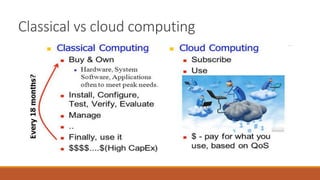
Classical vs cloud computing
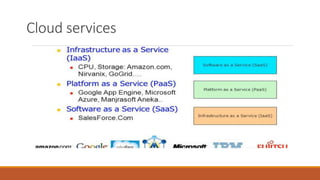
Cloud services
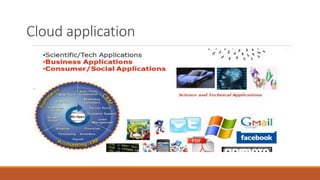
Cloud application
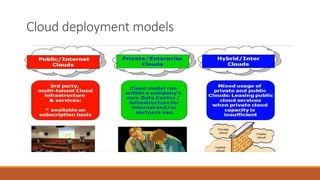
Cloud deployment models
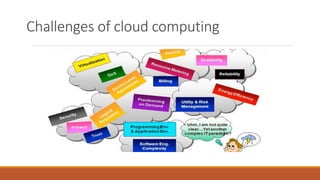
Challenges of cloud computing
History of Aneka
Christian Vecchiola, Xingchen Chu, and Rajkumar Buyya, Aneka: A Software Platform for . NET-
based Cloud Computing, High Speed and Large Scale Scientific Computing.
It is developed by famous software company MAJRASOFT.
Manjrasoft is charged with commercializing Cloud computing software technologies developed by
the Cloud Computing and Distributed Systems (CLOUDS) Laboratory at the University of
Melbourne, Australia. Manjrasoft is backed by a strong and experienced research team at the
CLOUDS Lab.
What is aneka?
Aneka is a Sanskrit term that means "many become one".It refers to a middleware platform that
can support numerous run-time environments and programming styles.
Aneka is a cloud computing PaaS software platform for developing applications.
Aneka comes with a set of extensible APIs for programming models like Map Reduce. These APIs
support different cloud models like a private, public, or hybrid Cloud.
Aneka services
Aneka provides a rich set of APIs for developers to transparently exploit such resources and express
the business logic of applications using preferred programming abstractions. System administrators
can leverage a collection of tools to monitor and control the deployed infrastructure.
In addition to mandatory services, the Master runs the Scheduling, Accounting, Reporting,
Reservation, Provisioning, and Storage services, while the Workers run execution services.
//Manjrasoft.com
Features
One of the notable features of Aneka Pass is to support the provision of private cloud resources
from desktop, cluster to a virtual data center using VMware, Citrix Zen Server, and public cloud
resources such as Windows Azure, Amazon EC2, and GoGrid cloud service.
Aneka Management includes a Graphical User Interface (GUI) and APIs to set-up, monitor, manage
and maintain remote and global Aneka compute clouds.
Aneka also has an accounting mechanism and manages priorities and scalability based on SLA/QoS
which enables dynamic provisioning.
QOS=Quality of Services
SLA=Service level Application
Components
Aneka technology primarily consists of two key components:
SDK (Software Development Kit) containing application programming interfaces (APIs) and tools
essential for rapid development of applications. Aneka APIs supports three popular Cloud
programming models: Task, Thread, and MapReduce;
A Runtime Engine and Platform for managing deployment and execution of applications on private
or public Clouds.
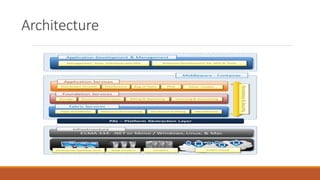
Architecture
Classifications of Aneka Services
Fabric Services
Foundation Services
Application Services
Fabric Services
The Aneka container is represented by fabric services, the lowest level of the software stack. They
offer access to Aneka's resource provisioning subsystem and the monitoring facilities. Fabric
services are used in a heartbeat, monitoring, and reporting services.
Foundation Services
Fabric services are the foundational services of the Aneka cloud, defining the system's core
infrastructure management capabilities. Foundation services are responsible for the logical
management of the distributed system constructed on top of the infrastructure and providing
support services for distributed application execution. Foundation services are used in accounting,
billing, and resource pricing.
Application Services
Application services are a layer that manages the execution of applications and differentiates itself
based on the programming model used to construct distributed apps on top of Aneka. Application
services are used in performance monitoring, execution failure management, etc.
Frequently asked questions
What does Aneka mean?
Aneka is a Sanskrit term that means "many become one".It refers to a middleware platform that can support
numerous run-time environments and programming styles.
How can we use Aneka to create an enterprise cloud?
Aneka is a pure Platform as a Service model implementation. Aneka's primary value is a service-oriented
runtime environment that can be deployed on physical and virtual infrastructures and run applications created
using various application models. Aneka offers a Software Development Kit (SDK) that allows developers to
create cloud applications in any language that supports the.NET runtime and a set of tools for swiftly setting
up and deploying clouds on Windows and Linux platforms.
What applications are already using Aneka?
Some applications that are already using Aneka for commercial uses are 3D rendering using Autodesk Maya,
Technical institutions in India, Life sciences applications that have been tested on Amazon EC2, etc.
Questions continued…..
How does Aneka differ from Digipede products?
Aneka has some excellent characteristics, such as dynamic Resource Provisioning, Multi-core
Support, Cloud Support, Job Management, etc. These characteristics are not included in digipede.
Can Aneka be deployed in a data center?
Yes, Aneka can be used to construct a private cloud in a data center. Aneka SDK can be used to
create and manage applications that will operate on this private Cloud. Aneka helps to increase the
usage of data center resources by using dynamic provisioning, QoS, and SLA factors.
Conclusion
In this slide, we have extensively discussed the concepts of the Aneka framework.
We started by introducing the Aneka framework, the architecture of the Aneka
framework then concluded with the classification of Aneka services.

aneka.pptx

  • 1.
    Chapter-6 Cloud Platforms AndApplication PRESENTED BY: SUDIP KUMAR BAJGAIN BCA 7TH SEMESTER ROLL NO:- 13
  • 2.
  • 3.
  • 4.
  • 5.
  • 6.
  • 7.
    History of Aneka ChristianVecchiola, Xingchen Chu, and Rajkumar Buyya, Aneka: A Software Platform for . NET- based Cloud Computing, High Speed and Large Scale Scientific Computing. It is developed by famous software company MAJRASOFT. Manjrasoft is charged with commercializing Cloud computing software technologies developed by the Cloud Computing and Distributed Systems (CLOUDS) Laboratory at the University of Melbourne, Australia. Manjrasoft is backed by a strong and experienced research team at the CLOUDS Lab.
  • 8.
    What is aneka? Anekais a Sanskrit term that means "many become one".It refers to a middleware platform that can support numerous run-time environments and programming styles. Aneka is a cloud computing PaaS software platform for developing applications. Aneka comes with a set of extensible APIs for programming models like Map Reduce. These APIs support different cloud models like a private, public, or hybrid Cloud.
  • 9.
    Aneka services Aneka providesa rich set of APIs for developers to transparently exploit such resources and express the business logic of applications using preferred programming abstractions. System administrators can leverage a collection of tools to monitor and control the deployed infrastructure. In addition to mandatory services, the Master runs the Scheduling, Accounting, Reporting, Reservation, Provisioning, and Storage services, while the Workers run execution services. //Manjrasoft.com
  • 10.
    Features One of thenotable features of Aneka Pass is to support the provision of private cloud resources from desktop, cluster to a virtual data center using VMware, Citrix Zen Server, and public cloud resources such as Windows Azure, Amazon EC2, and GoGrid cloud service. Aneka Management includes a Graphical User Interface (GUI) and APIs to set-up, monitor, manage and maintain remote and global Aneka compute clouds. Aneka also has an accounting mechanism and manages priorities and scalability based on SLA/QoS which enables dynamic provisioning. QOS=Quality of Services SLA=Service level Application
  • 11.
    Components Aneka technology primarilyconsists of two key components: SDK (Software Development Kit) containing application programming interfaces (APIs) and tools essential for rapid development of applications. Aneka APIs supports three popular Cloud programming models: Task, Thread, and MapReduce; A Runtime Engine and Platform for managing deployment and execution of applications on private or public Clouds.
  • 12.
  • 13.
    Classifications of AnekaServices Fabric Services Foundation Services Application Services
  • 14.
    Fabric Services The Anekacontainer is represented by fabric services, the lowest level of the software stack. They offer access to Aneka's resource provisioning subsystem and the monitoring facilities. Fabric services are used in a heartbeat, monitoring, and reporting services.
  • 15.
    Foundation Services Fabric servicesare the foundational services of the Aneka cloud, defining the system's core infrastructure management capabilities. Foundation services are responsible for the logical management of the distributed system constructed on top of the infrastructure and providing support services for distributed application execution. Foundation services are used in accounting, billing, and resource pricing.
  • 16.
    Application Services Application servicesare a layer that manages the execution of applications and differentiates itself based on the programming model used to construct distributed apps on top of Aneka. Application services are used in performance monitoring, execution failure management, etc.
  • 17.
    Frequently asked questions Whatdoes Aneka mean? Aneka is a Sanskrit term that means "many become one".It refers to a middleware platform that can support numerous run-time environments and programming styles. How can we use Aneka to create an enterprise cloud? Aneka is a pure Platform as a Service model implementation. Aneka's primary value is a service-oriented runtime environment that can be deployed on physical and virtual infrastructures and run applications created using various application models. Aneka offers a Software Development Kit (SDK) that allows developers to create cloud applications in any language that supports the.NET runtime and a set of tools for swiftly setting up and deploying clouds on Windows and Linux platforms. What applications are already using Aneka? Some applications that are already using Aneka for commercial uses are 3D rendering using Autodesk Maya, Technical institutions in India, Life sciences applications that have been tested on Amazon EC2, etc.
  • 18.
    Questions continued….. How doesAneka differ from Digipede products? Aneka has some excellent characteristics, such as dynamic Resource Provisioning, Multi-core Support, Cloud Support, Job Management, etc. These characteristics are not included in digipede. Can Aneka be deployed in a data center? Yes, Aneka can be used to construct a private cloud in a data center. Aneka SDK can be used to create and manage applications that will operate on this private Cloud. Aneka helps to increase the usage of data center resources by using dynamic provisioning, QoS, and SLA factors.
  • 19.
    Conclusion In this slide,we have extensively discussed the concepts of the Aneka framework. We started by introducing the Aneka framework, the architecture of the Aneka framework then concluded with the classification of Aneka services.