Androcentric Norms and Computer Science Prepared for WS445 – Spring 2010 St. Cloud State University by the “cronegeek”
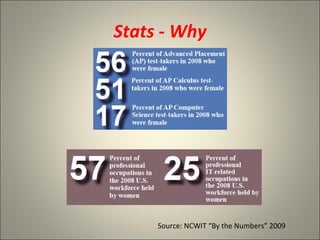
Stats - Why Source: NCWIT “By the Numbers” 2009
Could it be Androcentric Norms? Androcentric Norms – refers to policies and procedures based on behaviors, interests, etc. more typical of men than of women - which then operate to the disadvantage of women. Derivation – from the Greek  andro  (male) centered.  ( gyno  as in gynecology or gynocentric norms is from the Greek prefix for female -  gyno )
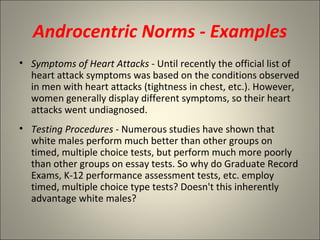
Androcentric Norms - Examples Symptoms of Heart Attacks  - Until recently the official list of heart attack symptoms was based on the conditions observed in men with heart attacks (tightness in chest, etc.). However, women generally display different symptoms, so their heart attacks went undiagnosed. Testing Procedures  - Numerous studies have shown that white males perform much better than other groups on timed, multiple choice tests, but perform much more poorly than other groups on essay tests. So why do Graduate Record Exams, K-12 performance assessment tests, etc. employ timed, multiple choice type tests? Doesn't this inherently advantage white males?
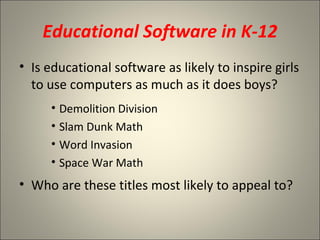
Educational Software in K-12 Is educational software as likely to inspire girls to use computers as much as it does boys? Demolition Division Slam Dunk Math Word Invasion Space War Math Who are these titles most likely to appeal to?
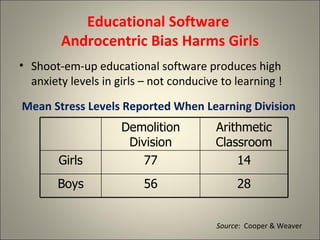
Educational Software  Androcentric Bias Harms Girls Shoot-em-up educational software produces high anxiety levels in girls – not conducive to learning ! Mean Stress Levels Reported When Learning Division Source :  Cooper & Weaver Demolition Division Arithmetic Classroom Girls 77 14 Boys 56 28
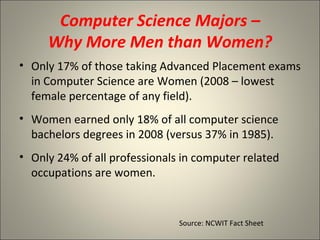
Computer Science Majors – Why More Men than Women? Only 17% of those taking Advanced Placement exams in Computer Science are Women (2008 – lowest female percentage of any field). Women earned only 18% of all computer science bachelors degrees in 2008 (versus 37% in 1985). Only 24% of all professionals in computer related occupations are women. Source: NCWIT Fact Sheet
Why Women Turned Off  Toys vs Tools Women CS majors want to learn about computers to solve problems (fight AIDS, reduce road deaths) Men find computers fascinating and fun; “dream in code” At many schools, application courses only at end of major. “ Pure” computing seen as superior to “applied” computing. Source:  Margolis, “Caring About Connections”
Are Programming Skills Taught in a Gender Neutral Fashion? Two styles of programming: “ Formal” - Make overall plan with separate modules, complete each module one by one. “ Concrete” – Start with part that interests you, move back & forth between different aspects, synthesizing as you go along. Males tend to prefer the “Formal” Style. Guess which Style taught as “correct”? Source :  Cooper & Weaver
Reforming CS Major Women entering the CS major at Carnegie Mellon increased from 8% in1995 to 37% in 1999.  HOW? Changing Admissions Criteria Restructuring Curriculum Source:  Margolis, “Anatomy of Interest”
Restructuring the Curriculum New course at beginning of major “Computer Science in the Community” where students work with non-profit groups. Interdisciplinary courses with students of diverse backgrounds to work together on multifaceted problems. Source:  Margolis, “Caring About Connections” Make curriculum less androcentric,  more inclusive of both genders.
Sources Cooper, Joel and Kimberlee D. Weaver.  Gender and Computers: Understanding the Digital Divide .  Lawrence Erlbaum Associates, 2003.  Margolis, Jane, Allan Fisher, and Faye Miller.  “The Anatomy of Interest: Women in Undergraduate Computer Science.”  Women’s Studies Quarterly , 2000: 1&2, 104-127. Margolis, Jane, Allan Fisher, and Faye Miller.  “Caring About Connections: Gender and Computing.” Retrieved 1/26/06 from http://www.cs.cmu.edu/~gendergap/papers/IEEE99.html (Also published in  Technology and Society  2000). NCWIT - National Center for Women & Information Technology. “By the Numbers.” 2009.  Retrieved 3/31/10 from  http://www.ncwit.org/pdf/BytheNumbers09.pdf NCWIT - National Center for Women & Information Technology,  Fact Sheet,  (no date) .  Retrieved 3/31/10 from  http://www.ncwit.org/about.factsheet.html

Androcentric Bias Computers

  • 1.
    Androcentric Norms andComputer Science Prepared for WS445 – Spring 2010 St. Cloud State University by the “cronegeek”
  • 2.
    Stats - WhySource: NCWIT “By the Numbers” 2009
  • 3.
    Could it beAndrocentric Norms? Androcentric Norms – refers to policies and procedures based on behaviors, interests, etc. more typical of men than of women - which then operate to the disadvantage of women. Derivation – from the Greek andro (male) centered. ( gyno as in gynecology or gynocentric norms is from the Greek prefix for female - gyno )
  • 4.
    Androcentric Norms -Examples Symptoms of Heart Attacks - Until recently the official list of heart attack symptoms was based on the conditions observed in men with heart attacks (tightness in chest, etc.). However, women generally display different symptoms, so their heart attacks went undiagnosed. Testing Procedures - Numerous studies have shown that white males perform much better than other groups on timed, multiple choice tests, but perform much more poorly than other groups on essay tests. So why do Graduate Record Exams, K-12 performance assessment tests, etc. employ timed, multiple choice type tests? Doesn't this inherently advantage white males?
  • 5.
    Educational Software inK-12 Is educational software as likely to inspire girls to use computers as much as it does boys? Demolition Division Slam Dunk Math Word Invasion Space War Math Who are these titles most likely to appeal to?
  • 6.
    Educational Software Androcentric Bias Harms Girls Shoot-em-up educational software produces high anxiety levels in girls – not conducive to learning ! Mean Stress Levels Reported When Learning Division Source : Cooper & Weaver Demolition Division Arithmetic Classroom Girls 77 14 Boys 56 28
  • 7.
    Computer Science Majors– Why More Men than Women? Only 17% of those taking Advanced Placement exams in Computer Science are Women (2008 – lowest female percentage of any field). Women earned only 18% of all computer science bachelors degrees in 2008 (versus 37% in 1985). Only 24% of all professionals in computer related occupations are women. Source: NCWIT Fact Sheet
  • 8.
    Why Women TurnedOff Toys vs Tools Women CS majors want to learn about computers to solve problems (fight AIDS, reduce road deaths) Men find computers fascinating and fun; “dream in code” At many schools, application courses only at end of major. “ Pure” computing seen as superior to “applied” computing. Source: Margolis, “Caring About Connections”
  • 9.
    Are Programming SkillsTaught in a Gender Neutral Fashion? Two styles of programming: “ Formal” - Make overall plan with separate modules, complete each module one by one. “ Concrete” – Start with part that interests you, move back & forth between different aspects, synthesizing as you go along. Males tend to prefer the “Formal” Style. Guess which Style taught as “correct”? Source : Cooper & Weaver
  • 10.
    Reforming CS MajorWomen entering the CS major at Carnegie Mellon increased from 8% in1995 to 37% in 1999. HOW? Changing Admissions Criteria Restructuring Curriculum Source: Margolis, “Anatomy of Interest”
  • 11.
    Restructuring the CurriculumNew course at beginning of major “Computer Science in the Community” where students work with non-profit groups. Interdisciplinary courses with students of diverse backgrounds to work together on multifaceted problems. Source: Margolis, “Caring About Connections” Make curriculum less androcentric, more inclusive of both genders.
  • 12.
    Sources Cooper, Joeland Kimberlee D. Weaver. Gender and Computers: Understanding the Digital Divide . Lawrence Erlbaum Associates, 2003. Margolis, Jane, Allan Fisher, and Faye Miller. “The Anatomy of Interest: Women in Undergraduate Computer Science.” Women’s Studies Quarterly , 2000: 1&2, 104-127. Margolis, Jane, Allan Fisher, and Faye Miller. “Caring About Connections: Gender and Computing.” Retrieved 1/26/06 from http://www.cs.cmu.edu/~gendergap/papers/IEEE99.html (Also published in Technology and Society 2000). NCWIT - National Center for Women & Information Technology. “By the Numbers.” 2009. Retrieved 3/31/10 from http://www.ncwit.org/pdf/BytheNumbers09.pdf NCWIT - National Center for Women & Information Technology, Fact Sheet, (no date) . Retrieved 3/31/10 from http://www.ncwit.org/about.factsheet.html

Editor's Notes

  • #3 Source: NCWIT - National Center for Women & Information Technology. “By the Numbers.” 2009. Retrieved 3/31/10 from http://www.ncwit.org/pdf/BytheNumbers09.pdf
  • #8 Source; NCWIT - National Center for Women & Information Technology, Fact Sheet, (no date) . Retrieved 3/31/10 from http://www.ncwit.org/about.factsheet.html Additional stats, comparing women in math & other science fields to computer science at http://www.ncwit.org/pdf/BytheNumbers09.pdf
  • #11 Source: for entering CS Majors at Carnegie Mellon Margolis, Jane, Allan Fisher, and Faye Miller. “The Anatomy of Interest: Women in Undergraduate Computer Science.” Women’s Studies Quarterly , 2000: 1&2, 104-127.
  • #12 Source:: Margolis, Jane, Allan Fisher, and Faye Miller. “Caring About Connections: Gender and Computing.” Retrieved 1/26/06 from http://www.cs.cmu.edu/~gendergap/papers/IEEE99.html (Also published in Technology and Society 2000)