PHYSICAL EDUCATION
IN THE
ANCIENT EGYPT
GROUP 3
JELIZ RUBIO
TRIXIE AYEEN R. JUAN
JAYSON LOZA
MACKY JAVIER
Many of today’s sports were practiced
by the Ancient Egyptians, who set the
rules and regulations for them.
Inscriptions on monuments indicate
that they practiced wrestling,
weightlifting, long jump, swimming,
rowing, shooting, fishing and
athletics, as well as various kinds of
ball games.
Ancient Egyptian kings, princes and statesmen were keen on attending sports
competitions, which they encouraged and provided with the necessary equipment.
Drawings on pharaonic monuments tell us that several thousand years ago, the
Egyptians had laid down basic rules for games, chosen a neutral referee, a uniform for
players, and a means of announcing the winners by awarding them different collars.
Both winner and loser were met with ovation, the first for his superiority and the
latter for his sporting spirit.
Hockey
ANCIENT EGYPTIANS PLAYED A GAME
THAT IS SIMILAR TO OUR PRESENT-DAY
HOCKEY. DRAWINGS ON TOMBS AT BENI
HASSAN IN MENIA GOVERNORATE SHOW
PLAYERS HOLDING BATS MADE OF LONG
PALM-TREE BRANCHES, WITH A BENT END
SIMILAR TO THAT OF THE HOCKEY BAT.
THE HOCKEY BALL WAS MADE OF
COMPRESSED PAPYRUS FIBERS COVERED
WITH TWO PIECES OF LEATHER IN THE
SHAPE OF A SEMICIRCLE. THE BALL WAS
DYED IN TWO OR MORE COLORS.
Handball DRAWINGS OF THIS SPORT ARE FOUND ON THE
SAQQARA TOMBS, FIVE THOUSAND YEARS OLD. THE
BALL WAS MADE OF LEATHER AND STUFFED WITH
PLANT FIBERS OR HAY, OR MADE OF PAPYRUS PLANTS
IN ORDER TO BE LIGHT AND MORE DURABLE. IT WAS
SELDOM USED FOR MORE THAN ONE MATCH.
THE PAINTING SHOWS FOUR GIRLS PLAYING
HANDBALL. EACH TEAM THROWS THE BALL TO THE
OTHER AT THE SAME TIME. PLAYERS CAN EITHER BE
ON THEIR FEET OR ON TOP OF THEIR TEAMMATES’
BACKS WHILE EXCHANGING BALLS.
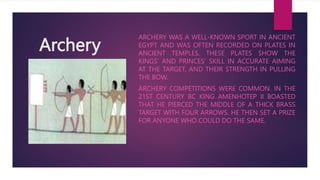
Archery
ARCHERY WAS A WELL-KNOWN SPORT IN ANCIENT
EGYPT AND WAS OFTEN RECORDED ON PLATES IN
ANCIENT TEMPLES. THESE PLATES SHOW THE
KINGS’ AND PRINCES’ SKILL IN ACCURATE AIMING
AT THE TARGET, AND THEIR STRENGTH IN PULLING
THE BOW.
ARCHERY COMPETITIONS WERE COMMON. IN THE
21ST CENTURY BC KING AMENHOTEP II BOASTED
THAT HE PIERCED THE MIDDLE OF A THICK BRASS
TARGET WITH FOUR ARROWS. HE THEN SET A PRIZE
FOR ANYONE WHO COULD DO THE SAME.
Gymnastics: Consecutive Vault
This painting represents pharaonic gymnastics. The
players performed consecutive vaults without
touching the floor with their heads and making
more than one complete turn in the air.
At the end of the exercise the players stand firmly
upright, which is one of the basic rules of floor
exercise applied in today’s Olympics.
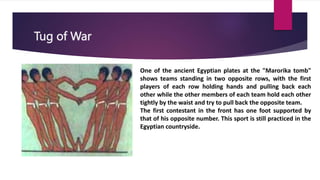
Tug of War
One of the ancient Egyptian plates at the "Marorika tomb"
shows teams standing in two opposite rows, with the first
players of each row holding hands and pulling back each
other while the other members of each team hold each other
tightly by the waist and try to pull back the opposite team.
The first contestant in the front has one foot supported by
that of his opposite number. This sport is still practiced in the
Egyptian countryside.
Javelin Throw
Javelin throwing during the Pharaonic age was first linked to
hunting. Drawings show how the hunter could hit his prey
by one single throw despite its speed. The javelin differed in
length according to the kind of prey. The javelin is thrown
upwards lightly so that it revolves in quick spins until it
returns to the player to be used again. The javelin is a stick
with a twisted end. The picture shows the player in a
position of readiness to throw.
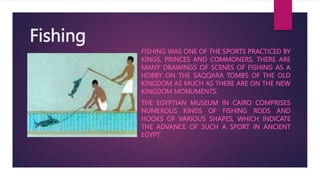
Fishing
FISHING WAS ONE OF THE SPORTS PRACTICED BY
KINGS, PRINCES AND COMMONERS. THERE ARE
MANY DRAWINGS OF SCENES OF FISHING AS A
HOBBY ON THE SAQQARA TOMBS OF THE OLD
KINGDOM AS MUCH AS THERE ARE ON THE NEW
KINGDOM MONUMENTS.
THE EGYPTIAN MUSEUM IN CAIRO COMPRISES
NUMEROUS KINDS OF FISHING RODS AND
HOOKS OF VARIOUS SHAPES, WHICH INDICATE
THE ADVANCE OF SUCH A SPORT IN ANCIENT
EGYPT.
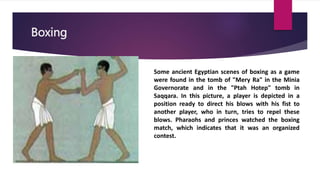
Boxing
Some ancient Egyptian scenes of boxing as a game
were found in the tomb of "Mery Ra" in the Minia
Governorate and in the "Ptah Hotep" tomb in
Saqqara. In this picture, a player is depicted in a
position ready to direct his blows with his fist to
another player, who in turn, tries to repel these
blows. Pharaohs and princes watched the boxing
match, which indicates that it was an organized
contest.
Weightlifting
Weightlifting was one of the sports known by
the ancient Egyptians. One method of
weightlifting was the attempt to lift a heavy
sack of sand with one hand (clean and jerk lift)
and keep it high in a quasi-vertical position.
The player had to stay in that position for a
short period. This is one of the rules of
weightlifting applied till now.
High Jump
Ancient Egyptians practiced field and track sports
such as the high jump. Two players sat opposite
each other with legs stretched, with one player’s
feet on top of the toes of the other. If the third
player managed to jump over that barrier, the two
sitting players placed their palms on top of their
feet to heighten the barrier which the third player
had to jump across without touching.
This game is still practiced in the Egyptian
countryside and is called "goose steps".
Swimming
Swimming was the favorite sport of the ancient
Egyptians, who made use of the River Nile to practice
it. The Nile was not the only place for swimming
contests. Noblemen’s palaces had swimming pools in
which princes learnt the sport. The calm waters of the
Nile encouraged youths to hold swimming
competitions in which they could show their skills.
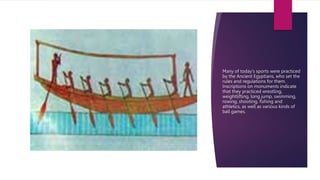
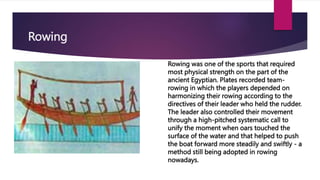
Rowing
Rowing was one of the sports that required
most physical strength on the part of the
ancient Egyptian. Plates recorded team-
rowing in which the players depended on
harmonizing their rowing according to the
directives of their leader who held the rudder.
The leader also controlled their movement
through a high-pitched systematic call to
unify the moment when oars touched the
surface of the water and that helped to push
the boat forward more steadily and swiftly - a
method still being adopted in rowing
nowadays.
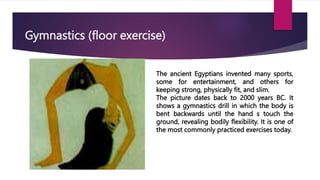
Gymnastics (floor exercise)
The ancient Egyptians invented many sports,
some for entertainment, and others for
keeping strong, physically fit, and slim.
The picture dates back to 2000 years BC. It
shows a gymnastics drill in which the body is
bent backwards until the hand s touch the
ground, revealing bodily flexibility. It is one of
the most commonly practiced exercises today.
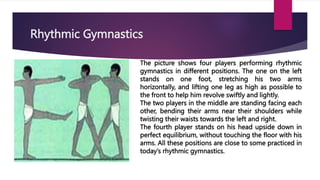
Rhythmic Gymnastics
The picture shows four players performing rhythmic
gymnastics in different positions. The one on the left
stands on one foot, stretching his two arms
horizontally, and lifting one leg as high as possible to
the front to help him revolve swiftly and lightly.
The two players in the middle are standing facing each
other, bending their arms near their shoulders while
twisting their waists towards the left and right.
The fourth player stands on his head upside down in
perfect equilibrium, without touching the floor with his
arms. All these positions are close to some practiced in
today’s rhythmic gymnastics.
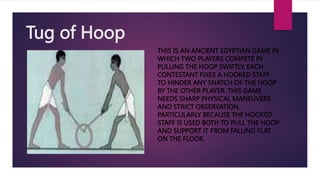
Tug of Hoop
THIS IS AN ANCIENT EGYPTIAN GAME IN
WHICH TWO PLAYERS COMPETE IN
PULLING THE HOOP SWIFTLY. EACH
CONTESTANT FIXES A HOOKED STAFF
TO HINDER ANY SNATCH OF THE HOOP
BY THE OTHER PLAYER. THIS GAME
NEEDS SHARP PHYSICAL MANEUVERS
AND STRICT OBSERVATION,
PARTICULARLY BECAUSE THE HOOKED
STAFF IS USED BOTH TO PULL THE HOOP
AND SUPPORT IT FROM FALLING FLAT
ON THE FLOOR.
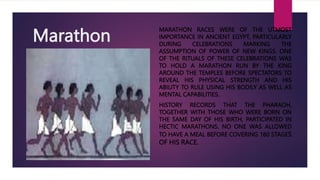
Marathon
MARATHON RACES WERE OF THE UTMOST
IMPORTANCE IN ANCIENT EGYPT, PARTICULARLY
DURING CELEBRATIONS MARKING THE
ASSUMPTION OF POWER OF NEW KINGS. ONE
OF THE RITUALS OF THESE CELEBRATIONS WAS
TO HOLD A MARATHON RUN BY THE KING
AROUND THE TEMPLES BEFORE SPECTATORS TO
REVEAL HIS PHYSICAL STRENGTH AND HIS
ABILITY TO RULE USING HIS BODILY AS WELL AS
MENTAL CAPABILITIES.
HISTORY RECORDS THAT THE PHARAOH,
TOGETHER WITH THOSE WHO WERE BORN ON
THE SAME DAY OF HIS BIRTH, PARTICIPATED IN
HECTIC MARATHONS. NO ONE WAS ALLOWED
TO HAVE A MEAL BEFORE COVERING 180 STAGES
OF HIS RACE.
THANK YOU

ANCIENT-EGYPT.pptx

  • 1.
    PHYSICAL EDUCATION IN THE ANCIENTEGYPT GROUP 3 JELIZ RUBIO TRIXIE AYEEN R. JUAN JAYSON LOZA MACKY JAVIER
  • 2.
    Many of today’ssports were practiced by the Ancient Egyptians, who set the rules and regulations for them. Inscriptions on monuments indicate that they practiced wrestling, weightlifting, long jump, swimming, rowing, shooting, fishing and athletics, as well as various kinds of ball games.
  • 3.
    Ancient Egyptian kings,princes and statesmen were keen on attending sports competitions, which they encouraged and provided with the necessary equipment. Drawings on pharaonic monuments tell us that several thousand years ago, the Egyptians had laid down basic rules for games, chosen a neutral referee, a uniform for players, and a means of announcing the winners by awarding them different collars. Both winner and loser were met with ovation, the first for his superiority and the latter for his sporting spirit.
  • 4.
    Hockey ANCIENT EGYPTIANS PLAYEDA GAME THAT IS SIMILAR TO OUR PRESENT-DAY HOCKEY. DRAWINGS ON TOMBS AT BENI HASSAN IN MENIA GOVERNORATE SHOW PLAYERS HOLDING BATS MADE OF LONG PALM-TREE BRANCHES, WITH A BENT END SIMILAR TO THAT OF THE HOCKEY BAT. THE HOCKEY BALL WAS MADE OF COMPRESSED PAPYRUS FIBERS COVERED WITH TWO PIECES OF LEATHER IN THE SHAPE OF A SEMICIRCLE. THE BALL WAS DYED IN TWO OR MORE COLORS.
  • 5.
    Handball DRAWINGS OFTHIS SPORT ARE FOUND ON THE SAQQARA TOMBS, FIVE THOUSAND YEARS OLD. THE BALL WAS MADE OF LEATHER AND STUFFED WITH PLANT FIBERS OR HAY, OR MADE OF PAPYRUS PLANTS IN ORDER TO BE LIGHT AND MORE DURABLE. IT WAS SELDOM USED FOR MORE THAN ONE MATCH. THE PAINTING SHOWS FOUR GIRLS PLAYING HANDBALL. EACH TEAM THROWS THE BALL TO THE OTHER AT THE SAME TIME. PLAYERS CAN EITHER BE ON THEIR FEET OR ON TOP OF THEIR TEAMMATES’ BACKS WHILE EXCHANGING BALLS.
  • 6.
    Archery ARCHERY WAS AWELL-KNOWN SPORT IN ANCIENT EGYPT AND WAS OFTEN RECORDED ON PLATES IN ANCIENT TEMPLES. THESE PLATES SHOW THE KINGS’ AND PRINCES’ SKILL IN ACCURATE AIMING AT THE TARGET, AND THEIR STRENGTH IN PULLING THE BOW. ARCHERY COMPETITIONS WERE COMMON. IN THE 21ST CENTURY BC KING AMENHOTEP II BOASTED THAT HE PIERCED THE MIDDLE OF A THICK BRASS TARGET WITH FOUR ARROWS. HE THEN SET A PRIZE FOR ANYONE WHO COULD DO THE SAME.
  • 7.
    Gymnastics: Consecutive Vault Thispainting represents pharaonic gymnastics. The players performed consecutive vaults without touching the floor with their heads and making more than one complete turn in the air. At the end of the exercise the players stand firmly upright, which is one of the basic rules of floor exercise applied in today’s Olympics.
  • 8.
    Tug of War Oneof the ancient Egyptian plates at the "Marorika tomb" shows teams standing in two opposite rows, with the first players of each row holding hands and pulling back each other while the other members of each team hold each other tightly by the waist and try to pull back the opposite team. The first contestant in the front has one foot supported by that of his opposite number. This sport is still practiced in the Egyptian countryside.
  • 9.
    Javelin Throw Javelin throwingduring the Pharaonic age was first linked to hunting. Drawings show how the hunter could hit his prey by one single throw despite its speed. The javelin differed in length according to the kind of prey. The javelin is thrown upwards lightly so that it revolves in quick spins until it returns to the player to be used again. The javelin is a stick with a twisted end. The picture shows the player in a position of readiness to throw.
  • 10.
    Fishing FISHING WAS ONEOF THE SPORTS PRACTICED BY KINGS, PRINCES AND COMMONERS. THERE ARE MANY DRAWINGS OF SCENES OF FISHING AS A HOBBY ON THE SAQQARA TOMBS OF THE OLD KINGDOM AS MUCH AS THERE ARE ON THE NEW KINGDOM MONUMENTS. THE EGYPTIAN MUSEUM IN CAIRO COMPRISES NUMEROUS KINDS OF FISHING RODS AND HOOKS OF VARIOUS SHAPES, WHICH INDICATE THE ADVANCE OF SUCH A SPORT IN ANCIENT EGYPT.
  • 11.
    Boxing Some ancient Egyptianscenes of boxing as a game were found in the tomb of "Mery Ra" in the Minia Governorate and in the "Ptah Hotep" tomb in Saqqara. In this picture, a player is depicted in a position ready to direct his blows with his fist to another player, who in turn, tries to repel these blows. Pharaohs and princes watched the boxing match, which indicates that it was an organized contest.
  • 12.
    Weightlifting Weightlifting was oneof the sports known by the ancient Egyptians. One method of weightlifting was the attempt to lift a heavy sack of sand with one hand (clean and jerk lift) and keep it high in a quasi-vertical position. The player had to stay in that position for a short period. This is one of the rules of weightlifting applied till now.
  • 13.
    High Jump Ancient Egyptianspracticed field and track sports such as the high jump. Two players sat opposite each other with legs stretched, with one player’s feet on top of the toes of the other. If the third player managed to jump over that barrier, the two sitting players placed their palms on top of their feet to heighten the barrier which the third player had to jump across without touching. This game is still practiced in the Egyptian countryside and is called "goose steps".
  • 14.
    Swimming Swimming was thefavorite sport of the ancient Egyptians, who made use of the River Nile to practice it. The Nile was not the only place for swimming contests. Noblemen’s palaces had swimming pools in which princes learnt the sport. The calm waters of the Nile encouraged youths to hold swimming competitions in which they could show their skills.
  • 15.
    Rowing Rowing was oneof the sports that required most physical strength on the part of the ancient Egyptian. Plates recorded team- rowing in which the players depended on harmonizing their rowing according to the directives of their leader who held the rudder. The leader also controlled their movement through a high-pitched systematic call to unify the moment when oars touched the surface of the water and that helped to push the boat forward more steadily and swiftly - a method still being adopted in rowing nowadays.
  • 16.
    Gymnastics (floor exercise) Theancient Egyptians invented many sports, some for entertainment, and others for keeping strong, physically fit, and slim. The picture dates back to 2000 years BC. It shows a gymnastics drill in which the body is bent backwards until the hand s touch the ground, revealing bodily flexibility. It is one of the most commonly practiced exercises today.
  • 17.
    Rhythmic Gymnastics The pictureshows four players performing rhythmic gymnastics in different positions. The one on the left stands on one foot, stretching his two arms horizontally, and lifting one leg as high as possible to the front to help him revolve swiftly and lightly. The two players in the middle are standing facing each other, bending their arms near their shoulders while twisting their waists towards the left and right. The fourth player stands on his head upside down in perfect equilibrium, without touching the floor with his arms. All these positions are close to some practiced in today’s rhythmic gymnastics.
  • 18.
    Tug of Hoop THISIS AN ANCIENT EGYPTIAN GAME IN WHICH TWO PLAYERS COMPETE IN PULLING THE HOOP SWIFTLY. EACH CONTESTANT FIXES A HOOKED STAFF TO HINDER ANY SNATCH OF THE HOOP BY THE OTHER PLAYER. THIS GAME NEEDS SHARP PHYSICAL MANEUVERS AND STRICT OBSERVATION, PARTICULARLY BECAUSE THE HOOKED STAFF IS USED BOTH TO PULL THE HOOP AND SUPPORT IT FROM FALLING FLAT ON THE FLOOR.
  • 19.
    Marathon MARATHON RACES WEREOF THE UTMOST IMPORTANCE IN ANCIENT EGYPT, PARTICULARLY DURING CELEBRATIONS MARKING THE ASSUMPTION OF POWER OF NEW KINGS. ONE OF THE RITUALS OF THESE CELEBRATIONS WAS TO HOLD A MARATHON RUN BY THE KING AROUND THE TEMPLES BEFORE SPECTATORS TO REVEAL HIS PHYSICAL STRENGTH AND HIS ABILITY TO RULE USING HIS BODILY AS WELL AS MENTAL CAPABILITIES. HISTORY RECORDS THAT THE PHARAOH, TOGETHER WITH THOSE WHO WERE BORN ON THE SAME DAY OF HIS BIRTH, PARTICIPATED IN HECTIC MARATHONS. NO ONE WAS ALLOWED TO HAVE A MEAL BEFORE COVERING 180 STAGES OF HIS RACE.
  • 20.