INDEX
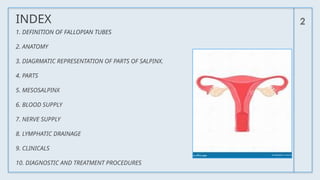
1. DEFINITION OFFALLOPIAN TUBES
2. ANATOMY
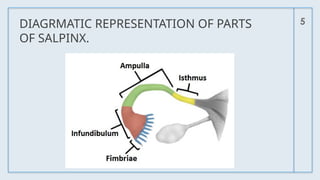
3. DIAGRMATIC REPRESENTATION OF PARTS OF SALPINX.
4. PARTS
5. MESOSALPINX
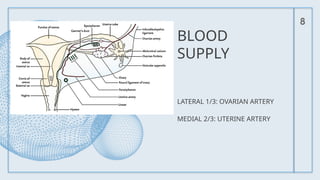
6. BLOOD SUPPLY
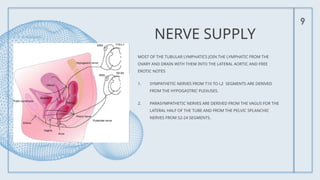
7. NERVE SUPPLY
8. LYMPHATIC DRAINAGE
9. CLINICALS
10. DIAGNOSTIC AND TREATMENT PROCEDURES
2
3.
UTERINE TUBES
DEFINITION.
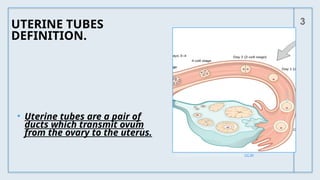
• Uterinetubes are a pair of
ducts which transmit ovum
from the ovary to the uterus.
3
This Photo by Unknown Author is licensed under CC BY
4.
4
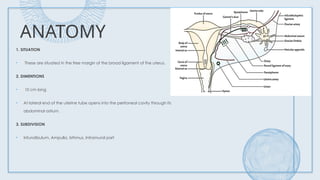
ANATOMY
1. SITUATION
• Theseare situated in the free margin of the broad ligament of the uterus.
2. DIMENTIONS
• 10 cm long
• At lateral end of the uterine tube opens into the peritoneal cavity through its
abdominal ostium.
3. SUBDIVISION
• Infundibulum, Ampulla, Isthmus, Intramural part
6
PARTS
Infundibulum
1. Funnel shaped.
2.It bears a number of the
fingers like projections like
processes called fimbriae
called as fimbriated end.
3. One fimbriae is the longer
than other and is attached to
the tubal pole of the ovary
known as ovarian fimbria.
Ampulla
1. Medial to the infundibulum.
2. Thin walled, dilated and
tortuous and form approx.
2/3 or 6to7 of the tube
3. 4mm in diameter.
4. Site of fertilization.
7.
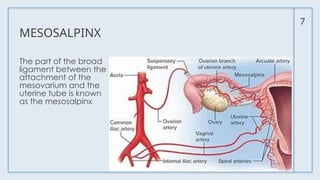
MESOSALPINX
The part ofthe broad
ligament between the
attachment of the
mesovarium and the
uterine tube is known
as the mesosalpinx
7
9
NERVE SUPPLY
MOST OFTHE TUBULAR LYMPHATICS JOIN THE LYMPHATIC FROM THE
OVARY AND DRAIN WITH THEM INTO THE LATERAL AORTIC AND FREE
EROTIC NOTES
1. SYMPATHETIC NERVES FROM T10 TO L2 SEGMENTS ARE DERIVED
FROM THE HYPOGASTRIC PLEXUSES.
2. PARASYMPATHETIC NERVES ARE DERIVED FROM THE VAGUS FOR THE
LATERAL HALF OF THE TUBE AND FROM THE PELVIC SPLANCHIC
NERVES FROM S2-24 SEGMENTS.
10.
10
LYMPHATIC
DRAINAGE
MOST OF THETUBAL LYMPHATICS JOIN
THE LYMPHATICS FROM THE OVARY
AND DRAIN WITH THEM INTO THE
LATERAL AORTIC AND PREAORTIC
NODES.
11.
11
CLINICALS
•Ectopic pregnancy: Inan ectopic pregnancy, the fertilized egg implants
outside the uterus, most commonly in the fallopian tube. This is a life-
threatening condition that requires immediate medical attention.
•Pelvic inflammatory disease (PID): PID is an infection of the female
reproductive organs that can damage the fallopian tubes, leading to infertility
or ectopic pregnancy.
•Endometriosis: Endometriosis is a condition in which tissue similar to the
lining of the uterus grows outside of it. This can affect the fallopian tubes,
causing scarring and blockages.
•Hydrosalpinx: Hydrosalpinx is a condition in which the fallopian tube
becomes blocked and filled with fluid. This can damage the tube and make it
difficult to get pregnant.
•Fallopian tube cancer: Fallopian tube cancer is a rare cancer that can
develop in the lining of the fallopian tube.
12.
12
DIAGNOSTIC AND TREATMENT
PROCEDURES:
1.Hysterosalpingogram(HSG): HSG is an X-ray procedure
used to examine the fallopian tubes and uterus.
It can help identify blockages or other abnormalities.
2.Laparoscopy: Laparoscopy is a minimally invasive surgical procedure that
can be used to diagnose and treat conditions affecting the fallopian tubes.
3.Surgery: Surgery may be necessary to repair or remove damaged fallopian
tubes.