Human Anatomy
Introduction
What is Anatomy?
• Study of the STRUCTURE of the Human
Body and their relationships to one
another.
• Closely related to PHYSIOLOGY!
• Physiology is the study of the FUNCTION
of the human body
• It is agreek word ana-tome(cutting up).
Divisions of Anatomy
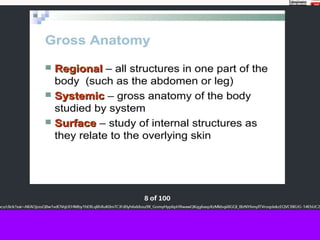
• GROSS ANATOMY
• Structures that can be
seen with the eye
• Muscles, bones,
various organs
• Regional anatomy;-all
structuresin one
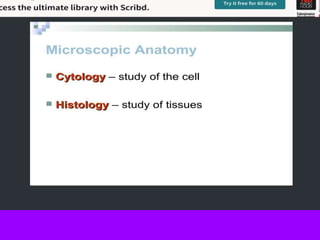
• Microscopic Anatomy
• Structures that cannot
be seen with the eye
• Need to use a
microscope
• Cytology = study of
cells
• Histology = study of
tissues
N
What are you made of ?
Ways to Study Anatomy
• Regional Anatomy – study one region of
the body at a time and learn everything
about the region
• Systemic Anatomy – study one body
system at a time. This is the approach we
will use in this course
Anatomical Organization
• Cells
• Tissues
• Organs
• Organ Systems
• Organism
Organ Systems
• 1. Integument
• 2. Skeletal
• 3. Muscular
• 4. Nervous
• 5. Endocrine
• 6. Cardiovascular
• 7. Lymphatic
• 8. Respiratory
• 9. Digestive
• 10. Urinary
• 11. Reproductive
Four-footed body directions
Planes and Sections
• Sagittal section – divides the body into
right and left sides
– Mid-sagittal section = straight down the center
of the body
• Frontal section – divides the body into
front and back sides
• Transverse (cross) section – cut straight
across the body
Planes and Sections
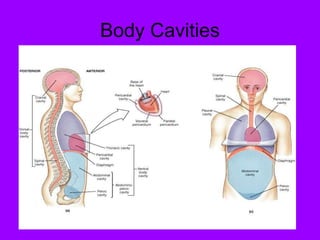
Body Cavities
Body Cavities
Body Quadrants
• Right Upper Quadrant (RUQ)
• Left Upper Quadrant (LUQ)
• Right Lower Quadrant (RLQ)
• Left Lower Quadrant (LLQ)
Anatomy Introduction.ppt

Anatomy Introduction.ppt

  • 1.
  • 4.
    What is Anatomy? •Study of the STRUCTURE of the Human Body and their relationships to one another. • Closely related to PHYSIOLOGY! • Physiology is the study of the FUNCTION of the human body • It is agreek word ana-tome(cutting up).
  • 6.
    Divisions of Anatomy •GROSS ANATOMY • Structures that can be seen with the eye • Muscles, bones, various organs • Regional anatomy;-all structuresin one • Microscopic Anatomy • Structures that cannot be seen with the eye • Need to use a microscope • Cytology = study of cells • Histology = study of tissues N
  • 10.
    What are youmade of ?
  • 11.
    Ways to StudyAnatomy • Regional Anatomy – study one region of the body at a time and learn everything about the region • Systemic Anatomy – study one body system at a time. This is the approach we will use in this course
  • 14.
    Anatomical Organization • Cells •Tissues • Organs • Organ Systems • Organism
  • 16.
    Organ Systems • 1.Integument • 2. Skeletal • 3. Muscular • 4. Nervous • 5. Endocrine • 6. Cardiovascular • 7. Lymphatic • 8. Respiratory • 9. Digestive • 10. Urinary • 11. Reproductive
  • 20.
  • 21.
    Planes and Sections •Sagittal section – divides the body into right and left sides – Mid-sagittal section = straight down the center of the body • Frontal section – divides the body into front and back sides • Transverse (cross) section – cut straight across the body
  • 22.
  • 23.
  • 24.
  • 26.
    Body Quadrants • RightUpper Quadrant (RUQ) • Left Upper Quadrant (LUQ) • Right Lower Quadrant (RLQ) • Left Lower Quadrant (LLQ)