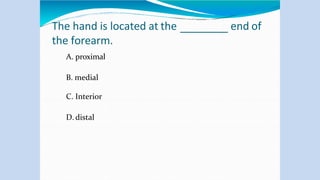
The hand is located at the distal end of the forearm.
Distal means further away from the point of attachment or origin. The forearm attaches proximally to the arm, so the hand is further away or distal to that point of attachment.
DEFINITION: Anatomy isthe science of structure
and function of the body
BASIC ANATOMY : is the study of the minimal amount of
anatomy consistent with the understanding of the overall
structure and function of the body
CLINICAL ANATOMY : is the study of the macroscopic
structure and function of the body as it relates to the practice
of medicine and other health sciences
APPROACH TO THESTUDY OF
GROSS ANATOMY
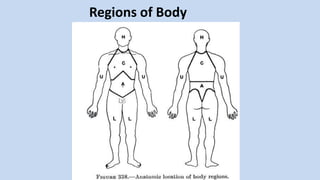
Regional anatomy
Systemic anatomy
6.
HUMAN ANATOMICAL TERMS
Makeupa distinct nomenclature todescribe:
Areas of the body
Toprovide orientation when describing parts of human
anatomy
Todistinguish different movements of thebody.
7.
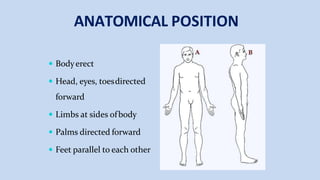
ANATOMICAL POSITION
Bodyerect
Head, eyes, toesdirected
forward
Limbs at sides ofbody
Palms directed forward
Feet parallel to each other
8.
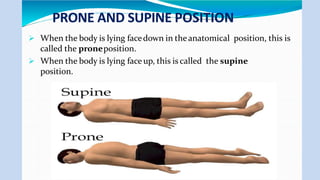
PRONE AND SUPINEPOSITION
When the body is lying facedown in theanatomical position, this is
called the proneposition.
When the body is lying face up, this is called the supine
position.
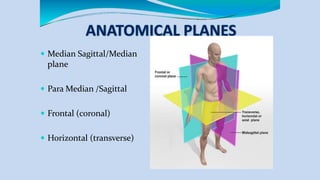
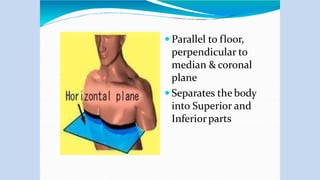
Parallel tofloor,
perpendicular to
median & coronal
plane
Separates the body
into Superior and
Inferiorparts
16.
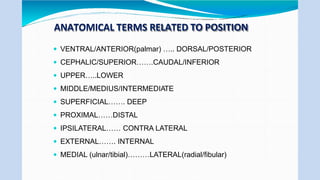
ANATOMICAL TERMS RELATEDTO POSITION
VENTRAL/ANTERIOR(palmar) ….. DORSAL/POSTERIOR
CEPHALIC/SUPERIOR…….CAUDAL/INFERIOR
UPPER…..LOWER
MIDDLE/MEDIUS/INTERMEDIATE
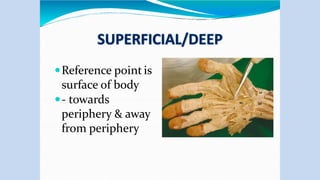
SUPERFICIAL……. DEEP
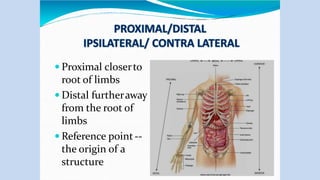
PROXIMAL……DISTAL
IPSILATERAL…… CONTRA LATERAL
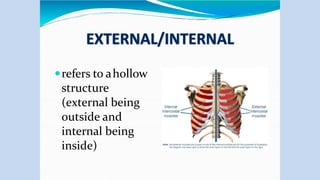
EXTERNAL……. INTERNAL
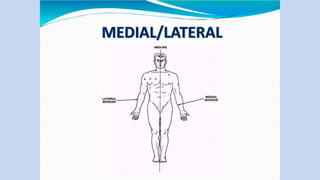
MEDIAL (ulnar/tibial)………LATERAL(radial/fibular)
17.
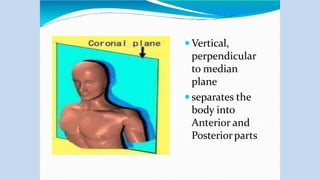
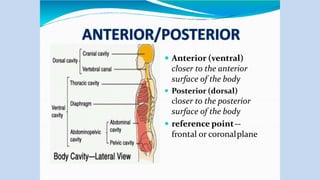
Anterior (ventral)
closerto the anterior
surface of the body
Posterior (dorsal)
closer to the posterior
surface of the body
reference point--
frontal or coronalplane
19.
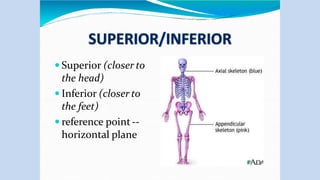
Superior (closerto
the head)
Inferior (closer to
the feet)
reference point--
horizontal plane
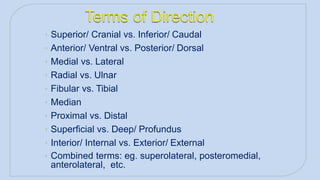
• Superior/ Cranialvs. Inferior/ Caudal
• Anterior/ Ventral vs. Posterior/ Dorsal
• Medial vs. Lateral
• Radial vs. Ulnar
• Fibular vs. Tibial
• Median
• Proximal vs. Distal
• Superficial vs. Deep/ Profundus
• Interior/ Internal vs. Exterior/ External
• Combined terms: eg. superolateral, posteromedial,
anterolateral, etc.
25.
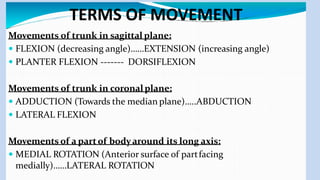
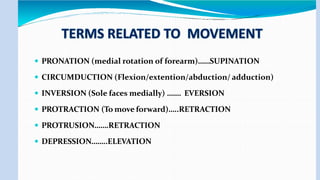
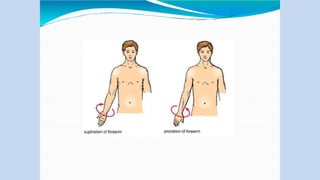
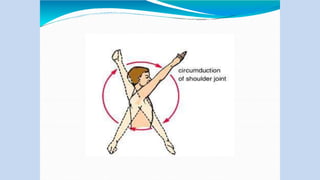
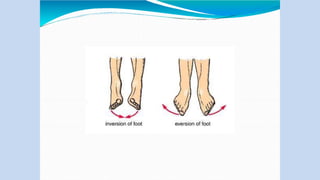
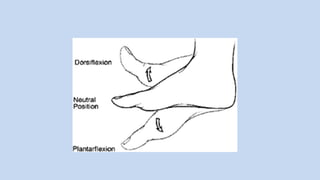
TERMS OF MOVEMENT
Movementsof trunk in sagittal plane:
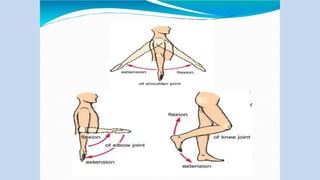
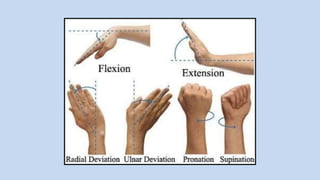
FLEXION (decreasing angle)……EXTENSION (increasing angle)
PLANTER FLEXION ------- DORSIFLEXION
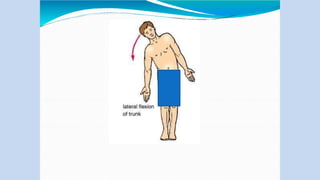
Movements of trunk in coronalplane:
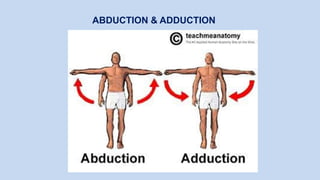
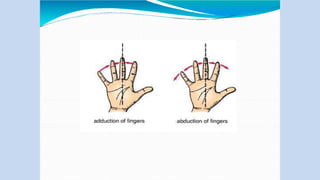
ADDUCTION (Towards the median plane)…..ABDUCTION
LATERAL FLEXION
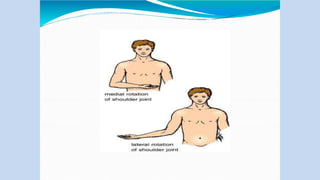
Movements of a partof bodyaround its long axis:
MEDIAL ROTATION (Anterior surface of partfacing
medially)……LATERAL ROTATION
The terms "posterior","ipsilateral", and
"supine" mean:
1. Superior, same side, and lying facedown
2. Dorsal, opposite side, and lying onback
3. Ventral, same side and lying facedown
4. Dorsal, same side, and lying onback
5. Distal, opposite side, and lying facedown
40.
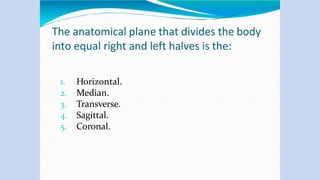
The anatomical planethat divides the body
into equal right and left halves is the:
1. Horizontal.
2. Median.
3. Transverse.
4. Sagittal.
5. Coronal.
41.
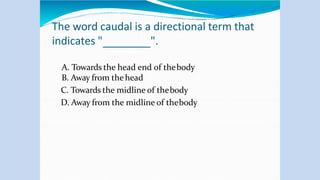
The word caudalis a directional term that
indicates " ".
A. Towards the head end of thebody
B. Away from thehead
C. Towards the midline of thebody
D. Away from the midline of thebody
42.
end of
The handis located at the
the forearm.
A. proximal
B. medial
C. Interior
D. distal