ANALYZING FINANCIAL SOUNDNESS OF
PUBLIC SECTOR BANKS IN INDIA USING
CAMEL MODEL
B. Krishnakumare
1
Introduction
Methodology
Findings of the Study
Conclusions
References
CONTENTS
2
INTRODUCTION
3
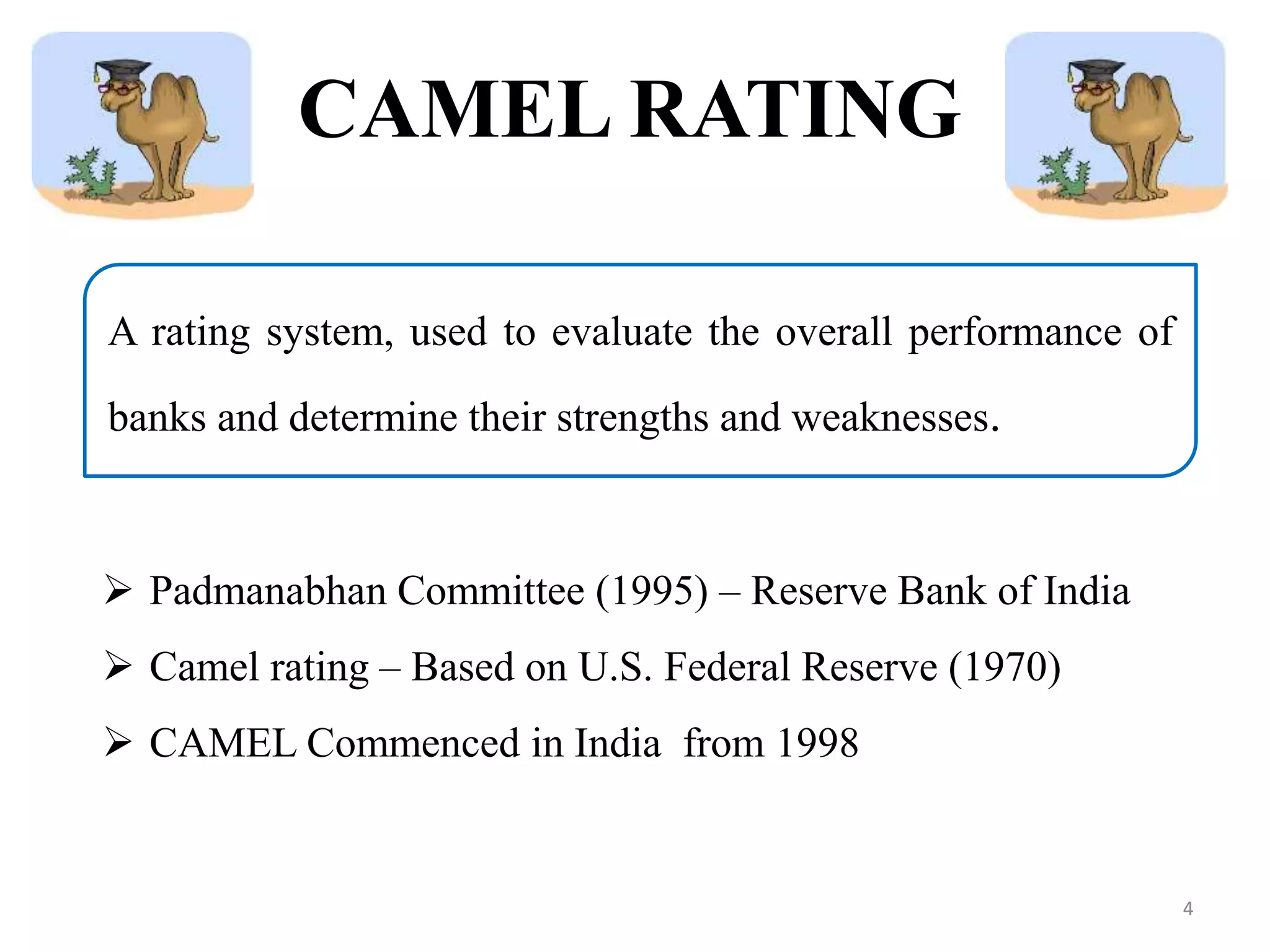
CAMEL RATING
A rating system, used to evaluate the overall performance of
banks and determine their strengths and weaknesses.
 Padmanabhan Committee (1995) – Reserve Bank of India
 Camel rating – Based on U.S. Federal Reserve (1970)
 CAMEL Commenced in India from 1998
4
ASSET
QUALITY
MANAGEMENT
QUALITY
EARNINGS
LIQUIDITYCAPITAL
ADEQUACY
5
Minimum reserves of
capital which a bank or
other financial institutions
must have.
𝑇𝑖𝑒𝑟 1 𝐶𝑎𝑝𝑖𝑡𝑎𝑙 + 𝑇𝑖𝑒𝑟 2 𝐶𝑎𝑝𝑖𝑡𝑎𝑙
𝑅𝑖𝑠𝑘 𝑤𝑒𝑖𝑔ℎ𝑡𝑒𝑑 𝑎𝑠𝑠𝑒𝑡𝑠
CAPITALADEQUACY RATIO:
CAPITAL ADEQUACY
6
RATIOS USED TO STUDY PARAMETER ‘C’
RATIOS FORMULA PRESCRIBED LEVEL
Capital Adequacy Ratio
Tier 1 Capital + Tier 2 Capital
/ Risk weighted Assets
10%
Debt to Equity Ratio Debt / Equity <1.5
Total Advances to Total
Assets Ratio
Total Advances / Total Assets <0.4
Source: Reserve Bank of India, Official website
7
ASSET QUALITY
• Determines the healthiness
of financial institutions
against loss of value in the
assets.
• An indicator of bank’s
control over its bad debts.
8
RATIOS USED TO STUDY PARAMETER ‘A’
RATIOS FORMULA PRESCRIBED LEVEL
Gross NPA Ratio Gross NPA / Gross Advances 5%
Net NPA Ratio Net NPA / Net Advances 3%
Source: Reserve Bank of India, Official website
9
MANAGEMENT QUALITY
For successful operation a bank needs,
• Competent Management
• Effective policies and guidelines
RATIOS FORMULA PRESCRIBED LEVEL
Asset Turnover Ratio Net Sales / Average Total Assets 0.05
Net Profit Margin Ratio Net Profit / Total Revenue 8.5%
RATIOS USED TO STUDY PARAMETER ‘M’
Source: Reserve Bank of India, Official website
10
• Total income earned by banks
through various sources in
accordance with the guidance
exposed by the regulator.
• Reflects the ability to support
present and future operations.
EARNINGS
11
RATIOS USED TO STUDY PARAMETER ‘E’
RATIOS FORMULA PRESCRIBED LEVEL
Return on Assets
Net Income / Average Total
Assets
1%
Return on Equity
Net Income / Average
Shareholders equity
9.75
Source: Reserve Bank of India, Official website
12
• Most important component
for a bank
• Reflects the capacity of
banks to withstand shocks
to cash flows
LIQUIDITY
13
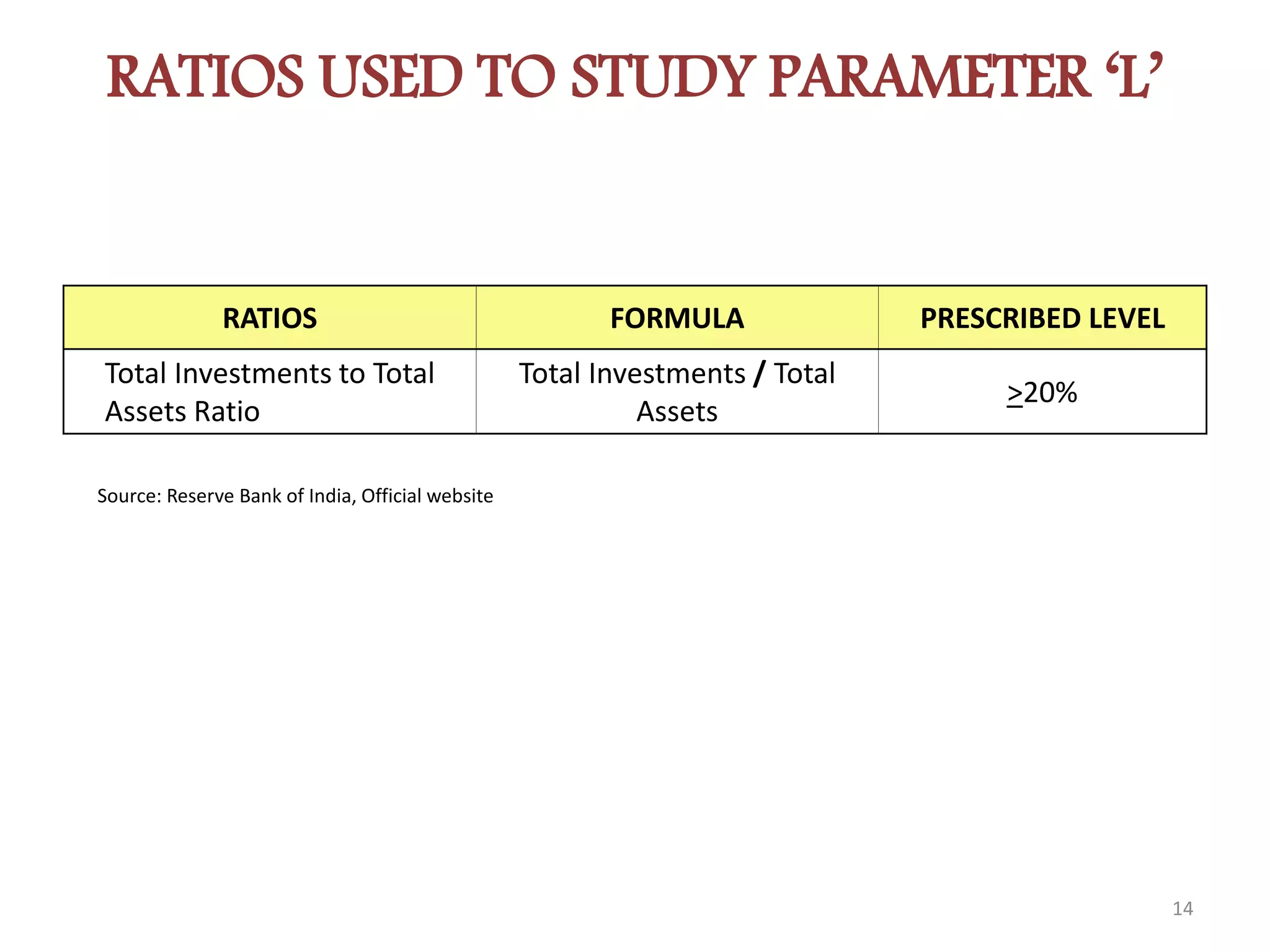
RATIOS USED TO STUDY PARAMETER ‘L’
RATIOS FORMULA PRESCRIBED LEVEL
Total Investments to Total
Assets Ratio
Total Investments / Total
Assets
>20%
Source: Reserve Bank of India, Official website
14
RESEARCH
METHODOLOGY
15
Research Design Descriptive Research
Sample of the
study
8 Public Sector Banks selected based on their overall
business
Period of Study 5 years (2013-17)
Data Source Secondary data
Annual Reports of selected banks
Statistical tools t test analysis Analysis (using SPSS Software)
Limitation Restricted only to Public Sector Banks
16
S.No Banks
Overall Business
(Rs. Crore)
1 State Bank of India 154,750.96
2 Bank of Baroda 32,762.18
3 Punjab National Bank 15,247.33
4 IDBI 13,588.18
5 Canara Bank 10,710.50
6 Union Bank 7,957.13
7 Bank of India 7,191.48
8 Syndicate Bank 5,178.27
PUBLIC SECTOR BANKS BASED ON THEIR CAPITAL
17
FINDINGS OF
THE STUDY
18
Banks
Capital
Adequacy ratio
Debt to Equity
ratio
Total Advance to
Total Asset ratio
Overall
Ranking
Average Rank Average Rank Average Rank Average Rank
SBI 12.66 2 1.39 1 0.62 5 2.0 1
BOB 12.98 1 1.59 4 0.58 1 4.3 4
PNB 11.88 3 1.56 3 0.62 5 3.0 2
IDBI 11.79 4 1.53 2 0.59 2 4.0 3
Canara Bank 11.51 6 1.84 6 0.59 2 6.0
7
Union Bank 10.96 7 1.86 7 0.65 7 5.3
6
Bank of India 10.63 8 1.80 5 0.61 4 6.0
7
Syndicate Bank 11.55 5 2.28 8 0.67 8 4.7 5
Capital Adequacy Ratios of Public Sector banks and their
Ranking
19
Banks
Capital Adequacy ratio Debt equity ratio
Total advances to total
assets ratio
Mean t value
p
value
Mean t value
p
value
Mean t value p value
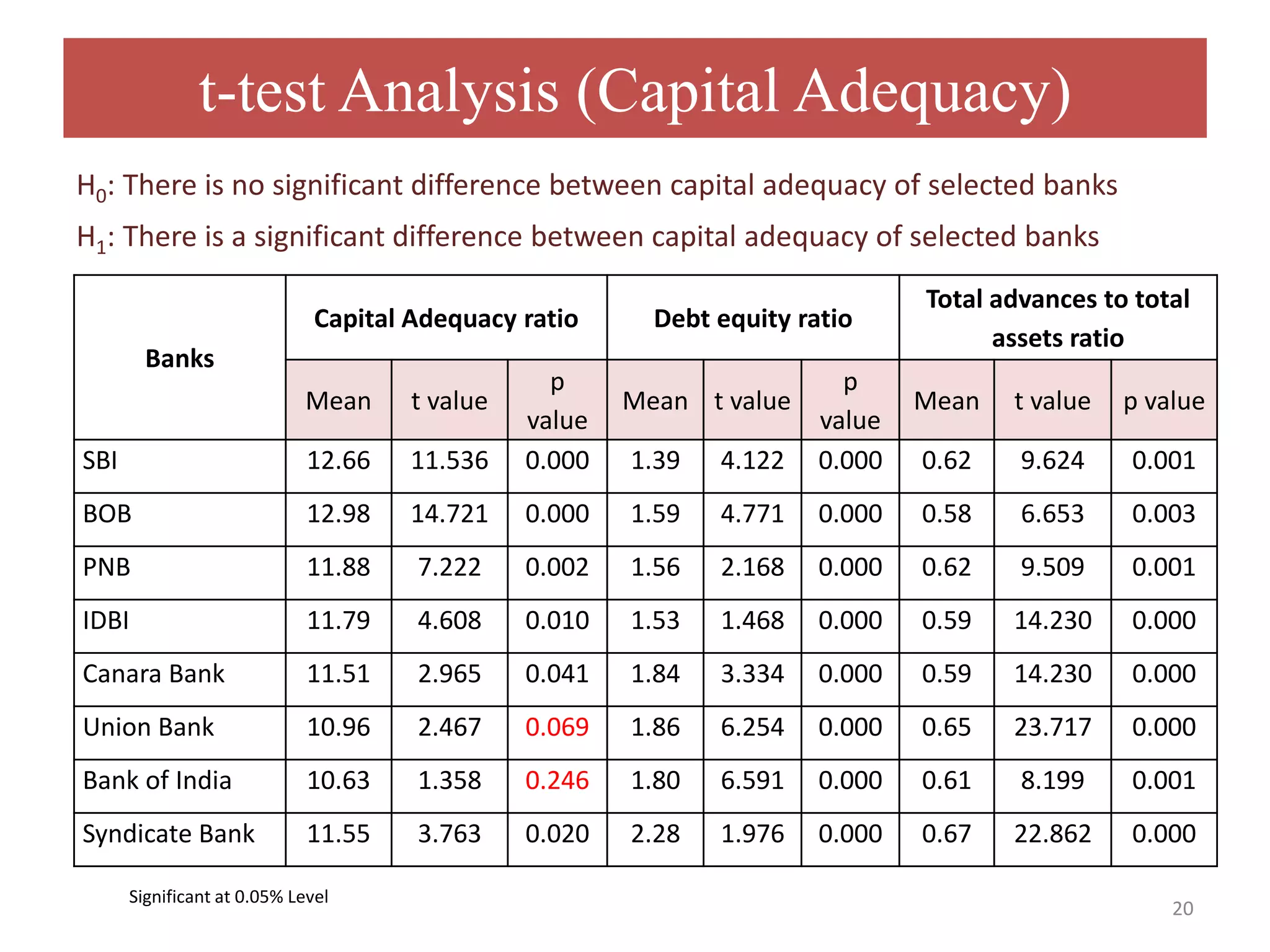
SBI 12.66 11.536 0.000 1.39 4.122 0.000 0.62 9.624 0.001
BOB 12.98 14.721 0.000 1.59 4.771 0.000 0.58 6.653 0.003
PNB 11.88 7.222 0.002 1.56 2.168 0.000 0.62 9.509 0.001
IDBI 11.79 4.608 0.010 1.53 1.468 0.000 0.59 14.230 0.000
Canara Bank 11.51 2.965 0.041 1.84 3.334 0.000 0.59 14.230 0.000
Union Bank 10.96 2.467 0.069 1.86 6.254 0.000 0.65 23.717 0.000
Bank of India 10.63 1.358 0.246 1.80 6.591 0.000 0.61 8.199 0.001
Syndicate Bank 11.55 3.763 0.020 2.28 1.976 0.000 0.67 22.862 0.000
t-test Analysis (Capital Adequacy)
H0: There is no significant difference between capital adequacy of selected banks
H1: There is a significant difference between capital adequacy of selected banks
Significant at 0.05% Level
20
Asset quality ratios of Public Sector Banks and their Ranking
Banks
Gross NPA ratio (%) Net NPA ratio (%) Group Ranking
Average Rank Average Rank Average Rank
SBI 5.91 4 3.19 3 4.0 3
BOB 5.90 3 2.89 2 4.3 4
PNB 8.30 7 5.14 7 5.7 6
IDBI 8.94 8 5.39 8 5.7 6
Canara Bank 5.60 2 3.97 5 2.7 1
Union Bank 6.39 5 3.69 4 4.3 4
Bank of India 7.56 6 4.42 6 6.3 8
Syndicate Bank 4.59 1 2.78 1 2.7 1
21
Banks
Net NPA ratio Gross NPA ratio
Mean t value P value Mean t value P value
SBI 3.19 0.338 0.752 5.91 1.051 0.353
BOB 2.89 -0.134 0.900 5.90 0.506 0.640
PNB 5.14 1.654 0.174 8.30 1.794 0.147
IDBI 5.39 1.110 0.329 8.94 1.258 0.277
Canara Bank 3.97 0.928 0.406 5.60 0.368 0.732
Union Bank 3.69 0.731 0.505 6.39 0.904 0.417
Bank of India 4.42 1.160 0.311 7.56 1.106 0.331
Syndicate Bank 2.78 -0.251 0.814 4.59 -0.323 0.763
t-test Analysis (Asset Quality)
H0: There is no significant difference between asset quality of selected banks
H1: There is a significant difference between asset quality of selected banks
Significant at 0.05% Level
22
Management efficiency ratios of Public Sector Banks
and their Ranking
Banks
Asset Turnover ratio
(%)
Net Profit Margin
ratio
(%)
Overall Ranking
Average Rank Average Rank Average Rank
State Bank of India 0.08 2 6.39 4 3 3
Bank of Baroda 0.07 8 9.56 2 5 7
Punjab National Bank 0.08 2 9.84 1 1.5 1
IDBI 0.08 2 -3.36 8 5 7
Canara Bank 0.08 2 3.42 6 4 5
Union Bank 0.09 1 5.16 5 3 3
Bank of India 0.08 2 0.24 7 4.5 6
Syndicate Bank 0.08 2 7.32 3 2.5 2
23
Banks
Asset turnover ratio Net profit margin
Mean t value p value Mean t value p value
SBI 0.088 4.000 0.01 6.39 2.754 0.51
BOB 0.086 -5.715 0.05 9.56 4.509 0.01
PNB 0.082 0.535 0.62 9.84 4.922 0.08
IDBI 0.080 0.000 1.00 -3.36 -0.934 0.40
Canara Bank 0.084 1.000 0.37 3.42 0.733 0.50
Union Bank 0.086 2.449 0.07 5.16 3.257 0.03
Bank of India 0.080 -2.449 0.07 0.24 -0.293 0.78
Syndicate Bank 0.820 1.000 0.37 7.32 3.475 0.02
t-test Analysis (Management efficiency)
H0: There is no significant difference between management efficiency of selected
banks
H1: There is a significant difference between management efficiency of selected banks
Significant at 0.05% Level
24
Earnings’ ratios of Public Sector Banks and their
Ranking
Banks
Return on Assets
(%)
Return on Equity
(%)
Overall Ranking
Average Rank Average Rank Average Rank
SBI 0.62 2 9.10 3 2.5 2
BOB 0.76 1 10.58 1 1 1
PNB 0.55 3 9.44 2 2.5 2
IDBI -0.22 8 -4.99 7 7.5 7
Canara Bank 0.31 5 3.85 6 5.5 6
Union Bank 0.31 5 7.89 4 4.5 4
Bank of India 0.33 4 5.90 5 4.5 4
Syndicate Bank 0.12 7 -7.78 8 7.5 7
25
Banks
Return on Assets Return on equity
Mean t value p value Mean t value p value
SBI 0.62 6.992 0.02 9.10 5.402 0.06
BOB 0.76 10.186 0.01 10.58 3.066 0.03
PNB 0.55 3.790 0.01 9.44 3.625 0.02
IDBI -0.22 -0.539 0.61 -4.99 -1.448 0.22
Canara Bank 0.31 1.362 0.24 3.85 -0.292 0.78
Union Bank 0.31 3.403 0.02 7.89 2.095 0.10
Bank of India 0.33 1.289 0.26 5.90 0.162 0.87
Syndicate Bank 0.12 1.289 0.26 -7.78 0.928 0.40
t-test Analysis (Earnings)
H0: There is no significant difference between earnings of selected banks
H1: There is a significant difference between earnings of selected banks
Significant at 0.05% Level
26
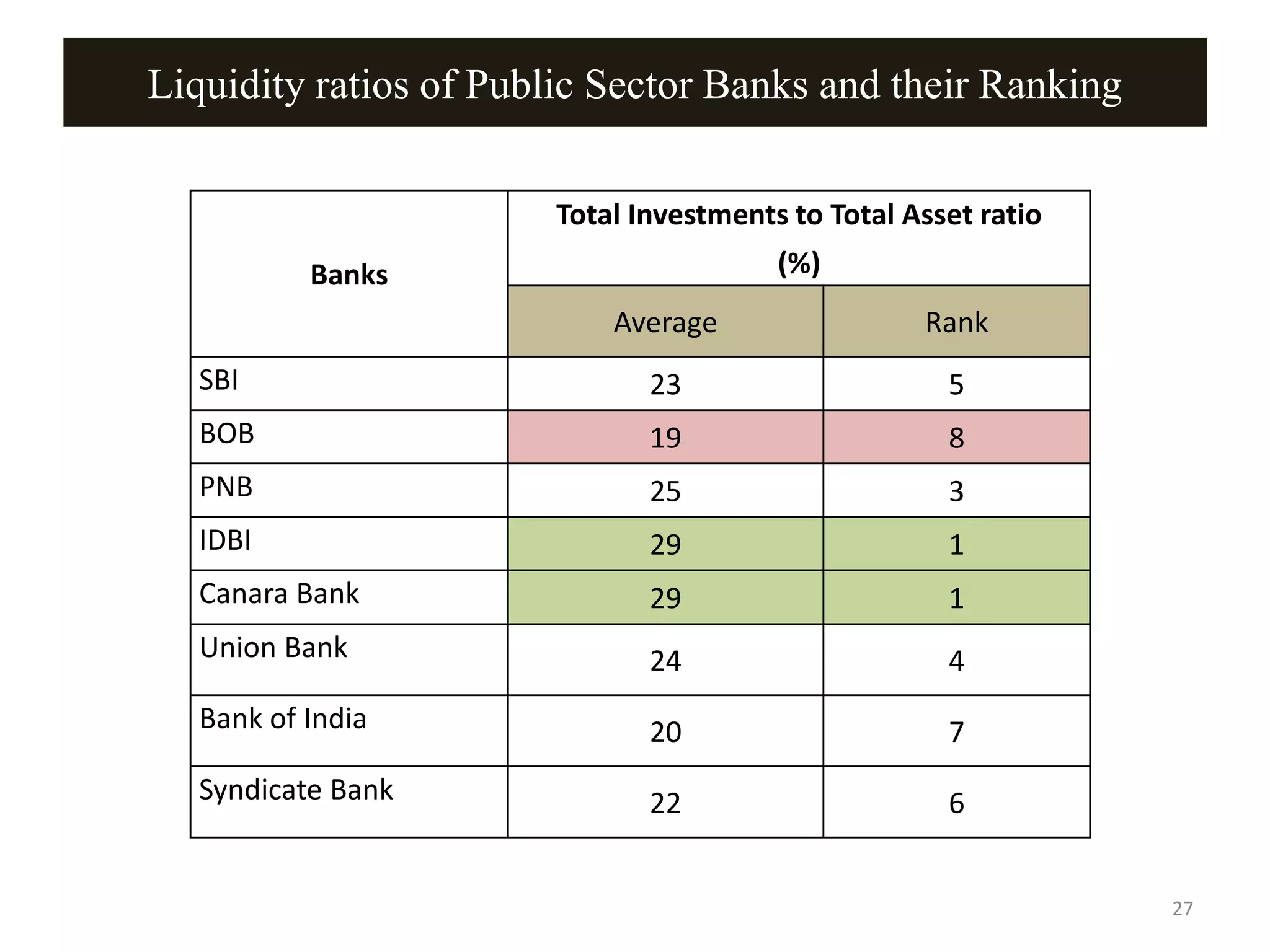
Liquidity ratios of Public Sector Banks and their Ranking
Banks
Total Investments to Total Asset ratio
(%)
Average Rank
SBI 23 5
BOB 19 8
PNB 25 3
IDBI 29 1
Canara Bank 29 1
Union Bank 24 4
Bank of India 20 7
Syndicate Bank 22 6
27
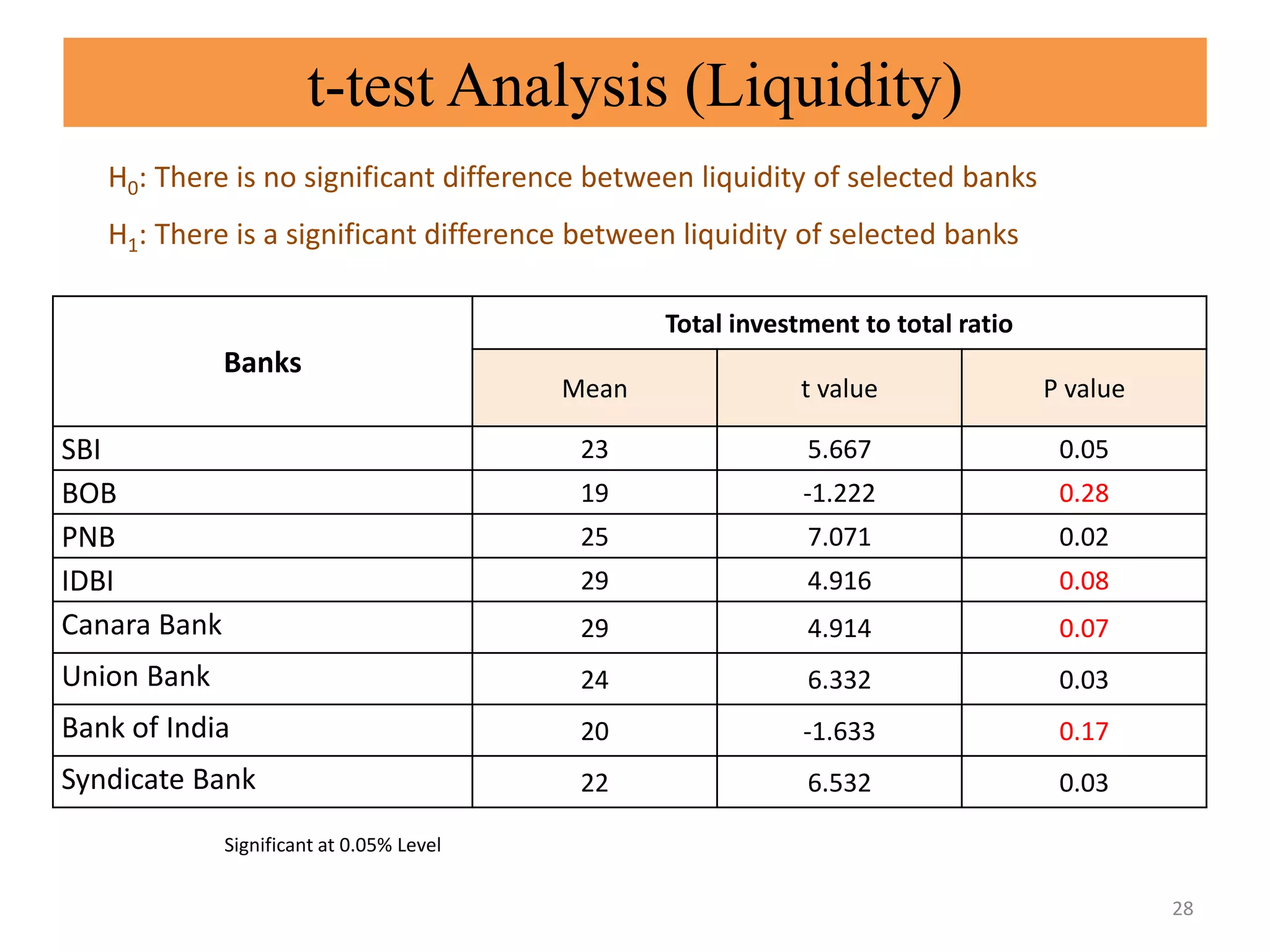
t-test Analysis (Liquidity)
Banks
Total investment to total ratio
Mean t value P value
SBI 23 5.667 0.05
BOB 19 -1.222 0.28
PNB 25 7.071 0.02
IDBI 29 4.916 0.08
Canara Bank 29 4.914 0.07
Union Bank 24 6.332 0.03
Bank of India 20 -1.633 0.17
Syndicate Bank 22 6.532 0.03
H0: There is no significant difference between liquidity of selected banks
H1: There is a significant difference between liquidity of selected banks
Significant at 0.05% Level
28
CONCLUSION
29
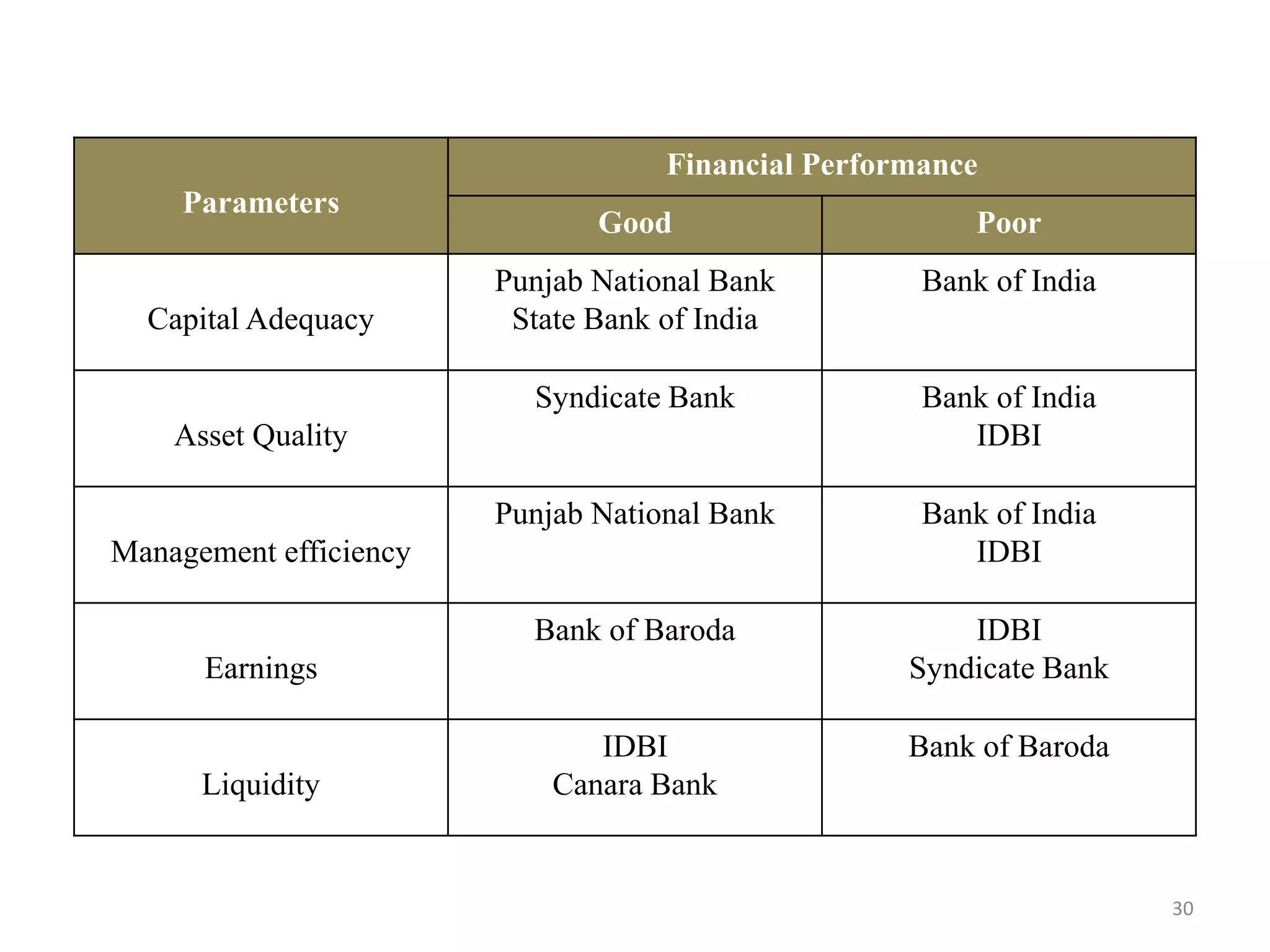
Parameters
Financial Performance
Good Poor
Capital Adequacy
Punjab National Bank
State Bank of India
Bank of India
Asset Quality
Syndicate Bank Bank of India
IDBI
Management efficiency
Punjab National Bank Bank of India
IDBI
Earnings
Bank of Baroda IDBI
Syndicate Bank
Liquidity
IDBI
Canara Bank
Bank of Baroda
30
Banks C A M E L Average Rank
SBI 2.0 4.0 3 2.5 5 3.3 2
BOB 4.3 4.3 5 1 8 4.52 5
PNB 3.0 5.7 1.5 2.5 3 3.14 1
IDBI 4.0 5.7 5 7.5 1 4.64 6
Canara Bank 6.0 2.7 4 5.5 1 3.84 3
Union Bank 5.3 4.3 3 4.5 4 4.22 4
Bank of India 6.0 6.3 4.5 4.5 7 5.66 8
Syndicate Bank 4.7 2.7 2.5 7.5 6 4.68 7
Overall Performance of Public Sector Banks
31
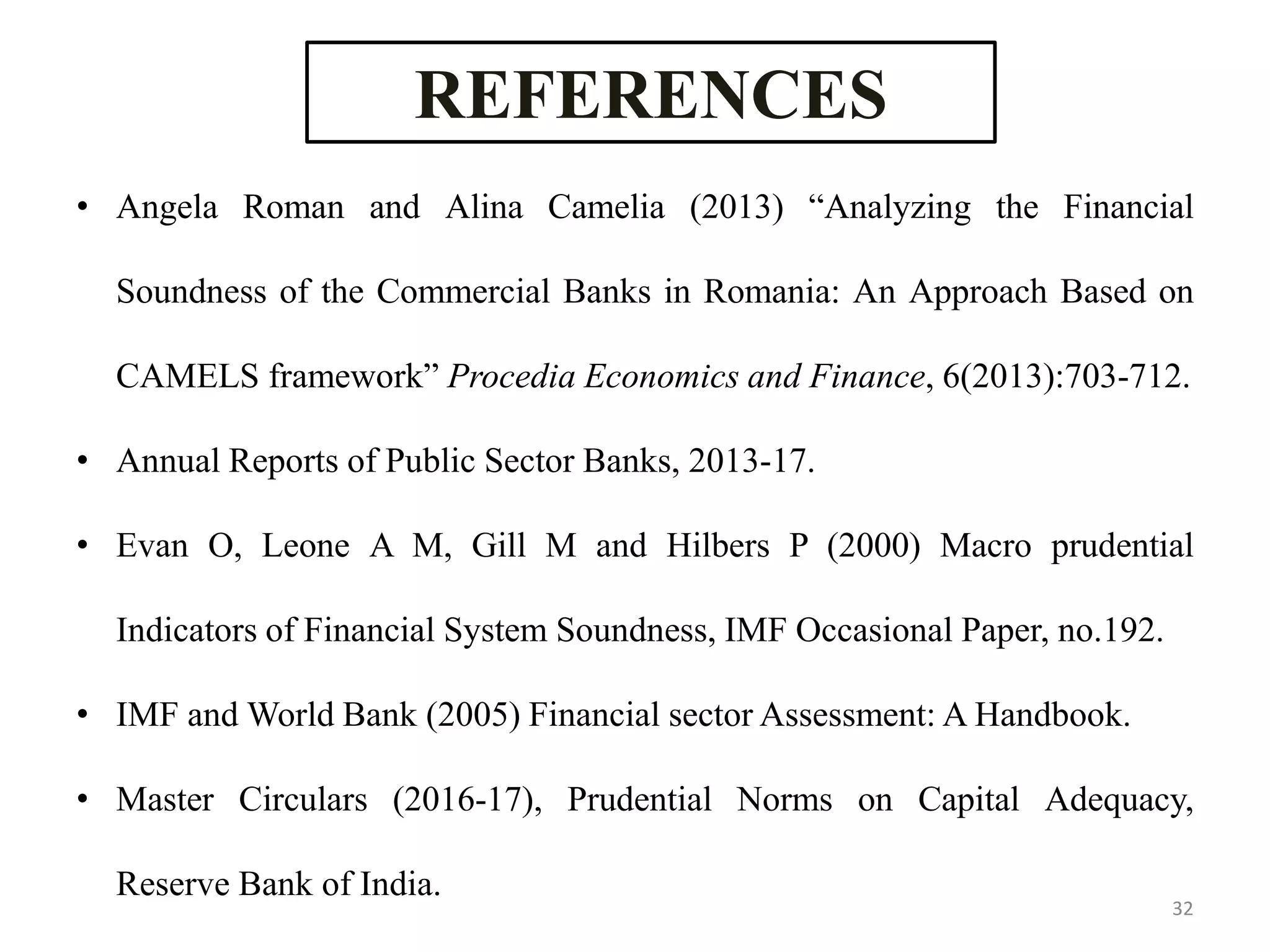
REFERENCES
• Angela Roman and Alina Camelia (2013) “Analyzing the Financial
Soundness of the Commercial Banks in Romania: An Approach Based on
CAMELS framework” Procedia Economics and Finance, 6(2013):703-712.
• Annual Reports of Public Sector Banks, 2013-17.
• Evan O, Leone A M, Gill M and Hilbers P (2000) Macro prudential
Indicators of Financial System Soundness, IMF Occasional Paper, no.192.
• IMF and World Bank (2005) Financial sector Assessment: A Handbook.
• Master Circulars (2016-17), Prudential Norms on Capital Adequacy,
Reserve Bank of India.
32

Analyzing financial soundness using camel model

  • 1.
    ANALYZING FINANCIAL SOUNDNESSOF PUBLIC SECTOR BANKS IN INDIA USING CAMEL MODEL B. Krishnakumare 1
  • 2.
    Introduction Methodology Findings of theStudy Conclusions References CONTENTS 2
  • 3.
  • 4.
    CAMEL RATING A ratingsystem, used to evaluate the overall performance of banks and determine their strengths and weaknesses.  Padmanabhan Committee (1995) – Reserve Bank of India  Camel rating – Based on U.S. Federal Reserve (1970)  CAMEL Commenced in India from 1998 4
  • 5.
  • 6.
    Minimum reserves of capitalwhich a bank or other financial institutions must have. 𝑇𝑖𝑒𝑟 1 𝐶𝑎𝑝𝑖𝑡𝑎𝑙 + 𝑇𝑖𝑒𝑟 2 𝐶𝑎𝑝𝑖𝑡𝑎𝑙 𝑅𝑖𝑠𝑘 𝑤𝑒𝑖𝑔ℎ𝑡𝑒𝑑 𝑎𝑠𝑠𝑒𝑡𝑠 CAPITALADEQUACY RATIO: CAPITAL ADEQUACY 6
  • 7.
    RATIOS USED TOSTUDY PARAMETER ‘C’ RATIOS FORMULA PRESCRIBED LEVEL Capital Adequacy Ratio Tier 1 Capital + Tier 2 Capital / Risk weighted Assets 10% Debt to Equity Ratio Debt / Equity <1.5 Total Advances to Total Assets Ratio Total Advances / Total Assets <0.4 Source: Reserve Bank of India, Official website 7
  • 8.
    ASSET QUALITY • Determinesthe healthiness of financial institutions against loss of value in the assets. • An indicator of bank’s control over its bad debts. 8
  • 9.
    RATIOS USED TOSTUDY PARAMETER ‘A’ RATIOS FORMULA PRESCRIBED LEVEL Gross NPA Ratio Gross NPA / Gross Advances 5% Net NPA Ratio Net NPA / Net Advances 3% Source: Reserve Bank of India, Official website 9
  • 10.
    MANAGEMENT QUALITY For successfuloperation a bank needs, • Competent Management • Effective policies and guidelines RATIOS FORMULA PRESCRIBED LEVEL Asset Turnover Ratio Net Sales / Average Total Assets 0.05 Net Profit Margin Ratio Net Profit / Total Revenue 8.5% RATIOS USED TO STUDY PARAMETER ‘M’ Source: Reserve Bank of India, Official website 10
  • 11.
    • Total incomeearned by banks through various sources in accordance with the guidance exposed by the regulator. • Reflects the ability to support present and future operations. EARNINGS 11
  • 12.
    RATIOS USED TOSTUDY PARAMETER ‘E’ RATIOS FORMULA PRESCRIBED LEVEL Return on Assets Net Income / Average Total Assets 1% Return on Equity Net Income / Average Shareholders equity 9.75 Source: Reserve Bank of India, Official website 12
  • 13.
    • Most importantcomponent for a bank • Reflects the capacity of banks to withstand shocks to cash flows LIQUIDITY 13
  • 14.
    RATIOS USED TOSTUDY PARAMETER ‘L’ RATIOS FORMULA PRESCRIBED LEVEL Total Investments to Total Assets Ratio Total Investments / Total Assets >20% Source: Reserve Bank of India, Official website 14
  • 15.
  • 16.
    Research Design DescriptiveResearch Sample of the study 8 Public Sector Banks selected based on their overall business Period of Study 5 years (2013-17) Data Source Secondary data Annual Reports of selected banks Statistical tools t test analysis Analysis (using SPSS Software) Limitation Restricted only to Public Sector Banks 16
  • 17.
    S.No Banks Overall Business (Rs.Crore) 1 State Bank of India 154,750.96 2 Bank of Baroda 32,762.18 3 Punjab National Bank 15,247.33 4 IDBI 13,588.18 5 Canara Bank 10,710.50 6 Union Bank 7,957.13 7 Bank of India 7,191.48 8 Syndicate Bank 5,178.27 PUBLIC SECTOR BANKS BASED ON THEIR CAPITAL 17
  • 18.
  • 19.
    Banks Capital Adequacy ratio Debt toEquity ratio Total Advance to Total Asset ratio Overall Ranking Average Rank Average Rank Average Rank Average Rank SBI 12.66 2 1.39 1 0.62 5 2.0 1 BOB 12.98 1 1.59 4 0.58 1 4.3 4 PNB 11.88 3 1.56 3 0.62 5 3.0 2 IDBI 11.79 4 1.53 2 0.59 2 4.0 3 Canara Bank 11.51 6 1.84 6 0.59 2 6.0 7 Union Bank 10.96 7 1.86 7 0.65 7 5.3 6 Bank of India 10.63 8 1.80 5 0.61 4 6.0 7 Syndicate Bank 11.55 5 2.28 8 0.67 8 4.7 5 Capital Adequacy Ratios of Public Sector banks and their Ranking 19
  • 20.
    Banks Capital Adequacy ratioDebt equity ratio Total advances to total assets ratio Mean t value p value Mean t value p value Mean t value p value SBI 12.66 11.536 0.000 1.39 4.122 0.000 0.62 9.624 0.001 BOB 12.98 14.721 0.000 1.59 4.771 0.000 0.58 6.653 0.003 PNB 11.88 7.222 0.002 1.56 2.168 0.000 0.62 9.509 0.001 IDBI 11.79 4.608 0.010 1.53 1.468 0.000 0.59 14.230 0.000 Canara Bank 11.51 2.965 0.041 1.84 3.334 0.000 0.59 14.230 0.000 Union Bank 10.96 2.467 0.069 1.86 6.254 0.000 0.65 23.717 0.000 Bank of India 10.63 1.358 0.246 1.80 6.591 0.000 0.61 8.199 0.001 Syndicate Bank 11.55 3.763 0.020 2.28 1.976 0.000 0.67 22.862 0.000 t-test Analysis (Capital Adequacy) H0: There is no significant difference between capital adequacy of selected banks H1: There is a significant difference between capital adequacy of selected banks Significant at 0.05% Level 20
  • 21.
    Asset quality ratiosof Public Sector Banks and their Ranking Banks Gross NPA ratio (%) Net NPA ratio (%) Group Ranking Average Rank Average Rank Average Rank SBI 5.91 4 3.19 3 4.0 3 BOB 5.90 3 2.89 2 4.3 4 PNB 8.30 7 5.14 7 5.7 6 IDBI 8.94 8 5.39 8 5.7 6 Canara Bank 5.60 2 3.97 5 2.7 1 Union Bank 6.39 5 3.69 4 4.3 4 Bank of India 7.56 6 4.42 6 6.3 8 Syndicate Bank 4.59 1 2.78 1 2.7 1 21
  • 22.
    Banks Net NPA ratioGross NPA ratio Mean t value P value Mean t value P value SBI 3.19 0.338 0.752 5.91 1.051 0.353 BOB 2.89 -0.134 0.900 5.90 0.506 0.640 PNB 5.14 1.654 0.174 8.30 1.794 0.147 IDBI 5.39 1.110 0.329 8.94 1.258 0.277 Canara Bank 3.97 0.928 0.406 5.60 0.368 0.732 Union Bank 3.69 0.731 0.505 6.39 0.904 0.417 Bank of India 4.42 1.160 0.311 7.56 1.106 0.331 Syndicate Bank 2.78 -0.251 0.814 4.59 -0.323 0.763 t-test Analysis (Asset Quality) H0: There is no significant difference between asset quality of selected banks H1: There is a significant difference between asset quality of selected banks Significant at 0.05% Level 22
  • 23.
    Management efficiency ratiosof Public Sector Banks and their Ranking Banks Asset Turnover ratio (%) Net Profit Margin ratio (%) Overall Ranking Average Rank Average Rank Average Rank State Bank of India 0.08 2 6.39 4 3 3 Bank of Baroda 0.07 8 9.56 2 5 7 Punjab National Bank 0.08 2 9.84 1 1.5 1 IDBI 0.08 2 -3.36 8 5 7 Canara Bank 0.08 2 3.42 6 4 5 Union Bank 0.09 1 5.16 5 3 3 Bank of India 0.08 2 0.24 7 4.5 6 Syndicate Bank 0.08 2 7.32 3 2.5 2 23
  • 24.
    Banks Asset turnover ratioNet profit margin Mean t value p value Mean t value p value SBI 0.088 4.000 0.01 6.39 2.754 0.51 BOB 0.086 -5.715 0.05 9.56 4.509 0.01 PNB 0.082 0.535 0.62 9.84 4.922 0.08 IDBI 0.080 0.000 1.00 -3.36 -0.934 0.40 Canara Bank 0.084 1.000 0.37 3.42 0.733 0.50 Union Bank 0.086 2.449 0.07 5.16 3.257 0.03 Bank of India 0.080 -2.449 0.07 0.24 -0.293 0.78 Syndicate Bank 0.820 1.000 0.37 7.32 3.475 0.02 t-test Analysis (Management efficiency) H0: There is no significant difference between management efficiency of selected banks H1: There is a significant difference between management efficiency of selected banks Significant at 0.05% Level 24
  • 25.
    Earnings’ ratios ofPublic Sector Banks and their Ranking Banks Return on Assets (%) Return on Equity (%) Overall Ranking Average Rank Average Rank Average Rank SBI 0.62 2 9.10 3 2.5 2 BOB 0.76 1 10.58 1 1 1 PNB 0.55 3 9.44 2 2.5 2 IDBI -0.22 8 -4.99 7 7.5 7 Canara Bank 0.31 5 3.85 6 5.5 6 Union Bank 0.31 5 7.89 4 4.5 4 Bank of India 0.33 4 5.90 5 4.5 4 Syndicate Bank 0.12 7 -7.78 8 7.5 7 25
  • 26.
    Banks Return on AssetsReturn on equity Mean t value p value Mean t value p value SBI 0.62 6.992 0.02 9.10 5.402 0.06 BOB 0.76 10.186 0.01 10.58 3.066 0.03 PNB 0.55 3.790 0.01 9.44 3.625 0.02 IDBI -0.22 -0.539 0.61 -4.99 -1.448 0.22 Canara Bank 0.31 1.362 0.24 3.85 -0.292 0.78 Union Bank 0.31 3.403 0.02 7.89 2.095 0.10 Bank of India 0.33 1.289 0.26 5.90 0.162 0.87 Syndicate Bank 0.12 1.289 0.26 -7.78 0.928 0.40 t-test Analysis (Earnings) H0: There is no significant difference between earnings of selected banks H1: There is a significant difference between earnings of selected banks Significant at 0.05% Level 26
  • 27.
    Liquidity ratios ofPublic Sector Banks and their Ranking Banks Total Investments to Total Asset ratio (%) Average Rank SBI 23 5 BOB 19 8 PNB 25 3 IDBI 29 1 Canara Bank 29 1 Union Bank 24 4 Bank of India 20 7 Syndicate Bank 22 6 27
  • 28.
    t-test Analysis (Liquidity) Banks Totalinvestment to total ratio Mean t value P value SBI 23 5.667 0.05 BOB 19 -1.222 0.28 PNB 25 7.071 0.02 IDBI 29 4.916 0.08 Canara Bank 29 4.914 0.07 Union Bank 24 6.332 0.03 Bank of India 20 -1.633 0.17 Syndicate Bank 22 6.532 0.03 H0: There is no significant difference between liquidity of selected banks H1: There is a significant difference between liquidity of selected banks Significant at 0.05% Level 28
  • 29.
  • 30.
    Parameters Financial Performance Good Poor CapitalAdequacy Punjab National Bank State Bank of India Bank of India Asset Quality Syndicate Bank Bank of India IDBI Management efficiency Punjab National Bank Bank of India IDBI Earnings Bank of Baroda IDBI Syndicate Bank Liquidity IDBI Canara Bank Bank of Baroda 30
  • 31.
    Banks C AM E L Average Rank SBI 2.0 4.0 3 2.5 5 3.3 2 BOB 4.3 4.3 5 1 8 4.52 5 PNB 3.0 5.7 1.5 2.5 3 3.14 1 IDBI 4.0 5.7 5 7.5 1 4.64 6 Canara Bank 6.0 2.7 4 5.5 1 3.84 3 Union Bank 5.3 4.3 3 4.5 4 4.22 4 Bank of India 6.0 6.3 4.5 4.5 7 5.66 8 Syndicate Bank 4.7 2.7 2.5 7.5 6 4.68 7 Overall Performance of Public Sector Banks 31
  • 32.
    REFERENCES • Angela Romanand Alina Camelia (2013) “Analyzing the Financial Soundness of the Commercial Banks in Romania: An Approach Based on CAMELS framework” Procedia Economics and Finance, 6(2013):703-712. • Annual Reports of Public Sector Banks, 2013-17. • Evan O, Leone A M, Gill M and Hilbers P (2000) Macro prudential Indicators of Financial System Soundness, IMF Occasional Paper, no.192. • IMF and World Bank (2005) Financial sector Assessment: A Handbook. • Master Circulars (2016-17), Prudential Norms on Capital Adequacy, Reserve Bank of India. 32