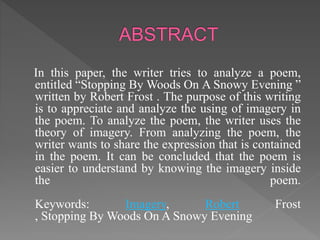
In this paper, the writer tries to analyze a poem,
entitled “Stopping By Woods On A Snowy Evening ”
written by Robert Frost . The purpose of this writing
is to appreciate and analyze the using of imagery in
the poem. To analyze the poem, the writer uses the
theory of imagery. From analyzing the poem, the
writer wants to share the expression that is contained
in the poem. It can be concluded that the poem is
easier to understand by knowing the imagery inside
the poem.
Keywords: Imagery, Robert Frost
, Stopping By Woods On A Snowy Evening
According to X. J. Kennedy in Literature: An
Introduction to Fiction, Poetry, and Drama (1979:
411), “poetry appeals to the mind and arouses
feelings. Poetry may state facts, but, more important,
it makes imaginative statements that we may value
even if its facts are incorrect.” Poetry expresses a
conversation or interchange that is grounded in the
most deeply felt experiences of human beings. By
analyzing the poem, the readers can understand what
the poet experience was and how did the poet feels
when he was on that situation.
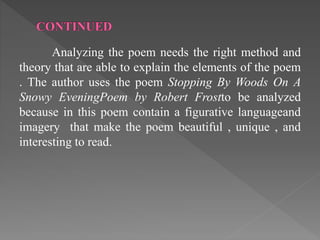
Analyzing the poem needs the right method and
theory that are able to explain the elements of the poem
. The author uses the poem Stopping By Woods On A
Snowy EveningPoem by Robert Frostto be analyzed
because in this poem contain a figurative languageand
imagery that make the poem beautiful , unique , and
interesting to read.
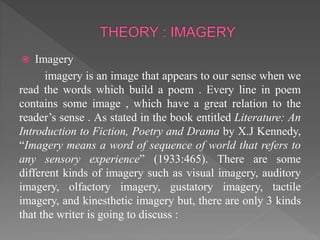
 Imagery
imagery is an image that appears to our sense when we
read the words which build a poem . Every line in poem
contains some image , which have a great relation to the
reader’s sense . As stated in the book entitled Literature: An
Introduction to Fiction, Poetry and Drama by X.J Kennedy,
“Imagery means a word of sequence of world that refers to
any sensory experience” (1933:465). There are some
different kinds of imagery such as visual imagery, auditory
imagery, olfactory imagery, gustatory imagery, tactile
imagery, and kinesthetic imagery but, there are only 3 kinds
that the writer is going to discuss :
1. Visual Imagery
 Visual Imagery is an image that appears from eyesight .For
example: The gray sea and the long black land,And the
yellow half-moon large and low (Meeting at night by Robert
Browning’s )
2. Audiotory Imagery
 Auditory Imagery is animage that represents a sound. For
example:And a voice less loud , through its joys and fears ,
Than the two hearts beating each to ea (Meeting at night by
Robert Browning’s)
3. Kinesthetic Imagery
 Kinesthetic Imagery clarifies the description that there is
movement or action. For example
 “And he opened the coffins and set them all free, “( The
Chimney Sweeper by William Blake )
1 Biography
Robert Frost was born on March 26, 1874, in San
Francisco, where his father, William Prescott Frost Jr., and his
mother, Isabelle Moodie, had moved from Pennsylvania
shortly after marrying. He became interested in reading and
writing poetry during his high school years in Lawrence,
enrolled at Dartmouth College in Hanover, New Hampshire,
in 1892, and later at Harvard University in Boston, though he
never earned a formal college degree. By the time Frost
returned to the United States in 1915, he had published two
full-length collectionsA Boy’s Will (Henry Holt and Company,
1913) andNorth of Boston (Henry Holt and Company, 1914),
and his reputation was established.
Whose woods these are I think I know.
His house is in the village, though;
He will not see me stopping here
To watch his woods fill up with snow.
My little horse must think it queer
To stop without a farmhouse near
Between the woods and frozen lake
The darkest evening of the year.
He gives his harness bells a shake
To ask if there is some mistake.
The only other sound's the sweep
Of easy wind and downy flake.
The woods are lovely, dark, and deep,
But I have promises to keep,
And miles to go before I sleep,
And miles to go before I sleep.
 Visual imagery
 Stanza 1
 Line 3 and 4
He will not see me stopping here
To watch his woods fill up with snow.
 These lines uses visual imagery , words “He will not see me
stopping here” and “ To watch his woods fill up with snow “
, shows that the speaker travels and stop in woods because he
fall asleep with the woods which filling of the snow . This
stanza tell aboutthe wardenerappears worried that he is
committing an offense by looking upon woods owned by
another man “ will not see me stopping me “ . He has
stopped to look at the view of woods . The author are seduced
by the beatuy of the woods that fulfilled by the snow so he
stops to enjoy it .
 Stanza 2
To stop without a farmhouse near
Between the woods and frozen lake
The darkest evening of the year.
 In this line uses avisual imagery , here the author
tries to express feelings nomad who may be
concerned . Represent by a little horse the wardener
which was strange because his employer to stop its
journey somewhere quiet , dark , and far from the
farmhouse because the sight that caught his attention
.
 Stanza 3
 Line 1
He gives his harness bells a shake
 In the first line , the words “bells a shake” is
symbol of there is something mistake in the
woods . The author describes that it is maybe
something happened . The horse gives sign with
bells a shake which hanging in his neck .
 Stanza 4
 Line 1
The woods are lovely, dark, and deep,
 This line is consists of symbol, here islovely, dark,
and deep. lovely, dark, and deep here is as
symbolismeof mystery in life . It is describes that
the author stop in a place which are many things to
temptation him over there in order he almost fall
asleep and forgot his duties .
 Line 2
But I have promises to keep,
 This line is consists of symbol, here is
promises .The word “ promises “ is a
symbol of responsibilty . The author
describes of promise is many things to have
finish as his duties . The author realizes that
it is not his time to enter the woods .
 Line 3
And miles to go before I sleep,
 This line is consists of symbol, here is miles.Miles
here is as symbolisme of a long journey or the
journey of life of the wardener that represent the
author in this poem .
 Line 4
And miles to go before I sleep,
 This line is consists of symbol, here is sleep.Sleep
is as symbolisme of rest but sleep here is sleep
forever or die . The author describes that he must
finish her duties miles to go before he is ready to
meet death because he has promise to finish it .
 Auditory imagery
 Stanza 3
He gives his harness bells a shake
To ask if there is some mistake.
The only other sound's the sweep
Of easy wind and downy flake.
These lines uses an audiotory imagery ,the
author represents when the horse felt uneasy
because he had to stop in the dark wood he is
moving his body to ringing bell that hanging on his
neck . The bell indicates that there are some
mistake happened for him and the horse feels
anxious when it’s waiting him because the sounds
are the rustle of the wind blowing and falling snow
.
Kinesthetic Imagery
 Stanza 2
 Line 2
To stop without a farmhouse near
 In this line the poet uses kinestetic imagery .
The word “ To stop” indicates a movement
Because there is movement when the
wardenerstop his journey for seeing the
beautiful scenery with woods is covered by
snow around so caught his attention , but the
woods far away from farmhouse .
 Stanza 3
Line 1
He gives his harness bells a shake
These lines show us kinesthetic imagery
because it can be known from the word “
bella shake “ . It is means that the horse felt
uneasy because he had to stop in the dark
woods . His anxieties express by moving his
body so that “ the bell” hanging on his neck
ringing .
Line 4
Of easy wind and downy flake.
These lines show us kinesthetic imagery
,words “ downy flake” explain that movement
occurs in the silence of a dark night in the
woods when the wind blows and sweeps
granules snowflakes.
 Stanza 4
Line 3
And miles to go before I sleep,
In this line the author uses kinestetic imagery ,
the word “ to go “ its means speaker that
knows he still have promise to keep as his
responsibility to finish miles far away to go
before he meets death .
 This poem Stopping By Woods On A Snowy Evening by
Robert Frosttells the story of a man traveling through
some snowy woods on the darkest evening of the year,
and he's pretty much in love with what he sees around
him. He's on his way back to town, but he can't quite tear
himself away from the lovely and dark woods.
 The poem Stopping By Woods On A Snowy Evening by
Robert Frost also used imagery to help the reader
understand what the meaning inside this poem is.
Imagery of kinesthetic is the most dominate in this poem.
Here a lot of feeling written down and delivered the
author meaning towards the reader. If the author didn’t
use this imagery, the reader might get a lot of difficulty
to understand and fell the author experience.
 Perinne, Laurence. 1969. Sound And Sense An Introduction to
Poetry. New York: Harcourt, Brace & World, INC.
 Kennedy, X. J. 1966. LITERATURE, An Introduction to
Fiction, Poetry, and Drama.Toronto: Little, Brown and
Company
 Hall , Donald . 1982 . To Read Poetry New York . College
Publishing
 Third Edition . ED C Hugh Holman . New York . The
Odyssey press
 Sayuti , Suminto A . 1985 . Puisi dan Pengajarannya
.Semarang : IKIP Semarang Press.
 http://www.poets.org/poet/robert-frost

Analyzed poem

  • 2.
    In this paper,the writer tries to analyze a poem, entitled “Stopping By Woods On A Snowy Evening ” written by Robert Frost . The purpose of this writing is to appreciate and analyze the using of imagery in the poem. To analyze the poem, the writer uses the theory of imagery. From analyzing the poem, the writer wants to share the expression that is contained in the poem. It can be concluded that the poem is easier to understand by knowing the imagery inside the poem. Keywords: Imagery, Robert Frost , Stopping By Woods On A Snowy Evening
  • 3.
    According to X.J. Kennedy in Literature: An Introduction to Fiction, Poetry, and Drama (1979: 411), “poetry appeals to the mind and arouses feelings. Poetry may state facts, but, more important, it makes imaginative statements that we may value even if its facts are incorrect.” Poetry expresses a conversation or interchange that is grounded in the most deeply felt experiences of human beings. By analyzing the poem, the readers can understand what the poet experience was and how did the poet feels when he was on that situation.
  • 4.
    Analyzing the poemneeds the right method and theory that are able to explain the elements of the poem . The author uses the poem Stopping By Woods On A Snowy EveningPoem by Robert Frostto be analyzed because in this poem contain a figurative languageand imagery that make the poem beautiful , unique , and interesting to read.
  • 5.
     Imagery imagery isan image that appears to our sense when we read the words which build a poem . Every line in poem contains some image , which have a great relation to the reader’s sense . As stated in the book entitled Literature: An Introduction to Fiction, Poetry and Drama by X.J Kennedy, “Imagery means a word of sequence of world that refers to any sensory experience” (1933:465). There are some different kinds of imagery such as visual imagery, auditory imagery, olfactory imagery, gustatory imagery, tactile imagery, and kinesthetic imagery but, there are only 3 kinds that the writer is going to discuss :
  • 6.
    1. Visual Imagery Visual Imagery is an image that appears from eyesight .For example: The gray sea and the long black land,And the yellow half-moon large and low (Meeting at night by Robert Browning’s ) 2. Audiotory Imagery  Auditory Imagery is animage that represents a sound. For example:And a voice less loud , through its joys and fears , Than the two hearts beating each to ea (Meeting at night by Robert Browning’s) 3. Kinesthetic Imagery  Kinesthetic Imagery clarifies the description that there is movement or action. For example  “And he opened the coffins and set them all free, “( The Chimney Sweeper by William Blake )
  • 7.
    1 Biography Robert Frostwas born on March 26, 1874, in San Francisco, where his father, William Prescott Frost Jr., and his mother, Isabelle Moodie, had moved from Pennsylvania shortly after marrying. He became interested in reading and writing poetry during his high school years in Lawrence, enrolled at Dartmouth College in Hanover, New Hampshire, in 1892, and later at Harvard University in Boston, though he never earned a formal college degree. By the time Frost returned to the United States in 1915, he had published two full-length collectionsA Boy’s Will (Henry Holt and Company, 1913) andNorth of Boston (Henry Holt and Company, 1914), and his reputation was established.
  • 8.
    Whose woods theseare I think I know. His house is in the village, though; He will not see me stopping here To watch his woods fill up with snow. My little horse must think it queer To stop without a farmhouse near Between the woods and frozen lake The darkest evening of the year.
  • 9.
    He gives hisharness bells a shake To ask if there is some mistake. The only other sound's the sweep Of easy wind and downy flake. The woods are lovely, dark, and deep, But I have promises to keep, And miles to go before I sleep, And miles to go before I sleep.
  • 10.
     Visual imagery Stanza 1  Line 3 and 4 He will not see me stopping here To watch his woods fill up with snow.  These lines uses visual imagery , words “He will not see me stopping here” and “ To watch his woods fill up with snow “ , shows that the speaker travels and stop in woods because he fall asleep with the woods which filling of the snow . This stanza tell aboutthe wardenerappears worried that he is committing an offense by looking upon woods owned by another man “ will not see me stopping me “ . He has stopped to look at the view of woods . The author are seduced by the beatuy of the woods that fulfilled by the snow so he stops to enjoy it .
  • 11.
     Stanza 2 Tostop without a farmhouse near Between the woods and frozen lake The darkest evening of the year.  In this line uses avisual imagery , here the author tries to express feelings nomad who may be concerned . Represent by a little horse the wardener which was strange because his employer to stop its journey somewhere quiet , dark , and far from the farmhouse because the sight that caught his attention .
  • 12.
     Stanza 3 Line 1 He gives his harness bells a shake  In the first line , the words “bells a shake” is symbol of there is something mistake in the woods . The author describes that it is maybe something happened . The horse gives sign with bells a shake which hanging in his neck .
  • 13.
     Stanza 4 Line 1 The woods are lovely, dark, and deep,  This line is consists of symbol, here islovely, dark, and deep. lovely, dark, and deep here is as symbolismeof mystery in life . It is describes that the author stop in a place which are many things to temptation him over there in order he almost fall asleep and forgot his duties .
  • 14.
     Line 2 ButI have promises to keep,  This line is consists of symbol, here is promises .The word “ promises “ is a symbol of responsibilty . The author describes of promise is many things to have finish as his duties . The author realizes that it is not his time to enter the woods .
  • 15.
     Line 3 Andmiles to go before I sleep,  This line is consists of symbol, here is miles.Miles here is as symbolisme of a long journey or the journey of life of the wardener that represent the author in this poem .  Line 4 And miles to go before I sleep,  This line is consists of symbol, here is sleep.Sleep is as symbolisme of rest but sleep here is sleep forever or die . The author describes that he must finish her duties miles to go before he is ready to meet death because he has promise to finish it .
  • 16.
     Auditory imagery Stanza 3 He gives his harness bells a shake To ask if there is some mistake. The only other sound's the sweep Of easy wind and downy flake. These lines uses an audiotory imagery ,the author represents when the horse felt uneasy because he had to stop in the dark wood he is moving his body to ringing bell that hanging on his neck . The bell indicates that there are some mistake happened for him and the horse feels anxious when it’s waiting him because the sounds are the rustle of the wind blowing and falling snow .
  • 17.
    Kinesthetic Imagery  Stanza2  Line 2 To stop without a farmhouse near  In this line the poet uses kinestetic imagery . The word “ To stop” indicates a movement Because there is movement when the wardenerstop his journey for seeing the beautiful scenery with woods is covered by snow around so caught his attention , but the woods far away from farmhouse .
  • 18.
     Stanza 3 Line1 He gives his harness bells a shake These lines show us kinesthetic imagery because it can be known from the word “ bella shake “ . It is means that the horse felt uneasy because he had to stop in the dark woods . His anxieties express by moving his body so that “ the bell” hanging on his neck ringing .
  • 19.
    Line 4 Of easywind and downy flake. These lines show us kinesthetic imagery ,words “ downy flake” explain that movement occurs in the silence of a dark night in the woods when the wind blows and sweeps granules snowflakes.
  • 20.
     Stanza 4 Line3 And miles to go before I sleep, In this line the author uses kinestetic imagery , the word “ to go “ its means speaker that knows he still have promise to keep as his responsibility to finish miles far away to go before he meets death .
  • 21.
     This poemStopping By Woods On A Snowy Evening by Robert Frosttells the story of a man traveling through some snowy woods on the darkest evening of the year, and he's pretty much in love with what he sees around him. He's on his way back to town, but he can't quite tear himself away from the lovely and dark woods.  The poem Stopping By Woods On A Snowy Evening by Robert Frost also used imagery to help the reader understand what the meaning inside this poem is. Imagery of kinesthetic is the most dominate in this poem. Here a lot of feeling written down and delivered the author meaning towards the reader. If the author didn’t use this imagery, the reader might get a lot of difficulty to understand and fell the author experience.
  • 22.
     Perinne, Laurence.1969. Sound And Sense An Introduction to Poetry. New York: Harcourt, Brace & World, INC.  Kennedy, X. J. 1966. LITERATURE, An Introduction to Fiction, Poetry, and Drama.Toronto: Little, Brown and Company  Hall , Donald . 1982 . To Read Poetry New York . College Publishing  Third Edition . ED C Hugh Holman . New York . The Odyssey press  Sayuti , Suminto A . 1985 . Puisi dan Pengajarannya .Semarang : IKIP Semarang Press.  http://www.poets.org/poet/robert-frost