






ANALYTICS INDIA
INDUSTRY STUDY
2017Brought to you by
Analytics India Magazine & Analytixlabs
4
12
14
16
18
Introduction
Key Trends
Geographies Served
Sector Type
Analytics Industry by Cities
CONTENT
20
Analytics Professionals in India
24
Conclusion
6
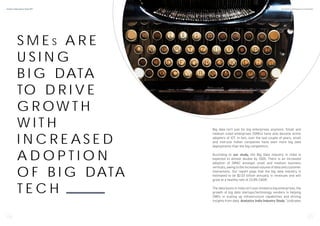
SMEs are using big data to drive growth
2 3
Analytics India Industry Study 2017 By Analytics India Magazine & Analytixlabs
INTRODUCTION
With an increase in data generation at
individual level and at organizational
level, the need for tools that can
analyze these data has only increased.
Deployment of analytics is becoming
criticaltoabusinessandfromperforming
simple tasks to sophisticated ones, they
are relying extensively on analytics.
It can even be said that, an increasing
efficiency of tools and products
specializing in data processing has
resulted in growth of business analytics.
Either way around, there has been
an extensive increase in the overall
revenue generated by these companies,
at an estimated $2.03 Billion annually
and 23.8% of CAGR. India has also been
making headways in analytics export in
the form of various analytics services.
With USA and UK being the major
market for analytics export for India, its
domestic market serves a total of 4% of
analytics revenues.
Given the numbers, India easily ranks
as one of the top 10 destinations for
analytics and the market is estimated to
grow even further. With 600+ analytics
firms, and more than 50% of it being
startups, India us emerging as a growing
hub for analytics solutions, hence giving
a major boost to the industry.
Presenting a picture of the overall
analytics industry in India, Analytics
India Magazine in association with
AnalytixLabs brings its annual study
titled “Analytics Industry Study-2017”,
which represents the key trends in the
industry. It covers all the aspect of the
analytics industry such as the major
geographies served, analytics market
by sector type, by cities, analytics
professionals etc. The study is a result
of extensive primary and secondary
research conducted over a duration of
two months.
4 5
Analytics India Industry Study 2017 By Analytics India Magazine & Analytixlabs
S M E S A R E
U S I N G
B I G DATA
TO D R I V E
G R OW T H
W I T H
I N C R E A S E D
A D O P T I O N
O F B I G DATA
T E C H
Big data isn’t just for big enterprises anymore. Small and
medium sized enterprises (SMEs) have also become active
adopters of ICT. In fact, over the last couple of years, small
and mid-size Indian companies have seen more big data
deployments than the big competitors.
According to our study, the Big Data industry in India is
expected to almost double by 2020. There is an increased
adoption of SMAC amongst small and medium business
verticals, owing to the increased volume of data and customer
interactions. Our report pegs that the big data industry is
estimated to be $2.03 billion annually in revenues and will
grow at a healthy rate of 23.8% CAGR.
The data boom in India isn’t just limited to big enterprises, the
growth of big data startups/technology vendors is helping
SMEs in scaling up infrastructure capabilities and driving
insights from data. Analytics India Industry Study indicates
6 7
Analytics India Industry Study 2017 By Analytics India Magazine & Analytixlabs
that the India domestic market serves as a significant
opportunity, with almost 4% of analytics revenues coming for
Indian firms.
Also, the increased availability of accessible, cheap data
centres delivered by cloud vendors, has brought down the
costs of upfront investment for small businesses, thereby
reducing the market entry barrier. Now, it is the question of
choosing the right analytics vendors that fits the bill for small
businesses. As more and more vendors offer competitive
data-driven capabilities, what’s crucial for startups is getting
started with the right infrastructure and build for scaling.
BIG DATA IMPACT IN INDIA
And behind the successful adoption of big data analytics
(BDA) in SMBs is the exponential growth of market. According
to our research, out of the annual inflow to analytics industry
– almost 12% can be attributed to advanced analytics/
predictive modeling and Data science. And a sizeable 24% can
be attributed to big data. The rise of BDA and robust analytics
tools is helping small businesses accomplish their goals in
a short span of time, see a higher ROI and ensure continued
business success.
HERE ARE SOME OF THE RECENT BIG DATA DEPLOYMENTS
THAT MADE HEADLINES:
a) Fashion doyenne Ritu Kumar’s The Label team up with
Manthan for advanced retail analytics:
Indian fashion industry is usually regarded as a laggard in
adopting technology solutions, but in a first, Ritu Kuamr’s The
LabelwillbeusingBangalore-basedanalyticsvendorManthan’s
ready-to-use solution that provides advanced algorithms out of
the box, eliminating the need for business users to rely on a
team of data scientists and IT for detailed analysis. Manthan’s
Advanced Retail Analytics will enable the fashion business to
accurately forecast demand for new SKUs, identify opportunity
areas in their existing assortment range and optimize their in-
season allocation and delivery plans. The advanced analytics
solution will provide granular insights that help in introducing
the right products based on customer preferences, optimal in-
season allocation across channels based on key attributes and
insights to refine their delivery strategy.
BIG DATA MEANS BIG BUSINESS FOR SMBS
Even though SMBs are an early stage of big data adoption,
with most small enterprises dabbling in the exploratory
stage, businesses have started showing a greater interest in
getting analytics platform off the ground to reap the desired
outcome. Most small and mid-size enterprises are now
viewing big data more as a strategic initiative and a central
IT function.
8 9
Analytics India Industry Study 2017 By Analytics India Magazine & Analytixlabs
b) SAP is betting big on SME sector in India:
With the recent GST move, the world’s leading enterprise
solution provider is making a huge play in the SME marketplace.
Krishnan Chatterjee, head (marketing), Indian sub-continent of
SAP India, divulged that SME units make up 80% of the client
base in India as it rolled out the GST software built in India for
SMEs. Over the years, SAP has emerged as a dominant player
in the SME ecosystem by providing the right big data solutions
to improve efficiency, cut costs and boost sales.
BARRIERS TO ADOPTION OF BIG DATA ANALYTICS
Ever wondered why so many small and mid-size businesses
fail in a successful adoption of analytics. According to research,
some of the key barriers limiting big data adoption is a lack
of successful use cases, a lack of availability of packaged
solutions, a limited understanding of technology stack and
most importantly a lack of data-centric culture. Other factors
include an acute shortage of in-house talent and the cost of
implementing solutions. The other key challenge in big data
tech is disparate data sources, high costs and infrastructure
and concerns around RoI. Traditionally, most small and mid-size
enterprises rely on intuition rather than data to drive decisions
around pricing strategy or driving customer acquisition.
Here’s a round-up of key limitations to big data adoption:
• Concerns around the cost and complexity of big data solutions
• Lack of understanding of technology stack
• Lack of a data-centric culture is also a key challenge
• Senior management grapples to justify high investment & RoI
• Limited number of uses cases available in the Indian SME
ecosystem
HOW TO WIN OVER SMBS IN THE BIG DATA MARKET
One of the key challenges for analytics vendors is to develop
customizable software for SMEs that is easy to deploy and can
be easily configured. Subscription based pricing models can
provide flexibility to customers and help avoid vendor lock-in
and lower entry barrier risk. To benefit from big data advances,
small and mid-size companies should adopt a more modernized
approach to IT, pivoting towards a cloud-powered platform to
scale effectively. Also, before signing up for a big data analytics
solution, businesses must learn how to identify the right data
analytics tool.
Case in point – self-service analytics tool enables non-tech
users to find patterns and drill insights and create beautiful
dashboards while ETL tools help extract data at high speed
for analysis. Some businesses may only require dashboard
tools to present insights to management or skim over what-if
scenarios through pie-charts and bar charts.
However, one of the key challenges for analytics vendors is to
create flexible tools, keeping the end user in mind. Also, the DIY
analytics and forecasting solutions should support different
types of data.
1 0 1 1
Analytics India Industry Study 2017 By Analytics India Magazine & Analytixlabs
K E Y
T R E N D S
•	 Analytics/ Data science/ Big Data industry in
India currently estimated to be $2.03 Billion
annually in revenues, growing at a healthy rate
of 23.8% CAGR.
•	 Of the annual inflow to analytics industry –
almost 12% can be attributed to advanced
analytics/ predictive modeling and Data science
•	 A sizeable 24% can be attributed to big data.
•	 Analytics/ Data science/ Big Data industry in
India is expected to almost double by 2020.
$2.03 BILLION
ANALYTICS INDIA
MARKET SIZE
23.8%
ANNUAL GROWTH
RATE
1 2 1 3
Analytics India Industry Study 2017 By Analytics India Magazine & Analytixlabs
G E O G R A P H I E S
S E RV E D
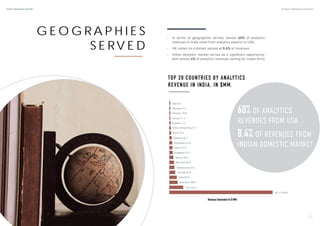
•	 In terms of geographies served, almost 60% of analytics
revenues in India come from analytics exports to USA.
•	 UK comes on a distant second at 8.4% of revenues.
•	 Indian domestic market serves as a significant opportunity,
with almost 4% of analytics revenues coming for Indian firms
Malasiya 9.6
Sw
China/ Hong K
Ro
Singapore 27.
Me
German
Netherlands 37.
TOP 20 COUNTRIES BY ANALYTICS
REVENUE IN INDIA, IN $MM.
60% OF ANALYTICS
REVENUES FROM USA
8.4% OF REVENUES FROM
INDIAN DOMESTIC MARKET
UK 169.62
Australia 109.06
India 85.26
Canada 52.42
36
y 34.65
xico 29.22
11
France 21.99
Philippines 21.09
mania 20.19
Brazil 18.98
ong 11.75
eden 11.75
Finland 11.15
Hungary 10.54
UAE 8.44
US 1,1199.08
Revenue Generated (in $ MM)
Analytics India Industry Study 2017 By Analytics India Magazine & Analytixlabs
1 4 1 5
S E C TO R
T Y P E
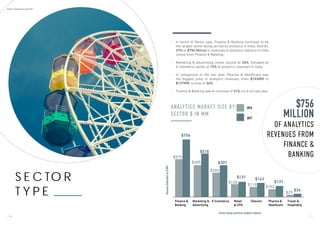
•	 In terms of Sector type, Finance & Banking continues to be
the largest sector being served by analytics in India. Overall,
37% or $756 Million in revenues to analytics industry in India
comes from Finance & Banking.
•	 Marketing & advertising comes second at 26%, followed by
E-commerce sector at 15% of analytics revenues in India.
•	 In comparison to the last year, Pharma & Healthcare saw
the biggest jump in analytics revenues, from $103MM to
$137MM, a jump of 34%.
•	 Finance & Banking saw an increase of 31% vis-à-vis last year.
ANALYTICS MARKET SIZE BY
SECTOR $ IN MM
$756
MILLION
OF ANALYTICS
REVENUES FROM
FINANCE &
BANKING$575
$405
$285
$128
$115 $102
$29
$756
$518
$307
$137 $143
$137
$34
Finance &
Banking
Marketing &
Advertising
E-Commerce Retail
& CPG
Telecom Pharma &
Healthcare
Travel &
Hospitality
Sectors being served by analytics industry
2016
2017
RevenueGenerated(in$MM)
1 6
Analytics India Industry Study 2017
1 6 1 7
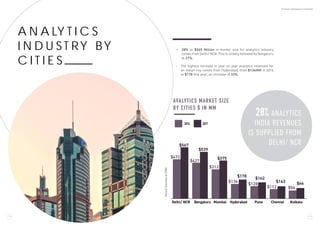
A N A LY T I C S
I N D U ST RY BY
C I T I E S
•	 28% or $565 Million in market size for analytics industry
comes from Delhi/ NCR. This is closely followed by Bengaluru
at 27%.
•	 The highest increase in year on year analytics revenues for
an Indian city comes from Hyderabad, from $134MM in 2016
to $178 this year; an increase of 33%.
$472
$427
$312
$134
$128
$112 $54
$567
$539
$375
$178 $162
$143 $66
Delhi/ NCR Bengaluru Mumbai Hyderabad Pune Chennai Kolkata
AVALYTICS MARKET SIZE
BY CITIES $ IN MM
28% ANALYTICS
INDIA REVENUES
IS SUPPLIED FROM
DELHI/ NCR
2016 2017
RevenueGenerated(in$MM)
1 9
By Analytics India Magazine & Analytixlabs
1 8
A N A LY T I C S
P R O F E S S I O N A L S
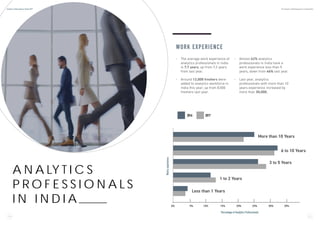
I N I N D I A 0% 30%5% 10% 15% 20% 25% 35%
More than 10 Years
6 to 10 Years
3 to 5 Years
1 to 2 Years
Less than 1 Years
•	 The average work experience of
analytics professionals in India
is 7.7 years; up from 7.2 years
from last year.
•	 Around 12,000 freshers were
added to analytics workforce in
India this year; up from 8,500
freshers last year.
•	 Almost 42% analytics
professionals in India have a
work experience less than 5
years, down from 46% last year.
•	 Last year, analytics
professionals with more than 10
years experience increased by
more than 30,000.
WORK EXPERIENCE
Percentage of Analytics Professionals
Worksexperience
2016 2017
2 0 2 1
Analytics India Industry Study 2017 By Analytics India Magazine & Analytixlabs
•Top 10 universities/ schools that analytics professionals in India
graduate from are
o University of Mumbai
o Delhi University
o Kendriya Vidyalaya
o University of Pune
o Indian Institute of Management, Calcutta
o Indian Institute of Management Bangalore
o Indira Gandhi National Open University
o Indian School of Business
o SVKM’s Narsee Monjee Institute of Management Studies
o Indian Institute of Technology, Bombay
•Almost 18% of analytics professionals in India graduate from
these 10 universities/ Schools.
•57% of analytics professionals have a Master’s/ Post Graduation
degree, same as a year earlier.
•3% of analytics professionals in India hold a PhD or Doctorate
degree, again similar to a year back.
•Women participation in analytics workforce remains low – just
24% of analytics professionals in India are women.
EDUCATION
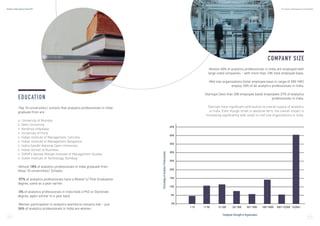
COMPANY SIZE
0%
5%
1001-50001-10 11-50 51-200 201-500 501-1000 5001-10,000 10,000+
10%
15%
20%
25%
30%
35%
40%
45%
•Almost 40% of analytics professionals in India are employed with
large sized companies – with more than 10K total employee base.
•Mid size organizations (total employee base in range of 200-10K)
employ 33% of all analytics professionals in India.
•Startups (less than 200 employee base) employees 27% of analytics
professionals in India.
Startups have significant contribution to overall output of analytics
in India. Even though small in absolute term, the overall impact is
increasing significantly with small to mid size organizations in India.
Employee Strength in Organization
PercentageofAnalyticsProfessionals
2 2
Analytics India Industry Study 2017 By Analytics India Magazine & Analytixlabs
2 3
C O N C L U S I O N
The current situation of analytics industry
presents positive picture as is suggested
by the study. The numbers are suggestive
of the fact that India is emerging as one
of the top destinations for analytics with
everything from analytics education to
job opportunities showcasing satisfactory
numbers.
The study suggested that, of the annual
inflow to analytics industry, almost 12%
can be attributed to advanced analytics,
predictive modeling and data science.
It also says that analytics industry is
expected to almost double by 2020, which
would mean an increased opportunity for
professionals dwelling in this space.
In terms of Sector type, Finance & Banking
continues to be the largest sector being
served by analytics in India with close
to $756 Million in revenues coming for
these sectors. It amounts in all to 37%
of total revenues. Other sectors that
contribute a major share in analytics
industry are marketing, ecommerce,
retail, telecom etc.
ItisnotsurprisingtoseeBangalorebeing
a leading revenue generator in the space
as it houses most number of industries.
Providing an opportunity from fresher to
experienced professionals in the space,
analytics industry turns out to be pretty
decent in terms of hiring too.
The study overall is representative of a
booming analytics industry in India and
as the numbers suggests, it is expected
to grow sizably in the future too.
2 4 2 5
Analytics India Industry Study 2017 By Analytics India Magazine & Analytixlabs
Founded in 2012, Analytics India
Magazine has since been dedicated to
passionately championing and promoting
the analytics ecosystem in India. It
chronicles the technological progress
in the space of analytics, artificial
intelligence, data science, big data by
highlighting the innovations, players in
the field, challenges shaping the future,
through the promotion and discussion
of ideas and thoughts by smart, ardent,
action-oriented individuals who want to
change the world.
Analytics India Magazine has been a
pre-eminent source of news, information
AnalytixLabs pioneers in analytics
training since 2011 and as one of the
first analytics training institutes, it is
widely acclaimed and known for high
quality training by industry experts
themselves. After establishing ourselves
as the top analytics training institute
in Delhi NCR, they slowly and steadily
progressed to earn the same reputation
pan India based on their stellar record
and student satisfaction. Their students
and analysis for the Indian analytics
analytics ecosystem by covering
opinions, analysis and insights on the
key breakthroughs and developments
in data-driven technologies as well
as highlighting how they are being
leverages for future impact.
With a dedicated editorial staff and
a network of more than 250 expert
contributors, AIM’s stories are targeted
at futurists, AI researchers, Data science
entrepreneurs, analytics aficionados and
technophiles.
are placed in leading companies across
industries like Accenture, American
Express, AbsolutData, Axtria, Bank
of America and McKinsey. They are
focused at helping their clients develop
skills in basic and advanced analytics
to enable them to emerge as “Industry
Ready” professionals and enhance their
career opportunities. It was co-founded
by Sumeet Bansal, Ankita Gupta and
Chandra Mouli.
2 6 2 72 6 2 7
Analytics India Industry Study 2017 By Analytics India Magazine & Analytixlabs
FOR MORE INFORMATION,
PLEASE CONTACT
ANALYTICS INDIA MAGAZINE
Level 8, Tower 1, Umiya Business Bay,
Cessna Business Park, Kadubeesanahalli,
Bangalore – 560103, Karnataka, India
info@analyticsindiamag.com
ANALYTIXLABS
Bengaluru Address
Bldg 41, First floor,
14th Main Road, Near
BDA complex,
Sector 7, HSR Layout
Bengaluru - 560102
info@analytixlabs.co.in
+91 95-55-219007
Gurgaon Address
Ground Floor 382,
Sector 29 Adjoining
IFFCO Chowk Metro
Station (Gate 2),Gurgaon,
Haryana- 122001
2 8
Analytics India Industry Study 2017

Analytics india industry study 2017

  • 1.
    ANALYTICS INDIA INDUSTRY STUDY 2017Broughtto you by Analytics India Magazine & Analytixlabs
  • 2.
    4 12 14 16 18 Introduction Key Trends Geographies Served SectorType Analytics Industry by Cities CONTENT 20 Analytics Professionals in India 24 Conclusion 6 SMEs are using big data to drive growth 2 3 Analytics India Industry Study 2017 By Analytics India Magazine & Analytixlabs
  • 3.
    INTRODUCTION With an increasein data generation at individual level and at organizational level, the need for tools that can analyze these data has only increased. Deployment of analytics is becoming criticaltoabusinessandfromperforming simple tasks to sophisticated ones, they are relying extensively on analytics. It can even be said that, an increasing efficiency of tools and products specializing in data processing has resulted in growth of business analytics. Either way around, there has been an extensive increase in the overall revenue generated by these companies, at an estimated $2.03 Billion annually and 23.8% of CAGR. India has also been making headways in analytics export in the form of various analytics services. With USA and UK being the major market for analytics export for India, its domestic market serves a total of 4% of analytics revenues. Given the numbers, India easily ranks as one of the top 10 destinations for analytics and the market is estimated to grow even further. With 600+ analytics firms, and more than 50% of it being startups, India us emerging as a growing hub for analytics solutions, hence giving a major boost to the industry. Presenting a picture of the overall analytics industry in India, Analytics India Magazine in association with AnalytixLabs brings its annual study titled “Analytics Industry Study-2017”, which represents the key trends in the industry. It covers all the aspect of the analytics industry such as the major geographies served, analytics market by sector type, by cities, analytics professionals etc. The study is a result of extensive primary and secondary research conducted over a duration of two months. 4 5 Analytics India Industry Study 2017 By Analytics India Magazine & Analytixlabs
  • 4.
    S M ES A R E U S I N G B I G DATA TO D R I V E G R OW T H W I T H I N C R E A S E D A D O P T I O N O F B I G DATA T E C H Big data isn’t just for big enterprises anymore. Small and medium sized enterprises (SMEs) have also become active adopters of ICT. In fact, over the last couple of years, small and mid-size Indian companies have seen more big data deployments than the big competitors. According to our study, the Big Data industry in India is expected to almost double by 2020. There is an increased adoption of SMAC amongst small and medium business verticals, owing to the increased volume of data and customer interactions. Our report pegs that the big data industry is estimated to be $2.03 billion annually in revenues and will grow at a healthy rate of 23.8% CAGR. The data boom in India isn’t just limited to big enterprises, the growth of big data startups/technology vendors is helping SMEs in scaling up infrastructure capabilities and driving insights from data. Analytics India Industry Study indicates 6 7 Analytics India Industry Study 2017 By Analytics India Magazine & Analytixlabs
  • 5.
    that the Indiadomestic market serves as a significant opportunity, with almost 4% of analytics revenues coming for Indian firms. Also, the increased availability of accessible, cheap data centres delivered by cloud vendors, has brought down the costs of upfront investment for small businesses, thereby reducing the market entry barrier. Now, it is the question of choosing the right analytics vendors that fits the bill for small businesses. As more and more vendors offer competitive data-driven capabilities, what’s crucial for startups is getting started with the right infrastructure and build for scaling. BIG DATA IMPACT IN INDIA And behind the successful adoption of big data analytics (BDA) in SMBs is the exponential growth of market. According to our research, out of the annual inflow to analytics industry – almost 12% can be attributed to advanced analytics/ predictive modeling and Data science. And a sizeable 24% can be attributed to big data. The rise of BDA and robust analytics tools is helping small businesses accomplish their goals in a short span of time, see a higher ROI and ensure continued business success. HERE ARE SOME OF THE RECENT BIG DATA DEPLOYMENTS THAT MADE HEADLINES: a) Fashion doyenne Ritu Kumar’s The Label team up with Manthan for advanced retail analytics: Indian fashion industry is usually regarded as a laggard in adopting technology solutions, but in a first, Ritu Kuamr’s The LabelwillbeusingBangalore-basedanalyticsvendorManthan’s ready-to-use solution that provides advanced algorithms out of the box, eliminating the need for business users to rely on a team of data scientists and IT for detailed analysis. Manthan’s Advanced Retail Analytics will enable the fashion business to accurately forecast demand for new SKUs, identify opportunity areas in their existing assortment range and optimize their in- season allocation and delivery plans. The advanced analytics solution will provide granular insights that help in introducing the right products based on customer preferences, optimal in- season allocation across channels based on key attributes and insights to refine their delivery strategy. BIG DATA MEANS BIG BUSINESS FOR SMBS Even though SMBs are an early stage of big data adoption, with most small enterprises dabbling in the exploratory stage, businesses have started showing a greater interest in getting analytics platform off the ground to reap the desired outcome. Most small and mid-size enterprises are now viewing big data more as a strategic initiative and a central IT function. 8 9 Analytics India Industry Study 2017 By Analytics India Magazine & Analytixlabs
  • 6.
    b) SAP isbetting big on SME sector in India: With the recent GST move, the world’s leading enterprise solution provider is making a huge play in the SME marketplace. Krishnan Chatterjee, head (marketing), Indian sub-continent of SAP India, divulged that SME units make up 80% of the client base in India as it rolled out the GST software built in India for SMEs. Over the years, SAP has emerged as a dominant player in the SME ecosystem by providing the right big data solutions to improve efficiency, cut costs and boost sales. BARRIERS TO ADOPTION OF BIG DATA ANALYTICS Ever wondered why so many small and mid-size businesses fail in a successful adoption of analytics. According to research, some of the key barriers limiting big data adoption is a lack of successful use cases, a lack of availability of packaged solutions, a limited understanding of technology stack and most importantly a lack of data-centric culture. Other factors include an acute shortage of in-house talent and the cost of implementing solutions. The other key challenge in big data tech is disparate data sources, high costs and infrastructure and concerns around RoI. Traditionally, most small and mid-size enterprises rely on intuition rather than data to drive decisions around pricing strategy or driving customer acquisition. Here’s a round-up of key limitations to big data adoption: • Concerns around the cost and complexity of big data solutions • Lack of understanding of technology stack • Lack of a data-centric culture is also a key challenge • Senior management grapples to justify high investment & RoI • Limited number of uses cases available in the Indian SME ecosystem HOW TO WIN OVER SMBS IN THE BIG DATA MARKET One of the key challenges for analytics vendors is to develop customizable software for SMEs that is easy to deploy and can be easily configured. Subscription based pricing models can provide flexibility to customers and help avoid vendor lock-in and lower entry barrier risk. To benefit from big data advances, small and mid-size companies should adopt a more modernized approach to IT, pivoting towards a cloud-powered platform to scale effectively. Also, before signing up for a big data analytics solution, businesses must learn how to identify the right data analytics tool. Case in point – self-service analytics tool enables non-tech users to find patterns and drill insights and create beautiful dashboards while ETL tools help extract data at high speed for analysis. Some businesses may only require dashboard tools to present insights to management or skim over what-if scenarios through pie-charts and bar charts. However, one of the key challenges for analytics vendors is to create flexible tools, keeping the end user in mind. Also, the DIY analytics and forecasting solutions should support different types of data. 1 0 1 1 Analytics India Industry Study 2017 By Analytics India Magazine & Analytixlabs
  • 7.
    K E Y TR E N D S • Analytics/ Data science/ Big Data industry in India currently estimated to be $2.03 Billion annually in revenues, growing at a healthy rate of 23.8% CAGR. • Of the annual inflow to analytics industry – almost 12% can be attributed to advanced analytics/ predictive modeling and Data science • A sizeable 24% can be attributed to big data. • Analytics/ Data science/ Big Data industry in India is expected to almost double by 2020. $2.03 BILLION ANALYTICS INDIA MARKET SIZE 23.8% ANNUAL GROWTH RATE 1 2 1 3 Analytics India Industry Study 2017 By Analytics India Magazine & Analytixlabs
  • 8.
    G E OG R A P H I E S S E RV E D • In terms of geographies served, almost 60% of analytics revenues in India come from analytics exports to USA. • UK comes on a distant second at 8.4% of revenues. • Indian domestic market serves as a significant opportunity, with almost 4% of analytics revenues coming for Indian firms Malasiya 9.6 Sw China/ Hong K Ro Singapore 27. Me German Netherlands 37. TOP 20 COUNTRIES BY ANALYTICS REVENUE IN INDIA, IN $MM. 60% OF ANALYTICS REVENUES FROM USA 8.4% OF REVENUES FROM INDIAN DOMESTIC MARKET UK 169.62 Australia 109.06 India 85.26 Canada 52.42 36 y 34.65 xico 29.22 11 France 21.99 Philippines 21.09 mania 20.19 Brazil 18.98 ong 11.75 eden 11.75 Finland 11.15 Hungary 10.54 UAE 8.44 US 1,1199.08 Revenue Generated (in $ MM) Analytics India Industry Study 2017 By Analytics India Magazine & Analytixlabs 1 4 1 5
  • 9.
    S E CTO R T Y P E • In terms of Sector type, Finance & Banking continues to be the largest sector being served by analytics in India. Overall, 37% or $756 Million in revenues to analytics industry in India comes from Finance & Banking. • Marketing & advertising comes second at 26%, followed by E-commerce sector at 15% of analytics revenues in India. • In comparison to the last year, Pharma & Healthcare saw the biggest jump in analytics revenues, from $103MM to $137MM, a jump of 34%. • Finance & Banking saw an increase of 31% vis-à-vis last year. ANALYTICS MARKET SIZE BY SECTOR $ IN MM $756 MILLION OF ANALYTICS REVENUES FROM FINANCE & BANKING$575 $405 $285 $128 $115 $102 $29 $756 $518 $307 $137 $143 $137 $34 Finance & Banking Marketing & Advertising E-Commerce Retail & CPG Telecom Pharma & Healthcare Travel & Hospitality Sectors being served by analytics industry 2016 2017 RevenueGenerated(in$MM) 1 6 Analytics India Industry Study 2017 1 6 1 7
  • 10.
    A N ALY T I C S I N D U ST RY BY C I T I E S • 28% or $565 Million in market size for analytics industry comes from Delhi/ NCR. This is closely followed by Bengaluru at 27%. • The highest increase in year on year analytics revenues for an Indian city comes from Hyderabad, from $134MM in 2016 to $178 this year; an increase of 33%. $472 $427 $312 $134 $128 $112 $54 $567 $539 $375 $178 $162 $143 $66 Delhi/ NCR Bengaluru Mumbai Hyderabad Pune Chennai Kolkata AVALYTICS MARKET SIZE BY CITIES $ IN MM 28% ANALYTICS INDIA REVENUES IS SUPPLIED FROM DELHI/ NCR 2016 2017 RevenueGenerated(in$MM) 1 9 By Analytics India Magazine & Analytixlabs 1 8
  • 11.
    A N ALY T I C S P R O F E S S I O N A L S I N I N D I A 0% 30%5% 10% 15% 20% 25% 35% More than 10 Years 6 to 10 Years 3 to 5 Years 1 to 2 Years Less than 1 Years • The average work experience of analytics professionals in India is 7.7 years; up from 7.2 years from last year. • Around 12,000 freshers were added to analytics workforce in India this year; up from 8,500 freshers last year. • Almost 42% analytics professionals in India have a work experience less than 5 years, down from 46% last year. • Last year, analytics professionals with more than 10 years experience increased by more than 30,000. WORK EXPERIENCE Percentage of Analytics Professionals Worksexperience 2016 2017 2 0 2 1 Analytics India Industry Study 2017 By Analytics India Magazine & Analytixlabs
  • 12.
    •Top 10 universities/schools that analytics professionals in India graduate from are o University of Mumbai o Delhi University o Kendriya Vidyalaya o University of Pune o Indian Institute of Management, Calcutta o Indian Institute of Management Bangalore o Indira Gandhi National Open University o Indian School of Business o SVKM’s Narsee Monjee Institute of Management Studies o Indian Institute of Technology, Bombay •Almost 18% of analytics professionals in India graduate from these 10 universities/ Schools. •57% of analytics professionals have a Master’s/ Post Graduation degree, same as a year earlier. •3% of analytics professionals in India hold a PhD or Doctorate degree, again similar to a year back. •Women participation in analytics workforce remains low – just 24% of analytics professionals in India are women. EDUCATION COMPANY SIZE 0% 5% 1001-50001-10 11-50 51-200 201-500 501-1000 5001-10,000 10,000+ 10% 15% 20% 25% 30% 35% 40% 45% •Almost 40% of analytics professionals in India are employed with large sized companies – with more than 10K total employee base. •Mid size organizations (total employee base in range of 200-10K) employ 33% of all analytics professionals in India. •Startups (less than 200 employee base) employees 27% of analytics professionals in India. Startups have significant contribution to overall output of analytics in India. Even though small in absolute term, the overall impact is increasing significantly with small to mid size organizations in India. Employee Strength in Organization PercentageofAnalyticsProfessionals 2 2 Analytics India Industry Study 2017 By Analytics India Magazine & Analytixlabs 2 3
  • 13.
    C O NC L U S I O N The current situation of analytics industry presents positive picture as is suggested by the study. The numbers are suggestive of the fact that India is emerging as one of the top destinations for analytics with everything from analytics education to job opportunities showcasing satisfactory numbers. The study suggested that, of the annual inflow to analytics industry, almost 12% can be attributed to advanced analytics, predictive modeling and data science. It also says that analytics industry is expected to almost double by 2020, which would mean an increased opportunity for professionals dwelling in this space. In terms of Sector type, Finance & Banking continues to be the largest sector being served by analytics in India with close to $756 Million in revenues coming for these sectors. It amounts in all to 37% of total revenues. Other sectors that contribute a major share in analytics industry are marketing, ecommerce, retail, telecom etc. ItisnotsurprisingtoseeBangalorebeing a leading revenue generator in the space as it houses most number of industries. Providing an opportunity from fresher to experienced professionals in the space, analytics industry turns out to be pretty decent in terms of hiring too. The study overall is representative of a booming analytics industry in India and as the numbers suggests, it is expected to grow sizably in the future too. 2 4 2 5 Analytics India Industry Study 2017 By Analytics India Magazine & Analytixlabs
  • 14.
    Founded in 2012,Analytics India Magazine has since been dedicated to passionately championing and promoting the analytics ecosystem in India. It chronicles the technological progress in the space of analytics, artificial intelligence, data science, big data by highlighting the innovations, players in the field, challenges shaping the future, through the promotion and discussion of ideas and thoughts by smart, ardent, action-oriented individuals who want to change the world. Analytics India Magazine has been a pre-eminent source of news, information AnalytixLabs pioneers in analytics training since 2011 and as one of the first analytics training institutes, it is widely acclaimed and known for high quality training by industry experts themselves. After establishing ourselves as the top analytics training institute in Delhi NCR, they slowly and steadily progressed to earn the same reputation pan India based on their stellar record and student satisfaction. Their students and analysis for the Indian analytics analytics ecosystem by covering opinions, analysis and insights on the key breakthroughs and developments in data-driven technologies as well as highlighting how they are being leverages for future impact. With a dedicated editorial staff and a network of more than 250 expert contributors, AIM’s stories are targeted at futurists, AI researchers, Data science entrepreneurs, analytics aficionados and technophiles. are placed in leading companies across industries like Accenture, American Express, AbsolutData, Axtria, Bank of America and McKinsey. They are focused at helping their clients develop skills in basic and advanced analytics to enable them to emerge as “Industry Ready” professionals and enhance their career opportunities. It was co-founded by Sumeet Bansal, Ankita Gupta and Chandra Mouli. 2 6 2 72 6 2 7 Analytics India Industry Study 2017 By Analytics India Magazine & Analytixlabs
  • 15.
    FOR MORE INFORMATION, PLEASECONTACT ANALYTICS INDIA MAGAZINE Level 8, Tower 1, Umiya Business Bay, Cessna Business Park, Kadubeesanahalli, Bangalore – 560103, Karnataka, India info@analyticsindiamag.com ANALYTIXLABS Bengaluru Address Bldg 41, First floor, 14th Main Road, Near BDA complex, Sector 7, HSR Layout Bengaluru - 560102 info@analytixlabs.co.in +91 95-55-219007 Gurgaon Address Ground Floor 382, Sector 29 Adjoining IFFCO Chowk Metro Station (Gate 2),Gurgaon, Haryana- 122001 2 8 Analytics India Industry Study 2017