ANALYTICAL LEARNING
TEAM MEMBERS:
P.HEMANTH (795)
B.GANESH KUMAR (7A8)
CH.ARUN KUMAR (7B7)
V. CHARAN (7C2)
Click to edit Master title style
2
Topics to be covered:
-Definition and significance of analytical learning.
-Differences between analytical learning and other learning
paradigms.
-Historical context and development.
-Application of analytical learning.
2
Click to edit Master title style
3
Definition and significance of analytical learning
3
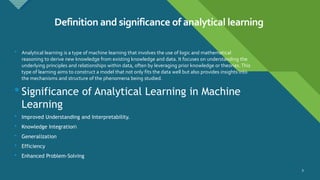
• Analytical learning is a type of machine learning that involves the use of logic and mathematical
reasoning to derive new knowledge from existing knowledge and data. It focuses on understanding the
underlying principles and relationships within data, often by leveraging prior knowledge or theories.This
type of learning aims to construct a model that not only fits the data well but also provides insights into
the mechanisms and structure of the phenomena being studied.
•Significance of Analytical Learning in Machine
Learning
• Improved Understanding and Interpretability.
• Knowledge Integration
• Generalization
• Efficiency
• Enhanced Problem-Solving
Click to edit Master title style
4
Differences between analytical learning and other learning
paradigms
4
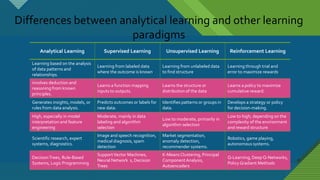
Analytical Learning Supervised Learning Unsupervised Learning Reinforcement Learning
Learning based on the analysis
of data patterns and
relationships.
Learning from labeled data
where the outcome is known.
Learning from unlabeled data
to find structure.
Learning through trial and
error to maximize rewards.
involves deduction and
reasoning from known
principles.
Learns a function mapping
inputs to outputs.
Learns the structure or
distribution of the data
Learns a policy to maximize
cumulative reward.
Generates insights, models, or
rules from data analysis.
Predicts outcomes or labels for
new data.
Identifies patterns or groups in
data.
Develops a strategy or policy
for decision-making.
High, especially in model
interpretation and feature
engineering
Moderate, mainly in data
labeling and algorithm
selection
Low to moderate, primarily in
algorithm selection
Low to high, depending on the
complexity of the environment
and reward structure
Scientific research, expert
systems, diagnostics.
Image and speech recognition,
medical diagnosis, spam
detection
Market segmentation,
anomaly detection,
recommender systems.
Robotics, game playing,
autonomous systems.
DecisionTrees, Rule-Based
Systems, Logic Programming
SupportVector Machines,
Neural Network s, Decision
Trees
K-Means Clustering, Principal
ComponentAnalysis,
Autoencoders
Q-Learning, Deep Q-Networks,
Policy Gradient Methods
Click to edit Master title style
5
Historical context and development
5
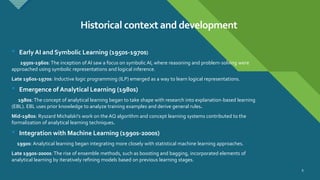
• Early AI and Symbolic Learning (1950s-1970s)
1950s-1960s: The inception of AI saw a focus on symbolic AI, where reasoning and problem-solving were
approached using symbolic representations and logical inference.
Late 1960s-1970s: Inductive logic programming (ILP) emerged as a way to learn logical representations.
• Emergence of Analytical Learning (1980s)
1980s:The concept of analytical learning began to take shape with research into explanation-based learning
(EBL). EBL uses prior knowledge to analyze training examples and derive general rules.
Mid-1980s: Ryszard Michalski's work on the AQ algorithm and concept learning systems contributed to the
formalization of analytical learning techniques.
• Integration with Machine Learning (1990s-2000s)
1990s: Analytical learning began integrating more closely with statistical machine learning approaches.
Late 1990s-2000s: The rise of ensemble methods, such as boosting and bagging, incorporated elements of
analytical learning by iteratively refining models based on previous learning stages.
Click to edit Master title style
6
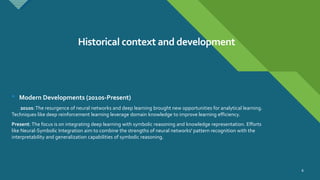
Historical context and development
6
• Modern Developments (2010s-Present)
2010s:The resurgence of neural networks and deep learning brought new opportunities for analytical learning.
Techniques like deep reinforcement learning leverage domain knowledge to improve learning efficiency.
Present: The focus is on integrating deep learning with symbolic reasoning and knowledge representation. Efforts
like Neural-Symbolic Integration aim to combine the strengths of neural networks' pattern recognition with the
interpretability and generalization capabilities of symbolic reasoning.
Click to edit Master title style
7
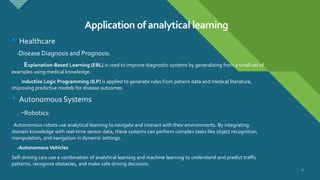
Application of analytical learning
7
• Healthcare
-Disease Diagnosis and Prognosis:
Explanation-Based Learning (EBL) is used to improve diagnostic systems by generalizing from a small set of
examples using medical knowledge.
Inductive Logic Programming (ILP) is applied to generate rules from patient data and medical literature,
improving predictive models for disease outcomes
• Autonomous Systems
-Robotics:
Autonomous robots use analytical learning to navigate and interact with their environments. By integrating
domain knowledge with real-time sensor data, these systems can perform complex tasks like object recognition,
manipulation, and navigation in dynamic settings.
-Autonomous Vehicles
Self-driving cars use a combination of analytical learning and machine learning to understand and predict traffic
patterns, recognize obstacles, and make safe driving decisions.
Click to edit Master title style
8
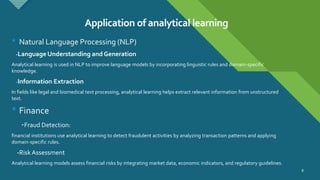
Application of analytical learning
8
• Natural Language Processing (NLP)
-Language Understanding and Generation
Analytical learning is used in NLP to improve language models by incorporating linguistic rules and domain-specific
knowledge.
-Information Extraction
In fields like legal and biomedical text processing, analytical learning helps extract relevant information from unstructured
text.
• Finance
-Fraud Detection:
financial institutions use analytical learning to detect fraudulent activities by analyzing transaction patterns and applying
domain-specific rules.
-RiskAssessment
Analytical learning models assess financial risks by integrating market data, economic indicators, and regulatory guidelines.
Click to edit Master title style
9
ThankYou

ANALYTICAL LEARNING IN MACHINE LEARNINGS

  • 1.
    ANALYTICAL LEARNING TEAM MEMBERS: P.HEMANTH(795) B.GANESH KUMAR (7A8) CH.ARUN KUMAR (7B7) V. CHARAN (7C2)
  • 2.
    Click to editMaster title style 2 Topics to be covered: -Definition and significance of analytical learning. -Differences between analytical learning and other learning paradigms. -Historical context and development. -Application of analytical learning. 2
  • 3.
    Click to editMaster title style 3 Definition and significance of analytical learning 3 • Analytical learning is a type of machine learning that involves the use of logic and mathematical reasoning to derive new knowledge from existing knowledge and data. It focuses on understanding the underlying principles and relationships within data, often by leveraging prior knowledge or theories.This type of learning aims to construct a model that not only fits the data well but also provides insights into the mechanisms and structure of the phenomena being studied. •Significance of Analytical Learning in Machine Learning • Improved Understanding and Interpretability. • Knowledge Integration • Generalization • Efficiency • Enhanced Problem-Solving
  • 4.
    Click to editMaster title style 4 Differences between analytical learning and other learning paradigms 4 Analytical Learning Supervised Learning Unsupervised Learning Reinforcement Learning Learning based on the analysis of data patterns and relationships. Learning from labeled data where the outcome is known. Learning from unlabeled data to find structure. Learning through trial and error to maximize rewards. involves deduction and reasoning from known principles. Learns a function mapping inputs to outputs. Learns the structure or distribution of the data Learns a policy to maximize cumulative reward. Generates insights, models, or rules from data analysis. Predicts outcomes or labels for new data. Identifies patterns or groups in data. Develops a strategy or policy for decision-making. High, especially in model interpretation and feature engineering Moderate, mainly in data labeling and algorithm selection Low to moderate, primarily in algorithm selection Low to high, depending on the complexity of the environment and reward structure Scientific research, expert systems, diagnostics. Image and speech recognition, medical diagnosis, spam detection Market segmentation, anomaly detection, recommender systems. Robotics, game playing, autonomous systems. DecisionTrees, Rule-Based Systems, Logic Programming SupportVector Machines, Neural Network s, Decision Trees K-Means Clustering, Principal ComponentAnalysis, Autoencoders Q-Learning, Deep Q-Networks, Policy Gradient Methods
  • 5.
    Click to editMaster title style 5 Historical context and development 5 • Early AI and Symbolic Learning (1950s-1970s) 1950s-1960s: The inception of AI saw a focus on symbolic AI, where reasoning and problem-solving were approached using symbolic representations and logical inference. Late 1960s-1970s: Inductive logic programming (ILP) emerged as a way to learn logical representations. • Emergence of Analytical Learning (1980s) 1980s:The concept of analytical learning began to take shape with research into explanation-based learning (EBL). EBL uses prior knowledge to analyze training examples and derive general rules. Mid-1980s: Ryszard Michalski's work on the AQ algorithm and concept learning systems contributed to the formalization of analytical learning techniques. • Integration with Machine Learning (1990s-2000s) 1990s: Analytical learning began integrating more closely with statistical machine learning approaches. Late 1990s-2000s: The rise of ensemble methods, such as boosting and bagging, incorporated elements of analytical learning by iteratively refining models based on previous learning stages.
  • 6.
    Click to editMaster title style 6 Historical context and development 6 • Modern Developments (2010s-Present) 2010s:The resurgence of neural networks and deep learning brought new opportunities for analytical learning. Techniques like deep reinforcement learning leverage domain knowledge to improve learning efficiency. Present: The focus is on integrating deep learning with symbolic reasoning and knowledge representation. Efforts like Neural-Symbolic Integration aim to combine the strengths of neural networks' pattern recognition with the interpretability and generalization capabilities of symbolic reasoning.
  • 7.
    Click to editMaster title style 7 Application of analytical learning 7 • Healthcare -Disease Diagnosis and Prognosis: Explanation-Based Learning (EBL) is used to improve diagnostic systems by generalizing from a small set of examples using medical knowledge. Inductive Logic Programming (ILP) is applied to generate rules from patient data and medical literature, improving predictive models for disease outcomes • Autonomous Systems -Robotics: Autonomous robots use analytical learning to navigate and interact with their environments. By integrating domain knowledge with real-time sensor data, these systems can perform complex tasks like object recognition, manipulation, and navigation in dynamic settings. -Autonomous Vehicles Self-driving cars use a combination of analytical learning and machine learning to understand and predict traffic patterns, recognize obstacles, and make safe driving decisions.
  • 8.
    Click to editMaster title style 8 Application of analytical learning 8 • Natural Language Processing (NLP) -Language Understanding and Generation Analytical learning is used in NLP to improve language models by incorporating linguistic rules and domain-specific knowledge. -Information Extraction In fields like legal and biomedical text processing, analytical learning helps extract relevant information from unstructured text. • Finance -Fraud Detection: financial institutions use analytical learning to detect fraudulent activities by analyzing transaction patterns and applying domain-specific rules. -RiskAssessment Analytical learning models assess financial risks by integrating market data, economic indicators, and regulatory guidelines.
  • 9.
    Click to editMaster title style 9 ThankYou