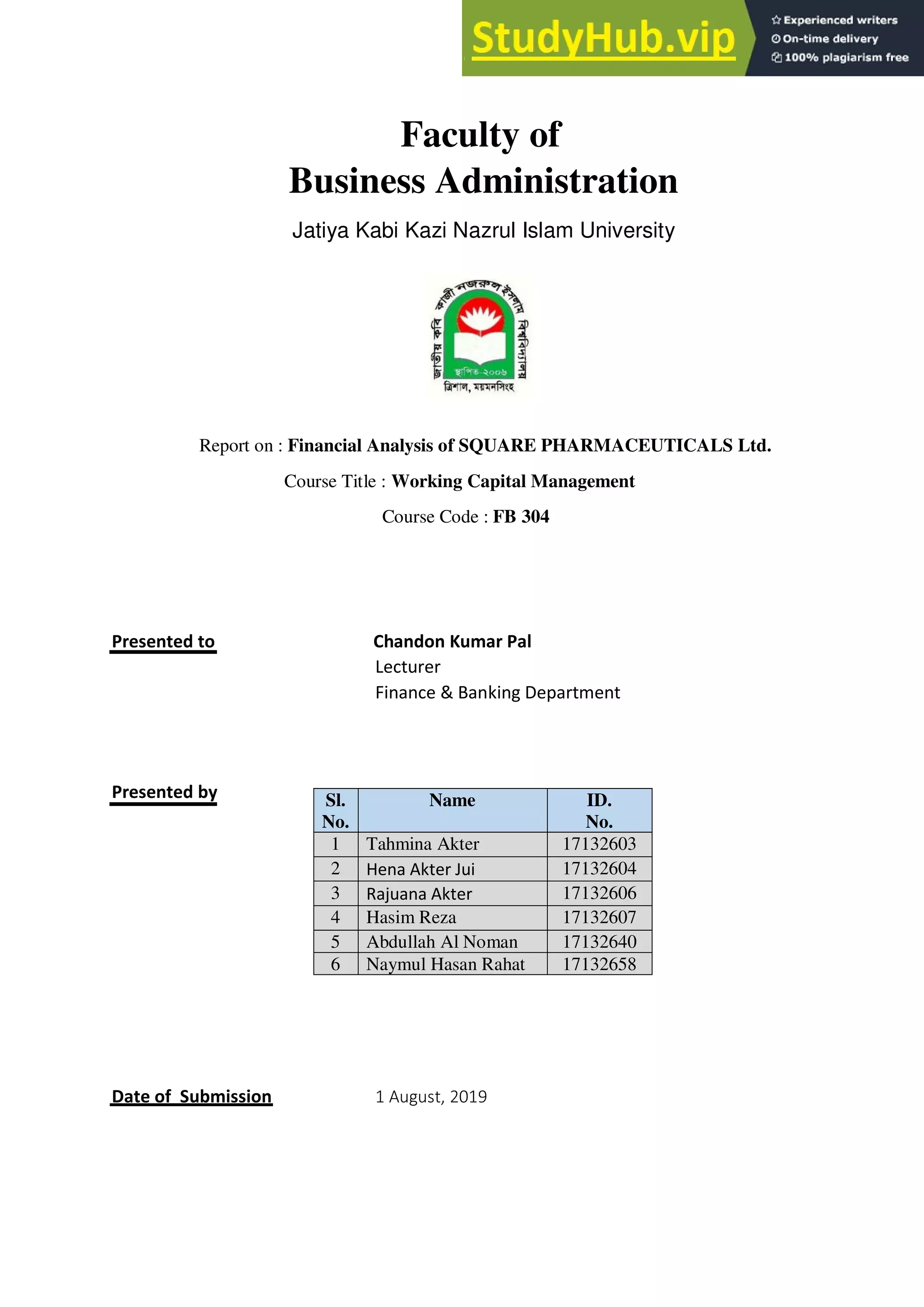
Faculty of
Business Administration
Jatiya Kabi Kazi Nazrul Islam University
Report on : Financial Analysis of SQUARE PHARMACEUTICALS Ltd.
Course Title : Working Capital Management
Course Code : FB 304
Presented to Chandon Kumar Pal
Lecturer
Finance & Banking Department
Presented by
Date of Submission 1 August, 2019
Sl.
No.
Name ID.
No.
1 Tahmina Akter 17132603
2 Hena Akter Jui 17132604
3 Rajuana Akter 17132606
4 Hasim Reza 17132607
5 Abdullah Al Noman 17132640
6 Naymul Hasan Rahat 17132658
Letter of Transmittal
1 August, 2019
Chandon Kumar Pal
Lecturer
Finance & Banking Department
Jatiya Kabi Kazi Nazrul Islam University,Trishal,Mymensingh.
Subject:Submission of Report on Financial Analysis of SQUARE PHARMACEUTICALS
Ltd.
Dear Sir,
This is our great pleasure to submit the report.
We have worked hard and put our best effort to make this report successful.It has been an
enlightening experience for us while preparing the report.
We would like to express our gratitude to your kind guidance in preparing the report. We will
be glad if you find this report useful to have an apparent perspective on the issue. If you have
any query, please do not hesitate to call us about the report.
Sincerely Yours,
Abdullah Al Noman
ID:17132640
Finance & Banking Department
Group Leader
(On behalf of Group 2)
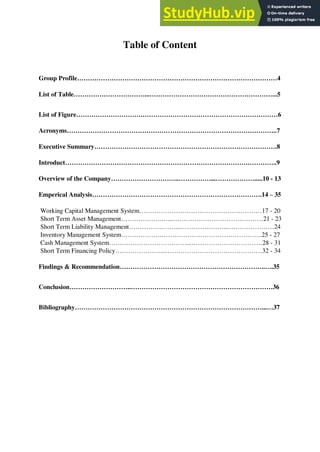
Table of Content
Group Profile…………………………………………………………………………………4
List of Table……………………………...…………………………………………………...5
List of Figure………………………….………………………………………………………6
Acronyms……………………………………………………………………………………..7
Executive Summary………………………………………………………………………….8
Introduct………………………………………………………………………….…………..9
Overview of the Company…………………………..……………...……………….....10 - 13
Emperical Analysis…………………………………………………………………….14 – 35
Working Capital Management System…………………………………………………17 - 20
Short Term Asset Management……………….…...……………………………………21 - 23
Short Term Liability Management…………….……...…………………..…………………24
Inventory Management System……………….………………………………………..25 - 27
Cash Management System………………………………...……………………………28 - 31
Short Term Financing Policy…………………...………………………………………32 - 34
Findings & Recommendation…………………………………………………………..….35
Conclusion………………………..…………………………………………………………36
Bibliography……………………………………………………………………………...…37
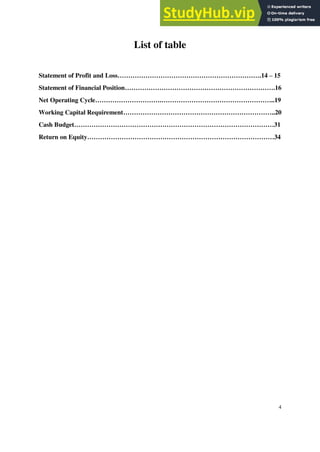
List of table
Statement of Profit and Loss………………………………………………………….14 – 15
Statement of Financial Position…………………………………………………………….16
Net Operating Cycle………………………….……………………………………………..19
Working Capital Requirement……………………………………………………………..20
Cash Budget…………………………………………………………………………………31
Return on Equity……………………………………………………………………………34
4
List of Figure
Cash Management Cycle………………………………………………………….………..28
Matching Policy……………….…………………………………………………………….32
Conservative Policy.………………………….……………………………………………..32
Aggressive Policy……………………..……………………………………………………..33
5
Group Profile
Serial
number
Name ID Participation
(page)
Signature
01 Tahmina Akter 17132603
02 Hena Akter Jui 17132604
03 Rajuana Akter 17132606
04 Hasim Reza 17132607
05 Abdullah Al Noman 17132640
06 Naymul Hasan Rahat 17132658
6
Acronyms
USD = United States Dollar (Currency of the USA);
API = an Application Program Interface;
FDA = Food and Drug Administration;
MHRA = Healthcare Products Regulatory Agency;
UNICEF = United Nations Children's Fund;
CGMP = Cyclic Guanosine Monophosphate;
WHO = World Health Organization;
USGDA = United States Food and Drug Administration;
PIC = Pharmaceutical Inspection Co-operation Scheme;
MCC = Medicines Control Council;
CSR = Corporate Social Responsibility;
UNGS = United Nations Global Compact;
WCM = Working Capital Management;
RMC = Raw Material Consumption;
RMCP = Raw Material Conversion Period;
WIP = Work in Process;
WIPCP = Work in Process Conversion Period;
FG = Finished Goods;
FGCP = Finished Goods Conversion Period;
BDCP = Book Debt Conversion Period;
PDP = Payable Deferred Period;
COGS = Cost of Goods Sold;
EPS = Earnings per Share;
NAV =Net Assets Value Per Share;
EOQ =Economic Order Quantity;
OC =Ordering Cost;
CC =Carrying Cost;
7
Executive Summary
SQUARE Pharmaceuticals Limited is the largest pharmaceutical company in Bangladesh and
it has been continuously in the 1st position among all national and multinational companies
since 1985. Throughout the report we are tried to find out the key factors behind their
continuous success. In this report the working capital management of the company is really
efficient and as well as effective. The empirical analysis of this report shows the company’s
efficiency of inventory management and also shows the satisfactory condition in cash
management, current asset and the condition of the company is also in a satisfactory to manage
its creditors. The short term assets management part states the satisfactory condition. The cash
management system part states that company’s cash management is in efficient level and very
strong position at this year. In case of short term financing we notice that the return on equity
is also in a satisfactory condition the company use just 8% debt. Which is really admirable in
this market situation.
8
Introduct
 Topic: Analysis on working capital management system of Square Pharmaceuticals
Ltd.
 Company Name: SQUARE PHARMACEUTICALS Ltd
 Establishment: 1958
 Listed as a Public Company: 1991
 Listed in Stock Exhange: 1995
 Type of Company: Pharmaceutical
 Location: Mohakhali, Dhaka, Bangladesh
 Website: squarepharma.com.bd
 No. of Number of employees: 7390 (2016-17)
 Ownership: Public Limited Company
 Authorized Capital: 10,000 million
9
Overview of The Company
Corporate Profile
SQUARE today symbolizes a name – a state of mind. But its journey to the growth and
prosperity has been no bed of roses. From the inception in 1958, it has today burgeoned into
one of the top line conglomerates in Bangladesh. Square Pharmaceuticals Ltd., the flagship
company, is holding the strong leadership position in the pharmaceutical industry of
Bangladesh since 1985 and is now on its way to becoming a high performance global player.
SQUARE Pharmaceuticals Limited is the largest pharmaceutical company in Bangladesh and
it has been continuously in the 1st position among all national and multinational companies
since 1985. It was established in 1958, converted into a public limited company in 1991 and
listed with stock exchanges in 1995. The turnover of Square Pharma was Taka 45.88 Billion
(US$ 540 million) with about 16.95% market share having a growth rate of about 8.52% (July
2017– June 2018).
Looking beyond the horizon
SQUARE Pharmaceuticals Limited has extended its range of services towards the highway of
global market. It pioneered exports of medicines from Bangladesh in 1987 and has been
exporting antibiotics and other pharmaceutical products. Present export market covers 42
countries. This extension in business and services has manifested the credibility of Square
Pharmaceuticals Limited.
Founder Chairman's Profile
Founder Chairman
(1925-2012)
Mr. Samson H Chowdhury was born on 25 September, 1925. After completing education in
India he returned to the then East Pakistan and settled at Ataikula village in Pabna district where
his father was working as a Medical Officer in an outdoor dispensary. In 1952, he started a
small pharmacy in Ataikula village which is about 160 km off capital Dhaka in the north-west
part of Bangladesh. Mr. Samson H Chowdhury then ventured into a partnership pharmaceutical
company with three of his friends in 1958. When asked why the name SQUARE was chosen
he remembers - "We named it SQUARE because it was started by four friends and also because
it signifies accuracy and perfection meaning quality" as they committed in manufacturing
quality products. Now that small company of 1958 is a publicly listed diversified group of
companies employing more than 28,000 people. The current yearly group turnover is 616
million USD.
10
SQUARE today is a name not only known in the Pharmaceutical world, it is today a synonym
of quality- be it consumer product, toiletries, health products, textiles, agro vet products,
information technology and few more. All these were possible due to his innovative ideas,
tireless efforts, perseverance and dedication with self confidence which contributed to his
successful achievements. Now the name "SQUARE" inspires trust. Under his dynamic
leadership, SQUARE is set to continue its progress globally.
Mission , Vision and Objectives of Square Pharmaceuticals Ltd.
Mission
Our Mission is to produce and provide quality & innovative healthcare relief for people,
maintain stringently ethical standard in business operation also ensuring benefit to the
shareholders, stakeholders and the society at large.
Vision
We view business as a means to the material and social wellbeing of the investors, employees
and the society at large, leading to accretion of wealth through financial and moral gains as a
part of the process of the human civilization.
Objective
Our objectives are to conduct transparent business operation based on market mechanism
within the legal & social framework with aims to attain the mission reflected by our vision.
History & Growth
Milestone of excellence
1964-Converted into a Private Limited Company.1974-Technical collaboration with Janseen
Pharmaceuticals, Belgium, a subsidiary of Johnson & Johonson Intl, USA.
In 1985-Achived market leadership in the Pharmaceuticals market in Bangladesh among all
the national and multinational companies.In 1987-Pioneer in Pharmaceutical export from
Bangladesh.In 1991-Converted into a Public Limited Company.In 1994-Initial Public Offering
of Square Pharmaceutical's shares.
In 1995-Chemical Division starts production of pharmaceutical bulk products (API).In 1997-
Won the National Export Trophy for exporting pharmaceuticals.In 2001-UK FDA/UK MHRA
standard new Pharmaceutical factory goes into operation built under the supervision of Bovis
Lend Lease, UK.
In 2002-Square enlisted as INICEF's global supplier. In 2005-Inception of Square Harbal &
Nutraceuticals Ltd.
11
In 2007-Square Pharmaceuticals Ltd. Dhaka unit gets the UK MHRA approval. In 2009-Starts
manufacturing of insulin, hormone & steroid products maintaining quality standards of US
FDA, MHRA in dedicated manufacturing facility complying with the CGMP of WHO.
2013-Samson H Chowdhury "Centre of Excellence" starts its journey.
2014-Liquid Formulation Unit of Square Pharmaceuticals Ltd. Pabna Site gets PIC/S
(Pharmaceutical Inspection Co-operation Scheme) approval.
2015-Square Pharmaceuticals gets USFDA's approval.
2016-Dhaka Site's solid dosage unit and Metered Dose Inhaler unit get MCC (Medicines
Control Council), South Africa and PIC/S approval.
Corporate Social Responsibility
Corporate Social Responsibility (CSR) is the continuing commitment by business to behave
ethically and contribute to economic development while improving the quality of life of the
workforce and their families as well as of the local community and society at large.
Our Business Motivation is Being Good by Doing Well and to conduct transparent business
operations based on market mechanism within the legal, ethical & social framework with aims
to attain the mission reflected by our vision. We scale-up CSR activities to consider the interests
of our external & internal stakeholders like customers, employees, vendors, shareholders,
society, government etc. and ecological & ethical considerations in all aspects of operations.
SQUARE is one of the pioneer signatories of United Nations Global Compact (UNGC) in
Bangladesh. UNGC principles are aligned with company's culture from the very outset.
SQUARE recognizes that progressive labour policies are good business practices, especially
for a company like us that has global ambition. We follow laws and encourage work
environment that welcomes diversity and also follow non-discrimination & fair treatment
policy both in the recruitment & selection process and performance management system. We
have Trade Union & our HR policies have been continuously up-to-dated as per existing labour
law of the country. We do not allow any female employees during night shift operations & we
strictly prohibit any form of forced labour. We actively pursue the policy of No child labour in
SQUARE.
Transparency & business ethics is the core value of SQUARE and it is strictly followed at
every step of the business processes. Every business in SQUARE is modeled in a way that
enables the management to ensure highest degree of both financial and behavioral
accountability. SQUARE pursues Zero Tolerance policy against all kinds of corruption.
12
SQUARE's activity goes well beyond the sphere of business. As socially conscious and
responsible corporate body SQUARE is committed to the improvement of the society as a
whole. Meril-Prothom Alo festival sponsored by SQUARE, has become a national calendar
event. SQUARE helps many NGO's in their effort to make available healthcare to the
disadvantage population of the country. It sponsors programs to build awareness on the
healthcare need. SQUARE is also a major sponsor of sporting events in the country.
SQUARE is proud to be a Bangladeshi Company actively involved in various field of
Corporate Social Responsibility:
❖ Commitment towards Environment.
❖ Commitment towards Employee.
❖ Support to education.
❖ Advancing research and development program.
❖ Women Empowerment.
❖ Commitment towards society & support to social grounds.
❖ In Disaster Management.
❖ Responsibility towards government.
❖ SQUARE Child Development Center- a journey started.
13
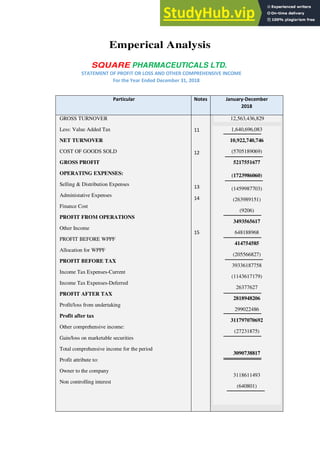
Emperical Analysis
SQUARE PHARMACEUTICALS LTD.
STATEMENT OF PROFIT OR LOSS AND OTHER COMPREHENSIVE INCOME
For the Year Ended December 31, 2018
Particular Notes January-December
2018
GROSS TURNOVER
Less: Value Added Tax
NET TURNOVER
COST OF GOODS SOLD
GROSS PROFIT
OPERATING EXPENSES:
Selling & Distribution Expenses
Administative Expenses
Finance Cost
PROFIT FROM OPERATIONS
Other Income
PROFIT BEFORE WPPF
Allocation for WPPF
PROFIT BEFORE TAX
Income Tax Expenses-Current
Income Tax Expenses-Deferred
PROFIT AFTER TAX
Profit/loss from undertaking
Profit after tax
Other comprehensive income:
Gain/loss on marketable securities
Total comprehensive income for the period
Profit attribute to:
Owner to the company
Non controlling interest
11
12
13
14
15
12,563,436,829
1,640,696,083
10,922,740,746
(5705189069)
5217551677
(1723986060)
(1459987703)
(263989151)
(9206)
3493565617
648188968
414754585
(205566827)
39336187758
(1143617179)
26377627
2818948206
299022486
311797070692
(27231875)
3090738817
3118611493
(640801)
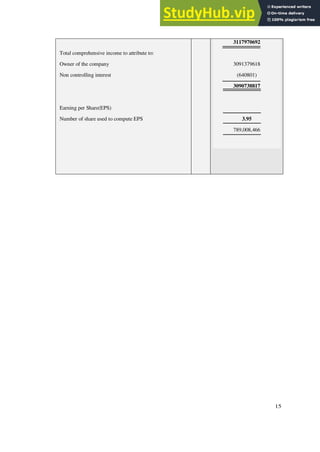
Total comprehensive income to attribute to:
Owner of the company
Non controlling interest
Earning per Share(EPS)
Number of share used to compute EPS
3117970692
3091379618
(640801)
3090738817
3.95
789,008,466
15
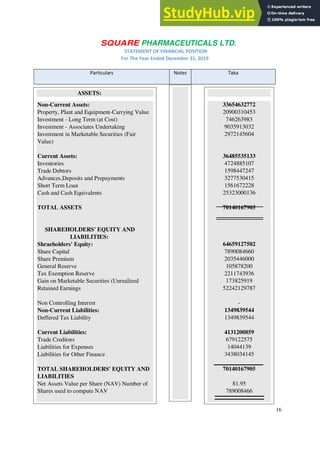
SQUARE PHARMACEUTICALS LTD.
STATEMENT OF FINANCIAL POSITION
For The Year Ended December 31, 2019
Particulars Notes Taka
16
ASSETS:
Non-Current Assets:
Property, Plant and Equipment-Carrying Value
Investment - Long Term (at Cost)
Investment - Associates Undertaking
Investment in Marketable Securities (Fair
Value)
Current Assets:
Inventories
Trade Debtors
Advances,Deposits and Prepayments
Short Term Loan
Cash and Cash Equivalents
TOTAL ASSETS
SHAREHOLDERS' EQUITY AND
LIABILITIES:
Shraeholders' Equity:
Share Capital
Share Premium
General Reserve
Tax Exemption Reserve
Gain on Marketable Securities (Unrealized
Retained Earnings
Non Controlling Interest
Non-Current Liabilities:
Deffered Tax Liability
Current Liabilities:
Trade Creditors
Liabilities for Expenses
Liabilities for Other Finance
TOTAL SHAREHOLDERS' EQUITY AND
LIABILITIES
Net Assets Value per Share (NAV) Number of
Shares used to compute NAV
33654632772
20900310453
746263983
9035913032
2972145604
36485535133
4724885107
1598447247
3277530415
1561672228
25323000136
70140167905
64659127502
7890084660
2035446000
105878200
2211743936
173825919
52242129787
-
1349839544
1349839544
4131200859
679122575
14044139
3438034145
70140167905
81.95
789008466
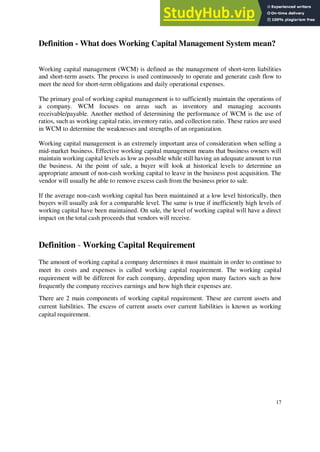
Definition - What does Working Capital Management System mean?
Working capital management (WCM) is defined as the management of short-term liabilities
and short-term assets. The process is used continuously to operate and generate cash flow to
meet the need for short-term obligations and daily operational expenses.
The primary goal of working capital management is to sufficiently maintain the operations of
a company. WCM focuses on areas such as inventory and managing accounts
receivable/payable. Another method of determining the performance of WCM is the use of
ratios, such as working capital ratio, inventory ratio, and collection ratio. These ratios are used
in WCM to determine the weaknesses and strengths of an organization.
Working capital management is an extremely important area of consideration when selling a
mid-market business. Effective working capital management means that business owners will
maintain working capital levels as low as possible while still having an adequate amount to run
the business. At the point of sale, a buyer will look at historical levels to determine an
appropriate amount of non-cash working capital to leave in the business post acquisition. The
vendor will usually be able to remove excess cash from the business prior to sale.
If the average non-cash working capital has been maintained at a low level historically, then
buyers will usually ask for a comparable level. The same is true if inefficiently high levels of
working capital have been maintained. On sale, the level of working capital will have a direct
impact on the total cash proceeds that vendors will receive.
Definition - Working Capital Requirement
The amount of working capital a company determines it must maintain in order to continue to
meet its costs and expenses is called working capital requirement. The working capital
requirement will be different for each company, depending upon many factors such as how
frequently the company receives earnings and how high their expenses are.
There are 2 main components of working capital requirement. These are current assets and
current liabilities. The excess of current assets over current liabilities is known as working
capital requirement.
17
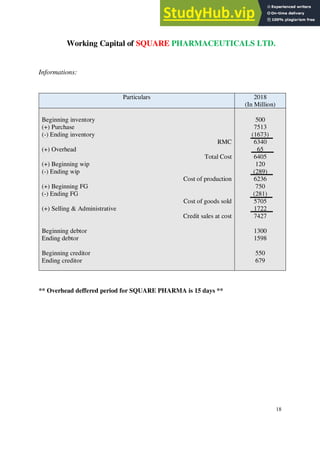
Working Capital of SQUARE PHARMACEUTICALS LTD.
Informations:
** Overhead deffered period for SQUARE PHARMA is 15 days **
18
Particulars 2018
(In Million)
Beginning inventory
(+) Purchase
(-) Ending inventory
RMC
(+) Overhead
Total Cost
(+) Beginning wip
(-) Ending wip
Cost of production
(+) Beginning FG
(-) Ending FG
Cost of goods sold
(+) Selling & Administrative
Credit sales at cost
Beginning debtor
Ending debtor
Beginning creditor
Ending creditor
500
7513
(1673)
6340
65
6405
120
(289)
6236
750
(281)
5705
1722
7427
1300
1598
550
679
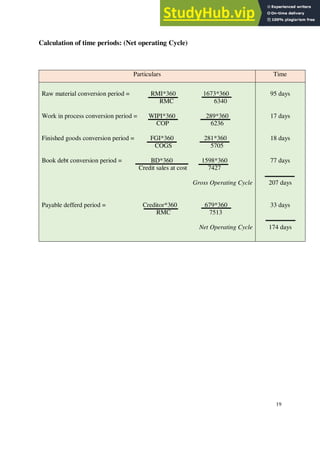
Calculation of time periods: (Net operating Cycle)
19
Particulars Time
Raw material conversion period = RMI*360 1673*360
RMC 6340
Work in process conversion period = WIPI*360 289*360
COP 6236
Finished goods conversion period = FGI*360 281*360
COGS 5705
Book debt conversion period = BD*360 1598*360
Credit sales at cost 7427
Gross Operating Cycle
Payable defferd period = Creditor*360 679*360
RMC 7513
Net Operating Cycle
95 days
17 days
18 days
77 days
207 days
33 days
174 days
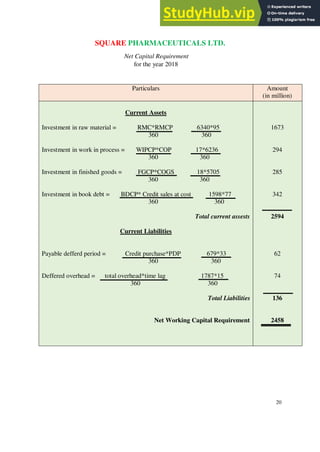
SQUARE PHARMACEUTICALS LTD.
Net Capital Requirement
for the year 2018
20
Particulars Amount
(in million)
Current Assets
Investment in raw material = RMC*RMCP 6340*95
360 360
Investment in work in process = WIPCP*COP 17*6236
360 360
Investment in finished goods = FGCP*COGS 18*5705
360 360
Investment in book debt = BDCP* Credit sales at cost 1598*77
360 360
Total current assests
Current Liabilities
Payable defferd period = Credit purchase*PDP 679*33
360 360
Deffered overhead = total overhead*time lag 1787*15
360 360
Total Liabilities
Net Working Capital Requirement
1673
294
285
342
2594
62
74
136
2458
Short Term Asset Management
Definition - What does Short Term Asset Management mean?
Short term asset management is the handling of the current assets of a company. Any assets
that a company or business has that is the equivalent of cash or can be liquidated into cash in
the period of a year is considered a current asset. Typically, short term assets are the inventory
a company has, as well as the accounts receivables and any short-term investments it has in
place.
The main principle in short term asset management is to keep the proper flow of income and
liability in balance. Managing short term assets also takes into account the long-term
investments of a company, but short-term assets, another name for current assets, is important
in determining the liquidity of a company. The measure of liquidity is really the measure of
how well and how fast a company can pay off its debts.
Calculating the current ratio is key in figuring out the proper balance for short term asset
management. The current ratio is the company’s current assets divided by its current liabilities.
Current liabilities are defined as what a business needs to pay off in a specific cycle of time,
either a financial year or a cycle of time particular to a business, whichever is longer.
Why Short Term Asset Management?
▪ The analysis of short term asset management assumes that markets are not frictionless
and perfectly competitive.
▪ Holding inventories and cash is not costless, but delays in daily business can result in
if such short term assets are mismanaged.
▪ Wealth maximization remains the ultimate objective, but techniques other than net
present value are often required.
21
Short Term Assets of SQUARE PHARMACEUTICALS LTD.
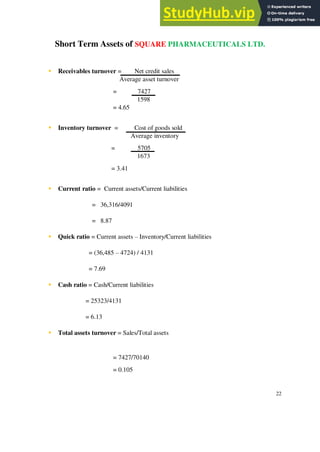
▪ Receivables turnover = Net credit sales
Average asset turnover
= 7427
1598
= 4.65
▪ Inventory turnover = Cost of goods sold
Average inventory
= 5705
1673
= 3.41
▪ Current ratio = Current assets/Current liabilities
= 36,316/4091
= 8.87
▪ Quick ratio = Current assets – Inventory/Current liabilities
= (36,485 – 4724) / 4131
= 7.69
▪ Cash ratio = Cash/Current liabilities
= 25323/4131
= 6.13
▪ Total assets turnover = Sales/Total assets
= 7427/70140
= 0.105
22
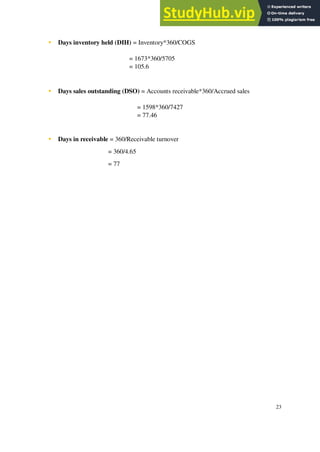
▪ Days inventory held (DIH) = Inventory*360/COGS
= 1673*360/5705
= 105.6
▪ Days sales outstanding (DSO) = Accounts receivable*360/Accrued sales
= 1598*360/7427
= 77.46
▪ Days in receivable = 360/Receivable turnover
= 360/4.65
= 77
23
Short Term Liability Management
Definition - What does Short Term Liability Management mean?
Short term liabilities management are managing a company's debts or obligations that are due
within one year or within a normal operating cycle. Furthermore, short term liabilities are
settled by the use of a current asset, such as cash, or by creating a new current liability. Short
term liabilities appear on a company's balance sheet and include short-term debt, accounts
payable, accrued liabilities, and other similar debts.
Why Short Term Liability Management?
Analysts and creditors often use the current ratio (current assets divided by liabilities), or the
quick ratio (current assets minus inventories divided by current liabilities), to determine
whether a company is able to pay off its current liabilities.
On the balance sheet, current liabilities are typically presented as follows: the principal portion
of notes payable due within one year, accounts payable and then other current liabilities, such
as income taxes payable, interest payable
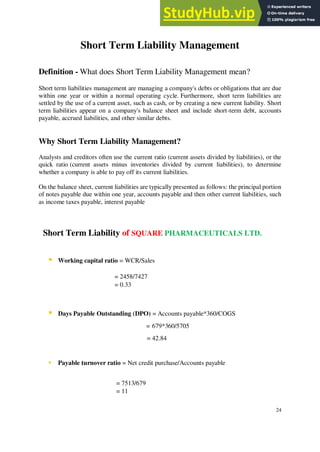
Short Term Liability of SQUARE PHARMACEUTICALS LTD.
▪ Working capital ratio = WCR/Sales
= 2458/7427
= 0.33
▪ Days Payable Outstanding (DPO) = Accounts payable*360/COGS
= 679*360/5705
= 42.84
▪ Payable turnover ratio = Net credit purchase/Accounts payable
= 7513/679
= 11
24
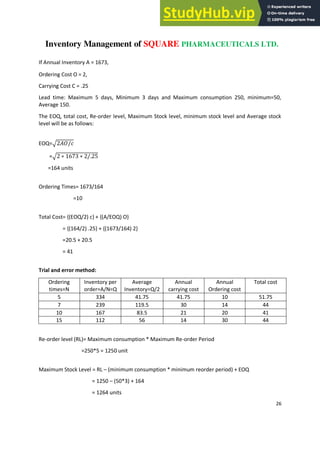
Inventory Management System
Definition – What does Inventory mean?
Inventory management refers to the process of ordering, storing, and using a company's
inventory. These include the management of raw materials, components, and finished products
as well as warehousing and processing such items.
Inventory Management Methods:
• Just-in-Time Management
• Materials Requirement Planning
• Economic Order Quantity
• Days Sales of Inventory
• Qualitative Analysis of Inventory
• Trial and error method
• Graphical Method
Economic Order Quantity:
The economic order quantity (EOQ) model is used in inventory management by calculating the
number of units a company should add to its inventory with each batch order to reduce the total
costs of its inventory while assuming constant consumer demand. The costs of inventory in the
model include holding and setup costs.
Trial and error method:
If the total needs of inventory for a form are known, the firm has different alternatives to
purchase its inventories. It can buy its total needs in a single order at the beginning of the year
or the inventories may be purchased in small orders periodically. If the purchase are made in
one order, the average inventory holdings will be relatively large whereas they will be relatively
small when the acquisition of inventory is in small lots. High average inventory would involve
high carrying cost and low average inventory holdings are associated with high ordering costs.
According to this method, the carrying and ordering costs for different sizes of orders to
purchase inventories are computed and the order size with the lowest total cost of inventory is
the economic order quantity.
Graphical Method
Under this method, the carrying cost, ordering cost and total cost are shown on graph. It is
based on the principle that the total carrying cost increases as the order size increases. However,
the ordering cost decreases if the order size increases. The point at which the ordering cost and
carrying cost intersects each other, total cost is minimum.
25
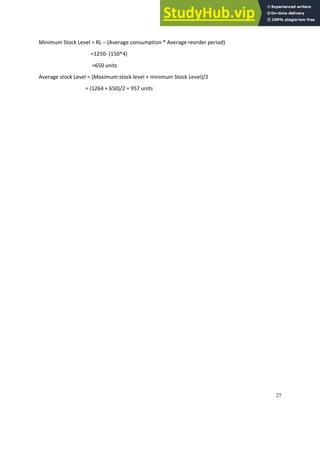
Inventory Management of SQUARE PHARMACEUTICALS LTD.
If Annual Inventory A = 1673,
Ordering Cost O = 2,
Carrying Cost C = .25
Lead time: Maximum 5 days, Minimum 3 days and Maximum consumption 250, minimum=50,
Average 150.
The EOQ, total cost, Re-order level, Maximum Stock level, minimum stock level and Average stock
level will be as follows:
EOQ=√2𝐴𝑂/𝑐
=√2 ∗ 1673 ∗ 2/.25
=164 units
Ordering Times= 1673/164
=10
Total Cost= {(EOQ/2) c} + {(A/EOQ) O}
= {(164/2) .25} + {(1673/164) 2}
=20.5 + 20.5
= 41
Trial and error method:
Ordering
times=N
Inventory per
order=A/N=Q
Average
Inventory=Q/2
Annual
carrying cost
Annual
Ordering cost
Total cost
5 334 41.75 41.75 10 51.75
7 239 119.5 30 14 44
10 167 83.5 21 20 41
15 112 56 14 30 44
Re-order level (RL)= Maximum consumption * Maximum Re-order Period
=250*5 = 1250 unit
Maximum Stock Level = RL – (minimum consumption * minimum reorder period) + EOQ
= 1250 – (50*3) + 164
= 1264 units
26
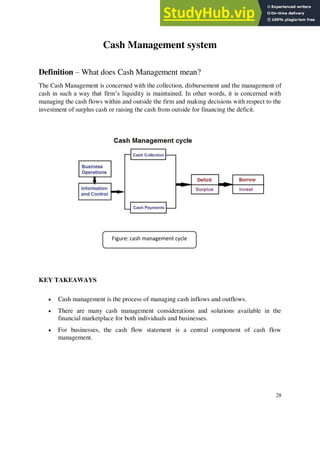
Minimum Stock Level = RL – (Average consumption * Average reorder period)
=1250- (150*4)
=650 units
Average stock Level = (Maximum stock level + minimum Stock Level)/2
= (1264 + 650)/2 = 957 units
27
Cash Management system
Definition – What does Cash Management mean?
The Cash Management is concerned with the collection, disbursement and the management of
cash in such a way that firm’s liquidity is maintained. In other words, it is concerned with
managing the cash flows within and outside the firm and making decisions with respect to the
investment of surplus cash or raising the cash from outside for financing the deficit.
KEY TAKEAWAYS
• Cash management is the process of managing cash inflows and outflows.
• There are many cash management considerations and solutions available in the
financial marketplace for both individuals and businesses.
• For businesses, the cash flow statement is a central component of cash flow
management.
28
Figure: cash management cycle
Cash Management of SQUARE PHARMACEUTICALS LTD.
Square Pharmaceuticals Ltd. Plans to hold annual cash requirement tk 25,323,000,136.
Ordering Cost 2m. Carrying cost .15m.
a. Calculate the optimum level of cash to be maintained?
b. Number of transaction.
c. Total cost.
(a)
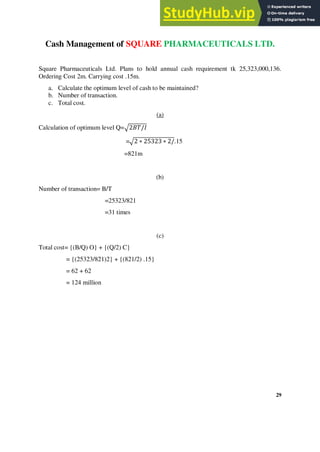
Calculation of optimum level Q=√2𝐵𝑇/𝐼
=√2 ∗ 25323 ∗ 2/.15
=821m
(b)
Number of transaction= B/T
=25323/821
=31 times
(c)
Total cost= {(B/Q) O} + {(Q/2) C}
= {(25323/821)2} + {(821/2) .15}
= 62 + 62
= 124 million
29
Cash Budget
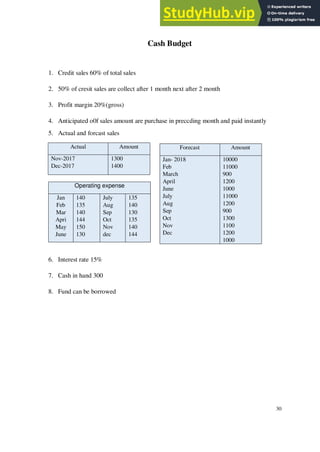
1. Credit sales 60% of total sales
2. 50% of cresit sales are collect after 1 month next after 2 month
3. Profit margin 20%(gross)
4. Anticipated o0f sales amount are purchase in preccding month and paid instantly
5. Actual and forcast sales
6. Interest rate 15%
7. Cash in hand 300
8. Fund can be borrowed
30
Forecast Amount
Jan- 2018
Feb
March
April
June
July
Aug
Sep
Oct
Nov
Dec
10000
11000
900
1200
1000
11000
1200
900
1300
1100
1200
1000
Actual Amount
Nov-2017
Dec-2017
1300
1400
Operating expense
Jan
Feb
Mar
Apri
May
June
140
135
140
144
150
130
July
Aug
Sep
Oct
Nov
dec
135
140
130
135
140
144
Cash Budgeting
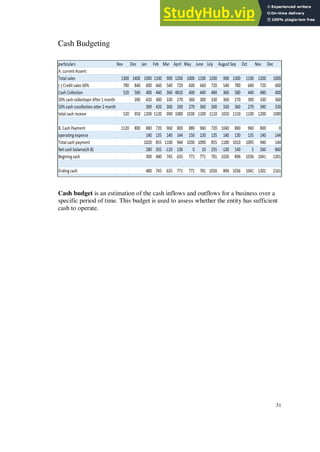
Cash budget is an estimation of the cash inflows and outflows for a business over a
specific period of time. This budget is used to assess whether the entity has sufficient
cash to operate.
31
Short Term Financing Policy
Working Capital Management follows three approaches .the approach followed by a company
may be referred to as:
1. Matching approach
2. Conservative approach
3. Aggressive approach
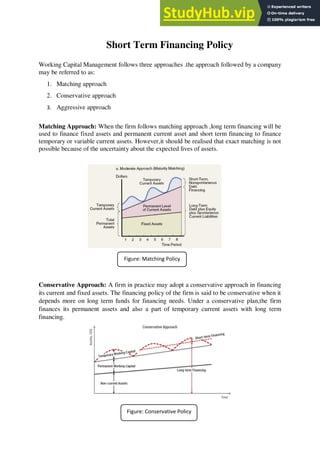
Matching Approach: When the firm follows matching approach ,long term financing will be
used to finance fixed assets and permanent current asset and short term financing to finance
temporary or variable current assets. However,it should be realised that exact matching is not
possible because of the uncertainty about the expected lives of assets.
Conservative Approach: A firm in practice may adopt a conservative approach in financing
its current and fixed assets. The financing policy of the firm is said to be conservative when it
depends more on long term funds for financing needs. Under a conservative plan,the firm
finances its permanent assets and also a part of temporary current assets with long term
financing.
Figure: Matching Policy
Figure: Conservative Policy
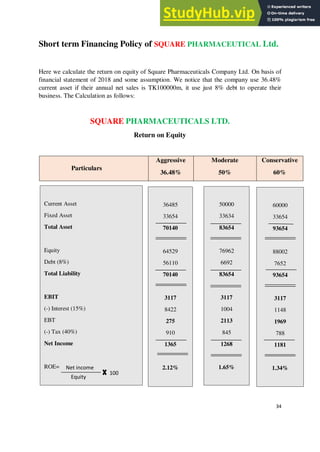
Aggressive Approach: A firm may be aggressive in financing its assets.An aggressive
approach is said be followed by the firm when its uses more short term financing than warranted
by the matching plan. Under an aggressive policy, the firm finances a part of its permanent
current assets with short term financing. Some extremely aggressive firms may even finance a
part of their fixed assets with short term financing. The relatively more use of short term
financing makes the firm more risky.
33
Figure: Aggressive Policy
Short term Financing Policy of SQUARE PHARMACEUTICAL Ltd.
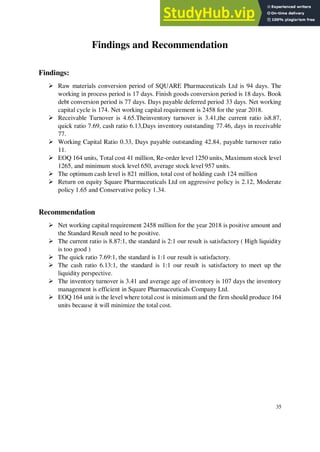
Here we calculate the return on equity of Square Pharmaceuticals Company Ltd. On basis of
financial statement of 2018 and some assumption. We notice that the company use 36.48%
current asset if their annual net sales is TK100000m, it use just 8% debt to operate their
business. The Calculation as follows:
SQUARE PHARMACEUTICALS LTD.
Return on Equity
Particulars
Aggressive
36.48%
Moderate
50%
Conservative
60%
34
Current Asset
Fixed Asset
Total Asset
Equity
Debt (8%)
Total Liability
EBIT
(-) Interest (15%)
EBT
(-) Tax (40%)
Net Income
ROE=
36485
33654
70140
64529
56110
70140
3117
8422
275
910
1365
2.12%
50000
33634
83654
76962
6692
83654
3117
1004
2113
845
1268
1.65%
60000
33654
93654
88002
7652
93654
3117
1148
1969
788
1181
1.34%
Net income
Equity
100
Findings and Recommendation
Findings:
➢ Raw materials conversion period of SQUARE Pharmaceuticals Ltd is 94 days. The
working in process period is 17 days. Finish goods conversion period is 18 days. Book
debt conversion period is 77 days. Days payable deferred period 33 days. Net working
capital cycle is 174. Net working capital requirement is 2458 for the year 2018.
➢ Receivable Turnover is 4.65.Theinventory turnover is 3.41,the current ratio is8.87,
quick ratio 7.69, cash ratio 6.13,Days inventory outstanding 77.46, days in receivable
77.
➢ Working Capital Ratio 0.33, Days payable outstanding 42.84, payable turnover ratio
11.
➢ EOQ 164 units, Total cost 41 million, Re-order level 1250 units, Maximum stock level
1265, and minimum stock level 650, average stock level 957 units.
➢ The optimum cash level is 821 million, total cost of holding cash 124 million
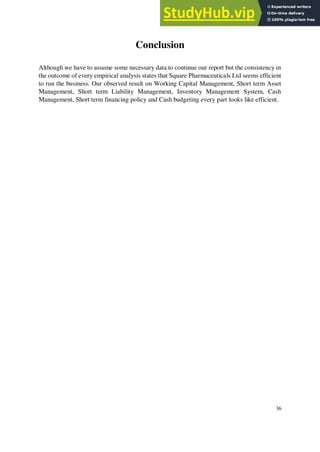
➢ Return on equity Square Pharmaceuticals Ltd on aggressive policy is 2.12, Moderate
policy 1.65 and Conservative policy 1.34.
Recommendation
➢ Net working capital requirement 2458 million for the year 2018 is positive amount and
the Standard Result need to be positive.
➢ The current ratio is 8.87:1, the standard is 2:1 our result is satisfactory ( High liquidity
is too good )
➢ The quick ratio 7.69:1, the standard is 1:1 our result is satisfactory.
➢ The cash ratio 6.13:1, the standard is 1:1 our result is satisfactory to meet up the
liquidity perspective.
➢ The inventory turnover is 3.41 and average age of inventory is 107 days the inventory
management is efficient in Square Pharmaceuticals Company Ltd.
➢ EOQ 164 unit is the level where total cost is minimum and the firm should produce 164
units because it will minimize the total cost.
35
Conclusion
Although we have to assume some necessary data to continue our report but the consistency in
the outcome of every empirical analysis states that Square Pharmaceuticals Ltd seems efficient
to run the business. Our observed result on Working Capital Management, Short term Asset
Management, Short term Liability Management, Inventory Management System, Cash
Management, Short term financing policy and Cash budgeting every part looks like efficient.
36
Bibliography
BOOKS:
Modern Working Capital Management by Frederick C. Scherr
Corporate Finance by Ross, Westerfield, Jaffe
WEB PAGES:
www.Lonkabangla bd/square pharmaceuticals litd.
www.square pharmaceuticals ltd.bd
www. Investopedia /Inventory management/cash management
http://business-finance.blurtit.com
ARTICLES:
MANAGING THE SHORT TERM LIABILITY
“Steven Bragg”
37

Analysis Of Working Capital Management

  • 1.
    Faculty of Business Administration JatiyaKabi Kazi Nazrul Islam University Report on : Financial Analysis of SQUARE PHARMACEUTICALS Ltd. Course Title : Working Capital Management Course Code : FB 304 Presented to Chandon Kumar Pal Lecturer Finance & Banking Department Presented by Date of Submission 1 August, 2019 Sl. No. Name ID. No. 1 Tahmina Akter 17132603 2 Hena Akter Jui 17132604 3 Rajuana Akter 17132606 4 Hasim Reza 17132607 5 Abdullah Al Noman 17132640 6 Naymul Hasan Rahat 17132658
  • 2.
    Letter of Transmittal 1August, 2019 Chandon Kumar Pal Lecturer Finance & Banking Department Jatiya Kabi Kazi Nazrul Islam University,Trishal,Mymensingh. Subject:Submission of Report on Financial Analysis of SQUARE PHARMACEUTICALS Ltd. Dear Sir, This is our great pleasure to submit the report. We have worked hard and put our best effort to make this report successful.It has been an enlightening experience for us while preparing the report. We would like to express our gratitude to your kind guidance in preparing the report. We will be glad if you find this report useful to have an apparent perspective on the issue. If you have any query, please do not hesitate to call us about the report. Sincerely Yours, Abdullah Al Noman ID:17132640 Finance & Banking Department Group Leader (On behalf of Group 2)
  • 3.
    Table of Content GroupProfile…………………………………………………………………………………4 List of Table……………………………...…………………………………………………...5 List of Figure………………………….………………………………………………………6 Acronyms……………………………………………………………………………………..7 Executive Summary………………………………………………………………………….8 Introduct………………………………………………………………………….…………..9 Overview of the Company…………………………..……………...……………….....10 - 13 Emperical Analysis…………………………………………………………………….14 – 35 Working Capital Management System…………………………………………………17 - 20 Short Term Asset Management……………….…...……………………………………21 - 23 Short Term Liability Management…………….……...…………………..…………………24 Inventory Management System……………….………………………………………..25 - 27 Cash Management System………………………………...……………………………28 - 31 Short Term Financing Policy…………………...………………………………………32 - 34 Findings & Recommendation…………………………………………………………..….35 Conclusion………………………..…………………………………………………………36 Bibliography……………………………………………………………………………...…37
  • 4.
    List of table Statementof Profit and Loss………………………………………………………….14 – 15 Statement of Financial Position…………………………………………………………….16 Net Operating Cycle………………………….……………………………………………..19 Working Capital Requirement……………………………………………………………..20 Cash Budget…………………………………………………………………………………31 Return on Equity……………………………………………………………………………34 4
  • 5.
    List of Figure CashManagement Cycle………………………………………………………….………..28 Matching Policy……………….…………………………………………………………….32 Conservative Policy.………………………….……………………………………………..32 Aggressive Policy……………………..……………………………………………………..33 5
  • 6.
    Group Profile Serial number Name IDParticipation (page) Signature 01 Tahmina Akter 17132603 02 Hena Akter Jui 17132604 03 Rajuana Akter 17132606 04 Hasim Reza 17132607 05 Abdullah Al Noman 17132640 06 Naymul Hasan Rahat 17132658 6
  • 7.
    Acronyms USD = UnitedStates Dollar (Currency of the USA); API = an Application Program Interface; FDA = Food and Drug Administration; MHRA = Healthcare Products Regulatory Agency; UNICEF = United Nations Children's Fund; CGMP = Cyclic Guanosine Monophosphate; WHO = World Health Organization; USGDA = United States Food and Drug Administration; PIC = Pharmaceutical Inspection Co-operation Scheme; MCC = Medicines Control Council; CSR = Corporate Social Responsibility; UNGS = United Nations Global Compact; WCM = Working Capital Management; RMC = Raw Material Consumption; RMCP = Raw Material Conversion Period; WIP = Work in Process; WIPCP = Work in Process Conversion Period; FG = Finished Goods; FGCP = Finished Goods Conversion Period; BDCP = Book Debt Conversion Period; PDP = Payable Deferred Period; COGS = Cost of Goods Sold; EPS = Earnings per Share; NAV =Net Assets Value Per Share; EOQ =Economic Order Quantity; OC =Ordering Cost; CC =Carrying Cost; 7
  • 8.
    Executive Summary SQUARE PharmaceuticalsLimited is the largest pharmaceutical company in Bangladesh and it has been continuously in the 1st position among all national and multinational companies since 1985. Throughout the report we are tried to find out the key factors behind their continuous success. In this report the working capital management of the company is really efficient and as well as effective. The empirical analysis of this report shows the company’s efficiency of inventory management and also shows the satisfactory condition in cash management, current asset and the condition of the company is also in a satisfactory to manage its creditors. The short term assets management part states the satisfactory condition. The cash management system part states that company’s cash management is in efficient level and very strong position at this year. In case of short term financing we notice that the return on equity is also in a satisfactory condition the company use just 8% debt. Which is really admirable in this market situation. 8
  • 9.
    Introduct  Topic: Analysison working capital management system of Square Pharmaceuticals Ltd.  Company Name: SQUARE PHARMACEUTICALS Ltd  Establishment: 1958  Listed as a Public Company: 1991  Listed in Stock Exhange: 1995  Type of Company: Pharmaceutical  Location: Mohakhali, Dhaka, Bangladesh  Website: squarepharma.com.bd  No. of Number of employees: 7390 (2016-17)  Ownership: Public Limited Company  Authorized Capital: 10,000 million 9
  • 10.
    Overview of TheCompany Corporate Profile SQUARE today symbolizes a name – a state of mind. But its journey to the growth and prosperity has been no bed of roses. From the inception in 1958, it has today burgeoned into one of the top line conglomerates in Bangladesh. Square Pharmaceuticals Ltd., the flagship company, is holding the strong leadership position in the pharmaceutical industry of Bangladesh since 1985 and is now on its way to becoming a high performance global player. SQUARE Pharmaceuticals Limited is the largest pharmaceutical company in Bangladesh and it has been continuously in the 1st position among all national and multinational companies since 1985. It was established in 1958, converted into a public limited company in 1991 and listed with stock exchanges in 1995. The turnover of Square Pharma was Taka 45.88 Billion (US$ 540 million) with about 16.95% market share having a growth rate of about 8.52% (July 2017– June 2018). Looking beyond the horizon SQUARE Pharmaceuticals Limited has extended its range of services towards the highway of global market. It pioneered exports of medicines from Bangladesh in 1987 and has been exporting antibiotics and other pharmaceutical products. Present export market covers 42 countries. This extension in business and services has manifested the credibility of Square Pharmaceuticals Limited. Founder Chairman's Profile Founder Chairman (1925-2012) Mr. Samson H Chowdhury was born on 25 September, 1925. After completing education in India he returned to the then East Pakistan and settled at Ataikula village in Pabna district where his father was working as a Medical Officer in an outdoor dispensary. In 1952, he started a small pharmacy in Ataikula village which is about 160 km off capital Dhaka in the north-west part of Bangladesh. Mr. Samson H Chowdhury then ventured into a partnership pharmaceutical company with three of his friends in 1958. When asked why the name SQUARE was chosen he remembers - "We named it SQUARE because it was started by four friends and also because it signifies accuracy and perfection meaning quality" as they committed in manufacturing quality products. Now that small company of 1958 is a publicly listed diversified group of companies employing more than 28,000 people. The current yearly group turnover is 616 million USD. 10
  • 11.
    SQUARE today isa name not only known in the Pharmaceutical world, it is today a synonym of quality- be it consumer product, toiletries, health products, textiles, agro vet products, information technology and few more. All these were possible due to his innovative ideas, tireless efforts, perseverance and dedication with self confidence which contributed to his successful achievements. Now the name "SQUARE" inspires trust. Under his dynamic leadership, SQUARE is set to continue its progress globally. Mission , Vision and Objectives of Square Pharmaceuticals Ltd. Mission Our Mission is to produce and provide quality & innovative healthcare relief for people, maintain stringently ethical standard in business operation also ensuring benefit to the shareholders, stakeholders and the society at large. Vision We view business as a means to the material and social wellbeing of the investors, employees and the society at large, leading to accretion of wealth through financial and moral gains as a part of the process of the human civilization. Objective Our objectives are to conduct transparent business operation based on market mechanism within the legal & social framework with aims to attain the mission reflected by our vision. History & Growth Milestone of excellence 1964-Converted into a Private Limited Company.1974-Technical collaboration with Janseen Pharmaceuticals, Belgium, a subsidiary of Johnson & Johonson Intl, USA. In 1985-Achived market leadership in the Pharmaceuticals market in Bangladesh among all the national and multinational companies.In 1987-Pioneer in Pharmaceutical export from Bangladesh.In 1991-Converted into a Public Limited Company.In 1994-Initial Public Offering of Square Pharmaceutical's shares. In 1995-Chemical Division starts production of pharmaceutical bulk products (API).In 1997- Won the National Export Trophy for exporting pharmaceuticals.In 2001-UK FDA/UK MHRA standard new Pharmaceutical factory goes into operation built under the supervision of Bovis Lend Lease, UK. In 2002-Square enlisted as INICEF's global supplier. In 2005-Inception of Square Harbal & Nutraceuticals Ltd. 11
  • 12.
    In 2007-Square PharmaceuticalsLtd. Dhaka unit gets the UK MHRA approval. In 2009-Starts manufacturing of insulin, hormone & steroid products maintaining quality standards of US FDA, MHRA in dedicated manufacturing facility complying with the CGMP of WHO. 2013-Samson H Chowdhury "Centre of Excellence" starts its journey. 2014-Liquid Formulation Unit of Square Pharmaceuticals Ltd. Pabna Site gets PIC/S (Pharmaceutical Inspection Co-operation Scheme) approval. 2015-Square Pharmaceuticals gets USFDA's approval. 2016-Dhaka Site's solid dosage unit and Metered Dose Inhaler unit get MCC (Medicines Control Council), South Africa and PIC/S approval. Corporate Social Responsibility Corporate Social Responsibility (CSR) is the continuing commitment by business to behave ethically and contribute to economic development while improving the quality of life of the workforce and their families as well as of the local community and society at large. Our Business Motivation is Being Good by Doing Well and to conduct transparent business operations based on market mechanism within the legal, ethical & social framework with aims to attain the mission reflected by our vision. We scale-up CSR activities to consider the interests of our external & internal stakeholders like customers, employees, vendors, shareholders, society, government etc. and ecological & ethical considerations in all aspects of operations. SQUARE is one of the pioneer signatories of United Nations Global Compact (UNGC) in Bangladesh. UNGC principles are aligned with company's culture from the very outset. SQUARE recognizes that progressive labour policies are good business practices, especially for a company like us that has global ambition. We follow laws and encourage work environment that welcomes diversity and also follow non-discrimination & fair treatment policy both in the recruitment & selection process and performance management system. We have Trade Union & our HR policies have been continuously up-to-dated as per existing labour law of the country. We do not allow any female employees during night shift operations & we strictly prohibit any form of forced labour. We actively pursue the policy of No child labour in SQUARE. Transparency & business ethics is the core value of SQUARE and it is strictly followed at every step of the business processes. Every business in SQUARE is modeled in a way that enables the management to ensure highest degree of both financial and behavioral accountability. SQUARE pursues Zero Tolerance policy against all kinds of corruption. 12
  • 13.
    SQUARE's activity goeswell beyond the sphere of business. As socially conscious and responsible corporate body SQUARE is committed to the improvement of the society as a whole. Meril-Prothom Alo festival sponsored by SQUARE, has become a national calendar event. SQUARE helps many NGO's in their effort to make available healthcare to the disadvantage population of the country. It sponsors programs to build awareness on the healthcare need. SQUARE is also a major sponsor of sporting events in the country. SQUARE is proud to be a Bangladeshi Company actively involved in various field of Corporate Social Responsibility: ❖ Commitment towards Environment. ❖ Commitment towards Employee. ❖ Support to education. ❖ Advancing research and development program. ❖ Women Empowerment. ❖ Commitment towards society & support to social grounds. ❖ In Disaster Management. ❖ Responsibility towards government. ❖ SQUARE Child Development Center- a journey started. 13
  • 14.
    Emperical Analysis SQUARE PHARMACEUTICALSLTD. STATEMENT OF PROFIT OR LOSS AND OTHER COMPREHENSIVE INCOME For the Year Ended December 31, 2018 Particular Notes January-December 2018 GROSS TURNOVER Less: Value Added Tax NET TURNOVER COST OF GOODS SOLD GROSS PROFIT OPERATING EXPENSES: Selling & Distribution Expenses Administative Expenses Finance Cost PROFIT FROM OPERATIONS Other Income PROFIT BEFORE WPPF Allocation for WPPF PROFIT BEFORE TAX Income Tax Expenses-Current Income Tax Expenses-Deferred PROFIT AFTER TAX Profit/loss from undertaking Profit after tax Other comprehensive income: Gain/loss on marketable securities Total comprehensive income for the period Profit attribute to: Owner to the company Non controlling interest 11 12 13 14 15 12,563,436,829 1,640,696,083 10,922,740,746 (5705189069) 5217551677 (1723986060) (1459987703) (263989151) (9206) 3493565617 648188968 414754585 (205566827) 39336187758 (1143617179) 26377627 2818948206 299022486 311797070692 (27231875) 3090738817 3118611493 (640801)
  • 15.
    Total comprehensive incometo attribute to: Owner of the company Non controlling interest Earning per Share(EPS) Number of share used to compute EPS 3117970692 3091379618 (640801) 3090738817 3.95 789,008,466 15
  • 16.
    SQUARE PHARMACEUTICALS LTD. STATEMENTOF FINANCIAL POSITION For The Year Ended December 31, 2019 Particulars Notes Taka 16 ASSETS: Non-Current Assets: Property, Plant and Equipment-Carrying Value Investment - Long Term (at Cost) Investment - Associates Undertaking Investment in Marketable Securities (Fair Value) Current Assets: Inventories Trade Debtors Advances,Deposits and Prepayments Short Term Loan Cash and Cash Equivalents TOTAL ASSETS SHAREHOLDERS' EQUITY AND LIABILITIES: Shraeholders' Equity: Share Capital Share Premium General Reserve Tax Exemption Reserve Gain on Marketable Securities (Unrealized Retained Earnings Non Controlling Interest Non-Current Liabilities: Deffered Tax Liability Current Liabilities: Trade Creditors Liabilities for Expenses Liabilities for Other Finance TOTAL SHAREHOLDERS' EQUITY AND LIABILITIES Net Assets Value per Share (NAV) Number of Shares used to compute NAV 33654632772 20900310453 746263983 9035913032 2972145604 36485535133 4724885107 1598447247 3277530415 1561672228 25323000136 70140167905 64659127502 7890084660 2035446000 105878200 2211743936 173825919 52242129787 - 1349839544 1349839544 4131200859 679122575 14044139 3438034145 70140167905 81.95 789008466
  • 17.
    Definition - Whatdoes Working Capital Management System mean? Working capital management (WCM) is defined as the management of short-term liabilities and short-term assets. The process is used continuously to operate and generate cash flow to meet the need for short-term obligations and daily operational expenses. The primary goal of working capital management is to sufficiently maintain the operations of a company. WCM focuses on areas such as inventory and managing accounts receivable/payable. Another method of determining the performance of WCM is the use of ratios, such as working capital ratio, inventory ratio, and collection ratio. These ratios are used in WCM to determine the weaknesses and strengths of an organization. Working capital management is an extremely important area of consideration when selling a mid-market business. Effective working capital management means that business owners will maintain working capital levels as low as possible while still having an adequate amount to run the business. At the point of sale, a buyer will look at historical levels to determine an appropriate amount of non-cash working capital to leave in the business post acquisition. The vendor will usually be able to remove excess cash from the business prior to sale. If the average non-cash working capital has been maintained at a low level historically, then buyers will usually ask for a comparable level. The same is true if inefficiently high levels of working capital have been maintained. On sale, the level of working capital will have a direct impact on the total cash proceeds that vendors will receive. Definition - Working Capital Requirement The amount of working capital a company determines it must maintain in order to continue to meet its costs and expenses is called working capital requirement. The working capital requirement will be different for each company, depending upon many factors such as how frequently the company receives earnings and how high their expenses are. There are 2 main components of working capital requirement. These are current assets and current liabilities. The excess of current assets over current liabilities is known as working capital requirement. 17
  • 18.
    Working Capital ofSQUARE PHARMACEUTICALS LTD. Informations: ** Overhead deffered period for SQUARE PHARMA is 15 days ** 18 Particulars 2018 (In Million) Beginning inventory (+) Purchase (-) Ending inventory RMC (+) Overhead Total Cost (+) Beginning wip (-) Ending wip Cost of production (+) Beginning FG (-) Ending FG Cost of goods sold (+) Selling & Administrative Credit sales at cost Beginning debtor Ending debtor Beginning creditor Ending creditor 500 7513 (1673) 6340 65 6405 120 (289) 6236 750 (281) 5705 1722 7427 1300 1598 550 679
  • 19.
    Calculation of timeperiods: (Net operating Cycle) 19 Particulars Time Raw material conversion period = RMI*360 1673*360 RMC 6340 Work in process conversion period = WIPI*360 289*360 COP 6236 Finished goods conversion period = FGI*360 281*360 COGS 5705 Book debt conversion period = BD*360 1598*360 Credit sales at cost 7427 Gross Operating Cycle Payable defferd period = Creditor*360 679*360 RMC 7513 Net Operating Cycle 95 days 17 days 18 days 77 days 207 days 33 days 174 days
  • 20.
    SQUARE PHARMACEUTICALS LTD. NetCapital Requirement for the year 2018 20 Particulars Amount (in million) Current Assets Investment in raw material = RMC*RMCP 6340*95 360 360 Investment in work in process = WIPCP*COP 17*6236 360 360 Investment in finished goods = FGCP*COGS 18*5705 360 360 Investment in book debt = BDCP* Credit sales at cost 1598*77 360 360 Total current assests Current Liabilities Payable defferd period = Credit purchase*PDP 679*33 360 360 Deffered overhead = total overhead*time lag 1787*15 360 360 Total Liabilities Net Working Capital Requirement 1673 294 285 342 2594 62 74 136 2458
  • 21.
    Short Term AssetManagement Definition - What does Short Term Asset Management mean? Short term asset management is the handling of the current assets of a company. Any assets that a company or business has that is the equivalent of cash or can be liquidated into cash in the period of a year is considered a current asset. Typically, short term assets are the inventory a company has, as well as the accounts receivables and any short-term investments it has in place. The main principle in short term asset management is to keep the proper flow of income and liability in balance. Managing short term assets also takes into account the long-term investments of a company, but short-term assets, another name for current assets, is important in determining the liquidity of a company. The measure of liquidity is really the measure of how well and how fast a company can pay off its debts. Calculating the current ratio is key in figuring out the proper balance for short term asset management. The current ratio is the company’s current assets divided by its current liabilities. Current liabilities are defined as what a business needs to pay off in a specific cycle of time, either a financial year or a cycle of time particular to a business, whichever is longer. Why Short Term Asset Management? ▪ The analysis of short term asset management assumes that markets are not frictionless and perfectly competitive. ▪ Holding inventories and cash is not costless, but delays in daily business can result in if such short term assets are mismanaged. ▪ Wealth maximization remains the ultimate objective, but techniques other than net present value are often required. 21
  • 22.
    Short Term Assetsof SQUARE PHARMACEUTICALS LTD. ▪ Receivables turnover = Net credit sales Average asset turnover = 7427 1598 = 4.65 ▪ Inventory turnover = Cost of goods sold Average inventory = 5705 1673 = 3.41 ▪ Current ratio = Current assets/Current liabilities = 36,316/4091 = 8.87 ▪ Quick ratio = Current assets – Inventory/Current liabilities = (36,485 – 4724) / 4131 = 7.69 ▪ Cash ratio = Cash/Current liabilities = 25323/4131 = 6.13 ▪ Total assets turnover = Sales/Total assets = 7427/70140 = 0.105 22
  • 23.
    ▪ Days inventoryheld (DIH) = Inventory*360/COGS = 1673*360/5705 = 105.6 ▪ Days sales outstanding (DSO) = Accounts receivable*360/Accrued sales = 1598*360/7427 = 77.46 ▪ Days in receivable = 360/Receivable turnover = 360/4.65 = 77 23
  • 24.
    Short Term LiabilityManagement Definition - What does Short Term Liability Management mean? Short term liabilities management are managing a company's debts or obligations that are due within one year or within a normal operating cycle. Furthermore, short term liabilities are settled by the use of a current asset, such as cash, or by creating a new current liability. Short term liabilities appear on a company's balance sheet and include short-term debt, accounts payable, accrued liabilities, and other similar debts. Why Short Term Liability Management? Analysts and creditors often use the current ratio (current assets divided by liabilities), or the quick ratio (current assets minus inventories divided by current liabilities), to determine whether a company is able to pay off its current liabilities. On the balance sheet, current liabilities are typically presented as follows: the principal portion of notes payable due within one year, accounts payable and then other current liabilities, such as income taxes payable, interest payable Short Term Liability of SQUARE PHARMACEUTICALS LTD. ▪ Working capital ratio = WCR/Sales = 2458/7427 = 0.33 ▪ Days Payable Outstanding (DPO) = Accounts payable*360/COGS = 679*360/5705 = 42.84 ▪ Payable turnover ratio = Net credit purchase/Accounts payable = 7513/679 = 11 24
  • 25.
    Inventory Management System Definition– What does Inventory mean? Inventory management refers to the process of ordering, storing, and using a company's inventory. These include the management of raw materials, components, and finished products as well as warehousing and processing such items. Inventory Management Methods: • Just-in-Time Management • Materials Requirement Planning • Economic Order Quantity • Days Sales of Inventory • Qualitative Analysis of Inventory • Trial and error method • Graphical Method Economic Order Quantity: The economic order quantity (EOQ) model is used in inventory management by calculating the number of units a company should add to its inventory with each batch order to reduce the total costs of its inventory while assuming constant consumer demand. The costs of inventory in the model include holding and setup costs. Trial and error method: If the total needs of inventory for a form are known, the firm has different alternatives to purchase its inventories. It can buy its total needs in a single order at the beginning of the year or the inventories may be purchased in small orders periodically. If the purchase are made in one order, the average inventory holdings will be relatively large whereas they will be relatively small when the acquisition of inventory is in small lots. High average inventory would involve high carrying cost and low average inventory holdings are associated with high ordering costs. According to this method, the carrying and ordering costs for different sizes of orders to purchase inventories are computed and the order size with the lowest total cost of inventory is the economic order quantity. Graphical Method Under this method, the carrying cost, ordering cost and total cost are shown on graph. It is based on the principle that the total carrying cost increases as the order size increases. However, the ordering cost decreases if the order size increases. The point at which the ordering cost and carrying cost intersects each other, total cost is minimum. 25
  • 26.
    Inventory Management ofSQUARE PHARMACEUTICALS LTD. If Annual Inventory A = 1673, Ordering Cost O = 2, Carrying Cost C = .25 Lead time: Maximum 5 days, Minimum 3 days and Maximum consumption 250, minimum=50, Average 150. The EOQ, total cost, Re-order level, Maximum Stock level, minimum stock level and Average stock level will be as follows: EOQ=√2𝐴𝑂/𝑐 =√2 ∗ 1673 ∗ 2/.25 =164 units Ordering Times= 1673/164 =10 Total Cost= {(EOQ/2) c} + {(A/EOQ) O} = {(164/2) .25} + {(1673/164) 2} =20.5 + 20.5 = 41 Trial and error method: Ordering times=N Inventory per order=A/N=Q Average Inventory=Q/2 Annual carrying cost Annual Ordering cost Total cost 5 334 41.75 41.75 10 51.75 7 239 119.5 30 14 44 10 167 83.5 21 20 41 15 112 56 14 30 44 Re-order level (RL)= Maximum consumption * Maximum Re-order Period =250*5 = 1250 unit Maximum Stock Level = RL – (minimum consumption * minimum reorder period) + EOQ = 1250 – (50*3) + 164 = 1264 units 26
  • 27.
    Minimum Stock Level= RL – (Average consumption * Average reorder period) =1250- (150*4) =650 units Average stock Level = (Maximum stock level + minimum Stock Level)/2 = (1264 + 650)/2 = 957 units 27
  • 28.
    Cash Management system Definition– What does Cash Management mean? The Cash Management is concerned with the collection, disbursement and the management of cash in such a way that firm’s liquidity is maintained. In other words, it is concerned with managing the cash flows within and outside the firm and making decisions with respect to the investment of surplus cash or raising the cash from outside for financing the deficit. KEY TAKEAWAYS • Cash management is the process of managing cash inflows and outflows. • There are many cash management considerations and solutions available in the financial marketplace for both individuals and businesses. • For businesses, the cash flow statement is a central component of cash flow management. 28 Figure: cash management cycle
  • 29.
    Cash Management ofSQUARE PHARMACEUTICALS LTD. Square Pharmaceuticals Ltd. Plans to hold annual cash requirement tk 25,323,000,136. Ordering Cost 2m. Carrying cost .15m. a. Calculate the optimum level of cash to be maintained? b. Number of transaction. c. Total cost. (a) Calculation of optimum level Q=√2𝐵𝑇/𝐼 =√2 ∗ 25323 ∗ 2/.15 =821m (b) Number of transaction= B/T =25323/821 =31 times (c) Total cost= {(B/Q) O} + {(Q/2) C} = {(25323/821)2} + {(821/2) .15} = 62 + 62 = 124 million 29
  • 30.
    Cash Budget 1. Creditsales 60% of total sales 2. 50% of cresit sales are collect after 1 month next after 2 month 3. Profit margin 20%(gross) 4. Anticipated o0f sales amount are purchase in preccding month and paid instantly 5. Actual and forcast sales 6. Interest rate 15% 7. Cash in hand 300 8. Fund can be borrowed 30 Forecast Amount Jan- 2018 Feb March April June July Aug Sep Oct Nov Dec 10000 11000 900 1200 1000 11000 1200 900 1300 1100 1200 1000 Actual Amount Nov-2017 Dec-2017 1300 1400 Operating expense Jan Feb Mar Apri May June 140 135 140 144 150 130 July Aug Sep Oct Nov dec 135 140 130 135 140 144
  • 31.
    Cash Budgeting Cash budgetis an estimation of the cash inflows and outflows for a business over a specific period of time. This budget is used to assess whether the entity has sufficient cash to operate. 31
  • 32.
    Short Term FinancingPolicy Working Capital Management follows three approaches .the approach followed by a company may be referred to as: 1. Matching approach 2. Conservative approach 3. Aggressive approach Matching Approach: When the firm follows matching approach ,long term financing will be used to finance fixed assets and permanent current asset and short term financing to finance temporary or variable current assets. However,it should be realised that exact matching is not possible because of the uncertainty about the expected lives of assets. Conservative Approach: A firm in practice may adopt a conservative approach in financing its current and fixed assets. The financing policy of the firm is said to be conservative when it depends more on long term funds for financing needs. Under a conservative plan,the firm finances its permanent assets and also a part of temporary current assets with long term financing. Figure: Matching Policy Figure: Conservative Policy
  • 33.
    Aggressive Approach: Afirm may be aggressive in financing its assets.An aggressive approach is said be followed by the firm when its uses more short term financing than warranted by the matching plan. Under an aggressive policy, the firm finances a part of its permanent current assets with short term financing. Some extremely aggressive firms may even finance a part of their fixed assets with short term financing. The relatively more use of short term financing makes the firm more risky. 33 Figure: Aggressive Policy
  • 34.
    Short term FinancingPolicy of SQUARE PHARMACEUTICAL Ltd. Here we calculate the return on equity of Square Pharmaceuticals Company Ltd. On basis of financial statement of 2018 and some assumption. We notice that the company use 36.48% current asset if their annual net sales is TK100000m, it use just 8% debt to operate their business. The Calculation as follows: SQUARE PHARMACEUTICALS LTD. Return on Equity Particulars Aggressive 36.48% Moderate 50% Conservative 60% 34 Current Asset Fixed Asset Total Asset Equity Debt (8%) Total Liability EBIT (-) Interest (15%) EBT (-) Tax (40%) Net Income ROE= 36485 33654 70140 64529 56110 70140 3117 8422 275 910 1365 2.12% 50000 33634 83654 76962 6692 83654 3117 1004 2113 845 1268 1.65% 60000 33654 93654 88002 7652 93654 3117 1148 1969 788 1181 1.34% Net income Equity 100
  • 35.
    Findings and Recommendation Findings: ➢Raw materials conversion period of SQUARE Pharmaceuticals Ltd is 94 days. The working in process period is 17 days. Finish goods conversion period is 18 days. Book debt conversion period is 77 days. Days payable deferred period 33 days. Net working capital cycle is 174. Net working capital requirement is 2458 for the year 2018. ➢ Receivable Turnover is 4.65.Theinventory turnover is 3.41,the current ratio is8.87, quick ratio 7.69, cash ratio 6.13,Days inventory outstanding 77.46, days in receivable 77. ➢ Working Capital Ratio 0.33, Days payable outstanding 42.84, payable turnover ratio 11. ➢ EOQ 164 units, Total cost 41 million, Re-order level 1250 units, Maximum stock level 1265, and minimum stock level 650, average stock level 957 units. ➢ The optimum cash level is 821 million, total cost of holding cash 124 million ➢ Return on equity Square Pharmaceuticals Ltd on aggressive policy is 2.12, Moderate policy 1.65 and Conservative policy 1.34. Recommendation ➢ Net working capital requirement 2458 million for the year 2018 is positive amount and the Standard Result need to be positive. ➢ The current ratio is 8.87:1, the standard is 2:1 our result is satisfactory ( High liquidity is too good ) ➢ The quick ratio 7.69:1, the standard is 1:1 our result is satisfactory. ➢ The cash ratio 6.13:1, the standard is 1:1 our result is satisfactory to meet up the liquidity perspective. ➢ The inventory turnover is 3.41 and average age of inventory is 107 days the inventory management is efficient in Square Pharmaceuticals Company Ltd. ➢ EOQ 164 unit is the level where total cost is minimum and the firm should produce 164 units because it will minimize the total cost. 35
  • 36.
    Conclusion Although we haveto assume some necessary data to continue our report but the consistency in the outcome of every empirical analysis states that Square Pharmaceuticals Ltd seems efficient to run the business. Our observed result on Working Capital Management, Short term Asset Management, Short term Liability Management, Inventory Management System, Cash Management, Short term financing policy and Cash budgeting every part looks like efficient. 36
  • 37.
    Bibliography BOOKS: Modern Working CapitalManagement by Frederick C. Scherr Corporate Finance by Ross, Westerfield, Jaffe WEB PAGES: www.Lonkabangla bd/square pharmaceuticals litd. www.square pharmaceuticals ltd.bd www. Investopedia /Inventory management/cash management http://business-finance.blurtit.com ARTICLES: MANAGING THE SHORT TERM LIABILITY “Steven Bragg” 37