Analysis Of Electronic Health Records System
1
Chyterria Daniels
Capella University
May 3, 2020
Introduction
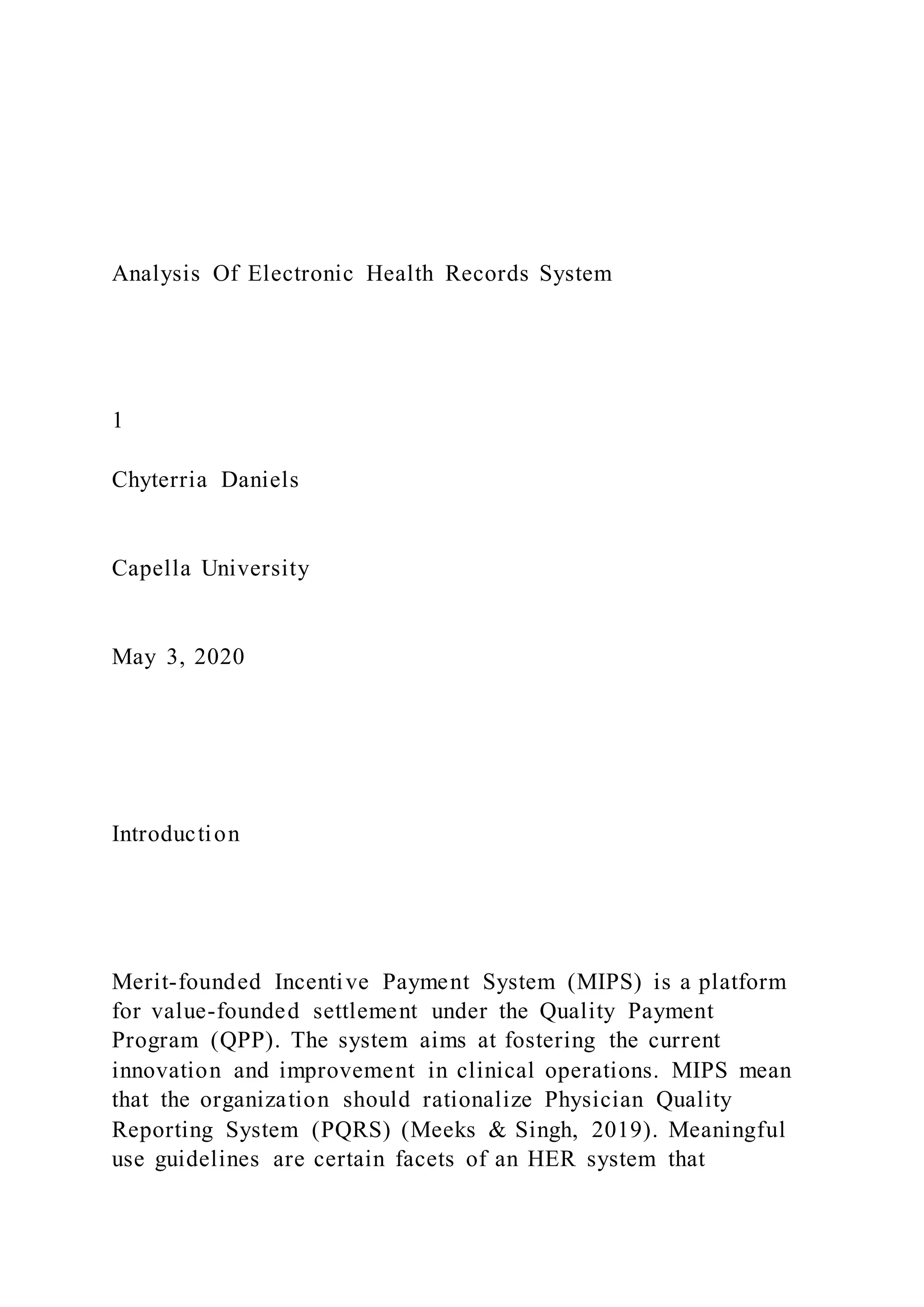
Merit-founded Incentive Payment System (MIPS) is a platform
for value-founded settlement under the Quality Payment
Program (QPP). The system aims at fostering the current
innovation and improvement in clinical operations. MIPS mean
that the organization should rationalize Physician Quality
Reporting System (PQRS) (Meeks & Singh, 2019). Meaningful
use guidelines are certain facets of an HER system that
providers will be needed to use in their organization.
2
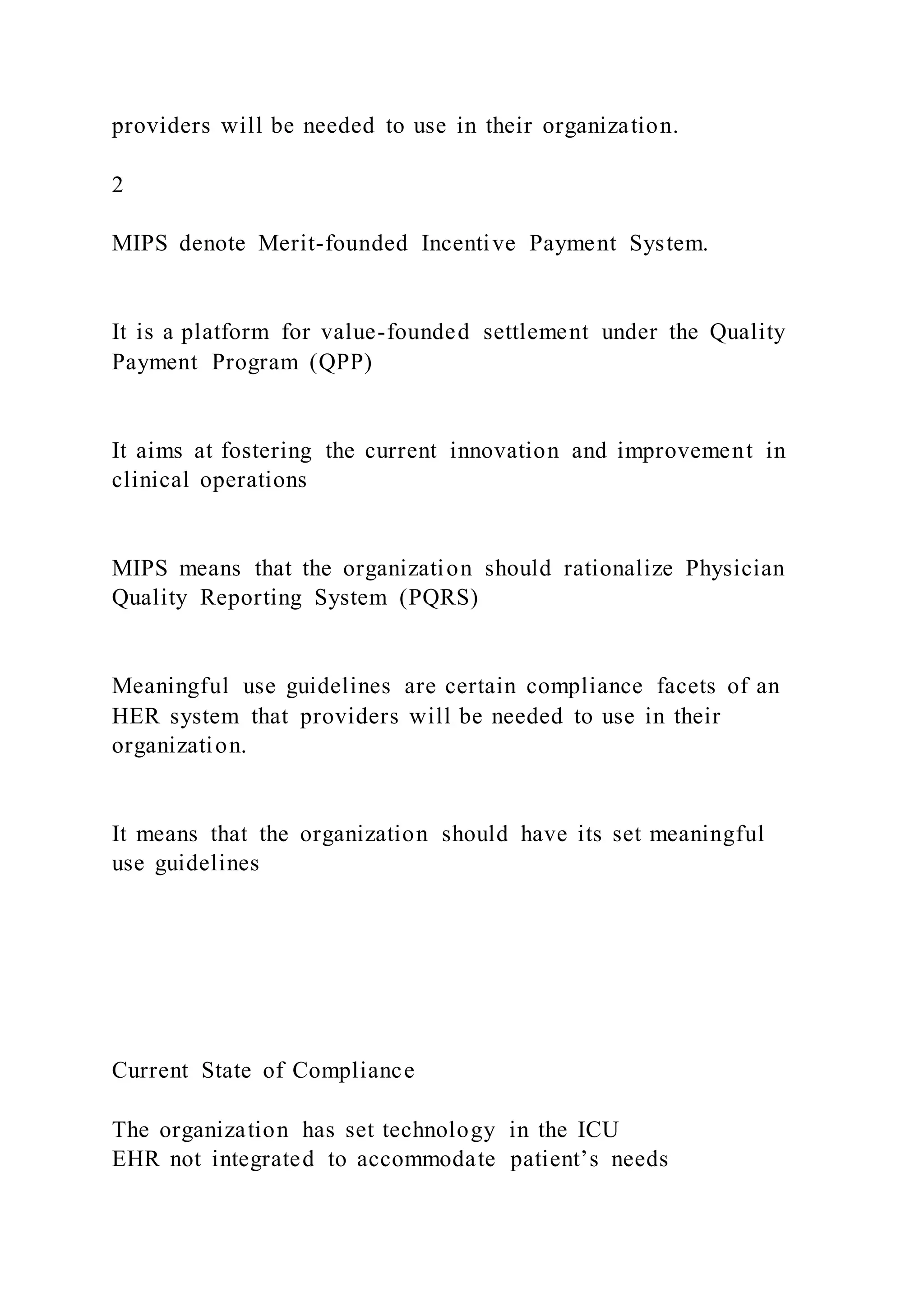
MIPS denote Merit-founded Incentive Payment System.
It is a platform for value-founded settlement under the Quality
Payment Program (QPP)
It aims at fostering the current innovation and improvement in
clinical operations
MIPS means that the organization should rationalize Physician
Quality Reporting System (PQRS)
Meaningful use guidelines are certain compliance facets of an
HER system that providers will be needed to use in their
organization.
It means that the organization should have its set meaningful
use guidelines
Current State of Compliance
The organization has set technology in the ICU
EHR not integrated to accommodate patient’s needs
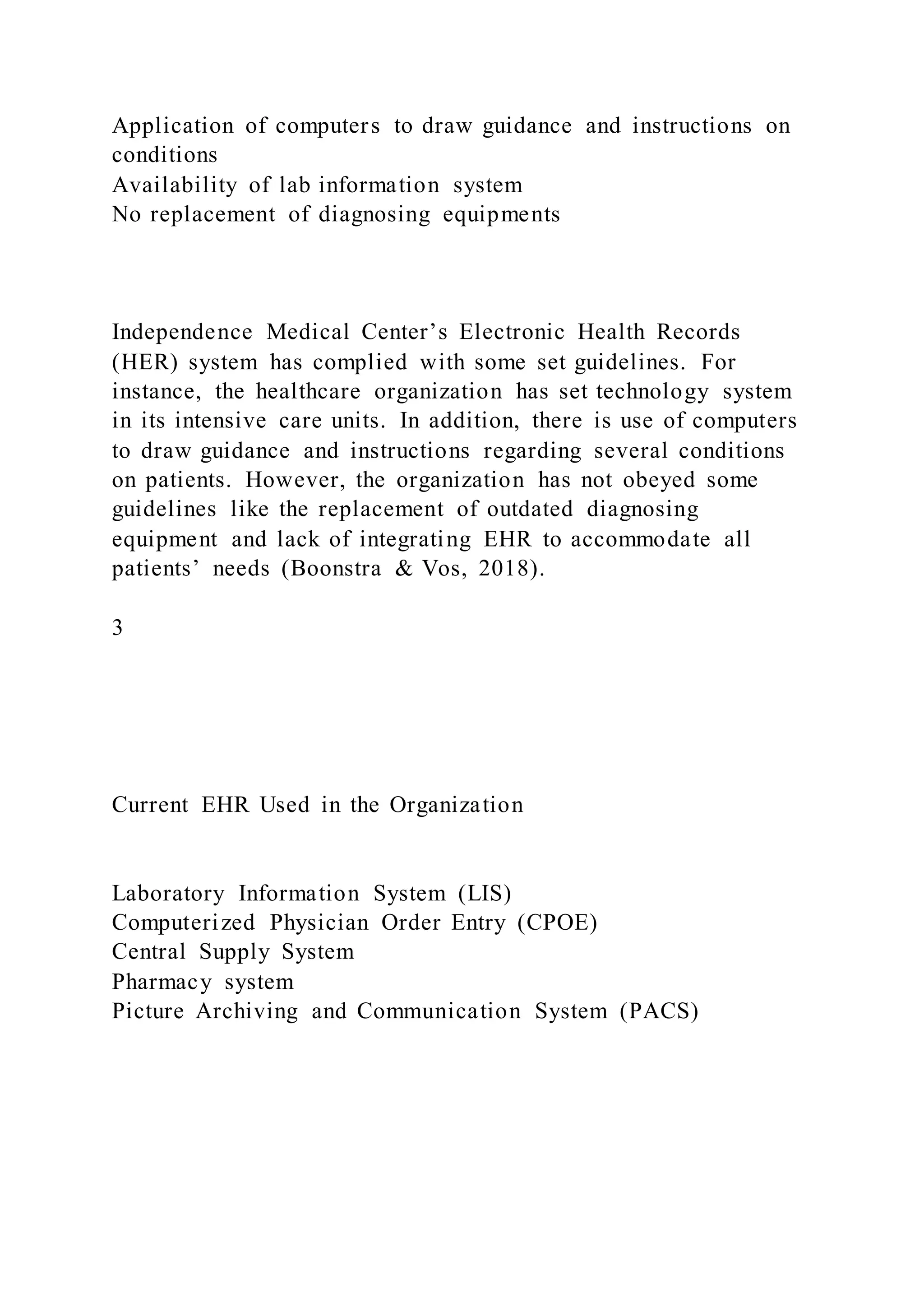
Application of computers to draw guidance and instructions on
conditions
Availability of lab information system
No replacement of diagnosing equipments
Independence Medical Center’s Electronic Health Records
(HER) system has complied with some set guidelines. For
instance, the healthcare organization has set technology system
in its intensive care units. In addition, there is use of computers
to draw guidance and instructions regarding several conditions
on patients. However, the organization has not obeyed some
guidelines like the replacement of outdated diagnosing
equipment and lack of integrating EHR to accommodate all
patients’ needs (Boonstra & Vos, 2018).
3
Current EHR Used in the Organization
Laboratory Information System (LIS)
Computerized Physician Order Entry (CPOE)
Central Supply System
Pharmacy system
Picture Archiving and Communication System (PACS)
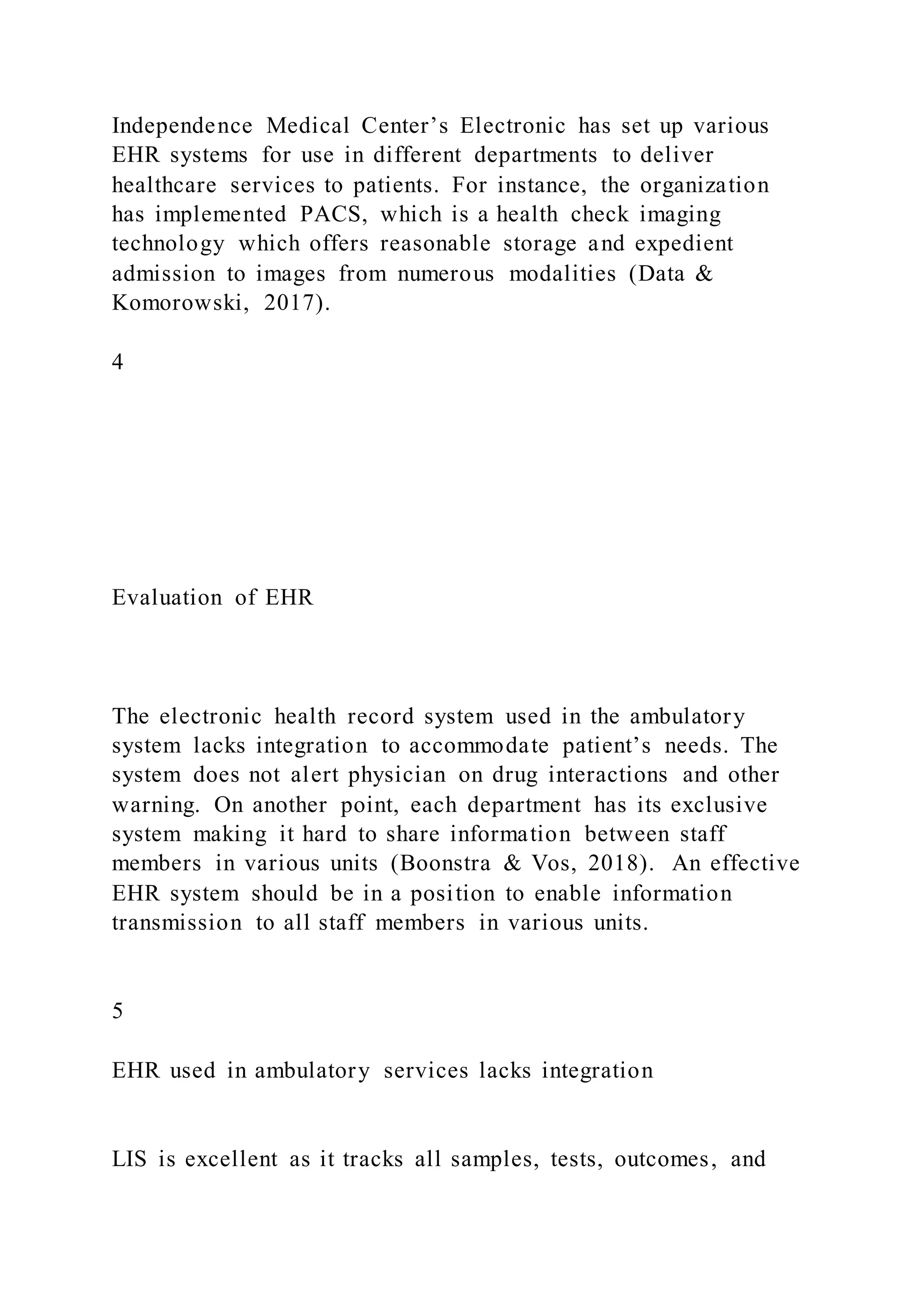
Independence Medical Center’s Electronic has set up various
EHR systems for use in different departments to deliver
healthcare services to patients. For instance, the organization
has implemented PACS, which is a health check imaging
technology which offers reasonable storage and expedient
admission to images from numerous modalities (Data &
Komorowski, 2017).
4
Evaluation of EHR
The electronic health record system used in the ambulatory
system lacks integration to accommodate patient’s needs. The
system does not alert physician on drug interactions and other
warning. On another point, each department has its exclusive
system making it hard to share information between staff
members in various units (Boonstra & Vos, 2018). An effective
EHR system should be in a position to enable information
transmission to all staff members in various units.
5
EHR used in ambulatory services lacks integration
LIS is excellent as it tracks all samples, tests, outcomes, and
allied info
EHR is not integrated to enable information sharing between
departments
EHR fails to communicate with the existing system
EHR used in the cancer center gives untrustworthy info
How EHR Could Improve Quality Care
LIS could give correct testing results useful drug prescription
Integrating EHR system to enable info transmission can
facilitate healthcare delivery
EHR could enhance patient’s outcomes if it gives alerts on drug
interactions
EHR could simplify cancer center operations if it offers trusted
info
EHR could improve quality care through provision of correct
laboratory patient testing results, which are useful in
determining the kind of drug to be prescribed. On another point,
it could also simplify existing process through being able to
transmit information between various units (Boonstra & Vos,
2018).
6
Data
In the organization data is gathered through pre-registration
forms by admission specialists. This meets regulatory policy as
data should be gathered during the registration process of
patients. Tracing of data is through the admission records which
have all information regarding every patient’s (Data &
Komorowski, 2017).
7
Data is gathered via pre-registration of patients-attains
regulatory policy
Data is traced through admission records-attains regulatory
policy
Data is analyzed by admission specialists-meets regulatory
policy
Data is shared by specialists giving admission records-do not
attain guidelines
Maintaining Useful Use Guidelines
In order to maintain useful use guidelines, a health organizati on
should ensure communication with public health agencies to
report on various issues for actions or addressing (Data &
Komorowski, 2017). There should be constant sharing of useful
information between healthcare staff members.
8
Ensuring transparency by providing patients with data
Communicating with public health entities
Sharing of meaningful clinical data among team members
Report to patient registries for quality improvement
Use computerized physician order entry
Evidence-based Best Practices
Evidence-based best practices for long-term compliance with
existing incentive programs and policy should have transparent
provider ratings, there should be rewarding of successful series
of care, and the organization should use clinical data over
administrative claim data (Meeks & Singh, 2019).
9
Creating transparent provider ratings
Reward successful series of care
Formulate national performance targets
Use clinical over management claim data
Design sustainable business model
Recommendation on the EHR
Electronic health record system should be designed to be in a
position to offer all the essential data to the end user. It should
also be able to provide patients with data. In addition, it should
be designed to link all departments which ensure its support for
communication (Boonstra & Vos, 2018).
10
EHR should provide all the necessary data to end user
It should provide patients with their data
Should support communication between staff members in
different units
It should not consume a lot of time for training
It should be easy to understand
Evidence-based Recommendations
Highlighting compatibility
Pinpointing the anticipated model impacts
Determining change agents
Focus on groups for planning change
Reminders or practice prompts
When implementing emerging models and new practices, a
healthcare organization should first highlight its compatibility
to their facility, focus on ascertaining the model or practices
anticipated impacts, and determine change agents to ensure
successful execution (Meeks & Singh, 2019).
11
References
Boonstra, A., & Vos, J. F. (2018). Implementing electronic
health records in hospitals: a systematic literature review. BMC
health services research, 14(1), 370.
Data, M. C., & Komorowski, M. (2017). Secondary analysis of
electronic health records. Springer International Publishing.
Meeks, D. W., & Singh, H. (2019). An analysis of electronic
health record-related patient safety concerns. Journal of the
American Medical Informatics Association, 21(6), 1053-1059.
12
Analysis Of Electronic Health Records System1C

Analysis Of Electronic Health Records System1C

  • 1.
    Analysis Of ElectronicHealth Records System 1 Chyterria Daniels Capella University May 3, 2020 Introduction Merit-founded Incentive Payment System (MIPS) is a platform for value-founded settlement under the Quality Payment Program (QPP). The system aims at fostering the current innovation and improvement in clinical operations. MIPS mean that the organization should rationalize Physician Quality Reporting System (PQRS) (Meeks & Singh, 2019). Meaningful use guidelines are certain facets of an HER system that
  • 2.
    providers will beneeded to use in their organization. 2 MIPS denote Merit-founded Incentive Payment System. It is a platform for value-founded settlement under the Quality Payment Program (QPP) It aims at fostering the current innovation and improvement in clinical operations MIPS means that the organization should rationalize Physician Quality Reporting System (PQRS) Meaningful use guidelines are certain compliance facets of an HER system that providers will be needed to use in their organization. It means that the organization should have its set meaningful use guidelines Current State of Compliance The organization has set technology in the ICU EHR not integrated to accommodate patient’s needs
  • 3.
    Application of computersto draw guidance and instructions on conditions Availability of lab information system No replacement of diagnosing equipments Independence Medical Center’s Electronic Health Records (HER) system has complied with some set guidelines. For instance, the healthcare organization has set technology system in its intensive care units. In addition, there is use of computers to draw guidance and instructions regarding several conditions on patients. However, the organization has not obeyed some guidelines like the replacement of outdated diagnosing equipment and lack of integrating EHR to accommodate all patients’ needs (Boonstra & Vos, 2018). 3 Current EHR Used in the Organization Laboratory Information System (LIS) Computerized Physician Order Entry (CPOE) Central Supply System Pharmacy system Picture Archiving and Communication System (PACS)
  • 4.
    Independence Medical Center’sElectronic has set up various EHR systems for use in different departments to deliver healthcare services to patients. For instance, the organization has implemented PACS, which is a health check imaging technology which offers reasonable storage and expedient admission to images from numerous modalities (Data & Komorowski, 2017). 4 Evaluation of EHR The electronic health record system used in the ambulatory system lacks integration to accommodate patient’s needs. The system does not alert physician on drug interactions and other warning. On another point, each department has its exclusive system making it hard to share information between staff members in various units (Boonstra & Vos, 2018). An effective EHR system should be in a position to enable information transmission to all staff members in various units. 5 EHR used in ambulatory services lacks integration LIS is excellent as it tracks all samples, tests, outcomes, and
  • 5.
    allied info EHR isnot integrated to enable information sharing between departments EHR fails to communicate with the existing system EHR used in the cancer center gives untrustworthy info How EHR Could Improve Quality Care LIS could give correct testing results useful drug prescription Integrating EHR system to enable info transmission can facilitate healthcare delivery EHR could enhance patient’s outcomes if it gives alerts on drug interactions EHR could simplify cancer center operations if it offers trusted info EHR could improve quality care through provision of correct laboratory patient testing results, which are useful in determining the kind of drug to be prescribed. On another point, it could also simplify existing process through being able to transmit information between various units (Boonstra & Vos,
  • 6.
    2018). 6 Data In the organizationdata is gathered through pre-registration forms by admission specialists. This meets regulatory policy as data should be gathered during the registration process of patients. Tracing of data is through the admission records which have all information regarding every patient’s (Data & Komorowski, 2017). 7 Data is gathered via pre-registration of patients-attains regulatory policy Data is traced through admission records-attains regulatory policy Data is analyzed by admission specialists-meets regulatory policy Data is shared by specialists giving admission records-do not attain guidelines
  • 7.
    Maintaining Useful UseGuidelines In order to maintain useful use guidelines, a health organizati on should ensure communication with public health agencies to report on various issues for actions or addressing (Data & Komorowski, 2017). There should be constant sharing of useful information between healthcare staff members. 8 Ensuring transparency by providing patients with data Communicating with public health entities Sharing of meaningful clinical data among team members Report to patient registries for quality improvement Use computerized physician order entry Evidence-based Best Practices
  • 8.
    Evidence-based best practicesfor long-term compliance with existing incentive programs and policy should have transparent provider ratings, there should be rewarding of successful series of care, and the organization should use clinical data over administrative claim data (Meeks & Singh, 2019). 9 Creating transparent provider ratings Reward successful series of care Formulate national performance targets Use clinical over management claim data Design sustainable business model Recommendation on the EHR
  • 9.
    Electronic health recordsystem should be designed to be in a position to offer all the essential data to the end user. It should also be able to provide patients with data. In addition, it should be designed to link all departments which ensure its support for communication (Boonstra & Vos, 2018). 10 EHR should provide all the necessary data to end user It should provide patients with their data Should support communication between staff members in different units It should not consume a lot of time for training It should be easy to understand Evidence-based Recommendations Highlighting compatibility Pinpointing the anticipated model impacts Determining change agents Focus on groups for planning change
  • 10.
    Reminders or practiceprompts When implementing emerging models and new practices, a healthcare organization should first highlight its compatibility to their facility, focus on ascertaining the model or practices anticipated impacts, and determine change agents to ensure successful execution (Meeks & Singh, 2019). 11 References Boonstra, A., & Vos, J. F. (2018). Implementing electronic health records in hospitals: a systematic literature review. BMC health services research, 14(1), 370. Data, M. C., & Komorowski, M. (2017). Secondary analysis of electronic health records. Springer International Publishing. Meeks, D. W., & Singh, H. (2019). An analysis of electronic health record-related patient safety concerns. Journal of the American Medical Informatics Association, 21(6), 1053-1059. 12