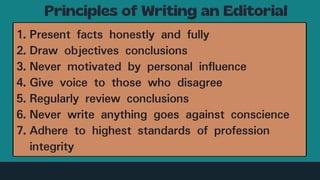
1. Present facts honestly and fully

2. Draw objectives conclusions
3. Never motivated by personal influence
4. Give voice to those who disagree
5. Regularly review conclusions
6. Never write anything goes against conscience
7. Adhere to highest standards of profession
integrity
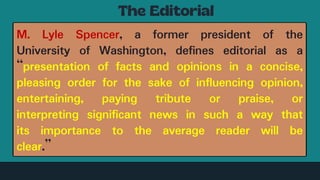
M. Lyle Spencer, a former president of the
University of Washington, defines editorial as a
“presentation of facts and opinions in a concise,
pleasing order for the sake of influencing opinion,
entertaining, paying tribute or praise, or
interpreting significant news in such a way that
its importance to the average reader will be
clear.”
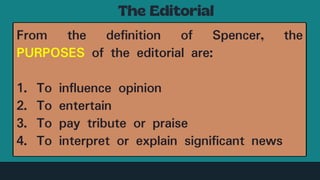
From the definition of Spencer, the
PURPOSES of the editorial are:
1. To influence opinion
2. To entertain
3. To pay tribute or praise
4. To interpret or explain significant news
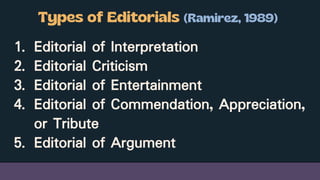
1. Editorial of Interpretation
2. Editorial Criticism
3. Editorial of Entertainment
4. Editorial of Commendation, Appreciation,
or Tribute
5. Editorial of Argument
- explains the significance of a news and
events in an objective, factual,
dispassionate manner, so as to translate,
elucidate, and construe in the light of
individual belief or interest
- peg on the news/issue.
- point out the positive and negative
features of the issues and explains what
should be done about it
- frequently written to expose negatives
and advocate changes for the better.
- shows “the pathos and comedy in the
news”
- reflects the human interest angle with
the view to create a “certain smile” on the
part of the readers
- offers an analytical judgment on the
affairs of the nation or the school.
- makes worthy commendation and praise
for the success, achievement and
inventions of various leaders, educators,
scientists, and other personalities or
organizations
- designed to argue for the benefits of
the reader
- The cold, substantial logic of the best
editorial minds finds expression in editorials
which argue from cause to effect, clearly
indicating the reasons why certain
developments are expected.














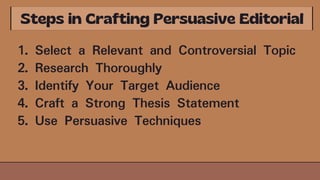
1. Select a Relevant and Controversial Topic
2. Research Thoroughly
3. Identify Your Target Audience
4. Craft a Strong Thesis Statement
5. Use Persuasive Techniques
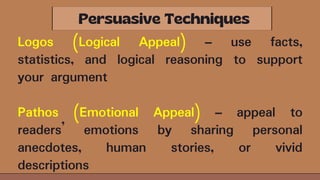
Logos (Logical Appeal) – use facts,
statistics, and logical reasoning to support
your argument
Pathos (Emotional Appeal) – appeal to
readers’ emotions by sharing personal
anecdotes, human stories, or vivid
descriptions
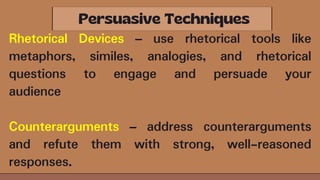
Rhetorical Devices – use rhetorical tools like
metaphors, similes, analogies, and rhetorical
questions to engage and persuade your
audience
Counterarguments – address counterarguments
and refute them with strong, well-reasoned
responses.
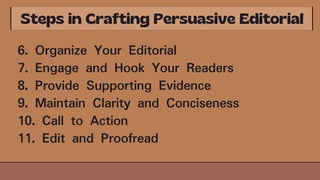
6. Organize Your Editorial
7. Engage and Hook Your Readers
8. Provide Supporting Evidence
9. Maintain Clarity and Conciseness
10. Call to Action
11. Edit and Proofread
Creating persuasive editorials requires
a combination of well-researched
content, effective argumentation, and
engaging writing.
EDITORIAL WRITING.pptx

EDITORIAL WRITING.pptx

  • 6.
    1. Present factshonestly and fully 2. Draw objectives conclusions 3. Never motivated by personal influence 4. Give voice to those who disagree 5. Regularly review conclusions 6. Never write anything goes against conscience 7. Adhere to highest standards of profession integrity
  • 7.
    M. Lyle Spencer,a former president of the University of Washington, defines editorial as a “presentation of facts and opinions in a concise, pleasing order for the sake of influencing opinion, entertaining, paying tribute or praise, or interpreting significant news in such a way that its importance to the average reader will be clear.”
  • 8.
    From the definitionof Spencer, the PURPOSES of the editorial are: 1. To influence opinion 2. To entertain 3. To pay tribute or praise 4. To interpret or explain significant news
  • 9.
    1. Editorial ofInterpretation 2. Editorial Criticism 3. Editorial of Entertainment 4. Editorial of Commendation, Appreciation, or Tribute 5. Editorial of Argument
  • 10.
    - explains thesignificance of a news and events in an objective, factual, dispassionate manner, so as to translate, elucidate, and construe in the light of individual belief or interest - peg on the news/issue.
  • 11.
    - point outthe positive and negative features of the issues and explains what should be done about it - frequently written to expose negatives and advocate changes for the better.
  • 12.
    - shows “thepathos and comedy in the news” - reflects the human interest angle with the view to create a “certain smile” on the part of the readers
  • 13.
    - offers ananalytical judgment on the affairs of the nation or the school.
  • 14.
    - makes worthycommendation and praise for the success, achievement and inventions of various leaders, educators, scientists, and other personalities or organizations
  • 15.
    - designed toargue for the benefits of the reader - The cold, substantial logic of the best editorial minds finds expression in editorials which argue from cause to effect, clearly indicating the reasons why certain developments are expected.
  • 20.
  • 21.
  • 24.
  • 25.
  • 31.
  • 33.
    1. Select aRelevant and Controversial Topic 2. Research Thoroughly 3. Identify Your Target Audience 4. Craft a Strong Thesis Statement 5. Use Persuasive Techniques
  • 34.
    Logos (Logical Appeal)– use facts, statistics, and logical reasoning to support your argument Pathos (Emotional Appeal) – appeal to readers’ emotions by sharing personal anecdotes, human stories, or vivid descriptions
  • 35.
    Rhetorical Devices –use rhetorical tools like metaphors, similes, analogies, and rhetorical questions to engage and persuade your audience Counterarguments – address counterarguments and refute them with strong, well-reasoned responses.
  • 36.
    6. Organize YourEditorial 7. Engage and Hook Your Readers 8. Provide Supporting Evidence 9. Maintain Clarity and Conciseness 10. Call to Action 11. Edit and Proofread
  • 37.
    Creating persuasive editorialsrequires a combination of well-researched content, effective argumentation, and engaging writing.