purwaningsih_siti@yahoo.com 
Narrative 
Composing My First College Essay 
by Sandy Klem 
Sandy was sitting at her desk, nervously tugging at her frizzy hair and 
worrying about the essay she should have written for her English class. Three 
days ago she was given the assignment, and now the paper is due in just one hour. 
She uncaped her Bic, carefully printed her name at the top of the page, and then 
squeezed her eyes shut as she waited for inspiration. 
Writing about summer vacations, embarrassing moments, and the adventures 
of a quarter had never been one of her favorite pastimes. She would rather be 
outside missing a bus (it would be less frustrating) or catching a cold (it would be 
more enjoyable). Still, after burning hamburger patties all summer to pay for her 
tuition, she was not about to throw in the towel (or even her broken laptop) in this, 
the second week of the term. 
Perhaps, she thought, a few aerobic exercises would send the creative juices 
shooting up to her skull. Switching on her iPod and the external speakers, she 
began to gyrate across the room. Her souvenir spoons rattled on the dresser, 
posters unhinged themselves from the wall, and empty bottles shimmy off the 
book shelf and crashed to the floor. Still, she received no inspiration, just threated 
and cursed from a few late-sleepers down the hall. 
Sandy squelched the music and trudged back to her desk. The blank sheet of 
paper stared at her, almost snickering it seemed. She retaliated by defacing it with 
looped and squiggled and curlicued that puncture the paper. That accomplished, 
she glanced at the clock radio: forty minutes to go. 
Taking a fresh sheet of paper, she wrote her name--once, twice, twenty times. 
Then she crumpled it into a ball and tossed it at the glowering clock. She missed. 
Her future flashed before her eyes: she would be a failed writer, a college dropout. 
Eventually she would become one of those bag ladies who sleep in doorways and 
drank Sterno and argued with themselves on buses. Then her life would be an 
endless summer vacation of cold, rainy weather. Her life would be one long 
embarrassing moment. Without a quarter to her name, she would never enjoy a 
single adventure. 
Sandy picked up her well-nibbled pen, and now, with determination and 
enthusiasm, she began to write quickly. "Sandy is sitting at her desk," she wrote, 
"nervously tugging at her frizzy hair and worrying about the essay she should 
have written for her English class. . . ." 
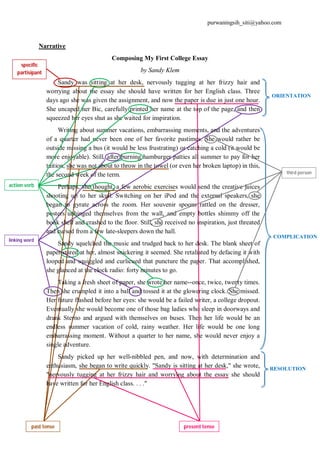
ORIENTATION 
COMPLICATION 
RESOLUTION 
specific 
partisipant 
action verb 
linking word 
third person 
past tense present tense
purwaningsih_siti@yahoo.com 
ANALYSIS OF NARRATIVE 
Generic Structure: 
1. Orientation 
The opening paragraph where the characters of the story are introduced. 
2. Complication 
the problems of the story developed/ arised. 
3. Resolution 
the problems of the story resolved. 
Language Feature: 
1. Specific; often individual participants with defined identities 
2. Action verb (material processes), non action verb (verbal and mental 
processes) 
3. past tense (simple past tense, past future, past perfect) 
4. linking word to do with time 
5. dialog often included, during which the tense may change to the present or 
future 
6. written in the third person

Analysis narrative text composing my first essay by sandy

  • 1.
    purwaningsih_siti@yahoo.com Narrative ComposingMy First College Essay by Sandy Klem Sandy was sitting at her desk, nervously tugging at her frizzy hair and worrying about the essay she should have written for her English class. Three days ago she was given the assignment, and now the paper is due in just one hour. She uncaped her Bic, carefully printed her name at the top of the page, and then squeezed her eyes shut as she waited for inspiration. Writing about summer vacations, embarrassing moments, and the adventures of a quarter had never been one of her favorite pastimes. She would rather be outside missing a bus (it would be less frustrating) or catching a cold (it would be more enjoyable). Still, after burning hamburger patties all summer to pay for her tuition, she was not about to throw in the towel (or even her broken laptop) in this, the second week of the term. Perhaps, she thought, a few aerobic exercises would send the creative juices shooting up to her skull. Switching on her iPod and the external speakers, she began to gyrate across the room. Her souvenir spoons rattled on the dresser, posters unhinged themselves from the wall, and empty bottles shimmy off the book shelf and crashed to the floor. Still, she received no inspiration, just threated and cursed from a few late-sleepers down the hall. Sandy squelched the music and trudged back to her desk. The blank sheet of paper stared at her, almost snickering it seemed. She retaliated by defacing it with looped and squiggled and curlicued that puncture the paper. That accomplished, she glanced at the clock radio: forty minutes to go. Taking a fresh sheet of paper, she wrote her name--once, twice, twenty times. Then she crumpled it into a ball and tossed it at the glowering clock. She missed. Her future flashed before her eyes: she would be a failed writer, a college dropout. Eventually she would become one of those bag ladies who sleep in doorways and drank Sterno and argued with themselves on buses. Then her life would be an endless summer vacation of cold, rainy weather. Her life would be one long embarrassing moment. Without a quarter to her name, she would never enjoy a single adventure. Sandy picked up her well-nibbled pen, and now, with determination and enthusiasm, she began to write quickly. "Sandy is sitting at her desk," she wrote, "nervously tugging at her frizzy hair and worrying about the essay she should have written for her English class. . . ." ORIENTATION COMPLICATION RESOLUTION specific partisipant action verb linking word third person past tense present tense
  • 2.
    purwaningsih_siti@yahoo.com ANALYSIS OFNARRATIVE Generic Structure: 1. Orientation The opening paragraph where the characters of the story are introduced. 2. Complication the problems of the story developed/ arised. 3. Resolution the problems of the story resolved. Language Feature: 1. Specific; often individual participants with defined identities 2. Action verb (material processes), non action verb (verbal and mental processes) 3. past tense (simple past tense, past future, past perfect) 4. linking word to do with time 5. dialog often included, during which the tense may change to the present or future 6. written in the third person