1
Affiliated to VTU, Belagavi, Approved by AICTE, New Delhi, Recognised by UGC with 2(f) & 12 (B), Accredited by NBA & NAAC
MVJ19CS42 – ANALYSIS AND DESIGN OF ALGORITHMS
Module 4
Semester – II
Academic Year : 2020-2021(EVEN)
By
SUGUNADEVI C
2
Affiliated to VTU, Belagavi, Approved by AICTE, New Delhi, Recognised by UGC with 2(f) & 12 (B), Accredited by NBA & NAAC
PREREQUISITES:
BASIC KNOWLEDGE ABOUT ANALYSIS AND DESIGN OF
ALGORITHMS
BRIDGE MATERIAL:
Algorithm is a sequence of steps to solve a
problem. Design and Analysis of Algorithm is very important for designing algorithm to
solve different types of problems. As the speed of processor increases, performance is
frequently said to be less central than other software quality characteristics (e.g. security,
extensibility, reusability etc.).
COURSE OBJECTIVE IS TO:
• Identify the importance of different asymptotic notation.
• Determine the complexity of recursive and non-recursive algorithms.
• Compare the efficiency of various design techniques like greedy method, backtracking
etc.
• Apply appropriate method to solve a given problem.
COURSE OUTCOMES :
• Describe the need of algorithm and the notations used in design analysis.
• Compare the efficiency of brute force, divide and conquer techniques for problem
solving.
• Ability to apply greedy algorithms, hashing and string matching algorithms
• Ability to design efficient algorithms using various design techniques
4
Affiliated to VTU, Belagavi, Approved by AICTE, New Delhi, Recognised by UGC with 2(f) & 12 (B), Accredited by NBA & NAAC
Module - 4
Dynamic Programming: General method with Examples, Multistage Graphs.
Transitive Closure: Warshall's Algorithm, All Pairs Shortest Paths: Floyd's Algorithm,
Optimal Binary Search Trees, Knapsack problem, Bellman-Ford Algorithm ,
Travelling Sales Person problem , Reliability design.
Laboratory Sessions/ Experimental learning: Solving real time problems using
Dynamic Programming.
Applications: Computer Networks.
Video link: https://nptel.ac.in/courses/106/106/106106131/
5
Affiliated to VTU, Belagavi, Approved by AICTE, New Delhi, Recognised by UGC with 2(f) & 12 (B), Accredited by NBA & NAAC
• Dynamic programming is a technique for solving problems with
overlapping subproblems.
– subproblems arise from a recurrence relating a given problem’s solution to
solutions of its smaller subproblems.
– DP suggests solving each of the smaller subproblems only once and
recording the results in a table from which a solution to the original problem
can then be obtained.
• The Dynamic programming can be used when the solution to a problem can
be viewed as the result of sequence of decisions.
6
Affiliated to VTU, Belagavi, Approved by AICTE, New Delhi, Recognised by UGC with 2(f) & 12 (B), Accredited by NBA & NAAC
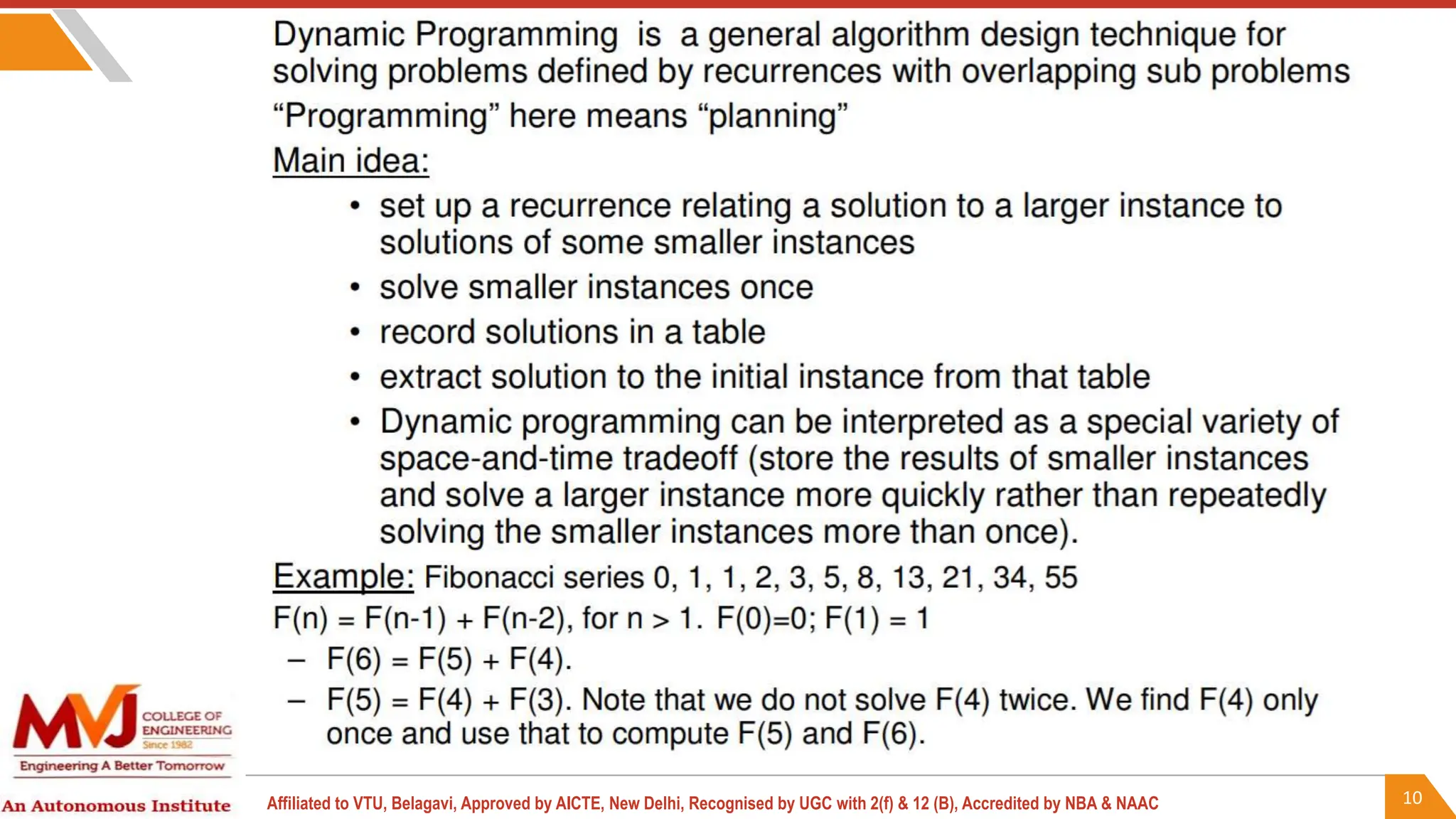
Dynamic Programming (DP) is an algorithmic technique for solving an
optimization problem by breaking it down into simpler subproblems and utilizing
the fact that the optimal solution to the overall problem depends upon the optimal
solution to its subproblems.
Let’s take the example of the Fibonacci numbers. As we all know, Fibonacci
numbers are a series of numbers in which each number is the sum of the two
preceding numbers. The first few Fibonacci numbers are 0, 1, 1, 2, 3, 5, and 8, and
they continue on from there.
If we are asked to calculate the nth Fibonacci number, we can do that with the
following equation,
7
Affiliated to VTU, Belagavi, Approved by AICTE, New Delhi, Recognised by UGC with 2(f) & 12 (B), Accredited by NBA & NAAC
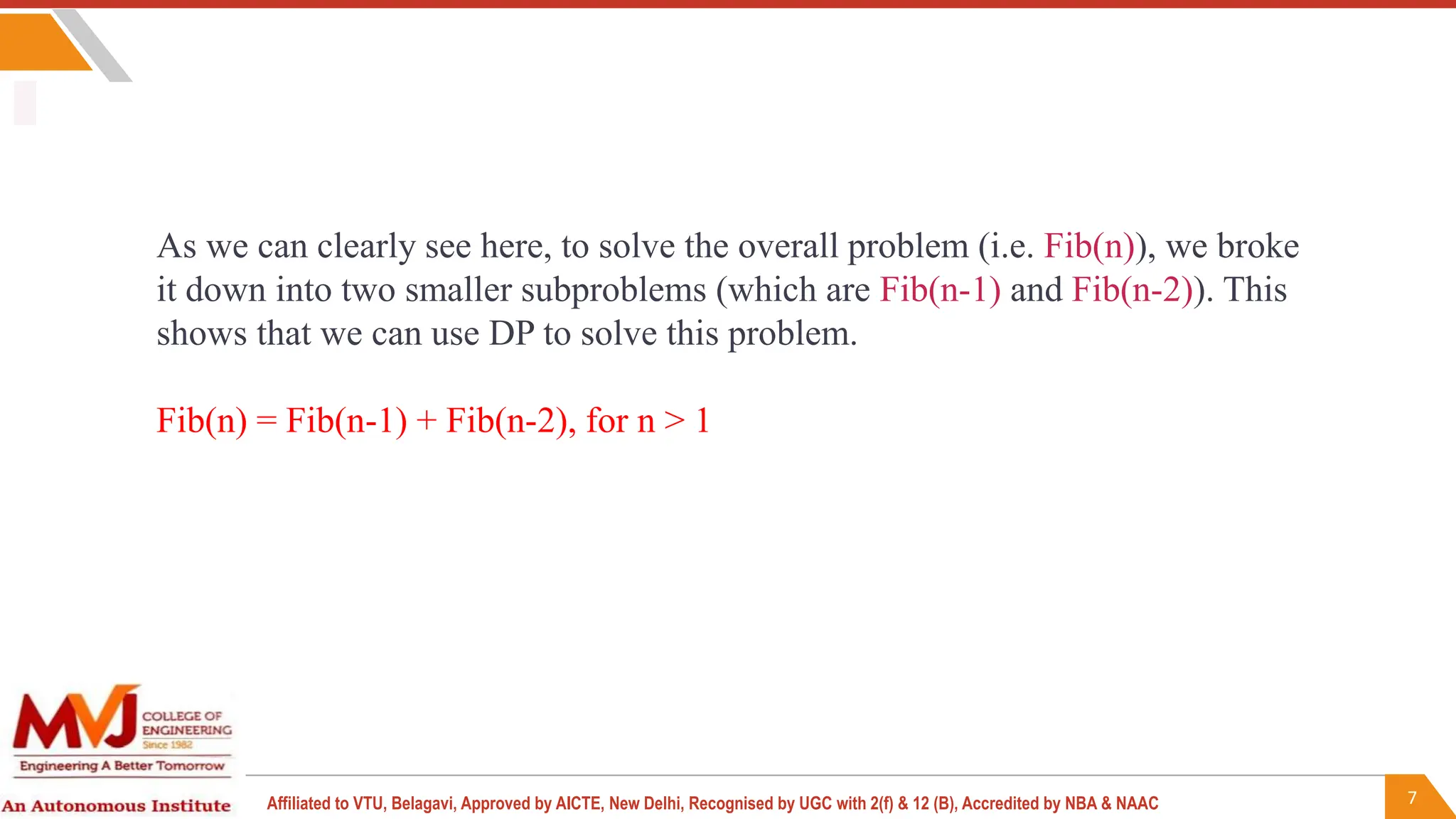
As we can clearly see here, to solve the overall problem (i.e. Fib(n)), we broke
it down into two smaller subproblems (which are Fib(n-1) and Fib(n-2)). This
shows that we can use DP to solve this problem.
Fib(n) = Fib(n-1) + Fib(n-2), for n > 1
8
Affiliated to VTU, Belagavi, Approved by AICTE, New Delhi, Recognised by UGC with 2(f) & 12 (B), Accredited by NBA & NAAC
9
Affiliated to VTU, Belagavi, Approved by AICTE, New Delhi, Recognised by UGC with 2(f) & 12 (B), Accredited by NBA & NAAC
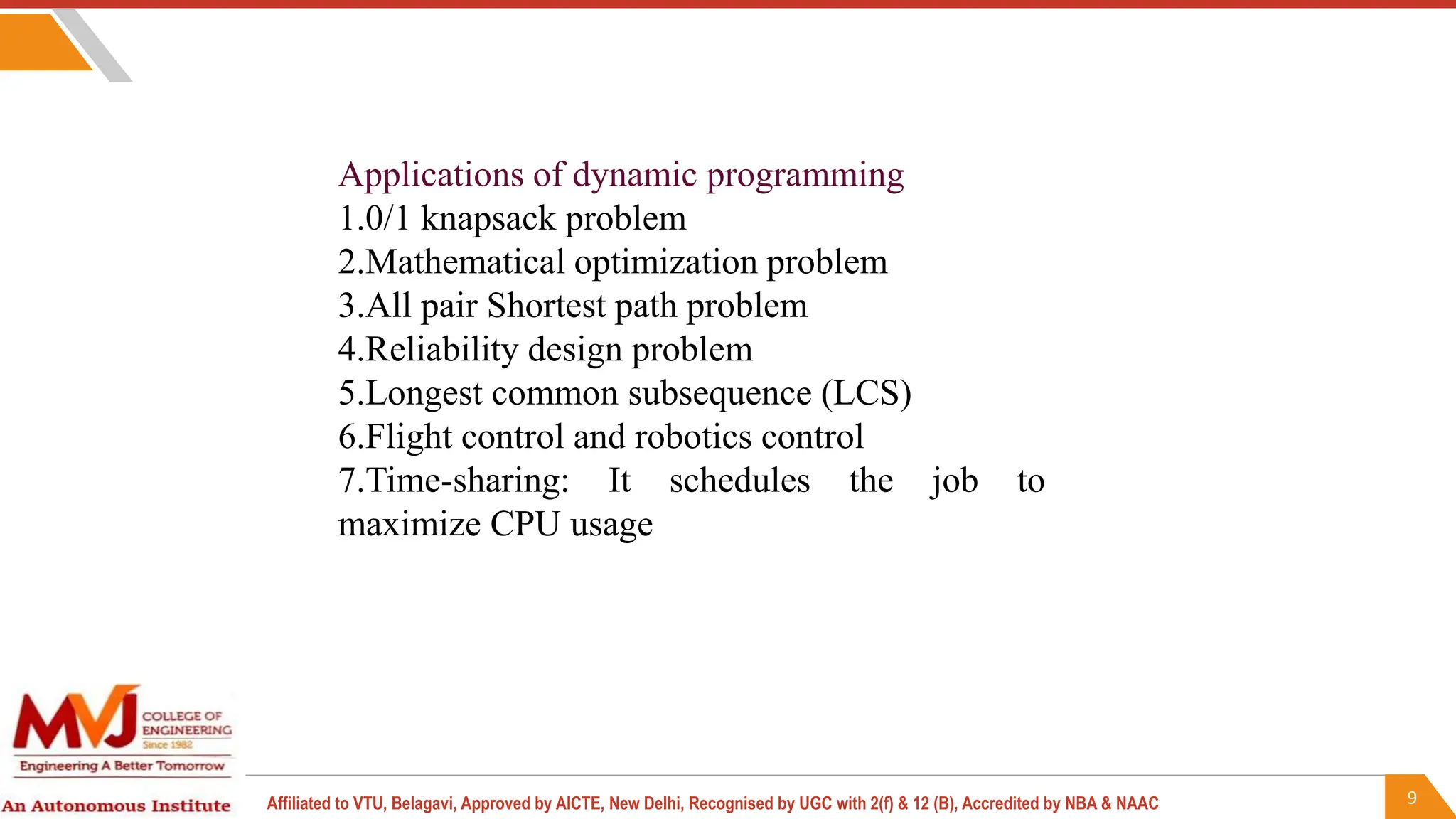
Applications of dynamic programming
1.0/1 knapsack problem
2.Mathematical optimization problem
3.All pair Shortest path problem
4.Reliability design problem
5.Longest common subsequence (LCS)
6.Flight control and robotics control
7.Time-sharing: It schedules the job to
maximize CPU usage
10
Affiliated to VTU, Belagavi, Approved by AICTE, New Delhi, Recognised by UGC with 2(f) & 12 (B), Accredited by NBA & NAAC
11
Affiliated to VTU, Belagavi, Approved by AICTE, New Delhi, Recognised by UGC with 2(f) & 12 (B), Accredited by NBA & NAAC
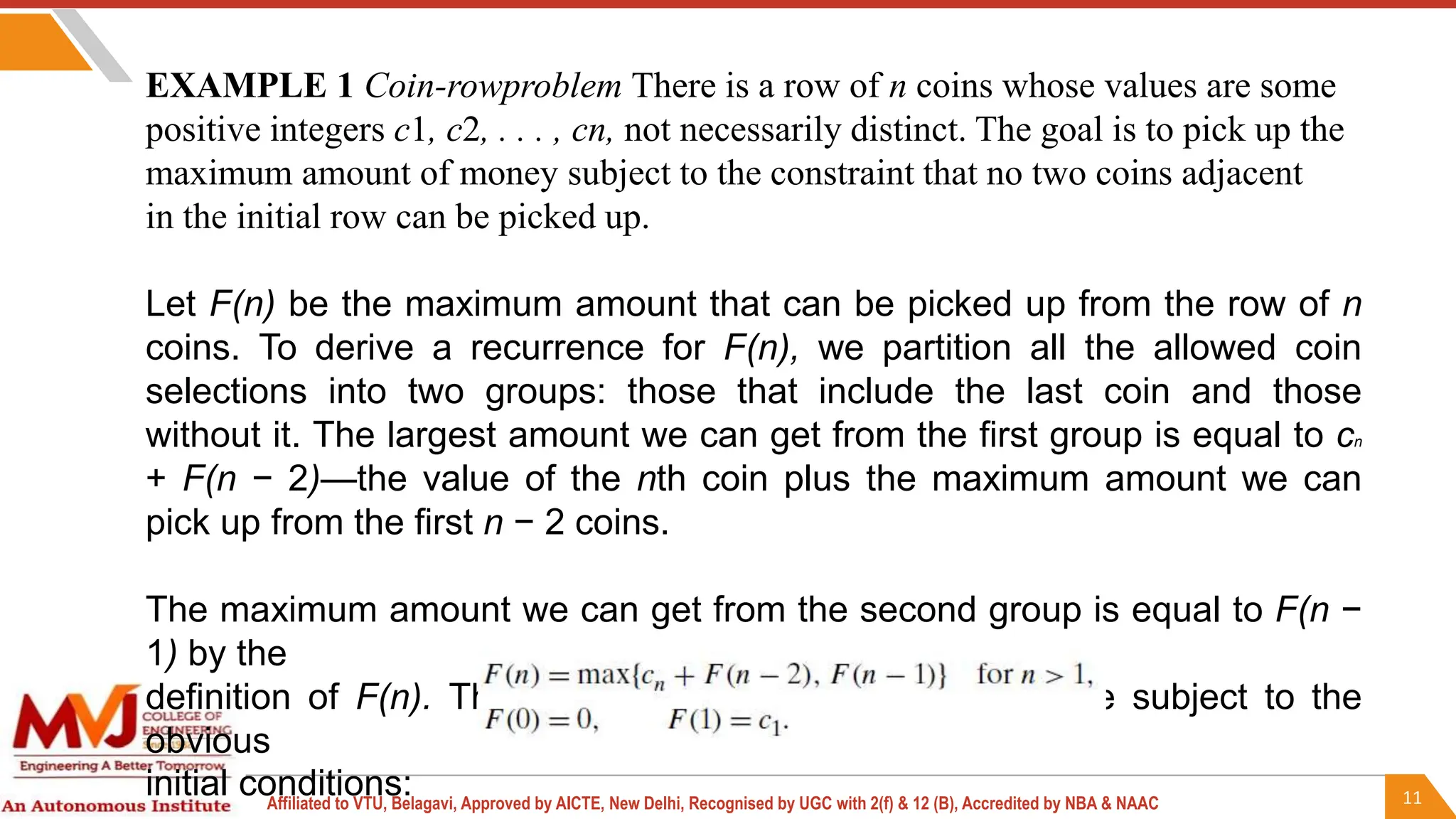
EXAMPLE 1 Coin-rowproblem There is a row of n coins whose values are some
positive integers c1, c2, . . . , cn, not necessarily distinct. The goal is to pick up the
maximum amount of money subject to the constraint that no two coins adjacent
in the initial row can be picked up.
Let F(n) be the maximum amount that can be picked up from the row of n
coins. To derive a recurrence for F(n), we partition all the allowed coin
selections into two groups: those that include the last coin and those
without it. The largest amount we can get from the first group is equal to cn
+ F(n − 2)—the value of the nth coin plus the maximum amount we can
pick up from the first n − 2 coins.
The maximum amount we can get from the second group is equal to F(n −
1) by the
definition of F(n). Thus, we have the following recurrence subject to the
obvious
initial conditions:
12
Affiliated to VTU, Belagavi, Approved by AICTE, New Delhi, Recognised by UGC with 2(f) & 12 (B), Accredited by NBA & NAAC
Coin Row Problem : Coin-rowproblem There is a row of n coins whose values are
some positive integers c1, c2, . . . , cn, not necessarily distinct. The goal is to pick up
the maximum amount of money subject to the constraint that no two coins adjacent in
the initial row can be picked up.
Or in other words
There is an integer array consisting positive numbers only. Find maximum possible
sum of elements such that there are no 2 consecutive elements present in the sum.
For ex: Coins[] = {5, 22, 26, 15, 4, 3,11}
Max Sum = 22 + 15 + 11 = 48
13
Affiliated to VTU, Belagavi, Approved by AICTE, New Delhi, Recognised by UGC with 2(f) & 12 (B), Accredited by NBA & NAAC
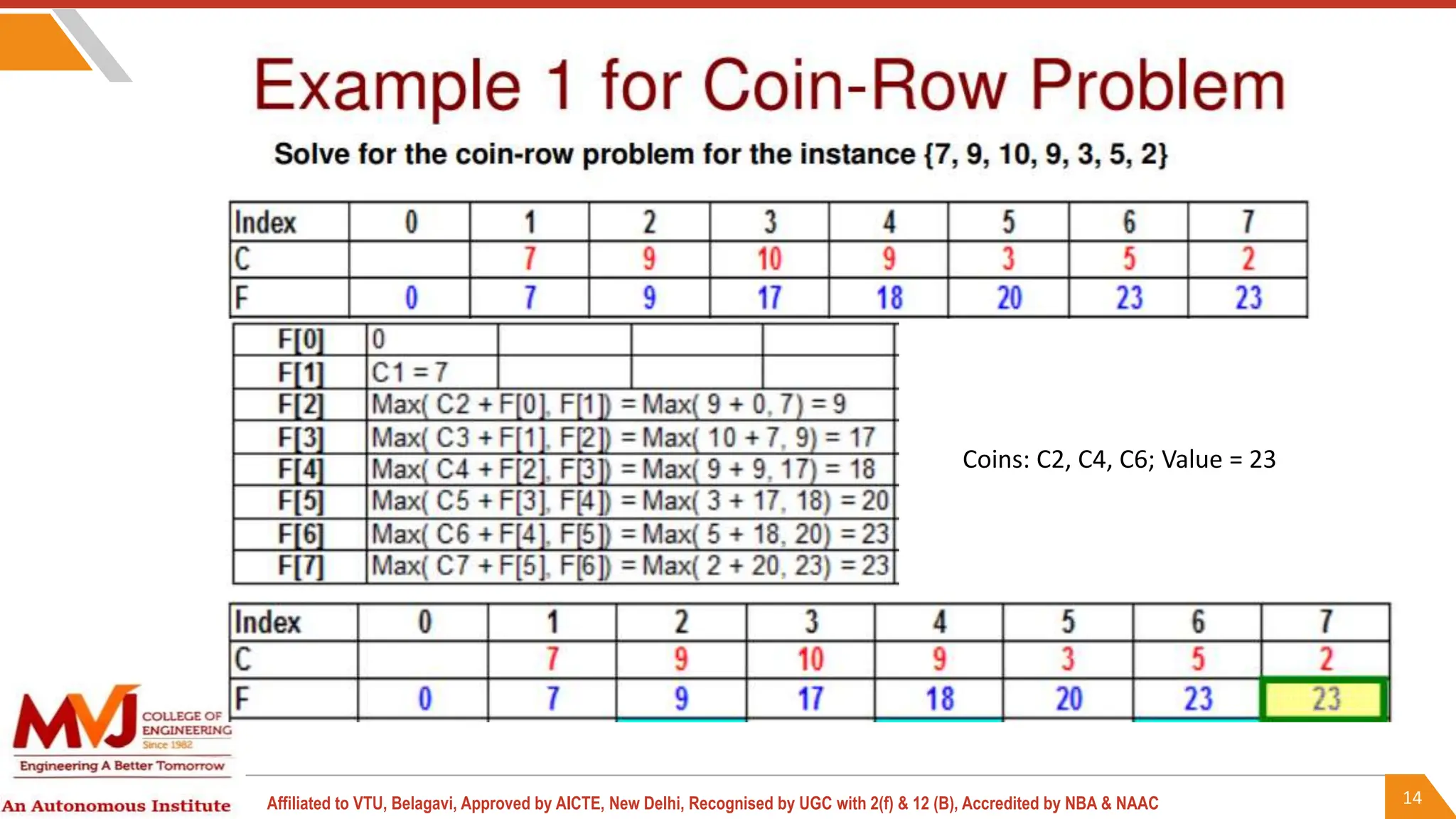
To solve this problem using Dynamic Programming first we will have to define
recurrence relation.
Let F[n] is the array which will contain the maximum sum at n for any given n. The
recurrence relation will be.
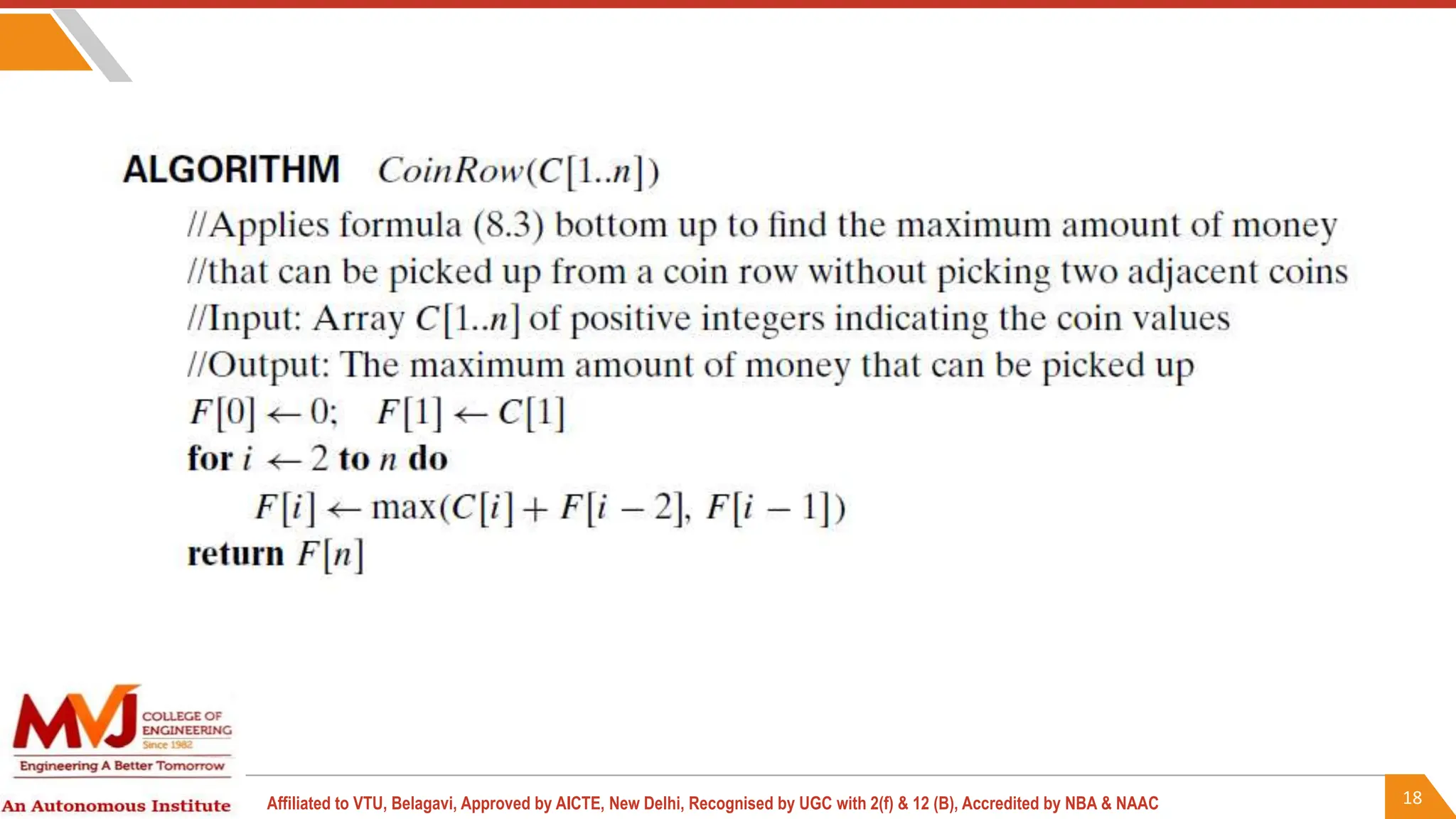
F(n) = max{Coins[n] + F[n − 2], F[n − 1]} for n > 1,
F(0) = 0, F(1) = Coins[1].
This is very easy to understand. While calculating F[n] we are taking maximum of
coins[n]+the previous of preceding element and the previous element.
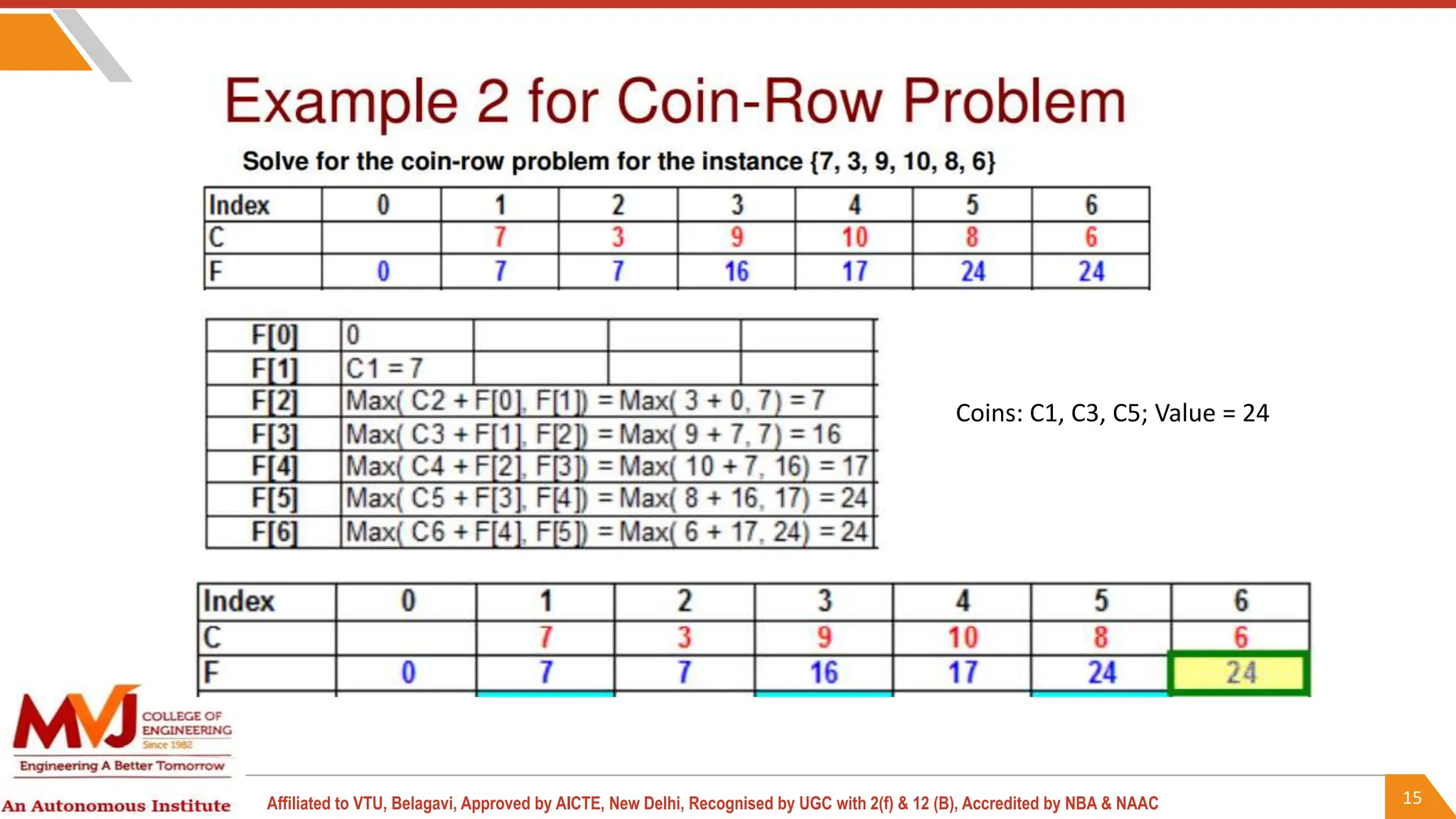
For example F[2] = max{coins[0]+ F[2-2], F[2-1]} // No consecutive
14
Affiliated to VTU, Belagavi, Approved by AICTE, New Delhi, Recognised by UGC with 2(f) & 12 (B), Accredited by NBA & NAAC
Coins: C2, C4, C6; Value = 23
15
Affiliated to VTU, Belagavi, Approved by AICTE, New Delhi, Recognised by UGC with 2(f) & 12 (B), Accredited by NBA & NAAC
Coins: C1, C3, C5; Value = 24
16
Affiliated to VTU, Belagavi, Approved by AICTE, New Delhi, Recognised by UGC with 2(f) & 12 (B), Accredited by NBA & NAAC
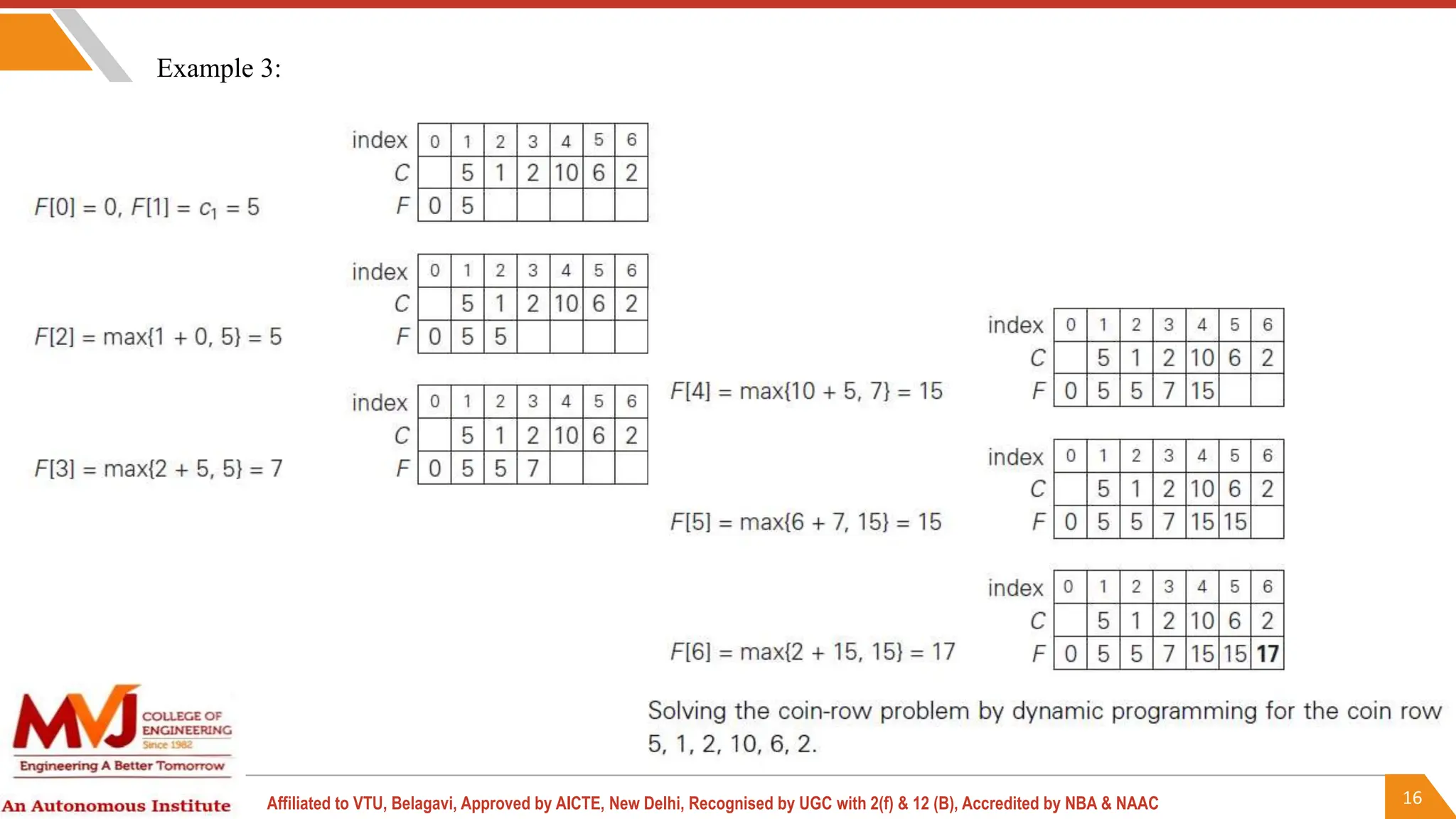
Example 3:
17
Affiliated to VTU, Belagavi, Approved by AICTE, New Delhi, Recognised by UGC with 2(f) & 12 (B), Accredited by NBA & NAAC
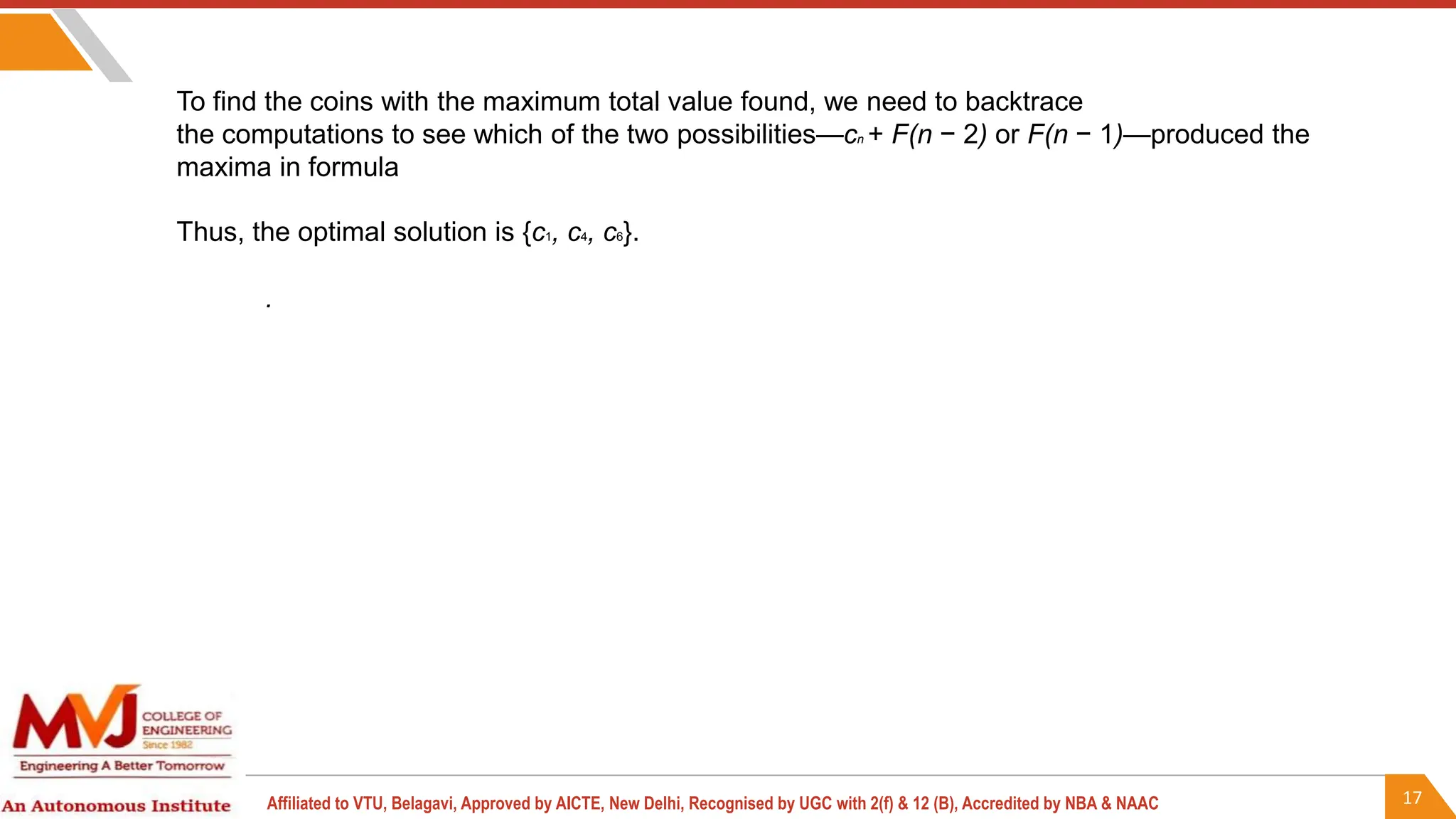
To find the coins with the maximum total value found, we need to backtrace
the computations to see which of the two possibilities—cn + F(n − 2) or F(n − 1)—produced the
maxima in formula
Thus, the optimal solution is {c1, c4, c6}.
.
18
Affiliated to VTU, Belagavi, Approved by AICTE, New Delhi, Recognised by UGC with 2(f) & 12 (B), Accredited by NBA & NAAC
19
Affiliated to VTU, Belagavi, Approved by AICTE, New Delhi, Recognised by UGC with 2(f) & 12 (B), Accredited by NBA & NAAC
Change-making problem
20
Affiliated to VTU, Belagavi, Approved by AICTE, New Delhi, Recognised by UGC with 2(f) & 12 (B), Accredited by NBA & NAAC
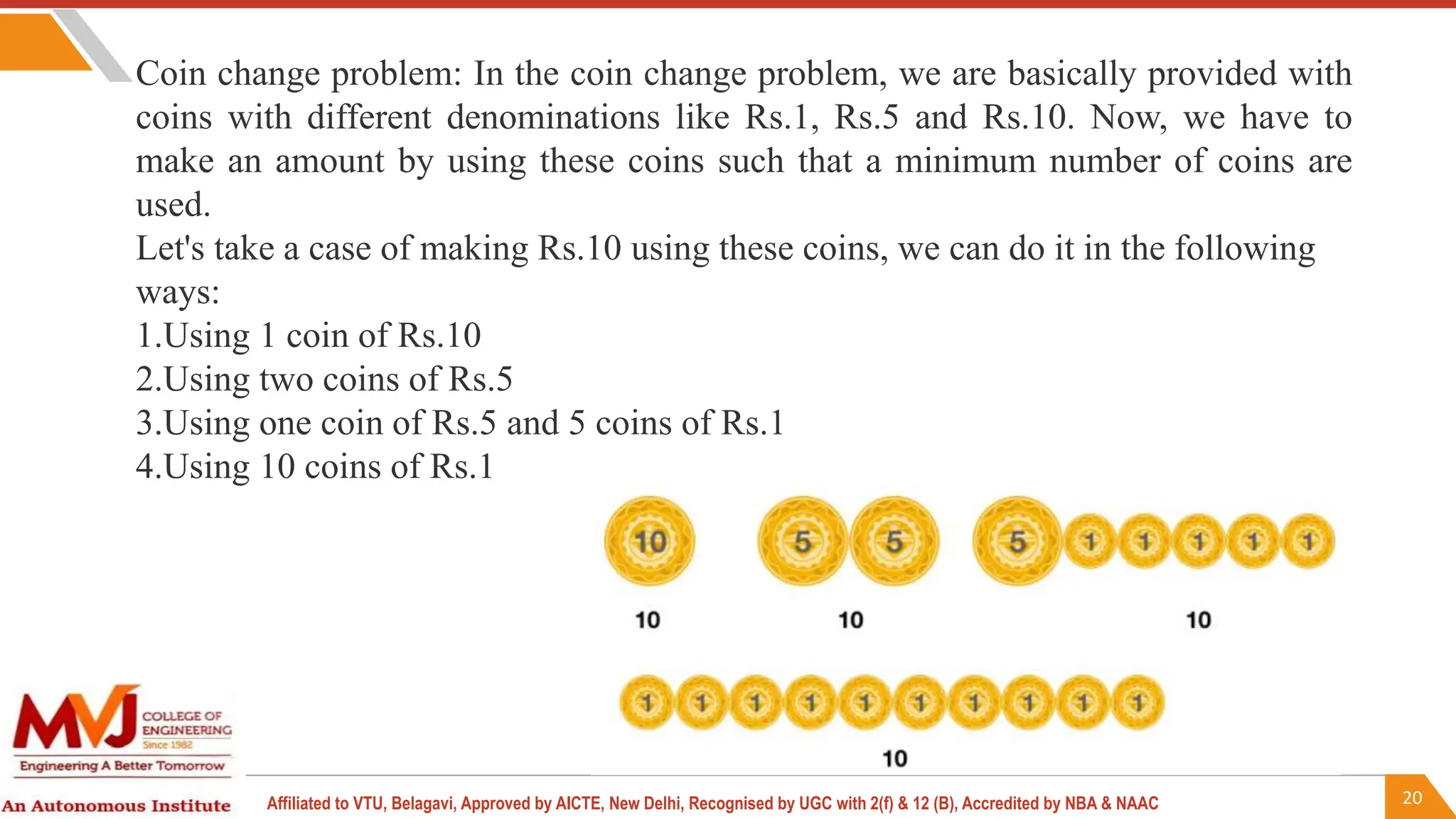
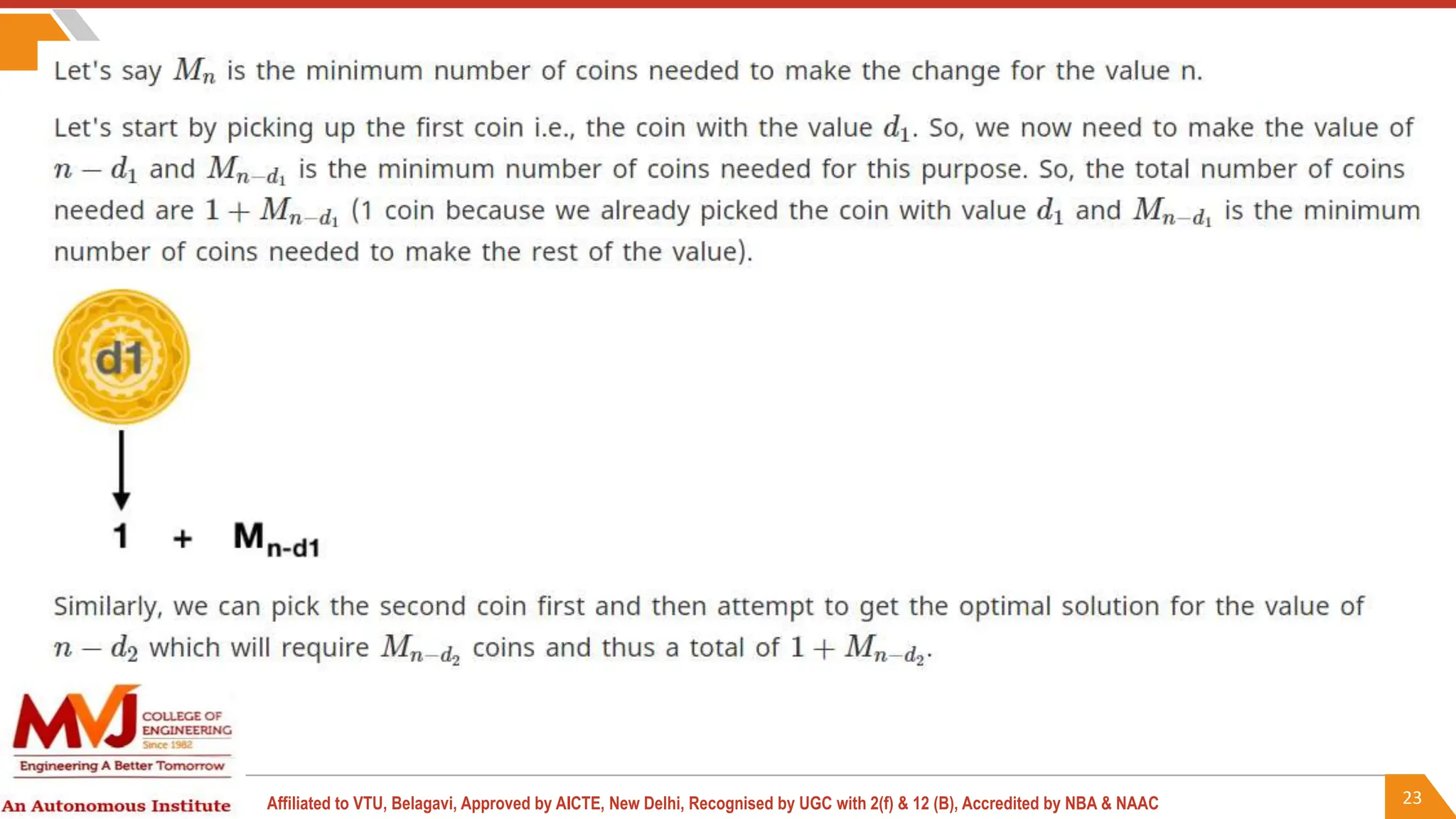
Coin change problem: In the coin change problem, we are basically provided with
coins with different denominations like Rs.1, Rs.5 and Rs.10. Now, we have to
make an amount by using these coins such that a minimum number of coins are
used.
Let's take a case of making Rs.10 using these coins, we can do it in the following
ways:
1.Using 1 coin of Rs.10
2.Using two coins of Rs.5
3.Using one coin of Rs.5 and 5 coins of Rs.1
4.Using 10 coins of Rs.1
21
Affiliated to VTU, Belagavi, Approved by AICTE, New Delhi, Recognised by UGC with 2(f) & 12 (B), Accredited by NBA & NAAC
Change-making problem Consider the general instance of the
following well-known problem.
Give change for amount n using the minimum number of coins of
denominations d1<d2 < . . .<dm.
we consider a dynamic programming algorithm for the general case, assuming
availability of unlimited quantities of coins for each of the m denominations
d1< d2 < . . . < dm where d1 = 1.
22
Affiliated to VTU, Belagavi, Approved by AICTE, New Delhi, Recognised by UGC with 2(f) & 12 (B), Accredited by NBA & NAAC
Out of these 4 ways of making Rs.10, we can see that the first way of using only
one coin of Rs.10 requires the least number of coins and thus it is our solution.
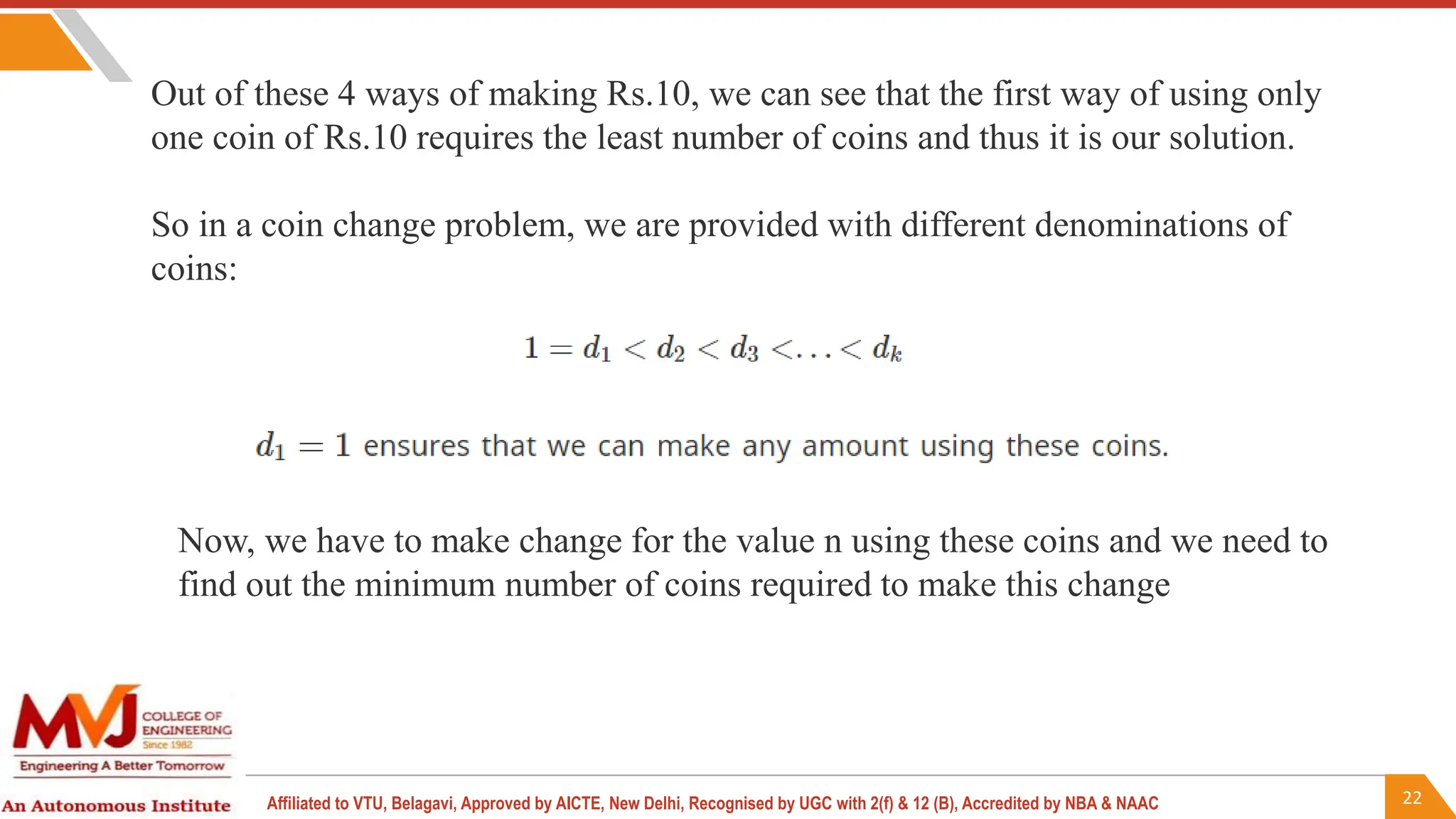
So in a coin change problem, we are provided with different denominations of
coins:
Now, we have to make change for the value n using these coins and we need to
find out the minimum number of coins required to make this change
23
Affiliated to VTU, Belagavi, Approved by AICTE, New Delhi, Recognised by UGC with 2(f) & 12 (B), Accredited by NBA & NAAC
24
Affiliated to VTU, Belagavi, Approved by AICTE, New Delhi, Recognised by UGC with 2(f) & 12 (B), Accredited by NBA & NAAC
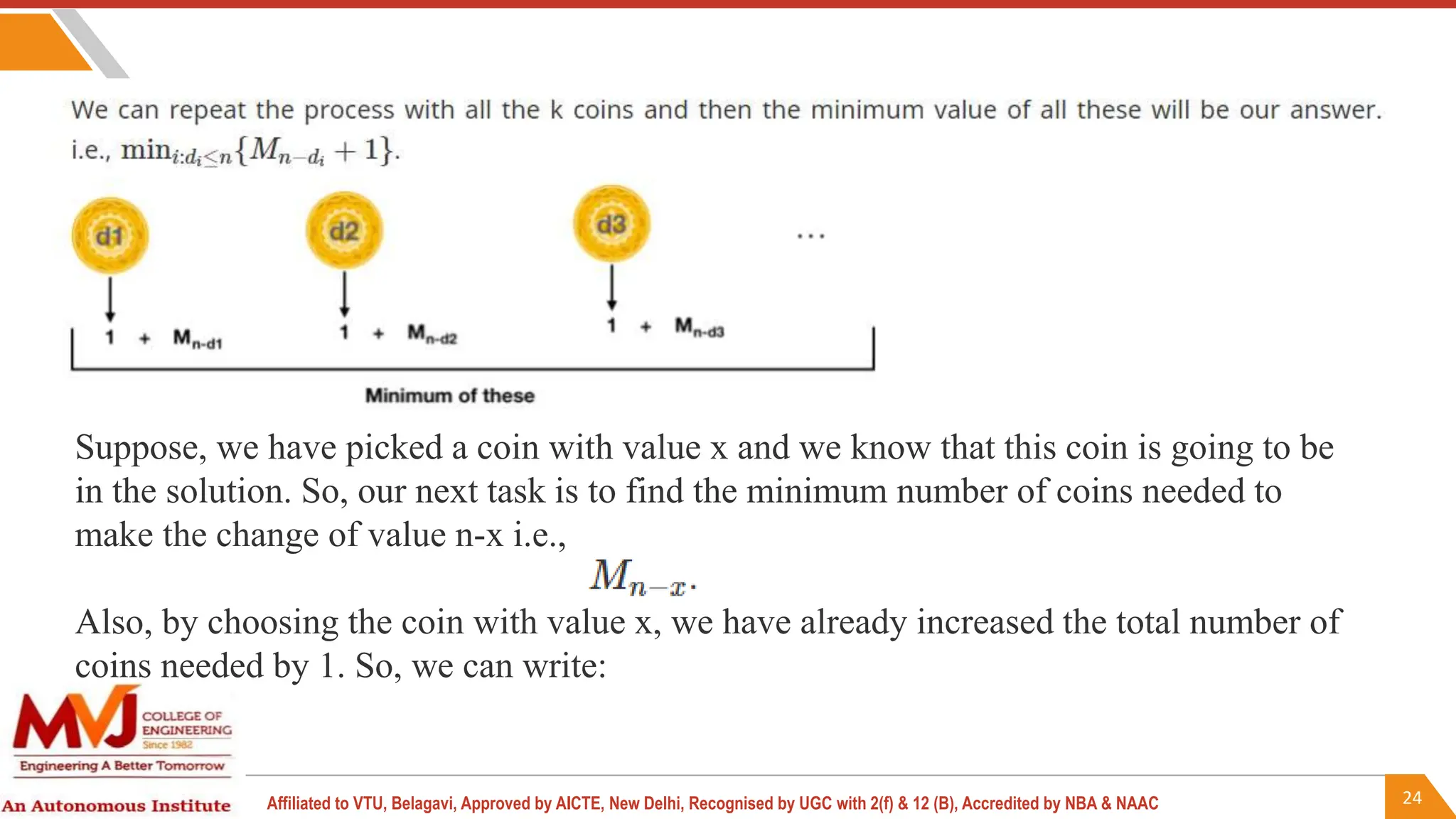
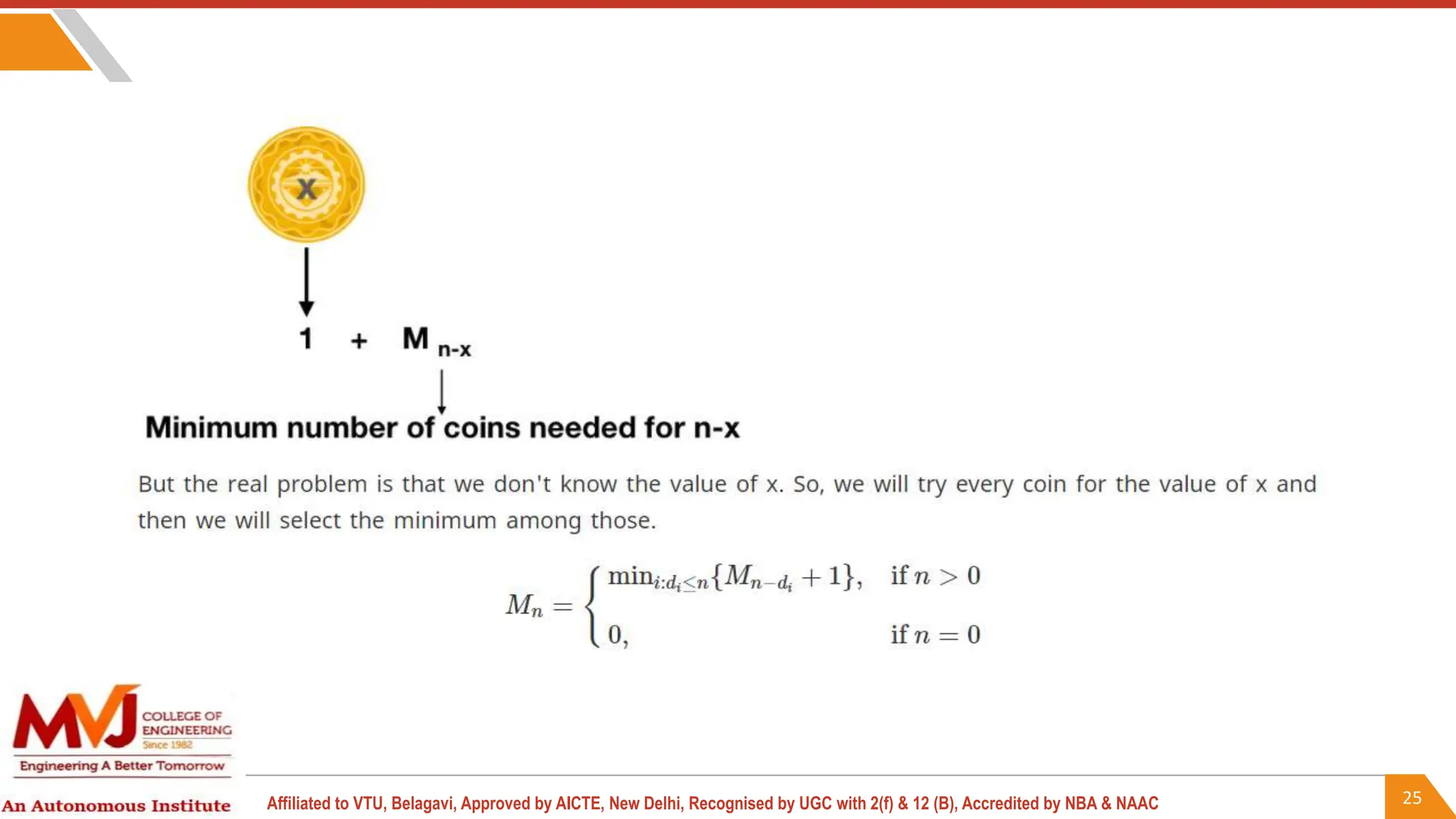
Suppose, we have picked a coin with value x and we know that this coin is going to be
in the solution. So, our next task is to find the minimum number of coins needed to
make the change of value n-x i.e.,
Also, by choosing the coin with value x, we have already increased the total number of
coins needed by 1. So, we can write:
25
Affiliated to VTU, Belagavi, Approved by AICTE, New Delhi, Recognised by UGC with 2(f) & 12 (B), Accredited by NBA & NAAC
26
Affiliated to VTU, Belagavi, Approved by AICTE, New Delhi, Recognised by UGC with 2(f) & 12 (B), Accredited by NBA & NAAC
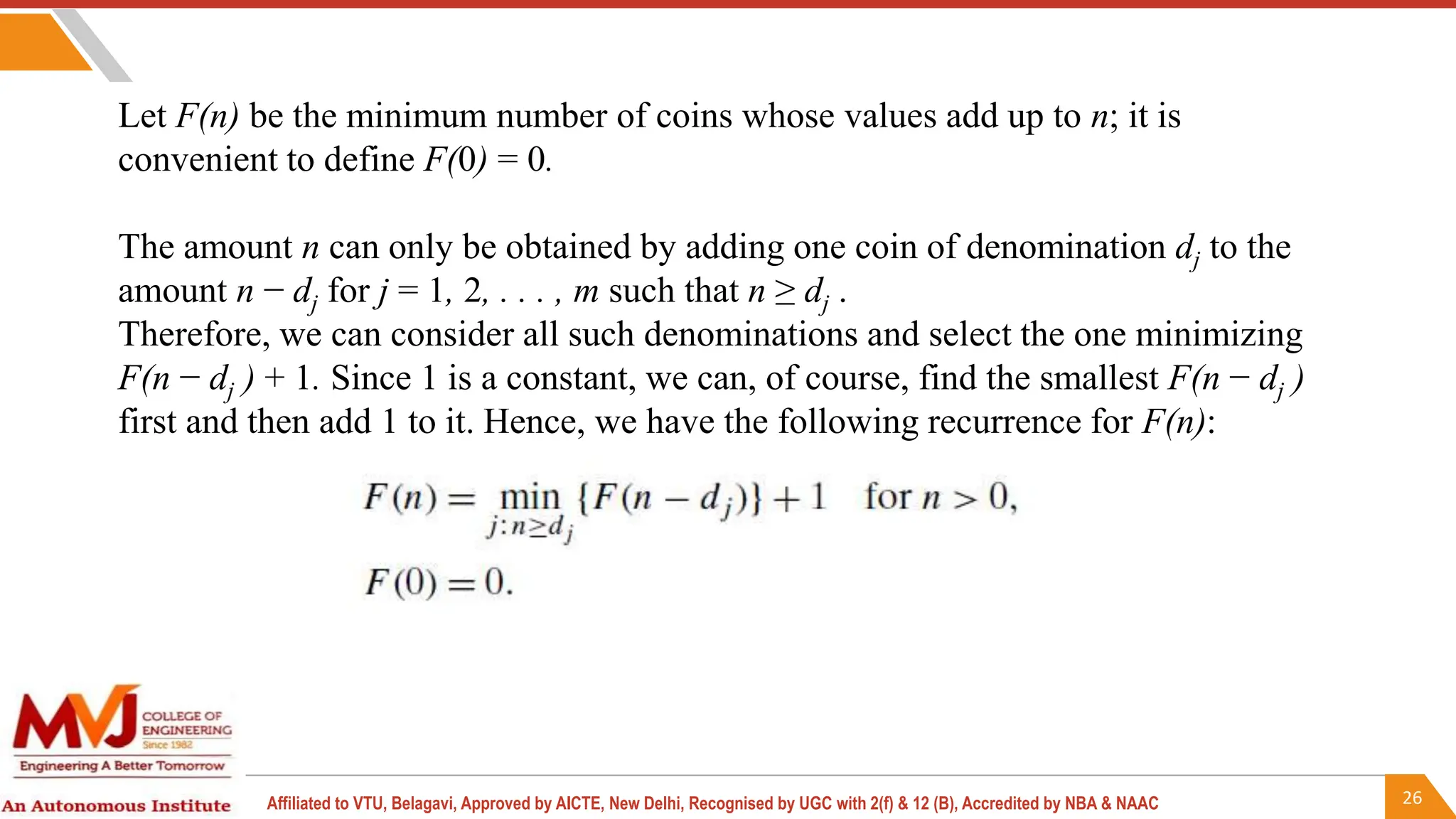
Let F(n) be the minimum number of coins whose values add up to n; it is
convenient to define F(0) = 0.
The amount n can only be obtained by adding one coin of denomination dj to the
amount n − dj for j = 1, 2, . . . , m such that n ≥ dj .
Therefore, we can consider all such denominations and select the one minimizing
F(n − dj ) + 1. Since 1 is a constant, we can, of course, find the smallest F(n − dj )
first and then add 1 to it. Hence, we have the following recurrence for F(n):
27
Affiliated to VTU, Belagavi, Approved by AICTE, New Delhi, Recognised by UGC with 2(f) & 12 (B), Accredited by NBA & NAAC
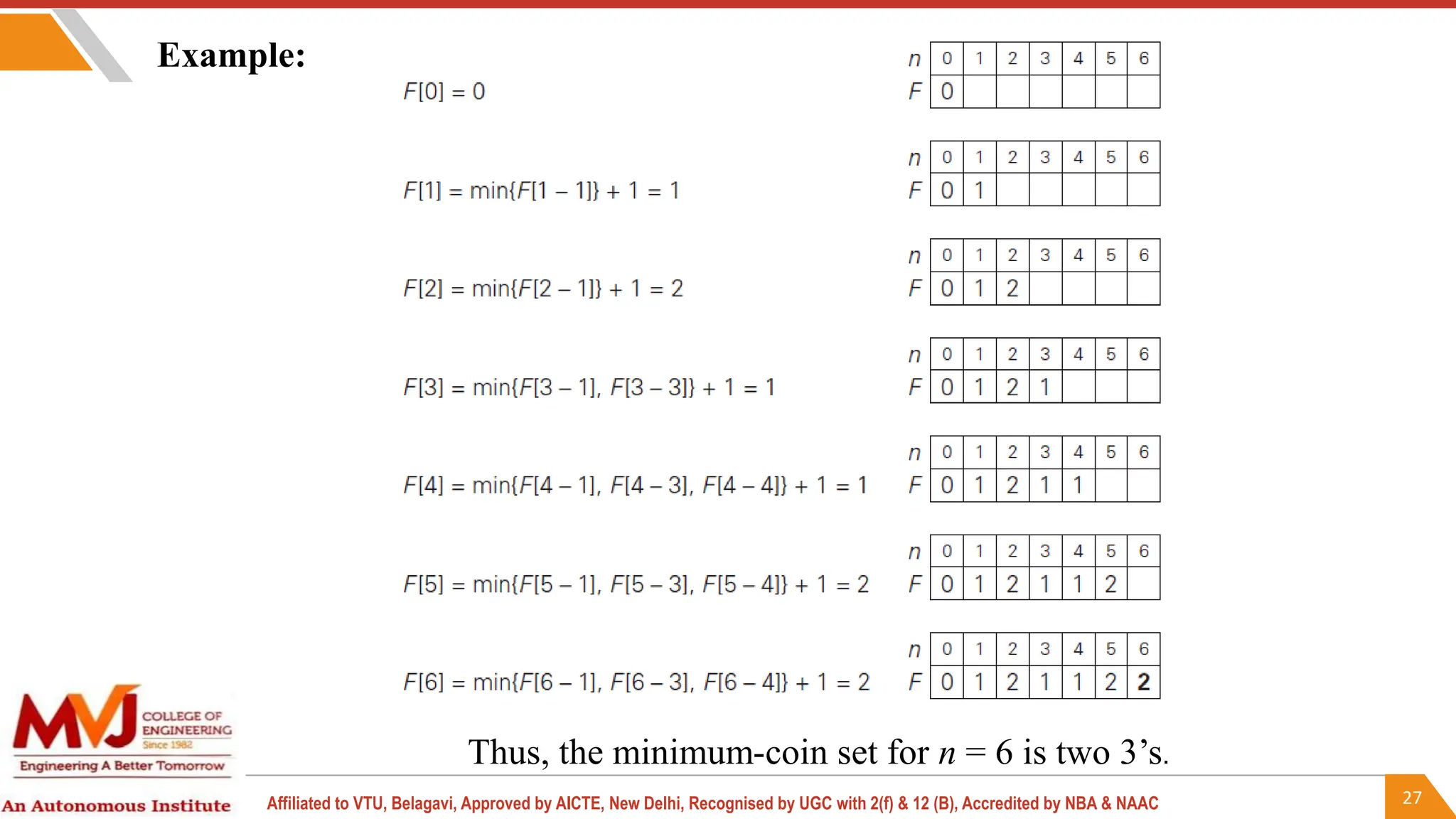
Thus, the minimum-coin set for n = 6 is two 3’s.
Example:
28
Affiliated to VTU, Belagavi, Approved by AICTE, New Delhi, Recognised by UGC with 2(f) & 12 (B), Accredited by NBA & NAAC
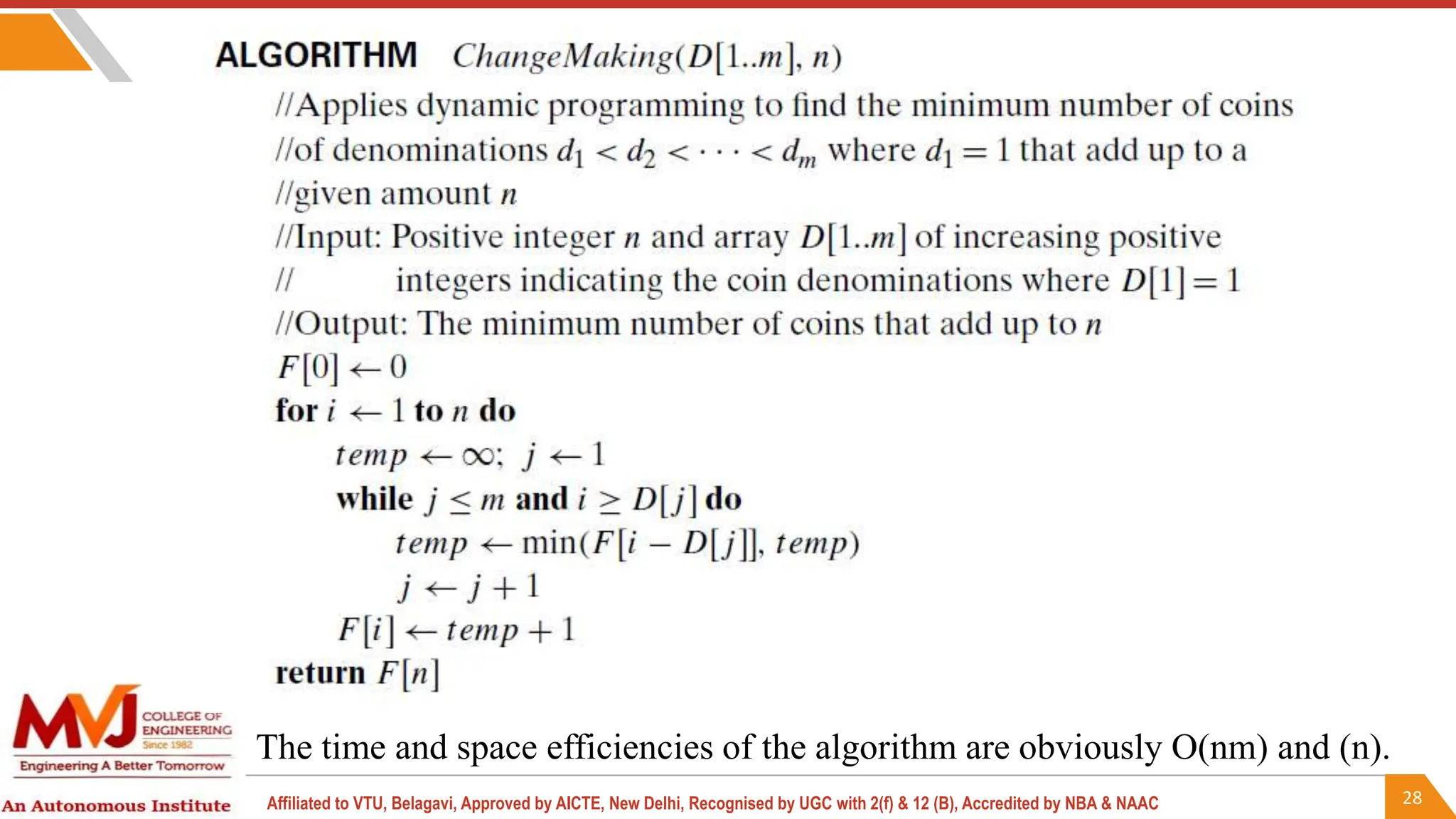
The time and space efficiencies of the algorithm are obviously O(nm) and (n).
29
Affiliated to VTU, Belagavi, Approved by AICTE, New Delhi, Recognised by UGC with 2(f) & 12 (B), Accredited by NBA & NAAC
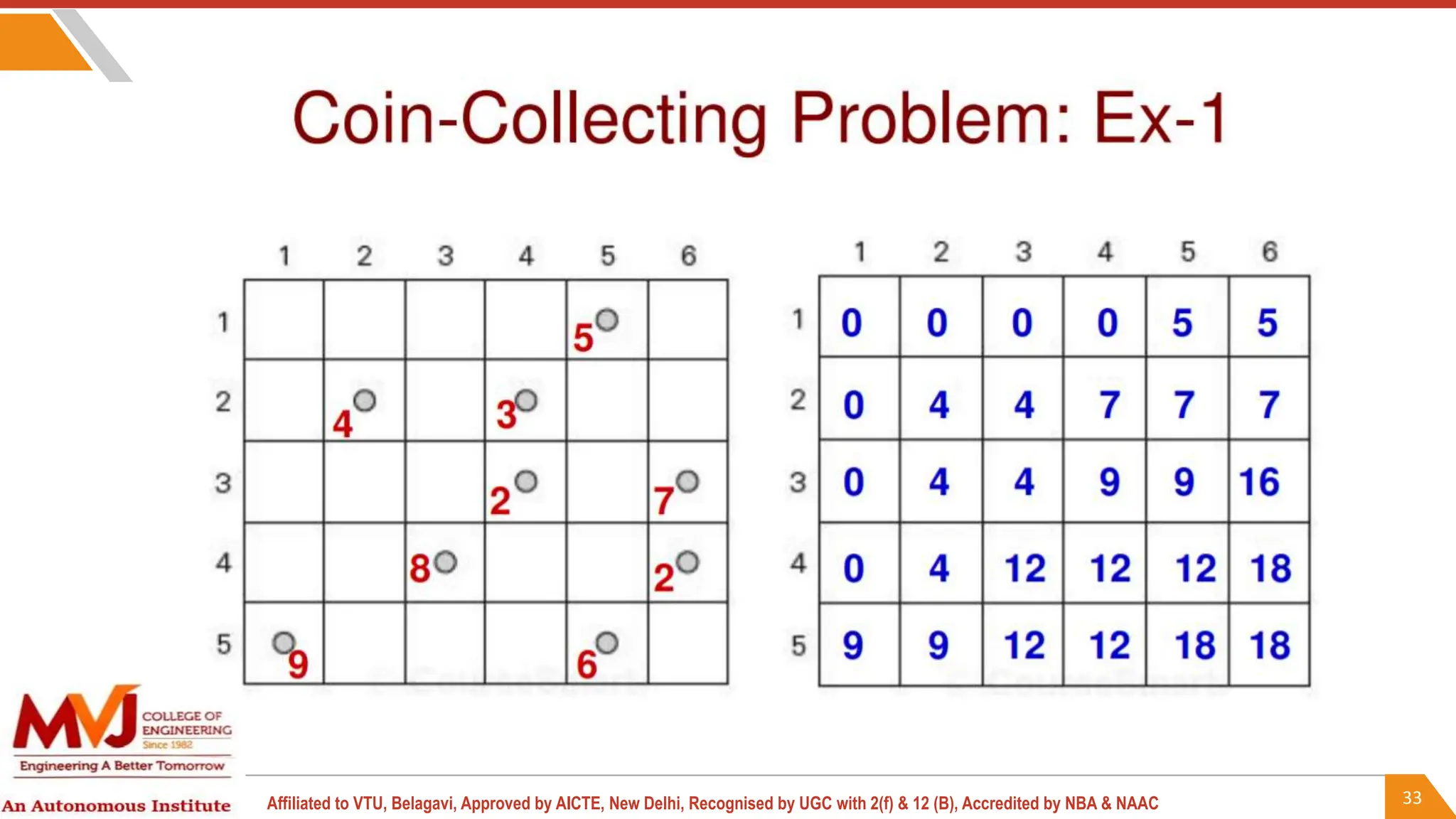
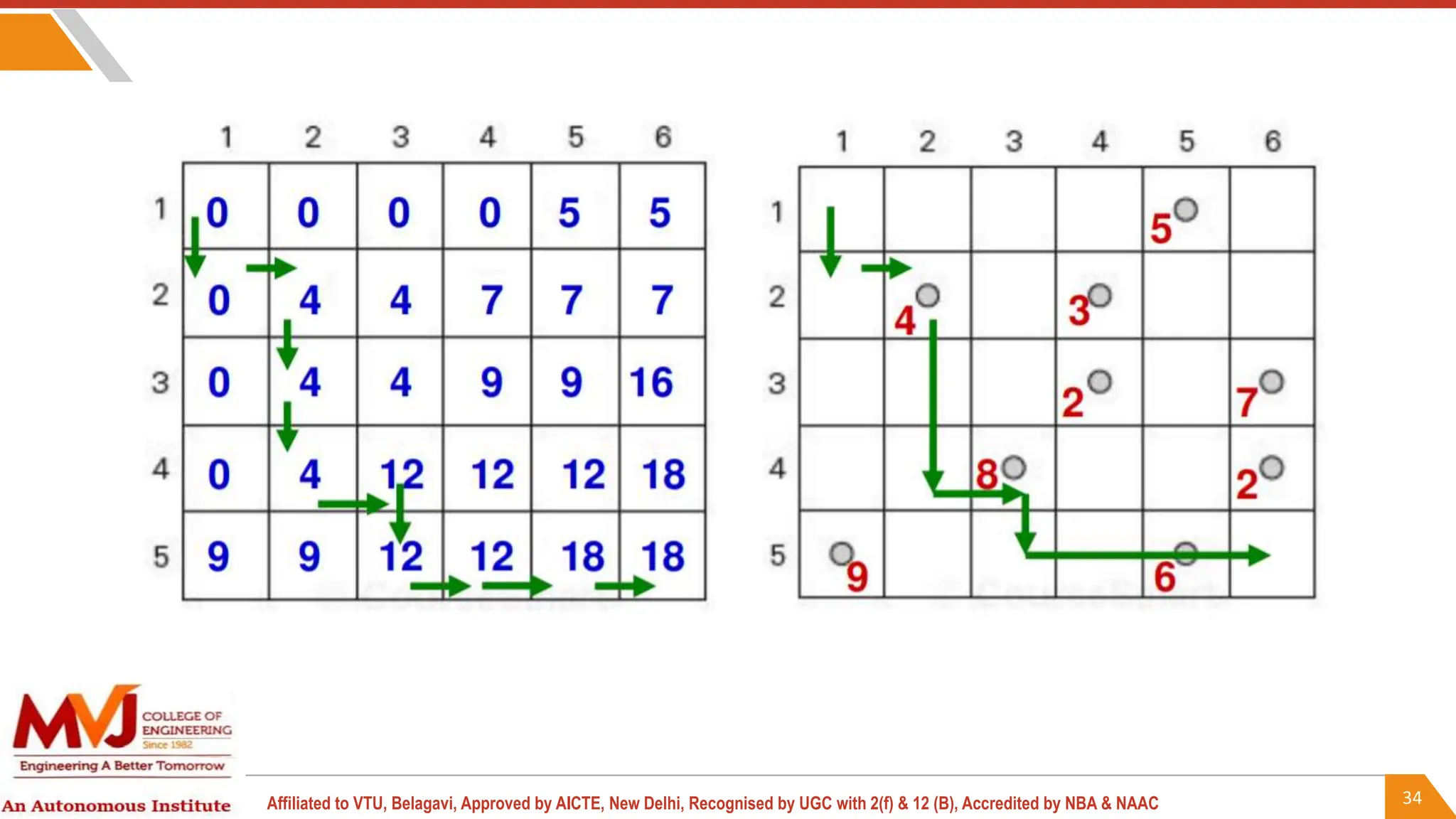
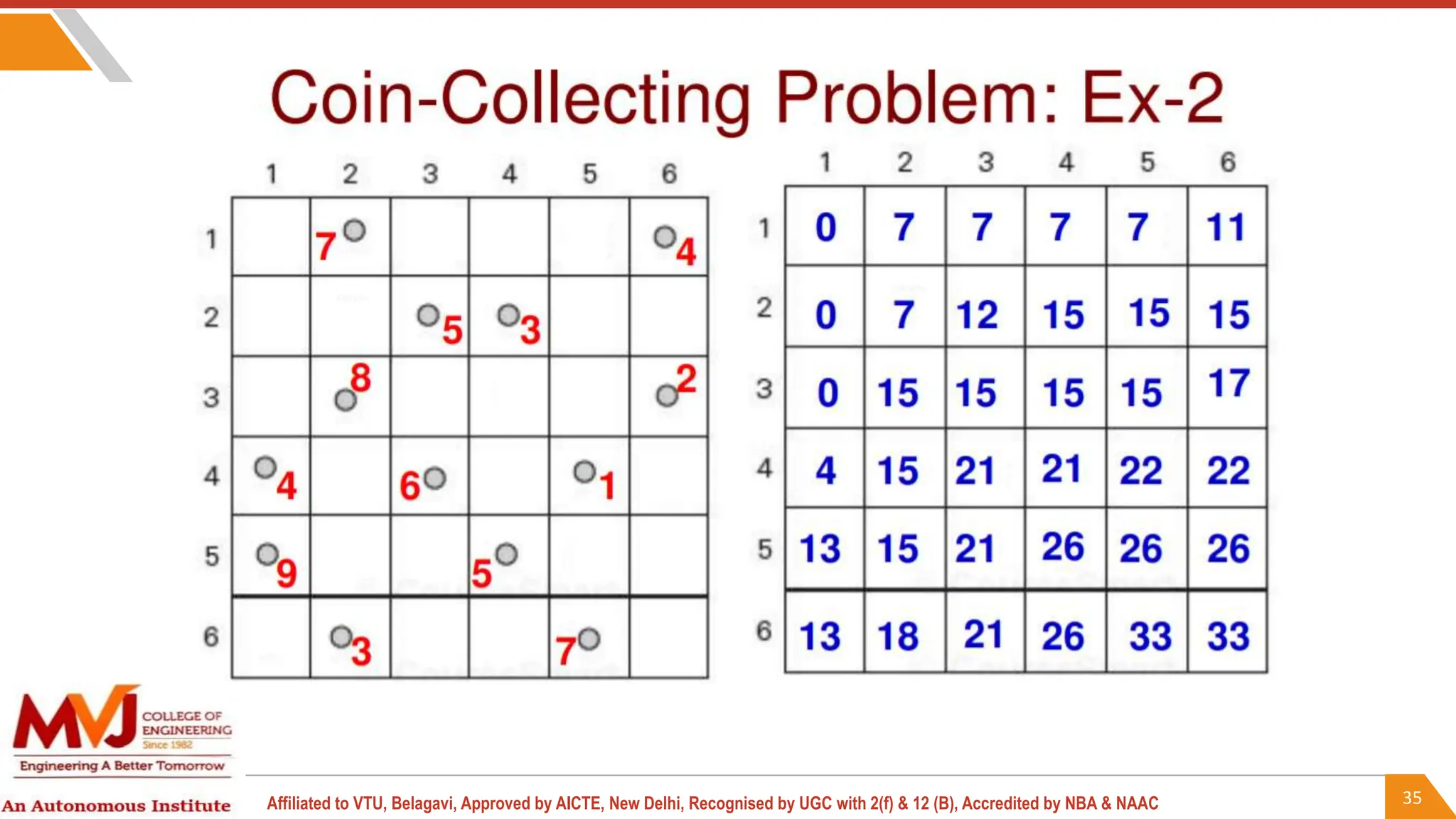
Coin-collecting problem:
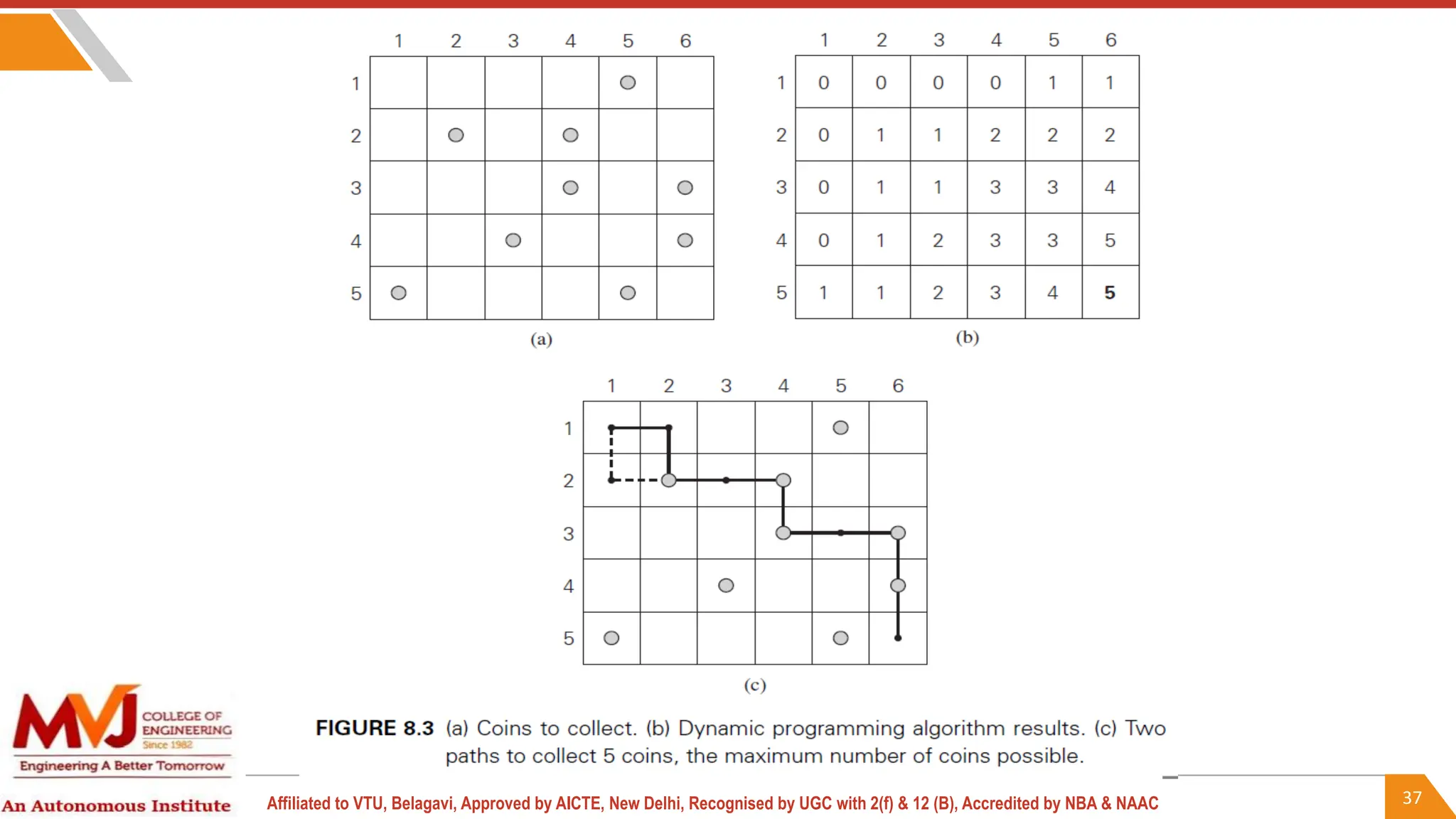
Several coins are placed in cells of an n × m board, no more than one coin per cell.
A robot, located in the upper left cell of the board, needs to collect as many of the
coins as possible and bring them to the bottom right cell.
On each step, the robot can move either one cell to the right or one cell down from
its current location. When the robot visits a cell with a coin, it always picks up that
coin.
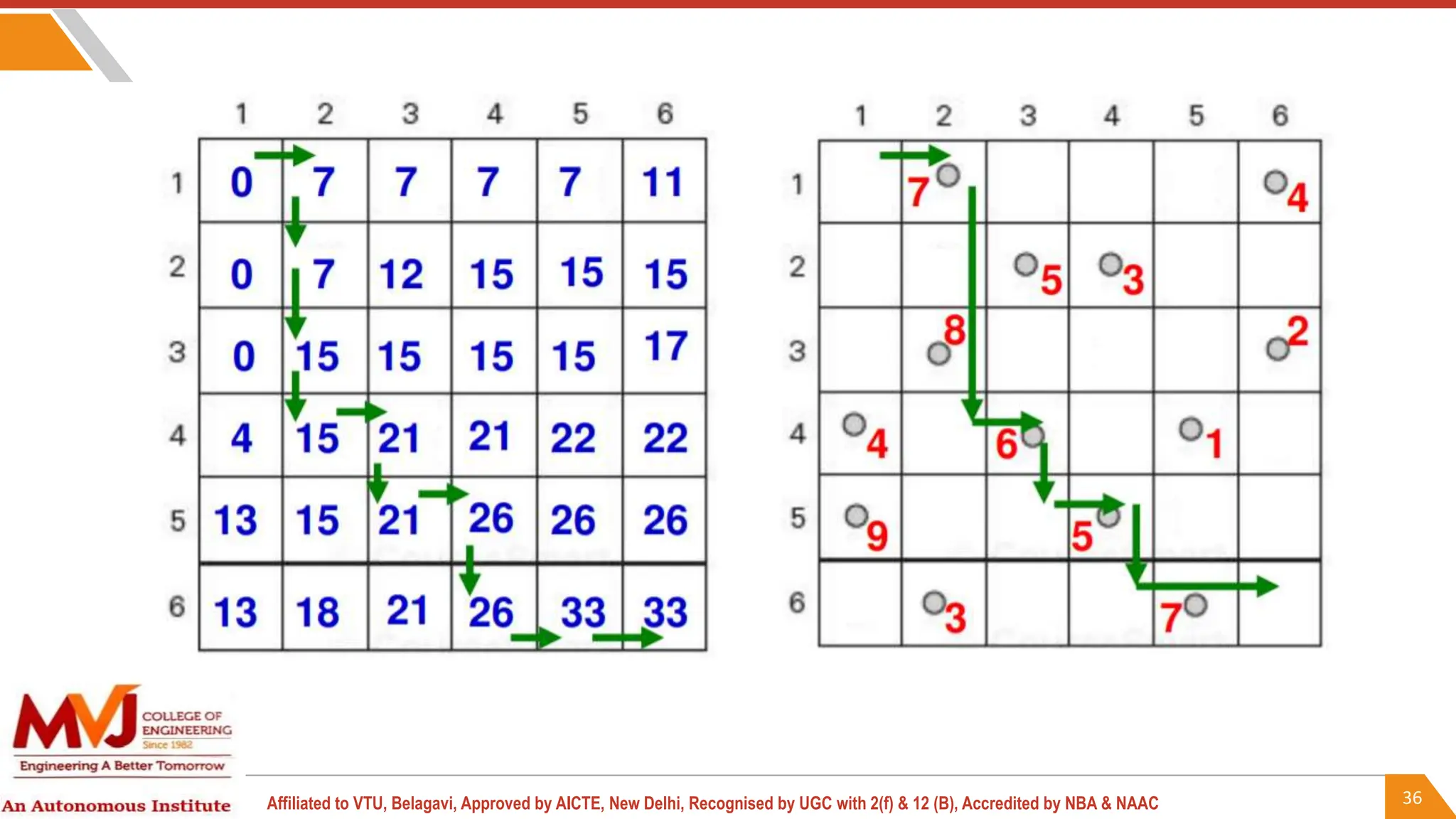
Design an algorithm to find the maximum number of coins the robot can collect and
a path it needs to follow to do this.
30
Affiliated to VTU, Belagavi, Approved by AICTE, New Delhi, Recognised by UGC with 2(f) & 12 (B), Accredited by NBA & NAAC
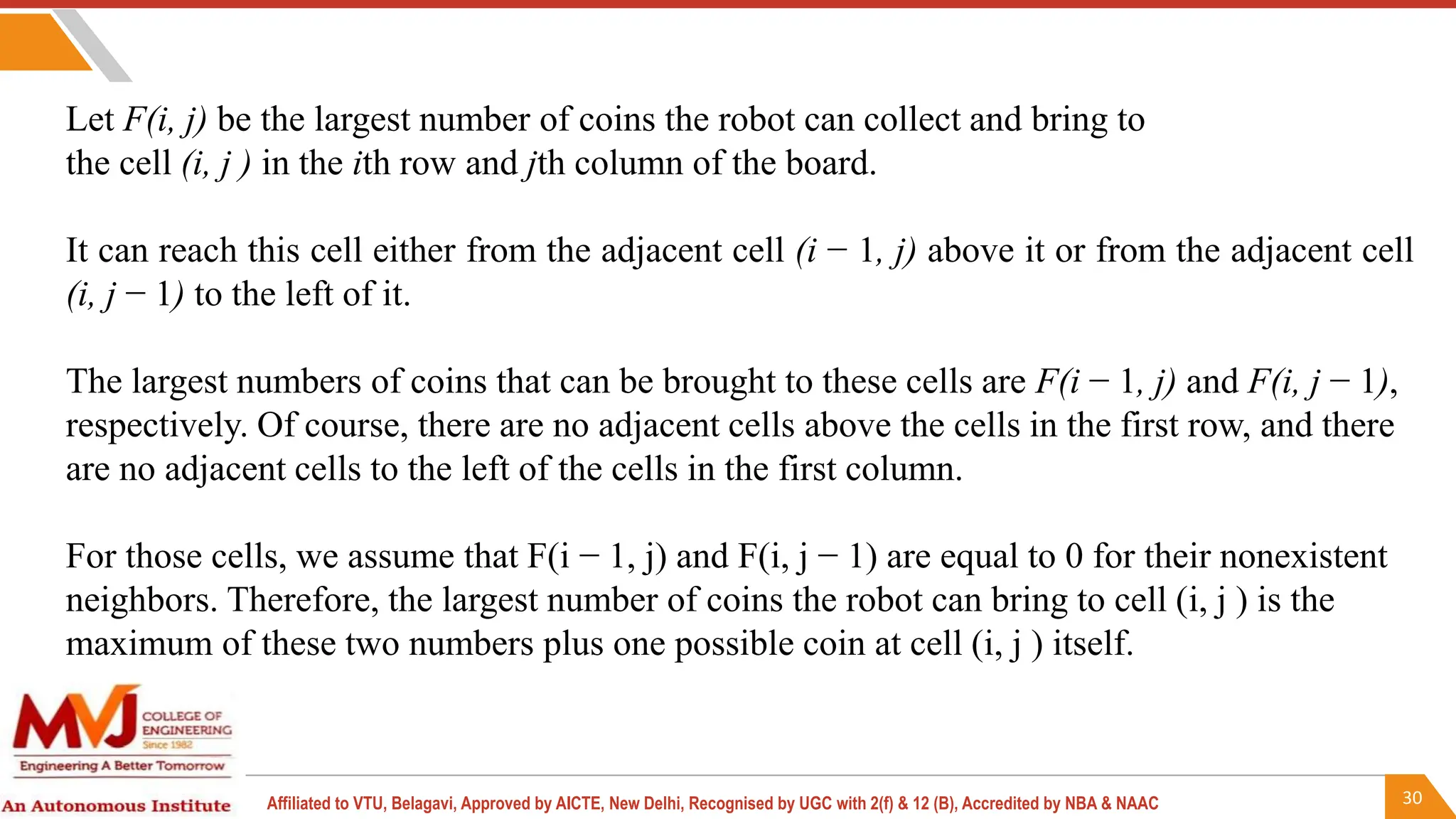
Let F(i, j) be the largest number of coins the robot can collect and bring to
the cell (i, j ) in the ith row and jth column of the board.
It can reach this cell either from the adjacent cell (i − 1, j) above it or from the adjacent cell
(i, j − 1) to the left of it.
The largest numbers of coins that can be brought to these cells are F(i − 1, j) and F(i, j − 1),
respectively. Of course, there are no adjacent cells above the cells in the first row, and there
are no adjacent cells to the left of the cells in the first column.
For those cells, we assume that F(i − 1, j) and F(i, j − 1) are equal to 0 for their nonexistent
neighbors. Therefore, the largest number of coins the robot can bring to cell (i, j ) is the
maximum of these two numbers plus one possible coin at cell (i, j ) itself.
31
Affiliated to VTU, Belagavi, Approved by AICTE, New Delhi, Recognised by UGC with 2(f) & 12 (B), Accredited by NBA & NAAC
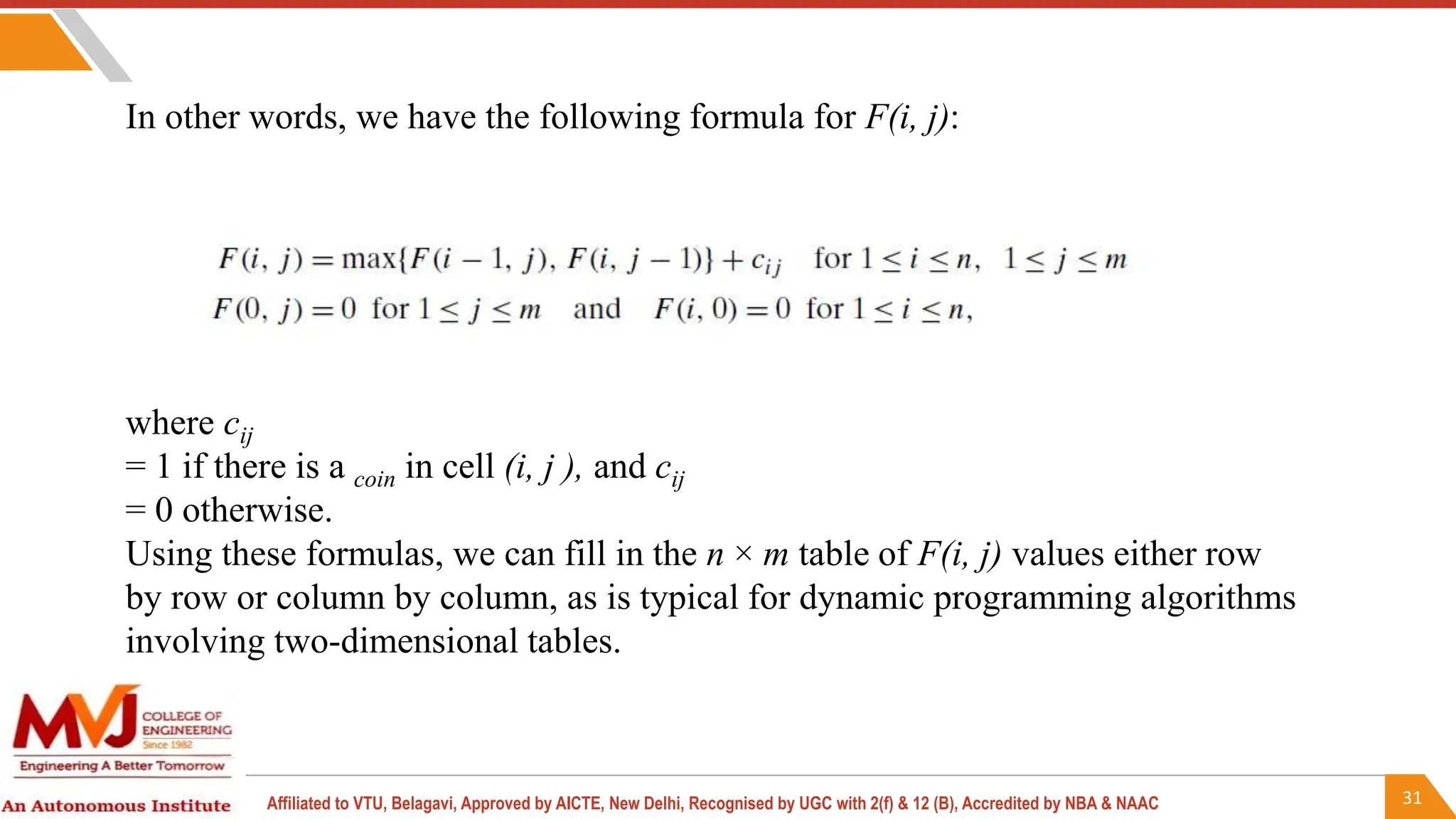
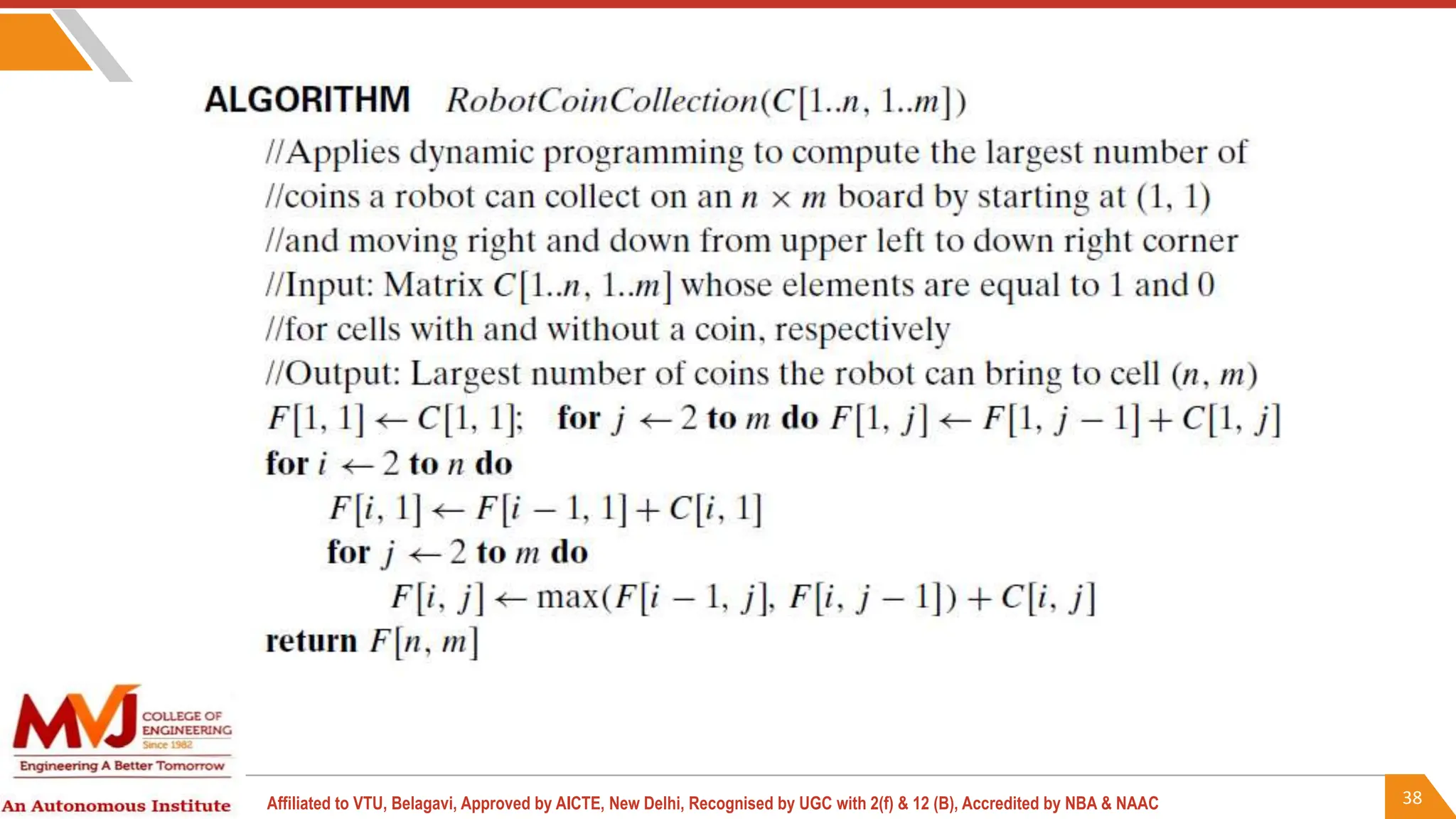
In other words, we have the following formula for F(i, j):
where cij
= 1 if there is a coin in cell (i, j ), and cij
= 0 otherwise.
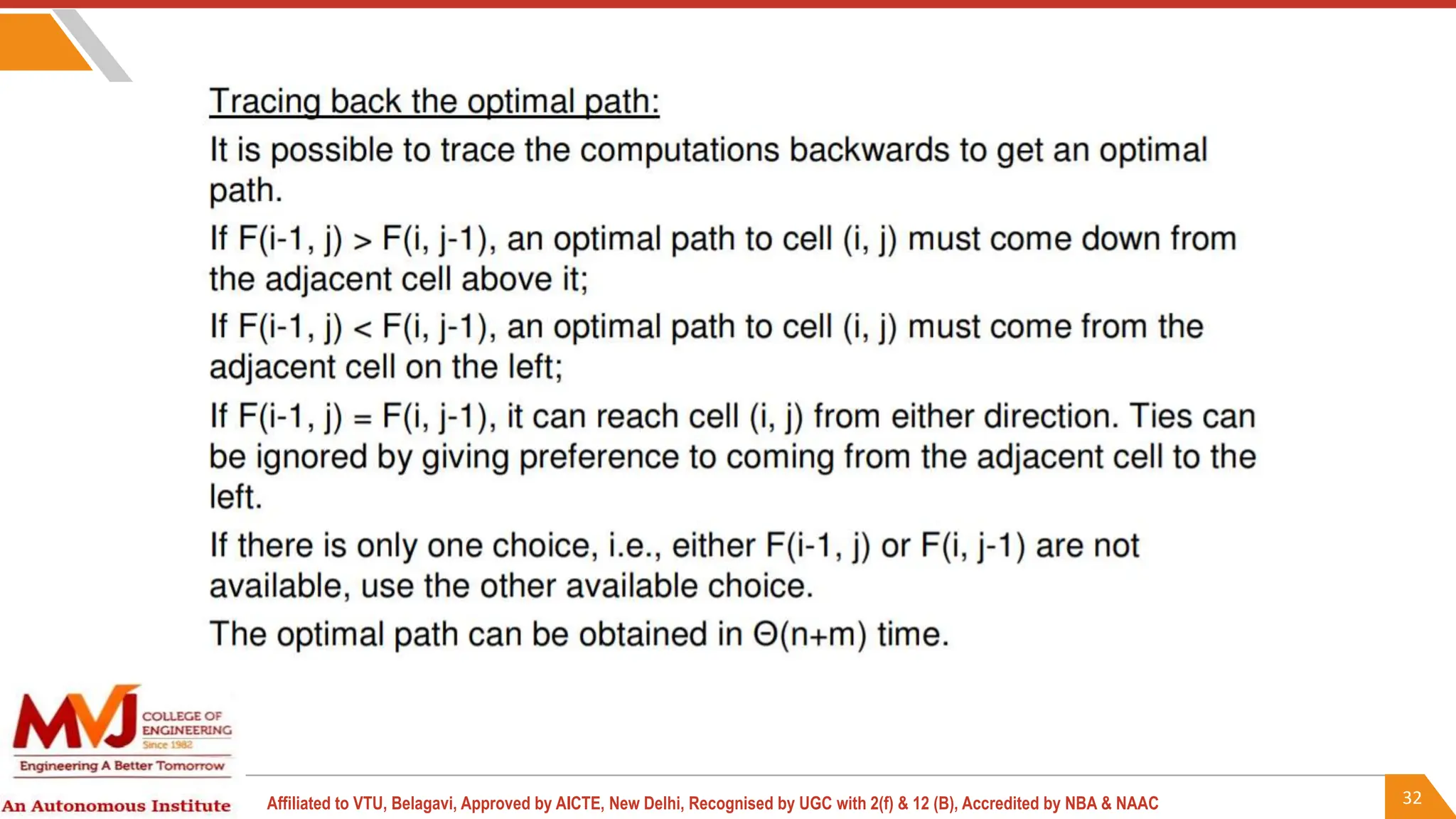
Using these formulas, we can fill in the n × m table of F(i, j) values either row
by row or column by column, as is typical for dynamic programming algorithms
involving two-dimensional tables.
32
Affiliated to VTU, Belagavi, Approved by AICTE, New Delhi, Recognised by UGC with 2(f) & 12 (B), Accredited by NBA & NAAC
33
Affiliated to VTU, Belagavi, Approved by AICTE, New Delhi, Recognised by UGC with 2(f) & 12 (B), Accredited by NBA & NAAC
34
Affiliated to VTU, Belagavi, Approved by AICTE, New Delhi, Recognised by UGC with 2(f) & 12 (B), Accredited by NBA & NAAC
35
Affiliated to VTU, Belagavi, Approved by AICTE, New Delhi, Recognised by UGC with 2(f) & 12 (B), Accredited by NBA & NAAC
36
Affiliated to VTU, Belagavi, Approved by AICTE, New Delhi, Recognised by UGC with 2(f) & 12 (B), Accredited by NBA & NAAC
37
Affiliated to VTU, Belagavi, Approved by AICTE, New Delhi, Recognised by UGC with 2(f) & 12 (B), Accredited by NBA & NAAC
38
Affiliated to VTU, Belagavi, Approved by AICTE, New Delhi, Recognised by UGC with 2(f) & 12 (B), Accredited by NBA & NAAC
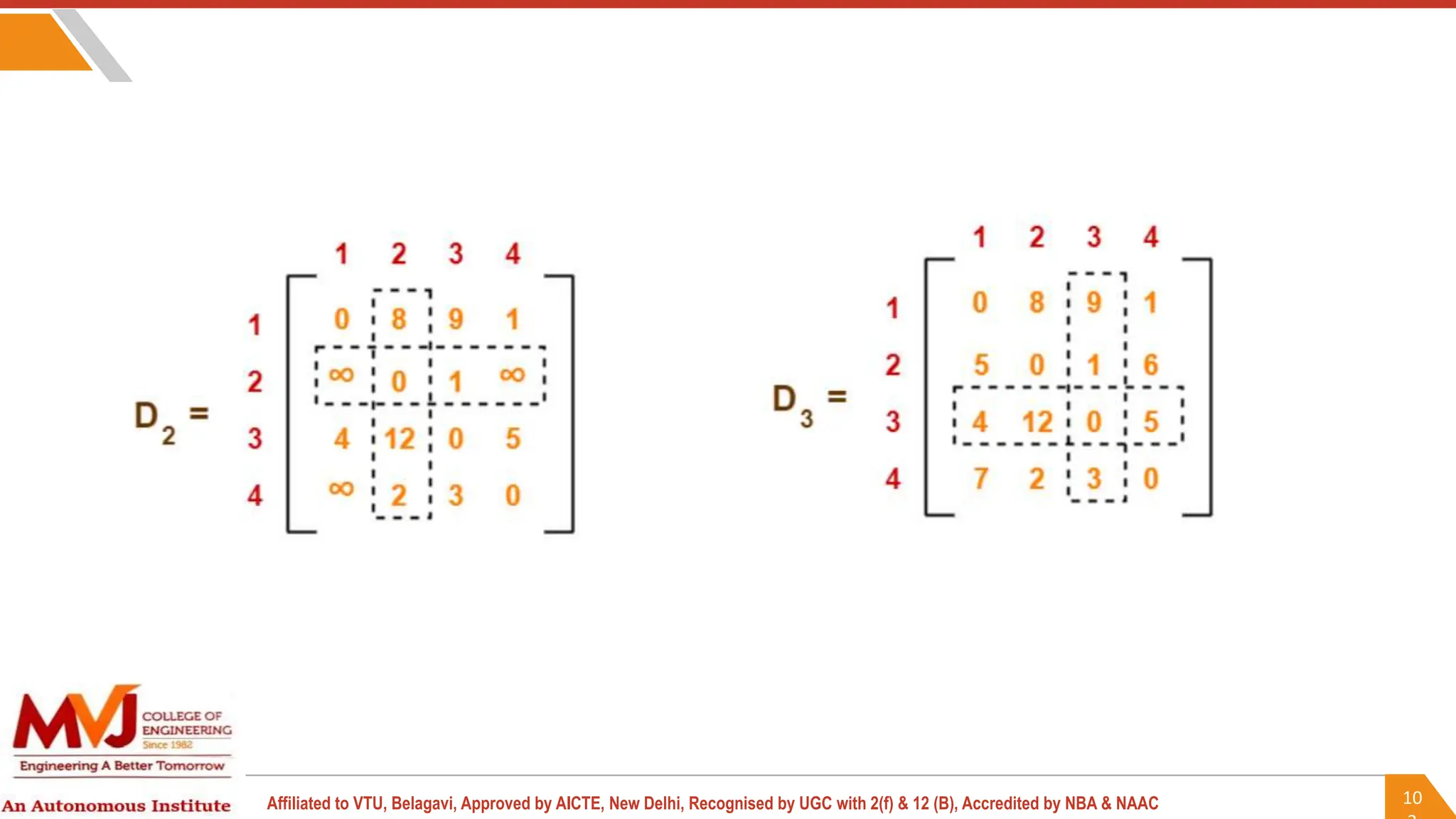
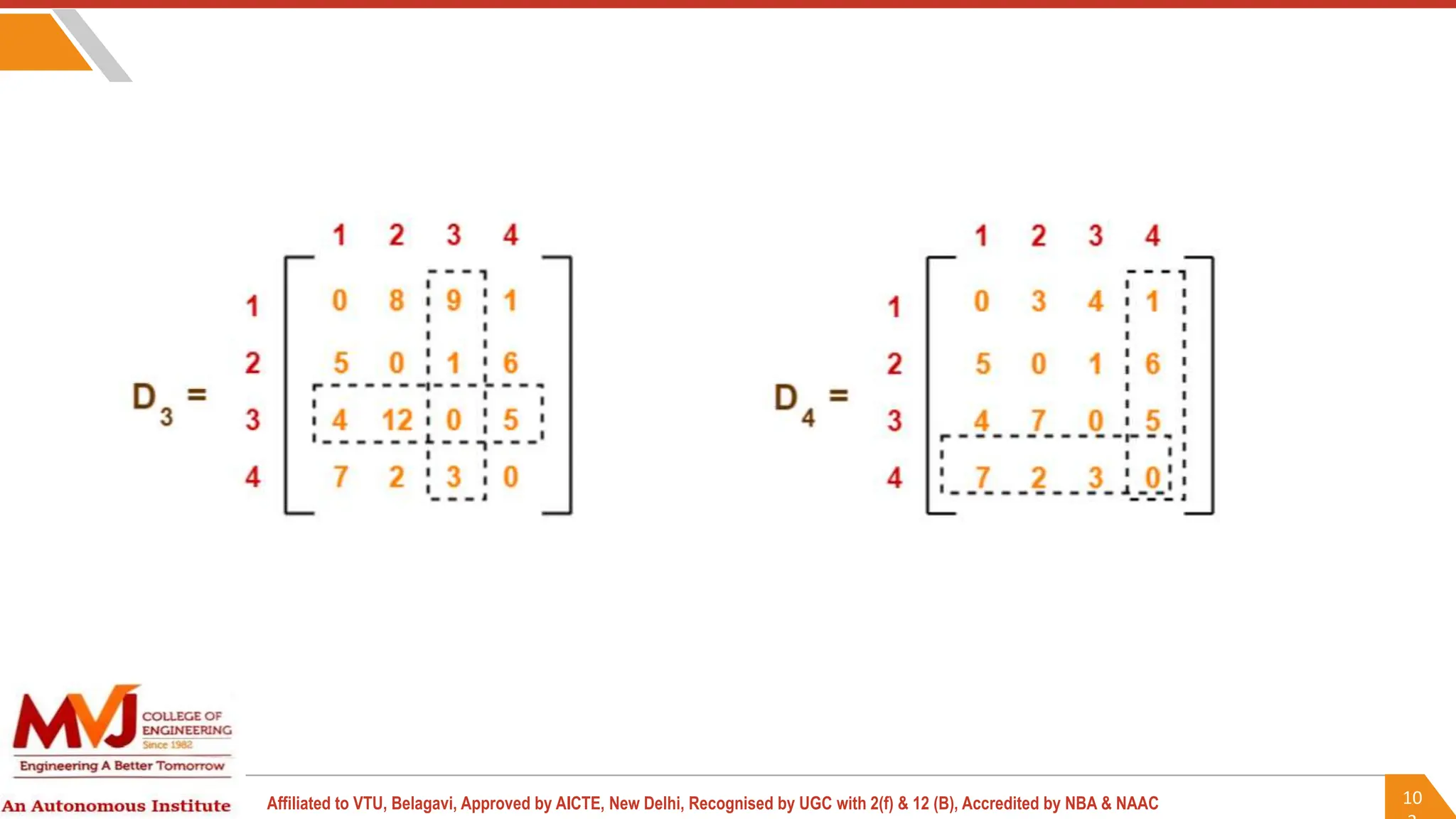
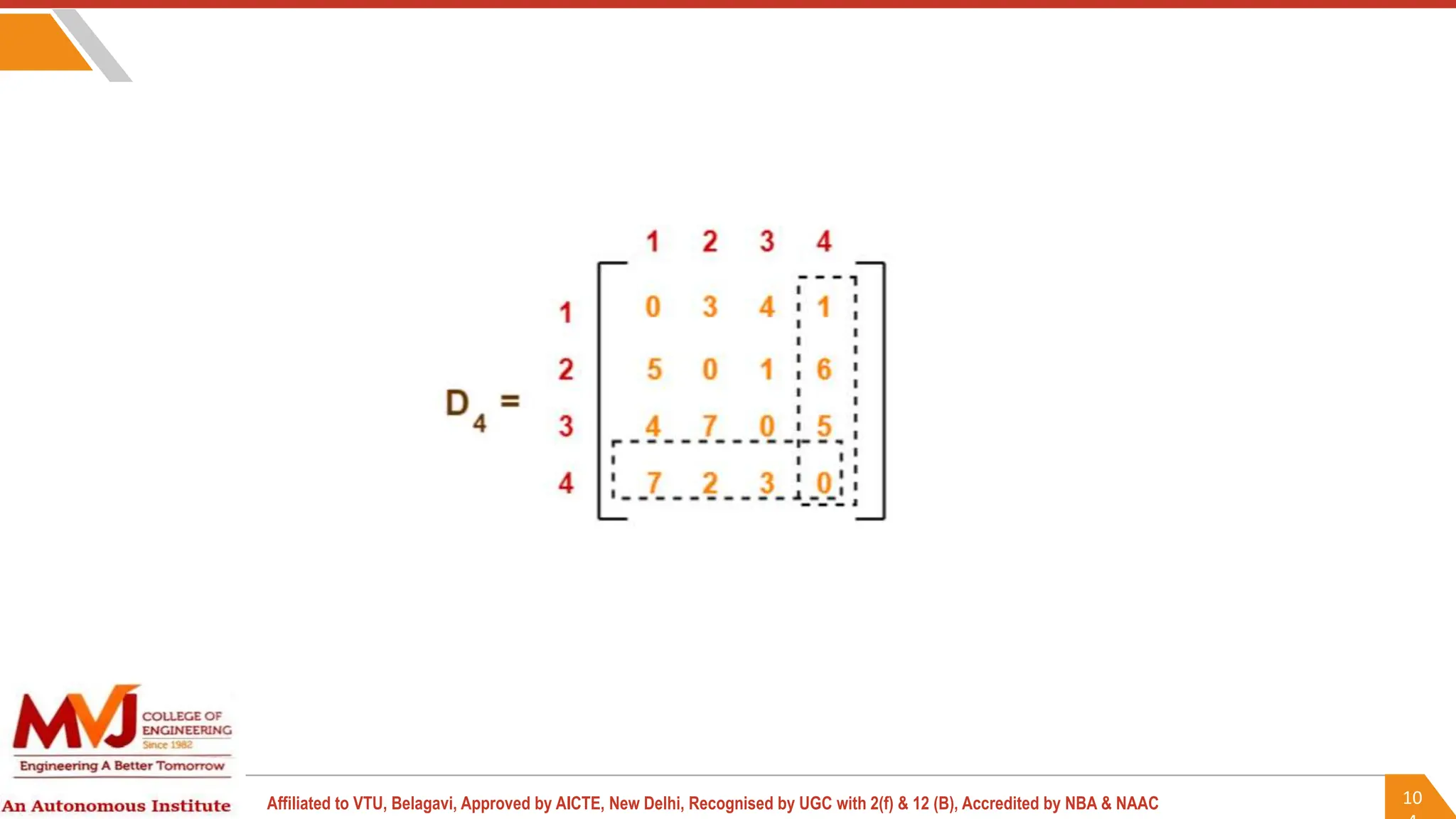
39
Affiliated to VTU, Belagavi, Approved by AICTE, New Delhi, Recognised by UGC with 2(f) & 12 (B), Accredited by NBA & NAAC
Dynamic Programming is an algorithm design method that can be used when the
solution to a problem may be viewed as the result of a sequence of decisions.(or)
Dynamic programming is an optimization approach that divides the complex
problems into the simple sequences of problems in which they are interrelated
leading to decisions.
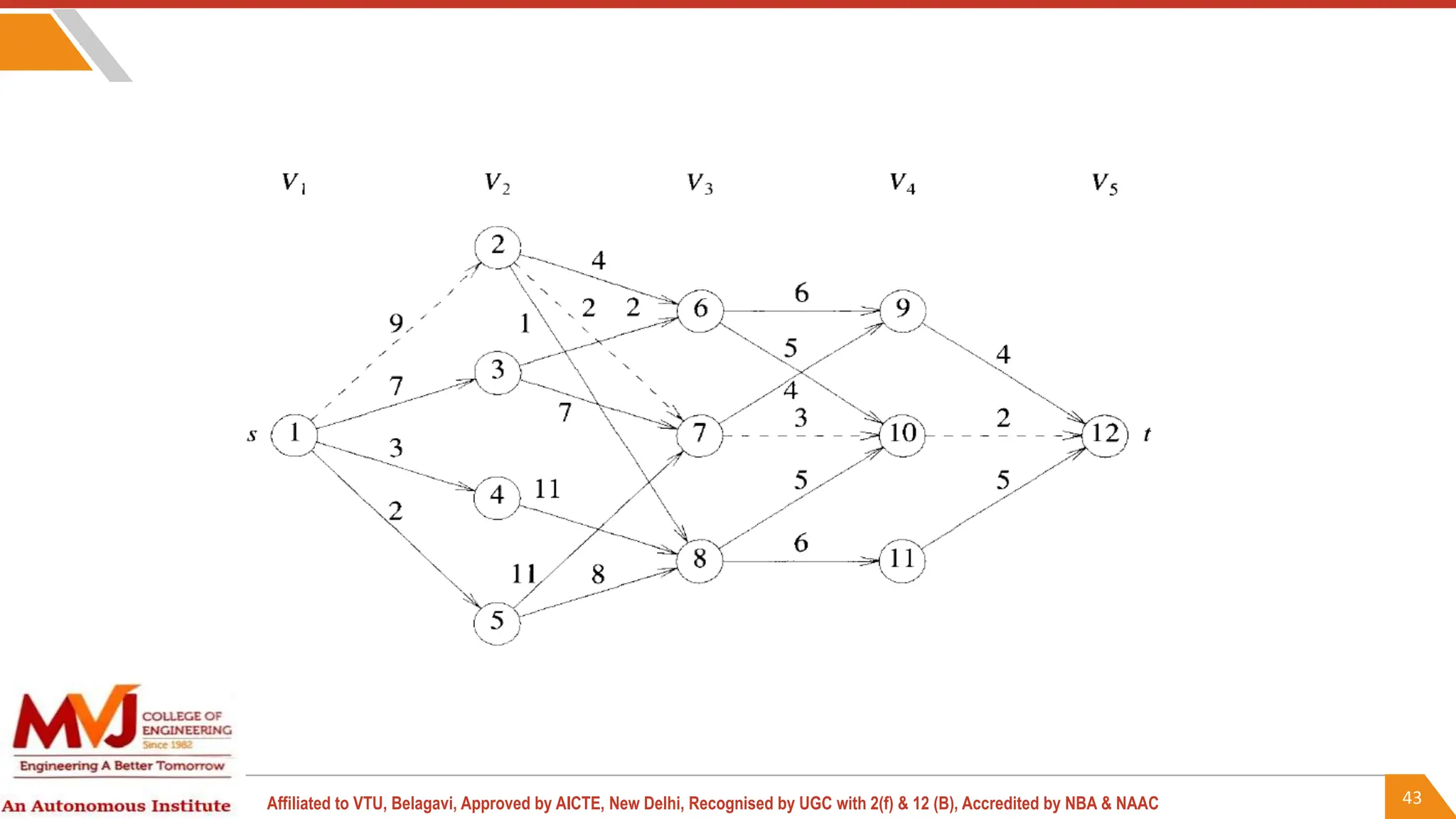
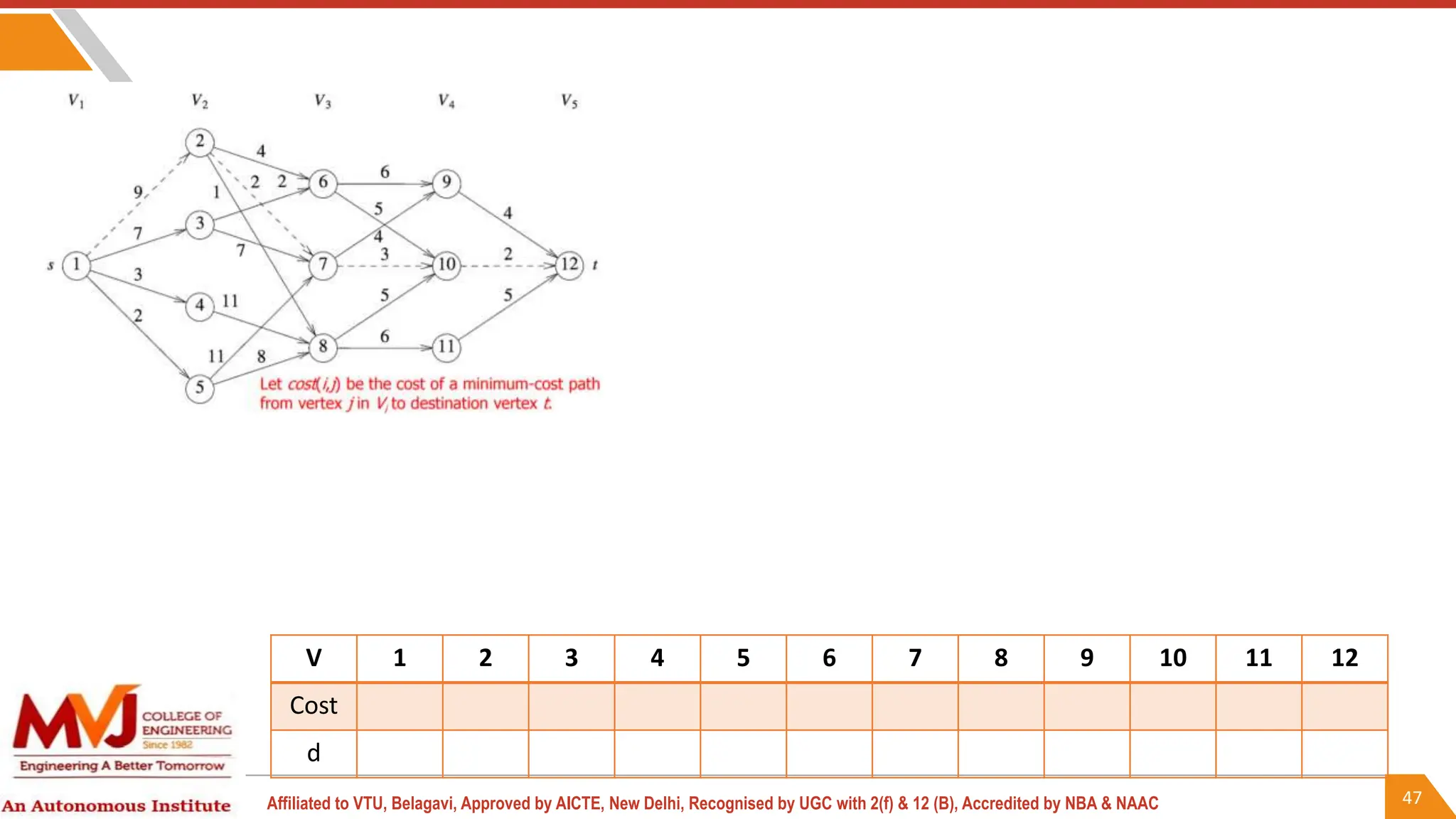
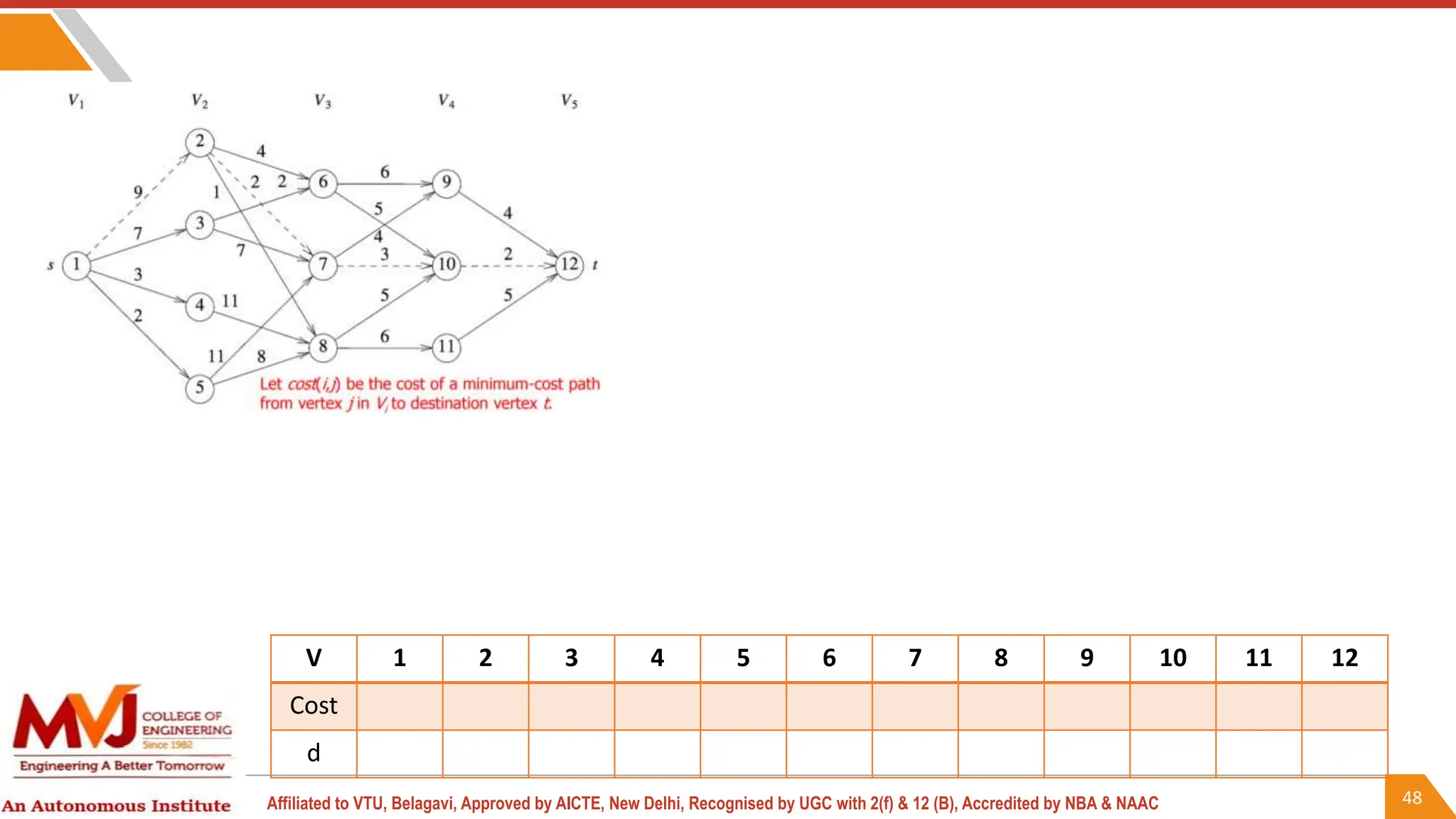
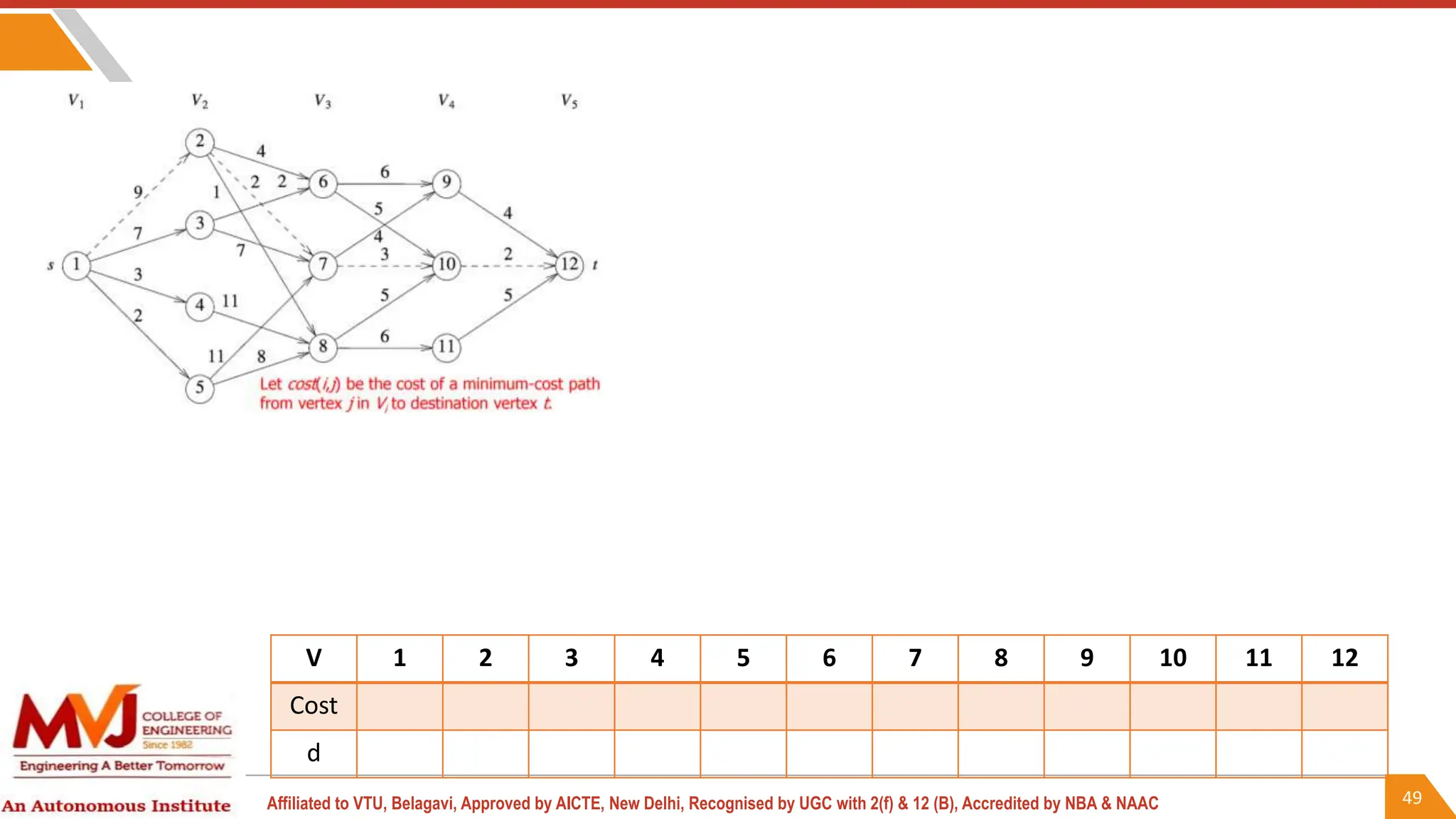
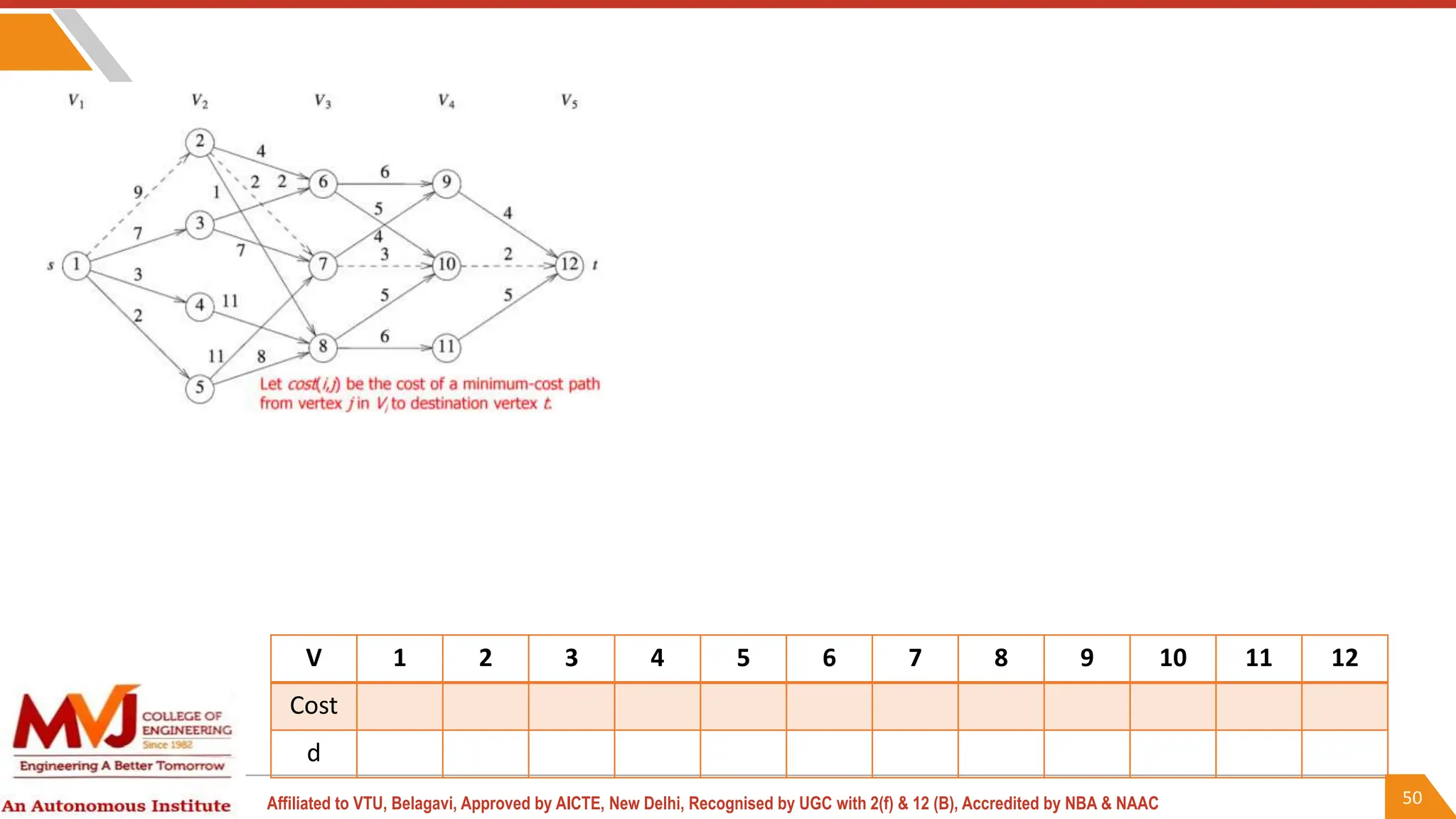
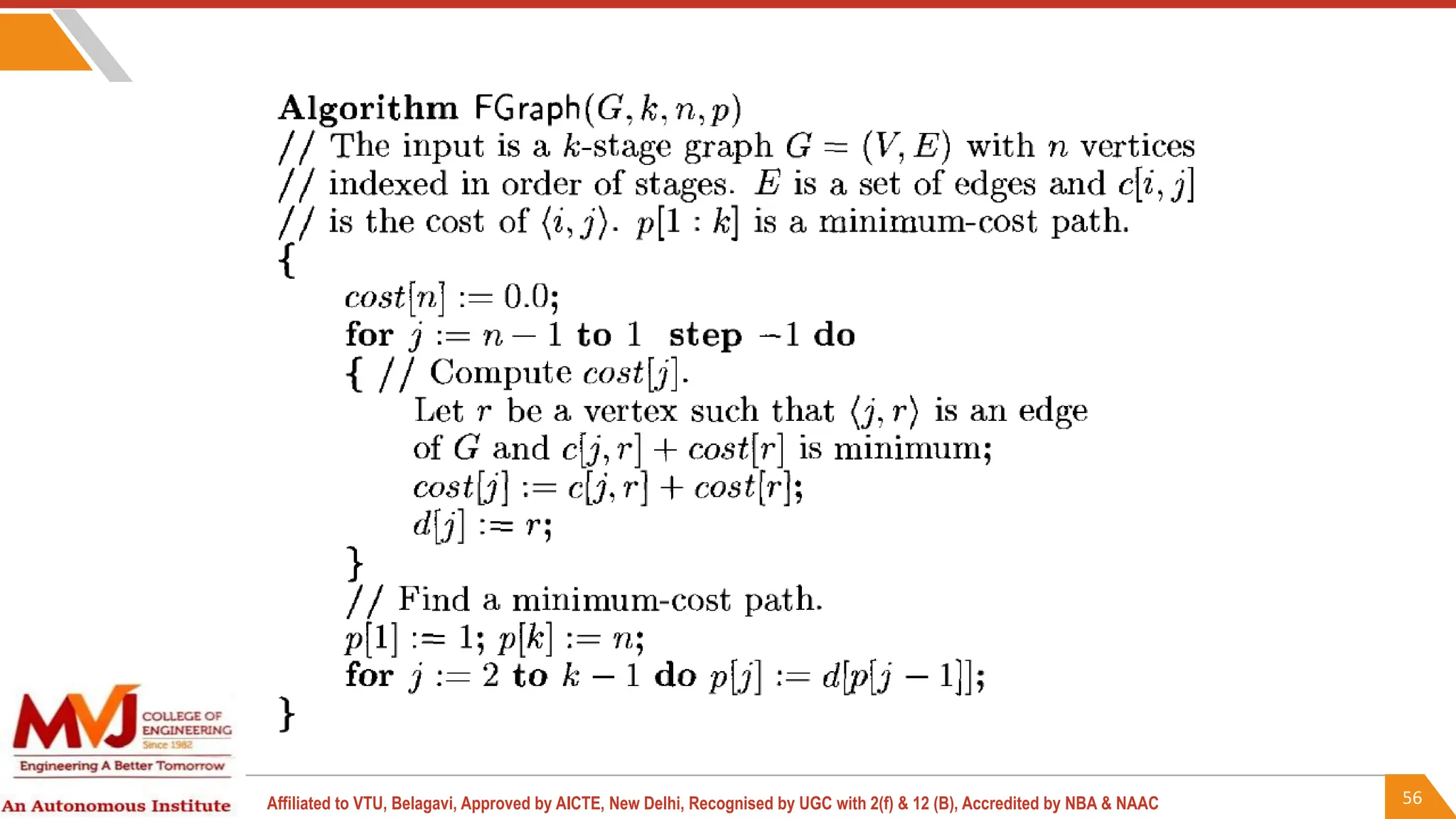
A Multistage graph is a directed graph in which the nodes can be divided into a
set of stages such that all edges are from a stage to next stage only (In other words
there is no edge between vertices of same stage and from a vertex of current stage
to previous stage).
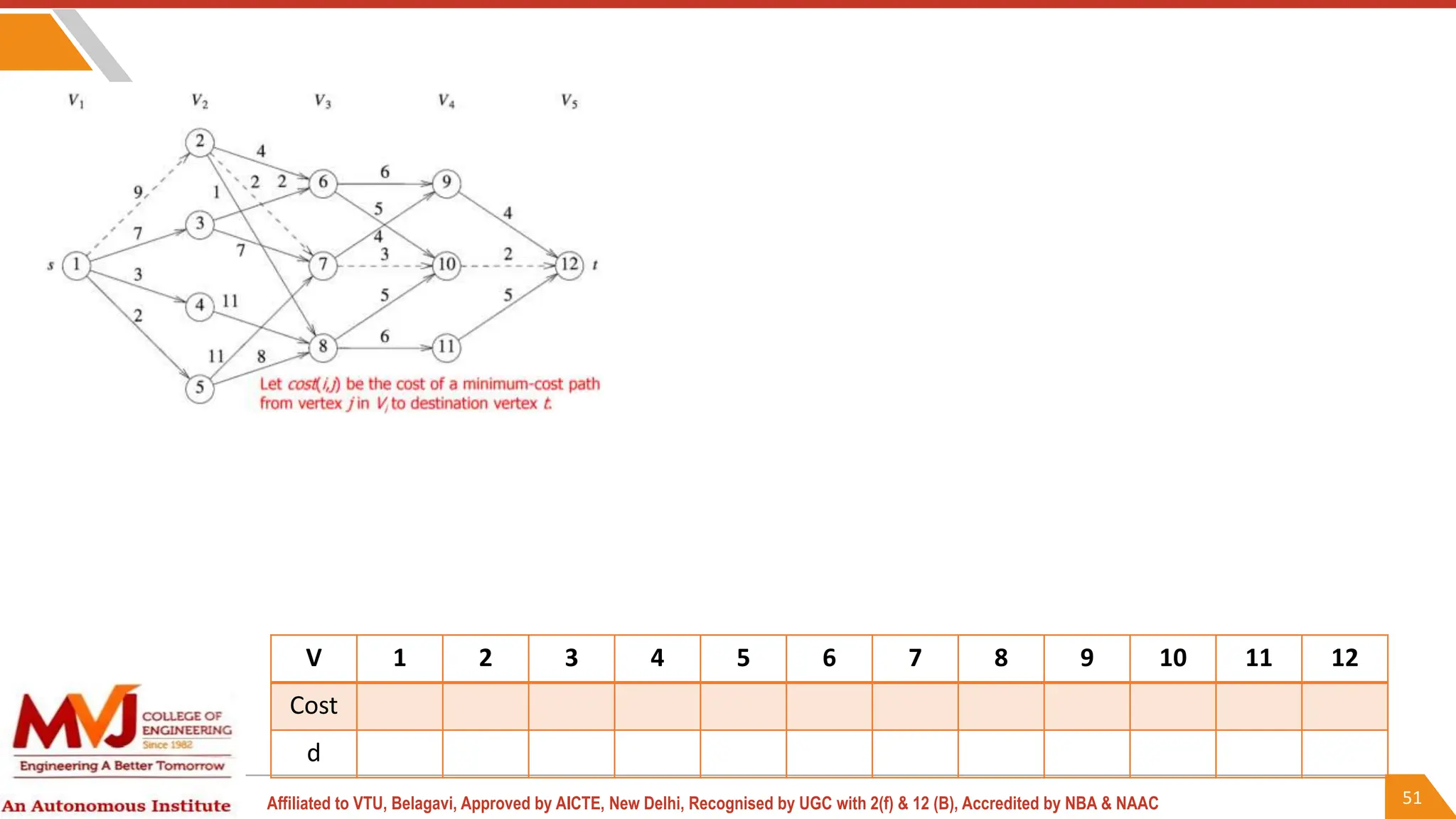
We are give a multistage graph, a source and a destination, we need to find shortest
path from source to destination. By convention, we consider source at stage 1 and
destination as last stage.
Multistage graph using Dynamic Programming Approach
40
Affiliated to VTU, Belagavi, Approved by AICTE, New Delhi, Recognised by UGC with 2(f) & 12 (B), Accredited by NBA & NAAC
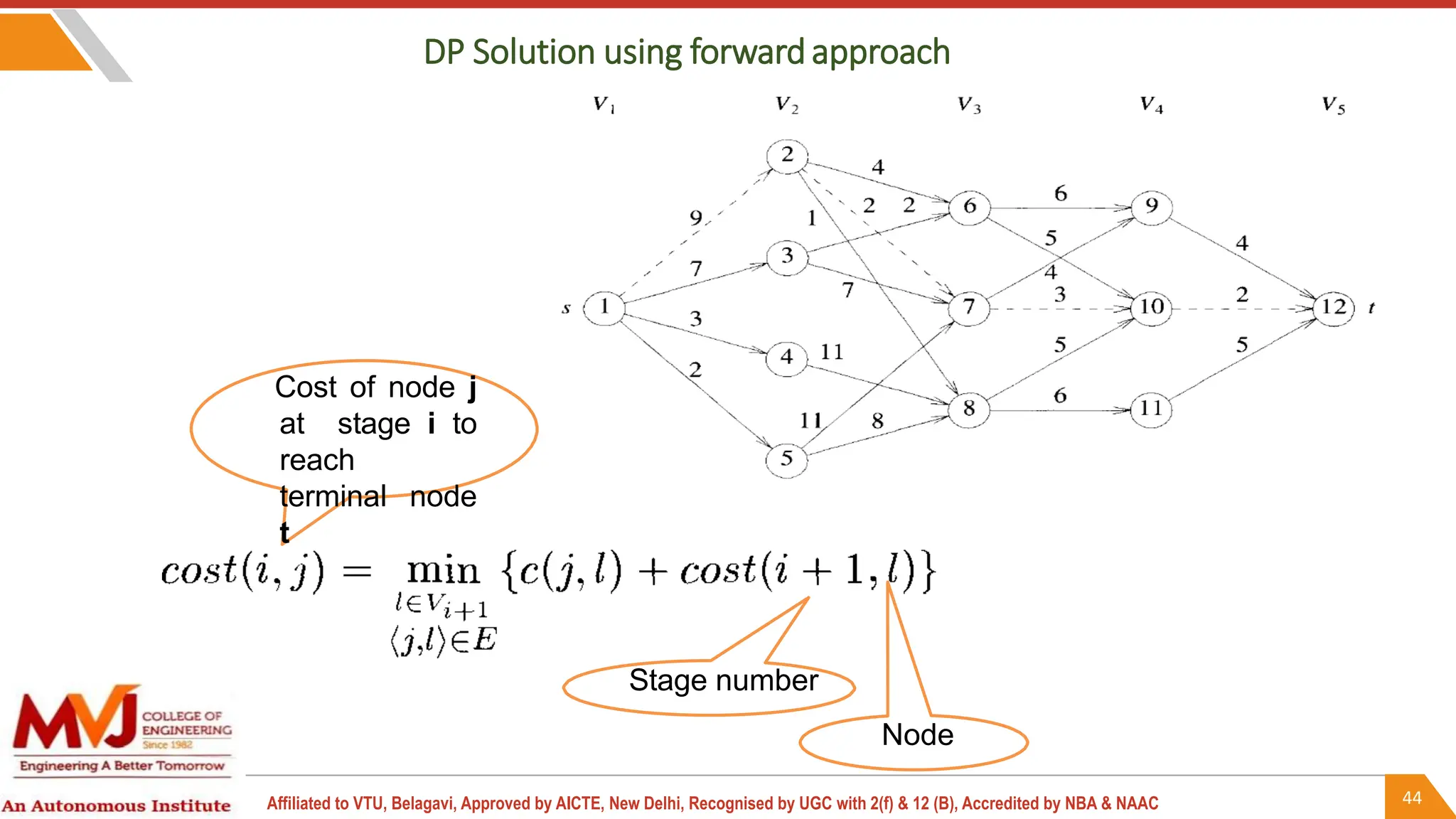
Let G=(V,E) be a directed graph.
In this we divide the problem into no. of stages or multiple stages then we try to
solve whole problem. Multistage graph problem is to determine shortest path
from source to destination.
This can be solved by using either forward or backward approach.
In forward approach we will find the path from destination to source, in
backward approach we will find the path from source to destination.
41
Affiliated to VTU, Belagavi, Approved by AICTE, New Delhi, Recognised by UGC with 2(f) & 12 (B), Accredited by NBA & NAAC
Multistage graph problem:
1.The multistage graph problem is to find a minimum cost from a source to a sink.
2.A multistage graph is a directed graph having a number of multiple stages, where
stages element should be connected consecutively.
3.In this multiple stage graph, there is a vertex whose in degree is 0 that is known as
the source. And the vertex with only one out degree is 0 is known as the destination
vertex.
4.The one end of the multiple stage graphs is at i thus the other reaching end is
on i+1 stage.
5.If we denote a graph G = (V, E) in which the vertices are partitioned into K >=
2 disjoints sets, Vi, 1 <= I <=K. So that, if there is an edge < u, v > from u to v in E,
the u £Vi and v € v (i+1), for some I, 1 <= i <= K. And sets V1 and Vk are such
that |V1| = |Vk| = 1.
42
Affiliated to VTU, Belagavi, Approved by AICTE, New Delhi, Recognised by UGC with 2(f) & 12 (B), Accredited by NBA & NAAC
A multistage graph G=(V,E) is a directed graph in which the vertices are partitioned
into k>=2 disjoint sets Vi, i<=i<=k.
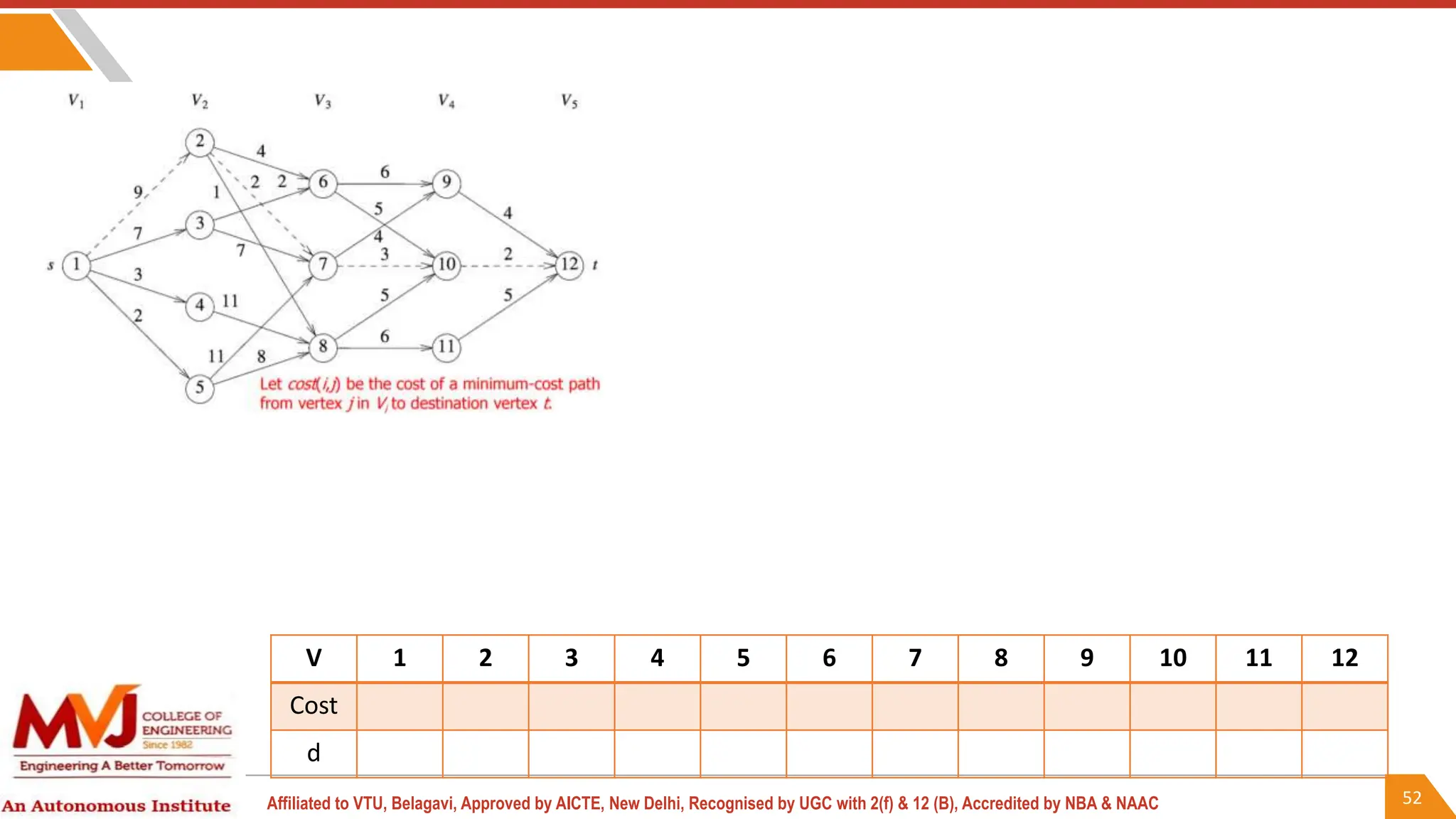
The vertex s is source and t is the sink. Let c(i,j) be the cost of edge .
The cost of a path from s to t is the sum of costs of the edges on the path.
The multistage graph problem is to find a minimum-cost path from s to t.
43
Affiliated to VTU, Belagavi, Approved by AICTE, New Delhi, Recognised by UGC with 2(f) & 12 (B), Accredited by NBA & NAAC
44
Affiliated to VTU, Belagavi, Approved by AICTE, New Delhi, Recognised by UGC with 2(f) & 12 (B), Accredited by NBA & NAAC
Cost of node j
at stage i to
reach
terminal node
t
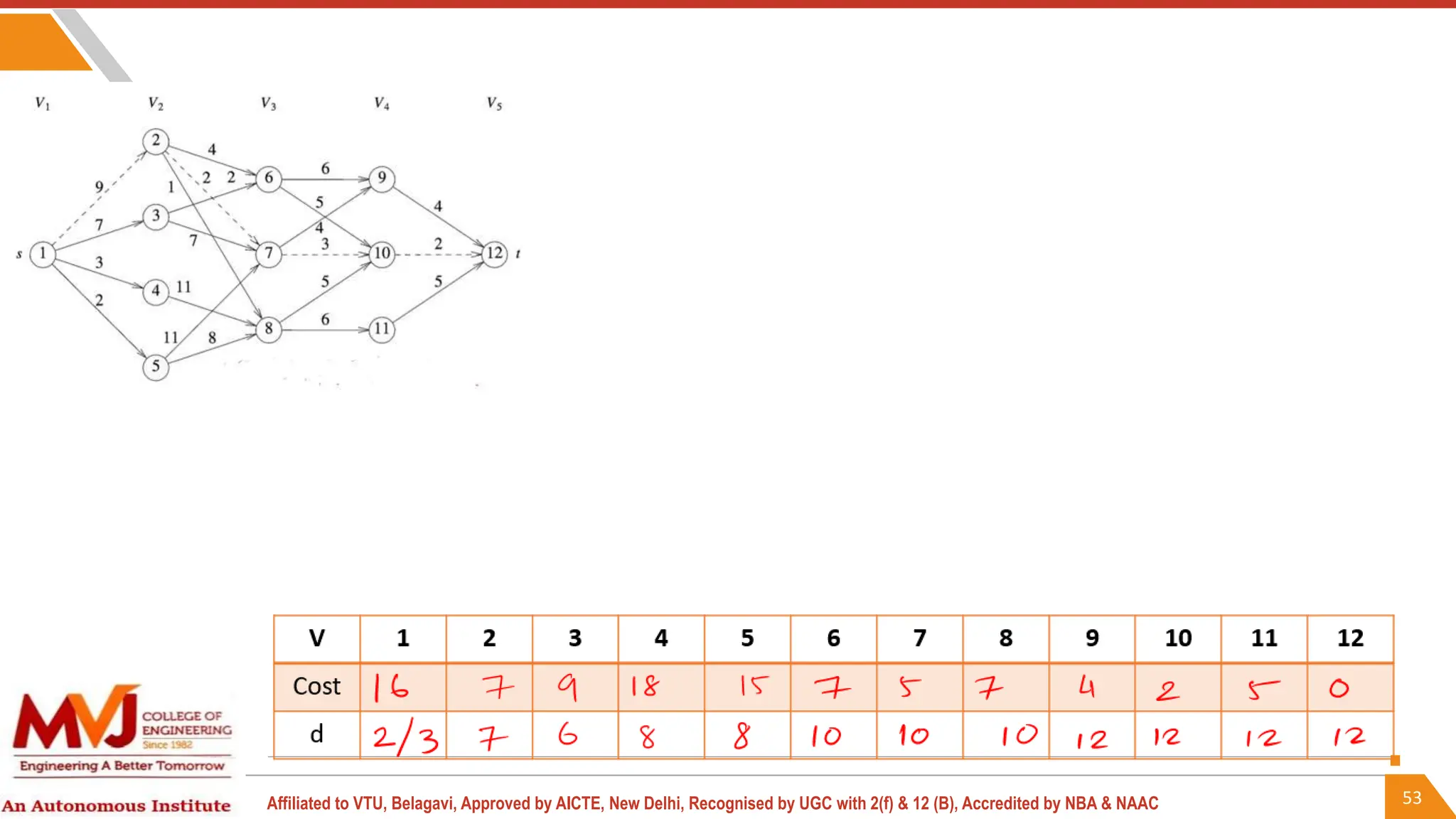
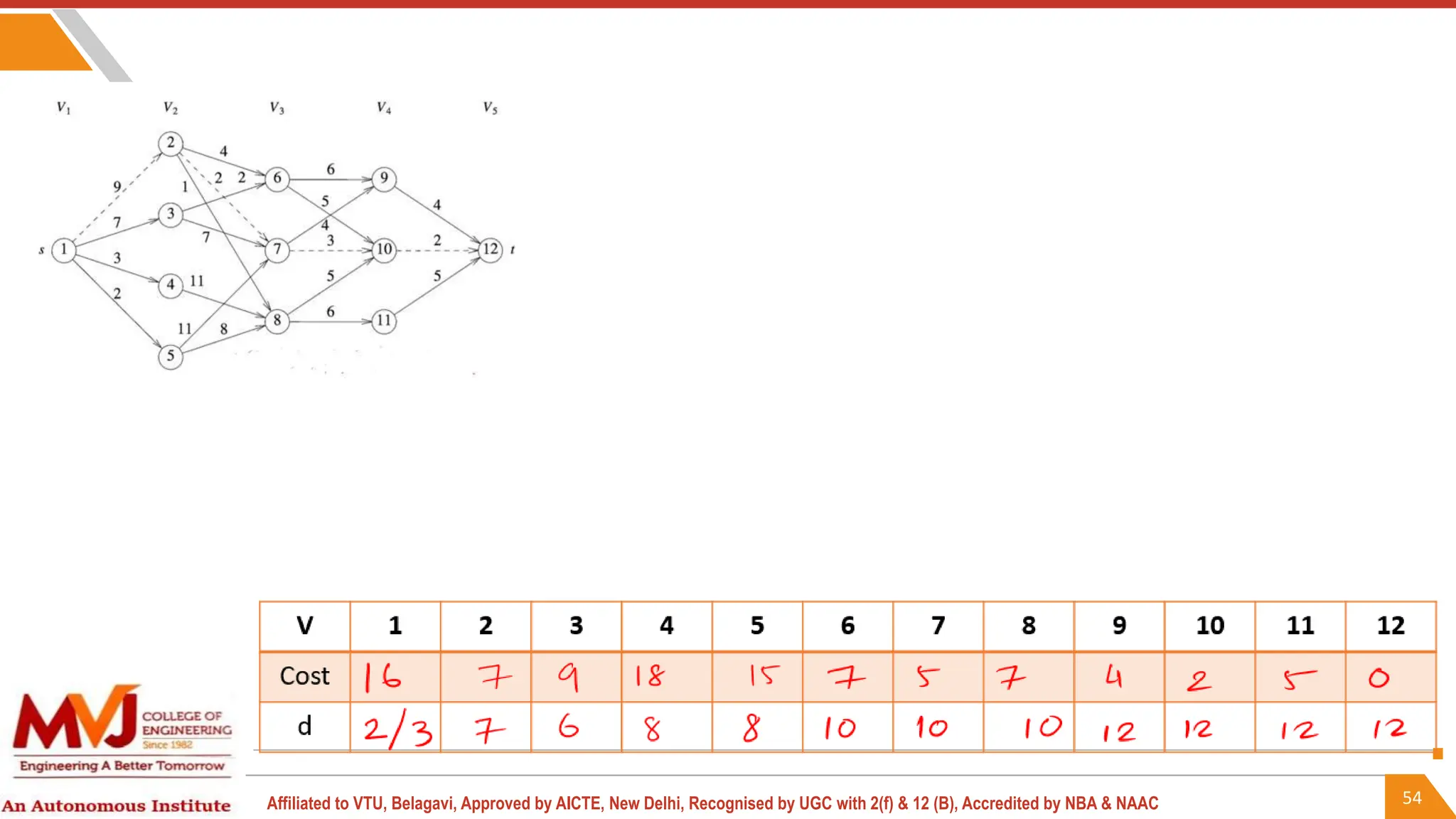
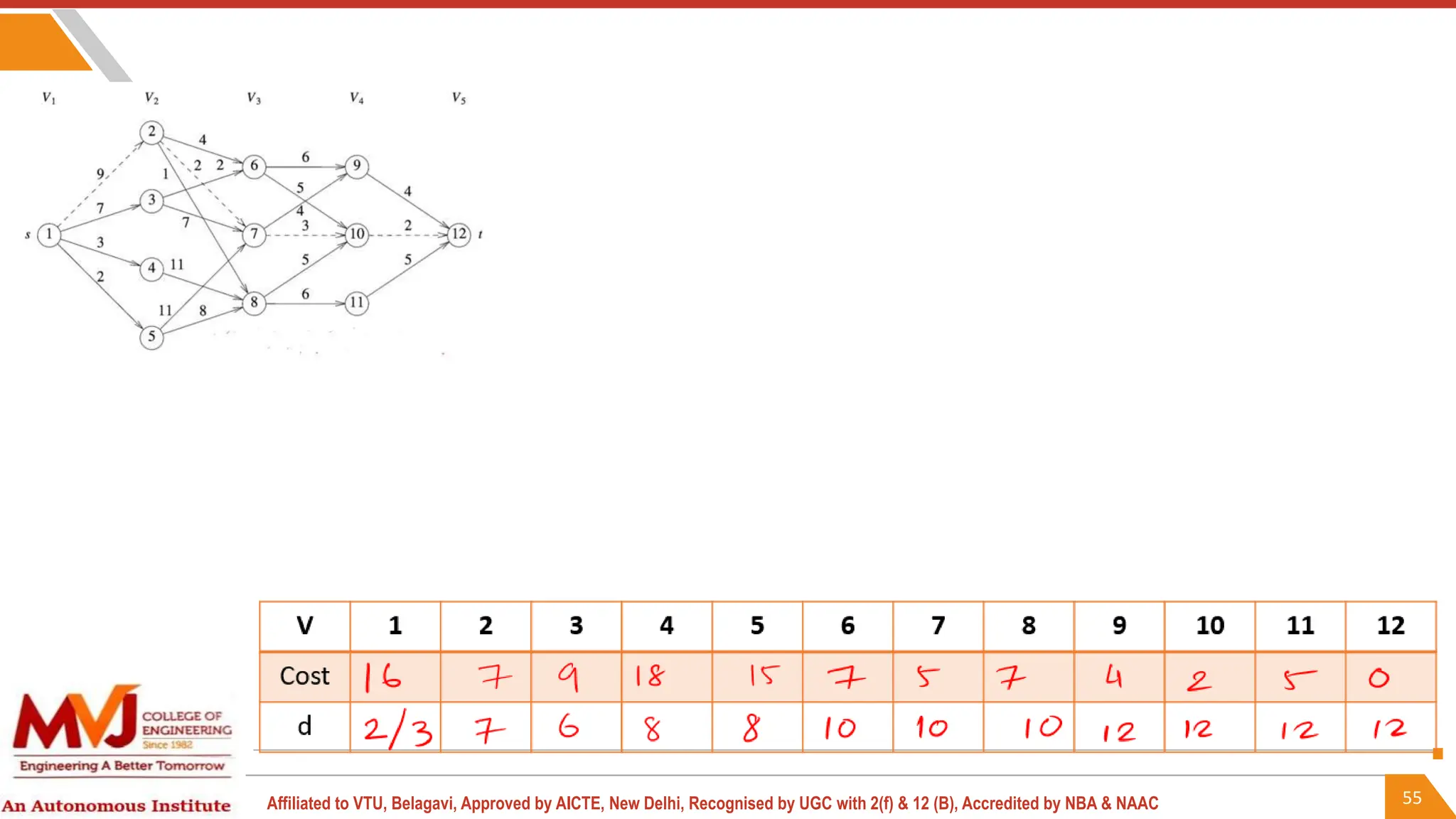
DP Solution using forwardapproach
Stage number
Node
45
Affiliated to VTU, Belagavi, Approved by AICTE, New Delhi, Recognised by UGC with 2(f) & 12 (B), Accredited by NBA & NAAC
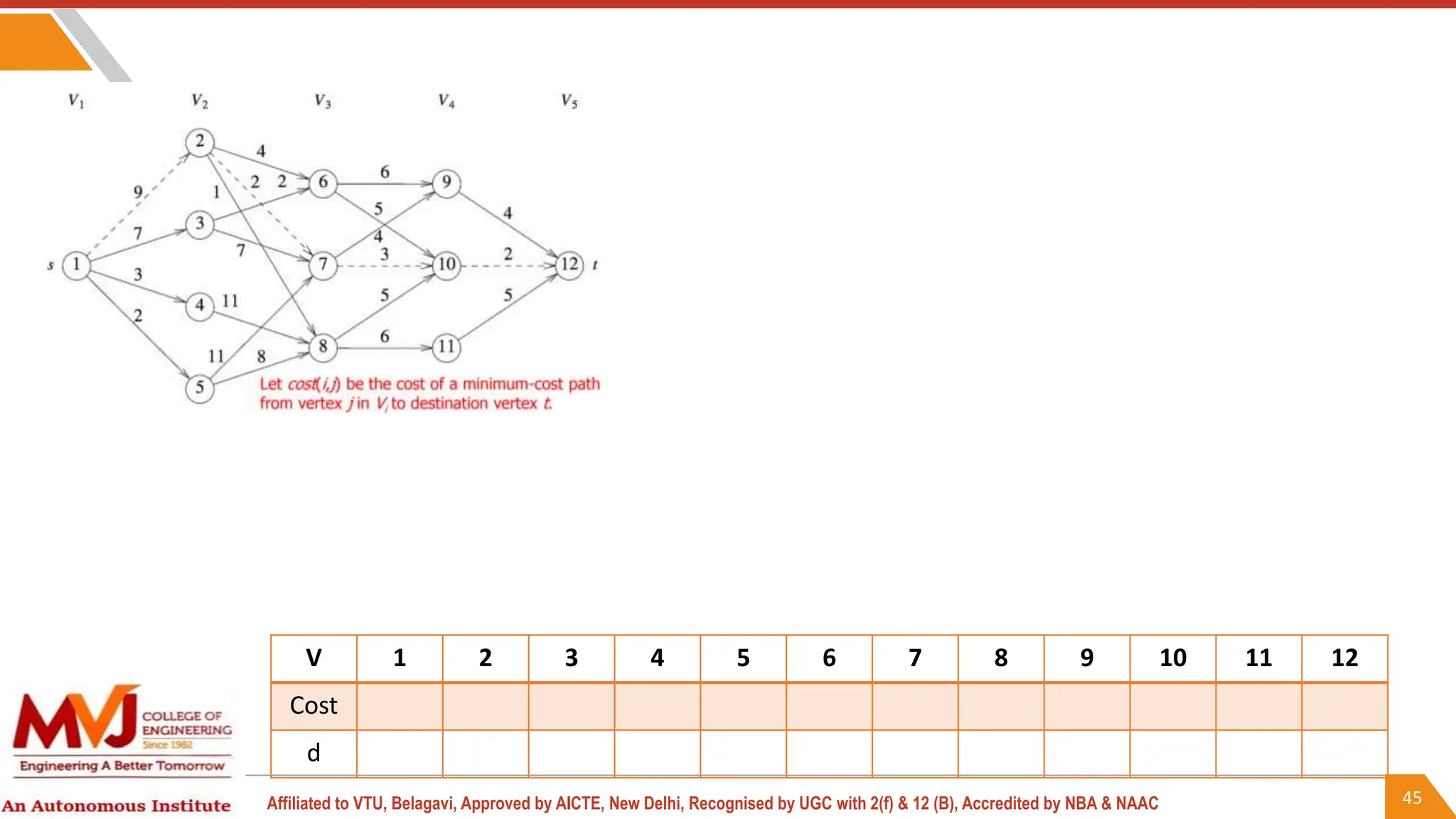
V 1 2 3 4 5 6 7 8 9 10 11 12
Cost
d
46
Affiliated to VTU, Belagavi, Approved by AICTE, New Delhi, Recognised by UGC with 2(f) & 12 (B), Accredited by NBA & NAAC
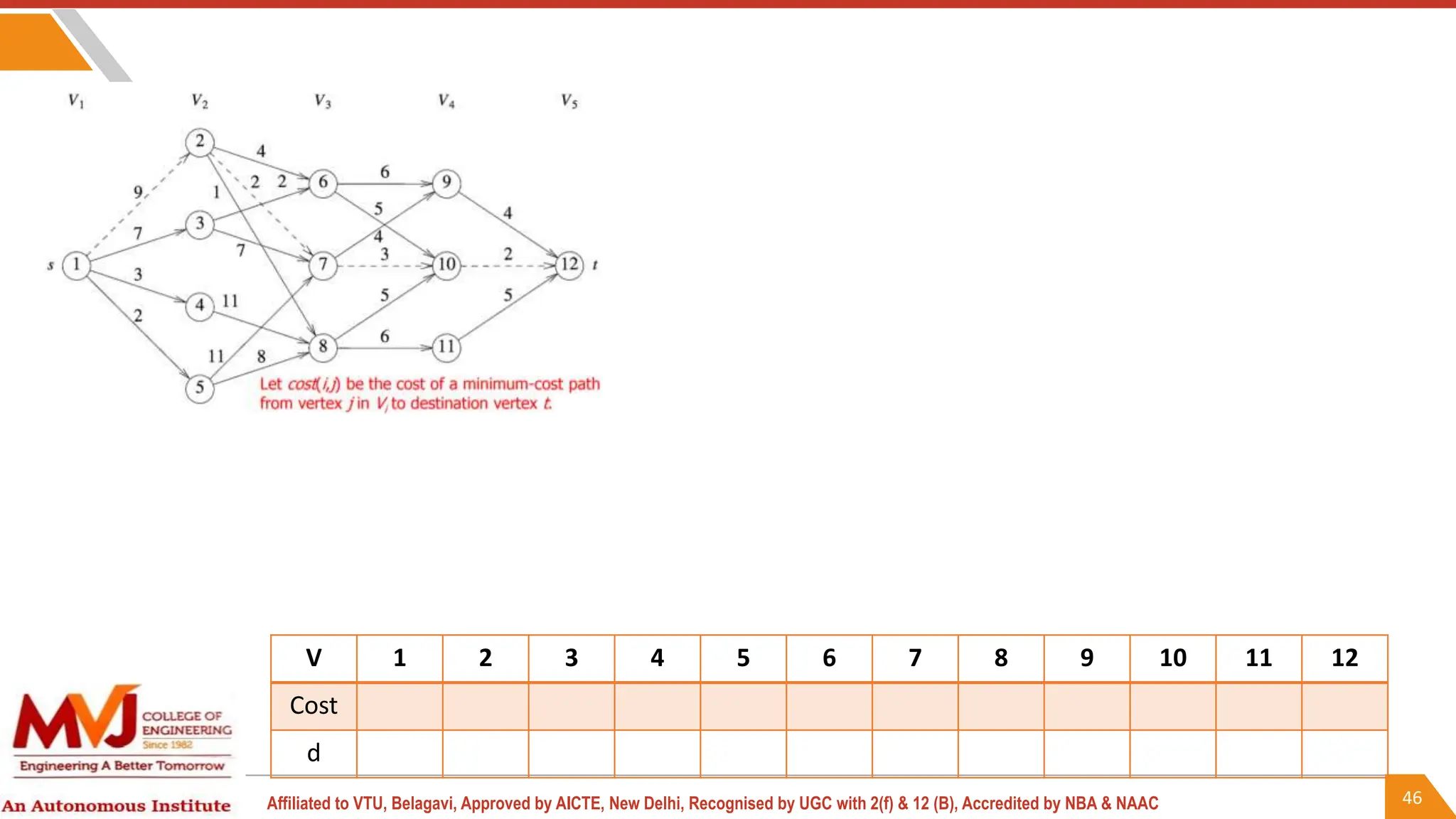
V 1 2 3 4 5 6 7 8 9 10 11 12
Cost
d
47
Affiliated to VTU, Belagavi, Approved by AICTE, New Delhi, Recognised by UGC with 2(f) & 12 (B), Accredited by NBA & NAAC
V 1 2 3 4 5 6 7 8 9 10 11 12
Cost
d
48
Affiliated to VTU, Belagavi, Approved by AICTE, New Delhi, Recognised by UGC with 2(f) & 12 (B), Accredited by NBA & NAAC
V 1 2 3 4 5 6 7 8 9 10 11 12
Cost
d
49
Affiliated to VTU, Belagavi, Approved by AICTE, New Delhi, Recognised by UGC with 2(f) & 12 (B), Accredited by NBA & NAAC
V 1 2 3 4 5 6 7 8 9 10 11 12
Cost
d
50
Affiliated to VTU, Belagavi, Approved by AICTE, New Delhi, Recognised by UGC with 2(f) & 12 (B), Accredited by NBA & NAAC
V 1 2 3 4 5 6 7 8 9 10 11 12
Cost
d
51
Affiliated to VTU, Belagavi, Approved by AICTE, New Delhi, Recognised by UGC with 2(f) & 12 (B), Accredited by NBA & NAAC
V 1 2 3 4 5 6 7 8 9 10 11 12
Cost
d
52
Affiliated to VTU, Belagavi, Approved by AICTE, New Delhi, Recognised by UGC with 2(f) & 12 (B), Accredited by NBA & NAAC
V 1 2 3 4 5 6 7 8 9 10 11 12
Cost
d
53
Affiliated to VTU, Belagavi, Approved by AICTE, New Delhi, Recognised by UGC with 2(f) & 12 (B), Accredited by NBA & NAAC
54
Affiliated to VTU, Belagavi, Approved by AICTE, New Delhi, Recognised by UGC with 2(f) & 12 (B), Accredited by NBA & NAAC
55
Affiliated to VTU, Belagavi, Approved by AICTE, New Delhi, Recognised by UGC with 2(f) & 12 (B), Accredited by NBA & NAAC
56
Affiliated to VTU, Belagavi, Approved by AICTE, New Delhi, Recognised by UGC with 2(f) & 12 (B), Accredited by NBA & NAAC
57
Affiliated to VTU, Belagavi, Approved by AICTE, New Delhi, Recognised by UGC with 2(f) & 12 (B), Accredited by NBA & NAAC
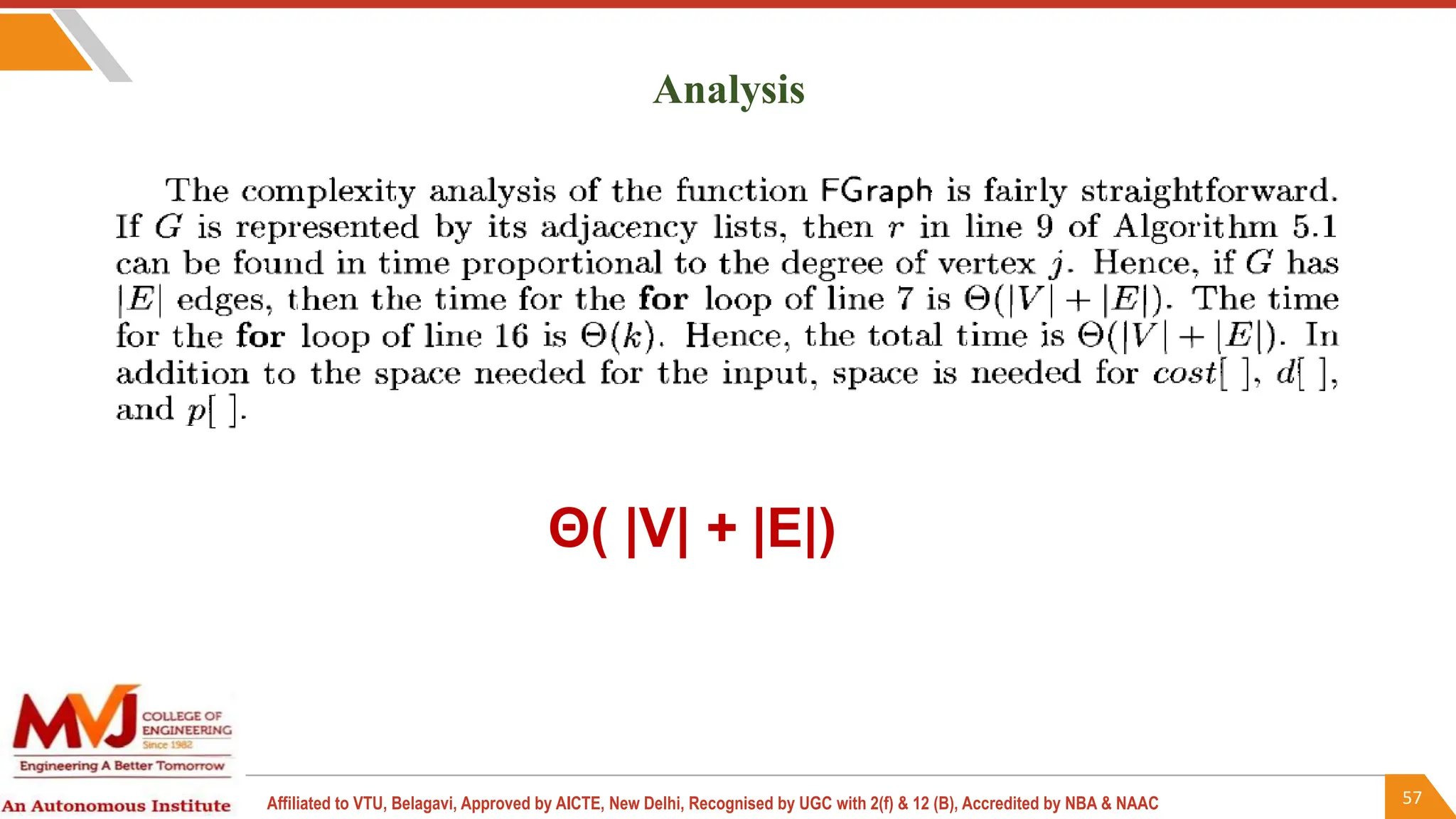
Analysis
Θ( |V| + |E|)
58
Affiliated to VTU, Belagavi, Approved by AICTE, New Delhi, Recognised by UGC with 2(f) & 12 (B), Accredited by NBA & NAAC
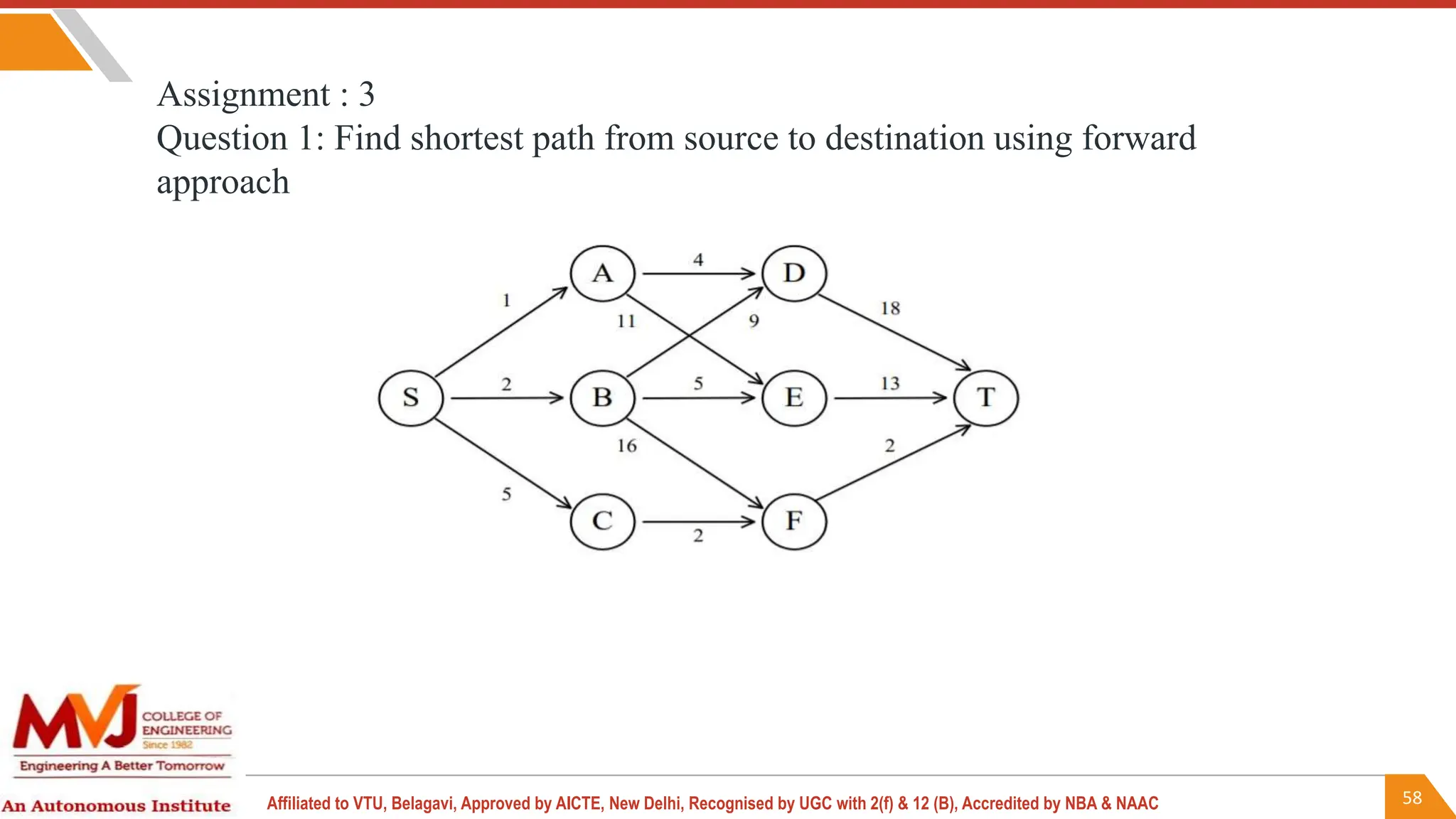
Assignment : 3
Question 1: Find shortest path from source to destination using forward
approach
59
Affiliated to VTU, Belagavi, Approved by AICTE, New Delhi, Recognised by UGC with 2(f) & 12 (B), Accredited by NBA & NAAC
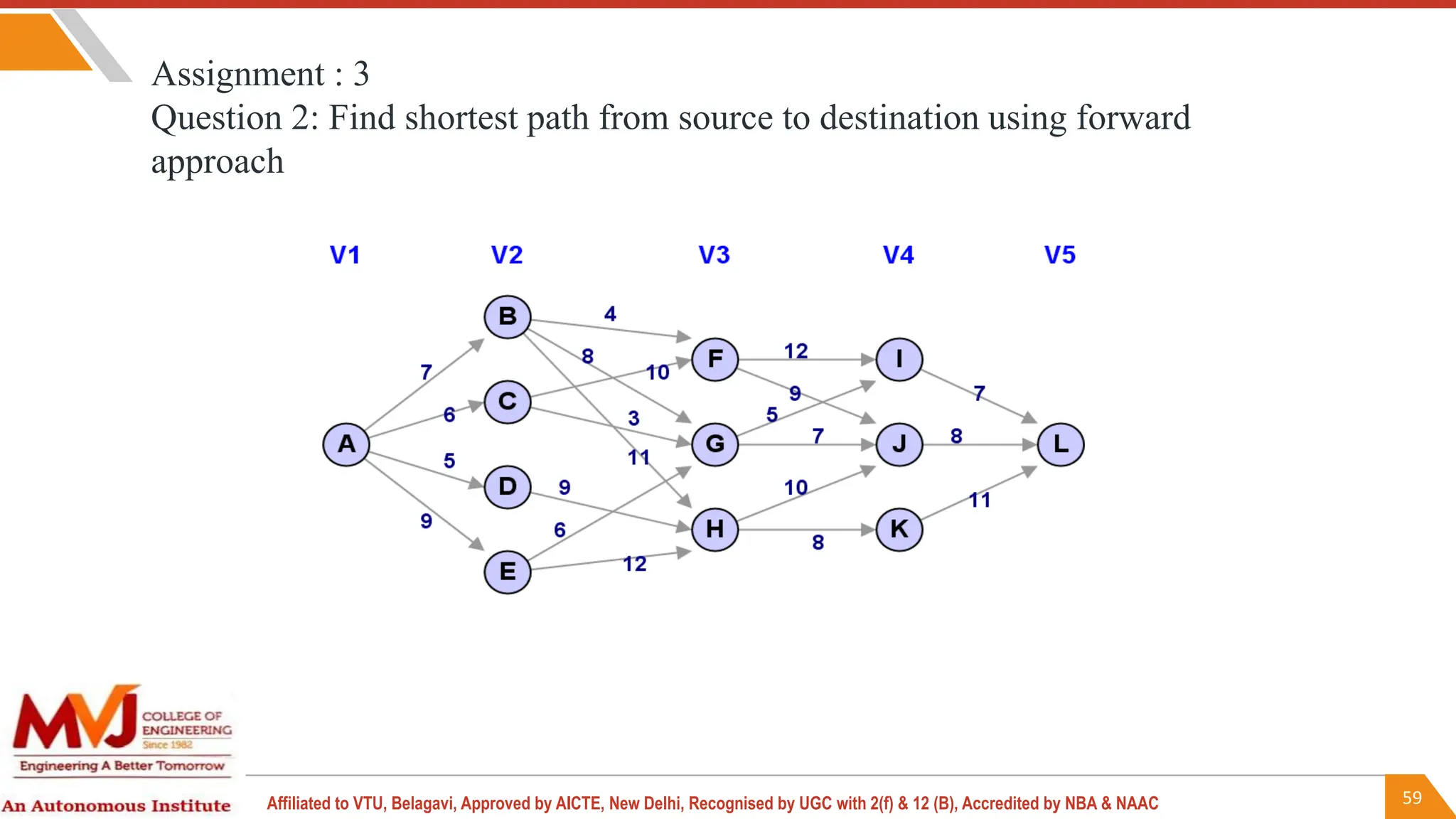
Assignment : 3
Question 2: Find shortest path from source to destination using forward
approach
60
Affiliated to VTU, Belagavi, Approved by AICTE, New Delhi, Recognised by UGC with 2(f) & 12 (B), Accredited by NBA & NAAC
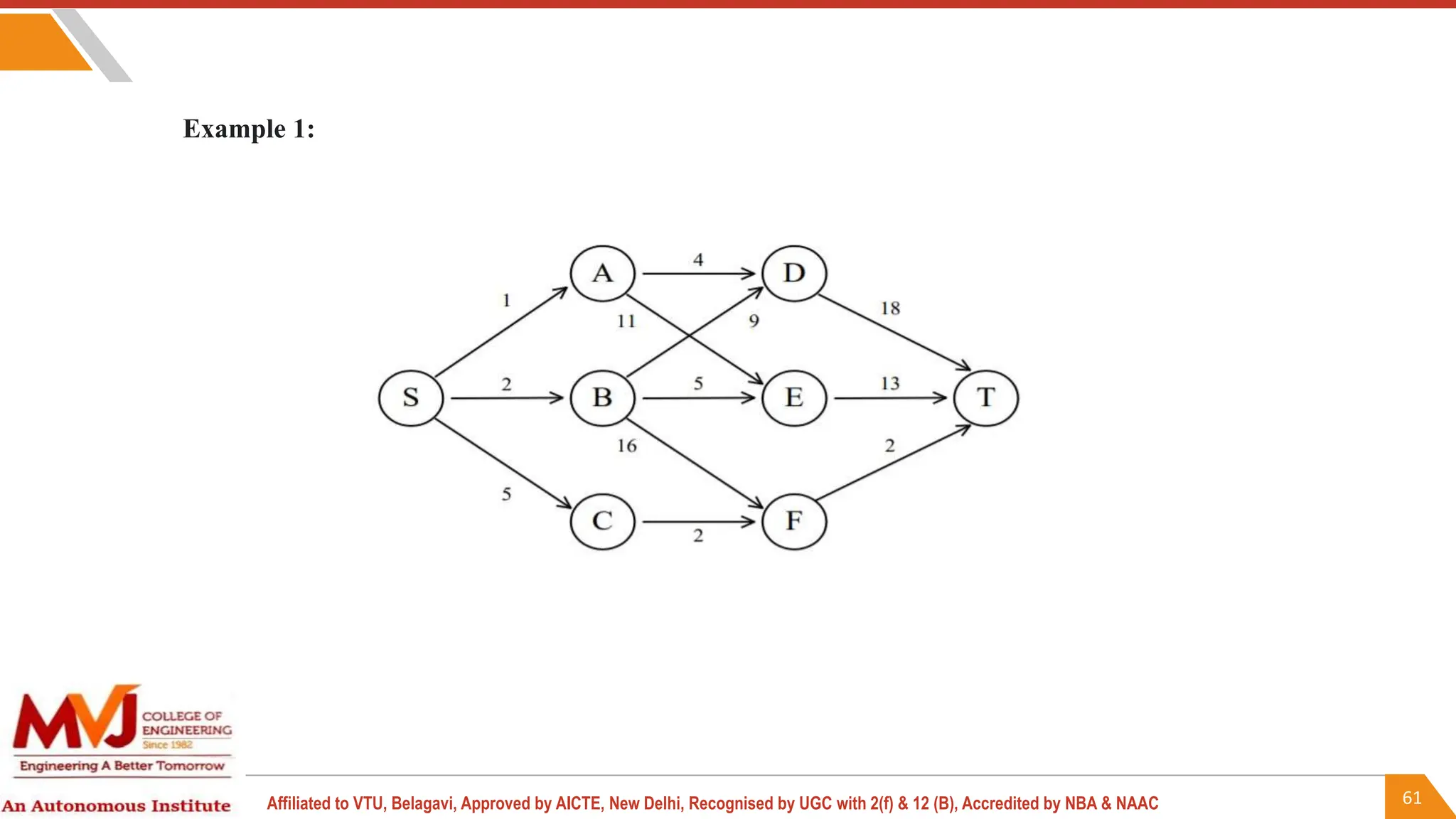
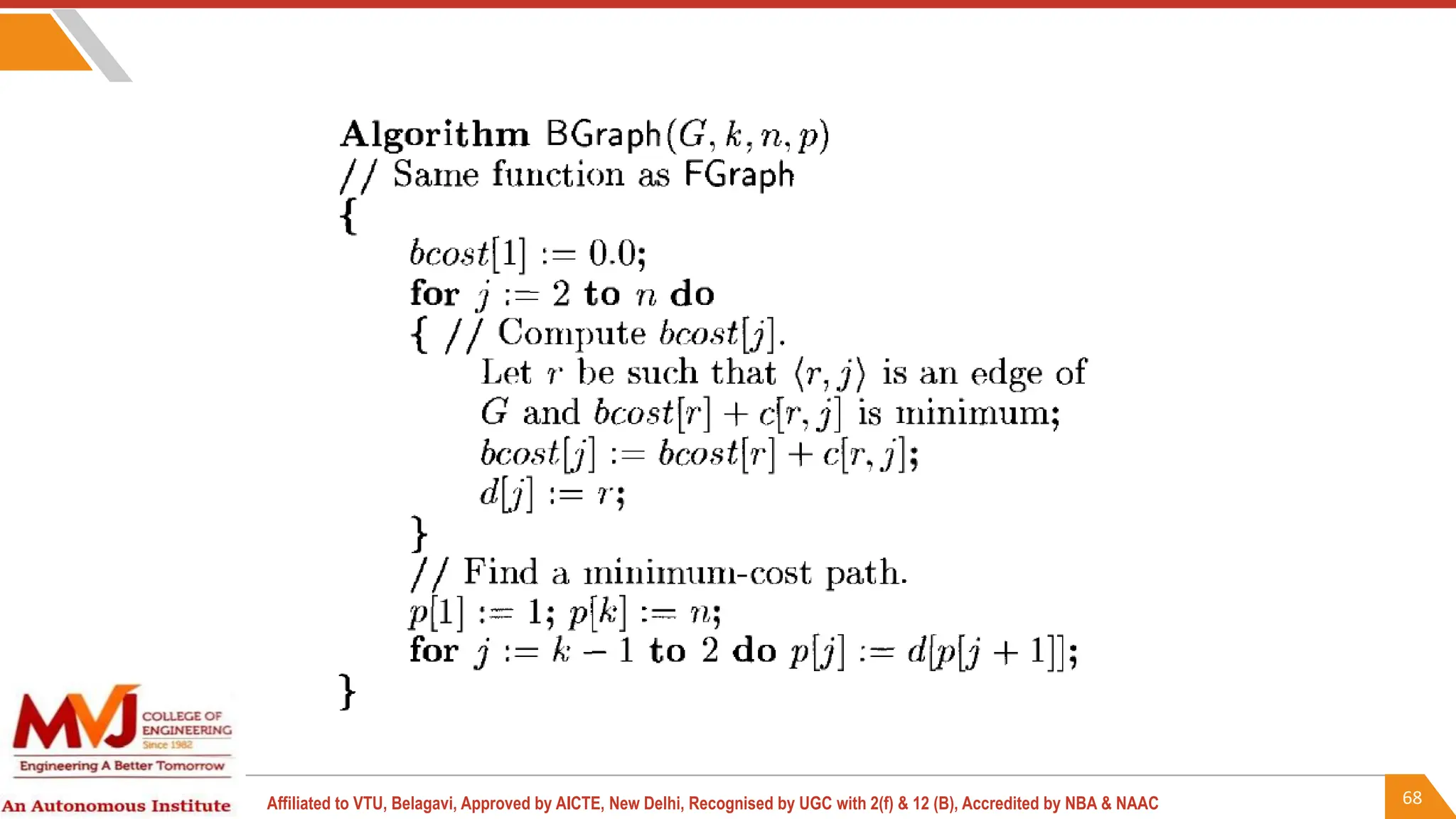
Multistage graph problem is to determine shortest path from source to destination.
This can be solved by using either forward or backward approach.
In forward approach we will find the path from destination to source,
in backward approach we will find the path from source to destination.
Backward approach
61
Affiliated to VTU, Belagavi, Approved by AICTE, New Delhi, Recognised by UGC with 2(f) & 12 (B), Accredited by NBA & NAAC
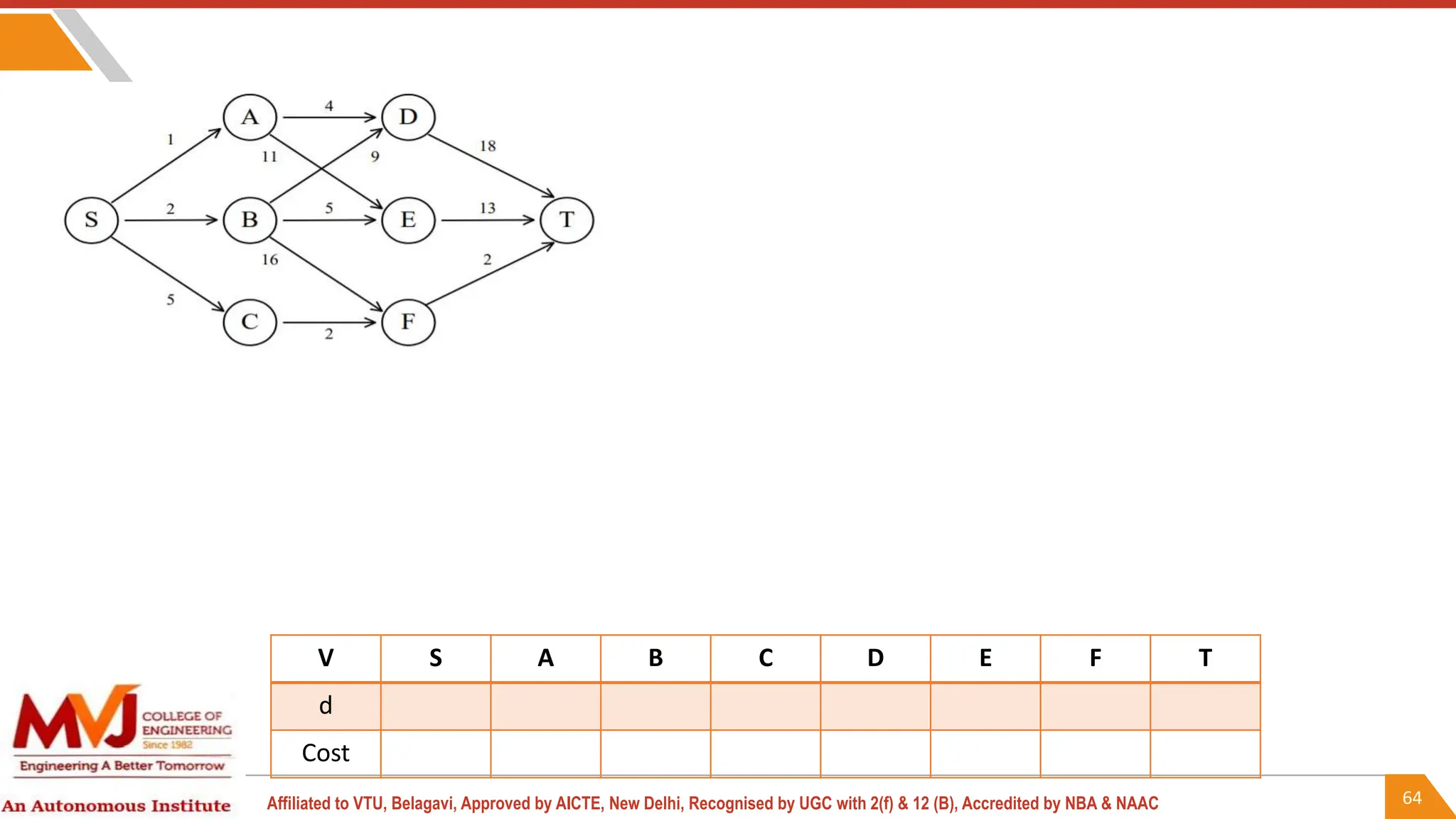
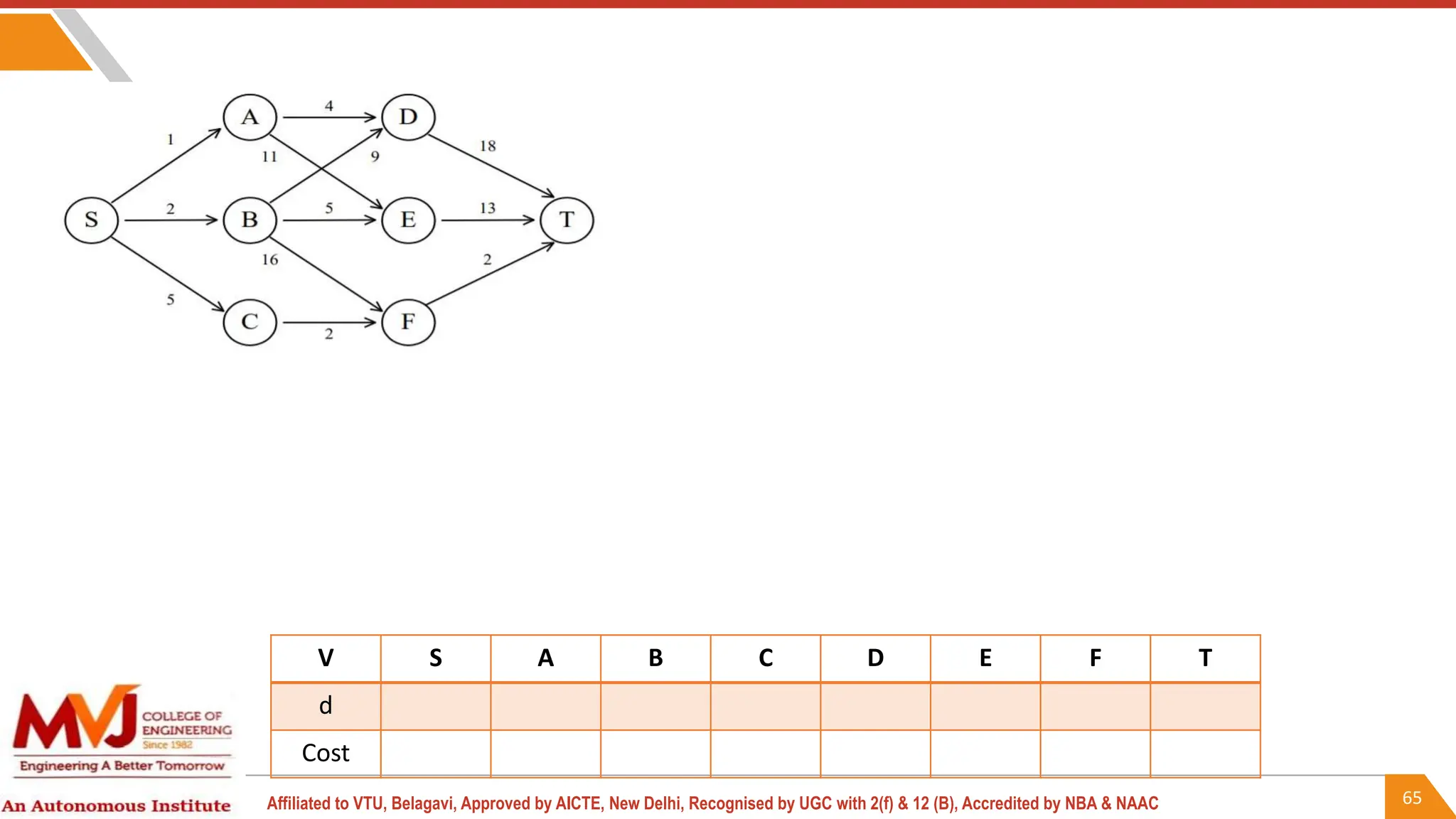
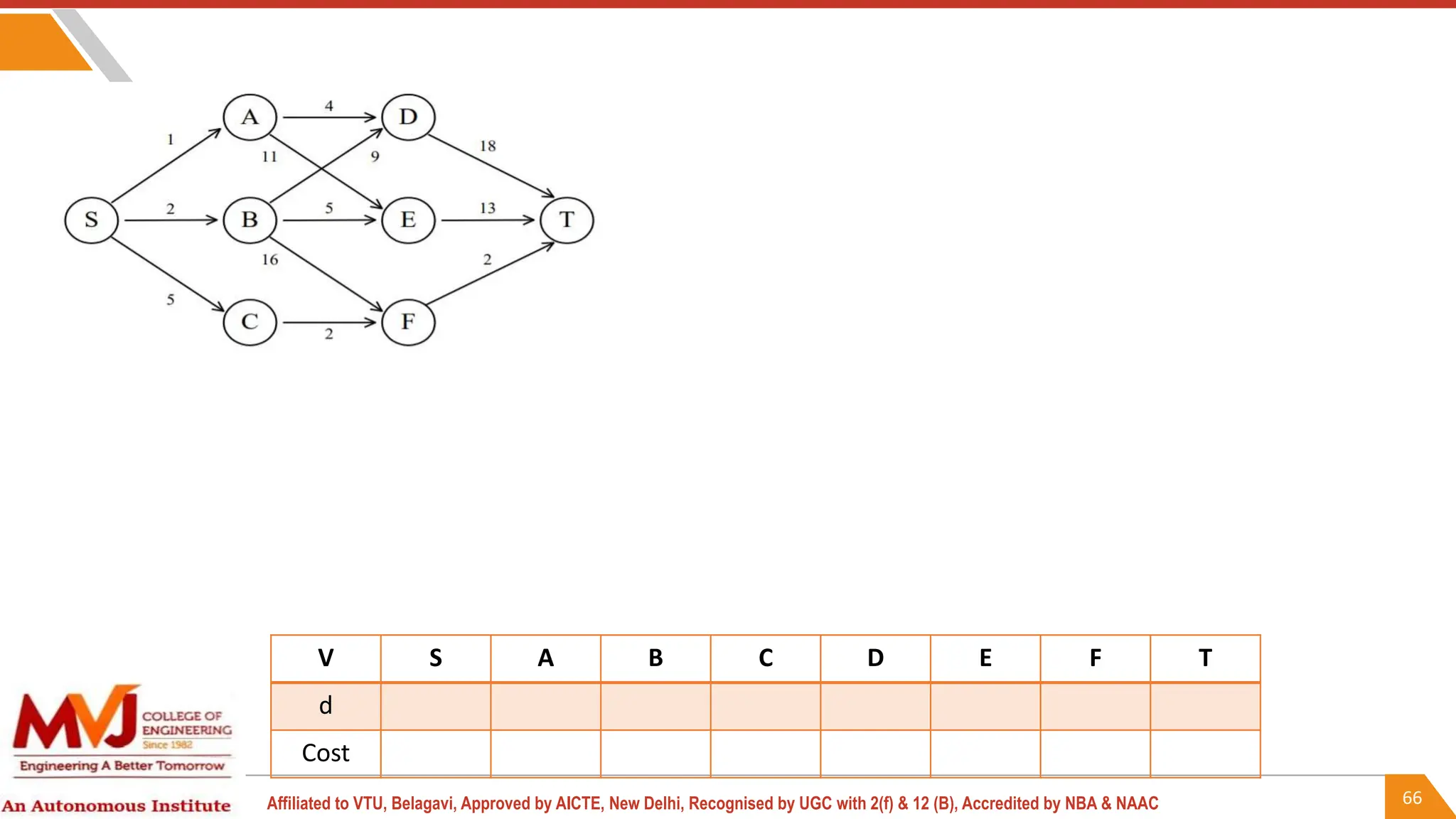
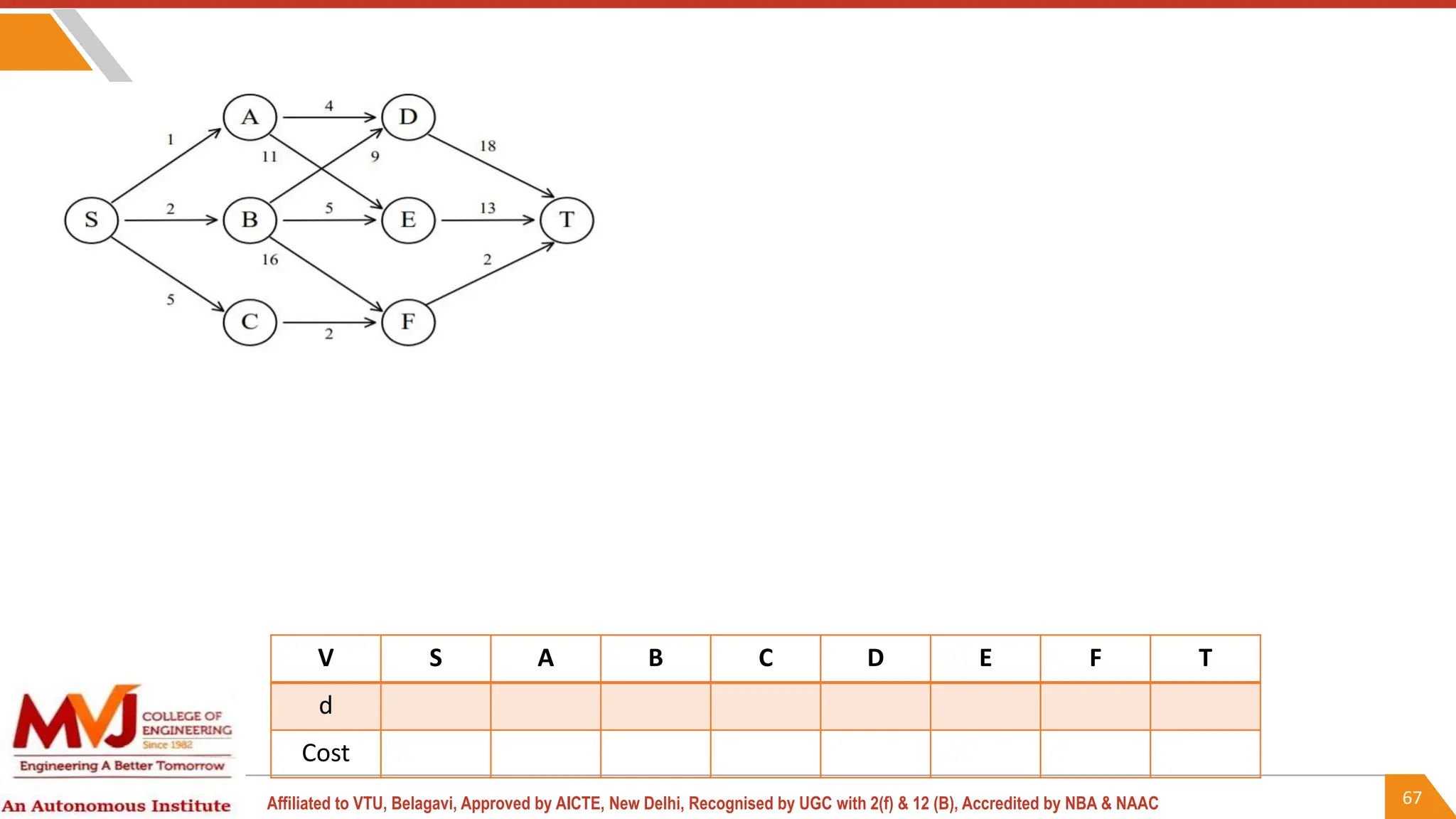
Example 1:
62
Affiliated to VTU, Belagavi, Approved by AICTE, New Delhi, Recognised by UGC with 2(f) & 12 (B), Accredited by NBA & NAAC
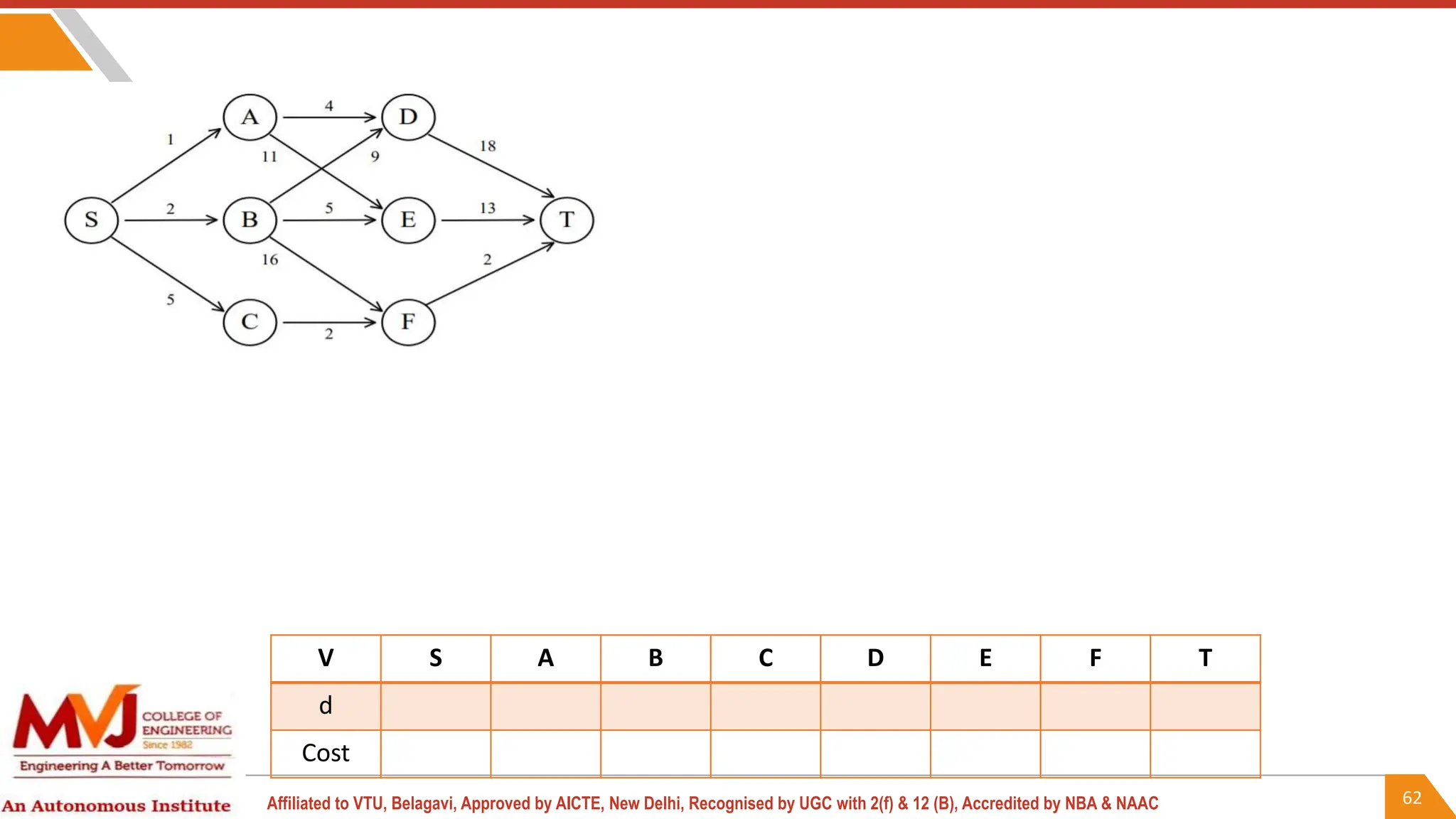
V S A B C D E F T
d
Cost
63
Affiliated to VTU, Belagavi, Approved by AICTE, New Delhi, Recognised by UGC with 2(f) & 12 (B), Accredited by NBA & NAAC
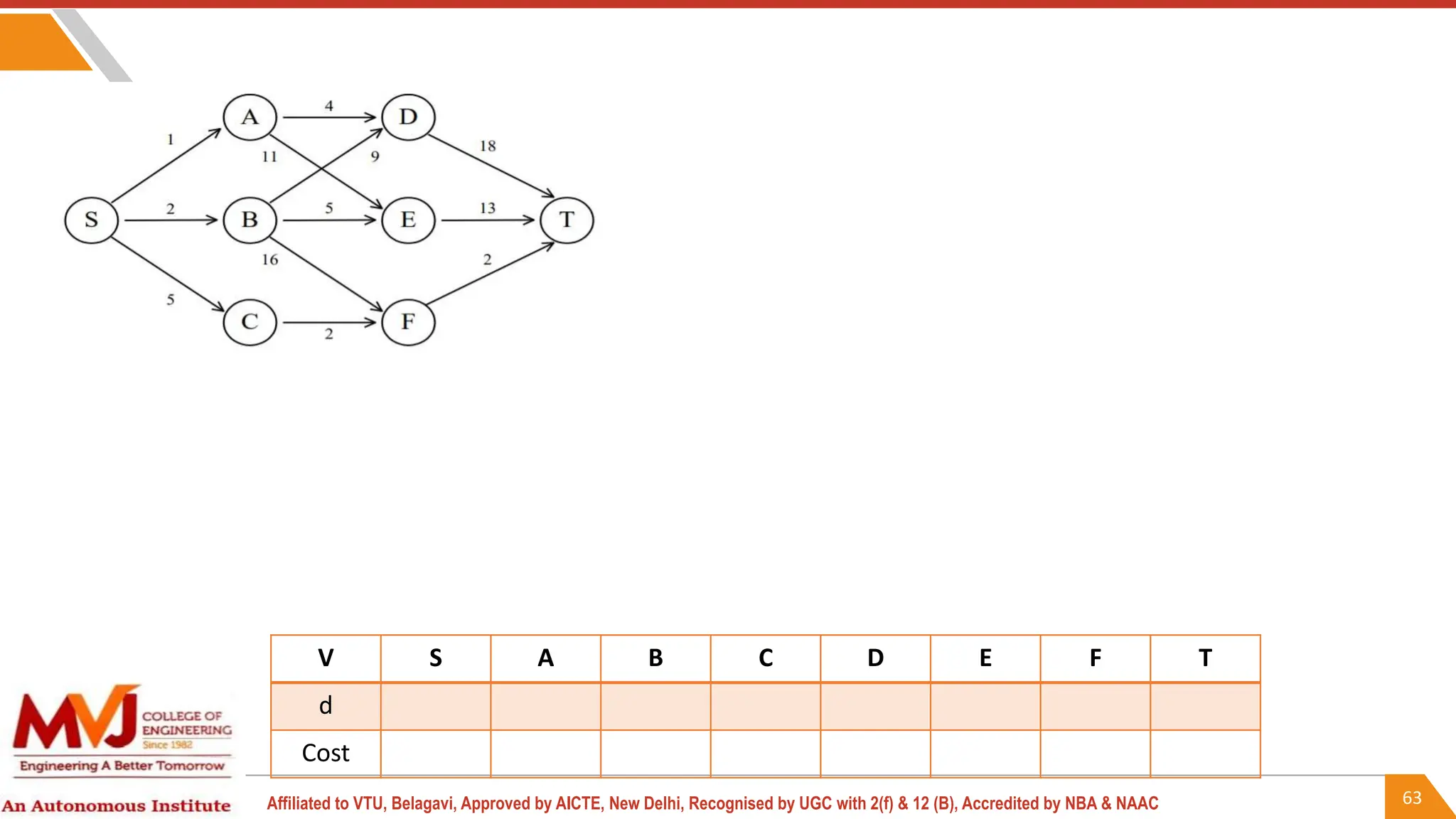
V S A B C D E F T
d
Cost
64
Affiliated to VTU, Belagavi, Approved by AICTE, New Delhi, Recognised by UGC with 2(f) & 12 (B), Accredited by NBA & NAAC
V S A B C D E F T
d
Cost
65
Affiliated to VTU, Belagavi, Approved by AICTE, New Delhi, Recognised by UGC with 2(f) & 12 (B), Accredited by NBA & NAAC
V S A B C D E F T
d
Cost
66
Affiliated to VTU, Belagavi, Approved by AICTE, New Delhi, Recognised by UGC with 2(f) & 12 (B), Accredited by NBA & NAAC
V S A B C D E F T
d
Cost
67
Affiliated to VTU, Belagavi, Approved by AICTE, New Delhi, Recognised by UGC with 2(f) & 12 (B), Accredited by NBA & NAAC
V S A B C D E F T
d
Cost
68
Affiliated to VTU, Belagavi, Approved by AICTE, New Delhi, Recognised by UGC with 2(f) & 12 (B), Accredited by NBA & NAAC
69
Affiliated to VTU, Belagavi, Approved by AICTE, New Delhi, Recognised by UGC with 2(f) & 12 (B), Accredited by NBA & NAAC
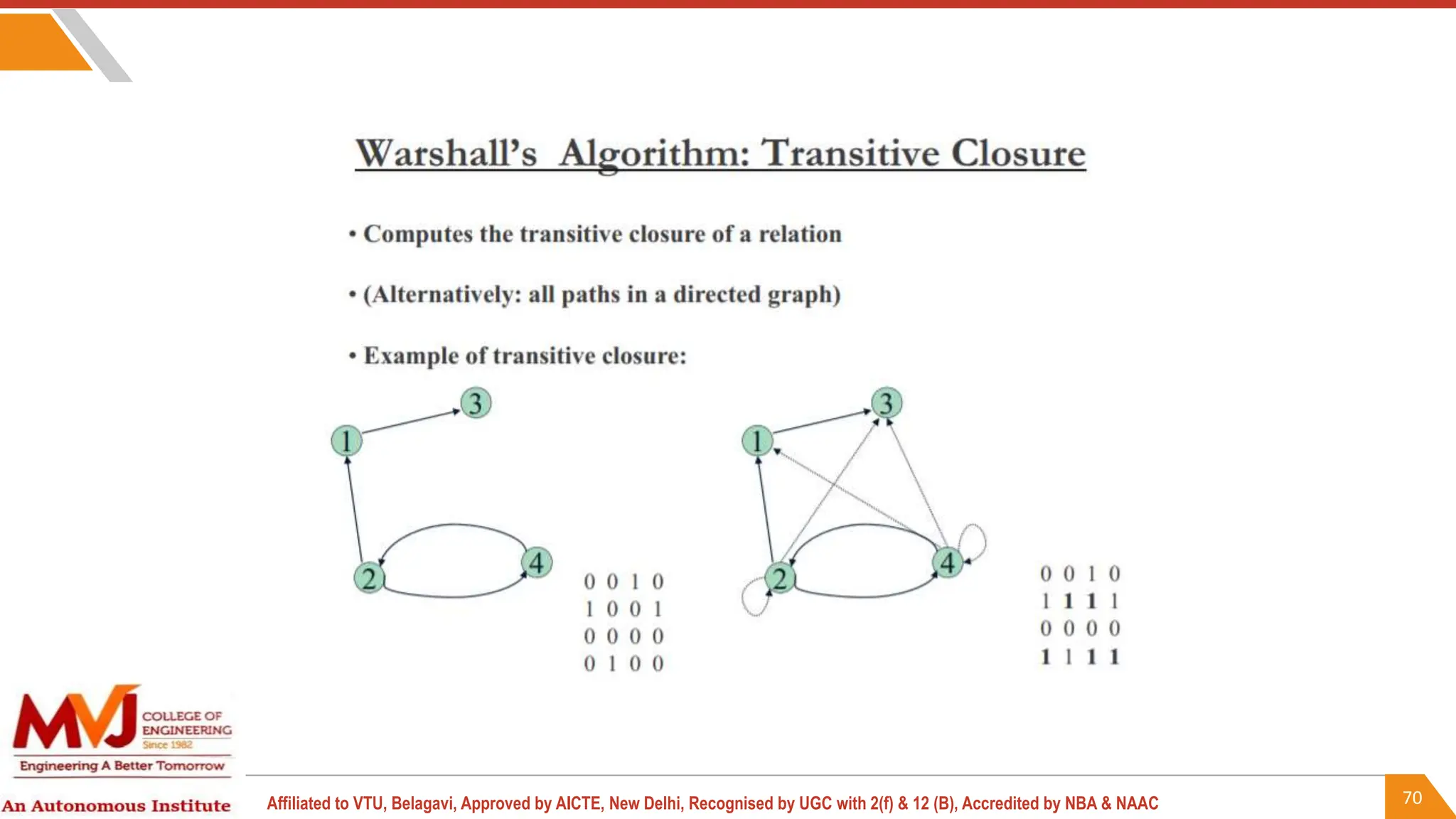
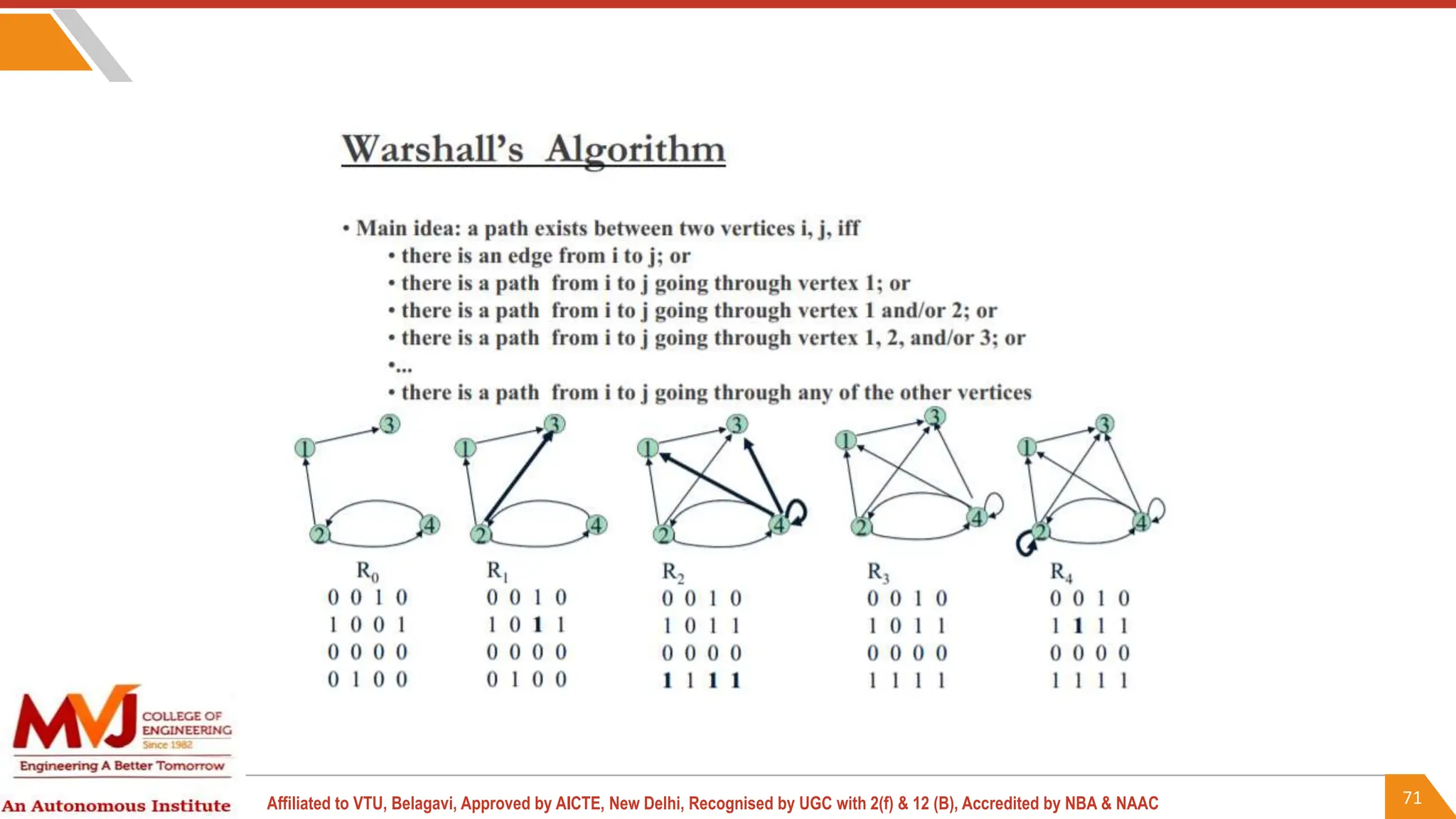
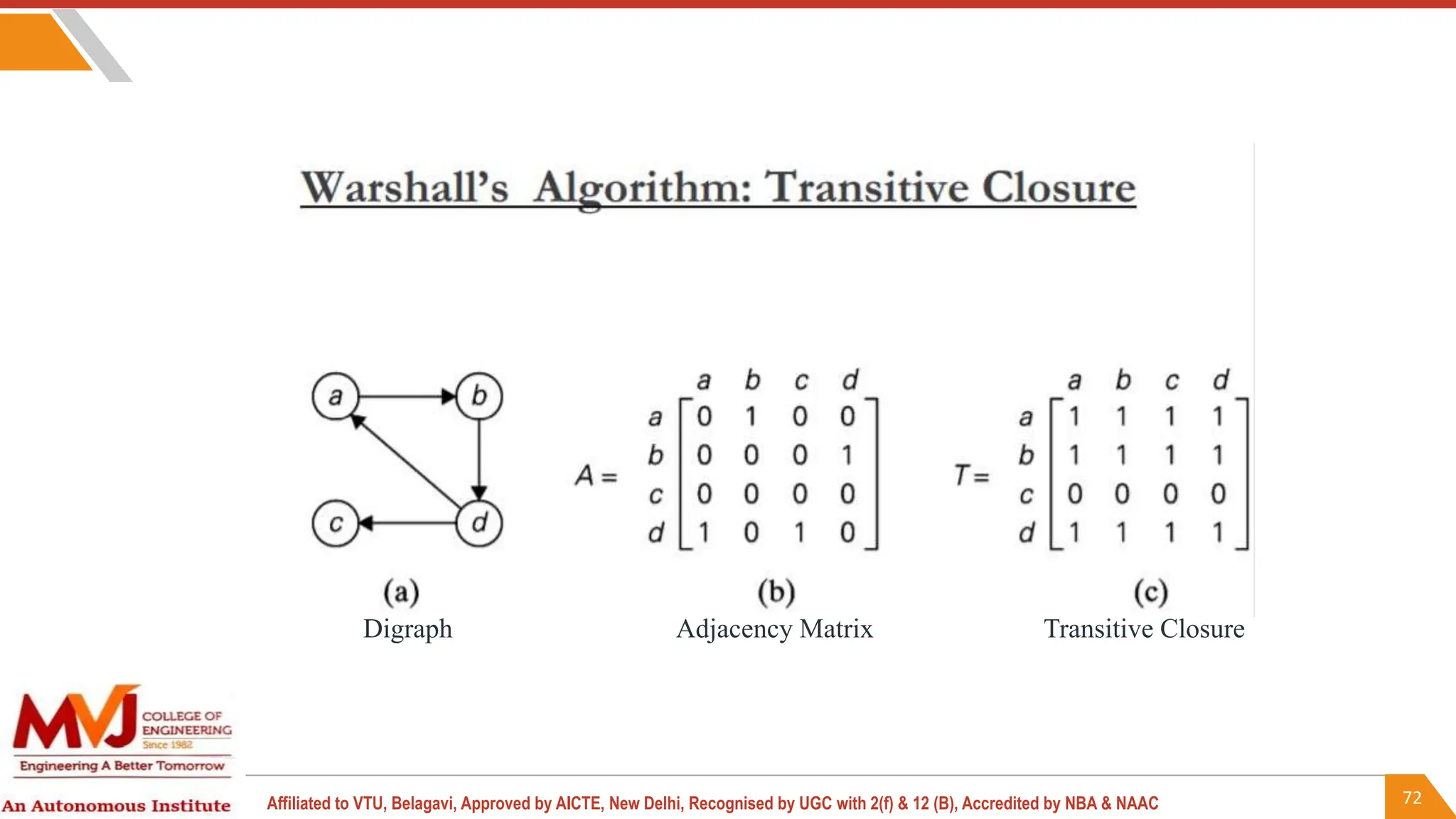
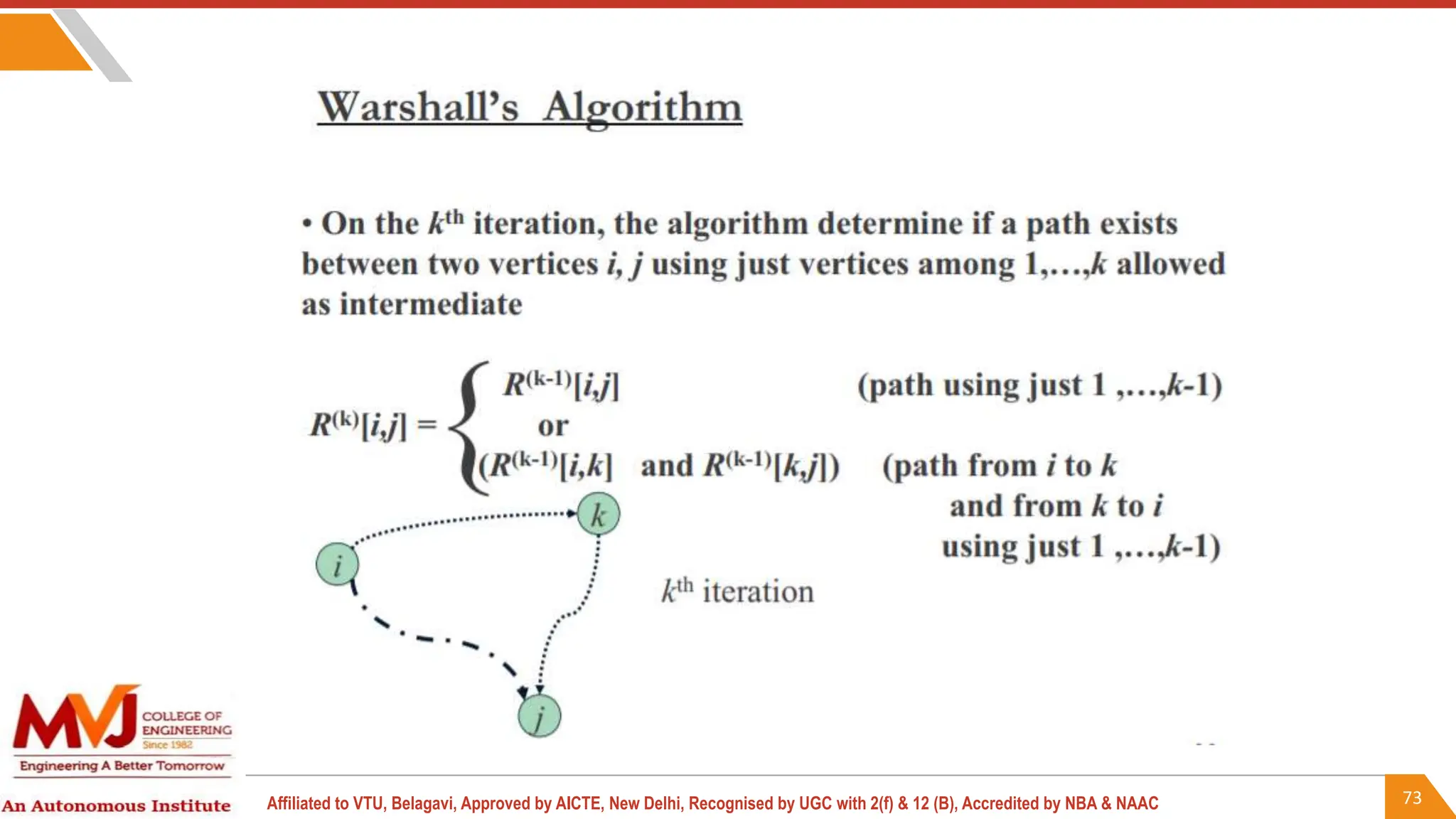
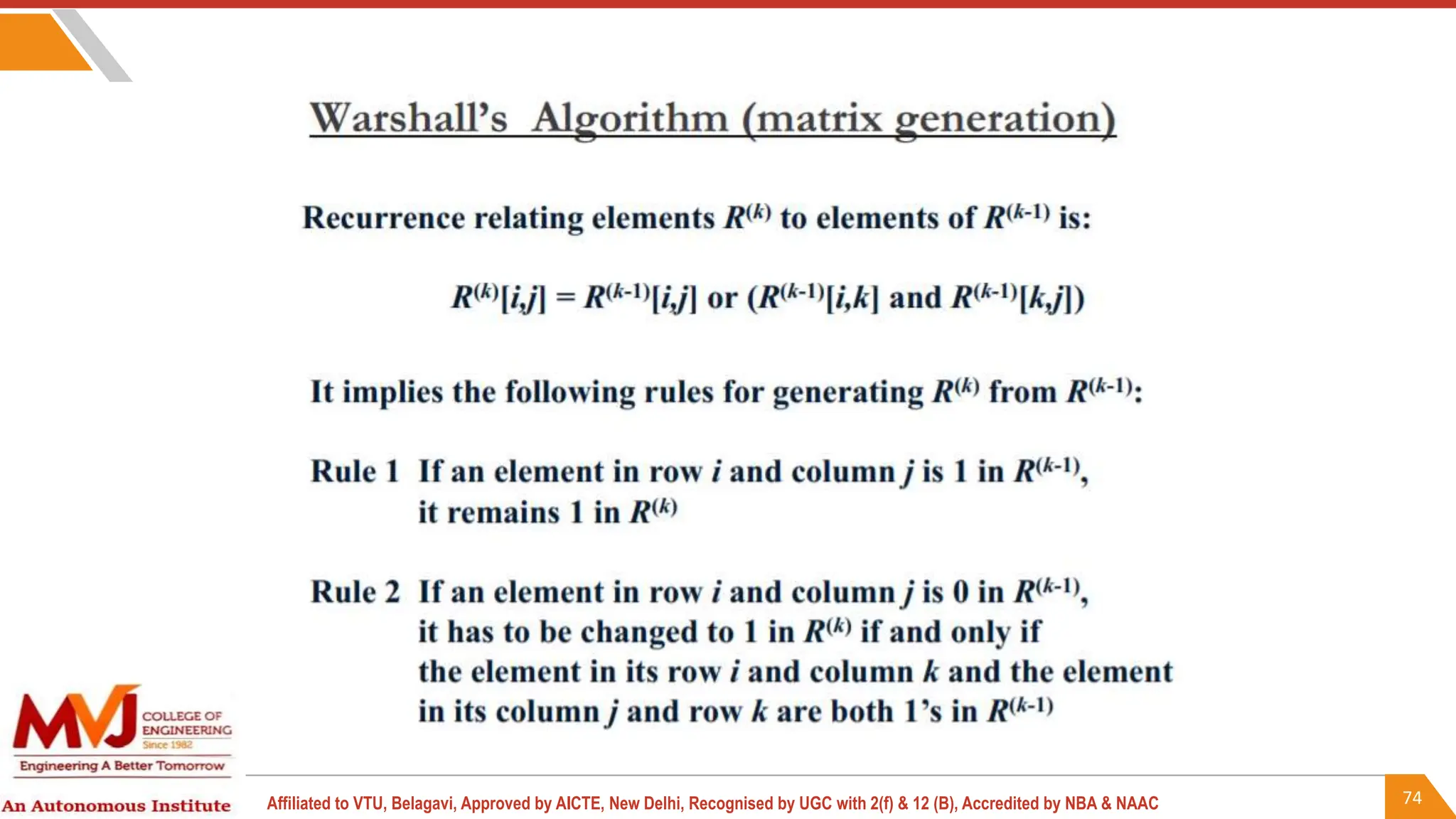
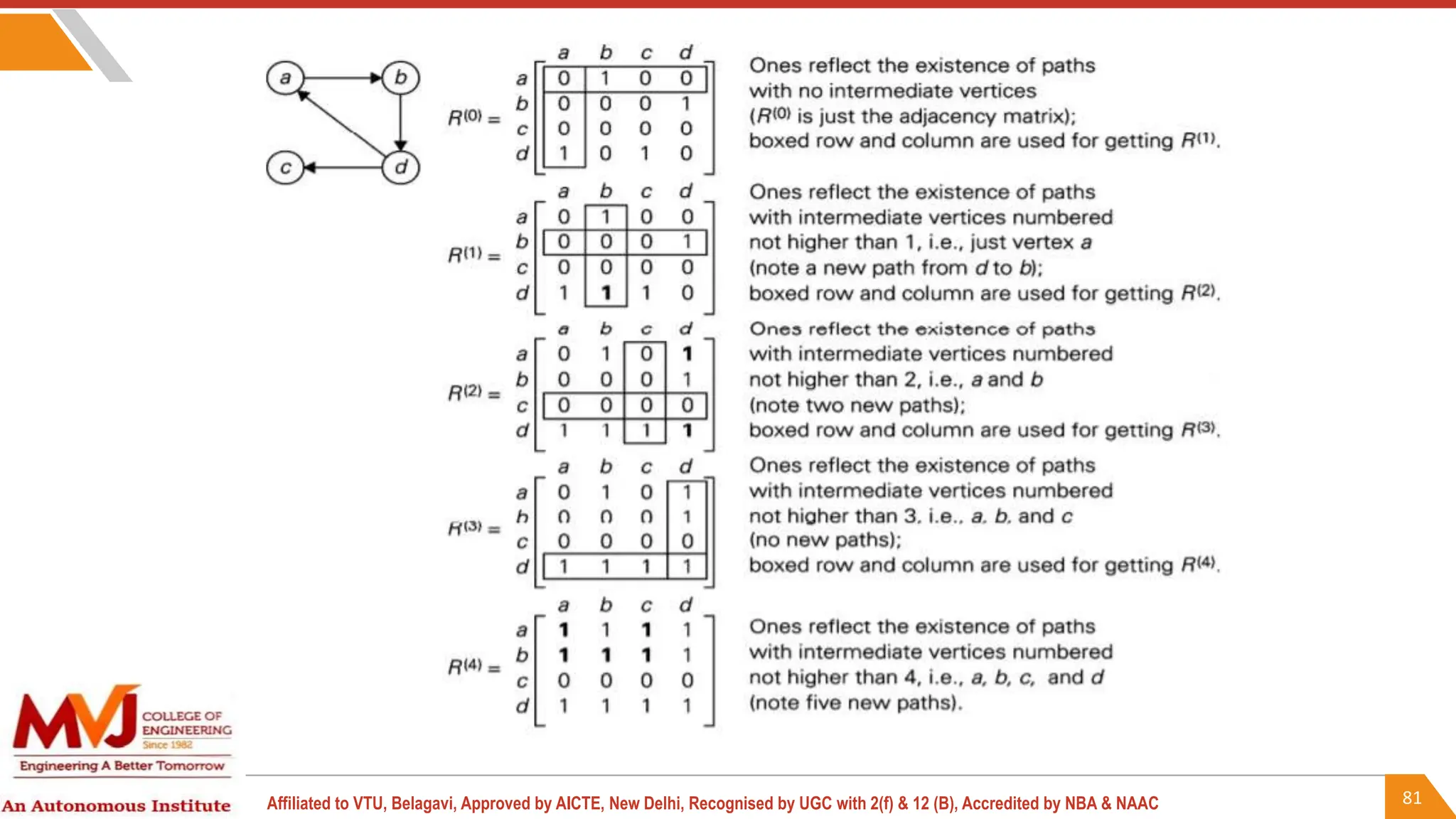
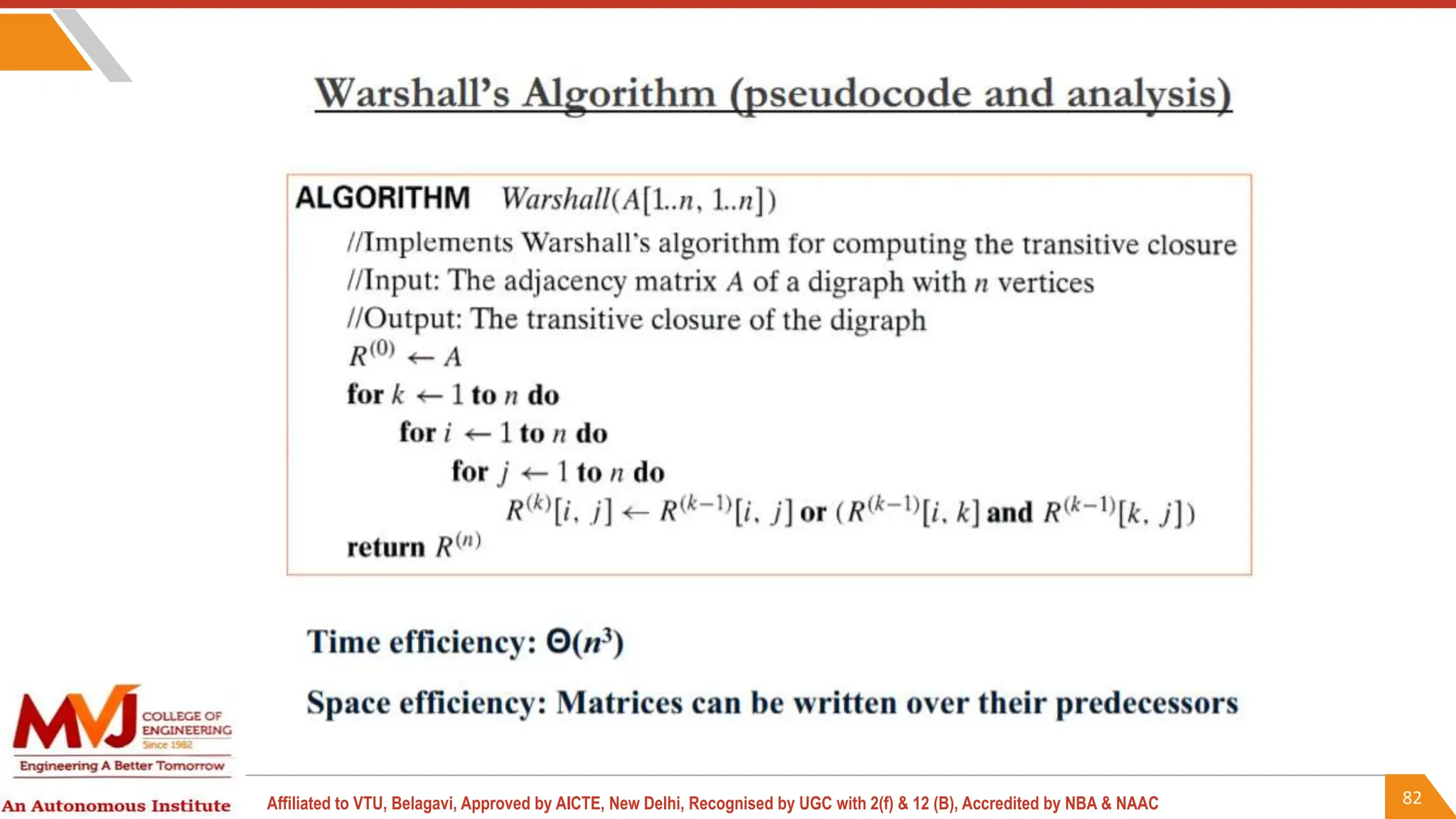
Warshall's algorithm uses the adjacency matrix to find the transitive closure of a directed
graph.
Transitive closure
The transitive closure of a directed graph with n vertices can be defined as the n-by-
n boolean matrix T, in which the element in the ith row and jth column is 1 if there exist a
directed path from the ith vertex to the jth vertex, otherwise it is zero.
Warshall's Algorithm
70
Affiliated to VTU, Belagavi, Approved by AICTE, New Delhi, Recognised by UGC with 2(f) & 12 (B), Accredited by NBA & NAAC
71
Affiliated to VTU, Belagavi, Approved by AICTE, New Delhi, Recognised by UGC with 2(f) & 12 (B), Accredited by NBA & NAAC
72
Affiliated to VTU, Belagavi, Approved by AICTE, New Delhi, Recognised by UGC with 2(f) & 12 (B), Accredited by NBA & NAAC
Digraph Adjacency Matrix Transitive Closure
73
Affiliated to VTU, Belagavi, Approved by AICTE, New Delhi, Recognised by UGC with 2(f) & 12 (B), Accredited by NBA & NAAC
74
Affiliated to VTU, Belagavi, Approved by AICTE, New Delhi, Recognised by UGC with 2(f) & 12 (B), Accredited by NBA & NAAC
75
Affiliated to VTU, Belagavi, Approved by AICTE, New Delhi, Recognised by UGC with 2(f) & 12 (B), Accredited by NBA & NAAC
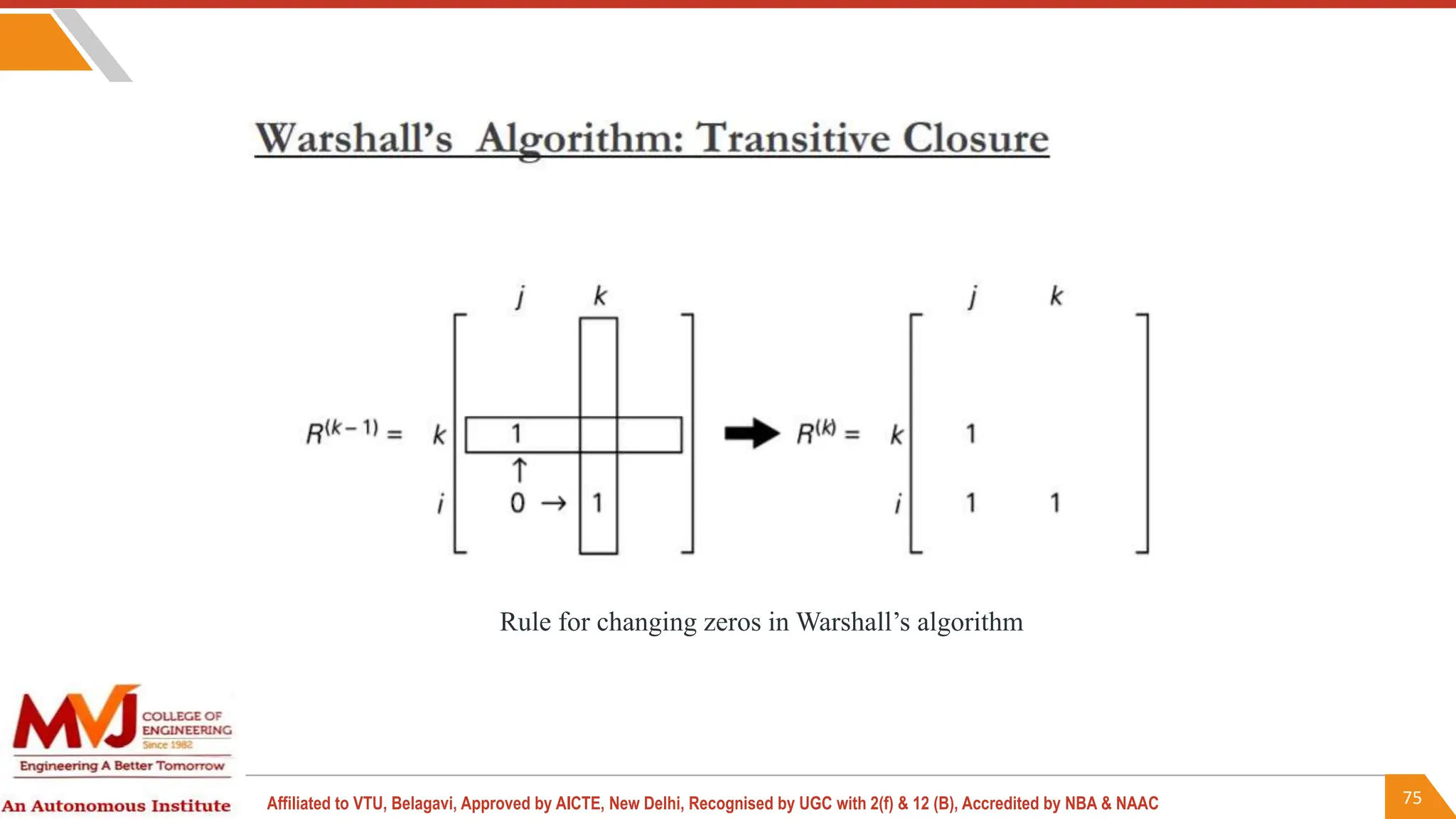
Rule for changing zeros in Warshall’s algorithm
76
Affiliated to VTU, Belagavi, Approved by AICTE, New Delhi, Recognised by UGC with 2(f) & 12 (B), Accredited by NBA & NAAC
77
Affiliated to VTU, Belagavi, Approved by AICTE, New Delhi, Recognised by UGC with 2(f) & 12 (B), Accredited by NBA & NAAC
78
Affiliated to VTU, Belagavi, Approved by AICTE, New Delhi, Recognised by UGC with 2(f) & 12 (B), Accredited by NBA & NAAC
79
Affiliated to VTU, Belagavi, Approved by AICTE, New Delhi, Recognised by UGC with 2(f) & 12 (B), Accredited by NBA & NAAC
80
Affiliated to VTU, Belagavi, Approved by AICTE, New Delhi, Recognised by UGC with 2(f) & 12 (B), Accredited by NBA & NAAC
81
Affiliated to VTU, Belagavi, Approved by AICTE, New Delhi, Recognised by UGC with 2(f) & 12 (B), Accredited by NBA & NAAC
82
Affiliated to VTU, Belagavi, Approved by AICTE, New Delhi, Recognised by UGC with 2(f) & 12 (B), Accredited by NBA & NAAC
83
Affiliated to VTU, Belagavi, Approved by AICTE, New Delhi, Recognised by UGC with 2(f) & 12 (B), Accredited by NBA & NAAC
Analysis
84
Affiliated to VTU, Belagavi, Approved by AICTE, New Delhi, Recognised by UGC with 2(f) & 12 (B), Accredited by NBA & NAAC
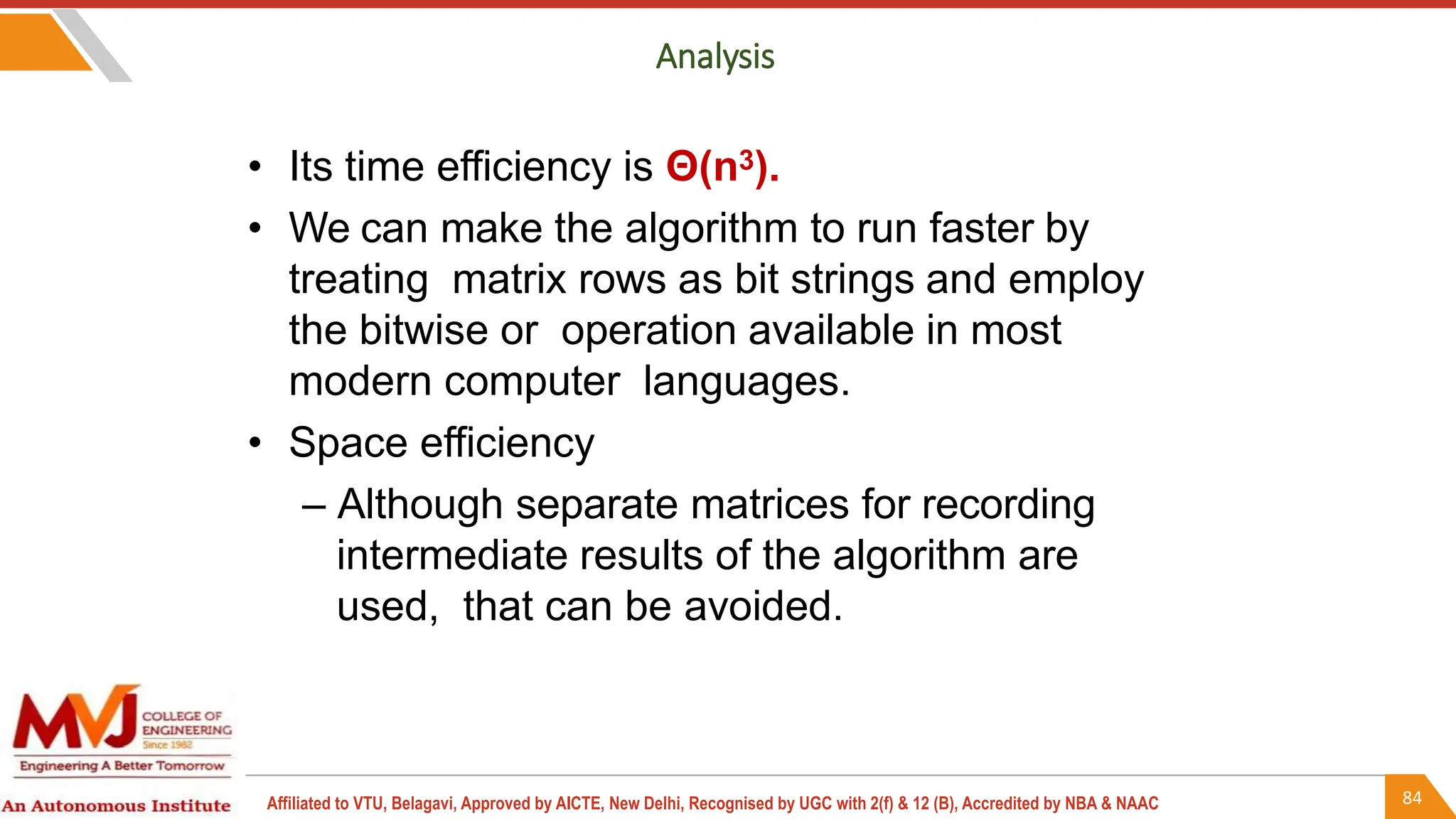
Analysis
• Its time efficiency is Θ(n3).
• We can make the algorithm to run faster by
treating matrix rows as bit strings and employ
the bitwise or operation available in most
modern computer languages.
• Space efficiency
– Although separate matrices for recording
intermediate results of the algorithm are
used, that can be avoided.
85
Affiliated to VTU, Belagavi, Approved by AICTE, New Delhi, Recognised by UGC with 2(f) & 12 (B), Accredited by NBA & NAAC
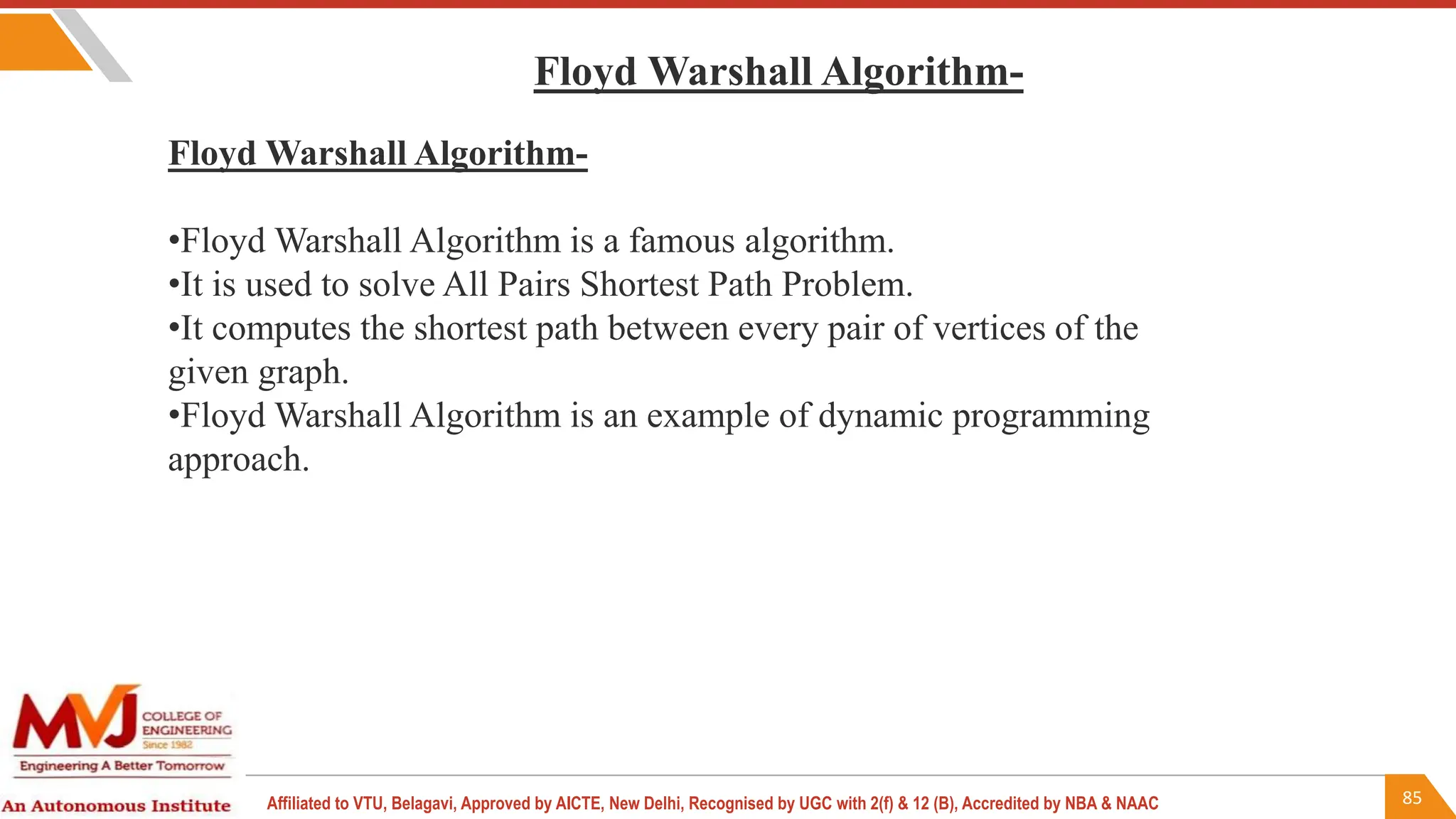
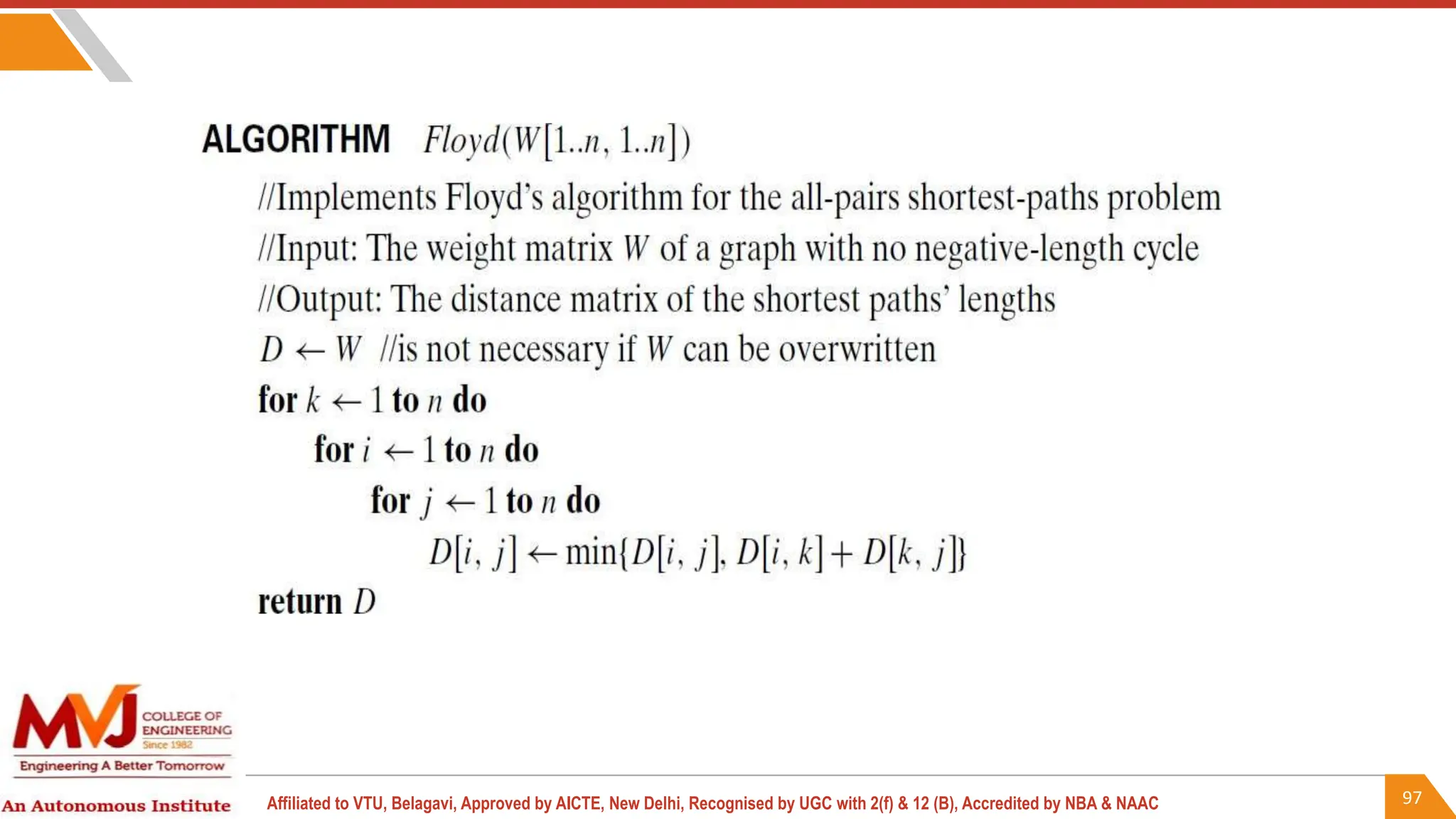
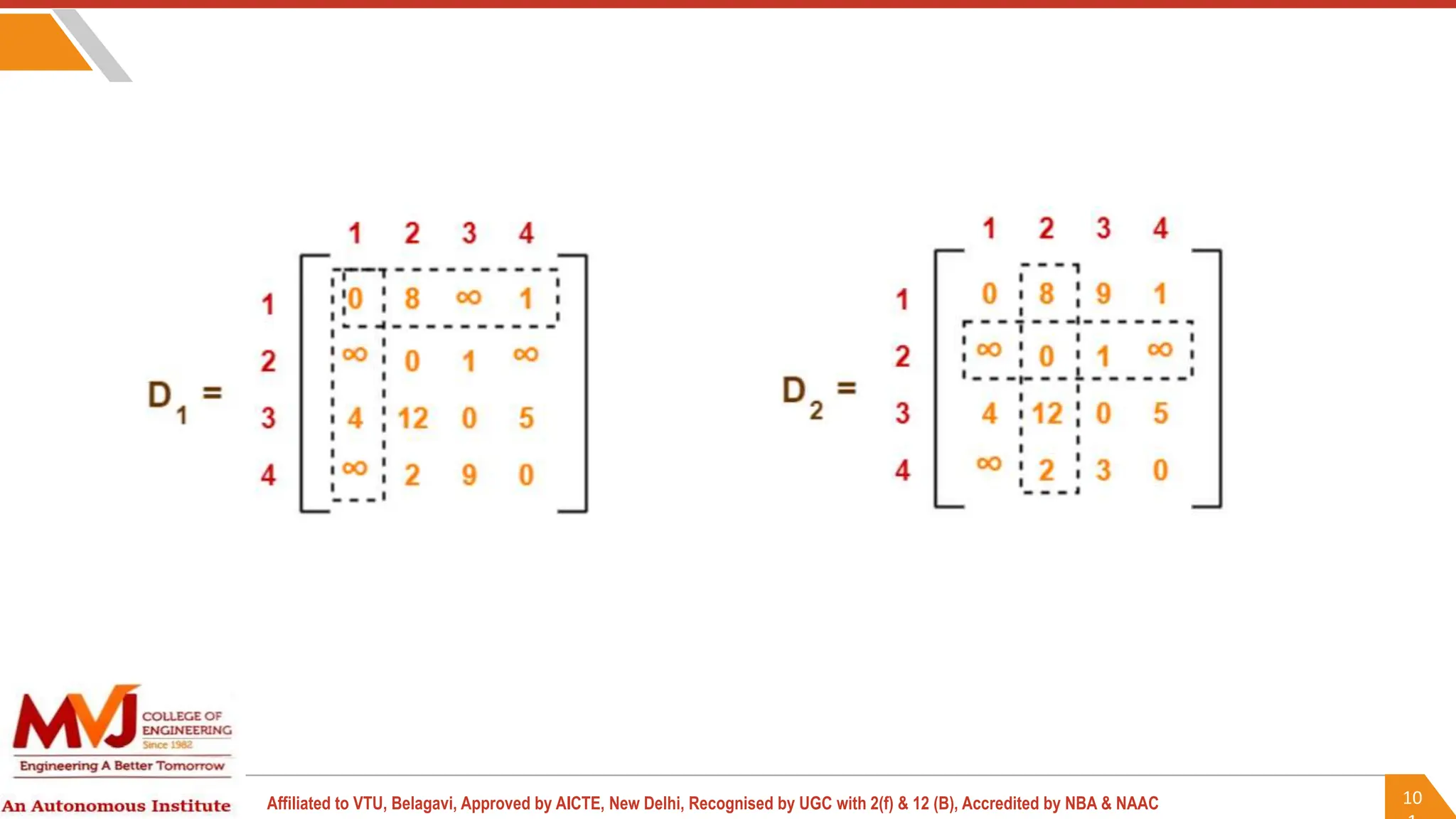
Floyd Warshall Algorithm-
•Floyd Warshall Algorithm is a famous algorithm.
•It is used to solve All Pairs Shortest Path Problem.
•It computes the shortest path between every pair of vertices of the
given graph.
•Floyd Warshall Algorithm is an example of dynamic programming
approach.
Floyd Warshall Algorithm-
86
Affiliated to VTU, Belagavi, Approved by AICTE, New Delhi, Recognised by UGC with 2(f) & 12 (B), Accredited by NBA & NAAC
Floyd Warshall Algorithm-
87
Affiliated to VTU, Belagavi, Approved by AICTE, New Delhi, Recognised by UGC with 2(f) & 12 (B), Accredited by NBA & NAAC
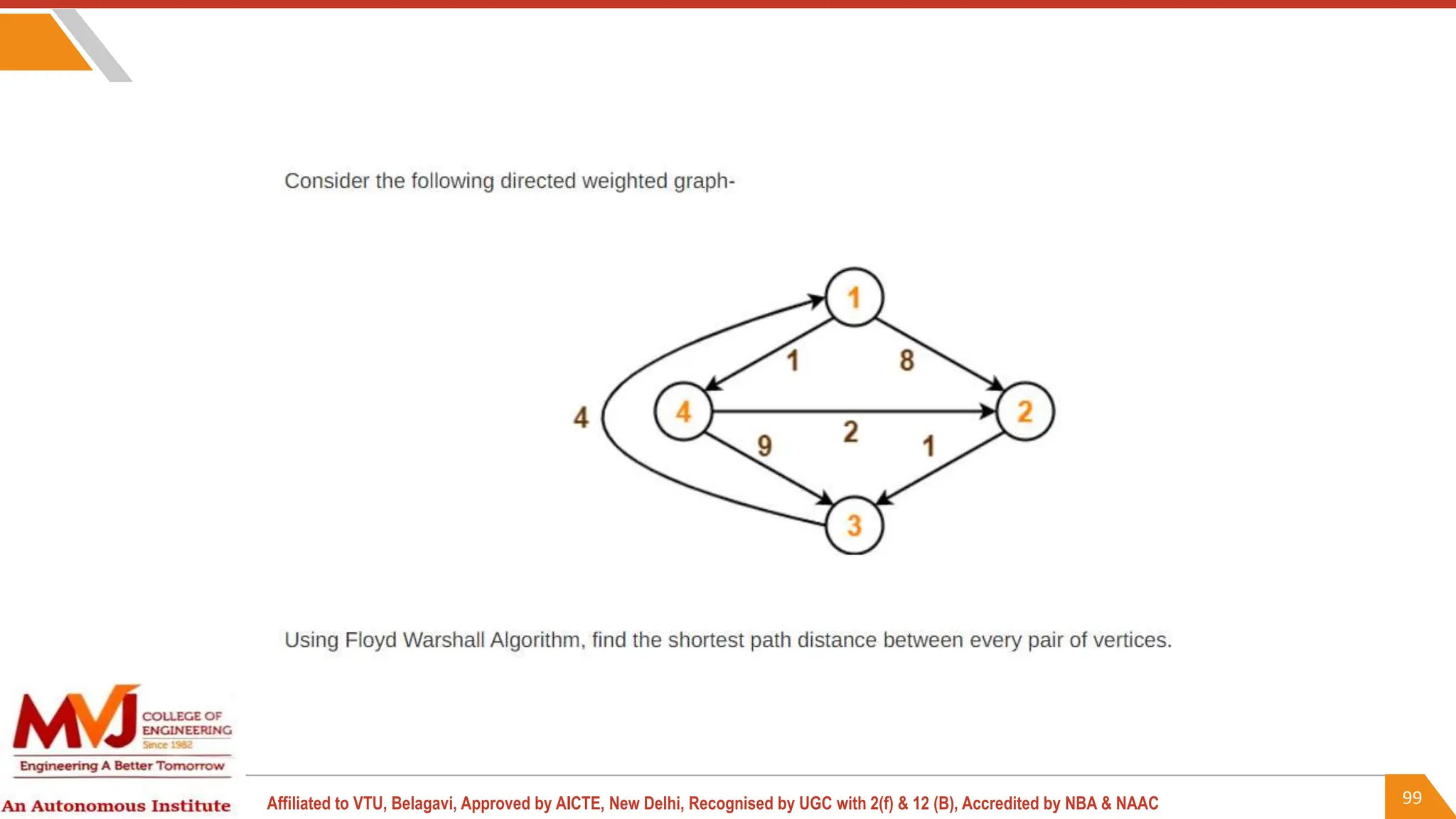
Solution-
Step-01:
•Remove all the self loops and parallel edges (keeping the lowest weight edge)
from the graph.
•In the given graph, there are neither self edges nor parallel edges.
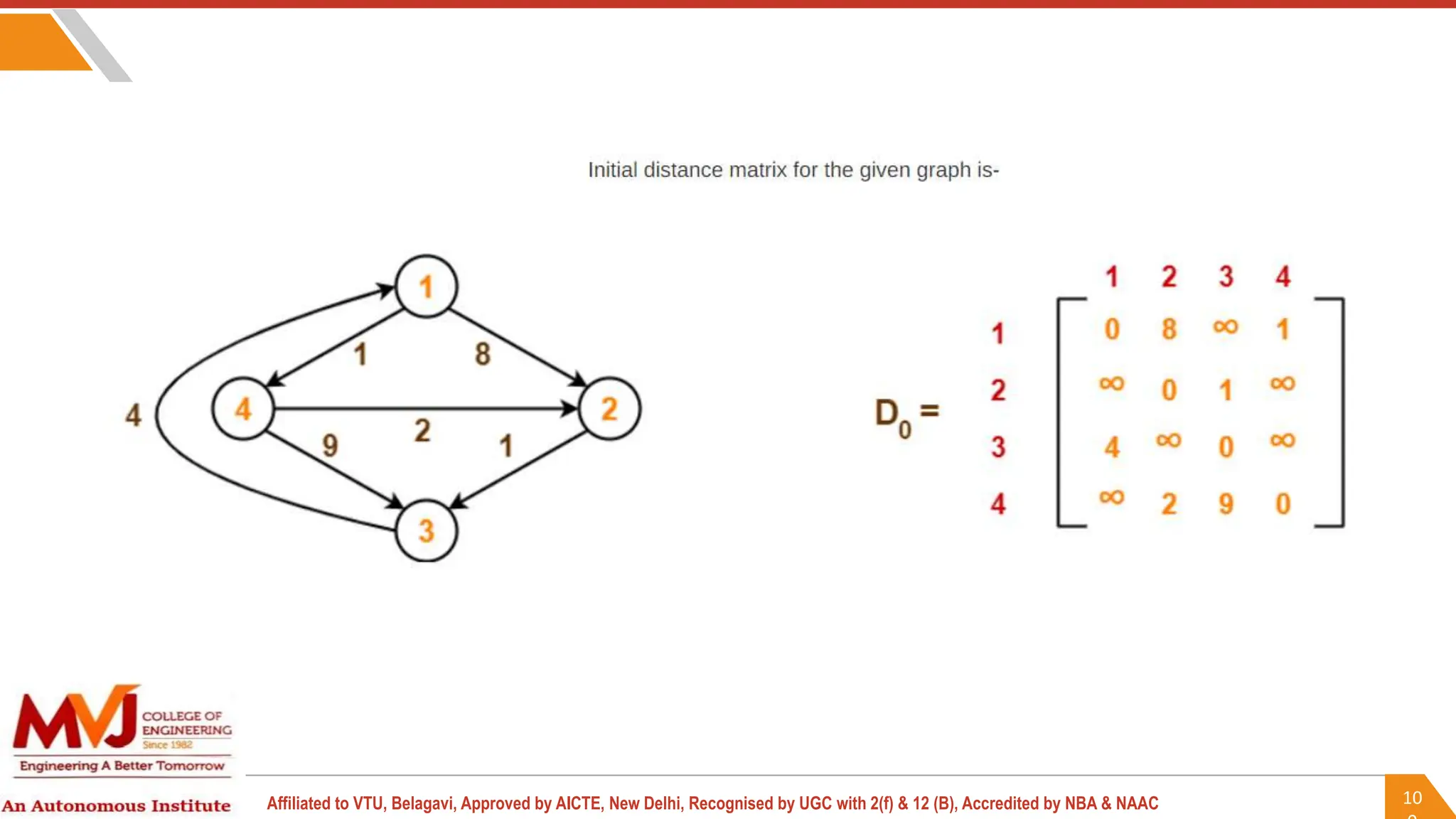
Step-02:
•Write the initial distance matrix.
•It represents the distance between every pair of vertices in the form of given
weights.
•For diagonal elements (representing self-loops), distance value = 0.
•For vertices having a direct edge between them, distance value = weight of that
edge.
•For vertices having no direct edge between them, distance value = ∞.
88
Affiliated to VTU, Belagavi, Approved by AICTE, New Delhi, Recognised by UGC with 2(f) & 12 (B), Accredited by NBA & NAAC
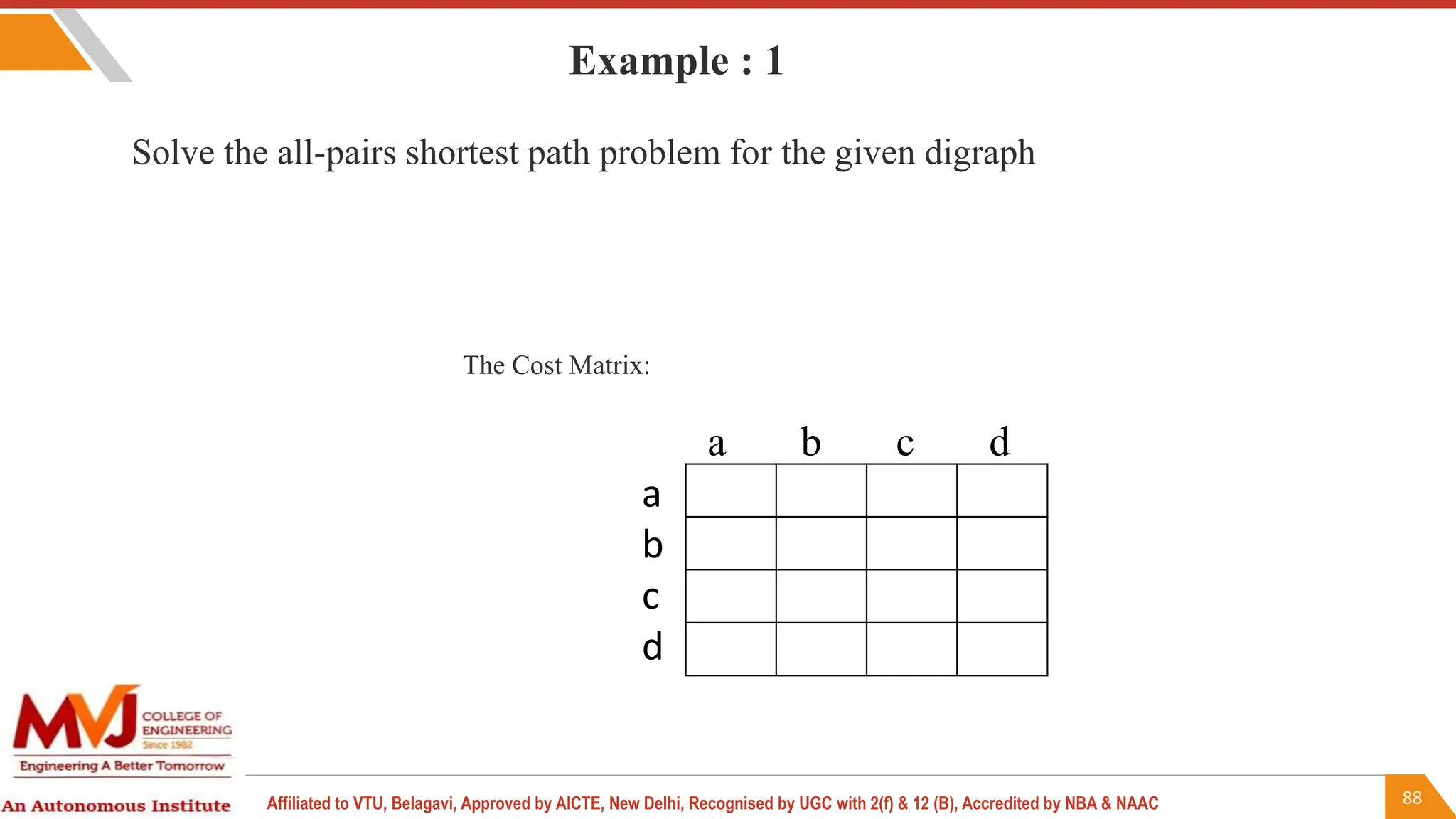
Example : 1
Solve the all-pairs shortest path problem for the given digraph
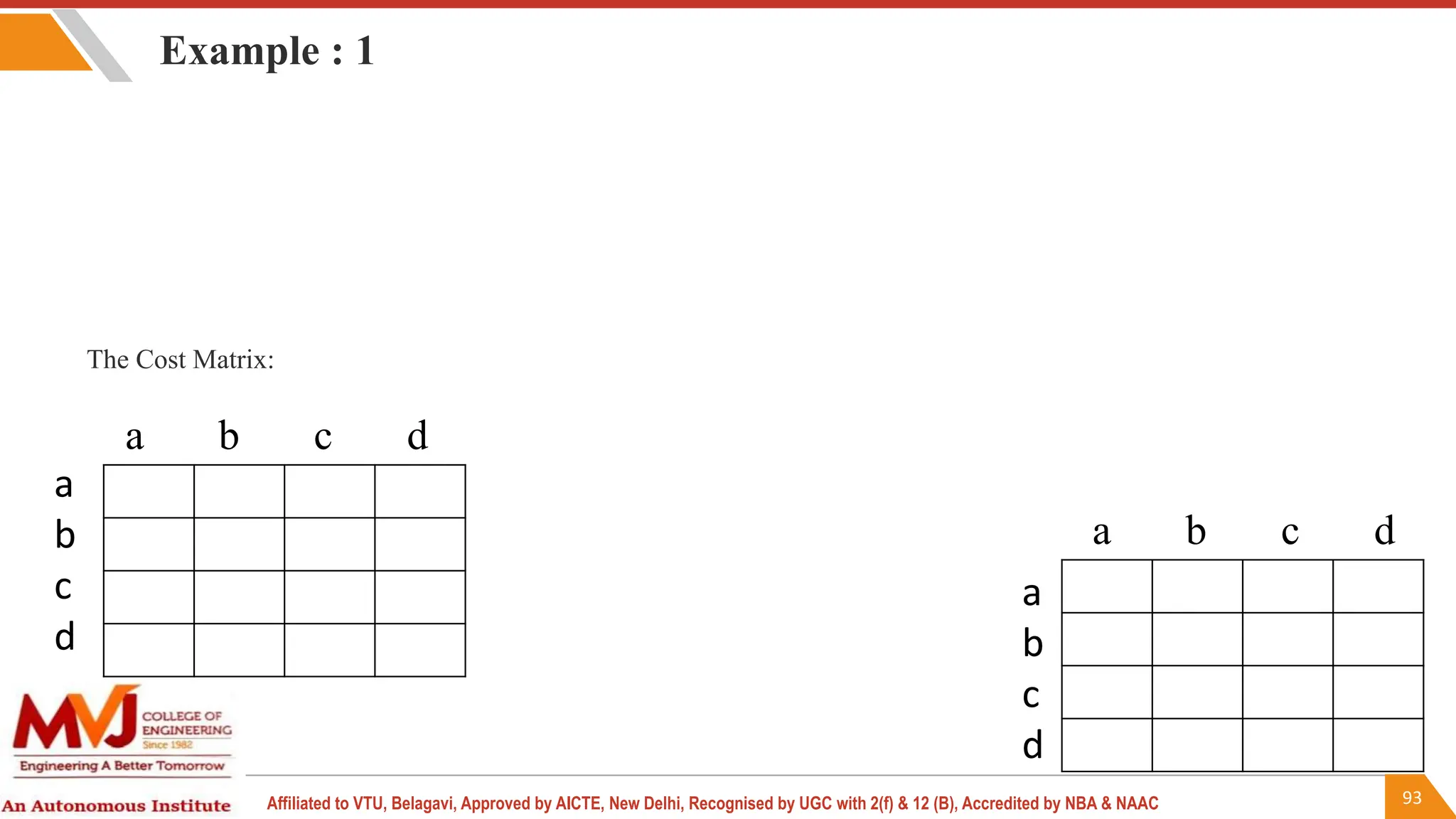
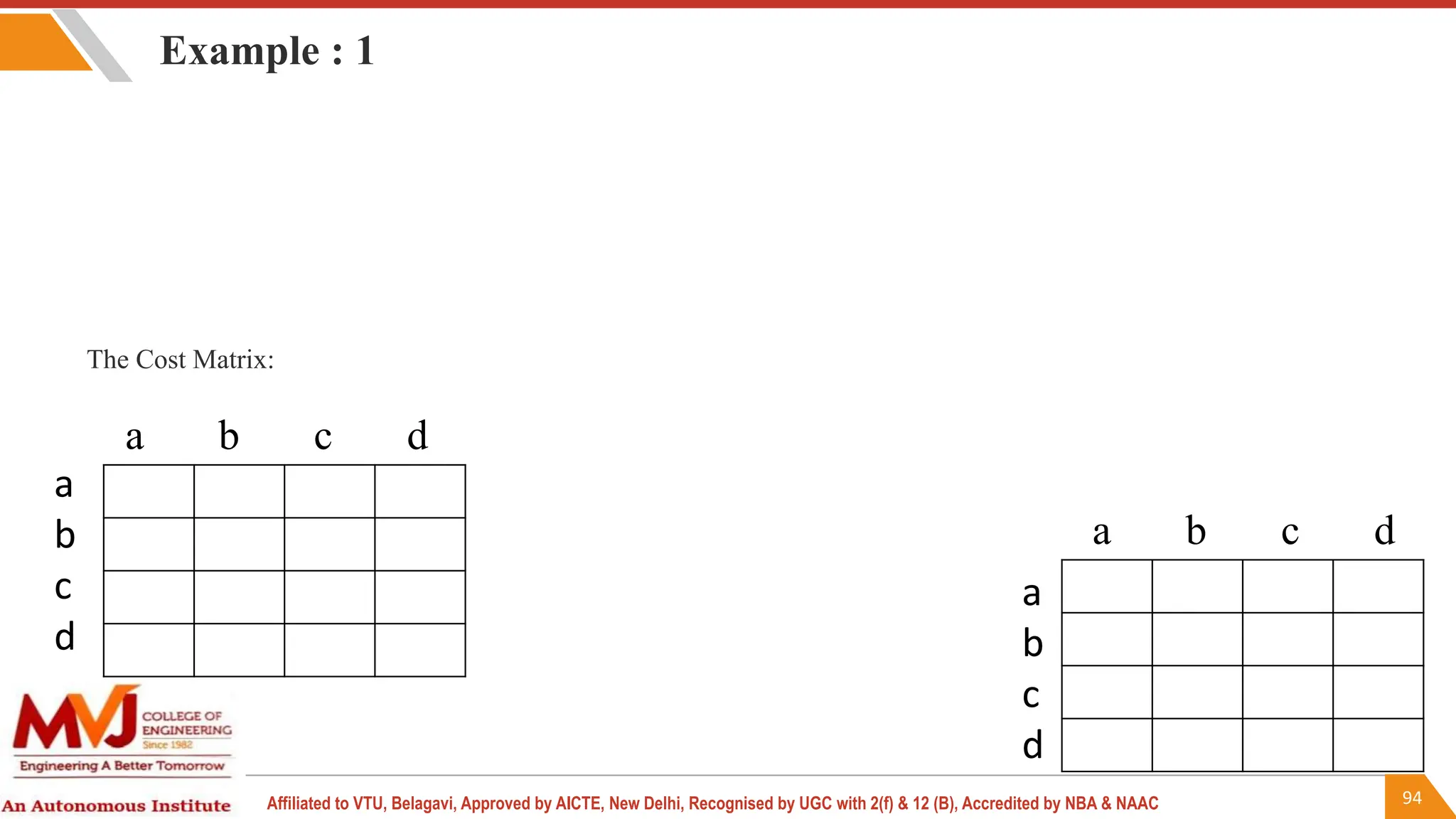
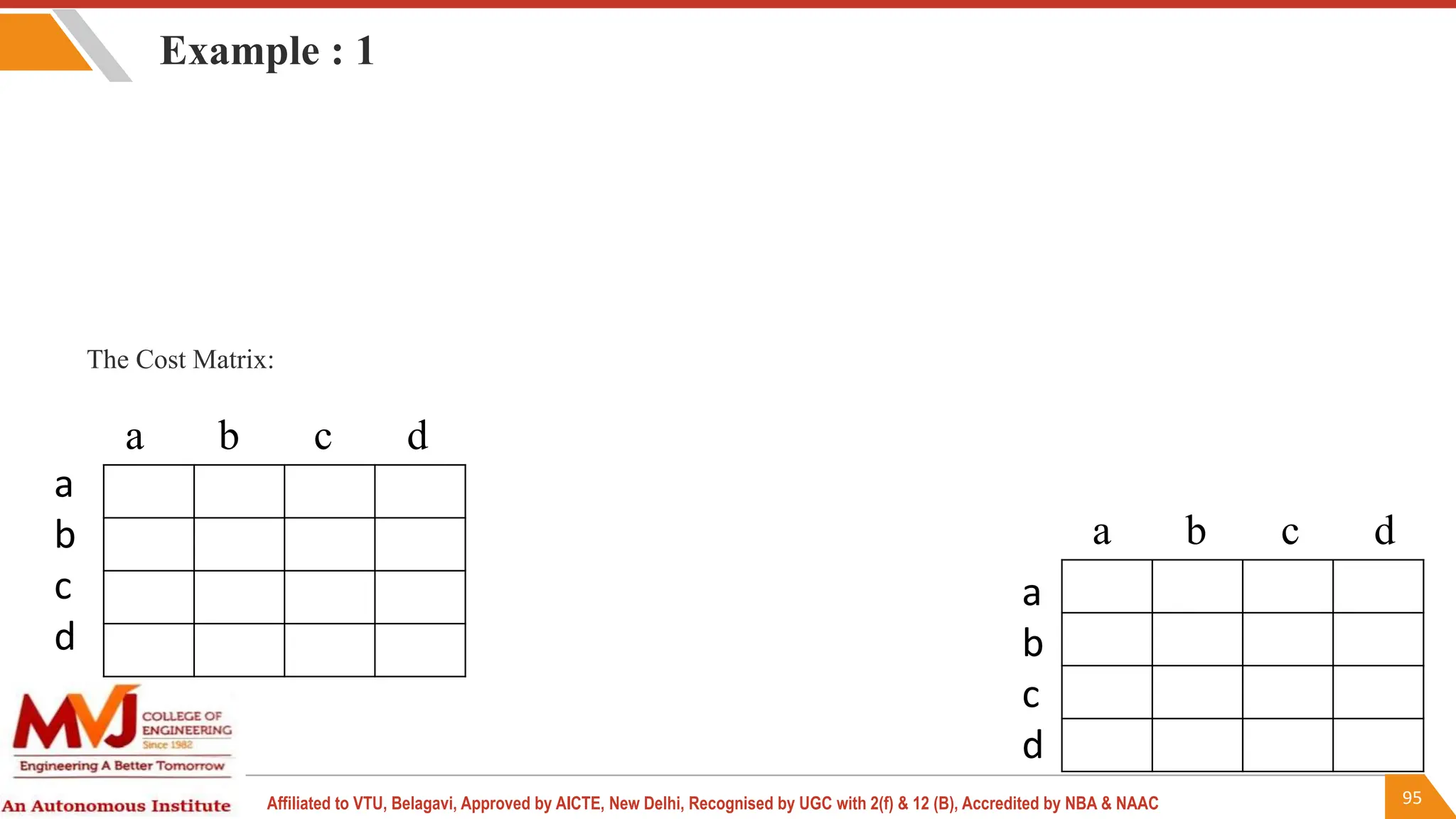
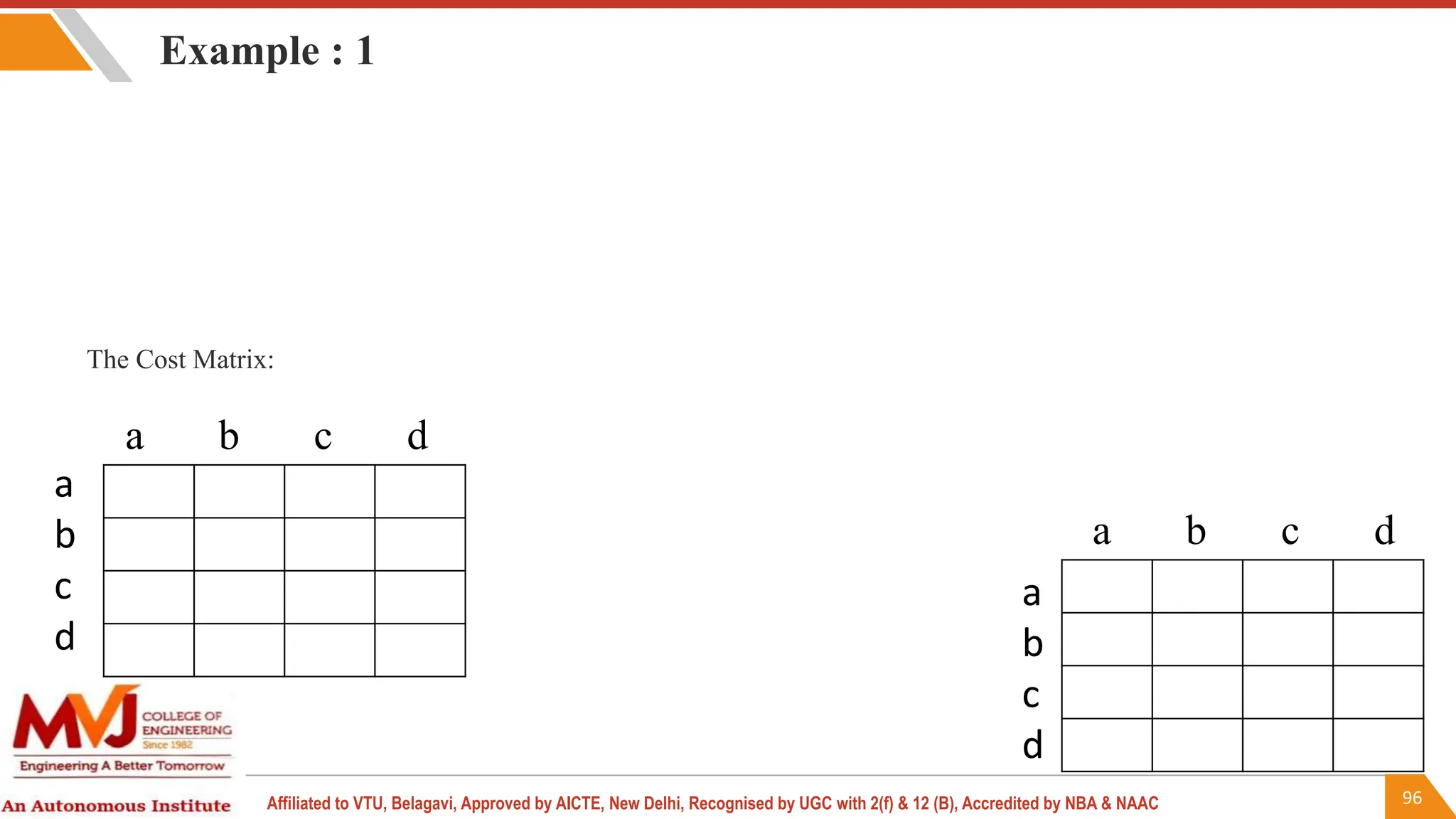
The Cost Matrix:
a b c d
a
b
c
d
89
Affiliated to VTU, Belagavi, Approved by AICTE, New Delhi, Recognised by UGC with 2(f) & 12 (B), Accredited by NBA & NAAC
The Cost Matrix:
a b c d
a
b
c
d
a b c d
a
b
c
d
90
Affiliated to VTU, Belagavi, Approved by AICTE, New Delhi, Recognised by UGC with 2(f) & 12 (B), Accredited by NBA & NAAC
Example : 1
The Cost Matrix:
a b c d
a
b
c
d
a b c d
a
b
c
d
91
Affiliated to VTU, Belagavi, Approved by AICTE, New Delhi, Recognised by UGC with 2(f) & 12 (B), Accredited by NBA & NAAC
Example : 1
The Cost Matrix:
a b c d
a
b
c
d
a b c d
a
b
c
d
92
Affiliated to VTU, Belagavi, Approved by AICTE, New Delhi, Recognised by UGC with 2(f) & 12 (B), Accredited by NBA & NAAC
Example : 1
The Cost Matrix:
a b c d
a
b
c
d
a b c d
a
b
c
d
93
Affiliated to VTU, Belagavi, Approved by AICTE, New Delhi, Recognised by UGC with 2(f) & 12 (B), Accredited by NBA & NAAC
Example : 1
The Cost Matrix:
a b c d
a
b
c
d
a b c d
a
b
c
d
94
Affiliated to VTU, Belagavi, Approved by AICTE, New Delhi, Recognised by UGC with 2(f) & 12 (B), Accredited by NBA & NAAC
Example : 1
The Cost Matrix:
a b c d
a
b
c
d
a b c d
a
b
c
d
95
Affiliated to VTU, Belagavi, Approved by AICTE, New Delhi, Recognised by UGC with 2(f) & 12 (B), Accredited by NBA & NAAC
Example : 1
The Cost Matrix:
a b c d
a
b
c
d
a b c d
a
b
c
d
96
Affiliated to VTU, Belagavi, Approved by AICTE, New Delhi, Recognised by UGC with 2(f) & 12 (B), Accredited by NBA & NAAC
Example : 1
The Cost Matrix:
a b c d
a
b
c
d
a b c d
a
b
c
d
97
Affiliated to VTU, Belagavi, Approved by AICTE, New Delhi, Recognised by UGC with 2(f) & 12 (B), Accredited by NBA & NAAC
98
Affiliated to VTU, Belagavi, Approved by AICTE, New Delhi, Recognised by UGC with 2(f) & 12 (B), Accredited by NBA & NAAC
Analysis:
99
Affiliated to VTU, Belagavi, Approved by AICTE, New Delhi, Recognised by UGC with 2(f) & 12 (B), Accredited by NBA & NAAC
10
Affiliated to VTU, Belagavi, Approved by AICTE, New Delhi, Recognised by UGC with 2(f) & 12 (B), Accredited by NBA & NAAC
10
Affiliated to VTU, Belagavi, Approved by AICTE, New Delhi, Recognised by UGC with 2(f) & 12 (B), Accredited by NBA & NAAC
10
Affiliated to VTU, Belagavi, Approved by AICTE, New Delhi, Recognised by UGC with 2(f) & 12 (B), Accredited by NBA & NAAC
10
Affiliated to VTU, Belagavi, Approved by AICTE, New Delhi, Recognised by UGC with 2(f) & 12 (B), Accredited by NBA & NAAC
10
Affiliated to VTU, Belagavi, Approved by AICTE, New Delhi, Recognised by UGC with 2(f) & 12 (B), Accredited by NBA & NAAC
10
Affiliated to VTU, Belagavi, Approved by AICTE, New Delhi, Recognised by UGC with 2(f) & 12 (B), Accredited by NBA & NAAC
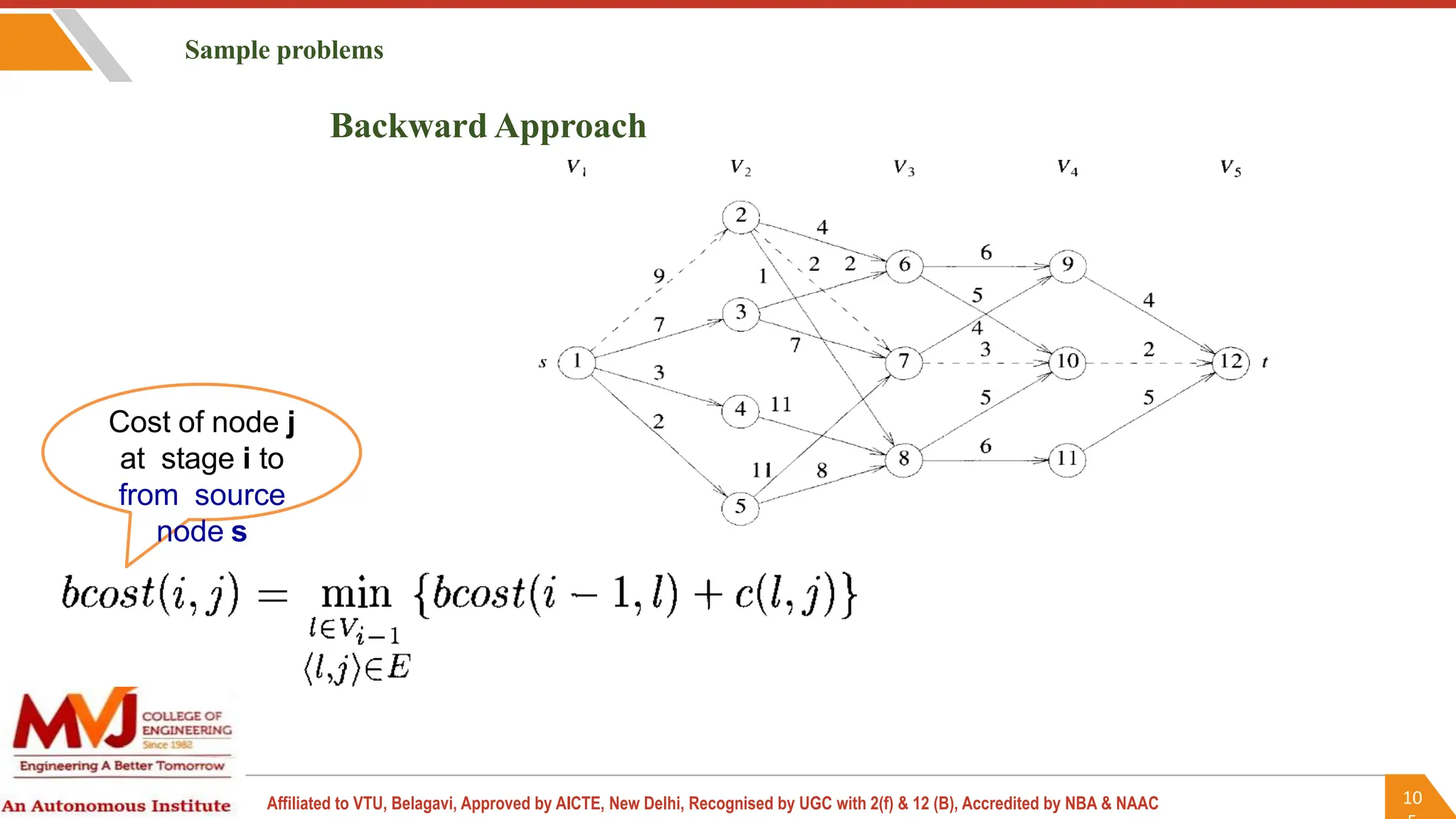
Backward Approach
Cost of node j
at stage i to
from source
node s
Sample problems
10
Affiliated to VTU, Belagavi, Approved by AICTE, New Delhi, Recognised by UGC with 2(f) & 12 (B), Accredited by NBA & NAAC
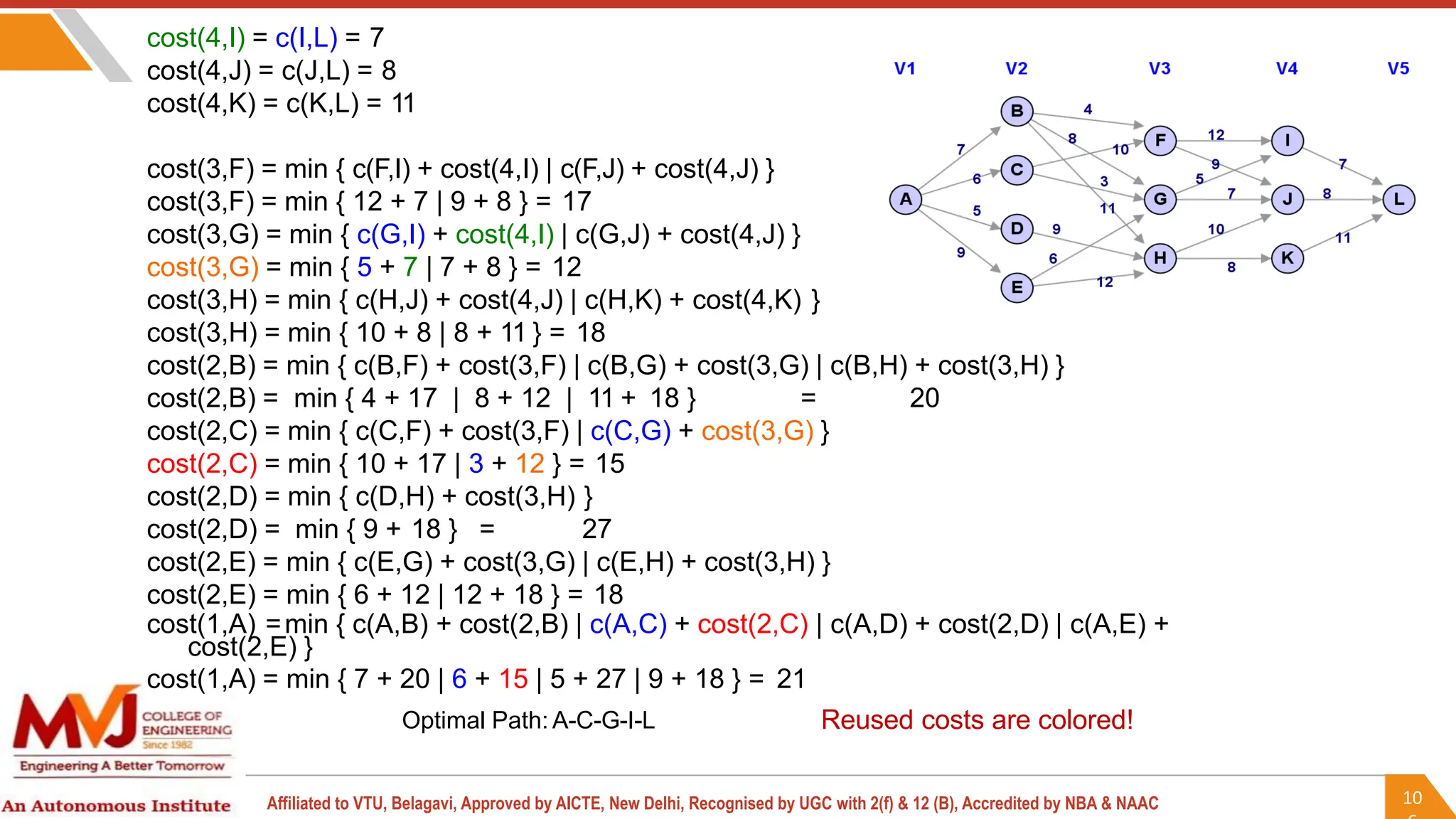
cost(4,I) = c(I,L) = 7
cost(4,J) = c(J,L) = 8
cost(4,K) = c(K,L) = 11
cost(3,F) = min { c(F,I) + cost(4,I) | c(F,J) + cost(4,J) }
cost(3,F) = min { 12 + 7 | 9 + 8 } = 17
cost(3,G) = min { c(G,I) + cost(4,I) | c(G,J) + cost(4,J) }
cost(3,G) = min { 5 + 7 | 7 + 8 } = 12
cost(3,H) = min { c(H,J) + cost(4,J) | c(H,K) + cost(4,K) }
cost(3,H) = min { 10 + 8 | 8 + 11 } = 18
cost(2,B) = min { c(B,F) + cost(3,F) | c(B,G) + cost(3,G) | c(B,H) + cost(3,H) }
cost(2,B) = min { 4 + 17 | 8 + 12 | 11 + 18 } = 20
cost(2,C) = min { c(C,F) + cost(3,F) | c(C,G) + cost(3,G) }
cost(2,C) = min { 10 + 17 | 3 + 12 } = 15
cost(2,D) = min { c(D,H) + cost(3,H) }
cost(2,D) = min { 9 + 18 } = 27
cost(2,E) = min { c(E,G) + cost(3,G) | c(E,H) + cost(3,H) }
cost(2,E) = min { 6 + 12 | 12 + 18 } = 18
cost(1,A) =min { c(A,B) + cost(2,B) | c(A,C) + cost(2,C) | c(A,D) + cost(2,D) | c(A,E) +
cost(2,E) }
cost(1,A) = min { 7 + 20 | 6 + 15 | 5 + 27 | 9 + 18 } = 21
Optimal Path: A-C-G-I-L Reused costs are colored!
10
Affiliated to VTU, Belagavi, Approved by AICTE, New Delhi, Recognised by UGC with 2(f) & 12 (B), Accredited by NBA & NAAC
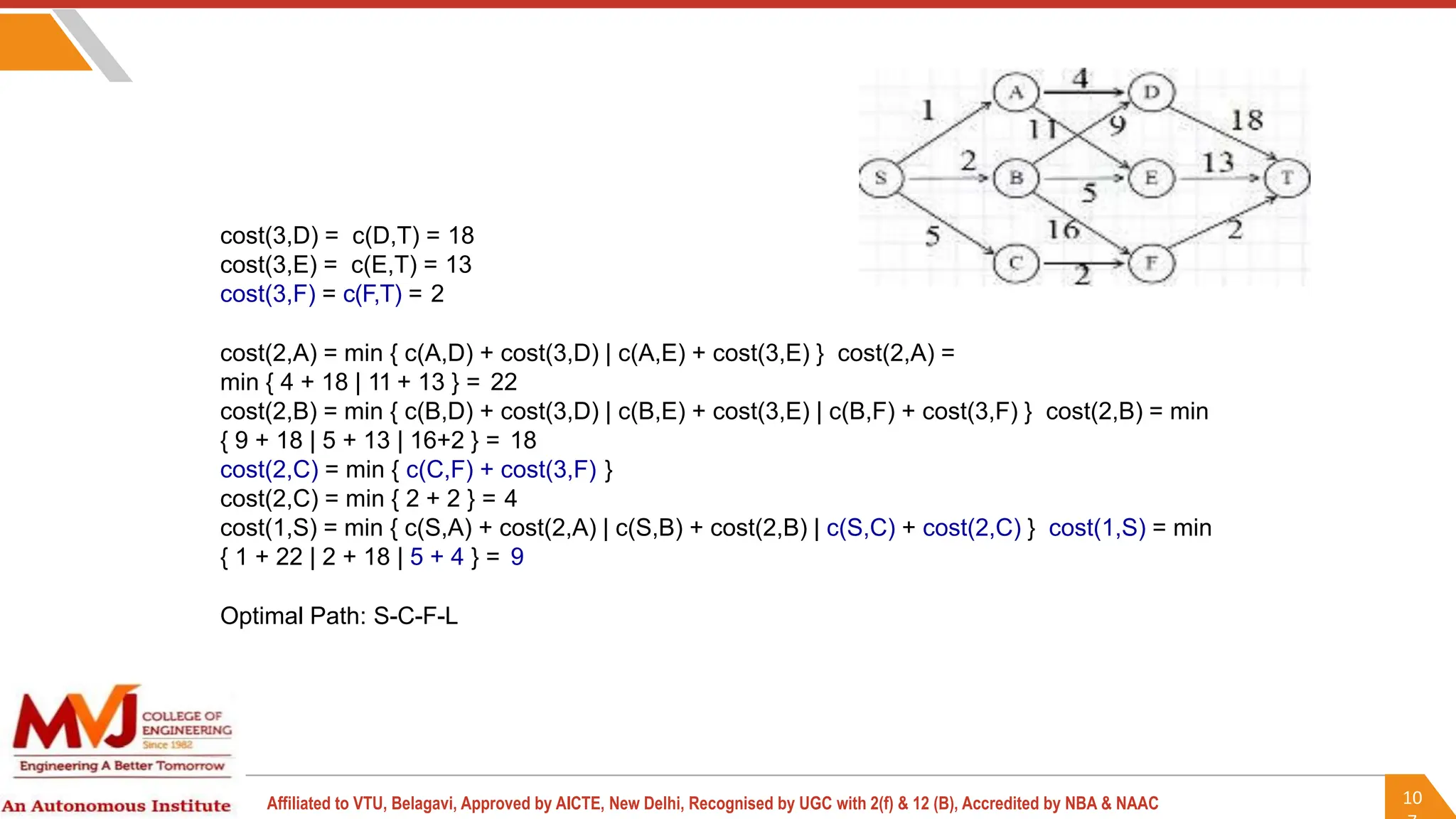
cost(3,D) = c(D,T) = 18
cost(3,E) = c(E,T) = 13
cost(3,F) = c(F,T) = 2
cost(2,A) = min { c(A,D) + cost(3,D) | c(A,E) + cost(3,E) } cost(2,A) =
min { 4 + 18 | 11 + 13 } = 22
cost(2,B) = min { c(B,D) + cost(3,D) | c(B,E) + cost(3,E) | c(B,F) + cost(3,F) } cost(2,B) = min
{ 9 + 18 | 5 + 13 | 16+2 } = 18
cost(2,C) = min { c(C,F) + cost(3,F) }
cost(2,C) = min { 2 + 2 } = 4
cost(1,S) = min { c(S,A) + cost(2,A) | c(S,B) + cost(2,B) | c(S,C) + cost(2,C) } cost(1,S) = min
{ 1 + 22 | 2 + 18 | 5 + 4 } = 9
Optimal Path: S-C-F-L

ANALYSIS AND DESIGN OF ALGORITHMS- Graphs

  • 1.
    1 Affiliated to VTU,Belagavi, Approved by AICTE, New Delhi, Recognised by UGC with 2(f) & 12 (B), Accredited by NBA & NAAC MVJ19CS42 – ANALYSIS AND DESIGN OF ALGORITHMS Module 4 Semester – II Academic Year : 2020-2021(EVEN) By SUGUNADEVI C
  • 2.
    2 Affiliated to VTU,Belagavi, Approved by AICTE, New Delhi, Recognised by UGC with 2(f) & 12 (B), Accredited by NBA & NAAC PREREQUISITES: BASIC KNOWLEDGE ABOUT ANALYSIS AND DESIGN OF ALGORITHMS BRIDGE MATERIAL: Algorithm is a sequence of steps to solve a problem. Design and Analysis of Algorithm is very important for designing algorithm to solve different types of problems. As the speed of processor increases, performance is frequently said to be less central than other software quality characteristics (e.g. security, extensibility, reusability etc.).
  • 3.
    COURSE OBJECTIVE ISTO: • Identify the importance of different asymptotic notation. • Determine the complexity of recursive and non-recursive algorithms. • Compare the efficiency of various design techniques like greedy method, backtracking etc. • Apply appropriate method to solve a given problem. COURSE OUTCOMES : • Describe the need of algorithm and the notations used in design analysis. • Compare the efficiency of brute force, divide and conquer techniques for problem solving. • Ability to apply greedy algorithms, hashing and string matching algorithms • Ability to design efficient algorithms using various design techniques
  • 4.
    4 Affiliated to VTU,Belagavi, Approved by AICTE, New Delhi, Recognised by UGC with 2(f) & 12 (B), Accredited by NBA & NAAC Module - 4 Dynamic Programming: General method with Examples, Multistage Graphs. Transitive Closure: Warshall's Algorithm, All Pairs Shortest Paths: Floyd's Algorithm, Optimal Binary Search Trees, Knapsack problem, Bellman-Ford Algorithm , Travelling Sales Person problem , Reliability design. Laboratory Sessions/ Experimental learning: Solving real time problems using Dynamic Programming. Applications: Computer Networks. Video link: https://nptel.ac.in/courses/106/106/106106131/
  • 5.
    5 Affiliated to VTU,Belagavi, Approved by AICTE, New Delhi, Recognised by UGC with 2(f) & 12 (B), Accredited by NBA & NAAC • Dynamic programming is a technique for solving problems with overlapping subproblems. – subproblems arise from a recurrence relating a given problem’s solution to solutions of its smaller subproblems. – DP suggests solving each of the smaller subproblems only once and recording the results in a table from which a solution to the original problem can then be obtained. • The Dynamic programming can be used when the solution to a problem can be viewed as the result of sequence of decisions.
  • 6.
    6 Affiliated to VTU,Belagavi, Approved by AICTE, New Delhi, Recognised by UGC with 2(f) & 12 (B), Accredited by NBA & NAAC Dynamic Programming (DP) is an algorithmic technique for solving an optimization problem by breaking it down into simpler subproblems and utilizing the fact that the optimal solution to the overall problem depends upon the optimal solution to its subproblems. Let’s take the example of the Fibonacci numbers. As we all know, Fibonacci numbers are a series of numbers in which each number is the sum of the two preceding numbers. The first few Fibonacci numbers are 0, 1, 1, 2, 3, 5, and 8, and they continue on from there. If we are asked to calculate the nth Fibonacci number, we can do that with the following equation,
  • 7.
    7 Affiliated to VTU,Belagavi, Approved by AICTE, New Delhi, Recognised by UGC with 2(f) & 12 (B), Accredited by NBA & NAAC As we can clearly see here, to solve the overall problem (i.e. Fib(n)), we broke it down into two smaller subproblems (which are Fib(n-1) and Fib(n-2)). This shows that we can use DP to solve this problem. Fib(n) = Fib(n-1) + Fib(n-2), for n > 1
  • 8.
    8 Affiliated to VTU,Belagavi, Approved by AICTE, New Delhi, Recognised by UGC with 2(f) & 12 (B), Accredited by NBA & NAAC
  • 9.
    9 Affiliated to VTU,Belagavi, Approved by AICTE, New Delhi, Recognised by UGC with 2(f) & 12 (B), Accredited by NBA & NAAC Applications of dynamic programming 1.0/1 knapsack problem 2.Mathematical optimization problem 3.All pair Shortest path problem 4.Reliability design problem 5.Longest common subsequence (LCS) 6.Flight control and robotics control 7.Time-sharing: It schedules the job to maximize CPU usage
  • 10.
    10 Affiliated to VTU,Belagavi, Approved by AICTE, New Delhi, Recognised by UGC with 2(f) & 12 (B), Accredited by NBA & NAAC
  • 11.
    11 Affiliated to VTU,Belagavi, Approved by AICTE, New Delhi, Recognised by UGC with 2(f) & 12 (B), Accredited by NBA & NAAC EXAMPLE 1 Coin-rowproblem There is a row of n coins whose values are some positive integers c1, c2, . . . , cn, not necessarily distinct. The goal is to pick up the maximum amount of money subject to the constraint that no two coins adjacent in the initial row can be picked up. Let F(n) be the maximum amount that can be picked up from the row of n coins. To derive a recurrence for F(n), we partition all the allowed coin selections into two groups: those that include the last coin and those without it. The largest amount we can get from the first group is equal to cn + F(n − 2)—the value of the nth coin plus the maximum amount we can pick up from the first n − 2 coins. The maximum amount we can get from the second group is equal to F(n − 1) by the definition of F(n). Thus, we have the following recurrence subject to the obvious initial conditions:
  • 12.
    12 Affiliated to VTU,Belagavi, Approved by AICTE, New Delhi, Recognised by UGC with 2(f) & 12 (B), Accredited by NBA & NAAC Coin Row Problem : Coin-rowproblem There is a row of n coins whose values are some positive integers c1, c2, . . . , cn, not necessarily distinct. The goal is to pick up the maximum amount of money subject to the constraint that no two coins adjacent in the initial row can be picked up. Or in other words There is an integer array consisting positive numbers only. Find maximum possible sum of elements such that there are no 2 consecutive elements present in the sum. For ex: Coins[] = {5, 22, 26, 15, 4, 3,11} Max Sum = 22 + 15 + 11 = 48
  • 13.
    13 Affiliated to VTU,Belagavi, Approved by AICTE, New Delhi, Recognised by UGC with 2(f) & 12 (B), Accredited by NBA & NAAC To solve this problem using Dynamic Programming first we will have to define recurrence relation. Let F[n] is the array which will contain the maximum sum at n for any given n. The recurrence relation will be. F(n) = max{Coins[n] + F[n − 2], F[n − 1]} for n > 1, F(0) = 0, F(1) = Coins[1]. This is very easy to understand. While calculating F[n] we are taking maximum of coins[n]+the previous of preceding element and the previous element. For example F[2] = max{coins[0]+ F[2-2], F[2-1]} // No consecutive
  • 14.
    14 Affiliated to VTU,Belagavi, Approved by AICTE, New Delhi, Recognised by UGC with 2(f) & 12 (B), Accredited by NBA & NAAC Coins: C2, C4, C6; Value = 23
  • 15.
    15 Affiliated to VTU,Belagavi, Approved by AICTE, New Delhi, Recognised by UGC with 2(f) & 12 (B), Accredited by NBA & NAAC Coins: C1, C3, C5; Value = 24
  • 16.
    16 Affiliated to VTU,Belagavi, Approved by AICTE, New Delhi, Recognised by UGC with 2(f) & 12 (B), Accredited by NBA & NAAC Example 3:
  • 17.
    17 Affiliated to VTU,Belagavi, Approved by AICTE, New Delhi, Recognised by UGC with 2(f) & 12 (B), Accredited by NBA & NAAC To find the coins with the maximum total value found, we need to backtrace the computations to see which of the two possibilities—cn + F(n − 2) or F(n − 1)—produced the maxima in formula Thus, the optimal solution is {c1, c4, c6}. .
  • 18.
    18 Affiliated to VTU,Belagavi, Approved by AICTE, New Delhi, Recognised by UGC with 2(f) & 12 (B), Accredited by NBA & NAAC
  • 19.
    19 Affiliated to VTU,Belagavi, Approved by AICTE, New Delhi, Recognised by UGC with 2(f) & 12 (B), Accredited by NBA & NAAC Change-making problem
  • 20.
    20 Affiliated to VTU,Belagavi, Approved by AICTE, New Delhi, Recognised by UGC with 2(f) & 12 (B), Accredited by NBA & NAAC Coin change problem: In the coin change problem, we are basically provided with coins with different denominations like Rs.1, Rs.5 and Rs.10. Now, we have to make an amount by using these coins such that a minimum number of coins are used. Let's take a case of making Rs.10 using these coins, we can do it in the following ways: 1.Using 1 coin of Rs.10 2.Using two coins of Rs.5 3.Using one coin of Rs.5 and 5 coins of Rs.1 4.Using 10 coins of Rs.1
  • 21.
    21 Affiliated to VTU,Belagavi, Approved by AICTE, New Delhi, Recognised by UGC with 2(f) & 12 (B), Accredited by NBA & NAAC Change-making problem Consider the general instance of the following well-known problem. Give change for amount n using the minimum number of coins of denominations d1<d2 < . . .<dm. we consider a dynamic programming algorithm for the general case, assuming availability of unlimited quantities of coins for each of the m denominations d1< d2 < . . . < dm where d1 = 1.
  • 22.
    22 Affiliated to VTU,Belagavi, Approved by AICTE, New Delhi, Recognised by UGC with 2(f) & 12 (B), Accredited by NBA & NAAC Out of these 4 ways of making Rs.10, we can see that the first way of using only one coin of Rs.10 requires the least number of coins and thus it is our solution. So in a coin change problem, we are provided with different denominations of coins: Now, we have to make change for the value n using these coins and we need to find out the minimum number of coins required to make this change
  • 23.
    23 Affiliated to VTU,Belagavi, Approved by AICTE, New Delhi, Recognised by UGC with 2(f) & 12 (B), Accredited by NBA & NAAC
  • 24.
    24 Affiliated to VTU,Belagavi, Approved by AICTE, New Delhi, Recognised by UGC with 2(f) & 12 (B), Accredited by NBA & NAAC Suppose, we have picked a coin with value x and we know that this coin is going to be in the solution. So, our next task is to find the minimum number of coins needed to make the change of value n-x i.e., Also, by choosing the coin with value x, we have already increased the total number of coins needed by 1. So, we can write:
  • 25.
    25 Affiliated to VTU,Belagavi, Approved by AICTE, New Delhi, Recognised by UGC with 2(f) & 12 (B), Accredited by NBA & NAAC
  • 26.
    26 Affiliated to VTU,Belagavi, Approved by AICTE, New Delhi, Recognised by UGC with 2(f) & 12 (B), Accredited by NBA & NAAC Let F(n) be the minimum number of coins whose values add up to n; it is convenient to define F(0) = 0. The amount n can only be obtained by adding one coin of denomination dj to the amount n − dj for j = 1, 2, . . . , m such that n ≥ dj . Therefore, we can consider all such denominations and select the one minimizing F(n − dj ) + 1. Since 1 is a constant, we can, of course, find the smallest F(n − dj ) first and then add 1 to it. Hence, we have the following recurrence for F(n):
  • 27.
    27 Affiliated to VTU,Belagavi, Approved by AICTE, New Delhi, Recognised by UGC with 2(f) & 12 (B), Accredited by NBA & NAAC Thus, the minimum-coin set for n = 6 is two 3’s. Example:
  • 28.
    28 Affiliated to VTU,Belagavi, Approved by AICTE, New Delhi, Recognised by UGC with 2(f) & 12 (B), Accredited by NBA & NAAC The time and space efficiencies of the algorithm are obviously O(nm) and (n).
  • 29.
    29 Affiliated to VTU,Belagavi, Approved by AICTE, New Delhi, Recognised by UGC with 2(f) & 12 (B), Accredited by NBA & NAAC Coin-collecting problem: Several coins are placed in cells of an n × m board, no more than one coin per cell. A robot, located in the upper left cell of the board, needs to collect as many of the coins as possible and bring them to the bottom right cell. On each step, the robot can move either one cell to the right or one cell down from its current location. When the robot visits a cell with a coin, it always picks up that coin. Design an algorithm to find the maximum number of coins the robot can collect and a path it needs to follow to do this.
  • 30.
    30 Affiliated to VTU,Belagavi, Approved by AICTE, New Delhi, Recognised by UGC with 2(f) & 12 (B), Accredited by NBA & NAAC Let F(i, j) be the largest number of coins the robot can collect and bring to the cell (i, j ) in the ith row and jth column of the board. It can reach this cell either from the adjacent cell (i − 1, j) above it or from the adjacent cell (i, j − 1) to the left of it. The largest numbers of coins that can be brought to these cells are F(i − 1, j) and F(i, j − 1), respectively. Of course, there are no adjacent cells above the cells in the first row, and there are no adjacent cells to the left of the cells in the first column. For those cells, we assume that F(i − 1, j) and F(i, j − 1) are equal to 0 for their nonexistent neighbors. Therefore, the largest number of coins the robot can bring to cell (i, j ) is the maximum of these two numbers plus one possible coin at cell (i, j ) itself.
  • 31.
    31 Affiliated to VTU,Belagavi, Approved by AICTE, New Delhi, Recognised by UGC with 2(f) & 12 (B), Accredited by NBA & NAAC In other words, we have the following formula for F(i, j): where cij = 1 if there is a coin in cell (i, j ), and cij = 0 otherwise. Using these formulas, we can fill in the n × m table of F(i, j) values either row by row or column by column, as is typical for dynamic programming algorithms involving two-dimensional tables.
  • 32.
    32 Affiliated to VTU,Belagavi, Approved by AICTE, New Delhi, Recognised by UGC with 2(f) & 12 (B), Accredited by NBA & NAAC
  • 33.
    33 Affiliated to VTU,Belagavi, Approved by AICTE, New Delhi, Recognised by UGC with 2(f) & 12 (B), Accredited by NBA & NAAC
  • 34.
    34 Affiliated to VTU,Belagavi, Approved by AICTE, New Delhi, Recognised by UGC with 2(f) & 12 (B), Accredited by NBA & NAAC
  • 35.
    35 Affiliated to VTU,Belagavi, Approved by AICTE, New Delhi, Recognised by UGC with 2(f) & 12 (B), Accredited by NBA & NAAC
  • 36.
    36 Affiliated to VTU,Belagavi, Approved by AICTE, New Delhi, Recognised by UGC with 2(f) & 12 (B), Accredited by NBA & NAAC
  • 37.
    37 Affiliated to VTU,Belagavi, Approved by AICTE, New Delhi, Recognised by UGC with 2(f) & 12 (B), Accredited by NBA & NAAC
  • 38.
    38 Affiliated to VTU,Belagavi, Approved by AICTE, New Delhi, Recognised by UGC with 2(f) & 12 (B), Accredited by NBA & NAAC
  • 39.
    39 Affiliated to VTU,Belagavi, Approved by AICTE, New Delhi, Recognised by UGC with 2(f) & 12 (B), Accredited by NBA & NAAC Dynamic Programming is an algorithm design method that can be used when the solution to a problem may be viewed as the result of a sequence of decisions.(or) Dynamic programming is an optimization approach that divides the complex problems into the simple sequences of problems in which they are interrelated leading to decisions. A Multistage graph is a directed graph in which the nodes can be divided into a set of stages such that all edges are from a stage to next stage only (In other words there is no edge between vertices of same stage and from a vertex of current stage to previous stage). We are give a multistage graph, a source and a destination, we need to find shortest path from source to destination. By convention, we consider source at stage 1 and destination as last stage. Multistage graph using Dynamic Programming Approach
  • 40.
    40 Affiliated to VTU,Belagavi, Approved by AICTE, New Delhi, Recognised by UGC with 2(f) & 12 (B), Accredited by NBA & NAAC Let G=(V,E) be a directed graph. In this we divide the problem into no. of stages or multiple stages then we try to solve whole problem. Multistage graph problem is to determine shortest path from source to destination. This can be solved by using either forward or backward approach. In forward approach we will find the path from destination to source, in backward approach we will find the path from source to destination.
  • 41.
    41 Affiliated to VTU,Belagavi, Approved by AICTE, New Delhi, Recognised by UGC with 2(f) & 12 (B), Accredited by NBA & NAAC Multistage graph problem: 1.The multistage graph problem is to find a minimum cost from a source to a sink. 2.A multistage graph is a directed graph having a number of multiple stages, where stages element should be connected consecutively. 3.In this multiple stage graph, there is a vertex whose in degree is 0 that is known as the source. And the vertex with only one out degree is 0 is known as the destination vertex. 4.The one end of the multiple stage graphs is at i thus the other reaching end is on i+1 stage. 5.If we denote a graph G = (V, E) in which the vertices are partitioned into K >= 2 disjoints sets, Vi, 1 <= I <=K. So that, if there is an edge < u, v > from u to v in E, the u £Vi and v € v (i+1), for some I, 1 <= i <= K. And sets V1 and Vk are such that |V1| = |Vk| = 1.
  • 42.
    42 Affiliated to VTU,Belagavi, Approved by AICTE, New Delhi, Recognised by UGC with 2(f) & 12 (B), Accredited by NBA & NAAC A multistage graph G=(V,E) is a directed graph in which the vertices are partitioned into k>=2 disjoint sets Vi, i<=i<=k. The vertex s is source and t is the sink. Let c(i,j) be the cost of edge . The cost of a path from s to t is the sum of costs of the edges on the path. The multistage graph problem is to find a minimum-cost path from s to t.
  • 43.
    43 Affiliated to VTU,Belagavi, Approved by AICTE, New Delhi, Recognised by UGC with 2(f) & 12 (B), Accredited by NBA & NAAC
  • 44.
    44 Affiliated to VTU,Belagavi, Approved by AICTE, New Delhi, Recognised by UGC with 2(f) & 12 (B), Accredited by NBA & NAAC Cost of node j at stage i to reach terminal node t DP Solution using forwardapproach Stage number Node
  • 45.
    45 Affiliated to VTU,Belagavi, Approved by AICTE, New Delhi, Recognised by UGC with 2(f) & 12 (B), Accredited by NBA & NAAC V 1 2 3 4 5 6 7 8 9 10 11 12 Cost d
  • 46.
    46 Affiliated to VTU,Belagavi, Approved by AICTE, New Delhi, Recognised by UGC with 2(f) & 12 (B), Accredited by NBA & NAAC V 1 2 3 4 5 6 7 8 9 10 11 12 Cost d
  • 47.
    47 Affiliated to VTU,Belagavi, Approved by AICTE, New Delhi, Recognised by UGC with 2(f) & 12 (B), Accredited by NBA & NAAC V 1 2 3 4 5 6 7 8 9 10 11 12 Cost d
  • 48.
    48 Affiliated to VTU,Belagavi, Approved by AICTE, New Delhi, Recognised by UGC with 2(f) & 12 (B), Accredited by NBA & NAAC V 1 2 3 4 5 6 7 8 9 10 11 12 Cost d
  • 49.
    49 Affiliated to VTU,Belagavi, Approved by AICTE, New Delhi, Recognised by UGC with 2(f) & 12 (B), Accredited by NBA & NAAC V 1 2 3 4 5 6 7 8 9 10 11 12 Cost d
  • 50.
    50 Affiliated to VTU,Belagavi, Approved by AICTE, New Delhi, Recognised by UGC with 2(f) & 12 (B), Accredited by NBA & NAAC V 1 2 3 4 5 6 7 8 9 10 11 12 Cost d
  • 51.
    51 Affiliated to VTU,Belagavi, Approved by AICTE, New Delhi, Recognised by UGC with 2(f) & 12 (B), Accredited by NBA & NAAC V 1 2 3 4 5 6 7 8 9 10 11 12 Cost d
  • 52.
    52 Affiliated to VTU,Belagavi, Approved by AICTE, New Delhi, Recognised by UGC with 2(f) & 12 (B), Accredited by NBA & NAAC V 1 2 3 4 5 6 7 8 9 10 11 12 Cost d
  • 53.
    53 Affiliated to VTU,Belagavi, Approved by AICTE, New Delhi, Recognised by UGC with 2(f) & 12 (B), Accredited by NBA & NAAC
  • 54.
    54 Affiliated to VTU,Belagavi, Approved by AICTE, New Delhi, Recognised by UGC with 2(f) & 12 (B), Accredited by NBA & NAAC
  • 55.
    55 Affiliated to VTU,Belagavi, Approved by AICTE, New Delhi, Recognised by UGC with 2(f) & 12 (B), Accredited by NBA & NAAC
  • 56.
    56 Affiliated to VTU,Belagavi, Approved by AICTE, New Delhi, Recognised by UGC with 2(f) & 12 (B), Accredited by NBA & NAAC
  • 57.
    57 Affiliated to VTU,Belagavi, Approved by AICTE, New Delhi, Recognised by UGC with 2(f) & 12 (B), Accredited by NBA & NAAC Analysis Θ( |V| + |E|)
  • 58.
    58 Affiliated to VTU,Belagavi, Approved by AICTE, New Delhi, Recognised by UGC with 2(f) & 12 (B), Accredited by NBA & NAAC Assignment : 3 Question 1: Find shortest path from source to destination using forward approach
  • 59.
    59 Affiliated to VTU,Belagavi, Approved by AICTE, New Delhi, Recognised by UGC with 2(f) & 12 (B), Accredited by NBA & NAAC Assignment : 3 Question 2: Find shortest path from source to destination using forward approach
  • 60.
    60 Affiliated to VTU,Belagavi, Approved by AICTE, New Delhi, Recognised by UGC with 2(f) & 12 (B), Accredited by NBA & NAAC Multistage graph problem is to determine shortest path from source to destination. This can be solved by using either forward or backward approach. In forward approach we will find the path from destination to source, in backward approach we will find the path from source to destination. Backward approach
  • 61.
    61 Affiliated to VTU,Belagavi, Approved by AICTE, New Delhi, Recognised by UGC with 2(f) & 12 (B), Accredited by NBA & NAAC Example 1:
  • 62.
    62 Affiliated to VTU,Belagavi, Approved by AICTE, New Delhi, Recognised by UGC with 2(f) & 12 (B), Accredited by NBA & NAAC V S A B C D E F T d Cost
  • 63.
    63 Affiliated to VTU,Belagavi, Approved by AICTE, New Delhi, Recognised by UGC with 2(f) & 12 (B), Accredited by NBA & NAAC V S A B C D E F T d Cost
  • 64.
    64 Affiliated to VTU,Belagavi, Approved by AICTE, New Delhi, Recognised by UGC with 2(f) & 12 (B), Accredited by NBA & NAAC V S A B C D E F T d Cost
  • 65.
    65 Affiliated to VTU,Belagavi, Approved by AICTE, New Delhi, Recognised by UGC with 2(f) & 12 (B), Accredited by NBA & NAAC V S A B C D E F T d Cost
  • 66.
    66 Affiliated to VTU,Belagavi, Approved by AICTE, New Delhi, Recognised by UGC with 2(f) & 12 (B), Accredited by NBA & NAAC V S A B C D E F T d Cost
  • 67.
    67 Affiliated to VTU,Belagavi, Approved by AICTE, New Delhi, Recognised by UGC with 2(f) & 12 (B), Accredited by NBA & NAAC V S A B C D E F T d Cost
  • 68.
    68 Affiliated to VTU,Belagavi, Approved by AICTE, New Delhi, Recognised by UGC with 2(f) & 12 (B), Accredited by NBA & NAAC
  • 69.
    69 Affiliated to VTU,Belagavi, Approved by AICTE, New Delhi, Recognised by UGC with 2(f) & 12 (B), Accredited by NBA & NAAC Warshall's algorithm uses the adjacency matrix to find the transitive closure of a directed graph. Transitive closure The transitive closure of a directed graph with n vertices can be defined as the n-by- n boolean matrix T, in which the element in the ith row and jth column is 1 if there exist a directed path from the ith vertex to the jth vertex, otherwise it is zero. Warshall's Algorithm
  • 70.
    70 Affiliated to VTU,Belagavi, Approved by AICTE, New Delhi, Recognised by UGC with 2(f) & 12 (B), Accredited by NBA & NAAC
  • 71.
    71 Affiliated to VTU,Belagavi, Approved by AICTE, New Delhi, Recognised by UGC with 2(f) & 12 (B), Accredited by NBA & NAAC
  • 72.
    72 Affiliated to VTU,Belagavi, Approved by AICTE, New Delhi, Recognised by UGC with 2(f) & 12 (B), Accredited by NBA & NAAC Digraph Adjacency Matrix Transitive Closure
  • 73.
    73 Affiliated to VTU,Belagavi, Approved by AICTE, New Delhi, Recognised by UGC with 2(f) & 12 (B), Accredited by NBA & NAAC
  • 74.
    74 Affiliated to VTU,Belagavi, Approved by AICTE, New Delhi, Recognised by UGC with 2(f) & 12 (B), Accredited by NBA & NAAC
  • 75.
    75 Affiliated to VTU,Belagavi, Approved by AICTE, New Delhi, Recognised by UGC with 2(f) & 12 (B), Accredited by NBA & NAAC Rule for changing zeros in Warshall’s algorithm
  • 76.
    76 Affiliated to VTU,Belagavi, Approved by AICTE, New Delhi, Recognised by UGC with 2(f) & 12 (B), Accredited by NBA & NAAC
  • 77.
    77 Affiliated to VTU,Belagavi, Approved by AICTE, New Delhi, Recognised by UGC with 2(f) & 12 (B), Accredited by NBA & NAAC
  • 78.
    78 Affiliated to VTU,Belagavi, Approved by AICTE, New Delhi, Recognised by UGC with 2(f) & 12 (B), Accredited by NBA & NAAC
  • 79.
    79 Affiliated to VTU,Belagavi, Approved by AICTE, New Delhi, Recognised by UGC with 2(f) & 12 (B), Accredited by NBA & NAAC
  • 80.
    80 Affiliated to VTU,Belagavi, Approved by AICTE, New Delhi, Recognised by UGC with 2(f) & 12 (B), Accredited by NBA & NAAC
  • 81.
    81 Affiliated to VTU,Belagavi, Approved by AICTE, New Delhi, Recognised by UGC with 2(f) & 12 (B), Accredited by NBA & NAAC
  • 82.
    82 Affiliated to VTU,Belagavi, Approved by AICTE, New Delhi, Recognised by UGC with 2(f) & 12 (B), Accredited by NBA & NAAC
  • 83.
    83 Affiliated to VTU,Belagavi, Approved by AICTE, New Delhi, Recognised by UGC with 2(f) & 12 (B), Accredited by NBA & NAAC Analysis
  • 84.
    84 Affiliated to VTU,Belagavi, Approved by AICTE, New Delhi, Recognised by UGC with 2(f) & 12 (B), Accredited by NBA & NAAC Analysis • Its time efficiency is Θ(n3). • We can make the algorithm to run faster by treating matrix rows as bit strings and employ the bitwise or operation available in most modern computer languages. • Space efficiency – Although separate matrices for recording intermediate results of the algorithm are used, that can be avoided.
  • 85.
    85 Affiliated to VTU,Belagavi, Approved by AICTE, New Delhi, Recognised by UGC with 2(f) & 12 (B), Accredited by NBA & NAAC Floyd Warshall Algorithm- •Floyd Warshall Algorithm is a famous algorithm. •It is used to solve All Pairs Shortest Path Problem. •It computes the shortest path between every pair of vertices of the given graph. •Floyd Warshall Algorithm is an example of dynamic programming approach. Floyd Warshall Algorithm-
  • 86.
    86 Affiliated to VTU,Belagavi, Approved by AICTE, New Delhi, Recognised by UGC with 2(f) & 12 (B), Accredited by NBA & NAAC Floyd Warshall Algorithm-
  • 87.
    87 Affiliated to VTU,Belagavi, Approved by AICTE, New Delhi, Recognised by UGC with 2(f) & 12 (B), Accredited by NBA & NAAC Solution- Step-01: •Remove all the self loops and parallel edges (keeping the lowest weight edge) from the graph. •In the given graph, there are neither self edges nor parallel edges. Step-02: •Write the initial distance matrix. •It represents the distance between every pair of vertices in the form of given weights. •For diagonal elements (representing self-loops), distance value = 0. •For vertices having a direct edge between them, distance value = weight of that edge. •For vertices having no direct edge between them, distance value = ∞.
  • 88.
    88 Affiliated to VTU,Belagavi, Approved by AICTE, New Delhi, Recognised by UGC with 2(f) & 12 (B), Accredited by NBA & NAAC Example : 1 Solve the all-pairs shortest path problem for the given digraph The Cost Matrix: a b c d a b c d
  • 89.
    89 Affiliated to VTU,Belagavi, Approved by AICTE, New Delhi, Recognised by UGC with 2(f) & 12 (B), Accredited by NBA & NAAC The Cost Matrix: a b c d a b c d a b c d a b c d
  • 90.
    90 Affiliated to VTU,Belagavi, Approved by AICTE, New Delhi, Recognised by UGC with 2(f) & 12 (B), Accredited by NBA & NAAC Example : 1 The Cost Matrix: a b c d a b c d a b c d a b c d
  • 91.
    91 Affiliated to VTU,Belagavi, Approved by AICTE, New Delhi, Recognised by UGC with 2(f) & 12 (B), Accredited by NBA & NAAC Example : 1 The Cost Matrix: a b c d a b c d a b c d a b c d
  • 92.
    92 Affiliated to VTU,Belagavi, Approved by AICTE, New Delhi, Recognised by UGC with 2(f) & 12 (B), Accredited by NBA & NAAC Example : 1 The Cost Matrix: a b c d a b c d a b c d a b c d
  • 93.
    93 Affiliated to VTU,Belagavi, Approved by AICTE, New Delhi, Recognised by UGC with 2(f) & 12 (B), Accredited by NBA & NAAC Example : 1 The Cost Matrix: a b c d a b c d a b c d a b c d
  • 94.
    94 Affiliated to VTU,Belagavi, Approved by AICTE, New Delhi, Recognised by UGC with 2(f) & 12 (B), Accredited by NBA & NAAC Example : 1 The Cost Matrix: a b c d a b c d a b c d a b c d
  • 95.
    95 Affiliated to VTU,Belagavi, Approved by AICTE, New Delhi, Recognised by UGC with 2(f) & 12 (B), Accredited by NBA & NAAC Example : 1 The Cost Matrix: a b c d a b c d a b c d a b c d
  • 96.
    96 Affiliated to VTU,Belagavi, Approved by AICTE, New Delhi, Recognised by UGC with 2(f) & 12 (B), Accredited by NBA & NAAC Example : 1 The Cost Matrix: a b c d a b c d a b c d a b c d
  • 97.
    97 Affiliated to VTU,Belagavi, Approved by AICTE, New Delhi, Recognised by UGC with 2(f) & 12 (B), Accredited by NBA & NAAC
  • 98.
    98 Affiliated to VTU,Belagavi, Approved by AICTE, New Delhi, Recognised by UGC with 2(f) & 12 (B), Accredited by NBA & NAAC Analysis:
  • 99.
    99 Affiliated to VTU,Belagavi, Approved by AICTE, New Delhi, Recognised by UGC with 2(f) & 12 (B), Accredited by NBA & NAAC
  • 100.
    10 Affiliated to VTU,Belagavi, Approved by AICTE, New Delhi, Recognised by UGC with 2(f) & 12 (B), Accredited by NBA & NAAC
  • 101.
    10 Affiliated to VTU,Belagavi, Approved by AICTE, New Delhi, Recognised by UGC with 2(f) & 12 (B), Accredited by NBA & NAAC
  • 102.
    10 Affiliated to VTU,Belagavi, Approved by AICTE, New Delhi, Recognised by UGC with 2(f) & 12 (B), Accredited by NBA & NAAC
  • 103.
    10 Affiliated to VTU,Belagavi, Approved by AICTE, New Delhi, Recognised by UGC with 2(f) & 12 (B), Accredited by NBA & NAAC
  • 104.
    10 Affiliated to VTU,Belagavi, Approved by AICTE, New Delhi, Recognised by UGC with 2(f) & 12 (B), Accredited by NBA & NAAC
  • 105.
    10 Affiliated to VTU,Belagavi, Approved by AICTE, New Delhi, Recognised by UGC with 2(f) & 12 (B), Accredited by NBA & NAAC Backward Approach Cost of node j at stage i to from source node s Sample problems
  • 106.
    10 Affiliated to VTU,Belagavi, Approved by AICTE, New Delhi, Recognised by UGC with 2(f) & 12 (B), Accredited by NBA & NAAC cost(4,I) = c(I,L) = 7 cost(4,J) = c(J,L) = 8 cost(4,K) = c(K,L) = 11 cost(3,F) = min { c(F,I) + cost(4,I) | c(F,J) + cost(4,J) } cost(3,F) = min { 12 + 7 | 9 + 8 } = 17 cost(3,G) = min { c(G,I) + cost(4,I) | c(G,J) + cost(4,J) } cost(3,G) = min { 5 + 7 | 7 + 8 } = 12 cost(3,H) = min { c(H,J) + cost(4,J) | c(H,K) + cost(4,K) } cost(3,H) = min { 10 + 8 | 8 + 11 } = 18 cost(2,B) = min { c(B,F) + cost(3,F) | c(B,G) + cost(3,G) | c(B,H) + cost(3,H) } cost(2,B) = min { 4 + 17 | 8 + 12 | 11 + 18 } = 20 cost(2,C) = min { c(C,F) + cost(3,F) | c(C,G) + cost(3,G) } cost(2,C) = min { 10 + 17 | 3 + 12 } = 15 cost(2,D) = min { c(D,H) + cost(3,H) } cost(2,D) = min { 9 + 18 } = 27 cost(2,E) = min { c(E,G) + cost(3,G) | c(E,H) + cost(3,H) } cost(2,E) = min { 6 + 12 | 12 + 18 } = 18 cost(1,A) =min { c(A,B) + cost(2,B) | c(A,C) + cost(2,C) | c(A,D) + cost(2,D) | c(A,E) + cost(2,E) } cost(1,A) = min { 7 + 20 | 6 + 15 | 5 + 27 | 9 + 18 } = 21 Optimal Path: A-C-G-I-L Reused costs are colored!
  • 107.
    10 Affiliated to VTU,Belagavi, Approved by AICTE, New Delhi, Recognised by UGC with 2(f) & 12 (B), Accredited by NBA & NAAC cost(3,D) = c(D,T) = 18 cost(3,E) = c(E,T) = 13 cost(3,F) = c(F,T) = 2 cost(2,A) = min { c(A,D) + cost(3,D) | c(A,E) + cost(3,E) } cost(2,A) = min { 4 + 18 | 11 + 13 } = 22 cost(2,B) = min { c(B,D) + cost(3,D) | c(B,E) + cost(3,E) | c(B,F) + cost(3,F) } cost(2,B) = min { 9 + 18 | 5 + 13 | 16+2 } = 18 cost(2,C) = min { c(C,F) + cost(3,F) } cost(2,C) = min { 2 + 2 } = 4 cost(1,S) = min { c(S,A) + cost(2,A) | c(S,B) + cost(2,B) | c(S,C) + cost(2,C) } cost(1,S) = min { 1 + 22 | 2 + 18 | 5 + 4 } = 9 Optimal Path: S-C-F-L