Recursion
Understanding
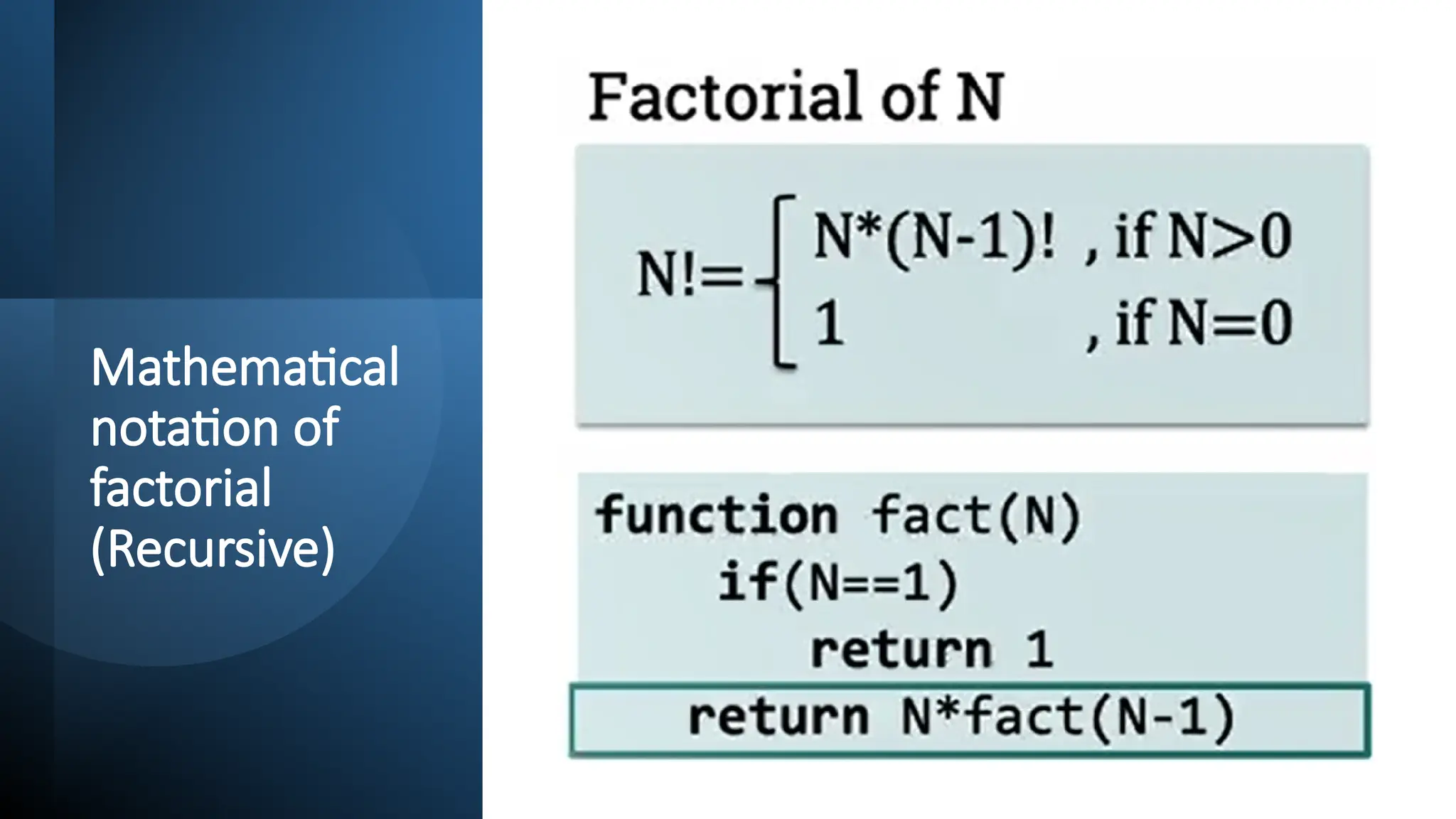
• How recursionis used in algorithms
• How recursion works
Creating
• Creating own recursive algorithms
Analyzing
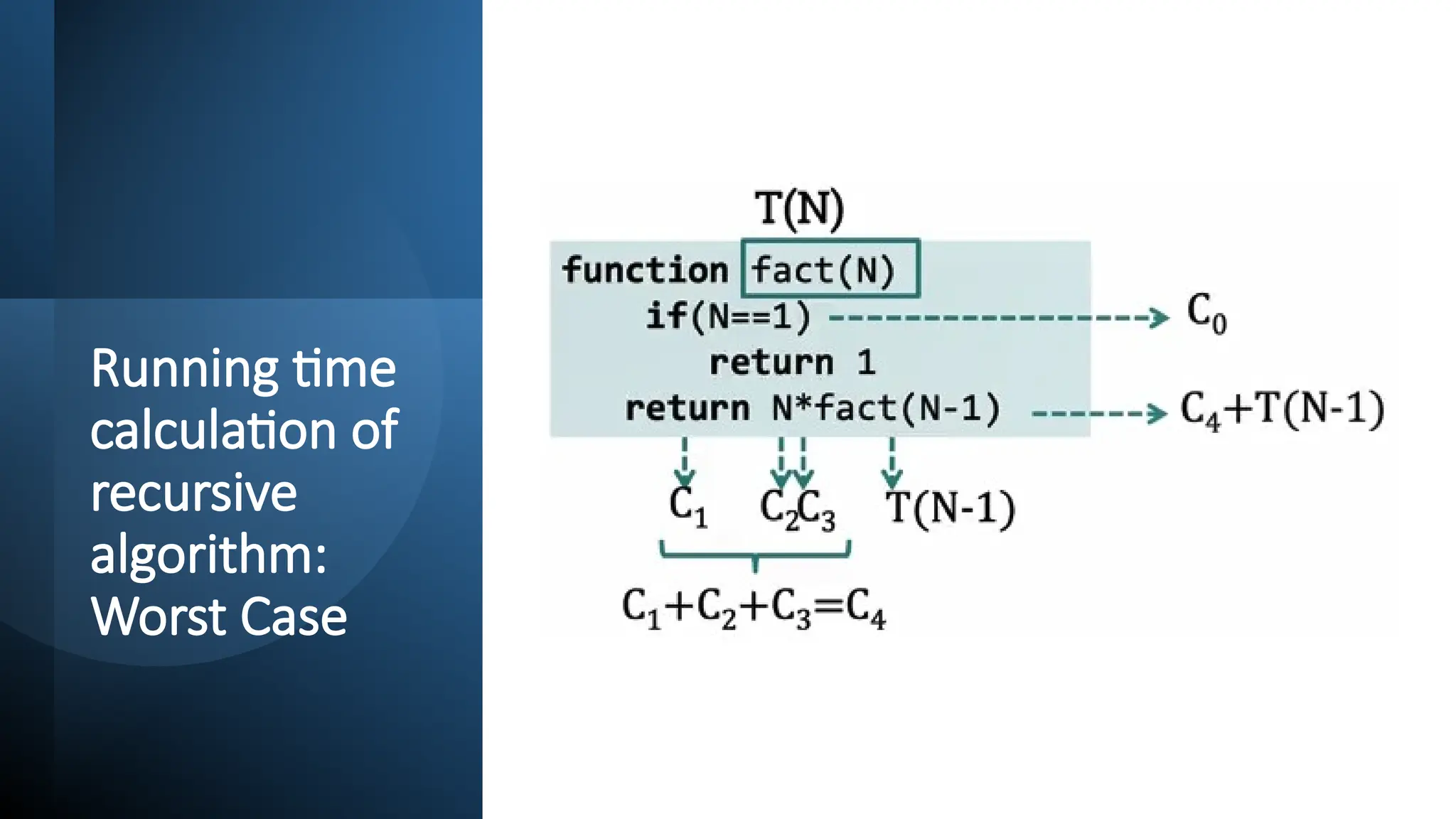
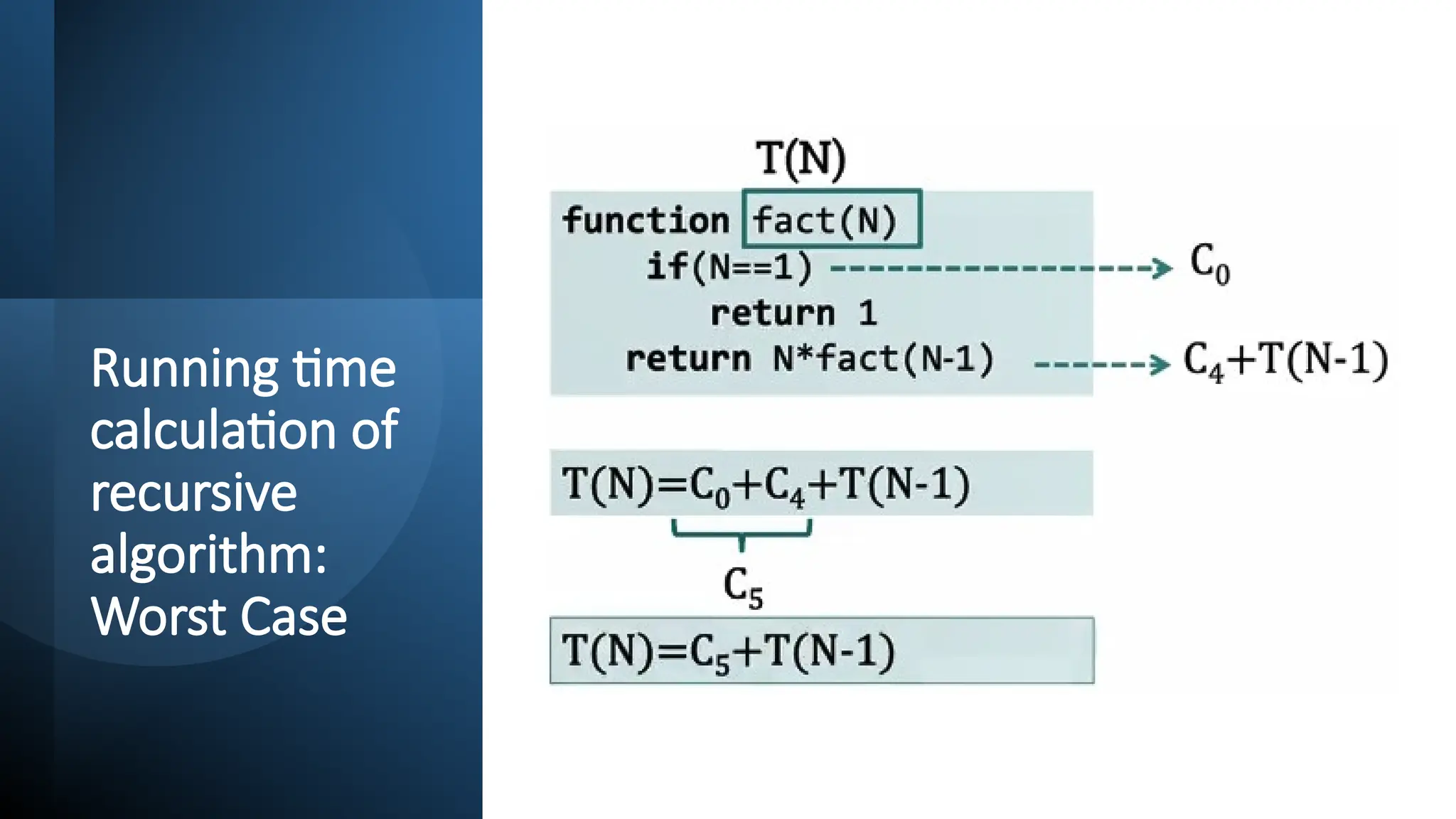
• Analyzing recursive algorithms to find their running time/time
complexity.
3.
Time Complexity
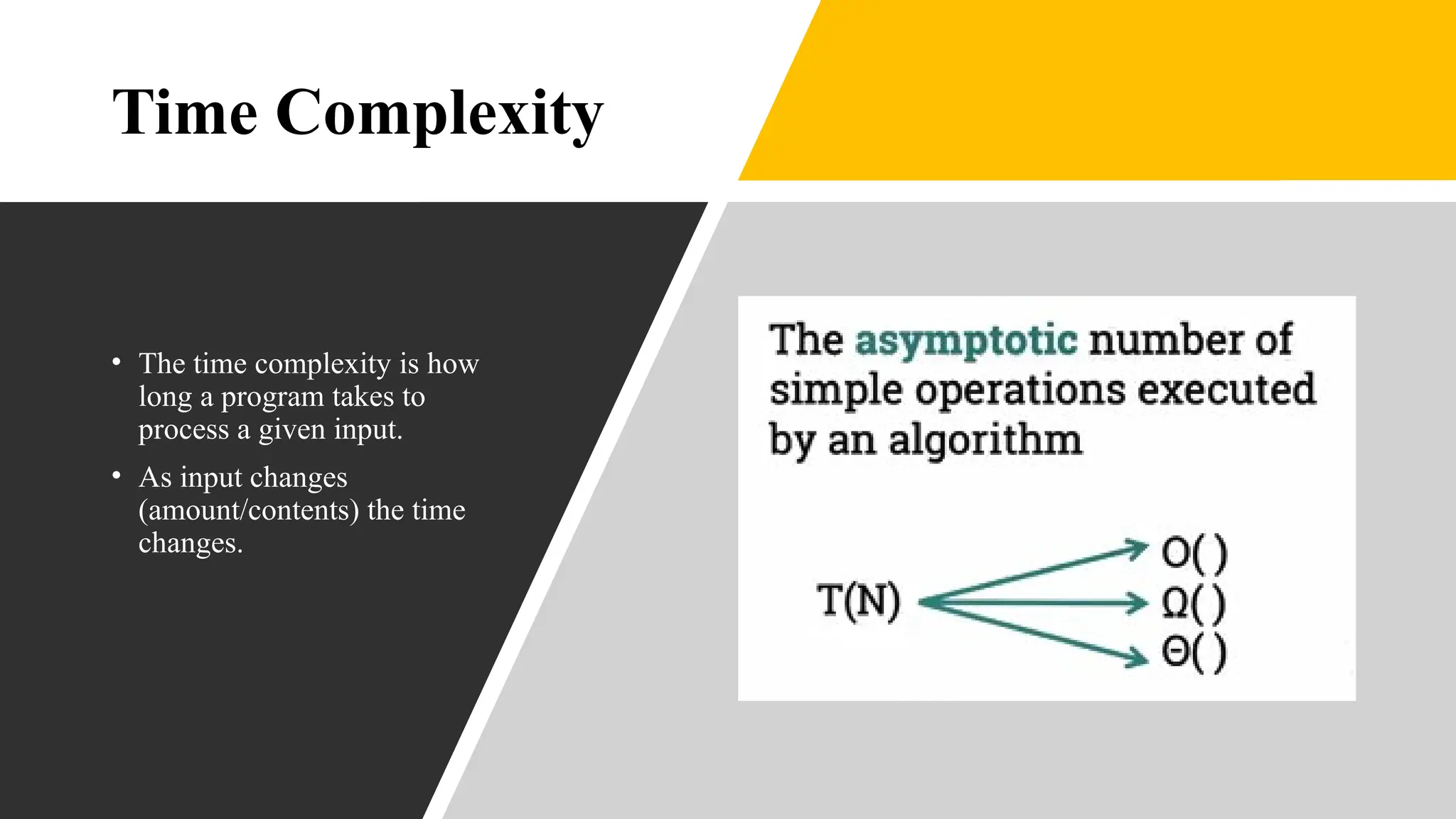
• Thetime complexity is how
long a program takes to
process a given input.
• As input changes
(amount/contents) the time
changes.
Recurrence
Equation
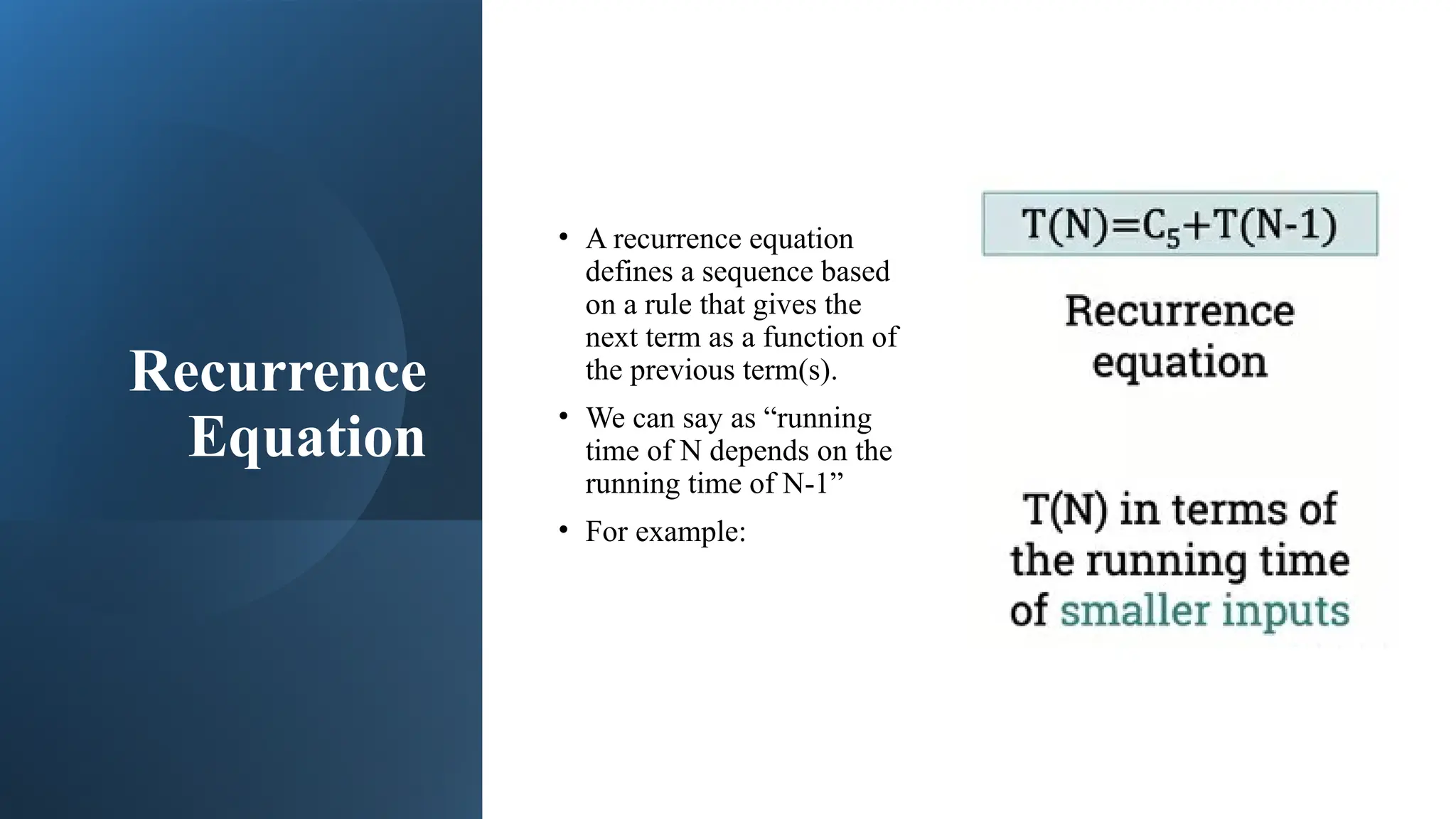
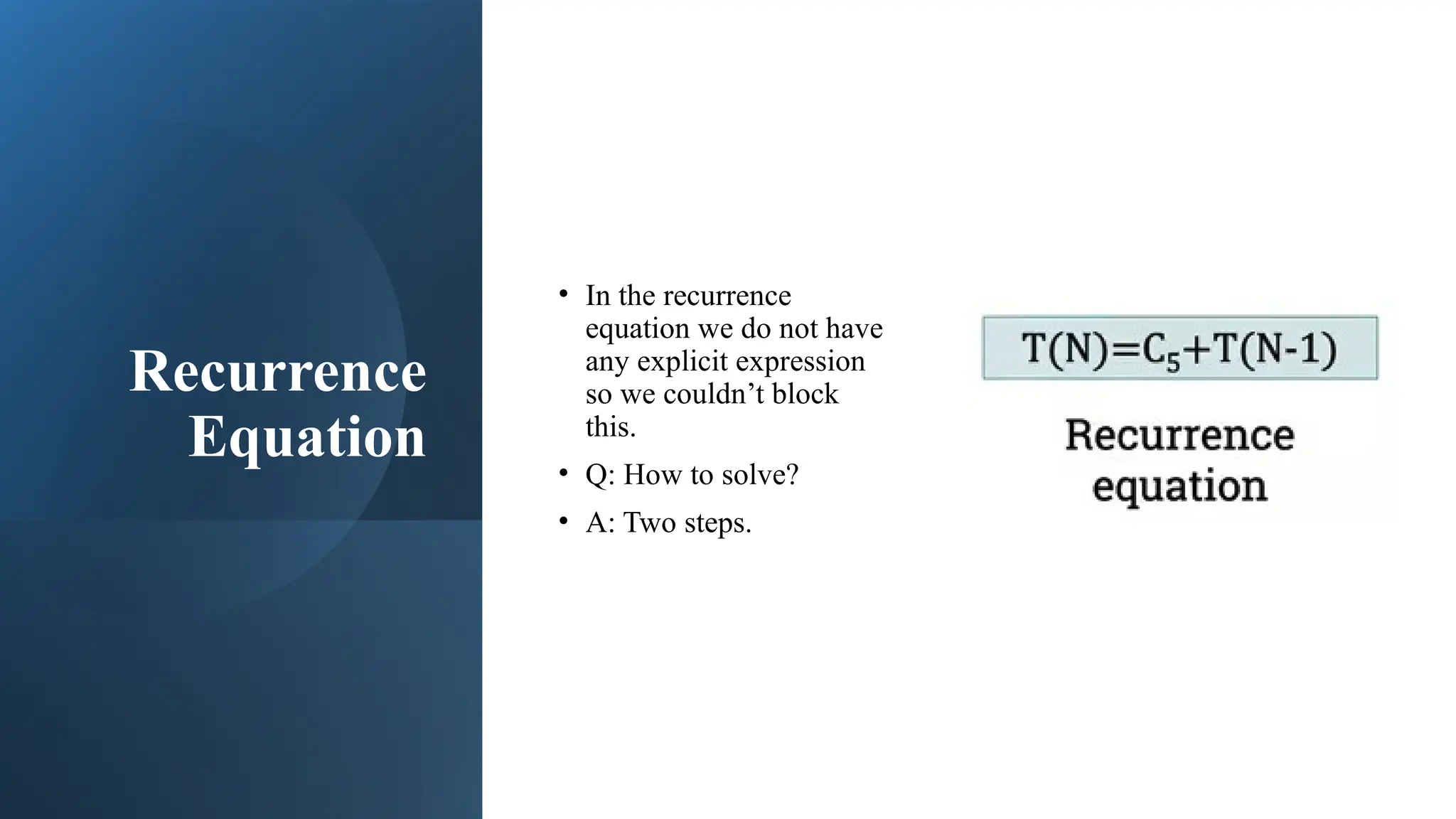
• A recurrenceequation
defines a sequence based
on a rule that gives the
next term as a function of
the previous term(s).
• We can say as “running
time of N depends on the
running time of N-1”
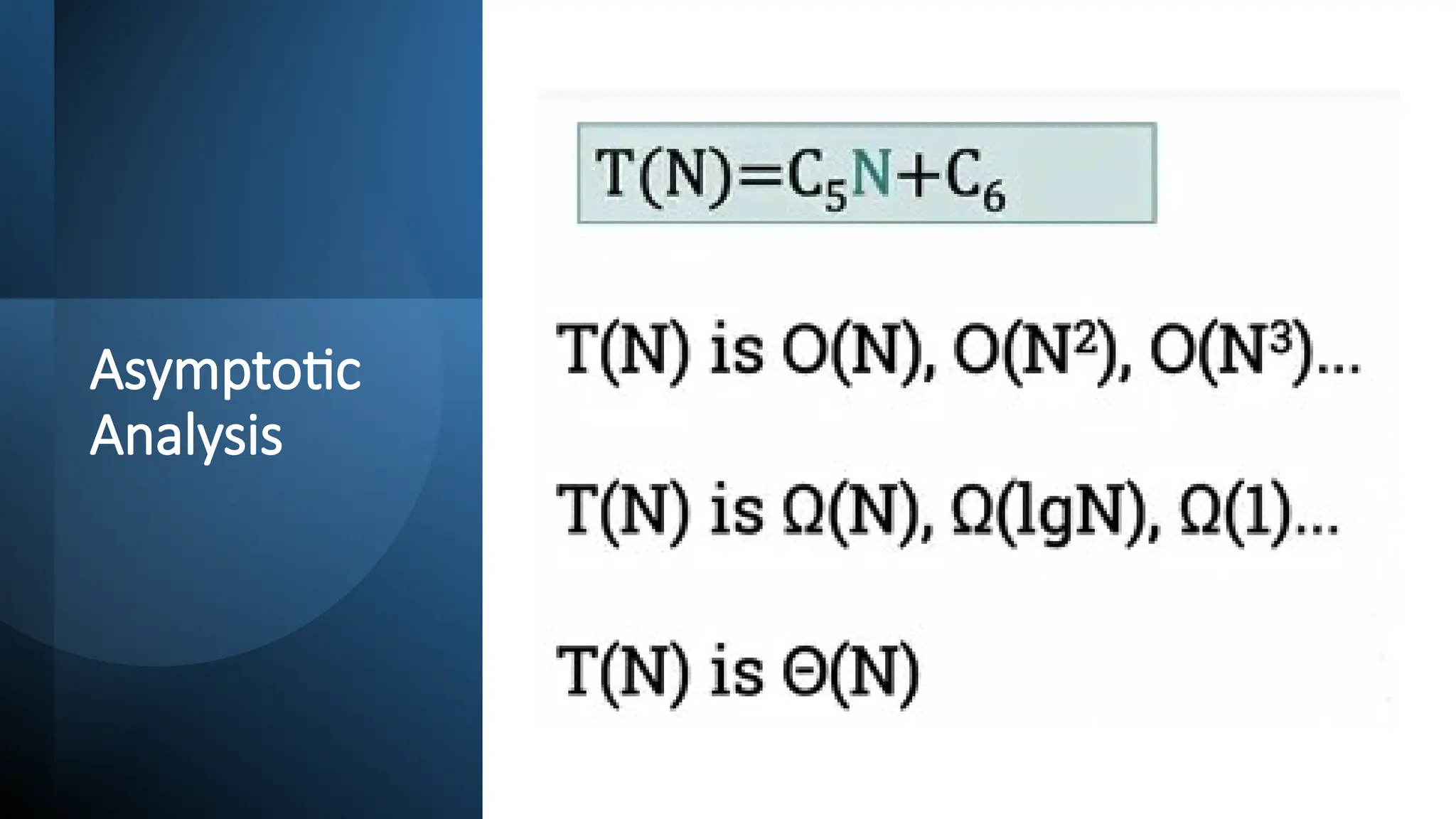
• For example:
9.
Recurrence
Equation
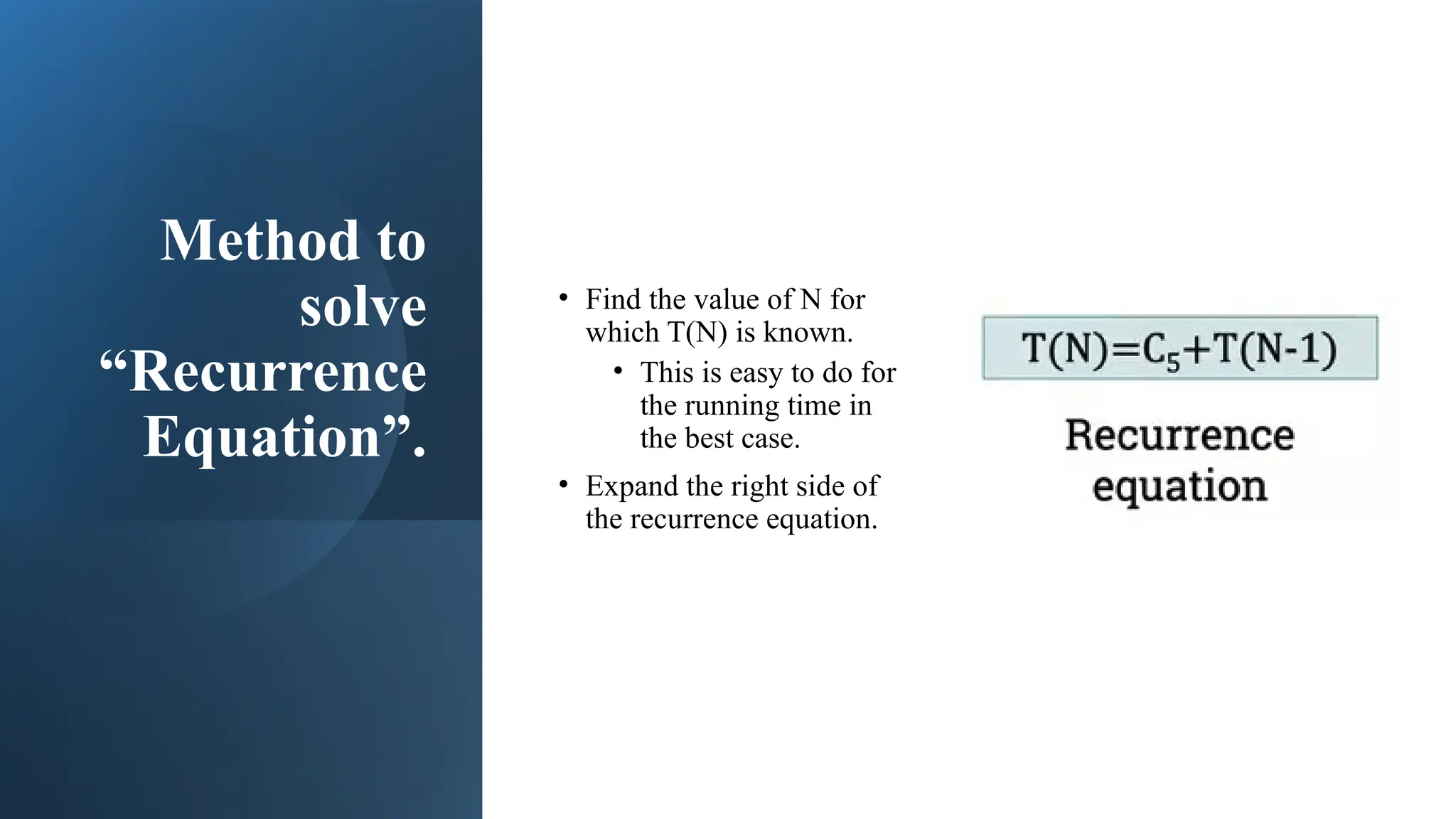
• In therecurrence
equation we do not have
any explicit expression
so we couldn’t block
this.
• Q: How to solve?
• A: Two steps.
10.
Method to
solve
“Recurrence
Equation”.
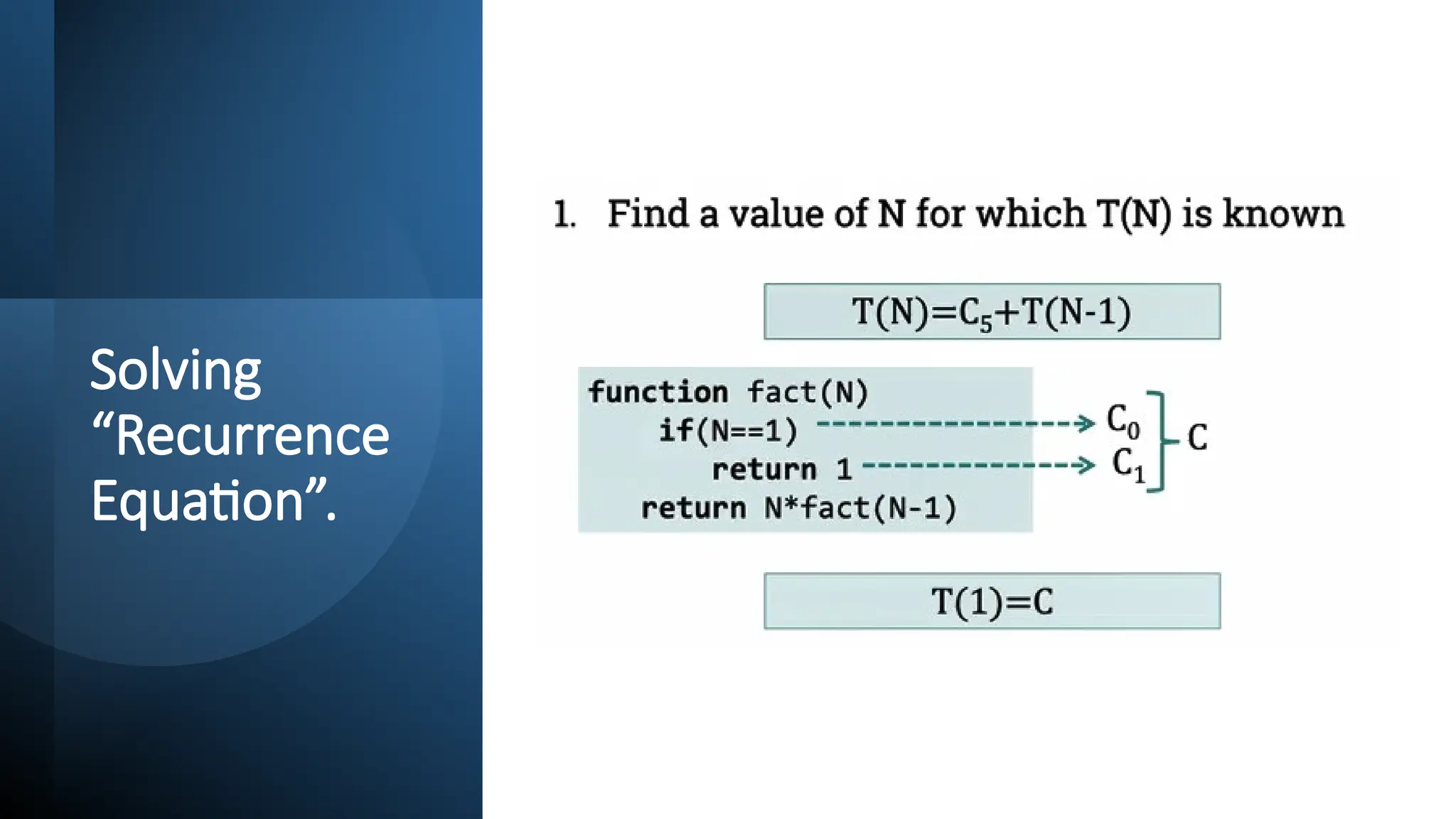
• Findthe value of N for
which T(N) is known.
• This is easy to do for
the running time in
the best case.
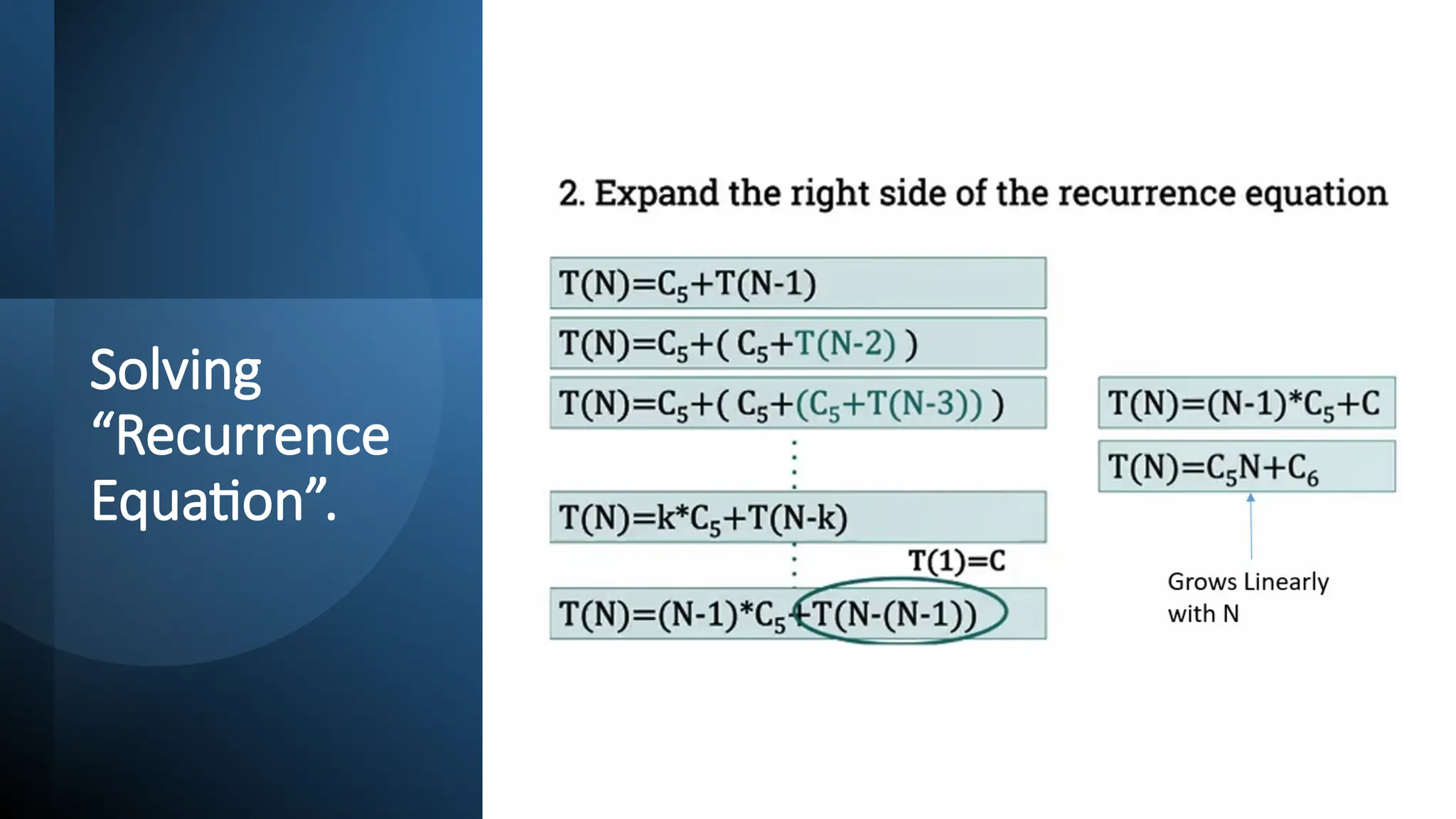
• Expand the right side of
the recurrence equation.
The Master
Theorem
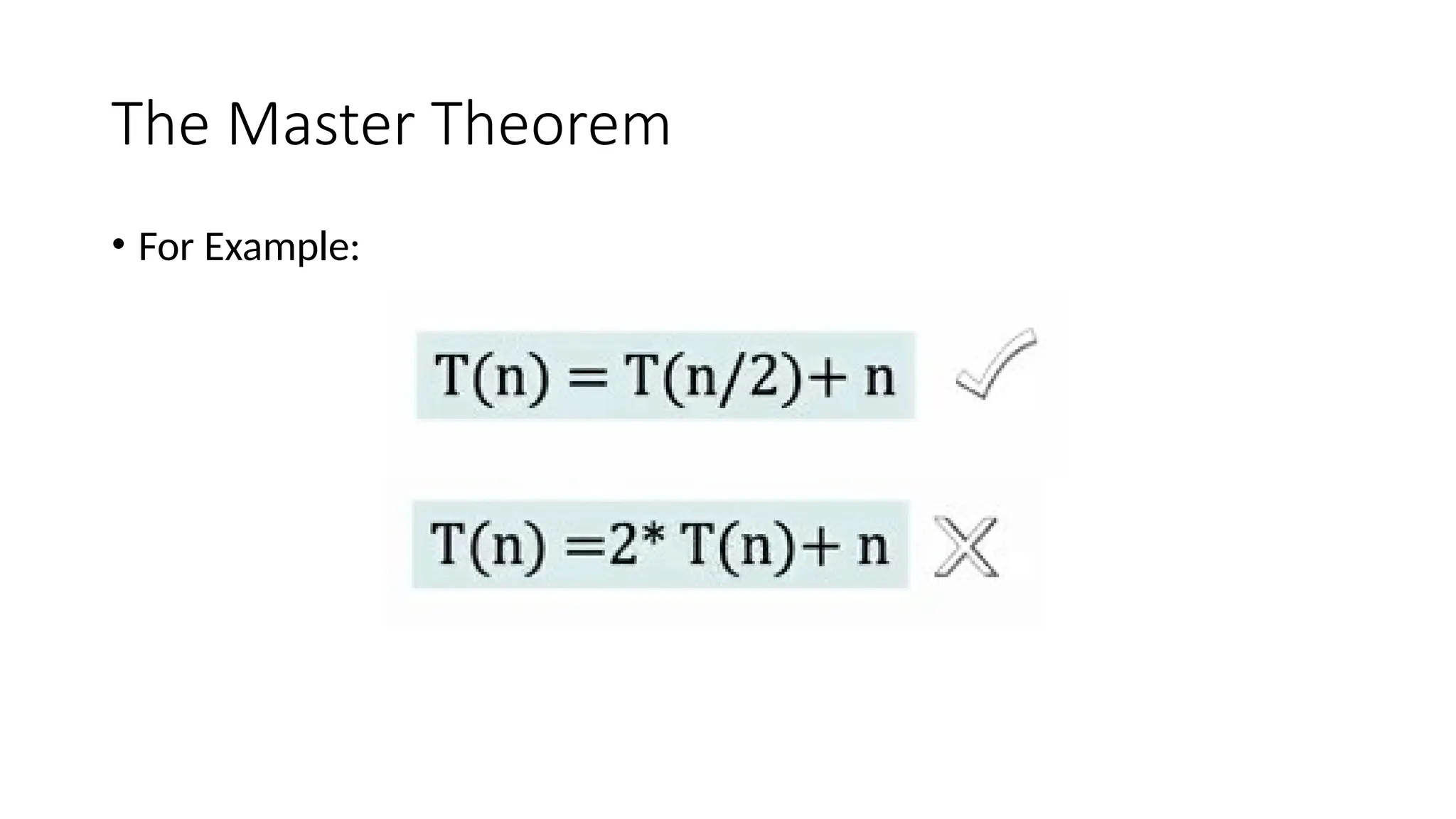
• Previouslywe discussed how to find recurrence equation
that defines the running time of the recursive algorithm
and how to solve that recurrence equation.
• That is solving a recurrence equation includes:
• Finding the known value for running time T(N) in the
best case.
• Expanding the right side of the recurrence equation
until the known value found in the previous step could
be replaced in it.
• This way of solving recurrence equation is effective but
very time consuming.
• So………….”The Master Theorem” can be used in some
cases.
16.
The Master
Theorem
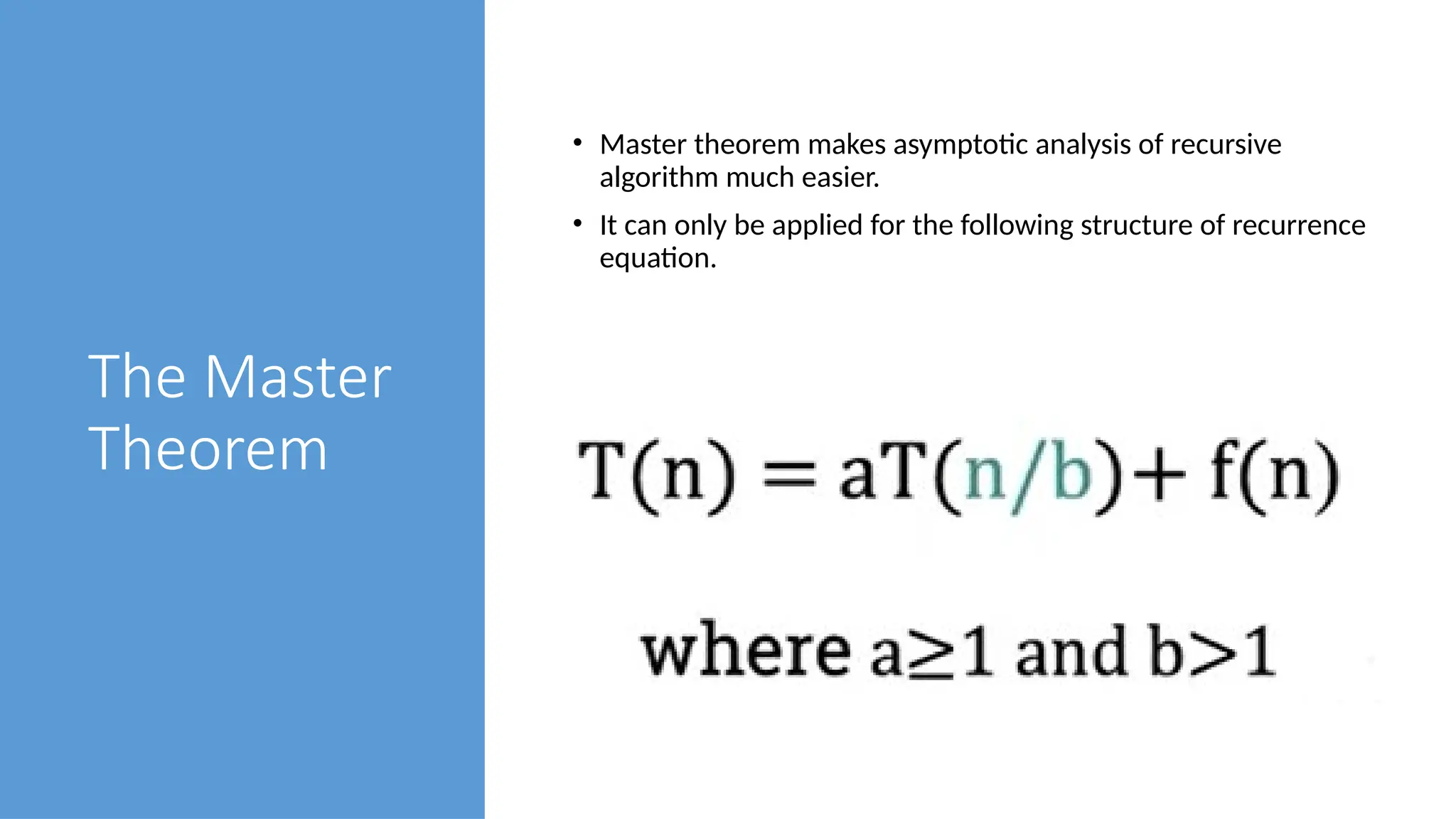
• Mastertheorem makes asymptotic analysis of recursive
algorithm much easier.
• It can only be applied for the following structure of recurrence
equation.
The Master Theorem
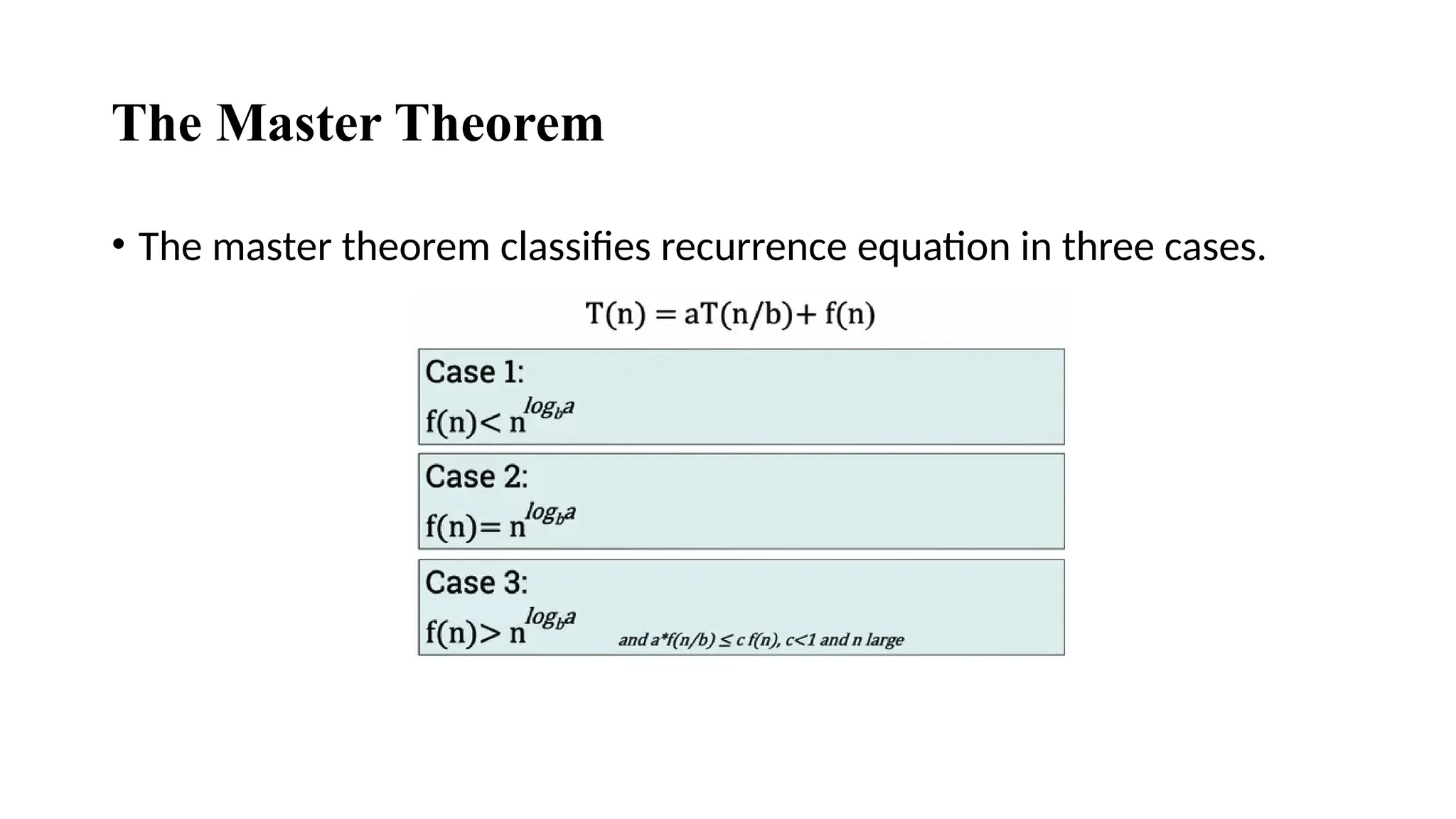
•The master theorem classifies recurrence equation in three cases.
19.
The Master Theorem
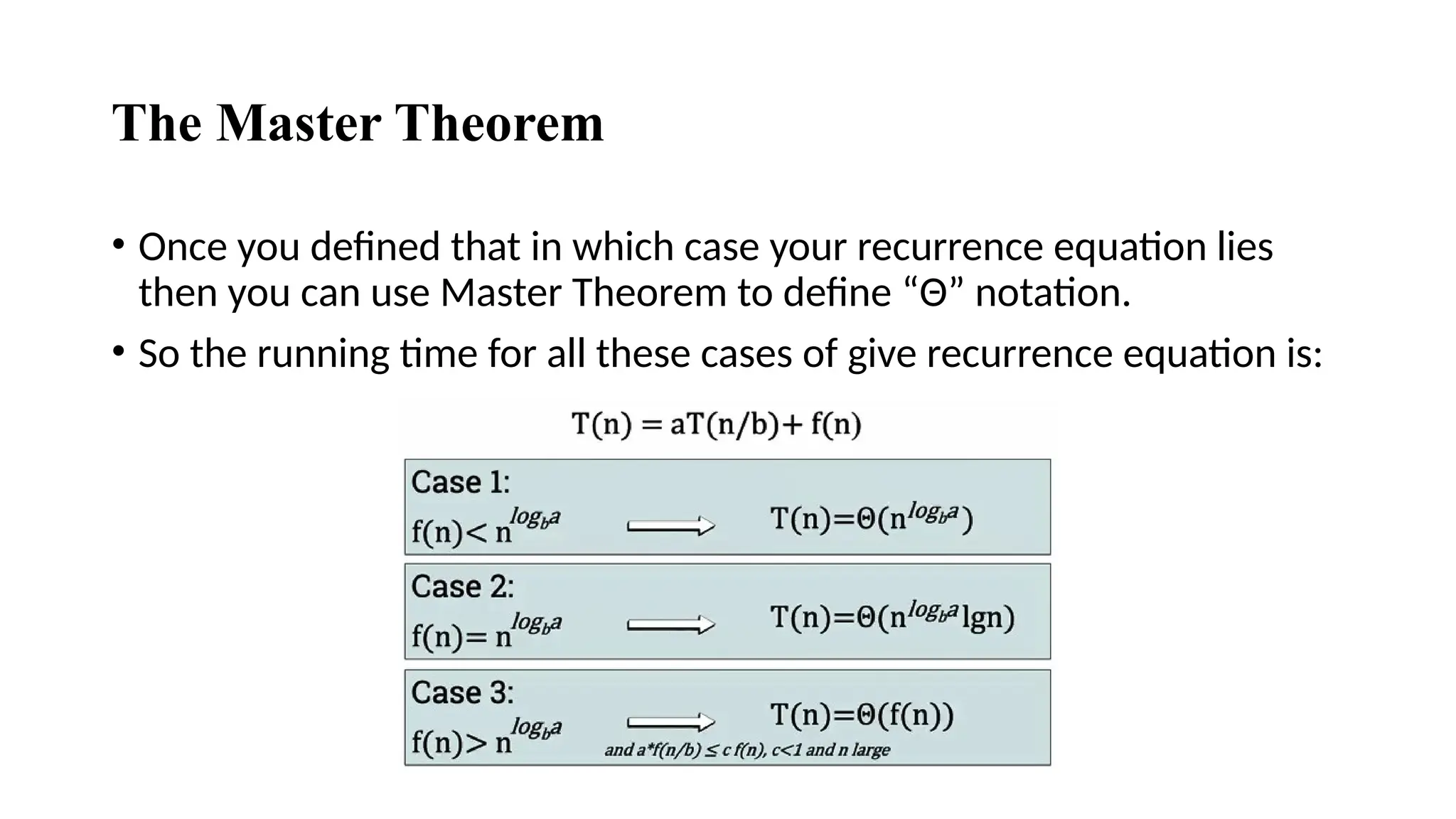
•Once you defined that in which case your recurrence equation lies
then you can use Master Theorem to define “Θ” notation.
• So the running time for all these cases of give recurrence equation is:
20.
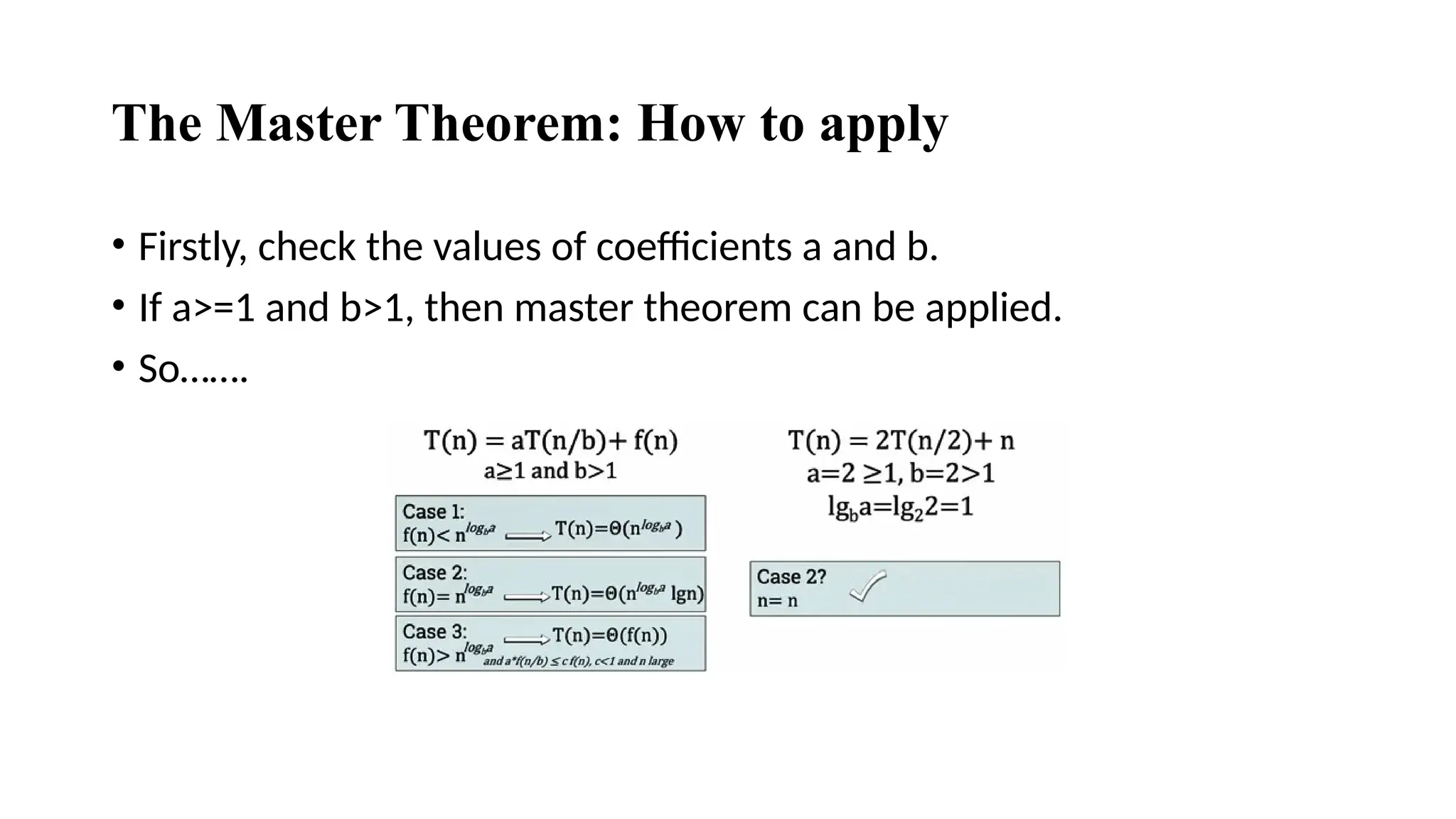
The Master Theorem:How to apply
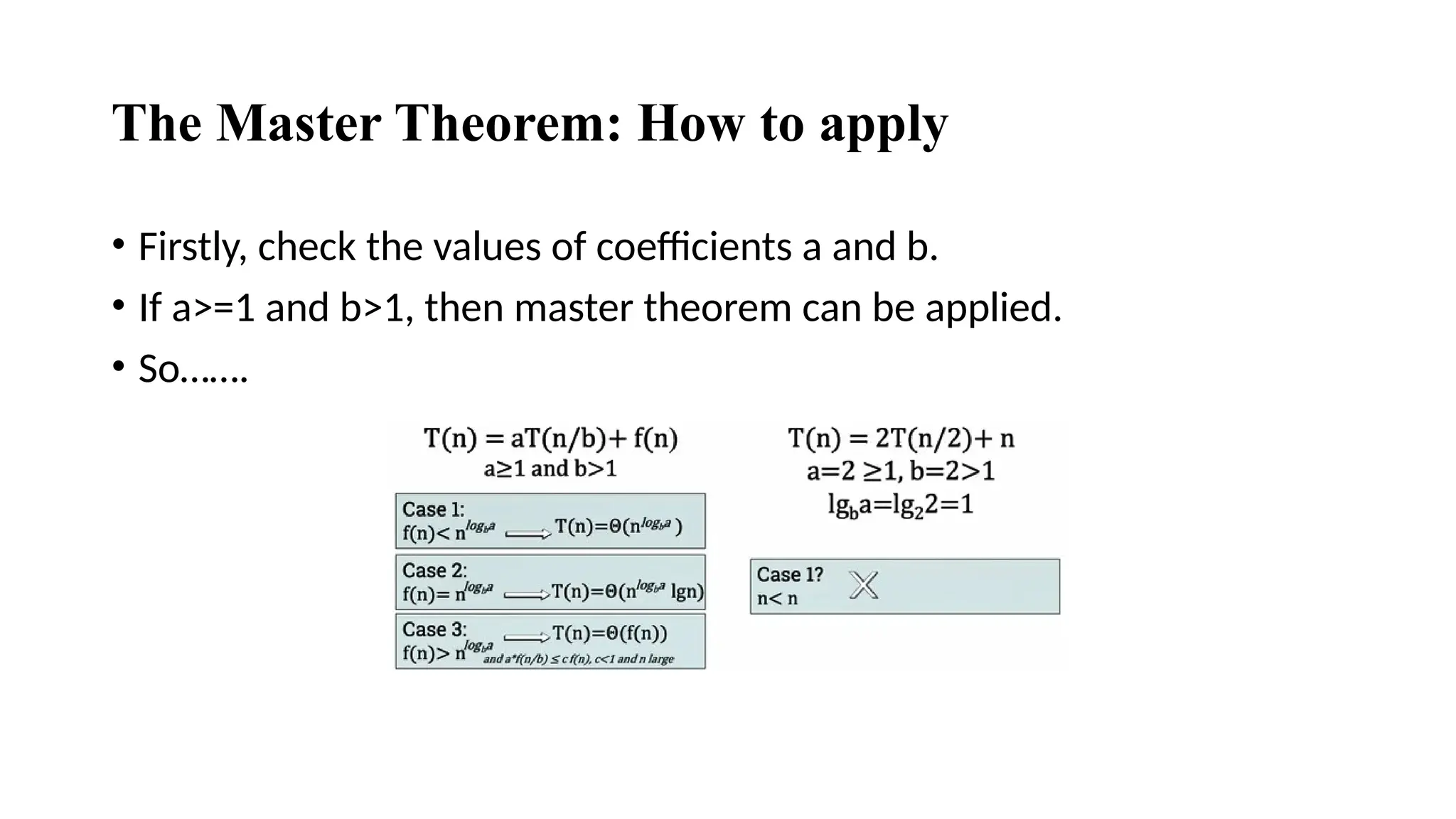
• Firstly, check the values of coefficients a and b.
• If a>=1 and b>1, then master theorem can be applied.
• So…….
21.
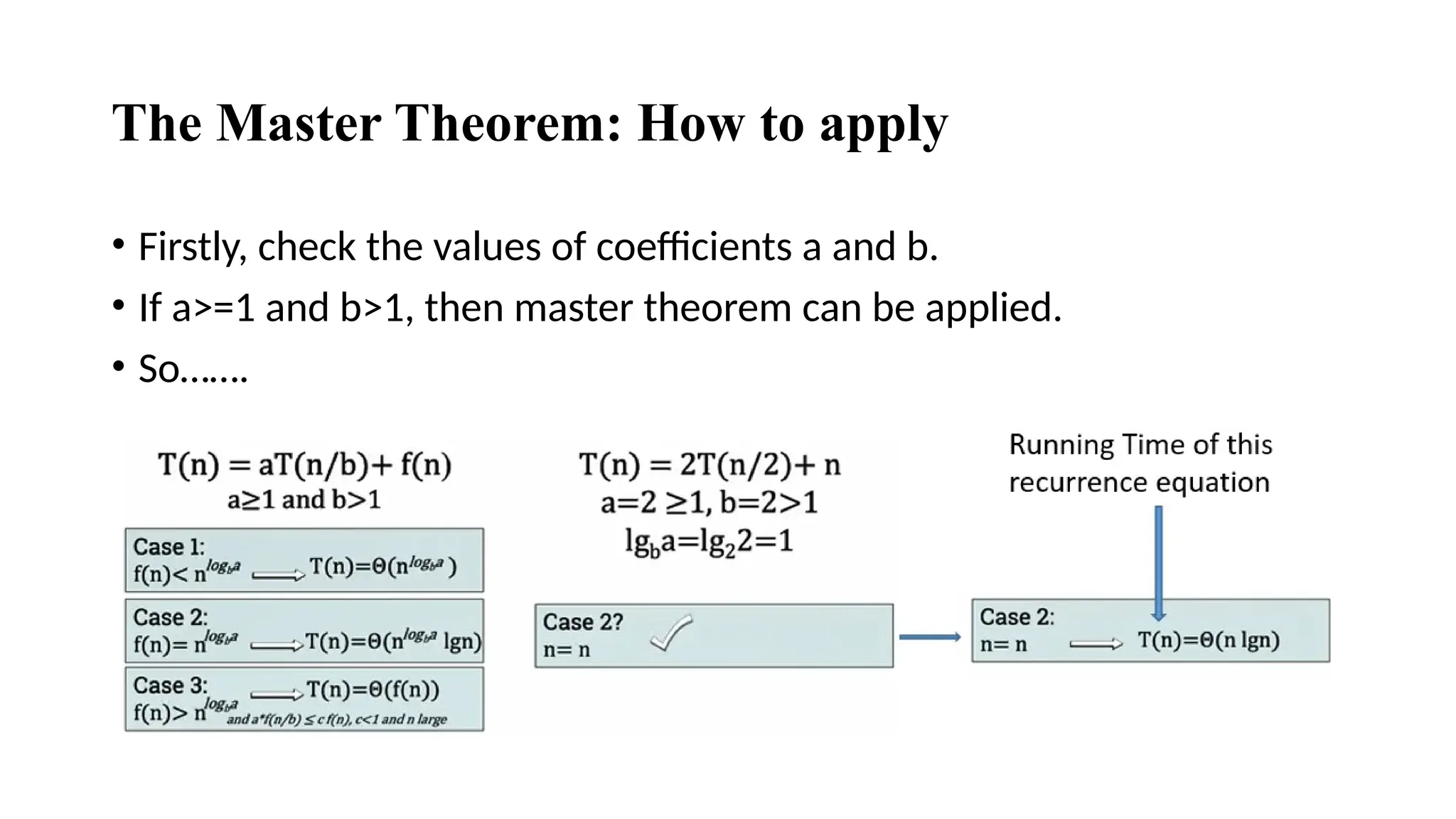
The Master Theorem:How to apply
• Firstly, check the values of coefficients a and b.
• If a>=1 and b>1, then master theorem can be applied.
• So…….
22.
The Master Theorem:How to apply
• Firstly, check the values of coefficients a and b.
• If a>=1 and b>1, then master theorem can be applied.
• So…….
23.
Summary
• Firstly, checkthe values of coefficients a and b.
• If a>=1 and b>1, then master theorem can be applied.
• Secondly, check the case in which your equation lies.
• Apply the master theorem.


![PCC_CS_404_OUCHITYAPRODHAN_17000124029[1].pptx](https://cdn.slidesharecdn.com/ss_thumbnails/pcccs404ouchityaprodhan170001240291-250416041539-b214e64e-thumbnail.jpg?width=640&height=640&fit=bounds)


![[DSC Europe 25] Ivan Peric - Intelligence Swarm Logic and Techno-Functional M...](https://cdn.slidesharecdn.com/ss_thumbnails/7my7c97fsduiccadgavw-2-251212103249-5a03f7c6-thumbnail.jpg?width=640&height=640&fit=bounds)


![[DSC Europe 25] Nikolay Burlutskiy - Best Practices for Building Enterprise M...](https://cdn.slidesharecdn.com/ss_thumbnails/uirvaiuvq8y1w8hzd9tx-7-251212103249-2619edb4-thumbnail.jpg?width=640&height=640&fit=bounds)


![[DSC Europe 25] Dobrica Cosic - Savings by the Second: How Dynamic Pricing an...](https://cdn.slidesharecdn.com/ss_thumbnails/znp09f3smtqz3w2sq6wn-1-dobrica-cosic-savings-by-the-second-how-dynamic-pricing-and-smart-data-are-bu-251208151905-26e6f41e-thumbnail.jpg?width=640&height=640&fit=bounds)

![[DSC Europe 25] Jovan Bogicevic - Legacy to AI-Driven Defense: Transforming D...](https://cdn.slidesharecdn.com/ss_thumbnails/rsarluadt563hntyfc8q-3-251211083849-3e7bc4c0-thumbnail.jpg?width=640&height=640&fit=bounds)

![[DSC Europe 25] Sara Polak - The Archaeology of Innovation: AI as the Next Cr...](https://cdn.slidesharecdn.com/ss_thumbnails/7ecbscdnt8mlcuqbd2ln-2-sara-polak-ai-creative-industries-251208152533-aa1fcf54-thumbnail.jpg?width=640&height=640&fit=bounds)


![[DSC Europe 25] Dusan Nesic - Securing Tomorrow’s Infrastructure: Why Cyber-P...](https://cdn.slidesharecdn.com/ss_thumbnails/qikbszfftyowjm2q6duw-1-251211083848-8f2ead6b-thumbnail.jpg?width=640&height=640&fit=bounds)
![[DSC Europe 25] Marija Vlajkovic & Andrea Radonjanin - Integration of AI tool...](https://cdn.slidesharecdn.com/ss_thumbnails/qf1jrglttoc3bm8s3aop-final-integration-of-ai-tools-251208151905-394f3a6a-thumbnail.jpg?width=640&height=640&fit=bounds)

![[DSC Europe 25] Jon Dajci - Bridging TradFi and DeFi: Building the Future of ...](https://cdn.slidesharecdn.com/ss_thumbnails/fqmhfvlbqhkihjvqvhmu-7-251211083849-6af7e325-thumbnail.jpg?width=640&height=640&fit=bounds)

![[DSC Europe 25] Aleksandra Dragicevic - AI-Boosted Research in Healthcare: Fr...](https://cdn.slidesharecdn.com/ss_thumbnails/iqwngszurf2r7pi1lnnj-4-aleksandra-dragicevic-ad-dsc-europe-conference-20-251208151905-37c3238a-thumbnail.jpg?width=640&height=640&fit=bounds)