Search Advertising
Overview
Ali Dasdan, Yahoo!
Disclaimers:
This talk presents the opinions of the author.
Some of the proposals have been submitted as patent applications.
Outline
  Overall advertising market
  Online advertising overview
  Search advertising introduction
  Output bidding
  New search advertising model
  Opportunities
  Conclusions
2
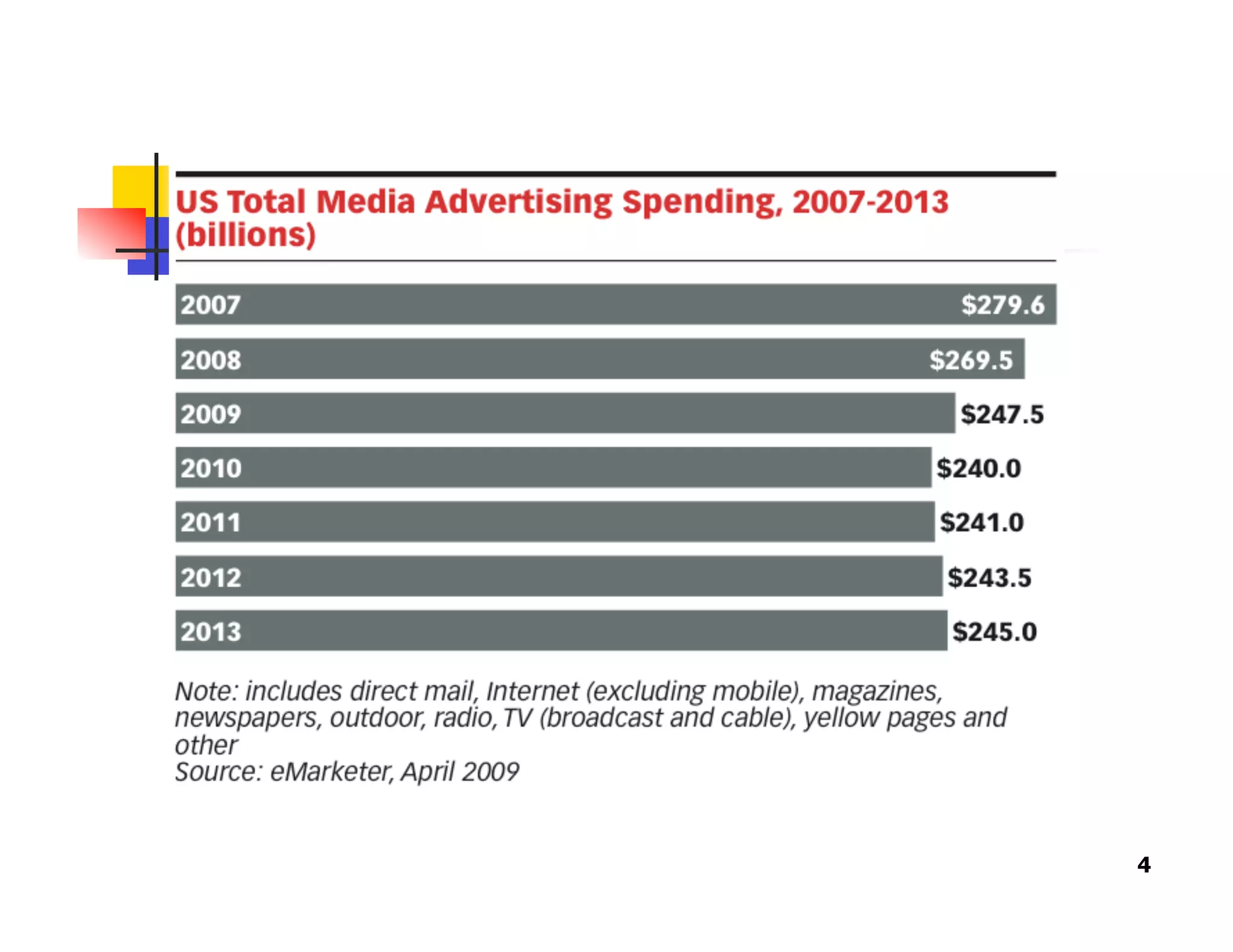
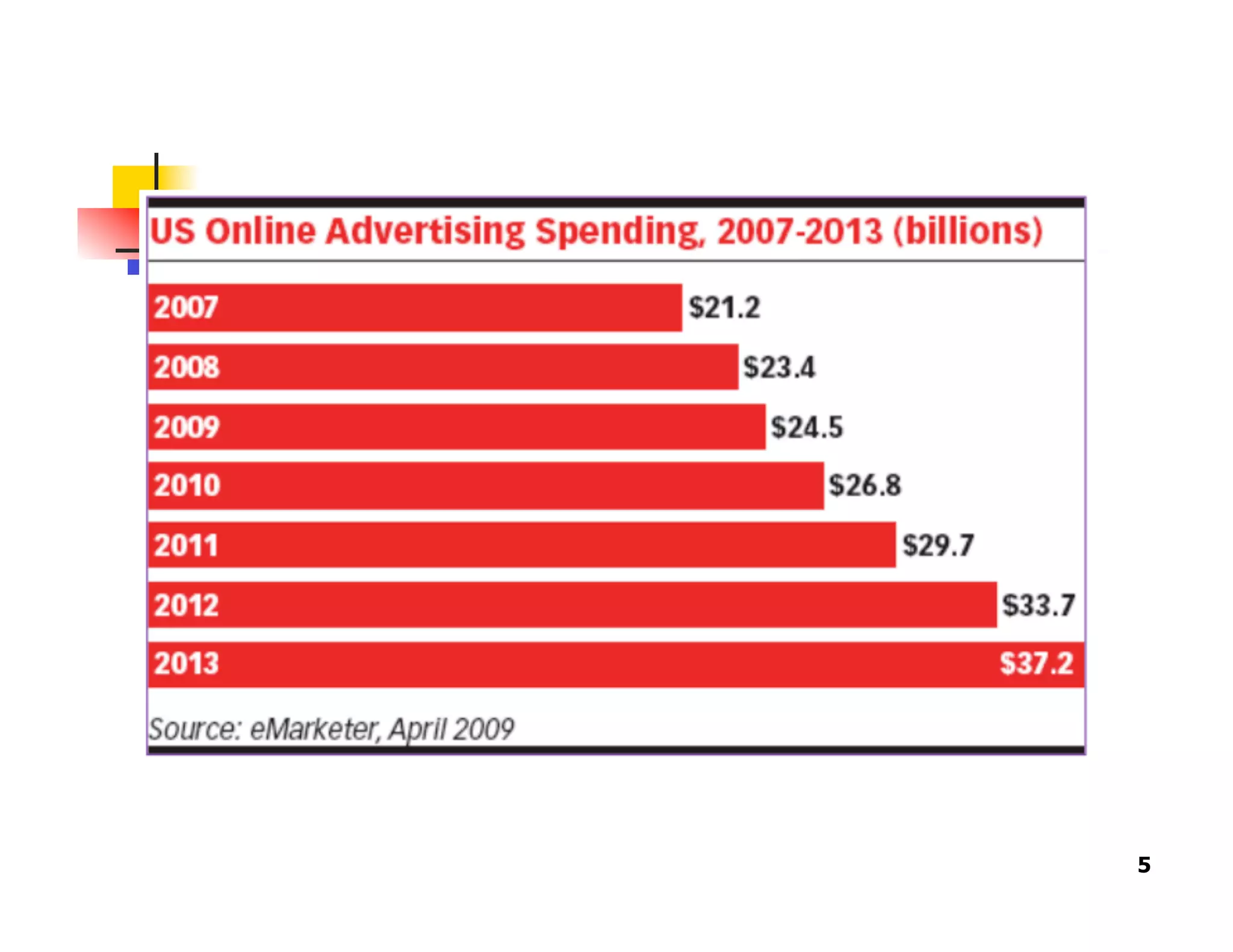
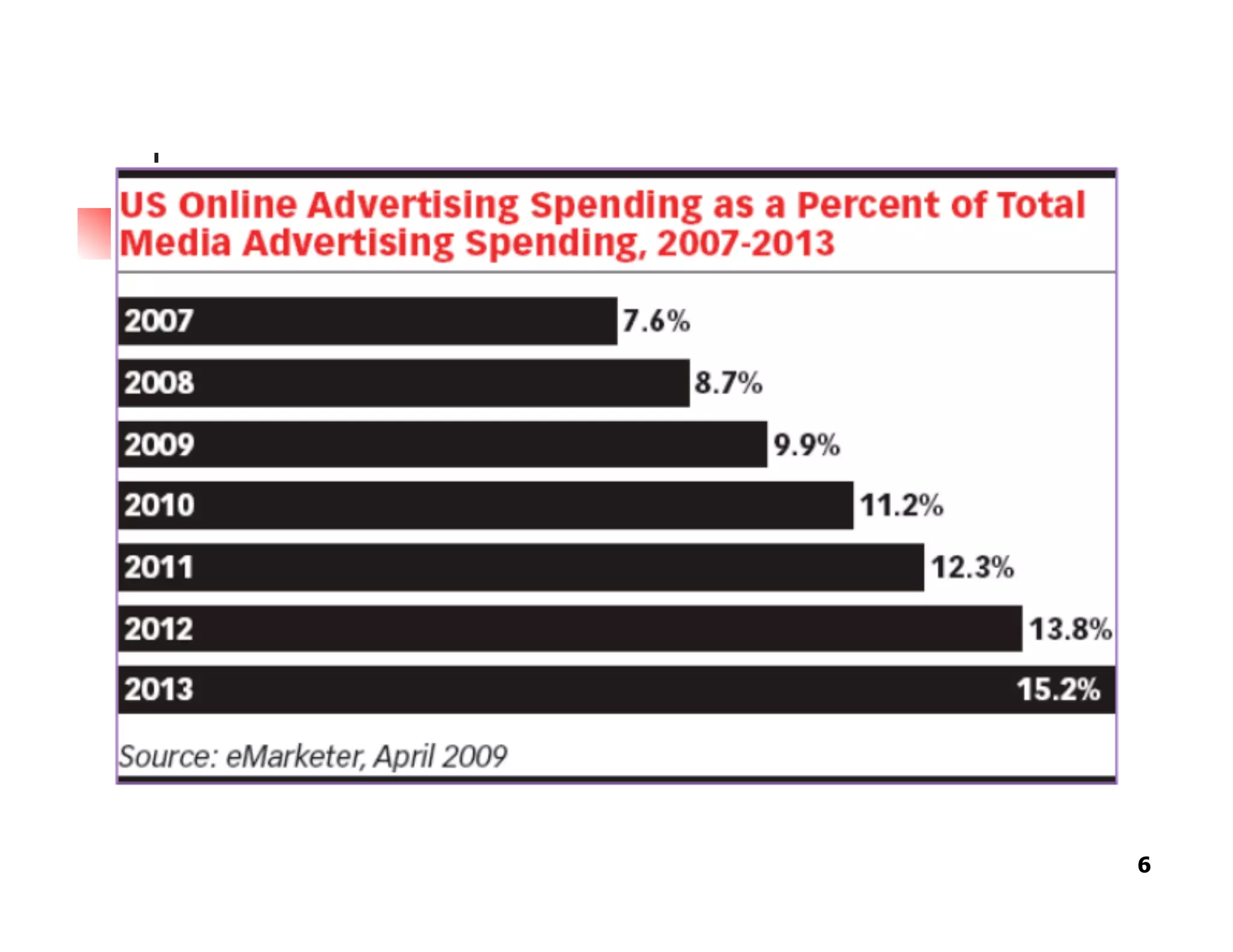
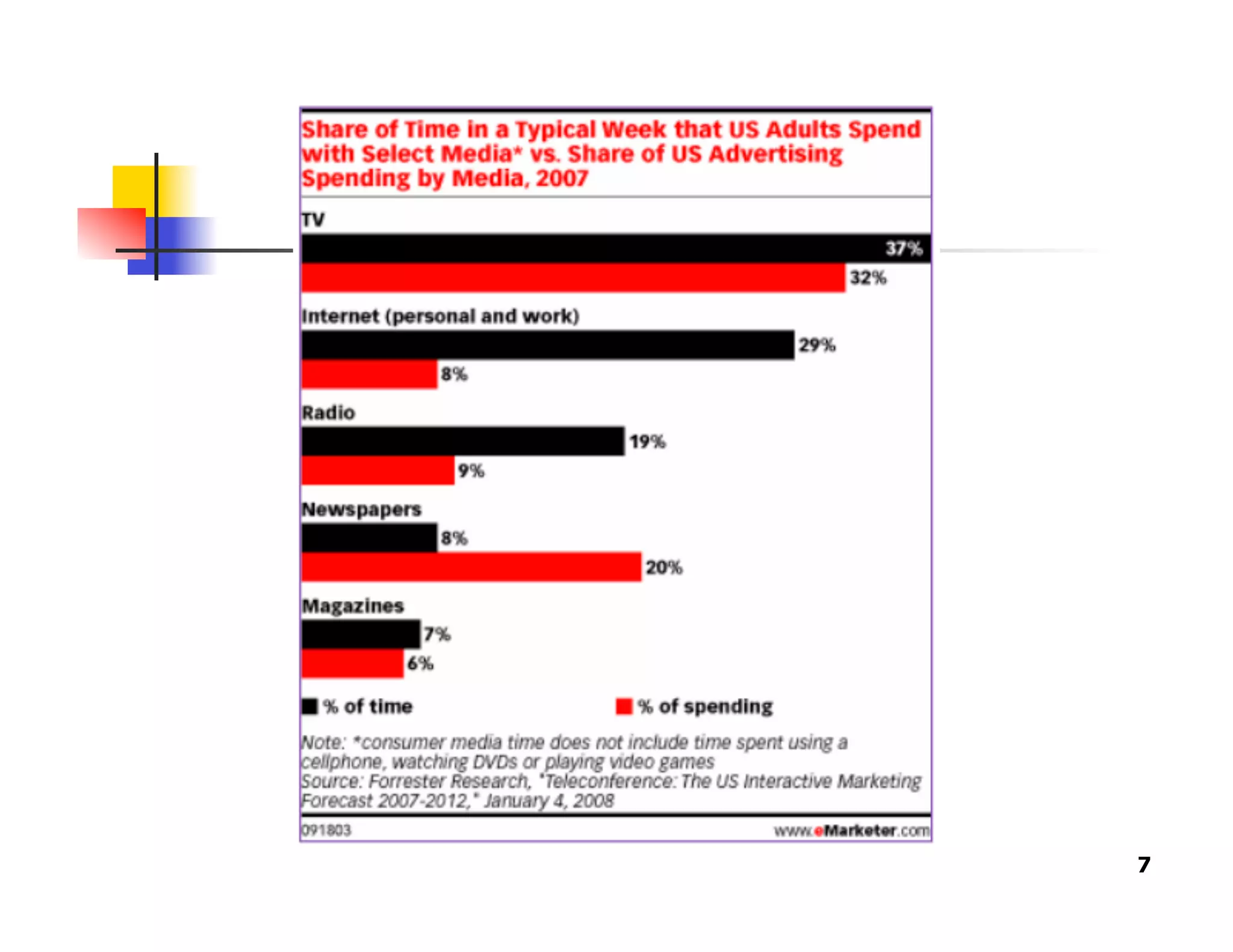
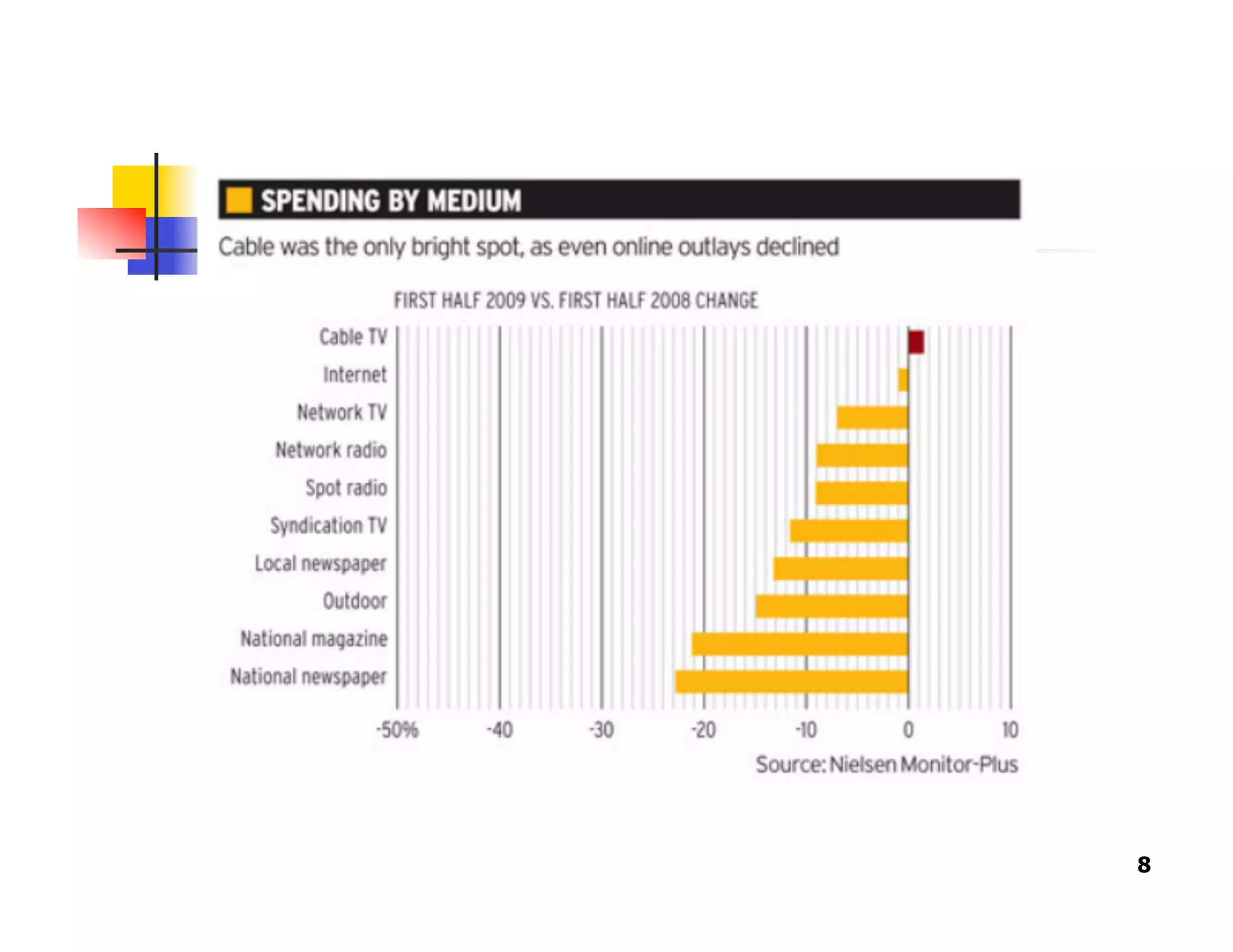
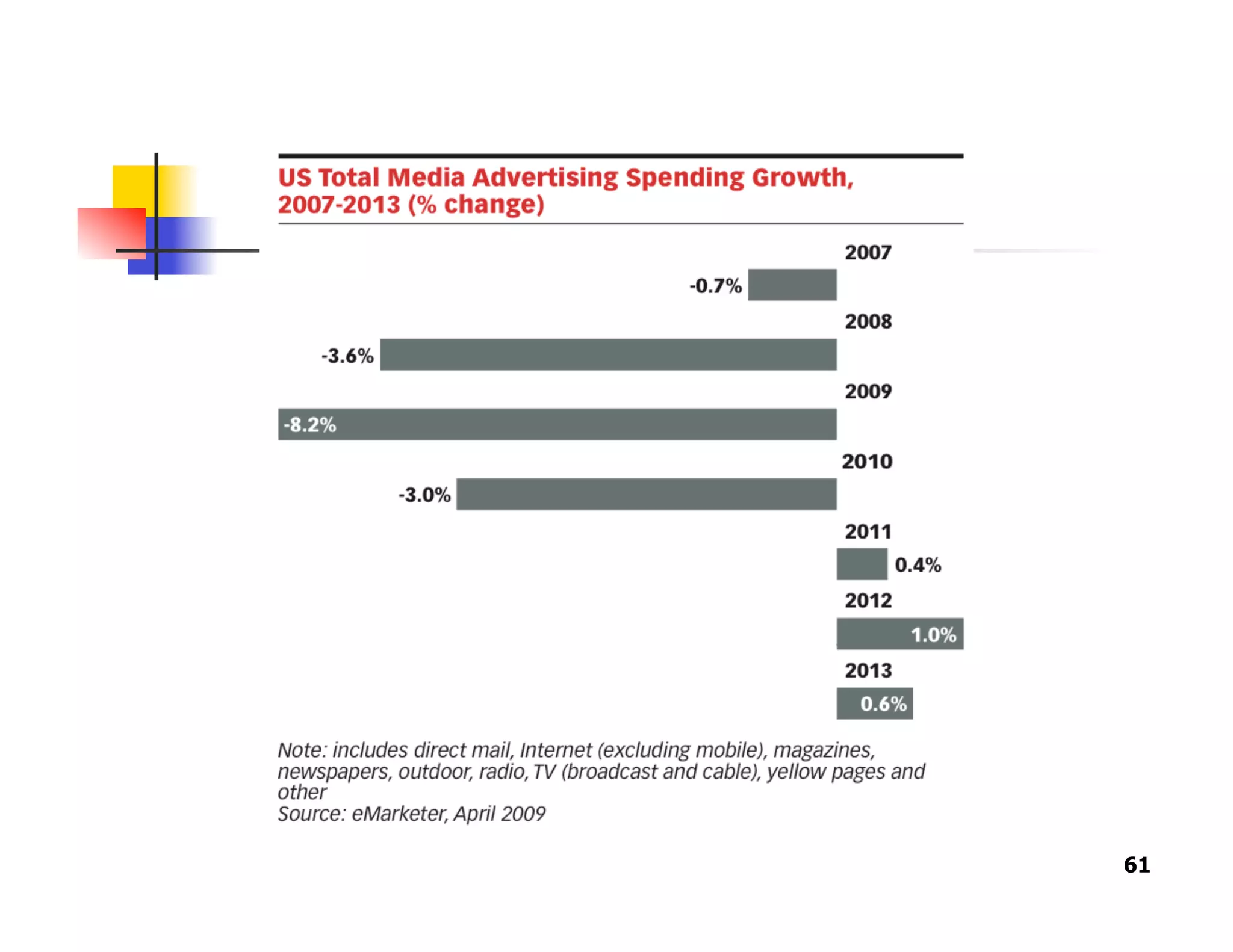
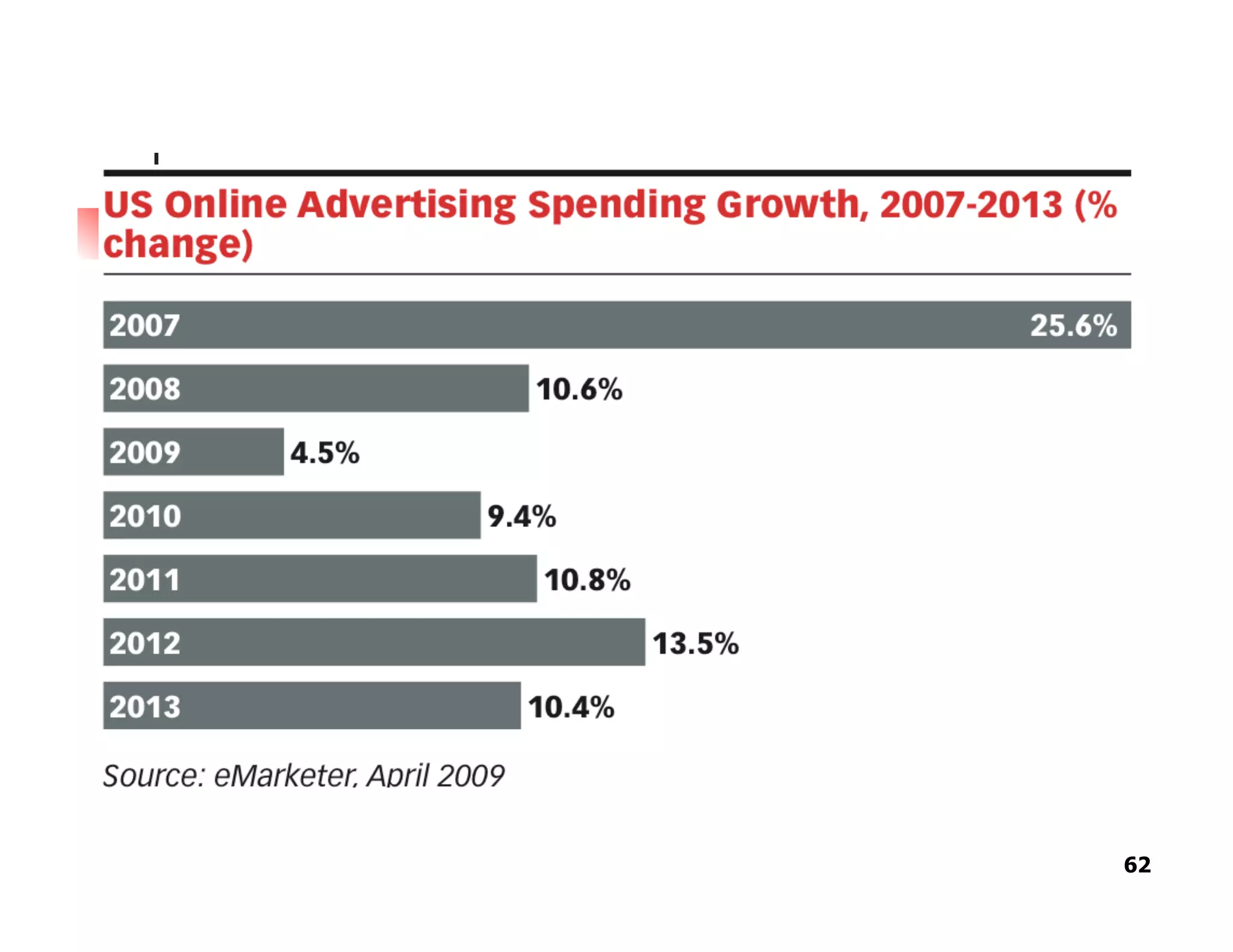
Advertising market size &
growth predictions
3
4
5
6
7
8
Online advertising
overview & examples
9
Online advertising
  Goal:
  find the “best match” between an ad
and a context to maximize “value” for
all stakeholders
  Context:
  browse, search, connect, etc.
  Stakeholders
  users, advertisers, publishers,
auctioneers
10
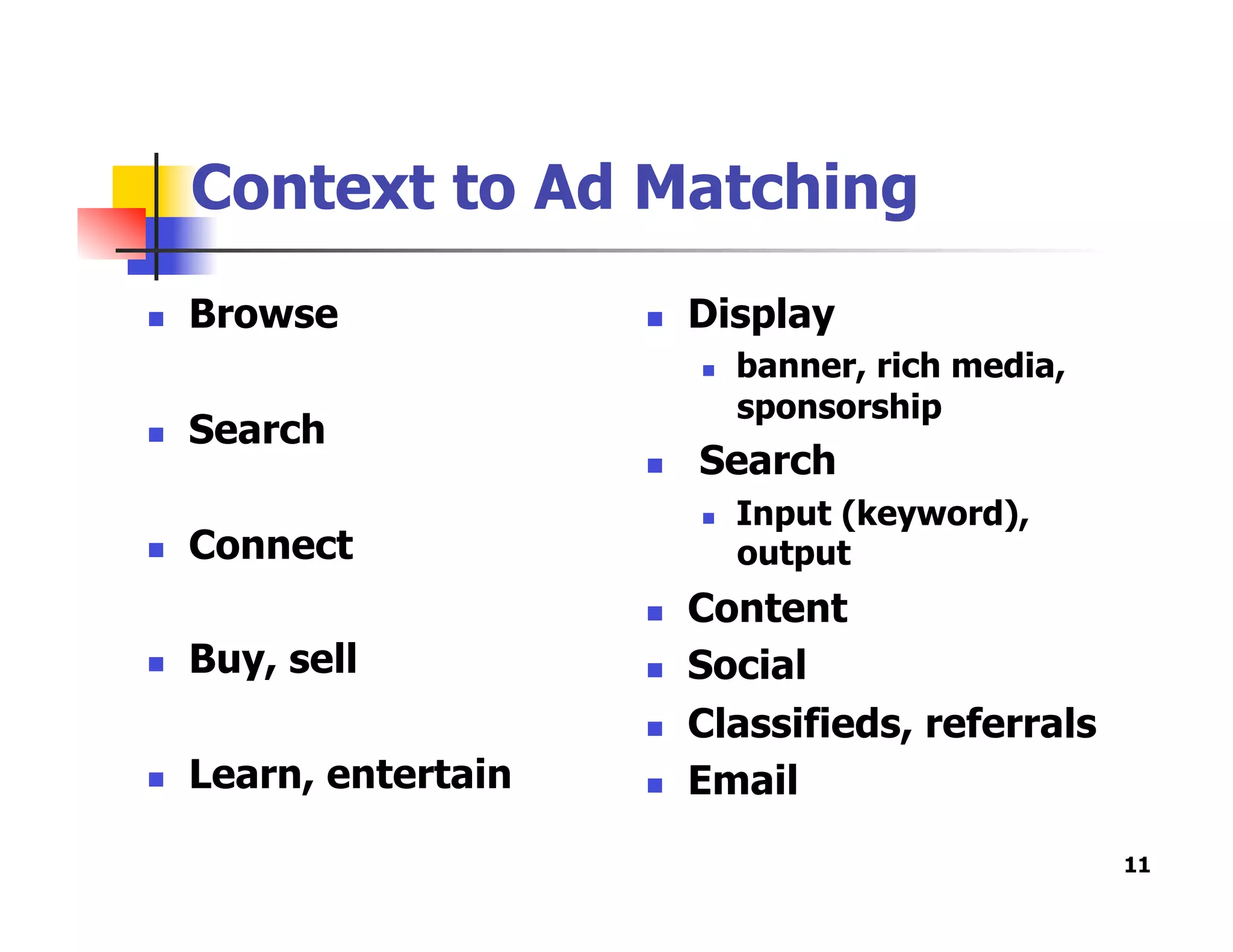
Context to Ad Matching
  Browse
  Search
  Connect
  Buy, sell
  Learn, entertain
  Display
  banner, rich media,
sponsorship
  Search
  Input (keyword),
output
  Content
  Social
  Classifieds, referrals
  Email
11
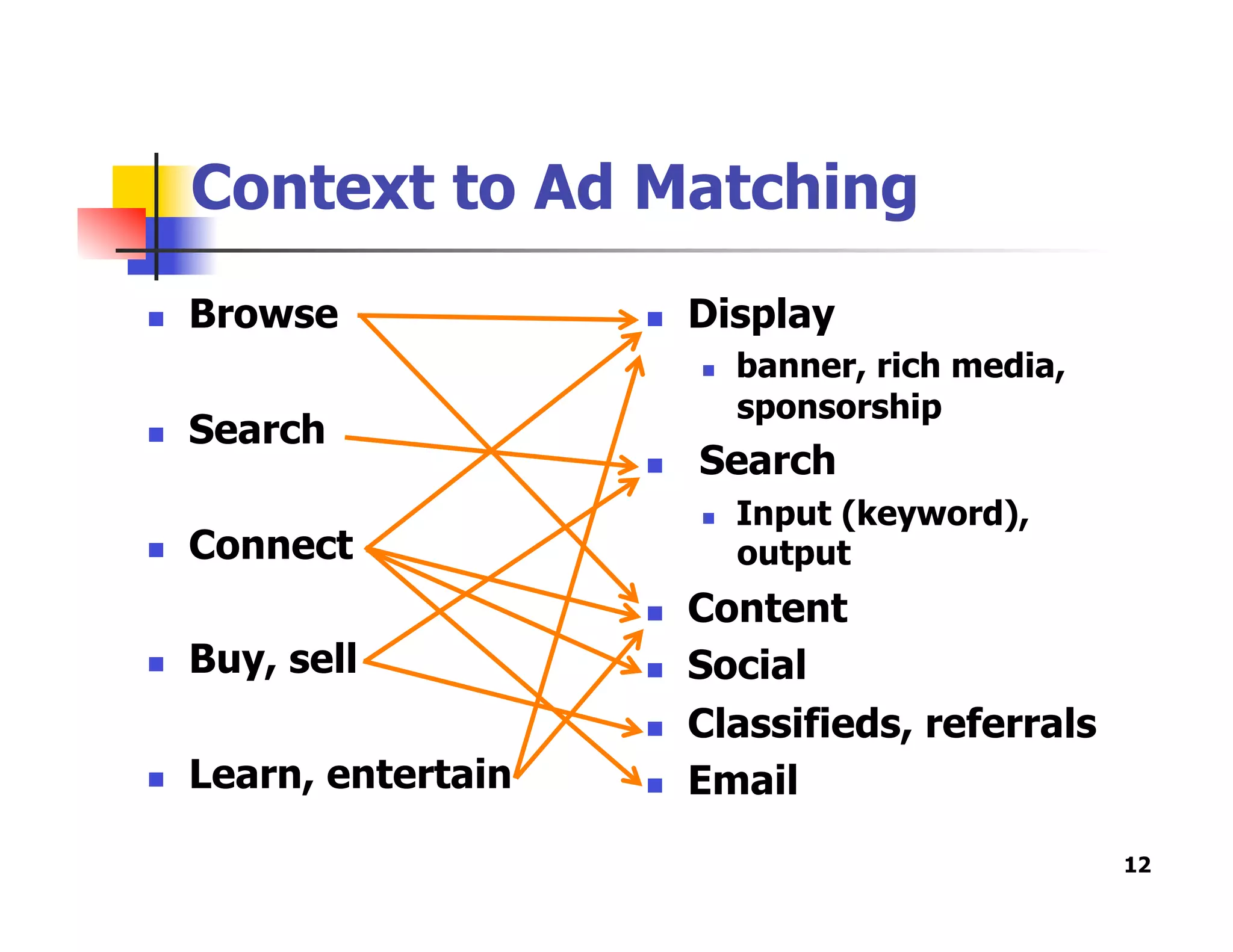
Context to Ad Matching
  Browse
  Search
  Connect
  Buy, sell
  Learn, entertain
  Display
  banner, rich media,
sponsorship
  Search
  Input (keyword),
output
  Content
  Social
  Classifieds, referrals
  Email
12
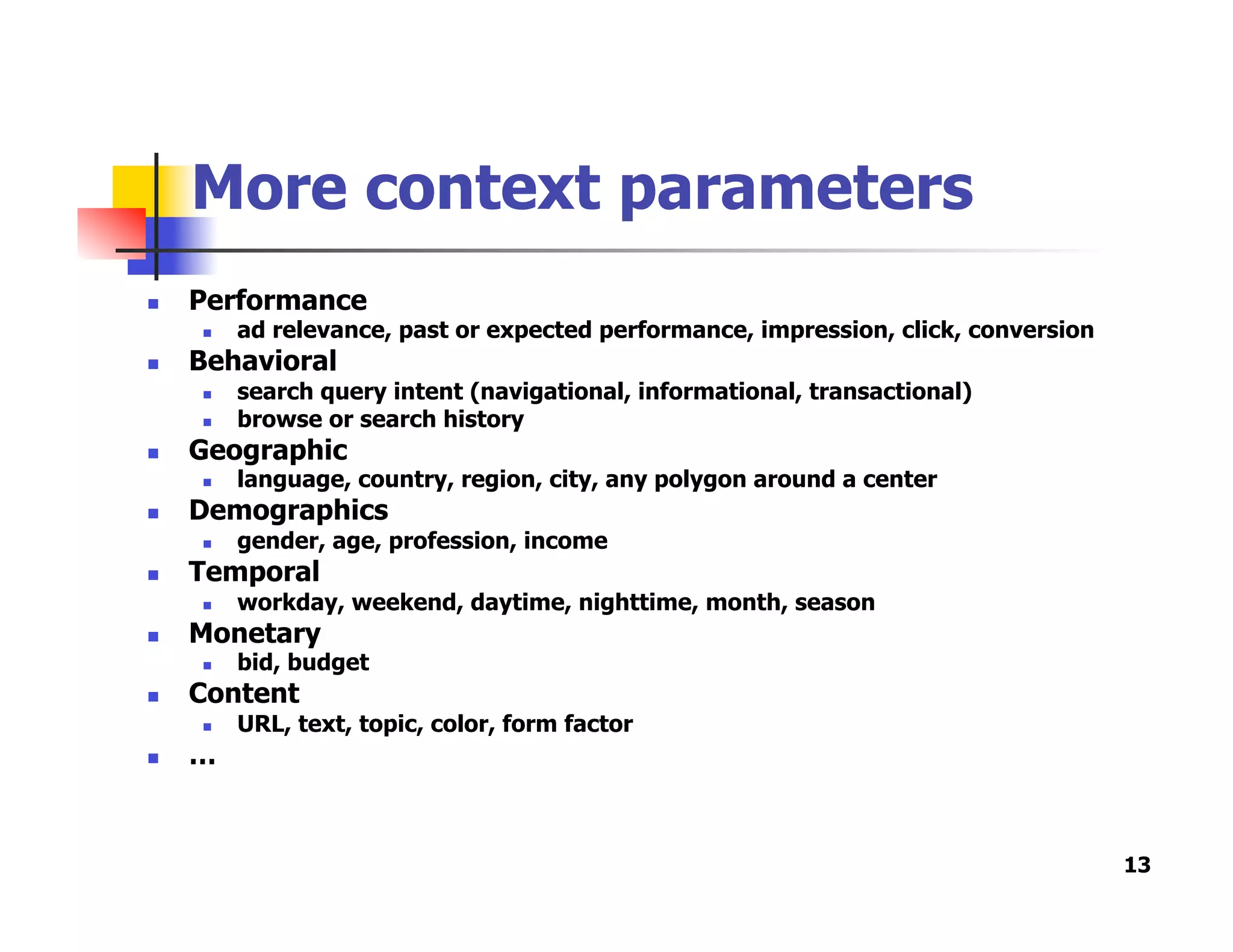
More context parameters
  Performance
  ad relevance, past or expected performance, impression, click, conversion
  Behavioral
  search query intent (navigational, informational, transactional)
  browse or search history
  Geographic
  language, country, region, city, any polygon around a center
  Demographics
  gender, age, profession, income
  Temporal
  workday, weekend, daytime, nighttime, month, season
  Monetary
  bid, budget
  Content
  URL, text, topic, color, form factor
  …
13
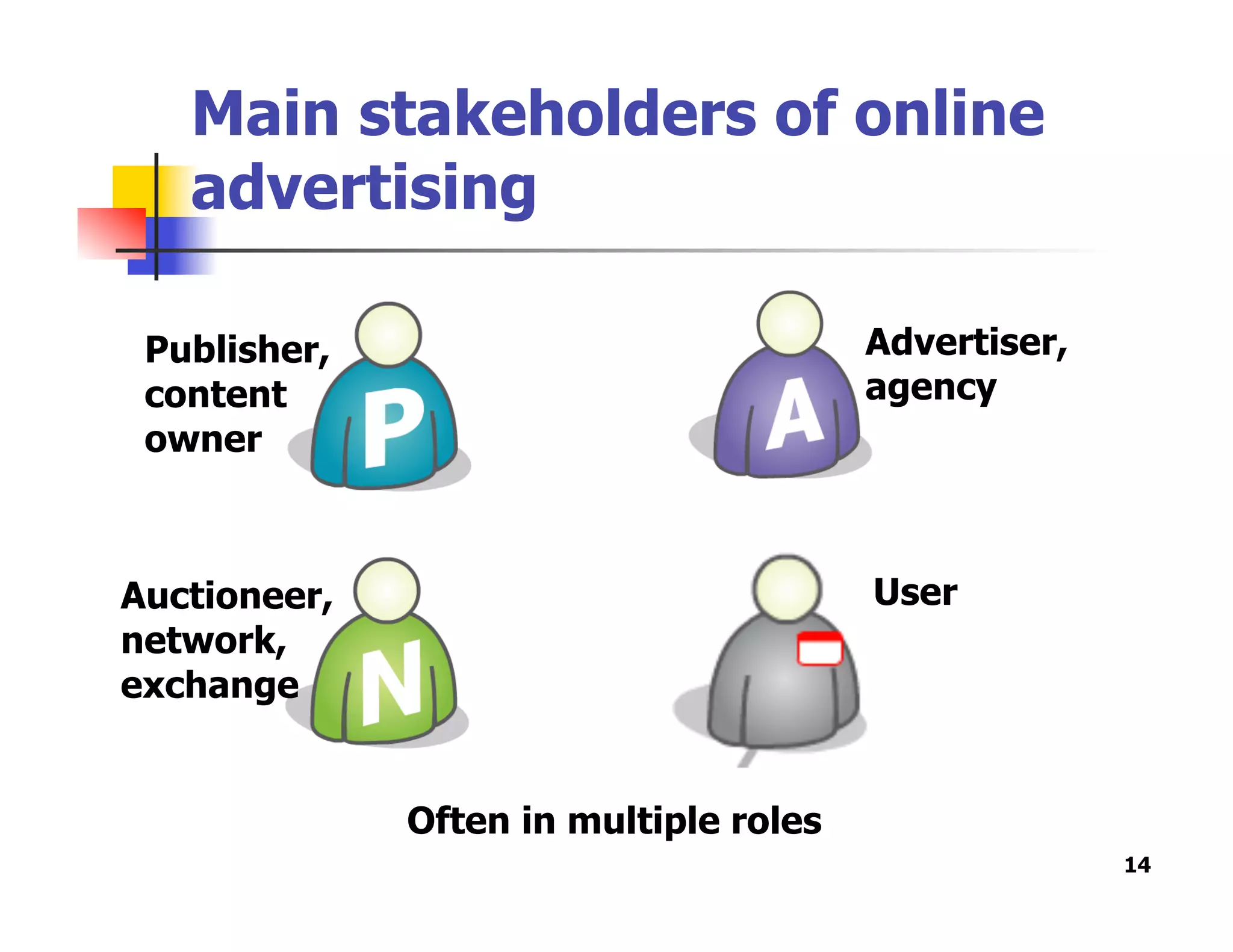
Main stakeholders of online
advertising
14
Publisher,
content
owner
UserAuctioneer,
network,
exchange
Advertiser,
agency
Often in multiple roles
15
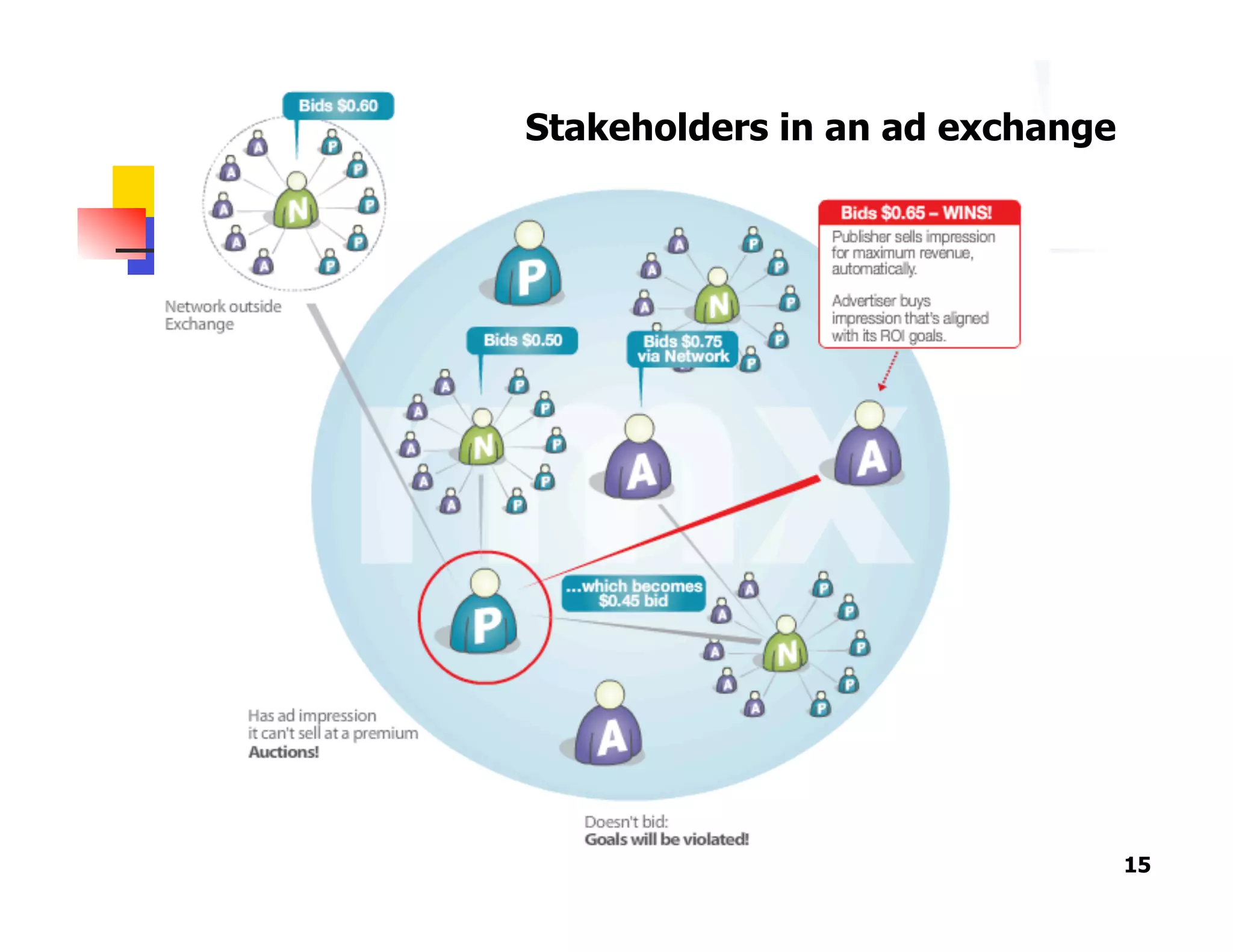
Stakeholders in an ad exchange
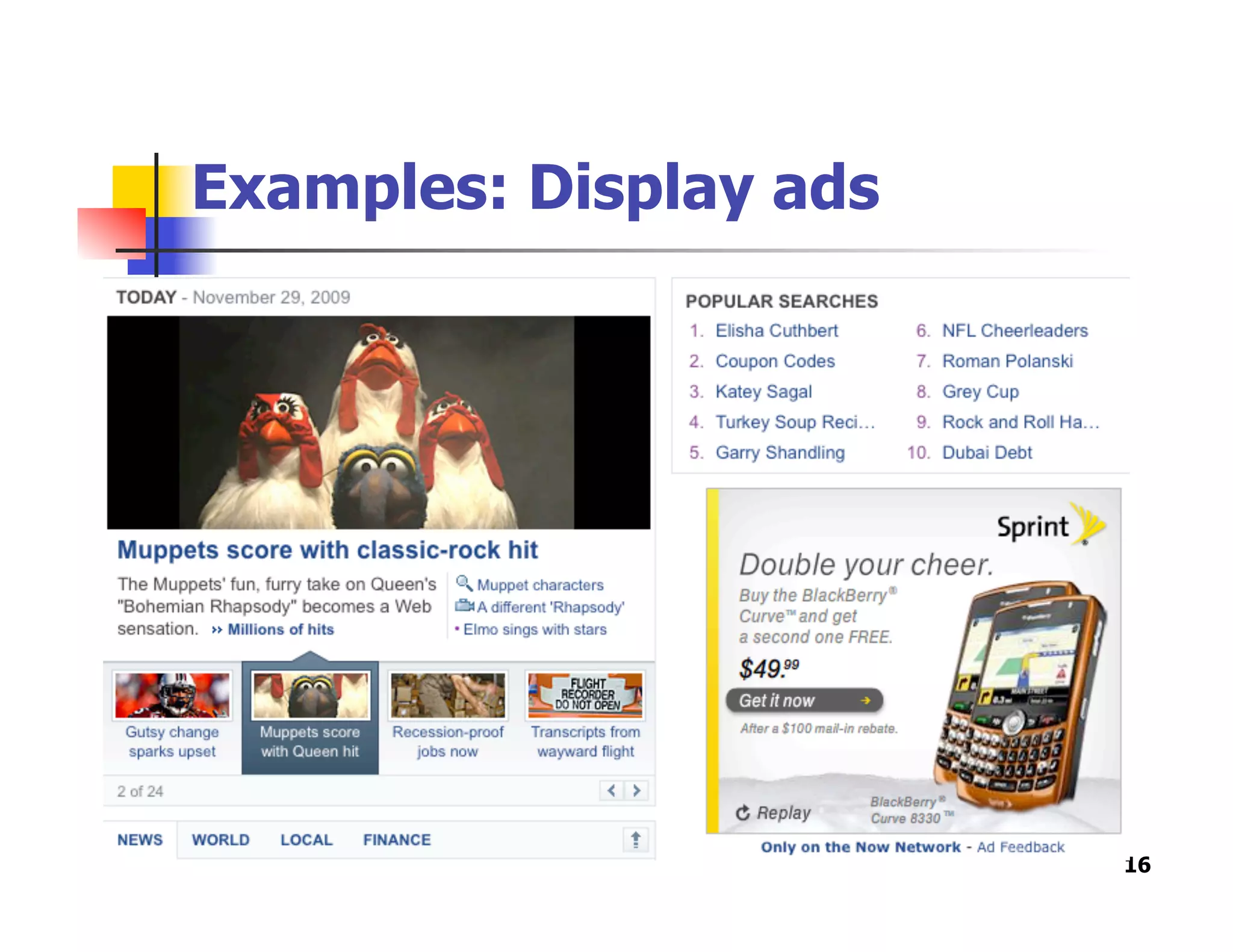
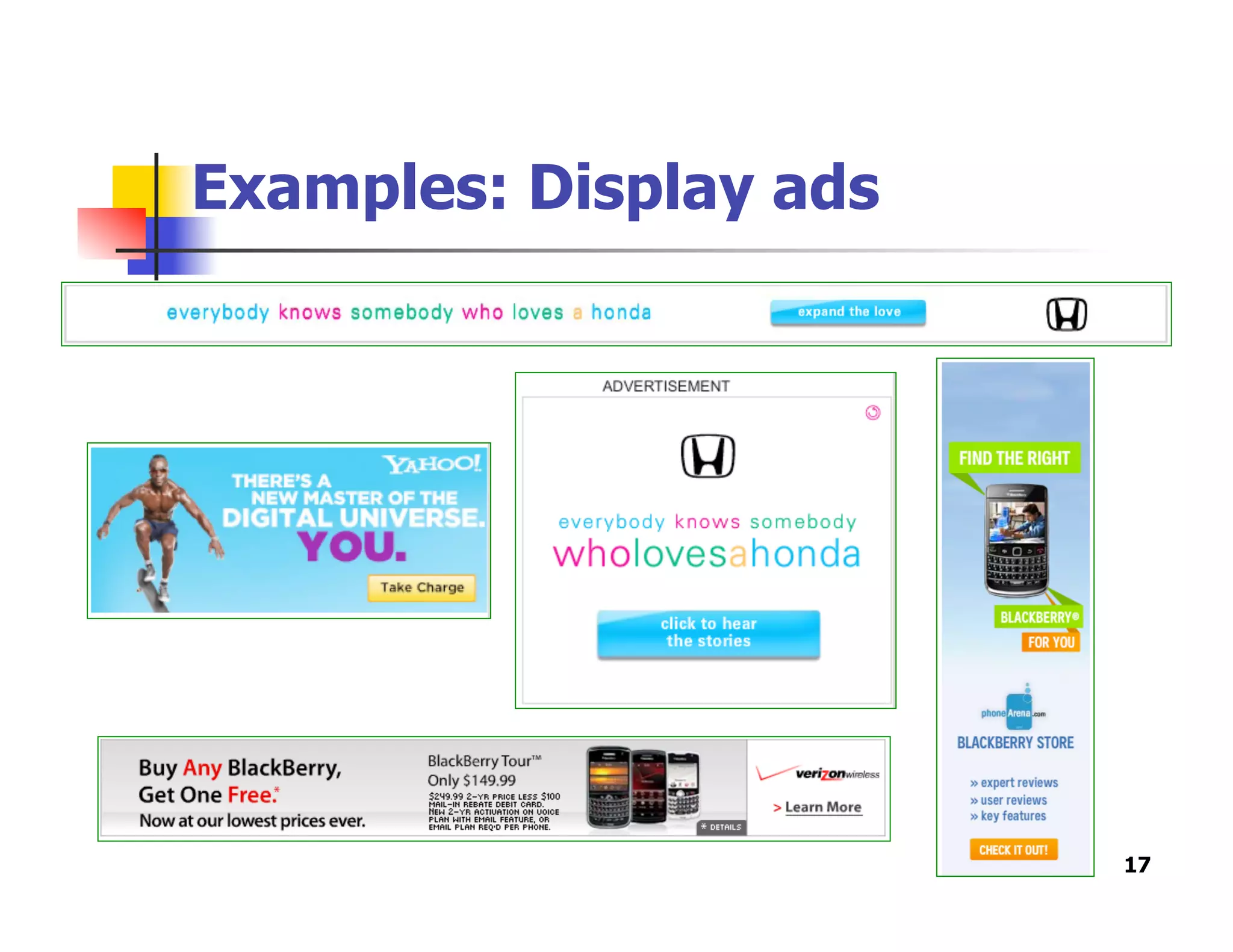
Examples: Display ads
16
Examples: Display ads
17
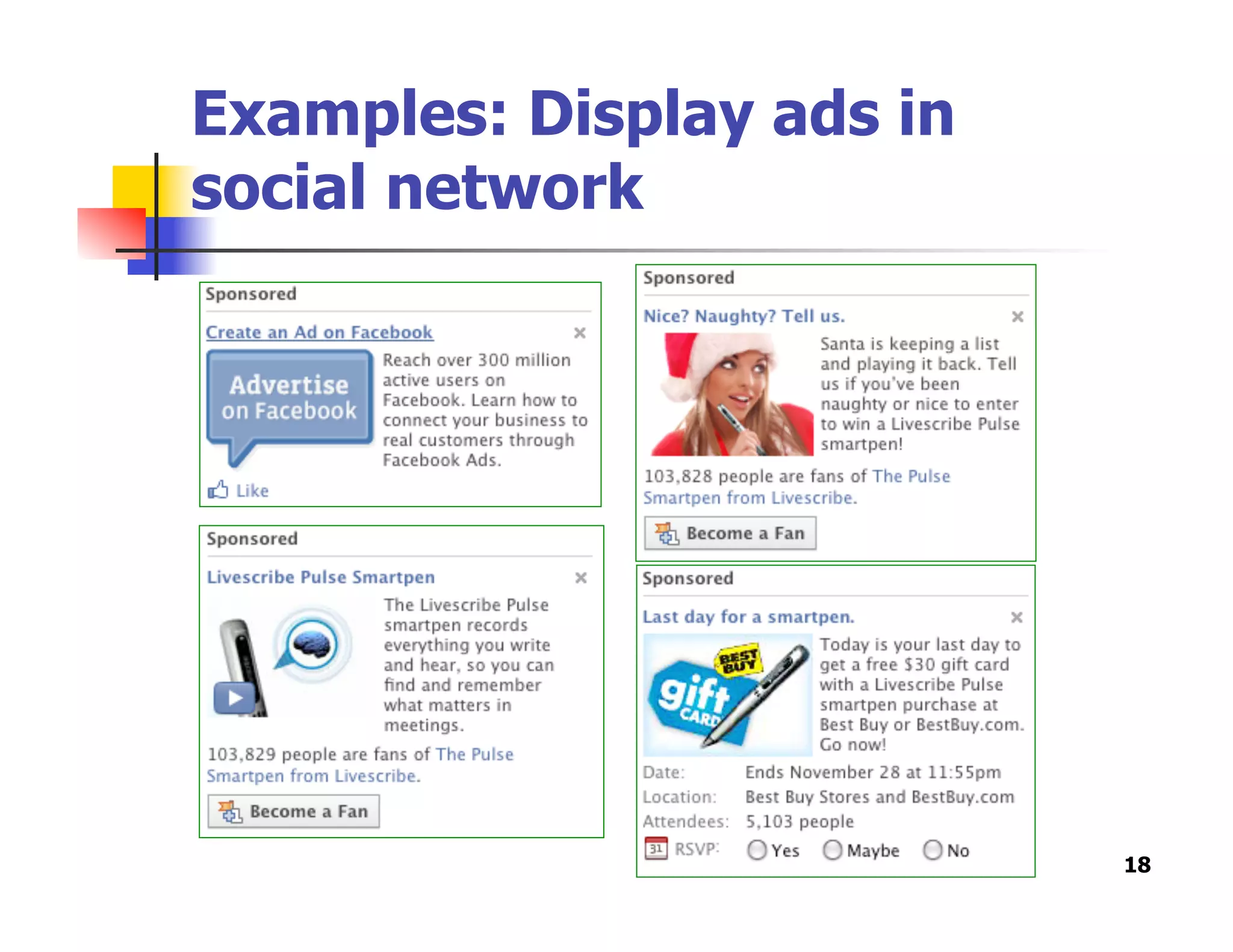
Examples: Display ads in
social network
18
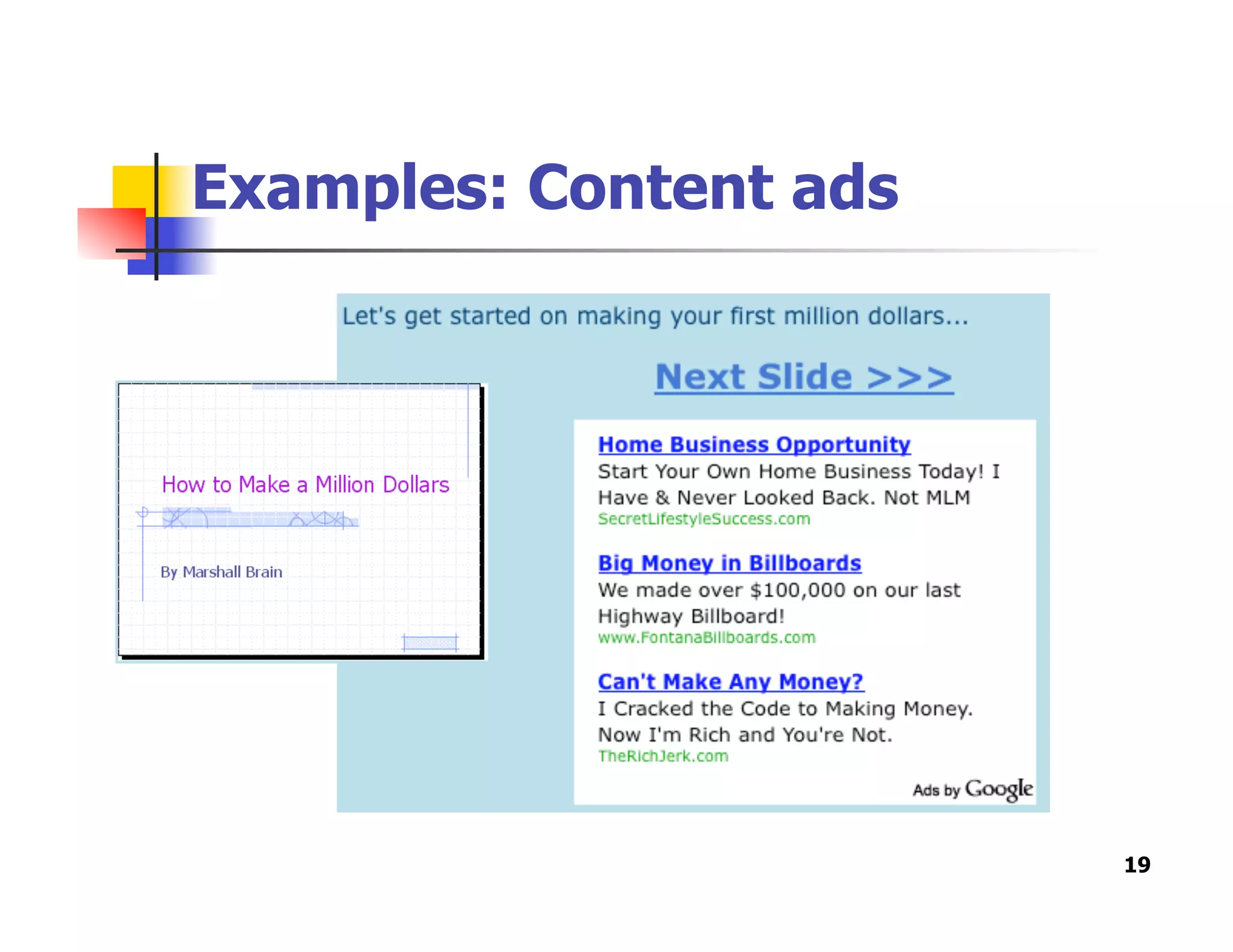
Examples: Content ads
19
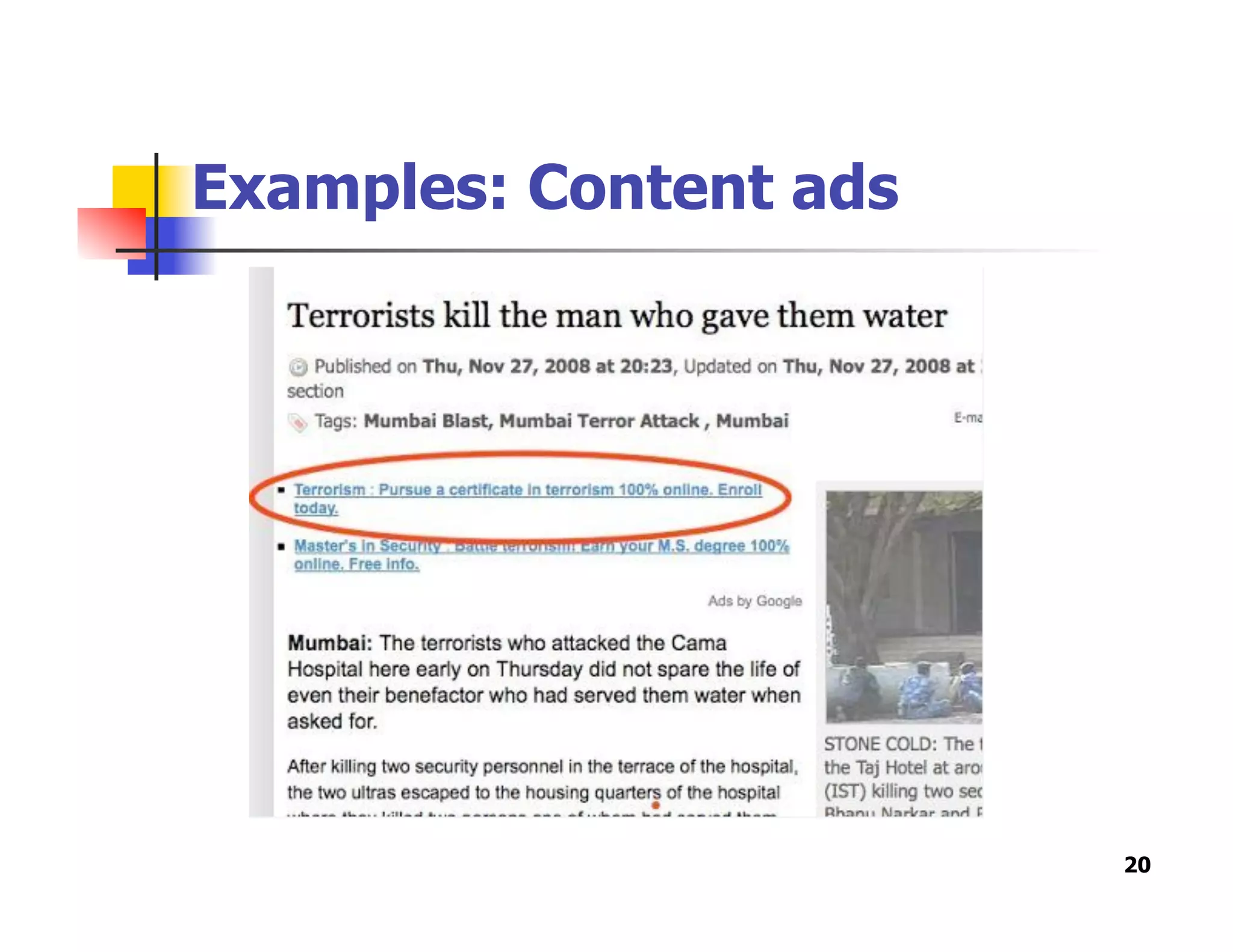
Examples: Content ads
20
Search advertising
overview & examples
21
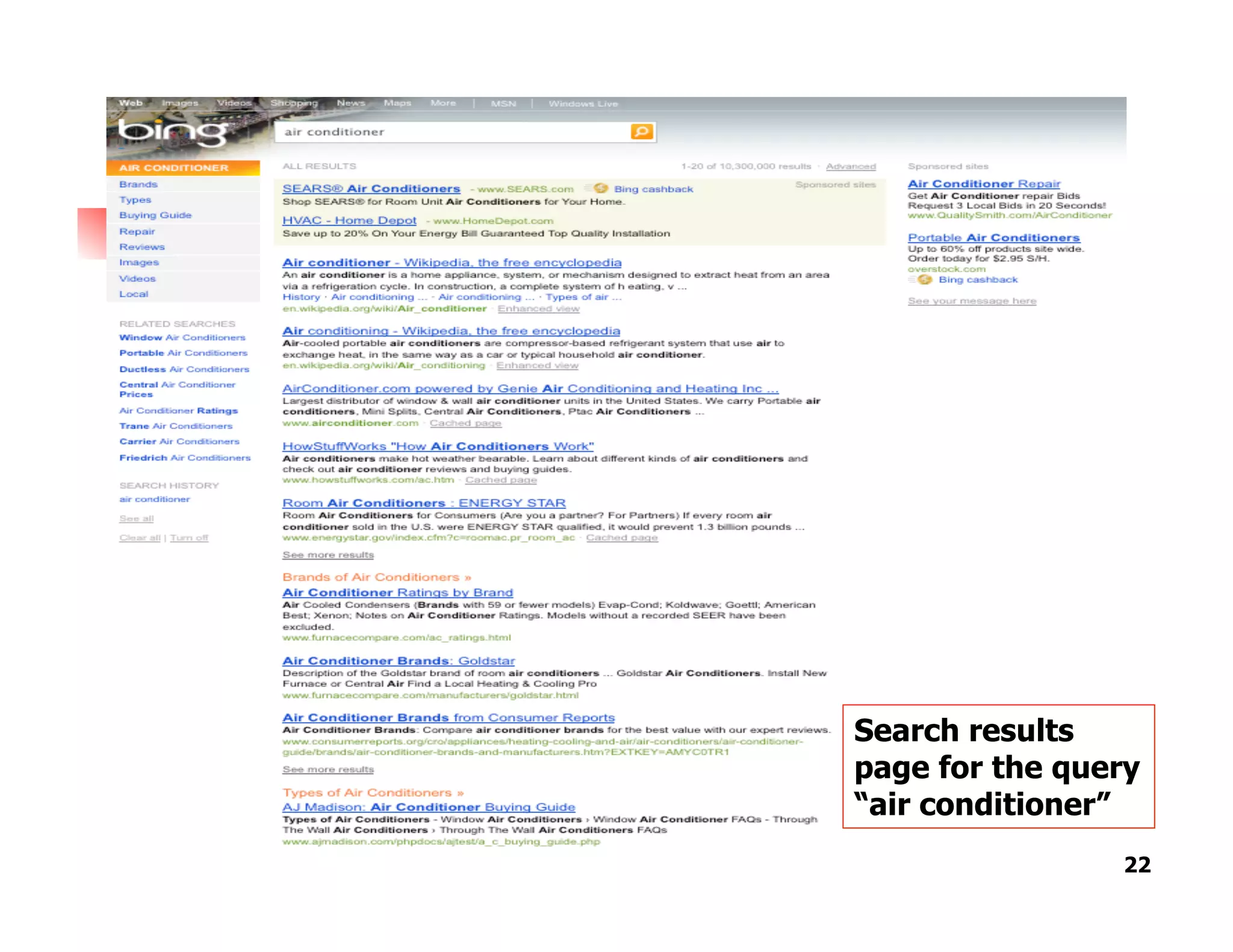
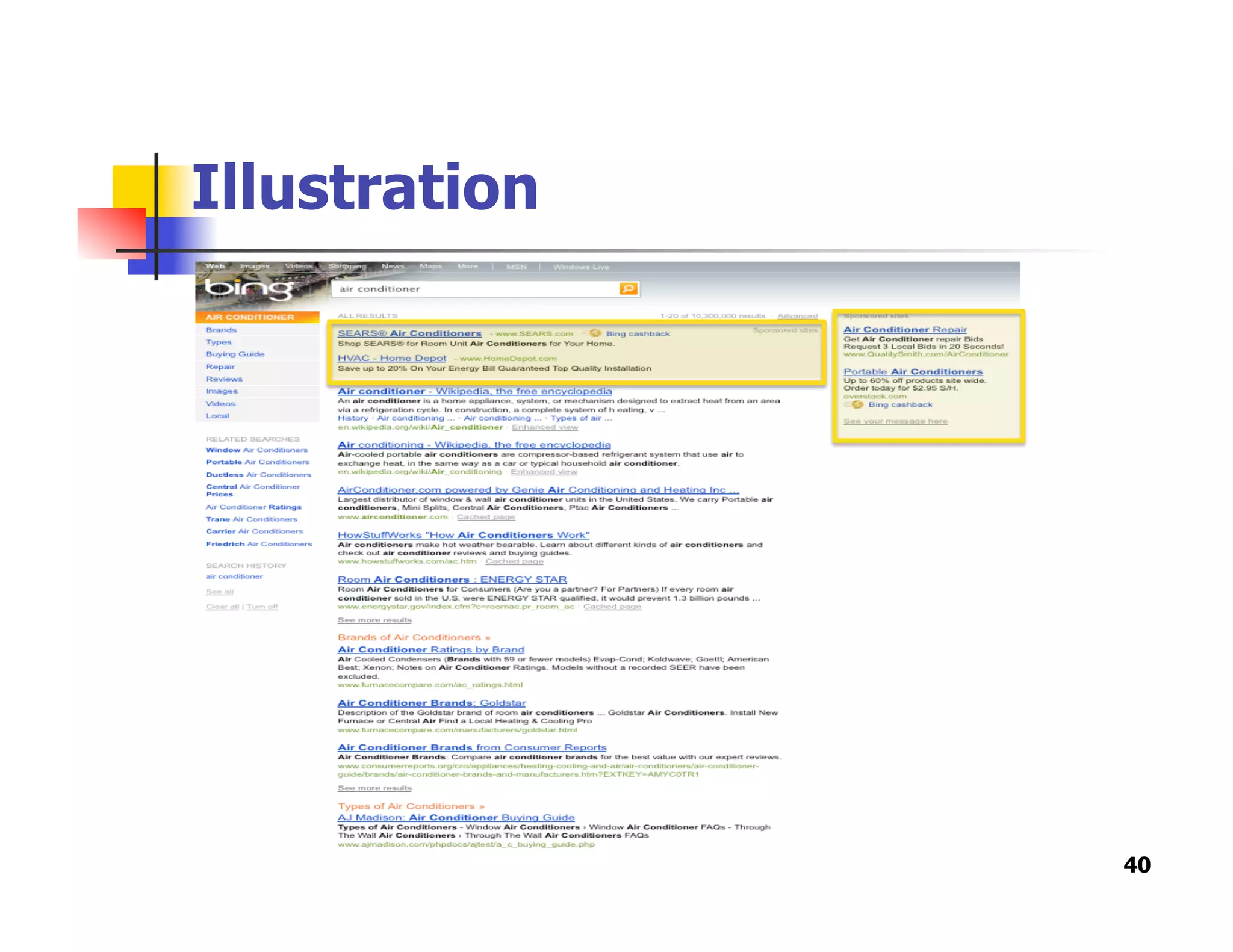
22
Search results
page for the query
“air conditioner”
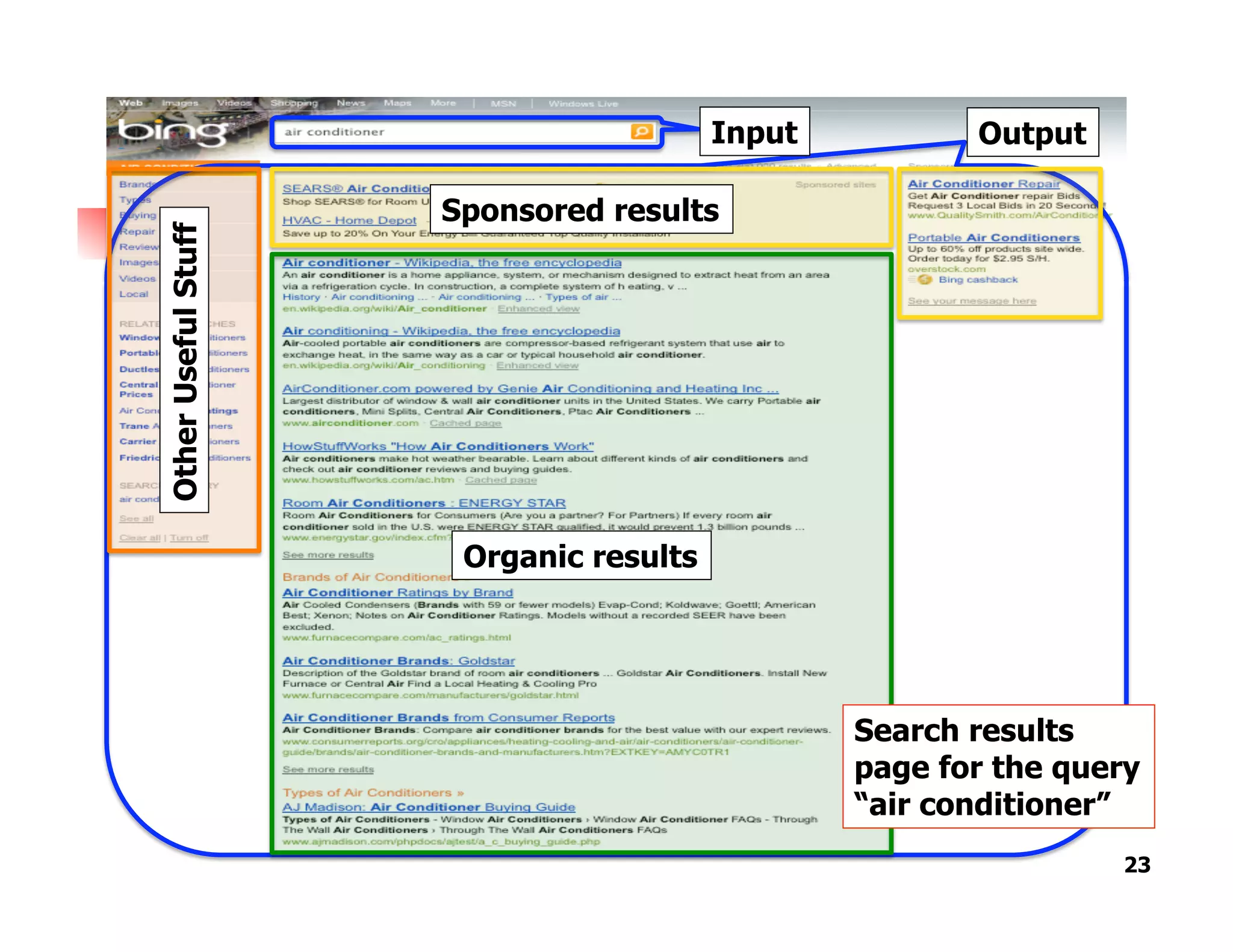
Input Output
Sponsored results
Organic results
OtherUsefulStuff
23
Search results
page for the query
“air conditioner”
Examples: Keyword ads for
[barack obama]
24
Examples: Keyword ads for
[new york university]
25
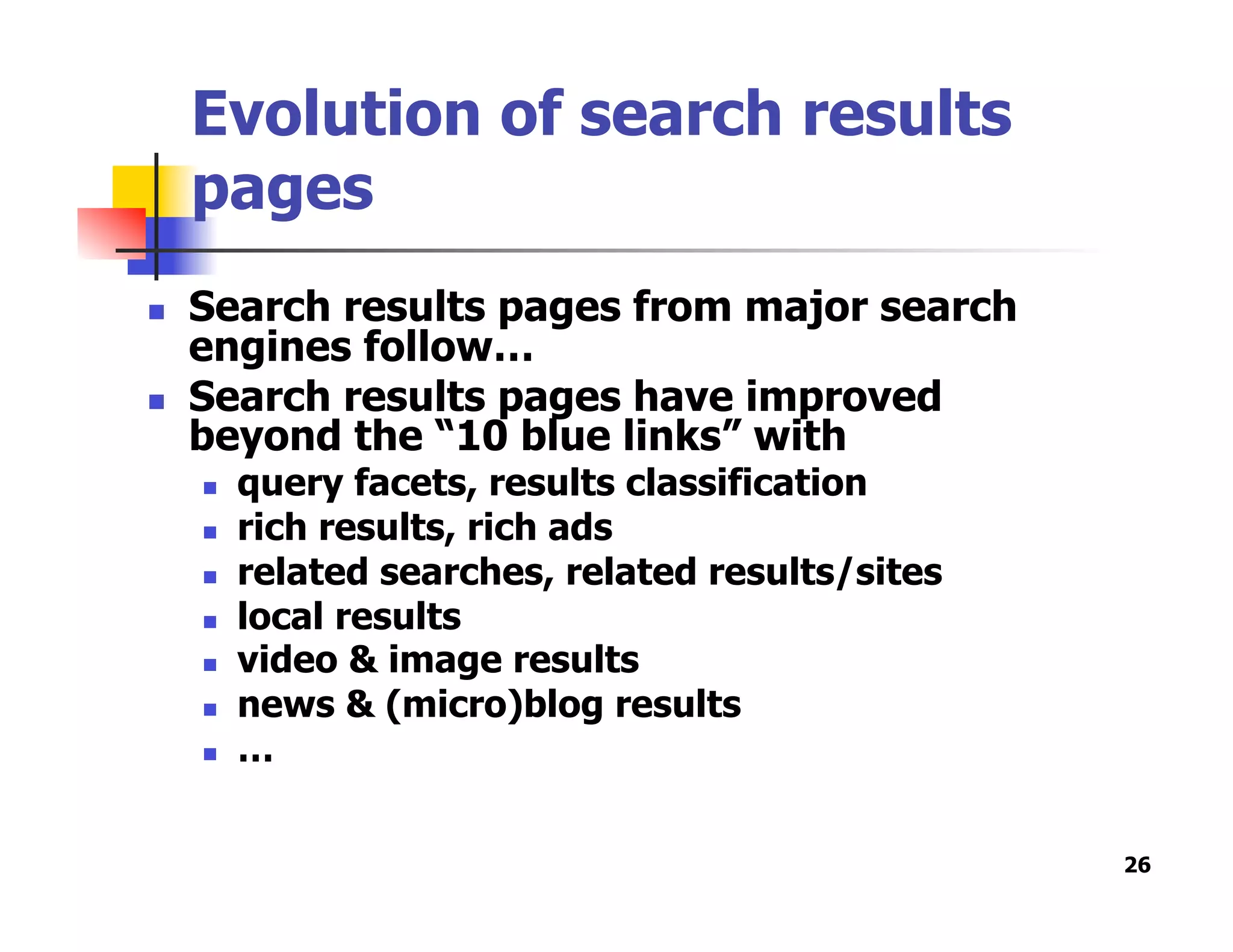
Evolution of search results
pages
  Search results pages from major search
engines follow…
  Search results pages have improved
beyond the “10 blue links” with
  query facets, results classification
  rich results, rich ads
  related searches, related results/sites
  local results
  video & image results
  news & (micro)blog results
  …
26
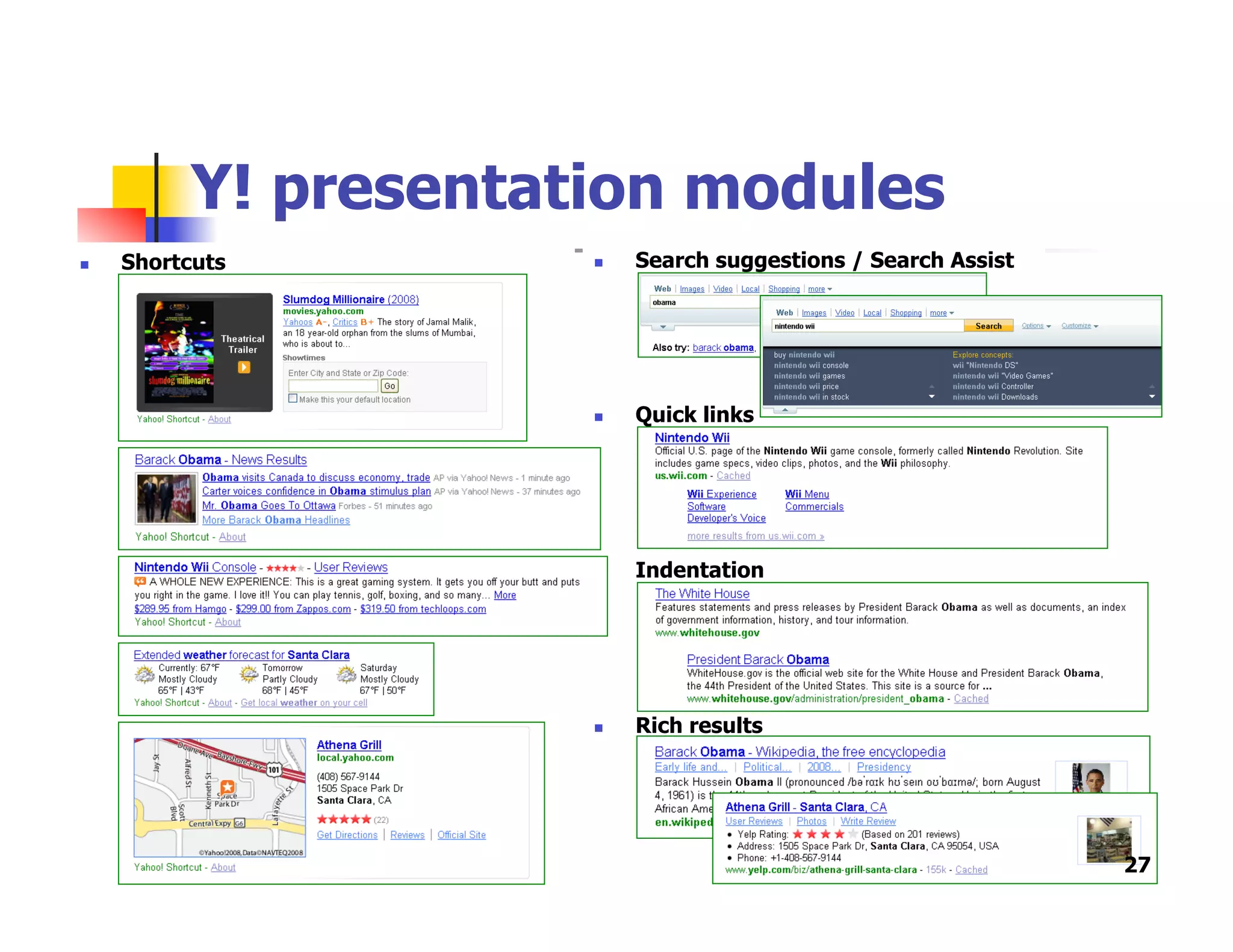
Y! presentation modules
  Shortcuts   Search suggestions / Search Assist
  Quick links
  Indentation
  Rich results
27
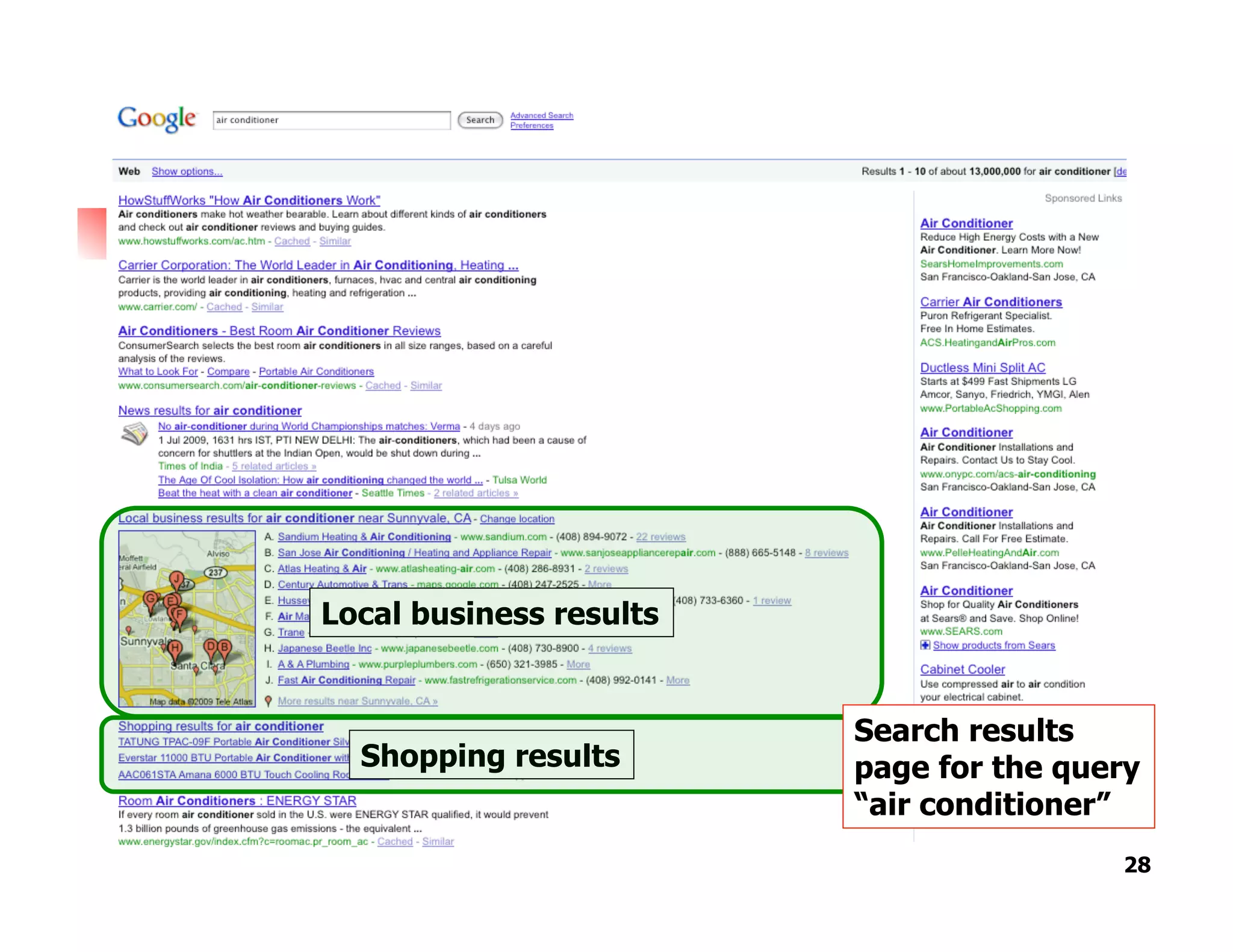
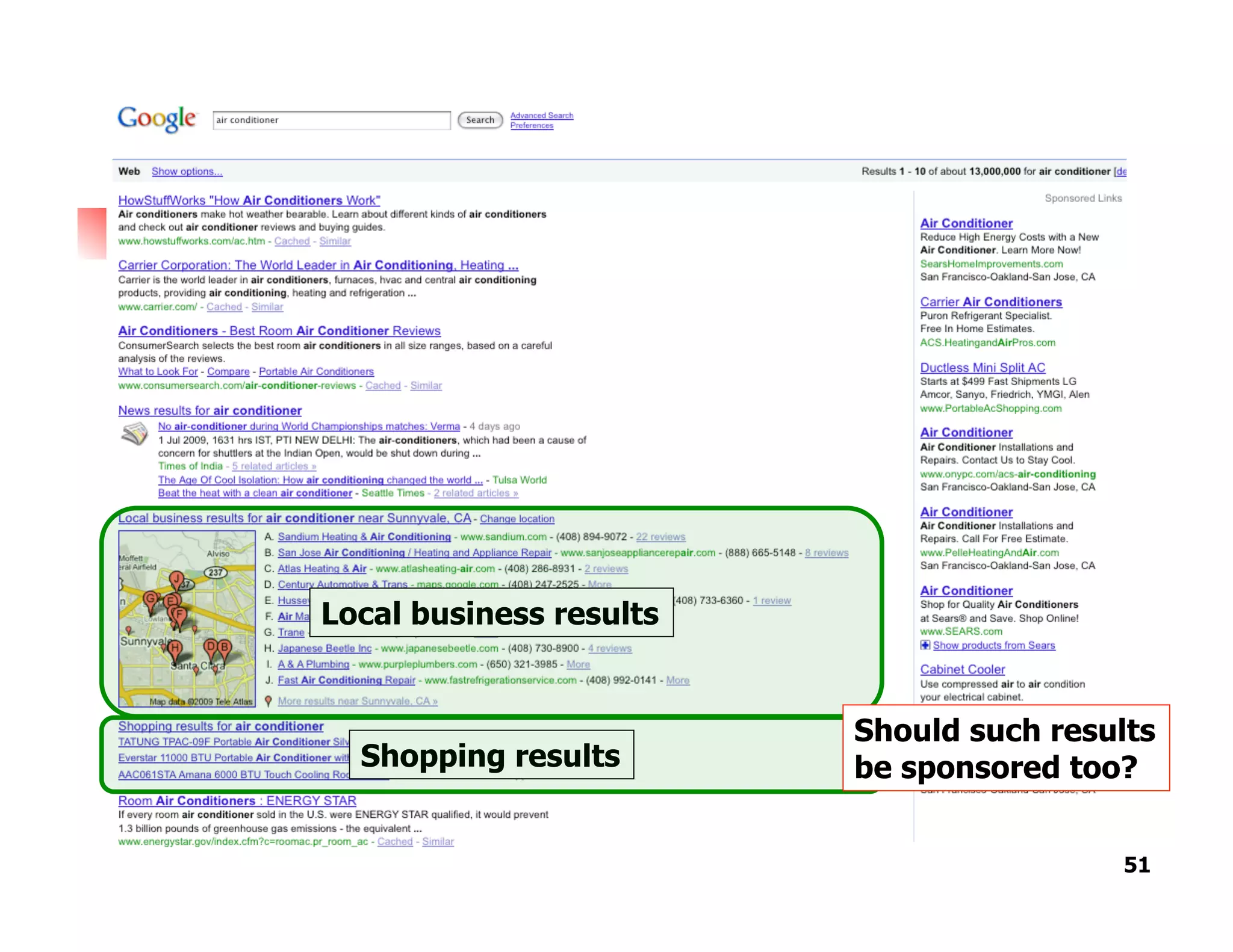
Local business results
Shopping results
28
Search results
page for the query
“air conditioner”
29
30
Rich ad
Organic result
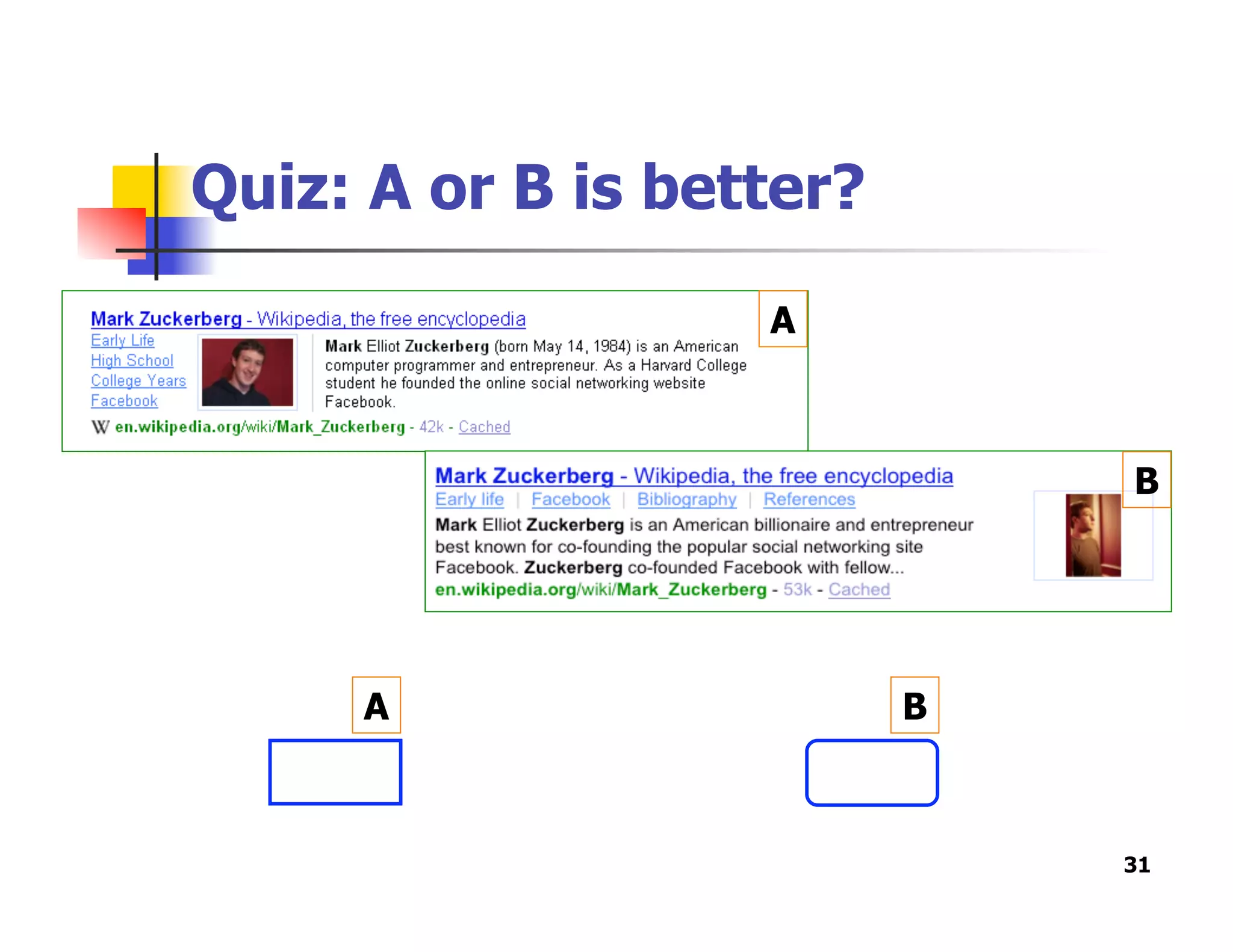
Quiz: A or B is better?
31
A
B
A B
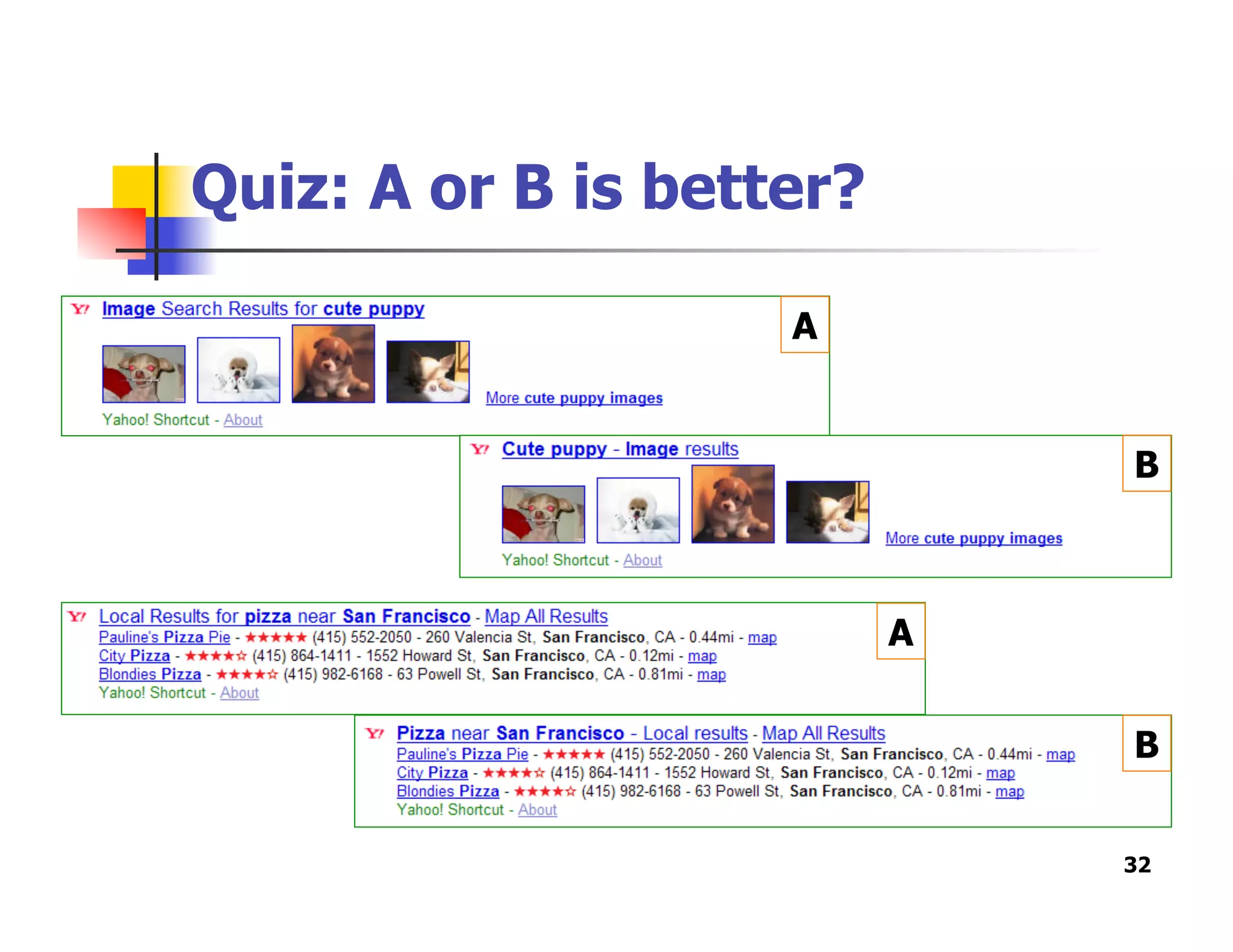
Quiz: A or B is better?
32
A
A
B
B
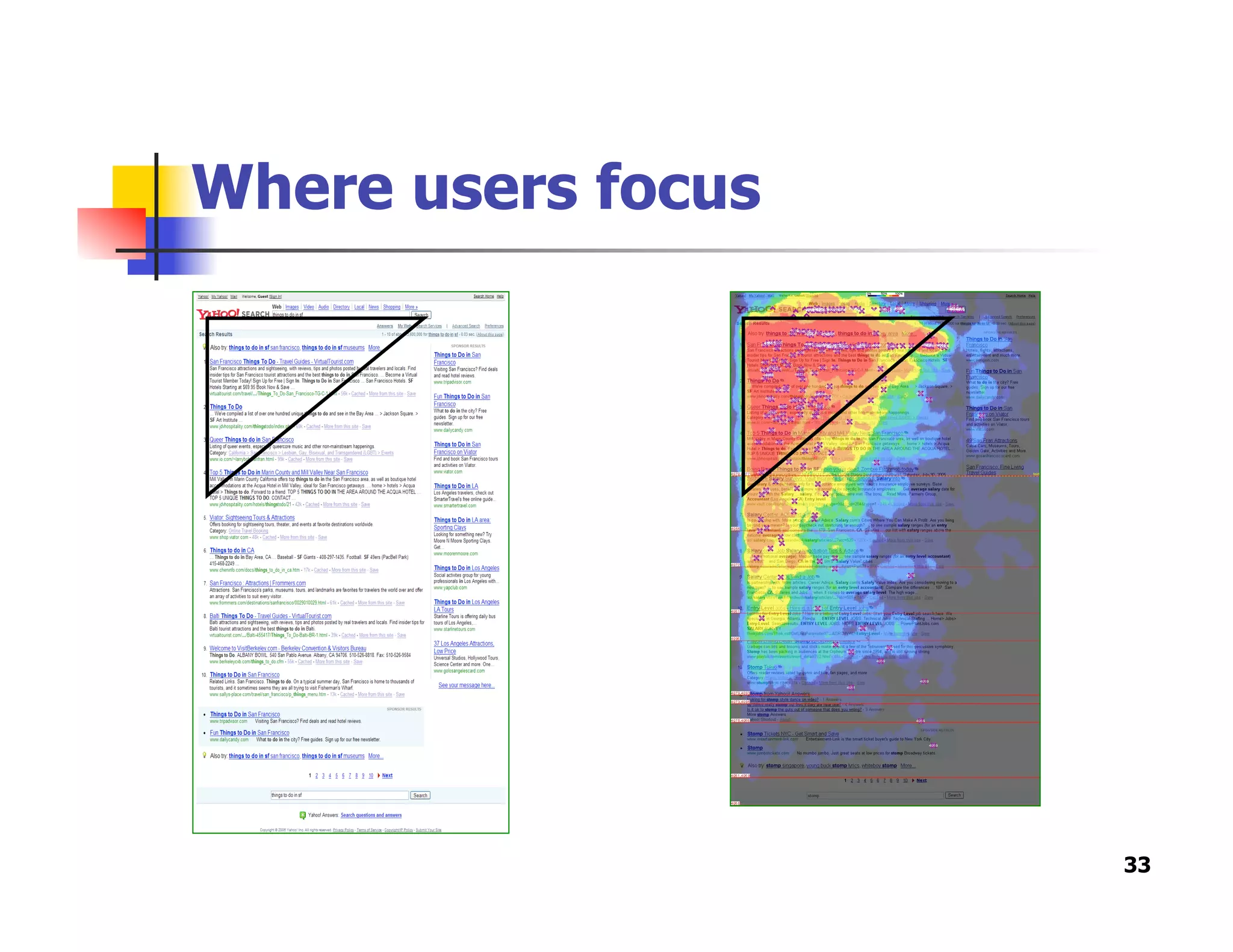
Where users focus
33
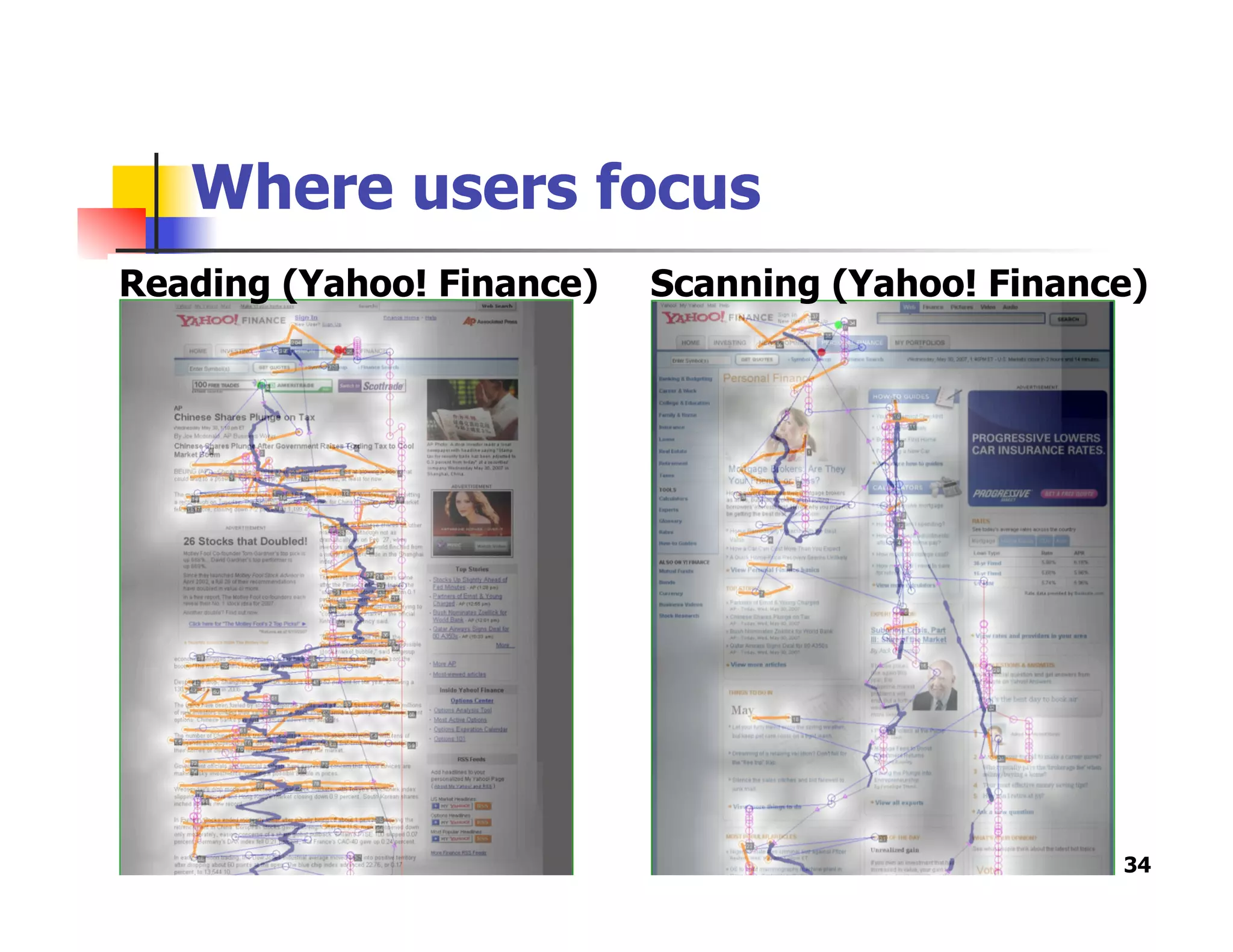
Where users focus
34
Reading (Yahoo! Finance) Scanning (Yahoo! Finance)
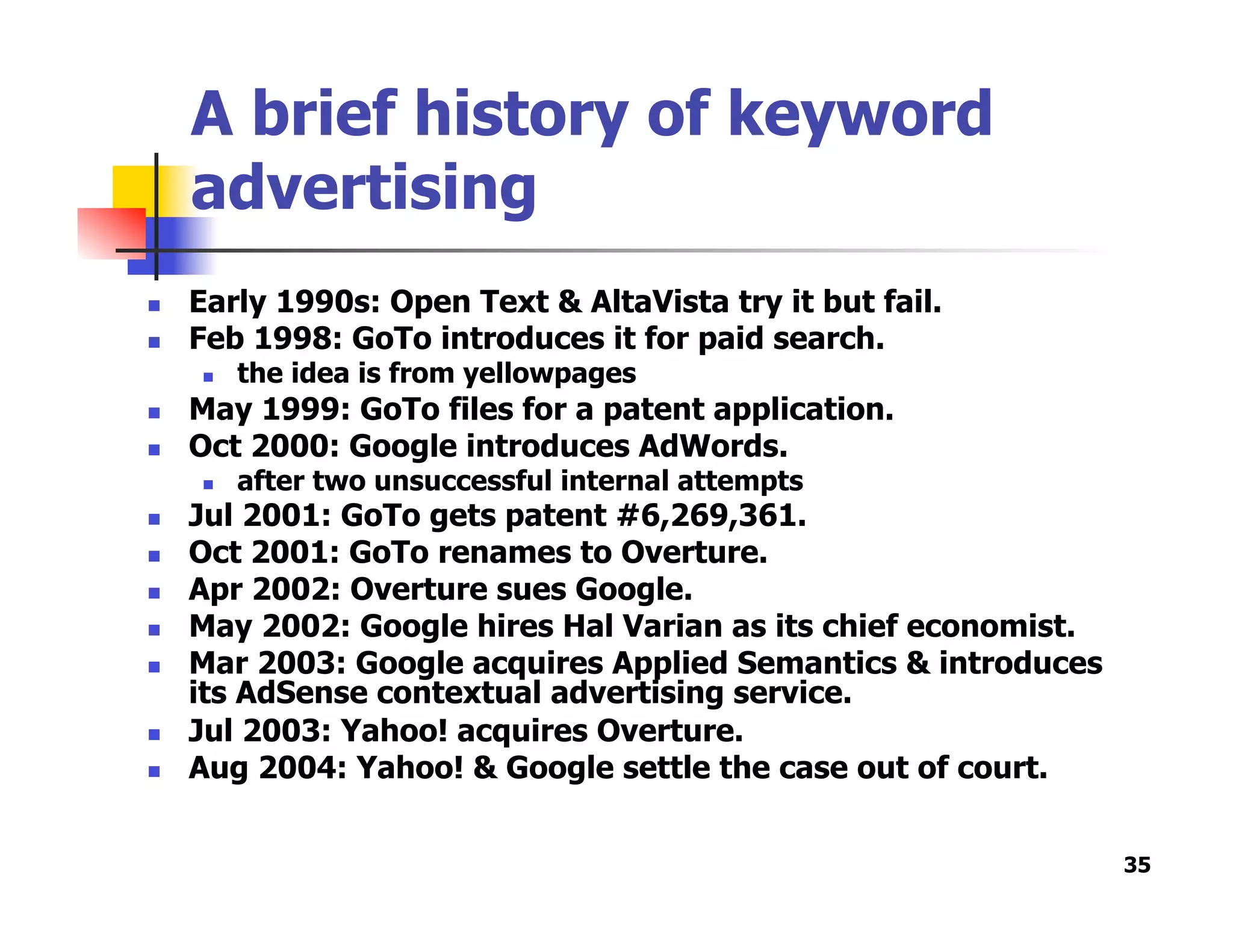
A brief history of keyword
advertising
  Early 1990s: Open Text & AltaVista try it but fail.
  Feb 1998: GoTo introduces it for paid search.
  the idea is from yellowpages
  May 1999: GoTo files for a patent application.
  Oct 2000: Google introduces AdWords.
  after two unsuccessful internal attempts
  Jul 2001: GoTo gets patent #6,269,361.
  Oct 2001: GoTo renames to Overture.
  Apr 2002: Overture sues Google.
  May 2002: Google hires Hal Varian as its chief economist.
  Mar 2003: Google acquires Applied Semantics & introduces
its AdSense contextual advertising service.
  Jul 2003: Yahoo! acquires Overture.
  Aug 2004: Yahoo! & Google settle the case out of court.
35
36
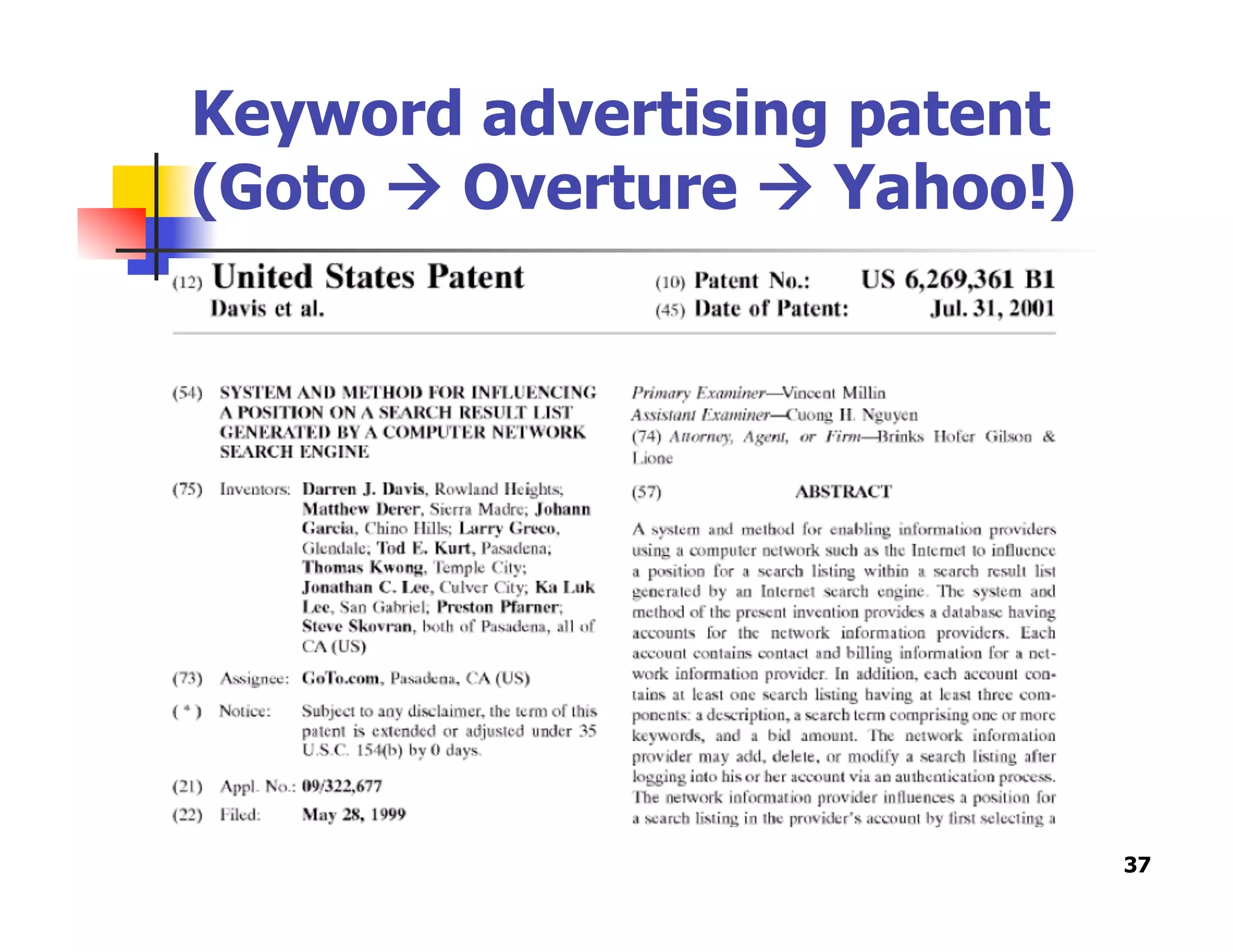
Keyword advertising patent
(Goto  Overture  Yahoo!)
37
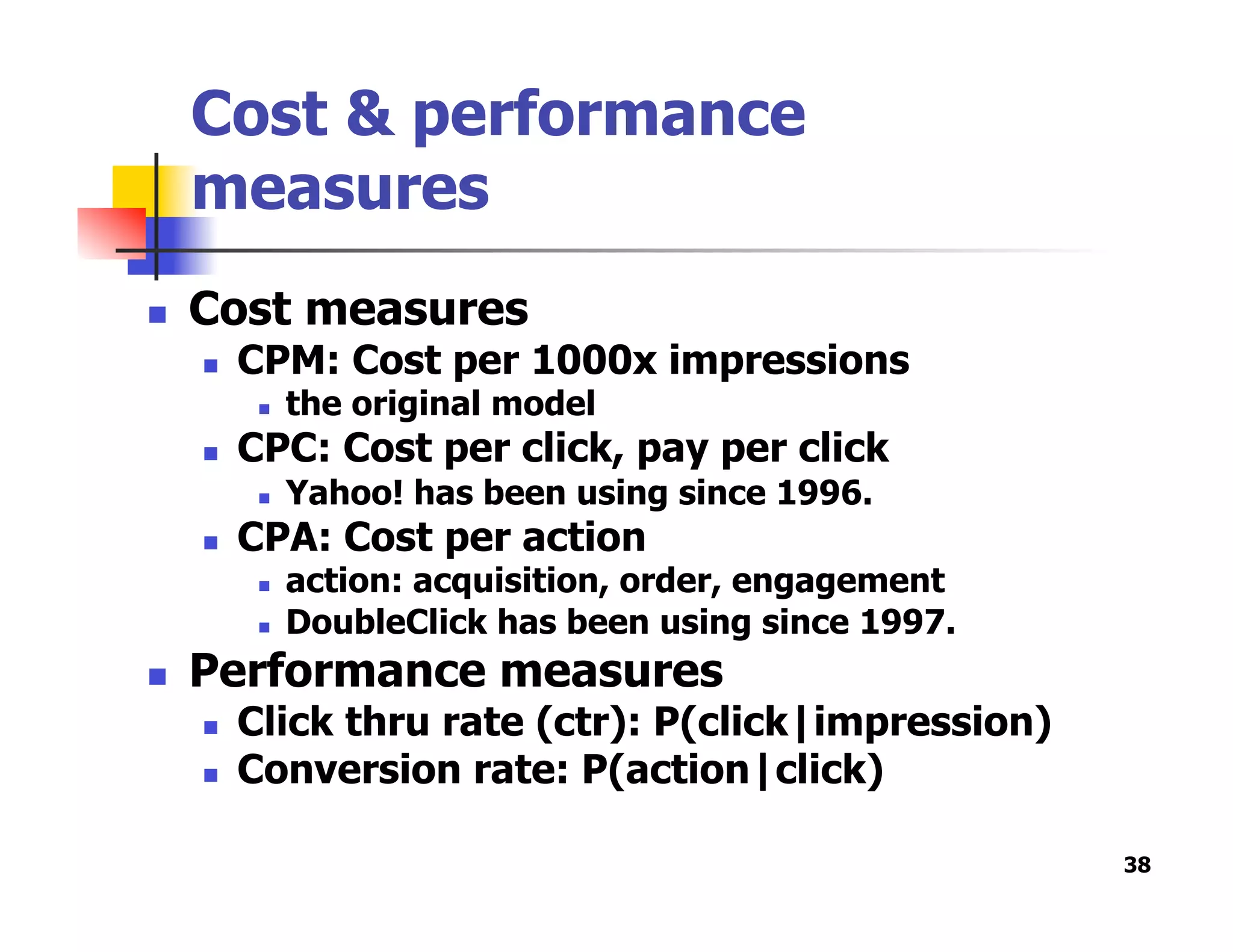
Cost & performance
measures
  Cost measures
  CPM: Cost per 1000x impressions
  the original model
  CPC: Cost per click, pay per click
  Yahoo! has been using since 1996.
  CPA: Cost per action
  action: acquisition, order, engagement
  DoubleClick has been using since 1997.
  Performance measures
  Click thru rate (ctr): P(click|impression)
  Conversion rate: P(action|click)
38
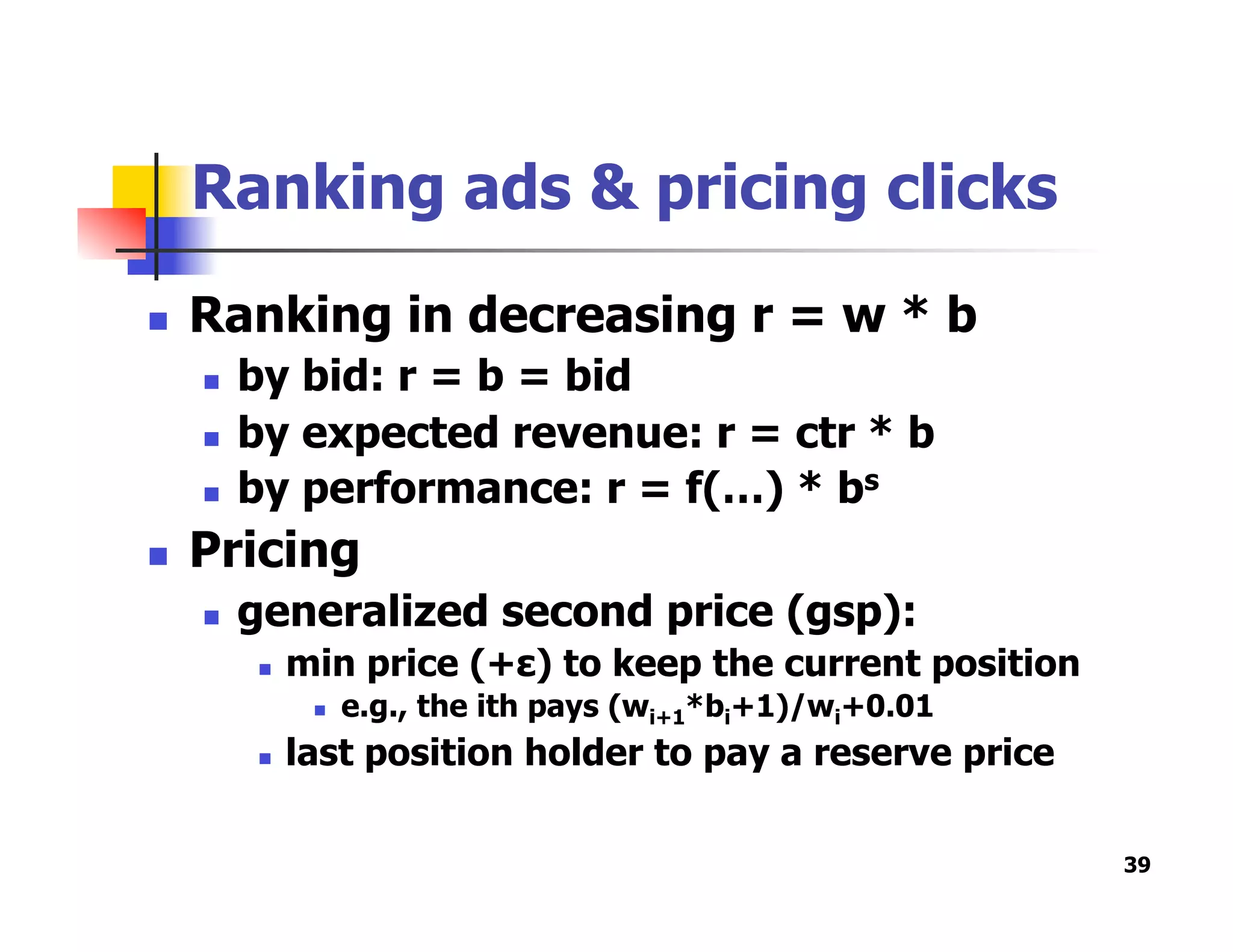
Ranking ads & pricing clicks
  Ranking in decreasing r = w * b
  by bid: r = b = bid
  by expected revenue: r = ctr * b
  by performance: r = f(…) * bs
  Pricing
  generalized second price (gsp):
  min price (+ε) to keep the current position
  e.g., the ith pays (wi+1*bi+1)/wi+0.01
  last position holder to pay a reserve price
39
Illustration
40
Output bidding, a new
search advertising model
41
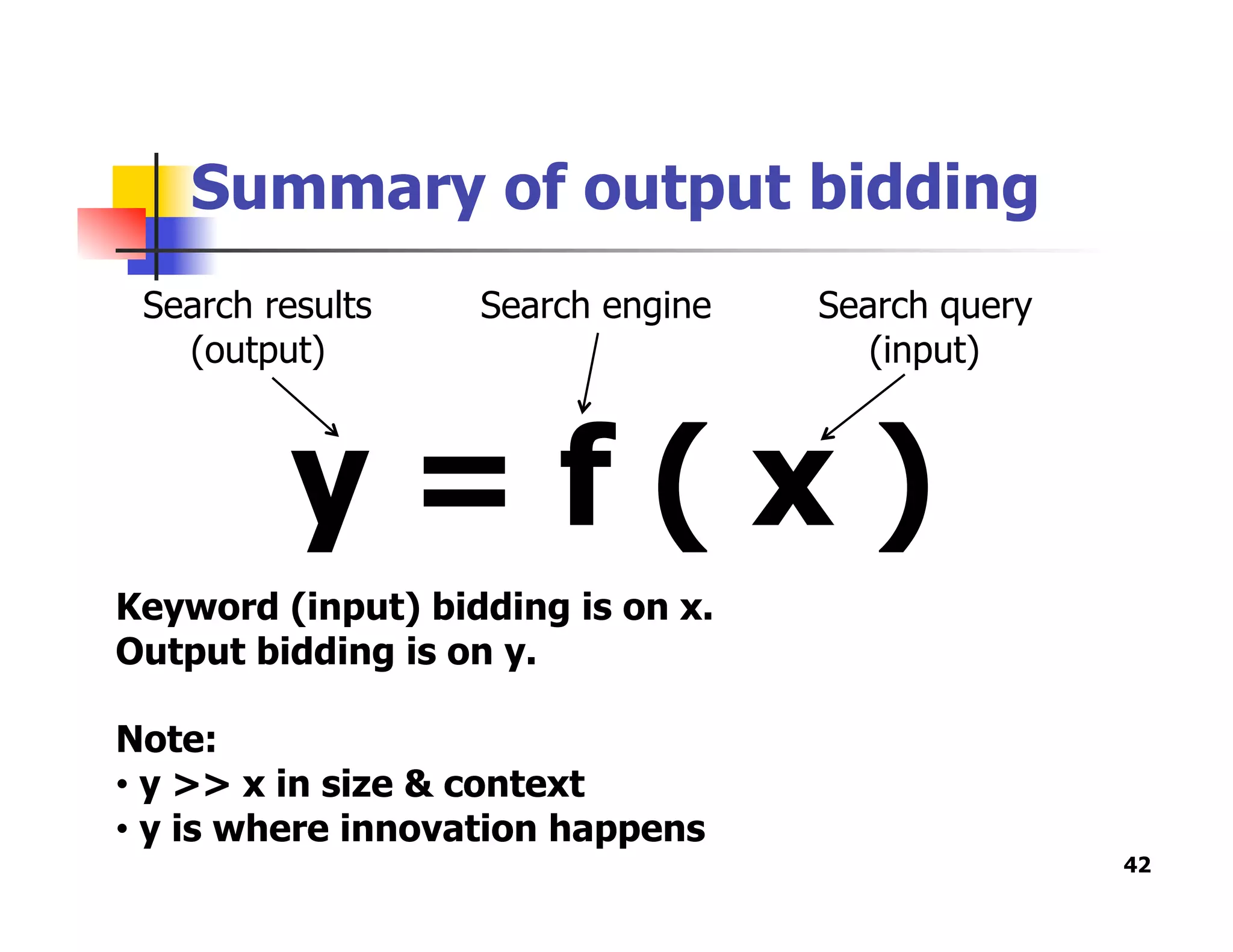
Summary of output bidding
42
y = f ( x )
Search results
(output)
Search engine Search query
(input)
Keyword (input) bidding is on x.
Output bidding is on y.
Note:
•  y >> x in size & context
•  y is where innovation happens
Review of input & output
  Search engine as a mapping:
  Output = SE( Input )  y = f( x )
  Input: What users give to SEs
  a few keywords as a query
  very limited (given) context
  Output: What SEs produce
  lots of data and metadata
  far richer context & getting richer
  where innovation happens
43
Intent bidding &
ad association
  What do advertisers bid on?
  users’ (purchasing) intent
  signal for intent: keywords
  How do advertisers bid?
  associate their ads with keywords
44
Output bidding proposal
  Claims
  use output as a far richer signal for
intent
  associate ads with output too
  Proposal
  direct use: Bidding on output explicitly
  indirect use: Use of output as part of
input bidding
45
Output bidding variations
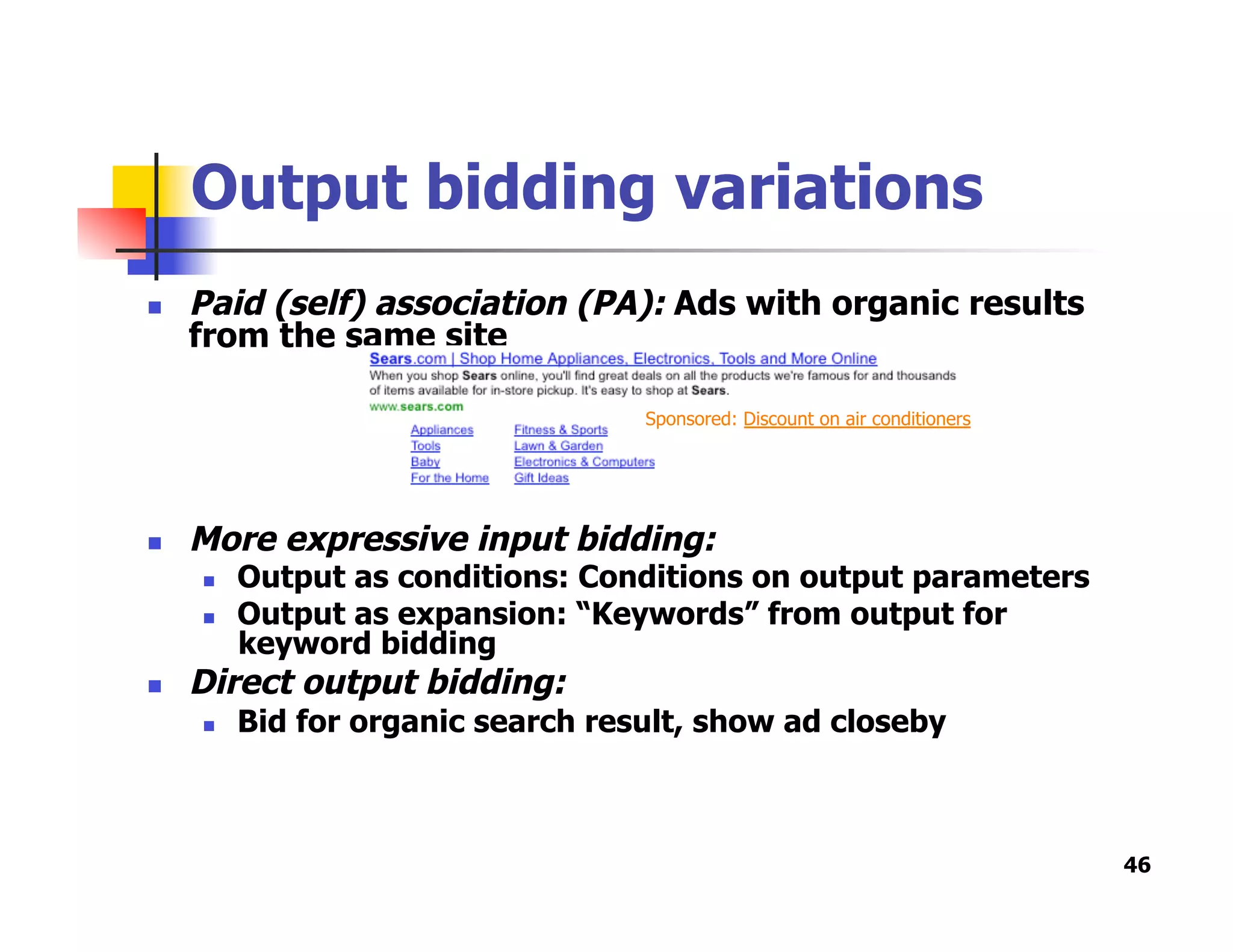
  Paid (self) association (PA): Ads with organic results
from the same site
  More expressive input bidding:
  Output as conditions: Conditions on output parameters
  Output as expansion: “Keywords” from output for
keyword bidding
  Direct output bidding:
  Bid for organic search result, show ad closeby
46
Sponsored: Discount on air conditioners
Issues to resolve
  Mindset – probably the most difficult issue
  User interface: New ads as an extension of sponsored results
space or next to target organic result? News ads shown with
mouse over or always on?
  Auction modeling: What if an advertiser bids for both input
and output, or multiple outputs? How not to undermine input
bidding revenue with output bidding? What is the role of
organic content publisher in auctions regarding its content?
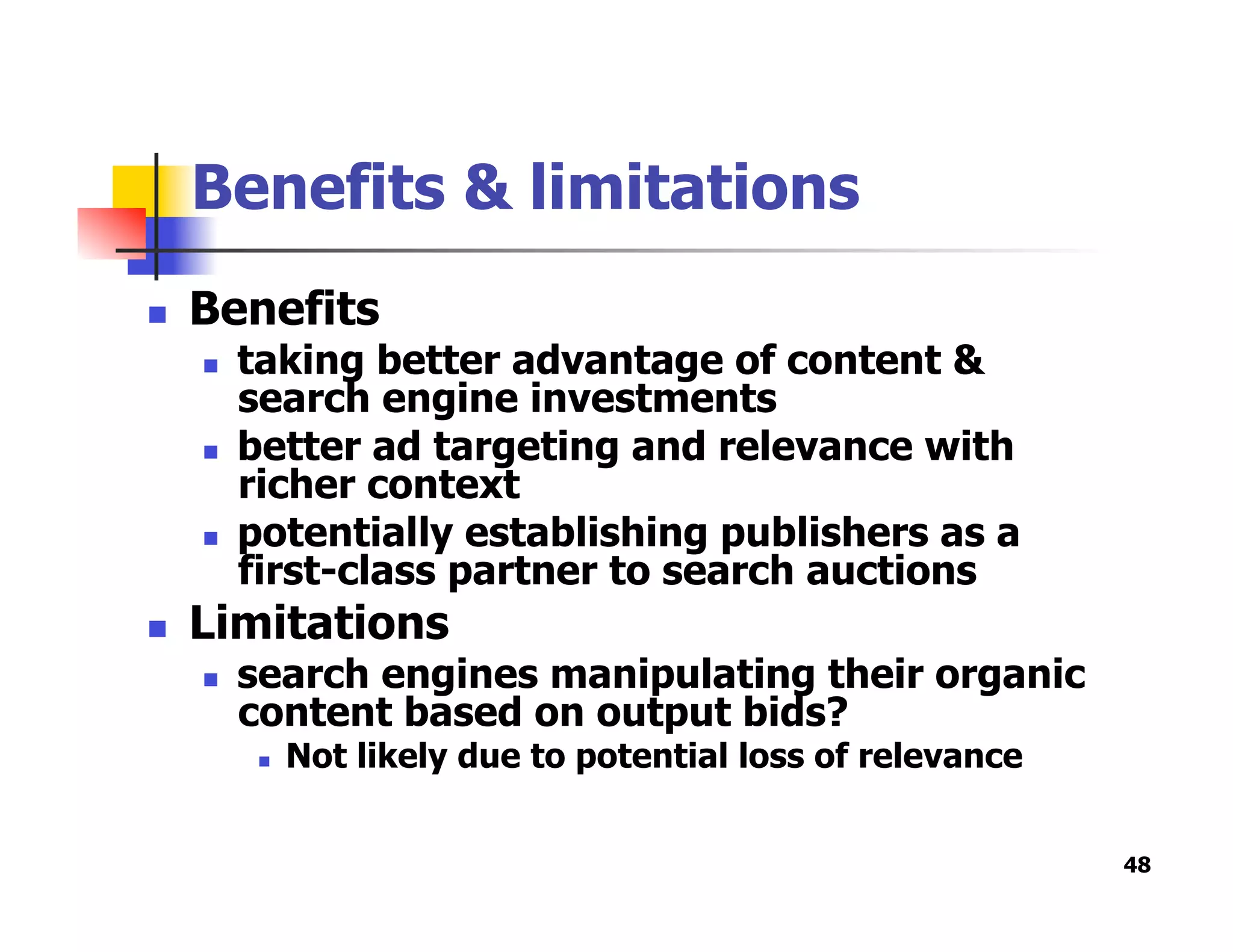
  Search advertising: Should ‘Ace Hardware’ be just a “organic
related site” instead of a “sponsored related site” to ‘Home
Depot’? Should search engines charge for commercial-looking
organic results (local business, shopping, etc.)?
  Implementation: How to hide the latency of output
dependence?
47
Benefits & limitations
  Benefits
  taking better advantage of content &
search engine investments
  better ad targeting and relevance with
richer context
  potentially establishing publishers as a
first-class partner to search auctions
  Limitations
  search engines manipulating their organic
content based on output bids?
  Not likely due to potential loss of relevance
48
Related work
  Output bidding
  Dasdan (2007) – conceived in early 2006; Dasdan & Gonen
(2008);
  Bids on search results
  Dasdan (2007); Manavoglu, Popescul, Dom, & Brunk (2008).
  Interplay between organic and sponsored results
  Ghose & Yang (2009); Katona & Sarvary (2009); Xu, Chen, &
Whinston (2009).
  Bids on more parameters of input bidding
  Aggarwal, Feldman, & Muthukrishnan (2006); Muthukrishnan
(2009); Benisch, Sadeh, & Sandholm (2008).
  Use of top search results for enhancing keyword context
and ad matching
  Broder, Ciccolo, Fontoura, Gabrilovich, Josifovski, & Riedel
(2008).
49
Questions & opportunities
50
Local business results
Shopping results
51
Should such results
be sponsored too?
52
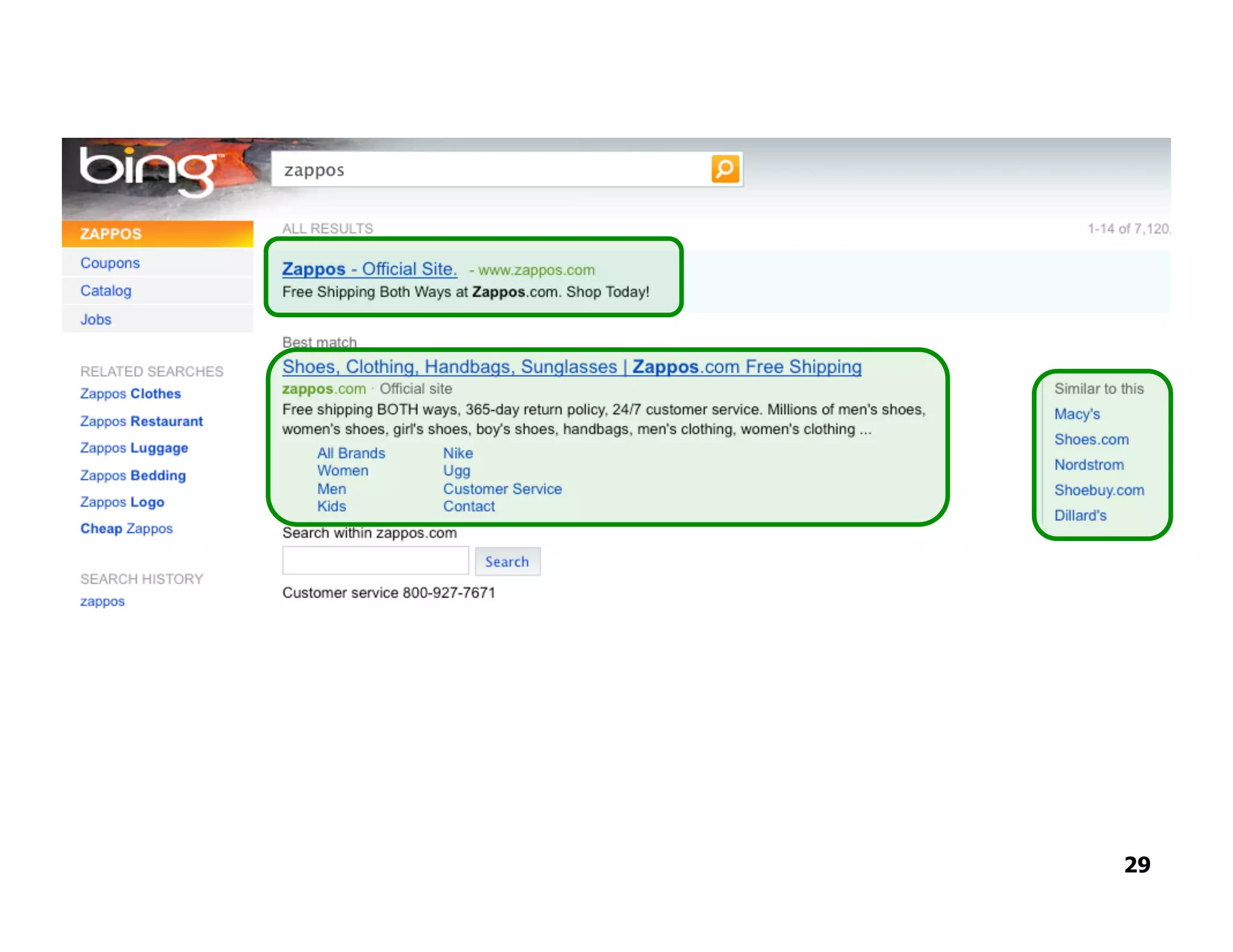
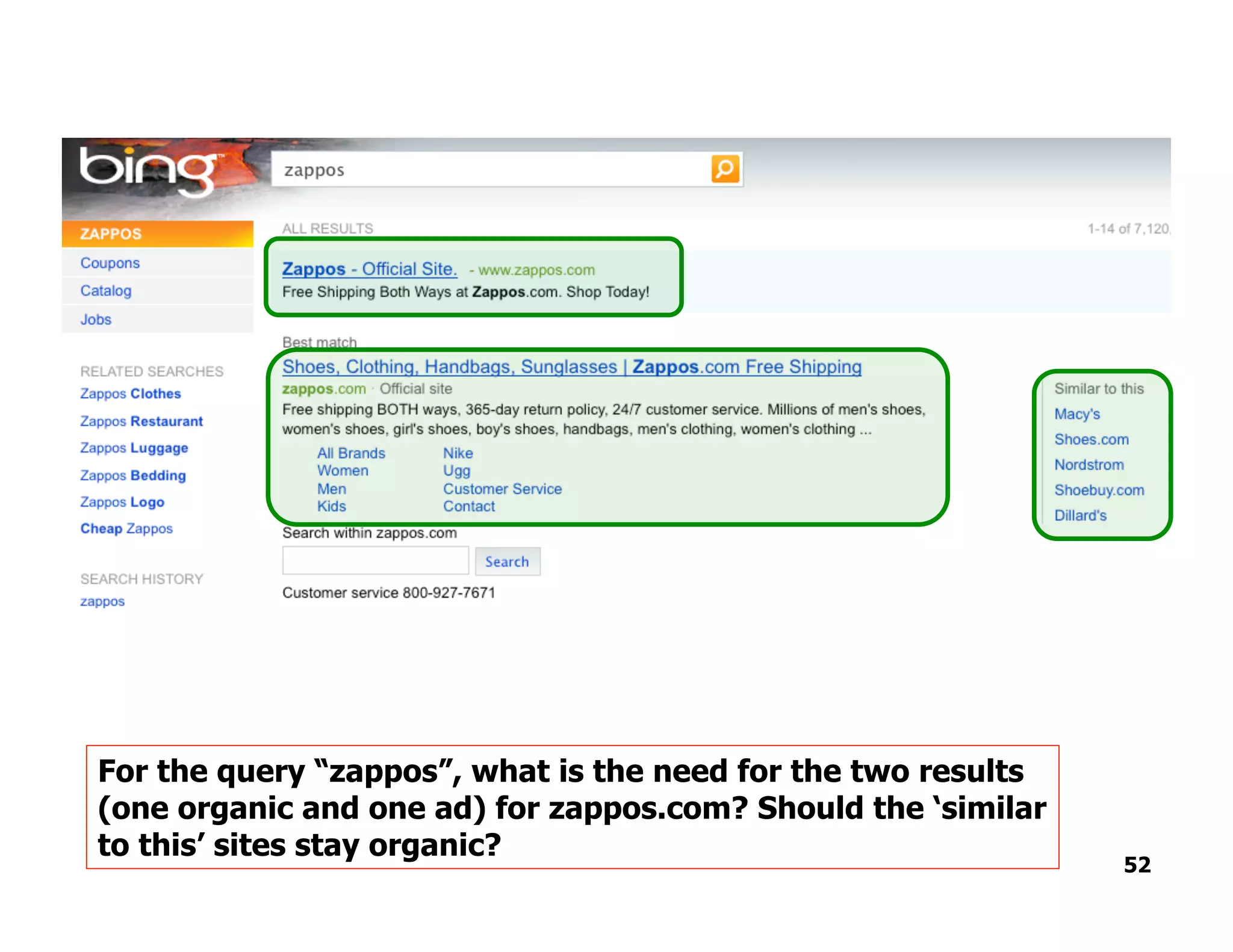
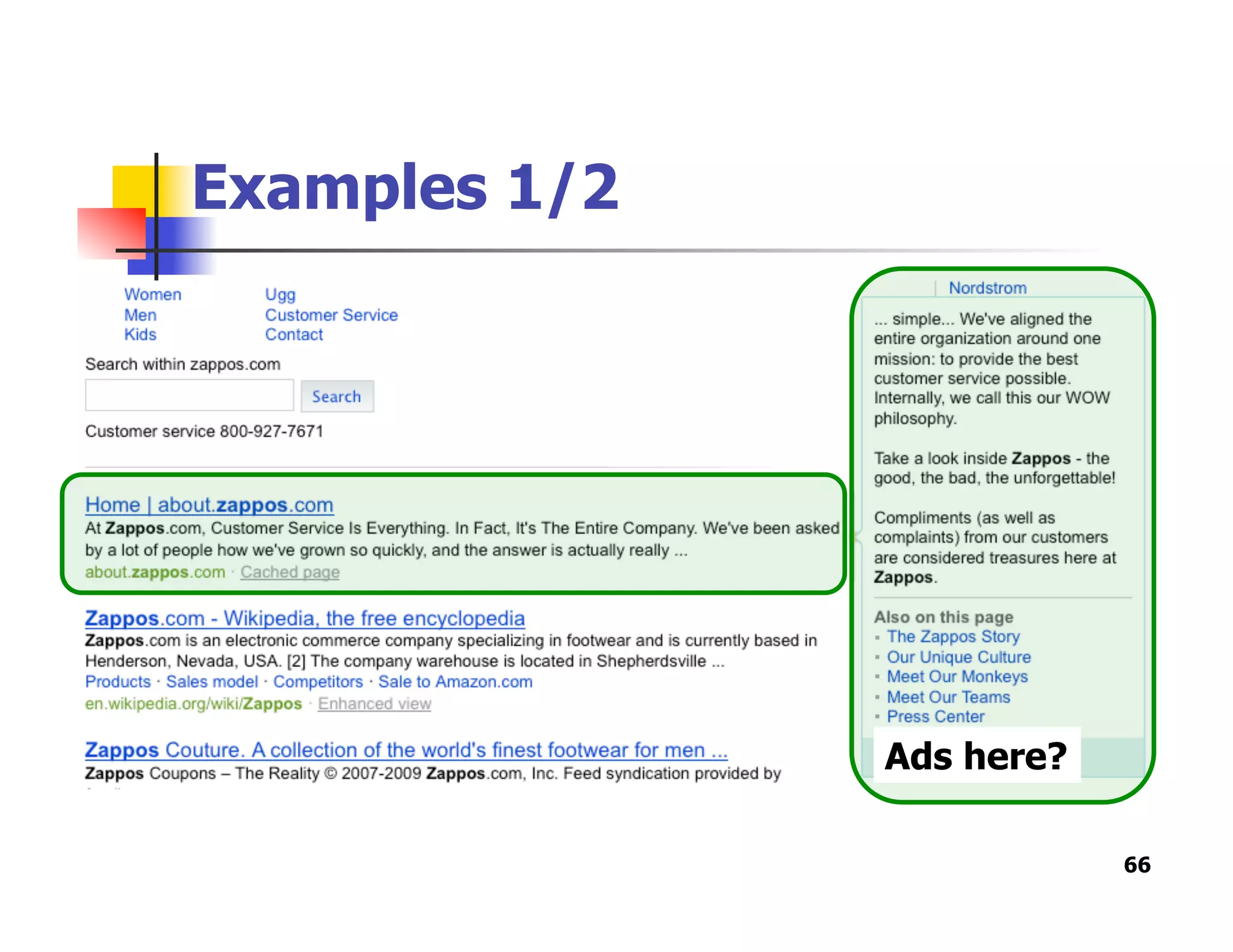
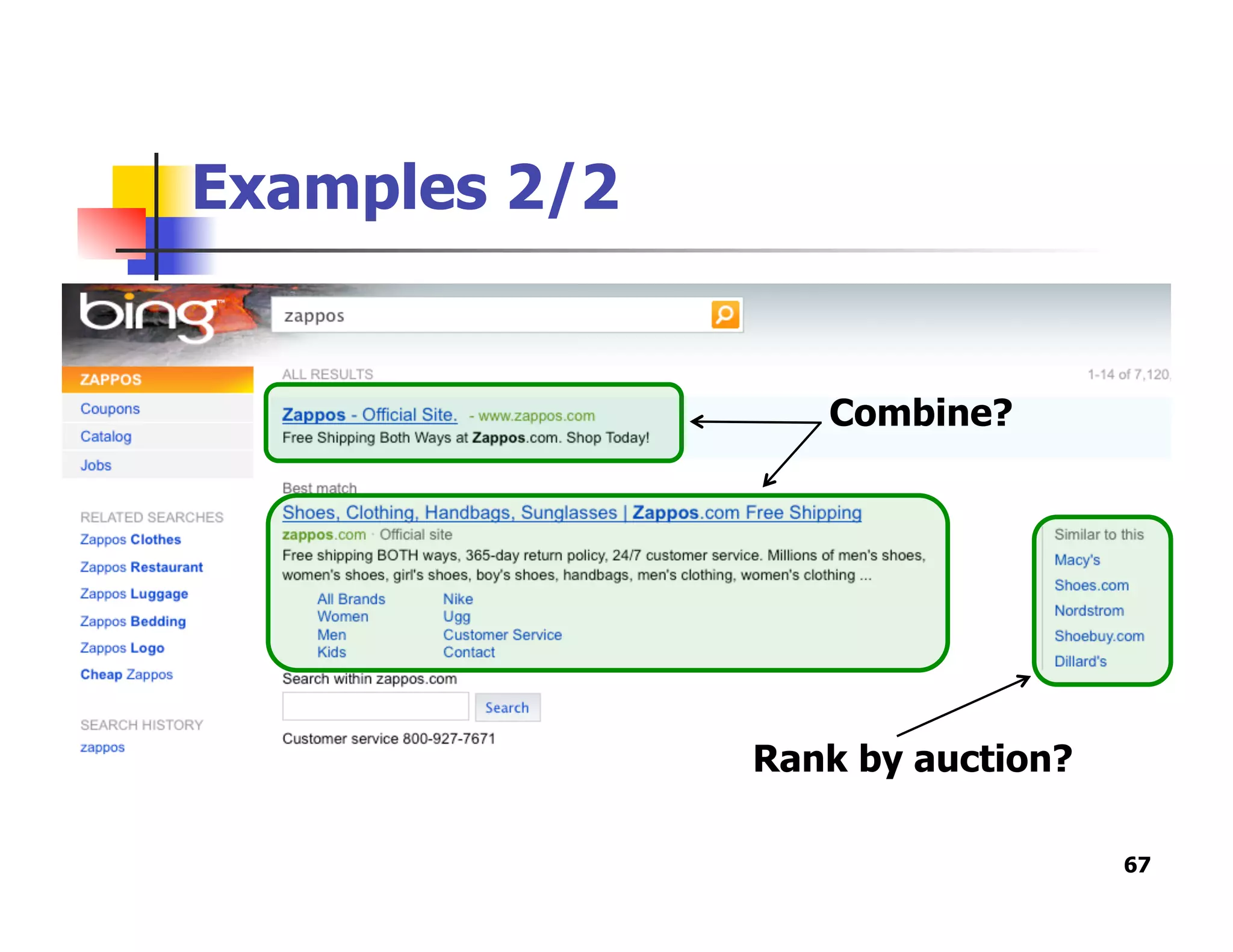
For the query “zappos”, what is the need for the two results
(one organic and one ad) for zappos.com? Should the ‘similar
to this’ sites stay organic?
53
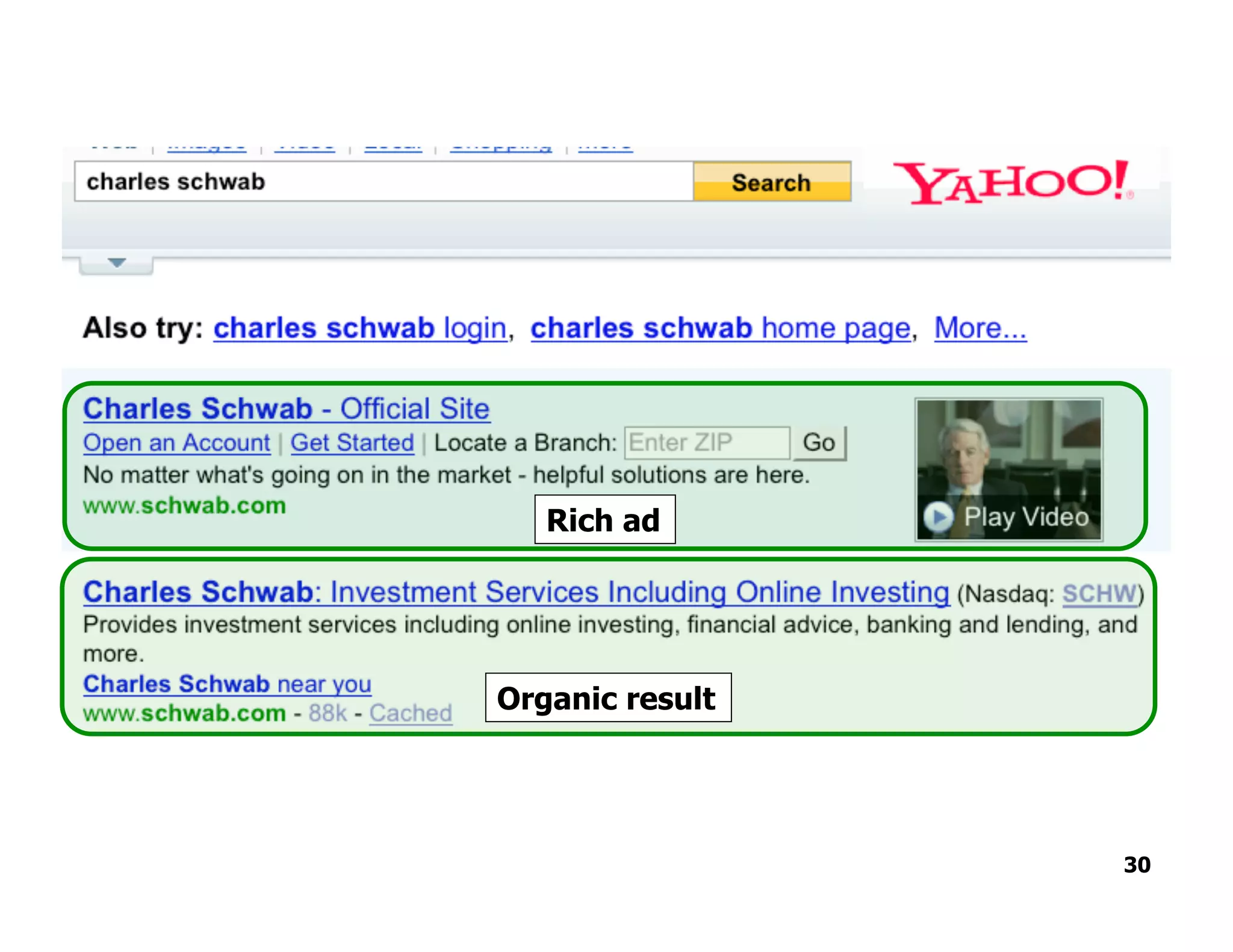
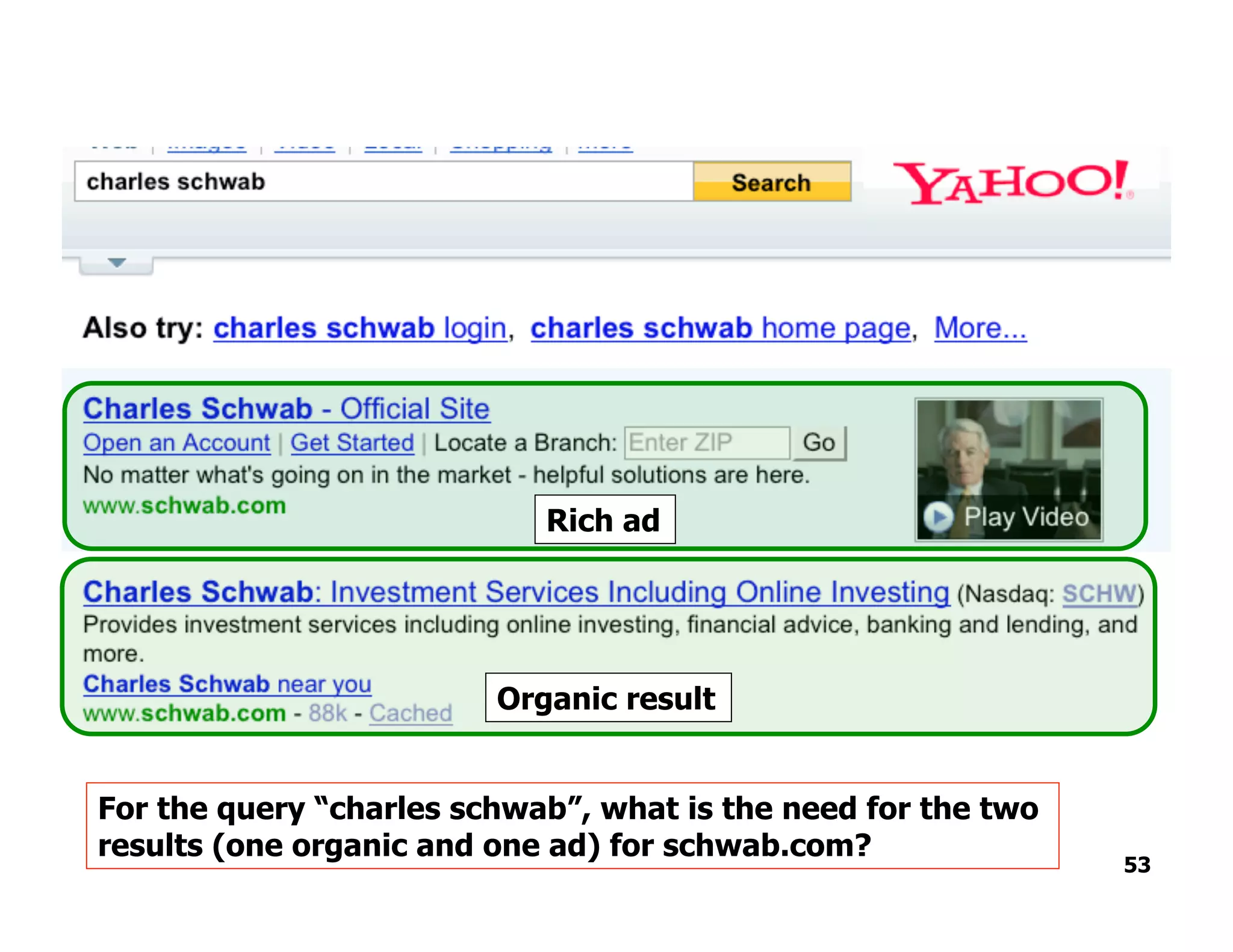
Rich ad
Organic result
For the query “charles schwab”, what is the need for the two
results (one organic and one ad) for schwab.com?
54
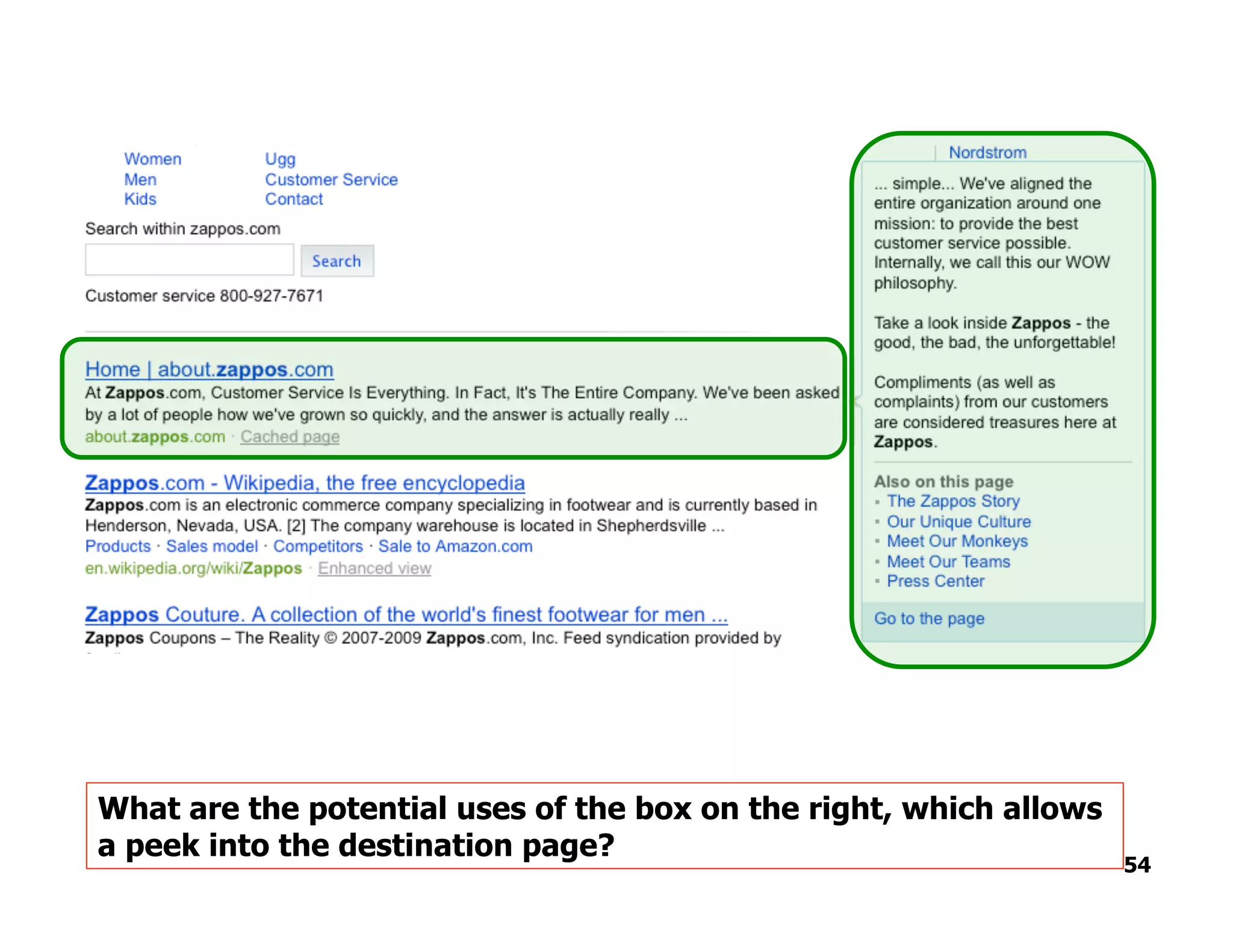
What are the potential uses of the box on the right, which allows
a peek into the destination page?
Short list
  Theory and practice of output bidding
  Fusing organic & sponsored processing
pipelines
  Bringing publishers to search auction
  Interactions between organic and
sponsored results
  New opportunities for ads in search results
pages
  Ads for shopping lists (e.g., ebay results)
  Life with a few, very powerful players
55
Conclusions
  Web search and advertising at the
intersection of many scientific
disciplines
  Lots of challenges but huge rewards
  uncertainty, scale
  Too early to call the field advanced
beyond reach
  so help invent its future
56
Thank you
Q&A
http://www.dasdan.net/ali/
57
Thank you
Q&A
Misc
59
60
61
62
Experimental Results 1/2
  Hypothesis #1: An ad has higher
CTR if it is correlated to an organic
result.
  Correlation: Being from the same site
  Dataset: Queries from 3 days of Yahoo!
Web Search logs
  Result: 3x & 10x CTR increases for non-
navigational and navigational queries
63
Experimental Results 2/2
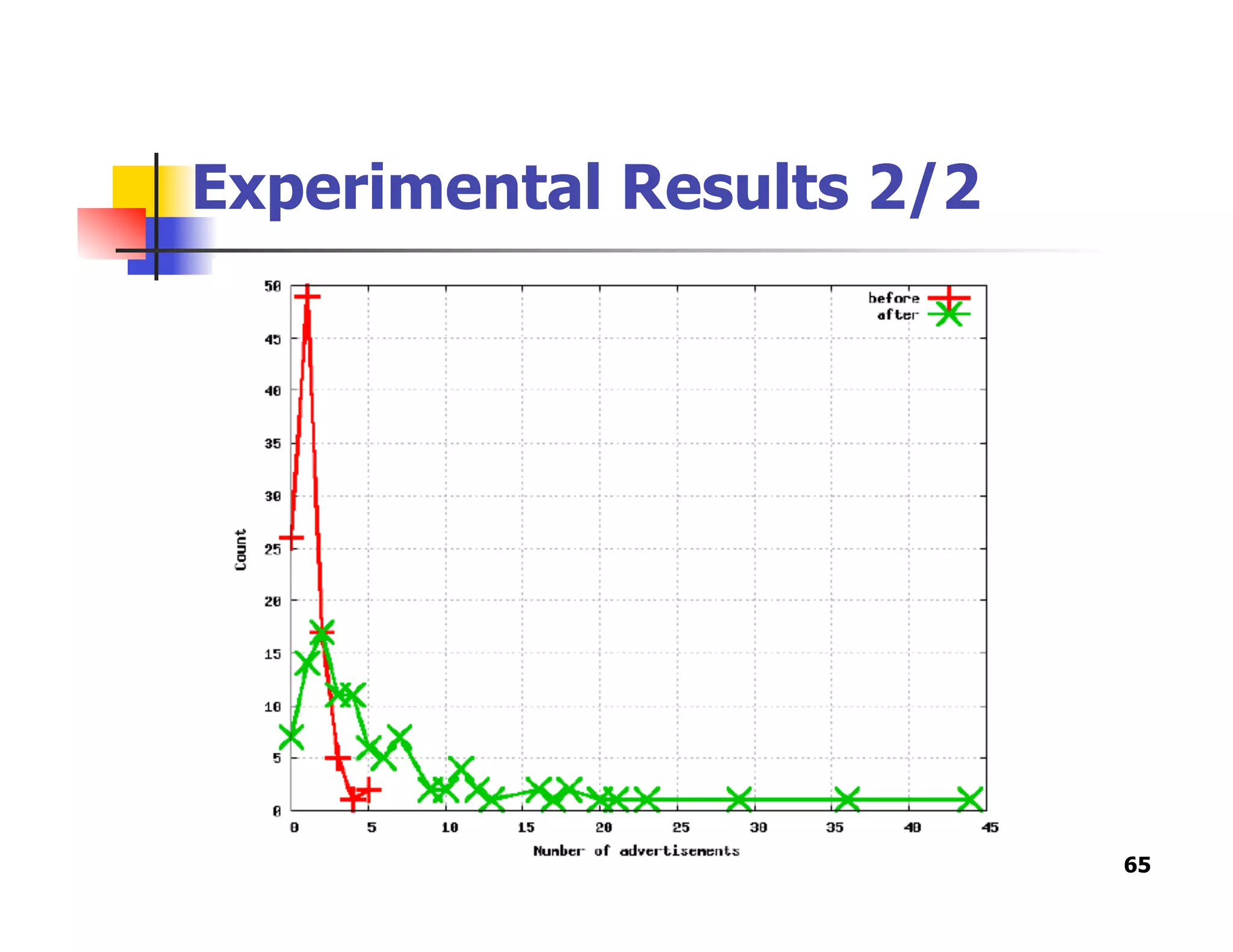
  Hypothesis #2: Organic results do
contain terms to match for (input
bidding) ads.
  Dataset: 100 queries producing no or
few ads
  Result: 5x increase in total number of
ads, some queries with lots of ads
  See the next figure
64
Experimental Results 2/2
65
Examples 1/2
66
Ads here?
Examples 2/2
67
Rank by auction?
Combine?
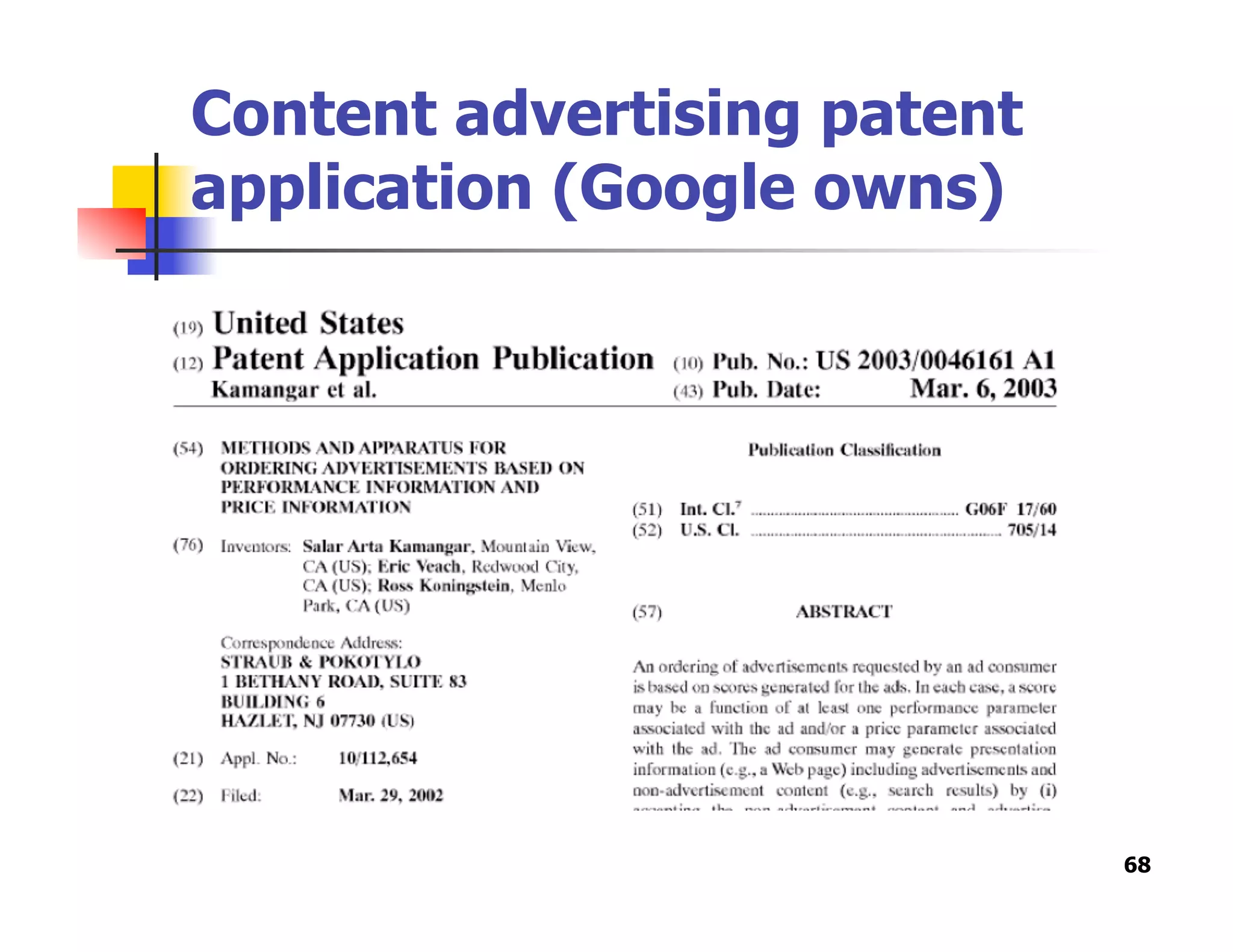
Content advertising patent
application (Google owns)
68
http://www.milliondollarhomepage.com/
69
70

An Overview of Search Advertising

  • 1.
    Search Advertising Overview Ali Dasdan,Yahoo! Disclaimers: This talk presents the opinions of the author. Some of the proposals have been submitted as patent applications.
  • 2.
    Outline   Overall advertisingmarket   Online advertising overview   Search advertising introduction   Output bidding   New search advertising model   Opportunities   Conclusions 2
  • 3.
    Advertising market size& growth predictions 3
  • 4.
  • 5.
  • 6.
  • 7.
  • 8.
  • 9.
  • 10.
    Online advertising   Goal:  find the “best match” between an ad and a context to maximize “value” for all stakeholders   Context:   browse, search, connect, etc.   Stakeholders   users, advertisers, publishers, auctioneers 10
  • 11.
    Context to AdMatching   Browse   Search   Connect   Buy, sell   Learn, entertain   Display   banner, rich media, sponsorship   Search   Input (keyword), output   Content   Social   Classifieds, referrals   Email 11
  • 12.
    Context to AdMatching   Browse   Search   Connect   Buy, sell   Learn, entertain   Display   banner, rich media, sponsorship   Search   Input (keyword), output   Content   Social   Classifieds, referrals   Email 12
  • 13.
    More context parameters  Performance   ad relevance, past or expected performance, impression, click, conversion   Behavioral   search query intent (navigational, informational, transactional)   browse or search history   Geographic   language, country, region, city, any polygon around a center   Demographics   gender, age, profession, income   Temporal   workday, weekend, daytime, nighttime, month, season   Monetary   bid, budget   Content   URL, text, topic, color, form factor   … 13
  • 14.
    Main stakeholders ofonline advertising 14 Publisher, content owner UserAuctioneer, network, exchange Advertiser, agency Often in multiple roles
  • 15.
  • 16.
  • 17.
  • 18.
    Examples: Display adsin social network 18
  • 19.
  • 20.
  • 21.
  • 22.
    22 Search results page forthe query “air conditioner”
  • 23.
    Input Output Sponsored results Organicresults OtherUsefulStuff 23 Search results page for the query “air conditioner”
  • 24.
    Examples: Keyword adsfor [barack obama] 24
  • 25.
    Examples: Keyword adsfor [new york university] 25
  • 26.
    Evolution of searchresults pages   Search results pages from major search engines follow…   Search results pages have improved beyond the “10 blue links” with   query facets, results classification   rich results, rich ads   related searches, related results/sites   local results   video & image results   news & (micro)blog results   … 26
  • 27.
    Y! presentation modules  Shortcuts   Search suggestions / Search Assist   Quick links   Indentation   Rich results 27
  • 28.
    Local business results Shoppingresults 28 Search results page for the query “air conditioner”
  • 29.
  • 30.
  • 31.
    Quiz: A orB is better? 31 A B A B
  • 32.
    Quiz: A orB is better? 32 A A B B
  • 33.
  • 34.
    Where users focus 34 Reading(Yahoo! Finance) Scanning (Yahoo! Finance)
  • 35.
    A brief historyof keyword advertising   Early 1990s: Open Text & AltaVista try it but fail.   Feb 1998: GoTo introduces it for paid search.   the idea is from yellowpages   May 1999: GoTo files for a patent application.   Oct 2000: Google introduces AdWords.   after two unsuccessful internal attempts   Jul 2001: GoTo gets patent #6,269,361.   Oct 2001: GoTo renames to Overture.   Apr 2002: Overture sues Google.   May 2002: Google hires Hal Varian as its chief economist.   Mar 2003: Google acquires Applied Semantics & introduces its AdSense contextual advertising service.   Jul 2003: Yahoo! acquires Overture.   Aug 2004: Yahoo! & Google settle the case out of court. 35
  • 36.
  • 37.
    Keyword advertising patent (Goto Overture  Yahoo!) 37
  • 38.
    Cost & performance measures  Cost measures   CPM: Cost per 1000x impressions   the original model   CPC: Cost per click, pay per click   Yahoo! has been using since 1996.   CPA: Cost per action   action: acquisition, order, engagement   DoubleClick has been using since 1997.   Performance measures   Click thru rate (ctr): P(click|impression)   Conversion rate: P(action|click) 38
  • 39.
    Ranking ads &pricing clicks   Ranking in decreasing r = w * b   by bid: r = b = bid   by expected revenue: r = ctr * b   by performance: r = f(…) * bs   Pricing   generalized second price (gsp):   min price (+ε) to keep the current position   e.g., the ith pays (wi+1*bi+1)/wi+0.01   last position holder to pay a reserve price 39
  • 40.
  • 41.
    Output bidding, anew search advertising model 41
  • 42.
    Summary of outputbidding 42 y = f ( x ) Search results (output) Search engine Search query (input) Keyword (input) bidding is on x. Output bidding is on y. Note: •  y >> x in size & context •  y is where innovation happens
  • 43.
    Review of input& output   Search engine as a mapping:   Output = SE( Input )  y = f( x )   Input: What users give to SEs   a few keywords as a query   very limited (given) context   Output: What SEs produce   lots of data and metadata   far richer context & getting richer   where innovation happens 43
  • 44.
    Intent bidding & adassociation   What do advertisers bid on?   users’ (purchasing) intent   signal for intent: keywords   How do advertisers bid?   associate their ads with keywords 44
  • 45.
    Output bidding proposal  Claims   use output as a far richer signal for intent   associate ads with output too   Proposal   direct use: Bidding on output explicitly   indirect use: Use of output as part of input bidding 45
  • 46.
    Output bidding variations  Paid (self) association (PA): Ads with organic results from the same site   More expressive input bidding:   Output as conditions: Conditions on output parameters   Output as expansion: “Keywords” from output for keyword bidding   Direct output bidding:   Bid for organic search result, show ad closeby 46 Sponsored: Discount on air conditioners
  • 47.
    Issues to resolve  Mindset – probably the most difficult issue   User interface: New ads as an extension of sponsored results space or next to target organic result? News ads shown with mouse over or always on?   Auction modeling: What if an advertiser bids for both input and output, or multiple outputs? How not to undermine input bidding revenue with output bidding? What is the role of organic content publisher in auctions regarding its content?   Search advertising: Should ‘Ace Hardware’ be just a “organic related site” instead of a “sponsored related site” to ‘Home Depot’? Should search engines charge for commercial-looking organic results (local business, shopping, etc.)?   Implementation: How to hide the latency of output dependence? 47
  • 48.
    Benefits & limitations  Benefits   taking better advantage of content & search engine investments   better ad targeting and relevance with richer context   potentially establishing publishers as a first-class partner to search auctions   Limitations   search engines manipulating their organic content based on output bids?   Not likely due to potential loss of relevance 48
  • 49.
    Related work   Outputbidding   Dasdan (2007) – conceived in early 2006; Dasdan & Gonen (2008);   Bids on search results   Dasdan (2007); Manavoglu, Popescul, Dom, & Brunk (2008).   Interplay between organic and sponsored results   Ghose & Yang (2009); Katona & Sarvary (2009); Xu, Chen, & Whinston (2009).   Bids on more parameters of input bidding   Aggarwal, Feldman, & Muthukrishnan (2006); Muthukrishnan (2009); Benisch, Sadeh, & Sandholm (2008).   Use of top search results for enhancing keyword context and ad matching   Broder, Ciccolo, Fontoura, Gabrilovich, Josifovski, & Riedel (2008). 49
  • 50.
  • 51.
    Local business results Shoppingresults 51 Should such results be sponsored too?
  • 52.
    52 For the query“zappos”, what is the need for the two results (one organic and one ad) for zappos.com? Should the ‘similar to this’ sites stay organic?
  • 53.
    53 Rich ad Organic result Forthe query “charles schwab”, what is the need for the two results (one organic and one ad) for schwab.com?
  • 54.
    54 What are thepotential uses of the box on the right, which allows a peek into the destination page?
  • 55.
    Short list   Theoryand practice of output bidding   Fusing organic & sponsored processing pipelines   Bringing publishers to search auction   Interactions between organic and sponsored results   New opportunities for ads in search results pages   Ads for shopping lists (e.g., ebay results)   Life with a few, very powerful players 55
  • 56.
    Conclusions   Web searchand advertising at the intersection of many scientific disciplines   Lots of challenges but huge rewards   uncertainty, scale   Too early to call the field advanced beyond reach   so help invent its future 56
  • 57.
  • 58.
  • 59.
  • 60.
  • 61.
  • 62.
  • 63.
    Experimental Results 1/2  Hypothesis #1: An ad has higher CTR if it is correlated to an organic result.   Correlation: Being from the same site   Dataset: Queries from 3 days of Yahoo! Web Search logs   Result: 3x & 10x CTR increases for non- navigational and navigational queries 63
  • 64.
    Experimental Results 2/2  Hypothesis #2: Organic results do contain terms to match for (input bidding) ads.   Dataset: 100 queries producing no or few ads   Result: 5x increase in total number of ads, some queries with lots of ads   See the next figure 64
  • 65.
  • 66.
  • 67.
    Examples 2/2 67 Rank byauction? Combine?
  • 68.
  • 69.
  • 70.