An overview of BAMS Curriculum or
Syllabus including highlights of
Minimum Standards of Education 2021,
Ayurveda higher education and Job
opportunities
Dr. Priyanka Gautam
Asst. Professor
DEPT. OF DRAVYAGUNA
SDAMC & RC, MATHURA
Ayurveda
Ayurveda means “the science of life”(ayur means
‘life’ and veda means ‘science’ in sanskrit.
Ayurveda is a discipline of the upveda or
“auxillary knowledge” in vedic tradition.
Ayurveda has its prime origin from Atharva-Veda
and apart as a supplement of the Rig-Veda.
Dhanvantari is worshipped as the God of
Ayurveda..
Aim
The aim of this system is to prevent illness¸ heal
the sick and preserve life.
The Ayurveda has its origins from the India and
extended its wings in various parts of the world.
Ayurveda was taught in Gurukula system in
ancient days, which is now been evolved in to
under graduate & post graduate courses from
Institutions.
BAMS (Ayurvedacharya)
Bachelors degree in Ayurveda, medicine and
surgery is an integration of traditional Ayurveda
with current medicines.
Several universities in India has awarded this
medical degree.
After the graduation in BAMS, candidates can
register in the Ayurveda boards controlled by both
central and state government.
A registered candidate is qualified to work under
any Ayurveda medical services anywhere in India.
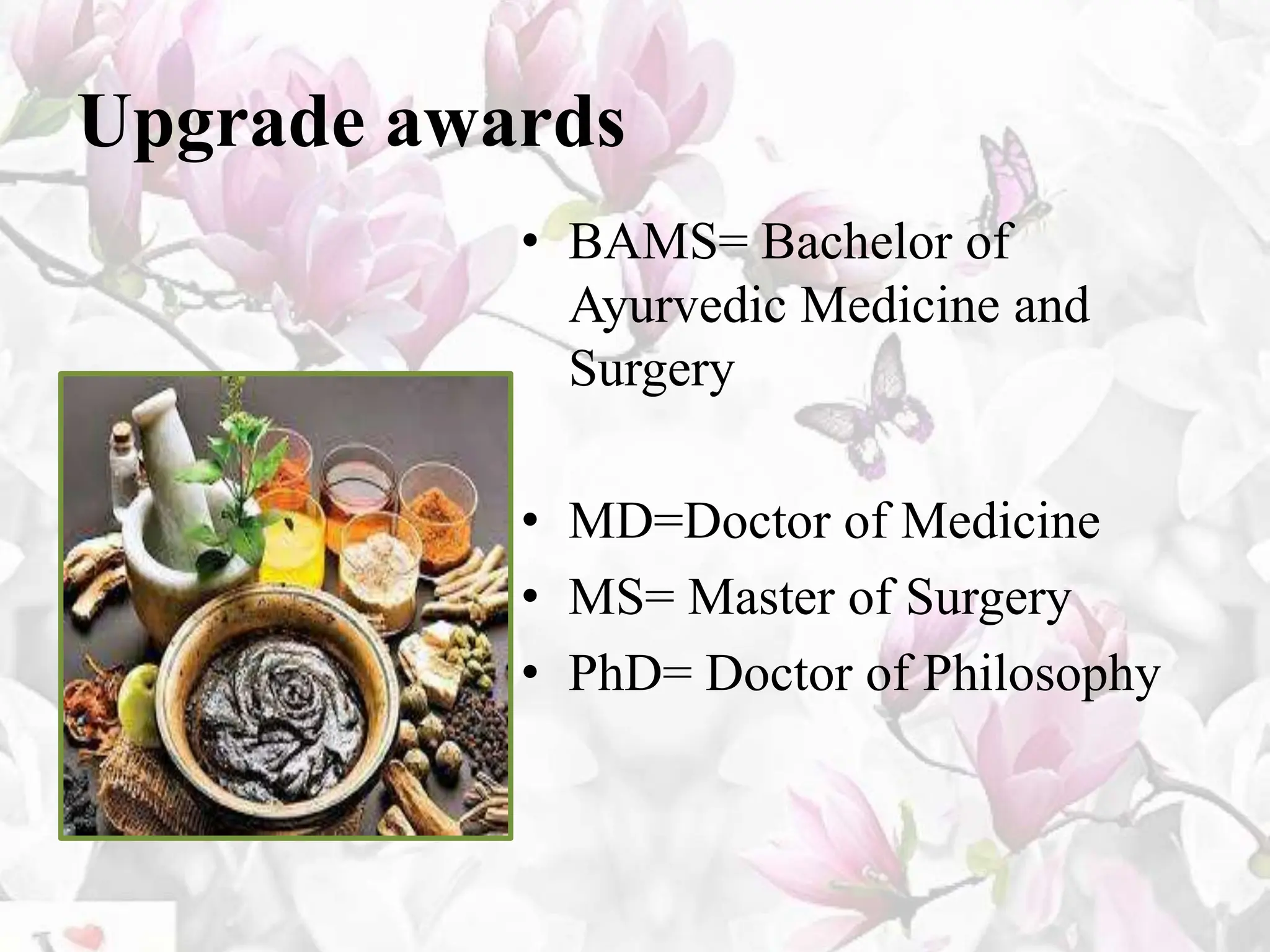
Upgrade awards
• BAMS= Bachelor of
Ayurvedic Medicine and
Surgery
• MD=Doctor of Medicine
• MS= Master of Surgery
• PhD= Doctor of Philosophy
BAMS Curriculum
Curriculum
The curriculum is defined as the guideline of
the academic content covered by an education
system while undergoing a particular course or
program.
Curriculum has a wider scope which covers
the knowledge, attitude, behavior, manners,
performance & skills that are imparted or
inculcated in a student.
It contains every aspect from objectives to
assignments.
Minimum Standards of
Education 2021
Ayurveda higher
education
As per new MSE(Minimum
standards of education 2021)
NCISM (The National Commission for Indian
System of Medicine) started working by aiming at
2030 and to align with NEP 2020.
Accordingly MSE-2021(Minimum Standards of
Undergraduate Ayurveda Education
Regulations-2021) several initiatives started such
as-
1. This programme (BAMS) is divided in three
Professional years of 1.5 years each, followed by
1 year of internship.
1 professional BAMS has five courses (Subjects).
2 professional BAMS has six courses (Subjects).
2. Reversal of teaching hours of theory and practical
from 2:1 to 1:2.
3. Introduced concept of non-lecture hours.
4. Incorporated advance teaching as well as
assessment methods.
Lecture hours
Lecture is an exposition of a given subject or
discourse on a particular subject delivered before
an audience or class.
Commonest method used in the classroom for
teaching. Now it is supplemented with A/V aids.
The existing learning conditions, aiming to
transfer common knowledge, skills, and values to
the student.
Non Lecture Hours
Practical-Learning means knowledge gained
by implementing theory in real-life activities.
This way of learning helps students to
remember the topic for a long time.
Practical-learning makes the study more
enjoyable, with the highest engagement in the
topic.
Common methods like …
 Discussion & debates,
 Inquiry based learning,
 Problem based learning,
 Case based learning,
 Project based learning,
 Team based learning,
 Flipped classroom,
 Blended learning,
 Edutainment like PPT,
demonstrations,
discussions,
 Simulations,
 Self directed learning,
 Problem solved
learning,
 Kinesthetic learning like
as poster making, chart
making, videos clips.
 Workshops,
 Game based learning.
Team based learning like Group working,
Action learning, field work.
Generating ideas with Lateral thinking,
Brainstorming, Mind-mapping, Creative
writing, drawing etc.
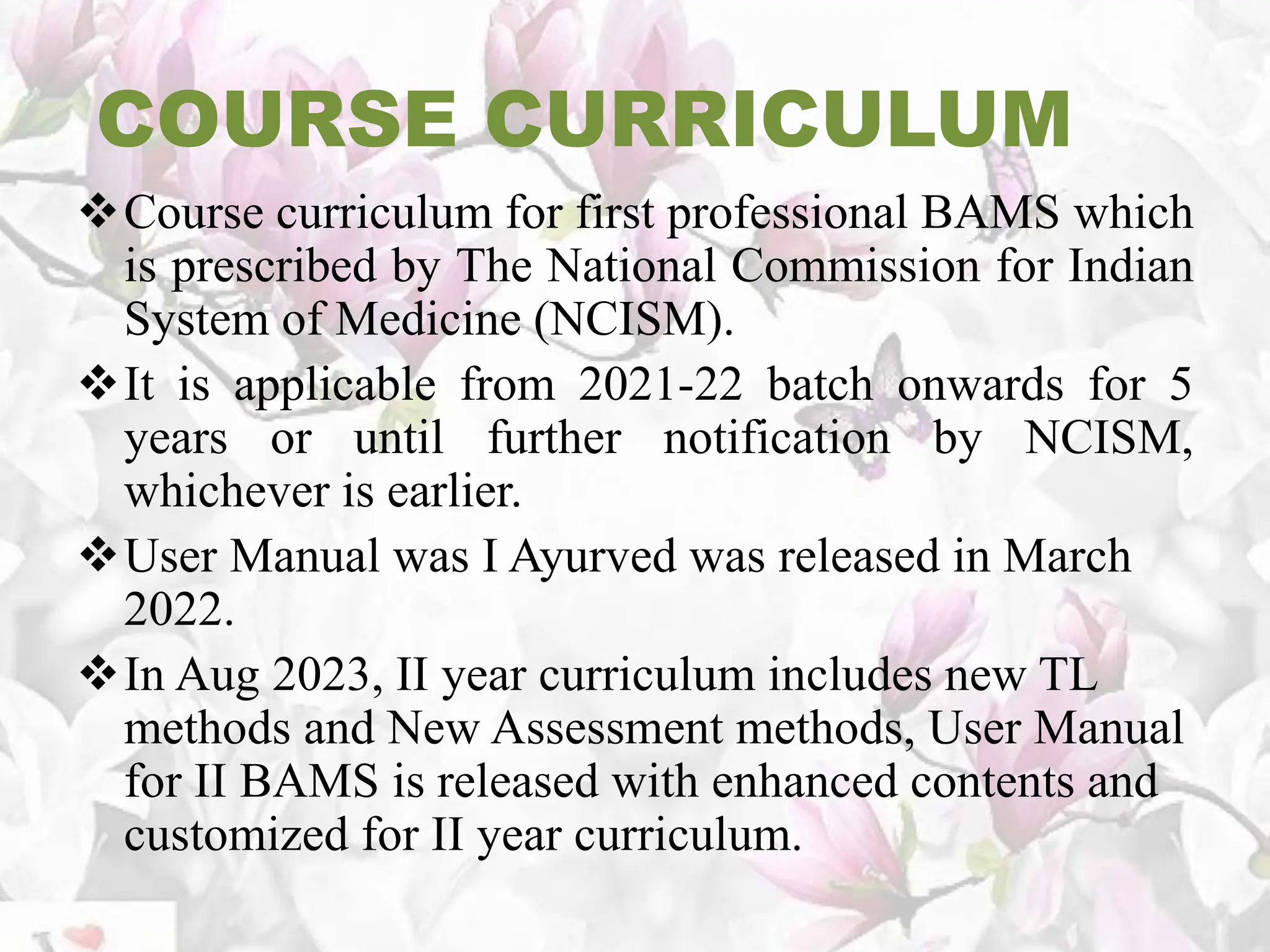
COURSE CURRICULUM
Course curriculum for first professional BAMS which
is prescribed by The National Commission for Indian
System of Medicine (NCISM).
It is applicable from 2021-22 batch onwards for 5
years or until further notification by NCISM,
whichever is earlier.
User Manual was I Ayurved was released in March
2022.
In Aug 2023, II year curriculum includes new TL
methods and New Assessment methods, User Manual
for II BAMS is released with enhanced contents and
customized for II year curriculum.
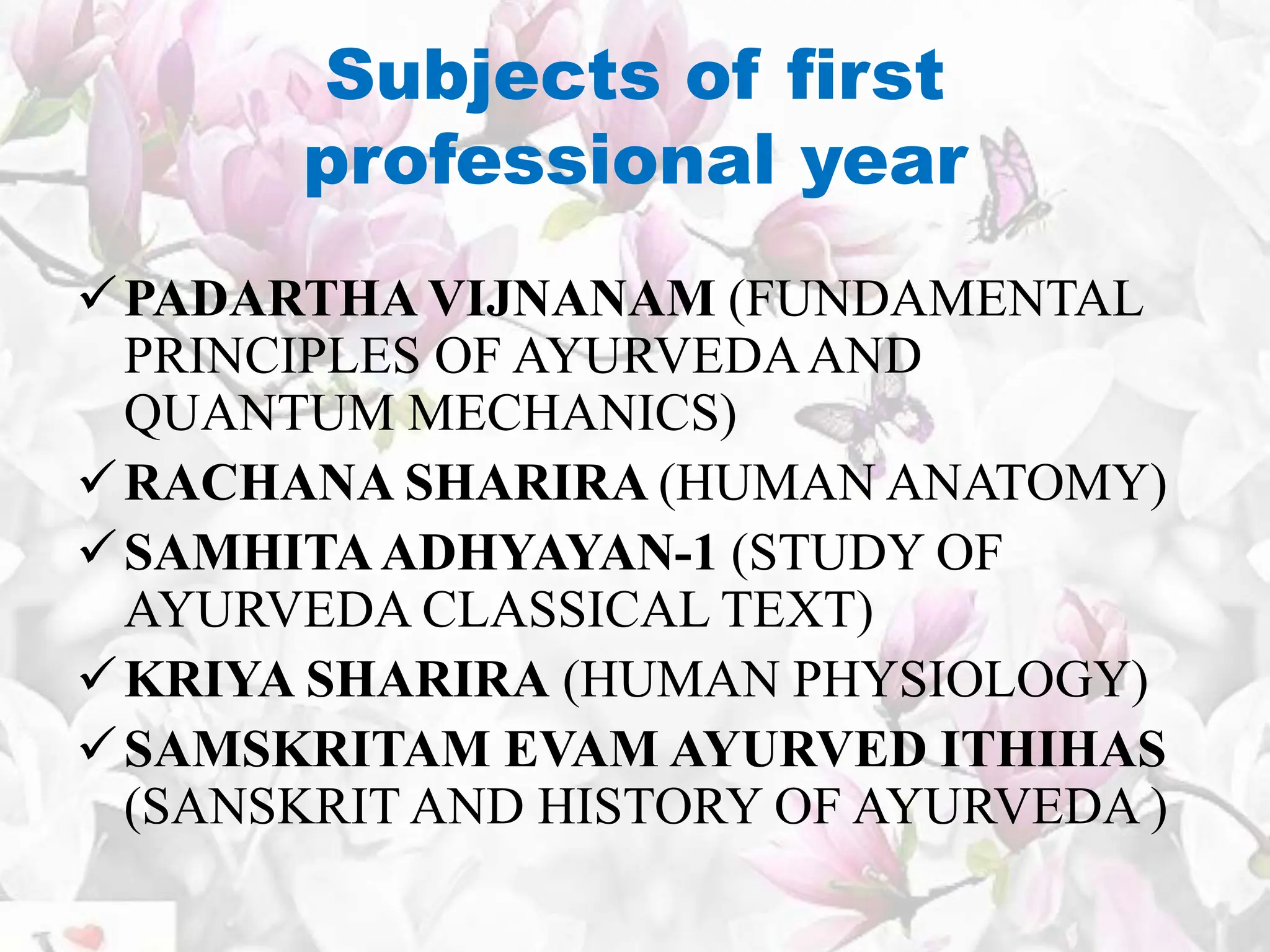
Subjects of first
professional year
PADARTHA VIJNANAM (FUNDAMENTAL
PRINCIPLES OF AYURVEDAAND
QUANTUM MECHANICS)
RACHANA SHARIRA (HUMAN ANATOMY)
SAMHITAADHYAYAN-1 (STUDY OF
AYURVEDA CLASSICAL TEXT)
KRIYA SHARIRA (HUMAN PHYSIOLOGY)
SAMSKRITAM EVAM AYURVED ITHIHAS
(SANSKRIT AND HISTORY OF AYURVEDA )
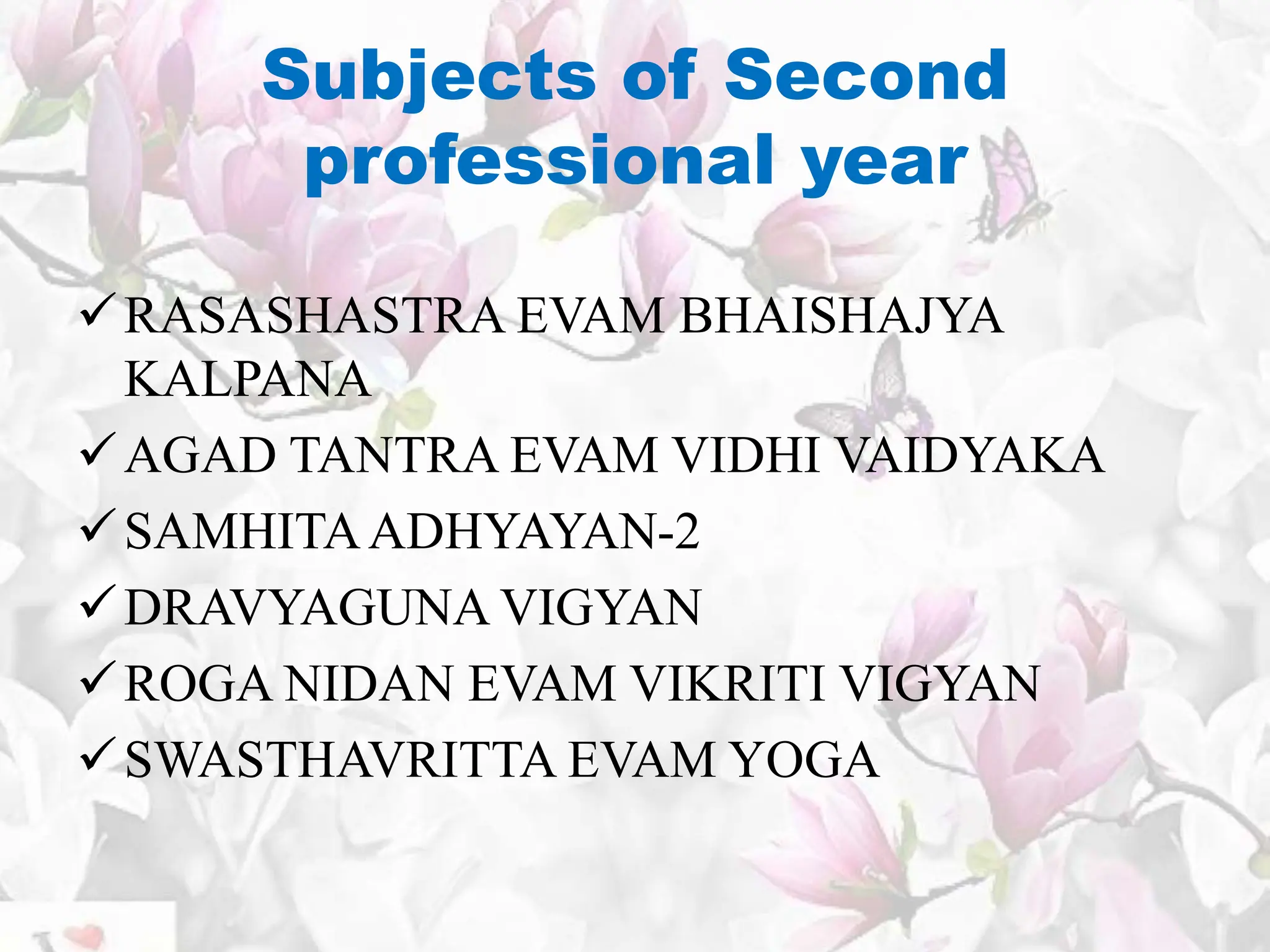
Subjects of Second
professional year
RASASHASTRA EVAM BHAISHAJYA
KALPANA
AGAD TANTRA EVAM VIDHI VAIDYAKA
SAMHITAADHYAYAN-2
DRAVYAGUNA VIGYAN
ROGA NIDAN EVAM VIKRITI VIGYAN
SWASTHAVRITTA EVAM YOGA
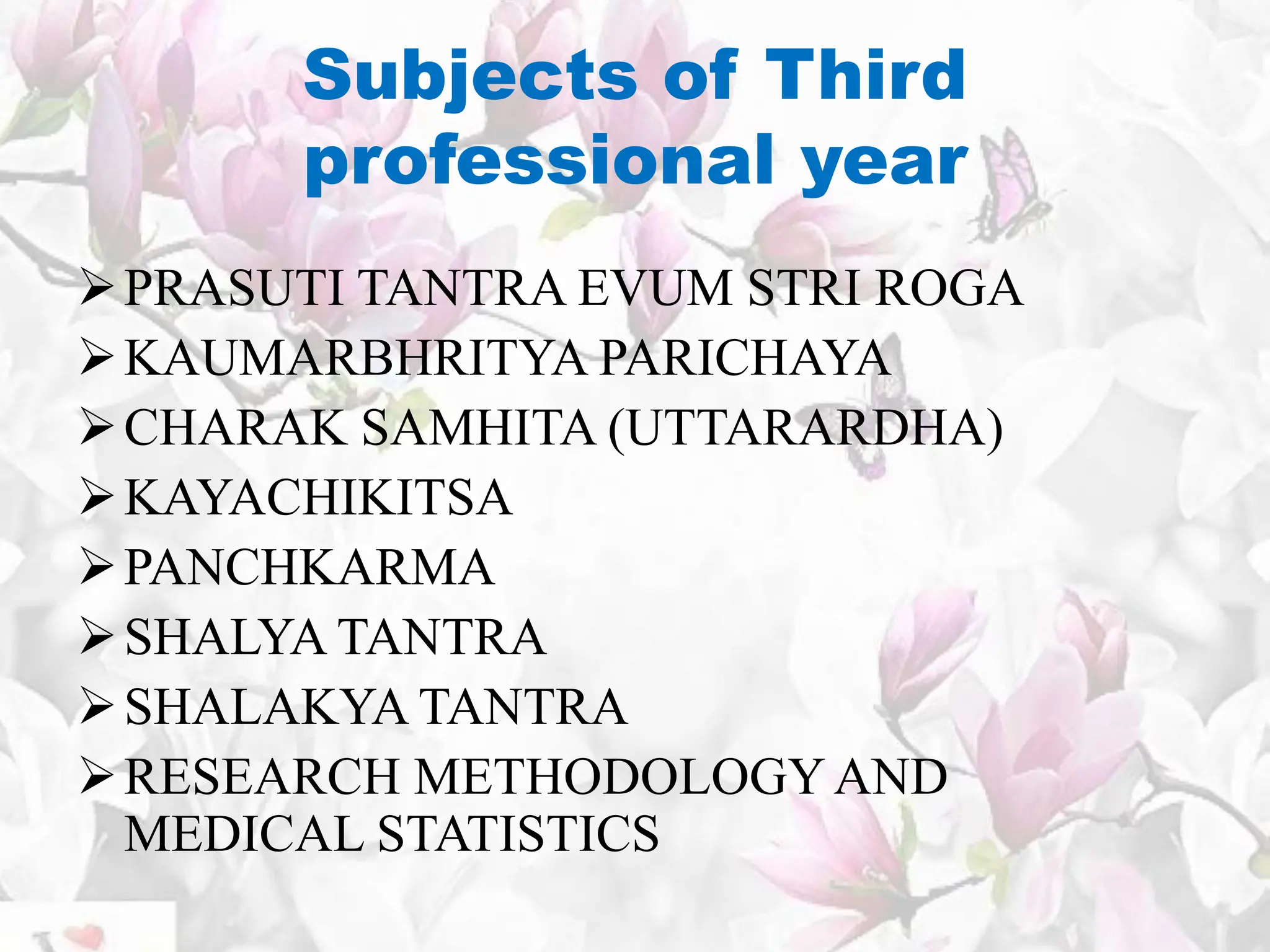
Subjects of Third
professional year
PRASUTI TANTRA EVUM STRI ROGA
KAUMARBHRITYA PARICHAYA
CHARAK SAMHITA (UTTARARDHA)
KAYACHIKITSA
PANCHKARMA
SHALYA TANTRA
SHALAKYA TANTRA
RESEARCH METHODOLOGYAND
MEDICAL STATISTICS
Since 2021-22 admitted batch NCISM had
accepted Outcome based curriculum.
Outcome-based curriculum
Educational framework that centers around
clearly defined learning outcomes or objectives.
The curriculum is designed and structured based
on the desired knowledge, skills, and
competencies that students should attain by the
end of a course.
Emphasizes the demonstrable results of learning.
Enhances transparency, as both educators and
students have a clear understanding of the
intended learning goals.
Active learning,
Critical thinking, and
Practical application of knowledge.
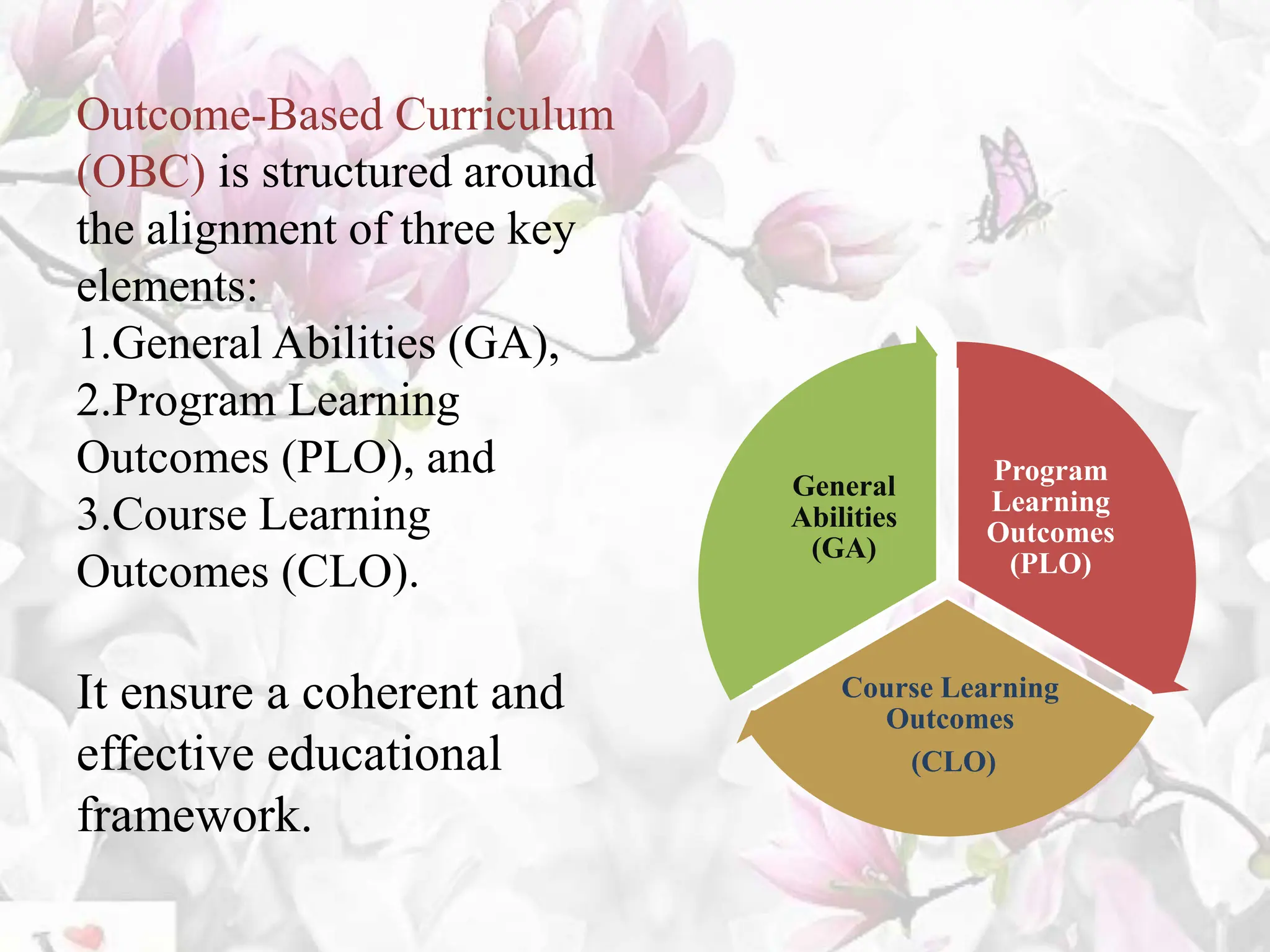
Outcome-Based Curriculum
(OBC) is structured around
the alignment of three key
elements:
1.General Abilities (GA),
2.Program Learning
Outcomes (PLO), and
3.Course Learning
Outcomes (CLO).
It ensure a coherent and
effective educational
framework.
Program
Learning
Outcomes
(PLO)
Course Learning
Outcomes
(CLO)
General
Abilities
(GA)
General Abilities (GA)
Encompass a set of skills and attributes that
students should develop across their academic
journey. Like-
Critical thinking,
Communication,
Teamwork,
Ethical awareness etc.
Represent the overarching qualities in students.
Program Learning Outcomes (PLO)
Specific statements that articulate what students
should achieve by the time they complete a
program of study.
Reflect the essential knowledge, skills, and
competencies relevant to a particular field.
Program learning Outcomes
Program learning Outcomes deal with the
general aspect of graduation for a BAMS
program, and the competencies and expertise a
graduate will possess after completion of the
program.
At the end of the BAMS programmed, the
students will be able to:
Course Learning Outcomes (CLO)
It is a detailed description of, what a student
must be able to do at the completion of a
course.
Objectives for individual courses within the
program.
CLO helps the learner to understand the reason
for pursuing the course.
They break down the broader PLOs into specific,
measurable statements that define what students
should be able to do after completing a particular
course.
Graduate attributes
Graduate attributes reflect the particular
quality and feature or characteristics of an
individual, including the knowledge, skills,
attitudes and values that are expected to be
acquired by a graduate through studies at the
higher education institution.
include capabilities that help strengthen
learners,
abilities for widening current knowledge base
and skills,
gaining new knowledge and skills,
undertaking future studies,
performing well in a chosen career and
playing a constructive role as a responsible
citizen in the society.
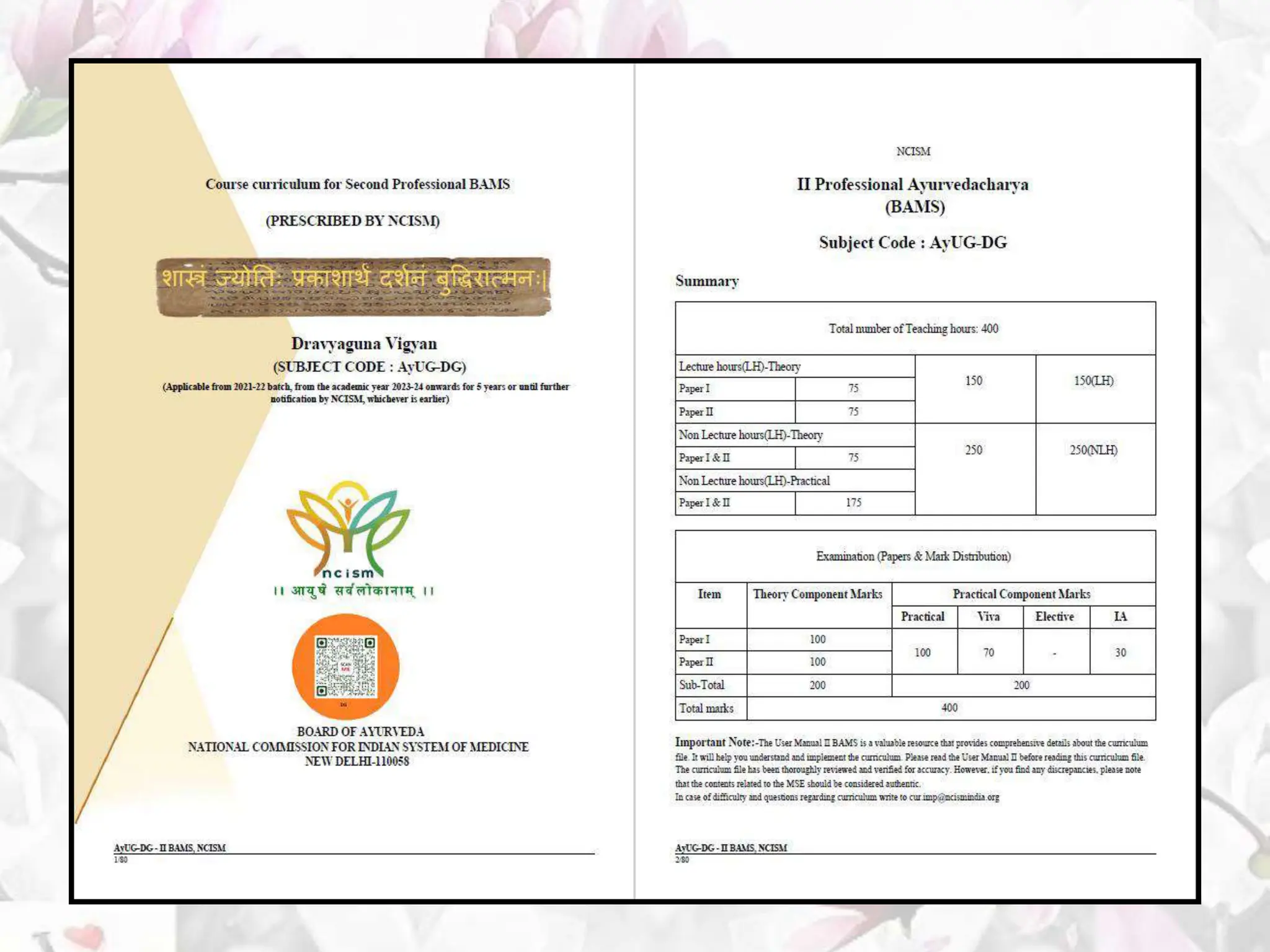
First Page of Manual
It contains Name, Code, Year and “QR code” for
downloading the document.
Second page is Summary page for the Course.
The Page will provide at a glance information of
Lecture and non-Lecture hours, Distribution of
hours as per papers, Distribution of Marks
(Theory and Practical).
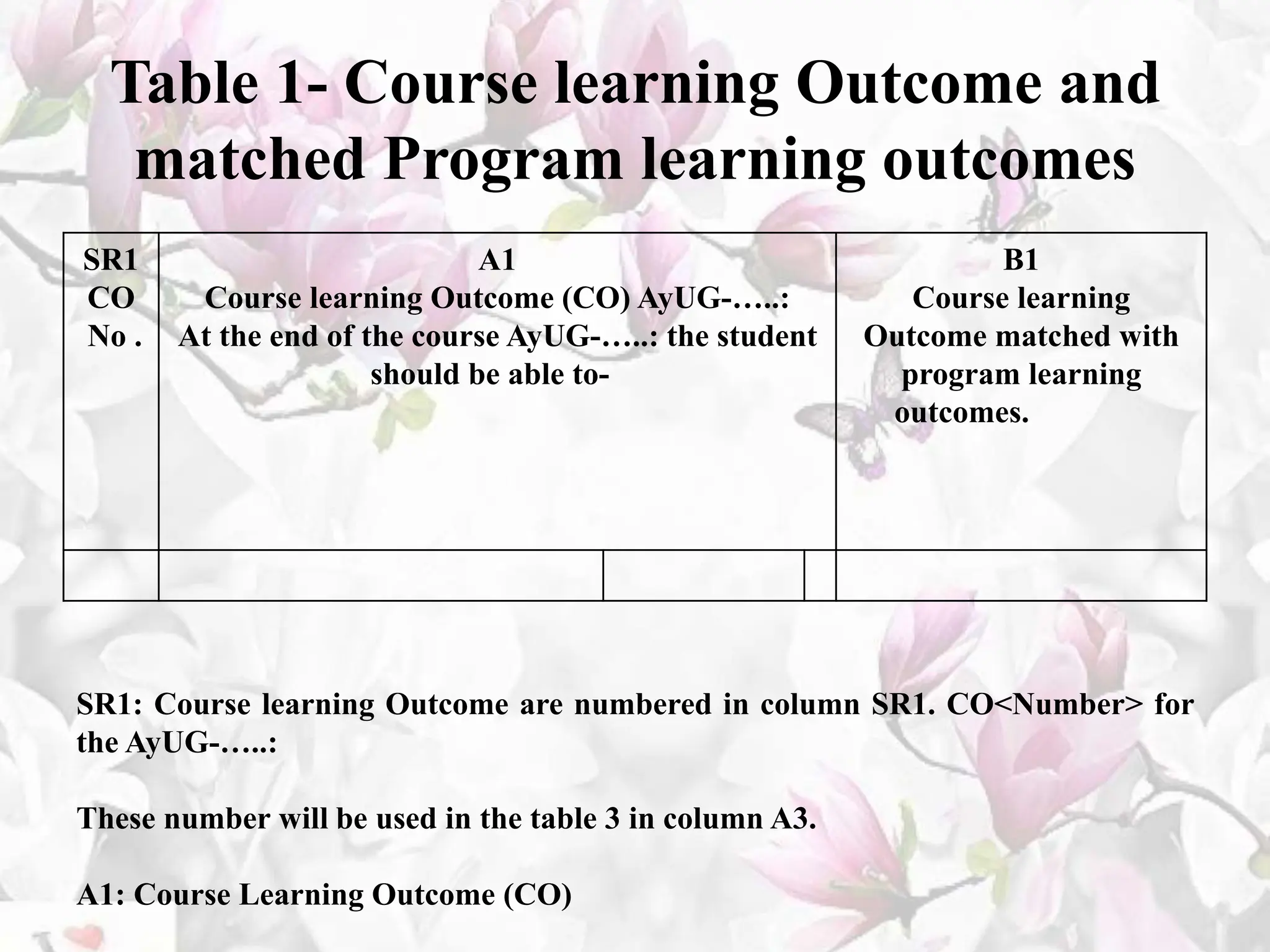
Next table explains Course learning outcomes
(CO) and they are matched with Program learning
outcomes.(PO)
Table 1- Course learning Outcome and
matched Program learning outcomes
SR1
CO
No .
A1
Course learning Outcome (CO) AyUG-…..:
At the end of the course AyUG-…..: the student
should be able to-
B1
Course learning
Outcome matched with
program learning
outcomes.
SR1: Course learning Outcome are numbered in column SR1. CO<Number> for
the AyUG-…..:
These number will be used in the table 3 in column A3.
A1: Course Learning Outcome (CO)
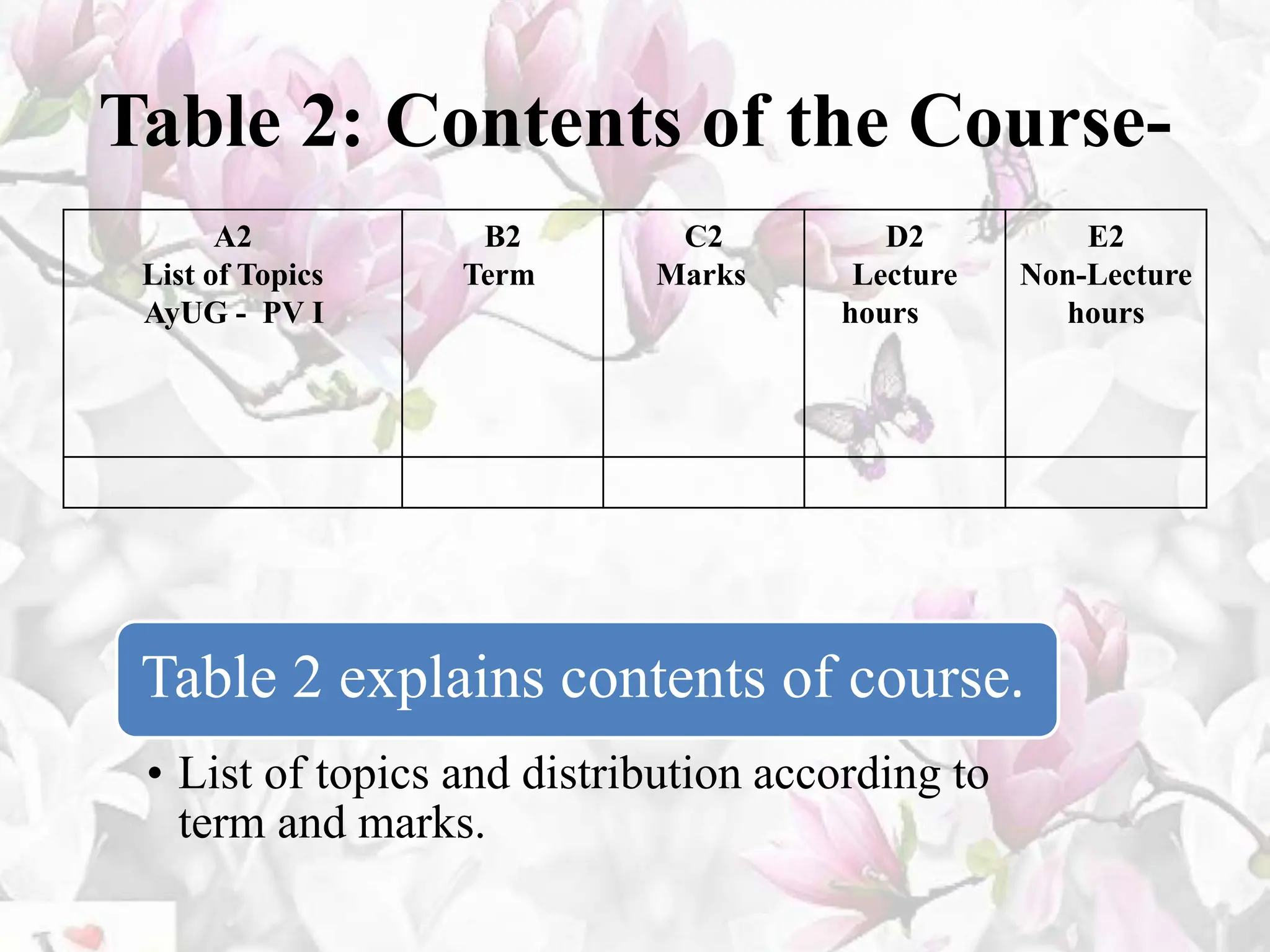
Table 2: Contents of the Course-
A2
List of Topics
AyUG - PV I
B2
Term
C2
Marks
D2
Lecture
hours
E2
Non-Lecture
hours
Table 2 explains contents of course.
• List of topics and distribution according to
term and marks.
Table 2: Contents of the Course-
A2
List of Topics AyUG-
PV I
B2
Term
C2
Marks
D2
Lecture
hours
E2
Non-Lecture
hours
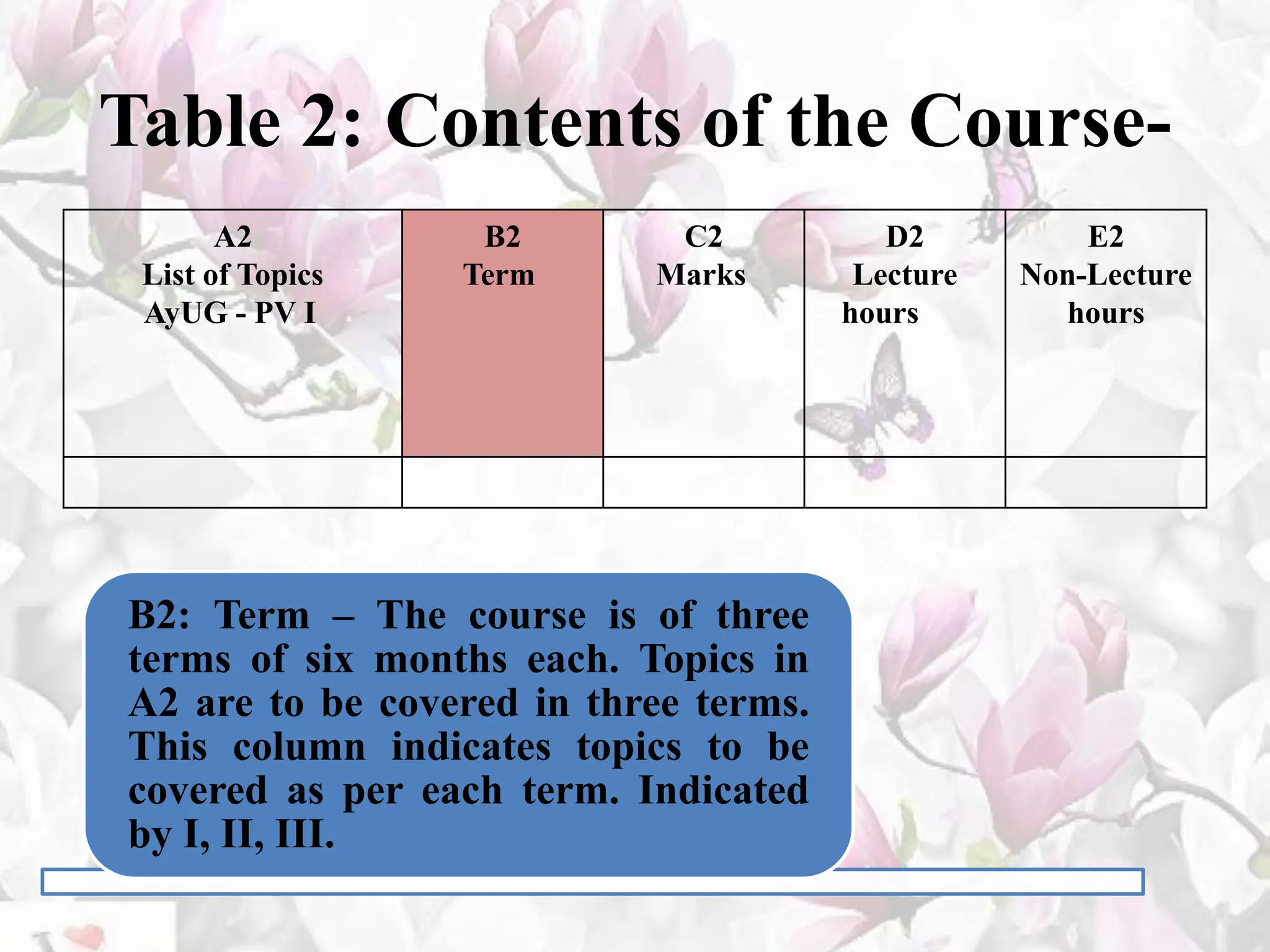
A2: List of topics AyUG-…..: List of
the topics (main and subtopics) those
are included in the course.
Table 2: Contents of the Course-
A2
List of Topics
AyUG - PV I
B2
Term
C2
Marks
D2
Lecture
hours
E2
Non-Lecture
hours
B2: Term – The course is of three
terms of six months each. Topics in
A2 are to be covered in three terms.
This column indicates topics to be
covered as per each term. Indicated
by I, II, III.
Table 2: Contents of the Course-
A2
List of Topics
AyUG - PV I
B2
Term
C2
Marks
D2
Lecture
hours
E2
Non-Lecture
hours
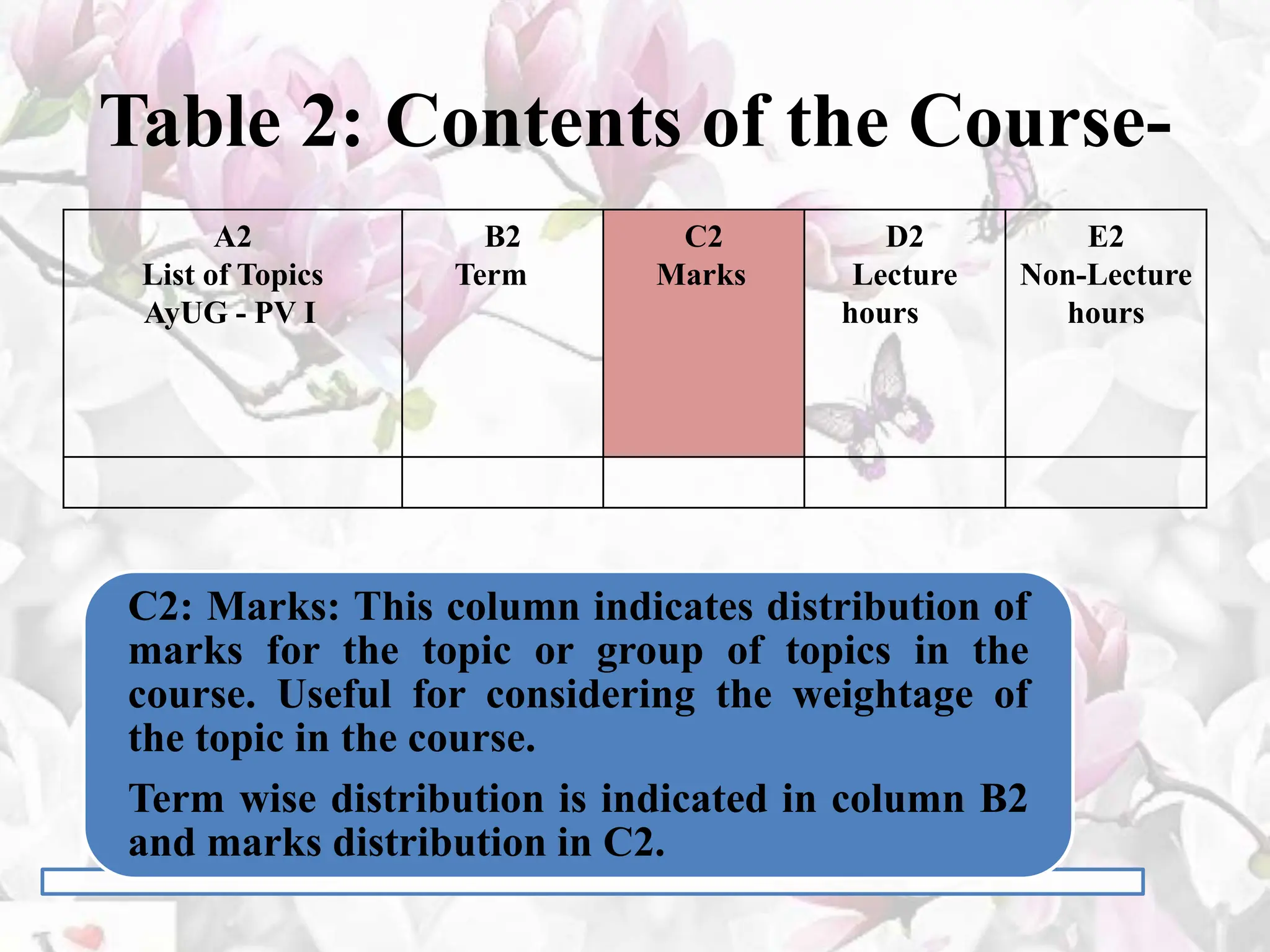
C2: Marks: This column indicates distribution of
marks for the topic or group of topics in the
course. Useful for considering the weightage of
the topic in the course.
Term wise distribution is indicated in column B2
and marks distribution in C2.
Table 2: Contents of the Course-
A2
List of Topics
AyUG - PV I
B2
Term
C2
Marks
D2
Lecture
hours
E2
Non-Lecture
hours
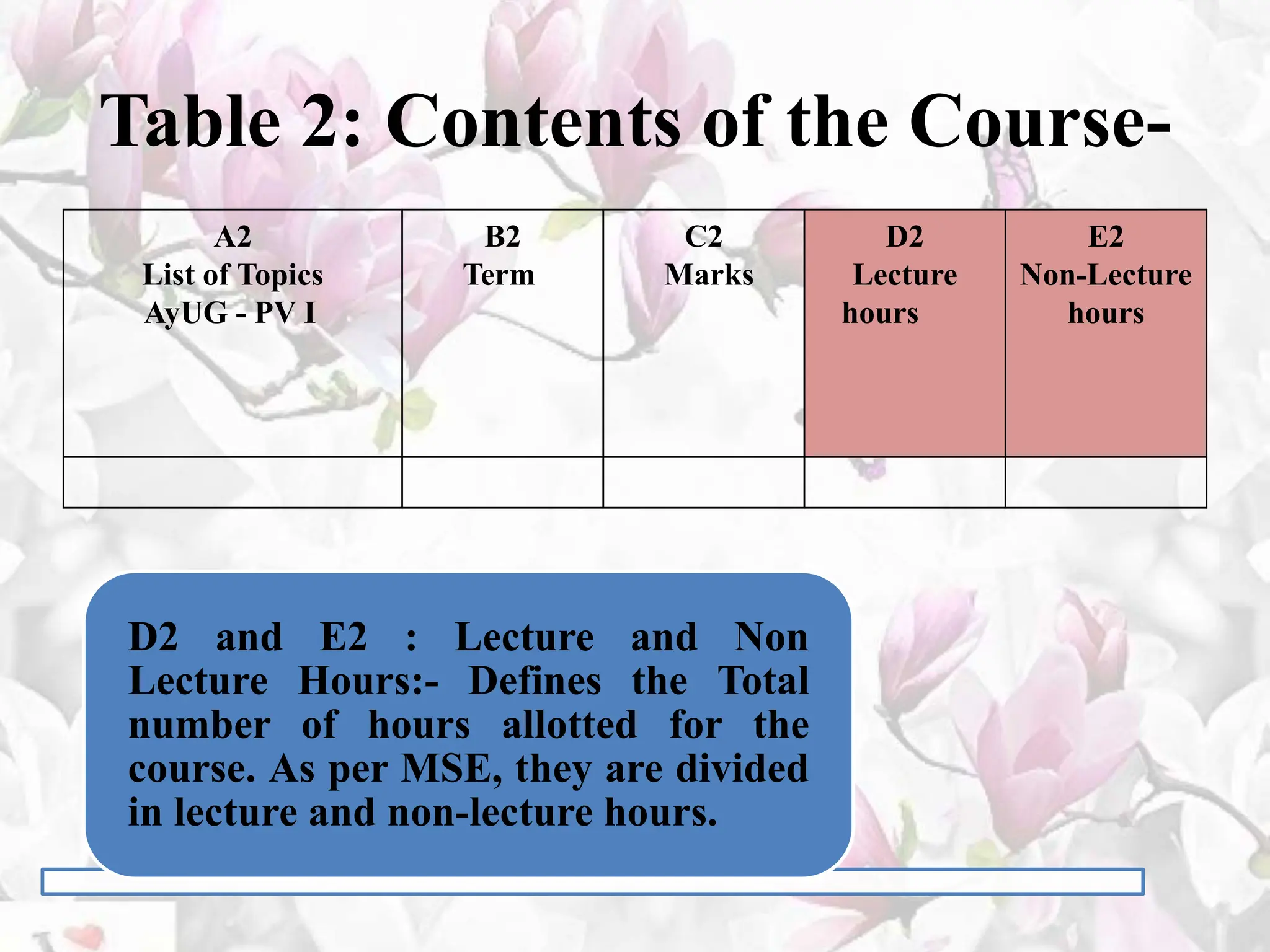
D2 and E2 : Lecture and Non
Lecture Hours:- Defines the Total
number of hours allotted for the
course. As per MSE, they are divided
in lecture and non-lecture hours.
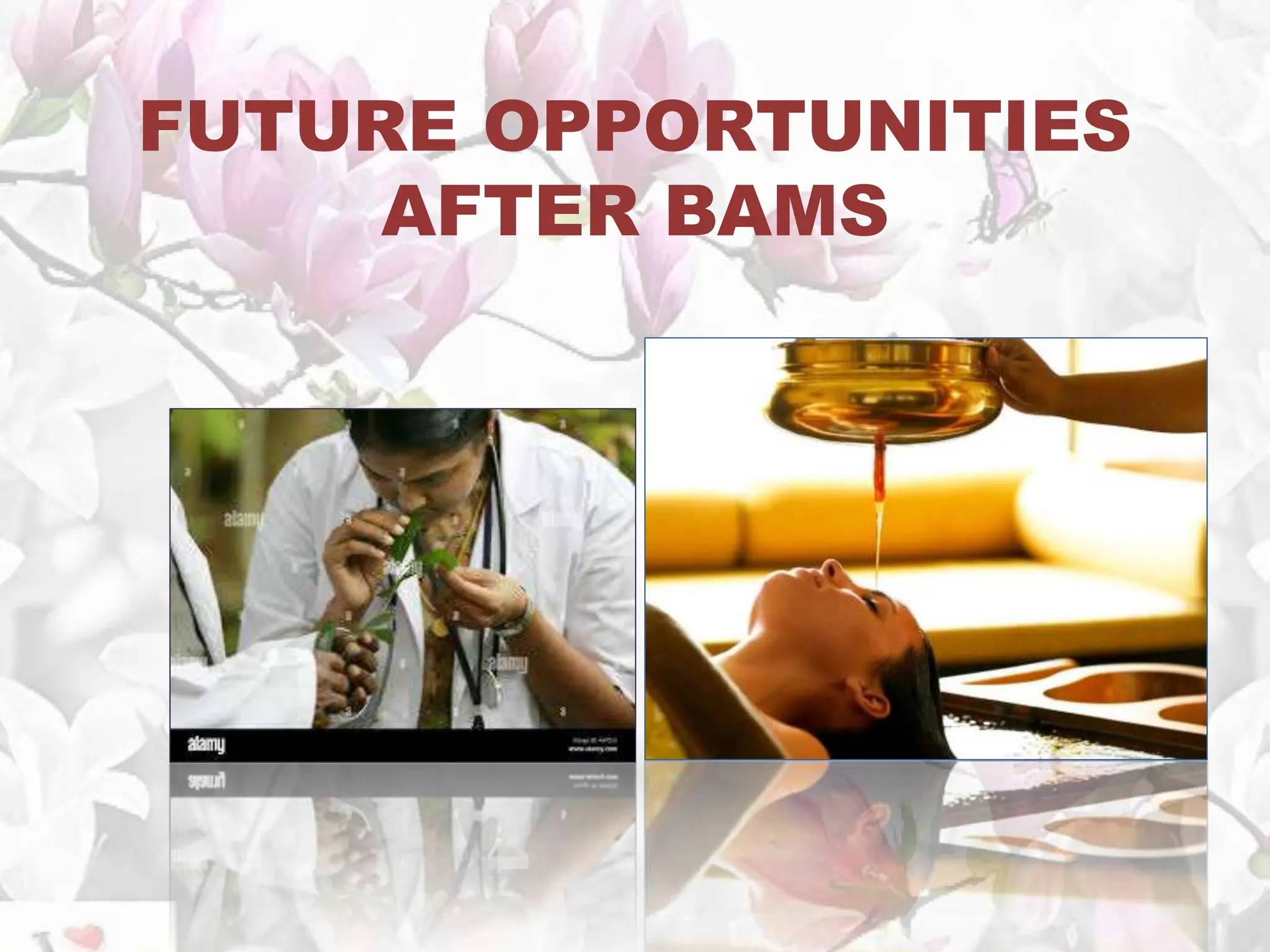
FUTURE OPPORTUNITIES
AFTER BAMS
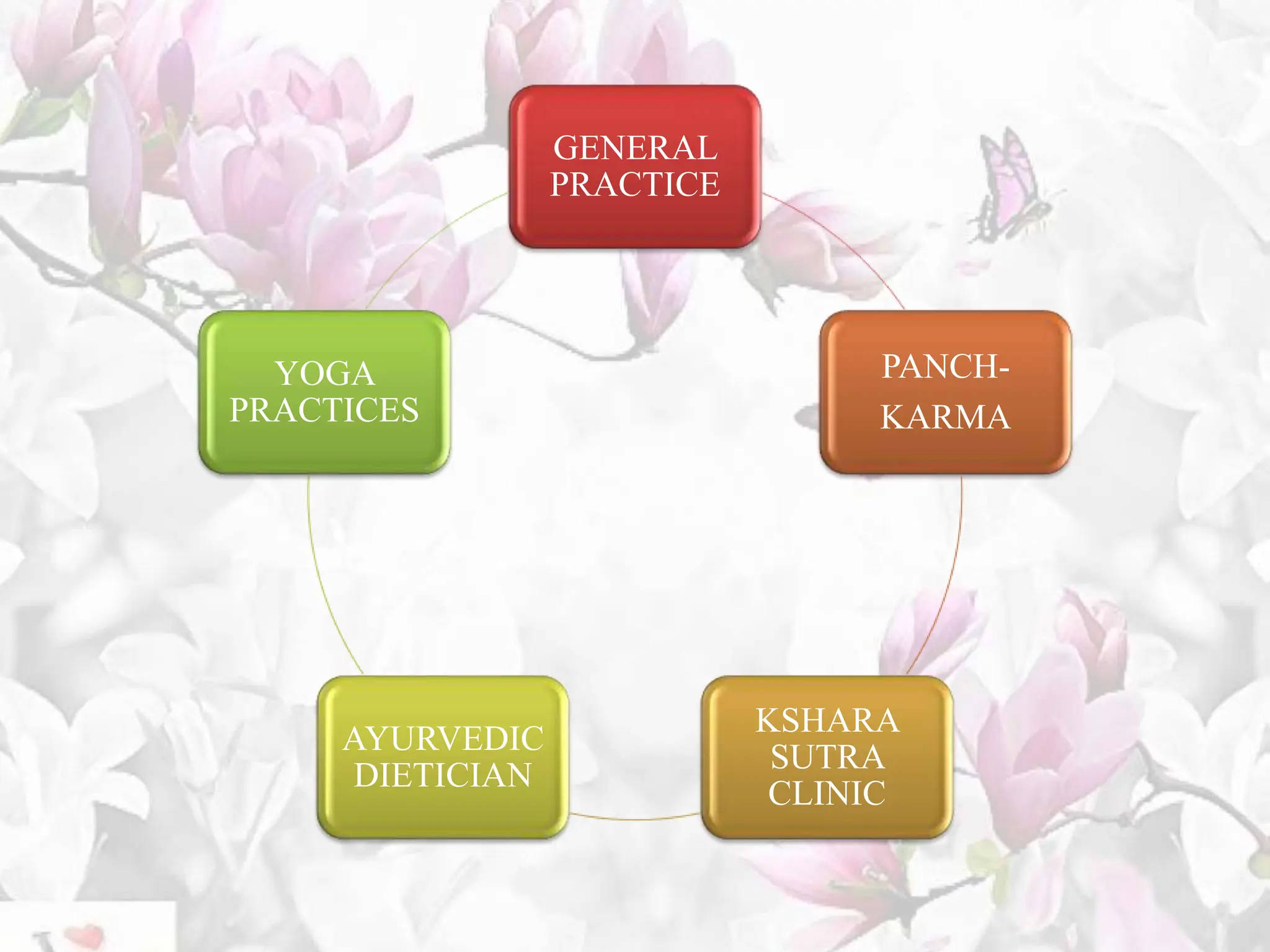
CLINICAL PRACTICE
There are different types of medical practice
settings depending on personal preferences and
career goals.
A Doctor can add value to the clinical practice by
consining various therapies by doing additional
diploma/certificates courses available.
GENERAL
PRACTICE
PANCH-
KARMA
KSHARA
SUTRA
CLINIC
AYURVEDIC
DIETICIAN
YOGA
PRACTICES
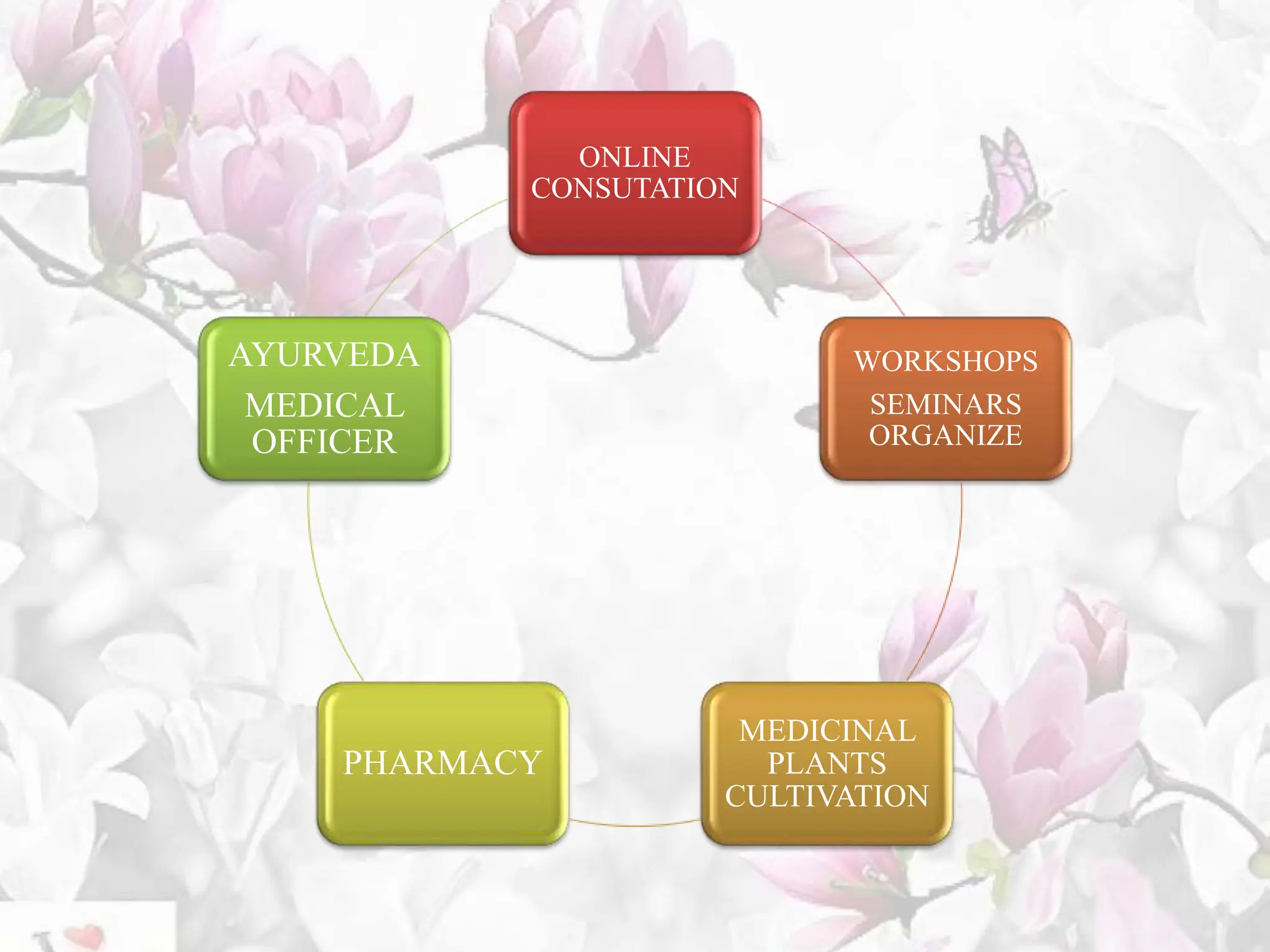
ONLINE
CONSUTATION
WORKSHOPS
SEMINARS
ORGANIZE
MEDICINAL
PLANTS
CULTIVATION
PHARMACY
AYURVEDA
MEDICAL
OFFICER
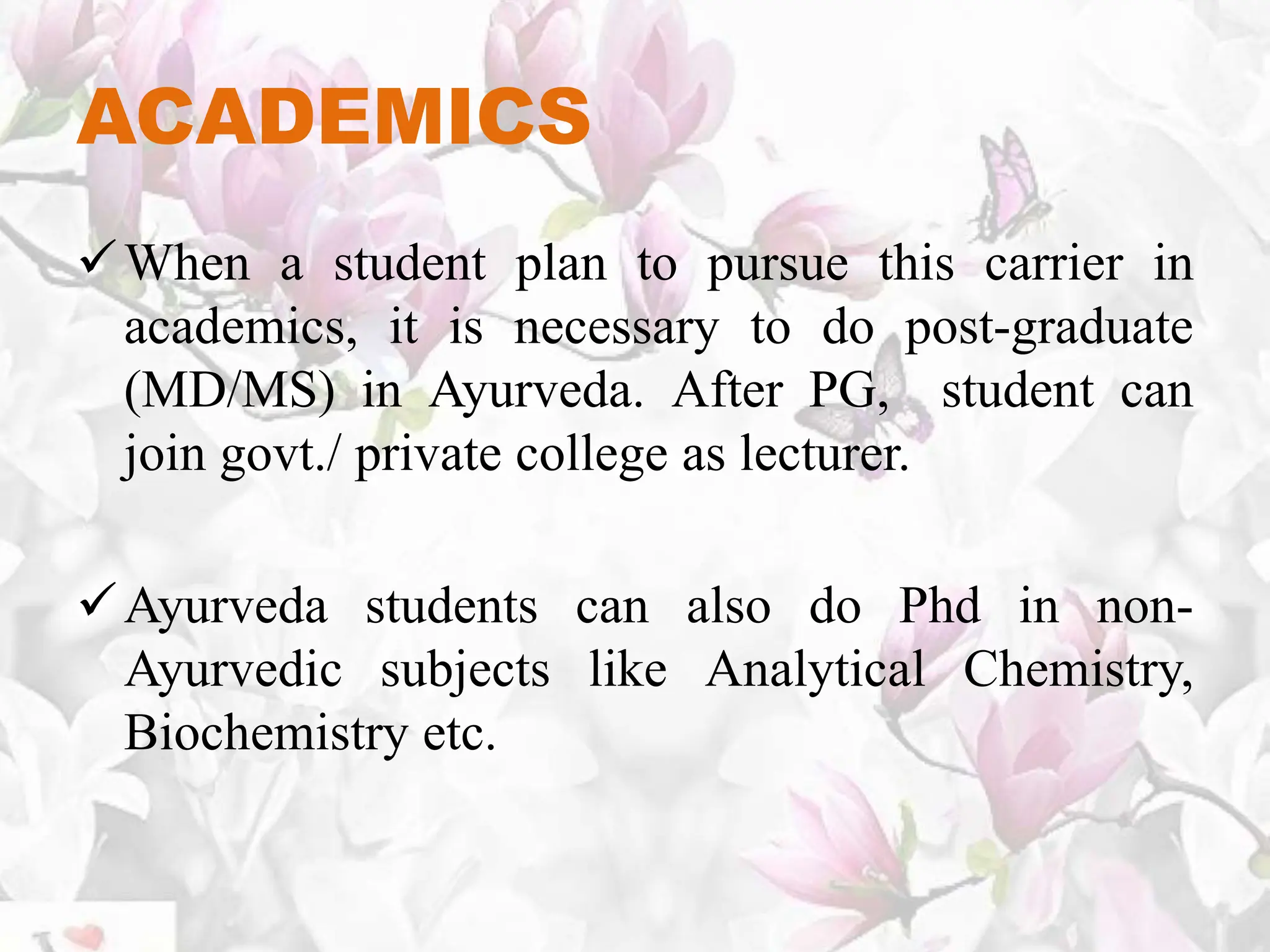
ACADEMICS
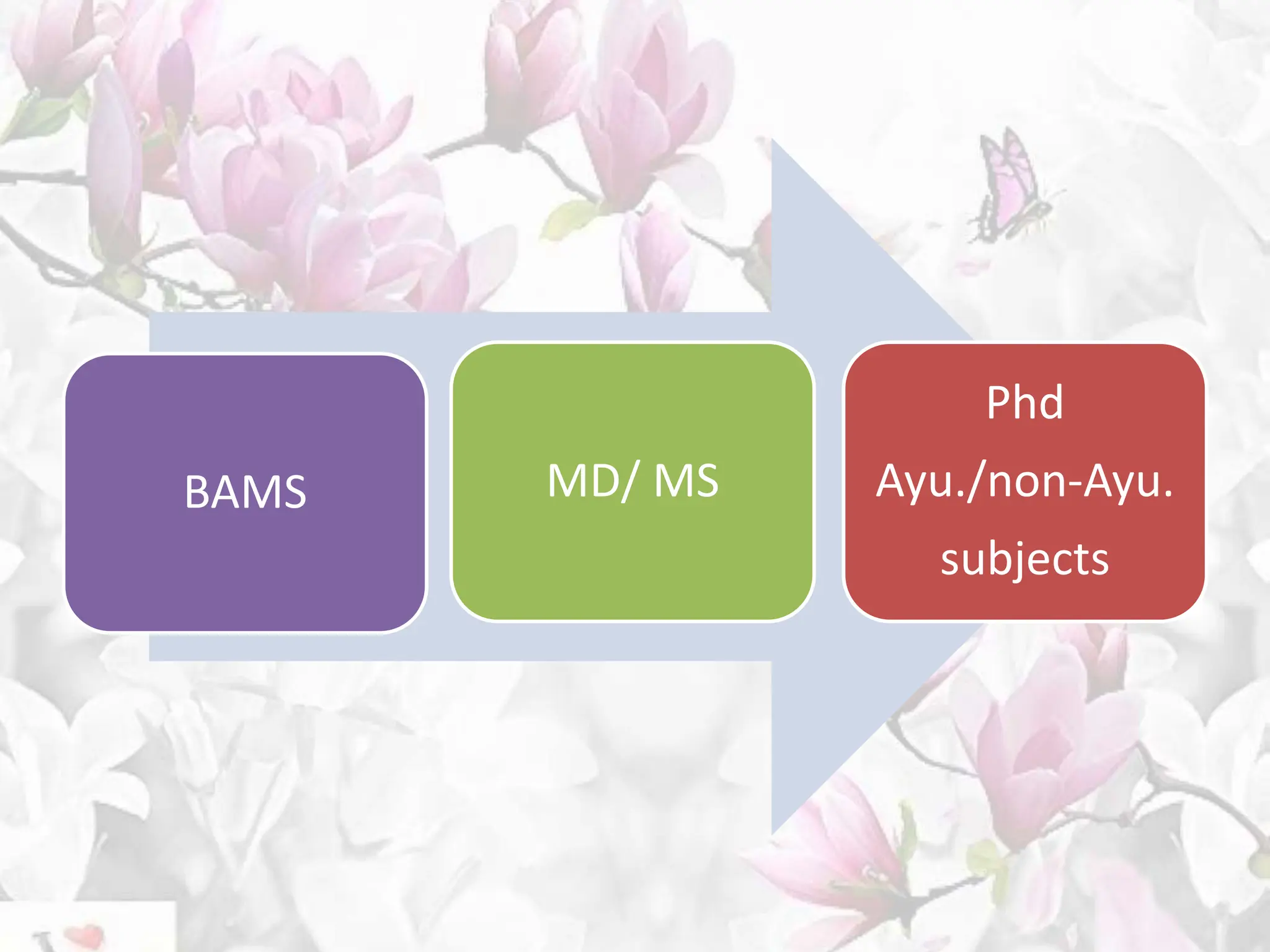
When a student plan to pursue this carrier in
academics, it is necessary to do post-graduate
(MD/MS) in Ayurveda. After PG, student can
join govt./ private college as lecturer.
Ayurveda students can also do Phd in non-
Ayurvedic subjects like Analytical Chemistry,
Biochemistry etc.
BAMS MD/ MS
Phd
Ayu./non-Ayu.
subjects
RESEARCH
By doing course such as
MSc or PG diploma in
Clinical Research student
can get job as ‘Clinical
Research Associate’ with
research unit of
Pharmaceutical company.
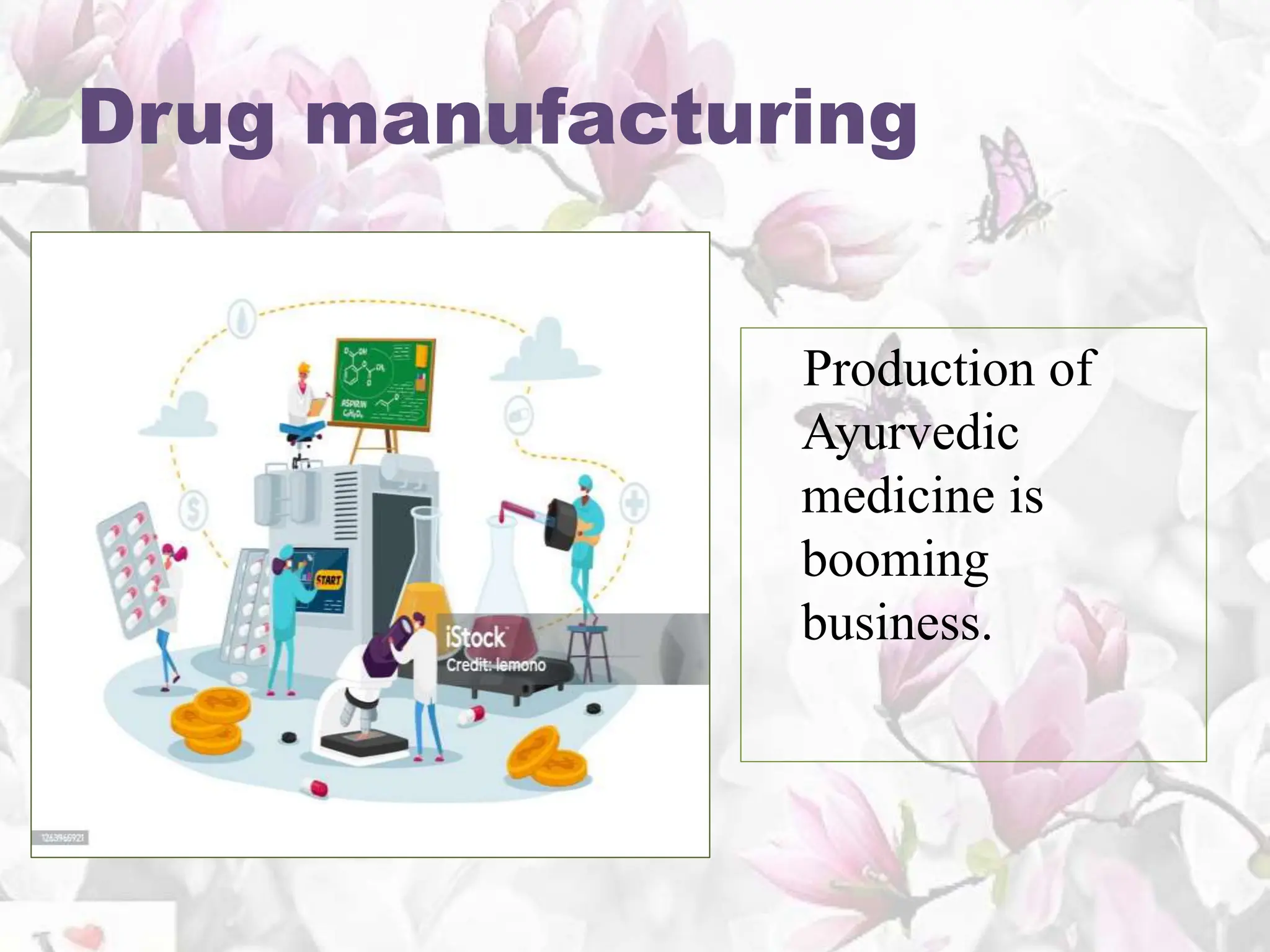
Drug manufacturing
Production of
Ayurvedic
medicine is
booming
business.
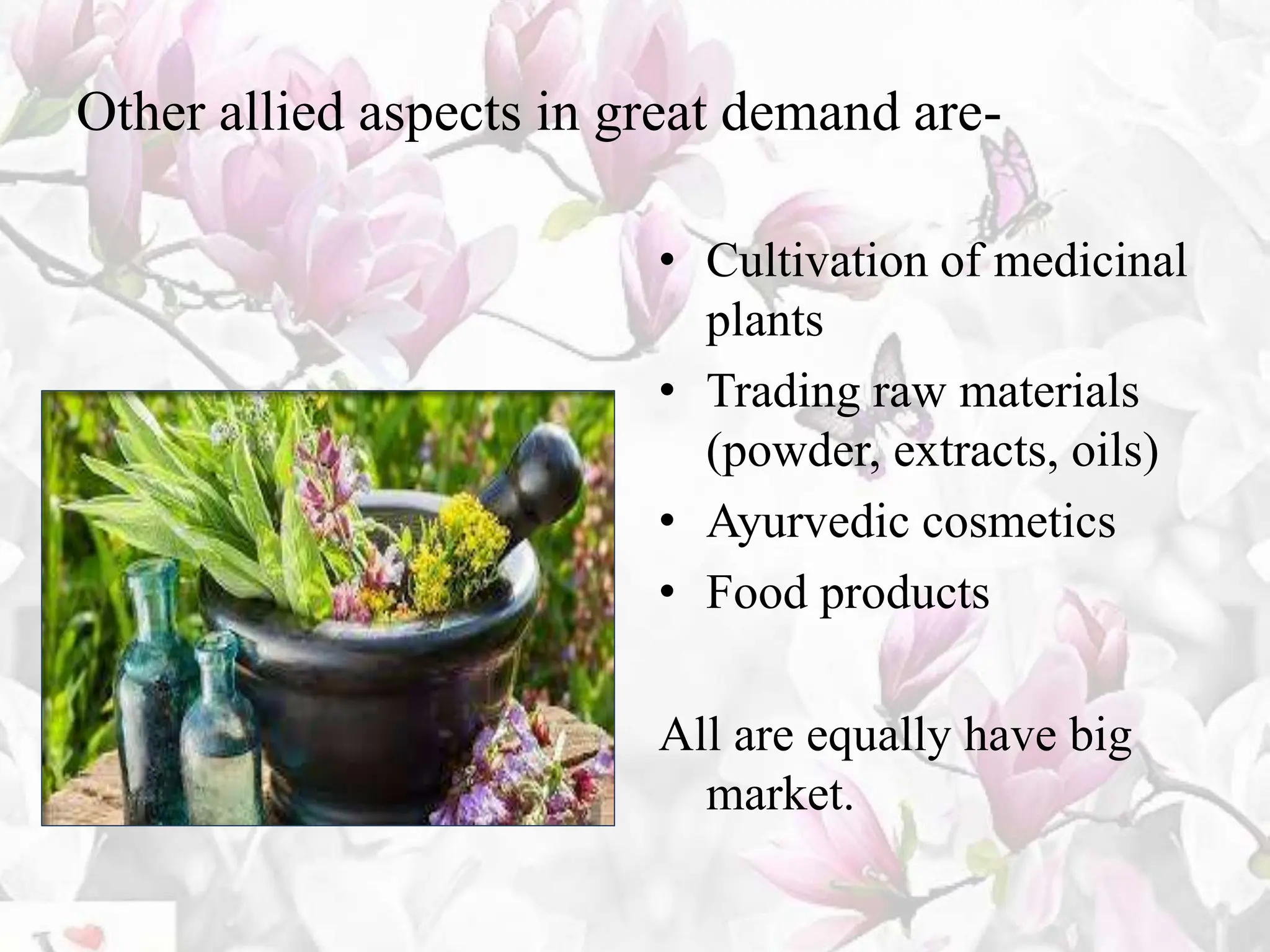
Other allied aspects in great demand are-
• Cultivation of medicinal
plants
• Trading raw materials
(powder, extracts, oils)
• Ayurvedic cosmetics
• Food products
All are equally have big
market.
Diploma in herbal medicine manufacturing also
available.
OPPORTUNITY during BAMS
course
The Central Council for Research in Ayurvedic
Sciences (CCRAS) has initiated the
“STUDENTSHIP PROGRAM FOR
AYURVEDA RESEARCH KEN (SPARK)” in
order to promote interest and aptitude for
research among Ayurveda undergraduates.
This program is only for interested Bachelor of
Ayurvedic Medicine and Surgery (BAMS)
students [1st year to 4th year (before appearing
in 4th year final exams)] studying in Ayurvedic
college recognized by NCISM, before they
appear in their final exams and therefore,
interns/ PG students are not eligible to apply.
The value of the studentship will be
Rs.25,000/- per month for two months duration
is meant to be a stipend for the student.
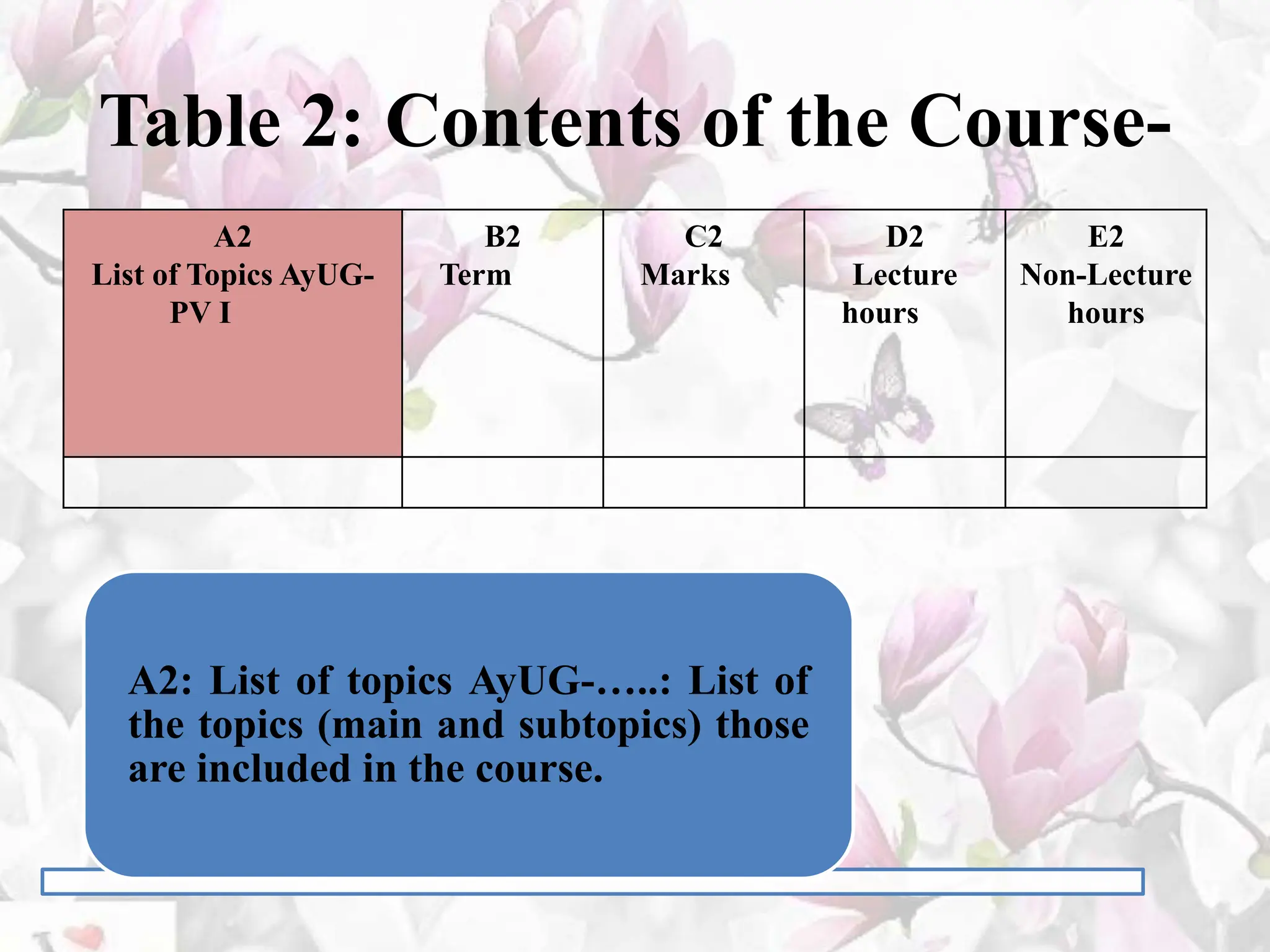
Name of the Programme
Professional years
Course code
Name of the course(Subject)
Next table explains Course learning outcomes
(CO) and they are matched with Programme
learning outcomes.(PO)
An overview of BAMS Curriculum or Syllabus including highlights of Minimum Standards of Education 2021

An overview of BAMS Curriculum or Syllabus including highlights of Minimum Standards of Education 2021

  • 1.
    An overview ofBAMS Curriculum or Syllabus including highlights of Minimum Standards of Education 2021, Ayurveda higher education and Job opportunities Dr. Priyanka Gautam Asst. Professor DEPT. OF DRAVYAGUNA SDAMC & RC, MATHURA
  • 3.
    Ayurveda Ayurveda means “thescience of life”(ayur means ‘life’ and veda means ‘science’ in sanskrit. Ayurveda is a discipline of the upveda or “auxillary knowledge” in vedic tradition. Ayurveda has its prime origin from Atharva-Veda and apart as a supplement of the Rig-Veda. Dhanvantari is worshipped as the God of Ayurveda..
  • 4.
    Aim The aim ofthis system is to prevent illness¸ heal the sick and preserve life. The Ayurveda has its origins from the India and extended its wings in various parts of the world. Ayurveda was taught in Gurukula system in ancient days, which is now been evolved in to under graduate & post graduate courses from Institutions.
  • 6.
    BAMS (Ayurvedacharya) Bachelors degreein Ayurveda, medicine and surgery is an integration of traditional Ayurveda with current medicines. Several universities in India has awarded this medical degree. After the graduation in BAMS, candidates can register in the Ayurveda boards controlled by both central and state government. A registered candidate is qualified to work under any Ayurveda medical services anywhere in India.
  • 7.
    Upgrade awards • BAMS=Bachelor of Ayurvedic Medicine and Surgery • MD=Doctor of Medicine • MS= Master of Surgery • PhD= Doctor of Philosophy
  • 8.
  • 9.
    Curriculum The curriculum isdefined as the guideline of the academic content covered by an education system while undergoing a particular course or program. Curriculum has a wider scope which covers the knowledge, attitude, behavior, manners, performance & skills that are imparted or inculcated in a student. It contains every aspect from objectives to assignments.
  • 10.
    Minimum Standards of Education2021 Ayurveda higher education
  • 11.
    As per newMSE(Minimum standards of education 2021) NCISM (The National Commission for Indian System of Medicine) started working by aiming at 2030 and to align with NEP 2020. Accordingly MSE-2021(Minimum Standards of Undergraduate Ayurveda Education Regulations-2021) several initiatives started such as-
  • 12.
    1. This programme(BAMS) is divided in three Professional years of 1.5 years each, followed by 1 year of internship. 1 professional BAMS has five courses (Subjects). 2 professional BAMS has six courses (Subjects).
  • 13.
    2. Reversal ofteaching hours of theory and practical from 2:1 to 1:2. 3. Introduced concept of non-lecture hours. 4. Incorporated advance teaching as well as assessment methods.
  • 14.
    Lecture hours Lecture isan exposition of a given subject or discourse on a particular subject delivered before an audience or class. Commonest method used in the classroom for teaching. Now it is supplemented with A/V aids. The existing learning conditions, aiming to transfer common knowledge, skills, and values to the student.
  • 15.
    Non Lecture Hours Practical-Learningmeans knowledge gained by implementing theory in real-life activities. This way of learning helps students to remember the topic for a long time. Practical-learning makes the study more enjoyable, with the highest engagement in the topic.
  • 16.
    Common methods like…  Discussion & debates,  Inquiry based learning,  Problem based learning,  Case based learning,  Project based learning,  Team based learning,  Flipped classroom,  Blended learning,  Edutainment like PPT, demonstrations, discussions,  Simulations,  Self directed learning,  Problem solved learning,  Kinesthetic learning like as poster making, chart making, videos clips.  Workshops,  Game based learning.
  • 17.
    Team based learninglike Group working, Action learning, field work. Generating ideas with Lateral thinking, Brainstorming, Mind-mapping, Creative writing, drawing etc.
  • 18.
    COURSE CURRICULUM Course curriculumfor first professional BAMS which is prescribed by The National Commission for Indian System of Medicine (NCISM). It is applicable from 2021-22 batch onwards for 5 years or until further notification by NCISM, whichever is earlier. User Manual was I Ayurved was released in March 2022. In Aug 2023, II year curriculum includes new TL methods and New Assessment methods, User Manual for II BAMS is released with enhanced contents and customized for II year curriculum.
  • 19.
    Subjects of first professionalyear PADARTHA VIJNANAM (FUNDAMENTAL PRINCIPLES OF AYURVEDAAND QUANTUM MECHANICS) RACHANA SHARIRA (HUMAN ANATOMY) SAMHITAADHYAYAN-1 (STUDY OF AYURVEDA CLASSICAL TEXT) KRIYA SHARIRA (HUMAN PHYSIOLOGY) SAMSKRITAM EVAM AYURVED ITHIHAS (SANSKRIT AND HISTORY OF AYURVEDA )
  • 20.
    Subjects of Second professionalyear RASASHASTRA EVAM BHAISHAJYA KALPANA AGAD TANTRA EVAM VIDHI VAIDYAKA SAMHITAADHYAYAN-2 DRAVYAGUNA VIGYAN ROGA NIDAN EVAM VIKRITI VIGYAN SWASTHAVRITTA EVAM YOGA
  • 21.
    Subjects of Third professionalyear PRASUTI TANTRA EVUM STRI ROGA KAUMARBHRITYA PARICHAYA CHARAK SAMHITA (UTTARARDHA) KAYACHIKITSA PANCHKARMA SHALYA TANTRA SHALAKYA TANTRA RESEARCH METHODOLOGYAND MEDICAL STATISTICS
  • 22.
    Since 2021-22 admittedbatch NCISM had accepted Outcome based curriculum.
  • 23.
    Outcome-based curriculum Educational frameworkthat centers around clearly defined learning outcomes or objectives. The curriculum is designed and structured based on the desired knowledge, skills, and competencies that students should attain by the end of a course. Emphasizes the demonstrable results of learning.
  • 24.
    Enhances transparency, asboth educators and students have a clear understanding of the intended learning goals. Active learning, Critical thinking, and Practical application of knowledge.
  • 25.
    Outcome-Based Curriculum (OBC) isstructured around the alignment of three key elements: 1.General Abilities (GA), 2.Program Learning Outcomes (PLO), and 3.Course Learning Outcomes (CLO). It ensure a coherent and effective educational framework. Program Learning Outcomes (PLO) Course Learning Outcomes (CLO) General Abilities (GA)
  • 26.
    General Abilities (GA) Encompassa set of skills and attributes that students should develop across their academic journey. Like- Critical thinking, Communication, Teamwork, Ethical awareness etc. Represent the overarching qualities in students.
  • 27.
    Program Learning Outcomes(PLO) Specific statements that articulate what students should achieve by the time they complete a program of study. Reflect the essential knowledge, skills, and competencies relevant to a particular field.
  • 28.
    Program learning Outcomes Programlearning Outcomes deal with the general aspect of graduation for a BAMS program, and the competencies and expertise a graduate will possess after completion of the program. At the end of the BAMS programmed, the students will be able to:
  • 29.
    Course Learning Outcomes(CLO) It is a detailed description of, what a student must be able to do at the completion of a course. Objectives for individual courses within the program. CLO helps the learner to understand the reason for pursuing the course. They break down the broader PLOs into specific, measurable statements that define what students should be able to do after completing a particular course.
  • 30.
    Graduate attributes Graduate attributesreflect the particular quality and feature or characteristics of an individual, including the knowledge, skills, attitudes and values that are expected to be acquired by a graduate through studies at the higher education institution.
  • 31.
    include capabilities thathelp strengthen learners, abilities for widening current knowledge base and skills, gaining new knowledge and skills, undertaking future studies, performing well in a chosen career and playing a constructive role as a responsible citizen in the society.
  • 32.
    First Page ofManual It contains Name, Code, Year and “QR code” for downloading the document. Second page is Summary page for the Course. The Page will provide at a glance information of Lecture and non-Lecture hours, Distribution of hours as per papers, Distribution of Marks (Theory and Practical). Next table explains Course learning outcomes (CO) and they are matched with Program learning outcomes.(PO)
  • 34.
    Table 1- Courselearning Outcome and matched Program learning outcomes SR1 CO No . A1 Course learning Outcome (CO) AyUG-…..: At the end of the course AyUG-…..: the student should be able to- B1 Course learning Outcome matched with program learning outcomes. SR1: Course learning Outcome are numbered in column SR1. CO<Number> for the AyUG-…..: These number will be used in the table 3 in column A3. A1: Course Learning Outcome (CO)
  • 35.
    Table 2: Contentsof the Course- A2 List of Topics AyUG - PV I B2 Term C2 Marks D2 Lecture hours E2 Non-Lecture hours Table 2 explains contents of course. • List of topics and distribution according to term and marks.
  • 36.
    Table 2: Contentsof the Course- A2 List of Topics AyUG- PV I B2 Term C2 Marks D2 Lecture hours E2 Non-Lecture hours A2: List of topics AyUG-…..: List of the topics (main and subtopics) those are included in the course.
  • 37.
    Table 2: Contentsof the Course- A2 List of Topics AyUG - PV I B2 Term C2 Marks D2 Lecture hours E2 Non-Lecture hours B2: Term – The course is of three terms of six months each. Topics in A2 are to be covered in three terms. This column indicates topics to be covered as per each term. Indicated by I, II, III.
  • 38.
    Table 2: Contentsof the Course- A2 List of Topics AyUG - PV I B2 Term C2 Marks D2 Lecture hours E2 Non-Lecture hours C2: Marks: This column indicates distribution of marks for the topic or group of topics in the course. Useful for considering the weightage of the topic in the course. Term wise distribution is indicated in column B2 and marks distribution in C2.
  • 39.
    Table 2: Contentsof the Course- A2 List of Topics AyUG - PV I B2 Term C2 Marks D2 Lecture hours E2 Non-Lecture hours D2 and E2 : Lecture and Non Lecture Hours:- Defines the Total number of hours allotted for the course. As per MSE, they are divided in lecture and non-lecture hours.
  • 40.
  • 41.
    CLINICAL PRACTICE There aredifferent types of medical practice settings depending on personal preferences and career goals. A Doctor can add value to the clinical practice by consining various therapies by doing additional diploma/certificates courses available.
  • 42.
  • 43.
  • 44.
    ACADEMICS When a studentplan to pursue this carrier in academics, it is necessary to do post-graduate (MD/MS) in Ayurveda. After PG, student can join govt./ private college as lecturer. Ayurveda students can also do Phd in non- Ayurvedic subjects like Analytical Chemistry, Biochemistry etc.
  • 45.
  • 46.
    RESEARCH By doing coursesuch as MSc or PG diploma in Clinical Research student can get job as ‘Clinical Research Associate’ with research unit of Pharmaceutical company.
  • 47.
  • 48.
    Other allied aspectsin great demand are- • Cultivation of medicinal plants • Trading raw materials (powder, extracts, oils) • Ayurvedic cosmetics • Food products All are equally have big market.
  • 49.
    Diploma in herbalmedicine manufacturing also available.
  • 50.
    OPPORTUNITY during BAMS course TheCentral Council for Research in Ayurvedic Sciences (CCRAS) has initiated the “STUDENTSHIP PROGRAM FOR AYURVEDA RESEARCH KEN (SPARK)” in order to promote interest and aptitude for research among Ayurveda undergraduates.
  • 51.
    This program isonly for interested Bachelor of Ayurvedic Medicine and Surgery (BAMS) students [1st year to 4th year (before appearing in 4th year final exams)] studying in Ayurvedic college recognized by NCISM, before they appear in their final exams and therefore, interns/ PG students are not eligible to apply. The value of the studentship will be Rs.25,000/- per month for two months duration is meant to be a stipend for the student.
  • 52.
    Name of theProgramme Professional years Course code Name of the course(Subject) Next table explains Course learning outcomes (CO) and they are matched with Programme learning outcomes.(PO)