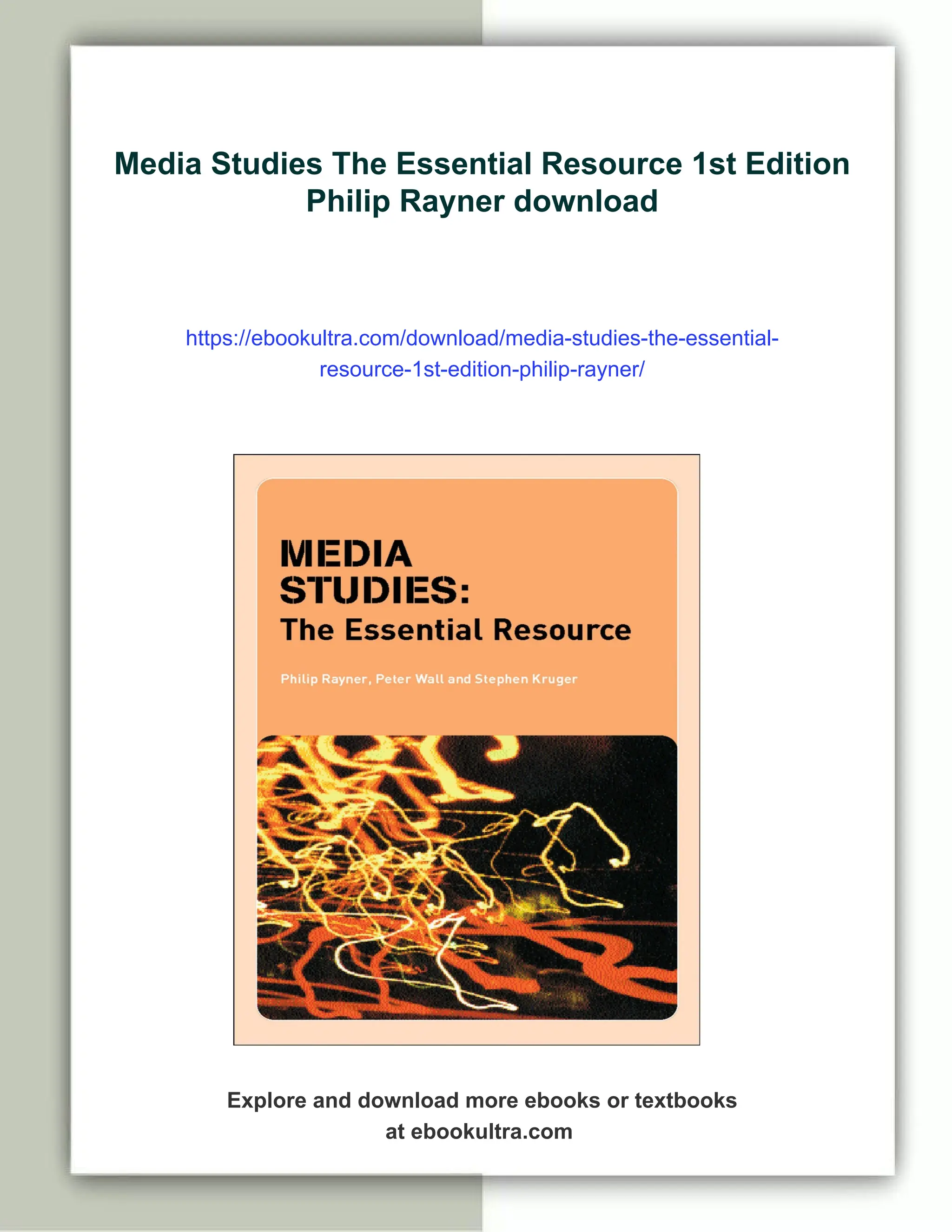
Media Studies The Essential Resource 1st Edition Philip Rayner
Media Studies The Essential Resource 1st Edition Philip Rayner
Media Studies The Essential Resource 1st Edition Philip Rayner
Media Studies The Essential Resource 1st Edition Philip Rayner
Media Studies The Essential Resource 1st Edition Philip Rayner
1.
Media Studies TheEssential Resource 1st Edition
Philip Rayner download
https://ebookultra.com/download/media-studies-the-essential-
resource-1st-edition-philip-rayner/
Explore and download more ebooks or textbooks
at ebookultra.com
2.
We have selectedsome products that you may be interested in
Click the link to download now or visit ebookultra.com
for more options!.
As Media Studies The Essential Revision Guide 1st Edition
Peter Wall
https://ebookultra.com/download/as-media-studies-the-essential-
revision-guide-1st-edition-peter-wall/
The Social Media MBA in Practice An Essential Collection
of Inspirational Case Studies to Influence Your Social
Media Strategy 1st Edition Christer Holloman
https://ebookultra.com/download/the-social-media-mba-in-practice-an-
essential-collection-of-inspirational-case-studies-to-influence-your-
social-media-strategy-1st-edition-christer-holloman/
Media Studies The Basics 1st Edition Julian Mcdougall
https://ebookultra.com/download/media-studies-the-basics-1st-edition-
julian-mcdougall/
The Peloponnesian War 431 404 BC Essential Histories
Philip De Souza
https://ebookultra.com/download/the-peloponnesian-war-431-404-bc-
essential-histories-philip-de-souza/
3.
The Oxford NewGerman Dictionary The Essential Resource
Revised and Updated Oxford University Press
https://ebookultra.com/download/the-oxford-new-german-dictionary-the-
essential-resource-revised-and-updated-oxford-university-press/
Essential Revision Notes for MRCP 2nd Edition Philip A.
Kalra
https://ebookultra.com/download/essential-revision-notes-for-mrcp-2nd-
edition-philip-a-kalra/
Extended Mathematics for IGCSE 1st edition Edition David
Rayner
https://ebookultra.com/download/extended-mathematics-for-igcse-1st-
edition-edition-david-rayner/
250 Essential Chinese Characters Volume 1 Revised Edition
Philip Yungkin Lee
https://ebookultra.com/download/250-essential-chinese-characters-
volume-1-revised-edition-philip-yungkin-lee/
Windows 7 The Definitive Guide The Essential Resource for
Professionals and Power Users 1st Edition William R.
Stanek
https://ebookultra.com/download/windows-7-the-definitive-guide-the-
essential-resource-for-professionals-and-power-users-1st-edition-
william-r-stanek/
5.
Media Studies TheEssential Resource 1st Edition Philip
Rayner Digital Instant Download
Author(s): Philip Rayner, Peter Wall, Stephen Kruger
ISBN(s): 9780415291729, 0415291720
Edition: 1
File Details: PDF, 2.76 MB
Year: 2004
Language: english
7.
▼ MEDIA STUDIES:
THEESSENTIAL RESOURCE
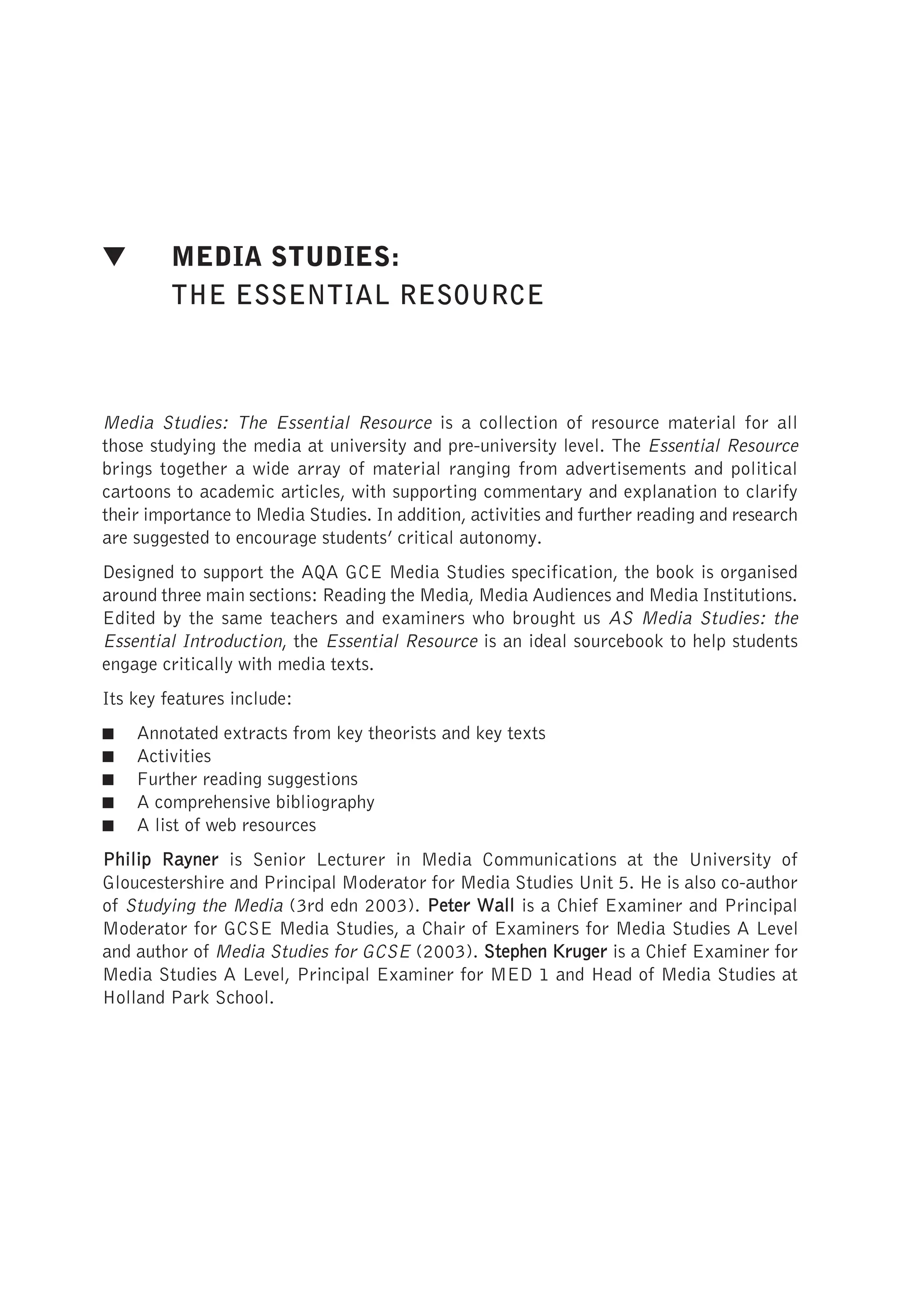
Media Studies: The Essential Resource is a collection of resource material for all
those studying the media at university and pre-university level. The Essential Resource
brings together a wide array of material ranging from advertisements and political
cartoons to academic articles, with supporting commentary and explanation to clarify
their importance to Media Studies. In addition, activities and further reading and research
are suggested to encourage students’ critical autonomy.
Designed to support the AQA GCE Media Studies specification, the book is organised
around three main sections: Reading the Media, Media Audiences and Media Institutions.
Edited by the same teachers and examiners who brought us AS Media Studies: the
Essential Introduction, the Essential Resource is an ideal sourcebook to help students
engage critically with media texts.
Its key features include:
■ Annotated extracts from key theorists and key texts
■ Activities
■ Further reading suggestions
■ A comprehensive bibliography
■ A list of web resources
Philip R
Rayner is Senior Lecturer in Media Communications at the University of
Gloucestershire and Principal Moderator for Media Studies Unit 5. He is also co-author
of Studying the Media (3rd edn 2003). Peter W
Wall is a Chief Examiner and Principal
Moderator for GCSE Media Studies, a Chair of Examiners for Media Studies A Level
and author of Media Studies for GCSE (2003). Stephen K
Kruger is a Chief Examiner for
Media Studies A Level, Principal Examiner for MED 1 and Head of Media Studies at
Holland Park School.
8.
Other b
books f
forM
Media a
and C
Communication S
Studies
AS Communication Studies: The Essential Introduction
Andrew Beck, Peter Bennett, Peter Wall
Communication Studies: The Essential Resource
Andrew Beck, Peter Bennett, Peter Wall
AS Media Studies: The Essential Introduction
Philip Rayner, Stephen Kruger, Peter Wall
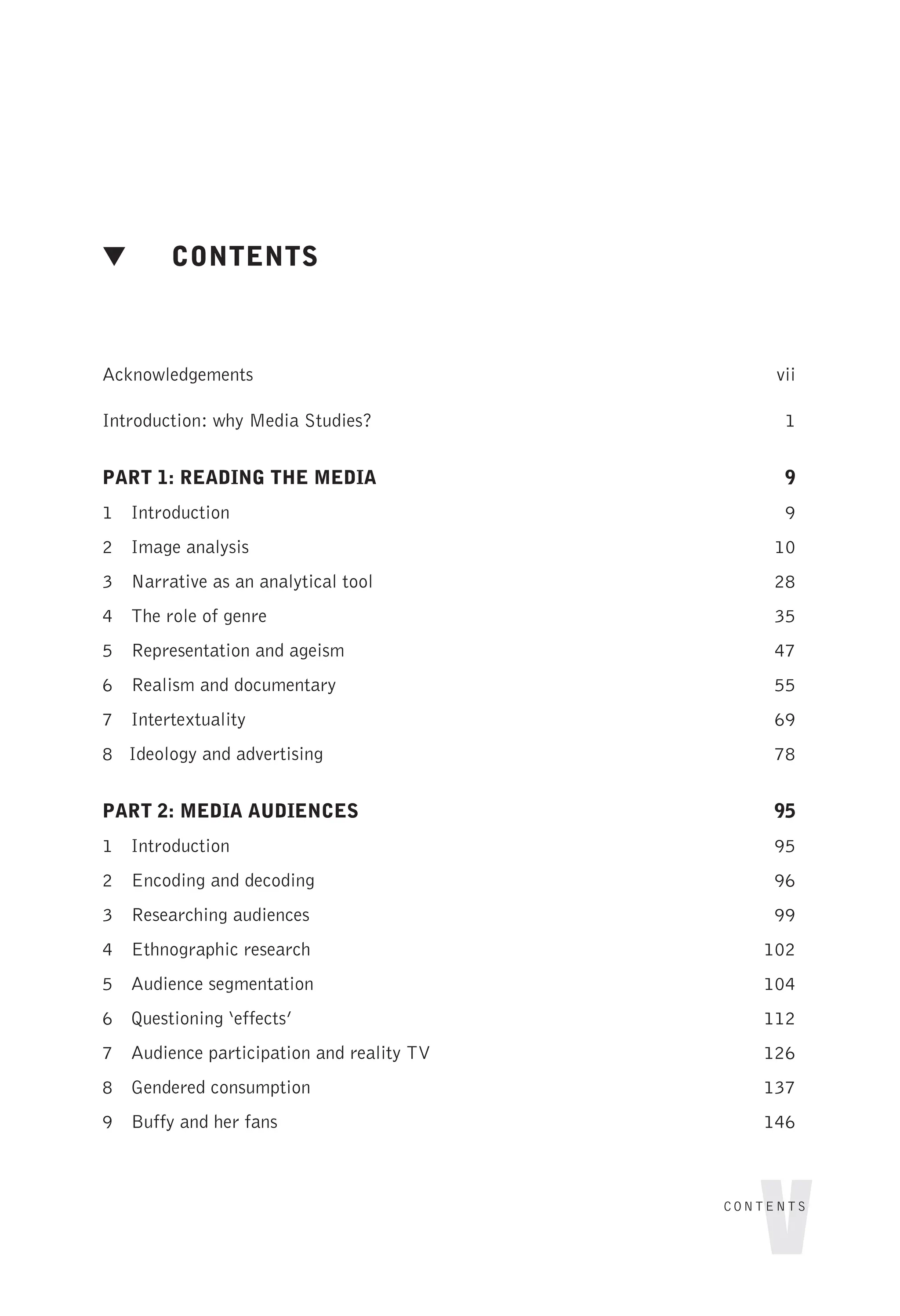
▼ CONTENTS
Acknowledgements vii
Introduction:why Media Studies? 1
PART 1: READING THE MEDIA 9
1 Introduction 9
2 Image analysis 10
3 Narrative as an analytical tool 28
4 The role of genre 35
5 Representation and ageism 47
6 Realism and documentary 55
7 Intertextuality 69
8 Ideology and advertising 78
PART 2: MEDIA AUDIENCES 95
1 Introduction 95
2 Encoding and decoding 96
3 Researching audiences 99
4 Ethnographic research 102
5 Audience segmentation 104
6 Questioning ‘effects’ 112
7 Audience participation and reality TV 126
8 Gendered consumption 137
9 Buffy and her fans 146
v
CONTENTS
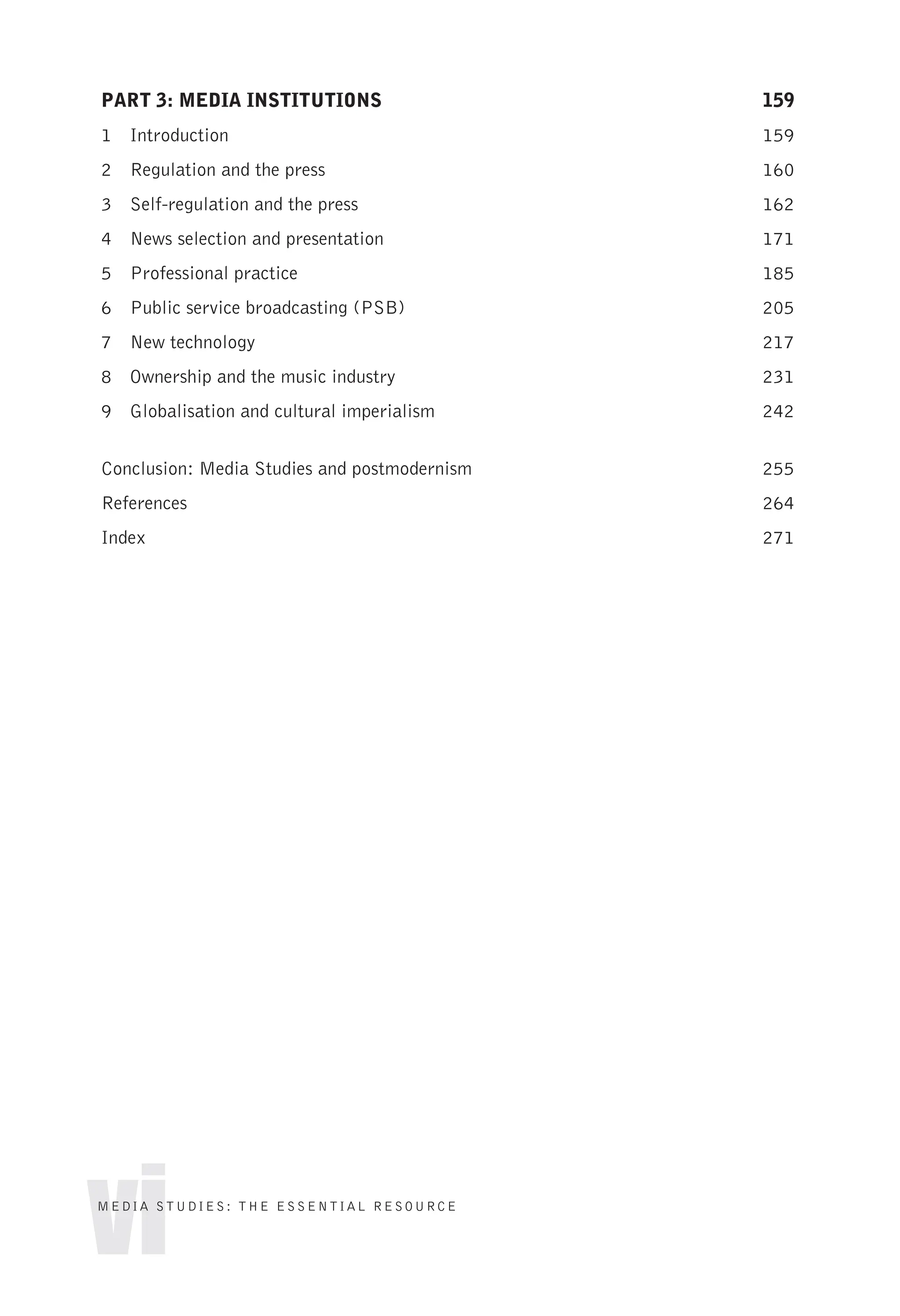
12.
PART 3: MEDIAINSTITUTIONS 159
1 Introduction 159
2 Regulation and the press 160
3 Self-regulation and the press 162
4 News selection and presentation 171
5 Professional practice 185
6 Public service broadcasting (PSB) 205
7 New technology 217
8 Ownership and the music industry 231
9 Globalisation and cultural imperialism 242
Conclusion: Media Studies and postmodernism 255
References 264
Index 271
vi
MEDIA STUDIES: THE ESSENTIAL RESOURCE
▼ INTRODUCTION: WHYMEDIA STUDIES?
Media Studies is a relatively young academic discipline when it is compared to English,
Modern Languages, Classics or History. Despite, or perhaps because of, its rapid devel-
opment throughout the education system, both in schools and in higher education, it still
finds the need to justify itself in a way in which more established disciplines do not.
In addition to the relatively late arrival of Media Studies on the academic scene, we also
need to bear in mind that media are readily accessible to and consumed by all of us, unlike
for example classic novels and Renaissance drama. This very familiarity, and some would
say mundanity, of the subject matter that constitutes a study of the media may well militate
against its being taken seriously. Famously dismissed by one Secretary for Education as
a ‘cultural Disneyland’, Media Studies feels obliged to spend some time justifying itself
as a viable part of the academic establishment.
Another important issue confronting a student of the media is that the discipline itself is
in a state of flux. Although a relative newcomer on the academic scene, many of the ideas
and theories that have been used to underpin Media Studies during its rapid growth are
themselves being questioned. The following extracts provide an interesting contrast which
may help illustrate some of the issues that are under debate.
In the first extract, Simon Frith, Professor of Film and Media at the University of Stirling,
writes about the significance of popular culture and identifies for us some of the ways in
which he feels studying it can be a valuable and worthwhile experience. One of the things
you may find interesting about the extract is the accessible way in which it is written.
Other than the word ‘dialectic’, there is little terminology that is not readily understood
by a well-informed lay reader. Indeed ,the style is in many ways quite conversational and
journalistic in contrast to the rather more serious approach common in academic essays.
At the centre of Frith’s argument is the key issue of how values are transmitted through
popular culture. Media Studies, and related disciplines such as Film and Cultural Studies,
provide us with an important insight into the value system of our society. Frith was one
of the first academics to underscore the importance of studying mass cultural forms such
as popular music as a way of gaining this insight.
Before you read the extract, write down a short paragraph explaining why you think a
study of the media is important.
1
INTRODUCTION: WHY MEDIA STUDIES?
20.
2
MEDIA STUDIES: THEESSENTIAL RESOURCE
It was my third night in Stockholm, a very cold February night, and I’d gone to
have supper with old friends, people I see maybe every two years, usually at
conferences. There was one other guest, the professor in the department in which
I was a visiting scholar, a man I hadn’t met before. A few years older than I am,
I’d guess . . . We talked, we ate, and about halfway through the main course, Johan
said, ‘Let me play it to you!’ and jumped over to the CD player.
The rest of the evening was driven by the dialectic of liking things. We ate, we
talked, and at least some of the time (this wasn’t an obsessive boys’ night in,
rock critics pouring over the runes) we argued about music. As hosts, Johan
Fornäs and Hillevi Ganetz had the advantage – they could illustrate their claims
(why someone could or couldn’t sing; why the Flesh Quartet were Sweden’s most
amusing band; why Eva Dahlgren’s latest album was more interesting than it first
sounded). I could only respond – ‘Yeah that’s really good’ ‘No, I don’t like that
at all’ – and write down titles, and ask occasionally, ‘Have you heard . . .? I must
tape it for you.
A mundane and enjoyable evening, in short, not unlike Sunday evening suppers
happening all over this and many other cities; and if the conversations elsewhere
weren’t necessarily about music they would almost certainly have been, at some
point, about books or films or TV programs, about footballers or models or
magazines. Such conversations are the common currency of friendship, and the
essence of popular culture. We may have been a group of intellectuals, used to
talking, to arguing publicly for our prejudices, but similar talk can be heard every
day in bars and on buses, on football terraces and in school yards, as people wait
at the hairdresser or take lunch in the office cafeteria, and have conversations
about last night’s TV, Take That’s hit record, the new Clint Eastwood film, the
latest headline in the Sun.
Part of the pleasure of popular culture is talking about it; part of its meaning
is this talk, talk which is run though with value judgments. To be engaged
with popular culture is to be discriminating, whether judging the merits of
a football team’s backs or an afternoon soap’s plots. ‘Good’ and ‘bad’ or their
vernacular versions (‘brilliant,’ ‘crap’) are the most frequent terms in everyday
cultural conversation. To return to that Stockholm evening for a moment,
two further features of our talk need noting. First, though all of us knew well
enough that what was at issue was personal taste, subjective response, we also
believed, passionately at times, that we were describing something objectively
in the music, if only other people could hear it. Value arguments, in other words,
aren’t simply rituals of ‘I like/you like’ (which would quickly become tedious,
even in Metal Mania); they are based in reason, evidence, persuasion. Every
music fan knows that moment of frustration when one can only sit the person
down and say (or, rather, shout) despairingly, ‘But just listen to her! Isn’t she
fantastic!’
does not takein their wild rhapsodies. His essay on Goethe (in
Representative Men) is cold and unappreciative when compared with
the Scotchman’s eulogies. We firmly believe that no healthy intellect
can feed upon Fichte, Schelling, Hegel, or even Kant, who was the
most luminous intellect of the group. Emerson has not the stolid
pertinacity of Herr Teufelsdröckh. His genius is French. He delights in
paradox and verbal gymnastics. Carlyle works with a sort of furious
patience at such a prosaic career as Frederick the Great’s. He gets
up a factitious enthusiasm about German Herzhogs and Erstfursts.
Emerson would look with dainty disdain upon his Cyclopean work
among big, dusty, musty folios and the hammering out of shining
sentences from such pig-iron.
Whence his transcendentalism? We believe that it has two elements,
nature-worship and Swedenborgianism. Of nature-worship we have
very little. Like Thomson, the author of the Seasons, who wrote the
finest descriptions of scenery in bed at ten o’clock in the morning,
we are frightfully indifferent to the glories of earth, sea, and sky,
whilst theoretically capable of intense rapture. This tendency to
adore nature, and this intense modern cultivation of the natural
sciences, we take as indicative of the husks of religion given by
Protestantism. Man’s intellect seeks the certain, and where he
cannot find it in the supernatural he will have recourse to the
natural. The profound attention paid to all the mechanical and
natural sciences, to the exclusion, if not denial, of supernatural
religion, is the logical result of the absurdity of Protestantism.
Perhaps Emerson’s poetic feeling has much to do with his profound
veneration for fate, nature, and necessity, which are his true god,
with a very little Swedenborgianism to modify them.
And here we meet him on his philosophy of words. A word,
according to St. Thomas, should be the adæquatio rei et intellectus,
for a word is really the symbol and articulation of truth. Where
words convey no clear or precise idea to the mind they are virtually
false. The terminology of Emerson falls even below Carlyle’s in
obscurity. What does he mean by the one-soul? What by
compensation? What by fate and necessity? Explica terminos is the
23.
command of logicand reason; yet he maunders on in vague and
extravagant speech, using terms which it is very probable he himself
only partly or arbitrarily understands. He is not master of his own
style. His own words hurry him along. This fatal bondage to style
spoils his best thoughts. He seems to aim at striking phrases and
ends in paradox. His very attempt to strengthen and compress his
sentences weakens and obscures his meaning. The oracular style
does not carry well. He is happiest where he does not don the
prophetic or poetical mantle. When we get a glimpse of his shrewd
character, he is as gay as a lark and sharp as a fox. He muffles
himself in transcendentalism, but fails to hide his clear sense, which
he cannot entirely bury or obfuscate. It seems strange to us that
such a mind could be permanently influenced by the fantasies of
Swedenborg, whom he calls a mystic, but who, very probably, was a
madman. The pure mysticism of the Catholic Church is not devoid of
what to those who have not the light to read it may seem to wear a
certain air of extravagance, which, apparently, would be no objection
to Emerson; but it is kept within strict rational bounds by the
doctrinal authority of the church. We do not suppose that Emerson
ever thought it worth his while to study the mystic or ascetic
theology of the church, though here and there in his writings he
refers to the example of saints, and quotes their sayings and doings.
But it must be a strange mental state that passively admits the wild
speculations of Swedenborgianism with its gross ideas of heaven
and its fanciful interpretations of Scripture. Besides, Emerson clearly
rejects the divinity of Jesus Christ, which is extravagantly (if we may
use the expression) set forth in Swedenborgianism, to the exclusion
of the Father and the Holy Ghost. He is, or was, a Unitarian, and his
allusions to our Blessed Lord have not even the reverence of Carlyle.
Naturalism, as used in the sense of the Vatican decrees, is the
proper word to apply to the Emersonian teaching. He has the Yankee
boastfulness, materialistic spirit, and general laudation of the natural
powers. His transcendentalism has few of the spiritual elements of
German thought. He does not believe in contemplation, but
stimulates to activity. In his earlier essays he seemed pantheistic,
24.
but his lastbook (Society and Solitude) affirmed his doubt and
implicit denial of immortality. He appears to be a powerful
personality, for he has certainly influenced many of the finer minds
of New England, and, no doubt, he leads a noble and intellectual
life. His exquisite æstheticism takes away the grossness of the
results to which his naturalistic philosophy leads, and it is with regret
that we note in him that intellectual pride which effectually shuts his
mind even to the gentlest admonitions and enlightenments of divine
grace.
It is a compliment to our rather sparse American authorship and
scholarship that England regards him as the typical American thinker
and writer. We do not so regard him ourselves, for his genius lacks
the sturdy American originality and reverent spirit. But Emerson
made a very favorable impression upon Englishmen when he visited
their island, and he wrote the best book on England (English Traits)
that, perhaps, any American ever produced. The quiet dignity and
native independence of the book charmed John Bull, who was tired
of our snobbish eulogiums of himself and institutions. Emerson met
many literary men, who afterward read his books and praised his
style. He has the air of boldness and the courage of his opinions.
Now and then he invents a striking phrase which sets one a-thinking.
He has also in perfection the art of quoting, and his whole
composition betokens the artist and scholar.
There is a high, supersensual region, imagination, fantasy, or soul-
life, in which he loves to disport, and to which he gives the strangest
names. One grows a little ashamed of what he deems his own
unimaginativeness when he encounters our philosopher “bestriding
these lazy-pacing clouds.” He wonders at the “immensities,
eternities, and fates” that seem to exert such wondrous powers.
When Emerson gets into this strain he quickly disappears either in
the clouds or in a burrow, according to the taste and judgment of
different readers. There is often a fine feeling in these passages
which we can understand yet not express. Sublime they are not,
though obscurity may be considered one of the elements of
sublimity. They are emotional. Emerson belongs rather to the
25.
sensualistic school; atleast, he ascribes abounding power to the
feelings, and, in fact, he is too heated and enthusiastic for the
coldness and calmness exacted by philosophical speculation. Many of
his essays read like violent sermons; and his worst ones are those in
which he attempts to carry out a ratiocination. He is dictatorial. He
announces but does not prove. He appears at times to be in a
Pythonic fury, and proclaims his oracles with much excitement and
contortion. It is impossible to analyze an essay, or hold on to the
filmy threads by which his thoughts hang together. It is absurd to
call him a philosopher who has neither system, clearness of
statement, nor accuracy of thought.
It is a subject of gratulation that Emerson, who has been before
New England for the past half-century, has wielded a generally
beneficial influence. With his powers and opportunities he might
have done incalculable harm; but the weight of his authority has
been thrown upon the side of general morality and natural
development of strength of character. We know, of course, how little
merely natural motives and powers avail toward the building up of
character; but it is not against faith to hold that a good disposition
and virtuous frame of mind may result from purely natural causes.
He has preached the purest gospel of naturalism, shrinking at once
from the bold and impious counsellings of Goethe and from the
muscularity of Carlyle. He has given us, in himself, glimpses of a
noble character, and his ideals have been lofty and pure. New
England could not have had a better apostle, humanly and naturally
speaking. Its cultivated and rational minds turned in horror and
disgust from its rigid Calvinism, its outré religious frenzies, and its
sordid and prosaic life. They found a voice and interpreter in
Emerson. He marks the recoil from unscriptural, irrational, and
unnatural religion.
Puritanism, always unlovely, despotic, and gloomy, began to lose its
hold even upon the second generation of the Puritans. Its life will
never be thoroughly revealed to the sunshiny Catholic mind. Perhaps
its ablest exponent was Nathaniel Hawthorne, who, in the Scarlet
Letter, revealed its possibilities and, in fact, actualities of
26.
hideousness. We haveno fault to find with any elements of stern
self-control or ascetic character that it might develop, but its effect
on the intellect was darkening and crippling. The whole Puritan
exodus from England was a suppressed and blinding excitement.
The rebound from their harsh and unbending discipline was terrific.
The frowning-down of all amusement, the irritating espionage over
private life, the high-strung religious enthusiasm which it was
necessary to simulate if not feel, the abnormal development of
ministerial power and influence, and the baleful gloom of Calvinistic
doctrine, were elements that had necessarily to be destroyed, or
they would madden a nation. They could no more endure, if it were
possible to extirpate them, than could a colony of rabid dogs.
Human nature, as created by God, tends to preserve the primal
type. It asserts its functions, its rights, its powers, and its aptitudes.
After a century, in which religious intolerance ruled New England
with a rod of iron, the long-pent-up storm burst with indescribable
fury and scattered orthodoxy to the four winds. The people breathed
more freely; the atmosphere cleared; there was a healthy
interchange of sentiment. The predominance of public-school
education, combining with the multiplication of books, developed
that crude and half-formed culture which has characterized New
England to the present day. The best-educated portion of the Union,
filled with all the insolence of a little learning, aspired to rule the
nation, and succeeded. Its ideas were zealously propagated.
Wherever a Yankee settled he planted all New England around him.
The peddler did not need religion, but the philosopher did. The
culture of æsthetics engaged some; others went off into
Socinianism. The doctrines of Fourierism had charms for many,
among whom was Emerson. He longed for an ideal life. The country
was not leavened then, as now, by the solid thought and practice of
Catholicity. The mystic radiance and grace of the Adorable
Sacrament did not sweetly pervade the whole atmosphere of the
land. Satan was busy and jubilant. The strangest and most eccentric
forms of religion sprang up like rank mushroom growths, with
neither beauty nor wholesome nutriment. It was then that Emerson’s
call to a high manhood seemed to have the right ring in it. At least,
27.
it attracted andfixed the wandering attention of New England. For
many a winter he lectured, speaking great words, the heroic wisdom
of old Plutarch and the practical sense and insight of Montaigne. His
fine scholarship won the scholars and his homely maxims charmed
the farmers. It was well that in that dreary, chaotic period there was
a brave and bold speaker who did not entirely despair of humanity,
even when he and his companions had broken adrift from their
anchorage in the rotten and worn-out systems of Protestant
theology.
The grace of the faith has thus far escaped the Concord philosopher,
but who shall speak of the ways of God? The theologian will solve
you quickly all questions in his noble science, except questions upon
the tract of grace. There he hesitates, for the most intimate and
personal communications of God with the soul take place in the
mystery of grace. Every man has his own tractatus de gratia written
upon his own heart in the all-beautiful handwriting of God, sealing
us, as St. Paul says, and writing upon us the mark that distinguishes
us as his beloved. It is the miserable consequence of the New
England system of early education, which inheres in a man’s very
spirit, that it perversely misrepresents the Catholic Church. It is
simply astounding how little Americans know about our divine faith.
They have never deemed it worth their while to examine it, taking it
for granted that all that is said against it is true. We remember, as a
boy, reading Peter Parley’s histories, which were very popular in New
England, and not a page was free from some misrepresentation of
the church. Emerson classes “Romanism” with a half-dozen absurd
theories; which goes to show that he has not even reached that
point of culture which, according to its advocates, understands and
embraces all the great creeds of humanity, in their best and most
universal truth.
Mr. Emerson is now in the sere and yellow leaf, and it is to be feared
that his intellectual pride, and that nauseating flattery which weak-
minded people assiduously pay to men of great intellectual
attainments, have left in him a habit of vanity which is fatal to truth.
We have known very able men who were prevented from seeing the
28.
truth of Catholicityby the dense clouds of incense that their
admirers continually wafted before their shrines. The fulness of
divine faith which he lacks, and for which he seems mournfully to cry
out, is in the happy possession of the humblest child of the Catholic
religion; not, as he would think, merely instinctive or the result of
education, but living and logical, the gift and grace of the Holy
Ghost. Emerson is no theologian, though once a Protestant minister,
which fact, however, would not argue much for his theology. But he
has a heroic and poetic mind whose native strength manifests itself
even in the very eccentric orbit through which it passes.
29.
PAPAL ELECTIONS.
III.
In viewof the sad affliction which has so recently befallen the
church in the demise of Pope Pius IX.—now of happy memory—we
shall preface this article on papal elections with a brief account of
the ceremonies that follow upon the death of a Sovereign Pontiff.
As soon as the pope has breathed his last amidst the consolations of
religion, and after making his profession of faith in presence of the
cardinal grand-penitentiary—who usually administers the last
sacraments—and of the more intimate members of his court, the
cardinal-chamberlain of the Holy Roman Church, accompanied and
assisted by the right reverend clerks of the apostolic chamber, takes
possession of the palace and causes a careful inventory to be made
of everything that is found in the papal apartments.[30]
He then
proceeds to the chamber of death, in which the pope still lies, and,
viewing the body, assures himself, and instructs a notary to certify to
the fact, that he is really dead. He also receives from the grand
chamberlain of the court—Monsignor Maestro di Camera—a purse
containing the Fisherman’s ring which His Holiness had used in life.
The cardinal, who, by virtue of his office of chamberlain of the Holy
Roman Church, has become the executive of the government, sends
an order to the senator of Rome, who is always a layman and
member of one of the great patrician families, to have the large bell
of the Capitol tower tolled, at which lugubrious signal the bells of all
the churches throughout the city are sounded. Twenty-four hours
after death the body of the pope is embalmed, and lies in state,
dressed in the ordinary or domestic costume, upon a bed covered
with cloth of crimson and gold, the pious offices of washing and
dressing the body being performed by the penitentiaries or
30.
confessors of theVatican basilica, who are always Minor Conventuals
of the Franciscan Order. It is next removed to the Sistine Chapel,
where it is laid out, clothed in the pontifical vestments, on a couch
surrounded with burning tapers and watched by a detachment of the
Swiss Guard. On the following day the cardinals and chapter of St.
Peter assemble in the Sistine and accompany the transport of the
body to the chapel of the Blessed Sacrament in the Vatican basilica,
where it remains exposed for three days, the feet protruding a little
through an opening in the iron railing which closes the chapel, that
the faithful may approach and kiss the embroidered slipper. The nine
days of funeral services—Novendialia—which the Roman ceremonial
prescribes for the pope now begin. These are his public obsequies.
For the first six days the cardinals and prelates of the court and Holy
See assemble daily in the choir chapel of the canons of St. Peter,
where, the Office for the Dead being chanted, a cardinal says Mass;
but during the remaining three days the services are performed
around an elevated and magnificent catafalque which in the
meanwhile has been silently erected in the great nave of the
basilica. This structure is a perfect work of art in its way, every part
of it being carefully designed with relation to its solemn purpose,
and in harmony of form and proportions with the vast edifice in
which it is reared. It is illustrated by Latin inscriptions and by
paintings of the most remarkable scenes of the late pontificate, and
adorned with allegorical statues. A detachment of the Noble Guard
stands there motionless as though carved in stone. Over the whole
is suspended a life-size portrait of the pope. A thousand candles of
yellow wax and twenty enormous torches in golden candelabra burn
day and night around it. On each of these three days five cardinals
in turn give the grand absolutions, and on the ninth day a funeral
oration is pronounced by some one—often a bishop, or always at
least a prelate of distinction whom the Sacred College has chosen for
the occasion. In former days the cardinal nephew or relative of the
deceased had the privilege, often of great importance for the future
reputation of the pontiff and the present splendor of his family,
raised to princely rank, of selecting the envied orator. Ere this,
however, the final dispositions of the pope’s body have been made.
31.
On the eveningof the third day, the public having been excluded
from the basilica, the cardinal-chamberlain, cardinals created by the
late pope, clerks of the chamber and chapter of St. Peter, headed by
monsignor the vicar—who is always an archbishop in partibus—
vested in pontificals, assemble in the chapel of the Blessed
Sacrament, in which the pope still lies in state. The body is then
reverently enfolded in the gold and crimson cover of the couch, and
taken up to be laid in a cypress-wood coffin, into which are also put
three red purses containing medals of gold, silver, and bronze, as
many of each sort as there were years of the pontificate, bearing the
pope’s effigy on one side, and a design commemorative of some act
of his temporal or spiritual government on the other. If there should
be a relative of the late pope among the cardinals, he covers the
face with a white linen veil, otherwise this last office of respect is
performed by the major-domo. When the coffin has been closed it is
placed inside of a leaden case, which is immediately soldered and
sealed, while the metal is hot, with the arms of the cardinal-
chamberlain and major-domo. A brief inscription is cut at once on
the face of this metal case, giving simply the name, years of his
reign, and date of death. The coffin and case are now enclosed in a
plain wooden box, which is covered with a red pall ornamented with
golden fringes and an embroidered cross, and carried in sad
procession to the uniform temporary resting-place which every pope
occupies in turn in St. Peter’s, in a simple sarcophagus of marbled
stucco which is set into the wall at some distance above and slightly
overhanging the floor of the church, on the left-hand side of the
entrance to the choir chapel. A painter is at hand to trace the name
of the pope and the Latin initials of the words High Pontiff—Pius IX.,
P.M. Before the pope’s body is taken up from the chapel of the
Blessed Sacrament, some workmen, under the direction of the
prelates and officers of the congregation for the supervision of St.
Peter’s—Reverenda Fabrica di San Pietro—have broken in the
sarcophagus at the top and removed its contents (which in this case
were those of Gregory XVI., who had been there since 1846) to the
crypt under the basilica until consigned to the tomb prepared, but
not always in St. Peter’s, either by the pope himself before his
32.
death[31]
or by hisfamily or by the cardinals of his creation, and the
new claimant for repose takes his place there.
During the nine days that the obsequies of the pope continue the
cardinals assemble every morning in the sacristy of St. Peter’s to
arrange all matters of government for the States of the Church and
the details of the approaching conclave. These meetings are called
general congregations. At them the bulls and ordinances relating to
papal elections are read, and the cardinals swear to observe them;
the Fisherman’s ring and the large metal seal used for bulls are
broken by the first master of ceremonies; two orators are chosen,
one for the funeral oration and the other for the conclave; all briefs
and memorials not finally acted upon are consigned to a clerk of the
chamber, etc., etc. On the tenth day the cardinals assemble in the
forenoon in the choir chapel of St. Peter’s, where the dean of the
Sacred College pontificates at a votive Mass of the Holy Ghost, after
which the orator of the conclave—who, if a bishop, wears amice,
cope, and mitre—is introduced into the chapel, and, after making
the proper reverences, ascends a decorated pulpit and holds forth
on the subject of electing an excellent pontiff: the pope is dead; long
live the pope; the Papacy never dies![32]
After the sermon and the singing by the papal choir of the first
strophe of the hymn Veni Creator, the cardinals ascend in procession
to the Pauline Chapel in the Vatican palace, where the dean recites
aloud before the altar the prayer Deus qui corda fidelium, and
afterwards addresses his brethren on the great business which they
are about to engage in, exhorting them to lay aside all human
motives and perform their duty without fear or favor of any man. All
the persons who are to remain in conclave, as the prelates,
custodians, conclavists or attendants on the cardinals, physicians,
barbers, servants, are passed in review, and take an oath not to
speak even among themselves of matters concerning the election.
Every avenue leading into the conclave, except the eight loop-holes
or windows, as mentioned in a former article, are carefully closed by
masons; one door, however, is left standing to admit any late-coming
cardinal, or let out any one expelled from, or for whatever cause
33.
obliged to leave,the conclave. It is locked on the outside by the
prince-marshal, and on the inside by the cardinal-chamberlain, both
of whom retain the key of their own side. The lock is so combined
that it requires both keys to open the door. On the following day the
cardinal-dean says a votive Mass de Spiritu Sancto, at which all the
cardinals in stoles receive Holy Communion from his hands.... Fervet
opus....
As soon as the cardinal upon whom the requisite two-thirds of all the
votes cast have centred consents to his election, he becomes pope.
This consent is absolutely necessary, and, although the Sacred
College threatened Innocent II. (Papareschi, 1130-1143) with
excommunication if he did not accept,[33]
it is now admitted that no
one can be constrained to take upon himself such a burden as the
Sovereign Pontificate.
Thirty-eight popes, from St. Cornelius, in 254, to Benedict XIII., in
1724, are recorded in history as having positively refused to accept
the election, although they were afterwards induced by various
motives, however much against their own inclinations, to ratify it. As
soon as he has answered in the affirmative to the question of the
cardinal-dean, proposed in the following very ancient formula:
Acceptasne electionem de te canonicè factam in Summum
Pontificem? the first master of ceremonies, turning to certain
persons around him, calls upon them in an audible voice to bear
witness to the fact.[34]
The new pope then retires and is dressed in
the ordinary or domestic costume of the Holy Father, three suits of
which, of different sizes, are ready made, and disposed in the
dressing-room for the elect to choose from. It consists of white
stockings, cassock and sash with gold tassels, white collar and skull-
cap, red mozzetta, stole, and shoes. He then takes his seat on a
throne and receives the first homage—adoratio prima—of the
cardinals, who, kneeling before him, kiss his foot and afterwards his
hand, and, standing, receive from him the kiss of peace on the
cheek. We see, from the ceremonial composed in the thirteenth
century by Cardinal Savelli, that the present custom is not very
34.
different from themediæval one; for, speaking of the pope’s
election, he says: Quo facto ab episcopis cardinalibus ad sedem
ducitur post altare, et in ea, ut dignum est, collocatur; in qua dum
sedet electus recipit omnes episcopos cardinales, et quos sibi
placuerit ad pedes, postmodum ad osculum pacis. The custom of
kissing the pope’s foot is so ancient that no certain date can be
assigned for its introduction. It very probably began in the time of
St. Peter himself, to whom the faithful gave this mark of profound
reverence, which they have continued towards all his successors—
always, however, having been instructed to do so with an eye to
God, of whom the pope is vicar. In which connection most beautiful
was the answer of Leo X. to Francis I. of France, who, as Rinaldi
relates (Annal. Eccles., an. 1487, num. 30), having gone to Bologna,
humbly knelt before him and kissed his foot, se lætissimum dicens,
quod videret facie ad faciem Pontificem Vicarium Christi Jesu.
“Thanks,” said Leo, “but refer all this to God himself”—Omnia hæc in
Deum transferens, et omnia Deo tribuens. To make this relative
worship more apparent a cross has always been embroidered on the
shoes since the pontificate of that most humble pope, St. Gregory
the Great, in the year 590. It is curious to read of the objection
made to this custom by Basil, Tzar of Muscovy, to Father Anthony
Possevinus, S.J., who was sent to Russia on a religious and
diplomatic mission by Gregory XIII. in the sixteenth century. His
eloquent defence of the custom, appealing, too, to prophecy,[35]
is
found in the printed account of his embassy (Moscovia, Cologne,
1587, in fol.)
When the pope is dressed in the pontifical costume he receives on
his finger a new Fisherman’s ring, which he immediately removes
and hands to one of the masters of ceremonies to have engraved
upon it the name which he has assumed. The popes have three
special rings for their use. The first is generally a rather plain gold
one with an intaglio or a cameo ornament; this is called the papal
ring. The second one, called the pontifical ring, because used only
when the pope pontificates or officiates at grand ceremonies, is an
exceedingly precious one. The one worn on these occasions by Pius
35.
IX., and whichhis successor will doubtless also use, was made
during the reign of Pius VII., whose name is cut on the inside. It is
of the purest gold, of remarkably fine workmanship, set with a very
large oblong diamond. It cost thirty thousand francs (about $6,000),
and has a contrivance on the inside by which it can be made larger
or smaller to fit the wearer’s finger. (Barraud, Des Bagues à toutes
les Époques. Paris, 1864.) The Fisherman’s ring, which is so called
because it has a figure of St. Peter in a bark throwing his net into
the sea (Matthew iv. 18, 19), is a plain gold ring with an oval face,
bearing the name of the reigning pope engraved around and above
the figure of the apostle, thus: Leo XIII., Pont. Max. On the inside
are cut the names of the engraver and of the major-domo. The ring
weighs an ounce and a half. It is the official seal of the popes, but,
although the first among the rings, it is only the second in the class
of seals, since it serves as the privy seal or papal signet for apostolic
briefs and matters of lesser consequence, whereas the great seal of
the Holy See is used to stamp the heads of SS. Peter and Paul in
lead, and sometimes, but rarely, in gold, on papal bulls. This ring
was at first a private and not an official one, as we learn from a
letter written at Perugia on March 7, 1265, by Clement IV. to his
nephew Peter Le Gros, in which he says that he writes to him and to
his other relatives, not sub bulla, sed sub piscatoris sigillo, quo
Romani Pontifices in suis secretis utuntur. From this it would appear
that such a ring was already in well-known use, but it cannot be
determined at what period it was introduced, or precisely when it
became official, although it is certain that it was given this character
in the fifteenth century; but another hundred years passed before it
became customary to mention its use in every document on which
the seal was impressed by the now familiar expression, “Given under
the Fisherman’s ring,” which is first met with in the manner of a
curial formula in a brief given by Nicholas V. on the 15th of April,
1448: Datum Romæ, apud Sanctum Petrum, sub annulo Piscatoris,
die xv. Aprilis, MCCCCXLVIII., pontificatus nostri II.[36]
Briefs are no more sealed with the original ring, which is always in
the keeping of the pope’s grand chamberlain, who, as we have said,
36.
delivers it tothe cardinal-camerlengo on the pope’s decease, to be
broken in the first general congregation preliminary to the conclave,
according to a custom dating from the death of Leo X. A fac-simile is
preserved in the Secretaria de’ Brevi which serves in its stead; but
since June, 1842, red sealing-wax, because too brittle and
effaceable, is no longer used, but in its place a thick red ink or
pigment is employed. Briefs are pontifical writs or diplomas written
on thin, soft parchment and more abbreviated than bulls, and
treating of matters of less importance, requiring, therefore, briefer
consideration[37]
—whence, perhaps, they derive their distinctive
name, although it has been suggested that the word comes from the
German Brief, a letter, and was introduced into Rome from the
imperial court during the middle ages. They are signed by the
cardinal secretary of briefs, and differ from bulls in their manner of
dating and their forms of beginning and ending. Their heading
always contains the name of the reigning pope and the venerable
formula, Salutem et apostolicam benedictionem, which was first
used by Pope John V. in the year 685. When the pope sends a brief
to a person who is not baptized he substitutes for this form the
other one, Lumen divinæ gratiæ. Both briefs and bulls are always
dated from the basilica nearest to which the pope resides at the
time; thus, we understand why the brief erecting the diocese of
Baltimore was dated (6th of November, 1789) from St. Mary Major’s,
although Pius VI. was then living at the Quirinal palace. Another of
the very ancient and venerable forms used by the popes is Servus
servorum Dei—Servant of the servants of God. It is a title first
assumed by St. Gregory the Great in the sixth century as a hint to
the arrogant patriarch of Constantinople, John the Faster, who had
taken the designation of universal bishop, which belongs only to the
Roman Pontiff: “Whoever will be first among you shall be servant of
all” (Mark x. 44).
As soon as the cardinal who has been elected gives his assent to the
election, the cardinal-dean asks him what name he would wish to
take. This custom of assuming a new name is very old, and has
been much disputed about by writers on papal matters. The great
37.
Baronius has expressedthe opinion in his Ecclesiastical Annals that
John XII., who was previously called Octavian, was the first to make
the change, which he did probably out of regard for his uncle, who
was Pope John XI. Cardinal Borgia has observed in this connection,
as showing that the change of name was yet a singularity, that the
pope used to sign himself Octavian in matters relating to his
temporal, and John in those relating to his spiritual, government.
Martinus Polonus started a fable that Sergius II., elected in 844, was
the one who first changed his name, because known by the
inelegant appellation of Pigsnout—Bocca di Porco; but the truth is,
as Muratori says in one of his dissertations on Italian antiquities
(Antiquitatum Italic., tom. iii. dissert. xli. p. 764), that Sergius IV.
(1009-1012), and not Sergius II., had this only for a surname or
sobriquet, as was commonly given in that age at Rome, but was
baptized Peter. He changed his name, indeed, according to the
custom then becoming established as a rule, but, as Baronius
observes, not ob turpitudinem nominis (Os porci), sed reverentiæ
causa: cum enim ille Petrus vocaretur, indignum putavit eodem se
vocari nomine, quo Christus primum ejus sedis Pontificem, Principem
Apostolorum, ex Simone Petrum nominaverat. It has long been usual
for the new pope to take the name of the pope who made him
cardinal. There have been, however, several exceptions even in
these later times. In some special cases, as in the signature to the
originals of bulls, the pope retains his original Christian name, but,
like all sovereigns, he omits his family name in every case. There
have also been exceptions to this change, and both Adrian VI. and
Marcellus II. kept their own names—the only two, however, who
have done so in over eight hundred years.
The word pope—in Latin Papa, and by initials PP.—was once
common to all bishops, and even to simple priests and clerics; but
when certain schismatics of the eleventh century began to use it in a
sense opposed to the supreme fatherhood of the Roman Pontiffs
over all the faithful, clergy as well as people, it was reserved as a
title of honor to the bishops of Rome exclusively. Cardinal Baronius
says, in a note to the Roman Martyrology, that St. Gregory VII. held
38.
a synod inRome against the schismatics in the year 1073, in which
it was decreed “inter alia plura, ut P A P Æ Nomen unicum esset in
universo orbe Christiano, nec liceret alicui seipsum, vel alium eo
nomine appellare.”[38]
Another singularity about one of the pope’s
titles deserves to be noted. The word Dominus in Latin—lord—was
originally used only of Almighty God, and a contracted form—
Domnus—was employed in speaking of saints, bishops, and persons
of consideration; but in course of time, although a vestige of the
once universal custom still lingers in the Jube Domne benedicere of
the Office recited in choir, the term Domnus came to be specially
reserved to the Roman Pontiff, for whom we pray in the litany as
Domnum Apostolicum. Cancellieri, who, as usual, has sought out an
abstruse subject, gives everything that can be said upon the matter
in his Lettera sopra l’Origine Delle Parole Dominus e Domnus e Del
Titolo Don che Suol Darsi ai Sacerdoti ai Monaci ed a Molti Regolari.
In Roma, MDCCCVIII.
Claiming the hill-crownedcity as its own,
The gray cathedral rears its rough-hewn front
Like ancient fortress built to bear the brunt
Of leaguering ram on e’er unyielding stone;
Signing with holy cross the land it claims,
Its walls protecting seek the infinite blue
Grown, softly falling painted window through,
High heaven brought down to shape life’s noblest aims.
In this strong fortress, safe from those salt waves
Of doubt that curve and break and evermore repeat
The weary lesson of life incomplete,
Moaning and groping in unsunny caves,
Beating against a rock that will not break,
Flinging their bitter anger far on high,
Seeking to chill the tender flowers that lie
Close nestled to the rock for its warmth’s sake,
I kept sad feast one doubting April day,
When robins’ song had drifted from the hills,
When buds were bursting, and the golden bells
Of town-nursed bloom were ringing ill away.
With folded hands St. Helen’s glance beneath,
I trod in thought the highway of the cross—
Jerusalem’s triumph blending with her loss,
The palm-bough changing for the thorny wreath.
And clasped the folded hands about the bough
Of northern hemlock that as palm I bore,
Listening the words of sorrow chanted o’er—
The old evangel’s solemn voice of woe;
O wondrous power of a passing breath!
O tearful sweetness of that voice of God
Breaking amid the clamor of the crowd
Of Jews and soldiers hastening him to death!
Often the chant bad stirred my soul before
41.
Often the chantbad stirred my soul before
In humbler church, till had familiar grown
Almost each word and every varying tone
That with each added year a new grace wore;
But never grace so pitiful as this
That filled the arches with all deep distress,
With passionate sense of human guiltiness—
Our God sore bruised for our infirmities!
Oh! blinding sweet the vision that awoke
Within my soul to fill my eyes with tears!
To-day was it, not in those long-past years,
That Heart divine, with love unbounded, broke.
Oh! blinding sweet in its strange melody
The voice that, rending heart, called from the cross,
In that dark hour of life’s bitterest loss,
“Eli, Eli, lamma sabacthani!”
O strong gray walls! blessed was that little space
Ye left our souls with Christ on Calvary,
Where hearts might weep their living cruelty,
In their own depths Jerusalem’s lesson trace.
O cross-boughed branch of spicy northern spruce
That witness bore on that dim April day
To faith no waves of doubt shall wash away,
To love’s dear chains no envious state shall loose,
Blessing was ours who bore thee that gray morn
Through all the heedless glances of the street,
Through longing looks that knew thy meaning sweet,
And spoken words of unbelieving scorn.
Alas! for those, of eyes and heart both blind,
Who in such symbol find but empty rite,
Who, dazzled by a false and flickering light,
See not the cross wherewith the palm is signed.
Cathedral of the Holy Cross, Boston, Mass.
43.
THE LATE Mr.T. W. M. MARSHALL.[39]
On the 14th of December, 1877, died, at the age of sixty-two years
and a half, Mr. T. W. M. Marshall. He had borne a long and trying
illness of many months with invariable patience and resignation, and
gave up his soul to his Maker and Redeemer after a most Christian
preparation. He has well deserved that some more explicit notice of
his life and what he did in it should be made public than what has
hitherto, so far as we know, been given in any native or American
source of information. The following slight account is drawn up by
one who has known him well for nearly a quarter of a century.
Mr. Marshall was born the 19th of June, 1815; was educated under
Dr. Burnup at Greenwich and at Trinity College, Cambridge. He was
ordained in the Anglican Church by the bishop of Salisbury in 1842.
In 1844 he published his Notes on the Episcopal Polity of the Church
of England, for which he received the thanks of the then archbishop
of Canterbury, Dr. Howley. This was the prelate, it may be remarked,
to whom the writers of the famous Tracts for the Times dedicated
their translation of what they called “this library of ancient bishops,
Fathers, doctors, martyrs, confessors of Christ’s Holy Catholic
Church,” with, as they added, “his grace’s permission, in token of
reverence for his person and sacred office, and of gratitude for his
episcopal kindness.” We mention this, because thanks from such a
man in such an office for a work on the episcopal polity of the
Church of England in 1844, when that polity was not a little
canvassed, was an omen of good things to come for the writer, who
was then nestled in a very small and poor cure among the Wiltshire
downs, once a house of the Knights of St. John of Jerusalem. These
prospects were blighted for ever by Mr. Marshall’s conversion in the
following year, 1845. Indeed, he seems in that year to have
44.
Welcome to ourwebsite – the ideal destination for book lovers and
knowledge seekers. With a mission to inspire endlessly, we offer a
vast collection of books, ranging from classic literary works to
specialized publications, self-development books, and children's
literature. Each book is a new journey of discovery, expanding
knowledge and enriching the soul of the reade
Our website is not just a platform for buying books, but a bridge
connecting readers to the timeless values of culture and wisdom. With
an elegant, user-friendly interface and an intelligent search system,
we are committed to providing a quick and convenient shopping
experience. Additionally, our special promotions and home delivery
services ensure that you save time and fully enjoy the joy of reading.
Let us accompany you on the journey of exploring knowledge and
personal growth!
ebookultra.com






![PAPAL ELECTIONS.
III.
In view of the sad affliction which has so recently befallen the
church in the demise of Pope Pius IX.—now of happy memory—we
shall preface this article on papal elections with a brief account of
the ceremonies that follow upon the death of a Sovereign Pontiff.
As soon as the pope has breathed his last amidst the consolations of
religion, and after making his profession of faith in presence of the
cardinal grand-penitentiary—who usually administers the last
sacraments—and of the more intimate members of his court, the
cardinal-chamberlain of the Holy Roman Church, accompanied and
assisted by the right reverend clerks of the apostolic chamber, takes
possession of the palace and causes a careful inventory to be made
of everything that is found in the papal apartments.[30]
He then
proceeds to the chamber of death, in which the pope still lies, and,
viewing the body, assures himself, and instructs a notary to certify to
the fact, that he is really dead. He also receives from the grand
chamberlain of the court—Monsignor Maestro di Camera—a purse
containing the Fisherman’s ring which His Holiness had used in life.
The cardinal, who, by virtue of his office of chamberlain of the Holy
Roman Church, has become the executive of the government, sends
an order to the senator of Rome, who is always a layman and
member of one of the great patrician families, to have the large bell
of the Capitol tower tolled, at which lugubrious signal the bells of all
the churches throughout the city are sounded. Twenty-four hours
after death the body of the pope is embalmed, and lies in state,
dressed in the ordinary or domestic costume, upon a bed covered
with cloth of crimson and gold, the pious offices of washing and
dressing the body being performed by the penitentiaries or](https://image.slidesharecdn.com/78770-250418050208-b9f01a06/75/Media-Studies-The-Essential-Resource-1st-Edition-Philip-Rayner-29-2048.jpg)
![death[31]
or by his family or by the cardinals of his creation, and the
new claimant for repose takes his place there.
During the nine days that the obsequies of the pope continue the
cardinals assemble every morning in the sacristy of St. Peter’s to
arrange all matters of government for the States of the Church and
the details of the approaching conclave. These meetings are called
general congregations. At them the bulls and ordinances relating to
papal elections are read, and the cardinals swear to observe them;
the Fisherman’s ring and the large metal seal used for bulls are
broken by the first master of ceremonies; two orators are chosen,
one for the funeral oration and the other for the conclave; all briefs
and memorials not finally acted upon are consigned to a clerk of the
chamber, etc., etc. On the tenth day the cardinals assemble in the
forenoon in the choir chapel of St. Peter’s, where the dean of the
Sacred College pontificates at a votive Mass of the Holy Ghost, after
which the orator of the conclave—who, if a bishop, wears amice,
cope, and mitre—is introduced into the chapel, and, after making
the proper reverences, ascends a decorated pulpit and holds forth
on the subject of electing an excellent pontiff: the pope is dead; long
live the pope; the Papacy never dies![32]
After the sermon and the singing by the papal choir of the first
strophe of the hymn Veni Creator, the cardinals ascend in procession
to the Pauline Chapel in the Vatican palace, where the dean recites
aloud before the altar the prayer Deus qui corda fidelium, and
afterwards addresses his brethren on the great business which they
are about to engage in, exhorting them to lay aside all human
motives and perform their duty without fear or favor of any man. All
the persons who are to remain in conclave, as the prelates,
custodians, conclavists or attendants on the cardinals, physicians,
barbers, servants, are passed in review, and take an oath not to
speak even among themselves of matters concerning the election.
Every avenue leading into the conclave, except the eight loop-holes
or windows, as mentioned in a former article, are carefully closed by
masons; one door, however, is left standing to admit any late-coming
cardinal, or let out any one expelled from, or for whatever cause](https://image.slidesharecdn.com/78770-250418050208-b9f01a06/75/Media-Studies-The-Essential-Resource-1st-Edition-Philip-Rayner-32-2048.jpg)
![obliged to leave, the conclave. It is locked on the outside by the
prince-marshal, and on the inside by the cardinal-chamberlain, both
of whom retain the key of their own side. The lock is so combined
that it requires both keys to open the door. On the following day the
cardinal-dean says a votive Mass de Spiritu Sancto, at which all the
cardinals in stoles receive Holy Communion from his hands.... Fervet
opus....
As soon as the cardinal upon whom the requisite two-thirds of all the
votes cast have centred consents to his election, he becomes pope.
This consent is absolutely necessary, and, although the Sacred
College threatened Innocent II. (Papareschi, 1130-1143) with
excommunication if he did not accept,[33]
it is now admitted that no
one can be constrained to take upon himself such a burden as the
Sovereign Pontificate.
Thirty-eight popes, from St. Cornelius, in 254, to Benedict XIII., in
1724, are recorded in history as having positively refused to accept
the election, although they were afterwards induced by various
motives, however much against their own inclinations, to ratify it. As
soon as he has answered in the affirmative to the question of the
cardinal-dean, proposed in the following very ancient formula:
Acceptasne electionem de te canonicè factam in Summum
Pontificem? the first master of ceremonies, turning to certain
persons around him, calls upon them in an audible voice to bear
witness to the fact.[34]
The new pope then retires and is dressed in
the ordinary or domestic costume of the Holy Father, three suits of
which, of different sizes, are ready made, and disposed in the
dressing-room for the elect to choose from. It consists of white
stockings, cassock and sash with gold tassels, white collar and skull-
cap, red mozzetta, stole, and shoes. He then takes his seat on a
throne and receives the first homage—adoratio prima—of the
cardinals, who, kneeling before him, kiss his foot and afterwards his
hand, and, standing, receive from him the kiss of peace on the
cheek. We see, from the ceremonial composed in the thirteenth
century by Cardinal Savelli, that the present custom is not very](https://image.slidesharecdn.com/78770-250418050208-b9f01a06/75/Media-Studies-The-Essential-Resource-1st-Edition-Philip-Rayner-33-2048.jpg)
![different from the mediæval one; for, speaking of the pope’s
election, he says: Quo facto ab episcopis cardinalibus ad sedem
ducitur post altare, et in ea, ut dignum est, collocatur; in qua dum
sedet electus recipit omnes episcopos cardinales, et quos sibi
placuerit ad pedes, postmodum ad osculum pacis. The custom of
kissing the pope’s foot is so ancient that no certain date can be
assigned for its introduction. It very probably began in the time of
St. Peter himself, to whom the faithful gave this mark of profound
reverence, which they have continued towards all his successors—
always, however, having been instructed to do so with an eye to
God, of whom the pope is vicar. In which connection most beautiful
was the answer of Leo X. to Francis I. of France, who, as Rinaldi
relates (Annal. Eccles., an. 1487, num. 30), having gone to Bologna,
humbly knelt before him and kissed his foot, se lætissimum dicens,
quod videret facie ad faciem Pontificem Vicarium Christi Jesu.
“Thanks,” said Leo, “but refer all this to God himself”—Omnia hæc in
Deum transferens, et omnia Deo tribuens. To make this relative
worship more apparent a cross has always been embroidered on the
shoes since the pontificate of that most humble pope, St. Gregory
the Great, in the year 590. It is curious to read of the objection
made to this custom by Basil, Tzar of Muscovy, to Father Anthony
Possevinus, S.J., who was sent to Russia on a religious and
diplomatic mission by Gregory XIII. in the sixteenth century. His
eloquent defence of the custom, appealing, too, to prophecy,[35]
is
found in the printed account of his embassy (Moscovia, Cologne,
1587, in fol.)
When the pope is dressed in the pontifical costume he receives on
his finger a new Fisherman’s ring, which he immediately removes
and hands to one of the masters of ceremonies to have engraved
upon it the name which he has assumed. The popes have three
special rings for their use. The first is generally a rather plain gold
one with an intaglio or a cameo ornament; this is called the papal
ring. The second one, called the pontifical ring, because used only
when the pope pontificates or officiates at grand ceremonies, is an
exceedingly precious one. The one worn on these occasions by Pius](https://image.slidesharecdn.com/78770-250418050208-b9f01a06/75/Media-Studies-The-Essential-Resource-1st-Edition-Philip-Rayner-34-2048.jpg)
![IX., and which his successor will doubtless also use, was made
during the reign of Pius VII., whose name is cut on the inside. It is
of the purest gold, of remarkably fine workmanship, set with a very
large oblong diamond. It cost thirty thousand francs (about $6,000),
and has a contrivance on the inside by which it can be made larger
or smaller to fit the wearer’s finger. (Barraud, Des Bagues à toutes
les Époques. Paris, 1864.) The Fisherman’s ring, which is so called
because it has a figure of St. Peter in a bark throwing his net into
the sea (Matthew iv. 18, 19), is a plain gold ring with an oval face,
bearing the name of the reigning pope engraved around and above
the figure of the apostle, thus: Leo XIII., Pont. Max. On the inside
are cut the names of the engraver and of the major-domo. The ring
weighs an ounce and a half. It is the official seal of the popes, but,
although the first among the rings, it is only the second in the class
of seals, since it serves as the privy seal or papal signet for apostolic
briefs and matters of lesser consequence, whereas the great seal of
the Holy See is used to stamp the heads of SS. Peter and Paul in
lead, and sometimes, but rarely, in gold, on papal bulls. This ring
was at first a private and not an official one, as we learn from a
letter written at Perugia on March 7, 1265, by Clement IV. to his
nephew Peter Le Gros, in which he says that he writes to him and to
his other relatives, not sub bulla, sed sub piscatoris sigillo, quo
Romani Pontifices in suis secretis utuntur. From this it would appear
that such a ring was already in well-known use, but it cannot be
determined at what period it was introduced, or precisely when it
became official, although it is certain that it was given this character
in the fifteenth century; but another hundred years passed before it
became customary to mention its use in every document on which
the seal was impressed by the now familiar expression, “Given under
the Fisherman’s ring,” which is first met with in the manner of a
curial formula in a brief given by Nicholas V. on the 15th of April,
1448: Datum Romæ, apud Sanctum Petrum, sub annulo Piscatoris,
die xv. Aprilis, MCCCCXLVIII., pontificatus nostri II.[36]
Briefs are no more sealed with the original ring, which is always in
the keeping of the pope’s grand chamberlain, who, as we have said,](https://image.slidesharecdn.com/78770-250418050208-b9f01a06/75/Media-Studies-The-Essential-Resource-1st-Edition-Philip-Rayner-35-2048.jpg)
![delivers it to the cardinal-camerlengo on the pope’s decease, to be
broken in the first general congregation preliminary to the conclave,
according to a custom dating from the death of Leo X. A fac-simile is
preserved in the Secretaria de’ Brevi which serves in its stead; but
since June, 1842, red sealing-wax, because too brittle and
effaceable, is no longer used, but in its place a thick red ink or
pigment is employed. Briefs are pontifical writs or diplomas written
on thin, soft parchment and more abbreviated than bulls, and
treating of matters of less importance, requiring, therefore, briefer
consideration[37]
—whence, perhaps, they derive their distinctive
name, although it has been suggested that the word comes from the
German Brief, a letter, and was introduced into Rome from the
imperial court during the middle ages. They are signed by the
cardinal secretary of briefs, and differ from bulls in their manner of
dating and their forms of beginning and ending. Their heading
always contains the name of the reigning pope and the venerable
formula, Salutem et apostolicam benedictionem, which was first
used by Pope John V. in the year 685. When the pope sends a brief
to a person who is not baptized he substitutes for this form the
other one, Lumen divinæ gratiæ. Both briefs and bulls are always
dated from the basilica nearest to which the pope resides at the
time; thus, we understand why the brief erecting the diocese of
Baltimore was dated (6th of November, 1789) from St. Mary Major’s,
although Pius VI. was then living at the Quirinal palace. Another of
the very ancient and venerable forms used by the popes is Servus
servorum Dei—Servant of the servants of God. It is a title first
assumed by St. Gregory the Great in the sixth century as a hint to
the arrogant patriarch of Constantinople, John the Faster, who had
taken the designation of universal bishop, which belongs only to the
Roman Pontiff: “Whoever will be first among you shall be servant of
all” (Mark x. 44).
As soon as the cardinal who has been elected gives his assent to the
election, the cardinal-dean asks him what name he would wish to
take. This custom of assuming a new name is very old, and has
been much disputed about by writers on papal matters. The great](https://image.slidesharecdn.com/78770-250418050208-b9f01a06/75/Media-Studies-The-Essential-Resource-1st-Edition-Philip-Rayner-36-2048.jpg)
![a synod in Rome against the schismatics in the year 1073, in which
it was decreed “inter alia plura, ut P A P Æ Nomen unicum esset in
universo orbe Christiano, nec liceret alicui seipsum, vel alium eo
nomine appellare.”[38]
Another singularity about one of the pope’s
titles deserves to be noted. The word Dominus in Latin—lord—was
originally used only of Almighty God, and a contracted form—
Domnus—was employed in speaking of saints, bishops, and persons
of consideration; but in course of time, although a vestige of the
once universal custom still lingers in the Jube Domne benedicere of
the Office recited in choir, the term Domnus came to be specially
reserved to the Roman Pontiff, for whom we pray in the litany as
Domnum Apostolicum. Cancellieri, who, as usual, has sought out an
abstruse subject, gives everything that can be said upon the matter
in his Lettera sopra l’Origine Delle Parole Dominus e Domnus e Del
Titolo Don che Suol Darsi ai Sacerdoti ai Monaci ed a Molti Regolari.
In Roma, MDCCCVIII.](https://image.slidesharecdn.com/78770-250418050208-b9f01a06/75/Media-Studies-The-Essential-Resource-1st-Edition-Philip-Rayner-38-2048.jpg)


![THE LATE Mr. T. W. M. MARSHALL.[39]
On the 14th of December, 1877, died, at the age of sixty-two years
and a half, Mr. T. W. M. Marshall. He had borne a long and trying
illness of many months with invariable patience and resignation, and
gave up his soul to his Maker and Redeemer after a most Christian
preparation. He has well deserved that some more explicit notice of
his life and what he did in it should be made public than what has
hitherto, so far as we know, been given in any native or American
source of information. The following slight account is drawn up by
one who has known him well for nearly a quarter of a century.
Mr. Marshall was born the 19th of June, 1815; was educated under
Dr. Burnup at Greenwich and at Trinity College, Cambridge. He was
ordained in the Anglican Church by the bishop of Salisbury in 1842.
In 1844 he published his Notes on the Episcopal Polity of the Church
of England, for which he received the thanks of the then archbishop
of Canterbury, Dr. Howley. This was the prelate, it may be remarked,
to whom the writers of the famous Tracts for the Times dedicated
their translation of what they called “this library of ancient bishops,
Fathers, doctors, martyrs, confessors of Christ’s Holy Catholic
Church,” with, as they added, “his grace’s permission, in token of
reverence for his person and sacred office, and of gratitude for his
episcopal kindness.” We mention this, because thanks from such a
man in such an office for a work on the episcopal polity of the
Church of England in 1844, when that polity was not a little
canvassed, was an omen of good things to come for the writer, who
was then nestled in a very small and poor cure among the Wiltshire
downs, once a house of the Knights of St. John of Jerusalem. These
prospects were blighted for ever by Mr. Marshall’s conversion in the
following year, 1845. Indeed, he seems in that year to have](https://image.slidesharecdn.com/78770-250418050208-b9f01a06/75/Media-Studies-The-Essential-Resource-1st-Edition-Philip-Rayner-43-2048.jpg)