An Introduction to  Social Marketing  Environet 2011  Presentation designed with help from Dr Sue Peattie, Cardiff University and BRASS
Contents  What is Social Marketing? Some key concepts Some case studies The Supporting Sustainable Living scheme Next steps!
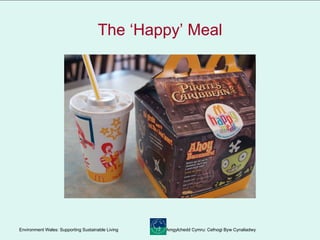
The ‘Happy’ Meal
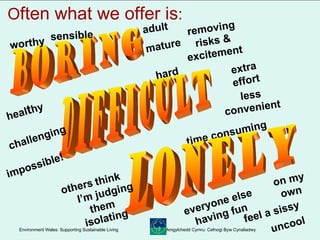
O ften what we offer is : Difficult hard  challenging impossible! extra   effort less   convenient time consuming Boring worthy sensible heal t hy adult mature removing risks & excitement lonely on my own feel a sissy everyone else having fun others   think  I’m judging them isolating uncool
Marketing   works by making things: Fun Easy Popular &
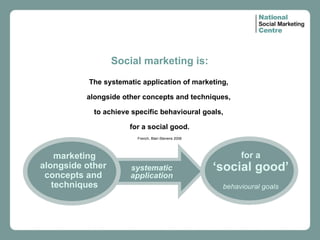
Social marketing is: The systematic application of marketing,  alongside other concepts and techniques,  to achieve specific behavioural goals,  for a social good. French, Blair-Stevens 2006 marketing alongside other  concepts and  techniques systematic application for a ‘ social good’ behavioural goals
Social Marketing Is About …. using  research   using techniques like  segmentation & targeting   identifying and eliminating  barriers   finding ways to  maintain  changed behaviours; going  beyond communication
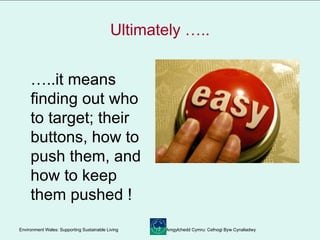
Ultimately ….. … ..it means finding out who to target; their buttons, how to push them, and how to keep them pushed !
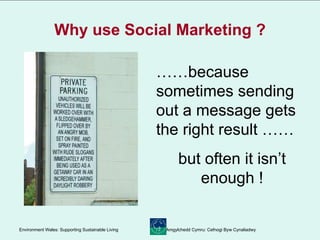
Why use Social Marketing ? …… because sometimes sending out a message gets the right result …… but often it isn’t enough !
Road Crew   The Problem : Alcohol related car crashes - major problem in Wisconsin. Mostly single rural males aged  21-34  Education & legal  measures already in place
Understanding The Problem First Step:  Research to find why young rural males drink & drive.
Insights Awareness that you shouldn’t drink and drive; But a lack of perceived alternatives; There was an element of pride/prestige; Also hassle factor of collecting car later; Those drinking and likely to drive  did  worry about it, which often spoilt their evening;
The Campaign A limo ride to the bar, between bars, and home from the bar so that you can maximize your fun About the cost of a beer  Anywhere you want it  to be (in 3 pilot counties)  “ Road Crew, Beats Driving ”
 
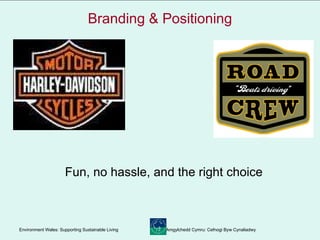
Branding & Positioning Fun, no hassle, and the right choice
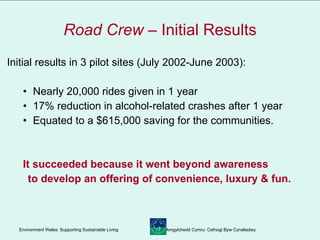
Road Crew  – Initial Results Initial results in 3 pilot sites (July 2002-June 2003): Nearly 20,000 rides given in 1 year  17% reduction in alcohol-related crashes after 1 year Equated to a $615,000 saving for the communities. It succeeded because it went beyond awareness  to develop an offering of convenience, luxury & fun.
The importance of Segmenting and taking into account other Stakeholders
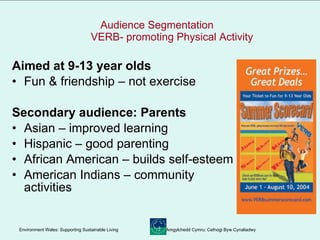
Audience Segmentation    VERB- promoting Physical Activity Aimed at 9-13 year olds Fun & friendship – not exercise Secondary audience: Parents Asian – improved learning Hispanic – good parenting African American – builds self-esteem American Indians – community activities
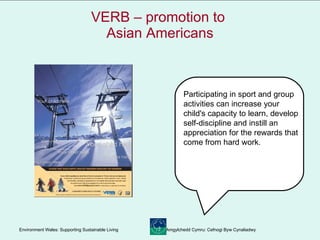
VERB – promotion to  Asian Americans Participating in sport and group activities can increase your child's capacity to learn, develop self-discipline and instill an appreciation for the rewards that come from hard work.
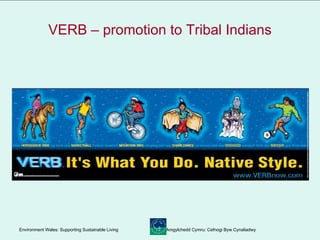
VERB – promotion to Tribal Indians
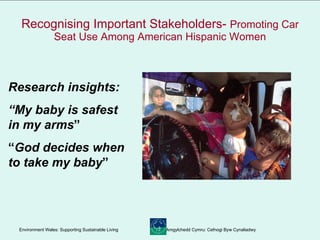
Recognising Important Stakeholders-  Promoting Car Seat Use Among American Hispanic Women Research insights: “ My baby is safest in my arms ” “ God decides when to take my baby ”
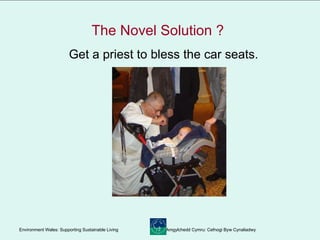
The Novel Solution ?   Get a priest to bless the car seats.
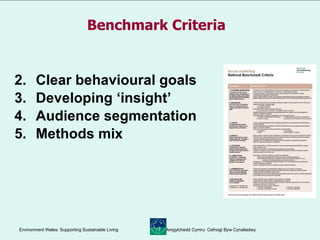
Clear behavioural goals Developing ‘insight’ Audience segmentation  Methods mix Benchmark Criteria
Cardiff Cycle Challenge  Clear behavioural goals  Increase number of cycle journeys amongst employees in Cardiff, for work and recreation Developing insight  Information, safety, ‘not doing it alone’, practical support, Audience segmentation Frequent, occasional and new cyclists, employers Methods mix  Competition and prizes, Challenge Champions, Dr Bike sessions, taster events, interactive website
Stage 1 - Scoping which  specific behaviours? who  is the audience? why   is undesired behaviour present or desired behaviour not   present? what  might help the audience make and maintain changes? when  is the best time?
Y Dref Werdd – The Green Town Almost 1/3 of UK GHG emissions from domestic energy Tanygrisau homes largely off-grid Little awareness of heat use or management £4,200 to understand current behaviour, identify barriers/motivators Questionnaires, face to face interviews, energy monitors
Pembroke Can Make a Difference 19% of the UK’s GHG emissions linked to food Grow your own, buy local, reduce meat? Producers, consumers, young people, parents? £4,380 grant – info review, project visits, small group research,
Transition Bro Gwaun Transport major contributor to GHG Congestion in Fishguard and Goodwick Additional 5 trains a day from September Success elsewhere Current patterns, barriers and incentives Residents, commuters, tourists £6,913 project consultant, desktop research, community consultations, questionnaires
Next Steps National Social Marketing Centre  www.thensmc.com Community-Based Social Marketing – Fostering Sustainable Behaviour  www.cbsm.com www.environment-wales.org www.sustainwales.com Your Development Officer  

An introduction to social marketing

  • 1.
    An Introduction to Social Marketing Environet 2011 Presentation designed with help from Dr Sue Peattie, Cardiff University and BRASS
  • 2.
    Contents Whatis Social Marketing? Some key concepts Some case studies The Supporting Sustainable Living scheme Next steps!
  • 3.
  • 4.
    O ften whatwe offer is : Difficult hard challenging impossible! extra effort less convenient time consuming Boring worthy sensible heal t hy adult mature removing risks & excitement lonely on my own feel a sissy everyone else having fun others think I’m judging them isolating uncool
  • 5.
    Marketing works by making things: Fun Easy Popular &
  • 6.
    Social marketing is:The systematic application of marketing, alongside other concepts and techniques, to achieve specific behavioural goals, for a social good. French, Blair-Stevens 2006 marketing alongside other concepts and techniques systematic application for a ‘ social good’ behavioural goals
  • 7.
    Social Marketing IsAbout …. using research using techniques like segmentation & targeting identifying and eliminating barriers finding ways to maintain changed behaviours; going beyond communication
  • 8.
    Ultimately ….. …..it means finding out who to target; their buttons, how to push them, and how to keep them pushed !
  • 9.
    Why use SocialMarketing ? …… because sometimes sending out a message gets the right result …… but often it isn’t enough !
  • 10.
    Road Crew The Problem : Alcohol related car crashes - major problem in Wisconsin. Mostly single rural males aged 21-34 Education & legal measures already in place
  • 11.
    Understanding The ProblemFirst Step: Research to find why young rural males drink & drive.
  • 12.
    Insights Awareness thatyou shouldn’t drink and drive; But a lack of perceived alternatives; There was an element of pride/prestige; Also hassle factor of collecting car later; Those drinking and likely to drive did worry about it, which often spoilt their evening;
  • 13.
    The Campaign Alimo ride to the bar, between bars, and home from the bar so that you can maximize your fun About the cost of a beer Anywhere you want it to be (in 3 pilot counties) “ Road Crew, Beats Driving ”
  • 14.
  • 15.
    Branding & PositioningFun, no hassle, and the right choice
  • 16.
    Road Crew – Initial Results Initial results in 3 pilot sites (July 2002-June 2003): Nearly 20,000 rides given in 1 year 17% reduction in alcohol-related crashes after 1 year Equated to a $615,000 saving for the communities. It succeeded because it went beyond awareness to develop an offering of convenience, luxury & fun.
  • 17.
    The importance ofSegmenting and taking into account other Stakeholders
  • 18.
    Audience Segmentation VERB- promoting Physical Activity Aimed at 9-13 year olds Fun & friendship – not exercise Secondary audience: Parents Asian – improved learning Hispanic – good parenting African American – builds self-esteem American Indians – community activities
  • 19.
    VERB – promotionto Asian Americans Participating in sport and group activities can increase your child's capacity to learn, develop self-discipline and instill an appreciation for the rewards that come from hard work.
  • 20.
    VERB – promotionto Tribal Indians
  • 21.
    Recognising Important Stakeholders- Promoting Car Seat Use Among American Hispanic Women Research insights: “ My baby is safest in my arms ” “ God decides when to take my baby ”
  • 22.
    The Novel Solution? Get a priest to bless the car seats.
  • 23.
    Clear behavioural goalsDeveloping ‘insight’ Audience segmentation Methods mix Benchmark Criteria
  • 24.
    Cardiff Cycle Challenge Clear behavioural goals Increase number of cycle journeys amongst employees in Cardiff, for work and recreation Developing insight Information, safety, ‘not doing it alone’, practical support, Audience segmentation Frequent, occasional and new cyclists, employers Methods mix Competition and prizes, Challenge Champions, Dr Bike sessions, taster events, interactive website
  • 25.
    Stage 1 -Scoping which specific behaviours? who is the audience? why is undesired behaviour present or desired behaviour not present? what might help the audience make and maintain changes? when is the best time?
  • 26.
    Y Dref Werdd– The Green Town Almost 1/3 of UK GHG emissions from domestic energy Tanygrisau homes largely off-grid Little awareness of heat use or management £4,200 to understand current behaviour, identify barriers/motivators Questionnaires, face to face interviews, energy monitors
  • 27.
    Pembroke Can Makea Difference 19% of the UK’s GHG emissions linked to food Grow your own, buy local, reduce meat? Producers, consumers, young people, parents? £4,380 grant – info review, project visits, small group research,
  • 28.
    Transition Bro GwaunTransport major contributor to GHG Congestion in Fishguard and Goodwick Additional 5 trains a day from September Success elsewhere Current patterns, barriers and incentives Residents, commuters, tourists £6,913 project consultant, desktop research, community consultations, questionnaires
  • 29.
    Next Steps NationalSocial Marketing Centre www.thensmc.com Community-Based Social Marketing – Fostering Sustainable Behaviour www.cbsm.com www.environment-wales.org www.sustainwales.com Your Development Officer 

Editor's Notes

  • #25 To implement a 3-week Cycle Challenge in Cardiff – a friendly competition between organisations to see which can get the most employees to ride a bike, incentivised by a prize for the winning organisation. Staff have to ride a bike for 10 minutes or more for their participation to count. Journeys are logged onto an interactive website that cyclists can continue to use after the Challenge to set goals, monitor mileage and work out how many calories they have burned or CO2 they have saved. Rationale - Getting people to experience being on a bike is an effective way to break down negative perceptions of how ‘hard’ or scary’ cycling is. The Challenge is based on participation rather than miles to reinforce the fact that this is about ‘having a go’ and enjoying something new rather than having to prove something or clock up miles . The Partnership has carried out 34 Challenges to date engaging over 50,000 people and 2,600 organisations. Participant surveys carried out 3 months after a 2010 Challenge indicated that 37% of former cyclists were now cycling at least once a week and 43% of occasional cyclists were cycling to work at least once a week Delivery - Cardiff Council and Cardiff Cycling Campaign will be involved in promoting the project; workplaces will also be asked to provide ‘Challenge Champions’. Audiences will be reached through targeted marketing materials aimed at different audiences e.g. employers (decision makers), non-cyclists, regular cyclists etc and engaged through accompanying activities e.g. free bike MOTs, ‘Go Cycle’ events etc. Past experience shows the main motivator is workmate encouragement but prizes will also be offered (secured through donations from stakeholders) for e.g. Team Participation Award or individual rewards e.g. cinema vouchers have proved very effective.
  • #26 The Stage 1 grant is to help organisations gather the information and insights that they need to develop a credible behaviour change project. It is expected that applicants will have already identified an area of behaviour that they wish to change. This grant is to help groups explore which specific behaviours within that area will have the biggest impact; why undesired behaviour is present or desired behaviour is not present; who their target audience should be; what might help that audience make and maintain the desired changes; and when is the best time to put project interventions in place. The output should be a Scoping Report summarising all these findings which could form the basis of a Stage 2 project delivery plan.
  • #27 Rationale – From a previous energy-efficiency project, the group found that participants had very limited knowledge or awareness of heat management or its impacts. A further pilot working with 4 local households confirmed that homeowners did not understand – or give much consideration to - how much heat they were using or how to regulate it. Research suggests that making energy use more visible can influence behaviour and that this can lead to significant carbon savings – the Green Alliance estimates that almost a third of Britain’s carbon emissions derive from heating and turning down thermostats by 1 degree can save up to 10% of energy. Delivery – The group will work with residents of the Tanygrisiau ward where homes are typical of the town. These homes are largely off-grid and therefore a hard-to-reach audience for other providers; off-grid homes also suffer a disproportionate level of fuel poverty compared to on-grid homes. 100 of the 993 houses will be targeted with questionnaires to establish patterns of current behaviour, which will be compared with national statistics. The group will then work more closely with a sample of 20 houses, using energy monitors and engagement, to understand current behaviour and identify motivators and barriers to changing it. This will include trying to identify the most appropriate messenger to use in a Stage 2 project. Volunteers will be involved in delivering questionnaires and holding face to face interviews and focus groups; the group will work with a specialist contractor to design a system to capture heating data from the 20-house sample, with the use of energy monitors. Projected outcome – baseline information and audience insights on which to base a ‘Heat Control’ pilot project, working first with the sample 20 houses and potentially rolled out to the whole town.
  • #28 Rationale – Food is estimated to account for 19% of the UK’s GHG emissions, with half of this coming from livestock production and consumption . The group know that changes in behaviour to include more local, seasonal, plant-based food could therefore cut emissions, as will reducing food waste. More locally grown food could also help build community resilience to the impacts of climate change. They don’t yet know however which of these factors is the most relevant or could have the biggest impact – grow your own projects, buy local campaign, encouraging people to cut meat consumption, a project to monitor food waste etc OR Who they need to work with The Stage 1 grant is designed to help gather this information. In this case the group was awarded £4,200 for specialist help to look at current patterns of behaviour around food and identify how and if changes could be made e.g. it would be no use launching a buy local campaign if local suppliers are unable to sell their produce locally. and to research other factors too such as availability of local, seasonal food in Pembroke and other similar food-based projects. 2 community consultations from 2009 and 2011 suggest that residents would be receptive to action in this area; these also provide some baseline data as to current patterns of behaviour. Delivery – A tender brief has been prepared for a consultant to carry out a scoping study. This will: Fully analyse the results of the 2009 lifestyle audit (audit designed by Cardiff University); Undertake research into other food-related projects that have taken place; Look at the current situation around local and seasonal sales in Pembroke town; Identify target groups and establish what might engage target groups, including young people and children. Information will be gathered through data analysis, desktop research, visits to other projects and small group research. Volunteers will be involved in events and group research. Projected outcome – information to develop a Stage 2 pilot project to enable behaviour change around food choices and habits; some testing of methods and techniques to identify how a pilot could be delivered.
  • #29 Aim – to explore a potential community-based social marketing project to reduce car use in the Fishguard and Goodwick area. Rationale – Transport is a major contributor to greenhouse gas emissions and the two towns suffer from congestion. Sustainable travel projects in other cities have demonstrated that reducing car use is possible. There is an added incentive to reduce car use in that Fishguard will be getting an additional 5 trains per day from September. The group anticipate that this could be a good hook for a CBSM project and wish to explore how this might be developed. Delivery – The group have engaged a wide spread of cross-sector partners to inform and steer the project. George Marshall from COIN has been engaged to act as a consultant to the project and research as to current car use, audience segmentation, barriers and incentives to change and possible CBSM interventions will be undertaken by Dr Dimitrios Xenias from Cardiff University. 3 community fora will be held to gather audience insights in addition to desktop research and questionnaires. The result will be a scoping report, based on the findings, and design of a pilot project. £6,913