An Introduction to
Practical Electronics,
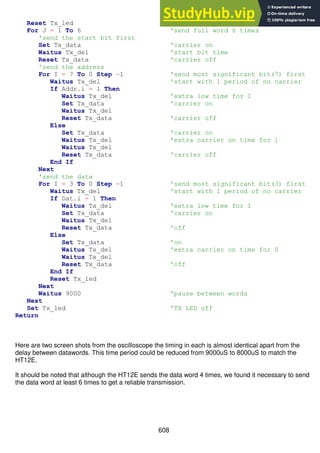
Microcontrollers and
Software Design
2nd
edition B.Collis
© 29 November-2012 www.techideas.co.nz
This work is copyright. No one but the author may sell or distribute this material.
ii
Table of Contents
1 Introduction to Practical Electronics ...............................................................................13
1.1 Your learning in Technology........................................................................................................ 14
1.2 Key Competencies from The NZ Curriculum ............................................................................... 14
2 An introductory electronic circuit ....................................................................................15
2.1 Where to buy stuff?..................................................................................................................... 15
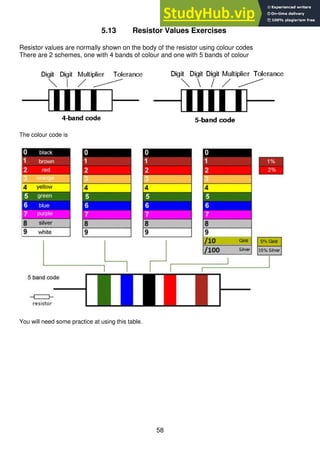
2.2 Identifying resistors by their colour codes.................................................................................... 16
2.3 LED's .......................................................................................................................................... 17
2.4 Some LED Specifications............................................................................................................ 17
2.5 LED research task ...................................................................................................................... 17
2.6 Adding a switch to your circuit..................................................................................................... 18
2.7 Switch assignment...................................................................................................................... 18
2.8 Important circuit concepts ........................................................................................................... 19
2.9 Changing the value of resistance ................................................................................................ 19
2.10 Adding a transistor to your circuit ................................................................................................ 20
2.11 Understanding circuits................................................................................................................. 21
2.12 The input circuit – an LDR........................................................................................................... 22
2.13 Working darkness detector circuit ............................................................................................... 23
2.14 Protecting circuits – using a diode............................................................................................... 24
2.15 Diode Research Task.................................................................................................................. 24
2.16 Final darkness detector circuit..................................................................................................... 25
3 Introductory PCB contruction ..........................................................................................26
3.1 Eagle Schematic and Layout Editor Tutorial................................................................................ 26
3.2 An Introduction to Eagle.............................................................................................................. 27
3.3 The Schematic Editor.................................................................................................................. 28
3.4 The Board Editor......................................................................................................................... 33
3.5 Making Negative Printouts .......................................................................................................... 37
3.6 PCB Making................................................................................................................................ 38
4 Soldering, solder and soldering irons .............................................................................41
4.1 Soldering facts ............................................................................................................................ 42
4.2 Soldering Safety.......................................................................................................................... 42
4.3 Soldering wires to switches......................................................................................................... 43
4.4 Codes of practice........................................................................................................................ 44
4.5 Good and bad solder joints ......................................................................................................... 45
4.6 Short circuits............................................................................................................................... 46
4.7 Soldering wires to LED’s............................................................................................................. 48
5 Introductory Electronics Theory ......................................................................................49
5.1 Making electricity ........................................................................................................................ 49
5.2 ESD electrostatic discharge ........................................................................................................ 51
5.3 Magnets, wires and motion ......................................................................................................... 52
5.4 Group Power Assignment ........................................................................................................... 52
5.5 Electricity supply in New Zealand................................................................................................ 53
5.6 Conductors ................................................................................................................................. 54
5.7 Insulators .................................................................................................................................... 54
5.8 Choosing the right wire ............................................................................................................... 55
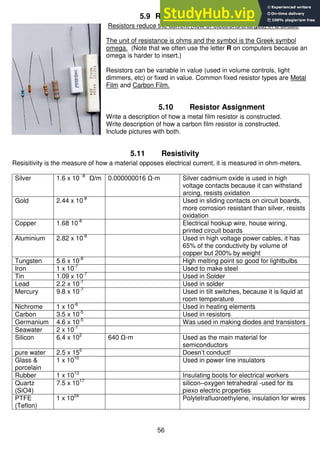
5.9 Resistors..................................................................................................................................... 56
5.10 Resistor Assignment ................................................................................................................... 56
5.11 Resistivity.................................................................................................................................... 56
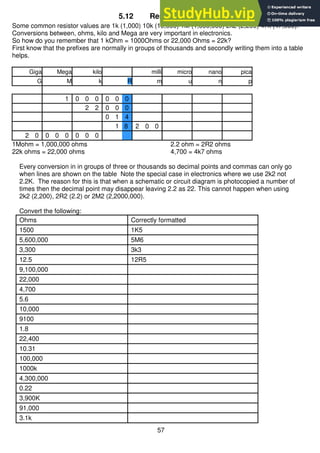
5.12 Resistor prefixes ......................................................................................................................... 57
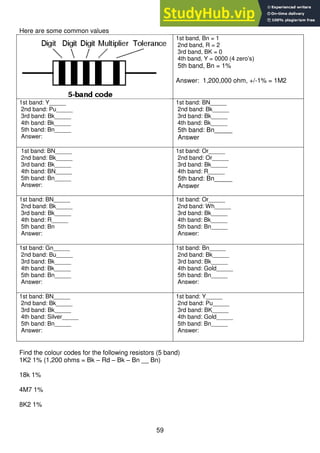
5.13 Resistor Values Exercises .......................................................................................................... 58
5.14 Capacitors................................................................................................................................... 60
5.15 Component symbols reference ................................................................................................... 61
5.16 Year 10/11 - Typical test questions so far ................................................................................... 62
6 Introduction to microcontroller electronics ....................................................................63
6.1 What is a computer? ................................................................................................................... 64
6.2 What does a computer system do?............................................................................................. 64
6.3 What exactly is a microcontroller?............................................................................................... 65
6.4 What does a microcontroller system do?..................................................................................... 66
6.5 Getting started with AVR Programming....................................................................................... 67
iii
6.6 Breadboard................................................................................................................................. 67
6.7 Breadboard+Prototyping board circuit......................................................................................... 68
6.8 Checking your workmanship ....................................................................................................... 70
6.9 Output Circuit - LED.................................................................................................................... 71
6.10 AVR programming cable............................................................................................................. 71
6.11 Getting started with Bascom & AVR............................................................................................ 72
6.12 The compiler............................................................................................................................... 72
6.13 The programmer ......................................................................................................................... 72
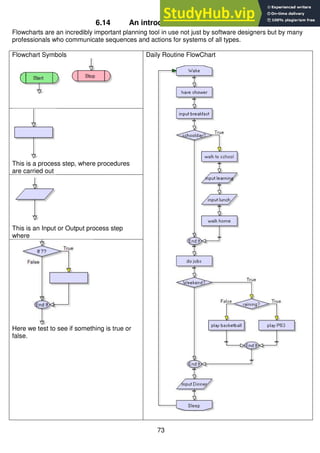
6.14 An introduction to flowcharts ....................................................................................................... 73
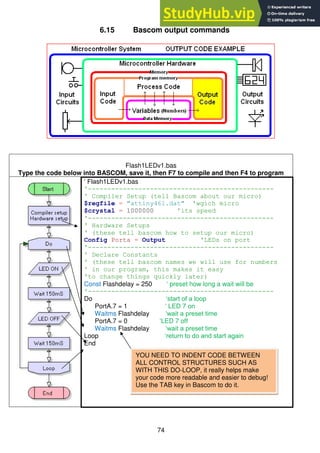
6.15 Bascom output commands.......................................................................................................... 74
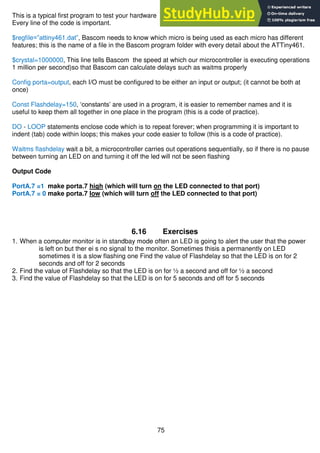
6.16 Exercises .................................................................................................................................... 75
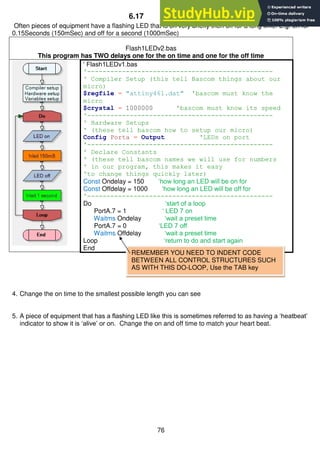
6.17 Two delays.................................................................................................................................. 76
6.18 Syntax errors -‘bugs’ ................................................................................................................... 77
6.19 Microcontroller ports: write a Knightrider program using LED’s ................................................... 78
6.20 Knightrider v2.............................................................................................................................. 79
6.21 Knightroder v3............................................................................................................................. 80
6.22 Commenting your programs........................................................................................................ 82
6.23 Learning review........................................................................................................................... 82
6.24 What is a piezo and how does it make sound?............................................................................ 83
6.25 Sounding Off............................................................................................................................... 84
6.26 Sound exercises ......................................................................................................................... 86
6.27 Amp it up..................................................................................................................................... 87
7 Microcontroller input circuits ...........................................................................................90
7.1 Single push button switch ........................................................................................................... 90
7.2 Pullup resistor theory .................................................................................................................. 92
7.3 Switch in a breadboard circuit ..................................................................................................... 92
7.4 Checking switches in your program............................................................................................. 93
7.5 Program Logic – the ‘If-Then’ Switch Test................................................................................... 94
7.6 If-then exercises.......................................................................................................................... 95
7.7 Switch contact bounce ................................................................................................................ 96
7.8 Reading multiple switches........................................................................................................... 98
7.9 Bascom debounce command...................................................................................................... 99
7.10 Different types of switches you can use .................................................................................... 100
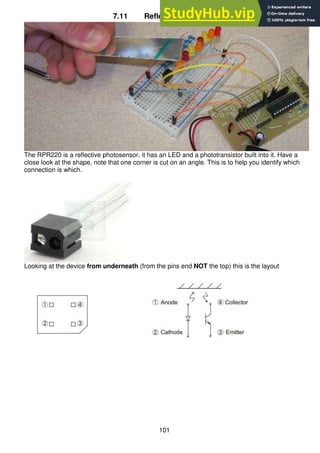
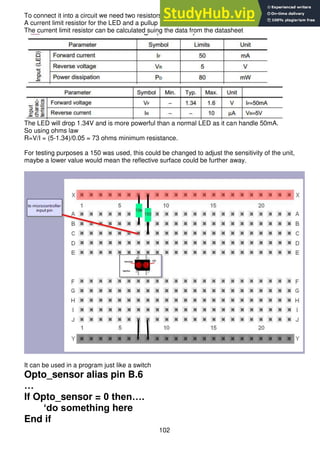
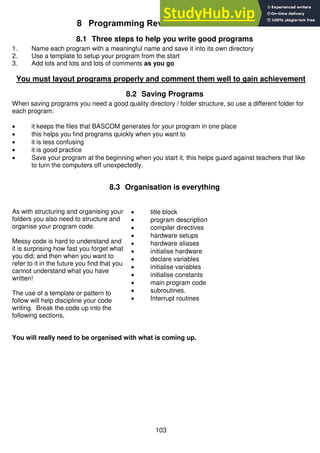
7.11 Reflective opto switch ............................................................................................................... 101
8 Programming Review ......................................................................................................103
8.1 Three steps to help you write good programs ........................................................................... 103
8.2 Saving Programs ...................................................................................................................... 103
8.3 Organisation is everything......................................................................................................... 103
8.4 Programming template.............................................................................................................. 104
8.5 What you do when learning to program..................................................................................... 105
8.6 AVR microcontroller hardware .................................................................................................. 106
8.7 Power supplies.......................................................................................................................... 106
8.8 BASCOM and AVR assignment ................................................................................................ 107
8.9 Programming words you need to be able to use correctly ......................................................... 109
8.10 Year10/11 typical test questions so far...................................................................................... 110
9 Introduction to program flow..........................................................................................111
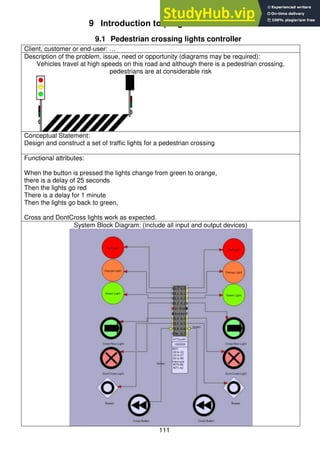
9.1 Pedestrian crossing lights controller.......................................................................................... 111
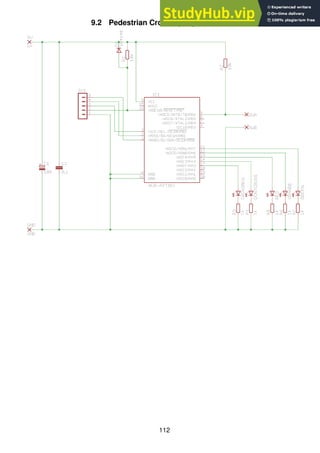
9.2 Pedestrian Crossing Lights schematic ...................................................................................... 112
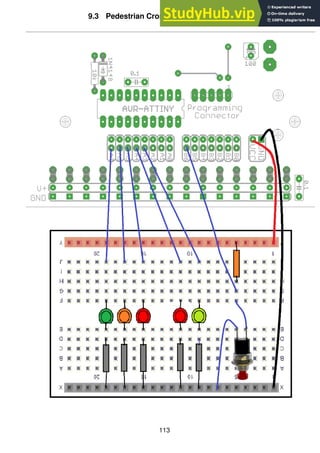
9.3 Pedestrian Crossing Lights PCB Layout.................................................................................... 113
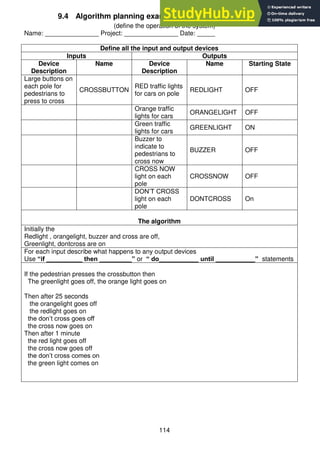
9.4 Algorithm planning example – pedestrian crossing lights .......................................................... 114
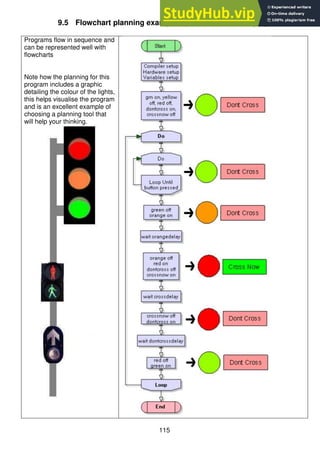
9.5 Flowchart planning example – pedestrian crossing lights.......................................................... 115
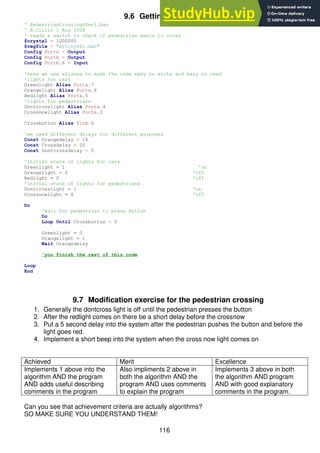
9.6 Getting started code.................................................................................................................. 116
9.7 Modification exercise for the pedestrian crossing...................................................................... 116
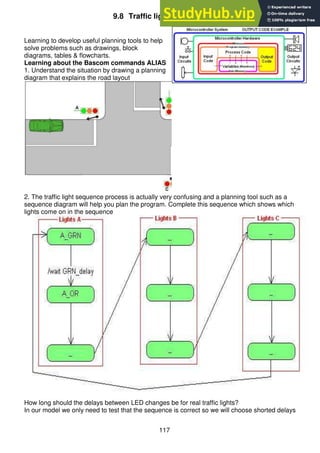
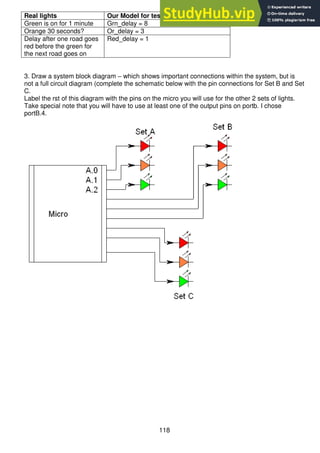
9.8 Traffic lights program flow ......................................................................................................... 117
10 Introductory programming - using subroutines............................................................125
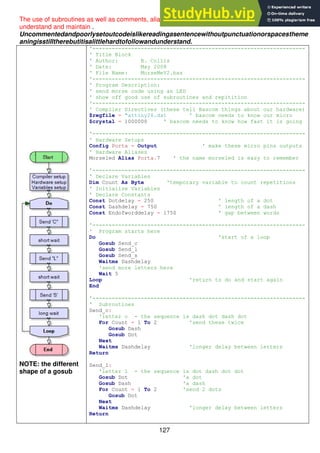
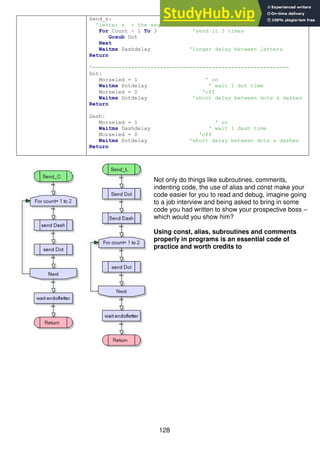
10.1 Sending Morse code ................................................................................................................. 126
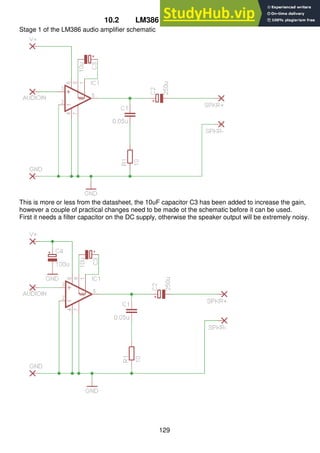
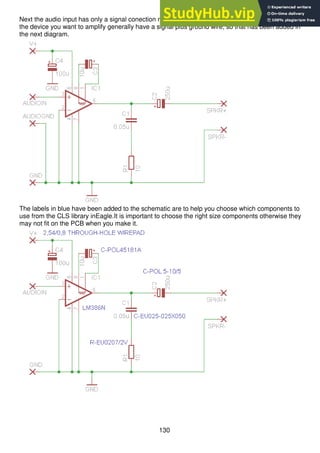
10.2 LM386 audio amplifier PCB....................................................................................................... 129
10.3 LM386 PCB Layout................................................................................................................... 131
11 Introductory programming – using variables................................................................133
11.1 Stepping or counting using variables......................................................................................... 134
iv
11.2 For-Next.................................................................................................................................... 136
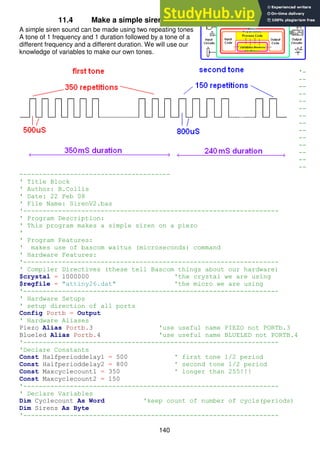
11.3 Siren sound - programming using variables .............................................................................. 138
11.4 Make a simple siren ................................................................................................................. 140
11.5 Siren exercise ........................................................................................................................... 141
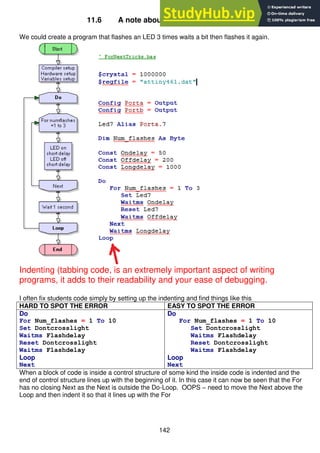
11.6 A note about layout of program code ........................................................................................ 142
11.7 Using variables for data ............................................................................................................ 143
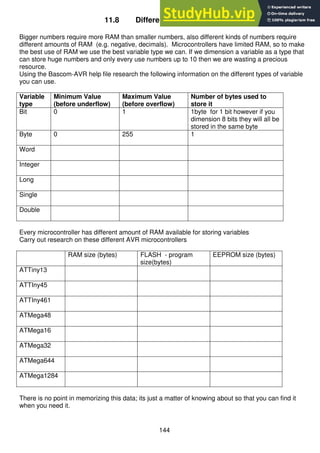
11.8 Different types of variables........................................................................................................ 144
11.9 Variables and their uses............................................................................................................ 145
11.10 Vehicle counter ..................................................................................................................... 146
11.11 Rules about variables............................................................................................................ 147
11.12 Examples of variables in use................................................................................................. 147
11.13 Byte variable limitations......................................................................................................... 148
11.14 Random Numbers................................................................................................................. 149
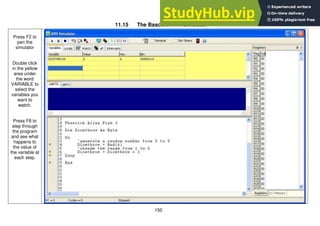
11.15 The Bascom-AVR simulator .................................................................................................. 150
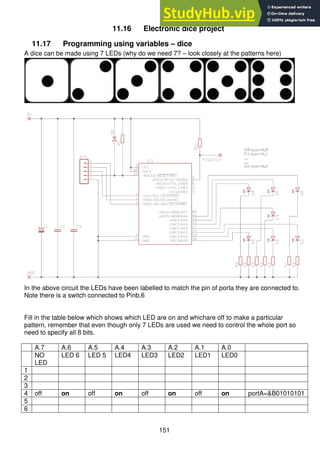
11.16 Electronic dice project ........................................................................................................... 151
11.17 Programming using variables – dice...................................................................................... 151
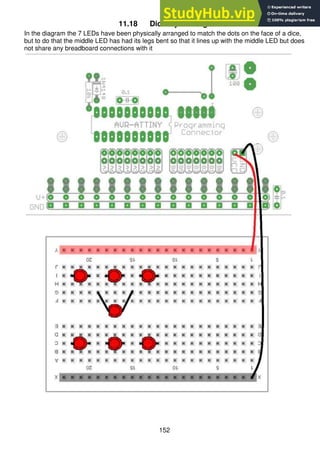
11.18 Dice layout stage 1................................................................................................................ 152
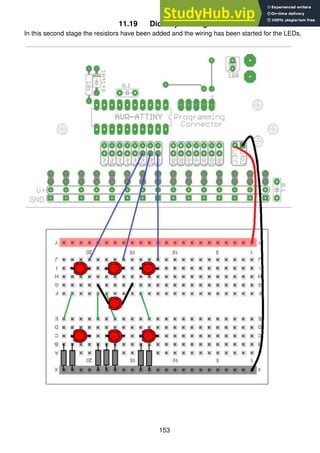
11.19 Dice layout stage 2................................................................................................................ 153
11.20 Dice Layout final.................................................................................................................... 154
11.21 First Dice Program flowchart ................................................................................................. 155
11.22 A note about the Bascom Rnd command .............................................................................. 156
11.23 Modified dice......................................................................................................................... 157
11.24 Modified Knightrider .............................................................................................................. 159
12 Basic displays..................................................................................................................160
12.1 7 segment displays ................................................................................................................... 160
12.2 Alphanumeric LED displays ...................................................................................................... 171
13 TDA2822M Portable Audio Amplifier Project ................................................................173
13.1 Portfolio Assessment Schedule................................................................................................. 174
13.2 Initial One Page Brief ................................................................................................................ 175
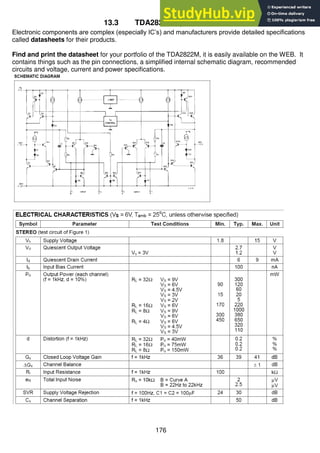
13.3 TDA2822M specifications ......................................................................................................... 176
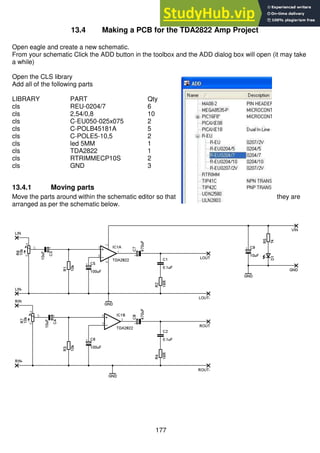
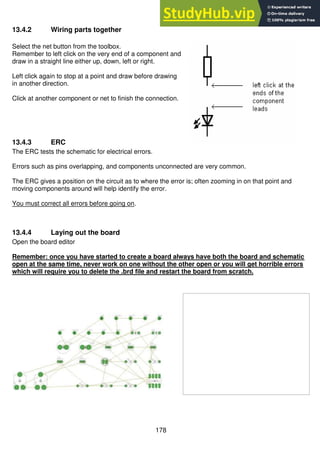
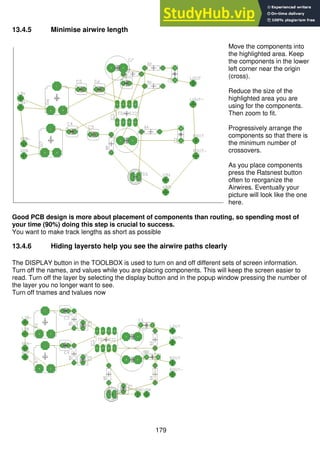
13.4 Making a PCB for the TDA2822 Amp Project............................................................................ 177
13.5 Extra PCB making information .................................................................................................. 181
13.6 Component Forming Codes of Practice..................................................................................... 182
13.7 TDA2811 wiring diagram........................................................................................................... 183
13.8 SKETCHUP Quick Start Tutorial ............................................................................................... 184
13.9 Creating reusable components in SketchUp ............................................................................. 185
14 Basic programming logic................................................................................................186
14.1 Quiz Game Controller ............................................................................................................... 186
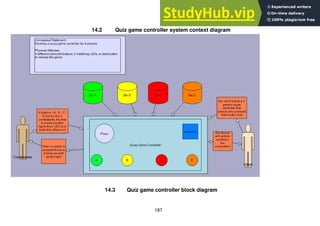
14.2 Quiz game controller system context diagram........................................................................... 187
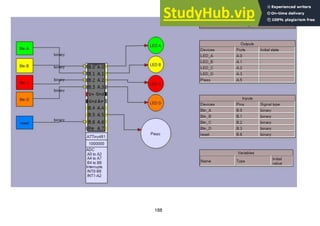
14.3 Quiz game controller block diagram.......................................................................................... 187
14.4 Quiz game controller Algorithm................................................................................................. 189
14.5 Quiz game schematic................................................................................................................ 190
14.6 Quiz game board veroboard layout ........................................................................................... 191
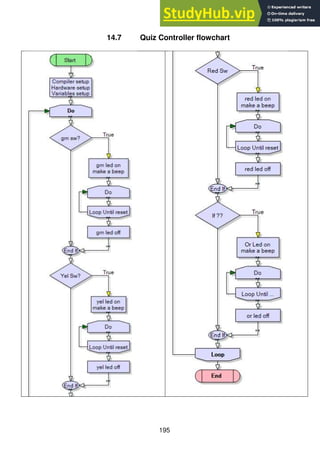
14.7 Quiz Controller flowchart........................................................................................................... 195
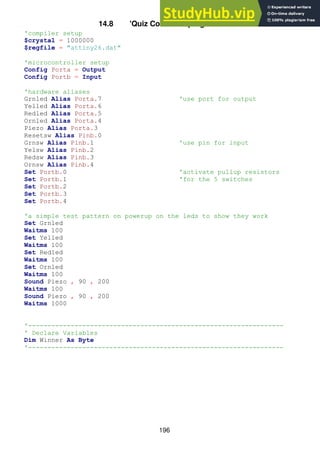
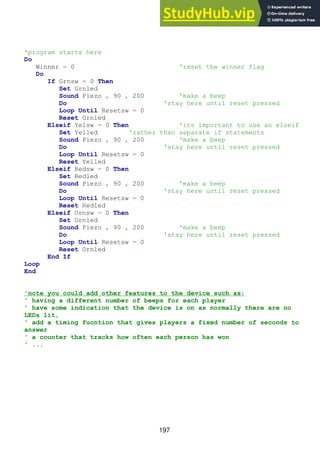
14.8 'Quiz Controller program code................................................................................................... 196
14.9 Don’t delay - use logic............................................................................................................... 198
15 Algorithm development – an alarm system...................................................................201
15.1 Simple alarm system – stage 1 ................................................................................................. 201
15.2 Alarm System Schematic .......................................................................................................... 202
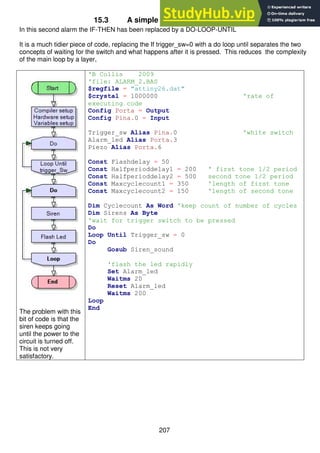
15.3 A simple alarm system – stage 2............................................................................................... 207
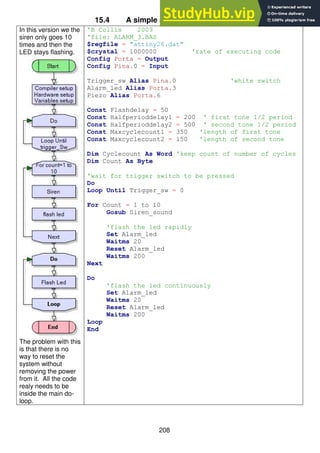
15.4 A simple alarm system – stage 3............................................................................................... 208
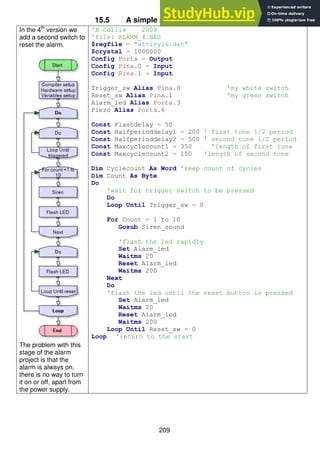
15.5 A simple alarm system – stage 4............................................................................................... 209
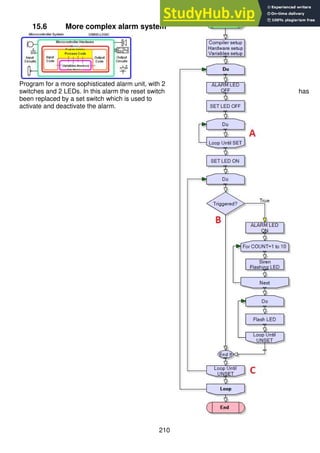
15.6 More complex alarm system .................................................................................................... 210
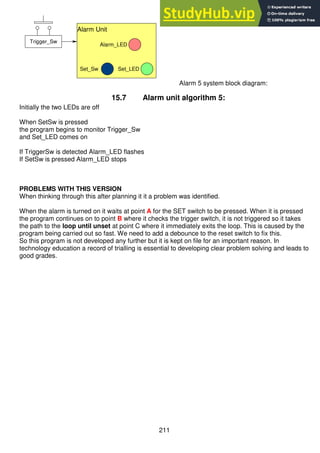
15.7 Alarm unit algorithm 5: .............................................................................................................. 211
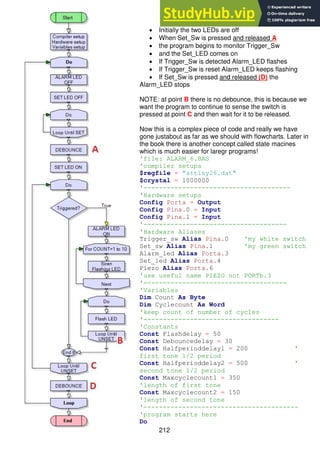
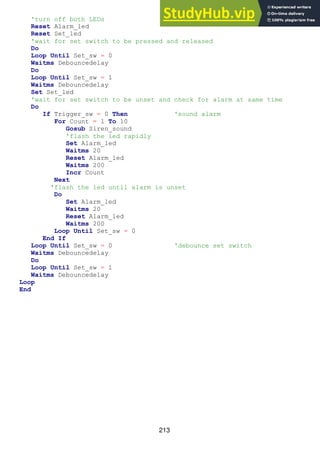
15.8 Alarm 6 algorithm:..................................................................................................................... 212
16 Basic electronic theory ...................................................................................................214
16.1 Conventional Current ................................................................................................................ 214
16.2 Ground...................................................................................................................................... 214
16.3 Preferred resistor values ........................................................................................................... 214
16.4 Resistor Tolerances .................................................................................................................. 215
v
16.5 Combining resistors in series .................................................................................................... 215
16.6 Combining resistors in parallel .................................................................................................. 216
16.7 Resistor Combination Circuits................................................................................................... 217
16.8 Multimeters ............................................................................................................................... 218
16.9 Multimeter controls.................................................................................................................... 219
16.10 Choosing correct meter settings............................................................................................ 220
16.11 Ohms law.............................................................................................................................. 221
16.12 Voltage & Current Measurements ......................................................................................... 222
16.14 Continuity.............................................................................................................................. 223
16.15 Variable Resistors................................................................................................................. 224
16.16 Capacitors............................................................................................................................. 225
16.17 Capacitor Codes and Values................................................................................................. 225
16.18 Converting Capacitor Values uF, nF , pF .............................................................................. 225
16.19 Capacitor action in DC circuits .............................................................................................. 226
16.20 The Voltage Divider............................................................................................................... 227
16.21 Using semiconductors........................................................................................................... 228
16.22 Calculating current limit resistors for an LED......................................................................... 229
16.23 The Bipolar Junction Transistor............................................................................................. 230
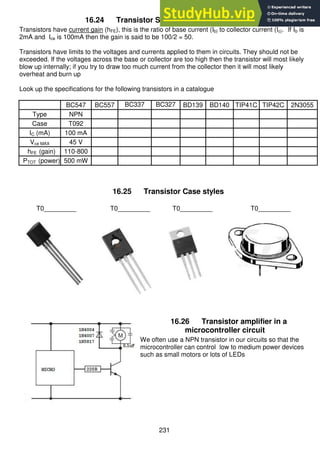
16.24 Transistor Specifications Assignment.................................................................................... 231
16.25 Transistor Case styles........................................................................................................... 231
16.26 Transistor amplifier in a microcontroller circuit....................................................................... 231
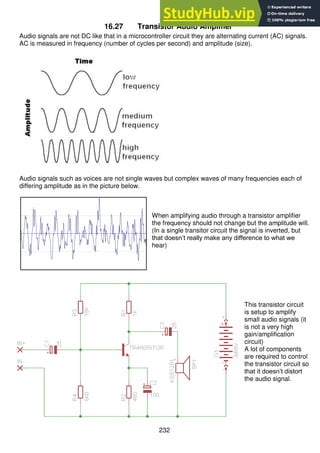
16.27 Transistor Audio Amplifier ..................................................................................................... 232
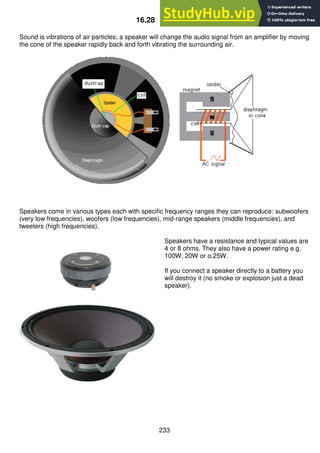
16.28 Speakers............................................................................................................................... 233
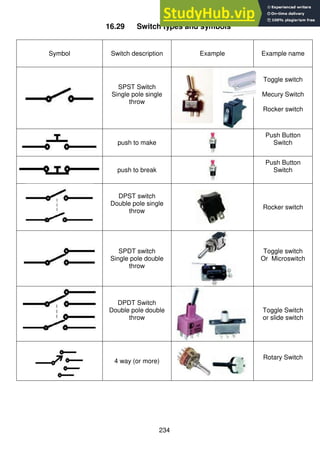
16.29 Switch types and symbols..................................................................................................... 234
17 Basic project planning ....................................................................................................235
17.1 System Designer....................................................................................................................... 236
17.2 Project mind map...................................................................................................................... 240
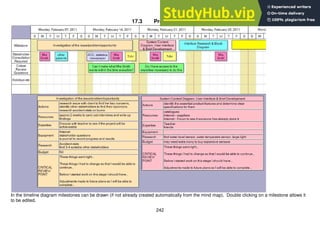
17.3 Project timeline ......................................................................................................................... 242
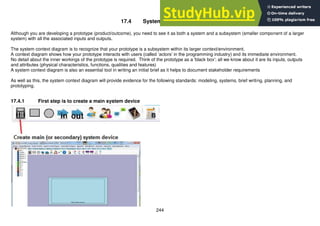
17.4 System context diagram............................................................................................................ 244
17.5 Block Diagram........................................................................................................................... 255
17.6 Board Layouts........................................................................................................................... 257
17.7 Algorithm design ....................................................................................................................... 262
17.8 Flowcharts ................................................................................................................................ 264
18 Example system design - hot glue gun timer................................................................267
18.1 System context diagram............................................................................................................ 267
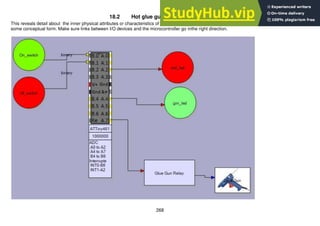
18.2 Hot glue gun timer block diagram.............................................................................................. 268
18.3 Hot glue gun timer algorithm .................................................................................................... 269
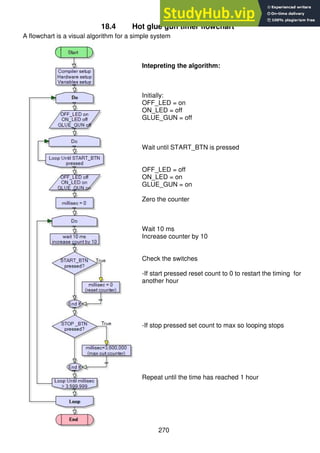
18.4 Hot glue gun timer flowchart...................................................................................................... 270
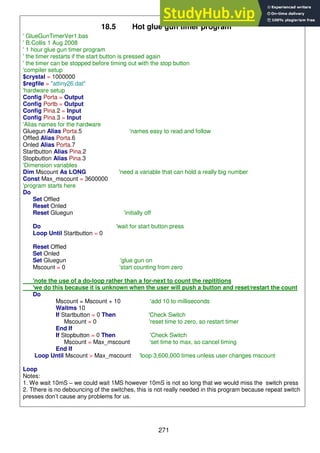
18.5 Hot glue gun timer program....................................................................................................... 271
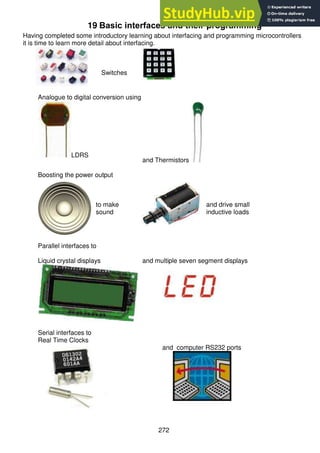
19 Basic interfaces and their programming .......................................................................272
19.1 Parallel data communications ................................................................................................... 273
19.2 LCDs (liquid crystal displays) .................................................................................................... 274
19.3 Alphanumeric LCDs .................................................................................................................. 275
19.4 ATTINY26 Development PCB with LCD.................................................................................... 276
19.5 Completing the wiring for the LCD............................................................................................. 278
19.6 LCD Contrast Control............................................................................................................... 279
19.7 Learning to use the LCD ........................................................................................................... 280
19.8 Repetition again - the ‘For-Next’ and the LCD........................................................................... 281
19.9 LCD Exerises............................................................................................................................ 282
19.10 Defining your own LCD characters........................................................................................ 285
19.11 LCD custom character program ............................................................................................ 285
19.12 A simple digital clock............................................................................................................. 287
19.13 Adding more interfaces to the ATTiny26 Development board................................................ 289
19.14 Ohms law in action – a multicoloured LED ............................................................................ 291
20 Basic analog to digital interfaces...................................................................................294
20.1 ADC - Analog to Digital conversion ........................................................................................... 294
20.2 Light level sensing .................................................................................................................... 294
20.3 Voltage dividers review ............................................................................................................. 295
20.4 AVR ADC connections.............................................................................................................. 295
20.5 Select-Case .............................................................................................................................. 296
vi
20.6 Reading an LDR’s values.......................................................................................................... 298
20.7 Marcus’ year10 night light project.............................................................................................. 300
20.8 Temperature measurement using the LM35.............................................................................. 303
20.9 A simple temperature display.................................................................................................... 304
20.10 LM35 temperature display..................................................................................................... 308
20.11 Force Sensitive Resistors...................................................................................................... 311
20.12 Piezo sensor ......................................................................................................................... 311
20.13 Multiple switches and ADC.................................................................................................... 312
21 Basic System Design.......................................................................................................313
21.1 Understanding how systems are put together ........................................................................... 313
21.2 Food Processor system block diagram ..................................................................................... 313
21.3 Subsystems .............................................................................................................................. 313
21.4 Food Processor system functional attributes- algorithm ............................................................ 313
21.5 Food Processor system flowchart ............................................................................................. 314
21.6 Toaster Design.......................................................................................................................... 315
21.7 Toaster - system block diagram ................................................................................................ 315
21.8 Toaster Algortihm...................................................................................................................... 315
22 Basic System development - Time Tracker...................................................................316
22.1 System context diagram and brief............................................................................................. 317
22.2 Time tracker block diagram....................................................................................................... 318
22.3 Algorithm development ............................................................................................................. 319
22.4 Schematic................................................................................................................................. 319
22.5 Time tracker flowchart and program version 1........................................................................... 320
22.6 Time Tracker stage 2 ................................................................................................................ 321
22.7 Time Tracker stage 3 ................................................................................................................ 323
22.8 Time Tracker stage 4 ................................................................................................................ 325
23 Basic maths time .............................................................................................................329
23.1 Ohms law calculator.................................................................................................................. 329
23.2 more maths - multiplication ....................................................................................................... 334
23.3 Algorithms for multiplication of very large numbers ................................................................... 336
23.4 Program ideas - algorithm and flowchart exercises ................................................................... 338
24 Basic string variables......................................................................................................339
24.1 Strings assignment ................................................................................................................... 341
24.2 ASCII Assignment..................................................................................................................... 343
24.3 Time in a string ......................................................................................................................... 346
24.4 Date in a string.......................................................................................................................... 348
24.5 Scrolling message assignment.................................................................................................. 350
24.6 Some LCD programming exercises........................................................................................... 351
25 Advanced power interfaces ............................................................................................352
25.1 Microcontroller power limitations ............................................................................................... 352
25.2 Power ....................................................................................................................................... 354
25.3 Power dissipation in resistors.................................................................................................... 354
25.4 Diode characteristics................................................................................................................. 355
25.5 Using Zener diodes................................................................................................................... 356
25.6 How diodes work....................................................................................................................... 357
25.7 How does a LED give off light? ................................................................................................. 358
25.8 LCD Backlight Data................................................................................................................... 359
25.9 Transistors as power switches .................................................................................................. 360
25.10 High power loads .................................................................................................................. 361
25.11 AVR Power matters............................................................................................................... 361
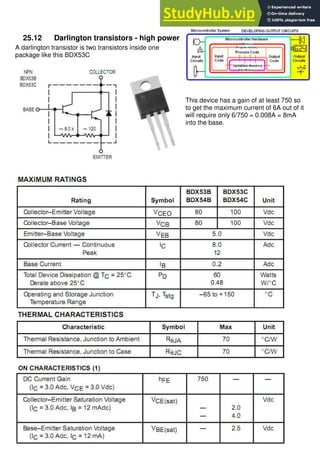
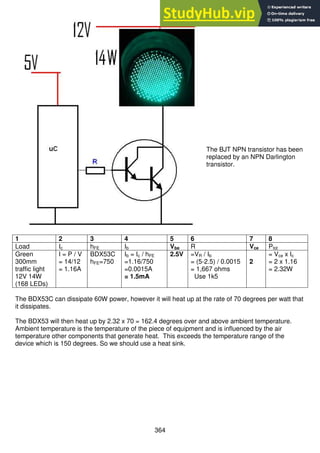
25.12 Darlington transistors - high power........................................................................................ 363
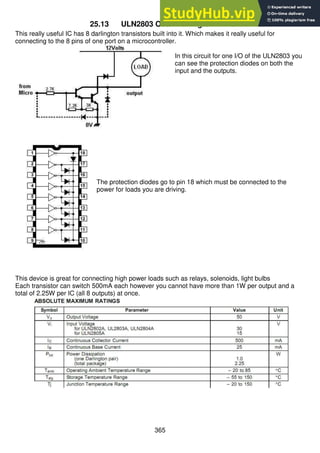
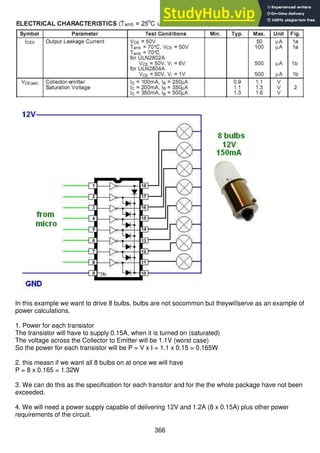
25.13 ULN2803 Octal Darlington Driver .......................................................................................... 365
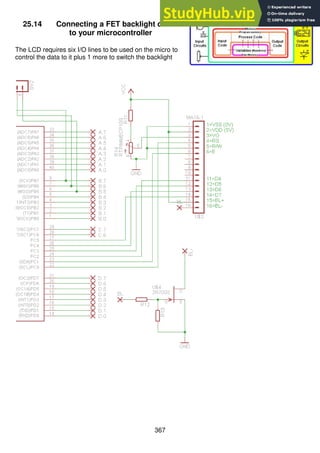
25.14 Connecting a FET backlight control to your microcontroller.................................................. 367
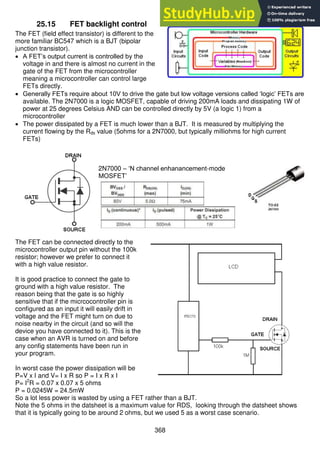
25.15 FET backlight control ........................................................................................................... 368
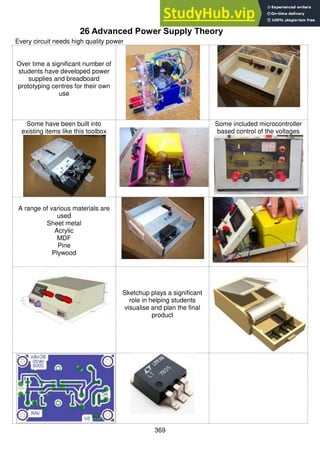
26 Advanced Power Supply Theory ....................................................................................369
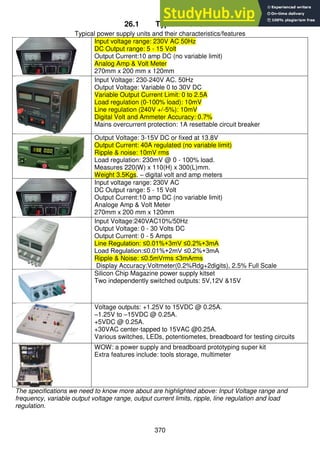
26.1 Typical PSUs ............................................................................................................................ 370
26.2 The four stages of a PSU (power supply unit) ........................................................................... 371
26.3 Stage 1: step down transformer ................................................................................................ 371
26.4 Stage 2: AC to DC Conversion.................................................................................................. 373
vii
26.5 Stage 3: Filtering AC component .............................................................................................. 374
26.6 Stage 4: Voltage Regulation...................................................................................................... 374
26.7 Ripple (decibel & dB) ................................................................................................................ 378
26.8 Line Regulation......................................................................................................................... 379
26.9 Load Regulation........................................................................................................................ 379
26.10 Current Limit ......................................................................................................................... 380
26.11 Power, temperature and heatsinking..................................................................................... 383
26.12 Typical PSU circuit designs................................................................................................... 385
26.13 PSU block diagram ............................................................................................................... 385
26.14 PSU Schematic..................................................................................................................... 385
26.15 Practical current limit circuit................................................................................................... 388
26.16 Voltage measurement using a voltage divider ....................................................................... 390
26.17 Variable power supply voltmeter program ............................................................................. 392
27 Year11/12/13 typical test questions so far.....................................................................394
28 Advanced programming -arrays.....................................................................................396
29 AVR pull-up resistors ......................................................................................................401
30 Advanced keypad interfacing .........................................................................................402
30.1 Keypad program 1 .................................................................................................................... 402
30.2 Keypad program 2 .................................................................................................................... 404
30.3 Keypad program 3 – cursor control ........................................................................................... 405
30.4 Keypad texter program V1 ........................................................................................................ 408
30.5 Keypad texter program 1a......................................................................................................... 412
30.6 ADC keypad interface ............................................................................................................... 413
31 Do-Loop & While-Wend subtleties .................................................................................416
31.1 While-Wend or Do-Loop-Until or For-Next?............................................................................... 417
32 DC Motor interfacing .......................................................................................................422
32.1 H-Bridge.................................................................................................................................... 424
32.2 H-Bridge Braking....................................................................................................................... 426
32.3 L293D H-Bridge IC.................................................................................................................... 427
32.4 L298 H-Bridge IC .................................................................................................................... 429
32.5 LMD18200 H-Bridge IC............................................................................................................. 430
32.6 LMD18200 program .................................................................................................................. 433
32.7 Darlington H-Bridge .................................................................................................................. 434
32.8 Stepper motors ......................................................................................................................... 437
32.9 PWM - pulse width modulation.................................................................................................. 444
32.10 PWM outputs ........................................................................................................................ 445
32.11 Uses for PWM....................................................................................................................... 446
32.12 ATMEL AVRs PWM pins....................................................................................................... 447
32.13 PWM on any port .................................................................................................................. 448
32.14 PWM internals....................................................................................................................... 449
33 Advanced System Example – Alarm Clock ...................................................................451
33.2 Analogue seconds display on an LCD....................................................................................... 456
33.3 LCD big digits ........................................................................................................................... 459
34 Resistive touch screen....................................................................................................467
34.1 Keeping control so you dont lose your ‘stack’............................................................................ 473
35 System Design Example – Temperature Controller......................................................474
36 Advanced programming - state machines.....................................................................477
36.1 Daily routine state machine....................................................................................................... 477
36.2 Truck driving state machine ...................................................................................................... 479
36.3 Developing a state machine...................................................................................................... 483
36.4 A state machine for the temperature alarm system ................................................................... 484
36.5 Using System Designer software to design state machines ...................................................... 487
36.6 State machine to program code ................................................................................................ 489
36.7 The power of state machines over flowcharts ........................................................................... 492
36.8 Bike light – state machine example........................................................................................... 494
36.9 Bike light program version1b..................................................................................................... 496
36.10 Bike light program version2................................................................................................... 498
37 Alarm clock project re-developed ..................................................................................500
37.1 System Designer to develop a Product Brainstorm ................................................................... 500
viii
37.2 Initial block diagram for the alarm clock .................................................................................... 502
37.3 A first (simple) algorithm is developed....................................................................................... 504
37.4 A statemachine for the first clock .............................................................................................. 505
37.5 Alarm clock state machine and code version 2.......................................................................... 507
37.6 Token game – state machine design example .......................................................................... 508
38 Advanced window controller student project ...............................................................513
38.1 Window controller state machine #1.......................................................................................... 513
38.2 Window controller state machine #3.......................................................................................... 514
38.3 Window controller state machine #5.......................................................................................... 515
38.4 Window controller program ....................................................................................................... 516
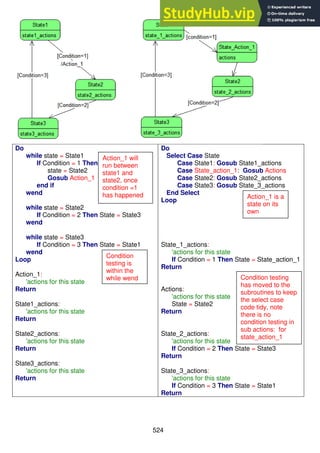
39 Alternative state machine coding techniques...............................................................523
40 Complex - serial communications..................................................................................525
40.1 Simplex and duplex................................................................................................................... 525
40.2 Synchronous and asynchronous ............................................................................................... 525
40.3 Serial communications, Bascom and the AVR .......................................................................... 526
40.4 RS232 serial communications................................................................................................... 527
40.5 Build your own RS232 buffer..................................................................................................... 529
40.6 Talking to an AVR from Windows XP........................................................................................ 530
40.7 Talking to an AVR from Win7.................................................................................................... 532
40.8 First Bascom RS-232 program.................................................................................................. 534
40.9 Receiving text from a PC .......................................................................................................... 535
40.10 BASCOM serial commands................................................................................................... 536
40.11 Serial IO using Inkey()........................................................................................................... 537
40.12 Creating your own software to communicate with the AVR ................................................... 540
40.13 Microsoft Visual Basic 2008 Express Edition......................................................................... 541
40.14 Stage 1 – GUI creation.......................................................................................................... 542
40.15 Stage 2 – Coding and understanding event programming..................................................... 551
40.16 Microsoft Visual C# commport application............................................................................. 556
40.17 Microcontroller with serial IO. ................................................................................................ 561
40.18 PC software (C#) to communicate with the AVR ................................................................... 566
40.19 Using excel to capture serial data ......................................................................................... 570
40.20 PLX-DAQ .............................................................................................................................. 572
40.21 StampPlot ............................................................................................................................. 573
40.22 Serial to parallel .................................................................................................................... 575
40.23 Keyboard interfacing – synchronous serial data .................................................................... 580
40.24 Keyboard as asynchronous data........................................................................................... 587
41 Radio Data Communication............................................................................................590
41.1 An Introduction to data over radio ............................................................................................. 590
41.2 HT12E Datasheet, transmission and timing .............................................................................. 597
41.3 HT12 test setup......................................................................................................................... 600
41.4 HT12E Program........................................................................................................................ 602
41.5 HT12D datasheet...................................................................................................................... 603
41.6 HT12D Program........................................................................................................................ 605
41.7 Replacing the HT12E encoding with software ........................................................................... 606
42 Introduction to I2C...........................................................................................................610
42.1 I2C Real Time Clocks ............................................................................................................... 611
42.2 Real time clocks........................................................................................................................ 612
42.3 Connecting the RTC ................................................................................................................. 612
42.4 Connecting the RTC to the board.............................................................................................. 612
42.5 Internal features........................................................................................................................ 613
42.6 DS1307 RTC code.................................................................................................................... 614
42.7 DS1678 RTC code.................................................................................................................... 619
43 Plant watering timer student project..............................................................................624
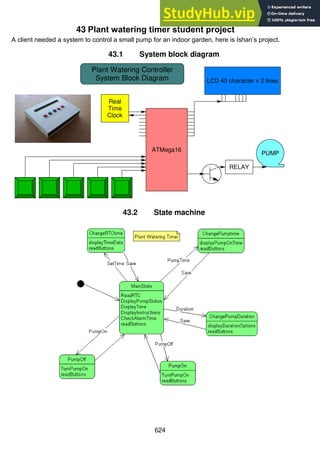
43.1 System block diagram............................................................................................................... 624
43.2 State machine........................................................................................................................... 624
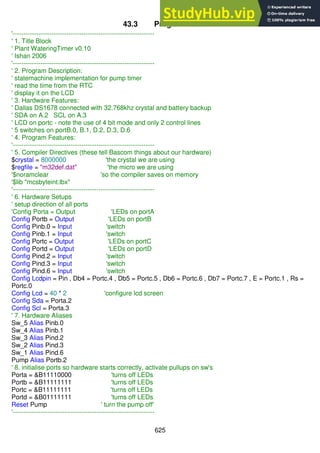
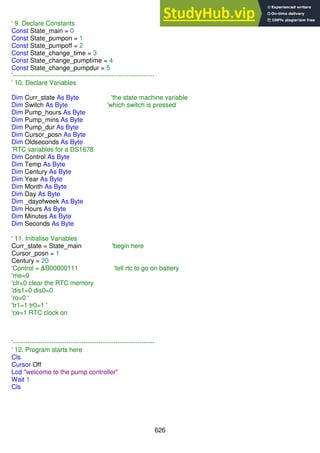
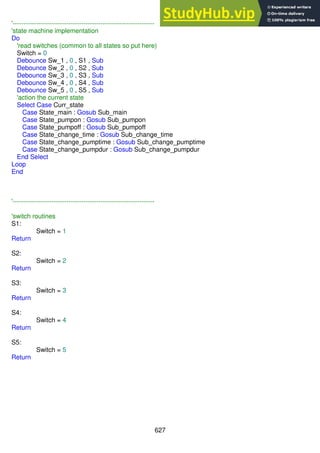
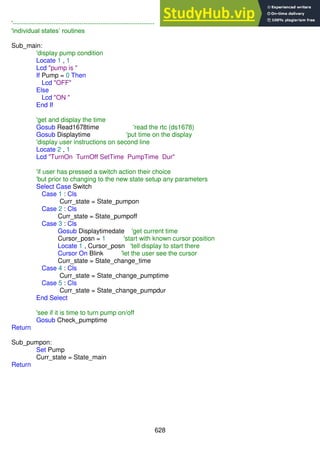
43.3 Program code ........................................................................................................................... 625
44 Bike audio amplifier project............................................................................................635
45 Graphics LCDs.................................................................................................................641
45.1 The T6963 controller................................................................................................................. 641
ix
45.2 Graphics LCD (128x64) – KS0108............................................................................................ 646
45.3 Generating a negative supply for a graphics LCD ..................................................................... 651
46 GLCD Temperature Tracking Project.............................................................................653
46.1 Project hardware....................................................................................................................... 653
46.2 Project software planning.......................................................................................................... 655
46.3 Draw the graph scales .............................................................................................................. 656
46.4 Read the values........................................................................................................................ 657
46.5 Store the values........................................................................................................................ 659
46.6 Plot the values as a graph......................................................................................................... 660
46.7 Full software listing ................................................................................................................... 662
47 Interrupts..........................................................................................................................665
47.1 Switch bounce problem investigation ........................................................................................ 667
47.2 Keypad- polling versus interrupt driven ..................................................................................... 668
47.3 Improving the HT12 radio system by using interrupts................................................................ 673
47.4 Magnetic Card Reader.............................................................................................................. 675
47.5 Card reader data structure ........................................................................................................ 675
47.6 Card reader data timing ............................................................................................................ 676
47.7 Card reader data formats .......................................................................................................... 677
47.8 Understanding interrupts in Bascom- trialling ............................................................................ 677
47.9 Planning the program................................................................................................................ 680
47.10 Pin Change Interrupts PCINT0-31......................................................................................... 683
48 Timer/Counters ................................................................................................................685
48.1 Timer2 (16 bit) Program............................................................................................................ 686
48.2 Timer0 (8bit) Program............................................................................................................... 687
48.3 Accurate tones using a timer (Middle C).................................................................................... 688
48.4 Timer1 Calculator Program ....................................................................................................... 689
48.5 Timer code to make a siren by varying the preload value.......................................................... 690
49 LED dot matrix scrolling display project – arrays and timers .....................................691
49.1 Scrolling text code..................................................................................................................... 694
49.2 Scrolling text – algorithm design ............................................................................................... 696
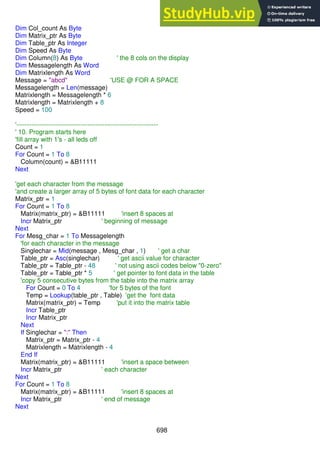
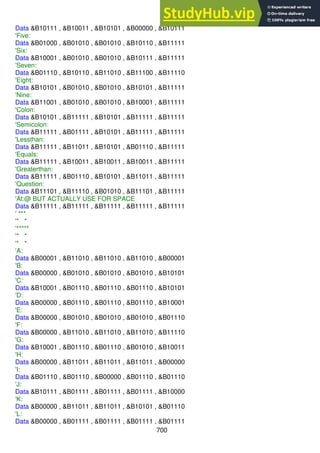
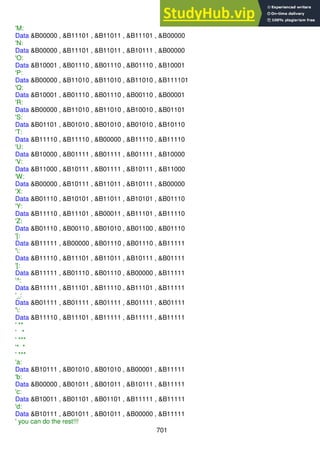
49.3 Scrolling test - code .................................................................................................................. 697
50 Medical machine project – timer implementation .........................................................702
50.1 Block diagram ........................................................................................................................... 702
50.2 Blower - state machine.............................................................................................................. 703
50.3 Blower program code................................................................................................................ 704
51 Multiple 7-segment clock project – dual timer action...................................................708
51.1 Understanding the complexities of the situation ........................................................................ 708
51.2 Hardware understanding:.......................................................................................................... 709
51.3 Classroom clock – block diagram.............................................................................................. 710
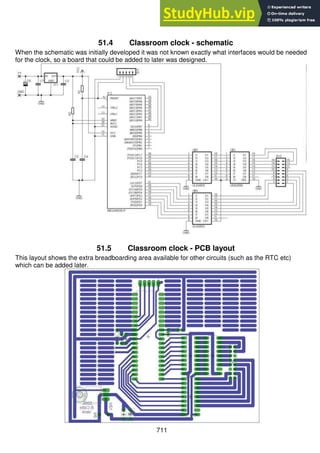
51.4 Classroom clock - schematic..................................................................................................... 711
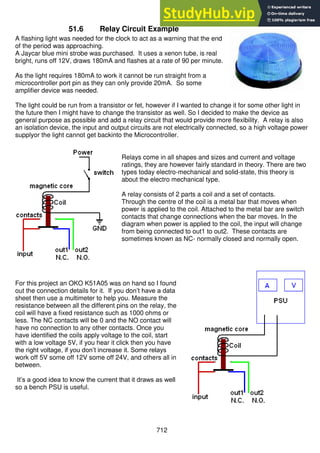
51.5 Classroom clock - PCB layout................................................................................................... 711
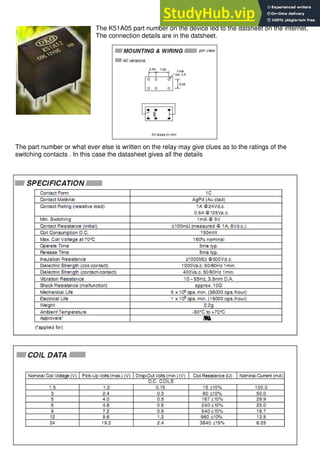
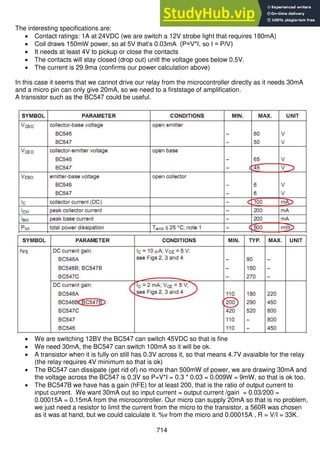
51.6 Relay Circuit Example............................................................................................................... 712
51.7 Classroom clock – flowcharts.................................................................................................... 716
51.8 Classroom clock – program....................................................................................................... 717
52 The MAX 7219/7221 display driver IC’s..........................................................................732
52.1 AVR clock/oscillator .................................................................................................................. 736
53 Cellular Connectivity-ADH8066 ......................................................................................737
53.1 ADH prototype development ..................................................................................................... 738
53.2 ADH initial test setup block diagram.......................................................................................... 740
53.3 Process for using the ADH........................................................................................................ 741
53.4 ADH communications................................................................................................................ 743
53.5 Initial state machine .................................................................................................................. 744
53.6 Status flags............................................................................................................................... 745
53.7 Second state machine............................................................................................................... 746
53.8 StateMachine 3......................................................................................................................... 747
53.9 Sending an SMS text ................................................................................................................ 748
53.10 Receiving an SMS text.......................................................................................................... 749
53.11 Splitting a large string (SMS message) ................................................................................. 750
53.12 Converting strings to numbers............................................................................................... 753
x
53.13 Full Program listing for SM3 .................................................................................................. 754
54 Data transmission across the internet...........................................................................771
54.1 IP address................................................................................................................................. 772
54.2 MAC (physical) address............................................................................................................ 772
54.3 Subnet mask............................................................................................................................. 773
54.4 Ping .......................................................................................................................................... 773
54.5 Ports ......................................................................................................................................... 774
54.6 Packets..................................................................................................................................... 774
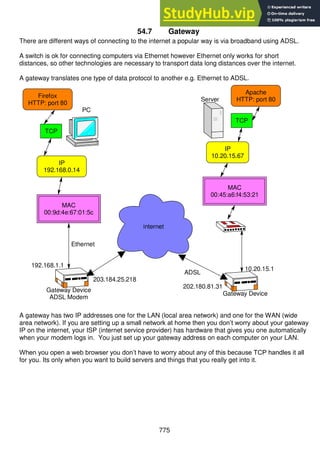
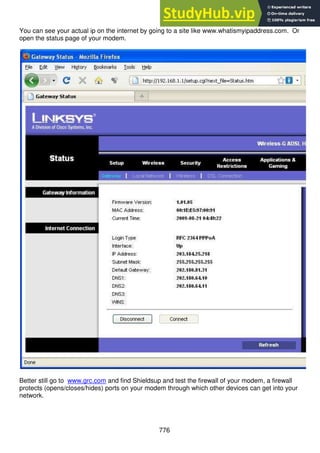
54.7 Gateway.................................................................................................................................... 775
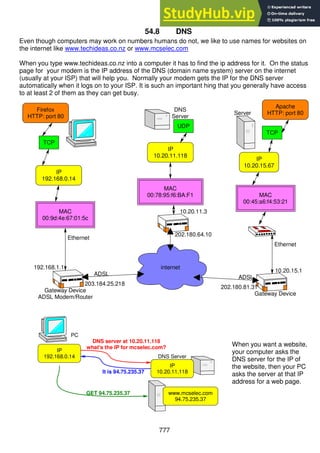
54.8 DNS.......................................................................................................................................... 777
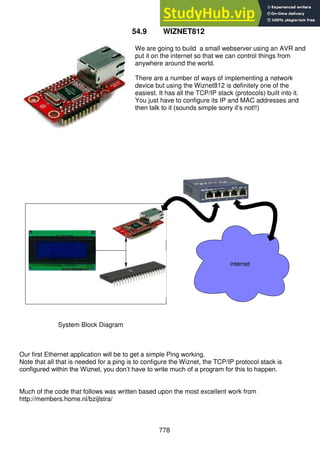
54.9 WIZNET812.............................................................................................................................. 778
54.10 Wiznet 812 Webserver V1..................................................................................................... 785
54.11 Transmitting data .................................................................................................................. 790
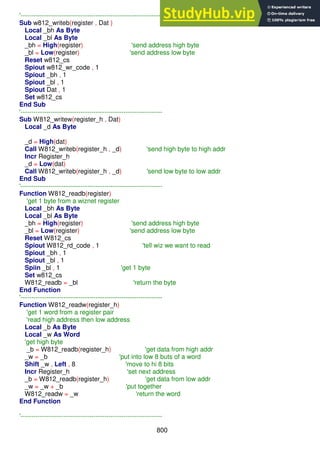
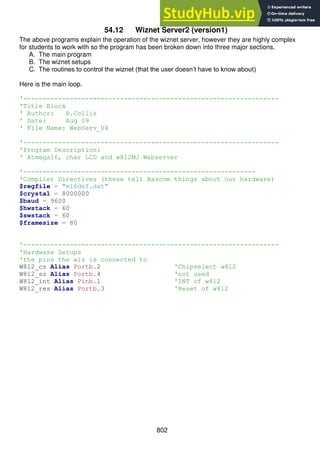
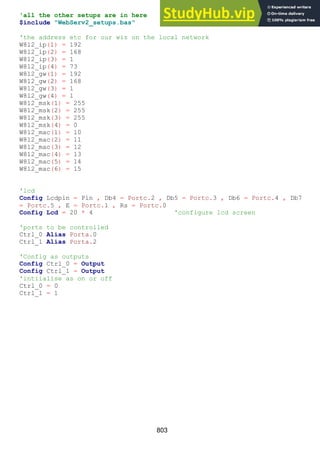
54.12 Wiznet Server2 (version1)..................................................................................................... 802
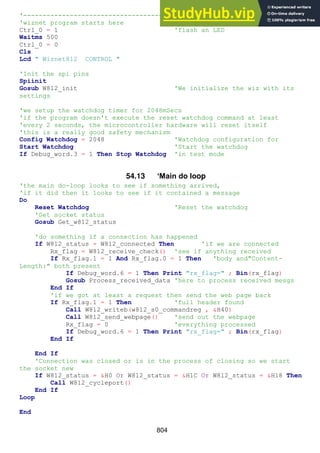
54.13 ‘Main do loop......................................................................................................................... 804
54.14 process any messages received from browser...................................................................... 805
54.15 Served webpage ................................................................................................................... 807
55 Assignment – maths in the real world ...........................................................................809
55.1 Math sssignment - part 1........................................................................................................... 812
55.2 Math assignment - part 2 .......................................................................................................... 813
55.3 Math assignment - part 3 .......................................................................................................... 814
55.4 Math assignment - part 4 .......................................................................................................... 815
55.5 Math assignment - part 5 .......................................................................................................... 816
55.6 Math assignment - part 6 .......................................................................................................... 817
55.7 Extension exercise.................................................................................................................... 817
56 SSD1928 based colour graphics LCD............................................................................818
56.1 System block diagram............................................................................................................... 818
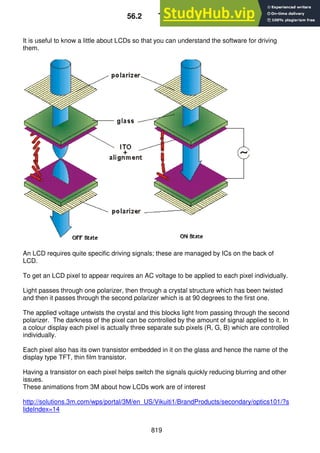
56.2 TFT LCDs ................................................................................................................................. 819
56.3 System memory requirements .................................................................................................. 820
56.4 System speed........................................................................................................................... 820
56.5 SSD and HX ICs ....................................................................................................................... 820
56.6 Colour capability ....................................................................................................................... 820
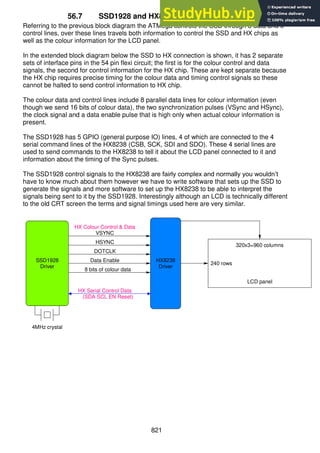
56.7 SSD1928 and HX8238 control requirements............................................................................. 821
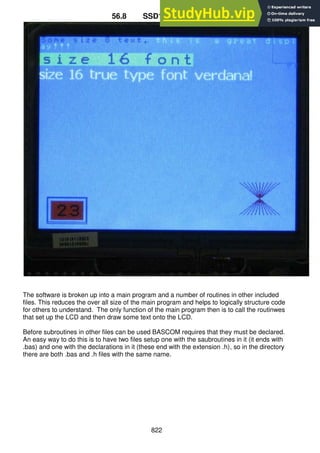
56.8 SSD1928 Software ................................................................................................................... 822
56.9 SSD1928 microcontroller hardware interface............................................................................ 826
56.10 Accessing SSD control registers ........................................................................................... 827
56.11 SSD1928_Register_routines.bas .......................................................................................... 829
56.12 Accessing the HX8238.......................................................................................................... 833
56.13 SSD1928_GPIO_routines.bas............................................................................................... 833
56.14 LCD timing signals ................................................................................................................ 835
56.15 HX setups ............................................................................................................................. 836
56.16 SSD setups........................................................................................................................... 837
56.17 SSD line / HSync timing ........................................................................................................ 838
56.18 SSD row / VSync/ frame timing ............................................................................................. 839
56.19 HX and SSD setup routine .................................................................................................... 841
56.20 'SSD1928_HardwareSetup_Routines.bas............................................................................. 841
56.21 SSD1928_Window_Control_Routines.bas ............................................................................ 845
56.22 Colour data in the SSD memory............................................................................................ 848
56.23 Accessing the SSD1928 colour memory ............................................................................... 849
56.24 'SSD1928_Memory_Routines.bas......................................................................................... 849
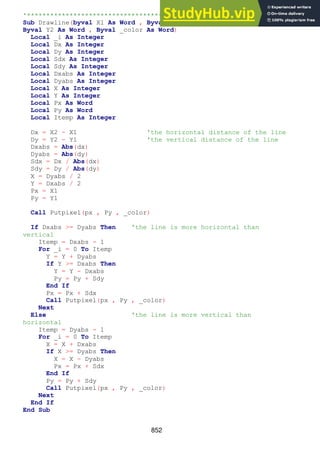
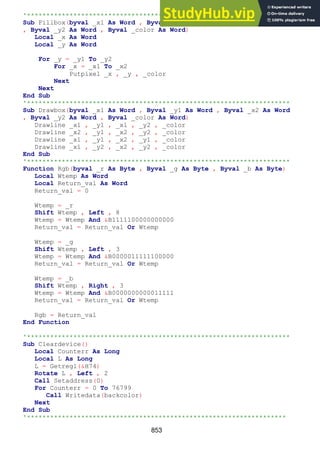
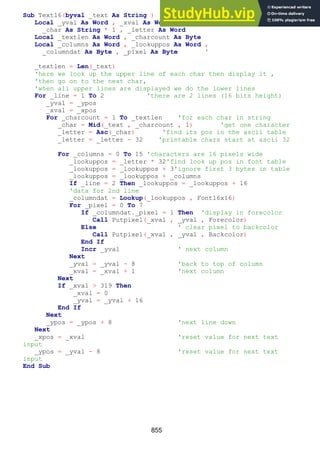
56.25 Drawing simple graphics ....................................................................................................... 851
56.26 'SSD1928_Simple_Graphics_Routines.bas .......................................................................... 851
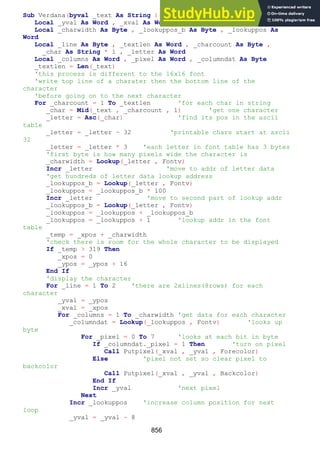
56.27 SSD1928_text_routines ........................................................................................................ 854
57 Traffic Light help and solution .......................................................................................858
58 Computer programming – low level detail.....................................................................862
58.1 Low level languages:................................................................................................................. 862
58.2 AVR Internals – how the microcontroller works ......................................................................... 863
58.3 1. The 8bit data bus .................................................................................................................. 864
58.4 2. Memory................................................................................................................................. 864
58.5 3. Special Function registers..................................................................................................... 865
xi
58.6 A simple program to demonstrate the AVR in operation............................................................ 865
58.7 Bascom keyword reference....................................................................................................... 867
59 USB programmer - USBASP ...........................................................................................869
60 USBTinyISP programmer................................................................................................871
61 C-Programming and the AVR .........................................................................................875
61.1 Configuring a programmer ........................................................................................................ 876
61.2 First program ............................................................................................................................ 878
61.3 Output window .......................................................................................................................... 880
61.4 Configuring inputs & outputs ..................................................................................................... 881
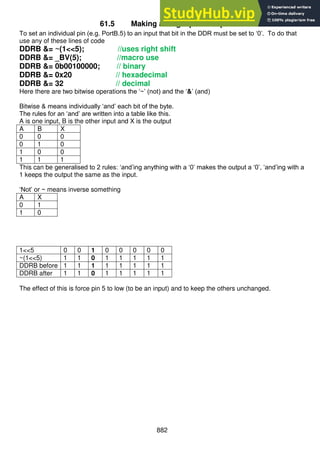
61.5 Making a single pin an input...................................................................................................... 882
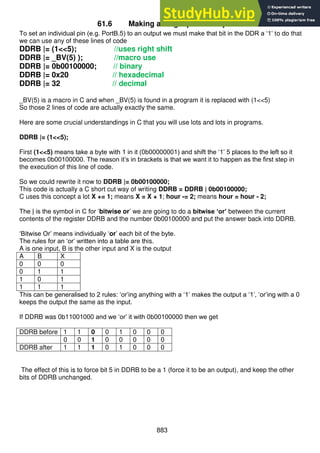
61.6 Making a single pin an output.................................................................................................... 883
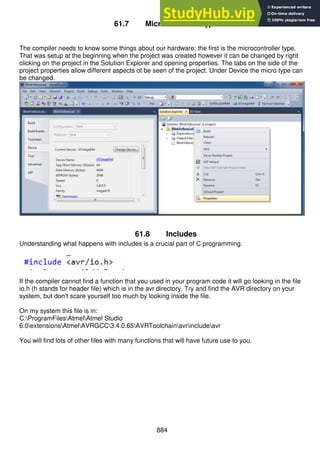
61.7 Microcontroller type................................................................................................................... 884
61.8 Includes .................................................................................................................................... 884
61.9 Main function ............................................................................................................................ 885
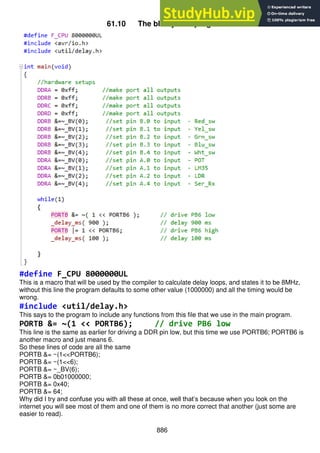
61.10 The blinkyelled program........................................................................................................ 886
61.11 Counting your bytes .............................................................................................................. 887
61.12 Optimising your code ............................................................................................................ 889
61.13 Reading input switches ......................................................................................................... 890
61.14 Macros .................................................................................................................................. 891
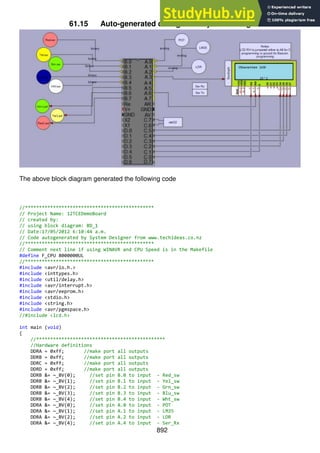
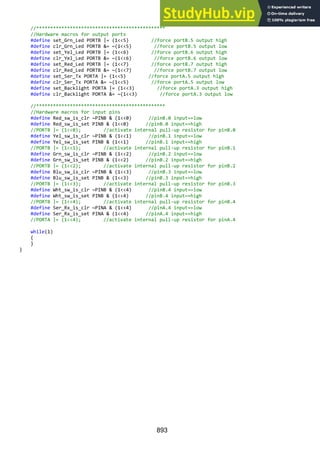
61.15 Auto-generated config from System Designer....................................................................... 892
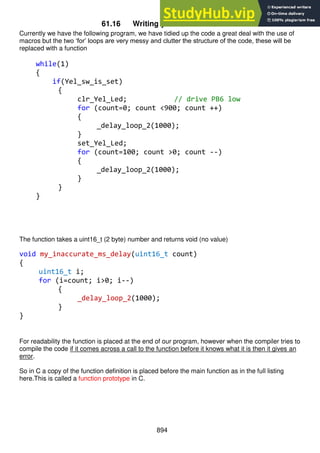
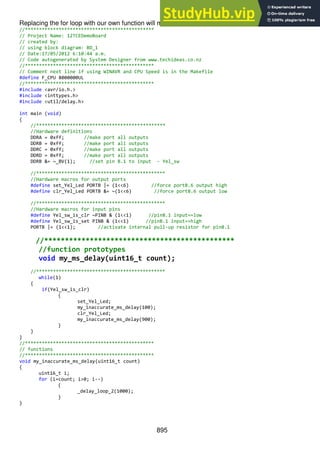
61.16 Writing your own functions .................................................................................................... 894
61.17 AVR Studio editor features.................................................................................................... 896
61.18 AVR hardware registers ........................................................................................................ 897
61.19 Character LCD programming in C ......................................................................................... 898
61.20 CharLCD.h Header file.......................................................................................................... 898
61.21 Manipulating AVR register addresses ................................................................................... 901
61.22 Writing to the LCD................................................................................................................. 902
61.23 Initialise the LCD................................................................................................................... 904
61.24 lcd commands....................................................................................................................... 906
61.25 Writing text to the LCD .......................................................................................................... 907
61.26 Program Flash and Strings.................................................................................................... 908
61.27 LCD test program1................................................................................................................ 909
61.28 CharLCD.h............................................................................................................................ 910
61.29 CharLCD.c ............................................................................................................................ 912
62 Object Oriented Programming (OOP) in CPP and the AVR..........................................916
62.1 The black box concept .............................................................................................................. 916
62.2 The concept of a class .............................................................................................................. 916
62.3 First CPP program .................................................................................................................... 917
62.4 Creating an AVR CPP program in Atmel Studio 6..................................................................... 918
62.5 Adding our class files to the project........................................................................................... 920
62.6 First Input and output program.................................................................................................. 921
62.7 Class OutputPin........................................................................................................................ 922
62.8 Class InputPin........................................................................................................................... 922
62.9 Inheritance................................................................................................................................ 923
62.10 Class IOPin........................................................................................................................... 923
62.11 Encapsulation ....................................................................................................................... 924
62.12 Access within a class ............................................................................................................ 924
62.13 Class Char_LCD ................................................................................................................... 925
62.14 Exercise – create your own Led class. .................................................................................. 928
63 Alternative AVR development PCBS..............................................................................930
63.1 ATTiny461 breadboard circuit ................................................................................................... 930
63.2 Alternative ATMega48 breadboard circuit ................................................................................. 931
63.3 Alternative ATMega breadboard circuit ..................................................................................... 934
63.4 AVR circuit description.............................................................................................................. 935
63.5 ATMega on Veroboard.............................................................................................................. 936
63.6 Different microcontroller starter circuit....................................................................................... 938
63.7 Getting started code for the ATMega48 .................................................................................... 938
63.8 Getting started code for the ATMega16 .................................................................................... 939
63.9 Early ATMega boards ............................................................................................................... 940
63.10 AVR Development Board 2 ................................................................................................... 943
xii
63.11 Dev board version 2 circuit diagram ...................................................................................... 944
63.12 Dev board pcb layout version 2............................................................................................. 945
63.13 ATMEGA V4b development board circuit – 12TCE 2011 ...................................................... 946
63.14 V4b devboard layout 12TCE 2011 ........................................................................................ 947
63.15 ATMega Dev PCB V5DSchematic (2012) ............................................................................. 948
63.16 ATMega Dev PCB V5DLayout (2012) ................................................................................... 949
63.17 ATMega Dev PCB V5D Copper (2012) ................................................................................. 950
63.18 Year10 ATTiny461 V3d development board.......................................................................... 951
63.19 Year11 ATTiny461 V6d development board.......................................................................... 954
63.20 ATTiny461 V6d development board layouts.......................................................................... 955
63.21 ATTiny461 V6b development board images.......................................................................... 956
63.22 ATMega 48 Dev PCB 2A....................................................................................................... 957
63.23 ATMEGA Protoyping board................................................................................................... 959
63.24 128x64 GLCD Schematic – VerC -data on portB................................................................... 960
63.25 128x64 GLCD Layout – VerC –data on portB........................................................................ 961
63.26 128x64 GLCD Schematic – VerD -data on portB................................................................... 962
63.27 128x64 GLCD Layout –VerD -data on portB ......................................................................... 963
63.28 GLCD 192x64 schematic ...................................................................................................... 964
63.29 GLCD 192x64 layout............................................................................................................. 965
63.30 ATMEGA microcontroller pin connections ............................................................................ 966
63.31 ATMEGA16/644 40pin DIP package– pin connections......................................................... 967
64 Eagle - creating your own library ...................................................................................968
64.1 Autorouting PCBS..................................................................................................................... 975
65 Practical Techniques.......................................................................................................977
65.1 PCB Mounting........................................................................................................................... 977
65.2 Countersink holes and joining MDF/wood ................................................................................. 978
65.3 MDF.......................................................................................................................................... 979
65.4 Plywood .................................................................................................................................... 979
65.5 Acrylic ....................................................................................................................................... 980
65.6 Electrogalv................................................................................................................................ 980
65.7 Choosing fasteners................................................................................................................... 981
65.8 Workshop Machinery ................................................................................................................ 982
65.9 Glues/Adhesives....................................................................................................................... 984
65.10 Wood Joining techniques ...................................................................................................... 985
65.11 Codes of Practice for student projects................................................................................... 986
65.12 Fitness for purpose definitions and NZ legislation ................................................................. 987
66 CNC...................................................................................................................................988
66.1 Machine overview ..................................................................................................................... 989
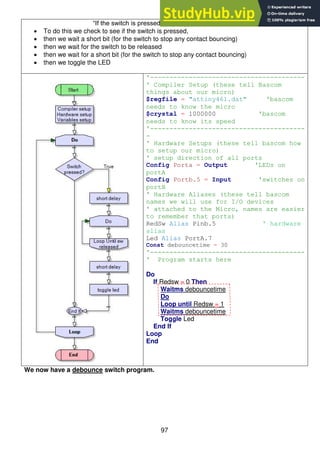
66.2 Starting the CNC machine ........................................................................................................ 990
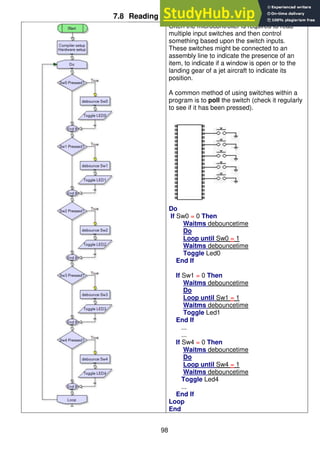
66.3 CamBam................................................................................................................................... 991
66.4 CamBam options ...................................................................................................................... 991
66.5 Drawing shapes in CamBam..................................................................................................... 992
66.6 Machining commands ............................................................................................................... 994
66.7 A Box of Pi................................................................................................................................ 995
66.8 Holding Tabs........................................................................................................................... 1001
66.9 Engraving................................................................................................................................ 1002
66.10 Polylines ............................................................................................................................. 1003
67 Index ...............................................................................................................................1006
13
1 Introduction to Practical Electronics
This book has a number of focus areas.
 Electronic component recognition and correct handling
 Developing a solid set of conceptual understandings in basic electronics.
 Electronic breadboard use
 Hand soldering skills
 Use of Ohm's law for current limiting resistors
 The voltage divider
 CAD PCB design and manufacture
 Microcontroller programming and interfacing
 The transistor as a switch
 Power supply theory
 Motor driving principles and circuits
 Modelling solutions through testing and trialing
 Following codes of practice
 Safe workshop practices
14
1.1 Your learning in Technology
1.1.1 Technology Achievement Objectives from the NZ Curriculum
Technological Practice
Brief –develop clear specifications for your technology projects.
Planning – thinking about things before you start making them and using drawings such as
flowcharts, circuit diagrams, pcb layouts, statecharts and sketchup plans while working.
Outcome Development – trialling, testing and building electronic circuits, designing and making
PCBs, writing programs for microcontrollers.
Technological Knowledge
Technological Modelling – before building an electronic device, it is important to find out how
well it works first by modelling and/or trialling its hardware and software.
Technological Products – getting to know about components and their characteristics.
Technological Systems - an electronic device is more than a collection of components it is a
functioning system with inputs, outputs and a controlling process.
Nature of Technology
Characteristics of Technological Outcomes – knowing about electronic components
especially microcontrollers as the basis for modern technologies.
Characteristics of Technology – electronic devices now play a central role in the infrastructure
of our modern society; are we their masters, how have they changed our lives?
1.2 Key Competencies from The NZ Curriculum
Thinking – to me the subject of technology is all about thinking. My goal is to have students
understand the technologies embedded within electronic devices. To achieve this students
must actively enage with their work at the earliest stage so that they can construct their own
understandings and go on to become good problem solvers. In the beginning of their learning
in electronics this requires students to make sense of the instructions they have been given
and search for clarity when they do not understand them. After that there are many new and
different pieces of knowledge introduced in class and students are given problem solving
exercises to help them think logically. The copying of someone elses answer is flawed but
working together is encouraged. At the core of learning isbuilding correct conceptual models
and to have things in the context of the ‘big picture’.
Relating to others – working together in pairs and groups is as essential in the classroom as it
is in any other situation in life; we all have to share and negotiate resources and equipment
with others; it is essential therefore to actively communicate with each other and assist one
other.
Using language symbols and texts – At the heart of our subject is the language we use for
communicating electronic circuits, concepts, algorithms and computer programming syntax; so
the ability to recognise and using symbols and diagrams correctly for the work we do is vital.
Managing self – This is about students taking personal responsibility for their own learning; it is
about challenging students who expect to read answers in a book or have a teacher tell them
what to do. It means that students need to engage with the material in front of them.
Sometimes the answers will come easily, sometimes they will not; often our subject involves a
lot of trial and error (mostly error). Students should know that it is in the tough times that the
most is learnt. And not to give up keep searching for understanding.
Participating and contributing – We live in a world that is incredibly dependent upon
technology especially electronics, students need to develop an awareness of the importance
of this area of human creativity to our daily lives and to recognise that our projects have a
social function as well as a technical one.
15
2 An introductory electronic circuit
2.1 Where to buy stuff?
In New Zealand there are a number of reasonably
priced and excellent suppliers for components including
www.surplustronics.co.nz and
www.activecomponents.com Overseas suppliers I use
include www.digikey.co.nz, www.sparkfun.com
ebay.com & aliexpress.com
A breadboard is a plastic block with holes and metal
connection strips inside it to make circuits. The holes
are arranged so that components can be connected
together to form circuits. The top and bottom rows are
usually used for power, top for positive which is red and
the bottom for negative which is black.
This circuit could be built like this, note that the LED
must go around the correct way. If you have the LED and resistor connected in a closed circuit
the LED should light up.
Schematic or circuit diagram Layout
The LED requires 2V the battery is 9V, if you put the LED across the battery it would stop working!
So a 1k (1000ohm) resistor is used to reduce the voltage to the LED and the current through it, get
a multimeter and measure the voltage across the resistor, is it close to 7V?
If you disconnect any wire within the circuit it stops working, a circuit needs to be complete before
electrons can flow.
16
2.2 Identifying resistors by their colour codes
When getting a resistor check its value! In our circuits each resistor has a special pupose, and the
value is chosen depending on whether we want more or less current in that part of the circuit,The
higher the value of the resistor the lower the currentThe lower the value of the resistor the higher
the current.
1M
‘1 Meg’
1 Million Ohms
1M Ω
1,000,000 ohms
10k
10 thousand ohms
10,000 ohms
10k Ω
1k
1 thousand ohms
1,000 ohms
1k Ω
390R
390 ohms
390Ω
100R
1000 ohms
100Ω
47R
47 ohms
47Ω
17
2.3 LED's
Light Emitting Diodes are currently used in indicators and displays
on equipment, however they are becoming used more and more
as replacements for halogen and incandescent bulbs in many
different applications. These include vehicle lights, traffic signals,
outdoor large TV screens.
Compared to incandescent bulbs (wires inside
glass bulbs that glow), LEDs give almost no heat
and are therefore highly efficient. They also have
much longer lives e.g. 10 years compared to 10
months. So in some situations e.g. traffic signals,
once LEDs are installed there can be significant
cost savings made on both power and
maintenance. There is a small problem with LED
traffic lights though – they don’t melt snow that
collects on them!!!
2.4 Some LED Specifications
 Intensity: measured in mcd (millicandela)
 Viewing Angle: The angle from centre where intensity drops to 50%
 Forward Voltage: Voltage needed to get full brightness from the the LED
 Forward Current: Current that will give maximum brightness,
 Peak Wavelength: the brightest colour of light emitted
2.5 LED research task
From a supplier in New Zealand (e.g. Surplustronics, DSE, Jaycar, SICOM) find the information and the
specifications / attributes for two LEDs, a normal RED 5mm LED and a 5mm high intensity LED.
LED RED 5mm High intensity 5mm
Supplier
Part number
Cost ($)
Brightness (mcd)
Forward voltage (Vf)
Wavelength (nm)
Forward current (If)
18
2.6 Adding a switch to your circuit
Schematic or circuit diagram Layout
A switch is the way a user can manually control a circuit
2.7 Switch assignment
Find a small switch and carefully disassemble it (take it apart) draw how it works and explain its
operation. Make sure you explain the purpose of the spring(s).
Here are simplified drawings of a small slide switch when it is in both positions.
When the switch is on electricity can flow, when it is open the circuit is broken.
19
2.8 Important circuit concepts
A circuit consists of a number of components and a power supply linked by wires.
Electrons (often called charges) flow in a
circuit; however unless there is a complete
circuit (a closed loop) no electrons can flow.
Voltage is the measure of energy in a circuit,
it is used as a measure of the energy
supplied from a battery or the energy
(voltage) across a part of a circuit.
Current (I) is the flow of electrons from the
battery around the circuit and back to the
battery again. Current is measured in Amps
(usually we will use milliamps or mA).
Note that current doesn't flow electrons or
charges flow. Just like in a river the current
doesn't flow the water flows.
Resistance works to reduce current , the resistors in the circuit offer resistance to the current.
Conductors such as the wires connecting components together have (theoretically) no resistance
to current.
A really important concept to get clear in your mind is that:
Voltage is across components and current is through components.
2.9 Changing the value of resistance
What is the effect of different resistor values on our circuit?
The resistor controls the current flow, the higher the resistor value the lower the current. (what
would a 10K resistor look like?
20
2.10 Adding a transistor to your circuit
Schematic ( circuit diagram)
2N7000 FET
(Field Effect Transistor)
A FET is a control
component that
amplifies small signals.
It has three legs or
leads:
D – Drain
G – Gate
S – Source
Only a small signal is
required on the gate to
control a larger current
through the source to
the drain.
The collector current is
the same current which
lights the LED
The 390 limits this
current to an
acceptable value for
the LED.
Breadboard layout diagram
21
2.11 Understanding circuits
Electronics is all about controlling the physical world. Physical objects have properties such as
temperature, force, motion, sound/radio/light waves associated with them
Electronic devices have input circuits to convert the physical world (light sound etc) to different
voltage levels.
They have process circuits that transform, manipulate and modify information (the information is
coded as different voltages).
They have output circuits to convert differen coltgae levels back to the physical world where we
can sense the outcome of the process ( light, sound etc)
Take an example such as a television, the physical world radio signal on the input is converted to
an voltage level, this is processed by the electronic circuit and converted to light which we see and
sound which we can hear.
22
2.12 The input circuit – an LDR
The LDR or Light Dependant Resistor is a common component used in
circuits to sense light level. An LDR varies resistance with the level of light
falling on it.
LDRs are made from semiconductors such as Selenium, Thalliumoxid and
Cadmiumsulfide.
As photons of light hit the atoms within the LDR, electrons can flow through
the circuit. This means that as light level increases, resistance decreases.
Find an LDR and measure its resistance:
in full daylight the LDRs resistance is approximately ____________
in darkness the LDRs resistance is approximately ______________
LDRs can only with stand a small current
flow e.g. 5mA, if too much current flows
they may overheat and burn out. They are
used in voltage divider circuits with a
series resistor. The components are a
resistor from 10K (10,000) ohms to 1M
(1,000,000) ohms, an LDR, a battery and
the circuit is a series one.
When it is dark the LDR has a high resistance and the output voltage is high.
When it is bright the LDR has a low resistance
and the voltage is low.
23
2.13 Working darkness detector circuit
The resistor in series with the LDR can be experiments with to change the sensitivity of the circuit
to different light levels.
24
2.14 Protecting circuits – using a diode
Diodes are very common components, they come in all shapes and sizes.
The key characteristic of a
diode is that there is
current in only one
direction so you cannot
reverse it in the circuit and
expect it to work.
In this modified circuit the
power is supplied from the
battery. The circuit is
protected by a diode, this
means if the battery is
connected in reverse then
there is no current because
the diode blocks it (this is
commonly used in the
workshop to protect our
circuits from a reverse
polarity situation).
Of course no diode is perfect and should the voltage of the power supply exceed the voltage rating
of the diode then the diode would breakdown, this means the current would increase rapidly and it
would burn up. The 1N4004 has a 400V rating.
Diodes can only take a certain current in the forward direction before they overheat and burn up.
The 1N4004 has a maximum forward current of 1Amp.
2.15 Diode Research Task
Research the specifications for these two common diodes (ones we use often in class) and find
out what each specification / attribute means.
Description 1N4007 1N4148
Peak
reverse
voltage
Maximum
forward
current
25
2.16 Final darkness detector circuit
The function of the input part of the circuit is to detect light level.
The function of the process part of the circuit (the transistor) is to amplify the small change in
voltage due to light changes.
The function of the output part of the circuit is to indicate something to the end user.
The function of the power supply is to safely provide the energy for the circuit to work
When it is dark the LED is switched on, when there is light present the LED is switched off. This
circuit could be used to help a younger child orientate themselves at night and to find the door in a
darkened room.
The DIODE, LED and TRANSISTOR are polarised, have positive and negative ends and therefore
require wiring into the circuit the right way round or it will not work
You can identify the LED polarity by the flat on the LED body(negative-cathide) or by the longer
lead (positive or anode)
You can identify the TRANSISTOR polarity by the shape of the bidy and the layout of the three
leads
Draw lines from the components to the symbols to help you remember them. Remember the
resistor in the output circuit was made a lower value (changed from 1k to 390ohms) to make the
LED brighter in the final circuit.
26
3 Introductory PCB contruction
We take a short break from programming to introduce a further topic of construction - PCB making
3.1 Eagle Schematic and Layout Editor Tutorial
A circuit such as the darkeness detector is no good to us on a breadboard it needs a permanent
solution and so we will build it onto a PCB ( printed circuit board).
27
3.2 An Introduction to Eagle
Eagle is a program from www.cadsoft.de that enables users to draw the circuit diagram for an
electronic circuit and then layout the printed circuit board. This is a very quick start tutorial, where
you will be led step by step through creating a PCB for a TDA2822 circuit.
The version used is the freeware version which has the following limitations; the PCB size is
limited to 100mm x 80mm and the board must be not for profit
3.2.1 Open Eagle Control Panel
Start - Programs - Eagle - Eagle 4.13
3.2.2 Create a new schematic
On the menu go to FILE then NEW then SCHEMATIC
You will see the schematic editor
3.2.3 Saving your schematic
 It is always best to save your data before you start work
 Eagle creates many temporary files so you need to keep your folders tidy.
 If this is the first time you have used Eagle create an Eagle folder within your folder on the
server.
 Within the Eagle folder create a folder for the name of this project e.g. DarkDetector
 Save the schematic as DarkDetector verA.sch within the DarkDetector folder.
28
3.3 The Schematic Editor
The first part of the process in creating a PCB is drawing the schematic.
1. Parts will be added from libraries
2. and joined together using ‘nets’ to make the circuit
3.3.1 The Toolbox
As you point to the tools in the TOOLBOX their names will appear in a popup and also their
description will appear in the status bar at the bottom of the window
Find the following tools
 ADD A PART
 MOVE AN OBJECT
 DELETE AN OBJECT
 DEFINE THE NAME OF AN OBJECT
 DEFINE THE VALUE OF AN OBJECT
 DRAW NETS (connections)
 ERC (electrical rule check)
29
3.3.2 Using parts libraries
Selecting parts libraries to use.
Parts are stored within libraries and there are a large number of libraries in Eagle.
It is not hard to create your own library and modify the parts within it. The cls.lbr has many already
modified components within it. If Eagle is not setup to use the cls library you will need to do it
now.
1. From your internet browser save the file cls.lbr into your Eagle folder.
2. In Eagle's control panel from the menu select options then directories
3. In the new window that appears make sure the directories for the libraries are highlighted
4. Click on browse and find your Eagle.directory
5. Next highlight the directories for Projects
6. Click on browse and find your Eagle directory again.
7. Choose OK.
8. You might need to close EAGLE and restart it to make sure it reads the libraries ok.
9. To use a library right click on it from within the Control Panel
10. Make sure Use is highlighted. It will have a green dot next to it if it is selected
11. At this time right click on the other lbr folder and select Use none.
NOTE THE IMPORTANCE OF THE GREEN DOT NEXT TO THE LIBRARY,
if its not there you will not see the library in the schematic editor!
30
3.3.3 Using Components from within libraries.
From your schematic Click the ADD button
in the toolbox
A new window will open (it may take a
while)
 Find the CLS library
 Open it by double clicking on it or by
clicking the + sign
 Open the R-EU_ section (Resistor-
European)
 Here you will find the 0204/10
resistor.
 Select it and then click OK
Add 2 more resistors of the same type.
Add all of the following parts
LIBRARY PART Qty
cls REU-0204/10 3
cls LDR 1
cls 2,54/0,8 (wirepads) 2
cls led 5MM 1
cls 1N4148 D41-10 1
cls 2N7000 1
cls GND 3
A wirepad allows us to connect wires to the PCB (such as wires to switches and batteries)
3.3.4 Different component
packages
There are several different types of
resistors; they all have the same symbol
however resistors come in different
physicalpackages so we must choose an
appropriate one.The 0204/7 is suitable
for us but any of the 4 smallest ones
would be OK.
31
Moving parts
Move the parts around within the schematic editor so that they are arranged as per the schematic
below. Keep the component identifiers (numbers like R1, R2, R3) in the same places as those
below.
3.3.5 Wiring parts together
These form the electrical connections that makeup the
circuit. Select the net button from the toolbox.
Left click on the very end of a component and draw in a
straight line either up, down, left or right.
Left click again to stop at a point and draw before drawing in
another direction.
Double left click at another component to finish the wire.
32
3.3.6 Zoom Controls
There are a number of zoom controls that can be used to help you work in your circuit.
Find these on the toolbar and identify what each does.
Nets
Nets are the wire connections between the components, each has a
unique name.
Find the info button in the toolbox and check the names and details of the
components and nets/wires.
When you want to connect a new net to an existing net, Eagle will prompt
you as to which name to give the combined net.
If one of the nets has a proper name i.e. VCC, V+,V-, ground... use that
name, otherwise choose the net with the smallest number
3.3.7 Junctions
Junctions are the dots at joins in the circuit, they are there to make sure that the wires are
electrically connected. Generally you will NOT need to add these to your circuit as the net tool puts
them in place automatically
33
3.3.8 ERC
The ERC button causes Eagle to test the schematic for electrical errors.
Errors such as pins overlapping, and components unconnected are very common.
The ERC gives a position on the circuit as to where the error is; often zooming in on that point and
moving components around will help identify the error.
You must correct all errors before going on.
3.4 The Board Editor
The board editor is opened using a button in the toolbar, find this button and answer yes to the
question about creating the board.
The new window has a pile of parts and an area upon which to place them.
WARNING: once you have started to create a board always have both the board and
schematic open at the same time, never work on one without the other open or you will get
horrible errors which will require you to delete the .brd file and restart the board from
scratch.
34
3.4.1 Airwires
The wires from the schematic have become connections called airwires, these wires will shortly
become tracks on the PCB.
These connections can look very messy at times and at this stage it is called a RATSNEST.
3.4.2 Moving Components
Move the components into the highlighted area. In the demo version you cannot place parts
outside this area. Keep the components in the lower left corner near the origin (cross).
Reduce the size of the highlighted area you are using for the components. Then zoom to fit.
Progressively arrange the components so that there is the minimum number of crossovers.
As you place components press the Ratsnest button often to reorganize the Airwires. Eventually
your picture will look like the one on the right.
Good PCB design is more about placement of components than routing, so spending most
of your time (80%) doing this step is crucial to success.
You want to make track lengths as short as possible
35
3.4.3 Hiding/Showing Layers
The DISPLAY button in the TOOLBOX is used to turn on and off different sets of screen
information. Turn off the names, and values while you are placing components. This will keep the
screen easier to read. Turn off the layer by selecting the display button and in the popup window
pressing the number of the layer you no longer want to see.
36
3.4.4 Routing Tracks
Now is the time to replace the airwires with actual PCB
tracks. Tracks need to connect all the correct parts of the
circuit together without connecting together other parts.
This means that tracks cannot go over the top of one
another, nor can they go through the middle of
components!
Go to the Toolbar, Select the ROUTE button
On the Toolbar make sure the Bottom layer is selected
(blue) and that the track width is 0.04. Left click on a
component.
Note that around your circuit all of the pads on the same
net will be highlighted. Route the track by moving the
mouse and left clicking on corner points for your track as
you go. YOU ONLY WANT TO CONNECT THE PADS
ON THE SAME NET, DON'T CONNECT ANY OTHERS
OR YOUR CIRCUIT WILL NOT WORK. Double click on a
pad to finish laying down the track.
Track layout Rules
1. Place tracks so that no track touches the leg of
a component that it is not connected to on the
schematic
2. No track may touch another track that it is not
connected to on the schematic
3. Tracks may go underneath the body of a
component as long as they meet the above
rules
3.4.5 Ripping up Tracks
Ripping up a track is removing the track you have laid
down and putting the airwire back in place. This will be
necessary as you go to solve problems where it is not
possible to route the tracks. You may even want to rip up
all the tracks and move components around as you go.
37
3.5 Making Negative Printouts
Eagle is straight forward at producing printouts for a positive photographic pcb making process.
(NOTE THE TEXT ON THE PCB APPEARS
REVERSED THIS IS CORRECT)
If your photosensitive board
requires a negative image
such as this, another stage on
the process is required..
3.5.1 Other software
required
The following software is required to manipulate the
special CAM (computer aided manufacturing) files

created by Eagle (and other pcb CAD software) into
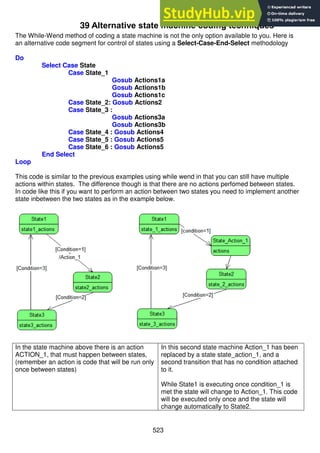
the printed image you require. All this software is
shareware with no fees attached for its use by
students.
* Install GhostScript - from http://www.ghostscript.com
* Install GSView - from http://www.ghostgum.com.au/
Conversion process
This process creates a '.ps' (postscript file), it is the best output from Eagle to use. It will keep the
board exactly the same and correct size for printing.
* Open TDA2822verA.brd in Eagle
* From within the Eagle Board Editor start the CAM Processor
* select device as PS_INVERTED
* Scale = 1
* file = .ps
* make sure fill pads is NOT selected this
makes small drill holes in the acetate which
we use to line up the drill with when drilling
* for layers select only 16,17,18 and 20,
* make sure ALL other layers are NOT
selected.
* Select process job
* if you will use this process a lot save this
cam setup as so that you can reuse it again
Open the TDA2822verA.ps file with
Ghostview for printing and print it onto an over
head transparency. Make sure you can see
the drill holes!
38
3.6 PCB Making
PCB Board Layers
Measure, Cut:
Photosensitive board is expensive, so it is
important not to waste it and cut it to the
right size.
It is also sensitive to ordinary light so when
cutting it don’t leave it lying around.
Expose:
This over head projector is a great source of
UV – ultra violet light, it takes three minutes
on the OHP in my classroom.
The overhead transparency produced earlier
must have some text on it. The text acts as
a cue or indication of which way around the
acetate and board should be. We want the
text on the board to be around the right way.
Develop:
The developer chemical we use is sodium
metasillicate which is a clear base or alkali.
It will ruin your clothes so do not splash it
around, it is a strong cleaning agent!
It should be heated to speed up the process.
The development process takes anywhere
from 20 seconds to 2 minutes. The reason
being that the chemical dilutes over time
making the reaction slower.
The board should be removed twice during
the process and washed gently in water to
check the progress.
39
Rinse:
The developer must becompletely removed
from the board.
At this stage if there is not time to etch the
board, dry it and store it in a dark place.
Etch:
The etching chemical we use if ferric
chloride, it is an acid and will stain your
clothes.
The tank heats the etching solution and
there is a pump to blow bubbles through the
liquid, this speeds the process up radically
so always use the pump.
Etching may take from 10 to 30 minutes
depending upon the strength of the solution.
Rinse:
Thorughly clean the board.
Remove Photosensitve Resist:
The photosensitive layer left on the tracks
after etching is complete must be removed.
Thee asiest way to do this is to put the
board back into the developer again. This
may take about 15 minutes.
40
Laquer:
The copper tracks on the board will oxidise
very quickly (within minutes the board may
be ruined), so the tracks must be protected
straight away, they can be sprayed with a
special solder through laquer (or tinned).
Drilling & Safety:
Generally we use a 0.9mm drill in class. This
suits almost all the components we use.
Take you time with drilling as the drill bit is
very small and breaks easily.
As always wear safety glasses!
Use a third hand:
When soldering use something to support
the board. Also bend the wires just a little to
hold the component in place (do not bend
them flat onto the track as this makes them
very hard to remove if you make a mistake).
41
4 Soldering, solder and soldering irons
Soldering is a process of forming an electrical connection between two metals.
The most important point is GOOD THINGS TAKE TIME, SO TAKE YOUR TIME!
Quick soldering jobs can become really big headaches in the future, and people learning to solder
tend to be quick because either they believe the temperatures will damage the components or
they think of the solder as glue.
Soldering is best described therefore as a graceful process.
So approach it from that way, always slowwwwing down to get a good soldering joint.
Follow these simple steps to get the best results.
1. The materials must be clean.
2. Wipe clean the iron on a moist sponge (the splnge must not be dripping wet!)
3. The iron must be tinned with a small amount of solder.
4. Put the tinned iron onto the joint to heat the joint first.
5. The joint must be heated (be aware that excessive heat can ruin boards and components)
6. Apply the solder to the joint near the soldering iron but not onto the iron itself.
7. Use enough solder so the solder flows thoroughly around the joint- it takes time for the
solder to siphon or capillary around all the gaps.
8. Remove the solder.
9. Keep the iron on the joint after the solder for an instant.
10.Remove the soldering iron last – do not clean the iron, the solder left on it will protect it from
oxidising
11.Support the joint while it cools (do not cool it by blowing on it)
DO NOT - DO NOT - DO NOT - DO NOT repeatedly touch and remove the soldering iron on a
joint this will never heat the joint properly, HOLD the iron onto the joint until both parts of it
COMPLETELY heat through .s
When you are soldering properly you are following a code of practice
42
4.1 Soldering facts
 Currently the solder we use is a mix of tin and lead with as many as 5
cores of flux. Don’t use solder whichis too thick.
 When the solder flows smoothly onto surfaces it is know as "WETTING".
 Flux is a crucial element in soldering it cleans removing oxidisation and
prevents reoxidisation of components by sealing the area of the joint as
solder begins to flow. It also reduces surface tension so improves
viscosity and wettability.
 Our use of lead solder may change in the future with the trend to move to non lead based
materials in electronics.
 If a solder joint is not heated properly before applying more solder or the solder is applied to
the iron not the joint then the flux will all burn away or evaporate before it can do its proper
job of cleaning and sealing the materials.
 A new alloy of tin and copper must be formed for soldering to have taken place, it is not
gluing!
 The new alloy must have time to form, it will only be around 4-6 um thick
 As solder goes from a solid to a liquid it goes through a plastic state. This is the state of risk
for your joint, if something moves during that time the solder will crack.
 It is for this reason that we don't dab at a joint with a hot iron, the joint never really becomes
hot enough to melt the solder hence no wetting takes place and the joint is going to be
unreliable. If you apply the solder to the joint not the iron you will know the joint is hot
enough because the solder will melt.
 Flux is useful for only about 5 seconds. Reheating joints without fresh solder often doesn't
do much good, in fact it could even damage them.
 Too much heat on components during soldering can destroy the component or lift the tracks
from the PCB.
 If components get very hot while your circuit is on, then they can deteriorate your solder
joint and cause it to fracture.
 Soldering provides a certain amount of mechanical support to a joint, however be careful as
to how much support you expect it to give. Very small components through the holes in a
PCB are fine, some larger components may need other support, often just bending the legs
slightly before soldering is enough.
4.2 Soldering Safety
 Lead is a poison so don’t eat solder!
 Solder in a well ventilated area as the fumes coming form the solder are the burning flux
and are a nuisance in that they can lead to asthma.
 The soldering iron needs to be hot to be useful around 360 degrees Celsius - it will burn
you!
Good solder joints
43
4.3 Soldering wires to switches
LED's and Switches are most often attached to the circuit board with wires. These
must be correctly measured, cut, stripped and soldered.
Step 1:
Step 2:
Step 3:
GET YOUR SOLDERING CHECKED
The solder should cover the joint fully, and after the joint has cooled the
wire should not be able to move in the switch contact.
Ztep 4:
Follow these recommended codes of practice with your work
44
4.4 Codes of practice
Codes of practice are industry recognized ways of carrying out work on your project, so that it is
safe for users and provides reliable operation. But how important are they?
This metal strip is a “wear strip”, it should have been made from stainless steel but was however
made from titanium which is much stronger. A “wear strip” is a sacrificial metal strip that protects
an edge on an aircraft; it is designed to be worn away with friction.
This titanium strip was a replacement part on a Continental Airways DC-10 aircraft. It was also not
properly installed. The strip fell off the DC10 onto the runway at Charles de Gaulle airport, north of
Paris on July 25, 2000.
The next aircraft to take off was an Air France Concorde. Before a Concord takes off the runway
was supposed to be inspected and cleared of all foreign objects, this was also not done. The
aircraft picked up the strip with one of its tires. The titanium strip caused the tire to burst, sending
rubber fragments up into the wing of aircraft.
The aircraft stores its fuel in tanks in the wing. The wing is not very thick material and the tank
burst open, the aircraft leaked fuel which ignited, sparking a bigger fuel leak and fire that brought
the plane down.
The Air France Concorde crashed in a ball of flames 10km passed the runway, killing all 109
people aboard and four people at a hotel in an outer suburb of Paris.
Since the incident all Concorde aircraft have been retired from service, and in July 2008 it was
determined that 5 people would stand trial for the crash.
So how important are codes of practice?
So how important is your soldering?
45
4.5 Good and bad solder joints
The finished solder joint should be
cone shaped and bright in colour
When a solder joint is correct there
will be a new alloy od Sn-Cu formed
between the solder and the track or
component lead.
Too little solder, not enough
heat
Too much solder Heated only the pcb track
Too much solder,
it has flowed onto another trac
k
Too little solder Heated only the leg of the
component
Only soldered on one side of
the leg
A whisker of solder is touching
another track Forgot to solder it!!
46
4.6 Short circuits
Can you spot the short circuits in these pictures?
47
Here the upper short circuit is between
two of the tracks that connect to the
programming pins, so the board wouldn’t
program.
The lower short was noticed at the same
time, but wouldn’t havebecome a
problem until either B5 or B6 were used
Here there is a possible short at the top
left as the wire hasn’t been trimmed and
bent over onto ro nearly onto the other
track, the right hand short is between
positive and negative, so the batteries
were getting really hot!!
Watch out, shorted batteries might
actually burst into flame.
Can you see the short between the
battery connections here?
48
4.7 Soldering wires to LED’s
LED's and Switches are most often attached to the circuit board with wires. These must be
correctly measured, cut, stripped and soldered.
To begin improving your accuracy practically keep to these measurements
Step 1:
Step 2:
Step 3:
Step 4:
Step 5: GET YOUR SOLDERING CHECKED
Step 6: CHECK THAT YOU GOT YOUR SOLDERING CHECKED!!!
Step 7:
Heatshrink needs to provide BOTH mechanical and electrical cover!
49
5 Introductory Electronics Theory
5.1 Making electricity
Electronic circuits need energy, this energy is in the form of moving charges(electrons)
There are a number of ways that we can get charges moving around
circuits.
 from chemical reactions (cells, batteries and the newer fuel cells),
 from magnets, wires and motion (generators and alternators),
 from light (photovoltaic cells),
 from friction (electrostatics e.g. the Van de Graaff generator),
 from heat (a thermocouple),
 from pressure (piezoelectric).
5.1.1 Cells
A cell is a single chemical container, and can produce a voltage of 1.1 volts to 2 volts depending on its
type.
In the diagram on the copper side there are plenty of electrons(-), on the zinc side (+) there is an
absence of electrons.
Here is a tomato cell powering an LCD clock.
Lemons make good cells too!
5.1.2 Batteries
A battery is a collection of cells in series e.g. a 12 volt car battery is
six 2 volt lead-acid cells in series.
50
5.1.3 Different types of cells
 Primary cells (not rechargeable)
o Zinc-carbon - inexpensive AAA, AA, C and D dry-cells and batteries. The electrodes are zinc
and carbon, with an acidic paste between them that serves as the electrolyte.
o Alkaline - Used in common Duracell and Energizer batteries, the electrodes are zinc and
manganese-oxide, with an alkaline electrolyte.
o Lithium photo - Lithium, lithium-iodide and lead-iodide are used in cameras because of their
ability to supply high currents for short periods of time.
o Zinc-mercury oxide - This is often used in hearing-aids.
o Silver-zinc - This is used in aeronautical applications because the power-to-weight ratio is
good.
 Secondary Cells (Rechargeable)
o Lead-acid - Used in automobiles, the electrodes are made of lead and lead-oxide with a
strong acidic electrolyte.
o Zinc-air - lightweight.
o Nickel-cadmium - The electrodes are nickel-hydroxide and cadmium, with potassium-
hydroxide as the electrolyte.
o Nickel-metal hydride (NiMh).
o Lithium-ion - Excellent power-to-weight ratio.
o Metal-chloride
5.1.4 Electrostatics
When certain materials such as wool and a plastic ruler are rubbed against each other an electric
charge is generated. This is the principle of electrostatics.
The rubbing process causes electrons to be pulled from the
surface of one material and relocated on the surface of the other
material.
As the charged plastic moves over a piece of paper the electrons
within the paper will be repelled (The paper is an insulator so the
electrons cannot move far). This causes a slight positive charge
on the paper.
This will mean that the negatively charged plastic will attract and
pick up the positively charged paper (because opposite charges attract).
The positive side effects of Static Electricity
Smoke stack pollution control, Air fresheners, Photocopiers, Laser Printers, Car Painting,
The negative side effects of static electricity
Lightning
Sparks from car – they hurt,
Damage/reduce life of electronic components
Danger around any flammable material (like at petrol stations)
51
5.2 ESD electrostatic discharge
Ever got a shock getting out of a car? That is caused by a build up of static electronicty. Electronic
components can be damaged by the high voltage of static electricity that we produce by waking around
(we can easily generate several thousand volts). A large industry exists to provide anti-static devices to
prevent static electricity from damaging electronic components.
52
5.3 Magnets, wires and motion
When a wire moves in a magnetic field
electricity is produced. This picture shows the
process of generating electricity from motion.
This mechanical torch has no batteries, this means that it
will only generate electricity while the lever is being
worked.
Turning the hand crack on the front of this radio will charge the internal rechargeable
batteries. A one minute crank will give 30 minutes of listening; 30minutes of cranking
will fully charge the batteries for 15 hours of listening
5.4 Group Power Assignment
In groups of six, choose one of the following each:
A. Power stations: Geothermal, Gas Fired, Hydro, Wind, Solar, Wave
Describe in detail its operation, typical uses, hazards, advantages and disadvantages, where it is used
(if used) In New Zealand
B. Cells and Batteries
Zinc Carbon, Alkaline, Lithium, Lead Acid, NiCad, NiMh
Describe in detail its operation, typical uses, hazards, advantages, disadvantages
Achieved Merit Excellence
Power Station
technology
Diagram, location(s),
some attempt at
description of
operation in own words
Pictures and
Diagrams with clear
descriptions of
operation.
Thorough explanations and
clear diagrams and pictures of
working, sources are
referenced.
Battery / Cell
Technology
Diagram, location(s),
some attempt at
description of
operation in own words
Pictures and
Diagrams with clear
descriptions of
operation.
Thorough explanations and
clear diagrams and pictures of
working, sourc, explains mAH
ratings, energy to weight ratio,
sources are referenced
In your group you will need to agree on a common format for presentation: A2, A3 or Web, fonts,
colours, layout. You will have 2 periods in class to work on this together. Please do not copy
information straight from wikipedia or some other source, write the information in your own words.
53
5.5 Electricity supply in New Zealand
In Auckland the mains
power comes up from
power stations in the
south via over head
lines that carry voltages
of 220,000 Volts
(220kV) at thousands of
amps.
54
5.6 Conductors
When a difference in energy exists in a circuit electrons (charges) want to flow from
the negative to the positive.
Materials that allow charges to flow freely are called conductors. Insulators are
materials that do not allow charges to move freely.
Materials that have high conductivity are silver, gold, copper, aluminium, steel and
iron.
To understand why these are good conductors some knowledge about atoms is
required. Everything is made up of atoms or structures of atoms. Atoms themselves are made of a
nucleus of protons and neutrons surrounded by numbers of electrons. The electrons spin around the
nucleus. Electrons have a negative charge, protons a positive charge, neutrons no charge. The sum of
all charges in a normal atom is zero making the atom electrically neutral.
The numbers of different neutrons, protons and electrons determine what type of material something
is. With larger atoms the nucleus contains more protons and neutrons, and the electrons are arranged
in layers or shells.
Less electrons in the outer shell means that a material is better at conducting.
A single electron in an outer shell on its own tends to be held weakly or loosely
bound by the nucleus and is very free to move. This is shown in the copper atom.
The atoms in the outer shell are known as Valence electrons
5.7 Insulators
When the outer shell of an atom is full there are no free electrons, these tightly bound valence electrons
make the material better at insulating, i.e. no current can flow.
Insulators are used in electronics just as much as conductors to control where current flows and where it
doesn't.
An insulating material can break down however if enough voltage is applied.
55
5.8 Choosing the right wire
We use different types of wire for different jobs. Wires can be categorised by the number and diameter
of the strands and whether they are tinned or not.
Collect samples of the different types of wire used in class, label each with the wires by its
characteristics: e.g. single or multi-stranded, tinned or un-tinned and number and thickness of the
strands.
Tinned single strand 0.25mm
Solid core wire is really useful for breadboard use, but really bad for anytime the wire will be moved a lot
as it breaks easily.
Multistranded wire is great for anytime the wire is moved, choose a thicker wire for high power.Tinned
wire (looks like it has solder on it already) is great as it doesn’t corrode/oxidise and so it is easier to
solder.
7/0.2 wire we use a lot in classroom means 7 strands each 0.2mm in diameter, giving a total area of
0.22mm2
. This can carry currents upto 1amp. We have thicker wire with more strands for higher current
use.
NOTE: we use red for 5V, black for ground (0V/negative) and Yellow for voltages over 5V in the
workshop.
56
5.9 Resistors
Resistors reduce the current (flow of electrons/charges) in a circuit.
The unit of resistance is ohms and the symbol is the Greek symbol
omega. (Note that we often use the letter R on computers because an
omega is harder to insert.)
Resistors can be variable in value (used in volume controls, light
dimmers, etc) or fixed in value. Common fixed resistor types are Metal
Film and Carbon Film.
5.10 Resistor Assignment
Write a description of how a metal film resistor is constructed.
Write description of how a carbon film resistor is constructed.
Include pictures with both.
5.11 Resistivity
Resisitivity is the measure of how a material opposes electrical current, it is measured in ohm-meters.
Silver 1.6 x 10 -8
Ω/m 0.000000016 Ω-m Silver cadmium oxide is used in high
voltage contacts because it can withstand
arcing, resists oxidation
Gold 2.44 x 10⁻⁸
Used in sliding contacts on circuit boards,
more corrosion resistant than silver, resists
oxidation
Copper 1.68 10-8
Electrical hookup wire, house wiring,
printed circuit boards
Aluminium 2.82 x 10⁻⁸
Used in high voltage power cables, it has
65% of the conductivity by volume of
copper but 200% by weight
Tungsten 5.6 x 10⁻⁸
High melting point so good for lightbulbs
Iron 1 x 10⁻⁷
Used to make steel
Tin 1.09 x 10⁻⁷
Used in Solder
Lead 2.2 x 10⁻⁷
Used in solder
Mercury 9.8 x 10⁻⁷
Used in tilt switches, because it is liquid at
room temperature
Nichrome 1 x 10⁻⁶
Used in heating elements
Carbon 3.5 x 10⁻⁵
Used in resistors
Germanium 4.6 x 10⁻⁵
Was used in making diodes and transistors
Seawater 2 x 10⁻¹
Silicon 6.4 x 10²
640 Ω-m Used as the main material for
semiconductors
pure water 2.5 x 155
Doesn’t conduct!
Glass &
porcelain
1 x 10¹⁰
Used in power line insulators
Rubber 1 x 10¹³
Insulating boots for electrical workers
Quartz
(SiO4)
7.5 x 10¹⁷
silicon–oxygen tetrahedral -used for its
piexo electric properties
PTFE
(Teflon)
1 x 1024
Polytetrafluoroethylene, insulation for wires
57
5.12 Resistor prefixes
Some common resistor values are 1k (1,000) 10k (10,000) 1M (1,000,000) 2k2 (2,200) 47k (47,000).
Conversions between, ohms, kilo and Mega are very important in electronics.
So how do you remember that 1 kOhm = 1000Ohms or 22,000 Ohms = 22k?
First know that the prefixes are normally in groups of thousands and secondly writing them into a table
helps.
Giga Mega kilo milli micro nano pica
G M k R m u n p
1 0 0 0 0 0 0
2 2 0 0 0
0 1 4
1 8 2 0 0
2 0 0 0 0 0 0 0
1Mohm = 1,000,000 ohms
22k ohms = 22,000 ohms
2.2 ohm = 2R2 ohms
4,700 = 4k7 ohms
Every conversion in in groups of three or thousands so decimal points and commas can only go
when lines are shown on the table Note the special case in electronics where we use 2k2 not
2.2K. The reason for this is that when a schematic or circuit diagram is photocopied a number of
times then the decimal point may disappear leaving 2.2 as 22. This cannot happen when using
2k2 (2,200), 2R2 (2.2) or 2M2 (2,2000,000).
Convert the following:
Ohms Correctly formatted
1500 1K5
5,600,000 5M6
3,300 3k3
12.5 12R5
9,100,000
22,000
4,700
5.6
10,000
9100
1.8
22,400
10.31
100,000
1000k
4,300,000
0.22
3,900K
91,000
3.1k
58
5.13 Resistor Values Exercises
Resistor values are normally shown on the body of the resistor using colour codes
There are 2 schemes, one with 4 bands of colour and one with 5 bands of colour
The colour code is
You will need some practice at using this table.
59
Here are some common values
1st band, Bn = 1
2nd band, R = 2
3rd band, BK = 0
4th band, Y = 0000 (4 zero’s)
5th band, Bn = 1%
Answer: 1,200,000 ohm, +/-1% = 1M2
1st band: Y_____
2nd band: Pu_____
3rd band: Bk_____
4th band: Bk_____
5th band: Bn_____
Answer:
1st band: BN_____
2nd band: Bk_____
3rd band: Bk_____
4th band: Bk_____
5th band: Bn_____
Answer
1st band: BN_____
2nd band: Bk_____
3rd band: Bk_____
4th band: BN_____
5th band: Bn_____
Answer:
1st band: Or_____
2nd band: Or_____
3rd band: Bk_____
4th band: R_____
5th band: Bn_____
Answer
1st band: BN_____
2nd band: Bk_____
3rd band: Bk_____
4th band: R_____
5th band: Bn
Answer:
1st band: Or_____
2nd band: Wh_____
3rd band: Bk_____
4th band: Bk_____
5th band: Bn_____
Answer:
1st band: Gn_____
2nd band: Bu_____
3rd band: Bk_____
4th band: Bk_____
5th band: Bn_____
Answer:
1st band: Bn_____
2nd band: Bk_____
3rd band: Bk_____
4th band: Gold_____
5th band: Bn_____
Answer:
1st band: BN_____
2nd band: Bk_____
3rd band: Bk_____
4th band: Silver_____
5th band: Bn_____
Answer:
1st band: Y_____
2nd band: Pu_____
3rd band: BK_____
4th band: Gold_____
5th band: Bn_____
Answer:
Find the colour codes for the following resistors (5 band)
1K2 1% (1,200 ohms = Bk – Rd – Bk – Bn __ Bn)
18k 1%
4M7 1%
8K2 1%
60
5.14 Capacitors
There are two different symbols for the two main categories of capacitors
and many several types within each category
Polarised
such as an electrolytic
Note the 25V voltage rating on the above
electrolytic and the 16V rating on the one below, all
capacitors are rated up to a particular voltage,
exceeding this may cause the capacitor to overheat
leak and even explode!
and tantalum
non polarised
such as ceramic
Values will be written on these capacitors,
generally in picofarads and in code
104 = 100,000 pF
(means 10 + 4 more zeros)
The main one of these we use in the workshop
will be the 0.1uF = 100nF = 100,000pF
There are polyester types as well
Values will be written on these capacitors,
generally in microfarads (uF)
They are polarised (have a positive and a
negative legs) – the positive leg is the longer
one and there is a line on the body of the
capacitor to show whcihc side is negative.
61
5.15 Component symbols reference
Get to know the first 11 of these straight away
Resistor Diode
FET Battery
LDR -
Light Dependent
Resistor
LED - Light
Emitting Diode
Wires – joined
(junctions used)
Wires –
unjoined (no
junction)
Switch
Capacitor
(non polarised
type)
Ground, Earth or 0V
Capacitor
Capacitor
(polarised type
e.g.electrolytic)
Zener Diode Motor
PNP Transistor
Variable
Resistor
( or
Potentiometer)
Speaker
NPN Transistor
Thermistor
(senses temperature)
Piezo or crystal
Relay Transformer
Microphone
62
5.16 Year 10/11 - Typical test questions so far
Darkness Detector
1. What are the color codes for all the resistors used in the darkness detector?
2. Draw the circuit for the darkness detector
3. What is the diode for?
4. Draw a breadboard with a resistor, LED, switch and battery connected so that the LED lights
up?
5. How can you tell the right way to put in an LED?
6. What is your electronics teachers favourite type of chocolate?
7. What does LED stand for?
8. What does LDR stand for?
9. When a switch is turning a circuit on and off what is it actually doing?
10. What is the LDR for?
11. What components make up the input part of the circuit?
12. What components make up the output part of the circuit?
13. What components make up the process part of the circuit?
14. What components make up the power supply part of the circuit?
Soldering
15. What is solder made of?
16. What is flux for?
17. What temperature is a soldering iron?
18. What is a code of practice?
19. Think of at least one terrible thing that could go wrong due to poor soldering
20. Why must the sponge be damp but not wet?
21. Describe three types of bad solder joints
22. Describe a good solder joint
23. Why do we put heatshrink over wires?
General electronic theory
24. What is current?
25. Where does electricity come from in NZ?
26. What is the voltage of a AA cell?
27. When is static electricity bad?
28. Does current flow in a circuit? (trick question!)
29. Why do some things conduct and others not?
30. Name three conductors used in electronics.
31. What are some different types of wire and where do we use each one?
32. Use a resistor colour code table to find the values of 3 different resistors used in the workshop.
33. Draw and name the first 11 symbols in the symbol table
.
63
6 Introduction to microcontroller electronics
Microcontrollers are a fundamental electronic building block used for many solutions to needs
throughout industry, commerce and everyday life.
They are found inside aircraft instruments.
They are used extensively within cellular phones, modern
cars,
domestic appliances such as stereos and washing machines
and in automated processes through out industry
64
6.1 What is a computer?
A computer system that we are familiar with includes components such as DVD writers, hard drives, a
motherboard which has a CPU, RAM and other things on it, and a bunch of I/O devices connected to it.
6.2 What does a computer system do?
A computer carries out simple maths on data.
Data is information which is input from I/O devices and stored inside the computers memory
devices in the form of binary numbers.
But don’t computers do complex things? Yes, but as you will learn, the art of computer science is to
break big complex tasks down into a lot of simple tasks.
65
6.3 What exactly is a microcontroller?
A microcontroller has the same things in it that bigger computers have, data and program storage, I/O
control circuits and a CPU (cental processing unit) however it is inside a single IC package.
The purpose of the parts of a microcontroller are exactly the same as in a larger computer. Data and
programs are stored in memory and a CPU carries out simple maths on the data.
However don't think that because a microcontroller is smaller than a PC that it is the same comparison
as between a real car and a toy car. The microcontroller is capable of carrying out millions of
instructions every second. And there are billions of these controllers out there in the world doing just
that. You will find them inside cars, stereos, calculators, remote controls, airplanes, radios, microwaves,
washing machines, industrial equipment and so on.
66
6.4 What does a microcontroller system do?
As with any electronic circuit the microcontroller circuit is a system with three parts,: INPUT, PROCESS
(or CONTROL) and OUTPUT. Input circuits convert physical world properties to electrical signals
(current/ voltage) which are processed and converted back to physical properties (heat, light etc)
In a microcontroller there is a second conversion, where the electrical properties of voltage and current
are changed to data and stored in memory. The programmer writes programs
(program code) which are made up of input instructions (convert electrical signals from input circuits to
data), control instructions (which work on data) and output instructions (convert data to electrical
signals)
1. Input circuits convert light, heat, sound etc to voltages and currents.
2. Input instructions convert the electronic signals to data (numbers) and store them in its data
memory (RAM) – A variable is the name for a RAM location.
3. The processor runs a program which carries out mathematical operations on data or makes
decisions about the data
4. The output code converts the data (numbers) to electronic signals (voltage and current).
5. Output circuits convert electronic signals to light, heat, sound etc
In a microcontroller circuit that creates light patterns based upon sounds the control process is
SOUND to ELECTRICITY to DATA
Processing of the DATA (numbers)
DATA to ELECTRICITY to LIGHT
67
6.5 Getting started with AVR Programming
Microcontrollers, such as the ATMEL AVR, are controlled by software and they can do nothing until they
have a program inside them.
The AVR programs are written on a PC using BASCOM-AVR.
This software is a type of computer program called a compiler, it comes from www.mcselec.com. It
comes in a freeware version so students may download it and use it at home.
The AVR is connected to the PC with a 5 wire cable.
6.6 Breadboard
Often in electronics some experimentation is required to prototype (trial) specific circuits. A prototype
circuit is needed before a PCB is designed for the final circuit.
A breadboard can be used to prototype the circuit. It has holes into which components can be inserted
and has electrical connections between the holes as per the diagram below.
Using a breadboard means no soldering and a circuit can be constructed quickly and modified easily
before a final solution is decided upon.
68
6.7 Breadboard+Prototyping board circuit
This prototyping board along with a breadboard works well for trialling circuits.
69
On this breadboard a single LED has been setup along with the ground wire to complete the circuit.
70
6.8 Checking your workmanship
Check your workmanship, if you fins any problems it is a good idea to ask the teacher what to do to fix
it, you don’t want to damagee the board while trying to fixing it. Check all the following:
The value of the resistor is 10K, the diode is the right way around, the IC is in the right way, the two links
are in, the 8 way and 10 way sockets are in the rows of holes closest to the IC, the Electrolytic capacitor
is in the rght way, the battery pack red wire is in VCC, the black wire is in GND.
Us the soldering good enough? Are there long wires left uncut (A,B,C)? Any solder joints that don’t look
like volcanoes(C,D). Any solder between tracks causing short circuits(E)?
71
6.9 Output Circuit - LED
There is an LED with a 1k ‘current limit’ resistor. An LED needs only 2V to operate so if
connected without a resistor in series too much current would flow and destroy the LED. With 2V
across the LED, there will be 3V across the resistor, and the current will be limited to (V/R)
3/1000 = 3mA. This is enough current to make the LED clearly visible but not too much for the
micro to provide.
6.10 AVR programming cable
A five wire cable is needed to connect the AVR circuit to a PC.
It connects the PC’s parallel port to the AVR circuit. One end has a DB25M connector on it (as in this
picture)
The other end has a 10 way IDC socket attached to it (as in this picture). These were used because
they are readily available even though only 5 conductors are required the 10 wires are connected to the
DB25 in 5 pairs. Put heatshrink over the resistor connections to stop them shorting together.
72
6.11 Getting started with Bascom & AVR
BASCOM-AVR is four programs in one package, it is known as an IDE (integrated development
environment); it includes the Program Editor, the Compiler, the Programmer and the Simulator all
together.
After installing the program there are some set-up options that you might want to change.
If its not already setup from the menu select.
OPTIONS – PROGRAMMER and select Sample Electronics programmer. Choose the parallel tab
and select LPT-address of 378 for LPT1 (if you only have 1 parallel port on the computer choose this),
also select autoflash.
The following are not absolutely necessary but will help you get better printouts.
OPTIONS – PRINTER change the margins to 15.00 10.00 10.00 10.00
OPTIONS – ENVIRONMENT – EDITOR change the Comment Position to 040.
6.12 The compiler
The command to start the compiler is F7 or the black IC picture in the toolbar.
This will change your high-level BASIC program into low-level machine code.
If your program is in error then a compilation will not complete and an error box will appear. Double
click on the error to get to the line which has the problem.
6.13 The programmer
When you have successfully compiled a program pressing F4 or the green IC picture in the toolbar
starts the programmer. If no microcontroller is connected an error will pop up. If the IC s connected
then the BASCOM completes the programming process and automatically resets your microcontroller to
start execution of your program.
73
6.14 An introduction to flowcharts
Flowcharts are an incredibly important planning tool in use not just by software designers but by many
professionals who communicate sequences and actions for systems of all types.
Flowchart Symbols Daily Routine FlowChart
This is a process step, where procedures
are carried out
This is an Input or Output process step
where
Here we test to see if something is true or
false.
74
6.15 Bascom output commands
Flash1LEDv1.bas
Type the code below into BASCOM, save it, then F7 to compile and then F4 to program
‘ Flash1LEDv1.bas
'------------------------------------------------
' Compiler Setup (tell Bascom about our micro)
$regfile = "attiny461.dat" 'wgich micro
$crystal = 1000000 'its speed
'------------------------------------------------
' Hardware Setups
' (these tell bascom how to setup our micro)
Config Porta = Output 'LEDs on port
'------------------------------------------------
' Declare Constants
' (these tell bascom names we will use for numbers
' in our program, this makes it easy
'to change things quickly later)
Const Flashdelay = 250 ‘ preset how long a wait will be
'------------------------------------------------
Do ‘start of a loop
PortA.7 = 1 ‘ LED 7 on
Waitms Flashdelay ‘wait a preset time
PortA.7 = 0 ‘LED 7 off
Waitms Flashdelay ‘wait a preset time
Loop ‘return to do and start again
End
YOU NEED TO INDENT CODE BETWEEN
ALL CONTROL STRUCTURES SUCH AS
WITH THIS DO-LOOP, it really helps make
your code more readable and easier to debug!
Use the TAB key in Bascom to do it.
75
This is a typical first program to test your hardware
Every line of the code is important.
$regfile=”attiny461.dat”, Bascom needs to know which micro is being used as each micro has different
features; this is the name of a file in the Bascom program folder with every detail about the ATTiny461.
$crystal=1000000, This line tells Bascom the speed at which our microcontroller is executing operations
1 million per second)so that Bascom can calculate delays such as waitms properly
Config porta=output, each I/O must be configured to be either an input or output; (it cannot be both at
once)
Const Flashdelay=150, ‘constants’ are used in a program, it is easier to remember names and it is
useful to keep them all together in one place in the program (this is a code of practice).
DO - LOOP statements enclose code which is to repeat forever; when programming it is important to
indent (tab) code within loops; this makes your code easier to follow (this is a code of practice).
Waitms flashdelay wait a bit, a microcontroller carries out operations sequentially, so if there is no pause
between turning an LED on and turning it off the led will not be seen flashing
Output Code
PortA.7 =1 make porta.7 high (which will turn on the LED connected to that port)
PortA.7 = 0 make porta.7 low (which will turn off the LED connected to that port)
6.16 Exercises
1. When a computer monitor is in standbay mode often an LED is going to alert the user that the power
is left on but ther ei s no signal to the monitor. Sometimes thisis a permanently on LED
sometimes it is a slow flashing one Find the value of Flashdelay so that the LED is on for 2
seconds and off for 2 seconds
2. Find the value of Flashdelay so that the LED is on for ½ a second and off for ½ a second
3. Find the value of Flashdelay so that the LED is on for 5 seconds and off for 5 seconds
76
6.17 Two delays
Often pieces of equipment have a flashing LED that is on very briefly then off for a long time. E.g. on for
0.15Seconds (150mSec) and off for a second (1000mSec)
Flash1LEDv2.bas
This program has TWO delays one for the on time and one for the off time
‘ Flash1LEDv1.bas
'------------------------------------------------
' Compiler Setup (this tell Bascom things about our
micro)
$regfile = "attiny461.dat" 'bascom must know the
micro
$crystal = 1000000 'bascom must know its speed
'------------------------------------------------
' Hardware Setups
' (these tell bascom how to setup our micro)
Config Porta = Output 'LEDs on port
'------------------------------------------------
' Declare Constants
' (these tell bascom names we will use for numbers
' in our program, this makes it easy
'to change things quickly later)
Const Ondelay = 150 ‘how long an LED will be on for
Const Offdelay = 1000 ‘how long an LED will be off for
'------------------------------------------------
Do ‘start of a loop
PortA.7 = 1 ‘ LED 7 on
Waitms Ondelay ‘wait a preset time
PortA.7 = 0 ‘LED 7 off
Waitms Offdelay ‘wait a preset time
Loop ‘return to do and start again
End
4. Change the on time to the smallest possible length you can see
5. A piece of equipment that has a flashing LED like this is sometimes referred to as having a ‘heatbeat’
indicator to show it is ‘alive’ or on. Change the on and off time to match your heart beat.
REMEMBER YOU NEED TO INDENT CODE
BETWEEN ALL CONTROL STRUCTURES SUCH
AS WITH THIS DO-LOOP, Use the TAB key
77
All sorts of ‘heartbeat’ indicators can be used in equipment to show it is on.
Double flashes are common ands some equipment might have a short then a
long flash like this program.
It needs three delays:
Const Ondelay1 = 50
Const Ondelay2 = 500
Const OFFdelay = 200
Write this program then modify it to make what you think is a good heartbeat.
6.18 Syntax errors -‘bugs’
Playing around will develop your understanding, carry out AT LEAST these to see what happens
 What happens if you change Const Flashdelay to Const faslhdelay? (deliberate spelling error)
 What happens if $crystal = 10000000 or 100000 instead of 1000000?
 What happens if your change the $regfile to "attin26.dat”? (deliberate spelling eror)
 What happens if one of the waitms flashdelay statements is deleted (look closely at the LED)?
 What happens when the two waitms flashdelay statements are deleted (look closely at the LED)?
In programming we call these syntax errors. It’s like having a conversation with a person whose first
language is different to your own and they get the order of words in a sentence jumbled or use the
worng word. We can generally get the meaning of the sentence but computers cannot understand the
small mistakes that a programmer makes. The syntax has to be 100%.
E.g. Cup tea make me you or time when lunch is or stop bus where is we can make meaning fo these
but a computer cannot make sense between flasshdelay and flashdelay.
78
6.19 Microcontroller ports: write a Knightrider program using LED’s
Learn about controlling ports.
Ports are groups of 8 I/O pins.
If we have 8 LEDs connected to portA we could control them individually
HOWEVER…there is a better way..
we should use the commands to control the whole port
at once
79
You already have 1 LED
connected to portA.7 now
connect another 7 LEDs to
your microcontroller from
ports A.6 through to A.0
(each needs an individual
1k current limit resistor,
see the picture below) .
Write a program to flash all 8
LEDs in a repeating
sequence e.g.
'led1, 2, 3, 4, 5, 6, 7, 8. 7, 6,
5, 4, 3, 2, 1, 2, 3...
Use the following code to get
started
Porta=&B10000000
Waitms flashdelay
Porta=&B01000000
Waitms flashdelay
Porta=&B00100000
Waitms flashdelay
…
Using the above command
to control the whole port at
once is quicker and easier
for some applications than
individually controlling each
pin. You need to choose the
best way when thinking
about readability and
understandability.
6.20 Knightrider v2
As a second exercise rewrite the program so that three LEDs turn on at as in the Knightrider car.
Sequence = LED0, LED01, LED012, LED123, LED234, LED345, LED456, LED567, LED67,
LED7, LED67, LED567…
Success criteria to work on in your program
2. Use spaces to help layout your program so it
looks good
3. Comment your program with short clear
descriptions
4. Use constants with good names e.g. waitms
flashdelay not waitms 150
5. Keep a record of BOTH the schematic and layout
changes in your notebook
Remember that using a constant is meeting good
programming codes of practice; it means that when
you want to change the speed all you have to do is
change it in one place in the program. If you didn’t
use Const then you would have to go through your
80
whole program and change every waitms line individually.
6.21 Knightroder v3
Now we want to extend the pattern to cover 15 LEDs and both ports
'KnightRiderV3.bas
'Leds arranged
' 1 2 3 4 5 6 7 8 9 10 11 12'A.7 A.6 A.5
A.4 A.3 A.2 A.1 A.0 B.6 B.5 B.4 B.3(achieved level comments)
'this program shows how to write code which controls the whole port at
'once using the commands portA=&B00000001, rather than individual set
and ‘reset commands which are very wasteful of code space when multiple
LEDs ‘have to 'be controlled (excellence comment)
'------------------------------------------------------------------
' Compiler Setup (these tell Bascom things about our micro)
$regfile = "attiny461.dat" 'bascom needs to know the micro
$crystal = 1000000 'bascom needs to know its speed
'------------------------------------------------------------------
' Hardware Setups (these tell bascom how to setup our micro)
' setup direction of all ports
Config Porta = Output 'LEDs on portA
Config Portb = Input 'switches on portB
' Hardware Aliases (these tell bascom names we will use for I/O devices
' attached to the Micro, names are easier to remember that ports)
Config Porta = Output
Config Portb = Output
'------------------------------------------------------------------
' Declare Constants (these tell bascom names we will use for numbers in
' ' our program, this makes it easy to change things quickly later)
' times have been made shorter for testing purposes
81
Const Delaytime = 25
Do
Porta = &B10000000 '1 =A.7
Waitms Delaytime
Porta = &B01000000 '2 =A.6
Waitms Delaytime
Porta = &B00100000 '3 =A.5
Waitms Delaytime
Porta = &B00010000 '4 =A.4
Waitms Delaytime
Porta = &B00001000 '5 =A.3
Waitms Delaytime
Porta = &B00000100 '6 =A.2
Waitms Delaytime
Porta = &B00000010 '7 =A.1
Waitms Delaytime
Porta = &B00000001 '8 =A.0
Waitms Delaytime
'the hand over between ports requires 2 lines one to turn off the
' the LED one port and the other to turn on the LED on the other port
' (example of an merit level comment – it explains what you did)
Porta = &B00000000 '8 off
Portb = &B01000000 '9 =B.6
Waitms Delaytime
Portb = &B00100000 '10 =B.5
Waitms Delaytime
Portb = &B00010000 '11 =B.4
Waitms Delaytime
Portb = &B00001000 '12 =B.3
Waitms Delaytime
Portb = &B00010000 '11 =B.4
Waitms Delaytime
Portb = &B00100000 '10 =B.5
Waitms Delaytime
Portb = &B01000000 '9 =B.6
Waitms Delaytime
'the hand over between ports requires 2 lines one to turn off the
' the LED one port and the other to turn on the LED on the other port
Portb = &B00000000 '9 off
Porta = &B00000001 '8 =A.0
Waitms Delaytime
Porta = &B00000010 '7 =A.1
Waitms Delaytime
Porta = &B00000100 '6 =A.2
Waitms Delaytime
Porta = &B00001000 '5 =A.3
Waitms Delaytime
Porta = &B00010000 '4 =A.4
Waitms Delaytime
Porta = &B00100000 '3 =A.5
Waitms Delaytime
Porta = &B01000000 '2 =A.6
Waitms Delaytime
Loop
End
82
6.22 Commenting your programs
Comments in your program code are used to explain (not just describe) to others what your
program is doing or how your program is doing it.
Take note of the commenting in the code above.– it is showing the reader which LED is coming on
and explains the special case of hand over of the LED control from one port to the other.
In your studies we often distinquish between describe=Achieved, explain=Merit and
justify=Excellence. Discuss would be where you explain and justify why you did it one way rather
than another. The code above is an excellence for commenting because it justifies why it works
the way it does!
If you can write good comments that explain thoroughly and where necessary discuss
your code you are an excellent programmer!
6.23 Learning review
1. Microcontrollers input and output pins are grouped into 8 and called ports.
 e.g. PORTA, or PORTB
2. Before we use a pin or port we must set it up as either an input or an output
 Config porta=output OR
 we can configure each pin separately config pina.3=output
3. The 8 pins in a port are numbered from 7 down to 0
 porta.7, porta.6, … porta.2, porta.1, porta.0
4. We can make each pin individually high or low
 e.g. porta.7 = 1 or porta.7 = 0
5. We can control all 8 pins at once
 Porta= &B10100011
This is the same as
 porta.7 = 1
 porta.6 = 0
 porta.5 =1
 porta.4 = 0
 porta.3 = 0
 port a.2 = 0
 port a.1 = 1
 porta.0 = 1
6. We can delay a microcontroller using program code
 Waitms 50
Or better still use a constant
 Const timedelay=50
 Waitms timedelay
7. Comments make your program more readable
 and especially explain how/why you did something
8. Programs are sequential and run forever within a
 Do-Loop
83
6.24 What is a piezo and how does it make sound?
A piezo is made from a nonsymmetrical crystal; these are
generally ceramic nowadays although the principle was
originally discovered in naturally occuring quartz (and other)
crystals. When a crystal has an electrical charge applied to it, it
moves in one direction. We make use of this property to
produce sound and also in ultrasonic cleaning and other things.
The opposite occurs too, if a crystal is moved or stressed a
voltage potential can be created. This property is put to work in
piezo lighters (such as in a bbq) and in ceramic microphones.
Modern ceramic type piezos are much more efficient than
natural quartz ones.
The piezo can be attached directly between a microcontrollers output pin and ground.
Bascom’s sound command can be used to
directly make a tone.
Piezo Alias Portb.6
Sound piezo, 500, 300 ‘that’s all that’s
required
The Bascom sound command has three
parameters (values) attached ot it.
 The port or pin of the microcontroller
used
 The duration of the sound (number of
pulses)
 The time the pin is high and low for.
This command is not easy to use to get
accurate tones from your AVR, but they do
make useful sounds. Experiment with the
sound command and make a series of tones
suitable for an alarm
84
6.25 Sounding Off
.
Add a piezo to your project, the piezo is connected to PortB.6, then see the layout pic on the next
page
85
This picture only shows the piezo, DO NOT REMOVE ALL YOUR LEDS
86
'------------------------------------------------------------------
' Compiler Setup (these tell Bascom things about our micro)
$regfile = "attiny461.dat" 'bascom needs to know the micro
$crystal = 1000000 'bascom needs to know its speed
'------------------------------------------------------------------
' Hardware Setups (these tell bascom how to setup our micro)
' setup direction of all ports
Config Porta = Output 'LEDs on portA
Config Portb = Output 'piezo on portB
' Hardware Aliases (these tell bascom names we will use for I/O devices
' attached to the Micro, names are easier to remember that ports)
Piezo Alias PortB.6
'------------------------------------------------------------------
' Declare Constants (these tell bascom names we will use for numbers in
' ' our program, this makes it easy to change things quickly later)
' times have been made shorter for testing purposes
Const Flashdelay = 150
'------------------------------------------------------------------
'Program starts here
Do
PortA = &B00000001
Waitms Flashdelay
PortA = &B00000010
Waitms Flashdelay
PortA = &B00000100
Waitms Flashdelay
PortA = &B00001000
Waitms Flashdelay
PortA = &B00010000
Waitms Flashdelay
PortA = &B00100000
Waitms Flashdelay
PortA = &B01000000
' insert the line below into your program where you want a beep to
happen
Sound Piezo , 50 , 150
Loop
6.26 Sound exercises
1. Make the knightrider program beep a each change of the LED
PortA = &B00000001
Waitms Flashdelay
Sound Piezo , 50 , 150
PortA + &B00000010
Waitms Flashdelay
Sound Piezo , 50 , 150
2. Develop a short sequence of tones that increase in pitch
3. Try and create a simple tune
Don’t spend too much time on this (there is still more to learn)
87
6.27 Amp it up
If the piezo is not loud enough then you might like to add an amplifier to the output of your project.
The LM386 is an audio amplifier IC that is capable of upto 1.25Watts output.
The datasheet gives the following information
88
Can you see the difference between the two circuits, what has been added and where and which
way around to increase the amplification from 20 to 200. We can build one of these circuits easily
and quickly on breadboard to test it.
You will need a potentiometer, the diagram is not clear to beginners exactly what to do with the
connection so this is how you connect it.
89
To boost the power of this circuit the schematic from the datasheet on the previous page shows
an extra capacitor in the circuit. Can you add that to your circuit?
90
7 Microcontroller input circuits
A computer is not much use to us if it only has outputs we must have some inputs for the user or
the world to tell the computer what to do.
7.1 Single push button switch
A ‘pullup’ resistor is essential in this circuit, as when the switch is not
pressed it connects the input pin to a known voltage, if the resistor was
not there then the input pin would be ‘floating’ and give unreliable
readings. .
91
A lot of students get the switch wiring incorrect, here it has been broken down into two stages, first
put in the 10k resistor from the pin to 5V.
Next put in the Switch
Get a mulitimeter and check the voltage goes up and down when the switch is pressed and
released
92
7.3 Switch in a breadboard circuit
In this circuit make sure the schematic is
followed very closely.
The switch goes from the port to ground, the
resistor from the port to 5V
7.2 Pullup resistor theory
In this circuit the switch is connected without a
pull-up resistor. The input pin of the
microcontroller has no voltage source applied to it
and is said to be ‘floating’; the microcontroller
input voltage will drift, sometimes be high (5V),
sometimes low (0V) and is sensitive to touch and
static leading to very unreliable results.
In this circuit the 10k
resistor pulls the
microcontroller input pin
high (to 5V) making the
input reliable when the
switch is not pressed.
When the switch
is pressed the
voltage goes low
(0V).
93
7.4 Checking switches in your
program
There are two main methods of checking for
switch activity, we can wait until a switch is
pressed before we continue or we can test the
switch and if not pressed move on to do the rest
of our program
' check if switch pressed – main method
If Redsw = 0 then 'do this only if pressed
do_something
end if
…
…
' check if switch pressed – method 2
Do
Loop Until Redsw = 0 ' wait here until pressed
…
…
94
7.5 Program Logic – the ‘If-Then’ Switch Test
In this first program we would like the LED to change from off to on every time the switch is
pressed.
“When the switch is pressed toggle the LED”
'------------------------------------------
' Compiler Setup (tell Bascom about our micro)
$regfile = "attiny461.dat" ' the micro
$crystal = 1000000 ' its speed
'-----------------------------------------
' Hardware Setups
' tell bascom how to setup our micro
' setup direction of all ports
Config Porta = Output 'LEDs on portA
Config Portb.5 = Input 'switch on portB
' Hardware Aliases
' tell bascom names for I/O devices
' attached to the Micro
' names are easier to remember than ports
' when writing big programs
RedSw Alias Pinb.5 ' hardware alias
Led Alias PortA.7 ' hardware alias
Const waitdelay = 500
'----------------------------------------
' Program starts here
Do
If Redsw = 0 Then ' wait for switch press
Led = 1
Waitms waitdelay
Led = 0
Waitms waitdelay
End If
Loop
End
When the switch is pressed and held down, the LED will flash on and off at the rate determined by
the waitdelay value.
Notes:
- when the switch is released the LED will always turn off
- Without the delay we cannot see the LED toggle because the micro can toggle the LED
really fast, too fast for our eyes to see.
95
“When the switch is pressed toggle the LED”
'------------------------------------------
'Compiler Setup (tell Bascom about our micro)
$regfile = "attiny461.dat" ' the micro
$crystal = 1000000 ' its speed
'-----------------------------------------
' Hardware Setups
' tell bascom how to setup our micro
' setup direction of all ports
Config Porta = Output 'LEDs on portA
Config Portb.5 = Input 'switches on portB
' Hardware Aliases
' tell bascom names for I/O devices
' attached to the Micro
' names are easier to remember than ports
' when writing big programs
RedSw Alias Pinb.5 ' hardware alias
Led Alias PortA.7 ' hardware alias
Const waitdelay = 500
'----------------------------------------
' Program starts here
Do
If Redsw = 0 Then ' wait for switch press
Toggle Led
Waitms waitdelay
End If
Loop
End
This program also toggle the LED when you hold the switch down, HOWEVER when you release
the switch, sometimes it will be on and sometimes it will be off and the LED will stay that way.
7.6 If-then exercises
1. Modify the program so that inside the IF-THEN you have your tune played
2. Modify your progam so that inside the IF-THEN you have your knightrider
3. Extension excerise for quick students – get another 2 switches and use them to do different
things like play different tunes.
96
7.7 Switch contact bounce
We have another problem but this one is quite hidden from
us; it is called contact bounce.
When someone presses a push button switch the contacts
inside the switch move together very fast, and they actually
bounce several times together before staying closed. This
would be OK if the micro was as slow as we are, however
a switch bounce might last 2 or more millseconds, and our
microcontroller can detect things as fast as 1microsecond
so it might actually think the switch has been opened and
closed many times when we pressed it only once! Similarly
it might think the switch has been pressed several times
when we release it too!
(sometimes you might see this at home with an old
lightswitch, sometimes when you turn the light on or off
there is a little glow tihin the switch that is sparking caused by the high voltage as the switch
contacts bounce.
In this circuit the voltage is being measured and you can see that the switch contacts have
bounced 4 times, our micro could easily sense all these bounces as you opening and closing the
switch really fast. In the next program we will add some delays to fix this issue.
97
“If the switch is pressed, only toggle the LED once
 To do this we check to see if the switch is pressed,
 then we wait a short bit (for the switch to stop any contact bouncing)
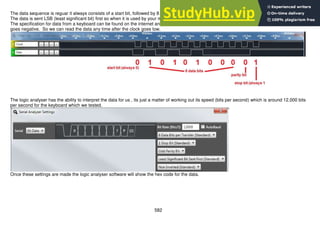
 then we wait for the switch to be released
 then we wait for a short bit (for the switch to stop any contact bouncing)
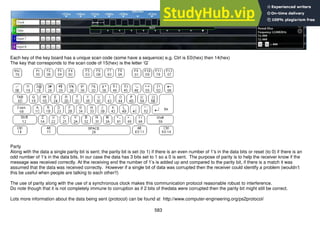
 then we toggle the LED
'----------------------------------------
' Compiler Setup (these tell Bascom
things about our micro)
$regfile = "attiny461.dat" 'bascom
needs to know the micro
$crystal = 1000000 'bascom
needs to know its speed
'----------------------------------------
-
' Hardware Setups (these tell bascom how
to setup our micro)
' setup direction of all ports
Config Porta = Output 'LEDs on
portA
Config Portb.5 = Input 'switches on
portB
' Hardware Aliases (these tell bascom
names we will use for I/O devices
' attached to the Micro, names are easier
to remember that ports)
RedSw Alias Pinb.5 ' hardware
alias
Led Alias PortA.7
Const debouncetime = 30
'----------------------------------------
' Program starts here
Do
If Redsw = 0 Then
Waitms debouncetime
Do
Loop until Redsw = 1
Waitms debouncetime
Toggle Led
End If
Loop
End
We now have a debounce switch program.
98
7.8 Reading multiple switches
Often the microcontroller is required to read
multiple input switches and then control
something based upon the switch inputs.
These switches might be connected to an
assembly line to indicate the presence of an
item, to indicate if a window is open or to the
landing gear of a jet aircraft to indicate its
position.
A common method of using switches within a
program is to poll the switch (check it regularly
to see if it has been pressed).
Do
If Sw0 = 0 Then
Waitms debouncetime
Do
Loop until Sw0 = 1
Waitms debouncetime
Toggle Led0
End If
If Sw1 = 0 Then
Waitms debouncetime
Do
Loop until Sw1 = 1
Waitms debouncetime
Toggle Led1
End If
...
...
If Sw4 = 0 Then
Waitms debouncetime
Do
Loop until Sw4 = 1
Waitms debouncetime
Toggle Led4
...
End If
Loop
End
99
7.9 Bascom debounce command
A simpler method of programming when there
is a sequence of checking multiple switches is
to use the Bascom DEBOUNCE command,
when a switch is pressed it is debounced by
bascom software code and the subroutine is
called (more on subroutines later)
'debounceBascom5SwV1
'compiler setup
$crystal = 1000000
$regfile = "attiny26.dat"
'microcontroller setup
Config Porta = Input
Config Portb = Output
Led1 Alias Portb.3
Led2 Alias Portb.4
Led3 Alias Portb.5
Led4 Alias Portb.6
Led5 Alias Portb.7
Sw1 Alias Pina.1
Sw2 Alias Pina.2
Sw3 Alias Pina.3
Sw4 Alias Pina.4
Sw5 Alias Pina.5
'program starts here
Do
Debounce Sw1 , 0 , Sw1_pressed , Sub
Debounce Sw2 , 0 , Sw2_pressed , Sub
Debounce Sw3 , 0 , Sw3_pressed , Sub
Debounce Sw4 , 0 , Sw4_pressed , Sub
Debounce Sw5 , 0 , Sw5_pressed , Sub
Loop
End
'Subroutines
Sw1_pressed:
Toggle Led1
Return
Sw2_pressed:
Toggle Led2
Return
Sw3_pressed:
Toggle Led3
Return
Sw4_pressed:
Toggle Led4
Return
Sw5_pressed:
Toggle Led5
Return
100
7.10 Different types of switches you can use
Various types of switches can be connected to microcontrollers for various purposes:
Find another type of switch and use it in your program, write it up in your notebook. Use it for the
next programs.
Key switches
So that only authorised people can operate
a device
Micro switches
Used inside moving machinery ,on doors
and cupboards
Magnetic or Reed switch
Useful for parts or doors that open and close
Tilt or Mercury Switch
Useful to sense movement or something falling over
Rotary Switch
Can be used to select one of several
different values
Tact switch
Directly soldered to a circuit board, better
quality that the cheap push button switch
101
7.11 Reflective opto switch
The RPR220 is a reflective photosensor, it has an LED and a phototransistor built into it. Have a
close look at the shape, note that one corner is cut on an angle. This is to help you identify which
connection is which.
Looking at the device from underneath (from the pins end NOT the top) this is the layout
102
To connect it into a circuit we need two resistors
A current limit resistor for the LED and a pullup resistor for the microcontroller input pin.
The current limit resistor can be calculated suing the data from the datasheet
The LED will drop 1.34V and is more powerful than a normal LED as it can handle 50mA.
So using ohms law
R=V/I = (5-1.34)/0.05 = 73 ohms minimum resistance.
For testing purposes a 150 was used, this could be changed to adjust the sensitivity of the unit,
maybe a lower value would mean the reflective surface could be further away.
It can be used in a program just like a switch
Opto_sensor alias pin B.6
…
If Opto_sensor = 0 then….
‘do something here
End if
103
8 Programming Review
8.1 Three steps to help you write good programs
1. Name each program with a meaningful name and save it into its own directory
2. Use a template to setup your program from the start
3. Add lots and lots and lots of comments as you go
You must layout programs properly and comment them well to gain achievement
8.2 Saving Programs
When saving programs you need a good quality directory / folder structure, so use a different folder for
each program:
 it keeps the files that BASCOM generates for your program in one place
 this helps you find programs quickly when you want to
 it is less confusing
 it is good practice
 Save your program at the beginning when you start it, this helps guard against teachers that like
to turn the computers off unexpectedly.
8.3 Organisation is everything
As with structuring and organising your
folders you also need to structure and
organise your program code.
Messy code is hard to understand and
it is surprising how fast you forget what
you did; and then when you want to
refer to it in the future you find that you
cannot understand what you have
written!
The use of a template or pattern to
follow will help discipline your code
writing. Break the code up into the
following sections,
 title block
 program description
 compiler directives
 hardware setups
 hardware aliases
 initialise hardware
 declare variables
 initialise variables
 initialise constants
 main program code
 subroutines.
 Interrupt routines
You will really need to be organised with what is coming up.
104
8.4 Programming template
'------------------------------------------------------------------
' Title Block
' Author:
' Date:
' File Name:
'------------------------------------------------------------------
' Program Description:
'------------------------------------------------------------------
' Compiler Directives (these tell Bascom things about our hardware)
$regfile = "attiny26.dat" 'the micro we are using
$crystal = 1000000 'the speed of the micro
'------------------------------------------------------------------
' Hardware Setups
' setup direction of all ports
Config Porta = Output 'LEDs on portA
Config Portb =Input 'switches on portB
' Hardware Aliases
Led0 alias portb.0
' Initialise ports so hardware starts correctly
Porta = &B11111111 'turns off LEDs
'------------------------------------------------------------------
' Declare Variables
' Initialise Variables
' Declare Constants
'------------------------------------------------------------------
' Program starts here
Do
Loop
End 'end program
'------------------------------------------------------------------
' Subroutines
105
8.5 What you do when learning to program
1. Develop an understanding of what a computer is and build a correct mental model for one
a. Input and output conversion at the voltage level
b. Conversion of input and output voltages into data
c. Processing and manipulating data which is stored in variables
2. Get to know about the hardware you are using
a. Get a copy of the datasheet
b. Learn about the power supply required
c. Learn how to configure pins as either input or output
d. Learn how to interface common I/O circuits: LED’s, Switches, Piezo, LDR…
e. Find out about the different types of memory and amount of each
f. Find out about the speed of processing
3. Get to know the language and the IDE you are using
a. Learn to access the helpfile (e.g. highlight a word and press F1)
b. The language has syntax (specific grammar/word rules) you must use correctly
c. The IDE (Integrated Development Environment) has special commands and built in
functions you must know and use: F7, F4, $crystal, $regfile, config, alias, const, port, pin
d. Learn common I/O functions: set, reset, locate, LCD, GetADC
e. Understand the limitations of and use variables: byte, word, long, single, double
f. Use constants instead of numbers in the code (e.g. waitms timedelay)
g. Get to know the control functions: Do-Loop (Until), For-Next, While-Wend, If-Then (Else)
h. Get to know about text and math functions (read help file, write a few simple programs
using the simulator)
4. Develop Algorithms (written plans for the process the program must carry out)
a. Have a goal in mind for the program – use specifications and write a simple brief
b. Plan your I/O by drawing a system block diagram
c. Determine variables and constants required in the program
d. Determine the state of all the I/O when the program begins
e. Write the algorithm – Identify, order and describe the major processes the micro must do.
5. Draw Flowcharts or Statecharts (visual diagram for the process the program must carry out)
a. Identify the blocks/states that will be used
b. Use arrows to link the blocks and visualise control processes and program flow
6. Develop code from the flowcharts
a. The outer looping line is replaced with a do-loop
b. Backwards loops are replaced with do-loop do-loop-until, for-next, while-wend
c. Forward loops are generally replaced with If-Then-EndIf
d. Replace the blocks with actual commands
e. Layout the code with correct indentations(tabs) to improve readability
f. Learn to comment code so that it explains what is happening (not just describes)
g. Use subroutines to organise complex code so that logic code is separate from I/O code
h. Trial different ways of solving the problem and keep records of you experiments
This is not a step by step process; as when you get to know about one area you get to know about
others at the same time. The key to gaining depth in your knowledge and understanding comes from
LOTS OF EXPERIMENTATION! That means making mistakes and above all having fun, you need to
know that good decisions come from experience and experience comes from bad decisions!!! So
experimenting is ok.
In your electronics courses at school the aim is not to make you an expert in all the above (expertise
comes after about 10 years working in an area), the aim is to introduce you to microcontroller
electronics and programming, and to understand some of what is happening in the world around you
and to feel able to see that you can control it and not have it control you.
106
8.6 AVR microcontroller hardware
A microcontroller is a general purpose electronic circuit; it is a full computer inside a single integrated
circuit (IC or chip). Often ICs have fixed functions e.g. the TDA2822M amplifier or LM358 opamp, they
only do one job and their input and output pins have fixed roles, so you have limited control over what
they do, and therefore limited control over how to connect them.
With a microcontroller however you are in control, you decide:
 what the function of the IC is
 what most of the pins are used for (inputs or outputs)
 and what external input/output devices these pins are connected to.
If you want an egg timer, a car alarm, an infrared remote control or whatever, it can all be done with a
microcontroller.
A commercial range of microcontrollers called ‘AVR’ is available from ATMEL (www.atmel.com). You
could start with the ATTiny461, it has 4kbytes of Flash for program storage, 128 bytes of Ram and 128
bytes of EEPROM for long term data storage. Or you could start with the ATMega48, it has 4kbytes of
Flash, 512 bytes of RAM and 256 bytes of EEPROM.
ATTiny461 ATMega48
Important pins:
 VCC & GND are dedicated for power, VCC is positive voltage and GND is negative
 AVCC and AREF are special pins for measuring analog voltages (connect to VCC).
 I/O ports are a group of 8 I/O pins which can be controlled together
 MOSI, MISO, SCK and RESET are pins used to upload the programs.
(You cannot use RESET as an I/O pin, but MOSI, MISO, SCK can be used with care)
8.7 Power supplies
Most microcontrollers work off low voltages from 4.5V to 5.5V, so yours can be run off batteries or a dc
power pack, voltages in excess of these will destroy the micro. Check the datasheet to see what the
range is for your micro, the ATTINY26-16PI will work from 4.5 to 5.5V, the ATMEGA48-10PU will work
from 2.7V to 5.5V.
107
8.8 BASCOM and AVR assignment
Learning goal:
Students should become independent learners able to find support to help their own learning
The AVR is a microcontroller from which manufacturer________________
The URL for their website is: ________________________
Download the specific datasheet for our microcontroller (the summary version not the full version) and
print the first 2 pages and put them in your journal.
The Programmable Memory size is ______ The SRAM size is _______The EEPROM size is _______
The number of I/O lines is __________ and they are arranged in _______ports
BASCOM-AVR is a compiler from _____________________
The URL for their website is: ________________________
Download the latest version of the BASCOM AVR demo and install it on your PC.
There are a number of application notes on the website for the AVR
Describe what AN128 is about
__________________________________________________________________________
__________________________________________________________________________
__________________________________________________________________________
There are a number of other great resource websites for the AVR and BASCOM
Find 3 websites on the internet that have useful resource information on BASCOM
List the websites URL and what you found there
__________________________________________________________________________
__________________________________________________________________________
__________________________________________________________________________
__________________________________________________________________________
__________________________________________________________________________
__________________________________________________________________________
__________________________________________________________________________
108
The ATTiny26 datasheet is full of useful information here is what some of it means
109
8.9 Programming words you need to be able to use correctly
Find definitions for them
computer
microcontroller
hardware
software
memory
RAM
variable
data
byte
word
program
algorithm
flowchart
BASIC
port
code
upload
compile
command
repetition
do-loop
for-next
subroutine
gosub
return
110
8.10 Year10/11 typical test questions so far
What have you learned about connecting power to a microcontroller?
What is a typical power supply voltage?
What range of voltages is acceptable?
Which pin(s) are positive and which are negative?
What are the names for these pins?
What batteries would you use?
What have you learned about programming a microcontroller?
What is the software we are using called? Where does it come from?
What does IDE stand for?
What are the names for the 4 different parts of the IDE software?
How many wires are there in the programming cable?
What happens if $regfile is wrong?
What happens if $crystal is wrong?
What does compiling mean?
What have you learned about interfacing LEDs to a microcontroller?
Draw the connection for an LED and resistor to a microcontroller. Draw this on a bread board
diagram as well. Are these series or parallel?
What is a typical value of resistor?
What would be a minimum value?
What would be a maximum value?
What does the toggle command do?
What have you learned about programming the pins of a microcontroller?
How many I/O pins does an ATTiny461 have?
With an LED on A.5 and a switch on A.7 write the config statements for both
What are the different commands for driving a single output pin?
What command can you use to drive multiple output pins all at once?
What have you learned about program style?
We ‘tab’ or indent code for what reason?
Why do we comment programs? Write comments for a simple flashing LED program.
What is const used for? Write a few lines of program that uses const.
What is alias used for? Write a few lines of program that uses alias.
What have you learned about making sound?
How is a piezo connected?
What is the command used to make sound?
Write a line of code to show how it the command used?
What have you learned about interfacing switches?
What is the resistor in the circuit called?
Why is it necessary?
What value is typically used?
Draw the circuit for a switch connected to a microcontroller?
Explain the code used to test a switch to see if it pressed?
What is the problem with switch contact bounce for software?
.
111
9 Introduction to program flow
9.1 Pedestrian crossing lights controller
Client, customer or end-user: …
Description of the problem, issue, need or opportunity (diagrams may be required):
Vehicles travel at high speeds on this road and although there is a pedestrian crossing,
pedestrians are at considerable risk
Conceptual Statement:
Design and construct a set of traffic lights for a pedestrian crossing
Functional attributes:
When the button is pressed the lights change from green to orange,
there is a delay of 25 seconds
Then the lights go red
There is a delay for 1 minute
Then the lights go back to green,
Cross and DontCross lights work as expected.
System Block Diagram: (include all input and output devices)
112
9.2 Pedestrian Crossing Lights schematic
113
9.3 Pedestrian Crossing Lights PCB Layout
114
9.4 Algorithm planning example – pedestrian crossing lights
(define the operation of the system)
Name: _______________ Project: _______________ Date: _____
Define all the input and output devices
Inputs Outputs
Device
Description
Name Device
Description
Name Starting State
Large buttons on
each pole for
pedestrians to
press to cross
CROSSBUTTON
RED traffic lights
for cars on pole
REDLIGHT OFF
Orange traffic
lights for cars
ORANGELIGHT OFF
Green traffic
lights for cars
GREENLIGHT ON
Buzzer to
indicate to
pedestrians to
cross now
BUZZER OFF
CROSS NOW
light on each
pole
CROSSNOW OFF
DON’T CROSS
light on each
pole
DONTCROSS On
The algorithm
Initially the
Redlight , orangelight, buzzer and cross are off,
Greenlight, dontcross are on
For each input describe what happens to any output devices
Use “if __________ then _________” or “ do___________ until ___________” statements
If the pedestrian presses the crossbutton then
The greenlight goes off, the orange light goes on
Then after 25 seconds
the orangelight goes off
the redlight goes on
the don’t cross goes off
the cross now goes on
Then after 1 minute
the red light goes off
the cross now goes off
the don’t cross comes on
the green light comes on
115
9.5 Flowchart planning example – pedestrian crossing lights
Programs flow in sequence and
can be represented well with
flowcharts
Note how the planning for this
program includes a graphic
detailing the colour of the lights,
this helps visualise the program
and is an excellent example of
choosing a planning tool that
will help your thinking.
116
9.6 Getting started code
' PedestrianCrossingsVer1.bas
' B.Collis 1 Aug 2008
' reads a switch to check if pedestrian wants to cross
$crystal = 1000000
$regfile = "attiny461.dat"
Config Porta = Output
Config Portb = Output
Config Portb.6 = Input
'here we use aliases to make the code easy to write and easy to read
'lights for cars
Greenlight Alias Porta.7
Orangelight Alias Porta.6
Redlight Alias Porta.5
'lights for pedestrians
Dontcrosslight Alias Porta.4
Crossnowlight Alias Porta.3
Crossbutton Alias Pinb.6
'we need different delays for different purposes
Const Orangedelay = 10
Const Crossdelay = 20
Const Dontcrossdelay = 5
'initial state of lights for cars
Greenlight = 1 'on
Orangelight = 0 'off
Redlight = 0 'off
'initial state of lights for pedestrians
Dontcrosslight = 1 'on
Crossnowlight = 0 'off
Do
'wait for pedestrian to press button
Do
Loop Until Crossbutton = 0
Greenlight = 0
Orangelight = 1
Wait Orangedelay
'you finish the rest of this code
Loop
End
9.7 Modification exercise for the pedestrian crossing
1. Generally the dontcross light is off until the pedestrian presses the button
2. After the redlight comes on there be a short delay before the crossnow
3. Put a 5 second delay into the system after the pedestrian pushes the button and before the
light goes red.
4. Implement a short beep into the system when the cross now light comes on
Achieved Merit Excellence
Implements 1 above into the
algorithm AND the program
AND adds useful describing
comments in the program
Also impliments 2 above in
both the algorithm AND the
program AND uses comments
to explain the program
Implements 3 above in both
the algorithm AND program
AND with good explanatory
comments in the program.
Can you see that achievement criteria are actually algorithms?
SO MAKE SURE YOU UNDERSTAND THEM!
117
9.8 Traffic lights program flow
Learning to develop useful planning tools to help
solve problems such as drawings, block
diagrams, tables & flowcharts.
Learning about the Bascom commands ALIAS
1. Understand the situation by drawing a planning
diagram that explains the road layout
2. The traffic light sequence process is actually very confusing and a planning tool such as a
sequence diagram will help you plan the program. Complete this sequence which shows which
lights come on in the sequence
How long should the delays between LED changes be for real traffic lights?
In our model we only need to test that the sequence is correct so we will choose shorted delays
118
Real lights Our Model for testing purposes will be
Green is on for 1 minute Grn_delay = 8
Orange 30 seconds? Or_delay = 3
Delay after one road goes
red before the green for
the next road goes on
Red_delay = 1
3. Draw a system block diagram – which shows important connections within the system, but is
not a full circuit diagram (complete the schematic below with the pin connections for Set B and Set
C.
Label the rst of this diagram with the pins on the micro you will use for the other 2 sets of lights.
Take special note that you will have to use at least one of the output pins on portb. I chose
portB.4.
119
4. Do the physical wiring of the 3 sets of LEDs to the microcontroller.
 Layout the physical LEDs to follow the real physical layout
 Use appropriate coloured LEDs
 Keep it tidy, use short wires.
Here are some photos of the process
Wiring stage one: all the LEDs and resistors are mounted
120
Wiring stage two: the ‘A’ set of lights are wired up
A.0 goes to A_red
A.1 goes to A_or
A.2 goes toA_grn
121
Wiring stage 3: B set of LEDs are wired to three ports of the microcontroller, here I have chosen
portA.3, portA.4,portA.5.
Note thatportsA.3, A.4 and A.5 are
used
Also note that the G(ground) and
V(positive voltage) pins are not
connec ted to I/O devices but to the
power supply!
Can you complete the last stage of the
LED wiring? You will have to put one
of the LEDs on portB. I chose portB.4
If you need more help search the rest
of the book for the last picture.
122
5. Complete this flowchart in
your workbook with the rest of
the sequence. There are 9 LEDs
so there will need to be 9 stages
inside the loop.
CAN you see thepattern
emerging
Having the flowchart will help
you debug (correct errors in your
program) later on
6. Write your 'TrafficLightsVer1.bas
'B.Collis
start
all reds on
all others off
A_red off
B_grn on
grn_delay
B_grn off
B_or on
or_delay
A_red off
A_grn on
grn_delay
A_grn off
A_or on
or_delay
A_or off
A_red on
red_delay
123
program, things to
work on in your
program:
 Describe the
hardware at the
top of the file
and use aliases
for the port pins
that describe
what is
connected to
each one
 Use spaces to
help layout your
program so it
looks good
 Comment your
program with
short clear
descriptions
 Use constants
with good
names e.g.
waitms
red_delay
'*************************
$crystal = 1000000
$regfile = "attiny26.dat"
Config Porta = Output
Config Portb = Output
'*************************
'LED connections
'use aliases so that the program is easier to write and
understand
A_red Alias Porta.0
A_or Alias Porta.1
A_grn Alias Porta.2
B_red Alias Porta.3
B_or Alias Porta.4
B_grn Alias Porta.5
C_red Alias Porta.6
C_or Alias Porta.7
C_grn Alias Portb.4
'use constants to make the program easier to read and to
modify
Const Grn_delay = 8 'green on time
Const Or_delay = 3 'orange on time
Const Red_delay = 1 'safety delay
'initially set the red lights on and all others off
'introducing the new commands SET and RESET to
individually control port pins
A_red = 1 'on
B_red = 1 'on
C_red = 1 'on
A_or = 0 'off
A_grn = 0 'off
B_or = 0 'off
B_grn = 0 'off
C_or = 0 'off
C_grn = 0 'off
Do
'A lights
A_red = 0 'off
A_grn = 1 'on
Wait Grn_delay
A_grn = 0 'off
A_or = 1 'on
Wait Or_delay
A_or = 0
A_red = 1
Wait Red_delay 'delay for red light runners!
'B lights
B_red = 0
124
B_grn = 1 'grn on
Wait Grn_delay
B_grn = 0 'grn off
B_or = 1
Wait Or_delay
B_or = 0
B_red = 1
Wait Red_delay 'delay for red light
runners!
'C lights you write the rest of the code
Loop
End
125
10 Introductory programming - using subroutines
Once a program gets large we need to learn how to manage it properly.
Subroutines have been seen already when we have used the debounce command but here is a
list of what they can do for you:
Refine you code by Reducing, Reusing & Recycling
 Reduce the complexity of your programs,
by hiding detail
 Reuse - reuse the program code multiple
times within the same program
 Recycle – you can use the same program
code easily in other programs
Here is an example of calling some subroutines
Do
Gosub test_sensor
If sensor_output = 0 then
gosub got_it
Else
gosub tell_the_user_again
End if
Loop
End
And another example
DO
Gosub test_sensor
If sensor_output =10 then gosub do_a
If sensor_output =11 then gosub do_b
If sensor_output =12 then gosub do_c
If sensor_output =13 then gosub do_d
If sensor_output =14 then gosub do_e
…
Loop
End
You can see that they really can de-complicate code (make it easy to read and understand) by
removing a lot of I/O code
Subroutines are used to make code easier to read, understand and maintain, however they can
be used well or used poorly. The clue to using subroutines well is to keep the logic for the
program in the main loop and the input and output detail in the subroutines. As above and in the
next example.
126
10.1 Sending Morse code
Morse code is a form of communication used in the early days of telegraph and radio
communication when voice could not be sent just short messages using codes. It was also used
between ships using lights.
Draw a flowchart and write a program to send your name using Morse code.
A ● ▬ H ●●●● O ▬ ▬ ▬ U ●● ▬ 1 ● ▬ ▬ ▬ ▬ 6 ▬ ●●●●
B ▬ ● ● ● I ●● P ● ▬ ▬ ● V ●●● ▬ 2 ●● ▬ ▬ ▬ 7 ▬ ▬ ●●●
C ▬ ● ▬ ● J ●▬ ▬ ▬ Q ▬ ▬ ● ▬ W ● ▬ ▬ 3 ●●● ▬ ▬ 8 ▬ ▬ ▬ ●●
D ▬ ● ● K ▬ ● ▬ R ● ▬ ● X ▬ ●● ▬ 4 ●●●● ▬ 9 ▬ ▬ ▬ ▬ ●
E ● L ● ▬ ● ● S ●●● Y ▬ ● ▬ ▬ 5 ●●●●● 0 ▬ ▬ ▬ ▬ ▬
F ●● ▬ ● M ▬ ▬ T ▬ Z ▬ ▬ ●●
G ▬ ▬ ● N ▬ ●
To make sense timing is important so we will follow these rules
 A dash is equal to three dots
 The space between the parts of the same letter is equal to one dot
 The space between letters is equal to three dots
 The space between two words is equal to seven dots
If you wanted to send a short sentence like “ whats up.” It is crucial that you get the gaps between letters , parts of letters and parts of words correct
or the message willl not be understandable by the person receiving it.
Using the program Excel as a planning tool we can draw up a chart that shows the correct timing for the sequence for ‘whats up’.
Check that:
 the width of 1 dot it is 1 cell in excel
 the width of 1 dash is 3 cells,
 the gap between parts of a letter is 1 cell,
 the gap between letters is 3 cells
 the gap between words is 7 cells.
A program like this though could be very very long so we will break it up into sections called subroutines by putting the I/O code into subroutines
127
The use of subroutines as well as comments, aliases and constants will make your code easier to
understand and maintain .
Uncommentedandpoorlysetoutcodeislikereadingasentencewithoutpunctuationorspacestheme
aningisstilltherebutitisalittlehardtofollowandunderstand.
NOTE: the different
shape of a gosub
'------------------------------------------------------------------
' Title Block
' Author: B. Collis
' Date: May 2008
' File Name: MorseMeV2.bas
'------------------------------------------------------------------
' Program Description:
' send morse code using an LED
' show off good use of subroutines and repitition
'------------------------------------------------------------------
' Compiler Directives (these tell Bascom things about our hardware)
$regfile = "attiny26.dat ' bascom needs to know our micro
$crystal = 1000000 ' bascom needs to know how fast it is going
'------------------------------------------------------------------
' Hardware Setups
Config Porta = Output ' make these micro pins outputs
' Hardware Aliases
Morseled Alias Porta.7 ' the name morseled is easy to remember
'------------------------------------------------------------------
' Declare Variables
Dim Count As Byte 'temporary variable to count repetitions
' Initialise Variables
' Declare Constants
Const Dotdelay = 250 ' length of a dot
Const Dashdelay = 750 ' length of a dash
Const Endofworddelay = 1750 ' gap between words
'------------------------------------------------------------------
' Program starts here
Do 'start of a loop
Gosub Send_c
Gosub Send_l
Gosub Send_s
Waitms Dashdelay
'send more letters here
Wait 5
Loop 'return to do and start again
End
'------------------------------------------------------------------
' Subroutines
Send_c:
'letter c - the sequence is dash dot dash dot
For Count = 1 To 2 'send these twice
Gosub Dash
Gosub Dot
Next
Waitms Dashdelay 'longer delay between letters
Return
Send_l:
'letter l - the sequence is dot dash dot dot
Gosub Dot 'a dot
Gosub Dash 'a dash
For Count = 1 To 2 'send 2 dots
Gosub Dot
Next
Waitms Dashdelay 'longer delay between letters
Return
128
Send_s:
'letter s - the sequence is 3 dots
For Count = 1 To 3 'send it 3 times
Gosub Dot
Next
Waitms Dashdelay 'longer delay between letters
Return
'-------------------------------------------------------------
Dot:
Morseled = 1 ' on
Waitms Dotdelay ' wait 1 dot time
Morseled = 0 'off
Waitms Dotdelay 'short delay between dots & dashes
Return
Dash:
Morseled = 1 ' on
Waitms Dashdelay ' wait 1 dash time
Morseled = 0 'off
Waitms Dotdelay 'short delay between dots & dashes
Return
Not only do things like subroutines, comments,
indenting code, the use of alias and const make your
code easier for you to read and debug, imagine going
to a job interview and being asked to bring in some
code you had written to show your prospective boss –
which would you show him?
Using const, alias, subroutines and comments
properly in programs is an essential code of
practice and worth credits to
129
10.2 LM386 audio amplifier PCB
Stage 1 of the LM386 audio amplifier schematic
This is more or less from the datasheet, the 10uF capacitor C3 has been added to increase the gain,
however a couple of practical changes need to be made ot the schematic before it can be used.
First it needs a filter capacitor on the DC supply, otherwise the speaker output will be extremely noisy.
130
Next the audio input has only a signal conection niot a ground connection and cables that come from
the device you want to amplify generally have a signal plus ground wire, so that has been added in
the next diagram.
The labels in blue have been added to the schematic are to help you choose which components to
use from the CLS library inEagle.It is important to choose the right size components otherwise they
may not fit on the PCB when you make it.
131
10.3 LM386 PCB Layout
The layout progresses through several stages
1.move all the components onto the working area of the layout
4. try to layout the components with the minimum number of crossing airwires..
3.turn off the layers you don’t need so that you can focus clarly on the layout
4.layout the tracks
132
5.Add your name and the board name
6. Add labels for the wires you will have to connect to the board
7. Add some mounting holes fr the board, so that it can be attached inside a case.
8. Add some stress relief holes for wires that come on and off the board
133
11 Introductory programming – using variables
Inside our brain is our memory, it is where we store and work on information, it is the same in a
computer. We often use the different terms information, RAM, data, address or variable without
really understanding their separate meanings; it is useful to clarfify a meaning for each one.
 RAM is the physical place (like our brain cells/synapses). In a computer it is arranged in
‘bytes’ -groups of 8 individual bits (8 bits = 1 byte)
We can think of it like a series of numbered storage containers or pigeon holes
 Data is what is stored in the RAM,
o data is numbers e.g. 5 or &B00000101 in binary.
 Address: this is the physical location of a byte of RAM in the microcontroller (e.g. 0 to 1023).
o Addresses are sequential.
 Variable is the name we give to the place in RAM , it is a useful way to keep track of what we
stored there. E.g. height is a variable, it contains the number 6, width is a variable it contains
the number 3. These numbers may change a lot while a programis running.
 Information: data such as ‘13’ has little meaning to us, it has more meaning if we store it in a
variable called weight but it has information when we know that it is the weight of a particular
pen in grams.
RAM Address
Variable
(name for address)
Data
(actual number in the RAM)
1 Orangedelay 10
2 Crossdelay 20
3 Num_flashes 0
4 Flashedelay 500
Programs use, alter and even create data while they are running. This data varies as the program
executes so we name it variables.
A variable is the unique name we give to a location in the microcontroller’s RAM
to store data. When data is stored in ram we say we are storing it in a variable.
134
11.1 Stepping or counting using variables
Have you noticed that at a pedestrian crossing that after the Crossnow light goes off the Dontcross
light actually flashes before staying on.
In this program we want the dontcross light to flash 10 times while the pedestrian is
crossing.
Dim Num_flashes As Byte
Dim Orangedelay As Byte
Dim Crossdelay As Byte
Dim Flashdelay As Byte
Orangedelay = 10
Crossdelay = 20
Flashdelay = 500
‘Here is the wrong way to do it
Do
Do 'wait for ped cross button
Loop Until Crossbutton = 0
Reset Greenlight 'stop the traffic
Set Orangelight
Wait Orangedelay
Reset Orangelight
Set Redlight
Reset Dontcrosslight 'allow pedestrian to cross
Set Crossnowlight
Wait Crossdelay
Reset Crossnowlight
'flash the don't cross light 10 times to tell pedestrians to stop crossing
Set Dontcrosslight 'flash1
Waitms Flashdelay
Reset Dontcrosslight
Waitms Flashdelay
Set Dontcrosslight 'flash2
Waitms Flashdelay
Reset Dontcrosslight
Waitms Flashdelay
Set Dontcrosslight 'flash3
Waitms Flashdelay
Reset Dontcrosslight
Waitms Flashdelay
Set Dontcrosslight 'flash4
Waitms Flashdelay
Reset Dontcrosslight
Waitms Flashdelay
'...
Reset Redlight 'let traffic continue
Set Greenlight
Loop
End
The above code wastes a lot of our program memory.
135
‘Here is the right way to do it
Set Greenlight 'on
Reset Orangelight 'off
Reset Redlight 'off
Set Dontcrosslight 'on
Reset Crossnowlight 'off
Do
Do 'wait for ped cross button
Loop Until Crossbutton = 0
Reset Greenlight 'stop the traffic
Set Orangelight
Wait Orangedelay
Reset Orangelight
Set Redlight
Reset Dontcrosslight 'allow pedestrian to cross
Set Crossnowlight
Wait Crossdelay
Reset Crossnowlight
'flash the don't cross light 10 times -
For Num_flashes = 1 To 10
Set Dontcrosslight
Waitms Flashdelay
Reset Dontcrosslight
Waitms Flashdelay
Next
Reset Redlight 'let traffic continue
Set Greenlight
Loop
This is the for-next loop in programming – every programming language has it (in some form or
another) and we use it when we want something to repeat or step a fixed number of times. The
variable num_flashes starts at 1 and each time through the loop it increases by 1 until it has
completed the loop 10 times.
136
11.2 For-Next
Repetition is what computers do best here is another example of repetition using a for-next.
Example: when you join a gym they give you a workout card which has the exercises and the number
of repetitions on it to do.
They don’t give you a list:
Bench Max
Bench Max
Bench Max
Bench Max
Bench Max
Bench Max
Inline Max
Inline Max
Inline Max
Inline Max
Inline Max
Inline Max
...
...
...
The same with computer programming, when you see something that looks like it is repeating you
replace it with a loop of some form (there are several choices).
E.g. at a very busy gym everyone has to be split into one of two groups, those that exercise on the
machines and those that work on the mats. Every 60 seconds everyone changes from the mat to the
machines. There are two big lights, one red and one green. When the red light is flashing the red
group is on the machines, when the green light is flashing the green group is on the machines.
Each light flashes 20 times per minute(on for ½ second off for 2½ seconds). We could write a
program the goes:
Red on
Wait ½ sec
Red off
Wait 2½ sec
Red on
Wait ½ sec
Red off
Wait 2½ sec
Red on
Wait ½ sec
Red off
Wait 2½ sec
Red on
Wait ½ sec
Red off
Wait 2½ sec
...
but this is not really computer programming
We need a simple way of controlling how many times the lights flash and we can use a variable to
count the flashes and a loop that repeats depending upon what number is stored in the variable.
137
'-----------------------------------------------
' Compiler Setup
$regfile = "attiny461.dat"
$crystal = 1000000 'bascom needs to know its speed
'------------------------------------------------
' Hardware Setups
' setup direction of all ports
Config Porta = Output 'LEDs on portA
Config Portb = Input 'switches on portB
' Hardware Aliases
Green Alias Porta.1
Red Alias Porta.0
'-----------------------------------------------
'Declare Constants
Const Lightontime = 500
Const Lightofftime = 2500
'----------------------------------------------
'Declare Variables
Dim Count As Byte
'-----------------------------------------------
Program starts here
Do
For Count = 1 to 20
Set Red
Waitms Lightontime
Reset Red
Waitms Lightofftime
Incr Count
Next
For Count = 1 to 20
Set Green
Waitms Lightontime
Reset Green
Waitms Lightofftime
Incr Count
Next
Loop
End
138
11.3 Siren sound - programming using variables
In this program we will use a variable to control the duration (length) of a tone.
First lets review what a tone is. It is a
repeated turning on and off of our piezo.
The frequency of the tone is 1/period.
The duration of the tone is the number of
complete cycles.
A piezo will not make a sound when you turn it on; it only makes a sound when
you turn it on and off rapidly. So to make a tone we must turn the piezo on then
wait a bit, then turn it off and we repeat this for the duration of the tone. In this
program the tone period will be 1mS so the piezo must be on for 500uS (1/2 mS)
and off for the same. Bascom has a waitus command (it is not particularly
accurate but its good enough for this exercise). We want the tone to last long
enough to hear it so we need to repeat it 150 times. 150 times 1mS will give us a
tone duration of 150mS (0.15S).
To count the number of cycles we will dimension a variable called cyclecount,
and we will increase it inside a do-loop. It will count upto the max number of
cycles and then we will have a 2 second break. Then it will repeat.
Remember to reset cycle count to 0 or it will overflow.
This program works similalrly to the Bascom SOUND command.
139
'------------------------------------------------------------------
' Title Block
' Author: B.Collis
' Date: 22 Feb 08
' File Name: SirenV1.bas
'------------------------------------------------------------------
' Program Description:
' This program makes a simple tone using a piezo
' Program Features:
' makes use of Bascom waitus (microseconds) command
' introduces first use of a variable
' the variable cyclecount increases from 0 until it reaches the preset
(constant)
' value maxcyclecount at which point there is a quiet time
' the led is on when the the tone is occuring
' Hardware Features
' a pezo can be directly connected to the micro port
' the led has a 1k resistor in series to limit the current
'------------------------------------------------------------------
' Compiler Directives (these tell Bascom things about our hardware)
$regfile = "attiny26.dat" 'the micro we are using
$crystal = 1000000 'rate of executing code
'------------------------------------------------------------------
' Hardware Setups
Config Portb = Output
' Hardware Aliases
Piezo Alias Portb.3 'use useful name PIEZO not PORTb.3
Blueled Alias Portb.4 'use useful name BLUELED not PORTB.4
'------------------------------------------------------------------
'Declare Constants
Const Halfperioddelay = 500 ' delay for 1/2 period
Const Maxcyclecount = 150 'number of cycles to do
'------------------------------------------------------------------
' Declare Variables
Dim Cyclecount As Byte
'------------------------------------------------------------------
' Program starts here
Do
Set Blueled 'turn led on
For Cyclecount = 0 to Maxcyclecount1
Waitus Halfperioddelay1
Set Piezo
Waitus Halfperioddelay1
Reset Piezo
Next
Reset Blueled 'turn led off
Waitms 2000 'quiet time
Loop
End 'end program
140
11.4 Make a simple siren
A simple siren sound can be made using two repeating tones
A tone of 1 frequency and 1 duration followed by a tone of a
different frequency and a different duration. We will use our
knowledge of variables to make our own tones.
'-
--
--
--
--
--
--
--
--
--
--
--
--
--
---------------------------------------
' Title Block
' Author: B.Collis
' Date: 22 Feb 08
' File Name: SirenV2.bas
'------------------------------------------------------------------
' Program Description:
' This program makes a simple siren on a piezo
'
' Program Features:
' makes use of bascom waitus (microseconds) command
' Hardware Features:
'------------------------------------------------------------------
' Compiler Directives (these tell Bascom things about our hardware)
$crystal = 1000000 'the crystal we are using
$regfile = "attiny26.dat" 'the micro we are using
'------------------------------------------------------------------
' Hardware Setups
' setup direction of all ports
Config Portb = Output
' Hardware Aliases
Piezo Alias Portb.3 'use useful name PIEZO not PORTb.3
Blueled Alias Portb.4 'use useful name BLUELED not PORTB.4
'------------------------------------------------------------------
'Declare Constants
Const Halfperioddelay1 = 500 ' first tone 1/2 period
Const Halfperioddelay2 = 800 ' second tone 1/2 period
Const Maxcyclecount1 = 350 ' longer than 255!!!
Const Maxcyclecount2 = 150
'------------------------------------------------------------------
' Declare Variables
Dim Cyclecount As Word 'keep count of number of cycls(periods)
Dim Sirens As Byte
'------------------------------------------------------------------
141
' Program starts here
Do
Set Blueled
For Sirens = 1 To 3 'just make 3 for testing purposes
For Cyclecount = 0 to Maxcyclecount1
Waitus Halfperioddelay1
Set Piezo
Waitus Halfperioddelay1
Reset Piezo
Next
For Cyclecount = 0 to Maxcyclecount2
Waitus Halfperioddelay2
Set Piezo
Waitus Halfperioddelay2
Reset Piezo
Next
Next
Reset Blueled
Wait 10 'have a bit of quiet!!!
Loop
End 'end program
'------------------------------------------------------------------
Point to take note of:
 A single sirensound has been put into a subroutine, this subroutine will last approx 350mS +
240mS = 590mS. Subroutines are a great way of decomplicating your programs.
 How code is indented/tabbed over to aid readabilaity
 If you are using a do-loop – remember to reset your counter
 Use constants rather than putting numbers into your code (waitus halpperioddelay2). It makes
it so much easier to read
 Use decent names for variables, constants aand aliases; ‘waitus a’ isn’t much use when trying
to debug a program
 Use pictures/diagrams to help you plan things
11.5 Siren exercise
Modify the delays and count values in this to find a siren you like the most.
142
11.6 A note about layout of program code
We could create a program that flashes an LED 3 times waits a bit then flashes it again.
Indenting (tabbing code, is an extremely important aspect of writing
programs, it adds to their readability and your ease of debugging.
I often fix students code simply by setting up the indenting and find things like this
HARD TO SPOT THE ERROR EASY TO SPOT THE ERROR
Do
For Num_flashes = 1 To 10
Set Dontcrosslight
Waitms Flashdelay
Reset Dontcrosslight
Waitms Flashdelay
Loop
Next
Do
For Num_flashes = 1 To 10
Set Dontcrosslight
Waitms Flashdelay
Reset Dontcrosslight
Waitms Flashdelay
Loop
Next
When a block of code is inside a control structure of some kind the inside code is indented and the
end of control structure lines up with the beginning of it. In this case it can now be seen that the For
has no closing Next as the Next is outside the Do-Loop. OOPS – need to move the Next above the
Loop and then indent it so that it lines up with the For
143
11.7 Using variables for data
We have seen ho w a variable can be used to create a stepping pattern in program code now we see
how numbers can store information. In a calculator with several memory locations each is given a
name such as A,B,C,D,E,F,X,Y.M. etc. The name of the memory location has nothing to do with what
you are using it for and it is up to you to remember what was stored in each location. In a
microcontroller each memory location is given a name by the programmer. This means it is much
easier for you to remember what is in the memory location and easier to use within your program.
Here are some examples of using variables
Dim Width as Byte DIM is short for dimension and means set aside a part of RAM for our program
to use. From now on in the program it will be called Width. It is easier for us to have names for
memory locations such as ‘width’ than using the physical address of the RAM, address 1.
Dim Height as Byte
Dim V_Position as Byte
Dim Speed as Byte
Dim X_position as Byte
Dim Color as Byte
Dim Mass as Byte
Here are some common things you will see in programs
Height = 10 (put 10 into the memory location we dimensioned called height)
Incr X_position (increase the value in X_position by 1)
Color = Width / Height (divide the number in Width with Height and put the answer into Color - the
values of Width and Height do not change)
Speed = Speed + 12 (get the number from memory location called Speed and increase it by 12 and
put it back into the same memory location)
A variable of type Byte can store numbers from 0 to 255 (&B11111111) so it has limited use so often
we group bytes together to store bigger numbers.
144
11.8 Different types of variables
Bigger numbers require more RAM than smaller numbers, also different kinds of numbers require
different amounts of RAM (e.g. negative, decimals). Microcontrollers have limited RAM, so to make
the best use of RAM we use the best variable type we can. If we dimension a variable as a type that
can store huge numbers and only every use numbers up to 10 then we are wasting a precious
resource.
Using the Bascom-AVR help file research the following information on the different types of variable
you can use.
Variable
type
Minimum Value
(before underflow)
Maximum Value
(before overflow)
Number of bytes used to
store it
Bit 0 1 1byte for 1 bit however if you
dimension 8 bits they will all be
stored in the same byte
Byte 0 255 1
Word
Integer
Long
Single
Double
Every microcontroller has different amount of RAM available for storing variables
Carry out research on these different AVR microcontrollers
RAM size (bytes) FLASH - program
size(bytes)
EEPROM size (bytes)
ATTiny13
ATTIny45
ATTIny461
ATMega48
ATMega16
ATMega32
ATMega644
ATMega1284
There is no point in memorizing this data; its just a matter of knowing about so that you can find it
when you need it.
145
11.9 Variables and their uses
' ShowComandsV1.bas
$sim
$crystal = 1000000
$regfile = "attiny26.dat"
Config Porta = Output
Config Portb = Output
Config Pinb.6 = Input
.
'dimension variables
Dim Byte1 As Byte
Dim Byte2 As Byte
Dim Word1 As Word
Dim Int1 As Integer
Dim Single1 As Single
Dim Single2 As Single
Allocating some parts of the RAM, and giving those parts
names so that we can refer to it more easily
(dimensioning).
Byte1 = 12
Byte1 = Byte1 + 3
Incr Byte1
Byte2 = byte1
What is the value of the variable byte1 after this?
Byte2 = Byte1 / 10 Division - a byte can only represent whole numbers from 0
to 255 so division truncates (IT DOES NOT ROUND)
16/10 = 1 (whole numbers only!)
Byte2 = Byte1 Mod 10 MOD gives you the remainder of a division (16 mod 10 = 6)
Byte2 = Byte1 * 150 This gives the wrong answer because a byte can only hold
a number as big as 255
Word1 = Byte1 * 150 This gives the right answer!
Int1 = 200
Int1 = Int1 – 100
Int1 = Int1 – 100
Int1 = Int1 – 100
Int1 = Int1 – 100
need negative numbers then use integer or long
For Single1 = 0 To 90 Step 5
Single2 = SQR(single1)
Next
need DECIMALS use single or double
End Make sure you put an END to your program or it will
continue on and potentially cause crashes (if you micro
was controlling a car then it might be a car crash- ouch!!)
146
11.10 Vehicle counter
This program counts different vehicle types everytime a different
switch is pressed, if we run it inthe simulator we can see the
numbers in decimal, binary and hexadecimal
'VehicleCounterV2.bas
'test our ability to count vehicles,
'as used by someone standing at an intersection monitoring traffic
flows
$crystal = 1000000
$regfile = "attiny461.dat"
Config Porta = Output
Config Portb = Input
Cars_sw Alias Pinb.0 'RED switch
Trucks_sw Alias Pinb.1 'YELLOW switch
Bikes_sw Alias Pinb.2 'GREEN Sswitch
Peds_sw Alias Pinb.3 'BLUE switch
Clear_sw Alias Pinb.4 'WHITE switch
'dimension variables before they are used or you will get a
compiler error!
Dim Cars As Byte
Dim Trucks As Byte
Dim Bikes As Byte
Dim Peds As Byte
Const Debouncedelay = 25
Do
Debounce Cars_sw , 0 , Cars_sw_pressed , Sub 'red switch
Debounce Trucks_sw , 0 , Trucks_sw_pressed , Sub 'yellow switch
Debounce Bikes_sw , 0 , Bikes_sw_pressed , Sub 'green switch
Debounce Peds_sw , 0 , Peds_sw_pressed , Sub 'blue switch
Debounce Clear_sw , 0 , Clear_sw_pressed , Sub 'white switch
Loop
End
'Subroutines
Cars_sw_pressed:
Incr Cars
Return
Trucks_sw_pressed:
Incr Trucks
Return
Bikes_sw_pressed:
Incr Bikes
Return
Peds_sw_pressed:
Incr Peds
Return
Clear_sw_pressed:
Cars = 0
Trucks = 0
Bikes = 0
Peds = 0
Return
Note how in this program the names of the switches relate to
their function, and the comments tell you which switch is which
colour. These are very good programming practice
147
11.11 Rules about variables
Variabes must start with a letter not a digit
e.g. Dim Red_cars As Byte not Dim 1cars As Byte
Variabes must not be Bascom reserved(special) words
e.g. Dim band As Byte not Dim And As Byte
Variables must contain no spaces
e.g. Dim Red_cars As Byte not Dim Red cars As Byte
Variable names should relate to what the variable is used for
e.g. Dim Red_cars As Byte, not Dim hgashg As Byte
Variable names cannot be used for other things such as constants or subroutines
e.g. Dim Red_cars As Byte, means yu cannot have Const Red_cars = 12 as well
11.12 Examples of variables in use
A points table for a competition
Dim Blues As Byte
Dim Hurricanes As Byte
Dim Waratahs As Byte
as the season progresses the points are added.
Incr Hurricanes (adds one to their score)
Blues = Blues + 1 (adds one to their score)
Waratahs = Waratahs + 3
Conversions between units
Dim Celcius As Integer
Dim Fahrenheit As Integer
Fahrenheit = 100
Celcius = 32 - Fahrenheit
Celcius = Celcius * 5
Celcius = Celcius / 9
148
11.13 Byte variable limitations
RAM (the memory inside a computer) is capable of storing 1 byte (or 8 bits) of binary data. This is a
finite range of positive, whole numbers from 0 to 255. No negative numbers can be stored, no
decimal fractions, and no number greater than 255.
Binary Number Decimal equivalent
00000000 0
00000001 1
00000010 2
---
---
---
11111101 243
11111110 254
11111111 255
We can see the diference by comparing counting in byte math to counting in the decimal system. In
the decimal system the numbers we are used go from –infinity to +infinity, so the numberline goes on
forever.
Byte arithmetic because it has a finite set of numbers is like having a number line that goes around on
itself.
The difficulty arises when we do arithmetic that exceeds the limits of our range.
e.g. what does 250 + 9 = ? What does 4-7 = ?
When we add 9 to 250 we get 3. It has overflowed 255.
The opposite to OVERFLOW is UNDERFLOW and is seen by using the circular number line above.
149
11.14 Random Numbers
This program generates a random number from 1 to 6 and stores it into a variable in memory
‘ DiceV1.bas
$sim
$crystal = 1000000
$regfile = "attiny26.dat"
Config Porta = Output
Config Portb = Input
Dim dicethrow As Byte
Do
'generate a random number from 0 to 5
dicethrow = Rnd(6)
'change the range to 1 to 6
dicethrow = dicethrow + 1
Loop
End
The line Dim dicethrow As Byte means allocate to
the program 1 byte of ram to use and refer to it as
dicethrow.
Every variable must be dimensioned before it
can be used.
With variables you can do maths
E.g. add 1 to throw. dicethrow=dicethrow+1
literally means get the contents of dicethrow add
1 to it, and then put the answer back into
dicethrow.
Compile the program and then open the simulator (F2), select the variable dicethrow from the
variables list and use F8 (don’t press run) to step through the program to see the numbers generated
by the program
150
11.15 The Bascom-AVR simulator
Press F2 to
pen the
simulator
Double click
in the yellow
area under
the word
VARIABLE to
select the
variables you
want to
watch.
Press F8 to
step through
the program
and see what
happens to
the value of
the variable at
each step.
151
11.16 Electronic dice project
11.17 Programming using variables – dice
A dice can be made using 7 LEDs (why do we need 7? – look closely at the patterns here)
In the above circuit the LEDs have been labelled to match the pin of porta they are connected to.
Note there is a switch connected to Pinb.6
Fill in the table below which shows which LED are on and whichare off to make a particular
pattern, remember that even though only 7 LEDs are used we need to control the whole port so
need to specify all 8 bits.
A.7 A.6 A.5 A.4 A.3 A.2 A.1 A.0
NO
LED
LED 6 LED 5 LED4 LED3 LED2 LED1 LED0
1
2
3
4 off on off on off on off on portA=&B01010101
5
6
152
11.18 Dice layout stage 1
In the diagram the 7 LEDs have been physically arranged to match the dots on the face of a dice,
but to do that the middle LED has had its legs bent so that it lines up with the middle LED but does
not share any breadboard connections with it
153
11.19 Dice layout stage 2
In this second stage the resistors have been added and the wiring has been started for the LEDs,
154
11.20 Dice Layout final
Before the rest of the wiring for the LEDs has been added the switch has been connected, agin
note that it is switch wiring that confuses students the most.
155
11.21 First Dice Program flowchart
156
' DiceV1-random.bas
' 7 leds arranged in a pattern on a breadboard
$crystal = 1000000
$regfile = "attiny461.dat"
Config Porta = Output
Config Pinb.6 = Input
Blu_sw Alias Pinb.6
Dim Dicethrow As Byte 'a variable to hold the value
Const Dicedisplay = 80
Const Displaytime = 3 'waiting time in seconds
Do
Dicethrow = Rnd(6) 'get a random num from 0 to 5
Incr Dicethrow 'make it from 1 to 6
If Dicethrow = 1 Then Porta = &B0....... 'turns on 1 led
If Dicethrow = 2 Then Porta = &B0....... 'turns on 2 leds
If Dicethrow = 3 Then Porta = &B0....... 'turns on 3 leds
If Dicethrow = 4 Then Porta = &B01010101 'turns on 4 leds
If Dicethrow = 5 Then Porta = &B0....... 'turns on 5 leds
If Dicethrow = 6 Then Porta = &B0....... 'turns on 6 leds
Waitms Dicedisplay 'wait a little
If Blu_sw = 0 Then 'if switch is pressed
Dicethrow = Rnd(6) 'get a random num from 0 to 5
Incr Dicethrow 'make it from 1 to 6
If Dicethrow = 1 Then Porta = &B0....... 'turns on 1 led
If Dicethrow = 2 Then Porta = &B0....... 'turns on 2 leds
If Dicethrow = 3 Then Porta = &B0....... 'turns on 3 leds
If Dicethrow = 4 Then Porta = &B01010101 'turns on 4 leds
If Dicethrow = 5 Then Porta = &B0....... 'turns on 5 leds
If Dicethrow = 6 Then Porta = &B0....... 'turns on 6 leds
Wait Displaytime
End If
Loop
End
In this case we don’t need any debounce timing because there is a long delay after the switch is
pressed.
11.22 A note about the Bascom Rnd command
It is actually quite difficult to generate random numbers; microcontrollers use a maths equation to
do it. The problem with this is that the sequence is always the same, you can check this out using
the simulator or by modifying your dice program later to see that the sequence is always the
same. To get around this problems we use a little trick; we always have the program generating
random numbers even when the button isn’t pressed, that way the position in the sequence when
we press the button cannot be guessed.
157
11.23 Modified dice
In this dice the number stays on the screen and when the switch is pressed it displays 30 random
numbers before stopping on the 30th
158
' DiceV2-random.bas
' 7 leds arranged in a pattern on a breadboard
$crystal = 1000000
$regfile = "attiny461.dat"
Config Porta = Output
Config Pinb.6 = Input
Set Portb.6
Blu_sw Alias Pinb.6
Dim Dicethrow As Byte 'a variable to hold the value
Dim I As Byte
Const Dicedisplay = 100
Dicethrow = 1 'initial display is 1
If Dicethrow = 1 Then Porta = &B0 'turns on 1 led
If Dicethrow = 2 Then Porta = &B0 'turns on 2 leds
If Dicethrow = 3 Then Porta = &B0 'turns on 3 leds
If Dicethrow = 4 Then Porta = &B01010101 'turns on 4 leds
If Dicethrow = 5 Then Porta = &B0 'turns on 5 leds
If Dicethrow = 6 Then Porta = &B0 'turns on 6 leds
Do
Dicethrow = Rnd(6) 'get a random num from 0 to 5
If Blu_sw = 0 Then 'if switch is pressed
For I = 1 To 30 'do 30 random numbers
Dicethrow = Rnd(6) 'get a random num from 0 to 5
Incr Dicethrow 'make it from 1 to 6
If Dicethrow = 1 Then Porta = &B0 'turns on 1 led
If Dicethrow = 2 Then Porta = &B0 'turns on 2 leds
If Dicethrow = 3 Then Porta = &B0 'turns on 3 leds
If Dicethrow = 4 Then Porta = &B01010101 'turns on 4 leds
If Dicethrow = 5 Then Porta = &B0 'turns on 5 leds
If Dicethrow = 6 Then Porta = &B0 'turns on 6 leds
Waitms Dicedisplay 'wait here a while
Next
End If
Loop
End
Exercises for the dice program
1. Do a trial of at least 200 presses and draw a tally of the results, how ‘fair’ is our dice?
2. Merge the two progams above so that random numbers are displayed until the button is
pressed, then 10 random numbers are generated and it stops for 5 seconds
3. Make the electronic dice display 2 random numbers to simulate 2 dice
4. Make your own dice that is different to this described so far with some interesting sound
feature
Achieved Merit Excellence
Do number 1 and 2 above with
comments in the program
Also implements 3 above and
uses lots of comments to
explain the program
Implements 4 above with good
explanatory comments in the
program.
159
11.24 Modified Knightrider
A neat feature for the Knightrider program would be if the speed of the sequence could be varied.
So for the same reasons as before the switches need checking often; so after each led in the
sequence of LEDs, read the switches, wait a preset amount of time, if one button is pressed
increase the delay time, if the other button is pressed decrease the delay time.
The switches should be checked often so that they can detect user input and I have chosen 1mS
because its easy to do the maths with 1mS.
To do this we implement a loop within the program that initially begins at the value of flashdelay
and counts down to 0, a second variable checkdelay is needed as a copy of flashdelay
start
flashdelay=1000
check switches
incr/decr flashdelay
next led in sequence
checkdelay=flashdelay
decrease checkdelay
N checkdelay=0
Y
Dim Flashdelay As Word
Dim Led As Byte
Dim Checkdelay As word
dim direction as bit
Flashdelay = 1000
Do
Checkdelay = Flashdelay
Do
Debounce Sw1 , 0 , Decrflashdelay, Sub
Debounce Sw2 , 0 , Incrflashdelay, Sub
Decr Checkdelay
Loop Until Checkdelay = 0
If Direction = 0 Then
Gosub Nextright
Else
Gosub Nextleft
End If
Loop
End
'
Subroutines
Decrflashdelay:
Decr Flashdelay
Return
Incrflashdelay:
Incr Flashdelay
Return
Nextright:
…
Return
Nextleft:
…
return
160
12 Basic displays
12.1 7 segment displays
It is important to understand a new device so that it
can be used with confidence. The 7 segment display
is simply a number of LEDs put together inside a
package with pins sticking down so that they can be
soldered into a PCB. They are still very common
today in many electronic products.
They are available in many different styles and sizes.
The first thing to know is how the LEDs are connected within the package.
Each LED is a segment of the display and they are labelled a, b, c, d,e,f,g
To create the number 2 you turn on
segments a, b, d, e, g
The LEDs have separate Anodes but
COMMON Cathodes so our display is
called ‘common cathode’. All the
cathodes (negative ends) are connected
161
togther and will be connected to the negative (0V or ground) of the circuit.
This display is the WS1001GAS, we had no datasheet for it, so had to figure out the wiring for
ourselves.
It had 10 pins and using a powersupply on 5V and a resistor we figured out what each pin does. Then
realised that tgis seems to be a reasonably standard setup for the displays.
A component for the Eagle library was created so it could be used in making our own schematics.
162
163
The schematic was started.
You only have to connect one of the two pins 3 or 8 to gound not both.
We didn’t connect the pins on the schematic as it is easier to connect the pins on the layout and figure
out which is best and then draw the schematic afterwards.
164
Start with the display, the 8 resistors and the power conections to the breadboard
We had to use two breadboards because the display was too big to fit onto one.
Stage two was to connect a switch to the circuit.
165
And finally stage 3 to connect the microcontroller IO pins to the segments
After wiring the schematic was completed in Eagle
166
Outcome development in Technology education includes not just making the product (outcome) but
includes the development of it. Things such as tables to help manage your programming will help you
achieve really good results in Technology. Complete the table below and use things like tables yourself
to logically lay out things .
To display the number five, only the segments a,c,d,f &g must be on. and the code &B01100111 must
be written out the port. Work out the other values required to show all the digits on the display and
determine their corresponding values in Hex and Decimal and put them in the table below
NOTE portA.7 isnt used so it will always be 0, the order is 0cdebafg for this wiring
Complete this
table for
yourself
Display Segments ON Segments
OFF
PORT Binary command
Segment order is 0cdebafg
0
1
2
3
4
5 a,c,d,f,g b,e &B01100111
6
7
8
9
A
b
C
d
E
F
g
H
167
Another different 7 segment display
This particular display was made by OasisTek.
Note that it has 2 decimal points (LDP and RDP)
This view is from the front of the display; the + indicates the
pins in the two rows underneath.
Pin 1 is segment A
Pin 2 is segment F
Pin 3 is the common cathode
Pin 4…
Note that although pins 7,8 &15 don’t exist they are still
counted!!
Connect the 7segment display to the breadboard, so that the common cathode is connected to the
0V/GND line. Through a current limit resistor (e.g. 390R) and a test wire check the segment works .
Each segment should glow like segment a does in the next picture.
168
In the photo below note the side of the display has been written on to help identify where the pins are
.
After testing the segment connect it to the correct pin of the microcontroller.
Then connect and test each segment in turn until all 7 are connected.
169
Complete this diagram
with the rest of the
connections to the 7
Segment display, then
make the circuit on
breadboard. On the
next page you will find
a layout partially
started.
Draw a flowchart and
write a program to
display the numbers 0
to 9.
Design as many letters
of the alphabet as you
can and write your
name. Print your
name program for
your workbook.
170
Complete this diagram with the connections for all of the seven segments
CAN YOU MAKE THIS 7 SEGMENT DISPLAY INTO A DICE?
171
12.2 Alphanumeric LED displays
These are very similar to the 7 Segment, but have multiple segments so that you can easily make letters
as well as digits.
Here there are 16 segments plus 2 decimal points.
Now the ATtiny461 doesn’t have 16 I/O pins so we combined a couple of the segments and used only
14 I/O pins of the micro.
In this schematic the top two segments A1 and A2 were combined and used as 1 also the bottom two
segments D1 and D2.
172
Here is how the layout looked
See below how A1 and A2 were linked together to one I/O pin (but 2 100ohm resistors were used)
173
13 TDA2822M Portable Audio Amplifier Project
This project is based around the
TDA2822M IC (integrated
circuit) from a company called
SGS Thompson
Microelectronics.
The project involves making a
portable (battery powered) audio
amplifier that can be used with an
MP3 player and keeping a
portfolio of the processes used.
You may design and make or
modify something else fro your
case
You will design and make
the printed circuit board and
case for the amplifier. You
may use the provided
speakers (50mm, 8 ohm
0.5W) or find your own.
174
13.1 Portfolio Assessment Schedule
Achieved Merit Excellence
Workbook content
Printed Datasheet Printed Datasheet Printed Datasheet
Component Price List Component Price List Component Price List
Schematic Diagram
from Eagle
Schematic Diagram from
Eagle
Schematic Diagram from Eagle
Layout Diagram from
Eagle
Layout Diagram from
Eagle
Layout Diagram from Eagle
OHT of PCB OHT of PCB OHT of PCB
Board works All solder joins reliable,
heat shrink used correctly
to strengthen joints, stress
relief on all wires
All solder joins reliable, heat shrink
used correctly to strengthen joints,
stress relief on all wires
CAD Design drawing for
case
At least two design
drawings for case With
changes made
AT least two design drawings for case
With detailed explanation for changes
Photo of case Photos of case
+ some description of
process of making
Photos of case
With detailed explanations of process
of making
Final Outcome Quality outcome, (refer to
codes of practice)
Final product shows some flair,
elegance, innovation or creativity, and
explanation is given of these elements
Workbook Presentation
Material is readable All materials are clear,
labelled, named and follow
a logical sequence
Overall presentation is easy to follow
and all materials are very well
presented, a table of contents is given
and page numbers are used.
Key Competencies
Interacts with others
occasionally or when
asked to work in groups
Works cooperatively,
relates easily and shares
workshop resources freely
with others.
Helps others and seeks others help in
the workshop often
Cleans up after self Works cooperatively with
others to clean up the
workshop
Takes initiative in keeping the
workshop clean and tidy, puts tools
and materials away for others
regularly
Generally uses
workshop time well
Efficient use of workshop
time
Disciplined, optimised and efficient
use of workshop time
175
13.2 Initial One Page Brief
Project: TDA2822 Portable Audio Amp Date: _____
Client, customer or end-user: ME!
Description of the problem, issue, need or opportunity(diagrams may be required):
MP3 players are useful personal items however the music cannot be shared with
others
Conceptual Statement:
Design and construct a portable audio amplifier to allow music to be played when
with a group of friends
System Block Diagram: (include all input and output devices)
Further written specifications:
Need to make or find a case for it all
176
13.3 TDA2822M specifications
Electronic components are complex (especially IC’s) and manufacturers provide detailed specifications
called datasheets for their products.
Find and print the datasheet for your portfolio of the TDA2822M, it is easily available on the WEB. It
contains things such as the pin connections, a simplified internal schematic diagram, recommended
circuits and voltage, current and power specifications.
177
13.4 Making a PCB for the TDA2822 Amp Project
Open eagle and create a new schematic.
From your schematic Click the ADD button in the toolbox and the ADD dialog box will open (it may take
a while)
Open the CLS library
Add all of the following parts
LIBRARY PART Qty
cls REU-0204/7 6
cls 2,54/0,8 10
cls C-EU050-025x075 2
cls C-POLB45181A 5
cls C-POLE5-10,5 2
cls led 5MM 1
cls TDA2822 1
cls RTRIMMECP10S 2
cls GND 3
13.4.1 Moving parts
Move the parts around within the schematic editor so that they are
arranged as per the schematic below.
178
13.4.2 Wiring parts together
Select the net button from the toolbox.
Remember to left click on the very end of a component and
draw in a straight line either up, down, left or right.
Left click again to stop at a point and draw before drawing
in another direction.
Click at another component or net to finish the connection.
13.4.3 ERC
The ERC tests the schematic for electrical errors.
Errors such as pins overlapping, and components unconnected are very common.
The ERC gives a position on the circuit as to where the error is; often zooming in on that point and
moving components around will help identify the error.
You must correct all errors before going on.
13.4.4 Laying out the board
Open the board editor
Remember: once you have started to create a board always have both the board and schematic
open at the same time, never work on one without the other open or you will get horrible errors
which will require you to delete the .brd file and restart the board from scratch.
179
13.4.5 Minimise airwire length
Move the components into
the highlighted area. Keep
the components in the lower
left corner near the origin
(cross).
Reduce the size of the
highlighted area you are
using for the components.
Then zoom to fit.
Progressively arrange the
components so that there is
the minimum number of
crossovers.
As you place components
press the Ratsnest button
often to reorganize the
Airwires. Eventually your
picture will look like the one
here.
Good PCB design is more about placement of components than routing, so spending most of
your time (90%) doing this step is crucial to success.
You want to make track lengths as short as possible
13.4.6 Hiding layersto help you see the airwire paths clearly
The DISPLAY button in the TOOLBOX is used to turn on and off different sets of screen information.
Turn off the names, and values while you are placing components. This will keep the screen easier to
read. Turn off the layer by selecting the display button and in the popup window pressing the number of
the layer you no longer want to see.
Turn off tnames and tvalues now
180
13.4.7 Routing Tracks
Now is the time to replace the airwires with actual PCB tracks. Tracks need to connect all the correct
pads of the components together without connecting together other pads or tracks. This means that
tracks cannot go over the top of one another!
Select the ROUTE button and on the Toolbar make sure the Bottom layer is selected (blue) and that the
track width is 0.04. Left click on a component. Note that around your circuit all of the pads on the same
net will be highlighted.
Route the track by moving the mouse and left clicking on corner points for your track as you go. YOU
ONLY WANT TO CONNECT THE PADS ON THE SAME NET, DON'T CONNECT ANY OTHERS OR
YOUR CIRCUIT WILL NOT WORK.
Track layout Rules
1. Route tracks so that no track touches the leg of a component that it is not connected to by
an airwire
2. No track may touch another track that it is not connected to by an airwire
3. Tracks may go underneath the body of a component as long as they meet the above rules
After track routing add holes for mounting the board and any for looping wires through to act as
stress relief DO NOT ROUTE TRACKS BETWEEN THE PINS OF IC’S
13.4.8 Make the Negative Printout
(Remember the text on the PCB appears
reversed)
* Open TDA2822verA.brd in Eagle
* From within the Eagle Board Editor start the
CAM Processor
* select device as PS_INVERTED
* Scale = 1
* file = .ps
* make sure fill pads is NOT selected this
makes small drill holes in the acetate which we
use to line up the drill with when drilling
* for layers select only 16,17,18 and 20,
* make sure ALL other layers are NOT
selected.
* Select process job
Open the TDA2822verA.ps file with Ghostview.
Double check that you can see the drill holes
and then print it on to an OHT (transparency)
181
13.5 Extra PCB making information
Grids
An important point to note is that the rulers and grids in Eagle are
generally in inches, this is because IC’s (such as the TDA2822) and
other components have legs that are 0.1 inch between centres.
The current grid spacing is shown in the layout window most likely as
0,05 inch, if you want to see the actual grid, type grid on. For all
layouts we will use inches because that is the spacing of component
legs. Although when we specify a drill size wew ill use mm. Also
never change the grid size, we will use 0.05 inch (50 thou). If you
want ot start squeezing things together – well don’t especially in your
first few boards. it just makes the boards hard to etch and to solder.
Track width, copper thickness and current ratings
The board we buy is 2oz (ounces), that means the amount of copper in one square foot of pcb is 2oz,
That equals 0.0028 inches thick (2.8 thou – or just to confuse you PCB people often say 2.8mils). We
generally use 0.032 or 0.04 inch tracks on our boards in the classroom as they print and etch easily.
Even though tracks are made of copper and are a conductor, they are not perfect conductors and have
some resistance. This means that as charges move through the circuit the tracks get warm! The thinner
they are the higher the resistance and the warmer they get. If they get too hot they will burn up (and
smoke and possibly flames will appear).
A track of 0.04 inches width on the boards we use is about 0.006 ohms per inch will when carrying a
current of 4 amps will rise in temperature by around 10 degress which is ok. Our circuits don’t in general
need to carry 4 amps but its good to know this sort of thing. If you want to carry 10amps then go to
about 0.15 inch to be on the safe side!
Grounding
The ground connection is a circuit is the path for current back to the power supply, and the bigger and
the more of it we can make the better. We almost always make single sided pcbs so its a good idea to
put a ground right around the whole circuit board. There is an example of using polygon fill later on.
Forwards and Backwards
You must always have your schematic and layout open at the same time, if you have only one open
then any changes you make to one will not appear on the other. Then when you open them both Eagle
will complain and say that no forward-backward annotation will happen, now you are stuffed, it can
actually take longer to fix annotation problems tha starting all over again!
182
13.6 Component Forming Codes of Practice
Component leads are bent at least 2 mm away
from the component body, not bent close to the
body as this would stress the component and
reduce its life expectancy.
The component is placed firmly against the PCB.
This helps mechanical rigidity. (Components
would only be put up off the board if during
normal operation they would become warm
enough to damage the PCB itself)
If there is not enough room to lay the component
flat on the PCB then one leg may be bent over.
Under the pcb the component leads are bent
over slightly to hold the component in place
during soldering, they are not bent flat as then it
would be difficult to remove the component later
on.
Component leads are cut off after soldering; during soldering they act as a heat sink and keep
excess heat away from the component.
183
13.7 TDA2811 wiring diagram
184
13.8 SKETCHUP Quick Start Tutorial
1. From the menu select Window then Model Info and then
select units, set up units as shown in this picture.
2. Close this dialog box
3. Select the Rectangle tool in the toolbox (the set of tools on
the left hand side of the SketchUp window).
4. Click the nouse mouse pointer once on the origin and move it
right and upwards to start drawing a rectangle (do not click
again to stop drawing).
5. In the bottom right hand
corner the dimensions of the
rectangle are shown; without
clicking there just type on the keyboard 200,100 and press Enter. The
rectangle will take on the dimensions you have typed in.
6. Your rectangle may well have disappeared because you are
zoomed out too much. From the tool box, identify the zoom extents
tool by hovering the mouse pointer over the buttons. Get use to the other zoom controls now and
zoom out a little.
7. From the menu select Window then Display Settings and change the Edge Color to By Axis (now
you can see whether what you are drawing
lines up with the axis you want it in).
8. Under the menu is the tool bar identify the Iso
view button (isometric) and click it.
9. In the toolbox identify the Push/Pull tool and
then move the mouse pointer over the
rectangle, the rectangles surface will change in
appearance. Click once on the surface and
drag the rectangle upwards along the blue axis
into a 3D box; type 75 as a dimension and
press enter. Your box should be aligned to the
three axes and the edge colours should match
the axes colours.
10.Select the Tape Measure from the toolbox and
click on the upper front right corner and then move along the green
axis, type 30 and press enter, a grey construction point will appear.
From the same corner place another construction point 50mm down
the blue axis.
11.From the toolbox choose the line
tool and draw a line between the
two construction points, notice
how the cursor snaps to the
construction points as it nears
them (it also snaps to edges,
ends and centre points and each
has a different colour).
12.Using the push pull tool push the
new surface completely away to
change your box to one with a
sloping front panel.
13.From the toobox select the Dimension tool, add
dimension lines by hovering the mouse over an
edge line (it will change to yellow), then click on the
line and drag the new dimension away from the
edge to place it.
185
13.9 Creating reusable components in SketchUp
Creating a component that you can reuse in other SketchUp drawings is simple if you follow a few simple steps
1. You need a large surface on which to create the component. For
example, if we are to make a breadboard, create a flat horizontal surface
larger than the breadboard to start with
(e.g. 300 x 300mm).
2. Create the base for the
breadboard component (e.g. a
rectangle 165 x 55 mm).
3. Extrude the breadboard 10mm.
4. Use the TapeMeasure button to
mark out the two points for the groove
in the centre of the breadboard
5. Then draw two parallel lines.
6. Extrude downwards 3 mm to
make the slot
7. Select all of the entities you
want to include in the component.
Then right click and in the drop down
menu select Make Component.
8. The Create Component dialog
box opens:
o Name. Type a name for the
component.
o Description. Optionally enter a
description of the component.
o Glue to. Select a glue-to
alignment. The most flexible choice for
components you want to glue is "Any."
o Cut opening. Select this if you
want the component to cut an opening in the face to which it is being
glued. For example, you would
typically use this option for a
window.
9. You need to view the
components in your model. From
the menu select Window then click
Components. In the Components
window click the “In Model” button
(little house),
10. In the components window
right click the component and save
it somewhere you can find it again.
Adding a component to another drawing:
1. In the new SketchUp drawing
2. From the menu choose File then Import
3. Select the component you want to import
4. It should ‘glue’ onto faces of your model.
186
14 Basic programming logic
Using our knowledge of programming so far we can create a quiz game controller.
We have some important specifications we need to meet with this program.
Specifications
When the user presses their button, there is a short beep and all the other users are locked
out until the reset button is pressed
14.1 Quiz Game Controller
In this program we will cover everything that has been learnt so far, make sure you understand
throroughly everything that is going on.
We will use
 Input circuits
 Output circuits
 Input code
 Output code
 Variables
 Process code
In this program we will use the concept of
Do
Loop unitl ….
to make the program lock out other users and wait for the quiz master to press the reset button.
Here is the full project including using veroboard as a prototyping tool.
187
14.2 Quiz game controller system context diagram
14.3 Quiz game controller block diagram
188
189
14.4 Quiz game controller Algorithm
Note the addition to the variables table, we will need to store data in the program, the winner of the round.
190
14.5 Quiz game schematic
The circuit for the device has been drawn in eagle. The decisions about where to connect the
LEDs and switches are not really important, but do take note that three of the switches are
connected to the pins used for programming. This means that while the programming cable is
connected it may interfere with the correct operation of the program.
191
14.6 Quiz game board veroboard layout
It was decided to use veroboard for the circuit rather than design a PCB. Veroboard or strip board
is a highly useful pcb for prototyping one off circuits. As per the picture(below left) it is a predrilled
board with tracks at 0.1 inch spacing so DIP IC packages and sockets fit exactly. The copper
tracks will occasionally need to be cut in certain places. The board (below right) shows where cuts
have been made using a drill bit. Don’t use an electric drill just turn the bit by hand so that you cut
through the copper track and not the board. I have a 4.5mm drill bit with some tape around it so
that I don’t cut my fingers while using it.
192
Plan the layout of vero board first
193
Quiz game Veroboard
194
Points of note when using veroboard
A loop of wire
soldered onto the
board acts as
stress relief for
the wires going
off board to
components such
as the battery,
switches and
piezo
The board
power supply
lines have
been coloured
in red and
black to make
design easier
Remember to cut all of
the 10 tracks under the
IC so that the pins don’t
short out!
When I start laying
out veroboard for a
project I first plan it
using either
software or I place
as many of the
components as
possible onto the
board first before I
start cutting any
tracks so I can
move them around
before commiting to
my design.
Remember to cut the
tracks between the
LEDs so they don’t
short cirucuit
195
14.7 Quiz Controller flowchart
196
14.8 'Quiz Controller program code
'compiler setup
$crystal = 1000000
$regfile = "attiny26.dat"
'microcontroller setup
Config Porta = Output
Config Portb = Input
'hardware aliases
Grnled Alias Porta.7 'use port for output
Yelled Alias Porta.6
Redled Alias Porta.5
Ornled Alias Porta.4
Piezo Alias Porta.3
Resetsw Alias Pinb.0
Grnsw Alias Pinb.1 'use pin for input
Yelsw Alias Pinb.2
Redsw Alias Pinb.3
Ornsw Alias Pinb.4
Set Portb.0 'activate pullup resistors
Set Portb.1 'for the 5 switches
Set Portb.2
Set Portb.3
Set Portb.4
'a simple test pattern on powerup on the leds to show they work
Set Grnled
Waitms 100
Set Yelled
Waitms 100
Set Redled
Waitms 100
Set Ornled
Waitms 100
Sound Piezo , 90 , 200
Waitms 100
Sound Piezo , 90 , 200
Waitms 1000
'------------------------------------------------------------------
' Declare Variables
Dim Winner As Byte
'------------------------------------------------------------------
197
'program starts here
Do
Winner = 0 'reset the winner flag
Do
If Grnsw = 0 Then
Set Grnled
Sound Piezo , 90 , 200 'make a beep
Do 'stay here until reset pressed
Loop Until Resetsw = 0
Reset Grnled
Elseif Yelsw = 0 Then 'its important to use an elseif
Set Yelled 'rather than separate if statements
Sound Piezo , 90 , 200 'make a beep
Do 'stay here until reset pressed
Loop Until Resetsw = 0
Reset Yelled
Elseif Redsw = 0 Then
Set Redled
Sound Piezo , 90 , 200 'make a beep
Do 'stay here until reset pressed
Loop Until Resetsw = 0
Reset Redled
Elseif Ornsw = 0 Then
Set Ornled
Sound Piezo , 90 , 200 'make a beep
Do 'stay here until reset pressed
Loop Until Resetsw = 0
Reset Ornled
End If
Loop
End
'note you could add other features to the device such as:
' having a different number of beeps for each player
' have some indication that the device is on as normally there are no
LEDs lit,
' add a timing fucntion that gives players a fixed number of seconds to
answer
' a counter that tracks how often each person has won
' ...
198
14.9 Don’t delay - use logic
Delays such as wait and waitms can become real headaches in longer or complex programs, it is
vital to start to learn how not to use them! Here is the do-loop.
Although they are both looping structures the do-loop is significantly different to the for-next; as
they can be used very differently when programming. With a for-next we repeat something a fixed
number of times, and we know the number of times before the loop starts. With a do-loop we are
repeating something a number of times that is unknown at the time we start the loop.
Take the example of hammering a nail
E.g. in real life we don’t say hammer the nail 5 times, we
say hammer the nail UNTIL IT IS IN
Do
Gosub hammer_nail
Loop until nail_height = flat_in_wall
The do-loop is similar to the for-next however in the do-loop we have to remember to write the
code to clear the variable everytime we start the loop (count=0) and increment the variable (incr
count).
Here is the siren code rewritten using do-loops so you can see how to structure it.
Siren:
For count = 0 to Maxcount1
Waitus Halfperioddelay1
Set Piezo
Waitus Halfperioddelay1
Reset Piezo
Next
For count = 0 to Maxcount2
Waitus Halfperioddelay2
Set Piezo
Waitus Halfperioddelay2
Reset Piezo
Next
Return
Siren:
count=0
Do
Waitus Halfperioddelay1
Set Piezo
Waitus Halfperioddelay1
Reset Piezo
Incr count
Loop until count = Maxcount1
count=0
Do
Waitus Halfperioddelay2
Set Piezo
Waitus Halfperioddelay2
Reset Piezo
Incr count
Loop until count = Maxcount2
Return
Here we aren’t using the do-loop any differently to the for-next I am only showing you how to write
the code properly.
199
Sometimes in a program we want to repeat something, but we don’t know how many times it has
to be repeated, we just wait or do something until we are told to move on.
e.g. Do
Loop Until clear_sw=0
In this case the length of time we are waiting is unknow as we are waiting for a user.
But in a program we may have to wait for some calculation to complete
e.g. Do
gosub wash_clothes
gosub rinse_clothes
gosub measure_water_mirkiness
Loop Until water_mirkiness < 10
What is the point of washing clothes 100 times, when they might only need 50 or they might
actually need 200 so we wash the number of times it takes for the clothes to be clean.
We will use do-loop like this in the next solutions.
Now back to the delay issue. To begin to solve the issue you should understand that a delay
routine in a program is simply a loop that repeats a large number of times e.g.in this loop we are
using our own counter to keep track of the time. We start it at 1000 and
then decrement its value until it gets to 0 then we toggle the LED.
If this loop takes approximately 2 uSec (microseconds) to complete and
does it 1000 times then it will give a delay of 2 mSec
How many times would the loop have to repeat to delay:
1mS ?
10mS ?
1 Second ?
1 Minute ?
In some programs it is acceptable to put in a very small delay, in other
programs it is not. You must start to think through the consequences of
putting a delay within your specific program.
At this stage we are working on simple programs so we can see the
consequences of a small delay. In big programs the consequences of
delays can be very hard to fix!
200
Here is a way of speeding up or slowing down the rate at which an LED is flashing.
A variable is used to count 1mS delays. We can use 1mS delays because when a user presses a
switch they will always press it for longer than 1mS. Now we add to the program the ability for
thew user to prss a switch to change the value of the delay, therefore making the flashing rate
shorter or longer.
Dim count as word
Dim delay as word
Delay = 1000
do
count=delay
do
if swa=0 then decr delay
if swb=0 then incr delay
waitms 1
decr count
loop until count = 0
toggle led
loop
Note that we need to keep 2 variables,
one is DELAY which we increase and
decrease using the switches. The other
is a temporary copy of it COUNT which
is decremented within the loops.
Although the main problem is fixed
there are some other problems to fix:
1. There are debounce issues
2. When you keep incrementing
delay eventually it will get to
65535, and another increment
will cause it to roll over or
overflow back to 0 (an If-then
would help you)/
3. Also when delaycount gets
down to 0, another decrement
will cause it to underflow to
65535!(another if-then would fix
this)
4. The resolution (degree of
change) of our delay program
is not very good if we increase
or decrease each time by one.
Perhaps a bigger
increment/decrement value
might be more useful (instead
of incr delay we could use
delay=delay +50).
201
15 Algorithm development – an alarm system
When learning to program students find it straight forward to write programs which contain one
simple process and which require a few lines of code; however you must move on to the next level
and this requires learning about another way of thinking called algorithmic thinking. This is seeing
a problem as an ordered and organised process of steps. Because of their growing knowledge of
computer syntax students generally begin programming at the keyboard rather than with thinking
through a problem and using a pen and paper to organise their program. Programs become
confused very quickly in this situation.
Note that with technological practice (at all levels) students are required to plan, trial and test
ideas. So when writing software students must not write software without spending time planning
it first AND keep a record of their work.
In these next examples instead of presenting a final prototype the process of development is
produced from the very simple to the more complex (as complex as we will go with flowcharts).
The process of development of a program should be incremental – don’t try and do everything in
one program all at once. All that does is produce loads of errors and even if you fix the errors the
software probably wont work!
15.1 Simple alarm system – stage 1
Here is a very simple alarm. When the trigger switch is
pressed the LED flashes and it makes a siren (using our
siren subroutine from the previous programs)
In this first alarm the alarm only sounds while the switch is
pressed
piezo
piezo
Trigger_Sw
Alarm Unit
Alarm_LED
202
15.2 Alarm System Schematic
Note that the connections.
Piezo on portA.5
LED on portA.3
Switch on pina.0
NOTE THE NAMES
PORT for outputs
PIN for inputs
The next thing to do is to record the configurations for the I/O devices.
Config Porta = Output
Config Pina.0 = Input
Trigger_sw Alias Pina.0
Alarm_led Alias Porta.3
Piezo Alias Porta.6
203
Here is one
INCORRECT attempt
at wiring up the circuit
There are several
problems with the
wiring; how many can
you spot?
204
Problems:
1. forgotten the red
and black power
wires to the
breadboard.
2. the LED and
resistor dont link on
the breadboard.
3. the switch wring
is quite incorrect.
4. there is a resistor
in series with the
piezo.
205
206
'B Collis 2009
'file: ALARM_1.BAS
$regfile = "attiny26.dat"
$crystal = 1000000 'rate of executing code
Config Porta = Output
Config Pina.0 = Input
Trigger_sw Alias Pina.0 'white switch
Alarm_led Alias Porta.3
Piezo Alias Porta.6 'use useful name PIEZO not PORTb.3
Const Flashdelay = 50
Const Halfperioddelay1 = 200 ' first tone 1/2 period
Const Halfperioddelay2 = 500 ' second tone 1/2 period
Const Maxcyclecount1 = 350 'length of first tone
Const Maxcyclecount2 = 150 'length of second tone
Dim Cyclecount As Word 'keep count of number of cycls(periods)
Dim Sirens As Byte
Do
If Trigger_sw = 0 Then
Gosub Siren_sound
'flash the led rapidly
Set Alarm_led
Waitms 20
Reset Alarm_led
Waitms 200
End if
Loop
End
Siren_sound:
For Cyclecount = 0 to Maxcyclecount1
Waitus Halfperioddelay1
Set Piezo
Waitus Halfperioddelay1
Reset Piezo
Next
For Cyclecount = 0 to Maxcyclecount2
Waitus Halfperioddelay2
Set Piezo
Waitus Halfperioddelay2
Reset Piezo
Next
Return
Note how we have reused the software for the siren created earlier.
207
15.3 A simple alarm system – stage 2
In this second alarm the IF-THEN has been replaced by a DO-LOOP-UNTIL
It is a much tidier piece of code, replacing the If trigger_sw=0 with a do loop until separates the two
concepts of waiting for the switch and what happens after it is pressed. This reduces the complexity
of the main loop by a layer,
The problem with this
bit of code is that the
siren keeps going
until the power to the
circuit is turned off.
This is not very
satisfactory.
'B Collis 2009
'file: ALARM_2.BAS
$regfile = "attiny26.dat"
$crystal = 1000000 'rate of
executing code
Config Porta = Output
Config Pina.0 = Input
Trigger_sw Alias Pina.0 'white switch
Alarm_led Alias Porta.3
Piezo Alias Porta.6
Const Flashdelay = 50
Const Halfperioddelay1 = 200 ' first tone 1/2 period
Const Halfperioddelay2 = 500 second tone 1/2 period
Const Maxcyclecount1 = 350 'length of first tone
Const Maxcyclecount2 = 150 'length of second tone
Dim Cyclecount As Word 'keep count of number of cycles
Dim Sirens As Byte
'wait for trigger switch to be pressed
Do
Loop Until Trigger_sw = 0
Do
Gosub Siren_sound
'flash the led rapidly
Set Alarm_led
Waitms 20
Reset Alarm_led
Waitms 200
Loop
End
208
15.4 A simple alarm system – stage 3
In this version we the
siren only goes 10
times and then the
LED stays flashing.
The problem with this
is that there is no
way to reset the
system without
removing the power
from it. All the code
realy needs to be
inside the main do-
loop.
'B Collis 2009
'file: ALARM_3.BAS
$regfile = "attiny26.dat"
$crystal = 1000000 'rate of executing code
Config Porta = Output
Config Pina.0 = Input
Trigger_sw Alias Pina.0 'white switch
Alarm_led Alias Porta.3
Piezo Alias Porta.6
Const Flashdelay = 50
Const Halfperioddelay1 = 200 ' first tone 1/2 period
Const Halfperioddelay2 = 500 ' second tone 1/2 period
Const Maxcyclecount1 = 350 'length of first tone
Const Maxcyclecount2 = 150 'length of second tone
Dim Cyclecount As Word 'keep count of number of cycles
Dim Count As Byte
'wait for trigger switch to be pressed
Do
Loop Until Trigger_sw = 0
For Count = 1 to 10
Gosub Siren_sound
'flash the led rapidly
Set Alarm_led
Waitms 20
Reset Alarm_led
Waitms 200
Next
Do
'flash the led continuously
Set Alarm_led
Waitms 20
Reset Alarm_led
Waitms 200
Loop
End
209
15.5 A simple alarm system – stage 4
In the 4th
version we
add a second switch to
reset the alarm.
The problem with this
stage of the alarm
project is that the
alarm is always on,
there is no way to turn
it on or off, apart from
the power supply.
'B Collis 2009
'file: ALARM_4.BAS
$regfile = "attiny26.dat"
$crystal = 1000000
Config Porta = Output
Config Pina.0 = Input
Config Pina.1 = Input
Trigger_sw Alias Pina.0 'my white switch
Reset_sw Alias Pina.1 'my green switch
Alarm_led Alias Porta.3
Piezo Alias Porta.6
Const Flashdelay = 50
Const Halfperioddelay1 = 200 ' first tone 1/2 period
Const Halfperioddelay2 = 500 ' second tone 1/2 period
Const Maxcyclecount1 = 350 'length of first tone
Const Maxcyclecount2 = 150 'length of second tone
Dim Cyclecount As Word 'keep count of cycles
Dim Count As Byte
Do
'wait for trigger switch to be pressed
Do
Loop Until Trigger_sw = 0
For Count = 1 to 10
Gosub Siren_sound
'flash the led rapidly
Set Alarm_led
Waitms 20
Reset Alarm_led
Waitms 200
Next
Do
'flash the led until the reset button is pressed
Set Alarm_led
Waitms 20
Reset Alarm_led
Waitms 200
Loop Until Reset_sw = 0
Loop 'return to the start
210
15.6 More complex alarm system
Program for a more sophisticated alarm unit, with 2
switches and 2 LEDs. In this alarm the reset switch has
been replaced by a set switch which is used to
activate and deactivate the alarm.
211
Alarm 5 system block diagram:
15.7 Alarm unit algorithm 5:
Initially the two LEDs are off
When SetSw is pressed
the program begins to monitor Trigger_Sw
and Set_LED comes on
If TriggerSw is detected Alarm_LED flashes
If SetSw is pressed Alarm_LED stops
PROBLEMS WITH THIS VERSION
When thinking through this after planning it it a problem was identified.
When the alarm is turned on it waits at point A for the SET switch to be pressed. When it is pressed
the program continues on to point B where it checks the trigger switch, it is not triggered so it takes
the path to the loop until unset at point C where it immediately exits the loop. This is caused by the
program being carried out so fast. We need to add a debounce to the reset switch to fix this.
So this program is not developed any further but it is kept on file for an important reason. In
technology education a record of trialling is essential to developing clear problem solving and leads to
good grades.
Alarm Unit
Set_LED
Set_Sw
Alarm_LED
Trigger_Sw
212
15.8 Alarm 6 algorithm:
 Initially the two LEDs are off
 When Set_Sw is pressed and released A
 the program begins to monitor Trigger_Sw
 and the Set_LED comes on
 If Trigger_Sw is detected Alarm_LED flashes
 If Trigger_Sw is reset Alarm_LED keeps flashing
 If Set_Sw is pressed and released (D) the
Alarm_LED stops
NOTE: at point B there is no debounce, this is because we
want the program to continue to sense the switch is
pressed at point C and then wait for it to be released.
Now this is a complex piece of code and really we have
gone justabout as far as we should with flowcharts. Later in
the book there is another concept called state macines
which is much easier for laregr programs!
'file: ALARM_6.BAS
'compiler setups
$regfile = "attiny26.dat"
$crystal = 1000000
'--------------------------------------
'Hardware setups
Config Porta = Output
Config Pina.0 = Input
Config Pina.1 = Input
'-------------------------------------
'Hardware Aliases
Trigger_sw Alias Pina.0 'my white switch
Set_sw Alias Pina.1 'my green switch
Alarm_led Alias Porta.3
Set_led Alias Porta.4
Piezo Alias Porta.6
'use useful name PIEZO not PORTb.3
'-------------------------------------
'Variables
Dim Count As Byte
Dim Cyclecount As Word
'keep count of number of cycles
'-----------------------------------
'Constants
Const Flashdelay = 50
Const Debouncedelay = 30
Const Halfperioddelay1 = 200 '
first tone 1/2 period
Const Halfperioddelay2 = 500 '
second tone 1/2 period
Const Maxcyclecount1 = 350
'length of first tone
Const Maxcyclecount2 = 150
'length of second tone
'----------------------------------------
'program starts here
Do
213
'turn off both LEDs
Reset Alarm_led
Reset Set_led
'wait for set switch to be pressed and released
Do
Loop Until Set_sw = 0
Waitms Debouncedelay
Do
Loop Until Set_sw = 1
Waitms Debouncedelay
Set Set_led
'wait for set switch to be unset and check for alarm at same time
Do
If Trigger_sw = 0 Then 'sound alarm
For Count = 1 To 10
Gosub Siren_sound
'flash the led rapidly
Set Alarm_led
Waitms 20
Reset Alarm_led
Waitms 200
Incr Count
Next
'flash the led until alarm is unset
Do
Set Alarm_led
Waitms 20
Reset Alarm_led
Waitms 200
Loop Until Set_sw = 0
End If
Loop Until Set_sw = 0 'debounce set switch
Waitms Debouncedelay
Do
Loop Until Set_sw = 1
Waitms Debouncedelay
Loop
End
214
16 Basic electronic theory
16.1 Conventional Current
Before the electron was discovered it was thought that the movement of charge was from positive to
negative. It is common when current is being discussed for conventional current to be meant, that is
current will be from positive to negative. If we want to make the difference clear we will say
conventional current (positive to negative) or electron current flow (negative to positive)
16.2 Ground
In a circuit we need a reference point for all the voltage measurements, we often
refer to this point as ground. At the ground point in the circuit the voltage
potential is zero. In a battery powered circuit the negative side of the battery is
often referred to as ground. These are the symbols you will see for a ground
connection.
16.3 Preferred resistor values
Not every resistor value is made, there are ranges called the E series (Exponent?) This is useful
because then not all values have to be held in stock by a company for manufacturing purposes.
E6 series E12 series E24 series
1.0 1.0 1.0
1.1
1.2 1.2
1.3
1.5 1.5 1.5
1.6
1.8 1.8
2.0
2.2 2.2 2.2
2.4
2.7 2.7
3.0
3.3 3.3 3.3
3.6
3.9 3.9
4.3
4.7 4.7 4.7
5.1
5.6 5.6
6.2
6.8 6.8 6.8
7.5
8.2 8.2
9.1
In the E6 series there are 6 values per decade, so the following values are made:
0.1, 0.15, 0.22, 0.33, 0.47, 0.68
1,1.5, 2.2, 3.3, 4.7, 6.8.
10, 15, 22, 33, 47, 68,
100, 150, 220, 330, 470, 680,
1000, 1500, 2200, 3300, 4700, 6800, and so on
215
16.4 Resistor Tolerances
Resistors are not perfect values they are made by machine and therefore have a NOMINAL value
which is correct to a reasonable accuracy. Usually we buy 1% resistors for the workshop so they are
guaranteed to be close in value.
Calculate these tolerances:
Nominal Value Tolerance Min value Max value
390R 1% 390 - 1% = 390 - 3.9 = 386.1R 390 + 1% = 390 + 3.9 = 393.9 R
1K
4k7
10K
33K
16.5 Combining resistors in series
Sometimes it is necessary to put resistors in series to get the value we need.
In circuit diagrams we use names for components such as R1, R2, R3, R4 and Rt means the total
resistance. (Wherever you see ohms you can replace it with the symbol Ω in your work)
1.
R1= 100R
R2=300R
Rt =
2.
R1= 10k
R2=30k
Rt =
3.
R1= 1k8
R2=10k
Rt =
4.
R1 = 4k7
R2 = 1K8
R3 = 9K2
Rt =
Rt =
Rt =
5.
R1 = 2M6
R2 = 110K
R3 = 330K
Rt =
Rt =
Rt =
6.
R1 = 1M8
R2 = 720K
R3 = 390K
R4 = 180K
Rt =
216
16.6 Combining resistors in parallel
When two resistors are put in parallel the current has 2 paths it can take.
The current will split between the two resistors, the current in
each split will be related to the values of each resistor.
The overall effect is the same as if a smaller value of
resistance was used.
The formula for calculating the total resistance is:
1/Rt = 1/R1 + 1/R2 or
Rt = 1 / ( 1/R1 + 1/R2)
On a calculator this can be entered directly using the inverse function the 1/x button.
Enter value of R1
press 1/x
press +
enter value of R2
press 1/x
press =
press 1/x
1.
R1 = 100
R2 = 400
Rt =
2.
R1 = 1K
R2 = 2K2
Rt =
Rt =
Rt =
3.
R1 = 2K2
R2 = 3K3
R3 = 2K
R4 = 4K7
Rt =
4.
You need 180R, you have the following resistors choose 2 in parallel that
would give the value closest to the desired value:
360R, 4k7, 680R 2k2
217
16.7 Resistor Combination Circuits
When solving these circuits you have to look for the least complicated thing to solve first.
This can be thought of as which resistors are in a very simple combination, one that I could replace
with a single resistor and not affect the current flow and voltage in another part of the circuit (its not
easy and takes a lot of understanding to be able to do this, the yellow colours are hints to help with
the first few)
1. R2 and R3 can be replaced by a single
resistor that would not affect the current
through or voltage across R1
R1 = 10k
R2 = 2k
R3 = 3k
Rt=
2. R1 and R3 can be replaced.
R1 = 4k7
R2 = 8k2
R3 = 1k5
Rt=
3.
R1 = 16k
R2 = 12k
R3 = 18k
R4 = 15k
Rt=
4.
R1 = 1k1
R2 = 1k5
R3 = 470R
R4 = 680R
Rt=
5.
R1 = 4k7
R2 = 1k8
R3 = 33R
R4 = 560R
R5 = 330R
Rt=
218
16.8 Multimeters
To understand how circuits function and to find faults with them when they are not working it is
necessary to know how to use a multimeter.
There is a rotary switch to select the correct measurement scale.
If you are measuring voltage in a circuit with a 9V battery you would put the meter scale onto 20V
. As the range gets closer to the actual value the accuracy gets better.
219
16.9 Multimeter controls
This multimeter is a common type.
The display has ______ digits. It can display numbers
from 0.00 to 1999.
There are ________ different positions on the rotary
switch.
V is for ______ and the ranges are
______________________________
A is for ______ and the ranges are
______________________________
The ohms scale has an ______ symbol.
Its ranges are ____________________
_______________________________
There are 3 different sockets for the probes to plug into
these are labelled
___________________________________
The hFE selection is for testing ___________________________
COM stands for ___________ and the black/red probe goes into it.
The black/red probe goes into one of the other sockets.
What is the power source for the meter itself? ________________________
220
16.10 Choosing correct meter settings
Selecting the switch position is very important to making accurate measurements.
Know what you want to measure voltage, current or resistance.
The second step is selecting the range of the measurement. If an approximate value is known then choose the
next higher setting on the range switch. Generally we use 9 volt batteries in our circuits, if you want to
measure voltages around a 9 volt circuit then what range would you choose for the meter? ________
If you did not know the voltage in the circuit which range would you
choose? __________
Many of the resistors we use are 5 band, very small size and hard to
read. What range would be best to choose first on the
meter? ___________
What range would you choose to measure a resistor you thought was
91Kohms.________
What range would you choose to measure a resistor with colours red,
red, orange, brown? ____________
What is the highest resistance value that can be read on the meter? ________
What is the lowest resistance that could be measured on the meter? ________
When measuring current where would you put the probes and what range would you choose to start with?
__________________________________________________________
If no current readings are being shown on the meter it is possible that
the ______________________________.
When making a measurement and its value is greater than the scale used the display shows
______________
221
16.11 Ohms law
This a very important formula in electronics. You must be able to use it
correctly and develop a comprehensive understanding of its meaning.
In a circuit one volt will drive one ampere of current through a one ohm
resistor (or when one amp is flowing in a one ohm resistor one volt will be
developed across the resistor)
The formula is Voltage = Current times Resistance or V = I x R
If 0.5A is flowing through a 10 ohm resistor then what is the voltage across the resistor?
Answer: V=I*R, V=0.5*10, V=5Volts.
If the voltage is 10volts and the resistance is 2ohms then what current through the circuit?
Answer:I=V/R, I=10/2, I=5A.
At 9V, if 0.0019A is flowing through the circuit what is the value of R?
Answer: R=V/I, R=9/0.0019, R=4,700 ohms
1. I= 0.002A, V= 16V R =V/I, R=16/0.002, R=8000 ohms
2. V= 12V, I= 0.015A R =
3. V= 9V, I= 2A R =
4. I= 0.0001A, V= 5V R =
5. R= 2000, V= 6V I =
6. V= 50V, R= 10,000 I =
7. V= 3V, R= 100,000 I =
8. R= 47,000, V= 20V I =
9. I= 0.00183A, R= 12000 ohms V =
10. I= 0.0015, R= 1000 ohms V =
11. R= 20R, I= 0.2 V =
12. I= 0.4, R= 120R V =
222
16.12 Voltage & Current Measurements
16.12.1 Measuring Voltage
 Calculate the voltage across each resistor
 Circuit current first.
 I = V/R =____________
 V(1k1) = IxR = ___________________
 V(150R) = IxR = _________________
 Setup the multimeter correctly and measure the voltages in
this circuit.
 What was the voltage measured across the 1k1
________across the 150R _______________
16.12.2 Measuring Current
To measure current in a circuit the circuit must be broken and the meter inserted into it.
 Calculate the current through each resistor.
 IA = V/RA; IA = _______________________
 IB = V/RB; IB = _______________________
 IC = V/RC; IC = _______________________
 Measured Values
 IA = ______________,
 IB = ______________,
 IC = ______________
There are at least two reasons for differences between calculated and measured
values in this circuit what could they be?
_______________________________________________________
_______________________________________________________
16.12.3 Meter Safety
 The meter is a delicate instrument handle it with care.
 Estimate what your measuring first and set the meter range to a larger value( or even to the maximum
value),
 Do not measure resistance in a circuit when the circuit is on.
 Check the internal fuse is correct before measuring current.
 Turn the meter off after use.
16.12.4 Circuit Safety
 Using the meter on a current setting when wanting to measure voltage can easily damage components
and even the circuit board.
 Take care not to short parts of the circuit with the probes.
16.12.5 Battery Life
 Switch the meter off when finished using it.
223
16.14 Continuity
One range on the meter will beep when the probes are shorted together, or a very low value of resistor is
connected. It is very useful for
 checking cables are not broken
 checking that tracks between parts of a PCB are not broken
 checking that tracks are not shorted together on a PCB
Find 6 items that are good conductors
__________________ __________________ __________________
__________________ __________________ __________________
and 6 items that are poor conductors
__________________ __________________ __________________
__________________ __________________ __________________
16.14.1 In-circuit measurements
When a resistor is unknown or suspected faulty its resistance can be measured using the multimeter
on ohms range. When measuring resistors "in circuit" you must disconnect the power. To measure
resistance the meter puts current through the resistor and measures the voltage across it so current
from within the circuit will confuse the readings and the meter or the circuit could be damaged.
Measure the resistors in the following circuits.
Can you explain your readings for the second circuit.
all
three
resistors
are
measured
at
once
so
the
meter
reads
only
the
parallel
combined
resistance
224
16.15 Variable Resistors
Variable resistors or potentiometers, are used to change the input to an electronic circuit.
They come in different shapes, sizes and values as well ‘dual-gang’ (what use is a dual one?)
Some are designed to be varied by the user of the circuit, and are fitted with knobs to turn them, such as those
used as volume controls.
Others are called trimpots and are meant to be varied only by service people when working
on the inside of equipment, these are turned with a screwdriver.
Most pots vary over 270 degrees not the full 360 degrees.
The resistance between the two outer terminals does not change, only the resistance
between the centre terminal and both the outer terminals.
For this 10k pot, fill in the missing values from the table
angle 0 to centre
centre to
10k
0 0 R 10,000 R
30 1,000 R
108 4,000 R
5,000 R 5,000 R
190 7,000 R
1,000
270 10,000 R 0 R
If a lever was attached to the control of a pot what sort of things could be sensed by the circuit?
225
16.16 Capacitors
A capacitor is made from 2 conductors separated by an
insulator. Electrons do not flow through a capacitor, they flow onto
one plate causing electrons to flow away from the other plate. Once
the capacitor is full no more electrons can flow. A capacitors action is
to store charges.
16.17 Capacitor Codes and Values
Capacitors not only come in a variety of packages and types but there are also a number of different
ways that their values can be printed onto them. Some values are in uF, some in nF and some in pF,
and it can be confusing until you learn the few simple rules.
1. learn the prefixes first, micro uF, nano nF, and pico pF micro is the biggest, nano in the middle and pico the
smallest and learn how to convert between them.
2. Look at the capacitor to see what is written on it. If it has 10uF or 22n the it is obvious what value it is.
However when it is written with 3 digits such as 333, then it will be in pF even though it it not stated, and the
last digit will be the number of zeros ( a bit like resistor colour codes) so 333 means 33,000 pF.
Convert the following
333 = 33,000pF 33 = 33pF
330 = 330pF 685 =
221 = 220 =
470 = 68 =
474 = 276 =
16.18 Converting Capacitor Values uF, nF , pF
farads micro nano pico
units u n p
1
1 0 0 0
1 0 0 0 0 0 0
1uF = 1,000nF = 1,000,000pF
0 1
1 0 0
1 0 0 0 0 0
0.1uf = 100nF = 100,000pF
10nf to pf A
82nF to uF B
2200pf to nF C
100,000nF to uF D
370pF to nF E
226
16.19 Capacitor action in DC circuits
In this circuit when the switch is in the upper position the
capacitor will store the charges on its plates; when moved to the
lower position the stored charges will be released back to ground
through the LED and resistor. The higher the value of the
capacitor and the lower the value of the resistor the longer the
capacitor will take to discharge and the longer the LED will glow.
The value of capacitance is the amount of charge that can be
stored; it is related to the size of the plates and the thinness of
the insulator. A Capacitor is fully charged when the voltage
across it equals the supply voltage.
This ability to store charge is absolutely crucial in circuits that need quality power. In a computer
circuit that switches signals at megahertz or gigahertz a lot of power can be required for tiny periods
of time e.g. 1 nanoseconds (0.000000001 second).
If there is no capacitor close to the IC, it pulls the extra charges it needs from the power supply wires
close to the chip, this
appears as rapid changes
in voltage level or ‘spikes’
in the voltage, these
spikes transfer along the
power lines on a pcb and
upset nearby ICs as well.
A common practice in
electronics is to have a
0.1uF cap next to the
power pins of every IC
to minimise this effect.
Another common
practice nowadays is
to have large areas of
copper on the circuit
board connected to
ground (0V). This acts
as a large store of
charges.
Many circuit boards
have multiple layers of copper tracks inside the board, one of which is ground and another of which
may be the power (e.g. 5V).
227
16.20 The Voltage Divider
The voltage divider is is one of the most important circuits in electronics. It is used extensively in
input circuits. To understand its operation you must know about ohms law.
Below is a 2 resistor voltage divider circuit. The output voltage is the voltage across R2,
Step 1. Voltage and total resistance are known, so I = Vin/Rt
Step 2: R2 and Current through R2 are known, so Vout = I*R2
With 9 volts across both resistors then:
I = Vin/Rt
I = 9/(4000 + 5000)
I = 9/9000
I = 0.001A
across the 5k resistor
Vout = I*R2
Vout = 0.001*5000
Vout = 5V
Work out the solution to the following.
R2 = 1K
I= Vin/Rt
I = 9/ (4000+ ________)
I = ___________
Vout = I * R2
Vout = ________ * 1000
Vout =
R2 = 8K
I= Vin/Rt
I = _____________________
I = ___________
Vout = I * R2
Vout = ________ * 1000
Vout =
R2 = 4K
I=
I =
I =
Vout=
Vout =
Vout =
228
16.21 Using semiconductors
Semiconductors are the group of electronic components responsible for everything smart that
electronic circuits do. Made mostly from the semiconductor silicon, which is itself a very poor
conductor, they take on fantastic features when mixed with other material.
Since the first
transistor was
developed in 1947
they have come a
long way.
They now come in
all shapes and
sizes. from
miniature surface
mount packages to
large high power
packages.
They amplify,
switch, and control
every conceivable
process
all over the world
229
16.22 Calculating current limit resistors for an LED
In the amplifier circuit there is an LED to indicate that power is on.
The resistor in series with the LED functions to limit the current through the LED.
 AN LED requires a small forward voltage e.g. _____V across it to operate, however the circuit
is powered by a 9V battery. The rest of the battery voltage must be dropped across the
resistor.
 Ohms law will assist with this calculation.
 The resistor will have 9V - ____V = ____V across it.
 An led draws about _____mA of current, this current goes through the resistor so
 the resistor will need to be R = V/ I = ______ / ______ = ______ ohms.
 Choose the closest value from the available values of resistors.
If two LEDS were placed in series what value of resistor would be required?
230
16.23 The Bipolar Junction Transistor
There are thousands (millions?) of different types of transistors made by different manufacturers all
over the world, and they come in all shapes and sizes. The correct name for the usual transistor is
the BJT or Bipolar Junction Transistor. We could have used a BC547 instead of the 2N7000 FET for
the darkness detector.
Transistors are semiconductor devices with three leads: an emitter, a base and a
collector.
The BC547 transistor is just one of the many different types of BJT transistor. The
BC547 is an NPN transistor, there are also PNP transistors the BC557 is an
equivalent PNP transistor .
Transistors are amplifiers, a small voltage across the base-emitter junction (the small arrow in the
transistor symbol) will control the current (the large arrow) from the emitter through to the collector.
The small voltage across the base is called Vbe , the current through
the base caused by this voltage is called Ib. And the current through
the collector is called Ic.
Small variations in the base voltage Vbe can create large changes
in the collector current Ic.
The voltage required across the base of the transistor (Vbe) is normally
around 0.6V to 0.7V when it is fully conducting.
231
16.24 Transistor Specifications Assignment
Transistors have current gain (hFE), this is the ratio of base current (Ib) to collector current (Ic). If Ib is
2mA and Ice is 100mA then the gain is said to be 100/2 = 50.
Transistors have limits to the voltages and currents applied to them in circuits. They should not be
exceeded. If the voltages across the base or collector are too high then the transistor will most likely
blow up internally; if you try to draw too much current from the collector then it will most likely
overheat and burn up
Look up the specifications for the following transistors in a catalogue
BC547 BC557 BC337 BC327 BD139 BD140 TIP41C TIP42C 2N3055
Type NPN
Case T092
IC (mA) 100 mA
Vce MAX 45 V
hFE (gain) 110-800
PTOT (power) 500 mW
16.25 Transistor Case styles
T0_________ T0_________ T0_________ T0_________
16.26 Transistor amplifier in a
microcontroller circuit
We often use a NPN transistor in our circuits so that the
microcontroller can control low to medium power devices
such as small motors or lots of LEDs
232
16.27 Transistor Audio Amplifier
Audio signals are not DC like that in a microcontroller circuit they are alternating current (AC) signals.
AC is measured in frequency (number of cycles per second) and amplitude (size).
Audio signals such as voices are not single waves but complex waves of many frequencies each of
differing amplitude as in the picture below.
When amplifying audio through a transistor amplifier
the frequency should not change but the amplitude will.
(In a single transitor circuit the signal is inverted, but
that doesn’t really make any difference to what we
hear)
This transistor circuit
is setup to amplify
small audio signals (it
is not a very high
gain/amplification
circuit)
A lot of components
are required to control
the transistor circuit so
that it doesn’t distort
the audio signal.
233
16.28 Speakers
Sound is vibrations of air particles; a speaker will change the audio signal from an amplifier by moving
the cone of the speaker rapidly back and forth vibrating the surrounding air.
Speakers come in various types each with specific frequency ranges they can reproduce: subwoofers
(very low frequencies), woofers (low frequencies), mid-range speakers (middle frequencies), and
tweeters (high frequencies).
Speakers have a resistance and typical values are
4 or 8 ohms. They also have a power rating e.g.
100W, 20W or o.25W.
If you connect a speaker directly to a battery you
will destroy it (no smoke or explosion just a dead
speaker).
234
16.29 Switch types and symbols
Symbol Switch description Example Example name
SPST Switch
Single pole single
throw
Toggle switch
Mecury Switch
Rocker switch
push to make
Push Button
Switch
push to break
Push Button
Switch
DPST switch
Double pole single
throw
Rocker switch
SPDT switch
Single pole double
throw
Toggle switch
Or Microswitch
DPDT Switch
Double pole double
throw
Toggle Switch
or slide switch
4 way (or more)
Rotary Switch
235
17 Basic project planning
The development of a technology project requires much more than the making of a working prototype, it requires students to undertake a full
development process of planning, design, client and stakeholder liaison along with much modification to develop the prototype that meets a clients’
needs.
A great number of tools are available for use when planning and executing the development of a project, such as:
 action plans
 Gantt or PERT charts
 timelines
 goal/target setting
 keeping a journal
 publishing a website
 stakeholder surveys and questionnaires
 emails
 spreadsheets
 mind maps
 presentation software
 drawing software
 surveymonkey
 CAD and PCB design software
 Block Diagrams
 Schematics and Layout
Many planning tools can be found at
www.mind-tools.com or www.visual-literacy.org
As you go thorugh the various stages of developing a project, your effective selection, review and use of these tools will count towards your
grades.
236
17.1 System Designer
System Designer software was developed to help students both design and manage their project; it contains various different types of drawings that
will be used during development of a prototype
237
17.1.1 Creating a new project.
It is essential that each project is saved into its own folder, as a unique file for each diagram within System Designer is created.
Use the toolbar along the top to create various diagrams.
The process you go through may vary but here is a guide to follow initially:
1. First create a Mind map for the project
a. This diagram will help you to think about the different stages required when developing your project.
b. Initially there may not be much in the diagram as the planning cannot really be undertaken fully until after the system is designed
2. Then develop a System Context Diagram
a. This diagram shows your system from the outside, all of the internal workings of it are hidden. This will take several iterations (cycles
of development)
b. Keep different diagrams for the different stages and changes you go through
3. Next create a Timeline – go back and modify the mind map diagram (and use the auto create timeline function)
a. In this diagram you can begin to plan the processes and resources required to develop the prototype.
4. Next create a System Block Diagram
a. In this diagram you can visualize the internal subsystems within the device.-This will also be an iterative process so keep different
drawings for different options
5. A Board Layout can be created next
a. A board layout can be used to plan the layout of components onto breadboard, Veroboard and selected development boards.
b. Note that a board layout will not be required if a PCB was designed specifically for the project
6. Add an Algorithm
a. An Algorithm is a written explanation or set of instructions that describe the functions the microcontroller program will carry out.
7. Flowcharts/Subroutine diagrams
a. Smaller systems can be designed using a Flowchart and as many subroutines as required.
8. State machines
a. Larger systems will need a State Machine Diagram and possibly some subroutines
b. A state machine is a very common diagram used in designing software for embedded systems
238
17.1.2 Toolbars
The toolbars in each diagram contain tools to add specific components to each diagram.
Some components are the same in each diagram though
17.1.3 Context Menus
Many features of diagrams are accessed through right clicking on the components, links and backgrounds of each diagram
239
17.1.4 Selecting items to copy them
Press the ctrl key and click and drag over portions of the diagram to select it. Then right click on the selection to decide whether to copy them to the
clipboard, so they can be pasted into another diagram, or copy as an image to the clipboard so they can be copied into another program.
17.1.5 Pan diagrams
Press the mouse wheel button to select the diagram to move (pan) it around.
17.1.6 .Zoom diagrams
Use the mouse wheel or the buttons on the toolbar
240
17.2 Project mind map
This diagram is a simple brainstorm of the milestones (major stages) required to develop a project from an issue right through to a working
prototype. Students can develop their own diagram or use the example project milestones (and modify them)
Colours and other details can be changed by right clicking on the milestone or background.
241
17.2.1 Milestone duration
At each milestone if the number of weeks is added in brackets it can be copied thru to the timeline
Values include part weeks e.g. (0.3).
17.2.2 Automatic timeline creation
Once the milestone stages have been decided upon a timeline can be automatically created using the milestone colours and weeks values from the
mind map.
The form that opens will automatically start from the beginning of the current year.
242
17.3 Project timeline
In the timeline diagram milestones can be drawn (if not already created automatically from the mind map). Double clicking on a milestone allows it
to be edited.
243
17.3.1 Milestone Planning
A milestone is made up of several planning steps as well a review of progress ad reflection at the end of it.
The following information is required by the planning standard: actions, resources, expertise, equipment, research, and budget.
Take time to complete these as thoroughly as possible.
The tables can be resized and moved around the diagram to create a better layout for exporting.
17.3.2 Stakeholder Consultations
It is important to identify the points in your project where different stakeholders will have to be consulted.
As well as the information required from them.
17.3.3 Critical review points
Each milestone in the project will have critical points associated with it that will need to be overcome so that they don’t stop you from reaching the
next stage and subsequently the final goal of finishing your project. You need to identify these and comment on them.
17.3.4 Copying Timelines to put them into your journal
To export a timeline to another document such as Word etc, first resize and move the tables around the diagram and also change the zoom level to
obtain the view wanted.
The visible portion of the diagram can be copied to the clipboard for pasting into a word or other document, using the button on the toolbar.
244
17.4 System context diagram
Although you are developing a prototype (product/outcome), you need to see it as both a system and a subsystem (smaller component of a larger
system) with all the associated inputs and outputs.
The system context diagram is to recognize that your prototype is a subsystem within its larger context/environment.
A context diagram shows how your prototype interacts with users (called ‘actors’ in the programming industry) and its immediate environment.
No detail about the inner workings of the prototype is required. Think of the prototype as a 'black box'; all we know about it are its inputs, outputs
and attributes (physical characteristics, functions, qualities and features)
A system context diagram is also an essential tool in writing an initial brief as it helps to document stakeholder requirements
As well as this, the system context diagram will provide evidence for the following standards: modeling, systems, brief writing, planning, and
prototyping.
17.4.1 First step is to create a main system device
245
17.4.2 Add attributes to the device
Use the rectangle and circular buttons on the toolbar to add physical attributes to the device (right click on an attribute to change its shape)
Give the device and all its attributes useful names.
246
17.4.3 External sensors and actuators
Add any external environmental sensors or actuator outputs, (these are things not contained within the device itself, note that the devices are not
hardware specific names like ‘LM35’ but ‘water temperature sensor’. These are useful for stakeholder consultations and identify the information the
sensor gives.
247
17.4.4 User interactions with the system (social environment)
Add a normal user - how will this user interact with the prototype (input things into it and be alerted by it).
Some systems have different categories or levels of users (normal and special e.g. cellphone have normal users and technicians which have
access to extra features).
248
17.4.5 Physical Environment
Each product exists within with a physical world that forces certain things upon it, e.g. cellphones are kept in the pockets of clothes, what influence
does this have on their design; also the cellphone must not have a negative effect on the clothing it is kept in. In the bathtub controller the device
will be inside but near water.
249
17.4.6 Clients and stakeholders
Add stakeholders to the diagram, at this stage you can discuss the diagram with the client and other stakeholders to make sure that their needs
have been fully documented.
If you change the design after speaking with the stakeholders keep a record of the old design or even start a new system context diagram within
your project.
The reason for keeping ongoing changes will be to show you iterative (ongoing) planning and proof of stakeholder consultation.
250
17.4.7 Conceptual statement and physical attributes
1. Write a conceptual statement, 3 sentences is usually enough
a. Why is the device to be created?
b. What is it?
c. Why do it?
2. Describe the physical attributes (characteristics and features) of the system, the function of the system (functional attributes) need not be
described here as they will be thoroughly covered in later drawings.
251
17.4.8 Secondary system devices
If the system includes external devices you have to develop as well then add another system device.
Take note that the communication between these two devices in this system is in one direction only. In some systems it will be bidirectional.
252
17.4.9 External system connections
Some systems interact with external systems such as if the bath tub controller was to send a signal to the home alarm system.
253
In this system context diagram a fish tank controller is linked to the internet.
254
17.4.10 Export diagram to written documentation
Once the diagram is completed it can be checked with stakeholders for its accuracy, and then a written version of it can be produced by clicking on
the ‘Written brief’ button in the toolbar.
This text document can then be expanded to include more detail
255
17.5 Block Diagram
In this diagram you need to develop the design of your product as a system itself.
A block diagram allows you to plan where interfaces will be connected before you do the connection, allowing changes to be made.
A system block diagram reveals the inner secrets of your prototype, using blocks to represent subsystems within the device.
Note that some specific detail is hidden and will be found in a schematic (circuit diagram).
Start by adding the microcontroller you are using and right click on it to edit part numbers etc.
256
Then add things that it might have, an LCD, buttons, piezo, LEDs.
Use the rectangle and circular buttons and other shapes to add to the device.
Make sure that links between the micro and inputs/outputs are made in the right direction either coming in to the micro or out of it.
Blocks are used to represent parts of the circuit, so an LED subsystem is created by just adding a circle and calling it red led.
You do not show the current limit resistor, detail for that will be in the schematic.
Sometimes it may be a good idea to have two separate block diagrams, one for I/O (input and output) devices and a second for the power supply (it
just makes it easier to separate the two parts of your design).
On the right hand side of the diagram are tables that list the outputs, inputs and variables that are created. These will be modified in later diagrams.
The detail about port connections is useful in developing the setup program code for your program. By clicking on the Basic Code button in the
toolbar the program code to form the setup area in your program will be automatically generated.
257
17.6 Board Layouts
If you will be using breadboard or an existing development board then completing a board layout drawing will be a useful planning tool.
(also If a schematic and PCB have been developed using a program such as Eagle then a board layout may be useful as you can create your own
background using your layout from eagle and add I/O devices to it yourself)
Planning your layout before you start soldering is a really good use of time; it’s a lot easier to change the diagram than your physical board!!
258
17.6.1 Backgrounds
Start by selecting the background image for the drawing.
259
17.6.2 Add Components
Components can be added by clicking on them in the toolbar, then right clicking on them will allow you to change features.
260
17.6.3 Add your own pictures to the layout
Here a servo has been added to the layout and the 3 pin header for it to connect to
261
17.6.4 Create your own backgrounds and components
The software is flexible enough for you to add your own backgrounds automatically.
Open the installation folder and find the folder named layout images
1. The images can only be of type .gif
2. There can be no spaces in the file names
3. Each category must have its own icon e.g. Background_icon.gif
a. The naming must be with an underscore between the category name and the word icon
4. Each image must start with the same category name e.g. Background_SmallVeroboard.gif
a. The name must be capitalized the same background is NOT the same as Background
b. Again no spaces and the underscore separates the category from the image name
5. If a component is to have a text value it can be added to the component name with another
underscore
a. Capacitor_Electrolytic_10uF.gif
6. If you create a component type but forget to create the icon then it will not appear
7. If a component doesn’t appear then check your spelling!
8. Have fun
262
17.7 Algorithm design
Algorithms are well defined instructions for getting the microcontroller to do something.
Pseudo-code is when an algorithm is written down using 'sort-of' program code commands.
Algorithms can also be designed using diagrams such as flowcharts or state machines as well as several others.
Why write an algorithm (either using pseudo-code or flowcharts)?
Because it helps you solve the problem and you need to do this before you start programming;
If you can solve the problem on pen and paper with an algorithm then you can write a program that will solve the problem.
Stage 1: determine the initial states of each output device.(right click on the row you want to moidify in the outputs table)
• e.g. will LEDS be on or off when the power is turned on
• what will a display show
• will a pump, motor or relay be on or off
Stage2: Data storage (cariables) – you need to specify these at this stage, before you start programming
• As well as reading inputs and controlling outputs your programs use, create and change data.
• What data will your program be processing?
• The data is stored inside the microcontrollers RAM (memory).
• A variable is the name given to a location in RAM.
• e.g. dim X_position as byte.
• This means dimension (allocate or set aside) 1 byte of ram and in the program and from now on the location can be called X_position
To make the use of ram as efficient as possible different variable types exist.
BIT (uses 1 bit of memory - values are either 1 or 0)
BYTE (uses 1 byte of memory - values can be any whole number from 0 to 255)
WORD (uses 2 bytes of memory - values can be any whole number from 0 to 65535)
INTEGER (uses 2 bytes of memory - values can be any whole number from -32,768 to +32,767)
LONG (uses 4 bytes of memory - values can be any whole number from -2,147,483,648 to +2,147,483,647)
SINGLE (uses 4 bytes of memory - values can be positive and negative fractions as small as 1.5x10^-48 up to 3.4x10^38
DOUBLE (uses 8 bytes of memory - values can be positive and negative fractions as small as 5.0x10^-324 up to 1.7x10^308)
STRING (uses ascii code to represent letters and digits, 1 character takes up one byte of ram)
e.g. dim my_name as string * 10 can store up to 10 characters only!
the largest string you can have is 254 characters
263
When choosing a variable to store data think about the right type to use (so as not to waste memory). But make sure you choose one that gives you
what you need. Does your variable need to store both positive and negative numbers? Whole or fractional numbers? Big or small?
Variable names cannot have spaces, must start with a letter, can contain digits but not symbols.
• Examples
Temperature range is from 3 to 40 degrees - Dim outside_temperature as byte (is within the range 0 to 255)
Temperature range is from -30 to 12 – Dim freezer_tempr as integer (needs to store negative numbers)
Angle to move is from 0 to 360 – Dim move_angle as word (positive whole number from 0 t 65,535)
Calculate the difference in milliseconds between 2 dates – Dim millsecs_diff as long
Dividing numbers requires decimals, Dim percent_of _day as single
Stage3: Decomposition
• Break up your problem into small solvable chunks
• The conceptual chunks should separate between: reading sensors, storing data, retrieving data, doing calculations, repeating actions and
driving outputs, such as:
o Read the temperature (input)
o Close the door (output)
o Keep the last 2 temperature readings (data storage)
o Read the humidity (input)
o Move the arm up (output)
o Keep the last 2 humidity readings (data storage)
o Read the distance from the infrared sensor (input)
o Find out if we need to open or close the vent
o If the second temperature readings minus than the first is > 2 then open the vent (calculation)
o Find out how long to turn the fan on for (calculation)
o Open the window (output)
o Display the time (output)
o Tilt the deck (output)
• In each calculation add some maths or logic about what your program will do using the IF, DO, WHILE, AND, OR, NOT
o IF the blue switch is pressed AND NOT the red switch THEN make the led flash (logic)
o IF the blue switch is pressed AND the end is NOT reached THEN X_position = X_position + 4 (calculation and logic)
• Repetition
o DO increase X_position UNTIL end is reached (uses calculation)
o WHILE the temperature > 5 flash the led (uses calculation)
264
17.8 Flowcharts
System Designer software includes a flowcharting feature which can be used to graphically explore programming concepts.
265
17.8.1 Drag and drop flowchart blocks
266
17.8.2 Beginning template
A new flowchart file starts with a template that is the minimum needed for a microcontroller program to function.
The first block sets up the Bascom Compiler to recognise your specific micro e.g.
$crystal =
$regfile =
As well as your specific hardware e.g.
Config Port...
And then variables your program will use to store data e.g.
Dim car_count as byte
A blank program can be generated by system designer, it looks like this:
' Project Name: Dice
' created by:
' block diagram name: BD_1
' Date:9/16/2011 10:51:15 AM
' Code autogenerated by System Designer from www.techideas.co.nz
'*****************************************************
'Compiler Setup
$crystal = 1000000
$regfile = "attiny461.dat"
'*****************************************************
'Hardware Configs
Config PORTA = Output
Config PORTB = Output
Config PINB.6 = Input 'red_sw
'*****************************************************
'Hardware aliases
'inputs
red_sw Alias PINB.6
'outputs
LED1 Alias PORTA.0
LED2 Alias PORTA.1
LED3 Alias PORTA.2
LED4 Alias PORTA.3
LED7 Alias PORTA.6
LED5 Alias PORTA.4
LED6 Alias PORTA.5
'*****************************************************
''------Program starts here --------
Do
Loop
'END
267
18 Example system design - hot glue gun timer
18.1 System context diagram
268
18.2 Hot glue gun timer block diagram
This reveals detail about the inner physical attributes or characteristics of your product, note it is not a full circuit or schematic diagram, but is still in
some conceptual form. Make sure links between I/O devices and the microcontroller go inthe right direction.
269
18.3 Hot glue gun timer algorithm
Here the functional attributes (characteristics and features) of the product are revealed.
1. Start by identifying the initial states of any outputs – on or off in this situation
2. Describe the algorithm – how the device responds to user input and computations it must carry out.
3. At the same time begin to identify any data the program will need and give these variables useful names.
270
18.4 Hot glue gun timer flowchart
A flowchart is a visual algorithm for a simple system
Intepreting the algorithm:
Initially:
OFF_LED = on
ON_LED = off
GLUE_GUN = off
Wait until START_BTN is pressed
OFF_LED = off
ON_LED = on
GLUE_GUN = on
Zero the counter
Wait 10 ms
Increase counter by 10
Check the switches
-If start pressed reset count to 0 to restart the timing for
another hour
-If stop pressed set count to max so looping stops
Repeat until the time has reached 1 hour
271
18.5 Hot glue gun timer program
' GlueGunTimerVer1.bas
' B.Collis 1 Aug 2008
' 1 hour glue gun timer program
' the timer restarts if the start button is pressed again
' the timer can be stopped before timing out with the stop button
'compiler setup
$crystal = 1000000
$regfile = "attiny26.dat"
'hardware setup
Config Porta = Output
Config Portb = Output
Config Pina.2 = Input
Config Pina.3 = Input
'Alias names for the hardware
Gluegun Alias Porta.5 'names easy to read and follow
Offled Alias Porta.6
Onled Alias Porta.7
Startbutton Alias Pina.2
Stopbutton Alias Pina.3
'Dimension variables
Dim Mscount As LONG 'need a variable that can hold a really big number
Const Max_mscount = 3600000
'program starts here
Do
Set Offled
Reset Onled
Reset Gluegun 'initially off
Do 'wait for start button press
Loop Until Startbutton = 0
Reset Offled
Set Onled
Set Gluegun 'glue gun on
Mscount = 0 'start counting from zero
'note the use of a do-loop rather than a for-next to count the repititions
'we do this because it is unknown when the user will push a button and reset/restart the count
Do
Mscount = Mscount + 10 'add 10 to milliseconds
Waitms 10
If Startbutton = 0 Then 'Check Switch
Mscount = 0 'reset time to zero, so restart timer
End If
If Stopbutton = 0 Then 'Check Switch
Mscount = Max_mscount 'set time to max, so cancel timing
End If
Loop Until Mscount > Max_mscount 'loop 3,600,000 times unless user changes mscount
Loop
Notes:
1. We wait 10mS – we could wait 1MS however 10mS is not so long that we would miss the switch press
2. Tthere is no debouncing of the switches, this is not really needed in this program because repeat switch
presses don’t cause any problems for us.
272
19 Basic interfaces and their programming
Having completed some introductory learning about interfacing and programming microcontrollers
it is time to learn more detail about interfacing.
Switches
Analogue to digital conversion using
LDRS
and Thermistors
Boosting the power output
to make
sound
and drive small
inductive loads
Parallel interfaces to
Liquid crystal displays and multiple seven segment displays
Serial interfaces to
Real Time Clocks
and computer RS232 ports
273
19.1 Parallel data communications
Both internal and external communications with microcontrollers are carried out via buses, these
are groups of wires. A bus is often 8 bits/wires (byte sized) however in systems with larger and
more complex microcontrollers and microprocessors these buses are often 16, 32 or 64 bits wide.
Communication is carried out using 8 or more bits at a time. This is efficient as an 8 bit bus can
carry numbers/codes form 0 to 255, a 16 bit bus can carry numbers/codes from 0 to 65,535 and 32
bits can carry numbers/codes from 0 to 4,294,967,295. So data can move fairly fast on a parallel
bus.
Parallel communication is often used by computers to communicate with printers, because of this
speed. Only one printer can be connected to the parallel port on a computer, however within the
computer itself all the devices on the bus are connected all the time to the data bus. They all
share access to the data, however only the device that is activated by the address bus wakes up
to receive/send data.
274
19.2 LCDs (liquid crystal displays)
There are a great many different types of LCD available, we describe them by there various attributes.
Colour/Monochrome, alphanumeric/graphic. Some LCDs which are made for specific purposes with fixed
Characters such as these two.
Monochrome alphanumeric LCD wirh no
backlight
4 line alpahanumeric mono LCD with backlight
Mon graphic lcd 128x64 pixel Colour graphic LCD 320x128pixel.
275
19.3 Alphanumeric LCDs
One of the best things about electronic equipment
nowadays are the alphanumeric LCD displays these
are simple single, double or 4 line displays for text
and numbers. These displays are becoming
cheaper and cheaper in cost, we buy them in bulk
from China using www.alibaba.com. The LCD is a
great output device and with Bascom so very easy to
use. They fit the need for student learning in
technology education very nicely.
Some common commands are
 cls - clear the screen
 LCD "Hello" - will display hello on the display
 locate y,x - line and position on the line of the cursor (where text will appear)
 Cursor OFF – hide the cursor (still there but invisible)
 LCD temperature – will display the value in the variable temperature on the display
Connecting an LCD to the microcontroller is not
difficult.
There are 14 or 16 pins on the LCD
1. 0V
2. +5V
3. Contrast
4. RS - register select
5. R/W - read/not write
6. E - Enable
7. D0
8. D1
9. D2
10.D3
11.D4
12.D5
13.D6
14.D7
15.Backlight + (optional)
16.Backlight 0V (optional)
Most LCDs are set up so that they can communicate in
parallel with either 4 bits or 8 bits at a time. The faster
system is 8 bits as all the data or commands sent to
the LCD happen at the same time, with 4 bit operation
the data/command is split into 2 parts and each is sent
separately. Hence it takes twice as long.
Apart from the 4 data lines another couple of lines are
necessary, these are control lines, RS , R/W, E. When
using Bascom the R/W line is connected
permanently to griund, and the other two lines need
to be connected to the micro. The advantage of 4 bit
operation is that the LCD uses only 6 I/O lines in total
on the micro. At the current time the contrast line can
be connected to ground as well.
276
19.4 ATTINY26 Development PCB with LCD
Although a breadboard was useful earlier for some introductory learning about connecting a
microcontroller and interfacing simple components such as LEDs and switche;, trying to use a
breadboard to connect an LCD is not easy, you just end up with too many wires that fall out of the
breadboard if the LCD gets moved. It is more useful to have a circuit board of some description.
Here is a development PCB that was designed to be useful for students when building their
circuits. It makes use of a standard 2 line 20 character alphanumeric LCD. It has a 16 way
connector (although the LCD used has no backlight so only 14 connections are used)
In the schematic we have connected the power to the LCD but not actually connected the control
lines. These are left unconnected so that students become familiar with the connections, it also
made the PCB much easier for students to solder not having so many thin tracks.
277
The physical pcb is designed around the physical dimensions of the LCD, so that the LCD and
board can be bolted together.
Top or Component view
Take care when wiring the header pins (connector) for the LCD as he polarity for the power must
be correct, there is a an area for prototyping other circuits on the board
PCB tracks view from Eagle
278
19.5 Completing the wiring for the LCD
Here are the details for the specific Sure Electronics LCD we are using. Highlighted are the 6 data
and control connections we need to make (note that pins 1,2,3,5 are already connected via PCB
tracks). The two control lines are RS(register select) and Enable. The 4 data lines are DB4 to DB7.
Looking at the development board it can be seen that there are already pads for the LCD,
The 6 connections have been added on the diagram below.
The order the 6
lines are
connected from
the LCD to the
micro does not
matter as long as
1. They are on
the same port
and 2. the order
used matches
the configuration
command in
Bascom.
To program the LCD using Bascom we need to add two lines of configuration program code, and
then use specific commands to make the display show something
Config Lcdpin =Pin , Db4 =Portb.3 , Db5 =Portb.6 ,
Db6 =Portb.4, Db7 =Portb.3 , E =Portb.1 , Rs =Portb.0
Config Lcd = 20 * 2 'configure lcd screen
279
19.6 LCD Contrast Control
In addition to the 4 data lines and the 3 control lines, there are two more pins on
the LCD for power (5V-VDD and 0V-VSS) and one for adjusting the contrast or
viewing angle (VO or VEE). Check the displays’ datasheet to find out what is
required for VO however for almost all modern alphanumeric type LCDs the voltage
is often very close to 0V so can be connected to 0V directly. You can connect via a
potentiometer or trimpot so that it is adjustable as in this circuit.
HThe voltage divider here is made up of both fixed and a variable resistance.
If the trim pot was 10k and the resistor was 47 k then the voltage for the contast would be
280
19.7 Learning to use the LCD
The first thing to learn about is how to put simple text on the LCD. In this program a number of
different variable types are used including strings.
'-------------------------------------------------
'Title Block
'Author: B.Collis
'Date: Aug 2009
'File Name: LCD_Ver2.bas
'------------------------------------------------
'Program Description:
'use an LCD to display strings
'Hardware Features:
'LCD on portb - note the use of 4 bit mode and only 2 control lines
'Program Features:
'------------------------------------------------
'Compiler Directives (these tell Bascom things about our hardware)
$crystal = 8000000 'the speed of operations inside the micro
$regfile = "attiny461.dat" 'the micro we are using
'------------------------------------------------
'Hardware Setups
Config Porta = Output
Config Portb = Output
Config Lcdpin = Pin , Db4 = Portb.3 , Db5 = Portb.4 , Db6 = Portb.5 , Db7 = Portb.6 , E = Portb.2
, Rs = Portb.1
Config Lcd = 20 * 2 'conifgure lcd screen
'Hardware Aliases
'Initialise hardware
Cls 'clears LCD display
Cursor Off 'cursor not displayed
'Declare Constants
Const Waitabout = 6
Const Flashdelay = 250
'Declare Variables
Dim Message1 As String * 20
Dim Message2 As String * 20
Dim Xposition As Byte
Dim Count As Byte
'Initialise Variable
Message1 = "hello"
Message2 = "there"
Xposition = 5
'----------------------------------------------
'Program starts here
Do
For Count = 1 To 3
Locate 1 , Xposition
Lcd Message1 'display message stored in the variable
Waitms Flashdelay
Locate 1 , 1
Lcd " " 'delete anything on this line of the lcd
Waitms Flashdelay
Locate 2 , Xposition
Lcd Message2 'display message stored in the variable
Waitms Flashdelay
Locate 2 , 1
Lcd " " 'delete anything on this line of the lcd
Waitms Flashdelay
Next
Wait Waitabout 'seconds
Loop
281
19.8 Repetition again - the ‘For-Next’ and the LCD
This command makes programmers life easier by allowing easy control of the number of times
something happens. This is perhaps the essence of computer programming, getting the computer
to do repetitive work for you. If you want some text to move across an LCD then you could do it
the long way
Do
Locate 2,1 ‘first position
Lcd “Hello”
Waitms timedelay
Locate 2,1
Lcd “ “
Locate 2,2 ‘second position
Lcd “Hello”
Waitms timedelay
Locate 2,2
Lcd “ “
Locate 2,3 ‘third posistion
Lcd “Hello”
Waitms timedelay
Locate 23
Lcd “ “
…
...
Loop
OR the smart way
Do
For Position = 1 To 16 ‘
Locate 2, position ‘move cursor w
Lcd “Hello” ‘display text
Waitms Timedelay 'wait a bit
Locate 2, position ‘move cursor
Lcd “ “ ‘blank lcd
Next
For Position = 16 To 1, step -1
Locate 2, position ‘move cursor
Lcd “world” ‘display text
Waitms Timedelay 'wait a bit
Locate 2, position ‘move cursor
Lcd “ ” ‘blank text
Next
Loop
End 'end program
Identifying where and how to use loops in your programs is an essential skill to practice lots when
learning to program. This is only one of several looping commands which all do similar (but not
exactly the same) things.
move cursor to position 2
put text on screen
wait
move cxursor back to postion 2
put spaces on screen
move cursor to position 3
put text on screen
wait
move cxursor back to postion 3
put spaces on screen
move cursor to position 1
put text on screen
wait
move cxursor back to postion 1
put spaces on screen
move cursor to position
put text on screen
wait
move cxursor back to postion
put spaces on screen
incr position
position = 1
N position = 16
Y
282
19.9 LCD Exerises
Here is a program that counts on the LCD
'-------------------------------------------------
'Title Block
'Author: B.Collis
'Date: Aug 2009
'File Name: LCD_Count1.bas
$sim
'------------------------------------------------
'Program Description:
'use an LCD to display strings and numbers
'Hardware Features:
'LCD on portb - note the use of 4 bit mode and only 2 control lines
'Program Features:
'------------------------------------------------
'Compiler Directives (these tell Bascom things about our hardware)
$crystal = 1000000 'the speed of operations inside the micro
$regfile = "attiny461.dat" 'the micro we are using
'------------------------------------------------
'Hardware Setups
Config Porta = Output
Config Portb = Output
Config Lcdpin = Pin , Db4 = Portb.3 , Db5 = Portb.4 , Db6 = Portb.5
, Db7 = Portb.6 , E = Portb.2 , Rs = Portb.1
Config Lcd = 20 * 2
'conifgure lcd screen
'Hardware Aliases
'Initialise hardware
Cls 'clears LCD display
Cursor Off 'cursor not displayed
'-----------------------------------------------
'Declare Constants
Const Waitabit = 2
Const Flashdelay = 250
'-----------------------------------------------
'Declare Variables
Dim Message1 As String * 20 'a variable to store some text
Dim Message2 As String * 20 'a variable to store some text
Dim Xposition As Byte 'position of the text on the LCD
Dim Count As Byte 'a variable to count
'Initialise Variable
Message1 = "my counter"
'----------------------------------------------
'Program starts here
Do
Locate 1 , 1
Lcd Message1
For Count = 1 To 20
Locate 2 , 1
Lcd Count
Waitms 500
Next
Loop
End
283
When you run this program you will see there is a problem with the displaying of the numbers
The zero stays on the LCD whenthe counter goes from 20 back to 1 again.
Now here is a really important conept you need to understand. You need to separate the two
things going on here in your system
The first is the process of counting: 1,2,3,4,5,6…18,19,20,1,2,3,…
And the second is the output code LCD count.
These are two very separate things.
When we say LCD count, it puts the variable count onto the LCD if countis 1 digit it writes 1 digit, if
count is 2 digits it writes 2 digits.
The program doesn’t care what is on the LCD already it just overwrites it.
So the first time through the loop is does this
But after it has displayed 20
It goes back to 1 again and the 0 is stuck on the LCD.
So it looks like 10 but its actally only 1
Of course 6 looks like 60
So you need to know how to clear some digits on the lcd and you also need to know how to apply
it logically to each problem you encounter like this.
Fix 1: In this case we are displaying 2 digits so we could do this in our program
Do
Locate 1 , 1
Lcd Message1
For Count = 1 To 20
Locate 2 , 1 'blank the digits we are going to use before using
Lcd " "
Locate 2 , 1
Lcd Count
Waitms 1500
Next
Loop
Try this out on your LCD, does the counting on the look nice or not.
284
Fix 2: add an extra space to the end o fthe count like this Lcd Count ; " "
Do
Locate 1 , 1
Lcd Message1
For Count = 1 To 20
Locate 2 , 1
Lcd Count ; " "
Waitms 1500
Next
Loop
This code has a hidden problem, when the count is over 9 it takes up not 2 but three digits on the
LCD, and if you are displaying anything else on the LCD then it might overwrite it.
Fix3: only fix exactly what we want to fix
In this case when there is 1 digit blank the unused digit on the LCD
Do
Locate 1 , 1
Lcd Message1
For Count = 1 To 20
Locate 2 , 1
Lcd Count
If Count < 9 Then Lcd " "
Waitms 1500
Next
Loop
Note in my fixing of this probelm that I didn’t even consider using CLS in my loop, this is because
these LCDs are so slow that using a CLS in a loop causes the whole display to flicker a lot and it
looks aweful – to prove this I suggest you try this solution!
Do
For Count = 1 To 20
Cls
Locate 1 , 1
Lcd Message1
Locate 2 , 1
Lcd Count
Waitms 1500
Next
Loop
These ideas are repeated in different conexts in the next few sections to help you get used to
them.
285
19.10 Defining your own LCD characters
The displays have 8 locations (0 to 7) where you can
define your own characters
If you want to define a simple animation you can draw
these using the LCD DESIGNER in Bascom and have
the program write these to the screen one at a time
using a loop.
19.11 LCD custom character program
'------------------------------------------------------------------
' Compiler Directives (these tell Bascom things about our hardware)
$crystal = 8000000 'the speed of the micro
$regfile = "m32def.dat" 'our micro, the ATMEGA8535-16PI
'------------------------------------------------------------------
' Hardware Setups
' setup direction of all ports
Config Porta = Output 'LEDs on portA
Config Portb = Output 'LEDs on portB
Config Portc = Output 'LEDs on portC
Config Portd = Output 'LEDs on portD
'config inputs
'LCD
Config Lcdpin = Pin , Db4 = Portb.4 , Db5 = Portb.5 , Db6 = Portb.6 , Db7 = Portb.7 , E = Portb.0 ,
Rs = Portb.1
Config Lcd = 20 * 4 'configure lcd screen
' Hardware Aliases
'clear lcd screen
'------------------------------------------------------------------
' Declare Constants
Const Rundelay = 300
'------------------------------------------------------------------
286
' Declare Variables
Dim X_pos As Byte
Dim location As Byte
' Initialise Variables
'------------------------------------------------------------------
' Program starts here
Cls
Cursor Off
Deflcdchar 0 , 32 , 4 , 10 , 4 , 6 , 20 , 10 , 1
Deflcdchar 1 , 32 , 4 , 10 , 4 , 6 , 4 , 10 , 18
Do
For X_pos = 1 To 20 'for the wodth of the screen
Locate 1 , X_pos 'position the cursor
'find if odd(0) or even(1) location
'-mod returns the remainder of the division I/2 (0 or 1)
Location = X_pos Mod 2
If Location = 0 Then 'no remainder so second location and all even ones
Lcd Chr(0)
Else 'rem =1 so first location and all odd ones
Lcd Chr(1)
End If
Waitms Rundelay
Locate 1 , X_pos 'reposition cursor
Lcd " "
Next
'for a 3 stage animation
'- define your third character here
For X_pos = 1 To 20 'for the width of the screen
Locate 1 , X_pos 'position the cursor
'find if odd(0) or even(1) location
'-mod returns the remainder of the division I/3 (0,1 or 2)
Location = X_pos Mod 3
If Location = 0 Then 'no remainder so third location
Lcd Chr(0)
Elseif Location = 1 Then 'first location
Lcd Chr(1)
Else 'second location
Lcd Chr(2)
End If
Waitms Rundelay 'wait a bit
Locate 1 , X_pos 'reposition cursor
Lcd " " 'blank the old character
Next
Loop
End
287
19.12 A simple digital clock
Here is a simple clock using the LCD as a display. It is a great way to know more about if-then and
making an LCD do what you want it to do.
$sim
'------------------------------------------------------------------
' Compiler Directives (these tell Bascom things about our hardware)
$crystal = 8000000 'the crystal we are using
$regfile = "attiny26.dat" 'the micro we are using
'------------------------------------------------------------------
' Hardware Setups
' setup direction of all ports
Config Porta = Output 'LEDs on portA
Config Portb = Output 'LEDs on portB
Config Lcdpin = Pin , Db4 = Portb.2 , Db5 = Portb.3 , Db6 = Portb.4 , Db7 = Portb.5 , E
= Portb.1 , Rs = Portb.0
Config Lcd = 20 * 2 'configure lcd screen
' Harware Aliases
' initialise hardware
Cls 'clears LCD display
Cursor Off 'no cursor
'------------------------------------------------------------------
' Declare Constants
Const Timedelay = 350
'------------------------------------------------------------------
' Declare Variables
Dim Seconds As Byte
Dim Minutes As Byte
Dim Hours As Byte
Dim Day As Byte
Dim Month As Byte
Dim Year As Byte
' Initialise Variables
Seconds = 50
Minutes = 5
Hours = 14 '2pm
Day = 21
Month = 4 'april
Year = 10 '2010
'------------------------------------------------------------------
' Program starts here
Do
Locate 1 , 5
Lcd Hours
Locate 1 , 8
Lcd Minutes
Locate 1 , 11
Lcd Seconds
Wait 1
Incr Seconds
Loop
End 'end program
'------------------------------------------------------------------
288
Here is what the display looks like at the start (using the simulator)
There are two big problems to solve with this program:
1. The clock goes up by 1 second, however it doesn’t go from 59 back to 0
2. There is no ‘leading 0’ before any of the numbers i.e. 5 is shown not 05
Firstly lets solve the 59 going back to 0
Do
Locate 1 , 5
Lcd Hours
Locate 1 , 8
Lcd Minutes
Locate 1 , 11
Lcd Seconds
Wait 1
Incr Seconds
If Seconds > 59 Then
Seconds = 0
Incr Minutes
End If
Loop
End 'end program
Now you can write the rest of the code to sort out minutes and hours.
Second I will solve the leading zeros.
Think about when we want a leading zero, it is if the minutes are less than 10.
Do
‘display the time
Locate 1 , 5
Lcd Hours
Locate 1 , 8
If Minutes < 10 Then Lcd "0"
Lcd Minutes
Locate 1 , 11
Lcd Seconds
‘increase the time
Wait 1
Incr Seconds
’add code to read switches and set time
’...
’fix the time
If Seconds > 59 Then
Seconds = 0
Incr Minutes
End If
Loop
End 'end program
Note that when an if-then has only one command it can go on the same line and we don’t need the
end-if.
There is a third issue, the clock will also need some more code so that you can set the time. Also
the clock is quite inaccurate, you can check this by monitoring the time over a few minutes. Some
of this can be fixed by checking how accurate the clock is over a day and changing wait 1 to
waitms something. This wont really fix the issue but it will improve it. A better solution is later in
the book.
289
19.13 Adding more interfaces to the ATTiny26 Development board
Using this board we can add other components such as LEDs, switches and a PIEZO.
Here is a board with two switches, two
LEDs and a piezo added to it. Now we
will look at how to add these components
one at a time.
Note that when this board was made an
area around the outside of the board was
left with holes for stress reliefing wires
that go off the board.
The process for adding these
components is:
2. Decide what you want to add
and find out the correct wiring
connections for it
3. Find the most convenient place
for them to connect to on the board,
4. Wire them up and add your
changes to the schematic.
First stage: add an LED
An LED requires a current limit resistor of about 1k
in series with the LED (it could also be another
common value such as 390, 470,560, 820 –
changing the value will make the brightness change).
The schematic above shows the series connections of the LED, note that the LED and resistor
canbe reversed in order but that the polarity of the LED must be the same.
We have not chosen a specific I/O pin at this stage.
290
Stage two find the best I/O pin to use
An LED can be connected to any available I/O pin so in this case it was easier to choose the
pin based upon where the LED was to be mounted and then select a close I/O pin.
Here PortA.0 and PortA.1 were chosen.
The negative(cathode) of the LED (blue wire) is connected to a resistor, the other side of witch
connects to ground, the positive anode) of the LED (white wire) is connected to the pin of the
microcontroller.
Adding 2 switches – each switch requires its own pullup resistor
This is a circuit that students initially get wrong very often, they
connect the switch and resistor in series from the pin to gound,
when they are in series between VCC and ground.
So be very careful and make sure that the resistor goes from
the pin to VCC and the switch goes from the pin to ground
In the diagram only one switch and pullup resistor are shown
however 2 switches and their 2 pullup resistors are shown in the
picture.
What is the voltage on the micro when the switch is open?
What is the voltage on the micro when the switch is closed?
291
19.14 Ohms law in action – a multicoloured LED
Here is the datasheet for a multicoloured LED.Look carefully at the physica llayout, there are 4
legs
Note the wiring inside the LED how all the cathodes are connected together.
292
To wire this to a microscontroller we will need to use three I/O pins of the microand three
resistors. We do not use a single resistor on the cathode to ground.
Why?Imagine we turned on the red LED and i ws going, then we turned on the green LED the
current in the resistor would change changing the current in the red LED as well.
To work out the values of the 3 resistors we need toloo at the datasheet, there we find that the
LEDs have different volage requirements, (yet another good reason for not using 1 resistor)
RED Green Blue
Needs 2V Needs 3.4V Needs 3.4V (same as green)
20mA max current =
max brightness
20mA
V = 5V - 2V
V = 3V
V = 5V - 3.4V
V = 1.6V
R = V/I
R = 3V/0.020A
R = 150 ohm
R = V/I
R =1.6V/0.020A
R = 80 Ohm
same as green
If the LEDs don’t need to be so bright we could test them with a power supply and try different
values of resistors.
If we found that 5mA was enough we would need to calculate the values again.
R = V/I
R = 3V/0.005A
R = 600 ohm
R = V/I
R =1.6V/0.005A
R = 320 Ohm
same as green
293
294
20 Basic analog to digital interfaces
In the real world we measure things in continuously varying amounts.
The golf ball is some distance from the hole. It might be 11 metres from
the hole, it might be 213.46236464865465437326542 metres from the
hole.
The airplane might have an altitude of
11,983 metres or perhaps
1,380.38765983 metres.
A computer works in binary (or digital) which means it has the ability to sense only two states. For
example the golf ball is either in the hole or not. The plane is either in the air or not.
When we want to measure the actual distance in binary we must use a number made up of many
digits e.g. 101011010 (=346 decimal) metres.
20.1 ADC - Analog to Digital conversion
We need to be able to determine measurements of more than on and off, 1 and 0, or in and out. To
do this we convert a continuously varying analogue input such as distance, height, weight, lighltlevel
etc to a voltage.
Using the AVR this analogue value can then be converted to a binary number within the range 0 to
1111111111 (decimal 1023) within the microcontroller. We can then make decisions within our
program based upon this information to control some output.
20.2 Light level sensing
We will measure the amount of light falling on a sensor and use the LED's on the microcontroller
board to display its level.
The LDR
The LDR (Light Dependant Resistor) is a semiconductor device that
can be used in circuits to sense the amount of light. Get an LDR and
measure the resistance when it is in the dark and measure the
resistance when it is in bright sunlight. Record the two values.
295
20.3 Voltage dividers review
When you studied ohms law you also studied the use of voltage dividers. A voltage divider is typically
two resistors across a battery or power supply.
A voltage divider is shown here. With the 5volts applied to the circuit the
output voltage will be some proportion of the input voltage.
If the two resistors are the same value then the output voltage will be
one_____ (quarter/half/third) of the input voltage; i.e. it has been divided
by ______ (2/3/4). If we change the ratio of the two values then the output
voltage will vary.
With R1 larger than R2 the output voltage will be low and with R2 larger
than R1 the output voltage will be high.
Replace one of the resistors with an LDR, we know that the resistance of an
LDR changes with the amount of light falling on it.
If the light level is low, and then the resistance is _____ (high/low),
therefore the output voltage is _____ (low/high).
If the light level is high then the resistance is _____(high/low), therefore the
output voltage is _____ (low/high).
Now this is what we call an analogue voltage. Analogue means that the
voltage varies continuously between 0 and 5 volts.
But computers only know about digital voltages 0 volts or 5 Volts. We
need to convert the analog voltage to a digital number that the computer
can work with. We do that with the built in ADC (Analogue to Digital
Converter) inside the Microcontroller.
20.4 AVR ADC connections
On a micro such as the ATMega8535/16, Port A has dual functions
inside the microcontroller. Its second function is that of input to the
internal ADC. In fact there are 8 separate inputs to the ADC one for
each pin of portA.
In the diagram a 4k7 resistor is shown, this can be changed for a higher
or lower value to achive the effect you want with the LDR (also the LDR
and resistor can be swapped in the circuit to alter the effect as well)
296
20.5 Select-Case
In this example you will learn about how to use select case which is a very tidy way of writing a whole
lot of if-then statements.
Specification from the brief:
Turn on one of 4 leds which represents one of 4 levels of light.
Algortithm
When the lightlevel is brightest turn on the 4th
led
When the lightlevel is medium high turn on 3rd
led
When the lightlevel is low turn on 2nd
LED
When the lightlevel is very low/dark turn on 1st
LED
Planning Tool Selection
(A table is selected to help us clarify the algorithm and plan the program)
Lightlevel range testing values using simple math output
From 901 to 1023 Lightlevel > 900 (ignore over 1023) LED 3
From 601 to 900 Lightlevel > 600 AND Lightlevel < 901 LED 2
From 401 to 600 Lightlevel > 400 AND Lightlevel < 601 LED 1
From 0 to 400 Lightlevel < 401 LED 0
Planning using a flowchart
If Lightlevel > 900 Then Portc = &B11110111
If Lightlevel > 600 And Lightlevel < 901 Then Portc = &B11111011
If Lightlevel > 400 And Lightlevel < 601 Then Portc = &B11111101
If Lightlevel < 401 Then Portc = &B11111110
lightlevel > 900? Y
N
led 3
lightlevel > 600 and lightlevel < 901? Y
N
led 2
lightlevel < 301 Y
N
led 0
lightlevel >300 and lightlevel < 601? Y
N
led 1
297
There is a much better way to plan this code, so that it is more efficient (the micro has less to
do and the program runs faster). It does this by once having found a solution it stops checking
for any other solutions. This can save a lot of processing in large programs. You do however
have to watch the order in which you check values and how you use the < and > tests.
This is handled for us by the select case statement
Select Case Lightlevel
Case Is > 900 : Portc = &B11110111
Case Is > 600 : Portc = &B11111011
Case Is > 400 : Portc = &B11111101
Case Is < 401 : Portc = &B11111110
End Select
Once the select case has found a solution it does no more checking and exits the at
the END SELECT
led 3
led 2
led 1
led 0
lightlevel > 900? Y
N
lightlevel > 600? Y
N
lightlevel > 300? Y
N
lightlevel < 301 Y
N
298
20.6 Reading an LDR’s values
Now we will write some code to make use of the LDR.
Note that the variable used in this program is of size WORD i.e. 2bytes (16 bits)
This is because the values given from the analogue to digital converter are bigger than 255.
Note also a new programming structure select-case-end select has been used.Select-case
is equivalent to a whole lot of IF-THEN statements
'------------------------------------------------------------------
' 1. Title Block
' Author: B.Collis
' Date: 7 Aug 2003
' Version: 1.0
' File Name: LDR_Ver1.bas
'------------------------------------------------------------------
' 2. Program Description:
' This program displays light level on the LEDs of portc
' 3. Hardware Features:
' LEDs as outputs
' An LDR is connected in a voltage divider circuit to portA.0
' in the dark the voltage is close to 0 volts, the ADC will read a low number
' in bright sunlight the voltage is close to 5V, the ADC will be a high value
' 4. Software Features:
' ADC converts input voltage level to a number in range from 0 to 1023
' Select Case to choose one of 8 values to turn on the corresponding LED
' 1023, 895, 767, 639, 511, 383, 255, 127,
' ------------------------------------------------------------------
' 5. Compiler Directives (these tell Bascom things about our hardware)
$crystal = 8000000 'the speed of operations inside the micro
$regfile = "m8535.dat" ' the micro we are using
'------------------------------------------------------------------
' 6. Hardware Setups
' setup direction of all ports
Config Porta = Output 'LEDs on portA
Config Portb = Output 'LEDs on portB
Config Portc = Output 'LEDs on portC
Config Pina.0 = input ' LDR
Config Portd = Output 'LEDs on portD
Config Adc = Single , Prescaler = Auto, Reference = Avcc
Start Adc
' 7. Hardware Aliases
' 8. initialise ports so hardware starts correctly
' must not put a high on the 2 adc lines as this will turn on the micros
' internal pull up resistor and the results will be erratic
Portc = &B11111100 'turns off LEDs
'------------------------------------------------------------------
299
' 9. Declare Constants
'------------------------------------------------------------------
' 10. Declare Variables
Dim Lightlevel As Word
' 11. Initialise Variables
'------------------------------------------------------------------
' 12. Program starts here
‘ note the use of select case instead of many if statements(see next section)
Do
Lightlevel = Getadc(0) ' number from 0 to 1023 represents the light level
Select Case Lightlevel
Case Is > 895 : Portc = &B01111111 'turn on top LED in bright light
Case Is > 767 : Portc = &B10111111
Case Is > 639 : Portc = &B11011111
Case Is > 511 : Portc = &B11101111
Case Is > 383 : Portc = &B11110111
Case Is > 255 : Portc = &B11111011
Case Is > 127 : Portc = &B11111101
Case Is < 128 : Portc = &B11111110 'turn on bottom LED in dark
End Select
Loop ' go back to "do"
End 'end program
'------------------------------------------------------------------
' 13. Subroutines
'------------------------------------------------------------------
' 14. Interrupts
300
20.7 Marcus’ year10 night light project
In this project Marcus used 28 high intensity surface mount LEDs soldered to the copper side
of the PCB.
301
The schematic is quite straight forward with an LDR on PinA.0.
Initial programs were desgined to
Test the LEDs and the LDR, then the next program combined them together.
'-------------------------------------------------------------
'Program Description
'This program shows LED working when LDR detects different light
level
'-------------------------------------------------------------
'Hardware features:
'LEDs as outputs
'An LDR is connected in a voltage divider circuit to portA.0
'In the dark the voltage is close to 0 volts, the ADC will read a
high number
'In bright sunlight the voltage is close to 5v, the AVC will be a
high value
'------------------------------------------------------------
'Software features:
'ADC converts input voltage level to a number in range from 0 to 1023
'-----------------------------------------------------------
'Computer directives
$crystal = 8000000
$regfile = "m8535.dat"
'------------------------------------------------------------
'Hardware setups
Config Porta = Output
Config Pina.0 = Input
Config Portb = Output
Config Portc = Output 'make these micro pins
outputs
302
Config Portd = Output
Config Adc = Single , Prescaler = Auto
Start Adc
'---------------------------------------------------------------
'Declare variables
Dim Lightlevel As Word
Dim I As Byte
'---------------------------------------------------------------
'Program starts here
Do
Lightlevel = Getadc(0)
Select Case Lightlevel
Case Is > 700 : Porta = &B00001000
Portb = &B00010000
Portc = &B00100000
Portd = &B01000000
Wait 10
Case Is > 600 : Porta = &B00011000
Portb = &B00011000
Portc = &B00110000
Portd = &B01100000
Wait 10
Case Is > 500 : Porta = &B00111000
Portb = &B00011100
Portc = &B00111000
Portd = &B01110000
Wait 10
Case Is > 400 : Porta = &B01111000
Portb = &B00011110
Portc = &B00111100
Portd = &B01111000
Wait 10
Case Is > 300 : Porta = &B11111000
Portb = &B00011111
Portc = &B10111100
Portd = &B11111100
Wait 10
Case Is > 200 : Porta = &B11111010
Portb = &B00011111
Portc = &B10111110
Portd = &B01111111
Wait 10
Case Is < 201 : Porta = &B01111111
Portb = &B00011111
Portc = &B11111111
Portd = &B11111111
Wait 10
End Select
Loop
End
The next stage in a project like this might be to implement a timer so that the night light turns
off automatically after a set period of time.
303
20.8 Temperature measurement using the LM35
The LM35 series are precision integrated-circuit temperature sensors, whose output voltage is
linearly proportional to degrees Celsius temperature.
The usual temperature sensor that comes to mind is the
Thermistor however thermistors are not linear but
logarithmic devices as shown in this graph. If you do
want to use a thermistor then try putting a resistor in
parallel with it to make it more linear, however it will not
be linear over its whole range.
The LM35 varies linearly over its range with typically
less than a ¼ degree of error. The voltage output
changes at 10mV per degree. Connect the LM35 to 5V,
ground and one analog input pin. The code is very straight forward
Config ADC= Single, prescaler = auto
Dim Lm35 as word
Read_LM35:
Lm35 = getadc(2)
Locate 2,1
Lm35 = lm35 / 2 (rough conversion to degrees)
Lcd “temperature= ” ; LM35 '
return
The value increases by 2 for every increase of 1 degree. When connected to 5V a
temperature of 25 degrees will give an output of 250mV and an ADC reading of approximately
50 (the ADC range is 0 to 1024 for 0 to 5v).
304
20.9 A simple temperature display
Algorithm:
In this project there is no display apart from the LEDs so the temperature is displayed by
flashing the LEDs, Red is 10s of degrees, Green is units of degrees. So a temperature of 23
degrees celcius will be displayed as the red LED flashing twice followed by the green LED
flashing 3 times, followed by a 2 second wait.
Here is the code for this
'------------------------------------------------------------------
' Author: B.Collis
' Date: 19 June 2010
' File Name: Tiny45_temprV3.bas
'------------------------------------------------------------------
' Program Description:
' reads LM35 connected to ADC and displays temp by flashing leds
' Hardware Features:
' _____
' RESET -| |- VCC
' LM35 - ADC3/PB3 -| |- PB2/ADC1 - RED LED
' ADC2/PB4 -| |- PB1 - GRN LED
' GND -|_____|- PB0 - YEL LED
'
'------------------------------------------------------------------
It is good
practice to
include a title
block and full
description of
your hardware
and program at
the beginning of
your code.
With a small
micro a simple
text diagram
was created to
show the
connections.
'Compiler Directives (these tell Bascom things about the hardware)
$regfile = "attiny45.dat" 'the micro we are using
305
$crystal = 1200000 'the speed of the micro
'attiny45 is 9.6 MHz / 8 = 1.2MHz
'------------------------------------------------------------------
' Hardware Setups
' setup direction of all ports as outputs (by default they power up
as inputs)
Config Portb = Output
Config Pinb.3 = Input 'LM35 on B.3
Config Adc = Single , Prescaler = Auto , Reference = Internal_1.1
Start Adc
' the attiny45 has 2 internal references 1.1 and 2.56
' We want to measure voltages in the range of 0 to 0.5 or so,
' the 1.1V reference is better because it will give us a more
precise reading
' A voltage of 0.25V will be converted by 0.25/1.1 * 1023
' and become the number 232,
' so the ratio of ADC voltage to temperature is 1023/1.1*100 = 9.3
' if you can live with the error divide it by 9
' 0.25V (25deg) becomes 232/9 = 25.77 on the display
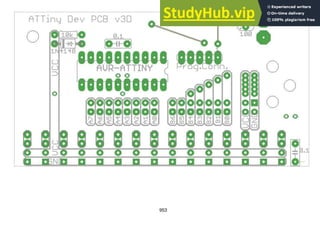
' if you want more accuracy then use single sized variables for the
division
'Hardware Aliases
Redled Alias Portb.2 '10s of degrees
Grnled Alias Portb.1 'units of degrees
Yelled Alias Portb.0 'not used inthis verison of
the code
'------------------------------------------------------------------
Here the
hardware
attached to the
micro is setup,
there is a
decription of
why the 1.1v
reference was
chosen
'Declare Constants
Const Flashdelay = 250
Const Tempr_conv_factor = 9 'rough conversion factor
Const Tempr_conv_offset = 1 'rough offset for rough conversion
'------------------------------------------------------------------
Although a
conversion of 9
looked like it
would work, the
temperature
was out by a
degree at room
temperature.
This was found
by measuring
the LM35
voltage out put
as 0.228 and
seeing the LED
flash the
number 24.
This probably
enough
accuracy for
room
temperature
measurements
as the LM35
has at best an
accuracy of ¼
of adegree
anyway.
' Declare Variables
Dim Tempr As Word '
Dim Tempr_10s As Byte 'temperature tens
Dim Tempr_1s As Byte 'temperature units
Variables used
in the program
These are not
306
'------------------------------------------------------------------ given initial
values because
they are
measured
' Program starts here
Set Redled 'led off
Set Grnled 'led off
Set Yelled 'led off
Turn off the
LEDs at the
beginning
307
Do
Tempr = Getadc(3) 'read the ADC value
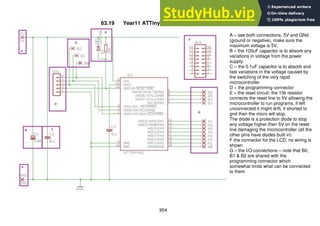
Tempr = Tempr / 9 'rough conversion due
to 1.1V internal reference being used
Tempr = Tempr - 1 'rough compensation for rough
conversion
The first part of the
program reads the
temperatire and
converts it to a
useable value
'split the tempr into 2 digits
Tempr_10s = Tempr / 10
Tempr_1s = Tempr Mod 10
This is a vital piece of learning here about division
and the use of modulus. We are dealing with whole
numbers when we use words , bytes and intergers in
Bascom. So if we divide 27 by 10 we get 2 (note that
there is no rounding) so a command exists <MOD>
that allows us to get the remainder of the division 27
MOD 10 will return 7.
'flash the tempr on the LEDs
While Tempr_10s > 0 'flash the red led the number
of 10s
Reset Redled
Waitms Flashdelay
Set Redled
Waitms Flashdelay
Decr Tempr_10s
Wend
Waitms 200
While Tempr_1s > 0 'flash the grn led the number of
units
Reset Grnled
Waitms Flashdelay
Set Grnled
Waitms Flashdelay
Decr Tempr_1s
Wend
Wait 2
Loop
End 'end program
Flashing the leds
requires us to set a
loop in motion, we
control the number of
times the loop
repeats by starting it
with the number and
progressively
subtracting 1 each
time.
This is actually an
efficient piece of
code as
microcontrollers
programs are
generally more
efficient if they loop
down to zero rather
than some number
other than zero, this
is because of the way
the hardware in a
micro works
308
20.10 LM35 temperature display
'------------------------------------------------------------------
' Title Block
' Author: B.Collis
' Date: Nov 2011
' File Name: LM35_Ver2.bas
' ------------------------------------------------------------------
' Program Description:
' This program displays temperature on the LCD
' An LM35 temperature sensor is connected to portA.0
' LCD to PortB
' ------------------------------------------------------------------
' Compiler Directives (these tell Bascom things about our hardware)
$crystal = 8000000 'the speed the micro porcesses
instructions
$regfile = "m16def.dat" 'the particular micro we are using
' ------------------------------------------------------------------
' Hardware Setups
' setup direction of all ports, initially as outputs
Config Porta = Output
Config Portb = Output
Config Portc = Output
Config Portd = Output
Config Lcdpin = Pin , Db4 = Portb.4 , Db5 = Portb.5 , Db6 = Portb.6 ,
Db7 = Portb.7 , E = Portb.1 , Rs = Portb.0
Config Lcd = 20 * 4 'configure lcd screen
Config Pina.0 = Input 'LM35 temperature sensor
'setup the ADC to do a conversion whenever we use the command
getadc()
Config Adc = Single , Prescaler = Auto , Reference = Avcc
Start Adc
' Hardware Aliases
Backlight Alias Portd.4
' ------------------------------------------------------------------
' Declare Constants
Const Reading_delay = 2000
' ------------------------------------------------------------------
' Declare Variables
Dim Adc_value As Word '10bit adc value needs word variable
Dim Rough_temperature As Byte
Dim Accurate_temperature As Single
Dim Temperature As String * 5
' Initialise Variables
309
' ------------------------------------------------------------------
' Program starts here
Cursor Off
Cls
Set Backlight
Do
Gosub Read_lm35_voltage Gosub Disp_adc_reading
Gosub Calc_rough_tempr
Gosub Disp_rough_tempr
Gosub Calc_accurate_temp
Gosub Disp_accurate_temp
Waitms Reading_delay
'these subroutines do not need comments as they have useful names
Loop
End 'end program
' ------------------------------------------------------------------
'Subroutines -these are actions so often start with words like read,
calc, displ, squeeze, move...
' a subroutine is best if it only contains one action (even if it
consists of only a few lines of code
' this makes them easier to follow, modify and reuse.
Read_lm35_voltage:
Adc_value = Getadc(0) 'number from 0to1023 represents the voltage
in
Return
Disp_adc_reading:
Locate 1 , 1
Lcd "adc reading= " ; Adc_value ; " "
Return
Calc_rough_tempr:
'this is a rough conversion as words can only be whole numbers
Rough_temperature = Adc_value / 2
Return
Disp_rough_tempr:
Locate 2 , 1
Lcd "rough tempr= " ; Rough_temperature ; " "
Return
310
Calc_accurate_temp:
'using singles we can have decimal places in our calculations
Accurate_temperature = Adc_value 'convert word to single
'adc_value of 51 = 0.259V
'conversion factor is 51/25.9= 1.96911197
Accurate_temperature = Accurate_temperature / 1.96911197
'turn the single into a string and round it to 1 decimalplace
Temperature = Fusing(accurate_temperature , "#.#")
'note we can do maths with numbers stored in singles
' we cannot do maths with numbers strored in string form
' as they are no longer numbers just codes representing digits
Return
Disp_accurate_temp:
'this subroutine displays the two accurate readings one is a
number
'the other is a number in string form
Locate 3 , 1
Lcd "tempr= " ; Accurate_temperature ; " "
'display 1 decimal place plus deg symbol and capital C
Locate 4 , 1
Lcd "tempr (1dp)= " ; Temperature ; Chr(223) ; Chr(67)
Return
311
20.11 Force Sensitive Resistors
The FSR is a neat device for sensing pressure, its not accurate enough to measure weight
but useful to detect the presence of someone standing on a mat or tapping on a surface.
These are used in exactly the same type of circuit as the LDR (voltage divider with a 10K).
You must be extremely careful trying to solder to these as the plastic melts so easily. You
may find that the use of some type of connector may make your project cheaper!
20.12 Piezo sensor
A piezo make s aperfect vibration sensor in exactly the
same voltage divider circuit, especially if you fixed one
side of it mechanically to something and the other side is
left to float inthe air. You can even buy more sensitive
version of this type of sensor – they make great impact
sensors.
312
20.13 Multiple switches and ADC
There is a very convenient way of reading multiple switches with your
microcontroller and only use 1 input port.
By making up a long voltage divider as in this diagram and connecting its
output to a microcontroller ADC pin, the voltage will change to a different
voltage output for every different switch press. This happens because the
voltage divider changes the number of resistors in the voltage divider for
every different switch press
If no switch is pressed then there is no voltage divider as all the resistors
R21 to R31 are unconnected. The input voltage to the ADC will be Vcc
(5V) and the ADC reading will be max (1023).
If S1 is pressed then othere is also no voltage divider, however the adc
input is now connect to ground (0V) and the adc reading will be 0.
If s2 is pressed there will only be two resistors in the voltage divider and
the output will be
Vout = = 0.5V (ADC reading of 0.5/5*1023 = 102)
If S3 is pressed then only 3 resistors will be in the voltage divider and the
output will be
Vout = = 0.667V (ADC reading of 0.667/5*1023 = 136
If S4 is pressed then only 4 resistors will be in the voltage divider and the
output will be
Vout = = 0.75V (ADC reading of 0.75/5*1023 = 153
The emerging patterns here are that the output is becoming larger and
larger, and the differences between the steps are becoming closer and
closer. Note the pattern in the voltages 1/2Vcc , 2/3Vcc, 3/4Vcc, 4/5Vcc,
5/6Vcc, 6/7Vcc....
This means that there is a limit to the number of switches that can be put
in this type of circuit.
313
21 Basic System Design
21.1 Understanding how systems are put together
A product or device is not just a collection of components, it is much more, the inventor of the
device didn’t just combine some parts together, they created a system. They envisaged it as a
whole system where all the parts have a unique purpose and together they function to make the
product complete.AND they developed it as part of a bigger process.
An example is a food processor.
To analyse the system
1. Draw a system block diagram identifying and
describing all the inputs and outputs of the system
a. Motor – 3 speed
b. Motor driver electronics
c. speed control – 4 position switch
d. bowl safety switch
e. Power LED, Bowl Lock LED (not shown in
picture)
2. Describe in words how these interact with each other,
use logic descriptors such as AND, OR and NOT.
3. Design the flowchart to represent the operational logic
21.2 Food Processor system block diagram
PSU
Bowl
Safety
Switch
controller
motor
Motor
Driver
Speed
Control
Setting
Off
Low
Med
High
Bowl
Lock
LED
Power
LED
A
B
21.3 Subsystems
Note that some of the items in the above system are systems themselves. The motor driver, the
PSU, the motor and the controller are all systems (the LEDs and switch are components). When
we use a system within another system we call it a subsystem.
21.4 Food Processor system functional attributes- algorithm
 When power is applied the power LED goes
 When power is applied AND the bowl is securely fitted the Bowl lock LED is on.
 When power is applied AND the bowl is securely fitted AND the speed control is set above
zero the motor will run.
 The motor has 2 inputs:
 When no power is applied to either the motor is off.
 When power is applied to A it goes slow.
314
 When power is applied to B it goes medium speed.
 When power is applied to both it goes fast. When the speed control is varied the motor
21.5 Food Processor system flowchart
Here is a first pass at a
flowchart for the system. It
does however need work as
there are a number of
problems with it.
Can you identify any?
1. It can be turned on but
when the speed switch
is turned off, the motor
does not turn off.
2. If the bowl is removed
while turned on then the
motor does not turn off.
3. The BowlLockedLed
can never be turned off.
Develop a better flowchart
for a program for the food
processor.
Food
Processor
Speed 3 Y
N
MotorA on
MotorB on
Speed 2 Y
N
MotorB on
Speed 1 Y
N
MotorA on
power LED on
MotorA off
MotorB off
BowlLockLED off
N bowl locked?
Y
BowlLockedLed on
315
21.6 Toaster Design
A toaster is another good example of a system.
1. Identify all the parts of the toaster and draw a system
block diagram
2. Describe the system operation – how the parts of the
system interact with each other
3. Design the flowchart
21.7 Toaster - system block diagram
21.8 Toaster Algortihm
Initially: the solenoid is off, the LEDs are off,the piezo is quiet and the elements are off
When the toast lever is pressed down the solenoid is activated to hold the toast down
If the setting is normal both the elements turn on
and the normal LED comes on
for the time set by the cook control
If the setting is crumpets, the left comes on max and the right comes on at half power
and the crumpet LED comes on
for the time set by the cook control
If the setting is frozen the time is extended by 1 min (either crumpet or normal)
and the frozen LED comes on
If the sensor detects smoke the solenoid is released and the piezo beeps quickly 4 times
If the time is up the the solenoid is released and the piezo beeps twice
Relay 1
Relay 2
Right
Left
Stop
Normal
Crumpets
Frozen
Toast setting
Toast down
Toast cooked sensor
cook time
Heating elements
Hold down
solenoid
Normal LED
Crumpet LED
controller
PSU
Frozen LED
Piezo Beeper
316
22 Basic System development - Time Tracker.
It is often useful for students to see worked examples; this small project is a worked example not
just of a timer project but of the process of development for an electronics project at school.
The process requires several iterations (cycles) of development. For some students the process
described here will be trivial (extremely simply), however it is important that students understand
the process and can carry it out.
Stage 1:
 Stakeholder consultation
 Initial brief
 Block diagram
 Algorithm
 Flowchart - a model of the internal process that the microcontroller must carry out
 Schematic
 Prototype development
 Program development
 Feedback from stakeholder
Stage 2:
 Refinement of brief – modify/ add/delete specifications
 Modification of schematic/algorithm/flowchart/prototype/program as required
 Feedback from stakeholder
Stage 3:
 Refinement of brief – modify/ add/delete specifications
 Modification of schematic/algorithm/flowchart/prototype/program as required
 Feedback from stakeholder
Stage 4:
 Refinement of brief – modify/ add/delete specifications
 Modification of schematic/algorithm/flowchart/prototype/program as required
 Evaluation by stakeholder
317
22.1 System context diagram and brief
The system context diagram is a visual representation of a brief.
318
22.2 Time tracker block diagram
319
22.3 Algorithm development
22.4 Schematic
The schematic for the ATTiny26 prototype PCB has been modified to include the components for
the switch and LED. Note the LED connection via a current limit resistor, and the switch
connection has a pullup resistor.
320
22.5 Time tracker flowchart and program version 1
$crystal = 1000000 'the speed of the micro
$regfile = "attiny26.dat" 'our micro
'Hardware Setups
' setup direction of all ports
Config Porta = Output '
Config Pina.7 = Input
'LCD setup
Config Lcdpin = Pin , Db4 = Portb.4 , Db5 = Portb.3 , Db6 = Portb.5 ,
Db7 = Portb.6 , E = Portb.1 , Rs = Portb.0
Config Lcd = 20 * 2 'configure lcd screen
'Hardware Aliases
Grn_sw Alias Pina.7
Piezo Alias Porta.3
'Declare Variable to store timing
Dim Seconds As Byte
'program starts here
Cls
Cursor Off
Lcd "Time Tracker V1"
Do
'setup countdown value
Seconds = 5 '5secs for testing
purposes
'wait for start switch
Do
Loop Until Grn_sw = 0
‘need no debounce as next line has a
delay
‘start countdown
Do
Waitms 1000
Decr Seconds
Locate 2 , 1
Lcd Seconds
Loop Until Seconds = 0
'countdown finished so play sound
Sound Piezo , 150 , 100
Loop 'return to start
End
setup variables
start
N grnstart=0?
Y
countdown
play sound
N countdown=0?
Y
321
22.6 Time Tracker stage 2
At this point the student should make contact with their stakeholder or client and show them what
has been done. After the client in this case wanted an LED added to the product to show when the
timer was not timing and to change to a double beep when the timer times out.
The student makes the following additions to their journal for their project:
Stakeholder consultation carried out and:
1. Brief: new or changed specifications recorded.
2. Algorithm changes described (no need for a new form - just write it into the journal)
3. Block diagram – saves as new version, makes changes and print for journal
4. Schematic: save as new version, make changes and print for journal
5. Layout: make changes to layout in journal or print new version with changes
6. Flowchart – saves as new verison, makes changes and prints for journal
7. Program – saves as new version, makes changes and prints for journal
'------------------------------------------------------------------
'Program Description:
'30 second countdown timer
'lcd displays seconds counting after switch pressed
'green led is on when not counting
'double beep at end
'------------------------------------------------------------------
'Compiler Directives (these tell Bascom things about our hardware)
$regfile = "attiny26.dat" 'our micro
$crystal = 1000000 'the speed of our micro
'------------------------------------------------------------------
'Hardware Setups
' setup direction of all ports
Config Porta = Output '
Config Pina.7 = Input
'LCD setup
Config Lcdpin = Pin , Db4 = Portb.4 , Db5 = Portb.3 , Db6 = Portb.5 ,
Db7 = Portb.6 , E = Portb.1 , Rs = Portb.0
Config Lcd = 20 * 2 'configure lcd screen
Piezo
lcd
Grn
Sw
Input
Devices
Process
Device
Output
Devices
4.5VDC
Batteries
Microcontroller
Grn
Led
Time Tracker System Block Diagram v2
322
'Hardware Aliases
Grn_led Alias Porta.1
Piezo Alias Porta.3
Grn_sw Alias Pina.7
'---------------------------------------------
'Declare Variables
Dim Seconds As word 'changed to word as need to count more than 255
'---------------------------
'program starts here
Cls
Cursor Off
Lcd "Time Tracker V2"
Do
Seconds = 5 initial value to count down
from
Set Grn_led
Do
Loop Until Grn_sw = 0'wait for start
switch
Reset Grn_led
Do
'start countdown
Waitms 1000
Decr Seconds
'display time
Locate 2 , 1
Lcd Seconds
Loop Until Seconds = 0
'countdown finished so play sound
Sound Piezo , 150 , 100
Waitms 50
Sound Piezo , 150 , 100
Loop
End 'end program
start
setup variables
countdown
play sound
N countdown=0?
Y
N grnstart=0?
Y
grn_led on
grn_led off
323
22.7 Time Tracker stage 3
At this point the student should make another contact with their stakeholder or client and show
them what has been done. After this the client wanted a second (red) LED added to the product
to flash while the timer was timing.
The students makes the following additions to their journal for their project:
Stakeholder consultation carried out and:
1. Brief: new or changed specifications recorded.
2. Algorithm: changes described (no need for a new form - just write it into the journal)
3. Block diagram: saves as new version, makes changes and prints for journal
4. Schematic: save as new version, make changes and print for journal
5. Layout: make changes to layout in journal or print new version with changes
6. Flowchart: saves as new verison, makes changes and prints for journal
7. Program: saves as new version, makes changes and prints for journal
'------------------------------------------------------------------
'Program Description:
'30 second countdown timer
'lcd displays seconds counting after switch pressed
'green led is on when not counting
'double beep at end
'red led flashes once per second
'------------------------------------------------------------------
'Compiler Directives (these tell Bascom things about our hardware)
$regfile = "attiny26.dat" 'our micro
$crystal = 1000000 'the speed of our micro
'------------------------------------------------------------------
'Hardware Setups
' setup direction of all ports
Config Porta = Output '
Config Pina.7 = Input
'LCD setup
Config Lcdpin = Pin , Db4 = Portb.4 , Db5 = Portb.3 , Db6 = Portb.5 ,
Db7 = Portb.6 , E = Portb.1 , Rs = Portb.0
Piezo
lcd
Red
Led
Grn
Led
Grn
Sw
Input
Devices
Process
Device
Output
Devices
4.5VDC
Batteries
Microcontroller
Time Tracker System Block Diagram v3
324
Config Lcd = 20 * 2 'configure lcd screen
'Hardware Aliases
Grn_led Alias Porta.1
Red_led Alias Porta.0
Piezo Alias Porta.3
Grn_sw Alias Pina.7
'----------------------------------------
'Declare Variables
Dim Seconds As word
'----------------------
'program starts here
Cls
Cursor Off
Locate 1 , 3 '
Lcd "Time Tracker V3"
Do
Set Grn_led
Seconds = 5 'initial value to count down
from
Do
Loop Until Grn_sw = 0 'wait for start
switch
Reset Grn_led
Do
'countdown
Set Red_led 'added flashing red LED
Waitms 50
Reset Red_led
Waitms 950
Decr Seconds
'display time
Locate 2 , 10
If Seconds < 10 Then Lcd "0"
Lcd Seconds
Loop Until Seconds = 0
'beeps
Sound Piezo , 150 , 100
Waitms 50
Sound Piezo , 150 , 100
Loop
End 'end program
start
setup variables
play sound
N countdown=0?
Y
N grnstart=0?
Y
grn_led on
grn_led off
countdown
RED LED
flashes every second
325
22.8 Time Tracker stage 4
At this point the student made yet another contact with their stakeholder or client and showed
them what has been done. After this the client wanted a significant change to the project; they
thought the timer would be really useful if the time delay could be changed. Specifically they want
to be able to push a second switch to increase the count time from 30 to 100 seconds in amounts
of 30 seconds; e.g. 30-60-90-120-150-180-210-240-270-300 seconds.
The students makes the following additions to their journal for their project:
Stakeholder consultation carried out and:
1. Brief: new or changed specifications recorded.
2. Algorithm: changes described (no need for a new form - just write it into the journal)
3. Block diagram: saves as new version, makes changes and prints for journal
4. Schematic: save as new version, make changes and print for journal
5. Layout: make changes to layout in journal or print new version with changes
6. Flowchart: saves as new verison, makes changes and prints for journal
7. Program: saves as new version, makes changes and prints for journal
Of course some students may be able to go straight to this final version of the product straight
away; however in doing this they are missing out on critical marks, as the highest grades come
from stakeholder consultations and subsequent modification to their project.
This final version of the block fiagram has all of the components to date.
The algorithm now has been modified to include:
While waiting for the user to press the green start button, f they press the white button the time will
increase in amount sof 30 seconds to a maximum of 300 seconds.
Piezo
lcd
Red
Led
Grn
Led
Grn
Sw
Wht
Sw
Input
Devices
Process
Device
Output
Devices
4.5VDC
Batteries
Microcontroller
Time Tracker System Block Diagram v4
326
start
setup variables
grn_led on
incr seconds by 30
seconds=30
secs >300? Y
N
N grnstart=0?
Y
grn_led off
countdown
RED LED
flashes every second
N countdown=0?
Y
play sound
wht_btrn=0? Y
N
327
'------------------------------------------------------------------
'Title Block
' Author: A. Student
' Date: Jul 09
' File Name: TimeTrackerV4
'------------------------------------------------------------------
'Program Description:
'30 second countdown timer
'lcd displays seconds counting after switch pressed
'green led is on when not counting
'double beep at end
'red led flashes once per second
'added ability to increase seconds count with white switch
'added switch labels to LCD screen
'------------------------------------------------------------------
'Compiler Directives (these tell Bascom things about our hardware)
$regfile = "attiny26.dat" 'our micro
$crystal = 1000000 'the speed of our micro
'------------------------------------------------------------------
'Hardware Setups
' setup direction of all ports
Config Porta = Output '
Config Pina.6 = Input
Config Pina.7 = Input
'LCD setup
Config Lcdpin = Pin , Db4 = Portb.4 , Db5 = Portb.3 , Db6 = Portb.5 ,
Db7 = Portb.6 , E = Portb.1 , Rs = Portb.0
Config Lcd = 20 * 2 'configure lcd screen
'Hardware Aliases
Grn_led Alias Porta.1
Red_led Alias Porta.0
Piezo Alias Porta.3
Grn_sw Alias Pina.7
Wht_sw Alias Pina.6
'------------------------------------------------------------------
'Declare Constants
Const Debouncetime = 10
Deflcdchar 0 , 32 , 4 , 2 , 31 , 2 , 4 , 32 , 32
'------------------------------------------------------------------
'Declare Variables
Dim Seconds As Word
'Initialise Variables
Seconds = 30
'------------------------------------------------------------------
'program starts here
Cls
Cursor Off
328
Do
'setup initial lcd display
Cls
Set Grn_led
Lcd "Time Tracker start" ; Chr(0)
Seconds = 30 'initial value to count down from
Locate 2 , 1 'display labels for switches on the LCD
Lcd "count= incr" ; Chr(0)
Locate 2 , 7
Lcd Seconds
'wait for start switch, allow user to change time while waiting
Do
'allow user to increase count in amounts of 30 seconds
If Wht_sw = 0 Then
Seconds = Seconds + 30
If Seconds > 300 Then Seconds = 30 'set max
Locate 2 , 7
Lcd Seconds ; " " 'add clear feature “ “
Waitms Debouncetime 'must debounce switch
Do 'wait for switch up
Loop Until Wht_sw = 1
Waitms Debouncetime 'waita little longer
End If
Loop Until Grn_sw = 0 'wait for start switch
Reset Grn_led
'countdown
Do
Set Red_led
Waitms 50
Reset Red_led
Waitms 950
Decr Seconds
'display time
Locate 2 , 7
If Seconds < 10 Then Lcd "0"
Lcd Seconds ; " " 'space blanks unwanted digits on lcd
Loop Until Seconds = 0
'beeps
Sound Piezo , 150 , 100
Waitms 50
Sound Piezo , 150 , 100
Loop
End 'end program
329
23 Basic maths time
Microcontrollers only store numbers, soit follows logically that they can do maths with these
numbers.
Here is a program that makes use of some maths and some different types of variables.
23.1 Ohms law calculator
Specifications
 Pressing the first button increases the voltage in the circuit by 1 Volt
o A maximum of 24V
o A minumium of 3V
o After 24V it goes back to 3V
 Pressing the second button increases Vl by0.1V. Vl (short for Vled) is the manufacturers
voltage specification for the LED
o A maximum of 4.0V
o A minimum of 1.5V
o After 4.0V it wraps back to 1.5V
 Pressing the third button increases the current that you want by 1mA
o A maximum of 50mA
o A minimum of 1mA
o After 50mA it wraps back to 1mA
 After any button press the new resistor value is calculated and displayed
Take note here that I separate the processing from the output code by writing the two
different and separate things the micro must do; first calculate (process code) and then
display (output code).
330
331
The flowchart for the program reveals my thinking while designing the program flow.
 Again I have separated out the process code from the output code. This is an important
concept in programming; the separation of different functions.
o Even though the only time we use these two subroutines is together it is better to
separate them because they do different things. This makes the code easier to
understand and easier to recycle into other programs.
 I put the subroutines calc_new_r and display_values at the beginning of theprogram so that
they are used once. If you don’t do this then the program sits there with a blank LCD until
the user presses a button.
o Alternatively you could put in an instructions screen at the beginning that told the
user what to do and then either automatically times out or waited until the user
pressed a button to continue.
 I could use the Bascom debounce command rather than reading the switches with IF-
THEN. However I chose not to because the debounce command doesn’t allow auto
repeat (you have to let the button go before you can press it again to increase the value). I
felt that the program would be easier to use if you could just hold the button down and the
values would increase at a regular rate.
o This means however that my program needs a delay in the loop somewhere
otherwise the values count up much too quickly when a button is pressed.
o See where the delay (waitms 500) is in the program, it is in the main loop. Now the
problem with putting a 500mS delay in the main loop has been covered before. It is
that a button can be pressed and the micro can easily miss it because it might be in
the waitms 500 doing nothing.
o This delay should be moved into each switch press loop, because then it only occurs
when a switch is pressed and not at any other time. So why didn’t I do this already,
because I wanted you to learn about it again!
o If you wanted to you could write a really neat debounce command that checked the
switch and if it was held down increased at a slow rate.
 I have put the calculation and lcd drawing into the main loop rather than into each loop.
o This is redundant. What I mean by redundant is that it is put there but not doing
anything useful. This code only does something when a value changes otherwise it
just recalculates using the same values and redraws the same values on the LCD.
o There is no real reason for this, and there is little side effect from it either in this
program. If these two routines took a long time then we would have the same effect
as putting the 500mS delay into the main loop; we could miss switch presses while
the micro was busy doing nothing. However they don’t take long enough to cause a
problem. So putting them in the main loop or putting them into each subroutine isn’t
important because of speed.
o In general these would be better in the subroutines because it is better programming
practice. There is one reason why these might be better in the main loop and not
each switch press. This actually makes our program take up less room in program
memory. This is hardly noticeable (its just 4 Gosub lines that we save) in this
program but I say it because there is an important concept in programming here.
o We can reduce size of program code through strategic thinking and understanding of
how a program runs.
332
'*****************************************************
'Compiler Setup
$crystal = 8000000
$regfile = "m8535.dat"
'*****************************************************
'Hardware Configs
Config PORTA = Output
Config PORTB = Output
Config PORTC = Output
Config PORTD = Output
Config PINB.2 = Input 'Vin_sw
Config PINB.3 = Input 'Vled_sw
Config PINB.4 = Input 'Current_sw
'Character LCD config
Config Lcdpin=pin , Db4 = PORTC.2 , Db5 = PORTC.3 , Db6 = PORTC.4 , Db7 = PORTC.5 , E = PORTC.1
, Rs = PORTC.0
Config Lcd = 20 * 4
'*****************************************************
'Hardware aliases
'inputs
Vin_sw Alias PINB.2
Vled_sw Alias PINB.3
Current_sw Alias Pinb.4
'activate internal pullups for switches
Set Portb.2 'Grn_sw
Set Portb.3 'Blu_sw
Set Portb.4 'Wht_sw
'outputs
Grn_Led Alias PORTB.5
Yel_Led Alias PORTB.6
Red_Led Alias PORTB.7
'*****************************************************
'Dimension Variables
Dim Vin As Byte '3 to 24V
Dim Current_ma As Byte '1 to 50mA
Dim Vled As Single '2.0 to 4.0V
Dim R As Word
Dim String_val As String * 3
Dim Temp As Single
'Initiliase Variables
Vin = 5
Current_ma = 10
Vled = 2.2
'constants, if you use constants then it is easier to make changes to the program’
Const Vmin = 3
Const Vmax = 24
Const Vledmax = 4
Const Vledmin = 1.5
Const Imin = 1
Const Imax = 50
'define the LCD chars
Deflcdchar 0 , 15 , 8 , 8 , 24 , 8 , 8 , 15 , 32 ' res symbol lhs
Deflcdchar 1 , 31 , 32 , 12 , 8 , 8 , 32 , 31 , 32 ' res symbol with r
Deflcdchar 2 , 30 , 2 , 2 , 3 , 2 , 2 , 30 , 32 ' rs symbol rhs
Deflcdchar 3 , 17 , 25 , 21 , 19 , 21 , 25 , 17 , 32 'diode
Deflcdchar 4 , 32 , 32 , 32 , 28 , 4 , 4 , 4 , 31 'ground
Deflcdchar 5 , 32 , 32 , 2 , 5 , 2 , 32 , 32 , 32 ' circle
333
'------Program starts here --------
Cls
Cursor Off
Gosub calc_new_r
Gosub Display_values
Do
If Vin_sw =0 Then
Incr Vin
If Vin > Vmax Then
VIn = Vmin
End If
End If
If Vled_sw=0 Then
Vled = Vled + 0.1
If Vled > Vledmax Then
Vled=Vledmin
End If
End If
If Current_sw=0 Then
Incr Current_ma
If Current_ma > Imax Then
Current_ma = Imin
End If
End If
Gosub calc_new_r
Gosub Display_values
Waitms 500
Loop
'Subroutines
Vin_sw_press:
Incr Vin
If Vin > Vmax Then Vin = Vmin
Return
Vled_sw_press:
Vled = Vled + 0.1
If Vled > Vledmax Then Vled = Vledmin
Return
Current_sw_press:
Incr Current_ma
If Current_ma > Imax Then Current_ma = Imin
Return
'calcultae the resistor value
Calc_new_r:
'voltage v across R = vin-vled
Temp = Vin - Vled
'r=v/i
Temp = Temp / Current_ma
Temp = Temp * 1000
R = Temp 'convert single to word
Return
Display_values:
'top line
Locate 1 , 1
If Vin < 10 Then Lcd " " 'put in a leading zero if less than 10
Lcd Vin ; "V" 'display Vin
'display graphic
Lcd Chr(5) ; "-" ; Chr(0) ; Chr(1) ; Chr(2) ; "-" ; Chr(3) ; "-" ; Chr(4)
'display voltage
Lcd " Vl="
String_val = Fusing(vled , "#.#") 'trick to get 1 decimal digit
Lcd String_val ; "V"
'second_line:
Locate 2 , 1
Lcd "I="
If Current_ma < 10 Then Lcd " "
Lcd Current_ma ; "mA"
Lcd " Rcalc= "
Locate 2 , 14
Lcd R ; Chr(244)
Return
334
23.2 more maths - multiplication
Process Notes
Issue: Multiply two numbers together
using only addition e.g. AxB=Answer
Pretty much all microcontrollers do multiplication inside
their hardware nowadays but its useful as a learning
exercise.
Algorithm:
Add A to the answer B times
e.g. 5 x 4 = 5+5+5+5
Finding the right words to describe the algorithm can be
difficult at times, you need to concise, accurate and
clear. This can be a step students struggle with.
Variables:
(memory locations to store data in)
numA – byte size
numB – byte size
Answer – word size
Choose useful names and think about the size of the
variable (a byte stores 0-255, a word 0-65535, an integer
stores -32768 to 32767, a long stores -2147483648 to
2147483647)
Flowchart:
Note the shapes of the elements:
Start and end
Inputs and outputs
Processes
Decisions
Learn the process of keeping track of how many times
something is done. A variable is used to count the
number of times a loop is carried out. In this case the
variable is decreased each time through the loop until it
is 0. An alternative is to increase a variable until it
reaches a specific value.
Within a microcontroller though it is often faster to test a
variable against 0 than some other number.
Test the flowchart with an example
Answer Num2
6 8
12 7
18 6
24 5
30 4
36 3
42 2
48 1
54 0
Does it work?
Note how the columns in the test follow the same order
as the processes in the loop.
This stage can be a little confusing and often we can be
out by 1 either way (if it is then our answer might not be
54 but 48 or 60)
If you get wrong answers after a loop check that you are
decreasing or increasing them the right number of times.
Identify the control statements to be
used.
In BASCOM there are several control mechanisms to
manage loops.
335
' SimpleMultiplicationV1.bas
$crystal = 1000000
$regfile = "attiny461.dat"
Config Porta = Output
Config Portb = Output
Config Pina.3 = Input
Dim I As Byte
Dim Num1 As Byte
Dim Num2 As Byte
Dim Answer As Word
'************************************
Num1 = 6
Num2 = 9
Answer = 0
Do
Answer = Answer + Num1
Decr Num2
Loop Until Num2 = 0
'************************************
Num1 = 6
Num2 = 9
Answer = 0
For I = 0 To Num2
Answer = Answer + Num1
Next
'************************************
Num1 = 6
Num2 = 9
Answer = 0
For I = Num2 To 0 Step -1
Answer = Answer + Num1
Next
'************************************
Num1 = 6
Num2 = 9
Answer = 0
While Num2 > 0
Answer = Answer + Num1
Decr Num2
Wend
End
If you copy this code into BASCOM-AVR, then save it
and compile it you can try it out using the simulator (F2).
Do-Loop Until…
For-Next…
this requires another variable to act as the loop counter,
and can either count up or count down.
While – Wend
When you run this program you will find that two of
them work correctly and two do not! You need to
understand which and fix them; so watch carefully
the values of the variables in the simulator and fix
the two that need fixing.
336
23.3 Algorithms for multiplication of very large numbers
The previous code is OK for small to medium size problems however there are much more
efficient algorithms; here are 2 alternatives.
‘Peasant’ Multiplication 75 x 41
75 41
37 82
18 164
9 328
4 656
2 1312
1 2625
3075
Program:
' PeasantMultiplicationV1.bas
$crystal = 1000000
$regfile = "attiny26.dat"
Config Porta = Output
Config Portb = Output
Dim Temp As Word
Dim Num1 As Word
Dim Num2 As Word
Dim Answer As Word
Num1 = 16
Num2 = 39
Answer = 0
‘note again the use of do-loop as we don’t know
how many times the loop needs to be repeated
Do
(Mod is used to find if a number is odd or even)
Temp = Num1 Mod 2
If Temp = 1 Then Answer = Answer + Num2
Num1 = Num1 / 2
Num2 = Num2 * 2
Loop Until Num1 = 0
End
Write down the Algorithm:
Divide the first number by 2 (ignore
remainder) and multiply the second
number by 2.
If the second number is odd add it to the
total.
Keep doing this process until after the first
number is 1.
What variables will be needed:
Num1, Num2, Total
337
Long Multiplication 41,231 x 3,1231
41,321
x 3,131
41,321
1,239,630
4,132,100
123,963,000
129,376,051
Write down the Algorithm:
What variables will be needed:
Flowchart:
338
23.4 Program ideas - algorithm and flowchart exercises
1. In this game the first person picks a number between 1 and 10 and the other person must guess
this number in 4 or less guesses. If you play this game a few times with someone you will get a
feel for the algorithm (the process for solving the problem) . Can you write the process down?
2. This is a game played with any number of players who take turns saying a number. The first
player says "1" and each player in turn increases the number by 1, 2, or 3, but may not exceed 21;
the player forced to say "21" loses. There is a winning strategy for this game you will need to
research it or figure it out to be able to write a program that can beat a human opponent.
3. A factory fills drink bottles; it has a machine that puts the
drink bottles into cartons and full cartons onto pallets.
3A. Design an algorithm and flowchart that counts 24 bottles into
each carton and keeps track of the number of cartons.
3B. Extend this in a second algorithm and flowchart that
tracks the number of bottles and the number of cartons, when
number of cartons is over 48 then increase the number of pallets.
4. A program marks test scores and gives grades of N, A, M, or E based upon the following scores
0% to 33% = N, 34% to 55% = A, 56% to 83% = M 83% to 100% = E
Write the algorithm and draw the flowchart for this process.
5. Design an algorithm and flowchart for a program that gets a player to guess a random number
from 1 to 1000.
If correct, then display the number of guesses and start again
If incorrect then give as too high’ or ‘too low’
When the number of guesses goes over 8 the player loses
6A. a golf course watering system monitors the time and
moisture level of the ground and waters the grass in the early
evening if it is needed.
6B. the watering system comes on for 30 minutes then waits 60
minutes to measure the moisture level and comes on for a
second watering if it is below a fixed level.
7.Design an algorithm and flowchart for a program that calculates powers eg. 25
= 32 (use only
addition and loops)
339
24 Basic string variables
So far we have used constants on the display such as
lcd”Hello”.
But what if we want our text to vary e.g. different names and
addresses or different colours or different days of the week.
All computer languages allow you to store this text in a
variable called a STRING. Computers all store text in the
same way too. Ram stores only numbers so to store text in RAM we store a code for
each letter of the text string.
This table gives us the binary code for each character e.g. ‘A’ is 01000001 or 65 in
decimal.
In a program text can be displayed using the command LCD CHR(...), so to diaplay an A
LCD CHR(65).
A string is a
variable
that is a
collection
of letters
(and digits)
such as
“My name
is Fred” or
“37 Frost
Road,
Mount
Roskill”
When you
dimension
a string you
must think
about how
big it might
become
during the
time your
program
will use it,
and then
allocate
enough
memory for
it. e.g. dim
address as
string * 20
340
Below is a snapshot of the RAM from the simulator in Bascom this program.
Variables are stored in ram in the order in which they are declared in Bascom.
Dim Message1 As String * 20 (first 21 bytes in red below)
Dim Message2 As String * 20 (second 21 bytes in green below)
Dim Xposition As Byte (a single byte in dark red)
Dim Count As Byte (a single byte in dark green)
The data stored in the variable changes during the program , so after the first loop of the
program the memory looks like this above.
Message1 has ‘hello’ stored in it. You can see that Bascom has actually allocated 21
bytes not 20 as we asked for when we configured the string; this is because Bascom
puts a 0 on the end of each string in memory. The simulator conveniently displays any
viewable ascii characters stored in ram on the right hand side of its window.
Message2 has ‘there’ stored in it, again 21 characters are used.
The next byte of ram has the number 5 stored in it, this is the position on the lcd that we
want the text to appear at.
The next byte is the variable count it goes up from 1 to 3 to control the number of times
the text flashes on the LCD.
You can look up the values in the ASCII table for the above RAM, these are hexadecimal
numbers
hexadecimal binary Decimal ASCII
68 &B 0100 1000 104 H
65 &B 0100 0101 101 E
6C &B 0100 1100 108 L
6F &B 0100 1111 111 O
341
24.1 Strings assignment
'------------------------------------------------------------------
' 6. Hardware Setups
' setup direction of all ports
Config Porta = Output 'LEDs on portA
Config Portb = Output 'LEDs on portB
Config Portc = Output 'LEDs on portC
Config Portd = Output 'LEDs on portD
'config inputs
Config Pina.0 = Input ' ldr
Config Pind.2 = Input 'switch A
Config Pind.3 = Input 'switch B
Config Pind.6 = Input 'switch C
Config Pinb.1 = Input 'switch D
Config Pinb.0 = Input 'switch E
'LCD
Config Lcdpin = Pin , Db4 = Portc.2 , Db5 = Portc.3 , Db6 = Portc.4 , Db7 = Portc.5 , E =
Portc.1 , Rs = Portc.0
Config Lcd = 20 * 4
' 7. Hardware Aliases
Sw_a Alias Pinb.0
Sw_b Alias Pinb.1
Sw_c Alias Pind.2
Sw_d Alias Pind.3
Sw_e Alias Pind.6
' 8. initialise ports so hardware starts correctly
Porta = &B11111100 'turns off LEDs ignores ADC inputs
Portb = &B11111100 'turns off LEDs ignores switches
Portc = &B11111111 'turns off LEDs
Portd = &B10110011 'turns off LEDs ignores switches
Cls 'clear lcd screen
Cursor On Noblink
'------------------------------------------------------------------
' 9. Declare Constants
'------------------------------------------------------------------
' 10. Declare Variables
Dim Mix As Byte
Dim Firstname As String * 12
Dim Middlename As String * 12
Dim Lastname As String * 12
Dim Fullname As String * 40
' 11. Initialise Variables
Mix = 0
Firstname = "Edgar"
Middlename = "Alan"
Lastname = "Poe"
Fullname = ""
342
'------------------------------------------------------------------
' 12. Program starts here
Cls
Gosub Welcome
Do
Debounce Sw_a , 0 , Welcome , Sub
Debounce Sw_b , 0 , Mixup , Sub
Loop
End 'end program
'------------------------------------------------------------------
' 13. Subroutines
Welcome:
Cls
Lcd "Welcome"
Lowerline
Lcd Chr(126) : Lcd "to strings" : Lcd Chr(127)
Return
Mixup:
Incr Mix
If Mix =
If Mix = 1 Then Fullname = Firstname + " " + Middlename + " " + Lastname
If Mix = 2 Then Fullname = Middlename + " " + Lastname + " " + Firstname
If Mix = 3 Then Fullname = Lastname + " " + Firstname + " " + Middlename
If Mix = 4 Then Fullname = Mid(fullname , 10 , 5)
If Mix = 5 Then Fullname = Lastname + "," + Left(firstname , 2)
If Mix = 6 Then Fullname = Version(1)
If Mix = 7 Then
If Mix = 8 Then
If Mix = 9 Then
If Mix > 10 Then Mix = 0
Cls
Lcd Fullname
Return
From the help file find out how to use and then add to this program 3 of the following at
7,8,9
Instr Lcase Len Lookupstr Ltrim Left Right Rtrim Space Spc String Trim Ucase Mid
Use these to convert numbers to and from strings and display them
Format Fusing Hex Bin Hexval Str Val Split
343
24.2 ASCII Assignment
1. Copy the following code into BASCOM
2. Compare the datasheet for the LCD with the characters that actually appear on your
LCD.
3. Write the code for the decrementcode subroutine
'------------------------------------------------------------------
' 1. Title Block
' Author: B.Collis
' Date: 1 June 2005
' File Name: LCDcharactersV1.bas
'------------------------------------------------------------------
' 2. Program Description:
' everytime btn is pressed the character on the lcd changes
' highlights the use of the ASCII code
' 3. Hardware Features:
' LEDS
' 5 switches
' LCD
' 4. Program Features
' do-loop to keep program going forever
' debounce to test switches
' if-then-endif to test variables
'------------------------------------------------------------------
' 5. Compiler Directives (these tell Bascom things about our hardware)
$crystal = 8000000 'the speed of the micro
$regfile = "m8535.dat" 'our micro, the ATMEGA8535-16PI
'------------------------------------------------------------------
' 6. Hardware Setups
' setup direction of all ports
Config Porta = Output 'LEDs on portA
Config Portb = Output 'LEDs on portB
Config Portc = Output 'LEDs on portC
Config Portd = Output 'LEDs on portD
'config inputs
Config Pind.2 = Input 'switch A
Config Pind.3 = Input 'switch B
Config Pind.6 = Input 'switch C
Config Pinb.1 = Input 'switch D
Config Pinb.0 = Input 'switch E
'LCD
Config Lcdpin = Pin , Db4 = Portc.2 , Db5 = Portc.3 , Db6 = Portc.4 , Db7 = Portc.5 , E =
Portc.1 , Rs = Portc.0
Config Lcd = 20 * 4
' 7. Hardware Aliases
Sw_a Alias Pinb.0
Sw_b Alias Pinb.1
Sw_c Alias Pind.2
Sw_d Alias Pind.3
Sw_e Alias Pind.6
' 8. initialise ports so hardware starts correctly
Porta = &B11111100 'turns off LEDs ignores ADC inputs
Portb = &B11111100 'turns off LEDs ignores switches
344
Portc = &B11111111 'turns off LEDs
Portd = &B10110011 'turns off LEDs ignores switches
Cls 'clear lcd screen
'------------------------------------------------------------------
' 9. Declare Constants
'------------------------------------------------------------------
' 10. Declare Variables
Dim Code As Byte
Dim State As Byte
' 11. Initialise Variables
Code = 0
State = 0
'------------------------------------------------------------------
' 12. Program starts here
Do
Debounce Sw_a , 0 , Swa_press , Sub
Debounce Sw_b , 0 , Swb_press , Sub
If State = 0 Then Gosub Intro
If State = 1 Then Gosub Increasecode
If State = 2 Then Gosub Decreasecode
If State = 4 Then Gosub Waiting
Loop
End 'end program
'------------------------------------------------------------------
' 13. Subroutines
Intro:
Lcd "ASCII codes"
Lowerline
Lcd "btn A incrs code"
Return
Waiting:
' do nothing
Return
Increasecode:
If Code < 255 Then 'max value is 255
Incr Code
Else
Code = 0 'if > 255 reset to 0
End If
Cls
Lcd Code : Lcd " " : Lcd Chr(code)
State = 4
Return
345
Decreasecode:
'write your code here
Return
Swa_press:
State = 1
Return
Swb_press:
State = 2
Return
346
24.3 Time in a string
Previously we wrote a small program that created a very simple clock. To display the time
we put the time on the screen as hours, minutes and seconds e.g. 10:07:01
We could create a string to hold the time and display it using Lcd Timestr
$sim
'-----------------------------------------------------------------
' Title Block
' Author: B.Collis
' Date: 14 Aug 2003
' File Name: simple clock v1.bas
'-----------------------------------------------------------------
' Program Description:
' use an LCD to display
' Program Features:
' outer do-loop
' Hardware Features:
' LCD on portc - note the use of 4 bit mode and only 2 control
lines
'-----------------------------------------------------------------
' Compiler Directives (these tell Bascom things about our
hardware)
$crystal = 8000000 'the crystal we are using
$regfile = "attiny26.dat" 'the micro we are using
'-----------------------------------------------------------------
' Hardware Setups
' setup direction of all ports
Config Porta = Output 'LEDs on portA
Config Portb = Output 'LEDs on portB
Config Lcdpin = Pin , Db4 = Portb.2 , Db5 = Portb.3 , Db6 =
Portb.4 , Db7 = Portb.5 , E = Portb.1 , Rs = Portb.0
Config Lcd = 20 * 2 'configure lcd screen
' Harware Aliases
' initialise hardware
Cls 'clears LCD display
Cursor Off 'no cursor
'-----------------------------------------------------------------
' Declare Constants
Const Timedelay = 350
'-----------------------------------------------------------------
' Declare Variables
Dim Seconds As Byte
Dim Minutes As Byte
Dim Hours As Byte
Dim Day As Byte
Dim Month As Byte
Dim Year As Byte
Dim Timestr As String * 8
' Initialise Variables
347
Seconds = 50
Minutes = 5
Hours = 14 '2pm
Day = 21
Month = 4 'april
Year = 10 '2010
'-----------------------------------------------------------------
' Program starts here
Do
Wait 1
Incr Seconds
If Seconds > 59 Then
Seconds = 0
Incr Minutes
End If
Gosub Maketime 'make a string of the time
Locate 1 , 5
Lcd Timestr 'display the string
Loop
End 'end program
'-----------------------------------------------------------------
Maketime:
Timestr = "" 'delete the string
‘rebuild the string
If Hours < 10 Then Timestr = Timestr + "0"
Timestr = Timestr + Str(hours)
Timestr = Timestr + ":"
If Minutes < 10 Then Timestr = Timestr + "0"
Timestr = Timestr + Str(minutes)
Timestr = Timestr + ":"
If Seconds < 10 Then Timestr = Timestr + "0"
Timestr = Timestr + Str(seconds)
Return
348
24.4 Date in a string
Here is a program segment to display the date in a string
'-----------------------------------------------
'Declare Variables
Dim Day As Byte 'e.g. 6
Dim Month As Byte 'e.g. 4
Dim Month_str As String * 3 'e.g. apr
Dim Year As Byte 'e.g. 12 means 2012
Dim Year_str As String * 4 'e.g. "2012"
Dim Today As String * 20 'a variable to store some
text
'Initialise Variable
Day = 6
Month = 4
Year = 12
'----------------------------------------------
'Program starts here
Do
Gosub Makedate
Locate 1 , 1
Lcd Today
Loop
End
Makedate1:
'str is a function to convert a number to a string
Today = Str(day) + "/" + Str(month) + "/" + Str(year)
Return
This displays
Which is not what we want we want to be able to display it in either of these formats
06/04/2012 or 06 Apr 2012
On the next page you will see the code for this it needs completing
349
'-----------------------------------------------
'Declare Variables
Dim Day As Byte 'e.g. 20
Dim Month As Byte 'e.g. 4
Dim Month_str As String * 3 'e.g. apr
Dim Year As Byte 'e.g. 12 means 2012
Dim Year_str As String * 4 'e.g. "2012"
Dim Today As String * 20 'a variable to store some
text
'Initialise Variable
Day = 6
Month = 4
Year = 12
'----------------------------------------------
'Program starts here
Do
Gosub Makedate1
Locate 1 , 1
Lcd Today
Gosub Makedate2
Locate 2 , 1
Lcd Today
Loop
End
Makedate1:
Today = ""
If Day < 10 Then Today = "0"
Today = Today + Str(day) + "/"
'you complete the rest of this routine
Return
Makedate2:
'str is a function to convert a number to a string
Today = ""
If Day < 10 Then Today = "0"
Today = Today + Str(day) + " "
Select Case Month
Case 1 : Month_str = "Jan"
Case 2 : Month_str = "Feb"
'you complete the rest of this routine
Return
350
24.5 Scrolling message assignment
An alphanumeric (text) LCD is a very common output device used with microcontrollers
however they have limited screen size so a longer message must be either split up and
shown page by page or scrolled across the screen.
If the string was 50 charcters long as with the one below and the LCD was 16 characters
wide then using the mid command we could take the first 16 characters and put them on
the display then wait a bit, then get the next 16 characters and put them on the display,
and so on continuously.
In this assignment you will scroll a message across the screen. The message will be an
information message regarding a news item or weather forecast up to 200 characters in
length.
‘Declare Variables
Dim message as string * 200
Dim scroll_length as byte
Dim scroll_posn as byte
Dim forty_chars as string * 40
‘Initialise Variables
Message = “ the weather today will be …..”
Scroll_text:
Scroll_length = len(message)
If Scroll_length > 40 then
Scroll_length = scroll_length – 40
End if
Scroll_posn = 0
While scroll_posn < scroll_length
Incr scroll_posn
Forty_chars =mid(message,scroll_posn,40)
Locate 1,1
Lcd forty_chars
Waitms 150
Wend
Return
This routine scrolls the complete message once then returns
to the main loop. This makes it a very long routine to
execute (150mS times the number of characters in the
string)
Change the code so that it uses: a Do-Loop-Until structure and then a For-Next
351
24.6 Some LCD programming exercises.
These exercises will require you to manipulate the display, manipulate text, manipulate
numbers. And become familiar with the use of loops to get things done.
You need to save each version of the program separately e.g wassup_b.bas,
wassup_p.bas, wassup_a.bas.
Basic: put ‘wassup’ on the display
Proficient: Have ‘wassup’ scroll around the screen continuously
Advanced: Have the 6 letters of ‘wassup’ appear spread out over the display and then
after a brief delay move in towards the centre and in order.
Basic: calculate 2^8 and display it
Proficient: for n from 1 to 25, display 2^n on the screen, wait for 1 sec and then do the
next number
Advanced: Write you own code to calculate the square root of the answer for each of the
above answers
Basic: Display a static weather report for Auckland on the LCD
screen
Proficient: Do graphics for sunny, cloudy, wet, and snowy for your
weather report, that flash on the screen, these graphics should be
larger than a single lcd square, perhaps 2/3 lines x 4squares
Advanced: Scroll the message on and off the display and have the
graphics flash for a while, then the weather report scrolls back on
again.
Basic: Display 2 random numbers between 2,000 and 99,000
Proficient: repeat this process continuously, and also subtract the smaller from the larger
number and display the answer, have a 3 second delay between each new calculation
Advanced: Scroll the results off the display 0.5 seconds after the calculation
Basic: Create 4 different pacman graphics: one pacman mouth
open, one pacman mouth closed, one a target and the last the
target exploding
Proficient: Have the pacman move around the screen these,
staying on each square for only 0.5 seconds.
Advanced: Generate a random location on the LCD and place
the target there, have the pacman move around the screen and
when it lands on the target the target explodes and the pacman
moves on around the rest of the screen
Proficient: create ‘12TCE’ in one large font that covers
all four lines of the lcd like the wording of atmel in this
picture
Proficient: flash the message on the screen three
times, 1 second on then 1 second off after that have it
stay on for 12 seconds then repeat the 3 flashes.
352
25 Advanced power
interfaces
So far we have looked at lower power output
interfaces for the microcontroller such as LEDs and
LCDs the problem though is that we will want to add
high power things to our designs so we must know
what to use and how to use it. The learning for this
best takes place in some order, here is what I have chosen:
1. know what we can do and what we cannot do with a microcontroller output port.
2. know about power
3. know some more detail about how certain semiconductors are used and work
4. know about the output devices and their power requirements
5. know about the extra features the AVR has to help us drive those devices
25.1 Microcontroller power limitations
The microcontroller specifications we are interested in are found in the electrical characteristics
section of the datasheet for the microcontroller, here are the specs for an ATTiny461.
We are initially interested in the DC current
specification 40mA per I/O pin –that sounds great
40mA is heaps for a pin we could do lots with that.
BUT wait – the next line says 200mA for the power
pins so we cannot draw 40mA from all 15 pins
because that would exceed the 200mA for the power
pins by 400mA (15 x 40 = 600mA)
There is more data we need to know about.
353
Two terms sink and source are used here we first need to understand these specifications.
The names sink and source describe
which way the current is going in a
circuit, either to positive or ground.
They are with repect to conventional
current (not electron current).
It was common for microcontrollers to
have different sink and soure
characteristics but nowadays it seems
more common to see the sink and
source ratings for a microcontroller are
the same (but not always).
The really important characteristic from the datasheet is in notes 3 and 4 where it states that the sum
of all currents for all ports should not exceed 60mA sink and 60mA source. So if we wanted to use all
15 pins of the ATtiny as outputs and switch them all on at the same time then we cannot sink more
than 4mA current from each pin (60mA/15pins)! So be warned!!
In the first example we will use the microcontroller to switch a backlight for an LCD on and off.
354
25.2 Power
So far the concepts of voltage and current have been introduced however when these are present a
third important aspect of circuits is present as well, that is power.
Any device that has a voltage across it and current is flowing uses energy, and therefore dissipates
this energy in the form of heat.
Components don’t like to get too hot and are rated to work only below a certain temperature. The
more energy the hotter a component gets and the more likely it is to overheat and be destroyed
25.3 Power dissipation in resistors
Power = voltage times current, P=V*I , Power is measured in Watts.
2V across a 10ohm resistor. I=V/R, I= 2/10, I=0.2A, so P=V*I,
P=2*0.2, P= 0.4W.
Resistors come in different power ratings so it
is important in a circuit to understand that the
power ratings should not be exceeded or the
component may overheat, become burnt and
have its life shortened or be destroyed.
Resistors can be bought in various ratings, on
the left are 1/8, 1/4, 1/2, 1, 5 & 10 Watts.
On the right 5 and 10 watt metal cased ones
Note that the physical size grows proportionally with the rating
V = 10V I = 2A P = V * I, P = 10*2, P=20W
V = 5V I = 0.3A
I = 200mA V = 12V
V = 100V I = 3mA
V = 100V P = 50W
V = 48V I = 20mA
A 5 Watt bulb draws 1.6A what is
the voltage?
A 12 battery supplies 20mA to a
resistor, what is the power?
What wattage resistor would you
use for 15V and 0.2A
What wattage resistor would you
use for 36V and 100mA
355
25.4 Diode characteristics
When a voltage is applied to the diode in a forward direction it is called forward bias; as this
increases there is little current until the voltage reaches 0.65 to 0.7V and the diode will conduct fully.
When voltage is applied in a reverse direction it is called reverse biased and as the voltage is
increased a point will be reached where the voltage is greater than the diode can handle the diode
will suddently conduct. In a normal diode exceeding the reverse voltage specification will generally
destroy the diode.
This graph decribes the characteristic of diode
conduction in a visual form. When the diode is
forward biased above 0.65 the diode conducts,
when it is reversed biased it will not conduct
until it safe operating voltage is exceeded. At
reverse voltages higher than that it will
probably be detroyed.
356
25.5 Using Zener diodes
The reverse conduction effect can be put to use in controlled circumsnaces and in
Zener diodes this effect is used to make small regulated power supplies.
Note the symbol for a zener is different to a normal diode and shows the knee and
avalanche effects in the symbol with the angled line at the cathode end.
If we want to make a small power supply for
a common circuit (5V) and we find a 20V dc
power pack we can use a zener diode.
The first calculation is simply the voltage
across the Resistor VR = Vin - Vout
We must know what load the rest of the
circuit presents to the power supply. We
don’t need to draw the rest of the circuit to
help us we can represent it as a resistor
RLoad e.g. a small microcontroller circuit
might draw 150mA (0.15A).
The current though the load will be 150mA, a zener requires some small current to work e.g. 5mA, so
the total current will be 150mA + 5mA – 155mA (0.155A).
Using Ohms law the value of R will be V/I = (20-5.1)/0.155 = 96ohms.
The issue however with zener circuits is not so much the voltage and resistance calculations it’s the
power calculations.
We assume worst case so the power the resistor has to dissipate is V x I = (20-5.1) x 0.155 = 2.3W
so we would use a 5W resistor, not a usual 400mW one we would find in the workshop!
For a zener diode, power is also factor and worst case will be when the load draws no current.
Power = V x I = 5.1 x 0.155 = 0.79W so a 1W zener would be used (not a usual 400mW one).
Vin Vout VR = Vin - Vout ILoad IZener Itotal R = VR/Itotal PR = VR x Itotal PZener = Vout x Izener
20 5.1 14.9 0.15 0.005 0.155 96 2.3W 0.79W
12 5.1 0.08 0.005
24 5.1
357
25.6 How diodes work
A diode is made from silicon (a semiconductor). Semiconductors have more electrons in their outer
shells than conductors. To the silicon other materials (impurities) are added, these other materials
have either more or less electrons in the outer shell. A diode is made from a piece of silicon which is
doped with both N-type and P-type impurities. Knowing how a normal diode works will help you
understand the basics of how an LED gives off light.
One part of the silicon has N-type impurities added (slightly
more conductive), in the other part P-type impurities are
added (slightly less conductive).
When no
voltage is
connecte
d to the diode there is a region in the middle where some
electrons flow over and the effect is cancelled out (the
depletion region).
When a large enough voltage is applied to a diode (about
0.4v to 0.6V) electrons will flow from the negative to the
positive. This is called forward bias. In the process the
depletion region disappears.
When the battery is connected back to front the diode is "reverse
biased" and the depletion region in the middle gets larger, so
electrons cannot flow. This explains why diodes conduct
only when connected into a circuit the right way
around.
358
25.7 How does a LED give off light?
In an LED when electrons move from the N side to the P side photons
are released.
Photons are released whenever electrons move from one shell
level in an atom to another. In an LED the electrons move from
the N to the P and also change levels within the atomic structure
at the same time, therefore releasing photons.
Note that the voltage required for an LED to conduct is much
greater than a normal diode. Typical values range from 1.8V to
3.6V, and like an ordinary diode they only work in one direction
LED Colours
In an LED different colours are achieved by using different types of impurities.
Light Emitting Diode Colour Variations
Color Name
Wavelength
(Nanometers)
Semiconductor
Composition
Infrared 880 GaAlAs/GaAs
Ultra Red 660 GaAlAs/GaAlAs
Super Red 633 AlGaInP
Super Orange 612 AlGaInP
Orange 605 GaAsP/GaP
Yellow 585 GaAsP/GaP
Incandescent
White
4500K (CT) InGaN/SiC
Pale White 6500K (CT) InGaN/SiC
Cool White 8000K (CT) InGaN/SiC
Pure Green 555 GaP/GaP
Super Blue 470 GaN/SiC
Blue Violet 430 GaN/SiC
Ultraviolet 395 InGaN/SiC
359
25.8 LCD Backlight Data
In the datsheet for a 4 line LCD, the LCD typically draws 2mA with the backlight off and 72mA with it
on, so the backlight requires 70mA, it also requires 4.7V.
Although we don’t have a schematic for the backlight we can make a good guess at what the circuit
for it might look like. A typical LED requires 2V to 2.5V to drive it, so if the backlight LEDs require
4.7V we can safely assume that there are 2 LEDs in series. As the backlight LEDs draw 70mA in
total and a typical LED is up to 20mA we could guess at either 3 or 4 sets of LEDs in parallel.
As the backlight LEDs draw 70mA it is not possible to drive them directly from a microcontroller I/O
pin, we need another control component in between.
360
25.9 Transistors as power switches
There are many different types of transistor and the
BJT has already been introduced so we will investigate
it as an intermediate stage of switching between the
microcontroller and the backlight.
BC547
Type NPN BJT type
Case T092
IC (mA) 100 mA The maximum current that we can control
Vce MAX 45 V The maximum voltage we can apply to the circuit
hFE (gain) 110-800 The amplification factor Ic/Ib
PTOT (power) 500 mW The maximum power that can be dissipated by the device
What we know:
The backlight is a bunch of LEDs
requiring 4.7V and 70mA.
You need to know:
A transistor when it is completely
switched on will have a Vbe of 0.7V
and a Vce of 0.3V
The current to the LED backlight comes
from the transistor and is the same as Ic,
(collector current) We want this to be
70mA.
To get and Ic of 70mA we need some
current through the base Ib.
The relationship between Colector and
base current is called gain or hFE. Gain or
hFE = Ic / Ib
I b = IC / hFE = 70/110 = 0.6mA
The current in the base is the same as the current in the the resistor R from the microcontroller.
Using ohms law R = V/I = (5-0.7) / 0.0006 = 7k166 ohms
A suitable value of R would be lower than 7K to make sure that at least 0.0006A flows. So we would
choose a convenient 4k7. In fact it would be fine to go lower or a bit higher.
Now the hidden calculation is power, the transistor has a voltage of VCE across the emitter and
collector. This will always be about 0.3V for a BJT transistor when it is fully switched on.
Power = V x I = 0.3 x 70mA = 0.3 x 0.07 = 0.021W = 21mW.
Looking at the specifications in the above table the BC547 can dissipate 500mW and we want it to
dissipate 21mW, so it should work fine.
This fine for a 70mA, 4.7V backlight but more powerful devices will require bigger transistors. The
problem with bigger transistors however is that you have to drive them with a lot of current from the
microcontroller which cannot provide a lot of current!! So…
361
25.10 High power loads
When we have a load that requires higher power we may
need a higher voltage supply and more current.
Here is an LED based traffic light, it has 168 LEDs and
requires a 12V supply voltage.
1 2 3 4 5 6 7 8
Load Ic hFE Ib Vbe R Vce Ptot
Green
300mm
traffic light
12V 14W
(168 LEDs)
I = P / V
= 14/12
= 1.16A
BC547 =
110
Ib = Ic / hFE
=1.16/110
=0.011A
= 11mA
Now 11mA from a microcontroller sounds ok but lets review the datasheet for the AVR.
25.11 AVR Power matters
The datasheet might initially lead you to believe
that we can draw 40mA from an I/O pin. However
there is an absolute maximum rating of 200mA
from the power supply pins, so if we were to
draw 40mA from 5 I/O pins then we would have
reached the maimum for our device.
But theres more…
362
In note 4 and 5 above from the datasheet there is a maximum rating of sinking 60mA and sourcing
60mA total from all I/O ports. This is in effect 120mA in total.
Sink current is when the current is from ther AVR
I/O pin to Vcc (a low or 0 turns on the load)
Source current us when the current is from
ground to the AVR I/O pin (a high or 1 turns on
the load)
So there are significant limits to what we can drive from our AVR. This is why the current has been
limited to a few mA by a 1K resistor with the all the multiple LED circuits so far, so that we do cannot
stress the AVR.
So back to our LED traffic light, we could drive a few of them from our AVR but not many. It would be
better to use an alternative.
363
25.12 Darlington transistors - high power
A darlington transistor is two transistors inside one
package like this BDX53C
This device has a gain of at least 750 so
to get the maximum current of 6A out of it
will require only 6/750 = 0.008A = 8mA
into the base.
364
The BJT NPN transistor has been
replaced by an NPN Darlington
transistor.
1 2 3 4 5 6 7 8
Load Ic hFE Ib Vbe R Vce Ptot
Green
300mm
traffic light
12V 14W
(168 LEDs)
I = P / V
= 14/12
= 1.16A
BDX53C
hFE=750
Ib = Ic / hFE
=1.16/750
=0.0015A
= 1.5mA
2.5V =VR / Ib
= (5-2.5) / 0.0015
= 1,667 ohms
Use 1k5
2
= Vce x Ic
= 2 x 1.16
= 2.32W
The BDX53C can dissipate 60W power, however it will heat up at the rate of 70 degrees per watt that
it dissipates.
The BDX53 will then heat up by 2.32 x 70 = 162.4 degrees over and above ambient temperature.
Ambient temperature is the temperature of the piece of equipment and is influenced by the air
temperature other components that generate heat. This exceeds the temperature range of the
device which is 150 degrees. So we should use a heat sink.
365
25.13 ULN2803 Octal Darlington Driver
This really useful IC has 8 darlington transistors built into it. Which makes it really useful for
connecting to the 8 pins of one port on a microcontroller.
In this circuit for one I/O of the ULN2803 you
can see the protection diodes on both the
input and the outputs.
The protection diodes go to pin 18 which must be connected to the
power for loads you are driving.
This device is great for connecting high power loads such as relays, solenoids, light bulbs
Each transistor can switch 500mA each however you cannot have more than 1W per output and a
total of 2.25W per IC (all 8 outputs) at once.
366
In this example we want to drive 8 bulbs, bulbs are not socommon but theywillserve as an example of
power calculations.
1. Power for each transistor
The transistor will have to supply 0.15A, when it is turned on (saturated)
The voltage across the Collector to Emitter will be 1.1V (worst case)
So the power for each transistor will be P = V x I = 1.1 x 0.15 = 0.165W
2. this measn if we want all 8 bulbs on at once we will have
P = 8 x 0.165 = 1.32W
3. We can do this as the specification for each transitor and for the the whole package have not been
exceeded.
4. We will need a power supply capable of delivering 12V and 1.2A (8 x 0.15A) plus other power
requirements of the circuit.
367
25.14 Connecting a FET backlight control
to your microcontroller
The LCD requires six I/O lines to be used on the micro to
control the data to it plus 1 more to switch the backlight
368
25.15 FET backlight control
The FET (field effect transistor) is different to the
more familiar BC547 which is a BJT (bipolar
junction transistor).
 A FET’s output current is controlled by the
voltage in and there is almost no current in the
gate of the FET from the microcontroller
meaning a microcontroller can control large
FETs directly.
 Generally FETs require about 10V to drive the gate but low voltage versions called ‘logic’ FETs are
available. The 2N7000 is a logic MOSFET, capable of driving 200mA loads and dissipating 1W of
power at 25 degrees Celsius AND can be controlled directly by 5V (a logic 1) from a
microcontroller
 The power dissipated by a FET is much lower than a BJT. It is measured by multiplying the
current flowing by the Rds value (5ohms for a 2N7000, but typically milliohms for high current
FETs)
2N7000 – ‘N channel enhanancement-mode
MOSFET’
The FET can be connected directly to the
microcontroller output pin without the 100k
resistor; however we prefer to connect it
with a high value resistor.
It is good practice to connect the gate to
ground with a high value resistor. The
reason being that the gate is so highly
sensitive that if the micrcocontroller pin is
configured as an input it will easily drift in
voltage and the FET might turn on due to
noise nearby in the circuit (and so will the
device you have connected to it). This is the
case when an AVR is turned on and before
any config statements have been run in
your program.
In worst case the power dissipation will be
P=V x I and V= I x R so P = I x R x I
P= I2
R = 0.07 x 0.07 x 5 ohms
P = 0.0245W = 24.5mW
So a lot less power is wasted by using a FET rather than a BJT.
Note the 5 ohms in the datsheet is a maximum value for RDS, looking through the datsheet shows
that it is typically going to be around 2 ohms, but we used 5 as a worst case scenario.
369
26 Advanced Power Supply Theory
Every circuit needs high quality power
Over time a significant number of
students have developed power
supplies and breadboard
prototyping centres for their own
use
Some have been built into
existing items like this toolbox
Some included microcontroller
based control of the voltages
A range of various materials are
used
Sheet metal
Acrylic
MDF
Pine
Plywood
Sketchup plays a significant
role in helping students
visualise and plan the final
product
370
26.1 Typical PSUs
Typical power supply units and their characteristics/features
Input voltage range: 230V AC 50Hz
DC Output range: 5 - 15 Volt
Output Current:10 amp DC (no variable limit)
Analog Amp & Volt Meter
270mm x 200 mm x 120mm
Input Voltage: 230-240V AC. 50Hz
Output Voltage: Variable 0 to 30V DC
Variable Output Current Limit: 0 to 2.5A
Load regulation (0-100% load): 10mV
Line regulation (240V +/-5%): 10mV
Digital Volt and Ammeter Accuracy: 0.7%
Mains overcurrent protection: 1A resettable circuit breaker
Output Voltage: 3-15V DC or fixed at 13.8V
Output Current: 40A regulated (no variable limit)
Ripple & noise: 10mV rms
Load regulation: 230mV @ 0 - 100% load.
Measures 220(W) x 110(H) x 300(L)mm.
Weight 3.5Kgs. – digital volt and amp meters
Input voltage range: 230V AC
DC Output range: 5 - 15 Volt
Output Current:10 amp DC (no variable limit)
Analoge Amp & Volt Meter
270mm x 200 mm x 120mm
Input Voltage:240VAC10%/50Hz
Output Voltage: 0 - 30 Volts DC
Output Current: 0 - 5 Amps
Line Regulation: ≤0.01%+3mV ≤0.2%+3mA
Load Regulation:≤0.01%+2mV ≤0.2%+3mA
Ripple & Noise: ≤0.5mVrms ≤3mArms
Display Accuracy:Voltmeter(0.2%Rdg+2digits), 2.5% Full Scale
Silicon Chip Magazine power supply kitset
Two independently switched outputs: 5V,12V &15V
Voltage outputs: +1.25V to 15VDC @ 0.25A.
–1.25V to –15VDC @ 0.25A.
+5VDC @ 0.25A.
+30VAC center-tapped to 15VAC @0.25A.
Various switches, LEDs, potentiometes, breadboard for testing circuits
WOW: a power supply and breadboard prototyping super kit
Extra features include: tools storage, multimeter
The specifications we need to know more about are highlighted above: Input Voltage range and
frequency, variable output voltage range, output current limits, ripple, line regulation and load
regulation.
371
26.2 The four stages of a PSU (power supply unit)
Most modern electronic devices require fixed and stable power supply voltages, to achive this we
follow a recommended design.
In NZ we use an AC (alternating current) mains
power supply system which delivers 230V to
our homes.
The 230 is an RMS (root means square) value.
Although it is 230VRMS it peaks at about 230 x
1.414 ( +325V and – 325V).
Of course we cannot use 230V directly in our projects as it is unsafe to so so. We use a transformer
to convert the voltage to a lower value. A transformer is 2 (or more) insulated coils of wire wound on
a laminated metal core.
The ratio of the number of turns between the primary and secondary windings determines the voltage
out put. If we want 23Volts out of our transformer we would have 1/10th
the number of windings on
the secondary as we have on the primary.
26.3 Stage 1: step down transformer
372
Wiring up our own mains transformer within a project is complex and requires a specific process to
be followed thoroughly. This circuit looks simple enough it shows the switch, fuse, mains connector
and primary of the transformer all in series.
However the actual product requires very specific wiring and earthing as well as testing by a
registered person before it is used.
In this power supply DH covered the mains area with a plastic cover, then we had it certified by an
electrician before mounting and testing the rest of the low voltage circuits.
373
26.4 Stage 2: AC to DC Conversion
The second stage of the power suppy requires the conversion of AC to DC because all the circuits
we use require DC voltage. A diode rectifies the AC .
A half-wave rectifier (a single diode) blocks the negative voltage. This is however very inefficient use
of a resource as half the power is never available for use – this means we might buy a 100VA
transformer but only be able to use 50VA – translrmers are expensive so this is a waste of money.
A more efficient use of the power is to use a full wave rectifier, where there are 4 diodes.
The output power of the bridge rectifier is almost all the power going into it not half of it.
When the mains voltage is one polarity only two diodes conduct.
When it is the opposite polarity the other two diodes conduct. The output however is always the same
polarity
374
26.5 Stage 3: Filtering AC component
We need a steady DC voltage from our power supply, to assits we
will use a capacitor. A capacitor is made of two metal plates
separated by an insulator (called a dielectric). The characteristic of
a capacitor is to store charges (electrons). If there is no voltage on a
capacitor and a voltage is applied a large flow of charges (current)
will occur, when the applied voltage is removed the capacitor will
release these to the circuit. In our Power supply circuit the voltage
rises and falls 100 times per second, while the voltage is low the
charges stored in the capacitor will be used by the circuit, while it is
high the charges used by the circuit will be supplied by the rectified AC which will also charge the
capacitor. In a power supply we typically use very large capacitors e.g. 2200uF or 4700uF.
These capacitors are polarised, so must go around the right way – they can explode so get it right!
We also need to make sure that the voltage rating is more than the peak volate of the transformer. So
a 13VAC transformer will have a peak output of 13x1.414 = 18V. Capacitors come in standard values
16V is a common value as is 25V. A 16V capacitor will not do, here a 25VDC one was used.
26.6 Stage 4: Voltage Regulation
The ‘DC’ coming out of the filter section of the PSU is not completely smooth and it has a slight ripple
component due to capacitor discharging and recharging. As the load changes the ripple increases
(the load is the circuit we connect to the PSU and we show it as a resistor in the circuit below). This
means that the voltage can go up and down as the load changes, something that happens a lot in
digital circuits as things switch on and off.
Also we want 5V for our microcontroller, so an unstable 16-18V DC supply is too high.
375
From the portions of the datasheets below for the ATMega16 and the ATTiny26 we can see that they
need around 5V for the standard higher speed devices and 3V would be fine for the type L devices
Voltages that exceed 5.5V will very like damage the microcontroller. Every now and again there is a
loud POP in the classroom and the smoke inside a microcontroller is released as another student
forgets to check the voltage on the bench power supplies we are using and tries to run their micro at
30VDC!!
The output voltage must be controlled by some form of voltage regulator circuit. Here the regulator is
a series pass transistor controlled by an opamp and transistor. The opamp compares the difference
between the output voltage (Vfeedback from the voltage divider) and the reference voltage (Vref from
the zener diode). It increases or decreases the drive voltage to the series pass transistor to keep the
two input voltages equal.
376
Here is a common commercial device to do just that for us. It is the 7805 (or LM340T-5).
It comes in various package styles depending upon its use or its current limiting characteristics.
T092
TO220 TO5 SMD (surface
mount device)
There are also different voltage ratings available e.g. 7808 ( 8V), 7812 (12V), 7815 (15V).
Inside the 7805 IC
there is a
reasonably complex
circuit.
The components of
interest however
can be identified
easily they are R1
and D1 (Vref), Q16
(series pass
transistor), R20 and
R21 (Vfeedback).
Transitors Q1 and
Q18 form the main
part of the
comparator circuit.
This circuit has a
current limit built
into it, R16 is a
0.25ohm resistor
and is used to
detect the amount
of current flowing,
more about that
later.
377
A 7805 can be added easily to our circuit. But we must know about it so that we use it correctly.
The datsheet for a 7805 can be downloaded from the internet, here are some sections from it.
What is the maximum input voltage? _________________
What do you think storing the device below -65 degC might do to it?
If it got hotter than its maximum operating temperature of _______ degC what might happen?
What is the typical output ?________________,
the maximum output voltage?_____________
the minimum output voltage? _____________
From the small section above we can determine what the minimum input voltage is that we can use
to get 5V out. This spec is called dropout voltage and it is the voltage difference between the input
and output that is required to make sure the 7805 operates correctly.
To get 5V out we need at least ____________ input voltage
378
26.7 Ripple (decibel & dB)
Although the filter capacitor reduces the ripple voltage we do not want any of it getting onto the power
pins of our microcontroller. That sort of thing really upsets fast switching digital and microcontroller
circuits and also can create hum in audio circuits. The 7805 rejects ripple, the datasheet gives its
specification as 80dB (decibels).
A Decibel is a measure that is not linear but logarithmic in scale .
+3dB means 2times the power (or if a voltage is specificed ,1.4 times the voltage)
-3dB means half the power (0.71 x the voltage)
+6bB means 4x the power (2x the voltage)
-6dB means ¼ of the power (1/2 the voltage)
+80dB means 100,000,000 x the power (10,000 x the voltage)
-80dB means 1/100000000 of the power (1/10000 the voltage)
80db from the datasheet means it reduces ripple output to 1/10000 of the ripple voltage coming in.
If the ripple voltage was 100mV (0.1V) coming in it would be ______________ coming out of the
7805 (not much!)
The power supply units looked at earlier had ripple specifications of 10mV that means that if we set
our PSU to 5V then the voltage will fluctuate from 4.990V to 5.010V at the rate of 100 Hertz (100
because we full wave rectify the 50Hz AC voltage)
Often a datasheet will give typical applications for a device
The note about the two small capactiors is very important when designing a 7805 circuit put them real
close to the IC (within a few millimetres)
As an aside I always use at least a 10uF electrolytic capacitor on the output of the 7805 if I will
be using the ADC circuit of the ATMEL AVR, as this makes the ADC readings more stable!
379
26.8 Line Regulation
Line regulation refers to the line input voltage varying. In our case we have a nominal (typical) mains
voltage of 230V AC. This voltage however fluctuates as people turn applicances on and off,
expecially large power users. So these changes in line input voltage should not effect the output
voltage.
One of the power supplies above quoted Line regulation (240V +/-5%): 10mV this means that if the
mains voltage varies by up to 5% either side of 240V then the output voltage will change by no more
than 10mV. Another one quoted Line Regulation: ≤0.01%+3mV so when the input AC voltage varies
0.01% of that variation + 3mV may be passed through to the output.
The 7805 Line regulation from the datasheet is 10mV, which means that if the input DC voltage
changes then the output voltage will change no more than 10mV.
26.9 Load Regulation
Load regulation is perhaps the most important specification for our power supplies as we want the
output voltage to be constant while our circuits current load changes (i.e. we trun LEDs, motors etc
on and off). Three of the power supplies had specifications for load regulation.
Load regulation: 230mV @ 0 - 100%
Load regulation (0-100% load): 10mV
Load Regulation:≤0.01%+2mV
The first one is the worst upto 230mV variation, so a 5V setting might drop down to 4.770V, the
second at 10mV means that the 5V would drop down to 4.990V and the last one by a little more than
2mV.
The 7805 has a load regulation specification of 10mV typical and a maximum of 25mV. So it is really
good!
380
26.10 Current Limit
Although we regulate voltage we seldom regulate the current that a circuit can draw. Using ohms law
we can work out what the different currents are for circuits below
In this circuit 5V into a load of
100 Ohms
I=V/R = 5/100 = 0.05A or 50mA
In this circuit 5V into a load of 10
Ohms
I=V/R = 5/10 = 0.5A or 500mA
In this circuit 5V into a load of 1
Ohms
I=V/R = 5/1 = 5A (!!!!!!!!!)
NO it wont work, sorry
I=V/R =5/0, don’t try this on your
calculator because it generally
gives E, which students
sometimes think is infinity so
infinite Amps!
The 7805 has a built in current limit circuitry to protect itself
It can deliver no more than 2.1A maximum. HOWEVER, current limit is a function of the whole circuit,
if your 9VDC coming in is provided by a plugpack that has a 500mA output rating then you will only
ever get 500mA max (trying to draw more may kill the plugpack) If it is coming from a 10A power
supply then it will allow you to draw an absolute max of 2.1A if you put a short circuit on the 7805.
381
What exactly is current limiting and why is it important?
Often batteries are used to test circuits. This is fine if the circuit is working well. The circuit under test
may be drawing 120mA so it can be thought of as a (R=4.8/0.12 =) 40 ohm equivalent resistance.
If however you make a mistake with your breadboard or pcb and the circuit becomes 0 ohms then a
problem can occur!
In fact explosions can occur!!!
Batteries are not perfect but they are very good; they
have a small internal resistance, which will limit the
current. I = V/R = 4.8/0.15 = 32A!! This internal
resistance depends on things like temperature and
the chemical reactions going on and could even be
lower.
In the class we have had batteries explode into fire. When testing circuits if it doesn’t work check the
temperature of your batteries, if they are very hot disconnect them and if they are really hot put them
outside immediately; as they may explode even after having been disconnected as they can continue
to heat up.
Check out the internet for videos and pictures of exploding batteries if you don’t believe!
382
How does current limiting work?
The 7805 current limiting circuitry from the datasheet (above), this has been reduced down to a basic
block type diagram in the circuit below.
Between the input and output of the 7805 is transistor Q16 and resistor R16 (0.25ohm). The current
that the 7805 supplies to the circuit goes through the 0.25ohm Current Sense (Isense) resistor.
This resistor will develop a voltage (potential difference) across it which is directly proportional to the
current (V = IxR - ohms law - as current increase so does voltage).
V = I x R
At 50mA
V = 0.05 x 0.25 = 0.0125V
At 100mA
V = 0.1 x 0.25 = 0.025V
At 1A
V = 1 x 0.25 = 0.25V
At some point the current sensing transistor Q14 will turn on and shut off the main transistor Q16.
383
26.11 Power, temperature and heatsinking
Using this diagram we can work out some power calculations for our 7805.
If the 7805 needs to drop 4V at 0.05A, then it will have to dissapate 0.05A x 4V watts of power
P=VI = 0.05 x 4 = 2Watts. In doing this the 7805 will act as a heater and get warm.
This is where the specifications for a device become very important, as we do not want to exceed the
power ratings or damage may occur. Damage is not really a problem with the 7805 as it is
“essentially indestructible” as the datsheet says. However it will shut itself down if it gets too hot.
The ‘die’ is the internal silicon wafer (slice) that the circuit is built on; if this goes over 150 °C the
device will shut itself down. The 7805 is able to radiate heat however it has only a small surface area
and so it is not very efficient at getting rid of heat. Its warms up at the rate of 54 °C/W . The
specification of interest is Θj-a (theta junction to ambient).
If in the example we want to dissapate 4W then the junction temperatire will rise to 4 x 65 or 260 °C,
clearly the device will shut itself down if this were to happen as it would get too hot.
So we bolt a heatsink to the 7805. The specification of interest becomes Θj-c (theta junction to case)
which is 4°C /W
384
Each part of the chain of dissipating heat has a negative impact, the lower the overall number the
better heat can be dissipated. A small heatsink might be 20°C/W, in this case the one shown is
17°C/W. A large heatsink might be 4°C/W.
If we use a mica insultor between the 7805 and the heatsink and thermal paste (to exclude any air
from the join) it adds 1°C/W.
Our total is now 4+1+17 = 22°C/W. Much better than 54°C/W.
At 4W our junction temperatire will be 4*22 = 88°C, which is below the max of 150°C .
If we raise the input voltage to 16VDC, and we want to draw 1A from the 7805.
We will have 16-5 = 11V across the 7805 and it will have to dissipate 11V x 1A = 11Watts.
At 22 °C/W, that means 11W x 22 = 242°C.
To be within range of our 150°C we will have to have reduce the rating to 150/11 = 13°C/W.
If we have a heatsink of 8°C/W it will be OK, but that is a reasonable size heatsink.
385
26.12 Typical PSU circuit designs
26.13 PSU block diagram
26.14 PSU Schematic
In
this circuit the thick lines indicate higher current paths, which will require thicker tracks on the PCB
Note that there is no current limit apart from the 7805 and LM317 internal current limits (at least that’s
better than 30+amps direct from batteries). Note the three GND connections, these points are
connected as they are all called GND, there is no need to add wires to connect the points.
7805
LM317
Fixed 5V
Variable Voltage
Transformer
Rectifier
& Filter
Regulators
386
Initially layout your components in a
logical way
Here a small heatsink was used in the
centre of the PCB and the two
regulators were mounted on either
side of it. The components that
belonged with each part of the circuit
were put on each side of the heatsink.
The capacitor and voltage regulator
were added to one end f the board.
The wires to connect to other
components were all placed around as
few sides of the board as possible,
and as close to the edges as possible.
3.5mm mounting holes were placed in
the corners.
Next the tracks were started. The
ground was laid first around the
outside of the board and using 0.086in
thickness, this is the thickest track
possible to connect to the voltage
regulators as their leads are 0.1inch
apart.
There is another consideration here,
this is a powersupply designed to
deliver current to other ciruits, we
must know about the current limits of
the PCB tracks. This is all to do with
resistance and heat. A copper track
although a conductor still has a finite
resistance and will burn up if too hot
(too much current flows through it).
We use PCB which has 2oz (ounce)
of copper per square foot. This
equates to 0.0028 inch thick tracks.
A 0.086 inch wde track can carry
about 3.5A and will increase in
temperature by about 10 degrees C.
(which is ok).
In an effort to reduce electrical noise
and any voltage fluctuation a large
ground plane is added to the board.
Type ‘polygon gnd’ into eagle and set
the values for width, isolate and
spacing for 0.032 inch. Then draw the
polygon around the edge of the board
and redraw the ratsnest to fill in the
polygon. A ground plane also reduces the amount of copper that will need to be etched, saving on
chemicals.
387
Insulating of heatsinks and voltage regulators
Most devices need insulating from heatsinks, because the metal tab of the IC package os electrically
conneted to one of the legs.
In the 7805 the metal tab is electrically ground (or 0V),
In the LM317 variable voltage regulator the metal tab is connected to Vout, the variable voltage.
If we were to bolt them to the heatsink without insultating them the variable voltage would short out to
ground. When we have a 7805, its case is already ground sowe don’t need to insulate it, but the
LM317 still needs insulation.
388
26.15 Practical current limit circuit.
From the LM317 datsheet there is an application to build a current limit. The current can be
controlled by using different values of resistor (a potentiometer could be fitted if it was a special high
power one). Check out the datasheet for other applications for the LM317.
In this circuit below the current can be set using two values for R1 and R2 and a switch to select
either or both (giving three different preset values)
If 1R2 ohms gives 1 amp limit
What value of R would give a current limit of 200mA?
389
In this layout the 3 voltage
regulators are mounted on
the very edge of the PCB.
This means that we can
solder them onto the PCB
and then heatsink them easily
against a large heatsink or a
metal case.
390
26.16 Voltage measurement using a voltage divider
Having developed a variable power supply it is important to be able to measure the voltage it is set
to. We can monitor the output of a power supply by reading the voltage with an ADC pin on the
microcontroller and converting this to voltage display on the LCD.
In the block diagram above the voltage divider divides the output voltage of the PSU down to a
value within the range of the ATTiny26 ADC port and uses that to measure the voltage.
The AVR has an internal reference voltage we can use. It is 2.56 volts so you must make sure that
the voltage into the ADC cannot exceed 2.56V so some ohms law and resistance calculations are
necessary.
If the maximum voltage out of the PSU is 20V then a ratio of 10:1 for the resistors would be
satisfactory
The following shows what the voltage (to 1d.p.) would be for 2V, 5V and 20V in along with the
reading for the ADC.
7805
317
Variable
DC output
LCD
DC input
Voltage
Divider
ADC
Attiny
GND/OV
GND/OV
10k
1k
5V
= 0.5 / 2.56 x 1024
=182
ADC reading
10k
1k
2V
ADC reading =
= 0.2 / 2.56 x 1024
=73
10k
1k
20V
ADC reading
= 1.8 / 2.56 x 1024
=727
V = 20 x 1/11 =1.8V
V = 5 x 1/11 =0.5V
V = 2 x 1/11 =0.2V
391
We used the Attiny461-20PU for this project. ATMEL like to change models of its microcontrollers all
the time, we don’t mind this as each time they do they tend to get a little better for the same cost!
However it does mean keeping up to date with the micros specifications. The ATTiny461 has 11
ADC inputs (although we cannot use ADC10 because it’s the reset pin and we need ot for
programming).
This computer program simulates the variable power supply, the action of the voltage divider and
the conversion process within the microcontroller
392
26.17 Variable power supply voltmeter program
'Title Block
‘Name: B.Collis and Anka
'Date: May 2010
'File Name: Voltmeter.bas
'------------------------------------------------
'Program Description:
'use ADC to read voltage from output of a voltage divider
'convert adc value to one that matches the voltage into
the voltage divider
'use an LCD to display value of the voltage
'------------------------------------------------
'Compiler Directives
$crystal = 1000000 'speed of operations
inside the micro
$regfile = "attiny461.dat" 'the micro we are using
This program was developed to display the voltage of the variable
powersupply, Anka (year11) and I worked on it together, since then
he has taken his program to a further stage to incorporate more
features such as audible warnings and other visual warnings.
'------------------------------------------------
'Hardware Setups
Config Porta = Output
Config Pina.7 = Input
Initially we configure all the pins on port A as outputs, however the
voltage divider is connected to A.7 so it must be configured as an
input.
Config Lcdpin = Pin , Db4 = Portb.3 , Db5 = Portb.6 , Db6
= Portb.4 , Db7 = Portb.5 , E = Portb.2 , Rs = Portb.1
Config Lcd = 20 * 2 'configure lcd
connections
Config Adc = Single , Prescaler = Auto , Reference =
Internal_2.56_extcap
Start Adc
The first line sets up the analogue to digital conversion circuits
within the AVR. In terms of systems knowledge this is is an
example of sub systems where students must be familiar with the
I/O characteristics and function of a device but not the detail of its
internal operation. The Attiny26 has 11(though we can only use 10)
ADC inputs. AN ADC requires an input voltage and a reference
voltage against which to compare the input voltage. It has different
voltage references we can use, external, 1.11V or 2.56 internal. In
this case we are using the internal 2.56 volt reference with a 0.1uF
capacitor on AVCC (pin 15). The ADC reading will be in the range
of 0 to 1023, where a 0 means 0Volts and 1023 means the same as
the reference voltage.
393
'initialise hardware
Cls 'clears LCD display
Cursor Off 'cursor not displayed
No need to display the cursor on the LCD
'-----------------------------------------------
'Declare Constants
'Declare Variables
Dim Adc_in As Word
Dim Voltage As Single
Dim Dividor As Single
Dim Volts As String * 5
'Initialise Variable
Dividor = 32.6255
Variables store data, here we need a variable to store the value we
read from the ADC input. This must be a word sized variable as it
may store up to 1023 (remember a byte can only store upto 255).
We want to display decimals so we must use a single or a double,
we do not need the precision of a double so we use the single.
We want to display the number on the LCD as well. We could use
the same variable voltage however it will give us loads of decimal
places so we will convert it to a string and then format the string so
we need a varibel that can hold a string.
'----------------------------------------------
'Program starts here
Do
Adc_in = Getadc(6)
Voltage = Adc_in
Voltage = Voltage / Dividor
Volts = Fusing(voltage , "#.##")
Locate 1 , 1
Lcd Volts ; "V" ; " "
Loop
End
1. Read the voltage into the word variable adc_in.
2. Put this number into the single variable
3.This number will not be the voltage but a number that changes in
relation to the voltage so we must convert it into a number that is
the same as the voltage.
4. This will be a number with loads of decimal places so we conver
it to a string
5. the string is formatted to have only 2 decimal places.
6. position the cursor
7. display the string version of the voltage, the letter V and then a
couple of blank spaces on the LCD.
8. repeat the process all over again
394
27 Year11/12/13 typical test questions so far
Capacitors
What is the value of the small yellow Capacitor in the microcontroller circuit- in pF? nF? uF?
What is the number written on it and what does it mean?
Why is it used?
What does polarised mean?
What are the two ways of knowing how to put an electrolytic capacitor into the circuit
correctly?
Resistors
Calculate the value for a current limit resistor with a 12V battery and an LED drawing 2mA
Select the closest value we have in class that you could use.
If you could use 2 values of resistor found in class combining them together which 2 would
you use?
Explain what a voltage divider does
What do we use potentiometers in circuits for? Expalin how a potentiometer is a voltage
divider
Multimeter use
You want to measure the current drawn by your LED in a microcontroller circuit, draw a
diagram of how you would do it and what settings you would use on the multimeter.
Algorithms/Modelling
Why do we write algorithms before we program? (Do 2 of the following algorithms)
Write pseudo-code then draw a flowchart for a program to read 2 switches to control the
position of an LCD character, one to move it left, one to move it right and press both to
change line.
Write an algorithm to play as many different tones as possible if you have 4 switches and
press them in different combinations
Write an algorithm to change the speed of a flashing led using 2 switches
Write an algorithm that uses 1 switch to enter the number of times an led will flash and a
second switch to start the LED flashing
Write an algorithm to allow a user to enter their name into a variable, using 3 switches, the
first to increase the litter, the second to move to the next letter, the third to finish.
Variables
If you were to record the position of a character on an LCD what type of variable would you
use?
Describe overflow
If you were have a user enter their age what type of variable would you use?
If you were counting seconds in a minute what type of variable would you use? In an hour? In
a day? In a year? In a century? Give good names for these variables.
Dimension variables that would hold each of your first, last and any middle names.
Programming
Write a short piece of code that counts 15 switch presses and then flashes an LED
Write a short piece of code that checks 4 switches to see if they are all pressed.
Write a subroutine to check if a value is a multiple of 10 and if it is to flash an led once
Write a subroutine to add three strings together with a space beweeen each string
Write a subroutine that gets the first character from each of three strings and displays it on the
lcd
Write asubroutine to get the middle letter of a string and display it on the lcd
Write a subroutine to get a random letter from a string and display it on the lcd
Microcontollers
What are the different uses of the three microcontroller memory types:RAM, FLASH &
EEPROM
Subsystems
Draw a system context diagram for your project
395
Draw a block diagram for your project
What does ‘black box mean’
What are at least 3 things about a 7805 that makes it so useful for a microcontroller circuit
Describe the inputs and outputs of an LCD,
Explain each of the main commands to use an LCD
396
28 Advanced programming -arrays
It is easy to dimension variables to store data, however what do you do when you want to
store many similar variables e.g. 50 light level readings over a period of time.
Do you create 50 variables e.g. lightlevel1, lightlevel2, lightlevel3 .... lightlevel50 ?
The answer is no because it is so difficult to read and write to 50 different variables.
Think of the data we want to collect as in a table, each row is labelled with a number to
identify the row – we call this an INDEX.
Index lightlevel
1 345
2 267
3 378
4 120
5 203
. .
. .
49 432
50 198
An ARRAY type variable is dimensioned to store the data. Arrays are a highly important
programming structure in computer science.
e.g Dim lightlevel as byte(50) this array becomes very easy to read and write using a loop.
In Bascom the variable lightlevel(1) will be the first value and lightlevel(50) will be the last.
'get 50 values and store them in the array
For index=1 to 50
lightlevel(index) = getadc(0)
Waitms 50
Next
'read the 50 values from the array and display them
For index=1 to 50
Locate 2,1
Lcd lightlevel(index)
Waitms 50
Next
In this next program a system has been developed that takes 50 lightlevel readings. The user
can start the readings process and control the display of the readings on the LCD.
Note that the flowchart is split into 2 parts to allow for 1 page printing.
There are 8 if conditions, the first 4 read the 4 buttons, the second are carried out depending
on the value of the variable MODE. All processing is within the subroutines.
397
398
In this exercise you will need to make a small modification to the given program.
' File Name: arrayV1.bas
' Compiler Directives (these tell Bascom things about our hardware)
$crystal = 8000000 'the speed of the micro
$regfile = "m8535.dat" 'our micro, the ATMEGA8535-16PI
'------------------------------------------------------------------
' Hardware Setups
' setup direction of all ports
Config Porta = Output 'LEDs on portA
Config Portb = Output 'LEDs on portB
Config Portc = Output 'LEDs on portC
Config Portd = Output 'LEDs on portD
'config inputs
Config Pina.0 = Input ' ldr
Config Pind.2 = Input 'switch A
Config Pind.3 = Input 'switch B
Config Pind.6 = Input 'switch C
Config Pinb.1 = Input 'switch D
Config Pinb.0 = Input 'switch E
'LCD
Config Lcdpin = Pin , Db4 = Portc.4 , Db5 = Portc.5 , Db6 = Portc.6 , Db7 = Portc.7 , E =
Portc.3 , Rs = Portc.2
Config Lcd = 40 * 2 'configure lcd screen
'ADC
Config Adc = Single , Prescaler = Auto , Reference = Internal
Start Adc
' Hardware Aliases
Sw_a Alias Pind.6
Sw_b Alias Pind.3
Sw_c Alias Pind.2
Sw_d Alias Pinb.1
Sw_e Alias Pinb.0
' initialise ports so hardware starts correctly
Porta = &B11111100 'turns off LEDs ignores ADC inputs
Portb = &B11111100 'turns off LEDs ignores switches
Portc = &B11111111 'turns off LEDs
Portd = &B10110011 'turns off LEDs ignores switches
'------------------------------------------------------------------
' Declare Variables
Dim Opmode As Byte
Dim Reading As Word
Dim Lightlevel(50) As Word
Dim index As Byte
Dim Reading_delay As Byte
Dim num_eadings As Byte
' Initialise Variables
Opmode = 0
num_eadings=50
'------------------------------------------------------------------
399
' Program starts here
Cls 'clear lcd screen
Do
‘read the switches
Debounce Sw_a , 0 , Mode_select , Sub
Debounce Sw_b , 0 , Enter_button , Sub
Debounce Sw_c , 0 , Prev , Sub
Debounce Sw_d , 0 , Nxt , Sub
‘choose what to do
Select Case Opmode
Case 0 : Gosub Display_welcome
Case 1 : Gosub Collect_data
Case 2 : Gosub Display_data
Case 3 : Gosub Cont_reading
End Select
Loop
End 'end program
'------------------------------------------------------------------
' 13. Subroutines
Mode_select:
Cls 'when mode changes clear the lcd
Incr Opmode
If Opmode > 3 Then Opmode = 0
Return
Display_welcome:
Locate 1 , 1
Lcd " Data Collector "
Lowerline
Lcd " version 1.0 "
Return
Enter_button:
If Opmode = 1 Then Gosub Collect_data
Return
Collect_data:
Locate 1 , 1
Lcd " press enter to "
Lowerline
Lcd "start collection"
Cls
For index = 1 To num_eadings
Reading = Getadc(0) 'read lightlevel
Lightlevel(index) = Reading ' store reading in array
Locate 3 , 1
Lcd index 'display the index
Locate 4 , 1
Lcd Reading ; " " 'diplay the reading
Waitms Reading_delay
Next
Opmode = 0
Return
Display_data:
400
Locate 1 , 1
Lcd index ; " "
Locate 2 , 1
Lcd Lightlevel(index) ; " "
Return
Cont_reading:
Locate 1 , 1
Lcd "continous readings"
Locate 2 , 1
Reading = Getadc(0)
Lcd Reading ; " "
Return
Prev:
Decr index
‘fix this routine so that it doesn’t underflow
Return
Nxt:
Incr index
‘fix this routine so that it doesn’t overflow
Return
1. Fix the bugs with the prev and nxt routines so that they don’t go below 0 or above 50.
2. can you modify the proram so that prev and nxt buttons change the timing of the reading,
which mode would it be best to place the new code in?
3. can you modify the program so that the prev and nxt buttons change the number of
readings to be stored.
401
29 AVR pull-up resistors
A useful thing to know about is that the AVRs have internal pullup resistors for use when you connect a
switch to an input pin.
These can be activated from within software; this means you don’t have to connect a separate resistor;
however you still have to activate it.
Note that by default it is not activated.
Config Pind.2 = Input
Set portd.2 ‘activate internal pull-up
If pinb.2 = 0 then
…
…
…
end if
Why didn’t you learn about this straight away, well its important to understand the concept of pullup
resistors and by physically using them you gain a better understanding of them.
402
30 Advanced keypad interfacing
It is quite straightforward using Bascom to read a keypad, it handles all the hard work for us with the built
in function Getkbd().
Config Kbd = Portb
Dim kbd_data As Byte
Kbd_data = Getkbd() 'keybdb returns a digit from 0 to 15
LCD kybd_data
The connection to the microcontroller is straightforward as well, just 8 pins.
Solder headers into the 8 pins of the keypad and 8 pins as shown on the
PCB
How do the 16 key keypad and the software work together?
The Keypad is arranged in a matrix of 4x4 and each row
and column are connected to the microcontroller.
Software:
The micro sets the rows as outputs and puts a low on those
ports. The columns are set as inputs, it reads the columns and if
any key is pressed there will be a 0 on one of the columns. If
there is a 0 then it reverses the situation with the rows as
inputs and columns as outputs and if there is a low on one of the
rows it has a valid keypress. The combination of 0's is used
to determine exactly which key is pressed.
The code which is returned from getkbd() will not match the
number on the keypad so a translation process is required. It is also better to have a subroutine handle
this process and keep it away from your main code. Then this routine can be called from anywhere in the
program.
In this code not only is the key translated but it is not returned untilt he user releases the button, this stops
the key frombeing sensed multiple times.
30.1 Keypad program 1
'------------------------------------------------------------------
' 1. Title Block
' Author: B.Collis
' Date: 14 Aug 2003
' File Name: keypad_Ver1.bas
‘develop a simple subroutine that translates key press codes into more recognisable key values.
'------------------------------------------------------------------
' 5. Compiler Directives (these tell Bascom things about our hardware)
$crystal = 8000000 'the crystal we are using
$regfile = "m8535.dat" 'the micro we are using
'------------------------------------------------------------------
' 6. Hardware Setups
Config Lcdpin = Pin , Db4 = Portc.2 , Db5 = Portc.3 , Db6 = Portc.4 , Db7 = Portc.5 , E = Portc.1 , Rs =
Portc.0
Config Lcd = 20 * 4 'configure lcd screen
Config Kbd = Portd
'8. initialise hardware
403
'------------------------------------------------------------------
' 9. Declare Constants
'------------------------------------------------------------------
' 10. Declare Variables
Dim Kbd_data As Byte
Dim Key As Byte
' 11. Initialise Variables
Key = 16
Cls 'clears LCD display
Cursor On Noblink
'------------------------------------------------------------------
' 12. Program starts here
Do
Gosub Readkeypad
Lcd Key '; " "
Loop
End 'end program
'------------------------------------------------------------------
Readkeypad:
'gets a key press and returns a key value 0 to 16
'16 is no key pressed
Kbd_data = Getkbd()
If Kbd_data < 16 Then
Select Case Kbd_data
Case 0 : Key = 1
Case 1 : Key = 2
Case 2 : Key = 3
Case 3 : Key = 10 'A
Case 4 : Key = 4
Case 5 : Key = 5
Case 6 : Key = 6
Case 7 : Key = 11 'B
Case 8 : Key = 7
Case 9 : Key = 8
Case 10 : Key = 9
Case 11 : Key = 12 'C
Case 12 : Key = 14 '*
Case 13 : Key = 0
Case 14 : Key = 15 '#
Case 15 : Key = 13 'D
End Select
End If
Return
404
30.2 Keypad program 2
Generate text / ASCII rather than a numeric value
' Declare Variables
Dim Kbd_data As Byte
Dim Key As String * 2
' Initialise Variables
Key = " "
Cls 'clears LCD display
Cursor On Noblink
'------------------------------------------------------------------
' Program starts here
Do
Gosub Readkeypad
Lcd Key '; " "
Loop
End 'end program
'------------------------------------------------------------------
Readkeypad:
'gets a key press and returns a key value 0 to 16
'16 is no key pressed
Kbd_data = Getkbd()
If Kbd_data < 16 Then
Select Case Kbd_data
Case 0 : Key = "1"
Case 1 : Key = "2"
Case 2 : Key = "3"
Case 3 : Key = "A"
Case 4 : Key = "4"
Case 5 : Key = "5"
Case 6 : Key = "6"
Case 7 : Key = "B"
Case 8 : Key = "7"
Case 9 : Key = "8"
Case 10 : Key = "9"
Case 11 : Key = "C"
Case 12 : Key = "*"
Case 13 : Key = "0"
Case 14 : Key = "#"
Case 15 : Key = "D"
End Select
End If
Return
This program however don’t do anything much for us, they need a little more control to be useful
 Debounce the keys a little
 Only return the value once if a key is held down
 Use the other keys to do something different like move the cursor around the lcd
Changes to
use a string
405
30.3 Keypad program 3 – cursor control
The really big concepts to understand here are 1. cursor control and 2. that
numbers on an LCD are not data.
1. A cursor is a flashing or steady line on a screen to show you where the next
text will be entered. If you want text to appear in certain places on an LCD (or
any screen) you must control it within your program, the LCD itself has very
limited cursor control.
Often with LCDs there appears to be no cursor, as it is not turned on. The
cursor however is still there; just invisible. When text is sent to the display it will
appear at the cursor location and the LCD will move its cursor one space to the
right. In simple programs as with the above two the microcontroller has no idea
where the cursor is, it just gives the LCD data to display.
If you want text to appear in a certain location on the screen then you have to
move the cursor with Bascom’s LOCATE function.
In a complex program you may want to move the text around the screen at will,
so you do this by moving the cursor first and then sending data to the display.
In this case you need to keep track of the cursor location yourself by using
some variables, as in this next program.
2. Data is in your program. In this program data is collected from a keypad and
stored in a variable. Then this data is put onto the LCD, these are two separate
and different control processes. Don’t mix them up, when programming keep
them within separate sub routines.
' Declare Variables
Dim I As Byte
Dim Cursor_x As Byte
Dim Cursor_y As Byte
Dim Kbd_data As Byte
Dim Key As Byte
' Initialise Variables
I = 0
Cursor_x = 1
Cursor_y = 1
Key = 16 'nothing to process to start with
Cls 'clears LCD display
Cursor Noblink 'steady cursor
'------------------------------------------------------------------
' Program starts here
Locate Cursor_y , Cursor_x 'move lcd cursor to top left corner of LCD
Do
Gosub Read_1_keypress 'get a single key press
Gosub Disp_char 'display char and move cursor
Loop
End 'end program
Disp_char:
'displays numbers on lcd
'uses A,B,C,D to move the cursor , * to clear the screen, # to insert space
'the use of key=16 is so that the key is sensed only once per press
Cursor
control
variables
406
'cursor control is one of the big concepts here.
Select Case Key
Case Is < 10: 'number
Lcd Key
Incr Cursor_x
If Cursor_x > 20 Then Cursor_x = 1 'on overflow wrap to left
Locate Cursor_y , Cursor_x 'position the cursor
Key = 16 'key processed
Case 10: 'A = go right
Incr Cursor_x
If Cursor_x > 20 Then Cursor_x = 1 'on overflow wrap to left
Locate Cursor_y , Cursor_x
Key = 16 'key processed
Case 11: 'B = go left
Decr Cursor_x
If Cursor_x = 0 Then Cursor_x = 20 'on underflow wrap to right
Locate Cursor_y , Cursor_x
Key = 16 'key processed
Case 12 : 'C = go down
Incr Cursor_y
If Cursor_y > 4 Then Cursor_y = 1 'on overflow wrap to top
Locate Cursor_y , Cursor_x
Key = 16 'key processed
Case 13 : 'D = go up
Decr Cursor_y
If Cursor_y = 0 Then Cursor_y = 4 'on underflow wrap to bottom
Locate Cursor_y , Cursor_x
Key = 16 'key processed
Case 14 : '* = clear screen
Cls
Cursor_x = 1
Cursor_y = 1
Key = 16 'key processed
Case 15 : '# = clear screen
Lcd " "
Incr Cursor_x
If Cursor_x > 20 Then Cursor_x = 1 'on overflow wrap to left
Locate Cursor_y , Cursor_x
Key = 16 'key processed
End Select
Return
407
'------------------------------------------------------------------
Read_1_keypress:
'gets a key press and returns a key value 0 to 16
'16 is no key pressed
Kbd_data = Getkbd()
If Kbd_data < 16 Then
Select Case Kbd_data
Case 0 : Key = 1
Case 1 : Key = 2
Case 2 : Key = 3
Case 3 : Key = 10 'A
Case 4 : Key = 4
Case 5 : Key = 5
Case 6 : Key = 6
Case 7 : Key = 11 'B
Case 8 : Key = 7
Case 9 : Key = 8
Case 10 : Key = 9
Case 11 : Key = 12 'C
Case 12 : Key = 14 '*
Case 13 : Key = 0
Case 14 : Key = 15 '#
Case 15 : Key = 13 'D
'Case 16 : Key = 16 'nothing pressed
End Select
End If
'wait until the user releases the key
Do
Kbd_data = Getkbd()
Loop Until Kbd_data = 16
'by experimentation, it was realised that a small debounce
'delay made this routine stable
Waitms 5
Return
Routines like this are useful where the user has to enter data into the program and you want it on the
display as well.
Remember the two concepts
1. Cursor control
2. Reading data and displaying data are two separate things
408
30.4 Keypad texter program V1
In this program we want to get text froma keypad. It will operate so that when the button is held down it
will scroll through the text on the key pad as well. e.g. holding down 6, will initially return ‘6’ then after
80ms ‘M’, then after 80ms ‘N’, then after 80ms ‘O’, then after 80ms ‘m’, then after 80ms ‘’n then after
80ms ‘o’.
So we start a counter (and every 1ms
increase it)
The routine exits but everytime it
returns it increase count
From 0 to 79 the routine returns ‘6’.
From 81 to 160 it returns ‘M and so on
'---------------------------------------------------
---------------
' Title Block
' Author:B.Collis
' Date: Aug09
' Version: 1.0
' File Name: keypad_texterV1.bas
'------------------------------------------------------------------
' Program Description:
' This program reads a keypad for digits and letters (both small & caps)
'------------------------------------------------------------------
' Compiler Directives (these tell Bascom things about our hardware)
$crystal = 8000000 ' internal clock
$regfile = "m8535.dat"
'------------------------------------------------------------------
' Hardware Setups
Config Lcdpin = Pin , Db4 = Portc.2 , Db5 = Portc.3 , Db6 = Portc.4 , Db7 = Portc.5 , E = Portc.1 , Rs =
Portc.0
Config Lcd = 20 * 4 'configure lcd screen
keypressed? N
Y
same key? N
Y
increase 1ms counter
counted too far ? Y
N
limit counter to end of table
counter a multiple of 80? Y
N
lookup new key_char
return
read keypad
get a key value
keypad texter
remember new value
lookup key_char
return
return a '?'
409
Config Kbd = Portd
'------------------------------------------------------------------
' Declare Constants
Const Key_repeatdelay = 50
Const Key_debouncedelay = 20
Const Key_repeat1 = 80
Const Key_repeat2 = 160
Const Key_repeat3 = 240
Const Key_repeat4 = 320
Const Key_repeat5 = 400
Const Key_repeat6 = 480
Const Key_repeat7 = 560
Const Key_repeat8 = 640
' Declare Variables
Dim Kbd_data As Byte
Dim Key As Byte
Dim Oldkey As Byte
Dim Lookupval As Byte
Dim Key_counter As Word
Dim Key_char As String * 2
' Initialise Variables
Key_counter = 0
'------------------------------------------------------------------
' Program starts here
Cls
Cursor Off
Do
Gosub Read_keychar
If Key_char <> "?" Then
Locate 1 , 5
Lcd Key_char ; " "
End If
Loop
End 'end program
410
'------------------------------------------------------------------
' Subroutines
Read_keychar:
Kbd_data = Getkbd() 'read a key
Key = Kbd_data 'store the keypress
If Kbd_data = 16 Then 'no key pressed
Oldkey = 16 'remember no key pressed
Lookupval = 144 'return '?'
Key_char = Lookupstr(lookupval , Chrcodes)
Return 'exit the subroutine
End If
If Key = Oldkey Then 'key still pressed
Waitms 1
Incr Key_counter
Select Case Key_counter
Case Key_repeat1 :
Lookupval = Lookupval + 16
Key_char = Lookupstr(lookupval , Chrcodes)
Case Key_repeat2 :
Lookupval = Lookupval + 16
Key_char = Lookupstr(lookupval , Chrcodes)
Case Key_repeat3 :
Lookupval = Lookupval + 16
Key_char = Lookupstr(lookupval , Chrcodes)
Case Key_repeat4 :
Lookupval = Lookupval + 16
Key_char = Lookupstr(lookupval , Chrcodes)
Case Key_repeat5 :
Lookupval = Lookupval + 16
Key_char = Lookupstr(lookupval , Chrcodes)
Case Key_repeat6 :
Lookupval = Lookupval + 16
Key_char = Lookupstr(lookupval , Chrcodes)
Case Key_repeat7 :
Lookupval = Lookupval + 16
Key_char = Lookupstr(lookupval , Chrcodes)
Case Key_repeat8 :
Lookupval = Lookupval + 16
Key_char = Lookupstr(lookupval , Chrcodes)
End Select
If Key_counter > Key_repeat8 Then Key_counter = Key_repeat8
Else 'new keypress
Oldkey = Key
Lookupval = Key
Key_counter = 0
Key_char = Lookupstr(lookupval , Chrcodes)
End If
Return
411
'------------------------------------------------------------------
Chrcodes:
Data "1" , "2" , "3" , "A" , "4" , "5" , "6" , "B" ,
Data "7" , "8" , "9" , "C" , "*" , "0" , "#" , "D" ,
'2nd press
Data "1" , "A" , "D" , "A" , "G" , "J" , "M" , "B" ,
Data "P" , "T" , "W" , "C" , "*" , "C" , "#" , "D" ,
'3rd press
Data "1" , "B" , "E" , "A" , "H" , "K" , "N" , "B" ,
Data "Q" , "U" , "X" , "C" , "*" , "L" , "#" , "D" ,
'4th press
Data "1" , "C" , "F" , "A" , "I" , "L" , "O" , "B" ,
Data "R" , "V" , "Y" , "C" , "*" , "S" , "#" , "D" ,
'5th press
Data "1" , "a" , "d" , "A" , "g" , "j" , "m" , "B" ,
Data "S" , "t" , "Z" , "C" , "*" , "d" , "#" , "D" ,
'6th press
Data "1" , "b" , "e" , "A" , "h" , "k" , "n" , "B" ,
Data "p" , "u" , "w" , "C" , "*" , "a" , "#" , "D" ,
'7th press
Data "1" , "c" , "f" , "A" , "i" , "l" , "o" , "B" ,
Data "q" , "v" , "x" , "C" , "*" , "M" , "#" , "D" ,
'8th press
Data "1" , "c" , "f" , "A" , "i" , "l" , "o" , "B" ,
Data "r" , "v" , "y" , "C" , "*" , "A" , "#" , "D" ,
'9th press
Data "1" , "c" , "f" , "A" , "i" , "l" , "o" , "B" ,
Data "s" , "v" , "z" , "C" , "*" , "N" , "#" , "D" , "?"
'keypad layout and codes
'1 2 3 A
'4 5 6 B
'7 8 9 C
'* 0 # D
This program works however there is some repetition in it with the lookups so that there is the opportunity
for it to be rewritten as per the next page
412
30.5 Keypad texter program 1a
This version of the program instead of having a lot of repeating code does some maths to work out the
multiple of 80 and uses that to lookup the key character.
' new constants to replace all the old ones
Const Key_repeatdelay = 80
' ADD ONE NEW VARIABLE TO THE OTHERS ABOVE
Dim I As Word
' Subroutine
Read_keychar:
Kbd_data = Getkbd() 'read a key
Key = Kbd_data 'store the keypress
If Kbd_data = 16 Then 'no key pressed
Oldkey = 16 'remember no key pressed
Lookupval = 144 'return '?'
Key_char = Lookupstr(lookupval , Chrcodes)
Return 'exit the subroutine
End If
If Key = Oldkey Then 'same key still pressed
Waitms 1
Incr Key_counter 'count in 1ms increments
I = Key_repeatdelay * 8 'check we havent gone too far
If Key_counter > I Then Key_counter = I 'so we dont overflow end of table
I = Key_counter Mod Key_repeatdelay 'MOD means get remainder
If I = 0 Then '0 means it is a multiple of 80
I = Key_counter / Key_repeatdelay 'how many multiples of 80
Lookupval = I * 16 'get char from table
Lookupval = Lookupval + Kbd_data
Key_char = Lookupstr(lookupval , Chrcodes)
End If
Else 'new keypress
Oldkey = Key 'remember key press
Lookupval = Key
Key_counter = 0 'start counting again
Key_char = Lookupstr(lookupval , Chrcodes) 'get char from table
End If
Return
413
30.6 ADC keypad interface
A 16 button keypad is a really nice feature for our projects but generally it requires 8 lines to connect it to
a microcontroller; and sometimes we just don’t have these available as we have used them all up.
In this voltage divider circuit whenever a key is pressed the voltage to the microcontroller changes and
can be sensed using a single ADC input.
This program reads the ADC value and displays both it and a value representing which key is pressed on
the LCD. The values of resistor chosen in the above schematic allow a range of values from 0-2V, so we
will use the internal reference voltage rather than the VCC voltage as comparison value for our ADC
converter. NOTE YOU MUST NOT HAVE AREF PIN CONNECTED ON THE MICRO WHEN USING THE
INTERNAL VOLRAGE REFERENCE!!
'------------------------------------------------------------------
'Title Block
' Author: B.Collis
' Date: July 2010
' File Name: keypad1ioLine.bas
'------------------------------------------------------------------
' Program Description:
' Hardware Features:
' LCD on portc - note the use of 4 bit mode and only 2 control lines
' keypad connected as per R4R circuit on 1 ADC line
' lm35 on adc
414
' AREF PIN32 disconnected – uses internal 2.56V reference
'------------------------------------------------------------------
' Compiler Directives (these tell Bascom things about our hardware)
$crystal = 8000000 'the crystal we are using
$regfile = "m32def.dat" 'the micro we are using
'------------------------------------------------------------------
'Hardware Setups
Config Porta = Input '
Config Adc = Single , Prescaler = Auto , Reference = Internal
Config Lcdpin = Pin , Db4 = Portc.4 , Db5 = Portc.5 , Db6 = Portc.6 , Db7 =
Portc.7 , E = Portc.3 , Rs = Portc.2
Config Lcd = 20 * 4 'configure lcd screen
'Harware Aliases
Kp Alias 1
Lm35 Alias 0
Led0 Alias Portc.0
Led1 Alias Portc.1
'-----------------------------------------------------------------
'Declare Constants
Const Timedelay = 150
'------------------------------------------------------------------
'Declare Variables
Dim Keypress As Word
Dim Key As Byte
Dim Tempr As Word
'Initialise Variables
Key = 16 'no press
'------------------------------------------------------------------
'Program starts here
Cls 'clears LCD display
Cursor Off 'no cursor
Lcd "ADC Keypad tester"
Do
Keypress = Getadc(kp)
Locate 2 , 1
Lcd Keypress ; " "
If Keypress < 955 Then
Gosub Lookupkey
Lcd Key ; " "
End If
Tempr = Getadc(lm35)
Tempr = Tempr / 2
Locate 3 , 2
Lcd Tempr ; " "
Waitms 100
Loop
End 'end program
415
'------------------------------------------------------------------
'Subroutines
Lookupkey:
Select Case Keypress
Case 290 To 340 : Key = 1
Case 341 To 394 : Key = 2
Case 395 To 443 : Key = 3
Case 444 To 505 : Key = 10
Case 506 To 563 : Key = 4
Case 564 To 603 : Key = 5
Case 604 To 640 : Key = 6
Case 641 To 688 : Key = 11
Case 689 To 734 : Key = 7
Case 735 To 765 : Key = 8
Case 766 To 795 : Key = 9
Case 796 To 832 : Key = 12
Case 833 To 868 : Key = 14
Case 869 To 894 : Key = 0
Case 895 To 917 : Key = 15
Case 918 To 940 : Key = 13
Case Else : Key = 16
End Select
Return
'------------------------------------------------------------------
'Interrupts
416
31 Do-Loop & While-Wend subtleties
Learning to keep things under control by understanding what happens with loops
$sim ‘copy this code into Bascom and run it in the simulator
$crystal = 8000000
$regfile = "m8535.dat"
Config Lcdpin = Pin , Db4 = Portc.2 , Db5 = Portc.3 , Db6 = Portc.4 , Db7 = Portc.5 , E =
Portc.1 , Rs = Portc.0
Config Lcd = 20 * 4
Cls
Cursor Off
Const Timedelay = 150
Dim Count As Byte
Locate 1 , 1
Count = 0
While Count < 5
Incr Count
Lcd "*"
Wend
Prints 5 *****
even though the count never gets to 5
Locate 2 , 1
Count = 0
Do
Incr Count
Lcd "*"
Loop Until Count =5
Prints 5 *****
Count must get to 5 for the output to be 5 asterisks
Locate 3 , 1
Count = 5
While Count < 5
Incr Count
Lcd "*"
Wend
Does not print anything
A while wend might not execute
Locate 4 , 1
Count = 5
Do
Incr Count
Lcd "*"
Loop Until Count = 5
Gets stuck and continues to print ******
A do loop will always execute at least once
So in this case it executes the first time and increases
count to 6 and then just keeps going
Output of the above code
It is essential when programming to test your code and when you have loops getting out of
control look for tests that might be wrong
417
31.1 While-Wend or Do-Loop-Until or For-Next?
When you want something to repeat there are different ways to do it Here are a number of
different ways to do the same thing. The program puts a shooter and a target on an LCD and
fires bullets if the shooter is to the left of the target. The differences however are subtle and
require careful testing of the routines to expose the clearest and best functioning
The first 2 use the do-loop-until, then the next 3 use while-wend and the last uses a for-next
'------------------------------------------------------------------
' 1. Title Block
' Author: B.Collis
' Date: 21 April 2005
' File Name: shoot_v1.bas
'------------------------------------------------------------------
' 2. Program Description:
' Program moves a bullet across the lcd display
' Hardware Features:
' LCD
' Program Features
'------------------------------------------------------------------
' 3. Compiler Directives (these tell Bascom things about our hardware)
$regfile = "m8535.dat" 'our micro, the ATMEGA8535-16PI
$crystal = 8000000 'the speed of the micro
'------------------------------------------------------------------
' 4. Hardware Setups
' setup direction of all ports
Config Porta = Output
Config Portb = Output
Config Portc = Output 'LCD on portC
Config Portd = Output
'LCD redefine these for your LCD connection
Config Lcdpin = Pin , Db4 = Portc.2 , Db5 = Portc.3 , Db6 = Portc.4 , Db7 = Portc.5 , E =
Portc.1 , Rs = Portc.0
Config Lcd = 20 * 4
'LCD special characters
Deflcdchar 0 , 8 , 20 , 11 , 30 , 8 , 8 , 20 , 20 ' shooter
Deflcdchar 1 , 32 , 32 , 16 , 32 , 32 , 32 , 32 , 32 ' bullet
Deflcdchar 2 , 2 , 7 , 18 , 15 , 2 , 2 , 5 , 5 ' target
Deflcdchar 3 , 32 , 4 , 16 , 32 , 2 , 8 , 14 , 31 'dyingman
Deflcdchar 4 , 32 , 32 , 32 , 32 , 32 , 6 , 14 , 31 ' deadman
' 5. Hardware Aliases
' 6. initialise ports so hardware starts correctly
Cls
Cursor Off
'------------------------------------------------------------------
' 7. Declare Variables
Dim Bullet_pos As Byte
Dim Shooter_pos As Byte
Dim Target_pos As Byte
' 8. Initialise Variables
Shooter_pos = 1
Target_pos = 20
418
'------------------------------------------------------------------
' 9. Declare Constants and program aliases
Const Bullet_speed = 600
Const Deathroll = 300
Const Bullet = 1
Const shooter = 0
Const Target = 2
Const Dyingman = 3
Const Deadman2 = 4
'------------------------------------------------------------------
' 10. Program starts here
Do
Lcd "shooter"
'test program for bullet routine
Shooter_pos = Rnd(20) 'get a random position (0 to 19)
Incr Shooter_pos 'get a random position (1 to 20)
Target_pos = Rnd(20) 'get a random position (0 to 19)
Incr Target_pos 'get a random position (1 to 20)
Locate 3 , 1
Lcd "S=" ; Shooter_pos ; " "
Locate 4 , 1
Lcd "T=" ; Target_pos ; " "
Locate 2 , Shooter_pos
Lcd Chr(shooter) 'man with gun
Locate 2 , Target_pos
Lcd Chr(target) 'target man
Gosub Fire_bullet_do_v1 ‘replace with alternative routines
Wait 3
Cls 'use cls carefully in programs
' or the LCDs can flicker
Loop
End 'end program
Here is a flowchart for the fire_bullet routine, on the next
pages are different implementations of it and explanations
of their problems
419
Fire_bullet_do_v1: '1336 bytes
'this routine moves a bullet across the display
If Target_pos > Shooter_pos Then 'shooter is left of target
Bullet_pos = Shooter_pos 'start at the shooter position
Do 'not hit yet
Incr Bullet_pos ‘increase first
Locate 2 , Bullet_pos ‘draw bullet
Lcd Chr(bullet)
Waitms Bullet_speed
Locate 2 , Bullet_pos 'blank the bullet
Lcd " "
Loop Until Bullet_pos = Target_pos
Locate 2 , Target_pos
Lcd Chr(dyingman)
Waitms Deathroll
Locate 2 , Target_pos
Lcd Chr(deadman2)
End If
Return
Using the do-loop this
way resulted in the
programming taking
up 1336 bytes in flash
making it the shortest
version.
However it has a
subtle problem. When
the bullet reaches the
target it first replaces
the target then there
is a delay and then
the dying man image
appears. Using a high
value for bulletspeed
allows you to see the
problem happen.
Fire_bullet_do_v2: '1343 bytes
'this routine moves a bullet across the display
If Target_pos > Shooter_pos Then 'shooter is left of target
Bullet_pos = Shooter_pos + 1 'start in next lcd segment
Do 'not hit yet
Locate 2 , Bullet_pos
Lcd Chr(bullet) 'draw bullet
Waitms Bullet_speed
Locate 2 , Bullet_pos 'blank the bullet
Lcd " "
Incr Bullet_pos ‘increase after
Loop Until Bullet_pos >= Target_pos ‘check if gone past
Locate 2 , Target_pos
Lcd Chr(dyingman)
Waitms Deathroll
Locate 2 , Target_pos
Lcd Chr(deadman2)
End If
Return
This code implements
the bullet hitting the
target properly as the
last bullet appears in
the space before the
target and then after
the bulletspeed delay
the target becomes
the dying man. To do
this the code had to
be changed. Note the
changes in the lines in
bold that are different
or in different
locations to the
previous routine.
420
Fire_bullet_while_v1: '1344 bytes
'this routine moves a bullet across the display
If Target_pos > Shooter_pos Then ' shooter is left of target
Bullet_pos = Shooter_pos + 1 'start in next lcd segment
While Bullet_pos < Target_pos 'not hit yet
Locate 2 , Bullet_pos
Lcd Chr(bullet) 'draw bullet
Waitms Bullet_speed
Locate 2 , Bullet_pos 'blank the bullet
Lcd " "
Incr Bullet_pos
Wend
Locate 2 , Target_pos
Lcd Chr(dyingman)
Waitms Deathroll
Locate 2 , Target_pos
Lcd Chr(deadman2)
End If
Return
This code segment
uses the while-wend.
Even though it is
longer than the above
code when compiled it
correctly implements
the final bullet not
hitting the target.
Fire_bullet_while_v2: '1342 bytes
'this routine moves a bullet across the display
Bullet_pos = Shooter_pos + 1 'start in next lcd segment
While Bullet_pos <= Target_pos 'not hit yet
Locate 2 , Bullet_pos
Lcd Chr(bullet) 'bullet
Waitms Bullet_speed
Locate 2 , Bullet_pos 'blank the bullet
Lcd " "
If Bullet_pos = Target_pos Then
Locate 2 , Target_pos
Lcd Chr(dyingman)
Waitms Deathroll
Locate 2 , Target_pos
Lcd Chr(deadman2)
End If
Incr Bullet_pos
Wend
Return
In this subroutine the
initial if-then
statement that checks
the relative positions
of the shooter and
targets is removed in
an attempt to
streamline the code.
However it is not quite
as efficient code as
the first. When the
target is left of the
shooter 2 lines of
code are executed,
first the bullet pos is
calculated and then
the position is
checked.
It also reintroduces
the same problem as
first do-loop with the
bullet replacing the
target.
421
Fire_bullet_while_v3: '1340 bytes
'this routine moves a bullet across the display
Bullet_pos = Shooter_pos + 1 'start in next segment
While Bullet_pos < Target_pos 'not hit yet
Locate 2 , Bullet_pos
Lcd Chr(bullet) 'draw bullet
Waitms Bullet_speed
Locate 2 , Bullet_pos 'blank the bullet
Lcd " "
Incr Bullet_pos
Wend
If Bullet_pos = Target_pos Then 'hit
Locate 2 , Target_pos
Lcd Chr(dyingman)
Waitms Deathroll
Locate 2 , Target_pos
Lcd Chr(deadman2)
End If
Return
This code executes
correctly however it is
also inefficient. If the
target is left of the
shooter three lines of
code are executed.
Bullet_pos is calculated,
the while is checked and
the if is checked. It is
really untidy code as it
tries to separate the 2
ideas which are
integrated together in the
flowchart by separating
the while and if parts,
These 2 ideas are
importantly linked
together. This can lead to
real big problems as
changing one of them has
consequences on the
other.
Fire_bullet_for: '1352 bytes
'this routine moves a bullet across the display
If Target_pos > Shooter_pos Then ' shooter is left of
target
Incr Shooter_pos 'start in next segment
of lcd
For Bullet_pos = Shooter_pos To Target_pos
Locate 2 , Bullet_pos
Lcd Chr(bullet) 'draw bullet
Waitms Bullet_speed
Locate 2 , Bullet_pos 'blank the bullet
Lcd " "
Next
Locate 2 , Target_pos
Lcd Chr(dyingman)
Waitms Deathroll
Locate 2 , Target_pos
Lcd Chr(deadman2)
End If
Return
This also has the problem
of the bullet replacing the
target. It is really bad
programming practice
though as the variable
shooter_pos had to be
increased for the code to
work. It is poor
programming practice to
alter a variable you don’t
need to. If you use the
variable shooter_pos
elsewhere in your
program then it could
have disastrous effects.
This also compiled into
the longest code
The best of these is the first while loop, it is the easiest to follow and works correctly.
Lessons:
 Get to know the three looping methids
 TEST TEST TEST your code carefully and methodically to identify correct operation
 When changing code retest it thoroughly for introduced errors
 Avoid changing variables you shouldn’t change
 Keep records of your experiments to get the best possible grades
422
32 DC Motor interfacing
Nowadays who doesn’t want to see motor attached to a microcontroller moving something
around! But to do this a bit of knowledge and understanding is required first, some of which is
important physics knowledge.
A dc motor is made from a coil of wire, a magnet, a battery, brushes and a commutator
(rotary switch). There is a neat video on youtube
http://www.youtube.com/watch?v=zOdboRYf1hM of a simple motor and another one that
demonstrates the importance of the commutator (only one side of the wire has its insulation
removed) http://www.youtube.com/watch?v=it_Z7NdKgmY
While a diagram such as this on the left shows
a simple description of the construction of a
DC motor a typical dc motor has:
several separate coils and multiple
connections to the commutator,
many turns on each coil of wire
 a shaft through the coil to which we can
connect things like wheels or gearboxes.
We can control a small DC motor with a
simple transistor switch ciruit, similar to the
LCD backlight control.In this case the
backlight has been replaced by a motor, a
capacitor and a diode.
When a motor is running it produces a lot of
electrical noise, this is due to the current
being switched on and off by the commutator
several times per second. The actual
sparking can be seen between the brushes
ane the comutator on some motors. This
noise appears as spikes in the voltage on the
power lines to the microcontroller and can
cause your micro to reset all the time.
The diode is another important safety device
to protect your transistor and microcontroller
from sure desctruction.
A motor is a coil of wire i.e. an inductor; when there is
current a magnetic field forms around the coil and when
you turn it off this field collapses back into the coil turning
your coil into a generator for a very short period of time,
the field collapse causes charges to flow in the opposite
direction and these can flow back into tyour transistor
killing it instantaneously. The diode conducts these
charges away safely.
423
DC Motors come in all shapes and sizes
Knowledge about driving these devices relies on understanding the specifications for your
motor.
A DC motor is rated at the voltage it is most efficient at. It is always tempting to run it at a
higher voltage but if you apply too much it will overheat, when it gets too hot the insulation on
the wires of the coil will melt shorting the whole lot out and cause a small (hopefully not big)
fire. If you run it at a lower voltage, it just wont work or it wont work anywhere as well. The
reason being that voltage is directly related to motor torque. Less voltage less torque, more
voltage more torque.
DC motors are generally made as non-polarized do if you reverse the voltage it goes in the
opposite direction.
They have an operating current which is the typical current the motor will use under normal
load/torque. The power used wll be the operating current times the rated voltage.
Your power supply must be able to meet this power requirement. If you have a 12V 2A (24W)
motor and your power supply is only capable of 12V 500mA you will never drive the motor
properly.
Another current rating is of significance it is the stall current. If you run you motor, but you
hold the shaft so that it stops rotating a lot of current will flow (stall current) and a lot of power
will be required. You must understand this when designing the power control circuits. Your
power supply should be fused as well in case problems with the motor draw too much current
over heating it.
424
32.1 H-Bridge
A single transistor may be useful for turning a motor on or off however if a motor needs to be
reversed in direction then an H-Bridge circuit is called for.
The principal is simple to reverse direction reverse the connection to the battery
B and C
switches closed
A and D
switches MUST
BE OPEN
or the battery
will be shorted
out!
A and D
switches closed
B and C
switches muts
be open or the
battery will be
shorted out!
NOTE : the circuit has fuses in it – these are a really really really good idea!!
425
A microcontroller can be used successfully to achieve this by switching 2 out of 4 transistors
on and off in sequence.
In the above diagrams the thick lines represent the fact that large currents are drawn through
the motor and transistors, so heavy wiring is also required as well as fuses!
426
32.2 H-Bridge Braking
If we turn off all the transistors in an H-Bridge then the motor is free to turn. If we want it to
stop in a hurry though we can force the motor to brake by shorting it out. To do do this we
turn on two transistors such as A and B OR C and D .
Truth table
This is a common thing to see in electronics a table that describes what happens on the
output for each different combination of inputs. With 4 inputs there are 16 possible inputs.
All combinations of inputs have been covered in this table.
A B C D Motor
H L L H Rotate Left
L H H L Rotate Right
H H L L Brake
L L H H Brake
L L L L Free
H L L L Free
L H L L Free
L L H L Free
L L L L Free
L L L H Free
H X H X Shorted Battery!!
X H X H Shorted Battery!!
H = high = 1
L = low = 0
X = don’t care ( this means that the otherinputs selected as high or low already have priority
over these and it doesn’t matter what you choose here)
427
32.3 L293D H-Bridge IC
Making an H-bridge
circuit is not necessary
for small and medium
sized motors as plenty
of ICs exist to help
you, one of these is
the L293D.
There are a couple of
different versions of
this IC the D model
has internal protection
diodes.
There are 4 ground
pins which all must be
connected to the pcb,
they act as a heatsink
for power to dissipoate
through.
428
The Enable pin must be
high (1) for the chip to
do its job, if it is low (0)
then the output is off,
what we call high
impedance, that means
floating, something we
normally want to avoid
on input pins to a
microcontroller but
whichis great on
outputs.
429
32.4 L298 H-Bridge IC
430
32.5 LMD18200 H-Bridge IC
In this diagram two LMD18200 circuits are connected to two DC motors from handheld drills.
431
The circuit is straight forward, but some LEDs have been added so that the operation of the
circuit can be observed while under the control of the microcontroller.
There is on this chip a great current sense feature that we can use to feedback information to
the micro.
To control this IC we need to know how to turn it on and off
From this truth table we read:
To run the motor brake should be low, direction
will be high or low and PWM should be high
To stop the motor, the brake should be high,
PWM should be high and DIR can be either high
or low.
432
Layouts for the board, note the very large tracks becase a lot of power can be used in this
circuit.
433
32.6
LMD18200 program
$regfile = "8535def.dat" ' the micro we are using
'------------------------------------------------------------------
' Hardware Setups
' setup direction of all ports
Config Portd = Output
' 7. Hardware Aliases
M1dir Alias Portd.0
M1brk Alias Portd.1
M1pwm Alias Portd.4
M2brk Alias Portd.3
M2dir Alias Portd.2
M2pwm Alias Portd.5
'------------------------------------------------------------------
' Program starts here
Reset M2brk
Set M2dir
Reset M2pwm
Reset M1brk
Reset M1dir
Set M1pwm
Wait 3
Do
Reset M1pwm 'off
Waitms 10
Set M1pwm 'on
Waitms 1
Loop ' keep looping forever
End 'end program
434
32.7 Darlington H-Bridge
In this project TC developed a tool trolley for a mechanic working under
a car. Here is it shown upside down with two darlington H-bridge
boards on it.
The motors are used electric window motors form a car and the wheels
were from roller skates. Two castors were also needed for the final
product.
A high current circuit was needed so Darlington
transistors were used.
Darlingtons such as BDX53C have much higher gain,
because they effectively have 2 transistors one after the
other in the circuit.
hFE for the BDX53C is at least 750.
Note that it has a protection diode built
into it already, but more were added in
the circuit in case transistors without
protection diodes were used to replace
them in the future.
In other uses of this circuit TIP126 and TIP127 transistors were used. They have an hFE of at last 1000,
435
This circuit was based upon the circuit from www.mcmanis .com all we did differenyl was use parts easily available to us in NZ.
It has a really neat feature of protectingthe micr from transistor and motor noise using opto isolators and the smart way in which it is wired
means we cannot turn on Q1 and Q3 (or Q2 and Q4) at the same time and blow them up!
436
Layout diagrams
An important point to note are the heavy current tracks from the
power supply to the power transistors.
Here is the microphone sensor circuit.fo this sound tracking
robot; 4 of these were needed with one mounted in each
corner.
437
32.8 Stepper motors
Stepper motors can be found in old printers and depending on the voltage and current can make small robots.
438
Think of a stepper motor as having 4 windings, they can be driven in full step mode where only one winding is on at a time, however they are
better driven in half step mode where either one winding or two windings are on at a time.
439
To get drive the motor in either of the above ways a simple ULN2803 darlington transistor array could be used
However there are a lot of inefficiencies in this sort of circuit and the motor power can be more fully made use of by driving more than one
winding at a time, sometimes in differentdirections, which requires an H-Bridge type circuit.
440
The L297 and L298 are some great driver chips for stepper motors, they do require careful use and are probably harder to find nowadays.
441
Full schemtic of the PCB
with two complete driver
circuits
442
Component layout for the PCB
443
As with all motor circuits there is a
need to keep tracks as short and
direct as possible do note how this is
achieved on the board
444
32.9 PWM - pulse width modulation
To control the brightness of an LED or speed of a dc motor we could reduce the voltage to it, however this
has several disadvantages in terms of power reduction; a better solution is to turn it on and off rapidly. If
the rate is fast enough then the flickering of the LED or the pulsing of the motor is not noticeable.
If this waveform was applied to a motor it would run at around half speed.
If this waveform were applied to an LED it would be at about ¾ brightness
If this waveform were applied to an motor it would be run at about ¼ speed
The AVR timer/counters can be used in PWM mode where the period of the wave or frequency is kept
the same but the pulse width is varied. This is shown in the 3 diagrams, the period is 2mS for each of the
three waveforms, yet the pulsewidth (on time) is different for each one (other modes do exist however
these will not be described yet).
445
32.10 PWM outputs
In the Atmel microcontrollers there are one, two or sometimes more PWM output pins attached to each
timer. On the ATMega16 Timer 0 has 1 PWM output, Timer 1 has two PWM outputs and Timer 2 has 1
PWM output :
These special pins mean that the PWM output once it is going is completely separate from your software.
 For Timer0 the pin is OC0 (portB.3)
 For Timer1 the pins are OC1A (portD.5) and OC1B (portD.4)
 For Timer2 the pin is OC2 (portD.7)
Here is example code to drive some different output devices connected to OC1A and OC1B
'O/P Period = 4ms /freq = 250Hz (suitable for dimming an LED)
' range of brightness is controlled by the Compare1a and Compare1b registers
' as the Timer is set in 8 bit mode the values can be from 0 to 255
Config Timer1 = Pwm , Prescale = 64 , Pwm = 8 , Compare A Pwm = Clear Down ,
Compare B Pwm = Clear Down
Compare1a = 200 'high values = bright
Compare1b = 2 'low values = dim and high values = bright
'O/P freq = 16kHz (suitable for speed control of a dc motor) , range is 0 to
255
Config Timer1 = Pwm , Prescale = 1 , Pwm = 8 , Compare A Pwm = Clear Down ,
Compare B Pwm = Clear Down
Compare1a = 200 'high speed
Compare1b = 20 'low speed
'O/P freq = 8kHz (suitable for speed control of a dc motor) , range = 0 to
511
Config Timer1 = Pwm , Prescale = 1 , Pwm = 9 , Compare A Pwm = Clear Down ,
Compare B Pwm = Clear Down
Compare1a = 511 'high speed
Compare1b = 20 'low speed
446
32.11 Uses for PWM
A pulse is used to charge a capacitor through a resistor, when the
pulse is high the capacitor will charge, when it is low the capacitor
will discharge, the wider the pulse the longer the capacitor charges
and the higher the voltage will be.
The width of the pulse determines the average DC voltage getting
to the motor which in turn slows or speeds up the motor. the
advantage of using PWM rather than reducing the actual voltage
is that torque (power) of the motor maintained at low speeds.
Period - the time from one point in the waveform to the same point
in the next cycle of the waveform.
Frequency - the inverse of the period, if period = 2mS the frequency = 1/0.002 = 500 Hz (Hertz).
Pulse width - the length of time the pulse is high or on. The 'mark' time.
Duty cycle - the on time of the pulse as a proportion of the whole period of the waveform.
447
32.12 ATMEL AVRs PWM pins
As time goes by every new model of the AVR microcontroller that is introduced has more features; and it
can be hard to keep up with all these features. For instance PWM each chip has different capabilities for
hardware PWM.
AVR PWM Pins
ATTiny13 2 using Timer 0 OC0A OC0B
ATTiny45 2 using Timer 0
2 using Timer 1
OC0A OC0B
OC1A OC1B
(note OC0B and OC1A share the same
pin so cannot be used at the same time)
ATTiny2313 2 using Timer 0
2 using Timer 1
OC0A OC0B
OC1A OC1B
ATTiny26 2 using Timer 1 OC1A OC1B
ATTiny461 6 using Timer 1 OC1A OC1B OC1D
(and their inverses)
ATMega8535 / 16 / 32 1 using Timer 0
2 using Timer 1
1 using Timer 2
OC0
OC1A OC1B
OC2
ATMega48 / 644 2 using Timer 0
2 using Timer 1
2 using Timer 2
OC0A OC0B
OC1A OC1B
OC2A OC2B
448
32.13 PWM on any port
The issue with hardware PWM is that it is fixed to particular pins on the microcontroller.
What happens then when you want more PWM outputs or to use different pins.
Here is a PWM solution for PWM on portA.7 using the 8 bit timer0.
'PWM Timer2 pwm on any port
'Timer 2 PWM 8bit period = 15.8mS =64Hz (suitable for driving a servo motor)
Config Timer2 = Pwm , Prescale = 256 , Compare Pwm = Disconnect
Compare2 = 50
Enable Timer2 : Enable Oc2
Enable Interrupts
'**********************************************
'Program starts here
Do
Loop
End
'**********************************************
'Interrupt Routines
'Timer2 pwm on any port, freq = 64Hz
T2_ovf:
Set PORTA.7
Return
T2_oc2:
Reset PORTA.7
Return
449
32.14 PWM internals
Each PWM output has independent settings for the pulse width however if they are controlled by the same
timer they will will run at the same frequency.
The 3 PWM modes for timer1 discussed here are the 8, 9 & 10 bit mode.
 In 8 bit mode the counter counts from 0 to 255 then back down to 0.
 In 9 bit mode the counter counts from 0 to 511 then back down to 0.
 In 10 bit mode the counter counts from 0 to 1023 then back down to 0.
The programmer sets a point from 0 to 255 at which the output will change from high to low.
If the value were set to 100 then the output pulse on portd.5 (OC1A) would switch from 0Volts (0) to 5
Volts (1) as in the next picture.
To work out the frequency of the pulses
For 8 bit: Freq = 8000000/prescale/256/2
For 9 bit: Freq = 8000000/prescale/512/2
For 10 bit: Freq = 8000000/prescale/1024/2
450
The lines of code to get the above waveforms on OC1A and OC1B would be
 Config Timer1 = Pwm , Pwm = 8 , Compare A Pwm = Clear Up , Compare B Pwm = Clear up ,
Prescale = 1024
 Compare1a = 100
 Compare1b = 10
Frequency values for different input crystal and prescale value
OUTPUT FREQUENCY (Hz) for a crystal frequency of 7,372,800
Prescale Value
1 8 64 256 1024
PWM
8 Bit 14,456 1,807 226 56 14
9 Bit 7,214 902 113 28 7
10 Bit 3604 450 56 14 4
451
33 Advanced System Example – Alarm Clock
Bascom has built in functions for managing the time and date. These require a 32.768Khz crystal to be connected to the micro.
In System Designer you can
add the crystal to the diagram.
Take note that this must go
onto the pins shown and that
Bascom software routines for
the time use Timer2. So it
canot be used for anything
else.
In the variables table the
variables that Bascom creates
automatically are avaialbel for
you to use within your program.
To use the cryatal and these
features add the following 3
lines to your program
Config Clock = Soft
Config Date=Mdy, Separator=/
Enable Interrupts
452
In this first program the date and time are displayed on an LCD
‘SoftClockDemoProgam1.bas
‘32.768kHz crystal is soldered onto C.6 and C.7 of an ATMEGA
$crystal = 8000000
$regfile = "m8535.dat"
Config Porta = Output
Config Portb = Output
Config Portd = Output
Config Lcdpin = Pin , Db4 = Portc.2 , Db5 = Portc.3 , Db6 = Portc.4 , Db7 = Portc.5 , E = Portc.1 , Rs = Portc.0
Config Lcd = 20 * 4
Enable Interrupts '1 activate internal timer
Config Date = Mdy , Separator = / '2 you have some choices here
Config Clock = Soft '3 – note uses internal timer
Date$ = "06/24/09" '4 set the date using the Bascom created variable
Time$ = "23:59:56" '5 Bascom created variable to store the time
Cls
Cursor Off
Do
Locate 1 , 1
Lcd Time$ ; " " ; Date$ '6 display the two strings on the LCD
Loop
End
453
This next program introduces the 1 second interrupt called sectic and the built in Bascom routine to find the day of the week
‘SoftClockTrialDemoProgam2.bas
$crystal = 8000000
$regfile = "m8535.dat"
Config Porta = Output
Config Portb = Output
Config Portc = Output
Config Portd = Output
Config Lcdpin = Pin , Db4 = Portc.2 , Db5 = Portc.3 , Db6 = Portc.4 , Db7 = Portc.5 , E = Portc.1 , Rs = Portc.0
Config Lcd = 20 * 4
Grnled Alias Portd.7
Enable Interrupts
Config Date = Mdy , Separator = /
Config Clock = Soft , Gosub = Sectic '1 - every second automatically interrupt the main dprogram and go and what is in the subrotuine sectic
Dim Strweekday As String * 10 '2 – a string holds texst so we can display the day of the week
Dim Bweekday as byte
Dim strmonth as String * 10
Date$ = "06/24/09"
Time$ = "23:59:56"
Cls
Cursor Off
Do
Locate 1 , 1
Lcd Time$ ; " " ; Date$
Locate 2 , 1
Lcd _sec ;” “; _min;” “ ; _hour ; _day ; _month ; _year '3 – these are the other internal Bascom variables you can use
Bweekday = Dayofweek() '4 – this Bascom function gives us a number representing which day of the week a date is
Strweekday = Lookupstr(bweekday , Weekdays) '5 – WOW – a neat function to look up a table of values, so
Strmonth – lookupstr(_month, Months)
Locate 3 , 1
Lcd Bweekday ; " = " ; Strweekday '6 display the day of week, first the number of the day, then the string we looked up
Lcd _month ; " = " ; Strmonth '7 display the month using lookup as well!
Loop
End
454
Sectic: '8 – every second your program will stop its noral execution of commands and come here
Toggle Grnled '9 Toggle means, change from 0 to 1 or 1 to 0
Return
Weekdays: '10 – this is not program code but fixed data put into the flash program memory for the program to use
Data "Monday" , "Tuesday" , "Wednesday" , "Thursday" , "Friday" , "Saturday" , "Sunday"
Months:
Data “”, “January”, “February”, …
Other neat Bascom functions include:
' DayOfWeek, DayOfYear, SecOfDay, SecElapsed, SysDay, SysSec ,SysSecElapsed
455
Read a switch and change the time using our own simple debounce function
'SoftClockTrialDemoProgam4.bas
$crystal = 8000000
$regfile = "m8535.dat"
Config Porta = Output
Config Portb = Output
Config Portc = Output
Config Portd = Input
Red_sw Alias Pind.2
Config Lcdpin = Pin , Db4 = Portc.2 , Db5 = Portc.3 , Db6 = Portc.4 , Db7 = Portc.5 , E = Portc.1 , Rs = Portc.0
Config Lcd = 20 * 4
Enable Interrupts
Config Date = Mdy , Separator = /
Config Clock = Soft
Date$ = "06/24/12"
Time$ = "23:59:56"
Cls
Cursor Off
Do
If Red_sw = 0 Then Gosub Red_pressed '1put the code into a subroutine not in the main loop this makes the main loop easier to read
Locate 1 , 1
Lcd Time$ ; " " ; Date$
Loop
End
Red_pressed:
Waitms 25 '2 wait for any contact bounce to stop (these are cheap switches we use and can bounce a lot)
Do '3 wait for switch release
Loop Until Red_sw = 1
Incr _min '4 note the position of this statement (the min increases after the switch is released)
If _ min > 59 then _min=0 '5 if we increase the mins to 60 then it must go back to 0.
Return
456
33.2 Analogue seconds display on an LCD
In this case the analogue is a bar graph that changes with the seconds on the clock.
'------------------------------------------------------------------
' 1. Title Block
' Author: B.Collis
' Date: 25 June 2009
' File Name: softclock4.bas
'------------------------------------------------------------------
' 2. Program Description:
' declaration of subroutines and
' passing values to a subroutine
'------------------------------------------------------------------
' 3. Compiler Directives (these tell Bascom things about our hardware)
$crystal = 8000000
$regfile = "m8535.dat"
$hwstack = 32
$swstack = 16 'needed to increase this from the default of 8
$framesize = 24
'4. Hardware Setups
Config Porta = Output
Config Portb = Output
Config Portc = Output
Config Portd = Input
Config Date = Mdy , Separator = /
Config Clock = Soft
'5. Hardware Aliases
Config Lcdpin = Pin , Db4 = Portc.2 , Db5 = Portc.3 , Db6 = Portc.4 , Db7 = Portc.5 , E = Portc.1 , Rs =
Portc.0
Config Lcd = 20 * 4
'6. initialise hardware
Enable Interrupts
Cls
Cursor Off
457
'7. Declare variables
Dim Row As Byte
'8. Initialise variables
Date$ = "06/24/09" ‘start time and date
Time$ = "23:59:56"
Row = 2 ‘row of lcd to display bar graph on
' subroutine that accepts 2 values, the x=number of lines to draw, y=row)
Declare Sub Displaybars (x As Byte , Y As Byte)
'10. Program starts here
Do
Locate 1 , 1
Lcd Time$ ; " " ; Date$
Call Displaybars(_sec , Row)
Loop
End
'11. Subroutines
Sub Displaybars(x As Byte , Y As Byte)
'this generic routine displays vertical bars along the lcd
' 1 bar per digit from 1 to 100
' every 5th and 10th bar is bigger
' Special LCD Characters
Deflcdchar 1 , 32 , 32 , 16 , 16 , 16 , 16 , 32 , 32
Deflcdchar 2 , 32 , 32 , 24 , 24 , 24 , 24 , 32 , 32
Deflcdchar 3 , 32 , 32 , 28 , 28 , 28 , 28 , 32 , 32
Deflcdchar 4 , 32 , 32 , 30 , 30 , 30 , 30 , 32 , 32
Deflcdchar 5 , 32 , 1 , 31 , 31 , 31 , 31 , 1 , 32
Deflcdchar 6 , 1 , 1 , 31 , 31 , 31 , 31 , 1 , 1
'variables needed within this sub
Local Lines As Byte
Local Fullblocks As Byte
Local Temp As Byte
Local Flag As Byte
Lines = 0
Fullblocks = 0
Temp = 0
Flag = 0
'start at beginning of the line
Locate Y , 1
'Check If Data is within limits (1-100)
If X > 100 Then
Lcd " PROBLEM:DATA>100 "
Flag = 1 'problem so don’t display
End If
If X = 0 Then
Flag = 1 'zero so don’t bother to display
Lcd Spc(20) ' just put in 20 spaces
458
End If
If Y > 4 Then
Flag = 1 'problem so don’t display
End If
If Flag = 0 Then 'no problem so display
'find out how many display blocks need complete filling
Fullblocks = X - 1
Fullblocks = Fullblocks / 10
'fill up the full blocks
For Temp = 1 To Fullblocks
Lcd Chr(5)
Lcd Chr(6)
Next
'find out how many more lines to display
Temp = Fullblocks * 10
Lines = X - Temp
'draw the partial block bars
If Lines < 6 Then '
Select Case Lines
Case 1 : Lcd Chr(1) 'draw 1 line
Case 2 : Lcd Chr(2) 'draw 2 lines
Case 3 : Lcd Chr(3) 'draw 3 lines
Case 4 : Lcd Chr(4) 'draw 4 lines
Case 5 : Lcd Chr(5) 'draw 5 lines
End Select
Lcd " "
Else
Lcd Chr(5) 'draw 5 lines
Select Case Lines
Case 6 : Lcd Chr(1) 'draw 1 line
Case 7 : Lcd Chr(2) 'draw 2 lines
Case 8 : Lcd Chr(3) 'draw 3 lines
Case 9 : Lcd Chr(4) 'draw 4 lines
Case 10 : Lcd Chr(6) 'draw 5 lines
End Select
End If
'fill to the end with spaces
Incr Fullblocks
Incr Fullblocks
While Fullblocks < 11
Lcd " "
Incr Fullblocks
Wend
End If
End Sub
459
33.3 LCD big digits
In the exercise above large text was to be displayed on the LCD, however it was static, i.e. it wasn’t
changeable using the program. To display large text on the LCD that is changeable by the program we
need to be able to create any character at any location on the display.
This does not mean that we have to setup the letter A at 1,1 in one subroutine and 1,2 in the next and 1,3
in the next. That would be very inefficient; we will ue a variable to determine where on the display the A
will be. So in a program we might have the code
Digitpos=1
Gosub dispA
and
digitpos = 5
gosub dispT
If we wanted to display the time on the LCD this subroutine might be
used. First the program must extract the digits from each of hours and
minutes. e.g. 23:57 is made up of 2x10 hours and 3 hours, and 5x10
minutes and 7 minutes.
Using knowledge of maths with byte type varibles (there are no fractions)
we can divide the variable _hour by 10, to get the value we want.
Dim I as byte ‘ a temporary variable
I = _hour/10 ‘ e.g. if _hour = 23 then I will be 2
To get the units of hours we use the mod command, which gives us the
remainder of a division in byte math.
I = _hour mod 10 ‘e.g. if _hour = 23 then I will be 3
Show_bigtime:
'find the digit in the tens of hours position
I = _hour / 10 'e.g. 19/10 = 1 (byte math!!)
Digitpos = 1
Gosub Show_bigdigit
'find the digit in the units of hours position
I = _hour Mod 10 'e,g. 19mod10 = 9 (finds remainder)
Digitpos = 5
Gosub Show_bigdigit
'find the digit in the tens of minutes position
I = _min / 10 'e.g. 21/10 = 2 (byte math!!)
Digitpos = 11
Gosub Show_bigdigit
'find the digit in the units of minutes position
I = _min Mod 10 'e.g 21mod10 = 1 (finds remainder)
Digitpos = 15
Gosub Show_bigdigit
'display the seconds in the bottom corner of the display
Locate 4 , 19
If _sec < 10 Then Lcd "0"
Lcd _sec
Return
460
This routine doesn’t have all 10 digits shown in the flowchart, however it
would need all of them as in thelisting below
Show_bigdigit:
If I = 0 Then Gosub Disp0
If I = 1 Then Gosub Disp1
If I = 2 Then Gosub Disp2
If I = 3 Then Gosub Disp3
If I = 4 Then Gosub Disp4
If I = 5 Then Gosub Disp5
If I = 6 Then Gosub Disp6
If I = 7 Then Gosub Disp7
If I = 8 Then Gosub Disp8
If I = 9 Then Gosub Disp9
Return
461
Disp0:
'line 1
Locate 1 , Digitpos
Lcd Chr(1)
Lcd Chr(2)
Lcd Chr(3)
'line 2
Locate 2 , Digitpos
Lcd Chr(255)
Lcd " "
Lcd Chr(255)
'line 3
Locate 3 , Digitpos
Lcd Chr(255)
Lcd " "
Lcd Chr(255)
'line 4
Locate 4 , Digitpos
Lcd Chr(4)
Lcd Chr(6)
Lcd Chr(0)
Return
Full Listing of the test program
'-------------------------------------------------------------------
'Title Block
'Author: BCollis
'Date : May 2010
'File name: BigDigitTest.V3
'-------------------------------------------------------------------
$crystal = 8000000 'speed of processing
$regfile = "m8535.dat" 'our micro
'------------------------------------------------------------------
'setup/configure hardware
Config Porta = Input
Config Portb = Input 'switches connected here
Config Pina.4 = Output 'backlight
'bascom internal features and functions to make a clock in software
462
'requires 32,768 Hz crystal on PortC.6 and PortC.7
Config Date = Dmy , Separator = /
Config Clock = Soft , Gosub = Sectic 'with 1 second interrupt configured
Enable Interrupts 'starts the clock
'setup connection of LCD to micro
Config Lcdpin = Pin , Db4 = Portc.2 , Db5 = Portc.3 , Db6 = Portc.4 , Db7 =
Portc.5 , E = Portc.1 , Rs = Portc.0
Config Lcd = 20 * 4
'these characters are used to build the bigdigits
Deflcdchar 1 , 32 , 32 , 32 , 1 , 3 , 7 , 15 , 31
Deflcdchar 4 , 31 , 15 , 7 , 3 , 1 , 32 , 32 , 32
Deflcdchar 2 , 32 , 32 , 32 , 31 , 31 , 31 , 31 , 31
Deflcdchar 3 , 32 , 32 , 32 , 16 , 24 , 28 , 30 , 31
Deflcdchar 5 , 1 , 3 , 7 , 15 , 31 , 32 , 32 , 32
Deflcdchar 6 , 31 , 31 , 31 , 31 , 31 , 32 , 32 , 32
Deflcdchar 7 , 1 , 3 , 7 , 15 , 31 , 31 , 31 , 31
Deflcdchar 0 , 31 , 30 , 28 , 24 , 16 , 32 , 32 , 32
' Harware Aliases
Lcdbacklight Alias Porta.4
Piezo Alias Portb.0
Yel_btn Alias Pinb.3
Red_btn Alias Pinb.4
Blu_btn Alias Pinb.5
Blk_btn Alias Pinb.6
White_btn Alias Pinb.7
'8. initialise hardware
Cls 'Clears screen
Cursor Off 'no cursor to be displayed on lcd
Set Lcdbacklight 'turn on LCD backlight
'------------------------------------------------------------------
' Declare Constants
Const Delay_time = 100
'------------------------------------------------------------------
' Declare Variables
Dim Digitpos As Byte
Dim Seccount As Word
Dim I As Byte
' Initialise Variables
Date$ = "22/07/10" 'preset time on powerup
Time$ = "03:10:00"
Digitpos = 1
463
'------------------------------------------------------------------
' 12. Program starts here
Do
Digitpos = 1
For I = 0 To 9
Gosub Show_bigdigit
Waitms 100
Next
Gosub Show_smalltime
Wait 1
Gosub Show_bigtime
Wait 1
Loop
'------------------------------------------------------------------
' Subroutines
Show_smalltime: 'Display time in small digits so that title
Locate 2 , 4 'and the time can fit in to the lcd.
Lcd "Time: "
Lcd Time$ ; ""
Return
Show_bigtime:
'find the digit in the tens of hours position
I = _hour / 10 'e.g. 19/10 = 1 (byte arithmentic!!)
Digitpos = 1
Gosub Show_bigdigit
'find the digit in the units of hours position
I = _hour Mod 10 'e,g. 19mod10 = 9 (finds remainder)
Digitpos = 5
Gosub Show_bigdigit
Locate 2 , 9
Lcd Chr(6)
Locate 3 , 9
Lcd Chr(2)
'find the digit in the tens of minutes position
I = _min / 10 'e.g. 21/10 = 2 (byte arithmentic!!)
Digitpos = 11
Gosub Show_bigdigit
'find the digit in the units of minutes position
I = _min Mod 10 'e.g 21mod10 = 1 (finds remainder)
Digitpos = 15
Gosub Show_bigdigit
'display the seconds in the bottom corner of the display
Locate 4 , 19
If _sec < 10 Then Lcd "0"
Lcd _sec
Return
464
Show_bigdigit:
If I = 0 Then Gosub Disp0
If I = 1 Then Gosub Disp1
If I = 2 Then Gosub Disp2
If I = 3 Then Gosub Disp3
If I = 4 Then Gosub Disp4
If I = 5 Then Gosub Disp5
If I = 6 Then Gosub Disp6
If I = 7 Then Gosub Disp7
If I = 8 Then Gosub Disp8
If I = 9 Then Gosub Disp9
Return
Disp0:
'line 1
Locate 1 , Digitpos
Lcd Chr(1)
Lcd Chr(2)
Lcd Chr(3)
'line 2
Locate 2 , Digitpos
Lcd Chr(255)
Lcd " "
Lcd Chr(255)
'line 3
Locate 3 , Digitpos
Lcd Chr(255)
Lcd " "
Lcd Chr(255)
'line 4
Locate 4 , Digitpos
Lcd Chr(4)
Lcd Chr(6)
Lcd Chr(0)
Return
Disp1:
'line 1
Locate 1 , Digitpos
Lcd " "
Lcd Chr(1)
Lcd " "
'line 2
Locate 2 , Digitpos
Lcd Chr(5)
Lcd Chr(255)
Lcd " "
'line 3
Locate 3 , Digitpos
Lcd " "
Lcd Chr(255)
Lcd " "
'line 4
Locate 4 , Digitpos
Lcd Chr(6)
Lcd Chr(6)
Lcd Chr(6)
Return
Disp2:
'line 1
Locate 1 , Digitpos
Lcd Chr(1)
Lcd Chr(2)
Lcd Chr(3)
'line 2
Locate 2 , Digitpos
Lcd Chr(6)
Lcd " "
Lcd Chr(255)
'line 3
Locate 3 , Digitpos
Lcd Chr(7)
Lcd Chr(6)
Lcd Chr(0)
'line 4
Locate 4 , Digitpos
Lcd Chr(6)
Lcd Chr(6)
Lcd Chr(6)
Return
Disp3:
'line 1
Locate 1 , Digitpos
Lcd Chr(1)
Lcd Chr(2)
Lcd Chr(3)
'line 2
Locate 2 , Digitpos
Lcd " "
Lcd Chr(2)
Lcd Chr(255)
'line 3
Locate 3 , Digitpos
Lcd " "
Lcd " "
Lcd Chr(255)
'line 4
Locate 4 , Digitpos
Lcd Chr(4)
Lcd Chr(6)
Lcd Chr(0)
Return
465
Disp4:
'line 1
Locate 1 , Digitpos
Lcd Chr(2)
Lcd " "
Lcd " "
'Line 2
Locate 2 , Digitpos
Lcd Chr(255)
Lcd " "
Lcd Chr(255)
'line 3
Locate 3 , Digitpos
Lcd Chr(255)
Lcd Chr(255)
Lcd Chr(255)
Locate 4 , Digitpos
Lcd " "
Lcd Chr(6)
Return
Disp5:
'line 1
Locate 1 , Digitpos
Lcd Chr(2)
Lcd Chr(2)
Lcd Chr(2)
'line 2
Locate 2 , Digitpos
Lcd Chr(255)
Lcd Chr(2)
Lcd Chr(2)
'line 3
Locate 3 , Digitpos
Lcd Chr(2)
Lcd " "
Lcd Chr(255)
'line 4
Locate 4 , Digitpos
Lcd Chr(4)
Lcd Chr(6)
Lcd Chr(0)
Return
Disp6:
'line 1
Locate 1 , Digitpos
Lcd Chr(1)
Lcd Chr(2)
Lcd Chr(3)
'Line 2
Locate 2 , Digitpos
Lcd Chr(255)
Lcd Chr(2)
Lcd Chr(3)
'line 3
Locate 3 , Digitpos
Lcd Chr(255)
Lcd " "
Lcd Chr(255)
'line 4
Locate 4 , Digitpos
Lcd Chr(4)
Lcd Chr(6)
Lcd Chr(0)
Return
Disp7:
'line 1
Locate 1 , Digitpos
Lcd Chr(1)
Lcd Chr(2)
Lcd Chr(3)
'line 2
Locate 2 , Digitpos
Lcd " "
Lcd Chr(255)
'line 3
Locate 3 , Digitpos
Lcd " "
Lcd Chr(255)
'line 4
Locate 4 , Digitpos
Lcd " "
Lcd Chr(4)
Return
Disp8:
'line 1
Locate 1 , Digitpos
Lcd Chr(1)
Lcd Chr(2)
Lcd Chr(3)
'line 2
Locate 2 , Digitpos
Lcd Chr(255)
Lcd Chr(2)
Lcd Chr(255)
'line 3
Locate 3 , Digitpos
Lcd Chr(255)
Lcd " "
Lcd Chr(255)
'line 4
Locate 4 , Digitpos
Lcd Chr(4)
Lcd Chr(6)
Lcd Chr(0)
Return
466
Disp9:
'line 1
Locate 1 , Digitpos
Lcd Chr(1)
Lcd Chr(2)
Lcd Chr(3)
'line 2
Locate 2 , Digitpos
Lcd Chr(255)
Lcd " "
Lcd Chr(255)
'line 3
Locate 3 , Digitpos
Lcd Chr(4)
Lcd Chr(6)
Lcd Chr(255)
'line 4
Locate 4 , Digitpos
Lcd Chr(4)
Lcd Chr(6)
Lcd Chr(0)
Return
Sectic:
Incr Seccount
Return
467
34 Resistive touch screen
The resistive touch screen is made of several layers all transparent.
There are two resitive layers that when pressed
together conduct. The resistance is measured by
passing a current through one layer and
measuring the voltage on the other layer.The first
stage is to wire the 4 connections to the
microcontroller, at least two adjacent pins must be
connected to the ADC input pins.
468
Following are the flowcharts for the routines to read the touch screen coordinates and then convert these
to a grid position.
469
get the analog value
for one of the i/p's
2nd pair o/p
1 high
1 low
1st pair i/p
2nd pair i/p
1st pair o/p
1 high
1 low
get the analog value
for one of the i/p's
X_coords = grid pos 0 Y
N
X_coords = grid pos 1 Y
N
X_coords = grid pos 2 Y
N
grid_x = 0
grid_x = 1
grid_x = 2
return
Read
Touchpad
Coordinates
Convert Touchpad
Coordinates to Grid Position
X_coords = grid pos 0 Y
N
Y_coords = grid pos 0 Y
N
Y_coords = grid pos 1 Y
N
Y_coords = grid pos 2 Y
N
grid_y= 0
grid_y = 10
grid_x = 8
grid_x = 9
grid_y = 20
X_coords = grid pos 8 Y
N
Y_coords = grid pos 8 Y
N
Y_coords = grid pos 0 Y
N
grid_y = 70
grid_y = 80
grid_pos = grid_x+grid_y
return
470
'------------------------------------------------------------------
' 1. Title Block
' Author: B.Collis
' Date: April 2008
' File Name: touchscreen_V2.bas
'------------------------------------------------------------------
' 2. Program Description:
' Touch Screeen on PortA.5 to PortA.7
'------------------------------------------------------------------
' 3. Compiler Directives (these tell Bascom things about our hardware)
$map
$crystal = 8000000 'the speed of the micro
$regfile = "m8535.dat" 'our micro, the ATMEGA8535-16PI
'------------------------------------------------------------------
' 4. Hardware Setups
' 5. Hardware Aliases
' 6. initialise ports so hardware starts correctly
' DDRA is the internal register that controls the ports
Ddra = &B00000000 'all pins set as inputs
'LCD
Config Lcdpin = Pin , Db4 = Portc.2 , Db5 = Portc.3 , Db6 = Portc.4 , Db7 = Portc.5 , E = Portc.1 , Rs = Portc.0
Config Lcd = 20 * 4 'configure lcd screen
'ADC
Config Adc = Single , Prescaler = Auto
Start Adc
'------------------------------------------------------------------
' 7. Declare Constants
'------------------------------------------------------------------
' 8. Declare Variables
Dim X_coord As Word
Dim Y_coord As Word
Dim I As Byte
Dim J As Byte
Dim Gridposition As Byte
Dim Character As String * 2
' 9. Initialise Variables
'------------------------------------------------------------------
' 10. Program starts here
Cursor Off
Cls
Do
Gosub Readtouchcoords 'get the values for the touch area
Locate 1 , 1
Lcd "x=" ; X_coord ; " " 'display x-coordinate
Locate 2 , 1
Lcd "y=" ; Y_coord ; " " 'display y-coordinate
Gosub Getgridposition 'turn coordinates into grid
Locate 3 , 1
Lcd " "
Locate 3 , 1
If Gridposition < 90 Then 'only if valid press
Lcd Gridposition ; " "
If Gridposition < 40 Then 'only lookup if valid character
Character = Lookupstr(gridposition , Characters)
Lcd Character ; " "
End If
Waitms 500 'holds the value on the screen a bit
End If
Loop
471
End
'------------------------------------------------------------------
' 11. Subroutines
Getgridposition:
'returns a grid number from 0 to 89
'depending on where touch is within the touch area
'otherwise returns 90
'_______________________________
'| 0| 1| 2| 3| 4| 5| 6| 7| 8| 9|
'|10|11|12|13|14|15|16|17|18|19|
'|20|21|22|23|24|25|26|27|28|29|
'...
'|70|71|72|73|74|75|76|77|78|79|
'|80|81|82|83|84|85|86|87|88|89|
'_______________________________
'the values below were worked out by trial and error!
Select Case X_coord
Case 100 To 170 : I = 0
Case 171 To 270 : I = 1
Case 271 To 360 : I = 2
Case 361 To 450 : I = 3
Case 451 To 530 : I = 4
Case 531 To 610 : I = 5
Case 611 To 700 : I = 6
Case 701 To 790 : I = 7
Case 791 To 870 : I = 8
Case 871 To 999 : I = 9
Case Else : I = 90
End Select
Select Case Y_coord
Case 100 To 240 : J = 80
Case 241 To 320 : J = 70
Case 321 To 410 : J = 60
Case 411 To 500 : J = 50
Case 501 To 580 : J = 40
Case 581 To 670 : J = 30
Case 671 To 750 : J = 20
Case 751 To 850 : J = 10
Case 851 To 920 : J = 0
Case Else : J = 90
End Select
Gridposition = I + J
If Gridposition > 89 Then Gridposition = 90
Return
472
Readtouchcoords:
'finds the position of a touch on a 4 wire resistive touch pad
'first by making 1 pair of wires outputs and measuring
'one of the others as an analogue to digital input
'then swaps the 2 i/p's for the 3 o/p's and repeats the process
Ddra.4 = 1 'output
Ddra.5 = 0 'input
Ddra.6 = 1 'output
Ddra.7 = 0 'input
Set Porta.4 '1=5V
Reset Porta.6 '0=0V
Waitms 10 'short delay to settle pins
X_coord = Getadc(5) 'somevalue from 0 & 1023
Ddra.4 = 0 'input
Ddra.5 = 1 'output
Ddra.6 = 0 'input
Ddra.7 = 1 'output
Set Porta.5 '1= 5V
Reset Porta.7 '0=0V
Waitms 10 'short delay to settle pins
Y_coord = Getadc(4) 'somevalue from 0 & 1023
Return
'each character below maps to one of the grid positions in the first 4 rows
Characters:
Data "q" , "w" , "e" , "r" , "t" , "y" , "u" , "i" , "o" , "p"
Data "a" , "s" , "d" , "f" , "g" , "h" , "j" , "k" , "l" , " "
Data " " , "z" , "x" , "c" , "v" , "b" , "n" , "m" , " " , " "
Data "0" , "1" , "2" , "3" , "4" , "5" , "6" , "7" , "8" , "9"
473
34.1 Keeping control so you dont lose your ‘stack’
As students begin to develop projects they seldom take a big picture approach to what is required; often a
system’s components are seen as separate objects that will just fit together and the important
relationships (interdependencies) between these objects are missed. In practice this is seen when a
project is started with a simple or familiar I/O component such as an LCD and code is written for that
device. Then another I/O device is added to the project such as a temperature sensor or a switch and
more code is written; then another I/O device is added; at some stage though the programming begins to
break down. Many of the I/O functions may be coded at this stage but there is little appreciation for the
overriding control nature of the system as it has not been planned from the beginning.
Often around this stage the project will have a number of subroutines, and a problem arises where the
program crashes after it has been running for a short time or after a certain number of things have
happened such as switch
presses. A common fault that
causes this is treating subroutine
calls (GOSUBs) in a similar way
to GOTO statements (which are
not allowed). In a microcontroller
there is a portion of the RAM set
aside by the compiler as the
STACK, it is used by the
compiler to manage program
flow. It exists as a portion of
RAM after the variables and may
grow downwards towards the
end of RAM. When a subroutine
is entered, the stack is used to
remember the address in main
memory where code was running
so that when the subroutine exits the program may restart at the correct address in the main code.
When a program
leaves a subroutine
for another
subroutine the
stack grows,
ultimately however
when too many
subroutines are
called the stack
overflows around
into the top of RAM
overwriting
variables.
After some time helping students with their code I have recognised this as “my program crashes after I
press the switch 6 times” or “after a while it just stops working”. It is before this stage that the designer
needs to step back and redesign the control process for the project.
RAM
sub 1
removed
saved
STACK
address in main loop
VARIABLES
X
Y
temperature
position
Program
Main Loop
sub 1
sub 2
RAM
sub 1
sub 1
sub 2
sub 2
program crashes!
Program
Main Loop
VARIABLES
X
Y
temperature
position
STACK
address in main loop
no room on stack so it writes
over the variables in RAM
saved
saved
saved
saved
474
35 System Design Example – Temperature Controller
Here is a more complex system that we will develop the software for
1. Define a conceptual statement for the solution to the problem, e.g.
The system will monitor temperature inside a room and display it on an LCD, an alarm will sound
for 45 seconds if it goes below a user preset value. A light will stay flashing until reset. If not reset
within 5 minutes the alarm will retrigger again. If the temperature rises at any time then the alarm
will automatically reset.
2. Draw a system block diagram of the hardware (identify all the major sub-systems)
3. Research and identify the interfaces to the system e.g.
a. An LM35 temperature sensor
b. A 2 line x 16 character LCD
c. A flashing light that can be seen from 6 meters away
d. A speaker with sufficient volume to be heard in the next room
e. A keypad for entering values
4. Draw interface circuits for each of the interfaces
5. Build the interfaces one at a time, design test subroutines for them and test them thoroughly
475
6. Problem decomposition stage: break the software for the system down into successive sub-
systems, until the sub-systems are trivial (simple) in nature. In this diagram the systems function
has been broken down into 4 parts of which one has been broken down further.
7. Design the logic flow for the solution using flow or state diagrams
Test your logic thoroughly! If you miss an error now you will take 219.2 times longer to fix it than if
you do not fix it now!!!
476
Here is a possible flowchart for the temperature system.
This is a small but very complex flowchart and it is not a good solution for a number of reasons:
A. It is difficult to manage all the relationships to get the logic absolutely correct, it took a while to think
it through and it may not be exactly right yet!
B. Because the loops in the flowchart overlap it is not possible to write a program without the use of
goto statements which are poor (terrible, abysmal, horrible) programming practice and not a feature
of the higher level languages you will meet in the future.
C. Once the code is written it is difficult to maintain this code as it lacks identifiable structure
It is OK to use flowcharts for small problems with only a few variable tests but by attempting to put too
much logic into a flowchart you astronomically increase the difficulty of turning it into program code; if
a flowchart has more than 3 or 4 loops or the loops cross over each other as above use an alternative
method!
477
36 Advanced programming - state machines
State machines are very different to flowcharts; a flowchart looks primarily at the process operating within
a system a state machine looks primarily at the state the system is in and then the processes that support
those states. These diagrams have been used extensively in industry for modelling systems and software
behaviour for a long time. They are one of the 7 behaviour modelling diagrams in the UML (unified
modelling language) specification from OMG (Object Management Group – a consortium of software
organsiations). State machines are much better at modelling software than flowcharts because our
systems react to inputs and events that can vary at anytime whereas a flowchart is not as responsive to
this type of behaviour. Note in UML specification 2.2 OMG have changed the name from statechart back
to state machine diagram so if you hear the term statechart it means the same thing.
36.1 Daily routine state machine
Earlier we looked at a flowchart for a daily routine. Lets develop a state machine for a school day.
Here are some different states you might be in.
You transition from one state to another as the day progresses, The black circle represents which state
you start the day in.
478
Transitions normally occurred when triggered by some event or condition. Here is one possible transition
condition and an associated transition action.
The transition condition is time=6:45 AND day=school day.
The transition actions are throw alarm clock across room and stay in bed.
If we develop this a little further we might see the following state machine develop.
Now although this is a state machine it is not necessary to use a state machine to develop this system;
you can see that there are no choices in it so a simple flowchart would be just as useful. It does however
show how to start using state machines.
479
36.2 Truck driving state machine
Lets look at a second example for a state machine based system and introduce how a state machine is
more suitable for reactive systems and so much easier than a flowchart.
Think of a truck driving around town and its speed as it moves from one set of traffic lights to another.
It could be represented by a graph of speed versus time. The truck has 4 states:
A: stationary
B: accelerating
C: constant speed of 50km/hr
D: decelerating
Here is the beginning state machine, note the flow of the diagram..
time
speed
A
B
C
D
480
Here is the state machine with some actions within each state. These are things that have to be repeated
while the machine is in that state.
Here is the state machine with transitions, some conditions and their associated actions.
The transitions are triggerd by some change in the environment.
The flow at this stage is still very linear, however that doesn’t really describe what happens in real life.
481
It is now that we will explore what a state machine can do for us that a flowchart cannot!
A flowchart is ok for routine systems which have fixed choices, however they are not useful for what
embedded systems such as microcontrollers are used for: REACTIVE systems. Flowcharts cannot
handle reactive systems very well. In our case what happens if while the truck is accelerating the driver
sees another red traffic light ahead. According to our state machine he must continue unitl 50Km/hr and
then he can react to another red light. We can easily modify our state machine with another transistion to
add this detail.
482
The same exists if during the state of decelerating for a red light the light changes to green. According to
our state machine he must stop first. Another transition will fix this easily.
These two example systems we have looked might be described as a macro view, what people and
devices are doing. We are interested in a micro view, what is actually happening inside an electronic
black box, for us that means modelling what software is doing within our microcontroller and a state
machine id perfect for this.
483
36.3 Developing a state machine
Developing States (starts with defining outputs)
To identify the different states for your machine, identify the different states of the various output devices
e.g. temperature alarm system outputs:
 LCD – displays temperature / displays setting of the temperature alarm value
 Light – on / off
 Alarm – on / off
If you have an LCD, you might plan each different screen of the LCD (which could include instructions)
 Displaying the temperature
Temperature now 22c
# to set alarm
* to reset alarm
Test A=light B=sound
 Modifying the temperature alarm
Alarm on below 18c
A to increase
B to decrease
D=save&exit C=cancel
(Note that if you hear the word ‘mode’ this also means the state of a device)
Developing Actions, what are the actions the device needs to carryout e.g.
 Control output devices
o turn light on
o turn light off
o sound alarm
o display temperature
o show main instructions screen
o show temperature setting screen
 Monitor input devices
o Read a keypad
o Read the temperature sensor
 Control functions
o start the timer
o stop the timer
o zero the timer
When do these actions have to take place?
 Repeated all the time within a state
o Read keypad
o Read temperature
o Display temperature
 Only once in the transition between states
o Turn LED on
o Turn LED off
o Save a new setting
Some actions could be put into either category, but some couldn’t e.g.
 What is the effect of putting the action clear_the_lcd inside a state compared to inside a transition?
 What is the effect of putting the action led_on inside a state compared to inside a transition?
 What is the effect of putting the action zero_timer inside a state compared to inside a transition?
Developing Transitions
 Testing inputs and variables to see if some condition is true or not
o Was a particular key or button pressed
o Has a variable reached a particular value
484
36.4 A state machine for the temperature alarm system
Here are the 4 states for the temperature controller and a diagram representation of it
State 1: measure and display
temperature
State 2: light and alarm are both on
State 3: light only is on
State 4: modify the preset temp alarm
setting
Each state includes the names of ations(subroutines) that will be called to do different things. It is good
practice not to put code into the state, so that the control structure is not confused with control of I/O
devices. Also if any subroutine is complex it may require a flowchart or even another state machine to
plan it.
The second part of the process is to build the transitions between the states and what conditions cause
them to occur. The
black circle indicates the
starting state for when
power is applied.
Here one transition is
shown for when the
temperature reading has
fallen below the set
level.
A condition is in square
brackets [ ], it looks like
any test that would be
part of an if…then,
while… wend or do loop
until…
Along with the condition
are the actions you want
the program to carry out
after one state has
stopped execution and
before the next state
starts executing. An
action could be a call to
a subroutine or a very
short one or two lines of
code. Actions are
optional, but almost all
(though not all) transitions will have conditions
485
Here are all the states and transitions for our temperature system.
State 1: display temperature
Conditions: temp < setting, keypad to change setting
State 2: light and alarm are on
Conditions: reset pressed, temperature <= setting, 45 second time out
State 3: light on
Conditions: reset pressed, temperature <= setting, 5 minute time out
State 4: modify temp setting
Conditions: finished changing setting
Note that this state machine has a central state and it can be seen that there are a transitions into and
out of this state. Not all systems will have a central state like this.
This style of problem solving overcomes the issues identified relating to flowcharts
 They are intuitive – in fact clients can easily understand them
 Errors are seen easily as the relationships between states are logically laid out.
 It is actually very easy to write the code to match this diagram using if-then and while-wend statements
 The code is easily maintained in the future and flows logically when it is written making it easier to
remember what you did or for others to read and maintain.
 Students can very easily develop quite sophisticated software solutions using this process.
 If you closely follow the structure using subroutine names then you can use the software I have
developed to create your code for you in BASCOM_AVR!!!
486
States
Each unique state of your device is represented by a block in a state machine diagram
To identify the different states for your machine, identify the different states of the various output devices
e.g. temperature alarm system outputs:
 LCD – displays temperature / displays setting of the temperature alarm value
 Light – on / off
 Alarm – on / off
If you have an LCD, you might plan each different screen of the LCD (which could include instructions)
 Displaying the temperature
Temperature now 22c
# to set alarm
* to reset alarm
Test A=light B=sound
 Modifying the temperature alarm
Alarm on below 18c
A to increase
B to decrease
D=save&exit C=cancel
(Note that if you hear the word ‘mode’ this also means the state of a device)
Actions, what are the actions the device needs to carryout e.g.
 Control output devices
o turn light on
o turn light off
o sound alarm
o display temperature
o show main instructions screen
o show temperature setting screen
 Monitor input devices
o Read a keypad
o Read the temperature sensor
 Control functions
o start the timer
o stop the timer
o zero the timer
When do these actions have to take place?
 Repeated all the time within a state
o Read keypad
o Read temperature
o Display temperature
 Only once in the transition between states
o Turn LED on
o Turn LED off
o Save a new setting
Some actions could be put into either category, but some couldn’t e.g.
 What is the effect of putting the action clear_the_lcd inside a state compared to inside a transition?
 What is the effect of putting the action led_on inside a state compared to inside a transition?
 What is the effect of putting the action zero_timer inside a state compared to inside a transition?
Transitions
 Testing inputs and variables to see if some condition is true or not
o Was a particular key or button pressed
o Has a variable reached a particular value
487
36.5 Using System Designer software to design state machines
After opening System
Designer add a state
machine, then some states
and then transitions.
Adding transitions by clicking
on a state and drawing with
the mouse (make sure the
state is not selected first)
Identify the transition arrow
that indicates program flow
outwards towards the state
ModifyTemprSetting.
Having drawn the transition
line between the two states,
double clicking on the line
allows the user to add
conditions that trigger the
transition and any actions
that might need to be
performed between state
changes. In this case the
state change is triggered
when a keypad is read and
the value setTemprbtn is
returned. Key will be a
variable and setTemprbtn
will be a constant in our
program.
As seen in this diagram
colours and even fonts can
be changed (by right clicking
on the
diagram/state/transition)
488
Transition conditions and actions are edited by double clicking on a transition
Transitions that don’t change state are common in state machines
489
36.6 State machine to program code
Once the initial logic of the state machine is planned the program code can be written. To write the code in
BASCOM a state variable is dimensioned and each state is assigned a value as a constant.
dim state as byte
Const st_light_alarm_on = 1
Const st_Light_On = 2
Const st_displ_tempr = 3
Const st_modify_tempr_setting = 4
Using constants rather than values within program code makes the code so much easier to read.
The starting state is determined by initialising the state variable
state = st_displ_tempr
In the main body of the code a do-loop is used to enclose all the states, which are coded using while-
wend statements.
Do
while state = st_light_alarm_on
wend
while state = st_light_on
wend
while state = st_displ_tempr
wend
while state = st_modify_tempr_setting
wend
Loop
Note: so far we have predominantly used do-loop-until as a looping control in our programs.
The while –wend is a little easier to follow in this instance but both do exactly the same thing.
So we could replace the the while-wend’s above with
Do
Loop Until state <> st_Light_On
490
Program flow is controlled by the value of the variable state.
When the value of state is 4 (St_measure_displ_tempr) the code within that while wend will be executed.
If the value of state changes then a different section of code will be executed.
dim state as byte
Const st_light_alarm_on = 1
Const st_light_on = 2
Const st_displ_tempr = 3
Const st_modify_tempr_setting = 4
state = st_measure_displ_tempr
Do
while state = st_light_alarm_on
wend
while state = st_light_on
wend
while state = st_displ_tempr
wend
while state = st_modify_tempr_setting
wend
Loop
491
The next stage is to add calls to subroutines within each state, for example:
while state = st_Measure_displ_tempr
gosub ReadLM35
gosub DisplayTempr
gosub ReadButtons
wend
Next the code for the transitions is written, these have conditions (if-then-end if) tests that trigger or cause
one state to transition to the next:
while state = st_displ_tempr
gosub ReadLM35
gosub DisplayTempr
gosub ReadButtons
if btn = setTempr then
state = st_modify_tempr_setting
end if
if tempr < setTempr then
state = st_Light_Alarm_On
GOSUB startTimer
end if
wend
When a condition or trigger for a state change has occurred, the state variable takes on a new value, the
currently executing while-wend will continue on to completion, then from within the main do-loop the new
state is identified and the appropriate while-wend is entered.
In this example there are many shortcuts that proficient and competent programmers could take; however
using a very structured process means that novice student programmers begin good practices early on
with strong naming conventions and logical practices. It makes my job as teacher less difficult as I can
debug code more easily and will therefore grow gray less quickly.
492
36.7 The power of state machines over flowcharts
Having coded the system and got it working any changes or new features are easily implemented. In the
current state machine a user can only exit ModifyTemprSetting state by saving the change. What if the
client adds the specification that the user should be able to either save or exit without saving. A cancel or
nosave button could be implemented very easily? This is shown via the change in this version .
A user could add this code to the state machine program very easily.
while state = st_modify_tempr_setting
gosub DisplayOldTempr
gosub DisplayNewTempr
gosub ReadButtons
gosub ModifyTempr
if btn=setTempr then
state = st_measure_dspl_tempr
GOSUB SaveNewTempr
end if
if btn = cancel then
state = st_displ_tempr
end if
Wend
493
The Bascom Program for our temperature alarm system
Const st_Light_Alarm_On = 1
Const st_Light_On = 2
Const st_measure_displ_tempr = 3
Const st_Modify_Tempr_Setting = 4
Do
while state = st_Light_Alarm_On
gosub ReadLM35
gosub DisplayTempr
gosub ReadButtons
if secs > 45 then
state = LightOn
GOSUB AlarmOff
end if
if tempr > setTempr then
state = St_displ_tempr
GOSUB LightAlarmOff
end if
if btn=reset then
state = St_measure_displ_tempr
GOSUB LightAlarmOff
end if
wend
while state = st_Light_On
gosub ReadLM35
gosub DisplayTempr
gosub ReadButtons
if btn=reset then
state = St_measure_displ_tempr
GOSUB lightOff
end if
if tempr>setTempr then
state = St_displ_tempr
GOSUB lightOff
end if
if secs>300 then
state = St_measure_displ_tempr
GOSUB lightOff
end if
wend
while state = st_measure_display
gosub ReadLM35
gosub DisplayTempr
gosub ReadButtons
if tempr < setTempr then
state = LightAlarmOn
GOSUB startTimer
end if
if btn=setTempr then
state = ModifyTemprSetting
end if
wend
while state = st_modify_tempr_setting
gosub DisplayOldTempr
gosub DisplayNewTempr
if btn=setTempr then
state = St_measure_displ_tempr
GOSUB SaveNewTempr
end if
wend
Loop
'*********************************
subroutines
ReadLM35:
Return
DisplayTempr:
Return
ReadButtons:
Return
DisplayOldTempr:
Return
DisplayNewTempr:
Return
startTimer:
Return
lightOff:
Return
AlarmOff:
Return
SaveNewTempr:
Return
LightAlarmOff:
Return
Labels are
used for states
rather than
numbers to
facilitate
program
readability
The state
variable is used
to manage
which code
segment is
executed
Changing to
another state only
occurs when
specific conditions
happen.
The rest of the
program controls
all the I/O and is in
subroutines which
are then easier to
write and check
individually
494
36.8 Bike light – state machine example
These rear lights for bicycles have different modes of operation. In
this example they are called states:
State1: LEDs_OFF
State2: LEDs_ON
State3: ALL_FLASH
State4:SEQUENCE_FLASH (1-2-3-4-1-2-…)
The light ‘transitions’ between the 4 states every time the
‘condition’ occurs (button is pressed).
Here is a first state machine to describe the process
This needs some further development and subroutines have been added to each state to handle the
various activities.
uC
First press of button
- all leds come on
2nd press
- all leds flash together
3rd press
- sequence pattern
4th press
- leds off
System Block Diagram
495
There is an issue with transitioning between states as microcontrollers are very quick and our button
pressing skills by comparison are very slow! So we need to wait during the transition from one state to
another so that the micro will not skip states. We setup an’ action’ to wait for the button to be released,
and every state transition needs it.
The actual code for the routine might look like
Waitforbuttonup:
Do
Waitms debouncedelay
Loop until button=1
Waitms Debouncedelay
Return
496
36.9 Bike light program version1b
Using system designer the following code was produced
Dim State As Byte
'REMEMBER TO DIMENSON ALL YOUR VARIABLES HERE
Const st_LEDs_off = 1
Const st_LEDs_Sequence_Flash = 2
Const st_LEDs_On = 3
Const st_LEDs_Flash = 4
'REMEMBER TO DEFINE ALL YOUR CONSTANTS HERE
state = st_LEDs_off
Do
while state = st_LEDs_off
gosub LEDs_Off
if button=0 then
state = LEDs_On
GOSUB waitforbuttonup
end if
wend
while state = st_LEDs_On
gosub LEDs_On
if button=0 then
state = LEDs_Flash
GOSUB waitforbuttonup
end if
wend
while state = st_LEDs_Flash
gosub LEDs_Flash
if button=0 then
state = LEDs_Sequence_Flash
GOSUB waitforbuttonup
end if
wend
while state = st_LEDs_Sequence_Flash
gosub LEDs_sequence_Flash
if button=0 then
state = LEDs_off
GOSUB waitforbuttonup
end if
wend
Loop
State 1
State 2
State 3
State 4
497
'*********************************
’subroutines
LEDs_Off:
Return
LEDs_On:
Return
LEDs_Flash:
Return
LEDs_sequence_Flash:
Return
waitforbuttonup:
Return
Seeing the code led me to the realisation that during the subroutine sub_LEDs_sequence_Flash the
micro needs to check for a button press from the user or it is possible that it might miss it while it is doing
the full sequence of flashing each LED individually.
There are no delays in sub_LEDs_Off and sub_LEDs_On as they have no need for them.
However sub_LEDs_sequence_Flash and sub_LEDs_Flash need some form of delay. During
sub_LEDs_Flash if the delays are short enough then we can get away without checking the switch.
However during sub_LEDs_sequence_Flash we will need to check the switch .
Bike light state machine V2 solves this by introducing some new states for the sequence flashing.
See how easy the state machine is to modify; and the code is not hard to modify either.
All these
subroutines
need code to
be written for
them
BUT WAIT A
SECOND!!
498
36.10 Bike light program version2
'State Variables
Dim state as byte
Const st_leds_on = 0
Const st_leds_off = 1
Const st_leds_flash = 2
Const st_F1 = 3
Const st_F2 = 4
Const st_F1 = 5
Const st_F4 = 6
State = st_leds_off 'set the initial state
Do
'*************** state st_leds_on ***************
While state = st_leds_on
If button=0 Then
state = st_leds_flash
Gosub wait_for_button_up
End If
Wend
'*************** state st_leds_off ***************
While state = st_leds_off
If button=0 Then
state = st_leds_on
Gosub leds_on
Gosub wait_for_button_up
End If
Wend
'*************** state st_leds_flash ***************
While state = st_leds_flash
Gosub leds_on
Gosub short_wait
Gosub leds_off
Gosub short_wait
If button=0 Then
state = st_F1
Gosub wait_for_button_up
End If
Wend
'*************** state st_F1 ***************
While state = st_F1
Gosub led1_on
Gosub short_wait
state = st_F2
If button=0 Then
state = st_leds_off
Gosub wait_for_button_up
End If
Wend
'*************** state st_F2 ***************
499
While state = st_F2
Gosub led2_on
Gosub short_wait
state = st_F1
If button=0 Then
state = st_leds_off
Gosub wait_for_button_up
End If
Wend
'*************** state st_F1 ***************
While state = st_F1
Gosub led1_on
Gosub short_wait
state = st_F4
If button=0 Then
state = st_leds_off
Gosub wait_for_button_up
End If
Wend
'*************** state st_F4 ***************
While state = st_F4
Gosub led4_on
Gosub short_wait
If button=0 Then
state = st_leds_off
Gosub wait_for_button_up
End If
state = st_F1
Wend
Loop
End
'**********************************************
'Subroutines
wait_for_button_up:
Return
leds_on:
Return
short_wait:
Return
leds_off:
Return
led1_on:
Return
led2_on:
Return
led4_on:
Return
500
37 Alarm clock project re-developed
Let’s try building a digital alarm clock.
37.1 System Designer to develop a Product Brainstorm
Start with a brainstorm of the milestones (major steps) that you will need to carry out
There are some important attributes (characteristics) of the system to describe that will make designing
the hardware and software easier later on.
 Build a simple picture of the device with all its inputs and outputs
 A conceptual statement gives a one line overview of what is to be designed
 Physical Attributes: these describe a bit more detail about what the device looks like
 Operational Attributes: these describe how a user operates the device.
501
A button on the toolbar in system designer will generate a written brief built from the information in the
diagram.
System Description (Brief)
Conceptual Statement:
A digital alarm clock for personal use with three different alarm times
Physical Attibutes:
4 Line LCD to display time
piezo for alarm sounds
three buttons to set the time and different alarms.
Physical Attributes for Digital Alarm Clock
It contains:
-red btn
-LCD
-yel btn
-blu btn
-Piezo
Digital Alarm Clock interactions with Normal user are:
-The piezo will sound a tune when the clock reaches the set alarm time
Normal user interactions with Digital Alarm Clock are:
-The red button is used to select which setting will be changed
The Blu button will increase the setting
The Yellow button will decrease the setting
502
37.2 Initial block diagram for the alarm clock
Using System Designer the block diagram is created to express the electrical connections to the microcontroller but without full detail of the schematic
diagram which includes things like current limit resistors and pullup resistors.
Note the following
devices:
LM35 - a
temperatiure sensor
– produces an
analog rather than
binary signal and
requires an ADC
input.(ADC inputs to
the microcontroller
have yellow pins)
LDR – produces an
analog rather than
binary signal and
requires an ADC
input.
The xtal32 is a
32.768Khz crystal
for making a clock,
when it is added the
variables
associated with it
are automatically
created in Bascom
and are also shown
in the table.
503
The BasicCode button in System Designer will generate the following code setup for your program, which
is taken directly from the various parts of the block diagram.
' Project Name: AlarmClock
' created by: B.Collis - first created on Mon Aug 15 2011
' block diagram name: BD_1
' Date:8/22/2011 8:49:15 PM
' Code autogenerated by System Designer from www.techideas.co.nz
'*****************************************************
'Compiler Setup
$crystal = 8000000
$regfile = "m16def.dat"
'*****************************************************
'Hardware Configs
Config PORTA = Output
Config PORTB = Output
Config PORTC = Output
Config PORTD = Output
Config PINB.2 = Input 'blu_btn
Config PIND.2 = Input 'red_btn
Config PIND.3 = Input 'yel_btn
Config PINA.0 = Input 'LM35
Config PINA.1 = Input 'LDR
'ADC config
Config Adc = Single , Prescaler = Auto ', Reference = AVCC/internal/...
Start Adc
'bascom internal features and functions to make a clock in software
'uses 32,768 Hz crystal on PortC.6 and PortC.7
Config Date = Dmy , Separator = /
Config Clock = Soft , Gosub = sectic 'with 1 second interrupt configured
'Character LCD config
Config Lcdpin=pin , Db4 = PORTB.4 , Db5 = PORTB.5 , Db6 = PORTB.6 , Db7 = PORTB.7 , E = PORTB.1 , Rs = PORTB.0
Config LCD = 20 * 2
'*****************************************************
'Hardware aliases
'inputs
blu_btn Alias PINB.2
red_btn Alias PIND.2
yel_btn Alias PIND.3
LM35 Alias PINA.0
LDR Alias PINA.1
'outputs
lcd Alias PORTB
Piezo Alias PORTD.4
grn_led Alias PORTA.7
blu_led Alias PORTA.6
red_led Alias PORTA.5
'*****************************************************
504
37.3 A first (simple) algorithm is developed
It is important to understand some of the things the device will have to be doing ‘inside’.
Note that this is an initial algorithm without a great deal of features, it is a good idea to build your ideas up
as you go as they will be easier to develop.
The inputs and outputs you have created in the block digram will appear here making it easier to think
about the functions you need to describe.
If you are aware of any Variables you will need to keep data then add them as well at this time.
505
37.4 A statemachine for the first clock
When starting out using state machines it is important that you take on a little piece of advice!
Here the statemachine consists of only one state.
It doesn’t take long to gain a lot of confidence and understanding in using statecharts and it wont be
long before you are producing large ones.
THEN you want to turn them into program code and you end up in a heap on the floor cursing your
teacher because your compiler just told you that your code has 1,967 errors in it!
I have seen it before where students look at this, throw their hands up in horror and go back to trying
to rescue their old program because it only had one error in it (even though I told them it would never
work)
SO START WITH LITTLE STEPS – your very first real program should have only 1or 2 states in
it!!
YOU HAVE BEEN WARNED!
506
The code for this state is very straightforward
Note:
There is an overall do-loop
A state consists of a While –Wend loop.
There is a variable named state to store the current state in.
To change state the process is simple, change the value of the state variable!
Code has been added to one of the subroutines to make it work as needed
'**********************************************
'State Variables
Dim state as byte
Const st_disp_time = 0
State = st_disp_time 'set the initial state
Do
'*************** state st_disp_time ***************
While state = st_disp_time
Gosub Display_time_on_lcd
If red_btn = 0 Then Gosub increase_hours
If yel_btn=0 Then Gosub increase_minutes
Wend
Loop
End
'**********************************************
'Subroutines
Display_time_on_lcd:
Return
increase_hours:
incr _hour //increase by 1
if _hour > 23 then _hour = 0 //fix rollover of hours
waitms 150 //delay between increments
Return
increase_minutes:
Return
'**********************************************
'Interrupt Routines
507
37.5 Alarm clock state machine and code version 2
'**********************************************
'State Variables
Dim state as byte
Const st_powerup = 0
Const st_display_time = 1
State = st_powerup 'set the initial state
Do
'*************** state st_powerup ***************
While state = st_powerup
Gosub display_instructions
If sec_count>5 Then st_display_time
Wend
'*************** state st_display_time ***************
While state = st_display_time
Gosub disp_current_time
If yelbtn=0 Then Gosub increase_minutes
If red_btn=0 Then Gosub increase_hours
Wend
Loop
End
'**********************************************
'Subroutines
display_instructions:
Return
disp_current_time:
Return
increase_minutes:
Return
increase_hours:
Return
'**********************************************
'Interrupt Routines
sectic:
incr sec_count
Return
These are the first 2 stages of development
of a state machine for an alarm clock, only 2
states and some transitions have been
added.
Students must keep progressive versions of
plans such as state machines to show their
ongoing development work.
508
37.6 Token game – state machine design example
BRIEF: The game starts with a welcome screen then after 2 seconds the instruction screen appears. The
game waits until a button is pressed then a token T is randomly placed onto the LCD. 4 buttons are
required to move the player P around the LCD: 8(up), 4(left), 6(right) and 2(down) to capture the token.
Note that the player movements wrap around the screen.
When the player has captured a token, another is randomly generated. After capturing 5 tokens the time
taken is displayed, after capturing 10 tokens display the time taken.
T ▲
◄ P ►
▼
Here is the state machine for this game (note in this version after collecting 10 tokens nothing happens).
( UMLPAD)
In the program there is a state variable that manages the current state and controls what the program is
doing at any particular time. This state variable is altered by the program as various events occur (e.g. a
token has been captured) or by user input (pressing a button to restart the game).
509
dim state as byte
'REMEMBER TO DIMENSON ALL YOUR VARIABLES HERE
Const got5tokens = 1
Const HitEnemy = 2
Const YouLose = 3
Const InPlay = 4
Const HighScores = 5
Const level2Instructions = 6
Const got10tokens = 7
Const got1token = 8
Const YouWin = 9
Const Welcome = 10
Const Instructions = 11
'REMEMBER TO DEFINE ALL YOUR CONSTANTS HERE
state = Welcome
Do
while state = got5tokens
gosub DispScore
state = level2Instructions
wend
while state = HitEnemy
state = YouLose
wend
while state = YouLose
state = Welcome
wend
while state = InPlay
gosub refreshDisplay
gosub ReadButtons
if xPos=TokenX and yPos=TokenY then
state = got1token
end if
if btn=right then
state = InPlay
GOSUB GoRight
end if
if btn=left then
state = InPlay
GOSUB GoLeft
end if
if btn=down then
state = InPlay
GOSUB GoDown
end if
state = HitEnemy
if btn=Up then
state = InPlay
GOSUB GoUp
end if
wend
while state = HighScores
In the main do-loop
Remember the
subroutines to run are
within the While-Wend
statements
To change what a program is doing
you don’t Gosub to a new
subroutine. You change the state
variable to a new value, the current
subroutine is then completed.
The While_Wend statements
detect the state change and control
which new subroutines are called.
The variable state is a 'flag', 'signal'
or 'semaphore' in computer
science. It is a very common
technique. We set the flag in one
part of the program to tell another
part of the program what to do.
Notice how the reading of buttons
and processing of actions relating
to the buttons are different things
510
state = Welcome
wend
while state = level2Instructions
if btn=start then
state = InPlay
GOSUB MakeAToken
end if
wend
while state = got10tokens
gosub DispScore
state = YouWin
wend
while state = got1token
gosub DispScore
if TokenCount=10 then
state = got10tokens
end if
state = InPlay
GOSUB MakeAToken
if TokenCount=5 then
state = got5tokens
end if
wend
while state = YouWin
state = HighScores
wend
while state = Welcome
if secs>2 then
state = Instructions
end if
wend
while state = Instructions
gosub DispInstructions
if btn=start then
state = InPlay
GOSUB startTimer
end if
wend
Loop
'*********************************
subroutines
511
Disp_welcome:
Locate 1 , 1
LCD " Welcome to the TOKEN GAME"
Wait 2
State = Instructions
Cls
Return
Disp_instrustions:
Cls
State = Instructions
Return
Disp_instructions:
Locate 1 , 1
LCD "capture the tokens "
Locate 2 , 1
LCD "4=left, 6=right"
Locate 3 , 1
LCD "2=up, 8=down "
Locate 4 , 1
LCD "D to start"
Return
Got1:
Cls
Incr Tokencount
Select Case Tokencount
Case 1 To 4:
Locate 1 , 10
LCD "you got " ; Tokencount ‘display
number of tokens
Waitms 500 ‘wait
Cls
State = Inplay ‘restart play
Gosub Makeatoken
Case 5:
State = Got5tokens
End Select
Return
Got5:
Cls
Locate 1 , 2
LCD " YOU GOT 5 TOKENS"
Locate 2 , 1
Seconds = Hundredths / 100 'seconds
LCD " in " ; Seconds ; "."
Seconds = Seconds * 100
Hundredths = Hundredths - Seconds
LCD Hundredths ; "seconds"
State = Gameover
Return
Got10: ’nothing here yet!!
Return
Makeatoken:
'puts a token on the lcd in a random position
Tokenx = Rnd(rhs) 'get a random
number from 0 to Xmax-1
Tokeny = Rnd(bot_row) 'get a random
number from 0 to Ymax-1
Incr Tokenx 'to fit 1 to Xmax
display columns
If Tokenx > Rhs Then Tokenx = Rhs 'dbl
check for errors
Incr Tokeny 'to fit 1 to Ymax
disp rows
If Tokeny > Bot_row Then Tokeny = Bot_row
'dbl check for errors
Locate Tokeny , Tokenx 'y.x
LCD "T" 'Chr(1)
Return
512
Go_left:
Select Case Xpos
Case Lhs : 'at left hand side of lcd
Oldx = Xpos 'remember old x position
Xpos = Rhs 'wrap around display
Oldy = Ypos 'remember old y position
Case Is > Lhs 'not at left hand side of lcd
Oldx = Xpos 'remember old x position
Xpos = Xpos - 1 'move left
Oldy = Ypos 'remember old y position
End Select
Return
Go_right:
Select Case Xpos
Case Is < Rhs:
Oldx = Xpos
Xpos = Xpos + 1
Oldy = Ypos
Case Rhs:
Oldx = Xpos
Xpos = Lhs
Oldy = Ypos
End Select
Return
Go_up:
Select Case Ypos
Case Top_row :
Oldy = Ypos
Ypos = Bot_row
Oldx = Xpos
Case Is > Top_row
Oldy = Ypos
Ypos = Ypos - 1
Oldx = Xpos
End Select
Return
Go_down:
Select Case Ypos
Case Is < Bot_row :
Oldy = Ypos
Ypos = Ypos + 1
Oldx = Xpos
Case Bot_row :
Oldy = Ypos
Ypos = Top_row
Oldx = Xpos
End Select
Return
These routines keep track of player movements.
We always know the current position and the old
position for the refresh display routine.
This gets a little complicated when the player
moves off the screen, e.g. when going from left
to right it wraps around to the left hand side.
513
38 Advanced window controller student project
One of my year13 students found a client who wanted an automatic window controller for their classroom.
Here is the system block diagram
38.1 Window controller state machine #1
1
2
3
4
5
6
7
8
9
10
11
12
13
14
15
16
17
18
19
20
40
39
38
37
36
35
34
33
32
31
30
29
28
27
26
25
24
23
22
21
ATMEL
AVR
ATMEGA32
H Bridge 12 Motor
1 2 3 A
4 5 6 B
7 8 9 C
* 0 # D
window is closed switch
1
2
3
4
8
7
6
5
Real
Time
Clock
LCD
Classroom Window Controller
tempr > openTempr then windows open
tempr < closeTempr then windows close
only works Monday-Friday
only works from 8AM to 4PM
after 4PM Mon-Fri windows close
LM35
tempr
sensor
5V Regulator
12V DC in
window is open switch
514
38.2 Window
controller state
machine #3.
It has grown in
complexity as he realised
that he needed to add
more states for the motor
while it was on and in the
process of closing and
opening. The window He
also added controls at his
clients request for
manual open and close.
515
38.3 Window
controller state
machine #5
5th
and final state
machine for the project.
Allowed control of the
time and temperature
settings AND IT
WORKED!
This is a very messy
diagram as it suffers from
‘state explosion’. It is with
a diagram such as this that
we see the limitations of
our process; a true UML
statechart allows for
hierarchies of states (states
within states) and would
reduce the complexity of
this process immensely.
To learn about this read a
book on UML, unified
modelling language.
Have a look at…
http://www.agilemodeling.c
om/artifacts/stateMachineDi
agram.htm
516
38.4 Window controller program
'---------------------------------------------------------
'WindowControllerV5b.uss
'Created using StateCharter
'13/09/2009 8:47:12 p.m.
'SK 2008
'This program controls a motor
'to automatically open and close
'a classroom window
'---------------------------------------------------------
'COMPILER DIRECTIVES
$Crystal = 8000000
$regfile = "m8535.dat"
'---------------------------------------------------------
'HARWARE SETUPS
Config PortA=input
Config PortB=output
Config PortC=output
Config PortD=output
'HARWARE ALIASES
switchOpened alias pina.1
switchClosed alias pina.2
'---------------------------------------------------------
'VARIABLES
dim state as byte
dim key as byte
dim temp as byte
dim hour as byte
dim minute as byte
dim rtn_state as byte
'REMEMBER TO INITIALISE YOUR VARIABLES HERE
'---------------------------------------------------------
'STATE CONSTANTS
Const st_manualopened = 1
Const st_adjustWindowTime = 2
Const st_closed = 3
Const st_setDeg = 4
Const st_closing = 5
Const st_setTime = 6
Const st_opening = 7
Const st_manualopen = 8
Const st_opened = 9
Const st_manualclose = 10
Const st_manualclosed = 11
'OTHER CONSTANTS
const manualopen = 10 ' Keypad A
const manualclose =11 ' Keypad B
const setTime =12 ' Keypad C
const adjustTime =13 ' Keypad D
const auto = 14 ' Keypad *
const setDeg =15 'Keypad #
517
'---------------------------------------------------------
'PROGRAM STARTS HERE
Do
while state = st_manualopened
gosub subMotoroff
gosub subLcdManualOpen
gosub subReadTime
gosub subDisplayTime
gosub subMeasureTemp
gosub subDisplayTemp
if key=adjustTime then
state = st_adjustWindowTime
rtn_state = st_manualopened
end if
if key=setTime then
state = st_setTime
rtn_state = st_manualopened
end if
if key=setDeg then
state = st_setDeg
rtn_state = st_manualopened
end if
if key=manualclose then state = st_manualclose
if key=auto then state = st_opened
wend
while state = st_adjustWindowTime
gosub subReadKeypad
gosub subAdjustTime
gosub subWriteTime
if key=adjustTime and rtn_state = st_closed then state = st_closed
if key=adjustTime and rtn_state = st_manualopened then state = st_manualopened
if key=adjustTime and rtn_state = st_manualclosed then state = st_manualclosed
if key=adjusttime and rtn_state = st_opened then state = st_opened
wend
518
while state = st_closed
gosub subMeasureTemp
gosub subDisplayTemp
gosub subReadTime
gosub subDisplayTime
gosub subReadKeypad
gosub subLcdClosed
gosub subMotoroff
if key=setDeg then
state = st_setDeg
rtn_state = st_closed
end if
if key=manualclose then state = st_manualclose
if key=manualopen then state = st_manualopen
if temp>25 and hour>8 and minute>30 then state = st_opening
if key=adjustTime then
state = st_adjustWindowTime
rtn_state = st_closed
end if
if key=setTime then
state = st_setTime
rtn_state = st_closed
end if
wend
while state = st_setDeg
gosub subReadKeypad
gosub subAdjustOpendeg
gosub subAdjustClosedeg
if key=setDeg and rtn_state = st_closed then state = st_closed
if key=setDeg and rtn_state = st_manualopened then state = st_manualopened
if key=setDeg and rtn_state = st_manualclosed then state = st_manualclosed
if key=setDeg and rtn_state = st_opened then state = st_opened
wend
while state = st_closing
gosub subReadTime
gosub subDisplayTime
gosub subReadKeypad
gosub subMotorreverse
if switchclosed = 1 then state = st_closed
if key=manualopen then state = st_manualopen
if key=manualclose then state = st_manualclose
wend
519
while state = st_setTime
gosub subReadKeypad
gosub subAdjustOpenTime
gosub subWriteTime
gosub subAdjustCloseTime
gosub subWriteTime
if key=setTime and rtn_state = st_closed then state = st_closed
if key=setTime and rtn_state = st_manualopened then state = st_manualopened
if key=setTime and rtn_state = st_manualclosed then state = st_manualclose
if key=setTime and rtn_state = st_manualopen then state = st_manualopen
if key=setTime and rtn_state = st_opened then state = st_opened
wend
while state = st_opening
gosub subReadTime
gosub subDisplayTime
gosub subReadKeypad
gosub subMotorforward
if key=manualopen then state = st_manualopen
if switchopened = 1 then state = st_opened
if key=manualclose then state = st_manualclose
wend
while state = st_manualopen
gosub subMotorforward
gosub subMeasureTemp
gosub subDisplayTemp
gosub subDisplayTime
if key=setTime then
state = st_setTime
rtn_state = st_manualopen
end if
if switchopened = 1 then state = st_manualopened
wend
520
while state = st_opened
gosub subMeasureTemp
gosub subDisplayTemp
gosub subReadTime
gosub subDisplayTime
gosub subReadKeypad
gosub subLcdOpened
gosub subMotoroff
if key=setTime then
state = st_setTime
rtn_state = st_opened
end if
if key=setDeg then
state = st_setDeg
rtn_state = st_opened
end if
if key=manualclose then state = st_manualclose
if key=adjustTime and rtn_state=st_opened then state = st_adjustWindowTime
if temp<18 and hour>3 and minute>10 then state = st_closing
if key=manualopen then state = st_manualopen
wend
while state = st_manualclose
gosub subMotorreverse
gosub subMeasureTemp
gosub subDisplayTemp
gosub subDisplayTime
if switchclosed = 1 then state = st_manualclosed
if key=setTime then
state = st_setTime
rtn_state = st_manualclosed
end if
if key=auto then state = st_closed
wend
while state = st_manualclosed
gosub subMotoro0ff
gosub subLcdManualClosed
gosub subReadTime
gosub subDisplayTime
gosub subMeasureTemp
gosub subDisplayTemp
if key=adjustTime then
state = st_adjustWindowTime
rtn_state = st_manualclosed
end if
if key=setDeg then
state = st_setDeg
rtn_state = st_manualclosed
end if
if key=manualopen then state = st_manualopen
if key=auto then state = st_closed
wend
521
Loop
'---------------------------------------------------------
'SUBROUTINES
subAdjustClosedeg:
Return
subAdjustCloseTime:
Return
subAdjustOpendeg:
Return
subAdjustOpenTime:
Return
subAdjustTime:
Return
subDisplayTemp:
Return
subDisplayTemp:
Return
subDisplayTime:
Return
subLcdClosed:
Return
subLcdManualClosed:
Return
subLcdManualOpen:
Return
subLcdOpened:
Return
subMeasureTemp:
Return
subMotorforward:
Return
subMotoro0ff:
Return
subMotoroff:
Return
522
subMotorreverse:
Return
subReadKeypad:
Return
subReadTime:
Return
subWriteTime:
Return
523
39 Alternative state machine coding techniques
The While-Wend method of coding a state machine is not the only option available to you. Here is
an alternative code segment for control of states using a Select-Case-End-Select methodology
Do
Select Case State
Case State_1
Gosub Actions1a
Gosub Actions1b
Gosub Actions1c
Case State_2: Gosub Actions2
Case State_3 :
Gosub Actions3a
Gosub Actions3b
Case State_4 : Gosub Actions4
Case State_5 : Gosub Actions5
Case State_6 : Gosub Actions5
End Select
Loop
This code is similar to the previous examples using while wend in that you can still have multiple
actions within states. The difference though is that there are no actions perfomed between states.
In code like this if you want to perform an action between two states you need to implement another
state inbetween the two states as in the example below.
In the state machine above there is an action
ACTION_1, that must happen between states,
(remember an action is code that will be run only
once between states)
In this second state machine Action_1 has been
replaced by a state state_action_1, and a
second transition that has no condition attached
to it.
While State1 is executing once condition_1 is
met the state will change to Action_1. This code
will be executed only once and the state will
change automatically to State2.
524
Do
while state = State1
If Condition = 1 Then
state = State2
Gosub Action_1
end if
wend
while state = State2
If Condition = 2 Then State = State3
wend
while state = State3
If Condition = 3 Then State = State1
wend
Loop
Action_1:
'actions for this state
Return
State1_actions:
'actions for this state
Return
State2_actions:
'actions for this state
Return
State3_actions:
'actions for this state
Return
Do
Select Case State
Case State1: Gosub State1_actions
Case State_action_1: Gosub Actions
Case State2: Gosub State2_actions
Case State3: Gosub State_3_actions
End Select
Loop
State_1_actions:
'actions for this state
If Condition = 1 Then State = State_action_1
Return
Actions:
'actions for this state
State = State2
Return
State_2_actions:
'actions for this state
If Condition = 2 Then State = State3
Return
State_3_actions:
'actions for this state
If Condition = 3 Then State = State1
Return
Action_1 will
run between
state1 and
state2, once
condition =1
has happened
Condition
testing is
within the
while wend
Action_1 is a
state on its
own
Condition testing
has moved to the
subroutines to keep
the select case
code tidy, note
there is no
condition testing in
sub actions: for
state_action_1
525
40 Complex - serial communications
Parallel communications is sending data all at once on many wires and serial communications is all
about sending data sequentially using a single or a few wires. With serial communications the data
is sent from one end of a link to the other end one bit at a time. There are 2 ways of classifying
serial data communications.
1. as either Simplex, half duplex or full duplex
And 2. as either synchronous or asynchronous
40.1 Simplex and duplex
In serial communications simplex is where data is only ever travelling in one direction, there is one
transmitter and one receiver.
In half duplex communications both ends of a link will have a transmitter and receiver but they take
turns sending and receiving. A combined transmitter and receiver in one unit is called a transceiver.
In full duplex both ends can send and receive data at the same time.
40.2 Synchronous and asynchronous
Imagine sending the data 1010 serially, this is quite straight forward, the sender sends a 1 ,then a 0,
then a 1, then a 0. The receiver gets a 1, then a 0, then a 1, then a 0; No problems.
Now send 1100 the sender sends a 1 then a 1 then a 0 then a 0, the receiver gets a one then a
zero, hey what happened!!
The receiver has no way of knowing how long a 1 or 0 is without some extra information. In an
asynchronous system the sender and receiver are setup to expect data at a certain number of bits
per second e.g. 19200, 2400. Knowing the bit rate means that the spacing is known and the data is
allocated a time slot, therefore the receiver will know when to move on to receiving the next bit.
Synchronous communications is where a second wire in the system carries a clock signal, to tell
the receiver when the data should be read.
526
Every time the clock goes from 0 to 1 the data is available at the receiver. Now there is no confusion
about when a 1 is present or a zero. The receiver checks the data line only at the right time.
40.3 Serial communications, Bascom and the AVR
The AVR has built in serial communications hardware and Bascom has software commands to use
it.
 USART: (universal synchronous and asynchronous receiver transmitter), which when used
with suitable circuitry is used for serial communications via RS232. It has separate txd
(transmit data) and rxd (receive data) lines, it is capable of synchronous (using a clock line)
and asynchronous (no clock line), it is capable of full duplex, both transmitting and receiving at
the same time.
Computers have RS232 (or comm) ports and the AVR can be connected to this (via suitable
buffer circuitry)
 SPI: (serial peripheral interface) which has 2 data lines and 1 clock line, these are the three
lines used for programming the microcontroller in circuit as well as for communications
between the AVR and other devices. This is a synchronous communications interface, it has a
separate clock line. It is also full duplex. The 2 data lines are MISO (master in slave out) and
MOSI (master out slave in) these are full duplex, because data can travel on the 2 lines at the
same time.
Bascom also has libraries of software commands built into it for two other communications protocols
 I2C: (pronounced I squared C) this stands for Inter IC bus, it has 1 data line and 1 clock line.
Because it has only 1 data line it is half duplex, the sender and receiver take turns, and
because it has a clock line it is synchronous.
 Dallas 1-Wire: this is literally 1 wire only, so the data is half duplex, and asynchronous.
527
40.4 RS232 serial communications
RS232/Serial communications is a very popular communications protocol between computers and
peripheral devices such as modems. It is an ideal communication medium to use between a PC and
the microcontroller.
The different parts of the RS232 system specification include the plugs, cables, their functions and
the process for communications. The plugs have either 9 or 25 pins, more commonly today the PC
has two 9 pin male connectors.
There are two data lines one is TXD (transmit data) the other RXD (receive data), as these are
independent lines devices can send and receive at the same time, making the system full duplex.
There is a common or ground wire and a number of signal wires.
There is no clock wire so the system of communications is asynchronous. There are a number of
separate control lines to handle 'handshaking' commands, i.e. which device is ready to transmit,
receive etc.
The AVR microcontroller has built in hardware to handle RS232 communications, the lines involved
are portd.0 (RXD) and portd.1 (TXD). These two data lines however cannot be directly connected to
a PCs RS232 port because the RS232 specification does not use 5V and 0V, but +15V as a zero and
-15V as a one. Therefore a buffer circuit is required, the MAX232 is a common device used for this.
A connector (DB9-Female) is required for the PC end and a simple 3 way header can be used on the
PCB (SV4 in the diagram)
TXD (PortD.1) will go through the buffer in the Max232 then the header to pin 2 of the DB9
RXD(PortD.0) comes from the buffer of the MAX232 which is connected to pin3 of the DB9
528
The ‘MAX232’ is a common chip used; in the classroom we have the ST232, the capacitors we use
with the ST232 do not need to be polarised and 0.1uF values will do. It will give +/- 8V.
The ST232 (and MAX232) have two sets of buffers so two
separate devices can be connected to the AVR at the same
time. Some ATMega chips have two UARTs and if your
ATMega has only one that is ok as BASCOM has the
software built into it to handle software UARTs.
529
40.5 Build your own RS232 buffer
Why do we need a buffer again?
RS232 is designed to send data over reasonable distances
between different devices that might run on different voltages.
To do this the designers of the specification decided that a
transmitter could send up to +/- 15VDC and a receiver should be
able to reliably detect signals if the voltages were as low as +/-
3VDC.
Note that a ‘1’ is 5V for a microcontroller and -3 to -15 for a
RS232(it is inverted).
It is easy to build a simple
transitor circuit to achieve
this buffering for us (it is
however not a perfect
circuit).
AVR to RS232
When the AVR transmits it
switches from 0V to 5V and
the output to the RS232
actually only switches
between 5V and 0V, this is
outside the RS232
specification of -3V, but it
seems to work OK most of
the time.
RS232 to AVR
The input to the AVR is
more accurate as it
converts the +V input to 0V
and the –V to 5V (note the
diode protects the transistor
by not allowing the base
voltage to go below -0.6V).
530
40.6 Talking to an AVR from Windows XP
There are several different software options for communicating over rs232 from the AVR, the simplest
is the print statement.
print "hello" will send the ASCII text string to the pc. At the pc end there must be some software
listening to the comport, Windows has HyperTerminal already built in to do this.
Open HyperTerminal (normally found in programs/accessories/communications).
Start a new connection and name it comm1
On the next screen make sure you select comm1 as the port.
531
Then setup the following properties, 9600,8, none, 1, none
When you click on OK HyperTerminal can now send and receive using comm1.
If nothing happens make sure the communications is connected.
There are many many different communication programs on the internet to try, Termite is one that is
useful.
532
40.7 Talking to an AVR from Win7
Hyper terminal no longer exists in Windows7, but there are many useful applications that we can use.
Bascom has abuilt in terminal under the options menu.
use the menu (options then communications) to set it up
533
Termite 2.6 is a comprehensive free program
534
40.8 First Bascom RS-232 program
' Hardware Features:
' MAX232 connected to the micro TXD and RXD lines. then wired to a DB9F.
' LCD on portc - note the use of 4 bit mode and only 2 control lines
' Program Features:
' print statement
'------------------------------------------------------------------
' Compiler Directives (these tell Bascom things about our hardware)
$crystal = 8000000 'the speed of operations inside the micro
$regfile = "m8535.dat" ' the micro we are using
$baud = 9600 'set data rate for serial comms
'------------------------------------------------------------------
' Hardware Setups
' setup direction of all ports
Config Porta = Output 'LEDs on portA
Config Portb = Output 'LEDs on portB
Config Portc = Output 'LEDs on portC
Config Portd = Output 'LEDs on portD
Config Lcdpin = Pin , Db4 = Portc.2 , Db5 = Portc.3 , Db6 = Portc.4 , Db7 = Portc.5 , E = Portc.1 , Rs
= Portc.0
Config Lcd = 40 * 2 'configure lcd screen
' Hardware Aliases
'------------------------------------------------------------------
' Declare Constants
Const Timedelay = 500
'------------------------------------------------------------------
' Declare Variables
Dim Count As Byte
' Initialise Variables
Count = 0
'------------------------------------------------------------------
' Program starts here
Print "Can you see this"
Do
Incr Count
Cls
Lcd Count
Print " the value is " ; Count
Waitms Timedelay
Loop
End 'end program
'------------------------------------------------------------------
535
Another useful interface (if you have easy access to the IC) is the DS275. No capacitors just the IC
and a three pin header. I always wire up the three pin headers with ground in the middle, it means
that if you get the wiring wrong all you have to do is unplug it and try it in reverse!
40.9 Receiving text from a PC
' Hardware Features:
' DS275 connected to the micro TXD and RXD lines. then wired to a DB9F.
' Program Features:
' input statement
' string variables
'------------------------------------------------------------------
' Compiler Directives (these tell Bascom things about our hardware)
$crystal = 8000000 'the crystal we are using
$regfile = "m8535.dat" 'the micro we are using
$baud = 9600 'set data rate for serial comms
'------------------------------------------------------------------
Config Lcdpin = Pin , Db4 = Portc.2 , Db5 = Portc.3 , Db6 = Portc.4 , Db7 = Portc.5 , E = Portc.1 , Rs
= Portc.0
Config Lcd = 40 * 2 'configure lcd screen
' 7. Hardware Aliases
Cls
Cursor Noblink
'------------------------------------------------------------------
536
' 9. Declare Constants
Const Timedelay = 2
'------------------------------------------------------------------
' 10. Declare Variables
Dim Text As String * 15
' 11. Initialise Variables
Text = ""
'------------------------------------------------------------------
' 12. Program starts here
Print "Can you see this"
Do
Input "type in something" , Text
Lcd Text
Wait Timedelay
Cls
Loop
End 'end program
'------------------------------------------------------------------
' 13. Subroutines
40.10 BASCOM serial commands
There are a number of different serial commands in Bascom to achieve different functions, find these
in the help file and write in the description of each one.
Print
PrintBin
Config SerialIn
Config SerialOut
Input
InputBin
InputHex
Waitkey
Inkey
IsCharWaiting
$SerialInput2LCD
$SerialInput
$SerialOutput
Spc
Some AVRs have more than one UART (the internal serial device) and it is possible to have software
only serial comms in Bascom and use
Serin, Serout,
Open
Close
Config Waitsuart
537
40.11 Serial IO using Inkey()
'------------------------------------------------------------------
' Title Block
' Author: B.Collis
' Date: 22 Aug 03
'------------------------------------------------------------------
' Program Description:
' This program receives characters from the
RS232/comm/serial port of a PC
' and displays them on the LCD
' Hardware Features:
' MAX232 connected to the micro TXD and RXD
lines. then wired to a DB9F.
' LCD on portc - note the use of 4 bit mode and
only 2 control lines
' Program Features:
' print statement
' message buffer
' inkey reads the serial buffer to see if a char has
arrived
' note that a max of 16 chars can arrive before the
program
' automatically prints the message on the LCD
'------------------------------------------------------------------
' Compiler Directives (these tell Bascom things
about our hardware)
$crystal = 8000000 'the crystal we
are using
$regfile = "m8535.dat" 'the micro we
are using
$baud = 9600 'set data rate for
serial comms
'------------------------------------------------------------------
' 6. Hardware Setups
' setup direction of all ports
Config Porta = Output
Config Portb = Output
Config Pinb.0 = Input
Config Pinb.1 = Input
Config Portc = Output
Config Portd = Output
Config Pind.2 = Input
Config Pind.3 = Input
Config Pind.6 = Input
538
Config Lcd = 40 * 2 'configure lcd screen
Config Lcdpin = Pin , Db4 = Portc.2 , Db5 = Portc.3 , Db6 = Portc.4 , Db7 = Portc.5 , E = Portc.1 ,
Rs = Portc.0
Config Serialin = Buffered , Size = 20 'buffer the incoming data
' 7. Hardware Aliases
Sw_1 Alias Pinb.0
Sw_2 Alias Pinb.1
Sw_3 Alias Pind.2
Sw_4 Alias Pind.3
Sw_5 Alias Pind.6
' 8. initialise ports so hardware starts correctly
'------------------------------------------------------------------
' 9. Declare Constants
'------------------------------------------------------------------
' 10. Declare Variables
Dim Count As Byte
Dim Char As Byte
Dim Charctr As Byte
Dim Message As String * 16
' 11. Initialise Variables
Count = 0
'------------------------------------------------------------------
' Program starts here
Enable Interrupts 'used by the serial buffer
Print "Hello PC"
Cls
Lcd "LCD is ok"
Wait 3
Do
Debounce Sw_1 , 0 , Sub_send1 , Sub 'when switch pressed
Debounce Sw_2 , 0 , Sub_send2 , Sub 'when switch pressed
Char = Inkey() 'get a char from the serial buffer
Select Case Char 'choose what to do with it
Case 0 : ' no char so do nothing
Case 13 : Gosub Dispmessage 'Ascii 13 is CR so show
Case Else : Incr Charctr 'keep count of chars
Message = Message + Chr(char) 'add new char
End Select
If Charctr > 15 Then 'if 16 chars received
Gosub Dispmessage 'display the message anyway
End If
Loop
End 'end program
539
'------------------------------------------------------------------
' 13. Subroutines
Sub_send1:
Print "this is hard work" 'send it to comm port
Return
Sub_send2:
Print "not really" 'send it to comm port
Return
Dispmessage:
Cls
Lcd Message
Message = ""
Charctr = 0
Incr Count 'send some data to the comm port
Print "you have sent = " ; Count ; " messages"
Return
'------------------------------------------------------------------
' 14. Interrupts
Inkey allows you to manage the input of characters yourself, but you have to poll (check ) regularly
that a character is there and process it or it will disappear when a new one comes in (the AVR’s
have a USART with error detecting that can inform you if you have missed reading the buffer, you
might want to get to understand that if you are going to do commercial programms). There are
also interrupts built into the AVR for serial USART comms, but these are not implemented in
BASCOM.
540
40.12 Creating your own software to communicate with the AVR
Several student projects have incorporated PC based software that communicates with an AVR.
In this project CZL built a unit that informed remote users in the building that a gateway was on, the
internet was connected and that the wireless network was up.
The receiver consisted of a single box of receiver, decoder and AVR.
At this point we are interested in the PC software. It is written in Visual Basic 6. There isn’t much point in
going into VB6 as it has been superceeded by Visual Studio (currently 2010) and the Expres edition is
available freely from Microsoft.
Internet
Dialup Modem
AVR
TX
Gateway PC
541
40.13 Microsoft Visual Basic 2008 Express Edition
To begin you must understand just a little about how Windows based programs work, their different
parts and what they are called.
Programs you write for a pc make use of the software already on the PC, this way you don’t have to
figure out how to draw lines on the screen and check where the mouse is and how to read and write to
hard drives etc etc.
What we think of a program is a GUI (graphical user
interface) to…
Your functions(subs or subroutines) in your program code
which is written in Visual basic (or C#) which uses …
Microsoft dotnet functions within which use…
Windows operating system functions which requires…
Drivers and hardware such as a PC with an Intel or AMD
microprocessor.
(THIS ISNT THE HARD BIT; THAT COMES IN A FEW
PAGES)
The actual program is called a form, with controls on it.
Textboxes and buttons are examples of
controls on a form
Controls have properties such as a ‘name’
property and a ‘text’ property (things written on
the control) as well as many other properties
Take note of the words GUI, form, control,
textbox, button, property and function.
542
First make sure you have installed the latest version of Microsoft Visual studio and dotnet (free from
www.microsoft .com)
40.14 Stage 1 – GUI creation
From the menu select file then new …
Select Windows form application and name it AVRSimpleComms
543
A blank form will appear where you can add controls.
If you cannot see the form or it disappears at any stage behind new strange looking windows with code
in them, then click on Form1.vb in the solution explorer on the right hand side or select the
Form1.vb(Design) Tab.
Adding a control is easy click on the Toolbox popup on the very left hand side of the screen…
544
Select the Button control and double click it or drag it onto your form.
545
Controls such as buttons have lots and lost of properties.
Click on the button to highlight it, change its size by dragging the corners and locate it in the upper area
of the form.
On the left hand side you should see the properties, find the Name property the default name Button1
is no use to us when programming so change its name to btnOpenPort
We will follow the same simple convention for naming every control, the first three letters tell us what
type of control it is btn for button, this is always in lower case.
The next part of the name tell us a short description of what it is used for OpenPort, we use uppercase
letters to separate the words not spaces.
Remember the whole name btnOpenPort has no spaces in it, starts with lowercase 3 letters to tell us
what sortof control it is.
546
The button btnOpenPort has another property its Text property. Find this and type in
Open Comm1, 9600,8,N,1 – spaces are fine in this.
You can experiment with other properties like colors and fonts as well.
547
Add another control, a TextBox control.
548
Change the Name property to txtSend, txt tells us it is a TextBox control and Send is its purpose, text
to send! We follow the naming convention 3 lower case letters for the type, capital letters for the
following words in the name and NO SPACES!
549
Add a second TextBox control and change its name size, position and text.
550
The last control to add is a hidden one (the user cannot see it). It is a SerialPort contol.
We wont bother to change its name from SerialPort1 as we only need one of these for the whole
program. But do check its properties are correct.
551
The GUI is finished!!! But the program isn’t.
You can run your program (in debug mode) by pressing F5 or the green play button.
Your program will run, you can select buttons and type in text but nothing will happen yet as you have
not written any code.
40.15 Stage 2 – Coding and understanding event programming
Programs in windows
are not sequential as
they are in BASCOM,
they are event driven.
This means that you
write a whole bunch of
what looks like
disconnected functions
(subroutines) without
any overriding control
structure.
Its just that windows
handles all the calling
of these routines.
This means that
nothing happens in
your program until the
user interacts with it.
This is called an event.
An event might be a
mouse click on a
Button or the user
changing text in a
TextBox.
552
To add code to your program double click on the Open Port button in the designer and this new window
will appear.
Note the title of of it. Form1.vb
Also the method (function, sub or subroutine) has been started for you, you just add code within it.
Visual studio is very helpful with the next steps as well, as it has a fantatstic autocomplete feature.
Type ‘if s’ and the drop down menu will appear.
Continue typing ‘if ser’ and the box will show you just a few options.
553
Click on ‘SerialPort1’ and then press the fullstop ‘.’ This will give you the different properties you can
access for the serialport, choose ‘IsOpen’.
Finish typing the full line of text and the comment above it.
MAKE SURE YOU PUT () at the end of the line.
‘IsOpen’ is a property so no (), ‘Open’ is the name of a function, subroutine or method so it has ().
It would be useful to show users of the program if the port is open or not so add some more code.
554
You can run this program now, and if your computer has a Com1 then it should work (if not, it will
crash).
Double click on the other button in the GUI the SEND button, then add the following code. Use Visual
Studio’s autocomplete to help you enter the code.
'if the port is open then send the text from the textbox with a linefeed (Ascii #10) on the
end of it.
If SerialPort1.IsOpen = True Then SerialPort1.Write(txtSend.Text + Environment.NewLine)
The next step is to add code that will allow your program to display incoming text.
This is more tricky. Click on the SerialPort1 control and then on the lightning symbol, this will then list all
the available events for the control. Double click on the DataReceived event.
555
The code window will appear
Then enter the code below. This code is very complex to understand, but it is necessary because of
how Windows multitasks everything. We will not try to understand how it works, just why it is required
and a bit about what it is doing.
Our program must monitor the serialport as well as our Form at the same time because data could
come in while someone was typing text into a textbox. To do this windows creates two threads (parallel
running tasks which are part of the same program) one to monitor the serialport and one for our form.
When we want to pass something from the serial port to the form it must go from one thread to another,
to do this the code below is required.
The program now works!
This is a very short introduction to Visual Basic, we will go on to develop a larger program as well, but if
you are interested in learning more get a book out of the library or jump on the wen and learn more.
Having created this program in Visual Basic, we can also create it in …
556
40.16 Microsoft Visual C# commport application
Here is the same application developed in Visual C# 2008 Express Edition
File-New Project
557
Having created the form, change its Text property to AVR Simple Comms
558
Add the two buttons, two textboxes and serialport
Call the buttons btnOpenPort and btnSend, change their text properties.
Call the textboxes txtSend and txtReceive and change their text properties as well.
559
C# Events
As with VB when you double click on a control, you will then go to the code window and can add code to
the control. The serialport control is different, you must select events in the properties window and add
the DataReceived event.
560
Here is all the code for this program. Add the parts in yellow after you have added the events (don’t try
and add the event code directly, it wont work if you do)
using System;
using System.Collections.Generic;
using System.ComponentModel;
using System.Data;
using System.Drawing;
using System.Linq;
using System.Text;
using System.Windows.Forms;
using System.IO.Ports;
namespace AVRSimpleComms
{
public partial class formAVRSimpleComms : Form
{
public formAVRSimpleComms()
{
InitializeComponent();
}
private void btnOpen_Click(object sender, EventArgs e)
{
if (serialPort1.IsOpen == false)
{
serialPort1.Open();
}
if (serialPort1.IsOpen)
{
btnOpen.BackColor = Color.LightGreen;
}
else
{
btnOpen.BackColor = Color.LightPink;
}
}
private void btnSend_Click(object sender, EventArgs e)
{
if (serialPort1.IsOpen)//can only write out if the port is open
{
serialPort1.WriteLine(txtSend.Text + Environment.NewLine);
}
}
private void serialPort1_DataReceived(object sender, SerialDataReceivedEventArgs e)
{
txtReceive.Invoke(new EventHandler(delegate
{processtextin(serialPort1.ReadExisting()); }));
}
private void processtextin(string txtstring)
{
txtstring = txtstring.Replace('n', ' '); //remove newline
txtstring = txtstring.Replace('r', ' '); //remove carriage return
txtReceive.Text = txtstring; //display received data
}
}
}
Things to note with C# (also C and C++) there is a semicolon at the end of each line
561
40.17 Microcontroller with serial IO.
This AVR based system monitors some input devices and outputs the data from them to the local LCD
as well as via the RS232 port to a PC. It also monitors the serial input to see if there are ant messages
to display on the LCD or to decode to do certain tasks.
Note that the analog inputs are not read and sent all the time just every ½ second. This is achieved
through setting up a counter and counting up to 65000 before reading and sending.
PortC
yellow push button switch
white push button switch
blue push button switch
green push button switch B.1
B.2
B.3
B.0
A.2
A.0
B.4
B.6
B.7
LM35
Tempr
Sensor
LDR
B.5
C.6 C.7
32.768 kHz
Crystal
PortD
Keypad
A.1
A.4
A.5
red push button switch
Speaker
4Line x 20 Char
LCD
Potentiometer
RS232 to PC
562
563
In this case the Bascom program monitos the LDR, LM35, and two switches.
'------------------------------------------------------------------
' Title Block
' Author: B.Collis
' Date: Feb 08
' File Name: SerialioSoftUARTver2.bas
'------------------------------------------------------------------
' Program Description:
'
' Hardware Features:
' LCD on portc
' 5 buttons on pinb.0,1,2,3,4 , red, yellow, green, blue, white
' 3 LEDs on B5,6,7 , green, yellow ,red
' Buffer Transistors on for SW UART A.5(TXD), A.4(RXD)
'------------------------------------------------------------------
' Compiler Directives (these tell Bascom things about our hardware)
$crystal = 8000000 'the crystal we are using
$regfile = "m8535.dat" 'the micro we are using
'------------------------------------------------------------------
' Hardware Setups
' setup direction of all ports
Config Porta = Input '
Config Porta.5 = Output ' software UART TXD
Config Portb = Input
Config Portb.5 = Output '
Config Portb.6 = Output '
Config Portb.7 = Output '
' LCD
Config Lcdpin = Pin , Db4 = Portc.2 , Db5 = Portc.3 , Db6 = Portc.4 , Db7 = Portc.5 , E = Portc.1 , Rs =
Portc.0
Config Lcd = 20 * 4 'configure lcd screen
'ADC
'know about the different references or possibly damage your chip!
Config Adc = Single , Prescaler = Auto , Reference = Avcc
Start Adc
' software UART
Open "comA.5:9600,8,n,1" For Output As #1
Open "comA.4:9600,8,n,1" For Input As #2
' hardware aliases
Red_sw Alias Pinb.0
Yel_sw Alias Pinb.1
Grn_sw Alias Pinb.2
Blu_sw Alias Pinb.3
Wht_sw Alias Pinb.4
Set Portb.0 'enable pullup resistors
Set Portb.1
Set Portb.2
Set Portb.3
Set Portb.4
Grn_led Alias Portb.5
The internal UART is on D.0 and D.1,
which are in use for the keypad.
A software UART using A.4 as input
and A.5 for output is configured .
564
Yel_led Alias Portb.6
Red_led Alias Portb.7
' ADC Constants
Const Pot = 0 'getadc(pot)
Const Lm35 = 1 'getadc(lm35)
Const Ldr = 2 'getadc(ldr)
Const False = 0
Const True = 1
'---------------------------------------------------------------------------
' Variables
Dim Tempr As Word
Dim Lightlevel As Word
Dim Potval As Word
Dim Buffer As String * 20
Dim Inputstring As String * 20
Dim Char As Byte
Dim Received As Bit 'flag used to signal a complete receive
Received = False
Dim I As Word
I = 0
'-------------------------------------------------------------------------
'constants
Const Timedelay = 1000
'-----------------------------------------------------------------------
'program starts here
Cls
Cursor Off
Lcd "AVR Data Program"
Print "AVR Data Program"
Do
'reads all the data coming in to the micro's software uart into a buffer
' a buffer is a portion of memory
Char = Inkey(#2) 'see if there is a character
If Char > 0 Then 'if there is
If Char = 13 Then 'if its a Carriage return
Nop 'ignore it
Elseif Char = 10 Then 'if Linefeed (signals end of message)
Inputstring = Buffer 'copy to output
Buffer = "" 'release the buffer
Received = True 'signal we have the complete string
Else
Buffer = Buffer + Chr(char) 'add new char to buffer
End If
End If
If Received = True Then
'display the incoming message on the LCD
Locate 4 , 1
Lcd Spc(20)
Locate 4 , 1
Lcd Inputstring
'Print Inputstring 'echo the message back to the PC
565
'process the incoming messages
If Instr(inputstring , "grnled") > 0 Then Toggle Grn_led
If Instr(inputstring , "redled") > 0 Then
Set Red_led
Waitms 50
Reset Red_led
End If
If Instr(inputstring , "yelledon") > 0 Then Set Yel_led
If Instr(inputstring , "yelledoff") > 0 Then Reset Yel_led
Received = False 'signal we have processed the message
End If
'send switch press
If Red_sw = 0 Then
Waitms 30 'debounce
Do
Loop Until Red_sw = 1
Waitms 10 'debounce
Print #1 , "RED" ‘send the message to the PC
End If
If Yel_sw = 0 Then
Waitms 30 'debounce
Do
Loop Until Red_sw = 1
Waitms 10 'debounce
Print #1 , "YEL"
End If
'only read the analogue pins occasionally
If I > 65000 Then
Tempr = Getadc(lm35) / 2 'approx conversion
Locate 2 , 1
Lcd "temperature=" ; Tempr ; " "
Print #1 , "te=" ; Tempr ' ; at end means send no linefeed
Lightlevel = Getadc(ldr)
Locate 3 , 1
Lcd "lightlevel=" ; Lightlevel ; " "
Print #1 , "ll=" ; Lightlevel
I = 0
End If
Incr I
Loop
End 'end program
'------------------------------------------------------------------
' Subroutines
'------------------------------------------------------------------
' Interrupts
566
40.18 PC software (C#) to communicate with the AVR
This program monitrs the Comm port and allows the user to send messages (including the PCs time) to
the AVR.
using System;
using System.Collections.Generic;
using System.ComponentModel;
using System.Data;
using System.Drawing;
using System.Linq;
using System.Text;
using System.Windows.Forms;
using System.IO.Ports; //added this to use serialport
namespace AVRComms
{
public partial class Form1 : Form
{
public Form1()
{
InitializeComponent();
}
private void Form1_Load(object sender, EventArgs e)
{
//here are the default values, 0 means the first in the collection
cmbPortName.SelectedIndex = 0; //com1
cmbBaudRate.SelectedIndex = 5; //9600
cmbDataBits.SelectedIndex = 1; //8
cmbParity.SelectedIndex = 0; //none
cmbStopBits.SelectedIndex = 0; //1
}
567
private void btnOpenPort_Click(object sender, EventArgs e)
{
if (serialPort1.IsOpen==false)
{
// Setup the port as per the combo box settings
serialPort1.PortName = cmbPortName.Text;
serialPort1.BaudRate = int.Parse(cmbBaudRate.Text);
serialPort1.DataBits = int.Parse(cmbDataBits.Text);
serialPort1.StopBits = (StopBits)Enum.Parse(typeof(StopBits),
cmbStopBits.Text);
serialPort1.Parity = (Parity)Enum.Parse(typeof(Parity), cmbParity.Text);
// try to open the port,
try
{
serialPort1.Open();
}
catch (Exception ex)
//if it cannot be opened then
{
MessageBox.Show(ex.ToString());
//show us the exception that occurred
}
//if it is open then show the dot in the radio button
if (serialPort1.IsOpen) radPortOpen.Checked = true;
}
}
private void btnClosePort_Click(object sender, EventArgs e)
{
//if the port is open close it
if (serialPort1.IsOpen)
{
serialPort1.Close();
//if it closed ok then remove dot from radiobutton
if(serialPort1.IsOpen == false ) radPortOpen.Checked = false;
}
}
private void serialPort1_DataReceived(object sender, SerialDataReceivedEventArgs e)
{
txtDataRx.Invoke(new EventHandler(delegate
{
processtextin(serialPort1.ReadExisting());
}));
}
568
private void processtextin(string txtstring)
{
txtDataRx.AppendText(txtstring); //display received data
txtstring = txtstring.Replace('n', ' '); //remove newline character
txtstring = txtstring.Replace('r', ' '); //remove carriage return
txtstring = txtstring.Trim(); //remove spaces
if (txtstring.Contains("te=")) //temperature reading
{
txtstring = txtstring.Replace("te=", ""); //get rid of the code
btnTempr.Text =txtstring + " deg C"; //add some text to the end
}
if (txtstring.Contains("ll=")) //lightlevel
{
txtstring = txtstring.Replace("ll=", ""); //get rid of the code
try
{
int lightlevel = Convert.ToInt32(txtstring);
if (lightlevel < 20) {btnLDR .BackColor = Color.Sienna ;}
if (lightlevel > 100) {btnLDR .BackColor = Color.Blue; }
if (lightlevel > 200) { btnLDR.BackColor = Color.CadetBlue; }
if (lightlevel > 400) {btnLDR .BackColor = Color.DarkOrange ;}
if (lightlevel > 500) {btnLDR .BackColor = Color.DarkRed ;}
btnLDR.Text = lightlevel.ToString();
}
catch { }
}
if (txtstring.Contains("pv="))
{
//txtstring = txtstring.Replace("pv=", ""); //get rid of the code
btnPot.Text = txtstring;
}
if (txtstring.Contains("RED")) { btn_Color.BackColor = Color.Red; }
if (txtstring.Contains("YEL"))
{
btn_Color.BackColor = Color.Yellow;
}
}
private void btnSendText_Click(object sender, EventArgs e)
{
if (serialPort1.IsOpen)
{
serialPort1.Write(txtDataTx.Text + "r" + "n");
//must send at least LF to remote so its know end of message
}
else {MessageBox.Show (" port not open");}
}
private void btnGrnLed_Click(object sender, EventArgs e)
{
if (serialPort1.IsOpen)
{
serialPort1.Write("grnled" + "r" + "n");
//must send at least LF to remote so its know end of message
}
else { MessageBox.Show(" port not open"); }
}
private void btnRedLed_Click(object sender, EventArgs e)
{
if (serialPort1.IsOpen)
{
serialPort1.Write("redled" + "r" + "n");
//must send at least LF to remote so its know end of message
569
}
else { MessageBox.Show(" port not open"); }
}
private void btnYelOff_Click(object sender, EventArgs e)
{
if (serialPort1.IsOpen)
{
serialPort1.Write("yelledoff" + "r" + "n");
//must send at least LF to remote so its know end of message
}
else { MessageBox.Show(" port not open"); }
}
private void btnYelOn_Click(object sender, EventArgs e)
{
if (serialPort1.IsOpen)
{
serialPort1.Write("yelledon" + "r" + "n");
//must send at least LF to remote so its know end of message
}
else { MessageBox.Show(" port not open"); }
}
private void btnSendTime_Click(object sender, EventArgs e)
{
if (serialPort1.IsOpen)
{
serialPort1.Write(DateTime.Now.ToString("hh.mm.ss dd/MM/yyyy") + "n");
}
else { MessageBox.Show(" port not open"); }
}
}
}
570
40.19 Using excel to capture serial data
It is straightforward to use excel to look at data sent from the microcontroller. First download PLX-DAQ
from the net and follow the setup instructions.
Next write a program that sends the right commands out the comm. Port to PLX-DAQ.
$crystal = 8000000
$regfile = "m8535.dat"
Open "comA.5:9600,8,n,1" For Output As #1
Config Lcdpin = Pin , Db4 = Portc.2 , Db5 = Portc.3 , Db6 = Portc.4 , Db7 =
Portc.5 , E = Portc.1 , Rs = Portc.0
Config Lcd = 20 * 4
' Declare Variables
Dim D As Single
Dim R As Single
Dim Sin_x As Single
Dim H As Byte
'------------------------------------------------------------------
' Program starts here
Wait 1
'put some labels in row 1 of the speadsheet
Print #1 , "LABEL, Degrees, Radians, Sin"
'send a message to the program message area
Print #1 , "MSG, Starting data plotting "
'put a label in a specific cell on the spreadsheet (can only be in column A
thru F)
Print #1 , "CELL,SET, E2, data1_in"
Do
Print #1 , "CLEARDATA"
For D = 0 To 359
'calculate the values to send
R = Deg2rad(D)
Sin_x = Sin(D)
'send values that will appear in sequential columns in the spreadsheet
Print #1 , "DATA," ; D ; "," ; R ; "," ; Sin_x
'send data to a specific cell (can only be in columns A thru F)
Print #1 , "CELL,SET," ; "F2," ; Sin_x
'display the values on the lcd
Locate 1 , 1
Lcd D
Locate 1 , 8
Lcd R
Locate 2 , 1
Lcd Sin_x
Waitms 10
Next
Loop
End 'end program
571
Open "comA.5:9600,8,n,1" For Output As #1
This line sets up Bascom to know that you are going to send data out Porta.5, it will be at 9600 baud, 8
data bits, no paraity and 1 stop bit. It will be called #1 in the program.
Print #1 , "LABEL, Degrees, Radians, Sine"
This line sends the LABEL command out on #1 (portA.5). note that LABEL must be in capitals.
The words following LABEL will appear in excel cells, A1, A2, A3.... in that order.
Print #1 , "MSG, Starting data plotting "
send a message to be displayed in PLQ-DAX
Print #1 , "CELL,SET, E2, data1_in"
Write a label in a specific cell in excel. Note this can only be in columns A,B,C,D, or F.
Print #1 , "CLEARDATA"
Clear all data from the cells we are controlling in spreadsheet (other cells contents will not be deleted)
Print #1 , "DATA," ; W ; "," ; X ; "," ; Sin_x
Now send some data. Because there are three pieces of data they will automatically go into columns A,
B & C. The first time PLX-DAQ receives this command it will put the data into A2, B2, C2. The next time
it will put it into A3, B3, C3 and so on. This will create a data table.
Note that PLX-DAQ requires a comma between each piece of data.
In the code the data is sent 360 times (using the For W = 0 To 359)
This is the number of degrees in a circle.
The actual data are the sin values for each degree from 0 to 359, so we will get PLX-DAQ to plot the
data on a graph. Note that Bascom works in radians to do sin,cos,tan not degrees so we convert it to
radians with R = Deg2rad(D)
Print #1 , "CELL,SET," ; "F2," ; Sin_x
If we want just a single piece of data then we can put it into a specific cell on the table.
This can be plotted by a line/bar/dot graph that will follow the changing value.
572
40.20 PLX-DAQ
Download and install PLX-DQA and run it.
Excel may complain about macros and ActiveX controls, you must allow these or it will not work.
To connect to the incoming data from your microcontroller you must setup the comm port and the baud
rate. You can try faster baud rates but 9600 is reliable in most instances for the AVR at 8MHZ.
The R will flash with incoming data so that you know it is all running
ok.
The data coming intot excel is plotted according to the commands
sent my the microcontroller.
Note that PLX-DAQ will ony respond to data in the first sheet in a
multisheet spreadsheet!
Several different types of graphs have been created to plot the values. The line graph plots the values in
Column C and the other 4 graphs look only at the data in F2.
573
40.21 StampPlot
Another very useful (and exceedingly more comprehensive) data plotting program is StampPlot.
Initially lets start with a simple program to send data and plot it over time.
Do
For D = 0 To 359
'calculate the values to send
R = Deg2rad(d)
Sin_x = Sin(r)
Print #1 , Sin_x
'display the values on the lcd
Locate 1 , 1
Lcd D
Locate 1 , 8
Lcd R
Locate 2 , 1
Lcd Sin_x
Waitms 5
Next
Loop
the data is simple to send, just use the line Print #1 , Sin_x
Start StampPlot and select Standard Plot.
574
In the next screen start the comms (comm. Port 1 and 9600) in the bottom left corner and change the
scale in the top left corner to -1,1
StampPlot is highly configurable with alarms and meters
575
.
40.22 Serial to parallel
We came across some bi-colour LEDs and wanted to add them to a circuit in a circular pattern.
When driven in one direction the LEDs glow red, when reversed they
glow green. They could be driven directly from a microcontroller, but
would require two I/O pins each as in this diagram
This schematic shows the LS164 serial to parallel ICs used to implement control 16 LEDs and the 8 I/O
connections required to drive them . The ICs require a data line and a clock line (so it is synchronous
communication)
576
577
PCB track layout
578
Program to show off the bi color LEDs and serial to parallel conversion
'------------------------------------------------------------------
' Title Block
' Author:
' Date:
' Version: 1.0
' File Name: bicolourled_Ver1.bas
'------------------------------------------------------------------
' Program Description:
' This program flashes a bicolour continuously A.6 A.7
' Hardware features
' leds on portd
'------------------------------------------------------------------
' 5. Compiler Directives (these tell Bascom things about our hardware)
$crystal = 8000000 ' internal clock
$regfile = "m64.dat" ' ATMEGA64-16AI
'------------------------------------------------------------------
' 6. Hardware Setups
' setup direction of all ports
Config Porta = Output '
Config Portb = Output '
Config Portc = Output '
Config Portd = Output '
' 7. Hardware Aliases
Clk4 Alias Portc.7
Data4 Alias Portc.6
Clk3 Alias Portc.5
Data3 Alias Portc.4
Clk2 Alias Portc.3
Data2 Alias Portc.2
Clk1 Alias Portc.1
Data1 Alias Portc.0
' 8. initialise ports so hardware starts correctly
'------------------------------------------------------------------
' 9. Declare Constants
Const Timedelay = 500 ' the timing for the flash
Const Pulse = 10000
'------------------------------------------------------------------
' 10. Declare Variables
Dim I As Byte
Dim J As Byte
Dim Dat As Byte
I = 255
J = 255
'all leds off
Shiftout Data1 , Clk1 , I , 3 , 8 , 32000 'shiftout 8 bits
Shiftout Data2 , Clk2 , J , 3 , 8 , 32000 'shiftout 8 bits
Shiftout Data3 , Clk3 , I , 3 , 8 , 32000 'shiftout 8 bits
Shiftout Data4 , Clk4 , J , 3 , 8 , 32000 'shiftout 8 bits
Wait 3
Dat = &B00000001
'Initialise Variables
579
'------------------------------------------------------------------
'Program starts here
Do
Rotate Dat , Left
I = Dat '0=Rd
J = 0 '0=gn
Shiftout Data1 , Clk1 , I , 3 ', 8 , 1 'shiftout 8 bits
Shiftout Data2 , Clk2 , J , 3 ', 8 , 1 'shiftout 8 bits
Set Porta.0
Waitms Timedelay
I = 0 '0=Rd
J = Dat '0=gn
Shiftout Data1 , Clk1 , I , 3 ', 8 , 1 'shiftout 8 bits
Shiftout Data2 , Clk2 , J , 3 ', 8 , 1 'shiftout 8 bits
Reset Porta.0
Waitms Timedelay
Loop
End 'end program
580
40.23 Keyboard interfacing – synchronous serial data
The computer PS/2 keyboard is an example of synchronous serial communication and can be
connected directly to an AVR microcontroller (synchronous means that a clock signal is sent as well as
the data signal to help the receiver know the timing for the data).
On the left is the PS/2 (or 6-pin mini DIN) plug on a cable, it is known as the male connector. The
socket on the right is as seen on a computer motherboard and is called the female connector. Note the
wiring on the socket is the mirror image of the plug, and that it is the socket we will be wiring to a
microcontroller.
581
The data from the keyboard has been captured using a Saleae Logic Analyser. These are the 2 lines, data and clock, from the keyboard; and the
horizontal scale is 0.1 seconds per division. Here is the result of pressing 3 keys one after the other, there are 3 sets of data
Zooming in on one set of data it can be seen that it is actually 3 individual chunks of data
And zooming in further still we can see that a single chunk of data is a series of 1’s and 0’s
The clock is a regular alternating signal of eleven 1’s and 0’s, and indicates to us when the data is valid (can be read). The data must be read
along wth the clock so there are eleven bits of data even though it appears tere are fewer.
582
The data sequence is reguar it always consists of a start bit, followed by 8 data bits, then a parity error checking bit and finally a stop bit)
The data is sent LSB (least significant bit) first so when it is used by your micro it is binary 00010101 (which in hex is15H)
The specification for data from a keyboard can be found on the internet and states that the data bit must be valid at least 5uS before the clock
goes negative. So we can read the data any time after the clock goes low.
The logic analyser has the ability to interpret the data for us , its just a matter of working out its speed (bits per second) which is around 12,000 bits
per second for the keyboard which we tested.
Once these settings are made the logic analyser software will show the hex code for the data.
583
Each key of the key board has a unique scan code (some have a sequence) e.g. Ctrl is E0(hex) then 14(hex)
The key that corresponds to the scan code of 15(hex) is the letter ‘Q’
Party
Along with the data a single parity bit is sent; the parity bit is set (to 1) if there is an even number of 1's in the data bits or reset (to 0) if there is an
odd number of 1's in the data bits. In our case the data has 3 bits set to 1 so a 0 is sent. The purpose of parity is to help the receiver know if the
message was received correctly. At the receiving end the number of 1’s is added up and compared to the parity bit, if there is a match it was
assumed that the data was received correctly. However if a single bit of data was corrupted then the receiver could identify a problem (wouldn’t
this be useful when people are talking to each other!!)
The use of parity along with the use of a synchronous clock makes this communication protocol reasonable robust to interference.
Do note though that it is not completely immune to corruption as if 2 bits of thedata were corrupted then the parity bit might still be correct.
Lots more information about the data being sent (protocol) can be found at http://www.computer-engineering.org/ps2protocol/
584
There are a number of choices we have when we want to receive data fro the keyboard.
The first is to use the built in function in Bascom GETATKBD(). Along with this function we need to do a
conversion process. Microcontrollers don’t use scan codes for letters(and digits) they use the ascii code
so the received scan code is translated to ascii code using a lookup table.
'------------------------------------------------------------------
'Title Block
' Author: B.Collis
' Date: July 2010
' File Name: ps2kbV1.bas
'------------------------------------------------------------------
' Program Description:
' Hardware Features:
' LCD on portc - note the use of 4 bit mode and only 2 control lines
' keypad connected as per R4R circuit on 1 ADC line
' lm35 on adc
' AREF PIN32 disconnected - uses internal 2.56V reference
'------------------------------------------------------------------
' Compiler Directives (these tell Bascom things about our hardware)
$crystal = 8000000 'the crystal we are using
$regfile = "m32def.dat" 'the micro we are using
'------------------------------------------------------------------
'Hardware Setups
Config Lcdpin = Pin , Db4 = Portc.4 , Db5 = Portc.5 , Db6 = Portc.6 , Db7 =
Portc.7 , E = Portc.3 , Rs = Portc.2
Config Lcd = 20 * 4 'configure lcd screen
Config Keyboard = Pind.6 , Data = Pind.7 , Keydata = Keydata
Config Portd = Input
'-----------------------------------------------------------------
'Declare Constants
'------------------------------------------------------------------
'Declare Variables
Dim Kb_textstring As String * 20
Dim Kb_character As String * 1
Dim Kb_bytevalue As Byte
Dim Length As Byte
'Initialise Variables
'------------------------------------------------------------------
keyboard>0? Y
N
poll/check for keyboard data
do something
depending upon the value
585
'Program starts here
Cursor Off
Cls
Locate 1 , 1
Lcd "keyboard reader"
'here are 2 examples of what you can do with the keyboard
'--------------------------------------------------------
Do
'read the keyboard
Kb_bytevalue = Getatkbd()
'if a recognised key is pressed then do something
If Kb_bytevalue > 0 Then
Locate 2 , 1
Lcd "byte value=" ; Kb_bytevalue ; " "
Kb_character = Chr(kb_bytevalue)
Locate 3 , 1
Lcd "ascii char=" ; Kb_character ; " "
End If
Loop
'--------------------------------------------------------
Do
'wait until a recognised key is pressed
Do
Kb_bytevalue = Getatkbd()
Loop Until Kb_bytevalue <> 0
Locate 2 , 1
Lcd "byte value=" ; Kb_bytevalue ; " "
Kb_character = Chr(kb_bytevalue)
Locate 3 , 1
Lcd "ascii char=" ; Kb_character ; " "
Loop
End
'convert the data from the keyboard to an ascii character
'only ascii characters are here if you want other data to be recognised
' then change the table specific key below from a 0 to another number
Keydata:
'normal keys lower case
Data 0 , 0 , 0 , 0 , 0 , 200 , 0 , 0 , 0 , 0 , 0 , 0 , 0 , 0 , &H5E , 0
Data 0 , 0 , 0 , 0 , 0 , 113 , 49 , 0 , 0 , 0 , 122 , 115 , 97 , 119 , 50 ,
0
Data 0 , 99 , 120 , 100 , 101 , 52 , 51 , 0 , 0 , 32 , 118 , 102 , 116 , 114
, 53 , 0
Data 0 , 110 , 98 , 104 , 103 , 121 , 54 , 7 , 8 , 44 , 109 , 106 , 117 , 55
, 56 , 0
Data 0 , 44 , 107 , 105 , 111 , 48 , 57 , 0 , 0 , 46 , 45 , 108 , 48 , 112 ,
43 , 0
Data 0 , 0 , 0 , 0 , 0 , 92 , 0 , 0 , 0 , 0 , 13 , 0 , 0 , 92 , 0 , 0
Data 0 , 60 , 0 , 0 , 0 , 0 , 8 , 0 , 0 , 49 , 0 , 52 , 55 , 0 , 0 , 0
Data 48 , 44 , 50 , 53 , 54 , 56 , 0 , 0 , 0 , 43 , 51 , 45 , 42 , 57 , 0 ,
0
586
'shifted keys UPPER case
Data 0 , 0 , 0 , 0 , 0 , 0 , 0 , 0 , 0 , 0 , 0 , 0 , 0 , 0 , 0 , 0
Data 0 , 0 , 0 , 0 , 0 , 81 , 33 , 0 , 0 , 0 , 90 , 83 , 65 , 87 , 34 , 0
Data 0 , 67 , 88 , 68 , 69 , 0 , 35 , 0 , 0 , 32 , 86 , 70 , 84 , 82 , 37 ,
0
Data 0 , 78 , 66 , 72 , 71 , 89 , 38 , 0 , 0 , 76 , 77 , 74 , 85 , 47 , 40 ,
0
Data 0 , 59 , 75 , 73 , 79 , 61 , 41 , 0 , 0 , 58 , 95 , 76 , 48 , 80 , 63 ,
0
Data 0 , 0 , 0 , 0 , 0 , 96 , 0 , 0 , 0 , 0 , 13 , 94 , 0 , 42 , 0 , 0
Data 0 , 62 , 0 , 0 , 0 , 8 , 0 , 0 , 49 , 0 , 52 , 55 , 0 , 0 , 0 , 0
Data 48 , 44 , 50 , 53 , 54 , 56 , 0 , 0 , 0 , 43 , 51 , 45
Now there is a slight problem with the Bascom Getatkbd() function and that is that once you enter it
there is no easy way out of it unless a key is pressed.
It is possible to get out of the routine by starting a timer before caling getatkbd(),and when the timer
timesout set the ERR flag; once that is set the getatkbd() routine will exit.
Do
'read the keyboard
Start timer
Kb_bytevalue = Getatkbd()
Stop timer
'if a recognised key is pressed then do something
If Kb_bytevalue > 0 Then
Locate 2 , 1
Lcd "byte value=" ; Kb_bytevalue ; " "
Kb_character = Chr(kb_bytevalue)
Locate 3 , 1
Lcd "ascii char=" ; Kb_character ; " "
End If
Loop
Timer_isr:
Err=1
Stop timer
return
Altough this is a for using a keyboard it is not really an elegant solution to crash out of a loop by creating
an error. We an write our own software.
Before we can go on though we need to know about the scan codes sequence. The keyboard sends (at
least) three characters everytime a key is pressed.
For an ‘a’ the codes 1C F0 1C will be sent,
For an ‘s’ the codes 1B F0 1B will be sent.
If we are to write our own handler for keycoodes then we must ignore F0 and the repeated scan code.
587
40.24 Keyboard as asynchronous data
For a one-off project a simple method of dealing with a keyboard is to treat it as an asynchronous serial
data connection and to ignore the clock line.
The logic analyser was used to monitor the two input signals, clock and data, however it was also used
to analyse the data signal and it did this independently of the clock signal (or asynchronously). It can do
this because the data bits are all the same width.
Using the ‘soft’ UART features in Bascom we can open a channel for receiving serial data on any pin.
'------------------------------------------------------------------
'Title Block
' Author: B.Collis
' Date: July 2010
' File Name: ps2kb-serialtrial-V1.bas
'------------------------------------------------------------------
' Program Description:
' Hardware Features:
' LCD on portc - note the use of 4 bit mode and only 2 control lines
' AREF PIN32 disconnected - uses internal 2.56V reference
' make kb clock
'------------------------------------------------------------------
' Compiler Directives (these tell Bascom things about our hardware)
$crystal = 8000000 'the crystal we are using
$regfile = "m32def.dat" 'the micro we are using
'------------------------------------------------------------------
'Hardware Setups
Config Lcdpin = Pin , Db4 = Portc.4 , Db5 = Portc.5 , Db6 = Portc.6 , Db7 =
Portc.7 , E = Portc.3 , Rs = Portc.2
Config Lcd = 20 * 4 'configure lcd screen
Open "comd.3:12000,8,o,1" For Input As #1
'aliases
Kd_data Alias Pind.7
Kb_clock Alias Pind.6
Kb_control Alias Portd.6
'Config Kb_data = Input
Config Kb_clock = Input
'-----------------------------------------------------------------
'Declare Constants
'-----------------------------------------------------------------
'Declare Variables
Dim Kb_textstring As String * 20
Dim Kb_character As Byte
Dim Kb_bytevalue As Byte
588
Dim Kb_bytevalue_old As Byte
Dim Repeat As Bit
'Initialise Variables
'------------------------------------------------------------------
'Program starts here
Cursor Off
Cls
Locate 1 , 1
Lcd " async keyboard reader "
'--------------------------------------------------------
Cls
Lcd "serial kb in"
Do
'look for input
'the data is not sent as a single keycode for each character pressed
there are 3 data bursts
'e.g.‘a’ sends 1C F0 1C ,so we ignore F0 and respond to only the first 1C
Kb_bytevalue = Inkey(#1)
If Kb_bytevalue > 0 And Kb_bytevalue <> &HF0 Then 'ignore F0
If Kb_bytevalue <> Kb_bytevalue_old Then 'only respond once
'remember char for next time thru loop
Kb_bytevalue_old = Kb_bytevalue
'get the ascii value for the scan code value
Kb_character = Lookup(kb_bytevalue , Keydata)
'build a string of characters
Kb_textstring = Kb_textstring + Chr(kb_character)
'display some stuff on the LCD for test purposes
Locate 2 , 1
Lcd Hex(kb_bytevalue) ; " " ; Kb_bytevalue
Locate 3 , 1
Lcd Chr(kb_character)
Locate 4 , 1
Lcd " "
Locate 4 , 1
Lcd Kb_textstring
Else
Kb_bytevalue_old = 0 'we repeat key presses
End If
If Kb_bytevalue = &H5A Then 'we got a return key
'do something with it?
End If
End If
Loop
'
End
'convert the data from the keyboard to an ascii character
'only ascii characters are here if you want other data to be recognised
' then change the table specific key below from a 0 to another number
Keydata:
'normal keys lower case
589
Data 0 , 0 , 0 , 0 , 0 , 200 , 0 , 0 , 0 , 0 , 0 , 0 , 0 , 0 , &H5E , 0
' q 1 z s a w 2
Data 0 , 0 , 0 , 0 , 0 , 113 , 49 , 0 , 0 , 0 , 122 , 115 , 97 , 119 , 50 , 0
Data 0 , 99 , 120 , 100 , 101 , 52 , 51 , 0 , 0 , 32 , 118 , 102 , 116 , 114 , 53 , 0
Data 0 , 110 , 98 , 104 , 103 , 121 , 54 , 7 , 8 , 44 , 109 , 106 , 117 , 55 , 56 , 0
Data 0 , 44 , 107 , 105 , 111 , 48 , 57 , 0 , 0 , 46 , 45 , 108 , 48 , 112 , 43 , 0
Data 0 , 0 , 0 , 0 , 0 , 92 , 0 , 0 , 0 , 0 , 13 , 0 , 0 , 92 , 0 , 0
Data 0 , 60 , 0 , 0 , 0 , 0 , 8 , 0 , 0 , 49 , 0 , 52 , 55 , 0 , 0 , 0
Data 48 , 44 , 50 , 53 , 54 , 56 , 0 , 0 , 0 , 43 , 51 , 45 , 42 , 57 , 0 , 0
590
41 Radio Data Communication
41.1 An Introduction to data over radio
Radio (electromagnetic) waves are used to transfer information from one place to another through the
atmosphere (that’s without wires) . A radio wave consists of two signals, a carrier wave and the
information to be sent called the modulating wave this wave could be audio or digital data.
These two are combined together to produce the radio signal. There are many different ways that the
carrier can be modulated. With audio signals this can be AM (amplitude modulation), FM (frequency
modulation), PM phase modulation.
In FM the carrier signal is
modulated by an audio signal.
If the carrier is 89.8MHz (Life FM)
and an audio tone is applied then
the signal transmitted will vary in
frequency depending upon the
frequency and amplitude of the
audio wave.
591
In Amplitude modulation the frequency of the carrier wave is fixed however its amplitude changes in
time with the modulating signa,. e.g National Radio 756Khz.
AM picks up interference from other electrical and electronic devices and is noiser than FM.
592
41.1.1 Pulse modulation
Data is often sent using some form of pulse modulation, pulses represent either a 1 or 0.
When sending data over any communication link it is important to realise that the system is
asynchronous (no clock) so the receiver relies solely on the incoming signal to rebuild the data. If we
want to send data then we need to send something for a ‘1’ and we need to send something for a ‘0’ We
canot rely on the absence of data to be a ‘0’ as in this diagram below.
A receiver just cannot reliably determine a zero; as how can it determine that an absence of signal is a
zero or due to a lost or broken transmission? Also how long is a 1, if 111 is sent will the system get a 1,
a 11 or 111?
Digital modulation systems range from very simple to highly highly complex.
OOK is ‘on off keying’ (keying is the term originally used to describe controlling a radio carrier wave with
a Morse key),
Using OOK the signal is turned on and off in patterns to send 1’s and 0’s. This is asynchronous, which
means that the receiver has to figure out from the transmitted signal what is a 1 and what is a 0. The
sequence is very easy to receive though as the overall length of a 1 and 0 is the same, the difference is
the length of time the transmitted signal is present.
593
434MHz is a frequency that can be used in many countries for free (unlicensed) radio transmission and
is commonly used in systems such as remote controlled garage doors.
There are a large range of transmitters, receivers and tranceivers (a device which both transmits and
receives) available in 434Mhz.
There are also simple encoder and decoder ICs to help with the modualation of the signals. Here is a
block diagram of a student (PB) radio system that was designed to send messages from loation to
another.
Encoder
Transmitter
Decoder
Receiver
594
The transmitter has a built in antenna, the receiver has a wire soldered to it as an antenna (green wire
currently cable tied in the picture). This needs to be 16.4cm long, if you were making your own PCB you
make it a track, or you could also wind 24 turns of 0.5mm wire around something 3.2mm in diameter.
595
In this partial schematic the HT12Encode receives 4 bits of data from the microcontroller and sends it
along with the 8 address bits serially to the transmitter. The speed of the data is set by the value of the
resistor. Also any convenient pins can be used on the microcontroller.
596
The receiving system is very similar to the transmitting system, the receiver board has more power pins
to connect and two output pins, audio out and data out. The audio out pin is not used. It is essential that
the address on the HT12D is the same as that on the HT12E, otherwise the data will be ignored.
597
41.2 HT12E Datasheet, transmission and timing
It is quite important to gain experience reading manufacturers datasheets, it is worth reading this with
the datasheet for the HT12 open as well. One confusing thing about datasheets is that they sometimes
cover a number of different parts in one sheet. This datsheet covers the HT12A and HT12E, the HT12A
is used for infrared remote controls the HT12E for RF (radio) . Datasheets also have various pinouts for
the ICs such as DIP (dual inline package) and SOP (small outline package) in this case. Make sure you
order the right one!
In the datsheet you will find timing diagrams, they occur a great deal in electronics; this diagram has
been taken from the HT12E datasheet and modified a little to help explain its detail.
In this diagram two time-voltage graphs are drawn one above the other, the reason for this is that they
line up in time. When TE (transmit enable) goes low Dout (data out) goes high and sends the data 4
times. The line or bar above the TE in the daatsheet means that it is an active low signal, i.e. the line
should usually be high and when it goes low the IC will do something.
The second diagram is the same, however in this case it shows that if TE is held low then the HT-12E
continues repeats sending the word until it goes high again(however it will always send at least 4 words)
These diagrams represent the flow of the process from the micro to the HT-12E and the HT-12E to the
transmitter. We are not looking at what comes out of the transmitter.
598
The datasheet gets a little confusing and isn’t clear about he data word structure for the two devices so
an oscilloscope was use to capture the transmission sequence on Dout from the HT-12E. The time in
millisecs is shown on the X axis, it can be seen that the whole sequence of 4 data words took almost
60mS to send. (Why does it send the data word 4 times?)
Here is one data word, a data ‘word’ is 13 bits of data from the oscilloscope.
A single start bit, then the 8 address bits (10110011) then the 4 data bits (0001).
Each full bit includes a period of low and a period of high time and lasts for 687.5uSecs (the difference
in time between the o and the x on the scope display)
Other measurements were taken and a single pulse was measured as 229 uSecs in duration and a
double pulse was measured as 458 uSecs, with the whole word taking about 8.5mSecs to transmit.
These rates are all determined by the value of R connected to the HT-12E, which in our case is 750K.
599
This graph from the datasheet shows how the frequency of the oscillator relates to the supply voltage
and resistor value. The 750k resistor at 5V will make the oscillator run at about 3.9Khz.
A 3.9Khz wave form has a period of 0.256mSecs (256uSecs).
The measured value was 228uSecs which is a 4.4kHz It doesn’t quite match, its about 10% off. This
could be due to variation in temperature, voltage, resistance or even inside the IC.
600
41.3 HT12 test setup
The above 2 boards have been setup in the classroom to test the system. The transmitter is on the left,
the schematics for these are:
601
602
41.4 HT12E Program
Writing a program to send data usingthe HT12E is straight forward because the IC hides all the
complexity from us and we don’t have to worry about what it is actually doing. Here is a program that
sends the numbers 0 to15 continuously to the transmitter, at 2 second intervals.
' Compiler Directives (these tell Bascom things about our hardware)
$crystal = 8000000 ' internal clock
$regfile = "m16def.dat"
'------------------------------------------------------------------
' Hardware Setups
' setup direction of all ports
Config Porta = Output
Config Portb = Output
Config Portc = Output
Config Portd = Output
' Hardware Aliases
Ht12e_te Alias Portd.2
Te_led Alias Portc.0
' initialise ports so hardware starts correctly Porta = &H00
Portc = &HFF ' Turn Off Led's on Portc.0 and PORTC.0.1
Portd = &HFF ' Ensure encoder is not transmitting
'------------------------------------------------------------------
' Declare Variables
Dim I As Byte
' Initialise Variables
'------------------------------------------------------------------
' Program starts here
' Transmit the values 0 to 15 then repeat
Do
For I = 0 To 15
Portb = I ' Put the value into the encoder via PortB
Gosub Transmit ' Allow the data to be transmitted
Waitms 2000 'some Delay is for necessary testing.
' without effecting transmission reliabilty
Next I
Loop
'------------------------------------------------------------------
' Subroutines
Transmit:
Set Ht12e_te ' Enable transmission of 4bits from PortB
Set Te_led ' Turn on Transmission indicator
Waitms 5 ' Need a short delay for HT12E
Reset Ht12e_te ' Stop the encoding and transmission of data
Waitms 60 ' Need to see LED and wait till transmission completed
Reset Te_led
Return
603
41.5 HT12D datasheet
The matching part for the HT12E is the HT12D. The HT12D decodes the data from the receiver, if it
receives the same message 3 times in a row it will put the 4 bits of data onto the 4 data pins and then
put the VT (valid transmission) pin high for a short period. Note that the encoder repeats the data 4
times, this allows for some error, this repeating or sending duplicate data is called redundancy.
The flowchart from the datasheet explains the process.
604
The graph from the datasheet shows that a 33k resistor at 5V will oscillate at 210kHz. The datasheet
states that the decoder oscillator must be about 50 times that of the encoder oscillator.
605
41.6 HT12D Program
Writing a program to receive data is not hard as the HT12D takes care of the difficult details and signals
us when valid data has arrived via the VT pin.
'------------------------------------------------------------------
' Compiler Directives (these tell Bascom things about our hardware)
$crystal = 8000000 ' internal clock
$regfile = "m16def.dat" ' ATMEGA16
'------------------------------------------------------------------
' Hardware Setups
' setup direction of all ports
Config Porta = Output '4 leds on PortA.0to A.3
Config Portb = Input ' Valid data is input on this port
Config Portc = Output ' Used for LED's and LCD
Config Portd = Input ' PortD.2 is used for Data Valid
Config Lcdpin = Pin , Db4 = Portc.4 , Db5 = Portc.5 , Db6 = Portc.6 , Db7 =
Portc.7 , E = Portc.3 , Rs = Portc.2
Config Lcd = 16 * 2
' Hardware Aliases
Ht12d_dv Alias Pind.2
'------------------------------------------------------------------
' Declare Constants
Const True = 1
Const False = 0
' Declare Variables
Dim Rcvd_value As Byte
' Initialise Variables
'------------------------------------------------------------------
' Program starts here
Cls
Cursor Off
Locate 1 , 1
Lcd "HT12D test program"
Do
If Ht12d_dv = True Then ' If signal present
Gosub Get_data ' Wait until a valid value
Porta = Not Rcvd_value 'display on leds - inverse
Locate 2 , 1
Lcd "Rcvd Value = "
Lcd Rcvd_value ; " " ' display value
End If
Loop '
End 'end program
'------------------------------------------------------------------
Get_data:
Rcvd_value = Pinb And &H0F ' get value from lower nibble PortB
While Ht12d_dv = True ' wait until data no longer valid
Wend
Return
The difficult part of the previous program is integrating it into a larger program where more things are
happening, the trouble is that we often don’t want to check if something has happened (polling) we want
to be told when it has happened (interrupted).
In a larger program it would make sense then to use one of the AVR’s hardware interrupt, this is
covered further on after the topic ofinterrupts has been introduced.
606
41.7 Replacing the HT12E encoding with software
The HT12E is not that complex (the HT12D is), it can easily be replaced with a program as in this code
below. The program continuously sends the numbers 0 to 15 as data to a fixed address &B01101111.
The code is in the subroutine transmit:
It sends the start bit, then 8 bits if address then 4 bits of data.
607
The code is easily implemented using for-next loops , within the loop it checks each bit to see if it is a 1
or 0. To do this it uses the code If Addr.i = 1 Then ...
The loop goes from 7 down to 0, if the address is &B01101111 then as i changes the code addr.i
selects each bit of the address. This is similar to addressing port pins e.g. portd.7 or
portd.0
'---------------------------------------------------------------
' Compiler Directives (these tell Bascom things about our
hardware)
$crystal = 8000000 ' internal clock
$regfile = "m32def.dat"
'---------------------------------------------------------------
' Hardware Setups
' setup direction of all ports
Config Porta = Output
Config Portb = Output
Config Portc = Output
Config Portd = Output
' Hardware Aliases
Tx_data Alias Portd.2
Tx_led Alias Portc.0
' initialise ports so hardware starts correctly Porta = &H00
Set Tx_data
Set Tx_led
Set Portc.1
'------------------------------------------------------------------
' Declare Constants
Const Tx_del = 230 'micro seconds
' Declare Variables
Dim I As Byte 'temporary variable
Dim J As Byte 'temporary variable
Dim Addr As Byte
Dim Dat As Byte 'the 4 bits of data to send
' Initialise Variables
Addr = &B01101111 'the address for this system
'------------------------------------------------------------------
' Program starts here
' the main program is just a test routine to test the subroutine
' that does the actual work
' Continuously transmit the values 0 to 15
For I = 1 To 4 ' toggle the LED on and off a few
times
Toggle Tx_led ' to show the PCB is working
Waitms 500
Next
Do
For Dat = 0 To 15 ' test code
Gosub Transmit ' Allow the data to be transmitted
Waitms 2000 ' Delay is for visual testing.
Next I
Loop
'------------------------------------------------------------------
' Subroutines
Transmit:
i Addr.i
7 0
6 1
5 1
4 0
3 1
2 1
1 1
0 1
608
Reset Tx_led 'light tx LED
For J = 1 To 6 'send full word 6 times
'send the start bit first
Set Tx_data 'carrier on
Waitus Tx_del 'start bit time
Reset Tx_data 'carrier off
'send the address
For I = 7 To 0 Step -1 'send most significant bit(7) first
Waitus Tx_del 'start with 1 period of no carrier
If Addr.i = 1 Then
Waitus Tx_del 'extra low time for 1
Set Tx_data 'carrier on
Waitus Tx_del
Reset Tx_data 'carrier off
Else
Set Tx_data 'carrier on
Waitus Tx_del 'extra carrier on time for 1
Waitus Tx_del
Reset Tx_data 'carrier off
End If
Next
'send the data
For I = 3 To 0 Step -1 'send most significant bit(3) first
Waitus Tx_del 'start with 1 period of no carrier
If Dat.i = 1 Then
Waitus Tx_del 'extra low time for 1
Set Tx_data 'carrier on
Waitus Tx_del
Reset Tx_data 'off
Else
Set Tx_data 'on
Waitus Tx_del 'extra carrier on time for 0
Waitus Tx_del
Reset Tx_data 'off
End If
Reset Tx_led
Next
Waitus 9000 'pause between words
Next
Set Tx_led 'TX LED off
Return
Here are two screen shots from the oscilloscope the timing in each is almost identical apart from the
delay between datawords. This time period could be reduced from 9000uS to 8000uS to match the
HT12E.
It should be noted that although the HT12E sends the data word 4 times, we found it necessary to send
the data word at least 6 times to get a reliable transmission.
609
610
42 Introduction to I2C
The Inter-IC bus (I2C pronounced "eye-squared-see") was developed by Philips to communicate
between devices in their TV sets. It is now popular and is often used when short distance
communications is needed. It is normally used within equipment to communicate between pcb's, e.g.
main boards and display boards rather than externally to other equipment.
It is a half duplex synchronous protocol, which means that only one end of the link can talk at once (half
duplex) and that there are separate data and clock lines (synchronous). The real strength of this
protocol is that many devices can share the bus which reduces the number of I/O lines needed on
microcontrollers,it increases the number of devices 1 micro can interface to and several manufacturers
now make I2C devices.
The two lines are SDA - Serial data and SCL - Serial Clock
Communication
The system of communications is not too difficult to follow, the first event is when the master issues a
start pulse causing all slaves to wake up and listen. the master then sends a 7 bit address which
corresponds to one of the slaves on the bus. Then one more bit is sent that tells the slave whether it is
going to be receiving or sending information. This is then followed by an ACK bit (acknowledge) issued
by the receiver, saying it got the message. Data is then sent over the bus by the transmitter.
The I2C protocol is not too hard to generate using software; Bascom comes with the software already
built in making I2C very easy to use.
611
42.1 I2C Real Time Clocks
These are fantastic devices that connect to the microcontroller and keep the time for you. Some
common devices are the DS1337, DS1678 and DS1307.
All three require an external 32.768KHz crystal connected to X1 and X2, 5Volts from your circuit
connected to Vcc, a ground connection (OV) and connection of two interface pins to the microcontroller,
SCL (serial clock) and SDA (serial data).
The DS1678 and DS1307 can have a 3V battery connected to them as backups to keep the RTC time
going even though the circuit is powered down. This will last for a couple of years and note that it is not
rechargeable. There are datasheets on www.maxim-ic.com website for each of these components as
well as many other interesting datasheets on topics such as battery backup. Each of these devices has
other unique features that can be explored once the basic time functions are operational.
In these RTCs the registers are split into BCD digits. What this means is that instead of storing seconds
as one variable it splits the variable into two parts the units value and the tens value.
register 0 Tens of seconds Units of seconds
register 1 Tens of minutes Units of minutes
register 2 Tens of hours Units of hours
register 3 Tens of hours Units of hours
register .. Tens of ... Units of ...
When we want to put the variable onto an LCD we cannot write lcd seconds as the number would not
be correct. We must first convert the BCD to true binary using
Seconds = Makedec(seconds).
LCD Seconds
The oppositeneeds to happen when writing to the time registers, we must convert the binary to bcd.
Temp = Makebcd(seconds)
I2cwbyte Temp
612
42.2 Real time clocks
These devices are very common in microcontroller products such as microwave ovens,
cellular phones, wrist watches, industrial process controllers etc.
42.3 Connecting the RTC
The crystal for the RTC is a 32.768khz crystal. The reason for the strange number is that
32768 is a multiple of 2, so all that is needed to obtain 1 second pulses is to divide the
frequency by two 15 times to get exactly 1 second pulses.
32768
/2 = 16384, /2 = 8192, /2 = 4096, /2 = 2048….2 = 8, /2 = 4, /2 = 2, /2 = 1
42.4 Connecting the RTC to the board
Take special note about bending the leads and soldering to
avoid damage to the crystal. Also fix the crystal to the board
somehow to reduce strain on the leads.
The I2C lines SDA and SCL require pull up resistors of 4k7
each to 5V.
The battery is a 3V lithium cell, connect it between 0V and
the battery pin of the RTC. If a battery is not used then the
battery backup pin probably needs connecting to 0V, but
check the datasheet first.
613
42.5 Internal features
First open the datasheet for the DS1307 RTC
There is a memory within the RTC, firstly all the time and dates are stored individually. The
units and the 10s of each number are stored separately.
Here is the layout of the memory within the RTC
ADDRESS Bit7 Bit6 Bit5 Bit4 Bit3 Bit2 Bit1 Bit0
00 0 10 Seconds Seconds
01 0 10 Minutes Minutes
02 0 12/24
AM/PM
10Hr Hour
10Hr
03 0 0 0 0 Day of week
04 0 0 10 Date Date
05 0 0 0
10
Mo
Month
06 10 Year Year
07 CONTROL
08
3F
RAM
The date and time Sunday, 24 September 2007 21:48:00 are stored as this
ADDRESS Bit7 Bit6 Bit5 Bit4 Bit3 Bit2 Bit1 Bit0
00 0 0 Seconds
01 4 8 Minutes
(02 2 1 Hours
03 0 7 (Sunday)
04 2 4 Day
05 0 9 month
06 0 7 Year
When we read the RTC we send a message to it, (SEND DATA FROM ADDRESS 0)
and it sends 0,48,21,07,24,08,7,..
until we tell it to stop sending
614
42.6 DS1307 RTC code
Here is the process for setting up communication with a DS1307 RTC followed by the code for one
connected to an 8535.
Step1: configure the hardware and dimension a variable, temp, to hold the data we want to send
to/receive from the 1678. Dimension the variables used to hold the year, month, day, hours, etc. Don't
forget to configure all the compiler directives and hardware such as the LCD, thermistor, switches etc.
Step2: setup the control register in the RTC, to specify the unique functions we require the 1307 to carry
out. This is only ever sent once to the 1307.
Step 3: write a number of subroutines that handle the actual communication with the control and status
registers inside the 1307. These routines make use of the Bascom functions for I2C communication.
Step 4: write a subroutine that gets the time, hours, date, etc from the 1307.
step 5 : write a subroutine that sets the time, hours, date, etc from the 1307.
step 6: write a program that incorporates these features and puts the time on an LCD.
'------------------------------------------------------------------
' Title Block
' Author: B.Collis
' Date: 26 Mar 2005
' File Name: 1307_Ver4.bas
'------------------------------------------------------------------
' Program Description:
' use an LCD to display the time
' has subroutines to start clock,write time/date to the rtc,
' read date/time from the rtc, setup the SQW pin at 1Hz
'added subroutines to read and write to ram locations
' LCD on portc - note the use of 4 bit mode and only 2 control lines
' DS1307 SDA=porta.2 SDC=porta.3
'------------------------------------------------------------------
' Compiler Directives (these tell Bascom things about our hardware)
$crystal = 8000000 'the crystal we are using
$regfile = "m32def.dat" 'the micro we are using
'------------------------------------------------------------------
' Hardware Setups
' setup direction of all ports
Config Porta = Output '
Config Portb = Output '
Config Portc = Output '
Config Portd = Output '
' config 2 wire I2C interface
'Config I2cdelay = 5 ' default slow mode
Config Sda = Porta.2
Config Scl = Porta.3
'Config lcd
Config Lcdpin = Pin , Db4 = Portc.4 , Db5 = Portc.5 , Db6 = Portc.6 , Db7 =
Portc.7 , E = Portc.3 , Rs = Portc.2
Config Lcd = 16 * 2 'configure lcd screen
615
'Hardware Aliases
'Initialise ports so harware starts correctly
Cls 'clears LCD display
Cursor Off 'no cursor
'------------------------------------------------------------------
' Declare Constants
'------------------------------------------------------------------
' Declare Variables
Dim Temp As Byte
Dim Year As Byte
Dim Month As Byte
Dim Day As Byte
Dim Weekday As Byte
Dim Hours As Byte
Dim Minutes As Byte
Dim Seconds As Byte
Dim Ramlocation As Byte
Dim Ramvalue As Byte
' Initialise Variables
Year = 5
Month = 3
Weekday = 6
Day = 26
Hours = 6
Minutes = 01
Seconds = 0
'------------------------------------------------------------------
' Program starts here
Waitms 300
Cls
'these 3 subroutines should be called once and then commented out
'Gosub Start1307clk
'Gosub Write1307ctrl
'Gosub Write1307time
'Gosub Clear1307ram 'need to use once as initial powerup is
undefined
'Gosub Writeram
'Gosub Readram
'Ramvalue = &HAA
'Call Write1307ram(ramlocation , Ramvalue)
616
Do
Gosub Read1307time 'read the rtc
Locate 1 , 1
Lcd Hours
Lcd ":"
Lcd Minutes
Lcd ":"
Lcd Seconds
Lcd " "
Lowerline
Lcd Weekday
Lcd ":"
Lcd Day
Lcd ":"
Lcd Month
Lcd ":"
Lcd Year
Lcd " "
Waitms 200
Loop
End 'end program
'------------------------------------------------------------------
' Subroutines
Read1307time: 'RTC Real Time Clock
I2cstart
I2cwbyte &B11010000 'send device code (writing data)
I2cwbyte 0 'address to start sending from
I2cstop
Waitms 50
I2cstart
I2cwbyte &B11010001 'device code (reading)
I2crbyte Seconds , Ack
I2crbyte Minutes , Ack
I2crbyte Hours , Ack
I2crbyte Weekday , Ack
I2crbyte Day , Ack
I2crbyte Month , Ack
I2crbyte Year , Nack
Seconds = Makedec(seconds)
Minutes = Makedec(minutes)
Hours = Makedec(hours)
Weekday = Makedec(weekday)
Day = Makedec(day)
Month = Makedec(month)
Year = Makedec(year)
I2cstop
Return
617
'write the time and date to the RTC
Write1307time:
I2cstart
I2cwbyte &B11010000 'send device code (writing data)
I2cwbyte &H00 'send address of first byte to
access
Temp = Makebcd(seconds) 'seconds
I2cwbyte Temp
Temp = Makebcd(minutes) 'minutes
I2cwbyte Temp
Temp = Makebcd(hours) 'hours
I2cwbyte Temp
Temp = Makebcd(weekday) 'day of week
I2cwbyte Temp
Temp = Makebcd(day) 'day
I2cwbyte Temp
Temp = Makebcd(month) 'month
I2cwbyte Temp
Temp = Makebcd(year) 'year
I2cwbyte Temp
I2cstop
Return
Write1307ctrl:
I2cstart
I2cwbyte &B11010000 'send device code (writing data)
I2cwbyte &H07 'send address of first byte to
access
I2cwbyte &B10010000 'start squarewav output 1Hz
I2cstop
Return
Start1307clk:
I2cstart
I2cwbyte &B11010000 'send device code (writing data)
I2cwbyte 0 'send address of first byte to
access
I2cwbyte 0 'enable clock-also sets seconds to 0
I2cstop
Return
Write1307ram:
'no error checking ramlocation should be from &H08 to &H3F (56 bytes only)
I2cstart
I2cwbyte &B11010000 'send device code (writing data)
I2cwbyte Ramlocation 'send address of byte to access
I2cwbyte Ramvalue 'send value to store
I2cstop
Return
618
'routine to read the contents of one ram location
'setup ramlocation first and the data will be in ramvalue afterwards
'no error checking ramlocation should be from &H08 to &H3F (56 bytes only)
Read1307ram:
I2cstart
I2cwbyte &B11010000 'send device code (writing data)
I2cwbyte Ramlocation 'send address of first byte to
access
I2cstop
Waitms 50
I2cstart
I2cwbyte &B11010001 'device code (reading)
I2crbyte Ramvalue , Nack
I2cstop
Return
Clear1307ram:
Ramvalue = 00
Ramlocation = &H08
I2cstart
I2cwbyte &B11010000 'send device code (writing data)
I2cwbyte Ramlocation 'send address of byte to access
For Ramlocation = &H08 To &H3F
I2cwbyte Ramvalue 'send value to store
Next
I2cstop
Return
Writeram:
Ramlocation = &H08
Ramvalue = 111
Gosub Write1307ram
Ramlocation = &H09
Ramvalue = 222
Gosub Write1307ram
Return
Readram:
Cls
Ramlocation = &H08
Gosub Read1307ram
Lcd Ramvalue
Lcd ":"
Ramlocation = &H09
Gosub Read1307ram
Lcd Ramvalue
Ramlocation = &H0A
Gosub Read1307ram
Lcd ":"
Lcd Ramvalue
Wait 5
Return
'------------------------------------------------------------------
' Interrupts
619
42.7 DS1678 RTC code
'------------------------------------------------------------------
' 1. Title Block
' Author: B.Collis
' Date: 10 mar 03
' Version: 1
' File Name: 1678_Ver1.bas
'------------------------------------------------------------------
' 2. Program Description:
' read the time from the RTC
' display it on the LCD
' 3. Hardware Features:
' Dallas DS1678 connected with 32.768khz crystal and battery backup
' SDA on A.2 SCL on A.3
' LCD on portc - note the use of 4 bit mode and only 2 control lines
' 5 switches on portB.0, B.1, D.2, D.3, D.6
' 4. Program Features:
'------------------------------------------------------------------
' 5. Compiler Directives (these tell Bascom things about our hardware)
$crystal = 7372800 'the crystal we are using
$regfile = "m8535.dat" 'the micro we are using
$noramclear 'so the compiler saves on memory
$lib "mcsbyteint.lbx"
'------------------------------------------------------------------
' 6. Hardware Setups
' setup direction of all ports
Config Porta = Output 'LEDs on portA
Config Portb = Output 'LEDs on portB
Config Pinb.0 = Input
Config Pinb.1 = Input
Config Portc = Output 'LEDs on portC
Config Portd = Output 'LEDs on portD
Config Pind.2 = Input
Config Pind.3 = Input
Config Pind.6 = Input
Config Lcdpin = Pin , Db4 = Portc.4 , Db5 = Portc.5 , Db6 = Portc.6 , Db7 = Portc.7 , E = Portc.2 , Rs =
Portc.0
Config Lcd = 40 * 2 'configure lcd screen
Config Sda = Porta.2
Config Scl = Porta.3
' 7. Hardware Aliases
Sw_1 Alias Pinb.0
Sw_2 Alias Pinb.1
Sw_3 Alias Pind.2
Sw_4 Alias Pind.3
Sw_5 Alias Pind.6
Spkr Alias Portd.7 'refer to spkr not PORTd.7
' 8. initialise ports so hardware starts correctly
Porta = &B11110000 'turns off LEDs
Portb = &B11111111 'turns off LEDs
Portc = &B11111111 'turns off LEDs
Portd = &B11111111 'turns off LEDs
Reset Spkr
620
Cls
Cursor Off
'------------------------------------------------------------------
' 9. Declare Constants
'------------------------------------------------------------------
' 10. Declare Variables
Dim Temp As Byte
Dim Century As Byte
Dim Year As Byte
Dim Month As Byte
Dim Day As Byte
Dim _Dayofweek As Byte
Dim Hours As Byte
Dim Minutes As Byte
Dim Seconds As Byte
Dim Control As Byte 'the control byte for the DS1678
' 11. Initialise Variables
'------------------------------------------------------------------
' 12. Program starts here
Locate 1 , 1
Lcd "IT'S TIME"
Do
'Debounce Sw_1 , 0 , Startrtc , Sub
Gosub Displaytimedate
Loop
End 'end program
'------------------------------------------------------------------
' 13. Subroutines
Displaytimedate:
Locate 2 , 1
Gosub Read1678time 'read the rtc ds1678
Select Case _Dayofweek
Case 1 : Lcd "Mon"
Case 2 : Lcd "Tue"
Case 3 : Lcd "Wed"
Case 4 : Lcd "Thu"
Case 5 : Lcd "Fri"
Case 6 : Lcd "Sat"
Case 7 : Lcd "Sun"
End Select
Lcd " "
Select Case Month
Case 1 : Lcd "Jan"
Case 2 : Lcd "Feb"
Case 3 : Lcd "Mar"
Case 4 : Lcd "Apr"
Case 5 : Lcd "May"
Case 6 : Lcd "Jun"
Case 7 : Lcd "Jul"
Case 8 : Lcd "Aug"
Case 9 : Lcd "Sep"
Case 10 : Lcd "Oct"
Case 11 : Lcd "Nov"
Case 12 : Lcd "Dec"
621
End Select
Lcd " "
Lcd Day
Lcd " "
Lcd Century
If Year < 10 Then Lcd "0"
Lcd Year
Lcd " "
If Hours < 10 Then Lcd "0"
Lcd Hours
Lcd ":"
If Minutes < 10 Then Lcd "0"
Lcd Minutes
Lcd ":"
If Seconds < 10 Then Lcd "0"
Lcd Seconds
Lcd " "
Return
'read time and date from 1678
Read1678time: 'RTC Real Time Clock
I2cstart
I2cwbyte &B10010100 'send device code (writing)
I2cwbyte &H00 'send address of first byte to access
I2cstop
I2cstart
I2cwbyte &B10010101 'send device code (reading data)
I2crbyte Seconds , Ack
I2crbyte Minutes , Ack
I2crbyte Hours , Ack
I2crbyte _Dayofweek , Ack
I2crbyte Day , Ack
I2crbyte Month , Ack
I2crbyte Year , Ack
I2crbyte Century , Nack
I2cstop
Seconds = Makedec(seconds)
Minutes = Makedec(minutes)
Hours = Makedec(hours)
_Dayofweek = Makedec(_dayofweek)
Day = Makedec(day)
Month = Makedec(month)
Year = Makedec(year)
Century = Makedec(century)
Return
'--------------------------------------------------------------------------
'write the time and date to the DS1678 RTC
Write1678time: 'RTC Real Time Clock
I2cstart
I2cwbyte &B10010100 'send device code (writing)
I2cwbyte &H00 'send address of first byte to access
Temp = Makebcd(seconds) 'seconds
622
I2cwbyte Temp
Temp = Makebcd(minutes) 'minutes
I2cwbyte Temp
Temp = Makebcd(hours) 'hours
I2cwbyte Temp
Temp = Makebcd(_dayofweek) 'day of week
I2cwbyte Temp
Temp = Makebcd(day) 'day
I2cwbyte Temp
Temp = Makebcd(month) 'month
I2cwbyte Temp
Temp = Makebcd(year) 'year
I2cwbyte Temp
Temp = Makebcd(century) 'century
I2cwbyte Temp
I2cstop
Return
'--------------------------------------------------------------------------
'write to the control register in the DS1678 RTC
'Write1678control:’comment out because its used only once at the start
' I2cstart
' I2cwbyte &B10010100 'send device code (writing)
' I2cwbyte &H0E 'send address of first byte to access
' I2cwbyte Control
' I2cstop
'Return
'--------------------------------------------------------------------------
'read Status Register in DS1678 RTC into Temp register
'Read1678status:
'send address to read data from
' I2cstart
' I2cwbyte &B10010100 'send device code (writing)
' I2cwbyte &H0F 'send address of first byte to access
' I2cstop
'read data from that address
' I2cstart
' I2cwbyte &B10010101 'send device code (reading)
' I2crbyte Temp , Nack 'get just the one byte
' I2cstop
'Return
'--------------------------------------------------------------------------
'read Control Register in DS1678 RTC into Temp register
'Read1678control:
'send address to read data from
' I2cstart
' I2cwbyte &B10010100 'send device code (writing)
' I2cwbyte &H0E 'send address of first byte to access
' I2cstop
'read data from that address
' I2cstart
' I2cwbyte &B10010101 'send device code (reading)
623
' I2crbyte Temp , Nack 'get just the one byte
' I2cstop
' Cls
' Lcd Temp
' Wait 10
'Return
'--------------------------------------------------------------------------
'Startrtc:
' Cls
' Wait 1
' Control = &B00000111
'me=0
'clr=0 clear the RTC memory
'dis1=0 dis0=0
'ro=0 '
'tr1=1 tr0=1 '
'ce=1 RTC clock on
' Gosub Write1678control
' Lcd "written control"
' Wait 1
' Century = 20
' Year = 03
' Month = 8
' Day = 24
' _Dayofweek = 7
' Hours = 16
' Minutes = 44
' Seconds = 50
' Gosub Write1678time
' Cls
' Lcd "written time"
' Wait 1
'Return
624
43 Plant watering timer student project
A client needed a system to control a small pump for an indoor garden, here is Ishan’s project.
43.1 System block diagram
43.2 State machine
ATMega16
Real
Time
Clock
Plant Watering Controller
System Block Diagram LCD 40 character x 2 lines
RELAY
PUMP
625
43.3 Program code
'------------------------------------------------------------------
' 1. Title Block
' Plant WateringTimer v0.10
' Ishan 2006
'------------------------------------------------------------------
' 2. Program Description:
' statemachine implementation for pump timer
' read the time from the RTC
' display it on the LCD
' 3. Hardware Features:
' Dallas DS1678 connected with 32.768khz crystal and battery backup
' SDA on A.2 SCL on A.3
' LCD on portc - note the use of 4 bit mode and only 2 control lines
' 5 switches on portB.0, B.1, D.2, D.3, D.6
' 4. Program Features:
'------------------------------------------------------------------
' 5. Compiler Directives (these tell Bascom things about our hardware)
$crystal = 8000000 'the crystal we are using
$regfile = "m32def.dat" 'the micro we are using
'$noramclear 'so the compiler saves on memory
'$lib "mcsbyteint.lbx"
'------------------------------------------------------------------
' 6. Hardware Setups
' setup direction of all ports
'Config Porta = Output 'LEDs on portA
Config Portb = Output 'LEDs on portB
Config Pinb.0 = Input 'switch
Config Pinb.1 = Input 'switch
Config Portc = Output 'LEDs on portC
Config Portd = Output 'LEDs on portD
Config Pind.2 = Input 'switch
Config Pind.3 = Input 'switch
Config Pind.6 = Input 'switch
Config Lcdpin = Pin , Db4 = Portc.4 , Db5 = Portc.5 , Db6 = Portc.6 , Db7 = Portc.7 , E = Portc.1 , Rs =
Portc.0
Config Lcd = 40 * 2 'configure lcd screen
Config Sda = Porta.2
Config Scl = Porta.3
' 7. Hardware Aliases
Sw_5 Alias Pinb.0
Sw_4 Alias Pinb.1
Sw_3 Alias Pind.2
Sw_2 Alias Pind.3
Sw_1 Alias Pind.6
Pump Alias Portb.2
' 8. initialise ports so hardware starts correctly, activate pullups on sw's
Porta = &B11110000 'turns off LEDs
Portb = &B11111111 'turns off LEDs
Portc = &B11111111 'turns off LEDs
Portd = &B01111111 'turns off LEDs
Reset Pump ' turn the pump off'
'------------------------------------------------------------------
626
' 9. Declare Constants
Const State_main = 0
Const State_pumpon = 1
Const State_pumpoff = 2
Const State_change_time = 3
Const State_change_pumptime = 4
Const State_change_pumpdur = 5
'------------------------------------------------------------------
' 10. Declare Variables
Dim Curr_state As Byte 'the state machine variable
Dim Switch As Byte 'which switch is pressed
Dim Pump_hours As Byte
Dim Pump_mins As Byte
Dim Pump_dur As Byte
Dim Cursor_posn As Byte
Dim Oldseconds As Byte
'RTC variables for a DS1678
Dim Control As Byte
Dim Temp As Byte
Dim Century As Byte
Dim Year As Byte
Dim Month As Byte
Dim Day As Byte
Dim _dayofweek As Byte
Dim Hours As Byte
Dim Minutes As Byte
Dim Seconds As Byte
' 11. Initialise Variables
Curr_state = State_main 'begin here
Cursor_posn = 1
Century = 20
'Control = &B00000111 'tell rtc to go on battery
'me=0
'clr=0 clear the RTC memory
'dis1=0 dis0=0
'ro=0 '
'tr1=1 tr0=1 '
'ce=1 RTC clock on
'------------------------------------------------------------------
' 12. Program starts here
Cls
Cursor Off
Lcd "welcome to the pump controller"
Wait 1
Cls
627
'------------------------------------------------------------------
'state machine implementation
Do
'read switches (common to all states so put here)
Switch = 0
Debounce Sw_1 , 0 , S1 , Sub
Debounce Sw_2 , 0 , S2 , Sub
Debounce Sw_3 , 0 , S3 , Sub
Debounce Sw_4 , 0 , S4 , Sub
Debounce Sw_5 , 0 , S5 , Sub
'action the current state
Select Case Curr_state
Case State_main : Gosub Sub_main
Case State_pumpon : Gosub Sub_pumpon
Case State_pumpoff : Gosub Sub_pumpoff
Case State_change_time : Gosub Sub_change_time
Case State_change_pumptime : Gosub Sub_change_pumptime
Case State_change_pumpdur : Gosub Sub_change_pumpdur
End Select
Loop
End
'------------------------------------------------------------------
'switch routines
S1:
Switch = 1
Return
S2:
Switch = 2
Return
S3:
Switch = 3
Return
S4:
Switch = 4
Return
S5:
Switch = 5
Return
628
'------------------------------------------------------------------
'individual states’ routines
Sub_main:
'display pump condition
Locate 1 , 1
Lcd "pump is "
If Pump = 0 Then
Lcd "OFF"
Else
Lcd "ON "
End If
'get and display the time
Gosub Read1678time 'read the rtc (ds1678)
Gosub Displaytime 'put time on the display
'display user instructions on second line
Locate 2 , 1
Lcd "TurnOn TurnOff SetTime PumpTime Dur"
'if user has pressed a switch action their choice
'but prior to changing to the new state setup any parameters
Select Case Switch
Case 1 : Cls
Curr_state = State_pumpon
Case 2 : Cls
Curr_state = State_pumpoff
Case 3 : Cls
Gosub Displaytimedate 'get current time
Cursor_posn = 1 'start with known cursor position
Locate 1 , Cursor_posn 'tell display to start there
Cursor On Blink 'let the user see the cursor
Curr_state = State_change_time
Case 4 : Cls
Curr_state = State_change_pumptime
Case 5 : Cls
Curr_state = State_change_pumpdur
End Select
'see if it is time to turn pump on/off
Gosub Check_pumptime
Return
Sub_pumpon:
Set Pump
Curr_state = State_main
Return
629
Sub_pumpoff:
Reset Pump
Curr_state = State_main
Return
Sub_change_pumptime:
'display the time and instructions
Locate 1 , 1
Lcd " pump will go on at "
Locate 1 , 21
If Pump_hours < 10 Then Lcd "0"
Lcd Pump_hours
Lcd ":"
If Pump_mins < 10 Then Lcd "0"
Lcd Pump_mins
'display switch actions
Locate 2 , 1
Lcd " -hr +hr -min +min save"
'action any switch press
If Switch = 1 Then Gosub Decr_hours
If Switch = 2 Then Gosub Incr_hours
If Switch = 3 Then Gosub Decr_mins
If Switch = 4 Then Gosub Incr_mins
If Switch = 5 Then Gosub Save_pumptime
'if the max pump duration is 25 then
'it makes sense not to have the time cross midnight
'so make sure pump time is not greater than 11:30pm
If Pump_hours = 23 Then
If Pump_mins > 30 Then Pump_mins = 30
End If
Return
Sub_change_time:
Locate 2 , 1
Lcd " left right decr incr save"
If Switch = 1 Then Gosub Cursor_left
If Switch = 2 Then Gosub Cursor_right
If Switch = 3 Then Gosub Decrement
If Switch = 4 Then Gosub Increment
If Switch = 5 Then Gosub Save_time
Return
Sub_change_pumpdur:
Locate 2 , 1
Lcd " 5min 10min 15min 20min 25min"
Select Case Switch
Case 1 : Pump_dur = 5
Case 2 : Pump_dur = 10
Case 3 : Pump_dur = 15
Case 4 : Pump_dur = 20
Case 5 : Pump_dur = 25
End Select
If Switch > 0 Then Gosub Save_pumpdur
Return
630
'------------------------------------------------------------------
'auxuillary routines
Save_pumpdur:
Curr_state = State_main
'save pump_dur
Return
Check_pumptime:
Return
Displaytime:
Locate 1 , 16
If Hours < 10 Then Lcd "0"
Lcd Hours
Lcd ":"
If Minutes < 10 Then Lcd "0"
Lcd Minutes
Lcd ":"
If Seconds < 10 Then Lcd "0"
Lcd Seconds
Locate 1 , 28
Lcd Pump_hours
Lcd ":"
Lcd Pump_mins
Locate 1 , 36
Lcd Pump_dur
Lcd "min"
Return
Displaytimedate:
Locate 1 , 1
Select Case _dayofweek
Case 1 : Lcd "Mon"
Case 2 : Lcd "Tue"
Case 3 : Lcd "Wed"
Case 4 : Lcd "Thu"
Case 5 : Lcd "Fri"
Case 6 : Lcd "Sat"
Case 7 : Lcd "Sun"
End Select
Lcd " "
Select Case Month
Case 1 : Lcd "Jan"
Case 2 : Lcd "Feb"
Case 3 : Lcd "Mar"
Case 4 : Lcd "Apr"
Case 5 : Lcd "May"
Case 6 : Lcd "Jun"
Case 7 : Lcd "Jul"
Case 8 : Lcd "Aug"
Case 9 : Lcd "Sep"
Case 10 : Lcd "Oct"
631
Case 11 : Lcd "Nov"
Case 12 : Lcd "Dec"
End Select
Lcd " "
If Day < 10 Then Lcd "0" 'insert a leading zero
Lcd Day
Lcd " "
Lcd Century
If Year < 10 Then Lcd "0"
Lcd Year
Lcd " "
Locate 1 , 17
If Hours < 10 Then Lcd "0"
Lcd Hours
Lcd ":"
If Minutes < 10 Then Lcd "0"
Lcd Minutes
Lcd ":"
If Seconds < 10 Then Lcd "0"
Lcd Seconds
Return
'------------------------------------------------------------------
'the pump on time routines
Incr_hours:
Incr Pump_hours
If Pump_hours > 23 Then Pump_hours = 0
Return
Decr_hours:
Decr Pump_hours
If Pump_hours > 23 Then Pump_hours = 23
Return
Incr_mins:
Incr Pump_mins
If Pump_mins > 59 Then Pump_mins = 0
Return
Decr_mins:
Decr Pump_mins
If Pump_mins > 59 Then Pump_mins = 59
Return
Save_pumptime:
'save into eeprom
‘not implemented yet
Return
632
'------------------------------------------------------------------
'Time modification routines
Increment:
Select Case Cursor_posn
Case 1 : Incr _dayofweek
If _dayofweek > 7 Then _dayofweek = 1
Case 5 : Incr Month
If Month > 12 Then Month = 1
Case 10 : Incr Day
If Day > 31 Then Day = 1
Case 15 : Incr Year
If Year > 12 Then Year = 0
Case 18 : Incr Hours
If Hours > 23 Then Hours = 0
Case 21 : Incr Minutes
If Minutes > 59 Then Minutes = 0
Case 24 : Incr Seconds
If Seconds > 59 Then Seconds = 0
Case Else:
End Select
Gosub Displaytimedate
Return
Decrement:
Select Case Cursor_posn
Case 1 : Decr _dayofweek
If _dayofweek < 1 Then _dayofweek = 7
Case 5 : Decr Month
If Month < 1 Then Month = 12
Case 10 : Decr Day
If Day < 1 Then Day = 31
Case 15 : Decr Year
If Year = 255 Then Year = 0
Case 18 : Decr Hours
If Hours = 255 Then Hours = 23
Case 21 : Decr Minutes
If Minutes = 255 Then Minutes = 59
Case 24 : Decr Seconds
If Seconds = 255 Then Seconds = 59
Case Else:
End Select
Gosub Displaytimedate
Return
633
Cursor_left:
Select Case Cursor_posn
Case 1 : Cursor_posn = 24
Case 24 : Cursor_posn = 21
Case 21 : Cursor_posn = 18
Case 18 : Cursor_posn = 15
Case 15 : Cursor_posn = 10
Case 10 : Cursor_posn = 5
Case 5 : Cursor_posn = 1
End Select
Locate 1 , Cursor_posn
Return
Cursor_right:
Select Case Cursor_posn
Case 1 : Cursor_posn = 5
Case 5 : Cursor_posn = 10
Case 10 : Cursor_posn = 15
Case 15 : Cursor_posn = 18
Case 18 : Cursor_posn = 21
Case 21 : Cursor_posn = 24
Case 24 : Cursor_posn = 1
End Select
Locate 1 , Cursor_posn
Return
Save_time:
Cursor_posn = 1
Cls
Cursor Off
Gosub Write1678time
Curr_state = State_main
Return
'------------------------------------------------------------------
'RTC routines
'read time and date from 1678
Read1678time: 'RTC Real Time Clock
I2cstart
I2cwbyte &B10010100 'send device code (writing)
I2cwbyte &H00 'send address of first byte to access
I2cstop
I2cstart
I2cwbyte &B10010101 'send device code (reading data)
I2crbyte Seconds , Ack
I2crbyte Minutes , Ack
I2crbyte Hours , Ack
I2crbyte _dayofweek , Ack
I2crbyte Day , Ack
I2crbyte Month , Ack
I2crbyte Year , Ack
I2crbyte Century , Nack
I2cstop
Seconds = Makedec(seconds)
Minutes = Makedec(minutes)
634
Hours = Makedec(hours)
_dayofweek = Makedec(_dayofweek)
Day = Makedec(day)
Month = Makedec(month)
Year = Makedec(year)
Century = Makedec(century)
Return
'write the time and date to the DS1678 RTC
Write1678time: 'RTC Real Time Clock
I2cstart
I2cwbyte &B10010100 'send device code (writing)
I2cwbyte &H00 'send address of first byte to access
Temp = Makebcd(seconds) 'seconds
I2cwbyte Temp
Temp = Makebcd(minutes) 'minutes
I2cwbyte Temp
Temp = Makebcd(hours) 'hours
I2cwbyte Temp
Temp = Makebcd(_dayofweek) 'day of week
I2cwbyte Temp
Temp = Makebcd(day) 'day
I2cwbyte Temp
Temp = Makebcd(month) 'month
I2cwbyte Temp
Temp = Makebcd(year) 'year
I2cwbyte Temp
Temp = Makebcd(century) 'century
I2cwbyte Temp
I2cstop
Return
'write to the control register in the DS1678 RTC
Write1678control:
I2cstart
I2cwbyte &B10010100 'send device code (writing)
I2cwbyte &H0E 'send address of first byte to access
I2cwbyte Control 'control must have COE set to 1 to enable osc
I2cstop
Return
'read Control Register in DS1678 RTC into Temp register
Read1678control:
Lcd Control
Wait 5
'send address to read data from
I2cstart
I2cwbyte &B10010100 'send device code (writing)
I2cwbyte &H0E 'send address of first byte to access
I2cstop
'read data from that address
I2cstart
I2cwbyte &B10010101 'send device code (reading)
I2crbyte Control , Nack 'get just the one byte
'I2crbyte Status , Nack 'get just the one byte
I2cstop
Return
635
44 Bike audio amplifier project
In this case the client wanted an easy to use and safe audio system
for mountain biking.
The solution was to have a small box containing the circuit and
battery mounted to the rear of the helmet and speakers clipped onto
the helmet near the ears but not blocking out surrounding sounds from
other bikers.
There are 3 buttons on the device VOL UP, VOL DOWN and MUTE.
The amplifier is a common TDA2822 stereo audio amp and there is a
digital potentiometer controlled by an ATTiny13 to manage the volume
settings.
The DS1267 digital pot has 256 settings and requires a serial signal of 17 bits in length sent to it to
control it. Bascom has a serial out command however it sends 8 bits, Jonathan decided to ‘bit-bang’ it
(send serial bit by bit via software rather than using any hardware device).
636
637
'------------------------------------------------------------------
'1.title blcok
'author: jonathan
'date: 2 july 2008
' version 7.0
'file name:potentiometer control7.bas
'------------------------------------------------------------------
'2.program descrption
'manually shifts out 17 bits to digital potentiometer
'uses buttons to select data to be sent out
'3.hardware features
'2 switches and 3 wire serial interface to digital pot on one port
'------------------------------------------------------------------
'5. complier directives
$regfile = "atTiny13.dat"
$crystal = 1200000
$hwstack = 20
$swstack = 8
$framesize = 20
'------------------------------------------------------------------
'6. define hardware
Config Portb = Output
Config Pinb.2 = Input
Config Pinb.1 = Input
Config Pinb.5 = Input
Set Pinb.5
Set Pinb.2
Set Pinb.1
'------------------------------------------------------------------
'7. hardware aliases
Qb Alias Portb.0
Clk Alias Portb.3
Rst Alias Portb.4
Sw_up Alias Pinb.2
Sw_down Alias Pinb.1
Sw_mute Alias Pinb.5
'8. initialise hardware ports so program starts correctly
Rst = 0
Qb = 0
Clk = 0
'-------------------------------------------------------------------
'9.declare constants
'10. declare variables
Dim V As Byte
Dim B As Byte
Dim S As Byte
Dim State As Bit
'11. initialise variables
B = 8
State = 0
638
'12. main program code
Gosub Caseselect
Do
Debounce Sw_up , 1 , Up , Sub
Debounce Sw_down , 1 , Down , Sub
Debounce Sw_mute , 1 , Mute , Sub
Loop
'-------------------------------------------------------------------
'13. subroutines
Up:
B = B + 1
If B > 22 Then B = 22
Gosub Caseselect
Return
Down:
B = B - 1
If B < 1 Then B = 1
Gosub Caseselect
Return
Caseselect:
Select Case B
Case 1 : V = 0
Case 2 : V = 4
Case 3 : V = 10
Case 4 : V = 16
Case 5 : V = 25
Case 6 : V = 35
Case 7 : V = 50
Case 8 : V = 65
Case 9 : V = 80
Case 10 : V = 100
Case 11 : V = 120
Case 12 : V = 145
Case 13 : V = 170
Case 14 : V = 200
Case 15 : V = 230
Case 16 : V = 255
End Select
Gosub Send
Return
Mute:
If State = 0 Then
State = 1
S = V
V = 0
Else
V = S
State = 0
End If
Gosub Send
Return
639
Send:
‘bit bang 17 bits of serial data to digital pot
Rst = 1
Qb = 1 '1
Clk = 1
Qb = 0
Clk = 0
Qb = V.7 '2
Clk = 1
Qb = 0
Clk = 0
Qb = V.6 '3
Clk = 1
Qb = 0
Clk = 0
Qb = V.5 '4
Clk = 1
Qb = 0
Clk = 0
Qb = V.4 '5
Clk = 1
Qb = 0
Clk = 0
Qb = V.3 '6
Clk = 1
Qb = 0
Clk = 0
Qb = V.2
Clk = 1 '7
Qb = 0
Clk = 0
Qb = V.1
Clk = 1 '8
Qb = 0
Clk = 0
Qb = V.0 '9
Clk = 1
Qb = 0
Clk = 0
Qb = V.7 '9
Clk = 1
Qb = 0
Clk = 0
Qb = V.6
Clk = 1 '11
Qb = 0
Clk = 0
Qb = V.5
Clk = 1 '12
Qb = 0
Clk = 0
Qb = V.4
Clk = 1 '13
640
Qb = 0
Clk = 0
Qb = V.3
Clk = 1 '14
Qb = 0
Clk = 0
Qb = V.2
Clk = 1
Qb = 0 '15
Clk = 0
Qb = V.1
Clk = 1
Qb = 0 '16
Clk = 0
Qb = V.0 '17
Clk = 1
Qb = 0
Clk = 0
Rst = 0
Return
641
45 Graphics LCDs
45.1 The T6963 controller
There are a number of different types of graphics LCDs; this display is based on the T6963 driver IC.
The display is from TRULY and is 240 pixels wide x 64 pixels high.
The LCD is a complex circuit as shown in the block diagram below, however Bascom has built in
routines to drive it which makes it very straight forward to use. There are also built in fonts so it can be
used in a similar way to a character LCD (the FS pin is used to select either a 6x8 or 5x7 size font).
A Bascom program requires a config line for the display:
Config Graphlcd = 240 * 64 , Dataport = Portc , Controlport = Portd , Ce = 4 , Cd = 1 ,
Wr = 6 , Rd = 5 , Reset = 0 , Fs = 7 , Mode = 6
642
System Block Diagram for this student’s clock project.
The (almost) finished product.
643
644
The big digits are actually 10 individual pictures which are selected to be displayed on the
screen.
Each one is created in a simple drawing program like MS Paint. Use exactly the size BMP file
you want the picture to be, in MSPaint the attributes can be set from the menu. Each digit
was 24 pixels wide and 40 pixels high (they need to be in multiples of 8 pixels).
In Bascom open the Graphic Converter, load the bitmap image and then save the file as a
BGF (Bascom graphics file) into the directory where the program will be.
The full program is not listed here however the routine to display the time is.
645
Displaybigtime:
'first digit
Digit = 1 'first digit
Pic_y = 16 'fixed location up the GLCD for each graphic
For Digit = 1 To Numdig 'for each digit location on the GLCD
Select Case Digit ‘get the location of the digit on the display
Case 1 : Pic_x = 16 at x=16
Dig = Hours / 10 ' display tens of hours
Case 2 : Pic_x = 40 'units of hours go at x=40
Dig = Hours Mod 10
Case 3 : Pic_x = 80 'tens of minutes
Dig = Minutes / 10
Case 4 : Pic_x = 112 'unit minute
Dig = Minutes Mod 10
Case 5 : Pic_x = 144 'tenth second
Dig = Seconds / 10
Case 6 : Pic_x = 176 'unit second
Dig = Seconds Mod 10
End Select
Select Case Dig 'actually display the picture at the location
Case 0 : Showpic , Pic_x , Pic_y , Zero
Case 1 : Showpic , Pic_x , Pic_y , One
Case 2 : Showpic , Pic_x , Pic_y , Two
Case 3 : Showpic , Pic_x , Pic_y , Three
Case 4 : Showpic , Pic_x , Pic_y , Four
Case 5 : Showpic , Pic_x , Pic_y , Five
Case 6 : Showpic , Pic_x , Pic_y , Six
Case 7 : Showpic , Pic_x , Pic_y , Seven
Case 8 : Showpic , Pic_x , Pic_y , Eight
Case 9 : Showpic , Pic_x , Pic_y , Nine
End Select
Next
Return
Zero: ‘labels are required for each picture
$bgf "zero_6.bgf"
One:
$bgf "one_6.bgf"
Two:
$bgf "two_6.bgf"
Three:
$bgf "three_6.bgf"
Four:
$bgf "four_6.bgf"
Five:
$bgf "five_6.bgf"
Six:
$bgf "six_6.bgf"
Seven:
$bgf "seven_6.bgf"
Eight:
$bgf "eight_6.bgf"
Nine:
$bgf "nine_6.bgf"
646
45.2 Graphics LCD (128x64) – KS0108
In this project the goal is to keep the final product the same size as the LCD. And as it was a
one off veroboard was a good choice.
Veroboard is straight forward
to use however to get a good
product requires some careful
planning.
Here the Veroboard, LCD,
datasheet for the
Microcontroller showing its pin
connections and the
datasheet for the LCD
showing its pin connections
are in use to help decide on
the ciruit and layout.
(The display was purchase
from sure-electronics)
647
The circuit was drawn up next. It
shows a trimpot between pins 18 and 3
of the LCD. This is the contrast
adjustment for the LCD.
It is
always a
balance
working
out which
pins on the
micro to connect to the I/O
devices. In this case it is a
process of elimination of
constraints.
It was decided not to use
PortB because sometimes
I/O devices can interfere
with uploading programs
and the LCD would have to
be removed everytime you
want to program. Port A
has the
ADC on it
and if a
touch
screen is
required we must
have at least 2 ADC
pins available. Port D has interrupt pins and is more likely
to be useful in the future than portC, so portC was chosen
for the 8 data lines. Choosing the port for the 6 control lines
was easy, portA, as we will have 2 spare. Note that it is a good idea not to write data to the LCD while doing an ADC conversion as this could mess up
the ADC results. 0.1uf (100nF) bypass capacitors were added to the circuit, one on the power pins of the micro and one next to the power pins of the
LCD, these stop voltage spikes on the power supply caused by fast switching devices like microcontrollers and LCDs upsetting the power supply to
other devices like microcontrollers, LCDs and any other ICs that will be added. We need to bypass each device with a capacitor real close to the IC.
648
To make assembly easier to
follow the IC was mounted
right up to the edge of the
board so that its portc pins
physically lined up with the 8
datalinesof the LCD. This
reduced the wiring.
Before attempting to do the
wiring of the micro to the LCD
a label was placed onto the IC
socket with the names of the
pins, and the names of the
LCD pins were written using a
permanent marker onto the
board itself. This really helps
avoid confusion when flowing
the schematic.
The 5V and 0V/GND lines
were coloured red and black
on the board. The reason
these are where they are on
the veroboard is that they line
up with the power pins of the
LCD.
The 7805 was positioned so that it
was directly onto the 5V and 0V lines.
There is plenty of space left on the
board for other circuitry. Perhaps a
real time clock and a touch screen
connection.
649
The code for the display is straight forward
'------------------------------------------------------------------
' Title Block
' Author: B.Collis
' Date: 1 June 2008
' File Name: GLCD_KS_ver1.bas
'------------------------------------------------------------------
' Program Description:
' A simple clock
' Hardware Features:
' 128x64 GLCD
'------------------------------------------------------------------
' Compiler Directives (these tell Bascom things about our hardware)
$regfile = "m32DEF.dat" ' specify the used micro
$crystal = 8000000 ' used crystal frequency
$lib "glcdKS108.lib" ' library of display routines
'------------------------------------------------------------------
' Hardware Setups
'Configure GLCD interface
'CE CS1 select pin15 CE A.3
'CE2 CS2 select2 pin16 CE2 A.4
'CD DI pin4 CD A.7
'RD Read pin5 RD A.6
'RESET reset pin17 R A.2
'ENABLE Chip Enable pin6 En A.5
Config Graphlcd = 128 * 64sed , Dataport = Portc , Controlport = Porta , Ce = 3 , Ce2 = 4 ,
Cd = 7 , Rd = 6 , Reset = 2 , Enable = 5
'Hardware Aliases
'------------------------------------------------------------------
' Declare Constants
Const Runningdelay = 170
'------------------------------------------------------------------
' Declare Variables
Dim X As Byte
Dim Y As Long
' 11. Initialise Variables
'Date$ = "14/06/08" 'default starting date
'Time$ = "19:12:00" 'default starting time
'------------------------------------------------------------------
' Program starts here
Cls
Setfont Font 16x16 'specify the small font
Lcdat 1 , 1 , " A Cool" 'the rows are from 1 to 8
Lcdat 7 , 1 , "Display" '
Line(8 , 15) -(120 , 15) , 1 'top line
Line(8 , 15) -(8 , 41) , 1 'left vertical line
Line(120 , 15) -(120 , 41) , 1 'right vertical line
For Y = 41 To 45 'own simple filledbox
Line(8 , Y) -(120 , Y) , 1
Next
'show the three pics in sequence to get simple animation
650
Do
For X = 10 To 104 Step 8
Showpic X , 20 , Run1
Waitms Runningdelay
Showpic X , 20 , Blank
X = X + 8
Showpic X , 20 , Run2
Waitms Runningdelay
Showpic X , 20 , Blank
X = X + 8
Showpic X , 20 , Run3
Waitms Runningdelay
Showpic X , 20 , Blank
Next
Waitms 500
Loop
End 'end program
'------------------------------------------------------------------
'the font and graphic files must be in the same directory as the .bas file
'these lines put the fonts into the program flash
$include "font16x16.font"
Run1:
$bgf "run1.bgf"
Run2:
$bgf "run2.bgf"
Run3:
$bgf "run3.bgf"
Blank:
$bgf "blank.bgf"
651
45.3 Generating a negative supply for a graphics LCD
These particular displays were available at a very good price; however they did not have the
negative voltage circuit on the display for the contrast adjustment making them a little trickier
to use.
This block diagram shows the power supply voltages required and how they were developed.
The 317 is an adjustable regulator and a trimpot on it will be used to vary the voltage and
consequently the LCD’s contrast.
7805
voltage
regulator
ICL7660
negative
voltage
converter
Microcontroller
317
voltage
regulator
10V
Voltage input
approx 15V DC
Graphics LCD
-10V
5V
5V
652
653
46 GLCD Temperature Tracking Project
46.1 Project hardware
In thisproject I wanted to use a GLCD to display a graph of temperature and humidity over time.
I had the following:
a 192x64 pixel GLCD (KS0108 type from Sure Electronics)
an LM35 temperature sensor
an HiH4030 humidity sensor
The 192x64 GLCD has
1 more interface pin
than the 128x64 GLCD
as it has a third
controller for the
display. This makes a
total of 7 control lines
between the
microcontroller and the
GLCD. When I
designed this board for
student use I decided
that the data lines
could be on PortB (shared with the programming port – which is ok if you add the 10k resistors
as per the schematic) and that the control lines would have to be flexible so that depending on
the use for the board the students could change them.
Microcontroller
HiH 4030
Humidity
Sensor
LM35
Tempr
Sensor
8 data lines
7 control lines
192 x 64 KS0108 GLCD
Temperature and Humidity plotter
654
In this photo the fine yellow wires are the 7 control lines added later.
In the software Bascom has a different library for this GLCD so it must be added and your
wiring above must be configured in the software as below.
'------------------------------------------------------------------
' Compiler Directives (these tell Bascom things about our hardware)
$lib "glcdKS108-192x64.lib" ' library of display routines
'------------------------------------------------------------------
' Hardware Setups
'Configure GLCD interface
'CE CS1 select GLCD-pin15 CE portC.3
'CE2 CS2 select2 GLCD-pin17 CE2 portC.5
'CE3 CS3 select3 GLCD-pin18 CE6 portC.6
'CD RS GLCD-pin4 CD portC.0
'RD RW GLCD-pin5 RD portC.1
'RESET reset GLCD-pin16 R portC.4
'ENABLE Chip Enable GLCD-pin6 En portC.2
Config Graphlcd = 192 * 64sed , Dataport = Portb , Controlport = Portc
, Ce = 3 , Ce2 = 5 , Cd = 0 , Rd = 1 , Reset = 4 , Enable = 2 , Ce3 =
6
655
46.2 Project software planning
This is a realtively complex system which will require some interesting software to plot a graph
of values so I will use decomposition to break the software down into subroutines each with its
own job to do.
The least complex parts of the software for the project will be the displaying of the graph scales
and the values, the next will be reading the values from the sensors and translating these to
humidity and temperature, the most challenging will be the last part actually graphing the
values.
Here is what the display looks like with the graph scales and the temperature and humidity
values displayed.
graph the
tempr and
humidity values
Temperature & Humidity Logger
save
humidity
values
draw the
graph scales
on the GLCD
get
humidity
get
Tempr
save
tempr
values
display
humidity
display
tempr
656
46.3 Draw the graph scales
'----------------------------------------------------------------
Draw_graph_scales:
Line(12 , 0) -(12 , 52) , 1 'left vertical
Line(178 , 0) -(178 , 52) , 1 'right vertical
Line(12 , 53) -(178 , 53) , 1 'bottom horizontal
'left hand side humidity scale
Setfont Font 8x8
Lcdat 4 , 3 , "H"
Pset 11 , 0 , 1
Pset 11 , 10 , 1
Pset 11 , 20 , 1
Pset 11 , 30 , 1
Pset 11 , 40 , 1
Pset 11 , 50 , 1
Setfont Font 5x5
Line(0 , 0) -(0 , 4) , 1 '1 in the 100 to save space
Lcdat 1 , 2 , "00"
Lcdat 7 , 0 , "50"
'right hand side temperature scale
Setfont Font 8x8
Lcdat 4 , 3 , "T"
Pset 179 , 0 , 1
Pset 179 , 10 , 1
Pset 179 , 20 , 1
Pset 179 , 30 , 1
Pset 179 , 40 , 1
Pset 179 , 50 , 1
Setfont Font 5x5
Lcdat 1 , 181 , "50"
Lcdat 7 , 181 , "0"
Return
This routine makes use of some of the Bascom functions for the display and use two different
font sizes. I use comments to help me to remember what each part does.
There is one small point to make about the 100 on the left of the display. I wanted to maximise
the display space for plotting values so when I went to display the number 100 it took up a lot of
space as each character is 5 pixels wide. I reduced that by drawing a line in place of the
character 1 and then putting in “00” after it, thus reducing my width for the 100 from 15 pixels to
12, leaving me room for 3 more data point in the display itself. When I went to draw the check
marks for the scale I wrote the check mark over the top of the last 0 increasing my display by
another data point. I now have 165 data points that I can use to display values out fo the full
192 pixels width.
657
46.4 Read the values
The LM35 temperature sensor has been covered already but note the conversion from volts to
degrees. To do this I measured the voltage on the LM35 it was 0.282V (28.2 degrees) the ADC
value was 56 (on a scale from 0 to 1023) and as I know there is a straight line relationship
between the two that starts at 0. I got a simple conversion factor of 1.9858. In maths I might
express that as a formula of the type Y=mX+C or in this case Tempr = conversion factor times
ADC reading (plus zero for C as the graph crosses at 0 volts).
'----------------------------------------------------------------
Get_tempr:
' lm35 temperature sensor on pinA.7
' calibrated at adc=56 and temperature=28.2deg (0.282V)
' 56/28.2 = 1.9858
Lm35 = Getadc(7) 'get the raw analog reading
Tempr_single = Lm35 'convert to single to use decimals
Tempr_single = Tempr_single / 1.9858
Tempr = Tempr_single 'convert to byte for storage
Return
Disp_tempr_val:
Setfont Font 8x8
Lcdat 8 , 145 , Tempr_single
Lcdat 8 , 176 , "C"
Return '
'----------------------------------------------------------------
Note the need to convert the between different variable types.
The ADC readings are whole numbers in the range of 0 to 1023, so these are initially word
types(e.g LM35 above). I want to do division with these though and word type variables
truncate division so I convert the values to single variable types (tempr_single above). After I
have finished doing the fomula I want to store the values in memory and I want to store a lot of
them so I convert the values to byte type variables which take up much less space (e.g. tempr
above)
I used the HIH4030 humidity sensor, it can be bought from Sparkfun.com mounted on a small
PCB. It is another easy to use analogue sensor and has a very linear scale so a straight
forward formulae is required.
In this case the voltage corresponds to a humidity value which we look up on a graph from the
datasheet.
I measured 2.37V which was an ADC value of 480.
An ADC value of 480 (2.37V) is a humidity of about 55% on the graph.
658
Note that 0% humidity is not 0V (as it is with the LM35 for temperature) so our formula is more
in the form Y=mX+C.From the graphI estimated that the formula is Voltage=0.0306 x humidity
+ 0.78.
To get humidity I changed this around to be humidity = (Voltage-0.78)/0.0306.
'----------------------------------------------------------------
Get_humidity:
' humidity sensor HIH4030 on pin a.4
' calibrated at adc=480 and voltage = 2.37
' formula for hum=(V-0.78)/0.0306 - worked out from datasheet
Hih4030 = Getadc(4) 'get raw adc value
Hum_single = Hih4030 'convert to single
Hum_single = Hum_single / 203.85 'convert raw adc to volts
Hum_single = Hum_single - 0.78
Hum_single = Hum_single / 0.0306
Humidity = Hum_single 'convert to byte for storage
Return
Disp_humidity_val:
Setfont Font 8x8
Lcdat 8 , 10 , Hum_single 'single to display decimal
value
Lcdat 8 , 44 , "%"
Return
659
46.5 Store the values
First I need to store 165 readings for each so I dimension two arrays
Dim T(165) As Byte '165 readings stored
Dim H(165) As Byte
The first location is T(1) and then next T(2) all the way up to T(165).
In the main loop I wait for 5 minutes (wait 300) between readings and after each reading I
increase a variable which is keeping track of the number of readings. I also do not want to go
over 165 so I test this variable and reset it back to 1 if it goes over 165.
'------------------------------------------------------------------
' Program starts here
'setup inital screen
Cls
Gosub Draw_graph_scales
Do
Gosub Get_humidity
Gosub Save_humidity
Gosub Get_tempr
Gosub Save_tempr
Gosub Disp_humidity_val
Gosub Disp_tempr_val
Gosub Draw_tempr_hum_graphs
Wait 300 'reading every 5 minutes
Incr Curr_reading
If Curr_reading > 165 Then Curr_reading = 1
Loop
End
I have two routines for storing the values in ram even though I could do it in one subroutine and
call it something like save_values. This is because each has a slightly different function to
perform and if I extend the program in the future I might want to add features to one routine that
aren’t in the other such as keeping track of the maximum temperature or something else.
'----------------------------------------------------------------
Save_humidity:
H(curr_reading) = Humidity
Return
'----------------------------------------------------------------
Save_tempr:
T(curr_reading) = Tempr
Return
Storing the values is easy I copy the value from the variable Humidity into the array at the
position determined by my increasing variable curr_reading
660
46.6 Plot the values as a graph
What I want the graph to do is to always draw the current value at the very right hand side of
the display. This will achieve the effect of the data scrolling left with each new value.
To do this was not difficult in the end but to understand it may take a little explanation. Note
that I solved it this way, another person might look at this problem and solve it in another (and
even better) way. If my current reading is 80, then I want to draw the data points from 81 to 165
and 1 to 80 inthat order on my graph.
pixel Data
location
in array
If you look at these two sequences you can see the pattern for my
program is that it must lookup the data location which is the pixel
location minus 13, plus current location(80) + 1.
This code does this
Tmp = Xpos - Graph_left
Tmp = Tmp + Curr_reading 'exceeds byte size
Incr Tmp
Of course we want to restart at 1 again after 65 so we add this as well
If Tmp > 165 Then Tmp = Tmp - 165
When I first wrote the program I declared Tmp as a byte, but that
didn’t work and I got a strange shifting of the display, I realised it was
because tmp can actually get much larger than 255 before I subtract
165 from it.
13 81
14 82
163
164
165
1
2
3
175 78
176 79
177 80
661
The final part of the routine requires me to make sure that the display os blank before I draw
data on it.
There are two ways(at least) that I could do this
I chose to draw a blank vertical line before I put the data at that point.
Line(xpos , 0) -(xpos , 51) , 0 'remove anything on col already there
I also must plot the actual point.
Ypos = 50 - T(tmp) 'turn the value into a position
Pset Xpos , Ypos , T(tmp) 'set the pixel,if > 0
the display points 0,0 is the top left pixel on the display so I turn my temperature value into a
location 50 degrees is at the top, (pixel 0) and 0 degrees is 50 pixels down the display (pixel
50)
Here is the complete loop
Draw_tempr_hum_graphs:
'draw the two sets of data
For Xpos = Graph_left To Graph_right
Line(xpos , 0) -(xpos , 51) , 0 'remove anything on col already there
Tmp = Xpos - Graph_left
Tmp = Tmp + Curr_reading 'exceeds byte size
Incr Tmp
If Tmp > 165 Then Tmp = Tmp - 165
Ypos = 50 - T(tmp) 'turn the value into a position
Pset Xpos , Ypos , T(tmp) 'set the pixel,if > 0
'Pset Xpos , H(xpos) , 1 'set the pixel
Next
Return
662
46.7 Full software listing
'------------------------------------------------------------------
' Title Block
' Author: Bill Collis
' Date: June 2010
' File Name: HumidityTempLogV1a.bas
'------------------------------------------------------------------
' Program Description:
'1 read temperature and humidity and display values
'1a setup graph scales
' read multiple values and store in ram
'1b get storage and display working so that
' data in array goes onto the display with the current reading last
' e.g. if the curr_reading is stored at 125
' then the display shows from 126 to 165 then 1 to 125
'
' Hardware Features:
' 128x64 GLCD on portB and 7 pins of portC
'
' lm35 temperature sensor on pinA.7
' calibrated at adc=56 and temperature=28.2deg (0.282V)
' 56/28.2 = 1.9858
' humidity sensor HIH4030 on pin a.4
' calibrated at adc=480 and voltage = 2.37
' formula for hum=(V-0.78)/0.0306 - worked out from datasheet
'------------------------------------------------------------------
' Compiler Directives (these tell Bascom things about our hardware)
$regfile = "m8535.dat" ' specify the used micro
$crystal = 8000000 ' used crystal frequency
$lib "glcdKS108-192x64.lib" ' library of display routines
'$noramclear
'------------------------------------------------------------------
' Hardware Setups
Config Porta.4 = Input 'ADC inputs
Config Porta.7 = Input 'ADC inputs
'Configure GLCD interface
'CE CS1 select GLCD-pin15 CE portC.3
'CE2 CS2 select2 GLCD-pin17 CE2 portC.5
'CE3 CS3 select3 GLCD-pin18 CE6 portC.6
'CD RS GLCD-pin4 CD portC.0
'RD RW GLCD-pin5 RD portC.1
'RESET reset GLCD-pin16 R portC.4
'ENABLE Chip Enable GLCD-pin6 En portC.2
Config Graphlcd = 192 * 64sed , Dataport = Portb , Controlport = Portc , Ce = 3 ,
Ce2 = 5 , Cd = 0 , Rd = 1 , Reset = 4 , Enable = 2 , Ce3 = 6
Config Adc = Single , Prescaler = Auto
Start Adc
'Hardware Aliases
'------------------------------------------------------------------
' Declare Constants
Const Graph_left = 13
Const Graph_right = 177
'------------------------------------------------------------------
' Declare Variables
Dim X As Byte
Dim Y As Long
Dim Hih4030 As Word
Dim Hum_single As Single 'single for fractional calculations
Dim Humidity As Byte
Dim Lm35 As Word
Dim Tempr_single As Single 'single for fractional calculations
Dim Tempr As Byte
Config Single = Scientific , Digits = 1
663
Dim T(165) As Byte '165 readings stored
Dim H(165) As Byte
Dim Arr_pos As Byte
Dim Curr_reading As Byte
Dim Xpos As Byte
Dim Ypos As Byte
Dim T_ypos As Byte
Dim H_ypos As Byte
Dim I As Byte
Dim Tmp As Word 'temp variable
'initialise variables
Arr_pos = Graph_left 'start here
Curr_reading = 1 'start at 1st location in ram
'------------------------------------------------------------------
' Program starts here
'setup inital screen
Cls
Gosub Draw_graph_scales
Do
Gosub Get_humidity
Gosub Save_humidity
Gosub Get_tempr
Gosub Save_tempr
Gosub Disp_humidity_val
Gosub Disp_tempr_val
Gosub Draw_tempr_hum_graphs
Wait 300 'reading every 5 minutes
Incr Curr_reading
If Curr_reading > 165 Then Curr_reading = 1
Loop
End
'----------------------------------------------------------------
Save_humidity:
H(curr_reading) = Humidity
Return
'----------------------------------------------------------------
Save_tempr:
T(curr_reading) = Tempr
Return
'----------------------------------------------------------------
Draw_tempr_hum_graphs:
'draw the two sets of data
For Xpos = Graph_left To Graph_right
Line(xpos , 0) -(xpos , 51) , 0 'remove anything on col already there
Tmp = Xpos - Graph_left
Tmp = Tmp + Curr_reading 'exceeds byte size
Incr Tmp
If Tmp > 165 Then Tmp = Tmp - 165
Ypos = 50 - T(tmp) 'turn the value into a position
Pset Xpos , Ypos , T(tmp) 'set the pixel,if > 0
'Pset Xpos , H(xpos) , 1 'set the pixel
Next
Return
'----------------------------------------------------------------
Draw_graph_scales:
Line(12 , 0) -(12 , 52) , 1 'left vertical
Line(178 , 0) -(178 , 52) , 1 'right vertical
Line(12 , 53) -(178 , 53) , 1 'bottom horizontal
'left hand side humidity scale
Setfont Font 8x8
Lcdat 4 , 3 , "H"
Pset 11 , 0 , 1
Pset 11 , 10 , 1
664
Pset 11 , 20 , 1
Pset 11 , 30 , 1
Pset 11 , 40 , 1
Pset 11 , 50 , 1
Setfont Font 5x5
Line(0 , 0) -(0 , 4) , 1 '1 in the 100 to save space
Lcdat 1 , 2 , "00"
Lcdat 7 , 0 , "50"
'right hand side temperature scale
Setfont Font 8x8
Lcdat 4 , 182 , "T"
Pset 179 , 0 , 1
Pset 179 , 10 , 1
Pset 179 , 20 , 1
Pset 179 , 30 , 1
Pset 179 , 40 , 1
Pset 179 , 50 , 1
Setfont Font 5x5
Lcdat 1 , 181 , "50"
Lcdat 7 , 181 , "0"
Return
'----------------------------------------------------------------
Get_humidity:
Hih4030 = Getadc(4) 'get raw adc value
Hum_single = Hih4030 'convert to single
Hum_single = Hum_single / 203.85 'convert raw adc numbr to volts
Hum_single = Hum_single - 0.78
Hum_single = Hum_single / 0.0306
Humidity = Hum_single 'convert to byte for storage
Return
Disp_humidity_val:
Setfont Font 8x8
Lcdat 8 , 10 , Hum_single 'single to display decimal value
Lcdat 8 , 44 , "%"
Return
'----------------------------------------------------------------
Get_tempr:
Lm35 = Getadc(7) 'get the raw analog reading
Tempr_single = Lm35 'convert to single to use decimals
Tempr_single = Tempr_single / 1.9858
Tempr = Tempr_single 'convert to byte for storage
Return
Disp_tempr_val:
Setfont Font 8x8
Lcdat 8 , 145 , Tempr_single
Lcdat 8 , 176 , "C"
Return '
'------------------------------------------------------------------
'the font and graphic files must be in the same directory as the .bas file
'these lines put the fonts into the program flash
$include "font5x5.font"
'$include "font6x8.font"
$include "font8x8.font"
'$include "font16x16.font"
'$include "font32x32.font"
665
47 Interrupts
Microcontrollers are sequential devices, they step through the program code one step after another
faithfully without any problem, and it is for this reason that they are used reliably in all sorts of
environments. However what happens if we want to interrupt the usual program because some
exception or irregular event has occurred and we want our micro to so something else briefly.
For example, a bottling machine is measuring the drink being poured into bottles on a conveyor. There
could be a sensor connected to the conveyor which senses if the bottle is not there. When the bottle is
expected but not there (an irregular event) the code can be interrupted so that drink is not poured out
onto the conveyor.
All microcontrollers/microprocessors have hardware features called interrupts. There are two interrupt
lines on the ATmega8535, these are pind.2 and pind.3 and are called Int0 and Int1. These are
connected to switches on the development pcb. When using the interrupts the first step is to set up the
hardware and go into a normal programming loop. Then at the end of the code add the interrupt
subroutine (called a handler)
The code to use the interrupt is:
'------------------------------------------------------------------
' 1. Title Block
' Author: B.Collis
' Date: 9 Aug 2003
' Version: 1.0
' File Name: Interrupt_Ver1.bas
'------------------------------------------------------------------
' 2. Program Description:
' This program rotates one flashing led on portb
' when INT0 occurs the flashing led moves left
' when INT1 occurs the flashing led moves right
' 3. Hardware Features
' Eight LEDs on portb
' switches on INT0 and INT1
' 4. Software Features:
' do-loop to flash LED
' Interrupt INT0 and INT1
'------------------------------------------------------------------
' 5. Compiler Directives (these tell Bascom things about our hardware)
$crystal = 8000000 'the speed of operations inside the micro
$regfile = "m8535.dat" ' the micro we are using
'------------------------------------------------------------------
' 6. Hardware Setups
' setup direction of all ports
Config Porta = Output
Config Portb = Output
Config Portc = Output
Config Portd = Output
Config Pind.2 = Input 'Interrupt 0
Config Pind.3 = Input 'Interrupt 1
On Int0 Int0_handler 'if at anytime an interrupt occurs handle it
On Int1 Int1_handler 'if at anytime an interrupt occurs handle it
666
Enable Int0 Nosave 'enable this specific interrupt to occur
Enable Int1 Nosave 'enable this specific interrupt to occur
Enable Interrupts 'enable micro to process all interrupts
' 7. hardware Aliases
' 8. initialise ports so hardware starts correctly
'------------------------------------------------------------------
' 9. Declare Constants
'------------------------------------------------------------------
' 10. Declare Variables
Dim Pattern As Byte
Dim Direction As Bit
' 11. Initialise Variables
Pattern = 254
Direction = 0
'------------------------------------------------------------------
' 12. Program starts here
Do
If Direction = 1 Then
Rotate Pattern , Left
Else
Rotate Pattern , Right
End If
Portb = Pattern 'only 1 led on
Waitms 150
Portb = 255 ' all leds off
Waitms 50
Loop
'------------------------------------------------------------------
' 13. Subroutines
'------------------------------------------------------------------
' 14. Interrupt subroutines
Int0_handler:
Direction = 1
Return
Int1_handler:
Direction = 0
Return
Note that enabling interrupts is a 2 step process both the individual interrupt flag and the global
interrupt flag must be enabled.
Exercise
Change the program so that only one interrupt is used to change the direction.
With the other interrupt change the speed of the pattern.
667
47.1 Switch bounce problem investigation
Most peole don’t have an oscilloscope at home to investigate switch bounce but its effects can be seen
in programs. Connecting a poor quality press button switch to portB.2 on an ATMega64 running at
8MHz and running this program reveals what happens with contact or switch bounce.
The interrupt is setup so that when PINB.2 goes low an interrupt occurs. This should happen when the
switch is pressed but not released. When an INT2 occurs a counter value is increased. The main
program loop just sits there displaying the value of count and if a switch on PINB.0 is pressed reset the
count to 0.
'debounce test program
$regfile = "m644def.dat"
$crystal = 8000000
Config Lcdpin = Pin , Db4 = Portc.2 , Db5 = Portc.3 , Db6 = Portc.4 , Db7 = Portc.5 , E =
Portc.1 , Rs = Portc.0
Config Lcd = 20 * 4
Config Portb = Input
Set Portb.0 'pullup resistor on
Set Portb.1 'pullup resistor on
Set Portb.2 'pullup resistor on
Set Portb.3 'pullup resistor on
Set Portb.4 'pullup resistor on
'Interrupt INT2
'this code enables an interrupt on pin INT2
Config Int2 = Falling 'reset count
On Int2 Int2_isr
Enable Int2
Enable Interrupts
Dim Count As Byte
Cls
Cursor Off
Lcd "debounce test"
Do
If Pinb.0 = 0 Then Count = 0
Locate 2 , 1
Lcd "decimal=" ; Count ; " "
Locate 3 , 1
Lcd "binary =" ; Bin(count)
Locate 4 , 1
Lcd "hex =" ; Hex(count)
Loop
End
'Interrupt service routine - program comes here when int2 pin goes low
Int2_isr:
Incr Count
Return
The results of this program show how poor quality the switch actually is. A single firm press of the
switch will increase the count by as much as 16 or more, a soft press of the switch can increase the
count by hundreds. In addition to this when the switch is released te variable count also increases as
the countacts bounce when they come apart. Results from 10 trials of a single press and release were
11, 117, 29, 36, 59, 102, 29, 15, 9, 27.
668
47.2 Keypad- polling versus interrupt driven
With the earlier keypad circuits we have had to poll (check them often) to see if a key has been
pressed.
It is not always possible however to poll inputs all the time to see if they have changed it can be much
easier using an interrupt.
In this circuit 4 pins are configured as outputs and 4 as inputs, when a keypad button is pressed down
the 0 on the output pulls the diode down triggering the interrupt.
In the interrupt routine the inputs are read to identify which pin is 0. Then the inputs become outputs
and the outputs become inputs. The outputs are driven low and one of the inputs will become low. This
combination is unique and identifies which key was pressed.
669
Here is the circuit diagram for an ATMega64 with the keypad circuit shown
670
Program code for this keypad
'------------------------------------------------------------------
' Title Block
' Author:B.Collis
' File Name: kybd_v2.bas
'------------------------------------------------------------------
' Program Description:
' This program reads a keypad using interrupts rather than polling
'------------------------------------------------------------------
' Compiler Directives (these tell Bascom things about our hardware)
$crystal = 8000000 ' internal clock
$regfile = "m64def.dat" ' ATMEGA64-16AI
'------------------------------------------------------------------
' Hardware Setups
' setup direction of all ports
Config Porta = Output
Config Portc = &B11111111 '1=output 0=input
Config Lcdpin = Pin , Db4 = Portb.4 , Db5 = Portb.5 , Db6 = Portb.6 , Db7 = Portb.7 , E = Portb.3 , Rs
= Portb.2
Config Lcd = 20 * 4 'configure lcd screen
'the keypad interrupt
Config Pind.1 = Input 'int INT0
Config Int1 = Falling 'negative edge trigger
On Int1 Int1_int 'go here on interrupt
Enable Interrupts 'global interrupts on
'Hardware Aliases
Keypad_int Alias Pind.1 'not used
Keypad_out Alias Porte
Keypad_dir Alias Ddre
Keypad_in Alias Pine
'Initialise hardware state
Keypad_dir = &B00001111 ' upper half of port input=0, lower half output=1
Keypad_out = &B11110000 ' enable pullups upper 4 bits, lower half port to 0
'------------------------------------------------------------------
'Declare Constants
Const Timedelay = 450
Const Debouncetime = 20
'Declare Variables
Dim Keyrow As Byte
Dim Keycol As Byte
Dim Keycode As Byte
Dim Lastkey As Byte 'the last key that was pressed
Dim Keyval As Byte 'the extended value of the key that has just been pressed
Dim Keycount As Byte 'records how may times the key has been pressed
Dim Keychar As String * 1 'the character gotten from the keypad
Dim Intcount As Word
Dim Keypress As Bit
'Initialise Variables
Intcount = 0
Keychar = "r"
Keypress = 0 'no key down
671
'------------------------------------------------------------------
'Program starts here
Reset Porta.0 'led on
Cls
Lcd "ATMEGA64-16Ai"
Lowerline
Lcd "keypad reader:"
Locate 3 , 1
Lcd "I_ctr="
Locate 3 , 10
Lcd "code="
Locate 4 , 1
Lcd "col="
Locate 4 , 10
Lcd "row="
Enable Int1
Do
Locate 3 , 7
Lcd Intcount : Lcd " "
Locate 3 , 15
Lcd Keycode : Lcd " "
Locate 4 , 5
Lcd Keycol : Lcd " "
Locate 4 , 14
Lcd Keyrow : Lcd " "
Locate 2 , 16
Lcd Keychar
Toggle Porta.6
Waitms Timedelay
Toggle Porta.7
Waitms Timedelay
Loop
End 'end program
672
'------------------------------------------------------------------
' Interrupts
Int1_int:
Toggle Porta.0 'indicate a key press
Incr Intcount 'tally of key presses
Keypress = 1 'flag a key down
Keycol = Keypad_in
'swap port upper nibble to input, lower to output
Keypad_dir = &B11110000
Keypad_out = &B00001111
Waitms 1 ' port needs a little time
Keyrow = Keypad_in 'read the col is zero
'set port back to original state
Keypad_dir = &B00001111
Keypad_out = &B11110000
'make keycode from port pins read
Shift Keycol , Right , 4
Select Case Keycol
Case 7 : Keycode = 0
Case 11 : Keycode = 4
Case 13 : Keycode = 8
Case 14 : Keycode = 12
Case Else : Keycode = 99
End Select
'make final keycode from port pins read
Select Case Keyrow
Case 7 : Keycode = Keycode + 0
Case 11 : Keycode = Keycode + 1
Case 13 : Keycode = Keycode + 2
Case 14 : Keycode = Keycode + 3
Case Else : Keycode = Keycode + 99
End Select
'illegal keycode from bounce effects
'If Keycode > 15 Then Keycode = 16
Keychar = Lookupstr(keycode , Keycodes)
'the changing of ports causes interrupts to be flagged a second time
'however interrupts are not processed during an intr routine
' because the global flag is halted (CLI)
'so we must clear the second interrupt so that we do not enter here again
'this took a few hours to figure this one out!!!
'this line clears any pending interrupts before the routine exits
Eifr = 2
Return
'------------------------------------------------------------------
Keycodes:
Data "1" , "4" , "7" , "s" , "2" , "5" , "8" , "0" ,
Data "3" , "6" , "9" , "h" , "A" , "B" , "C" , "D" , "?"
673
47.3 Improving the HT12 radio system by using interrupts
Earlier a radio system was described that used the HT12E and HT12D ICs. The receiver side of the
system used a polling type design, where the program regularly checked the VT pin from the HT12D to
see if data was present.
It would be useful in some
situations to have an interrupt
driven design, so that a
program could be doing other
functions and only respond
when something actually
happens.
In this program the data is
stored when it arrives and the
main program loop is free to
check it when it wants.
' Compiler Directives (these tell Bascom things about our hardware)
$crystal = 8000000 ' internal clock
$regfile = "m16def.dat" ' ATMEGA16
'------------------------------------------------------------------
' Hardware Setups
' setup direction of all ports
Config Porta = Output '4 leds on PortA.0to A.3
Config Portb = Input ' Valid data is input on this port
Config Portc = Output ' Used for LED's and LCD
Config Portd = Input ' PortD.2 is used for Data Valid input
'setup LCD
Config Lcdpin = Pin , Db4 = Portc.4 , Db5 = Portc.5 , Db6 = Portc.6 , Db7 =
Portc.7 , E = Portc.3 , Rs = Portc.2
Config Lcd = 40 * 2
'setup Interrupts
On Int0 Get_data
Enable Int0
Config Int0 = Rising
Enable Interrupts
' Hardware Aliases
Ht12d_dv Alias Pind.2
' Turn off LED's on PortC.0 & PortC.1
'------------------------------------------------------------------
' Declare Constants
Const True = 1
Const False = 0
' Declare Variables
Dim Rcvd_value As Byte
Dim Data_rcvd_flag As Bit
Dim Data_rcvd_count As Byte
Dim Message As String * 81
Normal program flow
read data from HT12D
return to normal process
Start
interrupt on receive
674
' Initialise Variables
'------------------------------------------------------------------
' Program starts here
Cls
Cursor Off
Locate 1 , 1
Lcd "HT12D interrupt test program"
Do
'do other program stuff here
If Data_rcvd_flag = True Then 'do something with the new data
Porta = Not Rcvd_value 'display on leds
Message = Lookupstr(rcvd_value , Messages)
Cls
Lcd Message
Data_rcvd_flag = False 'remove flag
End If
Loop '
End
'------------------------------------------------------------------
'interrupt routine
Get_data:
Data_rcvd_flag = True
Rcvd_value = Pinb And &H0F ' get value from lower nibble PortB
While Ht12d_dv = True ' wait until data no longer valid
Wend 'so that the program only actions data
once
Return
'---------------------------------------- ----------------------------------
Messages:
Data "The only time success comes before work is in the dictionary!!"
Data " Ma Te Mahi Ka Ora Fulfillment comes through hard
work!"
Data "good decisions come from experience experience comes from bad
decisions"
Data " the trouble with normal is it only gets worse!"
Data " What you do speaks so loud that I cannot hear what you are
saying"
Data "Never confuse motion with action"
Data "The only thing necessary for the triumph of evil is for good men to do
nothing"
Data "Ability is what you're capable of doing Attitude determines if you will do
it"
Data " The first will be last and the last will be first"
Data "If a blind person leads a blind person, both will end up in a ditch"
Data "10"
Data "11"
Data "12"
Data "13"
Data "14"
Data "15"
The limitation of this program is that it only stores one piece of data; and if new data arrives before it
has had an opportunity to process the first value, then the first value is lost. This program could do
with a buffer to remember received data, in fact a queue would be useful, where data arrives it is
stored at one end of the queue and it is processed from the other end . In computer programming
terms its called a First In First Out (FIFO) queue or buffer.
675
47.4 Magnetic Card Reader
The JSR-1250 is only a few dollars and can make the basis for a
neat project involving magnetic cards.
The card reader has 5V and ground/0V power supply pins as well as
5 interface pins. This is how the interface pins were connected (each
pin also had a 4k7 pullup resistor connected to VCC).
RDD2 onto Pind.6 (data 2)
RCP2 onto Pind.2 - INT0 (clock pulse 2)
CPD onto Pind.3 - INT1 (card present detect)
RDD1 onto Pind.4 (data 1)
RCP1 onto Pind.5 (clock pulse 1)
47.5 Card reader data structure
Before program code can be written it must be planned, AND before it can be planned the hardware
must be understood in fine detail.
A card was swiped upwards through the reader and using a logic analyzer the data was captured.
Note the following:
 CPD is high when there is no data.
 When a card is swiped CPD goes low and remains low during the complete data send process.
 There are two sets of data (RDD1 And RDD2) and their respective clock signals (RCP1 and
RCP2).
We can use all this information when writing code to understand the incoming data.
676
47.6 Card reader data timing
There is still much more to understand. When writing program code to read the data from a magnetic
card reader it is important to understand exactly when the data is valid. This is a synchronous data
transfer process, which means that two signals are sent both clock and data, and we must know when
to read the data in relation to the level of the clock data.
The datasheet has this diagram in it and explains that the data should be read when the clock goes
from high to low (its negative edge).
In this screen capture from
the logic analyser it can be
seen that there is a gap of
around 15mS between CPD
going low and the data
starting.
677
47.7 Card reader data formats
Next we must know how the binary data (1’s and 0’s) needs to be put back into information we can use
(numbers such as credit card numbers!). There are many sources of information on the internet about
magnetic card readers, perhaps one of the best is http://stripesnoop.sourceforge.net/devel/index.html.
On this site are documents that explain in quite a lot of detail the number of tracks of data on a card
and its format. There are two tracks available from our reader, 1 and 2.
Here is the track 2 data format.
It has a start sentinel (signal), then 19 digit code, then... as per the diagram
Further research on the web leads to the format that the data is in. The data is sent 5 bits at a time, 4
data bits and 1 parity bit (error checking). The data comes in LSB (least significant bit) first. The
number 3 in binary is 0011; this means that a 1 is sent then another 1 then a 0 then another 0; and
then the parity bit is sent.
47.8 Understanding interrupts in Bascom- trialling
The tricky thing with Bascom and interrupts is that Bascom does not give us complete control over how
the interrupts are configured, and there are a number of features in the AVR that we can make use of.
In the AVR we can actually configure the interrupts to be negative edge, positive edge, both edge or
low level detect.
Bascom configures the interrupt to be level detected, so interrupts occur when the pin goes low and
continue to occur while it is low. In this program an edge rather than a level detection is better. We only
want one interrupt to occur on the edges.
Here is how the interrupts are configured by Bascom (level detection).
On Int1 Int1_cpd 'card present detect
Enable Int1 'enable card detect interrupt
Enable Interrupts 'enable micro to process all interrupts
However this is not what we need; to figure out the settings the datasheet was downloaded and the
sections on interrupts and external interrupts were read. The interrupts are controlled by registers
(memory locations which directly control hardware) within the micro, so a program was then written to
display all of the register values involved with interrupts.
Lcdat 1 , 1 , "8535 Interrupt Testing"
Lcdat 2 , 1 , Sreg
Lcdat 3 , 1 , Gicr
Lcdat 4 , 1 , Gifr
Lcdat 5 , 1 , Mcucsr
Lcdat 6 , 1 , Mcucr
678
Here are the results of displaying the values of the registers.
Register Value Meaning
SREG
Status
Reg
&B10000010 This register is the status register for the whole AVR, we are only
interested in bit 7, which is the global interrupt flag. If we set this to 1
then any enabled interrupt will occur, if it is reset to 0 then any
enabled interrupts will not occur (hence the name global interrupt
flag). We can set it by using any one of the following commands in
Bascom
enable interrupts or SEI or set SREG.7
GICR
General
Interrupt
Control
Reg
&B10000000 This register is used to control the external interrupts.
We can disable INT0 using the following commands
disable INT0 or RESET GICR.INT0
We can enable INT1 using the following commands
enable INT1 or SET GICR.INT1
GIFR
General
Interrupt
Flag Reg
&B00100000 We don’t set or reset any of the bits in this register
MCUCSR
MCU
Control
Status
Reg
&B00000011 We don’t set or reset any of the bits in this register
MCUCR
MCU
Control
Reg
&B00000000 The type of interrupt is set with this register, we are really interested
in this.
When we write in Bascom ‘’On INT1 int1_cpd’
Bascom configures 2 bits of this register, ISC11 and ISC10, and it
resets them to 0, meaning low level interrupt is configured.
We really want an interrupt on both the negative edge and positive
edge of this pin. So we write these 3 lines
On INT1 int1_cpd ‘Bascom sets up the interrupts for us
Reset MCUCR.ISC11 ‘we modify the type of interrupt
Set MCUCR.ISC10
When we write in Bascom ‘’On INT0 int0_rcp2’
Bascom configures 2 bits of this register, ISC01 and ISC00, and it
resets them to 0, meaning low level interrupt is configured.
We really want a negative (falling) edge interrupt on the clock so we
write these 3 lines
On INT0 int0_rcp2 ‘Bascom sets up the interrupts for us
Set MCUCR.ISC01 ‘we modify the type of interrupt
Reset MCUCR.ISC00
After doing this MCUCR = &B00000110
679
Initially the CPD (card present) interrupt is enabled and the clock (RCP) interrupt is disabled. When a
card is present (CPD goes low) the interrupt routine is used to enable the clock interrupt. When the
clock goes low we will read the data.
An initial program to test the ideas was created. This program detects the positive and negative edges
on the CPD (card present detect) and counts them, it then counts the number of clock pulses.
'------------------------------------------------------------------
' File Name: MagReaderV1a.bas
' Program Description:
' uses interrupts to read the data from a magnetic card
' Hardware Features:
' 128x64 GLCD
' JSR-1250 magnetic card reader
' waits for int0 (CPD) then enables int1(RCP)
' every swipe the number of clocks is counted
'------------------------------------------------------------------
' Compiler Directives (these tell Bascom things about our hardware)
$regfile = "m8535.dat" ' specify the used micro
$crystal = 8000000 ' used crystal frequency
$lib "glcdKS108-192x64.lib" ' library of display routines
'------------------------------------------------------------------
' Hardware Setups
Config Portd = Input 'Mag card
Config Portc = Input 'switches
'Configure KS0108 GLCD interface
Config Graphlcd = 192 * 64sed , Dataport = Portb , Controlport = Porta , Ce = 3 , Ce2 = 5 , Cd = 0 , Rd = 1 ,
Reset = 4 , Enable = 2 , Ce3 = 6
'interrupt setups - NOTE the special configs
On Int1 Int1_cpd 'card present detect
Reset Mcucr.isc11 'change to both edges interrupt detect
Set Mcucr.isc10
On Int0 Int0_rcp2 'read clock pulse
Set Mcucr.isc01 'change to negative edge detect
Reset Mcucr.isc00
Disable Int0 'disable clock pulse interrupt
Enable Int1 'enable card detect interrupt
Enable Interrupts 'enable micro to process all interrupts
'Hardware Aliases
Rdd2 Alias Pind.6 '&B00000000
Rcp2 Alias Pind.2 'int0
Cpd Alias Pind.3 'int1
Rdd1 Alias Pind.4
Rcp1 Alias Pind.5
' Declare Variables
Dim Positive_edge As Byte
Dim Negative_edge As Byte
Dim Clock_count As Word
' Program starts here
Cls
Setfont Font 8x8 'specify the small font
Lcdat 1 , 1 , "Magnetic card reader" 'the rows are from 1 to 8
Do
Lcdat 2 , 1 , Positive_edge
Lcdat 3 , 1 , Negative_edge
Lcdat 4 , 1 , Clock_count
Loop
End 'end program
'the font and graphic files must be in the same directory as the .bas file
$include "font8x8.font"
'------------------------------------------------------------------
'interrupts
'card detect - both edges generate an interrupt
Int1_cpd:
If Cpd = 0 Then 'while low we want to collect data
Incr Positive_edge 'keep track of the negative edges
Enable Int0 'allow clock interrupts
Clock_count = 0 'start clock counter from 0
Else
Incr Negative_edge 'keep track of positive edges
Disable Int0 'finidhed so stop data collection
End If '
Return
'clock - negative edge interrupt
Int0_rcp2:
Incr Clock_count 'keep track of number of clocks per swipe
Return
680
47.9 Planning the program
In this first example it was decided that a single interrupt would be sufficient and it would be used to
capture the CPD. In the interrupt routine program code has been written that reads data from the card
reader.
It should be noted here that it is considered bad practice to put lengthy code inside an interrupt routine.
It can cause the micro to crash if interrupts occur during the processing of an interrupt and further
interrupts occur during that interrupt. The micro has to keep track of all interrupts and has only a finite
amount of memory space to do this; too many interrupts inside others and your progam easily crashes.
If this is understood and the rest of the program is written with this in mind then it will be ok; but in a big
project where multiple people are writing different parts of a program this would be bad to do.
'------------------------------------------------------------------
' Title Block
' Author: B.Collis
' Date: April 2011
' File Name: MagReaderV3a.bas
'------------------------------------------------------------------
' Program Description:
' uses interrupts to read the data from a magnetic card
' Hardware Features:
' 128x64 GLCD
' JSR-1250 magnetic card reader
' 3a - when card is swipped, int1 occurs
' all data is read inside the int routine
'------------------------------------------------------------------
' Compiler Directives (these tell Bascom things about our hardware)
$regfile = "m8535.dat" ' specify the used micro
$crystal = 8000000 ' used crystal frequency
$lib "glcdKS108-192x64.lib" ' library of display routines
'------------------------------------------------------------------
' Hardware Setups
Config Portd = Input 'Mag card
Config Portc = Input 'switches
Set Portc.1 'activate internal pullup resistor
Set Portc.2 'activate internal pullup resistor
681
Set Portc.3 'activate internal pullup resistor
Set Portc.4 'activate internal pullup resistor
Config Portc.0 = Output 'led
Config Portd.7 = Output 'led
'Configure KS0108 GLCD interface
Config Graphlcd = 192 * 64sed , Dataport = Portb , Controlport = Porta , Ce = 3 , Ce2 = 5 , Cd = 0 , Rd = 1 ,
Reset = 4 , Enable = 2 , Ce3 = 6
'interrupt setups - NOTE the special configs
On Int1 Int1_cpd 'card present detect
'bascom configures the int to level detect,
' so ints are continuously generated while int1 is low
' we want neg edge int only so set the appropriate bits
Set Mcucr.isc11 'change to negative edge detect
Reset Mcucr.isc10
Enable Int1
Enable Interrupts
'Hardware Aliases
'switches
Yel_sw Alias Pinc.1
Blk_sw Alias Pinc.2
Blu_sw Alias Pinc.3
Red_sw Alias Pinc.4
Or_led Alias Portc.0
Yel_led Alias Portd.7
Reset Yel_led
Reset Or_led
'magnetic card reader
Rdd2 Alias Pind.6 'data 2
Rcp2 Alias Pind.2 'clock pulse2
Cpd Alias Pind.3 'int1 -card present detect
Rdd1 Alias Pind.4
Rcp1 Alias Pind.5
'------------------------------------------------------------------
'constants
Const Fl_nocpd = 1 'no card detected
Const Fl_cpd = 2 'card detected
Const Fl_newcard = 3 'new card info to process
' Declare Variables
Dim Flag As Byte
Dim Temp As Byte
Dim Tempstr As String * 30
Dim Carddata As String * 52
Dim Bit_counter As Byte
Dim Count As Byte
Dim Byte_counter As Byte
' Initialise Variables
Flag = Fl_nocpd
'------------------------------------------------------------------
' Program starts here
Cls
Setfont Font 5x5 'specify the small font
Lcdat 1 , 1 , "Mag card reader Ver2a" '
Lcdat 2 , 1 , "Swipe a card upwards"
Do
If Flag = Fl_newcard Then 'do something with the new info
Tempstr = Left(carddata , 30)
Lcdat 4 , 1 , Tempstr
Tempstr = Mid(carddata , 30 , 20)
Lcdat 5 , 1 , Tempstr
Flag = Fl_nocpd 'no card detected
End If
'rest of program goes here
Loop
End 'end program
'------------------------------------------------------------------
'the font and graphic files must be in the same directory as the .bas file
$include "font5x5.font"
'------------------------------------------------------------------
'interrupts
'card detect - negative edge generates an interrupt
'------------------------------------------------------------------
682
'this routine is called when there is a CPD interrupt(card present)
' with no card swiped the flag is Fl_nocpd
' when CPD goes low INT1 happens
' flag is set to Fl_cpd, at this time RDD is high
' wait for first neg edge of RDD
' process edge
' wait for both new neg edge and CPD
' if CPD exit , if neg edge process new data bit
' processing data:
' after 5 data bits, a new byte is created with the data in it
' data comes in the form of 4 inverted bits (LSB first) + parity
Int1_cpd:
If Cpd = 0 Then 'neg edge,card detected
Flag = Fl_cpd 'reading a card
Set Or_led 'show an indicator led
Carddata = "" 'delete any previously read card data
Bit_counter = 0 'reset bit counter
Byte_counter = 1
Do 'if cpd=1 then start reading data
'wait for data to start
Do
If Cpd = 1 Then Exit Do 'card finished so dont get stuck
Loop Until Rdd2 = 0
'process all incoming data until CPD goes high at end of read
Do
Set Yel_led
'wait for clock to go low
Do
If Cpd = 1 Then Exit Do 'card finished so dont get stuck
Loop Until Rcp2 = 0
'process a single bit
If Bit_counter < 4 Then 'only store bits 0 to 3
Temp.bit_counter = Not Rdd2 'get value of input, negate and store
End If
If Bit_counter = 4 Then '5 bits completed
Bit_counter = 255 '255 because we incr it after this to 0
'add code to check parity??? - not really necessary
Temp = Temp + 48 'convert to asci code
Carddata = Carddata + Chr(temp) 'store the data
Temp = 0 'reset for next 5 bit read
Incr Byte_counter 'next store location
End If
Incr Bit_counter
'wait for RCP to return high
Do
If Cpd = 1 Then Exit Do 'card finished so dont get stuck
Loop Until Rcp2 = 1 'clock has returned high
Loop Until Cpd = 1
Reset Yel_led
Loop Until Cpd = 1 'will be set by int routine
Flag = Fl_newcard
Reset Or_led
End If
Return
683
47.10 Pin Change Interrupts PCINT0-31
Each modern AVR microcontroller has a number of other external interrupts known as Pin Change
Interrupts (PCI). Here the interrupt is triggered when the pin changes, so that means either from 1 to 0
ot 0 to 1.
In the datasheet for each micro they are labelled.
There is not an interrupt for each pin, they are arranged into groups of 8 which share one interrupt. So
there are only 4 pin change interrupts PCINT0, PCINT1, PCINT2, PCINT3 in the ATMEGA644.
Try not to confuse PCINT0 the interrupt pin PortA.0 with PCINT0 the interrupt!!!
In our program we will make use of 5 switches on pins B.0 thru B.4 (PCINT8 thru PCINT12) which
uses PCINT1 (pin change interrupt 1)
So before we use any of the interrupts we need to tell the micro which of the 8 pins on PORTb we
want to trigger PCINT1. We don’t want any changes on pinb.5, 8.6 or b.7 to cause interruts, so we
mask them out using PCMSK1.
Pcmsk1 = &B00011111 'only use pcint8-pcint12 (pinb.0-pinb.4)
On Pcint1 Isr_pcint1 'jump here when one of the pins is changed
Enable Pcint1 'must enable pcint1
Enable Interrupts 'global interupt flag
In the ISR (interrupt dervice routine) we need to figure out which of the 5 pins actually caused the interrupt and then take
the right acton.
Also note that these are pinchange interrupts so if you press a switch you get an interrupt and when you release the
swiutch you get another interrupt; and all the switch bounces inbetwen cause more interrupts.
684
'PCINT test program
$regfile = "m644def.dat"
$crystal = 8000000
Config Lcdpin=pin , Db4 = PORTC.2 , Db5 = PORTC.3 , Db6 = PORTC.4 , Db7 = PORTC.5 , E = PORTC.1 , Rs = PORTC.0
Config Lcd = 20 * 4
Config Portb = Input
Set Portb.0 'pullup resistor on PCINT8
Set Portb.1 'pullup resistor on PCINT9
Set Portb.2 'pullup resistor on PCINT10
Set Portb.3 'pullup resistor on PCINT11
Set Portb.4 'pullup resistor on PCINT12
'With pcmsk you activiate which pins will respond to a change on the pin
'When you write a 1, the change in logic level will be detected.
Pcmsk1 = &B00011111 'only use pcint8-pcint12 (pinb.0-pinb.4)
On Pcint1 Isr_pcint1 'jump here when one of the pins is changed
Enable Pcint1 'must enable pcint1
Enable Interrupts 'global interupt flag
Dim count As Byte
Cls
Cursor Off
Lcd "PCINT test"
Do
Locate 2 , 1
Lcd "decimal=" ; Count ; " "
Locate 3 , 1
Lcd "binary =" ; Bin(count)
Locate 4 , 1
Lcd "hex =" ; Hex(count)
Loop
End
Isr_pcint1:
'to find out which pin changed we test each pin
Waitms 20 'debounce cheap switches
If Pinb.0 = 0 Then
Decr Count
Do
Loop Until Pinb.0 = 1
End If
If Pinb.1 = 0 Then
Incr Count
Do
Loop Until Pinb.1 = 1
End If
If Pinb.2 = 0 Then
Count = Count * 2
Do
Loop Until Pinb.2 = 1
End If
If Pinb.3 = 0 Then
Count = Count / 2
Do
Loop Until Pinb.3 = 1
End If
If Pinb.4 = 0 Then
Count = Count * 4
Do
Loop Until Pinb.4 = 1
End If
Waitms 20
Return
To overcome the fact we get an interrupt on switch press and another on switch release in this
program there is a do-loop-until in each switch press that waits for the pin to be released before exiting
the ISR. And to overcome switch bounce there is a short delay at the beginning and end.
685
48 Timer/Counters
The ATMega48/8535/16/32microcontroller shave a number of harware registers that have special
functions. Three of these registers are Timer0, Timer1, and Timer2.
Timer0 is 8 bits so can count from 0 to 255
Timer1 is 16 bits so can count from 0 to 65535
Timer2 is 8 bits so can count from 0 to 255
Here is a block diagram of some of Timer1’s features – it is possible to set very accurate output
timings by varying the prescale and the preload values (of you use an external crystal oscillator rather
then the internal RC, resistor capacitor, one)
The timer/counters can be written to and read from just like ordinary RAM but they also have so much
more to offer a designer,
 Timers can count automatically; you just give the microcontroller the command to start, enable
timer1 and enable interrupts or to stop i.e. disable timer1.
 You don’t even have to keep track of the count in your program; when a timer overflows it will
call an interrupt subroutine for you via the command on ovf1 tim1_isr (on overflow of timer1
do the subroutine called tim1_isr), an overflow occurs when a variable goes from its maximum
value (65535) back to 0.
 The rate of counting can be from the microcontrollers internal oscillator, i.e. timer1 = timer, or it
can count pulses from an external pin i.e. timer1 = counter (which is pin B.1 for timer1).
 When counting from the internal oscillator it will count at the R-C/Crystal rate or at a slower
rate. This can be the osciallator frequency, the oscillator/8 or /64 or /256 or /1024, in our
program prescale = 256 (which is 8,000,000/256 = 31,250 counts per second)
 The timer doesn’t have to start counting from 0 it can be preloaded to start from any number
less than 65535 i.e. timer1 = 34286, so that we can program accurate time periods.
686
There are over 60 pages in the datasheet describing all the neat things timers can do!
48.1 Timer2 (16 bit) Program
Timer1 is setup to give 1 second interrupts, every second the led will toggle.
'LCD
Config Lcdpin = Pin , Db4 = Portc.2 , Db5 = Portc.3 , Db6 = Portc.4 , Db7 = Portc.5 , E = Portc.1 , Rs
= Portc.0
Config Lcd = 20 * 4 'configure lcd screen
'Timer 1
' preload = 65536 - 8000000 / ( prescale * intinterval) = 34286 (1sec interrupts)
' there are calculators on the web to help with this sort of thing
Config Timer1 = Counter , Prescale = 256
On Ovf1 Timer1_isr
Const Preload_value = 34286
Timer1 = Preload_value 'reload timer1
Enable Timer1 'enable timer 1 interrupt
Enable Interrupts 'allow global interrupts to occur
Grn_led Alias Portb.5
Dim Count As Word
'-----------------------------------------------------------------------
'progam starts here
Cls 'clears LCD display
Cursor Off 'no cursor
Lcd "timer testing"
Do
Locate 2 , 10
Lcd Count
Loop
End 'end program
'-----------------------------------------------------------------------
Timer1_isr:
Timer1 = Preload_value 'reload timer1
Toggle Grn_led 'if LED is off turn it on, if it is on turn it off
Incr Count
Return
687
48.2 Timer0 (8bit) Program
This program toggles the led 100 times per second, too fast to see, but the count is usable. You could
make a stop watch using this.
'LCD
Config Lcdpin = Pin , Db4 = Portc.2 , Db5 = Portc.3 , Db6 = Portc.4 , Db7 = Portc.5 , E = Portc.1 , Rs
= Portc.0
Config Lcd = 20 * 4 'configure lcd screen
'Timer 1
' preload = 255 - 8000000 / ( prescale * intinterval) = 177 (1millisec interrupts)
' there are calculators on the web to help with this sort of thing
Config Timer0 = Counter , Prescale = 1024
On Ovf0 Timer0_isr
Const Preload_value = 177
Timer1 = Preload_value 'reload timer1
Enable Timer0 'enable timer 1 interrupt
Enable Interrupts 'allow global interrupts to occur
' hardware aliases
Grn_led Alias Portb.5
Dim millsecs As byte
'-----------------------------------------------------------------------
'progam starts here
Cls 'clears LCD display
Cursor Off 'no cursor
Lcd "timer testing"
Do
Locate 2 , 10
Lcd millisecs
Loop
End 'end program
'-----------------------------------------------------------------------
Timer0_isr:
Timer0 = Preload_value 'reload timer1
Toggle Grn_led
Incr millisecs
Return
It is really important to undertstand that the timer will reoccur at the rate you set it at, in this
program that is every 100mS. If the code in the timer routine takes more than 100mS
to execute then you have too much code in it and your micro will crash.
In the program above the displaying of the value millisecs is not in the interrupt routine it
is in the main code. The 3 lines of code in the interrupt routine can execute in less
than 1 microsecond in total. The actual program code for commands like ‘Locate 2
, 10’and ‘Lcd millisecs’ is long and very complex and they may take quite some time
to execute, you would have to know a lot about assembly language to figure out
exactly how long.
688
48.3 Accurate tones using a timer (Middle C)
' setup direction of all ports
Config Porta = Input '
Config Portb = Input
Config Portb.5 = Output '
Config Portb.6 = Output '
Config Portb.7 = Output '
'LCD
Config Lcdpin = Pin , Db4 = Portc.2 , Db5 = Portc.3 , Db6 = Portc.4 , Db7 = Portc.5 , E = Portc.1 , Rs
= Portc.0
Config Lcd = 20 * 4 'configure lcd screen
'Timer 1
Config Timer1 = Counter , Prescale = 8
On Ovf1 Timer1_isr
Enable Timer1 'enable timer 1 interrupt
Enable Interrupts 'allow global interrupts to occur
' hardware aliases
Red_sw Alias Pinb.0
Yel_sw Alias Pinb.1
Grn_sw Alias Pinb.2
Blu_sw Alias Pinb.3
Wht_sw Alias Pinb.4
Yel_led Alias Portb.6
Red_led Alias Portb.7
Piezo Alias Portb.5 'could be a piezo or speaker+resitor or amplifier (LM386)
Dim Preload As Word
Preload = 63626 '261.78Hz-middle C
Timer1 = Preload 'reload timer1
Const Toneduration = 500
Do
Enable Timer1 'restart the sound
Waitms Toneduration
Disable Timer1 ' stop the sound
Reset Piezo 'make sure power to the output audio device is off
Wait 5
Loop ' keep going forever
End
'------------------------------------------------------------------
'. Subroutines
Timer1_isr:
Timer1 = Preload ' reload the counter (how long to wait for)
Piezo = Not Piezo ' toggle piezo pin to make sound
Return
689
48.4 Timer1 Calculator Program
Using this program the calculations are easily done, simply enter a value into any of the yellow number
boxes and the rest of the values will be calculated automatically.
The actual frequency wanted was Middle C (261.78Hz ), this means we need 523.56 interrupts per
second (2 interrupts per heterz of frequency)
Note that the microcontroller is working on
an internal R-C (resistor-capacitor) oscillator
and it is not very accurate.
In an experiment to get Middle C, the timer
was preloaded with a value of 63626 and
the following measurement was made on an
oscilloscope.
The period actually is 3784uSecs
(3.784mSecs), which is a frequency of
264.27Hz.
This error will vary from micro to micro and
even as the temperature increases and
decreases it can change. If you want more
accuracy use an external crystal.
(There are versions of the above program
for timer0 and timer2 as well).
690
48.5 Timer code to make a siren by varying the preload value
'------------------------------------------------------------------
' Hardware Setups
Config Timer1 = Timer , Prescale = 1
On Ovf1 Timer1_isr 'at end of count do this subroutine
Enable Interrupts 'global interrupt enable
' Hardware Aliases
Spkr Alias Portb.2 'speaker is on this port
'------------------------------------------------------------------
' Declare Constants
Const Countfrom = 55000 '
Const Countto = 64500
Const Countupstep = 100
Const Countdnstep = -100
Const Countdelay = 3
Const Delaybetween = 20
Const numbrSirens = 10
'------------------------------------------------------------------
' Declare Variables
Dim Count As Word 'use useful names to help program understanding
Dim Sirencount As Byte
Dim Timer1_preload As Word
Timer1 = Timer1_preload
'------------------------------------------------------------------
' Program starts here
Do
Gosub Makesiren
Wait 5
Loop
End
'------------------------------------------------------------------
' Subroutines
Makesiren:
Enable Timer1 'sound on
For Sirencount = 1 To numbrSirens 'how many siren cycles to do
For Count = Countfrom To Countto Step Countupstep 'rising pitch
Timer1_preload = Count 'pitch value
Waitms Countdelay 'length of each tone
Next
For Count = Countto To Countfrom Step Countdnstep 'falling pitch
Timer1_preload = Count 'pitch value
Waitms Countdelay 'length of each tone
Next
Waitms Delaybetween 'delay between each cycle
Next
Disable Timer1 'sound off
Return
' Interrupt service routines (isr)
Timer1_isr:
Timer1 = Timer1_preload'if the timer isnt preloaded it will start from 0 after an interrupt
Toggle Spkr
Return
691
49 LED dot matrix scrolling display project – arrays and
timers
The display is an excellent opportunity to learn more about
arrays and timers
Before the display can be used though it must be understood.
Sometimes it is enough to understand how to use a device
without knowing everything about it (such as an LCD or LM35)
however in this case the display is not really that complex and
so must be thoroughly understood before it can be used. This
means knowing what is indside it.
The LED dot matrix display is a grid of LEDs e.g. 35 LEDs arranged as 5x7,or 40 LEDs arranged as
5x8, or 64 LEDs arranged as 8x8.
A dot matrix of 40 LEDs does not hace 80 pins (2 pins per
LED ) or even 41 pins (40 pins plus 1 common as with a 7
segment display) it needs onlt 13 pins (5+8) as the LEDs
are arranged in a grid and share anodes and cathodes
Here is the actual schematic for the Sharlight
CMD-3581300-W LED dotmatrix (13 is an
odd number so they gave it 14 pins and
joined 11 and 4 together)
The final step in understanding the device is the layout
of the pins; these are numbered like an IC.
Make sure the display is the correct way around.
Check it with the pins and slots around the edges.
692
Here is an LED matrix connected to an
ATMega8535. To get one particular LED to turn
on the cathode needs to have a low (0V) applied
and and the anode needs a high (5V). There are 5
resistors in series with the cathodes to reduce the
5V or too much current could flow and damage
the LEDs, initially these could be set at 470R.
Both pins to the LEDs have to be the correct
polarity for it to work/
PORT A PORTB
&B1101 1111 (only correct row low) &B0000 0010 (only correct column high)
Any other combination will have different effects
To turn on both these LEDs the following
sequence is required
PORT A PORTB
&B 1101 0111 (2 rows low) &B 0000 0010 (only correct column high)
693
To turn on a pattern all at once is not possible
, the columns have to to be scanned one at a
time. This is not difficult but requires some fast
processing.
Note that from a hardware point of view this
connection method does not really work the
best. When a column has 1 or 2 LEDs going
they are bright enough, however when there
are 5 leds going they can be a bit dim, So 1
column might have 2 bright LEDs and the next
5 dim ones! This because a port on a micro
can deliver about 20mA max- to 2 LEDS that
means 10mA each, but to 5 LEDs it means
4mA each. Removing the resistors will help
(as the leds are cycled rapidly they effectively
don’t get stressed. But the better solution is to
use driver transitors on each column.
Here is a portion of a program to display the
number of my classroom D7.
const w8=1
Do
Porta = &B00000111 ' ***** (last 3 bits not used, so can be 0 or 1))
Portb = &B10000000 'turn on column 1
Waitms W8 'small delay so it flashes quickly
Porta = &B01110111 ' * *
Portb = &B01000000 'turn on column 2
Waitms W8
Porta = &B01110111 ' * *
Portb = &B00100000 'turn on column 3
Waitms W8
Porta = &B10001111 ' ***
Portb = &B00010000 'turn on column 4
Waitms W8
Porta = &B01110111 ' * *
Portb = &B00001000 'turn on column 5
Waitms W8
Porta = &B10110111 ' * *
Portb = &B00000100 'turn on column 6
Waitms W8
Porta = &B11010111 ' * *
Portb = &B00000010 'turn on column 7
Waitms W8
Porta = &B11100111 ' **
Portb = &B00000001 'turn on column 8
Waitms W8
Loop
694
49.1 Scrolling text code
A better solution is to use the built in timer of the microcontroller to do the scannig. The advantage of
this is it de-compilcates your program code immensily by not having to worry about the timing for the
scanning of the columns. In effect it is simple multitasking behaviour.
'------------------------------------------------------------------
' 1. Title Block
' Author: B. Collis
' Date: 12 Dec 07
' File Name: dotmatrix_d7_timer_v1.bas
'------------------------------------------------------------------
' 2. Program Description:
' The text D7 is broken up into the following bytes
' *** ****
' * * *
' * * *
' * * *
' *** *
' as per the binary below (read it sideways)
' 00010000
' 01101110
' 01101101
' 01101011
' 00110111
' Hardware Features:
' 8 rows of dotmatrix LED connected to port B
' 5 cols of dotmatrix LED connected to port A
'Program Features
' Flashes so fast that the message appears to be there all the time
' works because of human persistence of vision
'------------------------------------------------------------------
' 3. Compiler Directives (these tell Bascom things about our hardware)
$crystal = 8000000 'the speed of the micro
$regfile = "m32def.dat" 'our micro, the ATMEGA32
'------------------------------------------------------------------
' 4. Hardware Setups
' setup direction of all ports
Config Porta = Output 'LEDs on portA
Config Portb = Output 'LEDs on portB
Config Portc = Output 'LEDs on portC
Config Portd = Output 'LEDs on portD
'timer
Config Timer1 = Counter , Prescale = 1
On Ovf1 Timer1_isr
Enable Timer1 'enable timer 1 interrupt
Enable Interrupts 'global flag allows interrupts to occur
' 5. Hardware Aliases
Row Alias Porta 'digitdata on portA
Column Alias Portb 'B.0 to B.7
' 6. initialise ports so hardware starts correctly
Column = 2 'second column on at first
' 7. Declare Constants
Const Preload_value = 56500
'------------------------------------------------------------------
' 8 Declare Variables
Dim col_data(8) As Byte
695
Dim Col_count As Byte
' 9 Initialise Variables
Timer1 = Preload_value 'preload timer1
Col_count = 1
Col_data(1) = &B00000111 ' ***** (last 3 bits not used)
Col_data(2) = &B01110111 ' * *
Col_data(3) = &B01110111 ' * *
Col_data(4) = &B10001111 ' ***
Col_data(5) = &B01110111 ' * *
Col_data(6) = &B10110111 ' * *
Col_data(7) = &B11010111 ' * *
Col_data(8) = &B11100111 ' **
'------------------------------------------------------------------
' 10. Program starts here
Do
'nothing here yet
Loop
End
'------------------------------------------------------------------
' 11. Subroutines
'subroutines
Timer1_isr:
'puts the data in the array onto the rows, 1 column at a time
'every time through turn on next column and get data for it
Timer1 = Preload_value 'reload timer1
Row = Col_data(col_count) 'put data onto row
Rotate Column , Right 'turn on next column
Incr Col_count 'increase to next column
If Col_count = 9 Then Col_count = 1 'only have 8 columns
Return
The next stage on the program is to have a scrolling message.
First algortihm:
1. The message is stored in a string
2. The string is converted to an array of data, 6 bytes per letter (1 for a space) – this
is a large array
3. Get the first 8 pieces of data (1-8) and store them where the timer can access
them
 Wait a bit
 Get the next 8 pieces of data (2-9)
 And so on
The timers job is to scan the 8 columns with the data it is given
Note that there is no translation process for the ascii codes in the message string to
LED dotmatrix data, this must be created manually .
696
49.2 Scrolling text – algorithm design
697
49.3 Scrolling test - code
'------------------------------------------------------------------
' 1. Title Block
' Author: B.Collis
' Date: June 08
' File Name: DotmatrixV3
'------------------------------------------------------------------
' 2. Program Description:
' scrolls text across one 5x8 LED dot matrix
' uses timers, arrays and lookup tables
' 3. Compiler Directives (these tell Bascom things about our hardware)
$crystal = 8000000
$regfile = "m16def.dat"
$swstack = 40 '
$hwstack = 32
$framesize = 32
'------------------------------------------------------------------
' 4. Hardware Setups
' setup direction of all ports
Config Porta = Output
Config Portc = Output
Config Portd = Output
Config Pind.3 = Input
'configure the timer for the LED scanning
Config Timer1 = Counter , Prescale = 1
On Ovf1 Timer1_isr
Const Preload_value = 56500
Timer1 = Preload_value 'reload timer1
Enable Timer1 'enable timer 1 interrupt
Enable Interrupts 'allow global interrupts to occur
' 5. Hardware Aliases
Led Alias Portd.6
Col_diga Alias Porta 'A.0 to A.4
Col Alias Portc 'c.0 to c.7
' 6. initialise ports so hardware starts correctly
Col = 2 'second column on as first time around
' rotate makes it 1
'------------------------------------------------------------------
' 7. Declare Constants
'------------------------------------------------------------------
' 8. Declare Variables
Dim Message As String * 50 'max 50 characters
Dim Matrix(308) As Byte '6 times nmbr of chars + 8
Dim Count As Byte
Dim Singlechar As String * 1
Dim Char As Byte
Dim Mesg_char As Byte
Dim Temp As Byte
Dim M As Byte
698
Dim Col_count As Byte
Dim Matrix_ptr As Byte
Dim Table_ptr As Integer
Dim Speed As Byte
Dim Column(8) As Byte ' the 8 cols on the display
Dim Messagelength As Word
Dim Matrixlength As Word
Message = "abcd" 'USE @ FOR A SPACE
Messagelength = Len(message)
Matrixlength = Messagelength * 6
Matrixlength = Matrixlength + 8
Speed = 100
'------------------------------------------------------------------
' 10. Program starts here
'fill array with 1's - all leds off
Count = 1
For Count = 1 To 8
Column(count) = &B11111
Next
'get each character from the message
'and create a larger array of 5 bytes of font data for each character
Matrix_ptr = 1
For Count = 1 To 8
Matrix(matrix_ptr) = &B11111 'insert 8 spaces at
Incr Matrix_ptr ' beginning of message
Next
For Mesg_char = 1 To Messagelength
'for each character in the message
Singlechar = Mid(message , Mesg_char , 1) ' get a char
Table_ptr = Asc(singlechar) ' get ascii value for character
Table_ptr = Table_ptr - 48 ' not using ascii codes below "0-zero"
Table_ptr = Table_ptr * 5 ' get pointer to font data in the table
'copy 5 consecutive bytes from the table into the matrix array
For Count = 0 To 4 'for 5 bytes of the font
Temp = Lookup(table_ptr , Table) 'get the font data
Matrix(matrix_ptr) = Temp 'put it into the matrix table
Incr Table_ptr
Incr Matrix_ptr
Next
If Singlechar = ":" Then
Matrix_ptr = Matrix_ptr - 4
Matrixlength = Matrixlength - 4
End If
Matrix(matrix_ptr) = &B11111 'insert a space between
Incr Matrix_ptr ' each character
Next
For Count = 1 To 8
Matrix(matrix_ptr) = &B11111 'insert 8 spaces at
Incr Matrix_ptr ' end of message
Next
699
'get 8 pieces of font at a time
Matrix_ptr = 1
Do
'put the font into the display
For Count = 1 To 10
M = Matrix_ptr + Count
Temp = Matrix(m)
Column(count) = Temp
Next
Waitms Speed 'scroll delay
Matrix_ptr = Matrix_ptr + 1 'increase by 1 to scroll 1 column at a time
If Matrix_ptr > Matrixlength Then Matrix_ptr = 0
Loop
End
'------------------------------------------------------------------
' 11. Subroutines
'timer process
Timer1_isr:
'puts the data in the column array out the port and onto the display
'1 column at a time
Timer1 = Preload_value 'reload timer1
Col_diga = Column(col_count) 'put data onto column
Rotate Col , Right 'turn on next column
Incr Col_count 'increase to next column
If Col_count = 9 Then Col_count = 1 'only have 8 columns
Return
End
'------------------------------------------------------------------
' data fir font
Table:
' ***
'* **
'* * *
'** *
' ***
'Zero:
Data &B10001 , &B00110 , &B01010 , &B01100 , &B10001
' *
' **
' *
' *
' *
'one
Data &B11111 , &B11101 , &B00000 , &B11111 , &B11111
'two
Data &B01101 , &B00110 , &B01010 , &B01101 , &B11111
'Three:
Data &B10110 , &B01110 , &B01100 , &B10010 , &B11111
'Four:
700
Data &B10111 , &B10011 , &B10101 , &B00000 , &B10111
'Five:
Data &B01000 , &B01010 , &B01010 , &B10110 , &B11111
'Six:
Data &B10001 , &B01010 , &B01010 , &B10111 , &B11111
'Seven:
Data &B01110 , &B10110 , &B11010 , &B11100 , &B11110
'Eight:
Data &B10101 , &B01010 , &B01010 , &B10101 , &B11111
'Nine:
Data &B11001 , &B01010 , &B01010 , &B10001 , &B11111
'Colon:
Data &B10101 , &B11111 , &B10101 , &B11111 , &B11111
'Semicolon:
Data &B11111 , &B01111 , &B10101 , &B11111 , &B11111
'Lessthan:
Data &B11111 , &B11011 , &B10101 , &B01110 , &B11111
'Equals:
Data &B11111 , &B10011 , &B10011 , &B10011 , &B11111
'Greaterthan:
Data &B11111 , &B01110 , &B10101 , &B11011 , &B11111
'Question:
Data &B11101 , &B11110 , &B01010 , &B11101 , &B11111
'At:@ BUT ACTUALLY USE FOR SPACE
Data &B11111 , &B11111 , &B11111 , &B11111 , &B11111
' ***
'* *
'*****
'* *
'* *
'A:
Data &B00001 , &B11010 , &B11010 , &B11010 , &B00001
'B:
Data &B00000 , &B01010 , &B01010 , &B01010 , &B10101
'C:
Data &B10001 , &B01110 , &B01110 , &B01110 , &B10101
'D:
Data &B00000 , &B01110 , &B01110 , &B01110 , &B10001
'E:
Data &B00000 , &B01010 , &B01010 , &B01010 , &B01110
'F:
Data &B00000 , &B11010 , &B11010 , &B11010 , &B11110
'G:
Data &B10001 , &B01110 , &B01110 , &B01010 , &B10011
'H:
Data &B00000 , &B11011 , &B11011 , &B11011 , &B00000
'I:
Data &B01110 , &B01110 , &B00000 , &B01110 , &B01110
'J:
Data &B10111 , &B01111 , &B01111 , &B01111 , &B10000
'K:
Data &B00000 , &B11011 , &B11011 , &B10101 , &B01110
'L:
Data &B00000 , &B01111 , &B01111 , &B01111 , &B01111
701
'M:
Data &B00000 , &B11101 , &B11011 , &B11101 , &B00000
'N:
Data &B00000 , &B11101 , &B11011 , &B10111 , &B00000
'O:
Data &B10001 , &B01110 , &B01110 , &B01110 , &B10001
'P:
Data &B00000 , &B11010 , &B11010 , &B11010 , &B111101
'Q:
Data &B10001 , &B01110 , &B01110 , &B00110 , &B00001
'R:
Data &B00000 , &B11010 , &B11010 , &B10010 , &B01101
'S:
Data &B01101 , &B01010 , &B01010 , &B01010 , &B10110
'T:
Data &B11110 , &B11110 , &B00000 , &B11110 , &B11110
'U:
Data &B10000 , &B01111 , &B01111 , &B01111 , &B10000
'V:
Data &B11000 , &B10111 , &B01111 , &B10111 , &B11000
'W:
Data &B00000 , &B10111 , &B11011 , &B10111 , &B00000
'X:
Data &B01110 , &B10101 , &B11011 , &B10101 , &B01110
'Y:
Data &B11110 , &B11101 , &B00011 , &B11101 , &B11110
'Z:
Data &B01110 , &B00110 , &B01010 , &B01100 , &B01110
'[:
Data &B11111 , &B00000 , &B01110 , &B01110 , &B11111
':
Data &B11110 , &B11101 , &B11011 , &B10111 , &B01111
'[:
Data &B11111 , &B01110 , &B01110 , &B00000 , &B11111
'^:
Data &B11111 , &B11101 , &B11110 , &B11101 , &B11111
'_:
Data &B01111 , &B01111 , &B01111 , &B01111 , &B01111
':
Data &B11110 , &B11101 , &B11111 , &B11111 , &B11111
' **
' *
' ***
'* *
' ***
'a:
Data &B10111 , &B01010 , &B01010 , &B00001 , &B11111
'b:
Data &B00000 , &B01011 , &B01011 , &B10111 , &B11111
'c:
Data &B10011 , &B01101 , &B01101 , &B11111 , &B11111
'd:
Data &B10111 , &B01011 , &B01011 , &B00000 , &B11111
' you can do the rest!!!
702
50 Medical machine project – timer implementation
Situation:
The client had built a machine that measured certain aspects of air in
a persons lungs. It required the person to blow a minimum volume of
air through a straw into the machine.
The product was highly satisfactory however it had a limitation in that
if the person did not blow long or hard enough then deep air from the
lungs might not come out. In that case the device might give a false
reading. The client was an expert in analogue electronics and
mechanical design but needed some assistance with solving this
issue as they did not know enough about programming or
microcontrollers.
Alex and Victor two year12 students designed this product in 2006.
50.1 Block diagram
A small chamber with a pea sized ball in it (imagine a whistle) was inserted into the airline to measure
the air flow. There is an infrared led on one side and a photodetector on the other to measure the air
speed. As the user blows the ball rotatesin the chamber breaking the infrared path between the LED
and photodetector.
A second input to the circuit is a start blowing command, 2 outputs were required: good blow and bad
blow to interface to the existing circuitry.
703
50.2 Blower - state machine
This state machine was designed with the student to count the revolutions of the pea once the start
command was sensed.
It is important to get enough air for an accurate reading so the user must blow both hard and long
enough. The timer is used to count the number of pea rotations. Every 100mS the count must
increase by at least 10 or the user is deemed not to be blowing hard enough. If the blow lasts for 400
pea counts then it is a good blow. This would mean at least 4 seconds of blow.
The client also wanted 3 tries so that if the user gave a short blow they could try again.
The client also wanted field adjustments so that when programming in the field they could alter things
for different situations.
As the tacher I was a significant stakeholder in the project as well and I wanted significant input to the
project as I knew that in the future if the client wanted anything changed I was the one who would get
the call! I therefore made sure that the documentation was of a high standard.
When a person
starts to blow it
takes a short
period of time to
get up to full
speed. So
initially there is
a wait of 30
pulses from the
photo detector
before the
measurement
actually begins
704
50.3 Blower program code
'------------------------------------------------------------------
' 1. Title Block
' Author: Alex & Victor
' Date: 12 Sep 2006
' File Name: peactr_v3.bas
'------------------------------------------------------------------
' 2. Program Description:
' v3 changed pull up to pull down
' v2 implemented fail retries
' 3. Hardware features
' 2 photo diodes, one senses startcommand, other senses rotating pea
' 2 outputs, one for a pass, one for a fail
' 4. Software Features:
'------------------------------------------------------------------
' 5. Compiler Directives
$crystal = 1200000 ' internal clock
$regfile = "attiny13.dat" ' ATTINY13V
$hwstack = 20
$swstack = 8
$framesize = 16
'------------------------------------------------------------------
' 6. Hardware Setups
Config Portb = Output
Config Pinb.3 = Input
Config Pinb.4 = Input
Config Timer0 = Timer , Prescale = 1024
On Ovf0 Tim0_isr
Enable Interrupts
Dim Preload_value As Byte
Preload_value = 138
'------------------------------------------------------------------
'USER FIELD ADJUSTMENTS
Const Pass_time = 250 'milliseconds
Const Fail_time = 20 'seconds
Dim Tries As Byte
Tries = 3
Const P_limit = 10 '10=5 revs reqd every 100mS for a pass
'if too high then the person cannot blow hard enough to register
'if too low then they can blow too softly and give inaccurate readings
Const P_trigger = 30 'doesnot count the first 30 pulses (15 revs)
'allows the person to get blow to full speed
Const P_target = 400 '400=200 revs , the length of the blow
'------------------------------------------------------------------
'USER FIELD ADJUSTMENTS END
'------------------------------------------------------------------
705
'--------------------------------------------------------------------
'flag values
Const Counting = 0
Const Good = 1
Const Bad = 2
'states
Const State_waitforstartcommand = 1
Const State_blowwait = 2
Const State_fullspeed = 3
Const State_badblow = 4
Const State_goodblow = 5
Const State_fullreset = 6
'alias
Bad_output Alias Portb.0
Good_output Alias Portb.1
Startblowing_input Alias Pinb.3
P_sensor Alias Pinb.4
Dim New_pcnt As Word
Dim Old_pcnt As Word
Dim Diff_pcnt As Byte
Dim Flag As Byte 'timer interrupt
Dim Pstate As Bit
Dim Try_count As Byte
Dim State As Byte
Tries = Tries - 1 'need to reduce for count to work
State = State_fullreset
Do
Gosub Pcounting
Select Case State
Case State_waitforstartcommand : Gosub Startwait
Case State_blowwait : Gosub Blowwait
Case State_fullspeed : Gosub Fullspeed
Case State_badblow : Gosub Badblow
Case State_goodblow : Gosub Goodblow
Case State_fullreset : Gosub Fullreset
Case Else : Gosub Fullreset 'just in case
End Select
Loop
End
This an alternative form of
state chart control to that
previoslt described. With
this code there are are no
actions that take place
between states.
706
'-----------------------------------------------------------------
Fullreset:
Try_count = 0
Gosub Resetvar
State = State_waitforstartcommand
Return
Resetvar:
Good_output = 1
Bad_output = 1
New_pcnt = 0
Old_pcnt = 0
Flag = 0
Return
Startwait:
If Startblowing_input = 0 Then
State = State_blowwait
New_pcnt = 0
Old_pcnt = 0
End If
Return
Blowwait:
If New_pcnt = P_trigger Then
State = State_fullspeed
Enable Timer0 'start timing
End If
Return
'Count the pulses when a change occurs
Pcounting:
If P_sensor = Pstate Then 'check if sensor has changed
Incr New_pcnt 'increase the count
Pstate = Not Pstate 'change to other input value
End If
Return
'Stay In This State until either bad enough or good enough
Fullspeed:
If Flag = Bad Then State = State_badblow
If New_pcnt = P_target Then State = State_goodblow
Return
707
Badblow:
Disable Timer0 'stop timing
Bad_output = 0 'signal to rest of machine
Wait Fail_time
Bad_output = 1
Incr Try_count
If Try_count > Tries Then
State = 6 'reset machine
Else
State = State_blowwait 'have another go
Gosub Resetvar 'reset counters etc
End If
Return
Goodblow:
Disable Timer0 'stop timing
Good_output = 0 'signal to rest of machine
Waitms Pass_time
Good_output = 1
State = State_fullreset 'reset machine
Return
'---------------------------------------------------------------------------
'timer
'Every 100ms
Tim0_isr:
Timer0 = Preload_value
Diff_pcnt = New_pcnt - Old_pcnt 'find out how many counts
If Diff_pcnt < P_limit Then 'if not enough
Flag = Bad
Else 'or if enough
Old_pcnt = New_pcnt 'remember current count
End If
Return
708
51 Multiple 7-segment clock project – dual timer action
Some surplus 7-segment display boards were found on trademe and it was decided that my classroom
needed a fancy new clock.
The display digits are 70mm high x 48 mm wide and the whole board is 360mm in length
Not just any clock is required though; one of the problems in the classroom is that school periods can
be a little short for students and once they get going with practical work it is hard for them to stop when
the bell goes – well actually the truth is its my fault, I loose track of the time. So I needed a special
clock one that not only displayed the time but that kept track of how long there was left in a period and
could warn both the students and me that the period was rapidly coming to an end.
51.1 Understanding the complexities of the situation
The situation is much more complicated than initially might be thought because the school timetable is
actually a device of torture used by those in the know to torment humble teachers and students alike.
 Mondays and Tuesdays have the same bell times.
 Wednesday has its own because of a late start that day.
 Thursday and Friday have the same bell times but these are a different to Monday, Tuesday
and Wednesday (got it so far?)
 We actually only teach 5 periods in a day but on a Tuesday and Friday there are 6
periods($%$%#)
 This rotates every week so we teach periods 1 to 5 one week periods 2 to 6 the next and 3 to 1
etc etc
 In the first version of this project it was made worse by the fact that we use to have assemblies
on Friday which changed with the rotation as to who went and who didn’t so the times changed
for some Friday periods some weeks and not others. This has changed however but I keep a
copy of that version safely stored which means that next year should those in command change
again I can reimplement that trickery into the code
 I concluded early on that I needed to manage each day of the week individually!
 There is an emergency power stop in my room, so the clock must be battery backed up.
 The school periods should only be displayed during school weeks, of which there are about 36
each year. Weekends and school holidays only the time should display.
 Because the bell times are so different showing just the the time itself is meaningless, the clock
needs to show how many minutes are left until the next bell.
 There should be an extra message that happens 5 minutes before the bell goes to remind
people to cleanup
 My classroom is shared by another teacher once per day, the clock should mean something to
that person too!
A messge will rotate around the 7 digits that will look like:
“ 10-37 3-1 P1-Yr10 4T0G0 CLEANUP ”
10-37 is the time, then 3-1 the rotation (if a Tuesday or Friday), I always get asked this by students so
it was good to see it. P1-Yr10 who is in the class at the moment, this is really redundant information
because both the students and I know who is there but it is important in that it clarifies to all who see
the clock that it is correct in its operation. 4T0G0 how many minutes are left till the bell and finally the
CLEANUP message if it is less than 6 minutes to go in the period.
709
51.2 Hardware understanding:
There are 7 seven segment diplays on the PCB with a nice connector, each segment has 4 LEDs and
the decimal point has 2 LEDs. This makes them very bright and suitable for the classroom.
The problem with the dot matrix introductory scrolling text
project was the issue of brightness of the LEDs, this was
resolved by developing a circuit with driver transistors.
Amongst my component stock pile I had some driver ICs
both NPN (ULN2803) and PNP (UDN2580).Both have 8
transistors each, are Darlington types so are high gain and
good for switching medium power.
710
51.3 Classroom clock – block diagram
This is the final system block diagram for the classroom clock it shows the connections for the seven
7-segment displays to the microcontroller (j ust 2 digits and 2 segments are shown in the diagram to
reduce complexity).
As well as the 7seg displays the other interfaces that were added as the project developed have been
included:
 RTC (real time clock)
 Jumper (to select normal/settings modes)
 Blue flashing light (with transistor and relay to drive it)
 Keypad
711
51.4 Classroom clock - schematic
When the schematic was initially developed it was not known exactly what interfaces would be needed
for the clock, so a board that could be added to later was designed.
51.5 Classroom clock - PCB layout
This layout shows the extra breadboarding area available for other circuits (such as the RTC etc)
which can be added later.
712
51.6 Relay Circuit Example
A flashing light was needed for the clock to act as a warning that the end
of the period was approaching.
A Jaycar blue mini strobe was purchased. It uses a xenon tube, is real
bright, runs off 12V, draws 180mA and flashes at a rate of 90 per minute.
As the light requires 180mA to work it cannot be run straight from a
microcontroller port pin as they can only provide 20mA. So some
amplifier device was needed.
The light could be run from a transistor or fet, however if I wanted to change it for some other light in
the future then I might have to change the transistor as well. So I decided to make the device as
general purpose as possible and add a relay circuit that would provide more flexibility. A relay is also
an isolation device, the input and output circuits are not electrically connected, so a high voltage power
supplyor the light cannot get backinto the Microcontroller.
Relays come in all shapes and sizes and current and voltage
ratings, they are however fairly standard in theory. There are two
types today electro-mechanical and solid-state, this theory is
about the electro mechanical type.
A relay consists of 2 parts a coil and a set of contacts.
Through the centre of the coil is a metal bar that moves when
power is applied to the coil. Attached to the metal bar are switch
contacts that change connections when the bar moves. In the
diagram when power is applied to the coil, the input will change
from being connected to out1 to out2. These contacts are
sometimes known as NC- normally closed and normally open.
For this project an OKO K51A05 was on hand so I found
out the connection details for it. If you don’t have a data
sheet then use a multimeter to help you. Measure the
resistance between all the different pins on the relay, the
coil will have a fixed resistance such as 1000 ohms or
less. The NC contacts will be 0 and the NO contact will
have no connection to any other contacts. Once you
have identified the coils apply voltage to the coil, start
with a low voltage 5V, if you hear it click then you have
the right voltage, if you don’t increase it. Some relays
work off 5V some off 12V some off 24V, and others all in
between.
It’s a good idea to know the current that it draws as well
so a bench PSU is useful.
713
The K51A05 part number on the device led to the datsheet on the internet,
The connection details are in the datsheet.
The part number or what ever else is written on the relay may give clues as to the ratings of the
switching contacts . In this case the datasheet gives all the details
714
The interesting specifications are:
 Contact ratings: 1A at 24VDC (we are switch a 12V strobe light that requires 180mA)
 Coil draws 150mW power, so at 5V that’s 0.03mA (P=V*I, so I = P/V)
 It needs at least 4V to pickup or close the contacts
 The contacts will stay closed (drop out) unitl the voltage goes below 0.5V.
 The current is 29.9ma (confirms our power calculation above)
In this case it seems that we cannot drive our relay from the microcontroller directly as it needs 30mA
and a micro pin can only give 20mA, so we need to a firststage of amplification.
A transistor such as the BC547 could be useful.
 We are switching 12BV the BC547 can switch 45VDC so that is fine
 We need 30mA, the BC547 can switch 100mA so it will be ok.
 A transistor when it is fully on still has 0.3V across it, so that means 4.7V avaialble for the relay
(the relay requires 4V minimum so that is ok)
 The BC547 can dissipate (get rid of) no more than 500mW of power, we are drawing 30mA and
the voltage across the BC547 is 0.3V so P=V*I = 0.3 * 0.03 = 0.009W = 9mW, so that is ok too.
 The BC547B we have has a gain (hFE) for at least 200, that is the ratio of output current to
input current. We want 30mA out so input current = output current /gain = 0.03/200 =
0.00015A = 0.15mA from the microcontroller. Our micro can supply 20mA so that is no problem,
we just need a resistor to limit the current from the micro to the transistor, a 560R was chosen
as it was at hand, but we could calculate it. %v from the micro and 0.00015A , R = V/I = 33K.
715
This is the circuit developed. Now there is a very important component, that has not been discussed so
far, the diode across the relay coil. This diode is VERY IMPORTANT. I will explain why.
A coil of wire is known as an inductor and inductors have a very interesting electrical property, they
don’t like changes in current flow (just as a capacitor doesn’t like change in voltage across it, an
inductor doesn’t like change of current through it). This is due to the magnetic field that is associated
with current and wires.
So when the relay is powered up and we switch off the transistor, the magnetic field that is around the
coil slowly collapses back into the coil (its called back EMF), this however can have devastating effects
as the field causes electrons to flow in the coil which can have very high potential. In fact they could
have hundreds of volts potential, enough to kill our little 45V BC547B and 5V microcontroller very very
quickily. To protect the BC547 and the microcontroller we put a reverse polarised diode across the coil.
This shorts out that back EMF and protects our circuit.
716
51.7 Classroom clock – flowcharts
The settigs mode is entered by moving the jumper on pinb.3; when in this mode the display is used to
display various times/dates and set them using a keypad on portA.
' 0 - nothing pressed
' 1 - display time
' 2 - display date
' 3 - minute of day + secs
' 4 - weekday
' 5 - day of year
' 6 - week of year
' 7 - rotation
' 8 - increase day
' 9 - decreas day
' A - increase minutes
' B - decrease minutes
' C - increase hours
' D - decrease hours
' * - zero seconds
' # - increase month
convert time & date
bytes to strings
read time from rtc
add time to message string
Monday Y
N
N school week?
Y
find out the rotation
find out which period it is
Tuesday Y
N
Wednesday Y
N
find out which period it is
Thursday Y
N
find out the rotation
Friday Y
N
find out which period it is
last digit Y
N
go back to start
return
display it on the
correct digit
get a 7seg digit code
<5min end of lesson Y
N
during a period Y
N
led off
return
get 7 digits
starting at pointer
Convert ascii code
to 7seg led code
end of message Y
N
toggle led
Timer1
message scroll
Timer0
digit scan
setup period times
pointer = start
incr pointer
Classroom
Timer
717
51.8 Classroom clock – program
'------------------------------------------------------------------
' 1. Title Block
' Author: B.Collis
' Date: JUL 2009
' File Name: ClassClock7SegVer4a.bas
'------------------------------------------------------------------
' 2. Program Description:
' routines to drive large seven segment display boards
'
' the display digits are on portd and the segments on portc
' the digits are interfaced via octal darlington drivers
' only 1 digit can actually be turned on at one time so the digits
' are scanned rapidly and the eye cannot detect the flashing
' the segments are in the order c d e b a f g 0
' so the letter b would turn on c,d,e,f,g its binary is &B1110011X
'
' two timers used, one for digit scanning, the other for scrolling the message
' because we want the period to be displayed there are lots of calcs
'
'v4 - changed to 2009 timetable
'v4A - changed to 2010 timetable ,ADDED TIME SETTING FEATURES
'TIME SETTING FEATURES - PUT JUMPER INTO OTHER POSITION
' 0 - nothing pressed
' 1 - display time
' 2 - display date
' 3 - minute of day + secs
' 4 - weekday
' 5 - day of year
' 6 - week of year
' 7 - rotation
' 8 - increase day
' 9 - decreas day
' A - increase minutes
' B - decrease minutes
' C - increase hours
' D - decrease hours
' * - zero seconds
' # - increase month
'look for ************** in the code
'these are the things that will have to be rewritten each year
'------------------------------------------------------------------
' 3. Compiler Directives (these tell Bascom things about our hardware)
$crystal = 8000000 'the crystal we are using
$regfile = "m32def.dat" ' the micro we are using
$hwstack = 126
$swstack = 40
$framesize = 120
'------------------------------------------------------------------
' 4. Hardware Setups
' setup direction of all ports
Config Porta = Input 'keypad
Config Portb = Output 'RTC, LED, JUMPER
Config Portc = Output 'segments
Config Portd = Output 'digits
'scan timer for 7seg digits
Config Timer0 = Timer , Prescale = 1024
Enable Timer0
Enable Interrupts
On Ovf0 Timer0_digitscan
'message scrolling timer
'timer1 is 16 Bit
Config Timer1 = Timer , Prescale = 1024
Enable Timer1
Enable Interrupts
On Ovf1 Timer1_messagescroll
718
'keypad on porta
Config Kbd = Porta
' config 2 wire I2C interface
'Config I2cdelay = 5 ' default slow mode
Config Sda = Portb.1
Config Scl = Portb.0
Config Clock = User 'dimensions time&date variables
Config Portb.2 = Output 'LED
Config Pinb.3 = Input 'jumper
Portb.3 = 1 'turn on internal pullup
' 7. Hardware Aliases
Segmentbus Alias Portc
Digitbus Alias Portd
Led Alias Portb.2
Jumper Alias Pinb.3
Bluelight Alias Portb.4
' 8. initialise ports so hardware starts correctly
Porta = &B11111111 '
'Portb = &B11111111 ' kills 1307
Portc = 0 'turns off segments
Portd = 0 'turns off digits
'------------------------------------------------------------------
' 9. Declare Constants
Const Scrolltime = 64500 'timer1 value to control scrolling speed
Const Scantimer = 235 'timer0 value to control scanning of digits
Const True = 1
Const False = 0
Const Mondayrc = 520 ' 8:40
Const Mondayp1 = 530 '8:50
Const Mondayp2 = 590 '9:50
Const Mondayint = 645 '10:45
Const Mondayp3 = 670 '11:10
Const Mondayp4 = 725 '12:05
Const Mondaylunch = 785 '13:05
Const Mondayssr = 825 '13:45
Const Mondayp5 = 855 '14:10
Const Mondayend = 910 '15:10
Const Tuesdayrc = 520 '8:40
Const Tuesdayp1 = 530 '8:50
Const Tuesdayp2 = 590 '9:50
Const Tuesdayint = 645 '10:45
Const Tuesdayp3 = 670 '11:10
Const Tuesdayp4 = 725 '12:05
Const Tuesdaylunch = 785 '13:05
Const Tuesdayssr = 825 '13:45
Const Tuesdayp5 = 855 '14:10
Const Tuesdayend = 910 '15:10
Const Wednesdaypd = 500 '8:20
Const Wednesdayp1 = 560 '9:20
Const Wednesdayp2 = 615 '10:15
Const Wednesdayint = 665 '11:05
Const Wednesdayp3 = 685 '11:25
Const Wednesdayp4 = 735 '12:15
Const Wednesdaylunch = 785 '13:05
Const Wednesdayssr = 830 '13:50
Const Wednesdayp5 = 855 '14:10
Const Wednesdayend = 910 '15:10
Const Thursdayrc = 520 '8:40
Const Thursdayp1 = 530 '8:50
Const Thursdayp2 = 590 '9:50
Const Thursdayint = 650 '10:50
Const Thursdayp3 = 675 '11:15
Const Thursdayp4 = 730 '12:10
Const Thursdaylunch = 785 '13:05
Const Thursdayssr = 830 '13:50
Const Thursdayp5 = 855 '14:10
Const Thursdayend = 910 '15:10
719
Const Fridayrc = 520 '8:40
Const Fridayp1 = 530 '8:50
Const Fridayp2 = 590 '9:50
Const Fridayint = 650 '10:50
Const Fridayp3 = 675 '11:15
Const Fridayp4 = 730 '12:10
Const Fridaylunch = 785 '13:05
Const Fridayssr = 830 '13:50
Const Fridayp5 = 855 '14:10
Const Fridayend = 910 '15:10
'------------------------------------------------------------------
'**************
Const Dayoffset = 4 '**************
'**************
Const Keydelay = 300
'------------------------------------------------------------------
' 10. Declare Variables
Dim Key As Byte
Key = 0
Dim K As Byte
Dim Digit(7) As Byte 'data for each digit
Dim Dig As Byte 'which digit is on
Dim Msgstr As String * 80 'the full text to be scrolled
Dim Msgptr As Byte 'points to digits
Dim Msglen As Byte
Dim Dispstr As String * 7 'string on display
Dim Ascii As String * 1 'single character in a string
Dim Timestr As String * 8 'my time string
Dim Secstr As String * 4 '-seconds
Dim Datestr As String * 7 'my date string
Dim Rotationstr As String * 8 'my date string
Dim Periodstr As String * 25 'school period name
Dim Period As Byte 'the rotated period
Dim Asci As Byte
Dim I As Byte
Dim Temp As Byte
Dim Minuteofday As Word 'stores minutes since midnight
Dim Minutesleft As Word 'minutes to go this period
Dim Days As Word 'days of year 1 to 365/6
Dim Weekday As Byte 'day of week mon=1
Dim Weekofyear As Word 'needsto be word!!
Dim Rotation As Byte
Dim Periodflag As Bit 'true will mean it is a teaching period
Dim Ramlocation As Byte
Dim Ramvalue As Byte
' 11. Initialise some values for time/date
_year = 10
_month = 1
_day = 17
_hour = 11
_min = 01
_sec = 0
Dispstr = ""
Msgstr = ""
Msgptr = 1
Minutesleft = 10
Periodflag = False
Timer1 = Scrolltime 'start timer correctly
720
'------------------------------------------------------------------
' 12. Program starts here
Do
'clock and period display mode
Gosub Read1307time 'get the current time and date
Gosub Converttime 'put time into a string 14-12-46
'need week of year to see if a school week and not holidays
'first need to know the day of the year to calculate week of the year
Days = Dayofyear(_day) '1jan = 0
Incr Days 'so add one, 1jan = 1
'however to get our weeks correct we need to adjust for the fact
'that the first day of the year is not on a monday.
'this is important otherwise rotations can be ok on a tue but not fri!!
'the first week of the year is the week that has the first thursday
Days = Days + Dayoffset
Weekofyear = Days / 7 'must use word size
Minuteofday = _hour * 60 'work out minutes since start of day
Minuteofday = Minuteofday + _min
Weekday = Dayofweek(_day) 'mon = 0
Incr Weekday 'add one so monday = 1
Rotation = Lookup(weekofyear , Weekrotation)
I = Rotation + 4 'make a string to display rotation
If I > 6 Then I = I - 6
Rotationstr = Str(rotation) + "x" + Str(i)
If Jumper = 1 Then 'normal mode
If Minuteofday > 910 Then 'dont disp rotation after sch
Rotationstr = ""
End If
Msgstr = " " 'leading spaces
Msgstr = Msgstr + Timestr + " "
Periodstr = ""
'week of year starts with first full week i.e. 4Jan10 = week1
Select Case Weekofyear 'if a school week get current period
Case 4 To 14 : Gosub Getperiodstring 'term1 **************
Case 17 To 26 : Gosub Getperiodstring 'term2 **************
Case 28 To 37 : Gosub Getperiodstring 'term3 **************
Case 40 To 49 : Gosub Getperiodstring ' term4 **************
End Select
If Periodflag = True Then Msgstr = Msgstr + Periodstr + " "
If Periodflag = True And Minutesleft < 6 Then
Msgstr = Msgstr + "cleanup "
Led = 1
Else
Led = 0
End If
If Periodflag = True And Minutesleft < 6 And _sec < 15 Then
Set Bluelight
Else
reset bluelight
End If
Msglen = Len(msgstr)
End If ' keep looping forever
721
'time/date display/set mode
If Jumper = 0 Then
Led = 1 'led on
Gosub Convertdate
Gosub Readkeypad
Select Case Key
Case 0 : Msgstr = "press" 'initial value
Case 1 : Msgstr = Timestr + Secstr
Case 2 : Msgstr = Datestr
Case 3 : Msgstr = Str(minuteofday) + "+" + Secstr
Case 4 : Msgstr = Str(weekday) + " of7"
Case 5 : Msgstr = "d+" + Str(days) 'day of year
Case 6 : Msgstr = Str(weekofyear) + " of52"
Case 7 : Msgstr = Rotationstr
Case 8 : Gosub Incrday
Case 9 : Gosub Decrday
Case 11 : Gosub Incrmonth '#
Case 10 : Gosub Zerosecs '*
Case 12 : Gosub Incrmin 'A
Case 13 : Gosub Decrmin 'B
Case 14 : Gosub Incrhour 'C
Case 15 : Gosub Decrhour 'D
End Select
Msglen = 7 'only ever display 7 characters
End If
Loop
End 'end program
'------------------------------------------------------------------
'------------------------------------------------------------------
' 13. Subroutines
'read the keypad and convert to a recognisable digit
Readkeypad:
K = Getkbd()
Waitms 100
Select Case K
Case 0 : Key = 15 'D
Case 1 : Key = 14 'C
Case 2 : Key = 13 'B
Case 3 : Key = 12 'A
Case 4 : Key = 11 '#
Case 5 : Key = 9
Case 6 : Key = 6
Case 7 : Key = 3
Case 8 : Key = 0
Case 9 : Key = 8
Case 10 : Key = 5
Case 11 : Key = 2
Case 12 : Key = 10 '*
Case 13 : Key = 7
Case 14 : Key = 4
Case 15 : Key = 1
'Case 16 : Key = 16 'do not use this, rem last key press
End Select
Return
'this routine zeros the seconds and writes the new time to the RTC
Zerosecs:
_sec = 0
Gosub Write1307time 'use only to set time
Waitms Keydelay
Key = 1 'display time
Return
'this routine increases the minute by one and writes the new time to the RTC
Incrmin:
Incr _min
If _min > 59 Then _min = 0
Gosub Write1307time 'use only to set time
Waitms Keydelay
Key = 1 'display time
Return
722
'this routine decreases the minute by one and writes the new time to the RTC
Decrmin:
Decr _min
If _min > 59 Then _min = 59
Gosub Write1307time 'use only to set time
Waitms Keydelay
Key = 1 'display time
Return
'this routine increasea the hours by one and writes the new time to the RTC
Incrhour:
Incr _hour
If _hour > 23 Then _hour = 0
Gosub Write1307time 'use only to set time
Waitms Keydelay
Key = 1 'display time
Return
'this routine decreases the hours by one and writes the new time to the RTC
Decrhour:
Decr _hour
If _hour > 23 Then _hour = 23
Gosub Write1307time 'use only to set time
Waitms Keydelay
Key = 1 'display time
Return
'this routine increasea the day by one and writes the new time to the RTC
Incrday:
Incr _day
If _day > 31 Then _day = 1 'no checking for month of year!!!!!
Gosub Write1307time 'use only to set time
Waitms Keydelay
Key = 2 'display DATE
Return
'this routine decreases the hours by one and writes the new time to the RTC
Decrday:
Decr _day
If _day = 0 Then _day = 31
Gosub Write1307time 'use only to set time
Waitms Keydelay
Key = 2 'display DATE
Return
'this routine increasea the day by one and writes the new time to the RTC
Incrmonth:
Incr _month
If _month > 12 Then _month = 1 'no checking for month of year!!!!!
Gosub Write1307time 'use only to set time
Waitms keydelay
Key = 2 'display DATE
Return
723
to identify the current period
'basedupon day and time and rotation
Getperiodstring:
If Weekday = 1 Then 'Mon
Select Case Minuteofday
Case Is < Mondayrc : 'before roll check
Minutesleft = Mondayrc - Minuteofday
Periodstr = Str(minutesleft) + " to go"
Periodflag = False 'display period? true=yes
Case Is < Mondayp1 : 'before P1
Minutesleft = Mondayp1 - Minuteofday
Periodstr = Str(minutesleft) + " to go"
Periodflag = True
Case Is < Mondayp2 : 'before P2
Minutesleft = Mondayp2 - Minuteofday
Periodstr = "p1-yr10 " + Str(minutesleft) + " to go"
Periodflag = True
Case Is < Mondayint : 'before interval
Minutesleft = Mondayint - Minuteofday
Periodstr = "p2 yr11 " + Str(minutesleft) + " to go"
Periodflag = True
Case Is < Mondayp3 : 'before P3
Minutesleft = Mondayp3 - Minuteofday
Periodstr = "1nteval " + Str(minutesleft) + " to go"
Periodflag = True
Case Is < Mondayp4 : 'before P4 begins
Minutesleft = Mondayp4 - Minuteofday
Periodstr = "p3 yr12 " + Str(minutesleft) + " to go"
Periodflag = True
Case Is < Mondaylunch : 'before lunch begins
Minutesleft = Mondaylunch - Minuteofday
Periodstr = "p4 yr13 " + Str(minutesleft) + " to go"
Periodflag = True
Case Is < Mondayssr : 'before SSR begins
Minutesleft = Mondayssr - Minuteofday
Periodstr = "lunch " + Str(minutesleft) + " to go"
Periodflag = True
Case Is < Mondayp5 : 'before P5 begins
Minutesleft = Mondayp5 - Minuteofday
Periodstr = "ssr " '+ Str(minutesleft) + " to go"
Periodflag = False
Case Is < Mondayend : 'before school ends
Minutesleft = Mondayend - Minuteofday
Periodstr = "p5 " + Str(minutesleft) + " to go"
Periodflag = True
Case Is < 915 : 'before 3:20
Minutesleft = 0
Periodstr = "bye bye"
Periodflag = False
Case Is > 914 : '3:20 and on
Minutesleft = 0
Periodstr = ""
Periodflag = False
End Select
End If
724
If Weekday = 2 Then 'tuesday ROTATION
Msgstr = Msgstr + Rotationstr 'display rotation
Msgstr = Msgstr + " "
Select Case Minuteofday
Case Is < Tuesdayrc : 'before roll check begins
Minutesleft = Tuesdayrc - Minuteofday
Periodstr = Str(minutesleft) + " to go"
Periodflag = False
Case Is < Tuesdayp1 : 'before P1 begins
Minutesleft = Tuesdayp1 - Minuteofday
Periodstr = Str(minutesleft) + " to go"
Periodflag = True
Case Is < Tuesdayp2 : 'before p2 begins
Period = Rotation
Minutesleft = Tuesdayp2 - Minuteofday
Periodstr = Lookupstr(period , Tuett) 'get text from tue tt table
Periodstr = Periodstr + " " + Str(minutesleft) + " to go"
Periodflag = True
Case Is < Tuesdayint : 'before interval begins
Minutesleft = Tuesdayint - Minuteofday
Period = Rotation + 1
If Period > 6 Then Period = Period - 6
Periodstr = Lookupstr(period , Tuett) 'get text from tue tt table
Periodstr = Periodstr + " " + Str(minutesleft) + " to go"
Periodflag = True
Case Is < Tuesdayp3 : 'interval till before p3 begins
Minutesleft = Tuesdayp3 - Minuteofday
Periodstr = "1nteval " + Str(minutesleft) + " to go"
Periodflag = True
Case Is < Tuesdayp4 : 'P3 till before P4 begins
Minutesleft = Tuesdayp4 - Minuteofday
Period = Rotation + 2
If Period > 6 Then Period = Period - 6
Periodstr = Lookupstr(period , Tuett) 'get text from tue tt table
Periodstr = Periodstr + " " + Str(minutesleft) + " to go"
Periodflag = True
Case Is < Tuesdaylunch : 'before lunch begins
Minutesleft = Tuesdaylunch - Minuteofday
Period = Rotation + 3
If Period > 6 Then Period = Period - 6
Periodstr = Lookupstr(period , Tuett) 'get text from tue tt table
Periodstr = Periodstr + " " + Str(minutesleft) + " to go"
Periodflag = True
Case Is < Tuesdayssr : 'before SSR begins
Minutesleft = Tuesdayssr - Minuteofday
Periodstr = "lunch " + Str(minutesleft) + " to go"
Periodflag = True
Case Is < Tuesdayp5 : 'before p5 Begins
Minutesleft = Tuesdayp5 - Minuteofday
Periodstr = "ssr " '+ Str(minutesleft) + " to go"
Periodflag = False
Case Is < Tuesdayend : 'before school ends
Minutesleft = Tuesdayend - Minuteofday
Period = Rotation + 4
If Period > 6 Then Period = Period - 6
Periodstr = Lookupstr(period , Tuett) 'get text from tue tt table
Periodstr = Periodstr + " " + Str(minutesleft) + " to go"
Periodflag = True
Case Is < 915 : '3:20 school ended
Minutesleft = 0
Periodstr = "bye bye"
Periodflag = False
Case Is > 914 :
Minutesleft = 0
Periodstr = ""
Periodflag = False
End Select
End If
725
If Weekday = 3 Then ' wed
Select Case Minuteofday
Case Is < Wednesdaypd : 'before roll check begins
Minutesleft = Wednesdaypd - Minuteofday
Periodstr = Str(minutesleft) + " to go"
Periodflag = False
Case Is < Wednesdayp1 : 'before P1 begins
Minutesleft = Wednesdayp1 - Minuteofday
Periodstr = Str(minutesleft) + " to go"
Periodflag = True
Case Is < Wednesdayp2 : 'before p2 begins
Minutesleft = Wednesdayp2 - Minuteofday
Periodstr = "p1 yr12 " + Str(minutesleft) + " to go"
Periodflag = True
Case Is < Wednesdayint : 'before interval begins
Minutesleft = Wednesdayint - Minuteofday
Periodstr = "p2 yr11 " + Str(minutesleft) + " to go"
Periodflag = True
Case Is < Wednesdayp3 : 'before p3 begins
Minutesleft = Wednesdayp3 - Minuteofday
Periodstr = "1nteval " + Str(minutesleft) + " to go"
Periodflag = True
Case Is < Wednesdayp4 : 'before P4 begins
Minutesleft = Wednesdayp4 - Minuteofday
Periodstr = "p3 yr10 " + Str(minutesleft) + " to go"
Periodflag = True
Case Is < Wednesdaylunch : 'before lunch begins
Minutesleft = Wednesdaylunch - Minuteofday
Periodstr = "p4-yr10 " + Str(minutesleft) + " to go"
Periodflag = True
Case Is < Wednesdayssr : 'before before SSR begins
Minutesleft = Wednesdayssr - Minuteofday
Periodstr = "lunch " + Str(minutesleft) + " to go"
Periodflag = True
Case Is < Wednesdayp5 : 'before p5 Begins
Minutesleft = Wednesdayp5 - Minuteofday
Periodstr = "ssr " + Str(minutesleft) + " to go"
Periodflag = False
Case Is < Wednesdayend : 'before school ends
Minutesleft = Wednesdayend - Minuteofday
Periodstr = "p5 yr13 " + Str(minutesleft) + " to go"
Periodflag = True
Case Is < 915 : '3:20 school ended
Minutesleft = 0
Periodstr = "bye bye"
Periodflag = False
Case Is > 914 :
Minutesleft = 0
Periodstr = ""
Periodflag = False
End Select
End If
726
If Weekday = 4 Then ' thu
Select Case Minuteofday
Case Is < Thursdayrc : 'before roll check begins
Minutesleft = Thursdayrc - Minuteofday
Periodstr = Str(minutesleft) + " to go"
Periodflag = False
Case Is < Thursdayp1 : 'before P1 begins
Minutesleft = Thursdayp1 - Minuteofday
Periodstr = Str(minutesleft) + " to go"
Periodflag = True
Case Is < Thursdayp2 : 'before p2 begins
Minutesleft = Thursdayp2 - Minuteofday
Periodstr = "p1 yr13 " + Str(minutesleft) + " to go"
Periodflag = True
Case Is < Thursdayint : 'before interval begins
Minutesleft = Thursdayint - Minuteofday
Periodstr = "p2 yr10 " + Str(minutesleft) + " to go"
Periodflag = True
Case Is < Thursdayp3 : 'before p3 begins
Minutesleft = Thursdayp3 - Minuteofday
Periodstr = "1nteval " + Str(minutesleft) + " to go"
Periodflag = True
Case Is < Thursdayp4 : 'before P4 begins
Minutesleft = Thursdayp4 - Minuteofday
Periodstr = "p3 " + Str(minutesleft) + " to go"
Periodflag = True
Case Is < Thursdaylunch : 'before lunch begins
Minutesleft = Thursdaylunch - Minuteofday
Periodstr = "p4 yr11 " + Str(minutesleft) + " to go"
Periodflag = True
Case Is < Thursdayssr : 'before SSR begins
Minutesleft = Thursdayssr - Minuteofday
Periodstr = "lunch " + Str(minutesleft) + " to go"
Periodflag = True
Case Is < Thursdayp5 : ' before p5 Begins
Minutesleft = Thursdayp5 - Minuteofday
Periodstr = "ssr " + Str(minutesleft) + " to go"
Periodflag = False
Case Is < Thursdayend : 'school ends
Minutesleft = Thursdayend - Minuteofday
Periodstr = "p5 yr12 " + Str(minutesleft) + " to go"
Periodflag = True
Case Is < 915 : '3:20 school ended
Minutesleft = 0
Periodstr = "bye bye"
Periodflag = False
Case Is > 914 :
Minutesleft = 0
Periodstr = ""
Periodflag = False
End Select
End If
727
If Weekday = 5 Then 'friday rotation
Msgstr = Msgstr + Rotationstr 'display rotation
Msgstr = Msgstr + " "
Select Case Minuteofday
Case Is < Fridayrc : 'before roll check begin
Minutesleft = Fridayrc - Minuteofday
Periodstr = Str(minutesleft) + " to go"
Periodflag = False
Case Is < Fridayp1 : 'before P1 begins
Minutesleft = Fridayp1 - Minuteofday
Periodstr = Str(minutesleft) + " to go"
Periodflag = True
Case Is < Fridayp2 : 'before P2 begins
Minutesleft = Fridayp2 - Minuteofday
Period = Rotation
Periodstr = Lookupstr(period , Fritt) 'get text from fri tt table
Periodstr = Periodstr + " " + Str(minutesleft) + " to go"
Periodflag = True
Case Is < Fridayint : 'beforeinterval begins
Minutesleft = Fridayint - Minuteofday
Period = Rotation + 1
If Period > 6 Then Period = Period - 6
Periodstr = Lookupstr(period , Fritt) 'get text from fri tt table
Periodstr = Periodstr + " " + Str(minutesleft) + " to go"
Periodflag = True
Case Is < Fridayp3 : 'before p3
Minutesleft = Fridayp3 - Minuteofday
Periodstr = "1nteval " + Str(minutesleft) + " to go"
Periodflag = True
Case Is < Fridayp4 : 'before p4
Minutesleft = Fridayp4 - Minuteofday
Period = Rotation + 2
If Period > 6 Then Period = Period - 6
Periodstr = Lookupstr(period , Fritt) 'get text from fri tt table
Periodstr = Periodstr + " " + Str(minutesleft) + " to go"
Periodflag = True
Case Is < Fridaylunch : 'begins lunch begins
Minutesleft = Fridaylunch - Minuteofday
Period = Rotation + 3
If Period > 6 Then Period = Period - 6
Periodstr = Lookupstr(period , Fritt) 'get text from fri tt table
Periodstr = Periodstr + " " + Str(minutesleft) + " to go"
Periodflag = True
Case Is < Fridayssr : 'before ssr begins
Minutesleft = Fridayssr - Minuteofday
Periodstr = "lunch " '+ Str(minutesleft) + " to go"
Periodflag = False
Case Is < Fridayp5 : 'before p5 begins
Minutesleft = Fridayp5 - Minuteofday
Periodstr = "ssr " '+ Str(minutesleft) + " to go"
Periodflag = False
Case Is < Fridayend : '3:10 school ends
Minutesleft = Fridayend - Minuteofday
Period = Rotation + 4
If Period > 6 Then Period = Period - 6
Periodstr = Lookupstr(period , Fritt) 'get text from fri tt table
Periodstr = Periodstr + " " + Str(minutesleft) + " to go"
Periodflag = True
Case Is < 915 : '3:20 school ended
Minutesleft = 0
Periodstr = "bye bye"
Periodflag = False
Case Is > 914 :
Minutesleft = 0
Periodstr = ""
Periodflag = False
End Select
End If
Return
728
'------------------------------------------------------------------
Converttime:
'Converts Time In Bytes To A String
Timestr = ""
If _hour < 10 Then Timestr = "0"
Timestr = Timestr + Str(_hour)
Timestr = Timestr + "x" ' x = a dash
If _min < 10 Then Timestr = Timestr + "0"
Timestr = Timestr + Str(_min)
'seconds
Secstr = "" ' x = a dash
If _sec < 10 Then Secstr = Secstr + "0"
Secstr = Secstr + Str(_sec)
Return
Convertdate:
'converts date in bytes to a string
Datestr = ""
If _day < 10 Then Datestr = Datestr + "0"
Datestr = Datestr + Str(_day)
'Datestr = Datestr + "x" ' x = a dash
'Select Case _month
' Case 1 : Datestr = Datestr + "jan"
' Case 2 : Datestr = Datestr + "feb"
' Case 3 : Datestr = Datestr + "nar"
' Case 4 : Datestr = Datestr + "apr"
' Case 5 : Datestr = Datestr + "nay"
' Case 6 : Datestr = Datestr + "jun"
' Case 7 : Datestr = Datestr + "jul"
' Case 8 : Datestr = Datestr + "aug"
' Case 9 : Datestr = Datestr + "sep"
' Case 10 : Datestr = Datestr + "0ct"
' Case 11 : Datestr = Datestr + "n0v"
' Case 12 : Datestr = Datestr + "dec"
' Case Else : Datestr = "x x x x"
'End Select
If _month < 10 Then Datestr = Datestr + "0"
Datestr = Datestr + Str(_month)
Datestr = Datestr + "x" + Str(_year)
Return
'------------------------------------------------------------------
Read1307time: 'RTC Real Time Clock
I2cstart
I2cwbyte &B11010000 'send device code (writing data)
I2cwbyte 0 'address to start sending from
I2cstop
Waitms 50
I2cstart
I2cwbyte &B11010001 'device code (reading)
I2crbyte _sec , Ack
I2crbyte _min , Ack
I2crbyte _hour , Ack
I2crbyte Weekday , Ack
I2crbyte _day , Ack
I2crbyte _month , Ack
I2crbyte _year , Nack
_sec = Makedec(_sec) 'convert 2xbcd in 1 byte to decimal byte
_min = Makedec(_min)
_hour = Makedec(_hour)
Weekday = Makedec(weekday)
_day = Makedec(_day)
_month = Makedec(_month)
_year = Makedec(_year)
I2cstop
Return
729
'write the time and date to the RTC
Write1307time:
I2cstart
I2cwbyte &B11010000 'send device code (writing data)
I2cwbyte &H00 'send address of first byte to access
Temp = Makebcd(_sec) 'seconds
I2cwbyte Temp
Temp = Makebcd(_min) 'minutes
I2cwbyte Temp
Temp = Makebcd(_hour) 'hours
I2cwbyte Temp
Temp = Makebcd(weekday) 'day of week
I2cwbyte Temp
Temp = Makebcd(_day) 'day
I2cwbyte Temp
Temp = Makebcd(_month) 'month
I2cwbyte Temp
Temp = Makebcd(_year) 'year
I2cwbyte Temp
I2cstop
Return
Write1307ctrl:
I2cstart
I2cwbyte &B11010000 'send device code (writing data)
I2cwbyte &H07 'send address of first byte to access
I2cwbyte &B10010000 'start squarewav output 1Hz
I2cstop
Return
Start1307clk:
I2cstart
I2cwbyte &B11010000 'send device code (writing data)
I2cwbyte 0 'send address of first byte to access
I2cwbyte 0 'enable clock-also sets seconds to 0
I2cstop
Return
Write1307ram:
'no error checking ramlocation should be from &H08 to &H3F (56 bytes only)
I2cstart
I2cwbyte &B11010000 'send device code (writing data)
I2cwbyte Ramlocation 'send address of byte to access
I2cwbyte Ramvalue 'send value to store
I2cstop
Return
'routine to read the contents of one ram location
'setup ramlocation first and the data will be in ramvalue afterwards
'no error checking ramlocation should be from &H08 to &H3F (56 bytes only)
Read1307ram:
I2cstart
I2cwbyte &B11010000 'send device code (writing data)
I2cwbyte Ramlocation 'send address of first byte to access
I2cstop
Waitms 50
I2cstart
I2cwbyte &B11010001 'device code (reading)
I2crbyte Ramvalue , Nack
I2cstop
Return
730
Clear1307ram:
Ramvalue = 00
Ramlocation = &H08
I2cstart
I2cwbyte &B11010000 'send device code (writing data)
I2cwbyte Ramlocation 'send address of byte to access
For Ramlocation = &H08 To &H3F
I2cwbyte Ramvalue 'send value to store
Next
I2cstop
Return
Writeram:
Ramlocation = &H08
Ramvalue = 111
Gosub Write1307ram
Ramlocation = &H09
Ramvalue = 222
Gosub Write1307ram
Return
Readram:
Cls
Ramlocation = &H08
Gosub Read1307ram
Lcd Ramvalue
Lcd ":"
Ramlocation = &H09
Gosub Read1307ram
Lcd Ramvalue
Ramlocation = &H0A
Gosub Read1307ram
Lcd ":"
Lcd Ramvalue
Wait 5
Return
'------------------------------------------------------------------
'Interrupts
'message scrolling
Timer1_messagescroll:
Timer1 = Scrolltime
'copy 7 digits from message string into dispstring
Dispstr = Mid(msgstr , Msgptr , 7)
'only scroll if more than 7 digits
If Msglen > 7 Then
Incr Msgptr 'Move Msgptr
If Msgptr > Msglen Then Msgptr = 1
Else 'added 080510 for test mode
Msgptr = 1
End If
'Gets each character from the dispstr
' looks up the binary for that character
' and puts it into the digit array
For I = 1 To 7
Ascii = Mid(dispstr , I , 1)
Asci = Asc(ascii) 'convert asc to A NUMBER
Select Case Asci 'convert assci to index for table below
Case 0 To 47 : Asci = 25 'ignore non alpha, use spaces
Case 48 To 57 : Asci = Asci - 22 'digits 0 to 9
Case 57 To 96 : Asci = 25 'uppercase plus others
Case 97 To 122 : Asci = Asci - 97 'lowercase
Case Else : Asci = 25
End Select
Digit(i) = Lookup(asci , Text)
Next
Return
731
'digit scanning , gets 1 digit at a time to display it
Timer0_digitscan:
Timer0 = Scantimer ' preload timer
'only 1 digit can be displayed at a time
'so put data for next digit onto the segments
'then turn on the next digit
Incr Dig
If Dig = 8 Then Dig = 1 'max is 7 digits
Segmentbus = Digit(dig) 'get segmentsdata for this digit
Select Case Dig 'turn on one digit
Case 1 : Digitbus = &B10000000 'note there is no 0 digit
Case 2 : Digitbus = &B01000000
Case 3 : Digitbus = &B00100000
Case 4 : Digitbus = &B00010000
Case 5 : Digitbus = &B00001000
Case 6 : Digitbus = &B00000100
Case 7 : Digitbus = &B00000010
End Select
Return
'lookup tables FOR DIGIT DISPLAY
'code for each segment to identify it 'segments = &b C D E B A F G 0
'even though some characters appear as capitals only use small letters in the text
Text:
'A,b,C,d,E,F
Data &B10111110 , &B11100110 , &B01101100 , &B11110010 , &B01101110 , &B00101110
Text2:
'G,h,i,J, ,L
Data &B11101100 , &B10100110 , &B00100000 , &B11110000 , &B00000000 , &B01100100
Text3:
', ,n,o,P, ,r
Data &B00000000 , &B10111100 , &B11100010 , &B00111110 , &B00000000 , &B00100010
Text4:
'S,t,u, , , ,
Data &B11001110 , &B01100110 , &B11110100 , &B11110100 , &B00000000 , &B00000010
Text5:
'Y,-,
Data &B11010110 , &B00000000
Numbers:
'0,1,2,3,4
Data &B11111100 , &B10010000 , &B01111010 , &B11011010 , &B10010110
'5,6,7,8,9
Data &B11001110 , &B11101110 , &B10011000 , &B11111110 , &B10011110
'use bascom to get dayofyear calc
'divide dayofyear by 7 to get week
'note that the first week of the year will be 0 not 1
Weekrotation:
'2010
Data 0 , 0 , 0 , 0 , 0 , 0 'weekofyear 0,1,2,3 ,4
Data 1 , 2 , 3 , 4 , 5 , 6 , 1 , 2 , 0 , 0 'weekofyear 5-12 - rotations started in 2nd week
Data 3 , 4 , 5 , 6 , 1 , 2 , 3 , 4 , 5 , 6 , 1 , 0 , 0 'weekofyear 17-26
Data 2 , 3 , 4 , 5 , 6 , 1 , 2 , 3 , 4 , 5 , 0 , 0 'weekofyesr 29-38
Data 6 , 1 , 2 , 3 , 4 , 5 , 6 , 1 , 0 , 0 , 0 'weekofyear 41-49
'2009
'Data 0 , 0 , 0 , 0 'weekofyear 0,1,2,3
'Data 0 , 1 , 2 , 3 , 4 , 5 , 6 , 1 , 2 , 3 , 4 , 0 , 0 'weekofyear 4-14
'Data 5 , 6 , 1 , 2 , 3 , 4 , 5 , 6 , 1 , 2 , 0 , 0 'weekofyear 17-26
'Data 3 , 4 , 5 , 6 , 1 , 2 , 3 , 4 , 5 , 6 , 0 , 0 'weekofyesr 29-38
'Data 1 , 2 , 3 , 4 , 5 , 6 , 1 , 2 , 3 , 0 , 0 , 0 'weekofyear 41-49
'2008
'Data 0 , 0 , 0 , 0 , 0 'weekofyear 0,1,2,3,4
'Data 1 , 2 , 3 , 4 , 5 , 6 , 1 , 2 , 3 , 4 , 5 , 0 , 0 'weekofyear 5-15...
'Data 6 , 1 , 2 , 3 , 4 , 5 , 6 , 1 , 2 , 0 , 0 'weekofyear 18-26
'Data 3 , 4 , 5 , 6 , 1 , 2 , 3 , 4 , 5 , 6 , 0 , 0 'weekofyesr 29-38
'Data 1 , 2 , 3 , 4 , 5 , 6 , 1 , 2 , 3 , 0 , 0 , 0 'weekofyear 41-48
Tuett: 'note blank data as lookup starts at 0
Data "" , "p1 yr11" , "p2 yr12" , "p3 yr13" , "p4 yr10" , "" , "p6-yr10"
Fritt:
Data "" , "p1 yr10" , "p2-yr10" , "p3 yr11" , "p4 yr12" , "p5 yr13" , " "
732
52 The MAX 7219/7221 display driver IC’s
733
PCB Layout
734
'------------------------------------------------------------------
' Author: B. Collis
' Date: 14 April 2003
' Version: 2.00
' File Name: 7219_v2.00.bas
'------------------------------------------------------------------
' Description:
' This program drives the max7219/7221 Display Driver IC and
' eight 7-segment displays
' Display initialisation is in a routine
' A small subroutine handles the clocking of data to the display
' So far this program only sets up the display, puts 1 to 8 on
' the digits and then flashes them all on and off
'------------------------------------------------------------------
' Compiler Directives
$crystal = 8000000 ' calculate delays accurately
$regfile = "m8535.dat" ' so compiler can identify
' particular micro features
'------------------------------------------------------------------
' Hardware Setups
' setup direction of all ports
Config Porta = Output
Config Portb = Output
Config Portc = Output
Config Portd = Output
Porta = 255 'turn off LEDs on ports
Portb = 255
Portc = 255
Portd = 255
Disp_data Alias Portb.0 'Data into 7219
Disp_load Alias Portb.3 'Load
Disp_clk Alias Portb.2 'clock
'------------------------------------------------------------------
' Constants
Const Timedelay = 75
'------------------------------------------------------------------
' Declare Variables
Dim Command As Integer
'------------------------------------------------------------------
' Program starts here
Gosub Max_init
Gosub Max_1on1
Do
Gosub Max_flash
Loop
End 'end program
735
' Sub-routines here
Max_1on1:
Command = &H0101 '1 on display no. 1
Gosub Max_disp
Command = &H0202 '2 on display no. 2
Gosub Max_disp
Command = &H0303 '3 on display no. 3
Gosub Max_disp
Command = &H0404 '4 on display no. 4
Gosub Max_disp
Command = &H0505 '5 on display no. 5
Gosub Max_disp
Command = &H0606 '6 on display no. 6
Gosub Max_disp
Command = &H0707 '7 on display no. 7
Gosub Max_disp
Command = &H0808 '8 on display no. 8
Gosub Max_disp
Return
'subroutine to initialise the display
Max_init:
Command = &H0F01 'display test on
Gosub Max_disp
Waitms 1000
Command = &H0F00 'display test off
Gosub Max_disp
Waitms 1000
Command = &H0C01 'normal operation
Gosub Max_disp
Command = &H09FF 'decode mode bcd all digits
Gosub Max_disp
Command = &H0A02 'set intensity 0=min F=max
Gosub Max_disp
Command = &H0B07 'all 7 digits active
Gosub Max_disp
Return
'subroutine to flash display on and off does not flash individual digits but shutsdown the IC
' and puts it back into normal operation
Max_flash:
Command = &H0C00 'shutdown display
Gosub Max_disp
Waitms 1500
Command = &H0C01 'normal operation
Gosub Max_disp
Waitms 1500
Return
'simple routine to clock data out to the display
Max_disp:
Reset Disp_load
Shiftout Disp_data , Disp_clk , Command , 1 'msb first
Set Disp_load
Return
736
52.1 AVR clock/oscillator
The AVR executes instructions at the rate set by the system clock (oscillator). There are a
number of different ways that this clock can be set up using either internal components of the
micro or external components. These are:
 Internal Resistor-Capacitor (lesser accuracy)
 External RC
 External Ceramic Resonator
 External Crystal (more accuracy)
ceramic resonator crystals
Within the micro reprogrammable fuse links (just like
the links on a computer motherboard but set via software) are used to determine which method
is used.
The ATMega8535-16PI clock can range up to 16MHz, however initially it is configured to run
from the internal RC clock at a 8MHz rate.
In BASCOM when the micro is connected and powered
up the settings can be changed by selecting MANUAL
PROGRAM.
From the window that appears select the LOCK AND FUSE BITS tab. Bascom will then read
the current settings.
The Internal RC
oscillator may be
changed to 1, 2 or
4MHz by selecting the
line in the window and
using the drop down
that appears to.
After changing the
Fusebit settings select
the Write FS button.
After it has
programmed the
fusebits, select the
FlashRom tab before
exiting
(YOU MAY NEED TO
DISABLE THE JTAG
SETTING AS WELL)
DO NOT CHANGE
ANYTHING ELSE, YOU RISK STUFFING UP YOUR MICRO!
737
53 Cellular Connectivity-ADH8066
The ADH8066 is a cellular module from www.sparkfun.com. The module is the green PCB with the
SIM card on it. The larger board is sparkfun’s evaluation board.
The photos below show both sides of the ADHmodule.
738
53.1 ADH prototype development
The evaluation board was built up into a circuit using an ATMega16 and a 20x4 charcter LCD on
veroboard.
739
Even though the evaluation board was used, no features of it were used, the power supply was provided by an LM350 voltage regulator
on the veroboard not through the voltage regulator on the ADH evaluation board. This prototype was made this way as the eval board
was at hand and the circuit design was made to help students design boards for their own projects which would use the breakout board.
With the breakout board you must connect DSR0 to DTR0 and both to ground via a 1K resistor)
740
53.2 ADH initial test setup block diagram
Block diagram and schematic explanation:
1. ADH ON_KEY: a transistor circuit using a BC337 is used to pull the ON KEY input low when
portC.4 is taken high.
2. The COMMAND and NETWORK outputs of the ADH Eval board are taken via transistors to
two input pins of the AVR PinC.3 and PinC.5.
3. A 2N7000 FET was used as one of those just to show that a FET could be used just as
effectively as a transistor as an interface.
4. Note how the input pins of the AVR are connected to the outputs of the transistor circuits not
the output pins of the ADH module.
5. The RX pin of the ADH is connected tothe TX pin of the AVR
6. The TX pin of the ADH is connected to the RX pin of the AVR
7. The ADH communicates at 115200 baud 8N1 (8 bit, no parity, 1 stop bit) No flow control is
required.
8. An external crystal is used for the AVR, 7.372800Mhz, at such a high baud rate of 115200
using the internal clock or a crystal
741
53.3 Process for using the ADH
Here the ADH evaluation board is connected to a PC via a USB cable and under the control of
hyperterminal. In the above screen shot the text in lower case I typed the text in upper case was
received from the ADH. Note in the descriptionhere I refer to both ‘message’ and ‘sms’, a message is
the serial communication sent from the ADH to the microcontroller; an sms is the text message from
another cellular phone to the ADH.
1. Power is applied to the evaluation board.
o The ON KEY input is pulled low for over 2 seconds then released high.
o The Command LED will come on
o The ADH sends a bunch of characters inclusing the text IIII and the text READY to the AVR
(IIII is a unique message so we can detect this to see that the adh is alive and ok and we are
reading the serial comms properly).
o Then the ADH module will try and register with a cellular network. I put in a prepay Vodafone
NZ sim card and the network LED came on within 15 seconds.
o This turns on the LED and giving a hardware input to the AVR that the network is on .
o The module sends CREG+1 to the AVR for registration succesful, or +CREG: 3 for network
denied, or +CREG: 0 for no network(is the antenna unplugged?).
742
o For testing purposes I put in an old sim card that had expired (not been topped up with credit
for over 12months) and it responded initially with +CREG: 1 and the network pin went on, then a
few seconds later sent +CREG: 3 – network denied and the network pin turned off. Testing for
CREG:1 at this stage is not a good idea as it could mislead you)
2. The module is ready so it can now be controlled using AT commands.
o We can send AT+CPIN? To check the sim card is ok and the ADH responds +CPIN:
READYOK;
o We can send AT+CREG=? And the ADH responds +CREG: 1 (we should test thisoften
in our program to see if everything is ok).
o However for the above test I sent AT+CSQ and the ADH responded with signal strength
e.g. CSQ: 27/99 and OK (the number should range from 5/99 to 31/99). CSQ: 99/99
means no signal (did you plug in the antenna?)
o We should test this often in our program tosee if all is ok
3. I then put the module into txt mode using at+cmgf=1 and set the module to notify us when a
new sms comes in with at+2,1,0,0,0.
4. An sms was received and the module sent +CMTI: “SM”,2. This means that a message has
arrived and it is in the sim memory in slot 2.
o I could put the ADH into a mode where the message is delivered automatically, but
chose to have an indication delivered instead.
o Note that the default setting is to have no indication from the ADH that an sms has
arrived.
5. I tried to retrieve the message but made an error
6. I retrieved the message with at+cmgr=2 as it is in memory slot 2.
o It has “REC UNREAD” as it is the first time I have read the message. Every message is
tagged as READ or UNREAD and there is a command to read all messages or all
unread messages.
o The number it cam from
o The time and date it was received
o The message I sent “MSG:123abc456def”
o The OK response.
o Note this message from the ADH is 60 characters long plus the actual sms contents,
making it over 80 characters in length including any non printable charactersa such as
the 4 CR’s and LF’s that are in the message.
7. I sent the command at+cmgd=2 to delete the message .
The final software will have to do an extensive start up routine to determine that the ADH is ok and on
the network. A good point ot note is to use a prepaid cellular account for this sort of system rather
than an account where you are billed. If the system locks up and sends a lot of messages then it
could become very costly!$!
743
53.4 ADH communications
The ADH will send data to the microcontroller and can send a lot of data at once especially if you tell
it to send a stored message to you. So the serial communications requires a buffer to hold all the
incoming information otherwise we would only see some of it coming in.
Config Serialin = Buffered , Size = 200
The way the buffering works in Bascom is that when you compile your program Bascom sets aside
RAM (200 bytes in this case) to hold the incoming data. This is a circular buffer so if too much data
arrives then data past 200 characters will overwrite the beginning of the buffer and you will begin to
lose data. If you read the data from the buffer before new data arrives then it wont be lost. Data is
read using the INKEY() function in Bascom (or you can have the program wait for data to come in
using WAITKEY).
This routine checks to see if new data has come in and then copies it to a string we have
dimensioned. Now it seems a bit redundant to have 2 buffers for the data coming in, one that Bascom
dimensioned and one that we dimensioned, and you could just use the Bascom buffer if you really
wanted to. However because it is a circular buffer then data can be spread from the end of it to the
beginning making it hard for doing things with. So unless you need to really conserve ram space
having you own buffer as well is much easier.
Check_for_adh_comms:
I = Ischarwaiting() 'see if buf has something (I=0 Is no, I=1 is yes)
While I = 1 'copy all chars to our string
Bytein = Inkey() 'get one char
If Bytein > 31 Then 'if printable char
Adh_rcvd_message = Adh_rcvd_message + Chr(bytein) 'add
End If
I = Ischarwaiting() 'see if any more charaters in meesage
Set Adh_new_mesg_flag 'flag that our string has something
Wend 'if no data exit the loop
Return
Note how a while-wend is used here rather than a do-loop-until. The big difference here explains why
we have both in programming. A while –wend may never execute at all, so if there is no data to read
it will skip past and return from the subroutine. A do-loop-until will always be executed at least once,
and we don’t want this as it will try and process data that isn’t there!
There is a second way of doing this and that is to use a serial interrupt, Bascom has this built into it,
however I decided to not use the interrupt. I did this because I don’t think speed of getting to the
buffer is critical for my application.
744
53.5 Initial state machine
There are several different operational aspects of the device to keep track of:
 is the hardware ok?
 Can we talk to it?
 Can it register on the network?
 Is the sim ok?
 What is the signal strength?
 Is their credit?
The initial thoughts about the different states of the device are that it is:
 DOWN
 TRYING TO BECOME OPERATIONAL
 OPERATIONAL
 RECEIVED AN SMS
745
53.6 Status flags
A number of binary flags were created to keep track of all the different things happening within the
system. There are (at least) two ways of doing this.
 I could dimension a whole lot of flags individually e.g. dim adh_sim_flag as bit, adh_creg_flag
as bit and so on.
 Or do what I chose to do which was to dimension a status variable (dim adh_status as word)
and then allocate my flags to individual bits within that variable using the alias command.
'status bits
Adh_com_pin_flag Alias Adh_status.15 'command pin hardware connection ok
Adh_nw_pin_flag Alias Adh_status.14 'network pin hardware connection ok
Adh_alive_flag Alias Adh_status.13 'serial comms is working between micro and ADH
Adh_creg_flag Alias Adh_status.12 'ADH is registerd on cell nw
Adh_sim_flag Alias Adh_status.11 'sim card is functioning ok
Adh_ss_flag Alias Adh_status.10 'signal strength ok (not 99)
Adh_echo_flag Alias Adh_status.9 'we turned echo off
Adh_sms_mode_flag Alias Adh_status.8 'we set sms mode
Adh_ok_flag Alias Adh_status.7 'get yourself a smiley here!
Adh_sms_rcvd_flag Alias Adh_status.6 'an sms has been received from other cellphone
Adh_$_flag Alias Adh_status.5 'we have credit to send
Adh_new_mesg_flag Alias Adh_status.4 'new serial message from adh to micro
Adh_ok_rcvd_flag Alias Adh_status.3 'ADH all functioning ok
Credit_bal_flag Alias Adh_status.2 'credit over $1.00
Adh_sms_sending_flag Alias Adh_status.1 'sfter send while waiting for sent response
Adh_error_flag Alias Adh_status.0 'had an error returned from the adh
Adh_status = 0 'reset all flags for initial start
The reason I chose the second way is because I wanted to be able to display them all easily at once
on the LCD, especially during the initial stages of programming.
Adh_com_pin_flag Alias Adh_status.15
Adh_nw_pin_flag Alias Adh_status.14
these two flags will be used to tell us that the ADH pin outputs command and network are functioning.
At any stage if either of these drop out then there is a problem with our system.
Adh_alive_flag Alias Adh_status.13 'serial comms is working between micro and ADH
Adh_creg_flag Alias Adh_status.12 'ADH is registerd on cell nw
Adh_sim_flag Alias Adh_status.11 'sim card is functioning ok
Adh_ss_flag Alias Adh_status.10 'signal strength ok (not 99)
these flags inidicate to us that the ADH is functioning ok.
Adh_echo_flag Alias Adh_status.9 'we turned echo off
Adh_sms_mode_flag Alias Adh_status.8 'we set sms mode
these two flags really aren’t used except to keep track at the beginning that we have set the ADH up
how we need it before going on to using it.
746
53.7 Second state machine
In the second state machine the detail of most of these flags and their settings are exposed (although
at this time the credit amount hasn’t been checked)
747
53.8 StateMachine 3
748
53.9 Sending an SMS text
The state st_adh_operational now has another event, when a switch is pressed the ADH requests a credit balance from the cellular
provider.
'**************************
Sms_request_balance:
Sms_txt = "bal"
Sms_number = "777"
Print "at+cmgs={034}" ; Sms_number ; "{034}"
Waitms 50
Print Sms_txt
Waitms 50
Print "{026}"; 'send Ctrl-Z suppress crlf
Return
The format for sending an SMS requires the number to be entered as AT+CMGS=”02187654321”
And the ADH responds with a > (greater than symbol) awaiting the sms contents.
Of special note is how we embed the “ within the string to be sent to the ADH. The print command uses the “ as the start and finish of the
string, but we also need it to be part of the string. This is where we use a special feature of Bascom with braces {} so in the line
Print "at+cmgs={034}" ; Sms_number ; "{034}" the {034} means put the ascii character 34 within the string. So the string sent to the
ADH will be at+cmgs=”777”
After the sms text has been sent it needs a CRTL-Z or ascii character 26 to be sent to tell the ADH that all the text contents have been
sent. You cannot send a CR-LF to the ADH as that just means a new line of text within the same message. To send a character 26 we
again use the {} so the command is Print "{026}"; Now take extra special note of the semicolon at the end of the line. When thi sis
added at the end of a line it means do not send a CR-LF at the end of the string. If you foget this the ADH will not recognise the special
character ascii 26.
749
53.10 Receiving an SMS text
When an SMS text comes into the ADH it sends a message to the microcontroller
Containg +CMTI: this is detected within the Process_adh_comms: subroutine.
To this subroutine is added another test and another flag is added to the system ‘Adh_sms_rcvd_flag’
'received an sms
Temp_b = Instr(adh_message , "+CMTI:") 'see if within message
If Temp_b > 0 Then 'yes it is
Temp_b = Temp_b + 12 'ignore first part
Message_len = Len(adh_message) 'find end of message
Incr Message_len 'or we get wrong part
Message_len = Message_len - Temp_b 'get the number of chars in sim mem address
Temp_str = Right(adh_message , Message_len)
Reset Adh_new_mesg_flag 'got the new message
Set Adh_sms_rcvd_flag 'it is an sms so move to process it
End If
Once the flag is set the state will change to st_sms_received, the sms will be read from the ADH and the sms will be split into its different
parts, displayed and any programmed actions are processed.
750
53.11 Splitting a large string (SMS message)
Using the program Realterm the adh to microcontroller communications were monitored. This
program is useful in that it exposes all the characters sent e.g. CR LF and other non printing ascii
codes.
Specifically this message is of interest
To be able to split this string into its component parts we must understand it in general terms; what
that means is identify what is structure and what is contents.
+CMGR: This is structure, it is the same for all sms messages
“REC UNREAD” This is structure in that it starts with “ and finishes with “
But inside the “” the contents will differ. It might be “REC READ” if the message
has been read once before, so we can use the “” possibly to help us.
, The first comma will be before the senders number – very useful structure,
note the structure has no spaces before or after the comma
“777” Again some structure (the “”) and some contents (777) note no spaces
, Another comma – definite structure indicator here
“” This is some sort of sender identification, sometimes the text comes back and
has “Customer Service” here
, Another comma
“date,time” Closely inspect the structure here “” to start and stop and comma between the
date and time. Also no spaces. Not sure what the +48 means
Txt message This has a LF between each line of the txt, a final LF then two CRLF then an
OK +CRLF at the end
751
There is a SPLIT function in Bascom, however its not useful in this situation as the structure is not
even between the different parts. We use the command INSTR to find the parts of the string.
In out string adh_message all the ascii characters less than 32 in the ascii table have been removed,
this includes 13 and 10 (CR LF). So we cannot use those to help us with the messages structure. We
will use the commas as they wil always be the in the same place.
The first part of the routine to fn the phone number is this:
 Find the first comma
o INSTR will help here as it gives us the first position of a character in a string
o Temp_b = Instr(1 , Adh_message , "," )
o Looking at this message count all the characters from the + at the beginning until you
get to the first comma. Include all spaces. This means the variable temp_b will have 19
in it
o The first character of the phone number will always be another 2 places further on
o Temp_b = Temp_b + 2
o Temp_b now has 21 in it
 Find how many characters to retrieve from the string. If phone numbers were always the same
length it would be easy just get X digits starting from the first digit. However they aren’t so we
need to get the position of the last digit then work out the difference between the two.
 Find the next comma, the last digit will be two back from this
o Temp_b2 = Instr(temp_b , Adh_message , ",")
o This means starting at the first digit of the phone number go forward until another
comma is found
o The variable Temp_b2 will have 25 in it
o Temp_b2 = Temp_b2 - 2
o The last character of the phone number will be 2 places before the comma (23)
 Find the difference between the two and add 1
o Temp_b2 = Temp_b2 - Temp_b
o Temp_bw will now be 23-21 = 2
o Incr Temp_b2
o Temp_b2 will now be 3, the right number of digits to get
 Get the telephone number
o Sms_number = Mid(adh_message , Temp_b , Temp_b2)
o The number will be located at temp_b and we need to get temp_b2 number of digits
o So in this message we get the three characters starting from 21 to get 777
 Note that most phone numbers will have a + at the front as well (see a few pages back)
 Now we will ignore the next part of the message the “” or “Customer Service”
o So starting from temp_b we find the position of the next comma
o We reuse the variable temp_b because we wont need the old value anymore
o Then we add 1 to get past the comma
 Now we will get the date
o Find the position of the next comma
o Then we add 2 to get to the first character of the date
o The date willalways be 8 characters e.g. 12/05/23
o And get the date into a temporary string temp_20
 Then we get change the date string around because its in year/month/day and in NZ we want
day/month/year
o This is done by copying the parts we want from temp_20 into sms_date.
o RIGHT, MID and LEFT are useful commands for this.
 Time is then extracted – it is also 8 characters e.g. 23:12:45
 The sms contents are extracted using the LEN command to tell us the length of the whole
message.
752
Here is the routine to split the SMS up into the parts we want
Split_sms:
'identify diff parts of sms by using the commas between them
'get first part of sms - the number
Temp_b = Instr(1 , Adh_message , "," ) 'find the first comma
Temp_b = Temp_b + 2
Temp_b2 = Instr(temp_b , Adh_message , ",") 'get nex comma
Temp_b2 = Temp_b2 - 2
Temp_b2 = Temp_b2 - Temp_b
Incr Temp_b2
Sms_number = Mid(adh_message , Temp_b , Temp_b2)
'ignore second part of sms this will most likely be "" , to do this
'get the next comma after the beginning of the number
'this will be the end of the number
'note that when you txt bal to 777 this part contains "Customer Service"
'increase this by 1 then get the next comma
Temp_b = Instr(temp_b , Adh_message , ",")
Incr Temp_b '
'get 3rd part of sms this will be date (it is 8 characters long)
Temp_b = Instr(temp_b , Adh_message , ",") 'get next comma
Temp_b = Temp_b + 2 'get the first char of date
Temp_20 = Mid(adh_message , Temp_b , 8)
'change to NZ date format
Sms_date = Right(temp_20 , 2)
Sms_date = Sms_date + "/"
Sms_date = Sms_date + Mid(temp_20 , 4 , 2)
Sms_date = Sms_date + "/"
Sms_date = Sms_date + Left(temp_20 , 2)
'get 4th part of sms this will be time (it is 8 characters long)
Temp_b = Instr(temp_b , Adh_message , ",")
Temp_b = Temp_b + 1 'time is 1 on from the comma
Sms_time = Mid(adh_message , Temp_b , 8)
'get 5th part of sms this will be contents
'it starts at 1 after the " after the end of the time
' and goes through to 2 characters before the end
Temp_b = Instr(temp_b , Adh_message , "{034}") 'find the {
Temp_b = Temp_b + 1
Temp_b2 = Len(adh_message ) 'get the full length
Temp_b2 = Temp_b2 - Temp_b
Decr Temp_b2 'exclude OK on the end of the message
Sms_txt = Mid(adh_message , Temp_b , Temp_b2)
Return
753
53.12 Converting strings to numbers
The credit balance is currently stored as a string, a bunch of ascii characters, it is not a number that
we can add and subtract to.
So we need to convert it and place it in a numeric type variable. As it has a decimal pointit could be a
single type, but that’s a bit wasteful as a single is 4 bytes. A word willd o if we drop the decimal place
and just store the creit as cents instead of dollars. $40.84 would then become 4084.
'what should happen when a specific sms is received
Process_sms_txt:
'look for a balance
Temp_b = Instr(sms_txt , "Bal:")
If Temp_b > 0 Then 'got an sms with Bal in it
Temp_b = Temp_b + 5 'starting pt for amount
Temp_b2 = Instr(temp_b , Sms_txt , ".") 'find decimal pt
Temp_b2 = Temp_b2 + 2 'place of last digit of the amount
Temp_b2 = Temp_b2 - Temp_b
Incr Temp_b2 'number of digits to get
Credit_bal_str = Mid(sms_txt , Temp_b , Temp_b2)
'convert string to number
Temp_20 = Credit_bal_str
Temp_b = Instr(Credit_bal_str, ".")
Delchar Temp_20 , temp_b 'remove decimal pt
Credit_bal_cents = Val(temp_20) 'convert to word var
If Credit_bal_cents > 100 Then 'more than a dollar
Set Credit_bal_flag
Else
Reset Credit_bal_flag
End If
End If
Return
Again the structure is identified.
 It will always be Bal:$ and then a number like 5.65 or 124.56 or 0.34
 So first we copy just the characters of the amunt e.g. 40.84 into the variable credit_bal_str
o We use instr to find the location of the decimal point and know that the end of the credit
value will be two characters after the decimal point.
o We copy just the credit amount to another string
 Instr is used to finfd the decimal point in this new string
 Then we use the DELCHAR command we delete the character at that location
 The Bascom command VAL is used to convert the string (e.g. “4084”) to a number and the
variable credit_val_cents now has 4,084 in it.
754
53.13 Full Program listing for SM3
'------------------------------------------------------------------
' Title Block
' Author: B.Collis
' Date: 2 may 2012
' File Name: ADH8066_SM3.bas
'------------------------------------------------------------------
' Program Description:
'
'------------------------------------------------------------------
' Compiler Directives (these tell Bascom things about our hardware)
$crystal = 7372800 'the crystal we are using
$regfile = "m16def.dat" 'the micro we are using
$baud = 115200
'**********************************************
'Hardware Setups
' setup direction of all ports
Config Porta = Output '
Config Portb = Output '
Config Portc = Input '
Config Portd = Input '
'LCD
Config Lcdpin = Pin , Db4 = Portb.5 , Db5 = Portb.6 , Db6 = Portb.7 , Db7 = Portb.4 , E =
Portb.0 , Rs = Portb.1
Config Lcd = 20 * 4 'configure lcd screen
'Serial
Config Serialin = Buffered , Size = 200 ', Bytematch = All 'int on rx of CR
'Configure internal interrupt hardware
'Interrupt Timer1_1S
'this code setup gets timer1 to interrupt the micro every 1 second
Config Timer1 = Timer , Prescale = 256
On Ovf1 Timer1_1s_isr
'Const T1_preload = 34287 '8MHz
Const T1_preload = 36736 '7.372800MHz
Enable Timer1
Enable Interrupts
'Hardware Aliases
Adh_command_pin Alias Pinc.5
Adh_network_pin Alias Pinc.3
Adh_on_key Alias Portc.4
Set Portc.5 'pullup resistor
Set Portc.3 'pullup resistor
Tact1 Alias Pind.2
Tact2 Alias Pind.3
Tact3 Alias Pind.4
Set Portd.2 'pullup resistor
Set Portd.3 'pullup resistor
Set Portd.4 'pullup resistor
Config Portd.7 = Output
Blu_led Alias Portd.7
Config Portc.0 = Output
Yel_led Alias Portc.0
Config Porta.2 = Output
Piezo Alias Porta.2
Config Porta.4 = Output
Servo Alias Porta.4
755
'**********************************************
'Dimension Variables
'State Variables
Dim State As Byte
Const St_adh_down = 0
Const St_checking_adh_operation = 1
Const St_adh_operational = 2
Const St_sms_received = 3
State = St_adh_down 'set the initial state
'Global variables
Dim Adh_status As Word
Dim Bytein As Byte 'reading bytes from uart
Dim Temp_20 As String * 20
Dim Message_len As Byte
Dim I As Byte
Dim Temp_b As Byte
Dim Sig_str As String * 3
Dim Temp_b2 As Byte
Dim Temp_w As Word
Dim Temp_str As String * 3
Dim Adh_message As String * 200
Dim Sec_count As Byte
Dim Min_count As Byte
Dim Sim_sms_memory As String * 3
Dim Sms_number As String * 18
Dim Sms_date As String * 8
Dim Sms_time As String * 8
Dim Sms_txt As String * 100
Dim Credit_bal_str As String * 7
Dim Credit_bal_cents As Word 'in cents
'Initialise Variables
Credit_bal_str = "00.00"
756
'status bits
Adh_com_pin_flag Alias Adh_status.15 'command pin hardware connection ok
Adh_nw_pin_flag Alias Adh_status.14 'network pin hardware connection ok
Adh_alive_flag Alias Adh_status.13 'serial comms is working between micro and ADH
Adh_creg_flag Alias Adh_status.12 'ADH is registerd on cell nw
Adh_sim_flag Alias Adh_status.11 'sim card is functioning ok
Adh_ss_flag Alias Adh_status.10 'signal strength ok (not 99)
Adh_echo_flag Alias Adh_status.9 'we turned echo off
Adh_sms_mode_flag Alias Adh_status.8 'we set sms mode
Adh_ok_flag Alias Adh_status.7 'get yourself a smiley here!
Adh_sms_rcvd_flag Alias Adh_status.6 'an sms has been received from other cellphone
Adh_$_flag Alias Adh_status.5 'we have credit to send
Adh_new_mesg_flag Alias Adh_status.4 'new serial message from adh to micro
Adh_ok_rcvd_flag Alias Adh_status.3 'ADH all functioning ok
Credit_bal_flag Alias Adh_status.2 'credit over $1.00
Adh_sms_sending_flag Alias Adh_status.1 'sfter send while waiting for sent response
Adh_error_flag Alias Adh_status.0 'had an error returned from the adh
Adh_status = 0 'reset all flags for initial start
'constants
Const Display_delay = 500
Const Adh_receive_delay = 20
Deflcdchar 7 , 28 , 16 , 28 , 7 , 5 , 7 , 4 , 4 'commpin
Deflcdchar 6 , 4 , 8 , 16 , 8 , 23 , 5 , 7 , 4 ' network pin
Deflcdchar 5 , 8 , 31 , 8 , 32 , 2 , 31 , 2 , 32 ' alive-comm ok
Deflcdchar 4 , 2 , 4 , 8 , 4 , 2 , 4 , 8 , 16 ' registered
Deflcdchar 3 , 14 , 21 , 21 , 21 , 17 , 27 , 21 , 14 ' sim
Deflcdchar 2 , 4 , 10 , 21 , 10 , 4 , 4 , 4 , 4 ' sig strength
Deflcdchar 1 , 31 , 32 , 10 , 10 , 32 , 4 , 10 , 17 ' not ok smiley
Deflcdchar 0 , 31 , 32 , 10 , 32 , 4 , 17 , 10 , 4 ' ok smiley
'**********************************************
'Program starts here
Cls 'clears LCD display
Cursor Off 'no cursor
Lcd "ADH"
For I = 1 To 5
Set Yel_led
Set Blu_led
Waitms 50
Reset Yel_led
Reset Blu_led
Waitms 100
Next
757
'**********************************************
'************* State Machine **************
'**********************************************
Gosub Reset_status
Do
'*************** state st_adh_down ***************
While State = St_adh_down
Locate 4 , 1
Lcd "st=" ; State
Gosub Check_hw_ip_flags
Gosub Display_status
If Adh_com_pin_flag = 0 Then Gosub Adh_full_restart
If Adh_com_pin_flag = 1 Then State = St_checking_adh_operation
Wend
'*************** state st_checking_adh_operation ***************
While State = St_checking_adh_operation
Locate 4 , 1
Lcd "st=" ; State
Gosub Check_hw_ip_flags
Gosub Display_status
Gosub Adh_echo_off
Gosub Adh_check_regn
Gosub Adh_check_sim
Gosub Adh_check_ss
Gosub Adh_set_sms_mode
Gosub Adh_check_all_ok
If Adh_nw_pin_flag = 0 Then Gosub Adh_full_restart
If Adh_ok_flag = 1 Then
State = St_adh_operational
Gosub Reset_min_count
Gosub Clear_lcd
End If
If Adh_com_pin_flag = 0 Then State = St_adh_down
Wend
758
'*************** state st_adh_operational ***************
While State = St_adh_operational
Locate 4 , 1
Lcd "st=" ; State
Gosub Check_hw_ip_flags
Gosub Display_adh_operational
Gosub Check_for_adh_comms
Gosub Display_balance
If Min_count > 0 Then
Gosub Reset_adh_ss_flag
Gosub Adh_check_ss
Gosub Reset_min_count
End If
If Adh_ss_flag = 0 Or Adh_nw_pin_flag = 0 Then
State = St_adh_down
Gosub Reset_adh_ok_flag
End If
If Adh_new_mesg_flag = 1 Then Gosub Process_adh_comms
If Tact1 = 0 Then
Locate 2 , 1
Lcd "sending..."
Gosub Sms_request_balance
Gosub Wait_for_cmgs
End If
If Tact2 = 0 Then Gosub Test_sm1
If Tact3 = 0 Then Gosub Test_sm2
If Adh_sms_rcvd_flag = 1 Then
State = St_sms_received
Gosub Read_sms
Gosub Flashled10
End If
Wend
'*************** state st_sms_received ***************
While State = St_sms_received
Locate 4 , 1
Lcd "st=" ; State
Gosub Split_sms
Gosub Display_sms_contents
Gosub Process_sms_txt
If Adh_sms_rcvd_flag = 0 Then
State = St_adh_operational
Gosub Delete_sms
Gosub Clear_lcd
End If
Wend
Loop
End 'end program
759
'**********************************************
'************* Subroutines **************
'**********************************************
'**************************
Check_for_adh_comms:
I = Ischarwaiting() 'see if buf has something (when I is 0 then no,
when I is 1 then yes)
While I = 1 'while chars are there copy to the string
Bytein = Inkey() 'get one char
If Bytein > 31 Then 'if printable char
Adh_message = Adh_message + Chr(bytein) 'add
End If
I = Ischarwaiting() 'see if any more
Set Adh_new_mesg_flag 'flag that our string has something
Wend 'if no data exit the loop
Return
'**************************
Check_hw_ip_flags:
Adh_com_pin_flag = Not Adh_command_pin
Adh_nw_pin_flag = Not Adh_network_pin
Return
'**************************
Reset_status:
Adh_status = 0
Return
'**************************
Reset_adh_ss_flag:
Reset Adh_ss_flag
Return
'**************************
Clear_lcd:
Cls
Return
'**************************
Set_adh_ok_flag:
Set Adh_ok_flag
Return
'**************************
Reset_adh_ok_flag:
Reset Adh_ok_flag
Return
'**************************
Display_balance:
Locate 1 , 12
Lcd "$" ; Credit_bal_str ; " "
Return
760
'**************************
Adh_full_restart:
Adh_status = 0
For I = 5 To 1 Step -1
Locate 3 , 1
Lcd Spc(20)
Locate 3 , 1
Lcd "Power up ADH in " ; I
Gosub Display_status
Wait 1
Next
Set Adh_on_key
For I = 3 To 1 Step -1
Locate 3 , 1
Lcd Spc(20)
Locate 3 , 1
Lcd "ADH_ON_KEY low:" ; I
Gosub Display_status
Wait 1
Next
Reset Adh_on_key
'wait for upto 20 secs
' if hw starts ok then exit counting
I = 20
Do
Locate 3 , 1
Lcd Spc(20)
Locate 3 , 1
Lcd "waiting for ADH:" ; I
Decr I
Gosub Check_hw_ip_flags
Gosub Display_status
If Adh_nw_pin_flag = 1 And Adh_com_pin_flag = 1 Then
Locate 3 , 1
Lcd Spc(20)
Locate 3 , 1
Lcd "ADH OK"
Exit Do
End If
Wait 1
Loop Until I = 0
'this 5 secs was found to be useful if the sim couldnt register
'as the ADH comes up then drops out after a few secs
If Adh_nw_pin_flag = 1 And Adh_com_pin_flag = 1 Then
I = 5
Do
Gosub Display_status
Locate 3 , 1
Lcd Spc(20)
Locate 3 , 1
Lcd "ADH OK:" ; I
Decr I
Wait 1
Loop Until I = 0
End If
Return
761
'**************************
'just get the bit we want
Split_sms:
'identify parts of sms by using the commas between them
Sms_number = "????????"
Sms_date = "????????"
Sms_time = "????????"
Sms_txt = "no message!"
'get first part of sms - the number
Temp_b = Instr(1 , Adh_message , "," ) 'find the first comma
If Temp_b = 0 Then Return 'no comma means no message so return
Temp_b = Temp_b + 2
Temp_b2 = Instr(temp_b , Adh_message , ",") 'get next comma
Temp_b2 = Temp_b2 - 2
Temp_b2 = Temp_b2 - Temp_b
Incr Temp_b2
Sms_number = Mid(adh_message , Temp_b , Temp_b2)
'ignore second part of sms this will most likely be "" , to do this
'get the next comma after the beginning of the number
'this will be the end of the number
'note that when you txt bal to 777 this part contains "Customer Service"
'increase this by 1 then get the next comma
Temp_b = Instr(temp_b , Adh_message , ",")
Incr Temp_b '
'get 3rd part of sms this will be date (it is 8 characters long)
Temp_b = Instr(temp_b , Adh_message , ",") 'get next comma
Temp_b = Temp_b + 2 'get the first char of date
Temp_20 = Mid(adh_message , Temp_b , 8)
'change to NZ date format
Sms_date = Right(temp_20 , 2)
Sms_date = Sms_date + "/"
Sms_date = Sms_date + Mid(temp_20 , 4 , 2)
Sms_date = Sms_date + "/"
Sms_date = Sms_date + Left(temp_20 , 2)
'get 4th part of sms this will be time (it is 8 characters long)
Temp_b = Instr(temp_b , Adh_message , ",")
Temp_b = Temp_b + 1 'time is 1 on from the comma
Sms_time = Mid(adh_message , Temp_b , 8)
'get 5th part of sms this will be contents
'it starts at 1 after the " after the end of the time
' and goes through to 2 characters before the end
Temp_b = Instr(temp_b , Adh_message , "{034}") 'find the {
Temp_b = Temp_b + 1
Temp_b2 = Len(adh_message ) 'get the full length
Temp_b2 = Temp_b2 - Temp_b
Decr Temp_b2 'exclude OK on the end of the message
Sms_txt = Mid(adh_message , Temp_b , Temp_b2)
Return
762
'**************************
'put the first 40 characters of any communications from the adh on line 2&3
Display_adh_comms:
If Adh_new_mesg_flag = 1 Then 'new message
Locate 2 , 1
Lcd Spc(20)
Locate 3 , 1
Lcd Spc(20)
Temp_20 = Left(adh_message , 20)
Locate 2 , 1
Lcd Temp_20
Temp_20 = Mid(adh_message , 21 , 20)
Locate 3 , 1
Lcd Temp_20
Waitms Display_delay
End If
Return
'**************************
Display_sms_contents:
Cls
Lcd "from" ; Sms_number
Locate 2 , 1
Lcd Sms_time
Lcd " - " ; Sms_date
Temp_20 = Left(sms_txt , 20)
Locate 3 , 1
Lcd Temp_20
Temp_20 = Mid(sms_txt , 21 , 20)
Locate 4 , 1
Lcd Temp_20
For I = 1 To 10
Set Blu_led
Waitms 250
Reset Blu_led
Waitms 750
Next
Return
'**************************
Adh_echo_off:
If Adh_echo_flag = 1 Then Return 'already ok then dont do it again
Adh_message = "" 'clear any previously received data
Adh_new_mesg_flag = 0 'so prog will wait for new message
Reset Adh_ok_rcvd_flag 'we will wait for an OK
Print "ATE0" 'should respond with OK
I = 0
Do
Incr I
Waitms 100 'give ADH a while to respond
Gosub Check_for_adh_comms
If I > 10 Then Return 'took too long to respond
Loop Until Adh_new_mesg_flag = 1 'wait for answer
Gosub Process_adh_comms 'see what came from adh
If Adh_ok_rcvd_flag = 1 Then
Set Adh_echo_flag 'got an OK
Reset Adh_ok_rcvd_flag
End If
Gosub Display_status 'show status so far
Waitms Display_delay 'for debug purposes wait a while
Return
763
'**************************
'when the user presses tact2 it creates a false sms received message
'and sets the adh_new_mesg_flag so st_adh_operational will think an sms has arrived
Test_sm1:
Adh_message = "+CMTI: {034}SM{034},2"
Locate 2 , 1
Lcd "test sms receive:"
Locate 3 , 1
Lcd Adh_message
Wait 2
Set Adh_new_mesg_flag
Return
Test_sm2:
Adh_message = "+CMTI: {034}SM{034},3"
Locate 2 , 1
Lcd "test sms receive:"
Locate 3 , 1
Lcd Adh_message
Wait 2
Locate 2 , 1
Lcd Spc(20)
Locate 3 , 1
Lcd Spc(20)
Set Adh_new_mesg_flag
Return
'**************************
Flashled10:
For I = 1 To 10
Set Yel_led : Waitms 100 : Reset Yel_led : Waitms 100
Next
Return
764
'**************************
Adh_check_regn:
If Adh_creg_flag = 1 Then Return 'already ok then dont do it again
Adh_message = "" 'clear any received data
Adh_new_mesg_flag = 0
Print "AT+CREG?" 'send the request
I = 0
Do
Incr I
Waitms 100
Gosub Check_for_adh_comms
If I > 10 Then Return 'took too long to respond
Loop Until Adh_new_mesg_flag = 1 'wait for answer
Gosub Process_adh_comms
Gosub Display_status
Waitms Display_delay
Return
'**************************
Adh_check_sim:
If Adh_sim_flag = 1 Then Return 'already ok then dont do it again
Adh_message = "" 'clear any received data
Adh_new_mesg_flag = 0
Print "AT+CPIN?"
I = 0
Do
Incr I
Waitms 100
Gosub Check_for_adh_comms
If I > 10 Then Return
Loop Until Adh_new_mesg_flag = 1 'wait for answer
Gosub Process_adh_comms
Gosub Display_status
Waitms Display_delay
Return
'**************************
Adh_check_ss:
If Adh_ss_flag = 1 Then Return 'already ok then dont do it again
Adh_message = "" 'clear any received data
Adh_new_mesg_flag = 0
Print "AT+CSQ"
I = 0
Do
Incr I
Waitms 100
Gosub Check_for_adh_comms
If I > 10 Then Return
Loop Until Adh_new_mesg_flag = 1 'wait for answer
Gosub Process_adh_comms 'check what we received
'Gosub Display_status
Waitms Display_delay
Return
765
'**************************
Adh_set_sms_mode:
If Adh_sms_mode_flag = 1 Then Return 'already ok then dont do it again
Adh_message = "" 'clear any received data
Adh_new_mesg_flag = 0
Print "AT+CMGF=1" 'text mode
Waitms 100
Print "AT+CNMI=2,1,0,0,0" 'mode tells us when sms arrives
Waitms 100
Adh_message = "" 'ignore ok responses
Adh_new_mesg_flag = 0
Print "AT+CNMI?" 'get mode check
I = 0
Do
Incr I
Waitms 100
Gosub Check_for_adh_comms
If I > 10 Then Return
Loop Until Adh_new_mesg_flag = 1 'wait for answer
Gosub Process_adh_comms 'check what we received
Gosub Display_status
Waitms Display_delay
Adh_message = "" 'ignore ok responses
Adh_new_mesg_flag = 0
Return
'**************************
'the message from the adh contains time, date, number, and the message
Read_sms:
Adh_message = ""
Temp_20 = "at+cmgr=" + Sim_sms_memory
Print Temp_20
I = 0
Do
Incr I
Waitms 100 'give ADH a while to respond
Gosub Check_for_adh_comms
If I > 10 Then Return 'took too long to respond
Loop Until Adh_new_mesg_flag = 1 'wait for answer
Reset Adh_sms_rcvd_flag
'check for error here ?
Return
766
'**************************
'what should happen when a specific sms is received
Process_sms_txt:
'look for a balance
Temp_b = Instr(sms_txt , "Bal:")
If Temp_b > 0 Then 'got an sms with Bal in it
Temp_b = Temp_b + 5 'starting pt for amount
Temp_b2 = Instr(temp_b , Sms_txt , ".") 'find decimal pt
Temp_b2 = Temp_b2 + 2 'place of last digit of the amount
Temp_b2 = Temp_b2 - Temp_b
Incr Temp_b2 'number of digits to get
Credit_bal_str = Mid(sms_txt , Temp_b , Temp_b2)
'convert string to number
Temp_20 = Credit_bal_str
Temp_b = Instr(credit_bal_str , ".")
Delchar Temp_20 , Temp_b 'remove decimal pt
Credit_bal_cents = Val(temp_20) 'convert to word var
If Credit_bal_cents > 100 Then 'more than a dollar
Set Credit_bal_flag
Else
Reset Credit_bal_flag
End If
End If
Return
'**************************
Sms_request_balance:
Sms_txt = "bal"
Sms_number = "777"
Print "at+cmgs={034}" ; Sms_number ; "{034}"
Waitms 50
Print Sms_txt
Waitms 50
Print "{026}"; 'send Ctrl-Z suppress crlf
Waitms 50
Return
'**************************
'check the sms was sent
Wait_for_cmgs:
Reset Adh_error_flag 'no error
I = 0
Do
Incr I
Gosub Check_for_adh_comms 'read anything from adh
Temp_b = Instr(adh_message , "+CMGS:") 'see if we got cmgs
Waitms 100
If I > 100 Then 'no response in time
Set Adh_error_flag
Return
End If
Loop Until Temp_b > 0 'once we have got cmgs it will exit
Return
'**************************
Delete_sms:
Print "at+cmgd=" ; Sim_sms_memory
Cls
Lcd "deleting message " ; Sim_sms_memory
Wait 5
Return
767
'**************************
'check what was received from the adh
Process_adh_comms:
If Instr(adh_message , "OK") > 0 Then
Set Adh_ok_rcvd_flag
End If
If Instr(adh_message , "+CREG: 0") > 0 Then
Reset Adh_creg_flag
End If
If Instr(adh_message , "+CREG: 1") > 0 Then
Set Adh_creg_flag
Set Adh_alive_flag 'make sure it is set
End If
If Instr(adh_message , "+CREG: 3") > 0 Then
Reset Adh_creg_flag
End If
If Instr(adh_message , "+CMGS") > 0 Then
Set Adh_sim_flag
End If
If Instr(adh_message , "+CPIN: READY") > 0 Then
Set Adh_sim_flag
End If
'find the position of the signal strength in the string
Temp_b = Instr(adh_message , "CSQ:")
If Temp_b > 0 Then
Temp_b = Temp_b + 5
Sig_str = Mid(adh_message , Temp_b , 2)
If Instr(sig_str , ",") > 0 Then 'SS is single digit
Sig_str = Mid(adh_message , Temp_b , 1)
Sig_str = "0" + Sig_str
End If
If Sig_str = "99" Or Sig_str = "00" Then
Adh_ss_flag = 0 'no sig
Else
Adh_ss_flag = 1 'ok sig
End If
End If
'check that sms mode is ok
Temp_b = Instr(adh_message , "+CNMI:")
If Temp_b > 0 Then
Temp_b = Temp_b + 7 'get indx of part we want
Temp_str = Mid(adh_message , Temp_b , 3)
If Temp_str = "2,1" Then
Set Adh_sms_mode_flag
Else
Reset Adh_sms_mode_flag
End If
End If
'received an sms
Temp_b = Instr(adh_message , "+CMTI:") 'see if within message
If Temp_b > 0 Then 'yes it is
Temp_b = Temp_b + 12 'ignore first part
Message_len = Len(adh_message) 'find end of message
Incr Message_len 'or we get wrong part
Message_len = Message_len - Temp_b 'get the number of chars in sim mem
address
768
'Sim_sms_memory = Mid(adh_message , Temp_b , Message_len) 'get the address in
sim memory
Sim_sms_memory = Right(adh_message , Message_len)
Reset Adh_new_mesg_flag 'got the new message
Set Adh_sms_rcvd_flag 'it is an sms so move to process it
End If
Return
'**************************
'in operational state
'puts simple single status on LCD
Display_adh_operational:
Locate 1 , 1
Lcd "ADH cell"
Locate 1 , 20
If Adh_ok_flag = 1 Then
Lcd Chr(0) 'good
Else
Lcd Chr(1) 'bad
End If
'show timer
Locate 4 , 8
If Adh_ok_flag = 1 Then
If Min_count < 10 Then Lcd "0"
Lcd Min_count ; ":"
If Sec_count < 10 Then Lcd "0"
Lcd Sec_count
Else
Lcd "--:--"
End If
'show signal strength
Locate 4 , 16
Lcd "SS=" ; Sig_str
'show state
Locate 4 , 1
Lcd "st=" ; State
Return
'**************************
Adh_check_all_ok:
Temp_w = Adh_status And &B1111111100000000 'get just the first 8 bits
If Temp_w = &B1111111100000000 Then
Gosub Set_adh_ok_flag
End If
Return
769
'**************************
'in down and checking states
'puts the full status on the LCD
Display_status:
Locate 1 , 5
If Adh_com_pin_flag = 1 Then
Lcd "C"
Else
Lcd "-"
End If
If Adh_nw_pin_flag = 1 Then
Lcd "N"
Else
Lcd "-"
End If
If Adh_alive_flag = 1 Then
Lcd Chr(5)
Else
Lcd "-"
End If
If Adh_creg_flag = 1 Then
Lcd Chr(4)
Else
Lcd "-"
End If
If Adh_sim_flag = 1 Then
Lcd Chr(3)
Else
Lcd "-"
End If
If Adh_ss_flag = 1 Then
Lcd "S"
Else
Lcd "-"
End If
If Adh_echo_flag = 1 Then
Lcd "E"
Else
Lcd "-"
End If
If Adh_sms_mode_flag = 1 Then
Lcd "M"
Else
Lcd "-"
End If
If Adh_$_flag = 1 Then
Lcd "$"
Else
Lcd "-"
End If
'display overall status
Locate 1 , 20
If Adh_ok_flag = 1 Then
Lcd Chr(0)
Else
Lcd Chr(1)
End If
'show state
Locate 4 , 1
Lcd "st=" ; State
Return
770
'**********************************************
'********* Interrupt Routines **********
'**********************************************
'Timer1 interrupt service routine - program comes here automatically every 1Second
Timer1_1s_isr:
Timer1 = T1_preload
Incr Sec_count
If Sec_count > 59 Then
Sec_count = 0
Incr Min_count
End If
Return
Reset_min_count:
Min_count = 0
Return
771
54 Data transmission across the internet
(its all about understanding layers!!!)
Ogres are like onions.
-They stink?
Yes. No!
-Oh, they make you cry.
No!. . .Layers. Onions have layers. Ogres have layers.
Onions have layers. You get it? We both have layers.
-Oh, you both have layers. Oh. You know, not
everybody likes onions.
Shrek, 2001
Here is a very simple network, 2 computers communicating in our classroom, one is a client
PC and the other is the local web server.
A switch is a device that connects
together two computers that both talk
Ethernet.
Important point: Data does not go directly between the applications on the two computers!
Firefox doesn’t talk directly to Apache, there are a number of layers that data is converted through
that make the system flexible for all the applications that run on computers, e.g. accessing mail, file
sharing, getting the time, streaming music videos, playing games etc.
Because some of these applications are so incredibly different a simple conversion to one common
layer is not enough so there are a numbers of layers in use in the PC.
The whole set of internet protocols that allow communication is called the Internet Protocol Suite.
Important point: When two applications do talk to each other they have to talk the same
language; e.g. Apache and Firefox (also Chrome and IE) talk in HTTP – hyper text transport protocol.
PC
Application:
Firefox
Application:
Apache
Server
When you interact with a network what actually happens?
Switch
772
The HTTP is converted to the TCP (transmission control protocol) layer by programs in the operating
system which are part of the TCP/IP stack. TCP is then converted to IP (internet protocol).
54.1 IP address
Our web client (Firefox, IE,
Chrome) asks the OS
(operating system) of its PC
(with IP address
192.168.0.14) to get a web
page from the server (with
IP address 192.168.0.254).
IP addresses must be
unique for each computer
on the same network.
Humans often allocate and
use IP addresses when
they refer to computers on
a network. Computers,
however don’t know each
other by IP they use the...
54.2 MAC (physical) address
Computers know each other by attaching their IP address to the MAC (media access layer) of your
network card. You can check out the ip and mac addresses of your network card on a PC by
selecting START and RUN and typing in CMD and then typing into the command window -
ipconfig/all. MAC addresses are unique for every network card ever made and are assigned by the
manufacture. We might change the IP of a computer but not the MAC address.
The PC keeps track of the IP and MAC address of computers around it in a table using ARP (address
resolution protocol). Type ARP –a into the command window to check out what other devices
(PCs/routers....) that your PC can see.
Switch/Hub
TCP
IP
192.168.0.14
MAC
00:9d:4e:67:01:5c
TCP
IP
192.168.0.254
MAC
00:45:a6:f4:53:21
Application:
Firefox
(talks HTTP)
Application:
Apache
talks HTTP
Server
PC
773
The PC shown in the previous window has two Ethernet adapters, one is wireless and one is wired.
Only one is connected and has an IP, the other is not used at all so has no IP assigned to it. Both
however have MAC addresses as the MAC address is a permanent ID for the hardware, whereas IPs
can be changed.
Ethernet is the name of the protocol for moving data between PCs on the same hub or switch and
specifies such things as what wires do what and what voltages are present. Having multiple layers to
communications means that applications can be simpler because they don’t have to know everything
about the layers below such as about voltage and wires or IP just http to TCP.
54.3 Subnet mask
When you setup the IP of a network card, you set the subnet mask as well. If you want computers on
the same switch to see each other the subnet mask must be the same, e.g. 255.255.255.0 as in the
previous window.
54.4 Ping
Type in ping and the ip of the computer that you want to check communications with.
Ping is an application on your computer, it communicates with another computer using ICMP
(internet control message protocol) which is used by operating systems to manage messaging errors
between computers. In the picture of the layers you can see that ping doesn’t talk using TCP it uses
ICMP. On the other computer there is no application above ICMP it answers pings itself.
Switch/Hub
IP
192.168.0.14
MAC
00:9d:4e:67:01:5c
PC
Application:
Ping
Server
IP
192.168.0.254
MAC
00:45:a6:f4:53:21
ICMP
ICMP
774
54.5 Ports
There is always more than one application on a PC wanting network access; we have email, web
browsers, time synchronisation and many others. Attached to each IP are 65,536 different ports that
can be used, many of them are dedicated to certain applications, here are three.
Some of the applications require two way data transmission , like web browsing and email. Some like
Time and Shoutcast and VoIP are really only one way. Two way applications run on TCP, one way
applications can run using UDP.
54.6 Packets
Having two different protocols, TCP and UDP, on the same layer is useful and necessary.
Sometimes it doesn’t matter if a bit of data gets lost and sometimes it does. When a web page is
sent, TCP breaks it up into chunks called packets and attaches a sequence number to each packet, if
a packet gets lost across the network then TCP on the receiving computer responds with a message
to resend the packet that was lost.
However if you are listening to the radio over the network and some data goes missing you don’t want
it sent again so it goes via UDP (user datagram protocol), which means that we don’t resend lost
packets, just ignore them.
Switch/Hub
Mail Server
POP3: port 110
Apache
HTTP: port 80
Time Server
NTP: port 123
MAC
00:9d:4e:67:01:5c
MAC
00:45:a6:f4:53:21
IP
192.168.0.14
TCP
IP
192.168.0.254
TCP
Time Application
NTP: port 123
Firefox
HTTP: port 80
Thunderbird
POP3: port 110
UDP
UDP
Server
PC
Ethernet Ethernet
775
54.7 Gateway
There are different ways of connecting to the internet a popular way is via broadband using ADSL.
A switch is ok for connecting computers via Ethernet however Ethernet only works for short
distances, so other technologies are necessary to transport data long distances over the internet.
A gateway translates one type of data protocol to another e.g. Ethernet to ADSL.
A gateway has two IP addresses one for the LAN (local area network) and one for the WAN (wide
area network). If you are setting up a small network at home then you don’t worry about your gateway
IP on the internet, your ISP (internet service provider) has hardware that gives you one automatically
when your modem logs in. You just set up your gateway address on each computer on your LAN.
When you open a web browser you don’t have to worry about any of this because TCP handles it all
for you. Its only when you want to build servers and things that you really get into it.
Apache
HTTP: port 80
TCP
IP
10.20.15.67
Server
MAC
00:45:a6:f4:53:21
10.20.15.1
Gateway Device
Firefox
HTTP: port 80
TCP
PC
MAC
00:9d:4e:67:01:5c
IP
192.168.0.14
Ethernet
Gateway Device
ADSL Modem
192.168.1.1
internet
ADSL
203.184.25.218
202.180.81.31
776
You can see your actual ip on the internet by going to a site like www.whatismyipaddress.com. Or
open the status page of your modem.
Better still go to www.grc.com and find Shieldsup and test the firewall of your modem, a firewall
protects (opens/closes/hides) ports on your modem through which other devices can get into your
network.
777
54.8 DNS
Even though computers may work on numbers humans do not, we like to use names for websites on
the internet like www.techideas.co.nz or www.mcselec.com
When you type www.techideas.co.nz into a computer it has to find the ip address for it. On the status
page for your modem is the IP address of the DNS (domain name system) server on the internet
(usually at your ISP) that will help you. Normally your modem gets the IP for the DNS server
automatically when it logs on to your ISP. It is such an important hing that you generally have access
to at least 2 of them as they can get busy.
When you want a website,
your computer asks the
DNS server for the IP of
the website, then your PC
asks the server at that IP
address for a web page.
internet
PC
MAC
00:9d:4e:67:01:5c
IP
192.168.0.14
Firefox
HTTP: port 80
TCP
Gateway Device
ADSL Modem/Router
Apache
HTTP: port 80
TCP
Gateway Device
MAC
00:45:a6:f4:53:21
IP
10.20.15.67
Server
10.20.15.1
DNS
Server
UDP
IP
10.20.11.118
MAC
00:78:95:f6:BA:F1
10.20.11.3
202.180.64.10
202.180.81.31
Ethernet
ADSL
ADSL
Ethernet
192.168.1.1
203.184.25.218
IP
192.168.0.14
PC
DNS server at 10.20.11.118
what's the IP for mcselec.com?
DNS Server
IP
10.20.11.118
www.mcselec.com
94.75.235.37
GET 94.75.235.37
It is 94.75.235.37
778
54.9 WIZNET812
We are going to build a small webserver using an AVR and
put it on the internet so that we can control things from
anywhere around the world.
There are a number of ways of implementing a network
device but using the Wiznet812 is definitely one of the
easiest. It has all the TCP/IP stack (protocols) built into it.
You just have to configure its IP and MAC addresses and
then talk to it (sounds simple sorry it’s not!!)
System Block Diagram
Our first Ethernet application will be to get a simple Ping working.
Note that all that is needed for a ping is to configure the Wiznet, the TCP/IP protocol stack is
configured within the Wiznet, you don’t have to write much of a program for this to happen.
Much of the code that follows was written based upon the most excellent work from
http://members.home.nl/bzijlstra/
internet
779
Circuit diagram
The wiznet requires a 3V3 power supply, its pins are however tolerant of 5V so the Wiznet will run off 3V3 and the micro and LCD off 5V
780
Wiznet ping program
'------------------------------------------------------------------
'Title Block
'
' Date: July 09
' File Name: wiz812_Ping_v1
'------------------------------------------------------------------
'Program Description:
' Atmega8535, char LCD and wiz812MJ PING program
'------------------------------------------------------------
'Compiler Directives (these tell Bascom things about our hardware)
$regfile = "m8535.dat"
$crystal = 8000000
$hwstack = 64
$swstack = 64
$framesize = 64
'------------------------------------------------------------------
'Hardware Setups
'Hardware Alias
Wiz812_cs Alias Portb.2 'Chipselect wiz812
Wiz812_ss Alias Portb.4
Wiz812_int Alias Pinb.1 'INT of wiz812
Wiz812_res Alias Portb.3 'Reset of wiz812
'configure hardware
Config Wiz812_cs = Output
Config Wiz812_ss = Output
Config Wiz812_int = Input
Config Wiz812_res = Output
'Configuration of the SPI-bus
Config Spi = Hard , Interrupt = Off , Data Order = Msb , Master = Yes , Polarity = Low , Phase = 0 ,
Clockrate = 4 , Noss = 0
'------------------------------------------------------------------
'Declare Constants – registers within the wiznet that tell it what to do.
Const Wiz812_modereg = &H0000 'Mode register
Const Wiz812_gw0 = &H0001 'Gateway address
Const Wiz812_gw1 = &H0002
Const Wiz812_gw2 = &H0003
Const Wiz812_gw3 = &H0004
Const Wiz812_subnet0 = &H0005 'Subnet mask
Const Wiz812_subnet1 = &H0006
Const Wiz812_subnet2 = &H0007
Const Wiz812_subnet3 = &H0008
Const Wiz812_mac0 = &H0009 'Source Hardware Address
Const Wiz812_mac1 = &H000A
Const Wiz812_mac2 = &H000B
Const Wiz812_mac3 = &H000C
Const Wiz812_mac4 = &H000D
781
Const Wiz812_mac5 = &H000E
Const Wiz812_ip0 = &H000F 'Source IP Address
Const Wiz812_ip1 = &H0010
Const Wiz812_ip2 = &H0011
Const Wiz812_ip3 = &H0012
'------------------------------------------------------------------
'Declare Variables
Dim Value As Byte
Dim Address As Word
Dim Address_lo As Byte At Address Overlay
Dim Address_hi As Byte At Address + 1 Overlay
Dim Wiz812_rd_code As Byte
Dim Wiz812_wr_code As Byte
'Initialise Variables
Wiz812_rd_code = 15
Wiz812_wr_code = 240
'------------------------------------------------------------------
'Declare subroutines
Declare Sub Wiz812_init
Declare Sub Wiz812_read(byval Register As Word)
Declare Sub Wiz812_write(byval Register As Word , Byval Value As Byte)
Declare Sub Wiz812_reset
Config Lcdpin = Pin , Db4 = Portc.2 , Db5 = Portc.3 , Db6 = Portc.4 , Db7 = Portc.5 , E = Portc.1 , Rs
= Portc.0
Config Lcd = 20 * 4 'configure lcd screen
'------------------------------------------------------------------
'Program starts here
Spiinit 'Initialise the spi bus
Call Wiz812_init 'We initialize the wiz812
Cls
Do
Gosub Display_setup 'Just print the configuration on the LCD
Loop
End
'------------------------------------------------------------------
Display_setup:
Call Wiz812_read(wiz812_ip0)
Locate 1 , 1
Lcd Value
Call Wiz812_read(wiz812_ip1)
Locate 1 , 5
Lcd Value
782
Call Wiz812_read(wiz812_ip2)
Locate 1 , 10
Lcd Value
Call Wiz812_read(wiz812_ip3)
Locate 1 , 15
Lcd Value
Call Wiz812_read(wiz812_subnet0)
Locate 2 , 1
Lcd Value
Call Wiz812_read(wiz812_subnet1)
Locate 2 , 5
Lcd Value
Call Wiz812_read(wiz812_subnet2)
Locate 2 , 10
Lcd Value
Call Wiz812_read(wiz812_subnet3)
Locate 2 , 15
Lcd Value
Call Wiz812_read(wiz812_gw0)
Locate 3 , 1
Lcd Value
Call Wiz812_read(wiz812_gw1)
Locate 3 , 5
Lcd Value
Call Wiz812_read(wiz812_gw2)
Locate 3 , 10
Lcd Value
Call Wiz812_read(wiz812_gw3)
Locate 3 , 15
Lcd Value
Call Wiz812_read(wiz812_mac0)
Locate 4 , 1
Lcd Hex(value)
Call Wiz812_read(wiz812_mac1)
Locate 4 , 4
Lcd Hex(value)
Call Wiz812_read(wiz812_mac2)
Locate 4 , 7
Lcd Hex(value)
Call Wiz812_read(wiz812_mac3)
Locate 4 , 10
Lcd Hex(value)
Call Wiz812_read(wiz812_mac4)
Locate 4 , 13
Lcd Hex(value)
Call Wiz812_read(wiz812_mac5)
Locate 4 , 16
Lcd Hex(value)
Return
783
'------------------------------------------------------------------
Sub Wiz812_init
Call Wiz812_reset 'Hardware reset
'Register reset
Call Wiz812_write(wiz812_modereg , &H80)
'Set static IP
Call Wiz812_write(wiz812_ip0 , 192)
Call Wiz812_write(wiz812_ip1 , 168)
Call Wiz812_write(wiz812_ip2 , 1)
Call Wiz812_write(wiz812_ip3 , 114)
'Set Subnet mask
Call Wiz812_write(wiz812_subnet0 , 255)
Call Wiz812_write(wiz812_subnet1 , 255)
Call Wiz812_write(wiz812_subnet2 , 255)
Call Wiz812_write(wiz812_subnet3 , 0)
'Set gateway IP address
Call Wiz812_write(wiz812_gw0 , 0)
Call Wiz812_write(wiz812_gw1 , 0)
Call Wiz812_write(wiz812_gw2 , 0)
Call Wiz812_write(wiz812_gw3 , 0)
'Set MAC to any unique number
Call Wiz812_write(wiz812_mac0 , &H90)
Call Wiz812_write(wiz812_mac1 , &HA1)
Call Wiz812_write(wiz812_mac2 , &HB2)
Call Wiz812_write(wiz812_mac3 , &HC3)
Call Wiz812_write(wiz812_mac4 , &HD4)
Call Wiz812_write(wiz812_mac5 , &HE5)
End Sub
'------------------------------------------------------------------
Sub Wiz812_read(register)
Address = Register
Reset Wiz812_cs
Spiout Wiz812_rd_code , 1
Spiout Address_hi , 1
Spiout Address_lo , 1
Spiin Value , 1
Set Wiz812_cs
End Sub
'------------------------------------------------------------------
Sub Wiz812_write(register , Value )
Address = Register
Reset Wiz812_cs
Spiout Wiz812_wr_code , 1
Spiout Address_hi , 1
Spiout Address_lo , 1
Spiout Value , 1
Set Wiz812_cs
End Sub
784
'------------------------------------------------------------------
Sub Wiz812_reset
Wiz812_res = 1
Waitms 10
Wiz812_res = 0
Waitms 30
Wiz812_res = 1
End Sub
'------------------------------------------------------------------
785
54.10 Wiznet 812 Webserver V1
To setup a webserver also involves understanding a bit about http communication that takes place
between a browser and a server.
The browser (client) sends a GET to the server and then the server sends its webpage
A message from a browser is made up of two parts a header and a body.
The initial request is a GET message which has no body just a header and at least 2CRLF’s
(carriage return, line feeds) on the end.
CR & LF codes are stored in a document or sent in a message to signify to return to the beginning of
the line (CR-carriage return) and go to the next line down (LF-line feed). The ASCII code for CR is 13
or &H0D, the code for LF is 10 or &H0A. A browser sends a CRLF at the end of each line and after
the end of the last line a second CRLF to indicate the break between the header and any body. It
also sends a CRLF at the end of the body.
The actual GET message is a text message like this from Firefox
GET / HTTP/1.1
Host: 192.168.1.73
User-Agent: Mozilla/5.0 (Windows; U; Windows NT 5.1; en-US; rv:1.9.2.8) Gecko/20100722 Firefox/3.6.8 ( .NET CLR
3.5.30729)
Accept: text/html,application/xhtml+xml,application/xml;q=0.9,*/*;q=0.8
Accept-Language: en-us,en;q=0.5
Accept-Encoding: gzip,deflate
Accept-Charset: ISO-8859-1,utf-8;q=0.7,*;q=0.7
Keep-Alive: 115
Connection: Close
CRLF
CRLF
And from intenet explorer it is:
GET / HTTP/1.1
Accept: image/gif, image/jpeg, image/pjpeg, image/pjpeg, application/x-shockwave-flash, application/x-ms-application,
application/x-ms-xbap, application/vnd.ms-xpsdocument, application/xaml+xml, application/vnd.ms-excel,
application/vnd.ms-powerpoint, application/msword, application/x-silverlight, */*
Accept-Language: en-nz
User-Agent: Mozilla/4.0 (compatible; MSIE 8.0; Windows NT 5.1; Trident/4.0; .NET CLR 2.0.50727; .NET CLR
3.0.4506.2152; .NET CLR 3.5.30729; InfoPath.2)
Accept-Encoding: gzip, deflate
Connection: Close
Host: 192.168.1.73
CRLF
CRLF
786
When understanding the program code for a webserver you start from when the web browser sends a
GET and the server receives it.
The server software must wait for data and then check that the header is complete, it knows it is
complete when it finds two CRLF in a row. If that happens it sends its webpage to the client browser.
Important point: program flags
In our program when the complete header is detected a flag is set (a single bit in a byte sized
variable); afterwards in a later part of the program the flag can be checked to action something else.
As our code becomes more complex, more flags will be necessary.
The Wiznet812 is based around the WIZ5100 IC which has a large memory to store data that it
receives and data that you want it to send. Reasonable size memories are required because there
are often significant size data transfers involved: e.g. the GET header was 386 bytes.
&H0000
&H002F
Common registers
&H0400
&H07FF
Socket registers
&H4000
&H5FFF
TX Memory (8K)
&H6000
&H7FFF
RX Memory(8K)
Wiz received data? N
Y
Header complete? Y
N
flag1 ? N
Y
send the webpage
to the browser
send webpage
web
browser
GET
set flag1
open connection and listen
787
Here is a webpage which has been served by the wiznet
When text is entered into the textbo and enter is pressed the following HTTP header and body are
sent (header in green and body in red).
POST / HTTP/1.1
Host: 192.168.1.73
User-Agent: Mozilla/5.0 (Windows; U; Windows NT 5.1; en-US; rv:1.9.2.8) Gecko/20100722
Firefox/3.6.8 ( .NET CLR 3.5.30729)
Accept: text/html,application/xhtml+xml,application/xml;q=0.9,*/*;q=0.8
Accept-Language: en-us,en;q=0.5
Accept-Encoding: gzip,deflate
Accept-Charset: ISO-8859-1,utf-8;q=0.7,*;q=0.7
Keep-Alive: 115
Connection: keep-alive
Referer: http://192.168.1.73/
Content-Type: application/x-www-form-urlencoded
Content-Length: 43
TEXT2SEND=Hello world, is anyone there?
788
It is a POST so the webpage is not getting something from the server it is sending it to the server.
The server software must loop through the header to find the end of the header (marked by two
CRLF), then it extracts the content length and using this value gets that number fo characters from
the body.
There is a limitation with Bascom-AVR though which really complicates our program. Bascom is set
up to handle strings of a maximum of 254 characters in length yet the simple GET header was almost
400 characters and the POST header is over 500 characters.
To read an HTTP header we only grab 200 characters at a time from the wiznet and check these for
the CRLF CRLF end of header. When we have this we set a flag _flag.2)
A complication exists though as we do not want to get blocks of 200 characters at a time and find that
an important piece of data was cut. We would loose important content doing that. So an overlap
process is used with the buffer to avoid cutting important words or phrases up.
The first read is from 1 to 200, the second from 150 to 249, the third from 200 to 249 and so on
789
Wiz received data? N
Y
get 150 chartacters
got all chars ? Y
N
set flag2
send request
set flag1
Header complete? Y
N
flag 2? N
Y
flag1 ? N
Y
send the webpage
to the browser
web
browser
send webpage
790
54.11 Transmitting data
There can be a lot of data to send when it comes to web pages, and we have a limited resource of
memory available in the wiznet to store and send this data. A data structure called a queue or buffer
is required to manage the sending of the data and the holding of it until it can be sent. It is a FIFO
(first in first out) queue.
Imagine a major bus station, it has a
300metre long platform where a lot of
passengers have to transfer from one
bus to another; except the busses run
at slightly different schedules. At a
normal bus stop the people join the end
of the queue and as people get on the
first available bus the whole queue
moves forward, just like people waiting
at a supermarket checkout or a bank
ATM.
791
However at a busy bus platform that is 300metres long we don’t want the people to shuffle all the way
down the platform to catch the outgoing bus. Everyone would get really cross with having to pick up
their parcels and move every few seconds and then wait, then move, then wait a bit more…
So we have the bus drivers drop people off at the end of the queue and the people wait in one spot,
then the outgoing bus drivers pick up people at the front of the queue.
The first pictures above are clear, the queue grows down the platform. But as we get to the end of the
platform it is clear that we cannot drop off the new passengers as there is no room, so the bus driver
drops them off at the other end of the platform.
Memory in a computer is a bit like the bus platform, it is of limited length(size) so if we add data to the
end of ram, eventually we must run out and then we need to start our queue from the beginning
again.
792
In the wiznet there are two pointers used to manage the head and tail of the buffer or queue. We are
going to add the contents of the AVR ram buffer into the wiznet buffer.
When inserting the new contents into the wiznet buffer, the program first reads the pointer
soc0_tx_wr_ptr which tells it where to start copying into the buffer, it then copies the data from that
point , then calculates the new value for soc0_tx_wr_ptr by adding the length of the new data to it and
finally writes the new value into the pointer.
e.g.
soc0_tx_wr_prtr contains the address &H413E
AVR data = “<html><head><meta http-equiv={034}PRAGMA{034} Content={034}NO-CACHE{034}/>”
Data length is 74 characters = &H4A
new value for soc0_tx_wr_ptr = &H413E + &H41 = &H4188
The wiznet maintains a second memory pointer soc0_tx_rd_ptr which it uses to read the memory
content from the head of the queue.
As data is transmitted across the network the rd_ptr moves towards the wr_ptr, the wiznet stops
sending when the two pointers are the same as it has then sent all the data in its buffer.
The wiznet has a freesize register as well which can be read at anytime to find out how much tx buffer
memory is available.
AVR data to be inserted
buffer
contents
3. write the pointer
WIZ 2-Kbyte buffer
1. read the
pointer
2. pointer = pointer + data length
4. tell wiz to transmit
buffer
contents
WIZ 2-Kbyte Circular Memory
wr_ptr
rd_ptr
793
The program reads data from the end of the program line by line; each new line replaces the old one
in the buffer (the buffer does not get longer).
After this the entire buffer is copied into the memory at the next location after the last.
After each copy into memory the tx_wr_ptr is set to the new value at the end of the buffer contents
and and the wiz sends the data onto the network.
At the end of WIZnet memory the buffer may be split up and wraps to the beginning again, just like at
the bus station.
AVR data (1)
AVR data (3)
buffer
contents
buffer
contents
buffer
contents
WIZ 2-Kbyte buffer
AVR data(2)
split buffer
&H4800
start over from &H4000
&H4000
split buffer
contents
split buffer
contents
WIZ 2-Kbyte Circular Memory
When ther buffer over runs memory the remaining part
is inserted at the beginning of memory
794
Wiznet812 server program Ver 1
'------------------------------------------------------------------
'Title Block
' Date: July 09
' File Name: WebServ_V1
'------------------------------------------------------------------
'Program Description:
' AtMega16, char LCD and w812MJ Webserver
'------------------------------------------------------------
'Compiler Directives (these tell Bascom things about our hardware)
$regfile = "m16def.dat"
$crystal = 8000000
$baud = 9600
$hwstack = 60
$swstack = 60
$framesize = 80
'------------------------------------------------------------------
'Hardware Setups
'Hardware Alias
w812_cs Alias Portb.2 'Chipselect w812
w812_ss Alias Portb.4
w812_int Alias Pinb.1 'INT of w812
w812_res Alias Portb.3 'Reset of w812
'configure hardware
Config w812_cs = Output
Config w812_ss = Output
Config w812_int = Input
Config w812_res = Output
'Configuration of the SPI-bus
Config Spi = Hard , Interrupt = Off , Data Order = Msb , Master = Yes , Polarity = Low , Phase = 0 ,
Clockrate = 4 , Noss = 0
'lcd
Config Lcdpin = Pin , Db4 = Portc.2 , Db5 = Portc.3 , Db6 = Portc.4 , Db7 = Portc.5 , E = Portc.1 ,
Rs = Portc.0
Config Lcd = 20 * 4 'configure lcd screen
'------------------------------------------------------------------
'Declare subroutines
Declare Function w812_receive_check() As Byte
Declare Sub w812_send_webpage
Declare Sub W812_send_buffer
Declare Sub w812_init
Declare Sub w812_reset
Declare Sub w812_cycleport
Declare Function W812_readb(byval Register As Word) As Byte
Declare Function W812_readw(byval Register_h As Word) As Word
Declare Sub W812_writeb(byval Register As Word , Byval Dat As Byte)
Declare Sub W812_writew(byval Register_h As Word , Byval Dat As Word)
795
'------------------------------------------------------------------
'Declare Constants
Const w812_modereg = &H0000 'Mode register
Const w812_gw0 = &H0001 'Gateway address
Const w812_gw1 = &H0002
Const w812_gw2 = &H0003
Const w812_gw3 = &H0004
Const w812_subnet0 = &H0005 'Subnet mask
Const w812_subnet1 = &H0006
Const w812_subnet2 = &H0007
Const w812_subnet3 = &H0008
Const w812_mac0 = &H0009 'Source Hardware Address
Const w812_mac1 = &H000A
Const w812_mac2 = &H000B
Const w812_mac3 = &H000C
Const w812_mac4 = &H000D
Const w812_mac5 = &H000E
Const w812_ip0 = &H000F 'Source IP Address
Const w812_ip1 = &H0010
Const w812_ip2 = &H0011
Const w812_ip3 = &H0012
Const W812_s0_modereg = &H0400
Const w812_s0_commandreg = &H0401
Const w812_s0_intr = &H0402
Const w812_s0_status = &H0403
Const w812_s0_porth = &H0404
Const w812_s0_portl = &H0405
Const w812_s0_destip_1 = &H040C
Const w812_s0_destip_2 = &H040D
Const w812_s0_destip_3 = &H040E
Const w812_s0_destip_4 = &H040F
Const w812_s0_txfreesizeh = &H0420
Const w812_s0_txfreesizel = &H0421
Const w812_s0_txrdptrh = &H0422
Const w812_s0_txrdptrl = &H0423
Const w812_s0_txwrptrh = &H0424
Const w812_s0_txwrptrl = &H0425
Const w812_s0_rxsizeh = &H0426
Const w812_s0_rxsizel = &H0427
Const Buffersize = 254
'------------------------------------------------------------------
'Declare Variables
Dim Buffer As String * Buffersize
Dim Rx_flag As Byte
Dim W812_rd_code As Byte
Dim w812_wr_code As Byte
Dim Soc0_status As Byte
796
'Initialise Variables
W812_rd_code = 15
W812_wr_code = 240
'------------------------------------------------------------------
'program starts here
Cls
Lcd " w812 Server "
Spiinit 'Initialise the spi pins
Call w812_init 'initialize w812
Do
Soc0_status = w812_readb(w812_s0_status) ''find state of socket
If Soc0_status = &H0 Or Soc0_status = &H1C Then
Call w812_cycleport() 'try to open socket
End If
Rx_flag = w812_receive_check() 'see if anything received
If Rx_flag.1 = 1 Then 'full header found
Call w812_writeb(w812_s0_commandreg , &H40)
Call w812_send_webpage() 'send out the webpage
End If
Loop
End
'------------------------------------------------------------------
Sub w812_send_webpage
Local Char As Byte
'fill buffer with lines from the data at end of the program and send them
Restore Served_webpage 'start from data beginning
Print "-------------starting to send webpage----------------------"
Do
Print "--------"
Read Buffer 'get data line by line from below
If Buffer = "SEND_CLIENT_IP" Then ' insert the client IP-address
Char = W812_readb(w812_s0_destip_1) 'in the web page
Buffer = Str(char) + "." 'empty buffer to start with
Char = W812_readb(w812_s0_destip_2)
Buffer = Buffer + Str(char) + "."
Char = W812_readb(w812_s0_destip_3)
Buffer = Buffer + Str(char) + "."
Char = W812_readb(w812_s0_destip_4)
Buffer = Buffer + Str(char)
End If
If Buffer = "END_OF_WEB_PAGE" Then 'Look for the end of a webpage
Exit Do
End If
Call W812_send_buffer 'send the buffer
Loop
'finished sending so disconnect
Call w812_writeb(w812_s0_commandreg , &H8)
End Sub
'------------------------------------------------------------------
797
'check to see if the wiz has received any data
' if a full header has been received set flag.1
Function w812_receive_check() As Byte
Local Temp As Word , I As Word , J As Word , Flag As Byte , _status As Byte
Local Contentpos As Word , Top As Word , Addr_ptr As Word , Rx_count As Word
Local Complete_header As String * 4 , Char As Byte
Buffer = ""
Complete_header = Chr(13) + Chr(10) + Chr(13) + Chr(10) 'gap between header and body
Contentpos = 0
Addr_ptr = 0
Flag = 0
_status = W812_readb(w812_s0_status)
If _status = &H17 Then 'check if connected first
'Check for new data received by wiz
Rx_count = W812_readw(w812_s0_rxsizeh)
If Rx_count > 0 Then 'received something
I = &H6000
J = &H6000 + 200
While Flag.2 = 0 'for all received data
'get 200 characters at a time from wiz
Buffer = "" 'empty the buffer
Rx_count = Rx_count - 1
Top = &H6000 + Rx_count
Top = Top + 3
For Addr_ptr = I To J
If Addr_ptr < Top Then 'not at end yet
Char = W812_readb(addr_ptr) 'get a byte from wiz
Buffer = Buffer + Chr(char) 'store ascii char in buffer
Else
Flag.2 = 1 'reached the end
End If
Next
Temp = Instr(buffer , Complete_header)
If Temp > 0 Then Flag.1 = 1 'full header and body
I = I + 150 'slide up the buffer 150 chars
J = J + 150 'slide up the buffer 150 chars
Wend
End If
End If
w812_receive_check = Flag
End Function
798
'------------------------------------------------------------------
‘copies contents of the buffer into tx_mem and tells wiz to send it
Sub W812_send_buffer
Local _tx_wr_ptr As Word , _bufferlength As Integer , _tx_freesize As Word
Local _tx_mem_offset_low As Word , _tx_mem_offset_high As Word , _tx_mem_ptr As Word
Local _lower_buffer As Word , _str As String * 1 , _char As Byte , _i As Byte
_bufferlength = Len(buffer) 'length of data to send
'1. wait until wiz has enough memory available to insert the full contents of the buffer
Do
_tx_freesize = W812_readw(w812_s0_txfreesizeh)
Loop Until _tx_freesize > _bufferlength
'2. find tx_wr_ptr - the position in memory for inserting buffer contents
_tx_wr_ptr = W812_readw(w812_s0_txwrptrh)
_tx_mem_offset_low = _tx_wr_ptr And &H7FF
_tx_mem_offset_high = _tx_mem_offset_low + _bufferlength
_tx_mem_ptr = &H4000 + _tx_mem_offset_low
'3. copy the buffer into tx_memory
If _tx_mem_offset_high < &H801 Then 'no need to split buffer
For _i = 1 To _bufferlength
_str = Mid(buffer , _i , 1)
_char = Asc(_str)
Call W812_writeb(_tx_mem_ptr , _char)
Incr _tx_mem_ptr
Next _i
Else 'we need to split buffer
_lower_buffer = &H800 - _tx_mem_offset_low 'through to the end of mem
For _i = 1 To _lower_buffer
_str = Mid(buffer , _i , 1)
_char = Asc(_str)
Call W812_writeb(_tx_mem_ptr , _char)
Incr _tx_mem_ptr
Next _i
_tx_mem_ptr = &H4000
Incr _lower_buffer
For _i = _lower_buffer To _bufferlength
_str = Mid(buffer , _i , 1)
_char = Asc(_str)
Call W812_writeb(_tx_mem_ptr , _char)
Incr _tx_mem_ptr
Next _i
End If
'4. tell wiz the end of the data to send by moving tx_ptr forward
_tx_wr_ptr = _tx_wr_ptr + _bufferlength
Call W812_writew(w812_s0_txwrptrh , _tx_wr_ptr)
'5. tell wiz to send data from tx_rd_ptr to tx_wr_ptr
Call w812_writeb(w812_s0_commandreg , &H20) 'send
End Sub
799
'------------------------------------------------------------------
Sub w812_init
Call w812_reset
Call w812_writeb(w812_modereg , &H80)
'Set Subnet mask
Call w812_writeb(w812_subnet0 , 255)
Call w812_writeb(w812_subnet1 , 255)
Call w812_writeb(w812_subnet2 , 255)
Call w812_writeb(w812_subnet3 , 0)
'Set gateway IP address
Call w812_writeb(w812_gw0 , 0)
Call w812_writeb(w812_gw1 , 0)
Call w812_writeb(w812_gw2 , 0)
Call w812_writeb(w812_gw3 , 0)
'Set MAC to any unique number
Call w812_writeb(w812_mac0 , &H90)
Call w812_writeb(w812_mac1 , &HA1)
Call w812_writeb(w812_mac2 , &HB2)
Call w812_writeb(w812_mac3 , &HC3)
Call w812_writeb(w812_mac4 , &HD4)
Call w812_writeb(w812_mac5 , &HE5)
'Set static IP
Call w812_writeb(w812_ip0 , 192)
Call w812_writeb(w812_ip1 , 168)
Call w812_writeb(w812_ip2 , 1)
Call w812_writeb(w812_ip3 , 73)
'Initialize socket 0 as TCP
Call w812_writeb(w812_s0_modereg , &H1)
'Port 5000=&H1388 80=&H0050 HTTP
Call w812_writeb(w812_s0_porth , &H0 )
Call w812_writeb(w812_s0_portl , &H50 )
Call w812_cycleport()
End Sub
'------------------------------------------------------------------
Sub w812_reset
'hardware reset for wiz
w812_res = 1
Waitms 10
w812_res = 0
Waitms 30 'Minimum 20 µs
w812_res = 1
End Sub
'------------------------------------------------------------------
Sub w812_cycleport
'close the socket, reopen it and wait
Call W812_writeb(w812_s0_commandreg , &H0) 'close soc0
Call W812_writeb(w812_s0_commandreg , &H1) 'open soc0
Call W812_writeb(w812_s0_commandreg , &H2) 'listen on soc0
End Sub
800
'------------------------------------------------------------------
Sub w812_writeb(register , Dat )
Local _bh As Byte
Local _bl As Byte
_bh = High(register) 'send address high byte
_bl = Low(register) 'send address low byte
Reset w812_cs
Spiout w812_wr_code , 1
Spiout _bh , 1
Spiout _bl , 1
Spiout Dat , 1
Set w812_cs
End Sub
'------------------------------------------------------------------
Sub W812_writew(register_h , Dat)
Local _d As Byte
_d = High(dat)
Call W812_writeb(register_h , _d) 'send high byte to high addr
Incr Register_h
_d = Low(dat)
Call W812_writeb(register_h , _d) 'send low byte to low addr
End Sub
'------------------------------------------------------------------
Function W812_readb(register)
'get 1 byte from a wiznet register
Local _bh As Byte
Local _bl As Byte
_bh = High(register) 'send address high byte
_bl = Low(register) 'send address low byte
Reset W812_cs
Spiout W812_rd_code , 1 'tell wiz we want to read
Spiout _bh , 1
Spiout _bl , 1
Spiin _bl , 1 'get 1 byte
Set w812_cs
W812_readb = _bl 'return the byte
End Function
'------------------------------------------------------------------
Function W812_readw(register_h)
'get 1 word from a register pair
'read high address then low address
Local _b As Byte
Local _w As Word
'get high byte
_b = W812_readb(register_h) 'get data from high addr
_w = _b 'put into low 8 buts of a word
Shift _w , Left , 8 'move to hi 8 bits
Incr Register_h 'set next address
_b = W812_readb(register_h) 'get data from low addr
_w = _w + _b 'put together
W812_readw = _w 'return the word
End Function
'------------------------------------------------------------------
801
Served_webpage:
'BE CAREFUL EDITING AS SOME SPACES ARE CRUCIAL
'{013}{010} replaces CR LF
'{034} replaces "
Data "<html><head><meta http-equiv={034}PRAGMA{034} Content={034}NO-CACHE{034}/>"
'tell browser not to cache page
Data "<title>WIZNET812 WebServ_V1</title></head><body><center><H1> Welcome "
Data "SEND_CLIENT_IP" 'dynamically build ip addr in loop
Data " to the WIZNET812 webserver </H1></body></html>"
Data "END_OF_WEB_PAGE" 'tell program webpage is finished
802
54.12 Wiznet Server2 (version1)
The above programs explain the operation of the wiznet server, however they are highly complex
for students to work with so the program has been broken down into three major sections.
A. The main program
B. The wiznet setups
C. The routines to control the wiznet (that the user doesn’t have to know about)
Here is the main loop.
'------------------------------------------------------------------
'Title Block
' Author: B.Collis
' Date: Aug 09
' File Name: WebServ_V4
'------------------------------------------------------------------
'Program Description:
' Atmega16, char LCD and w812MJ Webserver
'------------------------------------------------------------
'Compiler Directives (these tell Bascom things about our hardware)
$regfile = "m16def.dat"
$crystal = 8000000
$baud = 9600
$hwstack = 60
$swstack = 60
$framesize = 80
'------------------------------------------------------------------
'Hardware Setups
'the pins the wiz is connected to
W812_cs Alias Portb.2 'Chipselect w812
W812_ss Alias Portb.4 'not used
W812_int Alias Pinb.1 'INT of w812
W812_res Alias Portb.3 'Reset of w812
803
'all the other setups are in here
$include "WebServ2_setups.bas"
'the address etc for our wiz on the local network
W812_ip(1) = 192
W812_ip(2) = 168
W812_ip(3) = 1
W812_ip(4) = 73
W812_gw(1) = 192
W812_gw(2) = 168
W812_gw(3) = 1
W812_gw(4) = 1
W812_msk(1) = 255
W812_msk(2) = 255
W812_msk(3) = 255
W812_msk(4) = 0
W812_mac(1) = 10
W812_mac(2) = 11
W812_mac(3) = 12
W812_mac(4) = 13
W812_mac(5) = 14
W812_mac(6) = 15
'lcd
Config Lcdpin = Pin , Db4 = Portc.2 , Db5 = Portc.3 , Db6 = Portc.4 , Db7
= Portc.5 , E = Portc.1 , Rs = Portc.0
Config Lcd = 20 * 4 'configure lcd screen
'ports to be controlled
Ctrl_0 Alias Porta.0
Ctrl_1 Alias Porta.2
'Config as outputs
Config Ctrl_0 = Output
Config Ctrl_1 = Output
'intiialise as on or off
Ctrl_0 = 0
Ctrl_1 = 1
804
'------------------------------------------------------------------
'wiznet program starts here
Ctrl_0 = 1 'flash an LED
Waitms 500
Ctrl_0 = 0
Cls
Lcd " Wiznet812 CONTROL "
'Init the spi pins
Spiinit
Gosub W812_init 'We initialize the wiz with its
settings
'we setup the watchdog timer for 2048mSecs
'if the program doesn't execute the reset watchdog command at least
'every 2 seconds, the microcontroller hardware will reset itself
'this is a really good safety mechanism
Config Watchdog = 2048 'Watchdog configuration for
Start Watchdog 'Start the watchdog
If Debug_word.3 = 1 Then Stop Watchdog 'in test mode
54.13 ‘Main do loop
'the main do-loop looks to see if something arrived,
'if it did then it looks to see if it contained a message
Do
Reset Watchdog 'Reset the watchdog
'Get socket status
Gosub Get_w812_status
'do something if a connection has happened
If W812_status = W812_connected Then 'if we are connected
Rx_flag = W812_receive_check() 'see if anything received
If Rx_flag.1 = 1 And Rx_flag.0 = 1 Then 'body and"Content-
Length:" both present
If Debug_word.6 = 1 Then Print "rx_flag=" ; Bin(rx_flag)
Gosub Process_received_data 'here to process received mesgs
End If
'if we got at least a request then send the web page back
If Rx_flag.1 = 1 Then 'full header found
Call W812_writeb(w812_s0_commandreg , &H40)
Call W812_send_webpage() 'send out the webpage
Rx_flag = 0 'everything processed
If Debug_word.6 = 1 Then Print "rx_flag=" ; Bin(rx_flag)
End If
End If
'Connection was closed or is in the process of closing so we start
the socket new
If W812_status = &H0 Or W812_status = &H1C Or W812_status = &H18 Then
Call W812_cycleport()
End If
Loop
End
805
54.14 process any messages received from browser
'----------------------------------------------------------------------
'this sub will be entered when the user has interacted with the webpage
in some way
'e.g. pressed a button or pressed enter in a text box.
'it will not be entered when the user first looks at the page in their
browser.
'the codes in the buffer that it looks for are built into the webpage
below.
Process_received_data:
'here we check to see if the user pressed the button ctrl_0_on
If Instr(buffer , "CTRL_0=ON") > 0 Then
Ctrl_0 = 1 'turn that port on
Locate 1 , 1 'blank a line of the LCD
Lcd Spc(20)
Locate 1 , 1
Lcd "CTRL_0=ON" 'say what was received
End If
If Instr(buffer , "CTRL_0=OFF") > 0 Then
Ctrl_0 = 0
Locate 1 , 1
Lcd Spc(20)
Locate 1 , 1
Lcd "CTRL_0=OFF"
End If
If Instr(buffer , "CTRL_1=ON") > 0 Then
Locate 1 , 1
Lcd Spc(20)
Locate 1 , 1
Lcd "CTRL_1=ON"
Ctrl_1 = 1
End If
If Instr(buffer , "CTRL_1=OFF") > 0 Then
Locate 1 , 1
Lcd Spc(20)
Locate 1 , 1
Lcd "CTRL_1=OFF"
Ctrl_1 = 0
End If
'here we process the text the browsersent us
If Instr(buffer , "TEXT2SEND=") > 0 Then
Cls
Lcd "text arrived"
'separate the text into three lines for the lcd
Length = Len(buffer)
Buffer = Mid(buffer , 11 , Length) 'strip 'TEXT2SEND='
Locate 2 , 1
Length = Len(buffer)
Select Case Length
Case 1 To 20 :
Lcd Buffer
806
Locate 3 , 1
Lcd Spc(20)
Locate 4 , 1
Lcd Spc(20)
Case 21 To 40:
Lcd Left(buffer , 20)
Locate 3 , 1
I = Length - 20
Lcd Mid(buffer , 21 , I)
Locate 4 , 1
Lcd Spc(20)
Case 41 To 60:
Lcd Left(buffer , 20)
Locate 3 , 1
Lcd Mid(buffer , 21 , 20)
Locate 4 , 1
I = Length - 40
Lcd Mid(buffer , 41 , I)
Case Is > 60:
Lcd Left(buffer , 20)
Locate 3 , 1
Lcd Mid(buffer , 21 , 20)
Locate 4 , 1
I = Length - 40
Lcd Mid(buffer , 41 , 60)
End Select
End If
Return
'------------------------------------------------------------------
'------------------------------------------------------------------
'------------------------------------------------------------------
'this external file has all the routines we need to control the wiznet
$include "WebServ2_functions.bas"
807
54.15 Served webpage
'------------------------------------------------------------------
'here we build the webpage that the wiz will send to the browser
Served_webpage:
'BE CAREFUL EDITING AS SOME SPACES ARE CRUCIAL
'Variables must be on their own lines !!!
'everytime an input is wanted a form is created for it
' rather than 1 big form for for the whole webpage
' this means that only the data changed is sent not the whole lot
'{013}{010} measb send a CR LF
'{034} means send a "
Data "HTTP/1.0 200 Document follows{013}{010}"
Data "Server: w812MJ AVR server{013}{010}"
Data "Content-Type: text/html{013}{010}{013}{010}"
Data "<html>"
Data "<head>"
Data "<meta http-equiv={034}PRAGMA{034} Content={034}NO-CACHE{034}/>"
'tell browser not to cache page
Data "<title>WIZNET812 WebServ_V2</title>"
Data "</head>"
Data "<body>" 'body of the html document
Data "<center>" 'center the web page
Data "<h1> Welcome " 'in heading 1 format
Data "<font color={034}blue{034}>"
Data "SEND_CLIENT_IP" 'this tells the sendng routine to
send your ip back to you
Data "<font color={034}black{034}>" 'in a different colour
Data " to my WIZnet812 web server</h1>" 'a title for the page
Data "<hr>" 'insert a blank line
Data "<table width={034}400{034} border = {034}9{034}>" 'create a
table with wide border
Data "<caption><h3>I/O Control</h3></caption>" 'with a caption
Data "<tr>" 'begin a row in the table
Data "<th>PORT</th>" 'text in first cell <th> means
heading
Data "<td>&nbsp;</td>" 'blank space so cell looks good
Data "</tr>" 'finish this row
Data "<tr>" 'begin a new row
Data "<th>A.0</th>" 'text in first cell <th> means
heading
Data "<td><center>" 'table data
Data "<form style={034}display:inline{034} action= {034}{034} method=
{034}POST{034} >" 'need a form to post data
Data "<input type= {034}submit{034} name= {034}CTRL_0{034} value=
{034}ON{034}>" 'button & data to send
Data "</form></td>" 'end of form, end of table data
Data "<td><center> " 'new cell
Data "<form style={034}display:inline{034} action= {034}{034} method=
{034}POST{034} >" 'need a form to post data
Data "<input type= {034}submit{034} name= {034}CTRL_0{034} value=
808
{034}OFF{034}>" 'button & data to send
Data "</form></td>" 'end of form, end of table data
Data "</tr>" 'finish row
Data "<tr>" 'begin a row
Data "<th>A.1</th>"
Data "<td><center>"
Data "<form style={034}display:inline{034} action= {034}/{034} method=
{034}POST{034} >" 'need a form to post data
Data "<input type= {034}submit{034} name= {034}CTRL_1{034} value=
{034}ON{034}>" 'button & data to send
Data "</form></td>" 'end of form
Data "<td><center>"
Data "<form style={034}display:inline{034} action= {034}{034} method=
{034}POST{034} >" 'need a form to post data
Data "<input type= {034}submit{034} name= {034}CTRL_1{034} value=
{034}OFF{034}>" 'button & data to send
Data "</form></td>" 'end of form , end of table data
Data "</tr>" 'finish row
Data "</table>" 'finish table
Data "<br>" 'line
'create another table
Data "<table width={034}250{034} border = {034}9{034}>" 'basic
table with wide border
Data "<caption><h3>To send me a message type it in here and press
enter</h3></caption>" 'with a caption
Data "<tr>" 'begin a row
Data "<td><center>"
Data "<form action={034}{034} method={034}POST{034}>" 'need a form
to post data
Data "<input type={034}text{034} name={034}TEXT2SEND{034} value=
{034}type here{034} size=70 maxlength=60>" 'text & data to send
Data "</form>" '
Data "</td>" 'end of form , end of table data
Data "</tr>" 'finish row
Data "<tr>" 'begin a row
Data "<td><center>max 60 characters can be sent</td>" 'button &
data to send
Data "</tr>" 'finish row
Data "<hr>" 'a line
Data "</body>"
Data "</html>"
Data "END_OF_WEB_PAGE" 'tell program webpage is finished
809
55 Assignment – maths in the real world
5 numbers are to be entered into memory via the 5 buttons and then displayed on the LCD. Press
btn A to move between the 5 numbers. Btn B to increment the number, btn C to decrement the
number. The maximum number will be 255, the minimum number will be 1. The display looks like
this.
The current code is listed below, load it into your microcontroller to see how it works. Then go onto
the next exercise.
'------------------------------------------------------------------
' 1. Title Block
' Author: B.Collis
' Date: 1 June 2005
' File Name: numberentryV0.1.bas
'------------------------------------------------------------------
' 2. Program Description:
' enters 5 numbers into variables A,B,C,D,E and display them
' 3. Hardware Features:
' LEDS
' LDR, Thermistor on ADC
' 5 switches
' LCD
' 4. Program Features
' do-loop to keep program going forever
' debounce to test switches
' if-then-endif to test variables
'------------------------------------------------------------------
' 5. Compiler Directives (these tell Bascom things about our hardware)
$crystal = 8000000
$regfile = "m8535.dat"
'------------------------------------------------------------------
' 6. Hardware Setups
' setup direction of all ports
Config Porta = Output 'LEDs on portA
Config Portb = Output 'LEDs on portB
Config Portc = Output 'LEDs on portC
Config Portd = Output 'LEDs on portD
'config inputs
Config Pina.0 = Input ' ldr
Config Pind.2 = Input 'switch A
Config Pind.3 = Input 'switch B
Config Pind.6 = Input 'switch C
Config Pinb.1 = Input 'switch D
Config Pinb.0 = Input 'switch E
'LCD
810
Config Lcdpin = Pin , Db4 = Portc.4 , Db5 = Portc.5 , Db6 = Portc.6 , Db7 = Portc.7 , E = Portc.1 ,
Rs = Portc.0
Config Lcd = 40 * 2 'configure lcd screen
' 7. Hardware Aliases
Led3 Alias Portd.4
Sw_c Alias Pind.2
Sw_b Alias Pind.3
Sw_a Alias Pind.6
Spkr Alias Portd.7 'refer to spkr not PORTd.7
Cursor Off
' 8. initialise ports so hardware starts correctly
Porta = &B11111100 'turns off LEDs ignores ADC inputs
Portb = &B11111111 'turns off LEDs activate pullups switches
Portc = &B11111111 'turns off LEDs
Portd = &B11111111 'turns off LEDs activate pullups switches
Cls 'clear lcd screen
'------------------------------------------------------------------
' 9. Declare Constants
Const Btndelay = 15
'------------------------------------------------------------------
' 10. Declare Variables
Dim State As Byte
Dim A As Byte
Dim B As Byte
Dim C As Byte
Dim D As Byte
Dim E As Byte
Dim Sum As Byte
' 11. Initialise Variables
State = 0
'------------------------------------------------------------------
' 12. Program starts here
Cls
Do
Debounce Sw_a , 0 , Swa_press , Sub
Debounce Sw_b , 0 , Swb_press , Sub
Debounce Sw_c , 0 , Swc_press , Sub
Loop
End
811
'------------------------------------------------------------------
' 13. Subroutines
Disp_numbrs:
Locate 1 , 1
Lcd A
Locate 1 , 5
Lcd B
Locate 1 , 9
Lcd C
Locate 1 , 13
Lcd D
Locate 2 , 1
Lcd E
Return
Swa_press:
If State < 5 Then
Incr State
Else
State = 1
End If
Gosub Disp_numbrs
Return
Swb_press:
Select Case State
Case 1 : Incr A
Case 2 : Incr B
Case 3 : Incr C
Case 4 : Incr D
Case 5 : Incr E
End Select
Gosub Disp_numbrs
Return
Swc_press:
Select Case State
Case 1 : Decr A
Case 2 : Decr B
Case 3 : Decr C
Case 4 : Decr D
Case 5 : Decr E
End Select
Gosub Disp_numbrs
Return
812
55.1 Math sssignment - part 1
The program as given to you has a few bugs for you to fix
1. After the power is applied the lcd is blank it should display the 5 numbers.
Write your code here that fixes this
2. The display does not blank any zeros when the numbers go from 100 to 99 and 10 to 9. Fix this
and explain here how you did it.
3. The numbers start at 0, they need to start at 1, fix this and explain here how you did it
4. Make the maximum number that can be entered 200, Write the code here that fixes this.
813
55.2 Math assignment - part 2
At the moment the user must press the button to increment or decrement the numbers
one at a time. There is no auto-repeat feature included in the debounce function. Add
some form of repeat feature so that the user can hold a button and after a short delay the
numbers will increase/decrease until the button is released.
You may want to try and do this using if pin=0 then..... rather than debounce.
Make your routine as generic or portable as possible, so that it could be easily
transferred to other programs.
Explain how your auto-repeat code works.
814
55.3 Math assignment - part 3
This program is going to be used by a groundsman to calculate the area of a
piece of land so that he can work out the amount of grass seed to buy. He will
use your program and pace out the 4 sides: a,b,c,d, and the diagonal e.
the formulae to work out the area of a triangle
is:
s= (a+b+e)/2
Area of first triangle = sqroot(s(s-a)(s-b)(s-e))
t= (c+d+e)/2
Area of second triangle = sqroot(t(t-c)(t-d)(t-e))
1. All the calculations must be in one subroutine.
2. You will also need to dimension some temporary variables to help you, e.g.
dim sngl1 as single, sngl2 as single, sngl3 as single
3. Bascom can only do one arithmetic equation per line so you will need to
break up each equation into individual parts.
Here is half of the routine.
calcarea:
s= a+b
s=s+e
s=s/2
singl1=s-a
s=s*singl1 's(s-a)
singl2=s-b
s=s*singl2 's(s-a)(s-b)
singl3=s-e
s=s*singl3 ' s(s-a)(s-b)(s-e)
area=sqr(s) 'area of the first triangle
return
1. You complete the rest of the equation to work out the area of the second
triangle and then work out the total area for the whole shape.
2. Modify your program to automatically update the lcd with the calculated
area as the grounds man enters the data for each variable. Explain
where in your code you put the changes to make this update happen all
the time.
815
55.4 Math assignment - part 4
When the groundsman gets back to the office, he needs to draw a plan of the
area. To do this he needs the angles within the shape.
Using the cosine rule we can calculate these
for him.
U is the angle opposite side E
E2
= A2
+ B2
- 2ABcos(U)
V is the angle opposite side E
A2
= E2
+ B2
– 2EBcos(V)
1. calculate each of the 6 angles
2. U will be in radians, convert each angle to degrees.
3. display them on the LCD
Write the code for calculating one of the angles below.
816
55.5 Math assignment - part 5
When the groundsman has calculated the area and angles, the data must be
stored into eeprom so that it will be there when he goes back to his office.
To do this you must declare some new variables e.g. eep_a, eep_b, ... and
dimension these dim eep_A as eram byte.
add a state and subroutine to your program which copies the variables A,B,C.etc
into the corresponding eeprom variables eep_a, eep_b, eep_c etc. Write it below
(you may want to change the fuselink in the AVR that causes the EEPROM to be
cleared every time the AVR is reprogrammed)
add a state and subroutine to your program that reads the eeprom variables and
copies them into the ram variables. Copy the subroutine here
817
55.6 Math assignment - part 6
Create a simple menu that allows the groundsman to select the operation to perform
 enter 5 lengths
 calculate and view the area
 calculate and view the angles
 store the values into eeprom
 read the values from eeprom
You must use a state variable to manage the program flow. Explain your code below.
55.7 Extension exercise
Give the groundsman the option to store multiple areas of land
818
56 SSD1928 based colour graphics LCD
The Display used is from techtoys.com.hk, it is not cheap but is the most suitable one I could
find for student projects.
So far in this course the LCDs covered have all had driver code built into Bascom or within
code libraries that hide the complexity of using the LCDs. This is not the case for the SSD, no
libraries exist for driving the SSD from Bascom or even from an AVR. Research to date of
these has found PIC microcontroller (not the Picaxe) libraries and faster more capable 32 bit
microcontrollers being used. In this case the drivers were written for Bascom. Also note that
at this time only a certain amount of SSD1928 is covered here but as students have further
opportunity (and the funds) to explore it, more information will be added.
56.1 System block diagram
There are three ICs – the ATMEga, THE SSD1928 on the display PCB and the HX8238
hidden on the back of the LCD itself.
LVC75Z779
www.techtoys.com.hk
Display PCB
User PCB
320x240
TFT LCD Panel
SSD1928
Driver
GPIO
ATMEGA
8Data + 6Control
HX8238
Driver
Touch panel
Data + Control
320 of 960
column lines used
240 row lines
819
56.2 TFT LCDs
It is useful to know a little about LCDs so that you can understand the software for driving
them.
An LCD requires quite specific driving signals; these are managed by ICs on the back of
LCD.
To get an LCD pixel to appear requires an AC voltage to be applied to each pixel individually.
Light passes through one polarizer, then through a crystal structure which has been twisted
and then it passes through the second polarizer which is at 90 degrees to the first one.
The applied voltage untwists the crystal and this blocks light from passing through the second
polarizer. The darkness of the pixel can be controlled by the amount of signal applied to it. In
a colour display each pixel is actually three separate sub pixels (R, G, B) which are controlled
individually.
Each pixel also has its own transistor embedded in it on the glass and hence the name of the
display type TFT, thin film transistor.
Having a transistor on each pixel helps switch the signals quickly reducing blurring and other
issues.
These animations from 3M about how LCDs work are of interest
http://solutions.3m.com/wps/portal/3M/en_US/Vikuiti1/BrandProducts/secondary/optics101/?s
lideIndex=14
820
http://solutions.3m.com/wps/portal/3M/en_US/Vikuiti1/BrandProducts/secondary/optics101/?s
lideIndex=34
56.3 System memory requirements
Each pixel is driven individually one after another in each line and 1 row after another. In a
320 row by 240 line display there are (320 x 240) 76,800 pixels to be driven. Each pixel is
however actually three sub pixels of red, green and blue. If we had 1 byte per colour then we
would need 320 x 240 x 3 = 230,400 bytes of information for 1 screen. In our system
however we only use 16 bit colour so 2 bytes per pixel (320 x 240 x 2 = 153,600 bytes). The
SSD1928 has a 256kByte RAM for storing the LCD panel data which therefore leaves us
spare ram.
56.4 System speed
Data must be sent from the SSD1928 to the HX8238 on the LCD many times per second
otherwise the LCD image will fade (LCD screens are refreshed at rates of 50 or more times
per second). The rate of this particular system setup is 52 screen refreshes per second.
You might think then that we need to send 320 x 240 x 2 x 52 = 7,987,200 bytes every
second , but it is actually more than this due to the timing requirements of the ICs – more
about this later.
To achieve all this high rate of timing inside the SSD1928 is a special oscillator circuit called a
PLL (phase locked loop) which generates the main internal clock signal of 72MHz from a
4MHz crystal on the PCB.
56.5 SSD and HX ICs
The SSD1928 has 128 pins in what is called a LQFP (low profile quad flat package) and can
either be driven with data which is 16bits in parallel or with 8 bit parallel data or even serially.
The HX8238 has 1,521 pins(!!); there are 320 columns each of which has a separate red,
green and blue line, so 960 connections are needed and another 240 pins are needed for the
240 rows. It comes as a COG (chip on glass) not as a usual package with pins but as a
‘bump’ package which has tiny pads underneath; it is also very small; just 22.18mm long x
0.96mm wide and only 0.015mm high!
56.6 Colour capability
Although the SSD1928 is capable of 16M colours (8bits each of red, green and blue,
255x255x255=16,581,375), we won’t actually get 16M because the HX is only capable of
262k colours (6bits of red, green and blue, 64x64x64=262,144 this is 18bit colour). Note that
all 24 bits of colour from the SSD are connected to the 24 colour input pins of the HX, but the
HX only uses the lower 6 bits of each colour.
18bit colour is of little use as we send data in byte size chunks, so in our software we are only
using 16 bits (2 bytes) to store colour information which gives us 65,536 colours. so our data
will take up 320x240x2 =152,600 bytes of the ram. The16 bits are arranged as:
RRRRRRGGGGGGBBBBB (5 bits of red, 6 bits of green and 5 bits of blue)
821
56.7 SSD1928 and HX8238 control requirements
Referring to the previous block diagram the ATMega controls the SSD through 8 data and 6
control lines, over these lines travels both information to control the SSD and HX chips as
well as the colour information for the LCD panel.
In the extended block diagram below the SSD to HX connection is shown, it has 2 separate
sets of interface pins in the 54 pin flexi circuit; the first is for the colour control and data
signals, the second for control information for the HX chip. These are kept separate because
the HX chip requires precise timing for the colour data and timing control signals so these
cannot be halted to send control information to HX chip.
The colour data and control lines include 8 parallel data lines for colour information (even
though we send 16 bits of colour data), the two synchronization pulses (VSync and HSync),
the clock signal and a data enable pulse that is high only when actual colour information is
present.
The SSD1928 has 5 GPIO (general purpose IO) lines, 4 of which are connected to the 4
serial command lines of the HX8238 (CSB, SCK, SDI and SDO). These 4 serial lines are
used to send commands to the HX8238 to tell it about the LCD panel connected to it and
information about the timing of the Sync pulses.
The SSD1928 control signals to the HX8238 are fairly complex and normally you wouldn’t
have to know much about them however we have to write software that sets up the SSD to
generate the signals and more software to set up the HX8238 to be able to interpret the
signals being sent to it by the SSD1928. Interestingly although an LCD is technically different
to the old CRT screen the terms and signal timings used here are very similar.
SSD1928
Driver
HX8238
Driver
4MHz crystal
320x3=960 columns
240 rows
LCD panel
HSYNC
Data Enable
DOTCLK
VSYNC
HX Colour Control & Data
HX Serial Control Data
(SDA SCL EN Reset)
8 bits of colour data
822
56.8 SSD1928 Software
The software is broken up into a main program and a number of routines in other included
files. This reduces the over all size of the main program and helps to logically structure code
for others to understand. The only function of the main program then is to call the routinwes
that set up the LCD and then draw some text onto the LCD.
Before subroutines in other files can be used BASCOM requires that they must be declared.
An easy way to do this is to have two files setup one with the saubroutines in it (it ends with
.bas) and one with the declarations in it (these end with the extension .h), so in the directory
there are both .bas and .h files with the same name.
823
'*******************************************************
'SSD1928 and HX8238 software - most work done by Ethan O.(School
student)
'Text routines by Abhilash K.(school student)
'Debugging, tidying up, and commenting by Bill Collis(teacher of
above 2!)
'*******************************************************
$regfile = "m644def.dat"
$crystal = 20000000
$hwstack = 256
$swstack = 80
$framesize = 160
'***************************************
'declarations for routines are in the header files
$include "SSD1928_Register_Routines.h"
$include "SSD1928_GPIO_Routines.h"
$include "SSD1928_Hardware_Setup_Routines.h"
$include "SSD1928_Window_Control_Routines.h"
$include "SSD1928_Memory_Routines.h"
$include "SSD1928_Simple_Graphics_Routines.h"
$include "SSD1928_Text_Routines.h"
$include "SSD1928_Color_Defines.h"
Config Porta = Output
Config Portb = Output
Config Portc = Output
Config Portd = Output
'Hardware Aliases
'***************************************
'configure 8 bit dataport settings here
Datout Alias Portc
Datin Alias Pinc
Datdir Alias Ddrc
Ctrlout Alias Porta 'rd, wr, cs, rs, rst, bl,
slp, xx
'configure control lines here
Rd Alias Porta.7 'read active low
Wr Alias Porta.6 'write active low
Cs Alias Porta.5 'chip select - falling edge
latch
Rs Alias Porta.4 'data/#command
Rst Alias Porta.3 'active low 0=reset/halt
Bl Alias Porta.2 'active high 1=on
Slp Alias Porta.1 'pll 1=disable 0=enable
Dim Forecolor As Word
Dim Backcolor As Word
Dim _bit As Bit
Dim _byte As Byte
Dim _byte2 As Byte
Dim _word As Word
Dim _long As Long
824
Dim _page As Byte '0=main window, 1=floating
window
Dim _line_mem_pitch As Long '320 for main wnd or width of
float wnd
'************************************************************
Const Screen_width = 320
Const Screen_height = 240
Const Page_mem_size = 153600
'screen width * screen height * 2bytes per pixel(16bit)
Const Line_mem_pitch = 320
_page = 0 'mem for main window
Dim Mx As Word
Dim My As Word
Dim Mdy As Integer
Dim Mdx As Integer
Dim _count As Word
Dim Strval As String * 10
Dim Byteval As Byte
Dim I As Byte , J As Word , K As Word
'************************************************************
'Program starts here
Call Resetdevice() 'setup PLL, MX8238, memory
areas
Call Ssd1928_mainwndenable(0) ' turn lcd off before
configuring
'Ssd1928_mainwndinit(Startaddr, Linewidth, Bitsperpixel, Orientation,
Rgb/yuv)
Call Ssd1928_mainwndinit(0 , 320 , 16 , 0 , 1)
Call Ssd1928_focuswnd(0) 'we are writing to main not
floating wind
Backcolor = &H0000 'use hex colour
Call Cleardevice() 'fill the screen with
backcolor
Call Ssd1928_mainwndenable(1) 'turn on the lcd
Wait 1
Backcolor = &B1110011000000100 'use 16 bit binary colour
Call Cleardevice() 'fill the screen with new
backcolor
Wait 1
Backcolor = Lightblue 'use predefined colours from
.h file
Call Cleardevice()
Forecolor = Blue
Textpos 0 , 0
Text8 "Some size 8 text, "
Forecolor = Brightcyan
Text8 "this is a great display!!!" 'text wrapping
825
Textpos 0 , 20
Forecolor = Magenta
Backcolor = Lightgreen
Text16 "size 16 font"
Textpos 0 , 40
Forecolor = White
Backcolor = Lightblue
Verdana "size 16 true type font verdana!"
Backcolor = Black
Forecolor = Red
For I = 0 To 50 Step 5
J = I + 250
K = 300 - I
Drawline J , 180 , K , 220 , Forecolor
Next
Drawbox 10 , 200 , 60 , 233 , Blue
Drawbox 11 , 201 , 59 , 231 , Blue
Fillbox 15 , 205 , 55 , 228 , Red
Forecolor = Black
Backcolor = Red
Do
For I = 0 To 50
Strval = Str(i) 'text routines only display text so
convert
Strval = Format(strval , " ") '2 spaces means 2 digits
displayed
Textpos 20 , 210
Call Text16(strval )
Waitms 500
Next
Loop
End 'end program
'*******************************************************************
$include "SSD1928_Text_Routines.bas" 'various text routines
$include "SSD1928_GPIO_Routines.bas" 'talk to MX8238
$include "SSD1928_Memory_Routines.bas" 'data memory
$include "SSD1928_Register_Routines.bas" 'control registers
$include "SSD1928_Window_Control_Routines.bas" 'window size and
enable
$include "SSD1928_Hardware_Setup_Routines.bas" 'SSD & LCD setup
$include "SSD1928_Simple_Graphics_Routines.bas" 'putpixel,
drawline, rgb
'*******************************************************************
$include Verdana.font 'modify font routines & remove to save
space
$include Font8x8.font 'modify font routines & remove to save
space
$include Font16x16.font 'modify font routines & remove to save
space
826
56.9 SSD1928 microcontroller hardware interface
The SSD1928 is a very complex device with many interfaces and features. To use these
features requires the developer to become familiar with many of the thousand plus registers
within the SSD, these control everything that the SSD does.
Before we can access the SSD registers however we need to configure the SSD to micro
interface and we have to setup some jumpers on the SSD interface board that tell the SSD
the configuration of the data we are going to be sending to it. These are the 4 switches
labeled CNF3, CNF2, CNF1 & CNF0 on the board and they should be set to 0011. This
setting indicates to the SSD to expect 8 bits at a time in indirect mode. Indirect mode means
sending 3 bytes of address and then the required bytes of data over a single 8 bit data bus.
You can also configure and use 16 bit indirect mode as well. Direct mode is also configurable
where the address and data are on separate buses. However this development board does
not give you access to the address bus so you cannot use direct modes.
827
56.10 Accessing SSD control registers
The first set of subroutines we will need will allow all of our other routines to write to and read
from the control registers in the SSD1928. Addressing a register requires 3 bytes of address
to be sent to the SSD. Note that this is more than the address range of the actual registers in
the SSD which could be addressed using 2 bytes; the addressing however is the same as
that used to access the 256kbyte SRAM in the SSD1928 for pixel colour data which requires
19 bits of address [A18:A0].
To tell the difference between an address of a register and an address in memory the SSD
requires the first bit of our three bytes of address to be a 1 for memory and a 0 for a register.
e.g. &B1000 0000 0000 0000 1111 1111 is memory and &B0000 0000 0000 0000 1111
1111 is a register address.
We will need routines that can read and write 8, 16 and 32 bit data registers.
The routines we will write are:
 Read a byte from a register getreg(word_addr)
 Write a byte into a register setregb(word_addr, byte_data)
 Read a word (2 bytes) from a register getregw(word_addr)
 Write a word (2 bytes) into a register setregw(word_addr, word_data )
 Read a long (4 bytes) from a register getregl(word_addr)
 Write a long (4 bytes) into a register setregl(word_addr, long_data)
828
As an example the sequence for writing one word (two bytes) of data into two consecutive
registers is taken from the timing diagram in the SSD1928 datasheet. The three bytes of
address are sent first and then two bytes of data are sent. The first byte of data will go into
the register we set the address of; the second byte will go into the next register.
1. Read must be high – this is the default or usual state but we set it anyway
2. Write must be low as we are going to be writing into a register
3. RS(DC) – register select or DataCommand must be low (we are sending the address
of the register or command
4. Setup first of three address bytes – bit 7 of the first byte must be 0 to tell the SSD that
the address we want to access is a register and not a memory address (note that
steps 1 to 4 can happen in any order)
5. Take CS low – this is the important action that the SSD is waiting for to trigger it to do
something, the dotted line on the diagram tells us that the previous steps must all
happen before the negative edge of CS.
6. Return CS high
7. Setup the second byte of the address
8. Take CS low – triggering the SSD to know that another byte of address is on the data
bus
9. Return CS high
10.Setup third byte of the address
11.Take CS low then high again.
12.Take RS(DC) high, this means we have finished sending the address and will now
send the data
13.Setup the first byte of the data
14.Take CS low then high again.
15.As we have finished sending the data we return the write line to its default state which
is high
829
$nocompile
'********************************************************************
****
56.11 SSD1928_Register_routines.bas
' allow reading and writing of the control registers in the SSD1928
'these routines have not been streamlined and are therefore
reasonably slow
'not a big issue though as we dont use them a lot.
'********************************************************************
****'set 1 byte
Sub Setregb(byval Index As Word , Byval Value As Byte)
Local L As Word
L = Index
Datdir = &HFF 'set as output
Rs = 0 'first send address to SSD
Wr = 0 '0 means we are writing
Rd = 1 '1 means we are not reading
Datout = 0 'bit7 = 0 so writing to
register
Cs = 0
Cs = 1
Rotate L , Right , 8 'send upper byte
Datout = L
Cs = 0
Cs = 1
Rotate L , Left , 8 'send lower byte
Datout = L
Cs = 0
Cs = 1
Rs = 1 'next send data byte to SSD
Datout = Value
Cs = 0
Cs = 1
Wr = 1
End Sub
830
'********************************************************************
****
'get a single byte from a register
Function Getregb(byval Index As Word) As Byte
Local W As Word
W = Index
Datdir = &HFF
Rs = 0 'first send address to SSD
Wr = 0
Rd = 1
Datout = 0 'bit7 = 0 so writing to
register
Cs = 0
Cs = 1
Rotate W , Right , 8
Datout = W 'write AB15:8
Cs = 0
Cs = 1
Rotate W , Left , 8
Datout = W 'write AB7:0
Cs = 0
Cs = 1
Datdir = 0 'set as input to recieve data
Rd = 0 'setup for read command
Rs = 1
Wr = 1
Cs = 0 'dummy read
Cs = 1
Cs = 0 'read real strobe
Cs = 1
Getregb = Datin 'get the data which the LCD sends us
Datdir = &HFF 'reset port direction for write action
Rd = 1
End Function
831
'*******************************************************************
'read 1 word from 2 consecutive registers
'Checked By Readin &H0000 which correctly returns 10000000 00101000
Function Getregw(byval Index As Word) As Word
Local W As Word , B As Word
W = Index
Datdir = &HFF 'output
Rs = 0 'first send address to SSD
Wr = 0
Rd = 1
Datout = 0 'M/R = 0 => register
Cs = 0 'write M/R
Cs = 1
Rotate W , Right , 8
Datout = W
Cs = 0 'write AB15:8
Cs = 1
Rotate W , Left , 8
Datout = W
Cs = 0 'write AB7:0
Cs = 1
Datdir = 0 'set as input to get data
Rs = 1
Wr = 1
Rd = 0
Cs = 0 'dummy read
Cs = 1
Cs = 0 'real read
Cs = 1
B = Datin 'get data
'second read
Cs = 0
Cs = 1
W = 0 'word going to be written to
L
W = Datin
Rotate W , Left , 8
W = W Or B
Getregw = W
Datdir = &HFF 'return to output
Rd = 1
Rs = 0
End Function
832
'********************************************************************
' write a word to 2 consecutive registers
'this is inefficient as setregb is called twice which sets up the
address
' each call, it cam be streamlined by removing the second call, this
wont
'increase progam speed though as it is hardly used.
Sub Setregw(byval Index As Word , Byval Value As Word)
Local Byte2write As Byte
Local W As Word
Byte2write = Value And &HFF
Call Setregb(index , Byte2write) 'write lower byte
W = Value
Rotate W , Right , 8 'get most significant byte
Byte2write = W And &HFF
Index = Index + 1 'next register
Call Setregb(index , Byte2write) 'write upper byte
End Sub
'********************************************************************
'write a long - 4 bytes into 4 consecutive registers
'very inefficient as it calls setregw twice which calls setregb 4
times!
Sub Setregl(byval Index As Word , Byval Value As Long)
Local Word2write As Word
Local L As Long
L = Value
Word2write = Value And &HFFFF
Call Setregw(index , Word2write) 'write lower word for
register 'index'
Rotate Value , Right , 16
Word2write = Value And &HFFFF
Index = Index + 2
Call Setregw(index , Word2write) 'write upper word for
register 'index+2'
End Sub
'********************************************************************
Function Getregl(byval Index As Word)
Local W As Word
Local L As Long
W = Index + 2
W = Getregw(w)
L = W
Shift L , Left , 16
W = Getregw(index)
L = L Or W
Getregl = L
End Function
'*******************************************************************
833
56.12 Accessing the HX8238.
The only way to control the HX is to send data serially from the SSD. These routines give us
access to register &HAC in the SSD which controls the 5 GPIO lines, 4 of which are
connected to the HX.
'********************************************************************
56.13 SSD1928_GPIO_routines.bas
'********************************************************************
'these routines manage the communication between the SSD1928 on the
PCB
' and the HX8238 on the LCD panel itself
$nocompile
'********************************************************************
'4 lines are used to communicate to the HX from the SSD
'we must use these routines to configure specific registers in the HX
'the state of these 4 lines is controlled by the GPIO status/ctl
register &HAC
'_gpiostatus keeps track of which bits are set or reset in the
register
'so it must be a global variable
' SSD_Gpio3 = HX_Lcd_reset = bit 3
' SSD_Gpio2 = HX_Lcd_spena = bit 2
' SSD_Gpio1 = HX_Lcd_spclk = bit 1
' SSD_Gpio0 = HX_Lcd_spdat = bit 0
Dim _gpiostatus As Byte
_gpiostatus = 0 'initially no bits are set
'********************************************************************
Sub Gpio_spreset(byval State As Byte)
If State = 1 Then
_gpiostatus.3 = 1
Else
_gpiostatus.3 = 0
End If
Call Setregb(&Hac , _gpiostatus)
End Sub
'********************************************************************
Sub Gpio_spena(byval State As Byte)
If State = 1 Then
_gpiostatus.2 = 1
Else
_gpiostatus.2 = 0
End If
Call Setregb(&Hac , _gpiostatus)
End Sub
'********************************************************************
Sub Gpio_spclk(byval State As Byte)
If State = 1 Then
_gpiostatus.1 = 1
Else
_gpiostatus.1 = 0
End If
Call Setregb(&Hac , _gpiostatus)
End Sub
834
'********************************************************************
Sub Gpio_spdat(byval State As Byte)
If State = 1 Then
_gpiostatus.0 = 1
Else
_gpiostatus.0 = 0
End If
Call Setregb(&Hac , _gpiostatus)
End Sub
'********************************************************************
Sub Spi_write(byval B As Byte)
Local Bit_cntr As Byte
Local Temp As Byte
'send the 8 bits of data out to spdat, toggling clk after each bit
For Bit_cntr = 0 To 7
Temp = B And &H80
If Temp = 128 Then
Call Gpio_spdat(1)
Else
Call Gpio_spdat(0)
End If
Call Gpio_spclk(0)
Call Gpio_spclk(1)
Shift B , Left , 1
Next
End Sub
'********************************************************************
Sub Spi_setreg(byval Reg As Byte , Byval Cmd As Word)
Local B As Byte
Local W As Word
Call Gpio_spena(0)
Call Spi_write(&H70)
Call Spi_write(&H00)
Call Spi_write(reg)
Call Gpio_spena(1)
Call Gpio_spena(0)
Call Spi_write(&H72)
W = Cmd
Rotate W , Right , 8
B = W
Call Spi_write(b)
Rotate W , Right , 8
B = W
Call Spi_write(b)
Call Gpio_spena(1)
End Sub
'********************************************************************
835
56.14 LCD timing signals
Now we know how to write to registers we need to figure out exactly what we should write
into those registers, this requires quite a lot of understanding about how an LCD is setup.
Data is sent to the HX one pixel at a time in rows to make up one full screen of colour
information. The data cannot be sent asynchronously (without extra timing pulses) as the
HX must know when each new line and when each new screen starts so the synchronizing
signals HSync and VSync are sent as well.
The data cannot be sent line by line continuously as the HX must have time between lines
and between frames to set up its internal electronic circuits.
In the timing diagram below the bright green area shows the time for one line of 320 pixels
to be sent sequentially (one after the other) to the HX chip; note that one visible line is 320
pixels and they are all sent during the bright green, the rest of the green time is used as a
gap between each line. In a CRT (cathode ray tube)monitor or CRT TV a delay is required
after sending each line of information because the cathode ray (electron beam) had to be
repositioned to the beginning of the next line (flyback time) or to the top of the screen. In
an LCD everything is controlled by a single clock rate, so at the end of a line and before
the beginning of the next line a number of clock pulses are needed to allow time for the
internal electronics of the HX to reset the line counter inside the HX to the left edge of the
panel (the front and back horizontal porch times).
The HX must know when a new line begins, and this is signaled by the HSync (horizontal
synchronization) pulse, which goes low for a short period of time. Its positive edge is the
reference for the horizontal or line timing
The HX also must know when the colour data is present and this is signaled by the data or
LCD enable line being high.
The SSD must send each row of data one after the other, and in the upper red areas of the
timing diagram the darkest area is the 240 visible lines of data. The total red areas of the
timing diagram show all the timing for one complete frame of the LCD. A frame is a full
screen of data sent line by line to the LCD panel. Note that there is also time at the end of
Horizontal Back
Porch time
LCD LINE OF DATA 320 pixels
Vertical Back
Porch time
LCD 240 ROWS of Data
VSync
LFrame
1 row of data
data enable
LCD_DEN
LShift
HSync
LLine
Vertical Front
Porch time
Vertical Front
Porch time
VSYNC pulse VSYNC pulse
Horizontal Front
Porch time
Horizontal Front
Porch time
HYSNC
pulse
HYSNC
pulse
R G R G B
B
G
R
B
pixel 320
pixel 2
pixel 1
dotclk
PCLK
5.625MHz
22.5MHz
836
a frame (whole screen of data) and before the next frame (the light red areas), again to
setup the internal electronics to reset the row counter to the top line of the LCD panel (
front and back horizontal porches).
The DOTCLK comes from the SSD and is the clock signal for the HX to time all LCD
events, it is 22.5MHz, however note that during the visible line time (when LCD_DEN is
high) every 4th
clock cycle is dropped.
56.15 HX setups
To use the device you don’t have to understand how the LCD and all the code works however
understanding the code and the datasheet is important so that students can explore other
features of the device.
Register &H01, sets up some basic parameters for the connection of the LCD, e.g. changing
&H7300 to &H3300 changes bit RL and consequently mirrors the display. It also changes
the order of RGB so colours change as well; it would seem we can fix this by changing the
BGR bit which should reverse the colours but for some reason it doesn’t work. You can
rotate the display by changing both TB and RL bits (but again the colours are changed and
BGR doesn’t seem to affect the colours for some reason).
Register &H0A of the HX alters the brightness and contrast settings. From the datasheet:
the brightness default is &H40 which is a brightness level of 0, the range of brightness is
from 7F (+126) to 00 (-128); the contrast default is &H08 which is a contrast level of 1, the
range is from &H0(0) to &H1F(3.875).
Register &H0F changes the starting line of the LCD thus allowing you to roll the display
vertically.
Of the HX setups the most important seem to be registers H16 and H17 in the HX.
H16 sets up the HX to know that there will be 320 pixels of horizontal data (see page 40 of
the HX datasheet-although it calls this register the horizontal porch it is not).
H17 sets up two vital aspects of the synchronization, the vertical and horizontal porch timings
(pages 40-42 of the HX datasheet). We set it to the valus &H2122 = &B 0010 0001 0010
0010
The first 2 bits are ignored.
The next 7 bits 1000010 are the horizontal back porch time; i.e. the time after HSync goes
high and before the next line starts. This is 66 in decimal and is measured in pixel clocks.
The next 7 bits 0100010 are the vertical back porch time; the time after VSync goes high and
before the next frame starts. This is 34 in decimal and is measured in lines.
837
56.16 SSD setups
There are a number of clocks to setup in the SSD to generate all the timing signals; from
page 8 of the SSD application note is the diagram below.
 The SSD generates the PLL clock of 72MHz from the 4MHz crystal using a phase
locked loop. The M and N values for the PLL are set up in registers &H126 and &H127
in the SSD and described on page 8 of the SSD1928A application note on pages 8
and 9. A PLL is a fancy digital divider network that outputs a higher frequency than the
one coming into it. The output is 4MHZ x M value / N value = 4 x 180/10 = 72MHz.
 The next stage in the clock sequence is MCLK, Register &H04 is 0 so MCLK = PLL =
72MHz
 PCLK is the pixel clock or frequency = MCLK x (registers &H15A, 159, 158 +1)/ 220
=
72 x 81920 / 1048576 = 5.625MHz.
 The registers in the PCLK calculation are also used in the important LShift (dotclk)
calculation. LShift (dotclk) = MCLK x (PCLK ratio+1) / 218
= 72 x 81920 / 262144 =
22.5MHz.
 Note that dotclk and PCLK are not the same, dotclk is 4 times the freq of PCLK; this is
necessary because each pixel is actually 3 sub pixels (R-G-B), so for 1 count of PCLK
at least three cycles of the dotclk must occur. To achieve three cycles the SSD drops
one cycle in every four during the actual visible time as shown in the HSYNC and
VSYNC timing diagram earlier.
SSD Register &H10 is an important setup:
It sets the panel type (CSTN delta), colour, 8 bit data width and serial TFT.
838
56.17 SSD line / HSync timing
The actual timing for one line of data from the SSD to the HX as displayed on an oscilloscope
is shown below. The HSync pulse is very narrow, just 180nSec (0.18uSec) and a full line of
data takes about 72.5uS to send, of which 57uS is the time taken to send the 320 pixels (960
RGB sub pixels) of data, 12uS is the back porch (blank time after HSync pulse before data)
and 3.4uS is the front porch (blank time after data before HSync pulse).
All timing for lines is taken from a reference point and HPS –horizontal pulse start position
(registers &H22 and &H23 + 1) is the time in pixels from this point to the negative edge of the
horizontal sync pulse. The diagram on page 24 of the SSD app note shows the timings
relative to this point. In our case the registers are set to 0 so HPS=1 cycle of PCLK
(0.178uS) so all line timing is relative to 0.178uS before the negative edge of HSync. Note
that if HPS is set to more than 0 then it will impact on the other timings as well.
HT = Horizontal total and is set by registers &H12 and &H13, HT= 408 pixels (periods of
PCLK). This is the complete length of time to send 1 full line of colour information to the
display. PCLK period is 1/5.625MHZ=0.178uS so HT is set to 0.178 x 408 = 72.53uS, the
scope shows a period of 72.5uS.
HDPW = horizontal display pulse width = LLine pulse width. Register &H20 also sets up
HSync to be a negative pulse, the register is set to a value of 0 which sets up a negative
pulse of 1 PCLK duration = 0.178uS which was the measured time on the oscilloscope.
HDPS = horizontal display period start position and is the back porch timing + HPW + HPS.
Reg&H17 and reg&H16 are set to &H44 = 68 pixels = 68 x 0.178uS = 12uS.
HDP = horizontal display period and is set by register &H14, HDP = (&H27+1) x 8 = 320
pixels = 320 x 0.178uS = 57uS
Having set HT, HPS, HDPW, HDPS and HDP, the remaining time is the front porch time.
839
56.18 SSD row / VSync/ frame timing
Having generated the HSync pulses the next step is to setup the VSync or row timings. The
oscilloscope picture below shows the measured values. Note that a complete frame takes
18.99mS to send, so the LCD refresh rate is 1/0.01899 = 52 frames per second.
In the previous diagram we can see that it takes about 72.5uS to send 1 row of data, so for
240 rows it should take 240x72.5uS = 17,400uS, on the scope it was measured as 17379uS.
In the lower part of the diagram note the HSync pulse is continuously sent even during the
times when there is no pixel data.
All timing for frames is taken from a reference point and VPS –vertical pulse start position is
set in lines (registers &H31 and &H30) and pixels (registers &H31 and &H30) and is the time
from this point to the negative edge of the vertical sync pulse. These registers are all set to 0,
so all timing can be taken from the negative edge of VSync.
VT = vertical total is the values of registers &H19 and &H18 plus 1 and is measured in lines.
These registers are setup with the values &H01, &H05. &H0105 = 261, so VT is 262lines.
From the previous measurements we know 1 line is HT (horizontal total) and is 72.53uS
therefore VT = 262 x 72.53 = 19mS.
VPW is vertical pulse width and is register &H24 value + 1 = 2 lines (145uS). Reg &H24 also
sets VSync to be a negative pulse.
VDPS = vertical display period start position (VSync pulse width + vertical back porch). This
is set by registers &H1F and &H1E. These are set to &H12 = 18 lines, 18 x 72.5uS = 1308uS,
this was measured as 1174uS+143uS = 1317uS.
VDP = vertical display period and is set by registers &H1D, &H1C. These have the value
&HEF, so VDP = &HEF+1 = 240 lines.
All these values are shown on Page 25 of the SSD app note.
840
This timing diagram has been taken from the SSD application note and modified to show the
clocks
The following code is responsible for all these setups.
841
56.19 HX and SSD setup routine
'*******************************************************************
56.20 'SSD1928_HardwareSetup_Routines.bas
$nocompile
Sub Resetdevice()
'setup default levels for micro to SSD control lines
Rd = 1 'read high
Wr = 1 'write high
Cs = 1 'chip select high
Rs = 0 'send/receive command low
Bl = 1 'back light on
Slp = 0 'pll enabled
Datdir = &HFF
'pulse reset line to make sure SSD is in known state
Rst = 0 'ssd halt
Waitms 10
Rst = 1 'ssd run
Waitms 10
Call Setregb(&Ha0 , &H0) 'reg power save off
Waitms 200
'setup SSD to HX serial lines
Call Setregb(&Ha8 , &H0F) 'reg gpio config0
Call Setregb(&Ha9 , &H80) 'reg gpio config1
'set up HX,
'see HX8238 datasheet for each word and indiv bit descriptions
'set serial lines to known state
Call Gpio_spena(1)
Call Gpio_spclk(1)
Call Gpio_spdat(1)
Call Gpio_spreset(1)
'reset HX
Call Gpio_spreset(0)
Waitms 1
Call Gpio_spreset(1)
'setup HX
Call Spi_setreg(&H01 , &H7300) 'driver output control
Call Spi_setreg(&H02 , &H0200) 'LCD driving waveform control
Call Spi_setreg(&H03 , &H6364) 'power control 1
'input data and color filter control
'palm=1
'blt1-0=00,
'sel2-0=001 input interface mode=serial rgb, 19.5MHz operating
freq
'swd2-0=111
Call Spi_setreg(&H04 , &H040F) 'input data and colour filter
Call Spi_setreg(&H05 , &HBCC4) 'function control
842
'brightness default=&H40(0) range is from 7F(+126) to 00(-128)
'contrast default=&H08 (1) range is from &H0(0) to &H1F(3.875)
Call Spi_setreg(&H0a , &H4008) 'contrast/brightness
Call Spi_setreg(&H0b , &HD400) 'frame cycle control
Call Spi_setreg(&H0d , &H3229) 'power control 2
Call Spi_setreg(&H0e , &H3200) 'power control 3 VOML
'Vertical rolling of the display
Call Spi_setreg(&H0f , &H0000) 'gate scan position
'320 pixels
'&H9F80 = 1001 1111 1000 0000 page 40 in HX datasheet
Call Spi_setreg(&H16 , &H9F80)
' vertical porch
'&H2122 = 0010 0001 0010 0010
'00 are ignored
'1000010 are the HBP bits (horizontal back porch) = 66 in decimal
'0100010 are the VBP bits (vertical back porch) = 34 in decimal
Call Spi_setreg(&H17 , &H2212) 'vertical/horizontal porch
Call Spi_setreg(&H1e , &H0052) 'power control 4 VCOMH
Call Spi_setreg(&H30 , &H0000) 'gamma control 1
Call Spi_setreg(&H31 , &H0407) 'gamma control 1
Call Spi_setreg(&H32 , &H0202) 'gamma control 1
Call Spi_setreg(&H33 , &H0000) 'gamma control 1
Call Spi_setreg(&H34 , &H0505) 'gamma control 1
Call Spi_setreg(&H35 , &H0003) 'gamma control 1
Call Spi_setreg(&H36 , &H0707) 'gamma control 1
Call Spi_setreg(&H37 , &H0000) 'gamma control 1
Call Spi_setreg(&H3a , &H0904) 'gamma control 2
Call Spi_setreg(&H3b , &H0904) 'gamma control 2
'***************************************************************
'setup SSD1928
'LLine = LCD line
'LFrame = LCD frame
'LShift = LCD shift = dotclock
'LCD_DEN = LCD enable
'SSD PLL - phasew locked loop setup
'internal clocks and the dotclock/LShift are generated from this
clock
'72MHz
Call Setregb(&H126 , &H0A) 'N Value
Call Setregb(&H127 , &HB4) 'M Value
Call Setregb(&H12b , &HAE) '72mhz
Call Setregb(&H126 , &H8A) 'enable pll pll clock on
config 0
'MCLK divider register
'MCLK = PLL/(mclk div reg+1)
'so MCLK = PLL clk
Call Setregb(&H04 , &H0) 'mem reg mem clock
config
843
Waitms 20
'PCLK freq ratio register
'&H013FFF
'PCLK = MCLK * (ratio+1) / 2^20
'=72MHZ *(&H14000)/ 1048576
'=72000000 * 81920 / 1048576
'= 5625000 = 5.625MHz
Call Setregb(&H158 , &HFF) 'pclk freq ratio register0
Call Setregb(&H159 , &H3F) 'pclk freq ratio register1
Call Setregb(&H15a , &H01) 'pclk freq ratio register2
'LShift/DotClk varies in frequency, see page 25 of the SSD app
Note
'LShift=3/4 * MCLK *(PCLK ratio+1)/2^18 - during visible data
'LShift=MCLK *(PCLK ratio+1)/2^18 - during non visible
time
'LShift=22.5MHz
'set up display timing
'&H52 = 0101 0010
'0 = color CSTN delta type panel
'1 = color
'01 = 8 bit data width
'0 must be programmed as 0
'010 = serial TFT
Call Setregb(&H10 , &H52) 'panel type = delta cstn, color, serial
tft
Call Setregb(&H11 , &H0) 'reg mod rate
'-----------------------------------------------------------------
---
'LLine pulse start position register
'HPS or horizontal pulse start position= time to neg edge of hysnc
= 0
'lline start position
Call Setregb(&H22 , 0) 'reg hsync pulse start pos
Call Setregb(&H23 , 0) 'reg hsync pulse start pos
Call Setregb(&H21 , &H0) 'reg lline pulse start TIMER0
subpixel pos
'HT
'horizontal total
'&H32, &H07 = 0011 0010 0000 0111
'HT= 00110010111 + 1 = dec 408
Call Setregb(&H12 , &H32) 'reg horiz total0
Call Setregb(&H13 , &H07) 'reg horiz total1
'HDP
'horizontal display period (H27+1)*8 = H140 = 320dec
'must be less than step above
Call Setregb(&H14 , &H27)
844
'HDPS horizontal display period start position=&H0044=0100
0100=dec 68
Call Setregb(&H16 , &H44) 'horizontal display start
position
Call Setregb(&H17 , &H00) 'horizontal display start position
'Lline or HPW = 0 = active low
Call Setregb(&H20 , &H0) 'reg hsync pulse width
'----------------------------------------------------------
'VPS = 'LFrame pulse start position
Call Setregb(&H26 , &H00) 'lframe pulse start position
Call Setregb(&H27 , &H00) 'lframe pulse start position
'LFrame pulse start offset
Call Setregb(&H31 , &H00)
Call Setregb(&H30 , &H00)
'VT
'vertical total register = &H0105 = 261+1 = 262 lines
'the sum of vertical display and vertical non display period
'VDS + VDP must be less than VT
Call Setregb(&H18 , &H05) 'vertical total
Call Setregb(&H19 , &H01) 'vertical total
'VPW
'LFrame pulse width reg value + 1 = 2
Call Setregb(&H24 , &H01) 'lframe pulse width
Call Setregb(&H35 , &H00) 'lframe pulse stop offset
'VDPS = &H12 = 18 lines
Call Setregb(&H1e , &H12) 'Vertical display period start
pos
Call Setregb(&H1f , &H00) 'Vertical display period start
pos
'VDP = &HEF+1 = 240
Call Setregb(&H1c , &HEF) 'vertical display period
Call Setregb(&H1d , &H00) 'vertical display period
Call Setregb(&Ha0 , &H00) 'display enable
End Sub
There are two window areas that can be used within the SSD memory, the first is the main
window the second is a floating window that can be drawn over the top of the main window in
this file are the routines for the windows and the routine to set which window is in focus. At
this stage the floating window routines have not been used.
'***************************************************************
845
56.21 SSD1928_Window_Control_Routines.bas
$nocompile
'***************************************************************
Sub Ssd1928_focuswnd(byval Wnd As Byte)
Local Linewidth As Word
If Wnd = 0 Then 'main window
_page= 0
_line_mem_pitch = Line_mem_pitch
Else 'floating window
page = 1
_byte = Getreg(&H81)
_word = _byte
Shift _word , Left , 8
Linewidth = _word
_byte = Getreg(&H80) And &HFF
_word = _byte
Linewidth = Linewidth Or _word
Shift , Linewidth , Left , 1
_line_mem_pitch = Linewidth
End If
End Sub
'***************************************************************'Call
Ssd1928_mainwndinit(0 , 320 , 16 , 0 , 1)
'orientation rotates lcd but is not implemeted yet
'no point in setting rgb to anything but 1 yet
Sub Ssd1928_mainwndinit(byval Startaddr As Long , Byval Linewidth As
Word , Byval Bpp As Word , Byval Orient As Byte , Byval Rgb As Byte)
'SSD memory is 256K so 17 bits are reqd to address it
'main window start address register requires 3bytes to storeaddr
'Reg &H74 main window display start address -least significant
byte
'Reg &H75 main window display start address
'Reg &H76 main window display start address - bit 17 is stored
here
'although we pass it the address we pass it 0
'so this doesnt actually do anything
_long = Startaddr
Shift _long , Right , 2 'pg 53 ssd1928 appnote reqs addr/4
Call Setregl(&H74 , _long)
'Reg &H78=main window line address offset reg-least signifcant
byte
'Reg &H79 = main window line address offset register
'tell the SSD how far in ram each line is stored from the last
'each addr is a double word (32bits) divide 320 pix by 2 to get
offset
_word = Linewidth
Shift _word , Right , 1
Call Setregw(&H78 , _word)
'Reg &H70 = display mode register
846
'even though we get bpp we fix it as 16 bits at this stage
_byte = Getreg(&H70) Or &B100 'read reg, fix bit2 (assume
bits1,0=0)
Call Setregb(&H70 , _byte) 'write back reg
'&H71 special effects register pages 93-99 in ssd1928a appnote
'get all bits force byte swap to 1, leave word swap which is 0
_byte = Getreg(&H71) Or &B01000000
'set bits 1 nd 0 as per orientation
Select Case Orient
Case 0: '00
_byte = _byte And &B11111100 'bits 1,0 low (no
rotate)
Case 1: '01
Reset _byte.1 'force bit 1 to 0
Set _byte.0 'force bit 0 to 1
Case 2: '10
Set _byte.1 'force bit 1 to 1
Reset _byte.0 'force bit 0 to 0
Case 3: '11
_byte = _byte Or &B00000011 'force bit 1 and 0
to 1
End Select
Call Setregb(&H71 , _byte)
'&H1A4 RGB/YUV setting register - main window = bit 6
'YUV setting not used as yet
_byte = Getreg(&H1a4) ' read register
_byte.6 = Rgb.0 'force bit 6 to be the same
as rgb.0
Call Setregb(&H1a4 , _byte) 'save register
End Sub
'***************************************************************
'Reg &H70 = display mode register
Sub Ssd1928_mainwndenable(byval _enable As Byte)
_bit = _enable '.0
_byte = Getreg(&H70)
_byte.7 = Not _bit '1 = on so invert
Call Setregb(&H70 , _byte)
End Sub
847
'***************************************************************Sub
Ssd1928_floatwndinit(byval Startaddr As Long , Byval Linewidth As
Word , Byval X As Word , Byval Y As Word , Byval Width As Word ,
Byval Height As Word , Byval Rgb As Byte)
'Local _word As Word
'Local _long As Long
_word = X
Shift _word , Right , 1
Call Setregw(&H84 , _word)
_word = X + Width
Shift _word , Right , 1
_word = _word - 1
Call Setregw(&H8c , _word)
Call Setregw(&H88 , Y)
_word = Y + Height
_word = _word - 1
Call Setregw(&H90 , _word)
_long = Startaddr
Shift _long , Right , 2
Call Setregl(&H7c , _long)
_word = Linewidth
Shift _word , Right , 1
Call Setregw(&H80 , _word)
_byte = Getreg(&H70)
_byte2 = _byte Or 4
Call Setregb(&H70 , _byte2)
'&H1A4 RGB/YUV setting register - float window = bit 7
_byte = Getreg(&H1a4) ' read reg, force bit 7 high
_byte.7 = Rgb.0 'force bit 6 to be the same
as rgb.0
Call Setregb(&H1a4 , _byte) 'save register
End Sub
'***************************************************************Sub
Ssd1928_floatwndenable(byval _enable As Byte)
_byte = Getreg(&H71) 'read register
_byte.4 = _enable.0 'bit4 0 = off 1 = visible
Call Setregb(&H71 , _byte) 'write register
End Sub
'***************************************************************
848
56.22 Colour data in the SSD memory
The 256kbyte SRAM stores the colour data for each pixel as 2 bytes.
These are setup as RRRRRRGGGGGGBBBBB (5 bits of red, 6 bits of green and 5 bits of
blue)
The following colors have been predefined.
'********************************************************************
**
'SSD1928_Color_Defines.h
'********************************************************************
**
$nocompile
'color definitions
Black Alias &B0000000000000000
Brightblue Alias &B0000000000011111
Brightgreen Alias &B0000011111100000
Brightcyan Alias &B0000011111111111
Brightred Alias &B1111100000000000
Brightmagenta Alias &B1111100000011111
Brightyellow Alias &B1111111111100000
Blue Alias &B0000000000010000
Green Alias &B0000010000000000
Cyan Alias &B0000010000010000
Red Alias &B1000000000000000
Magenta Alias &B1000000000010000
Brown Alias &B1111110000000000
Lightgray Alias &B1000010000010000
Darkgray Alias &B0100001000001000
Lightblue Alias &B1000010000011111
Lightgreen Alias &B1000011111110000
Lightcyan Alias &B1000011111111111
Lightred Alias &B1111110000010000
Lightmagenta Alias &B1111110000011111
Yellow Alias &B1111111111110000
White Alias &B1111111111111111
849
56.23 Accessing the SSD1928 colour memory
These routines are used to access the 256K byte colour data ram. When using these the
address is sent first using one routine and then the pixel data is sent using a second routine.
We only have an 8bit databus however between the AVR and the SSD1928, so usual
practice would be to get 8 bits at a time from a 16bit (word) or 32 bit(long) variable by rotating
the var 8 times for each byte. This is the process used in the previous routines to access the
control registers in the SSD,
however this is too slow even
using a 20MHZ AVR when we
want to draw lines and fill
boxes in the colour data
memory so to improve the
speed of these routines it is
quicker to use the BASCOM
overlay function where a byte
or word can be accessed
which is part of a larger
variable in memory.
If the var is a long then the 2
words sized vars that make it up can be accessed as also can the 4 byte size vars.
$nocompile
'********************************************************************
***
56.24 'SSD1928_Memory_Routines.bas
'routines that allow access to the 256K ram in the SSD1928
Dim _mem_lng As Long 'e.g. at &H60
Dim _mem_wrd2 As Word At _mem_lng + 2 Overlay 'so at &H62
Dim _mem_wrd1 As Word At _mem_lng Overlay 'so at &H60
Dim _mem_b4 As Byte At _mem_lng + 3 Overlay 'so at &H63
Dim _mem_b3 As Byte At _mem_lng + 2 Overlay 'so at &H62
Dim _mem_b2 As Byte At _mem_lng + 1 Overlay 'so at &H61
Dim _mem_b1 As Byte At _mem_lng Overlay 'so at &h60
'********************************************************************
****
'write an address in memory to the SSD before sending data
Sub Setaddress(byval Address As Long)
'Datdir = &HFF
Rd = 1
Wr = 0
Rs = 0
_mem_lng = Address
'send first byte, and make bit7 = 1 because we are accessing
memory
Datout = _b3 Or &B10000000 'third byte
Cs = 0
Cs = 1
Datout = _mem_b2 'second byte
Cs = 0
Cs = 1
Datout = _mem_b1 'first byte
Cs = 0
byte2
0000 0002
byte3
0000 0003
byte4
0000 0004
byte1
0000 0001
word1 (2 bytes)
0000 0001 0000 0002
word2 (2 bytes)
0000 0003 0000 0004
long (4 bytes)
0000 0001 0000 0002 0000 0003 0000 0004
Address Address +3
Address +2
Address +1
850
Cs = 1
Wr = 1
End Sub
'********************************************************************
****'writes 16 bits of colour data to a previously setup address
Sub Writedata(byval Value As Word)
'Datdir = &HFF
Rd = 1
Wr = 0
Rs = 1 'Rs is high to write data
_mem_wrd1 = Value
Datout = _mem_b2 'high 8 bits
Cs = 0
Cs = 1
Datout = _mem_b1 'low 8 bits
Cs = 0
Cs = 1
Wr = 1
End Sub
'********************************************************************
****'gets a byte of data from the ram in the ssd
Function Getdata(byval Void As Byte) As Byte
Local Value As Byte
Rs = 1
Rd = 0
Wr = 1
Datdir = 0 'set portb to input
Cs = 0
Value = Datin 'read data
Cs = 1
Rd = 1
Datdir = &HFF 'set portb back to input
Getdata = Value
End Function
'********************************************************************
****
851
56.25 Drawing simple graphics
Finally we have the SSD1928 and the
HX8238 set up correctly, we have the
ability to put colour data into the SSD1928
RAM now we need some routines to draw
some simple graphics like place a pixel,
draw lines and boxes.
The first routine allows us to set a pixel in
the LCD at the coordinates X,Y of the
LCD. Typically with an LCD 0,0 is the top
left coordinate (note that this is different
from a line or bar graph that we might draw
which has the bottom left corner as 0,0).
The bottom right corner is 319, 239.
We may already have previously defined a clip region, this is a smaller area of the screen that
we might set aside as ok for drawing graphics, and we first test to see if it is defined and then
if it is whether the pixel falls within it.
The next step is to locate where in the RAM the pixel data should actually be. Here are some
sample calculations, note that we need to store 2 bytes at once so we multiply X by 2 and
also need to offset Y by 640 bytes in RAM each time we come to a new line on the LCD.
LCD location (X,Y) RAM address calculation
Y x 640 + X x 2
RAM address
0, 0 (top left) 0 x 640 + 0 x 2 0
1, 0 0 x 640 + 1 x 2 2
2, 0 0 x 640 + 2 x 2 4
319, 0 (top right) 0 x 640 + 319 x 2 638
1,0 1 * 640 + 0 x 2 640
1,1 1 x 640 + 1 x 2 642
0, 239 (bottom left) 239 x 640 + 0 x 2 152,960
319 ,239 (bottom right) 239 x 640 + 239 * 2 153,598
'********************************************************************
***
56.26 'SSD1928_Simple_Graphics_Routines.bas
$nocompile
Sub Putpixel(byval _x As Word , Byval _y As Word , Byval _color As
Word)
Local _address As Long
Local _draw As Byte
Local _temp As Long
'work out position of lcd pixel in SSD1928 ram
_address = Page_mem_size * _page
_temp = _line_mem_pitch
Shift _temp , Left , 1
_temp = _temp * _y
Shift _x , Left , 1
_temp = _temp + _x
_address = _address + _temp
Call Setaddress(_address)
Call Writedata(_color)
End Sub
0,0
319,239
20,20
clip region
150,150
LCD
852
'********************************************************************
Sub Drawline(byval X1 As Word , Byval Y1 As Word , Byval X2 As Word ,
Byval Y2 As Word , Byval _color As Word)
Local _i As Integer
Local Dx As Integer
Local Dy As Integer
Local Sdx As Integer
Local Sdy As Integer
Local Dxabs As Integer
Local Dyabs As Integer
Local X As Integer
Local Y As Integer
Local Px As Word
Local Py As Word
Local Itemp As Integer
Dx = X2 - X1 'the horizontal distance of the line
Dy = Y2 - Y1 'the vertical distance of the line
Dxabs = Abs(dx)
Dyabs = Abs(dy)
Sdx = Dx / Abs(dx)
Sdy = Dy / Abs(dy)
X = Dyabs / 2
Y = Dxabs / 2
Px = X1
Py = Y1
Call Putpixel(px , Py , _color)
If Dxabs >= Dyabs Then 'the line is more horizontal than
vertical
Itemp = Dxabs - 1
For _i = 0 To Itemp
Y = Y + Dyabs
If Y >= Dxabs Then
Y = Y - Dxabs
Py = Py + Sdy
End If
Px = Px + Sdx
Call Putpixel(px , Py , _color)
Next
Else 'the line is more vertical than
horizontal
Itemp = Dyabs - 1
For _i = 0 To Itemp
X = X + Dxabs
If X >= Dyabs Then
X = X - Dyabs
Px = Px + Sdx
End If
Py = Py + Sdy
Call Putpixel(px , Py , _color)
Next
End If
End Sub
853
'********************************************************************
Sub Fillbox(byval _x1 As Word , Byval _y1 As Word , Byval _x2 As Word
, Byval _y2 As Word , Byval _color As Word)
Local _x As Word
Local _y As Word
For _y = _y1 To _y2
For _x = _x1 To _x2
Putpixel _x , _y , _color
Next
Next
End Sub
'********************************************************************
Sub Drawbox(byval _x1 As Word , Byval _y1 As Word , Byval _x2 As Word
, Byval _y2 As Word , Byval _color As Word)
Drawline _x1 , _y1 , _x1 , _y2 , _color
Drawline _x2 , _y1 , _x2 , _y2 , _color
Drawline _x1 , _y1 , _x2 , _y1 , _color
Drawline _x1 , _y2 , _x2 , _y2 , _color
End Sub
'********************************************************************
Function Rgb(byval _r As Byte , Byval _g As Byte , Byval _b As Byte)
Local Wtemp As Word
Local Return_val As Word
Return_val = 0
Wtemp = _r
Shift Wtemp , Left , 8
Wtemp = Wtemp And &B1111100000000000
Return_val = Return_val Or Wtemp
Wtemp = _g
Shift Wtemp , Left , 3
Wtemp = Wtemp And &B0000011111100000
Return_val = Return_val Or Wtemp
Wtemp = _b
Shift Wtemp , Right , 3
Wtemp = Wtemp And &B0000000000011111
Return_val = Return_val Or Wtemp
Rgb = Return_val
End Function
'********************************************************************
Sub Cleardevice()
Local Counterr As Long
Local L As Long
L = Getregl(&H74)
Rotate L , Left , 2
Call Setaddress(0)
For Counterr = 0 To 76799
Call Writedata(backcolor)
Next
End Sub
'*******************************************************************
854
56.27 SSD1928_text_routines
$nocompile
'********************************************************************
****'Verdana font + initial routines by Abhilash (student)
'2 globals used so that new text flows on from the previous location
'note: a line is 8 rows high so 240 rows = 30 lines of text8
Dim _xpos As Word
Dim _ypos As Word
'locates cursor position
Sub Textpos(byval _x As Byte , Byval _y As Byte)
_xpos = _x
_ypos = _y
End Sub
'This routine prints lines of 8 point text on the LCD,
' it automatically wraps from one line to the next
' also remembers its position so that new text will flow on from the
old
Sub Text8(byval _text As String )
Local _char As String * 1 , _letter As Word
Local _textlen As Word , _charcount As Byte
Local _columns As Word , _lookuppos As Word , _columndat As Byte ,
_pixel As Byte
_textlen = Len(_text)
For _charcount = 1 To _textlen 'for each char in string
_char = Mid(_text , _charcount , 1) 'get one character
_letter = Asc(_char) 'find its pos in the ascii
table
_letter = _letter - 32 'printable chars start at ascii
32
For _columns = 0 To 7 '8 cols of data per char
_lookuppos = _letter * 8 'find look up position in font
table
_lookuppos = _lookuppos + 3 'ignore first 3 bytes in the
table
_lookuppos = _lookuppos + _columns
_columndat = Lookup(_lookuppos , Font8x8)
For _pixel = 0 To 7
If _columndat._pixel = 1 Then
Call Putpixel(_xpos , _ypos , Forecolor)
Else 'pixel not set so clear pixel to backcolor
Call Putpixel(_xpos , _ypos , Backcolor)
End If
Incr _ypos 'next row
Next
_xpos = _xpos + 1
_ypos = _ypos - 8 'done all 8 rows go back up
If _xpos > 320 Then
_ypos = _ypos + 8 'go down 1 line
_xpos = 0 'start at beginning of line
End If
Next
Next
End Sub
855
Sub Text16(byval _text As String )
Local _yval As Word , _xval As Word , _line As Byte ,
_char As String * 1 , _letter As Word
Local _textlen As Word , _charcount As Byte
Local _columns As Word , _lookuppos As Word ,
_columndat As Byte , _pixel As Byte '
_textlen = Len(_text)
'here we look up the upper line of each char then display it ,
'then go on to the next char,
'when all upper lines are displayed we do the lower lines
For _line = 1 To 2 'there are 2 lines (16 bits height)
_yval = _ypos
_xval = _xpos
For _charcount = 1 To _textlen 'for each char in string
_char = Mid(_text , _charcount , 1) 'get one character
_letter = Asc(_char) 'find its pos in the ascii table
_letter = _letter - 32 'printable chars start at ascii 32
For _columns = 0 To 15 'characters are 16 pixels wide
_lookuppos = _letter * 32'find look up pos in font table
_lookuppos = _lookuppos + 3'ignore first 3 bytes in table
_lookuppos = _lookuppos + _columns
If _line = 2 Then _lookuppos = _lookuppos + 16
'data for 2nd line
_columndat = Lookup(_lookuppos , Font16x16)
For _pixel = 0 To 7
If _columndat._pixel = 1 Then 'display in forecolor
Call Putpixel(_xval , _yval , Forecolor)
Else ' clear pixel to backcolor
Call Putpixel(_xval , _yval , Backcolor)
End If
Incr _yval ' next column
Next
_yval = _yval - 8 'back to top of column
_xval = _xval + 1 'next column
Next
If _xval > 319 Then
_xval = 0
_yval = _yval + 16
End If
Next
_ypos = _ypos + 8 'next line down
Next
_xpos = _xval 'reset value for next text
input
_ypos = _yval - 8 'reset value for next text
input
End Sub
856
Sub Verdana(byval _text As String )
Local _yval As Word , _xval As Word , _temp As Word
Local _charwidth As Byte , _lookuppos_b As Byte , _lookuppos As
Word
Local _line As Byte , _textlen As Word , _charcount As Byte ,
_char As String * 1 , _letter As Word
Local _columns As Word , _pixel As Word , _columndat As Byte
_textlen = Len(_text)
'this process is different to the 16x16 font
'write top line of a charater then the bottom line of the
character
'before going on to the next character
For _charcount = 1 To _textlen 'for each char in string
_char = Mid(_text , _charcount , 1) 'get one character
_letter = Asc(_char) 'find its pos in the ascii
table
_letter = _letter - 32 'printable chars start at ascii
32
_letter = _letter * 3 'each letter in font table has 3 bytes
'first byte is how many pixels wide the character is
_charwidth = Lookup(_letter , Fontv)
Incr _letter 'move to addr of letter data
'get hundreds of letter data lookup address
_lookuppos_b = Lookup(_letter , Fontv)
_lookuppos = _lookuppos_b * 100
Incr _letter 'move to second part of lookup addr
_lookuppos_b = Lookup(_letter , Fontv)
_lookuppos = _lookuppos + _lookuppos_b
_lookuppos = _lookuppos + 1 'lookup addr in the font
table
_temp = _xpos + _charwidth
'check there is room for the whole character to be displayed
If _temp > 319 Then
_xpos = 0
_ypos = _ypos + 16
End If
'display the character
For _line = 1 To 2 'there are 2xlines(8rows) for each
character
_yval = _ypos
_xval = _xpos
For _columns = 1 To _charwidth 'get data for each character
_columndat = Lookup(_lookuppos , Fontv) 'looks up
byte
For _pixel = 0 To 7 'looks at each bit in byte
If _columndat._pixel = 1 Then 'turn on pixel
Call Putpixel(_xval , _yval , Forecolor)
Else 'pixel not set so clear pixel to
backcolor
Call Putpixel(_xval , _yval , Backcolor)
End If
Incr _yval 'next pixel
Next
Incr _lookuppos 'increase column position for next
loop
_yval = _yval - 8
857
Incr _xval 'insert 1 column betwen characters
For _pixel = 0 To 7 'fill space column with
backcolor
Call Putpixel(_xval , _yval , Backcolor)
Incr _yval
Next
_yval = _yval - 8
Next
_ypos = _ypos + 8 'now writing the lower row
If _line = 1 Then _xval = _xpos 'resetting the x
position
Next
Incr _xval 'set x for next character
_xpos = _xval
_ypos = _ypos - 16 'back to top
Next
End Sub
Because each character in a true type font is not a fixed width as in the 8x8 and 16x16 font
tables the lookup scheme for each character requires us to make 2 lookups. The first lookup
finds the number of bytes for each character that need to be retrieved from the table and their
starting position in the table, the second look up is the actual font data for displaying.
Here is some of the first line of the font table
.db 7 , 2 , 84 , 2 , 2 , 98 , 5 , 3 , 02 , 11 , 3 , 12 , 9 , 3 , 34 , 18 , 3 , 52 ……….
The first character is 7 pixels wide and at location 284 in the table
The second character is 2 pixels wide and at position 298 in the table
The third character is 5 pixels wide and at position 302 in the table, etc
Each ine after the first line is an actual line of font data
The third line in the font table is the exclamation mark it contains 16 vertical bits of data and
takes up only two pixels width of the LCD. All the upper line (8 bits) of data are stored in the
table first then the lower line
The exclamation mark is stored as .db 254 , 254 , 27 , 27 ; ! - 2pix
The first column of the first line is 254 = &B11111110
The second column repeats the first
The first column of the second line is 27 = &B00011011
The second column repeats the first
858
57 Traffic Light help and solution
Now here is some assistance for the traffic light exercise from early in the book
859
Wiring stage 4: the ‘C’ set of lights are wired up
For the last set of lights ports
A.6 and A.7 are used as well
as portB.4
860
Here is the final program for the traffic lights
'TrafficLightsVer1.bas
'B.Collis
'*************************
$crystal = 1000000
$regfile = "attiny26.dat"
Config Porta = Output
Config Portb = Output
'*************************
'LED connections
'use aliases so that the program is easier to write and understand
A_red Alias Porta.0
A_or Alias Porta.1
A_grn Alias Porta.2
B_red Alias Porta.3
B_or Alias Porta.4
B_grn Alias Porta.5
C_red Alias Porta.6
C_or Alias Porta.7
C_grn Alias Portb.4
'...
'...
'use constants to make the program easier to read and to change
Const Grn_delay = 8 'green on time
Const Or_delay = 3 'orange on time
Const Red_delay = 1 'safety delay between red &
next green
'initially set the red lights on and all others off
'introducing the new commands SET and RESET to individually control
port pins
Set A_red 'on
Reset A_or 'off
Reset A_grn 'off
Set B_red 'on
Reset B_or 'off
Reset B_grn 'off
Set C_red 'on
Reset C_or 'off
Reset C_grn 'off
861
Do
'A lights
Reset A_red 'off
Set A_grn 'on
Wait Grn_delay
Reset A_grn 'off
Set A_or 'on
Wait Or_delay
Reset A_or
Set A_red
Wait Red_delay 'small delay allows for red light runners!
'B lights
Reset B_red
Set B_grn 'grn on
Wait Grn_delay
Reset B_grn 'grn off
Set B_or
Wait Or_delay
Reset B_or
Set B_red
Wait Red_delay 'small delay allows for red light
runners!
'C lights
Reset C_red
Set C_grn 'grn on
Wait Grn_delay
Reset C_grn 'grn off
Set C_or
Wait Or_delay
Reset C_or
Set C_red
Wait Red_delay 'small delay allows for red light
runners!
Loop
End
862
58 Computer programming – low level detail
We refer to programming languages as either HIGH LEVEL languages or LOW LEVEL.
High Level Languages include Basic, C, Java, Haskell, Lisp, Prolog, C++, C#
and many more.
High level languages are written using text editors such as Programmers
Notepad or within an IDE such as Eclipse or Visual Studio or… These
languages are typically easy for us to understand. However microcontrollers
do not understand these words they only understand binary numbers which are
called Machine Code. A computer program is ultimately a file with a .hex
extension containing machine code. Commands written in high level languages must be
compiled into these binary codes.
58.1 Low level languages:
Machine code for all microcontrollers and microprocessors (all computers) are groups of
binary digits (bits) arranged in bytes (8 bits) or words of 16, 32 or 64 bits.
Understanding a program in machine code is not at all easy. The AVR
machine code to add the numbers in 2 memory registers is 0001 1100 1010
0111.
To make machine code a little easier to understand we can abbreviate every 4
bits into hexadecimal numbers; HEX uses numbers 0 to 9 and the letters from
a to f.
It is easier on the eyes than machine code but still very difficult to read. It looks like this
1CA7 which is easier to read than is 0001 1100 1010 0111, but no easier to understand!
Program code for micros is never written today directly in machine code, abbreviations called
mnemonics are used and we call it assembler or assembly language or, assembly code
which is more readable, for example:
add r12 , r7 instead of 1C A7
Assembler is much easier to understand than machine code and is in very
common use for programming microcontrollers, however It does take more
effort to understand the microcontroller internals when programming in
assembler.
You can see the machine code in BASCOM by going to the directory where your programs
are stored and opening the .hex file (ignore the colon and the first 8 digits in each line, the
rest is the actual program). You can also see it when you go to manual programming mode
its all the hexadecimal in the program window.
863
58.2 AVR Internals – how the microcontroller works
The AVR microcontroller is a complex integrated circuit, with many features as shown in this block
diagram of the AVR’s internal architecture.
There are memory, calculation, control and I/O components.
864
58.3 1. The 8bit data bus
This is actually 8 parallel wires that interconnect the
different parts within the IC. At any one time only
one section of the 8535 is able to transmit on the
bus.
Each device has its own address on the bus and is
told when it can receive and when it can transmit
data.
Note that with 8 bits (1 byte) only numbers up to
255 may be transmitted at once, larger numbers
need to be transferred in several sequential moves.
58.4 2. Memory
There are three separate memory areas within the AVR, these are the Flash, the Data Memory
and the EEPROM.
In the 8535 the Flash or program memory is 4k of words (8k bytes) of program. The AVR stores
program instructions as 16 bit words. Flash Memory is like a row of lockers or pigeon holes. When
865
the micro starts it goes to the first one to fetch an instruction, it carries out that instruction then
gets the next one.
The Static RAM is a volatile store for variables within the program.
The EEPROM is a non-volatile store for variables within the program.
The 32 general purpose registers are used by your programs as temporary storage for data while
the microcontroller is working on it (in some micros these are called accumulators).
If you had a line on your code to add 2 numbers e.g. z=x+y. The micro will get the contents of ram
location X and store it in a register, it will get the contents of ram location Y and puts it into a
second register, it will then add the 2 numbers and the result will go into one of the registers, it
then writes the answer from that register into memory location Z.
The 64 I/O registers are memeory locations with special hardware abilities, when you change
something in a register the hardware attached to it changes; it is here that you access the ports,
ADC etc and their control them.
58.5 3. Special Function registers
There are several special high speed memory registers within the microcontroller.
* Program counter: 16 bits wide, this keeps track of which instruction in flash the microcontroller
is carrying out. After completing an instruction it will be incremented to point at the next location.
* Instruction register: As a program instruction is called from program memory it is held here
and decoded.
* Status Register: holds information relating to the outcome of processing within the
microcontroller, e.g. did the addition overflow?
4. ALU
The arithmetic logic unit carries out mathematical operations on the binary data in the registers
and memory, it can add, subtract, multiply, compare, shift, test, AND, OR, NOR the data.
58.6 A simple program to demonstrate the AVR in operation
Lets take a simple program in Bascom then analyse the equivalent machine code program and
then what happens within the microcontroller itself.
This program below configures all of portc pins as outputs, then counts binary in a never ending
loop on the LEDs on portc.
Config Portc = Output 'all of portc pins as outputs
Dim Temp As Byte 'set memory aside
Temp = 0 'set its initial value to 0
Do
Incr Temp 'increment memory
Portc = Temp 'write the memory to port c
Loop 'loop forever
End
This is compiled into machine code, which is a long line of binary numbers. However we don't
normally view the numbers as binary, it is shorter to use hexadecimal notation.
Equivalent machine code to the Bascom code above is:
EF0F (1110 1111 0000 1111)
866
BB04
E000
BB05
9503
CFFD
These program commands are programmed into the microcontroller starting from the first address
of the FLASH (program memory). When the micro is powered up (or reset) it starts executing
instructions from that first memory location.
The equivalent assembly language to the above machine code
EF 0F SER R16 set all bits in register 16
BB 04 OUT 0x14,R16 store register 16 at address 14 (portc = output)
E0 00 LDI R16,0x00 load immediate register 16 with 0 (temp=0)
BB 05 OUT 0x15,R16 store register 16 at address 15 (port C = temp)
95 03 INC R16 increment register 16 (incr temp)
CF FD RJMP -0x0003 jump back 3 steps in the program (back to BB05)
1. The microcontroller powers up and the program counter is loaded with address &H000, the first
location in the flash (program memory). The first instruction is EF 0F and it is transferred into
the instruction register. The program counter is then incremented by one to 0x01. The
instruction is decoded and register 16 is set to all ones.
2. The next cycle of the clock occurs and BB 04 is moved from the flash into the instruction
register. The program counter is incremented by one to 0x02. The instruction is decoded and
R16 contents are copied to address 0x14 (0x means hex), this is the i/o register that controls
the direction of port c, so now all pins of portc are outputs.
3. The next cycle of the clock occurs and E0 00 is moved into the instruction register from the
flash. The program counter is incremented by one (to 0x03). The instruction is decoded and
Register 16 is loaded with all 0's.
4. The next cycle of the clock occurs and BB 05 is moved into the instruction register from the
flash. The program counter is incremented by one (to 0x04). The instruction is decoded and
the contents of register 16 (0) are copied to address 0x15 this is the i/o register address for
portc itself – so all portc goes low.
5. The next cycle of the clock occurs and 95 03 is moved into the instruction register from the
flash. The program counter is incremented by one (to 0x05). The instruction is decoded and
the contents of register 16 are incremented by 1 (to 01). This operation requires the use of the
ALU as a mathematical calculation is involved.
6. The next cycle of the clock occurs and CF FD is moved into the instruction register from the
flash. The program counter is incremented by one (to 0x06). CF FD is decoded and the
program counter has 3 subtracted from it (It is 0x06 at the moment so it becomes 0x03). The
sequence jumps back to number three causing a never ending loop.
867
58.7 Bascom keyword reference
1WIRE
1Wire routines allow you to communicate with Dallas 1wire chips.
1WRESET , 1WREAD , 1WWRITE , 1WSEARCHFIRST , 1WSEARCHNEXT ,1WVERIFY ,
1WIRECOUNT
Conditions
Conditions execute a part of the program depending on the condition
IF-THEN-ELSE-END IF , WHILE-WEND , ELSE , DO-LOOP , SELECT CASE - END SELECT ,
FOR-NEXT
Configuration
Configuration command initialize the hardware to the desired state.
CONFIG , CONFIG ACI , CONFIG ADC , CONFIG BCCARD , CONFIG CLOCK , CONFIG COM1
, CONFIG COM2 , CONFIG DATE , CONFIG PS2EMU , CONFIG ATEMU , CONFIG I2CSLAVE ,
CONFIG GRAPHLCD , CONFIG KEYBOARD , CONFIG TIMER0 , CONFIG TIMER1 , CONFIG
LCDBUS , CONFIG LCDMODE , CONFIG 1WIRE , CONFIG LCD , CONFIG SERIALOUT ,
CONFIG SERIALOUT1 , CONFIG SERIALIN , CONFIG SERIALIN1 , CONFIG SPI , CONFIG
LCDPIN , CONFIG SDA , CONFIG SCL , CONFIG DEBOUNCE , CONFIG WATCHDOG ,
CONFIG PORT , COUNTER0 AND COUNTER1 , CONFIG TCPIP
Conversion
A conversion routine is a function that converts a number or string.
BCD , GRAY2BIN , BIN2GRAY , BIN , MAKEBCD , MAKEDEC , MAKEINT , FORMAT , FUSING
, BINVAL , CRC8 , CRC16 , CRC32 , HIGH , HIGHW , LOW
DateTime
Date Time routines can be used to calculate with date and/or times.
DATE , TIME , DATE$ , TIME$ , DAYOFWEEK , DAYOFYEAR , SECOFDAY , SECELAPSED ,
SYSDAY , SYSSEC , SYSSECELAPSED
Delay
Delay routines delay the program for the specified time.
WAIT , WAITMS , WAITUS , DELAY
Directives
Directives are special instructions for the compiler. They can override a setting from the IDE.
$ASM , $BAUD , $BAUD1 , $BGF , $BOOT , $CRYSTAL , $DATA , $DBG , $DEFAULT ,
$EEPLEAVE , $EEPROM , $EEPROMHEX , $EXTERNAL , $HWSTACK , $INC , $INCLUDE ,
$INITMICRO , $LCD , $LCDRS , $LCDPUTCTRL , $LCDPUTDATA , $LCDVFO , $LIB ,
$LOADER , $LOADERSIZE , $MAP , $NOINIT , $NORAMCLEAR , $PROG , $PROGRAMMER ,
$REGFILE , $ROMSTART $SERIALINPUT, $SERIALINPUT1 , $SERIALINPUT2LCD ,
$SERIALOUTPUT , $SERIALOUTPUT1 , $SIM , $SWSTACK , $TIMEOUT , $TINY ,
$WAITSTATE , $XRAMSIZE , $XRAMSTART , $XA
File
File commands can be used with AVR-DOS, the Disk Operating System for AVR.
BSAVE , BLOAD , GET , VER , , DISKFREE , DIR , DriveReset , DriveInit , , LINE INPUT ,
INITFILESYSTEM , EOF , WRITE , FLUSH , FREEFILE , FILEATTR , FILEDATE , FILETIME ,
FILEDATETIME , FILELEN , SEEK , KILL , DriveGetIdentity , DriveWriteSector , DriveReadSector
, LOC , LOF , PUT , OPEN , CLOSE
Graphical LCD
Graphical LCD commands extend the normal text LCD commands.
GLCDCMD , GLCDDATA , SETFONT , LINE , PSET , SHOWPIC , SHOWPICE , CIRCLE
I2C
I2C commands allow you to communicate with I2C chips with the TWI hardware or with emulated
I2C hardware.
I2CINIT , I2CRECEIVE , I2CSEND , I2CSTART,I2CSTOP,I2CRBYTE,I2CWBYTE
868
IO
I/O commands are related to the I/O pins of the processor.
ALIAS , BITWAIT , TOGGLE , RESET , SET , SHIFTIN , SHIFTOUT , DEBOUNCE , PULSEIN ,
PULSEOUT
Micro
Micro statements are highly related to the micro processor.
IDLE , POWERDOWN , POWERSAVE , ON INTERRUPT , ENABLE , DISABLE , START , END
, VERSION , CLOCKDIVISION , CRYSTAL , STOP
Memory
Memory functions set or read RAM , EEPROM or flash memory.
WRITEEEPROM , CPEEK , CPEEKH , PEEK , POKE , OUT , READEEPROM , DATA , INP ,
READ , RESTORE , LOOKDOWN , LOOKUP , LOOKUPSTR , CPEEKH , LOAD , LOADADR ,
LOADLABEL , LOADWORDADR , MEMCOPY
Remote Control
Remote control statements send or receive IR commands for remote control.
RC5SEND , RC6SEND , GETRC5 , SONYSEND
RS-232
RS-232 are serial routines that use the UART or emulate a UART.
BAUD , BAUD1, BUFSPACE , ECHO , WAITKEY , ISCHARWAITING , INKEY , INPUTBIN ,
INPUTHEX , INPUT , PRINT , PRINTBIN , SERIN , SEROUT , SPC
SPI
SPI routines communicate according to the SPI protocol with either hardware SPI or software
emulated SPI.
SPIIN , SPIINIT , SPIMOVE , SPIOUT
String
String routines are used to manipulate strings.
ASC , UCASE , LCASE , TRIM , SPLIT , LTRIM , INSTR , SPACE , STRING , RTRIM , LEFT ,
LEN , MID , RIGHT , VAL , STR , CHR , CHECKSUM , HEX , HEXVAL
TCP/IP
TCP/IP routines can be used with the W3100/IIM7000/IIM7010 modules.
BASE64DEC , BASE64ENC , IP2STR , UDPREAD , UDPWRITE , UDPWRITESTR , TCPWRITE
, TCPWRITESTR , TCPREAD , GETDSTIP , GETDSTPORT , SOCKETSTAT ,
SOCKETCONNECT , SOCKETLISTEN , GETSOCKET , CLOSESOCKET , SETTCP ,
GETTCPREGS , SETTCPREGS
Text LCD
Text LCD routines work with the normal text based LCD displays.
HOME , CURSOR , UPPERLINE , THIRDLINE , INITLCD , LOWERLINE , LCD , LCDAT ,
FOURTHLINE , DISPLAY , LCDCONTRAST , LOCATE , SHIFTCURSOR , DEFLCDCHAR ,
SHIFTLCD , CLS
Trig & Math
Trig and Math routines worj with numeric variables.
ACOS , ASIN , ATN , ATN2 , EXP , RAD2DEG , FRAC , TAN , TANH , COS , COSH , LOG ,
LOG10 , ROUND , ABS , INT , MAX , MIN , SQR , SGN , POWER , SIN , SINH , FIX , INCR ,
DECR , DEG2RAD
Various
This section contains all statements that were hard to put into another group
CONST , DBG , DECLARE FUNCTION , DECLARE SUB , DEFXXX , DIM , DTMFOUT , EXIT ,
ENCODER , GETADC , GETKBD , GETATKBD , GETRC , GOSUB , GOTO , LOCAL ,ON VALUE
, POPALL , PS2MOUSEXY , PUSHALL , RETURN , RND , ROTATE , SENDSCAN ,
SENDSCANKBD , SHIFT , SOUND , STCHECK , SUB , SWAP , VARPTR , X10DETECT ,
X10SEND , READMAGCARD , REM , BITS , BYVAL , CALL , #IF , #ELSE , #EN
869
59 USB programmer - USBASP
More recently we have been building the USBASP programmer from http://www.fischl.de/usbasp/
Using this PCB design
And layouts
870
I am currently using version 2.0.4.0 of Bascom allows you to select USBASP as a programmer,
this has only worked in the later versions, so make sure you are using the latest version of
Bascom.
Installing drivers on Windows 7 use to be a real pain, however the latest version libusb is great.
Its actually not worth making one of these as there are some real cheap and good USBASP
programmers on EBAY!!.
871
60 USBTinyISP programmer
A full kitset for the hardware can be purchased from http://www.adafruit.com/ or it can be built from
scratch from circuits at http://www.ladyada.net/make/usbtinyisp/, or within the workshop we have
eagle files for the programmer and we can program the chip.
It is easy to use and setup;
1. Install the latest version of winavr and the programming software avrdude will be installed with
it.
2. You will need a USB driver get it from http://www.ladyada.net/make/usbtinyisp/download.html.
When you plug in the programmer it will ask for drivers, install them from wherever you
downloaded them to.
3. Setup Bascom to start the program automatically.
From Bascom-AVR menu select Options – Compiler – Output tab and make sure hex file is
selected
From Bascom-AVR menu select Options – Programmer and setit up as per the following
When you have compiled your program press F4 and it should work fine.
Notes: the –u option has been specified, this tells AVRDUDE not to read the fusebits and not to
set them. The default option (not using –u) reads the fusebits and rewrites them again. This
means that if there is a glitch in the programming the fuse bits could be overwritten with something
that doesn’t work well and your micro becomes unuseable!! This has been experienced first hand
so always use the –u option!!
872
An issue with this process is that you get no feedback from BASCOM that the programming has
worked (or not) as the command window appears and then rapidly disappears.
An alternative to the above setup is to create a small batch (text file).
Here is one called pgm_m48.bat for programming the ATMEGA48.
Open Windows Notepad and copy these two lines into it and save it in the c:winavrbin directory.
avrdude -c usbtiny -p m48 -u -U flash:w:%1:i
pause
(%1 is used to refer to the first parameter that is passed to the batch file in this case the name of
the hex file created by Bascom)
Next open Bascom-AVR – options – programmer and set it up as per the following
After you press F4 to program the micro the command window appears and will stay open after
programming so that you can see the program output. It is closed by pressing any key. If you are
using different AVRs just great different batch files. You will need to change the batchfile selected
in the programming options when you change AVR type (that’s only a small inconvenience
though).
You will need to create different batch files for each different chip.
OR>>>
873
There is a third option, it is to use a program I have written bascom2avrdude2.exe that handles
programming nicely for you.
Download the executable file (you must have dotnet3.5 installed to use it)
There is no install, just save it somewhere like the root of C:.
874
Open Bascom and add it to the path like this
Whenever you press F4 to program the microcontroller, the bascom2avrdude2 window will open
and try to program your chip using avrdude. If it gives you a green textbox, it programmed
successfuly, if it gives you another colour then there was an error and a messagebox will give an
idea as to what went wrong.
Happy programming…
875
61 C-Programming and the AVR
It is no problem at all to jump into C programming for the AVR.
First download AtmelStudio; you can use WinAVR as well but here it will be AtmelStudio we will
focus on.
Download and install it from www.atmel.com, this tutorial will use Version 6.
There are many useful tutorials on the internet about this so briefly.
876
61.1 Configuring a programmer
Atmel Studio does not include the USBasp programmer but it can be added as a button on the
toolbar. Atmel Studio will call AVRDude to do the actual programming.
If you have installed WinAVR as well you wont need to down load AVRDude programing software.
On the Tools menu select External Tools and add a new tool, the first micro is the Mega644 so it
will be labelled AVRDudeM644
The arguments line is:
-c usbasp -p m644 -u -U flash:w:"$(ProjectDir)Debug$(ItemFileName).hex":i
Remember to select Use Output window so that the results from AVRDude can be seen.
The board can now be programmed from the tools menu.
Because Atmel Studio cannot pass the part number to AVRDude it must be in the arguments line.
So a new tool will be created for each device used.
877
Right click on the toolbar and select the specific toolbar where the button should appear. In this
case the device and debugger toolbar is chosen.
Choose Add Command
The AVRDudeM644 tool will not appear as a named item but will be External Command1 under
the Tools category. After selecting OK it can be renamed; then a button for it will appear in the
toolbar
878
61.2 First program
Choose File then New Project
Choose C/C+ and AVRGCC C Executable Project
I store all my programs in a Dropbox folder; c programs go into the C folder under
C:DATADropboxmyprogramsC
This project will be called BlinkYelLed
After clicking Ok choose your device, in this case the ATMEGA644
Atmel Studio will now look after device selection for you, you don’t need to add it anywhere else in
the program code or makefile.
879
The main window appears
880
61.3 Output window
This program can be compiled and programmed into the AVR (but it wont do anything yet)
Compile with F7 and you will see the result of compilation in the Output window.
An important thing to know here is that Atmel Studio creates a makefile for you. In other
programming environments (e.g. WinAVR) you will need to create your own (System Designer
software can create one for you or you can download one and modify it).
The think to look out for when compiling are any errors, and always check the syntax (correct
spelling and use of symbols) of your program code.
Select the tool button you created to program your chip and you will see the results of AVRDude in
the Output window.
881
61.4 Configuring inputs & outputs
In any AVR program you will have to add configuration for your I/O ports. This code was auto
generated from System Designer but is not hard to write your own once you get used to it.
DDRA – data direction register for PORTA; every AVR port (group of 8 pins) has 3 separate
registers to control and access it (a register is an address inside the microcontroller that has direct
control over the internal hardware).
DDRA register is used to control whether a pin is input or output.
PORTA register is used to change the devices attached to the pins when the pin is an output.
PINA register is used to read the pins when the pins are configured as inputs.
A really good tutorial on this is at http://iamsuhasm.wordpress.com/tutsproj/avr-gcc-tutorial/
Note that in C upper and lower case is very important DDRA is not the same as ddra.
To make pins into outputs we put a 1 into each bit of the DDR. So DDRA=0xff; means put
hexadecimal FF into DDRA it could be written in binary instead of hexadecimal as
DDRA=0b11111111;
882
61.5 Making a single pin an input
To set an individual pin (e.g. PortB.5) to an input that bit in the DDR must be set to ‘0’. To do that
use any of these lines of code
DDRB &= ~(1<<5); //uses right shift
DDRB &= _BV(5); //macro use
DDRB &= 0b00100000; // binary
DDRB &= 0x20 // hexadecimal
DDRB &= 32 // decimal
Here there are two bitwise operations the ‘~’ (not) and the ‘&’ (and)
Bitwise & means individually ‘and’ each bit of the byte.
The rules for an ‘and’ are written into a table like this.
A is one input, B is the other input and X is the output
A B X
0 0 0
0 1 0
1 0 0
1 1 1
This can be generalised to 2 rules: ‘and’ing anything with a ‘0’ makes the output a ‘0’, ‘and’ing with a
1 keeps the output the same as the input.
‘Not’ or ~ means inverse something
A X
0 1
1 0
1<<5 0 0 1 0 0 0 0 0
~(1<<5) 1 1 0 1 1 1 1 1
DDRB before 1 1 1 1 1 1 1 1
DDRB after 1 1 0 1 1 1 1 1
The effect of this is force pin 5 to low (to be an input) and to keep the others unchanged.
883
61.6 Making a single pin an output
To set an individual pin (e.g. PortB.5) to an output we must make that bit in the DDR a ‘1’ to do that
we can use any of these lines of code
DDRB |= (1<<5); //uses right shift
DDRB |= _BV(5) ); //macro use
DDRB |= 0b00100000; // binary
DDRB |= 0x20 // hexadecimal
DDRB |= 32 // decimal
_BV(5) is a macro in C and when _BV(5) is found in a program it is replaced with (1<<5)
So those 2 lines of code are actually exactly the same.
Here are some crucial understandings in C that you will use lots and lots in programs.
DDRB |= (1<<5);
First (1<<5) means take a byte with 1 in it (0b00000001) and shift the ‘1’ 5 places to the left so it
becomes 0b00100000. The reason it’s in brackets is that we want it to happen as the first step in
the execution of this line of code.
So we could rewrite it now to DDRB |= 0b00100000;
This code is actually a C short cut way of writing DDRB = DDRB | 0b00100000;
C uses this concept a lot X += 1; means X = X + 1; hour -= 2; means hour = hour - 2;
The | is the symbol in C for ‘bitwise or’ we are going to do a bitwise ‘or’ between the current
contents of the register DDRB and the number 0b00100000 and put the answer back into DDRB.
‘Bitwise Or’ means individually ‘or’ each bit of the byte.
The rules for an ‘or’ written into a table are this.
A is one input, B is the other input and X is the output
A B X
0 0 0
0 1 1
1 0 1
1 1 1
This can be generalised to 2 rules: ‘or’ing anything with a ‘1’ makes the output a ‘1’, ‘or’ing with a 0
keeps the output the same as the input.
If DDRB was 0b11001000 and we ‘or’ it with 0b00100000 then we get
DDRB before 1 1 0 0 1 0 0 0
0 0 1 0 0 0 0 0
DDRB after 1 1 1 0 1 0 0 0
The effect of this is to force bit 5 in DDRB to be a 1 (force it to be an output), and keep the other
bits of DDRB unchanged.
884
61.7 Microcontroller type
The compiler needs to know some things about our hardware; the first is the microcontroller type.
That was setup at the beginning when the project was created however it can be changed by right
clicking on the project in the Solution Explorer and opening properties. The tabs on the side of the
project properties allow different aspects ot be seen of the project. Under Device the micro type can
be changed.
61.8 Includes
Understanding what happens with includes is a crucial part of C programming.
If the compiler cannot find a function that you used in your program code it will go looking in the file
io.h (h stands for header file) which is in the avr directory. Try and find the AVR directory on your
system, but don’t scare yourself too much by looking inside the file.
On my system this file is in:
C:ProgramFilesAtmelAtmel Studio
6.0extensionsAtmelAVRGCC3.4.0.65AVRToolchainavrincludeavr
You will find lots of other files with many functions that will have future use to you.
885
61.9 Main function
Functions are the core structure in programming; the ‘main’ program in C is where program
execution starts.
A function can be passed arguments or parameters (in this case none so the word void is used) and
it returns a value when finished executing (a value of type ‘int’)
The braces enclose everything within a function in C.
The While(1) means while everything inside the brackets () is true repeat everything inside the
braces{}. Sometimes you will see this written in programs as for(;;) which effectively means the
same thing.
886
61.10 The blinkyelled program
#define F_CPU 8000000UL
This is a macro that will be used by the compiler to calculate delay loops, and states it to be 8MHz,
without this line the program defaults to some other value (1000000) and all the timing would be
wrong.
#include <util/delay.h>
This says to the program to include any functions from this file that we use in the main program.
PORTB &= ~(1 << PORTB6); // drive PB6 low
This line is the same as earlier for driving a DDR pin low, but this time we use PORTB6; PORTB6 is
another macro and just means 6.
So these lines of code are all the same
PORTB &= ~(1<<PORTB6);
PORTB &= ~(1<<6);
PORTB &= ~_BV(6);
PORTB &= 0b01000000;
PORTB &= 0x40;
PORTB &= 64;
Why did I try and confuse you with all these at once, well that’s because when you look on the
internet you will see most of them and one of them is no more correct that another (just some are
easier to read).
887
61.11 Counting your bytes
_delay_ms( 900 ); // delay 900 ms
This is a function call and the compiler will look for the function in the included files.
It is in the util/delay.h
Also in util/delay.h is another function _delay_us which you can use (microseconds)
If you look inside the delay.h file the start of the function is
void _delay_ms(double __ms)
This means you can pass a big number to the function, a double is an 8byte number in C and can
include decimals. The void means that when the function is finished it doesn’t return any value to
the function that called it.
It is a bit silly to use the _delay_ms routine with an AVR as all we want is a simple delay, using
doubles where we don’t need them can create a larger program than we want.
Inside the delay.h file is another include to delay_basic.h
There are two routines in there that delay can use
void _delay_loop_1(uint8_t __count)
void _delay_loop_2(uint16_t __count)
uint8_t is an unsigned 8 bit number (a byte – stores numbers from 0 to 255
uint16_t is an unsigned 16bit number (2 bytes – stores numbers from 0 to 65535)
Now we could happily go on using _delay_ms as a routine and to be honest it doesn’t use a lot
more memory than the alternative at this stage but it is important when programming
microcontrollers to really understand what is going on and make informed decisions about what you
program code is doing. So why would you use a routine that takes a double when a uint8_t and
uint16_t are available.
Changing the program to use _delay_loop_2 saves us 4 bytes of program code.
#define F_CPU 8000000UL
#include <avr/io.h>
#include <util/delay_basic.h>
#include <inttypes.h>
int main(void)
{
//hardware setups
DDRB = 0xff; //make port all outputs
uint16_t count;
while(1)
{
PORTB &= ~( 1 << PORTB6 ); // drive PB6 low
for (count=900; count >0; count --)
{
_delay_loop_2(1000);
}
PORTB |= 1 << PORTB6; // drive PB6 high
for (count=100; count >0; count --)
{
_delay_loop_2(1000);
}
}
888
}
Note that we have included the new file inttypes.h, otherwise our compiler will not know what an
unit16_t means.
We have now declared our first variable as well
uint16_t count;
and we have created our own delay loop
for (count=900; count >0; count --)
{
_delay_loop_2(1000);
}
Begin to get use to the way C for loops are written.
This loop means start the variable count at 900 (count=900) and while it is greater than 0 (count>0)
decrease it by 1 (count --)
We could have written it for (count =0; count <900, count++) but generally it’s is better to count
down to 0 rather than count up as microcontrollers have simpler comparisons to do when they
compare to 0 rather than other numbers. Using this up counting loop is actually more costly in terms
of flash (program memory).
_delay_loop_2(1000);
Now this _delay_loop_2(1000) is only approximately 1mS when the crystal is 8MHz, in fact it is ok
for flashing an LED but not really very accurate. Also if you change your crystal then this will be way
off.
That is the reason the function _delay_ms is often used because it hides all the calculations from us
when trying to create an accurate delay based upon the crystal frequency. And the reason it needs
to be a double is so that it can do more accurate divisions when trying to work out more exact
values.
889
61.12 Optimising your code
GCC can create programs which are highly optimised (have all the unneeded bits reduced down or
even taken out.
Open the project properties by right clicking on the project in the solution window (right click on the
project not the solution).
Slect optimization and then choose between the different levels and recompile for each one.
This program when compiled gave these different sizes based upon the optimization setting:
 None or -O0 as 408 bytes,
 -O1, -O2, -O3 at 208 bytes
 -Os at 214 bytes.
Note that if you are simulating always change to –O0 no optimization.
890
61.13 Reading input switches
while(1)
{
if(~PINB & (1<<1))
{
PORTB &= ~( 1 << PORTB6 ); // drive PB6 low
for (count=0; count <900; count ++)
{
_delay_loop_2(1000);
}
PORTB |= (1 << PORTB6); // drive PB6 high
for (count=100; count >0; count --)
{
_delay_loop_2(1000);
}
}
}
Here we want the led to flash only when the switch is pressed.
if(~PINB & (1<<1))
Means read the state of PINB invert this PINB then ‘and’ it with 0b00000001
Here is the result when the switch is not pressed
PINB 1 0 1 0 1 1 1 1 Read the port (1 is not pressed)
~PINB 0 1 0 1 0 0 0 0 Invert the port
(1<<1) 0 0 0 0 0 0 1 0 Shift 1 to the left 1 time
result 0 0 0 0 0 0 0 0 AND the two numbers, Answer is 0 so
if test is not true
Here is the result when the switch is pressed
PINB 1 0 1 0 1 1 0 1 Read the port (0 is swtch pressed)
~PINB 0 1 0 1 0 0 1 0
(1<<1) 0 0 0 0 0 0 1 0
result 0 0 0 0 0 0 1 0 AND the two numbers, Answer is 1 so
the IF test is true
Note that way single bits are set in C programming
1 << 0 == 1
1 << 1 == 2
1 << 2 == 4
1 << 3 == 8
1 << 4 == 16
1 << 7 == 128
891
61.14 Macros
C programs can be a little difficult for new programmers to follow so it helps to add some short cuts.
Macros allow just that; we can replace hard to read lines of code like
PORTB &= ~(1<<6); // drive PB6 low
PORTB |= (1<<6); // drive PB6 high
With code such as
Clr_yel_led
Set_yel_led
We do that with #define statements at the beginning of the program code
//Hardware Macros for output ports
#define set_Yel_Led PORTB |= (1<<6) //force portb.6 high
#define clr_Yel_Led PORTB &= ~(1<<6) //force portb.6 low
Macros can be used for input testing as well
if(~PINB & (1<<1))
if(PINB & (1<<1))
can be replaced with
if (yel_sw_is_clr)
if (yel_sw_is_set)
The #define statements for these are
//Hardware Macros for input pins
#define yel_sw_is_clr ~PINB & (1<<1) //pinb.1 input low
#define yel_sw_is_set PINB & (1<<1) //pinb.1 input high
PORTB |= (1<<1); //activate pinb.1 internal pull-up resistor
When you use System Designer software to develop your block diagram this code can be auto
generated for you.
892
61.15 Auto-generated config from System Designer
The above block diagram generated the following code
//**********************************************
// Project Name: 12TCEDemoBoard
// created by:
// using block diagram: BD_1
// Date:17/05/2012 6:10:44 a.m.
// Code autogenerated by System Designer from www.techideas.co.nz
//**********************************************
// Comment next line if using WINAVR and CPU Speed is in the Makefile
#define F_CPU 8000000UL
//**********************************************
#include <avr/io.h.>
#include <inttypes.h>
#include <util/delay.h>
#include <avr/interrupt.h>
#include <avr/eeprom.h>
#include <stdio.h>
#include <string.h>
#include <avr/pgmspace.h>
//#include <lcd.h>
int main (void)
{
//**********************************************
//Hardware definitions
DDRA = 0xff; //make port all outputs
DDRB = 0xff; //make port all outputs
DDRC = 0xff; //make port all outputs
DDRD = 0xff; //make port all outputs
DDRB &= ~_BV(0); //set pin B.0 to input - Red_sw
DDRB &= ~_BV(1); //set pin B.1 to input - Yel_sw
DDRB &= ~_BV(2); //set pin B.2 to input - Grn_sw
DDRB &= ~_BV(3); //set pin B.3 to input - Blu_sw
DDRB &= ~_BV(4); //set pin B.4 to input - Wht_sw
DDRA &= ~_BV(0); //set pin A.0 to input - POT
DDRA &= ~_BV(1); //set pin A.1 to input - LM35
DDRA &= ~_BV(2); //set pin A.2 to input - LDR
DDRA &= ~_BV(4); //set pin A.4 to input - Ser_Rx
893
//**********************************************
//Hardware macros for output ports
#define set_Grn_Led PORTB |= (1<<5) //force portB.5 output high
#define clr_Grn_Led PORTB &= ~(1<<5) //force portB.5 output low
#define set_Yel_Led PORTB |= (1<<6) //force portB.6 output high
#define clr_Yel_Led PORTB &= ~(1<<6) //force portB.6 output low
#define set_Red_Led PORTB |= (1<<7) //force portB.7 output high
#define clr_Red_Led PORTB &= ~(1<<7) //force portB.7 output low
#define set_Ser_Tx PORTA |= (1<<5) //force portA.5 output high
#define clr_Ser_Tx PORTA &= ~(1<<5) //force portA.5 output low
#define set_Backlight PORTA |= (1<<3) //force portA.3 output high
#define clr_Backlight PORTA &= ~(1<<3) //force portA.3 output low
//**********************************************
//Hardware macros for input pins
#define Red_sw_is_clr ~PINB & (1<<0) //pinB.0 input==low
#define Red_sw_is_set PINB & (1<<0) //pinB.0 input==high
//PORTB |= (1<<0); //activate internal pull-up resistor for pinB.0
#define Yel_sw_is_clr ~PINB & (1<<1) //pinB.1 input==low
#define Yel_sw_is_set PINB & (1<<1) //pinB.1 input==high
//PORTB |= (1<<1); //activate internal pull-up resistor for pinB.1
#define Grn_sw_is_clr ~PINB & (1<<2) //pinB.2 input==low
#define Grn_sw_is_set PINB & (1<<2) //pinB.2 input==high
//PORTB |= (1<<2); //activate internal pull-up resistor for pinB.2
#define Blu_sw_is_clr ~PINB & (1<<3) //pinB.3 input==low
#define Blu_sw_is_set PINB & (1<<3) //pinB.3 input==high
//PORTB |= (1<<3); //activate internal pull-up resistor for pinB.3
#define Wht_sw_is_clr ~PINB & (1<<4) //pinB.4 input==low
#define Wht_sw_is_set PINB & (1<<4) //pinB.4 input==high
//PORTB |= (1<<4); //activate internal pull-up resistor for pinB.4
#define Ser_Rx_is_clr ~PINA & (1<<4) //pinA.4 input==low
#define Ser_Rx_is_set PINA & (1<<4) //pinA.4 input==high
//PORTA |= (1<<4); //activate internal pull-up resistor for pinA.4
while(1)
{
}
}
894
61.16 Writing your own functions
Currently we have the following program, we have tidied up the code a great deal with the use of
macros but the two ‘for’ loops are very messy and clutter the structure of the code, these will be
replaced with a function
while(1)
{
if(Yel_sw_is_set)
{
clr_Yel_Led; // drive PB6 low
for (count=0; count <900; count ++)
{
_delay_loop_2(1000);
}
set_Yel_Led;
for (count=100; count >0; count --)
{
_delay_loop_2(1000);
}
}
}
The function takes a uint16_t (2 byte) number and returns void (no value)
void my_inaccurate_ms_delay(uint16_t count)
{
uint16_t i;
for (i=count; i>0; i--)
{
_delay_loop_2(1000);
}
}
For readability the function is placed at the end of our program, however when the compiler tries to
compile the code if it comes across a call to the function before it knows what it is then it gives an
error.
So in C a copy of the function definition is placed before the main function as in the full listing
here.This is called a function prototype in C.
895
Replacing the for loop with our own function will make it
//**********************************************
// Project Name: 12TCEDemoBoard
// created by:
// using block diagram: BD_1
// Date:17/05/2012 6:10:44 a.m.
// Code autogenerated by System Designer from www.techideas.co.nz
//**********************************************
// Comment next line if using WINAVR and CPU Speed is in the Makefile
#define F_CPU 8000000UL
//**********************************************
#include <avr/io.h.>
#include <inttypes.h>
#include <util/delay.h>
int main (void)
{
//**********************************************
//Hardware definitions
DDRA = 0xff; //make port all outputs
DDRB = 0xff; //make port all outputs
DDRC = 0xff; //make port all outputs
DDRD = 0xff; //make port all outputs
DDRB &= ~_BV(1); //set pin B.1 to input - Yel_sw
//**********************************************
//Hardware macros for output ports
#define set_Yel_Led PORTB |= (1<<6) //force portB.6 output high
#define clr_Yel_Led PORTB &= ~(1<<6) //force portB.6 output low
//**********************************************
//Hardware macros for input pins
#define Yel_sw_is_clr ~PINB & (1<<1) //pinB.1 input==low
#define Yel_sw_is_set PINB & (1<<1) //pinB.1 input==high
PORTB |= (1<<1); //activate internal pull-up resistor for pinB.1
//**********************************************
//function prototypes
void my_ms_delay(uint16_t count);
//**********************************************
while(1)
{
if(Yel_sw_is_clr)
{
set_Yel_Led;
my_inaccurate_ms_delay(100);
clr_Yel_Led;
my_inaccurate_ms_delay(900);
}
}
}
//**********************************************
// functions
//**********************************************
void my_inaccurate_ms_delay(uint16_t count)
{
uint16_t i;
for (i=count; i>0; i--)
{
_delay_loop_2(1000);
}
}
896
61.17 AVR Studio editor features
Notice the faint yellow line on the left hand of the
editor window; this tells you that the last change
you made was to this line and you have not saved
it yet.
Once saved it goes green.
Click on a function or define and take note of the top of the editor window as circled in red here
When my_inaccurate_ms_day is clicked these show usthe context and definition of what we click on
And allow us to jump to that definition by clicking on the GO button. Clickin on this and the editor
jumps to the function. Go into the function and click on _delay_loop_2 and the editor opens the
delay_basic.h file.
897
61.18 AVR hardware registers
We will use the understanding of this in the nextsection about writing to an LCD.
In this program we have used these macros
Now the word PORTA is a macro itself and if you select it and push the GO button it takes you to a
file that declares exactly what PORTA means here it is for the Mega644
Note thate there are three registers for this port, PORTA, DDRA and PINA
In a different micro this may be a different address
e.g in the ATMega16 and ATMega32 PORT A is in a different location to the ATMega644
here from the datasheet is a section of some of the registers
898
61.19 Character LCD programming in C
C programmingis very different to Bascom as Bascom contains a great many library of functions
that do not exist in C as it comes delivered to you in Atmel Studio.
On the internet you will find a great many functions to drive LCDs but here we will develop one
ourselves. There are a number of reasons why you should learn this.
1. You will learn about making your own header files and including them
2. You will learn about writing functions and returning values
3. The LCD libraries on the internet often use the R/W line of the LCD to read data from the
LCD, if you disconnect the LCD hardware they your prorgam can hang in a loop trying to
read the LCD.
4. You will learn how to write software to control devices yourself
5. This software will enable you to put the lcd on any pins of the microcontroller, across different
ports if you want to.
61.20 CharLCD.h Header file
This is the file that declares the information and functions for our LCD
All our functions will make use of actual hardware pins of the micro, speed of the
microcontroller,and the number of lines and the length of the line.
This part of the file would be modified by users when theyhabe different displays or connections.
899
Next we need to know about the commands that control the LCD these are declared
And lastly out CharLCD.h contains prototypes of all the functions we will write
900
CharLCD.c – the macros
These macros are shortcuts that will make our function writing a little easier, they simply set and
reset the various output pins of the micro.
901
61.21 Manipulating AVR register addresses
You will need to understand the previous short section on AVR hardware registers before
understanding this one!
There is another very important define, we have the port and pin of each connection from the
microcontroller to each LCD pin but we also need to know the data direction register of each of
these pins as well. i.e. if we have RS on PORTC.0 we need to make DDRC.0 an output.
So to figure this out we find out what the address of the PORT is (e.g. 0x08 for PORTC in our
M644) and subtract one from it to get 0x07 which is the DDR for portC.
We need to be able to do this for any port, so DDRA is 1 less than PORTA and so on.
We need to be able to find the address of a port (or any variable in RAM as well) then we do this
with the ‘’& in c. So if I use &PORTC I will get 0x08, the address of PORTC register. If I go &DDRC I
will get 0x07.
So to get DDR of any port I subtract 1 from the address of a port
e.g. &port-1
now I have the address of DDRC, next I want to be able to change its contents, so I de-reference it
with the * so when I want to change the contents of the DDR register and I only know the PORT
register
I go (*(&port-1)), this finds the address of the PORT, subtracts one to get the DDR and then I can
change the contents of the DDR
This sort of thing is used in lots of ways within C we could store 20 numbers in RAM and then get to
the numbers by knowing their addresses. We will do more of it later.
902
61.22 Writing to the LCD
We will next get an understanding of how to write to an alphanumeric LCD in 4 bit mode (our LCD
routines will not be complicated with 8 bit mode) – start by reviewing what has been written about 4
bit versus 8 bit mode elsewhere in the book under Alphanumeric LCDs.
There are many useful website that explain the use of Alphanumeric or Character LCDs.
We will need some different functions that control the LCD (we are going to totally ignore reading
from the LCD)
First there are two different different types of information we need to send to the display, the first is
data for displaying and the second is information to go into the displays control register to tell the
hardware of the LCD what to do.
The pin RS stands for register select and we tell the display whether we are sending a command to
the register by making this high or data to the memory by making this low.
Then because we are in 4 bit mode we need to send the uppr 4 bits of our 8 bit byte first the the
lower 4 bits.
Command 0 0 0 0 1 0 0 0 Command 0x08 = turn display on with
the cursor hidden
Upper 4 0 0 0 0 Send these 4 bits first
Lower 4 1 0 0 0 Send these 4 bits next
We could write two different functions like some people do the first to write commands the second to
write data, I chose to write 3 functions:
The first sends either data or commands to the display
The second sends data only using the above function
The third sends commands only using the above function
Here are the two for sending only one type, commnd or data
903
Here is the function to write either data or commands to the LCD
void lcd_write(unsigned char dat, char rs)
this line is the function name and tells us that it expects two parameters an 8 bit (unsigned char)
variable that will be called dat in this function and a char RS which will either be a 1 or a 0. It also
returns nothing after it has completed.
Next set the RS bit of the display
if (rs) {lcd_rs_high();}else{lcd_rs_low();} //command=1 or data=0
to make my overall code clearer to read I have compressed all this onto one line ususaly we would
write it
if (rs)
{
lcd_rs_high();
}
else
{
lcd_rs_low();
} //command=1 or data=0
Note that if(rs) is a c programming convention that is an abbreviation of if (rs==1)
Now send the upper 4 bits, here is the first line
//get upper4 bits of dat and put onto the 4 pins
if (dat & 0x80) {lcd_dat7_high();}else{lcd_dat7_low();}
if (dat & 0x80) means if f bit7 is 1 then make the pin high else make it low.
lcd_pulse_en();
is a call to another function that makes our enable line high then waits a little bit then makes it
low.This must happen after the 4 bits have been setup on the 4 pins to the LCD.
Delay_us is an important delay to the LCD, the LCD requires a bit of time to process wat we are
telling it to do so every time we write to it we wait 100uS. Delay_us makes use of some more
complex assembly language code we will not go into.
904
61.23 Initialise the LCD
When power is applied t the LCD there is a very specific process to go through before it can be
used.
We configure the 6 interface pins as outputs.
Then we:
 Wait 20ms for LCD to power up
 Write D7-4 = 3 hex, and pulse high and low
 Wait 5ms
 Write D7-4 = 3 hex, and pulse high and low again
 Wait 200us
 Write D7-4 = 3 hex, and pulse high and low again
 Wait 200us
 Write D7-4 = 2 hex, to enable four-bit mode
 Wait 5ms
 Write Commands as required to set up the display how we want it
905
Using a logic analyser we can capture this process
Here you can see the sequence of signals after the first 20mS delay
On the left we put 0011 onto the LCD then take EN low
wait for 5mS
then en is pulsed 3 times
there is a 2mS wait
and then we send the commands to set up the display
906
61.24 lcd commands
we need a bunch of functions that send commands to the LCD
907
61.25 Writing text to the LCD
These displays require ascii characters to be sent to them such as “cat”. In C these strings are
really just arrays of chars with 0 on the end.
So cat is 4 bytes of RAM with the numbers 0x63, 0x61, 0x74, 0x00 in it.
In the AVR RAM starts at address 0x60 so our ram might look like this
Address
(hexadecimal)
Contents
(hexadecimal)
Contents
(ascii)
63 00 null
62 74 t
61 61 a
60 63 c
In our program we declare our variable animal2 by
this means allocate 12 bytes of RAM and put cat into the the first three bytes.
In our program we write code to locate the cursor and then put the string onto the LCD
and cat will appear on the display
our function to write the string to the lcd is
First when passing strings around (or any array) we don’t pass the data we pass its address.
So actually passes the address of the first character in memory to the
function and not the characters c,a,t (the address will be a number such as 0x60).
The function must be written so that it knows it is getting an address of a variable not the contents of
the variable.The de-referencing * operator is used to get the variable from an address.
908
There are other ways of doing this, here is another
Now these functions are very useful if we are manipulating strings in our programs however often
we dotn want to manipulate the string we just want something displayed on the LCD and that will
never change.
We could do either of these
and
OR
(called a string literal or
constant)
Here we declare a variable
animal3 - actually we declare a
pointer to a variable
(a pointer stores an address of a
variable)
Here just write the
characters straight into the
program
The effect of these is actually both excatly the same
The word dolphin is stored in our program and copied into RAM when
the program starts.
AND THIS IS A HUGE WASTE OF OUR PRECIOUS RAM
61.26 Program Flash and Strings
So we use another function that forces our string to be put into our program flash and used from the
program flash.
First we must include the functions that allow us to read and write into the flash
Then we declare our variable of special type
Then use the new display function
And here is our function for writing from program flash to the lcd.
909
61.27 LCD test program1
/*
* LCD.c
*
* Created: 6/10/2012 8:54:41 PM
* Author: B.Collis
*/
#define F_CPU 8000000
#include <avr/io.h>
#include <avr/pgmspace.h>
#include "CharLCD.h"
#include "util/delay.h"
const char animal1[] PROGMEM= "Giraffe"; //forces storage in flash
char animal2[12]="cat"; //stored in RAM - takes 12 bytes
char* animal3="dolphin"; //stored in RAM allocates 7 bytes
char *animal4="kangaroo";
char *animal5="monkey";
//see this website for a great tutorial on using progmem
//http://www.fourwalledcubicle.com/AVRArticles.php
int main(void)
{
lcd_init();
lcd_cursorOn();
lcd_disp_str("caterpillar");//string literal or constant - copied to ram at startup
lcd_line1();
lcd_disp_str_P(animal1); //string in ram
lcd_line2();
lcd_disp_str(animal2); // string in flash
animal2[3]='y';
lcd_cursorXY(10,2);
lcd_disp_str2(animal2); //string in ram
lcd_line3();
lcd_disp_str(animal3); // string in flash
animal3[0]='D';
lcd_cursorXY(10,3);
lcd_disp_str(animal3); //string in ram
while(1)
{
_delay_ms(800);
lcd_command(LCD_CURSOR_RIGHT);
}
}
910
61.28 CharLCD.h
Note that the first part of CharLCD.h can be automatically generated for you from System Designer
/* CharLCD.h
* Declarations for char LCD functions
*/
#ifndef CharLCD_H
#define CharLCD_H
//make sure this is the same as the crystal/R-C frequency
#define XTAL 8000000
//change these to reflect the display
#define LCD_DISP_LENGTH 20
#define LCD_DISP_LINES 4
//change these to reflect the display connections, any pin on any port
#define LCD_PORT_DAT4 PORTC
#define LCD_PIN_DAT4 2
#define LCD_PORT_DAT5 PORTC
#define LCD_PIN_DAT5 3
#define LCD_PORT_DAT6 PORTC
#define LCD_PIN_DAT6 4
#define LCD_PORT_DAT7 PORTC
#define LCD_PIN_DAT7 5
#define LCD_PORT_EN PORTC
#define LCD_PIN_EN 1
#define LCD_PORT_RS PORTC
#define LCD_PIN_RS 0
//LCD commands
#define LCD_CLR 0x01 // clear LCD
#define LCD_HOME 0x02 // clear LCD
// see animations http://www.geocities.com/dinceraydin/lcd/commands.htm for the following commands
#define LCD_INC 0x04 // decrement address counter, display shift off
#define LCD_INC 0x05 // decrement address counter, display shift on
#define LCD_INC 0x06 // Increment address counter, display shift off - default
#define LCD_INC 0x07 // Increment address counter, display shift on
#define LCD_ALL 0x0F // LCD On, LCD display on, cursor on and blink on
#define LCD_ON 0x0C // turn lcd on/no cursor
#define LCD_OFF 0x08 // turn lcd off
#define LCD_ON_DISPLAY 0x04 // turn display on
#define LCD_ON_CURSOR 0x0E // turn cursor on
#define LCD_ON_BLINK 0x0F // cursor blink
#define LCD_X0Y0 0x80 // cursor Pos on line 1 (or with column)
#define LCD_X0Y1 0xC0 // cursor Pos on line 2 (or with column)
#define LCD_X0Y2 0x94 // cursor Pos on line 3 (or with column)
#define LCD_X0Y3 0xD4 // cursor Pos on line 4 (or with column)
#define LCD_CURSOR_LEFT 0x10 //move cursor one place to left
#define LCD_CURSOR_RIGHT 0x14 //move cursor one place to right
#define LCD_DELAY 100
911
void lcd_write(unsigned char dat, char rs);
void lcd_pulse_en();
void lcd_init();
void lcd_off();
void lcd_on();
void lcd_cursorOn();
void lcd_cursorOff();
void lcd_cursorBlink();
void lcd_cls();
void lcd_home();
void lcd_cursorXY(char x, char y);
void lcd_line0();
void lcd_line1();
void lcd_line2();
void lcd_line3();
void lcd_disp_str(const char *str);
void lcd_disp_str2(const char *str); //temp
void lcd_disp_str_P(const char *str);
void lcd_disp_dec_uchar(unsigned char n);
void lcd_disp_bin_uchar(unsigned char n);
void lcd_disp_bin_schar(signed char n);
void lcd_disp_dec_uint(unsigned int n);
void lcd_dispdec_sint(signed int n);
void lcd_disp_bin_unit(unsigned int n);
void lcd_disp_bin_sint(signed int n);
#endif //CharLCD_h
912
61.29 CharLCD.c
/* CharLCD.c
* Implementation of functions that handle output to char lcd.
*/
#include <avr/io.h>
#include "CharLCD.h"
#include <avr/pgmspace.h>
#define lcd_en_high() LCD_PORT_EN |= _BV(LCD_PIN_EN);
#define lcd_en_low() LCD_PORT_EN &= ~_BV(LCD_PIN_EN);
#define lcd_rs_high() LCD_PORT_RS |= _BV(LCD_PIN_RS)
#define lcd_rs_low() LCD_PORT_RS &= ~_BV(LCD_PIN_RS)
#define lcd_dat4_high() LCD_PORT_DAT4 |= _BV(LCD_PIN_DAT4)
#define lcd_dat4_low() LCD_PORT_DAT4 &= ~_BV(LCD_PIN_DAT4)
#define lcd_dat5_high() LCD_PORT_DAT5 |= _BV(LCD_PIN_DAT5)
#define lcd_dat5_low() LCD_PORT_DAT5 &= ~_BV(LCD_PIN_DAT5)
#define lcd_dat6_high() LCD_PORT_DAT6 |= _BV(LCD_PIN_DAT6)
#define lcd_dat6_low() LCD_PORT_DAT6 &= ~_BV(LCD_PIN_DAT6)
#define lcd_dat7_high() LCD_PORT_DAT7 |= _BV(LCD_PIN_DAT7)
#define lcd_dat7_low() LCD_PORT_DAT7 &= ~_BV(LCD_PIN_DAT7)
static inline void _delayFourCycles(unsigned int __count)
{
if ( __count == 0 )
__asm__ __volatile__( "rjmp 1fn 1:" ); // 2 cycles
else
__asm__ __volatile__ (
"1: sbiw %0,1" "nt"
"brne 1b" // 4 cycles/loop
: "=w" (__count)
: "0" (__count)
);
}
#define delay_us(us) _delayFourCycles( ( ( 1*(XTAL/4000) )*us)/1000 )
// address of data direction register of port, this is 1 less than the PORT address
#define DDR(port) (*(&port - 1))
913
void lcd_init()
{
//setup 6 pins as outputs
DDR(LCD_PORT_RS) |= _BV(LCD_PIN_RS);
DDR(LCD_PORT_EN) |= _BV(LCD_PIN_EN);
DDR(LCD_PORT_DAT7) |= _BV(LCD_PIN_DAT7);
DDR(LCD_PORT_DAT6) |= _BV(LCD_PIN_DAT6);
DDR(LCD_PORT_DAT5) |= _BV(LCD_PIN_DAT5);
DDR(LCD_PORT_DAT4) |= _BV(LCD_PIN_DAT4);
lcd_en_high();
delay_us(20000); //power up delay
lcd_en_low();
lcd_rs_low();
//Write D7-4 = 0011
lcd_dat7_low();
lcd_dat6_low();
lcd_dat5_high();
lcd_dat4_high();
lcd_pulse_en();
delay_us(5000);
//repeat again
lcd_pulse_en();
delay_us(200);
//repeat again
lcd_pulse_en();
delay_us(200);
//Write D7-4 = 0010
lcd_dat7_low();
lcd_dat6_low();
lcd_dat5_high();
lcd_dat4_low();
lcd_pulse_en();
delay_us(1000);
lcd_command(0x28); //0b0010100 is interface=4bits, 2 lines, 5*7 pixels
lcd_command(0x06); //move cursor right after each write to the display
lcd_command(0x01); //clear and home lcd
delay_us(4000); //give display a chance to do the above
lcd_command(0x0C); //display on ,cursor off, no blink
}
void lcd_write(unsigned char dat, char rs)
{
if (rs ) {lcd_rs_high();} else {lcd_rs_low();} //command=1 or data=0
//get upper4 bits of dat and put onto the 4 pins
if (dat & 0x80) {lcd_dat7_high();}else{lcd_dat7_low();}
if (dat & 0x40) {lcd_dat6_high();}else{lcd_dat6_low();}
if (dat & 0x20) {lcd_dat5_high();}else{lcd_dat5_low();}
if (dat & 0x10) {lcd_dat4_high();}else{lcd_dat4_low();}
lcd_pulse_en();
//get lower4 bits of dat and put onto the 4 pins
if (dat & 0x08) {lcd_dat7_high();}else{lcd_dat7_low();}
if (dat & 0x04) {lcd_dat6_high();}else{lcd_dat6_low();}
if (dat & 0x02) {lcd_dat5_high();}else{lcd_dat5_low();}
if (dat & 0x01) {lcd_dat4_high();}else{lcd_dat4_low();}
lcd_pulse_en();
}
void lcd_pulse_en()
{
lcd_en_high();
delay_us(100);
lcd_en_low();
}
914
void lcd_off() {lcd_command(LCD_OFF);}
void lcd_on() {lcd_command(LCD_ON);}
void lcd_cursorOn() {lcd_command(LCD_ON_CURSOR);}//no blink
void lcd_cursorOff() {lcd_command(LCD_ON);}
void lcd_cursorBlink() {lcd_command(LCD_ON_BLINK);}
void lcd_cls() {lcd_command(LCD_CLR);}
void lcd_home() {lcd_command(LCD_HOME);}
void lcd_line0() {lcd_command(LCD_X0Y0);}
void lcd_line1() {lcd_command(LCD_X0Y1);}
void lcd_line2() {lcd_command(LCD_X0Y2);}
void lcd_line3() {lcd_command(LCD_X0Y3);}
void lcd_cursorXY(char x, char y){ //0,0 is top left
if (y>=LCD_DISP_LINES || x>=LCD_DISP_LENGTH ) {return;} //ignore nonsense values
if (y==0){lcd_command(LCD_X0Y0+x);} //0x80+ x value
if (y==1){lcd_command(LCD_X0Y1+x);}
if (y==2){lcd_command(LCD_X0Y2+x);}
if (y==3){lcd_command(LCD_X0Y3+x);}
}
void lcd_disp_str(const char *str) { //text string
register unsigned char i;
for (i=0; str[i];i++) //loop till null termination
{
delay_us(LCD_DELAY);
lcd_data(str[i]);
}
}
void lcd_disp_str2(const char *str) { //text string
register unsigned char c;
while ((c=*str++)){ //get contents of str then incr str
delay_us(LCD_DELAY);
lcd_data(c);
}
}
void lcd_disp_str_P(const char *str) { //text string
register unsigned char i;
for (i=0; (char)pgm_read_byte(&str[i]);i++) //loop till null termination
{
delay_us(LCD_DELAY);
lcd_data((char)pgm_read_byte(&str[i]));
}
}
915
void lcd_disp_dec_uchar(unsigned char n) { //0 to 255
char buffer[3];
itoa (n, buffer,10); //decimal display of
lcd_disp_str(buffer);
}
void lcd_disp_bin_uchar(unsigned char n) { //0 to 255
char buffer[8];
itoa (n, buffer,2); //binary display of
lcd_disp_str(buffer);
}
void lcd_disp_bin_schar(signed char n) { //0 to 255
char buffer[8];
itoa (n, buffer,2); //binary display of
lcd_disp_str(buffer);
}
void lcd_disp_dec_uint(unsigned int n) { //- to
char buffer[7];
itoa (n, buffer,10); //decimal display
lcd_disp_str(buffer);
}
void lcd_dispdec_sint(signed int n) { //- to
char buffer[7];
itoa (n, buffer,10); //decimal display
lcd_disp_str(buffer);
}
void lcd_disp_bin_unit(unsigned int n) { //- to
char buffer[16];
itoa (n, buffer,2); //binary display
lcd_disp_str(buffer);
}
void lcd_disp_bin_sint(signed int n) { //- to
char buffer[16];
itoa (n, buffer,2); //binary display
lcd_disp_str(buffer);
}
void lcd_command(unsigned char dat) {
delay_us(LCD_DELAY);
lcd_write(dat,0);
}
void lcd_data(unsigned char dat) {
delay_us(LCD_DELAY);
lcd_write(dat,1);
}
916
62 Object Oriented Programming (OOP) in CPP and
the AVR
The basis for OOP is that we need to effectively manage the development of large programs and those written by
multiple programmers. If we don’t then things can easily get out of control. Say two programmers are writing the
same program and the first wanted a variable to control the area of the front patio of a house and another wanted a
variable to control the size for the flat roof for the porch and both used ‘f_size’! What a mess a large program could
easily become. OOP allows programmers to manage names and structure for programs easily.
CPP (or C++ or C plus plus) is a version of the C programming language we can use to program the AVR and learn about
OOP. There are many other OOP languages including common ones such as Java and C# (C sharp).
62.1 The black box concept
In technology we use the term ‘black box’ to represent the idea that we know about an objects inputs and outputs
(structure) and its behaviour but not all the detail of how it does it. In OOP we use the same concept; we can have a
routine, function or block of program code, we know its inputs and outputs and what it does; but we don’t know
anything about what is going on inside it. We only need to know how to interact with it, what its inputs and outputs
are.
For example int factorial(int n) is a function that takes an integer, calculates the factorial for it and returns
the answer; we don’t know how it actually does the calculation just what it does it and its inputs and outputs.
The same situation exists with our AVR hardware; in an AVR we have I/O pins that we don’t know anything about
except what they do and how to use them; we are not interested in their internal workings just how to configure and
how to use them. They can be thought of as black boxes to us in technology and in programming terms we can call
these objects.
62.2 The concept of a class
In OOP we consider an I/O pin as a class, and one specific pin e.g. portD.5 is an object or an instance of the class of I/O
pin. The word ‘class’ refers to a definition for an object, just like ‘car’ is a class that defines objects with 4 wheels and a
motor and my green 1500cc manual 2009 Toyota Eco 5-door registration numberABC123 is an object or a specific
instance of class car.
OutputPin class
Before we can use an object such as an output pin we have two important things to do:
1. Define the class by defining the properties (attributes and characteristics of the objects that the class
represents) and the methods we use to interact or communicate with the object (these define operations,
functions, abilities or behaviours); we do this in the definition of the class; for instance each output pin of a
microcontroller should have properties of being high or low and a number of methods such as:
a. set it high
b. reset it low,
c. toggle it,
917
d. find out if it is high
e. find out if it is low.
2. Construct (create, instantiate) one instance of the I/O pin. Think of the class as the design or template for an
object (e.g. drawings for a stapler or pattern for a shirt) and constructing it is making one instance (making
one stapler, making a shirt). We need to instantiate the output pin on portD.5 before we can use it.
62.3 First CPP program
In CPP we write this first program that creates an instance of an output port and then toggles it on and off to make an
LED flash (this code can be autogenerated by System Designer using your block diagram)
#include "OutputPin.h" //the definition of the class OutputPin is in this file
#include "Util.h" //some useful functions we can use are found in this file
int main (void)
{
//**********************************************
//Hardware definitions
//construct an instance of class output, on port D pin 5
OutputPin led0('D',5);
//Program starts here
while(1)
{
led0.toggle();
delay_ms(750);
}
}
The various methods we can use to communicate with the object are found in the definition for class OuputPin in the
header file “OutputPin.h”. (In C we have two files “OutputPin.h” and “OutputPin.c”; we will focus on the .h file now
and the .c file a little later.) In “OutputPin.h” the methods we can use are defined for us.
The constructor is the first method (we can’t use an object until it is instantiated)
OutputPin (char port, char pin);
The methods we use to communicate with the instance
void set(bool high);
void setHigh();
void setLow();
void toggle();
Note
Just because we have used an I/O pin as our first object don’t just think that objects can only model concrete things
they can model conceptual things like a ‘meeting’ or a ‘time’ and they can model processes such as ‘sort’ or ‘read’, or
‘send’.
Class InputPin
Before we can connect a switch we have to instantiate (create an instance of) the class InputPin.
InputPin sw0('A',0, 1);
In the file “InputPin.h” we have the methods available to us:
The constructor for class InputPin is:
InputPin (char port, char pin, bool pullup);
This describes the input pin in terms of its register e.g PortB and its pin e.g. 3 and whether the pullup resistor is active
or not. The methods to communicate with the instance of each InputPin are:
bool isHigh();
bool isLow();
918
62.4 Creating an AVR CPP program in Atmel Studio 6
Start Atmel Studio
Create a new GCC C++ project
It’s best to start thinking about order for your projects early on; I choose to save all my AVR projects into different
folders depending upon the language I write them in. So this will go into my folder AVR_C++. Note that even though I
don’t select Create a directory for the solution it still creates a directory CPP_AVR_1, but it doesn’t create the
subdirectories within that directory.
919
Next choose the microcontroller you will be using. You can select it from the list or type in part of the name and then
select it.
Your new program will start like this…
This program can be compiled by pressing F7.
920
62.5 Adding our class files to the project
In the folder CPPFiles under System Designer you will find a number of files, these must be added to your solution. If
you don’t see a tab labelled Solution Explorer go onto the menu and choose View then Solution Explorer.
Right click on your project and choose ADD then and Existing Item and select all the files in the folder.
In System Designer create a block diagram for your project and then automatically create the CPP code for it.
Then copy all of this program or the parts of it you want through to your CPP project.
921
62.6 First Input and output program
#include <avr/io.h>
#include "IOPin.h"
#include "InputPin.h"
#include "OutputPin.h"
#include "Led.h"
#include "CharLCD.h"
#include "AdcPin.h"
#include "Util.h"
int main (void)
{
//**********************************************
//Hardware definitions
//create instances of output objects
OutputPin led0('B',1, 0); //initially off
//**********************************************
//create instance of binary input objects
IinputPin sw0('B',0, 1); //internal pullup active
//**********************************************
//Program starts here
while(1)
{
if (sw0.IsLow())
{
led0.setHigh(); //on
delay_ms(1500);
ledD0.setLow(); //off
}
}
}
Take note of how we use the methods to interact with each object, this is the dot operator, it allows us to reference
the methods of the object.
Overloading
If you have been following carefully so far you will may have noticed that OutputPin has been used differently in the
above examples
In the first example the constructor was
OutputPin (char port, char pin);
While in the second example it was
OutputPin (char port, char pin, bool start);
This is called overloading of methods and is a neat feature of OOP that allows us a wide range of
control.
Say in C we have a function that adds two 8 bit numbers, e.g.
char add_2_numbers (char X, char Y);
What if we want a function that adds 2 16 bit numbers as well, we would have to call it a different
name e.g.
signed int add_2_16bit_numbers (signed int X, signed int Y);
This gets kind of annoying and can become confusing; in CPP there is a better way and it is called
overloading. So we can define all of these methods within one class
char add_2_numbers (char X, char Y);
signed char add_2_numbers (signed char X, signed char Y);
signed int add_2_numbers (signed int X, signed int Y);
signed long int add_2_numbers (signed long int X, signed long int Y);
922
62.7 Class OutputPin
/* OutputPin.h
* Definition of class that handles output pins.
*/
#pragma once
#ifndef OUTPUT_PIN_DEFINED
#define OUTPUT_PIN_DEFINED
#include <avr/io.h>
#include "IOPin.h"
class OutputPin : public IOPin
{
public:
/* constructors */
OutputPin(char port, char pin, bool start);
OutputPin(char port, char pint);
void set(bool high); // set high if true, low if false
void setHigh();
void setLow();
void toggle();
};
#endif //OutputPin
62.8 Class InputPin
/* InputPin.h
* definition of class that handles input pins
*/
#pragma once
#ifndef INPUT_PIN_DEFINED
#define INPUT_PIN_DEFINED
#include <avr/io.h>
#include "IOPin.h"
class InputPin: public IOPin
{
public:
//constructor
InputPin (char port, char pin, bool pullup);
};
#endif //INPUT_PIN_DEFINED
923
62.9 Inheritance
Do you notice that the class InputPin has the ability to read whether the PIN is high or low but that the two functions
to do these are not actually inside In.h
The classes InputPin and OutputPin are actually derived from another class called IOPin, and so any functionality in
IOPin is inherited by the classes INPUT_PIN and OutputPin
This inheritance relationship is declared in the lines in the header files (.h files)
class InputPin: public IOPin
class OutputPin : public IOPin
62.10 Class IOPin
The file IOPin.h is
/* IOPin.h
* definition for class that handles control of i/o pins
*/
#pragma once
#ifndef IOPIN_DEFINED
#define IOPIN _DEFINED
#include <avr/io.h>
class IOPin
{
public:
// constructor
IOPin(char port, char pin);
bool isHigh();
bool isLow();
inline uint8_t getBit() const {return avrBit;}; // we won’t cover inline or const yet
inline bool isValid() const {return pinValid;};
protected:
void setAsInput();
void setAsOutput();
void activatePullup();
void deActivatePullup();
private:
uint8_t avrPin; // The bit mask for this pin
volatile uint8_t* portReg; // The port register
volatile uint8_t* pinReg; // The PIN register
volatile uint8_t* dataDirReg; // The data direction register
bool pinValid; // Does the constructor define a valid pin
};
#endif
Any instance of class INPUT_PIN and class OutputPin has access to the functions IsHigh() and IsLow() because they
inherit those methods from class IOPin.
924
62.11 Encapsulation
The methods and properties of class IOPin are declared in two different sections of the class. Public and Private. A
programmer doesn’t normally give direct access to the data or properties within a class they do it via methods that
define the exact nature of the control we want to release to the outside world. This is the concept of encapsulation
and is one of the most powerful aspects of OOP; the programmer who writes the class defines what information is
public and what is private. The programmer who uses the object can have access to public things inside the object;
e.g. with a car we have public access to the brake, hand brake, accelerator etc. We don’t have access to the
distributor, brake pads and wiper motors directly these are private. This shows us one major power of OOP in that
there is the ability to hide or protect properties or internal data from being set into some incorrect state.
62.12 Access within a class
In the IOPin class there are three different levels of access given to users of the class: Public, Protected and Private.
Why? Well it’s all about control, what attributes we give users of the class.
There are some things that anyone who uses the class must have access to, these are the public things.
We don’t want any old program or programmer changing the IO port or pin or validity of the pin directly so we make
these private.
But classes that inherit IOPin can have some other protected access as well, so class OutputPin and InputPin can set
the pin as input or output and activate the pullup resistor or deactivate it; whereas the programmer who writes a
normal application and just uses IOPins doesn’t need this level of control.
Access public protected private
same class Yes Yes Yes
derived class Yes Yes No
Not related Yes No No
Notice in the above descriptions the different words ‘uses’ and ‘inherits’. This distinction is very important in OOP. We
often refer to it as ‘is a’ (inherits) or ‘has a’ (uses) type of relationship. InputPin inherits from IOPin so it ‘is a’
therefore it has access to all the public and protected things in IOPin. A class that uses an IOPin will not have access to
the protected things inside IOPin just the public things.
So when you define InputPin you want to be able to change the IOPin to an input using the method setAsInput(); but
when you make some device that uses an InputPin you don’t want it to be able to change it from input to output.
925
62.13 Class Char_LCD
Here we will look at a ‘uses a’ type of relationship. A character LCD uses 6 pins of the microcontroller (it doesn’t
extend or inherit from the OutputPin class).
/* CharLCD.h
* definition of class that handles Character LCDs.
note that he rw pin is unused
*/
#pragma once
#ifndef CharLCD_DEFINED
#define CharLCD_DEFINED
#include <avr/io.h>
#include <stdlib.h>
#include "Output_pin.h"
#include "IOPin.h"
#include "Util.h"
//some commands take time for the LCD to process
const int LCD_DELAY_US=100;
const int LCD_DELAY_MS=2;
//LCD commands
#define LCD_CLR 0x01 // clear LCD
#define LCD_HOME 0x02 // cursor to home position
// see animations http://www.geocities.com/dinceraydin/lcd/commands.htm for the following commands
#define LCD_SHIFTDEC 0x04 // decrement address counter, display shift off
#define LCD_DEC 0x05 // decrement address counter, display shift on
#define LCD_INC 0x06 // Increment address counter, display shift off - default
#define LCD_SHIFTINC 0x07 // Increment address counter, display shift on
#define LCD_ALL 0x0F // LCD On, LCD display on, cursor on and blink on
#define LCD_ON 0x0C // turn lcd on/no cursor
#define LCD_OFF 0x08 // turn lcd off
#define LCD_ON_DISPLAY 0x04 // turn display on
#define LCD_ON_CURSOR 0x0E // turn cursor on
#define LCD_ON_BLINK 0x0F // cursor blink
926
#define LCD_X0Y0 0x80 // cursor Pos on line 1 (or with column)
#define LCD_X0Y1 0xC0 // cursor Pos on line 2 (or with column)
#define LCD_X0Y2 0x94 // cursor Pos on line 3 (or with column)
#define LCD_X0Y3 0xD4 // cursor Pos on line 4 (or with column)
#define LCD_CURSOR_LEFT 0x10 //move cursor one place to left
#define LCD_CURSOR_RIGHT 0x14 //move cursor one place to right
#define LCD_BUSY 0x80 /* DB7: LCD is busy- not used */
class CharLCD
{
public:
/* constructor */
CharLCD(OutputPin* lcdRs, OutputPin* lcdEn, OutputPin* lcdD4, OutputPin* lcdD5, OutputPin*
lcdD6, OutputPin* lcdD7, char lcdChars, char lcdLines);
void init(); //Initialise the display, this is called by the constructor so
users do not normally need to call it
void Off();
void On();
void cursorOn();
void lcd_cursorOff(); //default
void cursorBlink();
void cls();
void home();
void cursorXY(char x, char y);
void line0();
void line1();
void line2();
void line3();
void disp(const char *str);
void disp(signed char n);
void disp(uint8_t n);
void disp_bin(uint8_t n);
void disp_bin(signed char n);
void disp(unsigned int n);
void disp(signed int n);
void disp_bin(unsigned int n);
void disp_bin(signed int n);
private:
void command(uint8_t dat);
void lcd_data(uint8_t dat);
void lcd_write(uint8_t dat, char rs);
void lcd_pulse_en();
uint8_t rows;
uint8_t cols;
OutputPin* _rs;
OutputPin* _rw;
OutputPin* _en;
OutputPin* _dat4;
OutputPin* _dat5;
OutputPin* _dat6;
OutputPin* _dat7;
};
#endif
There are a great many methods in this class, note that not all are public. The methods: command, lcd_data, lcd_write,
lcd_pulse are private, so that means only this class has access to them.
Take note of the constructor it is quite long because we have to pass 6 pins and 2 other variables as parameters to it
for the connections and the size of the LCD.
CharLCD(OutputPin* lcdRs, OutputPin* lcdEn, OutputPin* lcdD4, OutputPin* lcdD5, OutputPin* lcdD6,
OutputPin* lcdD7, char lcdChars, char lcdLines);
927
Note that the class has pointers to other classes passed to it. So to use the CharLCD class we need to instantiate 6
OutputPin objects and pass their addresses to CharLCD instance like this
OutputPin lcd_rs('C',0);
OutputPin lcd_en('C',1);
OutputPin lcd_dat4('C',2);
OutputPin lcd_dat5('C',3);
OutputPin lcd_dat6('C',4);
OutputPin lcd_dat7('C',5);
CharLCD lcd(&lcd_rs, &lcd_en, &lcd_dat4, &lcd_dat5, &lcd_dat6, &lcd_dat7, 20, 4);
After that we can use the LCD with the ‘disp’ methods e.g.
lcd.disp("Hello Planet Earth");
If using System Designer the code can be automatically generated and produces this:
//**********************************************
// Project Name: Project
// created by: BC - first created on Tue Aug 7 2012
// using block diagram: BD_3
// Date:19/08/2012 8:54:31 p.m.
// AVR CPP Code auto-generated by System Designer from www.techideas.co.nz
//**********************************************
#include <avr/io.h>
#include "IOPin.h"
#include "Input_pin.h"
#include "Output_pin.h"
#include "LED.h"
#include "CharLCD.h"
#include "AdcPin.h"
#include "Util.h"
#include "Timer2.h"
int main (void)
{
//**********************************************
//Hardware definitions
//create instances of output objects
OutputPin LCD_BL('C',7, 1);
OutputPin led0('B',1, 0);
//**********************************************
//create instances of binary input objects
INPUT_PIN sw0('B',0, 1); //internal pullup active
//**********************************************
//create instances of ADC input objects
//**********************************************
//**********************************************
//Character LCD config
OutputPin lcdRs('C',0);
OutputPin lcdEn('C',1);
OutputPin lcdD4('C',2);
OutputPin lcdD5('C',3);
OutputPin lcdD6('C',4);
OutputPin lcdS7('C',5);
CharLCD lcd(&lcdRs, &lcdEn, &lcdD4, &lcdD5, &lcdD6, &lcdD7, 20, 4);
lcd.init();
lcd.disp("Project");
//Dimension Global Variables
//Initialise variables
//**********************************************
//Program starts here
while(1)
{
}
}
//**********************************************
928
62.14 Exercise – create your own Led class.
An Led is really just an output pin and we don’t really need to create a class for it but it is a useful first exercise in
creating a class.
We will need 2 files Led.h and Led.cpp
Led.h
This tells us about the constructor and that it requires a port and a pin
It defines two funtions for us on() and off(), both return no value.
/*
Led.h
definition of class that controls pin as an Led
*/
#pragma once
#ifndef LED_DEFINED
#define LED_DEFINED
#include "OutputPin.h"
class Led : public OutputPin{
public:
Led(char port, char pin);
void on();
void off();
};
#endif
Led.cpp
This is the file with the actual code in it.
/* Led.h
* Definition of class that handles an Led.
*/
#include <avr/io.h>
#include "Led.h"
Led::Led(char port, char pin)
: OutputPin(port, pin, false)
{
off(); //initially turn it off
}
void Led::on()
{
setHigh();
}
void Led::off()
{
setLow();
}
Here you will see that an on command just sets the pin to high and an off command just sets the pin to low.
929
930
63 Alternative AVR development PCBS
63.1 ATTiny461 breadboard circuit
Complete the
layout design for
the above circuit
on the breadboard
diagram.
It helps to put a
label on top of the
IC with the pin
connections on it
so that you can
easily identify
which pin is
which.
931
63.2 Alternative ATMega48 breadboard circuit
Breadboard layout
932
ATMega48/88 Devel PCB V2A
This schematic shows two programming connectors, the upper one is the standard ATMEL 10 pin
programming connector as used in the USBASP programmer. The second is the modified version
we have used at MRGS for many years with the parallel port. These connectors are designed to be
soldered to the bottom or track side of the PCB so that the LCD doesn’t interfere with the
programming connector
933
934
63.3 Alternative ATMega breadboard circuit
935
63.4 AVR circuit description
 The 5 pin header (connector) is for programming the AVR from a PC.
 The 0.1uF capacitor between 0V and VCC is to reduce any variations in power supply
voltage.
 The 10k is a pull-up resistor for the reset pin, a low (connection to ground) on this pin will halt
the microcontroller and when it is released(pulled high by the resistor) the program will run
from the beginning again.
 The 1N4148 is a protection diode that will stop high voltages possibly damaging the
microcontroller (it is only required on the reset pin because all the other microcontroller pins
have built in protection diodes).
 The 0.1uF capacitor and 100R resistor are the power supply for the ADC circuit
936
63.5 ATMega on Veroboard
Veroboard is a smart PCB that already has holes and track. It is mre reliable and permanent than
breadboard but not so easy to modify. It is much quicker to use than making a PCB when you are
designing a single circuit.
Here is an AVR schematic using an ATMega
937
938
63.6 Different microcontroller starter circuit
In the code throughout this book different AVR microcontrollers are referred to in different places.
So take special note of the $regfile and $crystal commands used and make sure they match the
micro you are using. Note that the microcontroller all run by default at 1,000,000MHz however
many of the ATMega circuits have been changed to run at 8,000,000 MHz.
You will also have to make changes to the ports used in the program: the ATTiny461 has ports A &
B, the ATMega48 has B, C & D, the ATMega chips have ports A, B, C & D.
63.7 Getting started code for the ATMega48
The code for the ATmega48 is similar to the ATTiny461; the code changes are underlined below
'Flash1led.bas for the ATMEGA48
'B.Collis June 1009
$regfile = "m48def.dat" ' bascom needs to know our micro
$crystal = 1000000 ' bascom needs to know how fast it is
going
Config Portb = Output 'make these 8 micro pins outputs
Const Flashdelay = 100 ' preset how long a wait will be
Do
Set PortB.7 ‘ LED 7 on
Waitms Flashdelay ‘wait a preset time
Reset PortB.7 ‘LED 7 off
Waitms Flashdelay 'wait a preset time
Loop 'return to do and start again
End
939
63.8 Getting started code for the ATMega16
The code for the ATMega is similar to the ATTiny461; the code changes are underlined below
'Flash1led.bas for the ATMEGA16I
'B.Collis June 1009
$regfile = "m16def.dat" ' bascom needs to know our micro
$crystal = 1000000 ' bascom needs to know how fast it is
going
Config Portd = Output 'make these 8 micro pins outputs
Const Flashdelay = 100 ' preset how long a wait will be
Do
Set PortD.7 ‘ LED 7 on
Waitms Flashdelay ‘wait a preset time
Reset PortD.7 ‘LED 7 off
Waitms Flashdelay 'wait a preset time
Loop 'return to do and start again
End
Note the change to $regfile
940
63.9 Early ATMega boards
8535 Version 1 (OLD)
8535 Version 1A (OLD)
941
Version 1A schematic (OLD)
942
Version 1A pcb layout
943
63.10 AVR Development Board 2
These are useful for small projects and are still available in the workshop
944
63.11 Dev board version 2 circuit diagram
945
63.12 Dev board pcb layout version 2
946
63.13 ATMEGA V4b development board circuit – 12TCE 2011
947
63.14 V4b devboard
layout 12TCE 2011
948
63.15 ATMega Dev PCB V5DSchematic (2012)
A – ATMega16
B – Reverse polarity
protection diode
C – 7805 v
An Introduction to Practical Electronics Microcontrollers and Software Design.pdf

An Introduction to Practical Electronics Microcontrollers and Software Design.pdf

  • 1.
    An Introduction to PracticalElectronics, Microcontrollers and Software Design 2nd edition B.Collis © 29 November-2012 www.techideas.co.nz This work is copyright. No one but the author may sell or distribute this material.
  • 2.
    ii Table of Contents 1Introduction to Practical Electronics ...............................................................................13 1.1 Your learning in Technology........................................................................................................ 14 1.2 Key Competencies from The NZ Curriculum ............................................................................... 14 2 An introductory electronic circuit ....................................................................................15 2.1 Where to buy stuff?..................................................................................................................... 15 2.2 Identifying resistors by their colour codes.................................................................................... 16 2.3 LED's .......................................................................................................................................... 17 2.4 Some LED Specifications............................................................................................................ 17 2.5 LED research task ...................................................................................................................... 17 2.6 Adding a switch to your circuit..................................................................................................... 18 2.7 Switch assignment...................................................................................................................... 18 2.8 Important circuit concepts ........................................................................................................... 19 2.9 Changing the value of resistance ................................................................................................ 19 2.10 Adding a transistor to your circuit ................................................................................................ 20 2.11 Understanding circuits................................................................................................................. 21 2.12 The input circuit – an LDR........................................................................................................... 22 2.13 Working darkness detector circuit ............................................................................................... 23 2.14 Protecting circuits – using a diode............................................................................................... 24 2.15 Diode Research Task.................................................................................................................. 24 2.16 Final darkness detector circuit..................................................................................................... 25 3 Introductory PCB contruction ..........................................................................................26 3.1 Eagle Schematic and Layout Editor Tutorial................................................................................ 26 3.2 An Introduction to Eagle.............................................................................................................. 27 3.3 The Schematic Editor.................................................................................................................. 28 3.4 The Board Editor......................................................................................................................... 33 3.5 Making Negative Printouts .......................................................................................................... 37 3.6 PCB Making................................................................................................................................ 38 4 Soldering, solder and soldering irons .............................................................................41 4.1 Soldering facts ............................................................................................................................ 42 4.2 Soldering Safety.......................................................................................................................... 42 4.3 Soldering wires to switches......................................................................................................... 43 4.4 Codes of practice........................................................................................................................ 44 4.5 Good and bad solder joints ......................................................................................................... 45 4.6 Short circuits............................................................................................................................... 46 4.7 Soldering wires to LED’s............................................................................................................. 48 5 Introductory Electronics Theory ......................................................................................49 5.1 Making electricity ........................................................................................................................ 49 5.2 ESD electrostatic discharge ........................................................................................................ 51 5.3 Magnets, wires and motion ......................................................................................................... 52 5.4 Group Power Assignment ........................................................................................................... 52 5.5 Electricity supply in New Zealand................................................................................................ 53 5.6 Conductors ................................................................................................................................. 54 5.7 Insulators .................................................................................................................................... 54 5.8 Choosing the right wire ............................................................................................................... 55 5.9 Resistors..................................................................................................................................... 56 5.10 Resistor Assignment ................................................................................................................... 56 5.11 Resistivity.................................................................................................................................... 56 5.12 Resistor prefixes ......................................................................................................................... 57 5.13 Resistor Values Exercises .......................................................................................................... 58 5.14 Capacitors................................................................................................................................... 60 5.15 Component symbols reference ................................................................................................... 61 5.16 Year 10/11 - Typical test questions so far ................................................................................... 62 6 Introduction to microcontroller electronics ....................................................................63 6.1 What is a computer? ................................................................................................................... 64 6.2 What does a computer system do?............................................................................................. 64 6.3 What exactly is a microcontroller?............................................................................................... 65 6.4 What does a microcontroller system do?..................................................................................... 66 6.5 Getting started with AVR Programming....................................................................................... 67
  • 3.
    iii 6.6 Breadboard................................................................................................................................. 67 6.7Breadboard+Prototyping board circuit......................................................................................... 68 6.8 Checking your workmanship ....................................................................................................... 70 6.9 Output Circuit - LED.................................................................................................................... 71 6.10 AVR programming cable............................................................................................................. 71 6.11 Getting started with Bascom & AVR............................................................................................ 72 6.12 The compiler............................................................................................................................... 72 6.13 The programmer ......................................................................................................................... 72 6.14 An introduction to flowcharts ....................................................................................................... 73 6.15 Bascom output commands.......................................................................................................... 74 6.16 Exercises .................................................................................................................................... 75 6.17 Two delays.................................................................................................................................. 76 6.18 Syntax errors -‘bugs’ ................................................................................................................... 77 6.19 Microcontroller ports: write a Knightrider program using LED’s ................................................... 78 6.20 Knightrider v2.............................................................................................................................. 79 6.21 Knightroder v3............................................................................................................................. 80 6.22 Commenting your programs........................................................................................................ 82 6.23 Learning review........................................................................................................................... 82 6.24 What is a piezo and how does it make sound?............................................................................ 83 6.25 Sounding Off............................................................................................................................... 84 6.26 Sound exercises ......................................................................................................................... 86 6.27 Amp it up..................................................................................................................................... 87 7 Microcontroller input circuits ...........................................................................................90 7.1 Single push button switch ........................................................................................................... 90 7.2 Pullup resistor theory .................................................................................................................. 92 7.3 Switch in a breadboard circuit ..................................................................................................... 92 7.4 Checking switches in your program............................................................................................. 93 7.5 Program Logic – the ‘If-Then’ Switch Test................................................................................... 94 7.6 If-then exercises.......................................................................................................................... 95 7.7 Switch contact bounce ................................................................................................................ 96 7.8 Reading multiple switches........................................................................................................... 98 7.9 Bascom debounce command...................................................................................................... 99 7.10 Different types of switches you can use .................................................................................... 100 7.11 Reflective opto switch ............................................................................................................... 101 8 Programming Review ......................................................................................................103 8.1 Three steps to help you write good programs ........................................................................... 103 8.2 Saving Programs ...................................................................................................................... 103 8.3 Organisation is everything......................................................................................................... 103 8.4 Programming template.............................................................................................................. 104 8.5 What you do when learning to program..................................................................................... 105 8.6 AVR microcontroller hardware .................................................................................................. 106 8.7 Power supplies.......................................................................................................................... 106 8.8 BASCOM and AVR assignment ................................................................................................ 107 8.9 Programming words you need to be able to use correctly ......................................................... 109 8.10 Year10/11 typical test questions so far...................................................................................... 110 9 Introduction to program flow..........................................................................................111 9.1 Pedestrian crossing lights controller.......................................................................................... 111 9.2 Pedestrian Crossing Lights schematic ...................................................................................... 112 9.3 Pedestrian Crossing Lights PCB Layout.................................................................................... 113 9.4 Algorithm planning example – pedestrian crossing lights .......................................................... 114 9.5 Flowchart planning example – pedestrian crossing lights.......................................................... 115 9.6 Getting started code.................................................................................................................. 116 9.7 Modification exercise for the pedestrian crossing...................................................................... 116 9.8 Traffic lights program flow ......................................................................................................... 117 10 Introductory programming - using subroutines............................................................125 10.1 Sending Morse code ................................................................................................................. 126 10.2 LM386 audio amplifier PCB....................................................................................................... 129 10.3 LM386 PCB Layout................................................................................................................... 131 11 Introductory programming – using variables................................................................133 11.1 Stepping or counting using variables......................................................................................... 134
  • 4.
    iv 11.2 For-Next.................................................................................................................................... 136 11.3Siren sound - programming using variables .............................................................................. 138 11.4 Make a simple siren ................................................................................................................. 140 11.5 Siren exercise ........................................................................................................................... 141 11.6 A note about layout of program code ........................................................................................ 142 11.7 Using variables for data ............................................................................................................ 143 11.8 Different types of variables........................................................................................................ 144 11.9 Variables and their uses............................................................................................................ 145 11.10 Vehicle counter ..................................................................................................................... 146 11.11 Rules about variables............................................................................................................ 147 11.12 Examples of variables in use................................................................................................. 147 11.13 Byte variable limitations......................................................................................................... 148 11.14 Random Numbers................................................................................................................. 149 11.15 The Bascom-AVR simulator .................................................................................................. 150 11.16 Electronic dice project ........................................................................................................... 151 11.17 Programming using variables – dice...................................................................................... 151 11.18 Dice layout stage 1................................................................................................................ 152 11.19 Dice layout stage 2................................................................................................................ 153 11.20 Dice Layout final.................................................................................................................... 154 11.21 First Dice Program flowchart ................................................................................................. 155 11.22 A note about the Bascom Rnd command .............................................................................. 156 11.23 Modified dice......................................................................................................................... 157 11.24 Modified Knightrider .............................................................................................................. 159 12 Basic displays..................................................................................................................160 12.1 7 segment displays ................................................................................................................... 160 12.2 Alphanumeric LED displays ...................................................................................................... 171 13 TDA2822M Portable Audio Amplifier Project ................................................................173 13.1 Portfolio Assessment Schedule................................................................................................. 174 13.2 Initial One Page Brief ................................................................................................................ 175 13.3 TDA2822M specifications ......................................................................................................... 176 13.4 Making a PCB for the TDA2822 Amp Project............................................................................ 177 13.5 Extra PCB making information .................................................................................................. 181 13.6 Component Forming Codes of Practice..................................................................................... 182 13.7 TDA2811 wiring diagram........................................................................................................... 183 13.8 SKETCHUP Quick Start Tutorial ............................................................................................... 184 13.9 Creating reusable components in SketchUp ............................................................................. 185 14 Basic programming logic................................................................................................186 14.1 Quiz Game Controller ............................................................................................................... 186 14.2 Quiz game controller system context diagram........................................................................... 187 14.3 Quiz game controller block diagram.......................................................................................... 187 14.4 Quiz game controller Algorithm................................................................................................. 189 14.5 Quiz game schematic................................................................................................................ 190 14.6 Quiz game board veroboard layout ........................................................................................... 191 14.7 Quiz Controller flowchart........................................................................................................... 195 14.8 'Quiz Controller program code................................................................................................... 196 14.9 Don’t delay - use logic............................................................................................................... 198 15 Algorithm development – an alarm system...................................................................201 15.1 Simple alarm system – stage 1 ................................................................................................. 201 15.2 Alarm System Schematic .......................................................................................................... 202 15.3 A simple alarm system – stage 2............................................................................................... 207 15.4 A simple alarm system – stage 3............................................................................................... 208 15.5 A simple alarm system – stage 4............................................................................................... 209 15.6 More complex alarm system .................................................................................................... 210 15.7 Alarm unit algorithm 5: .............................................................................................................. 211 15.8 Alarm 6 algorithm:..................................................................................................................... 212 16 Basic electronic theory ...................................................................................................214 16.1 Conventional Current ................................................................................................................ 214 16.2 Ground...................................................................................................................................... 214 16.3 Preferred resistor values ........................................................................................................... 214 16.4 Resistor Tolerances .................................................................................................................. 215
  • 5.
    v 16.5 Combining resistorsin series .................................................................................................... 215 16.6 Combining resistors in parallel .................................................................................................. 216 16.7 Resistor Combination Circuits................................................................................................... 217 16.8 Multimeters ............................................................................................................................... 218 16.9 Multimeter controls.................................................................................................................... 219 16.10 Choosing correct meter settings............................................................................................ 220 16.11 Ohms law.............................................................................................................................. 221 16.12 Voltage & Current Measurements ......................................................................................... 222 16.14 Continuity.............................................................................................................................. 223 16.15 Variable Resistors................................................................................................................. 224 16.16 Capacitors............................................................................................................................. 225 16.17 Capacitor Codes and Values................................................................................................. 225 16.18 Converting Capacitor Values uF, nF , pF .............................................................................. 225 16.19 Capacitor action in DC circuits .............................................................................................. 226 16.20 The Voltage Divider............................................................................................................... 227 16.21 Using semiconductors........................................................................................................... 228 16.22 Calculating current limit resistors for an LED......................................................................... 229 16.23 The Bipolar Junction Transistor............................................................................................. 230 16.24 Transistor Specifications Assignment.................................................................................... 231 16.25 Transistor Case styles........................................................................................................... 231 16.26 Transistor amplifier in a microcontroller circuit....................................................................... 231 16.27 Transistor Audio Amplifier ..................................................................................................... 232 16.28 Speakers............................................................................................................................... 233 16.29 Switch types and symbols..................................................................................................... 234 17 Basic project planning ....................................................................................................235 17.1 System Designer....................................................................................................................... 236 17.2 Project mind map...................................................................................................................... 240 17.3 Project timeline ......................................................................................................................... 242 17.4 System context diagram............................................................................................................ 244 17.5 Block Diagram........................................................................................................................... 255 17.6 Board Layouts........................................................................................................................... 257 17.7 Algorithm design ....................................................................................................................... 262 17.8 Flowcharts ................................................................................................................................ 264 18 Example system design - hot glue gun timer................................................................267 18.1 System context diagram............................................................................................................ 267 18.2 Hot glue gun timer block diagram.............................................................................................. 268 18.3 Hot glue gun timer algorithm .................................................................................................... 269 18.4 Hot glue gun timer flowchart...................................................................................................... 270 18.5 Hot glue gun timer program....................................................................................................... 271 19 Basic interfaces and their programming .......................................................................272 19.1 Parallel data communications ................................................................................................... 273 19.2 LCDs (liquid crystal displays) .................................................................................................... 274 19.3 Alphanumeric LCDs .................................................................................................................. 275 19.4 ATTINY26 Development PCB with LCD.................................................................................... 276 19.5 Completing the wiring for the LCD............................................................................................. 278 19.6 LCD Contrast Control............................................................................................................... 279 19.7 Learning to use the LCD ........................................................................................................... 280 19.8 Repetition again - the ‘For-Next’ and the LCD........................................................................... 281 19.9 LCD Exerises............................................................................................................................ 282 19.10 Defining your own LCD characters........................................................................................ 285 19.11 LCD custom character program ............................................................................................ 285 19.12 A simple digital clock............................................................................................................. 287 19.13 Adding more interfaces to the ATTiny26 Development board................................................ 289 19.14 Ohms law in action – a multicoloured LED ............................................................................ 291 20 Basic analog to digital interfaces...................................................................................294 20.1 ADC - Analog to Digital conversion ........................................................................................... 294 20.2 Light level sensing .................................................................................................................... 294 20.3 Voltage dividers review ............................................................................................................. 295 20.4 AVR ADC connections.............................................................................................................. 295 20.5 Select-Case .............................................................................................................................. 296
  • 6.
    vi 20.6 Reading anLDR’s values.......................................................................................................... 298 20.7 Marcus’ year10 night light project.............................................................................................. 300 20.8 Temperature measurement using the LM35.............................................................................. 303 20.9 A simple temperature display.................................................................................................... 304 20.10 LM35 temperature display..................................................................................................... 308 20.11 Force Sensitive Resistors...................................................................................................... 311 20.12 Piezo sensor ......................................................................................................................... 311 20.13 Multiple switches and ADC.................................................................................................... 312 21 Basic System Design.......................................................................................................313 21.1 Understanding how systems are put together ........................................................................... 313 21.2 Food Processor system block diagram ..................................................................................... 313 21.3 Subsystems .............................................................................................................................. 313 21.4 Food Processor system functional attributes- algorithm ............................................................ 313 21.5 Food Processor system flowchart ............................................................................................. 314 21.6 Toaster Design.......................................................................................................................... 315 21.7 Toaster - system block diagram ................................................................................................ 315 21.8 Toaster Algortihm...................................................................................................................... 315 22 Basic System development - Time Tracker...................................................................316 22.1 System context diagram and brief............................................................................................. 317 22.2 Time tracker block diagram....................................................................................................... 318 22.3 Algorithm development ............................................................................................................. 319 22.4 Schematic................................................................................................................................. 319 22.5 Time tracker flowchart and program version 1........................................................................... 320 22.6 Time Tracker stage 2 ................................................................................................................ 321 22.7 Time Tracker stage 3 ................................................................................................................ 323 22.8 Time Tracker stage 4 ................................................................................................................ 325 23 Basic maths time .............................................................................................................329 23.1 Ohms law calculator.................................................................................................................. 329 23.2 more maths - multiplication ....................................................................................................... 334 23.3 Algorithms for multiplication of very large numbers ................................................................... 336 23.4 Program ideas - algorithm and flowchart exercises ................................................................... 338 24 Basic string variables......................................................................................................339 24.1 Strings assignment ................................................................................................................... 341 24.2 ASCII Assignment..................................................................................................................... 343 24.3 Time in a string ......................................................................................................................... 346 24.4 Date in a string.......................................................................................................................... 348 24.5 Scrolling message assignment.................................................................................................. 350 24.6 Some LCD programming exercises........................................................................................... 351 25 Advanced power interfaces ............................................................................................352 25.1 Microcontroller power limitations ............................................................................................... 352 25.2 Power ....................................................................................................................................... 354 25.3 Power dissipation in resistors.................................................................................................... 354 25.4 Diode characteristics................................................................................................................. 355 25.5 Using Zener diodes................................................................................................................... 356 25.6 How diodes work....................................................................................................................... 357 25.7 How does a LED give off light? ................................................................................................. 358 25.8 LCD Backlight Data................................................................................................................... 359 25.9 Transistors as power switches .................................................................................................. 360 25.10 High power loads .................................................................................................................. 361 25.11 AVR Power matters............................................................................................................... 361 25.12 Darlington transistors - high power........................................................................................ 363 25.13 ULN2803 Octal Darlington Driver .......................................................................................... 365 25.14 Connecting a FET backlight control to your microcontroller.................................................. 367 25.15 FET backlight control ........................................................................................................... 368 26 Advanced Power Supply Theory ....................................................................................369 26.1 Typical PSUs ............................................................................................................................ 370 26.2 The four stages of a PSU (power supply unit) ........................................................................... 371 26.3 Stage 1: step down transformer ................................................................................................ 371 26.4 Stage 2: AC to DC Conversion.................................................................................................. 373
  • 7.
    vii 26.5 Stage 3:Filtering AC component .............................................................................................. 374 26.6 Stage 4: Voltage Regulation...................................................................................................... 374 26.7 Ripple (decibel & dB) ................................................................................................................ 378 26.8 Line Regulation......................................................................................................................... 379 26.9 Load Regulation........................................................................................................................ 379 26.10 Current Limit ......................................................................................................................... 380 26.11 Power, temperature and heatsinking..................................................................................... 383 26.12 Typical PSU circuit designs................................................................................................... 385 26.13 PSU block diagram ............................................................................................................... 385 26.14 PSU Schematic..................................................................................................................... 385 26.15 Practical current limit circuit................................................................................................... 388 26.16 Voltage measurement using a voltage divider ....................................................................... 390 26.17 Variable power supply voltmeter program ............................................................................. 392 27 Year11/12/13 typical test questions so far.....................................................................394 28 Advanced programming -arrays.....................................................................................396 29 AVR pull-up resistors ......................................................................................................401 30 Advanced keypad interfacing .........................................................................................402 30.1 Keypad program 1 .................................................................................................................... 402 30.2 Keypad program 2 .................................................................................................................... 404 30.3 Keypad program 3 – cursor control ........................................................................................... 405 30.4 Keypad texter program V1 ........................................................................................................ 408 30.5 Keypad texter program 1a......................................................................................................... 412 30.6 ADC keypad interface ............................................................................................................... 413 31 Do-Loop & While-Wend subtleties .................................................................................416 31.1 While-Wend or Do-Loop-Until or For-Next?............................................................................... 417 32 DC Motor interfacing .......................................................................................................422 32.1 H-Bridge.................................................................................................................................... 424 32.2 H-Bridge Braking....................................................................................................................... 426 32.3 L293D H-Bridge IC.................................................................................................................... 427 32.4 L298 H-Bridge IC .................................................................................................................... 429 32.5 LMD18200 H-Bridge IC............................................................................................................. 430 32.6 LMD18200 program .................................................................................................................. 433 32.7 Darlington H-Bridge .................................................................................................................. 434 32.8 Stepper motors ......................................................................................................................... 437 32.9 PWM - pulse width modulation.................................................................................................. 444 32.10 PWM outputs ........................................................................................................................ 445 32.11 Uses for PWM....................................................................................................................... 446 32.12 ATMEL AVRs PWM pins....................................................................................................... 447 32.13 PWM on any port .................................................................................................................. 448 32.14 PWM internals....................................................................................................................... 449 33 Advanced System Example – Alarm Clock ...................................................................451 33.2 Analogue seconds display on an LCD....................................................................................... 456 33.3 LCD big digits ........................................................................................................................... 459 34 Resistive touch screen....................................................................................................467 34.1 Keeping control so you dont lose your ‘stack’............................................................................ 473 35 System Design Example – Temperature Controller......................................................474 36 Advanced programming - state machines.....................................................................477 36.1 Daily routine state machine....................................................................................................... 477 36.2 Truck driving state machine ...................................................................................................... 479 36.3 Developing a state machine...................................................................................................... 483 36.4 A state machine for the temperature alarm system ................................................................... 484 36.5 Using System Designer software to design state machines ...................................................... 487 36.6 State machine to program code ................................................................................................ 489 36.7 The power of state machines over flowcharts ........................................................................... 492 36.8 Bike light – state machine example........................................................................................... 494 36.9 Bike light program version1b..................................................................................................... 496 36.10 Bike light program version2................................................................................................... 498 37 Alarm clock project re-developed ..................................................................................500 37.1 System Designer to develop a Product Brainstorm ................................................................... 500
  • 8.
    viii 37.2 Initial blockdiagram for the alarm clock .................................................................................... 502 37.3 A first (simple) algorithm is developed....................................................................................... 504 37.4 A statemachine for the first clock .............................................................................................. 505 37.5 Alarm clock state machine and code version 2.......................................................................... 507 37.6 Token game – state machine design example .......................................................................... 508 38 Advanced window controller student project ...............................................................513 38.1 Window controller state machine #1.......................................................................................... 513 38.2 Window controller state machine #3.......................................................................................... 514 38.3 Window controller state machine #5.......................................................................................... 515 38.4 Window controller program ....................................................................................................... 516 39 Alternative state machine coding techniques...............................................................523 40 Complex - serial communications..................................................................................525 40.1 Simplex and duplex................................................................................................................... 525 40.2 Synchronous and asynchronous ............................................................................................... 525 40.3 Serial communications, Bascom and the AVR .......................................................................... 526 40.4 RS232 serial communications................................................................................................... 527 40.5 Build your own RS232 buffer..................................................................................................... 529 40.6 Talking to an AVR from Windows XP........................................................................................ 530 40.7 Talking to an AVR from Win7.................................................................................................... 532 40.8 First Bascom RS-232 program.................................................................................................. 534 40.9 Receiving text from a PC .......................................................................................................... 535 40.10 BASCOM serial commands................................................................................................... 536 40.11 Serial IO using Inkey()........................................................................................................... 537 40.12 Creating your own software to communicate with the AVR ................................................... 540 40.13 Microsoft Visual Basic 2008 Express Edition......................................................................... 541 40.14 Stage 1 – GUI creation.......................................................................................................... 542 40.15 Stage 2 – Coding and understanding event programming..................................................... 551 40.16 Microsoft Visual C# commport application............................................................................. 556 40.17 Microcontroller with serial IO. ................................................................................................ 561 40.18 PC software (C#) to communicate with the AVR ................................................................... 566 40.19 Using excel to capture serial data ......................................................................................... 570 40.20 PLX-DAQ .............................................................................................................................. 572 40.21 StampPlot ............................................................................................................................. 573 40.22 Serial to parallel .................................................................................................................... 575 40.23 Keyboard interfacing – synchronous serial data .................................................................... 580 40.24 Keyboard as asynchronous data........................................................................................... 587 41 Radio Data Communication............................................................................................590 41.1 An Introduction to data over radio ............................................................................................. 590 41.2 HT12E Datasheet, transmission and timing .............................................................................. 597 41.3 HT12 test setup......................................................................................................................... 600 41.4 HT12E Program........................................................................................................................ 602 41.5 HT12D datasheet...................................................................................................................... 603 41.6 HT12D Program........................................................................................................................ 605 41.7 Replacing the HT12E encoding with software ........................................................................... 606 42 Introduction to I2C...........................................................................................................610 42.1 I2C Real Time Clocks ............................................................................................................... 611 42.2 Real time clocks........................................................................................................................ 612 42.3 Connecting the RTC ................................................................................................................. 612 42.4 Connecting the RTC to the board.............................................................................................. 612 42.5 Internal features........................................................................................................................ 613 42.6 DS1307 RTC code.................................................................................................................... 614 42.7 DS1678 RTC code.................................................................................................................... 619 43 Plant watering timer student project..............................................................................624 43.1 System block diagram............................................................................................................... 624 43.2 State machine........................................................................................................................... 624 43.3 Program code ........................................................................................................................... 625 44 Bike audio amplifier project............................................................................................635 45 Graphics LCDs.................................................................................................................641 45.1 The T6963 controller................................................................................................................. 641
  • 9.
    ix 45.2 Graphics LCD(128x64) – KS0108............................................................................................ 646 45.3 Generating a negative supply for a graphics LCD ..................................................................... 651 46 GLCD Temperature Tracking Project.............................................................................653 46.1 Project hardware....................................................................................................................... 653 46.2 Project software planning.......................................................................................................... 655 46.3 Draw the graph scales .............................................................................................................. 656 46.4 Read the values........................................................................................................................ 657 46.5 Store the values........................................................................................................................ 659 46.6 Plot the values as a graph......................................................................................................... 660 46.7 Full software listing ................................................................................................................... 662 47 Interrupts..........................................................................................................................665 47.1 Switch bounce problem investigation ........................................................................................ 667 47.2 Keypad- polling versus interrupt driven ..................................................................................... 668 47.3 Improving the HT12 radio system by using interrupts................................................................ 673 47.4 Magnetic Card Reader.............................................................................................................. 675 47.5 Card reader data structure ........................................................................................................ 675 47.6 Card reader data timing ............................................................................................................ 676 47.7 Card reader data formats .......................................................................................................... 677 47.8 Understanding interrupts in Bascom- trialling ............................................................................ 677 47.9 Planning the program................................................................................................................ 680 47.10 Pin Change Interrupts PCINT0-31......................................................................................... 683 48 Timer/Counters ................................................................................................................685 48.1 Timer2 (16 bit) Program............................................................................................................ 686 48.2 Timer0 (8bit) Program............................................................................................................... 687 48.3 Accurate tones using a timer (Middle C).................................................................................... 688 48.4 Timer1 Calculator Program ....................................................................................................... 689 48.5 Timer code to make a siren by varying the preload value.......................................................... 690 49 LED dot matrix scrolling display project – arrays and timers .....................................691 49.1 Scrolling text code..................................................................................................................... 694 49.2 Scrolling text – algorithm design ............................................................................................... 696 49.3 Scrolling test - code .................................................................................................................. 697 50 Medical machine project – timer implementation .........................................................702 50.1 Block diagram ........................................................................................................................... 702 50.2 Blower - state machine.............................................................................................................. 703 50.3 Blower program code................................................................................................................ 704 51 Multiple 7-segment clock project – dual timer action...................................................708 51.1 Understanding the complexities of the situation ........................................................................ 708 51.2 Hardware understanding:.......................................................................................................... 709 51.3 Classroom clock – block diagram.............................................................................................. 710 51.4 Classroom clock - schematic..................................................................................................... 711 51.5 Classroom clock - PCB layout................................................................................................... 711 51.6 Relay Circuit Example............................................................................................................... 712 51.7 Classroom clock – flowcharts.................................................................................................... 716 51.8 Classroom clock – program....................................................................................................... 717 52 The MAX 7219/7221 display driver IC’s..........................................................................732 52.1 AVR clock/oscillator .................................................................................................................. 736 53 Cellular Connectivity-ADH8066 ......................................................................................737 53.1 ADH prototype development ..................................................................................................... 738 53.2 ADH initial test setup block diagram.......................................................................................... 740 53.3 Process for using the ADH........................................................................................................ 741 53.4 ADH communications................................................................................................................ 743 53.5 Initial state machine .................................................................................................................. 744 53.6 Status flags............................................................................................................................... 745 53.7 Second state machine............................................................................................................... 746 53.8 StateMachine 3......................................................................................................................... 747 53.9 Sending an SMS text ................................................................................................................ 748 53.10 Receiving an SMS text.......................................................................................................... 749 53.11 Splitting a large string (SMS message) ................................................................................. 750 53.12 Converting strings to numbers............................................................................................... 753
  • 10.
    x 53.13 Full Programlisting for SM3 .................................................................................................. 754 54 Data transmission across the internet...........................................................................771 54.1 IP address................................................................................................................................. 772 54.2 MAC (physical) address............................................................................................................ 772 54.3 Subnet mask............................................................................................................................. 773 54.4 Ping .......................................................................................................................................... 773 54.5 Ports ......................................................................................................................................... 774 54.6 Packets..................................................................................................................................... 774 54.7 Gateway.................................................................................................................................... 775 54.8 DNS.......................................................................................................................................... 777 54.9 WIZNET812.............................................................................................................................. 778 54.10 Wiznet 812 Webserver V1..................................................................................................... 785 54.11 Transmitting data .................................................................................................................. 790 54.12 Wiznet Server2 (version1)..................................................................................................... 802 54.13 ‘Main do loop......................................................................................................................... 804 54.14 process any messages received from browser...................................................................... 805 54.15 Served webpage ................................................................................................................... 807 55 Assignment – maths in the real world ...........................................................................809 55.1 Math sssignment - part 1........................................................................................................... 812 55.2 Math assignment - part 2 .......................................................................................................... 813 55.3 Math assignment - part 3 .......................................................................................................... 814 55.4 Math assignment - part 4 .......................................................................................................... 815 55.5 Math assignment - part 5 .......................................................................................................... 816 55.6 Math assignment - part 6 .......................................................................................................... 817 55.7 Extension exercise.................................................................................................................... 817 56 SSD1928 based colour graphics LCD............................................................................818 56.1 System block diagram............................................................................................................... 818 56.2 TFT LCDs ................................................................................................................................. 819 56.3 System memory requirements .................................................................................................. 820 56.4 System speed........................................................................................................................... 820 56.5 SSD and HX ICs ....................................................................................................................... 820 56.6 Colour capability ....................................................................................................................... 820 56.7 SSD1928 and HX8238 control requirements............................................................................. 821 56.8 SSD1928 Software ................................................................................................................... 822 56.9 SSD1928 microcontroller hardware interface............................................................................ 826 56.10 Accessing SSD control registers ........................................................................................... 827 56.11 SSD1928_Register_routines.bas .......................................................................................... 829 56.12 Accessing the HX8238.......................................................................................................... 833 56.13 SSD1928_GPIO_routines.bas............................................................................................... 833 56.14 LCD timing signals ................................................................................................................ 835 56.15 HX setups ............................................................................................................................. 836 56.16 SSD setups........................................................................................................................... 837 56.17 SSD line / HSync timing ........................................................................................................ 838 56.18 SSD row / VSync/ frame timing ............................................................................................. 839 56.19 HX and SSD setup routine .................................................................................................... 841 56.20 'SSD1928_HardwareSetup_Routines.bas............................................................................. 841 56.21 SSD1928_Window_Control_Routines.bas ............................................................................ 845 56.22 Colour data in the SSD memory............................................................................................ 848 56.23 Accessing the SSD1928 colour memory ............................................................................... 849 56.24 'SSD1928_Memory_Routines.bas......................................................................................... 849 56.25 Drawing simple graphics ....................................................................................................... 851 56.26 'SSD1928_Simple_Graphics_Routines.bas .......................................................................... 851 56.27 SSD1928_text_routines ........................................................................................................ 854 57 Traffic Light help and solution .......................................................................................858 58 Computer programming – low level detail.....................................................................862 58.1 Low level languages:................................................................................................................. 862 58.2 AVR Internals – how the microcontroller works ......................................................................... 863 58.3 1. The 8bit data bus .................................................................................................................. 864 58.4 2. Memory................................................................................................................................. 864 58.5 3. Special Function registers..................................................................................................... 865
  • 11.
    xi 58.6 A simpleprogram to demonstrate the AVR in operation............................................................ 865 58.7 Bascom keyword reference....................................................................................................... 867 59 USB programmer - USBASP ...........................................................................................869 60 USBTinyISP programmer................................................................................................871 61 C-Programming and the AVR .........................................................................................875 61.1 Configuring a programmer ........................................................................................................ 876 61.2 First program ............................................................................................................................ 878 61.3 Output window .......................................................................................................................... 880 61.4 Configuring inputs & outputs ..................................................................................................... 881 61.5 Making a single pin an input...................................................................................................... 882 61.6 Making a single pin an output.................................................................................................... 883 61.7 Microcontroller type................................................................................................................... 884 61.8 Includes .................................................................................................................................... 884 61.9 Main function ............................................................................................................................ 885 61.10 The blinkyelled program........................................................................................................ 886 61.11 Counting your bytes .............................................................................................................. 887 61.12 Optimising your code ............................................................................................................ 889 61.13 Reading input switches ......................................................................................................... 890 61.14 Macros .................................................................................................................................. 891 61.15 Auto-generated config from System Designer....................................................................... 892 61.16 Writing your own functions .................................................................................................... 894 61.17 AVR Studio editor features.................................................................................................... 896 61.18 AVR hardware registers ........................................................................................................ 897 61.19 Character LCD programming in C ......................................................................................... 898 61.20 CharLCD.h Header file.......................................................................................................... 898 61.21 Manipulating AVR register addresses ................................................................................... 901 61.22 Writing to the LCD................................................................................................................. 902 61.23 Initialise the LCD................................................................................................................... 904 61.24 lcd commands....................................................................................................................... 906 61.25 Writing text to the LCD .......................................................................................................... 907 61.26 Program Flash and Strings.................................................................................................... 908 61.27 LCD test program1................................................................................................................ 909 61.28 CharLCD.h............................................................................................................................ 910 61.29 CharLCD.c ............................................................................................................................ 912 62 Object Oriented Programming (OOP) in CPP and the AVR..........................................916 62.1 The black box concept .............................................................................................................. 916 62.2 The concept of a class .............................................................................................................. 916 62.3 First CPP program .................................................................................................................... 917 62.4 Creating an AVR CPP program in Atmel Studio 6..................................................................... 918 62.5 Adding our class files to the project........................................................................................... 920 62.6 First Input and output program.................................................................................................. 921 62.7 Class OutputPin........................................................................................................................ 922 62.8 Class InputPin........................................................................................................................... 922 62.9 Inheritance................................................................................................................................ 923 62.10 Class IOPin........................................................................................................................... 923 62.11 Encapsulation ....................................................................................................................... 924 62.12 Access within a class ............................................................................................................ 924 62.13 Class Char_LCD ................................................................................................................... 925 62.14 Exercise – create your own Led class. .................................................................................. 928 63 Alternative AVR development PCBS..............................................................................930 63.1 ATTiny461 breadboard circuit ................................................................................................... 930 63.2 Alternative ATMega48 breadboard circuit ................................................................................. 931 63.3 Alternative ATMega breadboard circuit ..................................................................................... 934 63.4 AVR circuit description.............................................................................................................. 935 63.5 ATMega on Veroboard.............................................................................................................. 936 63.6 Different microcontroller starter circuit....................................................................................... 938 63.7 Getting started code for the ATMega48 .................................................................................... 938 63.8 Getting started code for the ATMega16 .................................................................................... 939 63.9 Early ATMega boards ............................................................................................................... 940 63.10 AVR Development Board 2 ................................................................................................... 943
  • 12.
    xii 63.11 Dev boardversion 2 circuit diagram ...................................................................................... 944 63.12 Dev board pcb layout version 2............................................................................................. 945 63.13 ATMEGA V4b development board circuit – 12TCE 2011 ...................................................... 946 63.14 V4b devboard layout 12TCE 2011 ........................................................................................ 947 63.15 ATMega Dev PCB V5DSchematic (2012) ............................................................................. 948 63.16 ATMega Dev PCB V5DLayout (2012) ................................................................................... 949 63.17 ATMega Dev PCB V5D Copper (2012) ................................................................................. 950 63.18 Year10 ATTiny461 V3d development board.......................................................................... 951 63.19 Year11 ATTiny461 V6d development board.......................................................................... 954 63.20 ATTiny461 V6d development board layouts.......................................................................... 955 63.21 ATTiny461 V6b development board images.......................................................................... 956 63.22 ATMega 48 Dev PCB 2A....................................................................................................... 957 63.23 ATMEGA Protoyping board................................................................................................... 959 63.24 128x64 GLCD Schematic – VerC -data on portB................................................................... 960 63.25 128x64 GLCD Layout – VerC –data on portB........................................................................ 961 63.26 128x64 GLCD Schematic – VerD -data on portB................................................................... 962 63.27 128x64 GLCD Layout –VerD -data on portB ......................................................................... 963 63.28 GLCD 192x64 schematic ...................................................................................................... 964 63.29 GLCD 192x64 layout............................................................................................................. 965 63.30 ATMEGA microcontroller pin connections ............................................................................ 966 63.31 ATMEGA16/644 40pin DIP package– pin connections......................................................... 967 64 Eagle - creating your own library ...................................................................................968 64.1 Autorouting PCBS..................................................................................................................... 975 65 Practical Techniques.......................................................................................................977 65.1 PCB Mounting........................................................................................................................... 977 65.2 Countersink holes and joining MDF/wood ................................................................................. 978 65.3 MDF.......................................................................................................................................... 979 65.4 Plywood .................................................................................................................................... 979 65.5 Acrylic ....................................................................................................................................... 980 65.6 Electrogalv................................................................................................................................ 980 65.7 Choosing fasteners................................................................................................................... 981 65.8 Workshop Machinery ................................................................................................................ 982 65.9 Glues/Adhesives....................................................................................................................... 984 65.10 Wood Joining techniques ...................................................................................................... 985 65.11 Codes of Practice for student projects................................................................................... 986 65.12 Fitness for purpose definitions and NZ legislation ................................................................. 987 66 CNC...................................................................................................................................988 66.1 Machine overview ..................................................................................................................... 989 66.2 Starting the CNC machine ........................................................................................................ 990 66.3 CamBam................................................................................................................................... 991 66.4 CamBam options ...................................................................................................................... 991 66.5 Drawing shapes in CamBam..................................................................................................... 992 66.6 Machining commands ............................................................................................................... 994 66.7 A Box of Pi................................................................................................................................ 995 66.8 Holding Tabs........................................................................................................................... 1001 66.9 Engraving................................................................................................................................ 1002 66.10 Polylines ............................................................................................................................. 1003 67 Index ...............................................................................................................................1006
  • 13.
    13 1 Introduction toPractical Electronics This book has a number of focus areas.  Electronic component recognition and correct handling  Developing a solid set of conceptual understandings in basic electronics.  Electronic breadboard use  Hand soldering skills  Use of Ohm's law for current limiting resistors  The voltage divider  CAD PCB design and manufacture  Microcontroller programming and interfacing  The transistor as a switch  Power supply theory  Motor driving principles and circuits  Modelling solutions through testing and trialing  Following codes of practice  Safe workshop practices
  • 14.
    14 1.1 Your learningin Technology 1.1.1 Technology Achievement Objectives from the NZ Curriculum Technological Practice Brief –develop clear specifications for your technology projects. Planning – thinking about things before you start making them and using drawings such as flowcharts, circuit diagrams, pcb layouts, statecharts and sketchup plans while working. Outcome Development – trialling, testing and building electronic circuits, designing and making PCBs, writing programs for microcontrollers. Technological Knowledge Technological Modelling – before building an electronic device, it is important to find out how well it works first by modelling and/or trialling its hardware and software. Technological Products – getting to know about components and their characteristics. Technological Systems - an electronic device is more than a collection of components it is a functioning system with inputs, outputs and a controlling process. Nature of Technology Characteristics of Technological Outcomes – knowing about electronic components especially microcontrollers as the basis for modern technologies. Characteristics of Technology – electronic devices now play a central role in the infrastructure of our modern society; are we their masters, how have they changed our lives? 1.2 Key Competencies from The NZ Curriculum Thinking – to me the subject of technology is all about thinking. My goal is to have students understand the technologies embedded within electronic devices. To achieve this students must actively enage with their work at the earliest stage so that they can construct their own understandings and go on to become good problem solvers. In the beginning of their learning in electronics this requires students to make sense of the instructions they have been given and search for clarity when they do not understand them. After that there are many new and different pieces of knowledge introduced in class and students are given problem solving exercises to help them think logically. The copying of someone elses answer is flawed but working together is encouraged. At the core of learning isbuilding correct conceptual models and to have things in the context of the ‘big picture’. Relating to others – working together in pairs and groups is as essential in the classroom as it is in any other situation in life; we all have to share and negotiate resources and equipment with others; it is essential therefore to actively communicate with each other and assist one other. Using language symbols and texts – At the heart of our subject is the language we use for communicating electronic circuits, concepts, algorithms and computer programming syntax; so the ability to recognise and using symbols and diagrams correctly for the work we do is vital. Managing self – This is about students taking personal responsibility for their own learning; it is about challenging students who expect to read answers in a book or have a teacher tell them what to do. It means that students need to engage with the material in front of them. Sometimes the answers will come easily, sometimes they will not; often our subject involves a lot of trial and error (mostly error). Students should know that it is in the tough times that the most is learnt. And not to give up keep searching for understanding. Participating and contributing – We live in a world that is incredibly dependent upon technology especially electronics, students need to develop an awareness of the importance of this area of human creativity to our daily lives and to recognise that our projects have a social function as well as a technical one.
  • 15.
    15 2 An introductoryelectronic circuit 2.1 Where to buy stuff? In New Zealand there are a number of reasonably priced and excellent suppliers for components including www.surplustronics.co.nz and www.activecomponents.com Overseas suppliers I use include www.digikey.co.nz, www.sparkfun.com ebay.com & aliexpress.com A breadboard is a plastic block with holes and metal connection strips inside it to make circuits. The holes are arranged so that components can be connected together to form circuits. The top and bottom rows are usually used for power, top for positive which is red and the bottom for negative which is black. This circuit could be built like this, note that the LED must go around the correct way. If you have the LED and resistor connected in a closed circuit the LED should light up. Schematic or circuit diagram Layout The LED requires 2V the battery is 9V, if you put the LED across the battery it would stop working! So a 1k (1000ohm) resistor is used to reduce the voltage to the LED and the current through it, get a multimeter and measure the voltage across the resistor, is it close to 7V? If you disconnect any wire within the circuit it stops working, a circuit needs to be complete before electrons can flow.
  • 16.
    16 2.2 Identifying resistorsby their colour codes When getting a resistor check its value! In our circuits each resistor has a special pupose, and the value is chosen depending on whether we want more or less current in that part of the circuit,The higher the value of the resistor the lower the currentThe lower the value of the resistor the higher the current. 1M ‘1 Meg’ 1 Million Ohms 1M Ω 1,000,000 ohms 10k 10 thousand ohms 10,000 ohms 10k Ω 1k 1 thousand ohms 1,000 ohms 1k Ω 390R 390 ohms 390Ω 100R 1000 ohms 100Ω 47R 47 ohms 47Ω
  • 17.
    17 2.3 LED's Light EmittingDiodes are currently used in indicators and displays on equipment, however they are becoming used more and more as replacements for halogen and incandescent bulbs in many different applications. These include vehicle lights, traffic signals, outdoor large TV screens. Compared to incandescent bulbs (wires inside glass bulbs that glow), LEDs give almost no heat and are therefore highly efficient. They also have much longer lives e.g. 10 years compared to 10 months. So in some situations e.g. traffic signals, once LEDs are installed there can be significant cost savings made on both power and maintenance. There is a small problem with LED traffic lights though – they don’t melt snow that collects on them!!! 2.4 Some LED Specifications  Intensity: measured in mcd (millicandela)  Viewing Angle: The angle from centre where intensity drops to 50%  Forward Voltage: Voltage needed to get full brightness from the the LED  Forward Current: Current that will give maximum brightness,  Peak Wavelength: the brightest colour of light emitted 2.5 LED research task From a supplier in New Zealand (e.g. Surplustronics, DSE, Jaycar, SICOM) find the information and the specifications / attributes for two LEDs, a normal RED 5mm LED and a 5mm high intensity LED. LED RED 5mm High intensity 5mm Supplier Part number Cost ($) Brightness (mcd) Forward voltage (Vf) Wavelength (nm) Forward current (If)
  • 18.
    18 2.6 Adding aswitch to your circuit Schematic or circuit diagram Layout A switch is the way a user can manually control a circuit 2.7 Switch assignment Find a small switch and carefully disassemble it (take it apart) draw how it works and explain its operation. Make sure you explain the purpose of the spring(s). Here are simplified drawings of a small slide switch when it is in both positions. When the switch is on electricity can flow, when it is open the circuit is broken.
  • 19.
    19 2.8 Important circuitconcepts A circuit consists of a number of components and a power supply linked by wires. Electrons (often called charges) flow in a circuit; however unless there is a complete circuit (a closed loop) no electrons can flow. Voltage is the measure of energy in a circuit, it is used as a measure of the energy supplied from a battery or the energy (voltage) across a part of a circuit. Current (I) is the flow of electrons from the battery around the circuit and back to the battery again. Current is measured in Amps (usually we will use milliamps or mA). Note that current doesn't flow electrons or charges flow. Just like in a river the current doesn't flow the water flows. Resistance works to reduce current , the resistors in the circuit offer resistance to the current. Conductors such as the wires connecting components together have (theoretically) no resistance to current. A really important concept to get clear in your mind is that: Voltage is across components and current is through components. 2.9 Changing the value of resistance What is the effect of different resistor values on our circuit? The resistor controls the current flow, the higher the resistor value the lower the current. (what would a 10K resistor look like?
  • 20.
    20 2.10 Adding atransistor to your circuit Schematic ( circuit diagram) 2N7000 FET (Field Effect Transistor) A FET is a control component that amplifies small signals. It has three legs or leads: D – Drain G – Gate S – Source Only a small signal is required on the gate to control a larger current through the source to the drain. The collector current is the same current which lights the LED The 390 limits this current to an acceptable value for the LED. Breadboard layout diagram
  • 21.
    21 2.11 Understanding circuits Electronicsis all about controlling the physical world. Physical objects have properties such as temperature, force, motion, sound/radio/light waves associated with them Electronic devices have input circuits to convert the physical world (light sound etc) to different voltage levels. They have process circuits that transform, manipulate and modify information (the information is coded as different voltages). They have output circuits to convert differen coltgae levels back to the physical world where we can sense the outcome of the process ( light, sound etc) Take an example such as a television, the physical world radio signal on the input is converted to an voltage level, this is processed by the electronic circuit and converted to light which we see and sound which we can hear.
  • 22.
    22 2.12 The inputcircuit – an LDR The LDR or Light Dependant Resistor is a common component used in circuits to sense light level. An LDR varies resistance with the level of light falling on it. LDRs are made from semiconductors such as Selenium, Thalliumoxid and Cadmiumsulfide. As photons of light hit the atoms within the LDR, electrons can flow through the circuit. This means that as light level increases, resistance decreases. Find an LDR and measure its resistance: in full daylight the LDRs resistance is approximately ____________ in darkness the LDRs resistance is approximately ______________ LDRs can only with stand a small current flow e.g. 5mA, if too much current flows they may overheat and burn out. They are used in voltage divider circuits with a series resistor. The components are a resistor from 10K (10,000) ohms to 1M (1,000,000) ohms, an LDR, a battery and the circuit is a series one. When it is dark the LDR has a high resistance and the output voltage is high. When it is bright the LDR has a low resistance and the voltage is low.
  • 23.
    23 2.13 Working darknessdetector circuit The resistor in series with the LDR can be experiments with to change the sensitivity of the circuit to different light levels.
  • 24.
    24 2.14 Protecting circuits– using a diode Diodes are very common components, they come in all shapes and sizes. The key characteristic of a diode is that there is current in only one direction so you cannot reverse it in the circuit and expect it to work. In this modified circuit the power is supplied from the battery. The circuit is protected by a diode, this means if the battery is connected in reverse then there is no current because the diode blocks it (this is commonly used in the workshop to protect our circuits from a reverse polarity situation). Of course no diode is perfect and should the voltage of the power supply exceed the voltage rating of the diode then the diode would breakdown, this means the current would increase rapidly and it would burn up. The 1N4004 has a 400V rating. Diodes can only take a certain current in the forward direction before they overheat and burn up. The 1N4004 has a maximum forward current of 1Amp. 2.15 Diode Research Task Research the specifications for these two common diodes (ones we use often in class) and find out what each specification / attribute means. Description 1N4007 1N4148 Peak reverse voltage Maximum forward current
  • 25.
    25 2.16 Final darknessdetector circuit The function of the input part of the circuit is to detect light level. The function of the process part of the circuit (the transistor) is to amplify the small change in voltage due to light changes. The function of the output part of the circuit is to indicate something to the end user. The function of the power supply is to safely provide the energy for the circuit to work When it is dark the LED is switched on, when there is light present the LED is switched off. This circuit could be used to help a younger child orientate themselves at night and to find the door in a darkened room. The DIODE, LED and TRANSISTOR are polarised, have positive and negative ends and therefore require wiring into the circuit the right way round or it will not work You can identify the LED polarity by the flat on the LED body(negative-cathide) or by the longer lead (positive or anode) You can identify the TRANSISTOR polarity by the shape of the bidy and the layout of the three leads Draw lines from the components to the symbols to help you remember them. Remember the resistor in the output circuit was made a lower value (changed from 1k to 390ohms) to make the LED brighter in the final circuit.
  • 26.
    26 3 Introductory PCBcontruction We take a short break from programming to introduce a further topic of construction - PCB making 3.1 Eagle Schematic and Layout Editor Tutorial A circuit such as the darkeness detector is no good to us on a breadboard it needs a permanent solution and so we will build it onto a PCB ( printed circuit board).
  • 27.
    27 3.2 An Introductionto Eagle Eagle is a program from www.cadsoft.de that enables users to draw the circuit diagram for an electronic circuit and then layout the printed circuit board. This is a very quick start tutorial, where you will be led step by step through creating a PCB for a TDA2822 circuit. The version used is the freeware version which has the following limitations; the PCB size is limited to 100mm x 80mm and the board must be not for profit 3.2.1 Open Eagle Control Panel Start - Programs - Eagle - Eagle 4.13 3.2.2 Create a new schematic On the menu go to FILE then NEW then SCHEMATIC You will see the schematic editor 3.2.3 Saving your schematic  It is always best to save your data before you start work  Eagle creates many temporary files so you need to keep your folders tidy.  If this is the first time you have used Eagle create an Eagle folder within your folder on the server.  Within the Eagle folder create a folder for the name of this project e.g. DarkDetector  Save the schematic as DarkDetector verA.sch within the DarkDetector folder.
  • 28.
    28 3.3 The SchematicEditor The first part of the process in creating a PCB is drawing the schematic. 1. Parts will be added from libraries 2. and joined together using ‘nets’ to make the circuit 3.3.1 The Toolbox As you point to the tools in the TOOLBOX their names will appear in a popup and also their description will appear in the status bar at the bottom of the window Find the following tools  ADD A PART  MOVE AN OBJECT  DELETE AN OBJECT  DEFINE THE NAME OF AN OBJECT  DEFINE THE VALUE OF AN OBJECT  DRAW NETS (connections)  ERC (electrical rule check)
  • 29.
    29 3.3.2 Using partslibraries Selecting parts libraries to use. Parts are stored within libraries and there are a large number of libraries in Eagle. It is not hard to create your own library and modify the parts within it. The cls.lbr has many already modified components within it. If Eagle is not setup to use the cls library you will need to do it now. 1. From your internet browser save the file cls.lbr into your Eagle folder. 2. In Eagle's control panel from the menu select options then directories 3. In the new window that appears make sure the directories for the libraries are highlighted 4. Click on browse and find your Eagle.directory 5. Next highlight the directories for Projects 6. Click on browse and find your Eagle directory again. 7. Choose OK. 8. You might need to close EAGLE and restart it to make sure it reads the libraries ok. 9. To use a library right click on it from within the Control Panel 10. Make sure Use is highlighted. It will have a green dot next to it if it is selected 11. At this time right click on the other lbr folder and select Use none. NOTE THE IMPORTANCE OF THE GREEN DOT NEXT TO THE LIBRARY, if its not there you will not see the library in the schematic editor!
  • 30.
    30 3.3.3 Using Componentsfrom within libraries. From your schematic Click the ADD button in the toolbox A new window will open (it may take a while)  Find the CLS library  Open it by double clicking on it or by clicking the + sign  Open the R-EU_ section (Resistor- European)  Here you will find the 0204/10 resistor.  Select it and then click OK Add 2 more resistors of the same type. Add all of the following parts LIBRARY PART Qty cls REU-0204/10 3 cls LDR 1 cls 2,54/0,8 (wirepads) 2 cls led 5MM 1 cls 1N4148 D41-10 1 cls 2N7000 1 cls GND 3 A wirepad allows us to connect wires to the PCB (such as wires to switches and batteries) 3.3.4 Different component packages There are several different types of resistors; they all have the same symbol however resistors come in different physicalpackages so we must choose an appropriate one.The 0204/7 is suitable for us but any of the 4 smallest ones would be OK.
  • 31.
    31 Moving parts Move theparts around within the schematic editor so that they are arranged as per the schematic below. Keep the component identifiers (numbers like R1, R2, R3) in the same places as those below. 3.3.5 Wiring parts together These form the electrical connections that makeup the circuit. Select the net button from the toolbox. Left click on the very end of a component and draw in a straight line either up, down, left or right. Left click again to stop at a point and draw before drawing in another direction. Double left click at another component to finish the wire.
  • 32.
    32 3.3.6 Zoom Controls Thereare a number of zoom controls that can be used to help you work in your circuit. Find these on the toolbar and identify what each does. Nets Nets are the wire connections between the components, each has a unique name. Find the info button in the toolbox and check the names and details of the components and nets/wires. When you want to connect a new net to an existing net, Eagle will prompt you as to which name to give the combined net. If one of the nets has a proper name i.e. VCC, V+,V-, ground... use that name, otherwise choose the net with the smallest number 3.3.7 Junctions Junctions are the dots at joins in the circuit, they are there to make sure that the wires are electrically connected. Generally you will NOT need to add these to your circuit as the net tool puts them in place automatically
  • 33.
    33 3.3.8 ERC The ERCbutton causes Eagle to test the schematic for electrical errors. Errors such as pins overlapping, and components unconnected are very common. The ERC gives a position on the circuit as to where the error is; often zooming in on that point and moving components around will help identify the error. You must correct all errors before going on. 3.4 The Board Editor The board editor is opened using a button in the toolbar, find this button and answer yes to the question about creating the board. The new window has a pile of parts and an area upon which to place them. WARNING: once you have started to create a board always have both the board and schematic open at the same time, never work on one without the other open or you will get horrible errors which will require you to delete the .brd file and restart the board from scratch.
  • 34.
    34 3.4.1 Airwires The wiresfrom the schematic have become connections called airwires, these wires will shortly become tracks on the PCB. These connections can look very messy at times and at this stage it is called a RATSNEST. 3.4.2 Moving Components Move the components into the highlighted area. In the demo version you cannot place parts outside this area. Keep the components in the lower left corner near the origin (cross). Reduce the size of the highlighted area you are using for the components. Then zoom to fit. Progressively arrange the components so that there is the minimum number of crossovers. As you place components press the Ratsnest button often to reorganize the Airwires. Eventually your picture will look like the one on the right. Good PCB design is more about placement of components than routing, so spending most of your time (80%) doing this step is crucial to success. You want to make track lengths as short as possible
  • 35.
    35 3.4.3 Hiding/Showing Layers TheDISPLAY button in the TOOLBOX is used to turn on and off different sets of screen information. Turn off the names, and values while you are placing components. This will keep the screen easier to read. Turn off the layer by selecting the display button and in the popup window pressing the number of the layer you no longer want to see.
  • 36.
    36 3.4.4 Routing Tracks Nowis the time to replace the airwires with actual PCB tracks. Tracks need to connect all the correct parts of the circuit together without connecting together other parts. This means that tracks cannot go over the top of one another, nor can they go through the middle of components! Go to the Toolbar, Select the ROUTE button On the Toolbar make sure the Bottom layer is selected (blue) and that the track width is 0.04. Left click on a component. Note that around your circuit all of the pads on the same net will be highlighted. Route the track by moving the mouse and left clicking on corner points for your track as you go. YOU ONLY WANT TO CONNECT THE PADS ON THE SAME NET, DON'T CONNECT ANY OTHERS OR YOUR CIRCUIT WILL NOT WORK. Double click on a pad to finish laying down the track. Track layout Rules 1. Place tracks so that no track touches the leg of a component that it is not connected to on the schematic 2. No track may touch another track that it is not connected to on the schematic 3. Tracks may go underneath the body of a component as long as they meet the above rules 3.4.5 Ripping up Tracks Ripping up a track is removing the track you have laid down and putting the airwire back in place. This will be necessary as you go to solve problems where it is not possible to route the tracks. You may even want to rip up all the tracks and move components around as you go.
  • 37.
    37 3.5 Making NegativePrintouts Eagle is straight forward at producing printouts for a positive photographic pcb making process. (NOTE THE TEXT ON THE PCB APPEARS REVERSED THIS IS CORRECT) If your photosensitive board requires a negative image such as this, another stage on the process is required.. 3.5.1 Other software required The following software is required to manipulate the special CAM (computer aided manufacturing) files created by Eagle (and other pcb CAD software) into the printed image you require. All this software is shareware with no fees attached for its use by students. * Install GhostScript - from http://www.ghostscript.com * Install GSView - from http://www.ghostgum.com.au/ Conversion process This process creates a '.ps' (postscript file), it is the best output from Eagle to use. It will keep the board exactly the same and correct size for printing. * Open TDA2822verA.brd in Eagle * From within the Eagle Board Editor start the CAM Processor * select device as PS_INVERTED * Scale = 1 * file = .ps * make sure fill pads is NOT selected this makes small drill holes in the acetate which we use to line up the drill with when drilling * for layers select only 16,17,18 and 20, * make sure ALL other layers are NOT selected. * Select process job * if you will use this process a lot save this cam setup as so that you can reuse it again Open the TDA2822verA.ps file with Ghostview for printing and print it onto an over head transparency. Make sure you can see the drill holes!
  • 38.
    38 3.6 PCB Making PCBBoard Layers Measure, Cut: Photosensitive board is expensive, so it is important not to waste it and cut it to the right size. It is also sensitive to ordinary light so when cutting it don’t leave it lying around. Expose: This over head projector is a great source of UV – ultra violet light, it takes three minutes on the OHP in my classroom. The overhead transparency produced earlier must have some text on it. The text acts as a cue or indication of which way around the acetate and board should be. We want the text on the board to be around the right way. Develop: The developer chemical we use is sodium metasillicate which is a clear base or alkali. It will ruin your clothes so do not splash it around, it is a strong cleaning agent! It should be heated to speed up the process. The development process takes anywhere from 20 seconds to 2 minutes. The reason being that the chemical dilutes over time making the reaction slower. The board should be removed twice during the process and washed gently in water to check the progress.
  • 39.
    39 Rinse: The developer mustbecompletely removed from the board. At this stage if there is not time to etch the board, dry it and store it in a dark place. Etch: The etching chemical we use if ferric chloride, it is an acid and will stain your clothes. The tank heats the etching solution and there is a pump to blow bubbles through the liquid, this speeds the process up radically so always use the pump. Etching may take from 10 to 30 minutes depending upon the strength of the solution. Rinse: Thorughly clean the board. Remove Photosensitve Resist: The photosensitive layer left on the tracks after etching is complete must be removed. Thee asiest way to do this is to put the board back into the developer again. This may take about 15 minutes.
  • 40.
    40 Laquer: The copper trackson the board will oxidise very quickly (within minutes the board may be ruined), so the tracks must be protected straight away, they can be sprayed with a special solder through laquer (or tinned). Drilling & Safety: Generally we use a 0.9mm drill in class. This suits almost all the components we use. Take you time with drilling as the drill bit is very small and breaks easily. As always wear safety glasses! Use a third hand: When soldering use something to support the board. Also bend the wires just a little to hold the component in place (do not bend them flat onto the track as this makes them very hard to remove if you make a mistake).
  • 41.
    41 4 Soldering, solderand soldering irons Soldering is a process of forming an electrical connection between two metals. The most important point is GOOD THINGS TAKE TIME, SO TAKE YOUR TIME! Quick soldering jobs can become really big headaches in the future, and people learning to solder tend to be quick because either they believe the temperatures will damage the components or they think of the solder as glue. Soldering is best described therefore as a graceful process. So approach it from that way, always slowwwwing down to get a good soldering joint. Follow these simple steps to get the best results. 1. The materials must be clean. 2. Wipe clean the iron on a moist sponge (the splnge must not be dripping wet!) 3. The iron must be tinned with a small amount of solder. 4. Put the tinned iron onto the joint to heat the joint first. 5. The joint must be heated (be aware that excessive heat can ruin boards and components) 6. Apply the solder to the joint near the soldering iron but not onto the iron itself. 7. Use enough solder so the solder flows thoroughly around the joint- it takes time for the solder to siphon or capillary around all the gaps. 8. Remove the solder. 9. Keep the iron on the joint after the solder for an instant. 10.Remove the soldering iron last – do not clean the iron, the solder left on it will protect it from oxidising 11.Support the joint while it cools (do not cool it by blowing on it) DO NOT - DO NOT - DO NOT - DO NOT repeatedly touch and remove the soldering iron on a joint this will never heat the joint properly, HOLD the iron onto the joint until both parts of it COMPLETELY heat through .s When you are soldering properly you are following a code of practice
  • 42.
    42 4.1 Soldering facts Currently the solder we use is a mix of tin and lead with as many as 5 cores of flux. Don’t use solder whichis too thick.  When the solder flows smoothly onto surfaces it is know as "WETTING".  Flux is a crucial element in soldering it cleans removing oxidisation and prevents reoxidisation of components by sealing the area of the joint as solder begins to flow. It also reduces surface tension so improves viscosity and wettability.  Our use of lead solder may change in the future with the trend to move to non lead based materials in electronics.  If a solder joint is not heated properly before applying more solder or the solder is applied to the iron not the joint then the flux will all burn away or evaporate before it can do its proper job of cleaning and sealing the materials.  A new alloy of tin and copper must be formed for soldering to have taken place, it is not gluing!  The new alloy must have time to form, it will only be around 4-6 um thick  As solder goes from a solid to a liquid it goes through a plastic state. This is the state of risk for your joint, if something moves during that time the solder will crack.  It is for this reason that we don't dab at a joint with a hot iron, the joint never really becomes hot enough to melt the solder hence no wetting takes place and the joint is going to be unreliable. If you apply the solder to the joint not the iron you will know the joint is hot enough because the solder will melt.  Flux is useful for only about 5 seconds. Reheating joints without fresh solder often doesn't do much good, in fact it could even damage them.  Too much heat on components during soldering can destroy the component or lift the tracks from the PCB.  If components get very hot while your circuit is on, then they can deteriorate your solder joint and cause it to fracture.  Soldering provides a certain amount of mechanical support to a joint, however be careful as to how much support you expect it to give. Very small components through the holes in a PCB are fine, some larger components may need other support, often just bending the legs slightly before soldering is enough. 4.2 Soldering Safety  Lead is a poison so don’t eat solder!  Solder in a well ventilated area as the fumes coming form the solder are the burning flux and are a nuisance in that they can lead to asthma.  The soldering iron needs to be hot to be useful around 360 degrees Celsius - it will burn you! Good solder joints
  • 43.
    43 4.3 Soldering wiresto switches LED's and Switches are most often attached to the circuit board with wires. These must be correctly measured, cut, stripped and soldered. Step 1: Step 2: Step 3: GET YOUR SOLDERING CHECKED The solder should cover the joint fully, and after the joint has cooled the wire should not be able to move in the switch contact. Ztep 4: Follow these recommended codes of practice with your work
  • 44.
    44 4.4 Codes ofpractice Codes of practice are industry recognized ways of carrying out work on your project, so that it is safe for users and provides reliable operation. But how important are they? This metal strip is a “wear strip”, it should have been made from stainless steel but was however made from titanium which is much stronger. A “wear strip” is a sacrificial metal strip that protects an edge on an aircraft; it is designed to be worn away with friction. This titanium strip was a replacement part on a Continental Airways DC-10 aircraft. It was also not properly installed. The strip fell off the DC10 onto the runway at Charles de Gaulle airport, north of Paris on July 25, 2000. The next aircraft to take off was an Air France Concorde. Before a Concord takes off the runway was supposed to be inspected and cleared of all foreign objects, this was also not done. The aircraft picked up the strip with one of its tires. The titanium strip caused the tire to burst, sending rubber fragments up into the wing of aircraft. The aircraft stores its fuel in tanks in the wing. The wing is not very thick material and the tank burst open, the aircraft leaked fuel which ignited, sparking a bigger fuel leak and fire that brought the plane down. The Air France Concorde crashed in a ball of flames 10km passed the runway, killing all 109 people aboard and four people at a hotel in an outer suburb of Paris. Since the incident all Concorde aircraft have been retired from service, and in July 2008 it was determined that 5 people would stand trial for the crash. So how important are codes of practice? So how important is your soldering?
  • 45.
    45 4.5 Good andbad solder joints The finished solder joint should be cone shaped and bright in colour When a solder joint is correct there will be a new alloy od Sn-Cu formed between the solder and the track or component lead. Too little solder, not enough heat Too much solder Heated only the pcb track Too much solder, it has flowed onto another trac k Too little solder Heated only the leg of the component Only soldered on one side of the leg A whisker of solder is touching another track Forgot to solder it!!
  • 46.
    46 4.6 Short circuits Canyou spot the short circuits in these pictures?
  • 47.
    47 Here the uppershort circuit is between two of the tracks that connect to the programming pins, so the board wouldn’t program. The lower short was noticed at the same time, but wouldn’t havebecome a problem until either B5 or B6 were used Here there is a possible short at the top left as the wire hasn’t been trimmed and bent over onto ro nearly onto the other track, the right hand short is between positive and negative, so the batteries were getting really hot!! Watch out, shorted batteries might actually burst into flame. Can you see the short between the battery connections here?
  • 48.
    48 4.7 Soldering wiresto LED’s LED's and Switches are most often attached to the circuit board with wires. These must be correctly measured, cut, stripped and soldered. To begin improving your accuracy practically keep to these measurements Step 1: Step 2: Step 3: Step 4: Step 5: GET YOUR SOLDERING CHECKED Step 6: CHECK THAT YOU GOT YOUR SOLDERING CHECKED!!! Step 7: Heatshrink needs to provide BOTH mechanical and electrical cover!
  • 49.
    49 5 Introductory ElectronicsTheory 5.1 Making electricity Electronic circuits need energy, this energy is in the form of moving charges(electrons) There are a number of ways that we can get charges moving around circuits.  from chemical reactions (cells, batteries and the newer fuel cells),  from magnets, wires and motion (generators and alternators),  from light (photovoltaic cells),  from friction (electrostatics e.g. the Van de Graaff generator),  from heat (a thermocouple),  from pressure (piezoelectric). 5.1.1 Cells A cell is a single chemical container, and can produce a voltage of 1.1 volts to 2 volts depending on its type. In the diagram on the copper side there are plenty of electrons(-), on the zinc side (+) there is an absence of electrons. Here is a tomato cell powering an LCD clock. Lemons make good cells too! 5.1.2 Batteries A battery is a collection of cells in series e.g. a 12 volt car battery is six 2 volt lead-acid cells in series.
  • 50.
    50 5.1.3 Different typesof cells  Primary cells (not rechargeable) o Zinc-carbon - inexpensive AAA, AA, C and D dry-cells and batteries. The electrodes are zinc and carbon, with an acidic paste between them that serves as the electrolyte. o Alkaline - Used in common Duracell and Energizer batteries, the electrodes are zinc and manganese-oxide, with an alkaline electrolyte. o Lithium photo - Lithium, lithium-iodide and lead-iodide are used in cameras because of their ability to supply high currents for short periods of time. o Zinc-mercury oxide - This is often used in hearing-aids. o Silver-zinc - This is used in aeronautical applications because the power-to-weight ratio is good.  Secondary Cells (Rechargeable) o Lead-acid - Used in automobiles, the electrodes are made of lead and lead-oxide with a strong acidic electrolyte. o Zinc-air - lightweight. o Nickel-cadmium - The electrodes are nickel-hydroxide and cadmium, with potassium- hydroxide as the electrolyte. o Nickel-metal hydride (NiMh). o Lithium-ion - Excellent power-to-weight ratio. o Metal-chloride 5.1.4 Electrostatics When certain materials such as wool and a plastic ruler are rubbed against each other an electric charge is generated. This is the principle of electrostatics. The rubbing process causes electrons to be pulled from the surface of one material and relocated on the surface of the other material. As the charged plastic moves over a piece of paper the electrons within the paper will be repelled (The paper is an insulator so the electrons cannot move far). This causes a slight positive charge on the paper. This will mean that the negatively charged plastic will attract and pick up the positively charged paper (because opposite charges attract). The positive side effects of Static Electricity Smoke stack pollution control, Air fresheners, Photocopiers, Laser Printers, Car Painting, The negative side effects of static electricity Lightning Sparks from car – they hurt, Damage/reduce life of electronic components Danger around any flammable material (like at petrol stations)
  • 51.
    51 5.2 ESD electrostaticdischarge Ever got a shock getting out of a car? That is caused by a build up of static electronicty. Electronic components can be damaged by the high voltage of static electricity that we produce by waking around (we can easily generate several thousand volts). A large industry exists to provide anti-static devices to prevent static electricity from damaging electronic components.
  • 52.
    52 5.3 Magnets, wiresand motion When a wire moves in a magnetic field electricity is produced. This picture shows the process of generating electricity from motion. This mechanical torch has no batteries, this means that it will only generate electricity while the lever is being worked. Turning the hand crack on the front of this radio will charge the internal rechargeable batteries. A one minute crank will give 30 minutes of listening; 30minutes of cranking will fully charge the batteries for 15 hours of listening 5.4 Group Power Assignment In groups of six, choose one of the following each: A. Power stations: Geothermal, Gas Fired, Hydro, Wind, Solar, Wave Describe in detail its operation, typical uses, hazards, advantages and disadvantages, where it is used (if used) In New Zealand B. Cells and Batteries Zinc Carbon, Alkaline, Lithium, Lead Acid, NiCad, NiMh Describe in detail its operation, typical uses, hazards, advantages, disadvantages Achieved Merit Excellence Power Station technology Diagram, location(s), some attempt at description of operation in own words Pictures and Diagrams with clear descriptions of operation. Thorough explanations and clear diagrams and pictures of working, sources are referenced. Battery / Cell Technology Diagram, location(s), some attempt at description of operation in own words Pictures and Diagrams with clear descriptions of operation. Thorough explanations and clear diagrams and pictures of working, sourc, explains mAH ratings, energy to weight ratio, sources are referenced In your group you will need to agree on a common format for presentation: A2, A3 or Web, fonts, colours, layout. You will have 2 periods in class to work on this together. Please do not copy information straight from wikipedia or some other source, write the information in your own words.
  • 53.
    53 5.5 Electricity supplyin New Zealand In Auckland the mains power comes up from power stations in the south via over head lines that carry voltages of 220,000 Volts (220kV) at thousands of amps.
  • 54.
    54 5.6 Conductors When adifference in energy exists in a circuit electrons (charges) want to flow from the negative to the positive. Materials that allow charges to flow freely are called conductors. Insulators are materials that do not allow charges to move freely. Materials that have high conductivity are silver, gold, copper, aluminium, steel and iron. To understand why these are good conductors some knowledge about atoms is required. Everything is made up of atoms or structures of atoms. Atoms themselves are made of a nucleus of protons and neutrons surrounded by numbers of electrons. The electrons spin around the nucleus. Electrons have a negative charge, protons a positive charge, neutrons no charge. The sum of all charges in a normal atom is zero making the atom electrically neutral. The numbers of different neutrons, protons and electrons determine what type of material something is. With larger atoms the nucleus contains more protons and neutrons, and the electrons are arranged in layers or shells. Less electrons in the outer shell means that a material is better at conducting. A single electron in an outer shell on its own tends to be held weakly or loosely bound by the nucleus and is very free to move. This is shown in the copper atom. The atoms in the outer shell are known as Valence electrons 5.7 Insulators When the outer shell of an atom is full there are no free electrons, these tightly bound valence electrons make the material better at insulating, i.e. no current can flow. Insulators are used in electronics just as much as conductors to control where current flows and where it doesn't. An insulating material can break down however if enough voltage is applied.
  • 55.
    55 5.8 Choosing theright wire We use different types of wire for different jobs. Wires can be categorised by the number and diameter of the strands and whether they are tinned or not. Collect samples of the different types of wire used in class, label each with the wires by its characteristics: e.g. single or multi-stranded, tinned or un-tinned and number and thickness of the strands. Tinned single strand 0.25mm Solid core wire is really useful for breadboard use, but really bad for anytime the wire will be moved a lot as it breaks easily. Multistranded wire is great for anytime the wire is moved, choose a thicker wire for high power.Tinned wire (looks like it has solder on it already) is great as it doesn’t corrode/oxidise and so it is easier to solder. 7/0.2 wire we use a lot in classroom means 7 strands each 0.2mm in diameter, giving a total area of 0.22mm2 . This can carry currents upto 1amp. We have thicker wire with more strands for higher current use. NOTE: we use red for 5V, black for ground (0V/negative) and Yellow for voltages over 5V in the workshop.
  • 56.
    56 5.9 Resistors Resistors reducethe current (flow of electrons/charges) in a circuit. The unit of resistance is ohms and the symbol is the Greek symbol omega. (Note that we often use the letter R on computers because an omega is harder to insert.) Resistors can be variable in value (used in volume controls, light dimmers, etc) or fixed in value. Common fixed resistor types are Metal Film and Carbon Film. 5.10 Resistor Assignment Write a description of how a metal film resistor is constructed. Write description of how a carbon film resistor is constructed. Include pictures with both. 5.11 Resistivity Resisitivity is the measure of how a material opposes electrical current, it is measured in ohm-meters. Silver 1.6 x 10 -8 Ω/m 0.000000016 Ω-m Silver cadmium oxide is used in high voltage contacts because it can withstand arcing, resists oxidation Gold 2.44 x 10⁻⁸ Used in sliding contacts on circuit boards, more corrosion resistant than silver, resists oxidation Copper 1.68 10-8 Electrical hookup wire, house wiring, printed circuit boards Aluminium 2.82 x 10⁻⁸ Used in high voltage power cables, it has 65% of the conductivity by volume of copper but 200% by weight Tungsten 5.6 x 10⁻⁸ High melting point so good for lightbulbs Iron 1 x 10⁻⁷ Used to make steel Tin 1.09 x 10⁻⁷ Used in Solder Lead 2.2 x 10⁻⁷ Used in solder Mercury 9.8 x 10⁻⁷ Used in tilt switches, because it is liquid at room temperature Nichrome 1 x 10⁻⁶ Used in heating elements Carbon 3.5 x 10⁻⁵ Used in resistors Germanium 4.6 x 10⁻⁵ Was used in making diodes and transistors Seawater 2 x 10⁻¹ Silicon 6.4 x 10² 640 Ω-m Used as the main material for semiconductors pure water 2.5 x 155 Doesn’t conduct! Glass & porcelain 1 x 10¹⁰ Used in power line insulators Rubber 1 x 10¹³ Insulating boots for electrical workers Quartz (SiO4) 7.5 x 10¹⁷ silicon–oxygen tetrahedral -used for its piexo electric properties PTFE (Teflon) 1 x 1024 Polytetrafluoroethylene, insulation for wires
  • 57.
    57 5.12 Resistor prefixes Somecommon resistor values are 1k (1,000) 10k (10,000) 1M (1,000,000) 2k2 (2,200) 47k (47,000). Conversions between, ohms, kilo and Mega are very important in electronics. So how do you remember that 1 kOhm = 1000Ohms or 22,000 Ohms = 22k? First know that the prefixes are normally in groups of thousands and secondly writing them into a table helps. Giga Mega kilo milli micro nano pica G M k R m u n p 1 0 0 0 0 0 0 2 2 0 0 0 0 1 4 1 8 2 0 0 2 0 0 0 0 0 0 0 1Mohm = 1,000,000 ohms 22k ohms = 22,000 ohms 2.2 ohm = 2R2 ohms 4,700 = 4k7 ohms Every conversion in in groups of three or thousands so decimal points and commas can only go when lines are shown on the table Note the special case in electronics where we use 2k2 not 2.2K. The reason for this is that when a schematic or circuit diagram is photocopied a number of times then the decimal point may disappear leaving 2.2 as 22. This cannot happen when using 2k2 (2,200), 2R2 (2.2) or 2M2 (2,2000,000). Convert the following: Ohms Correctly formatted 1500 1K5 5,600,000 5M6 3,300 3k3 12.5 12R5 9,100,000 22,000 4,700 5.6 10,000 9100 1.8 22,400 10.31 100,000 1000k 4,300,000 0.22 3,900K 91,000 3.1k
  • 58.
    58 5.13 Resistor ValuesExercises Resistor values are normally shown on the body of the resistor using colour codes There are 2 schemes, one with 4 bands of colour and one with 5 bands of colour The colour code is You will need some practice at using this table.
  • 59.
    59 Here are somecommon values 1st band, Bn = 1 2nd band, R = 2 3rd band, BK = 0 4th band, Y = 0000 (4 zero’s) 5th band, Bn = 1% Answer: 1,200,000 ohm, +/-1% = 1M2 1st band: Y_____ 2nd band: Pu_____ 3rd band: Bk_____ 4th band: Bk_____ 5th band: Bn_____ Answer: 1st band: BN_____ 2nd band: Bk_____ 3rd band: Bk_____ 4th band: Bk_____ 5th band: Bn_____ Answer 1st band: BN_____ 2nd band: Bk_____ 3rd band: Bk_____ 4th band: BN_____ 5th band: Bn_____ Answer: 1st band: Or_____ 2nd band: Or_____ 3rd band: Bk_____ 4th band: R_____ 5th band: Bn_____ Answer 1st band: BN_____ 2nd band: Bk_____ 3rd band: Bk_____ 4th band: R_____ 5th band: Bn Answer: 1st band: Or_____ 2nd band: Wh_____ 3rd band: Bk_____ 4th band: Bk_____ 5th band: Bn_____ Answer: 1st band: Gn_____ 2nd band: Bu_____ 3rd band: Bk_____ 4th band: Bk_____ 5th band: Bn_____ Answer: 1st band: Bn_____ 2nd band: Bk_____ 3rd band: Bk_____ 4th band: Gold_____ 5th band: Bn_____ Answer: 1st band: BN_____ 2nd band: Bk_____ 3rd band: Bk_____ 4th band: Silver_____ 5th band: Bn_____ Answer: 1st band: Y_____ 2nd band: Pu_____ 3rd band: BK_____ 4th band: Gold_____ 5th band: Bn_____ Answer: Find the colour codes for the following resistors (5 band) 1K2 1% (1,200 ohms = Bk – Rd – Bk – Bn __ Bn) 18k 1% 4M7 1% 8K2 1%
  • 60.
    60 5.14 Capacitors There aretwo different symbols for the two main categories of capacitors and many several types within each category Polarised such as an electrolytic Note the 25V voltage rating on the above electrolytic and the 16V rating on the one below, all capacitors are rated up to a particular voltage, exceeding this may cause the capacitor to overheat leak and even explode! and tantalum non polarised such as ceramic Values will be written on these capacitors, generally in picofarads and in code 104 = 100,000 pF (means 10 + 4 more zeros) The main one of these we use in the workshop will be the 0.1uF = 100nF = 100,000pF There are polyester types as well Values will be written on these capacitors, generally in microfarads (uF) They are polarised (have a positive and a negative legs) – the positive leg is the longer one and there is a line on the body of the capacitor to show whcihc side is negative.
  • 61.
    61 5.15 Component symbolsreference Get to know the first 11 of these straight away Resistor Diode FET Battery LDR - Light Dependent Resistor LED - Light Emitting Diode Wires – joined (junctions used) Wires – unjoined (no junction) Switch Capacitor (non polarised type) Ground, Earth or 0V Capacitor Capacitor (polarised type e.g.electrolytic) Zener Diode Motor PNP Transistor Variable Resistor ( or Potentiometer) Speaker NPN Transistor Thermistor (senses temperature) Piezo or crystal Relay Transformer Microphone
  • 62.
    62 5.16 Year 10/11- Typical test questions so far Darkness Detector 1. What are the color codes for all the resistors used in the darkness detector? 2. Draw the circuit for the darkness detector 3. What is the diode for? 4. Draw a breadboard with a resistor, LED, switch and battery connected so that the LED lights up? 5. How can you tell the right way to put in an LED? 6. What is your electronics teachers favourite type of chocolate? 7. What does LED stand for? 8. What does LDR stand for? 9. When a switch is turning a circuit on and off what is it actually doing? 10. What is the LDR for? 11. What components make up the input part of the circuit? 12. What components make up the output part of the circuit? 13. What components make up the process part of the circuit? 14. What components make up the power supply part of the circuit? Soldering 15. What is solder made of? 16. What is flux for? 17. What temperature is a soldering iron? 18. What is a code of practice? 19. Think of at least one terrible thing that could go wrong due to poor soldering 20. Why must the sponge be damp but not wet? 21. Describe three types of bad solder joints 22. Describe a good solder joint 23. Why do we put heatshrink over wires? General electronic theory 24. What is current? 25. Where does electricity come from in NZ? 26. What is the voltage of a AA cell? 27. When is static electricity bad? 28. Does current flow in a circuit? (trick question!) 29. Why do some things conduct and others not? 30. Name three conductors used in electronics. 31. What are some different types of wire and where do we use each one? 32. Use a resistor colour code table to find the values of 3 different resistors used in the workshop. 33. Draw and name the first 11 symbols in the symbol table .
  • 63.
    63 6 Introduction tomicrocontroller electronics Microcontrollers are a fundamental electronic building block used for many solutions to needs throughout industry, commerce and everyday life. They are found inside aircraft instruments. They are used extensively within cellular phones, modern cars, domestic appliances such as stereos and washing machines and in automated processes through out industry
  • 64.
    64 6.1 What isa computer? A computer system that we are familiar with includes components such as DVD writers, hard drives, a motherboard which has a CPU, RAM and other things on it, and a bunch of I/O devices connected to it. 6.2 What does a computer system do? A computer carries out simple maths on data. Data is information which is input from I/O devices and stored inside the computers memory devices in the form of binary numbers. But don’t computers do complex things? Yes, but as you will learn, the art of computer science is to break big complex tasks down into a lot of simple tasks.
  • 65.
    65 6.3 What exactlyis a microcontroller? A microcontroller has the same things in it that bigger computers have, data and program storage, I/O control circuits and a CPU (cental processing unit) however it is inside a single IC package. The purpose of the parts of a microcontroller are exactly the same as in a larger computer. Data and programs are stored in memory and a CPU carries out simple maths on the data. However don't think that because a microcontroller is smaller than a PC that it is the same comparison as between a real car and a toy car. The microcontroller is capable of carrying out millions of instructions every second. And there are billions of these controllers out there in the world doing just that. You will find them inside cars, stereos, calculators, remote controls, airplanes, radios, microwaves, washing machines, industrial equipment and so on.
  • 66.
    66 6.4 What doesa microcontroller system do? As with any electronic circuit the microcontroller circuit is a system with three parts,: INPUT, PROCESS (or CONTROL) and OUTPUT. Input circuits convert physical world properties to electrical signals (current/ voltage) which are processed and converted back to physical properties (heat, light etc) In a microcontroller there is a second conversion, where the electrical properties of voltage and current are changed to data and stored in memory. The programmer writes programs (program code) which are made up of input instructions (convert electrical signals from input circuits to data), control instructions (which work on data) and output instructions (convert data to electrical signals) 1. Input circuits convert light, heat, sound etc to voltages and currents. 2. Input instructions convert the electronic signals to data (numbers) and store them in its data memory (RAM) – A variable is the name for a RAM location. 3. The processor runs a program which carries out mathematical operations on data or makes decisions about the data 4. The output code converts the data (numbers) to electronic signals (voltage and current). 5. Output circuits convert electronic signals to light, heat, sound etc In a microcontroller circuit that creates light patterns based upon sounds the control process is SOUND to ELECTRICITY to DATA Processing of the DATA (numbers) DATA to ELECTRICITY to LIGHT
  • 67.
    67 6.5 Getting startedwith AVR Programming Microcontrollers, such as the ATMEL AVR, are controlled by software and they can do nothing until they have a program inside them. The AVR programs are written on a PC using BASCOM-AVR. This software is a type of computer program called a compiler, it comes from www.mcselec.com. It comes in a freeware version so students may download it and use it at home. The AVR is connected to the PC with a 5 wire cable. 6.6 Breadboard Often in electronics some experimentation is required to prototype (trial) specific circuits. A prototype circuit is needed before a PCB is designed for the final circuit. A breadboard can be used to prototype the circuit. It has holes into which components can be inserted and has electrical connections between the holes as per the diagram below. Using a breadboard means no soldering and a circuit can be constructed quickly and modified easily before a final solution is decided upon.
  • 68.
    68 6.7 Breadboard+Prototyping boardcircuit This prototyping board along with a breadboard works well for trialling circuits.
  • 69.
    69 On this breadboarda single LED has been setup along with the ground wire to complete the circuit.
  • 70.
    70 6.8 Checking yourworkmanship Check your workmanship, if you fins any problems it is a good idea to ask the teacher what to do to fix it, you don’t want to damagee the board while trying to fixing it. Check all the following: The value of the resistor is 10K, the diode is the right way around, the IC is in the right way, the two links are in, the 8 way and 10 way sockets are in the rows of holes closest to the IC, the Electrolytic capacitor is in the rght way, the battery pack red wire is in VCC, the black wire is in GND. Us the soldering good enough? Are there long wires left uncut (A,B,C)? Any solder joints that don’t look like volcanoes(C,D). Any solder between tracks causing short circuits(E)?
  • 71.
    71 6.9 Output Circuit- LED There is an LED with a 1k ‘current limit’ resistor. An LED needs only 2V to operate so if connected without a resistor in series too much current would flow and destroy the LED. With 2V across the LED, there will be 3V across the resistor, and the current will be limited to (V/R) 3/1000 = 3mA. This is enough current to make the LED clearly visible but not too much for the micro to provide. 6.10 AVR programming cable A five wire cable is needed to connect the AVR circuit to a PC. It connects the PC’s parallel port to the AVR circuit. One end has a DB25M connector on it (as in this picture) The other end has a 10 way IDC socket attached to it (as in this picture). These were used because they are readily available even though only 5 conductors are required the 10 wires are connected to the DB25 in 5 pairs. Put heatshrink over the resistor connections to stop them shorting together.
  • 72.
    72 6.11 Getting startedwith Bascom & AVR BASCOM-AVR is four programs in one package, it is known as an IDE (integrated development environment); it includes the Program Editor, the Compiler, the Programmer and the Simulator all together. After installing the program there are some set-up options that you might want to change. If its not already setup from the menu select. OPTIONS – PROGRAMMER and select Sample Electronics programmer. Choose the parallel tab and select LPT-address of 378 for LPT1 (if you only have 1 parallel port on the computer choose this), also select autoflash. The following are not absolutely necessary but will help you get better printouts. OPTIONS – PRINTER change the margins to 15.00 10.00 10.00 10.00 OPTIONS – ENVIRONMENT – EDITOR change the Comment Position to 040. 6.12 The compiler The command to start the compiler is F7 or the black IC picture in the toolbar. This will change your high-level BASIC program into low-level machine code. If your program is in error then a compilation will not complete and an error box will appear. Double click on the error to get to the line which has the problem. 6.13 The programmer When you have successfully compiled a program pressing F4 or the green IC picture in the toolbar starts the programmer. If no microcontroller is connected an error will pop up. If the IC s connected then the BASCOM completes the programming process and automatically resets your microcontroller to start execution of your program.
  • 73.
    73 6.14 An introductionto flowcharts Flowcharts are an incredibly important planning tool in use not just by software designers but by many professionals who communicate sequences and actions for systems of all types. Flowchart Symbols Daily Routine FlowChart This is a process step, where procedures are carried out This is an Input or Output process step where Here we test to see if something is true or false.
  • 74.
    74 6.15 Bascom outputcommands Flash1LEDv1.bas Type the code below into BASCOM, save it, then F7 to compile and then F4 to program ‘ Flash1LEDv1.bas '------------------------------------------------ ' Compiler Setup (tell Bascom about our micro) $regfile = "attiny461.dat" 'wgich micro $crystal = 1000000 'its speed '------------------------------------------------ ' Hardware Setups ' (these tell bascom how to setup our micro) Config Porta = Output 'LEDs on port '------------------------------------------------ ' Declare Constants ' (these tell bascom names we will use for numbers ' in our program, this makes it easy 'to change things quickly later) Const Flashdelay = 250 ‘ preset how long a wait will be '------------------------------------------------ Do ‘start of a loop PortA.7 = 1 ‘ LED 7 on Waitms Flashdelay ‘wait a preset time PortA.7 = 0 ‘LED 7 off Waitms Flashdelay ‘wait a preset time Loop ‘return to do and start again End YOU NEED TO INDENT CODE BETWEEN ALL CONTROL STRUCTURES SUCH AS WITH THIS DO-LOOP, it really helps make your code more readable and easier to debug! Use the TAB key in Bascom to do it.
  • 75.
    75 This is atypical first program to test your hardware Every line of the code is important. $regfile=”attiny461.dat”, Bascom needs to know which micro is being used as each micro has different features; this is the name of a file in the Bascom program folder with every detail about the ATTiny461. $crystal=1000000, This line tells Bascom the speed at which our microcontroller is executing operations 1 million per second)so that Bascom can calculate delays such as waitms properly Config porta=output, each I/O must be configured to be either an input or output; (it cannot be both at once) Const Flashdelay=150, ‘constants’ are used in a program, it is easier to remember names and it is useful to keep them all together in one place in the program (this is a code of practice). DO - LOOP statements enclose code which is to repeat forever; when programming it is important to indent (tab) code within loops; this makes your code easier to follow (this is a code of practice). Waitms flashdelay wait a bit, a microcontroller carries out operations sequentially, so if there is no pause between turning an LED on and turning it off the led will not be seen flashing Output Code PortA.7 =1 make porta.7 high (which will turn on the LED connected to that port) PortA.7 = 0 make porta.7 low (which will turn off the LED connected to that port) 6.16 Exercises 1. When a computer monitor is in standbay mode often an LED is going to alert the user that the power is left on but ther ei s no signal to the monitor. Sometimes thisis a permanently on LED sometimes it is a slow flashing one Find the value of Flashdelay so that the LED is on for 2 seconds and off for 2 seconds 2. Find the value of Flashdelay so that the LED is on for ½ a second and off for ½ a second 3. Find the value of Flashdelay so that the LED is on for 5 seconds and off for 5 seconds
  • 76.
    76 6.17 Two delays Oftenpieces of equipment have a flashing LED that is on very briefly then off for a long time. E.g. on for 0.15Seconds (150mSec) and off for a second (1000mSec) Flash1LEDv2.bas This program has TWO delays one for the on time and one for the off time ‘ Flash1LEDv1.bas '------------------------------------------------ ' Compiler Setup (this tell Bascom things about our micro) $regfile = "attiny461.dat" 'bascom must know the micro $crystal = 1000000 'bascom must know its speed '------------------------------------------------ ' Hardware Setups ' (these tell bascom how to setup our micro) Config Porta = Output 'LEDs on port '------------------------------------------------ ' Declare Constants ' (these tell bascom names we will use for numbers ' in our program, this makes it easy 'to change things quickly later) Const Ondelay = 150 ‘how long an LED will be on for Const Offdelay = 1000 ‘how long an LED will be off for '------------------------------------------------ Do ‘start of a loop PortA.7 = 1 ‘ LED 7 on Waitms Ondelay ‘wait a preset time PortA.7 = 0 ‘LED 7 off Waitms Offdelay ‘wait a preset time Loop ‘return to do and start again End 4. Change the on time to the smallest possible length you can see 5. A piece of equipment that has a flashing LED like this is sometimes referred to as having a ‘heatbeat’ indicator to show it is ‘alive’ or on. Change the on and off time to match your heart beat. REMEMBER YOU NEED TO INDENT CODE BETWEEN ALL CONTROL STRUCTURES SUCH AS WITH THIS DO-LOOP, Use the TAB key
  • 77.
    77 All sorts of‘heartbeat’ indicators can be used in equipment to show it is on. Double flashes are common ands some equipment might have a short then a long flash like this program. It needs three delays: Const Ondelay1 = 50 Const Ondelay2 = 500 Const OFFdelay = 200 Write this program then modify it to make what you think is a good heartbeat. 6.18 Syntax errors -‘bugs’ Playing around will develop your understanding, carry out AT LEAST these to see what happens  What happens if you change Const Flashdelay to Const faslhdelay? (deliberate spelling error)  What happens if $crystal = 10000000 or 100000 instead of 1000000?  What happens if your change the $regfile to "attin26.dat”? (deliberate spelling eror)  What happens if one of the waitms flashdelay statements is deleted (look closely at the LED)?  What happens when the two waitms flashdelay statements are deleted (look closely at the LED)? In programming we call these syntax errors. It’s like having a conversation with a person whose first language is different to your own and they get the order of words in a sentence jumbled or use the worng word. We can generally get the meaning of the sentence but computers cannot understand the small mistakes that a programmer makes. The syntax has to be 100%. E.g. Cup tea make me you or time when lunch is or stop bus where is we can make meaning fo these but a computer cannot make sense between flasshdelay and flashdelay.
  • 78.
    78 6.19 Microcontroller ports:write a Knightrider program using LED’s Learn about controlling ports. Ports are groups of 8 I/O pins. If we have 8 LEDs connected to portA we could control them individually HOWEVER…there is a better way.. we should use the commands to control the whole port at once
  • 79.
    79 You already have1 LED connected to portA.7 now connect another 7 LEDs to your microcontroller from ports A.6 through to A.0 (each needs an individual 1k current limit resistor, see the picture below) . Write a program to flash all 8 LEDs in a repeating sequence e.g. 'led1, 2, 3, 4, 5, 6, 7, 8. 7, 6, 5, 4, 3, 2, 1, 2, 3... Use the following code to get started Porta=&B10000000 Waitms flashdelay Porta=&B01000000 Waitms flashdelay Porta=&B00100000 Waitms flashdelay … Using the above command to control the whole port at once is quicker and easier for some applications than individually controlling each pin. You need to choose the best way when thinking about readability and understandability. 6.20 Knightrider v2 As a second exercise rewrite the program so that three LEDs turn on at as in the Knightrider car. Sequence = LED0, LED01, LED012, LED123, LED234, LED345, LED456, LED567, LED67, LED7, LED67, LED567… Success criteria to work on in your program 2. Use spaces to help layout your program so it looks good 3. Comment your program with short clear descriptions 4. Use constants with good names e.g. waitms flashdelay not waitms 150 5. Keep a record of BOTH the schematic and layout changes in your notebook Remember that using a constant is meeting good programming codes of practice; it means that when you want to change the speed all you have to do is change it in one place in the program. If you didn’t use Const then you would have to go through your
  • 80.
    80 whole program andchange every waitms line individually. 6.21 Knightroder v3 Now we want to extend the pattern to cover 15 LEDs and both ports 'KnightRiderV3.bas 'Leds arranged ' 1 2 3 4 5 6 7 8 9 10 11 12'A.7 A.6 A.5 A.4 A.3 A.2 A.1 A.0 B.6 B.5 B.4 B.3(achieved level comments) 'this program shows how to write code which controls the whole port at 'once using the commands portA=&B00000001, rather than individual set and ‘reset commands which are very wasteful of code space when multiple LEDs ‘have to 'be controlled (excellence comment) '------------------------------------------------------------------ ' Compiler Setup (these tell Bascom things about our micro) $regfile = "attiny461.dat" 'bascom needs to know the micro $crystal = 1000000 'bascom needs to know its speed '------------------------------------------------------------------ ' Hardware Setups (these tell bascom how to setup our micro) ' setup direction of all ports Config Porta = Output 'LEDs on portA Config Portb = Input 'switches on portB ' Hardware Aliases (these tell bascom names we will use for I/O devices ' attached to the Micro, names are easier to remember that ports) Config Porta = Output Config Portb = Output '------------------------------------------------------------------ ' Declare Constants (these tell bascom names we will use for numbers in ' ' our program, this makes it easy to change things quickly later) ' times have been made shorter for testing purposes
  • 81.
    81 Const Delaytime =25 Do Porta = &B10000000 '1 =A.7 Waitms Delaytime Porta = &B01000000 '2 =A.6 Waitms Delaytime Porta = &B00100000 '3 =A.5 Waitms Delaytime Porta = &B00010000 '4 =A.4 Waitms Delaytime Porta = &B00001000 '5 =A.3 Waitms Delaytime Porta = &B00000100 '6 =A.2 Waitms Delaytime Porta = &B00000010 '7 =A.1 Waitms Delaytime Porta = &B00000001 '8 =A.0 Waitms Delaytime 'the hand over between ports requires 2 lines one to turn off the ' the LED one port and the other to turn on the LED on the other port ' (example of an merit level comment – it explains what you did) Porta = &B00000000 '8 off Portb = &B01000000 '9 =B.6 Waitms Delaytime Portb = &B00100000 '10 =B.5 Waitms Delaytime Portb = &B00010000 '11 =B.4 Waitms Delaytime Portb = &B00001000 '12 =B.3 Waitms Delaytime Portb = &B00010000 '11 =B.4 Waitms Delaytime Portb = &B00100000 '10 =B.5 Waitms Delaytime Portb = &B01000000 '9 =B.6 Waitms Delaytime 'the hand over between ports requires 2 lines one to turn off the ' the LED one port and the other to turn on the LED on the other port Portb = &B00000000 '9 off Porta = &B00000001 '8 =A.0 Waitms Delaytime Porta = &B00000010 '7 =A.1 Waitms Delaytime Porta = &B00000100 '6 =A.2 Waitms Delaytime Porta = &B00001000 '5 =A.3 Waitms Delaytime Porta = &B00010000 '4 =A.4 Waitms Delaytime Porta = &B00100000 '3 =A.5 Waitms Delaytime Porta = &B01000000 '2 =A.6 Waitms Delaytime Loop End
  • 82.
    82 6.22 Commenting yourprograms Comments in your program code are used to explain (not just describe) to others what your program is doing or how your program is doing it. Take note of the commenting in the code above.– it is showing the reader which LED is coming on and explains the special case of hand over of the LED control from one port to the other. In your studies we often distinquish between describe=Achieved, explain=Merit and justify=Excellence. Discuss would be where you explain and justify why you did it one way rather than another. The code above is an excellence for commenting because it justifies why it works the way it does! If you can write good comments that explain thoroughly and where necessary discuss your code you are an excellent programmer! 6.23 Learning review 1. Microcontrollers input and output pins are grouped into 8 and called ports.  e.g. PORTA, or PORTB 2. Before we use a pin or port we must set it up as either an input or an output  Config porta=output OR  we can configure each pin separately config pina.3=output 3. The 8 pins in a port are numbered from 7 down to 0  porta.7, porta.6, … porta.2, porta.1, porta.0 4. We can make each pin individually high or low  e.g. porta.7 = 1 or porta.7 = 0 5. We can control all 8 pins at once  Porta= &B10100011 This is the same as  porta.7 = 1  porta.6 = 0  porta.5 =1  porta.4 = 0  porta.3 = 0  port a.2 = 0  port a.1 = 1  porta.0 = 1 6. We can delay a microcontroller using program code  Waitms 50 Or better still use a constant  Const timedelay=50  Waitms timedelay 7. Comments make your program more readable  and especially explain how/why you did something 8. Programs are sequential and run forever within a  Do-Loop
  • 83.
    83 6.24 What isa piezo and how does it make sound? A piezo is made from a nonsymmetrical crystal; these are generally ceramic nowadays although the principle was originally discovered in naturally occuring quartz (and other) crystals. When a crystal has an electrical charge applied to it, it moves in one direction. We make use of this property to produce sound and also in ultrasonic cleaning and other things. The opposite occurs too, if a crystal is moved or stressed a voltage potential can be created. This property is put to work in piezo lighters (such as in a bbq) and in ceramic microphones. Modern ceramic type piezos are much more efficient than natural quartz ones. The piezo can be attached directly between a microcontrollers output pin and ground. Bascom’s sound command can be used to directly make a tone. Piezo Alias Portb.6 Sound piezo, 500, 300 ‘that’s all that’s required The Bascom sound command has three parameters (values) attached ot it.  The port or pin of the microcontroller used  The duration of the sound (number of pulses)  The time the pin is high and low for. This command is not easy to use to get accurate tones from your AVR, but they do make useful sounds. Experiment with the sound command and make a series of tones suitable for an alarm
  • 84.
    84 6.25 Sounding Off . Adda piezo to your project, the piezo is connected to PortB.6, then see the layout pic on the next page
  • 85.
    85 This picture onlyshows the piezo, DO NOT REMOVE ALL YOUR LEDS
  • 86.
    86 '------------------------------------------------------------------ ' Compiler Setup(these tell Bascom things about our micro) $regfile = "attiny461.dat" 'bascom needs to know the micro $crystal = 1000000 'bascom needs to know its speed '------------------------------------------------------------------ ' Hardware Setups (these tell bascom how to setup our micro) ' setup direction of all ports Config Porta = Output 'LEDs on portA Config Portb = Output 'piezo on portB ' Hardware Aliases (these tell bascom names we will use for I/O devices ' attached to the Micro, names are easier to remember that ports) Piezo Alias PortB.6 '------------------------------------------------------------------ ' Declare Constants (these tell bascom names we will use for numbers in ' ' our program, this makes it easy to change things quickly later) ' times have been made shorter for testing purposes Const Flashdelay = 150 '------------------------------------------------------------------ 'Program starts here Do PortA = &B00000001 Waitms Flashdelay PortA = &B00000010 Waitms Flashdelay PortA = &B00000100 Waitms Flashdelay PortA = &B00001000 Waitms Flashdelay PortA = &B00010000 Waitms Flashdelay PortA = &B00100000 Waitms Flashdelay PortA = &B01000000 ' insert the line below into your program where you want a beep to happen Sound Piezo , 50 , 150 Loop 6.26 Sound exercises 1. Make the knightrider program beep a each change of the LED PortA = &B00000001 Waitms Flashdelay Sound Piezo , 50 , 150 PortA + &B00000010 Waitms Flashdelay Sound Piezo , 50 , 150 2. Develop a short sequence of tones that increase in pitch 3. Try and create a simple tune Don’t spend too much time on this (there is still more to learn)
  • 87.
    87 6.27 Amp itup If the piezo is not loud enough then you might like to add an amplifier to the output of your project. The LM386 is an audio amplifier IC that is capable of upto 1.25Watts output. The datasheet gives the following information
  • 88.
    88 Can you seethe difference between the two circuits, what has been added and where and which way around to increase the amplification from 20 to 200. We can build one of these circuits easily and quickly on breadboard to test it. You will need a potentiometer, the diagram is not clear to beginners exactly what to do with the connection so this is how you connect it.
  • 89.
    89 To boost thepower of this circuit the schematic from the datasheet on the previous page shows an extra capacitor in the circuit. Can you add that to your circuit?
  • 90.
    90 7 Microcontroller inputcircuits A computer is not much use to us if it only has outputs we must have some inputs for the user or the world to tell the computer what to do. 7.1 Single push button switch A ‘pullup’ resistor is essential in this circuit, as when the switch is not pressed it connects the input pin to a known voltage, if the resistor was not there then the input pin would be ‘floating’ and give unreliable readings. .
  • 91.
    91 A lot ofstudents get the switch wiring incorrect, here it has been broken down into two stages, first put in the 10k resistor from the pin to 5V. Next put in the Switch Get a mulitimeter and check the voltage goes up and down when the switch is pressed and released
  • 92.
    92 7.3 Switch ina breadboard circuit In this circuit make sure the schematic is followed very closely. The switch goes from the port to ground, the resistor from the port to 5V 7.2 Pullup resistor theory In this circuit the switch is connected without a pull-up resistor. The input pin of the microcontroller has no voltage source applied to it and is said to be ‘floating’; the microcontroller input voltage will drift, sometimes be high (5V), sometimes low (0V) and is sensitive to touch and static leading to very unreliable results. In this circuit the 10k resistor pulls the microcontroller input pin high (to 5V) making the input reliable when the switch is not pressed. When the switch is pressed the voltage goes low (0V).
  • 93.
    93 7.4 Checking switchesin your program There are two main methods of checking for switch activity, we can wait until a switch is pressed before we continue or we can test the switch and if not pressed move on to do the rest of our program ' check if switch pressed – main method If Redsw = 0 then 'do this only if pressed do_something end if … … ' check if switch pressed – method 2 Do Loop Until Redsw = 0 ' wait here until pressed … …
  • 94.
    94 7.5 Program Logic– the ‘If-Then’ Switch Test In this first program we would like the LED to change from off to on every time the switch is pressed. “When the switch is pressed toggle the LED” '------------------------------------------ ' Compiler Setup (tell Bascom about our micro) $regfile = "attiny461.dat" ' the micro $crystal = 1000000 ' its speed '----------------------------------------- ' Hardware Setups ' tell bascom how to setup our micro ' setup direction of all ports Config Porta = Output 'LEDs on portA Config Portb.5 = Input 'switch on portB ' Hardware Aliases ' tell bascom names for I/O devices ' attached to the Micro ' names are easier to remember than ports ' when writing big programs RedSw Alias Pinb.5 ' hardware alias Led Alias PortA.7 ' hardware alias Const waitdelay = 500 '---------------------------------------- ' Program starts here Do If Redsw = 0 Then ' wait for switch press Led = 1 Waitms waitdelay Led = 0 Waitms waitdelay End If Loop End When the switch is pressed and held down, the LED will flash on and off at the rate determined by the waitdelay value. Notes: - when the switch is released the LED will always turn off - Without the delay we cannot see the LED toggle because the micro can toggle the LED really fast, too fast for our eyes to see.
  • 95.
    95 “When the switchis pressed toggle the LED” '------------------------------------------ 'Compiler Setup (tell Bascom about our micro) $regfile = "attiny461.dat" ' the micro $crystal = 1000000 ' its speed '----------------------------------------- ' Hardware Setups ' tell bascom how to setup our micro ' setup direction of all ports ' setup direction of all ports Config Porta = Output 'LEDs on portA Config Portb.5 = Input 'switches on portB ' Hardware Aliases ' tell bascom names for I/O devices ' attached to the Micro ' names are easier to remember than ports ' when writing big programs RedSw Alias Pinb.5 ' hardware alias Led Alias PortA.7 ' hardware alias Const waitdelay = 500 '---------------------------------------- ' Program starts here Do If Redsw = 0 Then ' wait for switch press Toggle Led Waitms waitdelay End If Loop End This program also toggle the LED when you hold the switch down, HOWEVER when you release the switch, sometimes it will be on and sometimes it will be off and the LED will stay that way. 7.6 If-then exercises 1. Modify the program so that inside the IF-THEN you have your tune played 2. Modify your progam so that inside the IF-THEN you have your knightrider 3. Extension excerise for quick students – get another 2 switches and use them to do different things like play different tunes.
  • 96.
    96 7.7 Switch contactbounce We have another problem but this one is quite hidden from us; it is called contact bounce. When someone presses a push button switch the contacts inside the switch move together very fast, and they actually bounce several times together before staying closed. This would be OK if the micro was as slow as we are, however a switch bounce might last 2 or more millseconds, and our microcontroller can detect things as fast as 1microsecond so it might actually think the switch has been opened and closed many times when we pressed it only once! Similarly it might think the switch has been pressed several times when we release it too! (sometimes you might see this at home with an old lightswitch, sometimes when you turn the light on or off there is a little glow tihin the switch that is sparking caused by the high voltage as the switch contacts bounce. In this circuit the voltage is being measured and you can see that the switch contacts have bounced 4 times, our micro could easily sense all these bounces as you opening and closing the switch really fast. In the next program we will add some delays to fix this issue.
  • 97.
    97 “If the switchis pressed, only toggle the LED once  To do this we check to see if the switch is pressed,  then we wait a short bit (for the switch to stop any contact bouncing)  then we wait for the switch to be released  then we wait for a short bit (for the switch to stop any contact bouncing)  then we toggle the LED '---------------------------------------- ' Compiler Setup (these tell Bascom things about our micro) $regfile = "attiny461.dat" 'bascom needs to know the micro $crystal = 1000000 'bascom needs to know its speed '---------------------------------------- - ' Hardware Setups (these tell bascom how to setup our micro) ' setup direction of all ports Config Porta = Output 'LEDs on portA Config Portb.5 = Input 'switches on portB ' Hardware Aliases (these tell bascom names we will use for I/O devices ' attached to the Micro, names are easier to remember that ports) RedSw Alias Pinb.5 ' hardware alias Led Alias PortA.7 Const debouncetime = 30 '---------------------------------------- ' Program starts here Do If Redsw = 0 Then Waitms debouncetime Do Loop until Redsw = 1 Waitms debouncetime Toggle Led End If Loop End We now have a debounce switch program.
  • 98.
    98 7.8 Reading multipleswitches Often the microcontroller is required to read multiple input switches and then control something based upon the switch inputs. These switches might be connected to an assembly line to indicate the presence of an item, to indicate if a window is open or to the landing gear of a jet aircraft to indicate its position. A common method of using switches within a program is to poll the switch (check it regularly to see if it has been pressed). Do If Sw0 = 0 Then Waitms debouncetime Do Loop until Sw0 = 1 Waitms debouncetime Toggle Led0 End If If Sw1 = 0 Then Waitms debouncetime Do Loop until Sw1 = 1 Waitms debouncetime Toggle Led1 End If ... ... If Sw4 = 0 Then Waitms debouncetime Do Loop until Sw4 = 1 Waitms debouncetime Toggle Led4 ... End If Loop End
  • 99.
    99 7.9 Bascom debouncecommand A simpler method of programming when there is a sequence of checking multiple switches is to use the Bascom DEBOUNCE command, when a switch is pressed it is debounced by bascom software code and the subroutine is called (more on subroutines later) 'debounceBascom5SwV1 'compiler setup $crystal = 1000000 $regfile = "attiny26.dat" 'microcontroller setup Config Porta = Input Config Portb = Output Led1 Alias Portb.3 Led2 Alias Portb.4 Led3 Alias Portb.5 Led4 Alias Portb.6 Led5 Alias Portb.7 Sw1 Alias Pina.1 Sw2 Alias Pina.2 Sw3 Alias Pina.3 Sw4 Alias Pina.4 Sw5 Alias Pina.5 'program starts here Do Debounce Sw1 , 0 , Sw1_pressed , Sub Debounce Sw2 , 0 , Sw2_pressed , Sub Debounce Sw3 , 0 , Sw3_pressed , Sub Debounce Sw4 , 0 , Sw4_pressed , Sub Debounce Sw5 , 0 , Sw5_pressed , Sub Loop End 'Subroutines Sw1_pressed: Toggle Led1 Return Sw2_pressed: Toggle Led2 Return Sw3_pressed: Toggle Led3 Return Sw4_pressed: Toggle Led4 Return Sw5_pressed: Toggle Led5 Return
  • 100.
    100 7.10 Different typesof switches you can use Various types of switches can be connected to microcontrollers for various purposes: Find another type of switch and use it in your program, write it up in your notebook. Use it for the next programs. Key switches So that only authorised people can operate a device Micro switches Used inside moving machinery ,on doors and cupboards Magnetic or Reed switch Useful for parts or doors that open and close Tilt or Mercury Switch Useful to sense movement or something falling over Rotary Switch Can be used to select one of several different values Tact switch Directly soldered to a circuit board, better quality that the cheap push button switch
  • 101.
    101 7.11 Reflective optoswitch The RPR220 is a reflective photosensor, it has an LED and a phototransistor built into it. Have a close look at the shape, note that one corner is cut on an angle. This is to help you identify which connection is which. Looking at the device from underneath (from the pins end NOT the top) this is the layout
  • 102.
    102 To connect itinto a circuit we need two resistors A current limit resistor for the LED and a pullup resistor for the microcontroller input pin. The current limit resistor can be calculated suing the data from the datasheet The LED will drop 1.34V and is more powerful than a normal LED as it can handle 50mA. So using ohms law R=V/I = (5-1.34)/0.05 = 73 ohms minimum resistance. For testing purposes a 150 was used, this could be changed to adjust the sensitivity of the unit, maybe a lower value would mean the reflective surface could be further away. It can be used in a program just like a switch Opto_sensor alias pin B.6 … If Opto_sensor = 0 then…. ‘do something here End if
  • 103.
    103 8 Programming Review 8.1Three steps to help you write good programs 1. Name each program with a meaningful name and save it into its own directory 2. Use a template to setup your program from the start 3. Add lots and lots and lots of comments as you go You must layout programs properly and comment them well to gain achievement 8.2 Saving Programs When saving programs you need a good quality directory / folder structure, so use a different folder for each program:  it keeps the files that BASCOM generates for your program in one place  this helps you find programs quickly when you want to  it is less confusing  it is good practice  Save your program at the beginning when you start it, this helps guard against teachers that like to turn the computers off unexpectedly. 8.3 Organisation is everything As with structuring and organising your folders you also need to structure and organise your program code. Messy code is hard to understand and it is surprising how fast you forget what you did; and then when you want to refer to it in the future you find that you cannot understand what you have written! The use of a template or pattern to follow will help discipline your code writing. Break the code up into the following sections,  title block  program description  compiler directives  hardware setups  hardware aliases  initialise hardware  declare variables  initialise variables  initialise constants  main program code  subroutines.  Interrupt routines You will really need to be organised with what is coming up.
  • 104.
    104 8.4 Programming template '------------------------------------------------------------------ 'Title Block ' Author: ' Date: ' File Name: '------------------------------------------------------------------ ' Program Description: '------------------------------------------------------------------ ' Compiler Directives (these tell Bascom things about our hardware) $regfile = "attiny26.dat" 'the micro we are using $crystal = 1000000 'the speed of the micro '------------------------------------------------------------------ ' Hardware Setups ' setup direction of all ports Config Porta = Output 'LEDs on portA Config Portb =Input 'switches on portB ' Hardware Aliases Led0 alias portb.0 ' Initialise ports so hardware starts correctly Porta = &B11111111 'turns off LEDs '------------------------------------------------------------------ ' Declare Variables ' Initialise Variables ' Declare Constants '------------------------------------------------------------------ ' Program starts here Do Loop End 'end program '------------------------------------------------------------------ ' Subroutines
  • 105.
    105 8.5 What youdo when learning to program 1. Develop an understanding of what a computer is and build a correct mental model for one a. Input and output conversion at the voltage level b. Conversion of input and output voltages into data c. Processing and manipulating data which is stored in variables 2. Get to know about the hardware you are using a. Get a copy of the datasheet b. Learn about the power supply required c. Learn how to configure pins as either input or output d. Learn how to interface common I/O circuits: LED’s, Switches, Piezo, LDR… e. Find out about the different types of memory and amount of each f. Find out about the speed of processing 3. Get to know the language and the IDE you are using a. Learn to access the helpfile (e.g. highlight a word and press F1) b. The language has syntax (specific grammar/word rules) you must use correctly c. The IDE (Integrated Development Environment) has special commands and built in functions you must know and use: F7, F4, $crystal, $regfile, config, alias, const, port, pin d. Learn common I/O functions: set, reset, locate, LCD, GetADC e. Understand the limitations of and use variables: byte, word, long, single, double f. Use constants instead of numbers in the code (e.g. waitms timedelay) g. Get to know the control functions: Do-Loop (Until), For-Next, While-Wend, If-Then (Else) h. Get to know about text and math functions (read help file, write a few simple programs using the simulator) 4. Develop Algorithms (written plans for the process the program must carry out) a. Have a goal in mind for the program – use specifications and write a simple brief b. Plan your I/O by drawing a system block diagram c. Determine variables and constants required in the program d. Determine the state of all the I/O when the program begins e. Write the algorithm – Identify, order and describe the major processes the micro must do. 5. Draw Flowcharts or Statecharts (visual diagram for the process the program must carry out) a. Identify the blocks/states that will be used b. Use arrows to link the blocks and visualise control processes and program flow 6. Develop code from the flowcharts a. The outer looping line is replaced with a do-loop b. Backwards loops are replaced with do-loop do-loop-until, for-next, while-wend c. Forward loops are generally replaced with If-Then-EndIf d. Replace the blocks with actual commands e. Layout the code with correct indentations(tabs) to improve readability f. Learn to comment code so that it explains what is happening (not just describes) g. Use subroutines to organise complex code so that logic code is separate from I/O code h. Trial different ways of solving the problem and keep records of you experiments This is not a step by step process; as when you get to know about one area you get to know about others at the same time. The key to gaining depth in your knowledge and understanding comes from LOTS OF EXPERIMENTATION! That means making mistakes and above all having fun, you need to know that good decisions come from experience and experience comes from bad decisions!!! So experimenting is ok. In your electronics courses at school the aim is not to make you an expert in all the above (expertise comes after about 10 years working in an area), the aim is to introduce you to microcontroller electronics and programming, and to understand some of what is happening in the world around you and to feel able to see that you can control it and not have it control you.
  • 106.
    106 8.6 AVR microcontrollerhardware A microcontroller is a general purpose electronic circuit; it is a full computer inside a single integrated circuit (IC or chip). Often ICs have fixed functions e.g. the TDA2822M amplifier or LM358 opamp, they only do one job and their input and output pins have fixed roles, so you have limited control over what they do, and therefore limited control over how to connect them. With a microcontroller however you are in control, you decide:  what the function of the IC is  what most of the pins are used for (inputs or outputs)  and what external input/output devices these pins are connected to. If you want an egg timer, a car alarm, an infrared remote control or whatever, it can all be done with a microcontroller. A commercial range of microcontrollers called ‘AVR’ is available from ATMEL (www.atmel.com). You could start with the ATTiny461, it has 4kbytes of Flash for program storage, 128 bytes of Ram and 128 bytes of EEPROM for long term data storage. Or you could start with the ATMega48, it has 4kbytes of Flash, 512 bytes of RAM and 256 bytes of EEPROM. ATTiny461 ATMega48 Important pins:  VCC & GND are dedicated for power, VCC is positive voltage and GND is negative  AVCC and AREF are special pins for measuring analog voltages (connect to VCC).  I/O ports are a group of 8 I/O pins which can be controlled together  MOSI, MISO, SCK and RESET are pins used to upload the programs. (You cannot use RESET as an I/O pin, but MOSI, MISO, SCK can be used with care) 8.7 Power supplies Most microcontrollers work off low voltages from 4.5V to 5.5V, so yours can be run off batteries or a dc power pack, voltages in excess of these will destroy the micro. Check the datasheet to see what the range is for your micro, the ATTINY26-16PI will work from 4.5 to 5.5V, the ATMEGA48-10PU will work from 2.7V to 5.5V.
  • 107.
    107 8.8 BASCOM andAVR assignment Learning goal: Students should become independent learners able to find support to help their own learning The AVR is a microcontroller from which manufacturer________________ The URL for their website is: ________________________ Download the specific datasheet for our microcontroller (the summary version not the full version) and print the first 2 pages and put them in your journal. The Programmable Memory size is ______ The SRAM size is _______The EEPROM size is _______ The number of I/O lines is __________ and they are arranged in _______ports BASCOM-AVR is a compiler from _____________________ The URL for their website is: ________________________ Download the latest version of the BASCOM AVR demo and install it on your PC. There are a number of application notes on the website for the AVR Describe what AN128 is about __________________________________________________________________________ __________________________________________________________________________ __________________________________________________________________________ There are a number of other great resource websites for the AVR and BASCOM Find 3 websites on the internet that have useful resource information on BASCOM List the websites URL and what you found there __________________________________________________________________________ __________________________________________________________________________ __________________________________________________________________________ __________________________________________________________________________ __________________________________________________________________________ __________________________________________________________________________ __________________________________________________________________________
  • 108.
    108 The ATTiny26 datasheetis full of useful information here is what some of it means
  • 109.
    109 8.9 Programming wordsyou need to be able to use correctly Find definitions for them computer microcontroller hardware software memory RAM variable data byte word program algorithm flowchart BASIC port code upload compile command repetition do-loop for-next subroutine gosub return
  • 110.
    110 8.10 Year10/11 typicaltest questions so far What have you learned about connecting power to a microcontroller? What is a typical power supply voltage? What range of voltages is acceptable? Which pin(s) are positive and which are negative? What are the names for these pins? What batteries would you use? What have you learned about programming a microcontroller? What is the software we are using called? Where does it come from? What does IDE stand for? What are the names for the 4 different parts of the IDE software? How many wires are there in the programming cable? What happens if $regfile is wrong? What happens if $crystal is wrong? What does compiling mean? What have you learned about interfacing LEDs to a microcontroller? Draw the connection for an LED and resistor to a microcontroller. Draw this on a bread board diagram as well. Are these series or parallel? What is a typical value of resistor? What would be a minimum value? What would be a maximum value? What does the toggle command do? What have you learned about programming the pins of a microcontroller? How many I/O pins does an ATTiny461 have? With an LED on A.5 and a switch on A.7 write the config statements for both What are the different commands for driving a single output pin? What command can you use to drive multiple output pins all at once? What have you learned about program style? We ‘tab’ or indent code for what reason? Why do we comment programs? Write comments for a simple flashing LED program. What is const used for? Write a few lines of program that uses const. What is alias used for? Write a few lines of program that uses alias. What have you learned about making sound? How is a piezo connected? What is the command used to make sound? Write a line of code to show how it the command used? What have you learned about interfacing switches? What is the resistor in the circuit called? Why is it necessary? What value is typically used? Draw the circuit for a switch connected to a microcontroller? Explain the code used to test a switch to see if it pressed? What is the problem with switch contact bounce for software? .
  • 111.
    111 9 Introduction toprogram flow 9.1 Pedestrian crossing lights controller Client, customer or end-user: … Description of the problem, issue, need or opportunity (diagrams may be required): Vehicles travel at high speeds on this road and although there is a pedestrian crossing, pedestrians are at considerable risk Conceptual Statement: Design and construct a set of traffic lights for a pedestrian crossing Functional attributes: When the button is pressed the lights change from green to orange, there is a delay of 25 seconds Then the lights go red There is a delay for 1 minute Then the lights go back to green, Cross and DontCross lights work as expected. System Block Diagram: (include all input and output devices)
  • 112.
  • 113.
    113 9.3 Pedestrian CrossingLights PCB Layout
  • 114.
    114 9.4 Algorithm planningexample – pedestrian crossing lights (define the operation of the system) Name: _______________ Project: _______________ Date: _____ Define all the input and output devices Inputs Outputs Device Description Name Device Description Name Starting State Large buttons on each pole for pedestrians to press to cross CROSSBUTTON RED traffic lights for cars on pole REDLIGHT OFF Orange traffic lights for cars ORANGELIGHT OFF Green traffic lights for cars GREENLIGHT ON Buzzer to indicate to pedestrians to cross now BUZZER OFF CROSS NOW light on each pole CROSSNOW OFF DON’T CROSS light on each pole DONTCROSS On The algorithm Initially the Redlight , orangelight, buzzer and cross are off, Greenlight, dontcross are on For each input describe what happens to any output devices Use “if __________ then _________” or “ do___________ until ___________” statements If the pedestrian presses the crossbutton then The greenlight goes off, the orange light goes on Then after 25 seconds the orangelight goes off the redlight goes on the don’t cross goes off the cross now goes on Then after 1 minute the red light goes off the cross now goes off the don’t cross comes on the green light comes on
  • 115.
    115 9.5 Flowchart planningexample – pedestrian crossing lights Programs flow in sequence and can be represented well with flowcharts Note how the planning for this program includes a graphic detailing the colour of the lights, this helps visualise the program and is an excellent example of choosing a planning tool that will help your thinking.
  • 116.
    116 9.6 Getting startedcode ' PedestrianCrossingsVer1.bas ' B.Collis 1 Aug 2008 ' reads a switch to check if pedestrian wants to cross $crystal = 1000000 $regfile = "attiny461.dat" Config Porta = Output Config Portb = Output Config Portb.6 = Input 'here we use aliases to make the code easy to write and easy to read 'lights for cars Greenlight Alias Porta.7 Orangelight Alias Porta.6 Redlight Alias Porta.5 'lights for pedestrians Dontcrosslight Alias Porta.4 Crossnowlight Alias Porta.3 Crossbutton Alias Pinb.6 'we need different delays for different purposes Const Orangedelay = 10 Const Crossdelay = 20 Const Dontcrossdelay = 5 'initial state of lights for cars Greenlight = 1 'on Orangelight = 0 'off Redlight = 0 'off 'initial state of lights for pedestrians Dontcrosslight = 1 'on Crossnowlight = 0 'off Do 'wait for pedestrian to press button Do Loop Until Crossbutton = 0 Greenlight = 0 Orangelight = 1 Wait Orangedelay 'you finish the rest of this code Loop End 9.7 Modification exercise for the pedestrian crossing 1. Generally the dontcross light is off until the pedestrian presses the button 2. After the redlight comes on there be a short delay before the crossnow 3. Put a 5 second delay into the system after the pedestrian pushes the button and before the light goes red. 4. Implement a short beep into the system when the cross now light comes on Achieved Merit Excellence Implements 1 above into the algorithm AND the program AND adds useful describing comments in the program Also impliments 2 above in both the algorithm AND the program AND uses comments to explain the program Implements 3 above in both the algorithm AND program AND with good explanatory comments in the program. Can you see that achievement criteria are actually algorithms? SO MAKE SURE YOU UNDERSTAND THEM!
  • 117.
    117 9.8 Traffic lightsprogram flow Learning to develop useful planning tools to help solve problems such as drawings, block diagrams, tables & flowcharts. Learning about the Bascom commands ALIAS 1. Understand the situation by drawing a planning diagram that explains the road layout 2. The traffic light sequence process is actually very confusing and a planning tool such as a sequence diagram will help you plan the program. Complete this sequence which shows which lights come on in the sequence How long should the delays between LED changes be for real traffic lights? In our model we only need to test that the sequence is correct so we will choose shorted delays
  • 118.
    118 Real lights OurModel for testing purposes will be Green is on for 1 minute Grn_delay = 8 Orange 30 seconds? Or_delay = 3 Delay after one road goes red before the green for the next road goes on Red_delay = 1 3. Draw a system block diagram – which shows important connections within the system, but is not a full circuit diagram (complete the schematic below with the pin connections for Set B and Set C. Label the rst of this diagram with the pins on the micro you will use for the other 2 sets of lights. Take special note that you will have to use at least one of the output pins on portb. I chose portB.4.
  • 119.
    119 4. Do thephysical wiring of the 3 sets of LEDs to the microcontroller.  Layout the physical LEDs to follow the real physical layout  Use appropriate coloured LEDs  Keep it tidy, use short wires. Here are some photos of the process Wiring stage one: all the LEDs and resistors are mounted
  • 120.
    120 Wiring stage two:the ‘A’ set of lights are wired up A.0 goes to A_red A.1 goes to A_or A.2 goes toA_grn
  • 121.
    121 Wiring stage 3:B set of LEDs are wired to three ports of the microcontroller, here I have chosen portA.3, portA.4,portA.5. Note thatportsA.3, A.4 and A.5 are used Also note that the G(ground) and V(positive voltage) pins are not connec ted to I/O devices but to the power supply! Can you complete the last stage of the LED wiring? You will have to put one of the LEDs on portB. I chose portB.4 If you need more help search the rest of the book for the last picture.
  • 122.
    122 5. Complete thisflowchart in your workbook with the rest of the sequence. There are 9 LEDs so there will need to be 9 stages inside the loop. CAN you see thepattern emerging Having the flowchart will help you debug (correct errors in your program) later on 6. Write your 'TrafficLightsVer1.bas 'B.Collis start all reds on all others off A_red off B_grn on grn_delay B_grn off B_or on or_delay A_red off A_grn on grn_delay A_grn off A_or on or_delay A_or off A_red on red_delay
  • 123.
    123 program, things to workon in your program:  Describe the hardware at the top of the file and use aliases for the port pins that describe what is connected to each one  Use spaces to help layout your program so it looks good  Comment your program with short clear descriptions  Use constants with good names e.g. waitms red_delay '************************* $crystal = 1000000 $regfile = "attiny26.dat" Config Porta = Output Config Portb = Output '************************* 'LED connections 'use aliases so that the program is easier to write and understand A_red Alias Porta.0 A_or Alias Porta.1 A_grn Alias Porta.2 B_red Alias Porta.3 B_or Alias Porta.4 B_grn Alias Porta.5 C_red Alias Porta.6 C_or Alias Porta.7 C_grn Alias Portb.4 'use constants to make the program easier to read and to modify Const Grn_delay = 8 'green on time Const Or_delay = 3 'orange on time Const Red_delay = 1 'safety delay 'initially set the red lights on and all others off 'introducing the new commands SET and RESET to individually control port pins A_red = 1 'on B_red = 1 'on C_red = 1 'on A_or = 0 'off A_grn = 0 'off B_or = 0 'off B_grn = 0 'off C_or = 0 'off C_grn = 0 'off Do 'A lights A_red = 0 'off A_grn = 1 'on Wait Grn_delay A_grn = 0 'off A_or = 1 'on Wait Or_delay A_or = 0 A_red = 1 Wait Red_delay 'delay for red light runners! 'B lights B_red = 0
  • 124.
    124 B_grn = 1'grn on Wait Grn_delay B_grn = 0 'grn off B_or = 1 Wait Or_delay B_or = 0 B_red = 1 Wait Red_delay 'delay for red light runners! 'C lights you write the rest of the code Loop End
  • 125.
    125 10 Introductory programming- using subroutines Once a program gets large we need to learn how to manage it properly. Subroutines have been seen already when we have used the debounce command but here is a list of what they can do for you: Refine you code by Reducing, Reusing & Recycling  Reduce the complexity of your programs, by hiding detail  Reuse - reuse the program code multiple times within the same program  Recycle – you can use the same program code easily in other programs Here is an example of calling some subroutines Do Gosub test_sensor If sensor_output = 0 then gosub got_it Else gosub tell_the_user_again End if Loop End And another example DO Gosub test_sensor If sensor_output =10 then gosub do_a If sensor_output =11 then gosub do_b If sensor_output =12 then gosub do_c If sensor_output =13 then gosub do_d If sensor_output =14 then gosub do_e … Loop End You can see that they really can de-complicate code (make it easy to read and understand) by removing a lot of I/O code Subroutines are used to make code easier to read, understand and maintain, however they can be used well or used poorly. The clue to using subroutines well is to keep the logic for the program in the main loop and the input and output detail in the subroutines. As above and in the next example.
  • 126.
    126 10.1 Sending Morsecode Morse code is a form of communication used in the early days of telegraph and radio communication when voice could not be sent just short messages using codes. It was also used between ships using lights. Draw a flowchart and write a program to send your name using Morse code. A ● ▬ H ●●●● O ▬ ▬ ▬ U ●● ▬ 1 ● ▬ ▬ ▬ ▬ 6 ▬ ●●●● B ▬ ● ● ● I ●● P ● ▬ ▬ ● V ●●● ▬ 2 ●● ▬ ▬ ▬ 7 ▬ ▬ ●●● C ▬ ● ▬ ● J ●▬ ▬ ▬ Q ▬ ▬ ● ▬ W ● ▬ ▬ 3 ●●● ▬ ▬ 8 ▬ ▬ ▬ ●● D ▬ ● ● K ▬ ● ▬ R ● ▬ ● X ▬ ●● ▬ 4 ●●●● ▬ 9 ▬ ▬ ▬ ▬ ● E ● L ● ▬ ● ● S ●●● Y ▬ ● ▬ ▬ 5 ●●●●● 0 ▬ ▬ ▬ ▬ ▬ F ●● ▬ ● M ▬ ▬ T ▬ Z ▬ ▬ ●● G ▬ ▬ ● N ▬ ● To make sense timing is important so we will follow these rules  A dash is equal to three dots  The space between the parts of the same letter is equal to one dot  The space between letters is equal to three dots  The space between two words is equal to seven dots If you wanted to send a short sentence like “ whats up.” It is crucial that you get the gaps between letters , parts of letters and parts of words correct or the message willl not be understandable by the person receiving it. Using the program Excel as a planning tool we can draw up a chart that shows the correct timing for the sequence for ‘whats up’. Check that:  the width of 1 dot it is 1 cell in excel  the width of 1 dash is 3 cells,  the gap between parts of a letter is 1 cell,  the gap between letters is 3 cells  the gap between words is 7 cells. A program like this though could be very very long so we will break it up into sections called subroutines by putting the I/O code into subroutines
  • 127.
    127 The use ofsubroutines as well as comments, aliases and constants will make your code easier to understand and maintain . Uncommentedandpoorlysetoutcodeislikereadingasentencewithoutpunctuationorspacestheme aningisstilltherebutitisalittlehardtofollowandunderstand. NOTE: the different shape of a gosub '------------------------------------------------------------------ ' Title Block ' Author: B. Collis ' Date: May 2008 ' File Name: MorseMeV2.bas '------------------------------------------------------------------ ' Program Description: ' send morse code using an LED ' show off good use of subroutines and repitition '------------------------------------------------------------------ ' Compiler Directives (these tell Bascom things about our hardware) $regfile = "attiny26.dat ' bascom needs to know our micro $crystal = 1000000 ' bascom needs to know how fast it is going '------------------------------------------------------------------ ' Hardware Setups Config Porta = Output ' make these micro pins outputs ' Hardware Aliases Morseled Alias Porta.7 ' the name morseled is easy to remember '------------------------------------------------------------------ ' Declare Variables Dim Count As Byte 'temporary variable to count repetitions ' Initialise Variables ' Declare Constants Const Dotdelay = 250 ' length of a dot Const Dashdelay = 750 ' length of a dash Const Endofworddelay = 1750 ' gap between words '------------------------------------------------------------------ ' Program starts here Do 'start of a loop Gosub Send_c Gosub Send_l Gosub Send_s Waitms Dashdelay 'send more letters here Wait 5 Loop 'return to do and start again End '------------------------------------------------------------------ ' Subroutines Send_c: 'letter c - the sequence is dash dot dash dot For Count = 1 To 2 'send these twice Gosub Dash Gosub Dot Next Waitms Dashdelay 'longer delay between letters Return Send_l: 'letter l - the sequence is dot dash dot dot Gosub Dot 'a dot Gosub Dash 'a dash For Count = 1 To 2 'send 2 dots Gosub Dot Next Waitms Dashdelay 'longer delay between letters Return
  • 128.
    128 Send_s: 'letter s -the sequence is 3 dots For Count = 1 To 3 'send it 3 times Gosub Dot Next Waitms Dashdelay 'longer delay between letters Return '------------------------------------------------------------- Dot: Morseled = 1 ' on Waitms Dotdelay ' wait 1 dot time Morseled = 0 'off Waitms Dotdelay 'short delay between dots & dashes Return Dash: Morseled = 1 ' on Waitms Dashdelay ' wait 1 dash time Morseled = 0 'off Waitms Dotdelay 'short delay between dots & dashes Return Not only do things like subroutines, comments, indenting code, the use of alias and const make your code easier for you to read and debug, imagine going to a job interview and being asked to bring in some code you had written to show your prospective boss – which would you show him? Using const, alias, subroutines and comments properly in programs is an essential code of practice and worth credits to
  • 129.
    129 10.2 LM386 audioamplifier PCB Stage 1 of the LM386 audio amplifier schematic This is more or less from the datasheet, the 10uF capacitor C3 has been added to increase the gain, however a couple of practical changes need to be made ot the schematic before it can be used. First it needs a filter capacitor on the DC supply, otherwise the speaker output will be extremely noisy.
  • 130.
    130 Next the audioinput has only a signal conection niot a ground connection and cables that come from the device you want to amplify generally have a signal plus ground wire, so that has been added in the next diagram. The labels in blue have been added to the schematic are to help you choose which components to use from the CLS library inEagle.It is important to choose the right size components otherwise they may not fit on the PCB when you make it.
  • 131.
    131 10.3 LM386 PCBLayout The layout progresses through several stages 1.move all the components onto the working area of the layout 4. try to layout the components with the minimum number of crossing airwires.. 3.turn off the layers you don’t need so that you can focus clarly on the layout 4.layout the tracks
  • 132.
    132 5.Add your nameand the board name 6. Add labels for the wires you will have to connect to the board 7. Add some mounting holes fr the board, so that it can be attached inside a case. 8. Add some stress relief holes for wires that come on and off the board
  • 133.
    133 11 Introductory programming– using variables Inside our brain is our memory, it is where we store and work on information, it is the same in a computer. We often use the different terms information, RAM, data, address or variable without really understanding their separate meanings; it is useful to clarfify a meaning for each one.  RAM is the physical place (like our brain cells/synapses). In a computer it is arranged in ‘bytes’ -groups of 8 individual bits (8 bits = 1 byte) We can think of it like a series of numbered storage containers or pigeon holes  Data is what is stored in the RAM, o data is numbers e.g. 5 or &B00000101 in binary.  Address: this is the physical location of a byte of RAM in the microcontroller (e.g. 0 to 1023). o Addresses are sequential.  Variable is the name we give to the place in RAM , it is a useful way to keep track of what we stored there. E.g. height is a variable, it contains the number 6, width is a variable it contains the number 3. These numbers may change a lot while a programis running.  Information: data such as ‘13’ has little meaning to us, it has more meaning if we store it in a variable called weight but it has information when we know that it is the weight of a particular pen in grams. RAM Address Variable (name for address) Data (actual number in the RAM) 1 Orangedelay 10 2 Crossdelay 20 3 Num_flashes 0 4 Flashedelay 500 Programs use, alter and even create data while they are running. This data varies as the program executes so we name it variables. A variable is the unique name we give to a location in the microcontroller’s RAM to store data. When data is stored in ram we say we are storing it in a variable.
  • 134.
    134 11.1 Stepping orcounting using variables Have you noticed that at a pedestrian crossing that after the Crossnow light goes off the Dontcross light actually flashes before staying on. In this program we want the dontcross light to flash 10 times while the pedestrian is crossing. Dim Num_flashes As Byte Dim Orangedelay As Byte Dim Crossdelay As Byte Dim Flashdelay As Byte Orangedelay = 10 Crossdelay = 20 Flashdelay = 500 ‘Here is the wrong way to do it Do Do 'wait for ped cross button Loop Until Crossbutton = 0 Reset Greenlight 'stop the traffic Set Orangelight Wait Orangedelay Reset Orangelight Set Redlight Reset Dontcrosslight 'allow pedestrian to cross Set Crossnowlight Wait Crossdelay Reset Crossnowlight 'flash the don't cross light 10 times to tell pedestrians to stop crossing Set Dontcrosslight 'flash1 Waitms Flashdelay Reset Dontcrosslight Waitms Flashdelay Set Dontcrosslight 'flash2 Waitms Flashdelay Reset Dontcrosslight Waitms Flashdelay Set Dontcrosslight 'flash3 Waitms Flashdelay Reset Dontcrosslight Waitms Flashdelay Set Dontcrosslight 'flash4 Waitms Flashdelay Reset Dontcrosslight Waitms Flashdelay '... Reset Redlight 'let traffic continue Set Greenlight Loop End The above code wastes a lot of our program memory.
  • 135.
    135 ‘Here is theright way to do it Set Greenlight 'on Reset Orangelight 'off Reset Redlight 'off Set Dontcrosslight 'on Reset Crossnowlight 'off Do Do 'wait for ped cross button Loop Until Crossbutton = 0 Reset Greenlight 'stop the traffic Set Orangelight Wait Orangedelay Reset Orangelight Set Redlight Reset Dontcrosslight 'allow pedestrian to cross Set Crossnowlight Wait Crossdelay Reset Crossnowlight 'flash the don't cross light 10 times - For Num_flashes = 1 To 10 Set Dontcrosslight Waitms Flashdelay Reset Dontcrosslight Waitms Flashdelay Next Reset Redlight 'let traffic continue Set Greenlight Loop This is the for-next loop in programming – every programming language has it (in some form or another) and we use it when we want something to repeat or step a fixed number of times. The variable num_flashes starts at 1 and each time through the loop it increases by 1 until it has completed the loop 10 times.
  • 136.
    136 11.2 For-Next Repetition iswhat computers do best here is another example of repetition using a for-next. Example: when you join a gym they give you a workout card which has the exercises and the number of repetitions on it to do. They don’t give you a list: Bench Max Bench Max Bench Max Bench Max Bench Max Bench Max Inline Max Inline Max Inline Max Inline Max Inline Max Inline Max ... ... ... The same with computer programming, when you see something that looks like it is repeating you replace it with a loop of some form (there are several choices). E.g. at a very busy gym everyone has to be split into one of two groups, those that exercise on the machines and those that work on the mats. Every 60 seconds everyone changes from the mat to the machines. There are two big lights, one red and one green. When the red light is flashing the red group is on the machines, when the green light is flashing the green group is on the machines. Each light flashes 20 times per minute(on for ½ second off for 2½ seconds). We could write a program the goes: Red on Wait ½ sec Red off Wait 2½ sec Red on Wait ½ sec Red off Wait 2½ sec Red on Wait ½ sec Red off Wait 2½ sec Red on Wait ½ sec Red off Wait 2½ sec ... but this is not really computer programming We need a simple way of controlling how many times the lights flash and we can use a variable to count the flashes and a loop that repeats depending upon what number is stored in the variable.
  • 137.
    137 '----------------------------------------------- ' Compiler Setup $regfile= "attiny461.dat" $crystal = 1000000 'bascom needs to know its speed '------------------------------------------------ ' Hardware Setups ' setup direction of all ports Config Porta = Output 'LEDs on portA Config Portb = Input 'switches on portB ' Hardware Aliases Green Alias Porta.1 Red Alias Porta.0 '----------------------------------------------- 'Declare Constants Const Lightontime = 500 Const Lightofftime = 2500 '---------------------------------------------- 'Declare Variables Dim Count As Byte '----------------------------------------------- Program starts here Do For Count = 1 to 20 Set Red Waitms Lightontime Reset Red Waitms Lightofftime Incr Count Next For Count = 1 to 20 Set Green Waitms Lightontime Reset Green Waitms Lightofftime Incr Count Next Loop End
  • 138.
    138 11.3 Siren sound- programming using variables In this program we will use a variable to control the duration (length) of a tone. First lets review what a tone is. It is a repeated turning on and off of our piezo. The frequency of the tone is 1/period. The duration of the tone is the number of complete cycles. A piezo will not make a sound when you turn it on; it only makes a sound when you turn it on and off rapidly. So to make a tone we must turn the piezo on then wait a bit, then turn it off and we repeat this for the duration of the tone. In this program the tone period will be 1mS so the piezo must be on for 500uS (1/2 mS) and off for the same. Bascom has a waitus command (it is not particularly accurate but its good enough for this exercise). We want the tone to last long enough to hear it so we need to repeat it 150 times. 150 times 1mS will give us a tone duration of 150mS (0.15S). To count the number of cycles we will dimension a variable called cyclecount, and we will increase it inside a do-loop. It will count upto the max number of cycles and then we will have a 2 second break. Then it will repeat. Remember to reset cycle count to 0 or it will overflow. This program works similalrly to the Bascom SOUND command.
  • 139.
    139 '------------------------------------------------------------------ ' Title Block 'Author: B.Collis ' Date: 22 Feb 08 ' File Name: SirenV1.bas '------------------------------------------------------------------ ' Program Description: ' This program makes a simple tone using a piezo ' Program Features: ' makes use of Bascom waitus (microseconds) command ' introduces first use of a variable ' the variable cyclecount increases from 0 until it reaches the preset (constant) ' value maxcyclecount at which point there is a quiet time ' the led is on when the the tone is occuring ' Hardware Features ' a pezo can be directly connected to the micro port ' the led has a 1k resistor in series to limit the current '------------------------------------------------------------------ ' Compiler Directives (these tell Bascom things about our hardware) $regfile = "attiny26.dat" 'the micro we are using $crystal = 1000000 'rate of executing code '------------------------------------------------------------------ ' Hardware Setups Config Portb = Output ' Hardware Aliases Piezo Alias Portb.3 'use useful name PIEZO not PORTb.3 Blueled Alias Portb.4 'use useful name BLUELED not PORTB.4 '------------------------------------------------------------------ 'Declare Constants Const Halfperioddelay = 500 ' delay for 1/2 period Const Maxcyclecount = 150 'number of cycles to do '------------------------------------------------------------------ ' Declare Variables Dim Cyclecount As Byte '------------------------------------------------------------------ ' Program starts here Do Set Blueled 'turn led on For Cyclecount = 0 to Maxcyclecount1 Waitus Halfperioddelay1 Set Piezo Waitus Halfperioddelay1 Reset Piezo Next Reset Blueled 'turn led off Waitms 2000 'quiet time Loop End 'end program
  • 140.
    140 11.4 Make asimple siren A simple siren sound can be made using two repeating tones A tone of 1 frequency and 1 duration followed by a tone of a different frequency and a different duration. We will use our knowledge of variables to make our own tones. '- -- -- -- -- -- -- -- -- -- -- -- -- -- --------------------------------------- ' Title Block ' Author: B.Collis ' Date: 22 Feb 08 ' File Name: SirenV2.bas '------------------------------------------------------------------ ' Program Description: ' This program makes a simple siren on a piezo ' ' Program Features: ' makes use of bascom waitus (microseconds) command ' Hardware Features: '------------------------------------------------------------------ ' Compiler Directives (these tell Bascom things about our hardware) $crystal = 1000000 'the crystal we are using $regfile = "attiny26.dat" 'the micro we are using '------------------------------------------------------------------ ' Hardware Setups ' setup direction of all ports Config Portb = Output ' Hardware Aliases Piezo Alias Portb.3 'use useful name PIEZO not PORTb.3 Blueled Alias Portb.4 'use useful name BLUELED not PORTB.4 '------------------------------------------------------------------ 'Declare Constants Const Halfperioddelay1 = 500 ' first tone 1/2 period Const Halfperioddelay2 = 800 ' second tone 1/2 period Const Maxcyclecount1 = 350 ' longer than 255!!! Const Maxcyclecount2 = 150 '------------------------------------------------------------------ ' Declare Variables Dim Cyclecount As Word 'keep count of number of cycls(periods) Dim Sirens As Byte '------------------------------------------------------------------
  • 141.
    141 ' Program startshere Do Set Blueled For Sirens = 1 To 3 'just make 3 for testing purposes For Cyclecount = 0 to Maxcyclecount1 Waitus Halfperioddelay1 Set Piezo Waitus Halfperioddelay1 Reset Piezo Next For Cyclecount = 0 to Maxcyclecount2 Waitus Halfperioddelay2 Set Piezo Waitus Halfperioddelay2 Reset Piezo Next Next Reset Blueled Wait 10 'have a bit of quiet!!! Loop End 'end program '------------------------------------------------------------------ Point to take note of:  A single sirensound has been put into a subroutine, this subroutine will last approx 350mS + 240mS = 590mS. Subroutines are a great way of decomplicating your programs.  How code is indented/tabbed over to aid readabilaity  If you are using a do-loop – remember to reset your counter  Use constants rather than putting numbers into your code (waitus halpperioddelay2). It makes it so much easier to read  Use decent names for variables, constants aand aliases; ‘waitus a’ isn’t much use when trying to debug a program  Use pictures/diagrams to help you plan things 11.5 Siren exercise Modify the delays and count values in this to find a siren you like the most.
  • 142.
    142 11.6 A noteabout layout of program code We could create a program that flashes an LED 3 times waits a bit then flashes it again. Indenting (tabbing code, is an extremely important aspect of writing programs, it adds to their readability and your ease of debugging. I often fix students code simply by setting up the indenting and find things like this HARD TO SPOT THE ERROR EASY TO SPOT THE ERROR Do For Num_flashes = 1 To 10 Set Dontcrosslight Waitms Flashdelay Reset Dontcrosslight Waitms Flashdelay Loop Next Do For Num_flashes = 1 To 10 Set Dontcrosslight Waitms Flashdelay Reset Dontcrosslight Waitms Flashdelay Loop Next When a block of code is inside a control structure of some kind the inside code is indented and the end of control structure lines up with the beginning of it. In this case it can now be seen that the For has no closing Next as the Next is outside the Do-Loop. OOPS – need to move the Next above the Loop and then indent it so that it lines up with the For
  • 143.
    143 11.7 Using variablesfor data We have seen ho w a variable can be used to create a stepping pattern in program code now we see how numbers can store information. In a calculator with several memory locations each is given a name such as A,B,C,D,E,F,X,Y.M. etc. The name of the memory location has nothing to do with what you are using it for and it is up to you to remember what was stored in each location. In a microcontroller each memory location is given a name by the programmer. This means it is much easier for you to remember what is in the memory location and easier to use within your program. Here are some examples of using variables Dim Width as Byte DIM is short for dimension and means set aside a part of RAM for our program to use. From now on in the program it will be called Width. It is easier for us to have names for memory locations such as ‘width’ than using the physical address of the RAM, address 1. Dim Height as Byte Dim V_Position as Byte Dim Speed as Byte Dim X_position as Byte Dim Color as Byte Dim Mass as Byte Here are some common things you will see in programs Height = 10 (put 10 into the memory location we dimensioned called height) Incr X_position (increase the value in X_position by 1) Color = Width / Height (divide the number in Width with Height and put the answer into Color - the values of Width and Height do not change) Speed = Speed + 12 (get the number from memory location called Speed and increase it by 12 and put it back into the same memory location) A variable of type Byte can store numbers from 0 to 255 (&B11111111) so it has limited use so often we group bytes together to store bigger numbers.
  • 144.
    144 11.8 Different typesof variables Bigger numbers require more RAM than smaller numbers, also different kinds of numbers require different amounts of RAM (e.g. negative, decimals). Microcontrollers have limited RAM, so to make the best use of RAM we use the best variable type we can. If we dimension a variable as a type that can store huge numbers and only every use numbers up to 10 then we are wasting a precious resource. Using the Bascom-AVR help file research the following information on the different types of variable you can use. Variable type Minimum Value (before underflow) Maximum Value (before overflow) Number of bytes used to store it Bit 0 1 1byte for 1 bit however if you dimension 8 bits they will all be stored in the same byte Byte 0 255 1 Word Integer Long Single Double Every microcontroller has different amount of RAM available for storing variables Carry out research on these different AVR microcontrollers RAM size (bytes) FLASH - program size(bytes) EEPROM size (bytes) ATTiny13 ATTIny45 ATTIny461 ATMega48 ATMega16 ATMega32 ATMega644 ATMega1284 There is no point in memorizing this data; its just a matter of knowing about so that you can find it when you need it.
  • 145.
    145 11.9 Variables andtheir uses ' ShowComandsV1.bas $sim $crystal = 1000000 $regfile = "attiny26.dat" Config Porta = Output Config Portb = Output Config Pinb.6 = Input . 'dimension variables Dim Byte1 As Byte Dim Byte2 As Byte Dim Word1 As Word Dim Int1 As Integer Dim Single1 As Single Dim Single2 As Single Allocating some parts of the RAM, and giving those parts names so that we can refer to it more easily (dimensioning). Byte1 = 12 Byte1 = Byte1 + 3 Incr Byte1 Byte2 = byte1 What is the value of the variable byte1 after this? Byte2 = Byte1 / 10 Division - a byte can only represent whole numbers from 0 to 255 so division truncates (IT DOES NOT ROUND) 16/10 = 1 (whole numbers only!) Byte2 = Byte1 Mod 10 MOD gives you the remainder of a division (16 mod 10 = 6) Byte2 = Byte1 * 150 This gives the wrong answer because a byte can only hold a number as big as 255 Word1 = Byte1 * 150 This gives the right answer! Int1 = 200 Int1 = Int1 – 100 Int1 = Int1 – 100 Int1 = Int1 – 100 Int1 = Int1 – 100 need negative numbers then use integer or long For Single1 = 0 To 90 Step 5 Single2 = SQR(single1) Next need DECIMALS use single or double End Make sure you put an END to your program or it will continue on and potentially cause crashes (if you micro was controlling a car then it might be a car crash- ouch!!)
  • 146.
    146 11.10 Vehicle counter Thisprogram counts different vehicle types everytime a different switch is pressed, if we run it inthe simulator we can see the numbers in decimal, binary and hexadecimal 'VehicleCounterV2.bas 'test our ability to count vehicles, 'as used by someone standing at an intersection monitoring traffic flows $crystal = 1000000 $regfile = "attiny461.dat" Config Porta = Output Config Portb = Input Cars_sw Alias Pinb.0 'RED switch Trucks_sw Alias Pinb.1 'YELLOW switch Bikes_sw Alias Pinb.2 'GREEN Sswitch Peds_sw Alias Pinb.3 'BLUE switch Clear_sw Alias Pinb.4 'WHITE switch 'dimension variables before they are used or you will get a compiler error! Dim Cars As Byte Dim Trucks As Byte Dim Bikes As Byte Dim Peds As Byte Const Debouncedelay = 25 Do Debounce Cars_sw , 0 , Cars_sw_pressed , Sub 'red switch Debounce Trucks_sw , 0 , Trucks_sw_pressed , Sub 'yellow switch Debounce Bikes_sw , 0 , Bikes_sw_pressed , Sub 'green switch Debounce Peds_sw , 0 , Peds_sw_pressed , Sub 'blue switch Debounce Clear_sw , 0 , Clear_sw_pressed , Sub 'white switch Loop End 'Subroutines Cars_sw_pressed: Incr Cars Return Trucks_sw_pressed: Incr Trucks Return Bikes_sw_pressed: Incr Bikes Return Peds_sw_pressed: Incr Peds Return Clear_sw_pressed: Cars = 0 Trucks = 0 Bikes = 0 Peds = 0 Return Note how in this program the names of the switches relate to their function, and the comments tell you which switch is which colour. These are very good programming practice
  • 147.
    147 11.11 Rules aboutvariables Variabes must start with a letter not a digit e.g. Dim Red_cars As Byte not Dim 1cars As Byte Variabes must not be Bascom reserved(special) words e.g. Dim band As Byte not Dim And As Byte Variables must contain no spaces e.g. Dim Red_cars As Byte not Dim Red cars As Byte Variable names should relate to what the variable is used for e.g. Dim Red_cars As Byte, not Dim hgashg As Byte Variable names cannot be used for other things such as constants or subroutines e.g. Dim Red_cars As Byte, means yu cannot have Const Red_cars = 12 as well 11.12 Examples of variables in use A points table for a competition Dim Blues As Byte Dim Hurricanes As Byte Dim Waratahs As Byte as the season progresses the points are added. Incr Hurricanes (adds one to their score) Blues = Blues + 1 (adds one to their score) Waratahs = Waratahs + 3 Conversions between units Dim Celcius As Integer Dim Fahrenheit As Integer Fahrenheit = 100 Celcius = 32 - Fahrenheit Celcius = Celcius * 5 Celcius = Celcius / 9
  • 148.
    148 11.13 Byte variablelimitations RAM (the memory inside a computer) is capable of storing 1 byte (or 8 bits) of binary data. This is a finite range of positive, whole numbers from 0 to 255. No negative numbers can be stored, no decimal fractions, and no number greater than 255. Binary Number Decimal equivalent 00000000 0 00000001 1 00000010 2 --- --- --- 11111101 243 11111110 254 11111111 255 We can see the diference by comparing counting in byte math to counting in the decimal system. In the decimal system the numbers we are used go from –infinity to +infinity, so the numberline goes on forever. Byte arithmetic because it has a finite set of numbers is like having a number line that goes around on itself. The difficulty arises when we do arithmetic that exceeds the limits of our range. e.g. what does 250 + 9 = ? What does 4-7 = ? When we add 9 to 250 we get 3. It has overflowed 255. The opposite to OVERFLOW is UNDERFLOW and is seen by using the circular number line above.
  • 149.
    149 11.14 Random Numbers Thisprogram generates a random number from 1 to 6 and stores it into a variable in memory ‘ DiceV1.bas $sim $crystal = 1000000 $regfile = "attiny26.dat" Config Porta = Output Config Portb = Input Dim dicethrow As Byte Do 'generate a random number from 0 to 5 dicethrow = Rnd(6) 'change the range to 1 to 6 dicethrow = dicethrow + 1 Loop End The line Dim dicethrow As Byte means allocate to the program 1 byte of ram to use and refer to it as dicethrow. Every variable must be dimensioned before it can be used. With variables you can do maths E.g. add 1 to throw. dicethrow=dicethrow+1 literally means get the contents of dicethrow add 1 to it, and then put the answer back into dicethrow. Compile the program and then open the simulator (F2), select the variable dicethrow from the variables list and use F8 (don’t press run) to step through the program to see the numbers generated by the program
  • 150.
    150 11.15 The Bascom-AVRsimulator Press F2 to pen the simulator Double click in the yellow area under the word VARIABLE to select the variables you want to watch. Press F8 to step through the program and see what happens to the value of the variable at each step.
  • 151.
    151 11.16 Electronic diceproject 11.17 Programming using variables – dice A dice can be made using 7 LEDs (why do we need 7? – look closely at the patterns here) In the above circuit the LEDs have been labelled to match the pin of porta they are connected to. Note there is a switch connected to Pinb.6 Fill in the table below which shows which LED are on and whichare off to make a particular pattern, remember that even though only 7 LEDs are used we need to control the whole port so need to specify all 8 bits. A.7 A.6 A.5 A.4 A.3 A.2 A.1 A.0 NO LED LED 6 LED 5 LED4 LED3 LED2 LED1 LED0 1 2 3 4 off on off on off on off on portA=&B01010101 5 6
  • 152.
    152 11.18 Dice layoutstage 1 In the diagram the 7 LEDs have been physically arranged to match the dots on the face of a dice, but to do that the middle LED has had its legs bent so that it lines up with the middle LED but does not share any breadboard connections with it
  • 153.
    153 11.19 Dice layoutstage 2 In this second stage the resistors have been added and the wiring has been started for the LEDs,
  • 154.
    154 11.20 Dice Layoutfinal Before the rest of the wiring for the LEDs has been added the switch has been connected, agin note that it is switch wiring that confuses students the most.
  • 155.
    155 11.21 First DiceProgram flowchart
  • 156.
    156 ' DiceV1-random.bas ' 7leds arranged in a pattern on a breadboard $crystal = 1000000 $regfile = "attiny461.dat" Config Porta = Output Config Pinb.6 = Input Blu_sw Alias Pinb.6 Dim Dicethrow As Byte 'a variable to hold the value Const Dicedisplay = 80 Const Displaytime = 3 'waiting time in seconds Do Dicethrow = Rnd(6) 'get a random num from 0 to 5 Incr Dicethrow 'make it from 1 to 6 If Dicethrow = 1 Then Porta = &B0....... 'turns on 1 led If Dicethrow = 2 Then Porta = &B0....... 'turns on 2 leds If Dicethrow = 3 Then Porta = &B0....... 'turns on 3 leds If Dicethrow = 4 Then Porta = &B01010101 'turns on 4 leds If Dicethrow = 5 Then Porta = &B0....... 'turns on 5 leds If Dicethrow = 6 Then Porta = &B0....... 'turns on 6 leds Waitms Dicedisplay 'wait a little If Blu_sw = 0 Then 'if switch is pressed Dicethrow = Rnd(6) 'get a random num from 0 to 5 Incr Dicethrow 'make it from 1 to 6 If Dicethrow = 1 Then Porta = &B0....... 'turns on 1 led If Dicethrow = 2 Then Porta = &B0....... 'turns on 2 leds If Dicethrow = 3 Then Porta = &B0....... 'turns on 3 leds If Dicethrow = 4 Then Porta = &B01010101 'turns on 4 leds If Dicethrow = 5 Then Porta = &B0....... 'turns on 5 leds If Dicethrow = 6 Then Porta = &B0....... 'turns on 6 leds Wait Displaytime End If Loop End In this case we don’t need any debounce timing because there is a long delay after the switch is pressed. 11.22 A note about the Bascom Rnd command It is actually quite difficult to generate random numbers; microcontrollers use a maths equation to do it. The problem with this is that the sequence is always the same, you can check this out using the simulator or by modifying your dice program later to see that the sequence is always the same. To get around this problems we use a little trick; we always have the program generating random numbers even when the button isn’t pressed, that way the position in the sequence when we press the button cannot be guessed.
  • 157.
    157 11.23 Modified dice Inthis dice the number stays on the screen and when the switch is pressed it displays 30 random numbers before stopping on the 30th
  • 158.
    158 ' DiceV2-random.bas ' 7leds arranged in a pattern on a breadboard $crystal = 1000000 $regfile = "attiny461.dat" Config Porta = Output Config Pinb.6 = Input Set Portb.6 Blu_sw Alias Pinb.6 Dim Dicethrow As Byte 'a variable to hold the value Dim I As Byte Const Dicedisplay = 100 Dicethrow = 1 'initial display is 1 If Dicethrow = 1 Then Porta = &B0 'turns on 1 led If Dicethrow = 2 Then Porta = &B0 'turns on 2 leds If Dicethrow = 3 Then Porta = &B0 'turns on 3 leds If Dicethrow = 4 Then Porta = &B01010101 'turns on 4 leds If Dicethrow = 5 Then Porta = &B0 'turns on 5 leds If Dicethrow = 6 Then Porta = &B0 'turns on 6 leds Do Dicethrow = Rnd(6) 'get a random num from 0 to 5 If Blu_sw = 0 Then 'if switch is pressed For I = 1 To 30 'do 30 random numbers Dicethrow = Rnd(6) 'get a random num from 0 to 5 Incr Dicethrow 'make it from 1 to 6 If Dicethrow = 1 Then Porta = &B0 'turns on 1 led If Dicethrow = 2 Then Porta = &B0 'turns on 2 leds If Dicethrow = 3 Then Porta = &B0 'turns on 3 leds If Dicethrow = 4 Then Porta = &B01010101 'turns on 4 leds If Dicethrow = 5 Then Porta = &B0 'turns on 5 leds If Dicethrow = 6 Then Porta = &B0 'turns on 6 leds Waitms Dicedisplay 'wait here a while Next End If Loop End Exercises for the dice program 1. Do a trial of at least 200 presses and draw a tally of the results, how ‘fair’ is our dice? 2. Merge the two progams above so that random numbers are displayed until the button is pressed, then 10 random numbers are generated and it stops for 5 seconds 3. Make the electronic dice display 2 random numbers to simulate 2 dice 4. Make your own dice that is different to this described so far with some interesting sound feature Achieved Merit Excellence Do number 1 and 2 above with comments in the program Also implements 3 above and uses lots of comments to explain the program Implements 4 above with good explanatory comments in the program.
  • 159.
    159 11.24 Modified Knightrider Aneat feature for the Knightrider program would be if the speed of the sequence could be varied. So for the same reasons as before the switches need checking often; so after each led in the sequence of LEDs, read the switches, wait a preset amount of time, if one button is pressed increase the delay time, if the other button is pressed decrease the delay time. The switches should be checked often so that they can detect user input and I have chosen 1mS because its easy to do the maths with 1mS. To do this we implement a loop within the program that initially begins at the value of flashdelay and counts down to 0, a second variable checkdelay is needed as a copy of flashdelay start flashdelay=1000 check switches incr/decr flashdelay next led in sequence checkdelay=flashdelay decrease checkdelay N checkdelay=0 Y Dim Flashdelay As Word Dim Led As Byte Dim Checkdelay As word dim direction as bit Flashdelay = 1000 Do Checkdelay = Flashdelay Do Debounce Sw1 , 0 , Decrflashdelay, Sub Debounce Sw2 , 0 , Incrflashdelay, Sub Decr Checkdelay Loop Until Checkdelay = 0 If Direction = 0 Then Gosub Nextright Else Gosub Nextleft End If Loop End ' Subroutines Decrflashdelay: Decr Flashdelay Return Incrflashdelay: Incr Flashdelay Return Nextright: … Return Nextleft: … return
  • 160.
    160 12 Basic displays 12.17 segment displays It is important to understand a new device so that it can be used with confidence. The 7 segment display is simply a number of LEDs put together inside a package with pins sticking down so that they can be soldered into a PCB. They are still very common today in many electronic products. They are available in many different styles and sizes. The first thing to know is how the LEDs are connected within the package. Each LED is a segment of the display and they are labelled a, b, c, d,e,f,g To create the number 2 you turn on segments a, b, d, e, g The LEDs have separate Anodes but COMMON Cathodes so our display is called ‘common cathode’. All the cathodes (negative ends) are connected
  • 161.
    161 togther and willbe connected to the negative (0V or ground) of the circuit. This display is the WS1001GAS, we had no datasheet for it, so had to figure out the wiring for ourselves. It had 10 pins and using a powersupply on 5V and a resistor we figured out what each pin does. Then realised that tgis seems to be a reasonably standard setup for the displays. A component for the Eagle library was created so it could be used in making our own schematics.
  • 162.
  • 163.
    163 The schematic wasstarted. You only have to connect one of the two pins 3 or 8 to gound not both. We didn’t connect the pins on the schematic as it is easier to connect the pins on the layout and figure out which is best and then draw the schematic afterwards.
  • 164.
    164 Start with thedisplay, the 8 resistors and the power conections to the breadboard We had to use two breadboards because the display was too big to fit onto one. Stage two was to connect a switch to the circuit.
  • 165.
    165 And finally stage3 to connect the microcontroller IO pins to the segments After wiring the schematic was completed in Eagle
  • 166.
    166 Outcome development inTechnology education includes not just making the product (outcome) but includes the development of it. Things such as tables to help manage your programming will help you achieve really good results in Technology. Complete the table below and use things like tables yourself to logically lay out things . To display the number five, only the segments a,c,d,f &g must be on. and the code &B01100111 must be written out the port. Work out the other values required to show all the digits on the display and determine their corresponding values in Hex and Decimal and put them in the table below NOTE portA.7 isnt used so it will always be 0, the order is 0cdebafg for this wiring Complete this table for yourself Display Segments ON Segments OFF PORT Binary command Segment order is 0cdebafg 0 1 2 3 4 5 a,c,d,f,g b,e &B01100111 6 7 8 9 A b C d E F g H
  • 167.
    167 Another different 7segment display This particular display was made by OasisTek. Note that it has 2 decimal points (LDP and RDP) This view is from the front of the display; the + indicates the pins in the two rows underneath. Pin 1 is segment A Pin 2 is segment F Pin 3 is the common cathode Pin 4… Note that although pins 7,8 &15 don’t exist they are still counted!! Connect the 7segment display to the breadboard, so that the common cathode is connected to the 0V/GND line. Through a current limit resistor (e.g. 390R) and a test wire check the segment works . Each segment should glow like segment a does in the next picture.
  • 168.
    168 In the photobelow note the side of the display has been written on to help identify where the pins are . After testing the segment connect it to the correct pin of the microcontroller. Then connect and test each segment in turn until all 7 are connected.
  • 169.
    169 Complete this diagram withthe rest of the connections to the 7 Segment display, then make the circuit on breadboard. On the next page you will find a layout partially started. Draw a flowchart and write a program to display the numbers 0 to 9. Design as many letters of the alphabet as you can and write your name. Print your name program for your workbook.
  • 170.
    170 Complete this diagramwith the connections for all of the seven segments CAN YOU MAKE THIS 7 SEGMENT DISPLAY INTO A DICE?
  • 171.
    171 12.2 Alphanumeric LEDdisplays These are very similar to the 7 Segment, but have multiple segments so that you can easily make letters as well as digits. Here there are 16 segments plus 2 decimal points. Now the ATtiny461 doesn’t have 16 I/O pins so we combined a couple of the segments and used only 14 I/O pins of the micro. In this schematic the top two segments A1 and A2 were combined and used as 1 also the bottom two segments D1 and D2.
  • 172.
    172 Here is howthe layout looked See below how A1 and A2 were linked together to one I/O pin (but 2 100ohm resistors were used)
  • 173.
    173 13 TDA2822M PortableAudio Amplifier Project This project is based around the TDA2822M IC (integrated circuit) from a company called SGS Thompson Microelectronics. The project involves making a portable (battery powered) audio amplifier that can be used with an MP3 player and keeping a portfolio of the processes used. You may design and make or modify something else fro your case You will design and make the printed circuit board and case for the amplifier. You may use the provided speakers (50mm, 8 ohm 0.5W) or find your own.
  • 174.
    174 13.1 Portfolio AssessmentSchedule Achieved Merit Excellence Workbook content Printed Datasheet Printed Datasheet Printed Datasheet Component Price List Component Price List Component Price List Schematic Diagram from Eagle Schematic Diagram from Eagle Schematic Diagram from Eagle Layout Diagram from Eagle Layout Diagram from Eagle Layout Diagram from Eagle OHT of PCB OHT of PCB OHT of PCB Board works All solder joins reliable, heat shrink used correctly to strengthen joints, stress relief on all wires All solder joins reliable, heat shrink used correctly to strengthen joints, stress relief on all wires CAD Design drawing for case At least two design drawings for case With changes made AT least two design drawings for case With detailed explanation for changes Photo of case Photos of case + some description of process of making Photos of case With detailed explanations of process of making Final Outcome Quality outcome, (refer to codes of practice) Final product shows some flair, elegance, innovation or creativity, and explanation is given of these elements Workbook Presentation Material is readable All materials are clear, labelled, named and follow a logical sequence Overall presentation is easy to follow and all materials are very well presented, a table of contents is given and page numbers are used. Key Competencies Interacts with others occasionally or when asked to work in groups Works cooperatively, relates easily and shares workshop resources freely with others. Helps others and seeks others help in the workshop often Cleans up after self Works cooperatively with others to clean up the workshop Takes initiative in keeping the workshop clean and tidy, puts tools and materials away for others regularly Generally uses workshop time well Efficient use of workshop time Disciplined, optimised and efficient use of workshop time
  • 175.
    175 13.2 Initial OnePage Brief Project: TDA2822 Portable Audio Amp Date: _____ Client, customer or end-user: ME! Description of the problem, issue, need or opportunity(diagrams may be required): MP3 players are useful personal items however the music cannot be shared with others Conceptual Statement: Design and construct a portable audio amplifier to allow music to be played when with a group of friends System Block Diagram: (include all input and output devices) Further written specifications: Need to make or find a case for it all
  • 176.
    176 13.3 TDA2822M specifications Electroniccomponents are complex (especially IC’s) and manufacturers provide detailed specifications called datasheets for their products. Find and print the datasheet for your portfolio of the TDA2822M, it is easily available on the WEB. It contains things such as the pin connections, a simplified internal schematic diagram, recommended circuits and voltage, current and power specifications.
  • 177.
    177 13.4 Making aPCB for the TDA2822 Amp Project Open eagle and create a new schematic. From your schematic Click the ADD button in the toolbox and the ADD dialog box will open (it may take a while) Open the CLS library Add all of the following parts LIBRARY PART Qty cls REU-0204/7 6 cls 2,54/0,8 10 cls C-EU050-025x075 2 cls C-POLB45181A 5 cls C-POLE5-10,5 2 cls led 5MM 1 cls TDA2822 1 cls RTRIMMECP10S 2 cls GND 3 13.4.1 Moving parts Move the parts around within the schematic editor so that they are arranged as per the schematic below.
  • 178.
    178 13.4.2 Wiring partstogether Select the net button from the toolbox. Remember to left click on the very end of a component and draw in a straight line either up, down, left or right. Left click again to stop at a point and draw before drawing in another direction. Click at another component or net to finish the connection. 13.4.3 ERC The ERC tests the schematic for electrical errors. Errors such as pins overlapping, and components unconnected are very common. The ERC gives a position on the circuit as to where the error is; often zooming in on that point and moving components around will help identify the error. You must correct all errors before going on. 13.4.4 Laying out the board Open the board editor Remember: once you have started to create a board always have both the board and schematic open at the same time, never work on one without the other open or you will get horrible errors which will require you to delete the .brd file and restart the board from scratch.
  • 179.
    179 13.4.5 Minimise airwirelength Move the components into the highlighted area. Keep the components in the lower left corner near the origin (cross). Reduce the size of the highlighted area you are using for the components. Then zoom to fit. Progressively arrange the components so that there is the minimum number of crossovers. As you place components press the Ratsnest button often to reorganize the Airwires. Eventually your picture will look like the one here. Good PCB design is more about placement of components than routing, so spending most of your time (90%) doing this step is crucial to success. You want to make track lengths as short as possible 13.4.6 Hiding layersto help you see the airwire paths clearly The DISPLAY button in the TOOLBOX is used to turn on and off different sets of screen information. Turn off the names, and values while you are placing components. This will keep the screen easier to read. Turn off the layer by selecting the display button and in the popup window pressing the number of the layer you no longer want to see. Turn off tnames and tvalues now
  • 180.
    180 13.4.7 Routing Tracks Nowis the time to replace the airwires with actual PCB tracks. Tracks need to connect all the correct pads of the components together without connecting together other pads or tracks. This means that tracks cannot go over the top of one another! Select the ROUTE button and on the Toolbar make sure the Bottom layer is selected (blue) and that the track width is 0.04. Left click on a component. Note that around your circuit all of the pads on the same net will be highlighted. Route the track by moving the mouse and left clicking on corner points for your track as you go. YOU ONLY WANT TO CONNECT THE PADS ON THE SAME NET, DON'T CONNECT ANY OTHERS OR YOUR CIRCUIT WILL NOT WORK. Track layout Rules 1. Route tracks so that no track touches the leg of a component that it is not connected to by an airwire 2. No track may touch another track that it is not connected to by an airwire 3. Tracks may go underneath the body of a component as long as they meet the above rules After track routing add holes for mounting the board and any for looping wires through to act as stress relief DO NOT ROUTE TRACKS BETWEEN THE PINS OF IC’S 13.4.8 Make the Negative Printout (Remember the text on the PCB appears reversed) * Open TDA2822verA.brd in Eagle * From within the Eagle Board Editor start the CAM Processor * select device as PS_INVERTED * Scale = 1 * file = .ps * make sure fill pads is NOT selected this makes small drill holes in the acetate which we use to line up the drill with when drilling * for layers select only 16,17,18 and 20, * make sure ALL other layers are NOT selected. * Select process job Open the TDA2822verA.ps file with Ghostview. Double check that you can see the drill holes and then print it on to an OHT (transparency)
  • 181.
    181 13.5 Extra PCBmaking information Grids An important point to note is that the rulers and grids in Eagle are generally in inches, this is because IC’s (such as the TDA2822) and other components have legs that are 0.1 inch between centres. The current grid spacing is shown in the layout window most likely as 0,05 inch, if you want to see the actual grid, type grid on. For all layouts we will use inches because that is the spacing of component legs. Although when we specify a drill size wew ill use mm. Also never change the grid size, we will use 0.05 inch (50 thou). If you want ot start squeezing things together – well don’t especially in your first few boards. it just makes the boards hard to etch and to solder. Track width, copper thickness and current ratings The board we buy is 2oz (ounces), that means the amount of copper in one square foot of pcb is 2oz, That equals 0.0028 inches thick (2.8 thou – or just to confuse you PCB people often say 2.8mils). We generally use 0.032 or 0.04 inch tracks on our boards in the classroom as they print and etch easily. Even though tracks are made of copper and are a conductor, they are not perfect conductors and have some resistance. This means that as charges move through the circuit the tracks get warm! The thinner they are the higher the resistance and the warmer they get. If they get too hot they will burn up (and smoke and possibly flames will appear). A track of 0.04 inches width on the boards we use is about 0.006 ohms per inch will when carrying a current of 4 amps will rise in temperature by around 10 degress which is ok. Our circuits don’t in general need to carry 4 amps but its good to know this sort of thing. If you want to carry 10amps then go to about 0.15 inch to be on the safe side! Grounding The ground connection is a circuit is the path for current back to the power supply, and the bigger and the more of it we can make the better. We almost always make single sided pcbs so its a good idea to put a ground right around the whole circuit board. There is an example of using polygon fill later on. Forwards and Backwards You must always have your schematic and layout open at the same time, if you have only one open then any changes you make to one will not appear on the other. Then when you open them both Eagle will complain and say that no forward-backward annotation will happen, now you are stuffed, it can actually take longer to fix annotation problems tha starting all over again!
  • 182.
    182 13.6 Component FormingCodes of Practice Component leads are bent at least 2 mm away from the component body, not bent close to the body as this would stress the component and reduce its life expectancy. The component is placed firmly against the PCB. This helps mechanical rigidity. (Components would only be put up off the board if during normal operation they would become warm enough to damage the PCB itself) If there is not enough room to lay the component flat on the PCB then one leg may be bent over. Under the pcb the component leads are bent over slightly to hold the component in place during soldering, they are not bent flat as then it would be difficult to remove the component later on. Component leads are cut off after soldering; during soldering they act as a heat sink and keep excess heat away from the component.
  • 183.
  • 184.
    184 13.8 SKETCHUP QuickStart Tutorial 1. From the menu select Window then Model Info and then select units, set up units as shown in this picture. 2. Close this dialog box 3. Select the Rectangle tool in the toolbox (the set of tools on the left hand side of the SketchUp window). 4. Click the nouse mouse pointer once on the origin and move it right and upwards to start drawing a rectangle (do not click again to stop drawing). 5. In the bottom right hand corner the dimensions of the rectangle are shown; without clicking there just type on the keyboard 200,100 and press Enter. The rectangle will take on the dimensions you have typed in. 6. Your rectangle may well have disappeared because you are zoomed out too much. From the tool box, identify the zoom extents tool by hovering the mouse pointer over the buttons. Get use to the other zoom controls now and zoom out a little. 7. From the menu select Window then Display Settings and change the Edge Color to By Axis (now you can see whether what you are drawing lines up with the axis you want it in). 8. Under the menu is the tool bar identify the Iso view button (isometric) and click it. 9. In the toolbox identify the Push/Pull tool and then move the mouse pointer over the rectangle, the rectangles surface will change in appearance. Click once on the surface and drag the rectangle upwards along the blue axis into a 3D box; type 75 as a dimension and press enter. Your box should be aligned to the three axes and the edge colours should match the axes colours. 10.Select the Tape Measure from the toolbox and click on the upper front right corner and then move along the green axis, type 30 and press enter, a grey construction point will appear. From the same corner place another construction point 50mm down the blue axis. 11.From the toolbox choose the line tool and draw a line between the two construction points, notice how the cursor snaps to the construction points as it nears them (it also snaps to edges, ends and centre points and each has a different colour). 12.Using the push pull tool push the new surface completely away to change your box to one with a sloping front panel. 13.From the toobox select the Dimension tool, add dimension lines by hovering the mouse over an edge line (it will change to yellow), then click on the line and drag the new dimension away from the edge to place it.
  • 185.
    185 13.9 Creating reusablecomponents in SketchUp Creating a component that you can reuse in other SketchUp drawings is simple if you follow a few simple steps 1. You need a large surface on which to create the component. For example, if we are to make a breadboard, create a flat horizontal surface larger than the breadboard to start with (e.g. 300 x 300mm). 2. Create the base for the breadboard component (e.g. a rectangle 165 x 55 mm). 3. Extrude the breadboard 10mm. 4. Use the TapeMeasure button to mark out the two points for the groove in the centre of the breadboard 5. Then draw two parallel lines. 6. Extrude downwards 3 mm to make the slot 7. Select all of the entities you want to include in the component. Then right click and in the drop down menu select Make Component. 8. The Create Component dialog box opens: o Name. Type a name for the component. o Description. Optionally enter a description of the component. o Glue to. Select a glue-to alignment. The most flexible choice for components you want to glue is "Any." o Cut opening. Select this if you want the component to cut an opening in the face to which it is being glued. For example, you would typically use this option for a window. 9. You need to view the components in your model. From the menu select Window then click Components. In the Components window click the “In Model” button (little house), 10. In the components window right click the component and save it somewhere you can find it again. Adding a component to another drawing: 1. In the new SketchUp drawing 2. From the menu choose File then Import 3. Select the component you want to import 4. It should ‘glue’ onto faces of your model.
  • 186.
    186 14 Basic programminglogic Using our knowledge of programming so far we can create a quiz game controller. We have some important specifications we need to meet with this program. Specifications When the user presses their button, there is a short beep and all the other users are locked out until the reset button is pressed 14.1 Quiz Game Controller In this program we will cover everything that has been learnt so far, make sure you understand throroughly everything that is going on. We will use  Input circuits  Output circuits  Input code  Output code  Variables  Process code In this program we will use the concept of Do Loop unitl …. to make the program lock out other users and wait for the quiz master to press the reset button. Here is the full project including using veroboard as a prototyping tool.
  • 187.
    187 14.2 Quiz gamecontroller system context diagram 14.3 Quiz game controller block diagram
  • 188.
  • 189.
    189 14.4 Quiz gamecontroller Algorithm Note the addition to the variables table, we will need to store data in the program, the winner of the round.
  • 190.
    190 14.5 Quiz gameschematic The circuit for the device has been drawn in eagle. The decisions about where to connect the LEDs and switches are not really important, but do take note that three of the switches are connected to the pins used for programming. This means that while the programming cable is connected it may interfere with the correct operation of the program.
  • 191.
    191 14.6 Quiz gameboard veroboard layout It was decided to use veroboard for the circuit rather than design a PCB. Veroboard or strip board is a highly useful pcb for prototyping one off circuits. As per the picture(below left) it is a predrilled board with tracks at 0.1 inch spacing so DIP IC packages and sockets fit exactly. The copper tracks will occasionally need to be cut in certain places. The board (below right) shows where cuts have been made using a drill bit. Don’t use an electric drill just turn the bit by hand so that you cut through the copper track and not the board. I have a 4.5mm drill bit with some tape around it so that I don’t cut my fingers while using it.
  • 192.
    192 Plan the layoutof vero board first
  • 193.
  • 194.
    194 Points of notewhen using veroboard A loop of wire soldered onto the board acts as stress relief for the wires going off board to components such as the battery, switches and piezo The board power supply lines have been coloured in red and black to make design easier Remember to cut all of the 10 tracks under the IC so that the pins don’t short out! When I start laying out veroboard for a project I first plan it using either software or I place as many of the components as possible onto the board first before I start cutting any tracks so I can move them around before commiting to my design. Remember to cut the tracks between the LEDs so they don’t short cirucuit
  • 195.
  • 196.
    196 14.8 'Quiz Controllerprogram code 'compiler setup $crystal = 1000000 $regfile = "attiny26.dat" 'microcontroller setup Config Porta = Output Config Portb = Input 'hardware aliases Grnled Alias Porta.7 'use port for output Yelled Alias Porta.6 Redled Alias Porta.5 Ornled Alias Porta.4 Piezo Alias Porta.3 Resetsw Alias Pinb.0 Grnsw Alias Pinb.1 'use pin for input Yelsw Alias Pinb.2 Redsw Alias Pinb.3 Ornsw Alias Pinb.4 Set Portb.0 'activate pullup resistors Set Portb.1 'for the 5 switches Set Portb.2 Set Portb.3 Set Portb.4 'a simple test pattern on powerup on the leds to show they work Set Grnled Waitms 100 Set Yelled Waitms 100 Set Redled Waitms 100 Set Ornled Waitms 100 Sound Piezo , 90 , 200 Waitms 100 Sound Piezo , 90 , 200 Waitms 1000 '------------------------------------------------------------------ ' Declare Variables Dim Winner As Byte '------------------------------------------------------------------
  • 197.
    197 'program starts here Do Winner= 0 'reset the winner flag Do If Grnsw = 0 Then Set Grnled Sound Piezo , 90 , 200 'make a beep Do 'stay here until reset pressed Loop Until Resetsw = 0 Reset Grnled Elseif Yelsw = 0 Then 'its important to use an elseif Set Yelled 'rather than separate if statements Sound Piezo , 90 , 200 'make a beep Do 'stay here until reset pressed Loop Until Resetsw = 0 Reset Yelled Elseif Redsw = 0 Then Set Redled Sound Piezo , 90 , 200 'make a beep Do 'stay here until reset pressed Loop Until Resetsw = 0 Reset Redled Elseif Ornsw = 0 Then Set Ornled Sound Piezo , 90 , 200 'make a beep Do 'stay here until reset pressed Loop Until Resetsw = 0 Reset Ornled End If Loop End 'note you could add other features to the device such as: ' having a different number of beeps for each player ' have some indication that the device is on as normally there are no LEDs lit, ' add a timing fucntion that gives players a fixed number of seconds to answer ' a counter that tracks how often each person has won ' ...
  • 198.
    198 14.9 Don’t delay- use logic Delays such as wait and waitms can become real headaches in longer or complex programs, it is vital to start to learn how not to use them! Here is the do-loop. Although they are both looping structures the do-loop is significantly different to the for-next; as they can be used very differently when programming. With a for-next we repeat something a fixed number of times, and we know the number of times before the loop starts. With a do-loop we are repeating something a number of times that is unknown at the time we start the loop. Take the example of hammering a nail E.g. in real life we don’t say hammer the nail 5 times, we say hammer the nail UNTIL IT IS IN Do Gosub hammer_nail Loop until nail_height = flat_in_wall The do-loop is similar to the for-next however in the do-loop we have to remember to write the code to clear the variable everytime we start the loop (count=0) and increment the variable (incr count). Here is the siren code rewritten using do-loops so you can see how to structure it. Siren: For count = 0 to Maxcount1 Waitus Halfperioddelay1 Set Piezo Waitus Halfperioddelay1 Reset Piezo Next For count = 0 to Maxcount2 Waitus Halfperioddelay2 Set Piezo Waitus Halfperioddelay2 Reset Piezo Next Return Siren: count=0 Do Waitus Halfperioddelay1 Set Piezo Waitus Halfperioddelay1 Reset Piezo Incr count Loop until count = Maxcount1 count=0 Do Waitus Halfperioddelay2 Set Piezo Waitus Halfperioddelay2 Reset Piezo Incr count Loop until count = Maxcount2 Return Here we aren’t using the do-loop any differently to the for-next I am only showing you how to write the code properly.
  • 199.
    199 Sometimes in aprogram we want to repeat something, but we don’t know how many times it has to be repeated, we just wait or do something until we are told to move on. e.g. Do Loop Until clear_sw=0 In this case the length of time we are waiting is unknow as we are waiting for a user. But in a program we may have to wait for some calculation to complete e.g. Do gosub wash_clothes gosub rinse_clothes gosub measure_water_mirkiness Loop Until water_mirkiness < 10 What is the point of washing clothes 100 times, when they might only need 50 or they might actually need 200 so we wash the number of times it takes for the clothes to be clean. We will use do-loop like this in the next solutions. Now back to the delay issue. To begin to solve the issue you should understand that a delay routine in a program is simply a loop that repeats a large number of times e.g.in this loop we are using our own counter to keep track of the time. We start it at 1000 and then decrement its value until it gets to 0 then we toggle the LED. If this loop takes approximately 2 uSec (microseconds) to complete and does it 1000 times then it will give a delay of 2 mSec How many times would the loop have to repeat to delay: 1mS ? 10mS ? 1 Second ? 1 Minute ? In some programs it is acceptable to put in a very small delay, in other programs it is not. You must start to think through the consequences of putting a delay within your specific program. At this stage we are working on simple programs so we can see the consequences of a small delay. In big programs the consequences of delays can be very hard to fix!
  • 200.
    200 Here is away of speeding up or slowing down the rate at which an LED is flashing. A variable is used to count 1mS delays. We can use 1mS delays because when a user presses a switch they will always press it for longer than 1mS. Now we add to the program the ability for thew user to prss a switch to change the value of the delay, therefore making the flashing rate shorter or longer. Dim count as word Dim delay as word Delay = 1000 do count=delay do if swa=0 then decr delay if swb=0 then incr delay waitms 1 decr count loop until count = 0 toggle led loop Note that we need to keep 2 variables, one is DELAY which we increase and decrease using the switches. The other is a temporary copy of it COUNT which is decremented within the loops. Although the main problem is fixed there are some other problems to fix: 1. There are debounce issues 2. When you keep incrementing delay eventually it will get to 65535, and another increment will cause it to roll over or overflow back to 0 (an If-then would help you)/ 3. Also when delaycount gets down to 0, another decrement will cause it to underflow to 65535!(another if-then would fix this) 4. The resolution (degree of change) of our delay program is not very good if we increase or decrease each time by one. Perhaps a bigger increment/decrement value might be more useful (instead of incr delay we could use delay=delay +50).
  • 201.
    201 15 Algorithm development– an alarm system When learning to program students find it straight forward to write programs which contain one simple process and which require a few lines of code; however you must move on to the next level and this requires learning about another way of thinking called algorithmic thinking. This is seeing a problem as an ordered and organised process of steps. Because of their growing knowledge of computer syntax students generally begin programming at the keyboard rather than with thinking through a problem and using a pen and paper to organise their program. Programs become confused very quickly in this situation. Note that with technological practice (at all levels) students are required to plan, trial and test ideas. So when writing software students must not write software without spending time planning it first AND keep a record of their work. In these next examples instead of presenting a final prototype the process of development is produced from the very simple to the more complex (as complex as we will go with flowcharts). The process of development of a program should be incremental – don’t try and do everything in one program all at once. All that does is produce loads of errors and even if you fix the errors the software probably wont work! 15.1 Simple alarm system – stage 1 Here is a very simple alarm. When the trigger switch is pressed the LED flashes and it makes a siren (using our siren subroutine from the previous programs) In this first alarm the alarm only sounds while the switch is pressed piezo piezo Trigger_Sw Alarm Unit Alarm_LED
  • 202.
    202 15.2 Alarm SystemSchematic Note that the connections. Piezo on portA.5 LED on portA.3 Switch on pina.0 NOTE THE NAMES PORT for outputs PIN for inputs The next thing to do is to record the configurations for the I/O devices. Config Porta = Output Config Pina.0 = Input Trigger_sw Alias Pina.0 Alarm_led Alias Porta.3 Piezo Alias Porta.6
  • 203.
    203 Here is one INCORRECTattempt at wiring up the circuit There are several problems with the wiring; how many can you spot?
  • 204.
    204 Problems: 1. forgotten thered and black power wires to the breadboard. 2. the LED and resistor dont link on the breadboard. 3. the switch wring is quite incorrect. 4. there is a resistor in series with the piezo.
  • 205.
  • 206.
    206 'B Collis 2009 'file:ALARM_1.BAS $regfile = "attiny26.dat" $crystal = 1000000 'rate of executing code Config Porta = Output Config Pina.0 = Input Trigger_sw Alias Pina.0 'white switch Alarm_led Alias Porta.3 Piezo Alias Porta.6 'use useful name PIEZO not PORTb.3 Const Flashdelay = 50 Const Halfperioddelay1 = 200 ' first tone 1/2 period Const Halfperioddelay2 = 500 ' second tone 1/2 period Const Maxcyclecount1 = 350 'length of first tone Const Maxcyclecount2 = 150 'length of second tone Dim Cyclecount As Word 'keep count of number of cycls(periods) Dim Sirens As Byte Do If Trigger_sw = 0 Then Gosub Siren_sound 'flash the led rapidly Set Alarm_led Waitms 20 Reset Alarm_led Waitms 200 End if Loop End Siren_sound: For Cyclecount = 0 to Maxcyclecount1 Waitus Halfperioddelay1 Set Piezo Waitus Halfperioddelay1 Reset Piezo Next For Cyclecount = 0 to Maxcyclecount2 Waitus Halfperioddelay2 Set Piezo Waitus Halfperioddelay2 Reset Piezo Next Return Note how we have reused the software for the siren created earlier.
  • 207.
    207 15.3 A simplealarm system – stage 2 In this second alarm the IF-THEN has been replaced by a DO-LOOP-UNTIL It is a much tidier piece of code, replacing the If trigger_sw=0 with a do loop until separates the two concepts of waiting for the switch and what happens after it is pressed. This reduces the complexity of the main loop by a layer, The problem with this bit of code is that the siren keeps going until the power to the circuit is turned off. This is not very satisfactory. 'B Collis 2009 'file: ALARM_2.BAS $regfile = "attiny26.dat" $crystal = 1000000 'rate of executing code Config Porta = Output Config Pina.0 = Input Trigger_sw Alias Pina.0 'white switch Alarm_led Alias Porta.3 Piezo Alias Porta.6 Const Flashdelay = 50 Const Halfperioddelay1 = 200 ' first tone 1/2 period Const Halfperioddelay2 = 500 second tone 1/2 period Const Maxcyclecount1 = 350 'length of first tone Const Maxcyclecount2 = 150 'length of second tone Dim Cyclecount As Word 'keep count of number of cycles Dim Sirens As Byte 'wait for trigger switch to be pressed Do Loop Until Trigger_sw = 0 Do Gosub Siren_sound 'flash the led rapidly Set Alarm_led Waitms 20 Reset Alarm_led Waitms 200 Loop End
  • 208.
    208 15.4 A simplealarm system – stage 3 In this version we the siren only goes 10 times and then the LED stays flashing. The problem with this is that there is no way to reset the system without removing the power from it. All the code realy needs to be inside the main do- loop. 'B Collis 2009 'file: ALARM_3.BAS $regfile = "attiny26.dat" $crystal = 1000000 'rate of executing code Config Porta = Output Config Pina.0 = Input Trigger_sw Alias Pina.0 'white switch Alarm_led Alias Porta.3 Piezo Alias Porta.6 Const Flashdelay = 50 Const Halfperioddelay1 = 200 ' first tone 1/2 period Const Halfperioddelay2 = 500 ' second tone 1/2 period Const Maxcyclecount1 = 350 'length of first tone Const Maxcyclecount2 = 150 'length of second tone Dim Cyclecount As Word 'keep count of number of cycles Dim Count As Byte 'wait for trigger switch to be pressed Do Loop Until Trigger_sw = 0 For Count = 1 to 10 Gosub Siren_sound 'flash the led rapidly Set Alarm_led Waitms 20 Reset Alarm_led Waitms 200 Next Do 'flash the led continuously Set Alarm_led Waitms 20 Reset Alarm_led Waitms 200 Loop End
  • 209.
    209 15.5 A simplealarm system – stage 4 In the 4th version we add a second switch to reset the alarm. The problem with this stage of the alarm project is that the alarm is always on, there is no way to turn it on or off, apart from the power supply. 'B Collis 2009 'file: ALARM_4.BAS $regfile = "attiny26.dat" $crystal = 1000000 Config Porta = Output Config Pina.0 = Input Config Pina.1 = Input Trigger_sw Alias Pina.0 'my white switch Reset_sw Alias Pina.1 'my green switch Alarm_led Alias Porta.3 Piezo Alias Porta.6 Const Flashdelay = 50 Const Halfperioddelay1 = 200 ' first tone 1/2 period Const Halfperioddelay2 = 500 ' second tone 1/2 period Const Maxcyclecount1 = 350 'length of first tone Const Maxcyclecount2 = 150 'length of second tone Dim Cyclecount As Word 'keep count of cycles Dim Count As Byte Do 'wait for trigger switch to be pressed Do Loop Until Trigger_sw = 0 For Count = 1 to 10 Gosub Siren_sound 'flash the led rapidly Set Alarm_led Waitms 20 Reset Alarm_led Waitms 200 Next Do 'flash the led until the reset button is pressed Set Alarm_led Waitms 20 Reset Alarm_led Waitms 200 Loop Until Reset_sw = 0 Loop 'return to the start
  • 210.
    210 15.6 More complexalarm system Program for a more sophisticated alarm unit, with 2 switches and 2 LEDs. In this alarm the reset switch has been replaced by a set switch which is used to activate and deactivate the alarm.
  • 211.
    211 Alarm 5 systemblock diagram: 15.7 Alarm unit algorithm 5: Initially the two LEDs are off When SetSw is pressed the program begins to monitor Trigger_Sw and Set_LED comes on If TriggerSw is detected Alarm_LED flashes If SetSw is pressed Alarm_LED stops PROBLEMS WITH THIS VERSION When thinking through this after planning it it a problem was identified. When the alarm is turned on it waits at point A for the SET switch to be pressed. When it is pressed the program continues on to point B where it checks the trigger switch, it is not triggered so it takes the path to the loop until unset at point C where it immediately exits the loop. This is caused by the program being carried out so fast. We need to add a debounce to the reset switch to fix this. So this program is not developed any further but it is kept on file for an important reason. In technology education a record of trialling is essential to developing clear problem solving and leads to good grades. Alarm Unit Set_LED Set_Sw Alarm_LED Trigger_Sw
  • 212.
    212 15.8 Alarm 6algorithm:  Initially the two LEDs are off  When Set_Sw is pressed and released A  the program begins to monitor Trigger_Sw  and the Set_LED comes on  If Trigger_Sw is detected Alarm_LED flashes  If Trigger_Sw is reset Alarm_LED keeps flashing  If Set_Sw is pressed and released (D) the Alarm_LED stops NOTE: at point B there is no debounce, this is because we want the program to continue to sense the switch is pressed at point C and then wait for it to be released. Now this is a complex piece of code and really we have gone justabout as far as we should with flowcharts. Later in the book there is another concept called state macines which is much easier for laregr programs! 'file: ALARM_6.BAS 'compiler setups $regfile = "attiny26.dat" $crystal = 1000000 '-------------------------------------- 'Hardware setups Config Porta = Output Config Pina.0 = Input Config Pina.1 = Input '------------------------------------- 'Hardware Aliases Trigger_sw Alias Pina.0 'my white switch Set_sw Alias Pina.1 'my green switch Alarm_led Alias Porta.3 Set_led Alias Porta.4 Piezo Alias Porta.6 'use useful name PIEZO not PORTb.3 '------------------------------------- 'Variables Dim Count As Byte Dim Cyclecount As Word 'keep count of number of cycles '----------------------------------- 'Constants Const Flashdelay = 50 Const Debouncedelay = 30 Const Halfperioddelay1 = 200 ' first tone 1/2 period Const Halfperioddelay2 = 500 ' second tone 1/2 period Const Maxcyclecount1 = 350 'length of first tone Const Maxcyclecount2 = 150 'length of second tone '---------------------------------------- 'program starts here Do
  • 213.
    213 'turn off bothLEDs Reset Alarm_led Reset Set_led 'wait for set switch to be pressed and released Do Loop Until Set_sw = 0 Waitms Debouncedelay Do Loop Until Set_sw = 1 Waitms Debouncedelay Set Set_led 'wait for set switch to be unset and check for alarm at same time Do If Trigger_sw = 0 Then 'sound alarm For Count = 1 To 10 Gosub Siren_sound 'flash the led rapidly Set Alarm_led Waitms 20 Reset Alarm_led Waitms 200 Incr Count Next 'flash the led until alarm is unset Do Set Alarm_led Waitms 20 Reset Alarm_led Waitms 200 Loop Until Set_sw = 0 End If Loop Until Set_sw = 0 'debounce set switch Waitms Debouncedelay Do Loop Until Set_sw = 1 Waitms Debouncedelay Loop End
  • 214.
    214 16 Basic electronictheory 16.1 Conventional Current Before the electron was discovered it was thought that the movement of charge was from positive to negative. It is common when current is being discussed for conventional current to be meant, that is current will be from positive to negative. If we want to make the difference clear we will say conventional current (positive to negative) or electron current flow (negative to positive) 16.2 Ground In a circuit we need a reference point for all the voltage measurements, we often refer to this point as ground. At the ground point in the circuit the voltage potential is zero. In a battery powered circuit the negative side of the battery is often referred to as ground. These are the symbols you will see for a ground connection. 16.3 Preferred resistor values Not every resistor value is made, there are ranges called the E series (Exponent?) This is useful because then not all values have to be held in stock by a company for manufacturing purposes. E6 series E12 series E24 series 1.0 1.0 1.0 1.1 1.2 1.2 1.3 1.5 1.5 1.5 1.6 1.8 1.8 2.0 2.2 2.2 2.2 2.4 2.7 2.7 3.0 3.3 3.3 3.3 3.6 3.9 3.9 4.3 4.7 4.7 4.7 5.1 5.6 5.6 6.2 6.8 6.8 6.8 7.5 8.2 8.2 9.1 In the E6 series there are 6 values per decade, so the following values are made: 0.1, 0.15, 0.22, 0.33, 0.47, 0.68 1,1.5, 2.2, 3.3, 4.7, 6.8. 10, 15, 22, 33, 47, 68, 100, 150, 220, 330, 470, 680, 1000, 1500, 2200, 3300, 4700, 6800, and so on
  • 215.
    215 16.4 Resistor Tolerances Resistorsare not perfect values they are made by machine and therefore have a NOMINAL value which is correct to a reasonable accuracy. Usually we buy 1% resistors for the workshop so they are guaranteed to be close in value. Calculate these tolerances: Nominal Value Tolerance Min value Max value 390R 1% 390 - 1% = 390 - 3.9 = 386.1R 390 + 1% = 390 + 3.9 = 393.9 R 1K 4k7 10K 33K 16.5 Combining resistors in series Sometimes it is necessary to put resistors in series to get the value we need. In circuit diagrams we use names for components such as R1, R2, R3, R4 and Rt means the total resistance. (Wherever you see ohms you can replace it with the symbol Ω in your work) 1. R1= 100R R2=300R Rt = 2. R1= 10k R2=30k Rt = 3. R1= 1k8 R2=10k Rt = 4. R1 = 4k7 R2 = 1K8 R3 = 9K2 Rt = Rt = Rt = 5. R1 = 2M6 R2 = 110K R3 = 330K Rt = Rt = Rt = 6. R1 = 1M8 R2 = 720K R3 = 390K R4 = 180K Rt =
  • 216.
    216 16.6 Combining resistorsin parallel When two resistors are put in parallel the current has 2 paths it can take. The current will split between the two resistors, the current in each split will be related to the values of each resistor. The overall effect is the same as if a smaller value of resistance was used. The formula for calculating the total resistance is: 1/Rt = 1/R1 + 1/R2 or Rt = 1 / ( 1/R1 + 1/R2) On a calculator this can be entered directly using the inverse function the 1/x button. Enter value of R1 press 1/x press + enter value of R2 press 1/x press = press 1/x 1. R1 = 100 R2 = 400 Rt = 2. R1 = 1K R2 = 2K2 Rt = Rt = Rt = 3. R1 = 2K2 R2 = 3K3 R3 = 2K R4 = 4K7 Rt = 4. You need 180R, you have the following resistors choose 2 in parallel that would give the value closest to the desired value: 360R, 4k7, 680R 2k2
  • 217.
    217 16.7 Resistor CombinationCircuits When solving these circuits you have to look for the least complicated thing to solve first. This can be thought of as which resistors are in a very simple combination, one that I could replace with a single resistor and not affect the current flow and voltage in another part of the circuit (its not easy and takes a lot of understanding to be able to do this, the yellow colours are hints to help with the first few) 1. R2 and R3 can be replaced by a single resistor that would not affect the current through or voltage across R1 R1 = 10k R2 = 2k R3 = 3k Rt= 2. R1 and R3 can be replaced. R1 = 4k7 R2 = 8k2 R3 = 1k5 Rt= 3. R1 = 16k R2 = 12k R3 = 18k R4 = 15k Rt= 4. R1 = 1k1 R2 = 1k5 R3 = 470R R4 = 680R Rt= 5. R1 = 4k7 R2 = 1k8 R3 = 33R R4 = 560R R5 = 330R Rt=
  • 218.
    218 16.8 Multimeters To understandhow circuits function and to find faults with them when they are not working it is necessary to know how to use a multimeter. There is a rotary switch to select the correct measurement scale. If you are measuring voltage in a circuit with a 9V battery you would put the meter scale onto 20V . As the range gets closer to the actual value the accuracy gets better.
  • 219.
    219 16.9 Multimeter controls Thismultimeter is a common type. The display has ______ digits. It can display numbers from 0.00 to 1999. There are ________ different positions on the rotary switch. V is for ______ and the ranges are ______________________________ A is for ______ and the ranges are ______________________________ The ohms scale has an ______ symbol. Its ranges are ____________________ _______________________________ There are 3 different sockets for the probes to plug into these are labelled ___________________________________ The hFE selection is for testing ___________________________ COM stands for ___________ and the black/red probe goes into it. The black/red probe goes into one of the other sockets. What is the power source for the meter itself? ________________________
  • 220.
    220 16.10 Choosing correctmeter settings Selecting the switch position is very important to making accurate measurements. Know what you want to measure voltage, current or resistance. The second step is selecting the range of the measurement. If an approximate value is known then choose the next higher setting on the range switch. Generally we use 9 volt batteries in our circuits, if you want to measure voltages around a 9 volt circuit then what range would you choose for the meter? ________ If you did not know the voltage in the circuit which range would you choose? __________ Many of the resistors we use are 5 band, very small size and hard to read. What range would be best to choose first on the meter? ___________ What range would you choose to measure a resistor you thought was 91Kohms.________ What range would you choose to measure a resistor with colours red, red, orange, brown? ____________ What is the highest resistance value that can be read on the meter? ________ What is the lowest resistance that could be measured on the meter? ________ When measuring current where would you put the probes and what range would you choose to start with? __________________________________________________________ If no current readings are being shown on the meter it is possible that the ______________________________. When making a measurement and its value is greater than the scale used the display shows ______________
  • 221.
    221 16.11 Ohms law Thisa very important formula in electronics. You must be able to use it correctly and develop a comprehensive understanding of its meaning. In a circuit one volt will drive one ampere of current through a one ohm resistor (or when one amp is flowing in a one ohm resistor one volt will be developed across the resistor) The formula is Voltage = Current times Resistance or V = I x R If 0.5A is flowing through a 10 ohm resistor then what is the voltage across the resistor? Answer: V=I*R, V=0.5*10, V=5Volts. If the voltage is 10volts and the resistance is 2ohms then what current through the circuit? Answer:I=V/R, I=10/2, I=5A. At 9V, if 0.0019A is flowing through the circuit what is the value of R? Answer: R=V/I, R=9/0.0019, R=4,700 ohms 1. I= 0.002A, V= 16V R =V/I, R=16/0.002, R=8000 ohms 2. V= 12V, I= 0.015A R = 3. V= 9V, I= 2A R = 4. I= 0.0001A, V= 5V R = 5. R= 2000, V= 6V I = 6. V= 50V, R= 10,000 I = 7. V= 3V, R= 100,000 I = 8. R= 47,000, V= 20V I = 9. I= 0.00183A, R= 12000 ohms V = 10. I= 0.0015, R= 1000 ohms V = 11. R= 20R, I= 0.2 V = 12. I= 0.4, R= 120R V =
  • 222.
    222 16.12 Voltage &Current Measurements 16.12.1 Measuring Voltage  Calculate the voltage across each resistor  Circuit current first.  I = V/R =____________  V(1k1) = IxR = ___________________  V(150R) = IxR = _________________  Setup the multimeter correctly and measure the voltages in this circuit.  What was the voltage measured across the 1k1 ________across the 150R _______________ 16.12.2 Measuring Current To measure current in a circuit the circuit must be broken and the meter inserted into it.  Calculate the current through each resistor.  IA = V/RA; IA = _______________________  IB = V/RB; IB = _______________________  IC = V/RC; IC = _______________________  Measured Values  IA = ______________,  IB = ______________,  IC = ______________ There are at least two reasons for differences between calculated and measured values in this circuit what could they be? _______________________________________________________ _______________________________________________________ 16.12.3 Meter Safety  The meter is a delicate instrument handle it with care.  Estimate what your measuring first and set the meter range to a larger value( or even to the maximum value),  Do not measure resistance in a circuit when the circuit is on.  Check the internal fuse is correct before measuring current.  Turn the meter off after use. 16.12.4 Circuit Safety  Using the meter on a current setting when wanting to measure voltage can easily damage components and even the circuit board.  Take care not to short parts of the circuit with the probes. 16.12.5 Battery Life  Switch the meter off when finished using it.
  • 223.
    223 16.14 Continuity One rangeon the meter will beep when the probes are shorted together, or a very low value of resistor is connected. It is very useful for  checking cables are not broken  checking that tracks between parts of a PCB are not broken  checking that tracks are not shorted together on a PCB Find 6 items that are good conductors __________________ __________________ __________________ __________________ __________________ __________________ and 6 items that are poor conductors __________________ __________________ __________________ __________________ __________________ __________________ 16.14.1 In-circuit measurements When a resistor is unknown or suspected faulty its resistance can be measured using the multimeter on ohms range. When measuring resistors "in circuit" you must disconnect the power. To measure resistance the meter puts current through the resistor and measures the voltage across it so current from within the circuit will confuse the readings and the meter or the circuit could be damaged. Measure the resistors in the following circuits. Can you explain your readings for the second circuit. all three resistors are measured at once so the meter reads only the parallel combined resistance
  • 224.
    224 16.15 Variable Resistors Variableresistors or potentiometers, are used to change the input to an electronic circuit. They come in different shapes, sizes and values as well ‘dual-gang’ (what use is a dual one?) Some are designed to be varied by the user of the circuit, and are fitted with knobs to turn them, such as those used as volume controls. Others are called trimpots and are meant to be varied only by service people when working on the inside of equipment, these are turned with a screwdriver. Most pots vary over 270 degrees not the full 360 degrees. The resistance between the two outer terminals does not change, only the resistance between the centre terminal and both the outer terminals. For this 10k pot, fill in the missing values from the table angle 0 to centre centre to 10k 0 0 R 10,000 R 30 1,000 R 108 4,000 R 5,000 R 5,000 R 190 7,000 R 1,000 270 10,000 R 0 R If a lever was attached to the control of a pot what sort of things could be sensed by the circuit?
  • 225.
    225 16.16 Capacitors A capacitoris made from 2 conductors separated by an insulator. Electrons do not flow through a capacitor, they flow onto one plate causing electrons to flow away from the other plate. Once the capacitor is full no more electrons can flow. A capacitors action is to store charges. 16.17 Capacitor Codes and Values Capacitors not only come in a variety of packages and types but there are also a number of different ways that their values can be printed onto them. Some values are in uF, some in nF and some in pF, and it can be confusing until you learn the few simple rules. 1. learn the prefixes first, micro uF, nano nF, and pico pF micro is the biggest, nano in the middle and pico the smallest and learn how to convert between them. 2. Look at the capacitor to see what is written on it. If it has 10uF or 22n the it is obvious what value it is. However when it is written with 3 digits such as 333, then it will be in pF even though it it not stated, and the last digit will be the number of zeros ( a bit like resistor colour codes) so 333 means 33,000 pF. Convert the following 333 = 33,000pF 33 = 33pF 330 = 330pF 685 = 221 = 220 = 470 = 68 = 474 = 276 = 16.18 Converting Capacitor Values uF, nF , pF farads micro nano pico units u n p 1 1 0 0 0 1 0 0 0 0 0 0 1uF = 1,000nF = 1,000,000pF 0 1 1 0 0 1 0 0 0 0 0 0.1uf = 100nF = 100,000pF 10nf to pf A 82nF to uF B 2200pf to nF C 100,000nF to uF D 370pF to nF E
  • 226.
    226 16.19 Capacitor actionin DC circuits In this circuit when the switch is in the upper position the capacitor will store the charges on its plates; when moved to the lower position the stored charges will be released back to ground through the LED and resistor. The higher the value of the capacitor and the lower the value of the resistor the longer the capacitor will take to discharge and the longer the LED will glow. The value of capacitance is the amount of charge that can be stored; it is related to the size of the plates and the thinness of the insulator. A Capacitor is fully charged when the voltage across it equals the supply voltage. This ability to store charge is absolutely crucial in circuits that need quality power. In a computer circuit that switches signals at megahertz or gigahertz a lot of power can be required for tiny periods of time e.g. 1 nanoseconds (0.000000001 second). If there is no capacitor close to the IC, it pulls the extra charges it needs from the power supply wires close to the chip, this appears as rapid changes in voltage level or ‘spikes’ in the voltage, these spikes transfer along the power lines on a pcb and upset nearby ICs as well. A common practice in electronics is to have a 0.1uF cap next to the power pins of every IC to minimise this effect. Another common practice nowadays is to have large areas of copper on the circuit board connected to ground (0V). This acts as a large store of charges. Many circuit boards have multiple layers of copper tracks inside the board, one of which is ground and another of which may be the power (e.g. 5V).
  • 227.
    227 16.20 The VoltageDivider The voltage divider is is one of the most important circuits in electronics. It is used extensively in input circuits. To understand its operation you must know about ohms law. Below is a 2 resistor voltage divider circuit. The output voltage is the voltage across R2, Step 1. Voltage and total resistance are known, so I = Vin/Rt Step 2: R2 and Current through R2 are known, so Vout = I*R2 With 9 volts across both resistors then: I = Vin/Rt I = 9/(4000 + 5000) I = 9/9000 I = 0.001A across the 5k resistor Vout = I*R2 Vout = 0.001*5000 Vout = 5V Work out the solution to the following. R2 = 1K I= Vin/Rt I = 9/ (4000+ ________) I = ___________ Vout = I * R2 Vout = ________ * 1000 Vout = R2 = 8K I= Vin/Rt I = _____________________ I = ___________ Vout = I * R2 Vout = ________ * 1000 Vout = R2 = 4K I= I = I = Vout= Vout = Vout =
  • 228.
    228 16.21 Using semiconductors Semiconductorsare the group of electronic components responsible for everything smart that electronic circuits do. Made mostly from the semiconductor silicon, which is itself a very poor conductor, they take on fantastic features when mixed with other material. Since the first transistor was developed in 1947 they have come a long way. They now come in all shapes and sizes. from miniature surface mount packages to large high power packages. They amplify, switch, and control every conceivable process all over the world
  • 229.
    229 16.22 Calculating currentlimit resistors for an LED In the amplifier circuit there is an LED to indicate that power is on. The resistor in series with the LED functions to limit the current through the LED.  AN LED requires a small forward voltage e.g. _____V across it to operate, however the circuit is powered by a 9V battery. The rest of the battery voltage must be dropped across the resistor.  Ohms law will assist with this calculation.  The resistor will have 9V - ____V = ____V across it.  An led draws about _____mA of current, this current goes through the resistor so  the resistor will need to be R = V/ I = ______ / ______ = ______ ohms.  Choose the closest value from the available values of resistors. If two LEDS were placed in series what value of resistor would be required?
  • 230.
    230 16.23 The BipolarJunction Transistor There are thousands (millions?) of different types of transistors made by different manufacturers all over the world, and they come in all shapes and sizes. The correct name for the usual transistor is the BJT or Bipolar Junction Transistor. We could have used a BC547 instead of the 2N7000 FET for the darkness detector. Transistors are semiconductor devices with three leads: an emitter, a base and a collector. The BC547 transistor is just one of the many different types of BJT transistor. The BC547 is an NPN transistor, there are also PNP transistors the BC557 is an equivalent PNP transistor . Transistors are amplifiers, a small voltage across the base-emitter junction (the small arrow in the transistor symbol) will control the current (the large arrow) from the emitter through to the collector. The small voltage across the base is called Vbe , the current through the base caused by this voltage is called Ib. And the current through the collector is called Ic. Small variations in the base voltage Vbe can create large changes in the collector current Ic. The voltage required across the base of the transistor (Vbe) is normally around 0.6V to 0.7V when it is fully conducting.
  • 231.
    231 16.24 Transistor SpecificationsAssignment Transistors have current gain (hFE), this is the ratio of base current (Ib) to collector current (Ic). If Ib is 2mA and Ice is 100mA then the gain is said to be 100/2 = 50. Transistors have limits to the voltages and currents applied to them in circuits. They should not be exceeded. If the voltages across the base or collector are too high then the transistor will most likely blow up internally; if you try to draw too much current from the collector then it will most likely overheat and burn up Look up the specifications for the following transistors in a catalogue BC547 BC557 BC337 BC327 BD139 BD140 TIP41C TIP42C 2N3055 Type NPN Case T092 IC (mA) 100 mA Vce MAX 45 V hFE (gain) 110-800 PTOT (power) 500 mW 16.25 Transistor Case styles T0_________ T0_________ T0_________ T0_________ 16.26 Transistor amplifier in a microcontroller circuit We often use a NPN transistor in our circuits so that the microcontroller can control low to medium power devices such as small motors or lots of LEDs
  • 232.
    232 16.27 Transistor AudioAmplifier Audio signals are not DC like that in a microcontroller circuit they are alternating current (AC) signals. AC is measured in frequency (number of cycles per second) and amplitude (size). Audio signals such as voices are not single waves but complex waves of many frequencies each of differing amplitude as in the picture below. When amplifying audio through a transistor amplifier the frequency should not change but the amplitude will. (In a single transitor circuit the signal is inverted, but that doesn’t really make any difference to what we hear) This transistor circuit is setup to amplify small audio signals (it is not a very high gain/amplification circuit) A lot of components are required to control the transistor circuit so that it doesn’t distort the audio signal.
  • 233.
    233 16.28 Speakers Sound isvibrations of air particles; a speaker will change the audio signal from an amplifier by moving the cone of the speaker rapidly back and forth vibrating the surrounding air. Speakers come in various types each with specific frequency ranges they can reproduce: subwoofers (very low frequencies), woofers (low frequencies), mid-range speakers (middle frequencies), and tweeters (high frequencies). Speakers have a resistance and typical values are 4 or 8 ohms. They also have a power rating e.g. 100W, 20W or o.25W. If you connect a speaker directly to a battery you will destroy it (no smoke or explosion just a dead speaker).
  • 234.
    234 16.29 Switch typesand symbols Symbol Switch description Example Example name SPST Switch Single pole single throw Toggle switch Mecury Switch Rocker switch push to make Push Button Switch push to break Push Button Switch DPST switch Double pole single throw Rocker switch SPDT switch Single pole double throw Toggle switch Or Microswitch DPDT Switch Double pole double throw Toggle Switch or slide switch 4 way (or more) Rotary Switch
  • 235.
    235 17 Basic projectplanning The development of a technology project requires much more than the making of a working prototype, it requires students to undertake a full development process of planning, design, client and stakeholder liaison along with much modification to develop the prototype that meets a clients’ needs. A great number of tools are available for use when planning and executing the development of a project, such as:  action plans  Gantt or PERT charts  timelines  goal/target setting  keeping a journal  publishing a website  stakeholder surveys and questionnaires  emails  spreadsheets  mind maps  presentation software  drawing software  surveymonkey  CAD and PCB design software  Block Diagrams  Schematics and Layout Many planning tools can be found at www.mind-tools.com or www.visual-literacy.org As you go thorugh the various stages of developing a project, your effective selection, review and use of these tools will count towards your grades.
  • 236.
    236 17.1 System Designer SystemDesigner software was developed to help students both design and manage their project; it contains various different types of drawings that will be used during development of a prototype
  • 237.
    237 17.1.1 Creating anew project. It is essential that each project is saved into its own folder, as a unique file for each diagram within System Designer is created. Use the toolbar along the top to create various diagrams. The process you go through may vary but here is a guide to follow initially: 1. First create a Mind map for the project a. This diagram will help you to think about the different stages required when developing your project. b. Initially there may not be much in the diagram as the planning cannot really be undertaken fully until after the system is designed 2. Then develop a System Context Diagram a. This diagram shows your system from the outside, all of the internal workings of it are hidden. This will take several iterations (cycles of development) b. Keep different diagrams for the different stages and changes you go through 3. Next create a Timeline – go back and modify the mind map diagram (and use the auto create timeline function) a. In this diagram you can begin to plan the processes and resources required to develop the prototype. 4. Next create a System Block Diagram a. In this diagram you can visualize the internal subsystems within the device.-This will also be an iterative process so keep different drawings for different options 5. A Board Layout can be created next a. A board layout can be used to plan the layout of components onto breadboard, Veroboard and selected development boards. b. Note that a board layout will not be required if a PCB was designed specifically for the project 6. Add an Algorithm a. An Algorithm is a written explanation or set of instructions that describe the functions the microcontroller program will carry out. 7. Flowcharts/Subroutine diagrams a. Smaller systems can be designed using a Flowchart and as many subroutines as required. 8. State machines a. Larger systems will need a State Machine Diagram and possibly some subroutines b. A state machine is a very common diagram used in designing software for embedded systems
  • 238.
    238 17.1.2 Toolbars The toolbarsin each diagram contain tools to add specific components to each diagram. Some components are the same in each diagram though 17.1.3 Context Menus Many features of diagrams are accessed through right clicking on the components, links and backgrounds of each diagram
  • 239.
    239 17.1.4 Selecting itemsto copy them Press the ctrl key and click and drag over portions of the diagram to select it. Then right click on the selection to decide whether to copy them to the clipboard, so they can be pasted into another diagram, or copy as an image to the clipboard so they can be copied into another program. 17.1.5 Pan diagrams Press the mouse wheel button to select the diagram to move (pan) it around. 17.1.6 .Zoom diagrams Use the mouse wheel or the buttons on the toolbar
  • 240.
    240 17.2 Project mindmap This diagram is a simple brainstorm of the milestones (major stages) required to develop a project from an issue right through to a working prototype. Students can develop their own diagram or use the example project milestones (and modify them) Colours and other details can be changed by right clicking on the milestone or background.
  • 241.
    241 17.2.1 Milestone duration Ateach milestone if the number of weeks is added in brackets it can be copied thru to the timeline Values include part weeks e.g. (0.3). 17.2.2 Automatic timeline creation Once the milestone stages have been decided upon a timeline can be automatically created using the milestone colours and weeks values from the mind map. The form that opens will automatically start from the beginning of the current year.
  • 242.
    242 17.3 Project timeline Inthe timeline diagram milestones can be drawn (if not already created automatically from the mind map). Double clicking on a milestone allows it to be edited.
  • 243.
    243 17.3.1 Milestone Planning Amilestone is made up of several planning steps as well a review of progress ad reflection at the end of it. The following information is required by the planning standard: actions, resources, expertise, equipment, research, and budget. Take time to complete these as thoroughly as possible. The tables can be resized and moved around the diagram to create a better layout for exporting. 17.3.2 Stakeholder Consultations It is important to identify the points in your project where different stakeholders will have to be consulted. As well as the information required from them. 17.3.3 Critical review points Each milestone in the project will have critical points associated with it that will need to be overcome so that they don’t stop you from reaching the next stage and subsequently the final goal of finishing your project. You need to identify these and comment on them. 17.3.4 Copying Timelines to put them into your journal To export a timeline to another document such as Word etc, first resize and move the tables around the diagram and also change the zoom level to obtain the view wanted. The visible portion of the diagram can be copied to the clipboard for pasting into a word or other document, using the button on the toolbar.
  • 244.
    244 17.4 System contextdiagram Although you are developing a prototype (product/outcome), you need to see it as both a system and a subsystem (smaller component of a larger system) with all the associated inputs and outputs. The system context diagram is to recognize that your prototype is a subsystem within its larger context/environment. A context diagram shows how your prototype interacts with users (called ‘actors’ in the programming industry) and its immediate environment. No detail about the inner workings of the prototype is required. Think of the prototype as a 'black box'; all we know about it are its inputs, outputs and attributes (physical characteristics, functions, qualities and features) A system context diagram is also an essential tool in writing an initial brief as it helps to document stakeholder requirements As well as this, the system context diagram will provide evidence for the following standards: modeling, systems, brief writing, planning, and prototyping. 17.4.1 First step is to create a main system device
  • 245.
    245 17.4.2 Add attributesto the device Use the rectangle and circular buttons on the toolbar to add physical attributes to the device (right click on an attribute to change its shape) Give the device and all its attributes useful names.
  • 246.
    246 17.4.3 External sensorsand actuators Add any external environmental sensors or actuator outputs, (these are things not contained within the device itself, note that the devices are not hardware specific names like ‘LM35’ but ‘water temperature sensor’. These are useful for stakeholder consultations and identify the information the sensor gives.
  • 247.
    247 17.4.4 User interactionswith the system (social environment) Add a normal user - how will this user interact with the prototype (input things into it and be alerted by it). Some systems have different categories or levels of users (normal and special e.g. cellphone have normal users and technicians which have access to extra features).
  • 248.
    248 17.4.5 Physical Environment Eachproduct exists within with a physical world that forces certain things upon it, e.g. cellphones are kept in the pockets of clothes, what influence does this have on their design; also the cellphone must not have a negative effect on the clothing it is kept in. In the bathtub controller the device will be inside but near water.
  • 249.
    249 17.4.6 Clients andstakeholders Add stakeholders to the diagram, at this stage you can discuss the diagram with the client and other stakeholders to make sure that their needs have been fully documented. If you change the design after speaking with the stakeholders keep a record of the old design or even start a new system context diagram within your project. The reason for keeping ongoing changes will be to show you iterative (ongoing) planning and proof of stakeholder consultation.
  • 250.
    250 17.4.7 Conceptual statementand physical attributes 1. Write a conceptual statement, 3 sentences is usually enough a. Why is the device to be created? b. What is it? c. Why do it? 2. Describe the physical attributes (characteristics and features) of the system, the function of the system (functional attributes) need not be described here as they will be thoroughly covered in later drawings.
  • 251.
    251 17.4.8 Secondary systemdevices If the system includes external devices you have to develop as well then add another system device. Take note that the communication between these two devices in this system is in one direction only. In some systems it will be bidirectional.
  • 252.
    252 17.4.9 External systemconnections Some systems interact with external systems such as if the bath tub controller was to send a signal to the home alarm system.
  • 253.
    253 In this systemcontext diagram a fish tank controller is linked to the internet.
  • 254.
    254 17.4.10 Export diagramto written documentation Once the diagram is completed it can be checked with stakeholders for its accuracy, and then a written version of it can be produced by clicking on the ‘Written brief’ button in the toolbar. This text document can then be expanded to include more detail
  • 255.
    255 17.5 Block Diagram Inthis diagram you need to develop the design of your product as a system itself. A block diagram allows you to plan where interfaces will be connected before you do the connection, allowing changes to be made. A system block diagram reveals the inner secrets of your prototype, using blocks to represent subsystems within the device. Note that some specific detail is hidden and will be found in a schematic (circuit diagram). Start by adding the microcontroller you are using and right click on it to edit part numbers etc.
  • 256.
    256 Then add thingsthat it might have, an LCD, buttons, piezo, LEDs. Use the rectangle and circular buttons and other shapes to add to the device. Make sure that links between the micro and inputs/outputs are made in the right direction either coming in to the micro or out of it. Blocks are used to represent parts of the circuit, so an LED subsystem is created by just adding a circle and calling it red led. You do not show the current limit resistor, detail for that will be in the schematic. Sometimes it may be a good idea to have two separate block diagrams, one for I/O (input and output) devices and a second for the power supply (it just makes it easier to separate the two parts of your design). On the right hand side of the diagram are tables that list the outputs, inputs and variables that are created. These will be modified in later diagrams. The detail about port connections is useful in developing the setup program code for your program. By clicking on the Basic Code button in the toolbar the program code to form the setup area in your program will be automatically generated.
  • 257.
    257 17.6 Board Layouts Ifyou will be using breadboard or an existing development board then completing a board layout drawing will be a useful planning tool. (also If a schematic and PCB have been developed using a program such as Eagle then a board layout may be useful as you can create your own background using your layout from eagle and add I/O devices to it yourself) Planning your layout before you start soldering is a really good use of time; it’s a lot easier to change the diagram than your physical board!!
  • 258.
    258 17.6.1 Backgrounds Start byselecting the background image for the drawing.
  • 259.
    259 17.6.2 Add Components Componentscan be added by clicking on them in the toolbar, then right clicking on them will allow you to change features.
  • 260.
    260 17.6.3 Add yourown pictures to the layout Here a servo has been added to the layout and the 3 pin header for it to connect to
  • 261.
    261 17.6.4 Create yourown backgrounds and components The software is flexible enough for you to add your own backgrounds automatically. Open the installation folder and find the folder named layout images 1. The images can only be of type .gif 2. There can be no spaces in the file names 3. Each category must have its own icon e.g. Background_icon.gif a. The naming must be with an underscore between the category name and the word icon 4. Each image must start with the same category name e.g. Background_SmallVeroboard.gif a. The name must be capitalized the same background is NOT the same as Background b. Again no spaces and the underscore separates the category from the image name 5. If a component is to have a text value it can be added to the component name with another underscore a. Capacitor_Electrolytic_10uF.gif 6. If you create a component type but forget to create the icon then it will not appear 7. If a component doesn’t appear then check your spelling! 8. Have fun
  • 262.
    262 17.7 Algorithm design Algorithmsare well defined instructions for getting the microcontroller to do something. Pseudo-code is when an algorithm is written down using 'sort-of' program code commands. Algorithms can also be designed using diagrams such as flowcharts or state machines as well as several others. Why write an algorithm (either using pseudo-code or flowcharts)? Because it helps you solve the problem and you need to do this before you start programming; If you can solve the problem on pen and paper with an algorithm then you can write a program that will solve the problem. Stage 1: determine the initial states of each output device.(right click on the row you want to moidify in the outputs table) • e.g. will LEDS be on or off when the power is turned on • what will a display show • will a pump, motor or relay be on or off Stage2: Data storage (cariables) – you need to specify these at this stage, before you start programming • As well as reading inputs and controlling outputs your programs use, create and change data. • What data will your program be processing? • The data is stored inside the microcontrollers RAM (memory). • A variable is the name given to a location in RAM. • e.g. dim X_position as byte. • This means dimension (allocate or set aside) 1 byte of ram and in the program and from now on the location can be called X_position To make the use of ram as efficient as possible different variable types exist. BIT (uses 1 bit of memory - values are either 1 or 0) BYTE (uses 1 byte of memory - values can be any whole number from 0 to 255) WORD (uses 2 bytes of memory - values can be any whole number from 0 to 65535) INTEGER (uses 2 bytes of memory - values can be any whole number from -32,768 to +32,767) LONG (uses 4 bytes of memory - values can be any whole number from -2,147,483,648 to +2,147,483,647) SINGLE (uses 4 bytes of memory - values can be positive and negative fractions as small as 1.5x10^-48 up to 3.4x10^38 DOUBLE (uses 8 bytes of memory - values can be positive and negative fractions as small as 5.0x10^-324 up to 1.7x10^308) STRING (uses ascii code to represent letters and digits, 1 character takes up one byte of ram) e.g. dim my_name as string * 10 can store up to 10 characters only! the largest string you can have is 254 characters
  • 263.
    263 When choosing avariable to store data think about the right type to use (so as not to waste memory). But make sure you choose one that gives you what you need. Does your variable need to store both positive and negative numbers? Whole or fractional numbers? Big or small? Variable names cannot have spaces, must start with a letter, can contain digits but not symbols. • Examples Temperature range is from 3 to 40 degrees - Dim outside_temperature as byte (is within the range 0 to 255) Temperature range is from -30 to 12 – Dim freezer_tempr as integer (needs to store negative numbers) Angle to move is from 0 to 360 – Dim move_angle as word (positive whole number from 0 t 65,535) Calculate the difference in milliseconds between 2 dates – Dim millsecs_diff as long Dividing numbers requires decimals, Dim percent_of _day as single Stage3: Decomposition • Break up your problem into small solvable chunks • The conceptual chunks should separate between: reading sensors, storing data, retrieving data, doing calculations, repeating actions and driving outputs, such as: o Read the temperature (input) o Close the door (output) o Keep the last 2 temperature readings (data storage) o Read the humidity (input) o Move the arm up (output) o Keep the last 2 humidity readings (data storage) o Read the distance from the infrared sensor (input) o Find out if we need to open or close the vent o If the second temperature readings minus than the first is > 2 then open the vent (calculation) o Find out how long to turn the fan on for (calculation) o Open the window (output) o Display the time (output) o Tilt the deck (output) • In each calculation add some maths or logic about what your program will do using the IF, DO, WHILE, AND, OR, NOT o IF the blue switch is pressed AND NOT the red switch THEN make the led flash (logic) o IF the blue switch is pressed AND the end is NOT reached THEN X_position = X_position + 4 (calculation and logic) • Repetition o DO increase X_position UNTIL end is reached (uses calculation) o WHILE the temperature > 5 flash the led (uses calculation)
  • 264.
    264 17.8 Flowcharts System Designersoftware includes a flowcharting feature which can be used to graphically explore programming concepts.
  • 265.
    265 17.8.1 Drag anddrop flowchart blocks
  • 266.
    266 17.8.2 Beginning template Anew flowchart file starts with a template that is the minimum needed for a microcontroller program to function. The first block sets up the Bascom Compiler to recognise your specific micro e.g. $crystal = $regfile = As well as your specific hardware e.g. Config Port... And then variables your program will use to store data e.g. Dim car_count as byte A blank program can be generated by system designer, it looks like this: ' Project Name: Dice ' created by: ' block diagram name: BD_1 ' Date:9/16/2011 10:51:15 AM ' Code autogenerated by System Designer from www.techideas.co.nz '***************************************************** 'Compiler Setup $crystal = 1000000 $regfile = "attiny461.dat" '***************************************************** 'Hardware Configs Config PORTA = Output Config PORTB = Output Config PINB.6 = Input 'red_sw '***************************************************** 'Hardware aliases 'inputs red_sw Alias PINB.6 'outputs LED1 Alias PORTA.0 LED2 Alias PORTA.1 LED3 Alias PORTA.2 LED4 Alias PORTA.3 LED7 Alias PORTA.6 LED5 Alias PORTA.4 LED6 Alias PORTA.5 '***************************************************** ''------Program starts here -------- Do Loop 'END
  • 267.
    267 18 Example systemdesign - hot glue gun timer 18.1 System context diagram
  • 268.
    268 18.2 Hot gluegun timer block diagram This reveals detail about the inner physical attributes or characteristics of your product, note it is not a full circuit or schematic diagram, but is still in some conceptual form. Make sure links between I/O devices and the microcontroller go inthe right direction.
  • 269.
    269 18.3 Hot gluegun timer algorithm Here the functional attributes (characteristics and features) of the product are revealed. 1. Start by identifying the initial states of any outputs – on or off in this situation 2. Describe the algorithm – how the device responds to user input and computations it must carry out. 3. At the same time begin to identify any data the program will need and give these variables useful names.
  • 270.
    270 18.4 Hot gluegun timer flowchart A flowchart is a visual algorithm for a simple system Intepreting the algorithm: Initially: OFF_LED = on ON_LED = off GLUE_GUN = off Wait until START_BTN is pressed OFF_LED = off ON_LED = on GLUE_GUN = on Zero the counter Wait 10 ms Increase counter by 10 Check the switches -If start pressed reset count to 0 to restart the timing for another hour -If stop pressed set count to max so looping stops Repeat until the time has reached 1 hour
  • 271.
    271 18.5 Hot gluegun timer program ' GlueGunTimerVer1.bas ' B.Collis 1 Aug 2008 ' 1 hour glue gun timer program ' the timer restarts if the start button is pressed again ' the timer can be stopped before timing out with the stop button 'compiler setup $crystal = 1000000 $regfile = "attiny26.dat" 'hardware setup Config Porta = Output Config Portb = Output Config Pina.2 = Input Config Pina.3 = Input 'Alias names for the hardware Gluegun Alias Porta.5 'names easy to read and follow Offled Alias Porta.6 Onled Alias Porta.7 Startbutton Alias Pina.2 Stopbutton Alias Pina.3 'Dimension variables Dim Mscount As LONG 'need a variable that can hold a really big number Const Max_mscount = 3600000 'program starts here Do Set Offled Reset Onled Reset Gluegun 'initially off Do 'wait for start button press Loop Until Startbutton = 0 Reset Offled Set Onled Set Gluegun 'glue gun on Mscount = 0 'start counting from zero 'note the use of a do-loop rather than a for-next to count the repititions 'we do this because it is unknown when the user will push a button and reset/restart the count Do Mscount = Mscount + 10 'add 10 to milliseconds Waitms 10 If Startbutton = 0 Then 'Check Switch Mscount = 0 'reset time to zero, so restart timer End If If Stopbutton = 0 Then 'Check Switch Mscount = Max_mscount 'set time to max, so cancel timing End If Loop Until Mscount > Max_mscount 'loop 3,600,000 times unless user changes mscount Loop Notes: 1. We wait 10mS – we could wait 1MS however 10mS is not so long that we would miss the switch press 2. Tthere is no debouncing of the switches, this is not really needed in this program because repeat switch presses don’t cause any problems for us.
  • 272.
    272 19 Basic interfacesand their programming Having completed some introductory learning about interfacing and programming microcontrollers it is time to learn more detail about interfacing. Switches Analogue to digital conversion using LDRS and Thermistors Boosting the power output to make sound and drive small inductive loads Parallel interfaces to Liquid crystal displays and multiple seven segment displays Serial interfaces to Real Time Clocks and computer RS232 ports
  • 273.
    273 19.1 Parallel datacommunications Both internal and external communications with microcontrollers are carried out via buses, these are groups of wires. A bus is often 8 bits/wires (byte sized) however in systems with larger and more complex microcontrollers and microprocessors these buses are often 16, 32 or 64 bits wide. Communication is carried out using 8 or more bits at a time. This is efficient as an 8 bit bus can carry numbers/codes form 0 to 255, a 16 bit bus can carry numbers/codes from 0 to 65,535 and 32 bits can carry numbers/codes from 0 to 4,294,967,295. So data can move fairly fast on a parallel bus. Parallel communication is often used by computers to communicate with printers, because of this speed. Only one printer can be connected to the parallel port on a computer, however within the computer itself all the devices on the bus are connected all the time to the data bus. They all share access to the data, however only the device that is activated by the address bus wakes up to receive/send data.
  • 274.
    274 19.2 LCDs (liquidcrystal displays) There are a great many different types of LCD available, we describe them by there various attributes. Colour/Monochrome, alphanumeric/graphic. Some LCDs which are made for specific purposes with fixed Characters such as these two. Monochrome alphanumeric LCD wirh no backlight 4 line alpahanumeric mono LCD with backlight Mon graphic lcd 128x64 pixel Colour graphic LCD 320x128pixel.
  • 275.
    275 19.3 Alphanumeric LCDs Oneof the best things about electronic equipment nowadays are the alphanumeric LCD displays these are simple single, double or 4 line displays for text and numbers. These displays are becoming cheaper and cheaper in cost, we buy them in bulk from China using www.alibaba.com. The LCD is a great output device and with Bascom so very easy to use. They fit the need for student learning in technology education very nicely. Some common commands are  cls - clear the screen  LCD "Hello" - will display hello on the display  locate y,x - line and position on the line of the cursor (where text will appear)  Cursor OFF – hide the cursor (still there but invisible)  LCD temperature – will display the value in the variable temperature on the display Connecting an LCD to the microcontroller is not difficult. There are 14 or 16 pins on the LCD 1. 0V 2. +5V 3. Contrast 4. RS - register select 5. R/W - read/not write 6. E - Enable 7. D0 8. D1 9. D2 10.D3 11.D4 12.D5 13.D6 14.D7 15.Backlight + (optional) 16.Backlight 0V (optional) Most LCDs are set up so that they can communicate in parallel with either 4 bits or 8 bits at a time. The faster system is 8 bits as all the data or commands sent to the LCD happen at the same time, with 4 bit operation the data/command is split into 2 parts and each is sent separately. Hence it takes twice as long. Apart from the 4 data lines another couple of lines are necessary, these are control lines, RS , R/W, E. When using Bascom the R/W line is connected permanently to griund, and the other two lines need to be connected to the micro. The advantage of 4 bit operation is that the LCD uses only 6 I/O lines in total on the micro. At the current time the contrast line can be connected to ground as well.
  • 276.
    276 19.4 ATTINY26 DevelopmentPCB with LCD Although a breadboard was useful earlier for some introductory learning about connecting a microcontroller and interfacing simple components such as LEDs and switche;, trying to use a breadboard to connect an LCD is not easy, you just end up with too many wires that fall out of the breadboard if the LCD gets moved. It is more useful to have a circuit board of some description. Here is a development PCB that was designed to be useful for students when building their circuits. It makes use of a standard 2 line 20 character alphanumeric LCD. It has a 16 way connector (although the LCD used has no backlight so only 14 connections are used) In the schematic we have connected the power to the LCD but not actually connected the control lines. These are left unconnected so that students become familiar with the connections, it also made the PCB much easier for students to solder not having so many thin tracks.
  • 277.
    277 The physical pcbis designed around the physical dimensions of the LCD, so that the LCD and board can be bolted together. Top or Component view Take care when wiring the header pins (connector) for the LCD as he polarity for the power must be correct, there is a an area for prototyping other circuits on the board PCB tracks view from Eagle
  • 278.
    278 19.5 Completing thewiring for the LCD Here are the details for the specific Sure Electronics LCD we are using. Highlighted are the 6 data and control connections we need to make (note that pins 1,2,3,5 are already connected via PCB tracks). The two control lines are RS(register select) and Enable. The 4 data lines are DB4 to DB7. Looking at the development board it can be seen that there are already pads for the LCD, The 6 connections have been added on the diagram below. The order the 6 lines are connected from the LCD to the micro does not matter as long as 1. They are on the same port and 2. the order used matches the configuration command in Bascom. To program the LCD using Bascom we need to add two lines of configuration program code, and then use specific commands to make the display show something Config Lcdpin =Pin , Db4 =Portb.3 , Db5 =Portb.6 , Db6 =Portb.4, Db7 =Portb.3 , E =Portb.1 , Rs =Portb.0 Config Lcd = 20 * 2 'configure lcd screen
  • 279.
    279 19.6 LCD ContrastControl In addition to the 4 data lines and the 3 control lines, there are two more pins on the LCD for power (5V-VDD and 0V-VSS) and one for adjusting the contrast or viewing angle (VO or VEE). Check the displays’ datasheet to find out what is required for VO however for almost all modern alphanumeric type LCDs the voltage is often very close to 0V so can be connected to 0V directly. You can connect via a potentiometer or trimpot so that it is adjustable as in this circuit. HThe voltage divider here is made up of both fixed and a variable resistance. If the trim pot was 10k and the resistor was 47 k then the voltage for the contast would be
  • 280.
    280 19.7 Learning touse the LCD The first thing to learn about is how to put simple text on the LCD. In this program a number of different variable types are used including strings. '------------------------------------------------- 'Title Block 'Author: B.Collis 'Date: Aug 2009 'File Name: LCD_Ver2.bas '------------------------------------------------ 'Program Description: 'use an LCD to display strings 'Hardware Features: 'LCD on portb - note the use of 4 bit mode and only 2 control lines 'Program Features: '------------------------------------------------ 'Compiler Directives (these tell Bascom things about our hardware) $crystal = 8000000 'the speed of operations inside the micro $regfile = "attiny461.dat" 'the micro we are using '------------------------------------------------ 'Hardware Setups Config Porta = Output Config Portb = Output Config Lcdpin = Pin , Db4 = Portb.3 , Db5 = Portb.4 , Db6 = Portb.5 , Db7 = Portb.6 , E = Portb.2 , Rs = Portb.1 Config Lcd = 20 * 2 'conifgure lcd screen 'Hardware Aliases 'Initialise hardware Cls 'clears LCD display Cursor Off 'cursor not displayed 'Declare Constants Const Waitabout = 6 Const Flashdelay = 250 'Declare Variables Dim Message1 As String * 20 Dim Message2 As String * 20 Dim Xposition As Byte Dim Count As Byte 'Initialise Variable Message1 = "hello" Message2 = "there" Xposition = 5 '---------------------------------------------- 'Program starts here Do For Count = 1 To 3 Locate 1 , Xposition Lcd Message1 'display message stored in the variable Waitms Flashdelay Locate 1 , 1 Lcd " " 'delete anything on this line of the lcd Waitms Flashdelay Locate 2 , Xposition Lcd Message2 'display message stored in the variable Waitms Flashdelay Locate 2 , 1 Lcd " " 'delete anything on this line of the lcd Waitms Flashdelay Next Wait Waitabout 'seconds Loop
  • 281.
    281 19.8 Repetition again- the ‘For-Next’ and the LCD This command makes programmers life easier by allowing easy control of the number of times something happens. This is perhaps the essence of computer programming, getting the computer to do repetitive work for you. If you want some text to move across an LCD then you could do it the long way Do Locate 2,1 ‘first position Lcd “Hello” Waitms timedelay Locate 2,1 Lcd “ “ Locate 2,2 ‘second position Lcd “Hello” Waitms timedelay Locate 2,2 Lcd “ “ Locate 2,3 ‘third posistion Lcd “Hello” Waitms timedelay Locate 23 Lcd “ “ … ... Loop OR the smart way Do For Position = 1 To 16 ‘ Locate 2, position ‘move cursor w Lcd “Hello” ‘display text Waitms Timedelay 'wait a bit Locate 2, position ‘move cursor Lcd “ “ ‘blank lcd Next For Position = 16 To 1, step -1 Locate 2, position ‘move cursor Lcd “world” ‘display text Waitms Timedelay 'wait a bit Locate 2, position ‘move cursor Lcd “ ” ‘blank text Next Loop End 'end program Identifying where and how to use loops in your programs is an essential skill to practice lots when learning to program. This is only one of several looping commands which all do similar (but not exactly the same) things. move cursor to position 2 put text on screen wait move cxursor back to postion 2 put spaces on screen move cursor to position 3 put text on screen wait move cxursor back to postion 3 put spaces on screen move cursor to position 1 put text on screen wait move cxursor back to postion 1 put spaces on screen move cursor to position put text on screen wait move cxursor back to postion put spaces on screen incr position position = 1 N position = 16 Y
  • 282.
    282 19.9 LCD Exerises Hereis a program that counts on the LCD '------------------------------------------------- 'Title Block 'Author: B.Collis 'Date: Aug 2009 'File Name: LCD_Count1.bas $sim '------------------------------------------------ 'Program Description: 'use an LCD to display strings and numbers 'Hardware Features: 'LCD on portb - note the use of 4 bit mode and only 2 control lines 'Program Features: '------------------------------------------------ 'Compiler Directives (these tell Bascom things about our hardware) $crystal = 1000000 'the speed of operations inside the micro $regfile = "attiny461.dat" 'the micro we are using '------------------------------------------------ 'Hardware Setups Config Porta = Output Config Portb = Output Config Lcdpin = Pin , Db4 = Portb.3 , Db5 = Portb.4 , Db6 = Portb.5 , Db7 = Portb.6 , E = Portb.2 , Rs = Portb.1 Config Lcd = 20 * 2 'conifgure lcd screen 'Hardware Aliases 'Initialise hardware Cls 'clears LCD display Cursor Off 'cursor not displayed '----------------------------------------------- 'Declare Constants Const Waitabit = 2 Const Flashdelay = 250 '----------------------------------------------- 'Declare Variables Dim Message1 As String * 20 'a variable to store some text Dim Message2 As String * 20 'a variable to store some text Dim Xposition As Byte 'position of the text on the LCD Dim Count As Byte 'a variable to count 'Initialise Variable Message1 = "my counter" '---------------------------------------------- 'Program starts here Do Locate 1 , 1 Lcd Message1 For Count = 1 To 20 Locate 2 , 1 Lcd Count Waitms 500 Next Loop End
  • 283.
    283 When you runthis program you will see there is a problem with the displaying of the numbers The zero stays on the LCD whenthe counter goes from 20 back to 1 again. Now here is a really important conept you need to understand. You need to separate the two things going on here in your system The first is the process of counting: 1,2,3,4,5,6…18,19,20,1,2,3,… And the second is the output code LCD count. These are two very separate things. When we say LCD count, it puts the variable count onto the LCD if countis 1 digit it writes 1 digit, if count is 2 digits it writes 2 digits. The program doesn’t care what is on the LCD already it just overwrites it. So the first time through the loop is does this But after it has displayed 20 It goes back to 1 again and the 0 is stuck on the LCD. So it looks like 10 but its actally only 1 Of course 6 looks like 60 So you need to know how to clear some digits on the lcd and you also need to know how to apply it logically to each problem you encounter like this. Fix 1: In this case we are displaying 2 digits so we could do this in our program Do Locate 1 , 1 Lcd Message1 For Count = 1 To 20 Locate 2 , 1 'blank the digits we are going to use before using Lcd " " Locate 2 , 1 Lcd Count Waitms 1500 Next Loop Try this out on your LCD, does the counting on the look nice or not.
  • 284.
    284 Fix 2: addan extra space to the end o fthe count like this Lcd Count ; " " Do Locate 1 , 1 Lcd Message1 For Count = 1 To 20 Locate 2 , 1 Lcd Count ; " " Waitms 1500 Next Loop This code has a hidden problem, when the count is over 9 it takes up not 2 but three digits on the LCD, and if you are displaying anything else on the LCD then it might overwrite it. Fix3: only fix exactly what we want to fix In this case when there is 1 digit blank the unused digit on the LCD Do Locate 1 , 1 Lcd Message1 For Count = 1 To 20 Locate 2 , 1 Lcd Count If Count < 9 Then Lcd " " Waitms 1500 Next Loop Note in my fixing of this probelm that I didn’t even consider using CLS in my loop, this is because these LCDs are so slow that using a CLS in a loop causes the whole display to flicker a lot and it looks aweful – to prove this I suggest you try this solution! Do For Count = 1 To 20 Cls Locate 1 , 1 Lcd Message1 Locate 2 , 1 Lcd Count Waitms 1500 Next Loop These ideas are repeated in different conexts in the next few sections to help you get used to them.
  • 285.
    285 19.10 Defining yourown LCD characters The displays have 8 locations (0 to 7) where you can define your own characters If you want to define a simple animation you can draw these using the LCD DESIGNER in Bascom and have the program write these to the screen one at a time using a loop. 19.11 LCD custom character program '------------------------------------------------------------------ ' Compiler Directives (these tell Bascom things about our hardware) $crystal = 8000000 'the speed of the micro $regfile = "m32def.dat" 'our micro, the ATMEGA8535-16PI '------------------------------------------------------------------ ' Hardware Setups ' setup direction of all ports Config Porta = Output 'LEDs on portA Config Portb = Output 'LEDs on portB Config Portc = Output 'LEDs on portC Config Portd = Output 'LEDs on portD 'config inputs 'LCD Config Lcdpin = Pin , Db4 = Portb.4 , Db5 = Portb.5 , Db6 = Portb.6 , Db7 = Portb.7 , E = Portb.0 , Rs = Portb.1 Config Lcd = 20 * 4 'configure lcd screen ' Hardware Aliases 'clear lcd screen '------------------------------------------------------------------ ' Declare Constants Const Rundelay = 300 '------------------------------------------------------------------
  • 286.
    286 ' Declare Variables DimX_pos As Byte Dim location As Byte ' Initialise Variables '------------------------------------------------------------------ ' Program starts here Cls Cursor Off Deflcdchar 0 , 32 , 4 , 10 , 4 , 6 , 20 , 10 , 1 Deflcdchar 1 , 32 , 4 , 10 , 4 , 6 , 4 , 10 , 18 Do For X_pos = 1 To 20 'for the wodth of the screen Locate 1 , X_pos 'position the cursor 'find if odd(0) or even(1) location '-mod returns the remainder of the division I/2 (0 or 1) Location = X_pos Mod 2 If Location = 0 Then 'no remainder so second location and all even ones Lcd Chr(0) Else 'rem =1 so first location and all odd ones Lcd Chr(1) End If Waitms Rundelay Locate 1 , X_pos 'reposition cursor Lcd " " Next 'for a 3 stage animation '- define your third character here For X_pos = 1 To 20 'for the width of the screen Locate 1 , X_pos 'position the cursor 'find if odd(0) or even(1) location '-mod returns the remainder of the division I/3 (0,1 or 2) Location = X_pos Mod 3 If Location = 0 Then 'no remainder so third location Lcd Chr(0) Elseif Location = 1 Then 'first location Lcd Chr(1) Else 'second location Lcd Chr(2) End If Waitms Rundelay 'wait a bit Locate 1 , X_pos 'reposition cursor Lcd " " 'blank the old character Next Loop End
  • 287.
    287 19.12 A simpledigital clock Here is a simple clock using the LCD as a display. It is a great way to know more about if-then and making an LCD do what you want it to do. $sim '------------------------------------------------------------------ ' Compiler Directives (these tell Bascom things about our hardware) $crystal = 8000000 'the crystal we are using $regfile = "attiny26.dat" 'the micro we are using '------------------------------------------------------------------ ' Hardware Setups ' setup direction of all ports Config Porta = Output 'LEDs on portA Config Portb = Output 'LEDs on portB Config Lcdpin = Pin , Db4 = Portb.2 , Db5 = Portb.3 , Db6 = Portb.4 , Db7 = Portb.5 , E = Portb.1 , Rs = Portb.0 Config Lcd = 20 * 2 'configure lcd screen ' Harware Aliases ' initialise hardware Cls 'clears LCD display Cursor Off 'no cursor '------------------------------------------------------------------ ' Declare Constants Const Timedelay = 350 '------------------------------------------------------------------ ' Declare Variables Dim Seconds As Byte Dim Minutes As Byte Dim Hours As Byte Dim Day As Byte Dim Month As Byte Dim Year As Byte ' Initialise Variables Seconds = 50 Minutes = 5 Hours = 14 '2pm Day = 21 Month = 4 'april Year = 10 '2010 '------------------------------------------------------------------ ' Program starts here Do Locate 1 , 5 Lcd Hours Locate 1 , 8 Lcd Minutes Locate 1 , 11 Lcd Seconds Wait 1 Incr Seconds Loop End 'end program '------------------------------------------------------------------
  • 288.
    288 Here is whatthe display looks like at the start (using the simulator) There are two big problems to solve with this program: 1. The clock goes up by 1 second, however it doesn’t go from 59 back to 0 2. There is no ‘leading 0’ before any of the numbers i.e. 5 is shown not 05 Firstly lets solve the 59 going back to 0 Do Locate 1 , 5 Lcd Hours Locate 1 , 8 Lcd Minutes Locate 1 , 11 Lcd Seconds Wait 1 Incr Seconds If Seconds > 59 Then Seconds = 0 Incr Minutes End If Loop End 'end program Now you can write the rest of the code to sort out minutes and hours. Second I will solve the leading zeros. Think about when we want a leading zero, it is if the minutes are less than 10. Do ‘display the time Locate 1 , 5 Lcd Hours Locate 1 , 8 If Minutes < 10 Then Lcd "0" Lcd Minutes Locate 1 , 11 Lcd Seconds ‘increase the time Wait 1 Incr Seconds ’add code to read switches and set time ’... ’fix the time If Seconds > 59 Then Seconds = 0 Incr Minutes End If Loop End 'end program Note that when an if-then has only one command it can go on the same line and we don’t need the end-if. There is a third issue, the clock will also need some more code so that you can set the time. Also the clock is quite inaccurate, you can check this by monitoring the time over a few minutes. Some of this can be fixed by checking how accurate the clock is over a day and changing wait 1 to waitms something. This wont really fix the issue but it will improve it. A better solution is later in the book.
  • 289.
    289 19.13 Adding moreinterfaces to the ATTiny26 Development board Using this board we can add other components such as LEDs, switches and a PIEZO. Here is a board with two switches, two LEDs and a piezo added to it. Now we will look at how to add these components one at a time. Note that when this board was made an area around the outside of the board was left with holes for stress reliefing wires that go off the board. The process for adding these components is: 2. Decide what you want to add and find out the correct wiring connections for it 3. Find the most convenient place for them to connect to on the board, 4. Wire them up and add your changes to the schematic. First stage: add an LED An LED requires a current limit resistor of about 1k in series with the LED (it could also be another common value such as 390, 470,560, 820 – changing the value will make the brightness change). The schematic above shows the series connections of the LED, note that the LED and resistor canbe reversed in order but that the polarity of the LED must be the same. We have not chosen a specific I/O pin at this stage.
  • 290.
    290 Stage two findthe best I/O pin to use An LED can be connected to any available I/O pin so in this case it was easier to choose the pin based upon where the LED was to be mounted and then select a close I/O pin. Here PortA.0 and PortA.1 were chosen. The negative(cathode) of the LED (blue wire) is connected to a resistor, the other side of witch connects to ground, the positive anode) of the LED (white wire) is connected to the pin of the microcontroller. Adding 2 switches – each switch requires its own pullup resistor This is a circuit that students initially get wrong very often, they connect the switch and resistor in series from the pin to gound, when they are in series between VCC and ground. So be very careful and make sure that the resistor goes from the pin to VCC and the switch goes from the pin to ground In the diagram only one switch and pullup resistor are shown however 2 switches and their 2 pullup resistors are shown in the picture. What is the voltage on the micro when the switch is open? What is the voltage on the micro when the switch is closed?
  • 291.
    291 19.14 Ohms lawin action – a multicoloured LED Here is the datasheet for a multicoloured LED.Look carefully at the physica llayout, there are 4 legs Note the wiring inside the LED how all the cathodes are connected together.
  • 292.
    292 To wire thisto a microscontroller we will need to use three I/O pins of the microand three resistors. We do not use a single resistor on the cathode to ground. Why?Imagine we turned on the red LED and i ws going, then we turned on the green LED the current in the resistor would change changing the current in the red LED as well. To work out the values of the 3 resistors we need toloo at the datasheet, there we find that the LEDs have different volage requirements, (yet another good reason for not using 1 resistor) RED Green Blue Needs 2V Needs 3.4V Needs 3.4V (same as green) 20mA max current = max brightness 20mA V = 5V - 2V V = 3V V = 5V - 3.4V V = 1.6V R = V/I R = 3V/0.020A R = 150 ohm R = V/I R =1.6V/0.020A R = 80 Ohm same as green If the LEDs don’t need to be so bright we could test them with a power supply and try different values of resistors. If we found that 5mA was enough we would need to calculate the values again. R = V/I R = 3V/0.005A R = 600 ohm R = V/I R =1.6V/0.005A R = 320 Ohm same as green
  • 293.
  • 294.
    294 20 Basic analogto digital interfaces In the real world we measure things in continuously varying amounts. The golf ball is some distance from the hole. It might be 11 metres from the hole, it might be 213.46236464865465437326542 metres from the hole. The airplane might have an altitude of 11,983 metres or perhaps 1,380.38765983 metres. A computer works in binary (or digital) which means it has the ability to sense only two states. For example the golf ball is either in the hole or not. The plane is either in the air or not. When we want to measure the actual distance in binary we must use a number made up of many digits e.g. 101011010 (=346 decimal) metres. 20.1 ADC - Analog to Digital conversion We need to be able to determine measurements of more than on and off, 1 and 0, or in and out. To do this we convert a continuously varying analogue input such as distance, height, weight, lighltlevel etc to a voltage. Using the AVR this analogue value can then be converted to a binary number within the range 0 to 1111111111 (decimal 1023) within the microcontroller. We can then make decisions within our program based upon this information to control some output. 20.2 Light level sensing We will measure the amount of light falling on a sensor and use the LED's on the microcontroller board to display its level. The LDR The LDR (Light Dependant Resistor) is a semiconductor device that can be used in circuits to sense the amount of light. Get an LDR and measure the resistance when it is in the dark and measure the resistance when it is in bright sunlight. Record the two values.
  • 295.
    295 20.3 Voltage dividersreview When you studied ohms law you also studied the use of voltage dividers. A voltage divider is typically two resistors across a battery or power supply. A voltage divider is shown here. With the 5volts applied to the circuit the output voltage will be some proportion of the input voltage. If the two resistors are the same value then the output voltage will be one_____ (quarter/half/third) of the input voltage; i.e. it has been divided by ______ (2/3/4). If we change the ratio of the two values then the output voltage will vary. With R1 larger than R2 the output voltage will be low and with R2 larger than R1 the output voltage will be high. Replace one of the resistors with an LDR, we know that the resistance of an LDR changes with the amount of light falling on it. If the light level is low, and then the resistance is _____ (high/low), therefore the output voltage is _____ (low/high). If the light level is high then the resistance is _____(high/low), therefore the output voltage is _____ (low/high). Now this is what we call an analogue voltage. Analogue means that the voltage varies continuously between 0 and 5 volts. But computers only know about digital voltages 0 volts or 5 Volts. We need to convert the analog voltage to a digital number that the computer can work with. We do that with the built in ADC (Analogue to Digital Converter) inside the Microcontroller. 20.4 AVR ADC connections On a micro such as the ATMega8535/16, Port A has dual functions inside the microcontroller. Its second function is that of input to the internal ADC. In fact there are 8 separate inputs to the ADC one for each pin of portA. In the diagram a 4k7 resistor is shown, this can be changed for a higher or lower value to achive the effect you want with the LDR (also the LDR and resistor can be swapped in the circuit to alter the effect as well)
  • 296.
    296 20.5 Select-Case In thisexample you will learn about how to use select case which is a very tidy way of writing a whole lot of if-then statements. Specification from the brief: Turn on one of 4 leds which represents one of 4 levels of light. Algortithm When the lightlevel is brightest turn on the 4th led When the lightlevel is medium high turn on 3rd led When the lightlevel is low turn on 2nd LED When the lightlevel is very low/dark turn on 1st LED Planning Tool Selection (A table is selected to help us clarify the algorithm and plan the program) Lightlevel range testing values using simple math output From 901 to 1023 Lightlevel > 900 (ignore over 1023) LED 3 From 601 to 900 Lightlevel > 600 AND Lightlevel < 901 LED 2 From 401 to 600 Lightlevel > 400 AND Lightlevel < 601 LED 1 From 0 to 400 Lightlevel < 401 LED 0 Planning using a flowchart If Lightlevel > 900 Then Portc = &B11110111 If Lightlevel > 600 And Lightlevel < 901 Then Portc = &B11111011 If Lightlevel > 400 And Lightlevel < 601 Then Portc = &B11111101 If Lightlevel < 401 Then Portc = &B11111110 lightlevel > 900? Y N led 3 lightlevel > 600 and lightlevel < 901? Y N led 2 lightlevel < 301 Y N led 0 lightlevel >300 and lightlevel < 601? Y N led 1
  • 297.
    297 There is amuch better way to plan this code, so that it is more efficient (the micro has less to do and the program runs faster). It does this by once having found a solution it stops checking for any other solutions. This can save a lot of processing in large programs. You do however have to watch the order in which you check values and how you use the < and > tests. This is handled for us by the select case statement Select Case Lightlevel Case Is > 900 : Portc = &B11110111 Case Is > 600 : Portc = &B11111011 Case Is > 400 : Portc = &B11111101 Case Is < 401 : Portc = &B11111110 End Select Once the select case has found a solution it does no more checking and exits the at the END SELECT led 3 led 2 led 1 led 0 lightlevel > 900? Y N lightlevel > 600? Y N lightlevel > 300? Y N lightlevel < 301 Y N
  • 298.
    298 20.6 Reading anLDR’s values Now we will write some code to make use of the LDR. Note that the variable used in this program is of size WORD i.e. 2bytes (16 bits) This is because the values given from the analogue to digital converter are bigger than 255. Note also a new programming structure select-case-end select has been used.Select-case is equivalent to a whole lot of IF-THEN statements '------------------------------------------------------------------ ' 1. Title Block ' Author: B.Collis ' Date: 7 Aug 2003 ' Version: 1.0 ' File Name: LDR_Ver1.bas '------------------------------------------------------------------ ' 2. Program Description: ' This program displays light level on the LEDs of portc ' 3. Hardware Features: ' LEDs as outputs ' An LDR is connected in a voltage divider circuit to portA.0 ' in the dark the voltage is close to 0 volts, the ADC will read a low number ' in bright sunlight the voltage is close to 5V, the ADC will be a high value ' 4. Software Features: ' ADC converts input voltage level to a number in range from 0 to 1023 ' Select Case to choose one of 8 values to turn on the corresponding LED ' 1023, 895, 767, 639, 511, 383, 255, 127, ' ------------------------------------------------------------------ ' 5. Compiler Directives (these tell Bascom things about our hardware) $crystal = 8000000 'the speed of operations inside the micro $regfile = "m8535.dat" ' the micro we are using '------------------------------------------------------------------ ' 6. Hardware Setups ' setup direction of all ports Config Porta = Output 'LEDs on portA Config Portb = Output 'LEDs on portB Config Portc = Output 'LEDs on portC Config Pina.0 = input ' LDR Config Portd = Output 'LEDs on portD Config Adc = Single , Prescaler = Auto, Reference = Avcc Start Adc ' 7. Hardware Aliases ' 8. initialise ports so hardware starts correctly ' must not put a high on the 2 adc lines as this will turn on the micros ' internal pull up resistor and the results will be erratic Portc = &B11111100 'turns off LEDs '------------------------------------------------------------------
  • 299.
    299 ' 9. DeclareConstants '------------------------------------------------------------------ ' 10. Declare Variables Dim Lightlevel As Word ' 11. Initialise Variables '------------------------------------------------------------------ ' 12. Program starts here ‘ note the use of select case instead of many if statements(see next section) Do Lightlevel = Getadc(0) ' number from 0 to 1023 represents the light level Select Case Lightlevel Case Is > 895 : Portc = &B01111111 'turn on top LED in bright light Case Is > 767 : Portc = &B10111111 Case Is > 639 : Portc = &B11011111 Case Is > 511 : Portc = &B11101111 Case Is > 383 : Portc = &B11110111 Case Is > 255 : Portc = &B11111011 Case Is > 127 : Portc = &B11111101 Case Is < 128 : Portc = &B11111110 'turn on bottom LED in dark End Select Loop ' go back to "do" End 'end program '------------------------------------------------------------------ ' 13. Subroutines '------------------------------------------------------------------ ' 14. Interrupts
  • 300.
    300 20.7 Marcus’ year10night light project In this project Marcus used 28 high intensity surface mount LEDs soldered to the copper side of the PCB.
  • 301.
    301 The schematic isquite straight forward with an LDR on PinA.0. Initial programs were desgined to Test the LEDs and the LDR, then the next program combined them together. '------------------------------------------------------------- 'Program Description 'This program shows LED working when LDR detects different light level '------------------------------------------------------------- 'Hardware features: 'LEDs as outputs 'An LDR is connected in a voltage divider circuit to portA.0 'In the dark the voltage is close to 0 volts, the ADC will read a high number 'In bright sunlight the voltage is close to 5v, the AVC will be a high value '------------------------------------------------------------ 'Software features: 'ADC converts input voltage level to a number in range from 0 to 1023 '----------------------------------------------------------- 'Computer directives $crystal = 8000000 $regfile = "m8535.dat" '------------------------------------------------------------ 'Hardware setups Config Porta = Output Config Pina.0 = Input Config Portb = Output Config Portc = Output 'make these micro pins outputs
  • 302.
    302 Config Portd =Output Config Adc = Single , Prescaler = Auto Start Adc '--------------------------------------------------------------- 'Declare variables Dim Lightlevel As Word Dim I As Byte '--------------------------------------------------------------- 'Program starts here Do Lightlevel = Getadc(0) Select Case Lightlevel Case Is > 700 : Porta = &B00001000 Portb = &B00010000 Portc = &B00100000 Portd = &B01000000 Wait 10 Case Is > 600 : Porta = &B00011000 Portb = &B00011000 Portc = &B00110000 Portd = &B01100000 Wait 10 Case Is > 500 : Porta = &B00111000 Portb = &B00011100 Portc = &B00111000 Portd = &B01110000 Wait 10 Case Is > 400 : Porta = &B01111000 Portb = &B00011110 Portc = &B00111100 Portd = &B01111000 Wait 10 Case Is > 300 : Porta = &B11111000 Portb = &B00011111 Portc = &B10111100 Portd = &B11111100 Wait 10 Case Is > 200 : Porta = &B11111010 Portb = &B00011111 Portc = &B10111110 Portd = &B01111111 Wait 10 Case Is < 201 : Porta = &B01111111 Portb = &B00011111 Portc = &B11111111 Portd = &B11111111 Wait 10 End Select Loop End The next stage in a project like this might be to implement a timer so that the night light turns off automatically after a set period of time.
  • 303.
    303 20.8 Temperature measurementusing the LM35 The LM35 series are precision integrated-circuit temperature sensors, whose output voltage is linearly proportional to degrees Celsius temperature. The usual temperature sensor that comes to mind is the Thermistor however thermistors are not linear but logarithmic devices as shown in this graph. If you do want to use a thermistor then try putting a resistor in parallel with it to make it more linear, however it will not be linear over its whole range. The LM35 varies linearly over its range with typically less than a ¼ degree of error. The voltage output changes at 10mV per degree. Connect the LM35 to 5V, ground and one analog input pin. The code is very straight forward Config ADC= Single, prescaler = auto Dim Lm35 as word Read_LM35: Lm35 = getadc(2) Locate 2,1 Lm35 = lm35 / 2 (rough conversion to degrees) Lcd “temperature= ” ; LM35 ' return The value increases by 2 for every increase of 1 degree. When connected to 5V a temperature of 25 degrees will give an output of 250mV and an ADC reading of approximately 50 (the ADC range is 0 to 1024 for 0 to 5v).
  • 304.
    304 20.9 A simpletemperature display Algorithm: In this project there is no display apart from the LEDs so the temperature is displayed by flashing the LEDs, Red is 10s of degrees, Green is units of degrees. So a temperature of 23 degrees celcius will be displayed as the red LED flashing twice followed by the green LED flashing 3 times, followed by a 2 second wait. Here is the code for this '------------------------------------------------------------------ ' Author: B.Collis ' Date: 19 June 2010 ' File Name: Tiny45_temprV3.bas '------------------------------------------------------------------ ' Program Description: ' reads LM35 connected to ADC and displays temp by flashing leds ' Hardware Features: ' _____ ' RESET -| |- VCC ' LM35 - ADC3/PB3 -| |- PB2/ADC1 - RED LED ' ADC2/PB4 -| |- PB1 - GRN LED ' GND -|_____|- PB0 - YEL LED ' '------------------------------------------------------------------ It is good practice to include a title block and full description of your hardware and program at the beginning of your code. With a small micro a simple text diagram was created to show the connections. 'Compiler Directives (these tell Bascom things about the hardware) $regfile = "attiny45.dat" 'the micro we are using
  • 305.
    305 $crystal = 1200000'the speed of the micro 'attiny45 is 9.6 MHz / 8 = 1.2MHz '------------------------------------------------------------------ ' Hardware Setups ' setup direction of all ports as outputs (by default they power up as inputs) Config Portb = Output Config Pinb.3 = Input 'LM35 on B.3 Config Adc = Single , Prescaler = Auto , Reference = Internal_1.1 Start Adc ' the attiny45 has 2 internal references 1.1 and 2.56 ' We want to measure voltages in the range of 0 to 0.5 or so, ' the 1.1V reference is better because it will give us a more precise reading ' A voltage of 0.25V will be converted by 0.25/1.1 * 1023 ' and become the number 232, ' so the ratio of ADC voltage to temperature is 1023/1.1*100 = 9.3 ' if you can live with the error divide it by 9 ' 0.25V (25deg) becomes 232/9 = 25.77 on the display ' if you want more accuracy then use single sized variables for the division 'Hardware Aliases Redled Alias Portb.2 '10s of degrees Grnled Alias Portb.1 'units of degrees Yelled Alias Portb.0 'not used inthis verison of the code '------------------------------------------------------------------ Here the hardware attached to the micro is setup, there is a decription of why the 1.1v reference was chosen 'Declare Constants Const Flashdelay = 250 Const Tempr_conv_factor = 9 'rough conversion factor Const Tempr_conv_offset = 1 'rough offset for rough conversion '------------------------------------------------------------------ Although a conversion of 9 looked like it would work, the temperature was out by a degree at room temperature. This was found by measuring the LM35 voltage out put as 0.228 and seeing the LED flash the number 24. This probably enough accuracy for room temperature measurements as the LM35 has at best an accuracy of ¼ of adegree anyway. ' Declare Variables Dim Tempr As Word ' Dim Tempr_10s As Byte 'temperature tens Dim Tempr_1s As Byte 'temperature units Variables used in the program These are not
  • 306.
    306 '------------------------------------------------------------------ given initial valuesbecause they are measured ' Program starts here Set Redled 'led off Set Grnled 'led off Set Yelled 'led off Turn off the LEDs at the beginning
  • 307.
    307 Do Tempr = Getadc(3)'read the ADC value Tempr = Tempr / 9 'rough conversion due to 1.1V internal reference being used Tempr = Tempr - 1 'rough compensation for rough conversion The first part of the program reads the temperatire and converts it to a useable value 'split the tempr into 2 digits Tempr_10s = Tempr / 10 Tempr_1s = Tempr Mod 10 This is a vital piece of learning here about division and the use of modulus. We are dealing with whole numbers when we use words , bytes and intergers in Bascom. So if we divide 27 by 10 we get 2 (note that there is no rounding) so a command exists <MOD> that allows us to get the remainder of the division 27 MOD 10 will return 7. 'flash the tempr on the LEDs While Tempr_10s > 0 'flash the red led the number of 10s Reset Redled Waitms Flashdelay Set Redled Waitms Flashdelay Decr Tempr_10s Wend Waitms 200 While Tempr_1s > 0 'flash the grn led the number of units Reset Grnled Waitms Flashdelay Set Grnled Waitms Flashdelay Decr Tempr_1s Wend Wait 2 Loop End 'end program Flashing the leds requires us to set a loop in motion, we control the number of times the loop repeats by starting it with the number and progressively subtracting 1 each time. This is actually an efficient piece of code as microcontrollers programs are generally more efficient if they loop down to zero rather than some number other than zero, this is because of the way the hardware in a micro works
  • 308.
    308 20.10 LM35 temperaturedisplay '------------------------------------------------------------------ ' Title Block ' Author: B.Collis ' Date: Nov 2011 ' File Name: LM35_Ver2.bas ' ------------------------------------------------------------------ ' Program Description: ' This program displays temperature on the LCD ' An LM35 temperature sensor is connected to portA.0 ' LCD to PortB ' ------------------------------------------------------------------ ' Compiler Directives (these tell Bascom things about our hardware) $crystal = 8000000 'the speed the micro porcesses instructions $regfile = "m16def.dat" 'the particular micro we are using ' ------------------------------------------------------------------ ' Hardware Setups ' setup direction of all ports, initially as outputs Config Porta = Output Config Portb = Output Config Portc = Output Config Portd = Output Config Lcdpin = Pin , Db4 = Portb.4 , Db5 = Portb.5 , Db6 = Portb.6 , Db7 = Portb.7 , E = Portb.1 , Rs = Portb.0 Config Lcd = 20 * 4 'configure lcd screen Config Pina.0 = Input 'LM35 temperature sensor 'setup the ADC to do a conversion whenever we use the command getadc() Config Adc = Single , Prescaler = Auto , Reference = Avcc Start Adc ' Hardware Aliases Backlight Alias Portd.4 ' ------------------------------------------------------------------ ' Declare Constants Const Reading_delay = 2000 ' ------------------------------------------------------------------ ' Declare Variables Dim Adc_value As Word '10bit adc value needs word variable Dim Rough_temperature As Byte Dim Accurate_temperature As Single Dim Temperature As String * 5 ' Initialise Variables
  • 309.
    309 ' ------------------------------------------------------------------ ' Programstarts here Cursor Off Cls Set Backlight Do Gosub Read_lm35_voltage Gosub Disp_adc_reading Gosub Calc_rough_tempr Gosub Disp_rough_tempr Gosub Calc_accurate_temp Gosub Disp_accurate_temp Waitms Reading_delay 'these subroutines do not need comments as they have useful names Loop End 'end program ' ------------------------------------------------------------------ 'Subroutines -these are actions so often start with words like read, calc, displ, squeeze, move... ' a subroutine is best if it only contains one action (even if it consists of only a few lines of code ' this makes them easier to follow, modify and reuse. Read_lm35_voltage: Adc_value = Getadc(0) 'number from 0to1023 represents the voltage in Return Disp_adc_reading: Locate 1 , 1 Lcd "adc reading= " ; Adc_value ; " " Return Calc_rough_tempr: 'this is a rough conversion as words can only be whole numbers Rough_temperature = Adc_value / 2 Return Disp_rough_tempr: Locate 2 , 1 Lcd "rough tempr= " ; Rough_temperature ; " " Return
  • 310.
    310 Calc_accurate_temp: 'using singles wecan have decimal places in our calculations Accurate_temperature = Adc_value 'convert word to single 'adc_value of 51 = 0.259V 'conversion factor is 51/25.9= 1.96911197 Accurate_temperature = Accurate_temperature / 1.96911197 'turn the single into a string and round it to 1 decimalplace Temperature = Fusing(accurate_temperature , "#.#") 'note we can do maths with numbers stored in singles ' we cannot do maths with numbers strored in string form ' as they are no longer numbers just codes representing digits Return Disp_accurate_temp: 'this subroutine displays the two accurate readings one is a number 'the other is a number in string form Locate 3 , 1 Lcd "tempr= " ; Accurate_temperature ; " " 'display 1 decimal place plus deg symbol and capital C Locate 4 , 1 Lcd "tempr (1dp)= " ; Temperature ; Chr(223) ; Chr(67) Return
  • 311.
    311 20.11 Force SensitiveResistors The FSR is a neat device for sensing pressure, its not accurate enough to measure weight but useful to detect the presence of someone standing on a mat or tapping on a surface. These are used in exactly the same type of circuit as the LDR (voltage divider with a 10K). You must be extremely careful trying to solder to these as the plastic melts so easily. You may find that the use of some type of connector may make your project cheaper! 20.12 Piezo sensor A piezo make s aperfect vibration sensor in exactly the same voltage divider circuit, especially if you fixed one side of it mechanically to something and the other side is left to float inthe air. You can even buy more sensitive version of this type of sensor – they make great impact sensors.
  • 312.
    312 20.13 Multiple switchesand ADC There is a very convenient way of reading multiple switches with your microcontroller and only use 1 input port. By making up a long voltage divider as in this diagram and connecting its output to a microcontroller ADC pin, the voltage will change to a different voltage output for every different switch press. This happens because the voltage divider changes the number of resistors in the voltage divider for every different switch press If no switch is pressed then there is no voltage divider as all the resistors R21 to R31 are unconnected. The input voltage to the ADC will be Vcc (5V) and the ADC reading will be max (1023). If S1 is pressed then othere is also no voltage divider, however the adc input is now connect to ground (0V) and the adc reading will be 0. If s2 is pressed there will only be two resistors in the voltage divider and the output will be Vout = = 0.5V (ADC reading of 0.5/5*1023 = 102) If S3 is pressed then only 3 resistors will be in the voltage divider and the output will be Vout = = 0.667V (ADC reading of 0.667/5*1023 = 136 If S4 is pressed then only 4 resistors will be in the voltage divider and the output will be Vout = = 0.75V (ADC reading of 0.75/5*1023 = 153 The emerging patterns here are that the output is becoming larger and larger, and the differences between the steps are becoming closer and closer. Note the pattern in the voltages 1/2Vcc , 2/3Vcc, 3/4Vcc, 4/5Vcc, 5/6Vcc, 6/7Vcc.... This means that there is a limit to the number of switches that can be put in this type of circuit.
  • 313.
    313 21 Basic SystemDesign 21.1 Understanding how systems are put together A product or device is not just a collection of components, it is much more, the inventor of the device didn’t just combine some parts together, they created a system. They envisaged it as a whole system where all the parts have a unique purpose and together they function to make the product complete.AND they developed it as part of a bigger process. An example is a food processor. To analyse the system 1. Draw a system block diagram identifying and describing all the inputs and outputs of the system a. Motor – 3 speed b. Motor driver electronics c. speed control – 4 position switch d. bowl safety switch e. Power LED, Bowl Lock LED (not shown in picture) 2. Describe in words how these interact with each other, use logic descriptors such as AND, OR and NOT. 3. Design the flowchart to represent the operational logic 21.2 Food Processor system block diagram PSU Bowl Safety Switch controller motor Motor Driver Speed Control Setting Off Low Med High Bowl Lock LED Power LED A B 21.3 Subsystems Note that some of the items in the above system are systems themselves. The motor driver, the PSU, the motor and the controller are all systems (the LEDs and switch are components). When we use a system within another system we call it a subsystem. 21.4 Food Processor system functional attributes- algorithm  When power is applied the power LED goes  When power is applied AND the bowl is securely fitted the Bowl lock LED is on.  When power is applied AND the bowl is securely fitted AND the speed control is set above zero the motor will run.  The motor has 2 inputs:  When no power is applied to either the motor is off.  When power is applied to A it goes slow.
  • 314.
    314  When poweris applied to B it goes medium speed.  When power is applied to both it goes fast. When the speed control is varied the motor 21.5 Food Processor system flowchart Here is a first pass at a flowchart for the system. It does however need work as there are a number of problems with it. Can you identify any? 1. It can be turned on but when the speed switch is turned off, the motor does not turn off. 2. If the bowl is removed while turned on then the motor does not turn off. 3. The BowlLockedLed can never be turned off. Develop a better flowchart for a program for the food processor. Food Processor Speed 3 Y N MotorA on MotorB on Speed 2 Y N MotorB on Speed 1 Y N MotorA on power LED on MotorA off MotorB off BowlLockLED off N bowl locked? Y BowlLockedLed on
  • 315.
    315 21.6 Toaster Design Atoaster is another good example of a system. 1. Identify all the parts of the toaster and draw a system block diagram 2. Describe the system operation – how the parts of the system interact with each other 3. Design the flowchart 21.7 Toaster - system block diagram 21.8 Toaster Algortihm Initially: the solenoid is off, the LEDs are off,the piezo is quiet and the elements are off When the toast lever is pressed down the solenoid is activated to hold the toast down If the setting is normal both the elements turn on and the normal LED comes on for the time set by the cook control If the setting is crumpets, the left comes on max and the right comes on at half power and the crumpet LED comes on for the time set by the cook control If the setting is frozen the time is extended by 1 min (either crumpet or normal) and the frozen LED comes on If the sensor detects smoke the solenoid is released and the piezo beeps quickly 4 times If the time is up the the solenoid is released and the piezo beeps twice Relay 1 Relay 2 Right Left Stop Normal Crumpets Frozen Toast setting Toast down Toast cooked sensor cook time Heating elements Hold down solenoid Normal LED Crumpet LED controller PSU Frozen LED Piezo Beeper
  • 316.
    316 22 Basic Systemdevelopment - Time Tracker. It is often useful for students to see worked examples; this small project is a worked example not just of a timer project but of the process of development for an electronics project at school. The process requires several iterations (cycles) of development. For some students the process described here will be trivial (extremely simply), however it is important that students understand the process and can carry it out. Stage 1:  Stakeholder consultation  Initial brief  Block diagram  Algorithm  Flowchart - a model of the internal process that the microcontroller must carry out  Schematic  Prototype development  Program development  Feedback from stakeholder Stage 2:  Refinement of brief – modify/ add/delete specifications  Modification of schematic/algorithm/flowchart/prototype/program as required  Feedback from stakeholder Stage 3:  Refinement of brief – modify/ add/delete specifications  Modification of schematic/algorithm/flowchart/prototype/program as required  Feedback from stakeholder Stage 4:  Refinement of brief – modify/ add/delete specifications  Modification of schematic/algorithm/flowchart/prototype/program as required  Evaluation by stakeholder
  • 317.
    317 22.1 System contextdiagram and brief The system context diagram is a visual representation of a brief.
  • 318.
    318 22.2 Time trackerblock diagram
  • 319.
    319 22.3 Algorithm development 22.4Schematic The schematic for the ATTiny26 prototype PCB has been modified to include the components for the switch and LED. Note the LED connection via a current limit resistor, and the switch connection has a pullup resistor.
  • 320.
    320 22.5 Time trackerflowchart and program version 1 $crystal = 1000000 'the speed of the micro $regfile = "attiny26.dat" 'our micro 'Hardware Setups ' setup direction of all ports Config Porta = Output ' Config Pina.7 = Input 'LCD setup Config Lcdpin = Pin , Db4 = Portb.4 , Db5 = Portb.3 , Db6 = Portb.5 , Db7 = Portb.6 , E = Portb.1 , Rs = Portb.0 Config Lcd = 20 * 2 'configure lcd screen 'Hardware Aliases Grn_sw Alias Pina.7 Piezo Alias Porta.3 'Declare Variable to store timing Dim Seconds As Byte 'program starts here Cls Cursor Off Lcd "Time Tracker V1" Do 'setup countdown value Seconds = 5 '5secs for testing purposes 'wait for start switch Do Loop Until Grn_sw = 0 ‘need no debounce as next line has a delay ‘start countdown Do Waitms 1000 Decr Seconds Locate 2 , 1 Lcd Seconds Loop Until Seconds = 0 'countdown finished so play sound Sound Piezo , 150 , 100 Loop 'return to start End setup variables start N grnstart=0? Y countdown play sound N countdown=0? Y
  • 321.
    321 22.6 Time Trackerstage 2 At this point the student should make contact with their stakeholder or client and show them what has been done. After the client in this case wanted an LED added to the product to show when the timer was not timing and to change to a double beep when the timer times out. The student makes the following additions to their journal for their project: Stakeholder consultation carried out and: 1. Brief: new or changed specifications recorded. 2. Algorithm changes described (no need for a new form - just write it into the journal) 3. Block diagram – saves as new version, makes changes and print for journal 4. Schematic: save as new version, make changes and print for journal 5. Layout: make changes to layout in journal or print new version with changes 6. Flowchart – saves as new verison, makes changes and prints for journal 7. Program – saves as new version, makes changes and prints for journal '------------------------------------------------------------------ 'Program Description: '30 second countdown timer 'lcd displays seconds counting after switch pressed 'green led is on when not counting 'double beep at end '------------------------------------------------------------------ 'Compiler Directives (these tell Bascom things about our hardware) $regfile = "attiny26.dat" 'our micro $crystal = 1000000 'the speed of our micro '------------------------------------------------------------------ 'Hardware Setups ' setup direction of all ports Config Porta = Output ' Config Pina.7 = Input 'LCD setup Config Lcdpin = Pin , Db4 = Portb.4 , Db5 = Portb.3 , Db6 = Portb.5 , Db7 = Portb.6 , E = Portb.1 , Rs = Portb.0 Config Lcd = 20 * 2 'configure lcd screen Piezo lcd Grn Sw Input Devices Process Device Output Devices 4.5VDC Batteries Microcontroller Grn Led Time Tracker System Block Diagram v2
  • 322.
    322 'Hardware Aliases Grn_led AliasPorta.1 Piezo Alias Porta.3 Grn_sw Alias Pina.7 '--------------------------------------------- 'Declare Variables Dim Seconds As word 'changed to word as need to count more than 255 '--------------------------- 'program starts here Cls Cursor Off Lcd "Time Tracker V2" Do Seconds = 5 initial value to count down from Set Grn_led Do Loop Until Grn_sw = 0'wait for start switch Reset Grn_led Do 'start countdown Waitms 1000 Decr Seconds 'display time Locate 2 , 1 Lcd Seconds Loop Until Seconds = 0 'countdown finished so play sound Sound Piezo , 150 , 100 Waitms 50 Sound Piezo , 150 , 100 Loop End 'end program start setup variables countdown play sound N countdown=0? Y N grnstart=0? Y grn_led on grn_led off
  • 323.
    323 22.7 Time Trackerstage 3 At this point the student should make another contact with their stakeholder or client and show them what has been done. After this the client wanted a second (red) LED added to the product to flash while the timer was timing. The students makes the following additions to their journal for their project: Stakeholder consultation carried out and: 1. Brief: new or changed specifications recorded. 2. Algorithm: changes described (no need for a new form - just write it into the journal) 3. Block diagram: saves as new version, makes changes and prints for journal 4. Schematic: save as new version, make changes and print for journal 5. Layout: make changes to layout in journal or print new version with changes 6. Flowchart: saves as new verison, makes changes and prints for journal 7. Program: saves as new version, makes changes and prints for journal '------------------------------------------------------------------ 'Program Description: '30 second countdown timer 'lcd displays seconds counting after switch pressed 'green led is on when not counting 'double beep at end 'red led flashes once per second '------------------------------------------------------------------ 'Compiler Directives (these tell Bascom things about our hardware) $regfile = "attiny26.dat" 'our micro $crystal = 1000000 'the speed of our micro '------------------------------------------------------------------ 'Hardware Setups ' setup direction of all ports Config Porta = Output ' Config Pina.7 = Input 'LCD setup Config Lcdpin = Pin , Db4 = Portb.4 , Db5 = Portb.3 , Db6 = Portb.5 , Db7 = Portb.6 , E = Portb.1 , Rs = Portb.0 Piezo lcd Red Led Grn Led Grn Sw Input Devices Process Device Output Devices 4.5VDC Batteries Microcontroller Time Tracker System Block Diagram v3
  • 324.
    324 Config Lcd =20 * 2 'configure lcd screen 'Hardware Aliases Grn_led Alias Porta.1 Red_led Alias Porta.0 Piezo Alias Porta.3 Grn_sw Alias Pina.7 '---------------------------------------- 'Declare Variables Dim Seconds As word '---------------------- 'program starts here Cls Cursor Off Locate 1 , 3 ' Lcd "Time Tracker V3" Do Set Grn_led Seconds = 5 'initial value to count down from Do Loop Until Grn_sw = 0 'wait for start switch Reset Grn_led Do 'countdown Set Red_led 'added flashing red LED Waitms 50 Reset Red_led Waitms 950 Decr Seconds 'display time Locate 2 , 10 If Seconds < 10 Then Lcd "0" Lcd Seconds Loop Until Seconds = 0 'beeps Sound Piezo , 150 , 100 Waitms 50 Sound Piezo , 150 , 100 Loop End 'end program start setup variables play sound N countdown=0? Y N grnstart=0? Y grn_led on grn_led off countdown RED LED flashes every second
  • 325.
    325 22.8 Time Trackerstage 4 At this point the student made yet another contact with their stakeholder or client and showed them what has been done. After this the client wanted a significant change to the project; they thought the timer would be really useful if the time delay could be changed. Specifically they want to be able to push a second switch to increase the count time from 30 to 100 seconds in amounts of 30 seconds; e.g. 30-60-90-120-150-180-210-240-270-300 seconds. The students makes the following additions to their journal for their project: Stakeholder consultation carried out and: 1. Brief: new or changed specifications recorded. 2. Algorithm: changes described (no need for a new form - just write it into the journal) 3. Block diagram: saves as new version, makes changes and prints for journal 4. Schematic: save as new version, make changes and print for journal 5. Layout: make changes to layout in journal or print new version with changes 6. Flowchart: saves as new verison, makes changes and prints for journal 7. Program: saves as new version, makes changes and prints for journal Of course some students may be able to go straight to this final version of the product straight away; however in doing this they are missing out on critical marks, as the highest grades come from stakeholder consultations and subsequent modification to their project. This final version of the block fiagram has all of the components to date. The algorithm now has been modified to include: While waiting for the user to press the green start button, f they press the white button the time will increase in amount sof 30 seconds to a maximum of 300 seconds. Piezo lcd Red Led Grn Led Grn Sw Wht Sw Input Devices Process Device Output Devices 4.5VDC Batteries Microcontroller Time Tracker System Block Diagram v4
  • 326.
    326 start setup variables grn_led on incrseconds by 30 seconds=30 secs >300? Y N N grnstart=0? Y grn_led off countdown RED LED flashes every second N countdown=0? Y play sound wht_btrn=0? Y N
  • 327.
    327 '------------------------------------------------------------------ 'Title Block ' Author:A. Student ' Date: Jul 09 ' File Name: TimeTrackerV4 '------------------------------------------------------------------ 'Program Description: '30 second countdown timer 'lcd displays seconds counting after switch pressed 'green led is on when not counting 'double beep at end 'red led flashes once per second 'added ability to increase seconds count with white switch 'added switch labels to LCD screen '------------------------------------------------------------------ 'Compiler Directives (these tell Bascom things about our hardware) $regfile = "attiny26.dat" 'our micro $crystal = 1000000 'the speed of our micro '------------------------------------------------------------------ 'Hardware Setups ' setup direction of all ports Config Porta = Output ' Config Pina.6 = Input Config Pina.7 = Input 'LCD setup Config Lcdpin = Pin , Db4 = Portb.4 , Db5 = Portb.3 , Db6 = Portb.5 , Db7 = Portb.6 , E = Portb.1 , Rs = Portb.0 Config Lcd = 20 * 2 'configure lcd screen 'Hardware Aliases Grn_led Alias Porta.1 Red_led Alias Porta.0 Piezo Alias Porta.3 Grn_sw Alias Pina.7 Wht_sw Alias Pina.6 '------------------------------------------------------------------ 'Declare Constants Const Debouncetime = 10 Deflcdchar 0 , 32 , 4 , 2 , 31 , 2 , 4 , 32 , 32 '------------------------------------------------------------------ 'Declare Variables Dim Seconds As Word 'Initialise Variables Seconds = 30 '------------------------------------------------------------------ 'program starts here Cls Cursor Off
  • 328.
    328 Do 'setup initial lcddisplay Cls Set Grn_led Lcd "Time Tracker start" ; Chr(0) Seconds = 30 'initial value to count down from Locate 2 , 1 'display labels for switches on the LCD Lcd "count= incr" ; Chr(0) Locate 2 , 7 Lcd Seconds 'wait for start switch, allow user to change time while waiting Do 'allow user to increase count in amounts of 30 seconds If Wht_sw = 0 Then Seconds = Seconds + 30 If Seconds > 300 Then Seconds = 30 'set max Locate 2 , 7 Lcd Seconds ; " " 'add clear feature “ “ Waitms Debouncetime 'must debounce switch Do 'wait for switch up Loop Until Wht_sw = 1 Waitms Debouncetime 'waita little longer End If Loop Until Grn_sw = 0 'wait for start switch Reset Grn_led 'countdown Do Set Red_led Waitms 50 Reset Red_led Waitms 950 Decr Seconds 'display time Locate 2 , 7 If Seconds < 10 Then Lcd "0" Lcd Seconds ; " " 'space blanks unwanted digits on lcd Loop Until Seconds = 0 'beeps Sound Piezo , 150 , 100 Waitms 50 Sound Piezo , 150 , 100 Loop End 'end program
  • 329.
    329 23 Basic mathstime Microcontrollers only store numbers, soit follows logically that they can do maths with these numbers. Here is a program that makes use of some maths and some different types of variables. 23.1 Ohms law calculator Specifications  Pressing the first button increases the voltage in the circuit by 1 Volt o A maximum of 24V o A minumium of 3V o After 24V it goes back to 3V  Pressing the second button increases Vl by0.1V. Vl (short for Vled) is the manufacturers voltage specification for the LED o A maximum of 4.0V o A minimum of 1.5V o After 4.0V it wraps back to 1.5V  Pressing the third button increases the current that you want by 1mA o A maximum of 50mA o A minimum of 1mA o After 50mA it wraps back to 1mA  After any button press the new resistor value is calculated and displayed Take note here that I separate the processing from the output code by writing the two different and separate things the micro must do; first calculate (process code) and then display (output code).
  • 330.
  • 331.
    331 The flowchart forthe program reveals my thinking while designing the program flow.  Again I have separated out the process code from the output code. This is an important concept in programming; the separation of different functions. o Even though the only time we use these two subroutines is together it is better to separate them because they do different things. This makes the code easier to understand and easier to recycle into other programs.  I put the subroutines calc_new_r and display_values at the beginning of theprogram so that they are used once. If you don’t do this then the program sits there with a blank LCD until the user presses a button. o Alternatively you could put in an instructions screen at the beginning that told the user what to do and then either automatically times out or waited until the user pressed a button to continue.  I could use the Bascom debounce command rather than reading the switches with IF- THEN. However I chose not to because the debounce command doesn’t allow auto repeat (you have to let the button go before you can press it again to increase the value). I felt that the program would be easier to use if you could just hold the button down and the values would increase at a regular rate. o This means however that my program needs a delay in the loop somewhere otherwise the values count up much too quickly when a button is pressed. o See where the delay (waitms 500) is in the program, it is in the main loop. Now the problem with putting a 500mS delay in the main loop has been covered before. It is that a button can be pressed and the micro can easily miss it because it might be in the waitms 500 doing nothing. o This delay should be moved into each switch press loop, because then it only occurs when a switch is pressed and not at any other time. So why didn’t I do this already, because I wanted you to learn about it again! o If you wanted to you could write a really neat debounce command that checked the switch and if it was held down increased at a slow rate.  I have put the calculation and lcd drawing into the main loop rather than into each loop. o This is redundant. What I mean by redundant is that it is put there but not doing anything useful. This code only does something when a value changes otherwise it just recalculates using the same values and redraws the same values on the LCD. o There is no real reason for this, and there is little side effect from it either in this program. If these two routines took a long time then we would have the same effect as putting the 500mS delay into the main loop; we could miss switch presses while the micro was busy doing nothing. However they don’t take long enough to cause a problem. So putting them in the main loop or putting them into each subroutine isn’t important because of speed. o In general these would be better in the subroutines because it is better programming practice. There is one reason why these might be better in the main loop and not each switch press. This actually makes our program take up less room in program memory. This is hardly noticeable (its just 4 Gosub lines that we save) in this program but I say it because there is an important concept in programming here. o We can reduce size of program code through strategic thinking and understanding of how a program runs.
  • 332.
    332 '***************************************************** 'Compiler Setup $crystal =8000000 $regfile = "m8535.dat" '***************************************************** 'Hardware Configs Config PORTA = Output Config PORTB = Output Config PORTC = Output Config PORTD = Output Config PINB.2 = Input 'Vin_sw Config PINB.3 = Input 'Vled_sw Config PINB.4 = Input 'Current_sw 'Character LCD config Config Lcdpin=pin , Db4 = PORTC.2 , Db5 = PORTC.3 , Db6 = PORTC.4 , Db7 = PORTC.5 , E = PORTC.1 , Rs = PORTC.0 Config Lcd = 20 * 4 '***************************************************** 'Hardware aliases 'inputs Vin_sw Alias PINB.2 Vled_sw Alias PINB.3 Current_sw Alias Pinb.4 'activate internal pullups for switches Set Portb.2 'Grn_sw Set Portb.3 'Blu_sw Set Portb.4 'Wht_sw 'outputs Grn_Led Alias PORTB.5 Yel_Led Alias PORTB.6 Red_Led Alias PORTB.7 '***************************************************** 'Dimension Variables Dim Vin As Byte '3 to 24V Dim Current_ma As Byte '1 to 50mA Dim Vled As Single '2.0 to 4.0V Dim R As Word Dim String_val As String * 3 Dim Temp As Single 'Initiliase Variables Vin = 5 Current_ma = 10 Vled = 2.2 'constants, if you use constants then it is easier to make changes to the program’ Const Vmin = 3 Const Vmax = 24 Const Vledmax = 4 Const Vledmin = 1.5 Const Imin = 1 Const Imax = 50 'define the LCD chars Deflcdchar 0 , 15 , 8 , 8 , 24 , 8 , 8 , 15 , 32 ' res symbol lhs Deflcdchar 1 , 31 , 32 , 12 , 8 , 8 , 32 , 31 , 32 ' res symbol with r Deflcdchar 2 , 30 , 2 , 2 , 3 , 2 , 2 , 30 , 32 ' rs symbol rhs Deflcdchar 3 , 17 , 25 , 21 , 19 , 21 , 25 , 17 , 32 'diode Deflcdchar 4 , 32 , 32 , 32 , 28 , 4 , 4 , 4 , 31 'ground Deflcdchar 5 , 32 , 32 , 2 , 5 , 2 , 32 , 32 , 32 ' circle
  • 333.
    333 '------Program starts here-------- Cls Cursor Off Gosub calc_new_r Gosub Display_values Do If Vin_sw =0 Then Incr Vin If Vin > Vmax Then VIn = Vmin End If End If If Vled_sw=0 Then Vled = Vled + 0.1 If Vled > Vledmax Then Vled=Vledmin End If End If If Current_sw=0 Then Incr Current_ma If Current_ma > Imax Then Current_ma = Imin End If End If Gosub calc_new_r Gosub Display_values Waitms 500 Loop 'Subroutines Vin_sw_press: Incr Vin If Vin > Vmax Then Vin = Vmin Return Vled_sw_press: Vled = Vled + 0.1 If Vled > Vledmax Then Vled = Vledmin Return Current_sw_press: Incr Current_ma If Current_ma > Imax Then Current_ma = Imin Return 'calcultae the resistor value Calc_new_r: 'voltage v across R = vin-vled Temp = Vin - Vled 'r=v/i Temp = Temp / Current_ma Temp = Temp * 1000 R = Temp 'convert single to word Return Display_values: 'top line Locate 1 , 1 If Vin < 10 Then Lcd " " 'put in a leading zero if less than 10 Lcd Vin ; "V" 'display Vin 'display graphic Lcd Chr(5) ; "-" ; Chr(0) ; Chr(1) ; Chr(2) ; "-" ; Chr(3) ; "-" ; Chr(4) 'display voltage Lcd " Vl=" String_val = Fusing(vled , "#.#") 'trick to get 1 decimal digit Lcd String_val ; "V" 'second_line: Locate 2 , 1 Lcd "I=" If Current_ma < 10 Then Lcd " " Lcd Current_ma ; "mA" Lcd " Rcalc= " Locate 2 , 14 Lcd R ; Chr(244) Return
  • 334.
    334 23.2 more maths- multiplication Process Notes Issue: Multiply two numbers together using only addition e.g. AxB=Answer Pretty much all microcontrollers do multiplication inside their hardware nowadays but its useful as a learning exercise. Algorithm: Add A to the answer B times e.g. 5 x 4 = 5+5+5+5 Finding the right words to describe the algorithm can be difficult at times, you need to concise, accurate and clear. This can be a step students struggle with. Variables: (memory locations to store data in) numA – byte size numB – byte size Answer – word size Choose useful names and think about the size of the variable (a byte stores 0-255, a word 0-65535, an integer stores -32768 to 32767, a long stores -2147483648 to 2147483647) Flowchart: Note the shapes of the elements: Start and end Inputs and outputs Processes Decisions Learn the process of keeping track of how many times something is done. A variable is used to count the number of times a loop is carried out. In this case the variable is decreased each time through the loop until it is 0. An alternative is to increase a variable until it reaches a specific value. Within a microcontroller though it is often faster to test a variable against 0 than some other number. Test the flowchart with an example Answer Num2 6 8 12 7 18 6 24 5 30 4 36 3 42 2 48 1 54 0 Does it work? Note how the columns in the test follow the same order as the processes in the loop. This stage can be a little confusing and often we can be out by 1 either way (if it is then our answer might not be 54 but 48 or 60) If you get wrong answers after a loop check that you are decreasing or increasing them the right number of times. Identify the control statements to be used. In BASCOM there are several control mechanisms to manage loops.
  • 335.
    335 ' SimpleMultiplicationV1.bas $crystal =1000000 $regfile = "attiny461.dat" Config Porta = Output Config Portb = Output Config Pina.3 = Input Dim I As Byte Dim Num1 As Byte Dim Num2 As Byte Dim Answer As Word '************************************ Num1 = 6 Num2 = 9 Answer = 0 Do Answer = Answer + Num1 Decr Num2 Loop Until Num2 = 0 '************************************ Num1 = 6 Num2 = 9 Answer = 0 For I = 0 To Num2 Answer = Answer + Num1 Next '************************************ Num1 = 6 Num2 = 9 Answer = 0 For I = Num2 To 0 Step -1 Answer = Answer + Num1 Next '************************************ Num1 = 6 Num2 = 9 Answer = 0 While Num2 > 0 Answer = Answer + Num1 Decr Num2 Wend End If you copy this code into BASCOM-AVR, then save it and compile it you can try it out using the simulator (F2). Do-Loop Until… For-Next… this requires another variable to act as the loop counter, and can either count up or count down. While – Wend When you run this program you will find that two of them work correctly and two do not! You need to understand which and fix them; so watch carefully the values of the variables in the simulator and fix the two that need fixing.
  • 336.
    336 23.3 Algorithms formultiplication of very large numbers The previous code is OK for small to medium size problems however there are much more efficient algorithms; here are 2 alternatives. ‘Peasant’ Multiplication 75 x 41 75 41 37 82 18 164 9 328 4 656 2 1312 1 2625 3075 Program: ' PeasantMultiplicationV1.bas $crystal = 1000000 $regfile = "attiny26.dat" Config Porta = Output Config Portb = Output Dim Temp As Word Dim Num1 As Word Dim Num2 As Word Dim Answer As Word Num1 = 16 Num2 = 39 Answer = 0 ‘note again the use of do-loop as we don’t know how many times the loop needs to be repeated Do (Mod is used to find if a number is odd or even) Temp = Num1 Mod 2 If Temp = 1 Then Answer = Answer + Num2 Num1 = Num1 / 2 Num2 = Num2 * 2 Loop Until Num1 = 0 End Write down the Algorithm: Divide the first number by 2 (ignore remainder) and multiply the second number by 2. If the second number is odd add it to the total. Keep doing this process until after the first number is 1. What variables will be needed: Num1, Num2, Total
  • 337.
    337 Long Multiplication 41,231x 3,1231 41,321 x 3,131 41,321 1,239,630 4,132,100 123,963,000 129,376,051 Write down the Algorithm: What variables will be needed: Flowchart:
  • 338.
    338 23.4 Program ideas- algorithm and flowchart exercises 1. In this game the first person picks a number between 1 and 10 and the other person must guess this number in 4 or less guesses. If you play this game a few times with someone you will get a feel for the algorithm (the process for solving the problem) . Can you write the process down? 2. This is a game played with any number of players who take turns saying a number. The first player says "1" and each player in turn increases the number by 1, 2, or 3, but may not exceed 21; the player forced to say "21" loses. There is a winning strategy for this game you will need to research it or figure it out to be able to write a program that can beat a human opponent. 3. A factory fills drink bottles; it has a machine that puts the drink bottles into cartons and full cartons onto pallets. 3A. Design an algorithm and flowchart that counts 24 bottles into each carton and keeps track of the number of cartons. 3B. Extend this in a second algorithm and flowchart that tracks the number of bottles and the number of cartons, when number of cartons is over 48 then increase the number of pallets. 4. A program marks test scores and gives grades of N, A, M, or E based upon the following scores 0% to 33% = N, 34% to 55% = A, 56% to 83% = M 83% to 100% = E Write the algorithm and draw the flowchart for this process. 5. Design an algorithm and flowchart for a program that gets a player to guess a random number from 1 to 1000. If correct, then display the number of guesses and start again If incorrect then give as too high’ or ‘too low’ When the number of guesses goes over 8 the player loses 6A. a golf course watering system monitors the time and moisture level of the ground and waters the grass in the early evening if it is needed. 6B. the watering system comes on for 30 minutes then waits 60 minutes to measure the moisture level and comes on for a second watering if it is below a fixed level. 7.Design an algorithm and flowchart for a program that calculates powers eg. 25 = 32 (use only addition and loops)
  • 339.
    339 24 Basic stringvariables So far we have used constants on the display such as lcd”Hello”. But what if we want our text to vary e.g. different names and addresses or different colours or different days of the week. All computer languages allow you to store this text in a variable called a STRING. Computers all store text in the same way too. Ram stores only numbers so to store text in RAM we store a code for each letter of the text string. This table gives us the binary code for each character e.g. ‘A’ is 01000001 or 65 in decimal. In a program text can be displayed using the command LCD CHR(...), so to diaplay an A LCD CHR(65). A string is a variable that is a collection of letters (and digits) such as “My name is Fred” or “37 Frost Road, Mount Roskill” When you dimension a string you must think about how big it might become during the time your program will use it, and then allocate enough memory for it. e.g. dim address as string * 20
  • 340.
    340 Below is asnapshot of the RAM from the simulator in Bascom this program. Variables are stored in ram in the order in which they are declared in Bascom. Dim Message1 As String * 20 (first 21 bytes in red below) Dim Message2 As String * 20 (second 21 bytes in green below) Dim Xposition As Byte (a single byte in dark red) Dim Count As Byte (a single byte in dark green) The data stored in the variable changes during the program , so after the first loop of the program the memory looks like this above. Message1 has ‘hello’ stored in it. You can see that Bascom has actually allocated 21 bytes not 20 as we asked for when we configured the string; this is because Bascom puts a 0 on the end of each string in memory. The simulator conveniently displays any viewable ascii characters stored in ram on the right hand side of its window. Message2 has ‘there’ stored in it, again 21 characters are used. The next byte of ram has the number 5 stored in it, this is the position on the lcd that we want the text to appear at. The next byte is the variable count it goes up from 1 to 3 to control the number of times the text flashes on the LCD. You can look up the values in the ASCII table for the above RAM, these are hexadecimal numbers hexadecimal binary Decimal ASCII 68 &B 0100 1000 104 H 65 &B 0100 0101 101 E 6C &B 0100 1100 108 L 6C &B 0100 1100 108 L 6F &B 0100 1111 111 O
  • 341.
    341 24.1 Strings assignment '------------------------------------------------------------------ '6. Hardware Setups ' setup direction of all ports Config Porta = Output 'LEDs on portA Config Portb = Output 'LEDs on portB Config Portc = Output 'LEDs on portC Config Portd = Output 'LEDs on portD 'config inputs Config Pina.0 = Input ' ldr Config Pind.2 = Input 'switch A Config Pind.3 = Input 'switch B Config Pind.6 = Input 'switch C Config Pinb.1 = Input 'switch D Config Pinb.0 = Input 'switch E 'LCD Config Lcdpin = Pin , Db4 = Portc.2 , Db5 = Portc.3 , Db6 = Portc.4 , Db7 = Portc.5 , E = Portc.1 , Rs = Portc.0 Config Lcd = 20 * 4 ' 7. Hardware Aliases Sw_a Alias Pinb.0 Sw_b Alias Pinb.1 Sw_c Alias Pind.2 Sw_d Alias Pind.3 Sw_e Alias Pind.6 ' 8. initialise ports so hardware starts correctly Porta = &B11111100 'turns off LEDs ignores ADC inputs Portb = &B11111100 'turns off LEDs ignores switches Portc = &B11111111 'turns off LEDs Portd = &B10110011 'turns off LEDs ignores switches Cls 'clear lcd screen Cursor On Noblink '------------------------------------------------------------------ ' 9. Declare Constants '------------------------------------------------------------------ ' 10. Declare Variables Dim Mix As Byte Dim Firstname As String * 12 Dim Middlename As String * 12 Dim Lastname As String * 12 Dim Fullname As String * 40 ' 11. Initialise Variables Mix = 0 Firstname = "Edgar" Middlename = "Alan" Lastname = "Poe" Fullname = ""
  • 342.
    342 '------------------------------------------------------------------ ' 12. Programstarts here Cls Gosub Welcome Do Debounce Sw_a , 0 , Welcome , Sub Debounce Sw_b , 0 , Mixup , Sub Loop End 'end program '------------------------------------------------------------------ ' 13. Subroutines Welcome: Cls Lcd "Welcome" Lowerline Lcd Chr(126) : Lcd "to strings" : Lcd Chr(127) Return Mixup: Incr Mix If Mix = If Mix = 1 Then Fullname = Firstname + " " + Middlename + " " + Lastname If Mix = 2 Then Fullname = Middlename + " " + Lastname + " " + Firstname If Mix = 3 Then Fullname = Lastname + " " + Firstname + " " + Middlename If Mix = 4 Then Fullname = Mid(fullname , 10 , 5) If Mix = 5 Then Fullname = Lastname + "," + Left(firstname , 2) If Mix = 6 Then Fullname = Version(1) If Mix = 7 Then If Mix = 8 Then If Mix = 9 Then If Mix > 10 Then Mix = 0 Cls Lcd Fullname Return From the help file find out how to use and then add to this program 3 of the following at 7,8,9 Instr Lcase Len Lookupstr Ltrim Left Right Rtrim Space Spc String Trim Ucase Mid Use these to convert numbers to and from strings and display them Format Fusing Hex Bin Hexval Str Val Split
  • 343.
    343 24.2 ASCII Assignment 1.Copy the following code into BASCOM 2. Compare the datasheet for the LCD with the characters that actually appear on your LCD. 3. Write the code for the decrementcode subroutine '------------------------------------------------------------------ ' 1. Title Block ' Author: B.Collis ' Date: 1 June 2005 ' File Name: LCDcharactersV1.bas '------------------------------------------------------------------ ' 2. Program Description: ' everytime btn is pressed the character on the lcd changes ' highlights the use of the ASCII code ' 3. Hardware Features: ' LEDS ' 5 switches ' LCD ' 4. Program Features ' do-loop to keep program going forever ' debounce to test switches ' if-then-endif to test variables '------------------------------------------------------------------ ' 5. Compiler Directives (these tell Bascom things about our hardware) $crystal = 8000000 'the speed of the micro $regfile = "m8535.dat" 'our micro, the ATMEGA8535-16PI '------------------------------------------------------------------ ' 6. Hardware Setups ' setup direction of all ports Config Porta = Output 'LEDs on portA Config Portb = Output 'LEDs on portB Config Portc = Output 'LEDs on portC Config Portd = Output 'LEDs on portD 'config inputs Config Pind.2 = Input 'switch A Config Pind.3 = Input 'switch B Config Pind.6 = Input 'switch C Config Pinb.1 = Input 'switch D Config Pinb.0 = Input 'switch E 'LCD Config Lcdpin = Pin , Db4 = Portc.2 , Db5 = Portc.3 , Db6 = Portc.4 , Db7 = Portc.5 , E = Portc.1 , Rs = Portc.0 Config Lcd = 20 * 4 ' 7. Hardware Aliases Sw_a Alias Pinb.0 Sw_b Alias Pinb.1 Sw_c Alias Pind.2 Sw_d Alias Pind.3 Sw_e Alias Pind.6 ' 8. initialise ports so hardware starts correctly Porta = &B11111100 'turns off LEDs ignores ADC inputs Portb = &B11111100 'turns off LEDs ignores switches
  • 344.
    344 Portc = &B11111111'turns off LEDs Portd = &B10110011 'turns off LEDs ignores switches Cls 'clear lcd screen '------------------------------------------------------------------ ' 9. Declare Constants '------------------------------------------------------------------ ' 10. Declare Variables Dim Code As Byte Dim State As Byte ' 11. Initialise Variables Code = 0 State = 0 '------------------------------------------------------------------ ' 12. Program starts here Do Debounce Sw_a , 0 , Swa_press , Sub Debounce Sw_b , 0 , Swb_press , Sub If State = 0 Then Gosub Intro If State = 1 Then Gosub Increasecode If State = 2 Then Gosub Decreasecode If State = 4 Then Gosub Waiting Loop End 'end program '------------------------------------------------------------------ ' 13. Subroutines Intro: Lcd "ASCII codes" Lowerline Lcd "btn A incrs code" Return Waiting: ' do nothing Return Increasecode: If Code < 255 Then 'max value is 255 Incr Code Else Code = 0 'if > 255 reset to 0 End If Cls Lcd Code : Lcd " " : Lcd Chr(code) State = 4 Return
  • 345.
    345 Decreasecode: 'write your codehere Return Swa_press: State = 1 Return Swb_press: State = 2 Return
  • 346.
    346 24.3 Time ina string Previously we wrote a small program that created a very simple clock. To display the time we put the time on the screen as hours, minutes and seconds e.g. 10:07:01 We could create a string to hold the time and display it using Lcd Timestr $sim '----------------------------------------------------------------- ' Title Block ' Author: B.Collis ' Date: 14 Aug 2003 ' File Name: simple clock v1.bas '----------------------------------------------------------------- ' Program Description: ' use an LCD to display ' Program Features: ' outer do-loop ' Hardware Features: ' LCD on portc - note the use of 4 bit mode and only 2 control lines '----------------------------------------------------------------- ' Compiler Directives (these tell Bascom things about our hardware) $crystal = 8000000 'the crystal we are using $regfile = "attiny26.dat" 'the micro we are using '----------------------------------------------------------------- ' Hardware Setups ' setup direction of all ports Config Porta = Output 'LEDs on portA Config Portb = Output 'LEDs on portB Config Lcdpin = Pin , Db4 = Portb.2 , Db5 = Portb.3 , Db6 = Portb.4 , Db7 = Portb.5 , E = Portb.1 , Rs = Portb.0 Config Lcd = 20 * 2 'configure lcd screen ' Harware Aliases ' initialise hardware Cls 'clears LCD display Cursor Off 'no cursor '----------------------------------------------------------------- ' Declare Constants Const Timedelay = 350 '----------------------------------------------------------------- ' Declare Variables Dim Seconds As Byte Dim Minutes As Byte Dim Hours As Byte Dim Day As Byte Dim Month As Byte Dim Year As Byte Dim Timestr As String * 8 ' Initialise Variables
  • 347.
    347 Seconds = 50 Minutes= 5 Hours = 14 '2pm Day = 21 Month = 4 'april Year = 10 '2010 '----------------------------------------------------------------- ' Program starts here Do Wait 1 Incr Seconds If Seconds > 59 Then Seconds = 0 Incr Minutes End If Gosub Maketime 'make a string of the time Locate 1 , 5 Lcd Timestr 'display the string Loop End 'end program '----------------------------------------------------------------- Maketime: Timestr = "" 'delete the string ‘rebuild the string If Hours < 10 Then Timestr = Timestr + "0" Timestr = Timestr + Str(hours) Timestr = Timestr + ":" If Minutes < 10 Then Timestr = Timestr + "0" Timestr = Timestr + Str(minutes) Timestr = Timestr + ":" If Seconds < 10 Then Timestr = Timestr + "0" Timestr = Timestr + Str(seconds) Return
  • 348.
    348 24.4 Date ina string Here is a program segment to display the date in a string '----------------------------------------------- 'Declare Variables Dim Day As Byte 'e.g. 6 Dim Month As Byte 'e.g. 4 Dim Month_str As String * 3 'e.g. apr Dim Year As Byte 'e.g. 12 means 2012 Dim Year_str As String * 4 'e.g. "2012" Dim Today As String * 20 'a variable to store some text 'Initialise Variable Day = 6 Month = 4 Year = 12 '---------------------------------------------- 'Program starts here Do Gosub Makedate Locate 1 , 1 Lcd Today Loop End Makedate1: 'str is a function to convert a number to a string Today = Str(day) + "/" + Str(month) + "/" + Str(year) Return This displays Which is not what we want we want to be able to display it in either of these formats 06/04/2012 or 06 Apr 2012 On the next page you will see the code for this it needs completing
  • 349.
    349 '----------------------------------------------- 'Declare Variables Dim DayAs Byte 'e.g. 20 Dim Month As Byte 'e.g. 4 Dim Month_str As String * 3 'e.g. apr Dim Year As Byte 'e.g. 12 means 2012 Dim Year_str As String * 4 'e.g. "2012" Dim Today As String * 20 'a variable to store some text 'Initialise Variable Day = 6 Month = 4 Year = 12 '---------------------------------------------- 'Program starts here Do Gosub Makedate1 Locate 1 , 1 Lcd Today Gosub Makedate2 Locate 2 , 1 Lcd Today Loop End Makedate1: Today = "" If Day < 10 Then Today = "0" Today = Today + Str(day) + "/" 'you complete the rest of this routine Return Makedate2: 'str is a function to convert a number to a string Today = "" If Day < 10 Then Today = "0" Today = Today + Str(day) + " " Select Case Month Case 1 : Month_str = "Jan" Case 2 : Month_str = "Feb" 'you complete the rest of this routine Return
  • 350.
    350 24.5 Scrolling messageassignment An alphanumeric (text) LCD is a very common output device used with microcontrollers however they have limited screen size so a longer message must be either split up and shown page by page or scrolled across the screen. If the string was 50 charcters long as with the one below and the LCD was 16 characters wide then using the mid command we could take the first 16 characters and put them on the display then wait a bit, then get the next 16 characters and put them on the display, and so on continuously. In this assignment you will scroll a message across the screen. The message will be an information message regarding a news item or weather forecast up to 200 characters in length. ‘Declare Variables Dim message as string * 200 Dim scroll_length as byte Dim scroll_posn as byte Dim forty_chars as string * 40 ‘Initialise Variables Message = “ the weather today will be …..” Scroll_text: Scroll_length = len(message) If Scroll_length > 40 then Scroll_length = scroll_length – 40 End if Scroll_posn = 0 While scroll_posn < scroll_length Incr scroll_posn Forty_chars =mid(message,scroll_posn,40) Locate 1,1 Lcd forty_chars Waitms 150 Wend Return This routine scrolls the complete message once then returns to the main loop. This makes it a very long routine to execute (150mS times the number of characters in the string) Change the code so that it uses: a Do-Loop-Until structure and then a For-Next
  • 351.
    351 24.6 Some LCDprogramming exercises. These exercises will require you to manipulate the display, manipulate text, manipulate numbers. And become familiar with the use of loops to get things done. You need to save each version of the program separately e.g wassup_b.bas, wassup_p.bas, wassup_a.bas. Basic: put ‘wassup’ on the display Proficient: Have ‘wassup’ scroll around the screen continuously Advanced: Have the 6 letters of ‘wassup’ appear spread out over the display and then after a brief delay move in towards the centre and in order. Basic: calculate 2^8 and display it Proficient: for n from 1 to 25, display 2^n on the screen, wait for 1 sec and then do the next number Advanced: Write you own code to calculate the square root of the answer for each of the above answers Basic: Display a static weather report for Auckland on the LCD screen Proficient: Do graphics for sunny, cloudy, wet, and snowy for your weather report, that flash on the screen, these graphics should be larger than a single lcd square, perhaps 2/3 lines x 4squares Advanced: Scroll the message on and off the display and have the graphics flash for a while, then the weather report scrolls back on again. Basic: Display 2 random numbers between 2,000 and 99,000 Proficient: repeat this process continuously, and also subtract the smaller from the larger number and display the answer, have a 3 second delay between each new calculation Advanced: Scroll the results off the display 0.5 seconds after the calculation Basic: Create 4 different pacman graphics: one pacman mouth open, one pacman mouth closed, one a target and the last the target exploding Proficient: Have the pacman move around the screen these, staying on each square for only 0.5 seconds. Advanced: Generate a random location on the LCD and place the target there, have the pacman move around the screen and when it lands on the target the target explodes and the pacman moves on around the rest of the screen Proficient: create ‘12TCE’ in one large font that covers all four lines of the lcd like the wording of atmel in this picture Proficient: flash the message on the screen three times, 1 second on then 1 second off after that have it stay on for 12 seconds then repeat the 3 flashes.
  • 352.
    352 25 Advanced power interfaces Sofar we have looked at lower power output interfaces for the microcontroller such as LEDs and LCDs the problem though is that we will want to add high power things to our designs so we must know what to use and how to use it. The learning for this best takes place in some order, here is what I have chosen: 1. know what we can do and what we cannot do with a microcontroller output port. 2. know about power 3. know some more detail about how certain semiconductors are used and work 4. know about the output devices and their power requirements 5. know about the extra features the AVR has to help us drive those devices 25.1 Microcontroller power limitations The microcontroller specifications we are interested in are found in the electrical characteristics section of the datasheet for the microcontroller, here are the specs for an ATTiny461. We are initially interested in the DC current specification 40mA per I/O pin –that sounds great 40mA is heaps for a pin we could do lots with that. BUT wait – the next line says 200mA for the power pins so we cannot draw 40mA from all 15 pins because that would exceed the 200mA for the power pins by 400mA (15 x 40 = 600mA) There is more data we need to know about.
  • 353.
    353 Two terms sinkand source are used here we first need to understand these specifications. The names sink and source describe which way the current is going in a circuit, either to positive or ground. They are with repect to conventional current (not electron current). It was common for microcontrollers to have different sink and soure characteristics but nowadays it seems more common to see the sink and source ratings for a microcontroller are the same (but not always). The really important characteristic from the datasheet is in notes 3 and 4 where it states that the sum of all currents for all ports should not exceed 60mA sink and 60mA source. So if we wanted to use all 15 pins of the ATtiny as outputs and switch them all on at the same time then we cannot sink more than 4mA current from each pin (60mA/15pins)! So be warned!! In the first example we will use the microcontroller to switch a backlight for an LCD on and off.
  • 354.
    354 25.2 Power So farthe concepts of voltage and current have been introduced however when these are present a third important aspect of circuits is present as well, that is power. Any device that has a voltage across it and current is flowing uses energy, and therefore dissipates this energy in the form of heat. Components don’t like to get too hot and are rated to work only below a certain temperature. The more energy the hotter a component gets and the more likely it is to overheat and be destroyed 25.3 Power dissipation in resistors Power = voltage times current, P=V*I , Power is measured in Watts. 2V across a 10ohm resistor. I=V/R, I= 2/10, I=0.2A, so P=V*I, P=2*0.2, P= 0.4W. Resistors come in different power ratings so it is important in a circuit to understand that the power ratings should not be exceeded or the component may overheat, become burnt and have its life shortened or be destroyed. Resistors can be bought in various ratings, on the left are 1/8, 1/4, 1/2, 1, 5 & 10 Watts. On the right 5 and 10 watt metal cased ones Note that the physical size grows proportionally with the rating V = 10V I = 2A P = V * I, P = 10*2, P=20W V = 5V I = 0.3A I = 200mA V = 12V V = 100V I = 3mA V = 100V P = 50W V = 48V I = 20mA A 5 Watt bulb draws 1.6A what is the voltage? A 12 battery supplies 20mA to a resistor, what is the power? What wattage resistor would you use for 15V and 0.2A What wattage resistor would you use for 36V and 100mA
  • 355.
    355 25.4 Diode characteristics Whena voltage is applied to the diode in a forward direction it is called forward bias; as this increases there is little current until the voltage reaches 0.65 to 0.7V and the diode will conduct fully. When voltage is applied in a reverse direction it is called reverse biased and as the voltage is increased a point will be reached where the voltage is greater than the diode can handle the diode will suddently conduct. In a normal diode exceeding the reverse voltage specification will generally destroy the diode. This graph decribes the characteristic of diode conduction in a visual form. When the diode is forward biased above 0.65 the diode conducts, when it is reversed biased it will not conduct until it safe operating voltage is exceeded. At reverse voltages higher than that it will probably be detroyed.
  • 356.
    356 25.5 Using Zenerdiodes The reverse conduction effect can be put to use in controlled circumsnaces and in Zener diodes this effect is used to make small regulated power supplies. Note the symbol for a zener is different to a normal diode and shows the knee and avalanche effects in the symbol with the angled line at the cathode end. If we want to make a small power supply for a common circuit (5V) and we find a 20V dc power pack we can use a zener diode. The first calculation is simply the voltage across the Resistor VR = Vin - Vout We must know what load the rest of the circuit presents to the power supply. We don’t need to draw the rest of the circuit to help us we can represent it as a resistor RLoad e.g. a small microcontroller circuit might draw 150mA (0.15A). The current though the load will be 150mA, a zener requires some small current to work e.g. 5mA, so the total current will be 150mA + 5mA – 155mA (0.155A). Using Ohms law the value of R will be V/I = (20-5.1)/0.155 = 96ohms. The issue however with zener circuits is not so much the voltage and resistance calculations it’s the power calculations. We assume worst case so the power the resistor has to dissipate is V x I = (20-5.1) x 0.155 = 2.3W so we would use a 5W resistor, not a usual 400mW one we would find in the workshop! For a zener diode, power is also factor and worst case will be when the load draws no current. Power = V x I = 5.1 x 0.155 = 0.79W so a 1W zener would be used (not a usual 400mW one). Vin Vout VR = Vin - Vout ILoad IZener Itotal R = VR/Itotal PR = VR x Itotal PZener = Vout x Izener 20 5.1 14.9 0.15 0.005 0.155 96 2.3W 0.79W 12 5.1 0.08 0.005 24 5.1
  • 357.
    357 25.6 How diodeswork A diode is made from silicon (a semiconductor). Semiconductors have more electrons in their outer shells than conductors. To the silicon other materials (impurities) are added, these other materials have either more or less electrons in the outer shell. A diode is made from a piece of silicon which is doped with both N-type and P-type impurities. Knowing how a normal diode works will help you understand the basics of how an LED gives off light. One part of the silicon has N-type impurities added (slightly more conductive), in the other part P-type impurities are added (slightly less conductive). When no voltage is connecte d to the diode there is a region in the middle where some electrons flow over and the effect is cancelled out (the depletion region). When a large enough voltage is applied to a diode (about 0.4v to 0.6V) electrons will flow from the negative to the positive. This is called forward bias. In the process the depletion region disappears. When the battery is connected back to front the diode is "reverse biased" and the depletion region in the middle gets larger, so electrons cannot flow. This explains why diodes conduct only when connected into a circuit the right way around.
  • 358.
    358 25.7 How doesa LED give off light? In an LED when electrons move from the N side to the P side photons are released. Photons are released whenever electrons move from one shell level in an atom to another. In an LED the electrons move from the N to the P and also change levels within the atomic structure at the same time, therefore releasing photons. Note that the voltage required for an LED to conduct is much greater than a normal diode. Typical values range from 1.8V to 3.6V, and like an ordinary diode they only work in one direction LED Colours In an LED different colours are achieved by using different types of impurities. Light Emitting Diode Colour Variations Color Name Wavelength (Nanometers) Semiconductor Composition Infrared 880 GaAlAs/GaAs Ultra Red 660 GaAlAs/GaAlAs Super Red 633 AlGaInP Super Orange 612 AlGaInP Orange 605 GaAsP/GaP Yellow 585 GaAsP/GaP Incandescent White 4500K (CT) InGaN/SiC Pale White 6500K (CT) InGaN/SiC Cool White 8000K (CT) InGaN/SiC Pure Green 555 GaP/GaP Super Blue 470 GaN/SiC Blue Violet 430 GaN/SiC Ultraviolet 395 InGaN/SiC
  • 359.
    359 25.8 LCD BacklightData In the datsheet for a 4 line LCD, the LCD typically draws 2mA with the backlight off and 72mA with it on, so the backlight requires 70mA, it also requires 4.7V. Although we don’t have a schematic for the backlight we can make a good guess at what the circuit for it might look like. A typical LED requires 2V to 2.5V to drive it, so if the backlight LEDs require 4.7V we can safely assume that there are 2 LEDs in series. As the backlight LEDs draw 70mA in total and a typical LED is up to 20mA we could guess at either 3 or 4 sets of LEDs in parallel. As the backlight LEDs draw 70mA it is not possible to drive them directly from a microcontroller I/O pin, we need another control component in between.
  • 360.
    360 25.9 Transistors aspower switches There are many different types of transistor and the BJT has already been introduced so we will investigate it as an intermediate stage of switching between the microcontroller and the backlight. BC547 Type NPN BJT type Case T092 IC (mA) 100 mA The maximum current that we can control Vce MAX 45 V The maximum voltage we can apply to the circuit hFE (gain) 110-800 The amplification factor Ic/Ib PTOT (power) 500 mW The maximum power that can be dissipated by the device What we know: The backlight is a bunch of LEDs requiring 4.7V and 70mA. You need to know: A transistor when it is completely switched on will have a Vbe of 0.7V and a Vce of 0.3V The current to the LED backlight comes from the transistor and is the same as Ic, (collector current) We want this to be 70mA. To get and Ic of 70mA we need some current through the base Ib. The relationship between Colector and base current is called gain or hFE. Gain or hFE = Ic / Ib I b = IC / hFE = 70/110 = 0.6mA The current in the base is the same as the current in the the resistor R from the microcontroller. Using ohms law R = V/I = (5-0.7) / 0.0006 = 7k166 ohms A suitable value of R would be lower than 7K to make sure that at least 0.0006A flows. So we would choose a convenient 4k7. In fact it would be fine to go lower or a bit higher. Now the hidden calculation is power, the transistor has a voltage of VCE across the emitter and collector. This will always be about 0.3V for a BJT transistor when it is fully switched on. Power = V x I = 0.3 x 70mA = 0.3 x 0.07 = 0.021W = 21mW. Looking at the specifications in the above table the BC547 can dissipate 500mW and we want it to dissipate 21mW, so it should work fine. This fine for a 70mA, 4.7V backlight but more powerful devices will require bigger transistors. The problem with bigger transistors however is that you have to drive them with a lot of current from the microcontroller which cannot provide a lot of current!! So…
  • 361.
    361 25.10 High powerloads When we have a load that requires higher power we may need a higher voltage supply and more current. Here is an LED based traffic light, it has 168 LEDs and requires a 12V supply voltage. 1 2 3 4 5 6 7 8 Load Ic hFE Ib Vbe R Vce Ptot Green 300mm traffic light 12V 14W (168 LEDs) I = P / V = 14/12 = 1.16A BC547 = 110 Ib = Ic / hFE =1.16/110 =0.011A = 11mA Now 11mA from a microcontroller sounds ok but lets review the datasheet for the AVR. 25.11 AVR Power matters The datasheet might initially lead you to believe that we can draw 40mA from an I/O pin. However there is an absolute maximum rating of 200mA from the power supply pins, so if we were to draw 40mA from 5 I/O pins then we would have reached the maimum for our device. But theres more…
  • 362.
    362 In note 4and 5 above from the datasheet there is a maximum rating of sinking 60mA and sourcing 60mA total from all I/O ports. This is in effect 120mA in total. Sink current is when the current is from ther AVR I/O pin to Vcc (a low or 0 turns on the load) Source current us when the current is from ground to the AVR I/O pin (a high or 1 turns on the load) So there are significant limits to what we can drive from our AVR. This is why the current has been limited to a few mA by a 1K resistor with the all the multiple LED circuits so far, so that we do cannot stress the AVR. So back to our LED traffic light, we could drive a few of them from our AVR but not many. It would be better to use an alternative.
  • 363.
    363 25.12 Darlington transistors- high power A darlington transistor is two transistors inside one package like this BDX53C This device has a gain of at least 750 so to get the maximum current of 6A out of it will require only 6/750 = 0.008A = 8mA into the base.
  • 364.
    364 The BJT NPNtransistor has been replaced by an NPN Darlington transistor. 1 2 3 4 5 6 7 8 Load Ic hFE Ib Vbe R Vce Ptot Green 300mm traffic light 12V 14W (168 LEDs) I = P / V = 14/12 = 1.16A BDX53C hFE=750 Ib = Ic / hFE =1.16/750 =0.0015A = 1.5mA 2.5V =VR / Ib = (5-2.5) / 0.0015 = 1,667 ohms Use 1k5 2 = Vce x Ic = 2 x 1.16 = 2.32W The BDX53C can dissipate 60W power, however it will heat up at the rate of 70 degrees per watt that it dissipates. The BDX53 will then heat up by 2.32 x 70 = 162.4 degrees over and above ambient temperature. Ambient temperature is the temperature of the piece of equipment and is influenced by the air temperature other components that generate heat. This exceeds the temperature range of the device which is 150 degrees. So we should use a heat sink.
  • 365.
    365 25.13 ULN2803 OctalDarlington Driver This really useful IC has 8 darlington transistors built into it. Which makes it really useful for connecting to the 8 pins of one port on a microcontroller. In this circuit for one I/O of the ULN2803 you can see the protection diodes on both the input and the outputs. The protection diodes go to pin 18 which must be connected to the power for loads you are driving. This device is great for connecting high power loads such as relays, solenoids, light bulbs Each transistor can switch 500mA each however you cannot have more than 1W per output and a total of 2.25W per IC (all 8 outputs) at once.
  • 366.
    366 In this examplewe want to drive 8 bulbs, bulbs are not socommon but theywillserve as an example of power calculations. 1. Power for each transistor The transistor will have to supply 0.15A, when it is turned on (saturated) The voltage across the Collector to Emitter will be 1.1V (worst case) So the power for each transistor will be P = V x I = 1.1 x 0.15 = 0.165W 2. this measn if we want all 8 bulbs on at once we will have P = 8 x 0.165 = 1.32W 3. We can do this as the specification for each transitor and for the the whole package have not been exceeded. 4. We will need a power supply capable of delivering 12V and 1.2A (8 x 0.15A) plus other power requirements of the circuit.
  • 367.
    367 25.14 Connecting aFET backlight control to your microcontroller The LCD requires six I/O lines to be used on the micro to control the data to it plus 1 more to switch the backlight
  • 368.
    368 25.15 FET backlightcontrol The FET (field effect transistor) is different to the more familiar BC547 which is a BJT (bipolar junction transistor).  A FET’s output current is controlled by the voltage in and there is almost no current in the gate of the FET from the microcontroller meaning a microcontroller can control large FETs directly.  Generally FETs require about 10V to drive the gate but low voltage versions called ‘logic’ FETs are available. The 2N7000 is a logic MOSFET, capable of driving 200mA loads and dissipating 1W of power at 25 degrees Celsius AND can be controlled directly by 5V (a logic 1) from a microcontroller  The power dissipated by a FET is much lower than a BJT. It is measured by multiplying the current flowing by the Rds value (5ohms for a 2N7000, but typically milliohms for high current FETs) 2N7000 – ‘N channel enhanancement-mode MOSFET’ The FET can be connected directly to the microcontroller output pin without the 100k resistor; however we prefer to connect it with a high value resistor. It is good practice to connect the gate to ground with a high value resistor. The reason being that the gate is so highly sensitive that if the micrcocontroller pin is configured as an input it will easily drift in voltage and the FET might turn on due to noise nearby in the circuit (and so will the device you have connected to it). This is the case when an AVR is turned on and before any config statements have been run in your program. In worst case the power dissipation will be P=V x I and V= I x R so P = I x R x I P= I2 R = 0.07 x 0.07 x 5 ohms P = 0.0245W = 24.5mW So a lot less power is wasted by using a FET rather than a BJT. Note the 5 ohms in the datsheet is a maximum value for RDS, looking through the datsheet shows that it is typically going to be around 2 ohms, but we used 5 as a worst case scenario.
  • 369.
    369 26 Advanced PowerSupply Theory Every circuit needs high quality power Over time a significant number of students have developed power supplies and breadboard prototyping centres for their own use Some have been built into existing items like this toolbox Some included microcontroller based control of the voltages A range of various materials are used Sheet metal Acrylic MDF Pine Plywood Sketchup plays a significant role in helping students visualise and plan the final product
  • 370.
    370 26.1 Typical PSUs Typicalpower supply units and their characteristics/features Input voltage range: 230V AC 50Hz DC Output range: 5 - 15 Volt Output Current:10 amp DC (no variable limit) Analog Amp & Volt Meter 270mm x 200 mm x 120mm Input Voltage: 230-240V AC. 50Hz Output Voltage: Variable 0 to 30V DC Variable Output Current Limit: 0 to 2.5A Load regulation (0-100% load): 10mV Line regulation (240V +/-5%): 10mV Digital Volt and Ammeter Accuracy: 0.7% Mains overcurrent protection: 1A resettable circuit breaker Output Voltage: 3-15V DC or fixed at 13.8V Output Current: 40A regulated (no variable limit) Ripple & noise: 10mV rms Load regulation: 230mV @ 0 - 100% load. Measures 220(W) x 110(H) x 300(L)mm. Weight 3.5Kgs. – digital volt and amp meters Input voltage range: 230V AC DC Output range: 5 - 15 Volt Output Current:10 amp DC (no variable limit) Analoge Amp & Volt Meter 270mm x 200 mm x 120mm Input Voltage:240VAC10%/50Hz Output Voltage: 0 - 30 Volts DC Output Current: 0 - 5 Amps Line Regulation: ≤0.01%+3mV ≤0.2%+3mA Load Regulation:≤0.01%+2mV ≤0.2%+3mA Ripple & Noise: ≤0.5mVrms ≤3mArms Display Accuracy:Voltmeter(0.2%Rdg+2digits), 2.5% Full Scale Silicon Chip Magazine power supply kitset Two independently switched outputs: 5V,12V &15V Voltage outputs: +1.25V to 15VDC @ 0.25A. –1.25V to –15VDC @ 0.25A. +5VDC @ 0.25A. +30VAC center-tapped to 15VAC @0.25A. Various switches, LEDs, potentiometes, breadboard for testing circuits WOW: a power supply and breadboard prototyping super kit Extra features include: tools storage, multimeter The specifications we need to know more about are highlighted above: Input Voltage range and frequency, variable output voltage range, output current limits, ripple, line regulation and load regulation.
  • 371.
    371 26.2 The fourstages of a PSU (power supply unit) Most modern electronic devices require fixed and stable power supply voltages, to achive this we follow a recommended design. In NZ we use an AC (alternating current) mains power supply system which delivers 230V to our homes. The 230 is an RMS (root means square) value. Although it is 230VRMS it peaks at about 230 x 1.414 ( +325V and – 325V). Of course we cannot use 230V directly in our projects as it is unsafe to so so. We use a transformer to convert the voltage to a lower value. A transformer is 2 (or more) insulated coils of wire wound on a laminated metal core. The ratio of the number of turns between the primary and secondary windings determines the voltage out put. If we want 23Volts out of our transformer we would have 1/10th the number of windings on the secondary as we have on the primary. 26.3 Stage 1: step down transformer
  • 372.
    372 Wiring up ourown mains transformer within a project is complex and requires a specific process to be followed thoroughly. This circuit looks simple enough it shows the switch, fuse, mains connector and primary of the transformer all in series. However the actual product requires very specific wiring and earthing as well as testing by a registered person before it is used. In this power supply DH covered the mains area with a plastic cover, then we had it certified by an electrician before mounting and testing the rest of the low voltage circuits.
  • 373.
    373 26.4 Stage 2:AC to DC Conversion The second stage of the power suppy requires the conversion of AC to DC because all the circuits we use require DC voltage. A diode rectifies the AC . A half-wave rectifier (a single diode) blocks the negative voltage. This is however very inefficient use of a resource as half the power is never available for use – this means we might buy a 100VA transformer but only be able to use 50VA – translrmers are expensive so this is a waste of money. A more efficient use of the power is to use a full wave rectifier, where there are 4 diodes. The output power of the bridge rectifier is almost all the power going into it not half of it. When the mains voltage is one polarity only two diodes conduct. When it is the opposite polarity the other two diodes conduct. The output however is always the same polarity
  • 374.
    374 26.5 Stage 3:Filtering AC component We need a steady DC voltage from our power supply, to assits we will use a capacitor. A capacitor is made of two metal plates separated by an insulator (called a dielectric). The characteristic of a capacitor is to store charges (electrons). If there is no voltage on a capacitor and a voltage is applied a large flow of charges (current) will occur, when the applied voltage is removed the capacitor will release these to the circuit. In our Power supply circuit the voltage rises and falls 100 times per second, while the voltage is low the charges stored in the capacitor will be used by the circuit, while it is high the charges used by the circuit will be supplied by the rectified AC which will also charge the capacitor. In a power supply we typically use very large capacitors e.g. 2200uF or 4700uF. These capacitors are polarised, so must go around the right way – they can explode so get it right! We also need to make sure that the voltage rating is more than the peak volate of the transformer. So a 13VAC transformer will have a peak output of 13x1.414 = 18V. Capacitors come in standard values 16V is a common value as is 25V. A 16V capacitor will not do, here a 25VDC one was used. 26.6 Stage 4: Voltage Regulation The ‘DC’ coming out of the filter section of the PSU is not completely smooth and it has a slight ripple component due to capacitor discharging and recharging. As the load changes the ripple increases (the load is the circuit we connect to the PSU and we show it as a resistor in the circuit below). This means that the voltage can go up and down as the load changes, something that happens a lot in digital circuits as things switch on and off. Also we want 5V for our microcontroller, so an unstable 16-18V DC supply is too high.
  • 375.
    375 From the portionsof the datasheets below for the ATMega16 and the ATTiny26 we can see that they need around 5V for the standard higher speed devices and 3V would be fine for the type L devices Voltages that exceed 5.5V will very like damage the microcontroller. Every now and again there is a loud POP in the classroom and the smoke inside a microcontroller is released as another student forgets to check the voltage on the bench power supplies we are using and tries to run their micro at 30VDC!! The output voltage must be controlled by some form of voltage regulator circuit. Here the regulator is a series pass transistor controlled by an opamp and transistor. The opamp compares the difference between the output voltage (Vfeedback from the voltage divider) and the reference voltage (Vref from the zener diode). It increases or decreases the drive voltage to the series pass transistor to keep the two input voltages equal.
  • 376.
    376 Here is acommon commercial device to do just that for us. It is the 7805 (or LM340T-5). It comes in various package styles depending upon its use or its current limiting characteristics. T092 TO220 TO5 SMD (surface mount device) There are also different voltage ratings available e.g. 7808 ( 8V), 7812 (12V), 7815 (15V). Inside the 7805 IC there is a reasonably complex circuit. The components of interest however can be identified easily they are R1 and D1 (Vref), Q16 (series pass transistor), R20 and R21 (Vfeedback). Transitors Q1 and Q18 form the main part of the comparator circuit. This circuit has a current limit built into it, R16 is a 0.25ohm resistor and is used to detect the amount of current flowing, more about that later.
  • 377.
    377 A 7805 canbe added easily to our circuit. But we must know about it so that we use it correctly. The datsheet for a 7805 can be downloaded from the internet, here are some sections from it. What is the maximum input voltage? _________________ What do you think storing the device below -65 degC might do to it? If it got hotter than its maximum operating temperature of _______ degC what might happen? What is the typical output ?________________, the maximum output voltage?_____________ the minimum output voltage? _____________ From the small section above we can determine what the minimum input voltage is that we can use to get 5V out. This spec is called dropout voltage and it is the voltage difference between the input and output that is required to make sure the 7805 operates correctly. To get 5V out we need at least ____________ input voltage
  • 378.
    378 26.7 Ripple (decibel& dB) Although the filter capacitor reduces the ripple voltage we do not want any of it getting onto the power pins of our microcontroller. That sort of thing really upsets fast switching digital and microcontroller circuits and also can create hum in audio circuits. The 7805 rejects ripple, the datasheet gives its specification as 80dB (decibels). A Decibel is a measure that is not linear but logarithmic in scale . +3dB means 2times the power (or if a voltage is specificed ,1.4 times the voltage) -3dB means half the power (0.71 x the voltage) +6bB means 4x the power (2x the voltage) -6dB means ¼ of the power (1/2 the voltage) +80dB means 100,000,000 x the power (10,000 x the voltage) -80dB means 1/100000000 of the power (1/10000 the voltage) 80db from the datasheet means it reduces ripple output to 1/10000 of the ripple voltage coming in. If the ripple voltage was 100mV (0.1V) coming in it would be ______________ coming out of the 7805 (not much!) The power supply units looked at earlier had ripple specifications of 10mV that means that if we set our PSU to 5V then the voltage will fluctuate from 4.990V to 5.010V at the rate of 100 Hertz (100 because we full wave rectify the 50Hz AC voltage) Often a datasheet will give typical applications for a device The note about the two small capactiors is very important when designing a 7805 circuit put them real close to the IC (within a few millimetres) As an aside I always use at least a 10uF electrolytic capacitor on the output of the 7805 if I will be using the ADC circuit of the ATMEL AVR, as this makes the ADC readings more stable!
  • 379.
    379 26.8 Line Regulation Lineregulation refers to the line input voltage varying. In our case we have a nominal (typical) mains voltage of 230V AC. This voltage however fluctuates as people turn applicances on and off, expecially large power users. So these changes in line input voltage should not effect the output voltage. One of the power supplies above quoted Line regulation (240V +/-5%): 10mV this means that if the mains voltage varies by up to 5% either side of 240V then the output voltage will change by no more than 10mV. Another one quoted Line Regulation: ≤0.01%+3mV so when the input AC voltage varies 0.01% of that variation + 3mV may be passed through to the output. The 7805 Line regulation from the datasheet is 10mV, which means that if the input DC voltage changes then the output voltage will change no more than 10mV. 26.9 Load Regulation Load regulation is perhaps the most important specification for our power supplies as we want the output voltage to be constant while our circuits current load changes (i.e. we trun LEDs, motors etc on and off). Three of the power supplies had specifications for load regulation. Load regulation: 230mV @ 0 - 100% Load regulation (0-100% load): 10mV Load Regulation:≤0.01%+2mV The first one is the worst upto 230mV variation, so a 5V setting might drop down to 4.770V, the second at 10mV means that the 5V would drop down to 4.990V and the last one by a little more than 2mV. The 7805 has a load regulation specification of 10mV typical and a maximum of 25mV. So it is really good!
  • 380.
    380 26.10 Current Limit Althoughwe regulate voltage we seldom regulate the current that a circuit can draw. Using ohms law we can work out what the different currents are for circuits below In this circuit 5V into a load of 100 Ohms I=V/R = 5/100 = 0.05A or 50mA In this circuit 5V into a load of 10 Ohms I=V/R = 5/10 = 0.5A or 500mA In this circuit 5V into a load of 1 Ohms I=V/R = 5/1 = 5A (!!!!!!!!!) NO it wont work, sorry I=V/R =5/0, don’t try this on your calculator because it generally gives E, which students sometimes think is infinity so infinite Amps! The 7805 has a built in current limit circuitry to protect itself It can deliver no more than 2.1A maximum. HOWEVER, current limit is a function of the whole circuit, if your 9VDC coming in is provided by a plugpack that has a 500mA output rating then you will only ever get 500mA max (trying to draw more may kill the plugpack) If it is coming from a 10A power supply then it will allow you to draw an absolute max of 2.1A if you put a short circuit on the 7805.
  • 381.
    381 What exactly iscurrent limiting and why is it important? Often batteries are used to test circuits. This is fine if the circuit is working well. The circuit under test may be drawing 120mA so it can be thought of as a (R=4.8/0.12 =) 40 ohm equivalent resistance. If however you make a mistake with your breadboard or pcb and the circuit becomes 0 ohms then a problem can occur! In fact explosions can occur!!! Batteries are not perfect but they are very good; they have a small internal resistance, which will limit the current. I = V/R = 4.8/0.15 = 32A!! This internal resistance depends on things like temperature and the chemical reactions going on and could even be lower. In the class we have had batteries explode into fire. When testing circuits if it doesn’t work check the temperature of your batteries, if they are very hot disconnect them and if they are really hot put them outside immediately; as they may explode even after having been disconnected as they can continue to heat up. Check out the internet for videos and pictures of exploding batteries if you don’t believe!
  • 382.
    382 How does currentlimiting work? The 7805 current limiting circuitry from the datasheet (above), this has been reduced down to a basic block type diagram in the circuit below. Between the input and output of the 7805 is transistor Q16 and resistor R16 (0.25ohm). The current that the 7805 supplies to the circuit goes through the 0.25ohm Current Sense (Isense) resistor. This resistor will develop a voltage (potential difference) across it which is directly proportional to the current (V = IxR - ohms law - as current increase so does voltage). V = I x R At 50mA V = 0.05 x 0.25 = 0.0125V At 100mA V = 0.1 x 0.25 = 0.025V At 1A V = 1 x 0.25 = 0.25V At some point the current sensing transistor Q14 will turn on and shut off the main transistor Q16.
  • 383.
    383 26.11 Power, temperatureand heatsinking Using this diagram we can work out some power calculations for our 7805. If the 7805 needs to drop 4V at 0.05A, then it will have to dissapate 0.05A x 4V watts of power P=VI = 0.05 x 4 = 2Watts. In doing this the 7805 will act as a heater and get warm. This is where the specifications for a device become very important, as we do not want to exceed the power ratings or damage may occur. Damage is not really a problem with the 7805 as it is “essentially indestructible” as the datsheet says. However it will shut itself down if it gets too hot. The ‘die’ is the internal silicon wafer (slice) that the circuit is built on; if this goes over 150 °C the device will shut itself down. The 7805 is able to radiate heat however it has only a small surface area and so it is not very efficient at getting rid of heat. Its warms up at the rate of 54 °C/W . The specification of interest is Θj-a (theta junction to ambient). If in the example we want to dissapate 4W then the junction temperatire will rise to 4 x 65 or 260 °C, clearly the device will shut itself down if this were to happen as it would get too hot. So we bolt a heatsink to the 7805. The specification of interest becomes Θj-c (theta junction to case) which is 4°C /W
  • 384.
    384 Each part ofthe chain of dissipating heat has a negative impact, the lower the overall number the better heat can be dissipated. A small heatsink might be 20°C/W, in this case the one shown is 17°C/W. A large heatsink might be 4°C/W. If we use a mica insultor between the 7805 and the heatsink and thermal paste (to exclude any air from the join) it adds 1°C/W. Our total is now 4+1+17 = 22°C/W. Much better than 54°C/W. At 4W our junction temperatire will be 4*22 = 88°C, which is below the max of 150°C . If we raise the input voltage to 16VDC, and we want to draw 1A from the 7805. We will have 16-5 = 11V across the 7805 and it will have to dissipate 11V x 1A = 11Watts. At 22 °C/W, that means 11W x 22 = 242°C. To be within range of our 150°C we will have to have reduce the rating to 150/11 = 13°C/W. If we have a heatsink of 8°C/W it will be OK, but that is a reasonable size heatsink.
  • 385.
    385 26.12 Typical PSUcircuit designs 26.13 PSU block diagram 26.14 PSU Schematic In this circuit the thick lines indicate higher current paths, which will require thicker tracks on the PCB Note that there is no current limit apart from the 7805 and LM317 internal current limits (at least that’s better than 30+amps direct from batteries). Note the three GND connections, these points are connected as they are all called GND, there is no need to add wires to connect the points. 7805 LM317 Fixed 5V Variable Voltage Transformer Rectifier & Filter Regulators
  • 386.
    386 Initially layout yourcomponents in a logical way Here a small heatsink was used in the centre of the PCB and the two regulators were mounted on either side of it. The components that belonged with each part of the circuit were put on each side of the heatsink. The capacitor and voltage regulator were added to one end f the board. The wires to connect to other components were all placed around as few sides of the board as possible, and as close to the edges as possible. 3.5mm mounting holes were placed in the corners. Next the tracks were started. The ground was laid first around the outside of the board and using 0.086in thickness, this is the thickest track possible to connect to the voltage regulators as their leads are 0.1inch apart. There is another consideration here, this is a powersupply designed to deliver current to other ciruits, we must know about the current limits of the PCB tracks. This is all to do with resistance and heat. A copper track although a conductor still has a finite resistance and will burn up if too hot (too much current flows through it). We use PCB which has 2oz (ounce) of copper per square foot. This equates to 0.0028 inch thick tracks. A 0.086 inch wde track can carry about 3.5A and will increase in temperature by about 10 degrees C. (which is ok). In an effort to reduce electrical noise and any voltage fluctuation a large ground plane is added to the board. Type ‘polygon gnd’ into eagle and set the values for width, isolate and spacing for 0.032 inch. Then draw the polygon around the edge of the board and redraw the ratsnest to fill in the polygon. A ground plane also reduces the amount of copper that will need to be etched, saving on chemicals.
  • 387.
    387 Insulating of heatsinksand voltage regulators Most devices need insulating from heatsinks, because the metal tab of the IC package os electrically conneted to one of the legs. In the 7805 the metal tab is electrically ground (or 0V), In the LM317 variable voltage regulator the metal tab is connected to Vout, the variable voltage. If we were to bolt them to the heatsink without insultating them the variable voltage would short out to ground. When we have a 7805, its case is already ground sowe don’t need to insulate it, but the LM317 still needs insulation.
  • 388.
    388 26.15 Practical currentlimit circuit. From the LM317 datsheet there is an application to build a current limit. The current can be controlled by using different values of resistor (a potentiometer could be fitted if it was a special high power one). Check out the datasheet for other applications for the LM317. In this circuit below the current can be set using two values for R1 and R2 and a switch to select either or both (giving three different preset values) If 1R2 ohms gives 1 amp limit What value of R would give a current limit of 200mA?
  • 389.
    389 In this layoutthe 3 voltage regulators are mounted on the very edge of the PCB. This means that we can solder them onto the PCB and then heatsink them easily against a large heatsink or a metal case.
  • 390.
    390 26.16 Voltage measurementusing a voltage divider Having developed a variable power supply it is important to be able to measure the voltage it is set to. We can monitor the output of a power supply by reading the voltage with an ADC pin on the microcontroller and converting this to voltage display on the LCD. In the block diagram above the voltage divider divides the output voltage of the PSU down to a value within the range of the ATTiny26 ADC port and uses that to measure the voltage. The AVR has an internal reference voltage we can use. It is 2.56 volts so you must make sure that the voltage into the ADC cannot exceed 2.56V so some ohms law and resistance calculations are necessary. If the maximum voltage out of the PSU is 20V then a ratio of 10:1 for the resistors would be satisfactory The following shows what the voltage (to 1d.p.) would be for 2V, 5V and 20V in along with the reading for the ADC. 7805 317 Variable DC output LCD DC input Voltage Divider ADC Attiny GND/OV GND/OV 10k 1k 5V = 0.5 / 2.56 x 1024 =182 ADC reading 10k 1k 2V ADC reading = = 0.2 / 2.56 x 1024 =73 10k 1k 20V ADC reading = 1.8 / 2.56 x 1024 =727 V = 20 x 1/11 =1.8V V = 5 x 1/11 =0.5V V = 2 x 1/11 =0.2V
  • 391.
    391 We used theAttiny461-20PU for this project. ATMEL like to change models of its microcontrollers all the time, we don’t mind this as each time they do they tend to get a little better for the same cost! However it does mean keeping up to date with the micros specifications. The ATTiny461 has 11 ADC inputs (although we cannot use ADC10 because it’s the reset pin and we need ot for programming). This computer program simulates the variable power supply, the action of the voltage divider and the conversion process within the microcontroller
  • 392.
    392 26.17 Variable powersupply voltmeter program 'Title Block ‘Name: B.Collis and Anka 'Date: May 2010 'File Name: Voltmeter.bas '------------------------------------------------ 'Program Description: 'use ADC to read voltage from output of a voltage divider 'convert adc value to one that matches the voltage into the voltage divider 'use an LCD to display value of the voltage '------------------------------------------------ 'Compiler Directives $crystal = 1000000 'speed of operations inside the micro $regfile = "attiny461.dat" 'the micro we are using This program was developed to display the voltage of the variable powersupply, Anka (year11) and I worked on it together, since then he has taken his program to a further stage to incorporate more features such as audible warnings and other visual warnings. '------------------------------------------------ 'Hardware Setups Config Porta = Output Config Pina.7 = Input Initially we configure all the pins on port A as outputs, however the voltage divider is connected to A.7 so it must be configured as an input. Config Lcdpin = Pin , Db4 = Portb.3 , Db5 = Portb.6 , Db6 = Portb.4 , Db7 = Portb.5 , E = Portb.2 , Rs = Portb.1 Config Lcd = 20 * 2 'configure lcd connections Config Adc = Single , Prescaler = Auto , Reference = Internal_2.56_extcap Start Adc The first line sets up the analogue to digital conversion circuits within the AVR. In terms of systems knowledge this is is an example of sub systems where students must be familiar with the I/O characteristics and function of a device but not the detail of its internal operation. The Attiny26 has 11(though we can only use 10) ADC inputs. AN ADC requires an input voltage and a reference voltage against which to compare the input voltage. It has different voltage references we can use, external, 1.11V or 2.56 internal. In this case we are using the internal 2.56 volt reference with a 0.1uF capacitor on AVCC (pin 15). The ADC reading will be in the range of 0 to 1023, where a 0 means 0Volts and 1023 means the same as the reference voltage.
  • 393.
    393 'initialise hardware Cls 'clearsLCD display Cursor Off 'cursor not displayed No need to display the cursor on the LCD '----------------------------------------------- 'Declare Constants 'Declare Variables Dim Adc_in As Word Dim Voltage As Single Dim Dividor As Single Dim Volts As String * 5 'Initialise Variable Dividor = 32.6255 Variables store data, here we need a variable to store the value we read from the ADC input. This must be a word sized variable as it may store up to 1023 (remember a byte can only store upto 255). We want to display decimals so we must use a single or a double, we do not need the precision of a double so we use the single. We want to display the number on the LCD as well. We could use the same variable voltage however it will give us loads of decimal places so we will convert it to a string and then format the string so we need a varibel that can hold a string. '---------------------------------------------- 'Program starts here Do Adc_in = Getadc(6) Voltage = Adc_in Voltage = Voltage / Dividor Volts = Fusing(voltage , "#.##") Locate 1 , 1 Lcd Volts ; "V" ; " " Loop End 1. Read the voltage into the word variable adc_in. 2. Put this number into the single variable 3.This number will not be the voltage but a number that changes in relation to the voltage so we must convert it into a number that is the same as the voltage. 4. This will be a number with loads of decimal places so we conver it to a string 5. the string is formatted to have only 2 decimal places. 6. position the cursor 7. display the string version of the voltage, the letter V and then a couple of blank spaces on the LCD. 8. repeat the process all over again
  • 394.
    394 27 Year11/12/13 typicaltest questions so far Capacitors What is the value of the small yellow Capacitor in the microcontroller circuit- in pF? nF? uF? What is the number written on it and what does it mean? Why is it used? What does polarised mean? What are the two ways of knowing how to put an electrolytic capacitor into the circuit correctly? Resistors Calculate the value for a current limit resistor with a 12V battery and an LED drawing 2mA Select the closest value we have in class that you could use. If you could use 2 values of resistor found in class combining them together which 2 would you use? Explain what a voltage divider does What do we use potentiometers in circuits for? Expalin how a potentiometer is a voltage divider Multimeter use You want to measure the current drawn by your LED in a microcontroller circuit, draw a diagram of how you would do it and what settings you would use on the multimeter. Algorithms/Modelling Why do we write algorithms before we program? (Do 2 of the following algorithms) Write pseudo-code then draw a flowchart for a program to read 2 switches to control the position of an LCD character, one to move it left, one to move it right and press both to change line. Write an algorithm to play as many different tones as possible if you have 4 switches and press them in different combinations Write an algorithm to change the speed of a flashing led using 2 switches Write an algorithm that uses 1 switch to enter the number of times an led will flash and a second switch to start the LED flashing Write an algorithm to allow a user to enter their name into a variable, using 3 switches, the first to increase the litter, the second to move to the next letter, the third to finish. Variables If you were to record the position of a character on an LCD what type of variable would you use? Describe overflow If you were have a user enter their age what type of variable would you use? If you were counting seconds in a minute what type of variable would you use? In an hour? In a day? In a year? In a century? Give good names for these variables. Dimension variables that would hold each of your first, last and any middle names. Programming Write a short piece of code that counts 15 switch presses and then flashes an LED Write a short piece of code that checks 4 switches to see if they are all pressed. Write a subroutine to check if a value is a multiple of 10 and if it is to flash an led once Write a subroutine to add three strings together with a space beweeen each string Write a subroutine that gets the first character from each of three strings and displays it on the lcd Write asubroutine to get the middle letter of a string and display it on the lcd Write a subroutine to get a random letter from a string and display it on the lcd Microcontollers What are the different uses of the three microcontroller memory types:RAM, FLASH & EEPROM Subsystems Draw a system context diagram for your project
  • 395.
    395 Draw a blockdiagram for your project What does ‘black box mean’ What are at least 3 things about a 7805 that makes it so useful for a microcontroller circuit Describe the inputs and outputs of an LCD, Explain each of the main commands to use an LCD
  • 396.
    396 28 Advanced programming-arrays It is easy to dimension variables to store data, however what do you do when you want to store many similar variables e.g. 50 light level readings over a period of time. Do you create 50 variables e.g. lightlevel1, lightlevel2, lightlevel3 .... lightlevel50 ? The answer is no because it is so difficult to read and write to 50 different variables. Think of the data we want to collect as in a table, each row is labelled with a number to identify the row – we call this an INDEX. Index lightlevel 1 345 2 267 3 378 4 120 5 203 . . . . 49 432 50 198 An ARRAY type variable is dimensioned to store the data. Arrays are a highly important programming structure in computer science. e.g Dim lightlevel as byte(50) this array becomes very easy to read and write using a loop. In Bascom the variable lightlevel(1) will be the first value and lightlevel(50) will be the last. 'get 50 values and store them in the array For index=1 to 50 lightlevel(index) = getadc(0) Waitms 50 Next 'read the 50 values from the array and display them For index=1 to 50 Locate 2,1 Lcd lightlevel(index) Waitms 50 Next In this next program a system has been developed that takes 50 lightlevel readings. The user can start the readings process and control the display of the readings on the LCD. Note that the flowchart is split into 2 parts to allow for 1 page printing. There are 8 if conditions, the first 4 read the 4 buttons, the second are carried out depending on the value of the variable MODE. All processing is within the subroutines.
  • 397.
  • 398.
    398 In this exerciseyou will need to make a small modification to the given program. ' File Name: arrayV1.bas ' Compiler Directives (these tell Bascom things about our hardware) $crystal = 8000000 'the speed of the micro $regfile = "m8535.dat" 'our micro, the ATMEGA8535-16PI '------------------------------------------------------------------ ' Hardware Setups ' setup direction of all ports Config Porta = Output 'LEDs on portA Config Portb = Output 'LEDs on portB Config Portc = Output 'LEDs on portC Config Portd = Output 'LEDs on portD 'config inputs Config Pina.0 = Input ' ldr Config Pind.2 = Input 'switch A Config Pind.3 = Input 'switch B Config Pind.6 = Input 'switch C Config Pinb.1 = Input 'switch D Config Pinb.0 = Input 'switch E 'LCD Config Lcdpin = Pin , Db4 = Portc.4 , Db5 = Portc.5 , Db6 = Portc.6 , Db7 = Portc.7 , E = Portc.3 , Rs = Portc.2 Config Lcd = 40 * 2 'configure lcd screen 'ADC Config Adc = Single , Prescaler = Auto , Reference = Internal Start Adc ' Hardware Aliases Sw_a Alias Pind.6 Sw_b Alias Pind.3 Sw_c Alias Pind.2 Sw_d Alias Pinb.1 Sw_e Alias Pinb.0 ' initialise ports so hardware starts correctly Porta = &B11111100 'turns off LEDs ignores ADC inputs Portb = &B11111100 'turns off LEDs ignores switches Portc = &B11111111 'turns off LEDs Portd = &B10110011 'turns off LEDs ignores switches '------------------------------------------------------------------ ' Declare Variables Dim Opmode As Byte Dim Reading As Word Dim Lightlevel(50) As Word Dim index As Byte Dim Reading_delay As Byte Dim num_eadings As Byte ' Initialise Variables Opmode = 0 num_eadings=50 '------------------------------------------------------------------
  • 399.
    399 ' Program startshere Cls 'clear lcd screen Do ‘read the switches Debounce Sw_a , 0 , Mode_select , Sub Debounce Sw_b , 0 , Enter_button , Sub Debounce Sw_c , 0 , Prev , Sub Debounce Sw_d , 0 , Nxt , Sub ‘choose what to do Select Case Opmode Case 0 : Gosub Display_welcome Case 1 : Gosub Collect_data Case 2 : Gosub Display_data Case 3 : Gosub Cont_reading End Select Loop End 'end program '------------------------------------------------------------------ ' 13. Subroutines Mode_select: Cls 'when mode changes clear the lcd Incr Opmode If Opmode > 3 Then Opmode = 0 Return Display_welcome: Locate 1 , 1 Lcd " Data Collector " Lowerline Lcd " version 1.0 " Return Enter_button: If Opmode = 1 Then Gosub Collect_data Return Collect_data: Locate 1 , 1 Lcd " press enter to " Lowerline Lcd "start collection" Cls For index = 1 To num_eadings Reading = Getadc(0) 'read lightlevel Lightlevel(index) = Reading ' store reading in array Locate 3 , 1 Lcd index 'display the index Locate 4 , 1 Lcd Reading ; " " 'diplay the reading Waitms Reading_delay Next Opmode = 0 Return Display_data:
  • 400.
    400 Locate 1 ,1 Lcd index ; " " Locate 2 , 1 Lcd Lightlevel(index) ; " " Return Cont_reading: Locate 1 , 1 Lcd "continous readings" Locate 2 , 1 Reading = Getadc(0) Lcd Reading ; " " Return Prev: Decr index ‘fix this routine so that it doesn’t underflow Return Nxt: Incr index ‘fix this routine so that it doesn’t overflow Return 1. Fix the bugs with the prev and nxt routines so that they don’t go below 0 or above 50. 2. can you modify the proram so that prev and nxt buttons change the timing of the reading, which mode would it be best to place the new code in? 3. can you modify the program so that the prev and nxt buttons change the number of readings to be stored.
  • 401.
    401 29 AVR pull-upresistors A useful thing to know about is that the AVRs have internal pullup resistors for use when you connect a switch to an input pin. These can be activated from within software; this means you don’t have to connect a separate resistor; however you still have to activate it. Note that by default it is not activated. Config Pind.2 = Input Set portd.2 ‘activate internal pull-up If pinb.2 = 0 then … … … end if Why didn’t you learn about this straight away, well its important to understand the concept of pullup resistors and by physically using them you gain a better understanding of them.
  • 402.
    402 30 Advanced keypadinterfacing It is quite straightforward using Bascom to read a keypad, it handles all the hard work for us with the built in function Getkbd(). Config Kbd = Portb Dim kbd_data As Byte Kbd_data = Getkbd() 'keybdb returns a digit from 0 to 15 LCD kybd_data The connection to the microcontroller is straightforward as well, just 8 pins. Solder headers into the 8 pins of the keypad and 8 pins as shown on the PCB How do the 16 key keypad and the software work together? The Keypad is arranged in a matrix of 4x4 and each row and column are connected to the microcontroller. Software: The micro sets the rows as outputs and puts a low on those ports. The columns are set as inputs, it reads the columns and if any key is pressed there will be a 0 on one of the columns. If there is a 0 then it reverses the situation with the rows as inputs and columns as outputs and if there is a low on one of the rows it has a valid keypress. The combination of 0's is used to determine exactly which key is pressed. The code which is returned from getkbd() will not match the number on the keypad so a translation process is required. It is also better to have a subroutine handle this process and keep it away from your main code. Then this routine can be called from anywhere in the program. In this code not only is the key translated but it is not returned untilt he user releases the button, this stops the key frombeing sensed multiple times. 30.1 Keypad program 1 '------------------------------------------------------------------ ' 1. Title Block ' Author: B.Collis ' Date: 14 Aug 2003 ' File Name: keypad_Ver1.bas ‘develop a simple subroutine that translates key press codes into more recognisable key values. '------------------------------------------------------------------ ' 5. Compiler Directives (these tell Bascom things about our hardware) $crystal = 8000000 'the crystal we are using $regfile = "m8535.dat" 'the micro we are using '------------------------------------------------------------------ ' 6. Hardware Setups Config Lcdpin = Pin , Db4 = Portc.2 , Db5 = Portc.3 , Db6 = Portc.4 , Db7 = Portc.5 , E = Portc.1 , Rs = Portc.0 Config Lcd = 20 * 4 'configure lcd screen Config Kbd = Portd '8. initialise hardware
  • 403.
    403 '------------------------------------------------------------------ ' 9. DeclareConstants '------------------------------------------------------------------ ' 10. Declare Variables Dim Kbd_data As Byte Dim Key As Byte ' 11. Initialise Variables Key = 16 Cls 'clears LCD display Cursor On Noblink '------------------------------------------------------------------ ' 12. Program starts here Do Gosub Readkeypad Lcd Key '; " " Loop End 'end program '------------------------------------------------------------------ Readkeypad: 'gets a key press and returns a key value 0 to 16 '16 is no key pressed Kbd_data = Getkbd() If Kbd_data < 16 Then Select Case Kbd_data Case 0 : Key = 1 Case 1 : Key = 2 Case 2 : Key = 3 Case 3 : Key = 10 'A Case 4 : Key = 4 Case 5 : Key = 5 Case 6 : Key = 6 Case 7 : Key = 11 'B Case 8 : Key = 7 Case 9 : Key = 8 Case 10 : Key = 9 Case 11 : Key = 12 'C Case 12 : Key = 14 '* Case 13 : Key = 0 Case 14 : Key = 15 '# Case 15 : Key = 13 'D End Select End If Return
  • 404.
    404 30.2 Keypad program2 Generate text / ASCII rather than a numeric value ' Declare Variables Dim Kbd_data As Byte Dim Key As String * 2 ' Initialise Variables Key = " " Cls 'clears LCD display Cursor On Noblink '------------------------------------------------------------------ ' Program starts here Do Gosub Readkeypad Lcd Key '; " " Loop End 'end program '------------------------------------------------------------------ Readkeypad: 'gets a key press and returns a key value 0 to 16 '16 is no key pressed Kbd_data = Getkbd() If Kbd_data < 16 Then Select Case Kbd_data Case 0 : Key = "1" Case 1 : Key = "2" Case 2 : Key = "3" Case 3 : Key = "A" Case 4 : Key = "4" Case 5 : Key = "5" Case 6 : Key = "6" Case 7 : Key = "B" Case 8 : Key = "7" Case 9 : Key = "8" Case 10 : Key = "9" Case 11 : Key = "C" Case 12 : Key = "*" Case 13 : Key = "0" Case 14 : Key = "#" Case 15 : Key = "D" End Select End If Return This program however don’t do anything much for us, they need a little more control to be useful  Debounce the keys a little  Only return the value once if a key is held down  Use the other keys to do something different like move the cursor around the lcd Changes to use a string
  • 405.
    405 30.3 Keypad program3 – cursor control The really big concepts to understand here are 1. cursor control and 2. that numbers on an LCD are not data. 1. A cursor is a flashing or steady line on a screen to show you where the next text will be entered. If you want text to appear in certain places on an LCD (or any screen) you must control it within your program, the LCD itself has very limited cursor control. Often with LCDs there appears to be no cursor, as it is not turned on. The cursor however is still there; just invisible. When text is sent to the display it will appear at the cursor location and the LCD will move its cursor one space to the right. In simple programs as with the above two the microcontroller has no idea where the cursor is, it just gives the LCD data to display. If you want text to appear in a certain location on the screen then you have to move the cursor with Bascom’s LOCATE function. In a complex program you may want to move the text around the screen at will, so you do this by moving the cursor first and then sending data to the display. In this case you need to keep track of the cursor location yourself by using some variables, as in this next program. 2. Data is in your program. In this program data is collected from a keypad and stored in a variable. Then this data is put onto the LCD, these are two separate and different control processes. Don’t mix them up, when programming keep them within separate sub routines. ' Declare Variables Dim I As Byte Dim Cursor_x As Byte Dim Cursor_y As Byte Dim Kbd_data As Byte Dim Key As Byte ' Initialise Variables I = 0 Cursor_x = 1 Cursor_y = 1 Key = 16 'nothing to process to start with Cls 'clears LCD display Cursor Noblink 'steady cursor '------------------------------------------------------------------ ' Program starts here Locate Cursor_y , Cursor_x 'move lcd cursor to top left corner of LCD Do Gosub Read_1_keypress 'get a single key press Gosub Disp_char 'display char and move cursor Loop End 'end program Disp_char: 'displays numbers on lcd 'uses A,B,C,D to move the cursor , * to clear the screen, # to insert space 'the use of key=16 is so that the key is sensed only once per press Cursor control variables
  • 406.
    406 'cursor control isone of the big concepts here. Select Case Key Case Is < 10: 'number Lcd Key Incr Cursor_x If Cursor_x > 20 Then Cursor_x = 1 'on overflow wrap to left Locate Cursor_y , Cursor_x 'position the cursor Key = 16 'key processed Case 10: 'A = go right Incr Cursor_x If Cursor_x > 20 Then Cursor_x = 1 'on overflow wrap to left Locate Cursor_y , Cursor_x Key = 16 'key processed Case 11: 'B = go left Decr Cursor_x If Cursor_x = 0 Then Cursor_x = 20 'on underflow wrap to right Locate Cursor_y , Cursor_x Key = 16 'key processed Case 12 : 'C = go down Incr Cursor_y If Cursor_y > 4 Then Cursor_y = 1 'on overflow wrap to top Locate Cursor_y , Cursor_x Key = 16 'key processed Case 13 : 'D = go up Decr Cursor_y If Cursor_y = 0 Then Cursor_y = 4 'on underflow wrap to bottom Locate Cursor_y , Cursor_x Key = 16 'key processed Case 14 : '* = clear screen Cls Cursor_x = 1 Cursor_y = 1 Key = 16 'key processed Case 15 : '# = clear screen Lcd " " Incr Cursor_x If Cursor_x > 20 Then Cursor_x = 1 'on overflow wrap to left Locate Cursor_y , Cursor_x Key = 16 'key processed End Select Return
  • 407.
    407 '------------------------------------------------------------------ Read_1_keypress: 'gets a keypress and returns a key value 0 to 16 '16 is no key pressed Kbd_data = Getkbd() If Kbd_data < 16 Then Select Case Kbd_data Case 0 : Key = 1 Case 1 : Key = 2 Case 2 : Key = 3 Case 3 : Key = 10 'A Case 4 : Key = 4 Case 5 : Key = 5 Case 6 : Key = 6 Case 7 : Key = 11 'B Case 8 : Key = 7 Case 9 : Key = 8 Case 10 : Key = 9 Case 11 : Key = 12 'C Case 12 : Key = 14 '* Case 13 : Key = 0 Case 14 : Key = 15 '# Case 15 : Key = 13 'D 'Case 16 : Key = 16 'nothing pressed End Select End If 'wait until the user releases the key Do Kbd_data = Getkbd() Loop Until Kbd_data = 16 'by experimentation, it was realised that a small debounce 'delay made this routine stable Waitms 5 Return Routines like this are useful where the user has to enter data into the program and you want it on the display as well. Remember the two concepts 1. Cursor control 2. Reading data and displaying data are two separate things
  • 408.
    408 30.4 Keypad texterprogram V1 In this program we want to get text froma keypad. It will operate so that when the button is held down it will scroll through the text on the key pad as well. e.g. holding down 6, will initially return ‘6’ then after 80ms ‘M’, then after 80ms ‘N’, then after 80ms ‘O’, then after 80ms ‘m’, then after 80ms ‘’n then after 80ms ‘o’. So we start a counter (and every 1ms increase it) The routine exits but everytime it returns it increase count From 0 to 79 the routine returns ‘6’. From 81 to 160 it returns ‘M and so on '--------------------------------------------------- --------------- ' Title Block ' Author:B.Collis ' Date: Aug09 ' Version: 1.0 ' File Name: keypad_texterV1.bas '------------------------------------------------------------------ ' Program Description: ' This program reads a keypad for digits and letters (both small & caps) '------------------------------------------------------------------ ' Compiler Directives (these tell Bascom things about our hardware) $crystal = 8000000 ' internal clock $regfile = "m8535.dat" '------------------------------------------------------------------ ' Hardware Setups Config Lcdpin = Pin , Db4 = Portc.2 , Db5 = Portc.3 , Db6 = Portc.4 , Db7 = Portc.5 , E = Portc.1 , Rs = Portc.0 Config Lcd = 20 * 4 'configure lcd screen keypressed? N Y same key? N Y increase 1ms counter counted too far ? Y N limit counter to end of table counter a multiple of 80? Y N lookup new key_char return read keypad get a key value keypad texter remember new value lookup key_char return return a '?'
  • 409.
    409 Config Kbd =Portd '------------------------------------------------------------------ ' Declare Constants Const Key_repeatdelay = 50 Const Key_debouncedelay = 20 Const Key_repeat1 = 80 Const Key_repeat2 = 160 Const Key_repeat3 = 240 Const Key_repeat4 = 320 Const Key_repeat5 = 400 Const Key_repeat6 = 480 Const Key_repeat7 = 560 Const Key_repeat8 = 640 ' Declare Variables Dim Kbd_data As Byte Dim Key As Byte Dim Oldkey As Byte Dim Lookupval As Byte Dim Key_counter As Word Dim Key_char As String * 2 ' Initialise Variables Key_counter = 0 '------------------------------------------------------------------ ' Program starts here Cls Cursor Off Do Gosub Read_keychar If Key_char <> "?" Then Locate 1 , 5 Lcd Key_char ; " " End If Loop End 'end program
  • 410.
    410 '------------------------------------------------------------------ ' Subroutines Read_keychar: Kbd_data =Getkbd() 'read a key Key = Kbd_data 'store the keypress If Kbd_data = 16 Then 'no key pressed Oldkey = 16 'remember no key pressed Lookupval = 144 'return '?' Key_char = Lookupstr(lookupval , Chrcodes) Return 'exit the subroutine End If If Key = Oldkey Then 'key still pressed Waitms 1 Incr Key_counter Select Case Key_counter Case Key_repeat1 : Lookupval = Lookupval + 16 Key_char = Lookupstr(lookupval , Chrcodes) Case Key_repeat2 : Lookupval = Lookupval + 16 Key_char = Lookupstr(lookupval , Chrcodes) Case Key_repeat3 : Lookupval = Lookupval + 16 Key_char = Lookupstr(lookupval , Chrcodes) Case Key_repeat4 : Lookupval = Lookupval + 16 Key_char = Lookupstr(lookupval , Chrcodes) Case Key_repeat5 : Lookupval = Lookupval + 16 Key_char = Lookupstr(lookupval , Chrcodes) Case Key_repeat6 : Lookupval = Lookupval + 16 Key_char = Lookupstr(lookupval , Chrcodes) Case Key_repeat7 : Lookupval = Lookupval + 16 Key_char = Lookupstr(lookupval , Chrcodes) Case Key_repeat8 : Lookupval = Lookupval + 16 Key_char = Lookupstr(lookupval , Chrcodes) End Select If Key_counter > Key_repeat8 Then Key_counter = Key_repeat8 Else 'new keypress Oldkey = Key Lookupval = Key Key_counter = 0 Key_char = Lookupstr(lookupval , Chrcodes) End If Return
  • 411.
    411 '------------------------------------------------------------------ Chrcodes: Data "1" ,"2" , "3" , "A" , "4" , "5" , "6" , "B" , Data "7" , "8" , "9" , "C" , "*" , "0" , "#" , "D" , '2nd press Data "1" , "A" , "D" , "A" , "G" , "J" , "M" , "B" , Data "P" , "T" , "W" , "C" , "*" , "C" , "#" , "D" , '3rd press Data "1" , "B" , "E" , "A" , "H" , "K" , "N" , "B" , Data "Q" , "U" , "X" , "C" , "*" , "L" , "#" , "D" , '4th press Data "1" , "C" , "F" , "A" , "I" , "L" , "O" , "B" , Data "R" , "V" , "Y" , "C" , "*" , "S" , "#" , "D" , '5th press Data "1" , "a" , "d" , "A" , "g" , "j" , "m" , "B" , Data "S" , "t" , "Z" , "C" , "*" , "d" , "#" , "D" , '6th press Data "1" , "b" , "e" , "A" , "h" , "k" , "n" , "B" , Data "p" , "u" , "w" , "C" , "*" , "a" , "#" , "D" , '7th press Data "1" , "c" , "f" , "A" , "i" , "l" , "o" , "B" , Data "q" , "v" , "x" , "C" , "*" , "M" , "#" , "D" , '8th press Data "1" , "c" , "f" , "A" , "i" , "l" , "o" , "B" , Data "r" , "v" , "y" , "C" , "*" , "A" , "#" , "D" , '9th press Data "1" , "c" , "f" , "A" , "i" , "l" , "o" , "B" , Data "s" , "v" , "z" , "C" , "*" , "N" , "#" , "D" , "?" 'keypad layout and codes '1 2 3 A '4 5 6 B '7 8 9 C '* 0 # D This program works however there is some repetition in it with the lookups so that there is the opportunity for it to be rewritten as per the next page
  • 412.
    412 30.5 Keypad texterprogram 1a This version of the program instead of having a lot of repeating code does some maths to work out the multiple of 80 and uses that to lookup the key character. ' new constants to replace all the old ones Const Key_repeatdelay = 80 ' ADD ONE NEW VARIABLE TO THE OTHERS ABOVE Dim I As Word ' Subroutine Read_keychar: Kbd_data = Getkbd() 'read a key Key = Kbd_data 'store the keypress If Kbd_data = 16 Then 'no key pressed Oldkey = 16 'remember no key pressed Lookupval = 144 'return '?' Key_char = Lookupstr(lookupval , Chrcodes) Return 'exit the subroutine End If If Key = Oldkey Then 'same key still pressed Waitms 1 Incr Key_counter 'count in 1ms increments I = Key_repeatdelay * 8 'check we havent gone too far If Key_counter > I Then Key_counter = I 'so we dont overflow end of table I = Key_counter Mod Key_repeatdelay 'MOD means get remainder If I = 0 Then '0 means it is a multiple of 80 I = Key_counter / Key_repeatdelay 'how many multiples of 80 Lookupval = I * 16 'get char from table Lookupval = Lookupval + Kbd_data Key_char = Lookupstr(lookupval , Chrcodes) End If Else 'new keypress Oldkey = Key 'remember key press Lookupval = Key Key_counter = 0 'start counting again Key_char = Lookupstr(lookupval , Chrcodes) 'get char from table End If Return
  • 413.
    413 30.6 ADC keypadinterface A 16 button keypad is a really nice feature for our projects but generally it requires 8 lines to connect it to a microcontroller; and sometimes we just don’t have these available as we have used them all up. In this voltage divider circuit whenever a key is pressed the voltage to the microcontroller changes and can be sensed using a single ADC input. This program reads the ADC value and displays both it and a value representing which key is pressed on the LCD. The values of resistor chosen in the above schematic allow a range of values from 0-2V, so we will use the internal reference voltage rather than the VCC voltage as comparison value for our ADC converter. NOTE YOU MUST NOT HAVE AREF PIN CONNECTED ON THE MICRO WHEN USING THE INTERNAL VOLRAGE REFERENCE!! '------------------------------------------------------------------ 'Title Block ' Author: B.Collis ' Date: July 2010 ' File Name: keypad1ioLine.bas '------------------------------------------------------------------ ' Program Description: ' Hardware Features: ' LCD on portc - note the use of 4 bit mode and only 2 control lines ' keypad connected as per R4R circuit on 1 ADC line ' lm35 on adc
  • 414.
    414 ' AREF PIN32disconnected – uses internal 2.56V reference '------------------------------------------------------------------ ' Compiler Directives (these tell Bascom things about our hardware) $crystal = 8000000 'the crystal we are using $regfile = "m32def.dat" 'the micro we are using '------------------------------------------------------------------ 'Hardware Setups Config Porta = Input ' Config Adc = Single , Prescaler = Auto , Reference = Internal Config Lcdpin = Pin , Db4 = Portc.4 , Db5 = Portc.5 , Db6 = Portc.6 , Db7 = Portc.7 , E = Portc.3 , Rs = Portc.2 Config Lcd = 20 * 4 'configure lcd screen 'Harware Aliases Kp Alias 1 Lm35 Alias 0 Led0 Alias Portc.0 Led1 Alias Portc.1 '----------------------------------------------------------------- 'Declare Constants Const Timedelay = 150 '------------------------------------------------------------------ 'Declare Variables Dim Keypress As Word Dim Key As Byte Dim Tempr As Word 'Initialise Variables Key = 16 'no press '------------------------------------------------------------------ 'Program starts here Cls 'clears LCD display Cursor Off 'no cursor Lcd "ADC Keypad tester" Do Keypress = Getadc(kp) Locate 2 , 1 Lcd Keypress ; " " If Keypress < 955 Then Gosub Lookupkey Lcd Key ; " " End If Tempr = Getadc(lm35) Tempr = Tempr / 2 Locate 3 , 2 Lcd Tempr ; " " Waitms 100 Loop End 'end program
  • 415.
    415 '------------------------------------------------------------------ 'Subroutines Lookupkey: Select Case Keypress Case290 To 340 : Key = 1 Case 341 To 394 : Key = 2 Case 395 To 443 : Key = 3 Case 444 To 505 : Key = 10 Case 506 To 563 : Key = 4 Case 564 To 603 : Key = 5 Case 604 To 640 : Key = 6 Case 641 To 688 : Key = 11 Case 689 To 734 : Key = 7 Case 735 To 765 : Key = 8 Case 766 To 795 : Key = 9 Case 796 To 832 : Key = 12 Case 833 To 868 : Key = 14 Case 869 To 894 : Key = 0 Case 895 To 917 : Key = 15 Case 918 To 940 : Key = 13 Case Else : Key = 16 End Select Return '------------------------------------------------------------------ 'Interrupts
  • 416.
    416 31 Do-Loop &While-Wend subtleties Learning to keep things under control by understanding what happens with loops $sim ‘copy this code into Bascom and run it in the simulator $crystal = 8000000 $regfile = "m8535.dat" Config Lcdpin = Pin , Db4 = Portc.2 , Db5 = Portc.3 , Db6 = Portc.4 , Db7 = Portc.5 , E = Portc.1 , Rs = Portc.0 Config Lcd = 20 * 4 Cls Cursor Off Const Timedelay = 150 Dim Count As Byte Locate 1 , 1 Count = 0 While Count < 5 Incr Count Lcd "*" Wend Prints 5 ***** even though the count never gets to 5 Locate 2 , 1 Count = 0 Do Incr Count Lcd "*" Loop Until Count =5 Prints 5 ***** Count must get to 5 for the output to be 5 asterisks Locate 3 , 1 Count = 5 While Count < 5 Incr Count Lcd "*" Wend Does not print anything A while wend might not execute Locate 4 , 1 Count = 5 Do Incr Count Lcd "*" Loop Until Count = 5 Gets stuck and continues to print ****** A do loop will always execute at least once So in this case it executes the first time and increases count to 6 and then just keeps going Output of the above code It is essential when programming to test your code and when you have loops getting out of control look for tests that might be wrong
  • 417.
    417 31.1 While-Wend orDo-Loop-Until or For-Next? When you want something to repeat there are different ways to do it Here are a number of different ways to do the same thing. The program puts a shooter and a target on an LCD and fires bullets if the shooter is to the left of the target. The differences however are subtle and require careful testing of the routines to expose the clearest and best functioning The first 2 use the do-loop-until, then the next 3 use while-wend and the last uses a for-next '------------------------------------------------------------------ ' 1. Title Block ' Author: B.Collis ' Date: 21 April 2005 ' File Name: shoot_v1.bas '------------------------------------------------------------------ ' 2. Program Description: ' Program moves a bullet across the lcd display ' Hardware Features: ' LCD ' Program Features '------------------------------------------------------------------ ' 3. Compiler Directives (these tell Bascom things about our hardware) $regfile = "m8535.dat" 'our micro, the ATMEGA8535-16PI $crystal = 8000000 'the speed of the micro '------------------------------------------------------------------ ' 4. Hardware Setups ' setup direction of all ports Config Porta = Output Config Portb = Output Config Portc = Output 'LCD on portC Config Portd = Output 'LCD redefine these for your LCD connection Config Lcdpin = Pin , Db4 = Portc.2 , Db5 = Portc.3 , Db6 = Portc.4 , Db7 = Portc.5 , E = Portc.1 , Rs = Portc.0 Config Lcd = 20 * 4 'LCD special characters Deflcdchar 0 , 8 , 20 , 11 , 30 , 8 , 8 , 20 , 20 ' shooter Deflcdchar 1 , 32 , 32 , 16 , 32 , 32 , 32 , 32 , 32 ' bullet Deflcdchar 2 , 2 , 7 , 18 , 15 , 2 , 2 , 5 , 5 ' target Deflcdchar 3 , 32 , 4 , 16 , 32 , 2 , 8 , 14 , 31 'dyingman Deflcdchar 4 , 32 , 32 , 32 , 32 , 32 , 6 , 14 , 31 ' deadman ' 5. Hardware Aliases ' 6. initialise ports so hardware starts correctly Cls Cursor Off '------------------------------------------------------------------ ' 7. Declare Variables Dim Bullet_pos As Byte Dim Shooter_pos As Byte Dim Target_pos As Byte ' 8. Initialise Variables Shooter_pos = 1 Target_pos = 20
  • 418.
    418 '------------------------------------------------------------------ ' 9. DeclareConstants and program aliases Const Bullet_speed = 600 Const Deathroll = 300 Const Bullet = 1 Const shooter = 0 Const Target = 2 Const Dyingman = 3 Const Deadman2 = 4 '------------------------------------------------------------------ ' 10. Program starts here Do Lcd "shooter" 'test program for bullet routine Shooter_pos = Rnd(20) 'get a random position (0 to 19) Incr Shooter_pos 'get a random position (1 to 20) Target_pos = Rnd(20) 'get a random position (0 to 19) Incr Target_pos 'get a random position (1 to 20) Locate 3 , 1 Lcd "S=" ; Shooter_pos ; " " Locate 4 , 1 Lcd "T=" ; Target_pos ; " " Locate 2 , Shooter_pos Lcd Chr(shooter) 'man with gun Locate 2 , Target_pos Lcd Chr(target) 'target man Gosub Fire_bullet_do_v1 ‘replace with alternative routines Wait 3 Cls 'use cls carefully in programs ' or the LCDs can flicker Loop End 'end program Here is a flowchart for the fire_bullet routine, on the next pages are different implementations of it and explanations of their problems
  • 419.
    419 Fire_bullet_do_v1: '1336 bytes 'thisroutine moves a bullet across the display If Target_pos > Shooter_pos Then 'shooter is left of target Bullet_pos = Shooter_pos 'start at the shooter position Do 'not hit yet Incr Bullet_pos ‘increase first Locate 2 , Bullet_pos ‘draw bullet Lcd Chr(bullet) Waitms Bullet_speed Locate 2 , Bullet_pos 'blank the bullet Lcd " " Loop Until Bullet_pos = Target_pos Locate 2 , Target_pos Lcd Chr(dyingman) Waitms Deathroll Locate 2 , Target_pos Lcd Chr(deadman2) End If Return Using the do-loop this way resulted in the programming taking up 1336 bytes in flash making it the shortest version. However it has a subtle problem. When the bullet reaches the target it first replaces the target then there is a delay and then the dying man image appears. Using a high value for bulletspeed allows you to see the problem happen. Fire_bullet_do_v2: '1343 bytes 'this routine moves a bullet across the display If Target_pos > Shooter_pos Then 'shooter is left of target Bullet_pos = Shooter_pos + 1 'start in next lcd segment Do 'not hit yet Locate 2 , Bullet_pos Lcd Chr(bullet) 'draw bullet Waitms Bullet_speed Locate 2 , Bullet_pos 'blank the bullet Lcd " " Incr Bullet_pos ‘increase after Loop Until Bullet_pos >= Target_pos ‘check if gone past Locate 2 , Target_pos Lcd Chr(dyingman) Waitms Deathroll Locate 2 , Target_pos Lcd Chr(deadman2) End If Return This code implements the bullet hitting the target properly as the last bullet appears in the space before the target and then after the bulletspeed delay the target becomes the dying man. To do this the code had to be changed. Note the changes in the lines in bold that are different or in different locations to the previous routine.
  • 420.
    420 Fire_bullet_while_v1: '1344 bytes 'thisroutine moves a bullet across the display If Target_pos > Shooter_pos Then ' shooter is left of target Bullet_pos = Shooter_pos + 1 'start in next lcd segment While Bullet_pos < Target_pos 'not hit yet Locate 2 , Bullet_pos Lcd Chr(bullet) 'draw bullet Waitms Bullet_speed Locate 2 , Bullet_pos 'blank the bullet Lcd " " Incr Bullet_pos Wend Locate 2 , Target_pos Lcd Chr(dyingman) Waitms Deathroll Locate 2 , Target_pos Lcd Chr(deadman2) End If Return This code segment uses the while-wend. Even though it is longer than the above code when compiled it correctly implements the final bullet not hitting the target. Fire_bullet_while_v2: '1342 bytes 'this routine moves a bullet across the display Bullet_pos = Shooter_pos + 1 'start in next lcd segment While Bullet_pos <= Target_pos 'not hit yet Locate 2 , Bullet_pos Lcd Chr(bullet) 'bullet Waitms Bullet_speed Locate 2 , Bullet_pos 'blank the bullet Lcd " " If Bullet_pos = Target_pos Then Locate 2 , Target_pos Lcd Chr(dyingman) Waitms Deathroll Locate 2 , Target_pos Lcd Chr(deadman2) End If Incr Bullet_pos Wend Return In this subroutine the initial if-then statement that checks the relative positions of the shooter and targets is removed in an attempt to streamline the code. However it is not quite as efficient code as the first. When the target is left of the shooter 2 lines of code are executed, first the bullet pos is calculated and then the position is checked. It also reintroduces the same problem as first do-loop with the bullet replacing the target.
  • 421.
    421 Fire_bullet_while_v3: '1340 bytes 'thisroutine moves a bullet across the display Bullet_pos = Shooter_pos + 1 'start in next segment While Bullet_pos < Target_pos 'not hit yet Locate 2 , Bullet_pos Lcd Chr(bullet) 'draw bullet Waitms Bullet_speed Locate 2 , Bullet_pos 'blank the bullet Lcd " " Incr Bullet_pos Wend If Bullet_pos = Target_pos Then 'hit Locate 2 , Target_pos Lcd Chr(dyingman) Waitms Deathroll Locate 2 , Target_pos Lcd Chr(deadman2) End If Return This code executes correctly however it is also inefficient. If the target is left of the shooter three lines of code are executed. Bullet_pos is calculated, the while is checked and the if is checked. It is really untidy code as it tries to separate the 2 ideas which are integrated together in the flowchart by separating the while and if parts, These 2 ideas are importantly linked together. This can lead to real big problems as changing one of them has consequences on the other. Fire_bullet_for: '1352 bytes 'this routine moves a bullet across the display If Target_pos > Shooter_pos Then ' shooter is left of target Incr Shooter_pos 'start in next segment of lcd For Bullet_pos = Shooter_pos To Target_pos Locate 2 , Bullet_pos Lcd Chr(bullet) 'draw bullet Waitms Bullet_speed Locate 2 , Bullet_pos 'blank the bullet Lcd " " Next Locate 2 , Target_pos Lcd Chr(dyingman) Waitms Deathroll Locate 2 , Target_pos Lcd Chr(deadman2) End If Return This also has the problem of the bullet replacing the target. It is really bad programming practice though as the variable shooter_pos had to be increased for the code to work. It is poor programming practice to alter a variable you don’t need to. If you use the variable shooter_pos elsewhere in your program then it could have disastrous effects. This also compiled into the longest code The best of these is the first while loop, it is the easiest to follow and works correctly. Lessons:  Get to know the three looping methids  TEST TEST TEST your code carefully and methodically to identify correct operation  When changing code retest it thoroughly for introduced errors  Avoid changing variables you shouldn’t change  Keep records of your experiments to get the best possible grades
  • 422.
    422 32 DC Motorinterfacing Nowadays who doesn’t want to see motor attached to a microcontroller moving something around! But to do this a bit of knowledge and understanding is required first, some of which is important physics knowledge. A dc motor is made from a coil of wire, a magnet, a battery, brushes and a commutator (rotary switch). There is a neat video on youtube http://www.youtube.com/watch?v=zOdboRYf1hM of a simple motor and another one that demonstrates the importance of the commutator (only one side of the wire has its insulation removed) http://www.youtube.com/watch?v=it_Z7NdKgmY While a diagram such as this on the left shows a simple description of the construction of a DC motor a typical dc motor has: several separate coils and multiple connections to the commutator, many turns on each coil of wire  a shaft through the coil to which we can connect things like wheels or gearboxes. We can control a small DC motor with a simple transistor switch ciruit, similar to the LCD backlight control.In this case the backlight has been replaced by a motor, a capacitor and a diode. When a motor is running it produces a lot of electrical noise, this is due to the current being switched on and off by the commutator several times per second. The actual sparking can be seen between the brushes ane the comutator on some motors. This noise appears as spikes in the voltage on the power lines to the microcontroller and can cause your micro to reset all the time. The diode is another important safety device to protect your transistor and microcontroller from sure desctruction. A motor is a coil of wire i.e. an inductor; when there is current a magnetic field forms around the coil and when you turn it off this field collapses back into the coil turning your coil into a generator for a very short period of time, the field collapse causes charges to flow in the opposite direction and these can flow back into tyour transistor killing it instantaneously. The diode conducts these charges away safely.
  • 423.
    423 DC Motors comein all shapes and sizes Knowledge about driving these devices relies on understanding the specifications for your motor. A DC motor is rated at the voltage it is most efficient at. It is always tempting to run it at a higher voltage but if you apply too much it will overheat, when it gets too hot the insulation on the wires of the coil will melt shorting the whole lot out and cause a small (hopefully not big) fire. If you run it at a lower voltage, it just wont work or it wont work anywhere as well. The reason being that voltage is directly related to motor torque. Less voltage less torque, more voltage more torque. DC motors are generally made as non-polarized do if you reverse the voltage it goes in the opposite direction. They have an operating current which is the typical current the motor will use under normal load/torque. The power used wll be the operating current times the rated voltage. Your power supply must be able to meet this power requirement. If you have a 12V 2A (24W) motor and your power supply is only capable of 12V 500mA you will never drive the motor properly. Another current rating is of significance it is the stall current. If you run you motor, but you hold the shaft so that it stops rotating a lot of current will flow (stall current) and a lot of power will be required. You must understand this when designing the power control circuits. Your power supply should be fused as well in case problems with the motor draw too much current over heating it.
  • 424.
    424 32.1 H-Bridge A singletransistor may be useful for turning a motor on or off however if a motor needs to be reversed in direction then an H-Bridge circuit is called for. The principal is simple to reverse direction reverse the connection to the battery B and C switches closed A and D switches MUST BE OPEN or the battery will be shorted out! A and D switches closed B and C switches muts be open or the battery will be shorted out! NOTE : the circuit has fuses in it – these are a really really really good idea!!
  • 425.
    425 A microcontroller canbe used successfully to achieve this by switching 2 out of 4 transistors on and off in sequence. In the above diagrams the thick lines represent the fact that large currents are drawn through the motor and transistors, so heavy wiring is also required as well as fuses!
  • 426.
    426 32.2 H-Bridge Braking Ifwe turn off all the transistors in an H-Bridge then the motor is free to turn. If we want it to stop in a hurry though we can force the motor to brake by shorting it out. To do do this we turn on two transistors such as A and B OR C and D . Truth table This is a common thing to see in electronics a table that describes what happens on the output for each different combination of inputs. With 4 inputs there are 16 possible inputs. All combinations of inputs have been covered in this table. A B C D Motor H L L H Rotate Left L H H L Rotate Right H H L L Brake L L H H Brake L L L L Free H L L L Free L H L L Free L L H L Free L L L L Free L L L H Free H X H X Shorted Battery!! X H X H Shorted Battery!! H = high = 1 L = low = 0 X = don’t care ( this means that the otherinputs selected as high or low already have priority over these and it doesn’t matter what you choose here)
  • 427.
    427 32.3 L293D H-BridgeIC Making an H-bridge circuit is not necessary for small and medium sized motors as plenty of ICs exist to help you, one of these is the L293D. There are a couple of different versions of this IC the D model has internal protection diodes. There are 4 ground pins which all must be connected to the pcb, they act as a heatsink for power to dissipoate through.
  • 428.
    428 The Enable pinmust be high (1) for the chip to do its job, if it is low (0) then the output is off, what we call high impedance, that means floating, something we normally want to avoid on input pins to a microcontroller but whichis great on outputs.
  • 429.
  • 430.
    430 32.5 LMD18200 H-BridgeIC In this diagram two LMD18200 circuits are connected to two DC motors from handheld drills.
  • 431.
    431 The circuit isstraight forward, but some LEDs have been added so that the operation of the circuit can be observed while under the control of the microcontroller. There is on this chip a great current sense feature that we can use to feedback information to the micro. To control this IC we need to know how to turn it on and off From this truth table we read: To run the motor brake should be low, direction will be high or low and PWM should be high To stop the motor, the brake should be high, PWM should be high and DIR can be either high or low.
  • 432.
    432 Layouts for theboard, note the very large tracks becase a lot of power can be used in this circuit.
  • 433.
    433 32.6 LMD18200 program $regfile ="8535def.dat" ' the micro we are using '------------------------------------------------------------------ ' Hardware Setups ' setup direction of all ports Config Portd = Output ' 7. Hardware Aliases M1dir Alias Portd.0 M1brk Alias Portd.1 M1pwm Alias Portd.4 M2brk Alias Portd.3 M2dir Alias Portd.2 M2pwm Alias Portd.5 '------------------------------------------------------------------ ' Program starts here Reset M2brk Set M2dir Reset M2pwm Reset M1brk Reset M1dir Set M1pwm Wait 3 Do Reset M1pwm 'off Waitms 10 Set M1pwm 'on Waitms 1 Loop ' keep looping forever End 'end program
  • 434.
    434 32.7 Darlington H-Bridge Inthis project TC developed a tool trolley for a mechanic working under a car. Here is it shown upside down with two darlington H-bridge boards on it. The motors are used electric window motors form a car and the wheels were from roller skates. Two castors were also needed for the final product. A high current circuit was needed so Darlington transistors were used. Darlingtons such as BDX53C have much higher gain, because they effectively have 2 transistors one after the other in the circuit. hFE for the BDX53C is at least 750. Note that it has a protection diode built into it already, but more were added in the circuit in case transistors without protection diodes were used to replace them in the future. In other uses of this circuit TIP126 and TIP127 transistors were used. They have an hFE of at last 1000,
  • 435.
    435 This circuit wasbased upon the circuit from www.mcmanis .com all we did differenyl was use parts easily available to us in NZ. It has a really neat feature of protectingthe micr from transistor and motor noise using opto isolators and the smart way in which it is wired means we cannot turn on Q1 and Q3 (or Q2 and Q4) at the same time and blow them up!
  • 436.
    436 Layout diagrams An importantpoint to note are the heavy current tracks from the power supply to the power transistors. Here is the microphone sensor circuit.fo this sound tracking robot; 4 of these were needed with one mounted in each corner.
  • 437.
    437 32.8 Stepper motors Steppermotors can be found in old printers and depending on the voltage and current can make small robots.
  • 438.
    438 Think of astepper motor as having 4 windings, they can be driven in full step mode where only one winding is on at a time, however they are better driven in half step mode where either one winding or two windings are on at a time.
  • 439.
    439 To get drivethe motor in either of the above ways a simple ULN2803 darlington transistor array could be used However there are a lot of inefficiencies in this sort of circuit and the motor power can be more fully made use of by driving more than one winding at a time, sometimes in differentdirections, which requires an H-Bridge type circuit.
  • 440.
    440 The L297 andL298 are some great driver chips for stepper motors, they do require careful use and are probably harder to find nowadays.
  • 441.
    441 Full schemtic ofthe PCB with two complete driver circuits
  • 442.
  • 443.
    443 As with allmotor circuits there is a need to keep tracks as short and direct as possible do note how this is achieved on the board
  • 444.
    444 32.9 PWM -pulse width modulation To control the brightness of an LED or speed of a dc motor we could reduce the voltage to it, however this has several disadvantages in terms of power reduction; a better solution is to turn it on and off rapidly. If the rate is fast enough then the flickering of the LED or the pulsing of the motor is not noticeable. If this waveform was applied to a motor it would run at around half speed. If this waveform were applied to an LED it would be at about ¾ brightness If this waveform were applied to an motor it would be run at about ¼ speed The AVR timer/counters can be used in PWM mode where the period of the wave or frequency is kept the same but the pulse width is varied. This is shown in the 3 diagrams, the period is 2mS for each of the three waveforms, yet the pulsewidth (on time) is different for each one (other modes do exist however these will not be described yet).
  • 445.
    445 32.10 PWM outputs Inthe Atmel microcontrollers there are one, two or sometimes more PWM output pins attached to each timer. On the ATMega16 Timer 0 has 1 PWM output, Timer 1 has two PWM outputs and Timer 2 has 1 PWM output : These special pins mean that the PWM output once it is going is completely separate from your software.  For Timer0 the pin is OC0 (portB.3)  For Timer1 the pins are OC1A (portD.5) and OC1B (portD.4)  For Timer2 the pin is OC2 (portD.7) Here is example code to drive some different output devices connected to OC1A and OC1B 'O/P Period = 4ms /freq = 250Hz (suitable for dimming an LED) ' range of brightness is controlled by the Compare1a and Compare1b registers ' as the Timer is set in 8 bit mode the values can be from 0 to 255 Config Timer1 = Pwm , Prescale = 64 , Pwm = 8 , Compare A Pwm = Clear Down , Compare B Pwm = Clear Down Compare1a = 200 'high values = bright Compare1b = 2 'low values = dim and high values = bright 'O/P freq = 16kHz (suitable for speed control of a dc motor) , range is 0 to 255 Config Timer1 = Pwm , Prescale = 1 , Pwm = 8 , Compare A Pwm = Clear Down , Compare B Pwm = Clear Down Compare1a = 200 'high speed Compare1b = 20 'low speed 'O/P freq = 8kHz (suitable for speed control of a dc motor) , range = 0 to 511 Config Timer1 = Pwm , Prescale = 1 , Pwm = 9 , Compare A Pwm = Clear Down , Compare B Pwm = Clear Down Compare1a = 511 'high speed Compare1b = 20 'low speed
  • 446.
    446 32.11 Uses forPWM A pulse is used to charge a capacitor through a resistor, when the pulse is high the capacitor will charge, when it is low the capacitor will discharge, the wider the pulse the longer the capacitor charges and the higher the voltage will be. The width of the pulse determines the average DC voltage getting to the motor which in turn slows or speeds up the motor. the advantage of using PWM rather than reducing the actual voltage is that torque (power) of the motor maintained at low speeds. Period - the time from one point in the waveform to the same point in the next cycle of the waveform. Frequency - the inverse of the period, if period = 2mS the frequency = 1/0.002 = 500 Hz (Hertz). Pulse width - the length of time the pulse is high or on. The 'mark' time. Duty cycle - the on time of the pulse as a proportion of the whole period of the waveform.
  • 447.
    447 32.12 ATMEL AVRsPWM pins As time goes by every new model of the AVR microcontroller that is introduced has more features; and it can be hard to keep up with all these features. For instance PWM each chip has different capabilities for hardware PWM. AVR PWM Pins ATTiny13 2 using Timer 0 OC0A OC0B ATTiny45 2 using Timer 0 2 using Timer 1 OC0A OC0B OC1A OC1B (note OC0B and OC1A share the same pin so cannot be used at the same time) ATTiny2313 2 using Timer 0 2 using Timer 1 OC0A OC0B OC1A OC1B ATTiny26 2 using Timer 1 OC1A OC1B ATTiny461 6 using Timer 1 OC1A OC1B OC1D (and their inverses) ATMega8535 / 16 / 32 1 using Timer 0 2 using Timer 1 1 using Timer 2 OC0 OC1A OC1B OC2 ATMega48 / 644 2 using Timer 0 2 using Timer 1 2 using Timer 2 OC0A OC0B OC1A OC1B OC2A OC2B
  • 448.
    448 32.13 PWM onany port The issue with hardware PWM is that it is fixed to particular pins on the microcontroller. What happens then when you want more PWM outputs or to use different pins. Here is a PWM solution for PWM on portA.7 using the 8 bit timer0. 'PWM Timer2 pwm on any port 'Timer 2 PWM 8bit period = 15.8mS =64Hz (suitable for driving a servo motor) Config Timer2 = Pwm , Prescale = 256 , Compare Pwm = Disconnect Compare2 = 50 Enable Timer2 : Enable Oc2 Enable Interrupts '********************************************** 'Program starts here Do Loop End '********************************************** 'Interrupt Routines 'Timer2 pwm on any port, freq = 64Hz T2_ovf: Set PORTA.7 Return T2_oc2: Reset PORTA.7 Return
  • 449.
    449 32.14 PWM internals EachPWM output has independent settings for the pulse width however if they are controlled by the same timer they will will run at the same frequency. The 3 PWM modes for timer1 discussed here are the 8, 9 & 10 bit mode.  In 8 bit mode the counter counts from 0 to 255 then back down to 0.  In 9 bit mode the counter counts from 0 to 511 then back down to 0.  In 10 bit mode the counter counts from 0 to 1023 then back down to 0. The programmer sets a point from 0 to 255 at which the output will change from high to low. If the value were set to 100 then the output pulse on portd.5 (OC1A) would switch from 0Volts (0) to 5 Volts (1) as in the next picture. To work out the frequency of the pulses For 8 bit: Freq = 8000000/prescale/256/2 For 9 bit: Freq = 8000000/prescale/512/2 For 10 bit: Freq = 8000000/prescale/1024/2
  • 450.
    450 The lines ofcode to get the above waveforms on OC1A and OC1B would be  Config Timer1 = Pwm , Pwm = 8 , Compare A Pwm = Clear Up , Compare B Pwm = Clear up , Prescale = 1024  Compare1a = 100  Compare1b = 10 Frequency values for different input crystal and prescale value OUTPUT FREQUENCY (Hz) for a crystal frequency of 7,372,800 Prescale Value 1 8 64 256 1024 PWM 8 Bit 14,456 1,807 226 56 14 9 Bit 7,214 902 113 28 7 10 Bit 3604 450 56 14 4
  • 451.
    451 33 Advanced SystemExample – Alarm Clock Bascom has built in functions for managing the time and date. These require a 32.768Khz crystal to be connected to the micro. In System Designer you can add the crystal to the diagram. Take note that this must go onto the pins shown and that Bascom software routines for the time use Timer2. So it canot be used for anything else. In the variables table the variables that Bascom creates automatically are avaialbel for you to use within your program. To use the cryatal and these features add the following 3 lines to your program Config Clock = Soft Config Date=Mdy, Separator=/ Enable Interrupts
  • 452.
    452 In this firstprogram the date and time are displayed on an LCD ‘SoftClockDemoProgam1.bas ‘32.768kHz crystal is soldered onto C.6 and C.7 of an ATMEGA $crystal = 8000000 $regfile = "m8535.dat" Config Porta = Output Config Portb = Output Config Portd = Output Config Lcdpin = Pin , Db4 = Portc.2 , Db5 = Portc.3 , Db6 = Portc.4 , Db7 = Portc.5 , E = Portc.1 , Rs = Portc.0 Config Lcd = 20 * 4 Enable Interrupts '1 activate internal timer Config Date = Mdy , Separator = / '2 you have some choices here Config Clock = Soft '3 – note uses internal timer Date$ = "06/24/09" '4 set the date using the Bascom created variable Time$ = "23:59:56" '5 Bascom created variable to store the time Cls Cursor Off Do Locate 1 , 1 Lcd Time$ ; " " ; Date$ '6 display the two strings on the LCD Loop End
  • 453.
    453 This next programintroduces the 1 second interrupt called sectic and the built in Bascom routine to find the day of the week ‘SoftClockTrialDemoProgam2.bas $crystal = 8000000 $regfile = "m8535.dat" Config Porta = Output Config Portb = Output Config Portc = Output Config Portd = Output Config Lcdpin = Pin , Db4 = Portc.2 , Db5 = Portc.3 , Db6 = Portc.4 , Db7 = Portc.5 , E = Portc.1 , Rs = Portc.0 Config Lcd = 20 * 4 Grnled Alias Portd.7 Enable Interrupts Config Date = Mdy , Separator = / Config Clock = Soft , Gosub = Sectic '1 - every second automatically interrupt the main dprogram and go and what is in the subrotuine sectic Dim Strweekday As String * 10 '2 – a string holds texst so we can display the day of the week Dim Bweekday as byte Dim strmonth as String * 10 Date$ = "06/24/09" Time$ = "23:59:56" Cls Cursor Off Do Locate 1 , 1 Lcd Time$ ; " " ; Date$ Locate 2 , 1 Lcd _sec ;” “; _min;” “ ; _hour ; _day ; _month ; _year '3 – these are the other internal Bascom variables you can use Bweekday = Dayofweek() '4 – this Bascom function gives us a number representing which day of the week a date is Strweekday = Lookupstr(bweekday , Weekdays) '5 – WOW – a neat function to look up a table of values, so Strmonth – lookupstr(_month, Months) Locate 3 , 1 Lcd Bweekday ; " = " ; Strweekday '6 display the day of week, first the number of the day, then the string we looked up Lcd _month ; " = " ; Strmonth '7 display the month using lookup as well! Loop End
  • 454.
    454 Sectic: '8 –every second your program will stop its noral execution of commands and come here Toggle Grnled '9 Toggle means, change from 0 to 1 or 1 to 0 Return Weekdays: '10 – this is not program code but fixed data put into the flash program memory for the program to use Data "Monday" , "Tuesday" , "Wednesday" , "Thursday" , "Friday" , "Saturday" , "Sunday" Months: Data “”, “January”, “February”, … Other neat Bascom functions include: ' DayOfWeek, DayOfYear, SecOfDay, SecElapsed, SysDay, SysSec ,SysSecElapsed
  • 455.
    455 Read a switchand change the time using our own simple debounce function 'SoftClockTrialDemoProgam4.bas $crystal = 8000000 $regfile = "m8535.dat" Config Porta = Output Config Portb = Output Config Portc = Output Config Portd = Input Red_sw Alias Pind.2 Config Lcdpin = Pin , Db4 = Portc.2 , Db5 = Portc.3 , Db6 = Portc.4 , Db7 = Portc.5 , E = Portc.1 , Rs = Portc.0 Config Lcd = 20 * 4 Enable Interrupts Config Date = Mdy , Separator = / Config Clock = Soft Date$ = "06/24/12" Time$ = "23:59:56" Cls Cursor Off Do If Red_sw = 0 Then Gosub Red_pressed '1put the code into a subroutine not in the main loop this makes the main loop easier to read Locate 1 , 1 Lcd Time$ ; " " ; Date$ Loop End Red_pressed: Waitms 25 '2 wait for any contact bounce to stop (these are cheap switches we use and can bounce a lot) Do '3 wait for switch release Loop Until Red_sw = 1 Incr _min '4 note the position of this statement (the min increases after the switch is released) If _ min > 59 then _min=0 '5 if we increase the mins to 60 then it must go back to 0. Return
  • 456.
    456 33.2 Analogue secondsdisplay on an LCD In this case the analogue is a bar graph that changes with the seconds on the clock. '------------------------------------------------------------------ ' 1. Title Block ' Author: B.Collis ' Date: 25 June 2009 ' File Name: softclock4.bas '------------------------------------------------------------------ ' 2. Program Description: ' declaration of subroutines and ' passing values to a subroutine '------------------------------------------------------------------ ' 3. Compiler Directives (these tell Bascom things about our hardware) $crystal = 8000000 $regfile = "m8535.dat" $hwstack = 32 $swstack = 16 'needed to increase this from the default of 8 $framesize = 24 '4. Hardware Setups Config Porta = Output Config Portb = Output Config Portc = Output Config Portd = Input Config Date = Mdy , Separator = / Config Clock = Soft '5. Hardware Aliases Config Lcdpin = Pin , Db4 = Portc.2 , Db5 = Portc.3 , Db6 = Portc.4 , Db7 = Portc.5 , E = Portc.1 , Rs = Portc.0 Config Lcd = 20 * 4 '6. initialise hardware Enable Interrupts Cls Cursor Off
  • 457.
    457 '7. Declare variables DimRow As Byte '8. Initialise variables Date$ = "06/24/09" ‘start time and date Time$ = "23:59:56" Row = 2 ‘row of lcd to display bar graph on ' subroutine that accepts 2 values, the x=number of lines to draw, y=row) Declare Sub Displaybars (x As Byte , Y As Byte) '10. Program starts here Do Locate 1 , 1 Lcd Time$ ; " " ; Date$ Call Displaybars(_sec , Row) Loop End '11. Subroutines Sub Displaybars(x As Byte , Y As Byte) 'this generic routine displays vertical bars along the lcd ' 1 bar per digit from 1 to 100 ' every 5th and 10th bar is bigger ' Special LCD Characters Deflcdchar 1 , 32 , 32 , 16 , 16 , 16 , 16 , 32 , 32 Deflcdchar 2 , 32 , 32 , 24 , 24 , 24 , 24 , 32 , 32 Deflcdchar 3 , 32 , 32 , 28 , 28 , 28 , 28 , 32 , 32 Deflcdchar 4 , 32 , 32 , 30 , 30 , 30 , 30 , 32 , 32 Deflcdchar 5 , 32 , 1 , 31 , 31 , 31 , 31 , 1 , 32 Deflcdchar 6 , 1 , 1 , 31 , 31 , 31 , 31 , 1 , 1 'variables needed within this sub Local Lines As Byte Local Fullblocks As Byte Local Temp As Byte Local Flag As Byte Lines = 0 Fullblocks = 0 Temp = 0 Flag = 0 'start at beginning of the line Locate Y , 1 'Check If Data is within limits (1-100) If X > 100 Then Lcd " PROBLEM:DATA>100 " Flag = 1 'problem so don’t display End If If X = 0 Then Flag = 1 'zero so don’t bother to display Lcd Spc(20) ' just put in 20 spaces
  • 458.
    458 End If If Y> 4 Then Flag = 1 'problem so don’t display End If If Flag = 0 Then 'no problem so display 'find out how many display blocks need complete filling Fullblocks = X - 1 Fullblocks = Fullblocks / 10 'fill up the full blocks For Temp = 1 To Fullblocks Lcd Chr(5) Lcd Chr(6) Next 'find out how many more lines to display Temp = Fullblocks * 10 Lines = X - Temp 'draw the partial block bars If Lines < 6 Then ' Select Case Lines Case 1 : Lcd Chr(1) 'draw 1 line Case 2 : Lcd Chr(2) 'draw 2 lines Case 3 : Lcd Chr(3) 'draw 3 lines Case 4 : Lcd Chr(4) 'draw 4 lines Case 5 : Lcd Chr(5) 'draw 5 lines End Select Lcd " " Else Lcd Chr(5) 'draw 5 lines Select Case Lines Case 6 : Lcd Chr(1) 'draw 1 line Case 7 : Lcd Chr(2) 'draw 2 lines Case 8 : Lcd Chr(3) 'draw 3 lines Case 9 : Lcd Chr(4) 'draw 4 lines Case 10 : Lcd Chr(6) 'draw 5 lines End Select End If 'fill to the end with spaces Incr Fullblocks Incr Fullblocks While Fullblocks < 11 Lcd " " Incr Fullblocks Wend End If End Sub
  • 459.
    459 33.3 LCD bigdigits In the exercise above large text was to be displayed on the LCD, however it was static, i.e. it wasn’t changeable using the program. To display large text on the LCD that is changeable by the program we need to be able to create any character at any location on the display. This does not mean that we have to setup the letter A at 1,1 in one subroutine and 1,2 in the next and 1,3 in the next. That would be very inefficient; we will ue a variable to determine where on the display the A will be. So in a program we might have the code Digitpos=1 Gosub dispA and digitpos = 5 gosub dispT If we wanted to display the time on the LCD this subroutine might be used. First the program must extract the digits from each of hours and minutes. e.g. 23:57 is made up of 2x10 hours and 3 hours, and 5x10 minutes and 7 minutes. Using knowledge of maths with byte type varibles (there are no fractions) we can divide the variable _hour by 10, to get the value we want. Dim I as byte ‘ a temporary variable I = _hour/10 ‘ e.g. if _hour = 23 then I will be 2 To get the units of hours we use the mod command, which gives us the remainder of a division in byte math. I = _hour mod 10 ‘e.g. if _hour = 23 then I will be 3 Show_bigtime: 'find the digit in the tens of hours position I = _hour / 10 'e.g. 19/10 = 1 (byte math!!) Digitpos = 1 Gosub Show_bigdigit 'find the digit in the units of hours position I = _hour Mod 10 'e,g. 19mod10 = 9 (finds remainder) Digitpos = 5 Gosub Show_bigdigit 'find the digit in the tens of minutes position I = _min / 10 'e.g. 21/10 = 2 (byte math!!) Digitpos = 11 Gosub Show_bigdigit 'find the digit in the units of minutes position I = _min Mod 10 'e.g 21mod10 = 1 (finds remainder) Digitpos = 15 Gosub Show_bigdigit 'display the seconds in the bottom corner of the display Locate 4 , 19 If _sec < 10 Then Lcd "0" Lcd _sec Return
  • 460.
    460 This routine doesn’thave all 10 digits shown in the flowchart, however it would need all of them as in thelisting below Show_bigdigit: If I = 0 Then Gosub Disp0 If I = 1 Then Gosub Disp1 If I = 2 Then Gosub Disp2 If I = 3 Then Gosub Disp3 If I = 4 Then Gosub Disp4 If I = 5 Then Gosub Disp5 If I = 6 Then Gosub Disp6 If I = 7 Then Gosub Disp7 If I = 8 Then Gosub Disp8 If I = 9 Then Gosub Disp9 Return
  • 461.
    461 Disp0: 'line 1 Locate 1, Digitpos Lcd Chr(1) Lcd Chr(2) Lcd Chr(3) 'line 2 Locate 2 , Digitpos Lcd Chr(255) Lcd " " Lcd Chr(255) 'line 3 Locate 3 , Digitpos Lcd Chr(255) Lcd " " Lcd Chr(255) 'line 4 Locate 4 , Digitpos Lcd Chr(4) Lcd Chr(6) Lcd Chr(0) Return Full Listing of the test program '------------------------------------------------------------------- 'Title Block 'Author: BCollis 'Date : May 2010 'File name: BigDigitTest.V3 '------------------------------------------------------------------- $crystal = 8000000 'speed of processing $regfile = "m8535.dat" 'our micro '------------------------------------------------------------------ 'setup/configure hardware Config Porta = Input Config Portb = Input 'switches connected here Config Pina.4 = Output 'backlight 'bascom internal features and functions to make a clock in software
  • 462.
    462 'requires 32,768 Hzcrystal on PortC.6 and PortC.7 Config Date = Dmy , Separator = / Config Clock = Soft , Gosub = Sectic 'with 1 second interrupt configured Enable Interrupts 'starts the clock 'setup connection of LCD to micro Config Lcdpin = Pin , Db4 = Portc.2 , Db5 = Portc.3 , Db6 = Portc.4 , Db7 = Portc.5 , E = Portc.1 , Rs = Portc.0 Config Lcd = 20 * 4 'these characters are used to build the bigdigits Deflcdchar 1 , 32 , 32 , 32 , 1 , 3 , 7 , 15 , 31 Deflcdchar 4 , 31 , 15 , 7 , 3 , 1 , 32 , 32 , 32 Deflcdchar 2 , 32 , 32 , 32 , 31 , 31 , 31 , 31 , 31 Deflcdchar 3 , 32 , 32 , 32 , 16 , 24 , 28 , 30 , 31 Deflcdchar 5 , 1 , 3 , 7 , 15 , 31 , 32 , 32 , 32 Deflcdchar 6 , 31 , 31 , 31 , 31 , 31 , 32 , 32 , 32 Deflcdchar 7 , 1 , 3 , 7 , 15 , 31 , 31 , 31 , 31 Deflcdchar 0 , 31 , 30 , 28 , 24 , 16 , 32 , 32 , 32 ' Harware Aliases Lcdbacklight Alias Porta.4 Piezo Alias Portb.0 Yel_btn Alias Pinb.3 Red_btn Alias Pinb.4 Blu_btn Alias Pinb.5 Blk_btn Alias Pinb.6 White_btn Alias Pinb.7 '8. initialise hardware Cls 'Clears screen Cursor Off 'no cursor to be displayed on lcd Set Lcdbacklight 'turn on LCD backlight '------------------------------------------------------------------ ' Declare Constants Const Delay_time = 100 '------------------------------------------------------------------ ' Declare Variables Dim Digitpos As Byte Dim Seccount As Word Dim I As Byte ' Initialise Variables Date$ = "22/07/10" 'preset time on powerup Time$ = "03:10:00" Digitpos = 1
  • 463.
    463 '------------------------------------------------------------------ ' 12. Programstarts here Do Digitpos = 1 For I = 0 To 9 Gosub Show_bigdigit Waitms 100 Next Gosub Show_smalltime Wait 1 Gosub Show_bigtime Wait 1 Loop '------------------------------------------------------------------ ' Subroutines Show_smalltime: 'Display time in small digits so that title Locate 2 , 4 'and the time can fit in to the lcd. Lcd "Time: " Lcd Time$ ; "" Return Show_bigtime: 'find the digit in the tens of hours position I = _hour / 10 'e.g. 19/10 = 1 (byte arithmentic!!) Digitpos = 1 Gosub Show_bigdigit 'find the digit in the units of hours position I = _hour Mod 10 'e,g. 19mod10 = 9 (finds remainder) Digitpos = 5 Gosub Show_bigdigit Locate 2 , 9 Lcd Chr(6) Locate 3 , 9 Lcd Chr(2) 'find the digit in the tens of minutes position I = _min / 10 'e.g. 21/10 = 2 (byte arithmentic!!) Digitpos = 11 Gosub Show_bigdigit 'find the digit in the units of minutes position I = _min Mod 10 'e.g 21mod10 = 1 (finds remainder) Digitpos = 15 Gosub Show_bigdigit 'display the seconds in the bottom corner of the display Locate 4 , 19 If _sec < 10 Then Lcd "0" Lcd _sec Return
  • 464.
    464 Show_bigdigit: If I =0 Then Gosub Disp0 If I = 1 Then Gosub Disp1 If I = 2 Then Gosub Disp2 If I = 3 Then Gosub Disp3 If I = 4 Then Gosub Disp4 If I = 5 Then Gosub Disp5 If I = 6 Then Gosub Disp6 If I = 7 Then Gosub Disp7 If I = 8 Then Gosub Disp8 If I = 9 Then Gosub Disp9 Return Disp0: 'line 1 Locate 1 , Digitpos Lcd Chr(1) Lcd Chr(2) Lcd Chr(3) 'line 2 Locate 2 , Digitpos Lcd Chr(255) Lcd " " Lcd Chr(255) 'line 3 Locate 3 , Digitpos Lcd Chr(255) Lcd " " Lcd Chr(255) 'line 4 Locate 4 , Digitpos Lcd Chr(4) Lcd Chr(6) Lcd Chr(0) Return Disp1: 'line 1 Locate 1 , Digitpos Lcd " " Lcd Chr(1) Lcd " " 'line 2 Locate 2 , Digitpos Lcd Chr(5) Lcd Chr(255) Lcd " " 'line 3 Locate 3 , Digitpos Lcd " " Lcd Chr(255) Lcd " " 'line 4 Locate 4 , Digitpos Lcd Chr(6) Lcd Chr(6) Lcd Chr(6) Return Disp2: 'line 1 Locate 1 , Digitpos Lcd Chr(1) Lcd Chr(2) Lcd Chr(3) 'line 2 Locate 2 , Digitpos Lcd Chr(6) Lcd " " Lcd Chr(255) 'line 3 Locate 3 , Digitpos Lcd Chr(7) Lcd Chr(6) Lcd Chr(0) 'line 4 Locate 4 , Digitpos Lcd Chr(6) Lcd Chr(6) Lcd Chr(6) Return Disp3: 'line 1 Locate 1 , Digitpos Lcd Chr(1) Lcd Chr(2) Lcd Chr(3) 'line 2 Locate 2 , Digitpos Lcd " " Lcd Chr(2) Lcd Chr(255) 'line 3 Locate 3 , Digitpos Lcd " " Lcd " " Lcd Chr(255) 'line 4 Locate 4 , Digitpos Lcd Chr(4) Lcd Chr(6) Lcd Chr(0) Return
  • 465.
    465 Disp4: 'line 1 Locate 1, Digitpos Lcd Chr(2) Lcd " " Lcd " " 'Line 2 Locate 2 , Digitpos Lcd Chr(255) Lcd " " Lcd Chr(255) 'line 3 Locate 3 , Digitpos Lcd Chr(255) Lcd Chr(255) Lcd Chr(255) Locate 4 , Digitpos Lcd " " Lcd Chr(6) Return Disp5: 'line 1 Locate 1 , Digitpos Lcd Chr(2) Lcd Chr(2) Lcd Chr(2) 'line 2 Locate 2 , Digitpos Lcd Chr(255) Lcd Chr(2) Lcd Chr(2) 'line 3 Locate 3 , Digitpos Lcd Chr(2) Lcd " " Lcd Chr(255) 'line 4 Locate 4 , Digitpos Lcd Chr(4) Lcd Chr(6) Lcd Chr(0) Return Disp6: 'line 1 Locate 1 , Digitpos Lcd Chr(1) Lcd Chr(2) Lcd Chr(3) 'Line 2 Locate 2 , Digitpos Lcd Chr(255) Lcd Chr(2) Lcd Chr(3) 'line 3 Locate 3 , Digitpos Lcd Chr(255) Lcd " " Lcd Chr(255) 'line 4 Locate 4 , Digitpos Lcd Chr(4) Lcd Chr(6) Lcd Chr(0) Return Disp7: 'line 1 Locate 1 , Digitpos Lcd Chr(1) Lcd Chr(2) Lcd Chr(3) 'line 2 Locate 2 , Digitpos Lcd " " Lcd Chr(255) 'line 3 Locate 3 , Digitpos Lcd " " Lcd Chr(255) 'line 4 Locate 4 , Digitpos Lcd " " Lcd Chr(4) Return Disp8: 'line 1 Locate 1 , Digitpos Lcd Chr(1) Lcd Chr(2) Lcd Chr(3) 'line 2 Locate 2 , Digitpos Lcd Chr(255) Lcd Chr(2) Lcd Chr(255) 'line 3 Locate 3 , Digitpos Lcd Chr(255) Lcd " " Lcd Chr(255) 'line 4 Locate 4 , Digitpos Lcd Chr(4) Lcd Chr(6) Lcd Chr(0) Return
  • 466.
    466 Disp9: 'line 1 Locate 1, Digitpos Lcd Chr(1) Lcd Chr(2) Lcd Chr(3) 'line 2 Locate 2 , Digitpos Lcd Chr(255) Lcd " " Lcd Chr(255) 'line 3 Locate 3 , Digitpos Lcd Chr(4) Lcd Chr(6) Lcd Chr(255) 'line 4 Locate 4 , Digitpos Lcd Chr(4) Lcd Chr(6) Lcd Chr(0) Return Sectic: Incr Seccount Return
  • 467.
    467 34 Resistive touchscreen The resistive touch screen is made of several layers all transparent. There are two resitive layers that when pressed together conduct. The resistance is measured by passing a current through one layer and measuring the voltage on the other layer.The first stage is to wire the 4 connections to the microcontroller, at least two adjacent pins must be connected to the ADC input pins.
  • 468.
    468 Following are theflowcharts for the routines to read the touch screen coordinates and then convert these to a grid position.
  • 469.
    469 get the analogvalue for one of the i/p's 2nd pair o/p 1 high 1 low 1st pair i/p 2nd pair i/p 1st pair o/p 1 high 1 low get the analog value for one of the i/p's X_coords = grid pos 0 Y N X_coords = grid pos 1 Y N X_coords = grid pos 2 Y N grid_x = 0 grid_x = 1 grid_x = 2 return Read Touchpad Coordinates Convert Touchpad Coordinates to Grid Position X_coords = grid pos 0 Y N Y_coords = grid pos 0 Y N Y_coords = grid pos 1 Y N Y_coords = grid pos 2 Y N grid_y= 0 grid_y = 10 grid_x = 8 grid_x = 9 grid_y = 20 X_coords = grid pos 8 Y N Y_coords = grid pos 8 Y N Y_coords = grid pos 0 Y N grid_y = 70 grid_y = 80 grid_pos = grid_x+grid_y return
  • 470.
    470 '------------------------------------------------------------------ ' 1. TitleBlock ' Author: B.Collis ' Date: April 2008 ' File Name: touchscreen_V2.bas '------------------------------------------------------------------ ' 2. Program Description: ' Touch Screeen on PortA.5 to PortA.7 '------------------------------------------------------------------ ' 3. Compiler Directives (these tell Bascom things about our hardware) $map $crystal = 8000000 'the speed of the micro $regfile = "m8535.dat" 'our micro, the ATMEGA8535-16PI '------------------------------------------------------------------ ' 4. Hardware Setups ' 5. Hardware Aliases ' 6. initialise ports so hardware starts correctly ' DDRA is the internal register that controls the ports Ddra = &B00000000 'all pins set as inputs 'LCD Config Lcdpin = Pin , Db4 = Portc.2 , Db5 = Portc.3 , Db6 = Portc.4 , Db7 = Portc.5 , E = Portc.1 , Rs = Portc.0 Config Lcd = 20 * 4 'configure lcd screen 'ADC Config Adc = Single , Prescaler = Auto Start Adc '------------------------------------------------------------------ ' 7. Declare Constants '------------------------------------------------------------------ ' 8. Declare Variables Dim X_coord As Word Dim Y_coord As Word Dim I As Byte Dim J As Byte Dim Gridposition As Byte Dim Character As String * 2 ' 9. Initialise Variables '------------------------------------------------------------------ ' 10. Program starts here Cursor Off Cls Do Gosub Readtouchcoords 'get the values for the touch area Locate 1 , 1 Lcd "x=" ; X_coord ; " " 'display x-coordinate Locate 2 , 1 Lcd "y=" ; Y_coord ; " " 'display y-coordinate Gosub Getgridposition 'turn coordinates into grid Locate 3 , 1 Lcd " " Locate 3 , 1 If Gridposition < 90 Then 'only if valid press Lcd Gridposition ; " " If Gridposition < 40 Then 'only lookup if valid character Character = Lookupstr(gridposition , Characters) Lcd Character ; " " End If Waitms 500 'holds the value on the screen a bit End If Loop
  • 471.
    471 End '------------------------------------------------------------------ ' 11. Subroutines Getgridposition: 'returnsa grid number from 0 to 89 'depending on where touch is within the touch area 'otherwise returns 90 '_______________________________ '| 0| 1| 2| 3| 4| 5| 6| 7| 8| 9| '|10|11|12|13|14|15|16|17|18|19| '|20|21|22|23|24|25|26|27|28|29| '... '|70|71|72|73|74|75|76|77|78|79| '|80|81|82|83|84|85|86|87|88|89| '_______________________________ 'the values below were worked out by trial and error! Select Case X_coord Case 100 To 170 : I = 0 Case 171 To 270 : I = 1 Case 271 To 360 : I = 2 Case 361 To 450 : I = 3 Case 451 To 530 : I = 4 Case 531 To 610 : I = 5 Case 611 To 700 : I = 6 Case 701 To 790 : I = 7 Case 791 To 870 : I = 8 Case 871 To 999 : I = 9 Case Else : I = 90 End Select Select Case Y_coord Case 100 To 240 : J = 80 Case 241 To 320 : J = 70 Case 321 To 410 : J = 60 Case 411 To 500 : J = 50 Case 501 To 580 : J = 40 Case 581 To 670 : J = 30 Case 671 To 750 : J = 20 Case 751 To 850 : J = 10 Case 851 To 920 : J = 0 Case Else : J = 90 End Select Gridposition = I + J If Gridposition > 89 Then Gridposition = 90 Return
  • 472.
    472 Readtouchcoords: 'finds the positionof a touch on a 4 wire resistive touch pad 'first by making 1 pair of wires outputs and measuring 'one of the others as an analogue to digital input 'then swaps the 2 i/p's for the 3 o/p's and repeats the process Ddra.4 = 1 'output Ddra.5 = 0 'input Ddra.6 = 1 'output Ddra.7 = 0 'input Set Porta.4 '1=5V Reset Porta.6 '0=0V Waitms 10 'short delay to settle pins X_coord = Getadc(5) 'somevalue from 0 & 1023 Ddra.4 = 0 'input Ddra.5 = 1 'output Ddra.6 = 0 'input Ddra.7 = 1 'output Set Porta.5 '1= 5V Reset Porta.7 '0=0V Waitms 10 'short delay to settle pins Y_coord = Getadc(4) 'somevalue from 0 & 1023 Return 'each character below maps to one of the grid positions in the first 4 rows Characters: Data "q" , "w" , "e" , "r" , "t" , "y" , "u" , "i" , "o" , "p" Data "a" , "s" , "d" , "f" , "g" , "h" , "j" , "k" , "l" , " " Data " " , "z" , "x" , "c" , "v" , "b" , "n" , "m" , " " , " " Data "0" , "1" , "2" , "3" , "4" , "5" , "6" , "7" , "8" , "9"
  • 473.
    473 34.1 Keeping controlso you dont lose your ‘stack’ As students begin to develop projects they seldom take a big picture approach to what is required; often a system’s components are seen as separate objects that will just fit together and the important relationships (interdependencies) between these objects are missed. In practice this is seen when a project is started with a simple or familiar I/O component such as an LCD and code is written for that device. Then another I/O device is added to the project such as a temperature sensor or a switch and more code is written; then another I/O device is added; at some stage though the programming begins to break down. Many of the I/O functions may be coded at this stage but there is little appreciation for the overriding control nature of the system as it has not been planned from the beginning. Often around this stage the project will have a number of subroutines, and a problem arises where the program crashes after it has been running for a short time or after a certain number of things have happened such as switch presses. A common fault that causes this is treating subroutine calls (GOSUBs) in a similar way to GOTO statements (which are not allowed). In a microcontroller there is a portion of the RAM set aside by the compiler as the STACK, it is used by the compiler to manage program flow. It exists as a portion of RAM after the variables and may grow downwards towards the end of RAM. When a subroutine is entered, the stack is used to remember the address in main memory where code was running so that when the subroutine exits the program may restart at the correct address in the main code. When a program leaves a subroutine for another subroutine the stack grows, ultimately however when too many subroutines are called the stack overflows around into the top of RAM overwriting variables. After some time helping students with their code I have recognised this as “my program crashes after I press the switch 6 times” or “after a while it just stops working”. It is before this stage that the designer needs to step back and redesign the control process for the project. RAM sub 1 removed saved STACK address in main loop VARIABLES X Y temperature position Program Main Loop sub 1 sub 2 RAM sub 1 sub 1 sub 2 sub 2 program crashes! Program Main Loop VARIABLES X Y temperature position STACK address in main loop address in main loop address in main loop address in main loop no room on stack so it writes over the variables in RAM saved saved saved saved
  • 474.
    474 35 System DesignExample – Temperature Controller Here is a more complex system that we will develop the software for 1. Define a conceptual statement for the solution to the problem, e.g. The system will monitor temperature inside a room and display it on an LCD, an alarm will sound for 45 seconds if it goes below a user preset value. A light will stay flashing until reset. If not reset within 5 minutes the alarm will retrigger again. If the temperature rises at any time then the alarm will automatically reset. 2. Draw a system block diagram of the hardware (identify all the major sub-systems) 3. Research and identify the interfaces to the system e.g. a. An LM35 temperature sensor b. A 2 line x 16 character LCD c. A flashing light that can be seen from 6 meters away d. A speaker with sufficient volume to be heard in the next room e. A keypad for entering values 4. Draw interface circuits for each of the interfaces 5. Build the interfaces one at a time, design test subroutines for them and test them thoroughly
  • 475.
    475 6. Problem decompositionstage: break the software for the system down into successive sub- systems, until the sub-systems are trivial (simple) in nature. In this diagram the systems function has been broken down into 4 parts of which one has been broken down further. 7. Design the logic flow for the solution using flow or state diagrams Test your logic thoroughly! If you miss an error now you will take 219.2 times longer to fix it than if you do not fix it now!!!
  • 476.
    476 Here is apossible flowchart for the temperature system. This is a small but very complex flowchart and it is not a good solution for a number of reasons: A. It is difficult to manage all the relationships to get the logic absolutely correct, it took a while to think it through and it may not be exactly right yet! B. Because the loops in the flowchart overlap it is not possible to write a program without the use of goto statements which are poor (terrible, abysmal, horrible) programming practice and not a feature of the higher level languages you will meet in the future. C. Once the code is written it is difficult to maintain this code as it lacks identifiable structure It is OK to use flowcharts for small problems with only a few variable tests but by attempting to put too much logic into a flowchart you astronomically increase the difficulty of turning it into program code; if a flowchart has more than 3 or 4 loops or the loops cross over each other as above use an alternative method!
  • 477.
    477 36 Advanced programming- state machines State machines are very different to flowcharts; a flowchart looks primarily at the process operating within a system a state machine looks primarily at the state the system is in and then the processes that support those states. These diagrams have been used extensively in industry for modelling systems and software behaviour for a long time. They are one of the 7 behaviour modelling diagrams in the UML (unified modelling language) specification from OMG (Object Management Group – a consortium of software organsiations). State machines are much better at modelling software than flowcharts because our systems react to inputs and events that can vary at anytime whereas a flowchart is not as responsive to this type of behaviour. Note in UML specification 2.2 OMG have changed the name from statechart back to state machine diagram so if you hear the term statechart it means the same thing. 36.1 Daily routine state machine Earlier we looked at a flowchart for a daily routine. Lets develop a state machine for a school day. Here are some different states you might be in. You transition from one state to another as the day progresses, The black circle represents which state you start the day in.
  • 478.
    478 Transitions normally occurredwhen triggered by some event or condition. Here is one possible transition condition and an associated transition action. The transition condition is time=6:45 AND day=school day. The transition actions are throw alarm clock across room and stay in bed. If we develop this a little further we might see the following state machine develop. Now although this is a state machine it is not necessary to use a state machine to develop this system; you can see that there are no choices in it so a simple flowchart would be just as useful. It does however show how to start using state machines.
  • 479.
    479 36.2 Truck drivingstate machine Lets look at a second example for a state machine based system and introduce how a state machine is more suitable for reactive systems and so much easier than a flowchart. Think of a truck driving around town and its speed as it moves from one set of traffic lights to another. It could be represented by a graph of speed versus time. The truck has 4 states: A: stationary B: accelerating C: constant speed of 50km/hr D: decelerating Here is the beginning state machine, note the flow of the diagram.. time speed A B C D
  • 480.
    480 Here is thestate machine with some actions within each state. These are things that have to be repeated while the machine is in that state. Here is the state machine with transitions, some conditions and their associated actions. The transitions are triggerd by some change in the environment. The flow at this stage is still very linear, however that doesn’t really describe what happens in real life.
  • 481.
    481 It is nowthat we will explore what a state machine can do for us that a flowchart cannot! A flowchart is ok for routine systems which have fixed choices, however they are not useful for what embedded systems such as microcontrollers are used for: REACTIVE systems. Flowcharts cannot handle reactive systems very well. In our case what happens if while the truck is accelerating the driver sees another red traffic light ahead. According to our state machine he must continue unitl 50Km/hr and then he can react to another red light. We can easily modify our state machine with another transistion to add this detail.
  • 482.
    482 The same existsif during the state of decelerating for a red light the light changes to green. According to our state machine he must stop first. Another transition will fix this easily. These two example systems we have looked might be described as a macro view, what people and devices are doing. We are interested in a micro view, what is actually happening inside an electronic black box, for us that means modelling what software is doing within our microcontroller and a state machine id perfect for this.
  • 483.
    483 36.3 Developing astate machine Developing States (starts with defining outputs) To identify the different states for your machine, identify the different states of the various output devices e.g. temperature alarm system outputs:  LCD – displays temperature / displays setting of the temperature alarm value  Light – on / off  Alarm – on / off If you have an LCD, you might plan each different screen of the LCD (which could include instructions)  Displaying the temperature Temperature now 22c # to set alarm * to reset alarm Test A=light B=sound  Modifying the temperature alarm Alarm on below 18c A to increase B to decrease D=save&exit C=cancel (Note that if you hear the word ‘mode’ this also means the state of a device) Developing Actions, what are the actions the device needs to carryout e.g.  Control output devices o turn light on o turn light off o sound alarm o display temperature o show main instructions screen o show temperature setting screen  Monitor input devices o Read a keypad o Read the temperature sensor  Control functions o start the timer o stop the timer o zero the timer When do these actions have to take place?  Repeated all the time within a state o Read keypad o Read temperature o Display temperature  Only once in the transition between states o Turn LED on o Turn LED off o Save a new setting Some actions could be put into either category, but some couldn’t e.g.  What is the effect of putting the action clear_the_lcd inside a state compared to inside a transition?  What is the effect of putting the action led_on inside a state compared to inside a transition?  What is the effect of putting the action zero_timer inside a state compared to inside a transition? Developing Transitions  Testing inputs and variables to see if some condition is true or not o Was a particular key or button pressed o Has a variable reached a particular value
  • 484.
    484 36.4 A statemachine for the temperature alarm system Here are the 4 states for the temperature controller and a diagram representation of it State 1: measure and display temperature State 2: light and alarm are both on State 3: light only is on State 4: modify the preset temp alarm setting Each state includes the names of ations(subroutines) that will be called to do different things. It is good practice not to put code into the state, so that the control structure is not confused with control of I/O devices. Also if any subroutine is complex it may require a flowchart or even another state machine to plan it. The second part of the process is to build the transitions between the states and what conditions cause them to occur. The black circle indicates the starting state for when power is applied. Here one transition is shown for when the temperature reading has fallen below the set level. A condition is in square brackets [ ], it looks like any test that would be part of an if…then, while… wend or do loop until… Along with the condition are the actions you want the program to carry out after one state has stopped execution and before the next state starts executing. An action could be a call to a subroutine or a very short one or two lines of code. Actions are optional, but almost all (though not all) transitions will have conditions
  • 485.
    485 Here are allthe states and transitions for our temperature system. State 1: display temperature Conditions: temp < setting, keypad to change setting State 2: light and alarm are on Conditions: reset pressed, temperature <= setting, 45 second time out State 3: light on Conditions: reset pressed, temperature <= setting, 5 minute time out State 4: modify temp setting Conditions: finished changing setting Note that this state machine has a central state and it can be seen that there are a transitions into and out of this state. Not all systems will have a central state like this. This style of problem solving overcomes the issues identified relating to flowcharts  They are intuitive – in fact clients can easily understand them  Errors are seen easily as the relationships between states are logically laid out.  It is actually very easy to write the code to match this diagram using if-then and while-wend statements  The code is easily maintained in the future and flows logically when it is written making it easier to remember what you did or for others to read and maintain.  Students can very easily develop quite sophisticated software solutions using this process.  If you closely follow the structure using subroutine names then you can use the software I have developed to create your code for you in BASCOM_AVR!!!
  • 486.
    486 States Each unique stateof your device is represented by a block in a state machine diagram To identify the different states for your machine, identify the different states of the various output devices e.g. temperature alarm system outputs:  LCD – displays temperature / displays setting of the temperature alarm value  Light – on / off  Alarm – on / off If you have an LCD, you might plan each different screen of the LCD (which could include instructions)  Displaying the temperature Temperature now 22c # to set alarm * to reset alarm Test A=light B=sound  Modifying the temperature alarm Alarm on below 18c A to increase B to decrease D=save&exit C=cancel (Note that if you hear the word ‘mode’ this also means the state of a device) Actions, what are the actions the device needs to carryout e.g.  Control output devices o turn light on o turn light off o sound alarm o display temperature o show main instructions screen o show temperature setting screen  Monitor input devices o Read a keypad o Read the temperature sensor  Control functions o start the timer o stop the timer o zero the timer When do these actions have to take place?  Repeated all the time within a state o Read keypad o Read temperature o Display temperature  Only once in the transition between states o Turn LED on o Turn LED off o Save a new setting Some actions could be put into either category, but some couldn’t e.g.  What is the effect of putting the action clear_the_lcd inside a state compared to inside a transition?  What is the effect of putting the action led_on inside a state compared to inside a transition?  What is the effect of putting the action zero_timer inside a state compared to inside a transition? Transitions  Testing inputs and variables to see if some condition is true or not o Was a particular key or button pressed o Has a variable reached a particular value
  • 487.
    487 36.5 Using SystemDesigner software to design state machines After opening System Designer add a state machine, then some states and then transitions. Adding transitions by clicking on a state and drawing with the mouse (make sure the state is not selected first) Identify the transition arrow that indicates program flow outwards towards the state ModifyTemprSetting. Having drawn the transition line between the two states, double clicking on the line allows the user to add conditions that trigger the transition and any actions that might need to be performed between state changes. In this case the state change is triggered when a keypad is read and the value setTemprbtn is returned. Key will be a variable and setTemprbtn will be a constant in our program. As seen in this diagram colours and even fonts can be changed (by right clicking on the diagram/state/transition)
  • 488.
    488 Transition conditions andactions are edited by double clicking on a transition Transitions that don’t change state are common in state machines
  • 489.
    489 36.6 State machineto program code Once the initial logic of the state machine is planned the program code can be written. To write the code in BASCOM a state variable is dimensioned and each state is assigned a value as a constant. dim state as byte Const st_light_alarm_on = 1 Const st_Light_On = 2 Const st_displ_tempr = 3 Const st_modify_tempr_setting = 4 Using constants rather than values within program code makes the code so much easier to read. The starting state is determined by initialising the state variable state = st_displ_tempr In the main body of the code a do-loop is used to enclose all the states, which are coded using while- wend statements. Do while state = st_light_alarm_on wend while state = st_light_on wend while state = st_displ_tempr wend while state = st_modify_tempr_setting wend Loop Note: so far we have predominantly used do-loop-until as a looping control in our programs. The while –wend is a little easier to follow in this instance but both do exactly the same thing. So we could replace the the while-wend’s above with Do Loop Until state <> st_Light_On
  • 490.
    490 Program flow iscontrolled by the value of the variable state. When the value of state is 4 (St_measure_displ_tempr) the code within that while wend will be executed. If the value of state changes then a different section of code will be executed. dim state as byte Const st_light_alarm_on = 1 Const st_light_on = 2 Const st_displ_tempr = 3 Const st_modify_tempr_setting = 4 state = st_measure_displ_tempr Do while state = st_light_alarm_on wend while state = st_light_on wend while state = st_displ_tempr wend while state = st_modify_tempr_setting wend Loop
  • 491.
    491 The next stageis to add calls to subroutines within each state, for example: while state = st_Measure_displ_tempr gosub ReadLM35 gosub DisplayTempr gosub ReadButtons wend Next the code for the transitions is written, these have conditions (if-then-end if) tests that trigger or cause one state to transition to the next: while state = st_displ_tempr gosub ReadLM35 gosub DisplayTempr gosub ReadButtons if btn = setTempr then state = st_modify_tempr_setting end if if tempr < setTempr then state = st_Light_Alarm_On GOSUB startTimer end if wend When a condition or trigger for a state change has occurred, the state variable takes on a new value, the currently executing while-wend will continue on to completion, then from within the main do-loop the new state is identified and the appropriate while-wend is entered. In this example there are many shortcuts that proficient and competent programmers could take; however using a very structured process means that novice student programmers begin good practices early on with strong naming conventions and logical practices. It makes my job as teacher less difficult as I can debug code more easily and will therefore grow gray less quickly.
  • 492.
    492 36.7 The powerof state machines over flowcharts Having coded the system and got it working any changes or new features are easily implemented. In the current state machine a user can only exit ModifyTemprSetting state by saving the change. What if the client adds the specification that the user should be able to either save or exit without saving. A cancel or nosave button could be implemented very easily? This is shown via the change in this version . A user could add this code to the state machine program very easily. while state = st_modify_tempr_setting gosub DisplayOldTempr gosub DisplayNewTempr gosub ReadButtons gosub ModifyTempr if btn=setTempr then state = st_measure_dspl_tempr GOSUB SaveNewTempr end if if btn = cancel then state = st_displ_tempr end if Wend
  • 493.
    493 The Bascom Programfor our temperature alarm system Const st_Light_Alarm_On = 1 Const st_Light_On = 2 Const st_measure_displ_tempr = 3 Const st_Modify_Tempr_Setting = 4 Do while state = st_Light_Alarm_On gosub ReadLM35 gosub DisplayTempr gosub ReadButtons if secs > 45 then state = LightOn GOSUB AlarmOff end if if tempr > setTempr then state = St_displ_tempr GOSUB LightAlarmOff end if if btn=reset then state = St_measure_displ_tempr GOSUB LightAlarmOff end if wend while state = st_Light_On gosub ReadLM35 gosub DisplayTempr gosub ReadButtons if btn=reset then state = St_measure_displ_tempr GOSUB lightOff end if if tempr>setTempr then state = St_displ_tempr GOSUB lightOff end if if secs>300 then state = St_measure_displ_tempr GOSUB lightOff end if wend while state = st_measure_display gosub ReadLM35 gosub DisplayTempr gosub ReadButtons if tempr < setTempr then state = LightAlarmOn GOSUB startTimer end if if btn=setTempr then state = ModifyTemprSetting end if wend while state = st_modify_tempr_setting gosub DisplayOldTempr gosub DisplayNewTempr if btn=setTempr then state = St_measure_displ_tempr GOSUB SaveNewTempr end if wend Loop '********************************* subroutines ReadLM35: Return DisplayTempr: Return ReadButtons: Return DisplayOldTempr: Return DisplayNewTempr: Return startTimer: Return lightOff: Return AlarmOff: Return SaveNewTempr: Return LightAlarmOff: Return Labels are used for states rather than numbers to facilitate program readability The state variable is used to manage which code segment is executed Changing to another state only occurs when specific conditions happen. The rest of the program controls all the I/O and is in subroutines which are then easier to write and check individually
  • 494.
    494 36.8 Bike light– state machine example These rear lights for bicycles have different modes of operation. In this example they are called states: State1: LEDs_OFF State2: LEDs_ON State3: ALL_FLASH State4:SEQUENCE_FLASH (1-2-3-4-1-2-…) The light ‘transitions’ between the 4 states every time the ‘condition’ occurs (button is pressed). Here is a first state machine to describe the process This needs some further development and subroutines have been added to each state to handle the various activities. uC First press of button - all leds come on 2nd press - all leds flash together 3rd press - sequence pattern 4th press - leds off System Block Diagram
  • 495.
    495 There is anissue with transitioning between states as microcontrollers are very quick and our button pressing skills by comparison are very slow! So we need to wait during the transition from one state to another so that the micro will not skip states. We setup an’ action’ to wait for the button to be released, and every state transition needs it. The actual code for the routine might look like Waitforbuttonup: Do Waitms debouncedelay Loop until button=1 Waitms Debouncedelay Return
  • 496.
    496 36.9 Bike lightprogram version1b Using system designer the following code was produced Dim State As Byte 'REMEMBER TO DIMENSON ALL YOUR VARIABLES HERE Const st_LEDs_off = 1 Const st_LEDs_Sequence_Flash = 2 Const st_LEDs_On = 3 Const st_LEDs_Flash = 4 'REMEMBER TO DEFINE ALL YOUR CONSTANTS HERE state = st_LEDs_off Do while state = st_LEDs_off gosub LEDs_Off if button=0 then state = LEDs_On GOSUB waitforbuttonup end if wend while state = st_LEDs_On gosub LEDs_On if button=0 then state = LEDs_Flash GOSUB waitforbuttonup end if wend while state = st_LEDs_Flash gosub LEDs_Flash if button=0 then state = LEDs_Sequence_Flash GOSUB waitforbuttonup end if wend while state = st_LEDs_Sequence_Flash gosub LEDs_sequence_Flash if button=0 then state = LEDs_off GOSUB waitforbuttonup end if wend Loop State 1 State 2 State 3 State 4
  • 497.
    497 '********************************* ’subroutines LEDs_Off: Return LEDs_On: Return LEDs_Flash: Return LEDs_sequence_Flash: Return waitforbuttonup: Return Seeing the codeled me to the realisation that during the subroutine sub_LEDs_sequence_Flash the micro needs to check for a button press from the user or it is possible that it might miss it while it is doing the full sequence of flashing each LED individually. There are no delays in sub_LEDs_Off and sub_LEDs_On as they have no need for them. However sub_LEDs_sequence_Flash and sub_LEDs_Flash need some form of delay. During sub_LEDs_Flash if the delays are short enough then we can get away without checking the switch. However during sub_LEDs_sequence_Flash we will need to check the switch . Bike light state machine V2 solves this by introducing some new states for the sequence flashing. See how easy the state machine is to modify; and the code is not hard to modify either. All these subroutines need code to be written for them BUT WAIT A SECOND!!
  • 498.
    498 36.10 Bike lightprogram version2 'State Variables Dim state as byte Const st_leds_on = 0 Const st_leds_off = 1 Const st_leds_flash = 2 Const st_F1 = 3 Const st_F2 = 4 Const st_F1 = 5 Const st_F4 = 6 State = st_leds_off 'set the initial state Do '*************** state st_leds_on *************** While state = st_leds_on If button=0 Then state = st_leds_flash Gosub wait_for_button_up End If Wend '*************** state st_leds_off *************** While state = st_leds_off If button=0 Then state = st_leds_on Gosub leds_on Gosub wait_for_button_up End If Wend '*************** state st_leds_flash *************** While state = st_leds_flash Gosub leds_on Gosub short_wait Gosub leds_off Gosub short_wait If button=0 Then state = st_F1 Gosub wait_for_button_up End If Wend '*************** state st_F1 *************** While state = st_F1 Gosub led1_on Gosub short_wait state = st_F2 If button=0 Then state = st_leds_off Gosub wait_for_button_up End If Wend '*************** state st_F2 ***************
  • 499.
    499 While state =st_F2 Gosub led2_on Gosub short_wait state = st_F1 If button=0 Then state = st_leds_off Gosub wait_for_button_up End If Wend '*************** state st_F1 *************** While state = st_F1 Gosub led1_on Gosub short_wait state = st_F4 If button=0 Then state = st_leds_off Gosub wait_for_button_up End If Wend '*************** state st_F4 *************** While state = st_F4 Gosub led4_on Gosub short_wait If button=0 Then state = st_leds_off Gosub wait_for_button_up End If state = st_F1 Wend Loop End '********************************************** 'Subroutines wait_for_button_up: Return leds_on: Return short_wait: Return leds_off: Return led1_on: Return led2_on: Return led4_on: Return
  • 500.
    500 37 Alarm clockproject re-developed Let’s try building a digital alarm clock. 37.1 System Designer to develop a Product Brainstorm Start with a brainstorm of the milestones (major steps) that you will need to carry out There are some important attributes (characteristics) of the system to describe that will make designing the hardware and software easier later on.  Build a simple picture of the device with all its inputs and outputs  A conceptual statement gives a one line overview of what is to be designed  Physical Attributes: these describe a bit more detail about what the device looks like  Operational Attributes: these describe how a user operates the device.
  • 501.
    501 A button onthe toolbar in system designer will generate a written brief built from the information in the diagram. System Description (Brief) Conceptual Statement: A digital alarm clock for personal use with three different alarm times Physical Attibutes: 4 Line LCD to display time piezo for alarm sounds three buttons to set the time and different alarms. Physical Attributes for Digital Alarm Clock It contains: -red btn -LCD -yel btn -blu btn -Piezo Digital Alarm Clock interactions with Normal user are: -The piezo will sound a tune when the clock reaches the set alarm time Normal user interactions with Digital Alarm Clock are: -The red button is used to select which setting will be changed The Blu button will increase the setting The Yellow button will decrease the setting
  • 502.
    502 37.2 Initial blockdiagram for the alarm clock Using System Designer the block diagram is created to express the electrical connections to the microcontroller but without full detail of the schematic diagram which includes things like current limit resistors and pullup resistors. Note the following devices: LM35 - a temperatiure sensor – produces an analog rather than binary signal and requires an ADC input.(ADC inputs to the microcontroller have yellow pins) LDR – produces an analog rather than binary signal and requires an ADC input. The xtal32 is a 32.768Khz crystal for making a clock, when it is added the variables associated with it are automatically created in Bascom and are also shown in the table.
  • 503.
    503 The BasicCode buttonin System Designer will generate the following code setup for your program, which is taken directly from the various parts of the block diagram. ' Project Name: AlarmClock ' created by: B.Collis - first created on Mon Aug 15 2011 ' block diagram name: BD_1 ' Date:8/22/2011 8:49:15 PM ' Code autogenerated by System Designer from www.techideas.co.nz '***************************************************** 'Compiler Setup $crystal = 8000000 $regfile = "m16def.dat" '***************************************************** 'Hardware Configs Config PORTA = Output Config PORTB = Output Config PORTC = Output Config PORTD = Output Config PINB.2 = Input 'blu_btn Config PIND.2 = Input 'red_btn Config PIND.3 = Input 'yel_btn Config PINA.0 = Input 'LM35 Config PINA.1 = Input 'LDR 'ADC config Config Adc = Single , Prescaler = Auto ', Reference = AVCC/internal/... Start Adc 'bascom internal features and functions to make a clock in software 'uses 32,768 Hz crystal on PortC.6 and PortC.7 Config Date = Dmy , Separator = / Config Clock = Soft , Gosub = sectic 'with 1 second interrupt configured 'Character LCD config Config Lcdpin=pin , Db4 = PORTB.4 , Db5 = PORTB.5 , Db6 = PORTB.6 , Db7 = PORTB.7 , E = PORTB.1 , Rs = PORTB.0 Config LCD = 20 * 2 '***************************************************** 'Hardware aliases 'inputs blu_btn Alias PINB.2 red_btn Alias PIND.2 yel_btn Alias PIND.3 LM35 Alias PINA.0 LDR Alias PINA.1 'outputs lcd Alias PORTB Piezo Alias PORTD.4 grn_led Alias PORTA.7 blu_led Alias PORTA.6 red_led Alias PORTA.5 '*****************************************************
  • 504.
    504 37.3 A first(simple) algorithm is developed It is important to understand some of the things the device will have to be doing ‘inside’. Note that this is an initial algorithm without a great deal of features, it is a good idea to build your ideas up as you go as they will be easier to develop. The inputs and outputs you have created in the block digram will appear here making it easier to think about the functions you need to describe. If you are aware of any Variables you will need to keep data then add them as well at this time.
  • 505.
    505 37.4 A statemachinefor the first clock When starting out using state machines it is important that you take on a little piece of advice! Here the statemachine consists of only one state. It doesn’t take long to gain a lot of confidence and understanding in using statecharts and it wont be long before you are producing large ones. THEN you want to turn them into program code and you end up in a heap on the floor cursing your teacher because your compiler just told you that your code has 1,967 errors in it! I have seen it before where students look at this, throw their hands up in horror and go back to trying to rescue their old program because it only had one error in it (even though I told them it would never work) SO START WITH LITTLE STEPS – your very first real program should have only 1or 2 states in it!! YOU HAVE BEEN WARNED!
  • 506.
    506 The code forthis state is very straightforward Note: There is an overall do-loop A state consists of a While –Wend loop. There is a variable named state to store the current state in. To change state the process is simple, change the value of the state variable! Code has been added to one of the subroutines to make it work as needed '********************************************** 'State Variables Dim state as byte Const st_disp_time = 0 State = st_disp_time 'set the initial state Do '*************** state st_disp_time *************** While state = st_disp_time Gosub Display_time_on_lcd If red_btn = 0 Then Gosub increase_hours If yel_btn=0 Then Gosub increase_minutes Wend Loop End '********************************************** 'Subroutines Display_time_on_lcd: Return increase_hours: incr _hour //increase by 1 if _hour > 23 then _hour = 0 //fix rollover of hours waitms 150 //delay between increments Return increase_minutes: Return '********************************************** 'Interrupt Routines
  • 507.
    507 37.5 Alarm clockstate machine and code version 2 '********************************************** 'State Variables Dim state as byte Const st_powerup = 0 Const st_display_time = 1 State = st_powerup 'set the initial state Do '*************** state st_powerup *************** While state = st_powerup Gosub display_instructions If sec_count>5 Then st_display_time Wend '*************** state st_display_time *************** While state = st_display_time Gosub disp_current_time If yelbtn=0 Then Gosub increase_minutes If red_btn=0 Then Gosub increase_hours Wend Loop End '********************************************** 'Subroutines display_instructions: Return disp_current_time: Return increase_minutes: Return increase_hours: Return '********************************************** 'Interrupt Routines sectic: incr sec_count Return These are the first 2 stages of development of a state machine for an alarm clock, only 2 states and some transitions have been added. Students must keep progressive versions of plans such as state machines to show their ongoing development work.
  • 508.
    508 37.6 Token game– state machine design example BRIEF: The game starts with a welcome screen then after 2 seconds the instruction screen appears. The game waits until a button is pressed then a token T is randomly placed onto the LCD. 4 buttons are required to move the player P around the LCD: 8(up), 4(left), 6(right) and 2(down) to capture the token. Note that the player movements wrap around the screen. When the player has captured a token, another is randomly generated. After capturing 5 tokens the time taken is displayed, after capturing 10 tokens display the time taken. T ▲ ◄ P ► ▼ Here is the state machine for this game (note in this version after collecting 10 tokens nothing happens). ( UMLPAD) In the program there is a state variable that manages the current state and controls what the program is doing at any particular time. This state variable is altered by the program as various events occur (e.g. a token has been captured) or by user input (pressing a button to restart the game).
  • 509.
    509 dim state asbyte 'REMEMBER TO DIMENSON ALL YOUR VARIABLES HERE Const got5tokens = 1 Const HitEnemy = 2 Const YouLose = 3 Const InPlay = 4 Const HighScores = 5 Const level2Instructions = 6 Const got10tokens = 7 Const got1token = 8 Const YouWin = 9 Const Welcome = 10 Const Instructions = 11 'REMEMBER TO DEFINE ALL YOUR CONSTANTS HERE state = Welcome Do while state = got5tokens gosub DispScore state = level2Instructions wend while state = HitEnemy state = YouLose wend while state = YouLose state = Welcome wend while state = InPlay gosub refreshDisplay gosub ReadButtons if xPos=TokenX and yPos=TokenY then state = got1token end if if btn=right then state = InPlay GOSUB GoRight end if if btn=left then state = InPlay GOSUB GoLeft end if if btn=down then state = InPlay GOSUB GoDown end if state = HitEnemy if btn=Up then state = InPlay GOSUB GoUp end if wend while state = HighScores In the main do-loop Remember the subroutines to run are within the While-Wend statements To change what a program is doing you don’t Gosub to a new subroutine. You change the state variable to a new value, the current subroutine is then completed. The While_Wend statements detect the state change and control which new subroutines are called. The variable state is a 'flag', 'signal' or 'semaphore' in computer science. It is a very common technique. We set the flag in one part of the program to tell another part of the program what to do. Notice how the reading of buttons and processing of actions relating to the buttons are different things
  • 510.
    510 state = Welcome wend whilestate = level2Instructions if btn=start then state = InPlay GOSUB MakeAToken end if wend while state = got10tokens gosub DispScore state = YouWin wend while state = got1token gosub DispScore if TokenCount=10 then state = got10tokens end if state = InPlay GOSUB MakeAToken if TokenCount=5 then state = got5tokens end if wend while state = YouWin state = HighScores wend while state = Welcome if secs>2 then state = Instructions end if wend while state = Instructions gosub DispInstructions if btn=start then state = InPlay GOSUB startTimer end if wend Loop '********************************* subroutines
  • 511.
    511 Disp_welcome: Locate 1 ,1 LCD " Welcome to the TOKEN GAME" Wait 2 State = Instructions Cls Return Disp_instrustions: Cls State = Instructions Return Disp_instructions: Locate 1 , 1 LCD "capture the tokens " Locate 2 , 1 LCD "4=left, 6=right" Locate 3 , 1 LCD "2=up, 8=down " Locate 4 , 1 LCD "D to start" Return Got1: Cls Incr Tokencount Select Case Tokencount Case 1 To 4: Locate 1 , 10 LCD "you got " ; Tokencount ‘display number of tokens Waitms 500 ‘wait Cls State = Inplay ‘restart play Gosub Makeatoken Case 5: State = Got5tokens End Select Return Got5: Cls Locate 1 , 2 LCD " YOU GOT 5 TOKENS" Locate 2 , 1 Seconds = Hundredths / 100 'seconds LCD " in " ; Seconds ; "." Seconds = Seconds * 100 Hundredths = Hundredths - Seconds LCD Hundredths ; "seconds" State = Gameover Return Got10: ’nothing here yet!! Return Makeatoken: 'puts a token on the lcd in a random position Tokenx = Rnd(rhs) 'get a random number from 0 to Xmax-1 Tokeny = Rnd(bot_row) 'get a random number from 0 to Ymax-1 Incr Tokenx 'to fit 1 to Xmax display columns If Tokenx > Rhs Then Tokenx = Rhs 'dbl check for errors Incr Tokeny 'to fit 1 to Ymax disp rows If Tokeny > Bot_row Then Tokeny = Bot_row 'dbl check for errors Locate Tokeny , Tokenx 'y.x LCD "T" 'Chr(1) Return
  • 512.
    512 Go_left: Select Case Xpos CaseLhs : 'at left hand side of lcd Oldx = Xpos 'remember old x position Xpos = Rhs 'wrap around display Oldy = Ypos 'remember old y position Case Is > Lhs 'not at left hand side of lcd Oldx = Xpos 'remember old x position Xpos = Xpos - 1 'move left Oldy = Ypos 'remember old y position End Select Return Go_right: Select Case Xpos Case Is < Rhs: Oldx = Xpos Xpos = Xpos + 1 Oldy = Ypos Case Rhs: Oldx = Xpos Xpos = Lhs Oldy = Ypos End Select Return Go_up: Select Case Ypos Case Top_row : Oldy = Ypos Ypos = Bot_row Oldx = Xpos Case Is > Top_row Oldy = Ypos Ypos = Ypos - 1 Oldx = Xpos End Select Return Go_down: Select Case Ypos Case Is < Bot_row : Oldy = Ypos Ypos = Ypos + 1 Oldx = Xpos Case Bot_row : Oldy = Ypos Ypos = Top_row Oldx = Xpos End Select Return These routines keep track of player movements. We always know the current position and the old position for the refresh display routine. This gets a little complicated when the player moves off the screen, e.g. when going from left to right it wraps around to the left hand side.
  • 513.
    513 38 Advanced windowcontroller student project One of my year13 students found a client who wanted an automatic window controller for their classroom. Here is the system block diagram 38.1 Window controller state machine #1 1 2 3 4 5 6 7 8 9 10 11 12 13 14 15 16 17 18 19 20 40 39 38 37 36 35 34 33 32 31 30 29 28 27 26 25 24 23 22 21 ATMEL AVR ATMEGA32 H Bridge 12 Motor 1 2 3 A 4 5 6 B 7 8 9 C * 0 # D window is closed switch 1 2 3 4 8 7 6 5 Real Time Clock LCD Classroom Window Controller tempr > openTempr then windows open tempr < closeTempr then windows close only works Monday-Friday only works from 8AM to 4PM after 4PM Mon-Fri windows close LM35 tempr sensor 5V Regulator 12V DC in window is open switch
  • 514.
    514 38.2 Window controller state machine#3. It has grown in complexity as he realised that he needed to add more states for the motor while it was on and in the process of closing and opening. The window He also added controls at his clients request for manual open and close.
  • 515.
    515 38.3 Window controller state machine#5 5th and final state machine for the project. Allowed control of the time and temperature settings AND IT WORKED! This is a very messy diagram as it suffers from ‘state explosion’. It is with a diagram such as this that we see the limitations of our process; a true UML statechart allows for hierarchies of states (states within states) and would reduce the complexity of this process immensely. To learn about this read a book on UML, unified modelling language. Have a look at… http://www.agilemodeling.c om/artifacts/stateMachineDi agram.htm
  • 516.
    516 38.4 Window controllerprogram '--------------------------------------------------------- 'WindowControllerV5b.uss 'Created using StateCharter '13/09/2009 8:47:12 p.m. 'SK 2008 'This program controls a motor 'to automatically open and close 'a classroom window '--------------------------------------------------------- 'COMPILER DIRECTIVES $Crystal = 8000000 $regfile = "m8535.dat" '--------------------------------------------------------- 'HARWARE SETUPS Config PortA=input Config PortB=output Config PortC=output Config PortD=output 'HARWARE ALIASES switchOpened alias pina.1 switchClosed alias pina.2 '--------------------------------------------------------- 'VARIABLES dim state as byte dim key as byte dim temp as byte dim hour as byte dim minute as byte dim rtn_state as byte 'REMEMBER TO INITIALISE YOUR VARIABLES HERE '--------------------------------------------------------- 'STATE CONSTANTS Const st_manualopened = 1 Const st_adjustWindowTime = 2 Const st_closed = 3 Const st_setDeg = 4 Const st_closing = 5 Const st_setTime = 6 Const st_opening = 7 Const st_manualopen = 8 Const st_opened = 9 Const st_manualclose = 10 Const st_manualclosed = 11 'OTHER CONSTANTS const manualopen = 10 ' Keypad A const manualclose =11 ' Keypad B const setTime =12 ' Keypad C const adjustTime =13 ' Keypad D const auto = 14 ' Keypad * const setDeg =15 'Keypad #
  • 517.
    517 '--------------------------------------------------------- 'PROGRAM STARTS HERE Do whilestate = st_manualopened gosub subMotoroff gosub subLcdManualOpen gosub subReadTime gosub subDisplayTime gosub subMeasureTemp gosub subDisplayTemp if key=adjustTime then state = st_adjustWindowTime rtn_state = st_manualopened end if if key=setTime then state = st_setTime rtn_state = st_manualopened end if if key=setDeg then state = st_setDeg rtn_state = st_manualopened end if if key=manualclose then state = st_manualclose if key=auto then state = st_opened wend while state = st_adjustWindowTime gosub subReadKeypad gosub subAdjustTime gosub subWriteTime if key=adjustTime and rtn_state = st_closed then state = st_closed if key=adjustTime and rtn_state = st_manualopened then state = st_manualopened if key=adjustTime and rtn_state = st_manualclosed then state = st_manualclosed if key=adjusttime and rtn_state = st_opened then state = st_opened wend
  • 518.
    518 while state =st_closed gosub subMeasureTemp gosub subDisplayTemp gosub subReadTime gosub subDisplayTime gosub subReadKeypad gosub subLcdClosed gosub subMotoroff if key=setDeg then state = st_setDeg rtn_state = st_closed end if if key=manualclose then state = st_manualclose if key=manualopen then state = st_manualopen if temp>25 and hour>8 and minute>30 then state = st_opening if key=adjustTime then state = st_adjustWindowTime rtn_state = st_closed end if if key=setTime then state = st_setTime rtn_state = st_closed end if wend while state = st_setDeg gosub subReadKeypad gosub subAdjustOpendeg gosub subAdjustClosedeg if key=setDeg and rtn_state = st_closed then state = st_closed if key=setDeg and rtn_state = st_manualopened then state = st_manualopened if key=setDeg and rtn_state = st_manualclosed then state = st_manualclosed if key=setDeg and rtn_state = st_opened then state = st_opened wend while state = st_closing gosub subReadTime gosub subDisplayTime gosub subReadKeypad gosub subMotorreverse if switchclosed = 1 then state = st_closed if key=manualopen then state = st_manualopen if key=manualclose then state = st_manualclose wend
  • 519.
    519 while state =st_setTime gosub subReadKeypad gosub subAdjustOpenTime gosub subWriteTime gosub subAdjustCloseTime gosub subWriteTime if key=setTime and rtn_state = st_closed then state = st_closed if key=setTime and rtn_state = st_manualopened then state = st_manualopened if key=setTime and rtn_state = st_manualclosed then state = st_manualclose if key=setTime and rtn_state = st_manualopen then state = st_manualopen if key=setTime and rtn_state = st_opened then state = st_opened wend while state = st_opening gosub subReadTime gosub subDisplayTime gosub subReadKeypad gosub subMotorforward if key=manualopen then state = st_manualopen if switchopened = 1 then state = st_opened if key=manualclose then state = st_manualclose wend while state = st_manualopen gosub subMotorforward gosub subMeasureTemp gosub subDisplayTemp gosub subDisplayTime if key=setTime then state = st_setTime rtn_state = st_manualopen end if if switchopened = 1 then state = st_manualopened wend
  • 520.
    520 while state =st_opened gosub subMeasureTemp gosub subDisplayTemp gosub subReadTime gosub subDisplayTime gosub subReadKeypad gosub subLcdOpened gosub subMotoroff if key=setTime then state = st_setTime rtn_state = st_opened end if if key=setDeg then state = st_setDeg rtn_state = st_opened end if if key=manualclose then state = st_manualclose if key=adjustTime and rtn_state=st_opened then state = st_adjustWindowTime if temp<18 and hour>3 and minute>10 then state = st_closing if key=manualopen then state = st_manualopen wend while state = st_manualclose gosub subMotorreverse gosub subMeasureTemp gosub subDisplayTemp gosub subDisplayTime if switchclosed = 1 then state = st_manualclosed if key=setTime then state = st_setTime rtn_state = st_manualclosed end if if key=auto then state = st_closed wend while state = st_manualclosed gosub subMotoro0ff gosub subLcdManualClosed gosub subReadTime gosub subDisplayTime gosub subMeasureTemp gosub subDisplayTemp if key=adjustTime then state = st_adjustWindowTime rtn_state = st_manualclosed end if if key=setDeg then state = st_setDeg rtn_state = st_manualclosed end if if key=manualopen then state = st_manualopen if key=auto then state = st_closed wend
  • 521.
  • 522.
  • 523.
    523 39 Alternative statemachine coding techniques The While-Wend method of coding a state machine is not the only option available to you. Here is an alternative code segment for control of states using a Select-Case-End-Select methodology Do Select Case State Case State_1 Gosub Actions1a Gosub Actions1b Gosub Actions1c Case State_2: Gosub Actions2 Case State_3 : Gosub Actions3a Gosub Actions3b Case State_4 : Gosub Actions4 Case State_5 : Gosub Actions5 Case State_6 : Gosub Actions5 End Select Loop This code is similar to the previous examples using while wend in that you can still have multiple actions within states. The difference though is that there are no actions perfomed between states. In code like this if you want to perform an action between two states you need to implement another state inbetween the two states as in the example below. In the state machine above there is an action ACTION_1, that must happen between states, (remember an action is code that will be run only once between states) In this second state machine Action_1 has been replaced by a state state_action_1, and a second transition that has no condition attached to it. While State1 is executing once condition_1 is met the state will change to Action_1. This code will be executed only once and the state will change automatically to State2.
  • 524.
    524 Do while state =State1 If Condition = 1 Then state = State2 Gosub Action_1 end if wend while state = State2 If Condition = 2 Then State = State3 wend while state = State3 If Condition = 3 Then State = State1 wend Loop Action_1: 'actions for this state Return State1_actions: 'actions for this state Return State2_actions: 'actions for this state Return State3_actions: 'actions for this state Return Do Select Case State Case State1: Gosub State1_actions Case State_action_1: Gosub Actions Case State2: Gosub State2_actions Case State3: Gosub State_3_actions End Select Loop State_1_actions: 'actions for this state If Condition = 1 Then State = State_action_1 Return Actions: 'actions for this state State = State2 Return State_2_actions: 'actions for this state If Condition = 2 Then State = State3 Return State_3_actions: 'actions for this state If Condition = 3 Then State = State1 Return Action_1 will run between state1 and state2, once condition =1 has happened Condition testing is within the while wend Action_1 is a state on its own Condition testing has moved to the subroutines to keep the select case code tidy, note there is no condition testing in sub actions: for state_action_1
  • 525.
    525 40 Complex -serial communications Parallel communications is sending data all at once on many wires and serial communications is all about sending data sequentially using a single or a few wires. With serial communications the data is sent from one end of a link to the other end one bit at a time. There are 2 ways of classifying serial data communications. 1. as either Simplex, half duplex or full duplex And 2. as either synchronous or asynchronous 40.1 Simplex and duplex In serial communications simplex is where data is only ever travelling in one direction, there is one transmitter and one receiver. In half duplex communications both ends of a link will have a transmitter and receiver but they take turns sending and receiving. A combined transmitter and receiver in one unit is called a transceiver. In full duplex both ends can send and receive data at the same time. 40.2 Synchronous and asynchronous Imagine sending the data 1010 serially, this is quite straight forward, the sender sends a 1 ,then a 0, then a 1, then a 0. The receiver gets a 1, then a 0, then a 1, then a 0; No problems. Now send 1100 the sender sends a 1 then a 1 then a 0 then a 0, the receiver gets a one then a zero, hey what happened!! The receiver has no way of knowing how long a 1 or 0 is without some extra information. In an asynchronous system the sender and receiver are setup to expect data at a certain number of bits per second e.g. 19200, 2400. Knowing the bit rate means that the spacing is known and the data is allocated a time slot, therefore the receiver will know when to move on to receiving the next bit. Synchronous communications is where a second wire in the system carries a clock signal, to tell the receiver when the data should be read.
  • 526.
    526 Every time theclock goes from 0 to 1 the data is available at the receiver. Now there is no confusion about when a 1 is present or a zero. The receiver checks the data line only at the right time. 40.3 Serial communications, Bascom and the AVR The AVR has built in serial communications hardware and Bascom has software commands to use it.  USART: (universal synchronous and asynchronous receiver transmitter), which when used with suitable circuitry is used for serial communications via RS232. It has separate txd (transmit data) and rxd (receive data) lines, it is capable of synchronous (using a clock line) and asynchronous (no clock line), it is capable of full duplex, both transmitting and receiving at the same time. Computers have RS232 (or comm) ports and the AVR can be connected to this (via suitable buffer circuitry)  SPI: (serial peripheral interface) which has 2 data lines and 1 clock line, these are the three lines used for programming the microcontroller in circuit as well as for communications between the AVR and other devices. This is a synchronous communications interface, it has a separate clock line. It is also full duplex. The 2 data lines are MISO (master in slave out) and MOSI (master out slave in) these are full duplex, because data can travel on the 2 lines at the same time. Bascom also has libraries of software commands built into it for two other communications protocols  I2C: (pronounced I squared C) this stands for Inter IC bus, it has 1 data line and 1 clock line. Because it has only 1 data line it is half duplex, the sender and receiver take turns, and because it has a clock line it is synchronous.  Dallas 1-Wire: this is literally 1 wire only, so the data is half duplex, and asynchronous.
  • 527.
    527 40.4 RS232 serialcommunications RS232/Serial communications is a very popular communications protocol between computers and peripheral devices such as modems. It is an ideal communication medium to use between a PC and the microcontroller. The different parts of the RS232 system specification include the plugs, cables, their functions and the process for communications. The plugs have either 9 or 25 pins, more commonly today the PC has two 9 pin male connectors. There are two data lines one is TXD (transmit data) the other RXD (receive data), as these are independent lines devices can send and receive at the same time, making the system full duplex. There is a common or ground wire and a number of signal wires. There is no clock wire so the system of communications is asynchronous. There are a number of separate control lines to handle 'handshaking' commands, i.e. which device is ready to transmit, receive etc. The AVR microcontroller has built in hardware to handle RS232 communications, the lines involved are portd.0 (RXD) and portd.1 (TXD). These two data lines however cannot be directly connected to a PCs RS232 port because the RS232 specification does not use 5V and 0V, but +15V as a zero and -15V as a one. Therefore a buffer circuit is required, the MAX232 is a common device used for this. A connector (DB9-Female) is required for the PC end and a simple 3 way header can be used on the PCB (SV4 in the diagram) TXD (PortD.1) will go through the buffer in the Max232 then the header to pin 2 of the DB9 RXD(PortD.0) comes from the buffer of the MAX232 which is connected to pin3 of the DB9
  • 528.
    528 The ‘MAX232’ isa common chip used; in the classroom we have the ST232, the capacitors we use with the ST232 do not need to be polarised and 0.1uF values will do. It will give +/- 8V. The ST232 (and MAX232) have two sets of buffers so two separate devices can be connected to the AVR at the same time. Some ATMega chips have two UARTs and if your ATMega has only one that is ok as BASCOM has the software built into it to handle software UARTs.
  • 529.
    529 40.5 Build yourown RS232 buffer Why do we need a buffer again? RS232 is designed to send data over reasonable distances between different devices that might run on different voltages. To do this the designers of the specification decided that a transmitter could send up to +/- 15VDC and a receiver should be able to reliably detect signals if the voltages were as low as +/- 3VDC. Note that a ‘1’ is 5V for a microcontroller and -3 to -15 for a RS232(it is inverted). It is easy to build a simple transitor circuit to achieve this buffering for us (it is however not a perfect circuit). AVR to RS232 When the AVR transmits it switches from 0V to 5V and the output to the RS232 actually only switches between 5V and 0V, this is outside the RS232 specification of -3V, but it seems to work OK most of the time. RS232 to AVR The input to the AVR is more accurate as it converts the +V input to 0V and the –V to 5V (note the diode protects the transistor by not allowing the base voltage to go below -0.6V).
  • 530.
    530 40.6 Talking toan AVR from Windows XP There are several different software options for communicating over rs232 from the AVR, the simplest is the print statement. print "hello" will send the ASCII text string to the pc. At the pc end there must be some software listening to the comport, Windows has HyperTerminal already built in to do this. Open HyperTerminal (normally found in programs/accessories/communications). Start a new connection and name it comm1 On the next screen make sure you select comm1 as the port.
  • 531.
    531 Then setup thefollowing properties, 9600,8, none, 1, none When you click on OK HyperTerminal can now send and receive using comm1. If nothing happens make sure the communications is connected. There are many many different communication programs on the internet to try, Termite is one that is useful.
  • 532.
    532 40.7 Talking toan AVR from Win7 Hyper terminal no longer exists in Windows7, but there are many useful applications that we can use. Bascom has abuilt in terminal under the options menu. use the menu (options then communications) to set it up
  • 533.
    533 Termite 2.6 isa comprehensive free program
  • 534.
    534 40.8 First BascomRS-232 program ' Hardware Features: ' MAX232 connected to the micro TXD and RXD lines. then wired to a DB9F. ' LCD on portc - note the use of 4 bit mode and only 2 control lines ' Program Features: ' print statement '------------------------------------------------------------------ ' Compiler Directives (these tell Bascom things about our hardware) $crystal = 8000000 'the speed of operations inside the micro $regfile = "m8535.dat" ' the micro we are using $baud = 9600 'set data rate for serial comms '------------------------------------------------------------------ ' Hardware Setups ' setup direction of all ports Config Porta = Output 'LEDs on portA Config Portb = Output 'LEDs on portB Config Portc = Output 'LEDs on portC Config Portd = Output 'LEDs on portD Config Lcdpin = Pin , Db4 = Portc.2 , Db5 = Portc.3 , Db6 = Portc.4 , Db7 = Portc.5 , E = Portc.1 , Rs = Portc.0 Config Lcd = 40 * 2 'configure lcd screen ' Hardware Aliases '------------------------------------------------------------------ ' Declare Constants Const Timedelay = 500 '------------------------------------------------------------------ ' Declare Variables Dim Count As Byte ' Initialise Variables Count = 0 '------------------------------------------------------------------ ' Program starts here Print "Can you see this" Do Incr Count Cls Lcd Count Print " the value is " ; Count Waitms Timedelay Loop End 'end program '------------------------------------------------------------------
  • 535.
    535 Another useful interface(if you have easy access to the IC) is the DS275. No capacitors just the IC and a three pin header. I always wire up the three pin headers with ground in the middle, it means that if you get the wiring wrong all you have to do is unplug it and try it in reverse! 40.9 Receiving text from a PC ' Hardware Features: ' DS275 connected to the micro TXD and RXD lines. then wired to a DB9F. ' Program Features: ' input statement ' string variables '------------------------------------------------------------------ ' Compiler Directives (these tell Bascom things about our hardware) $crystal = 8000000 'the crystal we are using $regfile = "m8535.dat" 'the micro we are using $baud = 9600 'set data rate for serial comms '------------------------------------------------------------------ Config Lcdpin = Pin , Db4 = Portc.2 , Db5 = Portc.3 , Db6 = Portc.4 , Db7 = Portc.5 , E = Portc.1 , Rs = Portc.0 Config Lcd = 40 * 2 'configure lcd screen ' 7. Hardware Aliases Cls Cursor Noblink '------------------------------------------------------------------
  • 536.
    536 ' 9. DeclareConstants Const Timedelay = 2 '------------------------------------------------------------------ ' 10. Declare Variables Dim Text As String * 15 ' 11. Initialise Variables Text = "" '------------------------------------------------------------------ ' 12. Program starts here Print "Can you see this" Do Input "type in something" , Text Lcd Text Wait Timedelay Cls Loop End 'end program '------------------------------------------------------------------ ' 13. Subroutines 40.10 BASCOM serial commands There are a number of different serial commands in Bascom to achieve different functions, find these in the help file and write in the description of each one. Print PrintBin Config SerialIn Config SerialOut Input InputBin InputHex Waitkey Inkey IsCharWaiting $SerialInput2LCD $SerialInput $SerialOutput Spc Some AVRs have more than one UART (the internal serial device) and it is possible to have software only serial comms in Bascom and use Serin, Serout, Open Close Config Waitsuart
  • 537.
    537 40.11 Serial IOusing Inkey() '------------------------------------------------------------------ ' Title Block ' Author: B.Collis ' Date: 22 Aug 03 '------------------------------------------------------------------ ' Program Description: ' This program receives characters from the RS232/comm/serial port of a PC ' and displays them on the LCD ' Hardware Features: ' MAX232 connected to the micro TXD and RXD lines. then wired to a DB9F. ' LCD on portc - note the use of 4 bit mode and only 2 control lines ' Program Features: ' print statement ' message buffer ' inkey reads the serial buffer to see if a char has arrived ' note that a max of 16 chars can arrive before the program ' automatically prints the message on the LCD '------------------------------------------------------------------ ' Compiler Directives (these tell Bascom things about our hardware) $crystal = 8000000 'the crystal we are using $regfile = "m8535.dat" 'the micro we are using $baud = 9600 'set data rate for serial comms '------------------------------------------------------------------ ' 6. Hardware Setups ' setup direction of all ports Config Porta = Output Config Portb = Output Config Pinb.0 = Input Config Pinb.1 = Input Config Portc = Output Config Portd = Output Config Pind.2 = Input Config Pind.3 = Input Config Pind.6 = Input
  • 538.
    538 Config Lcd =40 * 2 'configure lcd screen Config Lcdpin = Pin , Db4 = Portc.2 , Db5 = Portc.3 , Db6 = Portc.4 , Db7 = Portc.5 , E = Portc.1 , Rs = Portc.0 Config Serialin = Buffered , Size = 20 'buffer the incoming data ' 7. Hardware Aliases Sw_1 Alias Pinb.0 Sw_2 Alias Pinb.1 Sw_3 Alias Pind.2 Sw_4 Alias Pind.3 Sw_5 Alias Pind.6 ' 8. initialise ports so hardware starts correctly '------------------------------------------------------------------ ' 9. Declare Constants '------------------------------------------------------------------ ' 10. Declare Variables Dim Count As Byte Dim Char As Byte Dim Charctr As Byte Dim Message As String * 16 ' 11. Initialise Variables Count = 0 '------------------------------------------------------------------ ' Program starts here Enable Interrupts 'used by the serial buffer Print "Hello PC" Cls Lcd "LCD is ok" Wait 3 Do Debounce Sw_1 , 0 , Sub_send1 , Sub 'when switch pressed Debounce Sw_2 , 0 , Sub_send2 , Sub 'when switch pressed Char = Inkey() 'get a char from the serial buffer Select Case Char 'choose what to do with it Case 0 : ' no char so do nothing Case 13 : Gosub Dispmessage 'Ascii 13 is CR so show Case Else : Incr Charctr 'keep count of chars Message = Message + Chr(char) 'add new char End Select If Charctr > 15 Then 'if 16 chars received Gosub Dispmessage 'display the message anyway End If Loop End 'end program
  • 539.
    539 '------------------------------------------------------------------ ' 13. Subroutines Sub_send1: Print"this is hard work" 'send it to comm port Return Sub_send2: Print "not really" 'send it to comm port Return Dispmessage: Cls Lcd Message Message = "" Charctr = 0 Incr Count 'send some data to the comm port Print "you have sent = " ; Count ; " messages" Return '------------------------------------------------------------------ ' 14. Interrupts Inkey allows you to manage the input of characters yourself, but you have to poll (check ) regularly that a character is there and process it or it will disappear when a new one comes in (the AVR’s have a USART with error detecting that can inform you if you have missed reading the buffer, you might want to get to understand that if you are going to do commercial programms). There are also interrupts built into the AVR for serial USART comms, but these are not implemented in BASCOM.
  • 540.
    540 40.12 Creating yourown software to communicate with the AVR Several student projects have incorporated PC based software that communicates with an AVR. In this project CZL built a unit that informed remote users in the building that a gateway was on, the internet was connected and that the wireless network was up. The receiver consisted of a single box of receiver, decoder and AVR. At this point we are interested in the PC software. It is written in Visual Basic 6. There isn’t much point in going into VB6 as it has been superceeded by Visual Studio (currently 2010) and the Expres edition is available freely from Microsoft. Internet Dialup Modem AVR TX Gateway PC
  • 541.
    541 40.13 Microsoft VisualBasic 2008 Express Edition To begin you must understand just a little about how Windows based programs work, their different parts and what they are called. Programs you write for a pc make use of the software already on the PC, this way you don’t have to figure out how to draw lines on the screen and check where the mouse is and how to read and write to hard drives etc etc. What we think of a program is a GUI (graphical user interface) to… Your functions(subs or subroutines) in your program code which is written in Visual basic (or C#) which uses … Microsoft dotnet functions within which use… Windows operating system functions which requires… Drivers and hardware such as a PC with an Intel or AMD microprocessor. (THIS ISNT THE HARD BIT; THAT COMES IN A FEW PAGES) The actual program is called a form, with controls on it. Textboxes and buttons are examples of controls on a form Controls have properties such as a ‘name’ property and a ‘text’ property (things written on the control) as well as many other properties Take note of the words GUI, form, control, textbox, button, property and function.
  • 542.
    542 First make sureyou have installed the latest version of Microsoft Visual studio and dotnet (free from www.microsoft .com) 40.14 Stage 1 – GUI creation From the menu select file then new … Select Windows form application and name it AVRSimpleComms
  • 543.
    543 A blank formwill appear where you can add controls. If you cannot see the form or it disappears at any stage behind new strange looking windows with code in them, then click on Form1.vb in the solution explorer on the right hand side or select the Form1.vb(Design) Tab. Adding a control is easy click on the Toolbox popup on the very left hand side of the screen…
  • 544.
    544 Select the Buttoncontrol and double click it or drag it onto your form.
  • 545.
    545 Controls such asbuttons have lots and lost of properties. Click on the button to highlight it, change its size by dragging the corners and locate it in the upper area of the form. On the left hand side you should see the properties, find the Name property the default name Button1 is no use to us when programming so change its name to btnOpenPort We will follow the same simple convention for naming every control, the first three letters tell us what type of control it is btn for button, this is always in lower case. The next part of the name tell us a short description of what it is used for OpenPort, we use uppercase letters to separate the words not spaces. Remember the whole name btnOpenPort has no spaces in it, starts with lowercase 3 letters to tell us what sortof control it is.
  • 546.
    546 The button btnOpenPorthas another property its Text property. Find this and type in Open Comm1, 9600,8,N,1 – spaces are fine in this. You can experiment with other properties like colors and fonts as well.
  • 547.
    547 Add another control,a TextBox control.
  • 548.
    548 Change the Nameproperty to txtSend, txt tells us it is a TextBox control and Send is its purpose, text to send! We follow the naming convention 3 lower case letters for the type, capital letters for the following words in the name and NO SPACES!
  • 549.
    549 Add a secondTextBox control and change its name size, position and text.
  • 550.
    550 The last controlto add is a hidden one (the user cannot see it). It is a SerialPort contol. We wont bother to change its name from SerialPort1 as we only need one of these for the whole program. But do check its properties are correct.
  • 551.
    551 The GUI isfinished!!! But the program isn’t. You can run your program (in debug mode) by pressing F5 or the green play button. Your program will run, you can select buttons and type in text but nothing will happen yet as you have not written any code. 40.15 Stage 2 – Coding and understanding event programming Programs in windows are not sequential as they are in BASCOM, they are event driven. This means that you write a whole bunch of what looks like disconnected functions (subroutines) without any overriding control structure. Its just that windows handles all the calling of these routines. This means that nothing happens in your program until the user interacts with it. This is called an event. An event might be a mouse click on a Button or the user changing text in a TextBox.
  • 552.
    552 To add codeto your program double click on the Open Port button in the designer and this new window will appear. Note the title of of it. Form1.vb Also the method (function, sub or subroutine) has been started for you, you just add code within it. Visual studio is very helpful with the next steps as well, as it has a fantatstic autocomplete feature. Type ‘if s’ and the drop down menu will appear. Continue typing ‘if ser’ and the box will show you just a few options.
  • 553.
    553 Click on ‘SerialPort1’and then press the fullstop ‘.’ This will give you the different properties you can access for the serialport, choose ‘IsOpen’. Finish typing the full line of text and the comment above it. MAKE SURE YOU PUT () at the end of the line. ‘IsOpen’ is a property so no (), ‘Open’ is the name of a function, subroutine or method so it has (). It would be useful to show users of the program if the port is open or not so add some more code.
  • 554.
    554 You can runthis program now, and if your computer has a Com1 then it should work (if not, it will crash). Double click on the other button in the GUI the SEND button, then add the following code. Use Visual Studio’s autocomplete to help you enter the code. 'if the port is open then send the text from the textbox with a linefeed (Ascii #10) on the end of it. If SerialPort1.IsOpen = True Then SerialPort1.Write(txtSend.Text + Environment.NewLine) The next step is to add code that will allow your program to display incoming text. This is more tricky. Click on the SerialPort1 control and then on the lightning symbol, this will then list all the available events for the control. Double click on the DataReceived event.
  • 555.
    555 The code windowwill appear Then enter the code below. This code is very complex to understand, but it is necessary because of how Windows multitasks everything. We will not try to understand how it works, just why it is required and a bit about what it is doing. Our program must monitor the serialport as well as our Form at the same time because data could come in while someone was typing text into a textbox. To do this windows creates two threads (parallel running tasks which are part of the same program) one to monitor the serialport and one for our form. When we want to pass something from the serial port to the form it must go from one thread to another, to do this the code below is required. The program now works! This is a very short introduction to Visual Basic, we will go on to develop a larger program as well, but if you are interested in learning more get a book out of the library or jump on the wen and learn more. Having created this program in Visual Basic, we can also create it in …
  • 556.
    556 40.16 Microsoft VisualC# commport application Here is the same application developed in Visual C# 2008 Express Edition File-New Project
  • 557.
    557 Having created theform, change its Text property to AVR Simple Comms
  • 558.
    558 Add the twobuttons, two textboxes and serialport Call the buttons btnOpenPort and btnSend, change their text properties. Call the textboxes txtSend and txtReceive and change their text properties as well.
  • 559.
    559 C# Events As withVB when you double click on a control, you will then go to the code window and can add code to the control. The serialport control is different, you must select events in the properties window and add the DataReceived event.
  • 560.
    560 Here is allthe code for this program. Add the parts in yellow after you have added the events (don’t try and add the event code directly, it wont work if you do) using System; using System.Collections.Generic; using System.ComponentModel; using System.Data; using System.Drawing; using System.Linq; using System.Text; using System.Windows.Forms; using System.IO.Ports; namespace AVRSimpleComms { public partial class formAVRSimpleComms : Form { public formAVRSimpleComms() { InitializeComponent(); } private void btnOpen_Click(object sender, EventArgs e) { if (serialPort1.IsOpen == false) { serialPort1.Open(); } if (serialPort1.IsOpen) { btnOpen.BackColor = Color.LightGreen; } else { btnOpen.BackColor = Color.LightPink; } } private void btnSend_Click(object sender, EventArgs e) { if (serialPort1.IsOpen)//can only write out if the port is open { serialPort1.WriteLine(txtSend.Text + Environment.NewLine); } } private void serialPort1_DataReceived(object sender, SerialDataReceivedEventArgs e) { txtReceive.Invoke(new EventHandler(delegate {processtextin(serialPort1.ReadExisting()); })); } private void processtextin(string txtstring) { txtstring = txtstring.Replace('n', ' '); //remove newline txtstring = txtstring.Replace('r', ' '); //remove carriage return txtReceive.Text = txtstring; //display received data } } } Things to note with C# (also C and C++) there is a semicolon at the end of each line
  • 561.
    561 40.17 Microcontroller withserial IO. This AVR based system monitors some input devices and outputs the data from them to the local LCD as well as via the RS232 port to a PC. It also monitors the serial input to see if there are ant messages to display on the LCD or to decode to do certain tasks. Note that the analog inputs are not read and sent all the time just every ½ second. This is achieved through setting up a counter and counting up to 65000 before reading and sending. PortC yellow push button switch white push button switch blue push button switch green push button switch B.1 B.2 B.3 B.0 A.2 A.0 B.4 B.6 B.7 LM35 Tempr Sensor LDR B.5 C.6 C.7 32.768 kHz Crystal PortD Keypad A.1 A.4 A.5 red push button switch Speaker 4Line x 20 Char LCD Potentiometer RS232 to PC
  • 562.
  • 563.
    563 In this casethe Bascom program monitos the LDR, LM35, and two switches. '------------------------------------------------------------------ ' Title Block ' Author: B.Collis ' Date: Feb 08 ' File Name: SerialioSoftUARTver2.bas '------------------------------------------------------------------ ' Program Description: ' ' Hardware Features: ' LCD on portc ' 5 buttons on pinb.0,1,2,3,4 , red, yellow, green, blue, white ' 3 LEDs on B5,6,7 , green, yellow ,red ' Buffer Transistors on for SW UART A.5(TXD), A.4(RXD) '------------------------------------------------------------------ ' Compiler Directives (these tell Bascom things about our hardware) $crystal = 8000000 'the crystal we are using $regfile = "m8535.dat" 'the micro we are using '------------------------------------------------------------------ ' Hardware Setups ' setup direction of all ports Config Porta = Input ' Config Porta.5 = Output ' software UART TXD Config Portb = Input Config Portb.5 = Output ' Config Portb.6 = Output ' Config Portb.7 = Output ' ' LCD Config Lcdpin = Pin , Db4 = Portc.2 , Db5 = Portc.3 , Db6 = Portc.4 , Db7 = Portc.5 , E = Portc.1 , Rs = Portc.0 Config Lcd = 20 * 4 'configure lcd screen 'ADC 'know about the different references or possibly damage your chip! Config Adc = Single , Prescaler = Auto , Reference = Avcc Start Adc ' software UART Open "comA.5:9600,8,n,1" For Output As #1 Open "comA.4:9600,8,n,1" For Input As #2 ' hardware aliases Red_sw Alias Pinb.0 Yel_sw Alias Pinb.1 Grn_sw Alias Pinb.2 Blu_sw Alias Pinb.3 Wht_sw Alias Pinb.4 Set Portb.0 'enable pullup resistors Set Portb.1 Set Portb.2 Set Portb.3 Set Portb.4 Grn_led Alias Portb.5 The internal UART is on D.0 and D.1, which are in use for the keypad. A software UART using A.4 as input and A.5 for output is configured .
  • 564.
    564 Yel_led Alias Portb.6 Red_ledAlias Portb.7 ' ADC Constants Const Pot = 0 'getadc(pot) Const Lm35 = 1 'getadc(lm35) Const Ldr = 2 'getadc(ldr) Const False = 0 Const True = 1 '--------------------------------------------------------------------------- ' Variables Dim Tempr As Word Dim Lightlevel As Word Dim Potval As Word Dim Buffer As String * 20 Dim Inputstring As String * 20 Dim Char As Byte Dim Received As Bit 'flag used to signal a complete receive Received = False Dim I As Word I = 0 '------------------------------------------------------------------------- 'constants Const Timedelay = 1000 '----------------------------------------------------------------------- 'program starts here Cls Cursor Off Lcd "AVR Data Program" Print "AVR Data Program" Do 'reads all the data coming in to the micro's software uart into a buffer ' a buffer is a portion of memory Char = Inkey(#2) 'see if there is a character If Char > 0 Then 'if there is If Char = 13 Then 'if its a Carriage return Nop 'ignore it Elseif Char = 10 Then 'if Linefeed (signals end of message) Inputstring = Buffer 'copy to output Buffer = "" 'release the buffer Received = True 'signal we have the complete string Else Buffer = Buffer + Chr(char) 'add new char to buffer End If End If If Received = True Then 'display the incoming message on the LCD Locate 4 , 1 Lcd Spc(20) Locate 4 , 1 Lcd Inputstring 'Print Inputstring 'echo the message back to the PC
  • 565.
    565 'process the incomingmessages If Instr(inputstring , "grnled") > 0 Then Toggle Grn_led If Instr(inputstring , "redled") > 0 Then Set Red_led Waitms 50 Reset Red_led End If If Instr(inputstring , "yelledon") > 0 Then Set Yel_led If Instr(inputstring , "yelledoff") > 0 Then Reset Yel_led Received = False 'signal we have processed the message End If 'send switch press If Red_sw = 0 Then Waitms 30 'debounce Do Loop Until Red_sw = 1 Waitms 10 'debounce Print #1 , "RED" ‘send the message to the PC End If If Yel_sw = 0 Then Waitms 30 'debounce Do Loop Until Red_sw = 1 Waitms 10 'debounce Print #1 , "YEL" End If 'only read the analogue pins occasionally If I > 65000 Then Tempr = Getadc(lm35) / 2 'approx conversion Locate 2 , 1 Lcd "temperature=" ; Tempr ; " " Print #1 , "te=" ; Tempr ' ; at end means send no linefeed Lightlevel = Getadc(ldr) Locate 3 , 1 Lcd "lightlevel=" ; Lightlevel ; " " Print #1 , "ll=" ; Lightlevel I = 0 End If Incr I Loop End 'end program '------------------------------------------------------------------ ' Subroutines '------------------------------------------------------------------ ' Interrupts
  • 566.
    566 40.18 PC software(C#) to communicate with the AVR This program monitrs the Comm port and allows the user to send messages (including the PCs time) to the AVR. using System; using System.Collections.Generic; using System.ComponentModel; using System.Data; using System.Drawing; using System.Linq; using System.Text; using System.Windows.Forms; using System.IO.Ports; //added this to use serialport namespace AVRComms { public partial class Form1 : Form { public Form1() { InitializeComponent(); } private void Form1_Load(object sender, EventArgs e) { //here are the default values, 0 means the first in the collection cmbPortName.SelectedIndex = 0; //com1 cmbBaudRate.SelectedIndex = 5; //9600 cmbDataBits.SelectedIndex = 1; //8 cmbParity.SelectedIndex = 0; //none cmbStopBits.SelectedIndex = 0; //1 }
  • 567.
    567 private void btnOpenPort_Click(objectsender, EventArgs e) { if (serialPort1.IsOpen==false) { // Setup the port as per the combo box settings serialPort1.PortName = cmbPortName.Text; serialPort1.BaudRate = int.Parse(cmbBaudRate.Text); serialPort1.DataBits = int.Parse(cmbDataBits.Text); serialPort1.StopBits = (StopBits)Enum.Parse(typeof(StopBits), cmbStopBits.Text); serialPort1.Parity = (Parity)Enum.Parse(typeof(Parity), cmbParity.Text); // try to open the port, try { serialPort1.Open(); } catch (Exception ex) //if it cannot be opened then { MessageBox.Show(ex.ToString()); //show us the exception that occurred } //if it is open then show the dot in the radio button if (serialPort1.IsOpen) radPortOpen.Checked = true; } } private void btnClosePort_Click(object sender, EventArgs e) { //if the port is open close it if (serialPort1.IsOpen) { serialPort1.Close(); //if it closed ok then remove dot from radiobutton if(serialPort1.IsOpen == false ) radPortOpen.Checked = false; } } private void serialPort1_DataReceived(object sender, SerialDataReceivedEventArgs e) { txtDataRx.Invoke(new EventHandler(delegate { processtextin(serialPort1.ReadExisting()); })); }
  • 568.
    568 private void processtextin(stringtxtstring) { txtDataRx.AppendText(txtstring); //display received data txtstring = txtstring.Replace('n', ' '); //remove newline character txtstring = txtstring.Replace('r', ' '); //remove carriage return txtstring = txtstring.Trim(); //remove spaces if (txtstring.Contains("te=")) //temperature reading { txtstring = txtstring.Replace("te=", ""); //get rid of the code btnTempr.Text =txtstring + " deg C"; //add some text to the end } if (txtstring.Contains("ll=")) //lightlevel { txtstring = txtstring.Replace("ll=", ""); //get rid of the code try { int lightlevel = Convert.ToInt32(txtstring); if (lightlevel < 20) {btnLDR .BackColor = Color.Sienna ;} if (lightlevel > 100) {btnLDR .BackColor = Color.Blue; } if (lightlevel > 200) { btnLDR.BackColor = Color.CadetBlue; } if (lightlevel > 400) {btnLDR .BackColor = Color.DarkOrange ;} if (lightlevel > 500) {btnLDR .BackColor = Color.DarkRed ;} btnLDR.Text = lightlevel.ToString(); } catch { } } if (txtstring.Contains("pv=")) { //txtstring = txtstring.Replace("pv=", ""); //get rid of the code btnPot.Text = txtstring; } if (txtstring.Contains("RED")) { btn_Color.BackColor = Color.Red; } if (txtstring.Contains("YEL")) { btn_Color.BackColor = Color.Yellow; } } private void btnSendText_Click(object sender, EventArgs e) { if (serialPort1.IsOpen) { serialPort1.Write(txtDataTx.Text + "r" + "n"); //must send at least LF to remote so its know end of message } else {MessageBox.Show (" port not open");} } private void btnGrnLed_Click(object sender, EventArgs e) { if (serialPort1.IsOpen) { serialPort1.Write("grnled" + "r" + "n"); //must send at least LF to remote so its know end of message } else { MessageBox.Show(" port not open"); } } private void btnRedLed_Click(object sender, EventArgs e) { if (serialPort1.IsOpen) { serialPort1.Write("redled" + "r" + "n"); //must send at least LF to remote so its know end of message
  • 569.
    569 } else { MessageBox.Show("port not open"); } } private void btnYelOff_Click(object sender, EventArgs e) { if (serialPort1.IsOpen) { serialPort1.Write("yelledoff" + "r" + "n"); //must send at least LF to remote so its know end of message } else { MessageBox.Show(" port not open"); } } private void btnYelOn_Click(object sender, EventArgs e) { if (serialPort1.IsOpen) { serialPort1.Write("yelledon" + "r" + "n"); //must send at least LF to remote so its know end of message } else { MessageBox.Show(" port not open"); } } private void btnSendTime_Click(object sender, EventArgs e) { if (serialPort1.IsOpen) { serialPort1.Write(DateTime.Now.ToString("hh.mm.ss dd/MM/yyyy") + "n"); } else { MessageBox.Show(" port not open"); } } } }
  • 570.
    570 40.19 Using excelto capture serial data It is straightforward to use excel to look at data sent from the microcontroller. First download PLX-DAQ from the net and follow the setup instructions. Next write a program that sends the right commands out the comm. Port to PLX-DAQ. $crystal = 8000000 $regfile = "m8535.dat" Open "comA.5:9600,8,n,1" For Output As #1 Config Lcdpin = Pin , Db4 = Portc.2 , Db5 = Portc.3 , Db6 = Portc.4 , Db7 = Portc.5 , E = Portc.1 , Rs = Portc.0 Config Lcd = 20 * 4 ' Declare Variables Dim D As Single Dim R As Single Dim Sin_x As Single Dim H As Byte '------------------------------------------------------------------ ' Program starts here Wait 1 'put some labels in row 1 of the speadsheet Print #1 , "LABEL, Degrees, Radians, Sin" 'send a message to the program message area Print #1 , "MSG, Starting data plotting " 'put a label in a specific cell on the spreadsheet (can only be in column A thru F) Print #1 , "CELL,SET, E2, data1_in" Do Print #1 , "CLEARDATA" For D = 0 To 359 'calculate the values to send R = Deg2rad(D) Sin_x = Sin(D) 'send values that will appear in sequential columns in the spreadsheet Print #1 , "DATA," ; D ; "," ; R ; "," ; Sin_x 'send data to a specific cell (can only be in columns A thru F) Print #1 , "CELL,SET," ; "F2," ; Sin_x 'display the values on the lcd Locate 1 , 1 Lcd D Locate 1 , 8 Lcd R Locate 2 , 1 Lcd Sin_x Waitms 10 Next Loop End 'end program
  • 571.
    571 Open "comA.5:9600,8,n,1" ForOutput As #1 This line sets up Bascom to know that you are going to send data out Porta.5, it will be at 9600 baud, 8 data bits, no paraity and 1 stop bit. It will be called #1 in the program. Print #1 , "LABEL, Degrees, Radians, Sine" This line sends the LABEL command out on #1 (portA.5). note that LABEL must be in capitals. The words following LABEL will appear in excel cells, A1, A2, A3.... in that order. Print #1 , "MSG, Starting data plotting " send a message to be displayed in PLQ-DAX Print #1 , "CELL,SET, E2, data1_in" Write a label in a specific cell in excel. Note this can only be in columns A,B,C,D, or F. Print #1 , "CLEARDATA" Clear all data from the cells we are controlling in spreadsheet (other cells contents will not be deleted) Print #1 , "DATA," ; W ; "," ; X ; "," ; Sin_x Now send some data. Because there are three pieces of data they will automatically go into columns A, B & C. The first time PLX-DAQ receives this command it will put the data into A2, B2, C2. The next time it will put it into A3, B3, C3 and so on. This will create a data table. Note that PLX-DAQ requires a comma between each piece of data. In the code the data is sent 360 times (using the For W = 0 To 359) This is the number of degrees in a circle. The actual data are the sin values for each degree from 0 to 359, so we will get PLX-DAQ to plot the data on a graph. Note that Bascom works in radians to do sin,cos,tan not degrees so we convert it to radians with R = Deg2rad(D) Print #1 , "CELL,SET," ; "F2," ; Sin_x If we want just a single piece of data then we can put it into a specific cell on the table. This can be plotted by a line/bar/dot graph that will follow the changing value.
  • 572.
    572 40.20 PLX-DAQ Download andinstall PLX-DQA and run it. Excel may complain about macros and ActiveX controls, you must allow these or it will not work. To connect to the incoming data from your microcontroller you must setup the comm port and the baud rate. You can try faster baud rates but 9600 is reliable in most instances for the AVR at 8MHZ. The R will flash with incoming data so that you know it is all running ok. The data coming intot excel is plotted according to the commands sent my the microcontroller. Note that PLX-DAQ will ony respond to data in the first sheet in a multisheet spreadsheet! Several different types of graphs have been created to plot the values. The line graph plots the values in Column C and the other 4 graphs look only at the data in F2.
  • 573.
    573 40.21 StampPlot Another veryuseful (and exceedingly more comprehensive) data plotting program is StampPlot. Initially lets start with a simple program to send data and plot it over time. Do For D = 0 To 359 'calculate the values to send R = Deg2rad(d) Sin_x = Sin(r) Print #1 , Sin_x 'display the values on the lcd Locate 1 , 1 Lcd D Locate 1 , 8 Lcd R Locate 2 , 1 Lcd Sin_x Waitms 5 Next Loop the data is simple to send, just use the line Print #1 , Sin_x Start StampPlot and select Standard Plot.
  • 574.
    574 In the nextscreen start the comms (comm. Port 1 and 9600) in the bottom left corner and change the scale in the top left corner to -1,1 StampPlot is highly configurable with alarms and meters
  • 575.
    575 . 40.22 Serial toparallel We came across some bi-colour LEDs and wanted to add them to a circuit in a circular pattern. When driven in one direction the LEDs glow red, when reversed they glow green. They could be driven directly from a microcontroller, but would require two I/O pins each as in this diagram This schematic shows the LS164 serial to parallel ICs used to implement control 16 LEDs and the 8 I/O connections required to drive them . The ICs require a data line and a clock line (so it is synchronous communication)
  • 576.
  • 577.
  • 578.
    578 Program to showoff the bi color LEDs and serial to parallel conversion '------------------------------------------------------------------ ' Title Block ' Author: ' Date: ' Version: 1.0 ' File Name: bicolourled_Ver1.bas '------------------------------------------------------------------ ' Program Description: ' This program flashes a bicolour continuously A.6 A.7 ' Hardware features ' leds on portd '------------------------------------------------------------------ ' 5. Compiler Directives (these tell Bascom things about our hardware) $crystal = 8000000 ' internal clock $regfile = "m64.dat" ' ATMEGA64-16AI '------------------------------------------------------------------ ' 6. Hardware Setups ' setup direction of all ports Config Porta = Output ' Config Portb = Output ' Config Portc = Output ' Config Portd = Output ' ' 7. Hardware Aliases Clk4 Alias Portc.7 Data4 Alias Portc.6 Clk3 Alias Portc.5 Data3 Alias Portc.4 Clk2 Alias Portc.3 Data2 Alias Portc.2 Clk1 Alias Portc.1 Data1 Alias Portc.0 ' 8. initialise ports so hardware starts correctly '------------------------------------------------------------------ ' 9. Declare Constants Const Timedelay = 500 ' the timing for the flash Const Pulse = 10000 '------------------------------------------------------------------ ' 10. Declare Variables Dim I As Byte Dim J As Byte Dim Dat As Byte I = 255 J = 255 'all leds off Shiftout Data1 , Clk1 , I , 3 , 8 , 32000 'shiftout 8 bits Shiftout Data2 , Clk2 , J , 3 , 8 , 32000 'shiftout 8 bits Shiftout Data3 , Clk3 , I , 3 , 8 , 32000 'shiftout 8 bits Shiftout Data4 , Clk4 , J , 3 , 8 , 32000 'shiftout 8 bits Wait 3 Dat = &B00000001 'Initialise Variables
  • 579.
    579 '------------------------------------------------------------------ 'Program starts here Do RotateDat , Left I = Dat '0=Rd J = 0 '0=gn Shiftout Data1 , Clk1 , I , 3 ', 8 , 1 'shiftout 8 bits Shiftout Data2 , Clk2 , J , 3 ', 8 , 1 'shiftout 8 bits Set Porta.0 Waitms Timedelay I = 0 '0=Rd J = Dat '0=gn Shiftout Data1 , Clk1 , I , 3 ', 8 , 1 'shiftout 8 bits Shiftout Data2 , Clk2 , J , 3 ', 8 , 1 'shiftout 8 bits Reset Porta.0 Waitms Timedelay Loop End 'end program
  • 580.
    580 40.23 Keyboard interfacing– synchronous serial data The computer PS/2 keyboard is an example of synchronous serial communication and can be connected directly to an AVR microcontroller (synchronous means that a clock signal is sent as well as the data signal to help the receiver know the timing for the data). On the left is the PS/2 (or 6-pin mini DIN) plug on a cable, it is known as the male connector. The socket on the right is as seen on a computer motherboard and is called the female connector. Note the wiring on the socket is the mirror image of the plug, and that it is the socket we will be wiring to a microcontroller.
  • 581.
    581 The data fromthe keyboard has been captured using a Saleae Logic Analyser. These are the 2 lines, data and clock, from the keyboard; and the horizontal scale is 0.1 seconds per division. Here is the result of pressing 3 keys one after the other, there are 3 sets of data Zooming in on one set of data it can be seen that it is actually 3 individual chunks of data And zooming in further still we can see that a single chunk of data is a series of 1’s and 0’s The clock is a regular alternating signal of eleven 1’s and 0’s, and indicates to us when the data is valid (can be read). The data must be read along wth the clock so there are eleven bits of data even though it appears tere are fewer.
  • 582.
    582 The data sequenceis reguar it always consists of a start bit, followed by 8 data bits, then a parity error checking bit and finally a stop bit) The data is sent LSB (least significant bit) first so when it is used by your micro it is binary 00010101 (which in hex is15H) The specification for data from a keyboard can be found on the internet and states that the data bit must be valid at least 5uS before the clock goes negative. So we can read the data any time after the clock goes low. The logic analyser has the ability to interpret the data for us , its just a matter of working out its speed (bits per second) which is around 12,000 bits per second for the keyboard which we tested. Once these settings are made the logic analyser software will show the hex code for the data.
  • 583.
    583 Each key ofthe key board has a unique scan code (some have a sequence) e.g. Ctrl is E0(hex) then 14(hex) The key that corresponds to the scan code of 15(hex) is the letter ‘Q’ Party Along with the data a single parity bit is sent; the parity bit is set (to 1) if there is an even number of 1's in the data bits or reset (to 0) if there is an odd number of 1's in the data bits. In our case the data has 3 bits set to 1 so a 0 is sent. The purpose of parity is to help the receiver know if the message was received correctly. At the receiving end the number of 1’s is added up and compared to the parity bit, if there is a match it was assumed that the data was received correctly. However if a single bit of data was corrupted then the receiver could identify a problem (wouldn’t this be useful when people are talking to each other!!) The use of parity along with the use of a synchronous clock makes this communication protocol reasonable robust to interference. Do note though that it is not completely immune to corruption as if 2 bits of thedata were corrupted then the parity bit might still be correct. Lots more information about the data being sent (protocol) can be found at http://www.computer-engineering.org/ps2protocol/
  • 584.
    584 There are anumber of choices we have when we want to receive data fro the keyboard. The first is to use the built in function in Bascom GETATKBD(). Along with this function we need to do a conversion process. Microcontrollers don’t use scan codes for letters(and digits) they use the ascii code so the received scan code is translated to ascii code using a lookup table. '------------------------------------------------------------------ 'Title Block ' Author: B.Collis ' Date: July 2010 ' File Name: ps2kbV1.bas '------------------------------------------------------------------ ' Program Description: ' Hardware Features: ' LCD on portc - note the use of 4 bit mode and only 2 control lines ' keypad connected as per R4R circuit on 1 ADC line ' lm35 on adc ' AREF PIN32 disconnected - uses internal 2.56V reference '------------------------------------------------------------------ ' Compiler Directives (these tell Bascom things about our hardware) $crystal = 8000000 'the crystal we are using $regfile = "m32def.dat" 'the micro we are using '------------------------------------------------------------------ 'Hardware Setups Config Lcdpin = Pin , Db4 = Portc.4 , Db5 = Portc.5 , Db6 = Portc.6 , Db7 = Portc.7 , E = Portc.3 , Rs = Portc.2 Config Lcd = 20 * 4 'configure lcd screen Config Keyboard = Pind.6 , Data = Pind.7 , Keydata = Keydata Config Portd = Input '----------------------------------------------------------------- 'Declare Constants '------------------------------------------------------------------ 'Declare Variables Dim Kb_textstring As String * 20 Dim Kb_character As String * 1 Dim Kb_bytevalue As Byte Dim Length As Byte 'Initialise Variables '------------------------------------------------------------------ keyboard>0? Y N poll/check for keyboard data do something depending upon the value
  • 585.
    585 'Program starts here CursorOff Cls Locate 1 , 1 Lcd "keyboard reader" 'here are 2 examples of what you can do with the keyboard '-------------------------------------------------------- Do 'read the keyboard Kb_bytevalue = Getatkbd() 'if a recognised key is pressed then do something If Kb_bytevalue > 0 Then Locate 2 , 1 Lcd "byte value=" ; Kb_bytevalue ; " " Kb_character = Chr(kb_bytevalue) Locate 3 , 1 Lcd "ascii char=" ; Kb_character ; " " End If Loop '-------------------------------------------------------- Do 'wait until a recognised key is pressed Do Kb_bytevalue = Getatkbd() Loop Until Kb_bytevalue <> 0 Locate 2 , 1 Lcd "byte value=" ; Kb_bytevalue ; " " Kb_character = Chr(kb_bytevalue) Locate 3 , 1 Lcd "ascii char=" ; Kb_character ; " " Loop End 'convert the data from the keyboard to an ascii character 'only ascii characters are here if you want other data to be recognised ' then change the table specific key below from a 0 to another number Keydata: 'normal keys lower case Data 0 , 0 , 0 , 0 , 0 , 200 , 0 , 0 , 0 , 0 , 0 , 0 , 0 , 0 , &H5E , 0 Data 0 , 0 , 0 , 0 , 0 , 113 , 49 , 0 , 0 , 0 , 122 , 115 , 97 , 119 , 50 , 0 Data 0 , 99 , 120 , 100 , 101 , 52 , 51 , 0 , 0 , 32 , 118 , 102 , 116 , 114 , 53 , 0 Data 0 , 110 , 98 , 104 , 103 , 121 , 54 , 7 , 8 , 44 , 109 , 106 , 117 , 55 , 56 , 0 Data 0 , 44 , 107 , 105 , 111 , 48 , 57 , 0 , 0 , 46 , 45 , 108 , 48 , 112 , 43 , 0 Data 0 , 0 , 0 , 0 , 0 , 92 , 0 , 0 , 0 , 0 , 13 , 0 , 0 , 92 , 0 , 0 Data 0 , 60 , 0 , 0 , 0 , 0 , 8 , 0 , 0 , 49 , 0 , 52 , 55 , 0 , 0 , 0 Data 48 , 44 , 50 , 53 , 54 , 56 , 0 , 0 , 0 , 43 , 51 , 45 , 42 , 57 , 0 , 0
  • 586.
    586 'shifted keys UPPERcase Data 0 , 0 , 0 , 0 , 0 , 0 , 0 , 0 , 0 , 0 , 0 , 0 , 0 , 0 , 0 , 0 Data 0 , 0 , 0 , 0 , 0 , 81 , 33 , 0 , 0 , 0 , 90 , 83 , 65 , 87 , 34 , 0 Data 0 , 67 , 88 , 68 , 69 , 0 , 35 , 0 , 0 , 32 , 86 , 70 , 84 , 82 , 37 , 0 Data 0 , 78 , 66 , 72 , 71 , 89 , 38 , 0 , 0 , 76 , 77 , 74 , 85 , 47 , 40 , 0 Data 0 , 59 , 75 , 73 , 79 , 61 , 41 , 0 , 0 , 58 , 95 , 76 , 48 , 80 , 63 , 0 Data 0 , 0 , 0 , 0 , 0 , 96 , 0 , 0 , 0 , 0 , 13 , 94 , 0 , 42 , 0 , 0 Data 0 , 62 , 0 , 0 , 0 , 8 , 0 , 0 , 49 , 0 , 52 , 55 , 0 , 0 , 0 , 0 Data 48 , 44 , 50 , 53 , 54 , 56 , 0 , 0 , 0 , 43 , 51 , 45 Now there is a slight problem with the Bascom Getatkbd() function and that is that once you enter it there is no easy way out of it unless a key is pressed. It is possible to get out of the routine by starting a timer before caling getatkbd(),and when the timer timesout set the ERR flag; once that is set the getatkbd() routine will exit. Do 'read the keyboard Start timer Kb_bytevalue = Getatkbd() Stop timer 'if a recognised key is pressed then do something If Kb_bytevalue > 0 Then Locate 2 , 1 Lcd "byte value=" ; Kb_bytevalue ; " " Kb_character = Chr(kb_bytevalue) Locate 3 , 1 Lcd "ascii char=" ; Kb_character ; " " End If Loop Timer_isr: Err=1 Stop timer return Altough this is a for using a keyboard it is not really an elegant solution to crash out of a loop by creating an error. We an write our own software. Before we can go on though we need to know about the scan codes sequence. The keyboard sends (at least) three characters everytime a key is pressed. For an ‘a’ the codes 1C F0 1C will be sent, For an ‘s’ the codes 1B F0 1B will be sent. If we are to write our own handler for keycoodes then we must ignore F0 and the repeated scan code.
  • 587.
    587 40.24 Keyboard asasynchronous data For a one-off project a simple method of dealing with a keyboard is to treat it as an asynchronous serial data connection and to ignore the clock line. The logic analyser was used to monitor the two input signals, clock and data, however it was also used to analyse the data signal and it did this independently of the clock signal (or asynchronously). It can do this because the data bits are all the same width. Using the ‘soft’ UART features in Bascom we can open a channel for receiving serial data on any pin. '------------------------------------------------------------------ 'Title Block ' Author: B.Collis ' Date: July 2010 ' File Name: ps2kb-serialtrial-V1.bas '------------------------------------------------------------------ ' Program Description: ' Hardware Features: ' LCD on portc - note the use of 4 bit mode and only 2 control lines ' AREF PIN32 disconnected - uses internal 2.56V reference ' make kb clock '------------------------------------------------------------------ ' Compiler Directives (these tell Bascom things about our hardware) $crystal = 8000000 'the crystal we are using $regfile = "m32def.dat" 'the micro we are using '------------------------------------------------------------------ 'Hardware Setups Config Lcdpin = Pin , Db4 = Portc.4 , Db5 = Portc.5 , Db6 = Portc.6 , Db7 = Portc.7 , E = Portc.3 , Rs = Portc.2 Config Lcd = 20 * 4 'configure lcd screen Open "comd.3:12000,8,o,1" For Input As #1 'aliases Kd_data Alias Pind.7 Kb_clock Alias Pind.6 Kb_control Alias Portd.6 'Config Kb_data = Input Config Kb_clock = Input '----------------------------------------------------------------- 'Declare Constants '----------------------------------------------------------------- 'Declare Variables Dim Kb_textstring As String * 20 Dim Kb_character As Byte Dim Kb_bytevalue As Byte
  • 588.
    588 Dim Kb_bytevalue_old AsByte Dim Repeat As Bit 'Initialise Variables '------------------------------------------------------------------ 'Program starts here Cursor Off Cls Locate 1 , 1 Lcd " async keyboard reader " '-------------------------------------------------------- Cls Lcd "serial kb in" Do 'look for input 'the data is not sent as a single keycode for each character pressed there are 3 data bursts 'e.g.‘a’ sends 1C F0 1C ,so we ignore F0 and respond to only the first 1C Kb_bytevalue = Inkey(#1) If Kb_bytevalue > 0 And Kb_bytevalue <> &HF0 Then 'ignore F0 If Kb_bytevalue <> Kb_bytevalue_old Then 'only respond once 'remember char for next time thru loop Kb_bytevalue_old = Kb_bytevalue 'get the ascii value for the scan code value Kb_character = Lookup(kb_bytevalue , Keydata) 'build a string of characters Kb_textstring = Kb_textstring + Chr(kb_character) 'display some stuff on the LCD for test purposes Locate 2 , 1 Lcd Hex(kb_bytevalue) ; " " ; Kb_bytevalue Locate 3 , 1 Lcd Chr(kb_character) Locate 4 , 1 Lcd " " Locate 4 , 1 Lcd Kb_textstring Else Kb_bytevalue_old = 0 'we repeat key presses End If If Kb_bytevalue = &H5A Then 'we got a return key 'do something with it? End If End If Loop ' End 'convert the data from the keyboard to an ascii character 'only ascii characters are here if you want other data to be recognised ' then change the table specific key below from a 0 to another number Keydata: 'normal keys lower case
  • 589.
    589 Data 0 ,0 , 0 , 0 , 0 , 200 , 0 , 0 , 0 , 0 , 0 , 0 , 0 , 0 , &H5E , 0 ' q 1 z s a w 2 Data 0 , 0 , 0 , 0 , 0 , 113 , 49 , 0 , 0 , 0 , 122 , 115 , 97 , 119 , 50 , 0 Data 0 , 99 , 120 , 100 , 101 , 52 , 51 , 0 , 0 , 32 , 118 , 102 , 116 , 114 , 53 , 0 Data 0 , 110 , 98 , 104 , 103 , 121 , 54 , 7 , 8 , 44 , 109 , 106 , 117 , 55 , 56 , 0 Data 0 , 44 , 107 , 105 , 111 , 48 , 57 , 0 , 0 , 46 , 45 , 108 , 48 , 112 , 43 , 0 Data 0 , 0 , 0 , 0 , 0 , 92 , 0 , 0 , 0 , 0 , 13 , 0 , 0 , 92 , 0 , 0 Data 0 , 60 , 0 , 0 , 0 , 0 , 8 , 0 , 0 , 49 , 0 , 52 , 55 , 0 , 0 , 0 Data 48 , 44 , 50 , 53 , 54 , 56 , 0 , 0 , 0 , 43 , 51 , 45 , 42 , 57 , 0 , 0
  • 590.
    590 41 Radio DataCommunication 41.1 An Introduction to data over radio Radio (electromagnetic) waves are used to transfer information from one place to another through the atmosphere (that’s without wires) . A radio wave consists of two signals, a carrier wave and the information to be sent called the modulating wave this wave could be audio or digital data. These two are combined together to produce the radio signal. There are many different ways that the carrier can be modulated. With audio signals this can be AM (amplitude modulation), FM (frequency modulation), PM phase modulation. In FM the carrier signal is modulated by an audio signal. If the carrier is 89.8MHz (Life FM) and an audio tone is applied then the signal transmitted will vary in frequency depending upon the frequency and amplitude of the audio wave.
  • 591.
    591 In Amplitude modulationthe frequency of the carrier wave is fixed however its amplitude changes in time with the modulating signa,. e.g National Radio 756Khz. AM picks up interference from other electrical and electronic devices and is noiser than FM.
  • 592.
    592 41.1.1 Pulse modulation Datais often sent using some form of pulse modulation, pulses represent either a 1 or 0. When sending data over any communication link it is important to realise that the system is asynchronous (no clock) so the receiver relies solely on the incoming signal to rebuild the data. If we want to send data then we need to send something for a ‘1’ and we need to send something for a ‘0’ We canot rely on the absence of data to be a ‘0’ as in this diagram below. A receiver just cannot reliably determine a zero; as how can it determine that an absence of signal is a zero or due to a lost or broken transmission? Also how long is a 1, if 111 is sent will the system get a 1, a 11 or 111? Digital modulation systems range from very simple to highly highly complex. OOK is ‘on off keying’ (keying is the term originally used to describe controlling a radio carrier wave with a Morse key), Using OOK the signal is turned on and off in patterns to send 1’s and 0’s. This is asynchronous, which means that the receiver has to figure out from the transmitted signal what is a 1 and what is a 0. The sequence is very easy to receive though as the overall length of a 1 and 0 is the same, the difference is the length of time the transmitted signal is present.
  • 593.
    593 434MHz is afrequency that can be used in many countries for free (unlicensed) radio transmission and is commonly used in systems such as remote controlled garage doors. There are a large range of transmitters, receivers and tranceivers (a device which both transmits and receives) available in 434Mhz. There are also simple encoder and decoder ICs to help with the modualation of the signals. Here is a block diagram of a student (PB) radio system that was designed to send messages from loation to another. Encoder Transmitter Decoder Receiver
  • 594.
    594 The transmitter hasa built in antenna, the receiver has a wire soldered to it as an antenna (green wire currently cable tied in the picture). This needs to be 16.4cm long, if you were making your own PCB you make it a track, or you could also wind 24 turns of 0.5mm wire around something 3.2mm in diameter.
  • 595.
    595 In this partialschematic the HT12Encode receives 4 bits of data from the microcontroller and sends it along with the 8 address bits serially to the transmitter. The speed of the data is set by the value of the resistor. Also any convenient pins can be used on the microcontroller.
  • 596.
    596 The receiving systemis very similar to the transmitting system, the receiver board has more power pins to connect and two output pins, audio out and data out. The audio out pin is not used. It is essential that the address on the HT12D is the same as that on the HT12E, otherwise the data will be ignored.
  • 597.
    597 41.2 HT12E Datasheet,transmission and timing It is quite important to gain experience reading manufacturers datasheets, it is worth reading this with the datasheet for the HT12 open as well. One confusing thing about datasheets is that they sometimes cover a number of different parts in one sheet. This datsheet covers the HT12A and HT12E, the HT12A is used for infrared remote controls the HT12E for RF (radio) . Datasheets also have various pinouts for the ICs such as DIP (dual inline package) and SOP (small outline package) in this case. Make sure you order the right one! In the datsheet you will find timing diagrams, they occur a great deal in electronics; this diagram has been taken from the HT12E datasheet and modified a little to help explain its detail. In this diagram two time-voltage graphs are drawn one above the other, the reason for this is that they line up in time. When TE (transmit enable) goes low Dout (data out) goes high and sends the data 4 times. The line or bar above the TE in the daatsheet means that it is an active low signal, i.e. the line should usually be high and when it goes low the IC will do something. The second diagram is the same, however in this case it shows that if TE is held low then the HT-12E continues repeats sending the word until it goes high again(however it will always send at least 4 words) These diagrams represent the flow of the process from the micro to the HT-12E and the HT-12E to the transmitter. We are not looking at what comes out of the transmitter.
  • 598.
    598 The datasheet getsa little confusing and isn’t clear about he data word structure for the two devices so an oscilloscope was use to capture the transmission sequence on Dout from the HT-12E. The time in millisecs is shown on the X axis, it can be seen that the whole sequence of 4 data words took almost 60mS to send. (Why does it send the data word 4 times?) Here is one data word, a data ‘word’ is 13 bits of data from the oscilloscope. A single start bit, then the 8 address bits (10110011) then the 4 data bits (0001). Each full bit includes a period of low and a period of high time and lasts for 687.5uSecs (the difference in time between the o and the x on the scope display) Other measurements were taken and a single pulse was measured as 229 uSecs in duration and a double pulse was measured as 458 uSecs, with the whole word taking about 8.5mSecs to transmit. These rates are all determined by the value of R connected to the HT-12E, which in our case is 750K.
  • 599.
    599 This graph fromthe datasheet shows how the frequency of the oscillator relates to the supply voltage and resistor value. The 750k resistor at 5V will make the oscillator run at about 3.9Khz. A 3.9Khz wave form has a period of 0.256mSecs (256uSecs). The measured value was 228uSecs which is a 4.4kHz It doesn’t quite match, its about 10% off. This could be due to variation in temperature, voltage, resistance or even inside the IC.
  • 600.
    600 41.3 HT12 testsetup The above 2 boards have been setup in the classroom to test the system. The transmitter is on the left, the schematics for these are:
  • 601.
  • 602.
    602 41.4 HT12E Program Writinga program to send data usingthe HT12E is straight forward because the IC hides all the complexity from us and we don’t have to worry about what it is actually doing. Here is a program that sends the numbers 0 to15 continuously to the transmitter, at 2 second intervals. ' Compiler Directives (these tell Bascom things about our hardware) $crystal = 8000000 ' internal clock $regfile = "m16def.dat" '------------------------------------------------------------------ ' Hardware Setups ' setup direction of all ports Config Porta = Output Config Portb = Output Config Portc = Output Config Portd = Output ' Hardware Aliases Ht12e_te Alias Portd.2 Te_led Alias Portc.0 ' initialise ports so hardware starts correctly Porta = &H00 Portc = &HFF ' Turn Off Led's on Portc.0 and PORTC.0.1 Portd = &HFF ' Ensure encoder is not transmitting '------------------------------------------------------------------ ' Declare Variables Dim I As Byte ' Initialise Variables '------------------------------------------------------------------ ' Program starts here ' Transmit the values 0 to 15 then repeat Do For I = 0 To 15 Portb = I ' Put the value into the encoder via PortB Gosub Transmit ' Allow the data to be transmitted Waitms 2000 'some Delay is for necessary testing. ' without effecting transmission reliabilty Next I Loop '------------------------------------------------------------------ ' Subroutines Transmit: Set Ht12e_te ' Enable transmission of 4bits from PortB Set Te_led ' Turn on Transmission indicator Waitms 5 ' Need a short delay for HT12E Reset Ht12e_te ' Stop the encoding and transmission of data Waitms 60 ' Need to see LED and wait till transmission completed Reset Te_led Return
  • 603.
    603 41.5 HT12D datasheet Thematching part for the HT12E is the HT12D. The HT12D decodes the data from the receiver, if it receives the same message 3 times in a row it will put the 4 bits of data onto the 4 data pins and then put the VT (valid transmission) pin high for a short period. Note that the encoder repeats the data 4 times, this allows for some error, this repeating or sending duplicate data is called redundancy. The flowchart from the datasheet explains the process.
  • 604.
    604 The graph fromthe datasheet shows that a 33k resistor at 5V will oscillate at 210kHz. The datasheet states that the decoder oscillator must be about 50 times that of the encoder oscillator.
  • 605.
    605 41.6 HT12D Program Writinga program to receive data is not hard as the HT12D takes care of the difficult details and signals us when valid data has arrived via the VT pin. '------------------------------------------------------------------ ' Compiler Directives (these tell Bascom things about our hardware) $crystal = 8000000 ' internal clock $regfile = "m16def.dat" ' ATMEGA16 '------------------------------------------------------------------ ' Hardware Setups ' setup direction of all ports Config Porta = Output '4 leds on PortA.0to A.3 Config Portb = Input ' Valid data is input on this port Config Portc = Output ' Used for LED's and LCD Config Portd = Input ' PortD.2 is used for Data Valid Config Lcdpin = Pin , Db4 = Portc.4 , Db5 = Portc.5 , Db6 = Portc.6 , Db7 = Portc.7 , E = Portc.3 , Rs = Portc.2 Config Lcd = 16 * 2 ' Hardware Aliases Ht12d_dv Alias Pind.2 '------------------------------------------------------------------ ' Declare Constants Const True = 1 Const False = 0 ' Declare Variables Dim Rcvd_value As Byte ' Initialise Variables '------------------------------------------------------------------ ' Program starts here Cls Cursor Off Locate 1 , 1 Lcd "HT12D test program" Do If Ht12d_dv = True Then ' If signal present Gosub Get_data ' Wait until a valid value Porta = Not Rcvd_value 'display on leds - inverse Locate 2 , 1 Lcd "Rcvd Value = " Lcd Rcvd_value ; " " ' display value End If Loop ' End 'end program '------------------------------------------------------------------ Get_data: Rcvd_value = Pinb And &H0F ' get value from lower nibble PortB While Ht12d_dv = True ' wait until data no longer valid Wend Return The difficult part of the previous program is integrating it into a larger program where more things are happening, the trouble is that we often don’t want to check if something has happened (polling) we want to be told when it has happened (interrupted). In a larger program it would make sense then to use one of the AVR’s hardware interrupt, this is covered further on after the topic ofinterrupts has been introduced.
  • 606.
    606 41.7 Replacing theHT12E encoding with software The HT12E is not that complex (the HT12D is), it can easily be replaced with a program as in this code below. The program continuously sends the numbers 0 to 15 as data to a fixed address &B01101111. The code is in the subroutine transmit: It sends the start bit, then 8 bits if address then 4 bits of data.
  • 607.
    607 The code iseasily implemented using for-next loops , within the loop it checks each bit to see if it is a 1 or 0. To do this it uses the code If Addr.i = 1 Then ... The loop goes from 7 down to 0, if the address is &B01101111 then as i changes the code addr.i selects each bit of the address. This is similar to addressing port pins e.g. portd.7 or portd.0 '--------------------------------------------------------------- ' Compiler Directives (these tell Bascom things about our hardware) $crystal = 8000000 ' internal clock $regfile = "m32def.dat" '--------------------------------------------------------------- ' Hardware Setups ' setup direction of all ports Config Porta = Output Config Portb = Output Config Portc = Output Config Portd = Output ' Hardware Aliases Tx_data Alias Portd.2 Tx_led Alias Portc.0 ' initialise ports so hardware starts correctly Porta = &H00 Set Tx_data Set Tx_led Set Portc.1 '------------------------------------------------------------------ ' Declare Constants Const Tx_del = 230 'micro seconds ' Declare Variables Dim I As Byte 'temporary variable Dim J As Byte 'temporary variable Dim Addr As Byte Dim Dat As Byte 'the 4 bits of data to send ' Initialise Variables Addr = &B01101111 'the address for this system '------------------------------------------------------------------ ' Program starts here ' the main program is just a test routine to test the subroutine ' that does the actual work ' Continuously transmit the values 0 to 15 For I = 1 To 4 ' toggle the LED on and off a few times Toggle Tx_led ' to show the PCB is working Waitms 500 Next Do For Dat = 0 To 15 ' test code Gosub Transmit ' Allow the data to be transmitted Waitms 2000 ' Delay is for visual testing. Next I Loop '------------------------------------------------------------------ ' Subroutines Transmit: i Addr.i 7 0 6 1 5 1 4 0 3 1 2 1 1 1 0 1
  • 608.
    608 Reset Tx_led 'lighttx LED For J = 1 To 6 'send full word 6 times 'send the start bit first Set Tx_data 'carrier on Waitus Tx_del 'start bit time Reset Tx_data 'carrier off 'send the address For I = 7 To 0 Step -1 'send most significant bit(7) first Waitus Tx_del 'start with 1 period of no carrier If Addr.i = 1 Then Waitus Tx_del 'extra low time for 1 Set Tx_data 'carrier on Waitus Tx_del Reset Tx_data 'carrier off Else Set Tx_data 'carrier on Waitus Tx_del 'extra carrier on time for 1 Waitus Tx_del Reset Tx_data 'carrier off End If Next 'send the data For I = 3 To 0 Step -1 'send most significant bit(3) first Waitus Tx_del 'start with 1 period of no carrier If Dat.i = 1 Then Waitus Tx_del 'extra low time for 1 Set Tx_data 'carrier on Waitus Tx_del Reset Tx_data 'off Else Set Tx_data 'on Waitus Tx_del 'extra carrier on time for 0 Waitus Tx_del Reset Tx_data 'off End If Reset Tx_led Next Waitus 9000 'pause between words Next Set Tx_led 'TX LED off Return Here are two screen shots from the oscilloscope the timing in each is almost identical apart from the delay between datawords. This time period could be reduced from 9000uS to 8000uS to match the HT12E. It should be noted that although the HT12E sends the data word 4 times, we found it necessary to send the data word at least 6 times to get a reliable transmission.
  • 609.
  • 610.
    610 42 Introduction toI2C The Inter-IC bus (I2C pronounced "eye-squared-see") was developed by Philips to communicate between devices in their TV sets. It is now popular and is often used when short distance communications is needed. It is normally used within equipment to communicate between pcb's, e.g. main boards and display boards rather than externally to other equipment. It is a half duplex synchronous protocol, which means that only one end of the link can talk at once (half duplex) and that there are separate data and clock lines (synchronous). The real strength of this protocol is that many devices can share the bus which reduces the number of I/O lines needed on microcontrollers,it increases the number of devices 1 micro can interface to and several manufacturers now make I2C devices. The two lines are SDA - Serial data and SCL - Serial Clock Communication The system of communications is not too difficult to follow, the first event is when the master issues a start pulse causing all slaves to wake up and listen. the master then sends a 7 bit address which corresponds to one of the slaves on the bus. Then one more bit is sent that tells the slave whether it is going to be receiving or sending information. This is then followed by an ACK bit (acknowledge) issued by the receiver, saying it got the message. Data is then sent over the bus by the transmitter. The I2C protocol is not too hard to generate using software; Bascom comes with the software already built in making I2C very easy to use.
  • 611.
    611 42.1 I2C RealTime Clocks These are fantastic devices that connect to the microcontroller and keep the time for you. Some common devices are the DS1337, DS1678 and DS1307. All three require an external 32.768KHz crystal connected to X1 and X2, 5Volts from your circuit connected to Vcc, a ground connection (OV) and connection of two interface pins to the microcontroller, SCL (serial clock) and SDA (serial data). The DS1678 and DS1307 can have a 3V battery connected to them as backups to keep the RTC time going even though the circuit is powered down. This will last for a couple of years and note that it is not rechargeable. There are datasheets on www.maxim-ic.com website for each of these components as well as many other interesting datasheets on topics such as battery backup. Each of these devices has other unique features that can be explored once the basic time functions are operational. In these RTCs the registers are split into BCD digits. What this means is that instead of storing seconds as one variable it splits the variable into two parts the units value and the tens value. register 0 Tens of seconds Units of seconds register 1 Tens of minutes Units of minutes register 2 Tens of hours Units of hours register 3 Tens of hours Units of hours register .. Tens of ... Units of ... When we want to put the variable onto an LCD we cannot write lcd seconds as the number would not be correct. We must first convert the BCD to true binary using Seconds = Makedec(seconds). LCD Seconds The oppositeneeds to happen when writing to the time registers, we must convert the binary to bcd. Temp = Makebcd(seconds) I2cwbyte Temp
  • 612.
    612 42.2 Real timeclocks These devices are very common in microcontroller products such as microwave ovens, cellular phones, wrist watches, industrial process controllers etc. 42.3 Connecting the RTC The crystal for the RTC is a 32.768khz crystal. The reason for the strange number is that 32768 is a multiple of 2, so all that is needed to obtain 1 second pulses is to divide the frequency by two 15 times to get exactly 1 second pulses. 32768 /2 = 16384, /2 = 8192, /2 = 4096, /2 = 2048….2 = 8, /2 = 4, /2 = 2, /2 = 1 42.4 Connecting the RTC to the board Take special note about bending the leads and soldering to avoid damage to the crystal. Also fix the crystal to the board somehow to reduce strain on the leads. The I2C lines SDA and SCL require pull up resistors of 4k7 each to 5V. The battery is a 3V lithium cell, connect it between 0V and the battery pin of the RTC. If a battery is not used then the battery backup pin probably needs connecting to 0V, but check the datasheet first.
  • 613.
    613 42.5 Internal features Firstopen the datasheet for the DS1307 RTC There is a memory within the RTC, firstly all the time and dates are stored individually. The units and the 10s of each number are stored separately. Here is the layout of the memory within the RTC ADDRESS Bit7 Bit6 Bit5 Bit4 Bit3 Bit2 Bit1 Bit0 00 0 10 Seconds Seconds 01 0 10 Minutes Minutes 02 0 12/24 AM/PM 10Hr Hour 10Hr 03 0 0 0 0 Day of week 04 0 0 10 Date Date 05 0 0 0 10 Mo Month 06 10 Year Year 07 CONTROL 08 3F RAM The date and time Sunday, 24 September 2007 21:48:00 are stored as this ADDRESS Bit7 Bit6 Bit5 Bit4 Bit3 Bit2 Bit1 Bit0 00 0 0 Seconds 01 4 8 Minutes (02 2 1 Hours 03 0 7 (Sunday) 04 2 4 Day 05 0 9 month 06 0 7 Year When we read the RTC we send a message to it, (SEND DATA FROM ADDRESS 0) and it sends 0,48,21,07,24,08,7,.. until we tell it to stop sending
  • 614.
    614 42.6 DS1307 RTCcode Here is the process for setting up communication with a DS1307 RTC followed by the code for one connected to an 8535. Step1: configure the hardware and dimension a variable, temp, to hold the data we want to send to/receive from the 1678. Dimension the variables used to hold the year, month, day, hours, etc. Don't forget to configure all the compiler directives and hardware such as the LCD, thermistor, switches etc. Step2: setup the control register in the RTC, to specify the unique functions we require the 1307 to carry out. This is only ever sent once to the 1307. Step 3: write a number of subroutines that handle the actual communication with the control and status registers inside the 1307. These routines make use of the Bascom functions for I2C communication. Step 4: write a subroutine that gets the time, hours, date, etc from the 1307. step 5 : write a subroutine that sets the time, hours, date, etc from the 1307. step 6: write a program that incorporates these features and puts the time on an LCD. '------------------------------------------------------------------ ' Title Block ' Author: B.Collis ' Date: 26 Mar 2005 ' File Name: 1307_Ver4.bas '------------------------------------------------------------------ ' Program Description: ' use an LCD to display the time ' has subroutines to start clock,write time/date to the rtc, ' read date/time from the rtc, setup the SQW pin at 1Hz 'added subroutines to read and write to ram locations ' LCD on portc - note the use of 4 bit mode and only 2 control lines ' DS1307 SDA=porta.2 SDC=porta.3 '------------------------------------------------------------------ ' Compiler Directives (these tell Bascom things about our hardware) $crystal = 8000000 'the crystal we are using $regfile = "m32def.dat" 'the micro we are using '------------------------------------------------------------------ ' Hardware Setups ' setup direction of all ports Config Porta = Output ' Config Portb = Output ' Config Portc = Output ' Config Portd = Output ' ' config 2 wire I2C interface 'Config I2cdelay = 5 ' default slow mode Config Sda = Porta.2 Config Scl = Porta.3 'Config lcd Config Lcdpin = Pin , Db4 = Portc.4 , Db5 = Portc.5 , Db6 = Portc.6 , Db7 = Portc.7 , E = Portc.3 , Rs = Portc.2 Config Lcd = 16 * 2 'configure lcd screen
  • 615.
    615 'Hardware Aliases 'Initialise portsso harware starts correctly Cls 'clears LCD display Cursor Off 'no cursor '------------------------------------------------------------------ ' Declare Constants '------------------------------------------------------------------ ' Declare Variables Dim Temp As Byte Dim Year As Byte Dim Month As Byte Dim Day As Byte Dim Weekday As Byte Dim Hours As Byte Dim Minutes As Byte Dim Seconds As Byte Dim Ramlocation As Byte Dim Ramvalue As Byte ' Initialise Variables Year = 5 Month = 3 Weekday = 6 Day = 26 Hours = 6 Minutes = 01 Seconds = 0 '------------------------------------------------------------------ ' Program starts here Waitms 300 Cls 'these 3 subroutines should be called once and then commented out 'Gosub Start1307clk 'Gosub Write1307ctrl 'Gosub Write1307time 'Gosub Clear1307ram 'need to use once as initial powerup is undefined 'Gosub Writeram 'Gosub Readram 'Ramvalue = &HAA 'Call Write1307ram(ramlocation , Ramvalue)
  • 616.
    616 Do Gosub Read1307time 'readthe rtc Locate 1 , 1 Lcd Hours Lcd ":" Lcd Minutes Lcd ":" Lcd Seconds Lcd " " Lowerline Lcd Weekday Lcd ":" Lcd Day Lcd ":" Lcd Month Lcd ":" Lcd Year Lcd " " Waitms 200 Loop End 'end program '------------------------------------------------------------------ ' Subroutines Read1307time: 'RTC Real Time Clock I2cstart I2cwbyte &B11010000 'send device code (writing data) I2cwbyte 0 'address to start sending from I2cstop Waitms 50 I2cstart I2cwbyte &B11010001 'device code (reading) I2crbyte Seconds , Ack I2crbyte Minutes , Ack I2crbyte Hours , Ack I2crbyte Weekday , Ack I2crbyte Day , Ack I2crbyte Month , Ack I2crbyte Year , Nack Seconds = Makedec(seconds) Minutes = Makedec(minutes) Hours = Makedec(hours) Weekday = Makedec(weekday) Day = Makedec(day) Month = Makedec(month) Year = Makedec(year) I2cstop Return
  • 617.
    617 'write the timeand date to the RTC Write1307time: I2cstart I2cwbyte &B11010000 'send device code (writing data) I2cwbyte &H00 'send address of first byte to access Temp = Makebcd(seconds) 'seconds I2cwbyte Temp Temp = Makebcd(minutes) 'minutes I2cwbyte Temp Temp = Makebcd(hours) 'hours I2cwbyte Temp Temp = Makebcd(weekday) 'day of week I2cwbyte Temp Temp = Makebcd(day) 'day I2cwbyte Temp Temp = Makebcd(month) 'month I2cwbyte Temp Temp = Makebcd(year) 'year I2cwbyte Temp I2cstop Return Write1307ctrl: I2cstart I2cwbyte &B11010000 'send device code (writing data) I2cwbyte &H07 'send address of first byte to access I2cwbyte &B10010000 'start squarewav output 1Hz I2cstop Return Start1307clk: I2cstart I2cwbyte &B11010000 'send device code (writing data) I2cwbyte 0 'send address of first byte to access I2cwbyte 0 'enable clock-also sets seconds to 0 I2cstop Return Write1307ram: 'no error checking ramlocation should be from &H08 to &H3F (56 bytes only) I2cstart I2cwbyte &B11010000 'send device code (writing data) I2cwbyte Ramlocation 'send address of byte to access I2cwbyte Ramvalue 'send value to store I2cstop Return
  • 618.
    618 'routine to readthe contents of one ram location 'setup ramlocation first and the data will be in ramvalue afterwards 'no error checking ramlocation should be from &H08 to &H3F (56 bytes only) Read1307ram: I2cstart I2cwbyte &B11010000 'send device code (writing data) I2cwbyte Ramlocation 'send address of first byte to access I2cstop Waitms 50 I2cstart I2cwbyte &B11010001 'device code (reading) I2crbyte Ramvalue , Nack I2cstop Return Clear1307ram: Ramvalue = 00 Ramlocation = &H08 I2cstart I2cwbyte &B11010000 'send device code (writing data) I2cwbyte Ramlocation 'send address of byte to access For Ramlocation = &H08 To &H3F I2cwbyte Ramvalue 'send value to store Next I2cstop Return Writeram: Ramlocation = &H08 Ramvalue = 111 Gosub Write1307ram Ramlocation = &H09 Ramvalue = 222 Gosub Write1307ram Return Readram: Cls Ramlocation = &H08 Gosub Read1307ram Lcd Ramvalue Lcd ":" Ramlocation = &H09 Gosub Read1307ram Lcd Ramvalue Ramlocation = &H0A Gosub Read1307ram Lcd ":" Lcd Ramvalue Wait 5 Return '------------------------------------------------------------------ ' Interrupts
  • 619.
    619 42.7 DS1678 RTCcode '------------------------------------------------------------------ ' 1. Title Block ' Author: B.Collis ' Date: 10 mar 03 ' Version: 1 ' File Name: 1678_Ver1.bas '------------------------------------------------------------------ ' 2. Program Description: ' read the time from the RTC ' display it on the LCD ' 3. Hardware Features: ' Dallas DS1678 connected with 32.768khz crystal and battery backup ' SDA on A.2 SCL on A.3 ' LCD on portc - note the use of 4 bit mode and only 2 control lines ' 5 switches on portB.0, B.1, D.2, D.3, D.6 ' 4. Program Features: '------------------------------------------------------------------ ' 5. Compiler Directives (these tell Bascom things about our hardware) $crystal = 7372800 'the crystal we are using $regfile = "m8535.dat" 'the micro we are using $noramclear 'so the compiler saves on memory $lib "mcsbyteint.lbx" '------------------------------------------------------------------ ' 6. Hardware Setups ' setup direction of all ports Config Porta = Output 'LEDs on portA Config Portb = Output 'LEDs on portB Config Pinb.0 = Input Config Pinb.1 = Input Config Portc = Output 'LEDs on portC Config Portd = Output 'LEDs on portD Config Pind.2 = Input Config Pind.3 = Input Config Pind.6 = Input Config Lcdpin = Pin , Db4 = Portc.4 , Db5 = Portc.5 , Db6 = Portc.6 , Db7 = Portc.7 , E = Portc.2 , Rs = Portc.0 Config Lcd = 40 * 2 'configure lcd screen Config Sda = Porta.2 Config Scl = Porta.3 ' 7. Hardware Aliases Sw_1 Alias Pinb.0 Sw_2 Alias Pinb.1 Sw_3 Alias Pind.2 Sw_4 Alias Pind.3 Sw_5 Alias Pind.6 Spkr Alias Portd.7 'refer to spkr not PORTd.7 ' 8. initialise ports so hardware starts correctly Porta = &B11110000 'turns off LEDs Portb = &B11111111 'turns off LEDs Portc = &B11111111 'turns off LEDs Portd = &B11111111 'turns off LEDs Reset Spkr
  • 620.
    620 Cls Cursor Off '------------------------------------------------------------------ ' 9.Declare Constants '------------------------------------------------------------------ ' 10. Declare Variables Dim Temp As Byte Dim Century As Byte Dim Year As Byte Dim Month As Byte Dim Day As Byte Dim _Dayofweek As Byte Dim Hours As Byte Dim Minutes As Byte Dim Seconds As Byte Dim Control As Byte 'the control byte for the DS1678 ' 11. Initialise Variables '------------------------------------------------------------------ ' 12. Program starts here Locate 1 , 1 Lcd "IT'S TIME" Do 'Debounce Sw_1 , 0 , Startrtc , Sub Gosub Displaytimedate Loop End 'end program '------------------------------------------------------------------ ' 13. Subroutines Displaytimedate: Locate 2 , 1 Gosub Read1678time 'read the rtc ds1678 Select Case _Dayofweek Case 1 : Lcd "Mon" Case 2 : Lcd "Tue" Case 3 : Lcd "Wed" Case 4 : Lcd "Thu" Case 5 : Lcd "Fri" Case 6 : Lcd "Sat" Case 7 : Lcd "Sun" End Select Lcd " " Select Case Month Case 1 : Lcd "Jan" Case 2 : Lcd "Feb" Case 3 : Lcd "Mar" Case 4 : Lcd "Apr" Case 5 : Lcd "May" Case 6 : Lcd "Jun" Case 7 : Lcd "Jul" Case 8 : Lcd "Aug" Case 9 : Lcd "Sep" Case 10 : Lcd "Oct" Case 11 : Lcd "Nov" Case 12 : Lcd "Dec"
  • 621.
    621 End Select Lcd "" Lcd Day Lcd " " Lcd Century If Year < 10 Then Lcd "0" Lcd Year Lcd " " If Hours < 10 Then Lcd "0" Lcd Hours Lcd ":" If Minutes < 10 Then Lcd "0" Lcd Minutes Lcd ":" If Seconds < 10 Then Lcd "0" Lcd Seconds Lcd " " Return 'read time and date from 1678 Read1678time: 'RTC Real Time Clock I2cstart I2cwbyte &B10010100 'send device code (writing) I2cwbyte &H00 'send address of first byte to access I2cstop I2cstart I2cwbyte &B10010101 'send device code (reading data) I2crbyte Seconds , Ack I2crbyte Minutes , Ack I2crbyte Hours , Ack I2crbyte _Dayofweek , Ack I2crbyte Day , Ack I2crbyte Month , Ack I2crbyte Year , Ack I2crbyte Century , Nack I2cstop Seconds = Makedec(seconds) Minutes = Makedec(minutes) Hours = Makedec(hours) _Dayofweek = Makedec(_dayofweek) Day = Makedec(day) Month = Makedec(month) Year = Makedec(year) Century = Makedec(century) Return '-------------------------------------------------------------------------- 'write the time and date to the DS1678 RTC Write1678time: 'RTC Real Time Clock I2cstart I2cwbyte &B10010100 'send device code (writing) I2cwbyte &H00 'send address of first byte to access Temp = Makebcd(seconds) 'seconds
  • 622.
    622 I2cwbyte Temp Temp =Makebcd(minutes) 'minutes I2cwbyte Temp Temp = Makebcd(hours) 'hours I2cwbyte Temp Temp = Makebcd(_dayofweek) 'day of week I2cwbyte Temp Temp = Makebcd(day) 'day I2cwbyte Temp Temp = Makebcd(month) 'month I2cwbyte Temp Temp = Makebcd(year) 'year I2cwbyte Temp Temp = Makebcd(century) 'century I2cwbyte Temp I2cstop Return '-------------------------------------------------------------------------- 'write to the control register in the DS1678 RTC 'Write1678control:’comment out because its used only once at the start ' I2cstart ' I2cwbyte &B10010100 'send device code (writing) ' I2cwbyte &H0E 'send address of first byte to access ' I2cwbyte Control ' I2cstop 'Return '-------------------------------------------------------------------------- 'read Status Register in DS1678 RTC into Temp register 'Read1678status: 'send address to read data from ' I2cstart ' I2cwbyte &B10010100 'send device code (writing) ' I2cwbyte &H0F 'send address of first byte to access ' I2cstop 'read data from that address ' I2cstart ' I2cwbyte &B10010101 'send device code (reading) ' I2crbyte Temp , Nack 'get just the one byte ' I2cstop 'Return '-------------------------------------------------------------------------- 'read Control Register in DS1678 RTC into Temp register 'Read1678control: 'send address to read data from ' I2cstart ' I2cwbyte &B10010100 'send device code (writing) ' I2cwbyte &H0E 'send address of first byte to access ' I2cstop 'read data from that address ' I2cstart ' I2cwbyte &B10010101 'send device code (reading)
  • 623.
    623 ' I2crbyte Temp, Nack 'get just the one byte ' I2cstop ' Cls ' Lcd Temp ' Wait 10 'Return '-------------------------------------------------------------------------- 'Startrtc: ' Cls ' Wait 1 ' Control = &B00000111 'me=0 'clr=0 clear the RTC memory 'dis1=0 dis0=0 'ro=0 ' 'tr1=1 tr0=1 ' 'ce=1 RTC clock on ' Gosub Write1678control ' Lcd "written control" ' Wait 1 ' Century = 20 ' Year = 03 ' Month = 8 ' Day = 24 ' _Dayofweek = 7 ' Hours = 16 ' Minutes = 44 ' Seconds = 50 ' Gosub Write1678time ' Cls ' Lcd "written time" ' Wait 1 'Return
  • 624.
    624 43 Plant wateringtimer student project A client needed a system to control a small pump for an indoor garden, here is Ishan’s project. 43.1 System block diagram 43.2 State machine ATMega16 Real Time Clock Plant Watering Controller System Block Diagram LCD 40 character x 2 lines RELAY PUMP
  • 625.
    625 43.3 Program code '------------------------------------------------------------------ '1. Title Block ' Plant WateringTimer v0.10 ' Ishan 2006 '------------------------------------------------------------------ ' 2. Program Description: ' statemachine implementation for pump timer ' read the time from the RTC ' display it on the LCD ' 3. Hardware Features: ' Dallas DS1678 connected with 32.768khz crystal and battery backup ' SDA on A.2 SCL on A.3 ' LCD on portc - note the use of 4 bit mode and only 2 control lines ' 5 switches on portB.0, B.1, D.2, D.3, D.6 ' 4. Program Features: '------------------------------------------------------------------ ' 5. Compiler Directives (these tell Bascom things about our hardware) $crystal = 8000000 'the crystal we are using $regfile = "m32def.dat" 'the micro we are using '$noramclear 'so the compiler saves on memory '$lib "mcsbyteint.lbx" '------------------------------------------------------------------ ' 6. Hardware Setups ' setup direction of all ports 'Config Porta = Output 'LEDs on portA Config Portb = Output 'LEDs on portB Config Pinb.0 = Input 'switch Config Pinb.1 = Input 'switch Config Portc = Output 'LEDs on portC Config Portd = Output 'LEDs on portD Config Pind.2 = Input 'switch Config Pind.3 = Input 'switch Config Pind.6 = Input 'switch Config Lcdpin = Pin , Db4 = Portc.4 , Db5 = Portc.5 , Db6 = Portc.6 , Db7 = Portc.7 , E = Portc.1 , Rs = Portc.0 Config Lcd = 40 * 2 'configure lcd screen Config Sda = Porta.2 Config Scl = Porta.3 ' 7. Hardware Aliases Sw_5 Alias Pinb.0 Sw_4 Alias Pinb.1 Sw_3 Alias Pind.2 Sw_2 Alias Pind.3 Sw_1 Alias Pind.6 Pump Alias Portb.2 ' 8. initialise ports so hardware starts correctly, activate pullups on sw's Porta = &B11110000 'turns off LEDs Portb = &B11111111 'turns off LEDs Portc = &B11111111 'turns off LEDs Portd = &B01111111 'turns off LEDs Reset Pump ' turn the pump off' '------------------------------------------------------------------
  • 626.
    626 ' 9. DeclareConstants Const State_main = 0 Const State_pumpon = 1 Const State_pumpoff = 2 Const State_change_time = 3 Const State_change_pumptime = 4 Const State_change_pumpdur = 5 '------------------------------------------------------------------ ' 10. Declare Variables Dim Curr_state As Byte 'the state machine variable Dim Switch As Byte 'which switch is pressed Dim Pump_hours As Byte Dim Pump_mins As Byte Dim Pump_dur As Byte Dim Cursor_posn As Byte Dim Oldseconds As Byte 'RTC variables for a DS1678 Dim Control As Byte Dim Temp As Byte Dim Century As Byte Dim Year As Byte Dim Month As Byte Dim Day As Byte Dim _dayofweek As Byte Dim Hours As Byte Dim Minutes As Byte Dim Seconds As Byte ' 11. Initialise Variables Curr_state = State_main 'begin here Cursor_posn = 1 Century = 20 'Control = &B00000111 'tell rtc to go on battery 'me=0 'clr=0 clear the RTC memory 'dis1=0 dis0=0 'ro=0 ' 'tr1=1 tr0=1 ' 'ce=1 RTC clock on '------------------------------------------------------------------ ' 12. Program starts here Cls Cursor Off Lcd "welcome to the pump controller" Wait 1 Cls
  • 627.
    627 '------------------------------------------------------------------ 'state machine implementation Do 'readswitches (common to all states so put here) Switch = 0 Debounce Sw_1 , 0 , S1 , Sub Debounce Sw_2 , 0 , S2 , Sub Debounce Sw_3 , 0 , S3 , Sub Debounce Sw_4 , 0 , S4 , Sub Debounce Sw_5 , 0 , S5 , Sub 'action the current state Select Case Curr_state Case State_main : Gosub Sub_main Case State_pumpon : Gosub Sub_pumpon Case State_pumpoff : Gosub Sub_pumpoff Case State_change_time : Gosub Sub_change_time Case State_change_pumptime : Gosub Sub_change_pumptime Case State_change_pumpdur : Gosub Sub_change_pumpdur End Select Loop End '------------------------------------------------------------------ 'switch routines S1: Switch = 1 Return S2: Switch = 2 Return S3: Switch = 3 Return S4: Switch = 4 Return S5: Switch = 5 Return
  • 628.
    628 '------------------------------------------------------------------ 'individual states’ routines Sub_main: 'displaypump condition Locate 1 , 1 Lcd "pump is " If Pump = 0 Then Lcd "OFF" Else Lcd "ON " End If 'get and display the time Gosub Read1678time 'read the rtc (ds1678) Gosub Displaytime 'put time on the display 'display user instructions on second line Locate 2 , 1 Lcd "TurnOn TurnOff SetTime PumpTime Dur" 'if user has pressed a switch action their choice 'but prior to changing to the new state setup any parameters Select Case Switch Case 1 : Cls Curr_state = State_pumpon Case 2 : Cls Curr_state = State_pumpoff Case 3 : Cls Gosub Displaytimedate 'get current time Cursor_posn = 1 'start with known cursor position Locate 1 , Cursor_posn 'tell display to start there Cursor On Blink 'let the user see the cursor Curr_state = State_change_time Case 4 : Cls Curr_state = State_change_pumptime Case 5 : Cls Curr_state = State_change_pumpdur End Select 'see if it is time to turn pump on/off Gosub Check_pumptime Return Sub_pumpon: Set Pump Curr_state = State_main Return
  • 629.
    629 Sub_pumpoff: Reset Pump Curr_state =State_main Return Sub_change_pumptime: 'display the time and instructions Locate 1 , 1 Lcd " pump will go on at " Locate 1 , 21 If Pump_hours < 10 Then Lcd "0" Lcd Pump_hours Lcd ":" If Pump_mins < 10 Then Lcd "0" Lcd Pump_mins 'display switch actions Locate 2 , 1 Lcd " -hr +hr -min +min save" 'action any switch press If Switch = 1 Then Gosub Decr_hours If Switch = 2 Then Gosub Incr_hours If Switch = 3 Then Gosub Decr_mins If Switch = 4 Then Gosub Incr_mins If Switch = 5 Then Gosub Save_pumptime 'if the max pump duration is 25 then 'it makes sense not to have the time cross midnight 'so make sure pump time is not greater than 11:30pm If Pump_hours = 23 Then If Pump_mins > 30 Then Pump_mins = 30 End If Return Sub_change_time: Locate 2 , 1 Lcd " left right decr incr save" If Switch = 1 Then Gosub Cursor_left If Switch = 2 Then Gosub Cursor_right If Switch = 3 Then Gosub Decrement If Switch = 4 Then Gosub Increment If Switch = 5 Then Gosub Save_time Return Sub_change_pumpdur: Locate 2 , 1 Lcd " 5min 10min 15min 20min 25min" Select Case Switch Case 1 : Pump_dur = 5 Case 2 : Pump_dur = 10 Case 3 : Pump_dur = 15 Case 4 : Pump_dur = 20 Case 5 : Pump_dur = 25 End Select If Switch > 0 Then Gosub Save_pumpdur Return
  • 630.
    630 '------------------------------------------------------------------ 'auxuillary routines Save_pumpdur: Curr_state =State_main 'save pump_dur Return Check_pumptime: Return Displaytime: Locate 1 , 16 If Hours < 10 Then Lcd "0" Lcd Hours Lcd ":" If Minutes < 10 Then Lcd "0" Lcd Minutes Lcd ":" If Seconds < 10 Then Lcd "0" Lcd Seconds Locate 1 , 28 Lcd Pump_hours Lcd ":" Lcd Pump_mins Locate 1 , 36 Lcd Pump_dur Lcd "min" Return Displaytimedate: Locate 1 , 1 Select Case _dayofweek Case 1 : Lcd "Mon" Case 2 : Lcd "Tue" Case 3 : Lcd "Wed" Case 4 : Lcd "Thu" Case 5 : Lcd "Fri" Case 6 : Lcd "Sat" Case 7 : Lcd "Sun" End Select Lcd " " Select Case Month Case 1 : Lcd "Jan" Case 2 : Lcd "Feb" Case 3 : Lcd "Mar" Case 4 : Lcd "Apr" Case 5 : Lcd "May" Case 6 : Lcd "Jun" Case 7 : Lcd "Jul" Case 8 : Lcd "Aug" Case 9 : Lcd "Sep" Case 10 : Lcd "Oct"
  • 631.
    631 Case 11 :Lcd "Nov" Case 12 : Lcd "Dec" End Select Lcd " " If Day < 10 Then Lcd "0" 'insert a leading zero Lcd Day Lcd " " Lcd Century If Year < 10 Then Lcd "0" Lcd Year Lcd " " Locate 1 , 17 If Hours < 10 Then Lcd "0" Lcd Hours Lcd ":" If Minutes < 10 Then Lcd "0" Lcd Minutes Lcd ":" If Seconds < 10 Then Lcd "0" Lcd Seconds Return '------------------------------------------------------------------ 'the pump on time routines Incr_hours: Incr Pump_hours If Pump_hours > 23 Then Pump_hours = 0 Return Decr_hours: Decr Pump_hours If Pump_hours > 23 Then Pump_hours = 23 Return Incr_mins: Incr Pump_mins If Pump_mins > 59 Then Pump_mins = 0 Return Decr_mins: Decr Pump_mins If Pump_mins > 59 Then Pump_mins = 59 Return Save_pumptime: 'save into eeprom ‘not implemented yet Return
  • 632.
    632 '------------------------------------------------------------------ 'Time modification routines Increment: SelectCase Cursor_posn Case 1 : Incr _dayofweek If _dayofweek > 7 Then _dayofweek = 1 Case 5 : Incr Month If Month > 12 Then Month = 1 Case 10 : Incr Day If Day > 31 Then Day = 1 Case 15 : Incr Year If Year > 12 Then Year = 0 Case 18 : Incr Hours If Hours > 23 Then Hours = 0 Case 21 : Incr Minutes If Minutes > 59 Then Minutes = 0 Case 24 : Incr Seconds If Seconds > 59 Then Seconds = 0 Case Else: End Select Gosub Displaytimedate Return Decrement: Select Case Cursor_posn Case 1 : Decr _dayofweek If _dayofweek < 1 Then _dayofweek = 7 Case 5 : Decr Month If Month < 1 Then Month = 12 Case 10 : Decr Day If Day < 1 Then Day = 31 Case 15 : Decr Year If Year = 255 Then Year = 0 Case 18 : Decr Hours If Hours = 255 Then Hours = 23 Case 21 : Decr Minutes If Minutes = 255 Then Minutes = 59 Case 24 : Decr Seconds If Seconds = 255 Then Seconds = 59 Case Else: End Select Gosub Displaytimedate Return
  • 633.
    633 Cursor_left: Select Case Cursor_posn Case1 : Cursor_posn = 24 Case 24 : Cursor_posn = 21 Case 21 : Cursor_posn = 18 Case 18 : Cursor_posn = 15 Case 15 : Cursor_posn = 10 Case 10 : Cursor_posn = 5 Case 5 : Cursor_posn = 1 End Select Locate 1 , Cursor_posn Return Cursor_right: Select Case Cursor_posn Case 1 : Cursor_posn = 5 Case 5 : Cursor_posn = 10 Case 10 : Cursor_posn = 15 Case 15 : Cursor_posn = 18 Case 18 : Cursor_posn = 21 Case 21 : Cursor_posn = 24 Case 24 : Cursor_posn = 1 End Select Locate 1 , Cursor_posn Return Save_time: Cursor_posn = 1 Cls Cursor Off Gosub Write1678time Curr_state = State_main Return '------------------------------------------------------------------ 'RTC routines 'read time and date from 1678 Read1678time: 'RTC Real Time Clock I2cstart I2cwbyte &B10010100 'send device code (writing) I2cwbyte &H00 'send address of first byte to access I2cstop I2cstart I2cwbyte &B10010101 'send device code (reading data) I2crbyte Seconds , Ack I2crbyte Minutes , Ack I2crbyte Hours , Ack I2crbyte _dayofweek , Ack I2crbyte Day , Ack I2crbyte Month , Ack I2crbyte Year , Ack I2crbyte Century , Nack I2cstop Seconds = Makedec(seconds) Minutes = Makedec(minutes)
  • 634.
    634 Hours = Makedec(hours) _dayofweek= Makedec(_dayofweek) Day = Makedec(day) Month = Makedec(month) Year = Makedec(year) Century = Makedec(century) Return 'write the time and date to the DS1678 RTC Write1678time: 'RTC Real Time Clock I2cstart I2cwbyte &B10010100 'send device code (writing) I2cwbyte &H00 'send address of first byte to access Temp = Makebcd(seconds) 'seconds I2cwbyte Temp Temp = Makebcd(minutes) 'minutes I2cwbyte Temp Temp = Makebcd(hours) 'hours I2cwbyte Temp Temp = Makebcd(_dayofweek) 'day of week I2cwbyte Temp Temp = Makebcd(day) 'day I2cwbyte Temp Temp = Makebcd(month) 'month I2cwbyte Temp Temp = Makebcd(year) 'year I2cwbyte Temp Temp = Makebcd(century) 'century I2cwbyte Temp I2cstop Return 'write to the control register in the DS1678 RTC Write1678control: I2cstart I2cwbyte &B10010100 'send device code (writing) I2cwbyte &H0E 'send address of first byte to access I2cwbyte Control 'control must have COE set to 1 to enable osc I2cstop Return 'read Control Register in DS1678 RTC into Temp register Read1678control: Lcd Control Wait 5 'send address to read data from I2cstart I2cwbyte &B10010100 'send device code (writing) I2cwbyte &H0E 'send address of first byte to access I2cstop 'read data from that address I2cstart I2cwbyte &B10010101 'send device code (reading) I2crbyte Control , Nack 'get just the one byte 'I2crbyte Status , Nack 'get just the one byte I2cstop Return
  • 635.
    635 44 Bike audioamplifier project In this case the client wanted an easy to use and safe audio system for mountain biking. The solution was to have a small box containing the circuit and battery mounted to the rear of the helmet and speakers clipped onto the helmet near the ears but not blocking out surrounding sounds from other bikers. There are 3 buttons on the device VOL UP, VOL DOWN and MUTE. The amplifier is a common TDA2822 stereo audio amp and there is a digital potentiometer controlled by an ATTiny13 to manage the volume settings. The DS1267 digital pot has 256 settings and requires a serial signal of 17 bits in length sent to it to control it. Bascom has a serial out command however it sends 8 bits, Jonathan decided to ‘bit-bang’ it (send serial bit by bit via software rather than using any hardware device).
  • 636.
  • 637.
    637 '------------------------------------------------------------------ '1.title blcok 'author: jonathan 'date:2 july 2008 ' version 7.0 'file name:potentiometer control7.bas '------------------------------------------------------------------ '2.program descrption 'manually shifts out 17 bits to digital potentiometer 'uses buttons to select data to be sent out '3.hardware features '2 switches and 3 wire serial interface to digital pot on one port '------------------------------------------------------------------ '5. complier directives $regfile = "atTiny13.dat" $crystal = 1200000 $hwstack = 20 $swstack = 8 $framesize = 20 '------------------------------------------------------------------ '6. define hardware Config Portb = Output Config Pinb.2 = Input Config Pinb.1 = Input Config Pinb.5 = Input Set Pinb.5 Set Pinb.2 Set Pinb.1 '------------------------------------------------------------------ '7. hardware aliases Qb Alias Portb.0 Clk Alias Portb.3 Rst Alias Portb.4 Sw_up Alias Pinb.2 Sw_down Alias Pinb.1 Sw_mute Alias Pinb.5 '8. initialise hardware ports so program starts correctly Rst = 0 Qb = 0 Clk = 0 '------------------------------------------------------------------- '9.declare constants '10. declare variables Dim V As Byte Dim B As Byte Dim S As Byte Dim State As Bit '11. initialise variables B = 8 State = 0
  • 638.
    638 '12. main programcode Gosub Caseselect Do Debounce Sw_up , 1 , Up , Sub Debounce Sw_down , 1 , Down , Sub Debounce Sw_mute , 1 , Mute , Sub Loop '------------------------------------------------------------------- '13. subroutines Up: B = B + 1 If B > 22 Then B = 22 Gosub Caseselect Return Down: B = B - 1 If B < 1 Then B = 1 Gosub Caseselect Return Caseselect: Select Case B Case 1 : V = 0 Case 2 : V = 4 Case 3 : V = 10 Case 4 : V = 16 Case 5 : V = 25 Case 6 : V = 35 Case 7 : V = 50 Case 8 : V = 65 Case 9 : V = 80 Case 10 : V = 100 Case 11 : V = 120 Case 12 : V = 145 Case 13 : V = 170 Case 14 : V = 200 Case 15 : V = 230 Case 16 : V = 255 End Select Gosub Send Return Mute: If State = 0 Then State = 1 S = V V = 0 Else V = S State = 0 End If Gosub Send Return
  • 639.
    639 Send: ‘bit bang 17bits of serial data to digital pot Rst = 1 Qb = 1 '1 Clk = 1 Qb = 0 Clk = 0 Qb = V.7 '2 Clk = 1 Qb = 0 Clk = 0 Qb = V.6 '3 Clk = 1 Qb = 0 Clk = 0 Qb = V.5 '4 Clk = 1 Qb = 0 Clk = 0 Qb = V.4 '5 Clk = 1 Qb = 0 Clk = 0 Qb = V.3 '6 Clk = 1 Qb = 0 Clk = 0 Qb = V.2 Clk = 1 '7 Qb = 0 Clk = 0 Qb = V.1 Clk = 1 '8 Qb = 0 Clk = 0 Qb = V.0 '9 Clk = 1 Qb = 0 Clk = 0 Qb = V.7 '9 Clk = 1 Qb = 0 Clk = 0 Qb = V.6 Clk = 1 '11 Qb = 0 Clk = 0 Qb = V.5 Clk = 1 '12 Qb = 0 Clk = 0 Qb = V.4 Clk = 1 '13
  • 640.
    640 Qb = 0 Clk= 0 Qb = V.3 Clk = 1 '14 Qb = 0 Clk = 0 Qb = V.2 Clk = 1 Qb = 0 '15 Clk = 0 Qb = V.1 Clk = 1 Qb = 0 '16 Clk = 0 Qb = V.0 '17 Clk = 1 Qb = 0 Clk = 0 Rst = 0 Return
  • 641.
    641 45 Graphics LCDs 45.1The T6963 controller There are a number of different types of graphics LCDs; this display is based on the T6963 driver IC. The display is from TRULY and is 240 pixels wide x 64 pixels high. The LCD is a complex circuit as shown in the block diagram below, however Bascom has built in routines to drive it which makes it very straight forward to use. There are also built in fonts so it can be used in a similar way to a character LCD (the FS pin is used to select either a 6x8 or 5x7 size font). A Bascom program requires a config line for the display: Config Graphlcd = 240 * 64 , Dataport = Portc , Controlport = Portd , Ce = 4 , Cd = 1 , Wr = 6 , Rd = 5 , Reset = 0 , Fs = 7 , Mode = 6
  • 642.
    642 System Block Diagramfor this student’s clock project. The (almost) finished product.
  • 643.
  • 644.
    644 The big digitsare actually 10 individual pictures which are selected to be displayed on the screen. Each one is created in a simple drawing program like MS Paint. Use exactly the size BMP file you want the picture to be, in MSPaint the attributes can be set from the menu. Each digit was 24 pixels wide and 40 pixels high (they need to be in multiples of 8 pixels). In Bascom open the Graphic Converter, load the bitmap image and then save the file as a BGF (Bascom graphics file) into the directory where the program will be. The full program is not listed here however the routine to display the time is.
  • 645.
    645 Displaybigtime: 'first digit Digit =1 'first digit Pic_y = 16 'fixed location up the GLCD for each graphic For Digit = 1 To Numdig 'for each digit location on the GLCD Select Case Digit ‘get the location of the digit on the display Case 1 : Pic_x = 16 at x=16 Dig = Hours / 10 ' display tens of hours Case 2 : Pic_x = 40 'units of hours go at x=40 Dig = Hours Mod 10 Case 3 : Pic_x = 80 'tens of minutes Dig = Minutes / 10 Case 4 : Pic_x = 112 'unit minute Dig = Minutes Mod 10 Case 5 : Pic_x = 144 'tenth second Dig = Seconds / 10 Case 6 : Pic_x = 176 'unit second Dig = Seconds Mod 10 End Select Select Case Dig 'actually display the picture at the location Case 0 : Showpic , Pic_x , Pic_y , Zero Case 1 : Showpic , Pic_x , Pic_y , One Case 2 : Showpic , Pic_x , Pic_y , Two Case 3 : Showpic , Pic_x , Pic_y , Three Case 4 : Showpic , Pic_x , Pic_y , Four Case 5 : Showpic , Pic_x , Pic_y , Five Case 6 : Showpic , Pic_x , Pic_y , Six Case 7 : Showpic , Pic_x , Pic_y , Seven Case 8 : Showpic , Pic_x , Pic_y , Eight Case 9 : Showpic , Pic_x , Pic_y , Nine End Select Next Return Zero: ‘labels are required for each picture $bgf "zero_6.bgf" One: $bgf "one_6.bgf" Two: $bgf "two_6.bgf" Three: $bgf "three_6.bgf" Four: $bgf "four_6.bgf" Five: $bgf "five_6.bgf" Six: $bgf "six_6.bgf" Seven: $bgf "seven_6.bgf" Eight: $bgf "eight_6.bgf" Nine: $bgf "nine_6.bgf"
  • 646.
    646 45.2 Graphics LCD(128x64) – KS0108 In this project the goal is to keep the final product the same size as the LCD. And as it was a one off veroboard was a good choice. Veroboard is straight forward to use however to get a good product requires some careful planning. Here the Veroboard, LCD, datasheet for the Microcontroller showing its pin connections and the datasheet for the LCD showing its pin connections are in use to help decide on the ciruit and layout. (The display was purchase from sure-electronics)
  • 647.
    647 The circuit wasdrawn up next. It shows a trimpot between pins 18 and 3 of the LCD. This is the contrast adjustment for the LCD. It is always a balance working out which pins on the micro to connect to the I/O devices. In this case it is a process of elimination of constraints. It was decided not to use PortB because sometimes I/O devices can interfere with uploading programs and the LCD would have to be removed everytime you want to program. Port A has the ADC on it and if a touch screen is required we must have at least 2 ADC pins available. Port D has interrupt pins and is more likely to be useful in the future than portC, so portC was chosen for the 8 data lines. Choosing the port for the 6 control lines was easy, portA, as we will have 2 spare. Note that it is a good idea not to write data to the LCD while doing an ADC conversion as this could mess up the ADC results. 0.1uf (100nF) bypass capacitors were added to the circuit, one on the power pins of the micro and one next to the power pins of the LCD, these stop voltage spikes on the power supply caused by fast switching devices like microcontrollers and LCDs upsetting the power supply to other devices like microcontrollers, LCDs and any other ICs that will be added. We need to bypass each device with a capacitor real close to the IC.
  • 648.
    648 To make assemblyeasier to follow the IC was mounted right up to the edge of the board so that its portc pins physically lined up with the 8 datalinesof the LCD. This reduced the wiring. Before attempting to do the wiring of the micro to the LCD a label was placed onto the IC socket with the names of the pins, and the names of the LCD pins were written using a permanent marker onto the board itself. This really helps avoid confusion when flowing the schematic. The 5V and 0V/GND lines were coloured red and black on the board. The reason these are where they are on the veroboard is that they line up with the power pins of the LCD. The 7805 was positioned so that it was directly onto the 5V and 0V lines. There is plenty of space left on the board for other circuitry. Perhaps a real time clock and a touch screen connection.
  • 649.
    649 The code forthe display is straight forward '------------------------------------------------------------------ ' Title Block ' Author: B.Collis ' Date: 1 June 2008 ' File Name: GLCD_KS_ver1.bas '------------------------------------------------------------------ ' Program Description: ' A simple clock ' Hardware Features: ' 128x64 GLCD '------------------------------------------------------------------ ' Compiler Directives (these tell Bascom things about our hardware) $regfile = "m32DEF.dat" ' specify the used micro $crystal = 8000000 ' used crystal frequency $lib "glcdKS108.lib" ' library of display routines '------------------------------------------------------------------ ' Hardware Setups 'Configure GLCD interface 'CE CS1 select pin15 CE A.3 'CE2 CS2 select2 pin16 CE2 A.4 'CD DI pin4 CD A.7 'RD Read pin5 RD A.6 'RESET reset pin17 R A.2 'ENABLE Chip Enable pin6 En A.5 Config Graphlcd = 128 * 64sed , Dataport = Portc , Controlport = Porta , Ce = 3 , Ce2 = 4 , Cd = 7 , Rd = 6 , Reset = 2 , Enable = 5 'Hardware Aliases '------------------------------------------------------------------ ' Declare Constants Const Runningdelay = 170 '------------------------------------------------------------------ ' Declare Variables Dim X As Byte Dim Y As Long ' 11. Initialise Variables 'Date$ = "14/06/08" 'default starting date 'Time$ = "19:12:00" 'default starting time '------------------------------------------------------------------ ' Program starts here Cls Setfont Font 16x16 'specify the small font Lcdat 1 , 1 , " A Cool" 'the rows are from 1 to 8 Lcdat 7 , 1 , "Display" ' Line(8 , 15) -(120 , 15) , 1 'top line Line(8 , 15) -(8 , 41) , 1 'left vertical line Line(120 , 15) -(120 , 41) , 1 'right vertical line For Y = 41 To 45 'own simple filledbox Line(8 , Y) -(120 , Y) , 1 Next 'show the three pics in sequence to get simple animation
  • 650.
    650 Do For X =10 To 104 Step 8 Showpic X , 20 , Run1 Waitms Runningdelay Showpic X , 20 , Blank X = X + 8 Showpic X , 20 , Run2 Waitms Runningdelay Showpic X , 20 , Blank X = X + 8 Showpic X , 20 , Run3 Waitms Runningdelay Showpic X , 20 , Blank Next Waitms 500 Loop End 'end program '------------------------------------------------------------------ 'the font and graphic files must be in the same directory as the .bas file 'these lines put the fonts into the program flash $include "font16x16.font" Run1: $bgf "run1.bgf" Run2: $bgf "run2.bgf" Run3: $bgf "run3.bgf" Blank: $bgf "blank.bgf"
  • 651.
    651 45.3 Generating anegative supply for a graphics LCD These particular displays were available at a very good price; however they did not have the negative voltage circuit on the display for the contrast adjustment making them a little trickier to use. This block diagram shows the power supply voltages required and how they were developed. The 317 is an adjustable regulator and a trimpot on it will be used to vary the voltage and consequently the LCD’s contrast. 7805 voltage regulator ICL7660 negative voltage converter Microcontroller 317 voltage regulator 10V Voltage input approx 15V DC Graphics LCD -10V 5V 5V
  • 652.
  • 653.
    653 46 GLCD TemperatureTracking Project 46.1 Project hardware In thisproject I wanted to use a GLCD to display a graph of temperature and humidity over time. I had the following: a 192x64 pixel GLCD (KS0108 type from Sure Electronics) an LM35 temperature sensor an HiH4030 humidity sensor The 192x64 GLCD has 1 more interface pin than the 128x64 GLCD as it has a third controller for the display. This makes a total of 7 control lines between the microcontroller and the GLCD. When I designed this board for student use I decided that the data lines could be on PortB (shared with the programming port – which is ok if you add the 10k resistors as per the schematic) and that the control lines would have to be flexible so that depending on the use for the board the students could change them. Microcontroller HiH 4030 Humidity Sensor LM35 Tempr Sensor 8 data lines 7 control lines 192 x 64 KS0108 GLCD Temperature and Humidity plotter
  • 654.
    654 In this photothe fine yellow wires are the 7 control lines added later. In the software Bascom has a different library for this GLCD so it must be added and your wiring above must be configured in the software as below. '------------------------------------------------------------------ ' Compiler Directives (these tell Bascom things about our hardware) $lib "glcdKS108-192x64.lib" ' library of display routines '------------------------------------------------------------------ ' Hardware Setups 'Configure GLCD interface 'CE CS1 select GLCD-pin15 CE portC.3 'CE2 CS2 select2 GLCD-pin17 CE2 portC.5 'CE3 CS3 select3 GLCD-pin18 CE6 portC.6 'CD RS GLCD-pin4 CD portC.0 'RD RW GLCD-pin5 RD portC.1 'RESET reset GLCD-pin16 R portC.4 'ENABLE Chip Enable GLCD-pin6 En portC.2 Config Graphlcd = 192 * 64sed , Dataport = Portb , Controlport = Portc , Ce = 3 , Ce2 = 5 , Cd = 0 , Rd = 1 , Reset = 4 , Enable = 2 , Ce3 = 6
  • 655.
    655 46.2 Project softwareplanning This is a realtively complex system which will require some interesting software to plot a graph of values so I will use decomposition to break the software down into subroutines each with its own job to do. The least complex parts of the software for the project will be the displaying of the graph scales and the values, the next will be reading the values from the sensors and translating these to humidity and temperature, the most challenging will be the last part actually graphing the values. Here is what the display looks like with the graph scales and the temperature and humidity values displayed. graph the tempr and humidity values Temperature & Humidity Logger save humidity values draw the graph scales on the GLCD get humidity get Tempr save tempr values display humidity display tempr
  • 656.
    656 46.3 Draw thegraph scales '---------------------------------------------------------------- Draw_graph_scales: Line(12 , 0) -(12 , 52) , 1 'left vertical Line(178 , 0) -(178 , 52) , 1 'right vertical Line(12 , 53) -(178 , 53) , 1 'bottom horizontal 'left hand side humidity scale Setfont Font 8x8 Lcdat 4 , 3 , "H" Pset 11 , 0 , 1 Pset 11 , 10 , 1 Pset 11 , 20 , 1 Pset 11 , 30 , 1 Pset 11 , 40 , 1 Pset 11 , 50 , 1 Setfont Font 5x5 Line(0 , 0) -(0 , 4) , 1 '1 in the 100 to save space Lcdat 1 , 2 , "00" Lcdat 7 , 0 , "50" 'right hand side temperature scale Setfont Font 8x8 Lcdat 4 , 3 , "T" Pset 179 , 0 , 1 Pset 179 , 10 , 1 Pset 179 , 20 , 1 Pset 179 , 30 , 1 Pset 179 , 40 , 1 Pset 179 , 50 , 1 Setfont Font 5x5 Lcdat 1 , 181 , "50" Lcdat 7 , 181 , "0" Return This routine makes use of some of the Bascom functions for the display and use two different font sizes. I use comments to help me to remember what each part does. There is one small point to make about the 100 on the left of the display. I wanted to maximise the display space for plotting values so when I went to display the number 100 it took up a lot of space as each character is 5 pixels wide. I reduced that by drawing a line in place of the character 1 and then putting in “00” after it, thus reducing my width for the 100 from 15 pixels to 12, leaving me room for 3 more data point in the display itself. When I went to draw the check marks for the scale I wrote the check mark over the top of the last 0 increasing my display by another data point. I now have 165 data points that I can use to display values out fo the full 192 pixels width.
  • 657.
    657 46.4 Read thevalues The LM35 temperature sensor has been covered already but note the conversion from volts to degrees. To do this I measured the voltage on the LM35 it was 0.282V (28.2 degrees) the ADC value was 56 (on a scale from 0 to 1023) and as I know there is a straight line relationship between the two that starts at 0. I got a simple conversion factor of 1.9858. In maths I might express that as a formula of the type Y=mX+C or in this case Tempr = conversion factor times ADC reading (plus zero for C as the graph crosses at 0 volts). '---------------------------------------------------------------- Get_tempr: ' lm35 temperature sensor on pinA.7 ' calibrated at adc=56 and temperature=28.2deg (0.282V) ' 56/28.2 = 1.9858 Lm35 = Getadc(7) 'get the raw analog reading Tempr_single = Lm35 'convert to single to use decimals Tempr_single = Tempr_single / 1.9858 Tempr = Tempr_single 'convert to byte for storage Return Disp_tempr_val: Setfont Font 8x8 Lcdat 8 , 145 , Tempr_single Lcdat 8 , 176 , "C" Return ' '---------------------------------------------------------------- Note the need to convert the between different variable types. The ADC readings are whole numbers in the range of 0 to 1023, so these are initially word types(e.g LM35 above). I want to do division with these though and word type variables truncate division so I convert the values to single variable types (tempr_single above). After I have finished doing the fomula I want to store the values in memory and I want to store a lot of them so I convert the values to byte type variables which take up much less space (e.g. tempr above) I used the HIH4030 humidity sensor, it can be bought from Sparkfun.com mounted on a small PCB. It is another easy to use analogue sensor and has a very linear scale so a straight forward formulae is required. In this case the voltage corresponds to a humidity value which we look up on a graph from the datasheet. I measured 2.37V which was an ADC value of 480. An ADC value of 480 (2.37V) is a humidity of about 55% on the graph.
  • 658.
    658 Note that 0%humidity is not 0V (as it is with the LM35 for temperature) so our formula is more in the form Y=mX+C.From the graphI estimated that the formula is Voltage=0.0306 x humidity + 0.78. To get humidity I changed this around to be humidity = (Voltage-0.78)/0.0306. '---------------------------------------------------------------- Get_humidity: ' humidity sensor HIH4030 on pin a.4 ' calibrated at adc=480 and voltage = 2.37 ' formula for hum=(V-0.78)/0.0306 - worked out from datasheet Hih4030 = Getadc(4) 'get raw adc value Hum_single = Hih4030 'convert to single Hum_single = Hum_single / 203.85 'convert raw adc to volts Hum_single = Hum_single - 0.78 Hum_single = Hum_single / 0.0306 Humidity = Hum_single 'convert to byte for storage Return Disp_humidity_val: Setfont Font 8x8 Lcdat 8 , 10 , Hum_single 'single to display decimal value Lcdat 8 , 44 , "%" Return
  • 659.
    659 46.5 Store thevalues First I need to store 165 readings for each so I dimension two arrays Dim T(165) As Byte '165 readings stored Dim H(165) As Byte The first location is T(1) and then next T(2) all the way up to T(165). In the main loop I wait for 5 minutes (wait 300) between readings and after each reading I increase a variable which is keeping track of the number of readings. I also do not want to go over 165 so I test this variable and reset it back to 1 if it goes over 165. '------------------------------------------------------------------ ' Program starts here 'setup inital screen Cls Gosub Draw_graph_scales Do Gosub Get_humidity Gosub Save_humidity Gosub Get_tempr Gosub Save_tempr Gosub Disp_humidity_val Gosub Disp_tempr_val Gosub Draw_tempr_hum_graphs Wait 300 'reading every 5 minutes Incr Curr_reading If Curr_reading > 165 Then Curr_reading = 1 Loop End I have two routines for storing the values in ram even though I could do it in one subroutine and call it something like save_values. This is because each has a slightly different function to perform and if I extend the program in the future I might want to add features to one routine that aren’t in the other such as keeping track of the maximum temperature or something else. '---------------------------------------------------------------- Save_humidity: H(curr_reading) = Humidity Return '---------------------------------------------------------------- Save_tempr: T(curr_reading) = Tempr Return Storing the values is easy I copy the value from the variable Humidity into the array at the position determined by my increasing variable curr_reading
  • 660.
    660 46.6 Plot thevalues as a graph What I want the graph to do is to always draw the current value at the very right hand side of the display. This will achieve the effect of the data scrolling left with each new value. To do this was not difficult in the end but to understand it may take a little explanation. Note that I solved it this way, another person might look at this problem and solve it in another (and even better) way. If my current reading is 80, then I want to draw the data points from 81 to 165 and 1 to 80 inthat order on my graph. pixel Data location in array If you look at these two sequences you can see the pattern for my program is that it must lookup the data location which is the pixel location minus 13, plus current location(80) + 1. This code does this Tmp = Xpos - Graph_left Tmp = Tmp + Curr_reading 'exceeds byte size Incr Tmp Of course we want to restart at 1 again after 65 so we add this as well If Tmp > 165 Then Tmp = Tmp - 165 When I first wrote the program I declared Tmp as a byte, but that didn’t work and I got a strange shifting of the display, I realised it was because tmp can actually get much larger than 255 before I subtract 165 from it. 13 81 14 82 163 164 165 1 2 3 175 78 176 79 177 80
  • 661.
    661 The final partof the routine requires me to make sure that the display os blank before I draw data on it. There are two ways(at least) that I could do this I chose to draw a blank vertical line before I put the data at that point. Line(xpos , 0) -(xpos , 51) , 0 'remove anything on col already there I also must plot the actual point. Ypos = 50 - T(tmp) 'turn the value into a position Pset Xpos , Ypos , T(tmp) 'set the pixel,if > 0 the display points 0,0 is the top left pixel on the display so I turn my temperature value into a location 50 degrees is at the top, (pixel 0) and 0 degrees is 50 pixels down the display (pixel 50) Here is the complete loop Draw_tempr_hum_graphs: 'draw the two sets of data For Xpos = Graph_left To Graph_right Line(xpos , 0) -(xpos , 51) , 0 'remove anything on col already there Tmp = Xpos - Graph_left Tmp = Tmp + Curr_reading 'exceeds byte size Incr Tmp If Tmp > 165 Then Tmp = Tmp - 165 Ypos = 50 - T(tmp) 'turn the value into a position Pset Xpos , Ypos , T(tmp) 'set the pixel,if > 0 'Pset Xpos , H(xpos) , 1 'set the pixel Next Return
  • 662.
    662 46.7 Full softwarelisting '------------------------------------------------------------------ ' Title Block ' Author: Bill Collis ' Date: June 2010 ' File Name: HumidityTempLogV1a.bas '------------------------------------------------------------------ ' Program Description: '1 read temperature and humidity and display values '1a setup graph scales ' read multiple values and store in ram '1b get storage and display working so that ' data in array goes onto the display with the current reading last ' e.g. if the curr_reading is stored at 125 ' then the display shows from 126 to 165 then 1 to 125 ' ' Hardware Features: ' 128x64 GLCD on portB and 7 pins of portC ' ' lm35 temperature sensor on pinA.7 ' calibrated at adc=56 and temperature=28.2deg (0.282V) ' 56/28.2 = 1.9858 ' humidity sensor HIH4030 on pin a.4 ' calibrated at adc=480 and voltage = 2.37 ' formula for hum=(V-0.78)/0.0306 - worked out from datasheet '------------------------------------------------------------------ ' Compiler Directives (these tell Bascom things about our hardware) $regfile = "m8535.dat" ' specify the used micro $crystal = 8000000 ' used crystal frequency $lib "glcdKS108-192x64.lib" ' library of display routines '$noramclear '------------------------------------------------------------------ ' Hardware Setups Config Porta.4 = Input 'ADC inputs Config Porta.7 = Input 'ADC inputs 'Configure GLCD interface 'CE CS1 select GLCD-pin15 CE portC.3 'CE2 CS2 select2 GLCD-pin17 CE2 portC.5 'CE3 CS3 select3 GLCD-pin18 CE6 portC.6 'CD RS GLCD-pin4 CD portC.0 'RD RW GLCD-pin5 RD portC.1 'RESET reset GLCD-pin16 R portC.4 'ENABLE Chip Enable GLCD-pin6 En portC.2 Config Graphlcd = 192 * 64sed , Dataport = Portb , Controlport = Portc , Ce = 3 , Ce2 = 5 , Cd = 0 , Rd = 1 , Reset = 4 , Enable = 2 , Ce3 = 6 Config Adc = Single , Prescaler = Auto Start Adc 'Hardware Aliases '------------------------------------------------------------------ ' Declare Constants Const Graph_left = 13 Const Graph_right = 177 '------------------------------------------------------------------ ' Declare Variables Dim X As Byte Dim Y As Long Dim Hih4030 As Word Dim Hum_single As Single 'single for fractional calculations Dim Humidity As Byte Dim Lm35 As Word Dim Tempr_single As Single 'single for fractional calculations Dim Tempr As Byte Config Single = Scientific , Digits = 1
  • 663.
    663 Dim T(165) AsByte '165 readings stored Dim H(165) As Byte Dim Arr_pos As Byte Dim Curr_reading As Byte Dim Xpos As Byte Dim Ypos As Byte Dim T_ypos As Byte Dim H_ypos As Byte Dim I As Byte Dim Tmp As Word 'temp variable 'initialise variables Arr_pos = Graph_left 'start here Curr_reading = 1 'start at 1st location in ram '------------------------------------------------------------------ ' Program starts here 'setup inital screen Cls Gosub Draw_graph_scales Do Gosub Get_humidity Gosub Save_humidity Gosub Get_tempr Gosub Save_tempr Gosub Disp_humidity_val Gosub Disp_tempr_val Gosub Draw_tempr_hum_graphs Wait 300 'reading every 5 minutes Incr Curr_reading If Curr_reading > 165 Then Curr_reading = 1 Loop End '---------------------------------------------------------------- Save_humidity: H(curr_reading) = Humidity Return '---------------------------------------------------------------- Save_tempr: T(curr_reading) = Tempr Return '---------------------------------------------------------------- Draw_tempr_hum_graphs: 'draw the two sets of data For Xpos = Graph_left To Graph_right Line(xpos , 0) -(xpos , 51) , 0 'remove anything on col already there Tmp = Xpos - Graph_left Tmp = Tmp + Curr_reading 'exceeds byte size Incr Tmp If Tmp > 165 Then Tmp = Tmp - 165 Ypos = 50 - T(tmp) 'turn the value into a position Pset Xpos , Ypos , T(tmp) 'set the pixel,if > 0 'Pset Xpos , H(xpos) , 1 'set the pixel Next Return '---------------------------------------------------------------- Draw_graph_scales: Line(12 , 0) -(12 , 52) , 1 'left vertical Line(178 , 0) -(178 , 52) , 1 'right vertical Line(12 , 53) -(178 , 53) , 1 'bottom horizontal 'left hand side humidity scale Setfont Font 8x8 Lcdat 4 , 3 , "H" Pset 11 , 0 , 1 Pset 11 , 10 , 1
  • 664.
    664 Pset 11 ,20 , 1 Pset 11 , 30 , 1 Pset 11 , 40 , 1 Pset 11 , 50 , 1 Setfont Font 5x5 Line(0 , 0) -(0 , 4) , 1 '1 in the 100 to save space Lcdat 1 , 2 , "00" Lcdat 7 , 0 , "50" 'right hand side temperature scale Setfont Font 8x8 Lcdat 4 , 182 , "T" Pset 179 , 0 , 1 Pset 179 , 10 , 1 Pset 179 , 20 , 1 Pset 179 , 30 , 1 Pset 179 , 40 , 1 Pset 179 , 50 , 1 Setfont Font 5x5 Lcdat 1 , 181 , "50" Lcdat 7 , 181 , "0" Return '---------------------------------------------------------------- Get_humidity: Hih4030 = Getadc(4) 'get raw adc value Hum_single = Hih4030 'convert to single Hum_single = Hum_single / 203.85 'convert raw adc numbr to volts Hum_single = Hum_single - 0.78 Hum_single = Hum_single / 0.0306 Humidity = Hum_single 'convert to byte for storage Return Disp_humidity_val: Setfont Font 8x8 Lcdat 8 , 10 , Hum_single 'single to display decimal value Lcdat 8 , 44 , "%" Return '---------------------------------------------------------------- Get_tempr: Lm35 = Getadc(7) 'get the raw analog reading Tempr_single = Lm35 'convert to single to use decimals Tempr_single = Tempr_single / 1.9858 Tempr = Tempr_single 'convert to byte for storage Return Disp_tempr_val: Setfont Font 8x8 Lcdat 8 , 145 , Tempr_single Lcdat 8 , 176 , "C" Return ' '------------------------------------------------------------------ 'the font and graphic files must be in the same directory as the .bas file 'these lines put the fonts into the program flash $include "font5x5.font" '$include "font6x8.font" $include "font8x8.font" '$include "font16x16.font" '$include "font32x32.font"
  • 665.
    665 47 Interrupts Microcontrollers aresequential devices, they step through the program code one step after another faithfully without any problem, and it is for this reason that they are used reliably in all sorts of environments. However what happens if we want to interrupt the usual program because some exception or irregular event has occurred and we want our micro to so something else briefly. For example, a bottling machine is measuring the drink being poured into bottles on a conveyor. There could be a sensor connected to the conveyor which senses if the bottle is not there. When the bottle is expected but not there (an irregular event) the code can be interrupted so that drink is not poured out onto the conveyor. All microcontrollers/microprocessors have hardware features called interrupts. There are two interrupt lines on the ATmega8535, these are pind.2 and pind.3 and are called Int0 and Int1. These are connected to switches on the development pcb. When using the interrupts the first step is to set up the hardware and go into a normal programming loop. Then at the end of the code add the interrupt subroutine (called a handler) The code to use the interrupt is: '------------------------------------------------------------------ ' 1. Title Block ' Author: B.Collis ' Date: 9 Aug 2003 ' Version: 1.0 ' File Name: Interrupt_Ver1.bas '------------------------------------------------------------------ ' 2. Program Description: ' This program rotates one flashing led on portb ' when INT0 occurs the flashing led moves left ' when INT1 occurs the flashing led moves right ' 3. Hardware Features ' Eight LEDs on portb ' switches on INT0 and INT1 ' 4. Software Features: ' do-loop to flash LED ' Interrupt INT0 and INT1 '------------------------------------------------------------------ ' 5. Compiler Directives (these tell Bascom things about our hardware) $crystal = 8000000 'the speed of operations inside the micro $regfile = "m8535.dat" ' the micro we are using '------------------------------------------------------------------ ' 6. Hardware Setups ' setup direction of all ports Config Porta = Output Config Portb = Output Config Portc = Output Config Portd = Output Config Pind.2 = Input 'Interrupt 0 Config Pind.3 = Input 'Interrupt 1 On Int0 Int0_handler 'if at anytime an interrupt occurs handle it On Int1 Int1_handler 'if at anytime an interrupt occurs handle it
  • 666.
    666 Enable Int0 Nosave'enable this specific interrupt to occur Enable Int1 Nosave 'enable this specific interrupt to occur Enable Interrupts 'enable micro to process all interrupts ' 7. hardware Aliases ' 8. initialise ports so hardware starts correctly '------------------------------------------------------------------ ' 9. Declare Constants '------------------------------------------------------------------ ' 10. Declare Variables Dim Pattern As Byte Dim Direction As Bit ' 11. Initialise Variables Pattern = 254 Direction = 0 '------------------------------------------------------------------ ' 12. Program starts here Do If Direction = 1 Then Rotate Pattern , Left Rotate Pattern , Left Else Rotate Pattern , Right Rotate Pattern , Right End If Portb = Pattern 'only 1 led on Waitms 150 Portb = 255 ' all leds off Waitms 50 Loop '------------------------------------------------------------------ ' 13. Subroutines '------------------------------------------------------------------ ' 14. Interrupt subroutines Int0_handler: Direction = 1 Return Int1_handler: Direction = 0 Return Note that enabling interrupts is a 2 step process both the individual interrupt flag and the global interrupt flag must be enabled. Exercise Change the program so that only one interrupt is used to change the direction. With the other interrupt change the speed of the pattern.
  • 667.
    667 47.1 Switch bounceproblem investigation Most peole don’t have an oscilloscope at home to investigate switch bounce but its effects can be seen in programs. Connecting a poor quality press button switch to portB.2 on an ATMega64 running at 8MHz and running this program reveals what happens with contact or switch bounce. The interrupt is setup so that when PINB.2 goes low an interrupt occurs. This should happen when the switch is pressed but not released. When an INT2 occurs a counter value is increased. The main program loop just sits there displaying the value of count and if a switch on PINB.0 is pressed reset the count to 0. 'debounce test program $regfile = "m644def.dat" $crystal = 8000000 Config Lcdpin = Pin , Db4 = Portc.2 , Db5 = Portc.3 , Db6 = Portc.4 , Db7 = Portc.5 , E = Portc.1 , Rs = Portc.0 Config Lcd = 20 * 4 Config Portb = Input Set Portb.0 'pullup resistor on Set Portb.1 'pullup resistor on Set Portb.2 'pullup resistor on Set Portb.3 'pullup resistor on Set Portb.4 'pullup resistor on 'Interrupt INT2 'this code enables an interrupt on pin INT2 Config Int2 = Falling 'reset count On Int2 Int2_isr Enable Int2 Enable Interrupts Dim Count As Byte Cls Cursor Off Lcd "debounce test" Do If Pinb.0 = 0 Then Count = 0 Locate 2 , 1 Lcd "decimal=" ; Count ; " " Locate 3 , 1 Lcd "binary =" ; Bin(count) Locate 4 , 1 Lcd "hex =" ; Hex(count) Loop End 'Interrupt service routine - program comes here when int2 pin goes low Int2_isr: Incr Count Return The results of this program show how poor quality the switch actually is. A single firm press of the switch will increase the count by as much as 16 or more, a soft press of the switch can increase the count by hundreds. In addition to this when the switch is released te variable count also increases as the countacts bounce when they come apart. Results from 10 trials of a single press and release were 11, 117, 29, 36, 59, 102, 29, 15, 9, 27.
  • 668.
    668 47.2 Keypad- pollingversus interrupt driven With the earlier keypad circuits we have had to poll (check them often) to see if a key has been pressed. It is not always possible however to poll inputs all the time to see if they have changed it can be much easier using an interrupt. In this circuit 4 pins are configured as outputs and 4 as inputs, when a keypad button is pressed down the 0 on the output pulls the diode down triggering the interrupt. In the interrupt routine the inputs are read to identify which pin is 0. Then the inputs become outputs and the outputs become inputs. The outputs are driven low and one of the inputs will become low. This combination is unique and identifies which key was pressed.
  • 669.
    669 Here is thecircuit diagram for an ATMega64 with the keypad circuit shown
  • 670.
    670 Program code forthis keypad '------------------------------------------------------------------ ' Title Block ' Author:B.Collis ' File Name: kybd_v2.bas '------------------------------------------------------------------ ' Program Description: ' This program reads a keypad using interrupts rather than polling '------------------------------------------------------------------ ' Compiler Directives (these tell Bascom things about our hardware) $crystal = 8000000 ' internal clock $regfile = "m64def.dat" ' ATMEGA64-16AI '------------------------------------------------------------------ ' Hardware Setups ' setup direction of all ports Config Porta = Output Config Portc = &B11111111 '1=output 0=input Config Lcdpin = Pin , Db4 = Portb.4 , Db5 = Portb.5 , Db6 = Portb.6 , Db7 = Portb.7 , E = Portb.3 , Rs = Portb.2 Config Lcd = 20 * 4 'configure lcd screen 'the keypad interrupt Config Pind.1 = Input 'int INT0 Config Int1 = Falling 'negative edge trigger On Int1 Int1_int 'go here on interrupt Enable Interrupts 'global interrupts on 'Hardware Aliases Keypad_int Alias Pind.1 'not used Keypad_out Alias Porte Keypad_dir Alias Ddre Keypad_in Alias Pine 'Initialise hardware state Keypad_dir = &B00001111 ' upper half of port input=0, lower half output=1 Keypad_out = &B11110000 ' enable pullups upper 4 bits, lower half port to 0 '------------------------------------------------------------------ 'Declare Constants Const Timedelay = 450 Const Debouncetime = 20 'Declare Variables Dim Keyrow As Byte Dim Keycol As Byte Dim Keycode As Byte Dim Lastkey As Byte 'the last key that was pressed Dim Keyval As Byte 'the extended value of the key that has just been pressed Dim Keycount As Byte 'records how may times the key has been pressed Dim Keychar As String * 1 'the character gotten from the keypad Dim Intcount As Word Dim Keypress As Bit 'Initialise Variables Intcount = 0 Keychar = "r" Keypress = 0 'no key down
  • 671.
    671 '------------------------------------------------------------------ 'Program starts here ResetPorta.0 'led on Cls Lcd "ATMEGA64-16Ai" Lowerline Lcd "keypad reader:" Locate 3 , 1 Lcd "I_ctr=" Locate 3 , 10 Lcd "code=" Locate 4 , 1 Lcd "col=" Locate 4 , 10 Lcd "row=" Enable Int1 Do Locate 3 , 7 Lcd Intcount : Lcd " " Locate 3 , 15 Lcd Keycode : Lcd " " Locate 4 , 5 Lcd Keycol : Lcd " " Locate 4 , 14 Lcd Keyrow : Lcd " " Locate 2 , 16 Lcd Keychar Toggle Porta.6 Waitms Timedelay Toggle Porta.7 Waitms Timedelay Loop End 'end program
  • 672.
    672 '------------------------------------------------------------------ ' Interrupts Int1_int: Toggle Porta.0'indicate a key press Incr Intcount 'tally of key presses Keypress = 1 'flag a key down Keycol = Keypad_in 'swap port upper nibble to input, lower to output Keypad_dir = &B11110000 Keypad_out = &B00001111 Waitms 1 ' port needs a little time Keyrow = Keypad_in 'read the col is zero 'set port back to original state Keypad_dir = &B00001111 Keypad_out = &B11110000 'make keycode from port pins read Shift Keycol , Right , 4 Select Case Keycol Case 7 : Keycode = 0 Case 11 : Keycode = 4 Case 13 : Keycode = 8 Case 14 : Keycode = 12 Case Else : Keycode = 99 End Select 'make final keycode from port pins read Select Case Keyrow Case 7 : Keycode = Keycode + 0 Case 11 : Keycode = Keycode + 1 Case 13 : Keycode = Keycode + 2 Case 14 : Keycode = Keycode + 3 Case Else : Keycode = Keycode + 99 End Select 'illegal keycode from bounce effects 'If Keycode > 15 Then Keycode = 16 Keychar = Lookupstr(keycode , Keycodes) 'the changing of ports causes interrupts to be flagged a second time 'however interrupts are not processed during an intr routine ' because the global flag is halted (CLI) 'so we must clear the second interrupt so that we do not enter here again 'this took a few hours to figure this one out!!! 'this line clears any pending interrupts before the routine exits Eifr = 2 Return '------------------------------------------------------------------ Keycodes: Data "1" , "4" , "7" , "s" , "2" , "5" , "8" , "0" , Data "3" , "6" , "9" , "h" , "A" , "B" , "C" , "D" , "?"
  • 673.
    673 47.3 Improving theHT12 radio system by using interrupts Earlier a radio system was described that used the HT12E and HT12D ICs. The receiver side of the system used a polling type design, where the program regularly checked the VT pin from the HT12D to see if data was present. It would be useful in some situations to have an interrupt driven design, so that a program could be doing other functions and only respond when something actually happens. In this program the data is stored when it arrives and the main program loop is free to check it when it wants. ' Compiler Directives (these tell Bascom things about our hardware) $crystal = 8000000 ' internal clock $regfile = "m16def.dat" ' ATMEGA16 '------------------------------------------------------------------ ' Hardware Setups ' setup direction of all ports Config Porta = Output '4 leds on PortA.0to A.3 Config Portb = Input ' Valid data is input on this port Config Portc = Output ' Used for LED's and LCD Config Portd = Input ' PortD.2 is used for Data Valid input 'setup LCD Config Lcdpin = Pin , Db4 = Portc.4 , Db5 = Portc.5 , Db6 = Portc.6 , Db7 = Portc.7 , E = Portc.3 , Rs = Portc.2 Config Lcd = 40 * 2 'setup Interrupts On Int0 Get_data Enable Int0 Config Int0 = Rising Enable Interrupts ' Hardware Aliases Ht12d_dv Alias Pind.2 ' Turn off LED's on PortC.0 & PortC.1 '------------------------------------------------------------------ ' Declare Constants Const True = 1 Const False = 0 ' Declare Variables Dim Rcvd_value As Byte Dim Data_rcvd_flag As Bit Dim Data_rcvd_count As Byte Dim Message As String * 81 Normal program flow read data from HT12D return to normal process Start interrupt on receive
  • 674.
    674 ' Initialise Variables '------------------------------------------------------------------ 'Program starts here Cls Cursor Off Locate 1 , 1 Lcd "HT12D interrupt test program" Do 'do other program stuff here If Data_rcvd_flag = True Then 'do something with the new data Porta = Not Rcvd_value 'display on leds Message = Lookupstr(rcvd_value , Messages) Cls Lcd Message Data_rcvd_flag = False 'remove flag End If Loop ' End '------------------------------------------------------------------ 'interrupt routine Get_data: Data_rcvd_flag = True Rcvd_value = Pinb And &H0F ' get value from lower nibble PortB While Ht12d_dv = True ' wait until data no longer valid Wend 'so that the program only actions data once Return '---------------------------------------- ---------------------------------- Messages: Data "The only time success comes before work is in the dictionary!!" Data " Ma Te Mahi Ka Ora Fulfillment comes through hard work!" Data "good decisions come from experience experience comes from bad decisions" Data " the trouble with normal is it only gets worse!" Data " What you do speaks so loud that I cannot hear what you are saying" Data "Never confuse motion with action" Data "The only thing necessary for the triumph of evil is for good men to do nothing" Data "Ability is what you're capable of doing Attitude determines if you will do it" Data " The first will be last and the last will be first" Data "If a blind person leads a blind person, both will end up in a ditch" Data "10" Data "11" Data "12" Data "13" Data "14" Data "15" The limitation of this program is that it only stores one piece of data; and if new data arrives before it has had an opportunity to process the first value, then the first value is lost. This program could do with a buffer to remember received data, in fact a queue would be useful, where data arrives it is stored at one end of the queue and it is processed from the other end . In computer programming terms its called a First In First Out (FIFO) queue or buffer.
  • 675.
    675 47.4 Magnetic CardReader The JSR-1250 is only a few dollars and can make the basis for a neat project involving magnetic cards. The card reader has 5V and ground/0V power supply pins as well as 5 interface pins. This is how the interface pins were connected (each pin also had a 4k7 pullup resistor connected to VCC). RDD2 onto Pind.6 (data 2) RCP2 onto Pind.2 - INT0 (clock pulse 2) CPD onto Pind.3 - INT1 (card present detect) RDD1 onto Pind.4 (data 1) RCP1 onto Pind.5 (clock pulse 1) 47.5 Card reader data structure Before program code can be written it must be planned, AND before it can be planned the hardware must be understood in fine detail. A card was swiped upwards through the reader and using a logic analyzer the data was captured. Note the following:  CPD is high when there is no data.  When a card is swiped CPD goes low and remains low during the complete data send process.  There are two sets of data (RDD1 And RDD2) and their respective clock signals (RCP1 and RCP2). We can use all this information when writing code to understand the incoming data.
  • 676.
    676 47.6 Card readerdata timing There is still much more to understand. When writing program code to read the data from a magnetic card reader it is important to understand exactly when the data is valid. This is a synchronous data transfer process, which means that two signals are sent both clock and data, and we must know when to read the data in relation to the level of the clock data. The datasheet has this diagram in it and explains that the data should be read when the clock goes from high to low (its negative edge). In this screen capture from the logic analyser it can be seen that there is a gap of around 15mS between CPD going low and the data starting.
  • 677.
    677 47.7 Card readerdata formats Next we must know how the binary data (1’s and 0’s) needs to be put back into information we can use (numbers such as credit card numbers!). There are many sources of information on the internet about magnetic card readers, perhaps one of the best is http://stripesnoop.sourceforge.net/devel/index.html. On this site are documents that explain in quite a lot of detail the number of tracks of data on a card and its format. There are two tracks available from our reader, 1 and 2. Here is the track 2 data format. It has a start sentinel (signal), then 19 digit code, then... as per the diagram Further research on the web leads to the format that the data is in. The data is sent 5 bits at a time, 4 data bits and 1 parity bit (error checking). The data comes in LSB (least significant bit) first. The number 3 in binary is 0011; this means that a 1 is sent then another 1 then a 0 then another 0; and then the parity bit is sent. 47.8 Understanding interrupts in Bascom- trialling The tricky thing with Bascom and interrupts is that Bascom does not give us complete control over how the interrupts are configured, and there are a number of features in the AVR that we can make use of. In the AVR we can actually configure the interrupts to be negative edge, positive edge, both edge or low level detect. Bascom configures the interrupt to be level detected, so interrupts occur when the pin goes low and continue to occur while it is low. In this program an edge rather than a level detection is better. We only want one interrupt to occur on the edges. Here is how the interrupts are configured by Bascom (level detection). On Int1 Int1_cpd 'card present detect Enable Int1 'enable card detect interrupt Enable Interrupts 'enable micro to process all interrupts However this is not what we need; to figure out the settings the datasheet was downloaded and the sections on interrupts and external interrupts were read. The interrupts are controlled by registers (memory locations which directly control hardware) within the micro, so a program was then written to display all of the register values involved with interrupts. Lcdat 1 , 1 , "8535 Interrupt Testing" Lcdat 2 , 1 , Sreg Lcdat 3 , 1 , Gicr Lcdat 4 , 1 , Gifr Lcdat 5 , 1 , Mcucsr Lcdat 6 , 1 , Mcucr
  • 678.
    678 Here are theresults of displaying the values of the registers. Register Value Meaning SREG Status Reg &B10000010 This register is the status register for the whole AVR, we are only interested in bit 7, which is the global interrupt flag. If we set this to 1 then any enabled interrupt will occur, if it is reset to 0 then any enabled interrupts will not occur (hence the name global interrupt flag). We can set it by using any one of the following commands in Bascom enable interrupts or SEI or set SREG.7 GICR General Interrupt Control Reg &B10000000 This register is used to control the external interrupts. We can disable INT0 using the following commands disable INT0 or RESET GICR.INT0 We can enable INT1 using the following commands enable INT1 or SET GICR.INT1 GIFR General Interrupt Flag Reg &B00100000 We don’t set or reset any of the bits in this register MCUCSR MCU Control Status Reg &B00000011 We don’t set or reset any of the bits in this register MCUCR MCU Control Reg &B00000000 The type of interrupt is set with this register, we are really interested in this. When we write in Bascom ‘’On INT1 int1_cpd’ Bascom configures 2 bits of this register, ISC11 and ISC10, and it resets them to 0, meaning low level interrupt is configured. We really want an interrupt on both the negative edge and positive edge of this pin. So we write these 3 lines On INT1 int1_cpd ‘Bascom sets up the interrupts for us Reset MCUCR.ISC11 ‘we modify the type of interrupt Set MCUCR.ISC10 When we write in Bascom ‘’On INT0 int0_rcp2’ Bascom configures 2 bits of this register, ISC01 and ISC00, and it resets them to 0, meaning low level interrupt is configured. We really want a negative (falling) edge interrupt on the clock so we write these 3 lines On INT0 int0_rcp2 ‘Bascom sets up the interrupts for us Set MCUCR.ISC01 ‘we modify the type of interrupt Reset MCUCR.ISC00 After doing this MCUCR = &B00000110
  • 679.
    679 Initially the CPD(card present) interrupt is enabled and the clock (RCP) interrupt is disabled. When a card is present (CPD goes low) the interrupt routine is used to enable the clock interrupt. When the clock goes low we will read the data. An initial program to test the ideas was created. This program detects the positive and negative edges on the CPD (card present detect) and counts them, it then counts the number of clock pulses. '------------------------------------------------------------------ ' File Name: MagReaderV1a.bas ' Program Description: ' uses interrupts to read the data from a magnetic card ' Hardware Features: ' 128x64 GLCD ' JSR-1250 magnetic card reader ' waits for int0 (CPD) then enables int1(RCP) ' every swipe the number of clocks is counted '------------------------------------------------------------------ ' Compiler Directives (these tell Bascom things about our hardware) $regfile = "m8535.dat" ' specify the used micro $crystal = 8000000 ' used crystal frequency $lib "glcdKS108-192x64.lib" ' library of display routines '------------------------------------------------------------------ ' Hardware Setups Config Portd = Input 'Mag card Config Portc = Input 'switches 'Configure KS0108 GLCD interface Config Graphlcd = 192 * 64sed , Dataport = Portb , Controlport = Porta , Ce = 3 , Ce2 = 5 , Cd = 0 , Rd = 1 , Reset = 4 , Enable = 2 , Ce3 = 6 'interrupt setups - NOTE the special configs On Int1 Int1_cpd 'card present detect Reset Mcucr.isc11 'change to both edges interrupt detect Set Mcucr.isc10 On Int0 Int0_rcp2 'read clock pulse Set Mcucr.isc01 'change to negative edge detect Reset Mcucr.isc00 Disable Int0 'disable clock pulse interrupt Enable Int1 'enable card detect interrupt Enable Interrupts 'enable micro to process all interrupts 'Hardware Aliases Rdd2 Alias Pind.6 '&B00000000 Rcp2 Alias Pind.2 'int0 Cpd Alias Pind.3 'int1 Rdd1 Alias Pind.4 Rcp1 Alias Pind.5 ' Declare Variables Dim Positive_edge As Byte Dim Negative_edge As Byte Dim Clock_count As Word ' Program starts here Cls Setfont Font 8x8 'specify the small font Lcdat 1 , 1 , "Magnetic card reader" 'the rows are from 1 to 8 Do Lcdat 2 , 1 , Positive_edge Lcdat 3 , 1 , Negative_edge Lcdat 4 , 1 , Clock_count Loop End 'end program 'the font and graphic files must be in the same directory as the .bas file $include "font8x8.font" '------------------------------------------------------------------ 'interrupts 'card detect - both edges generate an interrupt Int1_cpd: If Cpd = 0 Then 'while low we want to collect data Incr Positive_edge 'keep track of the negative edges Enable Int0 'allow clock interrupts Clock_count = 0 'start clock counter from 0 Else Incr Negative_edge 'keep track of positive edges Disable Int0 'finidhed so stop data collection End If ' Return 'clock - negative edge interrupt Int0_rcp2: Incr Clock_count 'keep track of number of clocks per swipe Return
  • 680.
    680 47.9 Planning theprogram In this first example it was decided that a single interrupt would be sufficient and it would be used to capture the CPD. In the interrupt routine program code has been written that reads data from the card reader. It should be noted here that it is considered bad practice to put lengthy code inside an interrupt routine. It can cause the micro to crash if interrupts occur during the processing of an interrupt and further interrupts occur during that interrupt. The micro has to keep track of all interrupts and has only a finite amount of memory space to do this; too many interrupts inside others and your progam easily crashes. If this is understood and the rest of the program is written with this in mind then it will be ok; but in a big project where multiple people are writing different parts of a program this would be bad to do. '------------------------------------------------------------------ ' Title Block ' Author: B.Collis ' Date: April 2011 ' File Name: MagReaderV3a.bas '------------------------------------------------------------------ ' Program Description: ' uses interrupts to read the data from a magnetic card ' Hardware Features: ' 128x64 GLCD ' JSR-1250 magnetic card reader ' 3a - when card is swipped, int1 occurs ' all data is read inside the int routine '------------------------------------------------------------------ ' Compiler Directives (these tell Bascom things about our hardware) $regfile = "m8535.dat" ' specify the used micro $crystal = 8000000 ' used crystal frequency $lib "glcdKS108-192x64.lib" ' library of display routines '------------------------------------------------------------------ ' Hardware Setups Config Portd = Input 'Mag card Config Portc = Input 'switches Set Portc.1 'activate internal pullup resistor Set Portc.2 'activate internal pullup resistor
  • 681.
    681 Set Portc.3 'activateinternal pullup resistor Set Portc.4 'activate internal pullup resistor Config Portc.0 = Output 'led Config Portd.7 = Output 'led 'Configure KS0108 GLCD interface Config Graphlcd = 192 * 64sed , Dataport = Portb , Controlport = Porta , Ce = 3 , Ce2 = 5 , Cd = 0 , Rd = 1 , Reset = 4 , Enable = 2 , Ce3 = 6 'interrupt setups - NOTE the special configs On Int1 Int1_cpd 'card present detect 'bascom configures the int to level detect, ' so ints are continuously generated while int1 is low ' we want neg edge int only so set the appropriate bits Set Mcucr.isc11 'change to negative edge detect Reset Mcucr.isc10 Enable Int1 Enable Interrupts 'Hardware Aliases 'switches Yel_sw Alias Pinc.1 Blk_sw Alias Pinc.2 Blu_sw Alias Pinc.3 Red_sw Alias Pinc.4 Or_led Alias Portc.0 Yel_led Alias Portd.7 Reset Yel_led Reset Or_led 'magnetic card reader Rdd2 Alias Pind.6 'data 2 Rcp2 Alias Pind.2 'clock pulse2 Cpd Alias Pind.3 'int1 -card present detect Rdd1 Alias Pind.4 Rcp1 Alias Pind.5 '------------------------------------------------------------------ 'constants Const Fl_nocpd = 1 'no card detected Const Fl_cpd = 2 'card detected Const Fl_newcard = 3 'new card info to process ' Declare Variables Dim Flag As Byte Dim Temp As Byte Dim Tempstr As String * 30 Dim Carddata As String * 52 Dim Bit_counter As Byte Dim Count As Byte Dim Byte_counter As Byte ' Initialise Variables Flag = Fl_nocpd '------------------------------------------------------------------ ' Program starts here Cls Setfont Font 5x5 'specify the small font Lcdat 1 , 1 , "Mag card reader Ver2a" ' Lcdat 2 , 1 , "Swipe a card upwards" Do If Flag = Fl_newcard Then 'do something with the new info Tempstr = Left(carddata , 30) Lcdat 4 , 1 , Tempstr Tempstr = Mid(carddata , 30 , 20) Lcdat 5 , 1 , Tempstr Flag = Fl_nocpd 'no card detected End If 'rest of program goes here Loop End 'end program '------------------------------------------------------------------ 'the font and graphic files must be in the same directory as the .bas file $include "font5x5.font" '------------------------------------------------------------------ 'interrupts 'card detect - negative edge generates an interrupt '------------------------------------------------------------------
  • 682.
    682 'this routine iscalled when there is a CPD interrupt(card present) ' with no card swiped the flag is Fl_nocpd ' when CPD goes low INT1 happens ' flag is set to Fl_cpd, at this time RDD is high ' wait for first neg edge of RDD ' process edge ' wait for both new neg edge and CPD ' if CPD exit , if neg edge process new data bit ' processing data: ' after 5 data bits, a new byte is created with the data in it ' data comes in the form of 4 inverted bits (LSB first) + parity Int1_cpd: If Cpd = 0 Then 'neg edge,card detected Flag = Fl_cpd 'reading a card Set Or_led 'show an indicator led Carddata = "" 'delete any previously read card data Bit_counter = 0 'reset bit counter Byte_counter = 1 Do 'if cpd=1 then start reading data 'wait for data to start Do If Cpd = 1 Then Exit Do 'card finished so dont get stuck Loop Until Rdd2 = 0 'process all incoming data until CPD goes high at end of read Do Set Yel_led 'wait for clock to go low Do If Cpd = 1 Then Exit Do 'card finished so dont get stuck Loop Until Rcp2 = 0 'process a single bit If Bit_counter < 4 Then 'only store bits 0 to 3 Temp.bit_counter = Not Rdd2 'get value of input, negate and store End If If Bit_counter = 4 Then '5 bits completed Bit_counter = 255 '255 because we incr it after this to 0 'add code to check parity??? - not really necessary Temp = Temp + 48 'convert to asci code Carddata = Carddata + Chr(temp) 'store the data Temp = 0 'reset for next 5 bit read Incr Byte_counter 'next store location End If Incr Bit_counter 'wait for RCP to return high Do If Cpd = 1 Then Exit Do 'card finished so dont get stuck Loop Until Rcp2 = 1 'clock has returned high Loop Until Cpd = 1 Reset Yel_led Loop Until Cpd = 1 'will be set by int routine Flag = Fl_newcard Reset Or_led End If Return
  • 683.
    683 47.10 Pin ChangeInterrupts PCINT0-31 Each modern AVR microcontroller has a number of other external interrupts known as Pin Change Interrupts (PCI). Here the interrupt is triggered when the pin changes, so that means either from 1 to 0 ot 0 to 1. In the datasheet for each micro they are labelled. There is not an interrupt for each pin, they are arranged into groups of 8 which share one interrupt. So there are only 4 pin change interrupts PCINT0, PCINT1, PCINT2, PCINT3 in the ATMEGA644. Try not to confuse PCINT0 the interrupt pin PortA.0 with PCINT0 the interrupt!!! In our program we will make use of 5 switches on pins B.0 thru B.4 (PCINT8 thru PCINT12) which uses PCINT1 (pin change interrupt 1) So before we use any of the interrupts we need to tell the micro which of the 8 pins on PORTb we want to trigger PCINT1. We don’t want any changes on pinb.5, 8.6 or b.7 to cause interruts, so we mask them out using PCMSK1. Pcmsk1 = &B00011111 'only use pcint8-pcint12 (pinb.0-pinb.4) On Pcint1 Isr_pcint1 'jump here when one of the pins is changed Enable Pcint1 'must enable pcint1 Enable Interrupts 'global interupt flag In the ISR (interrupt dervice routine) we need to figure out which of the 5 pins actually caused the interrupt and then take the right acton. Also note that these are pinchange interrupts so if you press a switch you get an interrupt and when you release the swiutch you get another interrupt; and all the switch bounces inbetwen cause more interrupts.
  • 684.
    684 'PCINT test program $regfile= "m644def.dat" $crystal = 8000000 Config Lcdpin=pin , Db4 = PORTC.2 , Db5 = PORTC.3 , Db6 = PORTC.4 , Db7 = PORTC.5 , E = PORTC.1 , Rs = PORTC.0 Config Lcd = 20 * 4 Config Portb = Input Set Portb.0 'pullup resistor on PCINT8 Set Portb.1 'pullup resistor on PCINT9 Set Portb.2 'pullup resistor on PCINT10 Set Portb.3 'pullup resistor on PCINT11 Set Portb.4 'pullup resistor on PCINT12 'With pcmsk you activiate which pins will respond to a change on the pin 'When you write a 1, the change in logic level will be detected. Pcmsk1 = &B00011111 'only use pcint8-pcint12 (pinb.0-pinb.4) On Pcint1 Isr_pcint1 'jump here when one of the pins is changed Enable Pcint1 'must enable pcint1 Enable Interrupts 'global interupt flag Dim count As Byte Cls Cursor Off Lcd "PCINT test" Do Locate 2 , 1 Lcd "decimal=" ; Count ; " " Locate 3 , 1 Lcd "binary =" ; Bin(count) Locate 4 , 1 Lcd "hex =" ; Hex(count) Loop End Isr_pcint1: 'to find out which pin changed we test each pin Waitms 20 'debounce cheap switches If Pinb.0 = 0 Then Decr Count Do Loop Until Pinb.0 = 1 End If If Pinb.1 = 0 Then Incr Count Do Loop Until Pinb.1 = 1 End If If Pinb.2 = 0 Then Count = Count * 2 Do Loop Until Pinb.2 = 1 End If If Pinb.3 = 0 Then Count = Count / 2 Do Loop Until Pinb.3 = 1 End If If Pinb.4 = 0 Then Count = Count * 4 Do Loop Until Pinb.4 = 1 End If Waitms 20 Return To overcome the fact we get an interrupt on switch press and another on switch release in this program there is a do-loop-until in each switch press that waits for the pin to be released before exiting the ISR. And to overcome switch bounce there is a short delay at the beginning and end.
  • 685.
    685 48 Timer/Counters The ATMega48/8535/16/32microcontrollershave a number of harware registers that have special functions. Three of these registers are Timer0, Timer1, and Timer2. Timer0 is 8 bits so can count from 0 to 255 Timer1 is 16 bits so can count from 0 to 65535 Timer2 is 8 bits so can count from 0 to 255 Here is a block diagram of some of Timer1’s features – it is possible to set very accurate output timings by varying the prescale and the preload values (of you use an external crystal oscillator rather then the internal RC, resistor capacitor, one) The timer/counters can be written to and read from just like ordinary RAM but they also have so much more to offer a designer,  Timers can count automatically; you just give the microcontroller the command to start, enable timer1 and enable interrupts or to stop i.e. disable timer1.  You don’t even have to keep track of the count in your program; when a timer overflows it will call an interrupt subroutine for you via the command on ovf1 tim1_isr (on overflow of timer1 do the subroutine called tim1_isr), an overflow occurs when a variable goes from its maximum value (65535) back to 0.  The rate of counting can be from the microcontrollers internal oscillator, i.e. timer1 = timer, or it can count pulses from an external pin i.e. timer1 = counter (which is pin B.1 for timer1).  When counting from the internal oscillator it will count at the R-C/Crystal rate or at a slower rate. This can be the osciallator frequency, the oscillator/8 or /64 or /256 or /1024, in our program prescale = 256 (which is 8,000,000/256 = 31,250 counts per second)  The timer doesn’t have to start counting from 0 it can be preloaded to start from any number less than 65535 i.e. timer1 = 34286, so that we can program accurate time periods.
  • 686.
    686 There are over60 pages in the datasheet describing all the neat things timers can do! 48.1 Timer2 (16 bit) Program Timer1 is setup to give 1 second interrupts, every second the led will toggle. 'LCD Config Lcdpin = Pin , Db4 = Portc.2 , Db5 = Portc.3 , Db6 = Portc.4 , Db7 = Portc.5 , E = Portc.1 , Rs = Portc.0 Config Lcd = 20 * 4 'configure lcd screen 'Timer 1 ' preload = 65536 - 8000000 / ( prescale * intinterval) = 34286 (1sec interrupts) ' there are calculators on the web to help with this sort of thing Config Timer1 = Counter , Prescale = 256 On Ovf1 Timer1_isr Const Preload_value = 34286 Timer1 = Preload_value 'reload timer1 Enable Timer1 'enable timer 1 interrupt Enable Interrupts 'allow global interrupts to occur Grn_led Alias Portb.5 Dim Count As Word '----------------------------------------------------------------------- 'progam starts here Cls 'clears LCD display Cursor Off 'no cursor Lcd "timer testing" Do Locate 2 , 10 Lcd Count Loop End 'end program '----------------------------------------------------------------------- Timer1_isr: Timer1 = Preload_value 'reload timer1 Toggle Grn_led 'if LED is off turn it on, if it is on turn it off Incr Count Return
  • 687.
    687 48.2 Timer0 (8bit)Program This program toggles the led 100 times per second, too fast to see, but the count is usable. You could make a stop watch using this. 'LCD Config Lcdpin = Pin , Db4 = Portc.2 , Db5 = Portc.3 , Db6 = Portc.4 , Db7 = Portc.5 , E = Portc.1 , Rs = Portc.0 Config Lcd = 20 * 4 'configure lcd screen 'Timer 1 ' preload = 255 - 8000000 / ( prescale * intinterval) = 177 (1millisec interrupts) ' there are calculators on the web to help with this sort of thing Config Timer0 = Counter , Prescale = 1024 On Ovf0 Timer0_isr Const Preload_value = 177 Timer1 = Preload_value 'reload timer1 Enable Timer0 'enable timer 1 interrupt Enable Interrupts 'allow global interrupts to occur ' hardware aliases Grn_led Alias Portb.5 Dim millsecs As byte '----------------------------------------------------------------------- 'progam starts here Cls 'clears LCD display Cursor Off 'no cursor Lcd "timer testing" Do Locate 2 , 10 Lcd millisecs Loop End 'end program '----------------------------------------------------------------------- Timer0_isr: Timer0 = Preload_value 'reload timer1 Toggle Grn_led Incr millisecs Return It is really important to undertstand that the timer will reoccur at the rate you set it at, in this program that is every 100mS. If the code in the timer routine takes more than 100mS to execute then you have too much code in it and your micro will crash. In the program above the displaying of the value millisecs is not in the interrupt routine it is in the main code. The 3 lines of code in the interrupt routine can execute in less than 1 microsecond in total. The actual program code for commands like ‘Locate 2 , 10’and ‘Lcd millisecs’ is long and very complex and they may take quite some time to execute, you would have to know a lot about assembly language to figure out exactly how long.
  • 688.
    688 48.3 Accurate tonesusing a timer (Middle C) ' setup direction of all ports Config Porta = Input ' Config Portb = Input Config Portb.5 = Output ' Config Portb.6 = Output ' Config Portb.7 = Output ' 'LCD Config Lcdpin = Pin , Db4 = Portc.2 , Db5 = Portc.3 , Db6 = Portc.4 , Db7 = Portc.5 , E = Portc.1 , Rs = Portc.0 Config Lcd = 20 * 4 'configure lcd screen 'Timer 1 Config Timer1 = Counter , Prescale = 8 On Ovf1 Timer1_isr Enable Timer1 'enable timer 1 interrupt Enable Interrupts 'allow global interrupts to occur ' hardware aliases Red_sw Alias Pinb.0 Yel_sw Alias Pinb.1 Grn_sw Alias Pinb.2 Blu_sw Alias Pinb.3 Wht_sw Alias Pinb.4 Yel_led Alias Portb.6 Red_led Alias Portb.7 Piezo Alias Portb.5 'could be a piezo or speaker+resitor or amplifier (LM386) Dim Preload As Word Preload = 63626 '261.78Hz-middle C Timer1 = Preload 'reload timer1 Const Toneduration = 500 Do Enable Timer1 'restart the sound Waitms Toneduration Disable Timer1 ' stop the sound Reset Piezo 'make sure power to the output audio device is off Wait 5 Loop ' keep going forever End '------------------------------------------------------------------ '. Subroutines Timer1_isr: Timer1 = Preload ' reload the counter (how long to wait for) Piezo = Not Piezo ' toggle piezo pin to make sound Return
  • 689.
    689 48.4 Timer1 CalculatorProgram Using this program the calculations are easily done, simply enter a value into any of the yellow number boxes and the rest of the values will be calculated automatically. The actual frequency wanted was Middle C (261.78Hz ), this means we need 523.56 interrupts per second (2 interrupts per heterz of frequency) Note that the microcontroller is working on an internal R-C (resistor-capacitor) oscillator and it is not very accurate. In an experiment to get Middle C, the timer was preloaded with a value of 63626 and the following measurement was made on an oscilloscope. The period actually is 3784uSecs (3.784mSecs), which is a frequency of 264.27Hz. This error will vary from micro to micro and even as the temperature increases and decreases it can change. If you want more accuracy use an external crystal. (There are versions of the above program for timer0 and timer2 as well).
  • 690.
    690 48.5 Timer codeto make a siren by varying the preload value '------------------------------------------------------------------ ' Hardware Setups Config Timer1 = Timer , Prescale = 1 On Ovf1 Timer1_isr 'at end of count do this subroutine Enable Interrupts 'global interrupt enable ' Hardware Aliases Spkr Alias Portb.2 'speaker is on this port '------------------------------------------------------------------ ' Declare Constants Const Countfrom = 55000 ' Const Countto = 64500 Const Countupstep = 100 Const Countdnstep = -100 Const Countdelay = 3 Const Delaybetween = 20 Const numbrSirens = 10 '------------------------------------------------------------------ ' Declare Variables Dim Count As Word 'use useful names to help program understanding Dim Sirencount As Byte Dim Timer1_preload As Word Timer1 = Timer1_preload '------------------------------------------------------------------ ' Program starts here Do Gosub Makesiren Wait 5 Loop End '------------------------------------------------------------------ ' Subroutines Makesiren: Enable Timer1 'sound on For Sirencount = 1 To numbrSirens 'how many siren cycles to do For Count = Countfrom To Countto Step Countupstep 'rising pitch Timer1_preload = Count 'pitch value Waitms Countdelay 'length of each tone Next For Count = Countto To Countfrom Step Countdnstep 'falling pitch Timer1_preload = Count 'pitch value Waitms Countdelay 'length of each tone Next Waitms Delaybetween 'delay between each cycle Next Disable Timer1 'sound off Return ' Interrupt service routines (isr) Timer1_isr: Timer1 = Timer1_preload'if the timer isnt preloaded it will start from 0 after an interrupt Toggle Spkr Return
  • 691.
    691 49 LED dotmatrix scrolling display project – arrays and timers The display is an excellent opportunity to learn more about arrays and timers Before the display can be used though it must be understood. Sometimes it is enough to understand how to use a device without knowing everything about it (such as an LCD or LM35) however in this case the display is not really that complex and so must be thoroughly understood before it can be used. This means knowing what is indside it. The LED dot matrix display is a grid of LEDs e.g. 35 LEDs arranged as 5x7,or 40 LEDs arranged as 5x8, or 64 LEDs arranged as 8x8. A dot matrix of 40 LEDs does not hace 80 pins (2 pins per LED ) or even 41 pins (40 pins plus 1 common as with a 7 segment display) it needs onlt 13 pins (5+8) as the LEDs are arranged in a grid and share anodes and cathodes Here is the actual schematic for the Sharlight CMD-3581300-W LED dotmatrix (13 is an odd number so they gave it 14 pins and joined 11 and 4 together) The final step in understanding the device is the layout of the pins; these are numbered like an IC. Make sure the display is the correct way around. Check it with the pins and slots around the edges.
  • 692.
    692 Here is anLED matrix connected to an ATMega8535. To get one particular LED to turn on the cathode needs to have a low (0V) applied and and the anode needs a high (5V). There are 5 resistors in series with the cathodes to reduce the 5V or too much current could flow and damage the LEDs, initially these could be set at 470R. Both pins to the LEDs have to be the correct polarity for it to work/ PORT A PORTB &B1101 1111 (only correct row low) &B0000 0010 (only correct column high) Any other combination will have different effects To turn on both these LEDs the following sequence is required PORT A PORTB &B 1101 0111 (2 rows low) &B 0000 0010 (only correct column high)
  • 693.
    693 To turn ona pattern all at once is not possible , the columns have to to be scanned one at a time. This is not difficult but requires some fast processing. Note that from a hardware point of view this connection method does not really work the best. When a column has 1 or 2 LEDs going they are bright enough, however when there are 5 leds going they can be a bit dim, So 1 column might have 2 bright LEDs and the next 5 dim ones! This because a port on a micro can deliver about 20mA max- to 2 LEDS that means 10mA each, but to 5 LEDs it means 4mA each. Removing the resistors will help (as the leds are cycled rapidly they effectively don’t get stressed. But the better solution is to use driver transitors on each column. Here is a portion of a program to display the number of my classroom D7. const w8=1 Do Porta = &B00000111 ' ***** (last 3 bits not used, so can be 0 or 1)) Portb = &B10000000 'turn on column 1 Waitms W8 'small delay so it flashes quickly Porta = &B01110111 ' * * Portb = &B01000000 'turn on column 2 Waitms W8 Porta = &B01110111 ' * * Portb = &B00100000 'turn on column 3 Waitms W8 Porta = &B10001111 ' *** Portb = &B00010000 'turn on column 4 Waitms W8 Porta = &B01110111 ' * * Portb = &B00001000 'turn on column 5 Waitms W8 Porta = &B10110111 ' * * Portb = &B00000100 'turn on column 6 Waitms W8 Porta = &B11010111 ' * * Portb = &B00000010 'turn on column 7 Waitms W8 Porta = &B11100111 ' ** Portb = &B00000001 'turn on column 8 Waitms W8 Loop
  • 694.
    694 49.1 Scrolling textcode A better solution is to use the built in timer of the microcontroller to do the scannig. The advantage of this is it de-compilcates your program code immensily by not having to worry about the timing for the scanning of the columns. In effect it is simple multitasking behaviour. '------------------------------------------------------------------ ' 1. Title Block ' Author: B. Collis ' Date: 12 Dec 07 ' File Name: dotmatrix_d7_timer_v1.bas '------------------------------------------------------------------ ' 2. Program Description: ' The text D7 is broken up into the following bytes ' *** **** ' * * * ' * * * ' * * * ' *** * ' as per the binary below (read it sideways) ' 00010000 ' 01101110 ' 01101101 ' 01101011 ' 00110111 ' Hardware Features: ' 8 rows of dotmatrix LED connected to port B ' 5 cols of dotmatrix LED connected to port A 'Program Features ' Flashes so fast that the message appears to be there all the time ' works because of human persistence of vision '------------------------------------------------------------------ ' 3. Compiler Directives (these tell Bascom things about our hardware) $crystal = 8000000 'the speed of the micro $regfile = "m32def.dat" 'our micro, the ATMEGA32 '------------------------------------------------------------------ ' 4. Hardware Setups ' setup direction of all ports Config Porta = Output 'LEDs on portA Config Portb = Output 'LEDs on portB Config Portc = Output 'LEDs on portC Config Portd = Output 'LEDs on portD 'timer Config Timer1 = Counter , Prescale = 1 On Ovf1 Timer1_isr Enable Timer1 'enable timer 1 interrupt Enable Interrupts 'global flag allows interrupts to occur ' 5. Hardware Aliases Row Alias Porta 'digitdata on portA Column Alias Portb 'B.0 to B.7 ' 6. initialise ports so hardware starts correctly Column = 2 'second column on at first ' 7. Declare Constants Const Preload_value = 56500 '------------------------------------------------------------------ ' 8 Declare Variables Dim col_data(8) As Byte
  • 695.
    695 Dim Col_count AsByte ' 9 Initialise Variables Timer1 = Preload_value 'preload timer1 Col_count = 1 Col_data(1) = &B00000111 ' ***** (last 3 bits not used) Col_data(2) = &B01110111 ' * * Col_data(3) = &B01110111 ' * * Col_data(4) = &B10001111 ' *** Col_data(5) = &B01110111 ' * * Col_data(6) = &B10110111 ' * * Col_data(7) = &B11010111 ' * * Col_data(8) = &B11100111 ' ** '------------------------------------------------------------------ ' 10. Program starts here Do 'nothing here yet Loop End '------------------------------------------------------------------ ' 11. Subroutines 'subroutines Timer1_isr: 'puts the data in the array onto the rows, 1 column at a time 'every time through turn on next column and get data for it Timer1 = Preload_value 'reload timer1 Row = Col_data(col_count) 'put data onto row Rotate Column , Right 'turn on next column Incr Col_count 'increase to next column If Col_count = 9 Then Col_count = 1 'only have 8 columns Return The next stage on the program is to have a scrolling message. First algortihm: 1. The message is stored in a string 2. The string is converted to an array of data, 6 bytes per letter (1 for a space) – this is a large array 3. Get the first 8 pieces of data (1-8) and store them where the timer can access them  Wait a bit  Get the next 8 pieces of data (2-9)  And so on The timers job is to scan the 8 columns with the data it is given Note that there is no translation process for the ascii codes in the message string to LED dotmatrix data, this must be created manually .
  • 696.
    696 49.2 Scrolling text– algorithm design
  • 697.
    697 49.3 Scrolling test- code '------------------------------------------------------------------ ' 1. Title Block ' Author: B.Collis ' Date: June 08 ' File Name: DotmatrixV3 '------------------------------------------------------------------ ' 2. Program Description: ' scrolls text across one 5x8 LED dot matrix ' uses timers, arrays and lookup tables ' 3. Compiler Directives (these tell Bascom things about our hardware) $crystal = 8000000 $regfile = "m16def.dat" $swstack = 40 ' $hwstack = 32 $framesize = 32 '------------------------------------------------------------------ ' 4. Hardware Setups ' setup direction of all ports Config Porta = Output Config Portc = Output Config Portd = Output Config Pind.3 = Input 'configure the timer for the LED scanning Config Timer1 = Counter , Prescale = 1 On Ovf1 Timer1_isr Const Preload_value = 56500 Timer1 = Preload_value 'reload timer1 Enable Timer1 'enable timer 1 interrupt Enable Interrupts 'allow global interrupts to occur ' 5. Hardware Aliases Led Alias Portd.6 Col_diga Alias Porta 'A.0 to A.4 Col Alias Portc 'c.0 to c.7 ' 6. initialise ports so hardware starts correctly Col = 2 'second column on as first time around ' rotate makes it 1 '------------------------------------------------------------------ ' 7. Declare Constants '------------------------------------------------------------------ ' 8. Declare Variables Dim Message As String * 50 'max 50 characters Dim Matrix(308) As Byte '6 times nmbr of chars + 8 Dim Count As Byte Dim Singlechar As String * 1 Dim Char As Byte Dim Mesg_char As Byte Dim Temp As Byte Dim M As Byte
  • 698.
    698 Dim Col_count AsByte Dim Matrix_ptr As Byte Dim Table_ptr As Integer Dim Speed As Byte Dim Column(8) As Byte ' the 8 cols on the display Dim Messagelength As Word Dim Matrixlength As Word Message = "abcd" 'USE @ FOR A SPACE Messagelength = Len(message) Matrixlength = Messagelength * 6 Matrixlength = Matrixlength + 8 Speed = 100 '------------------------------------------------------------------ ' 10. Program starts here 'fill array with 1's - all leds off Count = 1 For Count = 1 To 8 Column(count) = &B11111 Next 'get each character from the message 'and create a larger array of 5 bytes of font data for each character Matrix_ptr = 1 For Count = 1 To 8 Matrix(matrix_ptr) = &B11111 'insert 8 spaces at Incr Matrix_ptr ' beginning of message Next For Mesg_char = 1 To Messagelength 'for each character in the message Singlechar = Mid(message , Mesg_char , 1) ' get a char Table_ptr = Asc(singlechar) ' get ascii value for character Table_ptr = Table_ptr - 48 ' not using ascii codes below "0-zero" Table_ptr = Table_ptr * 5 ' get pointer to font data in the table 'copy 5 consecutive bytes from the table into the matrix array For Count = 0 To 4 'for 5 bytes of the font Temp = Lookup(table_ptr , Table) 'get the font data Matrix(matrix_ptr) = Temp 'put it into the matrix table Incr Table_ptr Incr Matrix_ptr Next If Singlechar = ":" Then Matrix_ptr = Matrix_ptr - 4 Matrixlength = Matrixlength - 4 End If Matrix(matrix_ptr) = &B11111 'insert a space between Incr Matrix_ptr ' each character Next For Count = 1 To 8 Matrix(matrix_ptr) = &B11111 'insert 8 spaces at Incr Matrix_ptr ' end of message Next
  • 699.
    699 'get 8 piecesof font at a time Matrix_ptr = 1 Do 'put the font into the display For Count = 1 To 10 M = Matrix_ptr + Count Temp = Matrix(m) Column(count) = Temp Next Waitms Speed 'scroll delay Matrix_ptr = Matrix_ptr + 1 'increase by 1 to scroll 1 column at a time If Matrix_ptr > Matrixlength Then Matrix_ptr = 0 Loop End '------------------------------------------------------------------ ' 11. Subroutines 'timer process Timer1_isr: 'puts the data in the column array out the port and onto the display '1 column at a time Timer1 = Preload_value 'reload timer1 Col_diga = Column(col_count) 'put data onto column Rotate Col , Right 'turn on next column Incr Col_count 'increase to next column If Col_count = 9 Then Col_count = 1 'only have 8 columns Return End '------------------------------------------------------------------ ' data fir font Table: ' *** '* ** '* * * '** * ' *** 'Zero: Data &B10001 , &B00110 , &B01010 , &B01100 , &B10001 ' * ' ** ' * ' * ' * 'one Data &B11111 , &B11101 , &B00000 , &B11111 , &B11111 'two Data &B01101 , &B00110 , &B01010 , &B01101 , &B11111 'Three: Data &B10110 , &B01110 , &B01100 , &B10010 , &B11111 'Four:
  • 700.
    700 Data &B10111 ,&B10011 , &B10101 , &B00000 , &B10111 'Five: Data &B01000 , &B01010 , &B01010 , &B10110 , &B11111 'Six: Data &B10001 , &B01010 , &B01010 , &B10111 , &B11111 'Seven: Data &B01110 , &B10110 , &B11010 , &B11100 , &B11110 'Eight: Data &B10101 , &B01010 , &B01010 , &B10101 , &B11111 'Nine: Data &B11001 , &B01010 , &B01010 , &B10001 , &B11111 'Colon: Data &B10101 , &B11111 , &B10101 , &B11111 , &B11111 'Semicolon: Data &B11111 , &B01111 , &B10101 , &B11111 , &B11111 'Lessthan: Data &B11111 , &B11011 , &B10101 , &B01110 , &B11111 'Equals: Data &B11111 , &B10011 , &B10011 , &B10011 , &B11111 'Greaterthan: Data &B11111 , &B01110 , &B10101 , &B11011 , &B11111 'Question: Data &B11101 , &B11110 , &B01010 , &B11101 , &B11111 'At:@ BUT ACTUALLY USE FOR SPACE Data &B11111 , &B11111 , &B11111 , &B11111 , &B11111 ' *** '* * '***** '* * '* * 'A: Data &B00001 , &B11010 , &B11010 , &B11010 , &B00001 'B: Data &B00000 , &B01010 , &B01010 , &B01010 , &B10101 'C: Data &B10001 , &B01110 , &B01110 , &B01110 , &B10101 'D: Data &B00000 , &B01110 , &B01110 , &B01110 , &B10001 'E: Data &B00000 , &B01010 , &B01010 , &B01010 , &B01110 'F: Data &B00000 , &B11010 , &B11010 , &B11010 , &B11110 'G: Data &B10001 , &B01110 , &B01110 , &B01010 , &B10011 'H: Data &B00000 , &B11011 , &B11011 , &B11011 , &B00000 'I: Data &B01110 , &B01110 , &B00000 , &B01110 , &B01110 'J: Data &B10111 , &B01111 , &B01111 , &B01111 , &B10000 'K: Data &B00000 , &B11011 , &B11011 , &B10101 , &B01110 'L: Data &B00000 , &B01111 , &B01111 , &B01111 , &B01111
  • 701.
    701 'M: Data &B00000 ,&B11101 , &B11011 , &B11101 , &B00000 'N: Data &B00000 , &B11101 , &B11011 , &B10111 , &B00000 'O: Data &B10001 , &B01110 , &B01110 , &B01110 , &B10001 'P: Data &B00000 , &B11010 , &B11010 , &B11010 , &B111101 'Q: Data &B10001 , &B01110 , &B01110 , &B00110 , &B00001 'R: Data &B00000 , &B11010 , &B11010 , &B10010 , &B01101 'S: Data &B01101 , &B01010 , &B01010 , &B01010 , &B10110 'T: Data &B11110 , &B11110 , &B00000 , &B11110 , &B11110 'U: Data &B10000 , &B01111 , &B01111 , &B01111 , &B10000 'V: Data &B11000 , &B10111 , &B01111 , &B10111 , &B11000 'W: Data &B00000 , &B10111 , &B11011 , &B10111 , &B00000 'X: Data &B01110 , &B10101 , &B11011 , &B10101 , &B01110 'Y: Data &B11110 , &B11101 , &B00011 , &B11101 , &B11110 'Z: Data &B01110 , &B00110 , &B01010 , &B01100 , &B01110 '[: Data &B11111 , &B00000 , &B01110 , &B01110 , &B11111 ': Data &B11110 , &B11101 , &B11011 , &B10111 , &B01111 '[: Data &B11111 , &B01110 , &B01110 , &B00000 , &B11111 '^: Data &B11111 , &B11101 , &B11110 , &B11101 , &B11111 '_: Data &B01111 , &B01111 , &B01111 , &B01111 , &B01111 ': Data &B11110 , &B11101 , &B11111 , &B11111 , &B11111 ' ** ' * ' *** '* * ' *** 'a: Data &B10111 , &B01010 , &B01010 , &B00001 , &B11111 'b: Data &B00000 , &B01011 , &B01011 , &B10111 , &B11111 'c: Data &B10011 , &B01101 , &B01101 , &B11111 , &B11111 'd: Data &B10111 , &B01011 , &B01011 , &B00000 , &B11111 ' you can do the rest!!!
  • 702.
    702 50 Medical machineproject – timer implementation Situation: The client had built a machine that measured certain aspects of air in a persons lungs. It required the person to blow a minimum volume of air through a straw into the machine. The product was highly satisfactory however it had a limitation in that if the person did not blow long or hard enough then deep air from the lungs might not come out. In that case the device might give a false reading. The client was an expert in analogue electronics and mechanical design but needed some assistance with solving this issue as they did not know enough about programming or microcontrollers. Alex and Victor two year12 students designed this product in 2006. 50.1 Block diagram A small chamber with a pea sized ball in it (imagine a whistle) was inserted into the airline to measure the air flow. There is an infrared led on one side and a photodetector on the other to measure the air speed. As the user blows the ball rotatesin the chamber breaking the infrared path between the LED and photodetector. A second input to the circuit is a start blowing command, 2 outputs were required: good blow and bad blow to interface to the existing circuitry.
  • 703.
    703 50.2 Blower -state machine This state machine was designed with the student to count the revolutions of the pea once the start command was sensed. It is important to get enough air for an accurate reading so the user must blow both hard and long enough. The timer is used to count the number of pea rotations. Every 100mS the count must increase by at least 10 or the user is deemed not to be blowing hard enough. If the blow lasts for 400 pea counts then it is a good blow. This would mean at least 4 seconds of blow. The client also wanted 3 tries so that if the user gave a short blow they could try again. The client also wanted field adjustments so that when programming in the field they could alter things for different situations. As the tacher I was a significant stakeholder in the project as well and I wanted significant input to the project as I knew that in the future if the client wanted anything changed I was the one who would get the call! I therefore made sure that the documentation was of a high standard. When a person starts to blow it takes a short period of time to get up to full speed. So initially there is a wait of 30 pulses from the photo detector before the measurement actually begins
  • 704.
    704 50.3 Blower programcode '------------------------------------------------------------------ ' 1. Title Block ' Author: Alex & Victor ' Date: 12 Sep 2006 ' File Name: peactr_v3.bas '------------------------------------------------------------------ ' 2. Program Description: ' v3 changed pull up to pull down ' v2 implemented fail retries ' 3. Hardware features ' 2 photo diodes, one senses startcommand, other senses rotating pea ' 2 outputs, one for a pass, one for a fail ' 4. Software Features: '------------------------------------------------------------------ ' 5. Compiler Directives $crystal = 1200000 ' internal clock $regfile = "attiny13.dat" ' ATTINY13V $hwstack = 20 $swstack = 8 $framesize = 16 '------------------------------------------------------------------ ' 6. Hardware Setups Config Portb = Output Config Pinb.3 = Input Config Pinb.4 = Input Config Timer0 = Timer , Prescale = 1024 On Ovf0 Tim0_isr Enable Interrupts Dim Preload_value As Byte Preload_value = 138 '------------------------------------------------------------------ 'USER FIELD ADJUSTMENTS Const Pass_time = 250 'milliseconds Const Fail_time = 20 'seconds Dim Tries As Byte Tries = 3 Const P_limit = 10 '10=5 revs reqd every 100mS for a pass 'if too high then the person cannot blow hard enough to register 'if too low then they can blow too softly and give inaccurate readings Const P_trigger = 30 'doesnot count the first 30 pulses (15 revs) 'allows the person to get blow to full speed Const P_target = 400 '400=200 revs , the length of the blow '------------------------------------------------------------------ 'USER FIELD ADJUSTMENTS END '------------------------------------------------------------------
  • 705.
    705 '-------------------------------------------------------------------- 'flag values Const Counting= 0 Const Good = 1 Const Bad = 2 'states Const State_waitforstartcommand = 1 Const State_blowwait = 2 Const State_fullspeed = 3 Const State_badblow = 4 Const State_goodblow = 5 Const State_fullreset = 6 'alias Bad_output Alias Portb.0 Good_output Alias Portb.1 Startblowing_input Alias Pinb.3 P_sensor Alias Pinb.4 Dim New_pcnt As Word Dim Old_pcnt As Word Dim Diff_pcnt As Byte Dim Flag As Byte 'timer interrupt Dim Pstate As Bit Dim Try_count As Byte Dim State As Byte Tries = Tries - 1 'need to reduce for count to work State = State_fullreset Do Gosub Pcounting Select Case State Case State_waitforstartcommand : Gosub Startwait Case State_blowwait : Gosub Blowwait Case State_fullspeed : Gosub Fullspeed Case State_badblow : Gosub Badblow Case State_goodblow : Gosub Goodblow Case State_fullreset : Gosub Fullreset Case Else : Gosub Fullreset 'just in case End Select Loop End This an alternative form of state chart control to that previoslt described. With this code there are are no actions that take place between states.
  • 706.
    706 '----------------------------------------------------------------- Fullreset: Try_count = 0 GosubResetvar State = State_waitforstartcommand Return Resetvar: Good_output = 1 Bad_output = 1 New_pcnt = 0 Old_pcnt = 0 Flag = 0 Return Startwait: If Startblowing_input = 0 Then State = State_blowwait New_pcnt = 0 Old_pcnt = 0 End If Return Blowwait: If New_pcnt = P_trigger Then State = State_fullspeed Enable Timer0 'start timing End If Return 'Count the pulses when a change occurs Pcounting: If P_sensor = Pstate Then 'check if sensor has changed Incr New_pcnt 'increase the count Pstate = Not Pstate 'change to other input value End If Return 'Stay In This State until either bad enough or good enough Fullspeed: If Flag = Bad Then State = State_badblow If New_pcnt = P_target Then State = State_goodblow Return
  • 707.
    707 Badblow: Disable Timer0 'stoptiming Bad_output = 0 'signal to rest of machine Wait Fail_time Bad_output = 1 Incr Try_count If Try_count > Tries Then State = 6 'reset machine Else State = State_blowwait 'have another go Gosub Resetvar 'reset counters etc End If Return Goodblow: Disable Timer0 'stop timing Good_output = 0 'signal to rest of machine Waitms Pass_time Good_output = 1 State = State_fullreset 'reset machine Return '--------------------------------------------------------------------------- 'timer 'Every 100ms Tim0_isr: Timer0 = Preload_value Diff_pcnt = New_pcnt - Old_pcnt 'find out how many counts If Diff_pcnt < P_limit Then 'if not enough Flag = Bad Else 'or if enough Old_pcnt = New_pcnt 'remember current count End If Return
  • 708.
    708 51 Multiple 7-segmentclock project – dual timer action Some surplus 7-segment display boards were found on trademe and it was decided that my classroom needed a fancy new clock. The display digits are 70mm high x 48 mm wide and the whole board is 360mm in length Not just any clock is required though; one of the problems in the classroom is that school periods can be a little short for students and once they get going with practical work it is hard for them to stop when the bell goes – well actually the truth is its my fault, I loose track of the time. So I needed a special clock one that not only displayed the time but that kept track of how long there was left in a period and could warn both the students and me that the period was rapidly coming to an end. 51.1 Understanding the complexities of the situation The situation is much more complicated than initially might be thought because the school timetable is actually a device of torture used by those in the know to torment humble teachers and students alike.  Mondays and Tuesdays have the same bell times.  Wednesday has its own because of a late start that day.  Thursday and Friday have the same bell times but these are a different to Monday, Tuesday and Wednesday (got it so far?)  We actually only teach 5 periods in a day but on a Tuesday and Friday there are 6 periods($%$%#)  This rotates every week so we teach periods 1 to 5 one week periods 2 to 6 the next and 3 to 1 etc etc  In the first version of this project it was made worse by the fact that we use to have assemblies on Friday which changed with the rotation as to who went and who didn’t so the times changed for some Friday periods some weeks and not others. This has changed however but I keep a copy of that version safely stored which means that next year should those in command change again I can reimplement that trickery into the code  I concluded early on that I needed to manage each day of the week individually!  There is an emergency power stop in my room, so the clock must be battery backed up.  The school periods should only be displayed during school weeks, of which there are about 36 each year. Weekends and school holidays only the time should display.  Because the bell times are so different showing just the the time itself is meaningless, the clock needs to show how many minutes are left until the next bell.  There should be an extra message that happens 5 minutes before the bell goes to remind people to cleanup  My classroom is shared by another teacher once per day, the clock should mean something to that person too! A messge will rotate around the 7 digits that will look like: “ 10-37 3-1 P1-Yr10 4T0G0 CLEANUP ” 10-37 is the time, then 3-1 the rotation (if a Tuesday or Friday), I always get asked this by students so it was good to see it. P1-Yr10 who is in the class at the moment, this is really redundant information because both the students and I know who is there but it is important in that it clarifies to all who see the clock that it is correct in its operation. 4T0G0 how many minutes are left till the bell and finally the CLEANUP message if it is less than 6 minutes to go in the period.
  • 709.
    709 51.2 Hardware understanding: Thereare 7 seven segment diplays on the PCB with a nice connector, each segment has 4 LEDs and the decimal point has 2 LEDs. This makes them very bright and suitable for the classroom. The problem with the dot matrix introductory scrolling text project was the issue of brightness of the LEDs, this was resolved by developing a circuit with driver transistors. Amongst my component stock pile I had some driver ICs both NPN (ULN2803) and PNP (UDN2580).Both have 8 transistors each, are Darlington types so are high gain and good for switching medium power.
  • 710.
    710 51.3 Classroom clock– block diagram This is the final system block diagram for the classroom clock it shows the connections for the seven 7-segment displays to the microcontroller (j ust 2 digits and 2 segments are shown in the diagram to reduce complexity). As well as the 7seg displays the other interfaces that were added as the project developed have been included:  RTC (real time clock)  Jumper (to select normal/settings modes)  Blue flashing light (with transistor and relay to drive it)  Keypad
  • 711.
    711 51.4 Classroom clock- schematic When the schematic was initially developed it was not known exactly what interfaces would be needed for the clock, so a board that could be added to later was designed. 51.5 Classroom clock - PCB layout This layout shows the extra breadboarding area available for other circuits (such as the RTC etc) which can be added later.
  • 712.
    712 51.6 Relay CircuitExample A flashing light was needed for the clock to act as a warning that the end of the period was approaching. A Jaycar blue mini strobe was purchased. It uses a xenon tube, is real bright, runs off 12V, draws 180mA and flashes at a rate of 90 per minute. As the light requires 180mA to work it cannot be run straight from a microcontroller port pin as they can only provide 20mA. So some amplifier device was needed. The light could be run from a transistor or fet, however if I wanted to change it for some other light in the future then I might have to change the transistor as well. So I decided to make the device as general purpose as possible and add a relay circuit that would provide more flexibility. A relay is also an isolation device, the input and output circuits are not electrically connected, so a high voltage power supplyor the light cannot get backinto the Microcontroller. Relays come in all shapes and sizes and current and voltage ratings, they are however fairly standard in theory. There are two types today electro-mechanical and solid-state, this theory is about the electro mechanical type. A relay consists of 2 parts a coil and a set of contacts. Through the centre of the coil is a metal bar that moves when power is applied to the coil. Attached to the metal bar are switch contacts that change connections when the bar moves. In the diagram when power is applied to the coil, the input will change from being connected to out1 to out2. These contacts are sometimes known as NC- normally closed and normally open. For this project an OKO K51A05 was on hand so I found out the connection details for it. If you don’t have a data sheet then use a multimeter to help you. Measure the resistance between all the different pins on the relay, the coil will have a fixed resistance such as 1000 ohms or less. The NC contacts will be 0 and the NO contact will have no connection to any other contacts. Once you have identified the coils apply voltage to the coil, start with a low voltage 5V, if you hear it click then you have the right voltage, if you don’t increase it. Some relays work off 5V some off 12V some off 24V, and others all in between. It’s a good idea to know the current that it draws as well so a bench PSU is useful.
  • 713.
    713 The K51A05 partnumber on the device led to the datsheet on the internet, The connection details are in the datsheet. The part number or what ever else is written on the relay may give clues as to the ratings of the switching contacts . In this case the datasheet gives all the details
  • 714.
    714 The interesting specificationsare:  Contact ratings: 1A at 24VDC (we are switch a 12V strobe light that requires 180mA)  Coil draws 150mW power, so at 5V that’s 0.03mA (P=V*I, so I = P/V)  It needs at least 4V to pickup or close the contacts  The contacts will stay closed (drop out) unitl the voltage goes below 0.5V.  The current is 29.9ma (confirms our power calculation above) In this case it seems that we cannot drive our relay from the microcontroller directly as it needs 30mA and a micro pin can only give 20mA, so we need to a firststage of amplification. A transistor such as the BC547 could be useful.  We are switching 12BV the BC547 can switch 45VDC so that is fine  We need 30mA, the BC547 can switch 100mA so it will be ok.  A transistor when it is fully on still has 0.3V across it, so that means 4.7V avaialble for the relay (the relay requires 4V minimum so that is ok)  The BC547 can dissipate (get rid of) no more than 500mW of power, we are drawing 30mA and the voltage across the BC547 is 0.3V so P=V*I = 0.3 * 0.03 = 0.009W = 9mW, so that is ok too.  The BC547B we have has a gain (hFE) for at least 200, that is the ratio of output current to input current. We want 30mA out so input current = output current /gain = 0.03/200 = 0.00015A = 0.15mA from the microcontroller. Our micro can supply 20mA so that is no problem, we just need a resistor to limit the current from the micro to the transistor, a 560R was chosen as it was at hand, but we could calculate it. %v from the micro and 0.00015A , R = V/I = 33K.
  • 715.
    715 This is thecircuit developed. Now there is a very important component, that has not been discussed so far, the diode across the relay coil. This diode is VERY IMPORTANT. I will explain why. A coil of wire is known as an inductor and inductors have a very interesting electrical property, they don’t like changes in current flow (just as a capacitor doesn’t like change in voltage across it, an inductor doesn’t like change of current through it). This is due to the magnetic field that is associated with current and wires. So when the relay is powered up and we switch off the transistor, the magnetic field that is around the coil slowly collapses back into the coil (its called back EMF), this however can have devastating effects as the field causes electrons to flow in the coil which can have very high potential. In fact they could have hundreds of volts potential, enough to kill our little 45V BC547B and 5V microcontroller very very quickily. To protect the BC547 and the microcontroller we put a reverse polarised diode across the coil. This shorts out that back EMF and protects our circuit.
  • 716.
    716 51.7 Classroom clock– flowcharts The settigs mode is entered by moving the jumper on pinb.3; when in this mode the display is used to display various times/dates and set them using a keypad on portA. ' 0 - nothing pressed ' 1 - display time ' 2 - display date ' 3 - minute of day + secs ' 4 - weekday ' 5 - day of year ' 6 - week of year ' 7 - rotation ' 8 - increase day ' 9 - decreas day ' A - increase minutes ' B - decrease minutes ' C - increase hours ' D - decrease hours ' * - zero seconds ' # - increase month convert time & date bytes to strings read time from rtc add time to message string Monday Y N N school week? Y find out the rotation find out which period it is Tuesday Y N Wednesday Y N find out which period it is Thursday Y N find out the rotation Friday Y N find out which period it is find out which period it is find out which period it is last digit Y N go back to start return display it on the correct digit get a 7seg digit code <5min end of lesson Y N during a period Y N led off return get 7 digits starting at pointer Convert ascii code to 7seg led code end of message Y N toggle led Timer1 message scroll Timer0 digit scan setup period times pointer = start incr pointer Classroom Timer
  • 717.
    717 51.8 Classroom clock– program '------------------------------------------------------------------ ' 1. Title Block ' Author: B.Collis ' Date: JUL 2009 ' File Name: ClassClock7SegVer4a.bas '------------------------------------------------------------------ ' 2. Program Description: ' routines to drive large seven segment display boards ' ' the display digits are on portd and the segments on portc ' the digits are interfaced via octal darlington drivers ' only 1 digit can actually be turned on at one time so the digits ' are scanned rapidly and the eye cannot detect the flashing ' the segments are in the order c d e b a f g 0 ' so the letter b would turn on c,d,e,f,g its binary is &B1110011X ' ' two timers used, one for digit scanning, the other for scrolling the message ' because we want the period to be displayed there are lots of calcs ' 'v4 - changed to 2009 timetable 'v4A - changed to 2010 timetable ,ADDED TIME SETTING FEATURES 'TIME SETTING FEATURES - PUT JUMPER INTO OTHER POSITION ' 0 - nothing pressed ' 1 - display time ' 2 - display date ' 3 - minute of day + secs ' 4 - weekday ' 5 - day of year ' 6 - week of year ' 7 - rotation ' 8 - increase day ' 9 - decreas day ' A - increase minutes ' B - decrease minutes ' C - increase hours ' D - decrease hours ' * - zero seconds ' # - increase month 'look for ************** in the code 'these are the things that will have to be rewritten each year '------------------------------------------------------------------ ' 3. Compiler Directives (these tell Bascom things about our hardware) $crystal = 8000000 'the crystal we are using $regfile = "m32def.dat" ' the micro we are using $hwstack = 126 $swstack = 40 $framesize = 120 '------------------------------------------------------------------ ' 4. Hardware Setups ' setup direction of all ports Config Porta = Input 'keypad Config Portb = Output 'RTC, LED, JUMPER Config Portc = Output 'segments Config Portd = Output 'digits 'scan timer for 7seg digits Config Timer0 = Timer , Prescale = 1024 Enable Timer0 Enable Interrupts On Ovf0 Timer0_digitscan 'message scrolling timer 'timer1 is 16 Bit Config Timer1 = Timer , Prescale = 1024 Enable Timer1 Enable Interrupts On Ovf1 Timer1_messagescroll
  • 718.
    718 'keypad on porta ConfigKbd = Porta ' config 2 wire I2C interface 'Config I2cdelay = 5 ' default slow mode Config Sda = Portb.1 Config Scl = Portb.0 Config Clock = User 'dimensions time&date variables Config Portb.2 = Output 'LED Config Pinb.3 = Input 'jumper Portb.3 = 1 'turn on internal pullup ' 7. Hardware Aliases Segmentbus Alias Portc Digitbus Alias Portd Led Alias Portb.2 Jumper Alias Pinb.3 Bluelight Alias Portb.4 ' 8. initialise ports so hardware starts correctly Porta = &B11111111 ' 'Portb = &B11111111 ' kills 1307 Portc = 0 'turns off segments Portd = 0 'turns off digits '------------------------------------------------------------------ ' 9. Declare Constants Const Scrolltime = 64500 'timer1 value to control scrolling speed Const Scantimer = 235 'timer0 value to control scanning of digits Const True = 1 Const False = 0 Const Mondayrc = 520 ' 8:40 Const Mondayp1 = 530 '8:50 Const Mondayp2 = 590 '9:50 Const Mondayint = 645 '10:45 Const Mondayp3 = 670 '11:10 Const Mondayp4 = 725 '12:05 Const Mondaylunch = 785 '13:05 Const Mondayssr = 825 '13:45 Const Mondayp5 = 855 '14:10 Const Mondayend = 910 '15:10 Const Tuesdayrc = 520 '8:40 Const Tuesdayp1 = 530 '8:50 Const Tuesdayp2 = 590 '9:50 Const Tuesdayint = 645 '10:45 Const Tuesdayp3 = 670 '11:10 Const Tuesdayp4 = 725 '12:05 Const Tuesdaylunch = 785 '13:05 Const Tuesdayssr = 825 '13:45 Const Tuesdayp5 = 855 '14:10 Const Tuesdayend = 910 '15:10 Const Wednesdaypd = 500 '8:20 Const Wednesdayp1 = 560 '9:20 Const Wednesdayp2 = 615 '10:15 Const Wednesdayint = 665 '11:05 Const Wednesdayp3 = 685 '11:25 Const Wednesdayp4 = 735 '12:15 Const Wednesdaylunch = 785 '13:05 Const Wednesdayssr = 830 '13:50 Const Wednesdayp5 = 855 '14:10 Const Wednesdayend = 910 '15:10 Const Thursdayrc = 520 '8:40 Const Thursdayp1 = 530 '8:50 Const Thursdayp2 = 590 '9:50 Const Thursdayint = 650 '10:50 Const Thursdayp3 = 675 '11:15 Const Thursdayp4 = 730 '12:10 Const Thursdaylunch = 785 '13:05 Const Thursdayssr = 830 '13:50 Const Thursdayp5 = 855 '14:10 Const Thursdayend = 910 '15:10
  • 719.
    719 Const Fridayrc =520 '8:40 Const Fridayp1 = 530 '8:50 Const Fridayp2 = 590 '9:50 Const Fridayint = 650 '10:50 Const Fridayp3 = 675 '11:15 Const Fridayp4 = 730 '12:10 Const Fridaylunch = 785 '13:05 Const Fridayssr = 830 '13:50 Const Fridayp5 = 855 '14:10 Const Fridayend = 910 '15:10 '------------------------------------------------------------------ '************** Const Dayoffset = 4 '************** '************** Const Keydelay = 300 '------------------------------------------------------------------ ' 10. Declare Variables Dim Key As Byte Key = 0 Dim K As Byte Dim Digit(7) As Byte 'data for each digit Dim Dig As Byte 'which digit is on Dim Msgstr As String * 80 'the full text to be scrolled Dim Msgptr As Byte 'points to digits Dim Msglen As Byte Dim Dispstr As String * 7 'string on display Dim Ascii As String * 1 'single character in a string Dim Timestr As String * 8 'my time string Dim Secstr As String * 4 '-seconds Dim Datestr As String * 7 'my date string Dim Rotationstr As String * 8 'my date string Dim Periodstr As String * 25 'school period name Dim Period As Byte 'the rotated period Dim Asci As Byte Dim I As Byte Dim Temp As Byte Dim Minuteofday As Word 'stores minutes since midnight Dim Minutesleft As Word 'minutes to go this period Dim Days As Word 'days of year 1 to 365/6 Dim Weekday As Byte 'day of week mon=1 Dim Weekofyear As Word 'needsto be word!! Dim Rotation As Byte Dim Periodflag As Bit 'true will mean it is a teaching period Dim Ramlocation As Byte Dim Ramvalue As Byte ' 11. Initialise some values for time/date _year = 10 _month = 1 _day = 17 _hour = 11 _min = 01 _sec = 0 Dispstr = "" Msgstr = "" Msgptr = 1 Minutesleft = 10 Periodflag = False Timer1 = Scrolltime 'start timer correctly
  • 720.
    720 '------------------------------------------------------------------ ' 12. Programstarts here Do 'clock and period display mode Gosub Read1307time 'get the current time and date Gosub Converttime 'put time into a string 14-12-46 'need week of year to see if a school week and not holidays 'first need to know the day of the year to calculate week of the year Days = Dayofyear(_day) '1jan = 0 Incr Days 'so add one, 1jan = 1 'however to get our weeks correct we need to adjust for the fact 'that the first day of the year is not on a monday. 'this is important otherwise rotations can be ok on a tue but not fri!! 'the first week of the year is the week that has the first thursday Days = Days + Dayoffset Weekofyear = Days / 7 'must use word size Minuteofday = _hour * 60 'work out minutes since start of day Minuteofday = Minuteofday + _min Weekday = Dayofweek(_day) 'mon = 0 Incr Weekday 'add one so monday = 1 Rotation = Lookup(weekofyear , Weekrotation) I = Rotation + 4 'make a string to display rotation If I > 6 Then I = I - 6 Rotationstr = Str(rotation) + "x" + Str(i) If Jumper = 1 Then 'normal mode If Minuteofday > 910 Then 'dont disp rotation after sch Rotationstr = "" End If Msgstr = " " 'leading spaces Msgstr = Msgstr + Timestr + " " Periodstr = "" 'week of year starts with first full week i.e. 4Jan10 = week1 Select Case Weekofyear 'if a school week get current period Case 4 To 14 : Gosub Getperiodstring 'term1 ************** Case 17 To 26 : Gosub Getperiodstring 'term2 ************** Case 28 To 37 : Gosub Getperiodstring 'term3 ************** Case 40 To 49 : Gosub Getperiodstring ' term4 ************** End Select If Periodflag = True Then Msgstr = Msgstr + Periodstr + " " If Periodflag = True And Minutesleft < 6 Then Msgstr = Msgstr + "cleanup " Led = 1 Else Led = 0 End If If Periodflag = True And Minutesleft < 6 And _sec < 15 Then Set Bluelight Else reset bluelight End If Msglen = Len(msgstr) End If ' keep looping forever
  • 721.
    721 'time/date display/set mode IfJumper = 0 Then Led = 1 'led on Gosub Convertdate Gosub Readkeypad Select Case Key Case 0 : Msgstr = "press" 'initial value Case 1 : Msgstr = Timestr + Secstr Case 2 : Msgstr = Datestr Case 3 : Msgstr = Str(minuteofday) + "+" + Secstr Case 4 : Msgstr = Str(weekday) + " of7" Case 5 : Msgstr = "d+" + Str(days) 'day of year Case 6 : Msgstr = Str(weekofyear) + " of52" Case 7 : Msgstr = Rotationstr Case 8 : Gosub Incrday Case 9 : Gosub Decrday Case 11 : Gosub Incrmonth '# Case 10 : Gosub Zerosecs '* Case 12 : Gosub Incrmin 'A Case 13 : Gosub Decrmin 'B Case 14 : Gosub Incrhour 'C Case 15 : Gosub Decrhour 'D End Select Msglen = 7 'only ever display 7 characters End If Loop End 'end program '------------------------------------------------------------------ '------------------------------------------------------------------ ' 13. Subroutines 'read the keypad and convert to a recognisable digit Readkeypad: K = Getkbd() Waitms 100 Select Case K Case 0 : Key = 15 'D Case 1 : Key = 14 'C Case 2 : Key = 13 'B Case 3 : Key = 12 'A Case 4 : Key = 11 '# Case 5 : Key = 9 Case 6 : Key = 6 Case 7 : Key = 3 Case 8 : Key = 0 Case 9 : Key = 8 Case 10 : Key = 5 Case 11 : Key = 2 Case 12 : Key = 10 '* Case 13 : Key = 7 Case 14 : Key = 4 Case 15 : Key = 1 'Case 16 : Key = 16 'do not use this, rem last key press End Select Return 'this routine zeros the seconds and writes the new time to the RTC Zerosecs: _sec = 0 Gosub Write1307time 'use only to set time Waitms Keydelay Key = 1 'display time Return 'this routine increases the minute by one and writes the new time to the RTC Incrmin: Incr _min If _min > 59 Then _min = 0 Gosub Write1307time 'use only to set time Waitms Keydelay Key = 1 'display time Return
  • 722.
    722 'this routine decreasesthe minute by one and writes the new time to the RTC Decrmin: Decr _min If _min > 59 Then _min = 59 Gosub Write1307time 'use only to set time Waitms Keydelay Key = 1 'display time Return 'this routine increasea the hours by one and writes the new time to the RTC Incrhour: Incr _hour If _hour > 23 Then _hour = 0 Gosub Write1307time 'use only to set time Waitms Keydelay Key = 1 'display time Return 'this routine decreases the hours by one and writes the new time to the RTC Decrhour: Decr _hour If _hour > 23 Then _hour = 23 Gosub Write1307time 'use only to set time Waitms Keydelay Key = 1 'display time Return 'this routine increasea the day by one and writes the new time to the RTC Incrday: Incr _day If _day > 31 Then _day = 1 'no checking for month of year!!!!! Gosub Write1307time 'use only to set time Waitms Keydelay Key = 2 'display DATE Return 'this routine decreases the hours by one and writes the new time to the RTC Decrday: Decr _day If _day = 0 Then _day = 31 Gosub Write1307time 'use only to set time Waitms Keydelay Key = 2 'display DATE Return 'this routine increasea the day by one and writes the new time to the RTC Incrmonth: Incr _month If _month > 12 Then _month = 1 'no checking for month of year!!!!! Gosub Write1307time 'use only to set time Waitms keydelay Key = 2 'display DATE Return
  • 723.
    723 to identify thecurrent period 'basedupon day and time and rotation Getperiodstring: If Weekday = 1 Then 'Mon Select Case Minuteofday Case Is < Mondayrc : 'before roll check Minutesleft = Mondayrc - Minuteofday Periodstr = Str(minutesleft) + " to go" Periodflag = False 'display period? true=yes Case Is < Mondayp1 : 'before P1 Minutesleft = Mondayp1 - Minuteofday Periodstr = Str(minutesleft) + " to go" Periodflag = True Case Is < Mondayp2 : 'before P2 Minutesleft = Mondayp2 - Minuteofday Periodstr = "p1-yr10 " + Str(minutesleft) + " to go" Periodflag = True Case Is < Mondayint : 'before interval Minutesleft = Mondayint - Minuteofday Periodstr = "p2 yr11 " + Str(minutesleft) + " to go" Periodflag = True Case Is < Mondayp3 : 'before P3 Minutesleft = Mondayp3 - Minuteofday Periodstr = "1nteval " + Str(minutesleft) + " to go" Periodflag = True Case Is < Mondayp4 : 'before P4 begins Minutesleft = Mondayp4 - Minuteofday Periodstr = "p3 yr12 " + Str(minutesleft) + " to go" Periodflag = True Case Is < Mondaylunch : 'before lunch begins Minutesleft = Mondaylunch - Minuteofday Periodstr = "p4 yr13 " + Str(minutesleft) + " to go" Periodflag = True Case Is < Mondayssr : 'before SSR begins Minutesleft = Mondayssr - Minuteofday Periodstr = "lunch " + Str(minutesleft) + " to go" Periodflag = True Case Is < Mondayp5 : 'before P5 begins Minutesleft = Mondayp5 - Minuteofday Periodstr = "ssr " '+ Str(minutesleft) + " to go" Periodflag = False Case Is < Mondayend : 'before school ends Minutesleft = Mondayend - Minuteofday Periodstr = "p5 " + Str(minutesleft) + " to go" Periodflag = True Case Is < 915 : 'before 3:20 Minutesleft = 0 Periodstr = "bye bye" Periodflag = False Case Is > 914 : '3:20 and on Minutesleft = 0 Periodstr = "" Periodflag = False End Select End If
  • 724.
    724 If Weekday =2 Then 'tuesday ROTATION Msgstr = Msgstr + Rotationstr 'display rotation Msgstr = Msgstr + " " Select Case Minuteofday Case Is < Tuesdayrc : 'before roll check begins Minutesleft = Tuesdayrc - Minuteofday Periodstr = Str(minutesleft) + " to go" Periodflag = False Case Is < Tuesdayp1 : 'before P1 begins Minutesleft = Tuesdayp1 - Minuteofday Periodstr = Str(minutesleft) + " to go" Periodflag = True Case Is < Tuesdayp2 : 'before p2 begins Period = Rotation Minutesleft = Tuesdayp2 - Minuteofday Periodstr = Lookupstr(period , Tuett) 'get text from tue tt table Periodstr = Periodstr + " " + Str(minutesleft) + " to go" Periodflag = True Case Is < Tuesdayint : 'before interval begins Minutesleft = Tuesdayint - Minuteofday Period = Rotation + 1 If Period > 6 Then Period = Period - 6 Periodstr = Lookupstr(period , Tuett) 'get text from tue tt table Periodstr = Periodstr + " " + Str(minutesleft) + " to go" Periodflag = True Case Is < Tuesdayp3 : 'interval till before p3 begins Minutesleft = Tuesdayp3 - Minuteofday Periodstr = "1nteval " + Str(minutesleft) + " to go" Periodflag = True Case Is < Tuesdayp4 : 'P3 till before P4 begins Minutesleft = Tuesdayp4 - Minuteofday Period = Rotation + 2 If Period > 6 Then Period = Period - 6 Periodstr = Lookupstr(period , Tuett) 'get text from tue tt table Periodstr = Periodstr + " " + Str(minutesleft) + " to go" Periodflag = True Case Is < Tuesdaylunch : 'before lunch begins Minutesleft = Tuesdaylunch - Minuteofday Period = Rotation + 3 If Period > 6 Then Period = Period - 6 Periodstr = Lookupstr(period , Tuett) 'get text from tue tt table Periodstr = Periodstr + " " + Str(minutesleft) + " to go" Periodflag = True Case Is < Tuesdayssr : 'before SSR begins Minutesleft = Tuesdayssr - Minuteofday Periodstr = "lunch " + Str(minutesleft) + " to go" Periodflag = True Case Is < Tuesdayp5 : 'before p5 Begins Minutesleft = Tuesdayp5 - Minuteofday Periodstr = "ssr " '+ Str(minutesleft) + " to go" Periodflag = False Case Is < Tuesdayend : 'before school ends Minutesleft = Tuesdayend - Minuteofday Period = Rotation + 4 If Period > 6 Then Period = Period - 6 Periodstr = Lookupstr(period , Tuett) 'get text from tue tt table Periodstr = Periodstr + " " + Str(minutesleft) + " to go" Periodflag = True Case Is < 915 : '3:20 school ended Minutesleft = 0 Periodstr = "bye bye" Periodflag = False Case Is > 914 : Minutesleft = 0 Periodstr = "" Periodflag = False End Select End If
  • 725.
    725 If Weekday =3 Then ' wed Select Case Minuteofday Case Is < Wednesdaypd : 'before roll check begins Minutesleft = Wednesdaypd - Minuteofday Periodstr = Str(minutesleft) + " to go" Periodflag = False Case Is < Wednesdayp1 : 'before P1 begins Minutesleft = Wednesdayp1 - Minuteofday Periodstr = Str(minutesleft) + " to go" Periodflag = True Case Is < Wednesdayp2 : 'before p2 begins Minutesleft = Wednesdayp2 - Minuteofday Periodstr = "p1 yr12 " + Str(minutesleft) + " to go" Periodflag = True Case Is < Wednesdayint : 'before interval begins Minutesleft = Wednesdayint - Minuteofday Periodstr = "p2 yr11 " + Str(minutesleft) + " to go" Periodflag = True Case Is < Wednesdayp3 : 'before p3 begins Minutesleft = Wednesdayp3 - Minuteofday Periodstr = "1nteval " + Str(minutesleft) + " to go" Periodflag = True Case Is < Wednesdayp4 : 'before P4 begins Minutesleft = Wednesdayp4 - Minuteofday Periodstr = "p3 yr10 " + Str(minutesleft) + " to go" Periodflag = True Case Is < Wednesdaylunch : 'before lunch begins Minutesleft = Wednesdaylunch - Minuteofday Periodstr = "p4-yr10 " + Str(minutesleft) + " to go" Periodflag = True Case Is < Wednesdayssr : 'before before SSR begins Minutesleft = Wednesdayssr - Minuteofday Periodstr = "lunch " + Str(minutesleft) + " to go" Periodflag = True Case Is < Wednesdayp5 : 'before p5 Begins Minutesleft = Wednesdayp5 - Minuteofday Periodstr = "ssr " + Str(minutesleft) + " to go" Periodflag = False Case Is < Wednesdayend : 'before school ends Minutesleft = Wednesdayend - Minuteofday Periodstr = "p5 yr13 " + Str(minutesleft) + " to go" Periodflag = True Case Is < 915 : '3:20 school ended Minutesleft = 0 Periodstr = "bye bye" Periodflag = False Case Is > 914 : Minutesleft = 0 Periodstr = "" Periodflag = False End Select End If
  • 726.
    726 If Weekday =4 Then ' thu Select Case Minuteofday Case Is < Thursdayrc : 'before roll check begins Minutesleft = Thursdayrc - Minuteofday Periodstr = Str(minutesleft) + " to go" Periodflag = False Case Is < Thursdayp1 : 'before P1 begins Minutesleft = Thursdayp1 - Minuteofday Periodstr = Str(minutesleft) + " to go" Periodflag = True Case Is < Thursdayp2 : 'before p2 begins Minutesleft = Thursdayp2 - Minuteofday Periodstr = "p1 yr13 " + Str(minutesleft) + " to go" Periodflag = True Case Is < Thursdayint : 'before interval begins Minutesleft = Thursdayint - Minuteofday Periodstr = "p2 yr10 " + Str(minutesleft) + " to go" Periodflag = True Case Is < Thursdayp3 : 'before p3 begins Minutesleft = Thursdayp3 - Minuteofday Periodstr = "1nteval " + Str(minutesleft) + " to go" Periodflag = True Case Is < Thursdayp4 : 'before P4 begins Minutesleft = Thursdayp4 - Minuteofday Periodstr = "p3 " + Str(minutesleft) + " to go" Periodflag = True Case Is < Thursdaylunch : 'before lunch begins Minutesleft = Thursdaylunch - Minuteofday Periodstr = "p4 yr11 " + Str(minutesleft) + " to go" Periodflag = True Case Is < Thursdayssr : 'before SSR begins Minutesleft = Thursdayssr - Minuteofday Periodstr = "lunch " + Str(minutesleft) + " to go" Periodflag = True Case Is < Thursdayp5 : ' before p5 Begins Minutesleft = Thursdayp5 - Minuteofday Periodstr = "ssr " + Str(minutesleft) + " to go" Periodflag = False Case Is < Thursdayend : 'school ends Minutesleft = Thursdayend - Minuteofday Periodstr = "p5 yr12 " + Str(minutesleft) + " to go" Periodflag = True Case Is < 915 : '3:20 school ended Minutesleft = 0 Periodstr = "bye bye" Periodflag = False Case Is > 914 : Minutesleft = 0 Periodstr = "" Periodflag = False End Select End If
  • 727.
    727 If Weekday =5 Then 'friday rotation Msgstr = Msgstr + Rotationstr 'display rotation Msgstr = Msgstr + " " Select Case Minuteofday Case Is < Fridayrc : 'before roll check begin Minutesleft = Fridayrc - Minuteofday Periodstr = Str(minutesleft) + " to go" Periodflag = False Case Is < Fridayp1 : 'before P1 begins Minutesleft = Fridayp1 - Minuteofday Periodstr = Str(minutesleft) + " to go" Periodflag = True Case Is < Fridayp2 : 'before P2 begins Minutesleft = Fridayp2 - Minuteofday Period = Rotation Periodstr = Lookupstr(period , Fritt) 'get text from fri tt table Periodstr = Periodstr + " " + Str(minutesleft) + " to go" Periodflag = True Case Is < Fridayint : 'beforeinterval begins Minutesleft = Fridayint - Minuteofday Period = Rotation + 1 If Period > 6 Then Period = Period - 6 Periodstr = Lookupstr(period , Fritt) 'get text from fri tt table Periodstr = Periodstr + " " + Str(minutesleft) + " to go" Periodflag = True Case Is < Fridayp3 : 'before p3 Minutesleft = Fridayp3 - Minuteofday Periodstr = "1nteval " + Str(minutesleft) + " to go" Periodflag = True Case Is < Fridayp4 : 'before p4 Minutesleft = Fridayp4 - Minuteofday Period = Rotation + 2 If Period > 6 Then Period = Period - 6 Periodstr = Lookupstr(period , Fritt) 'get text from fri tt table Periodstr = Periodstr + " " + Str(minutesleft) + " to go" Periodflag = True Case Is < Fridaylunch : 'begins lunch begins Minutesleft = Fridaylunch - Minuteofday Period = Rotation + 3 If Period > 6 Then Period = Period - 6 Periodstr = Lookupstr(period , Fritt) 'get text from fri tt table Periodstr = Periodstr + " " + Str(minutesleft) + " to go" Periodflag = True Case Is < Fridayssr : 'before ssr begins Minutesleft = Fridayssr - Minuteofday Periodstr = "lunch " '+ Str(minutesleft) + " to go" Periodflag = False Case Is < Fridayp5 : 'before p5 begins Minutesleft = Fridayp5 - Minuteofday Periodstr = "ssr " '+ Str(minutesleft) + " to go" Periodflag = False Case Is < Fridayend : '3:10 school ends Minutesleft = Fridayend - Minuteofday Period = Rotation + 4 If Period > 6 Then Period = Period - 6 Periodstr = Lookupstr(period , Fritt) 'get text from fri tt table Periodstr = Periodstr + " " + Str(minutesleft) + " to go" Periodflag = True Case Is < 915 : '3:20 school ended Minutesleft = 0 Periodstr = "bye bye" Periodflag = False Case Is > 914 : Minutesleft = 0 Periodstr = "" Periodflag = False End Select End If Return
  • 728.
    728 '------------------------------------------------------------------ Converttime: 'Converts Time InBytes To A String Timestr = "" If _hour < 10 Then Timestr = "0" Timestr = Timestr + Str(_hour) Timestr = Timestr + "x" ' x = a dash If _min < 10 Then Timestr = Timestr + "0" Timestr = Timestr + Str(_min) 'seconds Secstr = "" ' x = a dash If _sec < 10 Then Secstr = Secstr + "0" Secstr = Secstr + Str(_sec) Return Convertdate: 'converts date in bytes to a string Datestr = "" If _day < 10 Then Datestr = Datestr + "0" Datestr = Datestr + Str(_day) 'Datestr = Datestr + "x" ' x = a dash 'Select Case _month ' Case 1 : Datestr = Datestr + "jan" ' Case 2 : Datestr = Datestr + "feb" ' Case 3 : Datestr = Datestr + "nar" ' Case 4 : Datestr = Datestr + "apr" ' Case 5 : Datestr = Datestr + "nay" ' Case 6 : Datestr = Datestr + "jun" ' Case 7 : Datestr = Datestr + "jul" ' Case 8 : Datestr = Datestr + "aug" ' Case 9 : Datestr = Datestr + "sep" ' Case 10 : Datestr = Datestr + "0ct" ' Case 11 : Datestr = Datestr + "n0v" ' Case 12 : Datestr = Datestr + "dec" ' Case Else : Datestr = "x x x x" 'End Select If _month < 10 Then Datestr = Datestr + "0" Datestr = Datestr + Str(_month) Datestr = Datestr + "x" + Str(_year) Return '------------------------------------------------------------------ Read1307time: 'RTC Real Time Clock I2cstart I2cwbyte &B11010000 'send device code (writing data) I2cwbyte 0 'address to start sending from I2cstop Waitms 50 I2cstart I2cwbyte &B11010001 'device code (reading) I2crbyte _sec , Ack I2crbyte _min , Ack I2crbyte _hour , Ack I2crbyte Weekday , Ack I2crbyte _day , Ack I2crbyte _month , Ack I2crbyte _year , Nack _sec = Makedec(_sec) 'convert 2xbcd in 1 byte to decimal byte _min = Makedec(_min) _hour = Makedec(_hour) Weekday = Makedec(weekday) _day = Makedec(_day) _month = Makedec(_month) _year = Makedec(_year) I2cstop Return
  • 729.
    729 'write the timeand date to the RTC Write1307time: I2cstart I2cwbyte &B11010000 'send device code (writing data) I2cwbyte &H00 'send address of first byte to access Temp = Makebcd(_sec) 'seconds I2cwbyte Temp Temp = Makebcd(_min) 'minutes I2cwbyte Temp Temp = Makebcd(_hour) 'hours I2cwbyte Temp Temp = Makebcd(weekday) 'day of week I2cwbyte Temp Temp = Makebcd(_day) 'day I2cwbyte Temp Temp = Makebcd(_month) 'month I2cwbyte Temp Temp = Makebcd(_year) 'year I2cwbyte Temp I2cstop Return Write1307ctrl: I2cstart I2cwbyte &B11010000 'send device code (writing data) I2cwbyte &H07 'send address of first byte to access I2cwbyte &B10010000 'start squarewav output 1Hz I2cstop Return Start1307clk: I2cstart I2cwbyte &B11010000 'send device code (writing data) I2cwbyte 0 'send address of first byte to access I2cwbyte 0 'enable clock-also sets seconds to 0 I2cstop Return Write1307ram: 'no error checking ramlocation should be from &H08 to &H3F (56 bytes only) I2cstart I2cwbyte &B11010000 'send device code (writing data) I2cwbyte Ramlocation 'send address of byte to access I2cwbyte Ramvalue 'send value to store I2cstop Return 'routine to read the contents of one ram location 'setup ramlocation first and the data will be in ramvalue afterwards 'no error checking ramlocation should be from &H08 to &H3F (56 bytes only) Read1307ram: I2cstart I2cwbyte &B11010000 'send device code (writing data) I2cwbyte Ramlocation 'send address of first byte to access I2cstop Waitms 50 I2cstart I2cwbyte &B11010001 'device code (reading) I2crbyte Ramvalue , Nack I2cstop Return
  • 730.
    730 Clear1307ram: Ramvalue = 00 Ramlocation= &H08 I2cstart I2cwbyte &B11010000 'send device code (writing data) I2cwbyte Ramlocation 'send address of byte to access For Ramlocation = &H08 To &H3F I2cwbyte Ramvalue 'send value to store Next I2cstop Return Writeram: Ramlocation = &H08 Ramvalue = 111 Gosub Write1307ram Ramlocation = &H09 Ramvalue = 222 Gosub Write1307ram Return Readram: Cls Ramlocation = &H08 Gosub Read1307ram Lcd Ramvalue Lcd ":" Ramlocation = &H09 Gosub Read1307ram Lcd Ramvalue Ramlocation = &H0A Gosub Read1307ram Lcd ":" Lcd Ramvalue Wait 5 Return '------------------------------------------------------------------ 'Interrupts 'message scrolling Timer1_messagescroll: Timer1 = Scrolltime 'copy 7 digits from message string into dispstring Dispstr = Mid(msgstr , Msgptr , 7) 'only scroll if more than 7 digits If Msglen > 7 Then Incr Msgptr 'Move Msgptr If Msgptr > Msglen Then Msgptr = 1 Else 'added 080510 for test mode Msgptr = 1 End If 'Gets each character from the dispstr ' looks up the binary for that character ' and puts it into the digit array For I = 1 To 7 Ascii = Mid(dispstr , I , 1) Asci = Asc(ascii) 'convert asc to A NUMBER Select Case Asci 'convert assci to index for table below Case 0 To 47 : Asci = 25 'ignore non alpha, use spaces Case 48 To 57 : Asci = Asci - 22 'digits 0 to 9 Case 57 To 96 : Asci = 25 'uppercase plus others Case 97 To 122 : Asci = Asci - 97 'lowercase Case Else : Asci = 25 End Select Digit(i) = Lookup(asci , Text) Next Return
  • 731.
    731 'digit scanning ,gets 1 digit at a time to display it Timer0_digitscan: Timer0 = Scantimer ' preload timer 'only 1 digit can be displayed at a time 'so put data for next digit onto the segments 'then turn on the next digit Incr Dig If Dig = 8 Then Dig = 1 'max is 7 digits Segmentbus = Digit(dig) 'get segmentsdata for this digit Select Case Dig 'turn on one digit Case 1 : Digitbus = &B10000000 'note there is no 0 digit Case 2 : Digitbus = &B01000000 Case 3 : Digitbus = &B00100000 Case 4 : Digitbus = &B00010000 Case 5 : Digitbus = &B00001000 Case 6 : Digitbus = &B00000100 Case 7 : Digitbus = &B00000010 End Select Return 'lookup tables FOR DIGIT DISPLAY 'code for each segment to identify it 'segments = &b C D E B A F G 0 'even though some characters appear as capitals only use small letters in the text Text: 'A,b,C,d,E,F Data &B10111110 , &B11100110 , &B01101100 , &B11110010 , &B01101110 , &B00101110 Text2: 'G,h,i,J, ,L Data &B11101100 , &B10100110 , &B00100000 , &B11110000 , &B00000000 , &B01100100 Text3: ', ,n,o,P, ,r Data &B00000000 , &B10111100 , &B11100010 , &B00111110 , &B00000000 , &B00100010 Text4: 'S,t,u, , , , Data &B11001110 , &B01100110 , &B11110100 , &B11110100 , &B00000000 , &B00000010 Text5: 'Y,-, Data &B11010110 , &B00000000 Numbers: '0,1,2,3,4 Data &B11111100 , &B10010000 , &B01111010 , &B11011010 , &B10010110 '5,6,7,8,9 Data &B11001110 , &B11101110 , &B10011000 , &B11111110 , &B10011110 'use bascom to get dayofyear calc 'divide dayofyear by 7 to get week 'note that the first week of the year will be 0 not 1 Weekrotation: '2010 Data 0 , 0 , 0 , 0 , 0 , 0 'weekofyear 0,1,2,3 ,4 Data 1 , 2 , 3 , 4 , 5 , 6 , 1 , 2 , 0 , 0 'weekofyear 5-12 - rotations started in 2nd week Data 3 , 4 , 5 , 6 , 1 , 2 , 3 , 4 , 5 , 6 , 1 , 0 , 0 'weekofyear 17-26 Data 2 , 3 , 4 , 5 , 6 , 1 , 2 , 3 , 4 , 5 , 0 , 0 'weekofyesr 29-38 Data 6 , 1 , 2 , 3 , 4 , 5 , 6 , 1 , 0 , 0 , 0 'weekofyear 41-49 '2009 'Data 0 , 0 , 0 , 0 'weekofyear 0,1,2,3 'Data 0 , 1 , 2 , 3 , 4 , 5 , 6 , 1 , 2 , 3 , 4 , 0 , 0 'weekofyear 4-14 'Data 5 , 6 , 1 , 2 , 3 , 4 , 5 , 6 , 1 , 2 , 0 , 0 'weekofyear 17-26 'Data 3 , 4 , 5 , 6 , 1 , 2 , 3 , 4 , 5 , 6 , 0 , 0 'weekofyesr 29-38 'Data 1 , 2 , 3 , 4 , 5 , 6 , 1 , 2 , 3 , 0 , 0 , 0 'weekofyear 41-49 '2008 'Data 0 , 0 , 0 , 0 , 0 'weekofyear 0,1,2,3,4 'Data 1 , 2 , 3 , 4 , 5 , 6 , 1 , 2 , 3 , 4 , 5 , 0 , 0 'weekofyear 5-15... 'Data 6 , 1 , 2 , 3 , 4 , 5 , 6 , 1 , 2 , 0 , 0 'weekofyear 18-26 'Data 3 , 4 , 5 , 6 , 1 , 2 , 3 , 4 , 5 , 6 , 0 , 0 'weekofyesr 29-38 'Data 1 , 2 , 3 , 4 , 5 , 6 , 1 , 2 , 3 , 0 , 0 , 0 'weekofyear 41-48 Tuett: 'note blank data as lookup starts at 0 Data "" , "p1 yr11" , "p2 yr12" , "p3 yr13" , "p4 yr10" , "" , "p6-yr10" Fritt: Data "" , "p1 yr10" , "p2-yr10" , "p3 yr11" , "p4 yr12" , "p5 yr13" , " "
  • 732.
    732 52 The MAX7219/7221 display driver IC’s
  • 733.
  • 734.
    734 '------------------------------------------------------------------ ' Author: B.Collis ' Date: 14 April 2003 ' Version: 2.00 ' File Name: 7219_v2.00.bas '------------------------------------------------------------------ ' Description: ' This program drives the max7219/7221 Display Driver IC and ' eight 7-segment displays ' Display initialisation is in a routine ' A small subroutine handles the clocking of data to the display ' So far this program only sets up the display, puts 1 to 8 on ' the digits and then flashes them all on and off '------------------------------------------------------------------ ' Compiler Directives $crystal = 8000000 ' calculate delays accurately $regfile = "m8535.dat" ' so compiler can identify ' particular micro features '------------------------------------------------------------------ ' Hardware Setups ' setup direction of all ports Config Porta = Output Config Portb = Output Config Portc = Output Config Portd = Output Porta = 255 'turn off LEDs on ports Portb = 255 Portc = 255 Portd = 255 Disp_data Alias Portb.0 'Data into 7219 Disp_load Alias Portb.3 'Load Disp_clk Alias Portb.2 'clock '------------------------------------------------------------------ ' Constants Const Timedelay = 75 '------------------------------------------------------------------ ' Declare Variables Dim Command As Integer '------------------------------------------------------------------ ' Program starts here Gosub Max_init Gosub Max_1on1 Do Gosub Max_flash Loop End 'end program
  • 735.
    735 ' Sub-routines here Max_1on1: Command= &H0101 '1 on display no. 1 Gosub Max_disp Command = &H0202 '2 on display no. 2 Gosub Max_disp Command = &H0303 '3 on display no. 3 Gosub Max_disp Command = &H0404 '4 on display no. 4 Gosub Max_disp Command = &H0505 '5 on display no. 5 Gosub Max_disp Command = &H0606 '6 on display no. 6 Gosub Max_disp Command = &H0707 '7 on display no. 7 Gosub Max_disp Command = &H0808 '8 on display no. 8 Gosub Max_disp Return 'subroutine to initialise the display Max_init: Command = &H0F01 'display test on Gosub Max_disp Waitms 1000 Command = &H0F00 'display test off Gosub Max_disp Waitms 1000 Command = &H0C01 'normal operation Gosub Max_disp Command = &H09FF 'decode mode bcd all digits Gosub Max_disp Command = &H0A02 'set intensity 0=min F=max Gosub Max_disp Command = &H0B07 'all 7 digits active Gosub Max_disp Return 'subroutine to flash display on and off does not flash individual digits but shutsdown the IC ' and puts it back into normal operation Max_flash: Command = &H0C00 'shutdown display Gosub Max_disp Waitms 1500 Command = &H0C01 'normal operation Gosub Max_disp Waitms 1500 Return 'simple routine to clock data out to the display Max_disp: Reset Disp_load Shiftout Disp_data , Disp_clk , Command , 1 'msb first Set Disp_load Return
  • 736.
    736 52.1 AVR clock/oscillator TheAVR executes instructions at the rate set by the system clock (oscillator). There are a number of different ways that this clock can be set up using either internal components of the micro or external components. These are:  Internal Resistor-Capacitor (lesser accuracy)  External RC  External Ceramic Resonator  External Crystal (more accuracy) ceramic resonator crystals Within the micro reprogrammable fuse links (just like the links on a computer motherboard but set via software) are used to determine which method is used. The ATMega8535-16PI clock can range up to 16MHz, however initially it is configured to run from the internal RC clock at a 8MHz rate. In BASCOM when the micro is connected and powered up the settings can be changed by selecting MANUAL PROGRAM. From the window that appears select the LOCK AND FUSE BITS tab. Bascom will then read the current settings. The Internal RC oscillator may be changed to 1, 2 or 4MHz by selecting the line in the window and using the drop down that appears to. After changing the Fusebit settings select the Write FS button. After it has programmed the fusebits, select the FlashRom tab before exiting (YOU MAY NEED TO DISABLE THE JTAG SETTING AS WELL) DO NOT CHANGE ANYTHING ELSE, YOU RISK STUFFING UP YOUR MICRO!
  • 737.
    737 53 Cellular Connectivity-ADH8066 TheADH8066 is a cellular module from www.sparkfun.com. The module is the green PCB with the SIM card on it. The larger board is sparkfun’s evaluation board. The photos below show both sides of the ADHmodule.
  • 738.
    738 53.1 ADH prototypedevelopment The evaluation board was built up into a circuit using an ATMega16 and a 20x4 charcter LCD on veroboard.
  • 739.
    739 Even though theevaluation board was used, no features of it were used, the power supply was provided by an LM350 voltage regulator on the veroboard not through the voltage regulator on the ADH evaluation board. This prototype was made this way as the eval board was at hand and the circuit design was made to help students design boards for their own projects which would use the breakout board. With the breakout board you must connect DSR0 to DTR0 and both to ground via a 1K resistor)
  • 740.
    740 53.2 ADH initialtest setup block diagram Block diagram and schematic explanation: 1. ADH ON_KEY: a transistor circuit using a BC337 is used to pull the ON KEY input low when portC.4 is taken high. 2. The COMMAND and NETWORK outputs of the ADH Eval board are taken via transistors to two input pins of the AVR PinC.3 and PinC.5. 3. A 2N7000 FET was used as one of those just to show that a FET could be used just as effectively as a transistor as an interface. 4. Note how the input pins of the AVR are connected to the outputs of the transistor circuits not the output pins of the ADH module. 5. The RX pin of the ADH is connected tothe TX pin of the AVR 6. The TX pin of the ADH is connected to the RX pin of the AVR 7. The ADH communicates at 115200 baud 8N1 (8 bit, no parity, 1 stop bit) No flow control is required. 8. An external crystal is used for the AVR, 7.372800Mhz, at such a high baud rate of 115200 using the internal clock or a crystal
  • 741.
    741 53.3 Process forusing the ADH Here the ADH evaluation board is connected to a PC via a USB cable and under the control of hyperterminal. In the above screen shot the text in lower case I typed the text in upper case was received from the ADH. Note in the descriptionhere I refer to both ‘message’ and ‘sms’, a message is the serial communication sent from the ADH to the microcontroller; an sms is the text message from another cellular phone to the ADH. 1. Power is applied to the evaluation board. o The ON KEY input is pulled low for over 2 seconds then released high. o The Command LED will come on o The ADH sends a bunch of characters inclusing the text IIII and the text READY to the AVR (IIII is a unique message so we can detect this to see that the adh is alive and ok and we are reading the serial comms properly). o Then the ADH module will try and register with a cellular network. I put in a prepay Vodafone NZ sim card and the network LED came on within 15 seconds. o This turns on the LED and giving a hardware input to the AVR that the network is on . o The module sends CREG+1 to the AVR for registration succesful, or +CREG: 3 for network denied, or +CREG: 0 for no network(is the antenna unplugged?).
  • 742.
    742 o For testingpurposes I put in an old sim card that had expired (not been topped up with credit for over 12months) and it responded initially with +CREG: 1 and the network pin went on, then a few seconds later sent +CREG: 3 – network denied and the network pin turned off. Testing for CREG:1 at this stage is not a good idea as it could mislead you) 2. The module is ready so it can now be controlled using AT commands. o We can send AT+CPIN? To check the sim card is ok and the ADH responds +CPIN: READYOK; o We can send AT+CREG=? And the ADH responds +CREG: 1 (we should test thisoften in our program to see if everything is ok). o However for the above test I sent AT+CSQ and the ADH responded with signal strength e.g. CSQ: 27/99 and OK (the number should range from 5/99 to 31/99). CSQ: 99/99 means no signal (did you plug in the antenna?) o We should test this often in our program tosee if all is ok 3. I then put the module into txt mode using at+cmgf=1 and set the module to notify us when a new sms comes in with at+2,1,0,0,0. 4. An sms was received and the module sent +CMTI: “SM”,2. This means that a message has arrived and it is in the sim memory in slot 2. o I could put the ADH into a mode where the message is delivered automatically, but chose to have an indication delivered instead. o Note that the default setting is to have no indication from the ADH that an sms has arrived. 5. I tried to retrieve the message but made an error 6. I retrieved the message with at+cmgr=2 as it is in memory slot 2. o It has “REC UNREAD” as it is the first time I have read the message. Every message is tagged as READ or UNREAD and there is a command to read all messages or all unread messages. o The number it cam from o The time and date it was received o The message I sent “MSG:123abc456def” o The OK response. o Note this message from the ADH is 60 characters long plus the actual sms contents, making it over 80 characters in length including any non printable charactersa such as the 4 CR’s and LF’s that are in the message. 7. I sent the command at+cmgd=2 to delete the message . The final software will have to do an extensive start up routine to determine that the ADH is ok and on the network. A good point ot note is to use a prepaid cellular account for this sort of system rather than an account where you are billed. If the system locks up and sends a lot of messages then it could become very costly!$!
  • 743.
    743 53.4 ADH communications TheADH will send data to the microcontroller and can send a lot of data at once especially if you tell it to send a stored message to you. So the serial communications requires a buffer to hold all the incoming information otherwise we would only see some of it coming in. Config Serialin = Buffered , Size = 200 The way the buffering works in Bascom is that when you compile your program Bascom sets aside RAM (200 bytes in this case) to hold the incoming data. This is a circular buffer so if too much data arrives then data past 200 characters will overwrite the beginning of the buffer and you will begin to lose data. If you read the data from the buffer before new data arrives then it wont be lost. Data is read using the INKEY() function in Bascom (or you can have the program wait for data to come in using WAITKEY). This routine checks to see if new data has come in and then copies it to a string we have dimensioned. Now it seems a bit redundant to have 2 buffers for the data coming in, one that Bascom dimensioned and one that we dimensioned, and you could just use the Bascom buffer if you really wanted to. However because it is a circular buffer then data can be spread from the end of it to the beginning making it hard for doing things with. So unless you need to really conserve ram space having you own buffer as well is much easier. Check_for_adh_comms: I = Ischarwaiting() 'see if buf has something (I=0 Is no, I=1 is yes) While I = 1 'copy all chars to our string Bytein = Inkey() 'get one char If Bytein > 31 Then 'if printable char Adh_rcvd_message = Adh_rcvd_message + Chr(bytein) 'add End If I = Ischarwaiting() 'see if any more charaters in meesage Set Adh_new_mesg_flag 'flag that our string has something Wend 'if no data exit the loop Return Note how a while-wend is used here rather than a do-loop-until. The big difference here explains why we have both in programming. A while –wend may never execute at all, so if there is no data to read it will skip past and return from the subroutine. A do-loop-until will always be executed at least once, and we don’t want this as it will try and process data that isn’t there! There is a second way of doing this and that is to use a serial interrupt, Bascom has this built into it, however I decided to not use the interrupt. I did this because I don’t think speed of getting to the buffer is critical for my application.
  • 744.
    744 53.5 Initial statemachine There are several different operational aspects of the device to keep track of:  is the hardware ok?  Can we talk to it?  Can it register on the network?  Is the sim ok?  What is the signal strength?  Is their credit? The initial thoughts about the different states of the device are that it is:  DOWN  TRYING TO BECOME OPERATIONAL  OPERATIONAL  RECEIVED AN SMS
  • 745.
    745 53.6 Status flags Anumber of binary flags were created to keep track of all the different things happening within the system. There are (at least) two ways of doing this.  I could dimension a whole lot of flags individually e.g. dim adh_sim_flag as bit, adh_creg_flag as bit and so on.  Or do what I chose to do which was to dimension a status variable (dim adh_status as word) and then allocate my flags to individual bits within that variable using the alias command. 'status bits Adh_com_pin_flag Alias Adh_status.15 'command pin hardware connection ok Adh_nw_pin_flag Alias Adh_status.14 'network pin hardware connection ok Adh_alive_flag Alias Adh_status.13 'serial comms is working between micro and ADH Adh_creg_flag Alias Adh_status.12 'ADH is registerd on cell nw Adh_sim_flag Alias Adh_status.11 'sim card is functioning ok Adh_ss_flag Alias Adh_status.10 'signal strength ok (not 99) Adh_echo_flag Alias Adh_status.9 'we turned echo off Adh_sms_mode_flag Alias Adh_status.8 'we set sms mode Adh_ok_flag Alias Adh_status.7 'get yourself a smiley here! Adh_sms_rcvd_flag Alias Adh_status.6 'an sms has been received from other cellphone Adh_$_flag Alias Adh_status.5 'we have credit to send Adh_new_mesg_flag Alias Adh_status.4 'new serial message from adh to micro Adh_ok_rcvd_flag Alias Adh_status.3 'ADH all functioning ok Credit_bal_flag Alias Adh_status.2 'credit over $1.00 Adh_sms_sending_flag Alias Adh_status.1 'sfter send while waiting for sent response Adh_error_flag Alias Adh_status.0 'had an error returned from the adh Adh_status = 0 'reset all flags for initial start The reason I chose the second way is because I wanted to be able to display them all easily at once on the LCD, especially during the initial stages of programming. Adh_com_pin_flag Alias Adh_status.15 Adh_nw_pin_flag Alias Adh_status.14 these two flags will be used to tell us that the ADH pin outputs command and network are functioning. At any stage if either of these drop out then there is a problem with our system. Adh_alive_flag Alias Adh_status.13 'serial comms is working between micro and ADH Adh_creg_flag Alias Adh_status.12 'ADH is registerd on cell nw Adh_sim_flag Alias Adh_status.11 'sim card is functioning ok Adh_ss_flag Alias Adh_status.10 'signal strength ok (not 99) these flags inidicate to us that the ADH is functioning ok. Adh_echo_flag Alias Adh_status.9 'we turned echo off Adh_sms_mode_flag Alias Adh_status.8 'we set sms mode these two flags really aren’t used except to keep track at the beginning that we have set the ADH up how we need it before going on to using it.
  • 746.
    746 53.7 Second statemachine In the second state machine the detail of most of these flags and their settings are exposed (although at this time the credit amount hasn’t been checked)
  • 747.
  • 748.
    748 53.9 Sending anSMS text The state st_adh_operational now has another event, when a switch is pressed the ADH requests a credit balance from the cellular provider. '************************** Sms_request_balance: Sms_txt = "bal" Sms_number = "777" Print "at+cmgs={034}" ; Sms_number ; "{034}" Waitms 50 Print Sms_txt Waitms 50 Print "{026}"; 'send Ctrl-Z suppress crlf Return The format for sending an SMS requires the number to be entered as AT+CMGS=”02187654321” And the ADH responds with a > (greater than symbol) awaiting the sms contents. Of special note is how we embed the “ within the string to be sent to the ADH. The print command uses the “ as the start and finish of the string, but we also need it to be part of the string. This is where we use a special feature of Bascom with braces {} so in the line Print "at+cmgs={034}" ; Sms_number ; "{034}" the {034} means put the ascii character 34 within the string. So the string sent to the ADH will be at+cmgs=”777” After the sms text has been sent it needs a CRTL-Z or ascii character 26 to be sent to tell the ADH that all the text contents have been sent. You cannot send a CR-LF to the ADH as that just means a new line of text within the same message. To send a character 26 we again use the {} so the command is Print "{026}"; Now take extra special note of the semicolon at the end of the line. When thi sis added at the end of a line it means do not send a CR-LF at the end of the string. If you foget this the ADH will not recognise the special character ascii 26.
  • 749.
    749 53.10 Receiving anSMS text When an SMS text comes into the ADH it sends a message to the microcontroller Containg +CMTI: this is detected within the Process_adh_comms: subroutine. To this subroutine is added another test and another flag is added to the system ‘Adh_sms_rcvd_flag’ 'received an sms Temp_b = Instr(adh_message , "+CMTI:") 'see if within message If Temp_b > 0 Then 'yes it is Temp_b = Temp_b + 12 'ignore first part Message_len = Len(adh_message) 'find end of message Incr Message_len 'or we get wrong part Message_len = Message_len - Temp_b 'get the number of chars in sim mem address Temp_str = Right(adh_message , Message_len) Reset Adh_new_mesg_flag 'got the new message Set Adh_sms_rcvd_flag 'it is an sms so move to process it End If Once the flag is set the state will change to st_sms_received, the sms will be read from the ADH and the sms will be split into its different parts, displayed and any programmed actions are processed.
  • 750.
    750 53.11 Splitting alarge string (SMS message) Using the program Realterm the adh to microcontroller communications were monitored. This program is useful in that it exposes all the characters sent e.g. CR LF and other non printing ascii codes. Specifically this message is of interest To be able to split this string into its component parts we must understand it in general terms; what that means is identify what is structure and what is contents. +CMGR: This is structure, it is the same for all sms messages “REC UNREAD” This is structure in that it starts with “ and finishes with “ But inside the “” the contents will differ. It might be “REC READ” if the message has been read once before, so we can use the “” possibly to help us. , The first comma will be before the senders number – very useful structure, note the structure has no spaces before or after the comma “777” Again some structure (the “”) and some contents (777) note no spaces , Another comma – definite structure indicator here “” This is some sort of sender identification, sometimes the text comes back and has “Customer Service” here , Another comma “date,time” Closely inspect the structure here “” to start and stop and comma between the date and time. Also no spaces. Not sure what the +48 means Txt message This has a LF between each line of the txt, a final LF then two CRLF then an OK +CRLF at the end
  • 751.
    751 There is aSPLIT function in Bascom, however its not useful in this situation as the structure is not even between the different parts. We use the command INSTR to find the parts of the string. In out string adh_message all the ascii characters less than 32 in the ascii table have been removed, this includes 13 and 10 (CR LF). So we cannot use those to help us with the messages structure. We will use the commas as they wil always be the in the same place. The first part of the routine to fn the phone number is this:  Find the first comma o INSTR will help here as it gives us the first position of a character in a string o Temp_b = Instr(1 , Adh_message , "," ) o Looking at this message count all the characters from the + at the beginning until you get to the first comma. Include all spaces. This means the variable temp_b will have 19 in it o The first character of the phone number will always be another 2 places further on o Temp_b = Temp_b + 2 o Temp_b now has 21 in it  Find how many characters to retrieve from the string. If phone numbers were always the same length it would be easy just get X digits starting from the first digit. However they aren’t so we need to get the position of the last digit then work out the difference between the two.  Find the next comma, the last digit will be two back from this o Temp_b2 = Instr(temp_b , Adh_message , ",") o This means starting at the first digit of the phone number go forward until another comma is found o The variable Temp_b2 will have 25 in it o Temp_b2 = Temp_b2 - 2 o The last character of the phone number will be 2 places before the comma (23)  Find the difference between the two and add 1 o Temp_b2 = Temp_b2 - Temp_b o Temp_bw will now be 23-21 = 2 o Incr Temp_b2 o Temp_b2 will now be 3, the right number of digits to get  Get the telephone number o Sms_number = Mid(adh_message , Temp_b , Temp_b2) o The number will be located at temp_b and we need to get temp_b2 number of digits o So in this message we get the three characters starting from 21 to get 777  Note that most phone numbers will have a + at the front as well (see a few pages back)  Now we will ignore the next part of the message the “” or “Customer Service” o So starting from temp_b we find the position of the next comma o We reuse the variable temp_b because we wont need the old value anymore o Then we add 1 to get past the comma  Now we will get the date o Find the position of the next comma o Then we add 2 to get to the first character of the date o The date willalways be 8 characters e.g. 12/05/23 o And get the date into a temporary string temp_20  Then we get change the date string around because its in year/month/day and in NZ we want day/month/year o This is done by copying the parts we want from temp_20 into sms_date. o RIGHT, MID and LEFT are useful commands for this.  Time is then extracted – it is also 8 characters e.g. 23:12:45  The sms contents are extracted using the LEN command to tell us the length of the whole message.
  • 752.
    752 Here is theroutine to split the SMS up into the parts we want Split_sms: 'identify diff parts of sms by using the commas between them 'get first part of sms - the number Temp_b = Instr(1 , Adh_message , "," ) 'find the first comma Temp_b = Temp_b + 2 Temp_b2 = Instr(temp_b , Adh_message , ",") 'get nex comma Temp_b2 = Temp_b2 - 2 Temp_b2 = Temp_b2 - Temp_b Incr Temp_b2 Sms_number = Mid(adh_message , Temp_b , Temp_b2) 'ignore second part of sms this will most likely be "" , to do this 'get the next comma after the beginning of the number 'this will be the end of the number 'note that when you txt bal to 777 this part contains "Customer Service" 'increase this by 1 then get the next comma Temp_b = Instr(temp_b , Adh_message , ",") Incr Temp_b ' 'get 3rd part of sms this will be date (it is 8 characters long) Temp_b = Instr(temp_b , Adh_message , ",") 'get next comma Temp_b = Temp_b + 2 'get the first char of date Temp_20 = Mid(adh_message , Temp_b , 8) 'change to NZ date format Sms_date = Right(temp_20 , 2) Sms_date = Sms_date + "/" Sms_date = Sms_date + Mid(temp_20 , 4 , 2) Sms_date = Sms_date + "/" Sms_date = Sms_date + Left(temp_20 , 2) 'get 4th part of sms this will be time (it is 8 characters long) Temp_b = Instr(temp_b , Adh_message , ",") Temp_b = Temp_b + 1 'time is 1 on from the comma Sms_time = Mid(adh_message , Temp_b , 8) 'get 5th part of sms this will be contents 'it starts at 1 after the " after the end of the time ' and goes through to 2 characters before the end Temp_b = Instr(temp_b , Adh_message , "{034}") 'find the { Temp_b = Temp_b + 1 Temp_b2 = Len(adh_message ) 'get the full length Temp_b2 = Temp_b2 - Temp_b Decr Temp_b2 'exclude OK on the end of the message Sms_txt = Mid(adh_message , Temp_b , Temp_b2) Return
  • 753.
    753 53.12 Converting stringsto numbers The credit balance is currently stored as a string, a bunch of ascii characters, it is not a number that we can add and subtract to. So we need to convert it and place it in a numeric type variable. As it has a decimal pointit could be a single type, but that’s a bit wasteful as a single is 4 bytes. A word willd o if we drop the decimal place and just store the creit as cents instead of dollars. $40.84 would then become 4084. 'what should happen when a specific sms is received Process_sms_txt: 'look for a balance Temp_b = Instr(sms_txt , "Bal:") If Temp_b > 0 Then 'got an sms with Bal in it Temp_b = Temp_b + 5 'starting pt for amount Temp_b2 = Instr(temp_b , Sms_txt , ".") 'find decimal pt Temp_b2 = Temp_b2 + 2 'place of last digit of the amount Temp_b2 = Temp_b2 - Temp_b Incr Temp_b2 'number of digits to get Credit_bal_str = Mid(sms_txt , Temp_b , Temp_b2) 'convert string to number Temp_20 = Credit_bal_str Temp_b = Instr(Credit_bal_str, ".") Delchar Temp_20 , temp_b 'remove decimal pt Credit_bal_cents = Val(temp_20) 'convert to word var If Credit_bal_cents > 100 Then 'more than a dollar Set Credit_bal_flag Else Reset Credit_bal_flag End If End If Return Again the structure is identified.  It will always be Bal:$ and then a number like 5.65 or 124.56 or 0.34  So first we copy just the characters of the amunt e.g. 40.84 into the variable credit_bal_str o We use instr to find the location of the decimal point and know that the end of the credit value will be two characters after the decimal point. o We copy just the credit amount to another string  Instr is used to finfd the decimal point in this new string  Then we use the DELCHAR command we delete the character at that location  The Bascom command VAL is used to convert the string (e.g. “4084”) to a number and the variable credit_val_cents now has 4,084 in it.
  • 754.
    754 53.13 Full Programlisting for SM3 '------------------------------------------------------------------ ' Title Block ' Author: B.Collis ' Date: 2 may 2012 ' File Name: ADH8066_SM3.bas '------------------------------------------------------------------ ' Program Description: ' '------------------------------------------------------------------ ' Compiler Directives (these tell Bascom things about our hardware) $crystal = 7372800 'the crystal we are using $regfile = "m16def.dat" 'the micro we are using $baud = 115200 '********************************************** 'Hardware Setups ' setup direction of all ports Config Porta = Output ' Config Portb = Output ' Config Portc = Input ' Config Portd = Input ' 'LCD Config Lcdpin = Pin , Db4 = Portb.5 , Db5 = Portb.6 , Db6 = Portb.7 , Db7 = Portb.4 , E = Portb.0 , Rs = Portb.1 Config Lcd = 20 * 4 'configure lcd screen 'Serial Config Serialin = Buffered , Size = 200 ', Bytematch = All 'int on rx of CR 'Configure internal interrupt hardware 'Interrupt Timer1_1S 'this code setup gets timer1 to interrupt the micro every 1 second Config Timer1 = Timer , Prescale = 256 On Ovf1 Timer1_1s_isr 'Const T1_preload = 34287 '8MHz Const T1_preload = 36736 '7.372800MHz Enable Timer1 Enable Interrupts 'Hardware Aliases Adh_command_pin Alias Pinc.5 Adh_network_pin Alias Pinc.3 Adh_on_key Alias Portc.4 Set Portc.5 'pullup resistor Set Portc.3 'pullup resistor Tact1 Alias Pind.2 Tact2 Alias Pind.3 Tact3 Alias Pind.4 Set Portd.2 'pullup resistor Set Portd.3 'pullup resistor Set Portd.4 'pullup resistor Config Portd.7 = Output Blu_led Alias Portd.7 Config Portc.0 = Output Yel_led Alias Portc.0 Config Porta.2 = Output Piezo Alias Porta.2 Config Porta.4 = Output Servo Alias Porta.4
  • 755.
    755 '********************************************** 'Dimension Variables 'State Variables DimState As Byte Const St_adh_down = 0 Const St_checking_adh_operation = 1 Const St_adh_operational = 2 Const St_sms_received = 3 State = St_adh_down 'set the initial state 'Global variables Dim Adh_status As Word Dim Bytein As Byte 'reading bytes from uart Dim Temp_20 As String * 20 Dim Message_len As Byte Dim I As Byte Dim Temp_b As Byte Dim Sig_str As String * 3 Dim Temp_b2 As Byte Dim Temp_w As Word Dim Temp_str As String * 3 Dim Adh_message As String * 200 Dim Sec_count As Byte Dim Min_count As Byte Dim Sim_sms_memory As String * 3 Dim Sms_number As String * 18 Dim Sms_date As String * 8 Dim Sms_time As String * 8 Dim Sms_txt As String * 100 Dim Credit_bal_str As String * 7 Dim Credit_bal_cents As Word 'in cents 'Initialise Variables Credit_bal_str = "00.00"
  • 756.
    756 'status bits Adh_com_pin_flag AliasAdh_status.15 'command pin hardware connection ok Adh_nw_pin_flag Alias Adh_status.14 'network pin hardware connection ok Adh_alive_flag Alias Adh_status.13 'serial comms is working between micro and ADH Adh_creg_flag Alias Adh_status.12 'ADH is registerd on cell nw Adh_sim_flag Alias Adh_status.11 'sim card is functioning ok Adh_ss_flag Alias Adh_status.10 'signal strength ok (not 99) Adh_echo_flag Alias Adh_status.9 'we turned echo off Adh_sms_mode_flag Alias Adh_status.8 'we set sms mode Adh_ok_flag Alias Adh_status.7 'get yourself a smiley here! Adh_sms_rcvd_flag Alias Adh_status.6 'an sms has been received from other cellphone Adh_$_flag Alias Adh_status.5 'we have credit to send Adh_new_mesg_flag Alias Adh_status.4 'new serial message from adh to micro Adh_ok_rcvd_flag Alias Adh_status.3 'ADH all functioning ok Credit_bal_flag Alias Adh_status.2 'credit over $1.00 Adh_sms_sending_flag Alias Adh_status.1 'sfter send while waiting for sent response Adh_error_flag Alias Adh_status.0 'had an error returned from the adh Adh_status = 0 'reset all flags for initial start 'constants Const Display_delay = 500 Const Adh_receive_delay = 20 Deflcdchar 7 , 28 , 16 , 28 , 7 , 5 , 7 , 4 , 4 'commpin Deflcdchar 6 , 4 , 8 , 16 , 8 , 23 , 5 , 7 , 4 ' network pin Deflcdchar 5 , 8 , 31 , 8 , 32 , 2 , 31 , 2 , 32 ' alive-comm ok Deflcdchar 4 , 2 , 4 , 8 , 4 , 2 , 4 , 8 , 16 ' registered Deflcdchar 3 , 14 , 21 , 21 , 21 , 17 , 27 , 21 , 14 ' sim Deflcdchar 2 , 4 , 10 , 21 , 10 , 4 , 4 , 4 , 4 ' sig strength Deflcdchar 1 , 31 , 32 , 10 , 10 , 32 , 4 , 10 , 17 ' not ok smiley Deflcdchar 0 , 31 , 32 , 10 , 32 , 4 , 17 , 10 , 4 ' ok smiley '********************************************** 'Program starts here Cls 'clears LCD display Cursor Off 'no cursor Lcd "ADH" For I = 1 To 5 Set Yel_led Set Blu_led Waitms 50 Reset Yel_led Reset Blu_led Waitms 100 Next
  • 757.
    757 '********************************************** '************* State Machine************** '********************************************** Gosub Reset_status Do '*************** state st_adh_down *************** While State = St_adh_down Locate 4 , 1 Lcd "st=" ; State Gosub Check_hw_ip_flags Gosub Display_status If Adh_com_pin_flag = 0 Then Gosub Adh_full_restart If Adh_com_pin_flag = 1 Then State = St_checking_adh_operation Wend '*************** state st_checking_adh_operation *************** While State = St_checking_adh_operation Locate 4 , 1 Lcd "st=" ; State Gosub Check_hw_ip_flags Gosub Display_status Gosub Adh_echo_off Gosub Adh_check_regn Gosub Adh_check_sim Gosub Adh_check_ss Gosub Adh_set_sms_mode Gosub Adh_check_all_ok If Adh_nw_pin_flag = 0 Then Gosub Adh_full_restart If Adh_ok_flag = 1 Then State = St_adh_operational Gosub Reset_min_count Gosub Clear_lcd End If If Adh_com_pin_flag = 0 Then State = St_adh_down Wend
  • 758.
    758 '*************** state st_adh_operational*************** While State = St_adh_operational Locate 4 , 1 Lcd "st=" ; State Gosub Check_hw_ip_flags Gosub Display_adh_operational Gosub Check_for_adh_comms Gosub Display_balance If Min_count > 0 Then Gosub Reset_adh_ss_flag Gosub Adh_check_ss Gosub Reset_min_count End If If Adh_ss_flag = 0 Or Adh_nw_pin_flag = 0 Then State = St_adh_down Gosub Reset_adh_ok_flag End If If Adh_new_mesg_flag = 1 Then Gosub Process_adh_comms If Tact1 = 0 Then Locate 2 , 1 Lcd "sending..." Gosub Sms_request_balance Gosub Wait_for_cmgs End If If Tact2 = 0 Then Gosub Test_sm1 If Tact3 = 0 Then Gosub Test_sm2 If Adh_sms_rcvd_flag = 1 Then State = St_sms_received Gosub Read_sms Gosub Flashled10 End If Wend '*************** state st_sms_received *************** While State = St_sms_received Locate 4 , 1 Lcd "st=" ; State Gosub Split_sms Gosub Display_sms_contents Gosub Process_sms_txt If Adh_sms_rcvd_flag = 0 Then State = St_adh_operational Gosub Delete_sms Gosub Clear_lcd End If Wend Loop End 'end program
  • 759.
    759 '********************************************** '************* Subroutines ************** '********************************************** '************************** Check_for_adh_comms: I= Ischarwaiting() 'see if buf has something (when I is 0 then no, when I is 1 then yes) While I = 1 'while chars are there copy to the string Bytein = Inkey() 'get one char If Bytein > 31 Then 'if printable char Adh_message = Adh_message + Chr(bytein) 'add End If I = Ischarwaiting() 'see if any more Set Adh_new_mesg_flag 'flag that our string has something Wend 'if no data exit the loop Return '************************** Check_hw_ip_flags: Adh_com_pin_flag = Not Adh_command_pin Adh_nw_pin_flag = Not Adh_network_pin Return '************************** Reset_status: Adh_status = 0 Return '************************** Reset_adh_ss_flag: Reset Adh_ss_flag Return '************************** Clear_lcd: Cls Return '************************** Set_adh_ok_flag: Set Adh_ok_flag Return '************************** Reset_adh_ok_flag: Reset Adh_ok_flag Return '************************** Display_balance: Locate 1 , 12 Lcd "$" ; Credit_bal_str ; " " Return
  • 760.
    760 '************************** Adh_full_restart: Adh_status = 0 ForI = 5 To 1 Step -1 Locate 3 , 1 Lcd Spc(20) Locate 3 , 1 Lcd "Power up ADH in " ; I Gosub Display_status Wait 1 Next Set Adh_on_key For I = 3 To 1 Step -1 Locate 3 , 1 Lcd Spc(20) Locate 3 , 1 Lcd "ADH_ON_KEY low:" ; I Gosub Display_status Wait 1 Next Reset Adh_on_key 'wait for upto 20 secs ' if hw starts ok then exit counting I = 20 Do Locate 3 , 1 Lcd Spc(20) Locate 3 , 1 Lcd "waiting for ADH:" ; I Decr I Gosub Check_hw_ip_flags Gosub Display_status If Adh_nw_pin_flag = 1 And Adh_com_pin_flag = 1 Then Locate 3 , 1 Lcd Spc(20) Locate 3 , 1 Lcd "ADH OK" Exit Do End If Wait 1 Loop Until I = 0 'this 5 secs was found to be useful if the sim couldnt register 'as the ADH comes up then drops out after a few secs If Adh_nw_pin_flag = 1 And Adh_com_pin_flag = 1 Then I = 5 Do Gosub Display_status Locate 3 , 1 Lcd Spc(20) Locate 3 , 1 Lcd "ADH OK:" ; I Decr I Wait 1 Loop Until I = 0 End If Return
  • 761.
    761 '************************** 'just get thebit we want Split_sms: 'identify parts of sms by using the commas between them Sms_number = "????????" Sms_date = "????????" Sms_time = "????????" Sms_txt = "no message!" 'get first part of sms - the number Temp_b = Instr(1 , Adh_message , "," ) 'find the first comma If Temp_b = 0 Then Return 'no comma means no message so return Temp_b = Temp_b + 2 Temp_b2 = Instr(temp_b , Adh_message , ",") 'get next comma Temp_b2 = Temp_b2 - 2 Temp_b2 = Temp_b2 - Temp_b Incr Temp_b2 Sms_number = Mid(adh_message , Temp_b , Temp_b2) 'ignore second part of sms this will most likely be "" , to do this 'get the next comma after the beginning of the number 'this will be the end of the number 'note that when you txt bal to 777 this part contains "Customer Service" 'increase this by 1 then get the next comma Temp_b = Instr(temp_b , Adh_message , ",") Incr Temp_b ' 'get 3rd part of sms this will be date (it is 8 characters long) Temp_b = Instr(temp_b , Adh_message , ",") 'get next comma Temp_b = Temp_b + 2 'get the first char of date Temp_20 = Mid(adh_message , Temp_b , 8) 'change to NZ date format Sms_date = Right(temp_20 , 2) Sms_date = Sms_date + "/" Sms_date = Sms_date + Mid(temp_20 , 4 , 2) Sms_date = Sms_date + "/" Sms_date = Sms_date + Left(temp_20 , 2) 'get 4th part of sms this will be time (it is 8 characters long) Temp_b = Instr(temp_b , Adh_message , ",") Temp_b = Temp_b + 1 'time is 1 on from the comma Sms_time = Mid(adh_message , Temp_b , 8) 'get 5th part of sms this will be contents 'it starts at 1 after the " after the end of the time ' and goes through to 2 characters before the end Temp_b = Instr(temp_b , Adh_message , "{034}") 'find the { Temp_b = Temp_b + 1 Temp_b2 = Len(adh_message ) 'get the full length Temp_b2 = Temp_b2 - Temp_b Decr Temp_b2 'exclude OK on the end of the message Sms_txt = Mid(adh_message , Temp_b , Temp_b2) Return
  • 762.
    762 '************************** 'put the first40 characters of any communications from the adh on line 2&3 Display_adh_comms: If Adh_new_mesg_flag = 1 Then 'new message Locate 2 , 1 Lcd Spc(20) Locate 3 , 1 Lcd Spc(20) Temp_20 = Left(adh_message , 20) Locate 2 , 1 Lcd Temp_20 Temp_20 = Mid(adh_message , 21 , 20) Locate 3 , 1 Lcd Temp_20 Waitms Display_delay End If Return '************************** Display_sms_contents: Cls Lcd "from" ; Sms_number Locate 2 , 1 Lcd Sms_time Lcd " - " ; Sms_date Temp_20 = Left(sms_txt , 20) Locate 3 , 1 Lcd Temp_20 Temp_20 = Mid(sms_txt , 21 , 20) Locate 4 , 1 Lcd Temp_20 For I = 1 To 10 Set Blu_led Waitms 250 Reset Blu_led Waitms 750 Next Return '************************** Adh_echo_off: If Adh_echo_flag = 1 Then Return 'already ok then dont do it again Adh_message = "" 'clear any previously received data Adh_new_mesg_flag = 0 'so prog will wait for new message Reset Adh_ok_rcvd_flag 'we will wait for an OK Print "ATE0" 'should respond with OK I = 0 Do Incr I Waitms 100 'give ADH a while to respond Gosub Check_for_adh_comms If I > 10 Then Return 'took too long to respond Loop Until Adh_new_mesg_flag = 1 'wait for answer Gosub Process_adh_comms 'see what came from adh If Adh_ok_rcvd_flag = 1 Then Set Adh_echo_flag 'got an OK Reset Adh_ok_rcvd_flag End If Gosub Display_status 'show status so far Waitms Display_delay 'for debug purposes wait a while Return
  • 763.
    763 '************************** 'when the userpresses tact2 it creates a false sms received message 'and sets the adh_new_mesg_flag so st_adh_operational will think an sms has arrived Test_sm1: Adh_message = "+CMTI: {034}SM{034},2" Locate 2 , 1 Lcd "test sms receive:" Locate 3 , 1 Lcd Adh_message Wait 2 Set Adh_new_mesg_flag Return Test_sm2: Adh_message = "+CMTI: {034}SM{034},3" Locate 2 , 1 Lcd "test sms receive:" Locate 3 , 1 Lcd Adh_message Wait 2 Locate 2 , 1 Lcd Spc(20) Locate 3 , 1 Lcd Spc(20) Set Adh_new_mesg_flag Return '************************** Flashled10: For I = 1 To 10 Set Yel_led : Waitms 100 : Reset Yel_led : Waitms 100 Next Return
  • 764.
    764 '************************** Adh_check_regn: If Adh_creg_flag =1 Then Return 'already ok then dont do it again Adh_message = "" 'clear any received data Adh_new_mesg_flag = 0 Print "AT+CREG?" 'send the request I = 0 Do Incr I Waitms 100 Gosub Check_for_adh_comms If I > 10 Then Return 'took too long to respond Loop Until Adh_new_mesg_flag = 1 'wait for answer Gosub Process_adh_comms Gosub Display_status Waitms Display_delay Return '************************** Adh_check_sim: If Adh_sim_flag = 1 Then Return 'already ok then dont do it again Adh_message = "" 'clear any received data Adh_new_mesg_flag = 0 Print "AT+CPIN?" I = 0 Do Incr I Waitms 100 Gosub Check_for_adh_comms If I > 10 Then Return Loop Until Adh_new_mesg_flag = 1 'wait for answer Gosub Process_adh_comms Gosub Display_status Waitms Display_delay Return '************************** Adh_check_ss: If Adh_ss_flag = 1 Then Return 'already ok then dont do it again Adh_message = "" 'clear any received data Adh_new_mesg_flag = 0 Print "AT+CSQ" I = 0 Do Incr I Waitms 100 Gosub Check_for_adh_comms If I > 10 Then Return Loop Until Adh_new_mesg_flag = 1 'wait for answer Gosub Process_adh_comms 'check what we received 'Gosub Display_status Waitms Display_delay Return
  • 765.
    765 '************************** Adh_set_sms_mode: If Adh_sms_mode_flag =1 Then Return 'already ok then dont do it again Adh_message = "" 'clear any received data Adh_new_mesg_flag = 0 Print "AT+CMGF=1" 'text mode Waitms 100 Print "AT+CNMI=2,1,0,0,0" 'mode tells us when sms arrives Waitms 100 Adh_message = "" 'ignore ok responses Adh_new_mesg_flag = 0 Print "AT+CNMI?" 'get mode check I = 0 Do Incr I Waitms 100 Gosub Check_for_adh_comms If I > 10 Then Return Loop Until Adh_new_mesg_flag = 1 'wait for answer Gosub Process_adh_comms 'check what we received Gosub Display_status Waitms Display_delay Adh_message = "" 'ignore ok responses Adh_new_mesg_flag = 0 Return '************************** 'the message from the adh contains time, date, number, and the message Read_sms: Adh_message = "" Temp_20 = "at+cmgr=" + Sim_sms_memory Print Temp_20 I = 0 Do Incr I Waitms 100 'give ADH a while to respond Gosub Check_for_adh_comms If I > 10 Then Return 'took too long to respond Loop Until Adh_new_mesg_flag = 1 'wait for answer Reset Adh_sms_rcvd_flag 'check for error here ? Return
  • 766.
    766 '************************** 'what should happenwhen a specific sms is received Process_sms_txt: 'look for a balance Temp_b = Instr(sms_txt , "Bal:") If Temp_b > 0 Then 'got an sms with Bal in it Temp_b = Temp_b + 5 'starting pt for amount Temp_b2 = Instr(temp_b , Sms_txt , ".") 'find decimal pt Temp_b2 = Temp_b2 + 2 'place of last digit of the amount Temp_b2 = Temp_b2 - Temp_b Incr Temp_b2 'number of digits to get Credit_bal_str = Mid(sms_txt , Temp_b , Temp_b2) 'convert string to number Temp_20 = Credit_bal_str Temp_b = Instr(credit_bal_str , ".") Delchar Temp_20 , Temp_b 'remove decimal pt Credit_bal_cents = Val(temp_20) 'convert to word var If Credit_bal_cents > 100 Then 'more than a dollar Set Credit_bal_flag Else Reset Credit_bal_flag End If End If Return '************************** Sms_request_balance: Sms_txt = "bal" Sms_number = "777" Print "at+cmgs={034}" ; Sms_number ; "{034}" Waitms 50 Print Sms_txt Waitms 50 Print "{026}"; 'send Ctrl-Z suppress crlf Waitms 50 Return '************************** 'check the sms was sent Wait_for_cmgs: Reset Adh_error_flag 'no error I = 0 Do Incr I Gosub Check_for_adh_comms 'read anything from adh Temp_b = Instr(adh_message , "+CMGS:") 'see if we got cmgs Waitms 100 If I > 100 Then 'no response in time Set Adh_error_flag Return End If Loop Until Temp_b > 0 'once we have got cmgs it will exit Return '************************** Delete_sms: Print "at+cmgd=" ; Sim_sms_memory Cls Lcd "deleting message " ; Sim_sms_memory Wait 5 Return
  • 767.
    767 '************************** 'check what wasreceived from the adh Process_adh_comms: If Instr(adh_message , "OK") > 0 Then Set Adh_ok_rcvd_flag End If If Instr(adh_message , "+CREG: 0") > 0 Then Reset Adh_creg_flag End If If Instr(adh_message , "+CREG: 1") > 0 Then Set Adh_creg_flag Set Adh_alive_flag 'make sure it is set End If If Instr(adh_message , "+CREG: 3") > 0 Then Reset Adh_creg_flag End If If Instr(adh_message , "+CMGS") > 0 Then Set Adh_sim_flag End If If Instr(adh_message , "+CPIN: READY") > 0 Then Set Adh_sim_flag End If 'find the position of the signal strength in the string Temp_b = Instr(adh_message , "CSQ:") If Temp_b > 0 Then Temp_b = Temp_b + 5 Sig_str = Mid(adh_message , Temp_b , 2) If Instr(sig_str , ",") > 0 Then 'SS is single digit Sig_str = Mid(adh_message , Temp_b , 1) Sig_str = "0" + Sig_str End If If Sig_str = "99" Or Sig_str = "00" Then Adh_ss_flag = 0 'no sig Else Adh_ss_flag = 1 'ok sig End If End If 'check that sms mode is ok Temp_b = Instr(adh_message , "+CNMI:") If Temp_b > 0 Then Temp_b = Temp_b + 7 'get indx of part we want Temp_str = Mid(adh_message , Temp_b , 3) If Temp_str = "2,1" Then Set Adh_sms_mode_flag Else Reset Adh_sms_mode_flag End If End If 'received an sms Temp_b = Instr(adh_message , "+CMTI:") 'see if within message If Temp_b > 0 Then 'yes it is Temp_b = Temp_b + 12 'ignore first part Message_len = Len(adh_message) 'find end of message Incr Message_len 'or we get wrong part Message_len = Message_len - Temp_b 'get the number of chars in sim mem address
  • 768.
    768 'Sim_sms_memory = Mid(adh_message, Temp_b , Message_len) 'get the address in sim memory Sim_sms_memory = Right(adh_message , Message_len) Reset Adh_new_mesg_flag 'got the new message Set Adh_sms_rcvd_flag 'it is an sms so move to process it End If Return '************************** 'in operational state 'puts simple single status on LCD Display_adh_operational: Locate 1 , 1 Lcd "ADH cell" Locate 1 , 20 If Adh_ok_flag = 1 Then Lcd Chr(0) 'good Else Lcd Chr(1) 'bad End If 'show timer Locate 4 , 8 If Adh_ok_flag = 1 Then If Min_count < 10 Then Lcd "0" Lcd Min_count ; ":" If Sec_count < 10 Then Lcd "0" Lcd Sec_count Else Lcd "--:--" End If 'show signal strength Locate 4 , 16 Lcd "SS=" ; Sig_str 'show state Locate 4 , 1 Lcd "st=" ; State Return '************************** Adh_check_all_ok: Temp_w = Adh_status And &B1111111100000000 'get just the first 8 bits If Temp_w = &B1111111100000000 Then Gosub Set_adh_ok_flag End If Return
  • 769.
    769 '************************** 'in down andchecking states 'puts the full status on the LCD Display_status: Locate 1 , 5 If Adh_com_pin_flag = 1 Then Lcd "C" Else Lcd "-" End If If Adh_nw_pin_flag = 1 Then Lcd "N" Else Lcd "-" End If If Adh_alive_flag = 1 Then Lcd Chr(5) Else Lcd "-" End If If Adh_creg_flag = 1 Then Lcd Chr(4) Else Lcd "-" End If If Adh_sim_flag = 1 Then Lcd Chr(3) Else Lcd "-" End If If Adh_ss_flag = 1 Then Lcd "S" Else Lcd "-" End If If Adh_echo_flag = 1 Then Lcd "E" Else Lcd "-" End If If Adh_sms_mode_flag = 1 Then Lcd "M" Else Lcd "-" End If If Adh_$_flag = 1 Then Lcd "$" Else Lcd "-" End If 'display overall status Locate 1 , 20 If Adh_ok_flag = 1 Then Lcd Chr(0) Else Lcd Chr(1) End If 'show state Locate 4 , 1 Lcd "st=" ; State Return
  • 770.
    770 '********************************************** '********* Interrupt Routines********** '********************************************** 'Timer1 interrupt service routine - program comes here automatically every 1Second Timer1_1s_isr: Timer1 = T1_preload Incr Sec_count If Sec_count > 59 Then Sec_count = 0 Incr Min_count End If Return Reset_min_count: Min_count = 0 Return
  • 771.
    771 54 Data transmissionacross the internet (its all about understanding layers!!!) Ogres are like onions. -They stink? Yes. No! -Oh, they make you cry. No!. . .Layers. Onions have layers. Ogres have layers. Onions have layers. You get it? We both have layers. -Oh, you both have layers. Oh. You know, not everybody likes onions. Shrek, 2001 Here is a very simple network, 2 computers communicating in our classroom, one is a client PC and the other is the local web server. A switch is a device that connects together two computers that both talk Ethernet. Important point: Data does not go directly between the applications on the two computers! Firefox doesn’t talk directly to Apache, there are a number of layers that data is converted through that make the system flexible for all the applications that run on computers, e.g. accessing mail, file sharing, getting the time, streaming music videos, playing games etc. Because some of these applications are so incredibly different a simple conversion to one common layer is not enough so there are a numbers of layers in use in the PC. The whole set of internet protocols that allow communication is called the Internet Protocol Suite. Important point: When two applications do talk to each other they have to talk the same language; e.g. Apache and Firefox (also Chrome and IE) talk in HTTP – hyper text transport protocol. PC Application: Firefox Application: Apache Server When you interact with a network what actually happens? Switch
  • 772.
    772 The HTTP isconverted to the TCP (transmission control protocol) layer by programs in the operating system which are part of the TCP/IP stack. TCP is then converted to IP (internet protocol). 54.1 IP address Our web client (Firefox, IE, Chrome) asks the OS (operating system) of its PC (with IP address 192.168.0.14) to get a web page from the server (with IP address 192.168.0.254). IP addresses must be unique for each computer on the same network. Humans often allocate and use IP addresses when they refer to computers on a network. Computers, however don’t know each other by IP they use the... 54.2 MAC (physical) address Computers know each other by attaching their IP address to the MAC (media access layer) of your network card. You can check out the ip and mac addresses of your network card on a PC by selecting START and RUN and typing in CMD and then typing into the command window - ipconfig/all. MAC addresses are unique for every network card ever made and are assigned by the manufacture. We might change the IP of a computer but not the MAC address. The PC keeps track of the IP and MAC address of computers around it in a table using ARP (address resolution protocol). Type ARP –a into the command window to check out what other devices (PCs/routers....) that your PC can see. Switch/Hub TCP IP 192.168.0.14 MAC 00:9d:4e:67:01:5c TCP IP 192.168.0.254 MAC 00:45:a6:f4:53:21 Application: Firefox (talks HTTP) Application: Apache talks HTTP Server PC
  • 773.
    773 The PC shownin the previous window has two Ethernet adapters, one is wireless and one is wired. Only one is connected and has an IP, the other is not used at all so has no IP assigned to it. Both however have MAC addresses as the MAC address is a permanent ID for the hardware, whereas IPs can be changed. Ethernet is the name of the protocol for moving data between PCs on the same hub or switch and specifies such things as what wires do what and what voltages are present. Having multiple layers to communications means that applications can be simpler because they don’t have to know everything about the layers below such as about voltage and wires or IP just http to TCP. 54.3 Subnet mask When you setup the IP of a network card, you set the subnet mask as well. If you want computers on the same switch to see each other the subnet mask must be the same, e.g. 255.255.255.0 as in the previous window. 54.4 Ping Type in ping and the ip of the computer that you want to check communications with. Ping is an application on your computer, it communicates with another computer using ICMP (internet control message protocol) which is used by operating systems to manage messaging errors between computers. In the picture of the layers you can see that ping doesn’t talk using TCP it uses ICMP. On the other computer there is no application above ICMP it answers pings itself. Switch/Hub IP 192.168.0.14 MAC 00:9d:4e:67:01:5c PC Application: Ping Server IP 192.168.0.254 MAC 00:45:a6:f4:53:21 ICMP ICMP
  • 774.
    774 54.5 Ports There isalways more than one application on a PC wanting network access; we have email, web browsers, time synchronisation and many others. Attached to each IP are 65,536 different ports that can be used, many of them are dedicated to certain applications, here are three. Some of the applications require two way data transmission , like web browsing and email. Some like Time and Shoutcast and VoIP are really only one way. Two way applications run on TCP, one way applications can run using UDP. 54.6 Packets Having two different protocols, TCP and UDP, on the same layer is useful and necessary. Sometimes it doesn’t matter if a bit of data gets lost and sometimes it does. When a web page is sent, TCP breaks it up into chunks called packets and attaches a sequence number to each packet, if a packet gets lost across the network then TCP on the receiving computer responds with a message to resend the packet that was lost. However if you are listening to the radio over the network and some data goes missing you don’t want it sent again so it goes via UDP (user datagram protocol), which means that we don’t resend lost packets, just ignore them. Switch/Hub Mail Server POP3: port 110 Apache HTTP: port 80 Time Server NTP: port 123 MAC 00:9d:4e:67:01:5c MAC 00:45:a6:f4:53:21 IP 192.168.0.14 TCP IP 192.168.0.254 TCP Time Application NTP: port 123 Firefox HTTP: port 80 Thunderbird POP3: port 110 UDP UDP Server PC Ethernet Ethernet
  • 775.
    775 54.7 Gateway There aredifferent ways of connecting to the internet a popular way is via broadband using ADSL. A switch is ok for connecting computers via Ethernet however Ethernet only works for short distances, so other technologies are necessary to transport data long distances over the internet. A gateway translates one type of data protocol to another e.g. Ethernet to ADSL. A gateway has two IP addresses one for the LAN (local area network) and one for the WAN (wide area network). If you are setting up a small network at home then you don’t worry about your gateway IP on the internet, your ISP (internet service provider) has hardware that gives you one automatically when your modem logs in. You just set up your gateway address on each computer on your LAN. When you open a web browser you don’t have to worry about any of this because TCP handles it all for you. Its only when you want to build servers and things that you really get into it. Apache HTTP: port 80 TCP IP 10.20.15.67 Server MAC 00:45:a6:f4:53:21 10.20.15.1 Gateway Device Firefox HTTP: port 80 TCP PC MAC 00:9d:4e:67:01:5c IP 192.168.0.14 Ethernet Gateway Device ADSL Modem 192.168.1.1 internet ADSL 203.184.25.218 202.180.81.31
  • 776.
    776 You can seeyour actual ip on the internet by going to a site like www.whatismyipaddress.com. Or open the status page of your modem. Better still go to www.grc.com and find Shieldsup and test the firewall of your modem, a firewall protects (opens/closes/hides) ports on your modem through which other devices can get into your network.
  • 777.
    777 54.8 DNS Even thoughcomputers may work on numbers humans do not, we like to use names for websites on the internet like www.techideas.co.nz or www.mcselec.com When you type www.techideas.co.nz into a computer it has to find the ip address for it. On the status page for your modem is the IP address of the DNS (domain name system) server on the internet (usually at your ISP) that will help you. Normally your modem gets the IP for the DNS server automatically when it logs on to your ISP. It is such an important hing that you generally have access to at least 2 of them as they can get busy. When you want a website, your computer asks the DNS server for the IP of the website, then your PC asks the server at that IP address for a web page. internet PC MAC 00:9d:4e:67:01:5c IP 192.168.0.14 Firefox HTTP: port 80 TCP Gateway Device ADSL Modem/Router Apache HTTP: port 80 TCP Gateway Device MAC 00:45:a6:f4:53:21 IP 10.20.15.67 Server 10.20.15.1 DNS Server UDP IP 10.20.11.118 MAC 00:78:95:f6:BA:F1 10.20.11.3 202.180.64.10 202.180.81.31 Ethernet ADSL ADSL Ethernet 192.168.1.1 203.184.25.218 IP 192.168.0.14 PC DNS server at 10.20.11.118 what's the IP for mcselec.com? DNS Server IP 10.20.11.118 www.mcselec.com 94.75.235.37 GET 94.75.235.37 It is 94.75.235.37
  • 778.
    778 54.9 WIZNET812 We aregoing to build a small webserver using an AVR and put it on the internet so that we can control things from anywhere around the world. There are a number of ways of implementing a network device but using the Wiznet812 is definitely one of the easiest. It has all the TCP/IP stack (protocols) built into it. You just have to configure its IP and MAC addresses and then talk to it (sounds simple sorry it’s not!!) System Block Diagram Our first Ethernet application will be to get a simple Ping working. Note that all that is needed for a ping is to configure the Wiznet, the TCP/IP protocol stack is configured within the Wiznet, you don’t have to write much of a program for this to happen. Much of the code that follows was written based upon the most excellent work from http://members.home.nl/bzijlstra/ internet
  • 779.
    779 Circuit diagram The wiznetrequires a 3V3 power supply, its pins are however tolerant of 5V so the Wiznet will run off 3V3 and the micro and LCD off 5V
  • 780.
    780 Wiznet ping program '------------------------------------------------------------------ 'TitleBlock ' ' Date: July 09 ' File Name: wiz812_Ping_v1 '------------------------------------------------------------------ 'Program Description: ' Atmega8535, char LCD and wiz812MJ PING program '------------------------------------------------------------ 'Compiler Directives (these tell Bascom things about our hardware) $regfile = "m8535.dat" $crystal = 8000000 $hwstack = 64 $swstack = 64 $framesize = 64 '------------------------------------------------------------------ 'Hardware Setups 'Hardware Alias Wiz812_cs Alias Portb.2 'Chipselect wiz812 Wiz812_ss Alias Portb.4 Wiz812_int Alias Pinb.1 'INT of wiz812 Wiz812_res Alias Portb.3 'Reset of wiz812 'configure hardware Config Wiz812_cs = Output Config Wiz812_ss = Output Config Wiz812_int = Input Config Wiz812_res = Output 'Configuration of the SPI-bus Config Spi = Hard , Interrupt = Off , Data Order = Msb , Master = Yes , Polarity = Low , Phase = 0 , Clockrate = 4 , Noss = 0 '------------------------------------------------------------------ 'Declare Constants – registers within the wiznet that tell it what to do. Const Wiz812_modereg = &H0000 'Mode register Const Wiz812_gw0 = &H0001 'Gateway address Const Wiz812_gw1 = &H0002 Const Wiz812_gw2 = &H0003 Const Wiz812_gw3 = &H0004 Const Wiz812_subnet0 = &H0005 'Subnet mask Const Wiz812_subnet1 = &H0006 Const Wiz812_subnet2 = &H0007 Const Wiz812_subnet3 = &H0008 Const Wiz812_mac0 = &H0009 'Source Hardware Address Const Wiz812_mac1 = &H000A Const Wiz812_mac2 = &H000B Const Wiz812_mac3 = &H000C Const Wiz812_mac4 = &H000D
  • 781.
    781 Const Wiz812_mac5 =&H000E Const Wiz812_ip0 = &H000F 'Source IP Address Const Wiz812_ip1 = &H0010 Const Wiz812_ip2 = &H0011 Const Wiz812_ip3 = &H0012 '------------------------------------------------------------------ 'Declare Variables Dim Value As Byte Dim Address As Word Dim Address_lo As Byte At Address Overlay Dim Address_hi As Byte At Address + 1 Overlay Dim Wiz812_rd_code As Byte Dim Wiz812_wr_code As Byte 'Initialise Variables Wiz812_rd_code = 15 Wiz812_wr_code = 240 '------------------------------------------------------------------ 'Declare subroutines Declare Sub Wiz812_init Declare Sub Wiz812_read(byval Register As Word) Declare Sub Wiz812_write(byval Register As Word , Byval Value As Byte) Declare Sub Wiz812_reset Config Lcdpin = Pin , Db4 = Portc.2 , Db5 = Portc.3 , Db6 = Portc.4 , Db7 = Portc.5 , E = Portc.1 , Rs = Portc.0 Config Lcd = 20 * 4 'configure lcd screen '------------------------------------------------------------------ 'Program starts here Spiinit 'Initialise the spi bus Call Wiz812_init 'We initialize the wiz812 Cls Do Gosub Display_setup 'Just print the configuration on the LCD Loop End '------------------------------------------------------------------ Display_setup: Call Wiz812_read(wiz812_ip0) Locate 1 , 1 Lcd Value Call Wiz812_read(wiz812_ip1) Locate 1 , 5 Lcd Value
  • 782.
    782 Call Wiz812_read(wiz812_ip2) Locate 1, 10 Lcd Value Call Wiz812_read(wiz812_ip3) Locate 1 , 15 Lcd Value Call Wiz812_read(wiz812_subnet0) Locate 2 , 1 Lcd Value Call Wiz812_read(wiz812_subnet1) Locate 2 , 5 Lcd Value Call Wiz812_read(wiz812_subnet2) Locate 2 , 10 Lcd Value Call Wiz812_read(wiz812_subnet3) Locate 2 , 15 Lcd Value Call Wiz812_read(wiz812_gw0) Locate 3 , 1 Lcd Value Call Wiz812_read(wiz812_gw1) Locate 3 , 5 Lcd Value Call Wiz812_read(wiz812_gw2) Locate 3 , 10 Lcd Value Call Wiz812_read(wiz812_gw3) Locate 3 , 15 Lcd Value Call Wiz812_read(wiz812_mac0) Locate 4 , 1 Lcd Hex(value) Call Wiz812_read(wiz812_mac1) Locate 4 , 4 Lcd Hex(value) Call Wiz812_read(wiz812_mac2) Locate 4 , 7 Lcd Hex(value) Call Wiz812_read(wiz812_mac3) Locate 4 , 10 Lcd Hex(value) Call Wiz812_read(wiz812_mac4) Locate 4 , 13 Lcd Hex(value) Call Wiz812_read(wiz812_mac5) Locate 4 , 16 Lcd Hex(value) Return
  • 783.
    783 '------------------------------------------------------------------ Sub Wiz812_init Call Wiz812_reset'Hardware reset 'Register reset Call Wiz812_write(wiz812_modereg , &H80) 'Set static IP Call Wiz812_write(wiz812_ip0 , 192) Call Wiz812_write(wiz812_ip1 , 168) Call Wiz812_write(wiz812_ip2 , 1) Call Wiz812_write(wiz812_ip3 , 114) 'Set Subnet mask Call Wiz812_write(wiz812_subnet0 , 255) Call Wiz812_write(wiz812_subnet1 , 255) Call Wiz812_write(wiz812_subnet2 , 255) Call Wiz812_write(wiz812_subnet3 , 0) 'Set gateway IP address Call Wiz812_write(wiz812_gw0 , 0) Call Wiz812_write(wiz812_gw1 , 0) Call Wiz812_write(wiz812_gw2 , 0) Call Wiz812_write(wiz812_gw3 , 0) 'Set MAC to any unique number Call Wiz812_write(wiz812_mac0 , &H90) Call Wiz812_write(wiz812_mac1 , &HA1) Call Wiz812_write(wiz812_mac2 , &HB2) Call Wiz812_write(wiz812_mac3 , &HC3) Call Wiz812_write(wiz812_mac4 , &HD4) Call Wiz812_write(wiz812_mac5 , &HE5) End Sub '------------------------------------------------------------------ Sub Wiz812_read(register) Address = Register Reset Wiz812_cs Spiout Wiz812_rd_code , 1 Spiout Address_hi , 1 Spiout Address_lo , 1 Spiin Value , 1 Set Wiz812_cs End Sub '------------------------------------------------------------------ Sub Wiz812_write(register , Value ) Address = Register Reset Wiz812_cs Spiout Wiz812_wr_code , 1 Spiout Address_hi , 1 Spiout Address_lo , 1 Spiout Value , 1 Set Wiz812_cs End Sub
  • 784.
    784 '------------------------------------------------------------------ Sub Wiz812_reset Wiz812_res =1 Waitms 10 Wiz812_res = 0 Waitms 30 Wiz812_res = 1 End Sub '------------------------------------------------------------------
  • 785.
    785 54.10 Wiznet 812Webserver V1 To setup a webserver also involves understanding a bit about http communication that takes place between a browser and a server. The browser (client) sends a GET to the server and then the server sends its webpage A message from a browser is made up of two parts a header and a body. The initial request is a GET message which has no body just a header and at least 2CRLF’s (carriage return, line feeds) on the end. CR & LF codes are stored in a document or sent in a message to signify to return to the beginning of the line (CR-carriage return) and go to the next line down (LF-line feed). The ASCII code for CR is 13 or &H0D, the code for LF is 10 or &H0A. A browser sends a CRLF at the end of each line and after the end of the last line a second CRLF to indicate the break between the header and any body. It also sends a CRLF at the end of the body. The actual GET message is a text message like this from Firefox GET / HTTP/1.1 Host: 192.168.1.73 User-Agent: Mozilla/5.0 (Windows; U; Windows NT 5.1; en-US; rv:1.9.2.8) Gecko/20100722 Firefox/3.6.8 ( .NET CLR 3.5.30729) Accept: text/html,application/xhtml+xml,application/xml;q=0.9,*/*;q=0.8 Accept-Language: en-us,en;q=0.5 Accept-Encoding: gzip,deflate Accept-Charset: ISO-8859-1,utf-8;q=0.7,*;q=0.7 Keep-Alive: 115 Connection: Close CRLF CRLF And from intenet explorer it is: GET / HTTP/1.1 Accept: image/gif, image/jpeg, image/pjpeg, image/pjpeg, application/x-shockwave-flash, application/x-ms-application, application/x-ms-xbap, application/vnd.ms-xpsdocument, application/xaml+xml, application/vnd.ms-excel, application/vnd.ms-powerpoint, application/msword, application/x-silverlight, */* Accept-Language: en-nz User-Agent: Mozilla/4.0 (compatible; MSIE 8.0; Windows NT 5.1; Trident/4.0; .NET CLR 2.0.50727; .NET CLR 3.0.4506.2152; .NET CLR 3.5.30729; InfoPath.2) Accept-Encoding: gzip, deflate Connection: Close Host: 192.168.1.73 CRLF CRLF
  • 786.
    786 When understanding theprogram code for a webserver you start from when the web browser sends a GET and the server receives it. The server software must wait for data and then check that the header is complete, it knows it is complete when it finds two CRLF in a row. If that happens it sends its webpage to the client browser. Important point: program flags In our program when the complete header is detected a flag is set (a single bit in a byte sized variable); afterwards in a later part of the program the flag can be checked to action something else. As our code becomes more complex, more flags will be necessary. The Wiznet812 is based around the WIZ5100 IC which has a large memory to store data that it receives and data that you want it to send. Reasonable size memories are required because there are often significant size data transfers involved: e.g. the GET header was 386 bytes. &H0000 &H002F Common registers &H0400 &H07FF Socket registers &H4000 &H5FFF TX Memory (8K) &H6000 &H7FFF RX Memory(8K) Wiz received data? N Y Header complete? Y N flag1 ? N Y send the webpage to the browser send webpage web browser GET set flag1 open connection and listen
  • 787.
    787 Here is awebpage which has been served by the wiznet When text is entered into the textbo and enter is pressed the following HTTP header and body are sent (header in green and body in red). POST / HTTP/1.1 Host: 192.168.1.73 User-Agent: Mozilla/5.0 (Windows; U; Windows NT 5.1; en-US; rv:1.9.2.8) Gecko/20100722 Firefox/3.6.8 ( .NET CLR 3.5.30729) Accept: text/html,application/xhtml+xml,application/xml;q=0.9,*/*;q=0.8 Accept-Language: en-us,en;q=0.5 Accept-Encoding: gzip,deflate Accept-Charset: ISO-8859-1,utf-8;q=0.7,*;q=0.7 Keep-Alive: 115 Connection: keep-alive Referer: http://192.168.1.73/ Content-Type: application/x-www-form-urlencoded Content-Length: 43 TEXT2SEND=Hello world, is anyone there?
  • 788.
    788 It is aPOST so the webpage is not getting something from the server it is sending it to the server. The server software must loop through the header to find the end of the header (marked by two CRLF), then it extracts the content length and using this value gets that number fo characters from the body. There is a limitation with Bascom-AVR though which really complicates our program. Bascom is set up to handle strings of a maximum of 254 characters in length yet the simple GET header was almost 400 characters and the POST header is over 500 characters. To read an HTTP header we only grab 200 characters at a time from the wiznet and check these for the CRLF CRLF end of header. When we have this we set a flag _flag.2) A complication exists though as we do not want to get blocks of 200 characters at a time and find that an important piece of data was cut. We would loose important content doing that. So an overlap process is used with the buffer to avoid cutting important words or phrases up. The first read is from 1 to 200, the second from 150 to 249, the third from 200 to 249 and so on
  • 789.
    789 Wiz received data?N Y get 150 chartacters got all chars ? Y N set flag2 send request set flag1 Header complete? Y N flag 2? N Y flag1 ? N Y send the webpage to the browser web browser send webpage
  • 790.
    790 54.11 Transmitting data Therecan be a lot of data to send when it comes to web pages, and we have a limited resource of memory available in the wiznet to store and send this data. A data structure called a queue or buffer is required to manage the sending of the data and the holding of it until it can be sent. It is a FIFO (first in first out) queue. Imagine a major bus station, it has a 300metre long platform where a lot of passengers have to transfer from one bus to another; except the busses run at slightly different schedules. At a normal bus stop the people join the end of the queue and as people get on the first available bus the whole queue moves forward, just like people waiting at a supermarket checkout or a bank ATM.
  • 791.
    791 However at abusy bus platform that is 300metres long we don’t want the people to shuffle all the way down the platform to catch the outgoing bus. Everyone would get really cross with having to pick up their parcels and move every few seconds and then wait, then move, then wait a bit more… So we have the bus drivers drop people off at the end of the queue and the people wait in one spot, then the outgoing bus drivers pick up people at the front of the queue. The first pictures above are clear, the queue grows down the platform. But as we get to the end of the platform it is clear that we cannot drop off the new passengers as there is no room, so the bus driver drops them off at the other end of the platform. Memory in a computer is a bit like the bus platform, it is of limited length(size) so if we add data to the end of ram, eventually we must run out and then we need to start our queue from the beginning again.
  • 792.
    792 In the wiznetthere are two pointers used to manage the head and tail of the buffer or queue. We are going to add the contents of the AVR ram buffer into the wiznet buffer. When inserting the new contents into the wiznet buffer, the program first reads the pointer soc0_tx_wr_ptr which tells it where to start copying into the buffer, it then copies the data from that point , then calculates the new value for soc0_tx_wr_ptr by adding the length of the new data to it and finally writes the new value into the pointer. e.g. soc0_tx_wr_prtr contains the address &H413E AVR data = “<html><head><meta http-equiv={034}PRAGMA{034} Content={034}NO-CACHE{034}/>” Data length is 74 characters = &H4A new value for soc0_tx_wr_ptr = &H413E + &H41 = &H4188 The wiznet maintains a second memory pointer soc0_tx_rd_ptr which it uses to read the memory content from the head of the queue. As data is transmitted across the network the rd_ptr moves towards the wr_ptr, the wiznet stops sending when the two pointers are the same as it has then sent all the data in its buffer. The wiznet has a freesize register as well which can be read at anytime to find out how much tx buffer memory is available. AVR data to be inserted buffer contents 3. write the pointer WIZ 2-Kbyte buffer 1. read the pointer 2. pointer = pointer + data length 4. tell wiz to transmit buffer contents WIZ 2-Kbyte Circular Memory wr_ptr rd_ptr
  • 793.
    793 The program readsdata from the end of the program line by line; each new line replaces the old one in the buffer (the buffer does not get longer). After this the entire buffer is copied into the memory at the next location after the last. After each copy into memory the tx_wr_ptr is set to the new value at the end of the buffer contents and and the wiz sends the data onto the network. At the end of WIZnet memory the buffer may be split up and wraps to the beginning again, just like at the bus station. AVR data (1) AVR data (3) buffer contents buffer contents buffer contents WIZ 2-Kbyte buffer AVR data(2) split buffer &H4800 start over from &H4000 &H4000 split buffer contents split buffer contents WIZ 2-Kbyte Circular Memory When ther buffer over runs memory the remaining part is inserted at the beginning of memory
  • 794.
    794 Wiznet812 server programVer 1 '------------------------------------------------------------------ 'Title Block ' Date: July 09 ' File Name: WebServ_V1 '------------------------------------------------------------------ 'Program Description: ' AtMega16, char LCD and w812MJ Webserver '------------------------------------------------------------ 'Compiler Directives (these tell Bascom things about our hardware) $regfile = "m16def.dat" $crystal = 8000000 $baud = 9600 $hwstack = 60 $swstack = 60 $framesize = 80 '------------------------------------------------------------------ 'Hardware Setups 'Hardware Alias w812_cs Alias Portb.2 'Chipselect w812 w812_ss Alias Portb.4 w812_int Alias Pinb.1 'INT of w812 w812_res Alias Portb.3 'Reset of w812 'configure hardware Config w812_cs = Output Config w812_ss = Output Config w812_int = Input Config w812_res = Output 'Configuration of the SPI-bus Config Spi = Hard , Interrupt = Off , Data Order = Msb , Master = Yes , Polarity = Low , Phase = 0 , Clockrate = 4 , Noss = 0 'lcd Config Lcdpin = Pin , Db4 = Portc.2 , Db5 = Portc.3 , Db6 = Portc.4 , Db7 = Portc.5 , E = Portc.1 , Rs = Portc.0 Config Lcd = 20 * 4 'configure lcd screen '------------------------------------------------------------------ 'Declare subroutines Declare Function w812_receive_check() As Byte Declare Sub w812_send_webpage Declare Sub W812_send_buffer Declare Sub w812_init Declare Sub w812_reset Declare Sub w812_cycleport Declare Function W812_readb(byval Register As Word) As Byte Declare Function W812_readw(byval Register_h As Word) As Word Declare Sub W812_writeb(byval Register As Word , Byval Dat As Byte) Declare Sub W812_writew(byval Register_h As Word , Byval Dat As Word)
  • 795.
    795 '------------------------------------------------------------------ 'Declare Constants Const w812_modereg= &H0000 'Mode register Const w812_gw0 = &H0001 'Gateway address Const w812_gw1 = &H0002 Const w812_gw2 = &H0003 Const w812_gw3 = &H0004 Const w812_subnet0 = &H0005 'Subnet mask Const w812_subnet1 = &H0006 Const w812_subnet2 = &H0007 Const w812_subnet3 = &H0008 Const w812_mac0 = &H0009 'Source Hardware Address Const w812_mac1 = &H000A Const w812_mac2 = &H000B Const w812_mac3 = &H000C Const w812_mac4 = &H000D Const w812_mac5 = &H000E Const w812_ip0 = &H000F 'Source IP Address Const w812_ip1 = &H0010 Const w812_ip2 = &H0011 Const w812_ip3 = &H0012 Const W812_s0_modereg = &H0400 Const w812_s0_commandreg = &H0401 Const w812_s0_intr = &H0402 Const w812_s0_status = &H0403 Const w812_s0_porth = &H0404 Const w812_s0_portl = &H0405 Const w812_s0_destip_1 = &H040C Const w812_s0_destip_2 = &H040D Const w812_s0_destip_3 = &H040E Const w812_s0_destip_4 = &H040F Const w812_s0_txfreesizeh = &H0420 Const w812_s0_txfreesizel = &H0421 Const w812_s0_txrdptrh = &H0422 Const w812_s0_txrdptrl = &H0423 Const w812_s0_txwrptrh = &H0424 Const w812_s0_txwrptrl = &H0425 Const w812_s0_rxsizeh = &H0426 Const w812_s0_rxsizel = &H0427 Const Buffersize = 254 '------------------------------------------------------------------ 'Declare Variables Dim Buffer As String * Buffersize Dim Rx_flag As Byte Dim W812_rd_code As Byte Dim w812_wr_code As Byte Dim Soc0_status As Byte
  • 796.
    796 'Initialise Variables W812_rd_code =15 W812_wr_code = 240 '------------------------------------------------------------------ 'program starts here Cls Lcd " w812 Server " Spiinit 'Initialise the spi pins Call w812_init 'initialize w812 Do Soc0_status = w812_readb(w812_s0_status) ''find state of socket If Soc0_status = &H0 Or Soc0_status = &H1C Then Call w812_cycleport() 'try to open socket End If Rx_flag = w812_receive_check() 'see if anything received If Rx_flag.1 = 1 Then 'full header found Call w812_writeb(w812_s0_commandreg , &H40) Call w812_send_webpage() 'send out the webpage End If Loop End '------------------------------------------------------------------ Sub w812_send_webpage Local Char As Byte 'fill buffer with lines from the data at end of the program and send them Restore Served_webpage 'start from data beginning Print "-------------starting to send webpage----------------------" Do Print "--------" Read Buffer 'get data line by line from below If Buffer = "SEND_CLIENT_IP" Then ' insert the client IP-address Char = W812_readb(w812_s0_destip_1) 'in the web page Buffer = Str(char) + "." 'empty buffer to start with Char = W812_readb(w812_s0_destip_2) Buffer = Buffer + Str(char) + "." Char = W812_readb(w812_s0_destip_3) Buffer = Buffer + Str(char) + "." Char = W812_readb(w812_s0_destip_4) Buffer = Buffer + Str(char) End If If Buffer = "END_OF_WEB_PAGE" Then 'Look for the end of a webpage Exit Do End If Call W812_send_buffer 'send the buffer Loop 'finished sending so disconnect Call w812_writeb(w812_s0_commandreg , &H8) End Sub '------------------------------------------------------------------
  • 797.
    797 'check to seeif the wiz has received any data ' if a full header has been received set flag.1 Function w812_receive_check() As Byte Local Temp As Word , I As Word , J As Word , Flag As Byte , _status As Byte Local Contentpos As Word , Top As Word , Addr_ptr As Word , Rx_count As Word Local Complete_header As String * 4 , Char As Byte Buffer = "" Complete_header = Chr(13) + Chr(10) + Chr(13) + Chr(10) 'gap between header and body Contentpos = 0 Addr_ptr = 0 Flag = 0 _status = W812_readb(w812_s0_status) If _status = &H17 Then 'check if connected first 'Check for new data received by wiz Rx_count = W812_readw(w812_s0_rxsizeh) If Rx_count > 0 Then 'received something I = &H6000 J = &H6000 + 200 While Flag.2 = 0 'for all received data 'get 200 characters at a time from wiz Buffer = "" 'empty the buffer Rx_count = Rx_count - 1 Top = &H6000 + Rx_count Top = Top + 3 For Addr_ptr = I To J If Addr_ptr < Top Then 'not at end yet Char = W812_readb(addr_ptr) 'get a byte from wiz Buffer = Buffer + Chr(char) 'store ascii char in buffer Else Flag.2 = 1 'reached the end End If Next Temp = Instr(buffer , Complete_header) If Temp > 0 Then Flag.1 = 1 'full header and body I = I + 150 'slide up the buffer 150 chars J = J + 150 'slide up the buffer 150 chars Wend End If End If w812_receive_check = Flag End Function
  • 798.
    798 '------------------------------------------------------------------ ‘copies contents ofthe buffer into tx_mem and tells wiz to send it Sub W812_send_buffer Local _tx_wr_ptr As Word , _bufferlength As Integer , _tx_freesize As Word Local _tx_mem_offset_low As Word , _tx_mem_offset_high As Word , _tx_mem_ptr As Word Local _lower_buffer As Word , _str As String * 1 , _char As Byte , _i As Byte _bufferlength = Len(buffer) 'length of data to send '1. wait until wiz has enough memory available to insert the full contents of the buffer Do _tx_freesize = W812_readw(w812_s0_txfreesizeh) Loop Until _tx_freesize > _bufferlength '2. find tx_wr_ptr - the position in memory for inserting buffer contents _tx_wr_ptr = W812_readw(w812_s0_txwrptrh) _tx_mem_offset_low = _tx_wr_ptr And &H7FF _tx_mem_offset_high = _tx_mem_offset_low + _bufferlength _tx_mem_ptr = &H4000 + _tx_mem_offset_low '3. copy the buffer into tx_memory If _tx_mem_offset_high < &H801 Then 'no need to split buffer For _i = 1 To _bufferlength _str = Mid(buffer , _i , 1) _char = Asc(_str) Call W812_writeb(_tx_mem_ptr , _char) Incr _tx_mem_ptr Next _i Else 'we need to split buffer _lower_buffer = &H800 - _tx_mem_offset_low 'through to the end of mem For _i = 1 To _lower_buffer _str = Mid(buffer , _i , 1) _char = Asc(_str) Call W812_writeb(_tx_mem_ptr , _char) Incr _tx_mem_ptr Next _i _tx_mem_ptr = &H4000 Incr _lower_buffer For _i = _lower_buffer To _bufferlength _str = Mid(buffer , _i , 1) _char = Asc(_str) Call W812_writeb(_tx_mem_ptr , _char) Incr _tx_mem_ptr Next _i End If '4. tell wiz the end of the data to send by moving tx_ptr forward _tx_wr_ptr = _tx_wr_ptr + _bufferlength Call W812_writew(w812_s0_txwrptrh , _tx_wr_ptr) '5. tell wiz to send data from tx_rd_ptr to tx_wr_ptr Call w812_writeb(w812_s0_commandreg , &H20) 'send End Sub
  • 799.
    799 '------------------------------------------------------------------ Sub w812_init Call w812_reset Callw812_writeb(w812_modereg , &H80) 'Set Subnet mask Call w812_writeb(w812_subnet0 , 255) Call w812_writeb(w812_subnet1 , 255) Call w812_writeb(w812_subnet2 , 255) Call w812_writeb(w812_subnet3 , 0) 'Set gateway IP address Call w812_writeb(w812_gw0 , 0) Call w812_writeb(w812_gw1 , 0) Call w812_writeb(w812_gw2 , 0) Call w812_writeb(w812_gw3 , 0) 'Set MAC to any unique number Call w812_writeb(w812_mac0 , &H90) Call w812_writeb(w812_mac1 , &HA1) Call w812_writeb(w812_mac2 , &HB2) Call w812_writeb(w812_mac3 , &HC3) Call w812_writeb(w812_mac4 , &HD4) Call w812_writeb(w812_mac5 , &HE5) 'Set static IP Call w812_writeb(w812_ip0 , 192) Call w812_writeb(w812_ip1 , 168) Call w812_writeb(w812_ip2 , 1) Call w812_writeb(w812_ip3 , 73) 'Initialize socket 0 as TCP Call w812_writeb(w812_s0_modereg , &H1) 'Port 5000=&H1388 80=&H0050 HTTP Call w812_writeb(w812_s0_porth , &H0 ) Call w812_writeb(w812_s0_portl , &H50 ) Call w812_cycleport() End Sub '------------------------------------------------------------------ Sub w812_reset 'hardware reset for wiz w812_res = 1 Waitms 10 w812_res = 0 Waitms 30 'Minimum 20 µs w812_res = 1 End Sub '------------------------------------------------------------------ Sub w812_cycleport 'close the socket, reopen it and wait Call W812_writeb(w812_s0_commandreg , &H0) 'close soc0 Call W812_writeb(w812_s0_commandreg , &H1) 'open soc0 Call W812_writeb(w812_s0_commandreg , &H2) 'listen on soc0 End Sub
  • 800.
    800 '------------------------------------------------------------------ Sub w812_writeb(register ,Dat ) Local _bh As Byte Local _bl As Byte _bh = High(register) 'send address high byte _bl = Low(register) 'send address low byte Reset w812_cs Spiout w812_wr_code , 1 Spiout _bh , 1 Spiout _bl , 1 Spiout Dat , 1 Set w812_cs End Sub '------------------------------------------------------------------ Sub W812_writew(register_h , Dat) Local _d As Byte _d = High(dat) Call W812_writeb(register_h , _d) 'send high byte to high addr Incr Register_h _d = Low(dat) Call W812_writeb(register_h , _d) 'send low byte to low addr End Sub '------------------------------------------------------------------ Function W812_readb(register) 'get 1 byte from a wiznet register Local _bh As Byte Local _bl As Byte _bh = High(register) 'send address high byte _bl = Low(register) 'send address low byte Reset W812_cs Spiout W812_rd_code , 1 'tell wiz we want to read Spiout _bh , 1 Spiout _bl , 1 Spiin _bl , 1 'get 1 byte Set w812_cs W812_readb = _bl 'return the byte End Function '------------------------------------------------------------------ Function W812_readw(register_h) 'get 1 word from a register pair 'read high address then low address Local _b As Byte Local _w As Word 'get high byte _b = W812_readb(register_h) 'get data from high addr _w = _b 'put into low 8 buts of a word Shift _w , Left , 8 'move to hi 8 bits Incr Register_h 'set next address _b = W812_readb(register_h) 'get data from low addr _w = _w + _b 'put together W812_readw = _w 'return the word End Function '------------------------------------------------------------------
  • 801.
    801 Served_webpage: 'BE CAREFUL EDITINGAS SOME SPACES ARE CRUCIAL '{013}{010} replaces CR LF '{034} replaces " Data "<html><head><meta http-equiv={034}PRAGMA{034} Content={034}NO-CACHE{034}/>" 'tell browser not to cache page Data "<title>WIZNET812 WebServ_V1</title></head><body><center><H1> Welcome " Data "SEND_CLIENT_IP" 'dynamically build ip addr in loop Data " to the WIZNET812 webserver </H1></body></html>" Data "END_OF_WEB_PAGE" 'tell program webpage is finished
  • 802.
    802 54.12 Wiznet Server2(version1) The above programs explain the operation of the wiznet server, however they are highly complex for students to work with so the program has been broken down into three major sections. A. The main program B. The wiznet setups C. The routines to control the wiznet (that the user doesn’t have to know about) Here is the main loop. '------------------------------------------------------------------ 'Title Block ' Author: B.Collis ' Date: Aug 09 ' File Name: WebServ_V4 '------------------------------------------------------------------ 'Program Description: ' Atmega16, char LCD and w812MJ Webserver '------------------------------------------------------------ 'Compiler Directives (these tell Bascom things about our hardware) $regfile = "m16def.dat" $crystal = 8000000 $baud = 9600 $hwstack = 60 $swstack = 60 $framesize = 80 '------------------------------------------------------------------ 'Hardware Setups 'the pins the wiz is connected to W812_cs Alias Portb.2 'Chipselect w812 W812_ss Alias Portb.4 'not used W812_int Alias Pinb.1 'INT of w812 W812_res Alias Portb.3 'Reset of w812
  • 803.
    803 'all the othersetups are in here $include "WebServ2_setups.bas" 'the address etc for our wiz on the local network W812_ip(1) = 192 W812_ip(2) = 168 W812_ip(3) = 1 W812_ip(4) = 73 W812_gw(1) = 192 W812_gw(2) = 168 W812_gw(3) = 1 W812_gw(4) = 1 W812_msk(1) = 255 W812_msk(2) = 255 W812_msk(3) = 255 W812_msk(4) = 0 W812_mac(1) = 10 W812_mac(2) = 11 W812_mac(3) = 12 W812_mac(4) = 13 W812_mac(5) = 14 W812_mac(6) = 15 'lcd Config Lcdpin = Pin , Db4 = Portc.2 , Db5 = Portc.3 , Db6 = Portc.4 , Db7 = Portc.5 , E = Portc.1 , Rs = Portc.0 Config Lcd = 20 * 4 'configure lcd screen 'ports to be controlled Ctrl_0 Alias Porta.0 Ctrl_1 Alias Porta.2 'Config as outputs Config Ctrl_0 = Output Config Ctrl_1 = Output 'intiialise as on or off Ctrl_0 = 0 Ctrl_1 = 1
  • 804.
    804 '------------------------------------------------------------------ 'wiznet program startshere Ctrl_0 = 1 'flash an LED Waitms 500 Ctrl_0 = 0 Cls Lcd " Wiznet812 CONTROL " 'Init the spi pins Spiinit Gosub W812_init 'We initialize the wiz with its settings 'we setup the watchdog timer for 2048mSecs 'if the program doesn't execute the reset watchdog command at least 'every 2 seconds, the microcontroller hardware will reset itself 'this is a really good safety mechanism Config Watchdog = 2048 'Watchdog configuration for Start Watchdog 'Start the watchdog If Debug_word.3 = 1 Then Stop Watchdog 'in test mode 54.13 ‘Main do loop 'the main do-loop looks to see if something arrived, 'if it did then it looks to see if it contained a message Do Reset Watchdog 'Reset the watchdog 'Get socket status Gosub Get_w812_status 'do something if a connection has happened If W812_status = W812_connected Then 'if we are connected Rx_flag = W812_receive_check() 'see if anything received If Rx_flag.1 = 1 And Rx_flag.0 = 1 Then 'body and"Content- Length:" both present If Debug_word.6 = 1 Then Print "rx_flag=" ; Bin(rx_flag) Gosub Process_received_data 'here to process received mesgs End If 'if we got at least a request then send the web page back If Rx_flag.1 = 1 Then 'full header found Call W812_writeb(w812_s0_commandreg , &H40) Call W812_send_webpage() 'send out the webpage Rx_flag = 0 'everything processed If Debug_word.6 = 1 Then Print "rx_flag=" ; Bin(rx_flag) End If End If 'Connection was closed or is in the process of closing so we start the socket new If W812_status = &H0 Or W812_status = &H1C Or W812_status = &H18 Then Call W812_cycleport() End If Loop End
  • 805.
    805 54.14 process anymessages received from browser '---------------------------------------------------------------------- 'this sub will be entered when the user has interacted with the webpage in some way 'e.g. pressed a button or pressed enter in a text box. 'it will not be entered when the user first looks at the page in their browser. 'the codes in the buffer that it looks for are built into the webpage below. Process_received_data: 'here we check to see if the user pressed the button ctrl_0_on If Instr(buffer , "CTRL_0=ON") > 0 Then Ctrl_0 = 1 'turn that port on Locate 1 , 1 'blank a line of the LCD Lcd Spc(20) Locate 1 , 1 Lcd "CTRL_0=ON" 'say what was received End If If Instr(buffer , "CTRL_0=OFF") > 0 Then Ctrl_0 = 0 Locate 1 , 1 Lcd Spc(20) Locate 1 , 1 Lcd "CTRL_0=OFF" End If If Instr(buffer , "CTRL_1=ON") > 0 Then Locate 1 , 1 Lcd Spc(20) Locate 1 , 1 Lcd "CTRL_1=ON" Ctrl_1 = 1 End If If Instr(buffer , "CTRL_1=OFF") > 0 Then Locate 1 , 1 Lcd Spc(20) Locate 1 , 1 Lcd "CTRL_1=OFF" Ctrl_1 = 0 End If 'here we process the text the browsersent us If Instr(buffer , "TEXT2SEND=") > 0 Then Cls Lcd "text arrived" 'separate the text into three lines for the lcd Length = Len(buffer) Buffer = Mid(buffer , 11 , Length) 'strip 'TEXT2SEND=' Locate 2 , 1 Length = Len(buffer) Select Case Length Case 1 To 20 : Lcd Buffer
  • 806.
    806 Locate 3 ,1 Lcd Spc(20) Locate 4 , 1 Lcd Spc(20) Case 21 To 40: Lcd Left(buffer , 20) Locate 3 , 1 I = Length - 20 Lcd Mid(buffer , 21 , I) Locate 4 , 1 Lcd Spc(20) Case 41 To 60: Lcd Left(buffer , 20) Locate 3 , 1 Lcd Mid(buffer , 21 , 20) Locate 4 , 1 I = Length - 40 Lcd Mid(buffer , 41 , I) Case Is > 60: Lcd Left(buffer , 20) Locate 3 , 1 Lcd Mid(buffer , 21 , 20) Locate 4 , 1 I = Length - 40 Lcd Mid(buffer , 41 , 60) End Select End If Return '------------------------------------------------------------------ '------------------------------------------------------------------ '------------------------------------------------------------------ 'this external file has all the routines we need to control the wiznet $include "WebServ2_functions.bas"
  • 807.
    807 54.15 Served webpage '------------------------------------------------------------------ 'herewe build the webpage that the wiz will send to the browser Served_webpage: 'BE CAREFUL EDITING AS SOME SPACES ARE CRUCIAL 'Variables must be on their own lines !!! 'everytime an input is wanted a form is created for it ' rather than 1 big form for for the whole webpage ' this means that only the data changed is sent not the whole lot '{013}{010} measb send a CR LF '{034} means send a " Data "HTTP/1.0 200 Document follows{013}{010}" Data "Server: w812MJ AVR server{013}{010}" Data "Content-Type: text/html{013}{010}{013}{010}" Data "<html>" Data "<head>" Data "<meta http-equiv={034}PRAGMA{034} Content={034}NO-CACHE{034}/>" 'tell browser not to cache page Data "<title>WIZNET812 WebServ_V2</title>" Data "</head>" Data "<body>" 'body of the html document Data "<center>" 'center the web page Data "<h1> Welcome " 'in heading 1 format Data "<font color={034}blue{034}>" Data "SEND_CLIENT_IP" 'this tells the sendng routine to send your ip back to you Data "<font color={034}black{034}>" 'in a different colour Data " to my WIZnet812 web server</h1>" 'a title for the page Data "<hr>" 'insert a blank line Data "<table width={034}400{034} border = {034}9{034}>" 'create a table with wide border Data "<caption><h3>I/O Control</h3></caption>" 'with a caption Data "<tr>" 'begin a row in the table Data "<th>PORT</th>" 'text in first cell <th> means heading Data "<td>&nbsp;</td>" 'blank space so cell looks good Data "<td>&nbsp;</td>" 'blank space so cell looks good Data "</tr>" 'finish this row Data "<tr>" 'begin a new row Data "<th>A.0</th>" 'text in first cell <th> means heading Data "<td><center>" 'table data Data "<form style={034}display:inline{034} action= {034}{034} method= {034}POST{034} >" 'need a form to post data Data "<input type= {034}submit{034} name= {034}CTRL_0{034} value= {034}ON{034}>" 'button & data to send Data "</form></td>" 'end of form, end of table data Data "<td><center> " 'new cell Data "<form style={034}display:inline{034} action= {034}{034} method= {034}POST{034} >" 'need a form to post data Data "<input type= {034}submit{034} name= {034}CTRL_0{034} value=
  • 808.
    808 {034}OFF{034}>" 'button &data to send Data "</form></td>" 'end of form, end of table data Data "</tr>" 'finish row Data "<tr>" 'begin a row Data "<th>A.1</th>" Data "<td><center>" Data "<form style={034}display:inline{034} action= {034}/{034} method= {034}POST{034} >" 'need a form to post data Data "<input type= {034}submit{034} name= {034}CTRL_1{034} value= {034}ON{034}>" 'button & data to send Data "</form></td>" 'end of form Data "<td><center>" Data "<form style={034}display:inline{034} action= {034}{034} method= {034}POST{034} >" 'need a form to post data Data "<input type= {034}submit{034} name= {034}CTRL_1{034} value= {034}OFF{034}>" 'button & data to send Data "</form></td>" 'end of form , end of table data Data "</tr>" 'finish row Data "</table>" 'finish table Data "<br>" 'line 'create another table Data "<table width={034}250{034} border = {034}9{034}>" 'basic table with wide border Data "<caption><h3>To send me a message type it in here and press enter</h3></caption>" 'with a caption Data "<tr>" 'begin a row Data "<td><center>" Data "<form action={034}{034} method={034}POST{034}>" 'need a form to post data Data "<input type={034}text{034} name={034}TEXT2SEND{034} value= {034}type here{034} size=70 maxlength=60>" 'text & data to send Data "</form>" ' Data "</td>" 'end of form , end of table data Data "</tr>" 'finish row Data "<tr>" 'begin a row Data "<td><center>max 60 characters can be sent</td>" 'button & data to send Data "</tr>" 'finish row Data "<hr>" 'a line Data "</body>" Data "</html>" Data "END_OF_WEB_PAGE" 'tell program webpage is finished
  • 809.
    809 55 Assignment –maths in the real world 5 numbers are to be entered into memory via the 5 buttons and then displayed on the LCD. Press btn A to move between the 5 numbers. Btn B to increment the number, btn C to decrement the number. The maximum number will be 255, the minimum number will be 1. The display looks like this. The current code is listed below, load it into your microcontroller to see how it works. Then go onto the next exercise. '------------------------------------------------------------------ ' 1. Title Block ' Author: B.Collis ' Date: 1 June 2005 ' File Name: numberentryV0.1.bas '------------------------------------------------------------------ ' 2. Program Description: ' enters 5 numbers into variables A,B,C,D,E and display them ' 3. Hardware Features: ' LEDS ' LDR, Thermistor on ADC ' 5 switches ' LCD ' 4. Program Features ' do-loop to keep program going forever ' debounce to test switches ' if-then-endif to test variables '------------------------------------------------------------------ ' 5. Compiler Directives (these tell Bascom things about our hardware) $crystal = 8000000 $regfile = "m8535.dat" '------------------------------------------------------------------ ' 6. Hardware Setups ' setup direction of all ports Config Porta = Output 'LEDs on portA Config Portb = Output 'LEDs on portB Config Portc = Output 'LEDs on portC Config Portd = Output 'LEDs on portD 'config inputs Config Pina.0 = Input ' ldr Config Pind.2 = Input 'switch A Config Pind.3 = Input 'switch B Config Pind.6 = Input 'switch C Config Pinb.1 = Input 'switch D Config Pinb.0 = Input 'switch E 'LCD
  • 810.
    810 Config Lcdpin =Pin , Db4 = Portc.4 , Db5 = Portc.5 , Db6 = Portc.6 , Db7 = Portc.7 , E = Portc.1 , Rs = Portc.0 Config Lcd = 40 * 2 'configure lcd screen ' 7. Hardware Aliases Led3 Alias Portd.4 Sw_c Alias Pind.2 Sw_b Alias Pind.3 Sw_a Alias Pind.6 Spkr Alias Portd.7 'refer to spkr not PORTd.7 Cursor Off ' 8. initialise ports so hardware starts correctly Porta = &B11111100 'turns off LEDs ignores ADC inputs Portb = &B11111111 'turns off LEDs activate pullups switches Portc = &B11111111 'turns off LEDs Portd = &B11111111 'turns off LEDs activate pullups switches Cls 'clear lcd screen '------------------------------------------------------------------ ' 9. Declare Constants Const Btndelay = 15 '------------------------------------------------------------------ ' 10. Declare Variables Dim State As Byte Dim A As Byte Dim B As Byte Dim C As Byte Dim D As Byte Dim E As Byte Dim Sum As Byte ' 11. Initialise Variables State = 0 '------------------------------------------------------------------ ' 12. Program starts here Cls Do Debounce Sw_a , 0 , Swa_press , Sub Debounce Sw_b , 0 , Swb_press , Sub Debounce Sw_c , 0 , Swc_press , Sub Loop End
  • 811.
    811 '------------------------------------------------------------------ ' 13. Subroutines Disp_numbrs: Locate1 , 1 Lcd A Locate 1 , 5 Lcd B Locate 1 , 9 Lcd C Locate 1 , 13 Lcd D Locate 2 , 1 Lcd E Return Swa_press: If State < 5 Then Incr State Else State = 1 End If Gosub Disp_numbrs Return Swb_press: Select Case State Case 1 : Incr A Case 2 : Incr B Case 3 : Incr C Case 4 : Incr D Case 5 : Incr E End Select Gosub Disp_numbrs Return Swc_press: Select Case State Case 1 : Decr A Case 2 : Decr B Case 3 : Decr C Case 4 : Decr D Case 5 : Decr E End Select Gosub Disp_numbrs Return
  • 812.
    812 55.1 Math sssignment- part 1 The program as given to you has a few bugs for you to fix 1. After the power is applied the lcd is blank it should display the 5 numbers. Write your code here that fixes this 2. The display does not blank any zeros when the numbers go from 100 to 99 and 10 to 9. Fix this and explain here how you did it. 3. The numbers start at 0, they need to start at 1, fix this and explain here how you did it 4. Make the maximum number that can be entered 200, Write the code here that fixes this.
  • 813.
    813 55.2 Math assignment- part 2 At the moment the user must press the button to increment or decrement the numbers one at a time. There is no auto-repeat feature included in the debounce function. Add some form of repeat feature so that the user can hold a button and after a short delay the numbers will increase/decrease until the button is released. You may want to try and do this using if pin=0 then..... rather than debounce. Make your routine as generic or portable as possible, so that it could be easily transferred to other programs. Explain how your auto-repeat code works.
  • 814.
    814 55.3 Math assignment- part 3 This program is going to be used by a groundsman to calculate the area of a piece of land so that he can work out the amount of grass seed to buy. He will use your program and pace out the 4 sides: a,b,c,d, and the diagonal e. the formulae to work out the area of a triangle is: s= (a+b+e)/2 Area of first triangle = sqroot(s(s-a)(s-b)(s-e)) t= (c+d+e)/2 Area of second triangle = sqroot(t(t-c)(t-d)(t-e)) 1. All the calculations must be in one subroutine. 2. You will also need to dimension some temporary variables to help you, e.g. dim sngl1 as single, sngl2 as single, sngl3 as single 3. Bascom can only do one arithmetic equation per line so you will need to break up each equation into individual parts. Here is half of the routine. calcarea: s= a+b s=s+e s=s/2 singl1=s-a s=s*singl1 's(s-a) singl2=s-b s=s*singl2 's(s-a)(s-b) singl3=s-e s=s*singl3 ' s(s-a)(s-b)(s-e) area=sqr(s) 'area of the first triangle return 1. You complete the rest of the equation to work out the area of the second triangle and then work out the total area for the whole shape. 2. Modify your program to automatically update the lcd with the calculated area as the grounds man enters the data for each variable. Explain where in your code you put the changes to make this update happen all the time.
  • 815.
    815 55.4 Math assignment- part 4 When the groundsman gets back to the office, he needs to draw a plan of the area. To do this he needs the angles within the shape. Using the cosine rule we can calculate these for him. U is the angle opposite side E E2 = A2 + B2 - 2ABcos(U) V is the angle opposite side E A2 = E2 + B2 – 2EBcos(V) 1. calculate each of the 6 angles 2. U will be in radians, convert each angle to degrees. 3. display them on the LCD Write the code for calculating one of the angles below.
  • 816.
    816 55.5 Math assignment- part 5 When the groundsman has calculated the area and angles, the data must be stored into eeprom so that it will be there when he goes back to his office. To do this you must declare some new variables e.g. eep_a, eep_b, ... and dimension these dim eep_A as eram byte. add a state and subroutine to your program which copies the variables A,B,C.etc into the corresponding eeprom variables eep_a, eep_b, eep_c etc. Write it below (you may want to change the fuselink in the AVR that causes the EEPROM to be cleared every time the AVR is reprogrammed) add a state and subroutine to your program that reads the eeprom variables and copies them into the ram variables. Copy the subroutine here
  • 817.
    817 55.6 Math assignment- part 6 Create a simple menu that allows the groundsman to select the operation to perform  enter 5 lengths  calculate and view the area  calculate and view the angles  store the values into eeprom  read the values from eeprom You must use a state variable to manage the program flow. Explain your code below. 55.7 Extension exercise Give the groundsman the option to store multiple areas of land
  • 818.
    818 56 SSD1928 basedcolour graphics LCD The Display used is from techtoys.com.hk, it is not cheap but is the most suitable one I could find for student projects. So far in this course the LCDs covered have all had driver code built into Bascom or within code libraries that hide the complexity of using the LCDs. This is not the case for the SSD, no libraries exist for driving the SSD from Bascom or even from an AVR. Research to date of these has found PIC microcontroller (not the Picaxe) libraries and faster more capable 32 bit microcontrollers being used. In this case the drivers were written for Bascom. Also note that at this time only a certain amount of SSD1928 is covered here but as students have further opportunity (and the funds) to explore it, more information will be added. 56.1 System block diagram There are three ICs – the ATMEga, THE SSD1928 on the display PCB and the HX8238 hidden on the back of the LCD itself. LVC75Z779 www.techtoys.com.hk Display PCB User PCB 320x240 TFT LCD Panel SSD1928 Driver GPIO ATMEGA 8Data + 6Control HX8238 Driver Touch panel Data + Control 320 of 960 column lines used 240 row lines
  • 819.
    819 56.2 TFT LCDs Itis useful to know a little about LCDs so that you can understand the software for driving them. An LCD requires quite specific driving signals; these are managed by ICs on the back of LCD. To get an LCD pixel to appear requires an AC voltage to be applied to each pixel individually. Light passes through one polarizer, then through a crystal structure which has been twisted and then it passes through the second polarizer which is at 90 degrees to the first one. The applied voltage untwists the crystal and this blocks light from passing through the second polarizer. The darkness of the pixel can be controlled by the amount of signal applied to it. In a colour display each pixel is actually three separate sub pixels (R, G, B) which are controlled individually. Each pixel also has its own transistor embedded in it on the glass and hence the name of the display type TFT, thin film transistor. Having a transistor on each pixel helps switch the signals quickly reducing blurring and other issues. These animations from 3M about how LCDs work are of interest http://solutions.3m.com/wps/portal/3M/en_US/Vikuiti1/BrandProducts/secondary/optics101/?s lideIndex=14
  • 820.
    820 http://solutions.3m.com/wps/portal/3M/en_US/Vikuiti1/BrandProducts/secondary/optics101/?s lideIndex=34 56.3 System memoryrequirements Each pixel is driven individually one after another in each line and 1 row after another. In a 320 row by 240 line display there are (320 x 240) 76,800 pixels to be driven. Each pixel is however actually three sub pixels of red, green and blue. If we had 1 byte per colour then we would need 320 x 240 x 3 = 230,400 bytes of information for 1 screen. In our system however we only use 16 bit colour so 2 bytes per pixel (320 x 240 x 2 = 153,600 bytes). The SSD1928 has a 256kByte RAM for storing the LCD panel data which therefore leaves us spare ram. 56.4 System speed Data must be sent from the SSD1928 to the HX8238 on the LCD many times per second otherwise the LCD image will fade (LCD screens are refreshed at rates of 50 or more times per second). The rate of this particular system setup is 52 screen refreshes per second. You might think then that we need to send 320 x 240 x 2 x 52 = 7,987,200 bytes every second , but it is actually more than this due to the timing requirements of the ICs – more about this later. To achieve all this high rate of timing inside the SSD1928 is a special oscillator circuit called a PLL (phase locked loop) which generates the main internal clock signal of 72MHz from a 4MHz crystal on the PCB. 56.5 SSD and HX ICs The SSD1928 has 128 pins in what is called a LQFP (low profile quad flat package) and can either be driven with data which is 16bits in parallel or with 8 bit parallel data or even serially. The HX8238 has 1,521 pins(!!); there are 320 columns each of which has a separate red, green and blue line, so 960 connections are needed and another 240 pins are needed for the 240 rows. It comes as a COG (chip on glass) not as a usual package with pins but as a ‘bump’ package which has tiny pads underneath; it is also very small; just 22.18mm long x 0.96mm wide and only 0.015mm high! 56.6 Colour capability Although the SSD1928 is capable of 16M colours (8bits each of red, green and blue, 255x255x255=16,581,375), we won’t actually get 16M because the HX is only capable of 262k colours (6bits of red, green and blue, 64x64x64=262,144 this is 18bit colour). Note that all 24 bits of colour from the SSD are connected to the 24 colour input pins of the HX, but the HX only uses the lower 6 bits of each colour. 18bit colour is of little use as we send data in byte size chunks, so in our software we are only using 16 bits (2 bytes) to store colour information which gives us 65,536 colours. so our data will take up 320x240x2 =152,600 bytes of the ram. The16 bits are arranged as: RRRRRRGGGGGGBBBBB (5 bits of red, 6 bits of green and 5 bits of blue)
  • 821.
    821 56.7 SSD1928 andHX8238 control requirements Referring to the previous block diagram the ATMega controls the SSD through 8 data and 6 control lines, over these lines travels both information to control the SSD and HX chips as well as the colour information for the LCD panel. In the extended block diagram below the SSD to HX connection is shown, it has 2 separate sets of interface pins in the 54 pin flexi circuit; the first is for the colour control and data signals, the second for control information for the HX chip. These are kept separate because the HX chip requires precise timing for the colour data and timing control signals so these cannot be halted to send control information to HX chip. The colour data and control lines include 8 parallel data lines for colour information (even though we send 16 bits of colour data), the two synchronization pulses (VSync and HSync), the clock signal and a data enable pulse that is high only when actual colour information is present. The SSD1928 has 5 GPIO (general purpose IO) lines, 4 of which are connected to the 4 serial command lines of the HX8238 (CSB, SCK, SDI and SDO). These 4 serial lines are used to send commands to the HX8238 to tell it about the LCD panel connected to it and information about the timing of the Sync pulses. The SSD1928 control signals to the HX8238 are fairly complex and normally you wouldn’t have to know much about them however we have to write software that sets up the SSD to generate the signals and more software to set up the HX8238 to be able to interpret the signals being sent to it by the SSD1928. Interestingly although an LCD is technically different to the old CRT screen the terms and signal timings used here are very similar. SSD1928 Driver HX8238 Driver 4MHz crystal 320x3=960 columns 240 rows LCD panel HSYNC Data Enable DOTCLK VSYNC HX Colour Control & Data HX Serial Control Data (SDA SCL EN Reset) 8 bits of colour data
  • 822.
    822 56.8 SSD1928 Software Thesoftware is broken up into a main program and a number of routines in other included files. This reduces the over all size of the main program and helps to logically structure code for others to understand. The only function of the main program then is to call the routinwes that set up the LCD and then draw some text onto the LCD. Before subroutines in other files can be used BASCOM requires that they must be declared. An easy way to do this is to have two files setup one with the saubroutines in it (it ends with .bas) and one with the declarations in it (these end with the extension .h), so in the directory there are both .bas and .h files with the same name.
  • 823.
    823 '******************************************************* 'SSD1928 and HX8238software - most work done by Ethan O.(School student) 'Text routines by Abhilash K.(school student) 'Debugging, tidying up, and commenting by Bill Collis(teacher of above 2!) '******************************************************* $regfile = "m644def.dat" $crystal = 20000000 $hwstack = 256 $swstack = 80 $framesize = 160 '*************************************** 'declarations for routines are in the header files $include "SSD1928_Register_Routines.h" $include "SSD1928_GPIO_Routines.h" $include "SSD1928_Hardware_Setup_Routines.h" $include "SSD1928_Window_Control_Routines.h" $include "SSD1928_Memory_Routines.h" $include "SSD1928_Simple_Graphics_Routines.h" $include "SSD1928_Text_Routines.h" $include "SSD1928_Color_Defines.h" Config Porta = Output Config Portb = Output Config Portc = Output Config Portd = Output 'Hardware Aliases '*************************************** 'configure 8 bit dataport settings here Datout Alias Portc Datin Alias Pinc Datdir Alias Ddrc Ctrlout Alias Porta 'rd, wr, cs, rs, rst, bl, slp, xx 'configure control lines here Rd Alias Porta.7 'read active low Wr Alias Porta.6 'write active low Cs Alias Porta.5 'chip select - falling edge latch Rs Alias Porta.4 'data/#command Rst Alias Porta.3 'active low 0=reset/halt Bl Alias Porta.2 'active high 1=on Slp Alias Porta.1 'pll 1=disable 0=enable Dim Forecolor As Word Dim Backcolor As Word Dim _bit As Bit Dim _byte As Byte Dim _byte2 As Byte Dim _word As Word Dim _long As Long
  • 824.
    824 Dim _page AsByte '0=main window, 1=floating window Dim _line_mem_pitch As Long '320 for main wnd or width of float wnd '************************************************************ Const Screen_width = 320 Const Screen_height = 240 Const Page_mem_size = 153600 'screen width * screen height * 2bytes per pixel(16bit) Const Line_mem_pitch = 320 _page = 0 'mem for main window Dim Mx As Word Dim My As Word Dim Mdy As Integer Dim Mdx As Integer Dim _count As Word Dim Strval As String * 10 Dim Byteval As Byte Dim I As Byte , J As Word , K As Word '************************************************************ 'Program starts here Call Resetdevice() 'setup PLL, MX8238, memory areas Call Ssd1928_mainwndenable(0) ' turn lcd off before configuring 'Ssd1928_mainwndinit(Startaddr, Linewidth, Bitsperpixel, Orientation, Rgb/yuv) Call Ssd1928_mainwndinit(0 , 320 , 16 , 0 , 1) Call Ssd1928_focuswnd(0) 'we are writing to main not floating wind Backcolor = &H0000 'use hex colour Call Cleardevice() 'fill the screen with backcolor Call Ssd1928_mainwndenable(1) 'turn on the lcd Wait 1 Backcolor = &B1110011000000100 'use 16 bit binary colour Call Cleardevice() 'fill the screen with new backcolor Wait 1 Backcolor = Lightblue 'use predefined colours from .h file Call Cleardevice() Forecolor = Blue Textpos 0 , 0 Text8 "Some size 8 text, " Forecolor = Brightcyan Text8 "this is a great display!!!" 'text wrapping
  • 825.
    825 Textpos 0 ,20 Forecolor = Magenta Backcolor = Lightgreen Text16 "size 16 font" Textpos 0 , 40 Forecolor = White Backcolor = Lightblue Verdana "size 16 true type font verdana!" Backcolor = Black Forecolor = Red For I = 0 To 50 Step 5 J = I + 250 K = 300 - I Drawline J , 180 , K , 220 , Forecolor Next Drawbox 10 , 200 , 60 , 233 , Blue Drawbox 11 , 201 , 59 , 231 , Blue Fillbox 15 , 205 , 55 , 228 , Red Forecolor = Black Backcolor = Red Do For I = 0 To 50 Strval = Str(i) 'text routines only display text so convert Strval = Format(strval , " ") '2 spaces means 2 digits displayed Textpos 20 , 210 Call Text16(strval ) Waitms 500 Next Loop End 'end program '******************************************************************* $include "SSD1928_Text_Routines.bas" 'various text routines $include "SSD1928_GPIO_Routines.bas" 'talk to MX8238 $include "SSD1928_Memory_Routines.bas" 'data memory $include "SSD1928_Register_Routines.bas" 'control registers $include "SSD1928_Window_Control_Routines.bas" 'window size and enable $include "SSD1928_Hardware_Setup_Routines.bas" 'SSD & LCD setup $include "SSD1928_Simple_Graphics_Routines.bas" 'putpixel, drawline, rgb '******************************************************************* $include Verdana.font 'modify font routines & remove to save space $include Font8x8.font 'modify font routines & remove to save space $include Font16x16.font 'modify font routines & remove to save space
  • 826.
    826 56.9 SSD1928 microcontrollerhardware interface The SSD1928 is a very complex device with many interfaces and features. To use these features requires the developer to become familiar with many of the thousand plus registers within the SSD, these control everything that the SSD does. Before we can access the SSD registers however we need to configure the SSD to micro interface and we have to setup some jumpers on the SSD interface board that tell the SSD the configuration of the data we are going to be sending to it. These are the 4 switches labeled CNF3, CNF2, CNF1 & CNF0 on the board and they should be set to 0011. This setting indicates to the SSD to expect 8 bits at a time in indirect mode. Indirect mode means sending 3 bytes of address and then the required bytes of data over a single 8 bit data bus. You can also configure and use 16 bit indirect mode as well. Direct mode is also configurable where the address and data are on separate buses. However this development board does not give you access to the address bus so you cannot use direct modes.
  • 827.
    827 56.10 Accessing SSDcontrol registers The first set of subroutines we will need will allow all of our other routines to write to and read from the control registers in the SSD1928. Addressing a register requires 3 bytes of address to be sent to the SSD. Note that this is more than the address range of the actual registers in the SSD which could be addressed using 2 bytes; the addressing however is the same as that used to access the 256kbyte SRAM in the SSD1928 for pixel colour data which requires 19 bits of address [A18:A0]. To tell the difference between an address of a register and an address in memory the SSD requires the first bit of our three bytes of address to be a 1 for memory and a 0 for a register. e.g. &B1000 0000 0000 0000 1111 1111 is memory and &B0000 0000 0000 0000 1111 1111 is a register address. We will need routines that can read and write 8, 16 and 32 bit data registers. The routines we will write are:  Read a byte from a register getreg(word_addr)  Write a byte into a register setregb(word_addr, byte_data)  Read a word (2 bytes) from a register getregw(word_addr)  Write a word (2 bytes) into a register setregw(word_addr, word_data )  Read a long (4 bytes) from a register getregl(word_addr)  Write a long (4 bytes) into a register setregl(word_addr, long_data)
  • 828.
    828 As an examplethe sequence for writing one word (two bytes) of data into two consecutive registers is taken from the timing diagram in the SSD1928 datasheet. The three bytes of address are sent first and then two bytes of data are sent. The first byte of data will go into the register we set the address of; the second byte will go into the next register. 1. Read must be high – this is the default or usual state but we set it anyway 2. Write must be low as we are going to be writing into a register 3. RS(DC) – register select or DataCommand must be low (we are sending the address of the register or command 4. Setup first of three address bytes – bit 7 of the first byte must be 0 to tell the SSD that the address we want to access is a register and not a memory address (note that steps 1 to 4 can happen in any order) 5. Take CS low – this is the important action that the SSD is waiting for to trigger it to do something, the dotted line on the diagram tells us that the previous steps must all happen before the negative edge of CS. 6. Return CS high 7. Setup the second byte of the address 8. Take CS low – triggering the SSD to know that another byte of address is on the data bus 9. Return CS high 10.Setup third byte of the address 11.Take CS low then high again. 12.Take RS(DC) high, this means we have finished sending the address and will now send the data 13.Setup the first byte of the data 14.Take CS low then high again. 15.As we have finished sending the data we return the write line to its default state which is high
  • 829.
    829 $nocompile '******************************************************************** **** 56.11 SSD1928_Register_routines.bas ' allowreading and writing of the control registers in the SSD1928 'these routines have not been streamlined and are therefore reasonably slow 'not a big issue though as we dont use them a lot. '******************************************************************** ****'set 1 byte Sub Setregb(byval Index As Word , Byval Value As Byte) Local L As Word L = Index Datdir = &HFF 'set as output Rs = 0 'first send address to SSD Wr = 0 '0 means we are writing Rd = 1 '1 means we are not reading Datout = 0 'bit7 = 0 so writing to register Cs = 0 Cs = 1 Rotate L , Right , 8 'send upper byte Datout = L Cs = 0 Cs = 1 Rotate L , Left , 8 'send lower byte Datout = L Cs = 0 Cs = 1 Rs = 1 'next send data byte to SSD Datout = Value Cs = 0 Cs = 1 Wr = 1 End Sub
  • 830.
    830 '******************************************************************** **** 'get a singlebyte from a register Function Getregb(byval Index As Word) As Byte Local W As Word W = Index Datdir = &HFF Rs = 0 'first send address to SSD Wr = 0 Rd = 1 Datout = 0 'bit7 = 0 so writing to register Cs = 0 Cs = 1 Rotate W , Right , 8 Datout = W 'write AB15:8 Cs = 0 Cs = 1 Rotate W , Left , 8 Datout = W 'write AB7:0 Cs = 0 Cs = 1 Datdir = 0 'set as input to recieve data Rd = 0 'setup for read command Rs = 1 Wr = 1 Cs = 0 'dummy read Cs = 1 Cs = 0 'read real strobe Cs = 1 Getregb = Datin 'get the data which the LCD sends us Datdir = &HFF 'reset port direction for write action Rd = 1 End Function
  • 831.
    831 '******************************************************************* 'read 1 wordfrom 2 consecutive registers 'Checked By Readin &H0000 which correctly returns 10000000 00101000 Function Getregw(byval Index As Word) As Word Local W As Word , B As Word W = Index Datdir = &HFF 'output Rs = 0 'first send address to SSD Wr = 0 Rd = 1 Datout = 0 'M/R = 0 => register Cs = 0 'write M/R Cs = 1 Rotate W , Right , 8 Datout = W Cs = 0 'write AB15:8 Cs = 1 Rotate W , Left , 8 Datout = W Cs = 0 'write AB7:0 Cs = 1 Datdir = 0 'set as input to get data Rs = 1 Wr = 1 Rd = 0 Cs = 0 'dummy read Cs = 1 Cs = 0 'real read Cs = 1 B = Datin 'get data 'second read Cs = 0 Cs = 1 W = 0 'word going to be written to L W = Datin Rotate W , Left , 8 W = W Or B Getregw = W Datdir = &HFF 'return to output Rd = 1 Rs = 0 End Function
  • 832.
    832 '******************************************************************** ' write aword to 2 consecutive registers 'this is inefficient as setregb is called twice which sets up the address ' each call, it cam be streamlined by removing the second call, this wont 'increase progam speed though as it is hardly used. Sub Setregw(byval Index As Word , Byval Value As Word) Local Byte2write As Byte Local W As Word Byte2write = Value And &HFF Call Setregb(index , Byte2write) 'write lower byte W = Value Rotate W , Right , 8 'get most significant byte Byte2write = W And &HFF Index = Index + 1 'next register Call Setregb(index , Byte2write) 'write upper byte End Sub '******************************************************************** 'write a long - 4 bytes into 4 consecutive registers 'very inefficient as it calls setregw twice which calls setregb 4 times! Sub Setregl(byval Index As Word , Byval Value As Long) Local Word2write As Word Local L As Long L = Value Word2write = Value And &HFFFF Call Setregw(index , Word2write) 'write lower word for register 'index' Rotate Value , Right , 16 Word2write = Value And &HFFFF Index = Index + 2 Call Setregw(index , Word2write) 'write upper word for register 'index+2' End Sub '******************************************************************** Function Getregl(byval Index As Word) Local W As Word Local L As Long W = Index + 2 W = Getregw(w) L = W Shift L , Left , 16 W = Getregw(index) L = L Or W Getregl = L End Function '*******************************************************************
  • 833.
    833 56.12 Accessing theHX8238. The only way to control the HX is to send data serially from the SSD. These routines give us access to register &HAC in the SSD which controls the 5 GPIO lines, 4 of which are connected to the HX. '******************************************************************** 56.13 SSD1928_GPIO_routines.bas '******************************************************************** 'these routines manage the communication between the SSD1928 on the PCB ' and the HX8238 on the LCD panel itself $nocompile '******************************************************************** '4 lines are used to communicate to the HX from the SSD 'we must use these routines to configure specific registers in the HX 'the state of these 4 lines is controlled by the GPIO status/ctl register &HAC '_gpiostatus keeps track of which bits are set or reset in the register 'so it must be a global variable ' SSD_Gpio3 = HX_Lcd_reset = bit 3 ' SSD_Gpio2 = HX_Lcd_spena = bit 2 ' SSD_Gpio1 = HX_Lcd_spclk = bit 1 ' SSD_Gpio0 = HX_Lcd_spdat = bit 0 Dim _gpiostatus As Byte _gpiostatus = 0 'initially no bits are set '******************************************************************** Sub Gpio_spreset(byval State As Byte) If State = 1 Then _gpiostatus.3 = 1 Else _gpiostatus.3 = 0 End If Call Setregb(&Hac , _gpiostatus) End Sub '******************************************************************** Sub Gpio_spena(byval State As Byte) If State = 1 Then _gpiostatus.2 = 1 Else _gpiostatus.2 = 0 End If Call Setregb(&Hac , _gpiostatus) End Sub '******************************************************************** Sub Gpio_spclk(byval State As Byte) If State = 1 Then _gpiostatus.1 = 1 Else _gpiostatus.1 = 0 End If Call Setregb(&Hac , _gpiostatus) End Sub
  • 834.
    834 '******************************************************************** Sub Gpio_spdat(byval StateAs Byte) If State = 1 Then _gpiostatus.0 = 1 Else _gpiostatus.0 = 0 End If Call Setregb(&Hac , _gpiostatus) End Sub '******************************************************************** Sub Spi_write(byval B As Byte) Local Bit_cntr As Byte Local Temp As Byte 'send the 8 bits of data out to spdat, toggling clk after each bit For Bit_cntr = 0 To 7 Temp = B And &H80 If Temp = 128 Then Call Gpio_spdat(1) Else Call Gpio_spdat(0) End If Call Gpio_spclk(0) Call Gpio_spclk(1) Shift B , Left , 1 Next End Sub '******************************************************************** Sub Spi_setreg(byval Reg As Byte , Byval Cmd As Word) Local B As Byte Local W As Word Call Gpio_spena(0) Call Spi_write(&H70) Call Spi_write(&H00) Call Spi_write(reg) Call Gpio_spena(1) Call Gpio_spena(0) Call Spi_write(&H72) W = Cmd Rotate W , Right , 8 B = W Call Spi_write(b) Rotate W , Right , 8 B = W Call Spi_write(b) Call Gpio_spena(1) End Sub '********************************************************************
  • 835.
    835 56.14 LCD timingsignals Now we know how to write to registers we need to figure out exactly what we should write into those registers, this requires quite a lot of understanding about how an LCD is setup. Data is sent to the HX one pixel at a time in rows to make up one full screen of colour information. The data cannot be sent asynchronously (without extra timing pulses) as the HX must know when each new line and when each new screen starts so the synchronizing signals HSync and VSync are sent as well. The data cannot be sent line by line continuously as the HX must have time between lines and between frames to set up its internal electronic circuits. In the timing diagram below the bright green area shows the time for one line of 320 pixels to be sent sequentially (one after the other) to the HX chip; note that one visible line is 320 pixels and they are all sent during the bright green, the rest of the green time is used as a gap between each line. In a CRT (cathode ray tube)monitor or CRT TV a delay is required after sending each line of information because the cathode ray (electron beam) had to be repositioned to the beginning of the next line (flyback time) or to the top of the screen. In an LCD everything is controlled by a single clock rate, so at the end of a line and before the beginning of the next line a number of clock pulses are needed to allow time for the internal electronics of the HX to reset the line counter inside the HX to the left edge of the panel (the front and back horizontal porch times). The HX must know when a new line begins, and this is signaled by the HSync (horizontal synchronization) pulse, which goes low for a short period of time. Its positive edge is the reference for the horizontal or line timing The HX also must know when the colour data is present and this is signaled by the data or LCD enable line being high. The SSD must send each row of data one after the other, and in the upper red areas of the timing diagram the darkest area is the 240 visible lines of data. The total red areas of the timing diagram show all the timing for one complete frame of the LCD. A frame is a full screen of data sent line by line to the LCD panel. Note that there is also time at the end of Horizontal Back Porch time LCD LINE OF DATA 320 pixels Vertical Back Porch time LCD 240 ROWS of Data VSync LFrame 1 row of data data enable LCD_DEN LShift HSync LLine Vertical Front Porch time Vertical Front Porch time VSYNC pulse VSYNC pulse Horizontal Front Porch time Horizontal Front Porch time HYSNC pulse HYSNC pulse R G R G B B G R B pixel 320 pixel 2 pixel 1 dotclk PCLK 5.625MHz 22.5MHz
  • 836.
    836 a frame (wholescreen of data) and before the next frame (the light red areas), again to setup the internal electronics to reset the row counter to the top line of the LCD panel ( front and back horizontal porches). The DOTCLK comes from the SSD and is the clock signal for the HX to time all LCD events, it is 22.5MHz, however note that during the visible line time (when LCD_DEN is high) every 4th clock cycle is dropped. 56.15 HX setups To use the device you don’t have to understand how the LCD and all the code works however understanding the code and the datasheet is important so that students can explore other features of the device. Register &H01, sets up some basic parameters for the connection of the LCD, e.g. changing &H7300 to &H3300 changes bit RL and consequently mirrors the display. It also changes the order of RGB so colours change as well; it would seem we can fix this by changing the BGR bit which should reverse the colours but for some reason it doesn’t work. You can rotate the display by changing both TB and RL bits (but again the colours are changed and BGR doesn’t seem to affect the colours for some reason). Register &H0A of the HX alters the brightness and contrast settings. From the datasheet: the brightness default is &H40 which is a brightness level of 0, the range of brightness is from 7F (+126) to 00 (-128); the contrast default is &H08 which is a contrast level of 1, the range is from &H0(0) to &H1F(3.875). Register &H0F changes the starting line of the LCD thus allowing you to roll the display vertically. Of the HX setups the most important seem to be registers H16 and H17 in the HX. H16 sets up the HX to know that there will be 320 pixels of horizontal data (see page 40 of the HX datasheet-although it calls this register the horizontal porch it is not). H17 sets up two vital aspects of the synchronization, the vertical and horizontal porch timings (pages 40-42 of the HX datasheet). We set it to the valus &H2122 = &B 0010 0001 0010 0010 The first 2 bits are ignored. The next 7 bits 1000010 are the horizontal back porch time; i.e. the time after HSync goes high and before the next line starts. This is 66 in decimal and is measured in pixel clocks. The next 7 bits 0100010 are the vertical back porch time; the time after VSync goes high and before the next frame starts. This is 34 in decimal and is measured in lines.
  • 837.
    837 56.16 SSD setups Thereare a number of clocks to setup in the SSD to generate all the timing signals; from page 8 of the SSD application note is the diagram below.  The SSD generates the PLL clock of 72MHz from the 4MHz crystal using a phase locked loop. The M and N values for the PLL are set up in registers &H126 and &H127 in the SSD and described on page 8 of the SSD1928A application note on pages 8 and 9. A PLL is a fancy digital divider network that outputs a higher frequency than the one coming into it. The output is 4MHZ x M value / N value = 4 x 180/10 = 72MHz.  The next stage in the clock sequence is MCLK, Register &H04 is 0 so MCLK = PLL = 72MHz  PCLK is the pixel clock or frequency = MCLK x (registers &H15A, 159, 158 +1)/ 220 = 72 x 81920 / 1048576 = 5.625MHz.  The registers in the PCLK calculation are also used in the important LShift (dotclk) calculation. LShift (dotclk) = MCLK x (PCLK ratio+1) / 218 = 72 x 81920 / 262144 = 22.5MHz.  Note that dotclk and PCLK are not the same, dotclk is 4 times the freq of PCLK; this is necessary because each pixel is actually 3 sub pixels (R-G-B), so for 1 count of PCLK at least three cycles of the dotclk must occur. To achieve three cycles the SSD drops one cycle in every four during the actual visible time as shown in the HSYNC and VSYNC timing diagram earlier. SSD Register &H10 is an important setup: It sets the panel type (CSTN delta), colour, 8 bit data width and serial TFT.
  • 838.
    838 56.17 SSD line/ HSync timing The actual timing for one line of data from the SSD to the HX as displayed on an oscilloscope is shown below. The HSync pulse is very narrow, just 180nSec (0.18uSec) and a full line of data takes about 72.5uS to send, of which 57uS is the time taken to send the 320 pixels (960 RGB sub pixels) of data, 12uS is the back porch (blank time after HSync pulse before data) and 3.4uS is the front porch (blank time after data before HSync pulse). All timing for lines is taken from a reference point and HPS –horizontal pulse start position (registers &H22 and &H23 + 1) is the time in pixels from this point to the negative edge of the horizontal sync pulse. The diagram on page 24 of the SSD app note shows the timings relative to this point. In our case the registers are set to 0 so HPS=1 cycle of PCLK (0.178uS) so all line timing is relative to 0.178uS before the negative edge of HSync. Note that if HPS is set to more than 0 then it will impact on the other timings as well. HT = Horizontal total and is set by registers &H12 and &H13, HT= 408 pixels (periods of PCLK). This is the complete length of time to send 1 full line of colour information to the display. PCLK period is 1/5.625MHZ=0.178uS so HT is set to 0.178 x 408 = 72.53uS, the scope shows a period of 72.5uS. HDPW = horizontal display pulse width = LLine pulse width. Register &H20 also sets up HSync to be a negative pulse, the register is set to a value of 0 which sets up a negative pulse of 1 PCLK duration = 0.178uS which was the measured time on the oscilloscope. HDPS = horizontal display period start position and is the back porch timing + HPW + HPS. Reg&H17 and reg&H16 are set to &H44 = 68 pixels = 68 x 0.178uS = 12uS. HDP = horizontal display period and is set by register &H14, HDP = (&H27+1) x 8 = 320 pixels = 320 x 0.178uS = 57uS Having set HT, HPS, HDPW, HDPS and HDP, the remaining time is the front porch time.
  • 839.
    839 56.18 SSD row/ VSync/ frame timing Having generated the HSync pulses the next step is to setup the VSync or row timings. The oscilloscope picture below shows the measured values. Note that a complete frame takes 18.99mS to send, so the LCD refresh rate is 1/0.01899 = 52 frames per second. In the previous diagram we can see that it takes about 72.5uS to send 1 row of data, so for 240 rows it should take 240x72.5uS = 17,400uS, on the scope it was measured as 17379uS. In the lower part of the diagram note the HSync pulse is continuously sent even during the times when there is no pixel data. All timing for frames is taken from a reference point and VPS –vertical pulse start position is set in lines (registers &H31 and &H30) and pixels (registers &H31 and &H30) and is the time from this point to the negative edge of the vertical sync pulse. These registers are all set to 0, so all timing can be taken from the negative edge of VSync. VT = vertical total is the values of registers &H19 and &H18 plus 1 and is measured in lines. These registers are setup with the values &H01, &H05. &H0105 = 261, so VT is 262lines. From the previous measurements we know 1 line is HT (horizontal total) and is 72.53uS therefore VT = 262 x 72.53 = 19mS. VPW is vertical pulse width and is register &H24 value + 1 = 2 lines (145uS). Reg &H24 also sets VSync to be a negative pulse. VDPS = vertical display period start position (VSync pulse width + vertical back porch). This is set by registers &H1F and &H1E. These are set to &H12 = 18 lines, 18 x 72.5uS = 1308uS, this was measured as 1174uS+143uS = 1317uS. VDP = vertical display period and is set by registers &H1D, &H1C. These have the value &HEF, so VDP = &HEF+1 = 240 lines. All these values are shown on Page 25 of the SSD app note.
  • 840.
    840 This timing diagramhas been taken from the SSD application note and modified to show the clocks The following code is responsible for all these setups.
  • 841.
    841 56.19 HX andSSD setup routine '******************************************************************* 56.20 'SSD1928_HardwareSetup_Routines.bas $nocompile Sub Resetdevice() 'setup default levels for micro to SSD control lines Rd = 1 'read high Wr = 1 'write high Cs = 1 'chip select high Rs = 0 'send/receive command low Bl = 1 'back light on Slp = 0 'pll enabled Datdir = &HFF 'pulse reset line to make sure SSD is in known state Rst = 0 'ssd halt Waitms 10 Rst = 1 'ssd run Waitms 10 Call Setregb(&Ha0 , &H0) 'reg power save off Waitms 200 'setup SSD to HX serial lines Call Setregb(&Ha8 , &H0F) 'reg gpio config0 Call Setregb(&Ha9 , &H80) 'reg gpio config1 'set up HX, 'see HX8238 datasheet for each word and indiv bit descriptions 'set serial lines to known state Call Gpio_spena(1) Call Gpio_spclk(1) Call Gpio_spdat(1) Call Gpio_spreset(1) 'reset HX Call Gpio_spreset(0) Waitms 1 Call Gpio_spreset(1) 'setup HX Call Spi_setreg(&H01 , &H7300) 'driver output control Call Spi_setreg(&H02 , &H0200) 'LCD driving waveform control Call Spi_setreg(&H03 , &H6364) 'power control 1 'input data and color filter control 'palm=1 'blt1-0=00, 'sel2-0=001 input interface mode=serial rgb, 19.5MHz operating freq 'swd2-0=111 Call Spi_setreg(&H04 , &H040F) 'input data and colour filter Call Spi_setreg(&H05 , &HBCC4) 'function control
  • 842.
    842 'brightness default=&H40(0) rangeis from 7F(+126) to 00(-128) 'contrast default=&H08 (1) range is from &H0(0) to &H1F(3.875) Call Spi_setreg(&H0a , &H4008) 'contrast/brightness Call Spi_setreg(&H0b , &HD400) 'frame cycle control Call Spi_setreg(&H0d , &H3229) 'power control 2 Call Spi_setreg(&H0e , &H3200) 'power control 3 VOML 'Vertical rolling of the display Call Spi_setreg(&H0f , &H0000) 'gate scan position '320 pixels '&H9F80 = 1001 1111 1000 0000 page 40 in HX datasheet Call Spi_setreg(&H16 , &H9F80) ' vertical porch '&H2122 = 0010 0001 0010 0010 '00 are ignored '1000010 are the HBP bits (horizontal back porch) = 66 in decimal '0100010 are the VBP bits (vertical back porch) = 34 in decimal Call Spi_setreg(&H17 , &H2212) 'vertical/horizontal porch Call Spi_setreg(&H1e , &H0052) 'power control 4 VCOMH Call Spi_setreg(&H30 , &H0000) 'gamma control 1 Call Spi_setreg(&H31 , &H0407) 'gamma control 1 Call Spi_setreg(&H32 , &H0202) 'gamma control 1 Call Spi_setreg(&H33 , &H0000) 'gamma control 1 Call Spi_setreg(&H34 , &H0505) 'gamma control 1 Call Spi_setreg(&H35 , &H0003) 'gamma control 1 Call Spi_setreg(&H36 , &H0707) 'gamma control 1 Call Spi_setreg(&H37 , &H0000) 'gamma control 1 Call Spi_setreg(&H3a , &H0904) 'gamma control 2 Call Spi_setreg(&H3b , &H0904) 'gamma control 2 '*************************************************************** 'setup SSD1928 'LLine = LCD line 'LFrame = LCD frame 'LShift = LCD shift = dotclock 'LCD_DEN = LCD enable 'SSD PLL - phasew locked loop setup 'internal clocks and the dotclock/LShift are generated from this clock '72MHz Call Setregb(&H126 , &H0A) 'N Value Call Setregb(&H127 , &HB4) 'M Value Call Setregb(&H12b , &HAE) '72mhz Call Setregb(&H126 , &H8A) 'enable pll pll clock on config 0 'MCLK divider register 'MCLK = PLL/(mclk div reg+1) 'so MCLK = PLL clk Call Setregb(&H04 , &H0) 'mem reg mem clock config
  • 843.
    843 Waitms 20 'PCLK freqratio register '&H013FFF 'PCLK = MCLK * (ratio+1) / 2^20 '=72MHZ *(&H14000)/ 1048576 '=72000000 * 81920 / 1048576 '= 5625000 = 5.625MHz Call Setregb(&H158 , &HFF) 'pclk freq ratio register0 Call Setregb(&H159 , &H3F) 'pclk freq ratio register1 Call Setregb(&H15a , &H01) 'pclk freq ratio register2 'LShift/DotClk varies in frequency, see page 25 of the SSD app Note 'LShift=3/4 * MCLK *(PCLK ratio+1)/2^18 - during visible data 'LShift=MCLK *(PCLK ratio+1)/2^18 - during non visible time 'LShift=22.5MHz 'set up display timing '&H52 = 0101 0010 '0 = color CSTN delta type panel '1 = color '01 = 8 bit data width '0 must be programmed as 0 '010 = serial TFT Call Setregb(&H10 , &H52) 'panel type = delta cstn, color, serial tft Call Setregb(&H11 , &H0) 'reg mod rate '----------------------------------------------------------------- --- 'LLine pulse start position register 'HPS or horizontal pulse start position= time to neg edge of hysnc = 0 'lline start position Call Setregb(&H22 , 0) 'reg hsync pulse start pos Call Setregb(&H23 , 0) 'reg hsync pulse start pos Call Setregb(&H21 , &H0) 'reg lline pulse start TIMER0 subpixel pos 'HT 'horizontal total '&H32, &H07 = 0011 0010 0000 0111 'HT= 00110010111 + 1 = dec 408 Call Setregb(&H12 , &H32) 'reg horiz total0 Call Setregb(&H13 , &H07) 'reg horiz total1 'HDP 'horizontal display period (H27+1)*8 = H140 = 320dec 'must be less than step above Call Setregb(&H14 , &H27)
  • 844.
    844 'HDPS horizontal displayperiod start position=&H0044=0100 0100=dec 68 Call Setregb(&H16 , &H44) 'horizontal display start position Call Setregb(&H17 , &H00) 'horizontal display start position 'Lline or HPW = 0 = active low Call Setregb(&H20 , &H0) 'reg hsync pulse width '---------------------------------------------------------- 'VPS = 'LFrame pulse start position Call Setregb(&H26 , &H00) 'lframe pulse start position Call Setregb(&H27 , &H00) 'lframe pulse start position 'LFrame pulse start offset Call Setregb(&H31 , &H00) Call Setregb(&H30 , &H00) 'VT 'vertical total register = &H0105 = 261+1 = 262 lines 'the sum of vertical display and vertical non display period 'VDS + VDP must be less than VT Call Setregb(&H18 , &H05) 'vertical total Call Setregb(&H19 , &H01) 'vertical total 'VPW 'LFrame pulse width reg value + 1 = 2 Call Setregb(&H24 , &H01) 'lframe pulse width Call Setregb(&H35 , &H00) 'lframe pulse stop offset 'VDPS = &H12 = 18 lines Call Setregb(&H1e , &H12) 'Vertical display period start pos Call Setregb(&H1f , &H00) 'Vertical display period start pos 'VDP = &HEF+1 = 240 Call Setregb(&H1c , &HEF) 'vertical display period Call Setregb(&H1d , &H00) 'vertical display period Call Setregb(&Ha0 , &H00) 'display enable End Sub There are two window areas that can be used within the SSD memory, the first is the main window the second is a floating window that can be drawn over the top of the main window in this file are the routines for the windows and the routine to set which window is in focus. At this stage the floating window routines have not been used. '***************************************************************
  • 845.
    845 56.21 SSD1928_Window_Control_Routines.bas $nocompile '*************************************************************** Sub Ssd1928_focuswnd(byvalWnd As Byte) Local Linewidth As Word If Wnd = 0 Then 'main window _page= 0 _line_mem_pitch = Line_mem_pitch Else 'floating window page = 1 _byte = Getreg(&H81) _word = _byte Shift _word , Left , 8 Linewidth = _word _byte = Getreg(&H80) And &HFF _word = _byte Linewidth = Linewidth Or _word Shift , Linewidth , Left , 1 _line_mem_pitch = Linewidth End If End Sub '***************************************************************'Call Ssd1928_mainwndinit(0 , 320 , 16 , 0 , 1) 'orientation rotates lcd but is not implemeted yet 'no point in setting rgb to anything but 1 yet Sub Ssd1928_mainwndinit(byval Startaddr As Long , Byval Linewidth As Word , Byval Bpp As Word , Byval Orient As Byte , Byval Rgb As Byte) 'SSD memory is 256K so 17 bits are reqd to address it 'main window start address register requires 3bytes to storeaddr 'Reg &H74 main window display start address -least significant byte 'Reg &H75 main window display start address 'Reg &H76 main window display start address - bit 17 is stored here 'although we pass it the address we pass it 0 'so this doesnt actually do anything _long = Startaddr Shift _long , Right , 2 'pg 53 ssd1928 appnote reqs addr/4 Call Setregl(&H74 , _long) 'Reg &H78=main window line address offset reg-least signifcant byte 'Reg &H79 = main window line address offset register 'tell the SSD how far in ram each line is stored from the last 'each addr is a double word (32bits) divide 320 pix by 2 to get offset _word = Linewidth Shift _word , Right , 1 Call Setregw(&H78 , _word) 'Reg &H70 = display mode register
  • 846.
    846 'even though weget bpp we fix it as 16 bits at this stage _byte = Getreg(&H70) Or &B100 'read reg, fix bit2 (assume bits1,0=0) Call Setregb(&H70 , _byte) 'write back reg '&H71 special effects register pages 93-99 in ssd1928a appnote 'get all bits force byte swap to 1, leave word swap which is 0 _byte = Getreg(&H71) Or &B01000000 'set bits 1 nd 0 as per orientation Select Case Orient Case 0: '00 _byte = _byte And &B11111100 'bits 1,0 low (no rotate) Case 1: '01 Reset _byte.1 'force bit 1 to 0 Set _byte.0 'force bit 0 to 1 Case 2: '10 Set _byte.1 'force bit 1 to 1 Reset _byte.0 'force bit 0 to 0 Case 3: '11 _byte = _byte Or &B00000011 'force bit 1 and 0 to 1 End Select Call Setregb(&H71 , _byte) '&H1A4 RGB/YUV setting register - main window = bit 6 'YUV setting not used as yet _byte = Getreg(&H1a4) ' read register _byte.6 = Rgb.0 'force bit 6 to be the same as rgb.0 Call Setregb(&H1a4 , _byte) 'save register End Sub '*************************************************************** 'Reg &H70 = display mode register Sub Ssd1928_mainwndenable(byval _enable As Byte) _bit = _enable '.0 _byte = Getreg(&H70) _byte.7 = Not _bit '1 = on so invert Call Setregb(&H70 , _byte) End Sub
  • 847.
    847 '***************************************************************Sub Ssd1928_floatwndinit(byval Startaddr AsLong , Byval Linewidth As Word , Byval X As Word , Byval Y As Word , Byval Width As Word , Byval Height As Word , Byval Rgb As Byte) 'Local _word As Word 'Local _long As Long _word = X Shift _word , Right , 1 Call Setregw(&H84 , _word) _word = X + Width Shift _word , Right , 1 _word = _word - 1 Call Setregw(&H8c , _word) Call Setregw(&H88 , Y) _word = Y + Height _word = _word - 1 Call Setregw(&H90 , _word) _long = Startaddr Shift _long , Right , 2 Call Setregl(&H7c , _long) _word = Linewidth Shift _word , Right , 1 Call Setregw(&H80 , _word) _byte = Getreg(&H70) _byte2 = _byte Or 4 Call Setregb(&H70 , _byte2) '&H1A4 RGB/YUV setting register - float window = bit 7 _byte = Getreg(&H1a4) ' read reg, force bit 7 high _byte.7 = Rgb.0 'force bit 6 to be the same as rgb.0 Call Setregb(&H1a4 , _byte) 'save register End Sub '***************************************************************Sub Ssd1928_floatwndenable(byval _enable As Byte) _byte = Getreg(&H71) 'read register _byte.4 = _enable.0 'bit4 0 = off 1 = visible Call Setregb(&H71 , _byte) 'write register End Sub '***************************************************************
  • 848.
    848 56.22 Colour datain the SSD memory The 256kbyte SRAM stores the colour data for each pixel as 2 bytes. These are setup as RRRRRRGGGGGGBBBBB (5 bits of red, 6 bits of green and 5 bits of blue) The following colors have been predefined. '******************************************************************** ** 'SSD1928_Color_Defines.h '******************************************************************** ** $nocompile 'color definitions Black Alias &B0000000000000000 Brightblue Alias &B0000000000011111 Brightgreen Alias &B0000011111100000 Brightcyan Alias &B0000011111111111 Brightred Alias &B1111100000000000 Brightmagenta Alias &B1111100000011111 Brightyellow Alias &B1111111111100000 Blue Alias &B0000000000010000 Green Alias &B0000010000000000 Cyan Alias &B0000010000010000 Red Alias &B1000000000000000 Magenta Alias &B1000000000010000 Brown Alias &B1111110000000000 Lightgray Alias &B1000010000010000 Darkgray Alias &B0100001000001000 Lightblue Alias &B1000010000011111 Lightgreen Alias &B1000011111110000 Lightcyan Alias &B1000011111111111 Lightred Alias &B1111110000010000 Lightmagenta Alias &B1111110000011111 Yellow Alias &B1111111111110000 White Alias &B1111111111111111
  • 849.
    849 56.23 Accessing theSSD1928 colour memory These routines are used to access the 256K byte colour data ram. When using these the address is sent first using one routine and then the pixel data is sent using a second routine. We only have an 8bit databus however between the AVR and the SSD1928, so usual practice would be to get 8 bits at a time from a 16bit (word) or 32 bit(long) variable by rotating the var 8 times for each byte. This is the process used in the previous routines to access the control registers in the SSD, however this is too slow even using a 20MHZ AVR when we want to draw lines and fill boxes in the colour data memory so to improve the speed of these routines it is quicker to use the BASCOM overlay function where a byte or word can be accessed which is part of a larger variable in memory. If the var is a long then the 2 words sized vars that make it up can be accessed as also can the 4 byte size vars. $nocompile '******************************************************************** *** 56.24 'SSD1928_Memory_Routines.bas 'routines that allow access to the 256K ram in the SSD1928 Dim _mem_lng As Long 'e.g. at &H60 Dim _mem_wrd2 As Word At _mem_lng + 2 Overlay 'so at &H62 Dim _mem_wrd1 As Word At _mem_lng Overlay 'so at &H60 Dim _mem_b4 As Byte At _mem_lng + 3 Overlay 'so at &H63 Dim _mem_b3 As Byte At _mem_lng + 2 Overlay 'so at &H62 Dim _mem_b2 As Byte At _mem_lng + 1 Overlay 'so at &H61 Dim _mem_b1 As Byte At _mem_lng Overlay 'so at &h60 '******************************************************************** **** 'write an address in memory to the SSD before sending data Sub Setaddress(byval Address As Long) 'Datdir = &HFF Rd = 1 Wr = 0 Rs = 0 _mem_lng = Address 'send first byte, and make bit7 = 1 because we are accessing memory Datout = _b3 Or &B10000000 'third byte Cs = 0 Cs = 1 Datout = _mem_b2 'second byte Cs = 0 Cs = 1 Datout = _mem_b1 'first byte Cs = 0 byte2 0000 0002 byte3 0000 0003 byte4 0000 0004 byte1 0000 0001 word1 (2 bytes) 0000 0001 0000 0002 word2 (2 bytes) 0000 0003 0000 0004 long (4 bytes) 0000 0001 0000 0002 0000 0003 0000 0004 Address Address +3 Address +2 Address +1
  • 850.
    850 Cs = 1 Wr= 1 End Sub '******************************************************************** ****'writes 16 bits of colour data to a previously setup address Sub Writedata(byval Value As Word) 'Datdir = &HFF Rd = 1 Wr = 0 Rs = 1 'Rs is high to write data _mem_wrd1 = Value Datout = _mem_b2 'high 8 bits Cs = 0 Cs = 1 Datout = _mem_b1 'low 8 bits Cs = 0 Cs = 1 Wr = 1 End Sub '******************************************************************** ****'gets a byte of data from the ram in the ssd Function Getdata(byval Void As Byte) As Byte Local Value As Byte Rs = 1 Rd = 0 Wr = 1 Datdir = 0 'set portb to input Cs = 0 Value = Datin 'read data Cs = 1 Rd = 1 Datdir = &HFF 'set portb back to input Getdata = Value End Function '******************************************************************** ****
  • 851.
    851 56.25 Drawing simplegraphics Finally we have the SSD1928 and the HX8238 set up correctly, we have the ability to put colour data into the SSD1928 RAM now we need some routines to draw some simple graphics like place a pixel, draw lines and boxes. The first routine allows us to set a pixel in the LCD at the coordinates X,Y of the LCD. Typically with an LCD 0,0 is the top left coordinate (note that this is different from a line or bar graph that we might draw which has the bottom left corner as 0,0). The bottom right corner is 319, 239. We may already have previously defined a clip region, this is a smaller area of the screen that we might set aside as ok for drawing graphics, and we first test to see if it is defined and then if it is whether the pixel falls within it. The next step is to locate where in the RAM the pixel data should actually be. Here are some sample calculations, note that we need to store 2 bytes at once so we multiply X by 2 and also need to offset Y by 640 bytes in RAM each time we come to a new line on the LCD. LCD location (X,Y) RAM address calculation Y x 640 + X x 2 RAM address 0, 0 (top left) 0 x 640 + 0 x 2 0 1, 0 0 x 640 + 1 x 2 2 2, 0 0 x 640 + 2 x 2 4 319, 0 (top right) 0 x 640 + 319 x 2 638 1,0 1 * 640 + 0 x 2 640 1,1 1 x 640 + 1 x 2 642 0, 239 (bottom left) 239 x 640 + 0 x 2 152,960 319 ,239 (bottom right) 239 x 640 + 239 * 2 153,598 '******************************************************************** *** 56.26 'SSD1928_Simple_Graphics_Routines.bas $nocompile Sub Putpixel(byval _x As Word , Byval _y As Word , Byval _color As Word) Local _address As Long Local _draw As Byte Local _temp As Long 'work out position of lcd pixel in SSD1928 ram _address = Page_mem_size * _page _temp = _line_mem_pitch Shift _temp , Left , 1 _temp = _temp * _y Shift _x , Left , 1 _temp = _temp + _x _address = _address + _temp Call Setaddress(_address) Call Writedata(_color) End Sub 0,0 319,239 20,20 clip region 150,150 LCD
  • 852.
    852 '******************************************************************** Sub Drawline(byval X1As Word , Byval Y1 As Word , Byval X2 As Word , Byval Y2 As Word , Byval _color As Word) Local _i As Integer Local Dx As Integer Local Dy As Integer Local Sdx As Integer Local Sdy As Integer Local Dxabs As Integer Local Dyabs As Integer Local X As Integer Local Y As Integer Local Px As Word Local Py As Word Local Itemp As Integer Dx = X2 - X1 'the horizontal distance of the line Dy = Y2 - Y1 'the vertical distance of the line Dxabs = Abs(dx) Dyabs = Abs(dy) Sdx = Dx / Abs(dx) Sdy = Dy / Abs(dy) X = Dyabs / 2 Y = Dxabs / 2 Px = X1 Py = Y1 Call Putpixel(px , Py , _color) If Dxabs >= Dyabs Then 'the line is more horizontal than vertical Itemp = Dxabs - 1 For _i = 0 To Itemp Y = Y + Dyabs If Y >= Dxabs Then Y = Y - Dxabs Py = Py + Sdy End If Px = Px + Sdx Call Putpixel(px , Py , _color) Next Else 'the line is more vertical than horizontal Itemp = Dyabs - 1 For _i = 0 To Itemp X = X + Dxabs If X >= Dyabs Then X = X - Dyabs Px = Px + Sdx End If Py = Py + Sdy Call Putpixel(px , Py , _color) Next End If End Sub
  • 853.
    853 '******************************************************************** Sub Fillbox(byval _x1As Word , Byval _y1 As Word , Byval _x2 As Word , Byval _y2 As Word , Byval _color As Word) Local _x As Word Local _y As Word For _y = _y1 To _y2 For _x = _x1 To _x2 Putpixel _x , _y , _color Next Next End Sub '******************************************************************** Sub Drawbox(byval _x1 As Word , Byval _y1 As Word , Byval _x2 As Word , Byval _y2 As Word , Byval _color As Word) Drawline _x1 , _y1 , _x1 , _y2 , _color Drawline _x2 , _y1 , _x2 , _y2 , _color Drawline _x1 , _y1 , _x2 , _y1 , _color Drawline _x1 , _y2 , _x2 , _y2 , _color End Sub '******************************************************************** Function Rgb(byval _r As Byte , Byval _g As Byte , Byval _b As Byte) Local Wtemp As Word Local Return_val As Word Return_val = 0 Wtemp = _r Shift Wtemp , Left , 8 Wtemp = Wtemp And &B1111100000000000 Return_val = Return_val Or Wtemp Wtemp = _g Shift Wtemp , Left , 3 Wtemp = Wtemp And &B0000011111100000 Return_val = Return_val Or Wtemp Wtemp = _b Shift Wtemp , Right , 3 Wtemp = Wtemp And &B0000000000011111 Return_val = Return_val Or Wtemp Rgb = Return_val End Function '******************************************************************** Sub Cleardevice() Local Counterr As Long Local L As Long L = Getregl(&H74) Rotate L , Left , 2 Call Setaddress(0) For Counterr = 0 To 76799 Call Writedata(backcolor) Next End Sub '*******************************************************************
  • 854.
    854 56.27 SSD1928_text_routines $nocompile '******************************************************************** ****'Verdana font+ initial routines by Abhilash (student) '2 globals used so that new text flows on from the previous location 'note: a line is 8 rows high so 240 rows = 30 lines of text8 Dim _xpos As Word Dim _ypos As Word 'locates cursor position Sub Textpos(byval _x As Byte , Byval _y As Byte) _xpos = _x _ypos = _y End Sub 'This routine prints lines of 8 point text on the LCD, ' it automatically wraps from one line to the next ' also remembers its position so that new text will flow on from the old Sub Text8(byval _text As String ) Local _char As String * 1 , _letter As Word Local _textlen As Word , _charcount As Byte Local _columns As Word , _lookuppos As Word , _columndat As Byte , _pixel As Byte _textlen = Len(_text) For _charcount = 1 To _textlen 'for each char in string _char = Mid(_text , _charcount , 1) 'get one character _letter = Asc(_char) 'find its pos in the ascii table _letter = _letter - 32 'printable chars start at ascii 32 For _columns = 0 To 7 '8 cols of data per char _lookuppos = _letter * 8 'find look up position in font table _lookuppos = _lookuppos + 3 'ignore first 3 bytes in the table _lookuppos = _lookuppos + _columns _columndat = Lookup(_lookuppos , Font8x8) For _pixel = 0 To 7 If _columndat._pixel = 1 Then Call Putpixel(_xpos , _ypos , Forecolor) Else 'pixel not set so clear pixel to backcolor Call Putpixel(_xpos , _ypos , Backcolor) End If Incr _ypos 'next row Next _xpos = _xpos + 1 _ypos = _ypos - 8 'done all 8 rows go back up If _xpos > 320 Then _ypos = _ypos + 8 'go down 1 line _xpos = 0 'start at beginning of line End If Next Next End Sub
  • 855.
    855 Sub Text16(byval _textAs String ) Local _yval As Word , _xval As Word , _line As Byte , _char As String * 1 , _letter As Word Local _textlen As Word , _charcount As Byte Local _columns As Word , _lookuppos As Word , _columndat As Byte , _pixel As Byte ' _textlen = Len(_text) 'here we look up the upper line of each char then display it , 'then go on to the next char, 'when all upper lines are displayed we do the lower lines For _line = 1 To 2 'there are 2 lines (16 bits height) _yval = _ypos _xval = _xpos For _charcount = 1 To _textlen 'for each char in string _char = Mid(_text , _charcount , 1) 'get one character _letter = Asc(_char) 'find its pos in the ascii table _letter = _letter - 32 'printable chars start at ascii 32 For _columns = 0 To 15 'characters are 16 pixels wide _lookuppos = _letter * 32'find look up pos in font table _lookuppos = _lookuppos + 3'ignore first 3 bytes in table _lookuppos = _lookuppos + _columns If _line = 2 Then _lookuppos = _lookuppos + 16 'data for 2nd line _columndat = Lookup(_lookuppos , Font16x16) For _pixel = 0 To 7 If _columndat._pixel = 1 Then 'display in forecolor Call Putpixel(_xval , _yval , Forecolor) Else ' clear pixel to backcolor Call Putpixel(_xval , _yval , Backcolor) End If Incr _yval ' next column Next _yval = _yval - 8 'back to top of column _xval = _xval + 1 'next column Next If _xval > 319 Then _xval = 0 _yval = _yval + 16 End If Next _ypos = _ypos + 8 'next line down Next _xpos = _xval 'reset value for next text input _ypos = _yval - 8 'reset value for next text input End Sub
  • 856.
    856 Sub Verdana(byval _textAs String ) Local _yval As Word , _xval As Word , _temp As Word Local _charwidth As Byte , _lookuppos_b As Byte , _lookuppos As Word Local _line As Byte , _textlen As Word , _charcount As Byte , _char As String * 1 , _letter As Word Local _columns As Word , _pixel As Word , _columndat As Byte _textlen = Len(_text) 'this process is different to the 16x16 font 'write top line of a charater then the bottom line of the character 'before going on to the next character For _charcount = 1 To _textlen 'for each char in string _char = Mid(_text , _charcount , 1) 'get one character _letter = Asc(_char) 'find its pos in the ascii table _letter = _letter - 32 'printable chars start at ascii 32 _letter = _letter * 3 'each letter in font table has 3 bytes 'first byte is how many pixels wide the character is _charwidth = Lookup(_letter , Fontv) Incr _letter 'move to addr of letter data 'get hundreds of letter data lookup address _lookuppos_b = Lookup(_letter , Fontv) _lookuppos = _lookuppos_b * 100 Incr _letter 'move to second part of lookup addr _lookuppos_b = Lookup(_letter , Fontv) _lookuppos = _lookuppos + _lookuppos_b _lookuppos = _lookuppos + 1 'lookup addr in the font table _temp = _xpos + _charwidth 'check there is room for the whole character to be displayed If _temp > 319 Then _xpos = 0 _ypos = _ypos + 16 End If 'display the character For _line = 1 To 2 'there are 2xlines(8rows) for each character _yval = _ypos _xval = _xpos For _columns = 1 To _charwidth 'get data for each character _columndat = Lookup(_lookuppos , Fontv) 'looks up byte For _pixel = 0 To 7 'looks at each bit in byte If _columndat._pixel = 1 Then 'turn on pixel Call Putpixel(_xval , _yval , Forecolor) Else 'pixel not set so clear pixel to backcolor Call Putpixel(_xval , _yval , Backcolor) End If Incr _yval 'next pixel Next Incr _lookuppos 'increase column position for next loop _yval = _yval - 8
  • 857.
    857 Incr _xval 'insert1 column betwen characters For _pixel = 0 To 7 'fill space column with backcolor Call Putpixel(_xval , _yval , Backcolor) Incr _yval Next _yval = _yval - 8 Next _ypos = _ypos + 8 'now writing the lower row If _line = 1 Then _xval = _xpos 'resetting the x position Next Incr _xval 'set x for next character _xpos = _xval _ypos = _ypos - 16 'back to top Next End Sub Because each character in a true type font is not a fixed width as in the 8x8 and 16x16 font tables the lookup scheme for each character requires us to make 2 lookups. The first lookup finds the number of bytes for each character that need to be retrieved from the table and their starting position in the table, the second look up is the actual font data for displaying. Here is some of the first line of the font table .db 7 , 2 , 84 , 2 , 2 , 98 , 5 , 3 , 02 , 11 , 3 , 12 , 9 , 3 , 34 , 18 , 3 , 52 ………. The first character is 7 pixels wide and at location 284 in the table The second character is 2 pixels wide and at position 298 in the table The third character is 5 pixels wide and at position 302 in the table, etc Each ine after the first line is an actual line of font data The third line in the font table is the exclamation mark it contains 16 vertical bits of data and takes up only two pixels width of the LCD. All the upper line (8 bits) of data are stored in the table first then the lower line The exclamation mark is stored as .db 254 , 254 , 27 , 27 ; ! - 2pix The first column of the first line is 254 = &B11111110 The second column repeats the first The first column of the second line is 27 = &B00011011 The second column repeats the first
  • 858.
    858 57 Traffic Lighthelp and solution Now here is some assistance for the traffic light exercise from early in the book
  • 859.
    859 Wiring stage 4:the ‘C’ set of lights are wired up For the last set of lights ports A.6 and A.7 are used as well as portB.4
  • 860.
    860 Here is thefinal program for the traffic lights 'TrafficLightsVer1.bas 'B.Collis '************************* $crystal = 1000000 $regfile = "attiny26.dat" Config Porta = Output Config Portb = Output '************************* 'LED connections 'use aliases so that the program is easier to write and understand A_red Alias Porta.0 A_or Alias Porta.1 A_grn Alias Porta.2 B_red Alias Porta.3 B_or Alias Porta.4 B_grn Alias Porta.5 C_red Alias Porta.6 C_or Alias Porta.7 C_grn Alias Portb.4 '... '... 'use constants to make the program easier to read and to change Const Grn_delay = 8 'green on time Const Or_delay = 3 'orange on time Const Red_delay = 1 'safety delay between red & next green 'initially set the red lights on and all others off 'introducing the new commands SET and RESET to individually control port pins Set A_red 'on Reset A_or 'off Reset A_grn 'off Set B_red 'on Reset B_or 'off Reset B_grn 'off Set C_red 'on Reset C_or 'off Reset C_grn 'off
  • 861.
    861 Do 'A lights Reset A_red'off Set A_grn 'on Wait Grn_delay Reset A_grn 'off Set A_or 'on Wait Or_delay Reset A_or Set A_red Wait Red_delay 'small delay allows for red light runners! 'B lights Reset B_red Set B_grn 'grn on Wait Grn_delay Reset B_grn 'grn off Set B_or Wait Or_delay Reset B_or Set B_red Wait Red_delay 'small delay allows for red light runners! 'C lights Reset C_red Set C_grn 'grn on Wait Grn_delay Reset C_grn 'grn off Set C_or Wait Or_delay Reset C_or Set C_red Wait Red_delay 'small delay allows for red light runners! Loop End
  • 862.
    862 58 Computer programming– low level detail We refer to programming languages as either HIGH LEVEL languages or LOW LEVEL. High Level Languages include Basic, C, Java, Haskell, Lisp, Prolog, C++, C# and many more. High level languages are written using text editors such as Programmers Notepad or within an IDE such as Eclipse or Visual Studio or… These languages are typically easy for us to understand. However microcontrollers do not understand these words they only understand binary numbers which are called Machine Code. A computer program is ultimately a file with a .hex extension containing machine code. Commands written in high level languages must be compiled into these binary codes. 58.1 Low level languages: Machine code for all microcontrollers and microprocessors (all computers) are groups of binary digits (bits) arranged in bytes (8 bits) or words of 16, 32 or 64 bits. Understanding a program in machine code is not at all easy. The AVR machine code to add the numbers in 2 memory registers is 0001 1100 1010 0111. To make machine code a little easier to understand we can abbreviate every 4 bits into hexadecimal numbers; HEX uses numbers 0 to 9 and the letters from a to f. It is easier on the eyes than machine code but still very difficult to read. It looks like this 1CA7 which is easier to read than is 0001 1100 1010 0111, but no easier to understand! Program code for micros is never written today directly in machine code, abbreviations called mnemonics are used and we call it assembler or assembly language or, assembly code which is more readable, for example: add r12 , r7 instead of 1C A7 Assembler is much easier to understand than machine code and is in very common use for programming microcontrollers, however It does take more effort to understand the microcontroller internals when programming in assembler. You can see the machine code in BASCOM by going to the directory where your programs are stored and opening the .hex file (ignore the colon and the first 8 digits in each line, the rest is the actual program). You can also see it when you go to manual programming mode its all the hexadecimal in the program window.
  • 863.
    863 58.2 AVR Internals– how the microcontroller works The AVR microcontroller is a complex integrated circuit, with many features as shown in this block diagram of the AVR’s internal architecture. There are memory, calculation, control and I/O components.
  • 864.
    864 58.3 1. The8bit data bus This is actually 8 parallel wires that interconnect the different parts within the IC. At any one time only one section of the 8535 is able to transmit on the bus. Each device has its own address on the bus and is told when it can receive and when it can transmit data. Note that with 8 bits (1 byte) only numbers up to 255 may be transmitted at once, larger numbers need to be transferred in several sequential moves. 58.4 2. Memory There are three separate memory areas within the AVR, these are the Flash, the Data Memory and the EEPROM. In the 8535 the Flash or program memory is 4k of words (8k bytes) of program. The AVR stores program instructions as 16 bit words. Flash Memory is like a row of lockers or pigeon holes. When
  • 865.
    865 the micro startsit goes to the first one to fetch an instruction, it carries out that instruction then gets the next one. The Static RAM is a volatile store for variables within the program. The EEPROM is a non-volatile store for variables within the program. The 32 general purpose registers are used by your programs as temporary storage for data while the microcontroller is working on it (in some micros these are called accumulators). If you had a line on your code to add 2 numbers e.g. z=x+y. The micro will get the contents of ram location X and store it in a register, it will get the contents of ram location Y and puts it into a second register, it will then add the 2 numbers and the result will go into one of the registers, it then writes the answer from that register into memory location Z. The 64 I/O registers are memeory locations with special hardware abilities, when you change something in a register the hardware attached to it changes; it is here that you access the ports, ADC etc and their control them. 58.5 3. Special Function registers There are several special high speed memory registers within the microcontroller. * Program counter: 16 bits wide, this keeps track of which instruction in flash the microcontroller is carrying out. After completing an instruction it will be incremented to point at the next location. * Instruction register: As a program instruction is called from program memory it is held here and decoded. * Status Register: holds information relating to the outcome of processing within the microcontroller, e.g. did the addition overflow? 4. ALU The arithmetic logic unit carries out mathematical operations on the binary data in the registers and memory, it can add, subtract, multiply, compare, shift, test, AND, OR, NOR the data. 58.6 A simple program to demonstrate the AVR in operation Lets take a simple program in Bascom then analyse the equivalent machine code program and then what happens within the microcontroller itself. This program below configures all of portc pins as outputs, then counts binary in a never ending loop on the LEDs on portc. Config Portc = Output 'all of portc pins as outputs Dim Temp As Byte 'set memory aside Temp = 0 'set its initial value to 0 Do Incr Temp 'increment memory Portc = Temp 'write the memory to port c Loop 'loop forever End This is compiled into machine code, which is a long line of binary numbers. However we don't normally view the numbers as binary, it is shorter to use hexadecimal notation. Equivalent machine code to the Bascom code above is: EF0F (1110 1111 0000 1111)
  • 866.
    866 BB04 E000 BB05 9503 CFFD These program commandsare programmed into the microcontroller starting from the first address of the FLASH (program memory). When the micro is powered up (or reset) it starts executing instructions from that first memory location. The equivalent assembly language to the above machine code EF 0F SER R16 set all bits in register 16 BB 04 OUT 0x14,R16 store register 16 at address 14 (portc = output) E0 00 LDI R16,0x00 load immediate register 16 with 0 (temp=0) BB 05 OUT 0x15,R16 store register 16 at address 15 (port C = temp) 95 03 INC R16 increment register 16 (incr temp) CF FD RJMP -0x0003 jump back 3 steps in the program (back to BB05) 1. The microcontroller powers up and the program counter is loaded with address &H000, the first location in the flash (program memory). The first instruction is EF 0F and it is transferred into the instruction register. The program counter is then incremented by one to 0x01. The instruction is decoded and register 16 is set to all ones. 2. The next cycle of the clock occurs and BB 04 is moved from the flash into the instruction register. The program counter is incremented by one to 0x02. The instruction is decoded and R16 contents are copied to address 0x14 (0x means hex), this is the i/o register that controls the direction of port c, so now all pins of portc are outputs. 3. The next cycle of the clock occurs and E0 00 is moved into the instruction register from the flash. The program counter is incremented by one (to 0x03). The instruction is decoded and Register 16 is loaded with all 0's. 4. The next cycle of the clock occurs and BB 05 is moved into the instruction register from the flash. The program counter is incremented by one (to 0x04). The instruction is decoded and the contents of register 16 (0) are copied to address 0x15 this is the i/o register address for portc itself – so all portc goes low. 5. The next cycle of the clock occurs and 95 03 is moved into the instruction register from the flash. The program counter is incremented by one (to 0x05). The instruction is decoded and the contents of register 16 are incremented by 1 (to 01). This operation requires the use of the ALU as a mathematical calculation is involved. 6. The next cycle of the clock occurs and CF FD is moved into the instruction register from the flash. The program counter is incremented by one (to 0x06). CF FD is decoded and the program counter has 3 subtracted from it (It is 0x06 at the moment so it becomes 0x03). The sequence jumps back to number three causing a never ending loop.
  • 867.
    867 58.7 Bascom keywordreference 1WIRE 1Wire routines allow you to communicate with Dallas 1wire chips. 1WRESET , 1WREAD , 1WWRITE , 1WSEARCHFIRST , 1WSEARCHNEXT ,1WVERIFY , 1WIRECOUNT Conditions Conditions execute a part of the program depending on the condition IF-THEN-ELSE-END IF , WHILE-WEND , ELSE , DO-LOOP , SELECT CASE - END SELECT , FOR-NEXT Configuration Configuration command initialize the hardware to the desired state. CONFIG , CONFIG ACI , CONFIG ADC , CONFIG BCCARD , CONFIG CLOCK , CONFIG COM1 , CONFIG COM2 , CONFIG DATE , CONFIG PS2EMU , CONFIG ATEMU , CONFIG I2CSLAVE , CONFIG GRAPHLCD , CONFIG KEYBOARD , CONFIG TIMER0 , CONFIG TIMER1 , CONFIG LCDBUS , CONFIG LCDMODE , CONFIG 1WIRE , CONFIG LCD , CONFIG SERIALOUT , CONFIG SERIALOUT1 , CONFIG SERIALIN , CONFIG SERIALIN1 , CONFIG SPI , CONFIG LCDPIN , CONFIG SDA , CONFIG SCL , CONFIG DEBOUNCE , CONFIG WATCHDOG , CONFIG PORT , COUNTER0 AND COUNTER1 , CONFIG TCPIP Conversion A conversion routine is a function that converts a number or string. BCD , GRAY2BIN , BIN2GRAY , BIN , MAKEBCD , MAKEDEC , MAKEINT , FORMAT , FUSING , BINVAL , CRC8 , CRC16 , CRC32 , HIGH , HIGHW , LOW DateTime Date Time routines can be used to calculate with date and/or times. DATE , TIME , DATE$ , TIME$ , DAYOFWEEK , DAYOFYEAR , SECOFDAY , SECELAPSED , SYSDAY , SYSSEC , SYSSECELAPSED Delay Delay routines delay the program for the specified time. WAIT , WAITMS , WAITUS , DELAY Directives Directives are special instructions for the compiler. They can override a setting from the IDE. $ASM , $BAUD , $BAUD1 , $BGF , $BOOT , $CRYSTAL , $DATA , $DBG , $DEFAULT , $EEPLEAVE , $EEPROM , $EEPROMHEX , $EXTERNAL , $HWSTACK , $INC , $INCLUDE , $INITMICRO , $LCD , $LCDRS , $LCDPUTCTRL , $LCDPUTDATA , $LCDVFO , $LIB , $LOADER , $LOADERSIZE , $MAP , $NOINIT , $NORAMCLEAR , $PROG , $PROGRAMMER , $REGFILE , $ROMSTART $SERIALINPUT, $SERIALINPUT1 , $SERIALINPUT2LCD , $SERIALOUTPUT , $SERIALOUTPUT1 , $SIM , $SWSTACK , $TIMEOUT , $TINY , $WAITSTATE , $XRAMSIZE , $XRAMSTART , $XA File File commands can be used with AVR-DOS, the Disk Operating System for AVR. BSAVE , BLOAD , GET , VER , , DISKFREE , DIR , DriveReset , DriveInit , , LINE INPUT , INITFILESYSTEM , EOF , WRITE , FLUSH , FREEFILE , FILEATTR , FILEDATE , FILETIME , FILEDATETIME , FILELEN , SEEK , KILL , DriveGetIdentity , DriveWriteSector , DriveReadSector , LOC , LOF , PUT , OPEN , CLOSE Graphical LCD Graphical LCD commands extend the normal text LCD commands. GLCDCMD , GLCDDATA , SETFONT , LINE , PSET , SHOWPIC , SHOWPICE , CIRCLE I2C I2C commands allow you to communicate with I2C chips with the TWI hardware or with emulated I2C hardware. I2CINIT , I2CRECEIVE , I2CSEND , I2CSTART,I2CSTOP,I2CRBYTE,I2CWBYTE
  • 868.
    868 IO I/O commands arerelated to the I/O pins of the processor. ALIAS , BITWAIT , TOGGLE , RESET , SET , SHIFTIN , SHIFTOUT , DEBOUNCE , PULSEIN , PULSEOUT Micro Micro statements are highly related to the micro processor. IDLE , POWERDOWN , POWERSAVE , ON INTERRUPT , ENABLE , DISABLE , START , END , VERSION , CLOCKDIVISION , CRYSTAL , STOP Memory Memory functions set or read RAM , EEPROM or flash memory. WRITEEEPROM , CPEEK , CPEEKH , PEEK , POKE , OUT , READEEPROM , DATA , INP , READ , RESTORE , LOOKDOWN , LOOKUP , LOOKUPSTR , CPEEKH , LOAD , LOADADR , LOADLABEL , LOADWORDADR , MEMCOPY Remote Control Remote control statements send or receive IR commands for remote control. RC5SEND , RC6SEND , GETRC5 , SONYSEND RS-232 RS-232 are serial routines that use the UART or emulate a UART. BAUD , BAUD1, BUFSPACE , ECHO , WAITKEY , ISCHARWAITING , INKEY , INPUTBIN , INPUTHEX , INPUT , PRINT , PRINTBIN , SERIN , SEROUT , SPC SPI SPI routines communicate according to the SPI protocol with either hardware SPI or software emulated SPI. SPIIN , SPIINIT , SPIMOVE , SPIOUT String String routines are used to manipulate strings. ASC , UCASE , LCASE , TRIM , SPLIT , LTRIM , INSTR , SPACE , STRING , RTRIM , LEFT , LEN , MID , RIGHT , VAL , STR , CHR , CHECKSUM , HEX , HEXVAL TCP/IP TCP/IP routines can be used with the W3100/IIM7000/IIM7010 modules. BASE64DEC , BASE64ENC , IP2STR , UDPREAD , UDPWRITE , UDPWRITESTR , TCPWRITE , TCPWRITESTR , TCPREAD , GETDSTIP , GETDSTPORT , SOCKETSTAT , SOCKETCONNECT , SOCKETLISTEN , GETSOCKET , CLOSESOCKET , SETTCP , GETTCPREGS , SETTCPREGS Text LCD Text LCD routines work with the normal text based LCD displays. HOME , CURSOR , UPPERLINE , THIRDLINE , INITLCD , LOWERLINE , LCD , LCDAT , FOURTHLINE , DISPLAY , LCDCONTRAST , LOCATE , SHIFTCURSOR , DEFLCDCHAR , SHIFTLCD , CLS Trig & Math Trig and Math routines worj with numeric variables. ACOS , ASIN , ATN , ATN2 , EXP , RAD2DEG , FRAC , TAN , TANH , COS , COSH , LOG , LOG10 , ROUND , ABS , INT , MAX , MIN , SQR , SGN , POWER , SIN , SINH , FIX , INCR , DECR , DEG2RAD Various This section contains all statements that were hard to put into another group CONST , DBG , DECLARE FUNCTION , DECLARE SUB , DEFXXX , DIM , DTMFOUT , EXIT , ENCODER , GETADC , GETKBD , GETATKBD , GETRC , GOSUB , GOTO , LOCAL ,ON VALUE , POPALL , PS2MOUSEXY , PUSHALL , RETURN , RND , ROTATE , SENDSCAN , SENDSCANKBD , SHIFT , SOUND , STCHECK , SUB , SWAP , VARPTR , X10DETECT , X10SEND , READMAGCARD , REM , BITS , BYVAL , CALL , #IF , #ELSE , #EN
  • 869.
    869 59 USB programmer- USBASP More recently we have been building the USBASP programmer from http://www.fischl.de/usbasp/ Using this PCB design And layouts
  • 870.
    870 I am currentlyusing version 2.0.4.0 of Bascom allows you to select USBASP as a programmer, this has only worked in the later versions, so make sure you are using the latest version of Bascom. Installing drivers on Windows 7 use to be a real pain, however the latest version libusb is great. Its actually not worth making one of these as there are some real cheap and good USBASP programmers on EBAY!!.
  • 871.
    871 60 USBTinyISP programmer Afull kitset for the hardware can be purchased from http://www.adafruit.com/ or it can be built from scratch from circuits at http://www.ladyada.net/make/usbtinyisp/, or within the workshop we have eagle files for the programmer and we can program the chip. It is easy to use and setup; 1. Install the latest version of winavr and the programming software avrdude will be installed with it. 2. You will need a USB driver get it from http://www.ladyada.net/make/usbtinyisp/download.html. When you plug in the programmer it will ask for drivers, install them from wherever you downloaded them to. 3. Setup Bascom to start the program automatically. From Bascom-AVR menu select Options – Compiler – Output tab and make sure hex file is selected From Bascom-AVR menu select Options – Programmer and setit up as per the following When you have compiled your program press F4 and it should work fine. Notes: the –u option has been specified, this tells AVRDUDE not to read the fusebits and not to set them. The default option (not using –u) reads the fusebits and rewrites them again. This means that if there is a glitch in the programming the fuse bits could be overwritten with something that doesn’t work well and your micro becomes unuseable!! This has been experienced first hand so always use the –u option!!
  • 872.
    872 An issue withthis process is that you get no feedback from BASCOM that the programming has worked (or not) as the command window appears and then rapidly disappears. An alternative to the above setup is to create a small batch (text file). Here is one called pgm_m48.bat for programming the ATMEGA48. Open Windows Notepad and copy these two lines into it and save it in the c:winavrbin directory. avrdude -c usbtiny -p m48 -u -U flash:w:%1:i pause (%1 is used to refer to the first parameter that is passed to the batch file in this case the name of the hex file created by Bascom) Next open Bascom-AVR – options – programmer and set it up as per the following After you press F4 to program the micro the command window appears and will stay open after programming so that you can see the program output. It is closed by pressing any key. If you are using different AVRs just great different batch files. You will need to change the batchfile selected in the programming options when you change AVR type (that’s only a small inconvenience though). You will need to create different batch files for each different chip. OR>>>
  • 873.
    873 There is athird option, it is to use a program I have written bascom2avrdude2.exe that handles programming nicely for you. Download the executable file (you must have dotnet3.5 installed to use it) There is no install, just save it somewhere like the root of C:.
  • 874.
    874 Open Bascom andadd it to the path like this Whenever you press F4 to program the microcontroller, the bascom2avrdude2 window will open and try to program your chip using avrdude. If it gives you a green textbox, it programmed successfuly, if it gives you another colour then there was an error and a messagebox will give an idea as to what went wrong. Happy programming…
  • 875.
    875 61 C-Programming andthe AVR It is no problem at all to jump into C programming for the AVR. First download AtmelStudio; you can use WinAVR as well but here it will be AtmelStudio we will focus on. Download and install it from www.atmel.com, this tutorial will use Version 6. There are many useful tutorials on the internet about this so briefly.
  • 876.
    876 61.1 Configuring aprogrammer Atmel Studio does not include the USBasp programmer but it can be added as a button on the toolbar. Atmel Studio will call AVRDude to do the actual programming. If you have installed WinAVR as well you wont need to down load AVRDude programing software. On the Tools menu select External Tools and add a new tool, the first micro is the Mega644 so it will be labelled AVRDudeM644 The arguments line is: -c usbasp -p m644 -u -U flash:w:"$(ProjectDir)Debug$(ItemFileName).hex":i Remember to select Use Output window so that the results from AVRDude can be seen. The board can now be programmed from the tools menu. Because Atmel Studio cannot pass the part number to AVRDude it must be in the arguments line. So a new tool will be created for each device used.
  • 877.
    877 Right click onthe toolbar and select the specific toolbar where the button should appear. In this case the device and debugger toolbar is chosen. Choose Add Command The AVRDudeM644 tool will not appear as a named item but will be External Command1 under the Tools category. After selecting OK it can be renamed; then a button for it will appear in the toolbar
  • 878.
    878 61.2 First program ChooseFile then New Project Choose C/C+ and AVRGCC C Executable Project I store all my programs in a Dropbox folder; c programs go into the C folder under C:DATADropboxmyprogramsC This project will be called BlinkYelLed After clicking Ok choose your device, in this case the ATMEGA644 Atmel Studio will now look after device selection for you, you don’t need to add it anywhere else in the program code or makefile.
  • 879.
  • 880.
    880 61.3 Output window Thisprogram can be compiled and programmed into the AVR (but it wont do anything yet) Compile with F7 and you will see the result of compilation in the Output window. An important thing to know here is that Atmel Studio creates a makefile for you. In other programming environments (e.g. WinAVR) you will need to create your own (System Designer software can create one for you or you can download one and modify it). The think to look out for when compiling are any errors, and always check the syntax (correct spelling and use of symbols) of your program code. Select the tool button you created to program your chip and you will see the results of AVRDude in the Output window.
  • 881.
    881 61.4 Configuring inputs& outputs In any AVR program you will have to add configuration for your I/O ports. This code was auto generated from System Designer but is not hard to write your own once you get used to it. DDRA – data direction register for PORTA; every AVR port (group of 8 pins) has 3 separate registers to control and access it (a register is an address inside the microcontroller that has direct control over the internal hardware). DDRA register is used to control whether a pin is input or output. PORTA register is used to change the devices attached to the pins when the pin is an output. PINA register is used to read the pins when the pins are configured as inputs. A really good tutorial on this is at http://iamsuhasm.wordpress.com/tutsproj/avr-gcc-tutorial/ Note that in C upper and lower case is very important DDRA is not the same as ddra. To make pins into outputs we put a 1 into each bit of the DDR. So DDRA=0xff; means put hexadecimal FF into DDRA it could be written in binary instead of hexadecimal as DDRA=0b11111111;
  • 882.
    882 61.5 Making asingle pin an input To set an individual pin (e.g. PortB.5) to an input that bit in the DDR must be set to ‘0’. To do that use any of these lines of code DDRB &= ~(1<<5); //uses right shift DDRB &= _BV(5); //macro use DDRB &= 0b00100000; // binary DDRB &= 0x20 // hexadecimal DDRB &= 32 // decimal Here there are two bitwise operations the ‘~’ (not) and the ‘&’ (and) Bitwise & means individually ‘and’ each bit of the byte. The rules for an ‘and’ are written into a table like this. A is one input, B is the other input and X is the output A B X 0 0 0 0 1 0 1 0 0 1 1 1 This can be generalised to 2 rules: ‘and’ing anything with a ‘0’ makes the output a ‘0’, ‘and’ing with a 1 keeps the output the same as the input. ‘Not’ or ~ means inverse something A X 0 1 1 0 1<<5 0 0 1 0 0 0 0 0 ~(1<<5) 1 1 0 1 1 1 1 1 DDRB before 1 1 1 1 1 1 1 1 DDRB after 1 1 0 1 1 1 1 1 The effect of this is force pin 5 to low (to be an input) and to keep the others unchanged.
  • 883.
    883 61.6 Making asingle pin an output To set an individual pin (e.g. PortB.5) to an output we must make that bit in the DDR a ‘1’ to do that we can use any of these lines of code DDRB |= (1<<5); //uses right shift DDRB |= _BV(5) ); //macro use DDRB |= 0b00100000; // binary DDRB |= 0x20 // hexadecimal DDRB |= 32 // decimal _BV(5) is a macro in C and when _BV(5) is found in a program it is replaced with (1<<5) So those 2 lines of code are actually exactly the same. Here are some crucial understandings in C that you will use lots and lots in programs. DDRB |= (1<<5); First (1<<5) means take a byte with 1 in it (0b00000001) and shift the ‘1’ 5 places to the left so it becomes 0b00100000. The reason it’s in brackets is that we want it to happen as the first step in the execution of this line of code. So we could rewrite it now to DDRB |= 0b00100000; This code is actually a C short cut way of writing DDRB = DDRB | 0b00100000; C uses this concept a lot X += 1; means X = X + 1; hour -= 2; means hour = hour - 2; The | is the symbol in C for ‘bitwise or’ we are going to do a bitwise ‘or’ between the current contents of the register DDRB and the number 0b00100000 and put the answer back into DDRB. ‘Bitwise Or’ means individually ‘or’ each bit of the byte. The rules for an ‘or’ written into a table are this. A is one input, B is the other input and X is the output A B X 0 0 0 0 1 1 1 0 1 1 1 1 This can be generalised to 2 rules: ‘or’ing anything with a ‘1’ makes the output a ‘1’, ‘or’ing with a 0 keeps the output the same as the input. If DDRB was 0b11001000 and we ‘or’ it with 0b00100000 then we get DDRB before 1 1 0 0 1 0 0 0 0 0 1 0 0 0 0 0 DDRB after 1 1 1 0 1 0 0 0 The effect of this is to force bit 5 in DDRB to be a 1 (force it to be an output), and keep the other bits of DDRB unchanged.
  • 884.
    884 61.7 Microcontroller type Thecompiler needs to know some things about our hardware; the first is the microcontroller type. That was setup at the beginning when the project was created however it can be changed by right clicking on the project in the Solution Explorer and opening properties. The tabs on the side of the project properties allow different aspects ot be seen of the project. Under Device the micro type can be changed. 61.8 Includes Understanding what happens with includes is a crucial part of C programming. If the compiler cannot find a function that you used in your program code it will go looking in the file io.h (h stands for header file) which is in the avr directory. Try and find the AVR directory on your system, but don’t scare yourself too much by looking inside the file. On my system this file is in: C:ProgramFilesAtmelAtmel Studio 6.0extensionsAtmelAVRGCC3.4.0.65AVRToolchainavrincludeavr You will find lots of other files with many functions that will have future use to you.
  • 885.
    885 61.9 Main function Functionsare the core structure in programming; the ‘main’ program in C is where program execution starts. A function can be passed arguments or parameters (in this case none so the word void is used) and it returns a value when finished executing (a value of type ‘int’) The braces enclose everything within a function in C. The While(1) means while everything inside the brackets () is true repeat everything inside the braces{}. Sometimes you will see this written in programs as for(;;) which effectively means the same thing.
  • 886.
    886 61.10 The blinkyelledprogram #define F_CPU 8000000UL This is a macro that will be used by the compiler to calculate delay loops, and states it to be 8MHz, without this line the program defaults to some other value (1000000) and all the timing would be wrong. #include <util/delay.h> This says to the program to include any functions from this file that we use in the main program. PORTB &= ~(1 << PORTB6); // drive PB6 low This line is the same as earlier for driving a DDR pin low, but this time we use PORTB6; PORTB6 is another macro and just means 6. So these lines of code are all the same PORTB &= ~(1<<PORTB6); PORTB &= ~(1<<6); PORTB &= ~_BV(6); PORTB &= 0b01000000; PORTB &= 0x40; PORTB &= 64; Why did I try and confuse you with all these at once, well that’s because when you look on the internet you will see most of them and one of them is no more correct that another (just some are easier to read).
  • 887.
    887 61.11 Counting yourbytes _delay_ms( 900 ); // delay 900 ms This is a function call and the compiler will look for the function in the included files. It is in the util/delay.h Also in util/delay.h is another function _delay_us which you can use (microseconds) If you look inside the delay.h file the start of the function is void _delay_ms(double __ms) This means you can pass a big number to the function, a double is an 8byte number in C and can include decimals. The void means that when the function is finished it doesn’t return any value to the function that called it. It is a bit silly to use the _delay_ms routine with an AVR as all we want is a simple delay, using doubles where we don’t need them can create a larger program than we want. Inside the delay.h file is another include to delay_basic.h There are two routines in there that delay can use void _delay_loop_1(uint8_t __count) void _delay_loop_2(uint16_t __count) uint8_t is an unsigned 8 bit number (a byte – stores numbers from 0 to 255 uint16_t is an unsigned 16bit number (2 bytes – stores numbers from 0 to 65535) Now we could happily go on using _delay_ms as a routine and to be honest it doesn’t use a lot more memory than the alternative at this stage but it is important when programming microcontrollers to really understand what is going on and make informed decisions about what you program code is doing. So why would you use a routine that takes a double when a uint8_t and uint16_t are available. Changing the program to use _delay_loop_2 saves us 4 bytes of program code. #define F_CPU 8000000UL #include <avr/io.h> #include <util/delay_basic.h> #include <inttypes.h> int main(void) { //hardware setups DDRB = 0xff; //make port all outputs uint16_t count; while(1) { PORTB &= ~( 1 << PORTB6 ); // drive PB6 low for (count=900; count >0; count --) { _delay_loop_2(1000); } PORTB |= 1 << PORTB6; // drive PB6 high for (count=100; count >0; count --) { _delay_loop_2(1000); } }
  • 888.
    888 } Note that wehave included the new file inttypes.h, otherwise our compiler will not know what an unit16_t means. We have now declared our first variable as well uint16_t count; and we have created our own delay loop for (count=900; count >0; count --) { _delay_loop_2(1000); } Begin to get use to the way C for loops are written. This loop means start the variable count at 900 (count=900) and while it is greater than 0 (count>0) decrease it by 1 (count --) We could have written it for (count =0; count <900, count++) but generally it’s is better to count down to 0 rather than count up as microcontrollers have simpler comparisons to do when they compare to 0 rather than other numbers. Using this up counting loop is actually more costly in terms of flash (program memory). _delay_loop_2(1000); Now this _delay_loop_2(1000) is only approximately 1mS when the crystal is 8MHz, in fact it is ok for flashing an LED but not really very accurate. Also if you change your crystal then this will be way off. That is the reason the function _delay_ms is often used because it hides all the calculations from us when trying to create an accurate delay based upon the crystal frequency. And the reason it needs to be a double is so that it can do more accurate divisions when trying to work out more exact values.
  • 889.
    889 61.12 Optimising yourcode GCC can create programs which are highly optimised (have all the unneeded bits reduced down or even taken out. Open the project properties by right clicking on the project in the solution window (right click on the project not the solution). Slect optimization and then choose between the different levels and recompile for each one. This program when compiled gave these different sizes based upon the optimization setting:  None or -O0 as 408 bytes,  -O1, -O2, -O3 at 208 bytes  -Os at 214 bytes. Note that if you are simulating always change to –O0 no optimization.
  • 890.
    890 61.13 Reading inputswitches while(1) { if(~PINB & (1<<1)) { PORTB &= ~( 1 << PORTB6 ); // drive PB6 low for (count=0; count <900; count ++) { _delay_loop_2(1000); } PORTB |= (1 << PORTB6); // drive PB6 high for (count=100; count >0; count --) { _delay_loop_2(1000); } } } Here we want the led to flash only when the switch is pressed. if(~PINB & (1<<1)) Means read the state of PINB invert this PINB then ‘and’ it with 0b00000001 Here is the result when the switch is not pressed PINB 1 0 1 0 1 1 1 1 Read the port (1 is not pressed) ~PINB 0 1 0 1 0 0 0 0 Invert the port (1<<1) 0 0 0 0 0 0 1 0 Shift 1 to the left 1 time result 0 0 0 0 0 0 0 0 AND the two numbers, Answer is 0 so if test is not true Here is the result when the switch is pressed PINB 1 0 1 0 1 1 0 1 Read the port (0 is swtch pressed) ~PINB 0 1 0 1 0 0 1 0 (1<<1) 0 0 0 0 0 0 1 0 result 0 0 0 0 0 0 1 0 AND the two numbers, Answer is 1 so the IF test is true Note that way single bits are set in C programming 1 << 0 == 1 1 << 1 == 2 1 << 2 == 4 1 << 3 == 8 1 << 4 == 16 1 << 7 == 128
  • 891.
    891 61.14 Macros C programscan be a little difficult for new programmers to follow so it helps to add some short cuts. Macros allow just that; we can replace hard to read lines of code like PORTB &= ~(1<<6); // drive PB6 low PORTB |= (1<<6); // drive PB6 high With code such as Clr_yel_led Set_yel_led We do that with #define statements at the beginning of the program code //Hardware Macros for output ports #define set_Yel_Led PORTB |= (1<<6) //force portb.6 high #define clr_Yel_Led PORTB &= ~(1<<6) //force portb.6 low Macros can be used for input testing as well if(~PINB & (1<<1)) if(PINB & (1<<1)) can be replaced with if (yel_sw_is_clr) if (yel_sw_is_set) The #define statements for these are //Hardware Macros for input pins #define yel_sw_is_clr ~PINB & (1<<1) //pinb.1 input low #define yel_sw_is_set PINB & (1<<1) //pinb.1 input high PORTB |= (1<<1); //activate pinb.1 internal pull-up resistor When you use System Designer software to develop your block diagram this code can be auto generated for you.
  • 892.
    892 61.15 Auto-generated configfrom System Designer The above block diagram generated the following code //********************************************** // Project Name: 12TCEDemoBoard // created by: // using block diagram: BD_1 // Date:17/05/2012 6:10:44 a.m. // Code autogenerated by System Designer from www.techideas.co.nz //********************************************** // Comment next line if using WINAVR and CPU Speed is in the Makefile #define F_CPU 8000000UL //********************************************** #include <avr/io.h.> #include <inttypes.h> #include <util/delay.h> #include <avr/interrupt.h> #include <avr/eeprom.h> #include <stdio.h> #include <string.h> #include <avr/pgmspace.h> //#include <lcd.h> int main (void) { //********************************************** //Hardware definitions DDRA = 0xff; //make port all outputs DDRB = 0xff; //make port all outputs DDRC = 0xff; //make port all outputs DDRD = 0xff; //make port all outputs DDRB &= ~_BV(0); //set pin B.0 to input - Red_sw DDRB &= ~_BV(1); //set pin B.1 to input - Yel_sw DDRB &= ~_BV(2); //set pin B.2 to input - Grn_sw DDRB &= ~_BV(3); //set pin B.3 to input - Blu_sw DDRB &= ~_BV(4); //set pin B.4 to input - Wht_sw DDRA &= ~_BV(0); //set pin A.0 to input - POT DDRA &= ~_BV(1); //set pin A.1 to input - LM35 DDRA &= ~_BV(2); //set pin A.2 to input - LDR DDRA &= ~_BV(4); //set pin A.4 to input - Ser_Rx
  • 893.
    893 //********************************************** //Hardware macros foroutput ports #define set_Grn_Led PORTB |= (1<<5) //force portB.5 output high #define clr_Grn_Led PORTB &= ~(1<<5) //force portB.5 output low #define set_Yel_Led PORTB |= (1<<6) //force portB.6 output high #define clr_Yel_Led PORTB &= ~(1<<6) //force portB.6 output low #define set_Red_Led PORTB |= (1<<7) //force portB.7 output high #define clr_Red_Led PORTB &= ~(1<<7) //force portB.7 output low #define set_Ser_Tx PORTA |= (1<<5) //force portA.5 output high #define clr_Ser_Tx PORTA &= ~(1<<5) //force portA.5 output low #define set_Backlight PORTA |= (1<<3) //force portA.3 output high #define clr_Backlight PORTA &= ~(1<<3) //force portA.3 output low //********************************************** //Hardware macros for input pins #define Red_sw_is_clr ~PINB & (1<<0) //pinB.0 input==low #define Red_sw_is_set PINB & (1<<0) //pinB.0 input==high //PORTB |= (1<<0); //activate internal pull-up resistor for pinB.0 #define Yel_sw_is_clr ~PINB & (1<<1) //pinB.1 input==low #define Yel_sw_is_set PINB & (1<<1) //pinB.1 input==high //PORTB |= (1<<1); //activate internal pull-up resistor for pinB.1 #define Grn_sw_is_clr ~PINB & (1<<2) //pinB.2 input==low #define Grn_sw_is_set PINB & (1<<2) //pinB.2 input==high //PORTB |= (1<<2); //activate internal pull-up resistor for pinB.2 #define Blu_sw_is_clr ~PINB & (1<<3) //pinB.3 input==low #define Blu_sw_is_set PINB & (1<<3) //pinB.3 input==high //PORTB |= (1<<3); //activate internal pull-up resistor for pinB.3 #define Wht_sw_is_clr ~PINB & (1<<4) //pinB.4 input==low #define Wht_sw_is_set PINB & (1<<4) //pinB.4 input==high //PORTB |= (1<<4); //activate internal pull-up resistor for pinB.4 #define Ser_Rx_is_clr ~PINA & (1<<4) //pinA.4 input==low #define Ser_Rx_is_set PINA & (1<<4) //pinA.4 input==high //PORTA |= (1<<4); //activate internal pull-up resistor for pinA.4 while(1) { } }
  • 894.
    894 61.16 Writing yourown functions Currently we have the following program, we have tidied up the code a great deal with the use of macros but the two ‘for’ loops are very messy and clutter the structure of the code, these will be replaced with a function while(1) { if(Yel_sw_is_set) { clr_Yel_Led; // drive PB6 low for (count=0; count <900; count ++) { _delay_loop_2(1000); } set_Yel_Led; for (count=100; count >0; count --) { _delay_loop_2(1000); } } } The function takes a uint16_t (2 byte) number and returns void (no value) void my_inaccurate_ms_delay(uint16_t count) { uint16_t i; for (i=count; i>0; i--) { _delay_loop_2(1000); } } For readability the function is placed at the end of our program, however when the compiler tries to compile the code if it comes across a call to the function before it knows what it is then it gives an error. So in C a copy of the function definition is placed before the main function as in the full listing here.This is called a function prototype in C.
  • 895.
    895 Replacing the forloop with our own function will make it //********************************************** // Project Name: 12TCEDemoBoard // created by: // using block diagram: BD_1 // Date:17/05/2012 6:10:44 a.m. // Code autogenerated by System Designer from www.techideas.co.nz //********************************************** // Comment next line if using WINAVR and CPU Speed is in the Makefile #define F_CPU 8000000UL //********************************************** #include <avr/io.h.> #include <inttypes.h> #include <util/delay.h> int main (void) { //********************************************** //Hardware definitions DDRA = 0xff; //make port all outputs DDRB = 0xff; //make port all outputs DDRC = 0xff; //make port all outputs DDRD = 0xff; //make port all outputs DDRB &= ~_BV(1); //set pin B.1 to input - Yel_sw //********************************************** //Hardware macros for output ports #define set_Yel_Led PORTB |= (1<<6) //force portB.6 output high #define clr_Yel_Led PORTB &= ~(1<<6) //force portB.6 output low //********************************************** //Hardware macros for input pins #define Yel_sw_is_clr ~PINB & (1<<1) //pinB.1 input==low #define Yel_sw_is_set PINB & (1<<1) //pinB.1 input==high PORTB |= (1<<1); //activate internal pull-up resistor for pinB.1 //********************************************** //function prototypes void my_ms_delay(uint16_t count); //********************************************** while(1) { if(Yel_sw_is_clr) { set_Yel_Led; my_inaccurate_ms_delay(100); clr_Yel_Led; my_inaccurate_ms_delay(900); } } } //********************************************** // functions //********************************************** void my_inaccurate_ms_delay(uint16_t count) { uint16_t i; for (i=count; i>0; i--) { _delay_loop_2(1000); } }
  • 896.
    896 61.17 AVR Studioeditor features Notice the faint yellow line on the left hand of the editor window; this tells you that the last change you made was to this line and you have not saved it yet. Once saved it goes green. Click on a function or define and take note of the top of the editor window as circled in red here When my_inaccurate_ms_day is clicked these show usthe context and definition of what we click on And allow us to jump to that definition by clicking on the GO button. Clickin on this and the editor jumps to the function. Go into the function and click on _delay_loop_2 and the editor opens the delay_basic.h file.
  • 897.
    897 61.18 AVR hardwareregisters We will use the understanding of this in the nextsection about writing to an LCD. In this program we have used these macros Now the word PORTA is a macro itself and if you select it and push the GO button it takes you to a file that declares exactly what PORTA means here it is for the Mega644 Note thate there are three registers for this port, PORTA, DDRA and PINA In a different micro this may be a different address e.g in the ATMega16 and ATMega32 PORT A is in a different location to the ATMega644 here from the datasheet is a section of some of the registers
  • 898.
    898 61.19 Character LCDprogramming in C C programmingis very different to Bascom as Bascom contains a great many library of functions that do not exist in C as it comes delivered to you in Atmel Studio. On the internet you will find a great many functions to drive LCDs but here we will develop one ourselves. There are a number of reasons why you should learn this. 1. You will learn about making your own header files and including them 2. You will learn about writing functions and returning values 3. The LCD libraries on the internet often use the R/W line of the LCD to read data from the LCD, if you disconnect the LCD hardware they your prorgam can hang in a loop trying to read the LCD. 4. You will learn how to write software to control devices yourself 5. This software will enable you to put the lcd on any pins of the microcontroller, across different ports if you want to. 61.20 CharLCD.h Header file This is the file that declares the information and functions for our LCD All our functions will make use of actual hardware pins of the micro, speed of the microcontroller,and the number of lines and the length of the line. This part of the file would be modified by users when theyhabe different displays or connections.
  • 899.
    899 Next we needto know about the commands that control the LCD these are declared And lastly out CharLCD.h contains prototypes of all the functions we will write
  • 900.
    900 CharLCD.c – themacros These macros are shortcuts that will make our function writing a little easier, they simply set and reset the various output pins of the micro.
  • 901.
    901 61.21 Manipulating AVRregister addresses You will need to understand the previous short section on AVR hardware registers before understanding this one! There is another very important define, we have the port and pin of each connection from the microcontroller to each LCD pin but we also need to know the data direction register of each of these pins as well. i.e. if we have RS on PORTC.0 we need to make DDRC.0 an output. So to figure this out we find out what the address of the PORT is (e.g. 0x08 for PORTC in our M644) and subtract one from it to get 0x07 which is the DDR for portC. We need to be able to do this for any port, so DDRA is 1 less than PORTA and so on. We need to be able to find the address of a port (or any variable in RAM as well) then we do this with the ‘’& in c. So if I use &PORTC I will get 0x08, the address of PORTC register. If I go &DDRC I will get 0x07. So to get DDR of any port I subtract 1 from the address of a port e.g. &port-1 now I have the address of DDRC, next I want to be able to change its contents, so I de-reference it with the * so when I want to change the contents of the DDR register and I only know the PORT register I go (*(&port-1)), this finds the address of the PORT, subtracts one to get the DDR and then I can change the contents of the DDR This sort of thing is used in lots of ways within C we could store 20 numbers in RAM and then get to the numbers by knowing their addresses. We will do more of it later.
  • 902.
    902 61.22 Writing tothe LCD We will next get an understanding of how to write to an alphanumeric LCD in 4 bit mode (our LCD routines will not be complicated with 8 bit mode) – start by reviewing what has been written about 4 bit versus 8 bit mode elsewhere in the book under Alphanumeric LCDs. There are many useful website that explain the use of Alphanumeric or Character LCDs. We will need some different functions that control the LCD (we are going to totally ignore reading from the LCD) First there are two different different types of information we need to send to the display, the first is data for displaying and the second is information to go into the displays control register to tell the hardware of the LCD what to do. The pin RS stands for register select and we tell the display whether we are sending a command to the register by making this high or data to the memory by making this low. Then because we are in 4 bit mode we need to send the uppr 4 bits of our 8 bit byte first the the lower 4 bits. Command 0 0 0 0 1 0 0 0 Command 0x08 = turn display on with the cursor hidden Upper 4 0 0 0 0 Send these 4 bits first Lower 4 1 0 0 0 Send these 4 bits next We could write two different functions like some people do the first to write commands the second to write data, I chose to write 3 functions: The first sends either data or commands to the display The second sends data only using the above function The third sends commands only using the above function Here are the two for sending only one type, commnd or data
  • 903.
    903 Here is thefunction to write either data or commands to the LCD void lcd_write(unsigned char dat, char rs) this line is the function name and tells us that it expects two parameters an 8 bit (unsigned char) variable that will be called dat in this function and a char RS which will either be a 1 or a 0. It also returns nothing after it has completed. Next set the RS bit of the display if (rs) {lcd_rs_high();}else{lcd_rs_low();} //command=1 or data=0 to make my overall code clearer to read I have compressed all this onto one line ususaly we would write it if (rs) { lcd_rs_high(); } else { lcd_rs_low(); } //command=1 or data=0 Note that if(rs) is a c programming convention that is an abbreviation of if (rs==1) Now send the upper 4 bits, here is the first line //get upper4 bits of dat and put onto the 4 pins if (dat & 0x80) {lcd_dat7_high();}else{lcd_dat7_low();} if (dat & 0x80) means if f bit7 is 1 then make the pin high else make it low. lcd_pulse_en(); is a call to another function that makes our enable line high then waits a little bit then makes it low.This must happen after the 4 bits have been setup on the 4 pins to the LCD. Delay_us is an important delay to the LCD, the LCD requires a bit of time to process wat we are telling it to do so every time we write to it we wait 100uS. Delay_us makes use of some more complex assembly language code we will not go into.
  • 904.
    904 61.23 Initialise theLCD When power is applied t the LCD there is a very specific process to go through before it can be used. We configure the 6 interface pins as outputs. Then we:  Wait 20ms for LCD to power up  Write D7-4 = 3 hex, and pulse high and low  Wait 5ms  Write D7-4 = 3 hex, and pulse high and low again  Wait 200us  Write D7-4 = 3 hex, and pulse high and low again  Wait 200us  Write D7-4 = 2 hex, to enable four-bit mode  Wait 5ms  Write Commands as required to set up the display how we want it
  • 905.
    905 Using a logicanalyser we can capture this process Here you can see the sequence of signals after the first 20mS delay On the left we put 0011 onto the LCD then take EN low wait for 5mS then en is pulsed 3 times there is a 2mS wait and then we send the commands to set up the display
  • 906.
    906 61.24 lcd commands weneed a bunch of functions that send commands to the LCD
  • 907.
    907 61.25 Writing textto the LCD These displays require ascii characters to be sent to them such as “cat”. In C these strings are really just arrays of chars with 0 on the end. So cat is 4 bytes of RAM with the numbers 0x63, 0x61, 0x74, 0x00 in it. In the AVR RAM starts at address 0x60 so our ram might look like this Address (hexadecimal) Contents (hexadecimal) Contents (ascii) 63 00 null 62 74 t 61 61 a 60 63 c In our program we declare our variable animal2 by this means allocate 12 bytes of RAM and put cat into the the first three bytes. In our program we write code to locate the cursor and then put the string onto the LCD and cat will appear on the display our function to write the string to the lcd is First when passing strings around (or any array) we don’t pass the data we pass its address. So actually passes the address of the first character in memory to the function and not the characters c,a,t (the address will be a number such as 0x60). The function must be written so that it knows it is getting an address of a variable not the contents of the variable.The de-referencing * operator is used to get the variable from an address.
  • 908.
    908 There are otherways of doing this, here is another Now these functions are very useful if we are manipulating strings in our programs however often we dotn want to manipulate the string we just want something displayed on the LCD and that will never change. We could do either of these and OR (called a string literal or constant) Here we declare a variable animal3 - actually we declare a pointer to a variable (a pointer stores an address of a variable) Here just write the characters straight into the program The effect of these is actually both excatly the same The word dolphin is stored in our program and copied into RAM when the program starts. AND THIS IS A HUGE WASTE OF OUR PRECIOUS RAM 61.26 Program Flash and Strings So we use another function that forces our string to be put into our program flash and used from the program flash. First we must include the functions that allow us to read and write into the flash Then we declare our variable of special type Then use the new display function And here is our function for writing from program flash to the lcd.
  • 909.
    909 61.27 LCD testprogram1 /* * LCD.c * * Created: 6/10/2012 8:54:41 PM * Author: B.Collis */ #define F_CPU 8000000 #include <avr/io.h> #include <avr/pgmspace.h> #include "CharLCD.h" #include "util/delay.h" const char animal1[] PROGMEM= "Giraffe"; //forces storage in flash char animal2[12]="cat"; //stored in RAM - takes 12 bytes char* animal3="dolphin"; //stored in RAM allocates 7 bytes char *animal4="kangaroo"; char *animal5="monkey"; //see this website for a great tutorial on using progmem //http://www.fourwalledcubicle.com/AVRArticles.php int main(void) { lcd_init(); lcd_cursorOn(); lcd_disp_str("caterpillar");//string literal or constant - copied to ram at startup lcd_line1(); lcd_disp_str_P(animal1); //string in ram lcd_line2(); lcd_disp_str(animal2); // string in flash animal2[3]='y'; lcd_cursorXY(10,2); lcd_disp_str2(animal2); //string in ram lcd_line3(); lcd_disp_str(animal3); // string in flash animal3[0]='D'; lcd_cursorXY(10,3); lcd_disp_str(animal3); //string in ram while(1) { _delay_ms(800); lcd_command(LCD_CURSOR_RIGHT); } }
  • 910.
    910 61.28 CharLCD.h Note thatthe first part of CharLCD.h can be automatically generated for you from System Designer /* CharLCD.h * Declarations for char LCD functions */ #ifndef CharLCD_H #define CharLCD_H //make sure this is the same as the crystal/R-C frequency #define XTAL 8000000 //change these to reflect the display #define LCD_DISP_LENGTH 20 #define LCD_DISP_LINES 4 //change these to reflect the display connections, any pin on any port #define LCD_PORT_DAT4 PORTC #define LCD_PIN_DAT4 2 #define LCD_PORT_DAT5 PORTC #define LCD_PIN_DAT5 3 #define LCD_PORT_DAT6 PORTC #define LCD_PIN_DAT6 4 #define LCD_PORT_DAT7 PORTC #define LCD_PIN_DAT7 5 #define LCD_PORT_EN PORTC #define LCD_PIN_EN 1 #define LCD_PORT_RS PORTC #define LCD_PIN_RS 0 //LCD commands #define LCD_CLR 0x01 // clear LCD #define LCD_HOME 0x02 // clear LCD // see animations http://www.geocities.com/dinceraydin/lcd/commands.htm for the following commands #define LCD_INC 0x04 // decrement address counter, display shift off #define LCD_INC 0x05 // decrement address counter, display shift on #define LCD_INC 0x06 // Increment address counter, display shift off - default #define LCD_INC 0x07 // Increment address counter, display shift on #define LCD_ALL 0x0F // LCD On, LCD display on, cursor on and blink on #define LCD_ON 0x0C // turn lcd on/no cursor #define LCD_OFF 0x08 // turn lcd off #define LCD_ON_DISPLAY 0x04 // turn display on #define LCD_ON_CURSOR 0x0E // turn cursor on #define LCD_ON_BLINK 0x0F // cursor blink #define LCD_X0Y0 0x80 // cursor Pos on line 1 (or with column) #define LCD_X0Y1 0xC0 // cursor Pos on line 2 (or with column) #define LCD_X0Y2 0x94 // cursor Pos on line 3 (or with column) #define LCD_X0Y3 0xD4 // cursor Pos on line 4 (or with column) #define LCD_CURSOR_LEFT 0x10 //move cursor one place to left #define LCD_CURSOR_RIGHT 0x14 //move cursor one place to right #define LCD_DELAY 100
  • 911.
    911 void lcd_write(unsigned chardat, char rs); void lcd_pulse_en(); void lcd_init(); void lcd_off(); void lcd_on(); void lcd_cursorOn(); void lcd_cursorOff(); void lcd_cursorBlink(); void lcd_cls(); void lcd_home(); void lcd_cursorXY(char x, char y); void lcd_line0(); void lcd_line1(); void lcd_line2(); void lcd_line3(); void lcd_disp_str(const char *str); void lcd_disp_str2(const char *str); //temp void lcd_disp_str_P(const char *str); void lcd_disp_dec_uchar(unsigned char n); void lcd_disp_bin_uchar(unsigned char n); void lcd_disp_bin_schar(signed char n); void lcd_disp_dec_uint(unsigned int n); void lcd_dispdec_sint(signed int n); void lcd_disp_bin_unit(unsigned int n); void lcd_disp_bin_sint(signed int n); #endif //CharLCD_h
  • 912.
    912 61.29 CharLCD.c /* CharLCD.c *Implementation of functions that handle output to char lcd. */ #include <avr/io.h> #include "CharLCD.h" #include <avr/pgmspace.h> #define lcd_en_high() LCD_PORT_EN |= _BV(LCD_PIN_EN); #define lcd_en_low() LCD_PORT_EN &= ~_BV(LCD_PIN_EN); #define lcd_rs_high() LCD_PORT_RS |= _BV(LCD_PIN_RS) #define lcd_rs_low() LCD_PORT_RS &= ~_BV(LCD_PIN_RS) #define lcd_dat4_high() LCD_PORT_DAT4 |= _BV(LCD_PIN_DAT4) #define lcd_dat4_low() LCD_PORT_DAT4 &= ~_BV(LCD_PIN_DAT4) #define lcd_dat5_high() LCD_PORT_DAT5 |= _BV(LCD_PIN_DAT5) #define lcd_dat5_low() LCD_PORT_DAT5 &= ~_BV(LCD_PIN_DAT5) #define lcd_dat6_high() LCD_PORT_DAT6 |= _BV(LCD_PIN_DAT6) #define lcd_dat6_low() LCD_PORT_DAT6 &= ~_BV(LCD_PIN_DAT6) #define lcd_dat7_high() LCD_PORT_DAT7 |= _BV(LCD_PIN_DAT7) #define lcd_dat7_low() LCD_PORT_DAT7 &= ~_BV(LCD_PIN_DAT7) static inline void _delayFourCycles(unsigned int __count) { if ( __count == 0 ) __asm__ __volatile__( "rjmp 1fn 1:" ); // 2 cycles else __asm__ __volatile__ ( "1: sbiw %0,1" "nt" "brne 1b" // 4 cycles/loop : "=w" (__count) : "0" (__count) ); } #define delay_us(us) _delayFourCycles( ( ( 1*(XTAL/4000) )*us)/1000 ) // address of data direction register of port, this is 1 less than the PORT address #define DDR(port) (*(&port - 1))
  • 913.
    913 void lcd_init() { //setup 6pins as outputs DDR(LCD_PORT_RS) |= _BV(LCD_PIN_RS); DDR(LCD_PORT_EN) |= _BV(LCD_PIN_EN); DDR(LCD_PORT_DAT7) |= _BV(LCD_PIN_DAT7); DDR(LCD_PORT_DAT6) |= _BV(LCD_PIN_DAT6); DDR(LCD_PORT_DAT5) |= _BV(LCD_PIN_DAT5); DDR(LCD_PORT_DAT4) |= _BV(LCD_PIN_DAT4); lcd_en_high(); delay_us(20000); //power up delay lcd_en_low(); lcd_rs_low(); //Write D7-4 = 0011 lcd_dat7_low(); lcd_dat6_low(); lcd_dat5_high(); lcd_dat4_high(); lcd_pulse_en(); delay_us(5000); //repeat again lcd_pulse_en(); delay_us(200); //repeat again lcd_pulse_en(); delay_us(200); //Write D7-4 = 0010 lcd_dat7_low(); lcd_dat6_low(); lcd_dat5_high(); lcd_dat4_low(); lcd_pulse_en(); delay_us(1000); lcd_command(0x28); //0b0010100 is interface=4bits, 2 lines, 5*7 pixels lcd_command(0x06); //move cursor right after each write to the display lcd_command(0x01); //clear and home lcd delay_us(4000); //give display a chance to do the above lcd_command(0x0C); //display on ,cursor off, no blink } void lcd_write(unsigned char dat, char rs) { if (rs ) {lcd_rs_high();} else {lcd_rs_low();} //command=1 or data=0 //get upper4 bits of dat and put onto the 4 pins if (dat & 0x80) {lcd_dat7_high();}else{lcd_dat7_low();} if (dat & 0x40) {lcd_dat6_high();}else{lcd_dat6_low();} if (dat & 0x20) {lcd_dat5_high();}else{lcd_dat5_low();} if (dat & 0x10) {lcd_dat4_high();}else{lcd_dat4_low();} lcd_pulse_en(); //get lower4 bits of dat and put onto the 4 pins if (dat & 0x08) {lcd_dat7_high();}else{lcd_dat7_low();} if (dat & 0x04) {lcd_dat6_high();}else{lcd_dat6_low();} if (dat & 0x02) {lcd_dat5_high();}else{lcd_dat5_low();} if (dat & 0x01) {lcd_dat4_high();}else{lcd_dat4_low();} lcd_pulse_en(); } void lcd_pulse_en() { lcd_en_high(); delay_us(100); lcd_en_low(); }
  • 914.
    914 void lcd_off() {lcd_command(LCD_OFF);} voidlcd_on() {lcd_command(LCD_ON);} void lcd_cursorOn() {lcd_command(LCD_ON_CURSOR);}//no blink void lcd_cursorOff() {lcd_command(LCD_ON);} void lcd_cursorBlink() {lcd_command(LCD_ON_BLINK);} void lcd_cls() {lcd_command(LCD_CLR);} void lcd_home() {lcd_command(LCD_HOME);} void lcd_line0() {lcd_command(LCD_X0Y0);} void lcd_line1() {lcd_command(LCD_X0Y1);} void lcd_line2() {lcd_command(LCD_X0Y2);} void lcd_line3() {lcd_command(LCD_X0Y3);} void lcd_cursorXY(char x, char y){ //0,0 is top left if (y>=LCD_DISP_LINES || x>=LCD_DISP_LENGTH ) {return;} //ignore nonsense values if (y==0){lcd_command(LCD_X0Y0+x);} //0x80+ x value if (y==1){lcd_command(LCD_X0Y1+x);} if (y==2){lcd_command(LCD_X0Y2+x);} if (y==3){lcd_command(LCD_X0Y3+x);} } void lcd_disp_str(const char *str) { //text string register unsigned char i; for (i=0; str[i];i++) //loop till null termination { delay_us(LCD_DELAY); lcd_data(str[i]); } } void lcd_disp_str2(const char *str) { //text string register unsigned char c; while ((c=*str++)){ //get contents of str then incr str delay_us(LCD_DELAY); lcd_data(c); } } void lcd_disp_str_P(const char *str) { //text string register unsigned char i; for (i=0; (char)pgm_read_byte(&str[i]);i++) //loop till null termination { delay_us(LCD_DELAY); lcd_data((char)pgm_read_byte(&str[i])); } }
  • 915.
    915 void lcd_disp_dec_uchar(unsigned charn) { //0 to 255 char buffer[3]; itoa (n, buffer,10); //decimal display of lcd_disp_str(buffer); } void lcd_disp_bin_uchar(unsigned char n) { //0 to 255 char buffer[8]; itoa (n, buffer,2); //binary display of lcd_disp_str(buffer); } void lcd_disp_bin_schar(signed char n) { //0 to 255 char buffer[8]; itoa (n, buffer,2); //binary display of lcd_disp_str(buffer); } void lcd_disp_dec_uint(unsigned int n) { //- to char buffer[7]; itoa (n, buffer,10); //decimal display lcd_disp_str(buffer); } void lcd_dispdec_sint(signed int n) { //- to char buffer[7]; itoa (n, buffer,10); //decimal display lcd_disp_str(buffer); } void lcd_disp_bin_unit(unsigned int n) { //- to char buffer[16]; itoa (n, buffer,2); //binary display lcd_disp_str(buffer); } void lcd_disp_bin_sint(signed int n) { //- to char buffer[16]; itoa (n, buffer,2); //binary display lcd_disp_str(buffer); } void lcd_command(unsigned char dat) { delay_us(LCD_DELAY); lcd_write(dat,0); } void lcd_data(unsigned char dat) { delay_us(LCD_DELAY); lcd_write(dat,1); }
  • 916.
    916 62 Object OrientedProgramming (OOP) in CPP and the AVR The basis for OOP is that we need to effectively manage the development of large programs and those written by multiple programmers. If we don’t then things can easily get out of control. Say two programmers are writing the same program and the first wanted a variable to control the area of the front patio of a house and another wanted a variable to control the size for the flat roof for the porch and both used ‘f_size’! What a mess a large program could easily become. OOP allows programmers to manage names and structure for programs easily. CPP (or C++ or C plus plus) is a version of the C programming language we can use to program the AVR and learn about OOP. There are many other OOP languages including common ones such as Java and C# (C sharp). 62.1 The black box concept In technology we use the term ‘black box’ to represent the idea that we know about an objects inputs and outputs (structure) and its behaviour but not all the detail of how it does it. In OOP we use the same concept; we can have a routine, function or block of program code, we know its inputs and outputs and what it does; but we don’t know anything about what is going on inside it. We only need to know how to interact with it, what its inputs and outputs are. For example int factorial(int n) is a function that takes an integer, calculates the factorial for it and returns the answer; we don’t know how it actually does the calculation just what it does it and its inputs and outputs. The same situation exists with our AVR hardware; in an AVR we have I/O pins that we don’t know anything about except what they do and how to use them; we are not interested in their internal workings just how to configure and how to use them. They can be thought of as black boxes to us in technology and in programming terms we can call these objects. 62.2 The concept of a class In OOP we consider an I/O pin as a class, and one specific pin e.g. portD.5 is an object or an instance of the class of I/O pin. The word ‘class’ refers to a definition for an object, just like ‘car’ is a class that defines objects with 4 wheels and a motor and my green 1500cc manual 2009 Toyota Eco 5-door registration numberABC123 is an object or a specific instance of class car. OutputPin class Before we can use an object such as an output pin we have two important things to do: 1. Define the class by defining the properties (attributes and characteristics of the objects that the class represents) and the methods we use to interact or communicate with the object (these define operations, functions, abilities or behaviours); we do this in the definition of the class; for instance each output pin of a microcontroller should have properties of being high or low and a number of methods such as: a. set it high b. reset it low, c. toggle it,
  • 917.
    917 d. find outif it is high e. find out if it is low. 2. Construct (create, instantiate) one instance of the I/O pin. Think of the class as the design or template for an object (e.g. drawings for a stapler or pattern for a shirt) and constructing it is making one instance (making one stapler, making a shirt). We need to instantiate the output pin on portD.5 before we can use it. 62.3 First CPP program In CPP we write this first program that creates an instance of an output port and then toggles it on and off to make an LED flash (this code can be autogenerated by System Designer using your block diagram) #include "OutputPin.h" //the definition of the class OutputPin is in this file #include "Util.h" //some useful functions we can use are found in this file int main (void) { //********************************************** //Hardware definitions //construct an instance of class output, on port D pin 5 OutputPin led0('D',5); //Program starts here while(1) { led0.toggle(); delay_ms(750); } } The various methods we can use to communicate with the object are found in the definition for class OuputPin in the header file “OutputPin.h”. (In C we have two files “OutputPin.h” and “OutputPin.c”; we will focus on the .h file now and the .c file a little later.) In “OutputPin.h” the methods we can use are defined for us. The constructor is the first method (we can’t use an object until it is instantiated) OutputPin (char port, char pin); The methods we use to communicate with the instance void set(bool high); void setHigh(); void setLow(); void toggle(); Note Just because we have used an I/O pin as our first object don’t just think that objects can only model concrete things they can model conceptual things like a ‘meeting’ or a ‘time’ and they can model processes such as ‘sort’ or ‘read’, or ‘send’. Class InputPin Before we can connect a switch we have to instantiate (create an instance of) the class InputPin. InputPin sw0('A',0, 1); In the file “InputPin.h” we have the methods available to us: The constructor for class InputPin is: InputPin (char port, char pin, bool pullup); This describes the input pin in terms of its register e.g PortB and its pin e.g. 3 and whether the pullup resistor is active or not. The methods to communicate with the instance of each InputPin are: bool isHigh(); bool isLow();
  • 918.
    918 62.4 Creating anAVR CPP program in Atmel Studio 6 Start Atmel Studio Create a new GCC C++ project It’s best to start thinking about order for your projects early on; I choose to save all my AVR projects into different folders depending upon the language I write them in. So this will go into my folder AVR_C++. Note that even though I don’t select Create a directory for the solution it still creates a directory CPP_AVR_1, but it doesn’t create the subdirectories within that directory.
  • 919.
    919 Next choose themicrocontroller you will be using. You can select it from the list or type in part of the name and then select it. Your new program will start like this… This program can be compiled by pressing F7.
  • 920.
    920 62.5 Adding ourclass files to the project In the folder CPPFiles under System Designer you will find a number of files, these must be added to your solution. If you don’t see a tab labelled Solution Explorer go onto the menu and choose View then Solution Explorer. Right click on your project and choose ADD then and Existing Item and select all the files in the folder. In System Designer create a block diagram for your project and then automatically create the CPP code for it. Then copy all of this program or the parts of it you want through to your CPP project.
  • 921.
    921 62.6 First Inputand output program #include <avr/io.h> #include "IOPin.h" #include "InputPin.h" #include "OutputPin.h" #include "Led.h" #include "CharLCD.h" #include "AdcPin.h" #include "Util.h" int main (void) { //********************************************** //Hardware definitions //create instances of output objects OutputPin led0('B',1, 0); //initially off //********************************************** //create instance of binary input objects IinputPin sw0('B',0, 1); //internal pullup active //********************************************** //Program starts here while(1) { if (sw0.IsLow()) { led0.setHigh(); //on delay_ms(1500); ledD0.setLow(); //off } } } Take note of how we use the methods to interact with each object, this is the dot operator, it allows us to reference the methods of the object. Overloading If you have been following carefully so far you will may have noticed that OutputPin has been used differently in the above examples In the first example the constructor was OutputPin (char port, char pin); While in the second example it was OutputPin (char port, char pin, bool start); This is called overloading of methods and is a neat feature of OOP that allows us a wide range of control. Say in C we have a function that adds two 8 bit numbers, e.g. char add_2_numbers (char X, char Y); What if we want a function that adds 2 16 bit numbers as well, we would have to call it a different name e.g. signed int add_2_16bit_numbers (signed int X, signed int Y); This gets kind of annoying and can become confusing; in CPP there is a better way and it is called overloading. So we can define all of these methods within one class char add_2_numbers (char X, char Y); signed char add_2_numbers (signed char X, signed char Y); signed int add_2_numbers (signed int X, signed int Y); signed long int add_2_numbers (signed long int X, signed long int Y);
  • 922.
    922 62.7 Class OutputPin /*OutputPin.h * Definition of class that handles output pins. */ #pragma once #ifndef OUTPUT_PIN_DEFINED #define OUTPUT_PIN_DEFINED #include <avr/io.h> #include "IOPin.h" class OutputPin : public IOPin { public: /* constructors */ OutputPin(char port, char pin, bool start); OutputPin(char port, char pint); void set(bool high); // set high if true, low if false void setHigh(); void setLow(); void toggle(); }; #endif //OutputPin 62.8 Class InputPin /* InputPin.h * definition of class that handles input pins */ #pragma once #ifndef INPUT_PIN_DEFINED #define INPUT_PIN_DEFINED #include <avr/io.h> #include "IOPin.h" class InputPin: public IOPin { public: //constructor InputPin (char port, char pin, bool pullup); }; #endif //INPUT_PIN_DEFINED
  • 923.
    923 62.9 Inheritance Do younotice that the class InputPin has the ability to read whether the PIN is high or low but that the two functions to do these are not actually inside In.h The classes InputPin and OutputPin are actually derived from another class called IOPin, and so any functionality in IOPin is inherited by the classes INPUT_PIN and OutputPin This inheritance relationship is declared in the lines in the header files (.h files) class InputPin: public IOPin class OutputPin : public IOPin 62.10 Class IOPin The file IOPin.h is /* IOPin.h * definition for class that handles control of i/o pins */ #pragma once #ifndef IOPIN_DEFINED #define IOPIN _DEFINED #include <avr/io.h> class IOPin { public: // constructor IOPin(char port, char pin); bool isHigh(); bool isLow(); inline uint8_t getBit() const {return avrBit;}; // we won’t cover inline or const yet inline bool isValid() const {return pinValid;}; protected: void setAsInput(); void setAsOutput(); void activatePullup(); void deActivatePullup(); private: uint8_t avrPin; // The bit mask for this pin volatile uint8_t* portReg; // The port register volatile uint8_t* pinReg; // The PIN register volatile uint8_t* dataDirReg; // The data direction register bool pinValid; // Does the constructor define a valid pin }; #endif Any instance of class INPUT_PIN and class OutputPin has access to the functions IsHigh() and IsLow() because they inherit those methods from class IOPin.
  • 924.
    924 62.11 Encapsulation The methodsand properties of class IOPin are declared in two different sections of the class. Public and Private. A programmer doesn’t normally give direct access to the data or properties within a class they do it via methods that define the exact nature of the control we want to release to the outside world. This is the concept of encapsulation and is one of the most powerful aspects of OOP; the programmer who writes the class defines what information is public and what is private. The programmer who uses the object can have access to public things inside the object; e.g. with a car we have public access to the brake, hand brake, accelerator etc. We don’t have access to the distributor, brake pads and wiper motors directly these are private. This shows us one major power of OOP in that there is the ability to hide or protect properties or internal data from being set into some incorrect state. 62.12 Access within a class In the IOPin class there are three different levels of access given to users of the class: Public, Protected and Private. Why? Well it’s all about control, what attributes we give users of the class. There are some things that anyone who uses the class must have access to, these are the public things. We don’t want any old program or programmer changing the IO port or pin or validity of the pin directly so we make these private. But classes that inherit IOPin can have some other protected access as well, so class OutputPin and InputPin can set the pin as input or output and activate the pullup resistor or deactivate it; whereas the programmer who writes a normal application and just uses IOPins doesn’t need this level of control. Access public protected private same class Yes Yes Yes derived class Yes Yes No Not related Yes No No Notice in the above descriptions the different words ‘uses’ and ‘inherits’. This distinction is very important in OOP. We often refer to it as ‘is a’ (inherits) or ‘has a’ (uses) type of relationship. InputPin inherits from IOPin so it ‘is a’ therefore it has access to all the public and protected things in IOPin. A class that uses an IOPin will not have access to the protected things inside IOPin just the public things. So when you define InputPin you want to be able to change the IOPin to an input using the method setAsInput(); but when you make some device that uses an InputPin you don’t want it to be able to change it from input to output.
  • 925.
    925 62.13 Class Char_LCD Herewe will look at a ‘uses a’ type of relationship. A character LCD uses 6 pins of the microcontroller (it doesn’t extend or inherit from the OutputPin class). /* CharLCD.h * definition of class that handles Character LCDs. note that he rw pin is unused */ #pragma once #ifndef CharLCD_DEFINED #define CharLCD_DEFINED #include <avr/io.h> #include <stdlib.h> #include "Output_pin.h" #include "IOPin.h" #include "Util.h" //some commands take time for the LCD to process const int LCD_DELAY_US=100; const int LCD_DELAY_MS=2; //LCD commands #define LCD_CLR 0x01 // clear LCD #define LCD_HOME 0x02 // cursor to home position // see animations http://www.geocities.com/dinceraydin/lcd/commands.htm for the following commands #define LCD_SHIFTDEC 0x04 // decrement address counter, display shift off #define LCD_DEC 0x05 // decrement address counter, display shift on #define LCD_INC 0x06 // Increment address counter, display shift off - default #define LCD_SHIFTINC 0x07 // Increment address counter, display shift on #define LCD_ALL 0x0F // LCD On, LCD display on, cursor on and blink on #define LCD_ON 0x0C // turn lcd on/no cursor #define LCD_OFF 0x08 // turn lcd off #define LCD_ON_DISPLAY 0x04 // turn display on #define LCD_ON_CURSOR 0x0E // turn cursor on #define LCD_ON_BLINK 0x0F // cursor blink
  • 926.
    926 #define LCD_X0Y0 0x80// cursor Pos on line 1 (or with column) #define LCD_X0Y1 0xC0 // cursor Pos on line 2 (or with column) #define LCD_X0Y2 0x94 // cursor Pos on line 3 (or with column) #define LCD_X0Y3 0xD4 // cursor Pos on line 4 (or with column) #define LCD_CURSOR_LEFT 0x10 //move cursor one place to left #define LCD_CURSOR_RIGHT 0x14 //move cursor one place to right #define LCD_BUSY 0x80 /* DB7: LCD is busy- not used */ class CharLCD { public: /* constructor */ CharLCD(OutputPin* lcdRs, OutputPin* lcdEn, OutputPin* lcdD4, OutputPin* lcdD5, OutputPin* lcdD6, OutputPin* lcdD7, char lcdChars, char lcdLines); void init(); //Initialise the display, this is called by the constructor so users do not normally need to call it void Off(); void On(); void cursorOn(); void lcd_cursorOff(); //default void cursorBlink(); void cls(); void home(); void cursorXY(char x, char y); void line0(); void line1(); void line2(); void line3(); void disp(const char *str); void disp(signed char n); void disp(uint8_t n); void disp_bin(uint8_t n); void disp_bin(signed char n); void disp(unsigned int n); void disp(signed int n); void disp_bin(unsigned int n); void disp_bin(signed int n); private: void command(uint8_t dat); void lcd_data(uint8_t dat); void lcd_write(uint8_t dat, char rs); void lcd_pulse_en(); uint8_t rows; uint8_t cols; OutputPin* _rs; OutputPin* _rw; OutputPin* _en; OutputPin* _dat4; OutputPin* _dat5; OutputPin* _dat6; OutputPin* _dat7; }; #endif There are a great many methods in this class, note that not all are public. The methods: command, lcd_data, lcd_write, lcd_pulse are private, so that means only this class has access to them. Take note of the constructor it is quite long because we have to pass 6 pins and 2 other variables as parameters to it for the connections and the size of the LCD. CharLCD(OutputPin* lcdRs, OutputPin* lcdEn, OutputPin* lcdD4, OutputPin* lcdD5, OutputPin* lcdD6, OutputPin* lcdD7, char lcdChars, char lcdLines);
  • 927.
    927 Note that theclass has pointers to other classes passed to it. So to use the CharLCD class we need to instantiate 6 OutputPin objects and pass their addresses to CharLCD instance like this OutputPin lcd_rs('C',0); OutputPin lcd_en('C',1); OutputPin lcd_dat4('C',2); OutputPin lcd_dat5('C',3); OutputPin lcd_dat6('C',4); OutputPin lcd_dat7('C',5); CharLCD lcd(&lcd_rs, &lcd_en, &lcd_dat4, &lcd_dat5, &lcd_dat6, &lcd_dat7, 20, 4); After that we can use the LCD with the ‘disp’ methods e.g. lcd.disp("Hello Planet Earth"); If using System Designer the code can be automatically generated and produces this: //********************************************** // Project Name: Project // created by: BC - first created on Tue Aug 7 2012 // using block diagram: BD_3 // Date:19/08/2012 8:54:31 p.m. // AVR CPP Code auto-generated by System Designer from www.techideas.co.nz //********************************************** #include <avr/io.h> #include "IOPin.h" #include "Input_pin.h" #include "Output_pin.h" #include "LED.h" #include "CharLCD.h" #include "AdcPin.h" #include "Util.h" #include "Timer2.h" int main (void) { //********************************************** //Hardware definitions //create instances of output objects OutputPin LCD_BL('C',7, 1); OutputPin led0('B',1, 0); //********************************************** //create instances of binary input objects INPUT_PIN sw0('B',0, 1); //internal pullup active //********************************************** //create instances of ADC input objects //********************************************** //********************************************** //Character LCD config OutputPin lcdRs('C',0); OutputPin lcdEn('C',1); OutputPin lcdD4('C',2); OutputPin lcdD5('C',3); OutputPin lcdD6('C',4); OutputPin lcdS7('C',5); CharLCD lcd(&lcdRs, &lcdEn, &lcdD4, &lcdD5, &lcdD6, &lcdD7, 20, 4); lcd.init(); lcd.disp("Project"); //Dimension Global Variables //Initialise variables //********************************************** //Program starts here while(1) { } } //**********************************************
  • 928.
    928 62.14 Exercise –create your own Led class. An Led is really just an output pin and we don’t really need to create a class for it but it is a useful first exercise in creating a class. We will need 2 files Led.h and Led.cpp Led.h This tells us about the constructor and that it requires a port and a pin It defines two funtions for us on() and off(), both return no value. /* Led.h definition of class that controls pin as an Led */ #pragma once #ifndef LED_DEFINED #define LED_DEFINED #include "OutputPin.h" class Led : public OutputPin{ public: Led(char port, char pin); void on(); void off(); }; #endif Led.cpp This is the file with the actual code in it. /* Led.h * Definition of class that handles an Led. */ #include <avr/io.h> #include "Led.h" Led::Led(char port, char pin) : OutputPin(port, pin, false) { off(); //initially turn it off } void Led::on() { setHigh(); } void Led::off() { setLow(); } Here you will see that an on command just sets the pin to high and an off command just sets the pin to low.
  • 929.
  • 930.
    930 63 Alternative AVRdevelopment PCBS 63.1 ATTiny461 breadboard circuit Complete the layout design for the above circuit on the breadboard diagram. It helps to put a label on top of the IC with the pin connections on it so that you can easily identify which pin is which.
  • 931.
    931 63.2 Alternative ATMega48breadboard circuit Breadboard layout
  • 932.
    932 ATMega48/88 Devel PCBV2A This schematic shows two programming connectors, the upper one is the standard ATMEL 10 pin programming connector as used in the USBASP programmer. The second is the modified version we have used at MRGS for many years with the parallel port. These connectors are designed to be soldered to the bottom or track side of the PCB so that the LCD doesn’t interfere with the programming connector
  • 933.
  • 934.
    934 63.3 Alternative ATMegabreadboard circuit
  • 935.
    935 63.4 AVR circuitdescription  The 5 pin header (connector) is for programming the AVR from a PC.  The 0.1uF capacitor between 0V and VCC is to reduce any variations in power supply voltage.  The 10k is a pull-up resistor for the reset pin, a low (connection to ground) on this pin will halt the microcontroller and when it is released(pulled high by the resistor) the program will run from the beginning again.  The 1N4148 is a protection diode that will stop high voltages possibly damaging the microcontroller (it is only required on the reset pin because all the other microcontroller pins have built in protection diodes).  The 0.1uF capacitor and 100R resistor are the power supply for the ADC circuit
  • 936.
    936 63.5 ATMega onVeroboard Veroboard is a smart PCB that already has holes and track. It is mre reliable and permanent than breadboard but not so easy to modify. It is much quicker to use than making a PCB when you are designing a single circuit. Here is an AVR schematic using an ATMega
  • 937.
  • 938.
    938 63.6 Different microcontrollerstarter circuit In the code throughout this book different AVR microcontrollers are referred to in different places. So take special note of the $regfile and $crystal commands used and make sure they match the micro you are using. Note that the microcontroller all run by default at 1,000,000MHz however many of the ATMega circuits have been changed to run at 8,000,000 MHz. You will also have to make changes to the ports used in the program: the ATTiny461 has ports A & B, the ATMega48 has B, C & D, the ATMega chips have ports A, B, C & D. 63.7 Getting started code for the ATMega48 The code for the ATmega48 is similar to the ATTiny461; the code changes are underlined below 'Flash1led.bas for the ATMEGA48 'B.Collis June 1009 $regfile = "m48def.dat" ' bascom needs to know our micro $crystal = 1000000 ' bascom needs to know how fast it is going Config Portb = Output 'make these 8 micro pins outputs Const Flashdelay = 100 ' preset how long a wait will be Do Set PortB.7 ‘ LED 7 on Waitms Flashdelay ‘wait a preset time Reset PortB.7 ‘LED 7 off Waitms Flashdelay 'wait a preset time Loop 'return to do and start again End
  • 939.
    939 63.8 Getting startedcode for the ATMega16 The code for the ATMega is similar to the ATTiny461; the code changes are underlined below 'Flash1led.bas for the ATMEGA16I 'B.Collis June 1009 $regfile = "m16def.dat" ' bascom needs to know our micro $crystal = 1000000 ' bascom needs to know how fast it is going Config Portd = Output 'make these 8 micro pins outputs Const Flashdelay = 100 ' preset how long a wait will be Do Set PortD.7 ‘ LED 7 on Waitms Flashdelay ‘wait a preset time Reset PortD.7 ‘LED 7 off Waitms Flashdelay 'wait a preset time Loop 'return to do and start again End Note the change to $regfile
  • 940.
    940 63.9 Early ATMegaboards 8535 Version 1 (OLD) 8535 Version 1A (OLD)
  • 941.
  • 942.
  • 943.
    943 63.10 AVR DevelopmentBoard 2 These are useful for small projects and are still available in the workshop
  • 944.
    944 63.11 Dev boardversion 2 circuit diagram
  • 945.
    945 63.12 Dev boardpcb layout version 2
  • 946.
    946 63.13 ATMEGA V4bdevelopment board circuit – 12TCE 2011
  • 947.
  • 948.
    948 63.15 ATMega DevPCB V5DSchematic (2012) A – ATMega16 B – Reverse polarity protection diode C – 7805 v