A Presentation by:
Ali Faizan Wattoo
Hamza Butt
Muhammad Umair Qazi
Muhammad Burhan bin Shoiab
Muhammad Hassan Tariq
Geography of Pakistan
Contents:
 Introduction to Geography of Pakistan
 Map of Pakistan
 Location & Neighbour Countries
 Provinces
 Natural Diversity
 Climatic Conditions
 Agriculture
 Natural Resources
Introduction
The geography of Pakistan is a profound blend of
landscapes varying from plains to deserts, forests,
hills, and plateaus ranging from the coastal areas of
the Arabian Sea in the south to the mountains of
the Karakoram range in the north. Pakistan
geologically overlaps both with the Indian and
the Eurasian tectonic plates where
its Sindh and Punjab provinces lie on the north-
western corner of the Indian plate while
Balochistan and most of the Khyber-Pakhtunkhwa lie
within the Eurasian plate which mainly comprises
the Iranian plateau, some parts of the Middle
East and Central Asia. The Northern Areas and Azad
Kashmir lie mainly in Central Asia along the edge of
the Indian plate and hence are prone to
violent earthquakes where the two tectonic plates
collide.
Map of Pakistan
Location & Neighbour Countries
 Location:
• Pakistan is located between 23
degrees North to 37 degrees
North Latitude and 61 degrees
East to 77 degrees East
Longitude.
 Neighbours:
• China lies in the north
• Afghanistan and Iran are in the
West
• India lies in the East and
• Arabian Sea in South
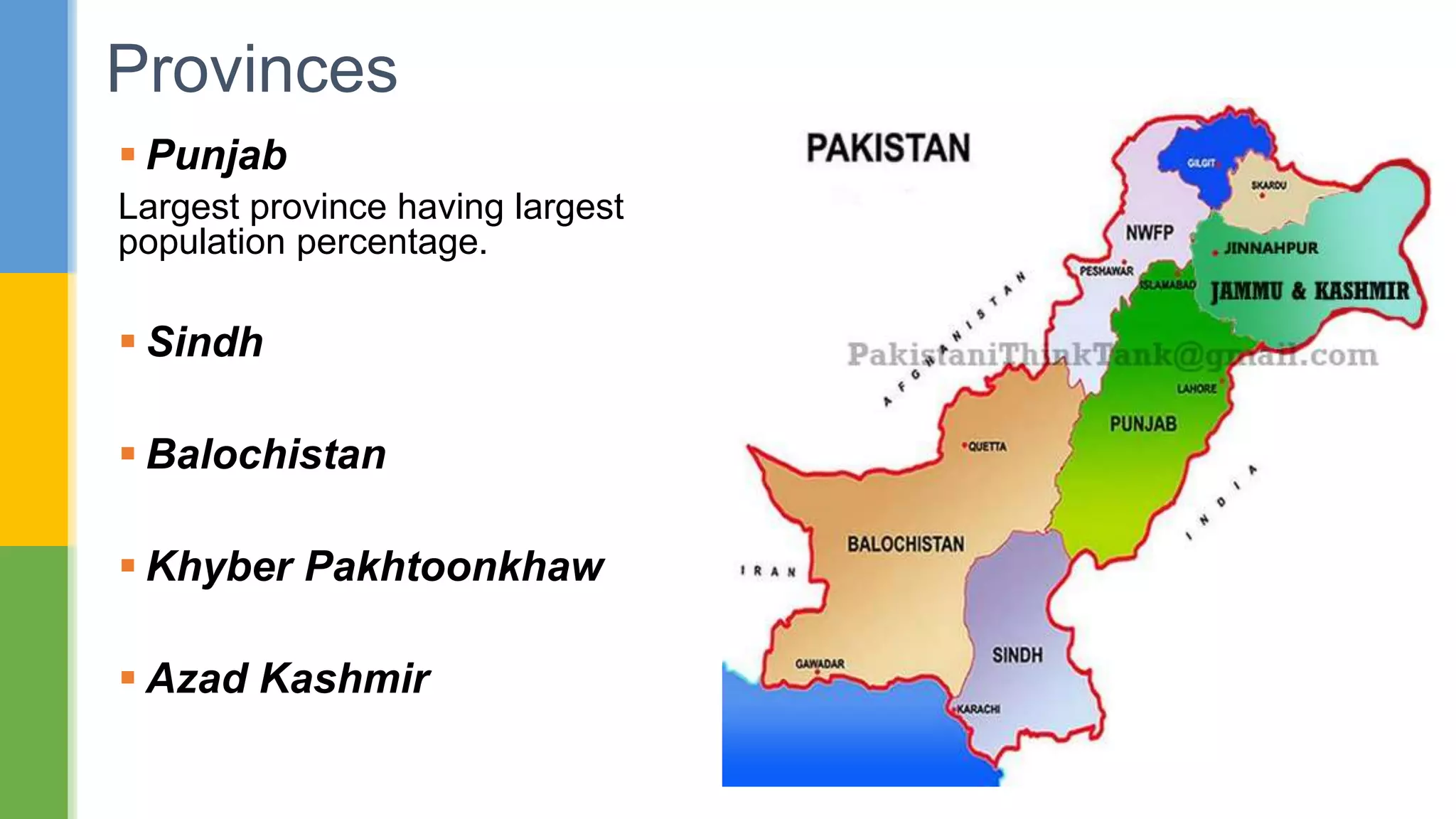
Provinces
 Punjab
Largest province having largest
population percentage.
 Sindh
 Balochistan
 Khyber Pakhtoonkhaw
 Azad Kashmir
 Mountains:
• K-2 , the second-highest peak of the
world.
• The Himalaya Range
• The Karakoram Range
• The Hindu Kush
• The Suleman Range
Natural Diversity
 Rivers & Sea:
• The Indus
• The Sutlej
• The Ravi
• The Jehlum
• The Chenab
• The Kabul
• Arabian Sea at extreme South
Natural Diversity
 Deserts:
• The Kharan Desert
Located in Kharan District
• The Thal
Located between Indus & Jehlum
• The Cholistan
Spans an area of 16000 square kilometer.
• The Thar
It is the seventh largest desert of the world and third
one in Asia & spans an area of 200,000
Natural Diversity
Lakes:
• Saif-al-Maluk
• Dadi patsar
• Ansu Jheel
• Attabad Lake
• Hanna Lake
Valleys:
• Chitral valley
• Kaghan valley
• Swat Kalam Valley
• Skardu
Natural Diversity
Climatic Conditions
• As Pakistan is located on a great
landmass north of the tropic of
cancer, it has a continental type of
climate characterized by extreme
variations of temperature, both
seasonally and daily. Very high
altitudes modify the climate in the
cold, snow-covered northern
mountains. Whereas most regions
have very hot days in summers &
very cold in winters. Pakistan lies in
moonson region & frequent rainfalls
& storms occur during the season
causing large scale destruction every
year.
Agriculture
• Pakistan's principal natural
resources are arable land and
water.The most agricultural
province is Punjab where wheat
and cotton are the most grown.
Some people also have mango
orchards
• Sugarcane, Rice , Maizes &
grains are also harvested at large
scale.
• Pakistan’s export reserves
consist largely of agricultural
products.
Natural Resources
• Pakistan is rich in natural
resources.
• Coal: Huge reserves of coal are
found in Sindh & Balochistan.
• Natutral Gas: There is a large
number of Gas fields in Balochistan
esp. in SUI Balochistan
• Salt mines: Khewra is the largest
salt mine in the world. Other two salt
mines are warcha & Kalabagh.
• Gold & precious metals: Gold
deposits are found in Reko dik
Balochistan. Furthermore, copper
manganese & iron is also found
there.
Geographyofpakistanfinal 140319145302-phpapp01

Geographyofpakistanfinal 140319145302-phpapp01

  • 1.
    A Presentation by: AliFaizan Wattoo Hamza Butt Muhammad Umair Qazi Muhammad Burhan bin Shoiab Muhammad Hassan Tariq Geography of Pakistan
  • 2.
    Contents:  Introduction toGeography of Pakistan  Map of Pakistan  Location & Neighbour Countries  Provinces  Natural Diversity  Climatic Conditions  Agriculture  Natural Resources
  • 3.
    Introduction The geography ofPakistan is a profound blend of landscapes varying from plains to deserts, forests, hills, and plateaus ranging from the coastal areas of the Arabian Sea in the south to the mountains of the Karakoram range in the north. Pakistan geologically overlaps both with the Indian and the Eurasian tectonic plates where its Sindh and Punjab provinces lie on the north- western corner of the Indian plate while Balochistan and most of the Khyber-Pakhtunkhwa lie within the Eurasian plate which mainly comprises the Iranian plateau, some parts of the Middle East and Central Asia. The Northern Areas and Azad Kashmir lie mainly in Central Asia along the edge of the Indian plate and hence are prone to violent earthquakes where the two tectonic plates collide.
  • 4.
  • 5.
    Location & NeighbourCountries  Location: • Pakistan is located between 23 degrees North to 37 degrees North Latitude and 61 degrees East to 77 degrees East Longitude.  Neighbours: • China lies in the north • Afghanistan and Iran are in the West • India lies in the East and • Arabian Sea in South
  • 6.
    Provinces  Punjab Largest provincehaving largest population percentage.  Sindh  Balochistan  Khyber Pakhtoonkhaw  Azad Kashmir
  • 7.
     Mountains: • K-2, the second-highest peak of the world. • The Himalaya Range • The Karakoram Range • The Hindu Kush • The Suleman Range Natural Diversity
  • 8.
     Rivers &Sea: • The Indus • The Sutlej • The Ravi • The Jehlum • The Chenab • The Kabul • Arabian Sea at extreme South Natural Diversity
  • 9.
     Deserts: • TheKharan Desert Located in Kharan District • The Thal Located between Indus & Jehlum • The Cholistan Spans an area of 16000 square kilometer. • The Thar It is the seventh largest desert of the world and third one in Asia & spans an area of 200,000 Natural Diversity
  • 10.
    Lakes: • Saif-al-Maluk • Dadipatsar • Ansu Jheel • Attabad Lake • Hanna Lake Valleys: • Chitral valley • Kaghan valley • Swat Kalam Valley • Skardu Natural Diversity
  • 11.
    Climatic Conditions • AsPakistan is located on a great landmass north of the tropic of cancer, it has a continental type of climate characterized by extreme variations of temperature, both seasonally and daily. Very high altitudes modify the climate in the cold, snow-covered northern mountains. Whereas most regions have very hot days in summers & very cold in winters. Pakistan lies in moonson region & frequent rainfalls & storms occur during the season causing large scale destruction every year.
  • 12.
    Agriculture • Pakistan's principalnatural resources are arable land and water.The most agricultural province is Punjab where wheat and cotton are the most grown. Some people also have mango orchards • Sugarcane, Rice , Maizes & grains are also harvested at large scale. • Pakistan’s export reserves consist largely of agricultural products.
  • 13.
    Natural Resources • Pakistanis rich in natural resources. • Coal: Huge reserves of coal are found in Sindh & Balochistan. • Natutral Gas: There is a large number of Gas fields in Balochistan esp. in SUI Balochistan • Salt mines: Khewra is the largest salt mine in the world. Other two salt mines are warcha & Kalabagh. • Gold & precious metals: Gold deposits are found in Reko dik Balochistan. Furthermore, copper manganese & iron is also found there.