Invasion Biology 7th March, 2019
Group
members
1
2
3
3 Noor Fatima
Muhammad Asghar Hassan
Guowei Gao
Delin Kang
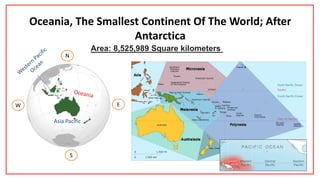
Oceania, The Smallest Continent Of The World; After
Antarctica
N
EW
S
Area: 8,525,989 Square kilometers
population of 40 million
Asia Pacific
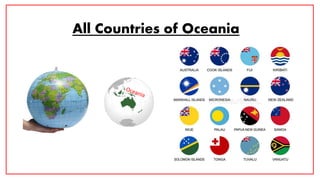
All Countries of Oceania
Management Of Invasive Species
• Invasive species are animals, plants, parasites or
disease causing organisms that establish outside their
natural range and become pests.
What Are Invasive Species?
 Conventional Control Methods  Trapping, Poisoning, Shooting
 Biological Control Methods
 Natural predators, parasites and disease-
carrying bacteria or viruses.
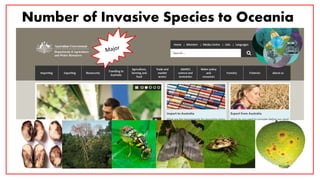
Number of Invasive Species to Oceania
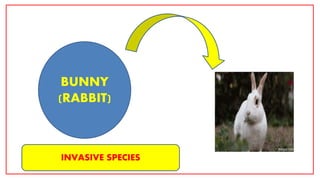
BUNNY
(RABBIT)
INVASIVE SPECIES
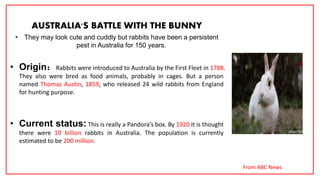
AUSTRALIA'S BATTLE WITH THE BUNNY
• They may look cute and cuddly but rabbits have been a persistent
pest in Australia for 150 years.
• Origin:Rabbits were introduced to Australia by the First Fleet in 1788.
They also were bred as food animals, probably in cages. But a person
named Thomas Austin, 1859, who released 24 wild rabbits from England
for hunting purpose.
• Current status: This is really a Pandora's box. By 1920 it is thought
there were 10 billion rabbits in Australia. The population is currently
estimated to be 200 million.
From ABC News
CONTROL
To prevent the rabbits' westward spread, the
government finished building three rabbit-proof
fences across the state in 1907. Unfortunately the
fences were a flop because rabbits had already
moved into the areas being fenced off.
Now we can’t image how many rabbit in
Australia . But Australia begin to use military
measures to slay rabbit.
INVASIVE SPECIES
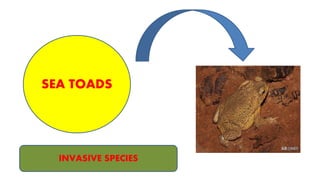
SEA TOADS
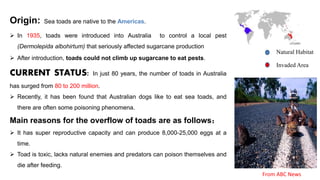
Origin: Sea toads are native to the Americas.
 In 1935, toads were introduced into Australia to control a local pest
(Dermolepida albohirtum) that seriously affected sugarcane production
 After introduction, toads could not climb up sugarcane to eat pests.
CURRENT STATUS: In just 80 years, the number of toads in Australia
has surged from 80 to 200 million.
 Recently, it has been found that Australian dogs like to eat sea toads, and
there are often some poisoning phenomena.
Main reasons for the overflow of toads are as follows:
 It has super reproductive capacity and can produce 8,000-25,000 eggs at a
time.
 Toad is toxic, lacks natural enemies and predators can poison themselves and
die after feeding.
Natural Habitat
Invaded Area
From ABC News
INVASIVE SPECIES
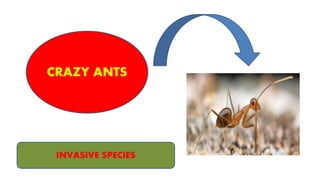
CRAZY ANTS
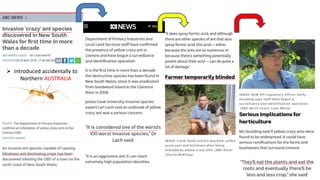
 Introduced accidentally to
Northern AUSTRALIA
Invasion biology
Invasion biology

Invasion biology

  • 1.
    Invasion Biology 7thMarch, 2019 Group members 1 2 3 3 Noor Fatima Muhammad Asghar Hassan Guowei Gao Delin Kang
  • 2.
    Oceania, The SmallestContinent Of The World; After Antarctica N EW S Area: 8,525,989 Square kilometers population of 40 million Asia Pacific
  • 3.
  • 4.
    Management Of InvasiveSpecies • Invasive species are animals, plants, parasites or disease causing organisms that establish outside their natural range and become pests. What Are Invasive Species?  Conventional Control Methods  Trapping, Poisoning, Shooting  Biological Control Methods  Natural predators, parasites and disease- carrying bacteria or viruses.
  • 5.
    Number of InvasiveSpecies to Oceania
  • 6.
  • 7.
    AUSTRALIA'S BATTLE WITHTHE BUNNY • They may look cute and cuddly but rabbits have been a persistent pest in Australia for 150 years. • Origin:Rabbits were introduced to Australia by the First Fleet in 1788. They also were bred as food animals, probably in cages. But a person named Thomas Austin, 1859, who released 24 wild rabbits from England for hunting purpose. • Current status: This is really a Pandora's box. By 1920 it is thought there were 10 billion rabbits in Australia. The population is currently estimated to be 200 million. From ABC News
  • 8.
    CONTROL To prevent therabbits' westward spread, the government finished building three rabbit-proof fences across the state in 1907. Unfortunately the fences were a flop because rabbits had already moved into the areas being fenced off. Now we can’t image how many rabbit in Australia . But Australia begin to use military measures to slay rabbit.
  • 9.
  • 10.
    Origin: Sea toadsare native to the Americas.  In 1935, toads were introduced into Australia to control a local pest (Dermolepida albohirtum) that seriously affected sugarcane production  After introduction, toads could not climb up sugarcane to eat pests. CURRENT STATUS: In just 80 years, the number of toads in Australia has surged from 80 to 200 million.  Recently, it has been found that Australian dogs like to eat sea toads, and there are often some poisoning phenomena. Main reasons for the overflow of toads are as follows:  It has super reproductive capacity and can produce 8,000-25,000 eggs at a time.  Toad is toxic, lacks natural enemies and predators can poison themselves and die after feeding. Natural Habitat Invaded Area From ABC News
  • 11.
  • 12.
     Introduced accidentallyto Northern AUSTRALIA