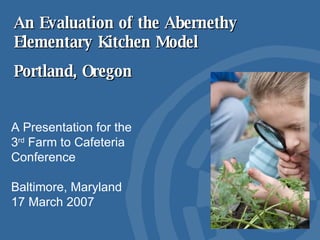
An Evaluation of the Abernethy Elementary Kitchen Model Portland, Oregon A Presentation for the 3 rd  Farm to Cafeteria Conference Baltimore, Maryland 17 March 2007
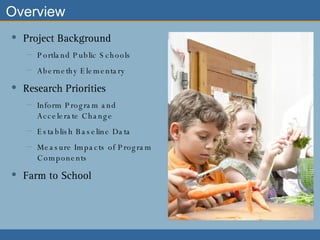
Overview  Project Background Portland Public Schools Abernethy Elementary Research Priorities Inform Program and Accelerate Change Establish Baseline Data Measure Impacts of Program Components  Farm to School
Research Methods – Year 1 Conduct a profit-loss analysis  Used to evaluate and compare costs and revenues of Abernethy model with traditional PPS model  Abernethy results compared to both district-wide results and results from a Control School  Perform a nutritional analysis  Used a standard USDA nutrient content analysis to evaluate and compare nutrient content of two models Monitored the number of servings of fruits and vegetables taken from the salad bar Monitor participation rates Used to evaluate and compare changes in student participation  Were calculated at a) Abernethy elementary, b) the Control School and c) elementary schools district-wide (i.e. the district average) Were broken down into full-paying, reduced pay, free-meal and adult categories
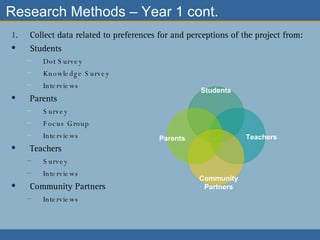
Research Methods – Year 1 cont. Collect data related to preferences for and perceptions of the project from:  Students Dot Survey Knowledge Survey Interviews Parents Survey Focus Group Interviews Teachers Survey Interviews Community Partners Interviews Students Parents Teachers Community Partners
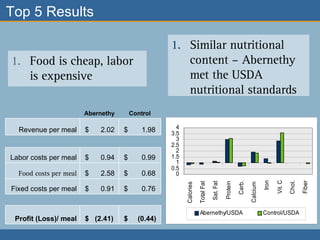
Top 5 Results Food is cheap, labor is expensive Similar nutritional content – Abernethy met the USDA nutritional standards $  (0.44) $  (2.41) Profit (Loss)/ meal $  0.76  $  0.91  Fixed costs per meal $  0.68 $  2.58 Food costs per meal $  0.99 $  0.94  Labor costs per meal $  1.98  $  2.02  Revenue per meal Control Abernethy
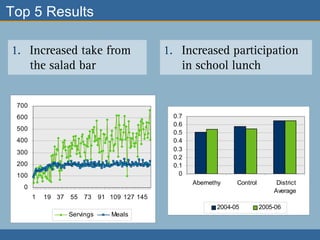
Top 5 Results Increased take from the salad bar Increased participation in school lunch
Top 5 Results  The program received overwhelming – although not unanimous – approval.  Students said:  “ Last year the food was like fast food.” – 4th Grader  “ I love the food [this year] because it is homemade.”  – 2nd Grader “ This year is the best. It’s all gourmet and grown up food. They think children aren’t capable of anything. No way”.   – 4th Grader “ My parents say it’s more healthy.” – 3rd Grader “ I am definitely eating more salad this year” – 4th Grader “ Bring corn dogs and chicken strips back!” – 4th Grader
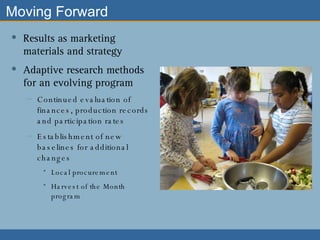
Moving Forward Results as marketing materials and strategy Adaptive research methods for an evolving program Continued evaluation of finances, production records and participation rates Establishment of new baselines for additional changes Local procurement Harvest of the Month program
Links www.abernethy.pps.k12.or.us www.ecotrust.org/farmtoschool

An Evaluation of the Abernethy Elementary Kitchen Model

  • 1.
    An Evaluation ofthe Abernethy Elementary Kitchen Model Portland, Oregon A Presentation for the 3 rd Farm to Cafeteria Conference Baltimore, Maryland 17 March 2007
  • 2.
    Overview ProjectBackground Portland Public Schools Abernethy Elementary Research Priorities Inform Program and Accelerate Change Establish Baseline Data Measure Impacts of Program Components Farm to School
  • 3.
    Research Methods –Year 1 Conduct a profit-loss analysis Used to evaluate and compare costs and revenues of Abernethy model with traditional PPS model Abernethy results compared to both district-wide results and results from a Control School Perform a nutritional analysis Used a standard USDA nutrient content analysis to evaluate and compare nutrient content of two models Monitored the number of servings of fruits and vegetables taken from the salad bar Monitor participation rates Used to evaluate and compare changes in student participation Were calculated at a) Abernethy elementary, b) the Control School and c) elementary schools district-wide (i.e. the district average) Were broken down into full-paying, reduced pay, free-meal and adult categories
  • 4.
    Research Methods –Year 1 cont. Collect data related to preferences for and perceptions of the project from: Students Dot Survey Knowledge Survey Interviews Parents Survey Focus Group Interviews Teachers Survey Interviews Community Partners Interviews Students Parents Teachers Community Partners
  • 5.
    Top 5 ResultsFood is cheap, labor is expensive Similar nutritional content – Abernethy met the USDA nutritional standards $ (0.44) $ (2.41) Profit (Loss)/ meal $ 0.76 $ 0.91 Fixed costs per meal $ 0.68 $ 2.58 Food costs per meal $ 0.99 $ 0.94 Labor costs per meal $ 1.98 $ 2.02 Revenue per meal Control Abernethy
  • 6.
    Top 5 ResultsIncreased take from the salad bar Increased participation in school lunch
  • 7.
    Top 5 Results The program received overwhelming – although not unanimous – approval. Students said: “ Last year the food was like fast food.” – 4th Grader “ I love the food [this year] because it is homemade.” – 2nd Grader “ This year is the best. It’s all gourmet and grown up food. They think children aren’t capable of anything. No way”. – 4th Grader “ My parents say it’s more healthy.” – 3rd Grader “ I am definitely eating more salad this year” – 4th Grader “ Bring corn dogs and chicken strips back!” – 4th Grader
  • 8.
    Moving Forward Resultsas marketing materials and strategy Adaptive research methods for an evolving program Continued evaluation of finances, production records and participation rates Establishment of new baselines for additional changes Local procurement Harvest of the Month program
  • 9.