An engineering perspective
on biometric sensor
integration in wearables
© 2017 Valencell, Inc
Dr. Michael Aumer
November 2017
© 2017 Valencell, Inc
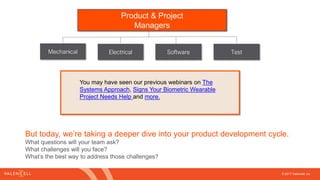
Software Test
Product & Project
Managers
ElectricalMechanical
You may have seen our previous webinars on The
Systems Approach, Signs Your Biometric Wearable
Project Needs Help and more.
But today, we’re taking a deeper dive into your product development cycle.
What questions will your team ask?
What challenges will you face?
What’s the best way to address those challenges?
© 2017 Valencell, Inc
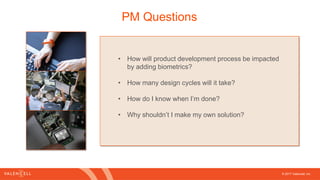
PM Questions
• How will product development process be impacted
by adding biometrics?
• How many design cycles will it take?
• How do I know when I’m done?
• Why shouldn’t I make my own solution?
© 2017 Valencell, Inc
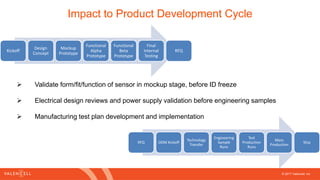
Impact to Product Development Cycle
Kickoff
Design
Concept
Mockup
Prototype
Functional
Alpha
Prototype
Functional
Beta
Prototype
Final
Internal
Testing
RFQ
RFQ ODM Kickoff
Technology
Transfer
Engineering
Sample
Runs
Test
Production
Runs
Mass
Production
Ship
➢ Validate form/fit/function of sensor in mockup stage, before ID freeze
➢ Electrical design reviews and power supply validation before engineering samples
➢ Manufacturing test plan development and implementation
© 2017 Valencell, Inc
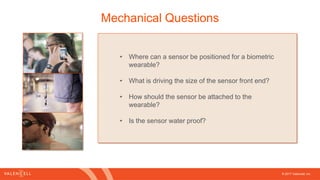
Mechanical Questions
• Where can a sensor be positioned for a biometric
wearable?
• What is driving the size of the sensor front end?
• How should the sensor be attached to the
wearable?
• Is the sensor water proof?
© 2017 Valencell, Inc
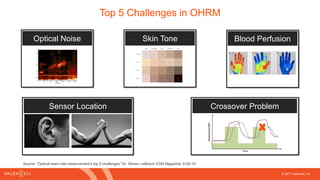
Top 5 Challenges in OHRM
Source: “Optical heart-rate measurement’s top 5 challenges” Dr. Steven LeBoeuf; EDN Magazine; 8-25-15
Optical Noise Skin Tone Blood Perfusion
Sensor Location Crossover Problem
© 2017 Valencell, Inc
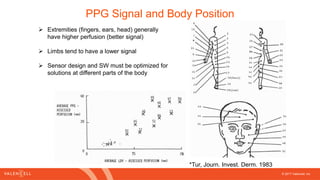
PPG Signal and Body Position
*Tur, Journ. Invest. Derm. 1983
➢ Extremities (fingers, ears, head) generally
have higher perfusion (better signal)
➢ Limbs tend to have a lower signal
➢ Sensor design and SW must be optimized for
solutions at different parts of the body
© 2017 Valencell, Inc
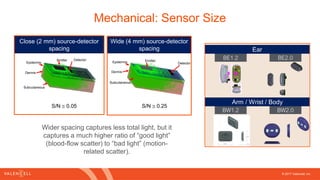
Mechanical: Sensor Size
Epidermis
Dermis
Subcutaneous
Emitter Detector
Close (2 mm) source-detector
spacing
Wide (4 mm) source-detector
spacing
Emitter
Detector
S/N  0.05 S/N  0.25
Wider spacing captures less total light, but it
captures a much higher ratio of “good light”
(blood-flow scatter) to “bad light” (motion-
related scatter).
Epidermis
Dermis
Subcutaneous
© 2017 Valencell, Inc
Ultrasonic Weld Considerations
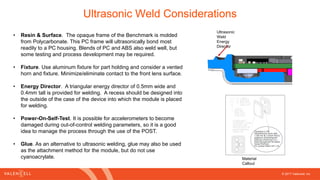
• Resin & Surface. The opaque frame of the Benchmark is molded
from Polycarbonate. This PC frame will ultrasonically bond most
readily to a PC housing. Blends of PC and ABS also weld well, but
some testing and process development may be required.
• Fixture. Use aluminum fixture for part holding and consider a vented
horn and fixture. Minimize/eliminate contact to the front lens surface.
• Energy Director. A triangular energy director of 0.5mm wide and
0.4mm tall is provided for welding. A recess should be designed into
the outside of the case of the device into which the module is placed
for welding.
• Power-On-Self-Test. It is possible for accelerometers to become
damaged during out-of-control welding parameters, so it is a good
idea to manage the process through the use of the POST.
• Glue. As an alternative to ultrasonic welding, glue may also be used
as the attachment method for the module, but do not use
cyanoacrylate.
Ultrasonic
Weld
Energy
Director
Material
Callout
© 2017 Valencell, Inc
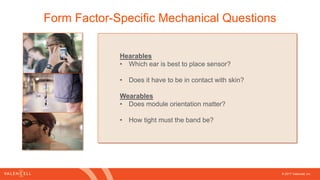
Form Factor-Specific Mechanical Questions
Hearables
• Which ear is best to place sensor?
• Does it have to be in contact with skin?
Wearables
• Does module orientation matter?
• How tight must the band be?
© 2017 Valencell, Inc
Electrical Questions
• Which interface method should be chosen?
• Where should the MCU be placed?
• How to ensure that electrical noise doesn’t degrade
biosensing performance?
© 2017 Valencell, Inc
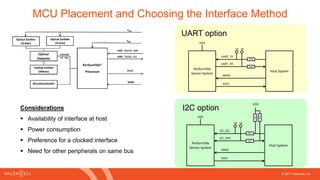
MCU Placement and Choosing the Interface Method
Host System
WAKE
POST
UART_RX
UART_TX
0 R
PerformTek
Sensor System
0 R
TP TP
VDD
Host System
WAKE
POST
I2C_SDA
I2C_SCL
0 R
PerformTek
Sensor System
0 R
TP TP
VDD
2K2
2K2
VDD
UART option
I2C optionConsiderations
▪ Availability of interface at host
▪ Power consumption
▪ Preference for a clocked interface
▪ Need for other peripherals on same bus
© 2017 Valencell, Inc
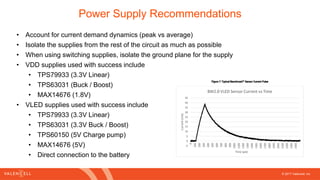
Power Supply Recommendations
• Account for current demand dynamics (peak vs average)
• Isolate the supplies from the rest of the circuit as much as possible
• When using switching supplies, isolate the ground plane for the supply
• VDD supplies used with success include
• TPS79933 (3.3V Linear)
• TPS63031 (Buck / Boost)
• MAX14676 (1.8V)
• VLED supplies used with success include
• TPS79933 (3.3V Linear)
• TPS63031 (3.3V Buck / Boost)
• TPS60150 (5V Charge pump)
• MAX14676 (5V)
• Direct connection to the battery
© 2017 Valencell, Inc
Software Questions
• What information must be supplied to the sensor
technology?
• What is directly measured and what is a derived
metric/assessment?
• How to implement assessments?
• How to optimize performance for different use
cases?
© 2017 Valencell, Inc
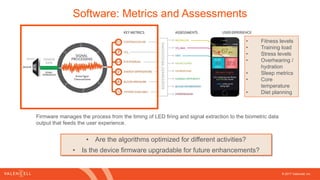
Software: Metrics and Assessments
• Fitness levels
• Training load
• Stress levels
• Overhearing /
hydration
• Sleep metrics
• Core
temperature
• Diet planning
Firmware manages the process from the timing of LED firing and signal extraction to the biometric data
output that feeds the user experience.
• Are the algorithms optimized for different activities?
• Is the device firmware upgradable for future enhancements?
© 2017 Valencell, Inc
Software: Optimizing for the Use Case
The PerformTek Interface Protocol Document and User Guide cover detailed information
required to integrate the module into system level software. Areas defined include:
• Design Approach
• Protocol Commands
• Example Data Flows
• Algorithm Configuration
Feature activation and algorithm configuration are the typical methods by which power consumption is
optimized for different use cases. Examples include:
• Workout session: Continuous HR, activity, and energy expenditure algorithms are running
• Daily living: HRM is configured to be in a different activity mode
• Stress assessment: RRI feature is activated to enable HRV statistical analysis
© 2017 Valencell, Inc
Testing Questions
• How accurate is my device?
• How will devices be tested in production?
© 2017 Valencell, Inc
Testing: Protocols and Independent Validation
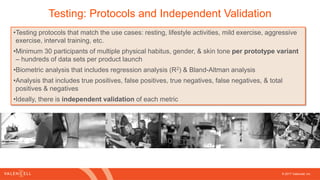
•Testing protocols that match the use cases: resting, lifestyle activities, mild exercise, aggressive
exercise, interval training, etc.
•Minimum 30 participants of multiple physical habitus, gender, & skin tone per prototype variant
– hundreds of data sets per product launch
•Biometric analysis that includes regression analysis (R2) & Bland-Altman analysis
•Analysis that includes true positives, false positives, true negatives, false negatives, & total
positives & negatives
•Ideally, there is independent validation of each metric
© 2017 Valencell, Inc
Testing: Production Test Fixture
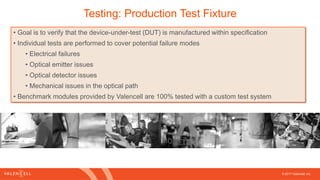
• Goal is to verify that the device-under-test (DUT) is manufactured within specification
• Individual tests are performed to cover potential failure modes
• Electrical failures
• Optical emitter issues
• Optical detector issues
• Mechanical issues in the optical path
• Benchmark modules provided by Valencell are 100% tested with a custom test system
©2016 Valencell. Inc
Dr. Michael Aumer
VP, R&D
aumer@valencell.com
www.valencell.com

An engineering perspective on biometric sensor integration in wearables

  • 1.
    An engineering perspective onbiometric sensor integration in wearables © 2017 Valencell, Inc Dr. Michael Aumer November 2017
  • 2.
    © 2017 Valencell,Inc Software Test Product & Project Managers ElectricalMechanical You may have seen our previous webinars on The Systems Approach, Signs Your Biometric Wearable Project Needs Help and more. But today, we’re taking a deeper dive into your product development cycle. What questions will your team ask? What challenges will you face? What’s the best way to address those challenges?
  • 3.
    © 2017 Valencell,Inc PM Questions • How will product development process be impacted by adding biometrics? • How many design cycles will it take? • How do I know when I’m done? • Why shouldn’t I make my own solution?
  • 4.
    © 2017 Valencell,Inc Impact to Product Development Cycle Kickoff Design Concept Mockup Prototype Functional Alpha Prototype Functional Beta Prototype Final Internal Testing RFQ RFQ ODM Kickoff Technology Transfer Engineering Sample Runs Test Production Runs Mass Production Ship ➢ Validate form/fit/function of sensor in mockup stage, before ID freeze ➢ Electrical design reviews and power supply validation before engineering samples ➢ Manufacturing test plan development and implementation
  • 5.
    © 2017 Valencell,Inc Mechanical Questions • Where can a sensor be positioned for a biometric wearable? • What is driving the size of the sensor front end? • How should the sensor be attached to the wearable? • Is the sensor water proof?
  • 6.
    © 2017 Valencell,Inc Top 5 Challenges in OHRM Source: “Optical heart-rate measurement’s top 5 challenges” Dr. Steven LeBoeuf; EDN Magazine; 8-25-15 Optical Noise Skin Tone Blood Perfusion Sensor Location Crossover Problem
  • 7.
    © 2017 Valencell,Inc PPG Signal and Body Position *Tur, Journ. Invest. Derm. 1983 ➢ Extremities (fingers, ears, head) generally have higher perfusion (better signal) ➢ Limbs tend to have a lower signal ➢ Sensor design and SW must be optimized for solutions at different parts of the body
  • 8.
    © 2017 Valencell,Inc Mechanical: Sensor Size Epidermis Dermis Subcutaneous Emitter Detector Close (2 mm) source-detector spacing Wide (4 mm) source-detector spacing Emitter Detector S/N  0.05 S/N  0.25 Wider spacing captures less total light, but it captures a much higher ratio of “good light” (blood-flow scatter) to “bad light” (motion- related scatter). Epidermis Dermis Subcutaneous
  • 9.
    © 2017 Valencell,Inc Ultrasonic Weld Considerations • Resin & Surface. The opaque frame of the Benchmark is molded from Polycarbonate. This PC frame will ultrasonically bond most readily to a PC housing. Blends of PC and ABS also weld well, but some testing and process development may be required. • Fixture. Use aluminum fixture for part holding and consider a vented horn and fixture. Minimize/eliminate contact to the front lens surface. • Energy Director. A triangular energy director of 0.5mm wide and 0.4mm tall is provided for welding. A recess should be designed into the outside of the case of the device into which the module is placed for welding. • Power-On-Self-Test. It is possible for accelerometers to become damaged during out-of-control welding parameters, so it is a good idea to manage the process through the use of the POST. • Glue. As an alternative to ultrasonic welding, glue may also be used as the attachment method for the module, but do not use cyanoacrylate. Ultrasonic Weld Energy Director Material Callout
  • 10.
    © 2017 Valencell,Inc Form Factor-Specific Mechanical Questions Hearables • Which ear is best to place sensor? • Does it have to be in contact with skin? Wearables • Does module orientation matter? • How tight must the band be?
  • 11.
    © 2017 Valencell,Inc Electrical Questions • Which interface method should be chosen? • Where should the MCU be placed? • How to ensure that electrical noise doesn’t degrade biosensing performance?
  • 12.
    © 2017 Valencell,Inc MCU Placement and Choosing the Interface Method Host System WAKE POST UART_RX UART_TX 0 R PerformTek Sensor System 0 R TP TP VDD Host System WAKE POST I2C_SDA I2C_SCL 0 R PerformTek Sensor System 0 R TP TP VDD 2K2 2K2 VDD UART option I2C optionConsiderations ▪ Availability of interface at host ▪ Power consumption ▪ Preference for a clocked interface ▪ Need for other peripherals on same bus
  • 13.
    © 2017 Valencell,Inc Power Supply Recommendations • Account for current demand dynamics (peak vs average) • Isolate the supplies from the rest of the circuit as much as possible • When using switching supplies, isolate the ground plane for the supply • VDD supplies used with success include • TPS79933 (3.3V Linear) • TPS63031 (Buck / Boost) • MAX14676 (1.8V) • VLED supplies used with success include • TPS79933 (3.3V Linear) • TPS63031 (3.3V Buck / Boost) • TPS60150 (5V Charge pump) • MAX14676 (5V) • Direct connection to the battery
  • 14.
    © 2017 Valencell,Inc Software Questions • What information must be supplied to the sensor technology? • What is directly measured and what is a derived metric/assessment? • How to implement assessments? • How to optimize performance for different use cases?
  • 15.
    © 2017 Valencell,Inc Software: Metrics and Assessments • Fitness levels • Training load • Stress levels • Overhearing / hydration • Sleep metrics • Core temperature • Diet planning Firmware manages the process from the timing of LED firing and signal extraction to the biometric data output that feeds the user experience. • Are the algorithms optimized for different activities? • Is the device firmware upgradable for future enhancements?
  • 16.
    © 2017 Valencell,Inc Software: Optimizing for the Use Case The PerformTek Interface Protocol Document and User Guide cover detailed information required to integrate the module into system level software. Areas defined include: • Design Approach • Protocol Commands • Example Data Flows • Algorithm Configuration Feature activation and algorithm configuration are the typical methods by which power consumption is optimized for different use cases. Examples include: • Workout session: Continuous HR, activity, and energy expenditure algorithms are running • Daily living: HRM is configured to be in a different activity mode • Stress assessment: RRI feature is activated to enable HRV statistical analysis
  • 17.
    © 2017 Valencell,Inc Testing Questions • How accurate is my device? • How will devices be tested in production?
  • 18.
    © 2017 Valencell,Inc Testing: Protocols and Independent Validation •Testing protocols that match the use cases: resting, lifestyle activities, mild exercise, aggressive exercise, interval training, etc. •Minimum 30 participants of multiple physical habitus, gender, & skin tone per prototype variant – hundreds of data sets per product launch •Biometric analysis that includes regression analysis (R2) & Bland-Altman analysis •Analysis that includes true positives, false positives, true negatives, false negatives, & total positives & negatives •Ideally, there is independent validation of each metric
  • 19.
    © 2017 Valencell,Inc Testing: Production Test Fixture • Goal is to verify that the device-under-test (DUT) is manufactured within specification • Individual tests are performed to cover potential failure modes • Electrical failures • Optical emitter issues • Optical detector issues • Mechanical issues in the optical path • Benchmark modules provided by Valencell are 100% tested with a custom test system
  • 20.
  • 21.
    ©2016 Valencell. Inc Dr.Michael Aumer VP, R&D aumer@valencell.com www.valencell.com