An Empirical Study of Spreadsheet
Authors’ Mental Models in
Explaining and Debugging Tasks
Bennett Kankuzi, Jorma Sajaniemi
School of Computing, Joensuu Campus
University of Eastern Finland, Finland
Outline
•Introduction
•Methodology
•Results
•Discussion
•Conclusion
16.9.2013Kankuzi, Sajaniemi VL/HCC 2013 2
Introduction
•Many spreadsheets have non-trivial errors (Panko, 1998;
Powell et. al, 2009)
•The spreadsheet comprehension and debugging
problem is still very much there
•It is important to understand spreadsheet authors’
mental models when doing different spreadsheet
process activities
– can help to understand why the spreadsheet process is so error-prone
– can help to develop the right tools and techniques for spreadsheet
activities
16.9.2013Kankuzi, Sajaniemi VL/HCC 2013 3
Introduction (cont’d)
•Research Question:
– what are the mental models of spreadsheet authors when they are
working with spreadsheets?
•Mental model - “a mental image of the world around us
that we carry in our heads depicting only selected
concepts and relationships that represent real systems”
(Doyle & Ford, 1998)
•What are those aspects of the spreadsheet that a
spreadsheet user finds appropriate for the task he or she
has at hand?
16.9.2013Kankuzi, Sajaniemi VL/HCC 2013 4
Methodology
•Study organized into two activities
– first activity dwelt on an explaining task while second activity
involved a debugging task
•In the explaining task:
– each participant requested to explain their own chosen
spreadsheet to the researcher
•Debugging task:
– each participant given an erroneous copy of their spreadsheet and
asked to locate the seeded errors and to fix them
16.9.2013Kankuzi, Sajaniemi VL/HCC 2013 5
Methodology (cont’d)
•Adapted Good’s program summary analysis in analysis
of transcript content
•Each object reference coded on a yes/no scale with
respect to three object types: “real-world”, “domain-
specific”, and “spreadsheet-specific”
16.9.2013Kankuzi, Sajaniemi VL/HCC 2013 6
Results
16.9.2013Kankuzi, Sajaniemi VL/HCC 2013 7
Discussion
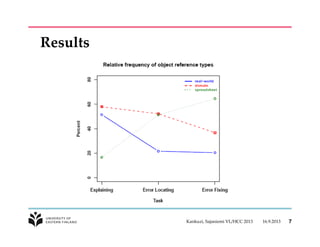
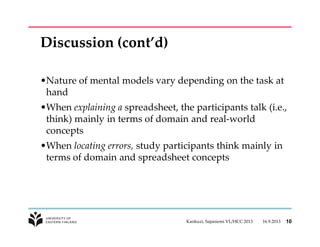
•Nature of mental models vary depending on the task at
hand
•When explaining a spreadsheet, the participants talk (i.e.,
think) mainly in terms of domain and real-world
concepts
•When locating errors, study participants think mainly in
terms of domain and spreadsheet concepts
16.9.2013Kankuzi, Sajaniemi VL/HCC 2013 8
Discussion (cont’d)
16.9.2013Kankuzi, Sajaniemi VL/HCC 2013 9
Discussion (cont’d)
•Nature of mental models vary depending on the task at
hand
•When explaining a spreadsheet, the participants talk (i.e.,
think) mainly in terms of domain and real-world
concepts
•When locating errors, study participants think mainly in
terms of domain and spreadsheet concepts
16.9.2013Kankuzi, Sajaniemi VL/HCC 2013 10
Discussion (cont’d)
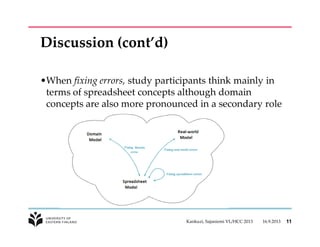
•When fixing errors, study participants think mainly in
terms of spreadsheet concepts although domain
concepts are also more pronounced in a secondary role
16.9.2013Kankuzi, Sajaniemi VL/HCC 2013 11
Discussion (cont’d)
Implications for Tool Development:
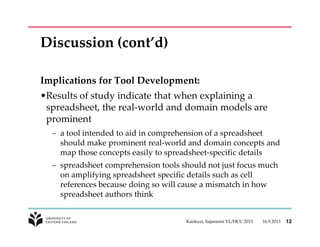
•Results of study indicate that when explaining a
spreadsheet, the real-world and domain models are
prominent
– a tool intended to aid in comprehension of a spreadsheet
should make prominent real-world and domain concepts and
map those concepts easily to spreadsheet-specific details
– spreadsheet comprehension tools should not just focus much
on amplifying spreadsheet specific details such as cell
references because doing so will cause a mismatch in how
spreadsheet authors think
16.9.2013Kankuzi, Sajaniemi VL/HCC 2013 12
Discussion (cont’d)
Implications for Tool Development:
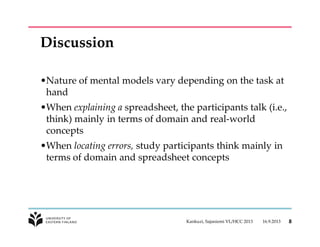
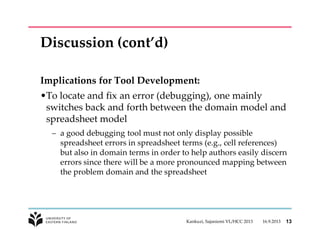
•To locate and fix an error (debugging), one mainly
switches back and forth between the domain model and
spreadsheet model
– a good debugging tool must not only display possible
spreadsheet errors in spreadsheet terms (e.g., cell references)
but also in domain terms in order to help authors easily discern
errors since there will be a more pronounced mapping between
the problem domain and the spreadsheet
16.9.2013Kankuzi, Sajaniemi VL/HCC 2013 13
Conclusion
•Reported on an empirical study carried out to explore
the nature of mental models of spreadsheet authors
when explaining and debugging own spreadsheets
•Found that the nature of mental models vary depending
on the task at hand
•Findings provide insights on the need for developing
spreadsheet authoring and debugging tools that
correspond to spreadsheet authors’ mental models
given the task at hand
16.9.2013Kankuzi, Sajaniemi VL/HCC 2013 14
Thank you for your attention!
www.uef.fi

An Empirical Study of Spreadsheet Authors’ Mental Models in Explaining and Debugging Tasks

  • 1.
    An Empirical Studyof Spreadsheet Authors’ Mental Models in Explaining and Debugging Tasks Bennett Kankuzi, Jorma Sajaniemi School of Computing, Joensuu Campus University of Eastern Finland, Finland
  • 2.
  • 3.
    Introduction •Many spreadsheets havenon-trivial errors (Panko, 1998; Powell et. al, 2009) •The spreadsheet comprehension and debugging problem is still very much there •It is important to understand spreadsheet authors’ mental models when doing different spreadsheet process activities – can help to understand why the spreadsheet process is so error-prone – can help to develop the right tools and techniques for spreadsheet activities 16.9.2013Kankuzi, Sajaniemi VL/HCC 2013 3
  • 4.
    Introduction (cont’d) •Research Question: –what are the mental models of spreadsheet authors when they are working with spreadsheets? •Mental model - “a mental image of the world around us that we carry in our heads depicting only selected concepts and relationships that represent real systems” (Doyle & Ford, 1998) •What are those aspects of the spreadsheet that a spreadsheet user finds appropriate for the task he or she has at hand? 16.9.2013Kankuzi, Sajaniemi VL/HCC 2013 4
  • 5.
    Methodology •Study organized intotwo activities – first activity dwelt on an explaining task while second activity involved a debugging task •In the explaining task: – each participant requested to explain their own chosen spreadsheet to the researcher •Debugging task: – each participant given an erroneous copy of their spreadsheet and asked to locate the seeded errors and to fix them 16.9.2013Kankuzi, Sajaniemi VL/HCC 2013 5
  • 6.
    Methodology (cont’d) •Adapted Good’sprogram summary analysis in analysis of transcript content •Each object reference coded on a yes/no scale with respect to three object types: “real-world”, “domain- specific”, and “spreadsheet-specific” 16.9.2013Kankuzi, Sajaniemi VL/HCC 2013 6
  • 7.
  • 8.
    Discussion •Nature of mentalmodels vary depending on the task at hand •When explaining a spreadsheet, the participants talk (i.e., think) mainly in terms of domain and real-world concepts •When locating errors, study participants think mainly in terms of domain and spreadsheet concepts 16.9.2013Kankuzi, Sajaniemi VL/HCC 2013 8
  • 9.
  • 10.
    Discussion (cont’d) •Nature ofmental models vary depending on the task at hand •When explaining a spreadsheet, the participants talk (i.e., think) mainly in terms of domain and real-world concepts •When locating errors, study participants think mainly in terms of domain and spreadsheet concepts 16.9.2013Kankuzi, Sajaniemi VL/HCC 2013 10
  • 11.
    Discussion (cont’d) •When fixingerrors, study participants think mainly in terms of spreadsheet concepts although domain concepts are also more pronounced in a secondary role 16.9.2013Kankuzi, Sajaniemi VL/HCC 2013 11
  • 12.
    Discussion (cont’d) Implications forTool Development: •Results of study indicate that when explaining a spreadsheet, the real-world and domain models are prominent – a tool intended to aid in comprehension of a spreadsheet should make prominent real-world and domain concepts and map those concepts easily to spreadsheet-specific details – spreadsheet comprehension tools should not just focus much on amplifying spreadsheet specific details such as cell references because doing so will cause a mismatch in how spreadsheet authors think 16.9.2013Kankuzi, Sajaniemi VL/HCC 2013 12
  • 13.
    Discussion (cont’d) Implications forTool Development: •To locate and fix an error (debugging), one mainly switches back and forth between the domain model and spreadsheet model – a good debugging tool must not only display possible spreadsheet errors in spreadsheet terms (e.g., cell references) but also in domain terms in order to help authors easily discern errors since there will be a more pronounced mapping between the problem domain and the spreadsheet 16.9.2013Kankuzi, Sajaniemi VL/HCC 2013 13
  • 14.
    Conclusion •Reported on anempirical study carried out to explore the nature of mental models of spreadsheet authors when explaining and debugging own spreadsheets •Found that the nature of mental models vary depending on the task at hand •Findings provide insights on the need for developing spreadsheet authoring and debugging tools that correspond to spreadsheet authors’ mental models given the task at hand 16.9.2013Kankuzi, Sajaniemi VL/HCC 2013 14
  • 15.
    Thank you foryour attention! www.uef.fi