Visualizing the Problem Domain 
for Spreadsheet Users: A Mental 
Model Perspective 
Bennett Kankuzi, Jorma Sajaniemi 
School of Computing, Joensuu Campus 
University of Eastern Finland, Finland
Outline 
•Introduction 
•Description of Proposed Tool 
•Evaluation of the Tool (Methodology, Results 
and Discussion) 
•Conclusion 
Kankuzi, Sajaniemi VL/HCC 2014 1.8.2014 2
Introduction 
•A mental model can be defined as “a mental image of 
the world around us that we carry in our heads 
depicting only selected concepts and relationships that 
represent real systems” (Doyle & Ford, 1998) 
– a mental model for a spreadsheet, therefore, does not 
carry all possible information, but just those aspects 
that the user finds appropriate for the current task 
Kankuzi, Sajaniemi VL/HCC 2014 1.8.2014 3
Introduction (cont’d) 
•Important to understand spreadsheet authors’ mental 
models when doing different spreadsheet process 
activities 
– to understand why the spreadsheet process is so 
error-prone 
– to develop the right tools and techniques for 
spreadsheet activities 
Kankuzi, Sajaniemi VL/HCC 2014 1.8.2014 4
Introduction (cont’d) 
•Spreadsheet authors have at least three mental models: 
real-world, domain and spreadsheet models (Kankuzi & 
Sajaniemi, 2013) 
– the real-world model that comprises general knowledge 
of the world around us e.g. “motor vehicle” 
– the domain model that represents knowledge of the 
problem domain and the functionality of the spreadsheet 
in problem domain or application terms e.g. “fixed 
assets” 
– the spreadsheet model that codes the expressions and 
data relationships in the spreadsheet e.g. “cell B1” 
Kankuzi, Sajaniemi VL/HCC 2014 1.8.2014 5
Introduction (cont’d) 
•Research Question: 
– Is it possible to develop an easy to use spreadsheet 
understanding and debugging tool that relieves 
users from spreadsheet details and lets them utilize 
more of their mental model of the application 
domain and hence improving the mapping between 
the domain/real-world mental models and the 
spreadsheet mental model? 
Kankuzi, Sajaniemi VL/HCC 2014 1.8.2014 6
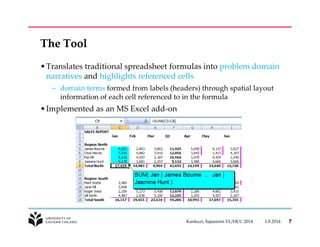
The Tool 
•Translates traditional spreadsheet formulas into problem domain 
narratives and highlights referenced cells 
– domain terms formed from labels (headers) through spatial layout 
information of each cell referenced to in the formula 
•Implemented as an MS Excel add-on 
Kankuzi, Sajaniemi VL/HCC 2014 1.8.2014 7
Related Tools and Techniques 
•In spreadsheets, symbolic names and formula translation have been 
used with the hope to clarify the mapping between various levels 
of abstraction 
– use of named ranges such as in MS Excel and Google Spreadsheets 
– some spreadsheet visualization tools also do formula translations e.g. 
Spreadsheet Professional 
– model-driven spreadsheet development approaches such as 
ClassSheet models (Engels & Erwig, 2005) also translate formulas to 
more humanized higher level object oriented style formulas 
•All these tools and techniques anecdotally assume that symbolic 
names and formula translation are useful to spreadsheet authors, 
but their usability has not been empirically evaluated nor 
psychologically justified 
Kankuzi, Sajaniemi VL/HCC 2014 1.8.2014 8
Evaluation of Tool - Overview 
•Adapted Nielsen’s usability attributes of learnability, efficiency and 
satisfaction (Nielsen, 1994) in the evaluation tasks 
– evaluation involved 12 volunteering accountants (one woman and 
eleven men) who are frequent users of spreadsheets 
– none of the participants had participated earlier in similar studies 
– first author visited each participant at their place of work 
•Also investigated on effect of tool on the mental models of 
spreadsheet authors 
Kankuzi, Sajaniemi VL/HCC 2014 1.8.2014 9
Evaluation of Tool - Learnability 
•Methodology 
– short demo followed by two tasks 
•Results 
– highlighting task (mark a narrated area on spreadsheet): mean 85% 
correct (min 60%, max 100%) 
– translation task (convert narration into spreadsheet terms): mean 83% 
correct (min 60%, max 100%) 
•Discussion 
– good enough to proceed to the other evaluation tasks 
Kankuzi, Sajaniemi VL/HCC 2014 1.8.2014 10
Evaluation of Tool - Efficiency 
•Methodology 
– within-subjects design experiment where the task was to locate errors 
in a spreadsheet without the tool and with the tool 
– two roughly equivalent spreadsheets sourced from EUSES 
spreadsheet corpus (Fisher & Rothermel, 2005) seeded with similar 
errors adapted from Raffensperger(2005) and Duggirala(2012) 
– some error types for seeded errors 
• Formula accidentally overwritten with constants (Error Type C) 
• Formula missing some range (Error Type D) 
• A wrong problem domain formula (Error Type G) 
Kankuzi, Sajaniemi VL/HCC 2014 1.8.2014 11
Evaluation of Tool - Efficiency (cont’d) 
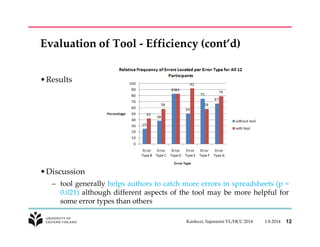
•Results 
•Discussion 
– tool generally helps authors to catch more errors in spreadsheets (p = 
0.021) although different aspects of the tool may be more helpful for 
some error types than others 
Kankuzi, Sajaniemi VL/HCC 2014 1.8.2014 12
Evaluation of Tool - Satisfaction 
•Methodology 
– participants were requested to write down their opinion of the two 
scenarios in terms of how they find it easier to locate errors as well as 
well as any suggested improvements to the tool 
•Results 
– eleven out of the twelve participants found the tool helpful in locating 
errors 
– one participant said that he found the tool confusing as he is used to 
the “normal Excel” 
•Discussion 
– generally, participants found the tool useful 
Kankuzi, Sajaniemi VL/HCC 2014 1.8.2014 13
Evaluation of Tool - Effect on Mental Models of 
Users 
•Methodology 
– nine of the twelve participants wrote down explanations for 
each of the located errors in the assigned tasks 
– explanations were analyzed and classified using an inter-rater 
reliability verified adaptation of Good’s program summary 
analysis technique in which each object/noun is classified as 
spreadsheet specific or domain specific or real-world specific 
(Kankuzi & Sajaniemi, 2013) 
•e.g. “column D” is classified as spreadsheet specific; ``total 
liabilities’’ is classified as domain specific; and “money” is 
classified as real-world specific 
Kankuzi, Sajaniemi VL/HCC 2014 1.8.2014 14
Evaluation of Tool – Effect on Mental Models 
of Users (cont’d) 
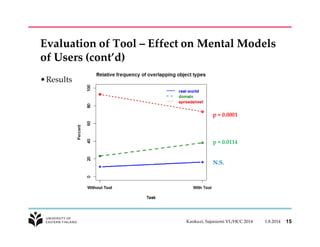
•Results 
p = 0.0001 
p = 0.0114 
N.S. 
Kankuzi, Sajaniemi VL/HCC 2014 1.8.2014 15
Evaluation of Tool - Effect on Mental Models of 
Users (cont’d) 
•Discussion 
– participants used mostly spreadsheet terms when describing an error 
in the without tool case while with the tool, the spreadsheet model is 
less prominent whereas the share of the domain model increases 
– tool, therefore, improves the mapping between the spreadsheet and 
domain models which makes understanding and debugging 
spreadsheets more efficient (located more errors with the tool) 
Kankuzi, Sajaniemi VL/HCC 2014 1.8.2014 16
Conclusion 
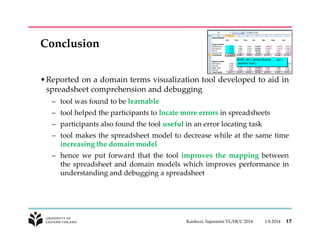
•Reported on a domain terms visualization tool developed to aid in 
spreadsheet comprehension and debugging 
– tool was found to be learnable 
– tool helped the participants to locate more errors in spreadsheets 
– participants also found the tool useful in an error locating task 
– tool makes the spreadsheet model to decrease while at the same time 
increasing the domain model 
– hence we put forward that the tool improves the mapping between 
the spreadsheet and domain models which improves performance in 
understanding and debugging a spreadsheet 
Kankuzi, Sajaniemi VL/HCC 2014 1.8.2014 17
Thank you for your attention! 
www.uef.fi
References 
1. B. Kankuzi and J. Sajaniemi, “An Empirical Study of Spreadsheet Authors’ 
Mental Models in Explaining and Debugging Tasks,” in 2013 IEEE Symposium on 
Visual Languages and Human-Centric Computing (VL/HCC). IEEE, 2013, pp. 15–18. 
2. J. Nielsen, Usability Engineering. Boston: AP Professional, 1994 
3. M. Wertheimer, A Source Book of Gestalt Psychology. London: Routledge & Kegan 
Paul, 1938. 
4. M. Fisher and G. Rothermel, “The EUSES spreadsheet corpus: a shared resource 
for supporting experimentation with spreadsheet dependability mechanisms,” in 
Proceedings of the First Workshop on End-User Software Engineering, ser. WEUSE I. 
New York, NY, USA: ACM, 2005, pp. 1–5. 
5. J. Sajaniemi, “Modeling spreadsheet audit: A rigorous approach to automatic 
visualization,” Journal of Visual Languages & Computing, vol. 11, no. 1, pp. 49– 
82, 2000. 
6. J. S. Davis, “Tools for spreadsheet auditing,” International Journal of Human- 
Computer Studies, vol. 45, no. 4, pp. 429–442, 1996. 
Kankuzi, Sajaniemi VL/HCC 2014 1.8.2014 19
References (cont’d) 
5. R. Desimone and J. Duncan, “Neural Mechanisms of Selective Visual Attention,” 
Annual Review of Neurosciences, vol. 18, pp. 193–222, 1995. 
6. P. Duggirala, Excel Auditing Functions [Spreadsheet Risk Management – Part 3 
of 4], 2012, accessed December 2012. [Online]. Available: 
http://chandoo.org/wp/2012/01/18/excel-auditing-functions/ 
7. G. Engels and M. Erwig, “ClassSheets: automatic generation of spreadsheet 
applications from object-oriented specifications,” in Proceedings of the 20th 
IEEE/ACM International Conference on Automated Software Engineering. ACM, 
2005, pp. 124–133. 
8. J. F. Raffensperger, The Art of the Spreadsheet, 2008, accessed December 2012. 
[Online]. Available: http://john.raffensperger.org/john/ArtOfTheSpreadsheet/ 
9. J. K. Doyle and D. N. Ford, “Mental Models Concepts for System Dynamics 
Research,” System Dynamics Review, vol. 14, no. 1, pp. 3–29, 1998. 
Kankuzi, Sajaniemi VL/HCC 2014 1.8.2014 20

Visualizing the Problem Domain for Spreadsheet Users: A Mental Model Perspective

  • 1.
    Visualizing the ProblemDomain for Spreadsheet Users: A Mental Model Perspective Bennett Kankuzi, Jorma Sajaniemi School of Computing, Joensuu Campus University of Eastern Finland, Finland
  • 2.
    Outline •Introduction •Descriptionof Proposed Tool •Evaluation of the Tool (Methodology, Results and Discussion) •Conclusion Kankuzi, Sajaniemi VL/HCC 2014 1.8.2014 2
  • 3.
    Introduction •A mentalmodel can be defined as “a mental image of the world around us that we carry in our heads depicting only selected concepts and relationships that represent real systems” (Doyle & Ford, 1998) – a mental model for a spreadsheet, therefore, does not carry all possible information, but just those aspects that the user finds appropriate for the current task Kankuzi, Sajaniemi VL/HCC 2014 1.8.2014 3
  • 4.
    Introduction (cont’d) •Importantto understand spreadsheet authors’ mental models when doing different spreadsheet process activities – to understand why the spreadsheet process is so error-prone – to develop the right tools and techniques for spreadsheet activities Kankuzi, Sajaniemi VL/HCC 2014 1.8.2014 4
  • 5.
    Introduction (cont’d) •Spreadsheetauthors have at least three mental models: real-world, domain and spreadsheet models (Kankuzi & Sajaniemi, 2013) – the real-world model that comprises general knowledge of the world around us e.g. “motor vehicle” – the domain model that represents knowledge of the problem domain and the functionality of the spreadsheet in problem domain or application terms e.g. “fixed assets” – the spreadsheet model that codes the expressions and data relationships in the spreadsheet e.g. “cell B1” Kankuzi, Sajaniemi VL/HCC 2014 1.8.2014 5
  • 6.
    Introduction (cont’d) •ResearchQuestion: – Is it possible to develop an easy to use spreadsheet understanding and debugging tool that relieves users from spreadsheet details and lets them utilize more of their mental model of the application domain and hence improving the mapping between the domain/real-world mental models and the spreadsheet mental model? Kankuzi, Sajaniemi VL/HCC 2014 1.8.2014 6
  • 7.
    The Tool •Translatestraditional spreadsheet formulas into problem domain narratives and highlights referenced cells – domain terms formed from labels (headers) through spatial layout information of each cell referenced to in the formula •Implemented as an MS Excel add-on Kankuzi, Sajaniemi VL/HCC 2014 1.8.2014 7
  • 8.
    Related Tools andTechniques •In spreadsheets, symbolic names and formula translation have been used with the hope to clarify the mapping between various levels of abstraction – use of named ranges such as in MS Excel and Google Spreadsheets – some spreadsheet visualization tools also do formula translations e.g. Spreadsheet Professional – model-driven spreadsheet development approaches such as ClassSheet models (Engels & Erwig, 2005) also translate formulas to more humanized higher level object oriented style formulas •All these tools and techniques anecdotally assume that symbolic names and formula translation are useful to spreadsheet authors, but their usability has not been empirically evaluated nor psychologically justified Kankuzi, Sajaniemi VL/HCC 2014 1.8.2014 8
  • 9.
    Evaluation of Tool- Overview •Adapted Nielsen’s usability attributes of learnability, efficiency and satisfaction (Nielsen, 1994) in the evaluation tasks – evaluation involved 12 volunteering accountants (one woman and eleven men) who are frequent users of spreadsheets – none of the participants had participated earlier in similar studies – first author visited each participant at their place of work •Also investigated on effect of tool on the mental models of spreadsheet authors Kankuzi, Sajaniemi VL/HCC 2014 1.8.2014 9
  • 10.
    Evaluation of Tool- Learnability •Methodology – short demo followed by two tasks •Results – highlighting task (mark a narrated area on spreadsheet): mean 85% correct (min 60%, max 100%) – translation task (convert narration into spreadsheet terms): mean 83% correct (min 60%, max 100%) •Discussion – good enough to proceed to the other evaluation tasks Kankuzi, Sajaniemi VL/HCC 2014 1.8.2014 10
  • 11.
    Evaluation of Tool- Efficiency •Methodology – within-subjects design experiment where the task was to locate errors in a spreadsheet without the tool and with the tool – two roughly equivalent spreadsheets sourced from EUSES spreadsheet corpus (Fisher & Rothermel, 2005) seeded with similar errors adapted from Raffensperger(2005) and Duggirala(2012) – some error types for seeded errors • Formula accidentally overwritten with constants (Error Type C) • Formula missing some range (Error Type D) • A wrong problem domain formula (Error Type G) Kankuzi, Sajaniemi VL/HCC 2014 1.8.2014 11
  • 12.
    Evaluation of Tool- Efficiency (cont’d) •Results •Discussion – tool generally helps authors to catch more errors in spreadsheets (p = 0.021) although different aspects of the tool may be more helpful for some error types than others Kankuzi, Sajaniemi VL/HCC 2014 1.8.2014 12
  • 13.
    Evaluation of Tool- Satisfaction •Methodology – participants were requested to write down their opinion of the two scenarios in terms of how they find it easier to locate errors as well as well as any suggested improvements to the tool •Results – eleven out of the twelve participants found the tool helpful in locating errors – one participant said that he found the tool confusing as he is used to the “normal Excel” •Discussion – generally, participants found the tool useful Kankuzi, Sajaniemi VL/HCC 2014 1.8.2014 13
  • 14.
    Evaluation of Tool- Effect on Mental Models of Users •Methodology – nine of the twelve participants wrote down explanations for each of the located errors in the assigned tasks – explanations were analyzed and classified using an inter-rater reliability verified adaptation of Good’s program summary analysis technique in which each object/noun is classified as spreadsheet specific or domain specific or real-world specific (Kankuzi & Sajaniemi, 2013) •e.g. “column D” is classified as spreadsheet specific; ``total liabilities’’ is classified as domain specific; and “money” is classified as real-world specific Kankuzi, Sajaniemi VL/HCC 2014 1.8.2014 14
  • 15.
    Evaluation of Tool– Effect on Mental Models of Users (cont’d) •Results p = 0.0001 p = 0.0114 N.S. Kankuzi, Sajaniemi VL/HCC 2014 1.8.2014 15
  • 16.
    Evaluation of Tool- Effect on Mental Models of Users (cont’d) •Discussion – participants used mostly spreadsheet terms when describing an error in the without tool case while with the tool, the spreadsheet model is less prominent whereas the share of the domain model increases – tool, therefore, improves the mapping between the spreadsheet and domain models which makes understanding and debugging spreadsheets more efficient (located more errors with the tool) Kankuzi, Sajaniemi VL/HCC 2014 1.8.2014 16
  • 17.
    Conclusion •Reported ona domain terms visualization tool developed to aid in spreadsheet comprehension and debugging – tool was found to be learnable – tool helped the participants to locate more errors in spreadsheets – participants also found the tool useful in an error locating task – tool makes the spreadsheet model to decrease while at the same time increasing the domain model – hence we put forward that the tool improves the mapping between the spreadsheet and domain models which improves performance in understanding and debugging a spreadsheet Kankuzi, Sajaniemi VL/HCC 2014 1.8.2014 17
  • 18.
    Thank you foryour attention! www.uef.fi
  • 19.
    References 1. B.Kankuzi and J. Sajaniemi, “An Empirical Study of Spreadsheet Authors’ Mental Models in Explaining and Debugging Tasks,” in 2013 IEEE Symposium on Visual Languages and Human-Centric Computing (VL/HCC). IEEE, 2013, pp. 15–18. 2. J. Nielsen, Usability Engineering. Boston: AP Professional, 1994 3. M. Wertheimer, A Source Book of Gestalt Psychology. London: Routledge & Kegan Paul, 1938. 4. M. Fisher and G. Rothermel, “The EUSES spreadsheet corpus: a shared resource for supporting experimentation with spreadsheet dependability mechanisms,” in Proceedings of the First Workshop on End-User Software Engineering, ser. WEUSE I. New York, NY, USA: ACM, 2005, pp. 1–5. 5. J. Sajaniemi, “Modeling spreadsheet audit: A rigorous approach to automatic visualization,” Journal of Visual Languages & Computing, vol. 11, no. 1, pp. 49– 82, 2000. 6. J. S. Davis, “Tools for spreadsheet auditing,” International Journal of Human- Computer Studies, vol. 45, no. 4, pp. 429–442, 1996. Kankuzi, Sajaniemi VL/HCC 2014 1.8.2014 19
  • 20.
    References (cont’d) 5.R. Desimone and J. Duncan, “Neural Mechanisms of Selective Visual Attention,” Annual Review of Neurosciences, vol. 18, pp. 193–222, 1995. 6. P. Duggirala, Excel Auditing Functions [Spreadsheet Risk Management – Part 3 of 4], 2012, accessed December 2012. [Online]. Available: http://chandoo.org/wp/2012/01/18/excel-auditing-functions/ 7. G. Engels and M. Erwig, “ClassSheets: automatic generation of spreadsheet applications from object-oriented specifications,” in Proceedings of the 20th IEEE/ACM International Conference on Automated Software Engineering. ACM, 2005, pp. 124–133. 8. J. F. Raffensperger, The Art of the Spreadsheet, 2008, accessed December 2012. [Online]. Available: http://john.raffensperger.org/john/ArtOfTheSpreadsheet/ 9. J. K. Doyle and D. N. Ford, “Mental Models Concepts for System Dynamics Research,” System Dynamics Review, vol. 14, no. 1, pp. 3–29, 1998. Kankuzi, Sajaniemi VL/HCC 2014 1.8.2014 20