Fulbright Lectures 
ABV IIIT-M Gwalior 
30 Jan-12 Mar 
2014 
Humans 
Environment 
Sustainable Development 
Stephen Zavestoski, PhD 
Associate Professor 
Sociology and 
Environmental Studies 
University of San Francisco 
San Francisco, California USA 
smzavestoski@usfca.edu
An Alternative Development Path: 
India and the “Cultural Tunnel” Turnoff 
Lecture 3 
Stephen Zavestoski, PhD 
Associate Professor 
Sociology and Environmental Studies 
University of San Francisco 
San Francisco, California USA 
smzavestoski@usfca.edu
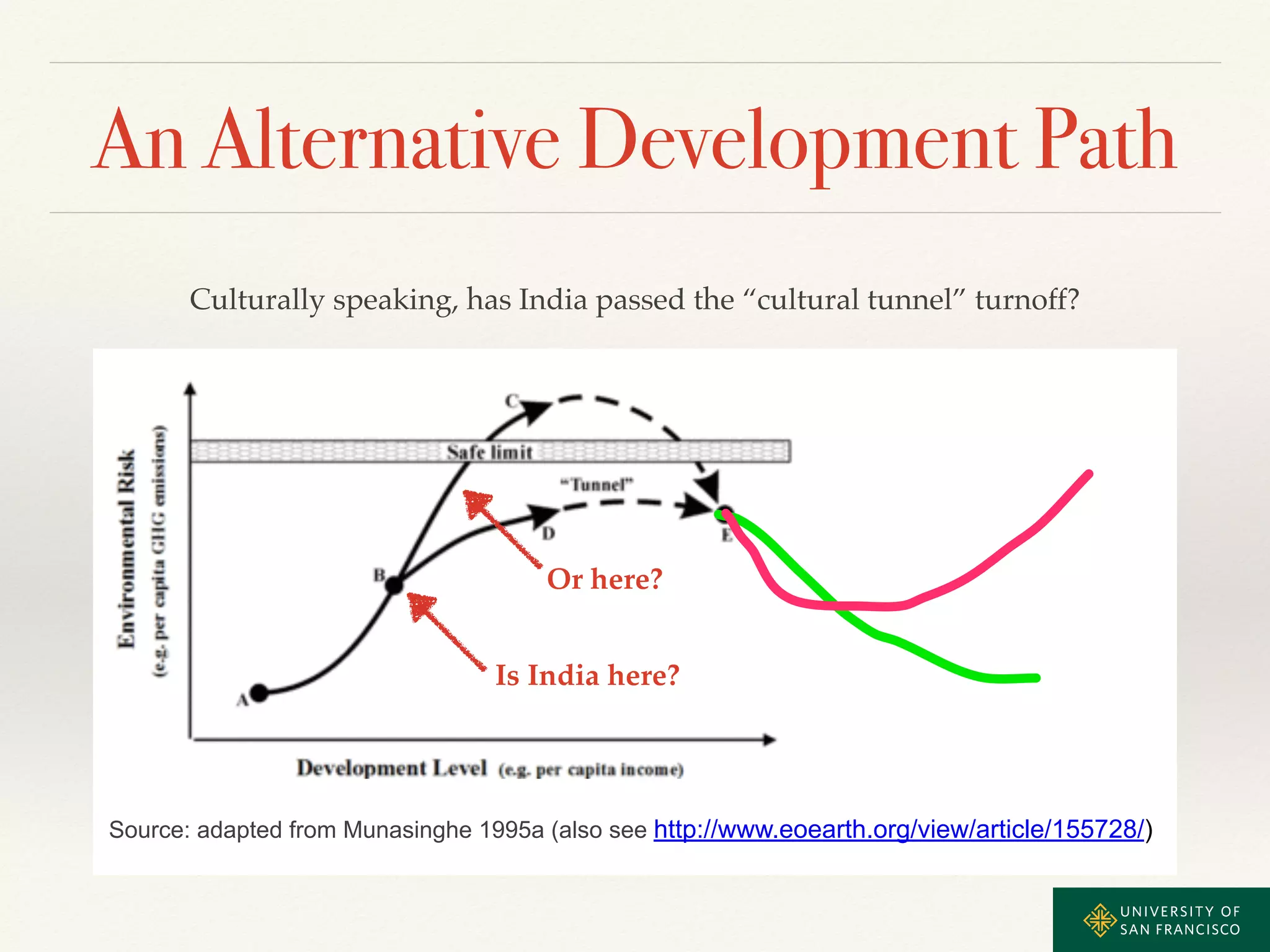
An Alternative Development Path 
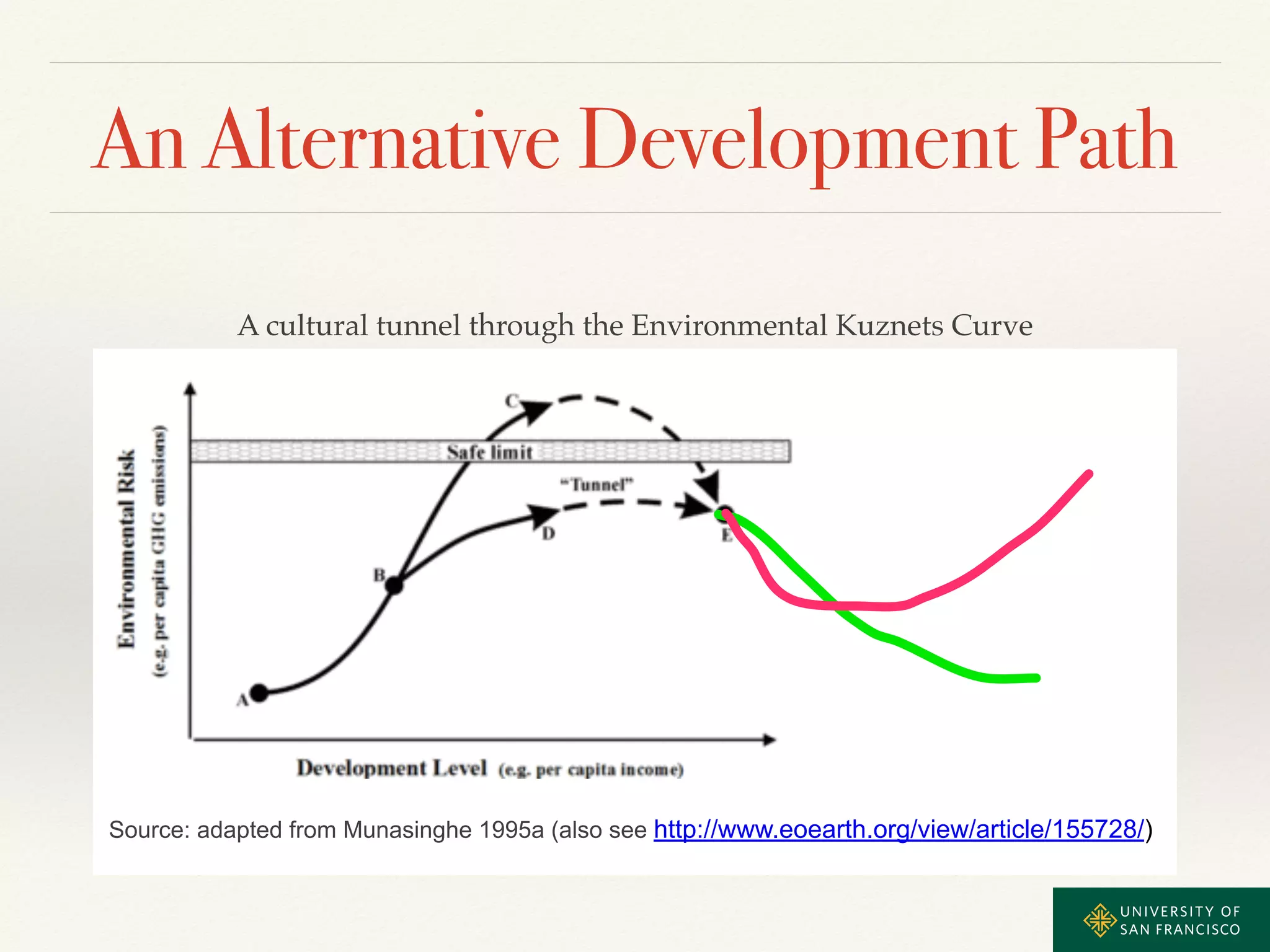
A cultural tunnel through the Environmental Kuznets Curve 
Source: adapted from Munasinghe 1995a (also see http://www.eoearth.org/view/article/155728/)
India’s Alternative Development Path 
❖ In 1992, India seemed poised to pursue an alternative 
development path, “one that steers between the 
destructive consumerism of the free market and the 
spiritual and political suffocation of the formerly 
communist states.”! 
❖ Who won the battle of the Nehruvian bureaucratic 
state vs. the Gandhian self-sufficiency of villages?! 
❖ Neoliberalism 
Jasanoff, Sheila. 1993. India at the crossroads in global environmental policy, Global Environmental Change.
Breaking down development 
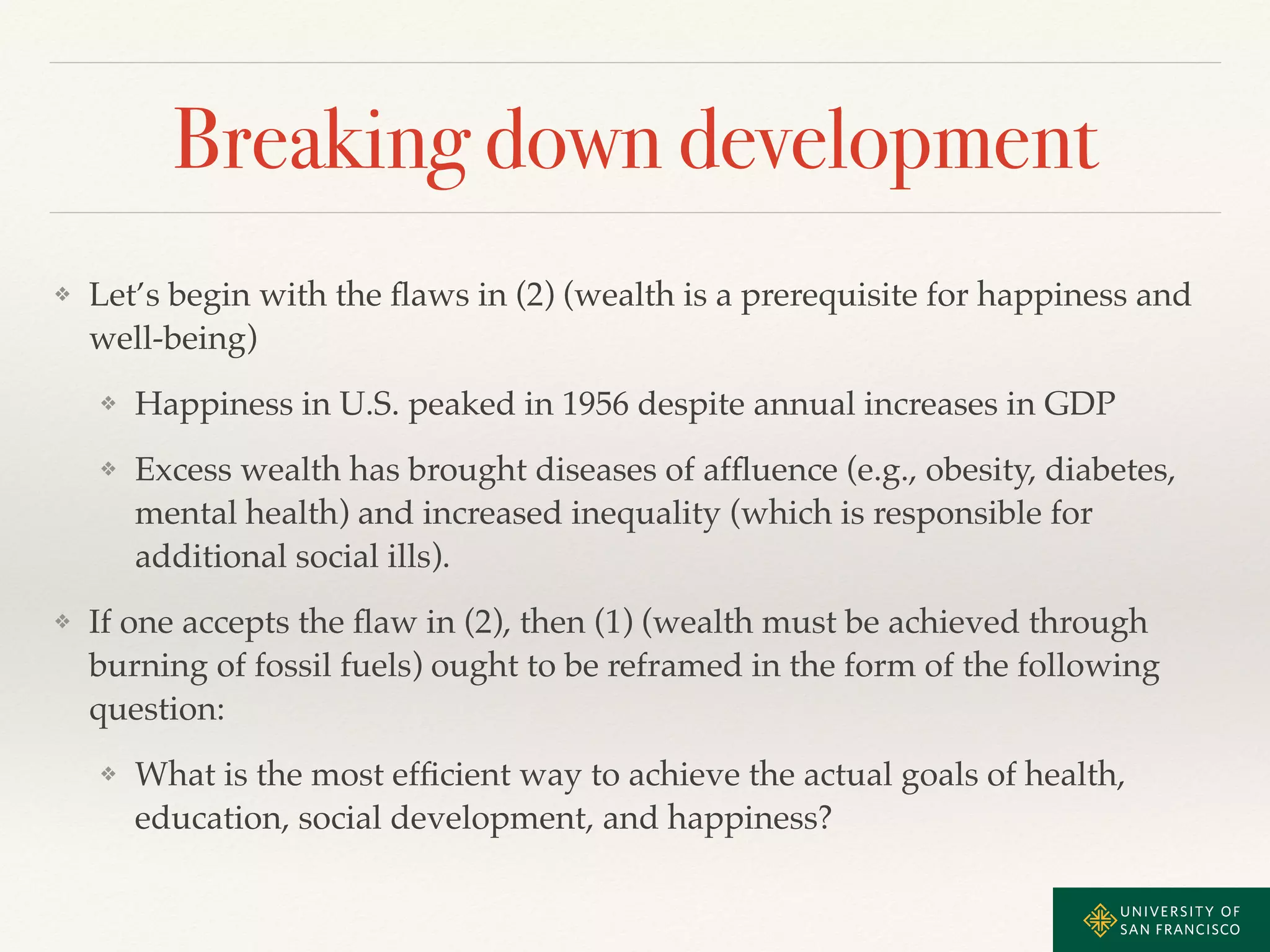
❖ In arguing for the right to fair share of atmospheric space, what are non- 
Annex 1 countries really seeking? ! 
❖ They want to burn fossil fuels because that’s what the development 
model calls for; and the model also tells them they need the material 
standard of Annex 1 countries. ! 
❖ There are two assumptions built into this logic: ! 
❖ (1) That the most efficient way to achieve Annex 1 standards of living is 
through burning of fossil fuels; and ! 
❖ (2) that the material standard of Annex 1 countries is a prerequisite for 
the health, education, social development, and happiness that are the 
underlying goals.
Breaking down development 
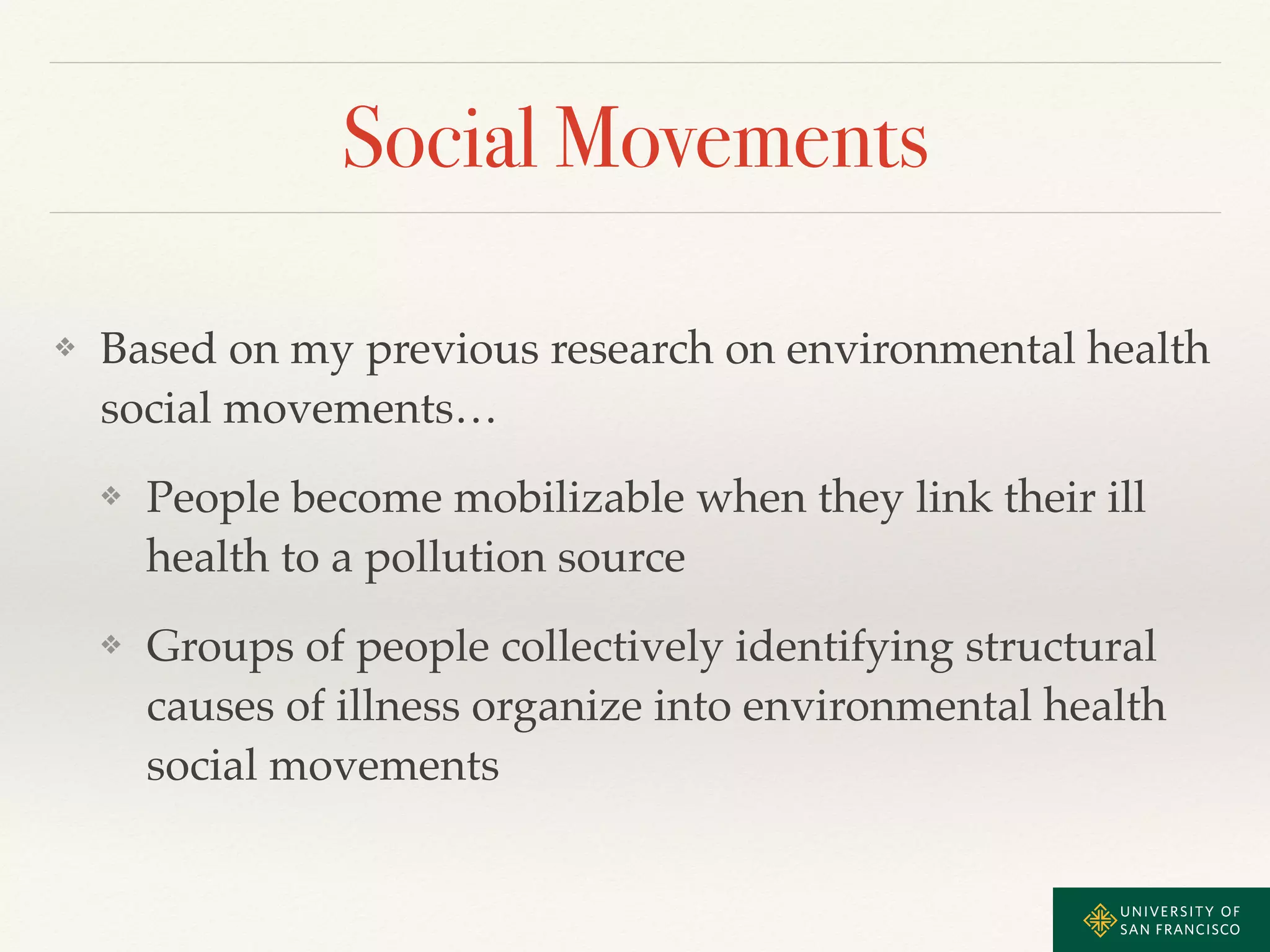
❖ Let’s begin with the flaws in (2) (wealth is a prerequisite for happiness and 
well-being)! 
❖ Happiness in U.S. peaked in 1956 despite annual increases in GDP ! 
❖ Excess wealth has brought diseases of affluence (e.g., obesity, diabetes, 
mental health) and increased inequality (which is responsible for 
additional social ills). ! 
❖ If one accepts the flaw in (2), then (1) (wealth must be achieved through 
burning of fossil fuels) ought to be reframed in the form of the following 
question: ! 
❖ What is the most efficient way to achieve the actual goals of health, 
education, social development, and happiness?
Social Movements 
❖ Based on my previous research on environmental health 
social movements…! 
❖ People become mobilizable when they link their ill 
health to a pollution source! 
❖ Groups of people collectively identifying structural 
causes of illness organize into environmental health 
social movements
Social Movements 
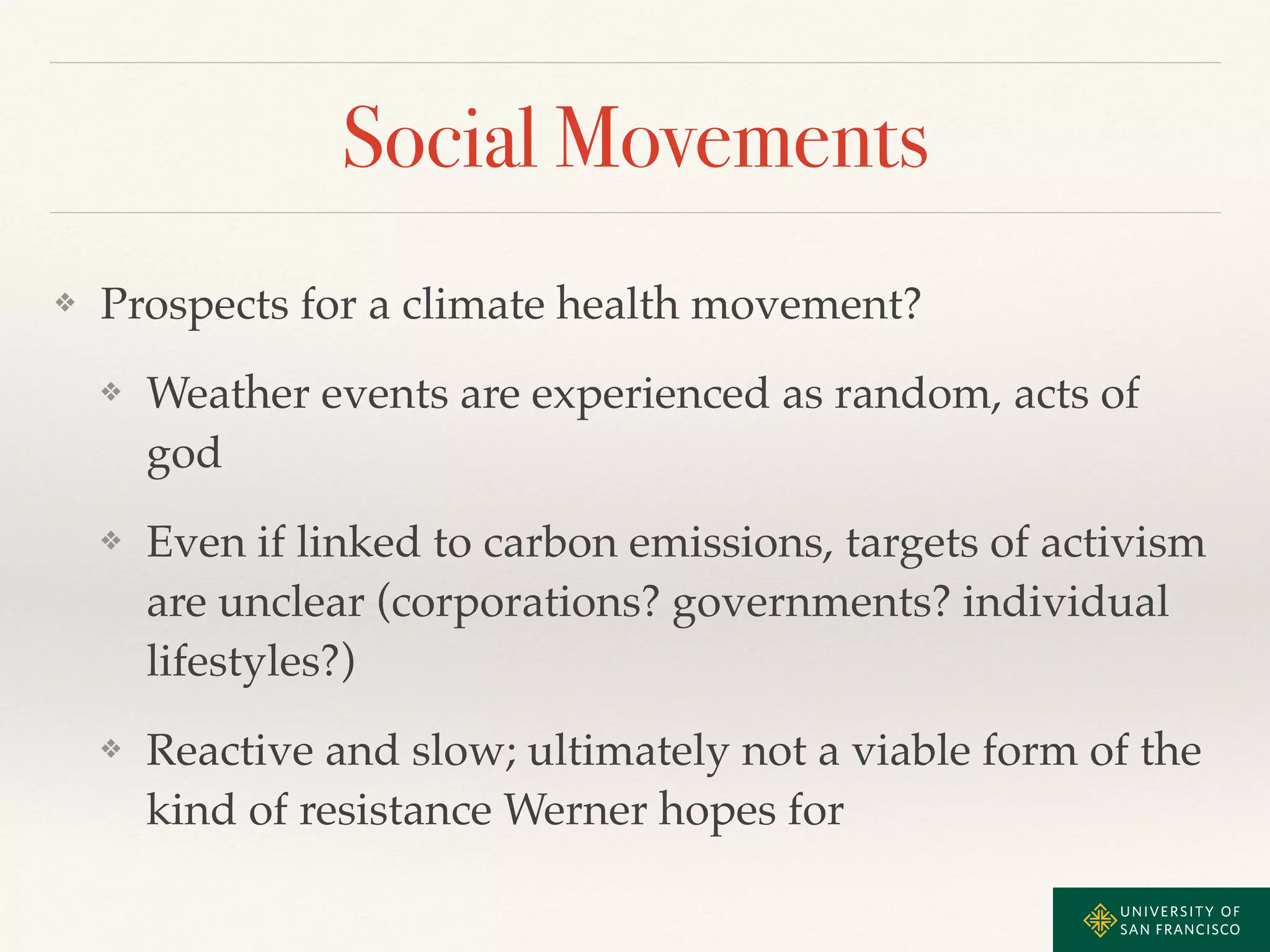
❖ Prospects for a climate health movement?! 
❖ Weather events are experienced as random, acts of 
god! 
❖ Even if linked to carbon emissions, targets of activism 
are unclear (corporations? governments? individual 
lifestyles?)! 
❖ Reactive and slow; ultimately not a viable form of the 
kind of resistance Werner hopes for
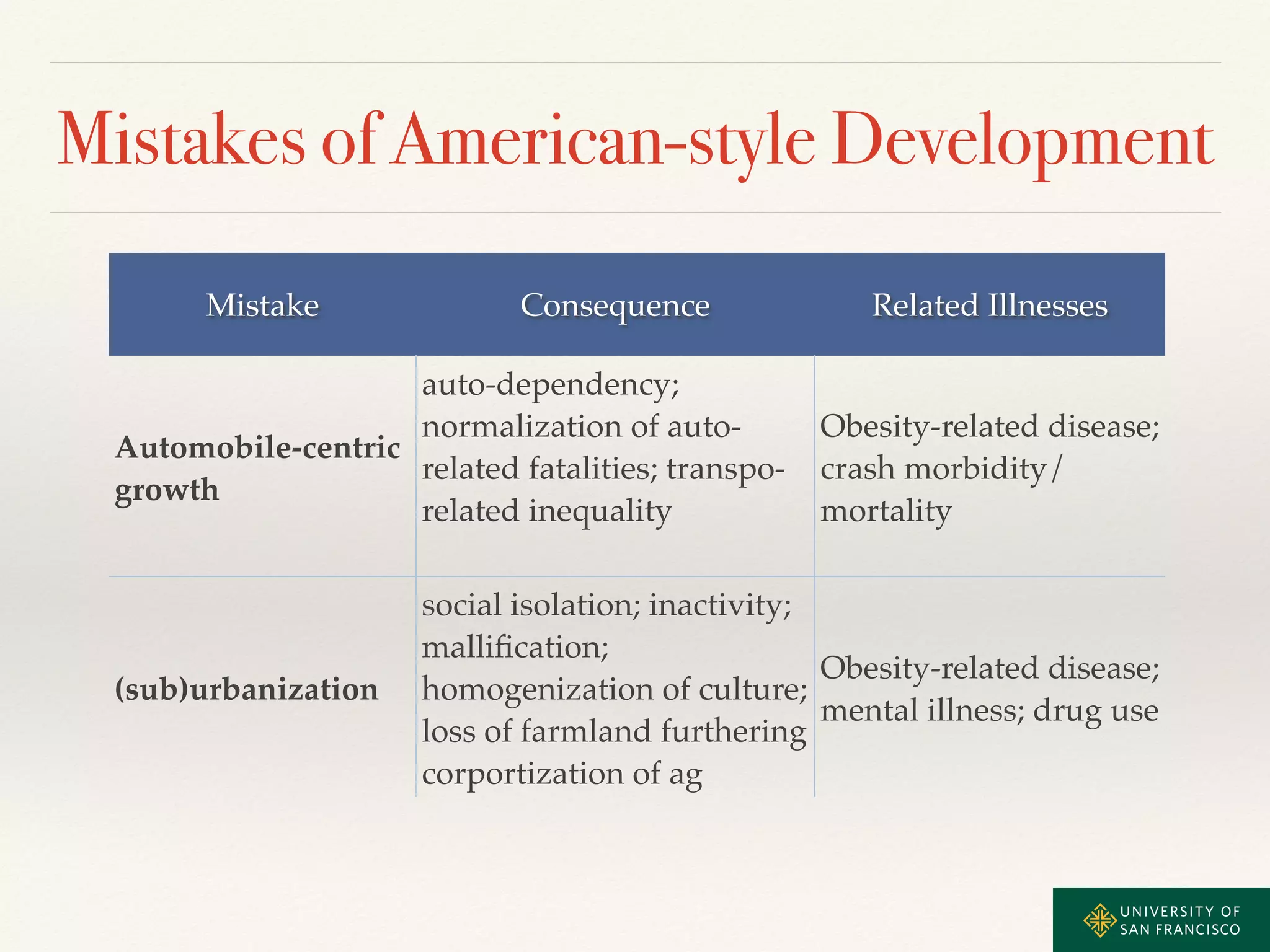
Mistakes of American-style Development 
Mistake Consequence Related Illnesses 
Industrialization of 
agriculture 
High-calorie/high-fat 
foods; low 
nutritional value! 
Obesity-related 
disease; diabetes; 
ADD; autism 
Corporate control of 
food system 
Inequality in food 
access (e.g., food 
deserts) 
over- and under-nourishment
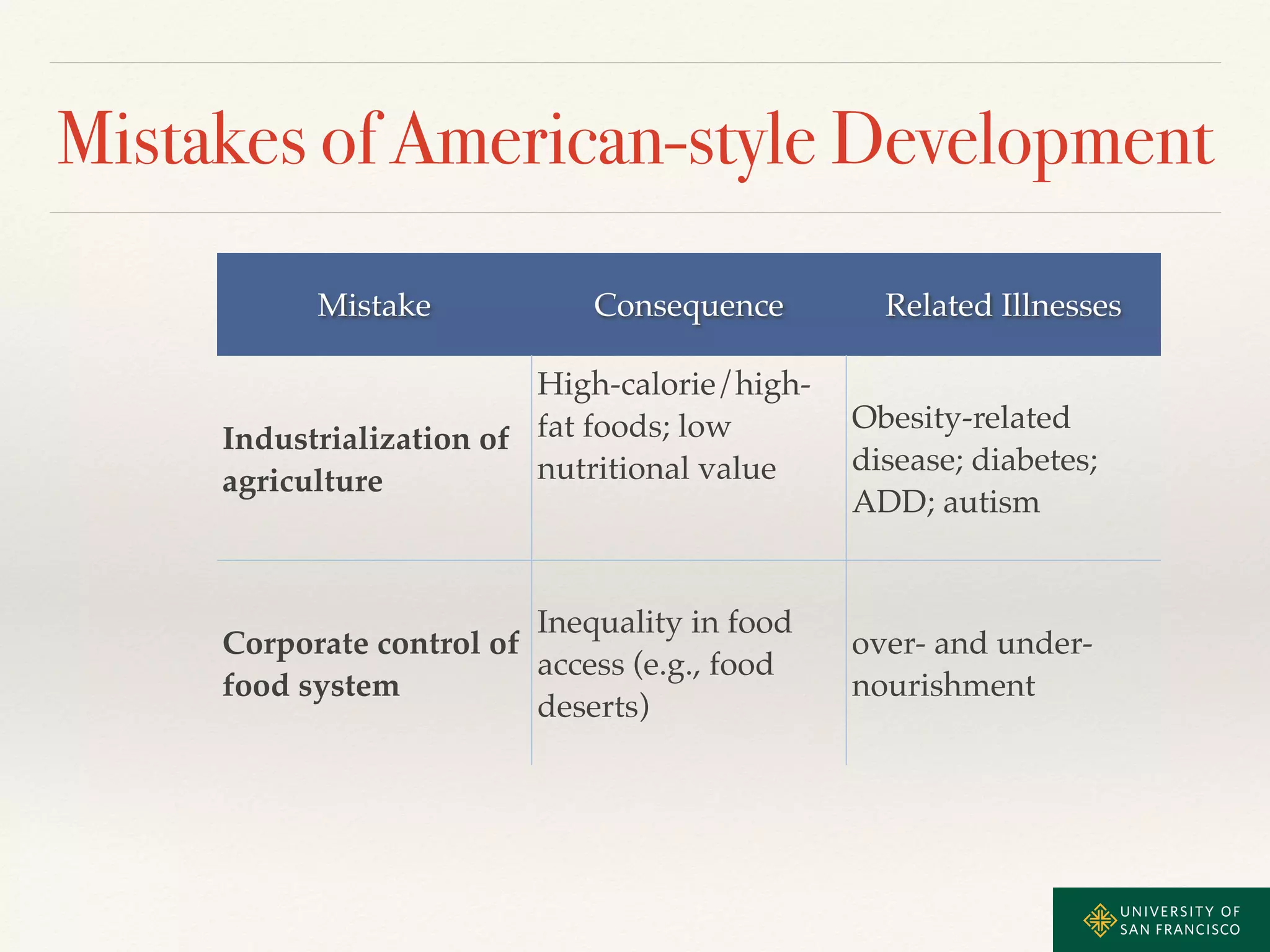
Mistakes of American-style Development 
Mistake Consequence Related Illnesses 
Automobile-centric 
growth 
auto-dependency; 
normalization of auto-related 
fatalities; transpo-related 
inequality! 
Obesity-related disease; 
crash morbidity/ 
mortality 
(sub)urbanization 
social isolation; inactivity; 
mallification; 
homogenization of culture; 
loss of farmland furthering 
corportization of ag 
Obesity-related disease; 
mental illness; drug use
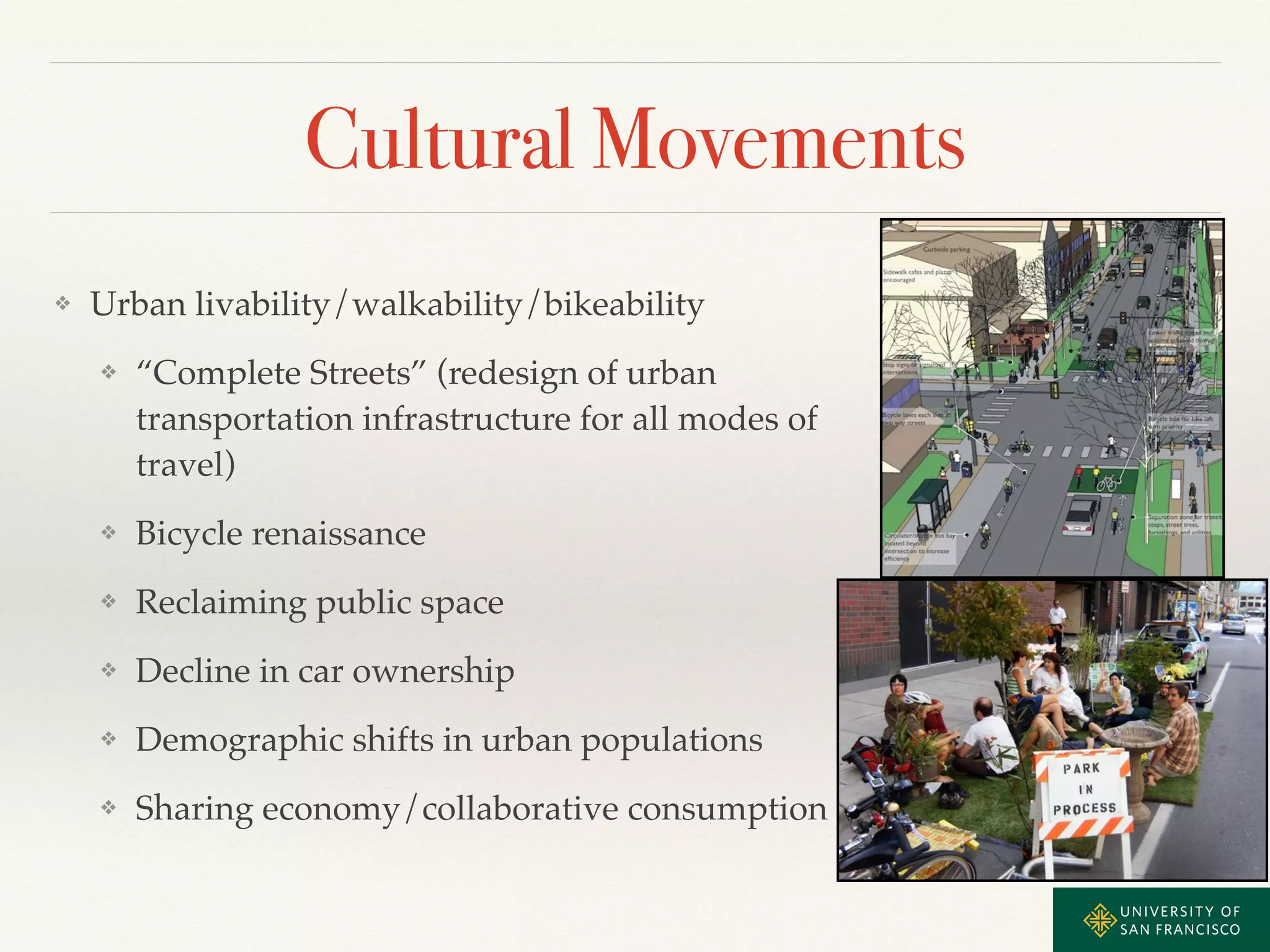
Cultural Movements 
❖ Urban livability/walkability/bikeability! 
❖ “Complete Streets” (redesign of urban 
transportation infrastructure for all modes of 
travel)! 
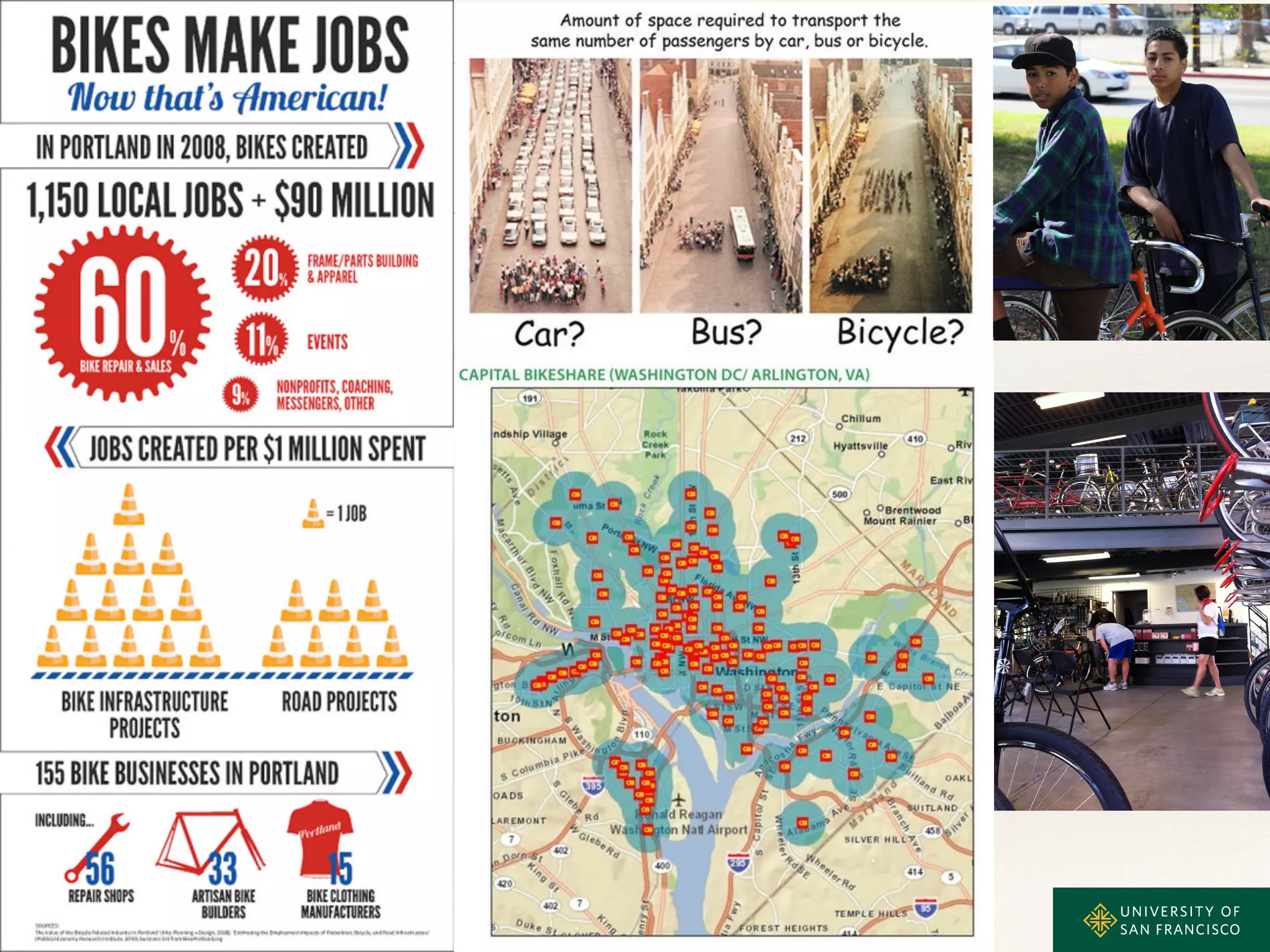
❖ Bicycle renaissance! 
❖ Reclaiming public space! 
❖ Decline in car ownership! 
❖ Demographic shifts in urban populations! 
❖ Sharing economy/collaborative consumption
Cultural Movements 
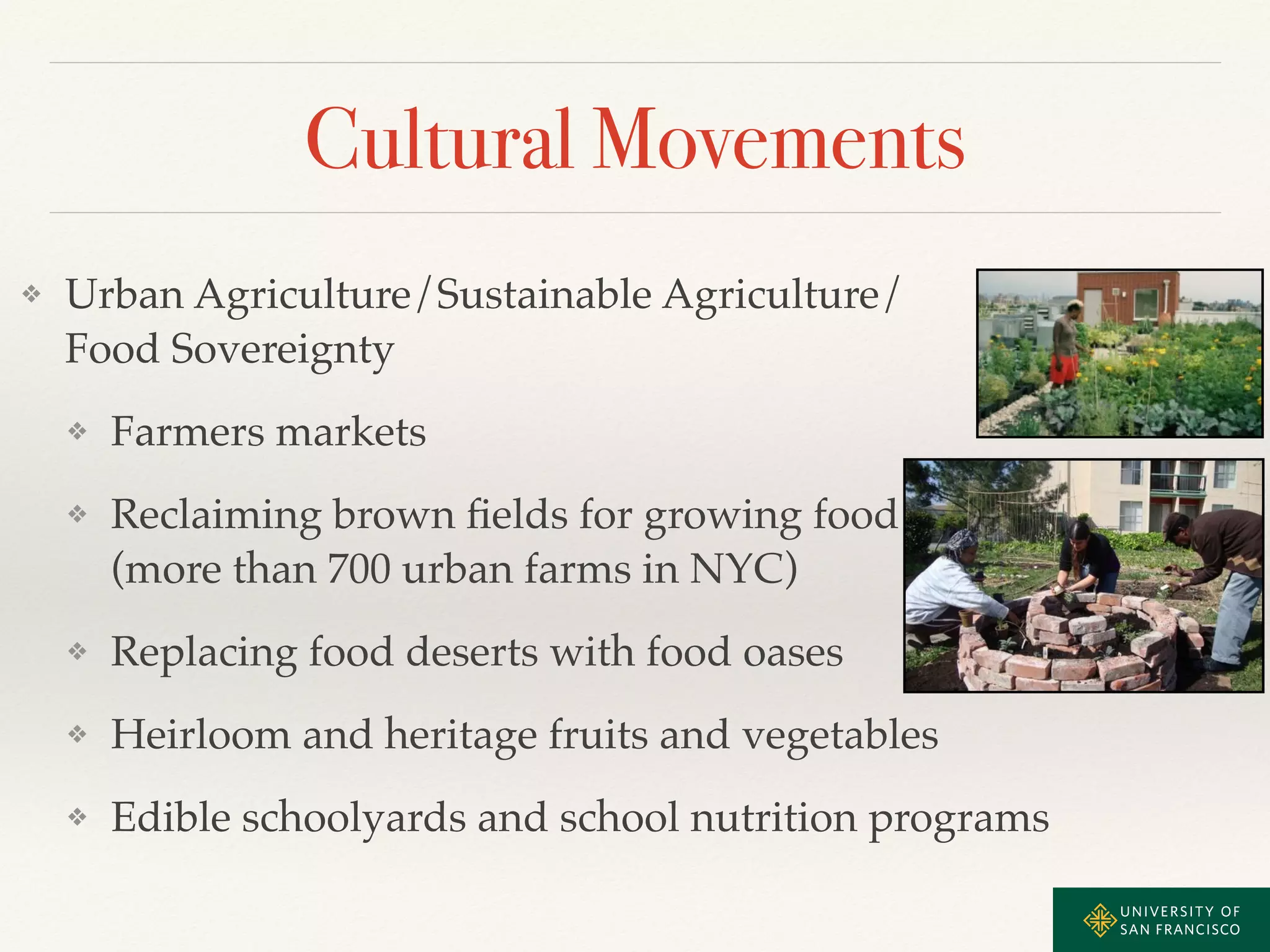
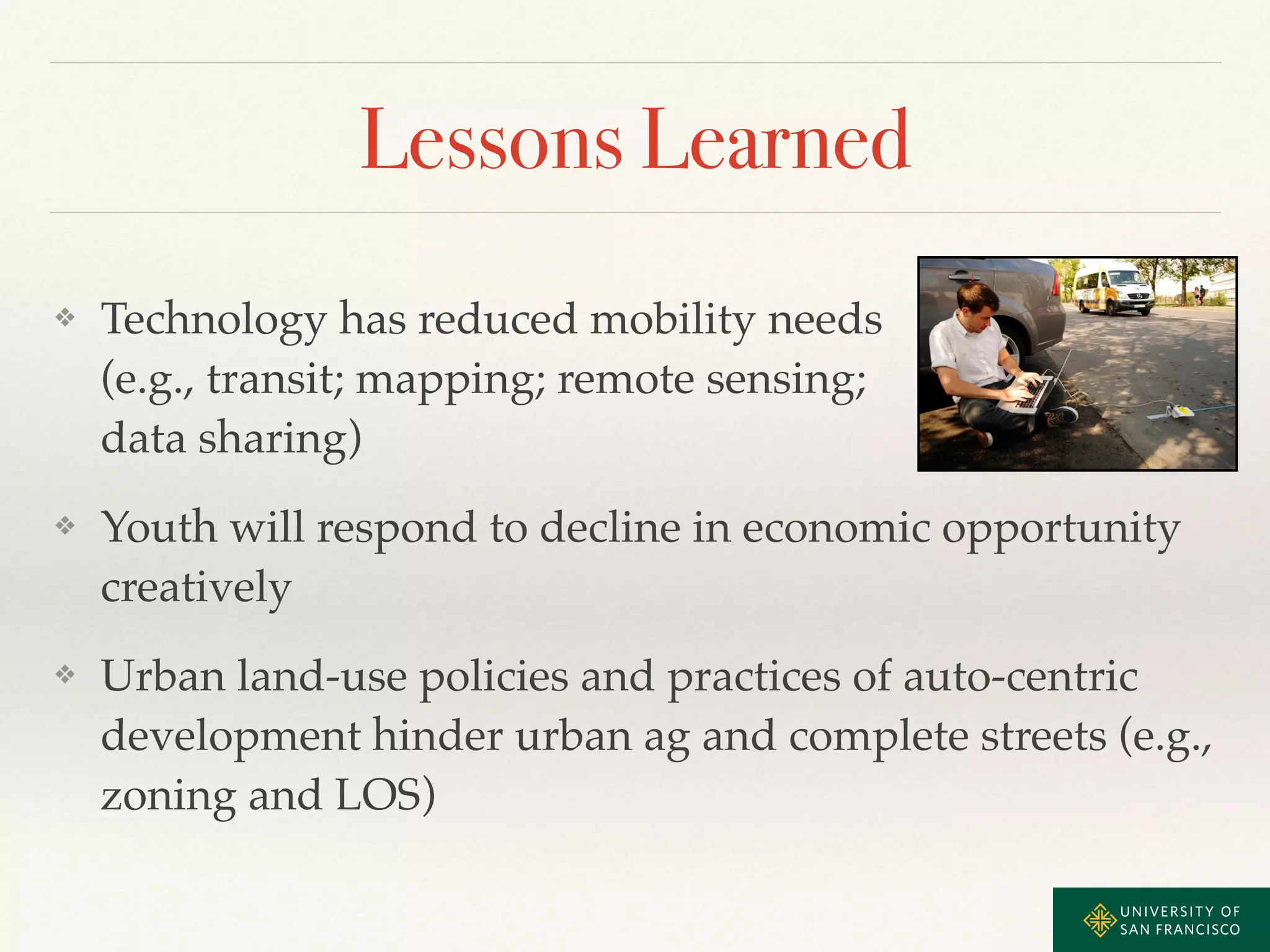
❖ Urban Agriculture/Sustainable Agriculture/ 
Food Sovereignty! 
❖ Farmers markets! 
❖ Reclaiming brown fields for growing food 
(more than 700 urban farms in NYC)! 
❖ Replacing food deserts with food oases! 
❖ Heirloom and heritage fruits and vegetables! 
❖ Edible schoolyards and school nutrition programs
Intersections and Outcomes 
❖ Urban planners, public health professionals and policymakers are embracing 
“livability” trends! 
❖ [T]he Michigan Department of Community Health created a five-year strategic 
plan to reduce childhood obesity in Michigan. One of its first initiatives? A 
statewide effort to address Complete Streets! 
❖ New York Chapter of the American Association of Family Physicians: 
“Pedestrian plazas, car-free spaces, neighborhood bike networks and world-class 
bicycle lanes…are vital to the public health of our city. These changes help pave 
the way for a city that breathes cleaner air and is in better physical condition”.! 
❖ SF “parklets” policy! 
❖ 488 Complete Streets policies across the U.S.! 
❖ all levels of government, including 27 statewide policies! 
❖ more than 25% of the existing policies were passed in 2012 alone
Lessons Learned 
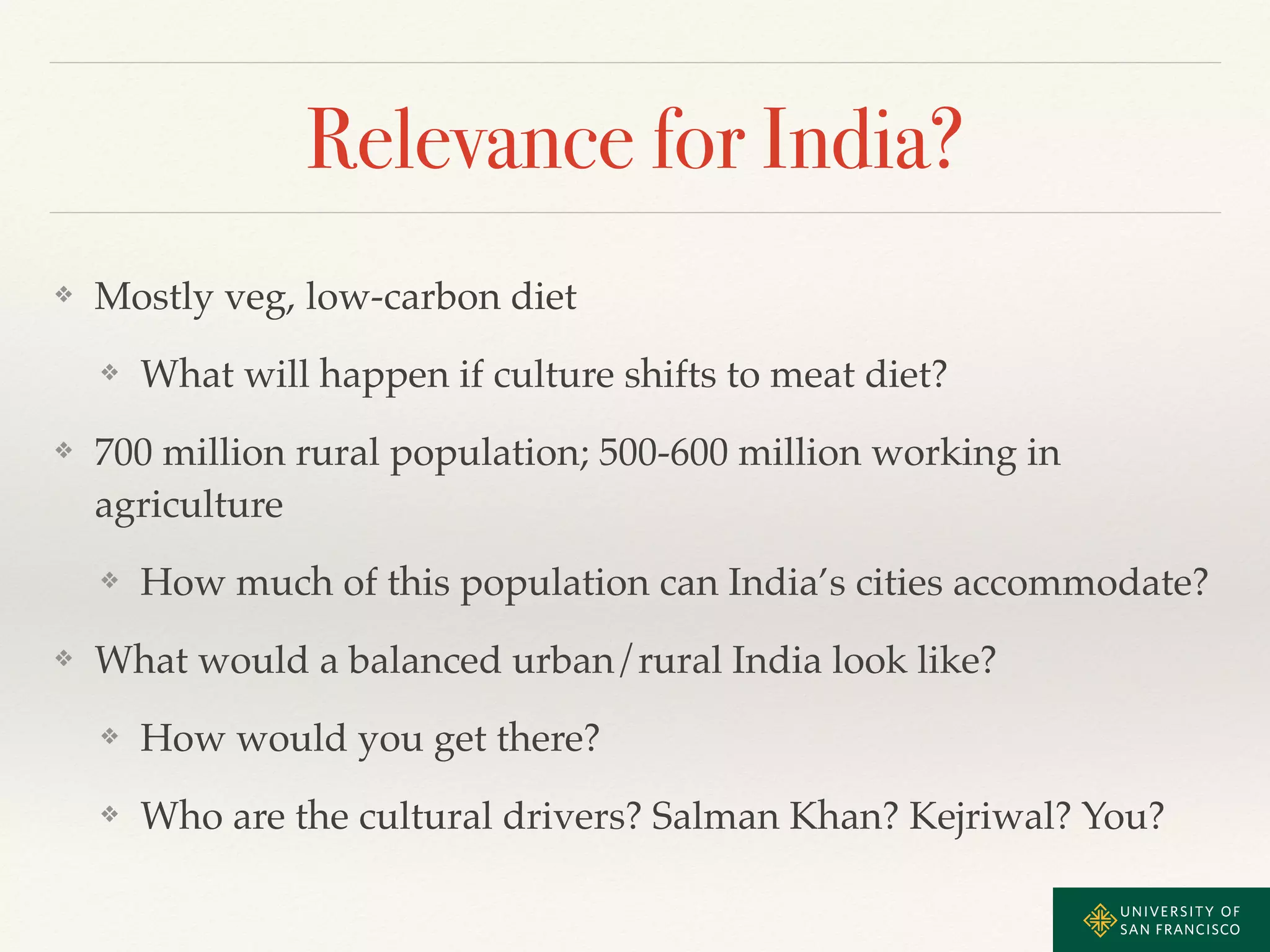
❖ Technology has reduced mobility needs 
(e.g., transit; mapping; remote sensing; 
data sharing)! 
❖ Youth will respond to decline in economic opportunity 
creatively! 
❖ Urban land-use policies and practices of auto-centric 
development hinder urban ag and complete streets (e.g., 
zoning and LOS)
Relevance for India? 
❖ Mostly veg, low-carbon diet ! 
❖ What will happen if culture shifts to meat diet?! 
❖ 700 million rural population; 500-600 million working in 
agriculture! 
❖ How much of this population can India’s cities accommodate?! 
❖ What would a balanced urban/rural India look like?! 
❖ How would you get there?! 
❖ Who are the cultural drivers? Salman Khan? Kejriwal? You?
An Alternative Development Path 
Culturally speaking, has India passed the “cultural tunnel” turnoff? 
Or here? 
Is India here? 
Source: adapted from Munasinghe 1995a (also see http://www.eoearth.org/view/article/155728/)
Thank You! 
❖ Dr. Pradip Swarnakar and ABV IIITM Gwalior! 
❖ U.S. Fulbright Program and United States-India 
Educational Foundation! 
❖ You, the students, and my new friends!

An Alternative Development Path: India and the “Cultural Tunnel” Turnoff

  • 1.
    Fulbright Lectures ABVIIIT-M Gwalior 30 Jan-12 Mar 2014 Humans Environment Sustainable Development Stephen Zavestoski, PhD Associate Professor Sociology and Environmental Studies University of San Francisco San Francisco, California USA smzavestoski@usfca.edu
  • 2.
    An Alternative DevelopmentPath: India and the “Cultural Tunnel” Turnoff Lecture 3 Stephen Zavestoski, PhD Associate Professor Sociology and Environmental Studies University of San Francisco San Francisco, California USA smzavestoski@usfca.edu
  • 3.
    An Alternative DevelopmentPath A cultural tunnel through the Environmental Kuznets Curve Source: adapted from Munasinghe 1995a (also see http://www.eoearth.org/view/article/155728/)
  • 4.
    India’s Alternative DevelopmentPath ❖ In 1992, India seemed poised to pursue an alternative development path, “one that steers between the destructive consumerism of the free market and the spiritual and political suffocation of the formerly communist states.”! ❖ Who won the battle of the Nehruvian bureaucratic state vs. the Gandhian self-sufficiency of villages?! ❖ Neoliberalism Jasanoff, Sheila. 1993. India at the crossroads in global environmental policy, Global Environmental Change.
  • 5.
    Breaking down development ❖ In arguing for the right to fair share of atmospheric space, what are non- Annex 1 countries really seeking? ! ❖ They want to burn fossil fuels because that’s what the development model calls for; and the model also tells them they need the material standard of Annex 1 countries. ! ❖ There are two assumptions built into this logic: ! ❖ (1) That the most efficient way to achieve Annex 1 standards of living is through burning of fossil fuels; and ! ❖ (2) that the material standard of Annex 1 countries is a prerequisite for the health, education, social development, and happiness that are the underlying goals.
  • 6.
    Breaking down development ❖ Let’s begin with the flaws in (2) (wealth is a prerequisite for happiness and well-being)! ❖ Happiness in U.S. peaked in 1956 despite annual increases in GDP ! ❖ Excess wealth has brought diseases of affluence (e.g., obesity, diabetes, mental health) and increased inequality (which is responsible for additional social ills). ! ❖ If one accepts the flaw in (2), then (1) (wealth must be achieved through burning of fossil fuels) ought to be reframed in the form of the following question: ! ❖ What is the most efficient way to achieve the actual goals of health, education, social development, and happiness?
  • 7.
    Social Movements ❖Based on my previous research on environmental health social movements…! ❖ People become mobilizable when they link their ill health to a pollution source! ❖ Groups of people collectively identifying structural causes of illness organize into environmental health social movements
  • 8.
    Social Movements ❖Prospects for a climate health movement?! ❖ Weather events are experienced as random, acts of god! ❖ Even if linked to carbon emissions, targets of activism are unclear (corporations? governments? individual lifestyles?)! ❖ Reactive and slow; ultimately not a viable form of the kind of resistance Werner hopes for
  • 9.
    Mistakes of American-styleDevelopment Mistake Consequence Related Illnesses Industrialization of agriculture High-calorie/high-fat foods; low nutritional value! Obesity-related disease; diabetes; ADD; autism Corporate control of food system Inequality in food access (e.g., food deserts) over- and under-nourishment
  • 10.
    Mistakes of American-styleDevelopment Mistake Consequence Related Illnesses Automobile-centric growth auto-dependency; normalization of auto-related fatalities; transpo-related inequality! Obesity-related disease; crash morbidity/ mortality (sub)urbanization social isolation; inactivity; mallification; homogenization of culture; loss of farmland furthering corportization of ag Obesity-related disease; mental illness; drug use
  • 11.
    Cultural Movements ❖Urban livability/walkability/bikeability! ❖ “Complete Streets” (redesign of urban transportation infrastructure for all modes of travel)! ❖ Bicycle renaissance! ❖ Reclaiming public space! ❖ Decline in car ownership! ❖ Demographic shifts in urban populations! ❖ Sharing economy/collaborative consumption
  • 13.
    Cultural Movements ❖Urban Agriculture/Sustainable Agriculture/ Food Sovereignty! ❖ Farmers markets! ❖ Reclaiming brown fields for growing food (more than 700 urban farms in NYC)! ❖ Replacing food deserts with food oases! ❖ Heirloom and heritage fruits and vegetables! ❖ Edible schoolyards and school nutrition programs
  • 14.
    Intersections and Outcomes ❖ Urban planners, public health professionals and policymakers are embracing “livability” trends! ❖ [T]he Michigan Department of Community Health created a five-year strategic plan to reduce childhood obesity in Michigan. One of its first initiatives? A statewide effort to address Complete Streets! ❖ New York Chapter of the American Association of Family Physicians: “Pedestrian plazas, car-free spaces, neighborhood bike networks and world-class bicycle lanes…are vital to the public health of our city. These changes help pave the way for a city that breathes cleaner air and is in better physical condition”.! ❖ SF “parklets” policy! ❖ 488 Complete Streets policies across the U.S.! ❖ all levels of government, including 27 statewide policies! ❖ more than 25% of the existing policies were passed in 2012 alone
  • 15.
    Lessons Learned ❖Technology has reduced mobility needs (e.g., transit; mapping; remote sensing; data sharing)! ❖ Youth will respond to decline in economic opportunity creatively! ❖ Urban land-use policies and practices of auto-centric development hinder urban ag and complete streets (e.g., zoning and LOS)
  • 16.
    Relevance for India? ❖ Mostly veg, low-carbon diet ! ❖ What will happen if culture shifts to meat diet?! ❖ 700 million rural population; 500-600 million working in agriculture! ❖ How much of this population can India’s cities accommodate?! ❖ What would a balanced urban/rural India look like?! ❖ How would you get there?! ❖ Who are the cultural drivers? Salman Khan? Kejriwal? You?
  • 17.
    An Alternative DevelopmentPath Culturally speaking, has India passed the “cultural tunnel” turnoff? Or here? Is India here? Source: adapted from Munasinghe 1995a (also see http://www.eoearth.org/view/article/155728/)
  • 18.
    Thank You! ❖Dr. Pradip Swarnakar and ABV IIITM Gwalior! ❖ U.S. Fulbright Program and United States-India Educational Foundation! ❖ You, the students, and my new friends!