TEHRI HYDRO DEVELOPMENT CORPORATION
A SUMMER INTERNSHIP REPORT
Submitted by
AMIT RATURI
Registration No: 11301334
in partial fulfillment of Summer Internship for the award of the degree of
BACHELOR OF TECHNOLOGY (Mech)
School of Mechanical
LOVELY PROFESSIONAL UNIVERSITY
Phagwara, Punjab
July, 2016
CERTIFICATION LETTER
Certified that the summer internship project report “Tehri Hydro
Develpoment Corporation” is the bonafide work of Amit Raturi, Regd. No:
11301334, student of Bachelor of Technology(Mech) of School of Mechanical,
Lovely Professional University carried out under my supervision during June
16, 2016 to July 26, 2016.
Signature of the Industry Supervisor
Date : July 16, 2016
Name of Supervisor : Mr. Sanjay Goel
Designation : Mechanical Engineer
ACKNOWLEDGEMENT
To acknowledge is very great way to show your gratitude towards the
persons who have contributed in your success in one or other way. I find words
inadequate to express my gratitude towards Mr.Sanjay Goel, Mechanical
Engineeer, for providing me an opportunity to carry out my summer training at
Tehri Hydro Development Corporation, Tehri garhwal
I am thankful to all the staff members of Mechanical department in providing me
useful guidance for the completion of this report.
I convey my gratitude to all those who are directly or indirectly related in the
completion of this project report.
Finally I would be failing in my duty if I don’t express my thanks to the
respondents whom I visited and took their valuable time to answer my
questionnaire.
PREFACE
Engineer student gain their theoretical knowledge only through their books. Only
theoretical knowledge is not sufficient for absolute mastery in any field.theoritical
given in our books is not much use without knowing its practical implementation,
it has been experienced that theoretical knowledge is volatile in nature, however
practical knowledge make solid foundation of our mind.
To accomplish this aspect, LOVELY PROFESSIONAL UNIVERSITY,
PUNJAB has included a SUMMER TRAINING programme for the student of
B.Tech. in summer vacation.
I took training in “TEHRI HYDRO DEVELOPMENT CORPORATION” at
TEHRI from 16 June to 26 July 2016. Successding chapter give detail about what I
have learned in this prestigious organization.
AMIT RATURI
CONTENTS
Chapter Name Page
1 Introduction 6
2 History 8
3 Location 10
4 Introduction to hydro 11
Turbines
5 Machine shop 19
6 Fabrication shop 23
7 Terms related to hydro power plant 26
8 Componenets of Hydro Turbines 28
9 Components of Hydro Power Plant 29
10 Maintenance 31
11 Stores 33
12 Conclusion 34
CHAPTER-1
THDC INDIA LIMITED
INTRODUCTION
THDC India Limited (formerly known as Tehri Hydro Development Corporation Ltd.), is a Joint
Venture of Govt. of India and Govt. of Uttar Pradesh. The Equity is shared in the ratio of 75:25
between GoI and GoUP for the Power Component. The Company was incorporated in July’ 88 to
develop, operate & maintain the 2400 MW Tehri Hydro Power Complex and other hydro projects. The
Company has an authorised share capital of ` 4000 cr. THDCIL is a Mini Ratna Category-I and
Schedule ‘A’ CPSE.
The initial mandate of THDCIL was to develop, operate and maintain the 2,400 MW Tehri Hydro
Power Complex (comprising of 1000 MW Tehri Dam & HPP, 1000 MW Tehri Pumped Storage Plant
& 400 MW Koteshwar HEP) and other Hydro Projects.
The Memorandum and Articles of Association of the Company has been modified to reflect the current
business reality of projects outside Bhagirathi valley. The object clause has been amended to
incorporate development of Conventional/ Non-conventional/ Renewable sources of Energy and River
Valley Projects.
The Corporation has grown into a multi-Project Organisation, with Projects spread over various States
as well as neighbouring Country, Bhutan.
THDCIL presently has 15 projects totaling to an installed capacity of 6211 MW under various stages of
implementation / development.
The commissioning of the 1,000 MW Tehri Power Station by THDCIL in 2006-07 was a landmark for
the Country’s Power Sector. The Tehri Project is a multipurpose Project providing power benefits to
the Northern Region, Irrigation benefits to Uttar Pradesh, and Drinking Water benefits to NCT Delhi
and U.P. Due to regulated releases from the Tehri storage reservoir, the existing downstream hydro
projects of the State are also benefiting by way of augmentation in generation at no additional cost to
them.
The 400 MW Koteshwar HEP, downstream of Tehri was commissioned in 2011-12. The 1,000 MW
Tehri Pumped Storage Plant, which would utilize the Tehri and Koteshwar reservoirs as the pre-
requisite upstream and downstream reservoirs, is presently under implementation. The 1,000 MW Tehri
PSP is the first Pumped Storage Scheme to be taken up in the Central Sector, and is expected to set a
model for the development of the untapped Pumped Storage potential in the Country, which stands at
over 90,000 MW.
In addition to the 2,400 MW Tehri Hydro Complex, THDCIL is implementing the 444 MW Vishnugad
Pipalkoti Hydro Electric Project (VPHEP) on river Alaknanda in Uttarakhand. THDCIL is also
implementing 24 MW Dhukwan Small Hydro Project on Betwa river in Uttar Pradesh. In addition,
there are various hydro projects of THDCIL under different stages of implementation i.e. Survey &
Investigation and DPR preparation.
Government of UP has allotted Khurja Super Thermal Power Plant (2X660 MW) in Bulandshahar Distt
to THDCIL for implementation.
Under India-Bhutan Co-operation in hydro Sector development, THDCIL is implementing Bunakha
HEP (180 MW) and has taken up work of updation of DPR of Sankosh HEP (2585 MW) in Bhutan.
Total installed capacity of THDCIL presently is 1,400 MW. THDCIL has two generating stations
namely Tehri Stage-I (4x250 MW) and Koteshwar HEP (4x100 MW).
THDCIL is consistently profit making company since the commissioning of Tehri Dam & HPP in the
year 2006-07. THDCIL is a dividend paying company since 2007-08.
Tehri Dam has been conferred the Prestigious award of “International Milestone Project” of
International Commission of Large Dam (ICOLD) in Oct.’09 in China, considering the Uniqueness
of its design and construction features. Koteshwar HEP has been conferred the PMI India Best
Project Award of the year in long term duration (More than 3 years) category in 2011-12. THDCIL
has been conferred the Power Line Award in the category of 'Best Performing Generation
Company (in Hydro Sector)’ in May 2012. THDCIL has been conferred SCOPE Meritorious
Award for Corporate Social Responsibility and Responsiveness in April’12.
THDCIL has obtained ISO 9001:2008 Certificate of Quality Management System and ISO 14001-2004
Certification (Environment Management System) for Corporate Office, Rishikesh, Tehri HPP, Tehri
PSP, Koteshwar HEP and Vishnugad Pipalkoti HEP. THDCIL has also obtained OHSAS 18001:2007
(Occupational Health and Safety Management System) Certification for Corporate Office, Rishikesh.
Since first year of commercial operation, THDCIL is a profit making organization. THDCIL earned a
Net Profit of Rs.117.48 Cr., Rs. 323.58 Cr., Rs. 325.21 Cr., Rs..479.95 Cr., Rs.. 600.48 Cr. , Rs. 703.83
Cr., Rs. 531.38 Cr and Rs.595.32 Cr. during 2006-07, 2007-08, 2008-09, 2009-10, 2010-11, 2011-12,
2012-13 and 2013-14 respectively.
CHAPTER-2
HISTORY
A preliminary investigation for the Tehri Dam Project was completed in 1961 and its design was
completed in 1972 with a 600 MW capacity power plant based on the study. Construction began
in 1978 after feasibility studies but was delayed due to financial, environmental and social
impacts. In 1986, technical and financial assistance was provided by the USSR but this was
interrupted years later with political instability. India was forced to take control of the project
and at first it was placed under the direction of the Irrigation Department of Uttar Pradesh.
However, in 1988 the Tehri Hydro Development Corporation was formed to manage the dam
and 75% of the funding would be provide by the federal government, 25% by the state. Uttar
Pradesh would finance the entire irrigation portion of the project. In 1990, the project was
reconsidered and the design changed to its current multi-purpose. Construction of the Tehri Dam
was complete in 2006.
1949 Tehri dam conceived
1961 Tehri chosen as a tentative site for the dam
1972 Planning Commission gives its nod to the dam
1978 Actual construction of the dam begins under police protection; Protests gather momentum
1980 Environmental Appraisal Committee appointed by the government, refuses environmental
clearance
1986 Diversion tunnels start operating; Protestors storm the site and stall construction work
1990 Environmental Appraisal Committee, the D R Bhumbla committee, rejects the dam again
1991 Earthquake measuring 6.6 on Richter scale rocks Uttarkashi. Renewed concerns about the
seismic safety of the dam.
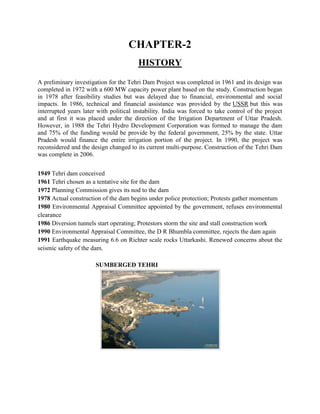
SUMBERGED TEHRI
NEW TEHRI
1992 SunderlalBahuguna goes on a fast unto death. Work on the dam temporarily stopped. Gain
in 1995
1996 Government sets up the V K Gaur committee to look into seismic safety
1997 Hanumantha Rao committee on rehabilitation submits its report. Recommends major
changes in rehabilitation policy
1998 Gaur committee submits its report. Asks for detailed analysis
1999 Chamoli earthquake, measuring 6.8, brings large scale destruction. Anti-dam activists up in
arms about safety
1999 Committee of secretaries of the Union government clears dam
January2001 Bhuj Earthquake Again Raises Concerns
April 2001 Government Forms another Committee under the S&T Minister Murli Manohar
Joshi
November 2002 M M Joshi Committee Submits Its Report. Says The Dam Is Safe To Withstand
An Earthquake Of High Magnitude
September 2003 In A Divided Verdict, The Supreme Court Clears The Legal Hurdles For Dam
Construction
March 2004 Tunnel T2 Closed. Water Level Rises To 648 Metres Submerging Many Parts Of
Old Tehri Town
July 29, 2004 Water Level Rises To 655 Metres Submerging The Remaining Parts Of The Tehri
Town. Residents Flee For Their Lives
August 2004 Internal Landslide at The Dam Site. 29 Workers Dead
2006 Tehri Town Fully Submerges. First Stage Of Project Completes. (Total Production 1000
Mw)
CHAPTER-3
LOCATION
Tehri Dam is the primary dam of the Tehri Development Project, a major hydroelectric project
centered near Tehri Town in the state of Uttarakhand in India.It is located on the Bhagirathi
River, the principal tributary of the sacred River Ganga.
Technical description
1. Earth & Rock Fill Dam :
Type : Rock and Earth Fill Height : 260.5 m
Base : 1128 m Width at top : 25.5 m
Length at the top : 592 m
2. Tehri Reservoir:
Water Spread : 42 SQ KM Gross Storage : 3540 Miliion Cum
Live Storage : 2615 Million Cum
3. Power House:
Power House :Under ground Cavern
Size : 197mx24mx63m
Type of Turbines : Francis
Rated Head : 188 M Speed : 214.3 RPM
Installed Capacity : 4x250MW
Annual Energy : 3568 MUs
CHAPTER-4
HYDRO TURBINES
 What are hydro turbines?
ANS: A hydro turbine uses the potential and kinetic energy of water and converts it into
usable mechanical energy. The fluid energy is available in the natural or artificial high level
water reservoirs, which are created by constructing dam at appropriate places in the flow path of
rivers. When water from the reservoir is taken to the turbine, transfer of energy takes place in the
blade passages of the unit .the mechanical energy made available at the turbine shaft is used to
run an electric generator, which is directly couple to the turbine shaft. The power generated by
utilizing the potential and kinetic energy of water has the advantages of high efficiency,
operational flexibility, low wear and tear, and ease of maintenance.
 Classification of turbine
Turbines are of two types:
A. Impulse Turbine: Wherein the available hydraulic energy is first converted into
kinetic energy by means of an efficient nozzle. The high velocity jet issuing from
the nozzle then strikes a series of suitably shaped buckets fixed around the rim of
a wheel .The buckets change direction of jet without changing its pressure .The
resulting change in momentum sets bucket and wheel into rotary motion and
energy. An impulse turbine operator under atmospheric pressure, there is no
change of static pressure across turbine runner and the unit is often referred to as
free jet turbine. Important impulse turbines are: pelton wheel, turgo-impulse
wheel, girad turbine, bunki turbine and jonval turbine etc.
B. Reaction Turbine: Wherein the part of the total available hydraulic energy is
transformed into kinetic energy before the water is taken to the turbine runner. A
substantial part remains in the form pressure energy. Subsequently both the
velocity and pressure change simultaneously as water bleeds along the turbine
runner. The flow from inlet to outlet of the turbine is under pressure and,
therefore, blades of reaction turbine are closed passages sealed from atmospheric
conditions. Important reaction turbines are: Fourneyron, Thompson, Francis,
Kaplan and propellor turbines.
Hydraulic turbines further classified into various kinds according to:
I. Direction of water flow through runner:
Turbine
Tangential flow Axial or parallel flow Mixed: radial and axial
(Pelton wheel) (Kapaln turbine) (Modern Francis turbine)
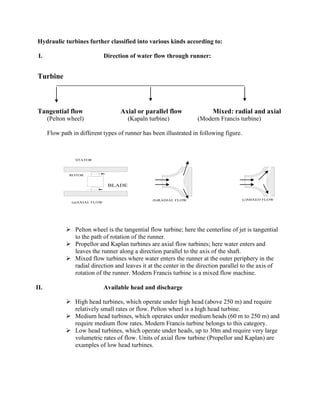
Flow path in different types of runner has been illustrated in following figure.
BLADE
ROTOR
STATOR
(a)AXIAL FLOW
(b)RADIAL FLOW (c)MIXED FLOW
 Pelton wheel is the tangential flow turbine; here the centerline of jet is tangential
to the path of rotation of the runner.
 Propellor and Kaplan turbines are axial flow turbines; here water enters and
leaves the runner along a direction parallel to the axis of the shaft.
 Mixed flow turbines where water enters the runner at the outer periphery in the
radial direction and leaves it at the center in the direction parallel to the axis of
rotation of the runner. Modern Francis turbine is a mixed flow machine.
II. Available head and discharge
 High head turbines, which operate under high head (above 250 m) and require
relatively small rates or flow. Pelton wheel is a high head turbine.
 Medium head turbines, which operates under medium heads (60 m to 250 m) and
require medium flow rates. Modern Francis turbine belongs to this category.
 Low head turbines, which operate under heads, up to 30m and require very large
volumetric rates of flow. Units of axial flow turbine (Propellor and Kaplan) are
examples of low head turbines.
On the basis of speed :
 For Pelton wheel: Ns = 9-17 for a slow runner
=17-25 for a normal runner
=25-30 for fast runner
=40 for a double jet
 Francis turbine: Ns = 50-100 for a slow runner
=100-500 for a normal runner
=150-200 for a fast runner
 Kaplan turbine: Ns =250-850
Disposition of shaft:
Impulse turbines have usually a horizontal shaft and vertical runner arrangement. Reaction
turbine may be either of vertical or horizontal shaft type.
. Main assemblies and operation of Francis turbines
 ASSEMBLIES
Assemblies mainly classified into three categories:-
a) Static
1) Turbine housing
2) Disposition
3) Stay Ring
4) Spiral
b) Dynamic
1) Distribution
2) Runner
3) Oil Seal
4) Shaft Seal
5) Cooling water
6) Guide Bearing
c) Governing
1) Governor
2) Skada
Working Of Francis turbine:
Penstock is a large size conduit, which conveys water from the high level reservoir to the
turbine. Depending upon head it is made up of mild steel, concrete, or wood .It is provided with
control valves like butterfly valve, also screens and trashrack are provided at the inlet of the
penstock prevent entries of debris. At its downstream end, penstock fitted with an efficient
nozzle that converts the whole of hydraulic energy into a high-speed jet. To regulate water flow a
spear is provide which moves backward or forward thereby controlling flow area either by
governing mechanism or by hand wheel.
Penstock is connected to and feeds water directly into the spiral casing. Casing constitutes a
closed passage whose cross section area gradually decreases along the flow direction area are
maximum at inlet and very less at exit. The casing is made up of mild steel or concrete. Stay
vanes are usually provided to direct the water from the casing to guide vanes.
Guide vanes or wicket gates are series of airfoil shaped vanes, which are arranged inside casing
to form a number of flow passages between the casing and the runner blades. They guide the
water onto the runner as per design. They swing around their own axes that change the flow area
between two consecutive runner blades. The motion is given by means of governor.
The system consists of a centrifugal governing mechanism, linkages servomotor with its oil
pressure governor and the guide wheel. The water flow and its direction remain same at all the
passages between any two consecutive guide vanes.
Runner of the Francis turbine is a rotor and has passages formed between crown and shroud in
one direction and two consecutives blades on the other. There is about 16 to 24 number of blades
in runner. These passages take water in at the outer periphery it in a direction parallel to the axis
of rotor. The driving force is both due to the impulse and reaction force. The runner blades are
usually is made up of stainless steel. The runner is keyed to the shaft, which may be of vertical or
horizontal disposition.
After passing through the runner, the water is discharged to the tail race through a gradually
expanding tube called the draft tube .the free end of the tube is submerged deep into the tail race.
 Main assemblies and operation of Pelton turbines
 ASSEMBLIES
Assemblies mainly classified into three categories:-
b) Static
1) Turbine housing
2) Disposition
3) Distribution Pipe
4) Inlet Pipe
c) Dynamic
1) Nozzle Assembly
2) Deflection Assembly
3) Runner Assembly
4) Distributor Assembly
5) Oil Head
6) Cooling Water
d) Governing
1) Governor
2) Skada
 Working Of Pelton turbine
Penstock is a large size conduit, which conveys water from the high level
reservoir to the turbine. Depending upon head it is made up of mild steel, concrete, or wood .It is
provided with control valves like butterfly valve, also screens and trashrack are provided at the
inlet of the penstock prevent entries of debris. At its downstream end, penstock fitted with an
efficient nozzle that converts the whole of hydraulic energy into a high-speed jet. To regulate
water flow a spear is provide which moves backward or forward thereby controlling flow area
either by governing mechanism or by hand wheel.
The turbine rotor, called the runner is acicular disk carrying a number of cup shaped buckets,
which are arranged equidistantly around the periphery of the disk. In case of mini hydro turbine
the buckets are the integral part of the runner while in case of the large hydro turbine or large
runner size the buckets are bolt mounted to the runner’s disc. The runner is generally mounted on
a horizontal shaft support in a small thrust bearing and is casted integrally; they are made up of
stainless steel. The inner surface of he buckets is polished to reduce frictional resistance to the
water jet. Each bucket has a ridge or splitter, which distributes the striking jet equally into two
halves of the hemispherical bucket. Again there is a cut (notch) in the outer rim of each bucket
this make the jet face the bucket only when they are at 90 to each other. The angular deflection
of jet in the bucket is limited to about 165-170 degree. The arrangement has advantage that
bearings supporting the wheel shaft are not subjected to any axial or end thrust.
A casing is provided around the runner to prevent splashing of water and to guide the water to
the tail race. It has no hydraulic function to perform apart it act as a safeguard against accidents.
Speed of turbine runner is maintained so that generator coupled directly to the turbine shaft runs
at constant speed under varying load conditions. Governing mechanism by regulating water
supply does this above function.
With increase in load, the runner speed falls and consequently balls of the centrifugal governor
move inwards. Through suitable linkages, the resulting downward movement of the governor
sleeve is transmitted to a relay, which admits oil under pressure to servomotor .The oil exerts a
force on the piston of the servomotor, and that pushes the spear to a position, which increases the
annular area of the nozzle. Quantum of water striking the buckets is then increased and the
normal turbine speed is restored. Conversely happen when we have to reduce the load
 Main assemblies and operation of Kaplan turbines
 ASSEMBLIES
Assemblies mainly classified into three categories:-
d) Static
1) Turbine housing
2) Disposition
3) Stay Ring
4) Spiral
e) Dynamic
1) Distribution
2) Runner
3) Oil Seal
4) Shaft Seal
5) Cooling water
6) Guide Bearing
f) Governing
1) Governor
2) Skada
Working Of Kaplan turbine:
Except the runner, all other parts such as spiral casing, stay ring and stay vanes, guide
mechanism and the draft tube are similar to those of Francis turbine. Between the guide vanes
and the runner water turns through right angle and subsequently flows parallel to the shaft. The
runner is in the form of boss, on the periphery of the boss are mounted equidistantly 3 to 6 vanes
made of stainless steel. Hence it has less friction resistance as runner blades are directly attached
to the runner hub and also there are fewer blades as compared to Francis turbines.
The Kaplan has a double regulation, which comprises the movement of guide vanes and
runner vanes. The runner employs two servomotors; one control the guide vanes and the second
operates on the runner vanes .the governing is done by the governor from inside of the hollow
shaft of turbine runner and the movement of piston is employed to the twist blades through
suitable linkages.
CHAPTER-5
MACHINE SHOP
 Drilling Machine
Machine Maker – Csepel
Machine No. – 06 RD 1
Maximum Height: 10 – 11 feet
Tool Used – Drill Tool (Maximum 100 mm)
Operation – Drilling
Speed – 1800 RPM
Feed range: 0.3 – 2 mm per min
Job is fixed and tool moves and rotates. It is used for drilling, reaming and
tapping, spot facing etc. Tools are adjusted and fixed by clamp. The waste material
produced is continuous long helical spring. Tool used are twist drill, extra long drill, core
drill, taper shrunk socket reamer etc. It has both automatic and manual feed.
 Error in drilling machine
1. Misinterpretation of drawing and getting machined wrong dimensions.
2. Measuring instrument errors.
3. If tapping tool breaks then it get stuck inside the hole.
4. Improper clamping of job causing slip of job.
5. RPM improper arrangement.
6. Shrinkage in Stainless steel
7. Tool Setting
 Precautions
1. Metal plate should be used to prevent bending of both tool and work
piece.
2. Coolant should be used.
3. Waste material should be removed bye brush.
4. Measuring instrument should be checked for error.
5. Drawing should be studied properly.
Common lifting machines
 Fork lifter
Capacity – 3 tones
Make – Godrej
Cylinder – 4
Fuel – Diesel
Fuel tank – 40 liter
Automatic transmission i.e. only two gears reverse and forward. Jaws can go up
to a height of 3m. Power steering is also provided.
 Cranes
Make – WMI Cranes ltd. and Grip.
Capacity : 1- 40 tones.
There are 4 such cranes in the workshop. Mainly nylon sling and wire sling are used
to carry load with the help of attachments like S clamp, C clamp, Eye bolt, Swivel Threads,
manual hoist and D circle.
Even this nylon sling and wire sling varies from 1 tone capacity to 40 tones capacity.
CHAPTER -6
FABRICATION DEPARTMENT
 Welding Equipments
 TIG (Tungsten Inert Gas)
Machine Make: Frronius and Triodyn.
It is a semiautomatic welding process. Here arc is struck between electrode and job.
Electrode is non-consumable. There is ceramic coating over tungsten electrode tip.
Ceramic coating is used because it has a very high melting point of 3500 C. Inert
environment is provided by argon gas. Hands supply filler metal manually.
TIG has better penetration as comparison to other welding operations. It has no
backfire. It is specially used for giving a coating of stainless steel over a job when it is
over machined or over grinded. Also some times for balancing purpose metal are
added through TIG. The filler metal comes in various range of thickness from 1.2
mm, 1.6 mm, 2 mm and 2.4 mm (Make is ESAB, kobelco and bohler). Copper cable
is used to connect Electrode holder and D.C. Flow meter are generally attached to the
argon cylinder.
 MIG (Metal Inert Gas)
Machine Make: Frronius and Triodyn.
It is also semi automatic welding process. Here arc is also struck between electrode and
job. But here electrode is filler metal wire. Electrode is consumable. Here filler metal
wire speed is 5 mm per revolution. Argon and carbon-di-oxide gases provide the inner
environment. Color code for argon and carbon-di-oxide cylinder is green. The Mild steel
wire diameter ranges are 1.2 mm, 2 mm, and 4 mm (Make is ESAB). Sometimes S.S
coating is provided over M.S for water resistant coating.
In MIG welding, spatter is prevented by applying spatter gel is applied on the torch so
that spatter doesn’t stick to the torch. Spatter core is the area where spatter can reach.
Welding fixture for M.S comes along with wire but for a S.S a separate fixture is used.
 SMAW (Shield Metal Arc Welding)
Machine Make: Frronius and Triodyn.
It is used for welding pipe section like spiral. Butt joint can be weld up to thickness 15 – 20 mm.
Here arc is struck between electrode and the job. Electrode can be of various types depending
upon job material and the thickness of the job. Always the positive terminal of the dc source is
connected to the electrode i.e. 1/3 to the electrode and 2/3 to the job. The distance between the
job and the electrode depends upon thickness of the electrode at most it could be 3 mm.
Electrodes are generally heated in the electronic furnace at a temperature about 100c to 120c
before use so that it has no moisture and it gives you a continuous weld. Hoses are made us of
rubber. Reverse polarity is applied in SMAW.
According to American Standards, E 6013 means ‘E’ stands for Electrode. 60 stand for “tensile
strength”. 1 stands for “Welding Position”. 3 stand for “flux coating or covering”.
Various electrodes used are: -
1. Electrode: 7018
Used for MS (Mild Steel). Heavy coated low hydrogen iron powder electrode for high
quality welds in restrained joints in MS. Radiographic Quality Weld. Metal recovery
minimum 110%. Ready electrode at 300 Deg. Celsius per hour.
Manufacturer: D & H
Use AC 70 or DC +
Diameter in mm Current (Amperes)
2.0 50 – 70
2.5 70 - 100
3.15 100 - 150
4.0 150 - 190
5.0 200 - 256
1. Electrode: 309L
Used for stainless steel. Electrode deposits a stainless steel weld metal of 25%Cr – 12%Ni
with extra low carbon. The weld deposit displays excellent resistance to cracking even in
restrained joints. The electrode is highly suitable for welding mild steel to stainless steel.
The electrode possesses pleasing performance characteristics.
Manufacturer: D&H
Use AC or DC (+)
Diameter (mm) Current (ampere)
2 40-50
2.5 60-80
3.15 80-100
4 110-140
5 150-180
 Safety Equipments used are
1) Welding curtain
2) Leather Hand gloves
3) Welding Respirator
4) Leg Guard
5) Fire Retardant Cap
6) Welding glasses with side safety
7) Welding head screen
8) Helmet
NOTE: In other to prevent the bending while doing welding spiders are generally attached to the
large hollow job. These spiders are removed by gas cutting equipments.
Defects in Welding:
1. External
Blow Holes
Slag Trap
Impurity
Surface Crack
Under Cuts
Spatter
Internal
Blow Holes
Pin Holes
Porosity
Insufficient Fusion
Internal Cracks
Types of Test
1. Dye Penetration Test:
In this test firstly the surface to be tested is cleaned by thinner & then red
penetrant is applied on it & then again it is cleaned. After this developer is applied on it.
After drying all surface impurities like crack are visible to eye & this can be removed by
the use of gauging. It is used for examining external cracks. The developer stays there for
about a minute so examiner had to note the entire surface defects very quickly.
2. Magnetic Penetration Test:
In this test magnetic powder is spread on the welded part & then through
magnetic jaws the magnetic field is applied & where the crack exist this powder starts to jump-
up or starts to attract towards the crack that depends on the development of south-north pole i.e.
on the polarity. It is used for examining the internal cracks.
Chapter-7
TERMS RELATED TO HYDRO POWER PLANT
FRL (FULL RESERVOIR LEVEL)
FRL is the Upper level of the reservoir (selected based on techno-economic& submergence
considerations
MDDL (MINIMUM DRAWDOWN LEVEL)
Lowest level up to which the reservoir level could be drawn down to withdraw waters for energy
generation (selected from considerations of silt & turbine operational limits) is called as
minimum drawdown level.
GROSS STORAGE
Total storage capacity of the reservoir is termed as gross storage.
DEAD STORAGE
Reservoir storage which cannot be used for generation and is left for silt deposition( below
MDDL) is called as dead reservoir.
LIVE STORAGE
It is the storage in the reservoir which is available for power generation.(between FRL &
MDDL)
FIRM POWER
Firm power is continuous power output in the entire period of hydrological data at 90%
dependability.
FIRM ENERGY
Energy generated corresponding to firm power is called as firm energy.
PEAK ENERGY
Peak energy is electric energy supplied during periods of relatively high system demands.
OFF-PEAK ENERGY
Off peak energy is electric energy supplied during periods of relatively low system demand
CHAPTER-8
COMPONENTS OF HYDRO TURBINES
.Dummy discharge ring –It is placed at the bottom and is known as bottom head. On this ring
we place the 24 guide vanes and on these guide vanes we place bushes along with the top head.
On this top head we place levers whose one end is attached to the guide vane and other to the
link. This link is attached to the regulating wheel. With the help of servomotor we get
reciprocating motion, which is of guide vanes.
.In upper head there are 24 bores and in these bores 24 bushes are placed. In these bushes
similar number of guide vanes is also placed.
.Inner head or inner distributor is fit into the center of wicket gate assembly and through it the
shaft is passed.
.Through guide bearing housing shaft is passed.
.Guide Vanes – It consists of two side’s i.e. thick end and thin side. The thick side is called flat
side and the thin side is called chamfer side. The water strikes at the thick side and passes away
from the thin side. The distance between the thick ends of the guide vein is called facial gap.
.Ceiling Gap – The distance between two corresponding faces of guide vanes. If ceiling gap is
more than we have to file to make it less.
.Filler gauge – It is used to check the gap between two mating parts given as per drawing.
.Tripping Relay Device – It is a safety device used in turbines. It consists of arrangement of
lever, spring and cam. An electronic speed-measuring device is placed on the shaft to calculate
its speed. As the speed of shaft increases tension in the spring increases and it begin to move and
a stage comes when it outer face collides with the trip of tripping device because of which the
trip cuts off and the supply of oil to the shaft stops which causes shaft to switch off. It is mainly
due to the cut off of servomotor. Maximum pressure in servomotor is 60kg/cm square&
maximum stroke of servomotor is 172.
.
.SILT Tanks-It is used for cleaning purpose to prevent sand coming into the turbine. Although
trash racks are provided in the penstock but they can’t stop sand. They can control only stop big
wood blocks sought of thing
CHAPTER-9
ELEMENTS/COMPONENT OF HYDRO POWER PLANT
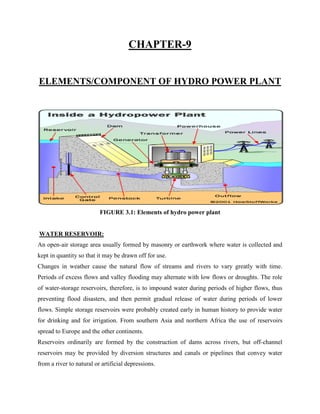
FIGURE 3.1: Elements of hydro power plant
WATER RESERVOIR:
An open-air storage area usually formed by masonry or earthwork where water is collected and
kept in quantity so that it may be drawn off for use.
Changes in weather cause the natural flow of streams and rivers to vary greatly with time.
Periods of excess flows and valley flooding may alternate with low flows or droughts. The role
of water-storage reservoirs, therefore, is to impound water during periods of higher flows, thus
preventing flood disasters, and then permit gradual release of water during periods of lower
flows. Simple storage reservoirs were probably created early in human history to provide water
for drinking and for irrigation. From southern Asia and northern Africa the use of reservoirs
spread to Europe and the other continents.
Reservoirs ordinarily are formed by the construction of dams across rivers, but off-channel
reservoirs may be provided by diversion structures and canals or pipelines that convey water
from a river to natural or artificial depressions.
When streamflow is impounded in a reservoir, the flow velocity decreases and sediment is
deposited. Thus, streams that transport much suspended sediment are poor sites for reservoirs;
siltation will rapidly reduce storage capacity and severely shorten the useful life of a small
reservoir. Even in larger reservoirs, sedimentation constitutes a common and serious problem.
Because removal of the deposited sediments from reservoirs is generally too costly to be
practical, reservoirs on a sediment-laden stream are characteristically planned to provide a
reserve of storage capacity to offset the depletion caused by sedimentation. Despite this, the life
expectancy of most reservoirs does not exceed 100 years at present sedimentation rates.
 The water reservoir is the place behind the dam where water is stored.
 The water in the reservoir is located higher than the rest of the dam structure.
 The height of water in the reservoir decides how much potential energy the water
 The higher the height of water, the more its potential energy.
 The high position of water in the reservoir also enables it to move downwards
effortlessly.
 The height of water in the reservoir is higher than the natural height of water flowing in
the river, so it is considered to have an altered equilibrium.
 This also helps to increase the overall potential energy of water, which helps ultimately
produce more electricity in the power generation unit.
DAM:
A structure built across a stream, river, or estuary to retain water. Dams are built to provide water
for human consumption, for irrigating arid and semiarid lands, or for use in industrial processes.
They are used to increase the amount of water available for generating hydroelectric power, to
reduce peak discharge of floodwater created by large storms or heavy snowmelt, and to increase
the depth of water in a river in order to improve navigation and allow barges and ships to travel
more easily. Dams can also provide a lake for recreational activities such as swimming, boating,
and fishing. Many dams are built for more than one purpose; for example, water in a single
reservoir can be used for fishing, to generate hydroelectric power, and to support an irrigation
system. Water-control structures of this type are often designated multipurpose dams.
Auxiliary works that can help a dam function properly include spillways, movable gates, and
valves that control the release of surplus water downstream from the dam. Dams can also include
intake structures that deliver water to a power station or to canals, tunnels, or pipelines designed
to convey the water stored by the dam to far-distant places. Other auxiliary works are systems for
evacuating or flushing out silt that accumulates in the reservoir, locks for permitting the passage
of ships through or around the dam site, and fish ladders (graduated steps) and other devices to
assist fish seeking to swim past or around a dam.
A dam can be a central structure in a multipurpose scheme designed to conserve water resources
on a regional basis. Multipurpose dams can hold special importance in developing countries,
where a single dam may bring significant benefits related to hydroelectric power production,
agricultural development, and industrial growth. However, dams have become a focus of
environmental concern because of their impact on migrating fish and riparian ecosystems. In
addition, large reservoirs can inundate vast tracts of land that are home to many people, and this
has fostered opposition to dam projects by groups who question whether the benefits of proposed
projects are worth the costs.
 The dam is the most important component of hydroelectric power plant.
 The dam is built on a large river that has abundant quantity of water throughout the year.
 It should be built at a location where the height of the river is sufficient to get the
maximum possible potential energy from water.
SPILLWAY:
Excess accumulation of water endangers the stability of dam construction. Also in order to avoid
the over flow of water out of the dam especially during rainy seasons spillways are provided.
This prevents the rise of water level in the dam. Spillways are passages which allows the excess
water to flow to a storage area away from the dam
INTAKE:
These are the gates built on the inside of the dam. The water from reservoir is released and
controlled through these gates. These are called inlet gates because water enters the power
generation unit through these gates. When the control gates are opened the water flows due to
gravity through the penstock and towards the turbines.
FOREBAY:
A forebay (or head pond) is an enlarged body of water provided at the downstream end of canal
just at the upstream of penstocks to act as a small balancing reservoir. A forebay is required in
the case of run-of-river plants at the upstream of the diversion work. In case of a storage plant, it
is required only when the power house is located away from the dam and the water is conveyed
to the power house through a power canal. If the power house is located at the toe of the dam, a
separate forebay is not required since the penstocks directly take water from the reservoir which
itself act as a forebay.
The main function of forebay is to store some water to act as a regulating reservoir for the
penstocks.
PENSTOCK:
The penstock is the long pipe or the shaft that carries the water flowing from the reservoir
towards the power generation unit, comprised of the turbines and generator. The water in the
penstock possesses kinetic energy due to its motion and potential energy due to its height.The
total amount of power generated in the hydroelectric power plant depends on the height of the
water reservoir and the amount of water flowing through the penstock.The amount of water
flowing through the penstock is controlled by the control gates.
PRESSURE TUNNEL:
It is a passage that carries water from the reservoir to the surge tank
SURGE TANK:
It is a safety device.Whenever the electrical load on the generator drops down suddenly, the
governor partially closes the gates which admits water flow to the turbine. Due to this sudden
decrease in the rate of water flow to the turbine, there will be sudden increase of pressure in the
penstock. This phenomenon results in hammering action called water hammer in the penstock.
CHAPTER-9
MAINTENANCE DEPARTMENT
Maintenance is of two types:
1. Planned
I. Autonomous: 3M 3S (Japanese Method)
3M 3S stands for 3 minute 3 services that mean daily to daily
checking of machine cleanliness, hydraulic pressure and oiling or lubrication.
II. Preventive:
In these MTBF (mean time between failures) and MTTR (mean time
to repair) should be same.
III. Predictive Maintenance
It is like you can predict the time to failure. It requires control over
frequency of checking.
IV. Conditioning Maintenance:
It is monitory very close before sometime of predictable failure date
i.e. 10 days before so that if it fails first we can replace it or if it works for some
more days then it prevents some money for organization. Different tests carried
on condition monitoring like vibration test and hydraulic check etc.
2. Unplanned
I. Breakdown Maintenance
II. Corrective Maintenance
Maintenance mainly involves infrastructure details along with the machine profile
and all computer related things.
Here in VA Tech total production management is followed. Maintenance department also
handles computer network wiring and generators. For computer networking VA TECH use Cat-7
technology in which 20,000 meters long wires are laid down. Proportional Logic Controller
Synchronization is used in generators which synchronies voltage, frequency and phase angle.
Maintenance involves external power generation, internal power generation in case of power cut
off, synchronization thru PLC. Maintenance also assembled new machinery.
CHAPTER-10
STORES DEPARTMENT
In two ways the material is given:
 Consumables (electrodes, grinding wheel)
These tools once you give don’t return back. Consumables are always enter the SAP.
 Non-Consumables (instrument, tools)
These tools are return back to the customer after there use. Non- consumables are manually
maintained in the register.
 How to maintain the stock levels?
1. Identify all major regular items with monthly average consumption.
2. Fix the maximum, minimum and ordering level of these items in SAP.
3. Review the stock levels and raise MPR when stock reaches ordering level
(material purchase requisition).
4. Consider the current lead-time while raising MPR.
5. Purchase MPR if the level is going down.
6. Review the consumption trend periodically.
7. Based on the consumption trend review the list of stock items and their stock
levels with the users and update the same.
MRV stands for material receive voucher.
Store is divided into following sections:
 Special Erection Tools
Used when machines are plotted or fixed.
 Welding Equipments
 Grinding Equipments
 Safety Equipments
 Heavy Sections
 Hydraulic jacks are used to uplift the heavy loads. Using a cycle chain like
arrangement uses roller spadder to move heavy jobs from one place to another.
Its ranges from 1 tons to 20 tons.
 Oil pump pumps the oil to the hydraulic machine. It has a dial showing how
much weight lifted.
 Special purpose drilling machine both magnetic and vaccum used specially for
foundation purpose or packing purpose. It is a portable machine.
 Pipe bending hydraulic machine fitted with oil seal is used to bend pipe.
Pumping is done by hand. Oil seal doesn’t allow it to flow back. It ha various
dies of different shape. Also pipe holder can hold pipes of different shape.
 Electrical Instruments
 BS-60 electric paint spray gun mainly used for painting, disinfecting,
corrosion-removal & cleaning. It has .5 mm round spray nozzle.
Specifications:
Power supply: 230V, 50 HZ
Power: 60 Watts
Maximum pressure (app.): 140 bars
 HILTI PD-10 mainly used to measure the distance during erection.
 These include torches, Meqquer, Electronic Label maker, C.R.O, and
Switchboard. In these devices some are current measuring devices & some are
used for the purpose of amplification
 General Instruments
 Center head (dead center) revolving whole.
 Revolving head only tip port.
 Drill chuck
 General Tools
 BOX SPANNER: They are used for tightening purposes. Handle, which is fitted
inside the box spanner & is working like lever & rotates to produce tightening.
(6 mm to 110 mm diameter)
 Vice are used to hold the job. Letter punch, Number punch are used to print
numbers & letters on the job.
 Hammer spanner (30 mm to 125 mm diameter)
 Hammer ring spanner (50 mm, 55 mm, 125 mm)
 Die spanner
 Allen key
CHAPTER-11
CONCLUSION
My journey to Tehri dam was a great experience for me. I have come to know more about hydro
machineries, methodology adopted for this and also I got to know about various equipment’s
used in workshop etc.
With this I realized that Tehri dam is a precious gift of science and technology.
From here I also wish thank and welcome to all the engineers for such a lovely creation .
And finally training has proved to be quite fruitful.

Amit report 2

  • 1.
    TEHRI HYDRO DEVELOPMENTCORPORATION A SUMMER INTERNSHIP REPORT Submitted by AMIT RATURI Registration No: 11301334 in partial fulfillment of Summer Internship for the award of the degree of BACHELOR OF TECHNOLOGY (Mech) School of Mechanical LOVELY PROFESSIONAL UNIVERSITY Phagwara, Punjab July, 2016
  • 2.
    CERTIFICATION LETTER Certified thatthe summer internship project report “Tehri Hydro Develpoment Corporation” is the bonafide work of Amit Raturi, Regd. No: 11301334, student of Bachelor of Technology(Mech) of School of Mechanical, Lovely Professional University carried out under my supervision during June 16, 2016 to July 26, 2016. Signature of the Industry Supervisor Date : July 16, 2016 Name of Supervisor : Mr. Sanjay Goel Designation : Mechanical Engineer
  • 3.
    ACKNOWLEDGEMENT To acknowledge isvery great way to show your gratitude towards the persons who have contributed in your success in one or other way. I find words inadequate to express my gratitude towards Mr.Sanjay Goel, Mechanical Engineeer, for providing me an opportunity to carry out my summer training at Tehri Hydro Development Corporation, Tehri garhwal I am thankful to all the staff members of Mechanical department in providing me useful guidance for the completion of this report. I convey my gratitude to all those who are directly or indirectly related in the completion of this project report. Finally I would be failing in my duty if I don’t express my thanks to the respondents whom I visited and took their valuable time to answer my questionnaire.
  • 4.
    PREFACE Engineer student gaintheir theoretical knowledge only through their books. Only theoretical knowledge is not sufficient for absolute mastery in any field.theoritical given in our books is not much use without knowing its practical implementation, it has been experienced that theoretical knowledge is volatile in nature, however practical knowledge make solid foundation of our mind. To accomplish this aspect, LOVELY PROFESSIONAL UNIVERSITY, PUNJAB has included a SUMMER TRAINING programme for the student of B.Tech. in summer vacation. I took training in “TEHRI HYDRO DEVELOPMENT CORPORATION” at TEHRI from 16 June to 26 July 2016. Successding chapter give detail about what I have learned in this prestigious organization. AMIT RATURI
  • 5.
    CONTENTS Chapter Name Page 1Introduction 6 2 History 8 3 Location 10 4 Introduction to hydro 11 Turbines 5 Machine shop 19 6 Fabrication shop 23 7 Terms related to hydro power plant 26 8 Componenets of Hydro Turbines 28 9 Components of Hydro Power Plant 29 10 Maintenance 31 11 Stores 33 12 Conclusion 34
  • 6.
    CHAPTER-1 THDC INDIA LIMITED INTRODUCTION THDCIndia Limited (formerly known as Tehri Hydro Development Corporation Ltd.), is a Joint Venture of Govt. of India and Govt. of Uttar Pradesh. The Equity is shared in the ratio of 75:25 between GoI and GoUP for the Power Component. The Company was incorporated in July’ 88 to develop, operate & maintain the 2400 MW Tehri Hydro Power Complex and other hydro projects. The Company has an authorised share capital of ` 4000 cr. THDCIL is a Mini Ratna Category-I and Schedule ‘A’ CPSE. The initial mandate of THDCIL was to develop, operate and maintain the 2,400 MW Tehri Hydro Power Complex (comprising of 1000 MW Tehri Dam & HPP, 1000 MW Tehri Pumped Storage Plant & 400 MW Koteshwar HEP) and other Hydro Projects. The Memorandum and Articles of Association of the Company has been modified to reflect the current business reality of projects outside Bhagirathi valley. The object clause has been amended to incorporate development of Conventional/ Non-conventional/ Renewable sources of Energy and River Valley Projects. The Corporation has grown into a multi-Project Organisation, with Projects spread over various States as well as neighbouring Country, Bhutan. THDCIL presently has 15 projects totaling to an installed capacity of 6211 MW under various stages of implementation / development. The commissioning of the 1,000 MW Tehri Power Station by THDCIL in 2006-07 was a landmark for the Country’s Power Sector. The Tehri Project is a multipurpose Project providing power benefits to the Northern Region, Irrigation benefits to Uttar Pradesh, and Drinking Water benefits to NCT Delhi and U.P. Due to regulated releases from the Tehri storage reservoir, the existing downstream hydro projects of the State are also benefiting by way of augmentation in generation at no additional cost to them.
  • 7.
    The 400 MWKoteshwar HEP, downstream of Tehri was commissioned in 2011-12. The 1,000 MW Tehri Pumped Storage Plant, which would utilize the Tehri and Koteshwar reservoirs as the pre- requisite upstream and downstream reservoirs, is presently under implementation. The 1,000 MW Tehri PSP is the first Pumped Storage Scheme to be taken up in the Central Sector, and is expected to set a model for the development of the untapped Pumped Storage potential in the Country, which stands at over 90,000 MW. In addition to the 2,400 MW Tehri Hydro Complex, THDCIL is implementing the 444 MW Vishnugad Pipalkoti Hydro Electric Project (VPHEP) on river Alaknanda in Uttarakhand. THDCIL is also implementing 24 MW Dhukwan Small Hydro Project on Betwa river in Uttar Pradesh. In addition, there are various hydro projects of THDCIL under different stages of implementation i.e. Survey & Investigation and DPR preparation. Government of UP has allotted Khurja Super Thermal Power Plant (2X660 MW) in Bulandshahar Distt to THDCIL for implementation. Under India-Bhutan Co-operation in hydro Sector development, THDCIL is implementing Bunakha HEP (180 MW) and has taken up work of updation of DPR of Sankosh HEP (2585 MW) in Bhutan. Total installed capacity of THDCIL presently is 1,400 MW. THDCIL has two generating stations namely Tehri Stage-I (4x250 MW) and Koteshwar HEP (4x100 MW). THDCIL is consistently profit making company since the commissioning of Tehri Dam & HPP in the year 2006-07. THDCIL is a dividend paying company since 2007-08. Tehri Dam has been conferred the Prestigious award of “International Milestone Project” of International Commission of Large Dam (ICOLD) in Oct.’09 in China, considering the Uniqueness of its design and construction features. Koteshwar HEP has been conferred the PMI India Best Project Award of the year in long term duration (More than 3 years) category in 2011-12. THDCIL has been conferred the Power Line Award in the category of 'Best Performing Generation Company (in Hydro Sector)’ in May 2012. THDCIL has been conferred SCOPE Meritorious Award for Corporate Social Responsibility and Responsiveness in April’12. THDCIL has obtained ISO 9001:2008 Certificate of Quality Management System and ISO 14001-2004 Certification (Environment Management System) for Corporate Office, Rishikesh, Tehri HPP, Tehri PSP, Koteshwar HEP and Vishnugad Pipalkoti HEP. THDCIL has also obtained OHSAS 18001:2007 (Occupational Health and Safety Management System) Certification for Corporate Office, Rishikesh. Since first year of commercial operation, THDCIL is a profit making organization. THDCIL earned a Net Profit of Rs.117.48 Cr., Rs. 323.58 Cr., Rs. 325.21 Cr., Rs..479.95 Cr., Rs.. 600.48 Cr. , Rs. 703.83 Cr., Rs. 531.38 Cr and Rs.595.32 Cr. during 2006-07, 2007-08, 2008-09, 2009-10, 2010-11, 2011-12, 2012-13 and 2013-14 respectively.
  • 8.
    CHAPTER-2 HISTORY A preliminary investigationfor the Tehri Dam Project was completed in 1961 and its design was completed in 1972 with a 600 MW capacity power plant based on the study. Construction began in 1978 after feasibility studies but was delayed due to financial, environmental and social impacts. In 1986, technical and financial assistance was provided by the USSR but this was interrupted years later with political instability. India was forced to take control of the project and at first it was placed under the direction of the Irrigation Department of Uttar Pradesh. However, in 1988 the Tehri Hydro Development Corporation was formed to manage the dam and 75% of the funding would be provide by the federal government, 25% by the state. Uttar Pradesh would finance the entire irrigation portion of the project. In 1990, the project was reconsidered and the design changed to its current multi-purpose. Construction of the Tehri Dam was complete in 2006. 1949 Tehri dam conceived 1961 Tehri chosen as a tentative site for the dam 1972 Planning Commission gives its nod to the dam 1978 Actual construction of the dam begins under police protection; Protests gather momentum 1980 Environmental Appraisal Committee appointed by the government, refuses environmental clearance 1986 Diversion tunnels start operating; Protestors storm the site and stall construction work 1990 Environmental Appraisal Committee, the D R Bhumbla committee, rejects the dam again 1991 Earthquake measuring 6.6 on Richter scale rocks Uttarkashi. Renewed concerns about the seismic safety of the dam. SUMBERGED TEHRI
  • 9.
    NEW TEHRI 1992 SunderlalBahugunagoes on a fast unto death. Work on the dam temporarily stopped. Gain in 1995 1996 Government sets up the V K Gaur committee to look into seismic safety 1997 Hanumantha Rao committee on rehabilitation submits its report. Recommends major changes in rehabilitation policy 1998 Gaur committee submits its report. Asks for detailed analysis 1999 Chamoli earthquake, measuring 6.8, brings large scale destruction. Anti-dam activists up in arms about safety 1999 Committee of secretaries of the Union government clears dam January2001 Bhuj Earthquake Again Raises Concerns April 2001 Government Forms another Committee under the S&T Minister Murli Manohar Joshi November 2002 M M Joshi Committee Submits Its Report. Says The Dam Is Safe To Withstand An Earthquake Of High Magnitude September 2003 In A Divided Verdict, The Supreme Court Clears The Legal Hurdles For Dam Construction March 2004 Tunnel T2 Closed. Water Level Rises To 648 Metres Submerging Many Parts Of Old Tehri Town July 29, 2004 Water Level Rises To 655 Metres Submerging The Remaining Parts Of The Tehri Town. Residents Flee For Their Lives August 2004 Internal Landslide at The Dam Site. 29 Workers Dead 2006 Tehri Town Fully Submerges. First Stage Of Project Completes. (Total Production 1000 Mw)
  • 10.
    CHAPTER-3 LOCATION Tehri Dam isthe primary dam of the Tehri Development Project, a major hydroelectric project centered near Tehri Town in the state of Uttarakhand in India.It is located on the Bhagirathi River, the principal tributary of the sacred River Ganga. Technical description 1. Earth & Rock Fill Dam : Type : Rock and Earth Fill Height : 260.5 m Base : 1128 m Width at top : 25.5 m Length at the top : 592 m 2. Tehri Reservoir: Water Spread : 42 SQ KM Gross Storage : 3540 Miliion Cum Live Storage : 2615 Million Cum 3. Power House: Power House :Under ground Cavern Size : 197mx24mx63m Type of Turbines : Francis Rated Head : 188 M Speed : 214.3 RPM Installed Capacity : 4x250MW Annual Energy : 3568 MUs
  • 11.
    CHAPTER-4 HYDRO TURBINES  Whatare hydro turbines? ANS: A hydro turbine uses the potential and kinetic energy of water and converts it into usable mechanical energy. The fluid energy is available in the natural or artificial high level water reservoirs, which are created by constructing dam at appropriate places in the flow path of rivers. When water from the reservoir is taken to the turbine, transfer of energy takes place in the blade passages of the unit .the mechanical energy made available at the turbine shaft is used to run an electric generator, which is directly couple to the turbine shaft. The power generated by utilizing the potential and kinetic energy of water has the advantages of high efficiency, operational flexibility, low wear and tear, and ease of maintenance.  Classification of turbine Turbines are of two types: A. Impulse Turbine: Wherein the available hydraulic energy is first converted into kinetic energy by means of an efficient nozzle. The high velocity jet issuing from the nozzle then strikes a series of suitably shaped buckets fixed around the rim of a wheel .The buckets change direction of jet without changing its pressure .The resulting change in momentum sets bucket and wheel into rotary motion and energy. An impulse turbine operator under atmospheric pressure, there is no change of static pressure across turbine runner and the unit is often referred to as free jet turbine. Important impulse turbines are: pelton wheel, turgo-impulse wheel, girad turbine, bunki turbine and jonval turbine etc. B. Reaction Turbine: Wherein the part of the total available hydraulic energy is transformed into kinetic energy before the water is taken to the turbine runner. A substantial part remains in the form pressure energy. Subsequently both the velocity and pressure change simultaneously as water bleeds along the turbine runner. The flow from inlet to outlet of the turbine is under pressure and, therefore, blades of reaction turbine are closed passages sealed from atmospheric conditions. Important reaction turbines are: Fourneyron, Thompson, Francis, Kaplan and propellor turbines.
  • 12.
    Hydraulic turbines furtherclassified into various kinds according to: I. Direction of water flow through runner: Turbine Tangential flow Axial or parallel flow Mixed: radial and axial (Pelton wheel) (Kapaln turbine) (Modern Francis turbine) Flow path in different types of runner has been illustrated in following figure. BLADE ROTOR STATOR (a)AXIAL FLOW (b)RADIAL FLOW (c)MIXED FLOW  Pelton wheel is the tangential flow turbine; here the centerline of jet is tangential to the path of rotation of the runner.  Propellor and Kaplan turbines are axial flow turbines; here water enters and leaves the runner along a direction parallel to the axis of the shaft.  Mixed flow turbines where water enters the runner at the outer periphery in the radial direction and leaves it at the center in the direction parallel to the axis of rotation of the runner. Modern Francis turbine is a mixed flow machine. II. Available head and discharge  High head turbines, which operate under high head (above 250 m) and require relatively small rates or flow. Pelton wheel is a high head turbine.  Medium head turbines, which operates under medium heads (60 m to 250 m) and require medium flow rates. Modern Francis turbine belongs to this category.  Low head turbines, which operate under heads, up to 30m and require very large volumetric rates of flow. Units of axial flow turbine (Propellor and Kaplan) are examples of low head turbines.
  • 13.
    On the basisof speed :  For Pelton wheel: Ns = 9-17 for a slow runner =17-25 for a normal runner =25-30 for fast runner =40 for a double jet  Francis turbine: Ns = 50-100 for a slow runner =100-500 for a normal runner =150-200 for a fast runner  Kaplan turbine: Ns =250-850 Disposition of shaft: Impulse turbines have usually a horizontal shaft and vertical runner arrangement. Reaction turbine may be either of vertical or horizontal shaft type.
  • 14.
    . Main assembliesand operation of Francis turbines  ASSEMBLIES Assemblies mainly classified into three categories:- a) Static 1) Turbine housing 2) Disposition 3) Stay Ring 4) Spiral b) Dynamic 1) Distribution 2) Runner 3) Oil Seal 4) Shaft Seal 5) Cooling water 6) Guide Bearing c) Governing 1) Governor 2) Skada Working Of Francis turbine: Penstock is a large size conduit, which conveys water from the high level reservoir to the turbine. Depending upon head it is made up of mild steel, concrete, or wood .It is provided with control valves like butterfly valve, also screens and trashrack are provided at the inlet of the penstock prevent entries of debris. At its downstream end, penstock fitted with an efficient nozzle that converts the whole of hydraulic energy into a high-speed jet. To regulate water flow a spear is provide which moves backward or forward thereby controlling flow area either by governing mechanism or by hand wheel.
  • 15.
    Penstock is connectedto and feeds water directly into the spiral casing. Casing constitutes a closed passage whose cross section area gradually decreases along the flow direction area are maximum at inlet and very less at exit. The casing is made up of mild steel or concrete. Stay vanes are usually provided to direct the water from the casing to guide vanes. Guide vanes or wicket gates are series of airfoil shaped vanes, which are arranged inside casing to form a number of flow passages between the casing and the runner blades. They guide the water onto the runner as per design. They swing around their own axes that change the flow area between two consecutive runner blades. The motion is given by means of governor. The system consists of a centrifugal governing mechanism, linkages servomotor with its oil pressure governor and the guide wheel. The water flow and its direction remain same at all the passages between any two consecutive guide vanes. Runner of the Francis turbine is a rotor and has passages formed between crown and shroud in one direction and two consecutives blades on the other. There is about 16 to 24 number of blades in runner. These passages take water in at the outer periphery it in a direction parallel to the axis of rotor. The driving force is both due to the impulse and reaction force. The runner blades are usually is made up of stainless steel. The runner is keyed to the shaft, which may be of vertical or horizontal disposition. After passing through the runner, the water is discharged to the tail race through a gradually expanding tube called the draft tube .the free end of the tube is submerged deep into the tail race.
  • 16.
     Main assembliesand operation of Pelton turbines  ASSEMBLIES Assemblies mainly classified into three categories:- b) Static 1) Turbine housing 2) Disposition 3) Distribution Pipe 4) Inlet Pipe c) Dynamic 1) Nozzle Assembly 2) Deflection Assembly 3) Runner Assembly 4) Distributor Assembly 5) Oil Head 6) Cooling Water d) Governing 1) Governor 2) Skada  Working Of Pelton turbine Penstock is a large size conduit, which conveys water from the high level reservoir to the turbine. Depending upon head it is made up of mild steel, concrete, or wood .It is provided with control valves like butterfly valve, also screens and trashrack are provided at the inlet of the penstock prevent entries of debris. At its downstream end, penstock fitted with an efficient nozzle that converts the whole of hydraulic energy into a high-speed jet. To regulate water flow a spear is provide which moves backward or forward thereby controlling flow area either by governing mechanism or by hand wheel.
  • 17.
    The turbine rotor,called the runner is acicular disk carrying a number of cup shaped buckets, which are arranged equidistantly around the periphery of the disk. In case of mini hydro turbine the buckets are the integral part of the runner while in case of the large hydro turbine or large runner size the buckets are bolt mounted to the runner’s disc. The runner is generally mounted on a horizontal shaft support in a small thrust bearing and is casted integrally; they are made up of stainless steel. The inner surface of he buckets is polished to reduce frictional resistance to the water jet. Each bucket has a ridge or splitter, which distributes the striking jet equally into two halves of the hemispherical bucket. Again there is a cut (notch) in the outer rim of each bucket this make the jet face the bucket only when they are at 90 to each other. The angular deflection of jet in the bucket is limited to about 165-170 degree. The arrangement has advantage that bearings supporting the wheel shaft are not subjected to any axial or end thrust. A casing is provided around the runner to prevent splashing of water and to guide the water to the tail race. It has no hydraulic function to perform apart it act as a safeguard against accidents. Speed of turbine runner is maintained so that generator coupled directly to the turbine shaft runs at constant speed under varying load conditions. Governing mechanism by regulating water supply does this above function. With increase in load, the runner speed falls and consequently balls of the centrifugal governor move inwards. Through suitable linkages, the resulting downward movement of the governor sleeve is transmitted to a relay, which admits oil under pressure to servomotor .The oil exerts a force on the piston of the servomotor, and that pushes the spear to a position, which increases the annular area of the nozzle. Quantum of water striking the buckets is then increased and the normal turbine speed is restored. Conversely happen when we have to reduce the load
  • 18.
     Main assembliesand operation of Kaplan turbines  ASSEMBLIES Assemblies mainly classified into three categories:- d) Static 1) Turbine housing 2) Disposition 3) Stay Ring 4) Spiral e) Dynamic 1) Distribution 2) Runner 3) Oil Seal 4) Shaft Seal 5) Cooling water 6) Guide Bearing f) Governing 1) Governor 2) Skada Working Of Kaplan turbine: Except the runner, all other parts such as spiral casing, stay ring and stay vanes, guide mechanism and the draft tube are similar to those of Francis turbine. Between the guide vanes and the runner water turns through right angle and subsequently flows parallel to the shaft. The runner is in the form of boss, on the periphery of the boss are mounted equidistantly 3 to 6 vanes made of stainless steel. Hence it has less friction resistance as runner blades are directly attached to the runner hub and also there are fewer blades as compared to Francis turbines. The Kaplan has a double regulation, which comprises the movement of guide vanes and runner vanes. The runner employs two servomotors; one control the guide vanes and the second operates on the runner vanes .the governing is done by the governor from inside of the hollow shaft of turbine runner and the movement of piston is employed to the twist blades through suitable linkages.
  • 19.
    CHAPTER-5 MACHINE SHOP  DrillingMachine Machine Maker – Csepel Machine No. – 06 RD 1 Maximum Height: 10 – 11 feet Tool Used – Drill Tool (Maximum 100 mm) Operation – Drilling Speed – 1800 RPM Feed range: 0.3 – 2 mm per min Job is fixed and tool moves and rotates. It is used for drilling, reaming and tapping, spot facing etc. Tools are adjusted and fixed by clamp. The waste material produced is continuous long helical spring. Tool used are twist drill, extra long drill, core drill, taper shrunk socket reamer etc. It has both automatic and manual feed.  Error in drilling machine 1. Misinterpretation of drawing and getting machined wrong dimensions. 2. Measuring instrument errors. 3. If tapping tool breaks then it get stuck inside the hole. 4. Improper clamping of job causing slip of job. 5. RPM improper arrangement. 6. Shrinkage in Stainless steel 7. Tool Setting  Precautions 1. Metal plate should be used to prevent bending of both tool and work piece. 2. Coolant should be used. 3. Waste material should be removed bye brush. 4. Measuring instrument should be checked for error. 5. Drawing should be studied properly.
  • 20.
    Common lifting machines Fork lifter Capacity – 3 tones Make – Godrej Cylinder – 4 Fuel – Diesel Fuel tank – 40 liter Automatic transmission i.e. only two gears reverse and forward. Jaws can go up to a height of 3m. Power steering is also provided.  Cranes Make – WMI Cranes ltd. and Grip. Capacity : 1- 40 tones. There are 4 such cranes in the workshop. Mainly nylon sling and wire sling are used to carry load with the help of attachments like S clamp, C clamp, Eye bolt, Swivel Threads, manual hoist and D circle. Even this nylon sling and wire sling varies from 1 tone capacity to 40 tones capacity.
  • 21.
    CHAPTER -6 FABRICATION DEPARTMENT Welding Equipments  TIG (Tungsten Inert Gas) Machine Make: Frronius and Triodyn. It is a semiautomatic welding process. Here arc is struck between electrode and job. Electrode is non-consumable. There is ceramic coating over tungsten electrode tip. Ceramic coating is used because it has a very high melting point of 3500 C. Inert environment is provided by argon gas. Hands supply filler metal manually. TIG has better penetration as comparison to other welding operations. It has no backfire. It is specially used for giving a coating of stainless steel over a job when it is over machined or over grinded. Also some times for balancing purpose metal are added through TIG. The filler metal comes in various range of thickness from 1.2 mm, 1.6 mm, 2 mm and 2.4 mm (Make is ESAB, kobelco and bohler). Copper cable is used to connect Electrode holder and D.C. Flow meter are generally attached to the argon cylinder.  MIG (Metal Inert Gas) Machine Make: Frronius and Triodyn. It is also semi automatic welding process. Here arc is also struck between electrode and job. But here electrode is filler metal wire. Electrode is consumable. Here filler metal wire speed is 5 mm per revolution. Argon and carbon-di-oxide gases provide the inner environment. Color code for argon and carbon-di-oxide cylinder is green. The Mild steel wire diameter ranges are 1.2 mm, 2 mm, and 4 mm (Make is ESAB). Sometimes S.S coating is provided over M.S for water resistant coating. In MIG welding, spatter is prevented by applying spatter gel is applied on the torch so that spatter doesn’t stick to the torch. Spatter core is the area where spatter can reach. Welding fixture for M.S comes along with wire but for a S.S a separate fixture is used.
  • 22.
     SMAW (ShieldMetal Arc Welding) Machine Make: Frronius and Triodyn. It is used for welding pipe section like spiral. Butt joint can be weld up to thickness 15 – 20 mm. Here arc is struck between electrode and the job. Electrode can be of various types depending upon job material and the thickness of the job. Always the positive terminal of the dc source is connected to the electrode i.e. 1/3 to the electrode and 2/3 to the job. The distance between the job and the electrode depends upon thickness of the electrode at most it could be 3 mm. Electrodes are generally heated in the electronic furnace at a temperature about 100c to 120c before use so that it has no moisture and it gives you a continuous weld. Hoses are made us of rubber. Reverse polarity is applied in SMAW. According to American Standards, E 6013 means ‘E’ stands for Electrode. 60 stand for “tensile strength”. 1 stands for “Welding Position”. 3 stand for “flux coating or covering”. Various electrodes used are: - 1. Electrode: 7018 Used for MS (Mild Steel). Heavy coated low hydrogen iron powder electrode for high quality welds in restrained joints in MS. Radiographic Quality Weld. Metal recovery minimum 110%. Ready electrode at 300 Deg. Celsius per hour. Manufacturer: D & H Use AC 70 or DC + Diameter in mm Current (Amperes) 2.0 50 – 70 2.5 70 - 100 3.15 100 - 150 4.0 150 - 190 5.0 200 - 256
  • 23.
    1. Electrode: 309L Usedfor stainless steel. Electrode deposits a stainless steel weld metal of 25%Cr – 12%Ni with extra low carbon. The weld deposit displays excellent resistance to cracking even in restrained joints. The electrode is highly suitable for welding mild steel to stainless steel. The electrode possesses pleasing performance characteristics. Manufacturer: D&H Use AC or DC (+) Diameter (mm) Current (ampere) 2 40-50 2.5 60-80 3.15 80-100 4 110-140 5 150-180  Safety Equipments used are 1) Welding curtain 2) Leather Hand gloves 3) Welding Respirator 4) Leg Guard 5) Fire Retardant Cap 6) Welding glasses with side safety 7) Welding head screen 8) Helmet NOTE: In other to prevent the bending while doing welding spiders are generally attached to the large hollow job. These spiders are removed by gas cutting equipments. Defects in Welding: 1. External Blow Holes Slag Trap Impurity Surface Crack Under Cuts Spatter
  • 24.
    Internal Blow Holes Pin Holes Porosity InsufficientFusion Internal Cracks Types of Test 1. Dye Penetration Test: In this test firstly the surface to be tested is cleaned by thinner & then red penetrant is applied on it & then again it is cleaned. After this developer is applied on it. After drying all surface impurities like crack are visible to eye & this can be removed by the use of gauging. It is used for examining external cracks. The developer stays there for about a minute so examiner had to note the entire surface defects very quickly. 2. Magnetic Penetration Test: In this test magnetic powder is spread on the welded part & then through magnetic jaws the magnetic field is applied & where the crack exist this powder starts to jump- up or starts to attract towards the crack that depends on the development of south-north pole i.e. on the polarity. It is used for examining the internal cracks.
  • 25.
    Chapter-7 TERMS RELATED TOHYDRO POWER PLANT FRL (FULL RESERVOIR LEVEL) FRL is the Upper level of the reservoir (selected based on techno-economic& submergence considerations MDDL (MINIMUM DRAWDOWN LEVEL) Lowest level up to which the reservoir level could be drawn down to withdraw waters for energy generation (selected from considerations of silt & turbine operational limits) is called as minimum drawdown level. GROSS STORAGE Total storage capacity of the reservoir is termed as gross storage. DEAD STORAGE Reservoir storage which cannot be used for generation and is left for silt deposition( below MDDL) is called as dead reservoir. LIVE STORAGE It is the storage in the reservoir which is available for power generation.(between FRL & MDDL) FIRM POWER Firm power is continuous power output in the entire period of hydrological data at 90% dependability. FIRM ENERGY Energy generated corresponding to firm power is called as firm energy. PEAK ENERGY Peak energy is electric energy supplied during periods of relatively high system demands. OFF-PEAK ENERGY Off peak energy is electric energy supplied during periods of relatively low system demand
  • 26.
    CHAPTER-8 COMPONENTS OF HYDROTURBINES .Dummy discharge ring –It is placed at the bottom and is known as bottom head. On this ring we place the 24 guide vanes and on these guide vanes we place bushes along with the top head. On this top head we place levers whose one end is attached to the guide vane and other to the link. This link is attached to the regulating wheel. With the help of servomotor we get reciprocating motion, which is of guide vanes. .In upper head there are 24 bores and in these bores 24 bushes are placed. In these bushes similar number of guide vanes is also placed. .Inner head or inner distributor is fit into the center of wicket gate assembly and through it the shaft is passed. .Through guide bearing housing shaft is passed. .Guide Vanes – It consists of two side’s i.e. thick end and thin side. The thick side is called flat side and the thin side is called chamfer side. The water strikes at the thick side and passes away from the thin side. The distance between the thick ends of the guide vein is called facial gap. .Ceiling Gap – The distance between two corresponding faces of guide vanes. If ceiling gap is more than we have to file to make it less. .Filler gauge – It is used to check the gap between two mating parts given as per drawing. .Tripping Relay Device – It is a safety device used in turbines. It consists of arrangement of lever, spring and cam. An electronic speed-measuring device is placed on the shaft to calculate its speed. As the speed of shaft increases tension in the spring increases and it begin to move and a stage comes when it outer face collides with the trip of tripping device because of which the trip cuts off and the supply of oil to the shaft stops which causes shaft to switch off. It is mainly due to the cut off of servomotor. Maximum pressure in servomotor is 60kg/cm square& maximum stroke of servomotor is 172. . .SILT Tanks-It is used for cleaning purpose to prevent sand coming into the turbine. Although trash racks are provided in the penstock but they can’t stop sand. They can control only stop big wood blocks sought of thing
  • 27.
    CHAPTER-9 ELEMENTS/COMPONENT OF HYDROPOWER PLANT FIGURE 3.1: Elements of hydro power plant WATER RESERVOIR: An open-air storage area usually formed by masonry or earthwork where water is collected and kept in quantity so that it may be drawn off for use. Changes in weather cause the natural flow of streams and rivers to vary greatly with time. Periods of excess flows and valley flooding may alternate with low flows or droughts. The role of water-storage reservoirs, therefore, is to impound water during periods of higher flows, thus preventing flood disasters, and then permit gradual release of water during periods of lower flows. Simple storage reservoirs were probably created early in human history to provide water for drinking and for irrigation. From southern Asia and northern Africa the use of reservoirs spread to Europe and the other continents. Reservoirs ordinarily are formed by the construction of dams across rivers, but off-channel reservoirs may be provided by diversion structures and canals or pipelines that convey water from a river to natural or artificial depressions.
  • 28.
    When streamflow isimpounded in a reservoir, the flow velocity decreases and sediment is deposited. Thus, streams that transport much suspended sediment are poor sites for reservoirs; siltation will rapidly reduce storage capacity and severely shorten the useful life of a small reservoir. Even in larger reservoirs, sedimentation constitutes a common and serious problem. Because removal of the deposited sediments from reservoirs is generally too costly to be practical, reservoirs on a sediment-laden stream are characteristically planned to provide a reserve of storage capacity to offset the depletion caused by sedimentation. Despite this, the life expectancy of most reservoirs does not exceed 100 years at present sedimentation rates.  The water reservoir is the place behind the dam where water is stored.  The water in the reservoir is located higher than the rest of the dam structure.  The height of water in the reservoir decides how much potential energy the water  The higher the height of water, the more its potential energy.  The high position of water in the reservoir also enables it to move downwards effortlessly.  The height of water in the reservoir is higher than the natural height of water flowing in the river, so it is considered to have an altered equilibrium.  This also helps to increase the overall potential energy of water, which helps ultimately produce more electricity in the power generation unit. DAM: A structure built across a stream, river, or estuary to retain water. Dams are built to provide water for human consumption, for irrigating arid and semiarid lands, or for use in industrial processes. They are used to increase the amount of water available for generating hydroelectric power, to reduce peak discharge of floodwater created by large storms or heavy snowmelt, and to increase the depth of water in a river in order to improve navigation and allow barges and ships to travel more easily. Dams can also provide a lake for recreational activities such as swimming, boating, and fishing. Many dams are built for more than one purpose; for example, water in a single reservoir can be used for fishing, to generate hydroelectric power, and to support an irrigation system. Water-control structures of this type are often designated multipurpose dams. Auxiliary works that can help a dam function properly include spillways, movable gates, and valves that control the release of surplus water downstream from the dam. Dams can also include intake structures that deliver water to a power station or to canals, tunnels, or pipelines designed
  • 29.
    to convey thewater stored by the dam to far-distant places. Other auxiliary works are systems for evacuating or flushing out silt that accumulates in the reservoir, locks for permitting the passage of ships through or around the dam site, and fish ladders (graduated steps) and other devices to assist fish seeking to swim past or around a dam. A dam can be a central structure in a multipurpose scheme designed to conserve water resources on a regional basis. Multipurpose dams can hold special importance in developing countries, where a single dam may bring significant benefits related to hydroelectric power production, agricultural development, and industrial growth. However, dams have become a focus of environmental concern because of their impact on migrating fish and riparian ecosystems. In addition, large reservoirs can inundate vast tracts of land that are home to many people, and this has fostered opposition to dam projects by groups who question whether the benefits of proposed projects are worth the costs.  The dam is the most important component of hydroelectric power plant.  The dam is built on a large river that has abundant quantity of water throughout the year.  It should be built at a location where the height of the river is sufficient to get the maximum possible potential energy from water. SPILLWAY: Excess accumulation of water endangers the stability of dam construction. Also in order to avoid the over flow of water out of the dam especially during rainy seasons spillways are provided. This prevents the rise of water level in the dam. Spillways are passages which allows the excess water to flow to a storage area away from the dam INTAKE: These are the gates built on the inside of the dam. The water from reservoir is released and controlled through these gates. These are called inlet gates because water enters the power generation unit through these gates. When the control gates are opened the water flows due to gravity through the penstock and towards the turbines.
  • 30.
    FOREBAY: A forebay (orhead pond) is an enlarged body of water provided at the downstream end of canal just at the upstream of penstocks to act as a small balancing reservoir. A forebay is required in the case of run-of-river plants at the upstream of the diversion work. In case of a storage plant, it is required only when the power house is located away from the dam and the water is conveyed to the power house through a power canal. If the power house is located at the toe of the dam, a separate forebay is not required since the penstocks directly take water from the reservoir which itself act as a forebay. The main function of forebay is to store some water to act as a regulating reservoir for the penstocks. PENSTOCK: The penstock is the long pipe or the shaft that carries the water flowing from the reservoir towards the power generation unit, comprised of the turbines and generator. The water in the penstock possesses kinetic energy due to its motion and potential energy due to its height.The total amount of power generated in the hydroelectric power plant depends on the height of the water reservoir and the amount of water flowing through the penstock.The amount of water flowing through the penstock is controlled by the control gates. PRESSURE TUNNEL: It is a passage that carries water from the reservoir to the surge tank SURGE TANK: It is a safety device.Whenever the electrical load on the generator drops down suddenly, the governor partially closes the gates which admits water flow to the turbine. Due to this sudden decrease in the rate of water flow to the turbine, there will be sudden increase of pressure in the penstock. This phenomenon results in hammering action called water hammer in the penstock.
  • 31.
    CHAPTER-9 MAINTENANCE DEPARTMENT Maintenance isof two types: 1. Planned I. Autonomous: 3M 3S (Japanese Method) 3M 3S stands for 3 minute 3 services that mean daily to daily checking of machine cleanliness, hydraulic pressure and oiling or lubrication. II. Preventive: In these MTBF (mean time between failures) and MTTR (mean time to repair) should be same. III. Predictive Maintenance It is like you can predict the time to failure. It requires control over frequency of checking. IV. Conditioning Maintenance: It is monitory very close before sometime of predictable failure date i.e. 10 days before so that if it fails first we can replace it or if it works for some more days then it prevents some money for organization. Different tests carried on condition monitoring like vibration test and hydraulic check etc. 2. Unplanned I. Breakdown Maintenance II. Corrective Maintenance Maintenance mainly involves infrastructure details along with the machine profile and all computer related things. Here in VA Tech total production management is followed. Maintenance department also handles computer network wiring and generators. For computer networking VA TECH use Cat-7 technology in which 20,000 meters long wires are laid down. Proportional Logic Controller Synchronization is used in generators which synchronies voltage, frequency and phase angle. Maintenance involves external power generation, internal power generation in case of power cut off, synchronization thru PLC. Maintenance also assembled new machinery.
  • 32.
    CHAPTER-10 STORES DEPARTMENT In twoways the material is given:  Consumables (electrodes, grinding wheel) These tools once you give don’t return back. Consumables are always enter the SAP.  Non-Consumables (instrument, tools) These tools are return back to the customer after there use. Non- consumables are manually maintained in the register.  How to maintain the stock levels? 1. Identify all major regular items with monthly average consumption. 2. Fix the maximum, minimum and ordering level of these items in SAP. 3. Review the stock levels and raise MPR when stock reaches ordering level (material purchase requisition). 4. Consider the current lead-time while raising MPR. 5. Purchase MPR if the level is going down. 6. Review the consumption trend periodically. 7. Based on the consumption trend review the list of stock items and their stock levels with the users and update the same. MRV stands for material receive voucher. Store is divided into following sections:  Special Erection Tools Used when machines are plotted or fixed.  Welding Equipments  Grinding Equipments  Safety Equipments  Heavy Sections  Hydraulic jacks are used to uplift the heavy loads. Using a cycle chain like arrangement uses roller spadder to move heavy jobs from one place to another. Its ranges from 1 tons to 20 tons.  Oil pump pumps the oil to the hydraulic machine. It has a dial showing how much weight lifted.
  • 33.
     Special purposedrilling machine both magnetic and vaccum used specially for foundation purpose or packing purpose. It is a portable machine.  Pipe bending hydraulic machine fitted with oil seal is used to bend pipe. Pumping is done by hand. Oil seal doesn’t allow it to flow back. It ha various dies of different shape. Also pipe holder can hold pipes of different shape.  Electrical Instruments  BS-60 electric paint spray gun mainly used for painting, disinfecting, corrosion-removal & cleaning. It has .5 mm round spray nozzle. Specifications: Power supply: 230V, 50 HZ Power: 60 Watts Maximum pressure (app.): 140 bars  HILTI PD-10 mainly used to measure the distance during erection.  These include torches, Meqquer, Electronic Label maker, C.R.O, and Switchboard. In these devices some are current measuring devices & some are used for the purpose of amplification  General Instruments  Center head (dead center) revolving whole.  Revolving head only tip port.  Drill chuck  General Tools  BOX SPANNER: They are used for tightening purposes. Handle, which is fitted inside the box spanner & is working like lever & rotates to produce tightening. (6 mm to 110 mm diameter)  Vice are used to hold the job. Letter punch, Number punch are used to print numbers & letters on the job.  Hammer spanner (30 mm to 125 mm diameter)  Hammer ring spanner (50 mm, 55 mm, 125 mm)  Die spanner  Allen key
  • 34.
    CHAPTER-11 CONCLUSION My journey toTehri dam was a great experience for me. I have come to know more about hydro machineries, methodology adopted for this and also I got to know about various equipment’s used in workshop etc. With this I realized that Tehri dam is a precious gift of science and technology. From here I also wish thank and welcome to all the engineers for such a lovely creation . And finally training has proved to be quite fruitful.