EDUCATIONA
L
MANAGEMEN
T CHANGE
By: Yoly M. Amilano
EDUCATIONAL CHANGE
2
Educational change involves many people, places and things, and
there are many challenges awaiting those attempting to initiate or
implement change in any educational environment. Evans (2000)
reinforces the notion of the complexity of educational change,
suggesting that schools face a paradox in that as a school faces
change, it must also preserve continuity, echoing the ambiguous
nature of change highlighted in Chapter 1 (see Figure 1.1), as John
Foster Dulles, United States Secretary of State in 1950 concurs:
EDUCATIONAL CHANGE
2
Change is inevitable in business.
To remain viable, organizations must adapt to internal
and external shifts3
.
Change can involve altering one or more of a company’
s major components, such as its culture, infrastructure,
and internal processes
.
Successful change implementation requires a clear un
derstanding of the root causes of issues and potential
PROBLEM
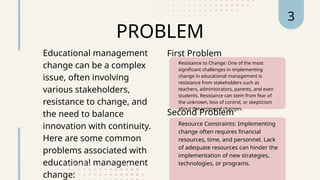
Resistance to Change: One of the most
significant challenges in implementing
change in educational management is
resistance from stakeholders such as
teachers, administrators, parents, and even
students. Resistance can stem from fear of
the unknown, loss of control, or skepticism
about the proposed changes.
First Problem
Educational management
change can be a complex
issue, often involving
various stakeholders,
resistance to change, and
the need to balance
innovation with continuity.
Here are some common
problems associated with
educational management
change:
Resource Constraints: Implementing
change often requires financial
resources, time, and personnel. Lack
of adequate resources can hinder the
implementation of new strategies,
technologies, or programs.
Second Problem
3
4
CONCLUSION
Educational management change is a multifaceted process
that requires careful consideration of various factors to
ensure its success. From addressing resistance to change and
fostering effective communication to overcoming resource
constraints and sustaining initiatives over the long term,
educational leaders face numerous challenges when
implementing change in educational institutions.
THANK YOU
By : YOLY AMILANO

Amilano-Report.pptxEducational management

  • 1.
  • 2.
    EDUCATIONAL CHANGE 2 Educational changeinvolves many people, places and things, and there are many challenges awaiting those attempting to initiate or implement change in any educational environment. Evans (2000) reinforces the notion of the complexity of educational change, suggesting that schools face a paradox in that as a school faces change, it must also preserve continuity, echoing the ambiguous nature of change highlighted in Chapter 1 (see Figure 1.1), as John Foster Dulles, United States Secretary of State in 1950 concurs:
  • 3.
    EDUCATIONAL CHANGE 2 Change isinevitable in business. To remain viable, organizations must adapt to internal and external shifts3 . Change can involve altering one or more of a company’ s major components, such as its culture, infrastructure, and internal processes . Successful change implementation requires a clear un derstanding of the root causes of issues and potential
  • 4.
    PROBLEM Resistance to Change:One of the most significant challenges in implementing change in educational management is resistance from stakeholders such as teachers, administrators, parents, and even students. Resistance can stem from fear of the unknown, loss of control, or skepticism about the proposed changes. First Problem Educational management change can be a complex issue, often involving various stakeholders, resistance to change, and the need to balance innovation with continuity. Here are some common problems associated with educational management change: Resource Constraints: Implementing change often requires financial resources, time, and personnel. Lack of adequate resources can hinder the implementation of new strategies, technologies, or programs. Second Problem 3
  • 5.
    4 CONCLUSION Educational management changeis a multifaceted process that requires careful consideration of various factors to ensure its success. From addressing resistance to change and fostering effective communication to overcoming resource constraints and sustaining initiatives over the long term, educational leaders face numerous challenges when implementing change in educational institutions.
  • 6.
    THANK YOU By :YOLY AMILANO