www.pearson-books.com
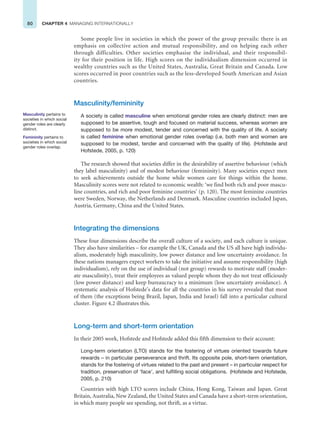
Essentials of
Management
A Concise Introduction
David Boddy
This concise, readable book offers an unparalleled introduction to the theory and practice
of management. Packed with examples and questions to catch your interest, it shows how
ideas and theories of management relate to the real world.
Essentials of Management introduces the themes and functions of management, showing
them within the clear framework of planning, organising, leading and controlling. It
incorporates the latest research, and uses recent and topical examples of management
in practice to bring the topic to life.
This textbook is relevant to students from all subject areas. Whether you are specialising in
business, or an engineering student taking a single module in the area, this book will offer
you an engaging and clear introduction to management.
Essentials of
Management
A Concise Introduction
David Boddy
Essentials
of
management
Boddy
About the author
David Boddy is a Research Fellow at the School of Business and
Management, University of Glasgow. He is also the author of two
other market-leading textbooks by Pearson Education: Managing
Information Systems (2009) and Management (2011).
Key features to aid your learning include:
• Case studies from many international organisations, including well-known
multinationals, start-up businesses and small to medium sized enterprises.
•	A clear, attractive text design that is easy to read and learn from.
• Exercises throughout the book inviting you to think critically and reflect on real-life
management situations and problems.
•	A focus on key current issues and debates around internationalisation, sustainability,
and corporate governance.
Cover image © Getty Images
CVR_BODD9289_01_SE_CVR.indd 1 06/12/2011 10:27
ESSENTIALS OF
MANAGEMENT
Visit the Essentials of Management Companion Website at www.pearsoned.co.uk/boddy
to find valuable student learning material including:
z Self assessment multiple choice questions for each chapter
z Links to relevant websites
z An online glossary to explain key terms
z Flashcards to test your knowledge of key terms and definitions
ESSENTIALS OF
MANAGEMENT
David Boddy University of Glasgow
A Concise Introduction
Pearson Education Limited
Edinburgh Gate
Harlow
Essex CM20 2JE
England
and Associated Companies around the world
Visit us on the World Wide Web at:
www.pearson.com/uk
First published 2012
© Pearson Education Limited 2012
The right of David Boddy to be identified as author of this work has been asserted by him in
accordance with the Copyright, Designs and Patents Act 1988.
All rights reserved. No part of this publication may be reproduced, stored in a retrieval system,
or transmitted in any form or by any means, electronic, mechanical, photocopying, recording or
otherwise without either the prior written permission of the Publishers or a licence permitting
restricted copying in the United Kingdom issued by the Copyright Licensing Agency Ltd,
Saffron House, 6–10 Kirby Street, London EC1N 8TS.
All trademarks used herein are the property of their respective owners. The use of any trademark in
this text does not vest in the author or publisher any trademark ownership rights in such trademarks,
nor does the use of such trademarks imply any affiliation with or endorsement of this book by such
owners.
Pearson Education is not responsible for the content of third-party internet sites.
ISBN 978-0-273-73928-9
British Library Cataloguing-in-Publication Data
A catalogue record for this book can be obtained from the British Library.
Library of Congress Cataloging-in-Publication Data
A catalog record for this book is available from the Library of Congress.
10 9 8 7 6 5 4 3 2 1
15 14 13 12 11
Typeset in 10.5/12.5pt Minion by 73
Printed by Rotolito Lombarda, Italy
The publisher’s policy is to use paper manufactured from sustainable forests.
BRIEF CONTENTS
Preface xi
Guided tour of the book xii
Acknowledgements xv
PART 1 AN INTRODUCTION TO MANAGEMENT 2
1 MANAGING IN ORGANISATIONS 4
2 THEORIES OF MANAGEMENT 26
PART 2 THE ENVIRONMENT OF MANAGEMENT 48
3 ORGANISATION CULTURES AND CONTEXTS 50
4 MANAGING INTERNATIONALLY 70
5 CORPORATE RESPONSIBILITY 90
PART 3 PLANNING 108
6 PLANNING 110
7 DECISION-MAKING 126
8 MANAGING STRATEGY 148
PART 4 ORGANISING 170
9 ORGANISATION STRUCTURES 172
10 INFORMATION SYSTEMS AND E-BUSINESS 194
11 MANAGING INNOVATION AND CHANGE 212
vi BRIEF CONTENTS
PART 5 LEADING 232
12 INFLUENCING 234
13 MOTIVATING 254
14 COMMUNICATING 276
15 WORKING IN TEAMS 296
PART 6 CONTROLLING 316
16 MANAGING OPERATIONS AND QUALITY 318
17 CONTROLLING AND MEASURING PERFORMANCE 336
Glossary 353
References 361
Index 369
CONTENTS
Preface xi
Guided tour of the book xii
Acknowledgements xv
PART 1 AN
INTRODUCTION
TO MANAGEMENT
CHAPTER 1
MANAGING IN ORGANISATIONS 4
1.1 Introduction 5
1.2 Managing to add value to resources 6
1.3 Meanings of management 7
1.4 Specialisation between areas
of management 9
1.5 Influencing through the process
of managing 12
1.6 Influencing through the tasks
of managing 15
1.7 Influencing through shaping
the context 17
1.8 Critical thinking 19
Summary 20
Review questions 21
Further reading 21
Weblinks 22
Case study: Ryanair 23
CHAPTER 2
THEORIES OF MANAGEMENT 26
2.1 Introduction 27
2.2 Why study management theory? 28
2.3 The competing values framework 29
2.4 Rational goal models 31
2.5 Internal process models 34
2.6 Human relations models 37
2.7 Open systems models 40
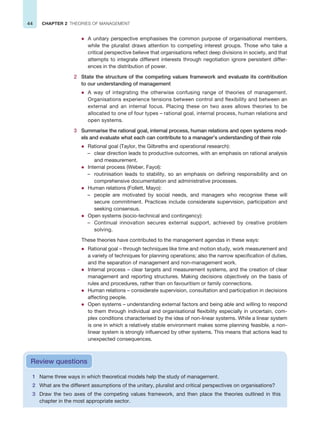
Summary 43
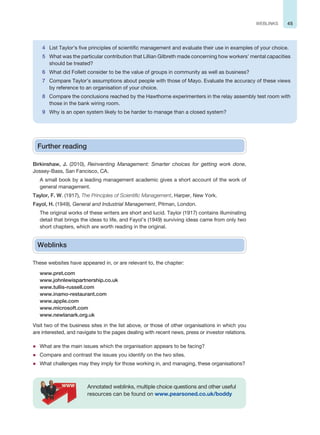
Review questions 44
Further reading 45
Weblinks 45
Case study: Robert Owen –
an early management innovator 46
PART 2 THE
ENVIRONMENT
OF MANAGEMENT
CHAPTER 3
ORGANISATION CULTURES
AND CONTEXTS 50
3.1 Introduction 51
3.2 Cultures and their components 52
3.3 Types of culture 54
3.4 The competitive environment –
Porter’s five forces 57
3.5 The general environment – PESTEL 59
3.6 Stakeholders 62
3.7 Corporate governance 63
Summary 65
Review questions 65
Further reading 65
Weblinks 66
Case study: Nokia 67
CHAPTER 4
MANAGING INTERNATIONALLY 70
4.1 Introduction 71
4.2 Ways to conduct business internationally 73
4.3 The contexts of international business –
PESTEL 75
4.4 Legal context – trade agreements
and trading blocs 78
4.5 Hofstede’s comparison of national cultures 79
4.6 Contrasting management systems 81
4.7 Forces driving globalisation 82
Summary 85
Review questions 85
Further reading 86
Weblinks 86
Case study: Starbucks 87
CHAPTER 5
CORPORATE RESPONSIBILITY 90
5.1 Introduction 91
5.2 Contrasts in business practice 92
5.3 Perspectives on individual actions 94
5.4 Perspectives on corporate actions 96
5.5 An ethical decision-making model 97
5.6 Stakeholders and corporate
responsibility 99
5.7 Corporate responsibility and strategy 100
5.8 Managing corporate responsibility 103
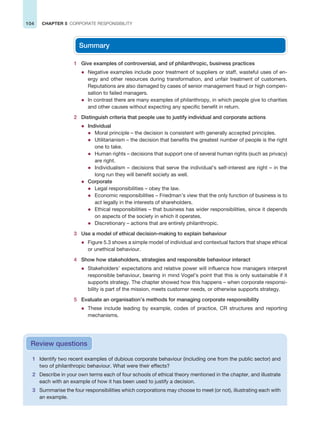
Summary 104
Review questions 104
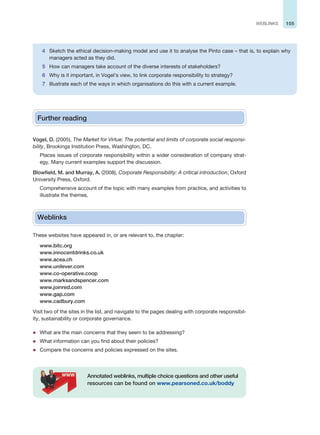
Further reading 105
Weblinks 105
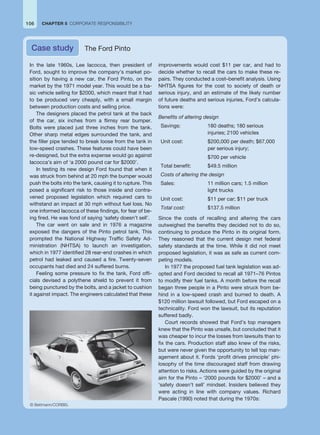
Case study: The Ford Pinto 106
PART 3 PLANNING
CHAPTER 6
PLANNING 110
6.1 Introduction 111
6.2 Purposes of planning 112
6.3 The content of plans 113
6.4 The process of planning 115
6.5 Gathering information 116
6.6 Setting goals (or objectives) 118
6.7 Identifying actions and communicating
the plan 120
6.8 Implementing plans and monitoring results 121
Summary 122
Review questions 123
Further reading 123
Weblinks 123
Case study: Crossrail 124
CHAPTER 7
DECISION-MAKING 126
7.1 Introduction 127
7.2 Stages in making decisions 128
7.3 Programmed and non-programmed
decisions 132
7.4 Decision-making conditions 134
7.5 Decision-making models 135
7.6 Biases in making decisions 139
7.7 Group decision-making 140
Summary 142
Review questions 144
Further reading 144
Weblinks 144
Case study: IKEA 146
CHAPTER 8
MANAGING STRATEGY 148
8.1 Introduction 149
8.2 Strategy – process, content and
context 150
8.3 Planning, learning and political
processes 151
8.4 Making sense – external and internal
analysis 154
8.5 Making choices (1) – deciding
strategy at corporate level 158
8.6 Making choices (2) – deciding strategy
at business unit level 161
8.7 Making things happen – deciding
how to deliver strategy 162
8.8 Making revisions – implementing
and evaluating 163
Summary 164
Review questions 165
Further reading 165
Weblinks 166
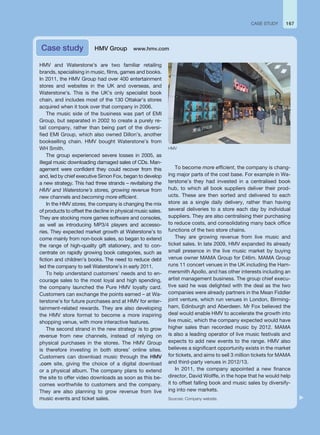
Case study: HMV Group 167
PART 4
ORGANISING
CHAPTER 9
ORGANISATION STRUCTURES 172
9.1 Introduction 173
9.2 Structure, strategy and performance 174
9.3 Designing a structure 175
9.4 Grouping jobs into functions and
divisions 180
9.5 Grouping jobs in matrices, teams
and networks 181
9.6 Co-ordinating work 182
9.7 Mechanistic and organic structures 184
viii CONTENTS
Summary 189
Review questions 190
Further reading 190
Weblinks 191
Case study: GlaxoSmithKline (GSK) 192
CHAPTER 10
INFORMATION SYSTEMS AND
E-BUSINESS 194
10.1 Introduction 195
10.2 Converging technologies bring
new ways to add value 196
10.3 Managing the new opportunities
to add value 198
10.4 Types of information system 201
10.5 The internet and e-business 202
10.6 IS, strategy and organisation –
the big picture 205
Summary 207
Review questions 208
Further reading 209
Weblinks 209
Case study: Asos 210
CHAPTER 11
MANAGING INNOVATION AND CHANGE 212
11.1 Introduction 213
11.2 Initiating innovation and change 214
11.3 Forms of innovation and change 216
11.4 The interaction of context and change 217
11.5 Four models of change 219
11.6 Sources of innovation 223
11.7 Organisational factors in innovation 224
Summary 226
Review questions 227
Further reading 227
Weblinks 228
Case study: Google 229
PART 5 LEADING
CHAPTER 12
INFLUENCING 234
12.1 Introduction 235
12.2 Purposes, targets and outcomes 236
12.3 Traits models 239
12.4 Behavioural models 240
12.5 Situational (or contingency) models 243
12.6 Using personal and positional power 244
12.7 Using interpersonal skills
and networks 248
Summary 249
Review questions 250
Further reading 250
Weblinks 251
Case study: Apple Inc. 252
CHAPTER 13
MOTIVATING 254
13.1 Introduction 255
13.2 Perspectives on motivation – targets
and the psychological contract 256
13.3 Behaviour modification 259
13.4 Content theories of motivation 260
13.5 Process theories of motivation 265
13.6 Designing work to be motivating 269
Summary 272
Review questions 273
Further reading 273
Weblinks 273
Case study: The Eden Project 274
CHAPTER 14
COMMUNICATING 276
14.1 Introduction 277
14.2 Communicating to add value 278
14.3 Communication processes 280
14.4 Selecting communication channels 282
14.5 Communication networks 285
14.6 Interpersonal skills for communication 289
Summary 291
Review questions 292
Further reading 292
Weblinks 292
Case study: Facebook 294
CHAPTER 15
WORKING IN TEAMS 296
15.1 Introduction 297
15.2 Types of team 298
15.3 Crowds, groups and teams 300
15.4 Team composition 301
15.5 Stages of team development 304
15.6 Team processes 305
ix
CONTENTS
15.7 Outcomes of teams (1) – for the
members 307
15.8 Outcomes of teams (2) – for the
organisation 309
Summary 311
Review questions 312
Further reading 312
Weblinks 312
Case study: Cisco Systems 313
PART 6
CONTROLLING
CHAPTER 16
MANAGING OPERATIONS AND QUALITY 318
16.1 Introduction 319
16.2 What is operations management? 319
16.3 The practice of operations management 323
16.4 Operations processes 325
16.5 The main activities of operations 327
16.6 Understanding quality 328
16.7 Managing quality 330
Summary 332
Review questions 333
Further reading 333
Weblinks 333
Case study: Zara 334
CHAPTER 17
CONTROLLING AND MEASURING
PERFORMANCE 336
17.1 Introduction 337
17.2 What is control and how to achieve it? 338
17.3 How do you know you are in control? 343
17.4 How to measure performance 345
17.5 Human considerations in control 348
Summary 349
Review questions 350
Further reading 350
Weblinks 350
Case study: A Foundation Hospital 351
Glossary 353
References 361
Index 369
x CONTENTS
SUPPORTING RESOURCES
Visit www.pearsoned.co.uk/boddy to find valuable online resources
Companion Website for students
z Self assessment multiple choice questions for each chapter
z Links to relevant websites
z An online glossary to explain key terms
z Flashcards to test your knowledge of key terms and definitions
For instructors
z Customisable PowerPoint slides which are downloadable and available to use for teaching
z Complete downloadable Instructor’s Manual
Also: The Companion Website provides the following features:
z Search tool to help locate specific items of content
z E-mail results and profile tools to send results of quizzes to instructors
z Online help and support to assist with website usage and troubleshooting
For more information please contact your local Pearson Education sales representative or visit
www.pearsoned.co.uk/boddy
This book is intended for students who are taking their
first course in management. Most will be undergraduates
taking the subject as part of a qualification in another
discipline (such as engineering, accountancy, law, in-
formation technology, science, nursing or social work).
Others will be following a course in management as an
element in their professional association’s examination
schemes. The book should also be useful to readers
with a first degree or equivalent qualification in a non-
management subject who are taking further studies
leading to Certificate, Diploma or MBA qualifications.
The book has the following three main objectives:
z to provide those new to the formal study of manage-
ment with a clear introduction;
z to show that ideas on management apply to most ar-
eas of human activity, not just to commercial enter-
prises; and
z to make the topic attractive to students from many
backgrounds and with diverse career intentions.
European context
While many management concepts have developed in
the United States, the text encourages readers to con-
sider how their particular context shapes management
practice. National and cultural differences influence
practice – not only as part of an increasingly integrated
Europe but as part of a wider international management
community. The cases and Management in Practice
features should build an awareness of cultural diversity
and the implications of this for working in organisa-
tions with different managerial styles and backgrounds.
Integrated perspective
To help the reader see management as a coherent whole,
the material is presented within an integrative model
of management and demonstrates the relationships
between the many academic perspectives. The central
integrating theme is of managers interacting with their
contexts – which they interpret and shape as they do
their work. This should help students to develop the
practice of contextual awareness, which should give
valuable support in whatever career they follow.
Relating to personal experience
The text assumes that many readers will have little if any
experience of managing in conventional organisations,
and equally little prior knowledge of relevant evidence
and theory. However, all will have experience of being
managed and all will have managed activities in their
domestic and social lives. The activities in each chap-
ter encourage readers to use and share such experiences
from everyday life to explore the ideas presented. In this
way, the book tries to show that management is not a
remote activity performed by others, but a process in
which all are engaged in some way.
Most readers’ careers are likely to be fragmented and
uncertain, and many will work for medium-sized and
smaller enterprises. They will probably be working close
to customers and in organisations that incorporate di-
verse cultures, values and interests. The activities may
also help to develop their skills of gathering data, com-
paring evidence and generally enhancing self-awareness
and confidence.
PREFACE
GUIDED TOUR OF THE BOOK
The book has 17 chapters, in
six parts.
Chapter openers set out learning out-
comes. These are usually 5 or 6 in number,
and the sections in the chapter match closely
these learning outcomes, giving each chapter
a strong and consistent structure.
These are followed by the first part of a
two-part chapter Activity. This is designed
to encourage students to reflect at the outset
on what they think or know about the topic: it
also encourages them to identify one or two
people (family or friends) with some experi-
ence of organisations, who may be willing to
discuss the topic with them. There is a sec-
ond part to the activity at the end of the main
material in the chapter, containing questions
which help them to make close connections
between what they have found and the topics
covered in the chapter.
CHAPTER 1
MANAGING IN ORGANISATIONS
Learning outcomes
When you have read this chapter you should be able to:
1 Explain that the role of management is to add value to resources in diverse settings
2 Give examples of management as a universal human activity and as a distinct role
3 Compare the roles of general, functional, line, staff and project managers, and of entrepreneurs
4 Compare how managers influence others to add value
5 Use ideas from the chapter to comment on the management issues in the Ryanair case study
5
INTRODUCTION
Ryanair (the Chapter case study) illustrates several aspects of management. A group of entre-
preneurs saw an opportunity in the market for air travel, and created an organisation to take
advantage of it. They bring resources together and transform them into a service which they
sell to customers. They differ from their competitors by using different resources (e.g. sec-
ondary airports) and different ways to transform these into outputs (e.g. short turnrounds).
They have been innovative in the way they run the business, such as in identifying what some
customers valued in a flight – cost rather than luxury – and carried a record 74 million pas-
sengers in the year to April 2011.
Entrepreneurs like Michael O’Leary of Ryanair are always looking for ways to innovate
to create new products, services and ways of working, to make the most of new opportu-
nities. Other managers face a different challenge – more demand with fewer resources.
Those managing the United Nations World Food Programme struggle to raise funds from
donor countries – aid is falling while hunger is increasing. In almost every public health-
care organisation managers face a growing demand for treatment, but fewer resources with
which to provide it.
Organisations of all kinds – from rapidly growing operations like Facebook to established
businesses like Shell UK or Marks & Spencer – depend on people at all levels who can run the
things efficiently now, and make changes to prepare for the future. This book is about the
knowledge and skills that enable people to meet these expectations, and so build a satisfying
and rewarding management career.
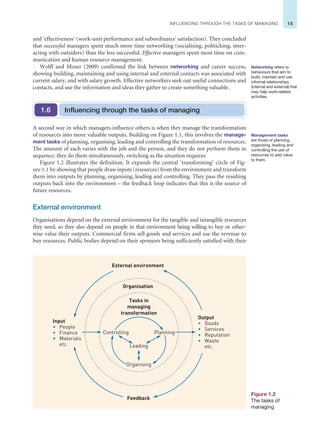
Figure 1.1 illustrates the themes of this chapter. It represents the fact that people in organi-
sations bring resources from the external environment and transform them into outputs that
they hope are of greater value. They pass these back to the environment, and the value they
obtain in return (money, reputation, goodwill etc.) enables them to attract new resources to
continue in business (shown by the feedback arrow from output to input). If the outputs do
not attract sufficient resources, the enterprise will fail.
The chapter begins by examining the significance of managed organisations in our world.
It then outlines what management means and introduces theories about the nature of mana-
gerial work.
Before reading this chapter, write some notes on what you understand ‘management’
to mean.
Choose the organisation or people who may be able to help you learn about the
topic. You may find it helpful to discuss the topic with a manager you know, or reflect
on an activity you have managed.
zIdentify a situation in which someone has been ‘managing’ an activity, and describe
it briefly.
zHow did they go about achieving the task?
zCan they identify the types of activities they worked on?
zWhat clues does that give you about what ‘management’ may mean in the
organisation?
zKeep these notes as you will be able to use them later.
Activity 1.1 What is ‘management’?
Introduction
1.1
PART 3
PLANNING
Introduction
This part examines the generic management activities of planning and decision-making,
and then looks at their application to the task of managing strategy. This depends on
understanding the environment of the business and on building an internal capability
to deliver whatever strategy management decides upon.
Chapter 6 provides an overview of planning in organisations, setting out the purposes
of planning, the types of plan and the tasks of planning. While all these tasks are likely
to be part of the process, their shape will always depend on the circumstances for
which a plan is being made.
Decision-making is closely linked to planning, made necessary by finite resources and
infinite demands. People in organisations continually decide on inputs, transformation
processes and outputs – and the quality of those decisions affects organisational per-
formance. Chapter 7 therefore introduces the main decision-making processes, and
contrasts several theories of decision-making in organisations.
Chapter 8 outlines the strategy process, and introduces techniques that managers use
to analyse the options facing businesses of all kinds. This analysis can then lead to
clearer choices about future direction.
xiii
GUIDED TOUR OF THE BOOK
Management in practice boxes
provide real-world examples and
encourage students to identify and
engage with managerial issues and
challenges.
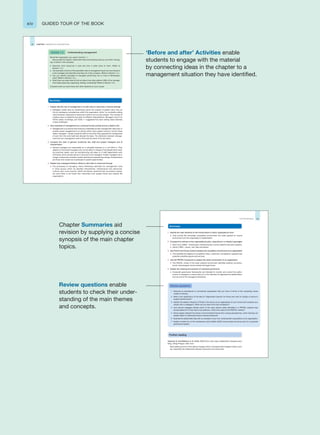
Case questions (in a structured form) encourage
students to connect issues in the case with specified
Sections in the chapter.
Cases: Each chapter ends with a case, which illus-
trates themes from the chapter. With one exception
(Chapter 2 – Robert Owen) students should recognise
these contemporary and up-to-date accounts, and
gain insights into the management of these enter-
prises, and the connections between theory and
current practice.
54 CHAPTER 3 ORGANISATION CULTURES AND CONTEXTS
become embedded as basic underlying assumptions. When the group holds these strongly,
members will act in accordance with them, and reject actions based on others:
z‘We need to satisfy customers to survive as a business’
z‘Our business is to help people with X problem live better with X problem’
z‘People can make mistakes, as long as they learn from them’
z‘We employ highly motivated and competent adults’
z‘Financial markets worry about the short-term: we are here for the long-term’
Difficulties arise when people with assumptions developed in one group work with people
from another. Staff in companies that merge with another business sometimes find it difficult
to work with their new colleagues because of historic cultural differences.
Franz Fehrenbach is chief executive of Bosch, Germany’s largest privately owned engineering group, and the
world’s largest supplier of car parts. In 2009 he said:
The company culture, especially our high credibility, is one of our greatest assets. Our competitors
cannot match us on that because it takes decades to build up.
The cultural traditions include a rigid control on costs, an emphasis on team thinking, employees being
responsible for their errors, cautious financial policies and long-term thinking. For example, to cope with the
recession in 2009 Mr Fehrenbach explained that:
We have to cut costs in all areas. We will reduce spending in the ongoing business, but we will not cut
back on research and development for important future projects.
Source: Adapted from Space to breathe amid the crisis (Daniel Schaefer), Financial Times, 2 March 2009, p. 16.
Management in practice A strong culture at Bosch www.bosch.com
This section outlines three ways of describing and comparing cultures.
Competing values framework
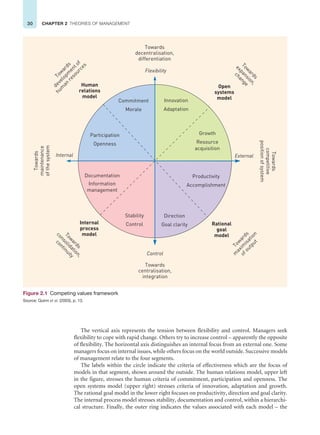
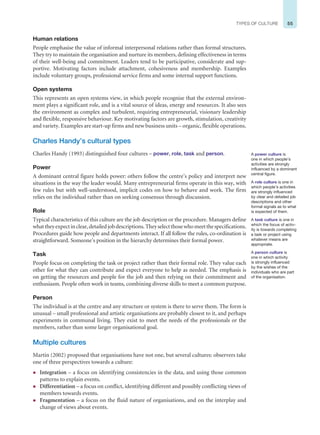
The competing values model developed by Quinn et al. (2003) reflects inherent tensions between
flexibility or control and between an internal or an external focus: Figure 2.1 (p. 30) shows four
cultural types.
Rational goal
Members see the organisation as a rational, efficiency-seeking unit. They define effectiveness
in terms of production or economic goals that satisfy external requirements. Managers cre-
ate structures to deal with the outside world. Leadership tends to be directive, goal-oriented
and functional. Key motivating factors include competition and the achievement of goals.
Examples are large, established businesses – mechanistic.
Internal process
Here members focus on internal matters. Their goal is to make the unit efficient, stable and
controlled. Tasks are repetitive and methods stress specialisation, rules and procedures. Lead-
ers tend to be cautious and spend time on technical issues. Motivating factors include security,
stability and order. Examples include utilities and public authorities – suspicious of change.
Types of culture
3.3
Robert Owen (1771–1856) was a successful manufac-
turer of textiles, who ran mills in England and at New
Lanark, about 24 miles from Glasgow, in Scotland.
David Dale built the cotton-spinning mills at New
Lanark in 1785 – which were then the largest in Scot-
land. Since they depended on water power, Dale had
built them below the Falls of Clyde – a well-known
tourist attraction throughout the 18th century. Many
people continued to visit both the Falls and New
Lanark, which combined both manufacturing and
social innovations.
Creating such a large industrial enterprise in the
countryside meant that Dale (and Owen after him)
had to attract and retain labour – which involved
building not just the mill but also houses, shops,
schools and churches for the workers. By 1793, the
mill employed about 1200 people, of whom almost
800 were children, aged from 6 to 17: 200 were un-
der 10 (McLaren, 1990). Dale provided the children
with food, education and clothing in return for work-
ing 12 hours each day: visitors were impressed by
these facilities.
One visitor was Robert Owen, who shared Dale’s
views on the benefits to both labour and owner of
good working conditions. By 1801 Dale wanted to
sell New Lanark to someone who shared his prin-
ciples and concluded that Owen (who had married
his daughter) was such a man. Owen had built a
reputation for management skills while running mills
in England, and did not approve of employing chil-
dren in them.
Having bought the very large business of New
Lanark, Owen quickly introduced new management
and production control techniques. These included
daily and weekly measurements of stocks, output
and productivity; a system of labour costing; and
measures of work-in-progress. He used a novel con-
trol technique: a small, four-sided piece of wood,
with a different colour on each side, hung beside ev-
ery worker. The colour set to the front indicated the
previous day’s standard of work – black indicating
bad. Everyone could see this measure of the work-
er’s performance, which overseers recorded to iden-
tify any trends in a person’s work:
Every process in the factory was closely
watched, checked and recorded to increase
labour productivity and to keep costs down.
(Royle, 1998, p. 13)
At this stage of the Industrial Revolution, most
adult employees had no experience of factory work,
or of living in a large community such as New Lanark.
Owen found that many ‘were idle, intemperate, dis-
honest [and] devoid of truth’ (quoted in Butt, 1971).
Evening patrols were introduced to stop drunken-
ness, and there were rules about keeping the resi-
dential areas clean and free of rubbish. He also
had ‘to deal with slack managers who had tolerated
widespread theft and embezzlement, immorality and
drunkenness’ (Butt, 1971).
During Owen’s time at the mill it usually employed
about 1500 people, and soon after taking over he
stopped employing children under 10. He introduced
other social innovations: a store at which employ-
ees could buy goods more cheaply than elsewhere
(a model for the Co-operative Movement), and a
school which looked after children from the age of 1
– enabling their mothers to work in the mills. Owen
actively managed the links between his business
and the wider world. On buying the mills he quickly
became part of the Glasgow business establish-
ment, and was closely involved in the activities of the
Chamber of Commerce. He took a prominent role in
the social and political life of the city. He used these
links in particular to argue the case for reforms in the
educational and economic systems, and was critical
of the effect that industrialisation was having upon
working-class life.
Owen believed that education in useful skills
would help to release working-class children from
Case study Robert Owen – an early management innovator www.newlanark.org.uk
CHAPTER 2 THEORIES OF MANAGEMENT
46
Reproduced with kind permission of New Lanark Trust. – www
.newlanark.org.
poverty. and promoted the case for wider education-
al provision. He also developed several experiments
in co-operation and community building, believing
that the basis of his successful capitalist enterprise
at New Lanark (education, good working conditions
and a harmonious community) could be applied to
society as a whole.
Sources: Butt (1971); McLaren (1990); Royle (1998); Donachie
(2000).
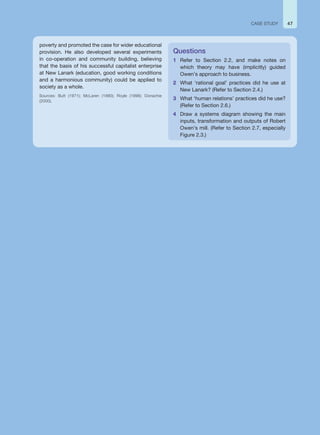
Questions
1 Refer to Section 2.2, and make notes on
which theory may have (implicitly) guided
Owen’s approach to business.
2 What ‘rational goal’ practices did he use at
New Lanark? (Refer to Section 2.4.)
3 What ‘human relations’ practices did he use?
(Refer to Section 2.6.)
4 Draw a systems diagram showing the main
inputs, transformation and outputs of Robert
Owen’s mill. (Refer to Section 2.7, especially
Figure 2.3.)
CASE STUDY 47
xiv GUIDED TOUR OF THE BOOK
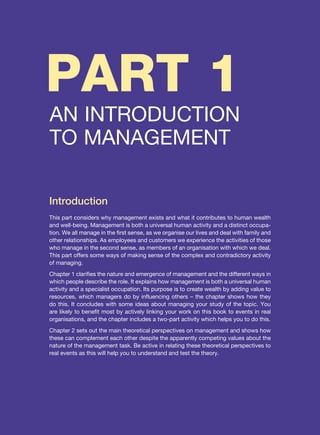
‘Before and after’ Activities enable
students to engage with the material
by connecting ideas in the chapter to a
management situation they have identified.
Review questions enable
students to check their under-
standing of the main themes
and concepts.
Chapter Summaries aid
revision by supplying a concise
synopsis of the main chapter
topics.
20 CHAPTER 1 MANAGING IN ORGANISATIONS
Recall the organisation you used in Activity 1.1.
Having read the chapter, make brief notes summarising what you now think ‘manag-
ing’ involves in this company:
zDescribe what resources it uses and how it adds value to them. (Refer to
Section 1.2.)
zList examples of some of the specialist roles of management (such as a functional or
a line manager) and describe what they do in this company. (Refer to Section 1.4.)
zCan you identify examples of managers performing one or more of Mintzberg’s
roles? (Refer to Section 1.5.)
zWhat have you been able to find out about how they perform ONE of the manage-
ment tasks (planning, organising, leading, controlling)? (Refer to Section 1.6.)
Compare what you have found with other students on your course.
Activity 1.2 Understanding management
Summary
1 Explain that the role of management is to add value to resources in diverse settings
zManagers create value by transforming inputs into outputs of greater value: they do
this by developing competences within the organisation which, by constantly adding
value (however measured) to resources is able to survive and prosper. The concept of
creating value is subjective and open to different interpretations. Managers work in an
infinite variety of settings, and Table 1.1 suggested how each setting raises relatively
unique challenges.
2 Give examples of management as a universal human activity and as a distinct role
zManagement is an activity that everyone undertakes as they manage their daily lives. In
another sense management is an activity which many people conduct, not just those
called ‘managers’. People create the distinct role when they separate the management
of work from the work itself and allocate the tasks. The distinction between manage-
ment and non-management work is fluid and the result of human action.
3 Compare the roles of general, functional, line, staff and project managers and of
entrepreneurs
zGeneral managers are responsible for a complete business or a unit within it. They
depend on functional managers who can be either in charge of line departments meet-
ing customer needs, such as manufacturing and sales, or in staff departments such
as finance which provide advice or services to line managers. Project managers are in
charge of temporary activities usually directed at implementing change. Entrepreneurs
are those who create new businesses to exploit opportunities.
4 Explain how managers influence others to add value to resources through
zThe processes of managing. Henry Mintzberg identified ten management roles
in three groups which he labelled informational, interpersonal and decisional.
Luthans and, more recently, Wolff and Moser observed that successful manag-
ers were likely to be those who networked with people inside and outside the
organisation.
65
FURTHER READING
Summary
1 Identify the main elements of the environments in which organisations work
zThey include the immediate competitive environment, the wider general (or macro)
environment and the organisation’s stakeholders.
2 Compare the cultures of two organisational units, using Quinn’s or Handy’s typologies
zQuinn et al. (2003) – rational goal, internal process, human relations and open systems.
zHandy (1993) – power, role, task and person.
3 Use Porter’s five forces model to analyse the competitive environment of an organisation
zThis identifies the degree of competitive rivalry, customers, competitors, suppliers and
potential substitute goods and services.
4 Use the PESTEL framework to analyse the wider environment of an organisation
zThe PESTEL model of the wider external environment identifies political, economic,
social, technological, environmental and legal forces.
5 Explain the meaning and purpose of corporate governance
zCorporate governance frameworks are intended to monitor and control the perfor-
mance of managers to ensure they act in the interests of organisational stakeholders,
and not just of the managers themselves.
1 Describe an educational or commercial organisation that you know in terms of the competing values
model of cultures.
2 What is the significance of the idea of ‘fragmented cultures’ for those who wish to change a culture to
support performance?
3 Identify the relative influence of Porter’s five forces on an organisation of your choice and compare your
results with a colleague’s. What can you learn from that comparison?
4 How should managers decide which of the many factors easily identified in a PESTEL analysis they
should attend to? If they have to be selective, what is the value of the PESTEL method?
5 Since people interpret the nature of environmental forces from unique perspectives, what meaning can
people attach to statements about external pressures?
6 Illustrate the stakeholder idea with an example of your own, showing their expectations of an organisation.
7 Explain at least two of the mechanisms which Mallin (2007) recommends should be part of a corporate
governance system.
Review questions
Further reading
Tapscott, E. and Williams, A. D. (2006), Wikinomics: How mass collaboration changes every-
thing, Viking Penguin, New York.
Best-selling account of the radical changes which convergent technologies bring to soci-
ety, especially the relationship between producers and consumers.
ACKNOWLEDGEMENTS
This book has benefited from the comments, criticisms
and suggestions of many colleagues and reviewers. It
also reflects the reactions and comments of students
who have used the material on their courses. Their
advice and feedback have been of immense help.
Finally, I gratefully acknowledge the support and
help that my wife, Cynthia, has provided throughout
this project.
David Boddy
University of Glasgow
May 2011
We are grateful to the following for permission to re-
produce copyright material:
Figures
Figure 2.1 from Becoming a Master Manager 3ed, (Quinn
et al 2003) p.13 Copyright © 2003 John Wiley  Sons,
Inc. Reproduced with permission of John Wiley  Sons,
Inc.; Fig 3.2 Reprinted with the permission of Free Press,
a Division of Simon  Schuster, Inc., from COMPETI-
TIVE STRATEGY: Techniques for Analyzing Industries
and Competitors by Michael E. Porter, 5e, Simon 
Schuster (Inc) (Porter, M.E. 1980) Copyright © 1980,
1988 by The Free Press. All rights reserved; Figure 4.2
from Clustering Countries on Attitudinal Dimensions,
vol. 10 no. 3, Academy of Management Review (Ronen,
S.  Shenkar, O. 1985) pp. 435–454 The Academy of
Management review by ACADEMY OF MANAGE-
MENT. Copyright 1985. Reproduced with permission
of ACADEMY OF MANAGEMENT (NY) in the for-
mat Textbook via Copyright Clearance Center.; Fig-
ure 5.1 from Management, 5ed., South-Western (Daft
2000) 135, From Daft. Management, 5E.© 2000 South-
Western, a part of Cengage Learning, Inc. Reproduced
by permission. www.cengage.com/permissions; Figure
5.2 adapted from Business  Society, South-Western
Publishers (Carroll, A.B. 1989) 84, From CARROLL.
BUSINESS AND SOCIETY. Ethics and Stakeholders,
1E. © 1989 South-Western, a part of Cengage Learn-
ing, Inc. Reproduced by permission. www.cengage.com/
permissions; Figure 8.1 from Closing the gap between
strategy and execution, MIT Sloan Management Re-
view, 48 (4), pp. 30–38 (Sull, D.N. 2010); Figures 8.2, 8.4
Reprinted with the permission of Free Press, a Division
of Simon  Schuster, Inc., from COMPETITIVE
ADVANTAGE: Creating and Sustaining Superior Per-
formance by Michael E. Porter, 5e, Simon  Schuster
(Inc) (Porter, M.E. 1980) Copyright © 1985, 1988 by
Michael E. Porter. All rights reserved; Figure 8.3 adapted
from Corporate Strategy, Penguin (Ansoff, H. 1988);
Figure 10.1 from Managing information systems: An or-
ganisational perspective, 2ed., (Boddy, D., Boonstra, A.
 Kennedy, G. 2005) FT/Prentice Hall © Pearson Educa-
tion Ltd 2005; Figures 10.2, 10.3 from Managing Informa-
tion Systems: Strategy and Organisation, 3ed., (Boddy, D.,
Boonstra, A.  Kennedy, G. 2009) FT/Prentice Hall ©
PearsonEducationLtd2009;Figure12.3Reprintedbyper-
mission of Harvard Business Review from How to choose
a leadership pattern: should a manager be democratic or
autocratic – or something in between?, by Tannenbaum,
R. and Schmidt, W.H. 37 (2) 1973, pp. 95–102 Copy-
right © 1973 by the Harvard Business School Publishing
Corporation; all rights reserved; Figure 14.3 from The
selection of communication media as an executive skill,
11 (3), pp. 225–232 (Lengel, R.H. and Daft, R.L. 1988) The
Academy of Management perspectives by ACADEMY
OF MANAGEMENT. Copyright 1988. Reproduced with
permission of ACADEMY OF MANAGEMENT (NY)
in the format Textbook via Copyright Clearance Center.;
Figure 15.3 adapted from The Human Organization: Its
Management and Value, McGraw-Hill New York (Likert, R.
1967), © The McGraw-Hill Companies Inc.; Figure 16.3
Reprinted by permission of Harvard Business Review
adapted from Link Manufacturing Process and Product
Lifecycles, Hayes, R.H. and Wheelwright, S.C. 57 (1) 1979,
pp. 133–140 Copyright © 1979 by the Harvard Business
School Publishing Corporation; all rights reserved
Publisher’s acknowledgements
xvi ACKNOWLEDGEMENTS
Tables
Table 17.4 adapted from Operations Management,
6th ed., (Slack, N., Chambers, S. and Johnston, R. 2010)
Financial Times Prentice Hall © Pearson Education
Ltd 2010
Text
Box on page 225 Reprinted by permission of Harvard
Business Review from How Pixar Fosters Collective
Creativity, by Catmull, E. 86 (9), 2008, pp. 64-72 Copy-
right © 2008 by the Harvard Business School Publishing
Corporation; all rights reserved; Box on page 258 from
www.IKEA.com
The Financial Times
Box on page 7 adapted from Turnaround ace shows
his metal, Financial Times, 27/05/2009 (Peter Marsh
and Andrew Bounds), Financial Times; Box on page
29 adapted from Secrets of the maverick cobbler, The
Financial Times, Copyright © The Financial Times Ltd.;
Box on page 54 adapted from Space to breathe amid
the crisis, FT, 02/03/2009, 16 (Daniel Schaefer); Box
on page 77 after Insurgency in India—how the Mao-
ist threat reaches beyond Nepal, FT, 26/04/2006, p.13
(Jo Johnson); Box on page 100 adapted from Lobbyist
driving a hard bargain, The Financial Times, 16/06/2009
(Joshua Chaffin), Copyright © The Financial Times
Ltd.; Box on page 113 adapted from BA cuts costs as
it anticipates two years of recession, The Financial
Times, 06/03/2009 (Kevin Done), Copyright © The
Financial Times Ltd.; Box on page 115 adapted from The
Man who has to shake up Merck, The Financial Times,
27/03/2006, p.10 (Christopher Bowe), Copyright © The
Financial Times Ltd.; Box on page 155 adapted from 3G
wrong number forces change of strategy, The Financial
Times, 02/03/2009 (Andrew Parker and Paul Taylor),
Copyright © The Financial Times Ltd.; Box on page 160
adapted from MS brand value, The Financial Times,
10/11/2010 (Emiko Terazono), Copyright © The Finan-
cial Times Ltd.; Box on page 179 adapted from A healthy
attitude to risk-taking, The Financial Times, 04/08/2008
(Andrew Jack and Haig Simonian), Copyright © The
Financial Times Ltd.; Box on page 186 adapted from
Prepared to wait for a bigger yield, The Financial Times,
15/06/2009 (Hal Weitzman), Copyright © The Finan-
cial Times Ltd.; Box on page 199 from Bringing busi-
ness technology out into the open, The Financial Times,
17/09/2003 (Fiona Harvey), Copyright © The Finan-
cial Times Ltd.; Box on page 248 adapted from News
Corp’s wooing of Beijing pays off, The Financial Times,
09/01/2003 (James Kynge), Copyright © The Financial
Times Ltd.; Box on page 248 adapted from Chairman
knows the value of a little help from his friends, The
Financial Times, 21/02/2003 (Mure Dickie and Kathrin
Hille), Copyright © The Financial Times Ltd.; Box on
page 287 adapted from ‘Catastrophic safety risks’ remain
for BP, The Financial Times, 31/10/2006 (Sheila McNul-
ty), Copyright © The Financial Times Ltd.
Photographs
23 Corbis: Thierry Tronnel/Sygma; 46 Reproduced
by kind permission of New Lanark Trust www.
newlanark.org; 67 Courtesy of Nokia; 87 Alamy Images:
Purestock. 106 Corbis: Bettmann. 124 By kind permis-
sion, Crossrail; 146 IKEA Ltd; 192 Alamy Images: Roger
Bamber; 210 Alamy Images: M4OS Photos; 252 Corbis:
KIMBERLEY WHITE/Reuters; 274 Eden Project; 294
Corbis: Kim Komenich/San Francisco Chronicle; 351
Getty Images.
Cover image: Front: Getty Images
In some instances we have been unable to trace the
owners of copyright material, and we would appreciate
any information that would enable us to do so.
PART 1
AN INTRODUCTION
TO MANAGEMENT
Introduction
This part considers why management exists and what it contributes to human wealth
and well-being. Management is both a universal human activity and a distinct occupa-
tion. We all manage in the first sense, as we organise our lives and deal with family and
other relationships. As employees and customers we experience the activities of those
who manage in the second sense, as members of an organisation with which we deal.
This part offers some ways of making sense of the complex and contradictory activity
of managing.
Chapter 1 clarifies the nature and emergence of management and the different ways in
which people describe the role. It explains how management is both a universal human
activity and a specialist occupation. Its purpose is to create wealth by adding value to
resources, which managers do by influencing others – the chapter shows how they
do this. It concludes with some ideas about managing your study of the topic. You
are likely to benefit most by actively linking your work on this book to events in real
organisations, and the chapter includes a two-part activity which helps you to do this.
Chapter 2 sets out the main theoretical perspectives on management and shows how
these can complement each other despite the apparently competing values about the
nature of the management task. Be active in relating these theoretical perspectives to
real events as this will help you to understand and test the theory.
CHAPTER 1
MANAGING IN ORGANISATIONS
Learning outcomes
When you have read this chapter you should be able to:
1 Explain that the role of management is to add value to resources in diverse settings
2 Give examples of management as a universal human activity and as a distinct role
3 Compare the roles of general, functional, line, staff and project managers, and of entrepreneurs
4 Compare how managers influence others to add value
5 Use ideas from the chapter to comment on the management issues in the Ryanair case study
5
INTRODUCTION
Ryanair (the Chapter case study) illustrates several aspects of management. A group of entre-
preneurs saw an opportunity in the market for air travel, and created an organisation to take
advantage of it. They bring resources together and transform them into a service which they
sell to customers. They differ from their competitors by using different resources (e.g. sec-
ondary airports) and different ways to transform these into outputs (e.g. short turnrounds).
They have been innovative in the way they run the business, such as in identifying what some
customers valued in a flight – cost rather than luxury – and carried a record 74 million pas-
sengers in the year to April 2011.
Entrepreneurs like Michael O’Leary of Ryanair are always looking for ways to innovate
to create new products, services and ways of working, to make the most of new opportu-
nities. Other managers face a different challenge – more demand with fewer resources.
Those managing the United Nations World Food Programme struggle to raise funds from
donor countries – aid is falling while hunger is increasing. In almost every public health-
care organisation managers face a growing demand for treatment, but fewer resources with
which to provide it.
Organisations of all kinds – from rapidly growing operations like Facebook to established
businesses like Shell UK or Marks  Spencer – depend on people at all levels who can run the
things efficiently now, and make changes to prepare for the future. This book is about the
knowledge and skills that enable people to meet these expectations, and so build a satisfying
and rewarding management career.
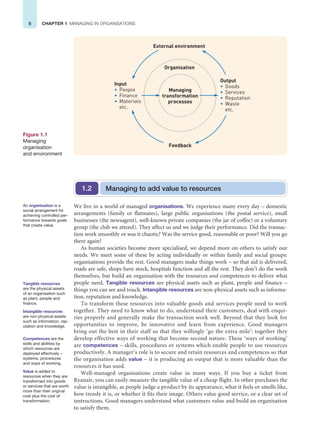
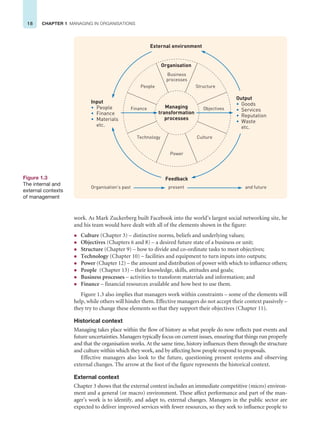
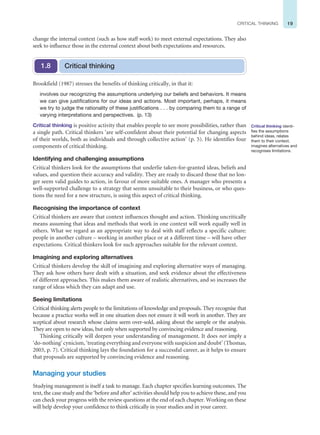
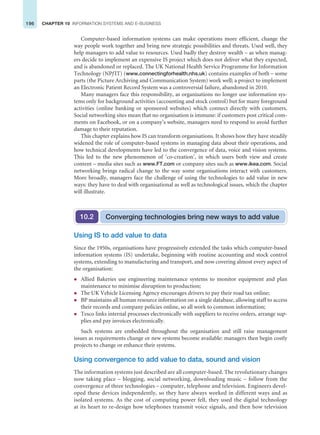
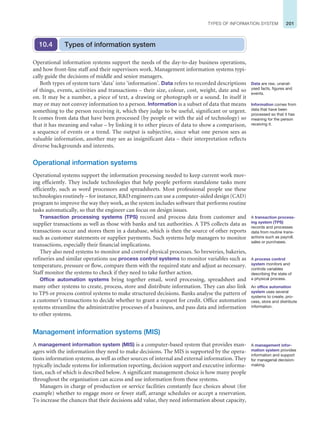
Figure 1.1 illustrates the themes of this chapter. It represents the fact that people in organi-
sations bring resources from the external environment and transform them into outputs that
they hope are of greater value. They pass these back to the environment, and the value they
obtain in return (money, reputation, goodwill etc.) enables them to attract new resources to
continue in business (shown by the feedback arrow from output to input). If the outputs do
not attract sufficient resources, the enterprise will fail.
The chapter begins by examining the significance of managed organisations in our world.
It then outlines what management means and introduces theories about the nature of mana-
gerial work.
Before reading this chapter, write some notes on what you understand ‘management’
to mean.
Choose the organisation or people who may be able to help you learn about the
topic. You may find it helpful to discuss the topic with a manager you know, or reflect
on an activity you have managed.
z Identify a situation in which someone has been ‘managing’ an activity, and describe
it briefly.
z How did they go about achieving the task?
z Can they identify the types of activities they worked on?
z What clues does that give you about what ‘management’ may mean in the
organisation?
z Keep these notes as you will be able to use them later.
Activity 1.1 What is ‘management’?
Introduction
1.1
6 CHAPTER 1 MANAGING IN ORGANISATIONS
We live in a world of managed organisations. We experience many every day – domestic
arrangements (family or flatmates), large public organisations (the postal service), small
businesses (the newsagent), well-known private companies (the jar of coffee) or a voluntary
group (the club we attend). They affect us and we judge their performance. Did the transac-
tion work smoothly or was it chaotic? Was the service good, reasonable or poor? Will you go
there again?
As human societies become more specialised, we depend more on others to satisfy our
needs. We meet some of these by acting individually or within family and social groups:
organisations provide the rest. Good managers make things work – so that aid is delivered,
roads are safe, shops have stock, hospitals function and all the rest. They don’t do the work
themselves, but build an organisation with the resources and competences to deliver what
people need. Tangible resources are physical assets such as plant, people and finance –
things you can see and touch. Intangible resources are non-physical assets such as informa-
tion, reputation and knowledge.
To transform these resources into valuable goods and services people need to work
together. They need to know what to do, understand their customers, deal with enqui-
ries properly and generally make the transaction work well. Beyond that they look for
opportunities to improve, be innovative and learn from experience. Good managers
bring out the best in their staff so that they willingly ‘go the extra mile’: together they
develop effective ways of working that become second nature. These ‘ways of working’
are competences – skills, procedures or systems which enable people to use resources
productively. A manager’s role is to secure and retain resources and competences so that
the organisation adds value – it is producing an output that is more valuable than the
resources it has used.
Well-managed organisations create value in many ways. If you buy a ticket from
Ryanair, you can easily measure the tangible value of a cheap flight. In other purchases the
value is intangible, as people judge a product by its appearance, what it feels or smells like,
how trendy it is, or whether it fits their image. Others value good service, or a clear set of
instructions. Good managers understand what customers value and build an organisation
to satisfy them.
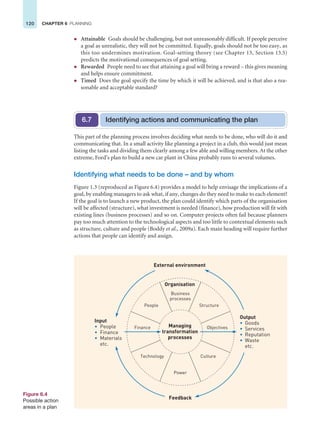
Managing
transformation
processes
Organisation
External environment
Feedback
Output
• Goods
• Services
• Reputation
• Waste
etc.
Input
• People
• Finance
• Materials
etc.
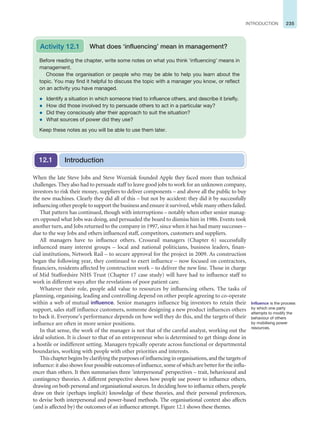
Figure 1.1
Managing
organisation
and environment
Managing to add value to resources
1.2
An organisation is a
social arrangement for
achieving controlled per-
formance towards goals
that create value.
Tangible resources
are the physical assets
of an organisation such
as plant, people and
finance.
Intangible resources
are non-physical assets
such as information, rep-
utation and knowledge.
Competences are the
skills and abilities by
which resources are
deployed effectively –
systems, procedures
and ways of working.
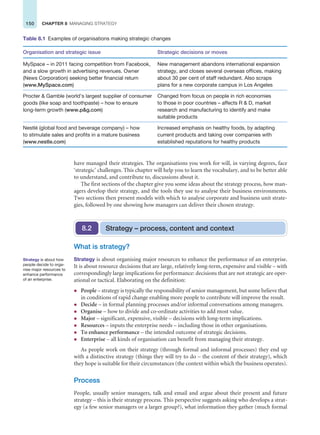
Value is added to
resources when they are
transformed into goods
or services that are worth
more than their original
cost plus the cost of
transformation.
7
MEANINGS OF MANAGEMENT
Commercial organisations of all kinds (business start-ups, small and medium-sized enter-
prises, on-line firms and international enterprises) aim to add value and create wealth. So do
voluntary and not-for-profit organisations – by educating people, counselling the troubled
or caring for the sick.
There are over 160,000 charities in England and Wales, with annual incoming resources
of over £52 billion (equal to about 3 per cent of Gross Domestic Product), and employ-
ing over 660,000 staff (Charities Commission Annual Report for 2009–10, at www.
charitycommission.gov.uk). Managing a large charity is at least as demanding a job as man-
aging a commercial business, facing similar challenges of adding value to limited resources.
Donors and recipients expect them to manage resources well so that they add value to them.
Theatres, orchestras, museums and art galleries create value by offering inspiration, new
perspectives or unexpected insights – and often do so in situations of great complexity (imag-
ine the complexity in staging an opera, concert or major exhibition). Others add value by cre-
ating businesses or challenging projects through which people develop new skills or insights,
and build long-term friendships.
While organisations aim to add value, many do not do so. If people work inefficiently they
will use more resources than customers will pay for. They may create pollution and waste,
and so destroy wealth. Motorway builders create value for drivers, residents of by-passed vil-
lages and shareholders – but destroy value for some people if the route damages an ancient
woodland rich in history and wildlife. The idea of creating value is subjective and relative.
Managers face some issues that are unique to the setting in which they operate (charities
need to maintain the support of donors) and others which arise in most organisations (busi-
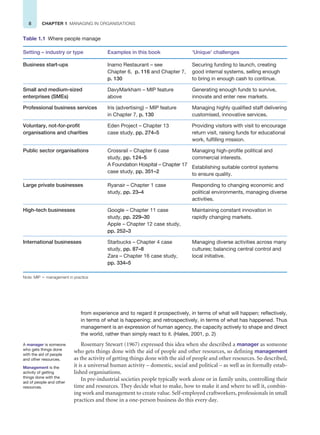
ness planning or ensuring quality). Table 1.1 illustrates some of these diverse settings, and
their (relatively) unique management challenges – which are in addition to challenges that
are common to all.
Whatever its nature, the value an organisation creates depends on how well those who
work there obtain resources and develop their competences.
Kevin Parkin is Managing Director (and part-owner) of DavyMarkham, a small engineering company. Although the
company has a long history, by the mid-1990s it was making regular losses, and its survival was in doubt. Since
Mr Parkin joined the company he has returned it to profit, and in 2009 was predicting a 10 per cent increase in
sales the following year. He has concentrated on identifying what the company is good at, and then using tough
management and financial discipline to make sure staff follow the recipe for success. Mr Parkin has removed poor
managers, walks the shop floor twice a day to check on progress, and engages with the workforce.
It has been essential to tell people the truth about the business, whether it’s good or bad, and giving
them the enthusiasm they require to make them want to succeed . . . I also ask [my ‘mentors’ – people I
have known in previous jobs] about key strategic decisions, people issues, market penetration, capital
spending and general business solutions.
Source: Adapted from Turnaround ace shows his metal (Peter Marsh and Andrew Bounds), Financial Times, 27 May 2009.
Management in practice Creating value at DavyMarkham
www.davymarkham.com
Management as a universal human activity
Management is both a universal human activity and a distinct occupation. In the first sense,
people manage an infinite range of activities:
When human beings ‘manage’ their work, they take responsibility for its purpose,
progress and outcome by exercising the quintessentially human capacity to stand back
Meanings of management
1.3
Management as a uni-
versal human activity
occurs whenever people
take responsibility for an
activity and consciously
try to shape its progress
and outcome.
8 CHAPTER 1 MANAGING IN ORGANISATIONS
Table 1.1 Where people manage
Setting – industry or type Examples in this book ‘Unique’ challenges
Business start-ups Inamo Restaurant – see
Chapter 6, p. 116 and Chapter 7,
p. 130
Securing funding to launch, creating
good internal systems, selling enough
to bring in enough cash to continue.
Small and medium-sized
enterprises (SMEs)
DavyMarkham – MIP feature
above
Generating enough funds to survive,
innovate and enter new markets.
Professional business services Iris (advertising) – MIP feature
in Chapter 7, p. 130
Managing highly qualified staff delivering
customised, innovative services.
Voluntary, not-for-profit
organisations and charities
Eden Project – Chapter 13
case study, pp. 274–5
Providing visitors with visit to encourage
return visit, raising funds for educational
work, fulfilling mission.
Public sector organisations Crossrail – Chapter 6 case
study, pp. 124–5
A Foundation Hospital – Chapter 17
case study, pp. 351–2
Managing high-profile political and
commercial interests.
Establishing suitable control systems
to ensure quality.
Large private businesses Ryanair – Chapter 1 case
study, pp. 23–4
Responding to changing economic and
political environments, managing diverse
activities.
High-tech businesses Google – Chapter 11 case
study, pp. 229–30
Apple – Chapter 12 case study,
pp. 252–3
Maintaining constant innovation in
rapidly changing markets.
International businesses Starbucks – Chapter 4 case
study, pp. 87–8
Zara – Chapter 16 case study,
pp. 334–5
Managing diverse activities across many
cultures; balancing central control and
local initiative.
Note: MIP ⫽ management in practice
A manager is someone
who gets things done
with the aid of people
and other resources.
Management is the
activity of getting
things done with the
aid of people and other
resources.
from experience and to regard it prospectively, in terms of what will happen; reflectively,
in terms of what is happening; and retrospectively, in terms of what has happened. Thus
management is an expression of human agency, the capacity actively to shape and direct
the world, rather than simply react to it. (Hales, 2001, p. 2)
Rosemary Stewart (1967) expressed this idea when she described a manager as someone
who gets things done with the aid of people and other resources, so defining management
as the activity of getting things done with the aid of people and other resources. So described,
it is a universal human activity – domestic, social and political – as well as in formally estab-
lished organisations.
In pre-industrial societies people typically work alone or in family units, controlling their
time and resources. They decide what to make, how to make it and where to sell it, combin-
ing work and management to create value. Self-employed craftworkers, professionals in small
practices and those in a one-person business do this every day.
9
SPECIALISATION BETWEEN AREAS OF MANAGEMENT
As individuals we run our lives and careers: in this respect we are managing. Family mem-
bers manage children, elderly dependants and household tasks. We do it in voluntary or
charity activities where we do the work (planting trees or selling raffle tickets) and the man-
agement activities (planning the winter programme).
Management as a distinct role
Human action can separate the ‘management’ element of a task from the ‘work’ ele-
ment, thus creating ‘managers’ who are in some degree apart from those doing the work.
Management as a distinct role emerges when external parties, usually private or public
owners of capital, gain control of a work process that people used to complete themselves.
The owners are likely to specify what to make, how to make it and where to sell it – control-
ling the time, behaviour and skills of their employees. The latter now sell their labour, not
their products.
This happens when someone starts an enterprise, initially performing the technical aspects
of the work itself – writing software, designing clothes – and also more conceptual tasks such
as planning which markets to serve, or deciding how to raise money. If the business grows
and the entrepreneur engages staff, they will need to spend time on interpersonal tasks such as
training and supervising their work. The founder progressively takes on more management
roles – a role being the expectations that others have of someone occupying a position. It
expresses the specific responsibilities and requirements of the job, and what someone holding
it should do (or not do).
This separation of management and non-management work is not inevitable or perma-
nent. People deliberately separate the roles, and can also bring them together. As Henri Fayol
(1949) (of whom you will read more in Chapter 2) observed:
Management . . . is neither an exclusive privilege nor a particular responsibility of the head
or senior members of a business; it is an activity spread, like all other activities, between
head and members of the body corporate. (p. 6)
Someone in charge of part of, say, a production department will usually be treated as
a manager, and referred to as one. The people who operate the machines will be called
something else. In a growing business like Ryanair, the boundary between ‘managers’ and
‘non-managers’ is likely to be very fluid, with all being ready to perform a range of tasks, irre-
spective of their title. Hales’ (2006) research shows how first-line managers now hold some
responsibilities traditionally associated with middle managers. They are still responsible for
supervising subordinates, but often also have to deal with costs and customer satisfaction –
previously a middle manager’s job.
Management as a dis-
tinct role develops when
activities previously em-
bedded in the work itself
become the responsibil-
ity not of the employee,
but of owners or their
agents.
A role is the sum of the
expectations that other
people have of a person
occupying a position.
Specialisation between areas of management
1.4
As an organisation grows, senior managers usually create separate functions and a hierarchy,
so that management itself becomes divided.
Functional specialisation
General managers typically head a complete unit of the organisation, such as a divi-
sion or subsidiary, within which there will be several functions. The general manager
is responsible for the unit’s performance, and relies on the managers in charge of each
function. A small organisation will have just one or two general managers, who will also
manage the functions.
General managers
are responsible for the
performance of a distinct
unit of the organisation.
10 CHAPTER 1 MANAGING IN ORGANISATIONS
Functional managers are responsible for an area of work – either as line managers or staff
managers. Line managers are in charge of a function that creates value directly by supplying
products or services to customers: they could be in charge of a retail store, a group of nurses,
a social work department or a manufacturing area. Their performance significantly affects
business performance and image, as they and their staff are in direct contact with customers
or clients. At Shell, Mike Hogg was (in 2011) the General Manager of Shell Gas Direct, while
Melanie Lane was General Manager, UK Retail.
Functional managers
are responsible for the
performance of an area
of technical or profes-
sional work.
Line managers are
responsible for the
performance of activities
that directly meet cus-
tomers’ needs.
Management in practice The store manager – fundamental to success
A manager with extensive experience of retailing commented:
The store manager’s job is far more complex that it may at first appear. Staff management is an impor-
tant element and financial skills are required to manage a budget and the costs involved in running a
store. Managers must understand what is going on behind the scenes – in terms of logistics and the
supply chain – as well as what is happening on the shop floor. They must also be good with customers
and increasingly they need outward-looking skills as they are encouraged to take high-profile roles in
the community.
Source: Private communication from the manager.
Staff managers are in charge of activities like finance, personnel, purchasing or legal
affairs which support the line managers, who are their customers. Staff in support depart-
ments are not usually in direct contact with external customers, and so do not earn income
directly for the organisation. Managers of staff departments operate as line managers within
their unit. At Shell, Bob Henderson was Head of Legal and Kate Smith was Head of UK Gov-
ernment Relations.
Project managers are responsible for a temporary team created to plan and implement a
change, such as a new product or system. Mike Buckingham, an engineer, managed a project
to implement a new manufacturing system in a van plant. He still had line responsibilities for
aspects of manufacturing, but worked for most of the time on the project, helped by a team
of technical specialists. When the change was complete he returned to full-time work on his
line job.
Entrepreneurs are people who are able to see opportunities in a market which others have
overlooked. They quickly secure the resources they need, and use them to build a profitable
business. John Scott (Managing Director of Scott Timber, now the UK’s largest manufacturer
of wooden pallets – www.scott-timber.co.uk) recalls the early days:
I went from not really knowing what I wanted to do . . . to getting thrown into having to
make a plant work, employ men, lead by example. We didn’t have an office – it was in my
mum’s house, and she did the invoicing. The house was at the top of the yard, and the
saw mill was at the bottom. (Financial Times, 11 July 2007, p. 18)
Management hierarchies
As organisations grow, senior managers usually create a hierarchy of positions. The amount
of ‘management’ and ‘non-management’ work within these positions varies, and the bound-
aries between them are fluid.
Performing direct operations
People who perform direct operations do the manual and mental work to make and deliver
products or services. These range from low paid cleaners or shop workers to highly paid pilots
Staff managers are
responsible for the
performance of activities
that support line
managers.
Project managers are
responsible for managing
a project, usually in-
tended to change some
element of an organisa-
tion or its context.
Entrepreneurs are
people who see op-
portunities in a market,
and quickly mobilise
the resources to deliver
the product or service
profitably.
11
SPECIALISATION BETWEEN AREAS OF MANAGEMENT
or lawyers. The activity is likely to contain some aspects of management work, though in
lower-level jobs this will be limited. People running a small business combine management
work with direct work to meet customer requirements.
Supervising staff on direct operations
Supervisors (sometimes called first-line managers) typically direct and control the daily work
of a group or process. They ensure that front-line staff perform the essential, basic activities
correctly – by paying attention to their job, noticing detail, keeping things moving efficiently
and courteously to provide the quality of goods or services the customer expects. Supervisors
are responsible for monitoring and reporting on work performance in an area, and working
to improve it. They allocate and co-ordinate work, monitor the pace and help with problems.
Sometimes they work with middle managers to making operational decisions on staff or work
methods. Examples include the supervisor of a production team, the head chef in a hotel, or
a nurse in charge of a hospital ward. They may continue to perform some direct operations,
but will spend less time on them than subordinates.
Managing supervisors and first-line managers
Usually referred to as middle managers, they – such as an engineering manager at
Ryanair – are expected to ensure that first-line managers work in line with company
policies. They translate strategy into operational tasks, mediating between senior man-
agement vision and operational reality. They may help to develop strategy by presenting
information about customer expectations, or suggesting alternative strategies to senior
managers (Currie and Proctor, 2005). They provide a communication link – telling first-
line managers what they expect, and briefing senior managers about current issues – one
of the reasons banks got into difficulty in 2008 was because senior managers had no idea
of the risks being taken by their traders and loan officers: good middle managers ensure
that their bosses know what is going on.
Others face the challenge of managing volunteers. Charities depend on their time and
effort, yet commonly face problems when they don’t turn up, or work ineffectively – but
cannot draw on the systems commonly used to reward and retain paid staff.
Managing the managers
The most senior employee is usually called the ‘managing director’ or ‘chief executive’. Their
main responsibility is to ensure that the middle managers work in ways that add value to
their resources. In smaller organisations they will deal directly with middle managers, but in
larger ones they will work through a team of senior executives in charge of functional areas
like marketing or manufacturing. Chief executives influence performance largely by deciding
who to appoint to executive positions, and by how they manage this top team. They report
to the board of directors about developments in the business, and about issues which require
board approval.
Managing the business
Managing the business is the work of a small group, usually called the board of directors.
They establish policy and have a particular responsibility for managing relations with people
and institutions in the world outside, such as shareholders, national media or government
ministers. They need to know broadly about internal matters, but spend most of their time
looking to the future or dealing with external affairs. Depending on local company law, the
board usually includes non-executive directors – senior managers from other companies who
should bring a wider, independent view to discussions. Such non-executive directors can
enhance the effectiveness of the board, and give investors confidence that the board is acting
in their interests. The board will not consider operational issues.
12 CHAPTER 1 MANAGING IN ORGANISATIONS
Whatever their role, people add value to resources by influencing others, including internal
and external stakeholders – who affect, or who are affected by, an organisation’s actions and
policies. Some stakeholders have different priorities from the managers, so the latter need to
influence them to act in ways they believe will add value.
Theydothisdirectlyandindirectly.Directmethodsaretheinterpersonalskills(seeChapter12)
which managers use – persuading a boss to support a proposal, a subordinate to do more work, or
a customer to change a delivery date. Managers also influence others indirectly through:
z the process of managing;
z the tasks of managing (Section 1.6); and
z shaping the context (Section 1.7).
Rosemary Stewart (1967) was one of the first to study the process of management – how
managers work. She asked 160 senior and middle managers to keep a diary for four weeks,
which showed that they typically worked in a fragmented, interrupted way – with very little
time for thinking and working on their own. More recently, Henry Mintzberg found that
within that fragmented pattern of work, managers focus on one or more distinct roles.
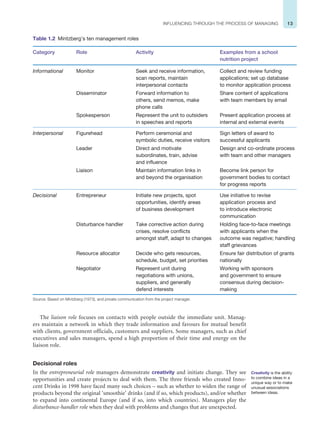
Henry Mintzberg – ten management roles
Mintzberg (1973) observed how (five) chief executives spent their time, and used this data to
identify ten management roles, in three categories – informational, interpersonal and deci-
sional. Managers use one or more of these roles as they try to influence other people. Table 1.2
describes them, and illustrates each with a contemporary example provided by the manager
of a school nutrition project.
Informational roles
Managing depends on obtaining information about external and internal events, and passing
it to others. The monitor role involves seeking out, receiving and screening information to
understand the organisation and its context. It comes from websites and reports, and espe-
cially from chance conversations – such as with customers or new contacts at conferences and
exhibitions. Much of this information is oral (gossip as well as formal meetings), building
on personal contacts. In the disseminator role the manager shares information by forwarding
reports, passing on rumours or briefing staff. As a spokesperson the manager transmits infor-
mation to people outside the organisation – speaking at a conference, briefing the media or
giving the department’s view at a company meeting. Michael O’Leary at Ryanair is renowned
for flamboyant statements to the media about competitors or officials in the European Com-
mission when he disagrees with their policies.
Interpersonal roles
Interpersonal roles arise directly from a manager’s formal authority and status, and shape rela-
tionships with people within and beyond the organisation. In the figurehead role the manager is
a symbol, representing the unit in legal and ceremonial duties such as greeting a visitor, signing
legal documents, presenting retirement gifts or receiving a quality award. The leader role defines
the manager’s relationship with other people (not just subordinates), including motivating,
communicating and developing their skills and confidence – as one commented:
I am conscious that I am unable to spend as much time interacting with staff members
as I would like. I try to overcome this by leaving my door open whenever I am alone as an
invitation to staff to come in and interrupt me, and encourage them to discuss any prob-
lems. (private communication)
Influencing through the process of managing
1.5
Stakeholders are
individuals, groups or
organisations with an
interest in, or who are
affected by, what the
organisation does.
13
INFLUENCING THROUGH THE PROCESS OF MANAGING
Table 1.2 Mintzberg’s ten management roles
Category Role Activity Examples from a school
nutrition project
Informational Monitor Seek and receive information,
scan reports, maintain
interpersonal contacts
Collect and review funding
applications; set up database
to monitor application process
Disseminator Forward information to
others, send memos, make
phone calls
Share content of applications
with team members by email
Spokesperson Represent the unit to outsiders
in speeches and reports
Present application process at
internal and external events
Interpersonal Figurehead Perform ceremonial and
symbolic duties, receive visitors
Sign letters of award to
successful applicants
Leader Direct and motivate
subordinates, train, advise
and influence
Design and co-ordinate process
with team and other managers
Liaison Maintain information links in
and beyond the organisation
Become link person for
government bodies to contact
for progress reports
Decisional Entrepreneur Initiate new projects, spot
opportunities, identify areas
of business development
Use initiative to revise
application process and
to introduce electronic
communication
Disturbance handler Take corrective action during
crises, resolve conflicts
amongst staff, adapt to changes
Holding face-to-face meetings
with applicants when the
outcome was negative; handling
staff grievances
Resource allocator Decide who gets resources,
schedule, budget, set priorities
Ensure fair distribution of grants
nationally
Negotiator Represent unit during
negotiations with unions,
suppliers, and generally
defend interests
Working with sponsors
and government to ensure
consensus during decision-
making
Source: Based on Mintzberg (1973), and private communication from the project manager.
The liaison role focuses on contacts with people outside the immediate unit. Manag-
ers maintain a network in which they trade information and favours for mutual benefit
with clients, government officials, customers and suppliers. Some managers, such as chief
executives and sales managers, spend a high proportion of their time and energy on the
liaison role.
Decisional roles
In the entrepreneurial role managers demonstrate creativity and initiate change. They see
opportunities and create projects to deal with them. The three friends who created Inno-
cent Drinks in 1998 have faced many such choices – such as whether to widen the range of
products beyond the original ‘smoothie’ drinks (and if so, which products), and/or whether
to expand into continental Europe (and if so, into which countries). Managers play the
disturbance-handler role when they deal with problems and changes that are unexpected.
Creativity is the ability
to combine ideas in a
unique way or to make
unusual associations
between ideas.
14 CHAPTER 1 MANAGING IN ORGANISATIONS
Management in practice Handling disturbance www.bt.com
In early 2009, Ian Livingston, BT’s chief executive, surprised financial markets by reporting a pre-tax
loss for the first quarter. The main cause was Global Services, which supplies telecoms networks to
international companies and public bodies, but also severe competition and the recession – the share
price had fallen by 60 per cent in the previous year. To recover, Global Services was split into three units,
each focused on one market; capital spending was cut; and 15,000 jobs would go by the end of the next
financial year.
Source: Financial Times, 30 April 2009.
The resource-allocator role involves choosing among competing demands for money,
equipment, personnel and other resources. In early 2011 Marks and Spencer (www.
marksandspencer.com) announced a new strategy, which reflected decisions by the chief
executive (and the board) on where to invest funds available for capital projects (such as how
much to spend on refurbishing the physical stores, and how much to spend on upgrading
the website). In another business a manager has to decide whether to pay overtime to staff to
replace an absent team member, or let service quality decline until a new shift starts. This is
close to the negotiator role, in which managers seek agreement with other parties on whom
they depend. Managers at Ryanair regularly negotiate with airport owners to agree on services
and fees for a subsequent period.
Mintzberg proposed that every manager’s job combines these roles, with their relative
importance depending on the manager’s level and type of business. Managers usually com-
bine several of these roles as they try to influence others.
They sometimes note two omissions from Mintzberg’s list – manager as subordinate and
manager as worker. Most managers have subordinates but, except for those at the very top,
they are subordinates themselves. Part of their role is to advise, assist and influence their
boss – over whom they have no formal authority. Managers often need to persuade people
higher up the organisation of a proposal’s value or urgency. A project manager:
This is the second time we have been back to the management team, to propose how
we wish to move forward, and to try and get the resources that are required. It is worth
taking the time up front to get all members fully supportive of what we are trying to do.
Although it takes a bit longer we should, by pressure and by other individuals demon-
strating the benefits of what we are proposing, eventually move the [top team] forward.
(private communication)
Many managers spend time doing the work of the organisation. A director of a small
property company helps with sales visits, or an engineering director helps with difficult
technical problems. A lawyer running a small practice performs both professional and
managerial roles.
Managers as networkers
Does the focus of a manager’s influencing activities affect performance? Mintzberg’s
study gave no evidence on this point, but work by Luthans (1988) showed that the rel-
ative amount of time spent on specific roles did affect outcomes. The team observed
292 managers in four organisations for two weeks, recording their behaviours in four
categories – communicating, ‘traditional management’, networking and human resource
management. They also distinguished between levels of ‘success’ (relatively rapid promotion)
15
INFLUENCING THROUGH THE TASKS OF MANAGING
and ‘effectiveness’ (work-unit performance and subordinates’ satisfaction). They concluded
that successful managers spent much more time networking (socialising, politicking, inter-
acting with outsiders) than the less successful. Effective managers spent most time on com-
munication and human resource management.
Wolff and Moser (2009) confirmed the link between networking and career success,
showing building, maintaining and using internal and external contacts was associated with
current salary, and with salary growth. Effective networkers seek out useful connections and
contacts, and use the information and ideas they gather to create something valuable.
Networking refers to
behaviours that aim to
build, maintain and use
informal relationships
(internal and external) that
may help work-related
activities.
A second way in which managers influence others is when they manage the transformation
of resources into more valuable outputs. Building on Figure 1.1, this involves the manage-
ment tasks of planning, organising, leading and controlling the transformation of resources.
The amount of each varies with the job and the person, and they do not perform them in
sequence: they do them simultaneously, switching as the situation requires.
Figure 1.2 illustrates the definition. It expands the central ‘transforming’ circle of Fig-
ure 1.1 by showing that people draw inputs (resources) from the environment and transform
them into outputs by planning, organising, leading and controlling. They pass the resulting
outputs back into the environment – the feedback loop indicates that this is the source of
future resources.
External environment
Organisations depend on the external environment for the tangible and intangible resources
they need, so they also depend on people in that environment being willing to buy or other-
wise value their outputs. Commercial firms sell goods and services and use the revenue to
buy resources. Public bodies depend on their sponsors being sufficiently satisfied with their
Influencing through the tasks of managing
1.6
Management tasks
are those of planning,
organising, leading and
controlling the use of
resources to add value
to them.
Organisation
External environment
Feedback
Output
• Goods
• Services
• Reputation
• Waste
etc.
Input
• People
• Finance
• Materials
etc.
Tasks in
managing
transformation
Organising
Leading
Planning
Controlling
Figure 1.2
The tasks of
managing
16 CHAPTER 1 MANAGING IN ORGANISATIONS
performance to provide their budget. Most managers are now facing the challenge of how
they manage their organisations to ensure that they use natural resources not just efficiently,
but sustainably. Part 2 of the book deals with the external environment.
Planning
Planning sets out the overall direction of the work to be done. It includes forecasting future
trends, assessing resources and developing performance objectives. It means deciding on
the scope and direction of the business, the areas of work in which to engage and how to use
resources. Managers invest time and effort in developing a sense of direction for the organi-
sation, or their part of it, and express this in a set of objectives. Part 3 deals with planning.
More than most civil engineering projects, rail projects depend on extensive and detailed advance planning.
In 2010 the UK government announced the preferred route for the first stage of a high-speed West Coast rail-
way line. The first stage will run from London to Birmingham, but construction is not expected to begin unto
2015 at the earliest, with completion about four years later. The Crossrail project in London (see Chapter 6
case study, p. 124) also illustrates the scale and complexity of the planning required to build a large railway
through (and below) the centre of London.
Source: Company website.
Management in practice Planning major rail projects www.networkrail.co.uk
Organising
This is the task of moving abstract plans closer to reality by deciding how to allocate time and
effort. It includes creating a structure for the enterprise, developing policies for finance and
people, deciding what equipment people need and how to implement change. Part 4 deals
with organising.
Leading
Leading is the task of generating effort and commitment – influencing people of all kinds,
generating commitment and motivation, and communicating – whether with individu-
als or in teams. These activities focus on all of the other tasks – planning, organising and
controlling – so appear in the middle of Figure 1.2. Part 5 deals with this topic.
Controlling
Control is the task of checking progress, comparing it with a plan, and acting accordingly.
Managers set a budget for a housing department, an outpatients’ clinic or for business travel.
They then ensure that there is a system to collect information regularly on expenditure or
performance – to check they are keeping to budget. If not, they need to decide how to bring
actual costs back into line with budgeted costs. Are the outcomes consistent with the objec-
tives? If so, they can leave things alone. But if by Wednesday it is clear that staff will not meet
the week’s production target, then managers need to act. They may deal with the deviation
by a short-term response – such as authorising overtime. Control is equally important in
creative organisations. Ed Catmull, cofounder of Pixar comments:
Because we’re a creative organization, people [think that what we do can’t be mea-
sured]. That’s wrong. Most of our processes involve activities and deliverables that can
17
INFLUENCING THROUGH SHAPING THE CONTEXT
be quantified. We keep track of the rates at which things happen, how often something
had to be reworked, whether a piece of work was completely finished or not when it was
sent to another department . . . Data can show things in a neutral way, which can stimulate
discussion. (Catmull, 2008, p. 72)
That discussion to which Catmull refers is the way to learn from experience – an essential
contributor to performance – so good managers create and use opportunities to learn from
what they are doing. Part 6 deals with control.
The tasks in practice
Managers typically switch between tasks many times each day. They deal with them intermit-
tently and in parallel, touching on many different parts of the job, as this manager in a not-
for-profit housing association explains:
My role involves each of these functions. Planning is an important element as I am part
of a team with a budget of £8 million to spend on promoting particular forms of housing.
So planning where we will spend the money is very important. Organising and leading are
important too, as staff have to be clear on which projects to take forward, clear on objec-
tives and deadlines. Controlling is also there – I have to compare the actual money spent
with the planned budget and take corrective action as necessary. (private communication
from the manager)
And a manager in a professional services firm:
As a manager in a professional firm, each assignment involves all the elements to
ensure we carry it out properly. For example, I have to set clear objectives for the
assignment, organise the necessary staff and information to perform the work, super-
vise staff and counsel them if necessary, and evaluate the results. All the roles inter-
relate and there are no clear stages for each one. (private communication from the
manager)
Influencing through shaping the context
1.7
A third way in which managers influence others is through changing aspects of the context
in which they work. Changing an office layout, a person’s reporting relationships, or the
rewards they obtain, alter their context and perhaps their actions. The context is both an
influence on the manager and a tool with which to influence others:
It is impossible to understand human intentions by ignoring the settings in which they
make sense. Such settings may be institutions, sets of practices, or some other contexts
created by humans – contexts which have a history, within which both particular deeds
and whole histories of individual actors can and have to be situated in order to be intel-
ligible. (Czarniawska, 2004, p. 4)
Managers aim to create contexts to influence others to act in ways that meet their objectives.
Dimensions of context
Internal context
Figures 1.1 and 1.2 showed the links between managers, their organisation and the external
context. Figure 1.3 enlarges the ‘organisation’ circle to show more fully the elements that
make up the internal context (or environment) – the immediate context within which people
18 CHAPTER 1 MANAGING IN ORGANISATIONS
work. As Mark Zuckerberg built Facebook into the world’s largest social networking site, he
and his team would have dealt with all of the elements shown in the figure:
z Culture (Chapter 3) – distinctive norms, beliefs and underlying values;
z Objectives (Chapters 6 and 8) – a desired future state of a business or unit;
z Structure (Chapter 9) – how to divide and co-ordinate tasks to meet objectives;
z Technology (Chapter 10) – facilities and equipment to turn inputs into outputs;
z Power (Chapter 12) – the amount and distribution of power with which to influence others;
z People (Chapter 13) – their knowledge, skills, attitudes and goals;
z Business processes – activities to transform materials and information; and
z Finance – financial resources available and how best to use them.
Figure 1.3 also implies that managers work within constraints – some of the elements will
help, while others will hinder them. Effective managers do not accept their context passively –
they try to change these elements so that they support their objectives (Chapter 11).
Historical context
Managing takes place within the flow of history as what people do now reflects past events and
future uncertainties. Managers typically focus on current issues, ensuring that things run properly
and that the organisation works. At the same time, history influences them through the structure
and culture within which they work, and by affecting how people respond to proposals.
Effective managers also look to the future, questioning present systems and observing
external changes. The arrow at the foot of the figure represents the historical context.
External context
Chapter 3 shows that the external context includes an immediate competitive (micro) environ-
ment and a general (or macro) environment. These affect performance and part of the man-
ager’s work is to identify, and adapt to, external changes. Managers in the public sector are
expected to deliver improved services with fewer resources, so they seek to influence people to
Managing
transformation
processes
External environment
Feedback
Output
• Goods
• Services
• Reputation
• Waste
etc.
Input
• People
• Finance
• Materials
etc.
Organisation
Business
processes
Structure
People
Culture
Technology
Power
present
Organisation’s past and future
Objectives
Finance
Figure 1.3
The internal and
external contexts
of management
19
CRITICAL THINKING
Brookfield (1987) stresses the benefits of thinking critically, in that it:
involves our recognizing the assumptions underlying our beliefs and behaviors. It means
we can give justifications for our ideas and actions. Most important, perhaps, it means
we try to judge the rationality of these justifications . . . by comparing them to a range of
varying interpretations and perspectives. (p. 13)
Critical thinking is positive activity that enables people to see more possibilities, rather than
a single path. Critical thinkers ‘are self-confident about their potential for changing aspects
of their worlds, both as individuals and through collective action’ (p. 5). He identifies four
components of critical thinking.
Identifying and challenging assumptions
Critical thinkers look for the assumptions that underlie taken-for-granted ideas, beliefs and
values, and question their accuracy and validity. They are ready to discard those that no lon-
ger seem valid guides to action, in favour of more suitable ones. A manager who presents a
well-supported challenge to a strategy that seems unsuitable to their business, or who ques-
tions the need for a new structure, is using this aspect of critical thinking.
Recognising the importance of context
Critical thinkers are aware that context influences thought and action. Thinking uncritically
means assuming that ideas and methods that work in one context will work equally well in
others. What we regard as an appropriate way to deal with staff reflects a specific culture:
people in another culture – working in another place or at a different time – will have other
expectations. Critical thinkers look for such approaches suitable for the relevant context.
Imagining and exploring alternatives
Critical thinkers develop the skill of imagining and exploring alternative ways of managing.
They ask how others have dealt with a situation, and seek evidence about the effectiveness
of different approaches. This makes them aware of realistic alternatives, and so increases the
range of ideas which they can adapt and use.
Seeing limitations
Critical thinking alerts people to the limitations of knowledge and proposals. They recognise that
because a practice works well in one situation does not ensure it will work in another. They are
sceptical about research whose claims seem over-sold, asking about the sample or the analysis.
They are open to new ideas, but only when supported by convincing evidence and reasoning.
Thinking critically will deepen your understanding of management. It does not imply a
‘do-nothing’ cynicism, ‘treating everything and everyone with suspicion and doubt’ (Thomas,
2003, p. 7). Critical thinking lays the foundation for a successful career, as it helps to ensure
that proposals are supported by convincing evidence and reasoning.
Managing your studies
Studying management is itself a task to manage. Each chapter specifies learning outcomes. The
text, the case study and the ‘before and after’ activities should help you to achieve these, and you
can check your progress with the review questions at the end of each chapter. Working on these
will help develop your confidence to think critically in your studies and in your career.
Critical thinking
1.8
Critical thinking identi-
fies the assumptions
behind ideas, relates
them to their context,
imagines alternatives and
recognises limitations.
change the internal context (such as how staff work) to meet external expectations. They also
seek to influence those in the external context about both expectations and resources.
20 CHAPTER 1 MANAGING IN ORGANISATIONS
Recall the organisation you used in Activity 1.1.
Having read the chapter, make brief notes summarising what you now think ‘manag-
ing’ involves in this company:
z Describe what resources it uses and how it adds value to them. (Refer to
Section 1.2.)
z List examples of some of the specialist roles of management (such as a functional or
a line manager) and describe what they do in this company. (Refer to Section 1.4.)
z Can you identify examples of managers performing one or more of Mintzberg’s
roles? (Refer to Section 1.5.)
z What have you been able to find out about how they perform ONE of the manage-
ment tasks (planning, organising, leading, controlling)? (Refer to Section 1.6.)
Compare what you have found with other students on your course.
Activity 1.2 Understanding management
Summary
1 Explain that the role of management is to add value to resources in diverse settings
z Managers create value by transforming inputs into outputs of greater value: they do
this by developing competences within the organisation which, by constantly adding
value (however measured) to resources is able to survive and prosper. The concept of
creating value is subjective and open to different interpretations. Managers work in an
infinite variety of settings, and Table 1.1 suggested how each setting raises relatively
unique challenges.
2 Give examples of management as a universal human activity and as a distinct role
z Management is an activity that everyone undertakes as they manage their daily lives. In
another sense management is an activity which many people conduct, not just those
called ‘managers’. People create the distinct role when they separate the management
of work from the work itself and allocate the tasks. The distinction between manage-
ment and non-management work is fluid and the result of human action.
3 Compare the roles of general, functional, line, staff and project managers and of
entrepreneurs
z General managers are responsible for a complete business or a unit within it. They
depend on functional managers who can be either in charge of line departments meet-
ing customer needs, such as manufacturing and sales, or in staff departments such
as finance which provide advice or services to line managers. Project managers are in
charge of temporary activities usually directed at implementing change. Entrepreneurs
are those who create new businesses to exploit opportunities.
4 Explain how managers influence others to add value to resources through
z The processes of managing. Henry Mintzberg identified ten management roles
in three groups which he labelled informational, interpersonal and decisional.
Luthans and, more recently, Wolff and Moser observed that successful manag-
ers were likely to be those who networked with people inside and outside the
organisation.
21
FURTHER READING
z The tasks of managing. Planning develops the broad direction of an organisa-
tion’s work, to meet customer expectations, taking into account internal capabili-
ties. Organising sets out how to deploy resources to meet plans, while leading
seeks to ensure that people work with commitment to achieve plans. Control
checks activity and results against plans, so that people can adjust either if
required.
z The contexts of managing. The internal (organisational) context consists of eight ele-
ments which help or hinder the manager’s work – objectives, technology, business
processes, finance, structure, culture, power and people. The historical context also
influences events, as does the external context, which consists of competitive and
general environments.
1 How do non-commercial organisations add value to resources?
2 What is the difference between management as a general human activity and management as a
specialised occupation? How has this division happened?
3 Describe, with examples, the differences between general, functional, line, staff and project managers.
4 How does Mintzberg’s theory of management roles complement that which identifies the tasks of
management?
5 Give examples from your experience or observation of each of the four tasks of management.
6 What is the significance to someone starting a career in management of Luthans’ theory about roles and
performance?
7 How can thinking critically help managers do their job more effectively?
8 Review and revise the definition of management that you gave in Activity 1.1.
Review questions
Further reading
Birkinshaw, J. (2010), Reinventing Management: Smarter choices for getting work done,
Jossey-Bass, San Fancisco, CA.
A small book by a leading management academic gives a short account of the work of
general management.
Handy, C. (1988), Understanding Voluntary Organisations, Penguin, Harmondsworth.
A valuable perspective on management in the voluntary sector.
Drucker, P. (1999), Management Challenges for the 21st Century, Butterworth/Heinemann,
London.
Valuable observations from the enquiring mind of this great management theorist.
Scott, D. M. and Halligan, B. (2010), Marketing Lessons from the Grateful Dead: What every
business can learn from the most iconic band in history, Wiley, Hoboken, NJ.
Practical insights into management generally from two authors with deep insights into
how the legendary band achieved its success.
22 CHAPTER 1 MANAGING IN ORGANISATIONS
Weblinks
These websites have appeared in, or are relevant to, the chapter:
www.davymarkham.com
www.charitycommission.gov.uk
www.scott-timber.co.uk
www.bt.com
www.marksandspencer.com
www.networkrail.co.uk
www.facebook.com/facebook
www.ryanair.com
Visit two of the business sites in the list above, or those of other organisations in which you
are interested, and navigate to the pages dealing with recent news, press or investor relations.
z What are the main issues which the organisation appears to be facing?
z Compare and contrast the issues you identify on the two sites.
z What challenges may they imply for those working in, and managing, these organisations?
Annotated weblinks, multiple choice questions and other use-
ful resources can be found on www.pearsoned.co.uk/boddy
23
In 2011 Ryanair, based in Dublin, was Europe’s larg-
est low fare airline, and despite the recession, it had
carried over 74 million passengers in the 12 months
to the end of April, a record for that period. In 1985,
the company began offering services between Dublin
and London, in competition with the established na-
tional carrier, Aer Lingus. In the early years the airline
changed its business several times – initially a con-
ventional competitor for Aer Lingus, then a charter
company, at times offering a cargo service. The Gulf
War in 1990 discouraged air travel and deepened the
company’s financial problems. In 1991, senior man-
agers decided to focus the airline as a ‘no-frills’ op-
erator, in which many traditional features of air travel
(free food, drink, newspapers and allocated seats)
were no longer available. It aimed to serve a group of
flyers who wanted a functional and efficient service,
not luxury.
In 1997 changes in European Union regulations
enabled new airlines to enter markets previously
dominated by established national carriers such as
Air France and British Airways. Ryanair quickly took
advantage of this, opening new routes between
Dublin and continental Europe. Although based in Ire-
land, 80 per cent of its routes are between airports in
other countries – in contrast to established carriers
which depend heavily for passengers travelling to and
from the airline’s home country (Barrett, 2009, p. 80).
Managers were quick to spot the potential of the
internet, and in 2000 opened Ryanair.com, a book-
ing site. Within a year it sold 75 per cent of seats
online and now sells almost all seats this way. It also
made a long-term deal with Boeing to purchase 150
new aircraft over the next eight years.
Several factors enable Ryanair to offer low fares:
z Simple fleet – using a single aircraft type (Boeing
737 – most of which are quite new) simplifies
maintenance, training and crew scheduling.
z Secondary airports – using airports away from
major cities keeps landing charges low, some-
times as little as £1 per passenger against £10 at
a major airport; it also avoids the delays and costs
caused by congestion at major airports.
z Fast turnarounds – staff typically turn an aircraft
round between flights in 25 minutes, compared
to an hour for older airlines. This enables aircraft
to spend more time in the air, earning revenue
(11 hours compared to 7 at British Airways).
z Simplified operations – not assigning seats at
check-in simplifies ticketing and administrative
processes, and also ensures that passengers
arrive early to get their preferred seat.
z Flying directly between cities avoids transferring
passengers and baggage between flights, where
mistakes and delays are common.
z Cabin staff collect rubbish before and after land-
ing, saving the cost of cleaning crews which es-
tablished carriers choose to use.
The company has continued to grow rapidly,
regularly opening new routes to destinations it
thinks will be popular. It now refers to itself as ‘the
world’s largest international scheduled airline’, and
continues to seek new bases from which to oper-
ate its network.
The airline’s success depends on balancing low
costs, fare levels and load factors. Airline seats are
what is known as a perishable good – they have no
value if they are not used on the flight, so compa-
nies aim to maximise the proportion of seats sold on
a flight. Ryanair use a technique known as dynamic
pricing, which means that prices change with cir-
cumstances. Typically fares rise the nearer the pas-
senger is to the departure date, though if a flight is
under-booked, the company encourages sales by
lowering fares.
They also earn a growing proportion of revenue
from charges and services such as refreshments,
and in 2009 sharply increased the cost of checked
in bags: it prefers customers to carry hand baggage
into the cabin. Each time a passenger rents a car or
books a hotel room on the Ryanair website, it earns
a commission. It sells scratch cards on board, of-
fers in-flight gambling and on-line gaming over its
Case study Ryanair www.ryanair.com
© Thierry Tronnel/Sygma/Corbis.
CASE STUDY
24 CHAPTER 1 MANAGING IN ORGANISATIONS
website: the chief executive thinks that gambling
could double Ryanair’s profits over the next decade.
The company expects revenue from ancillary activi-
ties will continue to grow more rapidly than passen-
ger revenue.
Sources: The Economist, 10 July 2004; Independent, 7 October 2006;
Financial Times, 7 June 2006; Barrett (2009); Kumar (2006); O’Connell
and Williams (2005); Doganis (2006); and company website.
Questions
1 Identify examples of the resources that
Ryanair uses, and of the competences that
have enabled managers to add value to them.
(Refer to Section 1.2.)
2 Refer to Section 1.4 and note what those
occupying the specialist roles are likely to be
doing in Ryanair.
3 Refer to Section 1.5 and write down which of
Mintzberg’s management roles can you iden-
tify in the Ryanair case? Support your answer
with specific examples.
4 Which aspects of the external general envi-
ronment have affected the company? (Refer
to Section 1.6.)
5 Go to the Ryanair website and look for evi-
dence of the work that managers have been
doing to help the company continue to grow.
CHAPTER 2
THEORIES OF MANAGEMENT
Learning outcomes
When you have read this chapter you should be able to:
1 Explain why understanding a good theory helps people to make better choices
2 State the structure of the competing values framework, which relates theories to each other
3 Summarise the:
z rational goal
z internal process
z human relations and
z open systems perspectives
4 Use ideas from the chapter to comment on the management issues in the Robert Owen case study
27
INTRODUCTION
Robert Owen was an entrepreneur. His attempts to change worker behaviour were innova-
tive, and he was equally creative in devising management systems and new ways of working.
The story of his time at New Lanark illustrates three aspects of management. First, he devised
systems to help manage the people he employed and to improve mill performance. Second,
Owen engaged with the wider social context, such as when he tried to influence Parliament to
prohibit employers from using children in their mills and factories. Third, he was managing
at a time of transition from an agricultural to an industrial economy, and many of his innova-
tions tried to resolve the tensions between those systems – as we now face tensions between
industrial and post-industrial systems.
Managers today cope with similar issues. HMV need to recruit willing and capable
people to work in their stores, and ensure that they add value. Co-operative Financial
Services (CFS) try (like Owen) to follow ethical principles throughout their business and
still earn profits. Managers know that working conditions affect family life – and try to
balance the two by subsidising childcare and offering flexible hours to those with family
responsibilities. They also operate in a world experiencing changes equal to those facing
Owen. The internet is enabling people to organise economic activity in new ways, sus-
tainability is now on the agendas of most management teams, as is the move to a more
connected international economy.
Facing such changes, managers continue to search for new ways to manage their business
so that they add value to their resources. They make assumptions about the best way to do
things – and through trial and error develop methods of working which seem to work reason-
ably well, and which they tend to repeat. Although they probably do not use the term, they
gradually develop their theory of management – their ideas about the relationship between
cause and effect, how a change in (say) working methods will affect (say) staff commitment.
The more accurate their theory (the better the evidence and experience they use), the more
likely they are to obtain the results they want. A manager using inaccurate theory to guide
their actions is likely to have less success.
The next section introduces the idea of theories of management, and why they are useful.
Section 2.3 presents the ‘competing values’ framework, which is a convenient way of seeing
the relationship between theories, which the following sections outline.
Before reading this chapter, write some notes on what you understand by the term
‘theories of management’.
Choose the organisation or people who may be able to help you learn about the
topic. You may find it helpful to discuss the topic with a manager you know, or reflect
on an activity you have managed.
z Identify a situation in which someone had to make a decision or deal with a problem,
and describe it briefly.
z What ideas seem to have guided the way they dealt with the task?
z Did they think consciously about why they did it that way?
z Keep these notes, as you will be able to use them later.
Activity 2.1 What are ‘theories of management’?
Introduction
2.1
28 CHAPTER 2 THEORIES OF MANAGEMENT
A theory (or model) represents a more complex reality. Focusing on the essential elements
and their relationship helps to understand that complexity, and how change may affect it.
Most management problems can only be understood by examining them from several points
of view, so no theory offers a complete solution. The management task is to choose those
most likely to work, and combine them into an acceptable solution.
Theories support purpose and values
Managers have different views about the purpose of their role in society, and this affects the
theories they use. A feature of many societies is that they have established a balance of power
between governments, companies and the ‘social sector’ – co-operatives, social entrepre-
neurs, voluntary organisations. Each reflects a different set of challenges, and has encouraged
the development of theories about how best to manage in those circumstances.
The theory (or mental model) which a person uses reflects their view of the purpose of
their particular job – ranging from serving shareholder interests at one extreme to serving
society at the other (Chapter 5, Section 5.4). Their personal values also influence this – some
see their job as a technical or financial task, whereas others see that being a manager brings
wider responsibilities, including those of dealing fairly and ethically with other people.
Theories identify variables
Whichever broad model of management a person is using, they will use (implicitly) one or
more theories, as these help to identify the main variables in a situation, and the relation-
ships between them. The more accurately they do so, the more useful they are. Since every
situation is unique, many experienced managers doubt the value of theory. Magretta’s
answer is that:
without a theory of some sort it’s hard to make sense of what’s happening in the world
around you. If you want to know whether you work for a well-managed organization – as
opposed to whether you like your boss – you need a working theory of management.
(Magretta, 2002, p. 10)
We all use theory, acting on (perhaps implicit) assumptions about the relationships between
cause and effect. Good theories help to identify variables and relationships, providing a mental
toolkit to deal consciously with a situation. The perspective we take reflects the assumptions
we use to interpret, organise and make sense of events. As managers influence others to add
value they use their mental model (theory) of the situation to decide where to focus effort. The
Management in Practice feature below contrasts two managers’ mental models.
Why study management theory?
2.2
A theory (or model)
represents a complex
phenomenon by identify-
ing the major elements
and relationships
These examples illustrate contrasting theories about managing staff.
Motivating managers: Tim O’Toole, who became chief executive of London Underground in 2003, put in a
new management structure, appointing a general manager for each line to improve accountability.
Now there’s a human being who is judged on how that line is performing and I want them to feel that
kind of intense anxiety in the stomach that comes when there’s a stalled train and they realise that it’s
their stalled train.
Source: From an article by Simon London, Financial Times, 20 February 2004.
Management in practice Practice reflects theory
29
THE COMPETING VALUES FRAMEWORK
Models reflect their context
People look for models to deal with the most pressing issues they face. In the nineteenth
century, skilled labour was scarce and unskilled labour plentiful: managers were hiring work-
ers unfamiliar with factories to meet growing demand, so wanted ideas on how to produce
more efficiently. They looked for ways to simplify tasks so that they could use less-skilled
employees, and early management theories gave priority to these issues. This focus on effi-
ciency reflects a manufacturing mindset, which is still highly relevant in many situations.
In other situations, the main challenge facing a manager is how to meet changing customer
needs quickly and cheaply – so they seek theories about how to create a system that produces
frequent innovations and that can change quickly. As business becomes international, they
seek theories about managing across the world.
An even bigger contextual challenge to managers is presented by the world’s growing pop-
ulation, rising temperatures and sea levels, and probable shortages in many parts of the world
of land, water and energy to cope with this. Most countries face a conflict between the rising
cost of health care for an ageing population, and their ability to provide it. Theories about
how to manage in societies facing these challenges are in short supply.
Critical thinking helps improve our mental models
The ideas on critical thinking in Chapter 1 suggest that working effectively depends on being
able and willing to test the validity of any theory, and to revise it in the light of experience by:
z identifying and challenging assumptions;
z recognising the importance of context;
z imagining and exploring alternatives; and
z seeing limitations.
As you work through this chapter, look for opportunities to practise these components of
critical thinking.
Quinn et al. (2003) believe that successive theories of management (which they group accord-
ing to four underlying philosophies – ‘rational goal’, ‘internal process’, ‘human relations’ and
‘open systems’) complement, rather than contradict, each other. They are all:
symptoms of a larger problem – the need to achieve organizational effectiveness in a
highly dynamic environment. In such a complex and fast-changing world, simple solu-
tions become suspect . . . Sometimes we needed stability, sometimes we needed change.
Often we needed both at the same time. (p. 11)
While each adds to our knowledge, none is sufficient. The ‘competing values’ framework
integrates them by highlighting their underlying values – see Figure 2.1.
The competing values framework
2.3
Supporting staff: John Timpson, chairman of the shoe repair and key cutting chain, believes the most
important people in the company are those who cut customers’ keys and re-heel their shoes:
You come back for the service you get from the people in the shops. They are the stars . . . we need
to do everything to help them to look after you as well as possible. [A bonus based on shop takings] is
fundamental to the service culture I want. It creates the adrenalin. That is the reason why people are
keen to serve you if you go into one of our shops. And why they don’t take long lunch breaks.
Source: Adapted from Secrets of the maverick cobbler, Financial Times, 3 August 2006.
30 CHAPTER 2 THEORIES OF MANAGEMENT
The vertical axis represents the tension between flexibility and control. Managers seek
flexibility to cope with rapid change. Others try to increase control – apparently the opposite
of flexibility. The horizontal axis distinguishes an internal focus from an external one. Some
managers focus on internal issues, while others focus on the world outside. Successive models
of management relate to the four segments.
The labels within the circle indicate the criteria of effectiveness which are the focus of
models in that segment, shown around the outside. The human relations model, upper left
in the figure, stresses the human criteria of commitment, participation and openness. The
open systems model (upper right) stresses criteria of innovation, adaptation and growth.
The rational goal model in the lower right focuses on productivity, direction and goal clarity.
The internal process model stresses stability, documentation and control, within a hierarchi-
cal structure. Finally, the outer ring indicates the values associated with each model – the
Towards
decentralisation,
differentiation
T
o
w
a
r
d
s
d
e
v
e
l
o
p
m
e
n
t
o
f
h
u
m
a
n
r
e
s
o
u
r
c
e
s
T
o
w
a
r
d
s
e
x
p
a
n
s
i
o
n
,
c
h
a
n
g
e
Flexibility
Towards
maintenance
of
the
system
T
o
w
a
r
d
s
c
o
n
s
o
l
i
d
a
t
i
o
n
,
c
o
n
t
i
n
u
i
t
y
Towards
centralisation,
integration
T
o
w
a
r
d
s
m
a
x
i
m
i
s
a
t
i
o
n
o
f
o
u
t
p
u
t
Towards
competitive
position
of
system
Commitment
Morale
Participation
Openness
Stability
Control
Direction
Goal clarity
Productivity
Accomplishment
Innovation
Adaptation
Internal
Control
External
Human
relations
model
Open
systems
model
Internal
process
model
Rational
goal
model
Growth
Resource
acquisition
Documentation
Information
management
Figure 2.1 Competing values framework
Source: Quinn et al. (2003), p. 13.
31
RATIONAL GOAL MODELS
Adam Smith (1776), the Scottish economist, recorded how pin manufacturers in Glasgow
had broken a job previously done by one man into small steps. A single worker now per-
formed one of these repetitively, and this specialisation greatly increased their output. Smith
believed this was one of the main ways in which the new industrial system was increasing the
wealth of the nation.
The availability of powered machinery during the Industrial Revolution enabled busi-
ness owners to transform manufacturing and mining processes. These technical innovations
encouraged, but were not the only reason for, the growth of the factory system. The earlier
‘putting-out’ system of manufacture, in which people worked at home on materials supplied
and collected by entrepreneurs and their agents, allowed great freedom over hours, pace and
methods of work; agents had little control over the quantity and quality of output. Capitalist
entrepreneurs found that they could secure more control if they brought workers together in
a factory, as this meant that:
coercive authority could be more easily applied, including systems of fines, supervision . . .
the paraphernalia of bells and clocks, and incentive payments. The employer could dic-
tate the general conditions of work, time and space; including the division of labour, over-
all organisational layout and design, rules governing movement, shouting, singing and
other forms of disobedience. (Thompson and McHugh 2002, p. 22)
This still left entrepreneurs with the problem of how to manage these new factories profit-
ably. Although domestic and export demand for manufactured goods was high, so was the
risk of business failure.
Frederick Taylor
The fullest answer to the problems of factory organisation came in the work of Frederick W.
Taylor (1856–1915), always associated with the ideas of scientific management. An Ameri-
can mechanical engineer, Taylor focused on the relationship between the worker and the
machine-based production systems that were in widespread use:
the principal object of management should be to secure the maximum prosperity for the
employer, coupled with the maximum prosperity for each employee. The words ‘maxi-
mum prosperity’ . . . mean the development of every branch of the business to its highest
state of excellence, so that the prosperity may be permanent. (Taylor, 1917, p. 9)
He believed the way to achieve this was to ensure that each worker reached their state of
maximum efficiency, so that each was doing ‘the highest grade of work for which his natural
abilities fit him’ (p. 9). This would follow from detailed control of the process, which would
become the managers’ primary responsibility: they should concentrate on understanding the
production systems, and use this to specify every aspect of the operation. Taylor advocated
five principles:
z use scientific methods to determine the one best way of doing a task, rather than rely on
the older ‘rule of thumb’ methods;
z select the best person to do the job so defined, ensuring that their physical and mental
qualities were appropriate for the task;
z train, teach and develop the worker to follow the defined procedures precisely;
dominant value in the rational goal model is that of maximising output, while in human
relations it is developing people. Successive sections of this chapter outline theories associated
with each segment.
Rational goal models
2.4
Scientific management
The school of manage-
ment called ‘scientific’
attempted to create
a science of factory
production.
32 CHAPTER 2 THEORIES OF MANAGEMENT
z provide financial incentives to ensure people work to the prescribed method; and
z move responsibility for planning and organising from the worker to the manager.
Taylor’s underlying philosophy was that scientific analysis and fact, not guesswork, should
inform management. Like Smith and Babbage before him, he believed that efficiency rose if
tasks were routine and predictable. He advocated techniques such as time and motion study,
standardised tools and individual incentives. Breaking work into small, specific tasks would
increase control. Specialist staff would design these tasks and organise the workers:
The work of every workman is fully planned out by the management at least one day in
advance, and each man receives in most cases complete written instructions, describing
in detail the task which he is to accomplish, as well as the means to be used in doing the
work . . . This task specifies not only what is to be done but how it is to be done and the
exact time allowed for doing it. (Taylor, 1917, p. 39)
Taylor also influenced the development of administrative systems such as record keeping and
stock control to support manufacturing.
Management in practice Using work study in the 1990s
Oswald Jones recalls his experience as a work study engineer in the 1990s, where he and his colleagues were
deeply committed to the principles of scientific management:
Jobs were designed to be done in a mechanical fashion by removing opportunities for worker discre-
tion. This had dual benefits: very simple jobs could be measured accurately (so causing less disputes)
and meant that operators were much more interchangeable which was an important feature in improv-
ing overall efficiency levels.
Source: Jones (2000, p. 647).
Managers in industrialised economies adopted Taylor’s ideas widely: Henry Ford was
an enthusiastic advocate. When he introduced the assembly line in 1914, the time taken
to assemble a car fell from over 700 hours to 93 minutes. Ford also developed systems of
materials flow and plant layout, a significant contribution to scientific management.
Increased productivity often came at human cost (Thompson and McHugh, 2002). Trade
unions believed Taylor’s methods increased unemployment, and vigorously opposed them.
Many people find work on an assembly line is boring and alienating, devoid of much mean-
ing. In extreme cases, the time taken to complete an operation is less than a minute and uses
few human abilities.
Frank and Lillian Gilbreth
Frank and Lillian Gilbreth (1868–1924 and 1878–1972) worked together to encourage employ-
ers to use scientific management principles. Frank Gilbreth had been a bricklayer, and knew
why work was slow and output unpredictable. He filmed men laying bricks and used this to
set out the most economical movements for each task. He specified exactly what the employer
should provide, such as trestles at the right height and materials at the right time. Supplies of
mortar and bricks (arranged the right way up) should arrive at a time which did not interrupt
work. An influential book (Gilbreth, 1911) gave precise guidance on how to reduce unnecessary
actions (from 18 to 5), and hence fatigue. The rules and charts would help apprentices:
(They) will enable the apprentice to earn large wages immediately, because he has . . . a
series of instructions that show each and every motion in the proper sequence. They elim-
inate the ‘wrong’ way [and] all experimenting. (Quoted in Spriegel and Myers, 1953, p. 57)
33
RATIONAL GOAL MODELS
Lillian Gilbreth focused on the psychological aspects of management, and on the welfare
of workers. In The Psychology of Management (1914) she proposed, like Taylor, that scientific
management would enable individuals to reach their full potential. Careful development of
suitable working processes, careful selection, planned training and proper equipment, would
help them to build their self-respect. If they did something well, and that was made public,
they would develop pride in their work and in themselves. She believed workers had enquir-
ing minds, and that management should explain the reasons for work processes:
Unless the man knows why he is doing the thing, his judgment will never reinforce his
work . . . His work will not enlist his zeal unless he knows exactly why he is made to work
in the particular manner prescribed. (Quoted in Spriegel and Myers, 1953, p. 431)
Operational research
Another practice within the rational goal model is operational research (OR). This originated
in the early 1940s, when the UK War Department faced severe management problems – such
as the most effective distribution of radar-linked anti-aircraft gun emplacements, or the safest
speed at which convoys of merchant ships should cross the Atlantic. To solve these it formed
operational research teams, which pooled the expertise of scientific disciplines such as math-
ematics and physics and produced significant results. Kirby (2003) notes that while at the start
of the London Blitz 20,000 rounds of ammunition were fired for each enemy aircraft destroyed:
by the summer of 1941 the number had fallen . . . to 4,000 as a result of the operational
research (teams) improving the accuracy of radar-based gun-laying. (Kirby 2003, p. 94)
In the late 1940s managers in industry and government saw that OR techniques could help
managers running civil organisations. The scale and complexity of business was increasing,
and required new techniques to analyse the many interrelated variables: developments in
computing supported increasingly sophisticated mathematical models. In the 1950s the steel
industry needed to cut the cost of transporting iron ore: staff used OR techniques to analyse
the most efficient procedures for shipping, unloading and transferring it to steelworks.
The method is widely used in both business and public sectors, where it helps planning
in areas as diverse as maintenance, cash flow, inventory, staff scheduling in call centres and
allocating students to seminar groups.
OR cannot take into account human and social uncertainties, and the assumptions built
into the models may be invalid, especially if they involve political interests. The technique
clearly contributes to the analysis of management problems, but is only part of the solution.
Current status
Table 2.1 summarises principles common to rational goal models and their modern application.
Operational research
is a scientific method of
providing managers with
a quantitative basis for
decisions regarding the
operations under their
control.
Table 2.1 Modern applications of the rational goal model
Principles of the rational goal model Current applications
Systematic work methods Work study and process engineering departments
develop precise specifications for processes
Detailed division of labour Where staff focus on one type of work or
customer in manufacturing or service operations
Centralised planning and control Modern information systems increase the scope
for central control of worldwide operations
Low-involvement employment
relationship
Using temporary staff as required, rather than
permanent employees
34 CHAPTER 2 THEORIES OF MANAGEMENT
It is very important to make sure the same standards are adhered to in every single shop, whether you’re in
Crown Passage in London, Sauchiehall Street in Glasgow or in New York. The way we do that is very, very
detailed training. So, for example, how to make an egg mayonnaise sandwich is all written down on a card
that has to be followed, and that is absolutely non-negotiable.
When somebody joins Pret they have a ten-day training plan, and on every single day there is a list of
things that they have to be shown, from how to spread the filling of a sandwich right to the edges (that is key
to us), how to cut a sandwich from corner to corner, how to make sure that the sandwiches look great in the
box and on the shelves. So every single detail is covered on a ten-day training plan. At the end of that ten
days the new team member has to pass a quiz, it’s called the big scary quiz, it is quite big and it is quite scary,
and they have to achieve 90 per cent on that in order to progress.
Source: Interview with a senior manager at the company.
Management in practice Making a sandwich at Pret A Manger www.pret.com
Examples of rational goal approaches are common in manufacturing and services – but a
company will often use just one of the principles that suits their business. The Management
in Practice feature below gives an example from a successful service business with committed
and involved employees. It aims to give customers the same high-quality experience wherever
they are, and uses the principle of systematic work methods to achieve this.
The methods are also widely used in the mass production industries of newly indus-
trialised economies such as China and Malaysia. Gamble et al. (2004) found that in
such plants:
Work organization tended to be fragmented (on Taylorist lines) and routinised, with con-
siderable surveillance and control over production volumes and quality. (p. 403)
Human resource management policies were consistent with this approach – the recruitment
of operators in Chinese electronics plants was:
often of young workers, generally female and from rural areas. One firm said its operators
had to be ‘. . . young farmers within cycling distance of the factory, with good eyesight.
Education is not important.’ (p. 404)
Internal process models
2.5
Max Weber
Max Weber (1864–1920) was a German social historian who drew attention to the signifi-
cance of large organisations, noting that as societies became more complex, they concentrated
responsibility for core activities in large, specialised units. These government departments
and large industrial or transport businesses were hard to manage, a difficulty which those in
charge overcame by creating rules and regulations, hierarchy, precise division of labour and
detailed procedures. Weber observed that bureaucracy brought routine to office operations
just as machines had to production.
Bureaucratic management has these characteristics:
z Rules and regulations The formal guidelines that define and control the behaviour
of employees. Following these ensures uniform procedures and operations, regardless
of an individual’s wishes. They enable top managers to co-ordinate middle managers
Bureaucracy is a
system in which people
are expected to follow
precisely defined rules
and procedures rather
than to use personal
judgement.
35
INTERNAL PROCESS MODELS
and, through them, first-line managers and employees. Managers leave, so rules
bring stability.
z Impersonality Rules lead to impersonality, which protects employees from the whims of
managers. Although the term has negative connotations, Weber believed it ensured fair-
ness, by evaluating subordinates objectively on performance rather than subjectively on
personal considerations. It limits favouritism.
z Division of labour Managers and employees work on specialised tasks, with the ben-
efits originally noted by Adam Smith – such as that jobs are relatively easy to learn
and control.
z Hierarchical structure Weber advocated a clear hierarchy in which jobs were arranged
by the amount of authority to make decisions. Each lower position is under the control of
a higher position.
z Authority structure A system of rules, impersonality, division of labour and hierarchy
forms an authority structure – the right to make decisions of varying importance at differ-
ent levels within the organisation.
z Rationality This refers to using the most efficient means to achieve objectives. Manag-
ers should run their organisations logically and ‘scientifically’ so that all decisions help to
achieve the objectives.
Weber was aware that, as well as creating bureaucratic structures, managers were
using scientific management techniques to control production and impose discipline on
factory work. The two systems complemented each other. Formal structures of man-
agement centralise power, and hierarchical organisation aids functional specialisation.
Fragmenting tasks, imposing close discipline on employees and minimising their discre-
tion ensures that staff within a function perform in a controlled and predictable way
(Thompson and McHugh, 2002).
Weber stressed the importance of a career structure clearly linked to a person’s position.
This allowed them to move up the hierarchy in a predictable and open way, which would
increase their commitment to the organisation. Rules about selection and promotion brought
fairness at a time when favouritism was common. He also believed that officials should work
within a framework of rules. The right to give instructions was based on a person’s position
in the hierarchy, and a rational analysis of how staff should work. This worked well in large
public and private organisations, such as government departments and banks.
Henri Fayol
Managers were also able to draw on the ideas of administrative management developed
by Henri Fayol (1841–1925). While Taylor focused on production systems, Fayol devised
management principles that would apply to the whole organisation. Like Taylor, Fayol was
an engineer who, in 1860, joined a coal mining and iron foundry company combine: he
became managing director in 1888. When he retired in 1918 it was one of the success sto-
ries of French industry. Throughout his career he kept detailed diaries and notes, which, in
retirement, he used to stimulate debate about management in both private and public sec-
tors. His book Administration, industrielle et générale became available in English in 1949
(Fayol, 1949).
Fayol credited his success to the methods he used, not to his personal qualities. He believed
that managers should use certain principles in their work – see below. The term ‘principles’
did not imply they were rigid or absolute:
It is all a question of proportion . . . allowance must be made for different changing
circumstances . . . the principles are flexible and capable of adaptation to every need; it is
a matter of knowing how to make use of them, which is a difficult art requiring intelligence,
experience, decision and proportion. (Fayol, 1949, p. 14)
Administrative man-
agement is the use of
institutions and order
rather than relying on
personal qualities to get
things done.
36 CHAPTER 2 THEORIES OF MANAGEMENT
Fayol’s principles were:
z Division of work If people specialise, they improve their skill and accuracy, which increases
output. However, ‘it has its limits which experience teaches us may not be exceeded’. (p. 20)
z Authority and responsibility The right to give orders derived from a manager’s official
authority or their personal authority. ‘[Wherever] authority is exercised, responsibility
arises.’ (p. 21)
z Discipline ‘Essential for the smooth running of business . . . without discipline no enter-
prise could prosper.’ (p. 22)
z Unity of command ‘For any action whatsoever, an employee should receive orders from
one superior only’ (p. 24) – to avoid conflicting instructions and resulting confusion.
z Unity of direction ‘One head and one plan for a group of activities having the same
objective . . . essential to unity of action, co-ordination of strength and focusing of effort.’
(p. 25)
z Subordination of individual interest to general interest ‘The interests of one employee
or group of employees should not prevail over that of the concern.’ (p. 26)
z Remuneration of personnel ‘Should be fair and, as far as possible, afford satisfaction
both to personnel and firm.’ (p. 26)
z Centralisation ‘The question of centralisation or decentralisation is a simple question of
proportion . . . [the] share of initiative to be left to [subordinates] depends on the char-
acter of the manager, the reliability of the subordinates and the condition of the business.
The degree of centralisation must vary according to different cases.’ (p. 33)
z Scalar chain ‘The chain of superiors from the ultimate authority to the lowest ranks . . . is
at times disastrously lengthy in large concerns, especially governmental ones.’ If a speedy
decision was needed it was appropriate for people at the same level of the chain to com-
municate directly. ‘It provides for the usual exercise of some measure of initiative at all
levels of authority.’ (pp. 34–5)
z Order Materials should be in the right place to avoid loss, and the posts essential for the
smooth running of the business filled by capable people.
z Equity Managers should be both friendly and fair to their subordinates – ‘equity requires
much good sense, experience and good nature’. (p. 38)
z Stability of tenure of personnel A high employee turnover is not efficient – ‘Instability
of tenure is at one and the same time cause and effect of bad running.’ (p. 39)
z Initiative ‘The initiative of all represents a great source of strength for businesses . . .
and . . . it is essential to encourage and develop this capacity to the full. The manager must
be able to sacrifice some personal vanity in order to grant this satisfaction to subordi-
nates . . . a manager able to do so is infinitely superior to one who cannot.’ (pp. 39–40)
z Esprit de corps ‘Harmony, union among the personnel of a concern is a great strength in
that concern. Effort, then, should be made to establish it.’ (p. 40) Fayol suggested doing so
by avoiding sowing dissension amongst subordinates, and using verbal rather than written
communication when appropriate.
Current status
Table 2.2 summarises some principles common to the internal process models of manage-
ment and indicates their modern application.
‘Bureaucracy’ has many critics, who believe that it stifles creativity, fosters dissatisfaction
and lowers motivation. Others believe it brings fairness and certainty to the workplace, where
it clarifies roles and responsibilities, makes work effective – and raises motivation.
Bureaucratic methods are widely used especially in the public sector, and in commercial
businesses with geographically dispersed outlets – such as hotels, stores and banks. Custom-
ers expect a predictable service wherever they are, so management design centrally con-
trolled procedures and manuals – how to recruit and train staff, what the premises must
look like and how to treat customers. If managers work in situations that require a degree of
change and innovation, they need other theories of management.
37
HUMAN RELATIONS MODELS
In the early twentieth century, several writers such as Follett and Mayo recognised the limita-
tions of scientific management and suggested new methods.
Mary Parker Follett
Mary Parker Follett (1868–1933) graduated with distinction from Radcliffe College (now
part of Harvard University) in 1898, having studied economics, law and philosophy. She
became a social worker and quickly acquired a reputation as an imaginative and effective
professional. She realised the creativity of the group process, and the potential it offered for
truly democratic government – which people themselves would have to create.
She advocated replacing bureaucratic institutions with networks in which people them-
selves analysed their problems and implemented their solutions. True democracy depended
on tapping the potential of all members of society by enabling individuals to take part in
groups organised to solve particular problems and accepting personal responsibility for
the result. Such ideas are still relevant – as shown by some flourishing community-trading
groups, and by tenants’ groups helping to manage social housing.
In the 1920s, business managers invited her to investigate some industrial problems. She
again advocated the self-governing principle that would facilitate the growth of individuals
and the groups to which they belonged. Since people bring valuable differences of view to a
problem, conflict is inevitable, which the group must resolve – and in doing so they would
create what she called an ‘integrative unity’ among the members.
She acknowledged that organisations had to optimise production, but did not accept that
the strict division of labour was the right way to achieve this (Follett, 1920), as it devalued
human creativity. The human side should not be separated from the mechanical side, as the
Table 2.2 Modern applications of the internal process model
Some principles of the
internal process model
Current applications
Rules and regulations All organisations have these, covering areas such as expenditure, safety,
recruitment and confidentiality
Impersonality Appraisal processes based on objective criteria or team assessments, not
personal preference
Division of labour Setting narrow limits to employees’ areas of responsibility – found in many
organisations
Hierarchical structure Most company organisation charts show managers in a hierarchy – with
subordinates below them
Authority structure Holders of a particular post have authority over matters relating to that post,
but not over other matters
Centralisation Organisations balance central control of (say) finance or online services with
local control of (say) pricing or recruitment
Initiative Current practice in many firms to increase the responsibility of operating staff
Rationality Managers are expected to assess issues on the basis of evidence, not
personal preference
Human relations models
2.6
38 CHAPTER 2 THEORIES OF MANAGEMENT
two are bound together. She believed that people, whether managers or workers, behave as
they do because of the reciprocal responses in their relationship. If managers tell people to
behave as if they are extensions of a machine, they will do so. She believed that group working
had the power to release human potential:
The potentialities of the individual remain potentialities until they are released by group
life. (Follett, 1920, p. 6.)
Elton Mayo
Elton Mayo (1880–1949) was an Australian who taught logic, psychology and ethics at the
University of Queensland. In 1922 he moved to the United States, and in 1926 became Pro-
fessor of Industrial Research at Harvard Business School, applying psychological methods to
industrial conflict.
In 1924, managers of the Western Electric Company began some experiments at their
Hawthorne plant in Chicago to discover the effect on output of changing aspects of the physi-
cal environment. The first experiments studied the effect of lighting. The researchers estab-
lished a control and an experimental group, varied the level of illumination and measured
the output. As light rose, so did output. More surprisingly, as light fell, output continued to
rise: it also rose in the control group, where conditions had not changed. The team concluded
that physical conditions had little effect, so they set up a more comprehensive experiment to
identify other factors.
They assembled a small number of workers in a separate room and altered variables in
turn, including working hours, length of breaks and providing refreshments. The expe-
rienced workers were assembling small components to make telephone equipment. A
supervisor was in charge and there was also an observer to record how workers reacted.
They took care to prevent external factors disrupting the effects of the variables under
investigation. The researchers also explained what was happening and ensured that
the workers understood what they were expected to do. They also listened to employ-
ees’ views of working conditions. The researchers varied conditions every two or three
weeks, while the supervisor measured output regularly. This showed a gradual, if erratic,
increase – even when the researchers returned conditions to those prevailing at an earlier
stage – see Figure 2.2.
In 1928, senior managers invited Mayo to present the research to a wider audience (Mayo,
1949). They concluded from the relay assembly test room experiments that the increase in
132
(1)
Per
cent
of
standard
output
100
108
Standard
work
conditions
Two
5
min.
rests
Two
10
min.
rests
Six
5
min.
rests
15
min.
rests
+
lunch
Same
+
4.30
stop
Same
+
4.00
stop
15
min.
rests
+
lunch
Same
+
Sat
a.m.
off
Standard
15
min.
rests
+
lunch
116
124
In general, productivity increased
with each change in work conditions
(2)
(3)
(4)
(5) (6)
(7)
(8) (9) (10) (11) (12)
(13)
Figure 2.2 The relay assembly test room
Source: After Baron and Greenberg, 1997, p. 13. Reprinted by permission of Pearson Education, Inc., Upper Saddle River, NJ.
39
HUMAN RELATIONS MODELS
output was not related to the physical changes, but to the change in the social situation of
the group:
the major experimental change was introduced when those in charge sought to hold the
situation humanly steady (in the interests of critical changes to be introduced) by getting
the co-operation of the workers. What actually happened was that 6 individuals became
a team and the team gave itself wholeheartedly and spontaneously to co-operation in the
environment. (Mayo, 1949, p. 64)
The group felt special: managers asked for their views, were involved with them, paid atten-
tion to them and they had the chance to influence some aspects of the work.
The research team also observed another part of the factory, the bank wiring room,
which revealed a different aspect of group working. Workers here were paid according to
a piece-rate system, in which management pays workers a set amount for each item, or
piece, that they produce. Such schemes reflect the assumption that financial incentives will
encourage staff to work. The researchers observed that employees regularly produced less
than they could have done. They had developed a sense of a normal rate of output, and ensured
that all adhered to this rate, believing that if they produced, and earned, too much, manage-
ment would reduce the piece-rate. Group members exercised informal sanctions against col-
leagues who worked too hard (or too slowly), until they came into line. Members who did too
much were known as ‘rate-busters’ while those who did too little were ‘chisellers’. Anyone
who told the supervisor about this was a ‘squealer’. Sanctions included being ‘binged’ –
tapped on the shoulder to let them know that what they were doing was wrong. Managers
had little or no control over these groups.
Finally, the research team conducted an extensive interview programme. They began by asking
employeesabouttheworkingenvironmentandhowtheyfeltabouttheirjob,andthensomeques-
tions about their life in general. The responses showed that there were often close links between
work and domestic life. Work affected people’s wider life more than the researchers had expected,
and domestic circumstances affected their feelings about work. This implied that supervisors
needed to think of a subordinate as a complete person, not just as a worker.
Mayo’s reflections on the Hawthorne studies drew attention to aspects of human behav-
iour that practitioners of scientific management had neglected. He introduced the idea of
‘social man’, in contrast to the ‘economic man’ who was at the centre of earlier theories.
While financial rewards would influence the latter, group relationships and loyalties would
influence the former, and may outweigh management pressure.
On financial incentives, Mayo wrote:
Man’s desire to be continuously associated in work with his fellows is a strong, if not the
strongest, human characteristic. Any disregard of it by management or any ill-advised
attempt to defeat this human impulse leads instantly to some form of defeat for manage-
ment itself. In [a study] the efficiency experts had assumed the primacy of financial incen-
tive; in this they were wrong; not until the conditions of working group formation were
satisfied did the financial incentives come into operation. (Mayo, 1949, p. 99)
People had social needs that they sought to satisfy – and how they did so may support or
oppose management interests.
Further analysis of the experimental data has suggested that the team underestimated the
influence of financial incentives. Becoming a member of the experimental group in itself
increased the worker’s income.
Despite possibly inaccurate interpretations, the findings stimulated interest in social fac-
tors in the workplace. Scientific management stressed the technical aspects of work. The
Hawthorne studies implied that management should pay at least as much attention to human
factors, leading to the human relations approach. This advocates that employees will work
more effectively if management shows interest in their welfare, for instance, through more
humane supervision.
Peters and Waterman (1982) published an influential book in which they tried to explain
the success of what they regarded as 43 excellently managed US companies. One conclusion
Human relations
approach is a school
of management which
emphasises the
importance of social
processes at work.
40 CHAPTER 2 THEORIES OF MANAGEMENT
was that they had a distinctive set of philosophies about human nature and the way people
interact in organisations. They did not see people as rational beings, motivated by fear and
willing to accept a low-involvement employment relationship. Instead, excellent compa-
nies regarded people as emotional, intuitive and creative social beings who like to celebrate
victories and value self-control – but who also need the security and meaning of achieving
goals through organisations. From this, Peters and Waterman deduced some general rules for
treating workers with dignity and respect, to ensure that people produced quality work in an
increasingly uncertain environment.
Peters and Waterman had a significant influence on management thinking: they believed
that management had previously relied too much on analytical techniques of the rational goal
models, at the expense of more intuitive and human perspectives. They developed the ideas
associated with the human relations models and introduced the idea of company culture –
discussed in the next chapter.
Current status
The Hawthorne studies showed that the factors influencing performance were certainly more
complex than earlier commentators had assumed. Other writers have followed and devel-
oped Mayo’s emphasis on human factors. McGregor (1960), Maslow (1970) and Alderfer
(1972) (see Chapter 13) have suggested ways of integrating human needs with those of the
organisation as expressed by management.
An example of a manager who puts this into practice is the chief executive of SAS, a
global software company which Fortune magazine named in 2010 as the best place to work
in America. He says:
People who are extremely concerned about problems at home tend not to be very pro-
ductive at work. So our goal is to try to remove as much stress from their lives as we
possibly can . . . all these things (medical care, childcare, massage, food, hairdressers
and a 35-hour week) tend to make a person’s life just a little bit easier. (Financial Times,
1 February 2010)
Another example is employee share ownership, as practised by the John Lewis Partnership
(www.johnlewispartnership.co.uk) (retailing) and Tullis-Russell (www.tullis-russell.com)
(papermaking). These (still uncommon) methods reflect their managers’ theories about how
best to encourage staff commitment and motivation.
As the external environments of organisations become less predictable than they were at
the time of the Hawthorne experiments, managers and scholars have sought new theories to
cope with these conditions, particularly in the idea of open systems models.
Open systems models
2.7
The open systems approach builds on earlier work in general systems theory, and has been
widely used to help understand management and organisational issues. The basic idea is to
think of the organisation not as a system, but as an open system.
The open systems approach draws attention to the links between the internal parts of
a system, and to the links between the whole system and the outside world. The system is
separated from its environment by the system boundary. An open system imports resources
such as energy and materials, which enter it from the environment across this boundary,
undergo some transformation process within the system and leave the system as goods and
services. The central theme of the open systems view of management is that organisations
depend on the wider environment for inputs if they are to survive and prosper. Figure 2.3
(based on Figure 1.1) is a simple model of the organisation as an open system.
A system is a set
of interrelated parts
designed to achieve a
purpose.
An open system is one
that interacts with its
environment.
A system boundary
separates the system
from its environment.
41
OPEN SYSTEMS MODELS
The figure shows input and output processes, conversion processes and feedback loops.
The organisation must satisfy those in the wider environment well enough to ensure that
they continue to provide resources. The management task is to sustain those links if the
organisation is to thrive. Feedback (in systems theory) refers to information about the
performance of the system. It may be deliberate, through customer surveys, or unplanned,
such as the loss of business to a competitor. Feedback enables those managing the system
to take remedial action.
Another idea is that of subsystems. A course is a subsystem within a department or fac-
ulty, the faculty is a subsystem of a university, the university is a subsystem of the higher edu-
cation system. This in turn is part of the whole education system. A course itself will consist
of several systems – one for quality assurance, one for enrolling students, one for teaching,
another for assessment and so on.
These subsystems interact with each other, and how well people manage these links affects
the functioning of the whole system: when a university significantly increases the number of
students admitted to a popular course, this affects many parts of the system – such as accom-
modation (technology), teaching resources (people) and examinations (business processes).
A systems approach emphasises the links between systems, and reminds managers that a
change in one will have consequences for others. For example, Danny Potter, Managing Director
of Inamo (www.inamo-restaurant.com) a London restaurant where customers place their order
directly to the kitchen from an interactive ordering system on their table explains:
I think the greatest challenge that we faced is communicating our ideas down through the
business about what we’re trying to achieve. There is a big overlap between essentially
the computer software side and the actual restaurant side, to unite those in a way that
people [new staff, suppliers etc.] understand has proven rather tricky.
Socio-technical systems
An important variant of systems theory is the idea of the socio-technical system. The
approach developed from the work of Eric Trist and Ken Bamforth (1951) at the Tavistock
Institute in London. Their most prominent study was of an attempt in the coal industry to
mechanise the mining system. Introducing what were in essence assembly line technologies
and methods at the coalface had severe consequences for the social system that the older pat-
tern of working had encouraged. The technological system destroyed the social system, and
the solution lay in reconciling the needs of both.
Feedback (in systems
theory) refers to the provi-
sion of information about
the effects of an activity.
Transformation
processes
Organisation
External environment
Feedback
Output
• Goods
• Services
• Reputation
• Waste
etc.
Input
• People
• Finance
• Materials
etc.
Figure 2.3
The systems model
Subsystems are the
separate but related
parts that make up the
total system.
A socio-technical
system is one in which
outcomes depend on
the interaction of both
the technical and social
subsystems.
42 CHAPTER 2 THEORIES OF MANAGEMENT
This and similar studies showed the benefits of seeing a work system as a combination
of a material technology (tools, machinery, techniques) and a social organisation (people,
relationships, constitutional arrangements). A socio-technical analysis aims to integrate
the social and technical components: optimising one while ignoring the other is likely to
be unproductive.
Contingency management
A further development of the open systems view is the contingency approach (Chapter 9). This
arose from the work of Woodward (1965) and Burns and Stalker (1961) in the United Kingdom,
and of Lawrence and Lorsch (1967) in the United States. The main theme is that to perform well
managers must adapt the structure of the organisation to match external conditions.
Contingency approaches look for those conditions – which aspects of the environment
should managers take into account in shaping their organisation.
As the environment becomes more complex, managers can use contingency perspec-
tives to examine what structure best meets the needs of the business. Contingency theorists
emphasise creating organisations that can cope with uncertainty and change, using the values
of the open systems model: they also recognise that some functions need work in a stable and
predictable way, using the values of the internal process model.
Managers increasingly have to cope with change and innovation (see Chapter 11). An
example would be when senior managers in high-tech firms like Apple (www.apple.com)
or Microsoft (www.microsoft.com) create teams to work with a high degree of autonomy
(to encourage creativity) on discrete parts of a larger project. The team members will work
creatively within a network of informal contacts and exchanges relevant to their part of
the task. These human interactions lead to stable or unstable behaviour, and the skill is to
balance these extremes. If an organisation is too stable it will stifle innovation, but if it is too
unstable it will disintegrate:
Successful organisations work between these two conditions. [In changing environments],
rather than seeking to control their organisations to maintain equilibrium . . . [managers]
need to embrace more flexible and adaptive models of change and innovation. (McMillan
and Carlisle, 2007, p. 577)
This way of thinking about organisations sometimes uses the terms ‘linear’ and ‘non-
linear’ systems. ‘Linear’ describes a system in which an action leads to a predictable reaction.
If you light a fire in a room, the thermostat will turn the central heating down. Non-linear
systems are those in which outcomes are less predictable. If managers reduce prices they
will be surprised if sales match the forecast – they cannot predict the reactions of competi-
tors, changes in taste or new products. Circumstances in the outside world change in ways
that management cannot anticipate, so while short-term consequences of an act are clear,
long-run ones are not.
Current status
Although theories of management develop at particular times in response to current prob-
lems, this does not mean that newer is better. While new concerns bring out new theories,
old concerns usually remain. While recently developed ideas seek to encourage flexibility and
change, some businesses, and some parts of highly flexible businesses still require control.
Rather than thinking of theoretical development as a linear process, see it as circular or itera-
tive, in which familiar themes recur as new concerns arise. The competing values approach
captures the main theoretical developments in one framework and shows the relationships
between them – see Table 2.3.
The emerging management challenges come from many sources. One is the widely accepted
need to develop a more sustainable economic system. Another is the need to balance innovation
and creativity with closer governance and control, especially in financial services. Deregulation
of many areas of activity is allowing new competitors to enter previously protected markets
Contingency
approaches to
organisational structure
propose that the
performance of an
organisation depends
on having a structure
that is appropriate to
its environment.
43
SUMMARY
Table 2.3 Summary of the models within the competing values framework
Features/model Rational goal Internal process Human relations Open systems
Main exponents Taylor
Frank and Lillian
Gilbreth
Fayol
Weber
Mayo
Follett
Barnard
Peters and
Waterman
Trist and Bamforth
Woodward
Burns and Stalker
Lawrence and Lorsch
Criteria of
effectiveness
Productivity, profit Stability, continuity Commitment,
morale, cohesion
Adaptability, external
support
Means/ends theory Clear direction
leads to productive
outcomes
Routinisation leads
to stability
Involvement leads
to commitment
Continual innovation
secures external
support
Emphasis Rational analysis,
measurement
Defining
responsibility,
documentation
Participation,
consensus building
Creative problem
solving, innovation
Role of manager Director and planner Monitor and
co-ordinator
Mentor and
facilitator
Innovator and broker
(airlines, financial services). Still another is the closer integration between many previously sep-
arate areas of business (telecommunications, consumer electronics and entertainment). There
is also the growing internationalisation of business. Managers today look for radical solutions
– just as Robert Owen did in the early days of the Industrial Revolution.
Recall the organisation you used in Activity 2.1.
Having read the chapter, make brief notes summarising how ‘theory’ (even if
implicitly) has shaped management decisions:
z Which of the quadrants in Figure 2.1 most closely reflects the way the organisation
works?
z What examples of rational goal practices have you found? (Refer to Section 2.4.)
z What examples of internal process practices have you found? (Refer to Section 2.5.)
z What examples of human relations practices have you found? (Refer to Section 2.6.)
z What examples of open systems practices have you found? (Refer to Section 2.7.)
Compare what you have found with other students on your course.
Activity 2.2 What are ‘theories of management’?
Summary
1 Explain the value of models of management, and compare unitary, pluralist and critical
perspectives
z Models represent more complex realities, help to understand complexity and offer a
range of perspectives on the topic. Their predictive effect is limited by the fact that
people interpret information subjectively in deciding how to act.
44 CHAPTER 2 THEORIES OF MANAGEMENT
1 Name three ways in which theoretical models help the study of management.
2 What are the different assumptions of the unitary, pluralist and critical perspectives on organisations?
3 Draw the two axes of the competing values framework, and then place the theories outlined in this
chapter in the most appropriate sector.
Review questions
z A unitary perspective emphasises the common purpose of organisational members,
while the pluralist draws attention to competing interest groups. Those who take a
critical perspective believe that organisations reflect deep divisions in society, and that
attempts to integrate different interests through negotiation ignore persistent differ-
ences in the distribution of power.
2 State the structure of the competing values framework and evaluate its contribution
to our understanding of management
z A way of integrating the otherwise confusing range of theories of management.
Organisations experience tensions between control and flexibility and between an
external and an internal focus. Placing these on two axes allows theories to be
allocated to one of four types – rational goal, internal process, human relations and
open systems.
3 Summarise the rational goal, internal process, human relations and open systems mod-
els and evaluate what each can contribute to a manager’s understanding of their role
z Rational goal (Taylor, the Gilbreths and operational research):
– clear direction leads to productive outcomes, with an emphasis on rational analysis
and measurement.
z Internal process (Weber, Fayol):
– routinisation leads to stability, so an emphasis on defining responsibility and on
comprehensive documentation and administrative processes.
z Human relations (Follett, Mayo):
– people are motivated by social needs, and managers who recognise these will
secure commitment. Practices include considerate supervision, participation and
seeking consensus.
z Open systems (socio-technical and contingency):
– Continual innovation secures external support, achieved by creative problem
solving.
These theories have contributed to the management agendas in these ways:
z Rational goal – through techniques like time and motion study, work measurement and
a variety of techniques for planning operations; also the narrow specification of duties,
and the separation of management and non-management work.
z Internal process – clear targets and measurement systems, and the creation of clear
management and reporting structures. Making decisions objectively on the basis of
rules and procedures, rather than on favouritism or family connections.
z Human relations – considerate supervision, consultation and participation in decisions
affecting people.
z Open systems – understanding external factors and being able and willing to respond
to them through individual and organisational flexibility especially in uncertain, com-
plex conditions characterised by the idea of non-linear systems. While a linear system
is one in which a relatively stable environment makes some planning feasible, a non-
linear system is strongly influenced by other systems. This means that actions lead to
unexpected consequences.
45
WEBLINKS
Further reading
Birkinshaw, J. (2010), Reinventing Management: Smarter choices for getting work done,
Jossey-Bass, San Fancisco, CA.
A small book by a leading management academic gives a short account of the work of
general management.
Taylor, F. W. (1917), The Principles of Scientific Management, Harper, New York.
Fayol, H. (1949), General and Industrial Management, Pitman, London.
The original works of these writers are short and lucid. Taylor (1917) contains illuminating
detail that brings the ideas to life, and Fayol’s (1949) surviving ideas came from only two
short chapters, which are worth reading in the original.
Weblinks
These websites have appeared in, or are relevant to, the chapter:
www.pret.com
www.johnlewispartnership.co.uk
www.tullis-russell.com
www.inamo-restaurant.com
www.apple.com
www.microsoft.com
www.newlanark.org.uk
Visit two of the business sites in the list above, or those of other organisations in which you
are interested, and navigate to the pages dealing with recent news, press or investor relations.
z What are the main issues which the organisation appears to be facing?
z Compare and contrast the issues you identify on the two sites.
z What challenges may they imply for those working in, and managing, these organisations?
Annotated weblinks, multiple choice questions and other useful
resources can be found on www.pearsoned.co.uk/boddy
4 List Taylor’s five principles of scientific management and evaluate their use in examples of your choice.
5 What was the particular contribution that Lillian Gilbreth made concerning how workers’ mental capacities
should be treated?
6 What did Follett consider to be the value of groups in community as well as business?
7 Compare Taylor’s assumptions about people with those of Mayo. Evaluate the accuracy of these views
by reference to an organisation of your choice.
8 Compare the conclusions reached by the Hawthorne experimenters in the relay assembly test room with
those in the bank wiring room.
9 Why is an open system likely to be harder to manage than a closed system?
Robert Owen (1771–1856) was a successful manufac-
turer of textiles, who ran mills in England and at New
Lanark, about 24 miles from Glasgow, in Scotland.
David Dale built the cotton-spinning mills at New
Lanark in 1785 – which were then the largest in Scot-
land. Since they depended on water power, Dale had
built them below the Falls of Clyde – a well-known
tourist attraction throughout the 18th century. Many
people continued to visit both the Falls and New
Lanark, which combined both manufacturing and
social innovations.
Creating such a large industrial enterprise in the
countryside meant that Dale (and Owen after him)
had to attract and retain labour – which involved
building not just the mill but also houses, shops,
schools and churches for the workers. By 1793, the
mill employed about 1200 people, of whom almost
800 were children, aged from 6 to 17: 200 were un-
der 10 (McLaren, 1990). Dale provided the children
with food, education and clothing in return for work-
ing 12 hours each day: visitors were impressed by
these facilities.
One visitor was Robert Owen, who shared Dale’s
views on the benefits to both labour and owner of
good working conditions. By 1801 Dale wanted to
sell New Lanark to someone who shared his prin-
ciples and concluded that Owen (who had married
his daughter) was such a man. Owen had built a
reputation for management skills while running mills
in England, and did not approve of employing chil-
dren in them.
Having bought the very large business of New
Lanark, Owen quickly introduced new management
and production control techniques. These included
daily and weekly measurements of stocks, output
and productivity; a system of labour costing; and
measures of work-in-progress. He used a novel con-
trol technique: a small, four-sided piece of wood,
with a different colour on each side, hung beside ev-
ery worker. The colour set to the front indicated the
previous day’s standard of work – black indicating
bad. Everyone could see this measure of the work-
er’s performance, which overseers recorded to iden-
tify any trends in a person’s work:
Every process in the factory was closely
watched, checked and recorded to increase
labour productivity and to keep costs down.
(Royle, 1998, p. 13)
At this stage of the Industrial Revolution, most
adult employees had no experience of factory work,
or of living in a large community such as New Lanark.
Owen found that many ‘were idle, intemperate, dis-
honest [and] devoid of truth’ (quoted in Butt, 1971).
Evening patrols were introduced to stop drunken-
ness, and there were rules about keeping the resi-
dential areas clean and free of rubbish. He also
had ‘to deal with slack managers who had tolerated
widespread theft and embezzlement, immorality and
drunkenness’ (Butt, 1971).
During Owen’s time at the mill it usually employed
about 1500 people, and soon after taking over he
stopped employing children under 10. He introduced
other social innovations: a store at which employ-
ees could buy goods more cheaply than elsewhere
(a model for the Co-operative Movement), and a
school which looked after children from the age of 1
– enabling their mothers to work in the mills. Owen
actively managed the links between his business
and the wider world. On buying the mills he quickly
became part of the Glasgow business establish-
ment, and was closely involved in the activities of the
Chamber of Commerce. He took a prominent role in
the social and political life of the city. He used these
links in particular to argue the case for reforms in the
educational and economic systems, and was critical
of the effect that industrialisation was having upon
working-class life.
Owen believed that education in useful skills
would help to release working-class children from
Case study Robert Owen – an early management innovator www.newlanark.org.uk
CHAPTER 2 THEORIES OF MANAGEMENT
46
Reproduced with kind permission of New Lanark Trust
www.newlanark.org.
poverty and promoted the case for wider educational
provision. He also developed several experiments
in co-operation and community building, believing
that the basis of his successful capitalist enterprise
at New Lanark (education, good working conditions
and a harmonious community) could be applied to
society as a whole.
Sources: Butt (1971); McLaren (1990); Royle (1998); Donachie
(2000).
Questions
1 Refer to Section 2.2, and make notes on
which theory may have (implicitly) guided
Owen’s approach to business.
2 What ‘rational goal’ practices did he use at
New Lanark? (Refer to Section 2.4.)
3 What ‘human relations’ practices did he use?
(Refer to Section 2.6.)
4 Draw a systems diagram showing the main
inputs, transformation and outputs of Robert
Owen’s mill. (Refer to Section 2.7, especially
Figure 2.3.)
CASE STUDY 47
PART 2
THE ENVIRONMENT
OF MANAGEMENT
Introduction
Management takes place within a context, and this part examines the external context
of organisations. Managers need to be familiar with that external environment, though
they do not accept it passively. They try to influence it by lobbying powerful players,
by reaching agreement with competitors or by shaping public opinion. Nevertheless,
since the organisation draws its resources from the external world, it needs to deliver
goods or services well enough to persuade people in that environment to continue
their support. This is most obvious in commercial organisations. It is equally relevant
in the public service: if a department set up to deliver care is managed badly, it will not
deliver. Taxpayers or clients will press their elected representatives to improve perfor-
mance, and they in turn will demand improved performance from management and
staff. If they do not, the enterprise will fail.
Chapter 3 examines the most immediate aspect of the manager’s context – the culture
of their organisation – and then offers tools for analysing systematically the competi-
tive and general environments and stakeholder expectations. Chapter 4 reflects the
international nature of much business today, by examining international features of the
general environment – political developments such as the European Union, interna-
tional economic factors and differences in national cultures.
Pressure from interest groups and some consumers has encouraged many companies
to take a positive approach to issues of corporate responsibility. There are conflicting
interests here and Chapter 5 presents some concepts and tools that help to consider
these issues in a coherent way.
CHAPTER 3
ORGANISATION CULTURES
AND CONTEXTS
Learning outcomes
When you have read this chapter you should be able to:
1 Compare systematically the cultures of two organisational units
2 Use the five forces model to analyse an organisation’s competitive environment
3 Use the PESTEL framework to analyse the wider environment of an organisation
4 Explain the meaning and purposes of corporate governance
5 Use ideas from the chapter to comment on the management issues in the Nokia case study
51
INTRODUCTION
Nokia’s performance depends on the ability of its managers to understand what consumers
expect from a mobile phone and to meet those requirements more effectively than competi-
tors. It also depends on staff identifying scientific research that may lead to new features in
its handsets – and assessing whether customers would value them in the next generation of
products. The early success of the company was helped by recognising that many users see a
mobile as a fashion accessory, and by using its design skills to meet that need. It also gained
when the European Union established common standards for mobile telephony, which the
Finnish government supported. In recent years, the company has found it hard to compete
with devices such as the iPhone from Apple, and with lower cost producers of basic handsets.
It has recently formed an alliance with Microsoft to try to recover its position in the industry.
All managers work within a context which both constrains and supports them. How well
they understand, interpret and interact with that context affects their performance. Finkelstein
(2003) (especially pp. 63–68) shows how Motorola, an early market leader in mobile commu-
nications, failed to take account of changes in consumer preferences (for digital rather than
the older, analogue mobile phones). By the time managers understood this change, Nokia
had a commanding lead in the market. Each business is unique, so the forces with which they
interact differ: those who are able to identify and shape them (Nokia) will perform better than
those who are not (Motorola). In 2009, Nokia in turn may have underestimated the effect
which smartphones would have on the market, allowing Apple to take market share.
Figure 3.1 shows four environmental forces. The inner circle represents the organisation’s
internal environment (or context) – introduced in Chapter 1. That includes its culture, often
a major influence on performance. Beyond that is the immediate competitive environment
(or context), sometimes known as the micro-environment. This is the industry-specific envi-
ronment of customers, suppliers, competitors and potential substitute. The outer circle shows
the general environment (or context), sometimes known as the macro-environment –
political, economic, social, technological, (natural) environmental and legal factors that
affect all organisations. Forces in the internal and competitive environments usually have
more impact on, and are more open to influence by, the organisation than those in the gen-
eral environment.
The competitive and general environments make up an organisation’s external environ-
ment (or context) – a constantly changing source of threats and opportunities: how well
people cope with these affects performance.
Forces in the external environment become part of the ‘management agenda’ in an organi-
sation only when internal or external stakeholders draw attention to them in some way. In
Before reading this chapter, write some notes on what you understand by the term
‘organisational cultures and contexts’.
Choose the organisation or people you hope may be able to help you learn about the
topic. You may find it helpful to discuss the topic with a manager you know, or reflect
on an activity you have managed.
z Make brief notes on the main features of the organisation’s culture and how people
describe it.
z What are likely to be the main factors outside the organisation which affect it?
z How (if at all) have changes in those external factors altered what managers do?
Keep these notes as you will be able to use them later.
Activity 3.1 What are ‘organisational cultures and contexts’?
Introduction
3.1
The internal environ-
ment (or context)
consists of elements
which make up the
organisation – such as its
structure, culture, people
and technologies.
A competitive environ-
ment (or context) is
the industry-specific
environment compris-
ing the organisation’s
customers, suppliers and
competitors.
The general environment
(or context) (sometimes
known as the macro-
environment) includes
political, economic, social
technological, (natural)
environmental and legal
factors that affect all
organisations.
The external environ-
ment (or context)
consists of elements
beyond the organisa-
tion – it combines the
competitive and general
environments.
52 CHAPTER 3 ORGANISATION CULTURES AND CONTEXTS
terms of Figure 3.1, they are a fourth force. Managers (who are themselves stakeholders) bal-
ance conflicting interpretations of their context. They work within an internal context, and
look outside for actual and potential changes that may affect the centre of Figure 3.1. The
figure implies a constant interaction between an organisation and its external environment.
Managers do not passively accept their environment, but try to shape it by actively
persuading governments and other agencies to act in their favour (known as ‘lobbying’).
Car manufacturers and airlines regularly seek subsidies, cheap loans or favourable regulations,
while most industry bodies (such as the European Automobile Manufacturers Association –
www.acea.be) lobby international bodies such as the European Commission – often through
professional lobbying companies.
The next section presents ideas on organisational culture. Beyond that, managers need
to interact intelligently with their external environments, so the chapter also outlines stake-
holder expectations and introduces ideas on governance and control.
Developing cultures
Interest in organisation culture has grown as academics and managers have come to believe
that it influences behaviour. Several claim that a strong and distinct culture helps to integrate
individuals into the team or organisation (Deal and Kennedy, 1982; Peters and Waterman,
Cultures and their components
3.2
Figure 3.1
Environmental
influences on the
organisation
External environment
Stakeholders Stakeholders
Competitive (micro)
environment
General (macro)
environment
Competitors
Substitutes
Buyers/
customers
Suppliers
Political
Potential
entrants
Socio-
cultural
Legal
Economic
Techno-
logical
Environ-
mental
Business
processes
Structure
People
Culture
Technology
Power
Objectives
Finance
Internal
environment
Culture is a pattern of
shared basic assump-
tions that was learned
by a group as it solved
its problems of external
adaptation and internal
integration, that has
worked well enough
to be considered
valid and transmit-
ted to new members
(Schein, 2004, p. 17 ).
53
CULTURES AND THEIR COMPONENTS
1982). Deal and Kennedy (1982) refer to culture as ‘the way we do things around here’ and
Hofstede (1991) sees it as the ‘collective programming of the mind’, distinguishing one
group from another. They claim that having the right culture explains the success of high-
performing organisations.
Someone entering a department or organisation for the first time can usually sense and
observe the surface elements of the culture. Some buzz with life and activity, others seem
asleep; some welcome and look after visitors, others seem inward looking; some work by the
rules, while others are entrepreneurial and risk taking; some have regular social occasions
while in others staff rarely meet except at work.
Distinctive cultures develop as people develop and share common values. They use these
to establish beliefs and norms which guide their behaviour towards each other and to out-
siders. Positive outcomes reinforce their belief in the values underlying their behaviour,
which then become a stronger influence on how people should work and relate to each other:
Should people have job titles? How should they dress? Should meetings be confrontational
or supportive?
A shared culture provides members with guidelines about how they can best contribute.
The more they work on these issues to develop a common understanding, the better they will
perform.
Components of cultures
Schein (2004) identifies a culture’s three levels, ‘level’ referring to the degree to which the
observer can see its components.
z Artifacts represent the visible level – elements such as the language or etiquette which
someone coming into contact with a culture can observe:
z Architecture (open plan offices without doors or private space)
z Technology and equipment
z Style (clothing, manner of address, emotional displays)
z Rituals and ceremonies (leaving events, awards ceremonies and away-days)
z Courses (to induct employees in the culture as well as the content)
While it is easy to observe artifacts, it is difficult for outsiders to decipher what they mean to
the group, or what underlying assumptions they reflect. That requires an analysis of beliefs
and values.
z Espoused beliefs and values are the accumulated beliefs that members hold about their
work. As a group develops, members refine their ideas about what works in this business:
how people make decisions, how teams work together, how they solve problems. Practices
that work become the accepted way to behave:
z ‘Quality pays’
z ‘We should stick to our core business’
z ‘Cultivate a sense of personal responsibility’
z ‘We depend on close team work’
z ‘Everyone is expected to challenge a proposal – whoever made it’
Some companies codify and publish their beliefs and values, to help induct new mem-
bers and to reinforce them among existing staff. Such beliefs and values shape the visible
artifacts, though companies vary in the degree to which employees internalise them. The
extent to which they do so depends on how clearly they derive from shared basic underlying
assumptions.
z Basic underlying assumptions are deeply held by members of the group as being the way
to work together. As they act in accordance with their values and beliefs, those that work
54 CHAPTER 3 ORGANISATION CULTURES AND CONTEXTS
become embedded as basic underlying assumptions. When the group holds these strongly,
members will act in accordance with them, and reject actions based on others:
z ‘We need to satisfy customers to survive as a business’
z ‘Our business is to help people with X problem live better with X problem’
z ‘People can make mistakes, as long as they learn from them’
z ‘We employ highly motivated and competent adults’
z ‘Financial markets worry about the short-term: we are here for the long-term’
Difficulties arise when people with assumptions developed in one group work with people
from another. Staff in companies that merge with another business sometimes find it difficult
to work with their new colleagues because of historic cultural differences.
Franz Fehrenbach is chief executive of Bosch, Germany’s largest privately owned engineering group, and the
world’s largest supplier of car parts. In 2009 he said:
The company culture, especially our high credibility, is one of our greatest assets. Our competitors
cannot match us on that because it takes decades to build up.
The cultural traditions include a rigid control on costs, an emphasis on team thinking, employees being
responsible for their errors, cautious financial policies and long-term thinking. For example, to cope with the
recession in 2009 Mr Fehrenbach explained that:
We have to cut costs in all areas. We will reduce spending in the ongoing business, but we will not cut
back on research and development for important future projects.
Source: Adapted from Space to breathe amid the crisis (Daniel Schaefer), Financial Times, 2 March 2009, p. 16.
Management in practice A strong culture at Bosch www.bosch.com
This section outlines three ways of describing and comparing cultures.
Competing values framework
The competing values model developed by Quinn et al. (2003) reflects inherent tensions between
flexibility or control and between an internal or an external focus: Figure 2.1 (p. 30) shows four
cultural types.
Rational goal
Members see the organisation as a rational, efficiency-seeking unit. They define effectiveness
in terms of production or economic goals that satisfy external requirements. Managers cre-
ate structures to deal with the outside world. Leadership tends to be directive, goal-oriented
and functional. Key motivating factors include competition and the achievement of goals.
Examples are large, established businesses – mechanistic.
Internal process
Here members focus on internal matters. Their goal is to make the unit efficient, stable and
controlled. Tasks are repetitive and methods stress specialisation, rules and procedures. Lead-
ers tend to be cautious and spend time on technical issues. Motivating factors include security,
stability and order. Examples include utilities and public authorities – suspicious of change.
Types of culture
3.3
55
TYPES OF CULTURE
Human relations
People emphasise the value of informal interpersonal relations rather than formal structures.
They try to maintain the organisation and nurture its members, defining effectiveness in terms
of their well-being and commitment. Leaders tend to be participative, considerate and sup-
portive. Motivating factors include attachment, cohesiveness and membership. Examples
include voluntary groups, professional service firms and some internal support functions.
Open systems
This represents an open systems view, in which people recognise that the external environ-
ment plays a significant role, and is a vital source of ideas, energy and resources. It also sees
the environment as complex and turbulent, requiring entrepreneurial, visionary leadership
and flexible, responsive behaviour. Key motivating factors are growth, stimulation, creativity
and variety. Examples are start-up firms and new business units – organic, flexible operations.
Charles Handy’s cultural types
Charles Handy (1993) distinguished four cultures – power, role, task and person.
Power
A dominant central figure holds power: others follow the centre’s policy and interpret new
situations in the way the leader would. Many entrepreneurial firms operate in this way, with
few rules but with well-understood, implicit codes on how to behave and work. The firm
relies on the individual rather than on seeking consensus through discussion.
Role
Typical characteristics of this culture are the job description or the procedure. Managers define
whattheyexpectinclear,detailedjobdescriptions.Theyselectthosewhomeetthespecifications.
Procedures guide how people and departments interact. If all follow the rules, co-ordination is
straightforward. Someone’s position in the hierarchy determines their formal power.
Task
People focus on completing the task or project rather than their formal role. They value each
other for what they can contribute and expect everyone to help as needed. The emphasis is
on getting the resources and people for the job and then relying on their commitment and
enthusiasm. People often work in teams, combining diverse skills to meet a common purpose.
Person
The individual is at the centre and any structure or system is there to serve them. The form is
unusual – small professional and artistic organisations are probably closest to it, and perhaps
experiments in communal living. They exist to meet the needs of the professionals or the
members, rather than some larger organisational goal.
Multiple cultures
Martin (2002) proposed that organisations have not one, but several cultures: observers take
one of three perspectives towards a culture:
z Integration – a focus on identifying consistencies in the data, and using those common
patterns to explain events.
z Differentiation – a focus on conflict, identifying different and possibly conflicting views of
members towards events.
z Fragmentation – a focus on the fluid nature of organisations, and on the interplay and
change of views about events.
A power culture is
one in which people’s
activities are strongly
influenced by a dominant
central figure.
A role culture is one in
which people’s activities
are strongly influenced
by clear and detailed job
descriptions and other
formal signals as to what
is expected of them.
A task culture is one in
which the focus of activ-
ity is towards completing
a task or project using
whatever means are
appropriate.
A person culture is
one in which activity
is strongly influenced
by the wishes of the
individuals who are part
of the organisation.
56 CHAPTER 3 ORGANISATION CULTURES AND CONTEXTS
Ogbonna and Harris (1998) provided empirical support for this view, based on interviews
with staff in a retail company. They found that someone’s position in the hierarchy deter-
mined their perspective on the culture (see Table 3.1). As consensus on culture was unlikely,
they advised managers to recognise the range of sub-cultures within their oganisation, and
only seek to reconcile those differences that were essential to policy. They also observed that
culture remains a highly subjective idea, largely in the eye of the beholder:
and is radically different according to an individual’s position in the hierarchy. (p. 45)
Culture and performance
Peters and Waterman (1982) believed that an organisation’s culture affected performance,
and implied that managers should try to change their culture towards a more productive
one. Others are more sceptical about the effects on performance and question whether, even
if a suitable culture has a positive effect, managers can consciously change it. Thompson and
McHugh (2002), while also critical of much writing on the topic, observe the potential ben-
efits that a suitable culture can bring to not-for-profit organisations:
Creating a culture resonant with the overall goals is relevant to any organisation,
whether it be a trade union, voluntary group or producer co-operative. Indeed, it is more
important in such consensual groupings. Co-operatives, for example, can degenerate
organisationally because they fail to develop adequate mechanisms for transmitting
the original ideals from founders to new members and sustaining them through shared
experiences. (pp. 208–09)
As managers work within an organisational culture, they also work within an external
context – whose participants have expectations of the organisation. They need tools with
which to analyse that external world.
Table 3.1 Hierarchical position and cultural perspectives
Position in hierarchy Cultural perspective Description Example
Head office managers Integration Cultural values should
be shared across the
organisation. Unified
culture both desirable
and attainable
‘If we can get every . . .
part of the company
doing what they should
be doing, we’ll beat
everybody.’
Store managers Differentiation Reconciling conflicting
views of head office and
shop floor. See cultural
pluralism as inevitable
‘People up at head office
are all pushing us in
different directions. Jill in
Marketing wants customer
focus, June in Finance
wants lower costs.’
Store employees Fragmented Confused by contradictory
nature of the espoused
values. See organisation as
complex and unpredictable
‘One minute it’s this, the
next it’s that. You can’t
keep up with the flavour
of the month.’
Source: Based on Ogbonna and Harris (1998).
57
THE COMPETITIVE ENVIRONMENT – PORTER’S FIVE FORCES
Managers are most directly affected by forces in their immediate competitive environment.
According to Porter (1980a, 1985) the ability of a firm to earn an acceptable return depends
on five forces – the ability of new competitors to enter the industry, the threat of substitute
products, the bargaining power of buyers, the bargaining power of suppliers and the rivalry
among existing competitors. Figure 3.2 shows Porter’s five forces analysis.
Porter believes that the collective strength of the five forces determines industry profitabil-
ity, through their effects on prices, costs and investment requirements. Buyer power influ-
ences the prices a firm can charge, as does the threat of substitutes. The bargaining power of
suppliers determines the cost of raw materials and other inputs. The greater the collective
strength of the forces, the less profitable the industry: the weaker they are, the more profit-
able. Managers can use their knowledge of these forces to shape strategy.
Threat of new entrants
The extent of this threat depends on how easily new entrants can overcome barriers such as:
z the need for economies of scale (to compete on cost), which are difficult to achieve quickly;
z high capital investment is required;
z lack of distribution channels;
z subsidies which benefit existing firms at the expense of potential new entrants;
z cost advantages of existing firms, such as access to raw materials or know-how; and
z strong customer loyalty to incumbent companies.
The competitive environment – Porter’s five forces
3.4
Five forces analysis is a
technique for identifying
and listing those aspects
of the five forces most
relevant to the profit-
ability of an organisation
at that time.
Substitutes
Suppliers
Industry
competitors
Rivalry among
existing firms
Buyers
Bargaining power
of buyers
Bargaining power
of suppliers
Threat of
new entrants
Threat of
substitutes
Potential
entrants
Figure 3.2 The five forces of industry competition
Source: Porter (1980a), p. 5.
58 CHAPTER 3 ORGANISATION CULTURES AND CONTEXTS
Nokia faces competition from new entrants to the mobile phone industry, especially Apple
and Research in Motion (BlackBerry), at the top end of the market. The Chinese ZTE Corpo-
ration is supplying cheap mobiles to consumers in emerging markets.
Intensity of rivalry amongst competitors
Strong competitive rivalry lowers profitability, and occurs when:
z there are many firms in an industry;
z there is slow market growth, so companies fight for market share;
z fixed costs are high, so firms use capacity fully and overproduce;
z exit costs are high; specialised assets (hard to sell) or management loyalty (in old family
firms) deter firms from leaving the industry, which prolong excess capacity and low profit-
ability; and
z products are similar, so customers can easily switch to other suppliers.
A highly competitive market will also be one in which the threat of new entrants is high.
While Nokia was still the largest player in the mobile phone industry in 2011, it faced pres-
sure from established competitors Motorola, Siemens and Ericsson, and from new entrants
in Asia.
Power of buyers (customers)
Buyers (customers) seek lower prices or higher quality at constant prices, thus forcing down
prices and profitability. Buyer power is high when:
z the buyer purchases a large part of a supplier’s output;
z there are many substitute products, allowing easy switching;
z the product is a large part of the buyer’s costs, encouraging them to seek lower prices; and
z buyers can plausibly threaten to supply their needs internally.
Walmart (which owns Asda in the UK) is the world’s largest company, being three times the size of the sec-
ond largest retailer, the French company Carrefour. Growth has enabled it to become the largest purchaser
in America, controlling much of the business done by almost every major consumer-products company. It
accounts for 30 per cent of hair-care products sold, 26 per cent of toothpaste, 20 per cent of pet food and
20 per cent of all sales of CDs, videos and DVDs. This gives it great power over companies in these industries,
since their dependence on Walmart reduces their bargaining power.
Source: Business Week, 6 October 2003, pp. 48–53, and other sources.
Management in practice Walmart’s power as a buyer www.walmart.com
Bargaining power of suppliers
Conditions that increase the bargaining power of suppliers are the opposite of those applying
to buyers. The power of suppliers relative to customers is high when:
z there are few suppliers;
z the product is distinctive, so that customers are reluctant to switch;
z the cost of switching is high (e.g. if a company has invested in a supplier’s software);
z the supplier can plausibly threaten to extend their business to compete with the customer; and
z the customer is a small or irregular purchaser.
59
THE GENERAL ENVIRONMENT – PESTEL
Threat of substitutes
In Porter’s model, substitutes refer to products in other industries that can perform the same
function – using cans instead of bottles. Close substitutes constrain the ability of firms to
raise prices, and the threat is high when buyers are able and willing to change their habits.
Technological change and the risk of obsolescence pose a further threat: online news services
(such as that freely available from the BBC) and recruitment sites threaten print newspapers.
Analysing the forces in the competitive environment enables managers to seize opportuni-
ties, counter threats and generally improve their position relative to competitors. They can
consider how to alter the strength of the forces to improve their position by, for example,
building barriers to entry or increasing their power over suppliers or buyers. Chapter 8 (Man-
aging strategy) examines how managers can position their organisation within the competi-
tive environment.
Forces in the wider world also shape management policies, and a PESTEL analysis (short for
political, economic, socio-cultural, technological, environmental and legal) helps to identify
these – see Figure 3.3. GlaxoSmithKline (www.gsk.com), like other pharmaceutical compa-
nies, works in an environment which includes:
z governments trying to reduce the cost of drugs supplied to citizens;
z companies making cheap generic alternatives to patented drugs;
The general environment – PESTEL
3.5
PESTEL analysis is a
technique for identifying
and listing the political,
economic, social, tech-
nological, environmental
and legal factors in the
general environment
most relevant to an
organisation.
Technological
• Alternative means of providing
services
• Scientific discoveries
• Changing communications
technology
• New production technology
• State of infrastructure
Socio-cultural
• Demographics (population
and household numbers)
• Values in society
• Changing lifestyles (e.g. changing
attitudes to work and leisure)
• Changing consumer preferences
(e.g. attitudes to green issues)
• Levels of education
Economic
• Interest and inflation rates
• Consumer confidence
• The business cycle
• Economic growth prospects
• Unemployment rates
• Disposable incomes
• Labour costs
Political
• Taxation policy
• Privatisation/deregulation policies
• Environmental legislation
• Health  safety regulations
• Public expenditure controls
• European Union directives
• Government stability
PESTEL
Legal
• Employment law
• Company law
• Business regulation
Environmental
• Climate change
• Water resources
• Energy supplies
Figure 3.3 Identifying environmental influences – PESTEL analysis
60 CHAPTER 3 ORGANISATION CULTURES AND CONTEXTS
z slow transfer of scientific knowledge into commercial products; and
z regulators requiring longer and more costly trials of new drugs.
Political factors
Political systems vary between countries and often shape what managers can and cannot do.
Governments often regulate industries such as power supply, telecommunications, postal
services and transport by specifying, among other things, who can offer services, the condi-
tions they must meet and what they can charge. Regulations differ between countries and are
a major factor in managers’ decisions.
When the UK and most European governments altered the law on financial services,
non-financial companies like Virgin and Sainsbury’s quickly began to offer banking services.
Deregulating air transport stimulated the growth of low-cost airlines, especially in the US
(e.g. Southwest Airlines), Europe (easyJet), Australia (Virgin Blue) and parts of Asia (Air
Asia), though as the Ryanair case in Chapter 1 showed, these companies still work in a politi-
cal environment. The European Union is developing regulations to try to manage the envi-
ronmentally friendly disposal of the millions of personal computers and mobile phones that
consumers scrap each year.
Managers aim to influence these political decisions by employing professional lobby-
ists, especially at international institutions. The European Commission relies on contribu-
tions from interested parties to inform its decisions and lobbying firms provide this. They
focus on those people who have decision-making power, often members of the European
parliament.
Economic factors
Economic factors such as wage levels, inflation and interest rates affect an organisation’s costs.
During the recession, Unilever (www.unilever.com) detected significant changes in shopping
habits, with many customers doing without expensive bubble baths, body moisturisers and
upmarket cleaning products in favour of less expensive purchases. The consumer goods com-
pany said that sales of stock cubes were growing very rapidly as more people ‘cooked from
scratch’ instead of buying prepared meals.
Increasing competition and the search for cost advantages drive globalisation. Ford
(www.ford.com) has invested in a plant to make small cars in India, where demand is
growing rapidly as people become more prosperous. The same economic trend encour-
aged Tata (www.tata.com), the Indian conglomerate, to launch a low cost car, the Nano:
Renault/Nissan (www.renault.com) expect to sell more cars in emerging markets than in
developed ones by 2015.
The state of the economy is a major influence on consumer spending, which affects firms
meeting those needs. Managers planning capital investments follow economic forecasts: if
these suggest slower growth, they may postpone the project.
Socio-cultural factors
Demographic change affects most organisations, apart from those most clearly affected by
the ageing population – healthcare and pharmaceuticals businesses. A growing number
of single people affects the design of housing, holidays and life assurance. Demographic
change affects an organisation’s publicity to ensure, for example, that advertising acknowl-
edges racial diversity. Leading banks develop investment and saving schemes that com-
ply with sharia law, to attract devout Muslim investors. Rising expenditure on live music
encouraged HMV Group (www.hmv.com) to buy companies already working in this mar-
ket (Chapter 8 case study).
61
THE GENERAL ENVIRONMENT – PESTEL
Consumer tastes and preferences change. Commenting on a decision to increase the num-
ber of healthier products, the chief executive of Nestlé said:
I think this shows you where the future direction of the company is. This emphasis on
[healthier products] is a strategic decision, reflecting changing economic and demo-
graphic conditions.
Technological factors
Companies pay close attention to the physical infrastructure – such as the adequacy of
power supplies and transport systems. Even more, they monitor advances in information
technology, which are dramatically changing the business environment of many compa-
nies. Advances in technology do not only affect data systems. Computers traditionally han-
dled data, while other systems handled voice (telephones) and pictures (film and video).
These components of the information revolution are familiar as separate devices, but their
use of common digital technology greatly increases their ability to exchange information.
Digitisation – presenting images and sounds in digital form – has profound implications for
many industries as Table 3.2 illustrates.
Across Europe people are drinking more alcohol at home and less in pubs. The trend is particularly marked
in Britain, where about 40 pubs close each week. They are gradually being usurped as the biggest sellers of
beer in the UK, with supermarkets supplying most ale and lager. Many pub managers have adapted to this
change by selling more food, some pubs have become gastro-pubs – offering high quality food in the simple
‘public house’ environment. A manager at a company with several gastro-pubs said:
Our pubs are doing really well and we want to raise our exposure to this market. The new pubs are in
good areas such as west London where people are going to eat out two or three times a week, and
want a relaxed place where they can meet their friends without [having to spend too much].
Source: Financial Times, 26 August 2008, and other sources.
Management in practice Changing tastes challenge pubs
Table 3.2 Examples of digital technologies affecting established businesses
Technology Application Businesses affected
Digital Versatile Discs
(DVDs)
Store sound and visual
images
Sales of stereophonic sound
systems decline sharply
IPOD, MP3 and
smartphones
Digital downloads of
talking books
New markets created for
talking books, with titles to
suit new audience
Broadband services
delivering online content
Enables advertisers to
use online media rather
than print or television
Media companies respond
by building an online
presence (NewsCorp
acquired MySpace)
Voice over Internet
Protocol (VoIP)
Enables telephone calls over
the internet at very low cost
Threat to revenues of
traditional phone companies
Digital photography Enables people to store
pictures electronically
and order prints online
Photographic retailers such
as Jessops lose significant
part of business
62 CHAPTER 3 ORGANISATION CULTURES AND CONTEXTS
Nokia is facing major challenges as the mobile phone and computing industries come
together, allowing a company like Apple (originally a computer business) to offer the iPhone
range of smartphones. Bernoff and Li (2008) show how social networking (Facebook) and
user-generated content sites (YouTube) change the technological context – to which estab-
lished media companies need to work out a profitable response.
Political pressure is also mounting on Europe’s leading telecoms companies to increase
their spending on high-speed broadband networks. The European commissioner responsible
for the EU’s digital agenda has told them that their inadequate investment plans meant that
targets to increase broadband speeds across Europe are unlikely to be met (Financial Times,
27 April 2011).
Environmental factors
The natural resources available in an economy – including minerals, agricultural land and
the prevailing climate – affect the kind of businesses that managers create: the mills at New
Lanark (Chapter 2 case study) were built beside a source of water power.
Many senior managers know that climate change will have major implications for their
organisations, and are working out how best to respond. It will put most businesses at risk,
with the probability of more droughts, floods, storms and heat waves – less rainfall in some
places, more in others. For some it represents a threat – insurance companies, house builders
and water companies are only the most visible examples of companies that are being affected.
For others sustainability brings opportunities – alternative energy suppliers, emission control
businesses and waste management companies are all seeing more interest in their products
and services.
Legal factors
Governments create the legal framework within which companies operate, most obviously
in areas like health and safety, employment, consumer protection and pollution control.
They also create the legal basis for business – such as when the UK parliament passed the
Joint Stock Companies Act in 1862. People had been reluctant to invest in new companies
as they were personally liable for the whole of a company’s debts if it failed. The Act of 1862
limited their liability to the value of their shares – they could lose their investment, but
not the rest of their wealth. This stimulated company formation and other countries soon
passed similar legislation, paving the way for the countless ‘limited liability’ companies that
exist today.
The PESTEL analysis is just as relevant to public and voluntary sector organisations. Many
public service organisations are in business to do things that the market does not, so a PES-
TEL analysis can identify emerging issues that need attention. An example is the age structure
of the population: a country with growing numbers of elderly people has to finance changes
in community care services, social services and hospitals. Public sector organisations are often
unable to expand their operations where new problems or needs are identified, but the results
can be used to lobby for increased funding or to target their existing budgets.
The PESTEL framework is a useful starting point for analysis if managers use it to identify
factors that are relevant to their business, and how these are changing.
All managers need to deal with stakeholders – individuals, groups or other organisations with
an interest in, or who are affected by, what the enterprise does. Organisations depend on
their micro and macro environments (Figure 3.1) for the resources they need. Stakeholders
Stakeholders
3.6
63
CORPORATE GOVERNANCE
in these environments make resources available or withhold them, depending on their view
of the organisation. Managers in any sector need to pay attention to stakeholder expectations,
and meet these to an acceptable degree to ensure a positive view.
Stakeholders may be internal (employees, managers, different departments or professional
groups, owners, shareholders) or external (customers, competitors, bankers, local communi-
ties, members of the public, pressure groups and government). The challenge is that:
Different stakeholders do not generally share the same definition of an organiza-
tion’s ‘problems’, and hence, they do not in general share the same ‘solutions’. As a
result, the typical approaches to organizational problem solving, which generally pre-
suppose prior consensus or agreement among parties, cannot be used; they break
down. Instead a method is needed that builds off a starting point of disagreement . . .
(Mitroff, 1983, p. 5)
Stakeholders have expectations of organisations and managers choose whether or not to take
account of these. Nutt (2002) shows the dangers of ignoring them: he studied 400 strategic
decisions, and found that half of them ‘failed’ – in the sense that they were not implemented
or produced poor results – largely because managers failed to attend to stakeholders.
Faced with evidence of excessive risk-taking in banks, shareholders have begun to become
more active in criticising directors over the pay and bonus systems through which they
reward senior managers in their companies. This has led to changes in corporate governance
arrangements.
Why have governance systems?
Scandals and failures in prominent public and private organisations lead people to ques-
tion the adequacy of their systems of corporate governance. They show that senior
managers cannot always be trusted to act in the best interests of the citizens or share-
holders. To reduce this risk, people develop ‘governance systems’ – rules and processes
to control those managing public and private organisations. They aim to make them
accountable to others for what they do, in the hope that this will achieve a closer balance
between the interests involved.
In capitalist economies, ownership typically becomes separated from control. The founder
provides the initial capital but growth requires further finance – which investors provide in
exchange for an income. They cannot supervise management decisions, but need to be con-
fident that the business is secure before they provide further funds.
Berle and Means (1932) highlighted the dilemma facing owners who become separated
from the managers they appoint to run the business:
The corporation is a means by which the wealth of innumerable individuals has been
concentrated into huge aggregates and whereby control over this wealth has been sur-
rendered to a unified direction . . . The direction of industry other than by persons who
have ventured their wealth has raised the question . . . of the distribution of the returns
from business enterprise. (p. 4)
Their observations led others to develop what is now termed ‘agency theory’, which
seeks to explain what happens when one party (the principal) delegates work to another
party (the agent). In this case, the shareholders (principals) have financed, and own, the
business, but delegate the work of running it to managers (agents). The principal faces the
risk that managers may not act in their (the principal’s) best interests: they may take exces-
sive investment risks, or withhold information so that the state of the business appears
better than it is. The agent can use this to personal advantage. Failures at major financial
Corporate governance
3.7
Corporate governance
refers to the rules and
processes intended to
control those respon-
sible for managing an
organisation.
64 CHAPTER 3 ORGANISATION CULTURES AND CONTEXTS
institutions, caused in part by staff lending money to risky borrowers in the hope of high
bonuses, show that the separation of ownership from management, of principal from
agent, is as relevant as ever.
Similar issues arise in the public sector, where elected members are nominally in charge of
local authorities, health boards and other agencies – and who appoint professional manag-
ers to run the organisation on behalf of the citizens. Elected members face the risk that the
people they have appointed act in their narrow professional or personal interests, rather than
of those of the electorate. Hartley (2008) writes:
a new awareness of the social, economic and cultural contribution of government, public
organizations and public services has resulted in a significant period of reform and experi-
mentation. At the heart of these initiatives is the idea that improvements to the way public
services can be governed, managed and delivered will produce improved outcomes for
citizens. (p. 3)
Stakeholder theory is also relevant, as it tries to explain the evolving relationship between
an organisation and its stakeholders. Many believe that governance systems should take
account of the interests of this wider group, as well as those of shareholders with only a finan-
cial interest.
The substance of corporate governance
Mallin (2007) suggests that governance systems should have:
z an adequate system of internal controls which safeguards assets;
z mechanisms to prevent any one person having too much influence;
z processes to manage relationships between managers, directors, shareholders and other
stakeholders (such as the practice of separating the jobs of chairman and chief executive,
to avoid a concentration of power in any one person);
z the aim of managing the company in the interests of shareholders and other stakeholders;
and
z the aim of encouraging transparency and accountability, which investors and many exter-
nal stakeholders expect.
Proposals to deal with these issues affect the context in which managers work, and the
book will examine the topic as an integrating theme at the end of each chapter.
Recall the organisation you used in Activity 3.1.
Having read the chapter, make brief notes summarising the main cultural and exter-
nal factors affecting the company.
z What type of culture do you think is dominant within the company, and how does
this affect the way it works? (Refer to Section 3.2 and 3.3.)
z What are the main competitive factors affecting it? (Refer to Section 3.4.)
z What are the main factors in the general environment affecting it? (Refer to
Section 3.5.)
z What, if any, governance issues has it had to deal with? (Refer to Section 3.7.)
Compare what you have found with other students on your course.
Activity 3.2 What are ‘organisational cultures and contexts’?
65
FURTHER READING
Summary
1 Identify the main elements of the environments in which organisations work
z They include the immediate competitive environment, the wider general (or macro)
environment and the organisation’s stakeholders.
2 Compare the cultures of two organisational units, using Quinn’s or Handy’s typologies
z Quinn et al. (2003) – rational goal, internal process, human relations and open systems.
z Handy (1993) – power, role, task and person.
3 Use Porter’s five forces model to analyse the competitive environment of an organisation
z This identifies the degree of competitive rivalry, customers, competitors, suppliers and
potential substitute goods and services.
4 Use the PESTEL framework to analyse the wider environment of an organisation
z The PESTEL model of the wider external environment identifies political, economic,
social, technological, environmental and legal forces.
5 Explain the meaning and purpose of corporate governance
z Corporate governance frameworks are intended to monitor and control the perfor-
mance of managers to ensure they act in the interests of organisational stakeholders,
and not just of the managers themselves.
1 Describe an educational or commercial organisation that you know in terms of the competing values
model of cultures.
2 What is the significance of the idea of ‘fragmented cultures’ for those who wish to change a culture to
support performance?
3 Identify the relative influence of Porter’s five forces on an organisation of your choice and compare your
results with a colleague’s. What can you learn from that comparison?
4 How should managers decide which of the many factors easily identified in a PESTEL analysis they
should attend to? If they have to be selective, what is the value of the PESTEL method?
5 Since people interpret the nature of environmental forces from unique perspectives, what meaning can
people attach to statements about external pressures?
6 Illustrate the stakeholder idea with an example of your own, showing their expectations of an organisation.
7 Explain at least two of the mechanisms which Mallin (2007) recommends should be part of a corporate
governance system.
Review questions
Further reading
Tapscott, E. and Williams, A. D. (2006), Wikinomics: How mass collaboration changes every-
thing, Viking Penguin, New York.
Best-selling account of the radical changes which convergent technologies bring to soci-
ety, especially the relationship between producers and consumers.
66 CHAPTER 3 ORGANISATION CULTURES AND CONTEXTS
Weblinks
These websites have appeared in, or are relevant to, the chapter:
www.acea.be.
www.bosch.com
www.walmart.com
www.gsk.com
www.unilever.com
www.ford.com
www.tata.com
www.Renault.com
www.hmv.com
www.nokia.com
Visit some of these, or any other companies which interest you, and navigate to the pages
dealing with recent news, press or investor relations.
z What can you find about their culture?
z What are the main forces in the external environment which the organisation appears to
be facing?
z Compare and contrast the issues you identify on the two sites.
z What challenges may they imply for those working in, and managing, these organisations?
Annotated weblinks, multiple choice questions and other use-
ful resources can be found on www.pearsoned.co.uk/boddy
Hawken, P., Lovins, A. B. and Lovins. L. H. (1999), Natural Capitalism: The next industrial
revolution, Earthscan, London.
Generally positive account of the environmental challenges facing us all, and what organi-
sations are doing about it.
67
Nokia is struggling to survive in the very competitive
mobile phone business. In 2008 it had 40 per cent of
the world handset market, but at the end of March
2011 that had fallen to 29 per cent. This was still
well ahead of Motorola, and many times the number
sold by rivals such as Samsung and Ericsson: but
its position was being challenged by competitors.
Managers were making big changes in the company
to meet the expectations of customers and share-
holders. In April 2011, it announced that 4000 jobs
would be lost by the end of 2012, most of them in
Denmark, Finland and the UK: in June it warned that
profits for the year would be well below expectations.
The value of shares in the company fell to their lowest
level since 1998.
The Finnish company was founded in 1895 as a
paper manufacturer, and then grew into a conglom-
erate with wide interests including electronics, cable
manufacture, rubber, chemicals, electricity genera-
tion and, by the 1960s, telephone equipment. In the
early 1990s senior managers decided to focus on the
new mobile phone industry.
Two factors favoured this move. First, the Finnish
government had taken a lead in telecoms deregula-
tion and Nokia was already competing vigorously
with other manufacturers supplying equipment to
the national phone company. Second, the European
Union (EU) adopted a single standard – the Global
System for Mobile Telephony (GSM) – for Europe’s
second generation (digital) phones. Two-thirds of
the world’s mobile phone subscribers use this stan-
dard. Finland’s links with its Nordic neighbours also
helped, as people in these sparsely populated coun-
tries adopted mobile phones enthusiastically.
Nokia had strong design skills, but above all, man-
agers were quick to recognise that mobile phones
were now a fashion accessory. By offering smart
designs, different ring tones and coloured covers,
Nokia became the ‘cool’ mobile brand for fashion-
conscious people. Nokia had also mastered the lo-
gistics of getting millions of phones to customers
around the world.
While many competitors subcontract the manu-
facture of handsets, Nokia assembles most of its
own, with factories in many countries across the
world. Managers believe this gives them a better
understanding of the market and the manufacturing
process. Nokia buys about 80 billion components a
year, and has close relationships with its most impor-
tant suppliers.
In March 2011 it reported sales of 108.5 million
units in the previous quarter. It is continuing to add
value to its devices by integrating them with innova-
tive services providing music, maps, apps and email.
It also believes that its wide range of handsets means
it will be able to meet demand if customers begin to
prefer cheaper handsets.
One factor in the company’s sustained suc-
cess was believed to have been a culture which
encourages co-operation within teams, and across
internal and external boundaries. Jorma Ollila, CEO
until 2006, believed that Nokia’s innovative capacity
springs from multi-functional teams working together
to bring new insights to products and services. Staff
in the four divisions work in teams which may remain
constant for many years – but sometimes combine
with other teams to work on a common task.
Informal mentoring begins as soon as some-
one steps into a new job. Within a few days, the
employee’s manager lists the people in the organi-
sation whom it would be useful for the employee to
meet. They also review what topics the newcomer
should discuss with the suggested contact, and why
establishing a relationship with them is important.
The gift of time – in the form of hours spent on coach-
ing and building networks – is a crucial part of the
collaborative culture.
Nokia also encourages a culture of communica-
tion by creating small groups to work on a strategic
issue for four months. This helps them to build ties
Case study Nokia www.nokia.com
CASE STUDY
Courtesy of Nokia.
68 CHAPTER 3 ORGANISATION CULTURES AND CONTEXTS
with many parts of the company – some of which
continue during later work. The induction process for
new employees also encourages team-building and
co-operation: the newcomer’s manager must intro-
duce them to at least 15 people within and outside
the team.
It is struggling to compete at the top end of the
market, where smartphones offer a range of multime-
dia services: these probably represent about 20 per
cent of handset sales, and sell for much higher prices
than basic models. The convergence of the technol-
ogies underlying the mobile and computing indus-
tries has enabled companies like Apple (originally a
computer business) to launch the iPhone, which has
gained a strong position in the smartphone market.
Other companies have adopted Google’s Android
software to develop a further range of devices to
compete with Nokia.
As profits declined, shareholders began to de-
mand that Nokia’s board act to improve its perfor-
mance – especially when the company’s market
share declined from 36.4 per cent at the end of 2009
to 28.6 per cent in the last quarter of 2010. One con-
sequence was to dismiss the then Chief Executive,
and replace him with Steve Elop, who had worked
for Microsoft.
In early 2011 the company announced it would
collaborate with Microsoft to develop a new range
of devices and software – which included using the
Microsoft Windows Phone 7 operating system for
next generation of smartphones. Microsoft has been
keen to build presence in smartphones, but its own
brands have not established a strong presence. It
hoped that an alliance with Nokia would help it im-
prove its position.
Sources: Grattan and Erickson (2007); Doz and Kosonen (2008);
Financial Times, 17 July 2009, 22 January 2010, 8 April 2011, 28 April
2011, 1 June 2011; company website.
Questions
1 Which of the cultural types identified by
Quinn et al. (2003) would you expect to find
within Nokia’s handset business? (Refer to
Section 3.3.)
2 Use Porter’s five forces model to outline
Nokia’s competitive (micro) environment.
(Refer to Section 3.4.)
3 Which PESTEL factors are most affecting the
macro environment of the industry? Are they
likely to be positive or negative for Nokia?
(Refer to Section 3.5.)
4 Who are the main stakeholders in Nokia, and
what are their interests in the success of the
company? (Refer to Section 3.6.)
5 Visit Nokia’s website, and read their most
recent trading statement (under investor re-
lations). What have been the main develop-
ments in the last year?
CHAPTER 4
MANAGING INTERNATIONALLY
Learning outcomes
When you have read this chapter you should be able to:
1 List the ways in which organisations conduct international business
2 Show how PESTEL factors affect the decisions of those managing internationally
3 Give an example of an EU policy affecting an organisation
4 Explain and illustrate the evidence on differences in national cultures
5 Describe some differences in national management systems
6 Summarise the forces stimulating the growth of international business
7 Use ideas from the chapter to comment on the management issues in the Starbucks case study
71
INTRODUCTION
Managers at Starbucks decided that as well as expanding in the home (North American)
market, they would also expand overseas, as they believed this offered the best route to
profitable growth. Some of their overseas ventures have done well and so added value
for shareholders, while others have failed, and so destroyed value. ‘Going international’
brings new and unfamiliar problems – how to create a strategy for a global business, and
how to implement it.
Others face the same issues. Retailers like Tesco and IKEA (Chapter 7 case study) are
extending their international operations, despite the problems of understanding different
customer tastes, and of obtaining government permission to open stores in some countries.
Managers in companies like Marlborough and HM with large overseas sales balance the
consistency of the global brand with what local customers expect.
Manufacturers like BMW and service providers like Lloyds TSB have transferred some
activities to low-wage countries. That raises new management problems when managing
operations in unfamiliar countries: When Kraft, the US food group, bought Cadbury’s in
2010 it acquired a brand with strong historical associations: these are part of the context as
it re-structures the operation to reduce costs. Managers investing overseas consider not only
the economic or market aspects, but also whether the legal system will protect their invest-
ments and whether the country is politically stable.
There has been international trade since the earliest times: what is new is the high propor-
tion of production that crosses national boundaries, much of it through businesses operat-
ing on a regional or global scale. One-third of all trade takes place within transnational
companies, quite apart from external sales of foreign subsidiaries. Rapid economic develop-
ment in China, India and other Asian countries has transformed them into major players in
world trade. High-value/low-weight products are traded across the world, increasing growth
– and providing opportunities for the shipping business – see Management in Practice.
Before reading the chapter, write some notes on what you think people who are ‘man-
aging internationally’ are likely to be dealing with in their work.
Choose the organisation or people you hope may be able to help you learn about the
topic. You may find it helpful to discuss the topic with a manager you know, or reflect
on an activity you have managed.
z Make brief notes on the international aspects of the organisation.
z How do they conduct their international trade?
z What external factors are having most effect on the way they work?
Keep these notes as you will be able to use them later.
Activity 4.1 What does ‘managing internationally’ mean?
Introduction
4.1
Maersk is the world’s largest container shipping line, and it’s growth has reflected that of world trade. Doug
Bannister, Managing Director of Maersk Line (UK and Ireland) explained:
We’re involved in the transportation sector, about 90 per cent of world trade is done by sea-borne
transportation, it is an incredible industry to be associated with: our primary mission is to create op-
portunities in global commerce.
Management in practice Maersk and global trade www.maersk.com
72 CHAPTER 4 MANAGING INTERNATIONALLY
From a career point of view, international management (managing business operations
in more than one country) can mean:
z working as an expatriate manager in another country
z joining or managing an international team with members from several countries
z managing in a global organisation whose employees, systems and structures are truly inter-
national in that they no longer reflect its original, national base.
This chapter begins by showing how companies conduct business internationally, and
then introduces ideas on the context of international business, with separate sections on trade
agreements and culture. It shows the differences between national management systems and
examines why international trade develops. Figure 4.1 shows a plan of the chapter.
Figure 4.1
Themes in manag-
ing internationally
External environment
Feedback
Outputs
Inputs
Organisation
Social
• Different
national
cultures
Contrasting
management
systems
Political
• National political
systems
• Incentives to
foreign companies
Economic
• Stages of
development
• Size of market
Legal
• National and
international
legal systems
Environmental
• Available
natural
resources
Technological
• Physical
infrastructure
Tasks in
managing
transformation
Organising
Leading
Planning
Controlling
The scale of containerised shipping is enormous. Container shipping has been around for 40 years,
and it has had incredible growth, 8 to 10 per cent a year. The types of stuff we bring in are anything
from lamps to furniture to bananas, about 90 per cent of anything that you’d see in any room was
transported in by one of our ships.
Several external factors have really played into Maersk Line’s growth, globalisation probably being
the primary one, and the explosion of world trade has been incredible. This is down to efficient trans-
port solutions, as well as offshoring of production to low cost areas such as China.
Source: Interview with Doug Bannister.
International manage-
ment is the practice
of managing business
operations in more than
one country.
73
WAYS TO CONDUCT BUSINESS INTERNATIONALLY
Companies use one or more of these methods to conduct international business.
Offshoring
Offshoring (sometimes called ‘outsourcing’) happens when managers decide to transfer some
activities to countries which will do them more cost-efficiently. This began when companies in
developed Western economies transferred routine manufacturing activities to low-wage develop-
ing countries. The practice is now more diverse, with the internet enabling companies to transfer
routineadministrativeactivities(suchaspayrollandaccounting)tooverseascentres.Companiesin
India now outsource some work to emerging economies where staff are cheaper or more plentiful.
Exporting and importing
The longest established way of dealing with overseas customers and suppliers is by transporting
physical products (raw materials or finished goods) or delivering services (insurance, consul-
tancy or legal advice) across national boundaries. If the final distribution of exports is arranged
through a dealer or agent in the receiving country, the implications for people in the exporting
company are limited, apart from those directly involved in managing the transactions.
Licensing
Licensing occurs when a business grants the right to (licenses) a firm in another country (the
licensee) to produce and sell its products for a specified period – such as the deal between
Imperial Tobacco and a Chinese group to produce and distribute Imperial brands in the
world’s largest cigarette market. The licensing firm receives a payment for each unit sold
(usually called a royalty payment), while the licensee takes the risk of investing in manufac-
turing and distribution facilities. Franchising is similar, commonly used by service businesses
(like Starbucks) that wish to expand rapidly beyond their home market. The expanding firm
sells the right (the franchise) to a company allowing it (the franchisee) to use the brand name
and product design to build a business in the target market. The seller usually imposes tight
conditions on matters such as quality and working procedures: many fast-food outlets are
run by franchisees. Mothercare (www.mothercareplc.com) – the mother-and-baby prod-
ucts retailer – used this method to expand overseas (Financial Times, 3 July 2008).
Joint ventures
Joint ventures enable firms in two or more countries to share the risks and resources required
to do business internationally. Most joint ventures involve a foreign firm linking with one in
the host country to take advantage of its distribution arrangements and knowledge of local
customs, politics and ways of working. Both firms agree their respective investment in the
venture and how they will share the profits. Starbucks typically uses joint ventures in overseas
markets: in Germany this is with KarstadtQuelle, a department store group. Royal Dutch Shell
has a joint venture with Shenhua Group, China’s largest coal company, to study the possibility
of creating a coal-to-liquids facility in western China. The hazards of joint ventures include
cultural differences between the partners and misunderstandings about what each expects.
Wholly owned subsidiary (or foreign direct investment)
Managers who want to retain close control over their company’s international activities can
create a subsidiary in another country. Motor companies do this – Nissan manufactures at
several sites in the UK, while General Motors built a plant in India to make the Chevrolet
Ways to conduct business internationally
4.2
Licensing is when one
firm gives another firm
the right to use assets
such as patents or
technology in exchange
for a fee.
Franchising is the
practice of extending a
business by giving other
organisations, in return
for a fee, the right to
use your brand name,
technology or product
specifications.
A joint venture is an
alliance in which the
partners agree to form a
separate, independent
organisation for a spe-
cific business purpose.
74 CHAPTER 4 MANAGING INTERNATIONALLY
Spark. Such foreign direct investment (FDI) to build or acquire facilities in a foreign coun-
try, and manage them directly, is costly. The advantages are that all profits stay within the
company, which also retains control over its expertise, technology and marketing: it secures
local knowledge by employing local staff. The company may establish the subsidiary as a new
entity or, if time is scarce, it can acquire an existing company, as when the Indian company
Tata bought Jaguar and Land Rover in 2010.
Which route to take (if any) is a significant management decision, as many international
ventures fail: their managers have destroyed value – such as Gregg’s (the bakery chain) deci-
sion to withdraw from the Belgian market after five years of trying to build a significant busi-
ness there. Johnson and Tellis (2008) studied the success or failure of firms entering India and
China. They concluded that firms which retained a high degree of control (by using wholly
owned subsidiaries) were more successful than those who did not. Early entrants were more
successful than latecomers, and smaller companies were more successful than large.
Companies also develop different forms of organisation for their international business –
multinational, transnational and global.
Multinational companies are based in one country, but have significant production and
marketing operations in many others – perhaps accounting for more than one-third of sales.
Managers in the home country make the major decisions.
Transnational companies also operate in many countries, but decentralise many deci-
sions to local managers. They use local knowledge to build the business, while still project-
ing a consistent company image. IBM (the US-based software supplier) no longer performs
all functions at HQ – finance is based in Brazil, purchasing in China and service delivery
in India.
Global companies work in many countries, securing resources and finding markets in
whichever are most suitable. Production or service processes are performed, and integrated,
across many global locations – as are ownership, control and top management. Trend Micro,
an anti-virus software company, needed to organise so that staff could respond rapidly to new
viruses that appear anywhere and spread very quickly. Trend’s financial headquarters is in
Tokyo; product development is in Taiwan (a good source of staff with a PhD); and the sales
department is in California – inside the huge US market. Nestlé is another example: although
headquarters are in Switzerland, 98 per cent of sales and 96 per cent of employees are not.
Such businesses are often organised by product, with those in charge of each unit securing
resources from whichever country gives best value.
Foreign direct invest-
ment (FDI) is the
practice of investing
shareholder funds di-
rectly in another country,
by building or buying
physical facilities, or by
buying a company.
Multinational compa-
nies are managed from
one country, but have
significant production
and marketing opera-
tions in many others.
Transnational compa-
nies operate in many
countries and delegate
many decisions to local
managers.
Global companies work
in many countries, secur-
ing resources and finding
markets in whichever
country is most suitable.
Deep in the Punjab heartland, in the town of Barnala, Rajinder Gupta is a star supplier to the world’s biggest
company – Walmart. Gupta’s Abhishek Industries exports textiles, and has twice been judged the Walmart
International Supplier of the year. He says:
We’ve grown with Walmart since we first began supplying to them five years ago. Now we’ve created
a dedicated capacity for them, with systems geared to their needs.
From tanneries in Kanpur and rug weavers in Mumbai to shirt manufacturers in Tirupur, Walmart has ze-
roed in on 142 low-cost quality manufacturing units across India, which will supply to its stores in the US and
twelve other countries ... It recently set up Walmart Global Procurement Company in Bangalore where a staff
of 54 are working towards further expanding business with India. A company official said:
Indian suppliers are capable, qualified and quality-focused and we intend to grow India as a source of
supply, especially in categories like textiles, shoes, jewellery and gift items.
Source: Based on ‘Walmart Effect’, Times of India Corporate Dossier, 28 May 2004.
Management in practice An Indian supplier to Walmart www.walmart.com
75
THE CONTEXTS OF INTERNATIONAL BUSINESS – PESTEL
People managing international operations pay close attention to the international aspects of
the general business environment outlined in Chapter 3: the PESTEL framework becomes
international. Section 4.3 outlines four of these (beginning, for clarity, with the economic
context), and Sections 4.4 and 4.5 present the legal and cultural contexts.
Economic context
One area of economic theory is that which aims to understand why nations trade with each
other, rather than being self-sufficient. It uses the idea of the specialisation of effort, from
which comes the theory of absolute advantage. This states that by specialising in the pro-
duction of those goods which they can produce more cheaply than other countries, and
trading them with others, nations will increase their economic well-being. If countries use
the resources in which they have an advantage (such as fertile land, rich raw materials or
efficient methods) to produce goods and services, and then exchange them with countries for
things in which they are most efficient, they will collectively add more value than if everyone
was self-sufficient. While being self-sufficient sounds attractive, it is more costly than buying
things which someone else can produce more cheaply. The theory is, of course, a great deal
more complex than that, but even this simple account begins to explain why nations trade
with each other, even though each could make the traded goods themselves.
Evidence supporting theory comes from the rapid internationalisation of production since
the 1960s. At that time, many firms in the developed world realised that labour intensive
manufacturing and service operations in their home country was a costly way of working.
This was especially the case in electrical and electronic goods, clothing, footwear and toys,
which faced growing competition from cheaper imports. Managers looked for new sources
of supply, and received a positive response from a small group of Asian countries – Taiwan,
Hong Kong, South Korea and especially Singapore. These took the opportunity over the next
30 years to become major ‘outsourcing’ centres, supplying goods and components to com-
panies around the world. They also developed their education systems so that they now do
work of higher value, widening their product range – including a growing trade in services
such as software development and the back-office functions of airlines and banks. Table 4.1
gives examples.
Companies sometimes find that operations in remote locations require more management
time than they expected, so reducing the cost advantage. Some also find that customers object
The contexts of international business – PESTEL
4.3
The theory of absolute
advantage is a trade
theory which proposes
that by specialising in the
production of goods and
services which they can
produce more efficiently
than others, nations will
increase their economic
well-being.
Table 4.1 Examples of the internationalisation of production
Company Work transferred Reasons given
BT
www.bt.com
Opened call centres in India,
replacing the jobs of 2000 staff
in the UK
‘To meet cost-saving targets
and remain competitive’
Gillette
www.gillette.com
Closed three factories (two
UK and one German) and
transferred work to new factory
in eastern Europe
‘Significantly reduce costs and
improve operating efficiency’
Dyson
www.dyson.co.uk
Moved production of vacuum
cleaners and washing
machines from UK to Malaysia
‘Reduce manufacturing costs
help protect UK jobs in design
and development’
76 CHAPTER 4 MANAGING INTERNATIONALLY
to talking to a call centre operator in a distant country who may lack the local knowledge to
conduct a transaction smoothly. They are then likely to ‘repatriate’ the outsourced activities.
The internationalisation of markets happens when companies from the wealthier coun-
tries see market opportunities in less developed ones. The most common measure of eco-
nomic development is income per head of population – a measure of a country’s total
production, adjusted for size of population. As incomes in relatively poor countries rise,
foreign companies see them as attractive markets – many see parts of Africa as offering valu-
able new markets (Financial Times, 30 November 2010). Car companies expect emerging
economies to buy more than half their output by 2015, as people in these countries become
richer and seek greater personal mobility. Consumer products companies (such as British
American Tobacco or Phillip Morris) see good prospects in developing countries such as
Malaysia and South Africa, whose high birth rates ensure more young consumers. Hong
Kong Disneyland reflects the company’s belief that Asia’s media and entertainment market
will grow rapidly. The Chinese government agreed, taking a 57 per cent stake in the project.
Disney hopes this will help it win good terms for other ventures there – TV, films, advertis-
ing and consumer products.
Political context
Whatever economic theory may predict about the patterns of trade, political factors also
influence managers’ decisions. These include the nature of a country’s political institutions,
government involvement in the economy and laws on corruption. Such factors shape the
political risk a company faces in a country – the risk of losing assets, earning power or mana-
gerial control due to political events or the actions of host governments. During the 1990s
east European countries offered large incentives to attract Western companies to build power
plants in their territories: now they are members of the EU these incentives may be judged as
illegal state aid, so the investing companies risk losing money. BP has built a major presence
in Russia through it joint venture TNK-BP, giving the company strategically valuable access
to huge oil and gas reserves. It also becomes exposed to political risks, as powerful Russian
politicians are involved in the oil industry: in 2011 many believed these internal political con-
flicts were affecting attitudes to the joint venture. Companies planning investments overseas,
especially in emerging economies, spend time and money assessing factors like the stability of
the regime, the rule of law, the extent of corruption and the risk of terrorism.
The political system in a country influences business, and managers adapt to the prevail-
ing ideology. Political ideologies are closely linked to economic philosophies and attitudes
towards business. In the United States the political ideology is grounded in a constitution
which guarantees the rights of people to own property and to have wide freedom of choice.
This laid the foundations of a capitalist economy favourable to business. While countries
such as Australia or the UK are equally capitalist in outlook, others such as Brazil or France
have political ideologies which give more emphasis to social considerations.
There are close links between political and economic systems – especially in how they
allocate resources and deal with property ownership. Governments of all forms set the rules
that establish what commercial activity takes place within their jurisdiction, and how it can
be conducted – whether in a fundamentally capitalist way, in a centrally controlled way, or a
mix of the two. Differences in political systems affect business life through:
z the balance between state-owned and privately owned enterprises;
z the amount of state intervention in business through subsidies, taxes and regulation;
z policies towards foreign companies trading in the country, with or without local partners
(India is reluctant to allow foreign retailers like IKEA to enter the country);
z policies towards foreign companies acquiring local firms;
z policies on employment practices, working conditions and job protection (in 2010 the
French government ordered Renault to make the new Clio in France, rather than move
production to Turkey).
Political risk is the risk
of losing assets, earning
power or managerial
control due to political
events or the actions
of host governments.
An ideology is a set
of integrated beliefs,
theories and doctrines
that helps to direct the
actions of a society.
77
THE CONTEXTS OF INTERNATIONAL BUSINESS – PESTEL
All states are affected to some degree by corruption – when politicians or officials abuse
public power for private benefit. Coping with this is part of the job of managers operating
internationally.
Technological context
Infrastructure includes the physical facilities that support economic activities – ports, air-
ports, surface transport and, increasingly, telecommunications facilities. Companies operat-
ing abroad, especially in less-developed countries, are closely interested in the quality of this
aspect of a country as it has a huge effect on the cost and convenience of conducting business
in the area. A poor infrastructure is an opportunity for suppliers. European water companies
have contracts to apply their expertise to providing water and sanitation services to many
developing countries.
Developments in information technology stimulate international trade in two ways. The
electronics industry requires billions of high-value, low-weight components, which they pro-
duce in globally dispersed factories and transport them to assembly plants – and in turn
send finished products to consumers around the world. These movements have been a major
driver of the growth of world trade. In addition, companies of all kinds use the internet to
help them control international operations. The efficiency this brings encourages them to
continue extending these.
Environmental context
The natural environment is a further aspect of the business context, especially the natural
resources available in an economy – oil, coal and other minerals, agricultural land and the
prevailing climate. A distinction in considering natural resources is between those that are
renewable and those that are not: land can be used for several purposes in succession, timber
is renewable – but oil is not. Water supplies are increasingly scarce, and a major concern
to international food production companies.
These considerations affect the kind of businesses people create in a country, and the pat-
tern of world trade. Technological developments enable the discovery of resources (new oil
reserves in central Asia) and fuller use of some that were previously uneconomic. This ben-
efits the countries concerned, and the companies who agree to exploit the resources.
The process is also controversial, as when foreign mining or oil companies come into conflict
with local populations whose land they occupy, or over the commercial terms of the concessions.
Just as India is emerging as an economic powerhouse on the world stage, landless revolutionaries committed
to the class struggle and the destruction of the state are gaining control of large areas of the country. Maoist
groups are estimated by the government to be running parallel administrations, including legal systems, in
one-quarter of India’s 600 districts, and are imposing high costs on the country’s ability to attract investment
in mineral-rich states such as Orissa and Jharkand. Manmohan Singh, India’s Prime Minister, identifies the
Maoists, motivated by resentment at generations of social injustice and the inequitable distribution of the
country’s new wealth, as the single greatest threat to India’s security.
Source: After Insurgency in India – how the Maoist threat reaches beyond Nepal (Jo Johnson), Financial Times, 26 April 2006, p. 13.
Management in practice Insurgency that may threaten business growth
Some object to the environmental degradation associated with timber or mineral exploitation,
whose effects spread widely (such as when rivers are polluted in one country before flowing
to another). Economic development itself causes pollution – a problem for people in the area,
and an opportunity for foreign businesses that specialise in environmental remediation.
78 CHAPTER 4 MANAGING INTERNATIONALLY
Managers planning to enter an overseas market need to ensure they are familiar with local
laws and regulations affecting business practice: they also seek to satisfy themselves that the
legal system there will protect them in the event of disputes with customers or suppliers.
Beyond conditions in an individual country, international managers are closely interested
in trade agreements and regional economic alliances.
GATT and the World Trade Organization
The General Agreement on Tariffs and Trade (GATT) reduces the propensity of national
governments to put tariffs on physical goods to protect domestic companies. Its main tool is
tariff concessions, whereby member countries agree to limit the level of tariffs they impose on
imports. GATT has also sponsored a series of international trade negotiations aimed at reduc-
ing restrictions on trade – one of which established the World Trade Organization (WTO).
This is a permanent global institution which monitors international trade, and arbitrates in
disputes between countries over the interpretation of tariffs and other barriers to trade. It is
also seeking a world agreement on rules governing foreign investment – both to encourage it
and, where thought necessary, to control it.
European Union
Since the leaders of the original member states signed the Treaty of Rome in 1959 the aim of
the EU has been to eliminate tariffs and other restrictions that national governments use to
protect domestic industries. This was broadly achieved by 1968, and led to further work to
integrate the economies of the member states. This culminated in the Single European Act
of 1986 that aimed to create a single internal market within the EU. Introducing the euro
as a common currency for many of the members encouraged further changes in the Euro-
pean economy by unifying capital markets and making price comparisons more transparent.
In 2010 the EU was the world’s biggest economy, and the world’s largest trading bloc.
The European Commission (responsible for proposing and implementing policy) is
encouraging this liberalisation by proposing changes in national laws to make cross-border
trade easier. One project will make it easier for investment businesses to sell investment prod-
ucts across Europe – most at present operate only in their home country. This and similar
deals have encouraged a rapid growth in trade within the region. Car companies such as
BMW and DaimlerChrysler have plants in several countries, specialising in particular com-
ponents or models. They simultaneously import and export these between the countries as
part of a region-wide production system.
Enlargement has long been a feature of the EU agenda, alongside efforts to deepen the
integration of member states, enabling free movement of goods and services. The intention is
to benefit consumers by increasing competition and efficiency within the EU. Areas covered
include:
z harmonising technical regulations between member states;
z common industrial policy (such as subsidies for local businesses and/or foreign investment);
z liberalising services (such as postal services) across the Union;
z harmonising rules on employment and environmental protection;
z facilitating cross-border mergers; and
z recognising professional qualifications (e.g. in medicine and dentistry) between member
states to enable freer movement of labour.
The EU is also developing common policies on monetary and political matters, in the
hope that it will be able to speak with a single voice on matters as diverse as interest rates,
Legal context – trade agreements and trading blocs
4.4
79
HOFSTEDE’S COMPARISON OF NATIONAL CULTURES
foreign affairs and security. The Lisbon Treaty (2009) aims to enable the enlarged EU to
work more effectively. It creates a full-time President of the European Council, appointed
by national governments for a period of two and a half years, replacing the system of six-
monthly presidencies. It also creates a ‘High Representative of the Union for Foreign Affairs
and Security Policy’ who will conduct the EU’s Common Foreign and Security Policy. It also
extends Qualified Majority Voting (QMV) to new policy areas, which supporters hope will
streamline decision-making in a number of technical areas (e.g. appointments to the European
Central Bank’s executive board).
Geert Hofstede is a Dutch academic who has conducted widely quoted studies of national cul-
tural differences. Hofstede (2001) refines the conclusions of his research, which was based on a
survey of the attitudes of 116,000 IBM employees, one of the earliest transnational companies.
The research inspired other studies with non-IBM employees in both the countries where IBM
operated and in those where they did not. Kirkman et al. (2006) reviewed many of these, con-
cluding that ‘most of the country differences predicted by Hofstede were supported’ (p. 308).
Hofstede (2001) defined culture as a collective programming of people’s minds, which
influences how they react to events in the workplace. He identified five dimensions of culture
and sought to measure how people in different countries vary in their attitudes to them.
Power distance
Power distance (PD) is ‘the extent to which the less powerful members of ... organisations
withinacountryexpectandacceptthatpowerisdistributedunevenly’(HofstedeandHofstede,
2005, p. 46). One of the ways in which countries differ is in how power and authority are
distributed and in how people view any inequality in this. In some, people see inequality in
boss/subordinate relationships as undesirable while in others they see it as part of the natural
order. The questionnaire allowed the researchers to calculate scores for PD, countries with
a high PD being those where people accepted inequality. Those with high scores included
Malaysia, Mexico, Venezuela, Arab countries, China, France and Brazil. Those with low PD
scores included Australia, Germany, Great Britain, Sweden and Norway.
Uncertainty avoidance
Uncertainty avoidance is ‘the extent to which the members of a culture feel threatened by
ambiguous or unknown situations’ (Hofstede and Hofstede, 2005, p. 167). People in some cul-
tures tolerate ambiguity and uncertainty quite readily – if things are not clear they will impro-
vise or use their initiative. Others are reluctant to move without clear rules or instructions.
High scores, indicating low tolerance of uncertainty, were obtained in the Latin American,
Latin European and Mediterranean countries, and for Japan and Korea. Low scores were
recorded in the Asian countries (except Japan and Korea), and in most of the Anglo and
Nordic countries – United States, Great Britain, Sweden and Denmark.
Individualism/collectivism
Hofstede and Hofstede (2005) distinguish between individualism and collectivism:
Individualism pertains to societies in which the ties between individuals are loose: every-
one is expected to look after himself or herself and his or her immediate family. Col-
lectivism as its opposite pertains to societies in which people, from birth onwards, are
integrated into strong, cohesive in-groups which throughout people’s lifetime continue to
protect them in exchange for unquestioning loyalty. (p. 76)
Hofstede’s comparison of national cultures
4.5
Power distance is the
extent to which the less
powerful members of
organisations within
a country expect and
accept that power is
distributed unevenly.
Uncertainty avoidance
is the extent to which
members of a culture feel
threatened by uncertain
or unknown situations.
Individualism pertains
to societies in which the
ties between individuals
are loose.
Collectivism ‘describes
societies in which
people, from birth
onwards, are integrated
into strong, cohesive in-
groups which ... protect
them in exchange for
unquestioning loyalty.’
(Hofstede, 1991, p. 51)
80 CHAPTER 4 MANAGING INTERNATIONALLY
Some people live in societies in which the power of the group prevails: there is an
emphasis on collective action and mutual responsibility, and on helping each other
through difficulties. Other societies emphasise the individual, and their responsibil-
ity for their position in life. High scores on the individualism dimension occurred in
wealthy countries such as the United States, Australia, Great Britain and Canada. Low
scores occurred in poor countries such as the less-developed South American and Asian
countries.
Masculinity/femininity
A society is called masculine when emotional gender roles are clearly distinct: men are
supposed to be assertive, tough and focused on material success, whereas women are
supposed to be more modest, tender and concerned with the quality of life. A society
is called feminine when emotional gender roles overlap (i.e. both men and women are
supposed to be modest, tender and concerned with the quality of life). (Hofstede and
Hofstede, 2005, p. 120)
The research showed that societies differ in the desirability of assertive behaviour (which
they label masculinity) and of modest behaviour (femininity). Many societies expect men
to seek achievements outside the home while women care for things within the home.
Masculinity scores were not related to economic wealth: ‘we find both rich and poor mascu-
line countries, and rich and poor feminine countries’ (p. 120). The most feminine countries
were Sweden, Norway, the Netherlands and Denmark. Masculine countries included Japan,
Austria, Germany, China and the United States.
Integrating the dimensions
These four dimensions describe the overall culture of a society, and each culture is unique.
They also have similarities – for example the UK, Canada and the US all have high individu-
alism, moderately high masculinity, low power distance and low uncertainty avoidance. In
these nations managers expect workers to take the initiative and assume responsibility (high
individualism), rely on the use of individual (not group) rewards to motivate staff (moder-
ate masculinity), treat their employees as valued people whom they do not treat officiously
(low power distance) and keep bureaucracy to a minimum (low uncertainty avoidance). A
systematic analysis of Hofstede’s data for all the countries in his survey revealed that most
of them (the exceptions being Brazil, Japan, India and Israel) fall into a particular cultural
cluster. Figure 4.2 illustrates this.
Long-term and short-term orientation
In their 2005 work, Hofstede and Hofstede added this fifth dimension to their account:
Long-term orientation (LTO) stands for the fostering of virtues oriented towards future
rewards – in particular perseverance and thrift. Its opposite pole, short-term orientation,
stands for the fostering of virtues related to the past and present – in particular respect for
tradition, preservation of ‘face’, and fulfilling social obligations. (Hofstede and Hofstede,
2005, p. 210)
Countries with high LTO scores include China, Hong Kong, Taiwan and Japan. Great
Britain, Australia, New Zealand, the United States and Canada have a short-term orientation,
in which many people see spending, not thrift, as a virtue.
Masculinity pertains to
societies in which social
gender roles are clearly
distinct.
Femininity pertains to
societies in which social
gender roles overlap.
81
CONTRASTING MANAGEMENT SYSTEMS
Limitations of Hofstede’s work
Other scholars have drawn attention to some limitations of Hofstede’s work, including:
z the small (and so possibly unrepresentative) number of respondents in some countries;
z reducing a phenomenon as complex as a nation’s culture to five dimensions;
z basing the original sample on the employees of a single multinational;
z the possibility that cultures change over time;
z the variety of cultures within a country (e.g. between religious or ethnic groups); and
z the likelihood of differences of culture within IBM.
Even if the precision of the results is questionable, they are a useful starting point for those
working internationally – helping them to reflect on their cultural biases and to deal with
different cultural contexts.
Figure 4.2
A synthesis of
country clusters
Source: Ronen and
Shenkar (1985).
Independent
Israel
Brazil
Arab
Iran
Turkey
Finland
Norway
Austria
Germany
Switzerland
Australia
United States
France
Argentina
Venezuela
Chile
Mexico
Peru
Colombia
Belgium
Italy Spain
Portugal
Canada
New Zealand
United Kingdom
Ireland
South Africa
Denmark
Sweden
Greece
Abu-Dhabi
Bahrain
United Arab Emirates
Kuwait
Oman Saudi Arabia
Singapore Malaysia
Hong Kong
Philippines
South Vietnam
Indonesia
Taiwan
Thailand
Near Eastern Nordic
Germanic
Anglo
Latin American
Latin European
Far Eastern
Japan India
Despite the growth of international trade and the growing interdependence of business across
the world, countries vary substantially in the way they organise economic activities. There are
major differences in the way businesses are organised in different countries – even though all
are capitalist economies. As Whitley (1999) explains:
Different patterns of industrialization developed in contrasting institutional contexts
and led to contrasting institutional arrangements governing economic processes
becoming established in different market economies . . . Partly as a result, the struc-
ture and practices of state agencies, financial organizations and labour-market actors
(in different) countries continue to diverge and to reproduce distinctive forms of eco-
nomic organization. (p. 5)
Table 4.2 illustrates his ideas in relation to the United States and Europe. There are signifi-
cant differences between countries within Europe, and in some respects the UK is closer to
the United States model than to the rest of Europe.
Contrasting management systems
4.6
82 CHAPTER 4 MANAGING INTERNATIONALLY
Table 4.2 Contrasting business systems of the United States and Europe
United States Europe
Power of state Relatively limited, with more scope for
discretion by companies to provide
employee and social benefits
Relatively strong, with more
engagement in economic activity
through business regulations
Financial
system
Stock market central source of finance
for companies, with shareholdings
dispersed. Corporations expected to
be transparent and accountable to
investors
Corporations in network of relations
with small number of larger investors.
Non-shareholders often play equal
role to shareholders
Education and labour system Corporations have developed policies;
relatively local and decentralised
labour relations and collective
bargaining
Publicly led training and labour
market policies, in which corporations
participated; national collective
bargaining
Cultural systems Traditions of participation,
philanthropy, wary of government,
moral value of capitalism; ethic of
giving back to society
Preference for representative
organisations – political parties, trade
unions, trade associations, state
Source: Based on Whitley (1999 and 2009).
He also examines the Japanese model with networks of interdependent relations, and a tradi-
tionofmutualownershipbetweendifferent,butfriendly,businessunits.Companieshaveclose
financial and obligational links with each other and the Ministry of Industry actively supports
and guides the strategic direction of major areas of business. Firms create a network of mutu-
ally dependent organisations and decide strategy by negotiation with their stakeholders –
other companies and financial institutions.
At the other extreme, firms in the United States and United Kingdom are more isolated, rais-
ing most of their funds from the capital markets. Some observers believe that investors in US
and UK companies expect steadily increasing returns from the companies they invest in, which
in turn leads those managing the companies to focus on short-term profits at the expense of the
long-term health of the business. The collapse of some financial institutions in 2008–09 was in
part blamed on executives taking excessive risks to meet capital market expectations.
The globalisation of markets?
If you travel to another country, you immediately see many familiar consumer products
or services – things that illustrate the idea that global brands are steadily displacing local
products. In several industries identical products (Canon cameras, Sony Walkman, Famous
Grouse whisky) are sold across the globe without modification – evidence of globalisation.
What has led to this increasingly global business world? Yip (2003) developed a model
(Figure 4.3) of the factors that drive globalisation in particular industries – managers (like
those at Starbucks) can use such a model to analyse the global potential of a business. Mar-
ket factors were probably the most significant in Starbuck’s case – such as the transferability of
brands and advertising, and the ability to develop international distribution channels. In other
industries cost factors are more prominent drivers – in motor manufacture or electronics this
Forces driving globalisation
4.7
Globalisation refers
to the increasing
integration of internation-
ally dispersed economic
activities.
83
FORCES DRIVING GLOBALISATION
is especially true, with the economies of scale in manufacturing and the ability to buy com-
ponents around the world. In other cases, government incentives for companies to relocate
manufacturing facilities away from their home base have added to globalisation. Develop-
ments in information and communication technologies drive globalisation in many indus-
tries, by enabling the efficient flow of data on which international operations depend.
There is also evidence of resistance to the forces in Yip’s model. Local companies develop
new products, and customers may find they offer better value – so global brands offering
standard products regardless of local tastes, lose market share. Rather than ‘going global’
companies began to ‘go local’ – Coca-Cola, for instance, owns not one brand but 200, many
of them in only one or two markets; Starbucks and McDonald’s vary what they offer to suit
local tastes; Nestlé has about 200 varieties of instant coffee. Two examples from the motor
industry show contrasting approaches – see Management in Practice.
• Homogeneous market needs
• Global customers
• Shortening product lifecycle
• Transferable brands and advertising
• Internationalising distribution channels
Market factors
Potential
for global
strategy
• Competitive interdependence among
countries
• Global moves of competitor
• Opportunity to pre-empt a competitor’s
global moves
Competitive factors
• Falling transportation costs
• Improving communications
• Government policies
• Technology change
Environmental factors
• Worldwide economies of
scale in manufacturing or
distribution
• Steep learning curve
• Worldwide sourcing efficiencies
• Significant differences in
country costs
• Rising product development
costs
Economic factors
Figure 4.3 Factors driving globalisation in an industry
Source: Based on Yip (2003).
In 2008 Ford announced that it was trying to break down the ‘regional fiefdoms’ which managers of the
company’s businesses around the world had developed. Designers, engineers and marketing staff focused
primarily on their parts of the world producing, for example, a Ford Focus in Europe that was quite different
Management in practice Contrast Ford (www.Ford.com)
with VW (www.VW.com)
84 CHAPTER 4 MANAGING INTERNATIONALLY
Alan Rugman (2005) has noted that rather than becoming globalised, the world has
divided into three regions – North America, the European Union and Japan/East Asia. He
notes that almost three-quarters of exports from EU members went to other EU countries,
concluding that what we are seeing is not so much globalisation as regionalisation:
Only in a few sectors is globalization a successful firm strategy ... For most manufacturers
and all services, regionalization is much more relevant than globalization. (p. 18)
Concerns about globalisation
Supporters of more liberal world trade argue that it brings benefits of wider access to markets
and cheaper goods and services. The growth in trade benefits both consumers and workers by
encouraging innovation and investment. It has given many consumers a much wider choice
of goods, by being able to attract supplies from around the world, often much more cheaply
than those produced locally. Others take a more critical view, pointing out that moves towards
liberalisation through bodies such as the WTO are driven by the rich countries. They believe
the agreements reached serve the interests of multinational businesses and richer economies
rather than indigenous producers in local economies.
Recall the organisation you used in Activity 4.1.
Having read the chapter, make brief notes summarising the main international fac-
tors affecting the company.
z How does the company conduct the international aspects of the business? (See
Section 4.2.)
z Which of the PESTEL factors have had most effect on the business in the last year?
(See Section 4.3.)
z To what extent (if at all) do management practices take account of differences in
national cultures? (See Section 4.5.)
z To what extent (if at all) do management practices take account of differences in
national management systems? (See Section 4.6.)
Compare what you have found with other students on your course.
Activity 4.2 What does ‘managing internationally’ mean?
from that sold in the United States. Alan Mulally, Ford’s chief executive (who had joined the company from
Boeing) saw this as inefficient:
We didn’t make different 737s for France and China.
Under his plan, by 2015 all cars of each model will share a common platform, irrespective of where they are
sold, believing this will produce great economies of scale for it and its suppliers.
In the same year Martin Winterkorn, chief executive of Volkswagen said that the days of building one car
for the whole world were over:
We will make the VW group the world’s most international car maker. The days of a ‘world car’ are dead
and buried. Our customers in China or India expect us, as a global player, to offer entirely different
solutions than we do in the US or western Europe.
Source: Financial Times, 14 March 2008, and 25 July 2008.
85
REVIEW QUESTIONS
Summary
1 Contrast the ways in which organisations conduct international business
z Offshoring, exporting, licensing, joint ventures, wholly owned subsidiaries.
z Multinational (independent operations in many countries, run from centre); transna-
tional (independent operations in many countries, decentralised); global (linked and
interdependent operations in many countries, closely coordinated).
2 Explain, with examples, how PESTEL factors affect the decisions of those managing
internationally
z This would involve gathering data and information about political, economic, socio-
cultural, technological, environmental and legal.
3 Explain and illustrate the evidence on national cultures, and evaluate the significance
of Hofstede’s research for managers working internationally
z This would involve gathering evidence (as in the Activities) on differences in national
culture (using Hofstede or a similar model), and on whether the cultural differences had
a noticeable effect on the task of managing.
z Hofstede distinguished between cultures in terms of power distance (acceptance of
variations in power); uncertainty avoidance (willingness to tolerate ambiguity); individu-
alism/collectivism (emphasis on individual or collective action); masculinity/femininity
(preferences for assertive or modest behaviour); and long/short-term orientation.
4 Compare and contrast the features of national management systems
z These shape the way people interpret generic activities of management:
z US – individualistic, rational approach, contingent design of organisations
z Europe – collective, rational approach, pragmatic
z Japan – collective responsibility, trust of subordinates, consensus building.
5 Summarise the forces stimulating the growth of international business
z Yip proposes that these factors are market, economic, environmental and competitive.
1 Identify a new example of each of the methods of conducting international business.
2 Compare internationalisation and globalisation. Give a specific example of a company of each type about
which you have obtained some information.
3 Explain accurately to another person Hofstede’s five dimensions of national cultures. Evaluate his con-
clusions on the basis of discussions with your colleagues from any of the countries in his study. Evaluate
the limitations and criticisms of his study.
4 What are the distinctive features of Japanese, European and US management systems?
5 What factors are stimulating the growth in world trade?
6 Compare the implications of globalisation for (a) national governments, (b) their citizens, (c) the manage-
ment of global companies, (d) the environment.
Review questions
86 CHAPTER 4 MANAGING INTERNATIONALLY
Further reading
Guthrie, D. (2006), China and Globalization: The social, economic and political transformation
of Chinese society, Routledge, London.
An excellent review of China’s transition towards a market economy, showing how the
visible economic changes depend on supportive social, cultural and political changes.
Friedman, T. (2005), The World is Flat: A brief history of the globalized world in the
21st century, Penguin/Allen Lane, London.
Best-selling account of the forces that are driving globalisation, and enabling greater col-
laboration between companies wherever they are. The same forces that assist company
networks also assist terrorist networks.
Schultz, H. with Gordon, J. (2011), Onward: How Starbucks fought for its life without losing
its soul, Wiley, Chichester.
‘A story of leadership and change.’ Howard Schultz’s account of his role when he returned
to Starbucks as CEO in 2008 to rescue the company from crisis.
Weblinks
These websites have appeared in, or are relevant to, the chapter:
www.maersk.com
www.mothercareplc.com
www.walmart.com
www.bt.com
www.gillette.com
www.dyson.co.uk
www.Ford.com
www.VW.com
www.starbucks.com
www.irisnation.com
Visit two of the sites in the list, or others which interest you, and navigate to the pages dealing
with recent news, press or investor relations.
z What signs are there of the international nature of the business, and what are the main
issues in this area that the business appears to be facing?
z Compare and contrast the issues you identify on the two sites.
z What challenges may they imply for those working in, and managing, these organisations?
Annotated weblinks, multiple choice questions and other use-
ful resources can be found on www.pearsoned.co.uk/boddy
87
Starbucks sells coffee, pastries, confectionery and
coffee-related accessories through over 17000 retail
stores – about 12000 in the United States and 5000
in more than 50 countries (early 2011). In the finan-
cial year to the end of September 2010 its total rev-
enue amounted to $10.7 billion, and profits to almost
$900 million.
Three entrepreneurs created the company in 1971
to sell coffee in Seattle, and by 1981 they had five
stores. The owners decided to sell the business in
1987 and Howard Schultz (a former employee) bought
it: he expanded it rapidly, so that by 1991 there were
114 Starbucks stores. The company was also in-
novative with new products to attract customers –
such as introducing low-fat iced coffee for the diet
conscious. It grew by about 20 per cent a year during
the 1990s, but some believed that the market in the
US would become saturated.
To maintain rapid growth, the company began to
expand overseas, through Starbucks Coffee Interna-
tional, a wholly owned subsidiary. It entered the Asia
Pacific rim first, as the eagerness of young people
there to imitate Western lifestyles made them attrac-
tive markets for Starbucks. In 2011 it owned about
9000 of the stores, and licensed, or had joint ven-
tures in, about 8000.
Initially it opened a few stores in trendy parts
of a country, with the company’s managers from
Seattle handling the operation. Local baristas (brew
masters) were trained in Seattle for 13 weeks, to
ensure consistent standards across the world. Sim-
ilar products were stocked, and all stores were ‘No
Smoking’.
The company’s managers adapted the business
to local tastes – such as offering curry puffs and meat
buns in Asia, where people prefer to eat something
while having coffee. In the Middle East the coffee
shops had segregated sections for ladies. In 1998 the
company opened in Europe, with stores in the UK,
Switzerland, Germany and Greece. The company
believed that it was successful not because it was
selling coffee, but because it was selling an experi-
ence. In many markets it faces local competition and
is subject to the same economic conditions as other
businesses of its type.
The company has also received criticism from
activists in several countries. Some criticise it
for an apparently relentless expansion, offering a
similar global brand that tends to push out local
companies, reducing the variety of local shopping
areas.
Others have cast doubt on its claims to treat cof-
fee growers fairly. It has taken these criticisms seri-
ously, and has for ten years been working with Con-
servation International to help farmers grow coffee in
ways that are better for people and for the planet.
The goal is that 100 per cent of coffee will be respon-
sibly grown and ethically traded – at present about
75 per cent meets that standard. It also has targets
that by 2015 all of the cups will be reusable or recy-
clable, and that it will contribute more that 1 million
community service hours each year.
It expects all suppliers to comply with the condi-
tions set out in a detailed statement of social respon-
sibility standards, covering matters like transparency,
worker health and safety, worker treatment and
rights, hours and pay and environmental protection.
By January 2008 the company was in severe
trouble, which many blamed on too rapid an expan-
sion. Founder Howard Schultz returned as Chief
Executive (he had remained as Chairman after giving
Case study Starbucks www.starbucks.com
CASE STUDY
Purestock/Alamy.
88 CHAPTER 4 MANAGING INTERNATIONALLY
up as CEO in 2000) and acted quickly to turn the
business round. He closed 600 under-performing
stores, improved internal processes to cut costs, im-
proved customer service, and improved the coffee
and food. Speaking to a conference of store manag-
ers he warned against complacency:
We can’t allow mediocrity to creep back into the
business. The worst thing we could do is not un-
derstand what happened three years ago.
By 2011 the company was recovering strongly,
reporting record sales in the 2010 financial year of
$10.7 billion.
Sources: Fortune, 13 November 2006; company website; Financial
Times, 19 January 2007, 22 March 2010; Starbucks Corporation
Annual Report 2010 (on website).
Questions
1 Which of the modes of conducting interna-
tional business has Starbucks used? (Refer to
Section 4.2.)
2 Which of the PESTEL factors have had most
effect on the business in the last year? (Refer
to Section 4.3.)
3 In what ways does the company reflect
the diversity of national cultures? (Refer to
Section 4.5.)
4 Which of Yip’s list of factors driving globalisa-
tion has affected the company? What other
factors may have encouraged this move?
(Refer to Section 4.7.)
CHAPTER 5
CORPORATE RESPONSIBILITY
Learning outcomes
When you have read this chapter you should be able to:
1 Give examples of controversial, and of philanthropic, business practices
2 Distinguish criteria that people use to evaluate individual and corporate actions
3 Use a model of ethical decision-making to explain behaviour
4 Show how stakeholders, strategies and responsible behaviour interact
5 Evaluate an organisation’s methods for managing corporate responsibility
6 Use ideas from the chapter to comment on the management issues in the Pinto case study
91
INTRODUCTION
Ford managers dealing with the Pinto chose to put profit before safety. Yet they did not act
illegally, and customers then were not as interested in safety features as they are today. A
manager who tried to delay the model launch would have damaged their career, their family
economy – and the livelihood of other Ford workers. But the managers’ decisions led to death
and injury.
Most people are only aware of corporate responsibility (or the lack of it) when there
is a controversy about (say) food safety or the use of child labour. They also take note of
events like the collapse of Enron (Swartz and Watkins, 2002) and Arthur Andersen (Toffler
and Reingold, 2003). The high salary and pension paid to Fred Goodwin, whose leadership
almost destroyed The Royal Bank of Scotland in 2008, increase distrust of corporate bodies.
While these situations seem clear-cut, many controversies about corporate behaviour are
ambiguous:
there is no consensus on what constitutes virtuous corporate behavior. Is sourcing over-
seas to take advantage of lower labor costs responsible? Are companies morally obli-
gated to insist that their contractors pay a ‘living wage’ rather than market wages? Are
investments in natural resources in poor countries with corrupt governments always,
sometimes or never irresponsible? (Vogel, 2005, pp. 4–5)
Should BP gain credit for acknowledging climate change before many of its competi-
tors, or criticised for its poor safety record? Is Shell acting responsibly by extracting
oil in Nigeria which supports the nation’s development, but which may damage local
communities?
These issues arise at each stage of the value-adding chain. They arise over
z inputs (e.g. whether to use existing staff or to outsource work);
z transformation (e.g. treatment of employees, use of energy, transport and other resources);
and
z outputs (e.g. pollution, treatment of customers, effects on reputation).
The chapter begins with examples of contrasting business practice, and shows the prac-
tical topics which managers face in the area of corporate responsibility. It outlines models
for evaluating actions by individuals and organisations, and follows this with three ‘con-
textual’ perspectives – ethical decision-making models, stakeholders and strategy. A further
section illustrates practices which organisations use to support their policies on corporate
responsibility.
Before reading the chapter, write some notes on what you think ‘corporate responsibil-
ity’ means. Choose the organisation or people you hope may be able to help you learn
about the topic. You may find it helpful to discuss the topic with a manager you know,
or reflect on an activity you have managed.
z Make brief notes on what, if any, issues of ‘ethics’ or ‘corporate responsibility’ those
running the business have had to deal with.
z What factors appeared to have affected the decisions they made?
z Did the outcomes relate to wider organisational strategies?
Keep these notes as you will be able to use them later.
Activity 5.1 What does ‘corporate responsibility’ mean?
Introduction
5.1
92 CHAPTER 5 CORPORATE RESPONSIBILITY
The Pinto case is a prominent example of questionable corporate actions, and Table 5.1 notes
some recent cases – some of which were illegal while others, though dubious, were not. There is
an equally long tradition of ethical behaviour in business: Robert Owen (Chapter 2 case study)
campaigned against the employment of children in the mines and mills of nineteenth-century
Britain. From the start of the Industrial Revolution some entrepreneurs acted philanthropically:
1803–76 Titus Salt Textiles Employee welfare; Saltaire Village
1830–98 Jeremiah Coleman Mustard Charities; Salvation Army; YMCA
1839–1922 George Cadbury Chocolate Employee welfare; Bournville Village
1836–1925 Joseph Rowntree Chocolate Employee welfare; New Earswick Village
1851–1925 William Lever Soap Employee welfare; Port Sunlight Village
Contrasts in business practice
5.2
In 2009 Bernard Madoff (71) was sentenced to 150 years in prison for running a fraudulent investment scheme
in the United States that took £39bn from thousands of investors around the world. He attracted investors by
offering unusually large returns and by cultivating an image of competence and trustworthiness – clients were
eager for him to accept their money. Instead of investing it, he used it to pay dividends to earlier investors –
so the scheme depended on continually attracting new ones. When the world economic decline began in
2008 many asked for their money back – revealing that it was no longer there. Individuals and charitable
foundations lost large amounts of money.
A remarkable feature of the story was that regulatory bodies set up after previous financial frauds failed to
see what Madoff was doing: the agency responsible for regulating that part of the financial services industry
was understaffed, and never inspected his accounts.
Source: Financial Times, 24 June 2009, 30 June 2009.
Management in practice Bernard Madoff – the biggest fraud ever?
Table 5.1 Recent financial scandals at major companies
Company Incident Outcome
Bernard Madoff, 2009, US
investment company
Fraudulent investment company,
paying early investors dividends
with money raised from new ones
Thousands of investors, including
charities, lost money. Madoff sentenced
to 150 years in jail
The Royal Bank of Scotland,
2008, UK Bank
Used short-term borrowing
to fund high-risk investments.
The investments failed, and the
company almost collapsed
UK government buys majority stake.
Fred Goodwin, chief executive, retires
with £800,000 annual pension
Volkswagen, 2007, German
car manufacturer
Former head of personnel admits
illegal payments to trade union
leaders, managers and prostitutes
Initially denies involvement, then
resigns and pleads guilty; receives
short jail sentence. Trade union
leaders charged
Ahold, 2006, Dutch retailer Conceals documents about joint
ventures from auditors, so that
revenues appeared higher than
they should have been
Chief Executive and Chief Financial
officer convicted for fraud. Shareholder
groups criticised lenient sentences
93
CONTRASTS IN BUSINESS PRACTICE
Table 5.2 Common topics of corporate responsibility: content and process
Content (or substance) of corporate responsibility
Topics Examples
Inputs and resource
supplies
Dealing fairly with producers and suppliers, sustainable sourcing
of raw materials and supplies, avoiding exploitation of labour by
suppliers in poor countries
Workforce activities Promoting diversity, equality, health and safety, work-life balance,
and other elements of the employment relationship; reward and
risk – fair pay, bonus and pension schemes
Operations Help the environment by reducing energy in production and
transport, using resources efficiently to reduce waste (e.g. less
packaging)
Product and service
impacts
Responsible customer relations, including advertising and
promotion (‘Drink responsibly’), protecting children, limit harmful
ingredients, clear and accurate labels, product accessibility
Community activities Education, employability and regeneration in communities –
donations, employee volunteering, gifts in kind, being a good
neighbour
Processes of corporate responsibility
Leadership Defining commitment to responsible action, resourcing it,
identifying roles and reporting relationships, monitoring
compliance with policies and codes
Stakeholder
engagement
Mapping stakeholders and their main concerns, consulting them
Philanthropy is the
practice of contributing
personal wealth to chari-
table or similar causes.
Enlightened self-
interest is the practice
of acting in a way that is
costly or inconvenient at
present, but which is be-
lieved to be in one’s best
interest in the long-term.
Corporate respon-
sibility refers to the
awareness, acceptance
and management of the
wider implications of
corporate decisions.
They recognised the social impact of industry and tried to use its potential to improve
social conditions. By fostering an ethos of care, these industrialists offered an unconven-
tional business model and showed society what was possible. Their philanthropy helped to
position enlightened self-interest as a viable approach to business. Some of today’s busi-
ness leaders give substantial donations to charities. Bill Gates (founder of Microsoft) gives
very large sums to health and educational causes, and Jeff Skoll (ex-president of eBay) gave
£5m to the Said Business School at Oxford University. Lord Sainsbury, former head of the
UK supermarket chain, is the UK’s most generous charitable donor: he has put £400m into
his Gatsby Charitable Foundation and plans to give another £600m before he dies. Sir Tom
Hunter (founder of JJB Sports) has given generously to projects helping young people, and
has pledged a further £1bn.
Between these extremes of (often illegal) behaviour and unstinting philanthropy there are
many ambiguous issues of corporate responsibility. This is a broad term, which refers here
to the awareness, acceptance and management of the wider responsibilities of organisations –
in the public as well as the private sectors. These topics arise throughout an organisation, at
any stage of the value chain – Table 5.2 lists examples.
Public interest has encouraged more companies to manage issues of corporate
responsibility, and to report publicly on how they do so. Business in the Community (www.
bitc.org.uk) encourages organisations of all kinds to respond to this interest, and publicises
their achievements.
94 CHAPTER 5 CORPORATE RESPONSIBILITY
Three domains of human action
‘Ethics’ refers to a code of moral principles that guide human action by setting standards of
what is acceptable. We can understand this more clearly if we compare ethics with actions
that are governed by law and by free choice – Figure 5.1. Some actions are the subject of legis-
lation which can be enforced in the courts: it is illegal to steal. At the other extreme are actions
in the domain of free choice – anyone can apply for another job.
In between are acts which have an ethical dimension. Laws do not prohibit them, but nor
are people free to act as they wish: they are constrained by shared principles and values about
acceptable behaviour in the circumstances. An ethically acceptable action is one that is legal
and meets a society’s ethical standards – which raises the question of how people form and
express those standards: a standard that you think should be respected may be ignored by
others.
Ethical dilemmas arise when an action which benefits one person or group will harm
others, such as when someone:
z believes that a parent has given inaccurate information to secure a place for their child at
a popular school – should they tell?
z sees a golfer surreptitiously move their ball to improve their chance of winning a prize –
should they tell?
z sees a thief steal a valuable item from a small shop while the owner is attending to an
elderly customer – should they tell?
People may disagree on which answer is right, which probably means they are using different
criteria: what might they be?
Four criteria for evaluating an action
Philosophers have identified four principles that people use to evaluate whether an action
is ethical – moral principle, utilitarianism, human rights and individualism. Understanding
these may help to understand what people expect of others.
z Moral principle People use this criterion when they evaluate an action against a moral
principle – the rules that societies develop, and which members generally accept as
valid guides to behaviour (e.g. people do not steal, cheat or deliberately injure each
other). If someone acts in a way that conforms to these principles, it is right: if not, it is
wrong.
z Utilitarianism People use this criterion when they evaluate an action against its effect not
on individual pleasure and pain, but on the total balance of pleasure and pain in society.
An act is right if it brings pleasure to more people than it hurts. An act is wrong if the
amount of pain is greater than the amount of pleasure.
Perspectives on individual actions
5.3
Figure 5.1
Three domains of
human action
Domain of
ethics
(social standards)
Domain of
free choice
(personal standards)
Domain of
codified law
(legal standard)
Low
High Amount of explicit control
95
PERSPECTIVES ON INDIVIDUAL ACTIONS
z Human rights People use this criterion when they evaluate an action against its effect on
human rights which a society recognises (such as privacy, free speech or fair treatment).
An act is right if it supports the human rights of those whom it affects, and wrong if it
damages them.
z Individualism People use this criterion when they evaluate an action against its effect on
their interests. An act is right (provided that it is also legal) if they can show that it serves
those interests. This may seem strange, but philosophers use it to justify a free enterprise
economy, on the grounds that apparently selfish behaviour helps society as a whole: entre-
preneurs acting selfishly only benefit in the long-term if their actions benefit others – by
producing things that people want to buy, for example.
These tools from moral philosophy may show the reasoning behind someone’s decision
on an ethical issue – though Table 5.3 shows that others could challenge these criteria.
Figure 5.2 shows why people often find it difficult to agree on whether or not a decision is
ethical. It shows that the people (B,C,D . . .) who observe an action by A, and the criteria that
A uses to justify it, will themselves be evaluating the action and the criteria. Their diverse per-
sonalities, backgrounds and experiences makes it likely that they will attach different mean-
ings to what they see, and so make different judgements.
Table 5.3 Questions within each philosophy
Philosophy Questions
Moral principle Who determines that a moral principle is ‘generally
accepted’? What if others claim that a principle leading
to a different decision is equally ‘accepted’?
Utilitarianism Who determines the majority, and the population of
which it is the greatest number? Is the benefit assessed
over the short-term or the long-term?
Human rights Actions usually involve several people – what if the
decision would protect the rights of some, but breach
the rights of others? How to balance them?
Individualism Whose self-interest comes first? What if the action of
one damages the self-interest of another?
Figure 5.2
Making ethical
judgements
Source: Based on Carroll
(1989), p. 84.
Value judgements
and perceptions of the
observers (B, C, D…)
compared with
Behaviour or act
that has been
committed by A
Prevailing
norms of
acceptability
96 CHAPTER 5 CORPORATE RESPONSIBILITY
Managers can take account of four responsibilities as they develop their decisions.
Legal responsibilities
Society expects managers to obey the law – by not misleading investors, exploiting staff
or selling faulty goods. These are among countless issues upon which nations create laws
regulating company behaviour. Some companies take these responsibilities seriously –
but go no further. Their only criterion is that what they do is legal: as long as a decision
meets that test they will take it, even if it has damaging consequences for others. Manag-
ers involved with the Pinto scandal took this view, as did, more recently, many of those
involved in trading complex financial instruments which contributed to the financial
crisis of 2008.
Economic responsibilities – Milton Friedman
Here managers focus on serving the economic interests of the company and its shareholders.
Milton Friedman was clear that:
[In a free economy] there is one and only one social responsibility of business – to use its
resources and engage in activities designed to increase its profits so long as it stays within
the rules of the game, which is to say, engages in open and free competition, without
deception or fraud. (Friedman, 1962, p. 113)
He believed that operating business ‘without deception or fraud’ provided sufficient social
benefit by creating wealth and employment, implying that managers should consider only
their legal and economic responsibilities. To give money to charitable purposes was equiva-
lent to self-imposed taxation. He argued that the directors in charge of a business should
concentrate on generating wealth for shareholders, and distributing it to them. They could
then decide if they wished to give that income to charity.
Many agree, claiming that stringent environmental or other regulations increase costs
for a business, and make it less competitive (Stavins, 1994). Spending money on socially
responsible but unprofitable ventures will damage the firm, and be unsustainable. An
example of this was when Burberry’s, the luxury goods retailer, decided to close one of
its few remaining UK factories. A journalist questioned the finance director, and she
commented:
Ultimately if a factory isn’t commercially viable you have to take the decision to close . . . that’s
what your obligations to your shareholders dictate. When you know you’ve made the right
decision commercially, you have to stay true to that. These are the facts – commercial
realities reign. (Financial Times, 15 February 2007, p. 3)
Ethical responsibilities
Some believe that while society depends on business for goods and services, business in turn
depends on society. It requires inputs – employees, capital and physical resources – and the
socially created institutions that enable business to operate – such as a legal and education
system. This is part of the moral case for corporate responsibility – namely that it reflects this
interdependency: society and business have mutual obligations within a social contract.
Actions in this area are not specified by law, and may not serve a company’s narrow economic
interests. Managers may act as part of their perceptions of the social contract – such as acting to
Perspectives on corporate actions
5.4
The social contract
consists of the mutual
obligations that society
and business recognise
they have to each other.
97
AN ETHICAL DECISION-MAKING MODEL
meet a wider social interest, by discouraging tobacco consumption, protecting the natural
environment or supporting a socially disadvantaged group. They may also do so in the belief
that it will help meet their economic responsibilities by enhancing their reputation with
customers.
Discretionary responsibilities
This covers actions which are entirely voluntary, not being shaped by economic, legal or ethi-
cal considerations. They include anonymous donations with no expectation or possibility of a
pay-back, sponsorship of local events and contributions to charities – the actions are entirely
philanthropic. Innocent Drinks donates 10 per cent of profits to charities such as the Rainforest
Alliance (www.innocentdrinks.com).
Friedman believed that managers’ responsibilities are to do what is best for the business
and the shareholders. Those advocating a more inclusive view of corporate responsibility
believe that recognising wider interests is enlightened self-interest, in the sense that it can
satisfy both economic and moral expectations. Managers may add more value (and serve
their shareholders better) if they meet ethical and discretionary responsibilities, in ways that
benefit the business. Both consider stakeholders, but in different ways.
What factors influence managers’ decisions? The next section introduces an ethical
decision-making model.
Ethical decision-
making models examine
the influence of individual
characteristics and or-
ganisational policies on
ethical decisions.
Trevino and Weaver (2003) note that attempts to develop universal guidelines for responsi-
ble behaviour in business have a long history: Aristotle commented on the ethical propriety
of commercial practices. They also find much of the commentary on modern scandals –
suppliers bribing government officials to secure contracts or banks paying their staff high
salaries – is essentially normative, in that it prescribes what people should and should not
do. They go on:
important as it is to engage in the normative study of what is, and is not, ethically proper in
business, it is just as important to understand the organizational and institutional context
within which ethical issues, awareness and behavior are situated. (p. xv)
Figure 5.3 may help that understanding, by showing a simple ethical decision-making
model (there is a complex one with more variables in Trevino, 1986). The figure predicts
that an individual’s choice of behaviour when facing an ethical dilemma depends on factors
unique to the individual and on factors within their context.
The individual factors are:
z Stage of moral development – the extent to which the person can distinguish between right
and wrong; the higher this is, the more likely the person is to act ethically.
z Ego strength – the extent to which they are able to resist impulses and follow their convic-
tions; the greater this is, the more likely the person will do what they think is right.
z Locus of control – the extent to which the person believes they have control over their life,
rather than this being determined by others; the more a person sees themselves as having
control, the more likely they are to act ethically.
The contextual factors are:
z Work group norms – the beliefs within the work group about how to behave in a situation.
z Incentives – such as management policies on rewards and disciplines.
z Rules and regulations – management policies about relevant ethical dilemmas.
An ethical decision-making model
5.5
98 CHAPTER 5 CORPORATE RESPONSIBILITY
The figure also shows that behaviour has consequences which feed back to, and possibly
change, the individual and their context – which shape the way the person responds to future
dilemmas. Many other factors could be added, but in this context the purpose of the figure is
to indicate the type of factors which influence ethical choices.
Pierce and Snyder (2008) illustrate this by showing that the willingness of staff to
commit fraud varied with their employer’s policies. They analysed vehicle testing records
in a state over two years, during which time some testers moved between employers (typ-
ically small workshops). They found that testers’ leniency varied with their employer –
norms of behaviour and incentives at their current workshop encouraged them to behave
ethically (making decisions in line with regulations) or unethically (passing vehicles that
should fail).
Many believe that the 2008 financial crises was caused by senior managers in some banks
encouraging a culture of risk. This rewarded staff for taking risks which benefited them, but
brought financial ruin to others. Governments sometimes use the ideas behind Figure 5.3
to influence corporate behaviour – the US Government announced in 2009 that it would
make billions of dollars available in cheap loans to car companies, to encourage them to
invest in new plants to build electric and other fuel-efficient vehicles (Financial Times,
24 June 2009).
Figure 5.3 also illustrates the dilemma some people face when working in countries with
different views on giving and taking bribes to influence management decisions. On the uni-
versal perspective, people should act in an ethically consistent way irrespective of where they
are. Ethical relativism suggests taking account of the local context, and incorporating pre-
vailing norms and values when deciding issues with an ethical dimension: if local and home
country norms conflict, people should follow the local norms. Ethical relativism is a conve-
nient philosophy for international companies, but causes difficulties for individual managers
if their personal views are more universal than relative.
Individual factors
Stage of moral development
Ego strength
Locus of control
Contextual factors
Work-group norms
Incentives
Rules and regulations
Ethical dilemma Ethical/unethical
behaviour
Figure 5.3 A simple model of ethical decision-making
Ethical relativism is
the principle that ethical
judgements cannot be
made independently of
the culture in which the
issue arises.
99
STAKEHOLDERS AND CORPORATE RESPONSIBILITY
Stakeholder priorities – balancing trade-offs
Chapter 3 explained that organisations have internal and external stakeholders with an inter-
est in what the organisation does. Table 5.4 lists the main groups, and illustrates the issues to
which they are likely to give priority.
Each stakeholder category will express conflicting views. Multinationals deal with the
governments (national and local) in many countries, which inevitably expect different
things. Communities within one country will show similar diversity – managers can satisfy
one only at the expense of another. Scottish and Southern Energy wants to increase the
amount of power it generates from wind farms, which will help to meet the UK govern-
ment’s renewable energy target. Some stakeholders object that building wind farms, and the
associated distribution lines, will damage landscapes, endanger migrating birds and require
large subsidies which could be used for other public services. In 2011 several UK companies
were keen to build plants to turn household waste into ‘green’ energy – but some residents
near the proposed sites objected to their plans, leading to long delays in obtaining planning
permission.
Almost any major decision involves trade-offs, in the sense that a benefit in one area is
likely to bring a disadvantage somewhere else: this applies to decisions aimed at promoting
responsibility as much as in any other areas of management action. As much as an organisa-
tion does to satisfy one set of stakeholders, others are likely to object.
Stakeholders and corporate responsibility
5.6
Table 5.4 Stakeholders and interests in relation to corporate responsibility (CR)
Stakeholders Expectations
Employees Employment, security, safe working conditions,
rewarding work, fairness in promotion, security
and pay
Shareholders Financially centred investors: high return on investment
Ethical investors: strong CR policies and reputation
Suppliers Fair terms, prompt payment, long-term relationships
Customers Majority – price, quality, durability and safety
Minority (ethical consumers) – Fair Trade sources,
fair treatment of staff, care for environment
Communities Employment; income; limits on pollution and noise
Competitors Fair competition, follow the norms of behaviour in
the industry
Governments Pay taxes, obey laws, provide economic opportunities
Environmental campaigners Minimise pollution, emissions and waste and assist
recycling
Charities and causes Donations and gifts in kind
Ethical investors are
people who only invest
in businesses that meet
specified criteria of ethi-
cal behaviour.
100 CHAPTER 5 CORPORATE RESPONSIBILITY
Stakeholders influence managers
Stakeholders vary in their influence over managers. If the most powerful expect a company
to follow a Friedmanite position, managers will deliver that, perhaps with some public com-
mitment to socially acceptable practice. Other companies have powerful shareholders who,
while expecting a financial return, are willing to take a longer view: they believe their manag-
ers can best deliver long-term returns by meeting, to some degree, the expectations of other
stakeholders.
Firms with this perspective will invest in social initiatives because they believe that such
investments will result in increased profitability. (Peloza, 2006, p. 54)
Many companies differentiate themselves less by their products than by the ideas, emotions
and images that their brand conveys – they value their reputation. Managers who allow their
brand to become associated with hostility to people, communities or the natural environment
risk their reputation and profits. Adopting responsible practices enables a firm to imbue the
brand with positive themes that coincide with the beliefs of many customers. This valuable
asset can be damaged if activists target the company. Companies like Nike, Shell, McDonald’s
and Starbucks have all faced well organised campaigns.
Managers influence stakeholders – the lobbying business
Consistently with the interaction model, managers also influence their context by, for
example, lobbying powerful interest groups to make decisions in their favour. Com-
panies and industry associations invest substantial resources protecting their interests
against legislation which they believe is against their interests – see Management in Prac-
tice feature.
Ivan Hodac is chief executive of the European Automobile Manufacturers Association, and many regard him
as one of the most successful of the 15,000 lobbyists who influence European Union decisions.
Automakers are fighting for survival, and Mr Hodac’s talents are often called for. In December 2008, his
organisation was credited with delaying environmental legislation which would have forced automakers to
cut vehicle carbon dioxide emissions 18 per cent by 2012. Now they have until 2015 and the penalties for
failure will be less severe. Environmental groups were furious, but Mr Hodac argued that it was a reasonable
compromise for an industry on its knees and with little cash for research and development.
Source: Adapted from Lobbyist driving a hard bargain (Joshua Chaffin), Financial Times, 16 June 2009.
Management in practice Lobbying for the motor industry www.acea.ch
Corporate responsibility and strategy
5.7
Will responsible behaviour pay? If it does not, how will the responsible organisation survive?
Vogel (2005) believes that responsible corporate action is only sustainable if it yields a finan-
cial return – otherwise less responsible players gain a competitive advantage over the more
responsible. There are three ways in which responsible action may support wider strategy
and bring a financial return – as their mission; to meet customer needs; and by being integral
to strategy.
101
CORPORATE RESPONSIBILITY AND STRATEGY
Responsible action as the corporate mission
Some companies position corporate responsibility at the heart of their business, reflecting
the beliefs and values of founders and senior managers. An early example was The Body
Shop which became a major retailing group by, among many other things, taking a strong
ethical position on issues such as testing cosmetics on live animals. Its unique position was
gradually eroded – partly by its own success. Animal testing of cosmetics (one of the firm’s
early campaigns) was stopped, and more people are aware of environmental issues. So a
strategically valuable position became less distinctive, and L’Oréal now owns the company.
Unilever (www.unilever.com) has a history of community involvement, and tries to con-
tinue that tradition – while stressing that ‘sustainability’ has to be consistent with financial
requirements.
Ethical consumers are
those who take ethical
issues into account
in deciding what to
purchase.
Established in the early nineteenth century, the Co-op is now Britain’s fifth largest retail chain, with a strong
financial services business. It is run democratically by its members, who twice a year receive a share of the
profits, based on how much they have spent in the business, and how much profit the business made in the
year.
Working in line with ethical principles has always been part of the Co-op’s mission and way of working – so
it has been quick to take into account current concerns of corporate responsibility, such as climate change
and world poverty. The company produces an annual sustainability report, outlining what the group has done
throughout the business to manage it in a more sustainable way. The fund managers in its investment busi-
nesses, for example, take a distinctive approach to investing, in that they consider environmental, social and
governance issues alongside financial measures.
The company website gives more information about all the group’s activities supporting responsible cor-
porate behaviour.
Source: Company website.
Management in practice The co-operative www.co-operative.coop
Responsible action to meet customer needs
Other companies, while not focused on responsibility as a mission, focus on meeting the
needs of ethical consumers – those who take ethical issues into account when making a
purchase, and try to avoid buying products from companies that damage the environment,
deal with oppressive regimes, have a poor record on animal rights or pay low wages. Such
consumers have supported the growth of the Fair Trade scheme, under which companies
guarantee that suppliers in poor countries receive higher prices for their products than they
would from market forces alone. Café Direct, Green and Black Chocolate are examples of
such products.
Not all customers share these concerns, but there are enough of them to encourage some
companies to meet their requirements, without necessarily adding to their costs. Hawken
et al. (1999) provide many examples of companies finding that environmentally friendly
practices are cost-neutral: by looking carefully at supply, manufacture and distribution, they
work out how to make responsible practices pay. Walmart encourages suppliers to use less
packaging, and in 2010 Marks  Spencer (www.marksandspencer.com) announced that it
aims to become the world’s most sustainable retailer by 2015. Many banks are re-designing
offices and branches to use less energy.
102 CHAPTER 5 CORPORATE RESPONSIBILITY
Responsible action as part of strategy
Others follow responsible practices towards, for example, their use of resources, because it fits
their business strategy. Using energy efficiently, avoiding waste and treating staff with respect are
established daily practices in many companies – some of whom now present such practices as
part of a responsible image. In 2009 Mars, the world’s biggest confectioner, announced that its
entire cocoa supply will be produced sustainably by 2020. It will achieve this by working with
the Rainforest Alliance, which encourages farmers to preserve their environment. Cadbury
(www.cadbury.com) announced that all the cocoa in Dairy Milk, Britain’s biggest-selling choco-
late, would be certified by Fair Trade, the organisation which works to ensure a minimum price
for farmers. Both companies have substantial business reasons for their actions – they are worried
about how much cocoa will be available a decade from now, as world production is falling.
Does responsible action affect performance?
The evidence is not clear. One review found a positive relationship between responsible cor-
porate behaviour and financial performance (Orlitzky et al., 2003). Ambec and Lanoie (2008)
found that under pressure from stakeholders, some firms use responsible practices to increase
revenue (gaining better access to markets; differentiating products; or selling pollution control
technologies) and/or reduce costs (risk management; lower costs of materials, energy, capital and
labour). Their examples appear to show that companies can both act responsibly and perform
well economically.
Vogel (2005) is more sceptical. He found studies which showed a positive relationship
between, for example, the level of emission reduction and financial performance, but the
direction of causality was unclear – perhaps profitable firms could afford to invest in equip-
ment to reduce emissions. Another possibility was that factors not included in the research
affected both variables. Overall, he found an inconclusive picture of the relationship between
responsibility and profitability, perhaps due to limitations in the studies:
z different measures of financial performance (one review of 95 studies found that they had
49 different accounting measures);
z different measures of corporate responsibility (95 studies used 27 different data sources); and
z questionable validity of some measures (some rankings only included the views of execu-
tives in the industry).
In 2006 Bono announced the creation of his new brand – Red – which will dedicate some of its revenue to
fight Aids in Africa. The effort will include a series of joint ventures with companies like American Express,
Georgio Armani and Gap to sell products under the brand (for example, go to www.gap.com and you will see
the RED brands featured). They will be marketed first in the UK to an estimated 1.5m ‘conscience consumers’
who are seen as more likely to buy products associated with a social benefit. Other products available will
include Converse sports shoes made with African mud-cloth, a new line of Gap vintage T-shirts and wrap-
around Armani sunglasses:
I think doing the Red thing, doing good, will turn out to be good business for them, said Bono, who has
long been associated with campaigns on African debt relief, Aids, and unfair trading rules that hurt the
continent’s poor. This and similar efforts are being supported by big companies worried that televi-
sion advertising is losing its punch. The idea is that using good works or services will gain consumer
attention – what some call ‘corporate social opportunity’.
Sources: Financial Times, 26 January 2006, Independent, 13 May 2006; U2 and RED websites.
Management in practice Red – Bono and Aids in Africa www.joinred.com
103
MANAGING CORPORATE RESPONSIBILITY
Managing corporate responsibility
5.8
Managers use several methods to promote responsible behaviour, including leading by exam-
ple, codes of ethics, and ethical structures and reporting systems.
Leading by example
Senior managers set the tone for an organisation by their actions. If others see that they are
acting in line with stated ethical principles, their credibility will rise and others are likely
to follow. Leaders known to be engaging in malpractice are likely to encourage it to spread
throughout the business.
Codes of practice
A code of practice is a formal statement of the company’s values, setting out general princi-
ples on matters such as quality, employees or the environment. Others set out procedures for
situations – such as conflicts of interest or the acceptance of gifts. Their effectiveness depends
on the extent to which top management supports them with sanctions and rewards.
Corporate responsibility structures and reporting
These are the formal systems and roles that companies create to support responsible behav-
iour. This may include staff with direct responsibilities for developing and implementing
company policies and practices, together with procedures for regular monitoring and report-
ing, both within the company and to external stakeholders. Most companies now include a
corporate responsibility statement in their Annual Report, and may include in this an ethical
audit profiling current practice.
Ethical audits are the
practice of systematically
reviewing the extent to
which an organisation’s
actions are consistent
with its stated ethical
intentions.
Recall the organisation you used in Activity 5.1.
Having read the chapter, make brief notes summarising the organisation’s practices
in the area of corporate responsibility.
z What, if any, examples of CR issues did you identify (Refer to Table 5.2.)
z Which criteria appear to have most influence on their decisions (Refer to
Section 5.4.)
z Can you identify examples of the company relating responsible actions to the wider
strategy? (Refer to Section 5.7.)
z What formal practices has the company introduced to support its CR activities?
(Refer to Section 5.8.)
Compare what you have found with other students on your course.
Activity 5.2 What does ‘corporate responsibility’ mean?
His overall conclusion is that the relationship between responsible behaviour and perfor-
mance is unclear:
just as firms that spend more on marketing are not necessarily more profitable than those
that spend less, there is no reason to expect more responsible firms to outperform less
responsible ones. (p. 33)
104 CHAPTER 5 CORPORATE RESPONSIBILITY
1 Identify two recent examples of dubious corporate behaviour (including one from the public sector) and
two of philanthropic behaviour. What were their effects?
2 Describe in your own terms each of four schools of ethical theory mentioned in the chapter, and illustrate
each with an example of how it has been used to justify a decision.
3 Summarise the four responsibilities which corporations may choose to meet (or not), illustrating each with
an example.
Review questions
Summary
1 Give examples of controversial, and of philanthropic, business practices
z Negative examples include poor treatment of suppliers or staff, wasteful uses of en-
ergy and other resources during transformation, and unfair treatment of customers.
Reputations are also damaged by cases of senior management fraud or high compen-
sation to failed managers.
z In contrast there are many examples of philanthropy, in which people give to charities
and other causes without expecting any specific benefit in return.
2 Distinguish criteria that people use to justify individual and corporate actions
z Individual
z Moral principle – the decision is consistent with generally accepted principles.
z Utilitarianism – the decision that benefits the greatest number of people is the right
one to take.
z Human rights – decisions that support one of several human rights (such as privacy)
are right.
z Individualism – decisions that serve the individual’s self-interest are right – in the
long run they will benefit society as well.
z Corporate
z Legal responsibilities – obey the law.
z Economic responsibilities – Friedman’s view that the only function of business is to
act legally in the interests of shareholders.
z Ethical responsibilities – that business has wider responsibilities, since it depends
on aspects of the society in which it operates.
z Discretionary – actions that are entirely philanthropic.
3 Use a model of ethical decision-making to explain behaviour
z Figure 5.3 shows a simple model of individual and contextual factors that shape ethical
or unethical behaviour.
4 Show how stakeholders, strategies and responsible behaviour interact
z Stakeholders’ expectations and relative power will influence how managers interpret
responsible behaviour, bearing in mind Vogel’s point that this is only sustainable if it
supports strategy. The chapter showed how this happens – when corporate responsi-
bility is part of the mission, meets customer needs, or otherwise supports strategy.
5 Evaluate an organisation’s methods for managing corporate responsibility
z These include leading by example, codes of practice, CR structures and reporting
mechanisms.
105
WEBLINKS
Further reading
Vogel, D. (2005), The Market for Virtue: The potential and limits of corporate social responsi-
bility, Brookings Institution Press, Washington, DC.
Places issues of corporate responsibility within a wider consideration of company strat-
egy. Many current examples support the discussion.
Blowfield, M. and Murray, A. (2008), Corporate Responsibility: A critical introduction, Oxford
University Press, Oxford.
Comprehensive account of the topic with many examples from practice, and activities to
illustrate the themes.
Weblinks
These websites have appeared in, or are relevant to, the chapter:
www.bitc.org
www.innocentdrinks.co.uk
www.acea.ch
www.unilever.com
www.co-operative.coop
www.marksandspencer.com
www.joinred.com
www.gap.com
www.cadbury.com
Visit two of the sites in the list, and navigate to the pages dealing with corporate responsibil-
ity, sustainability or corporate governance.
z What are the main concerns that they seem to be addressing?
z What information can you find about their policies?
z Compare the concerns and policies expressed on the sites.
Annotated weblinks, multiple choice questions and other useful
resources can be found on www.pearsoned.co.uk/boddy
4 Sketch the ethical decision-making model and use it to analyse the Pinto case – that is, to explain why
managers acted as they did.
5 How can managers take account of the diverse interests of stakeholders?
6 Why is it important, in Vogel’s view, to link corporate responsibility to strategy?
7 Illustrate each of the ways in which organisations do this with a current example.
In the late 1960s, Lee Iacocca, then president of
Ford, sought to improve the company’s market po-
sition by having a new car, the Ford Pinto, on the
market by the 1971 model year. This would be a ba-
sic vehicle selling for $2000, which meant that it had
to be produced very cheaply, with a small margin
between production costs and selling price.
The designers placed the petrol tank at the back
of the car, six inches from a flimsy rear bumper.
Bolts were placed just three inches from the tank.
Other sharp metal edges surrounded the tank, and
the filler pipe tended to break loose from the tank in
low-speed crashes. These features could have been
re-designed, but the extra expense would go against
Iacocca’s aim of ‘a 2000 pound car for $2000’.
In testing its new design Ford found that when it
was struck from behind at 20 mph the bumper would
push the bolts into the tank, causing it to rupture. This
posed a significant risk to those inside and contra-
vened proposed legislation which required cars to
withstand an impact at 30 mph without fuel loss. No
one informed Iacocca of these findings, for fear of be-
ing fired. He was fond of saying ‘safety doesn’t sell’.
The car went on sale and in 1976 a magazine
exposed the dangers of the Pinto petrol tank. This
prompted the National Highway Traffic Safety Ad-
ministration (NHTSA) to launch an investigation,
which in 1977 identified 28 rear-end crashes in which
petrol had leaked and caused a fire. Twenty-seven
occupants had died and 24 suffered burns.
Feeling some pressure to fix the tank, Ford offi-
cials devised a polythene shield to prevent it from
being punctured by the bolts, and a jacket to cushion
it against impact. The engineers calculated that these
improvements would cost $11 per car, and had to
decide whether to recall the cars to make these re-
pairs. They conducted a cost–benefit analysis. Using
NHTSA figures for the cost to society of death or
serious injury, and an estimate of the likely number
of future deaths and serious injuries, Ford’s calcula-
tions were:
Benefits of altering design
Savings: 180 deaths; 180 serious
injuries; 2100 vehicles
Unit cost: $200,000 per death; $67,000
per serious injury;
$700 per vehicle
Total benefit: $49.5 million
Costs of altering the design
Sales: 11 million cars; 1.5 million
light trucks
Unit cost: $11 per car; $11 per truck
Total cost: $137.5 million
Since the costs of recalling and altering the cars
outweighed the benefits they decided not to do so,
continuing to produce the Pinto in its original form.
They reasoned that the current design met federal
safety standards at the time. While it did not meet
proposed legislation, it was as safe as current com-
peting models.
In 1977 the proposed fuel tank legislation was ad-
opted and Ford decided to recall all 1971–76 Pintos
to modify their fuel tanks. A month before the recall
began three people in a Pinto were struck from be-
hind in a low-speed crash and burned to death. A
$120 million lawsuit followed, but Ford escaped on a
technicality. Ford won the lawsuit, but its reputation
suffered badly.
Court records showed that Ford’s top managers
knew that the Pinto was unsafe, but concluded that it
was cheaper to incur the losses from lawsuits than to
fix the cars. Production staff also knew of the risks,
but were never given the opportunity to tell top man-
agement about it. Fords ‘profit drives principle’ phi-
losophy of the time discouraged staff from drawing
attention to risks. Actions were guided by the original
aim for the Pinto – ‘2000 pounds for $2000’ – and a
‘safety doesn’t sell’ mindset. Insiders believed they
were acting in line with company values. Richard
Pascale (1990) noted that during the 1970s:
Case study The Ford Pinto
106 CHAPTER 5 CORPORATE RESPONSIBILITY
© Bettmann/CORBIS.
The company was financially focussed. Cost
accounting drove suboptimal design decisions
at the front edge of the product development
process. In the factories, a system tied a large
percentage of plant managers’ compensation
to volume, driving plants to build cars as rap-
idly as possible and worry about the defects
later. (Pascale, 1990, pp. 116–117)
These practices were rooted in the distant past, and
did not address the issues the company was facing
in the late 1970s, when consumers were more con-
cerned about safety and less concerned about price.
When a new chief executive took over, he went
to great lengths to consult with top managers about
major decisions. He wanted to break away from the
previously autocratic ‘do as I say’ style of manage-
ment, and to encourage debate and discussion:
which may enable people to raise ethical issues early
in the decision-making process.
Sources: Pascale (1990); Shaw (1991); Nutt (2002).
Questions
1 Imagine you worked for Ford as an engineer
and were aware of this potential design fault.
What would you do? What, if any, are your
responsibilities to the customer and/or your
employer? (Refer to Sections 5.2, 5.3.)
2 Evaluate the actions of Ford’s managers in
this case. (Refer to Section 5.4.)
3 Does the ethical decision-making model help
explain the decisions made by Ford at that
time? How did the style of the new chief ex-
ecutive alter the likelihood of a similar scandal
arising? (Refer to Section 5.5.)
4 Consider how Ford’s actions at the time may
have related to their strategy at the time, and
then consider how the company would be
likely to manage a similar situation if it arose
today. (Refer to Section 5.6.)
107
CASE STUDY
PART 3
PLANNING
Introduction
This part examines the generic management activities of planning and decision-making,
and then looks at their application to the task of managing strategy. This depends on
understanding the environment of the business and on building an internal capability
to deliver whatever strategy management decides upon.
Chapter 6 provides an overview of planning in organisations, setting out the purposes
of planning, the types of plan and the tasks of planning. While all these tasks are likely
to be part of the process, their shape will always depend on the circumstances for
which a plan is being made.
Decision-making is closely linked to planning, made necessary by finite resources and
infinite demands. People in organisations continually decide on inputs, transformation
processes and outputs – and the quality of those decisions affects organisational per-
formance. Chapter 7 therefore introduces the main decision-making processes, and
contrasts several theories of decision-making in organisations.
Chapter 8 outlines the strategy process, and introduces techniques that managers use
to analyse the options facing businesses of all kinds. This analysis can then lead to
clearer choices about future direction.
Learning outcomes
When you have read this chapter you should be able to:
1 Explain the purposes of planning and the content of different types of plan
2 Compare planning processes, and say when each may be most suitable
3 Outline the seven iterative steps in planning, and some techniques used in each
4 Explain how the goals in a plan affect motivation to achieve them
5 Assess the completeness of a plan
6 Use ideas from the chapter to comment on the management issues in the Crossrail case study
PLANNING
CHAPTER 6
111
INTRODUCTION
Crossrail is an example of a major project which managers can only achieve by doing a great
deal of planning. From the early political processes to secure support from many interested
parties – some in favour of the project, some against – through raising capital and securing
public consent, managers have been planning what to do. That continues, as completing the
project depends on the ever more detailed planning required to drive a new railway through
a crowded capital city. The case will illustrate how Crossrail’s managers deal with these chal-
lenges, some of which are unforeseen.
Perhaps paradoxically, as business conditions become more unstable, companies plan
more, not less. Change creates uncertainty, and planning helps people adapt to this by clari-
fying objectives, specifying how to achieve them and monitoring progress. Plans include both
ends (what to do) and means (how to do it).
Informal plans (not written down, nor widely shared) work perfectly well in many
situations – but as the number of people involved in an activity increases they need some-
thing more to guide them. That is the focus here – on more formal plans, which record the
goals of a business or unit, and who will do what to achieve them. When senior managers at
Hiscox, a small but rapidly growing insurance company, decided to add an online service
to its traditional way of doing business through insurance brokers, it needed a plan for the
website AND a plan to reassure the brokers they still had a role. When two entrepreneurs
decided to create the City Inn hotel chain they planned in detail the kind of hotels they would
be – contemporary, city centre, newly built, ‘active and open’ atmosphere and a consistent
room design across the group.
Figure 6.1 provides an overview of the themes. At the centre are seven generic tasks in
planning – but people vary the order and how much attention they give to each. The chapter
outlines the benefits of planning and their content. Later sections describe the process of plan-
ning and outlines some of the techniques that people use to create a plan which will help them
achieve their objectives.
Introduction
6.1
Before reading this chapter, write some notes on what you understand by the term
‘planning’.
Choose the organisation or people who may be able help you to learn about the
topic. You may find it helpful to discuss it with a manager you know, or use an activity
you have managed.
z Identify a planning issue you can use for this activity, and make a brief note
about it.
z What types of plan do managers in the company make?
z How do they typically develop their plans – can they describe their planning
process?
z Can they explain some of the planning techniques they use?
Keep these notes as you will be able to use them later.
Activity 6.1 What is ‘planning’?
112 CHAPTER 6 PLANNING
Seven iterative
tasks in planning
Content of
plans
Process of
planning
Outcomes
of planning
Purposes of
planning
Figure 6.1
An overview
of the chapter
Maersk is the world’s largest container operator, and depends on planning. Mark Cornwall, Operations
Manager, explains:
Maersk operates 470 container ships with 1.9 million individual containers that are all travelling around
the world, and our job is to build efficiencies into the system – moving the cargo to the customer on time.
Part of our strategy is to deliver unmatched reliability, and operations is key to that. From the top of
the company right down to the clerks on the desk, everybody’s focused on meeting deadlines and the
Management in practice Maersk – planning key to strategy www.maersk.com
A planner is an individual contemplating future actions: the activity of planning involves
establishing the goals (or objectives) for the task, specifying how to achieve them, imple-
menting the plan and evaluating the results. Goals are the desired future state of an activity
or organisational unit, and planning to meet them typically includes allocating resources and
specifying what people need to do to meet the goals.
If people plan well it helps them to:
z clarify direction;
z motivate people;
z use resources efficiently; and
z increase control, as they can measure progress against goals.
The act of planning may in itself add value, by ensuring that people base decisions on a wider
range of evidence than if there was no planning system. Giraudeau (2008) shows how the plan-
ning process in one of Renault’s divisions enhanced debate among managers, and stimulated
their strategic imagination. By observing the company’s planners as they developed their plan
to build a plant in Brazil, the author shows how providing detailed draft plans to other manag-
ers (many of whom were unfamiliar with that country) led them to see opportunities they had
not considered. If done badly, planning has the opposite effect, leading to confusion and waste.
Good plans give direction to the people whose work contributes to their achievement. If
everyone knows the purpose of an activity and how their task contributes, they work more
effectively. They adjust their work to the plan (or vice versa), and co-operate and co-ordinate
with others. It helps them cope with uncertainty: if they know the end result they can respond
to unexpected changes, without waiting to be told. People like to know how their task fits the
bigger picture, as it adds interest and enables them to take more responsibility.
Purposes of planning
6.2
Planning is the iterative
task of setting goals,
specifying how to
achieve them, imple-
menting the plan and
evaluating the results.
A goal (or objective)
is a desired future state
for an activity or
organisational unit.
113
THE CONTENT OF PLANS
Planning reduces overlap and at the same time ensures that someone is responsible for each
activity. A plan helps people co-ordinate their separate tasks, so saving time and resources;
without a plan they may work at cross-purposes. If people are clear on the goal they can spot
inefficiencies or unnecessary delays and act to fix them.
Setting final and interim goals lets people know how well they are progressing and when
they have finished. Comparing actual progress against the intended progress enables people
to adjust the goal or change the way they are using resources.
The content of a plan is the subject – what aspect of business it deals with: strategic, busi-
ness unit, operational, tactical or special purpose. The next section deals with those topics,
while Section 6.4 deals with how – the planning process.
People starting a new business or expanding an existing one prepare a business plan – a
document that sets out the markets the business intends to serve, how it will do so and what
finance they require. It does so in considerable detail, as it needs to convince potential inves-
tors to lend money. Managers seeking capital investment or other corporate resources need
to convince senior managers to allocate them – which they do by presenting a convincing
plan. People in the public sector do the same – a director of roads (for example) needs to
present a plan to convince the chief executive or elected members that planned expenditure
on roads will be a better use of resources than competing proposals from (say) the director of
social work. Service managers inevitably compete with each other for limited resources and
develop business plans to support their case.
Strategic plans apply to the whole organisation. They set out the overall direction and cover
major activities – markets and revenues, together with plans for marketing, human resources
and production. Strategy is concerned with deciding what business an organisation should be
in, where it wants to be and how it is going to get there. These decisions involve major resource
commitments and usually require several consequential operational decisions.
In a large business there are divisional plans for each major unit. If subsidiaries operate as
autonomous strategic business units (SBUs) they develop their plans with limited inputs
from the rest of the company, as they manage distinct products or markets.
The content of plans
6.3
A business plan is a
document which sets out
the markets the business
intends to serve, how
it will do so and what
finance they require.
A strategic business unit
consists of a number of
closely related products
for which it is meaningful
to formulate a separate
strategy.
In 2009 British Airways reported that it expected to lose money for the second successive year, and said
it was planning more cost reductions to help it survive an expected two-year recession. It was shrinking
operations at Gatwick Airport reducing the aircraft fleet based there from 32 to 24.
Other plans included:
z cutting thousands of jobs across the business;
z negotiating a merger with Spain’s Iberia to create Europe’s third-largest aviation group;
Management in practice British Airways plans survival www.ba.com
A strategic plan sets out
the overall direction for
the business, is broad in
scope and covers all the
major activities.
requirements of the customer every step of the way. So whether it’s a ship arriving in a port on time,
or a container loading on a ship on time, or a truck delivery to a warehouse, everybody’s focused all
the way through the chain on making sure that everything happens against the deadline as planned.
Efficiency’s all about making the best use of your assets, so whether it’s putting as many containers
as possible on a ship, or maximising your utilisation of a particular train, or getting as many miles out of
a truck as you can during a shift, it’s all about planning your assets to get the biggest use out of them
during that period.
Source: Interview with Mark Cornwall.
114 CHAPTER 6 PLANNING
Strategic plans usually set out a direction for several years, though in businesses with long
lead times (energy production or aircraft manufacture) they look perhaps 15 years ahead.
Ryanair plans to grow capacity to meet demand, and makes a plan showing the financial and
other implications of enlarging the fleet, recruiting staff and opening new routes. Such plans
are not fixed: managers regularly update them to take account of new conditions, so they are
sometimes called ‘rolling plans’.
Operational plans detail how managers expect to achieve the strategic objectives. They are
narrower in scope, indicating what departments or functions should do to support the strategy.
So there may be a family of related plans forming a hierarchy – a strategic plan for the organi-
sation and main divisions, and several operational plans for departments or teams. Sainsbury
announced an aggressive expansion plan in 2009, with the aim of opening 50 new supermarkets
and extending another 50, over the next two years. Justin King, chief executive, said that it would
concentrate the expansion in areas where it was weak, such as the west of England, Wales and
Scotland. Such plans will contain linked objectives and will become more specific as they move
down the organisation – eventually dealing with small activities that need to be dealt with for
each new store – but aiming to be consistent with the wider expansion strategy. Table 6.1 shows
this hierarchical arrangement, and how the character of plans changes at each level.
Most organisations prepare annual plans which focus on finance and set budgets for the
coming year – these necessarily include sales, marketing, production or technology plans as
well. Activity plans are short-term plans which deal with immediate production or service
delivery – a sheet scheduling which orders to deliver next week, or who is on duty tomorrow.
Standing plans specify how to deal with routine, recurring issues like recruitment or customer
complaints. Some use a method called enterprise resource planning to integrate the day-to-
day work of complex production systems – Chapter 10 describes this technique in Section 10.5.
Managers also prepare special purpose plans. Disasters like the explosion in 2010 at BP’s
oil rig in the Gulf of Mexico severely damage a company’s reputation, but a well-prepared
and regularly rehearsed disaster recovery plan can limit the damage. They also prepare plans
to organise and implement specific changes, such as introducing a new computer system
or launching a new product. When The Royal Bank of Scotland took over NatWest Bank,
Operational plans detail
how the overall objec-
tives are to be achieved,
by specifying what senior
management expects
from specific depart-
ments or functions.
Table 6.1 A planning hierarchy
Type of plan Strategic Operational Activity
Level Organisation or
business unit
Division, department,
function or market
Work unit or team
Focus Direction and strategy
for whole organisation
Functional changes
or market activities to
support strategic plans
Actions needed
to deliver current
products or services
Nature Broad, general
direction
Detail on required
changes
Specific detail on
immediate goals and
tasks
Timescale Long-term (2–3 years?) Medium (up to
18 months?)
Very short-term (hours
to weeks?)
Enterprise resource
planning (ERP) is a
computer-based plan-
ning system which links
separate databases
to plan the use of all
resources within the
enterprise.
z reducing absenteeism among staff;
z negotiating more efficient working practices for cabin staff;
z reducing capacity at London City Airport by a further 17 per cent from an earlier plan.
Source: Adapted from BA cuts costs as it anticipates two years of recession (Kevin Done), Financial Times, 6 March 2009.
115
THE PROCESS OF PLANNING
Another issue is how fixed or flexible the planning should be. Some advocate a rational
approach to planning, taking care to assemble all relevant data and information, and set-
ting clear, fixed objectives and how they will be met. Others favour ‘learning’ or ‘emergent’
approaches. They believe that, in rapidly changing conditions, plans are essentially tem-
porary and provisional, so that managers can adapt them to suit changing circumstances.
Planning and doing may seem like separate activities, and in stable conditions they may be.
In volatile conditions, with markets or technologies changing quickly, people conduct them
simultaneously. In their study of strategic planning, Whittington et al. (2006) conclude that
strategising and organising:
become very similar, or even common: in the heat of the moment practitioners may be
unable to distinguish the two. (p. 618)
Jennings (2000) shows how companies change their approach to planning as conditions
change. A study of the UK electricity generating company PowerGen (now owned by the
German company E.on) traced the evolution of the company’s corporate planning process
since it was privatised in 1991. It had retained a formal process with a five-year planning
horizon, but it is more devolved. A small central team focuses on overall strategy while busi-
ness units develop local plans, quickly completing the planning cycle. These changes created
a more adaptive style of planning which suited the (new) uncertainty of the business.
The process of planning refers to how people plan – do they develop them at the top of the
organisation, or do staff contribute ideas? How frequently do they revise them? Who moni-
tors them? A planning system organises and co-ordinates these activities, thus shaping the
quality and value of a plan. Designing and maintaining a suitable planning system is part of
the planning task.
One issue is participation – who should take part in making the plan? One approach is
to appoint a group of staff specialists to be responsible for producing plans, with or without
consultation with the line managers or staff concerned. Others believe the quality and accept-
ability of the plan will be higher if staff who are familiar with local conditions help to create it.
The process of planning
6.4
In the early 1990s Merck was the world’s leading pharmaceutical company, but by 2006 it was ranked only
eighth. Dick Clark, the new Chief Executive, was charged with reviving a company: one of his first actions
was to make radical changes in the company’s planning process. Teams of employees were asked to pres-
ent the business cases to senior managers to test possible directions for the company – such as whether to
build a generic drugs business. This process was vital, said Mr Clark, as it showed the 200 senior executives
that Merck would now operate in an atmosphere where assumptions would be openly questioned by anyone.
He has also changed the way the company sets its earnings projections. Formerly set by top managers,
projections are now set by lower-level teams. ‘It wasn’t like Dick Clark said “We’re going to have double-digit
growth, go out and find it!” We tested it and tweaked it . . . but it was legitimate and we believe in it, so let’s
go public with it. And that’s the first time we’d done that as a company.’
Source: Adapted from The man who has to shake up Merck (by Christopher Bowe), Financial Times, 27 March 2006, p. 10.
Management in practice A new planning process at Merck www.merck.com
A planning system
refers to the processes
by which the members of
an organisation produce
plans, including their
frequency and who takes
part in the process.
managers quickly developed over 160 interlocking plans to incorporate NatWest operations
into those of RBS (Kennedy et al., 2006). People starting a new business have to prepare
business plans to persuade potential investors – even though the majority change their plans
significantly in the first few years of trading.
116 CHAPTER 6 PLANNING
Figure 6.2 shows the seven generic tasks which people can perform when they make a plan.
They use them iteratively, often going back to an earlier stage when they find new informa-
tion that implies, say, that they need to reshape the original goals. And they may miss a stage,
or spend too little or too much time on them: the figure only indicates a way of analysing the
stages of planning.
Figure 6.2
Seven iterative
tasks in making
a plan
Gathering information
Identifying actions and
allocating resources
Developing a
mission
Setting goals
and objectives
Evaluating results
Monitoring progress
Implementing plans
Any plan depends on information – including informal, soft information gained from casual
encounters with colleagues, as well as formal analyses of economic and market trends.
Chapter 3 outlined the competitive and general environments, and planners usu-
ally begin by drawing on information about these. External sources include government
economic and demographic statistics, industry surveys and business intelligence services.
Managers also commission market research on, for example, individual shopping patterns,
attitudes towards particular firms or brand names and satisfaction with existing products
or services.
Gathering information
6.5
Danny Potter, Managing Director, explained the information they needed before they started:
Well, in terms of market research, we looked into what other interactive ordering restaurants and con-
cepts there might be, a lot of research on the world wide web and just going round London to various
restaurants. We also looked at good guides which give you a quick summary. Also meeting people in
the industry, going to shows and exhibitions are quick ways of learning a great deal. Also a few brain-
storming sessions to get feedback on what people thought of the concept – one piece of feedback
from that was that this would not fit a formal French dining environment, for example. We came to the
conclusion that Oriental fusion was the appropriate cuisine type.
We spent a great deal of time finding the right location. We went through the government statistics
database and built a database of our own, analysing demographics of the whole of London. What we
found was that a very small area around central London is really where all the buzz happens, where all
of the restaurants want to be. And then focused on finding the right location in this area.
Source: Interview with Danny Potter.
Management in practice Inamo – planning the start-up www.inamo-restaurant.com
117
GATHERING INFORMATION
SWOT analysis
At a strategic level, planning will usually combine an analysis of external environmental factors
with an internal analysis of the organisation’s strengths and weaknesses. A SWOT analysis
does this, bringing together the internal strengths and weaknesses and the external oppor-
tunities and threats. Internally, managers would analyse the strengths and weaknesses of the
resources within, or available to, the organisation (Grant, 1991) – such as a firm’s distinc-
tive research capability or its skill in integrating acquired companies. The external analysis
would probably be based on PESTEL and Porter’s (1980a) five forces model (see Chapter 3).
These tools help to identify the opportunities and threats that people believe could affect
the business.
While the method appears to be a rational way of gathering information, its usefulness
depends on recognising that it is a human representation of reality: participants will differ
about the significance of factors – a debate which may itself add value to the process.
Critical success factors analysis
In considering whether to enter a new market, a widely used planning technique is to assess
the critical success factors in that market. These are the things which customers most value
about a product or service: some value price, others quality, others some unusual feature of
the product – but in all cases they are things that a company must be able to do well to suc-
ceed in that market.
Forecasting
Forecasts or predictions are usually based on an analysis of past trends in factors such as input
prices (wages, components etc.), sales patterns or demographic trends. In relatively stable
environments, people can reasonably assume that past trends will continue, but in uncer-
tain conditions they need alternative assumptions. A new market might support rapid sales
growth, whereas in a saturated market (basic foods, paid-for newspapers) it might be more
realistic to assume a low or zero growth rate.
Forecasting is big business, with companies selling analyses to business and government,
using formal techniques such as time-series analysis, econometric modelling and simulation.
These become less useful as uncertainty increases. Grant (2003) reports that oil companies
have reduced the resources they spend on forecasting oil demand and prices, preferring to
rely on broader assumptions about possible trends.
Sensitivity analysis
One way to test assumptions is to make a sensitivity analysis of key variables in a plan. This
may assume that the company will attain a 10 per cent share of a market within a year: what
will be the effect on the calculations if they secure 5 per cent, or 15 per cent? What if interest
rates rise, increasing the cost of financing the projects? Planners can then compare the robust-
ness of the options and assess the relative risks.
Scenario planning
An alternative to forecasting is to consider possible scenarios. Scenario planning typi-
cally begins by considering how external forces such as the internet, an ageing population
or climate change might affect a company’s business over the next 5–10 years. Doing so
can bring managers new ideas about their environment enabling them to consider previ-
ously unthinkable possibilities. Advocates (Van der Heijden, 1996) claim that it encourages
managers to develop their awareness of the business environment and of the most critical
uncertainties they are likely to face. Few companies use the technique systematically, as it
A SWOT analysis is a
way of summarising the
organisation’s strengths
and weaknesses relative
to external opportunities
and threats.
Critical success factors
are those aspects of a
strategy that must be
achieved to secure com-
petitive advantage.
A sensitivity analysis
tests the effect on a plan
of several alternative val-
ues of the key variables.
Scenario planning is
an attempt to create
coherent and credible
alternative stories about
the future.
118 CHAPTER 6 PLANNING
is time consuming and costly. A notable exception is Shell, which began developing the
technique in 1971:
Scenario thinking now underpins the established way of thinking at Shell. It has become
a part of the culture, such that people throughout the company, dealing with significant
decisions, normally will think in terms of multiple, but equally plausible futures to provide
a context for decision making. (Van der Heijden, 1996, p. 21)
The company has a team of 14 staff based in the Netherlands developing scenarios, alongside
the company’s strategy analysts (Financial Times, 30 November 2010).
A combination of PESTEL and five forces analysis should ensure that managers recognise
major external factors. Forecasting and scenario planning can help them to consider possible
implications for the business.
A useful plan depends on being clear about the ultimate purpose of a task – whether this
concerns the organisation or a unit. This seems obvious, but managers favour action above
planning and often spend too little time on this (difficult) step.
Goals (or objectives)
Goals give focus to a task – what will we achieve, by when? Setting goals is difficult, as we
need to look beyond a (relatively) known present to an unknown future. Goals provide the
reference point for other decisions, and the criteria against which to measure performance. At
the business level they include quantified financial objectives – earnings per share, return on
shareholders’ funds and cash flow. At the project level, the targets will be expressed in other
ways – such as the energy performance of a building.
A hierarchy of goals
A way of relating goals to each other is to build them into a hierarchy, in which the overall
goals are transformed into more specific goals for different parts of the organisation – such
as marketing, finance, operations and human resources. Managers in those areas develop
plans setting out the actions they must undertake to meet the overall goal. Figure 6.3 illus-
trates this by using IKEA’s plan to expand in Japan. To meet its planned sales growth, man-
agers decided to open many stores across Asia, of which the first were to be in Japan. That
evolved into a plan for their probable location, and then into a precise plan for two near
Tokyo. That in turn led managers to develop progressively more detailed plans for the thou-
sands of details that will need to be in good order if the venture is to succeed.
Plans like this need to be flexible, as they will need to change between design and comple-
tion. Managers often stress their firm commitment to the highest level goals – but leave staff
with more discretion about how to achieve lower level plans.
However convincingly set out, statements of goals only have value if they guide action.
Effective goal setting involves balancing multiple goals, considering whether they meet the
SMART criteria, and evaluating their likely motivational effects.
Single or multiple goals?
Company statements of goals – whether short- or long-term – are usually expressed in the
plural, since a single measure cannot indicate success or failure. Emphasis on one goal, such as
growth, ignores another, such as dividends. Managers balance multiple, possibly conflicting
goals: Gerry Murphy, who became chief executive of Kingfisher (a UK DIY retailer), recalled:
Alan Sheppard, my boss at Grand Metropolitan and one of my mentors, used to say that
senior management shouldn’t have the luxury of single point objectives. Delivering growth
Setting goals (or objectives)
6.6
119
SETTING GOALS (OR OBJECTIVES)
without returns or returns without growth is not something I find attractive or acceptable.
Over time we are going to do both. (Financial Times, 28 April 2004, p. 23)
As senior managers try to take account of a range of stakeholders, they balance their diverse
interests. This can lead to conflict between stated goals, as reflected in public announcements,
and the real goals – those to which people pay most attention. The latter reflect senior manag-
ers’ priorities, expressed through what they say and how they reward and discipline managers.
Criteria for assessing goals
The SMART acronym summarises some criteria for assessing a set of goals. What form of each
is effective depends on circumstances (specific goals are not necessarily better than directional
ones). The list simply offers some measures against which to evaluate a statement of goals.
z Specific Does the goal set specific targets? People who are planning a meeting can set spe-
cific goals for what they hope to achieve, such as:
By the end of the meeting we will have convinced them to withdraw their current pro-
posal, and to have set a date (within the next two weeks) at which we will start to
develop an alternative plan.
Having a clear statement of what the meeting (or any other activity in a plan) is intended
to achieve helps people to focus effort.
z Measurable Some goals may be quantified (‘increase sales of product X by 5 per cent a
year over the next three years’) but others, equally important, are more qualitative (‘to
offer a congenial working environment’). Quantitative goals are not more useful than
qualitative ones – what can be measured is not necessarily important. What matters is that
goals are defined precisely enough to measure progress towards them.
Figure 6.3
Developing a plan
for IKEA (Japan)
Continued sales growth
Expansion in Asia
Establish 8–12 stores in Japan by 2007
4–6 in greater Tokyo 4–6 in Kansai region
2 in Tokyo by late 2005
Research into
prospective
customer
habits
Plan assembly
service (to suit
Japanese
market)
Plan delivery
service
Recruit and
train staff
Build
stores
Buy land (done in
2003)
Stated goals are those
which are prominent in
company publications
and websites.
Real goals are those to
which people pay most
attention.
120 CHAPTER 6 PLANNING
z Attainable Goals should be challenging, but not unreasonably difficult. If people perceive
a goal as unrealistic, they will not be committed. Equally, goals should not be too easy, as
this too undermines motivation. Goal-setting theory (see Chapter 13, Section 13.5)
predicts the motivational consequences of goal setting.
z Rewarded People need to see that attaining a goal will bring a reward – this gives meaning
and helps ensure commitment.
z Timed Does the goal specify the time by which it will be achieved, and is that also a rea-
sonable and acceptable standard?
This part of the planning process involves deciding what needs to be done, who will do it and
communicating that. In a small activity like planning a project in a club, this would just mean
listing the tasks and dividing them clearly among a few able and willing members. At the other
extreme, Ford’s plan to build a new car plant in China probably runs to several volumes.
Identifying what needs to be done – and by whom
Figure 1.3 (reproduced as Figure 6.4) provides a model to help envisage the implications of a
goal, by enabling managers to ask what, if any, changes do they need to make to each element?
If the goal is to launch a new product, the plan could identify which parts of the organisation
will be affected (structure), what investment is needed (finance), how production will fit with
existing lines (business processes) and so on. Computer projects often fail because planners
pay too much attention to the technological aspects and too little to contextual elements such
as structure, culture and people (Boddy et al., 2009a). Each main heading will require further
actions that people can identify and assign.
Figure 6.4
Possible action
areas in a plan
Managing
transformation
processes
External environment
Feedback
Output
• Goods
• Services
• Reputation
• Waste
etc.
Input
• People
• Finance
• Materials
etc.
Organisation
Business
processes
Structure
People
Culture
Technology
Power
Objectives
Finance
Identifying actions and communicating the plan
6.7
121
IMPLEMENTING PLANS AND MONITORING RESULTS
Communicating the plan
In a small organisation or where the plan deals with only one area, communication in any
formal way is probably unnecessary. Equally, those who have been involved in developing
the objectives and plans will be well aware of it. However, in larger enterprises managers
will probably invest time and effort in communicating both the objectives and the actions
required throughout the areas affected. They do this to:
z Ensure that everyone understands the plan;
z Allow them to resolve any confusion and ambiguity;
z Communicate the judgements and assumptions that underlie the plan; and
z Ensurethatactivitiesaroundtheorganisationareco-ordinatedinpracticeaswellasonpaper.
However good the plan, nothing worthwhile happens until people implement it by making vis-
ible, physical changes to the organisation and the way people work within it. Many managers
find this the most challenging part of the process – when plans, however well developed, are
brought into contact with current ways of working. The plan then meets organisational and
environmental obstacles – possibly showing that some of the assumptions in the plan are wrong.
Organisations are slower to change than plans are to prepare – so events may overtake the
plan. Miller et al. (2004) tracked the long-term outcomes of 150 strategic plans to establish
how managers put them into action and how that affected performance. They defined imple-
mentation as
all the processes and outcomes which accrue to a strategic decision once authorisation
has been given to . . . put the decision into practice. (Miller et al., 2004, p. 203)
Their intention was to identify the conditions in which implementation occurs, the manage-
rial activities involved in putting plans into practice, and the extent to which they achieved
the objectives. They concluded that success was heavily influenced by:
z managers’ experience of the issue, and
z organisational readiness for a change.
Having relevant experience of what has to be done . . . enables managers to assess
the objectives [and to] specify the tasks and resource implications appropriately, leading
[those affected to accept the process]. (p. 206)
Readiness means a receptive organisational climate that enables managers to implement the
change within a positive environment.
The statistical results were illustrated by cases which showed, for example, how managers
in a successful company were able to implement a plan to upgrade their computer systems
because they had experience of many similar changes. They were
able to set targets, detail what needed doing and allocate the resources . . . That is, they
could plan and control the implementation effectively. (p. 209)
In another illustration, a regional brewer extending into the London area had no directly rele-
vant experience, and so was not able to set a specific plan. But people in the organisation were
very receptive to new challenges, and could implement the move with little formal planning.
The authors concluded that the activities of planning do not in themselves lead to success,
but are a means for gaining acceptance of what has to be done. Planning helps by inducing
confidence in the process, leading to high levels of acceptability:
Planning is a necessary part of this approach to success, but it is not sufficient in
itself. (p. 210)
Implementing plans and monitoring results
6.8
Organisational
readiness refers to
the extent to which
staff are able to specify
objectives, tasks and
resource requirements
of a plan appropriately,
leading to acceptance.
122 CHAPTER 6 PLANNING
The final stage in planning is to set up a system that allows people to monitor prog-
ress towards the goals. This happens at all levels of planning – from a project manager
monitoring and controlling the progress of a discrete project to a board committee moni-
toring the progress of a broad strategic change that affects many parts of the business – such
as integrating an acquisition or entering a new line of business. This is sometimes called a
programme, and monitoring then focuses on the interdependencies between many smaller
specific projects.
Project plans define and display every task and activity, but someone managing a pro-
gramme of linked projects would soon become swamped with such detail. The programme
manager needs to maintain a quick-to-understand snapshot of the programme. This should
show progress to date, the main events being planned, interdependencies, issues and expected
completion dates. This also helps the programme manager to communicate with senior exec-
utives and project managers.
Summary
1 Explain the purposes of planning and the content of different types of plan
z Effective plans can clarify direction, motivate people, use resources efficiently and
allow people to measure progress towards objectives.
z Plans can be at strategic, tactical and operational levels and, in new businesses, people
prepare business plans to secure capital. Strategic business units also prepare plans
relatively independently of the parent. There are also special-purpose or project plans,
and standing plans. All can be either specific or directional in nature.
2 Compare alternative planning processes and say when each may be most suitable
z Plans can be formal/rational/top-down in nature, or they can be adaptable and flexible
(logical incrementalism). Firms in volatile conditions are likely to use several methods.
3 Outline the seven iterative steps in planning and describe techniques used in each
z Recycling through the tasks of gathering information, developing a mission, setting
goals, identifying actions and allocating resources, implementing plans, monitoring
progress and evaluating results.
z Planners draw information from the general and competitive environments using tools
such as Porter’s five forces analysis. They can do this within the framework of a SWOT
analysis, and also use forecasting, sensitivity analysis, critical success factors and
scenario planning techniques.
4 Use theory to evaluate the quality of the goals stated in a plan
z Goals can also be evaluated in terms of whether they are specific, measurable, attain-
able, rewarded and timed.
Having read the chapter, make brief notes summarising the main planning issues
affecting the organisation.
z What types of plan do managers in the company make? (See Sections 6.2 and 6.3.)
z Can you describe their planning processes? (Refer to Section 6.4.)
z Which planning techniques did they use to gather information? (Refer to Section 6.5.)
Compare what you have found with other students on your course.
Activity 6.2 What is ‘planning’?
123
WEBLINKS
5 Use a framework to evaluate whether a plan is sufficiently comprehensive
z The ‘wheel’ provides a model for recalling the likely areas in an organisation which a
plan should cover, indicating the likely ripple effects of change in one area on others.
1 What types of planning do you do in your personal life? Describe them in terms of whether they are
(a) strategic or operational, (b) short- or long-term, (c) specific or directional.
2 What are four benefits that people in organisations may gain from planning?
3 What are the main sources of information that managers can use in planning? What models can they use
to structure this information?
4 What are SMART goals?
5 In what ways can a goal be motivational? What practical things can people do in forming plans that take
account of goal-setting theory?
6 What is meant by the term ‘hierarchy of goals’, and how can the idea help people to build a consistent
plan?
7 Explain the term ‘organisational readiness’, and how people can use the idea in developing a plan that is
likely to work.
8 What are the main ways to monitor progress on a plan, and why is this a vital task in planning?
Review questions
Further reading
Sahlman, W. A. (1997), ‘How to write a great business plan’, Harvard Business Review,
vol. 75, no. 4, pp. 98–108.
Valuable guidance by an experienced investor, relevant to start-ups and established busi-
nesses.
Weblinks
These websites have appeared in the chapter:
www.maersk.com
www.ba.com
www.merck.com
www.inamo-restaurant.com
www.crossrail.co.uk
Visit two of the sites in the list, and navigate to the pages dealing with corporate news, or
investor relations.
z What planning issues are managers in the company likely to be dealing with?
z What kind of environment are they working in, and how may that affect their planning
processes?
Annotated weblinks, multiple choice questions and other use-
ful resources can be found on www.pearsoned.co.uk/boddy
Crossrail is a new railway for London and the south
east of England which will connect the City, Canary
Wharf, the West End and Heathrow Airport to com-
muter areas east and west of the capital. It aims to
be a world-class, affordable railway, with high fre-
quency, convenient and accessible services across
the capital. The plans are intended to:
z relieve congestion on many Underground and rail
lines;
z provide new connections and new services;
z bring modern trains; and
z provide six new stations in central London.
It will add 10 per cent to London’s overall trans-
port capacity and provide 40 per cent of the extra
rail capacity London needs. Main construction of the
railway began in 2010, with services commencing in
2018. Crossrail will make travelling in the area easier
and quicker and reduce crowding on London’s trans-
port network. It will operate with main line size trains,
each carrying more than 1500 passengers.
It is the largest civil engineering project in the UK
and the largest single addition to the London trans-
port network for over 50 years. It will run 118 km from
Maidenhead and Heathrow in the west, through new
twin-bore, 21 km tunnels under Central London out
to Shenfield and Abbey Wood in the east, joining the
Great Western and Great Eastern railway networks.
The project has a long history – it was first pro-
posed in 1990, but amidst considerable opposition
from other players it was cancelled in 1996. Support
for building the line continued to grow, as many saw
it a major contribution to solving London’s transport
problems: the company had wide support from busi-
nesses and from business organisations such as the
CBI, London First and London Chamber of Com-
merce and Industry.
Political conditions changed again, and Royal As-
sent was given to the Crossrail Act in July 2008, giv-
ing the company authority to build the railway, and
in December 2008 the Government and the Mayor
of London signed the key funding agreements for
Crossrail. The cost (estimated at £14.8 billion) will be
met by UK Government, Transport for London and
London businesses. Passengers will contribute to-
wards the debt raised during construction by Trans-
port for London and Network Rail will pay for using
the line to run train services. Other beneficiaries will
also contribute to the cost, including The City of
London Corporation, British Airports Authority and
property developers such as Canary Wharf Group.
By March 2010, the plan began to turn into reality
as many of the smaller elements were implemented.
For example, the company announced the award
of contracts for what it calls enabling work such as
various pieces of complex demolition work at several
stations and their surrounding area. The company
also announced that the Learning  Skills Council
had agreed to provide £5 million towards the cost
of a new tunnelling and underground construction
academy. A senior manager said:
This is great news for the programme and great
news for the tunnelling and underground con-
struction industry. This decision means we can
now progress our plans to build this fantastic
training facility, which the industry so urgently
needs. (private communication)
In 2009, the company published its outline plans
for the station building and tunnelling work to be
done – making it clear that as detailed design and de-
velopment of the scheme progressed there would be
increasing certainty over the exact times that works
will start and finish at each location.
The two 21 km tunnels will present a particular
challenge as they run at depths of up to 36m below
the busy streets of London. In doing so, they will
weave between existing underground railway tun-
nels, sewers and building foundations. In early 2011,
the company indicated that the choice of tunnel-
ling boring machines to use would depend on local
circumstances. They estimated that the tunnelling
work and the excavation of new stations would cre-
ate 6 million tonnes of material: they plan to remove
Case study Crossrail www.crossrail.co.uk
124 CHAPTER 6 PLANNING
By kind permission, Crossrail.
most of this by moving it along the tunnels to dis-
posal sites, so avoiding as far as possible the need
for lorry movements through central London.
At some locations, enabling works (such as the
diversion of utilities like gas mains and demolition
of existing buildings) will need to take place before
main works. The sites may also be required after
main works, for example to support fitting out of sta-
tions and tunnels. Enabling works for the station at
Tottenham Court Road were planned to start in
January 2009, construction in early 2010, and the
works would be completed in 2016.
Work on stations and tracks on the existing surface
railway to be served by Crossrail will be carried out by
Network Rail.
Meanwhile, work was progressing on the time-
table for the services to be offered. The unusual
complexity of this task arises because the new ser-
vices will, for much of their routes, run on the existing
railway lines, so they will need to fit into the existing
timetables. Crossrail is therefore working closely with
Network Rail and freight and passenger companies
Questions
Visit the Crossrail website (see above).
1 What are the main items of recent news about
the progress of the project?
2 What types of plan is the company likely to
have made? (See Section 6.3.)
3 What planning processes will it probably have
used? (Refer to Section 6.4.)
4 Which of the planning tools mentioned in
Sections 6.5, 6.6 and 6.7 are they likely to
have used?
to create a timetable for the new services. They have
carried out extensive simulation of future services on
the railway, showing that a high level of punctuality
can be achieved with at least 24 trains an hour run-
ning in each direction at peak times.
Source: Company website and other published sources.
125
CASE STUDY
CHAPTER 7
DECISION-MAKING
Learning outcomes
When you have read this chapter you should be able to:
1 Outline the (iterative) stages of the decision-making process and the tasks required in each
2 Explain, and give examples of, programmed and non-programmed decisions
3 Distinguish decision-making conditions of certainty, risk, uncertainty and ambiguity
4 Contrast rational, administrative, political and garbage can decision models
5 Give examples of common sources of bias in decisions
6 Explain the contribution of Vroom and Yetton, and of Irving Janis, to our understanding of
decision-making
7 Use ideas from the chapter to comment on the management issues in the IKEA case study
127
INTRODUCTION
The chapter case study outlines the recent history of one of Europe’s biggest and most suc-
cessful companies, which is now a global player in the home furnishing market. To develop
the business from a Swedish general retailer to its present position, senior managers at IKEA
had to decide where to allocate time, effort and other resources. Over the years, their decisions
paid off and they now face new issues, such as how to attract customers and well-qualified
staff against competition from other companies. They also face critical comments from envi-
ronmental campaigners about their sources of timber, and need to decide how to respond.
How they do so will shape IKEA’s future. A constant dilemma for managers is how much to
base decisions on quantitative, structured data – ‘evidence’ – and how much to rely on quali-
tative, unstructured ideas and hunches – ‘judgement’. Both approaches have their place – the
skill is to recognise the conditions when each is suitable.
The performance of every organisation reflects (as well as luck and good fortune) the
decisions which people at all levels of an organisation make as they see problems that need
attention, or ideas they can use. Resources are limited, there are many demands and people
have different goals. Choices relate to all aspects of the management task – inputs (how to
raise capital, who to employ), outputs (what products to make, how to distribute them) and
transformations (how to deliver a new service, how to manage the finances). In 2011, Nokia
decided to form an alliance with Microsoft to develop a new mobile phone operating system,
rather than with Google – which would have allowed it to use the successful Android system.
This was a critical decision, with significant risks for the company, which will affect whether
it adds sufficient value to ensure survival. Choice brings tension as we worry about ‘what if’
we had selected the other option. Speed is sometimes more important than certainty – the
chief executive of Eli Lilly (pharmaceuticals) recalled that when he took over, he realised the
company needed to make decisions more quickly:
We’ve had the luxury of moving at our own pace. Sometimes you can think for so long
that your competitors pass you by. We need to act with 80 per cent, not 99.5 per cent, of
the information.
He gives the example of a biotech company for which a rival company made a take-over
offer, triggering a rapid and ultimately successful counter-bid from Lilly.
We had them on our radar, and we had no premonition the other company would bid. But
we were well-prepared and, within a couple of days, we convinced ourselves that we should
get into the process. (From an article by John Lechleiter, Financial Times, 6 April 2009)
Before reading the chapter, write some notes on what you think ‘decision-making’ means.
Choose the organisation or people who may be able to help you to learn about the
topic. You may find it helpful to discuss it with a manager you know, or use an activity
you have managed.
z Identify a decision to use for this activity, and describe it briefly.
z Was it an easy decision to make, or complex and messy? Why was that?
z Can you identify the conditions in which people made the decision?
z Do they believe they made it through a logical, rational process, or by some other
route?
Keep your notes as you will be able to use them later.
Activity 7.1 What does ‘decision-making’ mean?
Introduction
7.1
128 CHAPTER 7 DECISION-MAKING
Figure 7.1 illustrates the themes of the chapter, showing that decision-making involves:
z identifying the type of decision;
z identifying the conditions surrounding the decision;
z using one or more models to guide the approach;
z selecting a decision-making style; and
z working through the stages in making a decision.
The chapter outlines the iterative steps in any decision process, and explains the difference
between ‘programmed’ and ‘non-programmed’ decisions. It identifies four ‘conditions’ sur-
rounding a decision, compares four models of the process, shows how bias affects decisions
and finally examines how managers can shape the context of decision-making.
A decision is a specific commitment to action (usually a commitment of resources). People
make such choices at all levels – some affecting the business significantly (Barclays Bank decid-
ing during the 2008 banking crisis to raise capital privately, rather than accept support from the
UK Government – The Royal Bank of Scotland and HBOS made the opposite decision). Others
affect local operations – whether to recruit staff, how much to spend on advertising next week.
Stages in making decisions
7.2
Figure 7.1
Overview of
decision-making
in organisations
Decision-making models
• Rational
• Administrative
• Political
• Garbage can
Stages in
making
decisions
Types of decisions
• Programmed
• Non-programmed
Decision-making
conditions
• Certainty
• Risk
• Uncertainty
• Ambiguity
Decision-maker’s style
• Autocratic
• Information seeking
• Consulting
• Negotiating
• Delegating
Outcomes of
decision process
A decision is a specific
commitment to action
(usually a commitment
of resources).
Expenditure on health care is limited by competing demands for public funds, while scientific advances bring
new treatments to prolong life – and so increase the demand for services from an aging population.
This means that managers at all levels in the health service decide how to ration care; which patients or
conditions should receive treatment, and which not. People at the centre do most of this implicitly, when they
Management in practice Deciding which treatment to provide www.nice.org.uk
129
STAGES IN MAKING DECISIONS
Such choices follow from a wider process of decision-making – which includes identify-
ing problems, opportunities and possible solutions, and involves effort before and after the
actual choice. In deciding whether to select Jean, Bob or Rasul for a job the manager would,
among other things, have to:
z identify the need for a new member of staff;
z persuade their boss to authorise the budget;
z decide where to advertise the post;
z interview candidates;
z select the preferred candidate;
z decide whether or not to agree to their request for a better deal; and
z arrange their induction into the job so that they work effectively.
At each of these stages, the manager may go back in the process to think again, or to
deal with another set of decisions – such as whom to include on the selection committee. In
Nokia’s case the choice of model would follow decisions about the target market and basic
design concept, and lead to decisions about production volumes and price. A manager makes
small but potentially significant decisions all the time – which of several urgent jobs to deal
with next, whose advice to seek, which report to read, which customer to call. These shape
the way people use their time, and the issues they decide are sufficiently important to earn a
place on the agenda.
As we make decisions we attend to the tasks shown in Figure 7.2 – the arrows showing
the iterative nature of the process, as we move back and forwards between the tasks. As we
move through an activity we find new information, reconsider what we are doing, go back
Decision-making is the
process of identifying
problems and opportuni-
ties and then resolving
them.
Figure 7.2
Stages in making
decisions
Recognise the
problem or
opportunity
Set objectives
Set and weight
decision criteria
Develop alternatives
Evaluate effectiveness
of solution
Implement chosen
alternative
Compare alternatives
and choose
set budgets for the units delivering care: their managers must then ration care to stay within budget. Others
are made explicitly, by specifying criteria about which patients, or which conditions, are eligible for treatment.
In the UK the National Institute for Clinical Excellence (NICE) decides which drugs or technologies are cost
effective. It then gives explicit guidance to hospitals on whether, and in what circumstances, they should use
them to treat patients.
The committees making these decisions include representatives of medical and patient interests, as well
as those of the pharmaceutical industries. They make their (sometimes controversial) decisions public.
Source: Published information, and NICE website.
130 CHAPTER 7 DECISION-MAKING
a stage or two and perhaps decide on a different route. People may miss a stage, or pay too
much attention to one topic and too little to others. Giving just enough time to each task is a
decision-making skill.
Recognising a problem or opportunity
People make decisions when they become aware of a problem – a gap between an existing
and a desired state of affairs, or an opportunity – the chance to do something new.
An example to illustrate the steps is that of a manager who needs to decide whether to buy
new laptops for the sales team. They say their present machines are too slow and waste time –
and are presenting the manager with a clear problem.
Most situations are more ambiguous, and people will have different views about the sig-
nificance of an event or a piece of information: labelling a problem as significant is a subjec-
tive, possibly contentious matter. Before a problem (or opportunity) gets onto the agenda,
enough people have to be aware of it and feel sufficient pressure to act. Managers at Microsoft
were slow to realise that Linux software was a serious threat to their growth, and this delay
lost valuable time.
A problem is a gap be-
tween an existing and a
desired state of affairs.
An opportunity is the
chance to do something
not previously expected.
Ian Millner explains the decision to start Iris:
We started about ten years ago, and we were essentially a group of friends all working within a really
large advertising agency group, and we just decided that we could do it better. And then I guess one
thing led to another and before we knew it we were having conversations with one of the clients that
we had at the time which was Eriksson. Once we had that conversation Iris was quite quickly born,
and then over a period of months myself and those friends, we sort of left the building and set Iris up.
I think without doubt the biggest success that we’ve had is around momentum and being able to
keep the momentum high and continue to change as we’ve gone from being a small company which
is just defined by a group of friends, to a large company that is global, expanding really quickly and
driving the strategic agenda of a lot of clients all over the world. We’ve always had a strong kind of
entrepreneurial streak, we’ve always been willing to try things and learn quickly.
Source: Interview with Ian Millner.
Management in practice The opportunity for Iris www.irisnation.com
Managers become aware of a problem as they compare existing conditions with the state
they desire. If things are not as they should be – in the laptop example, the sales team com-
plain that their slow laptops prevent them doing their job properly – then there is a prob-
lem. People are only likely to act if they feel pressure – such as a sales person threatening to
leave, or a customer complaining. Pressure comes from many sources – and people differ in
whether they pay attention: some react quickly, others ignore uncomfortable information
and postpone a difficult (to them) decision.
Setting and weighting the decision criteria
To decide between options people need decision criteria – the factors that are relevant to
the decision. Until people set these, they cannot choose between options: in the example of
the sales team’s laptops, criteria could include usefulness of features, price, delivery, war-
ranty, compatibility with other systems, ease of use and many more. Some criteria are more
important than others and the decision process needs to represent this in some way – perhaps
Decision criteria define
the factors that are
relevant in making a
decision.
131
STAGES IN MAKING DECISIONS
by assigning 100 points between the factors depending on their relative importance. We can
measure some of these criteria (price or delivery) quite objectively, while others (features,
ease of use) are subjective.
Like problem recognition, setting criteria is subjective: people vary in the factors they wish to
include, and the weights they give them. They may also have private and unexpressed criteria –
such as ‘will cause least trouble’, ‘will do what the boss wants’, ‘will help my career’. Changing
the criteria or their relative weights will change the decision – so the manager in the laptop case
has to decide whether to set and weight the criteria themselves, or to invite the views of the reps.
Developing alternatives
Another task is to identify solutions: in the laptop case this would be a list of available brands.
In more complex problems the alternatives need to be developed – but how many and at
what cost? Too few will limit choice, too many will be costly. If we have too many options
we experience stress, frustration and become anxious that we might make the wrong choice.
Comparing alternatives and making a choice
As in daily life, management decisions need a system for comparing and choosing. Since cri-
teria and weights are subjective, several people making a choice can easily end in argument.
Figure 7.3 illustrates the tasks in making a decision through a simple personal example.
Although superficially simple, people find it difficult to set criteria, which are often subjective
and thus open to different interpretations – especially if several people take part.
Figure 7.3
Illustrating the
decision-making
tasks – a new
mobile phone
Recognise the problem
or opportunity
Your partner has offered to give you
a new mobile phone as a special gift
Set objectives To identify a model that meets the
budget and gives best value
Set and weight
decision criteria
Features (specify)
Screen colour
Picture quality
Warranty
Initial cost
Monthly cost
Fashionable?
Develop/identify
alternatives
Nokia, Sony Ericsson, Vodafone, Motorola
Compare alternatives
and choose
Nokia, Sony Ericsson, Vodafone, Motorola
Implement chosen
alternative
Obtain from store
Evaluate effectiveness
of solution
As you use it
Weight
7
6
5
7
3
8
9
132 CHAPTER 7 DECISION-MAKING
Another way to structure a situation in which there are several alternative actions is to
draw a decision tree. This helps to assess the relative suitability of the options by assessing
them against identified criteria – successively eliminating the options as each relevant factor
is introduced. The main challenge in using the technique is to identify the logical sequence of
intermediate decisions and how they relate to each other.
Implementing the choice
In the laptop case this is a simple matter if the manager has conducted the process well. In big-
ger decisions this will be a much more problematic stage as it is here that the decision commits
scarce resources – and perhaps meets new objections. Thus implementing often takes longer
than expected, and depends on people making other supportive decisions to release resources or
change methods. It also shows the effects of the decision-making process: if the promoter involved
others in the decision, they may be more willing to co-operate with the consequential changes.
Evaluating the decision
The final stage is evaluation – looking back to see if the decision has resolved the problem,
and what can be learned. It is a form of control, which people are often reluctant to do for-
mally, preferring to turn their attention to the next urgent job, rather than reflect on the past.
That choice inhibits their ability to learn from experience.
Having given this simplified overview of the process, the following sections outline differ-
ent types of decisions, and some models that seek to explain how people make them.
A decision tree helps
someone to make a
choice by progressively
eliminating options as
additional criteria or
events are added to
the tree.
A programmed (or
structured) decision
is a repetitive decision
that can be handled by
a routine approach.
A procedure is a
series of related steps
to deal with a structured
problem.
A rule sets out what
someone can or cannot
do in a given situation.
A policy is a guideline
that establishes some
general principles for
making a decision.
A non-programmed
(unstructured) decision
is a unique decision that
requires a custom-made
solution when informa-
tion is lacking or unclear.
Many decisions which managers face are straightforward and need not involve intense dis-
cussion; others can be deferred until there is more information to make the decision clear.
Programmed decisions
Programmed (or structured) decisions (Simon, 1960) deal with problems that are familiar,
and where the information required is easy to define and obtain – the situation is well struc-
tured. If a store manager notices that a product is selling more than expected there will be a
simple, routine procedure for deciding how much extra to order from the supplier. Decisions
are structured to the extent that they arise frequently and can be dealt with routinely by follow-
ing an established procedure – a series of related steps, often set out in a manual, to deal with
a structured problem. They may also reach a decision by using an established rule, which sets
out what someone can or cannot do in a given situation. They may also refer to a policy – a
guideline that establishes some general principles for making a decision.
People make programmed decisions to resolve recurring problems – to reorder supplies
when stocks drop below a defined level, to set the qualifications required for a job, to decide
whether to lend money to a bank customer. Once managers formulate procedures, rules or
policies, others can usually make the decisions. Computers handle many decisions of this
type – the checkout systems in supermarkets calculate the items sold and order new stock.
Non-programmed decisions
Simon (1960) also observed that people make non-programmed (unstructured) decisions
to deal with situations that are novel or unusual, and so require a unique solution. The issue
has not arisen in quite that form, and the information required is unclear, vague or open to
Programmed and non-programmed decisions
7.3
133
PROGRAMMED AND NON-PROGRAMMED DECISIONS
several interpretations. Major management decisions are of this type – such as the choice
which managers at Marks and Spencer faced in deciding whether to launch their (2010) pro-
gramme to become the world’s most sustainable retailer by 2015. This will bring many ben-
efits to the environment and the company, but will be challenging and time-consuming to
introduce as it involves changing the way suppliers work. While the company will have done
a lot of research before making the decision, no one has made this commitment before, and
it cannot be sure how customers and competitors will respond. Most issues of strategy are of
this type, because they involve great uncertainty and many interests.
Inamo is a London restaurant where customers place their order directly to the kitchen from an interactive
ordering system on their table. Selecting the designer for such a novel idea was a big step. Noel Hunwick,
Chief Operating Officer:
An early and crucial decision we had to make was to select our interior design company. The way
we’ve always worked is to make sure that we always [have] options from which to choose, so based
on recommendations and on web research, and going to various shows and events, I put together a
large portfolio of work . . . to get a rough price per square foot that these companies generally charged.
We then selected eight companies to give us a full design brief, and then cut that down to three –
who came out with three entirely different concepts, so I think that then allowed us to narrow it down to
two and have a final showdown. [Given that our ordering system was so novel] I think that was a crucial
decision – we had to make sure it wasn’t an overload on the customer, so I think that was a very deli-
cate and difficult business decision. We always want options. Every single decision, whether it’s the
cleaning company that we use, everything, we want three options at least. I think that’s very important.
Source: Interview with Noel Hunwick.
Management in practice Inamo – choosing a designer www.inamo-restaurant.com
People need to deal with programmed and non-programmed decisions in different ways.
The former are amenable to procedures, routines, rules and quantitative analytical techniques
such as those associated with operational research (see Chapter 2). They are also suitable for
resolution by modern information systems. Non-programmed decisions depend on judge-
ment and intuition.
The type of decision people make reflects their level in the organisation. Those lower in the
hierarchy typically deal with routine, structured problems by using set rules. As people move
up the hierarchy they face more unstructured decisions – junior staff pass decisions that do
not fit the rules to someone above them, while the latter pass routine matters to subordinates.
Many decisions have elements of each type – non-programmed decisions will usually con-
tain some issues that can be handled in a programmed way.
Dependent or independent
Another way to categorise decisions is in terms of their links to other decisions. People make
decisions in a historical and social context and so are influenced by past and possible future deci-
sions and the influence of other parts of the organisation. Legacy computer systems (the result
of earlier decisions) frequently constrain how quickly a company can adopt new systems. Some
decisions have few implications beyond their immediate area, but others have significant ripples
around the organisation. Changes in technology, for example, usually require consistent,
supportive changes in structures and processes if they are to be effective – but decisions on these
areas are harder to make than those affecting the technology. People managing a local unit may
find that wider company policy limits the scope of the decisions they can make.
134 CHAPTER 7 DECISION-MAKING
Certainty describes the
situation when all the
information the decision-
maker needs is available.
Risk refers to situations
in which the decision-
maker is able to estimate
the likelihood of the
alternative outcomes.
Uncertainty is when
people are clear about
their goals, but have little
information about which
course of action is most
likely to succeed.
Ambiguity is when peo-
ple are uncertain about
their goals and how best
to achieve them.
Decisions arise within a wider context, and the conditions in this context, as measured by the
degree of certainty, risk, uncertainty and ambiguity materially affect the decision process.
Certainty
Certainty is when the decision-maker has all the information they need and are fully
informed about the costs and benefits of each alternative. A company treasurer wanting to
invest reserve funds can readily compare comparative rates of interest from several banks and
calculate exactly the return from each. Few decisions are that certain, and most contain risk
and/or uncertainty.
Risk
Risk refers to situations in which the decision-maker can estimate the likelihood of the alter-
native outcomes, possibly using statistical methods. Banks have developed tools to assess
credit risk, and so reduce the risk of borrower not repaying the loan. The questions on an
application form for a loan (home ownership, time at this address, employer’s name etc.)
enable the bank to assess the risk of lending money to that person. This allows them to decide
on requests more efficiently and cheaply, and to increase the amount of money they lend –
but as the financial crisis showed, this does not avoid the risk that some borrowers cannot
repay the loan.
Uncertainty
Uncertainty means that people know what they wish to achieve, but do not have enough
information about alternatives and future events to estimate the risk confidently. Factors that
may affect the outcomes of deciding to launch a new product (future growth in the market,
changes in customer interests, competitors’ actions) are difficult to predict.
Managers at GSK (www.gsk.com), the pharmaceutical group, experience great uncer-
tainty in deciding how to allocate research funds. Scientists who wish to develop a new range
of drugs have to persuade the board to divert resources to their project. Uncertainties include
the fact that the science is evolving rapidly, other companies are making competing discover-
ies, and it will be many years before the company receives income from the research results
(if any).
Ambiguity
Ambiguity describes a situation in which the intended goals are unclear, and so the alternative
ways of reaching them are equally fluid. Ambiguity is by far the most difficult decision situa-
tion. Students experience ambiguity if their teacher creates student groups, asks each to work
on a project – but gives them unclear guidance on the topic, direction or completion date.
Ambiguous problems are often associated with rapidly changing circumstances, and unclear
links between the elements in the decision. An example is the conflicts which sometimes arise
in EADS (www.eads.com), the parent company of Airbus, where there is tension between
French and German shareholders. A decision to launch a project to build a new fleet of air-
craft to compete with Boeing’s Dreamliner was delayed while managers tried to decide how to
divide the work between operations in France, Germany, Spain and the UK: national political
conflicts at the highest level delayed the managers’ choice.
Decision-making conditions
7.4
135
DECISION-MAKING MODELS
JamesThompson(1967)distinguisheddecisionsontwodimensions–agreementordisagreement
over goals, and the beliefs that decision-makers hold about the relationship between cause and
effect. A decision can be mapped on these two dimensions – whether or not there is agreement
on goals, and how certain people are about the consequences of their decisions. Figure 7.4 shows
these, and an approach to making decisions that seems best suited to each cell.
Computational strategy – rational model
The rational model of decision-making is based on economic assumptions. Traditional
economic models suggested that the role of a manager was to maximise the economic return
to the firm, and that they did this by making decisions on economically rational criteria. The
assumptions underlying this model are that the decision-maker:
z aims for goals that are known and agreed, and that the problem is structured;
z strives for conditions of certainty, gathering complete information and calculating the
likely results of each alternative;
z selects the alternative that will maximise economic returns;
z is rational and logical in assigning values, setting preferences and evaluating alternatives.
The rational model is normative, in that it defines how a decision-maker should act – it
does not describe how managers make decisions. It aims to help decision-makers to act more
rationally, rather than rely solely on intuition and personal preferences and is most valuable
for programmed decisions where there is little conflict. Where the information required is
available and people can agree the criteria for choice, the approach works well.
Developments in technology enable computers to take some decisions traditionally made
by people, using what are known as decision support systems. These work best when deci-
sions require rapid analysis of large quantities of data, with complex relationships – such as in
power supply, transport management and banking. Automated decision systems:
sense online data or conditions, apply codified knowledge or logic and make decisions –
all with minimal amounts of human intervention. (Davenport and Harris, 2005, p. 84)
Table 7.1 gives examples.
Decision-making models
7.5
The rational model
of decision-making
assumes that people
make consistent choices
to maximise economic
value within specified
constraints.
Figure 7.4
Conditions favour-
ing different deci-
sion processes
Source: Huczynski and
Buchanan (2007, p. 754).
I
Computational strategy
Rational model
III
Compromise strategy
Political model
II
Judgemental strategy
Administrative, incremental
and intuitional models
IV
Inspirational strategy
Garbage-can model
Certainty
Uncertainty
Beliefs about
cause-and-effect
relationships
High Low
Agreement on goals?
136 CHAPTER 7 DECISION-MAKING
Such applications support managers who face decisions that require rational methods.
When decisions are more controversial, the rational approach itself will not be sufficient.
Judgemental strategies – administrative, incremental
and intuitional
Administrative models
Simon’s (1960) administrative model of decision-making aims to describe how managers
make decisions in situations which are uncertain and ambiguous. Many management prob-
lems are unstructured and not suitable for the precise quantitative analysis implied by the
rational model. People rely heavily on their judgement to resolve such issues.
Simon based the model on two concepts – bounded rationality and satisficing.
Bounded rationality expresses the fact that people have mental limits, or boundaries,
on how rational they can be. While organisations and their environments are complex
and uncertain, people can process only a limited amount of information. This constrains
our ability to operate in the way envisaged by the rational model, which we deal with by
satisficing – we choose the first solution that is ‘good enough’. While searching for other
options may eventually produce a better return, identifying and evaluating them costs
more than the benefits. Suppose we are in a strange city and need coffee before a meet-
ing. We look for the first acceptable coffee shop that will do the job – we satisfice. In a
similar fashion, managers may seek alternatives only until they find one they believe will
work. Richard Cyert, James March and Herbert Simon (Simon, 1960; Cyert and March,
1963; March, 1988) developed an influential model of decision-making. It is sometimes
referred to as the behavioural theory of decision-making since it treats decision-making
as an aspect of human behaviour. Also referred to as the administrative model, it recog-
nises that in the real world people are restricted in their decision processes and therefore
have to accept less than perfect solutions. It introduced the concepts of ‘bounded ratio-
nality’ and ‘satisficing’.
Table 7.1 Examples of automated decision systems
Type of decision Examples of automated decision system
Solution configuration Mobile phone operators who offer a range of features and
service options: an automated programme can weigh all the
options, including information about the customer, and present
the most suitable option to the customer.
Yield optimisation Widely used in the airline industry to increase revenue by
enabling companies to vary prices depending on demand.
Spreading to other transport companies, hotels, retailing and
entertainment.
Fraud detection Credit card companies, online gaming companies and tax
authorities use automated screening techniques to detect and
deter possible fraud.
Operational control Power companies use automated systems to sense changes in
the physical environment (power supply, temperature or rainfall),
and respond rapidly to changes in demand, by redirecting
supplies across the network.
Source: Based on Davenport and Harris (2005).
The administrative
model of decision-
making describes how
people make decisions
in uncertain, ambiguous
situations.
Bounded rationality
is behaviour that is
rational within a decision
process which is limited
(bounded) by an indi-
vidual’s ability to process
information.
Satisficing is the
acceptance by decision-
makers of the first
solution that is ‘good
enough’.
137
DECISION-MAKING MODELS
The administrative model focuses on the human and organisational factors that influence
decisions. It is more realistic than the rational model for non-programmed, ambiguous deci-
sions. According to the administrative model, managers:
z have goals that are vague and conflicting, and are unable to reach a consensus on what to do;
z have different levels of interest in the choices to be made, and interpret information
subjectively;
z rarely use rational procedures in a sufficiently comprehensive way;
z limit their search for alternatives; and
z usually settle for a satisficing rather than a maximising solution – one that is ‘good enough’.
The administrative model is descriptive, aiming to show how managers make decisions in
complex situations rather than stating how they should make them.
Boddy et al. (2009b) studied the implementation of several ‘e-health’ projects, in which modern information
and communication technologies assist clinicians in delivering care. Such methods offer significant savings in
patient travel time, and in the better use of scarce consultants’ time, especially in remote parts of the country.
Despite this, uptake of e-health systems has been slow.
To secure the fullest benefits, managers and staff also need to make significant changes throughout the
organisation. The processes for interacting with patients change, as does the work of consultants, nurses
and other medical staff. Many small pilot projects are producing modest benefits, but nothing like those
which could flow from a national programme. A reasonable conclusion is that managers have unconsciously
decided to satisfice – they can show they are trying the new methods and producing benefits: to secure the
full potential would require more effort than they are willing to give.
Source: Boddy et al. (2009b).
Management in practice Satisficing in e-health projects
Incremental models
Charles Lindblom (1959) developed what he termed an incremental model, which he
observed people using when they were uncertain about the consequences of their choice. In
the rational model these are known, but people face many decisions where they cannot know
the effects. Lindblom built on Simon’s idea of bounded rationality to show that if people
made only a limited search for options their chosen solution would differ only slightly from
what already existed. Current choices would be heavily influenced by past choices – and
would not move far from them.
On this view, policy unfolds not from a single event, but from many cumulative small deci-
sions. Small decisions help people to minimise the risk of mistakes, and to reverse the decision
if necessary. He called this incrementalism, or the ‘science of muddling through’. Lindblom
contrasted what he called the ‘root’ method of decision-making with the ‘branch’ method. The
root method required a comprehensive evaluation of options in the light of defined objectives.
The branch method involved building out, step-by-step and by small degrees, from the current
situation. He claimed that the root method is not suitable for complex policy questions, so the
practical person must follow the branch approach – the science of muddling through. The
incremental model (like the administrative one) recognises human limitations.
Intuitional models
George Klein (1997) studied how effective decision-makers work, including those working
under extreme time pressure like surgeons, fire fighters and nurses. He found they rarely used
classical decision theory to weigh the options: instead they used pattern recognition to relate
People use an
incremental model of
decision-making when
they are uncertain about
the consequences. They
search for a limited
range of options, and
policy unfolds from a
series of cumulative
small decisions.
138 CHAPTER 7 DECISION-MAKING
the situation to their experience. They acted on intuition – a subconscious process of using
experience and judgement – sometimes called ‘tacit knowledge’. Klein concluded that experi-
enced managers act quickly on what seems like very little information, using their intuition as
much as formal processes – perhaps using both as the situation demands. Hodgkinson et al.
(2009) quote the co-founder of Sony, Akio Mariata, who was the driving force behind one of
the great entertainment innovations of the twentieth century:
Creativity requires something more than the processing of information. It requires human
thought, spontaneous intuition and a lot of courage. (p. 278)
Compromise strategy – political model
The political model examines how people make decisions when managers disagree over goals
and how to pursue them. It recognises that an organisation is not only a working system, but
also a political system, which establishes the relative power of people and functions. A deci-
sion will enhance the power of some people and limit that of others. People pursue personal
and sub-unit goals, as well as those of the organisation as a whole. They will evaluate a deci-
sion in terms of its likely effects on those possibly conflicting objectives.
They will often try to support their position by building a coalition with those who share
their interest. This gives others the opportunity to contribute their ideas and enhances their
commitment if the decision is adopted.
The political model assumes that:
z organisations contain groups with diverse interests, goals and values. Managers disagree
about problem priorities and may not understand or share the goals and interests of others;
z information is ambiguous and incomplete. Rationality is limited by the complexity of
many problems as well as personal interests; and
z managers engage in the push and pull of debate to decide goals and discuss alternatives –
decisions arise from bargaining and discussion.
Inspirational strategy – garbage can model
This approach is likely when those concerned are unclear about cause-and-effect relation-
ships, AND uncertain about the outcome they seek. James March (1988) observed that in this
situation the processes of reaching a decision become separated from the decisions reached.
Most models assume that decision-makers work through a process which results in a deci-
sion. In situations of extreme uncertainty this is not the case, as the elements that constitute
the decision problem are independent of each other, coming together in random ways.
March proposed that decisions arise when four independent streams of activities meet –
and when this happens will depend largely on accident or chance. The four streams are:
z Choice opportunities Organisations have occasions at which there is an expectation that
a decision will be made – budgets must be set, there are scheduled, regular management
meetings, and unscheduled ones when people meet by chance.
z Participants A stream of people who have the opportunity to shape decisions.
z Problems A stream of problems which represent matters of concern to people – a lost
sale, a new opportunity, a vacancy.
z Solutions Astreamofpotentialsolutionsseekingproblems–ideas,proposals,information–
that people continually generate.
In this view, the choice opportunities (scheduled or unscheduled meetings) act as the
container (garbage can) for the mixture of participants, problems and solutions. One com-
bination of the three may be such that enough participants are interested in a solution,
which they can match to a problem – and take a decision accordingly. Another group of
participants may not have made those connections, or made them in a different way, thus
creating a different outcome.
The political model is
a model of decision-
making that reflects the
view that an organisation
consists of groups with
different interests, goals
and values.
139
BIASES IN MAKING DECISIONS
This may at first sight seem an unlikely way to run a business, yet in highly uncertain,
volatile environments this approach may work. Creative businesses depend on a rapid inter-
change of ideas, not only about specified problems but on information about new discov-
eries, research at other companies, what someone heard at a conference. They depend on
people bringing these solutions and problems together – and deliberately foster structures
that maximise opportunities for face-to-face contact and rapid decisions. The practical impli-
cation is that encouraging frequent informal contact between creative people will improve
decisions and performance.
Table 7.2 summarises these four models – which are complementary in that a skilful man-
ager or a well-managed organisation will use all of them, depending on the decision and the
immediate context. A new product idea may emerge from a process resembling the garbage
can model – but will then need a rational business investment case to persuade the board to
develop it.
Table 7.2 Four models of decision-making
Features Rational Administrative/
incremental
Political Garbage can
Clarity of
problem and
goal
Clear problem
and goals
Vague problems
and goals
Conflict over
goals
Goals and
solutions
independent
Degree of
certainty
High degree of
certainty
High degree of
uncertainty
Uncertainty
and/or conflict
Ambiguity
Available
information
on costs and
benefits
Full information
about costs
and benefits of
alternatives
Little
information
about costs
and benefits of
alternatives
Conflicting
views about
costs and
benefits of
alternatives
Costs and
benefits
unconnected
at start
Method of
choice
Rational choice
to maximise
benefit
Satisficing
choice – good
enough
Choice by
bargaining
among players
Choice by
accidental
merging of
streams
Heuristics Simple rules
or mental short cuts
that simplify making
decisions.
Prior hypothesis bias
results from a tendency
to base decisions on
strong prior beliefs, even
if the evidence shows
that they are wrong.
Since people are subject to bounded rationality (limited capacity to process information)
they tend to use heuristics – simple rules, or short cuts, that help us to overcome our limited
capacity to deal with information and complexity (Kahneman and Tversky, 1974). While
these short cuts help us to make decisions, they expose us to the danger of biases.
Prior hypothesis bias
People who have strong prior beliefs about the relationship between two alternatives base
their decisions on those beliefs, even when they receive evidence that the beliefs are wrong. In
doing so they fall victim to the prior hypothesis bias, which is strengthened by a tendency
to use information consistent with their beliefs, and ignore that which is inconsistent. People
recall vivid events more readily than others – and these bias their decisions, even if circum-
stances have changed.
Biases in making decisions
7.6
140 CHAPTER 7 DECISION-MAKING
Representativeness bias
This is the tendency to generalise from a small sample or single episode, and to ignore other
relevant information. Examples of this representativeness bias are:
z predicting the success of a new product on the basis of an earlier success;
z appointing someone with a certain type of experience because a previous successful
appointment had a similar background.
Optimism bias
Lovallo and Kahneman (2003) believe that a major reason for poor decisions is the ‘plan-
ning fallacy’, which is the tendency for people to systematically underestimate the costs and
overestimate the benefits of a proposal. One source of this fallacy is what they call optimism
bias – a human tendency to judge future events in a more positive light than is warranted
by experience. People often exaggerate their talents and their role in success, leading them
to make optimistic assessments. Large construction and computer projects often appear to
suffer from this, as actual costs regularly exceed budgeted costs.
Illusion of control
Other errors in making decisions result from the illusion of control, which is the human
tendency to overestimate our ability to control activities and events. Those in senior posi-
tions, especially if they have a record of successes, are prone to this bias which causes them to
over-estimate the odds of a favourable outcome.
Escalating commitment
Managers may also be influenced by the phenomenon known as the escalation of commitment,
which is an increased commitment to a previous decision despite evidence that it may have been
wrong. People are reluctant to admit mistakes, and rather than search for a new solution, they
increase their commitment to the original decision. This happens in the venture capital indus-
try – whose firms lend money to entrepreneurs starting and building a business – when investors
continue to put money into ventures they have supported, even though they are clearly failing.
Emotional attachment
A final source of bias is emotional attachments to people, ideas or places. Finkelstein et al.
(2009a, b) note that people are frequently influenced by emotional attachments to:
z family and friends;
z communities and colleagues; and
z objects – things and places which have meaning for us.
Finkelstein and his colleagues suggest that these attachments (negative or positive), which
bring us meaning and happiness, are bound to influence our decisions. Most of the effects
are insignificant, but sometimes a manager’s emotional attachments can lead them to make
bad business decisions. They give examples such as Samsung’s disastrous investment in car
manufacturing which was widely opposed in the company as a poor use of resources, but
initiated and supported by a chairman who liked cars.
Representativeness
bias results from a
tendency to generalise
inappropriately from a
small sample or a single
vivid event.
Optimism bias is a hu-
man tendency to see the
future in a more positive
light than is warranted by
experience.
The illusion of control is
a source of bias resulting
from the tendency to
overestimate one’s abil-
ity to control activities
and events.
Escalating commitment
is a bias which leads to
increased commitment
to a previous decision
despite evidence that it
may have been wrong.
While people often make decisions as individuals, they also do so within the context of a
group. This section looks at two ideas – Vroom and Yetton’s decision model and Irving Janis’
identification of groupthink.
Group decision-making
7.7
141
GROUP DECISION-MAKING
Vroom and Yetton’s decision model
The idea behind Vroom and Yetton’s (1973) contingency model of decision-making is to
influence the quality and acceptability of decisions. This depends on the manager choosing
how best to involve subordinates in making a decision – and being willing to change their
style to match the situation. The model defines five leadership styles:
z Autocratic – you solve the problem or make the decision yourself using information avail-
able to you at that time.
z Information-seeking – you obtain the necessary information from your sub-
ordinate(s), then decide on the solution to the problem yourself. You may or may
not tell your subordinates what the problem is in getting the information from them.
The role played by your subordinates in making the decision is clearly one of provid-
ing the necessary information to you rather than generating or evaluating alternative
solutions.
z Consulting – you share the problem with relevant subordinates individually, getting their
ideas and suggestions without bringing them together as a group. Then you make the deci-
sion that may or may not reflect your subordinates’ influence.
z Negotiating – you share the problem with your subordinates as a group, obtaining their
collective ideas and suggestions. Then you make the decision that may or may not reflect
your subordinates’ influence.
z Group – you share the problem with your subordinates as a group. Together you generate
and evaluate alternatives and attempt to reach agreement (consensus) on a solution. Your
role is much like that of a chairperson. You do not try to influence the group to adopt
‘your’ solution, and you are willing to accept any solution that has the support of the entire
group.
The idea behind the model is that no style is in itself better than another. Some believe
that consultative or delegating styles are inherently preferable to autocratic approaches, as
being more in keeping with democratic principles. Vroom and Yetton argue otherwise. In
some situations (such as when time is short or the manager has all the information needed
for a minor decision), going through the process of consultation will waste time and add
little value. In other situations, such as where the subordinates have the relevant information,
it is essential to consult them. The point of the model is to make managers more aware of
the range of factors to take into account in using a particular decision-making style, such as
whether the manager or the subordinate has the most relevant information, and the amount
of time available to make a choice.
The theory implies that managers need to be flexible in the style they adopt. The style
should be appropriate to the situation rather than consistent among all situations. The
model is used in training to alert managers to the style they prefer to use, and to the range
of options available. It also prompts them to consider whether that preferred style is always
appropriate. They may then handle situations more deliberately than if they relied only on
their preferred style.
Irving Janis and groupthink
Groupthink is a pattern of biased decision-making that occurs in groups that become too
cohesive – members strive for agreement among themselves at the expense of accurately
and dispassionately assessing relevant, and especially disturbing, information. An influential
analysis of how it occurs was put forward by the social psychologist Irving Janis. His research
(Janis, 1972) began by studying major and highly public failures of decision-making, look-
ing for some common theme that might explain why apparently able and intelligent people
were able to make such bad decisions – such as President Kennedy’s decision to have US
forces invade Cuba in 1961. One common thread he observed was the inability of the groups
involved to consider a range of alternatives rationally, or to see the likely consequences of the
choice they made. Members were also keen to be seen as team players, and not to say things
Groupthink is ‘a mode
of thinking that people
engage in when they
are deeply involved in a
cohesive in-group, when
the members’ striving for
unanimity overrides their
motivation to realisti-
cally appraise alternative
courses of action’ (Janis,
1972).
142 CHAPTER 7 DECISION-MAKING
that might end their membership of the group. Janis termed this phenomenon ‘groupthink’,
and defined it as:
. . . a mode of thinking that people engage in when they are deeply involved in a cohesive
in-group, when the members’ striving for unanimity overrides their motivation to realisti-
cally appraise alternative courses of action. (Janis, 1972, p. 9)
He identified eight symptoms of groupthink.
z Illusion of invulnerability – a belief that any decision they make will be successful.
z Belief in the morality of the group – justifying a decision by reference to a higher value.
z Rationalisation – playing down the negative consequences or risks of a decision.
z Stereotyping out-groups – referring to opponents in unfavourable or dismissive terms.
z Self-censorship – suppressing legitimate doubts in the interest of group loyalty.
z Direct pressure – members (or the leader) make it very clear that dissent is unwelcome.
z Mindguards – keeping uncomfortable facts or opinions out of the discussion.
z Illusion of unanimity – minimising doubts or questions to support appearance of unity.
When groupthink occurs, pressures for agreement and harmony within the group have
the unintended effects of discouraging individuals from raising issues that run counter to
the majority opinion. An often-quoted example is the Challenger disaster in 1986, when the
space shuttle exploded shortly after take-off. Investigations showed that NASA and the main
contractors, Morton Thiokol, were so anxious to keep the Shuttle programme on schedule
that they ignored or discounted evidence that would slow the programme down. On a lighter
note, Professor Jerry Harvey tells the story of how members of his extended family drove
40 miles into Abilene on a hot day, to no obvious purpose – and everyone was miserable.
Discussing the episode with the family later, each person admitted that they had not wanted
to go, but went along to please the others. Harvey (1988) coined the term ‘Abilene paradox’
to describe this tendency to go along with others to avoid conflict.
Having read the chapter, make brief notes summarising the decision-making issues
evident in the organisation you chose for this activity.
z Was the decision you used ‘programmed’ or ‘non-programmed’? (See Section 7.3.)
z To what extent did the conditions of certainty, risk, uncertainty and ambiguity affect
those making the decision? (See Section 7.4.)
z Which of the models described in Section 7.5 most accurately describes the way
people reached their decision?
z Comments on the processes by which they made their decision. (See Section 7.7.)
Compare what you have found with other students on your course.
Activity 7.2 What does ‘decision-making’ mean?
Summary
1 Outline the (iterative) stages of the decision-making process and the tasks required in
each
z Decisions are choices about how to act in relation to organisational inputs, outputs and
transformation processes. The chapter identifies seven iterative steps in the process:
z Recognise the problem – which depends on seeing and attending to ambiguous signals.
143
SUMMARY
z Set objectives – what the decision may lead to.
z Set and weight criteria – the features of the result most likely to meet problem require-
ments and that can guide the choice between alternatives.
z Develop alternatives – identify existing or develop custom-built ways of dealing with
the problem.
z Compare and choose – using the criteria to select the preferred alternative.
z Implement – the task that turns a decision into an action.
z Evaluate – check whether the decision resolved the problem.
2 Explain, and give examples of, programmed and non-programmed decisions
z Programmed decisions deal with familiar issues within existing policy – recruitment,
minor capital expenditure, small price changes.
z Non-programmed decisions move the business in a new direction – new markets,
mergers, a major investment decision.
3 Distinguish decision-making conditions of certainty, risk, uncertainty and ambiguity
z Certainty – decision-makers have all the information they need, especially the costs
and benefits of each alternative action.
z Risk – where the decision-maker can estimate the likelihood of the alternative out-
comes. These are still subject to chance, but decision-makers have enough informa-
tion to estimate probabilities.
z Uncertainty – when people know what they wish to achieve, but information about
alternatives and future events is incomplete. They cannot be clear about alternatives or
estimate their risk.
z Ambiguity – when people are unsure about their objectives and about the relation
between cause and effect.
4 Contrast rational, administrative, political and garbage can decision models
z Rational models are based on economic assumptions which suggest that the role of a
manager is to maximise the economic return to the firm, and that they do this by mak-
ing decisions on economically rational criteria.
z The administrative model aims to describe how managers actually make decisions in
situations of uncertainty and ambiguity. Many management problems are unstructured
and not suitable for the precise quantitative analysis implied by the rational model.
z The political model examines how people make decisions when conditions are un-
certain, information is limited, and there is disagreement among managers over goals
and how to pursue them. It recognises that an organisation is not only a working sys-
tem, but also a political system, which establishes the relative power of people and
functions.
z The garbage can model identifies four independent streams of activities which enable
a decision when they meet. When participants, problems and solutions come together
in a relevant forum ( a ‘garbage can’), then a decision will be made.
5 Give examples of common sources of bias in decisions
z Sources of bias stem from the use of heuristics – mental short cuts which allow us to
cope with excessive information. Six biases are:
z Prior hypothesis bias – basing decisions on prior beliefs, despite evidence they are
wrong
z Representativeness bias – basing decisions on unrepresentative samples or single
incidents
z Optimism bias – human tendency to anticipate more positive outcomes than is plausible
z Illusion of control – excessive belief in one’s ability to control people and events
z Escalating commitment – committing more resources to a project despite evidence of
failure
z Emotional attachment – to family, colleagues or objects.
144 CHAPTER 7 DECISION-MAKING
6 Explain the contribution of Vroom and Yetton, and of Irving Janis, to our understanding
of decision-making in groups
z Vroom and Yetton introduced the idea that decision-making styles in groups should
reflect the situation – which of the five ways of involving subordinates in a decision
(Autocratic, Information-seeking, Consulting, Negotiating and Delegating) to use de-
pended on identifiable circumstances – such as whether the manager has the informa-
tion required
z Irving Janis observed the phenomenon of groupthink, and set out the symptoms which
indicate that it is affecting a group’s decision-making processes.
1 Explain the difference between risk and ambiguity. How may people make decisions in different ways for
each situation?
2 List three decisions you have recently observed or taken part in. Which of them were programmed, and
which non-programmed?
3 What are the major differences between the rational and administrative models of decision-making?
4 What is meant by satisficing in decision-making? Can you illustrate the concept with an example from
your experience? Why did those involved not try to achieve an economically superior decision?
5 List and explain three common biases in making decisions.
6 The Vroom and Yetton model describes five styles. How should the manager decide which to use?
7 Recall four of the symptoms of groupthink, and give an example to illustrate each of them.
Review questions
Further reading
Harrison, E. F. (1999), The Managerial Decision-Making Process (5th edn), Houghton Mifflin,
Boston, MA.
Comprehensive interdisciplinary approach to the generic process of decision-making,
with a focus on the strategic level. The author draws on a wide range of scholarly per-
spectives and presents them in a lucid and well-organised way.
Buchanan, L. and O’Connell, A. (2006), ‘A brief history of decision-making’, Harvard Busi-
ness Review, vol. 84, no. 1, pp. 32–41.
Informative overview, placing many of the ideas mentioned in the chapter within a histori-
cal context. Part of a special issue of the Harvard Business Review devoted to decision-
making.
Weblinks
These websites have appeared in the chapter:
www.nice.org.uk
www.irisnation.com
www.inamo-restaurant.com
www.gsk.com
145
WEBLINKS
www.eads.com
www.FT.com
www.ikea.com
Visit two of the business sites in the list, or any other company that interests you, and navi-
gate to the pages dealing with recent news or investor relations.
z What examples of decisions which the company has recently had to take can you find?
z How would you classify those decisions in terms of the models in this chapter?
z Gather information from the media websites (such as www.FT.com) which relate to the
companies you have chosen. What stories can you find that indicate something about the
decisions the companies have faced, and what the outcomes have been?
Annotated weblinks, multiple choice questions and other use-
ful resources can be found on www.pearsoned.co.uk/boddy
At the end of 2010 there were 316 IKEA home fur-
nishing stores in 38 countries (up from 301 a year
earlier). The company recorded total sales in 2010
of 23.8 billion euros, up from 22.7 billion in 2009. In
that year, management had decided to slow the rate
at which they would open new stores, and to reduce
the 130,000 staff by about 5,000.
The IKEA Concept is founded on a low-price offer
in home furnishings. It aims to offer a wide range of
well-designed home furnishing products at prices so
low that as many people as possible can afford them.
The way IKEA products are designed, manufactured,
transported, sold and assembled all contribute to
transforming the Concept into reality.
The Concept began when Ingvar Kamprad, a
Swedish entrepreneur had the idea of offering well-
designed furniture at low prices. He decided to
achieve this not by cutting quality, but by applying
simple cost-cutting solutions to manufacture and
distribution. IKEA’s first showroom opened in 1953
and until 1963 all the stores were in Sweden. In that
year, the international expansion began with a store
in Norway – it has entered one new country in almost
every year since then.
The objective of the parent company, Inter IKEA
Systems BV, is to increase availability of IKEA prod-
ucts by the world-wide franchising of the IKEA
Concept through very large stores near to major cit-
ies. IKEA employs its own designers, though other
companies manufacture most of the products. It is
renowned for modern innovative design and for sup-
plying large products in a form that customers must
assemble themselves. An example of its innovative
approach is ‘Children’s IKEA’, introduced in 1997.
The company worked with child psychologists to de-
velop products that would help children develop their
motor skills, social development and creativity. Chil-
dren helped to make the final selection of the range.
The company employs about 130,000 staff –
whom it calls co-workers. In 1999, Ingvar Kamprad
initiated the Big Thank You Event as a millennium re-
ward for the co-workers. The total value of all sales
on that day was divided equally among everyone in
the company – for most it was more than a month’s
pay.
The company vision is to create a better every-
day life for many people, and acknowledges that it is
the co-workers who make that possible. They aim to
give people the possibility to grow both as individuals
and in their professional roles ‘we are strongly com-
mitted to creating a better life for ourselves and our
customers’. The company tries to recruit staff who
share its values – including togetherness, cost-
consciousness, respect and simplicity. The website
explains that, as well as being able to do the job,
it seeks people with many other personal qualities
such as a strong desire to learn, the motivation to
continually do things better, simplicity and common
sense, the ability to lead by example, efficiency and
cost-consciousness:
These values are important to us because our
way of working is less structured than at many
other organisations.
In mid 2009, the founder of IKEA warned that the
Swedish retailer must lose more jobs after the re-
cession squeezed sales of flat-pack furniture. Ingvar
Kamprad believed that the 5,000 jobs that the com-
pany had already shed would not be enough to deal
with the tougher economic climate.
We need to decrease the number of staff further,
particularly within manufacturing and logistics.
It’s about adjusting to sales being a lot less and
becoming more efficient.
The Swedish billionaire revealed that sales were
running at about 7 per cent below its target, adding
that the company could no longer match its recent
rate of expansion when up to 20 stores had opened
every year. Kamprad said:
The forecast is that our margins and profits are
decreasing substantially this year. This is proof
that we have been too negligent in how we take
care of our existing stores. Actually, I have long
Case study IKEA www.IKEA.com
146 CHAPTER 7 DECISION-MAKING
IKEA Ltd
tried to warn about our excessive focus on
expansion, and now the board has decided to
hit the brakes,
A spokeswoman confirmed that there may be fur-
ther job cuts, but insisted that the company was also
hiring at its new stores, and was committed to opening
between 10 and 15 stores a year. It had, however, sus-
pended its investment in Russia, a major target, blam-
ing the ‘unpredictability of administrative processes’.
In June 2009, the company announced it was
abandoning efforts to set up stores in India, after fail-
ing to persuade the Indian government to ease re-
strictions on foreign investment. It has tried to do this
for over two years, and had believed the change was
imminent – but it did not happen. IKEA’s Asia-Pacific
retail manager said:
We still face a very high level of uncertainty. It is
a very sensitive political issue in India and it may
take a new government more time to negotiate
with the different parties and agree the changes
that are required to open up and develop the
retail sector.
More generally, managers in IKEA have placed
great emphasis on developing a strong culture within
the company, transmitting this to new employees
and reinforcing it with events for existing ones. The
belief is that if co-workers develop a strong sense
of shared meaning of the IKEA concept, they deliv-
er good service wherever in the group they are. As
Edvardsson and Enquist (2002) observe:
The strong culture in IKEA can give IKEA an image
as a religion. In this aspect the Testament of a
Furniture Dealer [written by Kamprad and given
to all co-workers] is the holy script. The preface
reads: ‘Once and for all we have decided to side
Questions
1 Visit the company’s website, and note exam-
ples of recent decisions that have shaped the
company.
2 Which of the decisions in the case study, or
which you have identified on the website,
seem to be ‘programmed’, and which ‘non-
programmed’? (See Section 7.3.)
3 Reflect on IKEA’s decision to invest in Russia,
and its attempts to enter India. What risks,
uncertainties or ambiguities were probably
associated with these situations? (See
Section 7.4.)
4 In which decisions mentioned in the case
study might managers have been guided
by one or more of the models described in
Section 7.5? Try to match at least two of the
models with a decision.
5 What insights does the case give into decision-
making processes at IKEA? (See Section 7.7.)
147
CASE STUDY
with the many. What is good for our customers is
also good for us in the long run.’ After the preface
the testament is divided into nine points: (1) The
Product Range – our identity, (2) The IKEA Spirit.
A Strong and Living Reality, (3) Profit Gives us
Resources, (4) To Reach Good Results with Small
Means, (5) Simplicity is a Virtue, (6) The Different
Way, (7) Concentration of Energy – Important to
Our Success, (8) To Assume Responsibility – A
Privilege, (9) Most Things Still Remain to be Done.
A Glorious Future! (p. 166)
Sources: Edvardsson and Enquist (2002); Guardian, 7 July 2009;
company website.
CHAPTER 8
MANAGING STRATEGY
Learning outcomes
When you have read this chapter you should be able to:
1 Explain the significance of managing the process, content and context of strategy
2 Compare views on the strategy process, and explain the steps in the strategy loop
3 Describe tools for external and internal analysis
4 Use the product/market matrix to compare corporate-level strategies
5 Use the generic strategies matrix to compare business-level strategies
6 Illustrate the alternative ways in which managers deliver a strategy
7 Use ideas from the chapter to comment on the management issues in the HMV case study
149
INTRODUCTION
Senior managers at HMV (see chapter case study) are facing strategic challenges as technol-
ogy and consumer preferences change. If you visit one of their stores, or go to their website,
you will see tangible evidence in the design of the stores, the products they stock, and the
services they provide: these are all the results of conscious decisions by managers to try to
create more value from their resources. In 2011, the company reported heavy losses – in
part because customers can download music instead of buying it from music stores. Simon
Fox, the chief executive, needs to reassure investors that he has a strategic plan to rebuild the
company’s profits: in 2011 he announced many store closures, and sold Waterstone’s. He
was also considering whether to increase the amount of floor space for other products such as
tablet computers, MP3 players and headphones.
All organisations face issues of this kind. In 1998, Tesco opened its first store in Thailand,
as part of a wider plan to expand overseas – and in 2010 had over 700 stores there: it was that
country’s leading grocery retailer, with over 12 per cent of the market. It was now consider-
ing whether to expand equally vigorously in China and South Korea. Established businesses
such as National Express (the bus, coach and rail operator) concluded in 2010 that prospects
for expansion in the UK were limited, and decided to bid for contracts to run rail services in,
among others, the US and Portugal. Charities such as the National Trust or Cancer Research
UK fear their income will decline in difficult economic times and must make strategic deci-
sions: should they continue their current strategy, or will they serve their cause better by mak-
ing radical changes – perhaps closing some properties or research activities, and/or seeking
new sources of income? Procter  Gamble (the world’s largest consumer goods company)
has been losing market share for several years, and is working to change this – including re-
designing some brands to make them more acceptable to consumers with less money than
the traditional PG customer.
Strategic management enables companies to be clear about how they will add value to
resources, even though much is changing in their world. Strategy links the organisation to the
outside world, where changes in the competitive (micro) and wider (macro) environment
bring opportunities and threats. Table 8.1 gives some examples of organisations managing
their strategies.
The common theme in these examples is that they present managers with big decisions:
they are expensive, visible and hard to reverse. They also link the organisation and the world
outside: each example arises when managers become aware of external trends and events –
but to respond effectively they need to make possibly significant internal changes. Most
managers and commentators refer to such issues as ‘strategic’, in the sense that they are big,
visible and hard to reverse. Successful organisations often link their success to the way they
Before reading the chapter, write some notes on what you think ‘strategy’ means.
Choose the organisation or people who may be able to help you to learn about the
topic. You may find it helpful to discuss it with a manager you know, or use an activity
you have managed.
z Identify a strategic issue someone has faced and summarise it briefly.
z How did they seem to create their strategy?
z How do they assemble information to guide their choices?
z Have there been any major changes in their strategy or in how they deliver it?
Record your ideas as you may be able to use them later.
Activity 8.1 Describing strategy
Introduction
8.1
150 CHAPTER 8 MANAGING STRATEGY
have managed their strategies. The organisations you work for will, in varying degrees, face
‘strategic’ challenges. This chapter will help you to learn the vocabulary, and to be better able
to understand, and contribute to, discussions about it.
The first sections of the chapter give you some ideas about the strategy process, how man-
agers develop their strategy, and the tools they use to analyse their business environments.
Two sections then present models with which to analyse corporate and business unit strate-
gies, followed by one showing how managers can deliver their chosen strategy.
What is strategy?
Strategy is about organising major resources to enhance the performance of an enterprise.
It is about resource decisions that are large, relatively long-term, expensive and visible – with
correspondingly large implications for performance: decisions that are not strategic are oper-
ational or tactical. Elaborating on the definition:
z People – strategy is typically the responsibility of senior management, but some believe that
in conditions of rapid change enabling more people to contribute will improve the result.
z Decide – in formal planning processes and/or informal conversations among managers.
z Organise – how to divide and co-ordinate activities to add most value.
z Major – significant, expensive, visible – decisions with long-term implications.
z Resources – inputs the enterprise needs – including those in other organisations.
z To enhance performance – the intended outcome of strategic decisions.
z Enterprise – all kinds of organisation can benefit from managing their strategy.
As people work on their strategy (through formal and informal processes) they end up
with a distinctive strategy (things they will try to do – the content of their strategy), which
they hope is suitable for their circumstances (the context within which the business operates).
Process
People, usually senior managers, talk and email and argue about their present and future
strategy – this is their strategy process. This perspective suggests asking who develops a strat-
egy (a few senior managers or a larger group?), what information they gather (much formal
Strategy – process, content and context
8.2
Table 8.1 Examples of organisations making strategic changes
Organisation and strategic issue Strategic decisions or moves
MySpace – in 2011 facing competition from Facebook,
and a slow growth in advertising revenues. Owner
(News Corporation) seeking better financial return
(www.MySpace.com)
New management abandons international expansion
strategy, and closes several overseas offices, making
about 30 per cent of staff redundant. Also scraps
plans for a new corporate campus in Los Angeles
Procter  Gamble (world’s largest supplier of consumer
goods (like soap and toothpaste) – how to ensure
long-term growth (www.pg.com)
Changed from focus on people in rich economies
to those in poor countries – affects R  D, market
research and manufacturing to identify and make
suitable products
Nestlé (global food and beverage company) – how
to stimulate sales and profits in a mature business
(www.nestle.com)
Increased emphasis on healthy foods, by adapting
current products and taking over companies with
established reputations for healthy products
Strategy is about how
people decide to orga-
nise major resources to
enhance performance
of an enterprise.
151
PLANNING, LEARNING AND POLITICAL PROCESSES
analysis, or mostly impressions and hunches?) and how they use it. Do they set a strategy for
several years ahead, or does it emerge informally from discussions among managers, and then
change again as conditions change? Sections 8.3 and 8.4 deal with these topics.
Content
The existing strategy is the starting point of, and the new one is the result of, the strategy
process. Something stimulates managers to question current strategy, such as a takeover bid
or a new product from RD which customers may value. Most managers develop strategy
to perform well against competitors. They try to identify what gives their enterprise an edge,
so that they can define their competitive strategy. This includes deciding what to offer, to
which markets, using what resources. Sections 8.5 and 8.6 deal with these topics.
Context
Context here refers to the setting in which the organisation works, which affects the issues
managers face. Not-for-profit (NFP) or public sector organisations share some character-
istics with commercial businesses (they need to attract and retain enthusiastic and capable
staff) and differ in others (their performance criteria and sources of funding). Managers in
multi-national businesses have to decide the overall direction of the business and how to
organise their dispersed units to deliver it. Rapidly expanding new firms in innovative sectors
(such as Facebook in social networking) need to decide how to continually create innova-
tive products that customers will pay for. Public sector organisations need to decide how to
reorganise their services so that they can meet rising demand with fewer resources. All hope
their work on strategy will enhance performance by clarifying and unifying purpose, reducing
uncertainty and ensuring that what people do supports the strategic direction.
Competitive strategy
explains how an organi-
sation (or unit within it)
intends to achieve com-
petitive advantage
in its market.
Table 8.2 shows three perspectives on the strategy process, comparing their approach, con-
tent, nature and outcomes – and the context in which they may be suitable.
Planning
The ‘planning view’ is prescriptive and based on a belief that the complexity of strategic decisions
requires an explicit and formalised approach to guide management through the process. In the
1960s and 1970s many writers, notably Ansoff (1968), took this approach, presenting strategy
development as a systematic process, following a prescribed sequence of steps and making exten-
sive use of analytical tools and techniques. Those favouring this perspective assume that events
and facts can be expressed objectively and that people respond rationally to information.
Those who challenge these assumptions of objectivity and rationality advocate two alter-
native views – the learning and the political.
Learning
This sees strategy as an emergent or adaptive process. Mintzberg (1994a, b) regards formal
strategic planning as a system developed during a period of stability, and designed mainly for
the centralised bureaucracies typical of Western manufacturing industry in the mid twentieth
century. This style of planning is appropriate for those conditions, but not for businesses in
rapidly changing sectors: they require a more flexible approach.
He therefore distinguishes between intended and emergent strategy. He acknowledges
the validity of strategy as a plan, setting out intended courses of action, and recognises
that some deliberate intentions may be realised. But it is also likely that some plans are not
Planning, learning and political processes
8.3
Emergent strategies
are those that result from
actions taken one by one
that converge in time in
some sort of consistent
pattern.
152 CHAPTER 8 MANAGING STRATEGY
implemented (unrealised strategies) and that others which he describes as ‘emergent strate-
gies’ were not expressly intended. They resulted from:
actions taken one by one, which converged in time in some sort of consistency or pat-
tern. (Mintzberg, 1994a, p. 25)
Table 8.2 Alternative perspectives on the strategy process
Planning Learning Political
Approach Prescriptive; assumes
rationality
Descriptive; based on
bounded rationality
Descriptive; based on
bounded rationality
Content Analytical tools and
techniques; forecasting;
search for alternatives,
each evaluated in detail
Limited use of tools and
techniques, limited search
for options: time and
resources don’t permit
As learning view, but some
objectives and options
disregarded as politically
unacceptable
Nature of process Formalised, systematic,
analytical; top-down –
centralised planning teams
Adaptive, learning by doing;
top-down and bottom-up
Bargaining; use of power to
shape strategies; top-down
and bottom-up
Outcomes Extensive plans made
before work begins; plans
assumed to be achieved
with small changes
Plans are made but not
all are ‘realised’; some
strategies are not planned
but emerge in course of
‘doing’
Plans may be left ambiguous
to secure agreement;
need interpretation
during implementation;
compromises
Context/
environment
Stable environment;
assumption that future can
be predicted; if complex,
use of more sophisticated
tools
Complex, dynamic, future
unpredictable
Stable or dynamic, but
complex; stakeholders have
diverging values, objectives
and solutions
Barthélemy (2006) offers an insight into the strategy process at IKEA (Chapter 7 case study). Their strategy
has clearly been highly successful, but how did it come about? A close examination of the company’s his-
tory shows that many of the specifics of the strategy were not brought about through a process of deliberate
formulation followed by implementation.
Instead, the founder, Ingvar Kamprad, started with a very general vision. IKEA’s specific strategy then
emerged as he both proactively developed a viable course of action and reacted to unfolding circumstances.
(p. 81)
Examples include:
z The decision to sell furniture was an adaptation to the market, not a deliberate strategy – furniture was
initially a small part of the retail business, but was so successful that he soon dropped all other products.
z The flat pack method which symbolises the group was introduced to reduce insurance claims on the
mail order business – its true potential only became clear when the company started opening stores, and
realised that customers valued this type of product.
z The company only began to design its own furniture because other retailers put pressure on established
furniture companies not to sell to IKEA.
Source: Barthélemy (2006).
Management in practice Emergent strategy at IKEA www.ikea.com
153
PLANNING, LEARNING AND POLITICAL PROCESSES
A flexible approach to strategy recognises that:
the real world inevitably involves some thinking ahead of time as well as some adaptation
en route. (Mintzberg, 1994a, p. 26)
The essence of the learning view is adaptation, reacting to unexpected events, experiment-
ing with new ideas ‘on the ground’. Mintzberg gives the example of a salesperson coming up
with the idea of selling an existing product to some new customers. Soon all the other sales-
people begin to do the same, and
one day, months later, management discovers that the company has entered a new
market. (Mintzberg, 1994a, p. 26)
This was not planned but learned, collectively, during implementation.
Political
Strategy as an emergent process has much in common with political perspectives, since both
draw on the concepts of bounded rationality and satisficing behaviour (Chapter 7). While the
learning view reflects the logic that planning can never give complete foresight, the political
view adds dimensions of power, conflict and ambiguity.
Drawing on his experience in the public sector, Lindblom (1959) was an early advo-
cate of the political view (Chapter 7). He showed how personal values influence policy
(or strategy) and how conflicts of interest between stakeholders can frustrate attempts
to agree a direction. He concluded that policy-making is not a scientific, comprehensive
or rational process, but an iterative, incremental one, as players bargain with each other
about the direction of the enterprise. Lindblom called this the method of ‘successive
limited comparisons’ whereby ‘new’ strategy is made by marginal adjustments to exist-
ing strategy:
Policy is not made once and for all; it is made and remade endlessly . . . [through] . . . a
process of successive approximation to some desired objectives. (p. 86)
It is not a comprehensive, objective process but a limited comparison of options, restricted
to those that are politically acceptable and possible to implement.
While advocating a learning view, Mintzberg also recognises the value of planning:
Too much planning may lead us to chaos, but so too would too little, more directly.
(Mintzberg, 1994a, p. 416)
The planning style suited the relative stability of the 1960s. Uncertain business condi-
tions probably require a different approach, of which the next section provides some
evidence.
The strategy loop
Empirical research shows that managers use each of these approaches, depending on circum-
stances, and will often draw on all three – especially when planning in highly uncertain condi-
tions. Grant’s (2003) study of strategic planning in eight major oil companies, showed how,
in the relatively stable conditions of the 1970s, they had developed formal planning systems
which were conducted by staff at corporate HQ. By the late 1990s, when they faced volatile
oil prices, economic uncertainty and greater competition, they were using a new strategy pro-
cess: they now spent less time making detailed forecasts, more time in face-to-face discussion
between corporate and business unit staff; and had moved responsibility from planning staff
to line management.
154 CHAPTER 8 MANAGING STRATEGY
Sull (2007) believes that since volatile markets throw out a steady stream of opportunities
and threats, managers cannot predict the form, magnitude or timing of events. He therefore
sees the strategy process as inherently iterative – a loop instead of a line:
According to this view, every strategy is a work in progress that is subject to revision in
light of ongoing interactions between the organization and its shifting environment. To
accommodate those interactions, the strategy loop consists of four major steps: making
sense of a situation, making choices on what to do (and what not to do), making those
things happen and making revisions based on new information. (p. 31)
Figure 8.1 shows the strategy loop, the most important feature of which is that it implies
that managers incorporate and use new information as it becomes available, closely linking
strategy formation and implementation.
The following sections provide ideas and examples about:
z making sense – using information about external and internal environments;
z making choices – deciding strategy at corporate and business unit levels;
z making things happen – ways to deliver strategy; and
z making revisions – reflecting on results and taking in new information.
Figure 8.1
The strategy loop
Source: Sull (2007),
p. 33. © 2010 from MIT
Sloan Management
Review/Massachusetts
Institute of Technol-
ogy. All rights reserved.
Distributed by Tribune
Media Services.
Make
revisions
Make sense
Make things
happen
Make
choices
External analysis
Chapter 3 outlined Porter’s view of the five forces which affect the profitability of an indus-
try. Each of the forces points to the action points which managers need to consider in their
strategy.
z Threat of entry What are the barriers that new entrants need to overcome if they are to
compete successfully? High barriers are good for incumbents: they fear barriers that are
becoming lower, as this exposes them to more competition. Government legislation in the
1980s reduced the barriers protecting banks from competition, and allowed other compa-
nies like Citibank and HSBC to enter the industry.
Making sense – external and internal analysis
8.4
155
MAKING SENSE – EXTERNAL AND INTERNAL ANALYSIS
z Threat of substitutes What alternative products and services may customers choose?
Many people choose to receive their news online rather than in print, seriously threaten-
ing print newspapers, who are searching for survival strategies – The Times and the Sunday
Times now charge for access to their online editions.
z Power of buyers If they have strong bargaining power they force down prices and reduce
profitably. The major supermarket groups dominate the retail food market, and are able
to use that position to demand favourable prices and terms from suppliers.
z Power of suppliers If suppliers have few competitors they can raise prices at the expense
of customers. The UK domestic energy market is dominated by a small number of compa-
nies, who have considerable power over their customers.
z Competitive rivalry The four forces combine to affect the intensity of rivalry between an
organisation and its rivals. Factors such as industry growth or the ease with which compa-
nies can leave it also affect this.
The model remains popular, and Porter published a revised version in 2008 (Porter, 2008)
with more current examples: the five forces remain the same. They help strategists to under-
stand the fundamental conditions of their industry, and to work out how to make their com-
pany less vulnerable and more profitable.
At the macro-level of the general environment, the PESTEL framework (Chapter 3) helps
to identify major drivers of change affecting strategy. The Management in Practice feature
below shows what happened when Motorola misread some of these signals about changes in
the outside world.
In 2009, Greg Brown, Motorola’s joint chief executive, explained the dramatic decline in the company’s
mobile phone business. He said that the company did not spot quickly enough how mobiles were evolving
from simple devices for making phone calls into sophisticated handsets for surfing the internet and sending
email. Smartphones have thrived with the arrival of third-generation mobile technology, and Motorola has
been weak in that area.
Motorola didn’t see the trends coming in smartphone and 3G with the kind of foresight and customer
attention it should have.
He went on to describe Motorola’s failure to anticipate the growing importance of mobile software rather than
handset design – accepting that most of the challenges the company faces were their own doing.
The company was the world’s largest mobile maker in the 1990s until Nokia stole that mantle in 1998. It
then followed a strategy of selling cheap handsets in developing countries – but abandoned that as it was
unprofitable. In the fourth quarter of 2006 the company’s market share of mobile sales was 23.3 per cent – in
the same quarter of 2008 it was 6.6 per cent.
Source: Adapted from 3G wrong number forces change of strategy (Andrew Parker and Paul Taylor), Financial Times, 2 March 2009.
Management in practice Motorola misreads the market www.motorola.com
Strategy tries to match an organisation’s external world with its internal capabilities – so
before establishing a direction, managers need an internal analysis to show how well they can
cope with external conditions.
Internal analysis: resources and competencies
Managers analyse the internal environment to identify the organisation’s strengths and weak-
nesses. This means identifying what the organisation does well, where it might do better and
whether it has the resources and competencies to deliver a preferred strategy. Those that are
156 CHAPTER 8 MANAGING STRATEGY
considered essential to outperforming the competition are sometimes called critical success
factors.
Chapter 1 introduced the idea that the performance of an organisation depends on the
resources available to it and its competence in using them. Tangible resources are the physi-
cal assets such as buildings, equipment, people or finance, while intangible resources include
reputation, knowledge or information. Unique resources are those that others cannot
obtain – a powerful brand, access to raw material or a distinctive culture – and which can be a
source of competitive advantage. The chief executive of Virgin Media believes the company’s
high-speed cable network is a durable source of competitive advantage.
A company also needs to develop competencies – activities and processes which enable
it to deploy resources effectively. Joe Morris, operations director at TJ Morris, a Liverpool-
based chain of discount stores (in 2010, the second largest independent grocer in the UK)
claims that their information system (which his brother Ed designed) gives them a competi-
tive advantage:
It is our own bespoke product. It is extremely reliable and simple. We can do what we
want to do very quickly.
While the amount and quality of resources matter, how people use them matters more. If
managers encourage staff to develop higher skills, co-operate with each other, be innovative
and creative, the company is likely to perform better than one where managers treat staff
indifferently.
Ryanair has prospered not because it has resources (such as a fleet of modern, standard
aircraft) – other airlines have similar resources, but are unprofitable. The difference is that
Ryanair has developed competencies – such as quick turnrounds – which enable it to use
aircraft more efficiently. GlaxoSmithKline has a strategy to acquire half of its new drugs from
other organisations: for this to work, it will use a unique competence of identifying and
working with suitable partners.
Management’s task in internal analysis is to identify those resources and competencies
that distinguish it in customers’ minds. At the corporate level, this could be the overall bal-
ance of activities that it undertakes – the product or service portfolio. Does it have sufficient
strength in growing rather than declining markets? Does it have too many new products
(which drain resources) relative to established ones? Are there useful synergies between the
different lines of business? At the divisional or business unit level, performance depends on
having adequate resources (physical, human, financial and so on) and competencies (such as
design, production or marketing).
Value chain analysis
The concept of the value chain, introduced by Porter (1985), calculates the value added at
each stage of a manufacturing or service process. Porter applied this idea to the activities of
the whole organisation, as an analysis of each activity could identify sources of competitive
advantage.
Figure 8.2 shows primary and support activities. Primary activities transform inputs into
outputs and deliver them to the customer:
z inbound logistics: receiving, storing and distributing the inputs to the product or service;
also material handling and stock control etc.;
z operations: transforming inputs into the final product or service, by machining, mixing
and packing;
z outbound logistics: moving the product to the buyer – collecting, storing and distributing;
in some services (a sports event) these activities will include bringing the customers to the
venue;
z marketing and sales: activities to make consumers aware of the product;
z service: enhancing or maintaining the product – installation, training, repairs.
Unique resources are
those which are vital to
competitive advantage
and which others cannot
obtain.
A unique competence
is an activity or process
through which resources
are deployed to give
competitive advantage in
ways that others cannot
imitate or obtain.
A value chain ‘divides
a firm into the discrete
activities it performs in
designing, producing,
marketing and distribut-
ing its product. It is the
basic tool for diagnosing
competitive advantage
and finding ways to en-
hance it.’ (Porter, 1985)
157
MAKING SENSE – EXTERNAL AND INTERNAL ANALYSIS
These depend on four support activities:
z firm infrastructure: structure, together with planning, financial and quality systems;
z human resource management: recruitment, training and rewards;
z technology development: supporting inputs, transformation and outputs;
z procurement: acquiring materials and other resources.
Value chain analysis enables managers to consider which activities benefit customers, and
which are more troublesome – perhaps destroying value rather than creating it. It might,
say, be good at marketing, outbound logistics and technology development – but poor at
operations and human resource management. That awareness may lead managers to con-
sider which activities the business should do itself, and which it should outsource to other
firms. Each activity in the chain
can contribute to a firm’s relative cost position and create a basis for differentiation.
(Porter, 1985, p. 33)
– the two main sources of competitive advantage. Analysing the value chain helps manage-
ment to consider:
z Which activities have most effect on reducing cost or adding value? If customers value
quality more than costs, then that implies a focus on ensuring quality of suppliers.
z What linkages do most to reduce cost, enhance value or discourage imitation?
z How do these linkages relate to the cost and value drivers?
SWOT analysis
Strategy follows a ‘fit’ between internal capabilities and external changes – managers try
to identify key issues from each and draw out the strategic implications. A SWOT analysis
(see Chapter 6) summarises the internal and external issues facing the business. Managers
use the technique in strategy workshops, though, like any technique, the value depends
Figure 8.2 The value chain
Source: Porter (1985), copyright © 1985 Michael E. Porter, reprinted with permission of The Free Press, a division of
Simon  Schuster.
Support
activities
Primary activities
Service
Marketing
and sales
Outbound
logistics
Operations
Inbound
logistics
Procurement
Human resource management
Technology development
Firm infrastructure
M
a
r
g
i
n
M
a
r
g
i
n
158 CHAPTER 8 MANAGING STRATEGY
on how thoroughly people engage with it. Done well, the results help them to develop
and evaluate strategic alternatives, aiming to select those that make the most of internal
strengths and external opportunities. Managers in large enterprises develop strategies at
corporate, business unit and functional levels, though in smaller organisations there will
be less complexity.
Corporate-level strategy reflects the overall direction of the organisation. What is the overall
mission and purpose? Should it focus on a small range of activities or diversify? Should it
remain a local or national business, or seek to operate internationally? These decisions estab-
lish the distinctive direction of an enterprise.
The corporate mission
Defining the mission is intended to provide a focus for work. A broad mission statement
can guide those setting more specific goals and the strategies to achieve them, by express-
ing the underlying beliefs and values held within the organisation – see the examples in the
Management in Practice feature below.
Making choices (1) – deciding strategy at corporate level
8.5
A mission statement
is a broad statement of
an organisation’s scope
and purpose, aiming to
distinguish it from similar
organisations.
IKEA (www.ikea.com)
A better everyday life.
Google (www.google.com)
To organise the world’s information.
Royal Society for the Protection of Birds (www.rspb.org.uk)
To secure a healthy environment for birds and wildlife, helping to create a better world for us all.
Cancer Research UK (www.cancerresearchuk.org)
Together we will beat cancer.
Management in practice Examples of missions and visions
Mission statements may be idealistic aspirations rather than guides to action. People
only believe, and act upon, the mission statement if they see managers doing so. The
mission needs to be cascaded through the structure to ensure it guides day-to-day
actions.
Setting a strategic direction
Strategies can aim for growth, stability or renewal. Growth strategies try to expand the
number of products offered or markets served. Stability is when the organisation offers the
same products and services to much the same group of customers. Renewal often follows
a period of trouble and involves significant changes to the business to secure the required
turnaround.
Managers can decide how to achieve their chosen option by using the product/market
matrix, shown in Figure 8.3. They can achieve growth by focusing on one or more of the
quadrants; stability by remaining with existing products and services; and renewal by leaving
some markets followed by entry into others.
159
MAKING CHOICES (1) – DECIDING STRATEGY AT CORPORATE LEVEL
Existing markets, existing product/service
Choice within this segment depends on whether the market is growing, declining or has
reached maturity. Each box shows several possibilities:
z A market penetration strategy aims to increase market share, perhaps by reducing price,
increasing advertising or improving distribution.
z Consolidation aims to protect the company’s share in existing markets. In growing or
mature markets this could mean improving efficiency and/or service to retain custom. In
declining markets management might consolidate by acquiring other companies.
z Withdrawal is a wise option when, for instance, competition is intense and the organisa-
tion is unable to match its rivals: staying in that line of business would destroy value, not
create it. In the public sector, changing priorities lead to the redeployment of resources.
Health boards have withdrawn AE services from some hospitals to make better use of
limited resources.
Existing markets, new products/services
A strategy of product or service development allows a company to retain the relative security
of its present markets while altering products or developing new ones. Fashion and consumer
electronics companies continually change products to meet changes in consumer preferences.
Car manufacturers compete by adding features and extending their model range.
New markets, existing products/services
Market development aims to find new outlets by:
z extending geographically (from local to national or international);
z targeting new market segments (groups of customers, by age, income or lifestyle); or
z finding new uses for a product (a lightweight material developed for use in spacecraft is
also used in the manufacture of golf clubs).
Figure 8.3
Strategy develop-
ment directions –
the product/market
matrix
Source: As adapted in
Johnson et al. (2008)
from Chapter 6 of
H. Ansoff, Corporate
Strategy, published by
Penguin 1968.
Market penetration
Consolidation
Withdrawal
Market development:
• new territories
• new segments
• new uses
Diversification:
• horizontal
• vertical
• unrelated
Existing markets
New markets
Existing products/services
Product/service
development
New products/services
160 CHAPTER 8 MANAGING STRATEGY
New markets, new products/services
Often described as diversification, this can take three forms:
z Horizontal integration Developing related or complementary activities, such as when
mortgage lenders extend into the insurance business, using their knowledge of, and con-
tact with, existing customers to offer them an additional service. The advantages include
the ability to expand by using existing resources and competences – such as Kwik-Fit using
the database of depot customers to create a motor insurance business, or GKN expanding
from supplying components to the motor industry to supplying them to the aerospace
industry as well.
z Vertical integration Moving either backwards or forwards into activities related to the or-
ganisation’s products and services. A manufacturer might decide to make its own compo-
nents rather than buy them from elsewhere. Equally, it could develop forward, for instance
into distribution.
z Unrelated diversification Developing into new markets outside the present industry.
Virgin has used its strong brand to expand into sectors as diverse as airlines, trains,
insurance and soft drinks. The extension by some retailers into financial services is
another example. It is a way to spread risk where demand patterns fluctuate at different
stages of the economic cycle, and to maintain growth when existing markets become
saturated.
Alternative development directions are not mutually exclusive: companies can follow
several at the same time. Apple Inc. has a clear strategy to move away from being a com-
puter manufacturer and into areas which would give their products a very wide appeal. One
observer predicted, at the time of the iPad launch in 2010:
Get on any train in five years’ time, and people will be reading the newspaper (down-
loaded at home or automatically when they walk through Waterloo Station on the way
home), books, watching TV, playing games (quite possibly with fellow passengers!) on
their iPads.
When Marc Bolland took over as chief executive of Marks and Spencer in 2010 he soon revealed his strategy
for improving profits at the retailer. He acknowledged the underlying strength of the business, and stressed
the changes were evolutionary – with the aim of achieving a 10 per cent increase in revenue by 2013–14. The
plan included:
z Brand – building on the strength of the brand by launching ‘Only at MS’ to stress the brand’s special
qualities and innovative products
z Stores – change store layout to encourage customers to move between food, clothing and home
departments
z Clothing – strengthen the core MS brand, by improving style and fashion credentials
z Home – focus on growth areas like kitchenware and bedding
z Food – reduce non-MS brands to 100, and add 100 exclusive international brands
z Space – increase space by 3 per cent a year
z Multi-channel – build new internet platform to encourage online sales.
These changes will require significant (and thus ‘strategic’) financial investment – which Mr Bolland hopes
will bring a satisfactory return to shareholders.
Source: Adapted from MS brand value (Emiko Terazono), Financial Times, 10 November 2010; company website.
Management in practice MS creates a new strategy www.marksandspencer.com
161
MAKING CHOICES (2) – DECIDING STRATEGY AT BUSINESS UNIT LEVEL
At the business unit level, firms face a choice about how to compete. Porter (1980b, 1985)
identified two types of competitive advantage: low cost or differentiation. From this he devel-
oped the idea that there are three generic strategies that a firm can use to develop and maintain
competitive advantage: cost leadership, differentiation and focus. Figure 8.4 shows these strat-
egies. The horizontal axis shows the two bases of competitive advantage. Competitive scope,
on the vertical axis, shows whether company’s target market is broad or narrow in scope.
Cost leadership
Cost leadership strategy is when a firm aims to compete on price rather than, say,
advanced features or excellent customer service. They will typically sell a standard no-frills
product and try to minimise costs. This requires economies of scale in production and
close attention to efficiency and operating costs, although other factors such as preferen-
tial access to raw material, also help. A low cost base will not in itself bring competitive
advantage – consumers must see that the product represents value for money. Retailers using
this strategy include Wal-Mart (Asda in the UK), Argos and Superdrug; Dell Computers
is another example, as is Ryanair.
Differentiation
A differentiation strategy is seen when a company offers a service that is distinct from its
competitors, and which customers value. It is ‘something unique beyond simply offering a
low price’ (Porter, 1985) that allows firms to charge a high price or retain customer loyalty.
Examples of differentiation:
z Nokia differentiates through the fashionable design of its handsets;
z Sony achieves it by offering superior reliability, service and technology;
z BMW differentiates by stressing a distinctive product/service image;
z Coca-Cola differentiates by building a widely recognised brand.
Making choices (2) – deciding strategy at business unit level
8.6
Figure 8.4
Generic
competitive
strategies
Source: Porter (1985),
copyright © 1985
Michael E. Porter,
reprinted with
permission of The Free
Press, a division of
Simon  Schuster.
Cost focus
Differentiation
Cost leadership
Differentiation
Lower cost
Competitive advantage
Narrow
target
Broad
target
Competitive
scope
Differentiation
focus
1 2
3A 3B
A cost leadership
strategy is one in which
a firm uses low price as
the main competitive
weapon.
Economies of scale are
achieved when produc-
ing something in large
quantities reduces the
cost of each unit.
A differentiation strat-
egy consists of offering
a product or service that
is perceived as unique
or distinctive on a basis
other than price.
162 CHAPTER 8 MANAGING STRATEGY
The form of differentiation varies. A maker of construction equipment will stress durability
and quick service, while in cosmetics, firms will build an image of sophistication, exclusivity
and eternal youth. Cities compete by stressing differentiation in areas such as cultural facili-
ties, available land or good transport links.
Focus
A focus strategy involves targeting a narrow market segment, either by consumer group
(teenagers, over-60s, doctors) or geography. The two variants – cost focus and differentiation
focus – are simply narrow applications of the broad strategies. Examples include:
z Saga offers travel and insurance for those over 50;
z Rolls-Royce offers luxury transport to the wealthy;
z Female Direct offers insurance for women;
z Hiscox offers insurance to the wealthiest 10 per cent of the population.
A focus strategy is
when a company com-
petes by targeting very
specific segments of the
market.
I think because of the size of our organisation now, our strategy is really targeted to focus on certain seg-
ments. One of the things we did this year was start a brand new service from Costa Rica to the UK, specifi-
cally bringing in bananas. That was a new service for us and provided a different service for the customer,
whereas before they’ve always been shipped in bulk vessels, and now we’ve containerised them. So we
try and be very specific about the marketing. Once the customer is on board, then we have small teams of
customer service people looking after specific customers, both here and elsewhere in the world.
Once we’ve locked them into the customer experience, what we want to do then is build a long-term
relationship with the customer, get to know the business, get to know where we can improve them. Not
just on the service but also from a cost point of view, because obviously cost is very important in this
market. So we like to go into partnerships. Some of the biggest retailers in the UK, for instance, we have
long-term relationships with, one of those being Tesco, where we’ve been able to take a lot of costs out
of their supply chain by giving them a personalised service by actually knowing their business.
Source: Interview with Brian Godsafe, Customer Services Manager.
Management in practice Strategic focus at Maersk www.maersk.com
Some companies try to follow cost leadership and differentiation strategies at the same time.
If they control costs better than competitors, they can reinvest the savings in features that
differentiate them.
Organisations deliver their strategies through internal development, acquisition or alliance –
or a combination of these.
Internal development
The organisation delivers the strategy by expanding or redeploying relevant resources that it
has or can employ. This enables managers to retain control of all aspects of the development
of new products or services – especially where the product has technologically advanced fea-
tures. Marks and Spencer’s current strategy includes securing a much bigger revenue from
online sales (£1bn by 2014) – and plans to do so by investing heavily in developing its website
internally (instead of outsourcing the site to Amazon, which is its current practice).
Making things happen – deciding how to deliver strategy
8.7
163
MAKING REVISIONS – IMPLEMENTING AND EVALUATING
Public organisations typically favour internal development, traditionally providing ser-
vices through staff whom they employ directly. Changes in the wider political agenda have
meant that these are often required to compete with external providers, while some – such as
France Telecom, Deutsche Post or the UK Stationery Office – have been partially or wholly
sold to private investors.
Merger and acquisition
One firm merging with, or acquiring, another allows rapid entry into new product or market
areas and is a quick way to build market share. It is also used where the acquiring company can
use the other company’s products to offer new services or enter new markets. Companies like
Microsoft and Cisco Systems frequently buy small, entrepreneurial companies and incorporate
their products within the acquiring company’s range. Like Marks and Spencer, Wm. Morrison is
planning to increase online revenue – but (unlike MS) it has acquired an existing online retailer,
and the right to use that company’s online system. Other mergers extend the range of activities –
Vodafone made several acquisitions to become the world’s largest mobile phone company.
Mergers and acquisitions frequently fail, destroying rather than adding value. When Sir
Roy Gardner took over as chairman of Compass (a UK catering company) at which profits
and the share price had fallen rapidly, he was critical of the previous management:
[They] concentrated far too much on growing the business through acquisition. They
should have stopped and made sure [that] what they had acquired delivered the expected
results. Compass was being run by its divisional managers, which resulted in a total lack
of consistency. (Financial Times, 19 January 2007, p. 19)
Joint developments and alliances
Organisations sometimes turn to partners to co-operate in developing products or services.
Arrangements vary from highly formal contractual relationships to looser forms of co-operation
but there are usually advantages to be gained by both parties. One attraction of this method is
that it limits risk. UK construction firm, John Laing, has a joint venture with the Common-
wealth Bank of Australia to invest in UK hospital and European road projects: rather than bor-
row funds for a project, Laing shares the risk (and the reward) with the bank. HMV acquired a
50 per cent equity stake in 7digital in September 2009, as this will enable it to use that company’s
technological expertise to enhance its own digital offers in entertainment and e-books.
Alliances and partnership working have also become commonplace in the public sector. In
many cities, alliances or partnerships have been created between major public bodies, business
and community interests. Their main purpose is to foster a coherent approach to planning
and delivering services. Public bodies often act as service commissioners rather than as direct
providers, developing partnerships with organisations to deliver services on their behalf.
Implementation turns strategy into action, moving from corporate to operational levels.
Many strategies fail to be implemented, or fail to achieve as much as management expected.
A common mistake is to assume that formulating a strategy will lead to painless implementa-
tion. Sometimes there is an ‘implementation deficit’, when strategies are not implemented at
all, or are only partially successful. A common reason for this is that while formulating strat-
egy may appear to be a rational process, it is often a political one. Those who were content
with the earlier strategy may oppose the new one if it affects their status, power or career pros-
pects. Chapter 11 shows how implementing change is a complex, often conflicting process.
Making revisions – implementing and evaluating
8.8
164 CHAPTER 8 MANAGING STRATEGY
Evaluate results
Managers, shareholders (current and potential) and financial analysts routinely compare a
company’s performance with its published plans. Only by tracking results can these and other
interested parties decide if performance is in line with expectations or if the company needs
to take some corrective action. Many targets focus on financial and other quantitative aspects
of performance, such as sales, operating costs and profit.
Although monitoring is shown as the last stage in the strategy model, it is not the end of
the process. This is continuous, as organisations adjust to changes in their business environ-
ment. Regular monitoring alerts management to the possibility that targets might not be
achieved and that operational adjustments are needed. Equally, and in conjunction with con-
tinuous scanning of the external environment, performance monitoring can prompt wider
changes to the organisation’s corporate and competitive strategies.
Donald Sull (2007) advises that in any discussions to revise strategy, people should treat
actions as experiments:
they should analyse what’s happened and use the results to revise their assumptions,
priorities and promises. As such, the appropriate time to have such conversations is after
the team has reached a significant milestone in making things happen . . . Managers
must acknowledge that that their mental models are merely simplified maps of complex
terrain based on provisional knowledge that is subject to revision in the light of new
information. (pp. 36–37)
Having read the chapter, make brief notes summarising the strategy issues evident in
the organisation you chose for this activity.
z What examples did you find of the strategic decisions they have made? (Refer to
Sections 8.1 and 8.2.)
z What were the main features of the strategy process in the company? (Refer to
Section 8.3.)
z Which internal or external factors had most influence on the strategy? (Refer to
Section 8.4.)
z Describe the changes at corporate- and/or business unit level in terms of the models
in Sections 8.5 and 8.6.
z How did the company plan to deliver the strategy? (Refer to Section 8.7.)
Compare what you have found with other students on your course.
Activity 8.2 Describing strategy
Summary
1 Explain the significance of managing the process, content and context of strategy
z Strategy is about the survival of the enterprise; the strategy process sets an overall
direction with information about the external environment and internal capabilities. De-
fining the purposes of the organisation helps to guide the choice and implementation
of strategy.
2 Compare views of the strategy process, and the steps in the strategy loop
z The planning approach is appropriate in stable and predictable environments; while the
emergent approach more accurately describes the process in volatile environments,
165
FURTHER READING
since strategy rarely unfolds as intended in complex, changing and ambiguous situa-
tions. A political perspective may be a more accurate way of representing the process
when it involves the interests of powerful stakeholders. It is rarely an objectively ratio-
nal activity, implying that strategy models are not prescriptive but rather frameworks to
guide managers.
3 Describe tools for external and internal analysis
z External analysis can use Porter’s five forces model and the PESTEL framework to
identify relevant factors.
z Internally managers can use the value chain to analyse their current organisation.
z The two sets of information can be combined in a SWOT diagram.
4 Use the product/market matrix to compare corporate-level strategies
z Strategy can focus on existing or new products, and existing or new markets. This
gives four broad directions, with options in each – such as market penetration, product
development, market development or diversification.
5 Use the generic strategies matrix to compare business level strategies
z Key strategic choices are those of cost leader, differentiation or a focus on a narrow
segment of the market.
6 Illustrate alternative ways of delivering a strategy
z Strategy can be delivered by internal (sometimes called organic) development by rear-
ranging the way resources are deployed. Alternatives include acquiring or merging with
another company, or by forming alliances and joint ventures.
1 Why do managers develop strategies for their organisation?
2 How does the planning view of strategy differ from the learning and political views respectively?
3 Describe the main features of the ways in which recent research suggests managers develop strategy.
4 Draw Sull’s strategy loop and explain each of the elements.
5 What are the main steps to take in analysing the organisation’s environment? Why is it necessary to do
this?
6 Describe each stage in value chain analysis and illustrate them with an example. Why is the model useful
to management?
7 The chapter described three generic strategies that organisations can follow. Give examples of compa-
nies following each of these.
8 Give examples of company strategies corresponding to each box in the product/market matrix.
9 What are the main ways of delivering strategy?
Review questions
Further reading
Mintzberg, H., Ahlstrand, B. and Lampel, J. (1998), Strategy Safari, Financial Times/Prentice
Hall, Harlow.
Excellent discussion of the process of strategy making from various academic and practi-
cal perspectives.
166 CHAPTER 8 MANAGING STRATEGY
Weblinks
These websites have appeared in, or are relevant to, the chapter:
www.myspace.com
www.pg.com
www.nestle.com
www.ikea.com
www.unilever.com
www.motorola.com
www.gsk.com
www.google.com
www.rspb.org.uk
www.cancerresearchuk.org
www.marksandspencer.com
www.maersk.com
www.hmv.com
Visit two of the business sites in the above list, or any other company that interests you, and
navigate to the pages dealing with news or investor relations.
z What are the main strategic issues they seem to be facing?
z What information can you find about their policies?
Annotated weblinks, multiple choice questions and other useful
resources can be found on www.pearsoned.co.uk/boddy
Johnson, G., Scholes, K. and Whittington, R. (2008), Exploring Corporate Strategy (8th edn),
Financial Times/Prentice Hall, Harlow.
A concise overview of the topic by the authors of the leading UK textbook on strategy.
HMV and Waterstone’s are two familiar retailing
brands, specialising in music, films, games and books.
In 2011, the HMV Group had over 400 entertainment
stores and websites in the UK and overseas, and
Waterstone’s. This is the UK’s only specialist book
chain, and includes most of the 130 Ottakar’s stores
acquired when it took over that company in 2006.
The music side of the business was part of EMI
Group, but separated in 2002 to create a purely re-
tail company, rather than being part of the diversi-
fied EMI Group, which also owned Dillon’s, another
bookselling chain. HMV bought Waterstone’s from
WH Smith.
The group experienced severe losses in 2005, as
illegal music downloading damaged sales of CDs. Man-
agement were confident they could recover from this
and, led by chief executive Simon Fox, began to develop
a new strategy. This had three strands – revitalising the
HMV and Waterstone’s stores, growing revenue from
new channels and becoming more efficient.
In the HMV stores, the company is changing the mix
of products to offset the decline in physical music sales.
They are stocking more games software and consoles,
as well as introducing MP3/4 players and accesso-
ries. They expected market growth at Waterstone’s to
come mainly from non-book sales, so began to extend
the range of high-quality gift stationery, and to con-
centrate on rapidly growing book categories, such as
fiction and children’s books. The need to reduce debt
led the company to sell Waterstone’s in early 2011.
To help understand customers’ needs and to en-
courage sales to the most loyal and high spending,
the company launched the Pure HMV loyalty card.
Customers can exchange the points earned – at Wa-
terstone’s for future purchases and at HMV for enter-
tainment-related rewards. They are also developing
the HMV store format to become a more inspiring
shopping venue, with more interactive features.
The second strand in the new strategy is to grow
revenue from new channels, instead of relying on
physical purchases in the stores. The HMV Group
is therefore investing in both stores’ online sites.
Customers can download music through the HMV
.com site, giving the choice of a digital download
or a physical album. The company plans to extend
the site to offer video downloads as soon as this be-
comes worthwhile to customers and the company.
They are also planning to grow revenue from live
music events and ticket sales.
To become more efficient, the company is chang-
ing major parts of the cost base. For example in Wa-
terstone’s they had invested in a centralised book
hub, to which all book suppliers deliver their prod-
ucts. These are then sorted and delivered to each
store as a single daily delivery, rather than having
several deliveries to a store each day by individual
suppliers. They are also centralising their purchasing
to reduce costs, and consolidating many back office
functions of the two store chains.
They are growing revenue from live music and
ticket sales. In late 2009, HMV expanded its already
small presence in the live music market by buying
venue owner MAMA Group for £46m. MAMA Group
runs 11 concert venues in the UK including the Ham-
mersmith Apollo, and has other interests including an
artist management business. The group chief execu-
tive said he was delighted with the deal as the two
companies were already partners in the Mean Fiddler
joint venture, which run venues in London, Birming-
ham, Edinburgh and Aberdeen. Mr Fox believed the
deal would enable HMV to accelerate the growth into
live music, which the company expected would have
higher sales than recorded music by 2012. MAMA
is also a leading operator of live music festivals and
expects to add new events to the range. HMV also
believes a significant opportunity exists in the market
for tickets, and aims to sell 3 million tickets for MAMA
and third-party venues in 2012/13.
In 2011, the company appointed a new finance
director, David Wolffe, in the hope that he would help
it to offset falling book and music sales by diversify-
ing into new markets.
Sources: Company website.
Case study HMV Group www.hmv.com
167
CASE STUDY
HMV
Questions
1 Refer to Section 8.1, and explain why the is-
sues facing HMV Group were ‘strategic’. Sup-
port your answer with examples.
2 What clues can you find in the case about the
strategy process in HMV. (Refer to Section 8.3.)
3 What external factors have affected the com-
pany’s strategy? (Refer to Section 8.4.)
4 What choices has it made at corporate and
business unit levels? (Refer to Sections 8.5
and 8.6.)
5 How has it delivered the chosen strategy?
(Refer to Section 8.7.)
6 Go to the HMV website and look for evidence
that helps you to evaluate the strategy the
company has been following.
168 CHAPTER 8 MANAGING STRATEGY
PART 4
ORGANISING
Introduction
Part 4 examines how management creates the structure within which people work.
Alongside planning the direction of the business, managers need to consider how they
will achieve the direction chosen. A fundamental component of that is the form of the
organisation. This is a highly uncertain area of management, as there are conflicting
views about the kind of structure to have and how much influence structure has on
performance.
Chapter 9 describes the main elements of organisation structure and the contrasting
forms they take. Chapter 10 focuses on information technology and e-business, show-
ing how information technologies have deep implications for organisations and their
management. Chapter 11 looks at how people seek to manage change and innovation
– both of which are essential parts of the management task of adding value.
CHAPTER 9
ORGANISATION STRUCTURES
Learning outcomes
When you have read this chapter you should be able to:
1 Outline the links between strategy, structure and performance
2 Give examples of how managers divide and co-ordinate work
3 Compare the features of mechanistic and organic structures
4 Summarise the ideas about structure developed, respectively, by Woodward, Burns and Stalker,
Lawrence and Lorsch, and Child
5 Use ideas from the chapter to comment on the management issues in the GSK case study
173
INTRODUCTION
Introduction
9.1
Managers at GlaxoSmithKline (GSK) regularly revise the structure of the business to ensure
it performs well. Although the market for pharmaceutical products is growing, so is the cost
of developing them – and the company faces competition from cheap ‘generic’ brands of
products which are no longer protected by patents. Managers are especially concerned about
how best to organise their large research and development (RD) activity (on which they
spend about 14 per cent of revenue). They also face decisions about how to organise its global
business – avoiding duplication while also responding to local conditions.
Senior managers of other companies face similar choices. Motorola’s mobile devices had
been losing market share for several years and, in 2009, the board responded by dividing the
company in two – one unit to focus on the handset market, the other on communication
networks. Others follow a policy of frequent small changes. The (then) Chairman of L’Oréal,
the world’s biggest beauty company refers to its
culture of permanent mini-restructuring. I don’t think there has ever been a major restruc-
turing in the whole of L’Oréal’s corporate history . . . but there have been hundreds of
little ones. What we do is try to live a life of permanent small change to avoid the major
disasters. (Financial Times, 3 March 2008)
Structural choices also include decisions about whether to acquire another business, and
then how to integrate it. Outsourcing is also a practice which changes an organisation’s
structure.
When an owner-manager is running a small business they decide what tasks to do and
co-ordinate them. If the enterprise grows, the entrepreneur usually passes some of the work
to newly recruited staff, though the division will probably be flexible and informal – direct
communication makes co-ordination easy. If the business continues to grow, they find that
informal ways of working begin to cause problems – so introduce more formality. They
divide and clarify tasks to ensure people know what to do, and devise ways to co-ordinate
the separate tasks.
This chapter outlines how people divide and co-ordinate work, and how these choices lead
to the contrasting ‘mechanistic’ and ‘organic’ forms of structure. These choices reflect per-
sonal preferences, views (even if implicit) about theories of structure and knowledge of the
organisation’s strategy. A central theme of the chapter is that developing the right structure
for the situation (context) is likely to benefit an organisation’s performance. Figure 9.1 shows
these themes.
Before reading the chapter, write some notes on what you think ‘organisation structure’
means. Choose the organisation or people who may be able to help you learn about the
topic. You may find it helpful to discuss the topic with a manager you know, or reflect
on an activity you have managed.
z Identify a structural issue someone has faced, and describe it briefly.
z How (if at all) did they discuss any links between structure and strategy?
z What methods did they use to divide and coordinate work?
z What reasons, if any, did they give for choosing those methods?
Keep these notes as you will be able to use them later.
Activity 9.1 What does ‘organisation structure’ mean?
Outsourcing is the
practice of contracting
out defined functions or
activities to companies
who can do the work
more cost-effectively.
174 CHAPTER 9 ORGANISATION STRUCTURES
Organisation
External environment
Feedback
Performance (e.g.)
• Low cost
• Differentiation
• Focus
Theories of structure
• Contingencies
• Strategy
• Technology
• Age/size
• Environment
• Managerial choice
Tasks in
organising
Mechanistic
or organic
Structure
Dividing
and
co-ordinating
Knowledge
and
preferences
Figure 9.1
Themes of the
chapter
Structure, strategy and performance
9.2
Alfred Chandler (1962) traced the evolution of America’s largest industrial firms, show-
ing how their strategies of growth and diversification placed too many demands on the
centralised structures they had created. As the diversity of products and geographies grew,
issues arose which those at the (increasingly remote) centre could not handle, as they lacked
the knowledge of local circumstances. Chandler’s historical analysis of Du Pont, General
Motors, Standard Oil and Sears, Roebuck shows how they responded by creating decen-
tralised, divisional structures – a significant organisational innovation which many compa-
nies use today. It allowed managers at corporate headquarters to provide overall guidance
and control, leaving the detailed running of each division to local managers (‘strategy
shaped structure’).
Chandler also shows that structure could influence strategy. A new legal requirement to
break Standard Oil into small regional companies encouraged one of these – Standard Oil
(New Jersey) to expand into foreign markets as a way of increasing profits (‘structure shaped
strategy’).
Chandler’s aim was to study the interaction of strategy and structure in a changing
business environment. In successive cases he traces how strategies to launch new prod-
ucts or enter new regions strained current structures, and how managers responded by
gradually, through trial and error, developing new ways of dividing and co-ordinating
work.
That research tradition continues in, for example, Grant’s (2003) study of strategy in
major oil companies – see Chapter 8. Eli Lilly (www.lilly.com), a pharmaceutical company,
provides further evidence. The company faced commercial disaster when it unexpectedly lost
patent protection of Prozac, at the time its most profitable drug. Colville and Murphy (2006)
show how managers had intense debates about a new strategy and a new structure, followed
by rapid implementation. This was so successful that the group began launching new drugs at
an unprecedented rate, rapidly returning to profit.
175
DESIGNING A STRUCTURE
Table 9.1 Examples of strategic and organisational decisions
Example Strategic issue Structural issue
Royal Dutch Shell, 2009
www.shell.com
Shell’s new CEO decided the present
structure was too complex and costly.
Aim of change was to cut costs and
speed up large projects
Combined two largest divisions into
one; some common functions (such
as IT) moved from divisions to a
central service
Co-operative Group,
2010
www.co-op.co.uk
Mutual group (owned by its customers)
tries to secure economies of scale to
compete more effectively in the retail
and banking sectors
Acquires the Somerfield supermarket
chain and the Britannia Building
Society, and begins to integrate
them into the Co-op Group
Multi-show Events
(see p. 177)
How to control growing business to
ensure continued success
Divided staff into departments to
improve focus and skill; created
distinct management roles
Sony Ericsson joint
venture, 2009
www.sonyericsson.com
Had not yet developed a smartphone,
and lacked a plan to sell cheap mobiles
in emerging markets. Development
groups competing
New CEO cut 30 per cent of staff;
centralised decision-making to
end internal rivalry; will use other
companies’ technology in first
smartphone
Table 9.1 gives examples of visible structural change. While senior managers discuss these
prominent changes, those at other levels work on similar issues within their respective units,
such as:
z should we divide a job into three parts and give each to a separate employee, or have them
work as a team with joint responsibility for the whole task;
z should Team A do this task, or Team B?
z should that employee report to supervisor A or supervisor B?
Whether the issue is at a multi-national business like Motorola or a small company like
Multi-show Events (see p. 177) the fundamental structural task is the same – to clarify what
people should do, and to ensure they co-ordinate with others.
The next section introduces the main tools people can use to shape the structure of an
organisation, or of a unit within it.
Designing a structure
9.3
Organisation structure describes how managers divide and co-ordinate work. It gives those
appointed to a job a reasonably clear idea of what they should do – the marketing assistant
deals with marketing, not finance.
The organisation chart
The organisation chart shows the main departments and job titles, with lines linking senior
executives to the departments or people for whose work they are responsible. It shows who
people report to, and clarifies four features of the formal structure:
z tasks – the major tasks or activities of the organisation;
z subdivisions – how they are divided;
Organisation structure
‘The structure of an
organisation [is] the sum
total of the ways in which
it divides its labour into
distinct tasks and then
achieves co-ordination
among them’ (Mintzberg,
1979).
An organisation chart
shows the main depart-
ments and senior posi-
tions in an organisation
and the reporting rela-
tions between them.
Formal structure
consists of guide-
lines, documents or
procedures setting out
how the organisation’s
activities are divided and
co-ordinated.
176 CHAPTER 9 ORGANISATION STRUCTURES
z levels – the position of each post within the hierarchy; and
z lines of authority – these link the boxes to show who people report to.
Organisation charts give a convenient (though transient) summary of tasks and who is
responsible for them. Figure 9.2 shows that for an aircraft factory which at the time was
part of BAE Systems, a UK defence contractor. It shows six departments – design, produc-
tion engineering, purchasing, inventory, production and human resources. It also shows
the chain of command within the plant and the tasks of the respective departments (only
some of which are shown). In this case, the chart includes direct staff such as operators
and engineers, and shows the lines of authority throughout the factory. It does not show
the informal structure – the many patterns of work and communication that are part of
organisational life.
Work specialisation
Within the formal structure, managers divide work into smaller tasks, in which people or
departments specialise. They become more expert in one task than they could be in several
and are more likely to come up with improved ideas or methods. Taken too far it leads to the
negative effects on motivation described in Chapter 13.
Purchasing
Director
Production
Engineering
Director
Design
Director
Inventory
Director
Production
Director
Human
Resources
Director
Factory
General Manager
Electrical
Manager
Mechanical
Manager
Aerostructures
Manager
Completions
Manager
Principal
Structures
Engineer
Principal
Furnishings
Engineer
Principal
Systems
Engineer
Senior
Engineers
Engineers
Electrics
Development
Final Assembly
Flight Test
Hydraulics
Supervisors
Powerplant
Supervisors
Electrics
Supervisors
Flying
Controls
Operators
Area Managers
Figure 9.2 The structure within a BAE aircraft factory (www.baesystems.com)
Informal structure is the
undocumented relation-
ships between members
of the organisation that
emerge as people adapt
systems to new condi-
tions and satisfy per-
sonal and group needs.
177
DESIGNING A STRUCTURE
Figure 9.2 shows specialisation in the BAE factory – at the top it is between design, pro-
duction, purchasing and so on. It shows a vertical specialisation, in that people at each
level deal with distinct activities, and a horizontal specialisation. Within production engi-
neering some specialise in electrical problems and others in mechanical. Within the lat-
ter, people focus on structures, systems or furnishings. Though Multi-show Events is still
a small company, they too have begun to create a structure showing who is responsible for
which tasks.
Chain of command
The lines of authority show the links between people – to whom they report and who
reports to them. It shows whom they can ask to do work, whom they can ask for help – and
who will be expecting results from them. In Figure 9.2 the production director can give
instructions to the aerostructures manager, but not to the electrical manager in production
engineering.
In drawing lines of authority, managers decide where to allocate formal authority –
giving people the right to make decisions, allocate resources or give instructions. It is based
on the position, not the person. The production engineering director at BAE has formal
authority over defined matters – and anyone else in the job would have the same formal
authority.
Subordinates comply with instructions when they accept the person has the formal
(sometimes called legitimate) authority to issue them. An operator in the hydraulics area
of final assembly would accept an instruction from the hydraulics foreman, but probably
not from the powerplant foreman (they may help as a personal favour, but that is different
from accepting formal authority). If managers give instructions beyond their area of formal
authority, they meet resistance.
Responsibility is a person’s duty to meet the expectations associated with a task. The pro-
duction director and the hydraulics foreman are responsible for the tasks that go with those
positions. To fulfil those responsibilities they require formal authority to manage relevant
resources.
Accountability means that people with formal authority over an area are required to
report on their work to those above them in the chain of command. The principal systems
engineer is accountable to the mechanical manager for the way they have used resources: have
Multi-show Events employs 11 people providing a variety of entertainment and promotional services to large
businesses. When Brian Simpson created the business there were two staff – so there was no formal struc-
ture. He reflected on the process of growth and structure:
While the company was small, thinking about a structure never occurred to me. It became a consid-
eration as sales grew and the complexity of what we offered increased. There were also more people
around and I believed that I should introduce a structure so that clear divisions of responsibility would
be visible. It seemed natural to split sales and marketing from the actual delivery and production of
events as these were two distinct areas. I felt that by creating ‘specialised’ departments we could give
a better service to clients as each area of the company could focus more on their own roles.
We had to redesign the office layout and introduce a more formal communication process to ensure
all relevant information is being passed on – and on the whole I think this structure will see us through
the next stage of business growth and development.
Source: Private communication.
Management in practice Multi-show Events
Vertical specialisation
refers to the extent to
which responsibilities
at different levels are
defined.
Horizontal specialisa-
tion is the degree to
which tasks are divided
among separate people
or departments.
Formal authority is the
right that a person in
a specified role has to
make decisions,
allocate resources or
give instructions.
Responsibility refers to
a person’s duty to meet
the expectations others
have of them in their role.
178 CHAPTER 9 ORGANISATION STRUCTURES
they achieved what was expected as measured by the cost, quantity, quality or timeliness of
the work?
Delegation is when people transfer part of their work to people below them in the hier-
archy. While the production director is responsible and accountable for all the work in that
area, they can only do this by delegating. They remain responsible for results, but pass the
necessary authority and resources to subordinates – and this continues down the hierarchy.
If managers delegate to their subordinates this enables quicker decisions and more rapid
responses, though some managers are reluctant to delegate in case it reduces their power
(Chapter 12).
The span of control
The span of control is the number of subordinates reporting to a supervisor. If managers
supervise staff closely there is a narrow span of control: if staff have more autonomy and
responsibility that means less supervision, so the span of control becomes wider, and the
structure flatter.
Centralisation and decentralisation
As an organisation grows, managers divide work vertically, as they delegate decisions to those
below them – and so begin to create a hierarchy such as that shown in Figure 9.2. As the
business grows, the hierarchy becomes more complex, but it is usually possible to see three
levels – corporate, divisional and operating – such as at The Royal Bank of Scotland (RBS)
(www.rbs.com).
z Corporate The most senior group, such as the board of RBS, has overall responsibility
for leading and controlling the company. It approves strategy across the group, monitors
performance at major units and maintains links with significant external institutions such
as regulators and political bodies.
z Divisional Responsible for implementing policy and for allocating budgets and other re-
sources. RBS is organised by customer (UK Retail and UK Corporate and Commercial);
by product (RBS Insurance); and by geography (Ulster Bank and Citizens Bank which
operates in the USA). Divisional managers are responsible for meeting targets set by the
board. They also represent the division’s interests to the board and monitor the perfor-
mance of their operating units.
z Operating Responsible for the technical work of the organisation – making products,
catching thieves, caring for patients or delivering services. Within UK Personal at RBS,
teams are responsible for ensuring that, for example, branches and cash machines work
smoothly. In 2011, the company acknowledged that customers were queuing too long at
branches, and promised that operating staff would improve operating processes to over-
come this.
The vertical hierarchy establishes the decisions which people at each level can make. The
theme is especially relevant in large multi-national companies, which experience constant
tension between calls for global integration and local responsiveness.
Centralisation is when those at the top make most decisions, with managers at divisional
level ensuring those at operating level follow the policy.
Decentralisation is when a relatively large number of decisions are taken in the divisions
or operating units. Branch managers in ATMays, a chain of retail travel agents (now part of
Going Places) had considerable freedom over pricing and promotional activities, but were
required to follow very tight financial reporting routines.
A span of control is the
number of subordinates
reporting directly to the
person above them in
the hierarchy.
Centralisation is when
a relatively large number
of decisions are taken by
management at the top
of the organisation.
Delegation occurs when
one person gives another
the authority to under-
take specific activities or
decisions.
Decentralisation is
when a relatively large
number of decisions
are taken lower down
the organisation in the
operating units.
179
DESIGNING A STRUCTURE
Many organisations display a mix of both. Network Rail (responsible for the railway track
and signals) has highly standardised processes and highly centralised control systems: but
local managers have high autonomy in deciding how to organise their resources. They can co-
ordinate track improvements and engineering schedules to meet the needs of local train oper-
ating companies (Financial Times, 23 July 2007). SABMiller is a highly decentralised business,
as selling beer is essentially a local business with tastes and preferences varying widely – but
it is centralising many support functions such as finance and procurement. It hopes this will
bring great economies of scale and allow general managers to concentrate on growing sales
revenue.
This tension between centralising and decentralising is common, with the balance at any
time reflecting managers’ relative power and their views on their respective advantages and
disadvantages – see Table 9.2.
Management in practice A decentralised structure at Roche www.roche.com
Roche, based in Switzerland, is one of the world’s most successful and profitable pharmaceutical companies.
The board appointed a new chief executive in 2010 – Severin Schwan (a graduate in business and law) – who,
at the age of 40, has spent his career in the company. The group has a decentralised structure and a hands-
off relationship with subsidiaries, which analysts believe has been a major factor in its success. The federal
structure fosters focused research with each company concentrating on specific diseases, but supple enough
to collaborate on marketing. Mr Schwan says teamwork is essential in this knowledge-based business:
When I toured our labs, I grasped the potential and the enthusiasm of our people. We have to capitalise
on that. If you tell your people all the time what to do, don’t be surprised if they don’t come up with
new ideas. Innovative people need air to breathe. Our culture of working together at Roche is based on
mutual trust and teamwork. An informal friendly manner supports this: at the same time this must not
lead to negligence or shoddy compromises – goals must be achieved and, at times, tough decisions
have to be implemented.
Source: Adapted from A healthy attitude to risk-taking (Andrew Jack and Haig Simonian), Financial Times, 4 August 2008.
Table 9.2 Advantages and disadvantages of centralisation
Factor Advantages Disadvantages
Response to change Thorough debate of issues Slower response to local conditions
Use of expertise Concentration of expertise at the centre makes
it easier to develop new services and promote
best practice methods
Less likely to take account of local
knowledge or innovative people
Cost Economies of scale in purchasing
Efficient administration if use common systems
Local suppliers may be better value
than corporate suppliers
Policy implications Less risk of local managers breaching legal
requirements
More risk of local managers breaching
legal requirements
Staff commitment Backing of centre ensures wide support Staff motivated by greater local
responsibility
Consistency Provides consistent image to the public – less
variation in service standards
Local staff discouraged from taking
responsibility – can blame centre
180 CHAPTER 9 ORGANISATION STRUCTURES
Formalisation
Formalisation is when managers use written or electronic documents to direct and control
employees. These include rules, procedures, instruction manuals, job descriptions – anything
that shows what people must do. Operators in most call centres use scripts to guide their
conversation with a customer: managers create these to bring consistency and predictability
to the work.
There is always tension between formality and informality. If people want to respond to
individual needs or local conditions, they favour informal arrangements with few rules, as
this seems the best way to meet those needs. Industry regulators or consumer legislation may
specify detailed procedures that companies must follow: these are meant to protect custom-
ers against unsuitable selling methods, or to protect staff against unfounded complaints. This
leads to more formal systems and recording procedures.
Formalisation is the
practice of using written
or electronic documents
to direct and control
employees.
Grouping jobs into functions and divisions
9.4
While work specialisation divides tasks into smaller jobs for individuals, an opposite process
groups them together in functional, divisional or matrix forms. Two other forms use teams
and networks as the basis of structure.
Specialisation by function
In a functional structure, managers group staff according to profession or function – the
BAE chart shows design, production engineering, purchasing, inventory, production and
human resources functions. This can be efficient, as people with common expertise work
together to provide a service, and follow a professional career path. It can lead to conflict
if functions have different perceptions of organisational goals. Staff in sales and marketing
experience this – the former stressing immediate sales, the latter long-term customer rela-
tions. Functional staff face conflicts when product managers compete for access to functional
resources such as information technology.
Specialisation by divisions
Managers create a divisional structure when they group staff around products, services or
customers, giving those in charge of each unit the authority to design, produce and deliver
the product or service. Functions within the division are likely to co-operate as they depend
on satisfying the same set of customers.
Product or customer
Divisional structures enable staff to focus on a distinct group of customers. In 2011, HMV
Group had two divisions – the HMV stores and Waterstone’s bookshops (though it sold the
latter early in the year). Hospitals can use the ‘named-nurse’ system, in which one nurse is
responsible for several identified patients. That nurse is the patient’s point of contact with the
system, managing the delivery of services from other (functional) departments. Figure 9.3
contrasts ‘task’ and ‘named-nurse’ approaches.
Geographic divisions
Here managers in companies with many service outlets – like Tesco or Wetherspoon’s –
group tasks by geography. This allows front-line staff to identify local needs, and makes it
easier for divisional managers to control local performance – see Table 9.3.
A functional structure is
when tasks are grouped
into departments based
on similar skills and
expertise.
A divisional structure is
when tasks are grouped
in relation to their out-
puts, such as products
or the needs of different
types of customer.
181
GROUPING JOBS IN MATRICES, TEAMS AND NETWORKS
A Nurse B
All patients in ward
Nurse A Nurse C
Allocated tasks
• Medicines
• IV infusion
monitoring
• Theatre transfers
Allocated tasks
• Temperature,
pulse and blood
pressure recording
• Investigations
• Ward rounds
Allocated tasks
• Bedbaths
• Immersion baths
• Oral care
Allocated patients
Patient allocation – the named nurse
Allocated patients Allocated patients
Nurse B
Nurse A Nurse C
All aspects of care
All aspects of care All aspects of care
Task allocation
Figure 9.3
Task and named-
nurse structures
Table 9.3 Advantages and disadvantages of functional and divisional structures
Structure Advantages Disadvantages
Functional Clear career paths and professional development
Specialisation leads to high standards and efficiency
Common professional interests support good internal
relations
Isolation from wider interests
damages promotion prospects
Conflict over priorities
Lack of wider awareness damages
external relations
Divisional Functional staff focus on product and customer needs
Dedicated facilities meet customer needs quickly
Common customer focus enables good internal
relations
Isolation from wider professional and
technical developments
Costs of duplicate resources
Potential conflict with other divisions
over priorities
Focus on local, not corporate, needs
Grouping jobs in matrices, teams and networks
9.5
Matrix structure
A matrix structure combines functional and divisional structures: function on one axis of
the matrix and products or projects on the other. Functional staff work on one or more proj-
ects, moving between them as required. They report to two bosses – a functional head and
A matrix structure is
when those doing a
task report both to a
functional and a project
or divisional boss.
182 CHAPTER 9 ORGANISATION STRUCTURES
the head of the current project. The risk with the method is that the complex management
structure may mean that staff are unclear about accountability and responsibility, leading to
confusion and poor performance.
Teams
In their search for more flexibility, lower costs and faster response, some companies organise
work into teams – especially those which depend on a steady flow of new products, such as
Nokia or EMI Music. Management delegates significant authority to an identifiable team,
which is then accountable for results (Chapter 15).
Management in practice Team launches new albums at EMI www.emi.com
New music albums often fail when managers are unable to manage the launch effectively. There is often ten-
sion between marketing staff who have a short-term outlook, being expected to satisfy current consumers by
exploiting existing resources, and creative staff who take a medium-term view. The latter do so as they are
expected to find new artists to change the repertoire – and who therefore need longer to become credible.
Ordanini et al. (2008) show how EMI Music adopted a team approach to launching new albums. They ap-
pointed a single team to be responsible for all aspects of the launch of an album by an unknown and possibly
controversial artist. The team included marketing and creative staff, and enabled them to work together in
this way for the first time. In this case, the launch was successful on several dimensions and appeared to
vindicate the choice of a team approach.
Source: Ordanini et al. (2008).
Networks
Network structures refer to situations in which organisations remain independent but
agree to work together to deliver products or services. Sometimes this happens when man-
agers outsource activities to other companies who can produce them more cost-effectively.
The remaining organisation concentrates on setting strategy direction and managing the
core units. Electronic companies often do this: Dell employs other companies to make its
products. The arrangement is becoming common in public services – Care UK runs schools
for disturbed children on behalf of local government. The danger is that while it is easy to
outsource the delivery of a product or service in the hope of reducing costs, the outsourcer
remains responsible to the customer. A supplier may be doing the work, but the company is
still responsible and accountable to the customers, and cannot evade that by blaming their
suppliers – as BP initially tried to do after the Gulf of Mexico disaster.
Mixed forms
Large organisations typically combine functional, product and geographical structures within
the same company.
The counterpart of dividing work is to co-ordinate it, or there will be confusion and poor
performance.
A network structure
is when tasks required
by one company are
performed by other
companies with exper-
tise in those areas.
Co-ordinating work
9.6
There are six common ways to co-ordinate work.
183
CO-ORDINATING WORK
Direct supervision
This is where a manager ensures co-ordination by directly supervising their staff to ensure
they work as expected. The number of people whom a manager can effectively supervise
directly reflects the idea of the span of control – that beyond some (variable) point direct
supervision is no longer sufficient.
Hierarchy
If disputes or problems arise between staff or departments, they can put the arguments to
their common boss in the hierarchy, making it the boss’s responsibility to reach a solution.
At BAE (Figure 9.2), if the engineer responsible for structures had a disagreement with the
systems engineer, they could ask the mechanical manager to adjudicate. If that failed they
could escalate the problem to the production engineering director – but this would take time.
In rapidly changing circumstances, the hierarchy cannot cope with the many issues requiring
attention, and so delays decisions.
Standardising inputs and outputs
If the buyer of a component specifies exactly what is required, and the supplier meets that
specification, co-ordination between users will be easy. If staff meet the specifications, that
helps them to co-ordinate with the next stage. If they receive the same training they will need
less direct supervision, as their manager is confident they will work together. All new staff at
Pret A Manger must complete a very precise training course before they begin work, which is
then constantly reinforced as long as they work at the firm.
Rules and procedures
Another method is to prepare rules or procedures, like that in the Management in Practice
feature below, which aim to ensure that all operators follow the same safe working methods.
Most organisations have strict procedures for managing expensive investments, such as in
new equipment or acquisitions. To compare proposals accurately, they specify the questions
those seeking approval should answer, how they should prepare the case and to whom they
should submit it. Software developers have to co-ordinate the work of the designers working
on different parts of a project, so they use strict change control procedures to ensure that the
sub-projects fit together.
The following instructions govern the steps that staff must follow when they inspect control equipment in a
nuclear power station:
1 Before commencing work you must read and understand the relevant Permit-to-Work and/or other safety
documents as appropriate.
2 Obtain keys for relevant cubicles.
3 Visually inspect the interior of each bay for dirt, water and evidence of condensation.
4 Visually inspect the cabling, glands, terminal blocks and components for damage.
5 Visually check for loose connections at all terminals.
6 Lock all cubicles and return the keys.
7 Clear the safety document and return it to the Supervisor/Senior Authorised person.
Management in practice Safety procedures in a power station
184 CHAPTER 9 ORGANISATION STRUCTURES
Information systems
Information systems help to ensure that people who need to work in a consistent way have
common information, so that they can co-ordinate their activities. Computer systems and
internet applications enable different parts of an organisation, as well as suppliers and cus-
tomers, to work from common information, making co-ordination easier – though manag-
ers frequently underestimate the organisational obstacles to implementing such systems (see
Chapter 10).
Direct personal contact
The most human form of co-ordination is when people talk to each other in person, which
clearly works well in simple situations where people can readily exchange information about
customer requirements and so on. It is also often the best means of co-ordination in complex
situations. These contain so much uncertainty that information systems cannot cope: only
direct contact can do this, by enabling people to make personal commitments to staff in other
business units.
Management in practice Co-ordination in a social service
The organisation cares for the elderly in a large city. Someone who had worked there for several years
reflected on co-ordination:
Within the centre there was a manager, two deputies, an assistant manager, five senior care officers
(SCOs) and thirty officers. Each SCO is responsible for six care officers, allowing daily contact between
the supervisor and the subordinates. While this defines job roles quite tightly, it allows a good com-
munication structure to exist. Feedback is common, as there are frequent meetings of the separate
groups, and individual appraisals of the care officers by the SCOs. Staff value this opportunity for
praise and comments on how they are doing.
Contact at all levels is common between supervisor and care officers during meetings to assess the
needs of clients – for whom the care officers have direct responsibility. Frequent social gatherings and
functions within the department also enhance relations and satisfy social needs. Controls placed on
the behaviour of the care officers come from senior management, often derived from legislation such
as the Social Work Acts or the Health and Safety Executive.
Source: Private communication.
Managers make a succession of decisions on any or all of these ways to divide and co-ordinate
work. As they do so, they build a structure which in varying degrees corresponds to a mecha-
nistic or an organic form.
Mechanistic and organic structures
9.7
Some structures emphasise the vertical hierarchy by defining responsibilities clearly, taking
decisions at the centre, delegating tightly defined tasks and requiring frequent reports. This
enables those at the centre to know what is happening and whether staff are working cor-
rectly. The organisation presents a uniform image and ensures that customers, patients or
service-users receive consistent treatment. Communication is mainly vertical, as those at the
centre pass instructions down and staff pass queries up. Burns and Stalker (1961) called this
a mechanistic structure.
A mechanistic structure
means there is a high
degree of task speciali-
sation, people’s respon-
sibility and authority
are closely defined and
decision-making is
centralised.
185
MECHANISTIC AND ORGANIC STRUCTURES
Others develop a structure with broadly defined, flexible tasks, many cross-functional
teams and base authority on expertise rather than position. Senior managers realise that
they depend on those nearest the action to deal effectively with local problems. Most com-
munication is ‘horizontal’ – between those lower down the hierarchy who are most familiar
with the task and its setting. There may not be an organisation chart, as the division of work
is so fluid. Burns and Stalker (1961) called this an organic structure. Table 9.4 compares
the two forms.
Within a large organisation some units will correspond to a mechanistic form and others
to an organic. A company may have a centralised information system and tightly controlled
policies on capital expenditure – while also allowing business units autonomy on research or
advertising budgets.
Why do managers favour one form of structure rather than another? A widely held (though
disputed) view is that it depends on how they interpret contingencies:
the essence of the contingency paradigm is that organizational effectiveness results from
fitting characteristics of the organization, such as its structure, to contingencies that
reflect the situation of the organization. (Donaldson, 2001, p. 1)
Successful organisations appear to be those in which managers maintain a good fit between
contingent factors and the structure within which people work. Figure 9.1 illustrates these –
strategy, technology, age/size and environment.
Strategy
Chapter 8 outlined the view that firms adopt one of three generic strategies – cost leader-
ship, differentiation or focus. Managers following a cost-leadership strategy concentrate on
increasing efficiency to keep costs low, and a mechanistic structure is likely to support this, by
defining tasks clearly within a functional structure. A hierarchical chain of command ensures
people work to plan and vertical communication keeps senior managers informed. Power-
gen, an electricity utility, initially had a cost-leadership strategy, which it supported with a
functional structure, detailed rules and clear performance measures.
Managers following a differentiation strategy focus on innovation – aiming to develop
new products rapidly. An organic structure is most likely to support this, by enabling ideas
to flow easily between people able to contribute, regardless of their function. Companies
which allow business units a high degree of decision-making authority are likely to be more
successful than those which try to exercise tight control over what they do. They often use a
team-based structure to encourage people to share ideas quickly – the example of Monsanto
in the Management in Practice feature below.
An organic structure
is one where people
are expected to work
together and to use
their initiative to solve
problems; job descrip-
tions and rules are few
and imprecise.
Table 9.4 Characteristics of mechanistic and organic systems
Mechanistic Organic
Specialised tasks Contribute experience to common tasks
Hierarchical structure of control Network structure of contacts
Knowledge located at top of hierarchy Knowledge widely spread
Vertical communication Horizontal communication
Loyalty and obedience stressed Commitment to goals more important
Contingencies are fac-
tors such as uncertainty,
interdependence and
size that reflect the situa-
tion of the organisation.
186 CHAPTER 9 ORGANISATION STRUCTURES
Figure 9.4 expresses the idea that different strategies require different structures. The more
the strategy corresponds to cost leadership, the more likely it is that managers will support it
with a functional structure. If the balance is towards differentiation, the more likely there will
be a divisional, team or network structure. In 2011, Siemens, the German conglomerate, was
reported to be planning a new ‘infrastructure’ division (by re-combining some units in its
industrial division) to supply products and services to the world’s 600 largest cities – such as
urban trains, road traffic management, smart energy grids and building technology.
Technology
Technology refers to the knowledge, tools and techniques used to transform inputs into out-
puts. It includes buildings, machines, computer systems and the knowledge and procedures
associated with them.
Joan Woodward (1965) gathered information from 100 British firms to establish whether
structural features such as the span of control or the number of levels in the hierarchy varied
between them, and whether this affected performance. The researchers saw no pattern until
Management in practice Changing Monsanto www.monsanto.com
Although many see Monsanto as a predatory chemical company pressing genetically modified seeds on the
world, its chief executive (Mr Grant) sees it as a vibrant biotechnology company with all the dynamism of a
Silicon Valley start-up.
In some companies the scientists are in the back room, separate from the business people. The culture
here is much closer to a software company, where there are developers that invent cool stuff and there
is a very intimate link between the scientists and the business people.
This is reflected, Mr Grant says, in the company’s day-to-day operations.
If we’re making decisions, there’s usually five or six people at the table. That makes for a culture that
is extraordinarily team-based – not in the sense of group hugs and the fluff factor, but because most
decisions we make are multi-disciplinary and if you want to make a decision once, you had better have
those people at the table.
It’s an environment where people need to have an equal voice . . . Quite often you will have a busi-
ness person, a regulatory person, a breeding person, a production person and a couple of others. That
has created a culture where people come together, form teams, make decisions, break up and move
on to the next thing. It’s more amorphous than the hierarchical corporate structure, and that makes it
feel more like a modern company than an old world company.
Source: Adapted from Prepared to wait for a bigger yield (Hal Weitzman), Financial Times, 15 June 2009.
Differentiation,
innovation, flexibility, creativity
Cost leadership,
price, efficiency, stability
Strategic
goals
Functional
structure
Matrix
Divisional Network or
team structures
Figure 9.4
Relationship
between strategies
and structural
types
Technology is the
knowledge, equipment
and activities used to
transform inputs into
outputs.
187
MECHANISTIC AND ORGANIC STRUCTURES
they analysed companies by their manufacturing process, grouping these into three types
according to their technical complexity. This showed a relationship between technical com-
plexity and company structure.
z Unit and small batch production Firms make unique goods to a customer’s order. It is
similar to craft work, as people and their skills are deeply involved in the process – custom-
built cycles, designer furniture, luxury yachts.
z Large batch and mass production Large quantities of standard products move along an
assembly line, with people complementing the machinery – mobile phones, Ford cars or
Electrolux washing machines.
z Continuous process Material flows through complex technology which makes the prod-
uct as operators monitor it, fixing faults and generally overseeing the process – a Guinness
Brewery, a BP refinery or a Mittal steel plant.
Woodward concluded that the different technologies impose different demands on people.
Unit production requires close supervision to ensure that staff meet the customer’s unique
requirements. Supervisors can communicate directly with those working on different parts of
the task and so manage the uncertainties involved in producing ‘one-off’ items. On an assem-
bly line the work is routine and predictable, so a supervisor can monitor more staff: there is a
wide span of control. Commercially successful firms were those where managers had created
a structure providing the right support to staff using the technology.
Technology also delivers services, and managers create structures to shape the way staff
interact with customers. Bank staff traditionally handled many cash transactions, and sat
behind secure glass screens which made them remote. Technology such as online banking
means that branches now handle very little cash, so banks re-designed them to bring staff and
customers closer together.
Environment
Chapter 3 showed how environments vary in terms of their complexity and dynamism: does
this mean that firms need a structure which suits the nature of their environment? Burns and
Stalker (1961) compared the structure of a long-established rayon plant in Manchester with
the structures of several new electronics companies then being created in the east of Scotland.
Both types of organisation were successful – but had different structures.
The rayon plant had clearly set out rules, tight job descriptions, clear procedures and co-
ordination was primarily through the hierarchy. There was a high degree of specialisation,
with tasks divided into small parts. Managers had defined responsibilities clearly and discour-
aged people from acting outside of their remit. They had centralised decisions, with informa-
tion flowing up the hierarchy and instructions down.
The small companies in the newly created electronics industry had few job descriptions,
while procedures were ambiguous and imprecise. Staff were expected to use their initiative
to decide priorities and to work together to solve problems. Communication was horizontal,
rather than vertical (see Table 9.4).
Burns and Stalker (1961) concluded that both forms were appropriate for their circum-
stances. The rayon plant had a stable environment, as its purpose was to supply a steady
flow of rayon to the company’s spinning factories. Delivery schedules rarely changed and
the technology of rayon manufacture was well known. In contrast, the electronics companies
were in direct contact with their customers, mainly the Ministry of Defence. The demand for
commercial and military products was volatile, with frequent changes in requirements. The
technology was new, often applying the results of recent research. Contracts were often taken
in which neither the customer nor the company knew what the end product would be: it was
likely to change during the course of the work.
A stable business environment is likely to encourage managers to use a mechanistic struc-
ture, while in unstable ones they are likely to find that a more organic form works better.
188 CHAPTER 9 ORGANISATION STRUCTURES
Recognising that environmental conditions place different demands upon organisations was
a major step in understanding why companies adopt contrasting structures.
Organisations do not face a single environment. People in each department try to meet the
expectations of players in the wider environment, and develop structures which help them
to do that. A payroll section has to meet legal requirements on, among other things, salary
entitlements, taxation and pensions records. Staff must follow strict rules, with little scope to
use their initiative: they work in a mechanistic structure. Staff in product development face
different requirements – and will expect to work in a structure which encourages creativity
and innovation: they expect to work in an organic structure.
An implication of this is that co-ordination between such departments will be difficult, as
they will work in different ways (Lawrence and Lorsch, 1967).
Size and life cycle
Small organisations tend to be informal – people work on several tasks and co-ordinate with each
other through face-to-face contact or direct supervision. Weber (1947) noted that larger organisa-
tions had formal, bureaucratic structures: research by Blau (1970) and Pugh and Hickson (1976)
confirmed that as organisations grow they develop formal structures, hierarchies and specialised
units. Like the head of Multi-show Events, as managers divide a growing business into separate
units they need more controls such as job descriptions and reporting relationships.
This implies that organisations go through stages in their life cycle, with structures adapt-
ing to suit. The entrepreneur creates the business alone, or with a few partners or employees.
They operate informally with little division of labour – tasks overlap and there are few rules or
systems for co-ordination. The owner makes the decisions, so they have a centralised struc-
ture. If the business succeeds it will need to raise more capital to finance growth. The owner
no longer has sole control, but shares decisions with members of the growing management
team. Tasks become divided by function or product, creating separate departments and more
formal controls to ensure co-ordination. Many small companies fail when they expand rap-
idly without imposing controls to prevent people from taking too many risks. A manager at a
failing publishing company recalled:
We were editors and designers running a large show, and we were completely over-
stretched. Our systems were simply not up to speed with our creative ambitions.
This observation is consistent with a study by Sine et al. (2006), which shows how successful
internet companies balanced the essential creative spirit of their companies with a degree of
formalisation, specialisation and administrative intensity. They survived, while those without
an adequate structure did not.
If a business continues to grow, it becomes more bureaucratic with more division of
responsibilities and more rules to ensure co-ordination. There are more professional and spe-
cialist staff in finance or human resources, with systems for budgeting, financial control and
rewards. Mature, established firms tend to become mechanistic, with a strong vertical system
and well-developed controls. More decisions are made at the centre – bringing the danger of
slow response to new conditions, and so becoming less competitive in some industries than
new small firms.
Contingencies or managerial choice?
Contingency approaches propose that the most effective structure will depend (be contin-
gent) upon the situation in which the organisation is operating:
The organization is seen as existing in an environment that shapes its strategy, technol-
ogy, size and innovation rate. These contingent factors in turn determine the required
structure; that is, the structure that the organization needs to adopt if it is to operate
effectively. (Donaldson, 1996, p. 2)
Contingency
approaches propose
that the performance of
an organisation depends
on having a structure
that is appropriate to its
environment.
189
SUMMARY
Effective management involves formulating an appropriate strategy and developing a
structure which supports that strategy by encouraging appropriate behaviour. The emphasis
is determinist (the form is determined by the environment) and functionalist (the form is
intended to serve organisational effectiveness). Management’s role is to make suitable adjust-
ments to the structure to improve performance as conditions change – such as by increasing
formality as the company grows. Others, like GSK, introduce greater divisional autonomy to
encourage creativity or responsiveness to local conditions.
John Child (2005) disagrees, suggesting that contingency theorists ignore the degree of
structural choice which managers have. The process of organisational design is not a solely
rational matter but one also shaped by political processes. The values and interests of power-
ful groups are able to influence the structure that emerges even if this reduces performance to
some degree. The standards used to assess performance are in any case not always rigorous,
and people may tolerate some under-performance caused by an inappropriate structure.
Another consideration is that the direction of causality is not necessarily from strategy to
structure. It is also possible that an organisation with a given structure finds that that makes
it easier to embark on a particular strategy.
Determinism is the view
that the business envi-
ronment determines an
organisation’s structure.
Structural choice
emphasises the scope
which management has
to decide the form of
structure, irrespective of
environmental
conditions.
Having read the chapter, make brief notes summarising the structural issues evident in
the organisation you chose for this activity.
z How (if at all) did people discuss any links between structure and strategy? (Refer to
Section 9.2.)
z What methods did they use to divide work? (Refer to Sections 9.4 and 9.5.)
z What methods did they use to co-ordinate work? (Refer to Section 9.6.)
z What reasons, if any, did they give for choosing one method rather than another?
(Refer to Section 9.7.)
Compare what you have found with other students on your course.
Activity 9.2 What does ‘organisation structure’ mean?
Summary
1 Outline the links between strategy, structure and performance
z The structure signals what people are expected to do within the organisation, and is
intended to support actions that are in line with strategy, and so enhance performance.
Equally, a structure may enable a new strategy to emerge which a different structure
would have hindered.
2 Give examples of management choices about dividing and co-ordinating work, with
their likely advantages and disadvantages
z Managers divide work to enable individuals and groups to specialise on a limited as-
pect of the whole, and then combine the work into related areas of activity. Task divi-
sion needs to be accompanied by suitable methods of co-ordination.
z Centralisation brings consistency and efficiency, but also the danger of being slow and
out of touch with local conditions. People in decentralised units can respond quickly to
local conditions but risk acting inconsistently.
z Functional forms allow people to specialise and develop expertise and are efficient; but
they may be inward-looking and prone to conflicting demands.
190 CHAPTER 9 ORGANISATION STRUCTURES
z Divisional forms allow focus on particular markets of customer groups, but can dupli-
cate facilities thus adding to cost.
z Matrix forms try to balance the benefits of functional and divisional forms, but can
again lead to conflicting priorities over resources.
z Networks of organisations enable companies to draw upon a wide range of expertise,
but may involve additional management and co-ordination costs.
3 Compare the features of mechanistic and organic structures
z Mechanistic – people perform specialised tasks, hierarchical structure of control,
knowledge located at top of hierarchy, vertical communication, loyalty and obedience
valued.
z Organic – people contribute experience to common tasks, network structure of con-
tacts, knowledge widely spread, horizontal communication, commitment to task goals
more important than to superiors.
4 Summarise the work of Woodward, Burns and Stalker, Lawrence and Lorsch and Child,
showing how they contributed to this area of management
z Woodward: appropriate structure depends on the type of production system (‘technol-
ogy’) – unit, small batch, process.
z Burns and Stalker: appropriate structure depends on uncertainty of the organisation’s
environment – mechanistic in stable, organic in unstable.
z Lawrence and Lorsch: units within an organisation face different environmental de-
mands, which implies that there will be both mechanistic and organic forms within the
same organisation, raising new problems of co-ordination.
z John Child: contingency theory implies too great a degree of determinism – managers
have greater degree of choice over structure than contingency theories implied.
1 What did Chandler conclude about the relationship between strategy, structure and performance?
2 Draw the organisation chart of a company or department that you know. Compare it with the structure
shown in Figure 9.2, and note points of similarity and difference.
3 List the advantages and disadvantages of centralising organisational functions?
4 Several forms of co-ordination are described. Select two that you have seen in operation and describe in
detail how they work – and how well they work.
5 Explain the difference between a mechanistic and an organic form of organisation.
6 Explain the term ‘contingency approach’ and give an example of each of the factors that influence the
choice between mechanistic and organic structures.
7 If contingency approaches stress the influence of external factors on organisational structures, what is
the role of management in designing organisational structures?
Review questions
Further reading
Woodward, J. (1965), Industrial Organization: Theory and practice (2nd edn 1980), Oxford
University Press, Oxford. Second edition 1980.
Burns, T. and Stalker, G. M. (1961), The Management of Innovation, Tavistock, London.
191
WEBLINKS
Lawrence, P. and Lorsch, J. W. (1967), Organization and Environment, Harvard Business
School Press, Boston, MA.
These influential books give accessible accounts of the research process, and it would
add to your understanding to read at least one of them in the original. The second edition
of Woodward’s book (1980) includes a commentary on her work by two later scholars.
Weblinks
These websites have appeared in, or are relevant to, the chapter:
www.lilly.com
www.shell.com
www.co-op.co.uk
www.sonyericsson.com
www.baesystems.com
www.rbs.com
www.roche.com
www.emi.com
www.monsanto.com
www.gsk.com
Visit two of the business sites in the list, and navigate to the pages dealing with corporate
news, investor relations or ‘our company’.
z What structural issues can you identify that managers in the company are likely to be deal-
ing with?
z What kind of environment are they likely to be working in, and how may that affect their
structure?
Annotated weblinks, multiple choice questions and other use-
ful resources can be found on www.pearsoned.co.uk/boddy
192 CHAPTER 9 ORGANISATION STRUCTURES
GSK is one the world’s largest pharmaceutical com-
panies, formed in 2000 by the merger of Glaxo-
Wellcome and SmithKlineBeecham. In 2010, it had
sales of £28.4 billion, with over 98,000 staff working
in 100 countries – including 16,000 in Research 
Development.
Like other major pharmaceutical companies, the
company’s survival depends on developing new
drugs which it can sell profitably. New products are
discovered, developed and launched – and are pro-
tected by patents for about ten years. These prevent
other companies from taking the idea and manufac-
turing and selling an equivalent product. This means
that while the drug has patent protection the com-
pany has a monopoly over its supply – enabling it to
make high profits (if doctors find the drug useful to
their patients).
When the patent expires, other companies can
copy the drug and produce what are known as
‘generic’ versions. These sell at very low prices,
and radically reduce the original company’s income.
Their RD must therefore continually replace older
product with new ones, to stop the company’s rev-
enue from falling. Without an adequate revenue flow,
the company is unable to invest in the RD required
for new drugs.
Companies like GSK are finding it increasingly dif-
ficult to maintain an adequate flow of the new drugs
they aim to launch each year. Common reasons are
that the diseases that are relatively easy to treat
have been tackled; tighter regulations have greatly
increased the cost of getting approval from the regu-
latory authorities before it can sell the drug; and the
rising costs of every aspects of scientific research.
Discovering and developing a new medicine takes
about 12 years before it begins to produce revenue –
and during that time it is draining resources from the
company.
Senior management at GSK also believe that part
of the problem is the way in which they organise
RD. Their RD activity had become very large and
bureaucratic, and this had become an impediment
to the creative atmosphere in which scientists work
best. Increasing the size of the organisation had led
to an industrial-type process, which was impeding
the personal accountability, transparency and per-
sonal enthusiasm essential for drug discovery and
development.
In the 1960s, the company employed fewer than a
1000 scientists, who worked in a functional structure –
chemists, pharmacologists, clinical development and
so on. There were few management layers, few proj-
ects and most scientists worked on a single campus.
Communication, co-ordination and the exchange of
ideas with colleagues was quite easy. In the follow-
ing decades, employment grew rapidly and the early
functional structure was unable to cope. Scientists
were spread over several sites and countries, so
communication was difficult. Matrix structures were
created, whereby scientists reported to the head of
their discipline, and also to the head of the one or
more projects on which they were working. Con-
tinuing growth meant that these structures became
more complex, further slowing communication and
decision-making.
The chief executive of GSK concluded that this tra-
ditional structure was obsolete, and replaced it with
a set of ‘Centres of Excellence for Drug Discovery’
(CEDD). Each is focused on a family of related dis-
eases (such as Alzheimer’s or obesity), has a CEO
with the authority to initiate and end projects, and
contains several hundred scientists from the relevant
disciplines. There are only two or three management
layers between the CEO and the bench scientists.
The intention was to increase the speed of
decision-making and restore freedom of action to the
scientist conducing the research. It had also over-
hauled the incentive system, to ensure that those
who made the discoveries could expect a share in
the financial rewards they brought. By 2008 it had
12 CEDDs, and the results appeared promising.
When it began changing the structure in 2005, GSK
Case study GlaxoSmithKline (GSK) www.gsk.com
Roger Bamber/Alamy
193
CASE STUDY
had only two products in the ‘late stage development’
phase: by 2008 it had 34 – the most in the industry.
A more recent structural innovation is to work much
more closely with external partners. To speed up the
development process it will no longer depend on its
own research: by 2020 half of the new drug discovery
projects at the company may be undertaken by exter-
nal partners as part of a radical overhaul designed to
improve the pipeline of new drugs at the group. The
research and development will be co-ordinated by the
CEDDs. The company’s Research Director estimated
that between one-quarter to one-third of GSK’s exist-
ing research pipeline of new drugs already involved
work conducted with external partners and a grow-
ing role would be played by the CEDD, managing a
‘virtual’ portfolio of research run by such companies:
In the future we are going to have many more
external projects.
In 2010, it announced a further change: a group
of 14 scientists would move into a separate, stand-
alone company specialising in pain relief. They will
take with them the rights to several patents, in ex-
change for an 18 per cent stake in the company. This
Questions
1 What links can you see between strategy,
structure and performance in the case? (Refer
to Section 9.2.)
2 Note which structural forms mentioned in
the chapter have been used at GSK. (Refer to
Sections 9.3, 9.4 and 9.5.)
3 How does the company co-ordinate activi-
ties? (Refer to Section 9.6.)
4 How would you describe the balance be-
tween mechanistic and organic structures in
GSK? (Refer to Section 9.7.)
5 Is this change consistent with the ideas of con-
tingency theory? (Refer to Section 9.7.)
will enable GSK to reduce overhead costs, while still
benefiting from the revenue from sales. It is expected
that the scientists will be more highly motivated in
their own small company than as a small group with-
in the pharmaceutical giant.
Sources: Financial Times, 31 May 2006; 5 October 2010; Garnier (2008).
CHAPTER 10
INFORMATION SYSTEMS
AND E-BUSINESS
Learning outcomes
When you have read this chapter you should be able to:
1 Explain how converging technologies change the ways in which people add value to resources
2 Recognise that benefits depend on managing both technology and organisation
3 Distinguish between operations information systems and management information systems
4 Outline two common systems – customer relations and enterprise resource planning
5 Understand the relationship between IS, organisation and strategy
6 Use ideas from the chapter to comment on the management issues in the Asos case study
195
INTRODUCTION
Asos was founded in 2000, and has been an e-business player from the beginning. From its
initial focus on fashion, it has shown how an effective management team can build a success-
ful new business on the internet, and continues to widen its range. Asos (like eBay, Facebook
or YouTube) is a company created to use the internet – it is a pure ‘e-business’ company,
whose founders and managers built it around computer-based information systems (IS).
In that sense it differs from companies founded long before the internet but which now
depend on it. Their managers have built, over many years, and through much trial and error,
complex systems affecting all aspects of the business. Firms like British Airways, Ford or
Sainsbury depend on information about each stage of the value-adding process:
z inputs – e.g. on cost and availability of materials, staff and equipment;
z transformation – e.g. on delivery schedules, capacity, efficiency, quality and costs;
z outputs – e.g. on prices, market share and customer satisfaction.
They have designed information systems which gather data about inputs, transformations
and outputs, process it and (ideally) pass analyses to people at all levels to help them in their
work. Figure 10.1 shows how information systems support the task of managing.
Before reading the chapter, write some notes on what you think ‘information systems
and e-business’ means.
Choose the organisation or people who may be able to help you learn about the
topic. You may find it helpful to discuss the topic with a manager you know, or reflect
on an activity you have managed.
z Identify an information systems or e-business issue you can use in this activity, and
make a brief note about it.
z How (if at all) did people expect it to change the way they added value to resources?
z Did they consciously manage the organisational and the technical aspects?
z Did they see the potential links between the project and their business strategy?
Keep these notes as you will be able to use them later.
Activity 10.1 What does ‘information systems and
e-business’ mean?
Introduction
10.1
Managing
transformation
processes
Organisation
External context
Feedback
Output
• Goods
• Services
• Reputation
• Waste
etc.
Input
• People
• Finance
• Materials
etc.
Information
system
Figure 10.1
The role of infor-
mation systems in
organisations
Source: Boddy et al.
(2005).
196 CHAPTER 10 INFORMATION SYSTEMS AND E-BUSINESS
Computer-based information systems can make operations more efficient, change the
way people work together and bring new strategic possibilities and threats. Used well, they
help managers to add value to resources. Used badly they destroy wealth – as when manag-
ers decide to implement an expensive IS project which does not deliver what they expected,
and is abandoned or replaced. The UK National Health Service Programme for Information
Technology (NPf IT) (www.connectingforhealth.nhs.uk) contains examples of both – some
parts (the Picture Archiving and Communication System) work well; a project to implement
an Electronic Patient Record System was a controversial failure, abandoned in 2010.
Many managers face this responsibility, as organisations no longer use information sys-
tems only for background activities (accounting and stock control) but for many foreground
activities (online banking or sponsored websites) which connect directly with customers.
Social networking sites mean that no organisation is immune: if customers post critical com-
ments on Facebook, or on a company’s website, managers need to respond to avoid further
damage to their reputation.
This chapter explains how IS can transform organisations. It shows how they have steadily
widened the role of computer-based systems in managing data about their operations, and
how technical developments have led to the convergence of data, voice and vision systems.
This led to the new phenomenon of ‘co-creation’, in which users both view and create
content – media sites such as www.FT.com or company sites such as www.ikea.com. Social
networking brings radical change to the way some organisations interact with customers.
More broadly, managers face the challenge of using the technologies to add value in new
ways: they have to deal with organisational as well as technological issues, which the chapter
will illustrate.
Using IS to add value to data
Since the 1950s, organisations have progressively extended the tasks which computer-based
information systems (IS) undertake, beginning with routine accounting and stock control
systems, extending to manufacturing and transport, and now covering almost every aspect of
the organisation:
z Allied Bakeries use engineering maintenance systems to monitor equipment and plan
maintenance to minimise disruption to production;
z The UK Vehicle Licensing Agency encourages drivers to pay their road tax online;
z BP maintains all human resource information on a single database, allowing staff to access
their records and company policies online, so all work to common information;
z Tesco links internal processes electronically with suppliers to receive orders, arrange sup-
plies and pay invoices electronically.
Such systems are embedded throughout the organisation and still raise management
issues as requirements change or new systems become available: managers then begin costly
projects to change or enhance their systems.
Using convergence to add value to data, sound and vision
The information systems just described are all computer-based. The revolutionary changes
now taking place – blogging, social networking, downloading music – follow from the
convergence of three technologies – computer, telephone and television. Engineers devel-
oped these devices independently, so they have always worked in different ways and as
isolated systems. As the cost of computing power fell, they used the digital technology
at its heart to re-design how telephones transmit voice signals, and then how television
Converging technologies bring new ways to add value
10.2
197
CONVERGING TECHNOLOGIES BRING NEW WAYS TO ADD VALUE
transmits images. They were then able to combine the three technologies within a single
device – such as your mobile phone. The common language and set of rules specifying
how to send data between devices enabled them to communicate electronically, creating
the internet (Berners-Lee, 1999). Another relevant term is an intranet, a private computer
network operating within an organisation by using internet standards and protocols. The
opposite is an extranet, a network that uses the internet to link organisations with speci-
fied suppliers, customers or trading partners, who gain access to it through a password
system.
Linking mobile phones to the internet led to the explosive growth of the ‘Wireless inter-
net’, freeing the computer from the desk top, and opening the way for the iPod, iPad, smart-
phones and the countless other communication devices which allow us to send and/or receive
text, voice and images wherever we are. Demand for these devices has grown very rapidly
with customers being attracted by the many functions (applications) now available. Smart-
phone suppliers compete to offer devices with more and better applications than their rivals,
most supplied by independent software developers. Apple’s App store enables iPhone users
to download an application directly to their mobile – with Apple receiving a share of the price
(if any) which the developer sets.
Organisations in all sectors of the economy use modern information systems to change
traditional enterprises and create new ones. Many now only accept orders online, and use the
internet to manage all stages in the transaction. Established media companies offer online as
well as paper copies of their publications; national and local governments increasingly expect
to interact with their citizens online. The BBC claims that the iPlayer is changing the way
people watch television, with over a million programmes being viewed over the online video
site each day (www.bbc.co.uk). But the most dramatic shift currently observable is that of
co-creation.
Co-creating value
One effect of blogs, social networking sites and online communities is to erode the bound-
aries between producers and consumers. Wikipedia, written by volunteers, soon became the
world’s largest encyclopaedia. YouTube claims to hold the world’s largest collection of videos,
including a large collection of professional work. Amazon encourages visitors to provide book
reviews, which others visitors can rate. All are examples of user-generated content (UGC).
The internet is a web of
hundreds of thousands
of computer networks
linked together by tele-
phone lines and satellite
links through which data
can be carried.
An intranet is a version
of the internet that only
specified people within
an organisation can use.
An extranet is a version
of the internet that is
restricted to specified
people in specified
companies – usually
customers or suppliers.
The company helps organisations to build connections between groups of employees, former employees and
other constituencies to increase knowledge sharing and productivity. It offers secure, online social network-
ing solutions that organisations use to recruit and retain scarce knowledge workers and increase the speed
of information and knowledge flow.
It pioneered an early form of corporate social networking in 2000 when it began delivering online networks
to connect former employees of organisations with each other and their former employer. Employees of
professional services firms often leave to work for customers, so are able to refer business to their former
employer. Seeding this population with information about their previous company (new services, client suc-
cesses) helps them to become better brand ambassadors, speaking knowledgeably about it. The site enables
companies to benefit from customer and employee relationships as well as to build new relationships based
on continued personal connections among current and ex-employees.
Products now include systems to link organisations with customers, retirees, potential new staff and
among current employees.
Source: Company website.
Management in practice SelectMinds – social networks for professionals
www.selectminds.com
A blog is a web log that
allows individuals to post
opinions and ideas.
Social networking sites
use internet technologies
which enable people to
interact within an online
community to share
information and ideas.
Online communities are
groups of people loosely
joined together by a
common interest who
exchange information
using web tools.
User-generated content
(UGC) is text, visual or
audio material which
users create and place
on a website for others
to view.
198 CHAPTER 10 INFORMATION SYSTEMS AND E-BUSINESS
Tapscott and Williams (2006) refer to this as wikinomics, a business culture that sees cus-
tomers not as passive consumers but as active co-producers who engage in co-creation. In a
traditional economic system, producers create products which consumers order, receive and
pay for (Figure 10.2a). The alternative is when companies provide a platform for customers
to offer and view information. They add value to the platform as they provide information,
enhancing its perceived quality. Consumption does not reduce value, but increases it (Fig-
ure 10.2b) – see the Management in Practice feature below.
A physician dealing with fertility treatment spent a lot of time informing couples on the pros and cons of the
treatments, and in providing emotional support. As an experiment he started an online forum in which his
clients (exclusively) share information and anxieties. It also provides relevant medical information. From time
to time the doctor and other staff join the sessions. The ‘electronic fertility platform’ saves a lot of the time
the doctor used to spend advising and supporting clients. Clients contribute anonymously to the platform,
and so help each other.
Source: Boddy et al. (2009a), p. 62.
Management in practice An online forum in healthcare
Producer
Delivery
Payment
(a) Traditional pattern of production and delivery of product
or service, followed by payment by a customer.
Customer
Platform
Use or request
Contribution
(b) New pattern of consumption by customers, who also
contribute to a platform, such as Wikipedia, Google or Linux.
Customer
contributor
Figure 10.2
Traditional deliv-
ery and customer
participation
Source: Boddy et al.
(2009a).
Customers create the content, and the more people view it, the more valuable the network
becomes. This follows from Metcalfe’s law ‘the value of a network increases with the square of
the number of users connected to the network’. The more people have phones, the more valu-
able a phone becomes to the next adopter. This ‘network effect’ encourages people to use an
existing website, and creates barriers for new entrants who have few users to attract others.
co-creation is product
or service development
that makes intensive use
of the contributions of
customers.
Metcalfe’s law states
that the value of a net-
work increases with the
square of the number of
users connected to the
network.
Adding value in traditional delivery systems
The internet, combined with political changes, is creating a wider, often international, market
for many goods and services. The challenge for managers is to make profitable use of these
possibilities. This includes looking beyond technology – which receives most attention – to
the wider organisation. A manager who played a major role in guiding internet-based changes
at his company commented:
The internet is not a technology challenge. It’s a people challenge – all about getting struc-
tures, attitudes and skills aligned. (private communication)
Managing the new opportunities to add value
10.3
wikinomics describes a
business culture in which
customers are no longer
only consumers but also
co-creators and co-
producers of the service.
199
MANAGING THE NEW OPPORTUNITIES TO ADD VALUE
The significance of the internet for everyone who works in an organisation cannot be over-
stated. It affects all aspects of their work, enabling new forms of organisation and new ways of
doing business. Established organisations typically go through successive stages in the way they
use the internet. The simplest applications provide information, enabling customers to view
product or other information on a company website; suppliers show customers what they can
offer. The next stage is to use the internet for interaction. Customers ask questions about offers
and prices, to which the system responds. Conversely a supplier who sees a purchasing require-
ment from a business can make an online bid to meet the order. A third use is for transactions,
when customers buy goods and services through a supplier’s website. The whole transaction,
from accessing information through ordering, delivery and payment, takes place electronically.
A company achieves integration when it links its internal system to the website, so that
when a customer orders a product online, that automatically passes to the internal operat-
ing systems, which then begin all the processes (including the links with suppliers’ systems)
required to manufacture and/or deliver the product. Transformation refers to situations in
which customers are actively involved in the design and consumption of the products, and
where the company is actively engaging with online customer communities.
Adding value through co-creation
Many managers are working out how to use social networking sites to their advantage, for
instance by creating customer platforms or by contributing actively to others. While people use
these applications to interact socially with friends or with people who share a common interest,
the trend gives managers a potentially useful opportunity. While initially uneasy, many now
host customer communities, to move closer to their customers, hoping that this will help them
see how best to improve a product or service. If customers are being critical, wise managers
want to know this as soon as possible so that they can deal with the problem. A blog discussion
among users might identify new uses for a product, or hint at features the company could add.
Whether a business is in a traditional or co-creation mode, technology will only add
value if managers look beyond the hardware, however sophisticated, to the management and
organisational issues.
Adding value depends on managing technology AND organisation
Whether the company is an internet-based start-up or a century-old business, it requires
deliberate management action to create the IS infrastructure to engage with the internet.
Information systems management is the term used to describe the activities of planning,
acquiring, developing and using IS such as this – the Management in Practice feature below
gives the views of one IS manager.
Information systems
management is the
planning, acquisition,
development and use
of these systems.
Frankly, my job (as Chief Information Officer) consists of being a bilingual guy: I speak both the lan-
guage of business and the language of technology. Renault, like other companies, started investing in
information technology (IT) in the middle 1960s. It was pioneering work – there were just a few people
in IT, working on large systems of great complexity. People inside still have that pioneering attitude, of
an era when IT was seen as secret, and complex . . . but we need to open up, to build transparency, to
build the confidence and trust of all stakeholders in the company.
We have invested a lot of money in [advanced applications] and websites, and when we analysed
the level of utilization of these products and tools, we were very surprised to see how much money had
been spent on products that people were not using.
Management in practice Jean-Pierre Corniou – Renault’s CIO www.renault.com
200 CHAPTER 10 INFORMATION SYSTEMS AND E-BUSINESS
As M. Corniou’s comments clearly show, any information system (internet-based or
otherwise) includes people and processes as well as hardware and software – as shown in
Figure 10.3.
A computer-based student record system illustrates this. The hardware consists of
computers and peripherals such as printers, monitors and keyboards. This runs the
record system, using software to manipulate the data and to either print the results for
each student or send them electronically – which they see as information. The system
also requires people (course administrators) to enter data (name and other information
about students and their results) following certain processes – such as that one person
reads from a list of grades while another keys the data into the right field on the student’s
record. Managers of a department might use the output to compare the pass rate of each
course – so the record system is now part of the university’s management information.
Staff will use their knowledge (based on learning and experience) to interpret trends and
evaluate their significance.
Figure 10.3 also shows that the hardware and software is part of a context, which includes
people, working processes, structures and cultures. Any IS includes identifiable elements of
this context: they affect the outcomes of an IS project just as much as the design of the tech-
nological elements of hardware and software.
Figure 10.3
The elements of a
computer-based IS
Source: Boddy et al.
(2009a).
Data
transformation
processes
External environment
Feedback
Input
data
Output
information
Organisation
People
Processes
Hardware
Software
I spend a lot of time in plants, in discussions with foremen in the field, trying to understand how
they use technology to increase their efficiency. I spend lots of time in commercial departments too,
to understand the key business processes. Bringing IT to the business community means the CIO has
to be embedded in the day-to-day life of the organization, and of course to have a seat on the board.
I consider myself more a business guy than an IT guy.
Source: Bringing business technology out into the open (Fiona Harvey), Financial Times, 17 September 2003.
201
TYPES OF INFORMATION SYSTEM
Operational information systems support the needs of the day-to-day business operations,
and how front-line staff and their supervisors work. Management information systems typi-
cally guide the decisions of middle and senior managers.
Both types of system turn ‘data’ into ‘information’. Data refers to recorded descriptions
of things, events, activities and transactions – their size, colour, cost, weight, date and so
on. It may be a number, a piece of text, a drawing or photograph or a sound. In itself it
may or may not convey information to a person. Information is a subset of data that means
something to the person receiving it, which they judge to be useful, significant or urgent.
It comes from data that have been processed (by people or with the aid of technology) so
that it has meaning and value – by linking it to other pieces of data to show a comparison,
a sequence of events or a trend. The output is subjective, since what one person sees as
valuable information, another may see as insignificant data – their interpretation reflects
diverse backgrounds and interests.
Operational information systems
Operational systems support the information processing needed to keep current work mov-
ing efficiently. They include technologies that help people perform standalone tasks more
efficiently, such as word processors and spreadsheets. Most professional people use these
technologies routinely – for instance, RD engineers can use a computer-aided design (CAD)
program to improve the way they work, as the system includes software that performs routine
tasks automatically, so that the engineer can focus on design issues.
Transaction processing systems (TPS) record and process data from customer and
supplier transactions as well as those with banks and tax authorities. A TPS collects data as
transactions occur and stores them in a database, which is then the source of other reports
such as customer statements or supplier payments. Such systems help managers to monitor
transactions, especially their financial implications.
They also need systems to monitor and control physical processes. So breweries, bakeries,
refineries and similar operations use process control systems to monitor variables such as
temperature, pressure or flow, compare them with the required state and adjust as necessary.
Staff monitor the systems to check if they need to take further action.
Office automation systems bring together email, word processing, spreadsheet and
many other systems to create, process, store and distribute information. They can also link
to TPS or process control systems to make structured decisions. Banks analyse the pattern of
a customer’s transactions to decide whether to grant a request for credit. Office automation
systems streamline the administrative processes of a business, and pass data and information
to other systems.
Management information systems (MIS)
A management information system (MIS) is a computer-based system that provides man-
agers with the information they need to make decisions. The MIS is supported by the opera-
tions information systems, as well as other sources of internal and external information. They
typically include systems for information reporting, decision support and executive informa-
tion, each of which is described below. A significant management choice is how many people
throughout the organisation can access and use information from these systems.
Managers in charge of production or service facilities constantly face choices about (for
example) whether to engage more or fewer staff, arrange schedules or accept a reservation.
To increase the chances that their decisions add value, they need information about capacity,
Types of information system
10.4
Data are raw, unanal-
ysed facts, figures and
events.
Information comes from
data that have been
processed so that it has
meaning for the person
receiving it.
A transaction process-
ing system (TPS)
records and processes
data from routine trans-
actions such as payroll,
sales or purchases.
A process control
system monitors and
controls variables
describing the state of
a physical process.
An office automation
system uses several
systems to create, pro-
cess, store and distribute
information.
A management infor-
mation system provides
information and support
for managerial decision-
making.
202 CHAPTER 10 INFORMATION SYSTEMS AND E-BUSINESS
orders or materials. Good information increases their confidence: IS help to achieve this by
providing accurate and up-to-date information on the current operation.
Decision support systems (DSS), sometimes called expert or knowledge systems, help
managers to calculate the likely consequences of alternative actions. A DSS incorporates a model
of the process or situation and will often draw data from operational systems. Some examples:
z businesses use DSS to calculate the financial consequences of investments;
z banks use knowledge systems to analyse proposed loans. These incorporate years of
lending experience and enable less experienced staff to make decisions;
z NHS Direct in the UK uses an expert system to enable nurses in a call centre to deal with
calls from patients who would otherwise visit their doctor. The system suggests what to
ask, interprets the answers and advises the nurse on what to say to the caller.
Executive information systems are management information systems aimed at the most
senior people in the business. Rather than great detail, they aim to provide easy access to data
that have been derived from many sources, and processed in a way that meets top management
requirements – often presenting this visually in the form of a ‘dashboard’. These systems collect
data from operating systems and processes, and process it to show critical information in the
form of bar chart and dials like the dashboard of a car. Users can then ‘drill down’ to the data
on which the screen presentation is based, to query assumptions and gain a fuller knowledge of
what lies behind the big picture. Avis Europe (a car rental company) uses a system which helps
all parts of the business to keep track of their financial performance in a timely way:
We try to measure everything, and we have precise key performance indicators to mea-
sure the results of processes. It is a real quality jump to have a system that provides online
access to relevant data. Reporting is one of the critical parts of our business, and we can
report our numbers confidently. (Financial Times, 8 December 2010)
Decision support
systems help people to
calculate the conse-
quences of alternatives
before they decide which
to choose.
An executive informa-
tion system provides
those at the top of the
organisation with easy
access to timely and
relevant information.
The internet is clearly transforming the way many organisations work, and creating new
relationships between them and their customers, suppliers and business partners. Two com-
monly used terms are e-commerce and e-business.
E-commerce and e-business
Many businesses use the internet to support their distribution, by offering goods and services
through a website – which is defined here as e-commerce. A more radical way to use the
internet is for what is here called e-business, when companies use a website to manage infor-
mation about sales, capacity, inventory, payment and so on – and to exchange that informa-
tion with their suppliers or business customers. They use the internet to connect all the links
in their supply chain, thereby creating an integrated process to meet customer needs – see the
Management in Practice feature below.
The internet and e-business
10.5
e-commerce refers to
the activity of selling
goods or service over
the internet.
e-business refers to the
integration, through the
internet, of all an organi-
sation’s processes from
its suppliers through to
its customers.
Siemens (a large engineering company) plans to do much of their business over the internet including:
1 Knowledge management – using a company-wide system to capture and share knowledge about scien-
tific and technical developments throughout the business.
2 Online purchasing (or e-procurement). Large savings are expected from pooling the demands of buying
departments through a company-wide system called click2procure.
Management in practice Using the internet at Siemens www.siemens.com
203
THE INTERNET AND E-BUSINESS
The internet changes the relationship between a company, its suppliers and its custom-
ers, as electronic networks can bypass intermediaries – as more airlines require passengers to
book tickets online, fewer people use independent travel agents. Cutting out intermediaries
reduces a company’s costs and brings them into closer contact with their customers. The
internet allows entrepreneurs to create new intermediaries like Yahoo, Google and Amazon
which offer search and comparison services. Apple’s App store allows mobile users to down-
load new applications directly to their handset.
Two widely used internet applications are known as customer relationship management,
and enterprise resource planning systems.
Customer relationship management (CRM)
Customer relationship management (CRM) is a process by which companies aim to build
long-term, profitable relationships with customers. This involves many changes in the way
the organisation works, and information systems play a major role in supporting this. CRM
software tries to align business processes with customer strategies to recruit, satisfy and retain
profitable customers by:
z gathering customer data swiftly;
z identifying valuable customers while discouraging less valuable ones;
z increasing customer loyalty and retention by providing customised products; and
z reducing the costs of serving customers.
Some CRM systems consolidate customer data from many sources to answer questions
such as:
z Who are our most loyal customers?
z Who are our most profitable customers?
z What do these profitable customers want to buy?
The Tesco Clubcard is a good example, as it appears to have had a major role in the success
of the company – see the Management in Practice feature below. The system processes infor-
mation about what each customer purchases, and uses this to identify promotional vouchers
that are most likely to be useful to that customer, given what the company knows about them
from their application form. Suitable vouchers encourage them to return to the store to make
further purchases.
Customer relationship
management (CRM)
is a process of creating
and maintaining long-
term relationships with
customers.
3 Online sales. Most of Siemens’ customers are other companies who can click on ‘buy from Siemens’ on
the website and place orders for most Siemens products.
4 Internal administrative processes – such as by handling 30,000 job applications a year online, or expecting
employees to book their business travel arrangements over the internet.
The chief executive at the time said:
If you want to transform a company to an e-business company, the problem is not so much
e-procurement and the face to the customer. All this can be done rather fast. What is truly difficult is to
reorganise all the internal processes. That is what we see as our main task and where the main positive
results will come from.
Source: Boddy et al. (2009a) and company website.
204 CHAPTER 10 INFORMATION SYSTEMS AND E-BUSINESS
Banks value current accounts, even though they earn little direct revenue. Their real bene-
fit is that they provide the bank with detailed information about each account holder’s finan-
cial and personal circumstances, and at what point they might require other services such as
a mortgage or a loan (from which the banks earn large revenues): ‘current accounts are a key
relationship builder’ (Financial Times, 2 March 2011).
Implementing a successful CRM system depends more on strategy than on technology,
and on ensuring that other dimensions like business processes, systems, structure and people
change to support it. If a company wants to develop better relationships with its customers,
it needs to rethink all the working processes that relate to customers. If they can use several
channels to contact the company (ordering by phone, using the web page to check the status
of the order, sending a complaint by email) managers must ensure these are integrated to
provide one comprehensive and up-to-date view of each customer.
For companies focused on products or services, this means realigning around the
customer – which can be a radical change in a company’s culture. All employees, but espe-
cially those in marketing, sales, service and any other customer contact functions, have to
think in a customer oriented way. Much time and financial resource of CRM projects has to
be spent on organisational issues. Successful CRM depends on co-ordinated actions by all
departments within a company rather than being driven by a single department.
Enterprise resource planning (ERP) systems
Fulfilling a customer order requires that people in sales, accounting, production, purchas-
ing and so on co-operate with each other to exchange information. However their IS were
often designed independently to meet the needs of a single function and cannot automatically
exchange information. A common solution is to use an enterprise resource planning (ERP)
system, which aims to co-ordinate activities and decisions across many functions by creating
an integrated platform.
At the heart of an enterprise system is a central database that draws data from, and feeds
data to, applications throughout the company. Using a single database streamlines the flow
of information. Table 10.1 shows examples of business processes and functions which enter-
prise systems support. These ‘modules’ can be implemented separately, but promise much
The Tesco Clubcard scheme has over 11 million active holders, and is believed to be a factor in the com-
pany’s success. Shoppers join the scheme by completing a simple form with some personal information
about their age and where they live. Their purchases earn vouchers based on the amount they spend. Every
purchase they make at Tesco is electronically recorded, and the data analysed to identify their shopping
preferences. This is then used to design a package of special offers which are most likely to appeal to that
customer, based on an analysis of what they have bought. These offers are mailed to customers with their
quarterly vouchers, and each mailing brings a large increase in business.
More broadly, the data is analysed to identify the kind of person the Clubcard holder is – whether they
have a new baby, young children, whether they like cooking and so on. Each product is also ascribed a set
of attributes – expensive or cheap? An ethnic recipe or a traditional dish? Tesco own-label or an upmarket
brand? The information on customers, shopping habits and product attributes is used to support all aspects
of the business.
The database is believed to be the largest holding of personal information about named individuals within
the United Kingdom. This information has also informed a series of strategic decisions, such as the move into
smaller store formats, and the launch of the internet shopping site. It also shaped the development and sale
of Tesco mobile phones, pet insurance and the Finest food range.
Sources: Published information and company website.
Management in practice Tesco www.tesco.com
205
IS, STRATEGY AND ORGANISATION – THE BIG PICTURE
greater benefits when they are linked to exchange information continuously through the cen-
tral database.
ERP systems give management direct access to current operating information and so
enable companies to, among other things:
z integrate customer and financial information;
z standardise manufacturing processes and reduce inventory;
z improve information for management decisions across sites;
z enable online connections with suppliers’ and customers’ systems.
One snag with ERP systems is that they promote centralised co-ordination and decision-
making, which may not suit a particular firm, and some companies do not need the level of
integration they provide:
Enterprise systems are basically generic solutions. The design reflects a series of assump-
tions about the way companies operate in general. Vendors of ES [enterprise systems] try
to structure the systems to reflect best practices, but it is the vendor that is defining what
‘best’ means. Of course, some degree of ES customisation is possible, but major modifi-
cations are very expensive and impracticable. As a result, most companies installing ES
will have to adapt or rework their processes to reach a fit with the system. (Davenport,
1998, p. 125)
Some believe that ERP systems lock companies into rigid processes which make it difficult to
adapt to market changes, and there is little evidence of significant differences in performance
between adopters and non-adopters of ERP systems.
Table 10.1 Examples of business processes supported by enterprise systems
Application Description
Financial Accounts receivable and payable, cash management and
forecasting, management information, cost accounting,
profitability analysis, profit-centre accounting, financial reporting
Human resources Payroll, personnel planning, travel expenses, benefits
accounting, applicant tracking
Operations and logistics Inventory management, maintenance, production planning,
purchasing, quality management, vendor evaluation, shipping
Sales and marketing Order management, pricing, sales management, sales
planning, billing
Computer-based IS can contribute to an organisation’s strategy, in the same way as any other
capability – human resources, finance or marketing. They are all resources which managers
can incorporate into their strategic planning, ensuring that they complement each other,
rather than pull in opposite directions. The following sections show how managers can take a
strategic perspective on IS, and on the organisational changes this requires.
IS, strategy and organisation – the big picture
10.6
206 CHAPTER 10 INFORMATION SYSTEMS AND E-BUSINESS
IS and strategy
Chapter 8 showed that strategy sets the overall direction of the business, and showed how the
‘product/market matrix’ distinguishes the broad options – see Figure 8.3 (p. 159). They can
use IS to support any of these strategies:
Existing markets, existing product/service
z Using CRM systems to improve customer service by understanding their needs more fully.
z Using ERP systems to deliver goods and services more efficiently.
Existing markets, new products/services
z Offering an online service to customers – MS Online, RBS Digital Banking, Sainsbury’s Bank.
z Using CRM systems to identify new products to current customers (see Tesco Clubcard).
New markets, existing products/services
z Using a website to widen the customer base – Asos rapidly expanding overseas sales by
customising the website by country.
z Advertising products or services on mobile phones to attract new types of customer.
New markets, new products/services
z Apple – developing from a computer manufacturer to one offering mobile phones, iPads,
the App store.
z Kwik-Fit’s use of a database of depot customers to create a motor insurance business.
Managers also use IS to support their chosen strategy – such as a differentiation or cost
leadership. They can use IS to achieve a cost-leadership strategy by using:
z computer-aided manufacturing to replace manual labour;
z stock control systems to cut expensive inventory; or
z online order entry to cut order processing costs.
They can support a differentiation strategy by using:
z computer-aided manufacturing to offer flexible delivery;
z stock control systems to extend the range of goods on offer at any time; or
z using online systems to remember customer preferences, and suggest purchases.
They can support a focus by using:
z computer-aided manufacturing to meet unique, non-standard requirements;
z online ordering to allow customers to create a unique product by selecting its features.
IS, strategy and organisation
Managers who wish to use IS to support their strategy also need to ensure that their organi-
sation structure supports the strategy, as there is abundant evidence that having a structure
and culture that complements, or is aligned with, the strategy will produce better results than
one that is not. Kanter (2001) found that the move to e-business for established companies
involves a deep change in their organisation, with successful companies being those who, as
well as using technology also:
z created experiments and acted quickly to convert the sceptics;
z created dedicated teams to lead the project, with adequate resources and autonomy;
z recognised that e-business requires systemic changes in many ways of working.
A study by Boddy et al. (2009b) showed how attempts to implement e-health systems
(such as electronic booking systems or video links allowing doctors to conduct surgeries far
207
SUMMARY
away from the patients) depended on managers relating the change to the strategy of the unit,
and on making supportive organisational changes. After studying many e-health systems they
concluded that those responsible for them would be more successful if they focus on:
z Embedding e-health applications in normal care activities, so that e-health clearly con-
tributes to the wider health care strategy. They should aim to build the system into the
normal patient workflow, and to adapt performance measurement systems to show how
e-health applications support strategic targets.
z Implementing national systems in a way that respects local conditions. To do this, senior
managers need to allow nurses or other health professionals to adapt the national system
to local circumstances, and to meet the costs of training, maintenance and upgrades.
z Designing systems that match the culture of a profession or unit. To do this, promoters
need to identify the cultural values in a unit or professional group, and work with people
there to design a system that supports that culture, or allow the time and resources needed
to adapt the culture to the system.
z Redesigning working processes in conjunction with e-health systems to support care.
This involves taking time to understand how doctors and nurses currently deliver the ser-
vice, and seeking users’ advice on how technologies and working practices can be jointly
re-designed to improve performance.
z Ensuring that people see systems as useful, by working with users to identify the infor-
mation that is most useful to them in their tasks, and designing the e-health systems to
provide that.
Above all, the interviews show that the scale of the e-health implementation task goes far
beyond procuring the technology, since it involves redesigning the wider systems for deliver-
ing care. The central theme was of the benefits of ensuring that managers are conscious of
aligning strategy, organisation and information systems.
Having read the chapter, make brief notes summarising the IS and e-business issues
evident in the organisation you chose for this activity.
z How (if at all) did people expect IS to change the way they added value to resources?
(Refer to Section 10.2.)
z To what extent did they consciously manage both the organisational and the techni-
cal aspects? (Refer to Sections 10.3 and 10.6.)
z To which of the types of IS described in Sections 10.4 and 10.5 did the system cor-
respond most closely?
z How (if at all) did people discuss any links between structure and strategy? (Refer to
Sections 10.5 and 10.6.)
Compare what you have found with other students on your course.
Activity 10.2 What does ‘information systems and e-business’
mean in management?
Summary
1 Explain how converging technologies change the way people add value to resources
z Continuing advances in information systems for processing data have been enhanced
by the convergence of systems so that they now integrate data, sound and visual
systems.
z The radical result is that this enables producers and customers to co-create value.
208 CHAPTER 10 INFORMATION SYSTEMS AND E-BUSINESS
2 Recognise that, to use these opportunities, managers change both technology and
organisation
z Established organisations use IS to make radical changes in the services they offer and
how they work.
z They also, as do new internet-based organisations, find ways to benefit from the pos-
sibilities of co-creation with customers.
z Both depend on managing both technical and organisational issues.
3 Distinguish between operations information systems and management information
systems
z Operations information systems – such as transaction processing and office automa-
tion systems – support processes that keep current work running smoothly.
z Management information systems – for information reporting, decision support and
executive systems provide managers with information to support decision-making.
4 Illustrate how organisations use the internet to add value by using customer relations,
management and enterprise resource planning systems
z Internet-based (e-business) are systems which operate across organisational bound-
aries, enabling new relations with business partners and customers.
z Customer relations systems aim to capture and process information about each
customer, so that products and services can be tailored more closely to individual
needs.
z Enterprise systems use a central database to integrate data about many aspects of the
business as an aid to planning.
5 Understand the relation between IS, strategy and organisation
z Computer-based IS can support strategy: each of Porter’s five forces are potentially
affected by IS, leading to either threats or opportunities.
z Similarly managers can use IS to support a low cost, differentiation or niche strategy.
z Whatever strategy they follow, it will be more successful if they ensure that comple-
mentary organisational changes – such as ensuring the alignment of strategy and
structure, and the appropriate governance structures for the IS function – are in
place.
1 Explain the significance of information systems to the management of organisations. How do they relate
to the core task of managing?
2 Give some original examples of companies using information systems to add value.
3 Identify examples of co-creation or ‘wikinomics’, and explain the benefits to company and customer.
4 For what purposes are commercial companies using social networking sites?
5 Draw a sketch to illustrate why computer-based information systems require more than the management
of technology.
6 Give examples of how an information system can affect at least two of the forces in Porter’s model, and
so affect the competitiveness of a business.
7 Outline the stages though which organisations go in using the internet, giving an original example of each.
8 Describe how the five forces model can show the likely effects of information systems on strategy.
Review questions
209
WEBLINKS
Further reading
Laudon, K. C. and Laudon, J. P. (2010), Essentials of Management Information Systems,
(9th edn), Pearson Education, Harlow.
This text, written from a management perspective, focuses on the opportunities and
pitfalls of information systems.
Tapscott, E. and Williams, A. D. (2006), Wikinomics: How mass collaboration changes
everything, Viking Penguin, New York.
Best-selling account of the rise of co-creation.
Weblinks
These websites have appeared in, or are relevant to, the chapter:
www.connectingforhealth.nhs.uk
www.FT.com
www.ikea.com
www.bbc.co.uk
www.selectminds.com
www.renault.com
www.siemens.com
www.tesco.com
www.asos.com
Visit two of the business sites in the list, or any others that interest you, and answer these
questions:
z If you were a potential employee, how well does it present information about the company
and the career opportunities available? Could you apply for a job online?
z Evaluate the sites on these criteria, which are based on those used in an annual survey of
corporate websites:
z Does it give the current share price on the front page?
z How many languages is it available in?
z Is it possible to email key people or functions from the site?
z Does it give a diagram of the main structural units in the business?
z Does it set out the main mission or business idea of the company?
z Are there any other positive or negative features?
Annotated weblinks, multiple choice questions and other useful
resources can be found on www.pearsoned.co.uk/boddy
Asos is an online fashion retailer founded by Nick
Robertson in 2000 to sell replicas of dresses worn
by actresses. He has transformed the business since
then, and it is now an international fashion business
which claims to be the largest online-only fashion
business in the UK.
About 700,000 people a day visit the website –
most of them 16- to 34-year-olds who are the com-
pany’s target group of customers. In 2007, non-UK
sales amounted to 10 per cent of annual sales – now
it is 44 per cent and Mr Robertson expects it will be
over 50 per cent by the end of 2011. The company’s
HQ is in Camden, North London, and the fulfilment
centre – which receives orders from customers and
then packs and delivers the goods to them – is in
Hemel Hempstead (about 30 miles north).
The Camden office is where most of the images
that appear on the website are produced – including
photo shoots (the company photographs 2000 items a
week) and catwalk videos. Spread over four floors, the
open-plan floors are full of rails of clothes ready to be
modelled, and with accessories. Mr Robertson joked:
It’s like a teenager’s bedroom times 100.
Keeping the fashion and technology parts of the
company under one roof (the company employs 16
designers whose products for Asos’s own label ac-
count for half of all sales) and 120 people in informa-
tion systems – enables both sides of the business to
learn from each other:
We are a fashion and a technology business.
Whilemanycompaniesdiscouragebloggingortweet-
ing in the office, Mr Robertson encourages it, as an ideal
way to keep in touch with customers and fashion trends:
They’re doing what they would be doing any-
way, but they’re doing it for Asos.
This is no coincidence. Most of Asos staff fit the
demographic of the company’s customers – young,
trendy, mainly female. Understanding exactly who its
customers are is a great strength of the company.
Since launch, everything Asos does has been
aimed at ‘the imagined 22-year-old’, the median age
of its shoppers. They fall into three groups:
Fashion Forward – those who set the trend;
Fashion Passengers – those who follow them; and
Functional Fashion – the less fashion-conscious.
Mr Robertson believes that employing the same
types of people as Asos sells to means the company
knows how to meet them – as shown by a marketing
strategy built upon social networking sites. Teenag-
ers think they have ‘discovered’ Asos through blogs
and tweets, instead of feeling as if they have re-
sponded to a sales pitch.
The company has also created its own sites that
build on existing platforms. In 2009, it launched Asos
Life an online community that is a blend of staff and
shoppers who blog, chat and post on fashion forums.
Asos Marketplace allows designers to set up boutique
stores on the Asos site selling their own creations and
one-off vintage items. Like a concession in a depart-
ment store, the designers rent web space from the
company, which also receives 10–15 per cent of the
sales revenue.
Much of Asos success is believed to come from
their guarantee of free returns – essential to build
customer confidence in online shopping. It also of-
fers free delivery, and is discussing with other lead-
ing retailers the possibility of enabling customers to
collect their goods at locations other than their home
or office.
A management incentive plan aims to ensure that
the senior management team’s objectives are directly
aligned with those of the shareholders. The plan has
a three-year performance period, and managers’
performance is measured over that period, based on
earnings per share and measures of total shareholder
value. Managers have an incentive to deliver high
performance, from which shareholders will benefit.
Mr Robertson aims to achieve sales of £1billion
in five years, across five markets. Four of the five
target countries are the US, France, Germany and
Case study Asos www.asos.com
210 CHAPTER 10 INFORMATION SYSTEMS AND E-BUSINESS
M4OS Photos/Alamy
the UK – with the fifth not yet known to the public.
In 2010, he reported that international sales were
expanding rapidly, reaching £63 million that year
(44 per cent of the total). All sales come from the
website, and the company ships to 167 countries
from the distribution hub in Hemel Hempstead.
In 2011, the dedicated US website will go live,
followed by country-specific sites for France and
Germany by the end of the year.
The company’s Head of People outlined her five
goals:
z ensure that inspirational leadership runs through-
out Asos.com;
z we have amazing talent at Asos.com, we need to
ensure we unleash that talent by giving everyone
a chance to shine;
z innovation is what makes Asos.com stand out from
the crowd, and is a key part of our culture. Driving
initiatives across the business that build on innova-
tion is key to keeping our culture alive, as well as
delivering innovations to excite our customers;
Questions
1 What examples are there in the story of Asos
managing organisational as well as technical
issues? (See Sections 10.3 and 10.6.)
2 How does it add value to the resources it
uses? (See Section 10.3.)
3 Which of the types of IS mentioned in Sec-
tions 10.4 and 10.5 do you think the company
will be using?
4 What kind of strategy is Asos following?
(Refer to Section 10.6 and Section 8.5.)
5 Go to the Asos website and note recent
developments at the company.
211
CASE STUDY
z engaging communication – involving our people
and collaborating to achieve results;
z celebrating success – creating a rewarding and
high performance culture.
Sources: Financial Times, 22 February 2011; company website.
CHAPTER 11
MANAGING INNOVATION
AND CHANGE
Learning outcomes
When you have read this chapter you should be able to:
1 Outline the links between creativity, innovation, change and strategy
2 Describe types of innovation, with examples
3 Explain the links between innovation and its context
4 Compare life-cycle, emergent, participative and political theories of change
5 Explain the forms and sources of innovation
6 Illustrate the organisational factors believed to support or hinder innovation and change
7 Use ideas from the chapter to comment on the management issues in the Google case study
213
INTRODUCTION
Google is an organisation founded on innovation and continual change (see chapter case
study). The founders developed a search engine that works at astonishing speed to supply
internet users with the information they need – and they continue to adjust the algorithm to
improve the relevance of the search results to users. They regularly add new features, and are
using the accumulating revenues from the search business to invest in new areas such as blog-
ging, online payments, mobile phone operating systems (Android) and an online bookstore.
Google managers are also innovative in the way they manage the business: as well as extend-
ing their services, they are refining the management processes and skills they need to deliver
them. Consumer products companies like Unilever and Procter  Gamble also depend on a
constant flow of innovation.
Others work in organisations which change very slowly, even when the evidence is clear
that something is wrong. Senior managers at BP face the challenge of continuing to trans-
form the company from a relatively small (for that industry), diversified business into the
world’s second-largest oil company, and to embed a strong safety culture. The scandal at
Mid Staffordshire NHS Trust (Chapter 17 case study) clearly showed the need for radical
change in control systems and ways of working – but these will be hard to introduce into
such an established organisation. Anecdotal evidence suggests that while most managers
accept the need for innovation and change, many are critical of their organisation’s abil-
ity to introduce it. They experience great difficulty in implementing major changes – often
underestimating how long it takes people to accept the need for change, how uncomfortable
it can be for those on the receiving end, and the organisational complexity of making appar-
ently small changes.
This chapter presents theories about the nature of innovation and change in organisa-
tions. It shows how the external environment is the main source of pressure for change,
and how this may prompt people to change one or more elements of the (internal)
organisation: there is a continuing interaction between internal and external contexts.
It presents four complementary perspectives on how people manage that interaction,
and suggests the sources of innovation. It concludes with ideas on the organisational
factors that can help or hinder innovation and change. Figure 11.1 shows the themes of
the chapter.
Introduction
11.1
Before reading the chapter, write some notes on what you think ‘managing innovation
and change’ means in management. Choose the organisation or people who may be
able to help you learn about the topic. You may find it helpful to discuss the topic with
a manager you know, or reflect on an activity you have managed.
z Identify a significant change or innovation in which someone has been involved, and
describe it briefly.
z Gather information on the process(es) through which people managed the
change.
z Was there any evidence of resistance to change?
z Which organisational factors helped or hindered the innovation?
Keep these notes as you will be able to use them later.
Activity 11.1 What does ‘managing innovation and
change’ mean?
214 CHAPTER 11 MANAGING INNOVATION AND CHANGE
Chapter 1 introduced the idea that managers interact with their contexts (external and internal
environments) in the sense that the contexts shape what they do, and managers in turn shape
their contexts. People begin to innovate and change when they see an actual or potential gap
between current outputs and those they desire – products do not perform well enough, new
ideas show they can re-design what they do and how they do it, or present working methods
are too costly to sustain in a competitive market. They see a gap between desired and actual
performance – usually because the internal context of the organisation is unable to meet exter-
nal opportunities and threats. They try to generate innovative ideas from individuals, groups
or other organisations, and implement them – in the hope that this will close (or prevent) the
performance gap. Practical issues of design and implementation affect the outcomes – which in
turn shape external and internal contexts – the starting point for future innovation and change.
The external context
Chapter 3 described the external environment (or context) of business and successive chapters
have illustrated the changes taking place, such as internationalisation and the radical effects of
the internet. Together with deregulation and the privatisation of former state businesses, these
transformed the competitive landscape of established businesses. Managers at British Airways
and KLM had to respond to competition from low-cost airlines. Established banks faced compe-
tition from new entrants such as retailers (Sainsbury’s) or conglomerates (Virgin) offering finan-
cial services. The internet enables online news organisations to compete with print newspapers
– some of which now offer online editions. Apple and Facebook were created as innovative
businesses, but continually strive to increase the pace and quality of successive innovations.
These forces have collectively meant a shift of economic power from producers to con-
sumers, many of whom now enjoy greater quality, choice and value. Managers wishing to
retain customers continually seek new ways to add value and retain their market position.
Unless they do so they will experience a widening performance gap.
Perceived performance gap
A perceived performance gap arises when people believe that the performance of a unit or
business is out of line with the level they desire. If staff do not meet a customer’s expectations,
there is an immediate performance gap. Cumulatively this will lead to other performance
Figure 11.1
A systems view
of innovation
and change
Creative
organisational
context
Innovation
processes
External environment
Feedback
Outputs
Innovative
products and
work
methods
Inputs
Creative
individuals,
groups and
organisations
Initiating innovation and change
11.2
A perceived perform-
ance gap arises when
people believe that the
actual performance of a
unit or business is out of
line with the level they
desire.
215
INITIATING INNOVATION AND CHANGE
gaps – such as revenue from sales being below the level needed to secure further resources.
If uncorrected, this will, sooner or later, cause the business to fail.
In the current business climate, two aspects of performance dominate discussion – what
Prastacos et al. (2002) call ‘performance imperatives’: the need for flexibility and the need
for innovation. In a very uncertain business world, the scope for long-term planning is lim-
ited. Successful businesses are those which are both flexible and efficient. This paradox reflects
the fact that while companies need to respond rapidly they also need to respond efficiently.
This usually depends on having developed a degree of stability in the way they transform
resources into outputs. Apple is very flexible in the way it brings out new products, but has
very stable and robust systems to produce and deliver them.
The other imperative identified by Prastacos et al. (2002) is innovation:
to generate a variety of successful new products or services (embedding technological
innovation), and to continuously innovate in all aspects of the business. (p. 58)
In many areas of business, customers expect a constant flow of new products, embodying the
latest scientific and technological developments: companies that fail to meet these expecta-
tions will experience a performance gap. Nokia selling an advanced mobile phone profitably
depends not only on the quality of the applied research which goes into producing a better
screen display, but also on turning that research into a desirable product and delivering it at a
price which customers will pay. This depends on organisation – the internal context.
The internal context
Chapter 1 introduced the internal context (Figure 1.3) as the elements within an organisation
that shape behaviour. Change begins to happen when sufficient influential people believe,
say, that outdated technology or a confusing structure is causing a performance gap, by inhib-
iting flexibility or innovation. They notice external or internal events and interpret them as
threatening the performance that influential stakeholders expect. This interpretation, and
their (implicit) theory of change, encourages them to propose changing one or more aspects
of the internal context organisation (see Table 11.1).
Performance
imperatives are aspects
of performance that are
especially important for
an organisation to do
well, such as flexibility
and innovation.
Table 11.1 Examples of change in each element of the organisation
Element Example of change to this element
Objectives Developing a new product or service
Changing the overall mission or direction
Technology Creating an online community
Building Terminal 5 at Heathrow
Business
processes
Improving the way maintenance and repair services are delivered
Redesigning systems to handle the flow of cash and funds
Financial resources A set of changes, such as closing a facility, to reduce costs
New financial reporting requirements to ensure consistency
Structure Reallocating functions and responsibilities between departments
Redesigning work to give staff more responsibility
People Designing a training programme to enhance skills
Changing the tasks of staff to offer a new service
Culture Unifying the culture between two or more merged businesses
Encouraging greater emphasis on quality and reliability
Power An empowerment programme giving greater authority to junior staff
Centralising decisions to increase the control of HQ over subsidiaries
216 CHAPTER 11 MANAGING INNOVATION AND CHANGE
They then have to persuade enough other people that the matter is sufficiently serious to
place on the management agenda. People in some organisations are open to proposals for
change, others tend to ignore them – BP faced new competitive pressures throughout the
1980s, but it was only around 1990 that sufficient senior people took the threats seriously
enough to initiate rapid change.
People initiate change for reasons other than a conscious awareness of a performance gap –
fashion, empire building or personal whim can all play a part. Employees or trade unions
can propose changes in the way things are done to improve working conditions. The need
for innovation and change is subjective – what some see as urgent others will leave till later.
People affect that process by managing external information – magnifying customer com-
plaints to support change, minimising them to avoid it.
Innovation is the
process through which
new ideas, objects,
behaviours and practices
are created, developed
and implemented into a
product or service that
can be sold for profit.
Forms of innovation and change
11.3
Creativity and innovation
Creativity refers to the ability to combine ideas in a new way, or to make unusual associations
between ideas. This helps people and organisations to generate imaginative ideas or ways of
working: but that in itself does not bring value. Figure 11.1 shows that achieving more valu-
able outputs (more innovative products or work methods) depends on both the inputs AND
the transformation of those inputs.
Inputs include having creative people and groups who are able to generate novel ideas
and methods, but they only flourish in a favourable context. Managers need to create a con-
text which encourages both creative people and the application of their ideas into goods and
services that people buy. In the business context, it is useful to see innovation as the process
through which new ideas, objects, behaviours and practices are created, developed and imple-
mented into a product or service.
The 4 Ps of innovation
Innovations become manifest in one or more of four areas – the product itself, the pro-
cess of delivery or manufacture, its position in the market and the overall paradigm of
the business.
Product innovations
This refers to a new function or feature of a product such as incorporating a music player
into a mobile phone or offering an online banking facility. They are intended to enhance
the utility of the product to increase sales – such as the Nike+ (developed with Apple),
which contains a sensor that transmits data from one of the shoes to the runner’s iPod or
iPhone.
Process innovations
An example is adding a self-service checkout at a supermarket so that customers can scan
and pay for their purchases using a barcode reader. An example in manufacturing would
be using robots to assemble higher quality products more efficiently, while another (very
radical) would be when managers try to change their underlying philosophy and approach to
managing the business.
217
THE INTERACTION OF CONTEXT AND CHANGE
Position innovations
These are changes in the target market for a product or service. Lucozade is a familiar example –
once aimed at people recovering from illness, it is now for healthy people engaged in sport.
Another example is the four-wheel drive vehicle: originally intended for off-road work, now
sold as fashionable family cars.
Paradigm innovations
These are changes in how companies frame what they do; for example reframing a
supermarket such as Tesco from a food retailer to one which provides many more of a
family’s needs such as petrol, clothing and financial products. This also brings further
synergies, since shoppers can buy food, petrol and clothes – and pay for it all with their
Tesco credit card.
Degrees of innovation – radical and incremental
Some innovations – such as the aerofoil that allows heavier than air flight and the transistor
that is the basis of all modern electronics – have fundamentally changed society. Others such
as Velcro or the ball-point pen are useful, but have more modest effects on our lives.
The effects of an innovation depend on what people use them for, what they replace and
who is evaluating them. Using hydrogen-fuelled engines instead of fossil-fuelled ones will
have little effect on how people drive cars, so from the driver’s perspective it is an incremental
innovation. It will have a large environmental benefit – so from the point of view of those
who care about the environment it will be a radical innovation.
Organisational change
Turning innovative ideas or products into something that adds value depends on organisa-
tional change – an attempt to change one or more of the elements shown in Figure 1.3. Table 11.1
illustrates this with examples of changes that people initiate under each element. Most change
combines several of these – when Paul Polman (chief executive of Unilever, the food and
consumer products company) began to make substantial changes to the way it worked, he
acknowledging it would be a long process, because:
we need to change the strategy and structure as well as the culture. (Financial Times,
5 April 2010)
Change in any of these areas will have implications for others – and these interconnections
make change difficult. When Tesco introduced its online shopping service, managers evi-
dently needed to create a website (technology). They also needed to decide issues of structure
and people (would it be part of the existing stores, or a separate unit with its own premises
and staff?) and about business processes (how would an order on the website be transformed
into a box of groceries delivered to the customer’s door?). They had to manage these ripples
initiated by the main decision. Managers who ignore, or are unable to manage, these conse-
quential changes achieve less than they expect.
Incremental innova-
tions are small changes
in a current product or
process which brings a
minor improvement.
Radical innovations are
large game-changing de-
velopments that alter the
competitive landscape.
Organisational change
is a deliberate attempt to
improve organisational
performance by chang-
ing one or more aspects
of the organisation,
such as its technology,
structure or business
processes.
The interaction of context and change
11.4
How managers implement change depends on their theory about its nature. This section
presents an interaction model, a theory of how change and context interact, and the next
section outlines four complementary perspectives on managing that interaction.
The interaction model
is a theory of change
that stresses the
continuing interaction
between the internal and
external contexts of an
organisation, making
the outcomes of change
hard to predict.
218 CHAPTER 11 MANAGING INNOVATION AND CHANGE
People introduce change to alter the context
Management attempts to change elements of its context to encourage behaviours that close
the performance gap. If Google’s online bookstore is to be a success, the company will need
(at least) to change technology, structure, people and business processes to enable staff to
deliver the new service. When people plan and implement a change they are creating a new
context, which they hope will guide the behaviour of people involved in the activity.
People do not necessarily accept the new arrangements, or without adapting them
in some way: in doing so they make further changes to the context. As people begin to
work in new circumstances – with a new IS or a new job description – they make small
adjustments to the original plan, deciding which aspects to ignore, use or adapt. In time,
some of these changes in behaviour become routine and taken for granted – and so
become part of the context that staff have created informally. These add to, or replace,
the context that those formally responsible for planning the change created, and may
or may not support the original intentions of the project. People and context continue
to interact.
The context affects the ability to change
While people managing a project aim to change the context, the context within which they
work will itself help or hinder them. All of the elements of Table 11.1 will be present as the
project begins, and some of these will influence how people react. Managers who occupy
influential positions will review a proposal from their personal career perspective, as well as
that of the organisation. At Tesco the existing technology (stores, distribution systems, infor-
mation systems) and business processes would influence managers’ decisions about how to
implement the internet shopping strategy.
The prevailing culture (Chapter 3) – shared values, ideals and beliefs – influences how
people view change. Some will welcome a project they believe fits their culture, and resist one
that threatens it. Culture is a powerful influence on the success or failure of innovation. Some
cultures, like those at Asos or Facebook, encourage people to welcome and support change –
they provide a receptive context. A manager in a leading electronics company commented
on his fast-moving business:
A very dynamic organisation, it’s incredibly fast and the change thing is just a constant that
you live with. They really promote flexibility and adaptability in their employees. Change
is just a constant, there’s change happening all of the time and people have become very
acclimatised to that, it’s part of the job. The attitude to change, certainly within the organi-
sation, is very positive at the moment.
In others, the culture discourages change and encourages caution – especially if the change
proposed would challenge ways of thinking that have worked well for many years. Music
publishers like EMI found it hard to respond to competition from digital downloading, in
part because they have a non-receptive context. Book publishers think of their business
from the perspective of printed books, and some find it hard to see how they can work with
digital methods of delivering content, such as Kindle. Cultural beliefs shape how people
respond, and are hard to change, yet:
Managers learn to be guided by these beliefs because they have worked successfully in
the past. (Lorsch, 1986, p. 97)
The distribution of power also affects receptiveness to change. Change threatens estab-
lished practice, and those who benefit from present arrangements will resist it. Innovation
depends on those promoting it being able to use, or develop, sufficient power and expertise
to overcome entrenched interests – who will, of course, resist changes in the distribution of
power.
Receptive contexts are
those where features of
the organisation (such
as culture or technol-
ogy) appear likely to help
change.
Non-receptive contexts
are those where the
combined effects of
features of the organisa-
tion (such as culture or
technology) appear likely
to hinder change.
219
FOUR MODELS OF CHANGE
The context has a history and several levels
The present context is the result of past decisions and events, so managers implement change
against that background. The promoter of a project in a multinational firm noted his col-
leagues’ attitudes:
They were a little sceptical and wary of whether it was actually going to enhance our
processes. Major pan-European redesign work had been attempted in the past and had
failed miserably. The solutions had not been appropriate and had not been accepted by
the divisions. Europe-wide programmes therefore had a bad name. (Boddy, 2002, p. 38)
Beliefs about the future also affect how people react. Optimists are more open to change than
those who feel threatened and vulnerable.
The context represented by Table 11.1 occurs at corporate, divisional and operating levels.
People at any of these will be acting to change their context – which may help or hinder those
managing change elsewhere. A project at one level may depend on decisions at another about
resources, as this manager leading an oil refinery project discovered:
One of the main drawbacks was that commissioning staff could have been supplemented
by skilled professionals from within the company, but this was denied to me as project
manager. This threw a heavy strain and responsibility on myself and my assistant. It put
me in a position of high stress, as I knew that the future of the company rested upon the
successful outcome of this project. One disappointment (and, I believe, a significant factor
in the project) was that just before commissioning, the manager of the pilot plant devel-
opment team was transferred to another job. He had been promised to me at the project
inception, and I had designed him into the working operation. (Boddy, 2002, pp. 38–39)
The manager’s job is to create a coherent context that encourages creativity and innova-
tion, by using their preferred model of change.
Four models of change
11.5
There are four complementary models of change, each with different implications for managers –
life-cycle, emergent, participative and political.
Life-cycle
Much advice given to those responsible for managing projects uses the idea of the project life-
cycle. Projects go through successive stages, and results depend on managing each one in an
orderly and controlled way. The labels vary, but common themes are:
z define objectives;
z allocate responsibilities;
z fix deadlines and milestones;
z set budgets; and
z monitor and control.
This approach (sometimes called a ‘rational – linear’ approach) reflects the idea that peo-
ple can identify smaller tasks within a change and plan the (overlapping) order in which to
do them. It predicts that people can make reasonably accurate estimates of the time required
to complete each task and when it will be feasible to start work on later ones. People can use
tools such as bar charts (sometimes called Gantt charts after the American industrial engineer
Henry Gantt, who worked with Frederick Taylor), to show all the tasks required for a project
and their likely duration. These help to visualise the work required and to plan the likely
sequence of events – illustrated in Figure 11.2.
Life-cycle models of
change are those that
view change as an
activity which follows a
logical, orderly sequence
of activities that can be
planned in advance.
220 CHAPTER 11 MANAGING INNOVATION AND CHANGE
The life-cycle model implies that managing change depends on specifying these elements at
the start and monitoring them to ensure the project stays on target. Large industrial research
laboratories tend to work in this way.
Many books on project management, such as Lock (2007), present advice on tools for each
stage of the life cycle. Those advising on IS changes may recommend ‘system development life
cycle’ approaches (Chaffey, 2003). These give valuable guidance, but may not be sufficient,
since people may be unable at the start to specify the end point – or the tasks which will lead
to it. In uncertain conditions, it makes little sense to plan the outcomes in detail. It may be
wiser to set the general direction, and adapt the target to suit new conditions that develop
during the change. Those managing such change need an additional theory to cope with
emergent change.
Emergent
Chapter 8 (Section 8.3) mentions the strategy process at IKEA, showing how many of its
major business ideas emerged from chance events or external conditions. Evidence of similar
processes in other firms led scholars to see companies’ strategies as an emergent or adaptive
process. These ideas apply to innovation and change projects as much as they do to broad
strategy. People with different interests and priorities influence the direction of a project and
how they want to achieve it. The planning techniques associated with the life-cycle approach
can help, but their value will be limited if the change is closer to the emergent model.
Boddy et al. (2000) show how this emergent process occurred when Sun Microsys-
tems began working with a new supplier of the bulky plastic enclosures that contain their
products, while the supplier wished to widen their customer base. There were few discus-
sions about a long-term plan. As Sun became more confident in the supplier’s ability
it gave them more complex work. Both gained from this emerging relationship. A sales
co-ordinator:
It’s something we’ve learnt by being with Sun – we didn’t imagine that at the time. Also
at the time we wouldn’t have imagined we would be dealing with America the way we do
now – it was far beyond our thoughts. (Boddy et al., 2000, p. 1010)
Mintzberg believes that managers should not expect rigid adherence to a plan. Chance
and ‘eureka moments’ (see Section 11.6) are valuable sources of innovation. Some departure
11 18 25 1 8 15 22
January February
1 8 15 22
March
29 5 12 19 26
April
3 10 17
May
Task
Acquire site
Gain planning
permission
Begin
construction
Week ending
Find site
Figure 11.2 A simple bar chart
Emergent models of
change emphasise that
in uncertain conditions a
project will be affected
by unknown factors, and
that planning has little
effect on the outcome.
221
FOUR MODELS OF CHANGE
from plan is inevitable as circumstances change, so a wise approach to change recognises
that
the real world inevitably involves some thinking ahead of time as well as some adaptation
en route. (Mintzberg, 1994a, p. 24)
Participative
Those advocating participative models stress the benefits of personal involvement in, and
contribution to, events and outcomes. The underlying belief is that if people can say ‘I helped
to build this’, they will be more willing to live and work with it, whatever it is. It is also possible
that since participation allows more people to express their views, the outcome will be better.
Employees who participate fully in planning a change are more likely to view the issues from
the perspective of the organisation, rather than their own position or function. Participation
can be good for the organisation, as well as the individual. Many innovative firms invite cus-
tomers to participate in product and service design.
While participation is consistent with democratic values, it takes time and effort and may
raise unrealistic expectations. It may be inappropriate when:
z the scope for change is limited, because of decisions made elsewhere;
z participants know little about the topic;
z decisions must be made quickly;
z management has decided what to do and will do so whatever views people express;
z there are fundamental disagreements and/or inflexible opposition to the proposed change.
Participative approaches assume that a sensitive approach by reasonable people will result in
the willing acceptance and implementation of change. Some situations contain conflicts that
participation alone cannot solve.
Political models
Change often involves people from several levels and functions pulling in different directions:
Strategic processes of change are . . . widely accepted as multi-level activities and not
just as the province of a . . . single general manager. Outcomes of decisions are no longer
assumed to be a product of rational . . . debates but are also shaped by the interests and
commitments of individuals and groups, forces of bureaucratic momentum, and the manip-
ulation of the structural context around decisions and changes. (Whipp et al., 1988, p. 51)
Several analysts propose using a political model of change. Pettigrew (1985) was an early
advocate of the view that change requires political as well as rational (life-cycle) skills. Suc-
cessful change managers encourage others to accept the change as necessary – often by
manipulating apparently rational information to build support for their ideas and enhance
their power.
Power is essential to get things done, since decisions in themselves change nothing – people
only see a difference when someone implements a visible change. Change frequently threat-
ens the status quo: people who have done well are likely to resist it. Innovators need to ensure
the project is put onto the senior management agenda, and that influential people support
and resource it. Innovators need to develop a political will, and to build and use their power.
Buchanan and Badham (1999) conclude that the roots of political behaviour
lie in personal ambition, in organisation structures that create roles and departments
which compete with each other, and in major decisions that cannot be resolved by reason
and logic alone but which rely on the values and preferences of the key actors. Power
politics and change are inextricably linked. Change creates uncertainty and ambiguity.
People wonder how their jobs will change, how their work will be affected, how their rela-
tionships with colleagues will be damaged or enhanced. (p. 11)
The participative model
is the belief that if people
are able to take part in
planning a change they
will be more willing to
accept and implement
the change.
Political models of
change reflect the view
that organisations are
made up of groups with
separate interests, goals
and values, and that
these affect how they
respond to change.
222 CHAPTER 11 MANAGING INNOVATION AND CHANGE
Reasonable people may disagree about means and ends, and fight for the action they prefer.
This implies that successful project managers understand that their job requires more than
technical competence, and are able and willing to engage in political actions.
The political perspective recognises the messy realities of organisational life. Major prod-
uct and service innovations will be technically complex and challenge established interests.
These will pull in different directions and pursue personal as well as organisational goals. To
manage these tensions, managers need political skills as well as those implied by life-cycle,
emergent and participative perspectives.
Management in practice Political action in hospital re-engineering
Managers in a hospital responded to a persistent performance gap (especially unacceptably long waiting
times) by ‘re-engineering’ the way patients moved through and between clinical areas. This included creating
multi-functional teams responsible for all aspects of the flow of the patient through a clinic, rather than deal-
ing with narrow functional tasks. The programme was successful, but was also controversial. One of those
leading the change recalled:
I don’t like to use the word manipulate, but ... you do need to manipulate people. It’s about playing the
game. I remember being accosted by a very cross consultant who had heard something about one of
the changes and he really wasn’t very happy with it. And it was about how am I going to deal with this
now? And it is about being able to think quickly. So I put it over to him in a way that he then accepted,
and he was quite happy with. And it wasn’t a lie and it wasn’t totally the truth. But he was happy with
it and it has gone on.
Source: Buchanan (2001), p. 13.
These perspectives (life-cycle, emergent, participative, political) are complementary in that
successful large change is likely to require elements of each. Table 11.2 illustrates how each
perspective links to management practice.
Table 11.2 Perspectives on change and examples of management practice
Perspective Themes Example of management practices
Life cycle Rational, linear, single agreed
aim, technical focus
Measurable objectives; planning and
control devices such as Gantt charts
and critical path analysis
Emergent Objectives change as learning
occurs during the project, and
new possibilities appear
Open to new ideas about scope and
direction, and willing to add new
resources if needed
Participative Ownership, commitment,
shared goals, people focus
Inviting ideas and comments on
proposals, ensuring agreement before
action, seeking consensus
Political Oppositional, influence,
conflicting goals, power focus
Building allies and coalitions, securing
support from powerful players,
managing information
223
SOURCES OF INNOVATION
Knowledge push
Most innovation now comes from the research and development laboratories of large com-
panies. GlaxoSmithKline (pharmaceuticals) spends large sums to develop new drugs in its
laboratories. It depends on innovation, and this is reflected in the systematic organisation
of scientific staff, equipment and facilities to find potentially profitable solutions to known
medical conditions. It also draws on the expertise of other companies through many joint-
venture arrangements – as does Procter  Gamble, the world’s largest consumer products
company. It is an acknowledged leader in product innovation, and its chief executive, Bob
McDonald, believes that they should increasingly embrace other people’s good ideas. The
company embraces the idea of ‘open innovation’, by working with outside partners to
increase the speed at which it brings new products to market – Tide Total Care was devel-
oped with external research from the University of Lund in Sweden, and from two smaller
chemical companies.
Need pull
No matter how innovative a new product, it will not make money (add value) unless it has a
market, so before investing in development, managers assess the likely demand. This is diffi-
cult, as it is hard to assess human needs in isolation. Before the technology arrived, sportsmen
and women trained without equipment to combat boredom, and, if asked, would have been
unable to express a need for a product. Yet lightweight digital music players and headphones
Sources of innovation
11.6
Innovative ideas can come from any or all of the elements shown in Figure 11.1, if managers
create a suitable context.
Eureka moments – capturing the unexpected
The word ‘eureka’ is associated with the experience of having an idea. A common example is
when Art Fry used a recently invented ‘sticky but not too sticky’ adhesive to keep his book-
mark in place. This gave him the idea for the Post-It note which, after more design and devel-
opment, became the familiar product range. The Management in Practice feature describes
a recent example.
Sharon Wright had her eureka moment while having a phone-line installed in her home. Under pressure for
time she offered to help the engineer thread the cable through the wall of her house. To Sharon’s surprise the
engineer produced a makeshift tool made out of a wire coat-hanger. As well as being difficult to use Sharon’s
experience in health and safety management told her this device was unsuitable and hazardous. Market
research showed there were no alternatives tools available for cable threading.
Within hours she had sketched the design of the Magnamole tool, a plastic rod with a magnet at one end
and an accompanying metallic cap for attaching to the wire to be threaded through the wall. She soon had a
prototype, and orders followed from large customers around the world.
What is remarkable about Sharon is that she had little knowledge or experience of this area of business,
but that did not stop her from taking advantage of an obvious gap in the market.
Source: Company website.
Management in practice Plugging a ‘mole’ in the market www.magnamole.co.uk
224 CHAPTER 11 MANAGING INNOVATION AND CHANGE
are now an essential part of a runner’s or cyclist’s training kit. Many products, especially
in the area of consumer electronics, were inconceivable a few years ago. While it is logical that
the typewriter could pave the way for a product such as Microsoft Word, it is less conceivable
that it would lead to Powerpoint. While the link between the home phone and the mobile
phone is clear, the jump from the basic mobile to the functionality embodied in the iPhone
would have been difficult to envisage.
Regulation changes
Changes to the external context – new laws and regulations – are another source of innova-
tion. Measures to limit climate change and environmental pollution are current examples,
which encourage entrepreneurs to search for commercially viable solutions in solar, wind,
wave or biomass technologies. Regulations to improve road safety led to the development of
speed cameras and air bags. Potential innovators seek opportunities in relevant regulations.
Staff as innovators
Staff (part of the internal context) are a valuable source of innovation, even if it is not expected
as a major part of their job. Employee participation became fashionable when people publi-
cised the ‘Quality Miracle’ of Japanese manufacturers, enabled by the system of ‘Kaizen’ or
‘continuous improvement’ (Imai, 1986). Under this method, employees were encouraged to
question work processes and look for incremental improvements in all that they did, leading
to a better production process, better product quality and organisational efficiency.
While suggestion schemes are not new, the more systematic and proactive approach of the
Japanese encouraged ‘continuous improvement’. This is now joined by other systems such
as ‘total quality management’ and ‘lean manufacturing’. While differing in emphasis, all aim
to involve employees in thinking behind the product and process, and encouraging them to
generate ideas that lead to value-adding innovations.
Users as innovators
Users are sometimes the source of ideas for innovation, three categories being particularly
important:
z Lead users – people who not only use the product but also help in its development. Ivor
Tiefenbrun, the founder of hi-fi maker Linn Products (Chapter 16, p. 324), developed his
model when he became dissatisfied with products then available.
z User communities – are groups of users who congregate around a product or product
platform, such as early personal computer users, and find new and innovative ways to use
the systems.
z Extreme users – push products to their limit creating a need for improved performance.
The bicycle is an example, with the relentless drive for more durable and higher perform-
ing machines.
Organisational factors in innovation
11.7
The process of innovation
Organisations which depend on innovation implement deliberate systems to ensure an
adequate flow. Figure 11.3 shows the innovation process as a filter through which ideas are
gathered, channelled and focused before selecting those believed to have most potential. The
model appears to be a linear process, but in reality there is continual ‘re-cycling’ back to
225
ORGANISATIONAL FACTORS IN INNOVATION
earlier stages for revisions and to incorporate new ideas. Generating the initial idea is neces-
sarily random – but thereafter firms try to create order as quickly as possible. They apply
resources to develop promising ideas into something they can use. The steps are sequential
but their duration and complexity will vary – some requiring significant research and devel-
opment, others merely a change in the focus of the sales effort.
Organisational factors in managing innovation
Organisations who depend on innovation (like Asos – Chapter 10 case study) encourage all
staff to help create and implement a strong flow of successful new things. Smith et al. (2008)
developed a prescriptive model of the organisational features shaping the effectiveness of
innovation – ‘the four Ss’ of innovation.
z Strategy – the organisational strategy must communicate a shared vision and goals, indi-
cating that innovation is central to its competitive advantage.
z Style – the strategy must be enacted by the management style of the senior team to rein-
force the strategic intention. A ‘facilitate and empower’ style is more likely to foster inno-
vation than a ‘command and control’ style. For this to work, staff will need resources and
time for ideas to emerge.
z Structure – a highly specialised division of tasks is detrimental to innovation, while en-
riched jobs (Chapter 13) and easy horizontal communication will support it. While lone
employees can be innovative, teams of employees working together are more likely to
succeed.
z Support – technology can facilitate the transfer of knowledge by creating a knowledge
repository, enabling staff to access information easily.
Pixar – with a unique record of technological and artistic innovation – illustrates some of
these points: see the Management in Practice feature below.
Ideas
Ideas
Ideas
Ideas
Ideas
Ideas
Ideas
Ideas
Ideas
The process of innovation
Selection
of ideas
Development
of ideas
Implementation
of ideas
Figure 11.3
A model of the in-
novation process
Source: Based on Tidd
and Bessant (2009).
Management in practice Behind Pixar’s magic www.pixar.com
Ed Catmull (co-founder of Pixar, and president of Pixar and Disney Animation Studios) has written about the
‘collective creativity’ at the company: many of its methods are relevant to other organisations. He emphasises
the uncertainty of the innovative process – the idea which starts the process may not work – by definition it is
new, and the innovator cannot know at the start if it will lead to a worthwhile result:
at the start of making [Ratatouille] we simply didn’t know if [it] would work. However, since we’re
supposed to offer something that isn’t obvious, we bought into somebody’s initial vision and took a
chance. (2008, p. 66)
226 CHAPTER 11 MANAGING INNOVATION AND CHANGE
‘Taking chances’ that consistently succeed is not due to luck, but to the principles and practices that Pixar
uses to support the people who turn the idea into a useful product. These include:
Getting talented people to work effectively with each other... [by constructing] an environment that
nurtures trusting relationships and unleashes everyone’s creativity. If we get that right, the result is a
vibrant community where talented people are loyal to one another and their collective work. (p. 66)
Everyone must be free to communicate with anyone ...the most efficient way to deal with numerous
problems is to trust people to work out the difficulties directly with each other without having to check
for permission. (p. 71)
We must stay close to innovations happening in the academic community. We strongly encourage
our technical artists to publish their research and participate in industry conferences. Publication may
give away ideas ... but the connection is worth far more than any ideas we may have revealed: it helps
us attract exceptional talent and reinforces the belief throughout the company that people are more
important than ideas. (p. 71)
[Measure progress]. Because we’re a creative organization, people [think that what we do can’t be
measured]. That’s wrong. Most of our processes involve activities and deliverables that can be quan-
tified. We keep track of the rates at which things happen, how often something had to be reworked,
whether a piece of work was completely finished or not when it was sent to another department ...
Data can show things in a neutral way, which can stimulate discussion. (Catmull, 2008, p. 72)
Source: Catmull (2008).
Having read the chapter, make brief notes summarising the change and innovation is-
sues evident in the organisation you chose for this activity.
z Compare the type of change or innovation you have studied with the frameworks
outlined in the chapter. (See Section 11.2, especially Table 11.1.)
z How closely did the way people managed the change correspond to one or more of
the four models of change in Section 11.5. If it did not, what model (theory) guided
practice?
z What was the main sources of the innovation? (Refer to Section 11.6.)
z Which organisational factors helped or hindered the innovation? (Refer to
Section 11.7.)
Compare what you have found with other students on your course.
Activity 11.2 What does ‘managing change and innovation’ mean?
1 Outline the links between creativity, innovation, change and strategy
z Many organisations increasingly depend on creativity and innovation as they respond
to external demands. If innovation is at the centre of their strategy, they need to create
an organisation that supports innovation.
2 Describe types of innovation, with examples
z Product – what the organisation offers for sale.
z Process – how it creates the product.
Summary
227
FURTHER READING
z Position – changes in target market.
z Paradigm – how a company frames what it does.
3 Explain the links between innovation and context
z A change programme is an attempt to change one or more aspects of the internal
context, which then provides the context of future actions. The prevailing context can
itself help or hinder change efforts.
4 Compare life-cycle, emergent, participative and political theories of change
z Life-cycle: change projects can be planned, monitored and controlled towards achiev-
ing their objectives.
z Emergent: reflecting the uncertainties of the environment, change is hard to plan in
detail, but emerges incrementally from events and actions.
z Participative: successful change depends on human commitment, which is best ob-
tained by involving participants in planning and implementation.
z Political: change threatens some of those affected, who will use their power to block
progress, or to direct the change in ways that suit local objectives.
5 Illustrate the sources of innovation
z Eureka moments – capturing the unexpected.
z Knowledge push.
z Need pull.
z External changes – such as regulations.
z Staff.
z Users.
6 Illustrate the organisational factors believed to support innovation
z Strategy – innovation is explicitly called for in the corporate strategy.
z Structure – roles and jobs are defined to aid in innovative behaviour.
z Style – management empowers the workforce to behave innovatively.
z Support – IT systems are available to support innovative behaviour.
1 What does the term ‘performance gap’ mean, and what is its significance for change?
2 What are the implications for management of the systemic nature of innovation?
3 Give examples of three types of innovation mentioned in the chapter.
4 How could a manager alter the receptiveness of an organisation to change?
5 Outline the life-cycle perspective on innovation and explain when it is most likely to be useful.
6 How does it differ from the ‘emergent’ perspective?
7 Describe three sources of innovation, preferably with a new example.
Review questions
Further reading
Tidd, J. and Bessant, J. (2009), Managing Innovation: Integrating technological, market and
organisational change, Wiley, Chichester.
An easy to read text combining a comprehensive account of innovation theories with
many contemporary examples.
228 CHAPTER 11 MANAGING INNOVATION AND CHANGE
Weblinks
These websites have appeared in, or are relevant to, the chapter:
www.magnamole.co.uk
www.pixar.com
www.google.com
www.apple.com
www.nokia.com
www.inamo-restaurant.com
www.pret.com
www.co-operative.coop
www.asos.com
Visit two of the business sites in the list, or others that interest you, and navigate to the pages
dealing with corporate news, investor relations or ‘our company’.
z What signs of major innovations can you find?
z Does the site give you a sense of an organisation that is receptive or non-receptive to
change?
z What factors appear designed to encourage innovation in the company?
Annotated weblinks, multiple choice questions and other use-
ful resources can be found on www.pearsoned.co.uk/boddy
229
CASE STUDY
Sergey Brin and Larry Page founded Google in 1999
and by 2011 it was the world’s largest search engine,
with the mission: ‘to organise the world’s information
and make it universally accessible and useful’. The
need for search services arose as the World Wide
Web expanded, making it progressively more diffi-
cult for users to find relevant information. The com-
pany’s initial success was built on the founders’ new
approach to online searching: their PageRank algo-
rithm (with 500 million variables and 3 billion terms)
identifies material relevant to a search by favouring
pages that have been linked to other pages. These
links were called ‘votes’, because they signalled that
another page’s webmaster had decided that the fo-
cal page deserved attention. The importance of the
focal page is determined by counting the number of
votes it has received.
As a business Google generates revenue by pro-
viding advertisers with the opportunity to deliver
online advertising that is relevant to the search re-
sults on a page. The advertisements are displayed as
sponsored links, with the message appearing along-
side search results for appropriate keywords. They
are priced on a cost-per-impression basis, whereby
advertisers pay a fixed amount each time their ad is
viewed. The charge depends on what the advertiser
has bid for the keywords, and the more they bid the
nearer the top of the page their advertisement will be.
A feature of Google is the speed with which it re-
turns search results – usually within a second. From
the start its focus has been on developing ‘the per-
fect search engine’, defined by Page as something
that ‘understands what you mean and gives you
back what you want’. Rather than use a small num-
ber of large servers that tend to run slowly at peak
times, Google invested in thousands of linked PCs
that quickly find the answer to each query.
Beyond its core search and advertising capabili-
ties, the company has embarked on many new ven-
tures. It’s Android mobile phone operating system
is capturing a large share of the market, outselling
Apple by the end of 2010. It is also involved in blog-
ging, radio and television advertising, online pay-
ments and social networks: in 2010 it opened an
online book store, known as eBookstore. It often
acquires technology from other companies such as
Picasa for photo management; YouTube for online
videos; DoubleClick for web ads and Keyhole for sat-
ellite photos (now Google Earth).
Google simultaneously tests and markets new
applications to the user community – testing and
marketing are virtually indistinguishable from one
another. This creates a unique relationship with con-
sumers, who become an essential part of the devel-
opment team – moving seamlessly from testing to
using products as they would any other commercial
offering.
The company allows independent developers to
share access and create new applications that in-
corporate elements of the Google system. They can
easily test and launch applications and have them
hosted in the Google world, where there is a large
target audience – and a practically unlimited capacity
for customer interactions.
Google has a distinctive technocratic culture, in
that individuals prosper based on the quality of their
ideas and their technological acumen. Engineers are
expected to spend 20 per cent of their time working
on their own creative projects. The company provides
plenty of intellectual stimulation which, for a company
founded on technology, can be the opportunity to
learn from the best and brightest technologists.
There are regular talks by distinguished research-
ers from around the world. Google’s founders and
executives have thought through many aspects of
the knowledge work environment, including the de-
sign and occupancy of offices (jam-packed for better
communication); the frequency of all-hands meet-
ings (every Friday); and the approach to interview-
ing and hiring new employees (rigorous, with many
interviews). None of these principles is particularly
novel, but in combination they suggest an unusually
high level of recognition for the human dimensions of
Case study Google www.google.com
Photo courtesy Google UK.
230 CHAPTER 11 MANAGING INNOVATION AND CHANGE
innovation. Brin, Page and Schmidt (the company’s
CEO) have taken ideas from other organisations –
such as the software firm SAS Institute – that are cel-
ebrated for how they treat their knowledge workers.
The company has rapidly extended the range of
services it offers, while remaining rigorously focused
on search. Although the headquarters is in California,
their mission is to facilitate access to information
across the world – more than half of their searches
are delivered to users living outside the US, in more
than 35 languages. The company offers volunteers
the opportunity to help in translating the site into ad-
ditional languages.
The company acquired YouTube, the video-
sharing site, in 2006, as a further extension of its
services. Such acquisitions can be seen as a way
of growing the business in a way that stays focused
on Google’s distinctive competence (developing
superior search solutions) and earning revenue from
these through targeted advertising. In 2011, it was
hiring many more staff, and was also changing the
Questions
1 The chapter mentions the 4Ps of innovation
(refer to Section 11.3). What examples of
these can you find in the case?
2 What examples are there in the case of the
sources of innovation mentioned in the chapter?
(Refer to Section 11.6.)
3 List specific examples from the case of the or-
ganisational factors encouraging innovation.
(Refer to Section 11.7.)
recruitment process to encourage more entrepre-
neurial people to join the company.
Sources: Based on Harvard Business School case 9-806-105, Google
Inc., prepared by Thomas R. Eisenmann and Kerry Herman; Iyer and
Davenport (2008); company website; Financial Times, 25 February
2010, 7 December 2010, 7 February 2011; Independent, 23 October
2010.
PART 5
LEADING
Introduction
Generating the effort and commitment to work towards objectives is central to managing
any human activity. One person working alone, in private life or in business, has only
themselves to motivate. As an organisation grows, management activities become, in
varying degrees, separated from the core work activities. The problem of generating
effort changes, as now one person, or one occupational group, has to secure the will-
ing co-operation of other people and their commitment to the task. Those other people
may be subordinates, peers or superiors whose support, and perhaps approval, needs
to be generated and maintained.
The quality of that commitment is as important as whether or not it is secured. Staff are
often in direct contact with customers. They are aware of their unique and changing
requirements, and have a significant effect on the view the customer forms of the or-
ganisation. Others are in creative roles, with a direct impact on the quality of the service
delivered to the final customer, whether they are contributing to a core RD project or
a TV show. Others must work reliably and flexibly to meet changing external or internal
customer needs. Unwilling or grudging commitment damages the service offered and
eventually the business itself.
How does management secure the motivation it needs from others? This Part offers
perspectives on the dilemma. Chapter 12 examines ideas on influencing others, while
Chapter 13 presents a range of theories about what those others may want from work.
Communication is central to all management tasks, so Chapter 14 examines this topic.
Teams are an increasingly prominent aspect of organisations, and the motivation and
commitment generated within them is often central to performance: Chapter 15 intro-
duces ideas on teams.
CHAPTER 12
INFLUENCING
Learning outcomes
When you have read this chapter you should be able to:
1 Explain why leading and managing both depend on being able to influence others
2 Compare trait, behavioural and contingency perspectives on influencing
3 Outline theories that focus on power (personal and organisational) as the source of influence
4 Explain why sharing power may increase it
5 Describe the value of networking as a tactic to influence others
6 Use ideas from the chapter to comment on the management issues in the Apple case study
235
INTRODUCTION
When the late Steve Jobs and Steve Wozniak founded Apple they faced more than technical
challenges. They also had to persuade staff to leave good jobs to work for an unknown company,
investors to risk their money, suppliers to deliver components – and above all the public to buy
the new machines. Clearly they did all of this – but not by accident: they did it by successfully
influencing other people to support the business and ensure it survived, while many others failed.
That pattern has continued, though with interruptions – notably when other senior manag-
ers opposed what Jobs was doing, and persuaded the board to dismiss him in 1986. Events took
another turn, and Jobs returned to the company in 1997, since when it has had many successes –
due to the way Jobs and others influenced staff, competitors, customers and suppliers.
All managers have to influence others. Crossrail managers (Chapter 6) successfully
influenced many interest groups – local and national politicians, business leaders, finan-
cial institutions, Network Rail – to secure approval for the project in 2009. As construction
began the following year, they continued to exert influence – now focused on contractors,
financiers, residents affected by construction work – to deliver the new line. Those in charge
of Mid Staffordsire NHS Trust (Chapter 17 case study) will have had to influence staff to
work in different ways after the revelations of poor patient care.
Whatever their role, people add value to resources by influencing others. The tasks of
planning, organising, leading and controlling depend on other people agreeing to co-operate
within a web of mutual influence. Senior managers influence big investors to retain their
support, sales staff influence customers, someone designing a new product influences others
to back it. Everyone’s performance depends on how well they do this, and the targets of their
influence are often in more senior positions.
In that sense, the work of the manager is not that of the careful analyst, working out the
ideal solution. It is closer to that of an entrepreneur who is determined to get things done in
a hostile or indifferent setting. Managers typically operate across functional or departmental
boundaries, working with people with other priorities and interests.
Thischapterbeginsbyclarifyingthepurposesofinfluencinginorganisations,andthetargetsof
influence: it also shows four possible outcomes of influence, some of which are better for the influ-
encer than others. It then summarises three ‘interpersonal’ perspectives – trait, behavioural and
contingency theories. A different perspective shows how people use power to influence others,
drawing on both personal and organisational sources. In deciding how to influence others, people
draw on their (perhaps implicit) knowledge of these theories, and their personal preferences,
to devise both interpersonal and power-based methods. The organisational context also affects
(and is affected by) the outcomes of an influence attempt. Figure 12.1 shows these themes.
Before reading the chapter, write some notes on what you think ‘influencing’ means in
management.
Choose the organisation or people who may be able to help you learn about the
topic. You may find it helpful to discuss the topic with a manager you know, or reflect
on an activity you have managed.
z Identify a situation in which someone tried to influence others, and describe it briefly.
z How did those involved try to persuade others to act in a particular way?
z Did they consciously alter their approach to suit the situation?
z What sources of power did they use?
Keep these notes as you will be able to use them later.
Activity 12.1 What does ‘influencing’ mean in management?
Introduction
12.1
Influence is the process
by which one party
attempts to modify the
behaviour of others
by mobilising power
resources.
236 CHAPTER 12 INFLUENCING
Managing and leading
Research and commentary on influencing use the terms ‘manager’ and ‘leader’ (and their
derivatives) interchangeably, as there is no definitive distinction. It is worth briefly clarifying
the meanings which some attach to them.
Chapter 1 defined a manager as someone who gets things done with the support of others.
Most commentators view an ‘effective manager’ as one who ‘gets things done’ to ensure order
and continuity. They maintain the steady state – keeping established systems in good shape
and making incremental improvements. People generally use the term ‘effective leader’ to
denote someone who brings innovation, moves an activity out of trouble into success, makes
a worthwhile difference. They (like Julian Metcalf at Pret A Manger – see the Management in
Practice feature) see opportunities to do new things, take initiatives, inspire people.
Organisation
External environment
Feedback
Outcomes
• Resistance
• Compliance
• Identification
• Internalisation
Tasks in
Influencing
Using
interpersonal
skills
Influencing
Using
positional
power
Knowledge
and
preferences
Figure 12.1
Themes of the
chapter
Purposes, targets and outcomes
12.2
Commenting on the leadership of Julian Metcalf, who founded Pret A Manger in 1986 (it now has about
225 shops), one of his directors said:
Pret has always been very innovative because our founder, Julian Metcalf, is a true entrepreneur: he
is here most days and he is really the spirit for all things entrepreneurial here and that is fantastic. The
benefit of that is that we don’t spend months and months and months developing new products, we’re
very quick to turn things around and it’s very fast paced here. We have lots of new products and up-
grades to our ingredients going on month in month out. And people comment when they come here, in
terms of the pace of change, sometimes it can be hard to keep up with, but it’s exciting, and makes us
feel like a small organisation when, in fact, we’re not. (Interview with the director)
Management in practice Julian Metcalf, founder of Pret A Manger www.pret.com
237
PURPOSES, TARGETS AND OUTCOMES
Peter Drucker (1999) writes of the leader’s ability to generate unusual or exceptional com-
mitment to a vision, and of leadership being ‘the lifting of people’s vision to a higher sight,
the raising of their performance to a higher standard, the building of their personality beyond
its normal limitations’. The late Anita Roddick (founder of the Body Shop) wrote:
[People] are looking for leadership that has vision . . . You have to look at leadership
through the eyes of the followers and you have to live the message. What I have learned
is that people become motivated when you guide them to the source of their own power
and when you make heroes out of employees who best personify what you want to see in
the organization. (Roddick, 1991, p. 223)
Kotter (1990) distinguishes between the terms leadership and management – while stress-
ing that organisations need both, and that one person will often provide both. He regards good
management as bringing order and consistency to an activity – through the tasks of planning,
organising and controlling. He observed that modern management developed to support the
large companies which developed from the middle of the nineteenth century. These complex
enterprises tended to become chaotic, unless they developed good management practices to
bring order and consistency. The pioneers of management (such as Robert Owen, Chapter 2
case study) created the discipline
to help keep a complex organization on time and on budget. That has been, and still is, its
primary function. Leadership is very different. It does not produce consistency and order . . .
it produces movement. (p. 4)
Individuals whom people recognise as leaders have created change – whether for the better
or not. Good leadership is that which
moves people to a place in which they and those who depend on them are genuinely
better off, and when it does so without trampling on the rights of others. (p. 5)
Leaders succeed by establishing direction and strategy, communicating it to those whose
co-operation is needed, and motivating and inspiring people. Managing and leading are
closely related, but differ in their primary functions – the one to create order, the other to
create change. Organisations need both if they are to prosper.
People work to create change and to create order in varying degrees, so there is no value
in a sharp distinction between managing and leading: John Adair quotes a Chinese proverb:
What does it matter if the cat is black or white, as long as it catches mice? (Adair, 1997, p. 2)
Managing and leading both depend on influencing others to put effort and commitment
into the task – whether to create order or to create change.
Targets of influence
People at all levels who want to get something done need to influence others. The effective-
ness of senior managers in influencing others has the most visible effect on performance,
shaping the overall direction of the business or changing the way it operates. Yet they depend
on people lower down the organisation also being able and willing to exercise influence –
whether to bring stability or to initiate change in their area of responsibility.
Managers (and leaders) often influence people who are equally powerful – as the first
woman to take the top management job at a leading City of London legal practice observed:
The hardest things in management . . . are complicated people issues. Sometimes you
realise you can’t solve everything. Our assets are the brains and personalities of some highly
intelligent people, so there are a huge number of relationship issues. Most of these 250 peo-
ple are very driven. If you get it right, the commitment is already sorted out. But you’ve got
to take a lot of people with you a lot of the time. (Financial Times, 15 February 2001, p. 17)
So managing and leading require people to influence colleagues on the same level, those
above them in the hierarchy and people outside the organisation.
Leadership refers to the
process of influencing
the activities of others
toward high levels of
goal setting and achieve-
ment.
238 CHAPTER 12 INFLUENCING
Outcomes of influence
Someoneattemptingtoinfluenceanothercanconsiderpossibleoutcomes,andplanaccordingly.
Kelman (1961) identified three outcomes – compliance, identification and internalisation –
to which this section adds a fourth, resistance: see Table 12.1.
z Resistant staff will have no commitment to the work. They will either refuse to do what is
asked, or do what is required grudgingly and without enthusiasm.
z Compliance occurs when ‘an individual accepts influence from another person or [group
because they hope] to achieve a favorable reaction from the other’ (p. 62). They do what is
asked of them, not because they believe in it, or agree with it, but because in that way they
will avoid further trouble and interference – ‘I’ll do it to keep the peace.’
z Identification occurs when someone acts in the way requested because the person feels
that by doing so they are identifying with the person making the request. It is a way of
maintaining a desired relationship with the influencer. They do what they are asked, but
not because they find it intrinsically satisfying or worthwhile. Identification differs from
compliance in that here the individual believes in their actions – but only when they are
conscious of their relationship with the person making the request: ‘I’ll do it – but only
because it’s you who’s asking.’
z Internalisation occurs when a person accepts influence – does what they are asked to do –
because it is consistent with their values and beliefs. They accept the request because they
fundamentally agree that it is the right thing to do – they see that it will solve the problem,
be a congenial thing to do, or bring other valuable rewards: ‘sure, that should work’ could
be a typical response indicating that a person has internalised the request.
Resistance or grudging compliance show there may be trouble ahead. Complex work pro-
cesses require people to work with imagination and flexibility: in service industries customers
immediately see that staff are merely complying rather than working with care and enthu-
siasm. An influencer can repeat their request more forcefully, but this will often bring little
improvement. Alternatively (and more wisely) they can pause to consider why people reacted
this way. That may give useful information about either what they asked for, or how they did
it: either way, it should enable them to use a different approach next time.
How do managers and leaders try to ensure that others do what they want them to do? The
sections which follow present answers to that question, beginning with trait theories.
Table 12.1 Four outcomes of influence attempts
Outcome Description Commentary
Resistance Target opposed to the
request and actively tries
to avoid carrying it out
May try to dissuade the influencer from
persisting. May seek support from
others to block the influence attempt
Compliance Target does what is asked,
but no more. No enthusiasm,
minimal effort
May deliberately let things go wrong,
leading to ‘I told you so....’ May be
enough in some situations
Identification Target does as requested to
maintain valued relationship
with influencer
Only agreeing because request
comes from that person – no wider
commitment
Internalisation Target internally agrees with
a request and commits effort
to make it work
The most successful outcome for the
influencer, especially when task requires
high levels of commitment
239
TRAITS MODELS
Traits models
12.3
Researchers have tried to identify the personal characteristics of effective influencers. They
observed the personalities of prominent figures, and distinguished what they believed were
enduring aspects of their personality, which they displayed in a variety of settings, and which
appeared to influence them to behave in a particular way. Early work on personality and
leadership identified numerous such traits – which hindered the development of a practically
useful theory, as the lists of potentially valuable traits grew longer.
The big five
A major advance came when researchers noted that they could group the many observed
traits into five clusters (McRae and John, 1992). These are known as the big five: the left-
hand column in Table 12.2 shows the label for each cluster, and the other columns show
adjectives describing their extreme positions.
McCrae and John (1992) show that each cluster contains six traits. Using these in per-
sonality assessments enables researchers to identify the pattern of traits an individual dis-
plays, and predict how this pattern will affect performance. Colbert and Witt (2009) note
that conscientiousness is the most consistent predictor of work outcomes, probably because
such people tend to be dutiful, take care, deal with tasks accurately and persist in overcoming
difficulties. They also found that supervisors could influence such workers to perform well by
emphasising the value of achieving goals and helping them to do so.
James Burns: transactional and transformational leaders
James Burns (1978) distinguished between transactional and transformational leaders.
Transactional leaders influence subordinates’ behaviour through a bargain. The leader enables
followers to reach their goals, while at the same time contributing to the goals of the organisa-
tion. If subordinates behave in the way desired by the leader they receive rewards – transactional
leaders tend to support the status quo by rewarding subordinates’ efforts and commitment.
Burns contrasted this approach with that of transformational (sometimes called charis-
matic) leaders. They are thought to change the status quo by infusing work with a meaning
which encourages subordinates to change their goals, needs and aspirations. Transformational
leaders raise the consciousness of followers by appealing to higher ideals and moral values. They
A trait is a relatively
stable aspect of an
individual’s personal-
ity which influences
behaviour in a particular
direction.
The big five refers to
trait clusters that appear
consistently to capture
main personality traits:
Openness, Conscien-
tiousness, Extraversion,
Agreeableness and
Neuroticism.
Table 12.2 The big five trait clusters
Label Descriptions
Openness Explorer (O⫹): creative, open-
minded, intellectual
Preserver (O⫺): unimaginative,
disinterested, narrow-minded
Conscientiousness Focused (C⫹): dutiful,
achievement-oriented,
self-disciplined
Flexible (C⫺): frivolous,
irresponsible, disorganised
Extraversion Extravert (E⫹): gregarious,
warm, positive
Introvert (E⫺): quiet, reserved,
shy
Agreeableness Adapter (A⫹): straightforward,
compliant, sympathetic
Challenger (A⫺): quarrelsome,
oppositional, unfeeling
Neuroticism Reactive (N⫹): anxious,
depressed, self-conscious
Resilient (N⫺): calm, contented,
self-assured
A transactional leader
is one who treats leader-
ship as an exchange,
giving followers what
they want if they do what
the leader desires.
A transformational
leader is one who treats
leadership as a matter of
motivation and commit-
ment, inspiring followers
by appealing to higher
ideals and moral values.
240 CHAPTER 12 INFLUENCING
energise people by, for example, articulating an attractive vision for the organisation, reinforc-
ing the values in that vision, and empowering subordinates to come up with new and creative
ideas. They also articulate
transcendent goals, demonstration of self-confidence and confidence in others,
setting a personal example for followers, showing high expectations of followers’
performance, and the ability to communicate one’s faith in one’s goals. (Fiedler and
House, 1994, p. 112)
A limitation of the traits model is that a trait that is valuable in one situation is not
necessarily valuable in another. Whatever traits Fred Goodwin had during his early (suc-
cessful) years as chief executive at the Royal Bank of Scotland were still there when he
resigned from the almost bankrupt company in 2009. Certain traits are probably neces-
sary for effective leadership, but will not be sufficient for all conditions – their effect
depends on the situation.
Despite these limitations, the traits model may explain why some people get to positions of
great influence and others do not. When people specify desirable traits or personal qualities
as part of a selection process, they are implicitly assuming that they enhance performance. As
two leading scholars of leadership concluded:
There is no one ideal leader personality. However, effective leaders tend to have a high need
to influence others, to achieve; and they tend to be bright, competent and socially adept,
rather than stupid, incompetent and social disasters. (Fiedler and House, 1994, p. 111)
Behavioural models
12.4
Another set of theories sought to identify the behavioural styles of effective managers. What
did they do to influence subordinates that less effective managers did not? Scholars at the
Universities of Ohio State and Michigan respectively identified two categories of behaviour:
one concerned with interpersonal relations, the other with accomplishing tasks.
Ohio State University model
Researchers at Ohio State University (Fleishman, 1953) developed questionnaires that sub-
ordinates used to describe the behaviour of their supervisor, and identified two dimensions –
‘initiating structure’ and ‘consideration’.
Initiating structure refers to the degree to which a leader defines peoples’ roles, focuses on
goal attainment and establishes clear channels of communication. Those using this approach
focused on getting the work done – they expected subordinates to follow the rules and made
sure they were working to full capacity. Typical behaviours included:
z allocating subordinates to specific tasks;
z establishing standards of job performance;
z informing subordinates of the requirements of the job;
z scheduling work to be done by subordinates; and
z encouraging the use of uniform procedures.
Consideration refers to the degree to which a leader shows concern and respect for fol-
lowers, looks after them and expresses appreciation. Such leaders assume that subordinates
want to work well and try to make it easier for them to do so. They place little reliance on
formal position, typical behaviours including:
z expressing appreciation for a job well done;
z not expecting more from subordinates than they can reasonably do;
z helping subordinates with personal problems;
Behaviour is something
a person does that can
be directly observed.
Initiating structure is
a pattern of leadership
behaviour that empha-
sises the performance of
the work in hand and the
achievement of produc-
tion or service goals.
Consideration is a pat-
tern of leadership behav-
iour that demonstrates
sensitivity to relation-
ships and to the social
needs of employees.
241
BEHAVIOURAL MODELS
z being approachable and available for help; and
z rewarding high performance.
Surveys showed that supervisors displayed distinctive patterns – some scored high on ini-
tiating structure and low on consideration, while others were high on consideration and low
on initiating structure. Some were high on both, others low on both.
University of Michigan model
Researchers at the University of Michigan (Likert, 1961) conducted similar studies and found
that two types of behaviour distinguished effective from ineffective managers: job-centred
and employee-centred behaviour.
z Job-centred supervisors ensured that they worked on different tasks from their subordi-
nates, concentrating especially on planning, co-ordinating and supplying a range of sup-
port activities. These correspond to the initiating structure measures at Ohio.
z Employee-centred supervisors combined the task-oriented behaviour with human values.
They were considerate, helpful and friendly to subordinates, and engaged in broad super-
vision rather than detailed observation. These behaviours were similar to what the Ohio
group referred to as considerate.
From numerous studies, Likert (1961) concluded that:
Supervisors with the best records of performance focus their primary attention on the
human aspects of their subordinates’ problems and on endeavouring to build effective
work groups with high performance goals. (p. 7)
Managerial grid model
Blake and Mouton (1979) developed the managerial grid model to extend and apply the Ohio
State research. Figure 12.2 shows various combinations of concern for production (initiating
structure) and concern for people (consideration).
Figure 12.2
The managerial
grid
High
High
Low
9
8
7
6
5
4
3
2
1
1 2 3 4 5 6 7 8 9
Concern for production
1,9 Country club style 9,9 Team style
5,5 Middle-of-the-road style
1,1 Impoverished style 9,1 Produce or perish style
Concern
for
people
242 CHAPTER 12 INFLUENCING
The horizontal scale relates to concern for production, which ranges from 1 (low concern)
to 9 (high concern). The vertical scale relates to concern for people, also ranging from 1 (low
concern) to 9 (high concern). At the lower left-hand corner (1,1) is the impoverished style:
low concern for both production and people. The primary objective of such managers is to
stay out of trouble. They merely pass instructions to subordinates, follow the established
system, and make sure that no one can blame them if something goes wrong. They do only as
much as is consistent with keeping their job.
At the upper left-hand corner (1,9) is the country club style: managers who use this style
try to create a secure and comfortable family atmosphere. They assume that their subordi-
nates will respond productively. Thoughtful attention to the need for satisfying relationships
leads to a friendly atmosphere and work tempo.
High concern for production and low concern for people is found in the lower right-
hand corner (9,1) – the ‘produce or perish’ style. These managers do not consider sub-
ordinates’ needs – only the perceived needs of the organisation. They use their formal
authority to pressure subordinates into meeting production quotas, believing that effi-
ciency comes from arranging the work so that employees who follow instructions will
complete it satisfactorily.
In the centre (5,5) is the middle-of-the-road style. These managers obtain adequate perfor-
mance by balancing the need to get the work done with reasonable attention to the interests
of employees. In the upper right-hand corner (9,9) is the team style which, according to Blake
and Mouton, is the most effective approach, aiming for both high performance and high job
satisfaction. The manager improves performance by building relationships of trust and respect.
Jeroen Van der Veer, CEO of Shell
Good leadership...means being clear about what is weak and what is strong, and where you want to
go in the longer term, and having the ability to put it into clear words. The best way for a leader to take
a company forward is to have some very simple words about how you would like to change it and the
culture of the company.
Source: Financial Times, 2 February 2007, p. 19.
Kwon Young-Soo, chief executive of LG Philips LCD
The company is the world’s second largest flat panel maker and Mr Young-Soo believes it will thrive on
argument:
The era for authoritarian management is gone. When I make a proposal, I want my staff to say ‘no’
when it does not make sense.
Although the company is a joint venture, its culture, like that of many Korean companies, was based on strict
hierarchical structures, reflecting Confucian values. While rising through the ranks of the company he became
acutely aware of the importance of internal communication, and since taking over as CEO has encouraged a
more open exchange of ideas.
Source: Financial Times, 10 September 2007.
Management in practice Two leaders’ styles
Many trainers use the Blake and Mouton model to help managers develop towards the
‘9,9’ style. Others question whether showing a high concern for production and people always
works: a crisis may require swift action with little time to pay attention to personal feelings
and interests. Situational or contingency models offer a possible answer.
243
SITUATIONAL (OR CONTINGENCY) MODELS
Situational (or contingency) models present the idea that managers influence others by
adapting their style to the circumstances. Two such models are set out below (a third, devel-
oped by Vroom and Yetton (1973) featured in Chapter 7).
Tannenbaum and Schmidt’s continuum of leader behaviour
Unlike the ‘one best way’ model implied by the behavioural models, Robert Tannenbaum
and Warren Schmidt (1973) saw that leaders worked in different ways, which they pre-
sented as a continuum of styles, ranging from autocratic to democratic. Figure 12.3 illus-
trates these extremes and the positions in between. Which of these the leader uses should
reflect three forces:
z Forces in the manager: personality, values, preferences, beliefs about participation and
confidence in subordinates.
z Forces in subordinates: need for independence, tolerance of ambiguity, knowledge of the
problem, expectations of involvement.
z Forces in the situation: organisational norms, size and location of work groups,
effectiveness of team working, nature of the problem.
House’s path–goal model
House (House and Mitchell, 1974; House, 1996) believed that effective leaders clarify sub-
ordinates’ path towards achieving rewards which they value – by, for example, helping them
identify and learn behaviours that will help them perform well, and so secure the rewards.
Situational (or contingency) models
12.5
Situational (or
contingency) models
of leadership attempt to
identify the contextual
factors that affect when
one style will be more
effective than another.
Figure 12.3 The Tannenbaum–Schmidt continuum of leadership behaviour
Source: Tannenbaum and Schmidt (1973), reprinted by permission of Harvard Business Review, © 1973 Harvard Business School Publishing Corpora-
tion; all rights reserved.
Manager
makes
decision and
announces it
Manager
‘sells’
decision
Manager
presents
ideas and
invites
questions
Manager
presents
tentative
decision
subject to
change
Manager
presents
problem,
gets
suggestions,
makes
decision
Manager
defines
limits, asks
group to
make
decision
Manager
permits
subordinates
to function
within limits
defined by
superior
Use of authority by the manager
Area of freedom for subordinates
Boss-centred leadership
Subordinate-centred leadership
244 CHAPTER 12 INFLUENCING
House identifies four styles of leader behaviour:
z Directive: letting subordinates know what the leader expects; giving specific guidance; ask-
ing subordinates to follow rules and procedures; scheduling and coordinating their work.
z Supportive: treating them as equals; showing concern for their needs and welfare; creat-
ing a friendly climate in the work unit.
z Achievement-oriented: setting challenging goals and targets; seeking performance im-
provements; emphasising excellence in performance; expecting subordinates to succeed.
z Participative: consulting subordinates; taking their opinions into account.
House suggested that the appropriate style would depend on the situation – the charac-
teristics of the subordinate and the work environment. For example, if a subordinate has
little confidence or skill then the leader needs to provide coaching and other support. If the
subordinate likes clear direction they will respond best to a leader who gives it. Most skilled
professionals expect to use their initiative and resent a directive style: they will respond best
to a participative or achievement-oriented leader. The work environment includes the degree
of task structure (routine or non-routine), the formal authority system (extent of rules and
procedures) and the work group characteristics (quality of teamwork).
The model predicts that:
z a directive style works best when the task is ambiguous and the subordinates lack flexibility –
the leader absorbs the uncertainty and shows them how to do the task;
z a supportive style works best in repetitive, frustrating or physically unpleasant tasks – sub-
ordinates respect the leader who joins in and helps;
z an achievement-oriented style works best when the group faces non-repetitive ambiguous
tasks, which will challenge their ability – they need encouragement and pressure to raise
their ambitions;
z a participative approach works best when the task is non-repetitive and the subordinate(s)
are confident that they can do the work.
Contingency models indicate that participative leadership is not always effective and that,
as Table 12.3 shows, a directive style is sometimes appropriate.
Table 12.3 Conditions favouring participative or directive styles
Participative style most likely to work when: Directive style most likely to work when:
Subordinates’ acceptance of the decision is important Subordinates do not share the manager’s objectives
The manager lacks information Time is short
The problem is unclear Subordinates accept top-down decisions
Using personal and positional power
12.6
Earlier sections have shown that people use personal skills to influence others, including their
ability to adapt their methods to the situation. Another perspective is that people use power
to influence others.
Sources of power
What are the bases of one person’s power over another? Building on French and Raven’s
(1959) theory of power, Hales (2001) proposed the model shown in Table 12.4. This shows
that each type of power can have both a personal and a positional source.
Power is ‘the capacity
of individuals to exert
their will over others’.
(Buchanan and Badham,
1999)
245
USING PERSONAL AND POSITIONAL POWER
Table 12.4 Personal and positional sources of power
Type of power Personal sources Positional sources
Coercive Forcefulness, insistence, determination Authority to give instructions, with
the threat of sanctions or punishment
available
Reward Credit for previous or future favours
in daily exchanges
Authority to use organisational
resources, including the support of
senior people
Expertise:
Administrative Experience of the business, whom
to contact, how to get things done
Authority to use or create organisational
policies or rules
Technical Skill or expertise relevant to the task Authority to access expertise,
information and ideas across the
business
Referent Individual beliefs, values, ideas,
personal qualities
Authority to invoke norms and values
of the organisational culture
Source: Based on Hales (2001).
Coercive
Coercive power is the ability to obtain compliance through fear of punishment or harm. It
includes reprimands, demotions, threats, bullying language or a powerful physical presence.
It also derives from someone’s position in the formal hierarchy which enables them to give
instructions or threaten penalties. Kramer (2006) observed how ‘Great Intimidators’ work –
often achieving great success, at other times failing badly. Their tactics include:
z getting up close and personal – being directly confrontational, often using aggressive
behaviour and language;
z being angry – often using a calculated loss of temper to strike fear into their opponent;
z keeping them guessing – revealing as little as possible about their plans, to increase
opponents’ anxiety;
z know it all – extensive preparation to be able to dominate any discussion. This includes
being aware of weaknesses in the opponent’s history or character.
Reward
Reward power is the ability to reward another if they comply with a request or instruction.
The reward can take many forms – pay, time off or interesting work. Someone’s position in
the hierarchy enables them to use the financial and other resources of the organisation in
return for support. Managers with large budgets and valuable networks of contacts use these
resources, or the promise of them, to exert influence. Managers who choose to be remote and
isolated in back-room work will not have that power – and so will have little influence on
people or events.
Expertise
Expertise power is when people acknowledge someone’s knowledge and are therefore willing
to follow their suggestions. This knowledge or skill may be administrative (how an organisation
operates) or technical (how to do a task).
Coercive power is the
ability to obtain compli-
ance through fear of
punishment or harm.
Reward power is the
ability to reward another
if they comply with a
request or instruction.
Expertise power is when
people acknowledge
someone’s knowledge
and are therefore willing to
follow their suggestions.
246 CHAPTER 12 INFLUENCING
Administrative expertise
This is the power that the holder of a position has to create formal policies which support
their influence attempts. They can create rules, procedures or positions that sustain their
power – especially if they can also appoint loyal supporters, or those in their debt, to those
positions. In this way they encourage others to act in the way they prefer.
A department of a local authority consisted of a director, two senior officers, three officers and 14 staff. The
director’s style was to involve himself in operational matters, and he rarely worked with other senior man-
agers. He normally met only the senior officers in his department and rarely involved others, believing that
officers should not be involved in policy. He saw himself as the only competent person in the department and
was comfortable in this operational role.
Staff consider themselves to be capable and professional. They expect to be involved more fully and are
used to taking initiatives. The director’s involvement in operational detail annoyed staff as it showed that he
did not trust their abilities. They were even more annoyed at the low status of their department, due to the
director not being active externally and so lacking influence outside the department.
Source: Private communication with the manager.
Management in practice Too much internal focus
Technical expertise
This is the power a person gains from holding a position that gives them access to informa-
tion, of being in the know, aware of what is happening and of opportunities which are emerg-
ing. They can use their position, and the contacts that go with it, to build their image as a
competent person. This credibility adds to their power to influence others. It is a contentious
area, since people compete for access to information and the power that goes with it.
Referent
Referent power, sometimes called charismatic power, or personality, is when some charac-
teristics in a person are attractive to others: they identify with them, which gives the charis-
matic person power. Hales (2001) suggests that managers can also develop and use this power
source in an organisational sense when they show that what they propose is consistent with
the accepted values and culture of the organisation. They invoke wider values in support of
their proposal. Chapter 3 showed how organisations develop distinctive cultures and sub-
cultures. When people refer to the prevailing culture to influence behaviour (‘what I’m asking
fits the culture’) they are drawing on a positional form of referent power.
The more of these sources of power the manager has, the more others will co-operate.
They do so because they believe that the manager has the power to make things happen. Such
a manager has weight or political influence, which encourages others to co-operate. Someone
who has little access to these sources of power will have little influence.
Perceptions of power
Power is only effective if the target of an influence attempt recognises the power source as legiti-
mate and acceptable. If they dispute the knowledge base of a manager, or challenge their posi-
tional authority over a matter, the influence attempt is likely to fail. A project manager in an IT
company reported how in one project she was leading a team of 40 change agents, who worked
for about one day a week on her project, and for their line manager for the rest of the time. Some
line managers did not agree with their staff being used on this project, and influenced some of
them by using coercive and reward power to keep them full-time on their line job. The project
Referent power, some-
times called charismatic
power, or personality,
is when some charac-
teristics in a person are
attractive to others: they
identify with them, which
gives the charismatic
person power.
247
USING PERSONAL AND POSITIONAL POWER
manager retaliated by using her influencing skills to persuade senior managers to alter the pay
system slightly, so that the annual review for each employee now included an item related to
the contribution they had made to the change project. This reduced the reward power of line
managers, who caused less trouble. (personal communication)
People should manage their reputation like a brand. The most effective candidates [for promotion]
do not leave their image to chance. They work at it and massage its growth. They know that the best
publicists they can have are their immediate staff. They are aware that team members talk about them
more than anyone else. So they provide evidence to feed that grapevine . . . Staff need stories about
their leader.
Another way to manage your reputation is to manage your boss . . . People keen to manage their
reputation should find out what motivates the boss and try to satisfy those goals. If your boss likes
punctuality and conscientiousness, turn up on time and work hard. If he or she needs reassurance,
give it. If it is power, respond as someone who is less powerful. Why irritate a person who can influence
your career path?
Source: Marketing brand Me (John Hunt), Financial Times, 22 December 2000.
Management in practice Marketing brand Me
Managerswhoaresuccessfulinfluencersensuretheysustaintheirpowersourcesandtakeevery
opportunity to enhance them – see the Management in Practice feature above. Most managers
engage in political behaviour at work. In a questionnaire study of 250 middle and senior managers
Buchanan (2008) found that they used, or saw, five frequent behaviours:
z building a network of useful contacts;
z using ‘key players’ to support initiatives;
z making friends with power brokers;
z bending the rules to fit the situation; and
z self-promotion.
They were also asked if they saw politics as a useful tool to improve organisational effec-
tiveness: 60 per cent agreed that ‘politics becomes more important as organisational change
becomes more complex’; 79 per cent agreed that ‘politics can be used to initiate and drive
useful change initiatives’; and 81 per cent agreed that ‘political tactics can be effective in deal-
ing with resistance to change’. They believed that political skills helped careers: 90 per cent
agreed that ‘managers who play organisation politics well can improve their career prospects’.
‘To increase power, share it’
Perhaps paradoxically, managers can increase their power by delegating some of it to sub-
ordinates. As they perform tasks previously done by the manager, he or she has more time
to build the external and senior contacts – which further boost power. By delegating not
only tasks, but also giving subordinates authority over part of the budget, inviting them
to high-level meetings and giving them visible encouragement, managers develop subordi-
nates’ confidence. In doing so, they enhance their own power as they can spend more time
on external matters, making contacts, keeping in touch with what is happening, engaging in
political behaviour and generally building their visibility and reputation. Subordinates will
respond positively if they believe the manager has status and influence in the organisation.
A manager who fails to delegate, and who looks inward rather outward, becomes increas-
ingly isolated.
Political behaviour is
‘the practical domain of
power in action, worked
out through the use of
techniques of influence
and other (more or less
extreme) tactics’. (Bu-
chanan and
Badham, 1999)
248 CHAPTER 12 INFLUENCING
Using interpersonal skills and networks
12.7
An important way to influence others is the ability to draw on a network of personal relation-
ships. Table 12.5 shows several types of network.
The ability to influence can be greatly enhanced by being connected to many such networks,
giving access to contacts and information. They help people to know what is happening in their
business and to extend their range of contacts in other organisations. Strong anecdotal evi-
dence that networking influences career progression was supported by Luthans’ (1988) research
described in Chapter 1, which showed that people who spent a relatively large amount of time
networking received more rapid promotion than those who did not. As Thomas (2003) observed:
in management what you know and what you have achieved will seldom be sufficient for
getting ahead. Knowing and being known in the networks of influence, both for what you
have achieved and for who you are may be essential.
Kotter (1982) observed that general managers rely heavily on informal networks of contacts to
get things done. This is especially necessary to influence those in other organisations – to make a
sale, to gain access to a country’s market or to set up a joint venture – such as by appointing ex-
politicians to their boards of directors – see the Management in Practice feature below.
Table 12.5 Types of network
Types Descriptions
Practitioners Joined by people with a common training or professional interest,
and may be formal or informal
Privileged power Joined by people in powerful positions (usually by invitation only)
Ideological Consisting of people keen to promote political objectives or values
People-oriented Formed around shared feelings of personal warmth and familiarity
– friendship groups which people join on the basis of identity with
existing participants
Strategic Often built to help develop links with people in other organisations
Star TV (a subsidiary of Rupert Murdoch’s News Corporation) developed close links with the Chinese authori-
ties, in the hope of expanding the delivery of its entertainment channel on Chinese TV. This paid off in 2003,
when it became the first foreign-owned company to receive permission for a limited nationwide service.
‘Everything in China is about relationships and mutual benefit’, said Jamie Davis, head of Star TV in China. ‘I
think Rupert Murdoch has a very good relationship with the Chinese Government . . . and we work hard at it.’
Source: Adapted from News corp’s wooing of Beijing pays off (James Kynge), Financial Times, 9 January 2003.
The sudden elevation of Ho-chen Tan to the top job at Chunghwa Telecom last month was demonstration of
the value of having friends in high places. He was in charge of transport in Taipei in the mid-1990s, when the
Taiwanese President, Chen Shui-bian, was mayor of the city. Mr Ho-chen says his contacts in the administra-
tion will help Chunghwa to win a voice in how the government handles the company’s privatization:
I hope our company can win the right to make suggestions. Perhaps my network in the current govern-
ment and the faith put in me will help the company to get more opportunities.
Source: Adapted from Chairman knows the value of a little help from his friends (Mure Dickie and Kathrin Hille), Financial Times, 21 February 2003.
Management in practice Influence in China and Taiwan
249
SUMMARY
Sparrowe and Liden (2005) note that informal networks are probably becoming more
important as a means of influencing others:
As traditional hierarchical structures have given way to flatter and more flexible forms,
informal networks have become even more important in gaining access to valuable infor-
mation, resources, and opportunities. The structure and composition of an individual’s
network allows him or her to identify strategic opportunities, marshal resources, assemble
teams and win support for innovative projects...Individuals who hold central positions in
informal advice networks enjoy greater influence than those in peripheral positions...and
receive more favorable performance ratings. (p. 505)
Whichever methods are used, the outcome of an influence attempt will depend not only on
the tactics used but on how well the influencer is able to meet the needs of the person they are
influencing – see Chapter 13.
Having read the chapter, make brief notes summarising the influence and power issues
evident in the organisation you chose for this activity.
z What effects did the influence attempts you studied have on the behaviour of the
targets? (See Section 12.2.)
z To what extent did the traits or behavioural models appear to affect the outcomes?
(See Sections 12.3 and 12.4.)
z Were the attempts at influence affected by the situational models? (See Sec-
tion 12.5.)
z Can you give examples of the power sources people used? (See Section 12.6.)
z Can you give examples of how networking has helped people exert influence? (See
Section 12.7.)
Compare what you have found with other students on your course.
Activity 12.2 What does ‘influence and power’ mean
in management?
Summary
1 Distinguish leading from managing, and explain why each is essential to performance
z Although both are essential and the difference can be overstated, leading is usually
seen as referring to activities that bring change, whereas managing brings stability and
order. Many people both lead and manage in the course of their work.
2 Explain why leading and managing both depend on being able to influence others
z Achieving objectives usually depends on the willing commitment of other people. How
management seeks to influence others affects people’s reaction to being managed.
Dominant use of power may ensure compliance, but such an approach is unlikely to
produce the commitment required to meet innovative objectives.
3 Compare trait, behavioural and contingency perspectives on styles of influence
z Trait theories seek to identify the personal characteristics associated with effective
influencing.
z Behavioural theories distinguish managers’ behaviours on two dimensions, such as
initiating structure and consideration.
z Contingency perspectives argue that the traits or behaviours required for effective in-
fluence depend on factors in the situation, such as the characteristics of the employee,
the boss and the task.
250 CHAPTER 12 INFLUENCING
4 Outline theories that focus on power (both personal and organisational) as the source
of influence
z The more power a person has, the more they will be able to influence others. Table 12.4
identified sources of power as coercion, reward, expertise (administrative and technical)
and referent – all of which can have both personal and organisational dimensions.
5 Contrast the style and power perspectives, and explain why sharing power may
increase it
z Sharing power with subordinates may not only enable them to have more satisfying
and rewarding work, but by enabling the manager to have more time to develop senior
and external contacts, that can then enhance their power more than if they focused on
internal matters.
1 Why is the ability to influence others so central to the management role?
2 What evidence is there that traits theories continue to influence management practice?
3 What are the strengths and weaknesses of the behavioural approaches to leadership?
4 What is meant by the phrase a ‘9,9 manager’?
5 Discuss with someone how they try to influence people (or reflect on your own practice). Compare this
experience with one of the contingency approaches.
6 Evaluate that theory in the light of the evidence acquired in review question 5 and other considerations.
7 Explain in your own words the main sources of power available to managers. Give examples of both
personal and positional forms of each.
8 What does the network perspective imply for someone wishing to be a successful influencer?
Review questions
Further reading
Yukl, G. A. (2009), Leadership in Organizations (7th edn), Prentice Hall, Upper Saddle River, NJ.
Combines a comprehensive review of academic research on all aspects of organisational
leadership with clear guidance on the implications for practitioners.
Huczynski, A. A. (2004), Influencing Within Organizations (2nd edn), Routledge, London.
Draws on a wide range of academic research to provide a practical guide to being an
effective influencer – from how to conduct yourself at a job interview to coping with
organisational politics.
Pedler, M., Burgoyne, J. and Boydell, T. (2004), A Manager’s Guide to Leadership,
McGraw-Hill, Maidenhead.
A practical book, based on the philosophy that leadership is defined by what people
do when faced with challenging situations. The authors use their well-established self-
development approach to encourage readers to act on situations requiring leadership,
and then to reflect and learn from the experience.
251
WEBLINKS
Weblinks
These websites have appeared in, or are relevant to, the chapter:
www.pret.com
www.apple.com
www.google.com
www.gore.com
www.bmw.com
www.co-operative.coop
www.johnlewispartnership.co.uk
www.edenproject.com.
Each of these organisations has tried to develop new approaches to managing and influenc-
ing staff and have, despite some difficult circumstances, survived and prospered.
z Use the ‘contingency’ perspectives (see Section 12.5) to analyse what circumstances
may explain their success.
Annotated weblinks, multiple choice questions and other use-
ful resources can be found on www.pearsoned.co.uk/boddy
CHAPTER 12 INFLUENCING
252
When Apple launched the iPad in 2010 it added a
further product to a range that already included Mac
computers, iPods, iPhones and the Apple stores.
Some saw it as a bold attempt by Apple to merge the
netbook, phone and mobile entertainment sectors,
with the iPad bridging the gap between laptops and
smartphones. The full-colour, touch-screen enables
users to watch movies, surf the internet, listen to
music, view photos and read digital versions of
books and newspapers.
The company had signed deals with several major
publishers, including Penguin and HarperCollins, and
hoped other publishers would make their content
available on the platform. As an example, a New York
Times application allows readers to view videos em-
bedded within online articles, which look and feel like
the print edition. Applications and games available in
the App Store can be used on the iPad, and develop-
ers will be encouraged to build software specifically
for the larger-screen device.
With successive products Apple’s influence has
grown – the iPod represents more than 70 per cent
of the mp3 market, and the device has helped to re-
shape the music publishing industry. The similar suc-
cess of the iPhone meant that every manufacturer
has followed Apple’s lead, and now offers a touch-
screen smartphone. Apple has the power to reshape
markets and influence competitors.
The company has a tradition of innovations, going
back to the first Apple computers in 1976, followed by
the Macintosh in 1984 – the first commercially suc-
cessful PC that allowed users to point and click with
a mouse. Steve Jobs (the company’s co-founder, who
died in 2011) saw that this technology would make
computers easier to use.
Mr Jobs’ success with the Macintosh was soon
followed by a major difficulty. He was chairman of
the business he had founded with Steve Wozniak in
1976, and Mike Markkula, who had joined the com-
pany at the start, was chief executive. Markkula had
never intended to stay as CEO, and now wished to
leave. The board (including Jobs) decided to ap-
point John Sculley, an executive from Pepsi-Cola, to
the post. The two men frequently disagreed and in
1987 Sculley persuaded the board to dismiss Jobs
(then aged 30).
He then entered what he regards as one of the
most creative periods of his life – typified by his pur-
chase of Pixar. The company struggled until Mr Jobs
struck a deal with Walt Disney in the 1990s. Using
Pixar’s creative flair and Disney’s marketing and dis-
tribution power, Mr Jobs oversaw an uninterrupted
string of blockbusters, starting with ‘Toy Story’ in
1995.
Jobs returned to Apple in 1997 since when the
company has continued to grow. His management
style was distinctive – but the company stressed that
he had built a strong executive team to ensure the
continuity of the business.
Apple is credited with putting Silicon Valley on the
map, and creating Silicon Valley’s hard-working yet
corporate-casual environment. Even as the company
grew, Jobs worked hard to maintain Apple’s rebel
spirit.
Apple’s corporate culture is characterised by its in-
tense work ethic and casual dress code. Staff surveys
regularly refer to a ‘relaxed’, ‘casual’, ‘collegial’ en-
vironment with ‘long hours, weekends included’ and
‘no end to challenges and cool projects’.
Case study Apple Inc. www.apple.com
© KIMBERLY WHITE/Reuters/Corbis.
253
CASE STUDY
Michael Moritz, who had observed Jobs for many
years noted in 2009:
Steve is a founder of the company [and the best
founders] are unstoppable, irrepressible forces
of nature. . . Steve has always possessed the
soul of the questioning poet – someone a little
removed from the rest of us who, from an early
age, beat his own path. [He has a sharp] sense
of the aesthetic – that influence is still apparent in
all Apple products and advertising. Jobs’s critics
will say he can be wilfull, obdurate, irascible, tem-
peramental and stubborn [which is true, but he is
also a perfectionist]. There is also...an insistent,
persuasive and mesmerising salesman.
In the early years of John Sculley’s time as CEO,
Apple appeared to perform well, since the existing
products were being sold into the rapidly growing per-
sonal computer market. But there were no significant
innovations and the company gradually fell victim to
stronger competitors like IBM and Microsoft, which
made its successful operating system available to any
computer company. This weakness eventually be-
came clear, and Sculley left the company in 1993.
In 1997 Jobs re-joined, initially as acting CEO, and
then took over as CEO. He found that much of the
creativity had gone, and set about re-building it:
He forced the company to act differently, cut-
ting costs, making many staff redundant, and
scrapping product lines he deemed worthless or
undistinguished. He brought in new senior man-
agers whom he had worked with, and replaced
the increasingly dysfunctional board – which
Sculley and his successors had built – with prac-
tical members whom he could trust.
The clearest example of the rejuvenation of the
company came in 2001 when Apple launched iPod –
which went from conception to being on the shelves in
eight months. The device contained an operating sys-
tem which meant that it had as much computing power
as many laptops at the time. Moritz (2009) writes:
Questions
1 What examples are there of managers influ-
encing others? (See Section 12.2.)
2 What examples of the Big 5 traits can you
identify in Jobs’ personality from the case
study? (See Section 12.3.)
3 What features of the transaction and trans-
formational leader did Jobs display? (See
Section 12.3.)
4 Which of the sources of power in Table 12.4
did Steve Jobs use?
Jobs’ achievement. . . was to ensure that a tech-
nology company employing tens of thousands of
people could make and sell millions of immensely
complicated yet exquisite products that were
powerful and reliable, while also containing a
lightness of being. . . [the achievement] is to
steer, coax, nudge, prod, cajole, inspire, berate,
organise and praise – on weekdays and at week-
ends – the thousands of people all around the
world required to produce something that drops
into pockets and handbags or. . . rests on a lap
or sits on a desk. (pp. 339–40)
The company has tight control over the retailing
end of the business – the Apple network of dealers
and its own Apple Stores ensure that the image of
the brand is closely dovetailed with the products
themselves. The App Store has exceeded expecta-
tions, with thousands of software developers offer-
ing their products on the site. The iPad, launched in
2010, continues the stream of successful innovations
from the company.
Sources: Moritz (2009); Economist, 1 October 2009; and other
published material.
CHAPTER 13
MOTIVATING
Learning outcomes
When you have read this chapter you should be able to:
1 Explain why managers need to understand and use theories of motivation
2 Give examples showing how the context, including the psychological contract, affects motivation
3 Compare behaviour modification, content and process theories
4 Show how ideas on motivation link to those on strategy
5 Use ideas from the chapter to comment on the management issues in the Eden Project case study
255
INTRODUCTION
The Eden Project has captured the public imagination, rapidly becoming one of Europe’s
most successful visitor attractions, with a thriving educational charity running alongside.
Tim Smit and his colleagues secured the help of talented architects, the support of local agen-
cies and significant funding bodies – and then of staff, visitors and partner institutions. In
good times as well as in bad, charities must raise income and recruit staff to survive: like any
business, Eden’s management have been thinking up new ways to motivate people to con-
tinue to support the project as enthusiastically as they have done so far.
All businesses need enthusiastic and committed employees who work in a way that sup-
ports organisational goals. This is clearest in service organisations like Eden where staff inter-
act with customers (so their satisfaction or otherwise directly affects quality), but matters just
as much in manufacturing or administrative operations. Microsoft and Apple depend on
their engineers being motivated to develop a constant flow of innovative products. Hospital
patients depend on medical and nursing staff being willing to provide good care.
Managers want people to work well and occasionally to ‘go the extra mile’ – doing more
than usual to fix a problem or to help a colleague. The problem is how to achieve this: sur-
veys regularly show that while some staff engage fully with their work, others do not. The
manager’s task is to create a context in which people commit to their work, and willingly add
value – because they see work as a way to satisfy their needs.
Money is evidently a major motivator for many people, especially those on low incomes.
Others find deep satisfaction in the work itself – like Theresa Marshall, who is a classroom
assistant in a city primary school:
I’ve found my niche and couldn’t be happier – it’s no exaggeration to say that I absolutely
love my job. My favourite part is helping the children with their reading skills and seeing
the pleasure that they can get out of books. (private communication)
Some enjoy working with physical things or the challenge of designing an innovative product –
while others enjoy working directly with people in sales or customer service jobs.
With people having such diverse needs and interests, how can managers motivate them to
work in ways that meet the needs of the organisation? Managers interpret the wider business
context, and this shapes what they expect from people – who also have needs and expecta-
tions of the organisation. This leads to the idea of a psychological contract that expresses
these mutual expectations. Many theories have developed which provide partial answers to
Before reading the chapter, write some notes on what you think ‘motivating’ means in
management. Choose the organisation or people who may be able to help you learn
about the topic. You may find it helpful to discuss the topic with a manager you know,
or reflect on an activity you have managed.
z Identify a situation in which someone needed to motivate others, and describe it
briefly.
z How did those involved try to motivate others to act in a particular way?
z Did they consciously try to understand the needs and interests of their targets?
Keep these notes as you will be able to use them later.
What does ‘motivating’ mean in management?
Introduction
13.1
Activity 13.1
Motivation refers to the
forces within or beyond
a person that arouse and
sustain their commitment
to a course of action.
256 CHAPTER 13 MOTIVATING
Much behaviour is routine, based on habit, precedent and unconscious scripts. This chap-
ter is concerned with the larger, precedent-setting choices people make about behaviour at
work. For some people, work is an occasion for hard, enthusiastic and imaginative activity,
a source of rich satisfaction. They are motivated, in the sense that they put effort (arousal)
into their work (direction and persistence). For others it is something they do grudgingly –
work does not arouse their enthusiasm, or merely passes the time until they find some-
thing more interesting. Managers try to understand why such differences occur, and seek
to encourage the former attitude rather than the latter. Theories of motivation, which try
to identify and explain the factors that energise, channel and sustain behaviour, can inform
that consideration.
Targets of attempts to motivate
Managers aim to motivate many other people – not only subordinates but also colleagues,
their own senior managers and people in other organisations. They also motivate consumers
to buy their products, by using theories of human motivation. In all of these cases, people try
the question of how best to create a mutually satisfactory psychological contract: the chapter
outlines these content, process and work design theories. Managers draw on their implicit
knowledge of these theories, and their personal preferences, to shape policies and structures
to motivate others. They also use their interpersonal skills for the same purpose. How they do
so affects outcomes such as the state of the psychological contract, individual effort and unit
performance. Figure 13.1 shows these themes.
Perspectives on motivation – targets
and the psychological contract
13.2
Organisation
External environment
Feedback
Outcomes
• Psychological
contract
• Unit performance
• Individual effort
Input
• Organisation's
needs
• Theories of
behaviour
• Peoples'
needs
Tasks in
motivating
Interpersonal
skills
Motivating
Policies
and
structures
Knowledge
and
preferences
Figure 13.1
Themes of the
chapter
257
PERSPECTIVES ON MOTIVATION – TARGETS AND THE PSYCHOLOGICAL CONTRACT
to understand human needs in the belief that doing so accurately makes it easier to influence
what they do.
Figure 13.2 illustrates a simple model of human motivation. We all have needs for
food, social contact or a sense of achievement, which motivate behaviour to satisfy that
need. If the action leads to a satisfactory outcome we experience a sense of reward. The
feedback loop shows that we then decide whether the behaviour was appropriate and
worth repeating.
The figure also shows that individuals do not act in isolation, but within a context that
includes both immediate and wider elements:
z the job itself – e.g. how interesting, varied or responsible it is
z the organisation – e.g. supervision, career and promotion prospects, pay systems
z the environment – e.g. career threats and opportunities.
These contextual factors affect how people see their job. When jobs are hard to get in a reces-
sion, they lower their expectations and take an acceptable job that pays the mortgage. In more
affluent times, they can be more choosey. In considering this model, remember that:
z we can only infer, or make reasonable assumptions about, the needs that matter to someone;
z needs change with age, experience and responsibilities;
z we face choices, when we can only satisfy one at the expense of another; and
z the effect of satisfying a need on the future strength of that need is uncertain.
The psychological contract
The psychological contract expresses the idea that each side to an employment relation-
ship has expectations of the other – of what they will give and what they will receive in
return. Employers (or their agents, managers) offer rewards in the expectation of receiving
some level of performance. Employees contribute a level of performance in the expecta-
tion that they will receive rewards in return. The parties modify these expectations (usually
informally) as the relationship develops, reflecting the influence of changing contexts or
individual circumstances. There is a constant risk that a contract which satisfied both par-
ties at one time may, perhaps inadvertently, cease do so – which will have consequences for
attitudes and behaviour.
Rousseau and Schalk (2000) refer to psychological contracts as
the belief systems of individual workers and their employers regarding their mutual
obligations. (p. 1)
Some elements in the contract are written, but most are implicit, or at least not written down.
A consequence of this is that both parties may have different understandings of what obliga-
tions have been promised and whether they have been delivered. If both parties are content
with the current balance, this is likely to lead to a positive relationship: if either side believes
the other has breached the contract, the relationship is likely to suffer.
Perception
of situation:
• job itself
• organisation
• environment
Outcomes:
needs
satisfied
or not
Choice
of
action
Person’s
needs
from
work
Figure 13.2
Human needs in
context – the situ-
ational perspective
A psychological
contract is the set of
understandings people
have regarding the com-
mitments made between
themselves and their
organisation.
258 CHAPTER 13 MOTIVATING
In times of rapid economic change researchers have studied employees’ perceptions of the
state of the psychological contract with their employer, since competitive business conditions
may lead employers to make changes which employees see as breaking the contract. If they
do, what are the effects? Deery et al. (2006) studied employees in a call centre who perceived
their employer had breached the contract by:
z failing to implement a pay-for-performance system;
z not respecting staff knowledge and skills; and
z not asking for their opinions.
These breaches of the psychological contract led employees to have lower trust in man-
agement, to experience less co-operative employment relations and to have higher rates of
absence. As Kolb et al. (1991) remarked:
a company staffed by ‘cheated’ individuals, who expect far more than they get, is headed
for trouble. (p. 6)
From the employee’s point of view, research by Gallup has shown that staff are motivated
if they:
z have a manager who shows care, interest and concern for each of them;
z know what is expected of them;
z have a role that fits their abilities;
z receive positive feedback and recognition regularly for work well done.
In a study of performance at unit level, covering more than 200,000 employees across many
industries, teams that rated managers highly on these four factors were more productive and
more profitable. They also had lower staff turnover and higher customer satisfaction ratings.
(People Management, 17 February 2000, p. 45.)
At a time of great change in the business world, previously stable psychological contracts
are easily broken. Technological changes and increased competition lead senior management
to change employment policies and working conditions, or put staff under great pressure to
meet demanding performance targets.
Perception is the active
psychological process
in which stimuli are se-
lected and organised into
meaningful patterns.
Management in practice What IKEA expects and offers www.IKEA.com
On the website, the company explains that working for the company is a matter of give and take: ‘IKEA
co-workers enjoy many advantages and opportunities from working in such a free and open environment –
but all freedoms are counter-balanced with expectations. For example, the expectation that each co-worker
is able to assume responsibility for his or her actions.’
What do we expect from you?
z You have the ambition to do a good job and the desire to take on responsibility and to take the
consequences that this entails
z You do your best on the basis of your abilities and experience
z You are service-oriented and have the customers’ best interests at heart
z You are not status minded, but rather open in your approach to others
What do we offer you?
z The chance to work in a growing company with a viable business idea
z The opportunity to further develop your professional skills
z The opportunity to choose between many different jobs in the company
z A job with fair and reasonable conditions
z The chance to assume responsibility following recognised good results, regardless of age.
Source: Company website.
259
BEHAVIOUR MODIFICATION
Behaviour modification
13.3
Behaviour modification refers to a range of techniques developed to treat psychological con-
ditions such as eating disorders and heavy smoking: managers have used them to deal with
issues such as lateness and absenteeism. The techniques developed from Skinner’s (1971)
theory that people learn to see relationships between actions and their consequences, and that
this learning guides behaviour. If we receive a reward for doing something, we tend to do it
again: if the consequences are unpleasant, we do not.
Behaviour modification techniques focus on specific, observable behaviours rather than
on attitudes and feelings.
In promoting safety . . . we did not dwell on accident-prone workers or probe for person-
ality or demographic factors, none of which can be changed. Instead we focused on the
organization and what it can do to rearrange the work environment. (Komaki, 2003, p. 96)
This includes specifying what people should do, measuring actual behaviour and identifying
the consequences that people experience. If the influencer sees the behaviour as undesirable,
they try to influence the person by changing the consequences – rewarding or punishing them.
Komaki (2003) explains how she and her colleagues used the method in a bakery to
encourage safe working practices. They worked with management to design these steps:
z Specify desired behaviour. This included defining very precisely the safe working prac-
tices that were required – such as walking round conveyor belts, how to sharpen knives
and using precise terms when giving instructions.
z Measure desired performance. Trained observers visited the site and recorded whether
workers were performing safely by following the specified behaviours.
z Provide frequent, contingent, positive consequences. In this case, the positive conse-
quence was feedback, in the form of charts showing current accident figures, which were
much lower than previous levels.
z Evaluate effectiveness. Collecting data on accident levels and comparing these with ear-
lier data. In this case, people were now working more safely, and the number of injuries
had fallen from 53 a year to 10.
Practitioners emphasise that several principles must be used for the method to be effective
(Komaki et al., 2000).
z payoffs (benefits) must be given only when the desired behaviour occurs;
z payoffs must be given as soon as possible after the behaviour, to strengthen the link
between behaviour and reward;
z desirable behaviour is likely to be repeated if reinforced by rewards;
z reinforcement is more effective than punishment, as punishment only temporarily sup-
presses behaviour;
z repeated reinforcement can lead to permanent change in behaviour in the desired direction.
Behaviour modification
is a general label for at-
tempts to change behav-
iour by using appropriate
and timely reinforcement.
Management in practice Behaviour modification in a call centre
In our call centre staff are rewarded when behaviour delivers results in line with business requirements.
Each month, staff performance is reviewed against a number of objectives such as average call length,
sales of each product and attention to detail. This is known as Effective Level Review and agents
can move through levels of effectiveness ranging from 1 to 4, and gain an increase in salary after six
The next section outlines an early theory of motivation which some companies use to
influence the actions of staff.
260 CHAPTER 13 MOTIVATING
Above all, advocates stress the need to reward desirable behaviours rather than treat
them with indifference. These rewards can result from individual action (a word of praise
or thanks) or from organisational practices (shopping vouchers for consistently good time-
keeping). Supporters believe the approach encourages management to look directly at what
makes a particular person act in a desirable way, and to ensure those rewards are available. It
depends on identifying rewards the person will value (or punishments they will try to avoid).
Theories that attempt to understand these are known as content theories of motivation.
Content theories of motivation
13.4
Most writers on this topic have tried to identify human needs so that they can use this knowl-
edge to influence their actions. Frederick Taylor (Chapter 2) believed that people worked for
money and that they would follow strict working methods if management rewarded them
financially. Chapter 2 also showed how Mary Parker Follett and Elton Mayo identified other
human needs, such as being accepted by a group: if people value this more than the financial
incentive, they will conform with what the group expects. Maslow developed a theory which
incorporates these and other needs.
Abraham Maslow – a hierarchy of needs
Maslow was a clinical psychologist who developed a theory of human motivation to help him
understand the needs of his patients. He stressed the clinical sources of the theory and that it
lacked experimental verification, though he was aware that Douglas McGregor (see below)
had used the theory to interpret his observations of people at work.
Maslow proposed that individuals experience a range of needs, and will be motivated to fulfil
whichever need is most powerful at the time (Maslow, 1970). What he termed the lower-order
needs are dominant until they are at least partially satisfied. Normal individuals would then turn
their attention to satisfying needs at the next level, so that higher-order needs would gradually
become dominant. He suggested these needs formed a hierarchy: the middle column of Table 13.1
shows this, while the others indicate how they can be satisfied at work and away from it.
Physiological needs are those which must be satisfied to survive – food and water particu-
larly. Maslow proposed that if all the needs in the hierarchy are unsatisfied then the physi-
ological needs will dominate. People will concentrate on obtaining the necessities of life and
ignore higher needs.
Once the physiological needs were sufficiently gratified a new set of needs would emerge,
which he termed safety needs – the search for
security; stability; dependency; protection; freedom from fear, anxiety and chaos; need
for structure, order, law, limits . . . and so on. (Maslow, 1970, p. 39)
months of successful reviews. Moving through effective levels means that they have performed well
and can mean being given other tasks instead of answering the phone. The role can become mundane
and repetitive so the opportunity to do other tasks is seen as a reward for good performance. Thus it
reinforces acceptable behaviour.
Conversely, staff who display behaviour that is not desirable cannot move through these levels
and repeated failure to do so can lead to disciplinary action. This can be seen as punishment rather
than behaviour modification. People can become resentful at having their performance graded every
month, particularly in those areas where it is their line manager’s perception of whether or not they
have achieved the desired results.
Source: Private communication from the call centre manager.
261
CONTENT THEORIES OF MOTIVATION
People then concentrate on satisfying these to the exclusion of others. If this need is domi-
nant for a person, they can satisfy it by seeking a stable, regular job with secure working con-
ditions and access to insurance for ill-health and retirement. They resent sudden or random
changes in job prospects.
Belongingness needs would follow the satisfaction of safety needs:
[If] both the physiological and the safety needs are fairly well gratified, there will emerge the
love and affection and belongingness needs . . . now the person will feel keenly the absence
of friends . . . and will hunger for affectionate relations with people in general. (p. 43)
These needs include a place in the group or family, and at work they would include wanting
to be part of a congenial team. People object when management changes work patterns or
locations if this disrupts established working relationships. They welcome change that brings
them closer to people they know and like.
Maslow observed that most people have esteem needs – self-respect and the respect of
others. Self-respect is the need for a sense of achievement, competence, adequacy and confi-
dence. People also seek the respect of others, what he called a desire for reputation in the eyes
of other people – prestige, status, recognition, attention. They can satisfy this by taking on
challenging or difficult tasks to show they are good at their job and can accomplish something
worthwhile. If others recognise this, they earn status and respect.
Lastly, Maslow used the term self-actualisation needs to refer to the desire for self-fulfilment
and for realising potential:
At this level, individual differences are greatest. The clear emergence of these needs
usually rests upon some prior satisfaction of the physiological, safety, love, and esteem
needs. (pp. 46–47)
People seeking self-actualisation look for personal relevance in their work, doing things that
matter deeply to them, or which help them discover new talents.
Table 13.1 How Maslow’s needs can be satisfied on and off the job
Ways to satisfy on the job Hierarchy of needs Ways to satisfy off the job
Opportunities for personal
growth, wider challenges
Self-actualisation Education, hobbies,
community activities
Recognition, thanks, more
responsibilities
Esteem Approval of family, friends
and community
Relations with fellow workers,
customers, supervisors
Belongingness Acceptance by family,
friends, social groups
Safe work, well-designed
facilities, job security
Safety Freedom from violence,
disturbance, pollution
Basic salary, warmth Physiological Food, oxygen, water
Management in practice A new manager at a nursing home
Jean Parker was appointed manager of a nursing home for the elderly. Recent reports by the Health Authority
and Environmental Health inspectors had been so critical that they threatened to close the home. Jean recalls
what she did in the first eight months:
My task was to make sweeping changes, stabilise the workforce and improve the reputation of the
home. I had no influence on pay, and low pay was one of the problems. To motivate staff I had to use
262 CHAPTER 13 MOTIVATING
Maslow did not claim that the hierarchy was a fixed or rigid scheme. His clinical experience
suggested that most people had these needs in about this order, but he had seen exceptions –
people for whom self-esteem was more important than love. For others creativity took prece-
dence, in that they did not seek self-actualisation after satisfying basic needs, but did so even
when they were not being satisfied. Others had such low aspirations that they experienced life
at a very basic level.
Nor did he claim that as people satisfy one need completely, another emerges. Rather he
proposed that most normal people are partially satisfied and partially unsatisfied in their
needs. A more accurate description of the hierarchy would be in terms of decreasing percent-
ages of satisfaction at successive levels. So a person could think of themselves as being, say,
85 per cent satisfied at the physiological level and 70 per cent at the safety level (the percent-
ages are meaningless). A higher-level need does not emerge suddenly – a person gradually
becomes aware that they could now attain a higher need.
In summary, Maslow believed that people are motivated to satisfy needs that are impor-
tant to them at that point in their life, and offered a description of those needs. The strength
of a particular need would depend on the extent to which lower needs had been met. He
believed that most people would seek to satisfy physiological needs first, before the oth-
ers became operative. Self-actualisation was fulfilled last and least often, although he had
observed exceptions.
How does Maslow’s approach compare with Skinner’s? Skinner believed that by provid-
ing positive reinforcement (or punishment) people would be motivated to act in a particular
way. The rewards they obtained would satisfy their needs. Maslow took the slightly different
position that people would seek to satisfy their needs by acting in a particular way. Both
believed that to change behaviour it would be necessary to change the situation. Skinner
emphasised that this would take the form of positive reinforcement to satisfy needs after an
activity. Maslow implied that influencers should provide conditions that enable people to
satisfy their needs from the activity.
other methods. Staff facilities were appalling – the dining areas were filthy, showers and some toilets
were not working, there were no changing rooms and petty theft was rife. Given the lack of care and
respect shown to staff it is little wonder that care given to residents was poor, and staff were demoti-
vated. They turned up to work, carried out tasks and went home. There had been little communication
between management and staff. My approach was to work alongside the staff, listen to their griev-
ances, gain their trust and set out an action plan.
The first steps were easy. The staff room was cleaned and decorated, changing rooms and working
showers and toilets were provided. Refreshments were provided at meal breaks. Police advice was
sought to combat petty theft and lockers were installed in each area. The effect of these changes on
staff commitment was astounding. They felt somebody cared for them and listened. In turn, quality
of care improved and staff started to take pride in the home, and bring in ornaments and plants to
brighten it.
I then started to hold monthly meetings to give management and staff an opportunity to discuss
expectations. Policies and procedures were explained. Noticeboards displaying ‘news and views’
were put up. A monthly newsletter to residents and relations was issued. Staff took part enthusiasti-
cally in fund-raising activities to pay for outings and entertainment. This gave them the chance to
get to know residents in a social setting, and was a break from routine. A training programme was
introduced.
Some staff did not respond and tried to undermine my intentions. Persistent unreported absence
was quickly followed by disciplinary action. By the end of the year, absenteesim was at a more accept-
able level, many working problems were alleviated, and the business started to recover.
Source: Private communication and discussions with the manager.
263
CONTENT THEORIES OF MOTIVATION
Clayton Alderfer – ERG theory
Doubtful about the empirical support for the hierarchy of motives proposed by Maslow,
Alderfer developed another approach (Alderfer, 1972). His work built on Maslow’s ideas and
presented an alternative. He developed and tested his theory by questionnaires and interviews
in five organisations – a manufacturing firm, a bank, two colleges and a school. He aimed
to identify the primary needs – those that an organism possesses by the nature of being the
creature it is. Satisfaction refers to the internal state of someone who has obtained what they
are seeking. Frustration is the opposite – when someone seeks something but does not find it.
Existence needs include all the physiological and material desires – hunger and thirst
represent deficiencies in existence needs; pay and benefits represent ways of satisfying mate-
rial requirements.
Relatedness needs involve relationships with significant other people – family members,
colleagues, bosses, subordinates, team members or regular customers. People satisfy related-
ness needs by sharing thoughts and feelings. Acceptance, confirmation and understanding
help to satisfy relatedness needs.
Growth needs impel a person to be creative or to have an effect on themselves and their sur-
roundings. People satisfy them by engaging with problems that use their skills or require them
to develop new ones: being able to exercise talents fully brings a greater sense of completeness.
Alderfer proposed that his three categories of need are active in everyone, although in
varying degrees of strength. Unlike Maslow, he found no evidence of a hierarchicy of needs,
though he did find that if higher needs are frustrated, lower needs become prominent again,
even if they have already been satisfied. Both theories are hard to test empirically, as it is dif-
ficult to establish whether a person has satisfied a need.
David McClelland
McClelland (1961) and his colleagues examined how people think and react in a wide range
of situations. This work led them to identify three categories of human need, which individu-
als possess in different amounts:
z need for affiliation – to develop and maintain interpersonal relationships;
z need for power – to have control over one’s environment; and
z need for achievement – to set and meet standards of excellence.
McClelland believed that, rather than being arranged in a hierarchy, individuals possess
each of these possibly conflicting needs, which motivate their behaviour when activated.
McClelland used the Thematic Apperception Test to assess how significant these categories
were to people. The research team showed people pictures with a neutral subject and asked
them to write a story about it. The researchers coded the stories and claimed these indicated
the relative importance to the person of the affiliation, power and achievement motives.
Douglas McGregor – Theory X and Theory Y
Managers’ attempts to motivate people reflect their assumptions about how they will react.
Douglas McGregor (1960) developed this idea in his book The Human Side of Enterprise:
every managerial act rests on assumptions, generalisations and hypotheses – that is to
say, on theory. (p. 6)
McGregor presented two sets of assumptions underlying management practice. Theory X,
which he called the traditional view of direction and control, expresses these assumptions:
z the average human being has an inherent dislike of work;
z because of this, most people must be coerced, controlled or threatened with punishment
to get them to work;
Existence needs reflect
a person’s requirement
for material and energy.
Relatedness needs
involve a desire for rela-
tionships with significant
other people.
Growth needs are those
which impel people to be
creative or to produce an
effect on themselves or
their environment.
264 CHAPTER 13 MOTIVATING
z the average human being prefers to be directed, avoids responsibility, has little ambition
and wants security above all.
McGregor believed that these assumptions led to a management strategy which ignored the
full range of human needs. Theory X assumptions concentrated on the lower-level needs that
Maslow had identified. Managers who acted on Theory X would fail to discover, let alone use,
the potential of the average human being.
He observed that accumulating knowledge about human behaviour suggested an alterna-
tive, Theory Y, which expressed a different set of assumptions:
z the expenditure of physical and mental effort in work is as natural as play or rest;
z people will exercise self-direction and self-control in the service of objectives to which they
are committed;
z commitment to objectives is a function of the rewards associated with their achievement;
z the average human being learns, under proper conditions, not only to accept, but also to
seek, responsibility;
z the capacity to exercise a relatively high degree of imagination, ingenuity and creativity
in the solution of organisational problems is widely, not narrowly, distributed in the
population.
The practical implications of the assumptions are clear. Those who hold Theory X will
use time-recording systems, close supervision, external quality checks, narrowly defined jobs
and precise job descriptions. The central principle of Theory X is that of external control by
systems, procedures or supervision.
Managers who hold to Theory Y create conditions in which people accept responsibility,
and apply imagination, ingenuity and creativity to organisational problems. The central prin-
ciple of Theory Y is that managers, and the organisation, will benefit if they enable employees
to use their talents. They should be less prescriptive and directive and create the conditions
that integrate individual and organisational goals.
Frederick Herzberg – two-factor theory
While Maslow and McClelland focused on individual differences in motivation, Herzberg
(1959) related motivation to the nature of a person’s work. He developed his theory following
interviews with 200 engineers and accountants about their experience of work. The research-
ers first asked them to recall a time when they had felt exceptionally good about their job,
and then asked about the events that had preceded those feelings. The research team then
asked respondents to recall a time when they had felt particularly bad about their work, and
the background to that. Analysis showed that when respondents recalled good times they
frequently mentioned one or more of these factors:
z achievement
z recognition
z work itself
z responsibility
z advancement.
They mentioned these much less frequently when describing the bad times. When talking
about the bad times they most frequently recalled these factors:
z company policy and administration
z supervision
z salary
z interpersonal relations
z working conditions.
They mentioned these much less frequently when describing the good times.
265
PROCESS THEORIES OF MOTIVATION
Herzberg concluded that factors associated with satisfaction describe people’s relationship
to what they were doing – the nature of the task, the responsibility or recognition received. He
named these ‘motivator factors’, as they seemed to influence people to superior performance
and effort. The factors associated with dissatisfaction described conditions surrounding the
work – like supervision or company policy. He named these hygiene or (maintenance) fac-
tors as they served mainly to prevent dissatisfaction, not to encourage high performance.
Herzberg concluded that satisfaction can only come from within, through the satisfaction
of doing a task which provides a sense of achievement, recognition and so on. Managers can-
not require motivation, though they can certainly destroy it by some thoughtless act. In his
Harvard Business Review article (Herzberg, 1968) he wrote about what he termed ‘Kick in the
Ass’ management:
If I kick my dog . . . he will move. And when I want him to move again what must I do? I
must kick him again. Similarly, I can change a person’s battery, and then recharge it, and
recharge it again. But it is only when one has a generator of one’s own that we can talk
about motivation. One then needs no outside stimulation. One wants to do it. (p. 55)
Motivator factors are
those aspects of the
work itself that Herzberg
found influenced people
to superior performance
and effort.
Hygiene (or mainte-
nance) factors are those
aspects surrounding the
task which can prevent
discontent and dis-
satisfaction, but will not
in themselves contribute
to psychological growth
and hence motivation.
Management in practice Gamma Chemical (part 1) – a focus on hygiene factors
Gamma Chemical purchased another chemical company that had recently failed, and re-employed 30 of the
40 employees. While there was no overt dissatisfaction, management found it hard to motivate staff. They
showed no initiative or creativity, and no commitment to the new company or its goals. Yet the company had:
z increased the salaries of the re-employed staff;
z improved working conditions and provided better equipment;
z placed people in positions of equal status to their previous jobs;
z operated an ‘Open Door’ policy, with supervisors easily approachable; and
z offered security of employment and a no-redundancy policy.
Other aspects of practice included:
z no structured training or development programmes;
z the small unit restricted opportunities for career advancement;
z people had little responsibility as management made decisions; and
z there was no clear connection between individual work and company performance.
Source: Private communication and discussions with the manager.
Herzberg believed that motivation depends on whether a job is intrinsically challenging
and provides opportunities for recognition. He linked thinking about motivation with ideas
about job design, and especially the motivational effects of job enrichment. There are many
examples where management has redesigned people’s jobs with positive effects. Few, if any,
of these experiments were the result of knowing about Herzberg’s theory, but their effects are
often consistent with its predictions.
Process theories of motivation
13.5
Process theories try to explain why people choose one course of action towards satisfying a need
ratherthananother.Apersonwhoneedsahigherincomecouldsatisfyitby,say,movingtoanother
company, applying for promotion or investing in training. What factors will influence their choice?
266 CHAPTER 13 MOTIVATING
Expectancy theory
Vroom (1964) developed one attempt to answer that question with what he termed the expect-
ancy theory of motivation. It focuses on the thinking processes people use to achieve rewards.
Stuart Roberts is studying a degree course in Chemistry and has to submit a last assignment.
He wants an A for the course, and so far has an average of B+. His motivation to put effort
into the assignment will be affected by (a) his expectation that hard work will produce a good
piece of work, and (b) his expectation that it will receive a grade of at least an A. If he believes
he cannot do a good job, or that the grading system is unclear, then his motivation will be low.
The theory assumes that individuals:
z have different needs and so value outcomes differently;
z make conscious choices about which course of action to follow; and
z choose between alternative actions based on the likelihood of an action resulting in an
outcome they value.
There are, then, three main components in expectancy theory. First, the person’s expecta-
tion (or subjective probability) that effort (E) will result in some level of performance (P):
(E → P)
This will be affected by how clear they are about their roles, the training available, whether
the necessary support will be provided and similar factors. If Stuart Roberts understands
what the assignment requires and is confident in his ability to do a good job, his (E → P)
expectancy will be high.
The second component is the person’s expectation that performance will be instrumental
in leading to a particular outcome (O):
(P → O)
This will be affected by how confident the person is that achieving a target will produce a
reward. This reflects factors such as the clarity of the organisation’s appraisal and payment
systems and previous experience of them. A clear grading system, which Stuart understands
and knows that staff apply consistently, will mean he has a high (P → O) expectancy. If he has
found the system unpredictable this expectancy would be lower.
The third component is the valence that the individual attaches to a particular outcome:
(V)
This term is best understood as the power of the outcome to motivate that individual –
how keen Roberts is to get a good degree. It introduces the belief that people differ in the
value they place on different kinds of reward. So the value of V varies between individuals,
reflecting their unique pattern of motivational needs (as suggested by the content theories).
Someone who values money and achievement would place a high valence on an outcome that
was a promotion to a distant head office. They would try to work in a way which led to that.
Such an outcome would be much less welcome (have a much lower valence) to a manager
who values an established pattern of relationships or quality of life in the present location.
In summary:
F ⫽ (E → P) ⫻ (P → O) ⫻ V
in which F represents the force exerted, or degree of motivation a person has towards an
activity. Two beliefs will influence that motivation, namely the expectation that:
z making the effort will lead to performance (E → P)
z that level of performance will lead to an outcome they value (P → O)
Adjusting these beliefs for valence – how desirable the outcome is to the person – gives a
measure of their motivation. The beliefs that people hold reflect their personality and their
experience of organisational practices.
Expectancy theory
proposes that motivation
depends on a person’s
belief in the probability
that effort will lead to
good performance, and
that good performance
will lead to them receiv-
ing an outcome they
value (valence).
Subjective probability
(in expectancy theory)
is a person’s estimate
of the likelihood that a
certain level of effort (E)
will produce a level of
performance (P) which
will then lead to an ex-
pected outcome (O).
Instrumentality is the
perceived probability
that good performance
will lead to valued
rewards, measured on a
scale from 0 (no chance)
to 1 (certainty).
Valence is the perceived
value or preference that
an individual has for a
particular outcome.
267
PROCESS THEORIES OF MOTIVATION
Using the multiplication sign in the equation signifies that both beliefs influence motiva-
tion. If a person believes that however hard they try they will be unable to perform well, they
will not be motivated to do so (so E → P ⫽ 0). The same applies for (P → O). A low score in
either of these two parts of the equation, or in V, will lead to low effort, regardless of beliefs
about the other part.
A criticism of the theory is that it implies a high level of rational calculation, as people
weigh the probabilities of various courses of action. It also implies that managers estimate
what each employee values, and try to ensure that motivational practices meet them. Neither
calculation is likely to be made that rationally, which may diminish the model’s practical
value.
However, it is useful in recognising that people vary in their beliefs (or probabilities) about
the components in the equation, and show how managers can affect these beliefs by redesign-
ing work. If people are unclear about their role, or receive weak feedback, the theory predicts
that this will reduce their motivation.
The theory predicts that managers can influence motivation by practical actions such as:
z establishing the rewards people value;
z identifying and communicating performance requirements;
z ensuring that reasonable effort can meet those requirements;
z providing facilities to support the person’s effort;
z ensuring a clear link between performance and reward; and
z providing feedback to staff on how well they are meeting performance requirements.
The theory links insights from the content theories of motivation with organisational
practice.
J. Stacey Adams – equity theory
Equity theory is usually associated with J. Stacy Adams (a behavioural scientist working at
the General Electric Company) who put forward the first systematic account (Adams, 1963)
of the idea that fairness in comparison with others influences motivation. People like to be
treated fairly and compare what they put into a job (effort, skill, knowledge etc.) with the
rewards they receive (pay, recognition, satisfaction etc.). They express this as a ratio of their
input to their reward. They also compare their ratio with the input-to-reward ratio of others
whom they consider their equals. They expect management to reward others in the same way,
so expect the ratios to be roughly equal. The formula below sums up the comparison:
Input (A)
Reward (A)
Input (B)
Reward (B)
:
Person A compares the ratio of her input to her reward to that of B. If the ratios are similar
she will be satisfied with the treatment received. If she believes the ratio is lower than that of
other people she will feel inequitably treated and be dissatisfied.
The theory predicts that if people feel unfairly treated they will experience tension and dis-
satisfaction. They will try to reduce this by one or more of these means:
z reducing their inputs, by putting in less effort or withholding good ideas and suggestions;
z attempting to increase their outcomes, by pressing for increased pay or other benefits;
z attempting to decrease other people’s outcomes by generating conflict or withholding in-
formation and help;
z changing the basis of their comparison, by making it against someone else where the ineq-
uity is less pronounced;
z increasing their evaluation of the other person’s output so the ratios are in balance.
As individuals differ, so will their way of reducing inequity. Some will try to rationalise
the situation, suggesting that their efforts were greater or lesser than they originally thought
them to be, or that the rewards are reasonable. For example, a person denied a promotion
Equity theory states that
perception of unfairness
leads to tension, which
then motivates the
individual to resolve
that unfairness.
268 CHAPTER 13 MOTIVATING
may decide that the previously desired job would not have been so advantageous after all.
Members may put pressure on other members of the team whom they feel are not pull-
ing their weight. Some may choose to do less, so bringing their ratio into line with that of
other staff.
Clearly the focus and the components of the comparisons are highly subjective,
although the theory has an intuitive appeal. The subjective nature of the comparison
makes it difficult to test empirically, and there has been little formal research on the
theory in recent years (though see Mowday and Colwell, 2003). There is, however, abun-
dant anecdotal evidence that people compare their effort/reward ratio with that of other
people or groups.
Edwin A. Locke – goal-setting theory
Goal-setting theory refers to a series of propositions designed to help explain and predict
work behaviour. Its best-known advocate is Edwin Locke (Locke, 1968; Locke and Latham,
2002) and the theory has four main propositions:
1 Challenging goals lead to higher levels of performance than a vague goal, such as ‘do your
best’. Difficult goals are sometimes called ‘stretch’ goals because they encourage us to try
harder, to stretch ourselves. However, beyond a point this effect fades – if people see a goal
as being impossible, their motivation declines.
2 Specific goals lead to higher levels of performance than vague goals (such as ‘do your best’).
We find it easier to adjust behaviour when we know exactly what the objective is, and what
is expected of us.
3 Participation in goal setting can improve commitment to those goals, since people have
a sense of ownership and are motivated to achieve the goals. However, if management
explains and justifies the goals, without inviting participation, that can also increase
motivation.
4 Knowledge of results of past performance – receiving feedback – is necessary to motivation.
It is motivational in itself, and contains information that may help people attain the goals.
The main attraction of goal theory is the directness of the practical implications, including:
z Goal difficulty: set goals that are hard enough to stretch employees, but not so difficult as
to be impossible to achieve.
z Goal specificity: set goals in clear, precise and if possible quantifiable terms.
z Participation: allow employees to take part in setting goals, to increase ownership and
commitment.
z Acceptance: if goals are set by management, ensure they are adequately explained and jus-
tified, so that people understand and accept them.
z Feedback: provide information on past performance to allow employees to use it in ad-
justing their performance.
While goal theory has many implications for appraisal schemes and other performance man-
agement techniques, several variables have been shown to moderate the relationship between
goal difficulty and performance – such as ability, task complexity and situational constraints.
Another major question is whether personality traits moderate the relationship – someone
with a high need for achievement may be more likely to respond positively to a challenging
goal than someone with a lower need for achievement.
The context may affect the motivational quality of challenging goals. In some careers,
entry to, or advancement within, the high status aspects of the job depends on spending
months or years, on less challenging assignments. People may be willing to work diligently at
less challenging tasks, if they see them as a stepping stone to a future with more challenging
work. A person’s career stage will also affect the motivational effect of challenging goals – in
late career they may be less inclined to seek challenge than they were when young.
Goal-setting theory
states that motivation is
influenced by goal diffi-
culty, goal specificity and
knowledge of results.
269
DESIGNING WORK TO BE MOTIVATING
Designing work to be motivating
13.6
People value both extrinsic and intrinsic rewards. Extrinsic rewards are those that are sep-
arate from the task, such as pay, security and promotion. Intrinsic rewards are those that
people receive as they do the task itself – using skills, sensing achievement, doing satisfying
work. Recall that a central element in scientific management was the careful design of the
‘one best way’ of doing a piece of manual work. Experts analysed how people did the job and
identified the most efficient method, usually breaking the job into many small parts. Such
work provided few if any intrinsic rewards – and Taylor’s system concentrated on providing
clear extrinsic rewards.
Working on a small element of a task is boring to many people, making them dissatis-
fied, careless and frequently absent. As these limitations became clear managers looked for
ways to make jobs more intrinsically rewarding – so that the work itself brought a reward of
interest or challenge. The ideas from Maslow, Herzberg and McGregor prompted attempts
to increase the opportunity for people to satisfy higher-level needs at work. The assumption
was that staff would work more productively if management offered intrinsic rewards (moti-
vators in Herzberg’s terms) as well as extrinsic ones (Herzberg’s hygiene factors), leading to
ideas about job enrichment.
Job characteristics theory
Hackman and Oldham (1980) built on these ideas to develop and test empirically an approach
to the design of work which focused on the objective characteristics of employees’ jobs. Their
basic idea was to build into those jobs the attributes which are likely to offer intrinsic moti-
vation to staff, and so encourage them to perform well. Their job characteristics theory
predicts that the design of a job will affect internal motivation and work outcomes, with the
effects being mediated by individual and contextual factors. Figure 13.3 shows the model,
with the addition of implementing concepts in the left-hand column. The model provides
guidance on how to design enriched jobs which satisfy employees’ higher-level needs.
The model identifies three psychological states that must be present to achieve high motiva-
tion. If any are low, motivation will be low. The three states are:
z Experienced meaningfulness The degree to which employees perceive their work as valu-
able and worthwhile. If workers regard a job as trivial and pointless, their motivation will
be low.
z Experienced responsibility How responsible people feel for the quantity and quality of
work performed.
z Knowledge of results The amount of feedback employees receive about how well they
are doing. Those who do not receive feedback will care less about the quality of their
performance.
These psychological states are influenced by five job characteristics that contribute to expe-
rienced meaningfulness of work:
z Skill variety The extent to which a job makes use of a range of skills and experience. A
routine administrative job is low in variety, whereas that of a marketing analyst may re-
quire a wide variety of statistical and interpersonal skills.
z Task identity Whether a job involves a complete operation, with a recognisable beginning
and end. A nurse who organises and oversees all the treatments for a hospital patient will
have more task identity than one who provides a single treatment to many different patients.
z Task significance How much the job matters to others in the organisation or to the wider
society. People who can see that their job contributes directly to performance, or that it is
a major help to others, will feel they have a significant task.
Intrinsic rewards are
valued outcomes or
benefits that come from
the individual, such as
feelings of satisfaction,
achievement and
competence.
Extrinsic rewards are
valued outcomes or ben-
efits provided by others,
such as promotion, a pay
increase or a bigger car.
Job characteristics
theory predicts that the
design of a job will affect
internal motivation and
work outcomes, with the
effects being mediated
by individual and contex-
tual factors.
270 CHAPTER 13 MOTIVATING
z Autonomy How much freedom and independence a person has in deciding how to go
about doing the work. A sales agent in a call centre following a tightly scripted (and record-
ed) conversation has less autonomy than a sales agent talking face to face to a customer.
z Feedback The extent to which a person receives feedback on relevant dimensions of per-
formance. Modern manufacturing systems can provide operators with very rapid infor-
mation on quality, scrap, material use and costs. Operators can then receive a high level of
feedback on the results of their work.
The extent to which a job contains these elements can be calculated using a tested instrument,
and then using the scores to calculate the motivating potential score for the job.
The model also shows how to increase the motivating potential of a job, by using one or
more of five ‘implementing concepts’:
z Combine tasks Rather than divide the work into small pieces, as Taylor recommended,
staff can combine them so they use more skills and complete more of the whole task. An
order clerk could receive orders from a customer and arrange transport and invoicing
instead of having these done by different people.
z Form natural workgroups In order to give more responsibility and enable sharing of
skills, groups could be created that carry out a complete operation. Instead of a product
passing down an assembly line, with each worker performing one operation, a group may
assemble the whole product, sharing out the tasks among themselves.
Combining tasks
Forming natural
work units
Establishing
client
relationships
Vertical loading
Opening feedback
channels
Skill variety
Task identity
Task significance
Autonomy
Feedback
from job
Experienced
meaningfulness
of the work
Experienced
responsibility
for outcomes
of the work
Knowledge of the
actual results of
the work activities
High internal
work motivation
High ‘growth’
satisfaction
High general
job satisfaction
High work
effectiveness
Critical
psychological
states
Implementing
concepts
Core job
dimensions
Personal and
work outcomes
Moderators:
1. Knowledge and skill
2. Growth need strength
3. ‘Context’ satisfactions
Figure 13.3 The job characteristics model
Source: Adapted from Hackman and Oldham (1980).
271
DESIGNING WORK TO BE MOTIVATING
z Establish customer relations This would bring home to employees the expectations of
the people to whom their work goes, whether inside or outside the organisation, enabling
them to see how their job fits into the larger picture. Instead of people doing part of the
job for all customers, they can look after all the requirements of some customers. They
establish closer relationships and gain a better understanding of their customers’ needs.
z Vertical loading This involves workers taking on some responsibilities of supervisors to
solve problems and develop workable solutions, thus adding to their autonomy. Operators
may be given responsibility for checking the quantity and quality of incoming materials
and reporting any problems. They may use more discretion over the order in which they
arrange a week’s work.
z Open feedback channels This would ensure that people receive feedback on their per-
formance from internal or external customers. Operators can attend meetings at which
customers give their views on the service provided as a basis for improving performance
and building client relationships.
The last feature of the Hackman–Oldham model is the specification of three moderating
influences:
z knowledge and skill – a person’s ability to do the work;
z growth need strength – the extent to which an individual desires personal challenges, ac-
complishment and learning on the job – which clearly varies; and
z ‘context’ satisfaction – pay and other conditions surrounding the job.
Many managers, such as those at Gamma Chemical (see the Management in Practice fea-
ture below), have changed the kind of work they expect employees to do. This has not usually
been to provide more interesting jobs, but as a response to business conditions. Nevertheless,
the results of such changes often support what the theory predicts. Another approach is to
give staff more responsibility to make decisions without referring to their supervisors: this is
usually called empowerment.
Management in practice Gamma Chemical (part 2) – a focus on motivating factors
After taking control, Gamma Chemical made these changes to working arrangements:
z introduced a cross-training programme to improve job diversity and individual growth;
z created problem-solving teams from natural work units to give operators a sense of ownership and
achievement;
z expected operators to make more decisions, increasing individual authority and accountability;
z introduced an appraisal system that shows operators how their function affects company performance.
Management believed these changes had resulted in 20 per cent more output and 50 per cent less
wastage.
Source: Private communication and discussions with the manager.
Having read the chapter, make brief notes summarising the motivational issues evident
in the organisation you chose for this activity.
z What effects did the motivational attempts you studied have on the behaviour of the
targets? (See Section 13.2.)
What does ‘motivation’ mean in management?
Activity 13.2
272 CHAPTER 13 MOTIVATING
z To what extent did they strengthen or weaken the psychological contract? (See
Section 13.2.)
z To what extent did the evidence of these attempts support any ONE of the content
theories of motivation described in the chapter? (See Section 13.4.)
z To what extent did the evidence of these attempts support any ONE of the process
theories of motivation described in the chapter, including work design? (See Sec-
tions 13.5 and 13.6.)
Compare what you have found with other students on your course.
Summary
1 Explain why managers need to understand and use theories of motivation
z People depend on others within and beyond the organisation to act in a particular way,
and understanding what motivates them is critical to this. Motivation includes under-
standing the goals which people pursue (content), the choices they make to secure
them (process) and how this knowledge can be applied to influence others (including
through work design).
2 Show how the context, including the psychological contract, affect motivation
z Social changes affect the people managers try to motivate, so they may need to adapt
their approach to suit.
z The relationship between employer and employee is expressed in the psychological
contract, which needs to be in acceptable balance for effective performance.
3 Understand behaviour modification, content and process theories of motivation
z Behaviour modification theories attempt to explain that people can influence the be-
haviour of others by using appropriate and timely reinforcement.
z Content theories seek to understand the needs which human beings may seek to sat-
isfy at work and include the work of Maslow, Alderfer and Herzberg as well as of earlier
observers such as Taylor and Mayo.
z Expectancy theory explains motivation in terms of valued outcomes and the subjective
probability of achieving those outcomes.
z Equity theory explains motivation in terms of perceptions of fairness by comparison
with others.
z Goal-setting theory believes that motivation depends on the degree of difficulty and
specificity of goals.
4 Use work design theories to diagnose motivational problems and recommend
actions
z Most of the models can be used to analyse the likely effects of organisational practices
on motivation, and to indicate areas for possible management action.
z People are only motivated if the job meets a need which they value – providing appro-
priate content factors leads to satisfaction and performance.
z Herzberg suggests that motivation depends on paying attention to motivating as well
as hygiene factors.
z Jobs can be enriched by increasing skill variety, task identity, task significance, au-
tonomy and feedback.
273
WEBLINKS
1 Outline the basic assumptions of McGregor’s Theory X and Theory Y.
2 Describe the psychological contract. What are you expecting (a) from an employer in your career; (b) from
an employer who provides you with part-time work while you are studying?
3 Which three things are pinpointed when using behaviour modification?
4 How does Maslow’s theory of human needs relate to the ideas of Frederick Taylor?
5 How does Alderfer’s theory differ from Maslow’s? What research lay behind the two theories?
6 Explain the difference between Herzberg’s hygiene and motivating factors. Give three examples of each.
7 Explain the difference between E → P and P → O in expectancy theory.
8 What are the five job design elements that are expected to affect a person’s satisfaction with their work?
9 Give an example of an implementing concept associated with each element.
Review questions
Further reading
Herzberg, F. (1959), The Motivation to Work, Wiley, New York.
McGregor, D. (1960), The Human Side of Enterprise, McGraw-Hill, New York.
Maslow, A. (1970), Motivation and Personality (2nd edn), Harper  Row, New York.
The original accounts of these influential works are readable books showing organisations
and research in action.
Heil, G., Bennis, W. and Stephens, D. C. (2000), Douglas McGregor Revisited, Wiley, New York.
A review of McGregor’s ideas, which the authors argue are more in tune with modern
organisational needs than when he wrote The Human Side of Enterprise in 1960.
Weblinks
Visit the websites of companies that interest you, perhaps as possible places to work. Or you
could visit the websites of some of these sites:
www.ikea.com
www.edenproject.com
www.childbase.co.uk
www.greatplacetowork.co.uk
www.timpson.co.uk
Navigate to the pages dealing with ‘about the company’ or ‘careers’.
z What do they tell you about working there? What seem to be the most prominent features?
z What needs do they seem to be aiming to meet? Would they meet your needs?
Annotated weblinks, multiple choice questions and other use-
ful resources can be found on www.pearsoned.co.uk/boddy
274 CHAPTER 13 MOTIVATING
The Eden Project is one of the most visited attractions
in Europe: over 10 million people have visited it since
it opened in 2002. Tim Smit (who had earlier been re-
sponsible for re-opening The Lost Gardens of Heligan
to the public, which have become the most visited gar-
dens in Britain) co-founded the project, which devel-
oped from his Heligan experience. This had convinced
him that people (even those who did not initially like
gardens) could be attracted by anecdotes – accessible
stories about what they were looking at. He also no-
ticed that people felt very positive about being in well-
made, abundant gardens.
This led him to develop the idea of creating a
place that looked good, was technically sophisti-
cated, and which was dedicated to explaining how
all life on earth depends on plants. More that that, it
could become:
a place where you started to think about your
connection with nature, and whether you might
want to get closer to nature again and whether
some lessons of life might not be buried in
there.
From this initial vision, Eden has, in only nine
years, become one of the 50 most recognised
brands (alongside established businesses like Nokia
and Pepsi-Cola); has generated over £900m in rev-
enues for other businesses in Cornwall; and employs
some 300 staff.
The first task in turning the idea into reality was
to persuade people to invest in the project – which
would cost about £76 million to build. Smit ap-
proached one of the leading architects of the time:
who, after consulting with his colleagues agreed to
work on the project: Smit says:
So for the next 18 months we had possibly the
best design team in the world working for us for
nothing. I think the reason Eden came into being
was that we formed an enormous gang. There
was a bunch of people that were really inter-
ested in the idea and we would meet in motor-
way service stations and in pubs and in people’s
houses and this just grew as people heard about
it. People started leaving their jobs because they
became so obsessed with it. And it suddenly
had an inevitability, when we realised we were
saying ‘when’ not ‘if’. . . and the dice rolled un-
believably well for us.
The environment became a big thing, plants are
good, people can imagine the Crystal Palace and
this is bigger than the Crystal Palace. We said we
wanted the biggest in the world, to contain a full-
size rainforest, we don’t just want some namby-
pamby greenhouse. I said we wanted to build a
global must-see like the Guggenheim. The tour-
ism people thought we might get 500,000 visi-
tors in the first year: we actually had 1.8 million.
And in the middle of all that there was a huge
fund-raising effort to raise the money for what
we called the eighth wonder of the world.
Gaynor Coley is Managing Director at the Eden
Project, and her financial background was crucial in
raising the money which the project needed.
I spent the first three years raising the money: a
really exciting period, using all those skills you
learn in the City about having a robust business
plan, together with skills you may use in fringe
theatre, which are about how to get something
off the ground when nothing exists.
To get the finance we had to identify people with
a similar purpose to us. For example, the Millen-
nium Commission wanted to put really landmark
architecture into the landscape and it was obvious
that there was nothing else in the south west that
would meet this brief. So it was research around
what agendas a portfolio of stakeholders had,
understanding them and actually making a pitch
relevant to that particular stakeholder.
Tim Smit on the reasons for Eden:
Of course, we have to give people a good day
out, a cup of tea they enjoy, and all that. But
Case study The Eden Project www.edenproject.com
Eden Project.
275
CASE STUDY
I think we have actually struck a vein which
has got deeper and more important to us as
a society, which is people are not just looking
for leisure: what many are looking for is a pur-
pose in their lives, and I think the combination
of a great day out, with something meaning-
ful, learning about your environment, learning
about your relationship with nature, was a killer
proposition. That’s why I think we get the num-
bers we do.
The mission of Eden has changed and devel-
oped over the years, but I think there’s a seed
of an idea that’s never gone away and that is
about how important it is for us as human be-
ings to understand our relationship with nature.
We aren’t independent of it: we are dependent
on it and part of it. We think about how we op-
erate, how we do business, and we believe that
what you do is really, really important. So the
authenticity of the welcome that you get when
you come here, the authenticity of how we treat
our suppliers, is what I think lies behind the
strength of the Eden brand.
To work at Eden you’ve got to be interested
in a lot of stuff. You’ve got to be prepared to
catch people when they fall, because people
are trying stuff all the time, and you’ve got to
be prepared for the unexpected because part
of the way we work is almost deliberately cre-
ating chaos by doing more stuff than we’ve
possibly got time to do, which means more
junior members have more chance to become
leaders because the senior ones can’t do
it all.
One of the things I think is very special about
Eden is that the letters after your name don’t
make any difference. It’s what you can do . . .
Sure the Finance Director’s got to be an accoun-
tant and all that sort of stuff, but in the wider
scheme of things, to be an Eden person you’ve
got to be optimistic and smiley and damned
hard working.
Gayle Conley adds:
We try not to be prescriptive about defining talent
and we try to encourage people to take individual
responsibility for their own career path here as
much as we can help them to a career path.
Jess Ratty speaks about her work:
I began at Eden as a waitress when I was 16
years old with no qualifications: I’m now 24 and
the Press Officer. So I’ve worked in about eight
departments and worked my way up through the
company. I think Eden’s been a fantastic opportu-
nity for me – the ethos and the way you don’t have
to have a degree – you know they’ll give people a
chance . . . after working as a waitress I moved to
the Stewards team where I learnt a lot about deal-
ing with people. I worked in plant sales, learning a
lot about different plants, which was great to learn
at 18. Then I worked in retail, the product side
of things, and was then picked up by the design
team . . . and after a few more jobs one of the man-
agers said ‘do you want to go for the job of com-
munications assistant?’ And I thought, ‘people ac-
tually believe in me, they want me to do a job they
think I’ll be good at!’
Sources: Interviews with Tim Smit, Gaynor Coley and Jess Ratty; Eden
Project website.
Questions
1 Which groups of people does Eden need to
motivate, and what clues are there in the case
about what motivates different people to give
their support? (See Sections 13.1 and 13.2.)
2 What human needs is Eden seeking to sat-
isfy? (See Section 13.4.)
3 Which of Herzberg’s ‘motivating factors’ do staff
refer to in their comments? (See Section 13.4.)
4 How has the company tried to generate posi-
tive attitudes amongst its staff? (Refer to Sec-
tions 13.5 and 13.6.)
CHAPTER 14
COMMUNICATING
Learning outcomes
When you have read this chapter you should be able to:
1 Explain the role of communicating in managing
2 Identify and illustrate the elements and stages in the communication process
3 Use the concept of information richness to select a communication channel
4 Compare the benefits of different communication networks
5 Outline some essential interpersonal communication skills
6 Use ideas from the chapter to comment on the management issues in the Facebook case study
277
INTRODUCTION
Facebook (and similar sites) are widely accepted tools for mass communication, representing
a dramatic and permanent change in our ability to communicate with others. The site makes
people’s personal relationships more visible and quantifiable than ever before. They are also
becoming useful vehicles for news and channels of influence. Some companies doubt the
benefits of online social networking in the office, and try to block access – concerned about
security and staff wasting time. Others see many potential benefits in these new communica-
tion tools, as they enable people to enhance connections and spread ideas and innovations
around the world at unprecedented speed.
Managers at Facebook themselves face communication challenges – they need (among
other things) to communicate the attractions of working at the company to potential staff,
ensure rapid and accurate communication among software developers, and to understand
what users expect from Facebook. They also watch for information on developments at Twitter
and MySpace, two competitors.
Most managers experience similar communication issues, though in less challenging
circumstances. The success of GSK depends on intense communication between research
teams, clinical trial staff, regulators and marketers as they develop new drugs. Those in ser-
vice organisations such as HMV want staff to communicate ideas and suggestions – and to
understand company policy. Professionals providing care for the sick and vulnerable need
to communicate accurate and timely information, often in stressful conditions: spectacular
failures often originate in poor communication.
Even with the technologies now available, people continue to experience ineffective com-
munication. Computer-based systems are useful tools, but do not replace the need for human
communication. Company-wide information systems make it easy for geographically sepa-
rated people to exchange messages – but how they interpret those messages depends on their
relationship:
Technology won’t make messages more useful unless we build personal relationships
first. The message will get through more easily if the recipient has some pre-existing rela-
tionship with the sender. (Rosen, 1998)
Until people meet they cannot develop the mutual trust and shared knowledge essential for
true communication.
Before reading the chapter, write some notes on what you think ‘communicating’
means in management. Choose the organisation or people who may be able to help
you learn about the topic. You may find it helpful to discuss the topic with a manager
you know, or reflect on an activity you have managed.
z Identify a significant situation in which someone needed to communicate with
others, and describe it briefly.
z How did those involved try to communicate their message?
z Did they consciously vary the way they communicated, depending on the
circumstances?
z What communication skills did they use?
Keep these notes as you will be able to use them later.
What does ‘communicating’ mean in management?
Introduction
14.1
Activity 14.1
278 CHAPTER 14 COMMUNICATING
Communicating to add value
14.2
We base our understanding of the world on information and feelings that we receive and
send. People at all levels of an organisation need to communicate with others about:
z inputs – e.g. the availability of materials or equipment;
z transformation – e.g. about capacity or quality; and
z outputs – e.g. customer complaints or advertising policy.
Information about a customer’s order needs to flow accurately to all the departments that will
help to deliver it – and then between departments as the task progresses. People communicate
up and down the vertical hierarchy, and horizontally between functions, departments and
other organisations.
Some managers underestimate communication problems. Someone who works with a
major utility business wrote to the author:
The majority of managers within [the business] consider themselves to be effective commu-
nicators. Staff have a different perspective, and a recent staff survey rated communications
as being very poor, with information being top down, no form of two-way communications
and managers only hearing what they want to hear. (private communication)
This chapter begins by showing how communication is essential to managing. People send
and receive messages through one or more distinct channels (or media), passing along formal
and informal organisational networks. While technology can help, communication remains a
human activity which depends on identifiable skills. People also communicate within a con-
text, which affects what methods they use and whether they achieve mutual understanding.
Figure 14.1 provides an overview.
Organisational
strategy and
structure
Interpersonal
skills
Communication
channels
Communication
networks
Mutual
understanding
Developments
in technology
(Chapter 10)
Communicating
to add value
Communication
process
Figure 14.1 An overview of communicating in organisations
279
COMMUNICATING TO ADD VALUE
Formal and informal communication is central to the management job. This is most evi-
dent in the informational role – but equally, managers can only perform their interpersonal
and decisional roles by communicating. Computer-based information systems communicate
structured, explicit data and information very efficiently – but are less good at transmitting
unstructured, tacit information and knowledge.
What is communication?
Communication happens when people share information to reach a common understanding.
Managing depends on conveying and interpreting messages clearly so that people can work
together. Speaking and writing clearly are easy: achieving a common understanding is not.
Background and personal needs affect our ability to absorb messages from those with differ-
ent histories, but until people reach a common understanding, they have not communicated.
How communicating adds value
Communication features in some way in every chapter – making a plan, communicating a
decision, influencing people or working in a team. It is through communication that people
add value through innovation, quality, delivery and cost. Innovation depends on good infor-
mation about customer needs and relevant discoveries – which comes from communica-
tion with the scientific community. Efforts to enhance quality depend on everyone involved
understanding what quality means to the customer. Without communication there is no
quality.
Another measure of performance is delivery – supplying the customer with what they
expect, when they expect it. That is only possible if people communicate accurate, reliable
and timely information up and down the supply chain. Competition adds to pressure to
continually reduce the cost of goods and services – so people need information about current
performance and ways of removing waste.
Communication is the
exchange of informa-
tion through written or
spoken words, symbols
and actions to reach a
common understanding.
Management in practice Twitter and Facebook as marketing tools
Social networking sites offer small businesses a quick and free way to promote their wares to a large audi-
ence. Two sisters who opened a bakery in 2008 use Twitter and Facebook as a marketing tool: one said:
Together they work like a virtual focus group, a bulletin board and a marketing campaign rolled into one.
As well as posting details of new flavours, specials and events, they use the social networking sites to pro-
mote their new nationwide delivery service together with a new store.
Many small business owners find traditional advertising channels such as television, radio and newspa-
pers too expensive. For others, the web is a medium more in tune with their potential customers. Someone
who runs a pizza business in a university town:
They’re not a good fit for everyone, but if you’re a small business with a customer base who uses social
media, you can’t afford not to use them. It’s a great way to interact one on one and build a relationship
with our customers.
She recently asked her Twitter and Facebook followers to vote on which company she should use to supply
soft drinks.
Facebook offers businesses special pages, and the option to show advertisements to users who like
similar companies.
Source: BBC News, 15 October 2009.
280 CHAPTER 14 COMMUNICATING
Chapter 10 showed how modern information systems transform how people receive, use
and distribute information. It also showed that when managers implement such systems,
they need to ensure that the context (structure, culture and so on) and the system are com-
patible. Technically sophisticated systems only add value if the people responsible for them
also manage organisational issues well. A similar lesson applies to communicating. Modern
technology only improves communication if people pay attention to familiar issues in the
communication process: human barriers to communication endanger hi-tech interactions
just as much as they do low-tech ones.
Communication processes
14.3
We communicate whenever we send a message to someone and as we think about what they
say in return. This is a subtle and complex process, through which people easily send and receive
the wrong message. Whenever someone says: ‘That’s not what I meant’ or ‘I explained it clearly,
and they still got it wrong’ there has been a communication failure. We waste time when we
misunderstand directions, or cause offence by saying something that the listener misinterprets.
We infer meaning from words and gestures and then from the person’s reply to our message.
We continually interpret their messages and create our own. As colleagues have a conversation,
each listens to the other’s words, sees their gestures, reads the relevant documents or looks over
the equipment to understand what the other means. When they achieve a mutual understanding
about what to do they have communicated effectively. Figure 14.2 shows a model of the process
(Berlo, 1960) which enables someone to analyse the sources of communication success or failure.
Communication requires at least two people – a sender and a receiver. The sender initiates
the communication when they try to transfer ideas, facts or feelings to the receiver – the per-
son to whom they send the message. The sender encodes the idea they wish to convey into a
message by using symbols such as words, actions or expressions. Deciding how to encode the
message is an important choice, and depends in part on the purpose:
z Is it to convey specific and unambiguous information?
z Is it to raise an open and unfamiliar problem, and a request for creative ideas?
z Is it to pass routine data, or to inspire people?
The message is the tangible expression of the sender’s idea. The sender chooses one or
more channels (the communication medium) – such as an email, a face-to-face meeting or
The message is what the
sender communicates.
Encoding is translating
information into symbols
for communication.
Figure 14.2 The
communication
process
Decoding by
sender
(now receiver)
Sender
Message Encoding Medium
Decoding by
receiver
Receiver
(now sender)
Message
Encoding
Medium
Noise
Transmission phase
Feedback phase
281
COMMUNICATION PROCESSES
a letter – to transmit the coded message. The receiver decodes the symbols contained in
the message, and tries to reconstruct the sender’s original thought. Coding and decoding
are sources of communication failure as the sender and receiver have different knowledge,
experience and interests. Receivers also evaluate a message by their knowledge of the sender,
which affects whether they regard the information to be valuable. These ‘filters’ interfere with
the conversion of meaning to symbols and vice versa: like other distractions and interrup-
tions, they are called noise.
The final stage in the episode is when the receiver responds to the message by giving
feedback to the sender. This turns one-way communication into two-way. Without feed-
back the sender cannot know whether the receiver has the message or whether they have
interpreted it as the sender intended. The flow of information between parties is continu-
ous and reciprocal, each responding by giving feedback to the other, and is only com-
pleted when the sender knows that the receiver has received and understood the message
as intended.
Effective communicators understand it is a two-way process, and positively check for feed-
back. They do not rely only on making their message as clear as possible, but also encourage the
receiver to provide feedback. Without some response – a nod, a question that implies under-
standing, a quick email acknowledgement – the sender has not communicated successfully.
Assume that communication is going to fail, and put time and effort into preventing that.
Non-verbal communication
Interpersonal communication includes non-verbal communication, sometimes called body
language, which can have more impact on the receiver than the words in the message. Signals
include the tone of voice, facial expression, posture and appearance, and provide most of the
impact in face-to-face communication.
Small changes in eye contact, raising eyebrows or a directed glance while making a state-
ment, add to the meaning that the sender conveys. A stifled yawn, an eager nod, a thoughtful
flicker of anxiety gives the sender a signal about the receiver’s reaction. Gestures and body
position give strong signals: leaning forward attentively, moving about in the chair, hands
moving nervously, gathering papers or looking at the clock – all send a message. A skilful
manager will use non-verbal cues to detect that something is worrying an employee even if
they are hesitant to speak out.
Positive non-verbal feedback helps to build relations within a team. A smile or wave to
someone at least acknowledges that they exist. Related to a task it indicates approval in an
informal, rapid way that sustains confidence. Negative feedback can be correspondingly
damaging. A boss who looks irritated by what the staff member sees as a reasonable enquiry
is giving a negative signal, as is one who looks bored during a presentation.
Decoding is the
interpretation of a
message into a form with
meaning.
Noise is anything that
confuses, diminishes or
interferes with
communication.
Feedback (in commu-
nication) occurs as the
receiver expresses their
reaction to the sender’s
message.
Non-verbal communi-
cation is the process of
coding meaning through
behaviours such as facial
expression, gestures and
body postures.
Management in practice Virtual teams at Cisco www.cisco.com
Cisco Systems supplies much of the physical equipment which supports the internet, and most design teams
contain staff working in facilities across the world. One team member said:
It means you have to be a bit more careful when it comes to communication. Most of the time you have
to use email and instant messaging to discuss issues, which means there can be misunderstandings if
you’re not careful. When you interact in person you use things like facial expression and hand gestures –
none of these are available when emailing so you have to state your arguments more clearly.
Source: Private communication.
282 CHAPTER 14 COMMUNICATING
As with any interpersonal skill, some people are better at interpreting non-verbal behav-
iour than others. The sender of a spoken message can benefit by noting the non-verbal
responses to what they say. If they do not seem appropriate (raised eyebrows, an anxious
look), the speaker should pause and check that the receiver has received the message that the
sender intended.
Perception
Perception is the process by which individuals make sense of their environment by select-
ing and interpreting information. We receive a stream of information beyond our capacity
to absorb, and selective attention keeps us sane. We actively notice and attend to a small
fraction of the available information, filtering out what we do not need, based in part on the
strength of the signal and our evaluation of the sender.
When people observe information they interpret it, and react to it, uniquely. This ‘percep-
tual organisation’ arranges incoming signals into patterns that give meaning to data – relating
it to our interest, the status of the sender or the benefits of attending to it. Experience, social
class and education affect the meanings people attach to information.
A common form of perceptual organisation is stereotyping. ‘They always complain’ or
‘You would expect people from marketing to say that’ are signs that someone is judging a
message not by its content but by the group to which the sender belongs. It leads us to mis-
interpret a message because we are making inaccurate assumptions about the sender. Percep-
tual differences are natural, but interfere with communication. Our unique personalities and
perceptual styles affect how we interpret a message, so senders cannot assume that receivers
attach the same meaning to a message as they intended.
Selective attention is
the ability, often uncon-
scious, to choose from
the stream of signals
in the environment,
concentrating on some
and ignoring others.
Stereotyping is the
practice of consigning a
person to a category or
personality type on the
basis of their member-
ship of some known
group.
Selecting communication channels
14.4
The model of communication in Figure 14.2 shows the steps that people take to communi-
cate effectively. The process fails if either sender or receiver does not encode or decode the
symbols of the message in the same way. Selecting the wrong communication channel also
leads to difficulty: sending a message that requires subtle interpretation as a written instruc-
tion with no chance for feedback is not good practice.
Lengel and Daft (1988) developed the idea of information richness to compare the
capacity of channels to promote common understanding between sender and receiver: see
Figure 14.3.
The richness of a medium (or channel) depends on its ability to:
z handle many cues at the same time;
z support rapid two-way feedback; and
z establish a personal focus for the communication.
Face-to-face communication
Face-to-face discussion is the richest medium, as both parties can pick up many informa-
tion cues (concentration, eye contact, body movements, facial expression) in addition to the
spoken words. This enables them to gain a deep understanding of the nuances of meaning.
Managers spend most of their time in face-to-face contact with others. Oral communica-
tion is quick, spontaneous and enriched by non-verbal signals. It takes place in one-to-one
conversation (face-to-face), through meetings of several people or when someone addresses
A channel is the medium
of communication be-
tween a sender and a
receiver.
Information richness
refers to the amount
of information that a
communication channel
can carry, and the extent
to which it enables
sender and receiver
to achieve common
understanding.
283
SELECTING COMMUNICATION CHANNELS
an audience at a conference. Management by wandering around is a widely used and effec-
tive communication technique, when managers go into the work areas and talk to employ-
ees about the issues that concern them. They gain insights into what is happening, which
reports from supervisors may filter. Jim Goodnight, co-founder and chief executive of SAS,
the world’s largest privately held software business, with revenues in 2009 of £1.4 billion, and
about 11,000 employees worldwide:
I think it’s extremely important for the chief executive to talk to anybody in the
company . . . If you’re surrounded by just your group of managers and that’s the only
people you talk to, then you [end up hearing what you want to hear] not what the truth is.
You’ve got to have people that you know, that you can speak to in the lunch line, speak
to in the elevator. (Financial Times, 1 February 2010).
Despite the benefits of face-to-face communication, few managers rely on it entirely.
It takes time and becomes less practical as managers and staff become geographically dis-
persed. There is also no written record, so some prefer to combine it with a written com-
munication confirming what was agreed. Advances in technology are helping in this area.
Videoconferencing allows people to communicate face to face (and so see each others’ facial
expressions and gestures) without the time and cost of travel, though in many situations
(such as a discussion between colleagues who know each other well), a voice-only teleconfer-
ence is just as satisfactory at a fraction of the cost.
Spoken communication electronically transmitted
This is the second highest form of communication in terms of media richness. Although
when we use a telephone or mobile we cannot see the non-verbal expressions or body lan-
guage, we can pick up the tone of voice, the sense of urgency or the general manner of the
message, as well as the words themselves. Feedback is quick so both parties can check for
understanding.
Voicemail systems and answering machines can supplement telephone systems, by allow-
ing people to record messages by both the sender and the intended receiver. Many companies
use message recording systems to pass customers to the right department, by offering options
to which they respond by pressing the buttons on their keypads. These systems reduce costs
Figure 14.3 The
Lengel–Daft media
richness hierarchy
Source: Lengel and
Daft (1988).
Impersonal
written
communication
Personally addressed
written
communication
Spoken communication
electronically
transmitted
Face-to-face
communication
High
information
richness
Low
information
richness
284 CHAPTER 14 COMMUNICATING
but often annoy customers, especially when they want to speak to a human being. Teleconfer-
ence systems allow several people who are physically distant to take part in a discussion using
their telephones.
Personally addressed written communication
Personally addressed written communication has the advantage of face-to-face communica-
tion in that, being addressed personally to the recipient, it tends to demand their attention.
It also enables the sender to phrase the message in a way that they think best suits the reader.
If both parties express their meanings accurately and seek and offer feedback, a high level
of mutual understanding can be reached, which is also recorded. Even if people reach their
understanding by communicating face to face, they will often follow it up with a written
email, fax or letter.
Email and, more recently, social networking (more messages are now sent through social
networking sites than by email) have grown rapidly to communicate within and between
organisations and between individuals. They have the ‘permanent record’ advantage of the
letter, while instant delivery allows people to complete an exchange in minutes that could
have taken days. Sending them from mobiles enables people to stay in touch from wherever
they are. Some disadvantages are:
z lack of body language;
z adding many recipients to the ‘copy’ box, leading to email overload; and
z using the technology to send unsolicited messages.
A careless email can cause conflict. An email communicates emotions as well as content
(intentionally or not), and the nature of the medium (lacking the visual and verbal cues of
face-to-face transactions) makes it more likely that the receiver will misunderstand these.
Conversely, being able to revise a possibly inflammatory comment before sending the email
might balance this.
Impersonal written communication
This is the least information rich medium – but is suitable for sending a message to many
people. Newsletters and routine computer reports are lean media because they provide a
single cue, are impersonal and do not encourage response.
Managers use them to send a simple message about the company and developments in
it to widely dispersed employees and customers. They also use them to disseminate rules,
procedures, product information and news about the company, such as new appointments.
The medium also ensures that instructions are communicated in a standard form to people in
different places, and that a record of the message is available. Electronic means such as emails
and company websites supplement paper as a way of transmitting impersonal information.
The ease with which electronic messages can be sent to large numbers of people leads to
information overload, when people receive more information than they can read, let alone
deal with adequately.
Each channel has advantages and disadvantages. If the message is to go to many people
and there is a significant possibility of misunderstanding, some relatively structured written
or electronic medium is likely to work best. If it is an unusual problem which needs the opin-
ion of several other people, then a face-to-face discussion will be more effective.
In a study of 95 executives in a petrochemical company Lengel and Daft (1988) found that
the preferred medium depended on how routine the topic was:
Managers used face-to-face [communication] 88 per cent of the time for non-routine
communication. The reverse was true for written media. When they considered the topics
[were] routine and well understood, 68 per cent of the managers preferred . . . written
modes. (p. 227)
Information overload
arises when the amount of
information a person has
to deal with exceeds their
capacity to process it.
285
COMMUNICATION NETWORKS
Blogs and social network sites
A blog is a frequently updated, interactive website through which people can communicate
(by blogging) with anyone who has access to the medium. There are at least five types:
z individual/personal – set up by individuals to share personal and family news and ideas;
z news/commentary – report, comment and interpret current events;
z advertising/promotional/customer service – communicate with potential customers;
z business/professional – insight and commentary on business and professional issues, in-
cluding company practices;
z internal/knowledge management – used within companies to share information about
products and projects.
Managers in many companies are actively considering how best to engage with social net-
work sites. They represent a shift from vertical to horizontal communication on the web.
Where until now most organisational communication has been transmitted downward from
sender to receiver, the receivers – individual web users – now have many tools they can use
to talk to each other. These consumer-focused devices hold threats and opportunities for
business. Technical concerns centre on employees’ use of the sites, since this can mean a loss
of time and of network capacity. Employees may also post inappropriate comments about
customers, or the company, on the website, which in extreme cases leads to further bad pub-
licity. The biggest danger, however, is that managers ignore the trend, rather than thinking
out how to use it positively.
Companies that want to make use of the medium take several paths. Some feature positive
stories which they hope will be picked up by other sites: if they are, this makes the site more
visible. Others (Dell – www.dell.com – is one) ask customers for ideas upon which they can
then vote: Dell receives some free market research and some good publicity. Innocent Drinks
(www.innocentdrinks.com) encourages staff and customers to share information and ideas
about current projects or marketing ideas, as well as to chat socially. They can also highlight
articles or other information, enabling instant access across the company. Other companies
use social network sites for recruitment, identifying suitable candidates and keeping in touch
with former employees. Some, like Pepsi, are starting to use Facebook to interact with cus-
tomers, hoping to gain their interest and loyalty to the brand.
Communication networks
14.5
The grapevine
The grapevine is the spontaneous, informal system through which people pass information
and gossip. It happens throughout the organisation and across all hierarchical levels as
people meet in the corridor, by the photocopier, at lunch, on the way home. The informa-
tion that passes along the grapevine is usually well ahead of the information in the formal
system. It is about who said what at a meeting, who has applied for another job, who has
been summoned to explain their poor results to the directors, or what orders the company
has won.
The grapevine does not replace the formal system, but passes a different kind of informa-
tion around – qualitative rather than quantitative, current ideas and proposals rather than
agreed policies. As it is uncensored and reflects the views of people as a whole rather than
of those in charge of the formal communications media, it probably gives a truer picture of
the diversity of opinions within the company than the formal policies will. Nevertheless, the
rumours and information on the grapevine might be wrong or incomplete. Those passing
gossip and good stories of spectacular disasters in department X may also have their own
286 CHAPTER 14 COMMUNICATING
interests and agendas, such as promoting the interests of department Y. The grapevine is as
likely to be a vehicle for political intrigue as any of the formal systems.
The grapevine can be a source of early information about what is happening elsewhere in
the organisation. This allows those affected, but not yet formally consulted, to prepare their
position. Put the other way round, someone preparing proposals or plans can be quite sure
that information about them will be travelling round the grapevine sooner than they expect.
Sometimes it is useful to deliberately let the matter slip out and begin circulating information
to be able to gauge reaction before going too far with a plan.
Communicating in groups and teams
To understand how people in a group communicate, members need to have some tools to anal-
yse the patterns of interaction. Different tasks require different communication and Figure 14.4
illustrates two patterns. In a centralised network, information flows to and from the person at
the centre, while in the decentralised pattern more of the messages pass between those in the
network. If the task is simple, the centralised pattern will work adequately. An example would
be to prepare next year’s staff budget for the library when there are to be no major changes. The
person at the centre can give and receive familiar, structured information from section heads.
If the task is uncertain the centralised structure will obstruct performance. Imagine a team
is developing a new product rapidly in conjunction with suppliers and customers. Because of
the novelty of the task, unfamiliar questions will arise, and the group members can only deal
with these by exchanging information rapidly. If all information has to pass through a person
at the centre they will not cope with the volume of queries, leading to delays.
Figure 14.4 Communication structure and type of task
Source: Based on Baron and Greenberg (1997).
Simple tasks
Centralised
networks
Decentralised
networks
Decentralised
networks
Complex tasks
Centralised
networks
Information
flows to central
person
Central person
can perform
task alone
Good
performance
Good
performance
Centralised
networks are
superior on
simple tasks
Information
flows all around
the network
Poor
performance
Poor
performance
Information
flows to central
person
Central
person becomes
saturated
Information
flows all around
the network
No one
person becomes
saturated
Decentralised
networks are
superior on
complex
tasks
No one person
has all the required
information
287
COMMUNICATION NETWORKS
Communicating downwards
Managers communicate downwards when they try to co-ordinate activities of separate units.
They may issue instructions or procedures about, for example:
z new policies, products or services;
z budget changes or any changes in financial reporting and control systems;
z new systems and procedures;
z new appointments and reorganisations;
z hear the views of staff.
If the downward communication inhibits comments or responses, the sender will be
unclear how receivers reacted to the message. If it is unclear, people will interpret it in ways
that suit them, perhaps making things worse. Managers can avoid this by checking a draft
with one or two colleagues, to ensure that what it says is what they mean.
Team briefings
Team briefings are a popular way of passing information rapidly and consistently throughout
the organisation – Blakstad and Cooper (1995) quote the results of a survey of 915 companies
in which 57 per cent of respondents rated team briefings as the most common method of
communicating with employees. Under this method senior management provides a standard
message and format, and briefs the next level in the hierarchy. Those managers then brief
their subordinates following the same format, and this continues down the organisation.
Addressing small groups with a common structure enables managers to:
z deliver a consistent message;
z involve line managers personally in delivering the message;
z deliver the message to many people quickly;
z reduce the possible distortions by ‘the grapevine’;
z hear the views of staff.
Communicating upwards
Companies can install systems which encourage employees to pass on views and ideas to
managers. In small organisations this is usually fairly easy as the owner-manager is likely to
be close to the action and so aware of employees’ ideas. As the business grows the layers of the
hierarchy can easily break the flow. Unless they create mechanisms to allow information to
move upwards, their boards may be acting on the wrong information.
Management in practice Communication failures at BP www.bp.com
In March 2005 an explosion at BP’s Texas City refinery killed 15 and injured 500 people. A US Chemical Safety
Board report showed that the oil group was so intent on improving the big picture on safety – its statistics – that
it missed the pointers to deeper problems. The company focused on improving compliance with procedures and
reducing occupational injury rates, while leaving ‘unsafe and antiquated equipment designs and unacceptable
deficiencies in preventive maintenance’. Supervisors knew that key instruments did not work, or were unreliable.
Yet Don Holmstrom, the CSB investigator leading the investigation, said the poor state of the refinery was
hidden in the statistics. Indeed, in 2004 the refinery had the lowest injury rate in its history, but that did not
take account of catastrophic hazards or distinguish between injuries and fatalities. ‘When personal safety sta-
tistics improved, the refinery leadership thought it had turned the corner’, he said. ‘However, existing process
safety metrics and the results of a safety culture survey indicated continuing problems with safety systems
and concerns about another major accident.’
Source: Adapted from Catastrophic safety risks (Sheila McNulty), Financial Times, 31 October 2006.
288 CHAPTER 14 COMMUNICATING
Employee opinion surveys
Some companies conduct regular surveys among their employees to gauge their attitudes and
feelings towards company policy and practice. They may also seek views on current issues,
or about possible changes in policy or practice. The surveys can be valuable both as a general
indicator of attitudes and as a way to identify issues that need attention. Many specialists offer
to conduct such surveys for companies, usually through an online, web-based system – see
for example Personnel Today (www.personneltoday.com).
Suggestion schemes
These are devices by which companies encourage employees to suggest improvements to
their job or other aspects of the organisation. Employees usually receive a cash reward if
management accepts their idea.
Formal grievance procedures
These set out the steps to be followed when an individual or group is in dispute with the
company. For example, an employee who has been penalised by a supervisor for poor time-
keeping may disagree with the facts as presented or with the penalty imposed. The grievance
procedure states how the employee should set about pursuing a claim for a review of the case.
Similar procedures now exist in colleges and universities, setting out how a student with a
grievance about their assessment can appeal against their results to successively higher levels
of the institution.
Horizontal communication
Horizontal communication crosses departmental or functional boundaries, usually connect-
ing people at broadly similar levels within the organisation. Computer-based information
systems have greatly increased the speed and accuracy with which routine information can
pass between departments. As a customer places an order, modern systems can quickly pass
the relevant information to all the departments that will play a part in meeting it, making
production a much smoother and more predictable process.
Management in practice An online tyre service www.blackcircles.com
Michael Welch founded Blackcircles when he was 22. Customers order their tyres online or by phone, then
drive to a garage where the tyres will have been delivered ready for fitting. He claims to sell tyres for about
40 per cent less than high street retailers – being able, among other things, to stock a greater range of tyres
ready for delivery than would be possible for any single garage. He has also cut his cost of acquiring a new
customer from £12 in 2006 to about 12p now – mainly through alliances with bigger brands such as Tesco,
the AA and Barclaycard:
Two years ago we communicated with 400,000 potential customers through partnerships. Last year
it was 4m and this year it will be 22m . . . the more communication with potential customers, the more
sales we make, and the lower our cost of acquisition is – and therefore we can invest that back in
the price.
Source: Financial Times, 8 April 2009; company website.
289
INTERPERSONAL SKILLS FOR COMMUNICATION
Much horizontal communication is about less routine, less structured problems: when
different parts of the organisation co-operate on projects to introduce new products or sys-
tems, people communicate frequently. They need to pass information to each other on the
current state of affairs so that each distinct unit can be ready to contribute to the project as
required.
This also includes communication with other organisations – especially suppliers,
customers or partners in collaborative projects. Modern technology makes it technically
much easier to pass information between people irrespective of where they are – and this
can be used to improve the quality of service. Organisational factors are sometimes a
barrier to implementing such systems, especially functional, structural and professional
boundaries.
Interpersonal skills for communication
14.6
If communication was perfect the receiver would always understand the message as the sender
intended. That rarely happens, as people interpret information from their perspectives, and
their words fail to express feelings or emotions adequately. Power games affect how people
send and receive information, so we can never be sure that the message sent is the message
received. Breakdowns and barriers can disrupt any communication chain.
Communication skills for senders
The ideas presented in this section suggest some practices which are likely to help improve
anyone’s interpersonal communication skill.
Send clear and complete messages
The subject, and how the sender views it, is as much part of the communication process as the
message itself. The sender needs to compose a message that will be clear to the receiver, and
complete enough to enable both to reach a mutual understanding. This implies anticipating
how others will interpret the message, and eliminating potential sources of confusion.
Encode messages in symbols the receiver understands
Senders need to compose messages in terms that the receiver will understand – such as avoid-
ing the specialised language (or jargon) of a professional group when writing to an outsider.
Similarly, something which may be read by someone whose native language is different
should be written in commonplace language, and avoid the clichés or local sayings that mean
nothing to a non-native speaker.
Select a medium appropriate for the message
The sender should consider how much information richness a message requires, and then
choose the most appropriate of the alternatives (such as face to face, telephone, individual
letter or newsletter), taking into account any time constraints. The main factor in making
that choice is the nature of the message, such as how personal it is or how likely it is to be
misunderstood.
Select a medium that the receiver monitors
The medium we use greatly affects what we convey. Receivers prefer certain media and pay
more attention to messages that come by a preferred route. Some dislike over-formal lan-
guage, while others dislike using casual terms in written documents. Putting a message in
290 CHAPTER 14 COMMUNICATING
writing may help understanding, but others may see it as a sign of distrust. Some communi-
cate readily by email, others are reluctant to switch on their system.
Avoid noise
Noise refers to anything that interferes with the intended flow of communication, which
includes multiple – sometimes conflicting – messages being sent and received at the same
time. If non-verbal signals are inconsistent with the words, the receiver may see a different
meaning in your message from what was intended. Noise also refers to the inclusion in a
message of distracting or minor information that diverts attention from the main business.
Communication suffers from interruptions that distract both parties and prevent the con-
centration essential to mutual understanding.
Communication skills for receivers
Pay attention
Busy people are often overloaded and have to think about several things at once. Thinking
about their next meeting or a forthcoming visit from a customer, they become distracted and
do not attend to messages they receive. In face-to-face communication the sender will prob-
ably notice this, and that will affect how they respond.
Be a good listener
Communication experts stress the importance of listening. While the person sending the
message is responsible for expressing the ideas they want to convey as accurately as they can,
the receiver also has responsibilities for the success of the exchange. Listening involves the
active skill of attending to what is said, and gaining as accurate a picture as possible of the
meaning the sender wished to convey.
Many people are poor listeners. They concentrate not on what the speaker is saying but on
what they will say as soon as there is a pause. Six practices for effective listening are:
1 Stop talking, especially internal, mental, silent chatter. Let the speaker finish. It is tempt-
ing in a familiar situation to complete the speaker’s sentence and work out a reply. This
assumes you know what they are going to say: you should instead listen to what they are
actually saying.
2 Put the speaker at ease by showing that you are listening. The good listener does not look
over someone’s shoulder or write while the speaker is talking. If you must take notes, ex-
plain what you are doing. Take care, because the speaker will be put off if you look away
or concentrate on your notes instead of nodding reassuringly.
3 Remember that your aim is to understand what the speaker is saying, not to win an
argument.
4 Be aware of your personal prejudices and make a conscious effort to stop them influenc-
ing your judgement.
5 Be alert to what the speaker is not saying as well as what they are. Very often what is miss-
ing is more important than what is there.
6 Ask questions. This shows that you have been listening and encourages the speaker to de-
velop the points you have raised. It is an active process, never more important than when
you are meeting someone for the first time – when your objective should be to say as little
and learn as much as possible in the shortest time.
Be empathetic
Receivers are empathetic when they try to understand how the sender feels, and to inter-
pret the message from the sender’s perspective, rather than from their own position.
291
SUMMARY
A junior member of staff may raise a problem with a more senior colleague, which per-
haps reflects their inexperience. The senior could be dismissive of the request, indicat-
ing that the subordinate ought to know how to deal with the situation. An empathetic
response would take account of the inexperience, and treat the request with a greater
understanding.
Summary
1 Explain the role of communication in managing
z People at all levels of an organisation need to add value to the resources they use, and to
do that they need to communicate with others – about inputs, the transformation process
and the outputs. It enables the tasks of planning, organising, leading and controlling.
z It also enables managers to perform their informational, decisional and interpersonal
roles.
2 Identify and illustrate the elements and stages in the communication process
z Sender, message, encoding, medium, decoding receiver and noise.
3 Use the concept of information richness to select a communication channel
z In descending order of information richness, the channels are
z face-to-face communication
z spoken communication electronically transmitted
z personally addressed written communication
z impersonal written communication.
4 Compare the benefits of different communication networks
z Centralised networks work well on structured, simple tasks, but are less suitable for
complex tasks as the centre becomes overloaded.
z Decentralised networks work well on complex tasks, as information flows between
those best able to contribute. On simple tasks this is likely to cause confusion.
5 Outline some essential interpersonal communication skills
z Send clear and complete messages.
z Encode messages in symbols the receiver understands.
Having read the chapter, make brief notes summarising the communication issues evi-
dent in the organisation you chose for this activity.
z What effects (if any) did the communication practices you studied have on the
behaviour of their targets? (See Section 14.2.)
z How did those involved try to communicate with others? (See Section 14.3.)
z Did they consciously vary the way they communicated, depending on the circum-
stances? (See Section 14.4.)
z Which examples did you find of the communication practices described in
Sections 14.5 and 14.6?
Compare what you have found with other students on your course.
What does ‘communication’ mean in management?
Activity 14.2
292 CHAPTER 14 COMMUNICATING
z Select a medium appropriate for the message.
z Include a feedback mechanism in the message.
z Pay attention.
z Be a good listener.
1 Explain why communication is central to managing.
2 Draw a diagram of the communication process, showing each of the stages and elements. Then illustrate
it with a communication episode you have experienced.
3 How does feedback help or hinder communication?
4 What is non-verbal communication, and why is it important to effective communication?
5 What do you understand by the term ‘information richness’, and how does it affect the choice of com-
munication method?
6 What is team briefing?
7 Name three practices that can improve interpersonal communication skill.
Review questions
Further reading
Whetten, D. A. and Cameron, K. S. (2010), Developing Management Skills (8th edn), Prentice
Hall International, Upper Saddle River, NJ.
Extended discussion of interpersonal communication skills, with useful exercises.
Dimbleby, R. and Burton, G. (2006), More Than Words: An introduction to communication
(4th edn), Routledge, London.
Accessible introduction to all aspects of communication.
Finkelstein, S. (2003), Why Smart Executives Fail: and what you can learn from their mistakes,
Penguin, New York.
Fascinating account of the sources of communication failure in public and private organi-
sations.
Weblinks
These websites have appeared in, or are relevant to, the chapter:
www.cisco.com
www.dell.com
www.innocentdrinks.com
www.bp.com
www.personneltoday.com
www.blackcircles.com
www.facebook.com/facebook
293
WEBLINKS
Visit two of the sites, or others which interest you, and navigate to the pages dealing with
recent news, press or investor relations.
z In what ways is the company using the website to communicate information about inputs,
outputs and transformation processes?
z Is it providing a one-way or a two-way communication process?
Annotated weblinks, multiple choice questions and other use-
ful resources can be found on www.pearsoned.co.uk/boddy
CHAPTER 14 COMMUNICATING
294
In early 2011 Facebook was the world’s largest online
social network with over 600 million users, who post
over 65 million updates a day and share more than
4.0 billion pieces of content every week. It has ex-
panded far beyond its American roots, with 70 per
cent of users being outside the United States. In 2010,
a survey reported that more than 100 million people
were actively using the site from their mobile devices –
up from 65 million only six months previously.
Mark Zuckerburg founded the site which allows
users to create a profile page and make links with
friends and acquaintances. Other students at Harvard
claim the original idea, and that they hired Zuckerburg
to write the programs: lawyers are on the case.
About 800 employees work at the main Facebook
campus at Palo Alto, California, but in May 2007 it
introduced Facebook Platform, which allows inde-
pendent software developers to create applications
for Facebook. Over 1 million now do so, creating
an online directory with over 500,000 apps (games,
music, photo-sharing tools and many more), which
serve to attract further users to the site. That leaves
the company’s developers free to concentrate on in-
novations that encourage even more sharing.
Like other social network sites, Facebook has
benefited from a continuing fall in the cost of hard-
ware needed to store and process data. They have
also been able to use free, open-source software to
build systems that scale quickly and easily. And they
have built some unique solutions to cope with rapid
growth. The firm’s software engineers built a sys-
tem called MultiFeed that searches databases near-
instantly for relevant news from a person’s friends.
This has allowed the network to add many millions
of new users without damaging its ability to provide
a constant stream of up-to-date news to people’s
pages.
Paying attention to the quality of the site’s tech-
nology is believed to be one of the reasons why
Facebook had, by 2010, become the dominant
global social network (available in 70 languages,
and also as Facebook Lite, a stripped-down version
that is popular in countries without fast broadband
connections).
This popularity is such that some smartphone
makers (such as HTC) now feature Facebook as an
integral feature of their handsets. The handsets have
a dedicated button that takes users straight to the
Facebook site, where they can see video and photo
alerts, and ‘live’ home screens that update as friends
post messages and pictures on the site. One smart-
phone manufacturer said:
Facebook is now much bigger than a social net-
work – it’s a communication platform.
Mr Zuckerberg’s goal is to connect as much of
the world’s population as possible via the network
and then to persuade them to use it as their main
way into the internet. He is so keen to realise his
vision that he is said to have turned down offers to
buy the company which would have made him an
instant billionaire.
In May 2009 a Russian investment firm, Digital
Sky technologies invested $200 million in return for
a 1.96 per cent shareholding in the business. Micro-
soft had earlier bought a 1.6 per cent stake. In 2011,
Facebook raised a further $500 million from enthu-
siastic private investors. It plans to sell shares in the
business to the public in 2012, and many financial
analysts expect that this will value the company at
$50 billion – though others are more cautious.
Case study Facebook www.facebook.com/facebook
© Kim Komenich/San Francisco Chronicle/Corbis
295
CASE STUDY
Facebook developers pay much more attention to
the ‘plumbing’ that connects people with each other
than to the content that flows through it. Matt Cohler,
a former employee explains:
The people at Facebook are essentially utilitarians.
They want to give people the very best technology
for sharing and then get out of their way.
That technology is so good that people are willing
to continue using the site as it grows. The firm has
what some have called a hacker-type culture which
has produced the innovations that have made the
service so addictive. Mike Schroepfer, Facebook’s
head of engineering, says that one of its mottos is
‘move fast and break stuff’. What matters is getting
fresh products out to users quickly, even if they do
not always work as intended. To help generate new
ideas it gives staff plenty of freedom to try out their
ideas on Facebook’s site.
The company competes fiercely with Google for
talented staff (it employs many former ‘Googlers’)
and offering free food encourages employees to
work long hours. Many are in their early 20s, new
from college where they were often up all night.
Facebook continues this tradition with its ‘hack-
athons’, where employees are invited to work all
night on programs and other tasks that are not part
of their normal assignments. The kitchen staff par-
ticipate by creating new dishes that are available
throughout the night.
Food is a lubricant that keeps the innovation ma-
chine running. A Facebook spokeswoman said:
The thinking for us is, what can we do to make
our employees’ lives easier so they can focus on
the job? They come into work and don’t have to
worry about packing lunch.
Sources: New York Times, 27 May 2009, 25 December 2009; Econo-
mist, 30 January 2010; Financial Times, 10 February 2011; Indepen-
dent, 21 May 2011.
Questions
1 What examples are there here of people com-
municating to (directly or indirectly) build
Facebook?
2 If you use Facebook (or similar), what changes,
if any, has it made to the way you communi-
cate? (Refer to Sections 14.1 and 14.2.)
3 What evidence is there in the case about the
communication channels which Facebook
developers use? How does the company en-
courage this? (Refer to Section 14.4.)
4 Section 14.4 describes communication chan-
nels: into which of these categories does a
message on Facebook fit?
5 How might Facebook affect the way people
use communication networks? (Refer to
Section 14.5.)
CHAPTER 15
WORKING IN TEAMS
Learning outcomes
When you have read this chapter you should be able to:
1 Distinguish the types of teams used by organisations
2 Use a model to analyse the composition of a team
3 Identify the stages of team development and explain how they move between them
4 Identify specific team processes and explain how they affect performance
5 Evaluate the outcomes of a team for the members and the organisation
6 Outline contextual factors that influence team performance
7 Use ideas from the chapter to comment on the management issues in the Cisco case study
297
INTRODUCTION
Managers at Cisco use teams extensively to deliver products and services to customers. The
people with the skills it needs for a particular project are widely dispersed around the organi-
sation but need to work together to meet customer needs. Teams bring them together during
a project – they then disperse and re-form in different combinations to work on other proj-
ects. The company also uses teams for internal development projects, where staff from several
functions and countries work together to deal with pressing management problems, such as
improving a financial or marketing system.
People at work have always developed loyalties among small groups of fellow workers,
especially in some industries where work was formally organised in small, self-managing
teams (Trist and Bamforth, 1951). This continues in organisations where teams, rather than
isolated individuals, do the work. This is most evident in research-based organisations such
as Microsoft or GlaxoSmithKline, where scientists or engineers from different disciplines
come together to work on a common project and disband when it is complete. There are
many cross-organisational teams – such as when BAA (www.baa.com) created integrated
teams from suppliers, consultants, contractors and their own staff during the construction of
Terminal 5 at London’s Heathrow Airport. Teams bring people from relevant disciples and
backgrounds to solve difficult problems.
Forming a team does not mean it will work well. Despite their popularity with managers
and team members, the evidence about teams and performance is mixed. Some, such as those
at Cisco, work to very high standards and levels of achievement: others fail to add value, wast-
ing time and other resources. Figure 15.1 helps to explain this variation, by showing teams
as an open system. The inputs are mainly the team members – so one factor in performance
is its composition. Members need to learn to work together collaboratively to deliver their
task: the processes they use will help or hinder them in that. They also work within a context
of internal and external factors – which also help or hinder the outcomes of the team’s work.
The chapter begins by outlining the types of team you may encounter, which leads to a
definition. You will then learn about the composition of teams, their stages of development
and internal processes and how context affects performance. A final section examines the
outcomes of teams for members and the organisation.
Before reading the chapter, write some notes on what you think ‘working in teams’
means in management.
Choose the organisation or people who may be able to help you learn about the
topic. You may find it helpful to discuss the topic with a manager you know, or reflect
on an activity you have managed.
z Identify a situation where someone has created a team to do a task, and describe it
briefly.
z How did those involved try to ensure team members had a suitable balance of skills?
z Did the team members change the way they worked together as the task
progressed?
z What did team members do or say which helped or hindered them in the task?
Keep these notes as you will be able to use them later.
What does ‘working in teams’ mean in management?
Introduction
15.1
Activity 15.1
298 CHAPTER 15 WORKING IN TEAMS
A team’s function affects the risks and opportunities which the members will encounter, so it
is useful to be aware of these.
Functions of teams
Hackman (1990) identified seven team functions, and Table 15.1 summarises the risks and
opportunities associated with each.
Formal teams
Managers often create formal teams as they shape the organisation’s basic structure, and allo-
cate specific tasks to them. Vertical ‘teams’ consist of a manager and their subordinates within
a single department or function. The manager and staff in the treasury department of a bank,
or the senior nurse, nursing staff and support staff in a unit of the Western General Hospital,
are formally constituted into (possibly several) vertical teams. So is a team leader and their staff
in a BT call centre. In each case, senior managers created them to support their goals.
Horizontal teams consist of staff from roughly the same level, but from different func-
tions. The Cisco EMF team is an example, being brought together to release the new software.
In Hackman’s typology, task forces would be an example: often called cross-functional teams,
these deal with non-routine problems (such as to develop a new product) that require several
types of professional knowledge.
Informal groups
Informal groups are a powerful feature of organisational life. They develop as day-to-day
activities bring people into contact with each other – who then discover common sporting or
social interests. Work-related, informal groups arise when people in different formal groups
Types of team
15.2
Figure 15.1
A model of team
performance
Contexts
• Require a team?
• Support the team
• Teams manage
their context
Outcomes
• For members
• For the organisation
Processes
• Stages of
development
• Working
methods
Inputs
• Composition
• Size
• Preferred
team roles
Types of team
• Formal
• Informal
• Self-managing
• Virtual
A formal team is one
that management has
deliberately created to
perform specific tasks to
help meet organisational
goals.
An informal group is
one that emerges when
people come together
and interact regularly.
299
TYPES OF TEAM
exchange information and ideas: staff using a software package may begin to pass around
problems or tips. Staff in separate departments dealing with a customer may start passing
information to each other to avoid misunderstandings, even though this is not part of the
specified job. Sometimes people use their initiative and volunteer to work together on an
organisational problem which they believe is affecting performance – and then suggest their
proposed solution to managers.
Informal groups sometimes develop in opposition to management – as when people
believe they are being unfairly treated, and come together from across groups to express a
common dissatisfaction with current policy.
Self-managing teams
Self-managing teams are responsible for a complete area of work and operate without close
supervision. Members are responsible for getting the work done, but have a high degree of
autonomy in how they do it: they manage themselves, including planning and scheduling
tasks and assigning tasks among the members. They are also likely to establish the pace of
work, make operating decisions, work out how to overcome problems and manage quality.
Sometimes they play a big role in selecting new employees to work in the team.
Virtual teams
Modern communications technologies enable and encourage people to create teams in which
the members are physically distant for most of the time, even though they are expected to
deliver high-quality collective outcomes. Many of the teams in Cisco are like this. The grow-
ing internationalisation of management means that people frequently work in virtual teams
drawn from different nations and cultures, as well as working remotely, raising new team-
work challenges.
Table 15.1 Hackman’s classification of team types and their associated risks
and opportunities
Type Risks Opportunities
Top management teams – to
set organisational directions
Underbounded; absence
of organisational context
Self-designing; influence over
key organisational conditions
Task forces – for a single
unique project
Team and work both
new
Clear purpose and deadline
Professional support groups –
providing expert assistance
Dependency on others
for work
Using and honing
professional expertise
Performing groups – playing
to audiences
Skimpy organisational
supports
Play that is fuelled by
competition and/or audiences
Human service teams –
taking care of people
Emotional drain; struggle
for control
Inherent significance of
helping people
Customer service teams –
selling products and services
Loss of involvement with
parent organisation
Bridging between parent
organisation and customers
Production teams – turning
out the product
Retreat into technology;
insulation from end
users
Continuity of work; able
to hone team design and
product
Source: Hackman (1990), p. 489.
A self-managing team
operates without an
internal manager and is
responsible for a com-
plete area of work.
Virtual teams are those
in which the members
are physically separated,
using communications
technologies to collabo-
rate across space and
time to accomplish their
common task.
300 CHAPTER 15 WORKING IN TEAMS
Virtual teams use computer technology to link members together, communicating via
technologies such as email, videoconferencing and online discussion through a website. They
can perform all the functions of a team that is located in the same place, but lack the face-to-
face interaction and discussion which helps to smooth working relationships. While virtual
teams can sometimes use the fact that they are in different time zones to their advantage,
Saunders et al. (2004) examine some of the challenges. At a superficial level, differences of
time zone create problems of managing different working hours, lunch breaks and holiday
times. More fundamental difficulties arise from contrasting visions of time between cultures
and nations – such as whether it is an objective or subjective notion, or differences in the
meaning of words such as ‘soon’ or ‘urgent’.
While virtual teams bring expertise together without the expense of travel, they require
careful management to ensure the benefits of team working are retained. Practices include
ensuring that some regular (or at least initial) face-to-face contact occurs, and that members
resolve issues of roles, working methods and conflict management.
Crowds, groups and teams
15.3
The types of team described in the previous section were not just random collections of peo-
ple. A crowd in the street is not usually a team: they are there by chance, and will have little if
any further contact. What about the staff in a supermarket or in the same section of a factory?
They are not a crowd: they have some things in common, and people may refer to them as
a team. Compare them with five people designing some software for a bank, each of whom
brings distinct professional skills to their collective discussions of the most suitable design,
or with seven students working together on a group assignment. They have a structure to
handle the whole process, work largely on their initiative, and move easily between all the
tasks, helping each other as needed.
In normal conversation, people typically use the words ‘group’ and ‘team’ as if they
mean the same thing, and this book follows that usage. Katzenbach and Smith (1993) define
a team as ‘A small number of people with complementary skills who are committed to a
common purpose, performance goals, and working approach for which they hold them-
selves mutually accountable’ (p. 45). This suggests some criteria against which to evaluate
features of a team.
Small number
Groups of more than about 12 people find it hard to operate as a coherent team. It becomes
harder to agree on a common purpose and the practicalities of where and when to meet
become tricky. Most teams have between two and ten people – with between four and eight
probably being the most common range. Larger groups usually divide into subgroups.
Complementary skills
Teams benefit from having members who, between them, share technical, functional or pro-
fessional skills relevant to the work. A team implementing a networked computer system will
require at least some members with appropriate technical skills, while one developing a new
strategy for a retailer will contain people with strategic or marketing skills.
Second, a team needs people with problem-solving and decision-making skills. These enable
members to approach a task systematically, using appropriate techniques such as SWOT or
five forces analysis. Finally, a team needs people with interpersonal skills to hold it together.
Members’ attitudes and feelings towards each other and to the task change as work continues.
Structure is the regular-
ity in the way a unit or
group is organised, such
as the roles that are
specified.
A team is ‘a small
number of people with
complementary skills
who are committed to
a common purpose,
performance goals, and
approach for which
they hold themselves
mutually accountable’
(Katzenbach and
Smith, 1993).
301
TEAM COMPOSITION
This may generate irritation and conflict, so someone needs the skill to manage these
disagreements constructively.
Common purpose
Teams cannot work to a common purpose unless members spend time and effort to clarify
and understand it. They need to express it in clear performance goals upon which members
can focus their time and energy. A common purpose helps members to communicate, since
they can interpret and understand their contributions more easily.
Common approach
Teams need to decide how they will work together to accomplish their purpose. This includes
deciding who does what, how the group should make and modify decisions and how to deal
with conflict. The common approach includes integrating new members into the team, and
generally working to promote mutual trust necessary to team success.
Mutual accountability
A team cannot work as one until its members willingly hold themselves to be collectively
and mutually accountable for the results of the work. As members do real work together
towards a common objective, commitment and trust usually follow. If one or more mem-
bers are unwilling to accept this collective responsibility, the team will not become fully
effective.
Team composition
15.4
Figure 15.1 shows that teams depend first on inputs – especially their composition. In a
mechanical sense, team composition includes size and membership. Is there an acceptable
balance of part-time and full-time members? Are the relevant functions represented? Equally
important is whether members have the right skills and ways of working to form an effective
team – Uhl-Bien and Graen (1998) warn:
Although cross-functional teams may be highly effective if implemented correctly (for
instance, staffed with strong team players), if implemented incorrectly (staffed with
independently focused self-managing professionals) they may . . . harm organizational
functioning. (p. 348)
As people work in a team they behave in ways that reflect diverse perspectives, skills and
interests, which lead them to take on distinctive roles. A group needs a balance of these, so
a task for the team leader is to do what they can to shape its composition. Two useful ideas
are the distinction between task and maintenance roles, and Belbin’s research on team
roles.
Task and maintenance roles
Some people focus on the task, on getting the job done, on meeting deadlines. Others put
their energy into keeping the peace and holding the group together. Table 15.2 summarises
the two.
Teams need both roles, and skilful project managers try to ensure this happens.
302 CHAPTER 15 WORKING IN TEAMS
Meredith Belbin – team roles
Meredith Belbin and his colleagues systematically observed several hundred small groups while
they performed a task, and concluded that each person in a group tends to behave in a way that
corresponds to one of nine distinct roles. Some people were creative, full of ideas and suggestions.
Others were concerned with detail, ensuring that the team dealt with all aspects and that quality
was right. Others spent their time keeping the group together. Table 15.3 lists the nine roles identi-
fied in Belbin (1993). Belbin observed that winning teams had members who fulfilled a balance of
roles that was different from the less successful ones.
Table 15.2 Summary of task and maintenance roles
Emphasis on task Emphasis on maintenance
Initiator Encourager
Information seeker Compromiser
Diagnoser Peacekeeper
Opinion seeker Clarifier
Evaluator Summariser
Decision manager Standard setter
Table 15.3 Belbin’s team roles
Role Typical features
Implementer Disciplined, reliable, conservative and efficient. Turns ideas into
practical actions
Co-ordinator Mature, confident, a good chairperson. Clarifies goals, promotes
decision-making, delegates well
Shaper Challenging, dynamic, thrives on pressure. Has the drive and
courage to overcome obstacles – likes to win
Plant Creative, imaginative, unorthodox – the ‘ideas’ person who
solves difficult problems
Resource investigator Extrovert, enthusiastic, communicative – explores opportunities,
develops contacts, a natural networker
Monitor–evaluator Sober, strategic and discerning. Sees all options, judges
accurately – the inspector
Teamworker Co-operative, mild, perceptive and diplomatic. Listens, builds,
averts friction, calms things – sensitive to people and situations
Completer Painstaking, conscientious, anxious. Searches out errors and
omissions. Delivers on time
Specialist Single-minded, self-starting, dedicated. Provides scarce
knowledge and skill
Source: Based on Belbin (1993).
303
TEAM COMPOSITION
Preferred team roles
are the types of behav-
iour that people display
relatively frequently when
they are part of a team.
However, there is little evidence that managers deliberately use the model when forming
teams from existing staff – they typically choose members on criteria of technical exper-
tise, departmental representation, or who is available. How the team processes will work
is a secondary consideration. This is understandable, but in doing so, managers make the
implicit assumption that people will be able and willing to cover roles if one seems to be
Management in practice Using Belbin’s roles in film-making teams
Hollywood had experienced a shift from long-term jobs to short-term project teams. With their highly skilled,
freelance staff who come together for a brief period to carry out specific tasks and then disband, film making
offers a model for the future of work in the wider world. Angus Strachan has been using Belbin’s model to
help film directors manage expensive production teams more effectively:
Managing film teams requires a mature coordinator who can handle creative people with delicate egos
and strong opinions . . . A good unit production manager is a strong monitor–evaluator, someone who
can carefully analyse the overall situation and make the big calls. The second assistant director needs
to be a strong completer–finisher, passing on accurate information that enables the unit production
manager to keep abreast of the situation . . . A successful assistant director also needs to be a good
communicator and organizer who has the flexibility to adjust schedules – in Belbin’s terms to take on
the resource investigator role.
Source: Angus Strachan, ‘Lights, camera, action’, Personnel Management, 16 September 2004, pp. 44–46.
Winning teams had an appropriate balance, such as:
z a capable co-ordinator;
z a strong plant – a creative and clever source of ideas;
z at least one other clever person to act as a stimulus to the plant;
z a monitor–evaluator – someone to find flaws in proposals before it was too late.
Ineffective teams usually had a severe imbalance, such as:
z a co-ordinator with two dominant shapers – since the co-ordinator will almost certainly
not be allowed to take that role;
z two resource investigators and two plants – since no one listens or turns ideas into action;
z a completer with monitor–evaluators and implementers – probably slow to progress, and
stuck in detail.
Belbin did not suggest that all teams should have nine people, each with a different
preferred team role. His point was that team composition should reflect the task:
The useful people to have in a team are those who possess strengths or characteristics
that serve a need without duplicating those that are already there. Teams are a question
of balance; what is needed is not well-balanced individuals but individuals who balance
well with one another. In that way human frailties can be underpinned and strengths used
to full advantage. (Belbin, 1981, p. 77)
Trainers use the model widely to enable members to evaluate their preferred roles.
They also consider how the balance of roles within a team affects performance. Some
managers use it when filling vacancies. A personnel director joined a new organisation
and concluded that it employed few ‘completer–finishers’. Management started initiatives
and programmes but left them unfinished as they switched to something else. She resolved
that in recruiting new staff she would try to bring at least one more ‘completer–finisher’
to the senior team.
304 CHAPTER 15 WORKING IN TEAMS
lacking. Whether managers use the theory or not, it implies that anyone responsible for a
team may find the work goes better if they put effort into securing the most suitable mix
of members.
Team performance is affected by how they progress through distinct stages of develop-
ment, and by the team processes they establish.
Figure 15.2
Modified model of
the stages of team
development
Group
effectiveness
Time
Stage I
Forming
Stage II
Storming
Stage III
Norming
Stage IV
Performing
Stage V
Adjourning
Failure or
dissolution
Stages of team development
15.5
Putting people into a team does not mean they perform well immediately, and some never
perform well. Members of a team need to trust each other, which develops as they do their
work, learn about each other and how they can work well together. This develops their mutual
trust. Tuckman and Jensen (1977) developed a theory that groups potentially pass through
five stages of development. Figure 15.2 shows these.
Forming
Forming is the stage at which members choose, or are told, to join a team. They come together
and begin to find out who the other members are, exchanging fairly superficial information
about themselves, and beginning to offer ideas about how the group should work. People
are trying to make an impression on the group and to establish their identity with the other
members.
305
TEAM PROCESSES
Storming
Conflicts may occur at the storming stage, so it can be an uncomfortable time for the group.
As the group begins the actual work members begin to express differences of interest that
they withheld, or did not recognise, at the forming stage. People realise that others want dif-
ferent things from the group, have other priorities and, perhaps, have hidden agendas. Dif-
ferent personalities emerge, with contrasting attitudes towards the group and how it should
work. Some experience conflicts between the time they are spending with the group and other
duties. Differences in values become clear.
Some groups never pass this stage. There may be little open conflict and members may
believe the group is performing well – but may be deluding themselves. If the group does
not confront disagreements it will remain at the forming or storming stage and will do no
significant work. Performance depends on someone doing or saying something to move the
group to the next stage.
Norming
Here the members are beginning to accommodate differences constructively and to establish
adequate ways of working together (see Section 15.6). They develop a set of shared norms –
expected ways of behaving – about how they should interact with each other, how they should
approach the task, how they should deal with differences. People create or accept roles so that
responsibilities are clear. The leader may set those roles formally or members may accept
them implicitly during early meetings. Members may establish a common language to guide
the group and allow members to work together effectively.
Performing
Here the group is working well, gets on with the job to the required standard and achieves its
objectives. Not all groups get this far.
Adjourning
The team completes its task and disbands. Members may reflect on how the group performed
and identify lessons for future tasks. Some groups disband because they are clearly not able to
do the job, and agree to stop meeting.
A team that survives will go through these stages many times. As new members join, as
others leave, as circumstances change, new tensions arise that take the group back to an earlier
stage. A new member implies that the team needs to revisit, however briefly, the forming and
norming stages to ensure the new member is part of the team and understands how they are
expected to behave. A change in task or a conflict over priorities can take a team back to the
storming stage, from which it needs to work forward again. Figure 15.2 develops Tuckman and
Jensen’s original (linear) progression through the stages to show this more iterative progress.
Team processes
15.6
Effective teams, often with the help of skilled team coaches (Hackman and Wageman, 2005),
develop working methods, or team processes, that help them to accomplish their tasks. These
include developing a common approach, understanding categories of communication, and
observing team practices.
Common approach
A primary outcome of an effective ‘norming’ stage is that members agree both the adminis-
trative and social aspects of working together. This includes deciding who does which jobs,
306 CHAPTER 15 WORKING IN TEAMS
Observation is the activ-
ity of concentrating on
how a team works rather
than taking part in the
activity itself.
Table 15.4 Five tips for effective meetings
Meetings are likely to succeed if: Meetings are likely to fail if:
z they are scheduled well in advance
z they have an agenda, with relevant
papers distributed in advance and
invite additions at the start
z they have a starting and finishing
time and follow prearranged time
limits on each item
z decisions and responsibilities for
action are recorded and circulated
within 24 hours
z they keep subgroups or members
of related teams informed of
progress
z they are fixed at short notice (some
members will be absent)
z they have no agenda or papers (no
preparation, lack of focus, discussion
longer)
z they are of indefinite length (discussion
drifts), time is lost and important items are
not dealt with (delay, and require a further
meeting)
z decisions lack clarity (misunderstanding
what was agreed, delay, reopening issues)
z the team is not aware of work going on in
other teams that is relevant to its work
what skills members need to develop, and how the group should make and modify deci-
sions. In other words the group needs to agree the work required and how it will fit together.
It needs to decide how to integrate the skills of the group and use them co-operatively to
advance performance.
The common approach includes supporting and integrating new members into the team. It
also includes practices of remembering and summarising agreements. If a group works together
on these tasks it promotes mutual trust and constructive debate. Groups need to spend as much
time on developing a common approach as they do on developing a shared purpose.
Team members need to control their meetings effectively – whether face to face or at a
distance. That involves ensuring they are conducted in a way that suits the purpose of the
task, without participants feeling they are being manipulated. Table 15.4 is an example of the
advice widely available to managers about effective and ineffective meetings.
Categories of communication
Group members depend on information and ideas from others to help them perform the
group task; a useful skill is to be able to identify the kind of contribution that people make
(Chapter14illustratedpatternsofgroupcommunication),andwhetherthishelpsthegroup
tomanagethetask.Tostudyandlearnhowpeoplebehaveingroupsweneedapreciseandreli-
ablewaytodescribeevents.Therearemanysuchmodels,eachsuitedtoapurpose:Table15.5
illustrates one such list, implying that how members divide their time between these cat-
egories will affect performance. A group that devotes most of its time to proposing ideas
and disagreeing with them will not progress far. A more effective group will spend more
time proposing and building – probably because members have developed better listening
skills.
Observing the team
Members can develop the skill of assessing how well a team is performing a task. There are
many guides to help them do this, and anyone can develop their ability to observe groups
307
OUTCOMES OF TEAMS (1) – FOR THE MEMBERS
by concentrating on this aspect rather than on the content of the immediate task. They work
slightly apart from the team for a short time and keep a careful record of what members say
or do. They also note how other members react, and how that affects the performance of the
team. At the very least, members can reflect on these questions at the end of a task:
z What did people do or say that helped or hindered the group’s performance?
z What went well during that task, which we should try to repeat?
z What did not go well, which we could improve?
With practice, skilled members of a team are able to observe what is happening as they
work on the task. They can do this more easily and powerfully if they focus their observations
on certain behaviour categories, such as those shown in Table 15.5 – but suited to the purpose
of the observation.
Teams have outcomes that can benefit the members, the organisation – and perhaps both.
Table 15.5 Categories of communication within a group
Category Explanation
Proposing Putting forward a suggestion, idea or course of action
Supporting Declaring agreement or support for an individual or their idea
Building Developing or extending an idea or suggestion from someone else
Disagreeing Criticising another person’s statement
Giving information Giving or clarifying facts, ideas or opinions
Seeking information Seeking facts, ideas or opinions from others
Content is the specific
substantive task that the
group is undertaking.
Outcomes of teams (1) – for the members
15.7
The Hawthorne studies described in Chapter 2 showed that a supportive work group had
more influence on performance than physical conditions. People have social needs that they
seek to satisfy by being acknowledged and accepted by other people. This can be done per-
son to person (mutual acknowledgement or courteous small-talk on the train), but most
people are also members of several relatively permanent co-operative groups. These provide
an opportunity to express and receive ideas and to reshape one’s views by interacting with
others. Acceptance by a group meets a widely held human need.
Mary Parker Follett observed the social nature of people and the benefits of co-operative
action. She saw the group as an intermediate institution between the solitary individual
and the abstract society, and believed that it was through the group that people organised
co-operative action:
Early psychology was based on the study of the individual; early sociology was based on
the study of society. But there is no such thing as the ‘individual’, there is no such thing
as ‘society’; there is only the group and the group-unit – the social individual. Social psy-
chology must begin with an intensive study of the group, of the selective processes which
go on within it, the differentiated reactions, the likenesses and the unlikenesses, and the
spiritual energy which unites them. (Quoted in Graham, 1995, p. 230)
Likert (1961) developed this theme of organising work in groups. He observed that effec-
tive managers encouraged participation by group members in all aspects of the job, including
308 CHAPTER 15 WORKING IN TEAMS
setting goals and budgets, controlling costs and organising work. Individuals became mem-
bers of a team who were loyal to each other and who had high levels of team-working skills.
Likert maintained that these groups were effective because of the principle of supportive rela-
tionships. He agreed with Maslow that people value a positive response from others, which
helps to build and maintain their self-esteem. Social relationships at work serve the same
purpose, especially when people spend much of their time in a group. Managers in effective
organisations had deliberately linked such groups to ensure people had overlapping mem-
bership of more than one group: ‘each person . . . is a member of one or more functioning
workgroups that have a high degree of group loyalty, effective skills of interaction and high
performance goals’ (Likert, 1961, p. 104). Figure 15.3 shows the principle.
These ideas continue to influence practice. Katzenbach and Smith (1993) observed that
members of a team who surmount problems together build trust and confidence in each
other. They benefit from the buzz of being in a team, and of ‘being part of something bigger
than myself’.
On the other side, some teams subject their members to what Barker (1993) refers to as
a system of concertive control, which arose as workers negotiated a consensus among
themselves.
Barker studied an electronics company whose founders decided to organise the 90 manu-
facturing staff into self-managing teams, each being responsible for part of the product range
and able to decide how they would work together. An example of concertive control occurred
when the late delivery of components meant that a team would miss a delivery target. To
recover the position the team agreed to work late and also to accommodate the external com-
mitments of some members. This set a precedent for the way members would behave:
I work my best at trying to help our team to get stuff out the door. If it requires overtime,
coming in at five o’clock and spending your weekend here, that’s what I do. (Barker,
1993, p. 422)
Concertive control is
when workers reach a
negotiated consensus
on how to shape their
behaviour according to
a set of core values.
Figure 15.3 Likert’s principle of supporting relationships
Note: The arrows indicate the linking-pin functions, both vertical and horizontal – as in cross-functional teams.
Source: Adapted from Likert (1967), p. 50.
309
OUTCOMES OF TEAMS (2) – FOR THE ORGANISATION
Members rewarded those who conformed by making them feel part of the team. They
punished those who had ‘bad’ attitudes. The norms evolved from a loose system that workers
‘knew’ to a tighter system of objective rules. One explained:
Well we had some disciplinary thing. We had a few certain people who didn’t show up on
time and made a habit of coming in late. So the team got together and kind of set some
guidelines and we told them, you know, ‘If you come in late the third time and you don’t
do anything to correct it, you’re gone.’ That was a team decision that this was a guideline
that we follow. (p. 426)
Barker concludes that creating autonomous or self-managed teams does not free workers
from the obligation to follow rules. Instead:
They must invest a part of themselves in the team: they must identify strongly with their
team’s values and goals, its norms and rules. (pp. 435–36)
Outcomes of teams (2) – for the organisation
15.8
Teams can bring together various professional and technical skills beyond those of any indi-
vidual. In health and social care there is a growing interest in team working to deliver care,
since patients frequently have conditions which require inputs from several professions –
health, social work, and housing, for example. More generally, the ability to deal with
customer requirements requires the exchange of ideas among those from different profes-
sions, which is made easier if they are part of a recognised team:
When representatives from all of the relevant areas of expertise are brought together,
team decisions and actions are more likely to encompass the full range of perspectives
and issues that might affect the success of a collective venture. Multidisciplinary teams
are therefore an attractive option when individuals possess different information, knowl-
edge, and expertise that bear on a complex problem. (Van der Vegt and Bunderson,
2005, p. 532)
Management in practice Teamwork pays off at Louis Vuitton www.vuitton.com
The French company, Louis Vuitton, is the world’s most profitable luxury brand. The success of the com-
pany is attributed to a relentless focus on quality, a rigidly controlled distribution system and ever-increasing
productivity in design and manufacture. Eleven of the 13 Vuitton factories are in France: although they could
move to cheaper locations, management feels more confident about quality control in France.
Employees in all Vuitton factories work in teams of between 20 and 30 people. Each team, such as the
ones at the Ducey plant in Normandy, works on one product, and members are encouraged to suggest im-
provements in manufacturing. They are also briefed on the product, such as its retail price and how well it is
selling, says Stephane Fallon, who runs the Ducey factory. ‘Our goal is to make everyone as multi-skilled and
autonomous as possible’, says team leader Thierry Nogues.
The teamwork pays off. When the Boulogne Multicolour (a new shoulder bag) prototype arrived at Ducey,
workers who were asked to make a production run discovered that the decorative metal studs caused the
zipper to bunch up, adding time and effort to assembly. The team alerted factory managers, and technicians
quickly moved the studs a few millimetres away from the zipper. Problem solved.
Source: Business Week, 22 March 2004.
310 CHAPTER 15 WORKING IN TEAMS
Teams can bring both high efficiency and high quality jobs by:
z providing a structure within which people work together;
z providing a forum in which issues can be raised and dealt with – rather than being ignored;
z enabling people to extend their roles, perhaps increasing responsiveness and reducing costs;
z encouraging acceptance and understanding by staff of a problem and the solution pro-
posed; and
z promoting wider learning by encouraging reflection, and spreading lessons widely.
Teams can also obstruct performance. The discussion which generates new perspectives takes
longer than it would take for an individual to make a decision. If a team strays onto unrelated
issues or repeats a debate it loses time. Opponents of a decision can prolong discussion to block
progress. Some teams allow one member to dominate, such as the formal leader in a hierarchical
organisation, where people do not challenge those in authority. It may also be a technical expert
who takes over, when others hesitate to show their lack of knowledge or to ask for explanations.
In either case, the group will probably be a dissatisfying and unproductive experience. It may
produce a worse result, and be more costly, than if one person had dealt with the issue.
Some research has shown the effects of teams on organisational-level variables like output
or profitability. For example, Glassop (2002) found that companies with self-managing work
groups and quality circles (another form of team work) reported higher productivity and
lower staff turnover than those with no team structures.
Others analyse the performance of the team itself – Hackman (1990) proposed three crite-
ria against which to evaluate this, shown in Table 15.6.
Research with 27 teams of different types led Hackman to propose that to perform well a
group must surmount three hurdles. Members must:
z be willing to exert sufficient effort to accomplish the task to an acceptable level;
z bring adequate knowledge and skill to the task;
z use group processes that are appropriate to the work and the setting.
To overcome them, Hackman suggested that a team needs both internal and external sup-
port, as the manager cannot rely only on internal team practices or personal enthusiasm.
He or she should also attend to wider organisational conditions such as the availability of
team-based rewards. If both are in place it is more likely that the group will put in the
effort, have the skill and use good team processes. Table 15.7 summarises these points.
Hackman’s work is especially valuable as it makes specific reference to the context within
which teams work, and to the way these contextual factors affect team performance.
Table 15.6 Criteria for evaluating team effectiveness
Criteria Description
Has it met performance expectations? Is the group completing the task managers
gave to it – not only the project performance
criteria, but also measures of cost and
timeliness?
Have members experienced an
effective team?
Is it enhancing their ability to work together
as a group? Have they created such a
winning team that it represents a valuable
resource for future projects?
Have members developed transferable
teamwork skills
Are members developing teamwork skills
that they will take to future projects?
Source: Based on Hackman (1990).
Team-based rewards
are payments or non-
financial incentives pro-
vided to members of a
formally established team
and linked to the perfor-
mance of the group.
311
SUMMARY
Table 15.7 Points of leverage for enhancing group performance
Requirements for
effectiveness
Internal conditions Organisational context
Effort (see Chapter 13) Motivational structure of
task
Remedying co-ordination
problems and rewarding team
commitment
Knowledge and skill Team composition Available education and
training, including coaching
and guidance
Group processes Working processes that
foster review and learning
Information system to support
task and provide feedback on
progress
Source: Based on Hackman (1990), p. 13.
Having read the chapter, make brief notes summarising the team issues in the organi-
sation you chose for this activity.
z What was the main function of the team? (Refer to Section 15.2.)
z How closely did it correspond to the definition in the chapter? (Refer to Section 15.3.)
z Did members have the right balance of roles and skills? (Refer to Section 15.4.)
z Comment on the teams development – can you identify the stages in the Tuckman
and Jensen model? (Refer to Section 15.5.)
z Did anything that team members did or said help or hinder the completion of the
task? (Refer to Section 15.6.)
Compare what you have found with other students on your course.
What do ‘teams’ mean in management?
Activity 15.2
Summary
1 Distinguish the types of teams used by organisations
z As management faces new expectations about cost and quality many see teams as a
way of using the talents and experience of the organisation more fully to meet these
tougher objectives.
z Hackman’s typology shows the opportunities and challenges faced by top teams,
task forces, professional support, performing, human service, customer service and
production teams respectively.
2 Use a model to analyse the composition of a team
z Belbin identified nine distinct roles within a team and found that the balance of these roles
within a team affected performance. The roles are: implementer, co-ordinator, shaper,
plant, resource investigator, monitor–evaluator, teamworker, completer, specialist.
3 Identify the stages of team development and explain how they move between them
z Forming, storming, norming, performing and adjourning. Note also that these stages
occur iteratively as new members join or circumstances change.
312 CHAPTER 15 WORKING IN TEAMS
4 Identify specific team processes and explain how they affect performance
z Effective teams develop a common approach and working methods, develop skills in
several types of communications and are skilled in observation and review, enabling
them to learn from their experience.
5 Evaluate the outcomes of a team for the members and the organisation
z Members benefit from being part of a social group, from meeting performance expecta-
tions, from experiencing an effective team, and developing transferable teamwork skills.
z The organisation can benefit from the combination of skills and professions, though the
evidence of the links to organisational success are mixed.
1 What are the potential benefits of teamwork to people and performance?
2 What types of team have you experienced?
3 Compare the meaning of the terms ‘task’ and ‘maintenance’ roles.
4 Reflect on Belbin’s model of team roles, and explain how the balance of these affects the effectiveness
of a team. What is your preferred role?
5 How many stages of development do teams go through? Use this model to compare two teams.
6 List the main categories of behaviour that someone observing a group may identify.
Review questions
Further reading
Belbin, R.M. (1993), Team Roles at Work, Butterworth/Heinemann, Oxford.
An account of the experiments that led Belbin to develop his model of team roles.
Hayes, N. (2002), Managing Teams, Thomson Learning, London.
A lively and well-referenced account of many of the issues covered here.
Weblinks
These websites have appeared in, or are relevant to, the chapter:
www.baa.com
www.vuitton.com
www.cisco.com
www.microsoft.com
www.asos.com
www.gsk.com
www.gore.com
Each has tried to develop new approaches to using teams – encouraging staff to share ideas
and experience, as well as gaining personal satisfaction from them. Try to gain an impression
from the site (perhaps under the careers/working for us section) of what it would be like to
work in an organisation in which teams are a prominent feature of working.
Annotated weblinks, multiple choice questions and other use-
ful resources can be found on www.pearsoned.co.uk/boddy
313
CASE STUDY
Cisco Systems is a company at the heart of the in-
ternet. It is a leading developer and supplier of the
physical equipment and software that allow digital
data to travel around the world over the internet, and
also provides various support services that enable
companies to improve their use of the network. It was
founded in 1984 by a group of scientists from Stan-
ford University, and its engineers have focused on
developing internet Protocol (IP)-based networking
technologies. The core areas of the business remain
the supply of routing and switching equipment, but
it is also working in areas such as home networking,
network security and storage networking.
The company employs 34,000 staff working from
70 offices around the world, developing new sys-
tems and working with customers to implement and
enhance their network infrastructure. Most projects
are implemented by staff from several sites working
as virtual teams, in the sense that they are respon-
sible for a collective product but work in physically
separate places.
The company created a team to co-ordinate the
testing and release of a new version of Cisco’s Ele-
ment Management Framework (EMF), a highly com-
plex piece of software that monitors the performance
of large numbers of elements in a network. When the
product was released a few months later, the mem-
bers of the team were free to work on other projects.
The team had eight members, drawn from four sites
and three countries:
Name Location Role
Steve Raleigh, North
Carolina
Project co-ordinator
Richard Cumbernauld,
Scotland
Development
manager
Graham Cumbernauld,
Scotland
Development
engineer
Eddie Cumbernauld,
Scotland
Development
engineer
Rai Austin, Texas Test engineer
Silvio Austin, Texas Test engineer
Jim Raleigh, North
Carolina
Network architect
Gunzal Bangalore, India Release support
engineer
The role of the co-ordinator was to ensure the
smooth operation of the team and to monitor actual
progress against the challenging delivery schedule.
The software was developed in Cumbernauld, by en-
gineers writing the code and revising it as necessary
after testing by the test engineers. They were respon-
sible for rigorously testing all software and reporting
all problems concisely and accurately to the devel-
opment engineers.
The network architect has extensive knowledge of
the network hardware that the software would man-
age, and supervised the development and testing of
the software to ensure that it worked as efficiently
as possible with the hardware. The release support
engineer dealt with the logistics of software release,
such as defining each version and ensuring deliver-
ables are available to the manufacturing departments
at the appropriate times.
Each member worked full-time on the project,
though they never met physically during its lifetime.
All members took part in a weekly conference call,
and also a daily call attended by the co-ordinator,
development manager and a member of the test
team. Communication throughout the team was
mainly by electronic mail, together with instant
messaging.
Recalling the roles within the team, Steve said:
My job was mainly to ensure that everything in
the virtual team runs smoothly – often just a mat-
ter of arranging and co-ordinating meetings, but
also encouraging some kind of creative spark
that’ll help discussion along. Gunzal takes his
time to make decisions, but when he does, he’s
usually correct. Eddie is very systematic in his
work, and very hard working.
Case study Cisco Systems www.cisco.com
Courtesy of Cisco Systems, Inc. Unauthorised use not permitted.
CHAPTER 15 WORKING IN TEAMS
314
Another commented:
I’d say Graham is often the one who comes up
with original ideas, while Jim has an incredible
range of contacts within the company, and can
usually find the right person to go to. Rai is very
precise in everything he does and it’s very im-
portant that he receives the correct information
from the engineers. If they don’t explain some-
thing properly he’s good at going back to ask for
more information.
Members of the team commented on the way the
team developed. A common issue was the problem
of scheduling meetings:
I’ve always found in virtual teams that when the
team is first formed it isn’t really getting any seri-
ous work done (unless we’re under severe time
pressure), it’s about getting everyone together
so they at least have some knowledge of the
others in the team. (Steve)
Another said:
It was strange when we first started working to-
gether, because we didn’t push on and get any
testing or fixing done straight away. Steve was
really pushing for us all to spend a few hours in
conference calls getting to know each other and
how we were all going to work together. We took
our time to get into the actual work that was re-
quired. (Graham)
Other reflections included:
I had a few discussions with Steve . . . he want-
ed us to spend most of our time in conference
meetings with the rest of the team, while my en-
gineers already had a good understanding of the
work that was needed and just wanted to get on
with it. But Steve is the team lead so we had to
go along with his approach. (Richard)
It’s weird having to form such a close rela-
tionship with someone [when] you don’t even
know what they look like. But as we’re using IM
[Instant Messaging] just about every day you get
used to it. I think you sometimes have to make
an extra effort to talk directly to people, just to
keep the relationship going. Sometimes it’d be
easier for me to email Rai, but I phone him, just
so we can have a bit of a chat. (Eddie)
It means you have to be a bit more careful
when it comes to communication. Most of the
time you have to use email and IM to discuss
issues, which means there can be misun-
derstandings if you’re not careful. When you
interact in person you use things like facial
expression and hand gestures – none of these
are available when e-mailing so you have to
state your arguments more clearly. (Jim)
Source: Communication from members of the project team.
Questions
1 What challenges would you expect a team
that never meets will face during its work?
2 In what ways may it need to work differently
from a conventional team? (See Section 15.2.)
3 What kinds of team does Cisco use, in Hack-
man’s typology? (See Section 15.2.)
4 Which of the Belbin roles can you identify
among the members of the team? (See Sec-
tion 15.4.)
5 Are any of the roles missing, and how may
that have affected team performance? (See
Section 15.4.)
6 Relate this account to the stages of team
development – what examples of forming,
storming and norming does it contain? (See
Section 15.5.)
PART 6
CONTROLLING
Introduction
Any purposeful human activity needs some degree of control if it is to achieve what is
intended. From time to time you check where you are in relation to your destination.
The sooner you do this, the more confident you are of being on track. Frequent checks
ensure you take corrective action quickly to avoid wasting effort and resources.
An owner-manager can often exercise control by making a personal observation then
using experience to decide on corrective action. As the organisation grows, and work
activities become dispersed, it becomes progressively more difficult for managers to
understand whether progress is on track.
They therefore use a range of systems and techniques to monitor progress and main-
tain direction towards their objectives. Chapter 16 introduces operations management
as a source of control and discusses the concept of controlling the quality of products
and services. Chapter 17 explores control in more detail by investigating how organi-
sational performance is monitored and adjusted to ensure the enterprise meets its
objectives.
CHAPTER 16
MANAGING OPERATIONS
AND QUALITY
Learning outcomes
When you have read this chapter you should be able to:
1 Define the term ‘operations management’
2 Describe the transformation process model of operations management
3 Show how operations can contribute to the competitiveness of the organisation
4 Identify different forms of operational activity
5 Explain the meaning of quality and how operations can enhance it
6 Use ideas from the chapter to comment on the management issues in the Zara case study
319
WHAT IS OPERATIONS MANAGEMENT?
Before reading the chapter, write some notes on what you think ‘operations and quality’
means.
Choose the organisation or people who may be able to help you learn about the
topic. You may find it helpful to discuss the topic with a manager you know, or reflect
on an activity you have managed.
z Identify a situation in which someone was dealing with an operations or quality
issue, and describe it briefly.
z Did it concern a physical product or an intangible service?
z Can you describe briefly how production was organised?
z How did they try to measure, and improve, the quality required?
Keep these notes as you will be able to use them later.
Activity 16.1
What does ‘operations and quality’ mean in
management?
Zara is a fashion company that relies heavily on good operational systems. It is an integrated busi-
ness in that it does most of the work itself to design, manufacture, distribute and sell the products.
It relies on quick turnaround times on most products, which it sells in relatively large quantities.
Its garments must be available on time to catch the latest fashion trend and must also be of a con-
sistent quality to ensure customers return to buy again. Two factors are critical to Zara’s success –
the creative ability to catch the mood of the customer with interesting and exciting designs; and
the operational capability to design, manufacture and distribute goods quickly and efficiently.
Neither factor can exist alone – it needs creative, novel design AND reliable operational processes.
Any organisation hoping to add value to resources depends on good operations to deliver
what the customer expects, at the quality they expect. When Apple launched the iPad in
2010, and sold hundreds of thousands of them in the first few weeks, it was only able to do
so because of the robust operational system which it has built. Many factors contribute to
Ryanair’s success – and one of these is the operations systems that enable the rapidly grow-
ing fleet to fly more flights each day than longer-established airlines are able to do. If you
receive hospital treatment, the outcomes depend not only on skilled staff, but on processes
that ensure that facilities, equipment, staff and supplies are available when required.
Good process and practice have always been important in production and manufactur-
ing areas, but service organisation also use operations management. The chapter begins by
introducing the basic concepts and language of operations management, which you can use
in any sector of the economy. It will then explain what a ‘product’ is in manufacturing and
services respectively. It will show what operations managers do, and concludes by exploring
the meaning of quality and how to manage it.
Introduction
16.1
System and process
We live in a world of systems, which shape our personal lives, our transport, our security, our
work. Our lives are continually ‘managed’ within the system that is our society. Such systems
bring safety and economy by removing many random events and allowing better use of time
What is operations management?
16.2
320 CHAPTER 16 MANAGING OPERATIONS AND QUALITY
and energy. Organisations also benefit from consistency and predictability. Creating effective
systems is the central challenge of operations management.
The operations challenge
Slack et al. (2010) define operations management as the activities, decisions and responsi-
bilities of managing the production and delivery of products and services.
The way to do this is to implement systems and processes that are:
z repeatable – can be done over and over again;
z consistent – produce the same result every time;
z reliable – do not break down randomly.
The standard of performance required against each criterion is growing because of:
z increased competition in cost and quality as a result of globalisation and the development
of new technologies, especially in information and communications;
z more complex activities as more sophisticated customers expect more differentiated prod-
ucts with higher functionality;
z tighter environmental regulation to control pollution; and
z legislation on employment and working conditions.
Processes therefore need also to be:
z efficient – producing most output for least input;
z competitive – at least as good as others who are doing similar things; and
z compliant with the legislation that governs the industrial environment.
The transformation process
The first step in achieving an efficient, process-based organisation is to understand the work
of the organisation as a transformation process which turns inputs (or resources) into the
outputs that are the product.
Figure 16.1 (which builds on Figure 1.1) models the transformation process. It shows
inputs entering the operational processes of the organisation which transform them into an
output – the product or service to be sold. There are two types of input:
Transforming resources, that do the transformation:
z facilities – buildings, equipment/tools and process technology;
z staff – people involved in the transformation process working to complete activities, oper-
ate machinery or maintain the equipment; and
z capital which is needed to buy materials and pay for the facilities and staff.
Transformable resources, that become the product:
z materials such as metal, wood or plastic, which become parts such as nuts and bolts, struc-
tures, or printed circuit boards, which can be built into the final product such as cars,
buildings or phones. In moving through the transformation process the physical form of
input materials changes to create the final product.
z information such as design specifications, assembly instructions, scientific concepts or
market intelligence. Information is used in two ways. First, it can be used to inform the
transformation process – such as design specifications or diagrams. Second, the informa-
tion itself can become part of the output – such as turning raw financial data into pub-
lished accounts.
The transformation process includes a feedback system which monitors performance and
notes deviations from normal. There are bound to be variations in (for example) material
operations manage-
ment is all of the
activities, decisions
and responsibilities of
managing the production
and delivery of products
and services.
The transformation
process refers to the
operational system that
takes all of the inputs;
raw materials, informa-
tion, facilities, capital
and people and converts
them into an output
product to be delivered
to the market.
321
WHAT IS OPERATIONS MANAGEMENT?
quality and the condition of equipment, so this monitoring is essential to ensure the process
performs in a repeatable, reliable and consistent manner. There are two broad types of pro-
cess feedback:
z Feedback that is internal to the transformation process ensures that it results in a consis-
tent product. This feedback is generally quantitative in nature and monitors key aspects of
the product or process, e.g. the number of units produced, dimensions such as weight of
a chocolate bar or measurements such as temperature of an oven. Any deviation in the
measurements indicates that the process is not performing correctly and requires some
remedial action.
z Feedback that is external to the transformation process ensures the product is accepted by
the market and satisfies the customer. This type of feedback can be either qualitative – how
the customer enjoyed the product, or quantitative – how many people buy it.
The nature of products
It is common to associate the term ‘product’ with something tangible such as a physical arte-
fact that can be seen, held and used. The term is often applied to intangibles such as financial
services, holidays or healthcare – a mortgage is as much a product as a car or a watch. It is
designed for a purpose, sold, paid for and used. Operations managers see the ‘production’
process of these intangible products in the same way as the production process of tangible
products – inputs, processes, outputs and feedback loops.
In restaurants, the product we buy is the experience of the meal. Although we think of
eating-out as a service, it is a combination of the physical product that is the meal and the ser-
vice experience that attentive staff and the ambience of the surroundings provided (or not).
The distinction between physical product and service delivered is, therefore, becoming
blurred. Few physical products are sold without some form of service package. For operations
managers this means that the transformation process model applies as much to restaurants,
Figure 16.1
The transformation
process
Transformation
process
Organisation
External environment
Feedback
Outputs
• Goods
• Services
• Reputation
• Waste
Inputs
Transforming
resources
• Facilities
• Staff
• Capital
Transformable
resources
• Material
• Information
322 CHAPTER 16 MANAGING OPERATIONS AND QUALITY
banks, schools and hospitals as it does to factories. Figure 16.2 illustrates the transformation
process in education.
Service delivery and the customer
While the transformation process takes place in producing goods and delivering services,
there are some differences. The main one is that in service delivery the customer is pres-
ent during the process, and is, indeed, one of the raw materials that is transformed – a
student from non-graduate to graduate, a customer with untidy hair to one with styled
hair, a patient with a disease to one who is cured. The presence of the customer has these
consequences:
z Randomness – in manufacturing most of the work is done in a factory closed to inter-
ference by the customer. The presence of the customer in services means the process
needs to be able to handle the randomness caused by the customer’s unpredictable
behaviour.
z Heterogeneity – randomness leads to inconsistencies in the service delivered, as each cus-
tomer will have a slightly different experience: a dining experience will be affected by the
atmosphere created by other customers.
z Intangibility – the nature of the service experience makes it difficult to ensure that a pro-
cess is delivering a quality service. The experience combines tangible, objective features of
a physical product and the intangible, subjective dimensions of a service.
z Perishability – services are difficult to store. If a hotel room is empty this revenue is perma-
nently lost, as the next night is a different revenue generating opportunity. The experience
of going to a concert cannot be wrapped and mass produced. The CD of the concert can-
not match the actual experience.
Figure 16.2
An educational
transformation
Inputs
Transforming resources
• Lecture theatres,
IT systems
• Lecturers,
administrators
• Capital
Transformable
resources
• Undergraduate
students
• Theories,
formula, etc.
• Teaching
• Studying
• Assessment
• Guidance
Organisation
Transformation
process
External environment
Feedback
• Pass/fail rate
• Student satisfaction scores
• Number of applications
Outputs
• Graduates
• New knowledge
323
THE PRACTICE OF OPERATIONS MANAGEMENT
Before Taylor, work was based on the craft system where individuals controlled the work
process because their skill and knowledge told them what to do and how to do it. This left
managers and owners who were trying to implement factory production with a level of con-
trol over the process of manufacture similar to that which a beekeeper has over the productive
capacity of a hive of bees. To take full advantage of the possibilities of mechanisation and the
factory system, all of the activities within a particular transformation process had to be fully
understood by those who controlled the organisation.
Although Taylor conducted the experiments almost exclusively in the steel industry, his
ideas have endured to become the basis of operations management today. Henry Ford devel-
oped the ideas to create the production line system that came to dominate manufacturing,
and have since spread to many parts of the service sector all over the world.
While Taylor’s principles had a profound and positive effect on efficiency, they also
had negative effects, especially by deskilling workers and disrupting the craft system (see
Chapters 2 and 13 for more on this). It meant that the worker no longer had the knowledge
The birth of process management
When we walk into a McDonald’s we enter a process for queuing, are served by someone who
is not a trained waiter, and purchase a meal cooked by someone who is not a skilled chef. It
has been designed to particular standards of quality; is the product of a process of manufac-
ture; and the presentation of the items we choose will be exactly the same regardless of where
or when it is bought. McDonald’s is the ultimate in systemisation.
Process design is associated with Fredrick Winslow Taylor (see Chapter 2) and his five prin-
ciples of management. In the late nineteenth and early twentieth centuries the United States
was experiencing rapid industrialisation. Entrepreneurs were creating complex organisations
and many of the world’s best-known companies were taking shape – like ESSO, General
Motors and Ford. Skilled workers were scarce, even basic language skills were difficult to find.
Taylor and his idea of scientific management solved this problem by making the attributes of
the worker mostly irrelevant. Taylor and his supporters believed in ‘rationalism’ – the view
that if one understands something, one should be able to state it explicitly and write a rule for
it. Taylor’s objective in applying rules and procedures to work was to replace uncertainty with
predictability. Applying this thinking to manufacturing would lead to reliability, consistency
and repeatability.
The practice of operations management
16.3
At the age of 21, Walter Elias ‘Walt’ Disney left the midwest, moved to Hollywood and opened his own movie
studio. In The Magic Kingdom, Steven Watts describes Walt Disney’s attempts to apply the techniques of
mass production to the art of making cartoons. Disney had great admiration for Henry Ford and his achiev-
ments and introduced an assembly line at the Disney studio. Like all production lines this system employed
a rigorous division of labour. Instead of drawing entire scenes, artists were given narrowly defined tasks,
meticulously sketching and inking characters while supervisors looked on with stopwatches timing how long
it took to complete each activity.
During the 1930s this ‘production’ system resembled that of an automobile plant. Hundreds of young
people were trained and fitted into the machine for ‘manufacturing’ entertainment. While this was labelled the
‘Fun Factory’ the working conditions on the assembly line often led to employee dissatisfaction and strikes.
Source: Watts (2001).
Management in practice Disney’s ‘production’ of cartoons
The craft system refers
to a system in which the
craft producers do
everything. With or
without customer
involvement they design,
source materials, manu-
facture, sell and perhaps
service. The craft system
is based on workers
with the embodied
knowledge, skill and
experience to carry out
all necessary activity.
Factory production is a
process-based system
that breaks down the
integrated nature of the
craft worker’s approach
and makes it possible
to increase the supply
of goods by dividing
tasks into simple and
repetitive processes and
sequences which could
be done by unskilled
workers and machinery
on a single site.
324 CHAPTER 16 MANAGING OPERATIONS AND QUALITY
or skill to ensure the manufacture of a quality product. This depended more on the quality of
the process of manufacture than on the skill of the workman: this meant that the design of the
process was vital, as a poorly designed process would lead to a poor product.
From modest beginnings in a shed, to a workforce of 2500, modern shipyards and world-beating technology,
Sunseeker is the iconic brand supplying yachts to the very rich. While the products are at the cutting edge of
quailty and technology, the company remains committed to craftsmanship. Although much of the work in design and
manufacturing is done by computers and machinery, Sunseeker claims the basis of their success is the skill of the
artisans who form and polish the woods, metals and glass that produce the work of art that is a Sunseeker yacht.
The production process is a subtle blend of machine-produced fabrication using the best that process
management can offer, and hand-assembly and detail finishing where the human influence on product quality
cannot be matched.
Sunseeker admit that you can build a quality boat without the traditonal craftsmanship they rely on – but,
they say, ‘it wouldn’t be Sunseeker’.
Source: Company website.
Management in practice Seeking the best www.sunseeker.com
Operations strategy
Chapter 8 looked at managing strategy as the process of setting an organisation’s direction. As
operations is the means of delivering the products which represent that direction, the enter-
prise also needs an operations strategy. Slack et al. (2010) define operations strategy as the
pattern of decisions which shape the long-term capability of an operation – so that it supports
the corporate strategy. It clarifies the primary purposes and characteristics of the operations
processes and designs the systems to achieve these.
operations strategy is
the pattern of decisions
that shapes the long-
term capability of the
operation.
Linn Products was established in 1972 by Ivor Tiefenbrun. Born in Glasgow, he was passionate about two
things – engineering and listening to music. When he couldn’t buy a hi-fi good enough to satisfy his needs he
decided to make one himself.
In 1972, Linn introduced the Sondek LP12 turntable, the longest-lived hi-fi product still in production any-
where in the world and still the benchmark by which all turntables are judged. The Linn Sondek LP12 turntable
revolutionised the hi-fi industry, proving categorically that the source of the music is the most important com-
ponent in the hi-fi chain. Linn then set out to make the other components in the hi-fi chain as revolutionary as
the first, setting new standards for performance over the years with each new product.
Today, Linn is an independent, precision-engineering company uniquely focused on the design, manufac-
ture and sale of complete music and home theatre systems for customers who want the best. Linn systems
can be found throughout the world in royal residences and on-board super-yachts.
At Linn operations is an integrated process, from product development through to after-sales service. All
aspects of Linn’s products are designed in-house and all the key processes are controlled by Linn people. Linn
believe everything can be improved by human interest and attention to detail. So the same person builds tests and
packs a complete product from start to finish. They take all the time necessary to ensure every detail is correct.
Only then will the person responsible for building the product sign their name and pack it for despatch. Every
product can be tracked all the way from that individual to the customer, anywhere in the world. Linn systems
are sold only by selected specialist retailers who have a similar commitment to quality products and service.
Source: Company website
Management in practice Linn Products www.linn.co.uk
325
OPERATIONS PROCESSES
The 4 Vs of operations
Although all operations systems transform inputs into outputs, they differ on four
dimensions:
z Volume: how many units are produced of a given type of product. Consumer goods are
examples of high-volume production, supported by investment in specialised facilities,
equipment and process planning.
z Variety: how many types (or versions) of a product have to be manufactured by the same
facility. Fashion houses and custom car makers use more hand tools and highly skilled
staff to enable the flexibility required to make a variety of unique products.
z Variation in demand: how the volume of production varies with time. Facilities at holi-
day resorts have to cope with vast differences in throughput depending on the time
of year.
z Visibility: the extent to which customers see manufacturing or delivery process. This ap-
plies mainly to the service sector where the presence of the customer is vital to the process.
The 4 Vs define an operations strategy – managers must decide on the type of operation it
will be – what volume, how much variation, how will volume vary with time, and how visible?
Only then can they begin to design the detailed processes.
Production systems
For production operations, these decisions translate into two main considerations: volume
of production and flexibility of the operations system – its ability to cope with changes in
volume and/or variety. Hayes and Wheelwright (1979) propose that a single manufacturing
system cannot efficiently produce different volumes of a variety of products. If a high vol-
ume is required consistently and reliably, then the manufacturing system must be arranged
to produce only one product. If several products are required then a more flexible system is
required to cope with their multiple requirements. Hayes and Wheelwright categorise four
types of production operation – see Figure 16.3.
Operations processes
16.4
Increasing
volume
Increasing
flexibility
Increasing
variety
Project
Job shop
Batch
Mass or
continuous
Figure 16.3
The product–
process matrix
Source: Adapted and
reprinted by permission
of Harvard Business
Review. Based on Hayes
and Wheelwright (1979).
© 1979 Harvard Busi-
ness School Publishing
Corporation; all rights
reserved.
326 CHAPTER 16 MANAGING OPERATIONS AND QUALITY
Project systems
These exist at the low-volume end of the spectrum often making only single units. This entails
many interdependent parallel operations of long duration to achieve an output. Examples
include construction projects such as oil rigs, dams and skyscrapers, in which thousands of
operations accumulate to complete one product over several years. The defining feature of
this system is that the product is built in one place with all the resources brought to it and
all the activities going on around it. The product will not move until it is complete, and some-
times not at all. Examples are Crossrail or the Google website and algorithm.
Job-shop systems
These are also relatively low-volume producing special products or services to customer spec-
ifications with little likelihood that any product will be repeated often. In a manufacturing
context a tool room that makes special tools and fixtures is a classic example, as is a tailor who
makes made-to-measure clothes to customer requirements. Such low-volume systems tend
to use general-purpose equipment manned by highly skilled personnel. They exhibit a high
degree of flexibility but have high unit costs. Examples would be Sunseeker Yachts or a Cisco
network infrastructure for a client.
Batch operations
These are possibly the most common systems in use today. Many different products are pro-
duced at regular or irregular intervals. One of the distinctive features of such systems in com-
parison to job-shop systems is that, since orders are repeated from time to time, it becomes
worthwhile to spend time planning and documenting the sequence of processing operations,
employing work study techniques, providing special tooling and perhaps some automation.
There will be a mix of skilled, semi-skilled and unskilled labour in this type of system. Nokia’s
assembly plants are an example of this.
Mass production and continuous flow manufacturing
This type is used where demand for a single product is sufficiently high to warrant the instal-
lation of specialised automatic production lines. With their high rates of output and low
manning levels, unit costs are typically very low. Such systems generally have little flexibility.
Where the entities produced are discrete items such as cars or mobile phones, the term ‘mass
production’ is used, where the entity is not discrete such as chemicals like petroleum or other
substances such as cement then the term ‘continuous production’ is used. BP is an example.
Service systems
In service systems the product–process matrix does not adequately cater for the fourth V:
visibility – the presence of the customer in the process and the potential for diversity and
randomness this brings. Three concepts help to distinguish types of service delivery:
z contact time – how long the customer is present;
z customer interaction – how much the customer can intervene in the process; and
z customisation – how much the service can vary to suit the needs of the customer.
Customer interaction is not the same as contact time. A lecture to a large class is high in ‘con-
tact’ but comparatively low in ‘interaction’: so high duration of contact does not always mean
a more interactive service. Organisations with a high degree of both interaction and customi-
sation are categorised as professional services. Those which have a low degree of interaction
and customisation are categorised as mass services.
The purpose of such a classification is to allow operations managers to decide how systems
should be set up to deliver the type of service required. This will also vary between organisa-
tions with different markets and strategies: processes in a fee-paying school, for example,
327
THE MAIN ACTIVITIES OF OPERATIONS
would look different from those in a state school, as they differ in class sizes, available support
staff and the amount of extra-curricular activities.
Professional services
These are high contact operations where customers spend a lot of time in the process. They
provide high levels of customisation and are adaptable to individual customer’s needs. As
a result the operational system relies on skilled and knowledgeable people rather than high
levels of automation. Typical examples of these are Hiscox Insurance or the NHS.
Service shops
These offer lower levels of customer contact and less customisation to deal with larger vol-
umes of customers with similar needs. Examples include most restaurants and hotels, high
street banks and many public services. Essentially, the customer is buying a standard service
which may be slightly adapted to individual needs. Staff are part of the process, often hav-
ing limited skills and knowledge, with less discretion as they work within a defined process.
Examples would be Starbucks, HMV or IKEA.
Mass services
These provide standardised customer transactions, very limited contact time and little or
no customisation: the emphasis on automation and repetition. Staff will be low skilled
and follow set procedures much like the staff on a production line, and the processes may
be highly automated. Typical mass services include supermarkets, call centres and mass
transport systems. Staff in a railway station sell tickets, but have no discretion to offer
customised journeys or make decisions beyond that specified process. Examples would be
Ryanair or Tesco.
Providing goods and services to a customer depends on five key operations activities, and
these provide a useful way of describing and analysing an organisation’s operations system
(Sprague, 2007). These activities are:
z capacity
z standards
z materials
z scheduling
z control.
None of these activities operates alone, but they combine to form an operations system.
Capacity
Capacity is the ability to yield an output – it is a statement of the ability of the numerous
resources within an organisation to deliver to the customer. Defining capacity depends on
identifying the main resources required to deliver a saleable output – staff, machinery, mate-
rials and finance. Capacity is limited by whichever resource is in shortest supply – a hospital’s
capacity to conduct an operation will be determined by some minimum number of spe-
cifically competent surgeons, nurses and related professionals. In service organisations, all
aspects of capacity may be visible to the customer – they can see the quality of staff and the
state of the physical equipment and resources.
The main activities of operations
16.5
328 CHAPTER 16 MANAGING OPERATIONS AND QUALITY
Standards
Standards relate to either quality or work performance. Quality standards are embedded in
the specification of the product or service delivered to the customer. Work performance stan-
dards enable managers to estimate and plan capacity by providing information on the time it
takes to do something. One of the advantages which low-cost airlines have established is that
the time it takes them to turn round an aircraft between landing and take-off is much lower
than for conventional airlines. This enables them to fly more journeys with each aircraft –
significantly increasing capacity at little cost.
Materials
A vital aspect of the operations function is to ensure an adequate supply of the many mate-
rial resources needed to deliver an output. Holding stocks of materials, called inventory, is
expensive – it ties up working capital, incurs storage costs and in changing markets there is
a risk that stocks become outdated because of a change in model. Too much material can be
as problematic as too little. Materials management is particularly important in manufactur-
ing systems where all labour costs are invested in the product itself. In service settings, most
material is simple and is usually consumed by the customer during the service process.
Scheduling
This is the function of co-ordinating the available resources by time or place – specifying
which resources need to be available and when in order to meet demand. It begins with
incoming information about demand and its likely impact on capacity. Service, productivity
and profitability depend on matching supply with demand. Capacity management gener-
ates supply; scheduling links demand with capacity. It can be carried out over several time
periods. Aggregate scheduling is done for the medium term, and is closely associated with
planned levels of capacity: as airlines plan their fleets, which they do several years ahead, they
make judgements about both their capacity and the likely demand (translated into frequency
of flights on particular routes). Master scheduling deals with likely demand (firm or prospec-
tive orders) over the next few months, while dispatching is concerned with immediate deci-
sions, for example about which rooms to allocate to which guests in a hotel.
Control
Control is intended to check whether the plans for capacity, scheduling and inventory are
actually working. Without control, there is little point in planning, as there is no mechanism
then to learn from the experience. There are generally four steps in the control process:
z setting objectives – setting direction and standards;
z measuring – seeing what is happening;
z comparing – relating what is happening to what was expected to happen; and
z acting – taking short-term or long-term actions to correct significant deviations.
Only through control can immediate operations be kept moving towards objectives, and les-
sons learned for future improvements.
What is quality?
In addition to the factors that govern the design of effective and efficient operations systems,
features of the product or service that is being delivered must also be considered – especially
the attention to pay to quality.
Understanding quality
16.6
329
UNDERSTANDING QUALITY
In some sectors of a market, consumers pay little attention to quality – such as local trans-
port, basic household cleaning products or services such as fast food. To them the price will
be paramount, and many will regard the cheapest as being the best. The price the customer is
charged is governed largely by the cost of production, which in turn is largely driven by the
efficiency of the operation. Therefore if low cost is important the operational processes – how
they are sequenced, the automation and tooling and the people who work within them –
must all be designed with low cost in mind. This may mean compromising on the quality of
the product by offering a basic service or product as opposed to a more comprehensive or
functional one.
In many other areas, quality is a much more significant factor in a customer’s purchase
decision. The challenge is that quality appears difficult to quantify as it depends on the prod-
uct, the application and the subjective views of the person making the assessment. As Crosby
(1979) wrote:
The first erroneous assumption is that quality means goodness, or luxury or shine, or
weight. The word ‘quality’ is used to signify the relative worth of things in such phrases as
‘good quality’, bad quality ... ‘Each listener assumes the speaker means what he or she,
the listener, means by the phrase’ ... This is precisely the reason we must define qual-
ity as conformance to requirements if we are to manage it. If a Cadillac conforms to the
requirements of a Cadillac then it is a quality car, if a Pinto conforms to the requirements
of a Pinto then it is a quality car. Don’t talk about poor quality or high quality talk about
conformance and non-conformance. (p. 14)
Crosby’s proposal moves the definition of quality from a term that is nebulous and difficult
to define to a set of more tangible measures. Six generic features (applying to goods and ser-
vices) help to define quality in terms of what customers expect:
z Functionality – what the product does. Where price is less of a consideration, prod-
ucts that do more may be more attractive. This is especially true with technology-
based products such as the iPhone where functionality is the prime consideration in
choice: users see a product that does more as being of higher quality than one that
does less.
z Performance – how well it does what it is meant to do. This element will feature more
strongly in higher value ‘statement’ products such as a Porsche car where top speed and
acceleration are considered important. A product that is faster, more economical, stronger
or easier to use will be seen as higher quality than others which are not. A higher perfor-
mance product is seen as a higher quality product.
z Reliability – the consistency of performance over time. Are the promises made to the
customer honoured correctly and in the same way over many occasions? A more reliable
product is seen as a higher quality product.
z Durability – how robust it is. This may feature more on products that are used a lot such
as tools and equipment or products that operate in a harsh environment. Climbing equip-
ment needs to be resistant to breakage. A more durable product is seen as a higher quality
product.
z Customisation – how well the product fits the need. This is more relevant in products
where additional features may be added to the core functions in products such as a mobile
phone, or in financial services. The more a product or service fits exactly to a customer’s
need the higher quality it is seen to be.
z Appearance – how the product looks. This is important not only to convey the correct
image such as a well-decorated house or a highly polished car, but also where appear-
ance affects the utility of the product such as a website: a clear layout will be a major
factor in how easy it is to use. A product that looks good is considered a higher quality
product.
The customer’s perception of quality will combine some or all of these factors: each contrib-
utes (or detracts from) the customer’s view of the product.
Quality is conformance
to customer
requirements.
330 CHAPTER 16 MANAGING OPERATIONS AND QUALITY
Additional dimensions of service quality
All of the elements mentioned apply to both products and services and are commonly labelled
the ‘tangibles’. In service operations intangible features affect perceptions of quality:
z Responsiveness – willingness to help a customer and provide prompt service. While ap-
plicable to all service encounters, this element is most powerful in a less structured service
environment where there is more opportunity for the customer to request something be-
yond the normal scope of the operation. A high-class restaurant may be expected to be
more responsive than a fast-food outlet where the customer would not think to request an
alteration to the meal on offer.
z Assurance–abilityoftheoperationtoinspireconfidence.Thiselementismosteasilyillustrated
in provision of professional services: in a dental surgery the ambience of the surroundings, the
equipment and the knowledge and expertise of the staff make the customer feel secure.
z Empathy – understanding and attentiveness shown to customers. Here the focus is mainly
on the skills of the staff, their awareness of others and ability to communicate effectively.
This is most easily seen in relation to the emergency services where empathising with the
victim is both a key feature of the service experience and a critical factor in the effective
performance of the task.
Order-winning and order-qualifying criteria
A good way to determine the relative importance of each quality element is to distinguish
between order-winning criteria and order-qualifying criteria (Hill, 1993).
z Order-winning criteria are features that the customer regards as the reason to buy the
product or service. Improving these will win business.
z Order-qualifying criteria will not win business, but may lose it – if they are not met they
will disqualify the product or service from consideration.
Quality depends on operational systems in place. Theory and techniques about managing qual-
ity were developed first in the manufacturing sector, but are now also used in the service sector.
In manufacturing, craftspeople tend to have pride in their work and continuously strive to
improve their mastery of the craft. During the evolution of the factory system the craft system
suffered as management subdivided the work process into smaller tasks performed by different
people. This had two detrimental effects on quality. First, no single person was responsible for the
whole process, so the pride in work that was evident in the craft system and was the basis of quality
was removed. Second, craft skills were eroded and the consequence of this was that the capabil-
ity of the individual to build quality into a product was lost. In essence, process management
removedqualityassurancefromtheremitofproductionstaff,ineffecttakingtheresponsibilityfor
producing quality products away from manufacturing workers. To remedy this situation attempts
were made to ‘build’ quality into the process with more and more detailed and comprehensive
processes used for the manufacture of each product. This, however, had only limited success.
The problem of production quality was not fully grasped until the mid to late twentieth century
with pioneers such as Juran (1974), Deming (1988) and Feigenbaum (1993), working to develop
philosophies and methods. Although developed in the West, it was the Japanese who had most
success as they applied the lessons widely and conscientiously. They recognised the fundamen-
tal truth of craft production, which is that the person who performs the transformation is the
best person to ensure quality. The Japanese quality revolution was therefore based on placing the
responsibility for quality with the worker. History has thus come full circle, with individuals taking
pride in doing quality work and striving to make regular improvements in the production process.
Managing quality
16.7
331
MANAGING QUALITY
Although there were many people involved in the search for quality and many systems
developed, the principles are best encapsulated in the system of Total Quality Manage-
ment (TQM). This advocates that a constant effort to remove waste adds value. Some of these
wastes are obvious – scrapped material and lost time through equipment failure – but other
wastes come through bad systems or poor communications and may be more difficult to find
and measure. Progressive, small improvements reduce costs as the operational process uses
resources more effectively. Crosby (1979) introduced the idea that ‘quality is free’: it is getting
it wrong that costs money.
In contrast to the scientific management approach, modern writers propose that quality
management should not be separated from production: everyone is responsible for contrib-
uting to quality. Methods used include team working, brainstorming techniques and simple
statistical process controls (Oakland, 1994).
Thinking about quality at the design stage brings important benefits. Choices here should
incorporate ideas and information from as many insiders, customers and suppliers as is sen-
sible. Such processes capture the prevention and ‘right first time’ ideals and create opportuni-
ties to save cost and time. Waste minimisation is the goal – waste being the use of resources
that do not add value for the customer. Note that customers are not the only stakeholders.
Management may be able to justify an activity not directly required by a direct customer –
such as environmental and legal obligations.
Quality systems and procedures
While it is relatively simple to understand the elements that make up quality and the philoso-
phy behind it, operationalising it by implementing a system to embed quality into all that the
organisation does is a different matter. A quality management system consists of the organi-
sational structure, responsibilities, procedures, processes and resources for implementing
quality management. Dale (2007) proposes that:
The purpose of a quality management system is to establish a framework of reference
points to ensure every time a process is performed the same information, methods, skills
and controls are used and applied in consistent manner. (p. 280)
The documentation which makes up the quality system has three levels:
1 Company quality manual – a basic document that provides a concise summary of the
quality management policy, strategy and system together with how it supports the com-
pany objectives and organisational structure.
2 Procedures manual that describes the function, structure and responsibilities of each
department.
3 Detail work instructions, specifications, standards and methods which support the processes.
While setting up a quality system is relatively straightforward, achieving its effective imple-
mentation requires some additional elements.
z A clear quality strategy that supports the company strategic objectives – this is necessary
to provide the direction that keeps the company quality programme in line with opera-
tional strategy.
z Top management support – the top management must understand and believe in
the benefits of doing things right, promote these at all times, communicate the prin-
ciples of quality development and maintain a clear idea of what quality means for the
operation.
z Team-based approach – these days everyone must work together to achieve the quality
goals.
z Investment in training – changes in attitudes, work practice and skills are key, therefore
the achievement of quality throughout the organisation is very much reliant on the devel-
opment of quality people.
Total Quality Manage-
ment (TQM) is a philoso-
phy of management that
is driven by customer
needs and expectations
and focuses on con-
tinually improving work
processes.
332 CHAPTER 16 MANAGING OPERATIONS AND QUALITY
Having read the chapter, make brief notes summarising the operational and quality is-
sues evident in the organisation you chose for this activity.
z Which of the production system outlined in Section 16.4 did it use?
z Can you give examples of each of the operations activities? (Refer to Section 16.5.)
z Which dimensions of quality did they pay particular attention to? (Refer to
Section 16.6.)
z How did they attempt to manage quality? (Refer to Section 16.7.)
Keep these notes as you will be able to use them later.
Activity 16.2 What does ‘operations and quality’ mean in
management?
Summary
1 Define the term operations management
z Operations management is the activities, decisions and responsibilities of managing
the production and delivery of products and services.
z This includes responsibility for people and process and product.
2 Describe the transformation process model of operations management
z Transformation process is the organisational system that takes inputs:
z Facilities
z Staff
z Finance
z Raw materials
z Information
and transforms these into output products – either tangible goods or intangible services
that can be sold in the market.
3 Show how operations management can contribute to the competitiveness of the
organisation
z By designing and implementing systems and processes that are repeatable, consistent,
reliable, efficient and compliant with the legislation that governs the overall environment.
z By creating an operations system that is aligned with the goals of the organisation
in terms of volume of output, variety of product, variation in demand and visibility of
process.
4 Identify different forms of operational activity
z Managing the capacity of the transformation process.
z Setting process and product standards to be adhered to within the transformation
process.
z Managing the materials pipeline into and through the transformation process.
z Scheduling of the required resources to be used in the transformation process.
z Controlling the activities within the transformation process.
5 Define the term quality and describe features that can be used to quantify it
z Quality means conformance to the requirements of the customer.
z Product or service quality can be described in relation to functionality, performance,
reliability, durability, customisation and appearance.
333
WEBLINKS
1 Review some consumer goods such as mobile phones, cars and kitchen appliances. Identify the service
elements attached to the purchase of these products.
2 Discuss why variation in the inputs to the transformation process is a bad thing. Which of the five inputs
is likely to be subject to most variation and which to least?
3 Why is control over quality at source so important?
4 How does service quality differ from manufacturing quality?
5 Why is delivery reliability more important than delivery speed?
6 Discuss the concepts of order winners and order qualifiers.
Review questions
Further reading
Crosby, P. (1979) Quality is Free, McGraw-Hill, New York.
A classic text detailing the basics of quality management and showing how it all started.
Slack, N., Chambers, S. and Johnston, R. (2010) Operations Management (6th edn), Prentice
Hall, Harlow.
Covers all of the main topics in operations management.
Sprague, L. (2007) ‘Evolution of the field of operations management’, Journal of Operations
Management, vol. 25, pp. 219–38.
A brief but comprehensive summary of the field of operations management from a histori-
cal perspective.
Weblinks
These websites have appeared in, or are relevant to, the chapter:
www.sunseeker.com
www.linn.co.uk
www.zara.com
Visit two of the websites in the list (or any other company that interests you) and navigate to
the pages dealing with the products and services they offer.
z What messages do they give about the nature of the goods and services they offer?
What challenges are they likely to raise for operations in terms of their emphasis on, for
example, quality, delivery or cost? What implications might that have for people working
in the company?
z See if you can find any information on the site about the operating systems, or how they
link with their suppliers.
Annotated weblinks, multiple choice questions and other useful
resources can be found on www.pearsoned.co.uk/boddy
Zara had six stores by 1979 and established retail
operations in all the major Spanish cities during
the 1980s. In 1988 the first international Zara store
opened in Porto, Portugal, followed shortly by New
York in 1989 and Paris in 1990. But foreign expan-
sion was rapid during the 1990s when Zara entered
Europe, the Americas and Asia.
The company is now present across the world,
with a network of over 1500 stores. Its international
presence shows that national frontiers are no impedi-
ment to sharing a single fashion culture. Zara claims
to move with society, dressing the ideas, trends and
tastes that society itself creates. It is claimed that
Zara needs just two weeks to develop a product and
get it into stores in comparison to the industry av-
erage of nearly six months. Zara has a large design
team and the design process is closely linked to the
public. Information travels from the stores to the de-
sign teams, transmitting the demands and concerns
of the market. The vertical integration of activities –
design, production, logistics and sales in the com-
pany’s own stores – means Zara is flexible and fast
in adapting to the market. Its model is characterised
by continuous product renovation. Zara pays special
attention to the design of its stores, its shop windows
and interior decor, and locates them in the best sites
of major shopping districts.
What sets Zara apart from many of its competitors
is what it has done with its business information and
operations processes. Rather than trying to forecast
demand and producing to meet that (possible) de-
mand, it concentrates on reacting swiftly to (actual)
demand. A typical clothes supplier may take three
months to develop the styles for a season’s range
and the same again to set up the supply chain and
manufacturing processes: six months pass before
the garments are in the stores. Zara does this in
weeks by:
z making decisions faster with better information;
z running design and production processes concur-
rently;
z holding stocks of fabric that can be used in several
lines;
z distributing products more efficiently.
Zara designs all its products in-house – about
40,000 items per year from which 10,000 are selected
for production. The firm encourages a collegial at-
mosphere among its designers, who seek inspiration
from many sources such as trade fairs, discotheques,
catwalks and magazines. Extensive feedback from
the stores also contributes to the design process.
The designers for women’s, men’s and children’s
wear sit in different halls in a modern building at-
tached to the headquarters. In each of these open
spaces the designers occupy one side, the market
specialists the middle, and the buyers (procurement
and production planners) occupy the other side. De-
signers first draw out design sketches by hand and
then discuss them with colleagues – not just other
designers but also the market specialists and plan-
ning and procurement staff. This process is crucial in
retaining an overall ‘Zara style’.
The sketches are then redrawn where further
changes and adjustments, for better matching of
weaves, textures and colours are made. Critical de-
cisions are made at this stage, especially regarding
selection of the fabric. Before moving further through
the process, it is necessary to determine whether the
new design could be produced and sold at a profit.
The next step is to make a sample, a step often com-
pleted manually by skilled tailors located in the small
pattern and sample-making shops co-located with
the designers. If there are any questions or problems,
the tailors can just walk over to the designers and
discuss and resolve them on the spot.
The final decision on what, when and how much
to produce is normally made by agreement between
the relevant designer, market specialist and procure-
ment and production planner.
Zara manufactures approximately 50 per cent of its
products in its own network of Spanish factories and
uses subcontractors for all sewing operations. The
other half of its products are procured from outside
Case study Zara www.zara.com
334 CHAPTER 16 MANAGING OPERATIONS AND QUALITY
Copyright © Inditex.
suppliers. With its relatively large and stable orders,
Zara is a preferred customer for almost all its suppli-
ers, this is important as suppliers will give priority to
Zara orders and generally be more responsive.
The purchased fabric is then cut by machine. A
typical factory has 3 or 4 cutting machines with long
tables where typically 30 to 50 layers of fabric are
laid out under a top paper layer. The cutting pattern
is generated by the Computer Aided Design system
(which automatically minimises fabric waste), checked
by skilled operators, and then drawn by the machine
onto the top layer (so that cut pieces can be identified
later). After a final visual check by the operator, the
machine then cuts the multiple layers into hundreds of
different small pieces. Operators pack each piece into
a separate clear plastic bag to be sent to one of some
500 sewing sub-contractors. They bring back the
sewn items to the same factory, where each piece is
inspected. Finished products are then placed in plas-
tic bags, labelled and sent to the distribution centre.
Completed products procured from outside sup-
pliers are also sent directly to the distribution centre
and Zara control their quality by sampling batches of
these. The middle-aged mother buys clothes at Zara
because they are cheap while her teenage daughter
buys there because they are in fashion. The matching
of both low cost and acceptable quality is a winning
combination. Like any other industry, low cost in the
clothing industry is obtained by having efficient and
Questions
1 What do you think are the major managerial
challenges in setting up an operations system
to serve a fast-moving and fickle market such
as fashion? (Refer to Section 16.2.)
2 Is Zara a craft or a factory system? (Refer to
Section 16.3.)
3 Which operations systems do they use in the
company? (Refer to Section 16.4.)
4 Which aspects of quality does the company
emphasise? (Refer to Section 16.6.)
5 What features of the quality management
can you observe in the case? (Refer to
Section 16.7.)
335
CASE STUDY
streamlined operational processes. Quality is more
subjective; with garments, quality is defined more by
the design or ‘look’ that the customer wants to be
seen wearing rather than the quality of the construc-
tion. Most of these garments are destined to have
a short life as they will be discarded or relegated to
the back of the cupboard when fashion changes.
This means aspects of manufacturing quality such
as durability and robustness will be of little impor-
tance to the customer so long as a certain standard
is reached.
CHAPTER 17
CONTROLLING AND MEASURING
PERFORMANCE
Learning outcomes
When you have read this chapter you should be able to:
1 Define control and explain why it is an essential activity in managing
2 Describe and give examples of the generic control activities
3 Explain how the choice of suitable measures affects performance
4 Outline the significance of human perspectives on control
5 Use ideas from the chapter to comment on the management issues in the Foundation Hospital
case study
337
INTRODUCTION
The problems at the Foundation Hospital (see chapter case study) illustrate what happens
when those responsible for an activity work with inadequate systems of control. There is
evidence in the case that this happened at all levels of the organisation. Those at the top were
responsible for ensuring the trust met stringent financial and performance targets, and to do
that they would need to have systems to monitor performance against these measures, in time
to take corrective action. These seem to have failed, since the trust had severely overspent
the budget – which led to staff cuts and to some of the problems highlighted in the case. Those
responsible for managing the operating units or departments, such as AE, need control
systems to measure performance within their area – and whatever systems they had were
clearly inadequate.
Controlling a hospital starts at the top with those to whom hospital managers are respon-
sible. They face strategic issues – how to balance central and local control and whether to
adopt a mechanistic or organic approach. Operational control is devolved through the man-
agement of the hospital and, as discussed in Chapter 9, is visible in the structure – which
shows the reporting responsibilities of each manager. Decisions on how to staff the hospital,
who is responsible for what, how to design processes and what equipment to buy – these are
all part of the management task of ensuring the hospital operates correctly. This control sys-
tem must then be embodied in a system measuring whether the hospital is performing in the
way it should and achieving the quality standards set for it.
All managers exercise control as they transform inputs (resources) into outputs (products
and services). No matter how thoroughly they plan their objectives and how to meet them,
unforeseen internal and external events will occur. Apple monitors very closely the actual and
potential demand for each new product, so that it knows very quickly if it needs to increase
or reduce production. Fashion retailers like Asos or Zara do the same – they need to know
very quickly which designs are selling well so that they can produce more and re-stock the
shops before the popular models go out of fashion. Facebook monitors the growth of new
users, and how they are using the site, to gain clues about what features to build in to make
it more attractive.
Managers at all levels supplement the activity of planning with that of controlling – check-
ing that work is going to plan, and if necessary taking corrective action. The sooner they
note deviations, the easier it is to bring performance into line. In this sense, control has posi-
tive meanings, standing for order, predictability or reliability. If things are under control,
Before reading the chapter, write some notes on what you think ‘control’ means in
management.
Choose the organisation or people who may be able to help you learn about the
topic. You may find it helpful to discuss the topic with a manager you know, or reflect
on an activity you have managed.
z Identify a situation in which an issue of control arose and describe it briefly.
z How did those involved try to exercise control?
z What methods did they use?
z Did they consciously take account of human perspectives on control?
Keep these notes as you will be able to use them later.
Activity 17.1 What does ‘control’ mean in management?
Introduction
17.1
Control is the process
of monitoring activities
to ensure that results are
in line with the plan and
acting to correct signifi-
cant deviations.
338 CHAPTER 17 CONTROLLING AND MEASURING PERFORMANCE
employees are clear about what others expect them to do, and customers know what stan-
dard of product they will receive. Control is an essential part of organisational life, helping
to ensure that the co-operative work of many resources adds value. An absence of control
implies uncertainty, chaos, inefficiency and waste. However, control depends on influencing
people, so designing a control system is not a technical, rational process, but one that needs
to take account of human factors and the context in which it operates.
The chapter begins by describing control and the strategies and tactics people can use to
achieve it. It then outlines how to measure an organisation’s performance, and the types of
control system suitable for different circumstances. Finally, it introduces a human perspec-
tive on control and shows how control systems and people interact.
The control process
The control process is intended to support the achievement of objectives. Managers design
specific control systems for different organisational activities, all of which incorporate the
elements shown in Figure 17.1 – setting targets, measuring performance, comparing this
with target, and acting to correct any significant gap between the two.
Targetting
Targets provide direction and a standard of performance to aim for. The standard will itself
affect achievement – people will ignore standards that are too high as being unattainable, or
too low as not being worthwhile. Some measures are generic – employee satisfaction, costs
against budget, or sales against target – and are relevant to most management situations.
Managers also use measures that are unique to their activity and area of responsibility – pages
of advertising booked or number of students recruited.
Some measures are objective and quantifiable – such as sales, profit or return on invesmtent.
Equally important aspects of performance (product innovation, flexibility, company reputation
or service quality) are more subjective and here managers seek acceptable qualitative measures.
Measuring
Control depends on measuring performance against a target. Table 17.1 shows the sources
of information people can use to do this, and their advantages and disadvantages: combining
them gives a more reliable picture than any one method.
What is control and how to achieve it?
17.2
The control process
is the generic activity
of setting performance
standards, measuring
actual performance,
comparing actual
performance with the
standards, and acting
to correct deviations or
modify standards.
A control system is
the way the elements in
the control process are
designed and combined
in a specific situation.
Standard of perfor-
mance is the defined
level of performance
to be achieved against
which an operation’s
actual performance is
compared.
Figure 17.1
The control
process
Corporate
divisional
local
Measuring
performance
Setting targets
and standards
Comparing
with standard
Acting to correct
deviation or change
objectives
339
WHAT IS CONTROL AND HOW TO ACHIEVE IT?
Comparing
This step shows the variation between actual and planned performance. There is bound to be
some variation from the plan, so before taking action a manager needs to know the acceptable
range of variation – the acceptable limits of variation between actual and planned perfor-
mance. Acceptable range of variation is illustrated in Figure 17.2 As long as the variation falls
within this range, the manager need take no action – but as it goes beyond that range, the
case for action becomes stronger, especially if the trend is continuing. This stage also implies
searching for the causes of a significant variation, to increase the chances of an appropriate
response.
Correcting
The final step is to act on significant variations from plan – either to correct future perfor-
mance or to revise the standard. Bringing performance up to the required standard could
require acting on any or all aspects of the transformation process. Corrective action could
Table 17.1 Common sources of information for measuring performance
Advantages Disadvantages
Personal
observation
Gives first-hand knowledge,
information is not filtered,
shows the manager is
interested
Subject to personal bias, time
consuming, obtrusive – people
see what is happening
Oral reports Quick way to get information,
allows for verbal and non-
verbal feedback
Information is filtered, no
permanent record
Written reports Comprehensive, and can
show trends and relationships,
easy to store and retrieve
Time to prepare, may ignore
subjective factors
Online information
systems
Rapid feedback, often during
the process
Information overload, may be
stressful to staff
The range of variation
sets the acceptable
limits within which per-
formance can vary from
standard without requir-
ing remedial action.
Figure 17.2
Defining the
acceptable range
of variation
Acceptable
upper limit
Acceptable
range of
variation
Acceptable
lower limit
Time period (t)
Measurement
of
performance
t t + 1 t + 2 t + 3 t + 4 t + 5
Standard
Corrective action aims
to correct problems to
get performance back
on track.
340 CHAPTER 17 CONTROLLING AND MEASURING PERFORMANCE
involve taking on more staff, redesigning a process, resetting a machine, cutting prices to sell
excess stocks – and many more. It may also mean dealing with longer-term issues of product
design, quality or staff skills.
The Enron scandal, revealed in October 2001, eventually led to the bankruptcy of the Enron Corporation, an
energy company based in Texas, and the dissolution of its auditor, Arthur Andersen, one of the world’s larg-
est accountancy partnerships.
Enron was formed in 1985 after the merger of Houston Natural Gas and InterNorth. By 1992, it was the
largest natural gas merchant in North America, and to achieve further growth, pursued a diversification strat-
egy. It grew into a conglomerate that owned and operated gas pipelines, paper mills and electricity plants.
The corporation also traded in financial markets for products and services.
When Chief executive Jeffrey Skilling was hired, he developed a staff of executives who were able, by
exploiting accounting loopholes and poor financial control, to hide billions of dollars in debt from failed deals
and projects. The roots of the scandal lay in the accumulation over several years of inappropriate habits and
values, which finally spiralled out of control.
From late 1997 until its collapse, the primary motivations for Enron’s accounting and financial transac-
tions seem to have been to keep reported income and reported cash flow high, inflate asset values and hide
liabilities. These criminal practices meant that, in addition to the bankruptcy, many executives at Enron were
sentenced to prison.
The loss of control was not limited to accounting. By the mid 1990s Enron had developed a culture that
encouraged innovation and risk-taking: short-term performance goals were generously rewarded to the detri-
ment of longer-term sustainability. There were few organisational control mechanisms in place to ensure that
managers were performing in a sensible and professional manner.
Source: McLean and Elkind (2003).
Management in practice Enron – the opposite of control
Strategies for control – mechanistic or organic?
Managers design a control system using their assumptions about how it will affect behav-
iour. They can set rules and procedures which give people precise and unambiguous direc-
tion on how to perform tasks and deal with unusual events. Alternatively, they set them in
broader terms which leave staff more discretion. Procedures may cover all aspects of work,
or only a small number of critically important activities. Controls may emphasise conformity
or encourage creativity.
If managers make such decisions consistently and coherently, they are probably taking a stra-
tegic approach to control, in the sense that they understand its purposes and how to implement
it. Two opposing strategies are mechanistic and organic, terms first introduced in Chapter 9.
Mechanistic control involves the extensive use of rules and procedures, top-down author-
ity, written job descriptions and other formal methods of influencing people to act in desir-
able ways. In contrast, organic control involves the use of flexible authority, relatively loose
job descriptions, a greater reliance on self-control and other less formal methods. Both will
be effective in suitable situations. Table 17.2 compares the two strategies.
Which strategy to choose?
Chapter 9 contrasted mechanistic and organic structures, and introduced the theory that
choice reflects one or more contingencies. It also pointed out that organisations often com-
bine both approaches, using mechanistic forms in stable, predictable operations, and organic
341
WHAT IS CONTROL AND HOW TO ACHIEVE IT?
ones in volatile, uncertain parts of the business. The same approach can shape the choice of
control systems. Table 17.3 shows how three ‘contingencies’ are likely to guide decisions on
whether to move towards a mechanistic or an organic form.
Being aware of these alternative approaches enables managers to choose an appropriate
approach to control that is suitable for the context.
Table 17.2 Examples of mechanistic and organic controls
Tools Mechanistic control Organic control
Supervision Stress on following
procedures and plans
Stress on encouraging
learning and creativity
Organisation structure Top-down authority, emphasis
on position power, detailed
job descriptions
Dispersed authority, emphasis
on expert power, flexible job
descriptions
Rules and procedures Detailed, on many topics Broad, on as few topics as
practicable
Machinery Information on performance
used by supervisors to check
on staff
Information on performance
used by staff to learn and
improve
Cultural Encourages conformity, focus
is on controlling individuals
Encourages creativity,
innovation and self control
Table 17.3 Contingencies and choice of control strategies
Contingency When Control strategy likely to be appropriate
Competitive strategy Cost leadership Mechanistic, use of rules and procedures,
and machinery to measure quantitative
output
Differentiation Organic, use of HRM and cultural controls
stressing self-managing teams and
qualitative output measures
Importance of innovation Low Mechanistic, use of rules and procedures,
and machinery to measure quantitative
output
High Organic, use of HRM and cultural controls
stressing self-managing teams and
qualitative output measures
Employee expertise Low Mechanistic, use of rules and procedures,
and machinery to measure quantitative
output
High Organic, use of HRM and cultural controls
stressing self-managing teams and
qualitative output measures
342 CHAPTER 17 CONTROLLING AND MEASURING PERFORMANCE
Tactics for control
Setting control strategy is the first step in creating a coherent system, which is then supported
by specific control methods or tactics that encourage the desired behaviour. Each of the fol-
lowing control mechanisms can contribute in the right circumstances. Some, such as man-
agement by objectives, are more suited to organic control strategies where workers are given
more autonomy in how to do their work than to mechanistic strategies where autonomy is
discouraged.
Direct supervision
In small organisations, most control is by process and supervision as the owner or the man-
agement team can see directly what is happening. They can personally inspect and report on
progress, quickly see whether or not it is in line with the plan, and act if necessary. Done with
enthusiasm and sensitivity this method is very effective – if people use it clumsily staff will
find it intrusive and overbearing.
Organisation structure
Most organisations set out what people are expected to do by giving them job descriptions
that allocate the person’s tasks and responsibilities. These can be very narrowly and spe-
cifically defined, or they can be broad and defined in general terms. They may also estab-
lish with whom the job holder is expected to communicate, and the boundaries of their
responsibility. This is a form of control as it constrains people – by specifying what they
can or cannot do, and what output standards they should achieve. Similarly, organisations
can be centralised, with control being held at the top, or decentralised with control spread
throughout the structure.
Rules and procedures
As organisations become too large for personal control, managers develop rules and proce-
dures to control activities and alert senior people to significant deviations. Rules establish
acceptable behaviour and levels of performance and so are a way of controlling the workforce.
They can guide people on how to conduct the business, how to perform the tasks, how to
apply for equipment or what to do when a customer places an order.
Management by objectives
Some organisations use a system of management by objectives to exercise control, requiring
people throughout the hierarchy to agree their goals for the following period. The approach
applies goal-setting theory (Chapter 13), which predicts that the level of difficulty of a goal
will affect the effort people put into achieving it. If staff are expected to focus on the goals, this
implies they have considerable latitude in deciding how to achieve them.
Control through machinery
In this method, machines or information systems are designed to control, directly or indi-
rectly, what people do. Direct technological controls occur where the machine directs what
people do or say. Assembly lines transport the object being made along a moving conveyor,
with operators performing a short task to add another piece to the product, with almost no
scope to alter the way they work. The speed of work is paced by the machine, the time spent
on the task is very short, and there is limited scope for worker interaction. The scripts in a call
centre, which specify the questions to ask, how to respond to customer questions and how to
close the conversation, have a similar controlling effect on the way a person works. In process
industries such as brewing, computer sensors capture information on process performance,
compare it with set criteria and, if needed, automatically adjust the equipment to keep the
process in line with the plan.
Management by
objectives is a system
in which managers and
staff agree their objec-
tives, and then measure
progress towards them
periodically.
343
HOW DO YOU KNOW YOU ARE IN CONTROL?
Human resource management control
Human resource management practices can support the control process. Selection and train-
ing procedures ensure that the number and type of recruits fit the profile of attitudes, social
skills and technical competence that support wider objectives, and that new staff are trained
to follow the company’s ways of working. The appraisal and reward system can encourage
behaviour that supports business objectives. The behaviour of employees can be controlled
by offers of rewards if people comply with management policies and of penalty if they do not.
Values and beliefs
Another approach to control aims to ensure that members of the organisation meet manage-
ment requirements by encouraging internal compliance rather than relying on external con-
straint. To the extent that a unit develops a strong culture with which staff can identify, this
will help to control their actions. Extensive socialisation and other practices encourage them
to act in ways that are consistent with the dominant values and beliefs. This may be positive,
but can sometimes be oppressive and constraining.
All organisations use a mix of control tactics, many combining mechanistic and organic strategies. A simple exam-
ple of this can be seen in organisations that both design and manufacture products. The Apple iPad was lanched
on 27 January 2010, the latest in a long line of innovative high-tech products from Apple. The company has a cre-
ative and flexible culture that allows innovation to flourish. The success of the company is built on the excellence
of this design and development capability. Ideas cannot be ‘manufactured’ by process or thought of ‘to order’: the
control strategy used in RD is organic, with staff working within a flexible and supportive environment.
However, the products are manufactured using a mechanistic approach. Each unit must be exactly the
same with each manufacturing process designed to be completely consistent and reliable. Control of quality
is critical with manufacturing tolerences sometimes specified in microns (millionths of a meter) and process
defect rates of less than one in a million. Cleanliness is vital with clean rooms set up to ènsure contaminants
are eliminated. To achieve this workers must fit into the process with no deviation tolerated, as any unplanned
activity will lead to a process failure.
Control of cost in volume manufacturing is also critical, with companies like Apple manufacturing their
products in low-wage countries, using many of the principles of scientific management, within a strict control
system where reducing cost is the critical target. People doing exactly what they are told is the key to produc-
tion efficiency in this system.
Sources: Gamble et al. (2004); company website.
Management in practice Control at Apple www.apple.com
Once the strategy for guiding the control system has been decided and the tactics selected,
some mechanism for setting standards and monitoring performance must be implemented.
This depends on measuring key variables regularly.
Types of performance measurement
In the last chapter we discussed the processes of the organisation and how feedback must be
gathered to ensure they are consistently reliable. Feedback is a control mechanism based on
measuring defined parameters at the beginning, during or at the end of the process. A car
journey illustrates the steps in the process.
How do you know you are in control?
17.3
344 CHAPTER 17 CONTROLLING AND MEASURING PERFORMANCE
Input measures
Think of the journey as a ‘process’ of travelling from one place to another. The driver can re-
fuel the car before the journey. If they then measure what they put in and what is left at the
end, doing some arithmetic, they can calculate the fuel efficiency of the car. In organisational
terms this may mean measuring the amount of material that is input to the process then
working to reduce the waste so that less is needed. A more sophisticated input measure may
be the skill of the workers, since a better worker may result in a more efficient process.
Process measures
Instruments can measure speed during the journey to tell us whether we are moving fast
enough to arrive as planned. Moving too quickly means arriving too soon with the associated
reduction in fuel efficiency, moving too slowly means the danger of being late. In organisa-
tional terms, process measures may be the heat of an oven, the flow rate of liquid in a pipe
or the speed of rotation of a machine. In all cases, deviation from the norm will indicate pos-
sible sub-optimal performance. Another process measure is health and safety – the number
and type of accidents occurring during a process, against a target of zero.
Output measures
This is the activity of measuring the quantity of output for a definable area of work –
whether for a unit or the business as a whole. In relation to our car journey, this may be
the arrival time or total fuel used. In an operational process this may simply be the num-
ber of units produced: is it on target or not? It may be a dimension: is a 100 gram bar of
chocolate actually 100 grams; if more, then too much chocolate has been given and profit
reduced; if less, the customer is receiving less than the advertised amount and the com-
pany is in trouble. Other popular output measures are financial metrics such as labour
and materials cost.
The measures taken in our car journey should show us how to alter the process the next
time to improve either fuel consumption or on-time performance. The same is true in oper-
ational processes. The measures taken should provide information that allows the control
system to be adjusted to achieve a better outcome and so optimise efficiency.
Performance measures are required to calculate how efficiently or effectively our organisa-
tion is operating. While both these terms are sometimes used interchangeably, they have very
different meanings.
Efficiency
Efficiency is often thought of as ‘doing things right’. It is a measure of output divided by the
inputs needed to produce the output. It is widely used to show how productively a process
is working, and how well people have managed it – more output for fewer inputs is better,
since that implies that value is being added to the resources. A simple measure of output is
sales revenue (number sold × price), while input can be measured by the cost of acquiring
and transforming resources into the output. An increase in the ratio of output to input indi-
cates an increase in efficiency. Managers are under constant pressure from shareholders or
taxpayers to produce their output more efficiently, by using fewer resources.
Effectiveness
Effectiveness is often thought of as ‘doing the right things’. It is a measure of how well the
outcomes of a process relate to the broader objectives of the unit – that is, how well the pro-
cess supports the achievement of broader goals. A library can measure the efficiency of its
cataloguers by recording the number of volumes catalogued by each employee. That would
not measure effectiveness, which would require measures of accuracy, consistency, timeli-
ness or maintenance of the catalogue. A delivery service can measure efficiency (cost of the
service) or effectiveness (predictability, frequency of collections or accuracy of deliveries).
An input measure is an
element of resource that
is measured as it is put
in to the transformation
process.
A process measure is
a measurement taken
during an operational
process that provides
data on how the process
is performing.
An output measure is a
measurement taken after
an operational process is
complete
Efficiency is a measure
of the inputs required for
each unit of output.
Effectiveness is a
measure of how well an
activity contributes to
achieving organisational
goals.
345
HOW TO MEASURE PERFORMANCE
Alternative measures of performance
There are five generic performance measures – quality, speed, dependability, flexibility and
cost. These can be broken down into more detailed measures such as product produced or
materials used or aggregated into composite measures such as customer satisfaction scores.
Composite or detailed?
The five indicators are composites of many smaller measures. For example, quality is a com-
posite of many process measures which ensure that the product is exactly as it should be. In
the same way, speed is an aggregate of how quickly materials are moved between processes
and how effectively machines and staff work to complete each process. The composite mea-
sures usually have more strategic relevance indicating such things as how a product is per-
forming in the market.
Detailed measures tend to have more operational relevance, such as how a process or
a person is performing. Detailed measures are usually taken close to the action, and very
frequently – sensors can monitor mechanised processes hundreds of times a second. In prac-
tice, companies use a range of measures to assess performance – much as a doctor will check
blood pressure, heart rate and cholesterol rather than relying on any single one for a diagnosis.
Table 17.4 shows how detail measures can be aggregated into composite ones.
Too many or too few?
One problem in devising useful performance measures is to achieve a balance between hav-
ing a few measures (straightforward and simple but comprehensive enough to be useful) and
having too many detailed measures (complex and difficult to manage). People usually com-
promise by making sure that there is a clear link between the measures chosen and the stra-
tegic objectives of the operation – quality, speed, dependability, flexibility and cost. If high
quality is the main reason that customers buy the product, then managers should put more
emphasis on measures that ensure the quality, rather than the cheapness, of the product. The
most important measures are called key performance indicators (KPIs).
Intended and unintended consequences
A second problem is that setting performance targets may encourage unintended behaviour
as staff try to find ways around them – perhaps meeting the target, but to the detriment of
the overall operation. Here, common sense must be applied and the consequences of each
How to measure performance
17.4
Table 17.4 Aggregating performance measures
Composite measure Customer satisfaction Agility Resilience
Generic measure Quality Dependability Speed Flexibility Cost
Detail measure – Defects per unit
– Customer
returns
– Scrap rate
– Mean time between
failures
– Lateness
– Delivery time
– Throughput
– Range of
functionality
– Number of
options
– Raw material
cost
– Labour cost
Source: Adapted from Slack et al. (2010).
Key performance
indicators (KPIs) are
a summarised set of
the most important
measures that inform
managers how well an
operation is achieving
organisational goals.
346 CHAPTER 17 CONTROLLING AND MEASURING PERFORMANCE
target must be thoroughly considered in tandem with the overall control strategy that is
in place. In the Foundation Hospital case, the key to the successful operation of the AE
department is in the skill of the staff, the quality of the support infrastructure and equip-
ment and providing the front-line doctors and nurses with the flexibility to do their job the
best way that they see fit. Instead of using an output measure such as a 4-hour waiting time,
implementing input measures such as skills matrices combined with process measures such
as equipment availability should ensure the best people are supported by the best equipment.
This should lead to reduced waiting times and improved quality of care.
Easy or useful measures?
A third problem in measuring performance is the tendency to focus on the ‘easy to measure’
things such as finance and units of output, while avoiding more useful, but more complex,
ones such as customer satisfaction and quality of employee. The more ‘difficult to measure’
aspects are sometimes the most useful. In design and development work, ensuring that
employees have the skills and knowledge to do their jobs will do more for effectiveness than
measuring the output of a deficient employee. Likewise, measuring customer satisfaction and
loyalty will be more useful than measuring revenue, since a satisfied customer will return and
thus generate more revenue.
The balanced scorecard
Addressing the problem of measures at the ‘composite’ level, Kaplan and Norton (1992)
noted that while
traditional financial performance measures worked well for the industrial era . . . they are
out of step with the skills and competencies companies are trying to master today. (p.71)
Financial measures are essential, but carry the hazard that short-term targets may encour-
age practices that damage long-run performance – for example by postponing investment in
equipment or customer service. They found that senior executives recognised that no single
measure could provide a clear performance target or focus attention on the critical areas of
the business. Rather, they wanted a balanced presentation of both financial and operational
measures. Their research enabled them to devise a balanced scorecard – a set of measures
that gives a fast but comprehensive view of the business. It includes financial measures that tell
the results of actions taken, and complements these with measures of customer satisfaction,
internal processes and innovation – measures which drive future financial performance.
It allows managers to view performance comprehensively, by answering these questions:
z How do customers see us? (customer perspective);
z What must we excel at? (internal perspective);
z Can we continue to improve and create value? (innovation and learning perspective);
z How do we look to shareholders? (financial perspective).
The scorecard shown in Figure 17.3 brings together in a single management report many ele-
ments of a company’s agenda, such as the need to be customer oriented, to shorten response
time, improve quality or cut the time taken to launch a new product. It also guards against the
dangers of working in isolation, as it requires senior managers to consider all the important
operational measures together. They can then judge whether improvement in one area may
have been achieved at the expense of another.
Kaplan and Norton (1993) advocate that companies spend time identifying, for each
of the four measures, the external and internal factors which are important and develop-
ing suitable measures of performance. For example, under the customer heading, they may
believe that customers are concerned about time, quality, performance, service and cost.
They should therefore articulate goals for each factor, and then translate these goals into
specific measures.
The balanced
scorecard is a perfor-
mance measurement
tool that looks at four
areas: financial, cus-
tomer, internal processes
and innovation and
learning, which contrib-
ute to organisational
performance.
347
HOW TO MEASURE PERFORMANCE
The approach has been widely adopted (Neely and Al Najjar, 2006) but Akkermanns and
van Oorschot (2005) warn managers to apply it critically by asking:
z Are the selected measures the right ones?
z Should there be more, or fewer?
z At what levels should performance targets be set?
Perspectives in detail
Each perspective of the balanced scorecard can in itself be considered a composite measure in
terms of Table 17.4. It is important to understand what each perspective is there to represent
and the detailed measures that could be used in each to provide meaningful information.
Innovation and learning perspective
This set of measures should indicate how intangible assets such as people and information are
supporting the organisation. The objective is to ensure the company is managing its intan-
gibles in the correct way and it should describe people performance such as skills, talent
and know-how with measures such as training logs and attendance, and information perfor-
mance with measures such as data accuracy and IT fault logging.
Internal perspective
This perspective indicates whether the company is doing the right things in the right way.
The objective here is to ensure the correct processes are being used effectively and efficiently.
Measures here may be productivity, machine down-time or part scrap-rates.
Customer perspective
This perspective indicates whether the customer is getting what they want. The objective is to
ensure the customer is happy with the product or service. The measures therefore represent cus-
tomer satisfaction such as product in-service performance or number of customer complaints.
Figure 17.3
The balanced
scorecard
Customer perspective
• Customer satisfaction scores
• Service response time
• Market share
• % of repeat business
Internal perspective
• IS development
– Features
– Project success
• New product introduction
Innovation and learning
perspective
• % revenue from new services
• Revenue per employee
• % of staff multi-skilled
Financial perspective
• Return on capital employed
• Cash flow
348 CHAPTER 17 CONTROLLING AND MEASURING PERFORMANCE
Financial perspective
This perspective indicates how well the company is performing financially. Therefore the objec-
tive is to represent shareholder value. Here measures can simply be profit, cost or revenue related.
Control systems are intended to influence people to act in ways that support the organisa-
tional objectives and so reflect the assumptions that those who designed the systems have
about the people they are trying to control. The more accurate these assumptions are, the
more likely the control system will support business objectives.
People have personal and local objectives that they seek to achieve in addition to, or per-
haps in place of, the stated objectives of the organisation. Chapter 13 discussed how people
seek to satisfy their human needs at work and how they will evaluate a control system in part
by asking whether it helps or obstructs them in meeting those needs. How they react will
reflect their interests and their interpretation of the situation – which may be different from
the interests of those establishing the controls.
Control is also a political process in which powerful individuals and groups seek to domi-
nate others. People may oppose a control system not for its intrinsic features, but for what it
implies about their loss of power relative to another group, or because they feel it will restrict
their ability to use their initiative and experience. Therefore, while there is a clear operational
perspective on control or, put another way, a neutral aspect of keeping actions in line with
goals, control is also closely tied to ideas about motivation, influence and power.
While effective control depends on suitable control and performance measurement sys-
tems, these systems in turn depend on how people see them. Control is only effective when
it influences people to act in the way intended by those designing the system, who therefore
need to take into account the likely reactions of those being controlled. People may resist a
system that they feel threatens their satisfaction or in some way undermines their ability to
meet their psychological needs from work.
Table 17.5 illustrates this by showing how a control system can have either positive or
negative effects on a person’s ability to satisfy each of the human needs identified in Chapter 13.
Controls can encourage both positive and negative behaviour – positive by encouraging
commitment and enthusiasm, negative if they lead people to be fearful and defensive.
Human considerations in control
17.5
Table 17.5 Possible effects of control systems on human needs
Maslow’s categories
of human needs
Controls may support satisfaction Controls may hinder satisfaction
Self-actualisation Feedback encourages higher
performance, accepting new challenges
Controls may limit initiative, autonomy, ability
to experiment and discover
Esteem Publishing successes builds
recognition, self-confidence; reputation
with colleagues and senior managers
Publishing failure damages esteem,
undermines reputation; inaccurate
information also damaging
Belongingness Team-based assessments can support
bonding and team development
Individual rewards may breed competition
and damage co-operation
Security Knowledge of how performance is
assessed gives certainty
Controls that leave expectations unclear
undermine security; information seen as threat
Physiological Help focus effort and meet performance
requirements
Controls highlight poor performance and
threaten job
349
SUMMARY
Having read the chapter, make brief notes summarising the control issues evident in
the organisation you chose for this activity.
z What were the outcomes of the attempts at control? (Refer to Section 17.1.)
z On balance, did they adopt a mechanistic or an organic approach? Was this suitable
for the circumstances? (Refer to Section 17.2.)
z What tactics did those involved use to exercise control? (Refer to Sections 17.2 and 17.3.)
z What was their approach to measuring wider organisational performance? Did they
use any methods similar to the balanced scorecard? (Refer to Section 17.4.)
z What effects did human factors have on the design and/or the results of the control
system? (Refer to Section 17.5.)
Compare what you have found with other students on your course.
Activity 17.2 What does ‘control’ mean in management?
Summary
1 Define control and explain why it is an essential activity in managing
z Control is the counterpart of planning and is the process of monitoring activities to
ensure that results are in line with the plan and taking corrective action if required.
z Organisational control ensures that operational processes remain consistent, repeat-
able and reliable.
2 Describe and give examples of the generic control activities of setting targets, measur-
ing, comparing and correcting
z Setting targets gives direction to an activity and sets standards of acceptable perfor-
mance.
z Measuring involves deciding what measures to use, and how frequently.
z Comparing involves selecting suitable objects for comparison, and the time period
over which to do it.
z Correcting aims to rectify a deviation from plan either by altering activities or changing
the objectives.
3 Discuss strategies and tactics used to gain and maintain control
z Control systems exist on a spectrum where the extremes are mechanistic and organic.
z Mechanistic approaches are likely to be suitable in stable environments or in support
of cost leadership strategies.
z Organic approaches are likely to be suitable in unstable environments or in support of
differentiation strategies.
z Organisations can use a combination of direct supervision, organisational structure,
rules and procedures, management by objectives, machinery, HRM practice and
values and beliefs to maintain control.
4 Explain how the choice of suitable measures of performance can help in managing the
organisation
z Managers can use either input, process or output measures.
z The balanced scorecard supplements financial measures with those of customer satis-
faction, internal process and innovation, and growth – which all play a part in an overall
assessment of performance.
z Control systems must be matched to the overall model of management within the
organisation – which can be indicated by the competing values framework.
350 CHAPTER 17 CONTROLLING AND MEASURING PERFORMANCE
5 Explain why those designing performance measurement and control systems need to
take account of human reactions
z Control depends on influencing people, so is only effective if it takes account of human
needs.
z Controls can encourage behaviour that is not in the best interests of the organisation.
z Controls can encourage people to supply the system with inaccurate information.
z People will resist controls that they feel threaten their ability to satisfy their needs from work.
1 Explain why control is important.
2 Is planning part of the control process?
3 Describe the four steps in the control process.
4 Explain how the balanced scorecard was an improvement on earlier performance measurement systems.
5 Give an original example of a measure in each quadrant of the balanced scorecard.
6 Explain how input, process and output measures differ.
7 Explain why the competing values framework can help in designing a control and performance manage-
ment system.
Review questions
Further reading
Kaplan, R. S. and Norton, D. P. (2008) The Execution Premium: Linking strategy to opera-
tions for competitive advantage, Harvard, Boston, MA.
Brings balanced scorecards, performance measurement and management control right up
to date, linking them all to show how they can be used to create competitive advantage.
Weblinks
These websites feature in, or are relevant to, the chapter,
www.apple.com
www.tesco.com
www.crossrail.co.uk
www.hmv.com
www.gsk.com
www.bp.com
Visit any company website and go to the section in which the company reports on its performance:
z What financial measures do they report on most prominently?
z From the chairman’s and/or chief executive’s reports, what other measures have they
been using to assess their performance?
Annotated weblinks, multiple choice questions and other use-
ful resources can be found on www.pearsoned.co.uk/boddy
Foundation Hospitals were introduced in 2002, and
by 2009 there were 122 in the National Health Ser-
vice in England (NHS). They were created to devolve
decision-making from central government to enable
health service providers to be more responsive to the
needs of local communities. They were an important
part of the government’s agenda to create a patient-
led NHS in England. Achieving Foundation status
brings a significant change to the way a hospital is
controlled.
NHS foundation trusts (often called Founda-
tion Hospitals) are at the cutting edge of the
Government’s commitment to devolution and
decentralisation of public services and are at the
heart of a patient-led NHS. They are not subject
to direction from Whitehall. Instead local man-
agers and staff working with local people have
the freedom to develop services tailored to the
particular needs of their patients and local com-
munities. (A Short Guide to NHS Foundation Trusts)
Although Foundation Trusts are still part of the
NHS and work to NHS care standards, hospitals that
gain Foundation status are accountable to a board
of governors and nationally to Monitor (the indepen-
dent regulator of NHS Foundation Trusts). This form
of control should allow each hospital more autonomy
to use the income it receives from the local Primary
Care Trust to provide care in the area.
Hospitals are among the most complex organisa-
tions in existence. They employ highly skilled staff,
use sophisticated technology, operate complex pro-
cesses, and often manage life-threatening situations.
Their performance has been at the forefront of the
government’s agenda for many years and control is
central to improving performance.
Creating Foundation hospitals represents a shift
in philosophy between centralised, one size fits all,
directive control by government to a more decen-
tralised, customised and empowered form of control.
This means hospitals are responsible for managing
their own income in an attempt to create a market-like
environment in the hope that empowered managers
will be better able to intelligently allocate resources
to areas of most need and behave more efficiently.
The introduction of Foundation Trusts has not
been without its critics. Some pointed out that they
go against the NHS principles. Others doubt whether
the Foundation members will be able to control
hospital management, which is heavily influenced by
powerful medical professionals with a tradition of au-
tonomy and resistance to outside interference.
These potential difficulties were highlighted when
a major scandal developed at Stafford Hospital, part
of Mid Staffordshire NHS Foundation Trust. A routine
inspection in the Accident and Emergency depart-
ment found examples of poor care and inadequate
hygiene standards. Publication of these led to many
other deficiencies coming to light, which eventually
led to several inquiries into performance at this and
other hospitals in the area.
The inquiry reports placed some of the blame on
the performance measurement system. One perfor-
mance metric that was criticised was the Accident
and Emergency 4-hour waiting-time target. Staff told
the Healthcare Commission that there was a lot of
pressure on them to meet this target. Several re-
counted occasions where managers had asked them
to leave seriously ill patients to treat minor ailments,
so that the target could be met. One had been asked
to leave a heart-attack patient being given life-saving
treatment.
Nurses reported leaving meetings in tears after
being told their jobs were at risk after breaching
the target. And the report concluded patients were
sometimes ‘dumped’ into wards near AE with little
nursing care so the targets could be met.
The 4-hour target, which in simple terms aims to
ensure that patients are treated and either admitted
or sent home within four hours, at first seems straight-
forward. However on further consideration it is much
more complicated to enforce. Patients have differ-
ent requirements: medical staff suggest that some
Case study A Foundation Hospital
351
CASE STUDY
Getty Images.
groups – such as those with chest pains, recovering
from alcohol or drug overdoses, and those too
vulnerable to be discharged in the middle of the
night – should be exempt from the target. Some
hospitals were able to meet the 4-hour target by
placing observation wards beside AE to which pa-
tients could be admitted. Others refused to accept
patients into their AE departments from the ambu-
lance so that the ‘four hour clock’ would not start
ticking.
Unthinkingly trying to meet this simple but
ultimately misconceived target seriously damaged
patient care. An inquiry into the Foundation Hospital
by Monitor found failings in a number of areas. From
a performance measurement and control perspective
the two most relevant were:
z a lack of clarity on the standards that should be
achieved as the threshold for gaining Foundation
status; and
z that Monitor itself – the regulatory body – must
revise its view of what information is required as
evidence that performance standards are being
achieved.
A separate inquiry also noted that ‘figures were
preferred to people’ – in the sense that managers gave
more weight to performance data than to the opinions
of those involved. Moreover, the performance mea-
surement systems did not bring to light the serious
and systemic failures in the hospital – even though
that was the main purpose of the system.
Second, it found that there was a ‘focus on sys-
tems not outcomes’ – in the sense that staff were fo-
cusing too much on the process and not enough on
the care that resulted from the process – even though
the main purpose of the systems was to ensure they
encourage good quality care.
Sources: Monitor (2009), Learning and Implications from the Mid
Staffordshire NHS Foundation Trust, Monitor-Independent Regulator
of NHS Foundation Trusts Final Report; Francis, R (2010), Indepen-
dent Inquiry into care provided by Mid Staffordshire Foundation Trust;
Department of Health (2005), A Short Guide to NHS Foundation Trusts;
The Times, 18 March 2009.
Questions
1 Why does control matter in a hospital? What
will be the main issues in developing control
systems in a hospital? (Refer to Sections 17.1
and 17.2.)
2 Does the control system appear to be mecha-
nistic or organic? (Refer to Section 17.2.)
3 What variables does the control system
mainly measure? (Refer to Section 17.3.)
4 Which performance measures seem suitable
in this setting? Do they use them? (Refer to
Section 17.4.)
5 To what extent did the hospital management
show awareness of the human considerations
in control? (Refer to Section 17.5.)
352 CHAPTER 17 CONTROLLING AND MEASURING PERFORMANCE
GLOSSARY
Administrative management is the use of institutions
and order rather than relying on personal qualities to
get things done.
The administrative model of decision-making
describes how people make decisions in uncertain,
ambiguous situations.
Ambiguity is when people are uncertain about their
goals and how best to achieve them.
The balanced scorecard is a performance measure-
ment tool that looks at four areas: financial, customer,
internal processes and innovation and learning, which
contribute to organisational performance.
Behaviour is something a person does that can be
directly observed.
Behaviour modification is a general label for attempts
to change behaviour by using appropriate and timely
reinforcement.
The big five refers to trait clusters that appear consistently
to capture main personality traits: Openness, Conscien-
tiousness, Extraversion, Agreeableness and Neuroticism.
A blog is a web log that allows individuals to post opin-
ions and ideas.
Bounded rationality is behaviour that is rational within
a decision process which is limited (bounded) by an
individual’s ability to process information.
Bureaucracy is a system in which people are expected
to follow precisely defined rules and procedures rather
than to use personal judgement.
A business plan is a document which sets out the mar-
kets the business intends to serve, how it will do so and
what finance they require.
Centralisation is when a relatively large number of
decisions are taken by management at the top of the
organisation.
Certainty describes the situation when all the informa-
tion the decision-maker needs is available.
A channel is the medium of communication between
a sender and a receiver.
Co-creation is product or service development that
makes intensive use of the contributions of customers.
Coercive power is the ability to obtain compliance
through fear of punishment or harm.
Collectivism ‘describes societies in which people, from
birth onwards, are integrated into strong, cohesive in-
groups which . . . protect them in exchange for unques-
tioning loyalty’ (Hofstede, 1991, p. 51).
Communication is the exchange of information through
written or spoken words, symbols and actions to reach
a common understanding.
Competences are the skills and abilities by which re-
sources are deployed effectively – systems, procedures
and ways of working.
A competitive environment (or context) is the industry-
specific environment comprising the organisation’s
customers, suppliers and competitors.
Competitive strategy explains how an organisation (or
unit within it) intends to achieve competitive advantage
in its market.
Concertive control is when workers reach a negotiated
consensus on how to shape their behaviour according
to a set of core values.
Consideration is a pattern of leadership behaviour that
demonstrates sensitivity to relationships and to the
social needs of employees.
Content is the specific substantive task that the group
is undertaking.
Contingencies are factors such as uncertainty, inter-
dependence and size that reflect the situation of the
organisation.
Contingency approaches to organisational structure
propose that the performance of an organisation de-
pends on having a structure that is appropriate to its
environment.
Control is the process of monitoring activities to ensure
that results are in line with the plan and acting to correct
significant deviations.
The control process is the generic activity of
setting performance standards, measuring actual
performance, comparing actual performance with the
standards, and acting to correct deviations or modify
standards.
A control system is the way the elements in the con-
trol process are designed and combined in a specific
situation.
354 GLOSSARY
Corporate governance refers to the rules and
processes intended to control those responsible for
managing an organisation.
Corporate responsibility refers to the awareness,
acceptance and management of the wider implications
of corporate decisions.
Corrective action aims to correct problems to get
performance back on track.
A cost leadership strategy is one in which a firm uses
low price as the main competitive weapon.
The craft system refers to a system in which the craft
producers do everything. With or without customer in-
volvement they design, source materials, manufacture,
sell and perhaps service.
Creativity is the ability to combine ideas in a unique
way, or to make unusual associations between ideas.
Critical success factors are those aspects of a strategy
that must be achieved to secure competitive advantage.
Critical thinking identifies the assumptions behind
ideas, relates them to their context, imagines alterna-
tives and recognises limitations.
Culture is a pattern of shared basic assumptions that
was learned by a group as it solved its problems of
external adaptation and internal integration, that has
worked well enough to be considered valid and trans-
mitted to new members (Schein, 2004, p. 17).
Customer relationship management (CRM) is
a process of creating and maintaining long-term
relationships with customers.
Data are raw, unanalysed facts, figures and events.
Decentralisation is when a relatively large number of
decisions are taken lower down the organisation in the
operating units.
A decision is a specific commitment to action (usually
a commitment of resources).
Decision criteria define the factors that are relevant
in making a decision.
Decision-making is the process of identifying prob-
lems and opportunities and then resolving them.
Decision support systems help people to calculate
the consequences of alternatives before they decide
which to choose.
A decision tree helps someone to make a choice by
progressively eliminating options as additional criteria
or events are added to the tree.
Decoding is the interpretation of a message into a form
with meaning.
Delegation occurs when one person gives another the
authority to undertake specific activities or decisions.
Determinism is the view that the business environment
determines an organisation’s structure.
Differentiation strategy consists of offering a product
or service that is perceived as unique or distinctive on a
basis other than price.
A divisional structure is when tasks are grouped in
relation to their outputs, such as products or the needs
of different types of customer.
e-business refers to the integration, through the
internet, of all an organisation’s processes from its
suppliers through to its customers.
e-commerce refers to the activity of selling goods or
service over the internet.
Economies of scale are achieved when producing
something in large quantities reduces the cost of each
unit.
Effectiveness is a measure of how well an activity
contributes to achieving organisational goals.
Efficiency is a measure of the inputs required for each
unit of output.
Emergent models of change emphasise that in
uncertain conditions a project will be affected by un-
known factors, and that planning has little effect on the
outcome.
Emergent strategies are those that result from actions
taken one by one that converge in time in some sort of
consistent pattern.
Encoding is translating information into symbols for
communication.
Enlightened self-interest is the practice of acting in a
way that is costly or inconvenient at present, but which
is believed to be in one’s best interest in the long-term.
Enterprise resource planning (ERP) is a computer-
based planning system which links separate databases
to plan the use of all resources within the enterprise.
Entrepreneurs are people who see opportunities in a
market, and quickly mobilise resources to deliver the
product or service profitably.
Equity theory argues that perception of unfairness
leads to tension, which then motivates the individual to
resolve that unfairness.
Escalating commitment is a bias which leads to in-
creased commitment to a previous decision despite
evidence that it may have been wrong.
Ethical audits are the practice of sy
E-Book_Essentials of Management_Concise Edition.pdf

E-Book_Essentials of Management_Concise Edition.pdf

  • 1.
    www.pearson-books.com Essentials of Management A ConciseIntroduction David Boddy This concise, readable book offers an unparalleled introduction to the theory and practice of management. Packed with examples and questions to catch your interest, it shows how ideas and theories of management relate to the real world. Essentials of Management introduces the themes and functions of management, showing them within the clear framework of planning, organising, leading and controlling. It incorporates the latest research, and uses recent and topical examples of management in practice to bring the topic to life. This textbook is relevant to students from all subject areas. Whether you are specialising in business, or an engineering student taking a single module in the area, this book will offer you an engaging and clear introduction to management. Essentials of Management A Concise Introduction David Boddy Essentials of management Boddy About the author David Boddy is a Research Fellow at the School of Business and Management, University of Glasgow. He is also the author of two other market-leading textbooks by Pearson Education: Managing Information Systems (2009) and Management (2011). Key features to aid your learning include: • Case studies from many international organisations, including well-known multinationals, start-up businesses and small to medium sized enterprises. • A clear, attractive text design that is easy to read and learn from. • Exercises throughout the book inviting you to think critically and reflect on real-life management situations and problems. • A focus on key current issues and debates around internationalisation, sustainability, and corporate governance. Cover image © Getty Images CVR_BODD9289_01_SE_CVR.indd 1 06/12/2011 10:27
  • 2.
    ESSENTIALS OF MANAGEMENT Visit theEssentials of Management Companion Website at www.pearsoned.co.uk/boddy to find valuable student learning material including: z Self assessment multiple choice questions for each chapter z Links to relevant websites z An online glossary to explain key terms z Flashcards to test your knowledge of key terms and definitions
  • 4.
    ESSENTIALS OF MANAGEMENT David BoddyUniversity of Glasgow A Concise Introduction
  • 5.
    Pearson Education Limited EdinburghGate Harlow Essex CM20 2JE England and Associated Companies around the world Visit us on the World Wide Web at: www.pearson.com/uk First published 2012 © Pearson Education Limited 2012 The right of David Boddy to be identified as author of this work has been asserted by him in accordance with the Copyright, Designs and Patents Act 1988. All rights reserved. No part of this publication may be reproduced, stored in a retrieval system, or transmitted in any form or by any means, electronic, mechanical, photocopying, recording or otherwise without either the prior written permission of the Publishers or a licence permitting restricted copying in the United Kingdom issued by the Copyright Licensing Agency Ltd, Saffron House, 6–10 Kirby Street, London EC1N 8TS. All trademarks used herein are the property of their respective owners. The use of any trademark in this text does not vest in the author or publisher any trademark ownership rights in such trademarks, nor does the use of such trademarks imply any affiliation with or endorsement of this book by such owners. Pearson Education is not responsible for the content of third-party internet sites. ISBN 978-0-273-73928-9 British Library Cataloguing-in-Publication Data A catalogue record for this book can be obtained from the British Library. Library of Congress Cataloging-in-Publication Data A catalog record for this book is available from the Library of Congress. 10 9 8 7 6 5 4 3 2 1 15 14 13 12 11 Typeset in 10.5/12.5pt Minion by 73 Printed by Rotolito Lombarda, Italy The publisher’s policy is to use paper manufactured from sustainable forests.
  • 6.
    BRIEF CONTENTS Preface xi Guidedtour of the book xii Acknowledgements xv PART 1 AN INTRODUCTION TO MANAGEMENT 2 1 MANAGING IN ORGANISATIONS 4 2 THEORIES OF MANAGEMENT 26 PART 2 THE ENVIRONMENT OF MANAGEMENT 48 3 ORGANISATION CULTURES AND CONTEXTS 50 4 MANAGING INTERNATIONALLY 70 5 CORPORATE RESPONSIBILITY 90 PART 3 PLANNING 108 6 PLANNING 110 7 DECISION-MAKING 126 8 MANAGING STRATEGY 148 PART 4 ORGANISING 170 9 ORGANISATION STRUCTURES 172 10 INFORMATION SYSTEMS AND E-BUSINESS 194 11 MANAGING INNOVATION AND CHANGE 212
  • 7.
    vi BRIEF CONTENTS PART5 LEADING 232 12 INFLUENCING 234 13 MOTIVATING 254 14 COMMUNICATING 276 15 WORKING IN TEAMS 296 PART 6 CONTROLLING 316 16 MANAGING OPERATIONS AND QUALITY 318 17 CONTROLLING AND MEASURING PERFORMANCE 336 Glossary 353 References 361 Index 369
  • 8.
    CONTENTS Preface xi Guided tourof the book xii Acknowledgements xv PART 1 AN INTRODUCTION TO MANAGEMENT CHAPTER 1 MANAGING IN ORGANISATIONS 4 1.1 Introduction 5 1.2 Managing to add value to resources 6 1.3 Meanings of management 7 1.4 Specialisation between areas of management 9 1.5 Influencing through the process of managing 12 1.6 Influencing through the tasks of managing 15 1.7 Influencing through shaping the context 17 1.8 Critical thinking 19 Summary 20 Review questions 21 Further reading 21 Weblinks 22 Case study: Ryanair 23 CHAPTER 2 THEORIES OF MANAGEMENT 26 2.1 Introduction 27 2.2 Why study management theory? 28 2.3 The competing values framework 29 2.4 Rational goal models 31 2.5 Internal process models 34 2.6 Human relations models 37 2.7 Open systems models 40 Summary 43 Review questions 44 Further reading 45 Weblinks 45 Case study: Robert Owen – an early management innovator 46 PART 2 THE ENVIRONMENT OF MANAGEMENT CHAPTER 3 ORGANISATION CULTURES AND CONTEXTS 50 3.1 Introduction 51 3.2 Cultures and their components 52 3.3 Types of culture 54 3.4 The competitive environment – Porter’s five forces 57 3.5 The general environment – PESTEL 59 3.6 Stakeholders 62 3.7 Corporate governance 63 Summary 65 Review questions 65 Further reading 65 Weblinks 66 Case study: Nokia 67 CHAPTER 4 MANAGING INTERNATIONALLY 70 4.1 Introduction 71 4.2 Ways to conduct business internationally 73 4.3 The contexts of international business – PESTEL 75 4.4 Legal context – trade agreements and trading blocs 78 4.5 Hofstede’s comparison of national cultures 79 4.6 Contrasting management systems 81 4.7 Forces driving globalisation 82 Summary 85 Review questions 85
  • 9.
    Further reading 86 Weblinks86 Case study: Starbucks 87 CHAPTER 5 CORPORATE RESPONSIBILITY 90 5.1 Introduction 91 5.2 Contrasts in business practice 92 5.3 Perspectives on individual actions 94 5.4 Perspectives on corporate actions 96 5.5 An ethical decision-making model 97 5.6 Stakeholders and corporate responsibility 99 5.7 Corporate responsibility and strategy 100 5.8 Managing corporate responsibility 103 Summary 104 Review questions 104 Further reading 105 Weblinks 105 Case study: The Ford Pinto 106 PART 3 PLANNING CHAPTER 6 PLANNING 110 6.1 Introduction 111 6.2 Purposes of planning 112 6.3 The content of plans 113 6.4 The process of planning 115 6.5 Gathering information 116 6.6 Setting goals (or objectives) 118 6.7 Identifying actions and communicating the plan 120 6.8 Implementing plans and monitoring results 121 Summary 122 Review questions 123 Further reading 123 Weblinks 123 Case study: Crossrail 124 CHAPTER 7 DECISION-MAKING 126 7.1 Introduction 127 7.2 Stages in making decisions 128 7.3 Programmed and non-programmed decisions 132 7.4 Decision-making conditions 134 7.5 Decision-making models 135 7.6 Biases in making decisions 139 7.7 Group decision-making 140 Summary 142 Review questions 144 Further reading 144 Weblinks 144 Case study: IKEA 146 CHAPTER 8 MANAGING STRATEGY 148 8.1 Introduction 149 8.2 Strategy – process, content and context 150 8.3 Planning, learning and political processes 151 8.4 Making sense – external and internal analysis 154 8.5 Making choices (1) – deciding strategy at corporate level 158 8.6 Making choices (2) – deciding strategy at business unit level 161 8.7 Making things happen – deciding how to deliver strategy 162 8.8 Making revisions – implementing and evaluating 163 Summary 164 Review questions 165 Further reading 165 Weblinks 166 Case study: HMV Group 167 PART 4 ORGANISING CHAPTER 9 ORGANISATION STRUCTURES 172 9.1 Introduction 173 9.2 Structure, strategy and performance 174 9.3 Designing a structure 175 9.4 Grouping jobs into functions and divisions 180 9.5 Grouping jobs in matrices, teams and networks 181 9.6 Co-ordinating work 182 9.7 Mechanistic and organic structures 184 viii CONTENTS
  • 10.
    Summary 189 Review questions190 Further reading 190 Weblinks 191 Case study: GlaxoSmithKline (GSK) 192 CHAPTER 10 INFORMATION SYSTEMS AND E-BUSINESS 194 10.1 Introduction 195 10.2 Converging technologies bring new ways to add value 196 10.3 Managing the new opportunities to add value 198 10.4 Types of information system 201 10.5 The internet and e-business 202 10.6 IS, strategy and organisation – the big picture 205 Summary 207 Review questions 208 Further reading 209 Weblinks 209 Case study: Asos 210 CHAPTER 11 MANAGING INNOVATION AND CHANGE 212 11.1 Introduction 213 11.2 Initiating innovation and change 214 11.3 Forms of innovation and change 216 11.4 The interaction of context and change 217 11.5 Four models of change 219 11.6 Sources of innovation 223 11.7 Organisational factors in innovation 224 Summary 226 Review questions 227 Further reading 227 Weblinks 228 Case study: Google 229 PART 5 LEADING CHAPTER 12 INFLUENCING 234 12.1 Introduction 235 12.2 Purposes, targets and outcomes 236 12.3 Traits models 239 12.4 Behavioural models 240 12.5 Situational (or contingency) models 243 12.6 Using personal and positional power 244 12.7 Using interpersonal skills and networks 248 Summary 249 Review questions 250 Further reading 250 Weblinks 251 Case study: Apple Inc. 252 CHAPTER 13 MOTIVATING 254 13.1 Introduction 255 13.2 Perspectives on motivation – targets and the psychological contract 256 13.3 Behaviour modification 259 13.4 Content theories of motivation 260 13.5 Process theories of motivation 265 13.6 Designing work to be motivating 269 Summary 272 Review questions 273 Further reading 273 Weblinks 273 Case study: The Eden Project 274 CHAPTER 14 COMMUNICATING 276 14.1 Introduction 277 14.2 Communicating to add value 278 14.3 Communication processes 280 14.4 Selecting communication channels 282 14.5 Communication networks 285 14.6 Interpersonal skills for communication 289 Summary 291 Review questions 292 Further reading 292 Weblinks 292 Case study: Facebook 294 CHAPTER 15 WORKING IN TEAMS 296 15.1 Introduction 297 15.2 Types of team 298 15.3 Crowds, groups and teams 300 15.4 Team composition 301 15.5 Stages of team development 304 15.6 Team processes 305 ix CONTENTS
  • 11.
    15.7 Outcomes ofteams (1) – for the members 307 15.8 Outcomes of teams (2) – for the organisation 309 Summary 311 Review questions 312 Further reading 312 Weblinks 312 Case study: Cisco Systems 313 PART 6 CONTROLLING CHAPTER 16 MANAGING OPERATIONS AND QUALITY 318 16.1 Introduction 319 16.2 What is operations management? 319 16.3 The practice of operations management 323 16.4 Operations processes 325 16.5 The main activities of operations 327 16.6 Understanding quality 328 16.7 Managing quality 330 Summary 332 Review questions 333 Further reading 333 Weblinks 333 Case study: Zara 334 CHAPTER 17 CONTROLLING AND MEASURING PERFORMANCE 336 17.1 Introduction 337 17.2 What is control and how to achieve it? 338 17.3 How do you know you are in control? 343 17.4 How to measure performance 345 17.5 Human considerations in control 348 Summary 349 Review questions 350 Further reading 350 Weblinks 350 Case study: A Foundation Hospital 351 Glossary 353 References 361 Index 369 x CONTENTS SUPPORTING RESOURCES Visit www.pearsoned.co.uk/boddy to find valuable online resources Companion Website for students z Self assessment multiple choice questions for each chapter z Links to relevant websites z An online glossary to explain key terms z Flashcards to test your knowledge of key terms and definitions For instructors z Customisable PowerPoint slides which are downloadable and available to use for teaching z Complete downloadable Instructor’s Manual Also: The Companion Website provides the following features: z Search tool to help locate specific items of content z E-mail results and profile tools to send results of quizzes to instructors z Online help and support to assist with website usage and troubleshooting For more information please contact your local Pearson Education sales representative or visit www.pearsoned.co.uk/boddy
  • 12.
    This book isintended for students who are taking their first course in management. Most will be undergraduates taking the subject as part of a qualification in another discipline (such as engineering, accountancy, law, in- formation technology, science, nursing or social work). Others will be following a course in management as an element in their professional association’s examination schemes. The book should also be useful to readers with a first degree or equivalent qualification in a non- management subject who are taking further studies leading to Certificate, Diploma or MBA qualifications. The book has the following three main objectives: z to provide those new to the formal study of manage- ment with a clear introduction; z to show that ideas on management apply to most ar- eas of human activity, not just to commercial enter- prises; and z to make the topic attractive to students from many backgrounds and with diverse career intentions. European context While many management concepts have developed in the United States, the text encourages readers to con- sider how their particular context shapes management practice. National and cultural differences influence practice – not only as part of an increasingly integrated Europe but as part of a wider international management community. The cases and Management in Practice features should build an awareness of cultural diversity and the implications of this for working in organisa- tions with different managerial styles and backgrounds. Integrated perspective To help the reader see management as a coherent whole, the material is presented within an integrative model of management and demonstrates the relationships between the many academic perspectives. The central integrating theme is of managers interacting with their contexts – which they interpret and shape as they do their work. This should help students to develop the practice of contextual awareness, which should give valuable support in whatever career they follow. Relating to personal experience The text assumes that many readers will have little if any experience of managing in conventional organisations, and equally little prior knowledge of relevant evidence and theory. However, all will have experience of being managed and all will have managed activities in their domestic and social lives. The activities in each chap- ter encourage readers to use and share such experiences from everyday life to explore the ideas presented. In this way, the book tries to show that management is not a remote activity performed by others, but a process in which all are engaged in some way. Most readers’ careers are likely to be fragmented and uncertain, and many will work for medium-sized and smaller enterprises. They will probably be working close to customers and in organisations that incorporate di- verse cultures, values and interests. The activities may also help to develop their skills of gathering data, com- paring evidence and generally enhancing self-awareness and confidence. PREFACE
  • 13.
    GUIDED TOUR OFTHE BOOK The book has 17 chapters, in six parts. Chapter openers set out learning out- comes. These are usually 5 or 6 in number, and the sections in the chapter match closely these learning outcomes, giving each chapter a strong and consistent structure. These are followed by the first part of a two-part chapter Activity. This is designed to encourage students to reflect at the outset on what they think or know about the topic: it also encourages them to identify one or two people (family or friends) with some experi- ence of organisations, who may be willing to discuss the topic with them. There is a sec- ond part to the activity at the end of the main material in the chapter, containing questions which help them to make close connections between what they have found and the topics covered in the chapter. CHAPTER 1 MANAGING IN ORGANISATIONS Learning outcomes When you have read this chapter you should be able to: 1 Explain that the role of management is to add value to resources in diverse settings 2 Give examples of management as a universal human activity and as a distinct role 3 Compare the roles of general, functional, line, staff and project managers, and of entrepreneurs 4 Compare how managers influence others to add value 5 Use ideas from the chapter to comment on the management issues in the Ryanair case study 5 INTRODUCTION Ryanair (the Chapter case study) illustrates several aspects of management. A group of entre- preneurs saw an opportunity in the market for air travel, and created an organisation to take advantage of it. They bring resources together and transform them into a service which they sell to customers. They differ from their competitors by using different resources (e.g. sec- ondary airports) and different ways to transform these into outputs (e.g. short turnrounds). They have been innovative in the way they run the business, such as in identifying what some customers valued in a flight – cost rather than luxury – and carried a record 74 million pas- sengers in the year to April 2011. Entrepreneurs like Michael O’Leary of Ryanair are always looking for ways to innovate to create new products, services and ways of working, to make the most of new opportu- nities. Other managers face a different challenge – more demand with fewer resources. Those managing the United Nations World Food Programme struggle to raise funds from donor countries – aid is falling while hunger is increasing. In almost every public health- care organisation managers face a growing demand for treatment, but fewer resources with which to provide it. Organisations of all kinds – from rapidly growing operations like Facebook to established businesses like Shell UK or Marks & Spencer – depend on people at all levels who can run the things efficiently now, and make changes to prepare for the future. This book is about the knowledge and skills that enable people to meet these expectations, and so build a satisfying and rewarding management career. Figure 1.1 illustrates the themes of this chapter. It represents the fact that people in organi- sations bring resources from the external environment and transform them into outputs that they hope are of greater value. They pass these back to the environment, and the value they obtain in return (money, reputation, goodwill etc.) enables them to attract new resources to continue in business (shown by the feedback arrow from output to input). If the outputs do not attract sufficient resources, the enterprise will fail. The chapter begins by examining the significance of managed organisations in our world. It then outlines what management means and introduces theories about the nature of mana- gerial work. Before reading this chapter, write some notes on what you understand ‘management’ to mean. Choose the organisation or people who may be able to help you learn about the topic. You may find it helpful to discuss the topic with a manager you know, or reflect on an activity you have managed. zIdentify a situation in which someone has been ‘managing’ an activity, and describe it briefly. zHow did they go about achieving the task? zCan they identify the types of activities they worked on? zWhat clues does that give you about what ‘management’ may mean in the organisation? zKeep these notes as you will be able to use them later. Activity 1.1 What is ‘management’? Introduction 1.1 PART 3 PLANNING Introduction This part examines the generic management activities of planning and decision-making, and then looks at their application to the task of managing strategy. This depends on understanding the environment of the business and on building an internal capability to deliver whatever strategy management decides upon. Chapter 6 provides an overview of planning in organisations, setting out the purposes of planning, the types of plan and the tasks of planning. While all these tasks are likely to be part of the process, their shape will always depend on the circumstances for which a plan is being made. Decision-making is closely linked to planning, made necessary by finite resources and infinite demands. People in organisations continually decide on inputs, transformation processes and outputs – and the quality of those decisions affects organisational per- formance. Chapter 7 therefore introduces the main decision-making processes, and contrasts several theories of decision-making in organisations. Chapter 8 outlines the strategy process, and introduces techniques that managers use to analyse the options facing businesses of all kinds. This analysis can then lead to clearer choices about future direction.
  • 14.
    xiii GUIDED TOUR OFTHE BOOK Management in practice boxes provide real-world examples and encourage students to identify and engage with managerial issues and challenges. Case questions (in a structured form) encourage students to connect issues in the case with specified Sections in the chapter. Cases: Each chapter ends with a case, which illus- trates themes from the chapter. With one exception (Chapter 2 – Robert Owen) students should recognise these contemporary and up-to-date accounts, and gain insights into the management of these enter- prises, and the connections between theory and current practice. 54 CHAPTER 3 ORGANISATION CULTURES AND CONTEXTS become embedded as basic underlying assumptions. When the group holds these strongly, members will act in accordance with them, and reject actions based on others: z‘We need to satisfy customers to survive as a business’ z‘Our business is to help people with X problem live better with X problem’ z‘People can make mistakes, as long as they learn from them’ z‘We employ highly motivated and competent adults’ z‘Financial markets worry about the short-term: we are here for the long-term’ Difficulties arise when people with assumptions developed in one group work with people from another. Staff in companies that merge with another business sometimes find it difficult to work with their new colleagues because of historic cultural differences. Franz Fehrenbach is chief executive of Bosch, Germany’s largest privately owned engineering group, and the world’s largest supplier of car parts. In 2009 he said: The company culture, especially our high credibility, is one of our greatest assets. Our competitors cannot match us on that because it takes decades to build up. The cultural traditions include a rigid control on costs, an emphasis on team thinking, employees being responsible for their errors, cautious financial policies and long-term thinking. For example, to cope with the recession in 2009 Mr Fehrenbach explained that: We have to cut costs in all areas. We will reduce spending in the ongoing business, but we will not cut back on research and development for important future projects. Source: Adapted from Space to breathe amid the crisis (Daniel Schaefer), Financial Times, 2 March 2009, p. 16. Management in practice A strong culture at Bosch www.bosch.com This section outlines three ways of describing and comparing cultures. Competing values framework The competing values model developed by Quinn et al. (2003) reflects inherent tensions between flexibility or control and between an internal or an external focus: Figure 2.1 (p. 30) shows four cultural types. Rational goal Members see the organisation as a rational, efficiency-seeking unit. They define effectiveness in terms of production or economic goals that satisfy external requirements. Managers cre- ate structures to deal with the outside world. Leadership tends to be directive, goal-oriented and functional. Key motivating factors include competition and the achievement of goals. Examples are large, established businesses – mechanistic. Internal process Here members focus on internal matters. Their goal is to make the unit efficient, stable and controlled. Tasks are repetitive and methods stress specialisation, rules and procedures. Lead- ers tend to be cautious and spend time on technical issues. Motivating factors include security, stability and order. Examples include utilities and public authorities – suspicious of change. Types of culture 3.3 Robert Owen (1771–1856) was a successful manufac- turer of textiles, who ran mills in England and at New Lanark, about 24 miles from Glasgow, in Scotland. David Dale built the cotton-spinning mills at New Lanark in 1785 – which were then the largest in Scot- land. Since they depended on water power, Dale had built them below the Falls of Clyde – a well-known tourist attraction throughout the 18th century. Many people continued to visit both the Falls and New Lanark, which combined both manufacturing and social innovations. Creating such a large industrial enterprise in the countryside meant that Dale (and Owen after him) had to attract and retain labour – which involved building not just the mill but also houses, shops, schools and churches for the workers. By 1793, the mill employed about 1200 people, of whom almost 800 were children, aged from 6 to 17: 200 were un- der 10 (McLaren, 1990). Dale provided the children with food, education and clothing in return for work- ing 12 hours each day: visitors were impressed by these facilities. One visitor was Robert Owen, who shared Dale’s views on the benefits to both labour and owner of good working conditions. By 1801 Dale wanted to sell New Lanark to someone who shared his prin- ciples and concluded that Owen (who had married his daughter) was such a man. Owen had built a reputation for management skills while running mills in England, and did not approve of employing chil- dren in them. Having bought the very large business of New Lanark, Owen quickly introduced new management and production control techniques. These included daily and weekly measurements of stocks, output and productivity; a system of labour costing; and measures of work-in-progress. He used a novel con- trol technique: a small, four-sided piece of wood, with a different colour on each side, hung beside ev- ery worker. The colour set to the front indicated the previous day’s standard of work – black indicating bad. Everyone could see this measure of the work- er’s performance, which overseers recorded to iden- tify any trends in a person’s work: Every process in the factory was closely watched, checked and recorded to increase labour productivity and to keep costs down. (Royle, 1998, p. 13) At this stage of the Industrial Revolution, most adult employees had no experience of factory work, or of living in a large community such as New Lanark. Owen found that many ‘were idle, intemperate, dis- honest [and] devoid of truth’ (quoted in Butt, 1971). Evening patrols were introduced to stop drunken- ness, and there were rules about keeping the resi- dential areas clean and free of rubbish. He also had ‘to deal with slack managers who had tolerated widespread theft and embezzlement, immorality and drunkenness’ (Butt, 1971). During Owen’s time at the mill it usually employed about 1500 people, and soon after taking over he stopped employing children under 10. He introduced other social innovations: a store at which employ- ees could buy goods more cheaply than elsewhere (a model for the Co-operative Movement), and a school which looked after children from the age of 1 – enabling their mothers to work in the mills. Owen actively managed the links between his business and the wider world. On buying the mills he quickly became part of the Glasgow business establish- ment, and was closely involved in the activities of the Chamber of Commerce. He took a prominent role in the social and political life of the city. He used these links in particular to argue the case for reforms in the educational and economic systems, and was critical of the effect that industrialisation was having upon working-class life. Owen believed that education in useful skills would help to release working-class children from Case study Robert Owen – an early management innovator www.newlanark.org.uk CHAPTER 2 THEORIES OF MANAGEMENT 46 Reproduced with kind permission of New Lanark Trust. – www .newlanark.org. poverty. and promoted the case for wider education- al provision. He also developed several experiments in co-operation and community building, believing that the basis of his successful capitalist enterprise at New Lanark (education, good working conditions and a harmonious community) could be applied to society as a whole. Sources: Butt (1971); McLaren (1990); Royle (1998); Donachie (2000). Questions 1 Refer to Section 2.2, and make notes on which theory may have (implicitly) guided Owen’s approach to business. 2 What ‘rational goal’ practices did he use at New Lanark? (Refer to Section 2.4.) 3 What ‘human relations’ practices did he use? (Refer to Section 2.6.) 4 Draw a systems diagram showing the main inputs, transformation and outputs of Robert Owen’s mill. (Refer to Section 2.7, especially Figure 2.3.) CASE STUDY 47
  • 15.
    xiv GUIDED TOUROF THE BOOK ‘Before and after’ Activities enable students to engage with the material by connecting ideas in the chapter to a management situation they have identified. Review questions enable students to check their under- standing of the main themes and concepts. Chapter Summaries aid revision by supplying a concise synopsis of the main chapter topics. 20 CHAPTER 1 MANAGING IN ORGANISATIONS Recall the organisation you used in Activity 1.1. Having read the chapter, make brief notes summarising what you now think ‘manag- ing’ involves in this company: zDescribe what resources it uses and how it adds value to them. (Refer to Section 1.2.) zList examples of some of the specialist roles of management (such as a functional or a line manager) and describe what they do in this company. (Refer to Section 1.4.) zCan you identify examples of managers performing one or more of Mintzberg’s roles? (Refer to Section 1.5.) zWhat have you been able to find out about how they perform ONE of the manage- ment tasks (planning, organising, leading, controlling)? (Refer to Section 1.6.) Compare what you have found with other students on your course. Activity 1.2 Understanding management Summary 1 Explain that the role of management is to add value to resources in diverse settings zManagers create value by transforming inputs into outputs of greater value: they do this by developing competences within the organisation which, by constantly adding value (however measured) to resources is able to survive and prosper. The concept of creating value is subjective and open to different interpretations. Managers work in an infinite variety of settings, and Table 1.1 suggested how each setting raises relatively unique challenges. 2 Give examples of management as a universal human activity and as a distinct role zManagement is an activity that everyone undertakes as they manage their daily lives. In another sense management is an activity which many people conduct, not just those called ‘managers’. People create the distinct role when they separate the management of work from the work itself and allocate the tasks. The distinction between manage- ment and non-management work is fluid and the result of human action. 3 Compare the roles of general, functional, line, staff and project managers and of entrepreneurs zGeneral managers are responsible for a complete business or a unit within it. They depend on functional managers who can be either in charge of line departments meet- ing customer needs, such as manufacturing and sales, or in staff departments such as finance which provide advice or services to line managers. Project managers are in charge of temporary activities usually directed at implementing change. Entrepreneurs are those who create new businesses to exploit opportunities. 4 Explain how managers influence others to add value to resources through zThe processes of managing. Henry Mintzberg identified ten management roles in three groups which he labelled informational, interpersonal and decisional. Luthans and, more recently, Wolff and Moser observed that successful manag- ers were likely to be those who networked with people inside and outside the organisation. 65 FURTHER READING Summary 1 Identify the main elements of the environments in which organisations work zThey include the immediate competitive environment, the wider general (or macro) environment and the organisation’s stakeholders. 2 Compare the cultures of two organisational units, using Quinn’s or Handy’s typologies zQuinn et al. (2003) – rational goal, internal process, human relations and open systems. zHandy (1993) – power, role, task and person. 3 Use Porter’s five forces model to analyse the competitive environment of an organisation zThis identifies the degree of competitive rivalry, customers, competitors, suppliers and potential substitute goods and services. 4 Use the PESTEL framework to analyse the wider environment of an organisation zThe PESTEL model of the wider external environment identifies political, economic, social, technological, environmental and legal forces. 5 Explain the meaning and purpose of corporate governance zCorporate governance frameworks are intended to monitor and control the perfor- mance of managers to ensure they act in the interests of organisational stakeholders, and not just of the managers themselves. 1 Describe an educational or commercial organisation that you know in terms of the competing values model of cultures. 2 What is the significance of the idea of ‘fragmented cultures’ for those who wish to change a culture to support performance? 3 Identify the relative influence of Porter’s five forces on an organisation of your choice and compare your results with a colleague’s. What can you learn from that comparison? 4 How should managers decide which of the many factors easily identified in a PESTEL analysis they should attend to? If they have to be selective, what is the value of the PESTEL method? 5 Since people interpret the nature of environmental forces from unique perspectives, what meaning can people attach to statements about external pressures? 6 Illustrate the stakeholder idea with an example of your own, showing their expectations of an organisation. 7 Explain at least two of the mechanisms which Mallin (2007) recommends should be part of a corporate governance system. Review questions Further reading Tapscott, E. and Williams, A. D. (2006), Wikinomics: How mass collaboration changes every- thing, Viking Penguin, New York. Best-selling account of the radical changes which convergent technologies bring to soci- ety, especially the relationship between producers and consumers.
  • 16.
    ACKNOWLEDGEMENTS This book hasbenefited from the comments, criticisms and suggestions of many colleagues and reviewers. It also reflects the reactions and comments of students who have used the material on their courses. Their advice and feedback have been of immense help. Finally, I gratefully acknowledge the support and help that my wife, Cynthia, has provided throughout this project. David Boddy University of Glasgow May 2011 We are grateful to the following for permission to re- produce copyright material: Figures Figure 2.1 from Becoming a Master Manager 3ed, (Quinn et al 2003) p.13 Copyright © 2003 John Wiley Sons, Inc. Reproduced with permission of John Wiley Sons, Inc.; Fig 3.2 Reprinted with the permission of Free Press, a Division of Simon Schuster, Inc., from COMPETI- TIVE STRATEGY: Techniques for Analyzing Industries and Competitors by Michael E. Porter, 5e, Simon Schuster (Inc) (Porter, M.E. 1980) Copyright © 1980, 1988 by The Free Press. All rights reserved; Figure 4.2 from Clustering Countries on Attitudinal Dimensions, vol. 10 no. 3, Academy of Management Review (Ronen, S. Shenkar, O. 1985) pp. 435–454 The Academy of Management review by ACADEMY OF MANAGE- MENT. Copyright 1985. Reproduced with permission of ACADEMY OF MANAGEMENT (NY) in the for- mat Textbook via Copyright Clearance Center.; Fig- ure 5.1 from Management, 5ed., South-Western (Daft 2000) 135, From Daft. Management, 5E.© 2000 South- Western, a part of Cengage Learning, Inc. Reproduced by permission. www.cengage.com/permissions; Figure 5.2 adapted from Business Society, South-Western Publishers (Carroll, A.B. 1989) 84, From CARROLL. BUSINESS AND SOCIETY. Ethics and Stakeholders, 1E. © 1989 South-Western, a part of Cengage Learn- ing, Inc. Reproduced by permission. www.cengage.com/ permissions; Figure 8.1 from Closing the gap between strategy and execution, MIT Sloan Management Re- view, 48 (4), pp. 30–38 (Sull, D.N. 2010); Figures 8.2, 8.4 Reprinted with the permission of Free Press, a Division of Simon Schuster, Inc., from COMPETITIVE ADVANTAGE: Creating and Sustaining Superior Per- formance by Michael E. Porter, 5e, Simon Schuster (Inc) (Porter, M.E. 1980) Copyright © 1985, 1988 by Michael E. Porter. All rights reserved; Figure 8.3 adapted from Corporate Strategy, Penguin (Ansoff, H. 1988); Figure 10.1 from Managing information systems: An or- ganisational perspective, 2ed., (Boddy, D., Boonstra, A. Kennedy, G. 2005) FT/Prentice Hall © Pearson Educa- tion Ltd 2005; Figures 10.2, 10.3 from Managing Informa- tion Systems: Strategy and Organisation, 3ed., (Boddy, D., Boonstra, A. Kennedy, G. 2009) FT/Prentice Hall © PearsonEducationLtd2009;Figure12.3Reprintedbyper- mission of Harvard Business Review from How to choose a leadership pattern: should a manager be democratic or autocratic – or something in between?, by Tannenbaum, R. and Schmidt, W.H. 37 (2) 1973, pp. 95–102 Copy- right © 1973 by the Harvard Business School Publishing Corporation; all rights reserved; Figure 14.3 from The selection of communication media as an executive skill, 11 (3), pp. 225–232 (Lengel, R.H. and Daft, R.L. 1988) The Academy of Management perspectives by ACADEMY OF MANAGEMENT. Copyright 1988. Reproduced with permission of ACADEMY OF MANAGEMENT (NY) in the format Textbook via Copyright Clearance Center.; Figure 15.3 adapted from The Human Organization: Its Management and Value, McGraw-Hill New York (Likert, R. 1967), © The McGraw-Hill Companies Inc.; Figure 16.3 Reprinted by permission of Harvard Business Review adapted from Link Manufacturing Process and Product Lifecycles, Hayes, R.H. and Wheelwright, S.C. 57 (1) 1979, pp. 133–140 Copyright © 1979 by the Harvard Business School Publishing Corporation; all rights reserved Publisher’s acknowledgements
  • 17.
    xvi ACKNOWLEDGEMENTS Tables Table 17.4adapted from Operations Management, 6th ed., (Slack, N., Chambers, S. and Johnston, R. 2010) Financial Times Prentice Hall © Pearson Education Ltd 2010 Text Box on page 225 Reprinted by permission of Harvard Business Review from How Pixar Fosters Collective Creativity, by Catmull, E. 86 (9), 2008, pp. 64-72 Copy- right © 2008 by the Harvard Business School Publishing Corporation; all rights reserved; Box on page 258 from www.IKEA.com The Financial Times Box on page 7 adapted from Turnaround ace shows his metal, Financial Times, 27/05/2009 (Peter Marsh and Andrew Bounds), Financial Times; Box on page 29 adapted from Secrets of the maverick cobbler, The Financial Times, Copyright © The Financial Times Ltd.; Box on page 54 adapted from Space to breathe amid the crisis, FT, 02/03/2009, 16 (Daniel Schaefer); Box on page 77 after Insurgency in India—how the Mao- ist threat reaches beyond Nepal, FT, 26/04/2006, p.13 (Jo Johnson); Box on page 100 adapted from Lobbyist driving a hard bargain, The Financial Times, 16/06/2009 (Joshua Chaffin), Copyright © The Financial Times Ltd.; Box on page 113 adapted from BA cuts costs as it anticipates two years of recession, The Financial Times, 06/03/2009 (Kevin Done), Copyright © The Financial Times Ltd.; Box on page 115 adapted from The Man who has to shake up Merck, The Financial Times, 27/03/2006, p.10 (Christopher Bowe), Copyright © The Financial Times Ltd.; Box on page 155 adapted from 3G wrong number forces change of strategy, The Financial Times, 02/03/2009 (Andrew Parker and Paul Taylor), Copyright © The Financial Times Ltd.; Box on page 160 adapted from MS brand value, The Financial Times, 10/11/2010 (Emiko Terazono), Copyright © The Finan- cial Times Ltd.; Box on page 179 adapted from A healthy attitude to risk-taking, The Financial Times, 04/08/2008 (Andrew Jack and Haig Simonian), Copyright © The Financial Times Ltd.; Box on page 186 adapted from Prepared to wait for a bigger yield, The Financial Times, 15/06/2009 (Hal Weitzman), Copyright © The Finan- cial Times Ltd.; Box on page 199 from Bringing busi- ness technology out into the open, The Financial Times, 17/09/2003 (Fiona Harvey), Copyright © The Finan- cial Times Ltd.; Box on page 248 adapted from News Corp’s wooing of Beijing pays off, The Financial Times, 09/01/2003 (James Kynge), Copyright © The Financial Times Ltd.; Box on page 248 adapted from Chairman knows the value of a little help from his friends, The Financial Times, 21/02/2003 (Mure Dickie and Kathrin Hille), Copyright © The Financial Times Ltd.; Box on page 287 adapted from ‘Catastrophic safety risks’ remain for BP, The Financial Times, 31/10/2006 (Sheila McNul- ty), Copyright © The Financial Times Ltd. Photographs 23 Corbis: Thierry Tronnel/Sygma; 46 Reproduced by kind permission of New Lanark Trust www. newlanark.org; 67 Courtesy of Nokia; 87 Alamy Images: Purestock. 106 Corbis: Bettmann. 124 By kind permis- sion, Crossrail; 146 IKEA Ltd; 192 Alamy Images: Roger Bamber; 210 Alamy Images: M4OS Photos; 252 Corbis: KIMBERLEY WHITE/Reuters; 274 Eden Project; 294 Corbis: Kim Komenich/San Francisco Chronicle; 351 Getty Images. Cover image: Front: Getty Images In some instances we have been unable to trace the owners of copyright material, and we would appreciate any information that would enable us to do so.
  • 20.
    PART 1 AN INTRODUCTION TOMANAGEMENT Introduction This part considers why management exists and what it contributes to human wealth and well-being. Management is both a universal human activity and a distinct occupa- tion. We all manage in the first sense, as we organise our lives and deal with family and other relationships. As employees and customers we experience the activities of those who manage in the second sense, as members of an organisation with which we deal. This part offers some ways of making sense of the complex and contradictory activity of managing. Chapter 1 clarifies the nature and emergence of management and the different ways in which people describe the role. It explains how management is both a universal human activity and a specialist occupation. Its purpose is to create wealth by adding value to resources, which managers do by influencing others – the chapter shows how they do this. It concludes with some ideas about managing your study of the topic. You are likely to benefit most by actively linking your work on this book to events in real organisations, and the chapter includes a two-part activity which helps you to do this. Chapter 2 sets out the main theoretical perspectives on management and shows how these can complement each other despite the apparently competing values about the nature of the management task. Be active in relating these theoretical perspectives to real events as this will help you to understand and test the theory.
  • 21.
    CHAPTER 1 MANAGING INORGANISATIONS Learning outcomes When you have read this chapter you should be able to: 1 Explain that the role of management is to add value to resources in diverse settings 2 Give examples of management as a universal human activity and as a distinct role 3 Compare the roles of general, functional, line, staff and project managers, and of entrepreneurs 4 Compare how managers influence others to add value 5 Use ideas from the chapter to comment on the management issues in the Ryanair case study
  • 22.
    5 INTRODUCTION Ryanair (the Chaptercase study) illustrates several aspects of management. A group of entre- preneurs saw an opportunity in the market for air travel, and created an organisation to take advantage of it. They bring resources together and transform them into a service which they sell to customers. They differ from their competitors by using different resources (e.g. sec- ondary airports) and different ways to transform these into outputs (e.g. short turnrounds). They have been innovative in the way they run the business, such as in identifying what some customers valued in a flight – cost rather than luxury – and carried a record 74 million pas- sengers in the year to April 2011. Entrepreneurs like Michael O’Leary of Ryanair are always looking for ways to innovate to create new products, services and ways of working, to make the most of new opportu- nities. Other managers face a different challenge – more demand with fewer resources. Those managing the United Nations World Food Programme struggle to raise funds from donor countries – aid is falling while hunger is increasing. In almost every public health- care organisation managers face a growing demand for treatment, but fewer resources with which to provide it. Organisations of all kinds – from rapidly growing operations like Facebook to established businesses like Shell UK or Marks Spencer – depend on people at all levels who can run the things efficiently now, and make changes to prepare for the future. This book is about the knowledge and skills that enable people to meet these expectations, and so build a satisfying and rewarding management career. Figure 1.1 illustrates the themes of this chapter. It represents the fact that people in organi- sations bring resources from the external environment and transform them into outputs that they hope are of greater value. They pass these back to the environment, and the value they obtain in return (money, reputation, goodwill etc.) enables them to attract new resources to continue in business (shown by the feedback arrow from output to input). If the outputs do not attract sufficient resources, the enterprise will fail. The chapter begins by examining the significance of managed organisations in our world. It then outlines what management means and introduces theories about the nature of mana- gerial work. Before reading this chapter, write some notes on what you understand ‘management’ to mean. Choose the organisation or people who may be able to help you learn about the topic. You may find it helpful to discuss the topic with a manager you know, or reflect on an activity you have managed. z Identify a situation in which someone has been ‘managing’ an activity, and describe it briefly. z How did they go about achieving the task? z Can they identify the types of activities they worked on? z What clues does that give you about what ‘management’ may mean in the organisation? z Keep these notes as you will be able to use them later. Activity 1.1 What is ‘management’? Introduction 1.1
  • 23.
    6 CHAPTER 1MANAGING IN ORGANISATIONS We live in a world of managed organisations. We experience many every day – domestic arrangements (family or flatmates), large public organisations (the postal service), small businesses (the newsagent), well-known private companies (the jar of coffee) or a voluntary group (the club we attend). They affect us and we judge their performance. Did the transac- tion work smoothly or was it chaotic? Was the service good, reasonable or poor? Will you go there again? As human societies become more specialised, we depend more on others to satisfy our needs. We meet some of these by acting individually or within family and social groups: organisations provide the rest. Good managers make things work – so that aid is delivered, roads are safe, shops have stock, hospitals function and all the rest. They don’t do the work themselves, but build an organisation with the resources and competences to deliver what people need. Tangible resources are physical assets such as plant, people and finance – things you can see and touch. Intangible resources are non-physical assets such as informa- tion, reputation and knowledge. To transform these resources into valuable goods and services people need to work together. They need to know what to do, understand their customers, deal with enqui- ries properly and generally make the transaction work well. Beyond that they look for opportunities to improve, be innovative and learn from experience. Good managers bring out the best in their staff so that they willingly ‘go the extra mile’: together they develop effective ways of working that become second nature. These ‘ways of working’ are competences – skills, procedures or systems which enable people to use resources productively. A manager’s role is to secure and retain resources and competences so that the organisation adds value – it is producing an output that is more valuable than the resources it has used. Well-managed organisations create value in many ways. If you buy a ticket from Ryanair, you can easily measure the tangible value of a cheap flight. In other purchases the value is intangible, as people judge a product by its appearance, what it feels or smells like, how trendy it is, or whether it fits their image. Others value good service, or a clear set of instructions. Good managers understand what customers value and build an organisation to satisfy them. Managing transformation processes Organisation External environment Feedback Output • Goods • Services • Reputation • Waste etc. Input • People • Finance • Materials etc. Figure 1.1 Managing organisation and environment Managing to add value to resources 1.2 An organisation is a social arrangement for achieving controlled per- formance towards goals that create value. Tangible resources are the physical assets of an organisation such as plant, people and finance. Intangible resources are non-physical assets such as information, rep- utation and knowledge. Competences are the skills and abilities by which resources are deployed effectively – systems, procedures and ways of working. Value is added to resources when they are transformed into goods or services that are worth more than their original cost plus the cost of transformation.
  • 24.
    7 MEANINGS OF MANAGEMENT Commercialorganisations of all kinds (business start-ups, small and medium-sized enter- prises, on-line firms and international enterprises) aim to add value and create wealth. So do voluntary and not-for-profit organisations – by educating people, counselling the troubled or caring for the sick. There are over 160,000 charities in England and Wales, with annual incoming resources of over £52 billion (equal to about 3 per cent of Gross Domestic Product), and employ- ing over 660,000 staff (Charities Commission Annual Report for 2009–10, at www. charitycommission.gov.uk). Managing a large charity is at least as demanding a job as man- aging a commercial business, facing similar challenges of adding value to limited resources. Donors and recipients expect them to manage resources well so that they add value to them. Theatres, orchestras, museums and art galleries create value by offering inspiration, new perspectives or unexpected insights – and often do so in situations of great complexity (imag- ine the complexity in staging an opera, concert or major exhibition). Others add value by cre- ating businesses or challenging projects through which people develop new skills or insights, and build long-term friendships. While organisations aim to add value, many do not do so. If people work inefficiently they will use more resources than customers will pay for. They may create pollution and waste, and so destroy wealth. Motorway builders create value for drivers, residents of by-passed vil- lages and shareholders – but destroy value for some people if the route damages an ancient woodland rich in history and wildlife. The idea of creating value is subjective and relative. Managers face some issues that are unique to the setting in which they operate (charities need to maintain the support of donors) and others which arise in most organisations (busi- ness planning or ensuring quality). Table 1.1 illustrates some of these diverse settings, and their (relatively) unique management challenges – which are in addition to challenges that are common to all. Whatever its nature, the value an organisation creates depends on how well those who work there obtain resources and develop their competences. Kevin Parkin is Managing Director (and part-owner) of DavyMarkham, a small engineering company. Although the company has a long history, by the mid-1990s it was making regular losses, and its survival was in doubt. Since Mr Parkin joined the company he has returned it to profit, and in 2009 was predicting a 10 per cent increase in sales the following year. He has concentrated on identifying what the company is good at, and then using tough management and financial discipline to make sure staff follow the recipe for success. Mr Parkin has removed poor managers, walks the shop floor twice a day to check on progress, and engages with the workforce. It has been essential to tell people the truth about the business, whether it’s good or bad, and giving them the enthusiasm they require to make them want to succeed . . . I also ask [my ‘mentors’ – people I have known in previous jobs] about key strategic decisions, people issues, market penetration, capital spending and general business solutions. Source: Adapted from Turnaround ace shows his metal (Peter Marsh and Andrew Bounds), Financial Times, 27 May 2009. Management in practice Creating value at DavyMarkham www.davymarkham.com Management as a universal human activity Management is both a universal human activity and a distinct occupation. In the first sense, people manage an infinite range of activities: When human beings ‘manage’ their work, they take responsibility for its purpose, progress and outcome by exercising the quintessentially human capacity to stand back Meanings of management 1.3 Management as a uni- versal human activity occurs whenever people take responsibility for an activity and consciously try to shape its progress and outcome.
  • 25.
    8 CHAPTER 1MANAGING IN ORGANISATIONS Table 1.1 Where people manage Setting – industry or type Examples in this book ‘Unique’ challenges Business start-ups Inamo Restaurant – see Chapter 6, p. 116 and Chapter 7, p. 130 Securing funding to launch, creating good internal systems, selling enough to bring in enough cash to continue. Small and medium-sized enterprises (SMEs) DavyMarkham – MIP feature above Generating enough funds to survive, innovate and enter new markets. Professional business services Iris (advertising) – MIP feature in Chapter 7, p. 130 Managing highly qualified staff delivering customised, innovative services. Voluntary, not-for-profit organisations and charities Eden Project – Chapter 13 case study, pp. 274–5 Providing visitors with visit to encourage return visit, raising funds for educational work, fulfilling mission. Public sector organisations Crossrail – Chapter 6 case study, pp. 124–5 A Foundation Hospital – Chapter 17 case study, pp. 351–2 Managing high-profile political and commercial interests. Establishing suitable control systems to ensure quality. Large private businesses Ryanair – Chapter 1 case study, pp. 23–4 Responding to changing economic and political environments, managing diverse activities. High-tech businesses Google – Chapter 11 case study, pp. 229–30 Apple – Chapter 12 case study, pp. 252–3 Maintaining constant innovation in rapidly changing markets. International businesses Starbucks – Chapter 4 case study, pp. 87–8 Zara – Chapter 16 case study, pp. 334–5 Managing diverse activities across many cultures; balancing central control and local initiative. Note: MIP ⫽ management in practice A manager is someone who gets things done with the aid of people and other resources. Management is the activity of getting things done with the aid of people and other resources. from experience and to regard it prospectively, in terms of what will happen; reflectively, in terms of what is happening; and retrospectively, in terms of what has happened. Thus management is an expression of human agency, the capacity actively to shape and direct the world, rather than simply react to it. (Hales, 2001, p. 2) Rosemary Stewart (1967) expressed this idea when she described a manager as someone who gets things done with the aid of people and other resources, so defining management as the activity of getting things done with the aid of people and other resources. So described, it is a universal human activity – domestic, social and political – as well as in formally estab- lished organisations. In pre-industrial societies people typically work alone or in family units, controlling their time and resources. They decide what to make, how to make it and where to sell it, combin- ing work and management to create value. Self-employed craftworkers, professionals in small practices and those in a one-person business do this every day.
  • 26.
    9 SPECIALISATION BETWEEN AREASOF MANAGEMENT As individuals we run our lives and careers: in this respect we are managing. Family mem- bers manage children, elderly dependants and household tasks. We do it in voluntary or charity activities where we do the work (planting trees or selling raffle tickets) and the man- agement activities (planning the winter programme). Management as a distinct role Human action can separate the ‘management’ element of a task from the ‘work’ ele- ment, thus creating ‘managers’ who are in some degree apart from those doing the work. Management as a distinct role emerges when external parties, usually private or public owners of capital, gain control of a work process that people used to complete themselves. The owners are likely to specify what to make, how to make it and where to sell it – control- ling the time, behaviour and skills of their employees. The latter now sell their labour, not their products. This happens when someone starts an enterprise, initially performing the technical aspects of the work itself – writing software, designing clothes – and also more conceptual tasks such as planning which markets to serve, or deciding how to raise money. If the business grows and the entrepreneur engages staff, they will need to spend time on interpersonal tasks such as training and supervising their work. The founder progressively takes on more management roles – a role being the expectations that others have of someone occupying a position. It expresses the specific responsibilities and requirements of the job, and what someone holding it should do (or not do). This separation of management and non-management work is not inevitable or perma- nent. People deliberately separate the roles, and can also bring them together. As Henri Fayol (1949) (of whom you will read more in Chapter 2) observed: Management . . . is neither an exclusive privilege nor a particular responsibility of the head or senior members of a business; it is an activity spread, like all other activities, between head and members of the body corporate. (p. 6) Someone in charge of part of, say, a production department will usually be treated as a manager, and referred to as one. The people who operate the machines will be called something else. In a growing business like Ryanair, the boundary between ‘managers’ and ‘non-managers’ is likely to be very fluid, with all being ready to perform a range of tasks, irre- spective of their title. Hales’ (2006) research shows how first-line managers now hold some responsibilities traditionally associated with middle managers. They are still responsible for supervising subordinates, but often also have to deal with costs and customer satisfaction – previously a middle manager’s job. Management as a dis- tinct role develops when activities previously em- bedded in the work itself become the responsibil- ity not of the employee, but of owners or their agents. A role is the sum of the expectations that other people have of a person occupying a position. Specialisation between areas of management 1.4 As an organisation grows, senior managers usually create separate functions and a hierarchy, so that management itself becomes divided. Functional specialisation General managers typically head a complete unit of the organisation, such as a divi- sion or subsidiary, within which there will be several functions. The general manager is responsible for the unit’s performance, and relies on the managers in charge of each function. A small organisation will have just one or two general managers, who will also manage the functions. General managers are responsible for the performance of a distinct unit of the organisation.
  • 27.
    10 CHAPTER 1MANAGING IN ORGANISATIONS Functional managers are responsible for an area of work – either as line managers or staff managers. Line managers are in charge of a function that creates value directly by supplying products or services to customers: they could be in charge of a retail store, a group of nurses, a social work department or a manufacturing area. Their performance significantly affects business performance and image, as they and their staff are in direct contact with customers or clients. At Shell, Mike Hogg was (in 2011) the General Manager of Shell Gas Direct, while Melanie Lane was General Manager, UK Retail. Functional managers are responsible for the performance of an area of technical or profes- sional work. Line managers are responsible for the performance of activities that directly meet cus- tomers’ needs. Management in practice The store manager – fundamental to success A manager with extensive experience of retailing commented: The store manager’s job is far more complex that it may at first appear. Staff management is an impor- tant element and financial skills are required to manage a budget and the costs involved in running a store. Managers must understand what is going on behind the scenes – in terms of logistics and the supply chain – as well as what is happening on the shop floor. They must also be good with customers and increasingly they need outward-looking skills as they are encouraged to take high-profile roles in the community. Source: Private communication from the manager. Staff managers are in charge of activities like finance, personnel, purchasing or legal affairs which support the line managers, who are their customers. Staff in support depart- ments are not usually in direct contact with external customers, and so do not earn income directly for the organisation. Managers of staff departments operate as line managers within their unit. At Shell, Bob Henderson was Head of Legal and Kate Smith was Head of UK Gov- ernment Relations. Project managers are responsible for a temporary team created to plan and implement a change, such as a new product or system. Mike Buckingham, an engineer, managed a project to implement a new manufacturing system in a van plant. He still had line responsibilities for aspects of manufacturing, but worked for most of the time on the project, helped by a team of technical specialists. When the change was complete he returned to full-time work on his line job. Entrepreneurs are people who are able to see opportunities in a market which others have overlooked. They quickly secure the resources they need, and use them to build a profitable business. John Scott (Managing Director of Scott Timber, now the UK’s largest manufacturer of wooden pallets – www.scott-timber.co.uk) recalls the early days: I went from not really knowing what I wanted to do . . . to getting thrown into having to make a plant work, employ men, lead by example. We didn’t have an office – it was in my mum’s house, and she did the invoicing. The house was at the top of the yard, and the saw mill was at the bottom. (Financial Times, 11 July 2007, p. 18) Management hierarchies As organisations grow, senior managers usually create a hierarchy of positions. The amount of ‘management’ and ‘non-management’ work within these positions varies, and the bound- aries between them are fluid. Performing direct operations People who perform direct operations do the manual and mental work to make and deliver products or services. These range from low paid cleaners or shop workers to highly paid pilots Staff managers are responsible for the performance of activities that support line managers. Project managers are responsible for managing a project, usually in- tended to change some element of an organisa- tion or its context. Entrepreneurs are people who see op- portunities in a market, and quickly mobilise the resources to deliver the product or service profitably.
  • 28.
    11 SPECIALISATION BETWEEN AREASOF MANAGEMENT or lawyers. The activity is likely to contain some aspects of management work, though in lower-level jobs this will be limited. People running a small business combine management work with direct work to meet customer requirements. Supervising staff on direct operations Supervisors (sometimes called first-line managers) typically direct and control the daily work of a group or process. They ensure that front-line staff perform the essential, basic activities correctly – by paying attention to their job, noticing detail, keeping things moving efficiently and courteously to provide the quality of goods or services the customer expects. Supervisors are responsible for monitoring and reporting on work performance in an area, and working to improve it. They allocate and co-ordinate work, monitor the pace and help with problems. Sometimes they work with middle managers to making operational decisions on staff or work methods. Examples include the supervisor of a production team, the head chef in a hotel, or a nurse in charge of a hospital ward. They may continue to perform some direct operations, but will spend less time on them than subordinates. Managing supervisors and first-line managers Usually referred to as middle managers, they – such as an engineering manager at Ryanair – are expected to ensure that first-line managers work in line with company policies. They translate strategy into operational tasks, mediating between senior man- agement vision and operational reality. They may help to develop strategy by presenting information about customer expectations, or suggesting alternative strategies to senior managers (Currie and Proctor, 2005). They provide a communication link – telling first- line managers what they expect, and briefing senior managers about current issues – one of the reasons banks got into difficulty in 2008 was because senior managers had no idea of the risks being taken by their traders and loan officers: good middle managers ensure that their bosses know what is going on. Others face the challenge of managing volunteers. Charities depend on their time and effort, yet commonly face problems when they don’t turn up, or work ineffectively – but cannot draw on the systems commonly used to reward and retain paid staff. Managing the managers The most senior employee is usually called the ‘managing director’ or ‘chief executive’. Their main responsibility is to ensure that the middle managers work in ways that add value to their resources. In smaller organisations they will deal directly with middle managers, but in larger ones they will work through a team of senior executives in charge of functional areas like marketing or manufacturing. Chief executives influence performance largely by deciding who to appoint to executive positions, and by how they manage this top team. They report to the board of directors about developments in the business, and about issues which require board approval. Managing the business Managing the business is the work of a small group, usually called the board of directors. They establish policy and have a particular responsibility for managing relations with people and institutions in the world outside, such as shareholders, national media or government ministers. They need to know broadly about internal matters, but spend most of their time looking to the future or dealing with external affairs. Depending on local company law, the board usually includes non-executive directors – senior managers from other companies who should bring a wider, independent view to discussions. Such non-executive directors can enhance the effectiveness of the board, and give investors confidence that the board is acting in their interests. The board will not consider operational issues.
  • 29.
    12 CHAPTER 1MANAGING IN ORGANISATIONS Whatever their role, people add value to resources by influencing others, including internal and external stakeholders – who affect, or who are affected by, an organisation’s actions and policies. Some stakeholders have different priorities from the managers, so the latter need to influence them to act in ways they believe will add value. Theydothisdirectlyandindirectly.Directmethodsaretheinterpersonalskills(seeChapter12) which managers use – persuading a boss to support a proposal, a subordinate to do more work, or a customer to change a delivery date. Managers also influence others indirectly through: z the process of managing; z the tasks of managing (Section 1.6); and z shaping the context (Section 1.7). Rosemary Stewart (1967) was one of the first to study the process of management – how managers work. She asked 160 senior and middle managers to keep a diary for four weeks, which showed that they typically worked in a fragmented, interrupted way – with very little time for thinking and working on their own. More recently, Henry Mintzberg found that within that fragmented pattern of work, managers focus on one or more distinct roles. Henry Mintzberg – ten management roles Mintzberg (1973) observed how (five) chief executives spent their time, and used this data to identify ten management roles, in three categories – informational, interpersonal and deci- sional. Managers use one or more of these roles as they try to influence other people. Table 1.2 describes them, and illustrates each with a contemporary example provided by the manager of a school nutrition project. Informational roles Managing depends on obtaining information about external and internal events, and passing it to others. The monitor role involves seeking out, receiving and screening information to understand the organisation and its context. It comes from websites and reports, and espe- cially from chance conversations – such as with customers or new contacts at conferences and exhibitions. Much of this information is oral (gossip as well as formal meetings), building on personal contacts. In the disseminator role the manager shares information by forwarding reports, passing on rumours or briefing staff. As a spokesperson the manager transmits infor- mation to people outside the organisation – speaking at a conference, briefing the media or giving the department’s view at a company meeting. Michael O’Leary at Ryanair is renowned for flamboyant statements to the media about competitors or officials in the European Com- mission when he disagrees with their policies. Interpersonal roles Interpersonal roles arise directly from a manager’s formal authority and status, and shape rela- tionships with people within and beyond the organisation. In the figurehead role the manager is a symbol, representing the unit in legal and ceremonial duties such as greeting a visitor, signing legal documents, presenting retirement gifts or receiving a quality award. The leader role defines the manager’s relationship with other people (not just subordinates), including motivating, communicating and developing their skills and confidence – as one commented: I am conscious that I am unable to spend as much time interacting with staff members as I would like. I try to overcome this by leaving my door open whenever I am alone as an invitation to staff to come in and interrupt me, and encourage them to discuss any prob- lems. (private communication) Influencing through the process of managing 1.5 Stakeholders are individuals, groups or organisations with an interest in, or who are affected by, what the organisation does.
  • 30.
    13 INFLUENCING THROUGH THEPROCESS OF MANAGING Table 1.2 Mintzberg’s ten management roles Category Role Activity Examples from a school nutrition project Informational Monitor Seek and receive information, scan reports, maintain interpersonal contacts Collect and review funding applications; set up database to monitor application process Disseminator Forward information to others, send memos, make phone calls Share content of applications with team members by email Spokesperson Represent the unit to outsiders in speeches and reports Present application process at internal and external events Interpersonal Figurehead Perform ceremonial and symbolic duties, receive visitors Sign letters of award to successful applicants Leader Direct and motivate subordinates, train, advise and influence Design and co-ordinate process with team and other managers Liaison Maintain information links in and beyond the organisation Become link person for government bodies to contact for progress reports Decisional Entrepreneur Initiate new projects, spot opportunities, identify areas of business development Use initiative to revise application process and to introduce electronic communication Disturbance handler Take corrective action during crises, resolve conflicts amongst staff, adapt to changes Holding face-to-face meetings with applicants when the outcome was negative; handling staff grievances Resource allocator Decide who gets resources, schedule, budget, set priorities Ensure fair distribution of grants nationally Negotiator Represent unit during negotiations with unions, suppliers, and generally defend interests Working with sponsors and government to ensure consensus during decision- making Source: Based on Mintzberg (1973), and private communication from the project manager. The liaison role focuses on contacts with people outside the immediate unit. Manag- ers maintain a network in which they trade information and favours for mutual benefit with clients, government officials, customers and suppliers. Some managers, such as chief executives and sales managers, spend a high proportion of their time and energy on the liaison role. Decisional roles In the entrepreneurial role managers demonstrate creativity and initiate change. They see opportunities and create projects to deal with them. The three friends who created Inno- cent Drinks in 1998 have faced many such choices – such as whether to widen the range of products beyond the original ‘smoothie’ drinks (and if so, which products), and/or whether to expand into continental Europe (and if so, into which countries). Managers play the disturbance-handler role when they deal with problems and changes that are unexpected. Creativity is the ability to combine ideas in a unique way or to make unusual associations between ideas.
  • 31.
    14 CHAPTER 1MANAGING IN ORGANISATIONS Management in practice Handling disturbance www.bt.com In early 2009, Ian Livingston, BT’s chief executive, surprised financial markets by reporting a pre-tax loss for the first quarter. The main cause was Global Services, which supplies telecoms networks to international companies and public bodies, but also severe competition and the recession – the share price had fallen by 60 per cent in the previous year. To recover, Global Services was split into three units, each focused on one market; capital spending was cut; and 15,000 jobs would go by the end of the next financial year. Source: Financial Times, 30 April 2009. The resource-allocator role involves choosing among competing demands for money, equipment, personnel and other resources. In early 2011 Marks and Spencer (www. marksandspencer.com) announced a new strategy, which reflected decisions by the chief executive (and the board) on where to invest funds available for capital projects (such as how much to spend on refurbishing the physical stores, and how much to spend on upgrading the website). In another business a manager has to decide whether to pay overtime to staff to replace an absent team member, or let service quality decline until a new shift starts. This is close to the negotiator role, in which managers seek agreement with other parties on whom they depend. Managers at Ryanair regularly negotiate with airport owners to agree on services and fees for a subsequent period. Mintzberg proposed that every manager’s job combines these roles, with their relative importance depending on the manager’s level and type of business. Managers usually com- bine several of these roles as they try to influence others. They sometimes note two omissions from Mintzberg’s list – manager as subordinate and manager as worker. Most managers have subordinates but, except for those at the very top, they are subordinates themselves. Part of their role is to advise, assist and influence their boss – over whom they have no formal authority. Managers often need to persuade people higher up the organisation of a proposal’s value or urgency. A project manager: This is the second time we have been back to the management team, to propose how we wish to move forward, and to try and get the resources that are required. It is worth taking the time up front to get all members fully supportive of what we are trying to do. Although it takes a bit longer we should, by pressure and by other individuals demon- strating the benefits of what we are proposing, eventually move the [top team] forward. (private communication) Many managers spend time doing the work of the organisation. A director of a small property company helps with sales visits, or an engineering director helps with difficult technical problems. A lawyer running a small practice performs both professional and managerial roles. Managers as networkers Does the focus of a manager’s influencing activities affect performance? Mintzberg’s study gave no evidence on this point, but work by Luthans (1988) showed that the rel- ative amount of time spent on specific roles did affect outcomes. The team observed 292 managers in four organisations for two weeks, recording their behaviours in four categories – communicating, ‘traditional management’, networking and human resource management. They also distinguished between levels of ‘success’ (relatively rapid promotion)
  • 32.
    15 INFLUENCING THROUGH THETASKS OF MANAGING and ‘effectiveness’ (work-unit performance and subordinates’ satisfaction). They concluded that successful managers spent much more time networking (socialising, politicking, inter- acting with outsiders) than the less successful. Effective managers spent most time on com- munication and human resource management. Wolff and Moser (2009) confirmed the link between networking and career success, showing building, maintaining and using internal and external contacts was associated with current salary, and with salary growth. Effective networkers seek out useful connections and contacts, and use the information and ideas they gather to create something valuable. Networking refers to behaviours that aim to build, maintain and use informal relationships (internal and external) that may help work-related activities. A second way in which managers influence others is when they manage the transformation of resources into more valuable outputs. Building on Figure 1.1, this involves the manage- ment tasks of planning, organising, leading and controlling the transformation of resources. The amount of each varies with the job and the person, and they do not perform them in sequence: they do them simultaneously, switching as the situation requires. Figure 1.2 illustrates the definition. It expands the central ‘transforming’ circle of Fig- ure 1.1 by showing that people draw inputs (resources) from the environment and transform them into outputs by planning, organising, leading and controlling. They pass the resulting outputs back into the environment – the feedback loop indicates that this is the source of future resources. External environment Organisations depend on the external environment for the tangible and intangible resources they need, so they also depend on people in that environment being willing to buy or other- wise value their outputs. Commercial firms sell goods and services and use the revenue to buy resources. Public bodies depend on their sponsors being sufficiently satisfied with their Influencing through the tasks of managing 1.6 Management tasks are those of planning, organising, leading and controlling the use of resources to add value to them. Organisation External environment Feedback Output • Goods • Services • Reputation • Waste etc. Input • People • Finance • Materials etc. Tasks in managing transformation Organising Leading Planning Controlling Figure 1.2 The tasks of managing
  • 33.
    16 CHAPTER 1MANAGING IN ORGANISATIONS performance to provide their budget. Most managers are now facing the challenge of how they manage their organisations to ensure that they use natural resources not just efficiently, but sustainably. Part 2 of the book deals with the external environment. Planning Planning sets out the overall direction of the work to be done. It includes forecasting future trends, assessing resources and developing performance objectives. It means deciding on the scope and direction of the business, the areas of work in which to engage and how to use resources. Managers invest time and effort in developing a sense of direction for the organi- sation, or their part of it, and express this in a set of objectives. Part 3 deals with planning. More than most civil engineering projects, rail projects depend on extensive and detailed advance planning. In 2010 the UK government announced the preferred route for the first stage of a high-speed West Coast rail- way line. The first stage will run from London to Birmingham, but construction is not expected to begin unto 2015 at the earliest, with completion about four years later. The Crossrail project in London (see Chapter 6 case study, p. 124) also illustrates the scale and complexity of the planning required to build a large railway through (and below) the centre of London. Source: Company website. Management in practice Planning major rail projects www.networkrail.co.uk Organising This is the task of moving abstract plans closer to reality by deciding how to allocate time and effort. It includes creating a structure for the enterprise, developing policies for finance and people, deciding what equipment people need and how to implement change. Part 4 deals with organising. Leading Leading is the task of generating effort and commitment – influencing people of all kinds, generating commitment and motivation, and communicating – whether with individu- als or in teams. These activities focus on all of the other tasks – planning, organising and controlling – so appear in the middle of Figure 1.2. Part 5 deals with this topic. Controlling Control is the task of checking progress, comparing it with a plan, and acting accordingly. Managers set a budget for a housing department, an outpatients’ clinic or for business travel. They then ensure that there is a system to collect information regularly on expenditure or performance – to check they are keeping to budget. If not, they need to decide how to bring actual costs back into line with budgeted costs. Are the outcomes consistent with the objec- tives? If so, they can leave things alone. But if by Wednesday it is clear that staff will not meet the week’s production target, then managers need to act. They may deal with the deviation by a short-term response – such as authorising overtime. Control is equally important in creative organisations. Ed Catmull, cofounder of Pixar comments: Because we’re a creative organization, people [think that what we do can’t be mea- sured]. That’s wrong. Most of our processes involve activities and deliverables that can
  • 34.
    17 INFLUENCING THROUGH SHAPINGTHE CONTEXT be quantified. We keep track of the rates at which things happen, how often something had to be reworked, whether a piece of work was completely finished or not when it was sent to another department . . . Data can show things in a neutral way, which can stimulate discussion. (Catmull, 2008, p. 72) That discussion to which Catmull refers is the way to learn from experience – an essential contributor to performance – so good managers create and use opportunities to learn from what they are doing. Part 6 deals with control. The tasks in practice Managers typically switch between tasks many times each day. They deal with them intermit- tently and in parallel, touching on many different parts of the job, as this manager in a not- for-profit housing association explains: My role involves each of these functions. Planning is an important element as I am part of a team with a budget of £8 million to spend on promoting particular forms of housing. So planning where we will spend the money is very important. Organising and leading are important too, as staff have to be clear on which projects to take forward, clear on objec- tives and deadlines. Controlling is also there – I have to compare the actual money spent with the planned budget and take corrective action as necessary. (private communication from the manager) And a manager in a professional services firm: As a manager in a professional firm, each assignment involves all the elements to ensure we carry it out properly. For example, I have to set clear objectives for the assignment, organise the necessary staff and information to perform the work, super- vise staff and counsel them if necessary, and evaluate the results. All the roles inter- relate and there are no clear stages for each one. (private communication from the manager) Influencing through shaping the context 1.7 A third way in which managers influence others is through changing aspects of the context in which they work. Changing an office layout, a person’s reporting relationships, or the rewards they obtain, alter their context and perhaps their actions. The context is both an influence on the manager and a tool with which to influence others: It is impossible to understand human intentions by ignoring the settings in which they make sense. Such settings may be institutions, sets of practices, or some other contexts created by humans – contexts which have a history, within which both particular deeds and whole histories of individual actors can and have to be situated in order to be intel- ligible. (Czarniawska, 2004, p. 4) Managers aim to create contexts to influence others to act in ways that meet their objectives. Dimensions of context Internal context Figures 1.1 and 1.2 showed the links between managers, their organisation and the external context. Figure 1.3 enlarges the ‘organisation’ circle to show more fully the elements that make up the internal context (or environment) – the immediate context within which people
  • 35.
    18 CHAPTER 1MANAGING IN ORGANISATIONS work. As Mark Zuckerberg built Facebook into the world’s largest social networking site, he and his team would have dealt with all of the elements shown in the figure: z Culture (Chapter 3) – distinctive norms, beliefs and underlying values; z Objectives (Chapters 6 and 8) – a desired future state of a business or unit; z Structure (Chapter 9) – how to divide and co-ordinate tasks to meet objectives; z Technology (Chapter 10) – facilities and equipment to turn inputs into outputs; z Power (Chapter 12) – the amount and distribution of power with which to influence others; z People (Chapter 13) – their knowledge, skills, attitudes and goals; z Business processes – activities to transform materials and information; and z Finance – financial resources available and how best to use them. Figure 1.3 also implies that managers work within constraints – some of the elements will help, while others will hinder them. Effective managers do not accept their context passively – they try to change these elements so that they support their objectives (Chapter 11). Historical context Managing takes place within the flow of history as what people do now reflects past events and future uncertainties. Managers typically focus on current issues, ensuring that things run properly and that the organisation works. At the same time, history influences them through the structure and culture within which they work, and by affecting how people respond to proposals. Effective managers also look to the future, questioning present systems and observing external changes. The arrow at the foot of the figure represents the historical context. External context Chapter 3 shows that the external context includes an immediate competitive (micro) environ- ment and a general (or macro) environment. These affect performance and part of the man- ager’s work is to identify, and adapt to, external changes. Managers in the public sector are expected to deliver improved services with fewer resources, so they seek to influence people to Managing transformation processes External environment Feedback Output • Goods • Services • Reputation • Waste etc. Input • People • Finance • Materials etc. Organisation Business processes Structure People Culture Technology Power present Organisation’s past and future Objectives Finance Figure 1.3 The internal and external contexts of management
  • 36.
    19 CRITICAL THINKING Brookfield (1987)stresses the benefits of thinking critically, in that it: involves our recognizing the assumptions underlying our beliefs and behaviors. It means we can give justifications for our ideas and actions. Most important, perhaps, it means we try to judge the rationality of these justifications . . . by comparing them to a range of varying interpretations and perspectives. (p. 13) Critical thinking is positive activity that enables people to see more possibilities, rather than a single path. Critical thinkers ‘are self-confident about their potential for changing aspects of their worlds, both as individuals and through collective action’ (p. 5). He identifies four components of critical thinking. Identifying and challenging assumptions Critical thinkers look for the assumptions that underlie taken-for-granted ideas, beliefs and values, and question their accuracy and validity. They are ready to discard those that no lon- ger seem valid guides to action, in favour of more suitable ones. A manager who presents a well-supported challenge to a strategy that seems unsuitable to their business, or who ques- tions the need for a new structure, is using this aspect of critical thinking. Recognising the importance of context Critical thinkers are aware that context influences thought and action. Thinking uncritically means assuming that ideas and methods that work in one context will work equally well in others. What we regard as an appropriate way to deal with staff reflects a specific culture: people in another culture – working in another place or at a different time – will have other expectations. Critical thinkers look for such approaches suitable for the relevant context. Imagining and exploring alternatives Critical thinkers develop the skill of imagining and exploring alternative ways of managing. They ask how others have dealt with a situation, and seek evidence about the effectiveness of different approaches. This makes them aware of realistic alternatives, and so increases the range of ideas which they can adapt and use. Seeing limitations Critical thinking alerts people to the limitations of knowledge and proposals. They recognise that because a practice works well in one situation does not ensure it will work in another. They are sceptical about research whose claims seem over-sold, asking about the sample or the analysis. They are open to new ideas, but only when supported by convincing evidence and reasoning. Thinking critically will deepen your understanding of management. It does not imply a ‘do-nothing’ cynicism, ‘treating everything and everyone with suspicion and doubt’ (Thomas, 2003, p. 7). Critical thinking lays the foundation for a successful career, as it helps to ensure that proposals are supported by convincing evidence and reasoning. Managing your studies Studying management is itself a task to manage. Each chapter specifies learning outcomes. The text, the case study and the ‘before and after’ activities should help you to achieve these, and you can check your progress with the review questions at the end of each chapter. Working on these will help develop your confidence to think critically in your studies and in your career. Critical thinking 1.8 Critical thinking identi- fies the assumptions behind ideas, relates them to their context, imagines alternatives and recognises limitations. change the internal context (such as how staff work) to meet external expectations. They also seek to influence those in the external context about both expectations and resources.
  • 37.
    20 CHAPTER 1MANAGING IN ORGANISATIONS Recall the organisation you used in Activity 1.1. Having read the chapter, make brief notes summarising what you now think ‘manag- ing’ involves in this company: z Describe what resources it uses and how it adds value to them. (Refer to Section 1.2.) z List examples of some of the specialist roles of management (such as a functional or a line manager) and describe what they do in this company. (Refer to Section 1.4.) z Can you identify examples of managers performing one or more of Mintzberg’s roles? (Refer to Section 1.5.) z What have you been able to find out about how they perform ONE of the manage- ment tasks (planning, organising, leading, controlling)? (Refer to Section 1.6.) Compare what you have found with other students on your course. Activity 1.2 Understanding management Summary 1 Explain that the role of management is to add value to resources in diverse settings z Managers create value by transforming inputs into outputs of greater value: they do this by developing competences within the organisation which, by constantly adding value (however measured) to resources is able to survive and prosper. The concept of creating value is subjective and open to different interpretations. Managers work in an infinite variety of settings, and Table 1.1 suggested how each setting raises relatively unique challenges. 2 Give examples of management as a universal human activity and as a distinct role z Management is an activity that everyone undertakes as they manage their daily lives. In another sense management is an activity which many people conduct, not just those called ‘managers’. People create the distinct role when they separate the management of work from the work itself and allocate the tasks. The distinction between manage- ment and non-management work is fluid and the result of human action. 3 Compare the roles of general, functional, line, staff and project managers and of entrepreneurs z General managers are responsible for a complete business or a unit within it. They depend on functional managers who can be either in charge of line departments meet- ing customer needs, such as manufacturing and sales, or in staff departments such as finance which provide advice or services to line managers. Project managers are in charge of temporary activities usually directed at implementing change. Entrepreneurs are those who create new businesses to exploit opportunities. 4 Explain how managers influence others to add value to resources through z The processes of managing. Henry Mintzberg identified ten management roles in three groups which he labelled informational, interpersonal and decisional. Luthans and, more recently, Wolff and Moser observed that successful manag- ers were likely to be those who networked with people inside and outside the organisation.
  • 38.
    21 FURTHER READING z Thetasks of managing. Planning develops the broad direction of an organisa- tion’s work, to meet customer expectations, taking into account internal capabili- ties. Organising sets out how to deploy resources to meet plans, while leading seeks to ensure that people work with commitment to achieve plans. Control checks activity and results against plans, so that people can adjust either if required. z The contexts of managing. The internal (organisational) context consists of eight ele- ments which help or hinder the manager’s work – objectives, technology, business processes, finance, structure, culture, power and people. The historical context also influences events, as does the external context, which consists of competitive and general environments. 1 How do non-commercial organisations add value to resources? 2 What is the difference between management as a general human activity and management as a specialised occupation? How has this division happened? 3 Describe, with examples, the differences between general, functional, line, staff and project managers. 4 How does Mintzberg’s theory of management roles complement that which identifies the tasks of management? 5 Give examples from your experience or observation of each of the four tasks of management. 6 What is the significance to someone starting a career in management of Luthans’ theory about roles and performance? 7 How can thinking critically help managers do their job more effectively? 8 Review and revise the definition of management that you gave in Activity 1.1. Review questions Further reading Birkinshaw, J. (2010), Reinventing Management: Smarter choices for getting work done, Jossey-Bass, San Fancisco, CA. A small book by a leading management academic gives a short account of the work of general management. Handy, C. (1988), Understanding Voluntary Organisations, Penguin, Harmondsworth. A valuable perspective on management in the voluntary sector. Drucker, P. (1999), Management Challenges for the 21st Century, Butterworth/Heinemann, London. Valuable observations from the enquiring mind of this great management theorist. Scott, D. M. and Halligan, B. (2010), Marketing Lessons from the Grateful Dead: What every business can learn from the most iconic band in history, Wiley, Hoboken, NJ. Practical insights into management generally from two authors with deep insights into how the legendary band achieved its success.
  • 39.
    22 CHAPTER 1MANAGING IN ORGANISATIONS Weblinks These websites have appeared in, or are relevant to, the chapter: www.davymarkham.com www.charitycommission.gov.uk www.scott-timber.co.uk www.bt.com www.marksandspencer.com www.networkrail.co.uk www.facebook.com/facebook www.ryanair.com Visit two of the business sites in the list above, or those of other organisations in which you are interested, and navigate to the pages dealing with recent news, press or investor relations. z What are the main issues which the organisation appears to be facing? z Compare and contrast the issues you identify on the two sites. z What challenges may they imply for those working in, and managing, these organisations? Annotated weblinks, multiple choice questions and other use- ful resources can be found on www.pearsoned.co.uk/boddy
  • 40.
    23 In 2011 Ryanair,based in Dublin, was Europe’s larg- est low fare airline, and despite the recession, it had carried over 74 million passengers in the 12 months to the end of April, a record for that period. In 1985, the company began offering services between Dublin and London, in competition with the established na- tional carrier, Aer Lingus. In the early years the airline changed its business several times – initially a con- ventional competitor for Aer Lingus, then a charter company, at times offering a cargo service. The Gulf War in 1990 discouraged air travel and deepened the company’s financial problems. In 1991, senior man- agers decided to focus the airline as a ‘no-frills’ op- erator, in which many traditional features of air travel (free food, drink, newspapers and allocated seats) were no longer available. It aimed to serve a group of flyers who wanted a functional and efficient service, not luxury. In 1997 changes in European Union regulations enabled new airlines to enter markets previously dominated by established national carriers such as Air France and British Airways. Ryanair quickly took advantage of this, opening new routes between Dublin and continental Europe. Although based in Ire- land, 80 per cent of its routes are between airports in other countries – in contrast to established carriers which depend heavily for passengers travelling to and from the airline’s home country (Barrett, 2009, p. 80). Managers were quick to spot the potential of the internet, and in 2000 opened Ryanair.com, a book- ing site. Within a year it sold 75 per cent of seats online and now sells almost all seats this way. It also made a long-term deal with Boeing to purchase 150 new aircraft over the next eight years. Several factors enable Ryanair to offer low fares: z Simple fleet – using a single aircraft type (Boeing 737 – most of which are quite new) simplifies maintenance, training and crew scheduling. z Secondary airports – using airports away from major cities keeps landing charges low, some- times as little as £1 per passenger against £10 at a major airport; it also avoids the delays and costs caused by congestion at major airports. z Fast turnarounds – staff typically turn an aircraft round between flights in 25 minutes, compared to an hour for older airlines. This enables aircraft to spend more time in the air, earning revenue (11 hours compared to 7 at British Airways). z Simplified operations – not assigning seats at check-in simplifies ticketing and administrative processes, and also ensures that passengers arrive early to get their preferred seat. z Flying directly between cities avoids transferring passengers and baggage between flights, where mistakes and delays are common. z Cabin staff collect rubbish before and after land- ing, saving the cost of cleaning crews which es- tablished carriers choose to use. The company has continued to grow rapidly, regularly opening new routes to destinations it thinks will be popular. It now refers to itself as ‘the world’s largest international scheduled airline’, and continues to seek new bases from which to oper- ate its network. The airline’s success depends on balancing low costs, fare levels and load factors. Airline seats are what is known as a perishable good – they have no value if they are not used on the flight, so compa- nies aim to maximise the proportion of seats sold on a flight. Ryanair use a technique known as dynamic pricing, which means that prices change with cir- cumstances. Typically fares rise the nearer the pas- senger is to the departure date, though if a flight is under-booked, the company encourages sales by lowering fares. They also earn a growing proportion of revenue from charges and services such as refreshments, and in 2009 sharply increased the cost of checked in bags: it prefers customers to carry hand baggage into the cabin. Each time a passenger rents a car or books a hotel room on the Ryanair website, it earns a commission. It sells scratch cards on board, of- fers in-flight gambling and on-line gaming over its Case study Ryanair www.ryanair.com © Thierry Tronnel/Sygma/Corbis. CASE STUDY
  • 41.
    24 CHAPTER 1MANAGING IN ORGANISATIONS website: the chief executive thinks that gambling could double Ryanair’s profits over the next decade. The company expects revenue from ancillary activi- ties will continue to grow more rapidly than passen- ger revenue. Sources: The Economist, 10 July 2004; Independent, 7 October 2006; Financial Times, 7 June 2006; Barrett (2009); Kumar (2006); O’Connell and Williams (2005); Doganis (2006); and company website. Questions 1 Identify examples of the resources that Ryanair uses, and of the competences that have enabled managers to add value to them. (Refer to Section 1.2.) 2 Refer to Section 1.4 and note what those occupying the specialist roles are likely to be doing in Ryanair. 3 Refer to Section 1.5 and write down which of Mintzberg’s management roles can you iden- tify in the Ryanair case? Support your answer with specific examples. 4 Which aspects of the external general envi- ronment have affected the company? (Refer to Section 1.6.) 5 Go to the Ryanair website and look for evi- dence of the work that managers have been doing to help the company continue to grow.
  • 43.
    CHAPTER 2 THEORIES OFMANAGEMENT Learning outcomes When you have read this chapter you should be able to: 1 Explain why understanding a good theory helps people to make better choices 2 State the structure of the competing values framework, which relates theories to each other 3 Summarise the: z rational goal z internal process z human relations and z open systems perspectives 4 Use ideas from the chapter to comment on the management issues in the Robert Owen case study
  • 44.
    27 INTRODUCTION Robert Owen wasan entrepreneur. His attempts to change worker behaviour were innova- tive, and he was equally creative in devising management systems and new ways of working. The story of his time at New Lanark illustrates three aspects of management. First, he devised systems to help manage the people he employed and to improve mill performance. Second, Owen engaged with the wider social context, such as when he tried to influence Parliament to prohibit employers from using children in their mills and factories. Third, he was managing at a time of transition from an agricultural to an industrial economy, and many of his innova- tions tried to resolve the tensions between those systems – as we now face tensions between industrial and post-industrial systems. Managers today cope with similar issues. HMV need to recruit willing and capable people to work in their stores, and ensure that they add value. Co-operative Financial Services (CFS) try (like Owen) to follow ethical principles throughout their business and still earn profits. Managers know that working conditions affect family life – and try to balance the two by subsidising childcare and offering flexible hours to those with family responsibilities. They also operate in a world experiencing changes equal to those facing Owen. The internet is enabling people to organise economic activity in new ways, sus- tainability is now on the agendas of most management teams, as is the move to a more connected international economy. Facing such changes, managers continue to search for new ways to manage their business so that they add value to their resources. They make assumptions about the best way to do things – and through trial and error develop methods of working which seem to work reason- ably well, and which they tend to repeat. Although they probably do not use the term, they gradually develop their theory of management – their ideas about the relationship between cause and effect, how a change in (say) working methods will affect (say) staff commitment. The more accurate their theory (the better the evidence and experience they use), the more likely they are to obtain the results they want. A manager using inaccurate theory to guide their actions is likely to have less success. The next section introduces the idea of theories of management, and why they are useful. Section 2.3 presents the ‘competing values’ framework, which is a convenient way of seeing the relationship between theories, which the following sections outline. Before reading this chapter, write some notes on what you understand by the term ‘theories of management’. Choose the organisation or people who may be able to help you learn about the topic. You may find it helpful to discuss the topic with a manager you know, or reflect on an activity you have managed. z Identify a situation in which someone had to make a decision or deal with a problem, and describe it briefly. z What ideas seem to have guided the way they dealt with the task? z Did they think consciously about why they did it that way? z Keep these notes, as you will be able to use them later. Activity 2.1 What are ‘theories of management’? Introduction 2.1
  • 45.
    28 CHAPTER 2THEORIES OF MANAGEMENT A theory (or model) represents a more complex reality. Focusing on the essential elements and their relationship helps to understand that complexity, and how change may affect it. Most management problems can only be understood by examining them from several points of view, so no theory offers a complete solution. The management task is to choose those most likely to work, and combine them into an acceptable solution. Theories support purpose and values Managers have different views about the purpose of their role in society, and this affects the theories they use. A feature of many societies is that they have established a balance of power between governments, companies and the ‘social sector’ – co-operatives, social entrepre- neurs, voluntary organisations. Each reflects a different set of challenges, and has encouraged the development of theories about how best to manage in those circumstances. The theory (or mental model) which a person uses reflects their view of the purpose of their particular job – ranging from serving shareholder interests at one extreme to serving society at the other (Chapter 5, Section 5.4). Their personal values also influence this – some see their job as a technical or financial task, whereas others see that being a manager brings wider responsibilities, including those of dealing fairly and ethically with other people. Theories identify variables Whichever broad model of management a person is using, they will use (implicitly) one or more theories, as these help to identify the main variables in a situation, and the relation- ships between them. The more accurately they do so, the more useful they are. Since every situation is unique, many experienced managers doubt the value of theory. Magretta’s answer is that: without a theory of some sort it’s hard to make sense of what’s happening in the world around you. If you want to know whether you work for a well-managed organization – as opposed to whether you like your boss – you need a working theory of management. (Magretta, 2002, p. 10) We all use theory, acting on (perhaps implicit) assumptions about the relationships between cause and effect. Good theories help to identify variables and relationships, providing a mental toolkit to deal consciously with a situation. The perspective we take reflects the assumptions we use to interpret, organise and make sense of events. As managers influence others to add value they use their mental model (theory) of the situation to decide where to focus effort. The Management in Practice feature below contrasts two managers’ mental models. Why study management theory? 2.2 A theory (or model) represents a complex phenomenon by identify- ing the major elements and relationships These examples illustrate contrasting theories about managing staff. Motivating managers: Tim O’Toole, who became chief executive of London Underground in 2003, put in a new management structure, appointing a general manager for each line to improve accountability. Now there’s a human being who is judged on how that line is performing and I want them to feel that kind of intense anxiety in the stomach that comes when there’s a stalled train and they realise that it’s their stalled train. Source: From an article by Simon London, Financial Times, 20 February 2004. Management in practice Practice reflects theory
  • 46.
    29 THE COMPETING VALUESFRAMEWORK Models reflect their context People look for models to deal with the most pressing issues they face. In the nineteenth century, skilled labour was scarce and unskilled labour plentiful: managers were hiring work- ers unfamiliar with factories to meet growing demand, so wanted ideas on how to produce more efficiently. They looked for ways to simplify tasks so that they could use less-skilled employees, and early management theories gave priority to these issues. This focus on effi- ciency reflects a manufacturing mindset, which is still highly relevant in many situations. In other situations, the main challenge facing a manager is how to meet changing customer needs quickly and cheaply – so they seek theories about how to create a system that produces frequent innovations and that can change quickly. As business becomes international, they seek theories about managing across the world. An even bigger contextual challenge to managers is presented by the world’s growing pop- ulation, rising temperatures and sea levels, and probable shortages in many parts of the world of land, water and energy to cope with this. Most countries face a conflict between the rising cost of health care for an ageing population, and their ability to provide it. Theories about how to manage in societies facing these challenges are in short supply. Critical thinking helps improve our mental models The ideas on critical thinking in Chapter 1 suggest that working effectively depends on being able and willing to test the validity of any theory, and to revise it in the light of experience by: z identifying and challenging assumptions; z recognising the importance of context; z imagining and exploring alternatives; and z seeing limitations. As you work through this chapter, look for opportunities to practise these components of critical thinking. Quinn et al. (2003) believe that successive theories of management (which they group accord- ing to four underlying philosophies – ‘rational goal’, ‘internal process’, ‘human relations’ and ‘open systems’) complement, rather than contradict, each other. They are all: symptoms of a larger problem – the need to achieve organizational effectiveness in a highly dynamic environment. In such a complex and fast-changing world, simple solu- tions become suspect . . . Sometimes we needed stability, sometimes we needed change. Often we needed both at the same time. (p. 11) While each adds to our knowledge, none is sufficient. The ‘competing values’ framework integrates them by highlighting their underlying values – see Figure 2.1. The competing values framework 2.3 Supporting staff: John Timpson, chairman of the shoe repair and key cutting chain, believes the most important people in the company are those who cut customers’ keys and re-heel their shoes: You come back for the service you get from the people in the shops. They are the stars . . . we need to do everything to help them to look after you as well as possible. [A bonus based on shop takings] is fundamental to the service culture I want. It creates the adrenalin. That is the reason why people are keen to serve you if you go into one of our shops. And why they don’t take long lunch breaks. Source: Adapted from Secrets of the maverick cobbler, Financial Times, 3 August 2006.
  • 47.
    30 CHAPTER 2THEORIES OF MANAGEMENT The vertical axis represents the tension between flexibility and control. Managers seek flexibility to cope with rapid change. Others try to increase control – apparently the opposite of flexibility. The horizontal axis distinguishes an internal focus from an external one. Some managers focus on internal issues, while others focus on the world outside. Successive models of management relate to the four segments. The labels within the circle indicate the criteria of effectiveness which are the focus of models in that segment, shown around the outside. The human relations model, upper left in the figure, stresses the human criteria of commitment, participation and openness. The open systems model (upper right) stresses criteria of innovation, adaptation and growth. The rational goal model in the lower right focuses on productivity, direction and goal clarity. The internal process model stresses stability, documentation and control, within a hierarchi- cal structure. Finally, the outer ring indicates the values associated with each model – the Towards decentralisation, differentiation T o w a r d s d e v e l o p m e n t o f h u m a n r e s o u r c e s T o w a r d s e x p a n s i o n , c h a n g e Flexibility Towards maintenance of the system T o w a r d s c o n s o l i d a t i o n , c o n t i n u i t y Towards centralisation, integration T o w a r d s m a x i m i s a t i o n o f o u t p u t Towards competitive position of system Commitment Morale Participation Openness Stability Control Direction Goal clarity Productivity Accomplishment Innovation Adaptation Internal Control External Human relations model Open systems model Internal process model Rational goal model Growth Resource acquisition Documentation Information management Figure 2.1 Competing values framework Source: Quinn et al. (2003), p. 13.
  • 48.
    31 RATIONAL GOAL MODELS AdamSmith (1776), the Scottish economist, recorded how pin manufacturers in Glasgow had broken a job previously done by one man into small steps. A single worker now per- formed one of these repetitively, and this specialisation greatly increased their output. Smith believed this was one of the main ways in which the new industrial system was increasing the wealth of the nation. The availability of powered machinery during the Industrial Revolution enabled busi- ness owners to transform manufacturing and mining processes. These technical innovations encouraged, but were not the only reason for, the growth of the factory system. The earlier ‘putting-out’ system of manufacture, in which people worked at home on materials supplied and collected by entrepreneurs and their agents, allowed great freedom over hours, pace and methods of work; agents had little control over the quantity and quality of output. Capitalist entrepreneurs found that they could secure more control if they brought workers together in a factory, as this meant that: coercive authority could be more easily applied, including systems of fines, supervision . . . the paraphernalia of bells and clocks, and incentive payments. The employer could dic- tate the general conditions of work, time and space; including the division of labour, over- all organisational layout and design, rules governing movement, shouting, singing and other forms of disobedience. (Thompson and McHugh 2002, p. 22) This still left entrepreneurs with the problem of how to manage these new factories profit- ably. Although domestic and export demand for manufactured goods was high, so was the risk of business failure. Frederick Taylor The fullest answer to the problems of factory organisation came in the work of Frederick W. Taylor (1856–1915), always associated with the ideas of scientific management. An Ameri- can mechanical engineer, Taylor focused on the relationship between the worker and the machine-based production systems that were in widespread use: the principal object of management should be to secure the maximum prosperity for the employer, coupled with the maximum prosperity for each employee. The words ‘maxi- mum prosperity’ . . . mean the development of every branch of the business to its highest state of excellence, so that the prosperity may be permanent. (Taylor, 1917, p. 9) He believed the way to achieve this was to ensure that each worker reached their state of maximum efficiency, so that each was doing ‘the highest grade of work for which his natural abilities fit him’ (p. 9). This would follow from detailed control of the process, which would become the managers’ primary responsibility: they should concentrate on understanding the production systems, and use this to specify every aspect of the operation. Taylor advocated five principles: z use scientific methods to determine the one best way of doing a task, rather than rely on the older ‘rule of thumb’ methods; z select the best person to do the job so defined, ensuring that their physical and mental qualities were appropriate for the task; z train, teach and develop the worker to follow the defined procedures precisely; dominant value in the rational goal model is that of maximising output, while in human relations it is developing people. Successive sections of this chapter outline theories associated with each segment. Rational goal models 2.4 Scientific management The school of manage- ment called ‘scientific’ attempted to create a science of factory production.
  • 49.
    32 CHAPTER 2THEORIES OF MANAGEMENT z provide financial incentives to ensure people work to the prescribed method; and z move responsibility for planning and organising from the worker to the manager. Taylor’s underlying philosophy was that scientific analysis and fact, not guesswork, should inform management. Like Smith and Babbage before him, he believed that efficiency rose if tasks were routine and predictable. He advocated techniques such as time and motion study, standardised tools and individual incentives. Breaking work into small, specific tasks would increase control. Specialist staff would design these tasks and organise the workers: The work of every workman is fully planned out by the management at least one day in advance, and each man receives in most cases complete written instructions, describing in detail the task which he is to accomplish, as well as the means to be used in doing the work . . . This task specifies not only what is to be done but how it is to be done and the exact time allowed for doing it. (Taylor, 1917, p. 39) Taylor also influenced the development of administrative systems such as record keeping and stock control to support manufacturing. Management in practice Using work study in the 1990s Oswald Jones recalls his experience as a work study engineer in the 1990s, where he and his colleagues were deeply committed to the principles of scientific management: Jobs were designed to be done in a mechanical fashion by removing opportunities for worker discre- tion. This had dual benefits: very simple jobs could be measured accurately (so causing less disputes) and meant that operators were much more interchangeable which was an important feature in improv- ing overall efficiency levels. Source: Jones (2000, p. 647). Managers in industrialised economies adopted Taylor’s ideas widely: Henry Ford was an enthusiastic advocate. When he introduced the assembly line in 1914, the time taken to assemble a car fell from over 700 hours to 93 minutes. Ford also developed systems of materials flow and plant layout, a significant contribution to scientific management. Increased productivity often came at human cost (Thompson and McHugh, 2002). Trade unions believed Taylor’s methods increased unemployment, and vigorously opposed them. Many people find work on an assembly line is boring and alienating, devoid of much mean- ing. In extreme cases, the time taken to complete an operation is less than a minute and uses few human abilities. Frank and Lillian Gilbreth Frank and Lillian Gilbreth (1868–1924 and 1878–1972) worked together to encourage employ- ers to use scientific management principles. Frank Gilbreth had been a bricklayer, and knew why work was slow and output unpredictable. He filmed men laying bricks and used this to set out the most economical movements for each task. He specified exactly what the employer should provide, such as trestles at the right height and materials at the right time. Supplies of mortar and bricks (arranged the right way up) should arrive at a time which did not interrupt work. An influential book (Gilbreth, 1911) gave precise guidance on how to reduce unnecessary actions (from 18 to 5), and hence fatigue. The rules and charts would help apprentices: (They) will enable the apprentice to earn large wages immediately, because he has . . . a series of instructions that show each and every motion in the proper sequence. They elim- inate the ‘wrong’ way [and] all experimenting. (Quoted in Spriegel and Myers, 1953, p. 57)
  • 50.
    33 RATIONAL GOAL MODELS LillianGilbreth focused on the psychological aspects of management, and on the welfare of workers. In The Psychology of Management (1914) she proposed, like Taylor, that scientific management would enable individuals to reach their full potential. Careful development of suitable working processes, careful selection, planned training and proper equipment, would help them to build their self-respect. If they did something well, and that was made public, they would develop pride in their work and in themselves. She believed workers had enquir- ing minds, and that management should explain the reasons for work processes: Unless the man knows why he is doing the thing, his judgment will never reinforce his work . . . His work will not enlist his zeal unless he knows exactly why he is made to work in the particular manner prescribed. (Quoted in Spriegel and Myers, 1953, p. 431) Operational research Another practice within the rational goal model is operational research (OR). This originated in the early 1940s, when the UK War Department faced severe management problems – such as the most effective distribution of radar-linked anti-aircraft gun emplacements, or the safest speed at which convoys of merchant ships should cross the Atlantic. To solve these it formed operational research teams, which pooled the expertise of scientific disciplines such as math- ematics and physics and produced significant results. Kirby (2003) notes that while at the start of the London Blitz 20,000 rounds of ammunition were fired for each enemy aircraft destroyed: by the summer of 1941 the number had fallen . . . to 4,000 as a result of the operational research (teams) improving the accuracy of radar-based gun-laying. (Kirby 2003, p. 94) In the late 1940s managers in industry and government saw that OR techniques could help managers running civil organisations. The scale and complexity of business was increasing, and required new techniques to analyse the many interrelated variables: developments in computing supported increasingly sophisticated mathematical models. In the 1950s the steel industry needed to cut the cost of transporting iron ore: staff used OR techniques to analyse the most efficient procedures for shipping, unloading and transferring it to steelworks. The method is widely used in both business and public sectors, where it helps planning in areas as diverse as maintenance, cash flow, inventory, staff scheduling in call centres and allocating students to seminar groups. OR cannot take into account human and social uncertainties, and the assumptions built into the models may be invalid, especially if they involve political interests. The technique clearly contributes to the analysis of management problems, but is only part of the solution. Current status Table 2.1 summarises principles common to rational goal models and their modern application. Operational research is a scientific method of providing managers with a quantitative basis for decisions regarding the operations under their control. Table 2.1 Modern applications of the rational goal model Principles of the rational goal model Current applications Systematic work methods Work study and process engineering departments develop precise specifications for processes Detailed division of labour Where staff focus on one type of work or customer in manufacturing or service operations Centralised planning and control Modern information systems increase the scope for central control of worldwide operations Low-involvement employment relationship Using temporary staff as required, rather than permanent employees
  • 51.
    34 CHAPTER 2THEORIES OF MANAGEMENT It is very important to make sure the same standards are adhered to in every single shop, whether you’re in Crown Passage in London, Sauchiehall Street in Glasgow or in New York. The way we do that is very, very detailed training. So, for example, how to make an egg mayonnaise sandwich is all written down on a card that has to be followed, and that is absolutely non-negotiable. When somebody joins Pret they have a ten-day training plan, and on every single day there is a list of things that they have to be shown, from how to spread the filling of a sandwich right to the edges (that is key to us), how to cut a sandwich from corner to corner, how to make sure that the sandwiches look great in the box and on the shelves. So every single detail is covered on a ten-day training plan. At the end of that ten days the new team member has to pass a quiz, it’s called the big scary quiz, it is quite big and it is quite scary, and they have to achieve 90 per cent on that in order to progress. Source: Interview with a senior manager at the company. Management in practice Making a sandwich at Pret A Manger www.pret.com Examples of rational goal approaches are common in manufacturing and services – but a company will often use just one of the principles that suits their business. The Management in Practice feature below gives an example from a successful service business with committed and involved employees. It aims to give customers the same high-quality experience wherever they are, and uses the principle of systematic work methods to achieve this. The methods are also widely used in the mass production industries of newly indus- trialised economies such as China and Malaysia. Gamble et al. (2004) found that in such plants: Work organization tended to be fragmented (on Taylorist lines) and routinised, with con- siderable surveillance and control over production volumes and quality. (p. 403) Human resource management policies were consistent with this approach – the recruitment of operators in Chinese electronics plants was: often of young workers, generally female and from rural areas. One firm said its operators had to be ‘. . . young farmers within cycling distance of the factory, with good eyesight. Education is not important.’ (p. 404) Internal process models 2.5 Max Weber Max Weber (1864–1920) was a German social historian who drew attention to the signifi- cance of large organisations, noting that as societies became more complex, they concentrated responsibility for core activities in large, specialised units. These government departments and large industrial or transport businesses were hard to manage, a difficulty which those in charge overcame by creating rules and regulations, hierarchy, precise division of labour and detailed procedures. Weber observed that bureaucracy brought routine to office operations just as machines had to production. Bureaucratic management has these characteristics: z Rules and regulations The formal guidelines that define and control the behaviour of employees. Following these ensures uniform procedures and operations, regardless of an individual’s wishes. They enable top managers to co-ordinate middle managers Bureaucracy is a system in which people are expected to follow precisely defined rules and procedures rather than to use personal judgement.
  • 52.
    35 INTERNAL PROCESS MODELS and,through them, first-line managers and employees. Managers leave, so rules bring stability. z Impersonality Rules lead to impersonality, which protects employees from the whims of managers. Although the term has negative connotations, Weber believed it ensured fair- ness, by evaluating subordinates objectively on performance rather than subjectively on personal considerations. It limits favouritism. z Division of labour Managers and employees work on specialised tasks, with the ben- efits originally noted by Adam Smith – such as that jobs are relatively easy to learn and control. z Hierarchical structure Weber advocated a clear hierarchy in which jobs were arranged by the amount of authority to make decisions. Each lower position is under the control of a higher position. z Authority structure A system of rules, impersonality, division of labour and hierarchy forms an authority structure – the right to make decisions of varying importance at differ- ent levels within the organisation. z Rationality This refers to using the most efficient means to achieve objectives. Manag- ers should run their organisations logically and ‘scientifically’ so that all decisions help to achieve the objectives. Weber was aware that, as well as creating bureaucratic structures, managers were using scientific management techniques to control production and impose discipline on factory work. The two systems complemented each other. Formal structures of man- agement centralise power, and hierarchical organisation aids functional specialisation. Fragmenting tasks, imposing close discipline on employees and minimising their discre- tion ensures that staff within a function perform in a controlled and predictable way (Thompson and McHugh, 2002). Weber stressed the importance of a career structure clearly linked to a person’s position. This allowed them to move up the hierarchy in a predictable and open way, which would increase their commitment to the organisation. Rules about selection and promotion brought fairness at a time when favouritism was common. He also believed that officials should work within a framework of rules. The right to give instructions was based on a person’s position in the hierarchy, and a rational analysis of how staff should work. This worked well in large public and private organisations, such as government departments and banks. Henri Fayol Managers were also able to draw on the ideas of administrative management developed by Henri Fayol (1841–1925). While Taylor focused on production systems, Fayol devised management principles that would apply to the whole organisation. Like Taylor, Fayol was an engineer who, in 1860, joined a coal mining and iron foundry company combine: he became managing director in 1888. When he retired in 1918 it was one of the success sto- ries of French industry. Throughout his career he kept detailed diaries and notes, which, in retirement, he used to stimulate debate about management in both private and public sec- tors. His book Administration, industrielle et générale became available in English in 1949 (Fayol, 1949). Fayol credited his success to the methods he used, not to his personal qualities. He believed that managers should use certain principles in their work – see below. The term ‘principles’ did not imply they were rigid or absolute: It is all a question of proportion . . . allowance must be made for different changing circumstances . . . the principles are flexible and capable of adaptation to every need; it is a matter of knowing how to make use of them, which is a difficult art requiring intelligence, experience, decision and proportion. (Fayol, 1949, p. 14) Administrative man- agement is the use of institutions and order rather than relying on personal qualities to get things done.
  • 53.
    36 CHAPTER 2THEORIES OF MANAGEMENT Fayol’s principles were: z Division of work If people specialise, they improve their skill and accuracy, which increases output. However, ‘it has its limits which experience teaches us may not be exceeded’. (p. 20) z Authority and responsibility The right to give orders derived from a manager’s official authority or their personal authority. ‘[Wherever] authority is exercised, responsibility arises.’ (p. 21) z Discipline ‘Essential for the smooth running of business . . . without discipline no enter- prise could prosper.’ (p. 22) z Unity of command ‘For any action whatsoever, an employee should receive orders from one superior only’ (p. 24) – to avoid conflicting instructions and resulting confusion. z Unity of direction ‘One head and one plan for a group of activities having the same objective . . . essential to unity of action, co-ordination of strength and focusing of effort.’ (p. 25) z Subordination of individual interest to general interest ‘The interests of one employee or group of employees should not prevail over that of the concern.’ (p. 26) z Remuneration of personnel ‘Should be fair and, as far as possible, afford satisfaction both to personnel and firm.’ (p. 26) z Centralisation ‘The question of centralisation or decentralisation is a simple question of proportion . . . [the] share of initiative to be left to [subordinates] depends on the char- acter of the manager, the reliability of the subordinates and the condition of the business. The degree of centralisation must vary according to different cases.’ (p. 33) z Scalar chain ‘The chain of superiors from the ultimate authority to the lowest ranks . . . is at times disastrously lengthy in large concerns, especially governmental ones.’ If a speedy decision was needed it was appropriate for people at the same level of the chain to com- municate directly. ‘It provides for the usual exercise of some measure of initiative at all levels of authority.’ (pp. 34–5) z Order Materials should be in the right place to avoid loss, and the posts essential for the smooth running of the business filled by capable people. z Equity Managers should be both friendly and fair to their subordinates – ‘equity requires much good sense, experience and good nature’. (p. 38) z Stability of tenure of personnel A high employee turnover is not efficient – ‘Instability of tenure is at one and the same time cause and effect of bad running.’ (p. 39) z Initiative ‘The initiative of all represents a great source of strength for businesses . . . and . . . it is essential to encourage and develop this capacity to the full. The manager must be able to sacrifice some personal vanity in order to grant this satisfaction to subordi- nates . . . a manager able to do so is infinitely superior to one who cannot.’ (pp. 39–40) z Esprit de corps ‘Harmony, union among the personnel of a concern is a great strength in that concern. Effort, then, should be made to establish it.’ (p. 40) Fayol suggested doing so by avoiding sowing dissension amongst subordinates, and using verbal rather than written communication when appropriate. Current status Table 2.2 summarises some principles common to the internal process models of manage- ment and indicates their modern application. ‘Bureaucracy’ has many critics, who believe that it stifles creativity, fosters dissatisfaction and lowers motivation. Others believe it brings fairness and certainty to the workplace, where it clarifies roles and responsibilities, makes work effective – and raises motivation. Bureaucratic methods are widely used especially in the public sector, and in commercial businesses with geographically dispersed outlets – such as hotels, stores and banks. Custom- ers expect a predictable service wherever they are, so management design centrally con- trolled procedures and manuals – how to recruit and train staff, what the premises must look like and how to treat customers. If managers work in situations that require a degree of change and innovation, they need other theories of management.
  • 54.
    37 HUMAN RELATIONS MODELS Inthe early twentieth century, several writers such as Follett and Mayo recognised the limita- tions of scientific management and suggested new methods. Mary Parker Follett Mary Parker Follett (1868–1933) graduated with distinction from Radcliffe College (now part of Harvard University) in 1898, having studied economics, law and philosophy. She became a social worker and quickly acquired a reputation as an imaginative and effective professional. She realised the creativity of the group process, and the potential it offered for truly democratic government – which people themselves would have to create. She advocated replacing bureaucratic institutions with networks in which people them- selves analysed their problems and implemented their solutions. True democracy depended on tapping the potential of all members of society by enabling individuals to take part in groups organised to solve particular problems and accepting personal responsibility for the result. Such ideas are still relevant – as shown by some flourishing community-trading groups, and by tenants’ groups helping to manage social housing. In the 1920s, business managers invited her to investigate some industrial problems. She again advocated the self-governing principle that would facilitate the growth of individuals and the groups to which they belonged. Since people bring valuable differences of view to a problem, conflict is inevitable, which the group must resolve – and in doing so they would create what she called an ‘integrative unity’ among the members. She acknowledged that organisations had to optimise production, but did not accept that the strict division of labour was the right way to achieve this (Follett, 1920), as it devalued human creativity. The human side should not be separated from the mechanical side, as the Table 2.2 Modern applications of the internal process model Some principles of the internal process model Current applications Rules and regulations All organisations have these, covering areas such as expenditure, safety, recruitment and confidentiality Impersonality Appraisal processes based on objective criteria or team assessments, not personal preference Division of labour Setting narrow limits to employees’ areas of responsibility – found in many organisations Hierarchical structure Most company organisation charts show managers in a hierarchy – with subordinates below them Authority structure Holders of a particular post have authority over matters relating to that post, but not over other matters Centralisation Organisations balance central control of (say) finance or online services with local control of (say) pricing or recruitment Initiative Current practice in many firms to increase the responsibility of operating staff Rationality Managers are expected to assess issues on the basis of evidence, not personal preference Human relations models 2.6
  • 55.
    38 CHAPTER 2THEORIES OF MANAGEMENT two are bound together. She believed that people, whether managers or workers, behave as they do because of the reciprocal responses in their relationship. If managers tell people to behave as if they are extensions of a machine, they will do so. She believed that group working had the power to release human potential: The potentialities of the individual remain potentialities until they are released by group life. (Follett, 1920, p. 6.) Elton Mayo Elton Mayo (1880–1949) was an Australian who taught logic, psychology and ethics at the University of Queensland. In 1922 he moved to the United States, and in 1926 became Pro- fessor of Industrial Research at Harvard Business School, applying psychological methods to industrial conflict. In 1924, managers of the Western Electric Company began some experiments at their Hawthorne plant in Chicago to discover the effect on output of changing aspects of the physi- cal environment. The first experiments studied the effect of lighting. The researchers estab- lished a control and an experimental group, varied the level of illumination and measured the output. As light rose, so did output. More surprisingly, as light fell, output continued to rise: it also rose in the control group, where conditions had not changed. The team concluded that physical conditions had little effect, so they set up a more comprehensive experiment to identify other factors. They assembled a small number of workers in a separate room and altered variables in turn, including working hours, length of breaks and providing refreshments. The expe- rienced workers were assembling small components to make telephone equipment. A supervisor was in charge and there was also an observer to record how workers reacted. They took care to prevent external factors disrupting the effects of the variables under investigation. The researchers also explained what was happening and ensured that the workers understood what they were expected to do. They also listened to employ- ees’ views of working conditions. The researchers varied conditions every two or three weeks, while the supervisor measured output regularly. This showed a gradual, if erratic, increase – even when the researchers returned conditions to those prevailing at an earlier stage – see Figure 2.2. In 1928, senior managers invited Mayo to present the research to a wider audience (Mayo, 1949). They concluded from the relay assembly test room experiments that the increase in 132 (1) Per cent of standard output 100 108 Standard work conditions Two 5 min. rests Two 10 min. rests Six 5 min. rests 15 min. rests + lunch Same + 4.30 stop Same + 4.00 stop 15 min. rests + lunch Same + Sat a.m. off Standard 15 min. rests + lunch 116 124 In general, productivity increased with each change in work conditions (2) (3) (4) (5) (6) (7) (8) (9) (10) (11) (12) (13) Figure 2.2 The relay assembly test room Source: After Baron and Greenberg, 1997, p. 13. Reprinted by permission of Pearson Education, Inc., Upper Saddle River, NJ.
  • 56.
    39 HUMAN RELATIONS MODELS outputwas not related to the physical changes, but to the change in the social situation of the group: the major experimental change was introduced when those in charge sought to hold the situation humanly steady (in the interests of critical changes to be introduced) by getting the co-operation of the workers. What actually happened was that 6 individuals became a team and the team gave itself wholeheartedly and spontaneously to co-operation in the environment. (Mayo, 1949, p. 64) The group felt special: managers asked for their views, were involved with them, paid atten- tion to them and they had the chance to influence some aspects of the work. The research team also observed another part of the factory, the bank wiring room, which revealed a different aspect of group working. Workers here were paid according to a piece-rate system, in which management pays workers a set amount for each item, or piece, that they produce. Such schemes reflect the assumption that financial incentives will encourage staff to work. The researchers observed that employees regularly produced less than they could have done. They had developed a sense of a normal rate of output, and ensured that all adhered to this rate, believing that if they produced, and earned, too much, manage- ment would reduce the piece-rate. Group members exercised informal sanctions against col- leagues who worked too hard (or too slowly), until they came into line. Members who did too much were known as ‘rate-busters’ while those who did too little were ‘chisellers’. Anyone who told the supervisor about this was a ‘squealer’. Sanctions included being ‘binged’ – tapped on the shoulder to let them know that what they were doing was wrong. Managers had little or no control over these groups. Finally, the research team conducted an extensive interview programme. They began by asking employeesabouttheworkingenvironmentandhowtheyfeltabouttheirjob,andthensomeques- tions about their life in general. The responses showed that there were often close links between work and domestic life. Work affected people’s wider life more than the researchers had expected, and domestic circumstances affected their feelings about work. This implied that supervisors needed to think of a subordinate as a complete person, not just as a worker. Mayo’s reflections on the Hawthorne studies drew attention to aspects of human behav- iour that practitioners of scientific management had neglected. He introduced the idea of ‘social man’, in contrast to the ‘economic man’ who was at the centre of earlier theories. While financial rewards would influence the latter, group relationships and loyalties would influence the former, and may outweigh management pressure. On financial incentives, Mayo wrote: Man’s desire to be continuously associated in work with his fellows is a strong, if not the strongest, human characteristic. Any disregard of it by management or any ill-advised attempt to defeat this human impulse leads instantly to some form of defeat for manage- ment itself. In [a study] the efficiency experts had assumed the primacy of financial incen- tive; in this they were wrong; not until the conditions of working group formation were satisfied did the financial incentives come into operation. (Mayo, 1949, p. 99) People had social needs that they sought to satisfy – and how they did so may support or oppose management interests. Further analysis of the experimental data has suggested that the team underestimated the influence of financial incentives. Becoming a member of the experimental group in itself increased the worker’s income. Despite possibly inaccurate interpretations, the findings stimulated interest in social fac- tors in the workplace. Scientific management stressed the technical aspects of work. The Hawthorne studies implied that management should pay at least as much attention to human factors, leading to the human relations approach. This advocates that employees will work more effectively if management shows interest in their welfare, for instance, through more humane supervision. Peters and Waterman (1982) published an influential book in which they tried to explain the success of what they regarded as 43 excellently managed US companies. One conclusion Human relations approach is a school of management which emphasises the importance of social processes at work.
  • 57.
    40 CHAPTER 2THEORIES OF MANAGEMENT was that they had a distinctive set of philosophies about human nature and the way people interact in organisations. They did not see people as rational beings, motivated by fear and willing to accept a low-involvement employment relationship. Instead, excellent compa- nies regarded people as emotional, intuitive and creative social beings who like to celebrate victories and value self-control – but who also need the security and meaning of achieving goals through organisations. From this, Peters and Waterman deduced some general rules for treating workers with dignity and respect, to ensure that people produced quality work in an increasingly uncertain environment. Peters and Waterman had a significant influence on management thinking: they believed that management had previously relied too much on analytical techniques of the rational goal models, at the expense of more intuitive and human perspectives. They developed the ideas associated with the human relations models and introduced the idea of company culture – discussed in the next chapter. Current status The Hawthorne studies showed that the factors influencing performance were certainly more complex than earlier commentators had assumed. Other writers have followed and devel- oped Mayo’s emphasis on human factors. McGregor (1960), Maslow (1970) and Alderfer (1972) (see Chapter 13) have suggested ways of integrating human needs with those of the organisation as expressed by management. An example of a manager who puts this into practice is the chief executive of SAS, a global software company which Fortune magazine named in 2010 as the best place to work in America. He says: People who are extremely concerned about problems at home tend not to be very pro- ductive at work. So our goal is to try to remove as much stress from their lives as we possibly can . . . all these things (medical care, childcare, massage, food, hairdressers and a 35-hour week) tend to make a person’s life just a little bit easier. (Financial Times, 1 February 2010) Another example is employee share ownership, as practised by the John Lewis Partnership (www.johnlewispartnership.co.uk) (retailing) and Tullis-Russell (www.tullis-russell.com) (papermaking). These (still uncommon) methods reflect their managers’ theories about how best to encourage staff commitment and motivation. As the external environments of organisations become less predictable than they were at the time of the Hawthorne experiments, managers and scholars have sought new theories to cope with these conditions, particularly in the idea of open systems models. Open systems models 2.7 The open systems approach builds on earlier work in general systems theory, and has been widely used to help understand management and organisational issues. The basic idea is to think of the organisation not as a system, but as an open system. The open systems approach draws attention to the links between the internal parts of a system, and to the links between the whole system and the outside world. The system is separated from its environment by the system boundary. An open system imports resources such as energy and materials, which enter it from the environment across this boundary, undergo some transformation process within the system and leave the system as goods and services. The central theme of the open systems view of management is that organisations depend on the wider environment for inputs if they are to survive and prosper. Figure 2.3 (based on Figure 1.1) is a simple model of the organisation as an open system. A system is a set of interrelated parts designed to achieve a purpose. An open system is one that interacts with its environment. A system boundary separates the system from its environment.
  • 58.
    41 OPEN SYSTEMS MODELS Thefigure shows input and output processes, conversion processes and feedback loops. The organisation must satisfy those in the wider environment well enough to ensure that they continue to provide resources. The management task is to sustain those links if the organisation is to thrive. Feedback (in systems theory) refers to information about the performance of the system. It may be deliberate, through customer surveys, or unplanned, such as the loss of business to a competitor. Feedback enables those managing the system to take remedial action. Another idea is that of subsystems. A course is a subsystem within a department or fac- ulty, the faculty is a subsystem of a university, the university is a subsystem of the higher edu- cation system. This in turn is part of the whole education system. A course itself will consist of several systems – one for quality assurance, one for enrolling students, one for teaching, another for assessment and so on. These subsystems interact with each other, and how well people manage these links affects the functioning of the whole system: when a university significantly increases the number of students admitted to a popular course, this affects many parts of the system – such as accom- modation (technology), teaching resources (people) and examinations (business processes). A systems approach emphasises the links between systems, and reminds managers that a change in one will have consequences for others. For example, Danny Potter, Managing Director of Inamo (www.inamo-restaurant.com) a London restaurant where customers place their order directly to the kitchen from an interactive ordering system on their table explains: I think the greatest challenge that we faced is communicating our ideas down through the business about what we’re trying to achieve. There is a big overlap between essentially the computer software side and the actual restaurant side, to unite those in a way that people [new staff, suppliers etc.] understand has proven rather tricky. Socio-technical systems An important variant of systems theory is the idea of the socio-technical system. The approach developed from the work of Eric Trist and Ken Bamforth (1951) at the Tavistock Institute in London. Their most prominent study was of an attempt in the coal industry to mechanise the mining system. Introducing what were in essence assembly line technologies and methods at the coalface had severe consequences for the social system that the older pat- tern of working had encouraged. The technological system destroyed the social system, and the solution lay in reconciling the needs of both. Feedback (in systems theory) refers to the provi- sion of information about the effects of an activity. Transformation processes Organisation External environment Feedback Output • Goods • Services • Reputation • Waste etc. Input • People • Finance • Materials etc. Figure 2.3 The systems model Subsystems are the separate but related parts that make up the total system. A socio-technical system is one in which outcomes depend on the interaction of both the technical and social subsystems.
  • 59.
    42 CHAPTER 2THEORIES OF MANAGEMENT This and similar studies showed the benefits of seeing a work system as a combination of a material technology (tools, machinery, techniques) and a social organisation (people, relationships, constitutional arrangements). A socio-technical analysis aims to integrate the social and technical components: optimising one while ignoring the other is likely to be unproductive. Contingency management A further development of the open systems view is the contingency approach (Chapter 9). This arose from the work of Woodward (1965) and Burns and Stalker (1961) in the United Kingdom, and of Lawrence and Lorsch (1967) in the United States. The main theme is that to perform well managers must adapt the structure of the organisation to match external conditions. Contingency approaches look for those conditions – which aspects of the environment should managers take into account in shaping their organisation. As the environment becomes more complex, managers can use contingency perspec- tives to examine what structure best meets the needs of the business. Contingency theorists emphasise creating organisations that can cope with uncertainty and change, using the values of the open systems model: they also recognise that some functions need work in a stable and predictable way, using the values of the internal process model. Managers increasingly have to cope with change and innovation (see Chapter 11). An example would be when senior managers in high-tech firms like Apple (www.apple.com) or Microsoft (www.microsoft.com) create teams to work with a high degree of autonomy (to encourage creativity) on discrete parts of a larger project. The team members will work creatively within a network of informal contacts and exchanges relevant to their part of the task. These human interactions lead to stable or unstable behaviour, and the skill is to balance these extremes. If an organisation is too stable it will stifle innovation, but if it is too unstable it will disintegrate: Successful organisations work between these two conditions. [In changing environments], rather than seeking to control their organisations to maintain equilibrium . . . [managers] need to embrace more flexible and adaptive models of change and innovation. (McMillan and Carlisle, 2007, p. 577) This way of thinking about organisations sometimes uses the terms ‘linear’ and ‘non- linear’ systems. ‘Linear’ describes a system in which an action leads to a predictable reaction. If you light a fire in a room, the thermostat will turn the central heating down. Non-linear systems are those in which outcomes are less predictable. If managers reduce prices they will be surprised if sales match the forecast – they cannot predict the reactions of competi- tors, changes in taste or new products. Circumstances in the outside world change in ways that management cannot anticipate, so while short-term consequences of an act are clear, long-run ones are not. Current status Although theories of management develop at particular times in response to current prob- lems, this does not mean that newer is better. While new concerns bring out new theories, old concerns usually remain. While recently developed ideas seek to encourage flexibility and change, some businesses, and some parts of highly flexible businesses still require control. Rather than thinking of theoretical development as a linear process, see it as circular or itera- tive, in which familiar themes recur as new concerns arise. The competing values approach captures the main theoretical developments in one framework and shows the relationships between them – see Table 2.3. The emerging management challenges come from many sources. One is the widely accepted need to develop a more sustainable economic system. Another is the need to balance innovation and creativity with closer governance and control, especially in financial services. Deregulation of many areas of activity is allowing new competitors to enter previously protected markets Contingency approaches to organisational structure propose that the performance of an organisation depends on having a structure that is appropriate to its environment.
  • 60.
    43 SUMMARY Table 2.3 Summaryof the models within the competing values framework Features/model Rational goal Internal process Human relations Open systems Main exponents Taylor Frank and Lillian Gilbreth Fayol Weber Mayo Follett Barnard Peters and Waterman Trist and Bamforth Woodward Burns and Stalker Lawrence and Lorsch Criteria of effectiveness Productivity, profit Stability, continuity Commitment, morale, cohesion Adaptability, external support Means/ends theory Clear direction leads to productive outcomes Routinisation leads to stability Involvement leads to commitment Continual innovation secures external support Emphasis Rational analysis, measurement Defining responsibility, documentation Participation, consensus building Creative problem solving, innovation Role of manager Director and planner Monitor and co-ordinator Mentor and facilitator Innovator and broker (airlines, financial services). Still another is the closer integration between many previously sep- arate areas of business (telecommunications, consumer electronics and entertainment). There is also the growing internationalisation of business. Managers today look for radical solutions – just as Robert Owen did in the early days of the Industrial Revolution. Recall the organisation you used in Activity 2.1. Having read the chapter, make brief notes summarising how ‘theory’ (even if implicitly) has shaped management decisions: z Which of the quadrants in Figure 2.1 most closely reflects the way the organisation works? z What examples of rational goal practices have you found? (Refer to Section 2.4.) z What examples of internal process practices have you found? (Refer to Section 2.5.) z What examples of human relations practices have you found? (Refer to Section 2.6.) z What examples of open systems practices have you found? (Refer to Section 2.7.) Compare what you have found with other students on your course. Activity 2.2 What are ‘theories of management’? Summary 1 Explain the value of models of management, and compare unitary, pluralist and critical perspectives z Models represent more complex realities, help to understand complexity and offer a range of perspectives on the topic. Their predictive effect is limited by the fact that people interpret information subjectively in deciding how to act.
  • 61.
    44 CHAPTER 2THEORIES OF MANAGEMENT 1 Name three ways in which theoretical models help the study of management. 2 What are the different assumptions of the unitary, pluralist and critical perspectives on organisations? 3 Draw the two axes of the competing values framework, and then place the theories outlined in this chapter in the most appropriate sector. Review questions z A unitary perspective emphasises the common purpose of organisational members, while the pluralist draws attention to competing interest groups. Those who take a critical perspective believe that organisations reflect deep divisions in society, and that attempts to integrate different interests through negotiation ignore persistent differ- ences in the distribution of power. 2 State the structure of the competing values framework and evaluate its contribution to our understanding of management z A way of integrating the otherwise confusing range of theories of management. Organisations experience tensions between control and flexibility and between an external and an internal focus. Placing these on two axes allows theories to be allocated to one of four types – rational goal, internal process, human relations and open systems. 3 Summarise the rational goal, internal process, human relations and open systems mod- els and evaluate what each can contribute to a manager’s understanding of their role z Rational goal (Taylor, the Gilbreths and operational research): – clear direction leads to productive outcomes, with an emphasis on rational analysis and measurement. z Internal process (Weber, Fayol): – routinisation leads to stability, so an emphasis on defining responsibility and on comprehensive documentation and administrative processes. z Human relations (Follett, Mayo): – people are motivated by social needs, and managers who recognise these will secure commitment. Practices include considerate supervision, participation and seeking consensus. z Open systems (socio-technical and contingency): – Continual innovation secures external support, achieved by creative problem solving. These theories have contributed to the management agendas in these ways: z Rational goal – through techniques like time and motion study, work measurement and a variety of techniques for planning operations; also the narrow specification of duties, and the separation of management and non-management work. z Internal process – clear targets and measurement systems, and the creation of clear management and reporting structures. Making decisions objectively on the basis of rules and procedures, rather than on favouritism or family connections. z Human relations – considerate supervision, consultation and participation in decisions affecting people. z Open systems – understanding external factors and being able and willing to respond to them through individual and organisational flexibility especially in uncertain, com- plex conditions characterised by the idea of non-linear systems. While a linear system is one in which a relatively stable environment makes some planning feasible, a non- linear system is strongly influenced by other systems. This means that actions lead to unexpected consequences.
  • 62.
    45 WEBLINKS Further reading Birkinshaw, J.(2010), Reinventing Management: Smarter choices for getting work done, Jossey-Bass, San Fancisco, CA. A small book by a leading management academic gives a short account of the work of general management. Taylor, F. W. (1917), The Principles of Scientific Management, Harper, New York. Fayol, H. (1949), General and Industrial Management, Pitman, London. The original works of these writers are short and lucid. Taylor (1917) contains illuminating detail that brings the ideas to life, and Fayol’s (1949) surviving ideas came from only two short chapters, which are worth reading in the original. Weblinks These websites have appeared in, or are relevant to, the chapter: www.pret.com www.johnlewispartnership.co.uk www.tullis-russell.com www.inamo-restaurant.com www.apple.com www.microsoft.com www.newlanark.org.uk Visit two of the business sites in the list above, or those of other organisations in which you are interested, and navigate to the pages dealing with recent news, press or investor relations. z What are the main issues which the organisation appears to be facing? z Compare and contrast the issues you identify on the two sites. z What challenges may they imply for those working in, and managing, these organisations? Annotated weblinks, multiple choice questions and other useful resources can be found on www.pearsoned.co.uk/boddy 4 List Taylor’s five principles of scientific management and evaluate their use in examples of your choice. 5 What was the particular contribution that Lillian Gilbreth made concerning how workers’ mental capacities should be treated? 6 What did Follett consider to be the value of groups in community as well as business? 7 Compare Taylor’s assumptions about people with those of Mayo. Evaluate the accuracy of these views by reference to an organisation of your choice. 8 Compare the conclusions reached by the Hawthorne experimenters in the relay assembly test room with those in the bank wiring room. 9 Why is an open system likely to be harder to manage than a closed system?
  • 63.
    Robert Owen (1771–1856)was a successful manufac- turer of textiles, who ran mills in England and at New Lanark, about 24 miles from Glasgow, in Scotland. David Dale built the cotton-spinning mills at New Lanark in 1785 – which were then the largest in Scot- land. Since they depended on water power, Dale had built them below the Falls of Clyde – a well-known tourist attraction throughout the 18th century. Many people continued to visit both the Falls and New Lanark, which combined both manufacturing and social innovations. Creating such a large industrial enterprise in the countryside meant that Dale (and Owen after him) had to attract and retain labour – which involved building not just the mill but also houses, shops, schools and churches for the workers. By 1793, the mill employed about 1200 people, of whom almost 800 were children, aged from 6 to 17: 200 were un- der 10 (McLaren, 1990). Dale provided the children with food, education and clothing in return for work- ing 12 hours each day: visitors were impressed by these facilities. One visitor was Robert Owen, who shared Dale’s views on the benefits to both labour and owner of good working conditions. By 1801 Dale wanted to sell New Lanark to someone who shared his prin- ciples and concluded that Owen (who had married his daughter) was such a man. Owen had built a reputation for management skills while running mills in England, and did not approve of employing chil- dren in them. Having bought the very large business of New Lanark, Owen quickly introduced new management and production control techniques. These included daily and weekly measurements of stocks, output and productivity; a system of labour costing; and measures of work-in-progress. He used a novel con- trol technique: a small, four-sided piece of wood, with a different colour on each side, hung beside ev- ery worker. The colour set to the front indicated the previous day’s standard of work – black indicating bad. Everyone could see this measure of the work- er’s performance, which overseers recorded to iden- tify any trends in a person’s work: Every process in the factory was closely watched, checked and recorded to increase labour productivity and to keep costs down. (Royle, 1998, p. 13) At this stage of the Industrial Revolution, most adult employees had no experience of factory work, or of living in a large community such as New Lanark. Owen found that many ‘were idle, intemperate, dis- honest [and] devoid of truth’ (quoted in Butt, 1971). Evening patrols were introduced to stop drunken- ness, and there were rules about keeping the resi- dential areas clean and free of rubbish. He also had ‘to deal with slack managers who had tolerated widespread theft and embezzlement, immorality and drunkenness’ (Butt, 1971). During Owen’s time at the mill it usually employed about 1500 people, and soon after taking over he stopped employing children under 10. He introduced other social innovations: a store at which employ- ees could buy goods more cheaply than elsewhere (a model for the Co-operative Movement), and a school which looked after children from the age of 1 – enabling their mothers to work in the mills. Owen actively managed the links between his business and the wider world. On buying the mills he quickly became part of the Glasgow business establish- ment, and was closely involved in the activities of the Chamber of Commerce. He took a prominent role in the social and political life of the city. He used these links in particular to argue the case for reforms in the educational and economic systems, and was critical of the effect that industrialisation was having upon working-class life. Owen believed that education in useful skills would help to release working-class children from Case study Robert Owen – an early management innovator www.newlanark.org.uk CHAPTER 2 THEORIES OF MANAGEMENT 46 Reproduced with kind permission of New Lanark Trust www.newlanark.org.
  • 64.
    poverty and promotedthe case for wider educational provision. He also developed several experiments in co-operation and community building, believing that the basis of his successful capitalist enterprise at New Lanark (education, good working conditions and a harmonious community) could be applied to society as a whole. Sources: Butt (1971); McLaren (1990); Royle (1998); Donachie (2000). Questions 1 Refer to Section 2.2, and make notes on which theory may have (implicitly) guided Owen’s approach to business. 2 What ‘rational goal’ practices did he use at New Lanark? (Refer to Section 2.4.) 3 What ‘human relations’ practices did he use? (Refer to Section 2.6.) 4 Draw a systems diagram showing the main inputs, transformation and outputs of Robert Owen’s mill. (Refer to Section 2.7, especially Figure 2.3.) CASE STUDY 47
  • 66.
    PART 2 THE ENVIRONMENT OFMANAGEMENT Introduction Management takes place within a context, and this part examines the external context of organisations. Managers need to be familiar with that external environment, though they do not accept it passively. They try to influence it by lobbying powerful players, by reaching agreement with competitors or by shaping public opinion. Nevertheless, since the organisation draws its resources from the external world, it needs to deliver goods or services well enough to persuade people in that environment to continue their support. This is most obvious in commercial organisations. It is equally relevant in the public service: if a department set up to deliver care is managed badly, it will not deliver. Taxpayers or clients will press their elected representatives to improve perfor- mance, and they in turn will demand improved performance from management and staff. If they do not, the enterprise will fail. Chapter 3 examines the most immediate aspect of the manager’s context – the culture of their organisation – and then offers tools for analysing systematically the competi- tive and general environments and stakeholder expectations. Chapter 4 reflects the international nature of much business today, by examining international features of the general environment – political developments such as the European Union, interna- tional economic factors and differences in national cultures. Pressure from interest groups and some consumers has encouraged many companies to take a positive approach to issues of corporate responsibility. There are conflicting interests here and Chapter 5 presents some concepts and tools that help to consider these issues in a coherent way.
  • 67.
    CHAPTER 3 ORGANISATION CULTURES ANDCONTEXTS Learning outcomes When you have read this chapter you should be able to: 1 Compare systematically the cultures of two organisational units 2 Use the five forces model to analyse an organisation’s competitive environment 3 Use the PESTEL framework to analyse the wider environment of an organisation 4 Explain the meaning and purposes of corporate governance 5 Use ideas from the chapter to comment on the management issues in the Nokia case study
  • 68.
    51 INTRODUCTION Nokia’s performance dependson the ability of its managers to understand what consumers expect from a mobile phone and to meet those requirements more effectively than competi- tors. It also depends on staff identifying scientific research that may lead to new features in its handsets – and assessing whether customers would value them in the next generation of products. The early success of the company was helped by recognising that many users see a mobile as a fashion accessory, and by using its design skills to meet that need. It also gained when the European Union established common standards for mobile telephony, which the Finnish government supported. In recent years, the company has found it hard to compete with devices such as the iPhone from Apple, and with lower cost producers of basic handsets. It has recently formed an alliance with Microsoft to try to recover its position in the industry. All managers work within a context which both constrains and supports them. How well they understand, interpret and interact with that context affects their performance. Finkelstein (2003) (especially pp. 63–68) shows how Motorola, an early market leader in mobile commu- nications, failed to take account of changes in consumer preferences (for digital rather than the older, analogue mobile phones). By the time managers understood this change, Nokia had a commanding lead in the market. Each business is unique, so the forces with which they interact differ: those who are able to identify and shape them (Nokia) will perform better than those who are not (Motorola). In 2009, Nokia in turn may have underestimated the effect which smartphones would have on the market, allowing Apple to take market share. Figure 3.1 shows four environmental forces. The inner circle represents the organisation’s internal environment (or context) – introduced in Chapter 1. That includes its culture, often a major influence on performance. Beyond that is the immediate competitive environment (or context), sometimes known as the micro-environment. This is the industry-specific envi- ronment of customers, suppliers, competitors and potential substitute. The outer circle shows the general environment (or context), sometimes known as the macro-environment – political, economic, social, technological, (natural) environmental and legal factors that affect all organisations. Forces in the internal and competitive environments usually have more impact on, and are more open to influence by, the organisation than those in the gen- eral environment. The competitive and general environments make up an organisation’s external environ- ment (or context) – a constantly changing source of threats and opportunities: how well people cope with these affects performance. Forces in the external environment become part of the ‘management agenda’ in an organi- sation only when internal or external stakeholders draw attention to them in some way. In Before reading this chapter, write some notes on what you understand by the term ‘organisational cultures and contexts’. Choose the organisation or people you hope may be able to help you learn about the topic. You may find it helpful to discuss the topic with a manager you know, or reflect on an activity you have managed. z Make brief notes on the main features of the organisation’s culture and how people describe it. z What are likely to be the main factors outside the organisation which affect it? z How (if at all) have changes in those external factors altered what managers do? Keep these notes as you will be able to use them later. Activity 3.1 What are ‘organisational cultures and contexts’? Introduction 3.1 The internal environ- ment (or context) consists of elements which make up the organisation – such as its structure, culture, people and technologies. A competitive environ- ment (or context) is the industry-specific environment compris- ing the organisation’s customers, suppliers and competitors. The general environment (or context) (sometimes known as the macro- environment) includes political, economic, social technological, (natural) environmental and legal factors that affect all organisations. The external environ- ment (or context) consists of elements beyond the organisa- tion – it combines the competitive and general environments.
  • 69.
    52 CHAPTER 3ORGANISATION CULTURES AND CONTEXTS terms of Figure 3.1, they are a fourth force. Managers (who are themselves stakeholders) bal- ance conflicting interpretations of their context. They work within an internal context, and look outside for actual and potential changes that may affect the centre of Figure 3.1. The figure implies a constant interaction between an organisation and its external environment. Managers do not passively accept their environment, but try to shape it by actively persuading governments and other agencies to act in their favour (known as ‘lobbying’). Car manufacturers and airlines regularly seek subsidies, cheap loans or favourable regulations, while most industry bodies (such as the European Automobile Manufacturers Association – www.acea.be) lobby international bodies such as the European Commission – often through professional lobbying companies. The next section presents ideas on organisational culture. Beyond that, managers need to interact intelligently with their external environments, so the chapter also outlines stake- holder expectations and introduces ideas on governance and control. Developing cultures Interest in organisation culture has grown as academics and managers have come to believe that it influences behaviour. Several claim that a strong and distinct culture helps to integrate individuals into the team or organisation (Deal and Kennedy, 1982; Peters and Waterman, Cultures and their components 3.2 Figure 3.1 Environmental influences on the organisation External environment Stakeholders Stakeholders Competitive (micro) environment General (macro) environment Competitors Substitutes Buyers/ customers Suppliers Political Potential entrants Socio- cultural Legal Economic Techno- logical Environ- mental Business processes Structure People Culture Technology Power Objectives Finance Internal environment Culture is a pattern of shared basic assump- tions that was learned by a group as it solved its problems of external adaptation and internal integration, that has worked well enough to be considered valid and transmit- ted to new members (Schein, 2004, p. 17 ).
  • 70.
    53 CULTURES AND THEIRCOMPONENTS 1982). Deal and Kennedy (1982) refer to culture as ‘the way we do things around here’ and Hofstede (1991) sees it as the ‘collective programming of the mind’, distinguishing one group from another. They claim that having the right culture explains the success of high- performing organisations. Someone entering a department or organisation for the first time can usually sense and observe the surface elements of the culture. Some buzz with life and activity, others seem asleep; some welcome and look after visitors, others seem inward looking; some work by the rules, while others are entrepreneurial and risk taking; some have regular social occasions while in others staff rarely meet except at work. Distinctive cultures develop as people develop and share common values. They use these to establish beliefs and norms which guide their behaviour towards each other and to out- siders. Positive outcomes reinforce their belief in the values underlying their behaviour, which then become a stronger influence on how people should work and relate to each other: Should people have job titles? How should they dress? Should meetings be confrontational or supportive? A shared culture provides members with guidelines about how they can best contribute. The more they work on these issues to develop a common understanding, the better they will perform. Components of cultures Schein (2004) identifies a culture’s three levels, ‘level’ referring to the degree to which the observer can see its components. z Artifacts represent the visible level – elements such as the language or etiquette which someone coming into contact with a culture can observe: z Architecture (open plan offices without doors or private space) z Technology and equipment z Style (clothing, manner of address, emotional displays) z Rituals and ceremonies (leaving events, awards ceremonies and away-days) z Courses (to induct employees in the culture as well as the content) While it is easy to observe artifacts, it is difficult for outsiders to decipher what they mean to the group, or what underlying assumptions they reflect. That requires an analysis of beliefs and values. z Espoused beliefs and values are the accumulated beliefs that members hold about their work. As a group develops, members refine their ideas about what works in this business: how people make decisions, how teams work together, how they solve problems. Practices that work become the accepted way to behave: z ‘Quality pays’ z ‘We should stick to our core business’ z ‘Cultivate a sense of personal responsibility’ z ‘We depend on close team work’ z ‘Everyone is expected to challenge a proposal – whoever made it’ Some companies codify and publish their beliefs and values, to help induct new mem- bers and to reinforce them among existing staff. Such beliefs and values shape the visible artifacts, though companies vary in the degree to which employees internalise them. The extent to which they do so depends on how clearly they derive from shared basic underlying assumptions. z Basic underlying assumptions are deeply held by members of the group as being the way to work together. As they act in accordance with their values and beliefs, those that work
  • 71.
    54 CHAPTER 3ORGANISATION CULTURES AND CONTEXTS become embedded as basic underlying assumptions. When the group holds these strongly, members will act in accordance with them, and reject actions based on others: z ‘We need to satisfy customers to survive as a business’ z ‘Our business is to help people with X problem live better with X problem’ z ‘People can make mistakes, as long as they learn from them’ z ‘We employ highly motivated and competent adults’ z ‘Financial markets worry about the short-term: we are here for the long-term’ Difficulties arise when people with assumptions developed in one group work with people from another. Staff in companies that merge with another business sometimes find it difficult to work with their new colleagues because of historic cultural differences. Franz Fehrenbach is chief executive of Bosch, Germany’s largest privately owned engineering group, and the world’s largest supplier of car parts. In 2009 he said: The company culture, especially our high credibility, is one of our greatest assets. Our competitors cannot match us on that because it takes decades to build up. The cultural traditions include a rigid control on costs, an emphasis on team thinking, employees being responsible for their errors, cautious financial policies and long-term thinking. For example, to cope with the recession in 2009 Mr Fehrenbach explained that: We have to cut costs in all areas. We will reduce spending in the ongoing business, but we will not cut back on research and development for important future projects. Source: Adapted from Space to breathe amid the crisis (Daniel Schaefer), Financial Times, 2 March 2009, p. 16. Management in practice A strong culture at Bosch www.bosch.com This section outlines three ways of describing and comparing cultures. Competing values framework The competing values model developed by Quinn et al. (2003) reflects inherent tensions between flexibility or control and between an internal or an external focus: Figure 2.1 (p. 30) shows four cultural types. Rational goal Members see the organisation as a rational, efficiency-seeking unit. They define effectiveness in terms of production or economic goals that satisfy external requirements. Managers cre- ate structures to deal with the outside world. Leadership tends to be directive, goal-oriented and functional. Key motivating factors include competition and the achievement of goals. Examples are large, established businesses – mechanistic. Internal process Here members focus on internal matters. Their goal is to make the unit efficient, stable and controlled. Tasks are repetitive and methods stress specialisation, rules and procedures. Lead- ers tend to be cautious and spend time on technical issues. Motivating factors include security, stability and order. Examples include utilities and public authorities – suspicious of change. Types of culture 3.3
  • 72.
    55 TYPES OF CULTURE Humanrelations People emphasise the value of informal interpersonal relations rather than formal structures. They try to maintain the organisation and nurture its members, defining effectiveness in terms of their well-being and commitment. Leaders tend to be participative, considerate and sup- portive. Motivating factors include attachment, cohesiveness and membership. Examples include voluntary groups, professional service firms and some internal support functions. Open systems This represents an open systems view, in which people recognise that the external environ- ment plays a significant role, and is a vital source of ideas, energy and resources. It also sees the environment as complex and turbulent, requiring entrepreneurial, visionary leadership and flexible, responsive behaviour. Key motivating factors are growth, stimulation, creativity and variety. Examples are start-up firms and new business units – organic, flexible operations. Charles Handy’s cultural types Charles Handy (1993) distinguished four cultures – power, role, task and person. Power A dominant central figure holds power: others follow the centre’s policy and interpret new situations in the way the leader would. Many entrepreneurial firms operate in this way, with few rules but with well-understood, implicit codes on how to behave and work. The firm relies on the individual rather than on seeking consensus through discussion. Role Typical characteristics of this culture are the job description or the procedure. Managers define whattheyexpectinclear,detailedjobdescriptions.Theyselectthosewhomeetthespecifications. Procedures guide how people and departments interact. If all follow the rules, co-ordination is straightforward. Someone’s position in the hierarchy determines their formal power. Task People focus on completing the task or project rather than their formal role. They value each other for what they can contribute and expect everyone to help as needed. The emphasis is on getting the resources and people for the job and then relying on their commitment and enthusiasm. People often work in teams, combining diverse skills to meet a common purpose. Person The individual is at the centre and any structure or system is there to serve them. The form is unusual – small professional and artistic organisations are probably closest to it, and perhaps experiments in communal living. They exist to meet the needs of the professionals or the members, rather than some larger organisational goal. Multiple cultures Martin (2002) proposed that organisations have not one, but several cultures: observers take one of three perspectives towards a culture: z Integration – a focus on identifying consistencies in the data, and using those common patterns to explain events. z Differentiation – a focus on conflict, identifying different and possibly conflicting views of members towards events. z Fragmentation – a focus on the fluid nature of organisations, and on the interplay and change of views about events. A power culture is one in which people’s activities are strongly influenced by a dominant central figure. A role culture is one in which people’s activities are strongly influenced by clear and detailed job descriptions and other formal signals as to what is expected of them. A task culture is one in which the focus of activ- ity is towards completing a task or project using whatever means are appropriate. A person culture is one in which activity is strongly influenced by the wishes of the individuals who are part of the organisation.
  • 73.
    56 CHAPTER 3ORGANISATION CULTURES AND CONTEXTS Ogbonna and Harris (1998) provided empirical support for this view, based on interviews with staff in a retail company. They found that someone’s position in the hierarchy deter- mined their perspective on the culture (see Table 3.1). As consensus on culture was unlikely, they advised managers to recognise the range of sub-cultures within their oganisation, and only seek to reconcile those differences that were essential to policy. They also observed that culture remains a highly subjective idea, largely in the eye of the beholder: and is radically different according to an individual’s position in the hierarchy. (p. 45) Culture and performance Peters and Waterman (1982) believed that an organisation’s culture affected performance, and implied that managers should try to change their culture towards a more productive one. Others are more sceptical about the effects on performance and question whether, even if a suitable culture has a positive effect, managers can consciously change it. Thompson and McHugh (2002), while also critical of much writing on the topic, observe the potential ben- efits that a suitable culture can bring to not-for-profit organisations: Creating a culture resonant with the overall goals is relevant to any organisation, whether it be a trade union, voluntary group or producer co-operative. Indeed, it is more important in such consensual groupings. Co-operatives, for example, can degenerate organisationally because they fail to develop adequate mechanisms for transmitting the original ideals from founders to new members and sustaining them through shared experiences. (pp. 208–09) As managers work within an organisational culture, they also work within an external context – whose participants have expectations of the organisation. They need tools with which to analyse that external world. Table 3.1 Hierarchical position and cultural perspectives Position in hierarchy Cultural perspective Description Example Head office managers Integration Cultural values should be shared across the organisation. Unified culture both desirable and attainable ‘If we can get every . . . part of the company doing what they should be doing, we’ll beat everybody.’ Store managers Differentiation Reconciling conflicting views of head office and shop floor. See cultural pluralism as inevitable ‘People up at head office are all pushing us in different directions. Jill in Marketing wants customer focus, June in Finance wants lower costs.’ Store employees Fragmented Confused by contradictory nature of the espoused values. See organisation as complex and unpredictable ‘One minute it’s this, the next it’s that. You can’t keep up with the flavour of the month.’ Source: Based on Ogbonna and Harris (1998).
  • 74.
    57 THE COMPETITIVE ENVIRONMENT– PORTER’S FIVE FORCES Managers are most directly affected by forces in their immediate competitive environment. According to Porter (1980a, 1985) the ability of a firm to earn an acceptable return depends on five forces – the ability of new competitors to enter the industry, the threat of substitute products, the bargaining power of buyers, the bargaining power of suppliers and the rivalry among existing competitors. Figure 3.2 shows Porter’s five forces analysis. Porter believes that the collective strength of the five forces determines industry profitabil- ity, through their effects on prices, costs and investment requirements. Buyer power influ- ences the prices a firm can charge, as does the threat of substitutes. The bargaining power of suppliers determines the cost of raw materials and other inputs. The greater the collective strength of the forces, the less profitable the industry: the weaker they are, the more profit- able. Managers can use their knowledge of these forces to shape strategy. Threat of new entrants The extent of this threat depends on how easily new entrants can overcome barriers such as: z the need for economies of scale (to compete on cost), which are difficult to achieve quickly; z high capital investment is required; z lack of distribution channels; z subsidies which benefit existing firms at the expense of potential new entrants; z cost advantages of existing firms, such as access to raw materials or know-how; and z strong customer loyalty to incumbent companies. The competitive environment – Porter’s five forces 3.4 Five forces analysis is a technique for identifying and listing those aspects of the five forces most relevant to the profit- ability of an organisation at that time. Substitutes Suppliers Industry competitors Rivalry among existing firms Buyers Bargaining power of buyers Bargaining power of suppliers Threat of new entrants Threat of substitutes Potential entrants Figure 3.2 The five forces of industry competition Source: Porter (1980a), p. 5.
  • 75.
    58 CHAPTER 3ORGANISATION CULTURES AND CONTEXTS Nokia faces competition from new entrants to the mobile phone industry, especially Apple and Research in Motion (BlackBerry), at the top end of the market. The Chinese ZTE Corpo- ration is supplying cheap mobiles to consumers in emerging markets. Intensity of rivalry amongst competitors Strong competitive rivalry lowers profitability, and occurs when: z there are many firms in an industry; z there is slow market growth, so companies fight for market share; z fixed costs are high, so firms use capacity fully and overproduce; z exit costs are high; specialised assets (hard to sell) or management loyalty (in old family firms) deter firms from leaving the industry, which prolong excess capacity and low profit- ability; and z products are similar, so customers can easily switch to other suppliers. A highly competitive market will also be one in which the threat of new entrants is high. While Nokia was still the largest player in the mobile phone industry in 2011, it faced pres- sure from established competitors Motorola, Siemens and Ericsson, and from new entrants in Asia. Power of buyers (customers) Buyers (customers) seek lower prices or higher quality at constant prices, thus forcing down prices and profitability. Buyer power is high when: z the buyer purchases a large part of a supplier’s output; z there are many substitute products, allowing easy switching; z the product is a large part of the buyer’s costs, encouraging them to seek lower prices; and z buyers can plausibly threaten to supply their needs internally. Walmart (which owns Asda in the UK) is the world’s largest company, being three times the size of the sec- ond largest retailer, the French company Carrefour. Growth has enabled it to become the largest purchaser in America, controlling much of the business done by almost every major consumer-products company. It accounts for 30 per cent of hair-care products sold, 26 per cent of toothpaste, 20 per cent of pet food and 20 per cent of all sales of CDs, videos and DVDs. This gives it great power over companies in these industries, since their dependence on Walmart reduces their bargaining power. Source: Business Week, 6 October 2003, pp. 48–53, and other sources. Management in practice Walmart’s power as a buyer www.walmart.com Bargaining power of suppliers Conditions that increase the bargaining power of suppliers are the opposite of those applying to buyers. The power of suppliers relative to customers is high when: z there are few suppliers; z the product is distinctive, so that customers are reluctant to switch; z the cost of switching is high (e.g. if a company has invested in a supplier’s software); z the supplier can plausibly threaten to extend their business to compete with the customer; and z the customer is a small or irregular purchaser.
  • 76.
    59 THE GENERAL ENVIRONMENT– PESTEL Threat of substitutes In Porter’s model, substitutes refer to products in other industries that can perform the same function – using cans instead of bottles. Close substitutes constrain the ability of firms to raise prices, and the threat is high when buyers are able and willing to change their habits. Technological change and the risk of obsolescence pose a further threat: online news services (such as that freely available from the BBC) and recruitment sites threaten print newspapers. Analysing the forces in the competitive environment enables managers to seize opportuni- ties, counter threats and generally improve their position relative to competitors. They can consider how to alter the strength of the forces to improve their position by, for example, building barriers to entry or increasing their power over suppliers or buyers. Chapter 8 (Man- aging strategy) examines how managers can position their organisation within the competi- tive environment. Forces in the wider world also shape management policies, and a PESTEL analysis (short for political, economic, socio-cultural, technological, environmental and legal) helps to identify these – see Figure 3.3. GlaxoSmithKline (www.gsk.com), like other pharmaceutical compa- nies, works in an environment which includes: z governments trying to reduce the cost of drugs supplied to citizens; z companies making cheap generic alternatives to patented drugs; The general environment – PESTEL 3.5 PESTEL analysis is a technique for identifying and listing the political, economic, social, tech- nological, environmental and legal factors in the general environment most relevant to an organisation. Technological • Alternative means of providing services • Scientific discoveries • Changing communications technology • New production technology • State of infrastructure Socio-cultural • Demographics (population and household numbers) • Values in society • Changing lifestyles (e.g. changing attitudes to work and leisure) • Changing consumer preferences (e.g. attitudes to green issues) • Levels of education Economic • Interest and inflation rates • Consumer confidence • The business cycle • Economic growth prospects • Unemployment rates • Disposable incomes • Labour costs Political • Taxation policy • Privatisation/deregulation policies • Environmental legislation • Health safety regulations • Public expenditure controls • European Union directives • Government stability PESTEL Legal • Employment law • Company law • Business regulation Environmental • Climate change • Water resources • Energy supplies Figure 3.3 Identifying environmental influences – PESTEL analysis
  • 77.
    60 CHAPTER 3ORGANISATION CULTURES AND CONTEXTS z slow transfer of scientific knowledge into commercial products; and z regulators requiring longer and more costly trials of new drugs. Political factors Political systems vary between countries and often shape what managers can and cannot do. Governments often regulate industries such as power supply, telecommunications, postal services and transport by specifying, among other things, who can offer services, the condi- tions they must meet and what they can charge. Regulations differ between countries and are a major factor in managers’ decisions. When the UK and most European governments altered the law on financial services, non-financial companies like Virgin and Sainsbury’s quickly began to offer banking services. Deregulating air transport stimulated the growth of low-cost airlines, especially in the US (e.g. Southwest Airlines), Europe (easyJet), Australia (Virgin Blue) and parts of Asia (Air Asia), though as the Ryanair case in Chapter 1 showed, these companies still work in a politi- cal environment. The European Union is developing regulations to try to manage the envi- ronmentally friendly disposal of the millions of personal computers and mobile phones that consumers scrap each year. Managers aim to influence these political decisions by employing professional lobby- ists, especially at international institutions. The European Commission relies on contribu- tions from interested parties to inform its decisions and lobbying firms provide this. They focus on those people who have decision-making power, often members of the European parliament. Economic factors Economic factors such as wage levels, inflation and interest rates affect an organisation’s costs. During the recession, Unilever (www.unilever.com) detected significant changes in shopping habits, with many customers doing without expensive bubble baths, body moisturisers and upmarket cleaning products in favour of less expensive purchases. The consumer goods com- pany said that sales of stock cubes were growing very rapidly as more people ‘cooked from scratch’ instead of buying prepared meals. Increasing competition and the search for cost advantages drive globalisation. Ford (www.ford.com) has invested in a plant to make small cars in India, where demand is growing rapidly as people become more prosperous. The same economic trend encour- aged Tata (www.tata.com), the Indian conglomerate, to launch a low cost car, the Nano: Renault/Nissan (www.renault.com) expect to sell more cars in emerging markets than in developed ones by 2015. The state of the economy is a major influence on consumer spending, which affects firms meeting those needs. Managers planning capital investments follow economic forecasts: if these suggest slower growth, they may postpone the project. Socio-cultural factors Demographic change affects most organisations, apart from those most clearly affected by the ageing population – healthcare and pharmaceuticals businesses. A growing number of single people affects the design of housing, holidays and life assurance. Demographic change affects an organisation’s publicity to ensure, for example, that advertising acknowl- edges racial diversity. Leading banks develop investment and saving schemes that com- ply with sharia law, to attract devout Muslim investors. Rising expenditure on live music encouraged HMV Group (www.hmv.com) to buy companies already working in this mar- ket (Chapter 8 case study).
  • 78.
    61 THE GENERAL ENVIRONMENT– PESTEL Consumer tastes and preferences change. Commenting on a decision to increase the num- ber of healthier products, the chief executive of Nestlé said: I think this shows you where the future direction of the company is. This emphasis on [healthier products] is a strategic decision, reflecting changing economic and demo- graphic conditions. Technological factors Companies pay close attention to the physical infrastructure – such as the adequacy of power supplies and transport systems. Even more, they monitor advances in information technology, which are dramatically changing the business environment of many compa- nies. Advances in technology do not only affect data systems. Computers traditionally han- dled data, while other systems handled voice (telephones) and pictures (film and video). These components of the information revolution are familiar as separate devices, but their use of common digital technology greatly increases their ability to exchange information. Digitisation – presenting images and sounds in digital form – has profound implications for many industries as Table 3.2 illustrates. Across Europe people are drinking more alcohol at home and less in pubs. The trend is particularly marked in Britain, where about 40 pubs close each week. They are gradually being usurped as the biggest sellers of beer in the UK, with supermarkets supplying most ale and lager. Many pub managers have adapted to this change by selling more food, some pubs have become gastro-pubs – offering high quality food in the simple ‘public house’ environment. A manager at a company with several gastro-pubs said: Our pubs are doing really well and we want to raise our exposure to this market. The new pubs are in good areas such as west London where people are going to eat out two or three times a week, and want a relaxed place where they can meet their friends without [having to spend too much]. Source: Financial Times, 26 August 2008, and other sources. Management in practice Changing tastes challenge pubs Table 3.2 Examples of digital technologies affecting established businesses Technology Application Businesses affected Digital Versatile Discs (DVDs) Store sound and visual images Sales of stereophonic sound systems decline sharply IPOD, MP3 and smartphones Digital downloads of talking books New markets created for talking books, with titles to suit new audience Broadband services delivering online content Enables advertisers to use online media rather than print or television Media companies respond by building an online presence (NewsCorp acquired MySpace) Voice over Internet Protocol (VoIP) Enables telephone calls over the internet at very low cost Threat to revenues of traditional phone companies Digital photography Enables people to store pictures electronically and order prints online Photographic retailers such as Jessops lose significant part of business
  • 79.
    62 CHAPTER 3ORGANISATION CULTURES AND CONTEXTS Nokia is facing major challenges as the mobile phone and computing industries come together, allowing a company like Apple (originally a computer business) to offer the iPhone range of smartphones. Bernoff and Li (2008) show how social networking (Facebook) and user-generated content sites (YouTube) change the technological context – to which estab- lished media companies need to work out a profitable response. Political pressure is also mounting on Europe’s leading telecoms companies to increase their spending on high-speed broadband networks. The European commissioner responsible for the EU’s digital agenda has told them that their inadequate investment plans meant that targets to increase broadband speeds across Europe are unlikely to be met (Financial Times, 27 April 2011). Environmental factors The natural resources available in an economy – including minerals, agricultural land and the prevailing climate – affect the kind of businesses that managers create: the mills at New Lanark (Chapter 2 case study) were built beside a source of water power. Many senior managers know that climate change will have major implications for their organisations, and are working out how best to respond. It will put most businesses at risk, with the probability of more droughts, floods, storms and heat waves – less rainfall in some places, more in others. For some it represents a threat – insurance companies, house builders and water companies are only the most visible examples of companies that are being affected. For others sustainability brings opportunities – alternative energy suppliers, emission control businesses and waste management companies are all seeing more interest in their products and services. Legal factors Governments create the legal framework within which companies operate, most obviously in areas like health and safety, employment, consumer protection and pollution control. They also create the legal basis for business – such as when the UK parliament passed the Joint Stock Companies Act in 1862. People had been reluctant to invest in new companies as they were personally liable for the whole of a company’s debts if it failed. The Act of 1862 limited their liability to the value of their shares – they could lose their investment, but not the rest of their wealth. This stimulated company formation and other countries soon passed similar legislation, paving the way for the countless ‘limited liability’ companies that exist today. The PESTEL analysis is just as relevant to public and voluntary sector organisations. Many public service organisations are in business to do things that the market does not, so a PES- TEL analysis can identify emerging issues that need attention. An example is the age structure of the population: a country with growing numbers of elderly people has to finance changes in community care services, social services and hospitals. Public sector organisations are often unable to expand their operations where new problems or needs are identified, but the results can be used to lobby for increased funding or to target their existing budgets. The PESTEL framework is a useful starting point for analysis if managers use it to identify factors that are relevant to their business, and how these are changing. All managers need to deal with stakeholders – individuals, groups or other organisations with an interest in, or who are affected by, what the enterprise does. Organisations depend on their micro and macro environments (Figure 3.1) for the resources they need. Stakeholders Stakeholders 3.6
  • 80.
    63 CORPORATE GOVERNANCE in theseenvironments make resources available or withhold them, depending on their view of the organisation. Managers in any sector need to pay attention to stakeholder expectations, and meet these to an acceptable degree to ensure a positive view. Stakeholders may be internal (employees, managers, different departments or professional groups, owners, shareholders) or external (customers, competitors, bankers, local communi- ties, members of the public, pressure groups and government). The challenge is that: Different stakeholders do not generally share the same definition of an organiza- tion’s ‘problems’, and hence, they do not in general share the same ‘solutions’. As a result, the typical approaches to organizational problem solving, which generally pre- suppose prior consensus or agreement among parties, cannot be used; they break down. Instead a method is needed that builds off a starting point of disagreement . . . (Mitroff, 1983, p. 5) Stakeholders have expectations of organisations and managers choose whether or not to take account of these. Nutt (2002) shows the dangers of ignoring them: he studied 400 strategic decisions, and found that half of them ‘failed’ – in the sense that they were not implemented or produced poor results – largely because managers failed to attend to stakeholders. Faced with evidence of excessive risk-taking in banks, shareholders have begun to become more active in criticising directors over the pay and bonus systems through which they reward senior managers in their companies. This has led to changes in corporate governance arrangements. Why have governance systems? Scandals and failures in prominent public and private organisations lead people to ques- tion the adequacy of their systems of corporate governance. They show that senior managers cannot always be trusted to act in the best interests of the citizens or share- holders. To reduce this risk, people develop ‘governance systems’ – rules and processes to control those managing public and private organisations. They aim to make them accountable to others for what they do, in the hope that this will achieve a closer balance between the interests involved. In capitalist economies, ownership typically becomes separated from control. The founder provides the initial capital but growth requires further finance – which investors provide in exchange for an income. They cannot supervise management decisions, but need to be con- fident that the business is secure before they provide further funds. Berle and Means (1932) highlighted the dilemma facing owners who become separated from the managers they appoint to run the business: The corporation is a means by which the wealth of innumerable individuals has been concentrated into huge aggregates and whereby control over this wealth has been sur- rendered to a unified direction . . . The direction of industry other than by persons who have ventured their wealth has raised the question . . . of the distribution of the returns from business enterprise. (p. 4) Their observations led others to develop what is now termed ‘agency theory’, which seeks to explain what happens when one party (the principal) delegates work to another party (the agent). In this case, the shareholders (principals) have financed, and own, the business, but delegate the work of running it to managers (agents). The principal faces the risk that managers may not act in their (the principal’s) best interests: they may take exces- sive investment risks, or withhold information so that the state of the business appears better than it is. The agent can use this to personal advantage. Failures at major financial Corporate governance 3.7 Corporate governance refers to the rules and processes intended to control those respon- sible for managing an organisation.
  • 81.
    64 CHAPTER 3ORGANISATION CULTURES AND CONTEXTS institutions, caused in part by staff lending money to risky borrowers in the hope of high bonuses, show that the separation of ownership from management, of principal from agent, is as relevant as ever. Similar issues arise in the public sector, where elected members are nominally in charge of local authorities, health boards and other agencies – and who appoint professional manag- ers to run the organisation on behalf of the citizens. Elected members face the risk that the people they have appointed act in their narrow professional or personal interests, rather than of those of the electorate. Hartley (2008) writes: a new awareness of the social, economic and cultural contribution of government, public organizations and public services has resulted in a significant period of reform and experi- mentation. At the heart of these initiatives is the idea that improvements to the way public services can be governed, managed and delivered will produce improved outcomes for citizens. (p. 3) Stakeholder theory is also relevant, as it tries to explain the evolving relationship between an organisation and its stakeholders. Many believe that governance systems should take account of the interests of this wider group, as well as those of shareholders with only a finan- cial interest. The substance of corporate governance Mallin (2007) suggests that governance systems should have: z an adequate system of internal controls which safeguards assets; z mechanisms to prevent any one person having too much influence; z processes to manage relationships between managers, directors, shareholders and other stakeholders (such as the practice of separating the jobs of chairman and chief executive, to avoid a concentration of power in any one person); z the aim of managing the company in the interests of shareholders and other stakeholders; and z the aim of encouraging transparency and accountability, which investors and many exter- nal stakeholders expect. Proposals to deal with these issues affect the context in which managers work, and the book will examine the topic as an integrating theme at the end of each chapter. Recall the organisation you used in Activity 3.1. Having read the chapter, make brief notes summarising the main cultural and exter- nal factors affecting the company. z What type of culture do you think is dominant within the company, and how does this affect the way it works? (Refer to Section 3.2 and 3.3.) z What are the main competitive factors affecting it? (Refer to Section 3.4.) z What are the main factors in the general environment affecting it? (Refer to Section 3.5.) z What, if any, governance issues has it had to deal with? (Refer to Section 3.7.) Compare what you have found with other students on your course. Activity 3.2 What are ‘organisational cultures and contexts’?
  • 82.
    65 FURTHER READING Summary 1 Identifythe main elements of the environments in which organisations work z They include the immediate competitive environment, the wider general (or macro) environment and the organisation’s stakeholders. 2 Compare the cultures of two organisational units, using Quinn’s or Handy’s typologies z Quinn et al. (2003) – rational goal, internal process, human relations and open systems. z Handy (1993) – power, role, task and person. 3 Use Porter’s five forces model to analyse the competitive environment of an organisation z This identifies the degree of competitive rivalry, customers, competitors, suppliers and potential substitute goods and services. 4 Use the PESTEL framework to analyse the wider environment of an organisation z The PESTEL model of the wider external environment identifies political, economic, social, technological, environmental and legal forces. 5 Explain the meaning and purpose of corporate governance z Corporate governance frameworks are intended to monitor and control the perfor- mance of managers to ensure they act in the interests of organisational stakeholders, and not just of the managers themselves. 1 Describe an educational or commercial organisation that you know in terms of the competing values model of cultures. 2 What is the significance of the idea of ‘fragmented cultures’ for those who wish to change a culture to support performance? 3 Identify the relative influence of Porter’s five forces on an organisation of your choice and compare your results with a colleague’s. What can you learn from that comparison? 4 How should managers decide which of the many factors easily identified in a PESTEL analysis they should attend to? If they have to be selective, what is the value of the PESTEL method? 5 Since people interpret the nature of environmental forces from unique perspectives, what meaning can people attach to statements about external pressures? 6 Illustrate the stakeholder idea with an example of your own, showing their expectations of an organisation. 7 Explain at least two of the mechanisms which Mallin (2007) recommends should be part of a corporate governance system. Review questions Further reading Tapscott, E. and Williams, A. D. (2006), Wikinomics: How mass collaboration changes every- thing, Viking Penguin, New York. Best-selling account of the radical changes which convergent technologies bring to soci- ety, especially the relationship between producers and consumers.
  • 83.
    66 CHAPTER 3ORGANISATION CULTURES AND CONTEXTS Weblinks These websites have appeared in, or are relevant to, the chapter: www.acea.be. www.bosch.com www.walmart.com www.gsk.com www.unilever.com www.ford.com www.tata.com www.Renault.com www.hmv.com www.nokia.com Visit some of these, or any other companies which interest you, and navigate to the pages dealing with recent news, press or investor relations. z What can you find about their culture? z What are the main forces in the external environment which the organisation appears to be facing? z Compare and contrast the issues you identify on the two sites. z What challenges may they imply for those working in, and managing, these organisations? Annotated weblinks, multiple choice questions and other use- ful resources can be found on www.pearsoned.co.uk/boddy Hawken, P., Lovins, A. B. and Lovins. L. H. (1999), Natural Capitalism: The next industrial revolution, Earthscan, London. Generally positive account of the environmental challenges facing us all, and what organi- sations are doing about it.
  • 84.
    67 Nokia is strugglingto survive in the very competitive mobile phone business. In 2008 it had 40 per cent of the world handset market, but at the end of March 2011 that had fallen to 29 per cent. This was still well ahead of Motorola, and many times the number sold by rivals such as Samsung and Ericsson: but its position was being challenged by competitors. Managers were making big changes in the company to meet the expectations of customers and share- holders. In April 2011, it announced that 4000 jobs would be lost by the end of 2012, most of them in Denmark, Finland and the UK: in June it warned that profits for the year would be well below expectations. The value of shares in the company fell to their lowest level since 1998. The Finnish company was founded in 1895 as a paper manufacturer, and then grew into a conglom- erate with wide interests including electronics, cable manufacture, rubber, chemicals, electricity genera- tion and, by the 1960s, telephone equipment. In the early 1990s senior managers decided to focus on the new mobile phone industry. Two factors favoured this move. First, the Finnish government had taken a lead in telecoms deregula- tion and Nokia was already competing vigorously with other manufacturers supplying equipment to the national phone company. Second, the European Union (EU) adopted a single standard – the Global System for Mobile Telephony (GSM) – for Europe’s second generation (digital) phones. Two-thirds of the world’s mobile phone subscribers use this stan- dard. Finland’s links with its Nordic neighbours also helped, as people in these sparsely populated coun- tries adopted mobile phones enthusiastically. Nokia had strong design skills, but above all, man- agers were quick to recognise that mobile phones were now a fashion accessory. By offering smart designs, different ring tones and coloured covers, Nokia became the ‘cool’ mobile brand for fashion- conscious people. Nokia had also mastered the lo- gistics of getting millions of phones to customers around the world. While many competitors subcontract the manu- facture of handsets, Nokia assembles most of its own, with factories in many countries across the world. Managers believe this gives them a better understanding of the market and the manufacturing process. Nokia buys about 80 billion components a year, and has close relationships with its most impor- tant suppliers. In March 2011 it reported sales of 108.5 million units in the previous quarter. It is continuing to add value to its devices by integrating them with innova- tive services providing music, maps, apps and email. It also believes that its wide range of handsets means it will be able to meet demand if customers begin to prefer cheaper handsets. One factor in the company’s sustained suc- cess was believed to have been a culture which encourages co-operation within teams, and across internal and external boundaries. Jorma Ollila, CEO until 2006, believed that Nokia’s innovative capacity springs from multi-functional teams working together to bring new insights to products and services. Staff in the four divisions work in teams which may remain constant for many years – but sometimes combine with other teams to work on a common task. Informal mentoring begins as soon as some- one steps into a new job. Within a few days, the employee’s manager lists the people in the organi- sation whom it would be useful for the employee to meet. They also review what topics the newcomer should discuss with the suggested contact, and why establishing a relationship with them is important. The gift of time – in the form of hours spent on coach- ing and building networks – is a crucial part of the collaborative culture. Nokia also encourages a culture of communica- tion by creating small groups to work on a strategic issue for four months. This helps them to build ties Case study Nokia www.nokia.com CASE STUDY Courtesy of Nokia.
  • 85.
    68 CHAPTER 3ORGANISATION CULTURES AND CONTEXTS with many parts of the company – some of which continue during later work. The induction process for new employees also encourages team-building and co-operation: the newcomer’s manager must intro- duce them to at least 15 people within and outside the team. It is struggling to compete at the top end of the market, where smartphones offer a range of multime- dia services: these probably represent about 20 per cent of handset sales, and sell for much higher prices than basic models. The convergence of the technol- ogies underlying the mobile and computing indus- tries has enabled companies like Apple (originally a computer business) to launch the iPhone, which has gained a strong position in the smartphone market. Other companies have adopted Google’s Android software to develop a further range of devices to compete with Nokia. As profits declined, shareholders began to de- mand that Nokia’s board act to improve its perfor- mance – especially when the company’s market share declined from 36.4 per cent at the end of 2009 to 28.6 per cent in the last quarter of 2010. One con- sequence was to dismiss the then Chief Executive, and replace him with Steve Elop, who had worked for Microsoft. In early 2011 the company announced it would collaborate with Microsoft to develop a new range of devices and software – which included using the Microsoft Windows Phone 7 operating system for next generation of smartphones. Microsoft has been keen to build presence in smartphones, but its own brands have not established a strong presence. It hoped that an alliance with Nokia would help it im- prove its position. Sources: Grattan and Erickson (2007); Doz and Kosonen (2008); Financial Times, 17 July 2009, 22 January 2010, 8 April 2011, 28 April 2011, 1 June 2011; company website. Questions 1 Which of the cultural types identified by Quinn et al. (2003) would you expect to find within Nokia’s handset business? (Refer to Section 3.3.) 2 Use Porter’s five forces model to outline Nokia’s competitive (micro) environment. (Refer to Section 3.4.) 3 Which PESTEL factors are most affecting the macro environment of the industry? Are they likely to be positive or negative for Nokia? (Refer to Section 3.5.) 4 Who are the main stakeholders in Nokia, and what are their interests in the success of the company? (Refer to Section 3.6.) 5 Visit Nokia’s website, and read their most recent trading statement (under investor re- lations). What have been the main develop- ments in the last year?
  • 87.
    CHAPTER 4 MANAGING INTERNATIONALLY Learningoutcomes When you have read this chapter you should be able to: 1 List the ways in which organisations conduct international business 2 Show how PESTEL factors affect the decisions of those managing internationally 3 Give an example of an EU policy affecting an organisation 4 Explain and illustrate the evidence on differences in national cultures 5 Describe some differences in national management systems 6 Summarise the forces stimulating the growth of international business 7 Use ideas from the chapter to comment on the management issues in the Starbucks case study
  • 88.
    71 INTRODUCTION Managers at Starbucksdecided that as well as expanding in the home (North American) market, they would also expand overseas, as they believed this offered the best route to profitable growth. Some of their overseas ventures have done well and so added value for shareholders, while others have failed, and so destroyed value. ‘Going international’ brings new and unfamiliar problems – how to create a strategy for a global business, and how to implement it. Others face the same issues. Retailers like Tesco and IKEA (Chapter 7 case study) are extending their international operations, despite the problems of understanding different customer tastes, and of obtaining government permission to open stores in some countries. Managers in companies like Marlborough and HM with large overseas sales balance the consistency of the global brand with what local customers expect. Manufacturers like BMW and service providers like Lloyds TSB have transferred some activities to low-wage countries. That raises new management problems when managing operations in unfamiliar countries: When Kraft, the US food group, bought Cadbury’s in 2010 it acquired a brand with strong historical associations: these are part of the context as it re-structures the operation to reduce costs. Managers investing overseas consider not only the economic or market aspects, but also whether the legal system will protect their invest- ments and whether the country is politically stable. There has been international trade since the earliest times: what is new is the high propor- tion of production that crosses national boundaries, much of it through businesses operat- ing on a regional or global scale. One-third of all trade takes place within transnational companies, quite apart from external sales of foreign subsidiaries. Rapid economic develop- ment in China, India and other Asian countries has transformed them into major players in world trade. High-value/low-weight products are traded across the world, increasing growth – and providing opportunities for the shipping business – see Management in Practice. Before reading the chapter, write some notes on what you think people who are ‘man- aging internationally’ are likely to be dealing with in their work. Choose the organisation or people you hope may be able to help you learn about the topic. You may find it helpful to discuss the topic with a manager you know, or reflect on an activity you have managed. z Make brief notes on the international aspects of the organisation. z How do they conduct their international trade? z What external factors are having most effect on the way they work? Keep these notes as you will be able to use them later. Activity 4.1 What does ‘managing internationally’ mean? Introduction 4.1 Maersk is the world’s largest container shipping line, and it’s growth has reflected that of world trade. Doug Bannister, Managing Director of Maersk Line (UK and Ireland) explained: We’re involved in the transportation sector, about 90 per cent of world trade is done by sea-borne transportation, it is an incredible industry to be associated with: our primary mission is to create op- portunities in global commerce. Management in practice Maersk and global trade www.maersk.com
  • 89.
    72 CHAPTER 4MANAGING INTERNATIONALLY From a career point of view, international management (managing business operations in more than one country) can mean: z working as an expatriate manager in another country z joining or managing an international team with members from several countries z managing in a global organisation whose employees, systems and structures are truly inter- national in that they no longer reflect its original, national base. This chapter begins by showing how companies conduct business internationally, and then introduces ideas on the context of international business, with separate sections on trade agreements and culture. It shows the differences between national management systems and examines why international trade develops. Figure 4.1 shows a plan of the chapter. Figure 4.1 Themes in manag- ing internationally External environment Feedback Outputs Inputs Organisation Social • Different national cultures Contrasting management systems Political • National political systems • Incentives to foreign companies Economic • Stages of development • Size of market Legal • National and international legal systems Environmental • Available natural resources Technological • Physical infrastructure Tasks in managing transformation Organising Leading Planning Controlling The scale of containerised shipping is enormous. Container shipping has been around for 40 years, and it has had incredible growth, 8 to 10 per cent a year. The types of stuff we bring in are anything from lamps to furniture to bananas, about 90 per cent of anything that you’d see in any room was transported in by one of our ships. Several external factors have really played into Maersk Line’s growth, globalisation probably being the primary one, and the explosion of world trade has been incredible. This is down to efficient trans- port solutions, as well as offshoring of production to low cost areas such as China. Source: Interview with Doug Bannister. International manage- ment is the practice of managing business operations in more than one country.
  • 90.
    73 WAYS TO CONDUCTBUSINESS INTERNATIONALLY Companies use one or more of these methods to conduct international business. Offshoring Offshoring (sometimes called ‘outsourcing’) happens when managers decide to transfer some activities to countries which will do them more cost-efficiently. This began when companies in developed Western economies transferred routine manufacturing activities to low-wage develop- ing countries. The practice is now more diverse, with the internet enabling companies to transfer routineadministrativeactivities(suchaspayrollandaccounting)tooverseascentres.Companiesin India now outsource some work to emerging economies where staff are cheaper or more plentiful. Exporting and importing The longest established way of dealing with overseas customers and suppliers is by transporting physical products (raw materials or finished goods) or delivering services (insurance, consul- tancy or legal advice) across national boundaries. If the final distribution of exports is arranged through a dealer or agent in the receiving country, the implications for people in the exporting company are limited, apart from those directly involved in managing the transactions. Licensing Licensing occurs when a business grants the right to (licenses) a firm in another country (the licensee) to produce and sell its products for a specified period – such as the deal between Imperial Tobacco and a Chinese group to produce and distribute Imperial brands in the world’s largest cigarette market. The licensing firm receives a payment for each unit sold (usually called a royalty payment), while the licensee takes the risk of investing in manufac- turing and distribution facilities. Franchising is similar, commonly used by service businesses (like Starbucks) that wish to expand rapidly beyond their home market. The expanding firm sells the right (the franchise) to a company allowing it (the franchisee) to use the brand name and product design to build a business in the target market. The seller usually imposes tight conditions on matters such as quality and working procedures: many fast-food outlets are run by franchisees. Mothercare (www.mothercareplc.com) – the mother-and-baby prod- ucts retailer – used this method to expand overseas (Financial Times, 3 July 2008). Joint ventures Joint ventures enable firms in two or more countries to share the risks and resources required to do business internationally. Most joint ventures involve a foreign firm linking with one in the host country to take advantage of its distribution arrangements and knowledge of local customs, politics and ways of working. Both firms agree their respective investment in the venture and how they will share the profits. Starbucks typically uses joint ventures in overseas markets: in Germany this is with KarstadtQuelle, a department store group. Royal Dutch Shell has a joint venture with Shenhua Group, China’s largest coal company, to study the possibility of creating a coal-to-liquids facility in western China. The hazards of joint ventures include cultural differences between the partners and misunderstandings about what each expects. Wholly owned subsidiary (or foreign direct investment) Managers who want to retain close control over their company’s international activities can create a subsidiary in another country. Motor companies do this – Nissan manufactures at several sites in the UK, while General Motors built a plant in India to make the Chevrolet Ways to conduct business internationally 4.2 Licensing is when one firm gives another firm the right to use assets such as patents or technology in exchange for a fee. Franchising is the practice of extending a business by giving other organisations, in return for a fee, the right to use your brand name, technology or product specifications. A joint venture is an alliance in which the partners agree to form a separate, independent organisation for a spe- cific business purpose.
  • 91.
    74 CHAPTER 4MANAGING INTERNATIONALLY Spark. Such foreign direct investment (FDI) to build or acquire facilities in a foreign coun- try, and manage them directly, is costly. The advantages are that all profits stay within the company, which also retains control over its expertise, technology and marketing: it secures local knowledge by employing local staff. The company may establish the subsidiary as a new entity or, if time is scarce, it can acquire an existing company, as when the Indian company Tata bought Jaguar and Land Rover in 2010. Which route to take (if any) is a significant management decision, as many international ventures fail: their managers have destroyed value – such as Gregg’s (the bakery chain) deci- sion to withdraw from the Belgian market after five years of trying to build a significant busi- ness there. Johnson and Tellis (2008) studied the success or failure of firms entering India and China. They concluded that firms which retained a high degree of control (by using wholly owned subsidiaries) were more successful than those who did not. Early entrants were more successful than latecomers, and smaller companies were more successful than large. Companies also develop different forms of organisation for their international business – multinational, transnational and global. Multinational companies are based in one country, but have significant production and marketing operations in many others – perhaps accounting for more than one-third of sales. Managers in the home country make the major decisions. Transnational companies also operate in many countries, but decentralise many deci- sions to local managers. They use local knowledge to build the business, while still project- ing a consistent company image. IBM (the US-based software supplier) no longer performs all functions at HQ – finance is based in Brazil, purchasing in China and service delivery in India. Global companies work in many countries, securing resources and finding markets in whichever are most suitable. Production or service processes are performed, and integrated, across many global locations – as are ownership, control and top management. Trend Micro, an anti-virus software company, needed to organise so that staff could respond rapidly to new viruses that appear anywhere and spread very quickly. Trend’s financial headquarters is in Tokyo; product development is in Taiwan (a good source of staff with a PhD); and the sales department is in California – inside the huge US market. Nestlé is another example: although headquarters are in Switzerland, 98 per cent of sales and 96 per cent of employees are not. Such businesses are often organised by product, with those in charge of each unit securing resources from whichever country gives best value. Foreign direct invest- ment (FDI) is the practice of investing shareholder funds di- rectly in another country, by building or buying physical facilities, or by buying a company. Multinational compa- nies are managed from one country, but have significant production and marketing opera- tions in many others. Transnational compa- nies operate in many countries and delegate many decisions to local managers. Global companies work in many countries, secur- ing resources and finding markets in whichever country is most suitable. Deep in the Punjab heartland, in the town of Barnala, Rajinder Gupta is a star supplier to the world’s biggest company – Walmart. Gupta’s Abhishek Industries exports textiles, and has twice been judged the Walmart International Supplier of the year. He says: We’ve grown with Walmart since we first began supplying to them five years ago. Now we’ve created a dedicated capacity for them, with systems geared to their needs. From tanneries in Kanpur and rug weavers in Mumbai to shirt manufacturers in Tirupur, Walmart has ze- roed in on 142 low-cost quality manufacturing units across India, which will supply to its stores in the US and twelve other countries ... It recently set up Walmart Global Procurement Company in Bangalore where a staff of 54 are working towards further expanding business with India. A company official said: Indian suppliers are capable, qualified and quality-focused and we intend to grow India as a source of supply, especially in categories like textiles, shoes, jewellery and gift items. Source: Based on ‘Walmart Effect’, Times of India Corporate Dossier, 28 May 2004. Management in practice An Indian supplier to Walmart www.walmart.com
  • 92.
    75 THE CONTEXTS OFINTERNATIONAL BUSINESS – PESTEL People managing international operations pay close attention to the international aspects of the general business environment outlined in Chapter 3: the PESTEL framework becomes international. Section 4.3 outlines four of these (beginning, for clarity, with the economic context), and Sections 4.4 and 4.5 present the legal and cultural contexts. Economic context One area of economic theory is that which aims to understand why nations trade with each other, rather than being self-sufficient. It uses the idea of the specialisation of effort, from which comes the theory of absolute advantage. This states that by specialising in the pro- duction of those goods which they can produce more cheaply than other countries, and trading them with others, nations will increase their economic well-being. If countries use the resources in which they have an advantage (such as fertile land, rich raw materials or efficient methods) to produce goods and services, and then exchange them with countries for things in which they are most efficient, they will collectively add more value than if everyone was self-sufficient. While being self-sufficient sounds attractive, it is more costly than buying things which someone else can produce more cheaply. The theory is, of course, a great deal more complex than that, but even this simple account begins to explain why nations trade with each other, even though each could make the traded goods themselves. Evidence supporting theory comes from the rapid internationalisation of production since the 1960s. At that time, many firms in the developed world realised that labour intensive manufacturing and service operations in their home country was a costly way of working. This was especially the case in electrical and electronic goods, clothing, footwear and toys, which faced growing competition from cheaper imports. Managers looked for new sources of supply, and received a positive response from a small group of Asian countries – Taiwan, Hong Kong, South Korea and especially Singapore. These took the opportunity over the next 30 years to become major ‘outsourcing’ centres, supplying goods and components to com- panies around the world. They also developed their education systems so that they now do work of higher value, widening their product range – including a growing trade in services such as software development and the back-office functions of airlines and banks. Table 4.1 gives examples. Companies sometimes find that operations in remote locations require more management time than they expected, so reducing the cost advantage. Some also find that customers object The contexts of international business – PESTEL 4.3 The theory of absolute advantage is a trade theory which proposes that by specialising in the production of goods and services which they can produce more efficiently than others, nations will increase their economic well-being. Table 4.1 Examples of the internationalisation of production Company Work transferred Reasons given BT www.bt.com Opened call centres in India, replacing the jobs of 2000 staff in the UK ‘To meet cost-saving targets and remain competitive’ Gillette www.gillette.com Closed three factories (two UK and one German) and transferred work to new factory in eastern Europe ‘Significantly reduce costs and improve operating efficiency’ Dyson www.dyson.co.uk Moved production of vacuum cleaners and washing machines from UK to Malaysia ‘Reduce manufacturing costs help protect UK jobs in design and development’
  • 93.
    76 CHAPTER 4MANAGING INTERNATIONALLY to talking to a call centre operator in a distant country who may lack the local knowledge to conduct a transaction smoothly. They are then likely to ‘repatriate’ the outsourced activities. The internationalisation of markets happens when companies from the wealthier coun- tries see market opportunities in less developed ones. The most common measure of eco- nomic development is income per head of population – a measure of a country’s total production, adjusted for size of population. As incomes in relatively poor countries rise, foreign companies see them as attractive markets – many see parts of Africa as offering valu- able new markets (Financial Times, 30 November 2010). Car companies expect emerging economies to buy more than half their output by 2015, as people in these countries become richer and seek greater personal mobility. Consumer products companies (such as British American Tobacco or Phillip Morris) see good prospects in developing countries such as Malaysia and South Africa, whose high birth rates ensure more young consumers. Hong Kong Disneyland reflects the company’s belief that Asia’s media and entertainment market will grow rapidly. The Chinese government agreed, taking a 57 per cent stake in the project. Disney hopes this will help it win good terms for other ventures there – TV, films, advertis- ing and consumer products. Political context Whatever economic theory may predict about the patterns of trade, political factors also influence managers’ decisions. These include the nature of a country’s political institutions, government involvement in the economy and laws on corruption. Such factors shape the political risk a company faces in a country – the risk of losing assets, earning power or mana- gerial control due to political events or the actions of host governments. During the 1990s east European countries offered large incentives to attract Western companies to build power plants in their territories: now they are members of the EU these incentives may be judged as illegal state aid, so the investing companies risk losing money. BP has built a major presence in Russia through it joint venture TNK-BP, giving the company strategically valuable access to huge oil and gas reserves. It also becomes exposed to political risks, as powerful Russian politicians are involved in the oil industry: in 2011 many believed these internal political con- flicts were affecting attitudes to the joint venture. Companies planning investments overseas, especially in emerging economies, spend time and money assessing factors like the stability of the regime, the rule of law, the extent of corruption and the risk of terrorism. The political system in a country influences business, and managers adapt to the prevail- ing ideology. Political ideologies are closely linked to economic philosophies and attitudes towards business. In the United States the political ideology is grounded in a constitution which guarantees the rights of people to own property and to have wide freedom of choice. This laid the foundations of a capitalist economy favourable to business. While countries such as Australia or the UK are equally capitalist in outlook, others such as Brazil or France have political ideologies which give more emphasis to social considerations. There are close links between political and economic systems – especially in how they allocate resources and deal with property ownership. Governments of all forms set the rules that establish what commercial activity takes place within their jurisdiction, and how it can be conducted – whether in a fundamentally capitalist way, in a centrally controlled way, or a mix of the two. Differences in political systems affect business life through: z the balance between state-owned and privately owned enterprises; z the amount of state intervention in business through subsidies, taxes and regulation; z policies towards foreign companies trading in the country, with or without local partners (India is reluctant to allow foreign retailers like IKEA to enter the country); z policies towards foreign companies acquiring local firms; z policies on employment practices, working conditions and job protection (in 2010 the French government ordered Renault to make the new Clio in France, rather than move production to Turkey). Political risk is the risk of losing assets, earning power or managerial control due to political events or the actions of host governments. An ideology is a set of integrated beliefs, theories and doctrines that helps to direct the actions of a society.
  • 94.
    77 THE CONTEXTS OFINTERNATIONAL BUSINESS – PESTEL All states are affected to some degree by corruption – when politicians or officials abuse public power for private benefit. Coping with this is part of the job of managers operating internationally. Technological context Infrastructure includes the physical facilities that support economic activities – ports, air- ports, surface transport and, increasingly, telecommunications facilities. Companies operat- ing abroad, especially in less-developed countries, are closely interested in the quality of this aspect of a country as it has a huge effect on the cost and convenience of conducting business in the area. A poor infrastructure is an opportunity for suppliers. European water companies have contracts to apply their expertise to providing water and sanitation services to many developing countries. Developments in information technology stimulate international trade in two ways. The electronics industry requires billions of high-value, low-weight components, which they pro- duce in globally dispersed factories and transport them to assembly plants – and in turn send finished products to consumers around the world. These movements have been a major driver of the growth of world trade. In addition, companies of all kinds use the internet to help them control international operations. The efficiency this brings encourages them to continue extending these. Environmental context The natural environment is a further aspect of the business context, especially the natural resources available in an economy – oil, coal and other minerals, agricultural land and the prevailing climate. A distinction in considering natural resources is between those that are renewable and those that are not: land can be used for several purposes in succession, timber is renewable – but oil is not. Water supplies are increasingly scarce, and a major concern to international food production companies. These considerations affect the kind of businesses people create in a country, and the pat- tern of world trade. Technological developments enable the discovery of resources (new oil reserves in central Asia) and fuller use of some that were previously uneconomic. This ben- efits the countries concerned, and the companies who agree to exploit the resources. The process is also controversial, as when foreign mining or oil companies come into conflict with local populations whose land they occupy, or over the commercial terms of the concessions. Just as India is emerging as an economic powerhouse on the world stage, landless revolutionaries committed to the class struggle and the destruction of the state are gaining control of large areas of the country. Maoist groups are estimated by the government to be running parallel administrations, including legal systems, in one-quarter of India’s 600 districts, and are imposing high costs on the country’s ability to attract investment in mineral-rich states such as Orissa and Jharkand. Manmohan Singh, India’s Prime Minister, identifies the Maoists, motivated by resentment at generations of social injustice and the inequitable distribution of the country’s new wealth, as the single greatest threat to India’s security. Source: After Insurgency in India – how the Maoist threat reaches beyond Nepal (Jo Johnson), Financial Times, 26 April 2006, p. 13. Management in practice Insurgency that may threaten business growth Some object to the environmental degradation associated with timber or mineral exploitation, whose effects spread widely (such as when rivers are polluted in one country before flowing to another). Economic development itself causes pollution – a problem for people in the area, and an opportunity for foreign businesses that specialise in environmental remediation.
  • 95.
    78 CHAPTER 4MANAGING INTERNATIONALLY Managers planning to enter an overseas market need to ensure they are familiar with local laws and regulations affecting business practice: they also seek to satisfy themselves that the legal system there will protect them in the event of disputes with customers or suppliers. Beyond conditions in an individual country, international managers are closely interested in trade agreements and regional economic alliances. GATT and the World Trade Organization The General Agreement on Tariffs and Trade (GATT) reduces the propensity of national governments to put tariffs on physical goods to protect domestic companies. Its main tool is tariff concessions, whereby member countries agree to limit the level of tariffs they impose on imports. GATT has also sponsored a series of international trade negotiations aimed at reduc- ing restrictions on trade – one of which established the World Trade Organization (WTO). This is a permanent global institution which monitors international trade, and arbitrates in disputes between countries over the interpretation of tariffs and other barriers to trade. It is also seeking a world agreement on rules governing foreign investment – both to encourage it and, where thought necessary, to control it. European Union Since the leaders of the original member states signed the Treaty of Rome in 1959 the aim of the EU has been to eliminate tariffs and other restrictions that national governments use to protect domestic industries. This was broadly achieved by 1968, and led to further work to integrate the economies of the member states. This culminated in the Single European Act of 1986 that aimed to create a single internal market within the EU. Introducing the euro as a common currency for many of the members encouraged further changes in the Euro- pean economy by unifying capital markets and making price comparisons more transparent. In 2010 the EU was the world’s biggest economy, and the world’s largest trading bloc. The European Commission (responsible for proposing and implementing policy) is encouraging this liberalisation by proposing changes in national laws to make cross-border trade easier. One project will make it easier for investment businesses to sell investment prod- ucts across Europe – most at present operate only in their home country. This and similar deals have encouraged a rapid growth in trade within the region. Car companies such as BMW and DaimlerChrysler have plants in several countries, specialising in particular com- ponents or models. They simultaneously import and export these between the countries as part of a region-wide production system. Enlargement has long been a feature of the EU agenda, alongside efforts to deepen the integration of member states, enabling free movement of goods and services. The intention is to benefit consumers by increasing competition and efficiency within the EU. Areas covered include: z harmonising technical regulations between member states; z common industrial policy (such as subsidies for local businesses and/or foreign investment); z liberalising services (such as postal services) across the Union; z harmonising rules on employment and environmental protection; z facilitating cross-border mergers; and z recognising professional qualifications (e.g. in medicine and dentistry) between member states to enable freer movement of labour. The EU is also developing common policies on monetary and political matters, in the hope that it will be able to speak with a single voice on matters as diverse as interest rates, Legal context – trade agreements and trading blocs 4.4
  • 96.
    79 HOFSTEDE’S COMPARISON OFNATIONAL CULTURES foreign affairs and security. The Lisbon Treaty (2009) aims to enable the enlarged EU to work more effectively. It creates a full-time President of the European Council, appointed by national governments for a period of two and a half years, replacing the system of six- monthly presidencies. It also creates a ‘High Representative of the Union for Foreign Affairs and Security Policy’ who will conduct the EU’s Common Foreign and Security Policy. It also extends Qualified Majority Voting (QMV) to new policy areas, which supporters hope will streamline decision-making in a number of technical areas (e.g. appointments to the European Central Bank’s executive board). Geert Hofstede is a Dutch academic who has conducted widely quoted studies of national cul- tural differences. Hofstede (2001) refines the conclusions of his research, which was based on a survey of the attitudes of 116,000 IBM employees, one of the earliest transnational companies. The research inspired other studies with non-IBM employees in both the countries where IBM operated and in those where they did not. Kirkman et al. (2006) reviewed many of these, con- cluding that ‘most of the country differences predicted by Hofstede were supported’ (p. 308). Hofstede (2001) defined culture as a collective programming of people’s minds, which influences how they react to events in the workplace. He identified five dimensions of culture and sought to measure how people in different countries vary in their attitudes to them. Power distance Power distance (PD) is ‘the extent to which the less powerful members of ... organisations withinacountryexpectandacceptthatpowerisdistributedunevenly’(HofstedeandHofstede, 2005, p. 46). One of the ways in which countries differ is in how power and authority are distributed and in how people view any inequality in this. In some, people see inequality in boss/subordinate relationships as undesirable while in others they see it as part of the natural order. The questionnaire allowed the researchers to calculate scores for PD, countries with a high PD being those where people accepted inequality. Those with high scores included Malaysia, Mexico, Venezuela, Arab countries, China, France and Brazil. Those with low PD scores included Australia, Germany, Great Britain, Sweden and Norway. Uncertainty avoidance Uncertainty avoidance is ‘the extent to which the members of a culture feel threatened by ambiguous or unknown situations’ (Hofstede and Hofstede, 2005, p. 167). People in some cul- tures tolerate ambiguity and uncertainty quite readily – if things are not clear they will impro- vise or use their initiative. Others are reluctant to move without clear rules or instructions. High scores, indicating low tolerance of uncertainty, were obtained in the Latin American, Latin European and Mediterranean countries, and for Japan and Korea. Low scores were recorded in the Asian countries (except Japan and Korea), and in most of the Anglo and Nordic countries – United States, Great Britain, Sweden and Denmark. Individualism/collectivism Hofstede and Hofstede (2005) distinguish between individualism and collectivism: Individualism pertains to societies in which the ties between individuals are loose: every- one is expected to look after himself or herself and his or her immediate family. Col- lectivism as its opposite pertains to societies in which people, from birth onwards, are integrated into strong, cohesive in-groups which throughout people’s lifetime continue to protect them in exchange for unquestioning loyalty. (p. 76) Hofstede’s comparison of national cultures 4.5 Power distance is the extent to which the less powerful members of organisations within a country expect and accept that power is distributed unevenly. Uncertainty avoidance is the extent to which members of a culture feel threatened by uncertain or unknown situations. Individualism pertains to societies in which the ties between individuals are loose. Collectivism ‘describes societies in which people, from birth onwards, are integrated into strong, cohesive in- groups which ... protect them in exchange for unquestioning loyalty.’ (Hofstede, 1991, p. 51)
  • 97.
    80 CHAPTER 4MANAGING INTERNATIONALLY Some people live in societies in which the power of the group prevails: there is an emphasis on collective action and mutual responsibility, and on helping each other through difficulties. Other societies emphasise the individual, and their responsibil- ity for their position in life. High scores on the individualism dimension occurred in wealthy countries such as the United States, Australia, Great Britain and Canada. Low scores occurred in poor countries such as the less-developed South American and Asian countries. Masculinity/femininity A society is called masculine when emotional gender roles are clearly distinct: men are supposed to be assertive, tough and focused on material success, whereas women are supposed to be more modest, tender and concerned with the quality of life. A society is called feminine when emotional gender roles overlap (i.e. both men and women are supposed to be modest, tender and concerned with the quality of life). (Hofstede and Hofstede, 2005, p. 120) The research showed that societies differ in the desirability of assertive behaviour (which they label masculinity) and of modest behaviour (femininity). Many societies expect men to seek achievements outside the home while women care for things within the home. Masculinity scores were not related to economic wealth: ‘we find both rich and poor mascu- line countries, and rich and poor feminine countries’ (p. 120). The most feminine countries were Sweden, Norway, the Netherlands and Denmark. Masculine countries included Japan, Austria, Germany, China and the United States. Integrating the dimensions These four dimensions describe the overall culture of a society, and each culture is unique. They also have similarities – for example the UK, Canada and the US all have high individu- alism, moderately high masculinity, low power distance and low uncertainty avoidance. In these nations managers expect workers to take the initiative and assume responsibility (high individualism), rely on the use of individual (not group) rewards to motivate staff (moder- ate masculinity), treat their employees as valued people whom they do not treat officiously (low power distance) and keep bureaucracy to a minimum (low uncertainty avoidance). A systematic analysis of Hofstede’s data for all the countries in his survey revealed that most of them (the exceptions being Brazil, Japan, India and Israel) fall into a particular cultural cluster. Figure 4.2 illustrates this. Long-term and short-term orientation In their 2005 work, Hofstede and Hofstede added this fifth dimension to their account: Long-term orientation (LTO) stands for the fostering of virtues oriented towards future rewards – in particular perseverance and thrift. Its opposite pole, short-term orientation, stands for the fostering of virtues related to the past and present – in particular respect for tradition, preservation of ‘face’, and fulfilling social obligations. (Hofstede and Hofstede, 2005, p. 210) Countries with high LTO scores include China, Hong Kong, Taiwan and Japan. Great Britain, Australia, New Zealand, the United States and Canada have a short-term orientation, in which many people see spending, not thrift, as a virtue. Masculinity pertains to societies in which social gender roles are clearly distinct. Femininity pertains to societies in which social gender roles overlap.
  • 98.
    81 CONTRASTING MANAGEMENT SYSTEMS Limitationsof Hofstede’s work Other scholars have drawn attention to some limitations of Hofstede’s work, including: z the small (and so possibly unrepresentative) number of respondents in some countries; z reducing a phenomenon as complex as a nation’s culture to five dimensions; z basing the original sample on the employees of a single multinational; z the possibility that cultures change over time; z the variety of cultures within a country (e.g. between religious or ethnic groups); and z the likelihood of differences of culture within IBM. Even if the precision of the results is questionable, they are a useful starting point for those working internationally – helping them to reflect on their cultural biases and to deal with different cultural contexts. Figure 4.2 A synthesis of country clusters Source: Ronen and Shenkar (1985). Independent Israel Brazil Arab Iran Turkey Finland Norway Austria Germany Switzerland Australia United States France Argentina Venezuela Chile Mexico Peru Colombia Belgium Italy Spain Portugal Canada New Zealand United Kingdom Ireland South Africa Denmark Sweden Greece Abu-Dhabi Bahrain United Arab Emirates Kuwait Oman Saudi Arabia Singapore Malaysia Hong Kong Philippines South Vietnam Indonesia Taiwan Thailand Near Eastern Nordic Germanic Anglo Latin American Latin European Far Eastern Japan India Despite the growth of international trade and the growing interdependence of business across the world, countries vary substantially in the way they organise economic activities. There are major differences in the way businesses are organised in different countries – even though all are capitalist economies. As Whitley (1999) explains: Different patterns of industrialization developed in contrasting institutional contexts and led to contrasting institutional arrangements governing economic processes becoming established in different market economies . . . Partly as a result, the struc- ture and practices of state agencies, financial organizations and labour-market actors (in different) countries continue to diverge and to reproduce distinctive forms of eco- nomic organization. (p. 5) Table 4.2 illustrates his ideas in relation to the United States and Europe. There are signifi- cant differences between countries within Europe, and in some respects the UK is closer to the United States model than to the rest of Europe. Contrasting management systems 4.6
  • 99.
    82 CHAPTER 4MANAGING INTERNATIONALLY Table 4.2 Contrasting business systems of the United States and Europe United States Europe Power of state Relatively limited, with more scope for discretion by companies to provide employee and social benefits Relatively strong, with more engagement in economic activity through business regulations Financial system Stock market central source of finance for companies, with shareholdings dispersed. Corporations expected to be transparent and accountable to investors Corporations in network of relations with small number of larger investors. Non-shareholders often play equal role to shareholders Education and labour system Corporations have developed policies; relatively local and decentralised labour relations and collective bargaining Publicly led training and labour market policies, in which corporations participated; national collective bargaining Cultural systems Traditions of participation, philanthropy, wary of government, moral value of capitalism; ethic of giving back to society Preference for representative organisations – political parties, trade unions, trade associations, state Source: Based on Whitley (1999 and 2009). He also examines the Japanese model with networks of interdependent relations, and a tradi- tionofmutualownershipbetweendifferent,butfriendly,businessunits.Companieshaveclose financial and obligational links with each other and the Ministry of Industry actively supports and guides the strategic direction of major areas of business. Firms create a network of mutu- ally dependent organisations and decide strategy by negotiation with their stakeholders – other companies and financial institutions. At the other extreme, firms in the United States and United Kingdom are more isolated, rais- ing most of their funds from the capital markets. Some observers believe that investors in US and UK companies expect steadily increasing returns from the companies they invest in, which in turn leads those managing the companies to focus on short-term profits at the expense of the long-term health of the business. The collapse of some financial institutions in 2008–09 was in part blamed on executives taking excessive risks to meet capital market expectations. The globalisation of markets? If you travel to another country, you immediately see many familiar consumer products or services – things that illustrate the idea that global brands are steadily displacing local products. In several industries identical products (Canon cameras, Sony Walkman, Famous Grouse whisky) are sold across the globe without modification – evidence of globalisation. What has led to this increasingly global business world? Yip (2003) developed a model (Figure 4.3) of the factors that drive globalisation in particular industries – managers (like those at Starbucks) can use such a model to analyse the global potential of a business. Mar- ket factors were probably the most significant in Starbuck’s case – such as the transferability of brands and advertising, and the ability to develop international distribution channels. In other industries cost factors are more prominent drivers – in motor manufacture or electronics this Forces driving globalisation 4.7 Globalisation refers to the increasing integration of internation- ally dispersed economic activities.
  • 100.
    83 FORCES DRIVING GLOBALISATION isespecially true, with the economies of scale in manufacturing and the ability to buy com- ponents around the world. In other cases, government incentives for companies to relocate manufacturing facilities away from their home base have added to globalisation. Develop- ments in information and communication technologies drive globalisation in many indus- tries, by enabling the efficient flow of data on which international operations depend. There is also evidence of resistance to the forces in Yip’s model. Local companies develop new products, and customers may find they offer better value – so global brands offering standard products regardless of local tastes, lose market share. Rather than ‘going global’ companies began to ‘go local’ – Coca-Cola, for instance, owns not one brand but 200, many of them in only one or two markets; Starbucks and McDonald’s vary what they offer to suit local tastes; Nestlé has about 200 varieties of instant coffee. Two examples from the motor industry show contrasting approaches – see Management in Practice. • Homogeneous market needs • Global customers • Shortening product lifecycle • Transferable brands and advertising • Internationalising distribution channels Market factors Potential for global strategy • Competitive interdependence among countries • Global moves of competitor • Opportunity to pre-empt a competitor’s global moves Competitive factors • Falling transportation costs • Improving communications • Government policies • Technology change Environmental factors • Worldwide economies of scale in manufacturing or distribution • Steep learning curve • Worldwide sourcing efficiencies • Significant differences in country costs • Rising product development costs Economic factors Figure 4.3 Factors driving globalisation in an industry Source: Based on Yip (2003). In 2008 Ford announced that it was trying to break down the ‘regional fiefdoms’ which managers of the company’s businesses around the world had developed. Designers, engineers and marketing staff focused primarily on their parts of the world producing, for example, a Ford Focus in Europe that was quite different Management in practice Contrast Ford (www.Ford.com) with VW (www.VW.com)
  • 101.
    84 CHAPTER 4MANAGING INTERNATIONALLY Alan Rugman (2005) has noted that rather than becoming globalised, the world has divided into three regions – North America, the European Union and Japan/East Asia. He notes that almost three-quarters of exports from EU members went to other EU countries, concluding that what we are seeing is not so much globalisation as regionalisation: Only in a few sectors is globalization a successful firm strategy ... For most manufacturers and all services, regionalization is much more relevant than globalization. (p. 18) Concerns about globalisation Supporters of more liberal world trade argue that it brings benefits of wider access to markets and cheaper goods and services. The growth in trade benefits both consumers and workers by encouraging innovation and investment. It has given many consumers a much wider choice of goods, by being able to attract supplies from around the world, often much more cheaply than those produced locally. Others take a more critical view, pointing out that moves towards liberalisation through bodies such as the WTO are driven by the rich countries. They believe the agreements reached serve the interests of multinational businesses and richer economies rather than indigenous producers in local economies. Recall the organisation you used in Activity 4.1. Having read the chapter, make brief notes summarising the main international fac- tors affecting the company. z How does the company conduct the international aspects of the business? (See Section 4.2.) z Which of the PESTEL factors have had most effect on the business in the last year? (See Section 4.3.) z To what extent (if at all) do management practices take account of differences in national cultures? (See Section 4.5.) z To what extent (if at all) do management practices take account of differences in national management systems? (See Section 4.6.) Compare what you have found with other students on your course. Activity 4.2 What does ‘managing internationally’ mean? from that sold in the United States. Alan Mulally, Ford’s chief executive (who had joined the company from Boeing) saw this as inefficient: We didn’t make different 737s for France and China. Under his plan, by 2015 all cars of each model will share a common platform, irrespective of where they are sold, believing this will produce great economies of scale for it and its suppliers. In the same year Martin Winterkorn, chief executive of Volkswagen said that the days of building one car for the whole world were over: We will make the VW group the world’s most international car maker. The days of a ‘world car’ are dead and buried. Our customers in China or India expect us, as a global player, to offer entirely different solutions than we do in the US or western Europe. Source: Financial Times, 14 March 2008, and 25 July 2008.
  • 102.
    85 REVIEW QUESTIONS Summary 1 Contrastthe ways in which organisations conduct international business z Offshoring, exporting, licensing, joint ventures, wholly owned subsidiaries. z Multinational (independent operations in many countries, run from centre); transna- tional (independent operations in many countries, decentralised); global (linked and interdependent operations in many countries, closely coordinated). 2 Explain, with examples, how PESTEL factors affect the decisions of those managing internationally z This would involve gathering data and information about political, economic, socio- cultural, technological, environmental and legal. 3 Explain and illustrate the evidence on national cultures, and evaluate the significance of Hofstede’s research for managers working internationally z This would involve gathering evidence (as in the Activities) on differences in national culture (using Hofstede or a similar model), and on whether the cultural differences had a noticeable effect on the task of managing. z Hofstede distinguished between cultures in terms of power distance (acceptance of variations in power); uncertainty avoidance (willingness to tolerate ambiguity); individu- alism/collectivism (emphasis on individual or collective action); masculinity/femininity (preferences for assertive or modest behaviour); and long/short-term orientation. 4 Compare and contrast the features of national management systems z These shape the way people interpret generic activities of management: z US – individualistic, rational approach, contingent design of organisations z Europe – collective, rational approach, pragmatic z Japan – collective responsibility, trust of subordinates, consensus building. 5 Summarise the forces stimulating the growth of international business z Yip proposes that these factors are market, economic, environmental and competitive. 1 Identify a new example of each of the methods of conducting international business. 2 Compare internationalisation and globalisation. Give a specific example of a company of each type about which you have obtained some information. 3 Explain accurately to another person Hofstede’s five dimensions of national cultures. Evaluate his con- clusions on the basis of discussions with your colleagues from any of the countries in his study. Evaluate the limitations and criticisms of his study. 4 What are the distinctive features of Japanese, European and US management systems? 5 What factors are stimulating the growth in world trade? 6 Compare the implications of globalisation for (a) national governments, (b) their citizens, (c) the manage- ment of global companies, (d) the environment. Review questions
  • 103.
    86 CHAPTER 4MANAGING INTERNATIONALLY Further reading Guthrie, D. (2006), China and Globalization: The social, economic and political transformation of Chinese society, Routledge, London. An excellent review of China’s transition towards a market economy, showing how the visible economic changes depend on supportive social, cultural and political changes. Friedman, T. (2005), The World is Flat: A brief history of the globalized world in the 21st century, Penguin/Allen Lane, London. Best-selling account of the forces that are driving globalisation, and enabling greater col- laboration between companies wherever they are. The same forces that assist company networks also assist terrorist networks. Schultz, H. with Gordon, J. (2011), Onward: How Starbucks fought for its life without losing its soul, Wiley, Chichester. ‘A story of leadership and change.’ Howard Schultz’s account of his role when he returned to Starbucks as CEO in 2008 to rescue the company from crisis. Weblinks These websites have appeared in, or are relevant to, the chapter: www.maersk.com www.mothercareplc.com www.walmart.com www.bt.com www.gillette.com www.dyson.co.uk www.Ford.com www.VW.com www.starbucks.com www.irisnation.com Visit two of the sites in the list, or others which interest you, and navigate to the pages dealing with recent news, press or investor relations. z What signs are there of the international nature of the business, and what are the main issues in this area that the business appears to be facing? z Compare and contrast the issues you identify on the two sites. z What challenges may they imply for those working in, and managing, these organisations? Annotated weblinks, multiple choice questions and other use- ful resources can be found on www.pearsoned.co.uk/boddy
  • 104.
    87 Starbucks sells coffee,pastries, confectionery and coffee-related accessories through over 17000 retail stores – about 12000 in the United States and 5000 in more than 50 countries (early 2011). In the finan- cial year to the end of September 2010 its total rev- enue amounted to $10.7 billion, and profits to almost $900 million. Three entrepreneurs created the company in 1971 to sell coffee in Seattle, and by 1981 they had five stores. The owners decided to sell the business in 1987 and Howard Schultz (a former employee) bought it: he expanded it rapidly, so that by 1991 there were 114 Starbucks stores. The company was also in- novative with new products to attract customers – such as introducing low-fat iced coffee for the diet conscious. It grew by about 20 per cent a year during the 1990s, but some believed that the market in the US would become saturated. To maintain rapid growth, the company began to expand overseas, through Starbucks Coffee Interna- tional, a wholly owned subsidiary. It entered the Asia Pacific rim first, as the eagerness of young people there to imitate Western lifestyles made them attrac- tive markets for Starbucks. In 2011 it owned about 9000 of the stores, and licensed, or had joint ven- tures in, about 8000. Initially it opened a few stores in trendy parts of a country, with the company’s managers from Seattle handling the operation. Local baristas (brew masters) were trained in Seattle for 13 weeks, to ensure consistent standards across the world. Sim- ilar products were stocked, and all stores were ‘No Smoking’. The company’s managers adapted the business to local tastes – such as offering curry puffs and meat buns in Asia, where people prefer to eat something while having coffee. In the Middle East the coffee shops had segregated sections for ladies. In 1998 the company opened in Europe, with stores in the UK, Switzerland, Germany and Greece. The company believed that it was successful not because it was selling coffee, but because it was selling an experi- ence. In many markets it faces local competition and is subject to the same economic conditions as other businesses of its type. The company has also received criticism from activists in several countries. Some criticise it for an apparently relentless expansion, offering a similar global brand that tends to push out local companies, reducing the variety of local shopping areas. Others have cast doubt on its claims to treat cof- fee growers fairly. It has taken these criticisms seri- ously, and has for ten years been working with Con- servation International to help farmers grow coffee in ways that are better for people and for the planet. The goal is that 100 per cent of coffee will be respon- sibly grown and ethically traded – at present about 75 per cent meets that standard. It also has targets that by 2015 all of the cups will be reusable or recy- clable, and that it will contribute more that 1 million community service hours each year. It expects all suppliers to comply with the condi- tions set out in a detailed statement of social respon- sibility standards, covering matters like transparency, worker health and safety, worker treatment and rights, hours and pay and environmental protection. By January 2008 the company was in severe trouble, which many blamed on too rapid an expan- sion. Founder Howard Schultz returned as Chief Executive (he had remained as Chairman after giving Case study Starbucks www.starbucks.com CASE STUDY Purestock/Alamy.
  • 105.
    88 CHAPTER 4MANAGING INTERNATIONALLY up as CEO in 2000) and acted quickly to turn the business round. He closed 600 under-performing stores, improved internal processes to cut costs, im- proved customer service, and improved the coffee and food. Speaking to a conference of store manag- ers he warned against complacency: We can’t allow mediocrity to creep back into the business. The worst thing we could do is not un- derstand what happened three years ago. By 2011 the company was recovering strongly, reporting record sales in the 2010 financial year of $10.7 billion. Sources: Fortune, 13 November 2006; company website; Financial Times, 19 January 2007, 22 March 2010; Starbucks Corporation Annual Report 2010 (on website). Questions 1 Which of the modes of conducting interna- tional business has Starbucks used? (Refer to Section 4.2.) 2 Which of the PESTEL factors have had most effect on the business in the last year? (Refer to Section 4.3.) 3 In what ways does the company reflect the diversity of national cultures? (Refer to Section 4.5.) 4 Which of Yip’s list of factors driving globalisa- tion has affected the company? What other factors may have encouraged this move? (Refer to Section 4.7.)
  • 107.
    CHAPTER 5 CORPORATE RESPONSIBILITY Learningoutcomes When you have read this chapter you should be able to: 1 Give examples of controversial, and of philanthropic, business practices 2 Distinguish criteria that people use to evaluate individual and corporate actions 3 Use a model of ethical decision-making to explain behaviour 4 Show how stakeholders, strategies and responsible behaviour interact 5 Evaluate an organisation’s methods for managing corporate responsibility 6 Use ideas from the chapter to comment on the management issues in the Pinto case study
  • 108.
    91 INTRODUCTION Ford managers dealingwith the Pinto chose to put profit before safety. Yet they did not act illegally, and customers then were not as interested in safety features as they are today. A manager who tried to delay the model launch would have damaged their career, their family economy – and the livelihood of other Ford workers. But the managers’ decisions led to death and injury. Most people are only aware of corporate responsibility (or the lack of it) when there is a controversy about (say) food safety or the use of child labour. They also take note of events like the collapse of Enron (Swartz and Watkins, 2002) and Arthur Andersen (Toffler and Reingold, 2003). The high salary and pension paid to Fred Goodwin, whose leadership almost destroyed The Royal Bank of Scotland in 2008, increase distrust of corporate bodies. While these situations seem clear-cut, many controversies about corporate behaviour are ambiguous: there is no consensus on what constitutes virtuous corporate behavior. Is sourcing over- seas to take advantage of lower labor costs responsible? Are companies morally obli- gated to insist that their contractors pay a ‘living wage’ rather than market wages? Are investments in natural resources in poor countries with corrupt governments always, sometimes or never irresponsible? (Vogel, 2005, pp. 4–5) Should BP gain credit for acknowledging climate change before many of its competi- tors, or criticised for its poor safety record? Is Shell acting responsibly by extracting oil in Nigeria which supports the nation’s development, but which may damage local communities? These issues arise at each stage of the value-adding chain. They arise over z inputs (e.g. whether to use existing staff or to outsource work); z transformation (e.g. treatment of employees, use of energy, transport and other resources); and z outputs (e.g. pollution, treatment of customers, effects on reputation). The chapter begins with examples of contrasting business practice, and shows the prac- tical topics which managers face in the area of corporate responsibility. It outlines models for evaluating actions by individuals and organisations, and follows this with three ‘con- textual’ perspectives – ethical decision-making models, stakeholders and strategy. A further section illustrates practices which organisations use to support their policies on corporate responsibility. Before reading the chapter, write some notes on what you think ‘corporate responsibil- ity’ means. Choose the organisation or people you hope may be able to help you learn about the topic. You may find it helpful to discuss the topic with a manager you know, or reflect on an activity you have managed. z Make brief notes on what, if any, issues of ‘ethics’ or ‘corporate responsibility’ those running the business have had to deal with. z What factors appeared to have affected the decisions they made? z Did the outcomes relate to wider organisational strategies? Keep these notes as you will be able to use them later. Activity 5.1 What does ‘corporate responsibility’ mean? Introduction 5.1
  • 109.
    92 CHAPTER 5CORPORATE RESPONSIBILITY The Pinto case is a prominent example of questionable corporate actions, and Table 5.1 notes some recent cases – some of which were illegal while others, though dubious, were not. There is an equally long tradition of ethical behaviour in business: Robert Owen (Chapter 2 case study) campaigned against the employment of children in the mines and mills of nineteenth-century Britain. From the start of the Industrial Revolution some entrepreneurs acted philanthropically: 1803–76 Titus Salt Textiles Employee welfare; Saltaire Village 1830–98 Jeremiah Coleman Mustard Charities; Salvation Army; YMCA 1839–1922 George Cadbury Chocolate Employee welfare; Bournville Village 1836–1925 Joseph Rowntree Chocolate Employee welfare; New Earswick Village 1851–1925 William Lever Soap Employee welfare; Port Sunlight Village Contrasts in business practice 5.2 In 2009 Bernard Madoff (71) was sentenced to 150 years in prison for running a fraudulent investment scheme in the United States that took £39bn from thousands of investors around the world. He attracted investors by offering unusually large returns and by cultivating an image of competence and trustworthiness – clients were eager for him to accept their money. Instead of investing it, he used it to pay dividends to earlier investors – so the scheme depended on continually attracting new ones. When the world economic decline began in 2008 many asked for their money back – revealing that it was no longer there. Individuals and charitable foundations lost large amounts of money. A remarkable feature of the story was that regulatory bodies set up after previous financial frauds failed to see what Madoff was doing: the agency responsible for regulating that part of the financial services industry was understaffed, and never inspected his accounts. Source: Financial Times, 24 June 2009, 30 June 2009. Management in practice Bernard Madoff – the biggest fraud ever? Table 5.1 Recent financial scandals at major companies Company Incident Outcome Bernard Madoff, 2009, US investment company Fraudulent investment company, paying early investors dividends with money raised from new ones Thousands of investors, including charities, lost money. Madoff sentenced to 150 years in jail The Royal Bank of Scotland, 2008, UK Bank Used short-term borrowing to fund high-risk investments. The investments failed, and the company almost collapsed UK government buys majority stake. Fred Goodwin, chief executive, retires with £800,000 annual pension Volkswagen, 2007, German car manufacturer Former head of personnel admits illegal payments to trade union leaders, managers and prostitutes Initially denies involvement, then resigns and pleads guilty; receives short jail sentence. Trade union leaders charged Ahold, 2006, Dutch retailer Conceals documents about joint ventures from auditors, so that revenues appeared higher than they should have been Chief Executive and Chief Financial officer convicted for fraud. Shareholder groups criticised lenient sentences
  • 110.
    93 CONTRASTS IN BUSINESSPRACTICE Table 5.2 Common topics of corporate responsibility: content and process Content (or substance) of corporate responsibility Topics Examples Inputs and resource supplies Dealing fairly with producers and suppliers, sustainable sourcing of raw materials and supplies, avoiding exploitation of labour by suppliers in poor countries Workforce activities Promoting diversity, equality, health and safety, work-life balance, and other elements of the employment relationship; reward and risk – fair pay, bonus and pension schemes Operations Help the environment by reducing energy in production and transport, using resources efficiently to reduce waste (e.g. less packaging) Product and service impacts Responsible customer relations, including advertising and promotion (‘Drink responsibly’), protecting children, limit harmful ingredients, clear and accurate labels, product accessibility Community activities Education, employability and regeneration in communities – donations, employee volunteering, gifts in kind, being a good neighbour Processes of corporate responsibility Leadership Defining commitment to responsible action, resourcing it, identifying roles and reporting relationships, monitoring compliance with policies and codes Stakeholder engagement Mapping stakeholders and their main concerns, consulting them Philanthropy is the practice of contributing personal wealth to chari- table or similar causes. Enlightened self- interest is the practice of acting in a way that is costly or inconvenient at present, but which is be- lieved to be in one’s best interest in the long-term. Corporate respon- sibility refers to the awareness, acceptance and management of the wider implications of corporate decisions. They recognised the social impact of industry and tried to use its potential to improve social conditions. By fostering an ethos of care, these industrialists offered an unconven- tional business model and showed society what was possible. Their philanthropy helped to position enlightened self-interest as a viable approach to business. Some of today’s busi- ness leaders give substantial donations to charities. Bill Gates (founder of Microsoft) gives very large sums to health and educational causes, and Jeff Skoll (ex-president of eBay) gave £5m to the Said Business School at Oxford University. Lord Sainsbury, former head of the UK supermarket chain, is the UK’s most generous charitable donor: he has put £400m into his Gatsby Charitable Foundation and plans to give another £600m before he dies. Sir Tom Hunter (founder of JJB Sports) has given generously to projects helping young people, and has pledged a further £1bn. Between these extremes of (often illegal) behaviour and unstinting philanthropy there are many ambiguous issues of corporate responsibility. This is a broad term, which refers here to the awareness, acceptance and management of the wider responsibilities of organisations – in the public as well as the private sectors. These topics arise throughout an organisation, at any stage of the value chain – Table 5.2 lists examples. Public interest has encouraged more companies to manage issues of corporate responsibility, and to report publicly on how they do so. Business in the Community (www. bitc.org.uk) encourages organisations of all kinds to respond to this interest, and publicises their achievements.
  • 111.
    94 CHAPTER 5CORPORATE RESPONSIBILITY Three domains of human action ‘Ethics’ refers to a code of moral principles that guide human action by setting standards of what is acceptable. We can understand this more clearly if we compare ethics with actions that are governed by law and by free choice – Figure 5.1. Some actions are the subject of legis- lation which can be enforced in the courts: it is illegal to steal. At the other extreme are actions in the domain of free choice – anyone can apply for another job. In between are acts which have an ethical dimension. Laws do not prohibit them, but nor are people free to act as they wish: they are constrained by shared principles and values about acceptable behaviour in the circumstances. An ethically acceptable action is one that is legal and meets a society’s ethical standards – which raises the question of how people form and express those standards: a standard that you think should be respected may be ignored by others. Ethical dilemmas arise when an action which benefits one person or group will harm others, such as when someone: z believes that a parent has given inaccurate information to secure a place for their child at a popular school – should they tell? z sees a golfer surreptitiously move their ball to improve their chance of winning a prize – should they tell? z sees a thief steal a valuable item from a small shop while the owner is attending to an elderly customer – should they tell? People may disagree on which answer is right, which probably means they are using different criteria: what might they be? Four criteria for evaluating an action Philosophers have identified four principles that people use to evaluate whether an action is ethical – moral principle, utilitarianism, human rights and individualism. Understanding these may help to understand what people expect of others. z Moral principle People use this criterion when they evaluate an action against a moral principle – the rules that societies develop, and which members generally accept as valid guides to behaviour (e.g. people do not steal, cheat or deliberately injure each other). If someone acts in a way that conforms to these principles, it is right: if not, it is wrong. z Utilitarianism People use this criterion when they evaluate an action against its effect not on individual pleasure and pain, but on the total balance of pleasure and pain in society. An act is right if it brings pleasure to more people than it hurts. An act is wrong if the amount of pain is greater than the amount of pleasure. Perspectives on individual actions 5.3 Figure 5.1 Three domains of human action Domain of ethics (social standards) Domain of free choice (personal standards) Domain of codified law (legal standard) Low High Amount of explicit control
  • 112.
    95 PERSPECTIVES ON INDIVIDUALACTIONS z Human rights People use this criterion when they evaluate an action against its effect on human rights which a society recognises (such as privacy, free speech or fair treatment). An act is right if it supports the human rights of those whom it affects, and wrong if it damages them. z Individualism People use this criterion when they evaluate an action against its effect on their interests. An act is right (provided that it is also legal) if they can show that it serves those interests. This may seem strange, but philosophers use it to justify a free enterprise economy, on the grounds that apparently selfish behaviour helps society as a whole: entre- preneurs acting selfishly only benefit in the long-term if their actions benefit others – by producing things that people want to buy, for example. These tools from moral philosophy may show the reasoning behind someone’s decision on an ethical issue – though Table 5.3 shows that others could challenge these criteria. Figure 5.2 shows why people often find it difficult to agree on whether or not a decision is ethical. It shows that the people (B,C,D . . .) who observe an action by A, and the criteria that A uses to justify it, will themselves be evaluating the action and the criteria. Their diverse per- sonalities, backgrounds and experiences makes it likely that they will attach different mean- ings to what they see, and so make different judgements. Table 5.3 Questions within each philosophy Philosophy Questions Moral principle Who determines that a moral principle is ‘generally accepted’? What if others claim that a principle leading to a different decision is equally ‘accepted’? Utilitarianism Who determines the majority, and the population of which it is the greatest number? Is the benefit assessed over the short-term or the long-term? Human rights Actions usually involve several people – what if the decision would protect the rights of some, but breach the rights of others? How to balance them? Individualism Whose self-interest comes first? What if the action of one damages the self-interest of another? Figure 5.2 Making ethical judgements Source: Based on Carroll (1989), p. 84. Value judgements and perceptions of the observers (B, C, D…) compared with Behaviour or act that has been committed by A Prevailing norms of acceptability
  • 113.
    96 CHAPTER 5CORPORATE RESPONSIBILITY Managers can take account of four responsibilities as they develop their decisions. Legal responsibilities Society expects managers to obey the law – by not misleading investors, exploiting staff or selling faulty goods. These are among countless issues upon which nations create laws regulating company behaviour. Some companies take these responsibilities seriously – but go no further. Their only criterion is that what they do is legal: as long as a decision meets that test they will take it, even if it has damaging consequences for others. Manag- ers involved with the Pinto scandal took this view, as did, more recently, many of those involved in trading complex financial instruments which contributed to the financial crisis of 2008. Economic responsibilities – Milton Friedman Here managers focus on serving the economic interests of the company and its shareholders. Milton Friedman was clear that: [In a free economy] there is one and only one social responsibility of business – to use its resources and engage in activities designed to increase its profits so long as it stays within the rules of the game, which is to say, engages in open and free competition, without deception or fraud. (Friedman, 1962, p. 113) He believed that operating business ‘without deception or fraud’ provided sufficient social benefit by creating wealth and employment, implying that managers should consider only their legal and economic responsibilities. To give money to charitable purposes was equiva- lent to self-imposed taxation. He argued that the directors in charge of a business should concentrate on generating wealth for shareholders, and distributing it to them. They could then decide if they wished to give that income to charity. Many agree, claiming that stringent environmental or other regulations increase costs for a business, and make it less competitive (Stavins, 1994). Spending money on socially responsible but unprofitable ventures will damage the firm, and be unsustainable. An example of this was when Burberry’s, the luxury goods retailer, decided to close one of its few remaining UK factories. A journalist questioned the finance director, and she commented: Ultimately if a factory isn’t commercially viable you have to take the decision to close . . . that’s what your obligations to your shareholders dictate. When you know you’ve made the right decision commercially, you have to stay true to that. These are the facts – commercial realities reign. (Financial Times, 15 February 2007, p. 3) Ethical responsibilities Some believe that while society depends on business for goods and services, business in turn depends on society. It requires inputs – employees, capital and physical resources – and the socially created institutions that enable business to operate – such as a legal and education system. This is part of the moral case for corporate responsibility – namely that it reflects this interdependency: society and business have mutual obligations within a social contract. Actions in this area are not specified by law, and may not serve a company’s narrow economic interests. Managers may act as part of their perceptions of the social contract – such as acting to Perspectives on corporate actions 5.4 The social contract consists of the mutual obligations that society and business recognise they have to each other.
  • 114.
    97 AN ETHICAL DECISION-MAKINGMODEL meet a wider social interest, by discouraging tobacco consumption, protecting the natural environment or supporting a socially disadvantaged group. They may also do so in the belief that it will help meet their economic responsibilities by enhancing their reputation with customers. Discretionary responsibilities This covers actions which are entirely voluntary, not being shaped by economic, legal or ethi- cal considerations. They include anonymous donations with no expectation or possibility of a pay-back, sponsorship of local events and contributions to charities – the actions are entirely philanthropic. Innocent Drinks donates 10 per cent of profits to charities such as the Rainforest Alliance (www.innocentdrinks.com). Friedman believed that managers’ responsibilities are to do what is best for the business and the shareholders. Those advocating a more inclusive view of corporate responsibility believe that recognising wider interests is enlightened self-interest, in the sense that it can satisfy both economic and moral expectations. Managers may add more value (and serve their shareholders better) if they meet ethical and discretionary responsibilities, in ways that benefit the business. Both consider stakeholders, but in different ways. What factors influence managers’ decisions? The next section introduces an ethical decision-making model. Ethical decision- making models examine the influence of individual characteristics and or- ganisational policies on ethical decisions. Trevino and Weaver (2003) note that attempts to develop universal guidelines for responsi- ble behaviour in business have a long history: Aristotle commented on the ethical propriety of commercial practices. They also find much of the commentary on modern scandals – suppliers bribing government officials to secure contracts or banks paying their staff high salaries – is essentially normative, in that it prescribes what people should and should not do. They go on: important as it is to engage in the normative study of what is, and is not, ethically proper in business, it is just as important to understand the organizational and institutional context within which ethical issues, awareness and behavior are situated. (p. xv) Figure 5.3 may help that understanding, by showing a simple ethical decision-making model (there is a complex one with more variables in Trevino, 1986). The figure predicts that an individual’s choice of behaviour when facing an ethical dilemma depends on factors unique to the individual and on factors within their context. The individual factors are: z Stage of moral development – the extent to which the person can distinguish between right and wrong; the higher this is, the more likely the person is to act ethically. z Ego strength – the extent to which they are able to resist impulses and follow their convic- tions; the greater this is, the more likely the person will do what they think is right. z Locus of control – the extent to which the person believes they have control over their life, rather than this being determined by others; the more a person sees themselves as having control, the more likely they are to act ethically. The contextual factors are: z Work group norms – the beliefs within the work group about how to behave in a situation. z Incentives – such as management policies on rewards and disciplines. z Rules and regulations – management policies about relevant ethical dilemmas. An ethical decision-making model 5.5
  • 115.
    98 CHAPTER 5CORPORATE RESPONSIBILITY The figure also shows that behaviour has consequences which feed back to, and possibly change, the individual and their context – which shape the way the person responds to future dilemmas. Many other factors could be added, but in this context the purpose of the figure is to indicate the type of factors which influence ethical choices. Pierce and Snyder (2008) illustrate this by showing that the willingness of staff to commit fraud varied with their employer’s policies. They analysed vehicle testing records in a state over two years, during which time some testers moved between employers (typ- ically small workshops). They found that testers’ leniency varied with their employer – norms of behaviour and incentives at their current workshop encouraged them to behave ethically (making decisions in line with regulations) or unethically (passing vehicles that should fail). Many believe that the 2008 financial crises was caused by senior managers in some banks encouraging a culture of risk. This rewarded staff for taking risks which benefited them, but brought financial ruin to others. Governments sometimes use the ideas behind Figure 5.3 to influence corporate behaviour – the US Government announced in 2009 that it would make billions of dollars available in cheap loans to car companies, to encourage them to invest in new plants to build electric and other fuel-efficient vehicles (Financial Times, 24 June 2009). Figure 5.3 also illustrates the dilemma some people face when working in countries with different views on giving and taking bribes to influence management decisions. On the uni- versal perspective, people should act in an ethically consistent way irrespective of where they are. Ethical relativism suggests taking account of the local context, and incorporating pre- vailing norms and values when deciding issues with an ethical dimension: if local and home country norms conflict, people should follow the local norms. Ethical relativism is a conve- nient philosophy for international companies, but causes difficulties for individual managers if their personal views are more universal than relative. Individual factors Stage of moral development Ego strength Locus of control Contextual factors Work-group norms Incentives Rules and regulations Ethical dilemma Ethical/unethical behaviour Figure 5.3 A simple model of ethical decision-making Ethical relativism is the principle that ethical judgements cannot be made independently of the culture in which the issue arises.
  • 116.
    99 STAKEHOLDERS AND CORPORATERESPONSIBILITY Stakeholder priorities – balancing trade-offs Chapter 3 explained that organisations have internal and external stakeholders with an inter- est in what the organisation does. Table 5.4 lists the main groups, and illustrates the issues to which they are likely to give priority. Each stakeholder category will express conflicting views. Multinationals deal with the governments (national and local) in many countries, which inevitably expect different things. Communities within one country will show similar diversity – managers can satisfy one only at the expense of another. Scottish and Southern Energy wants to increase the amount of power it generates from wind farms, which will help to meet the UK govern- ment’s renewable energy target. Some stakeholders object that building wind farms, and the associated distribution lines, will damage landscapes, endanger migrating birds and require large subsidies which could be used for other public services. In 2011 several UK companies were keen to build plants to turn household waste into ‘green’ energy – but some residents near the proposed sites objected to their plans, leading to long delays in obtaining planning permission. Almost any major decision involves trade-offs, in the sense that a benefit in one area is likely to bring a disadvantage somewhere else: this applies to decisions aimed at promoting responsibility as much as in any other areas of management action. As much as an organisa- tion does to satisfy one set of stakeholders, others are likely to object. Stakeholders and corporate responsibility 5.6 Table 5.4 Stakeholders and interests in relation to corporate responsibility (CR) Stakeholders Expectations Employees Employment, security, safe working conditions, rewarding work, fairness in promotion, security and pay Shareholders Financially centred investors: high return on investment Ethical investors: strong CR policies and reputation Suppliers Fair terms, prompt payment, long-term relationships Customers Majority – price, quality, durability and safety Minority (ethical consumers) – Fair Trade sources, fair treatment of staff, care for environment Communities Employment; income; limits on pollution and noise Competitors Fair competition, follow the norms of behaviour in the industry Governments Pay taxes, obey laws, provide economic opportunities Environmental campaigners Minimise pollution, emissions and waste and assist recycling Charities and causes Donations and gifts in kind Ethical investors are people who only invest in businesses that meet specified criteria of ethi- cal behaviour.
  • 117.
    100 CHAPTER 5CORPORATE RESPONSIBILITY Stakeholders influence managers Stakeholders vary in their influence over managers. If the most powerful expect a company to follow a Friedmanite position, managers will deliver that, perhaps with some public com- mitment to socially acceptable practice. Other companies have powerful shareholders who, while expecting a financial return, are willing to take a longer view: they believe their manag- ers can best deliver long-term returns by meeting, to some degree, the expectations of other stakeholders. Firms with this perspective will invest in social initiatives because they believe that such investments will result in increased profitability. (Peloza, 2006, p. 54) Many companies differentiate themselves less by their products than by the ideas, emotions and images that their brand conveys – they value their reputation. Managers who allow their brand to become associated with hostility to people, communities or the natural environment risk their reputation and profits. Adopting responsible practices enables a firm to imbue the brand with positive themes that coincide with the beliefs of many customers. This valuable asset can be damaged if activists target the company. Companies like Nike, Shell, McDonald’s and Starbucks have all faced well organised campaigns. Managers influence stakeholders – the lobbying business Consistently with the interaction model, managers also influence their context by, for example, lobbying powerful interest groups to make decisions in their favour. Com- panies and industry associations invest substantial resources protecting their interests against legislation which they believe is against their interests – see Management in Prac- tice feature. Ivan Hodac is chief executive of the European Automobile Manufacturers Association, and many regard him as one of the most successful of the 15,000 lobbyists who influence European Union decisions. Automakers are fighting for survival, and Mr Hodac’s talents are often called for. In December 2008, his organisation was credited with delaying environmental legislation which would have forced automakers to cut vehicle carbon dioxide emissions 18 per cent by 2012. Now they have until 2015 and the penalties for failure will be less severe. Environmental groups were furious, but Mr Hodac argued that it was a reasonable compromise for an industry on its knees and with little cash for research and development. Source: Adapted from Lobbyist driving a hard bargain (Joshua Chaffin), Financial Times, 16 June 2009. Management in practice Lobbying for the motor industry www.acea.ch Corporate responsibility and strategy 5.7 Will responsible behaviour pay? If it does not, how will the responsible organisation survive? Vogel (2005) believes that responsible corporate action is only sustainable if it yields a finan- cial return – otherwise less responsible players gain a competitive advantage over the more responsible. There are three ways in which responsible action may support wider strategy and bring a financial return – as their mission; to meet customer needs; and by being integral to strategy.
  • 118.
    101 CORPORATE RESPONSIBILITY ANDSTRATEGY Responsible action as the corporate mission Some companies position corporate responsibility at the heart of their business, reflecting the beliefs and values of founders and senior managers. An early example was The Body Shop which became a major retailing group by, among many other things, taking a strong ethical position on issues such as testing cosmetics on live animals. Its unique position was gradually eroded – partly by its own success. Animal testing of cosmetics (one of the firm’s early campaigns) was stopped, and more people are aware of environmental issues. So a strategically valuable position became less distinctive, and L’Oréal now owns the company. Unilever (www.unilever.com) has a history of community involvement, and tries to con- tinue that tradition – while stressing that ‘sustainability’ has to be consistent with financial requirements. Ethical consumers are those who take ethical issues into account in deciding what to purchase. Established in the early nineteenth century, the Co-op is now Britain’s fifth largest retail chain, with a strong financial services business. It is run democratically by its members, who twice a year receive a share of the profits, based on how much they have spent in the business, and how much profit the business made in the year. Working in line with ethical principles has always been part of the Co-op’s mission and way of working – so it has been quick to take into account current concerns of corporate responsibility, such as climate change and world poverty. The company produces an annual sustainability report, outlining what the group has done throughout the business to manage it in a more sustainable way. The fund managers in its investment busi- nesses, for example, take a distinctive approach to investing, in that they consider environmental, social and governance issues alongside financial measures. The company website gives more information about all the group’s activities supporting responsible cor- porate behaviour. Source: Company website. Management in practice The co-operative www.co-operative.coop Responsible action to meet customer needs Other companies, while not focused on responsibility as a mission, focus on meeting the needs of ethical consumers – those who take ethical issues into account when making a purchase, and try to avoid buying products from companies that damage the environment, deal with oppressive regimes, have a poor record on animal rights or pay low wages. Such consumers have supported the growth of the Fair Trade scheme, under which companies guarantee that suppliers in poor countries receive higher prices for their products than they would from market forces alone. Café Direct, Green and Black Chocolate are examples of such products. Not all customers share these concerns, but there are enough of them to encourage some companies to meet their requirements, without necessarily adding to their costs. Hawken et al. (1999) provide many examples of companies finding that environmentally friendly practices are cost-neutral: by looking carefully at supply, manufacture and distribution, they work out how to make responsible practices pay. Walmart encourages suppliers to use less packaging, and in 2010 Marks Spencer (www.marksandspencer.com) announced that it aims to become the world’s most sustainable retailer by 2015. Many banks are re-designing offices and branches to use less energy.
  • 119.
    102 CHAPTER 5CORPORATE RESPONSIBILITY Responsible action as part of strategy Others follow responsible practices towards, for example, their use of resources, because it fits their business strategy. Using energy efficiently, avoiding waste and treating staff with respect are established daily practices in many companies – some of whom now present such practices as part of a responsible image. In 2009 Mars, the world’s biggest confectioner, announced that its entire cocoa supply will be produced sustainably by 2020. It will achieve this by working with the Rainforest Alliance, which encourages farmers to preserve their environment. Cadbury (www.cadbury.com) announced that all the cocoa in Dairy Milk, Britain’s biggest-selling choco- late, would be certified by Fair Trade, the organisation which works to ensure a minimum price for farmers. Both companies have substantial business reasons for their actions – they are worried about how much cocoa will be available a decade from now, as world production is falling. Does responsible action affect performance? The evidence is not clear. One review found a positive relationship between responsible cor- porate behaviour and financial performance (Orlitzky et al., 2003). Ambec and Lanoie (2008) found that under pressure from stakeholders, some firms use responsible practices to increase revenue (gaining better access to markets; differentiating products; or selling pollution control technologies) and/or reduce costs (risk management; lower costs of materials, energy, capital and labour). Their examples appear to show that companies can both act responsibly and perform well economically. Vogel (2005) is more sceptical. He found studies which showed a positive relationship between, for example, the level of emission reduction and financial performance, but the direction of causality was unclear – perhaps profitable firms could afford to invest in equip- ment to reduce emissions. Another possibility was that factors not included in the research affected both variables. Overall, he found an inconclusive picture of the relationship between responsibility and profitability, perhaps due to limitations in the studies: z different measures of financial performance (one review of 95 studies found that they had 49 different accounting measures); z different measures of corporate responsibility (95 studies used 27 different data sources); and z questionable validity of some measures (some rankings only included the views of execu- tives in the industry). In 2006 Bono announced the creation of his new brand – Red – which will dedicate some of its revenue to fight Aids in Africa. The effort will include a series of joint ventures with companies like American Express, Georgio Armani and Gap to sell products under the brand (for example, go to www.gap.com and you will see the RED brands featured). They will be marketed first in the UK to an estimated 1.5m ‘conscience consumers’ who are seen as more likely to buy products associated with a social benefit. Other products available will include Converse sports shoes made with African mud-cloth, a new line of Gap vintage T-shirts and wrap- around Armani sunglasses: I think doing the Red thing, doing good, will turn out to be good business for them, said Bono, who has long been associated with campaigns on African debt relief, Aids, and unfair trading rules that hurt the continent’s poor. This and similar efforts are being supported by big companies worried that televi- sion advertising is losing its punch. The idea is that using good works or services will gain consumer attention – what some call ‘corporate social opportunity’. Sources: Financial Times, 26 January 2006, Independent, 13 May 2006; U2 and RED websites. Management in practice Red – Bono and Aids in Africa www.joinred.com
  • 120.
    103 MANAGING CORPORATE RESPONSIBILITY Managingcorporate responsibility 5.8 Managers use several methods to promote responsible behaviour, including leading by exam- ple, codes of ethics, and ethical structures and reporting systems. Leading by example Senior managers set the tone for an organisation by their actions. If others see that they are acting in line with stated ethical principles, their credibility will rise and others are likely to follow. Leaders known to be engaging in malpractice are likely to encourage it to spread throughout the business. Codes of practice A code of practice is a formal statement of the company’s values, setting out general princi- ples on matters such as quality, employees or the environment. Others set out procedures for situations – such as conflicts of interest or the acceptance of gifts. Their effectiveness depends on the extent to which top management supports them with sanctions and rewards. Corporate responsibility structures and reporting These are the formal systems and roles that companies create to support responsible behav- iour. This may include staff with direct responsibilities for developing and implementing company policies and practices, together with procedures for regular monitoring and report- ing, both within the company and to external stakeholders. Most companies now include a corporate responsibility statement in their Annual Report, and may include in this an ethical audit profiling current practice. Ethical audits are the practice of systematically reviewing the extent to which an organisation’s actions are consistent with its stated ethical intentions. Recall the organisation you used in Activity 5.1. Having read the chapter, make brief notes summarising the organisation’s practices in the area of corporate responsibility. z What, if any, examples of CR issues did you identify (Refer to Table 5.2.) z Which criteria appear to have most influence on their decisions (Refer to Section 5.4.) z Can you identify examples of the company relating responsible actions to the wider strategy? (Refer to Section 5.7.) z What formal practices has the company introduced to support its CR activities? (Refer to Section 5.8.) Compare what you have found with other students on your course. Activity 5.2 What does ‘corporate responsibility’ mean? His overall conclusion is that the relationship between responsible behaviour and perfor- mance is unclear: just as firms that spend more on marketing are not necessarily more profitable than those that spend less, there is no reason to expect more responsible firms to outperform less responsible ones. (p. 33)
  • 121.
    104 CHAPTER 5CORPORATE RESPONSIBILITY 1 Identify two recent examples of dubious corporate behaviour (including one from the public sector) and two of philanthropic behaviour. What were their effects? 2 Describe in your own terms each of four schools of ethical theory mentioned in the chapter, and illustrate each with an example of how it has been used to justify a decision. 3 Summarise the four responsibilities which corporations may choose to meet (or not), illustrating each with an example. Review questions Summary 1 Give examples of controversial, and of philanthropic, business practices z Negative examples include poor treatment of suppliers or staff, wasteful uses of en- ergy and other resources during transformation, and unfair treatment of customers. Reputations are also damaged by cases of senior management fraud or high compen- sation to failed managers. z In contrast there are many examples of philanthropy, in which people give to charities and other causes without expecting any specific benefit in return. 2 Distinguish criteria that people use to justify individual and corporate actions z Individual z Moral principle – the decision is consistent with generally accepted principles. z Utilitarianism – the decision that benefits the greatest number of people is the right one to take. z Human rights – decisions that support one of several human rights (such as privacy) are right. z Individualism – decisions that serve the individual’s self-interest are right – in the long run they will benefit society as well. z Corporate z Legal responsibilities – obey the law. z Economic responsibilities – Friedman’s view that the only function of business is to act legally in the interests of shareholders. z Ethical responsibilities – that business has wider responsibilities, since it depends on aspects of the society in which it operates. z Discretionary – actions that are entirely philanthropic. 3 Use a model of ethical decision-making to explain behaviour z Figure 5.3 shows a simple model of individual and contextual factors that shape ethical or unethical behaviour. 4 Show how stakeholders, strategies and responsible behaviour interact z Stakeholders’ expectations and relative power will influence how managers interpret responsible behaviour, bearing in mind Vogel’s point that this is only sustainable if it supports strategy. The chapter showed how this happens – when corporate responsi- bility is part of the mission, meets customer needs, or otherwise supports strategy. 5 Evaluate an organisation’s methods for managing corporate responsibility z These include leading by example, codes of practice, CR structures and reporting mechanisms.
  • 122.
    105 WEBLINKS Further reading Vogel, D.(2005), The Market for Virtue: The potential and limits of corporate social responsi- bility, Brookings Institution Press, Washington, DC. Places issues of corporate responsibility within a wider consideration of company strat- egy. Many current examples support the discussion. Blowfield, M. and Murray, A. (2008), Corporate Responsibility: A critical introduction, Oxford University Press, Oxford. Comprehensive account of the topic with many examples from practice, and activities to illustrate the themes. Weblinks These websites have appeared in, or are relevant to, the chapter: www.bitc.org www.innocentdrinks.co.uk www.acea.ch www.unilever.com www.co-operative.coop www.marksandspencer.com www.joinred.com www.gap.com www.cadbury.com Visit two of the sites in the list, and navigate to the pages dealing with corporate responsibil- ity, sustainability or corporate governance. z What are the main concerns that they seem to be addressing? z What information can you find about their policies? z Compare the concerns and policies expressed on the sites. Annotated weblinks, multiple choice questions and other useful resources can be found on www.pearsoned.co.uk/boddy 4 Sketch the ethical decision-making model and use it to analyse the Pinto case – that is, to explain why managers acted as they did. 5 How can managers take account of the diverse interests of stakeholders? 6 Why is it important, in Vogel’s view, to link corporate responsibility to strategy? 7 Illustrate each of the ways in which organisations do this with a current example.
  • 123.
    In the late1960s, Lee Iacocca, then president of Ford, sought to improve the company’s market po- sition by having a new car, the Ford Pinto, on the market by the 1971 model year. This would be a ba- sic vehicle selling for $2000, which meant that it had to be produced very cheaply, with a small margin between production costs and selling price. The designers placed the petrol tank at the back of the car, six inches from a flimsy rear bumper. Bolts were placed just three inches from the tank. Other sharp metal edges surrounded the tank, and the filler pipe tended to break loose from the tank in low-speed crashes. These features could have been re-designed, but the extra expense would go against Iacocca’s aim of ‘a 2000 pound car for $2000’. In testing its new design Ford found that when it was struck from behind at 20 mph the bumper would push the bolts into the tank, causing it to rupture. This posed a significant risk to those inside and contra- vened proposed legislation which required cars to withstand an impact at 30 mph without fuel loss. No one informed Iacocca of these findings, for fear of be- ing fired. He was fond of saying ‘safety doesn’t sell’. The car went on sale and in 1976 a magazine exposed the dangers of the Pinto petrol tank. This prompted the National Highway Traffic Safety Ad- ministration (NHTSA) to launch an investigation, which in 1977 identified 28 rear-end crashes in which petrol had leaked and caused a fire. Twenty-seven occupants had died and 24 suffered burns. Feeling some pressure to fix the tank, Ford offi- cials devised a polythene shield to prevent it from being punctured by the bolts, and a jacket to cushion it against impact. The engineers calculated that these improvements would cost $11 per car, and had to decide whether to recall the cars to make these re- pairs. They conducted a cost–benefit analysis. Using NHTSA figures for the cost to society of death or serious injury, and an estimate of the likely number of future deaths and serious injuries, Ford’s calcula- tions were: Benefits of altering design Savings: 180 deaths; 180 serious injuries; 2100 vehicles Unit cost: $200,000 per death; $67,000 per serious injury; $700 per vehicle Total benefit: $49.5 million Costs of altering the design Sales: 11 million cars; 1.5 million light trucks Unit cost: $11 per car; $11 per truck Total cost: $137.5 million Since the costs of recalling and altering the cars outweighed the benefits they decided not to do so, continuing to produce the Pinto in its original form. They reasoned that the current design met federal safety standards at the time. While it did not meet proposed legislation, it was as safe as current com- peting models. In 1977 the proposed fuel tank legislation was ad- opted and Ford decided to recall all 1971–76 Pintos to modify their fuel tanks. A month before the recall began three people in a Pinto were struck from be- hind in a low-speed crash and burned to death. A $120 million lawsuit followed, but Ford escaped on a technicality. Ford won the lawsuit, but its reputation suffered badly. Court records showed that Ford’s top managers knew that the Pinto was unsafe, but concluded that it was cheaper to incur the losses from lawsuits than to fix the cars. Production staff also knew of the risks, but were never given the opportunity to tell top man- agement about it. Fords ‘profit drives principle’ phi- losophy of the time discouraged staff from drawing attention to risks. Actions were guided by the original aim for the Pinto – ‘2000 pounds for $2000’ – and a ‘safety doesn’t sell’ mindset. Insiders believed they were acting in line with company values. Richard Pascale (1990) noted that during the 1970s: Case study The Ford Pinto 106 CHAPTER 5 CORPORATE RESPONSIBILITY © Bettmann/CORBIS.
  • 124.
    The company wasfinancially focussed. Cost accounting drove suboptimal design decisions at the front edge of the product development process. In the factories, a system tied a large percentage of plant managers’ compensation to volume, driving plants to build cars as rap- idly as possible and worry about the defects later. (Pascale, 1990, pp. 116–117) These practices were rooted in the distant past, and did not address the issues the company was facing in the late 1970s, when consumers were more con- cerned about safety and less concerned about price. When a new chief executive took over, he went to great lengths to consult with top managers about major decisions. He wanted to break away from the previously autocratic ‘do as I say’ style of manage- ment, and to encourage debate and discussion: which may enable people to raise ethical issues early in the decision-making process. Sources: Pascale (1990); Shaw (1991); Nutt (2002). Questions 1 Imagine you worked for Ford as an engineer and were aware of this potential design fault. What would you do? What, if any, are your responsibilities to the customer and/or your employer? (Refer to Sections 5.2, 5.3.) 2 Evaluate the actions of Ford’s managers in this case. (Refer to Section 5.4.) 3 Does the ethical decision-making model help explain the decisions made by Ford at that time? How did the style of the new chief ex- ecutive alter the likelihood of a similar scandal arising? (Refer to Section 5.5.) 4 Consider how Ford’s actions at the time may have related to their strategy at the time, and then consider how the company would be likely to manage a similar situation if it arose today. (Refer to Section 5.6.) 107 CASE STUDY
  • 126.
    PART 3 PLANNING Introduction This partexamines the generic management activities of planning and decision-making, and then looks at their application to the task of managing strategy. This depends on understanding the environment of the business and on building an internal capability to deliver whatever strategy management decides upon. Chapter 6 provides an overview of planning in organisations, setting out the purposes of planning, the types of plan and the tasks of planning. While all these tasks are likely to be part of the process, their shape will always depend on the circumstances for which a plan is being made. Decision-making is closely linked to planning, made necessary by finite resources and infinite demands. People in organisations continually decide on inputs, transformation processes and outputs – and the quality of those decisions affects organisational per- formance. Chapter 7 therefore introduces the main decision-making processes, and contrasts several theories of decision-making in organisations. Chapter 8 outlines the strategy process, and introduces techniques that managers use to analyse the options facing businesses of all kinds. This analysis can then lead to clearer choices about future direction.
  • 127.
    Learning outcomes When youhave read this chapter you should be able to: 1 Explain the purposes of planning and the content of different types of plan 2 Compare planning processes, and say when each may be most suitable 3 Outline the seven iterative steps in planning, and some techniques used in each 4 Explain how the goals in a plan affect motivation to achieve them 5 Assess the completeness of a plan 6 Use ideas from the chapter to comment on the management issues in the Crossrail case study PLANNING CHAPTER 6
  • 128.
    111 INTRODUCTION Crossrail is anexample of a major project which managers can only achieve by doing a great deal of planning. From the early political processes to secure support from many interested parties – some in favour of the project, some against – through raising capital and securing public consent, managers have been planning what to do. That continues, as completing the project depends on the ever more detailed planning required to drive a new railway through a crowded capital city. The case will illustrate how Crossrail’s managers deal with these chal- lenges, some of which are unforeseen. Perhaps paradoxically, as business conditions become more unstable, companies plan more, not less. Change creates uncertainty, and planning helps people adapt to this by clari- fying objectives, specifying how to achieve them and monitoring progress. Plans include both ends (what to do) and means (how to do it). Informal plans (not written down, nor widely shared) work perfectly well in many situations – but as the number of people involved in an activity increases they need some- thing more to guide them. That is the focus here – on more formal plans, which record the goals of a business or unit, and who will do what to achieve them. When senior managers at Hiscox, a small but rapidly growing insurance company, decided to add an online service to its traditional way of doing business through insurance brokers, it needed a plan for the website AND a plan to reassure the brokers they still had a role. When two entrepreneurs decided to create the City Inn hotel chain they planned in detail the kind of hotels they would be – contemporary, city centre, newly built, ‘active and open’ atmosphere and a consistent room design across the group. Figure 6.1 provides an overview of the themes. At the centre are seven generic tasks in planning – but people vary the order and how much attention they give to each. The chapter outlines the benefits of planning and their content. Later sections describe the process of plan- ning and outlines some of the techniques that people use to create a plan which will help them achieve their objectives. Introduction 6.1 Before reading this chapter, write some notes on what you understand by the term ‘planning’. Choose the organisation or people who may be able help you to learn about the topic. You may find it helpful to discuss it with a manager you know, or use an activity you have managed. z Identify a planning issue you can use for this activity, and make a brief note about it. z What types of plan do managers in the company make? z How do they typically develop their plans – can they describe their planning process? z Can they explain some of the planning techniques they use? Keep these notes as you will be able to use them later. Activity 6.1 What is ‘planning’?
  • 129.
    112 CHAPTER 6PLANNING Seven iterative tasks in planning Content of plans Process of planning Outcomes of planning Purposes of planning Figure 6.1 An overview of the chapter Maersk is the world’s largest container operator, and depends on planning. Mark Cornwall, Operations Manager, explains: Maersk operates 470 container ships with 1.9 million individual containers that are all travelling around the world, and our job is to build efficiencies into the system – moving the cargo to the customer on time. Part of our strategy is to deliver unmatched reliability, and operations is key to that. From the top of the company right down to the clerks on the desk, everybody’s focused on meeting deadlines and the Management in practice Maersk – planning key to strategy www.maersk.com A planner is an individual contemplating future actions: the activity of planning involves establishing the goals (or objectives) for the task, specifying how to achieve them, imple- menting the plan and evaluating the results. Goals are the desired future state of an activity or organisational unit, and planning to meet them typically includes allocating resources and specifying what people need to do to meet the goals. If people plan well it helps them to: z clarify direction; z motivate people; z use resources efficiently; and z increase control, as they can measure progress against goals. The act of planning may in itself add value, by ensuring that people base decisions on a wider range of evidence than if there was no planning system. Giraudeau (2008) shows how the plan- ning process in one of Renault’s divisions enhanced debate among managers, and stimulated their strategic imagination. By observing the company’s planners as they developed their plan to build a plant in Brazil, the author shows how providing detailed draft plans to other manag- ers (many of whom were unfamiliar with that country) led them to see opportunities they had not considered. If done badly, planning has the opposite effect, leading to confusion and waste. Good plans give direction to the people whose work contributes to their achievement. If everyone knows the purpose of an activity and how their task contributes, they work more effectively. They adjust their work to the plan (or vice versa), and co-operate and co-ordinate with others. It helps them cope with uncertainty: if they know the end result they can respond to unexpected changes, without waiting to be told. People like to know how their task fits the bigger picture, as it adds interest and enables them to take more responsibility. Purposes of planning 6.2 Planning is the iterative task of setting goals, specifying how to achieve them, imple- menting the plan and evaluating the results. A goal (or objective) is a desired future state for an activity or organisational unit.
  • 130.
    113 THE CONTENT OFPLANS Planning reduces overlap and at the same time ensures that someone is responsible for each activity. A plan helps people co-ordinate their separate tasks, so saving time and resources; without a plan they may work at cross-purposes. If people are clear on the goal they can spot inefficiencies or unnecessary delays and act to fix them. Setting final and interim goals lets people know how well they are progressing and when they have finished. Comparing actual progress against the intended progress enables people to adjust the goal or change the way they are using resources. The content of a plan is the subject – what aspect of business it deals with: strategic, busi- ness unit, operational, tactical or special purpose. The next section deals with those topics, while Section 6.4 deals with how – the planning process. People starting a new business or expanding an existing one prepare a business plan – a document that sets out the markets the business intends to serve, how it will do so and what finance they require. It does so in considerable detail, as it needs to convince potential inves- tors to lend money. Managers seeking capital investment or other corporate resources need to convince senior managers to allocate them – which they do by presenting a convincing plan. People in the public sector do the same – a director of roads (for example) needs to present a plan to convince the chief executive or elected members that planned expenditure on roads will be a better use of resources than competing proposals from (say) the director of social work. Service managers inevitably compete with each other for limited resources and develop business plans to support their case. Strategic plans apply to the whole organisation. They set out the overall direction and cover major activities – markets and revenues, together with plans for marketing, human resources and production. Strategy is concerned with deciding what business an organisation should be in, where it wants to be and how it is going to get there. These decisions involve major resource commitments and usually require several consequential operational decisions. In a large business there are divisional plans for each major unit. If subsidiaries operate as autonomous strategic business units (SBUs) they develop their plans with limited inputs from the rest of the company, as they manage distinct products or markets. The content of plans 6.3 A business plan is a document which sets out the markets the business intends to serve, how it will do so and what finance they require. A strategic business unit consists of a number of closely related products for which it is meaningful to formulate a separate strategy. In 2009 British Airways reported that it expected to lose money for the second successive year, and said it was planning more cost reductions to help it survive an expected two-year recession. It was shrinking operations at Gatwick Airport reducing the aircraft fleet based there from 32 to 24. Other plans included: z cutting thousands of jobs across the business; z negotiating a merger with Spain’s Iberia to create Europe’s third-largest aviation group; Management in practice British Airways plans survival www.ba.com A strategic plan sets out the overall direction for the business, is broad in scope and covers all the major activities. requirements of the customer every step of the way. So whether it’s a ship arriving in a port on time, or a container loading on a ship on time, or a truck delivery to a warehouse, everybody’s focused all the way through the chain on making sure that everything happens against the deadline as planned. Efficiency’s all about making the best use of your assets, so whether it’s putting as many containers as possible on a ship, or maximising your utilisation of a particular train, or getting as many miles out of a truck as you can during a shift, it’s all about planning your assets to get the biggest use out of them during that period. Source: Interview with Mark Cornwall.
  • 131.
    114 CHAPTER 6PLANNING Strategic plans usually set out a direction for several years, though in businesses with long lead times (energy production or aircraft manufacture) they look perhaps 15 years ahead. Ryanair plans to grow capacity to meet demand, and makes a plan showing the financial and other implications of enlarging the fleet, recruiting staff and opening new routes. Such plans are not fixed: managers regularly update them to take account of new conditions, so they are sometimes called ‘rolling plans’. Operational plans detail how managers expect to achieve the strategic objectives. They are narrower in scope, indicating what departments or functions should do to support the strategy. So there may be a family of related plans forming a hierarchy – a strategic plan for the organi- sation and main divisions, and several operational plans for departments or teams. Sainsbury announced an aggressive expansion plan in 2009, with the aim of opening 50 new supermarkets and extending another 50, over the next two years. Justin King, chief executive, said that it would concentrate the expansion in areas where it was weak, such as the west of England, Wales and Scotland. Such plans will contain linked objectives and will become more specific as they move down the organisation – eventually dealing with small activities that need to be dealt with for each new store – but aiming to be consistent with the wider expansion strategy. Table 6.1 shows this hierarchical arrangement, and how the character of plans changes at each level. Most organisations prepare annual plans which focus on finance and set budgets for the coming year – these necessarily include sales, marketing, production or technology plans as well. Activity plans are short-term plans which deal with immediate production or service delivery – a sheet scheduling which orders to deliver next week, or who is on duty tomorrow. Standing plans specify how to deal with routine, recurring issues like recruitment or customer complaints. Some use a method called enterprise resource planning to integrate the day-to- day work of complex production systems – Chapter 10 describes this technique in Section 10.5. Managers also prepare special purpose plans. Disasters like the explosion in 2010 at BP’s oil rig in the Gulf of Mexico severely damage a company’s reputation, but a well-prepared and regularly rehearsed disaster recovery plan can limit the damage. They also prepare plans to organise and implement specific changes, such as introducing a new computer system or launching a new product. When The Royal Bank of Scotland took over NatWest Bank, Operational plans detail how the overall objec- tives are to be achieved, by specifying what senior management expects from specific depart- ments or functions. Table 6.1 A planning hierarchy Type of plan Strategic Operational Activity Level Organisation or business unit Division, department, function or market Work unit or team Focus Direction and strategy for whole organisation Functional changes or market activities to support strategic plans Actions needed to deliver current products or services Nature Broad, general direction Detail on required changes Specific detail on immediate goals and tasks Timescale Long-term (2–3 years?) Medium (up to 18 months?) Very short-term (hours to weeks?) Enterprise resource planning (ERP) is a computer-based plan- ning system which links separate databases to plan the use of all resources within the enterprise. z reducing absenteeism among staff; z negotiating more efficient working practices for cabin staff; z reducing capacity at London City Airport by a further 17 per cent from an earlier plan. Source: Adapted from BA cuts costs as it anticipates two years of recession (Kevin Done), Financial Times, 6 March 2009.
  • 132.
    115 THE PROCESS OFPLANNING Another issue is how fixed or flexible the planning should be. Some advocate a rational approach to planning, taking care to assemble all relevant data and information, and set- ting clear, fixed objectives and how they will be met. Others favour ‘learning’ or ‘emergent’ approaches. They believe that, in rapidly changing conditions, plans are essentially tem- porary and provisional, so that managers can adapt them to suit changing circumstances. Planning and doing may seem like separate activities, and in stable conditions they may be. In volatile conditions, with markets or technologies changing quickly, people conduct them simultaneously. In their study of strategic planning, Whittington et al. (2006) conclude that strategising and organising: become very similar, or even common: in the heat of the moment practitioners may be unable to distinguish the two. (p. 618) Jennings (2000) shows how companies change their approach to planning as conditions change. A study of the UK electricity generating company PowerGen (now owned by the German company E.on) traced the evolution of the company’s corporate planning process since it was privatised in 1991. It had retained a formal process with a five-year planning horizon, but it is more devolved. A small central team focuses on overall strategy while busi- ness units develop local plans, quickly completing the planning cycle. These changes created a more adaptive style of planning which suited the (new) uncertainty of the business. The process of planning refers to how people plan – do they develop them at the top of the organisation, or do staff contribute ideas? How frequently do they revise them? Who moni- tors them? A planning system organises and co-ordinates these activities, thus shaping the quality and value of a plan. Designing and maintaining a suitable planning system is part of the planning task. One issue is participation – who should take part in making the plan? One approach is to appoint a group of staff specialists to be responsible for producing plans, with or without consultation with the line managers or staff concerned. Others believe the quality and accept- ability of the plan will be higher if staff who are familiar with local conditions help to create it. The process of planning 6.4 In the early 1990s Merck was the world’s leading pharmaceutical company, but by 2006 it was ranked only eighth. Dick Clark, the new Chief Executive, was charged with reviving a company: one of his first actions was to make radical changes in the company’s planning process. Teams of employees were asked to pres- ent the business cases to senior managers to test possible directions for the company – such as whether to build a generic drugs business. This process was vital, said Mr Clark, as it showed the 200 senior executives that Merck would now operate in an atmosphere where assumptions would be openly questioned by anyone. He has also changed the way the company sets its earnings projections. Formerly set by top managers, projections are now set by lower-level teams. ‘It wasn’t like Dick Clark said “We’re going to have double-digit growth, go out and find it!” We tested it and tweaked it . . . but it was legitimate and we believe in it, so let’s go public with it. And that’s the first time we’d done that as a company.’ Source: Adapted from The man who has to shake up Merck (by Christopher Bowe), Financial Times, 27 March 2006, p. 10. Management in practice A new planning process at Merck www.merck.com A planning system refers to the processes by which the members of an organisation produce plans, including their frequency and who takes part in the process. managers quickly developed over 160 interlocking plans to incorporate NatWest operations into those of RBS (Kennedy et al., 2006). People starting a new business have to prepare business plans to persuade potential investors – even though the majority change their plans significantly in the first few years of trading.
  • 133.
    116 CHAPTER 6PLANNING Figure 6.2 shows the seven generic tasks which people can perform when they make a plan. They use them iteratively, often going back to an earlier stage when they find new informa- tion that implies, say, that they need to reshape the original goals. And they may miss a stage, or spend too little or too much time on them: the figure only indicates a way of analysing the stages of planning. Figure 6.2 Seven iterative tasks in making a plan Gathering information Identifying actions and allocating resources Developing a mission Setting goals and objectives Evaluating results Monitoring progress Implementing plans Any plan depends on information – including informal, soft information gained from casual encounters with colleagues, as well as formal analyses of economic and market trends. Chapter 3 outlined the competitive and general environments, and planners usu- ally begin by drawing on information about these. External sources include government economic and demographic statistics, industry surveys and business intelligence services. Managers also commission market research on, for example, individual shopping patterns, attitudes towards particular firms or brand names and satisfaction with existing products or services. Gathering information 6.5 Danny Potter, Managing Director, explained the information they needed before they started: Well, in terms of market research, we looked into what other interactive ordering restaurants and con- cepts there might be, a lot of research on the world wide web and just going round London to various restaurants. We also looked at good guides which give you a quick summary. Also meeting people in the industry, going to shows and exhibitions are quick ways of learning a great deal. Also a few brain- storming sessions to get feedback on what people thought of the concept – one piece of feedback from that was that this would not fit a formal French dining environment, for example. We came to the conclusion that Oriental fusion was the appropriate cuisine type. We spent a great deal of time finding the right location. We went through the government statistics database and built a database of our own, analysing demographics of the whole of London. What we found was that a very small area around central London is really where all the buzz happens, where all of the restaurants want to be. And then focused on finding the right location in this area. Source: Interview with Danny Potter. Management in practice Inamo – planning the start-up www.inamo-restaurant.com
  • 134.
    117 GATHERING INFORMATION SWOT analysis Ata strategic level, planning will usually combine an analysis of external environmental factors with an internal analysis of the organisation’s strengths and weaknesses. A SWOT analysis does this, bringing together the internal strengths and weaknesses and the external oppor- tunities and threats. Internally, managers would analyse the strengths and weaknesses of the resources within, or available to, the organisation (Grant, 1991) – such as a firm’s distinc- tive research capability or its skill in integrating acquired companies. The external analysis would probably be based on PESTEL and Porter’s (1980a) five forces model (see Chapter 3). These tools help to identify the opportunities and threats that people believe could affect the business. While the method appears to be a rational way of gathering information, its usefulness depends on recognising that it is a human representation of reality: participants will differ about the significance of factors – a debate which may itself add value to the process. Critical success factors analysis In considering whether to enter a new market, a widely used planning technique is to assess the critical success factors in that market. These are the things which customers most value about a product or service: some value price, others quality, others some unusual feature of the product – but in all cases they are things that a company must be able to do well to suc- ceed in that market. Forecasting Forecasts or predictions are usually based on an analysis of past trends in factors such as input prices (wages, components etc.), sales patterns or demographic trends. In relatively stable environments, people can reasonably assume that past trends will continue, but in uncer- tain conditions they need alternative assumptions. A new market might support rapid sales growth, whereas in a saturated market (basic foods, paid-for newspapers) it might be more realistic to assume a low or zero growth rate. Forecasting is big business, with companies selling analyses to business and government, using formal techniques such as time-series analysis, econometric modelling and simulation. These become less useful as uncertainty increases. Grant (2003) reports that oil companies have reduced the resources they spend on forecasting oil demand and prices, preferring to rely on broader assumptions about possible trends. Sensitivity analysis One way to test assumptions is to make a sensitivity analysis of key variables in a plan. This may assume that the company will attain a 10 per cent share of a market within a year: what will be the effect on the calculations if they secure 5 per cent, or 15 per cent? What if interest rates rise, increasing the cost of financing the projects? Planners can then compare the robust- ness of the options and assess the relative risks. Scenario planning An alternative to forecasting is to consider possible scenarios. Scenario planning typi- cally begins by considering how external forces such as the internet, an ageing population or climate change might affect a company’s business over the next 5–10 years. Doing so can bring managers new ideas about their environment enabling them to consider previ- ously unthinkable possibilities. Advocates (Van der Heijden, 1996) claim that it encourages managers to develop their awareness of the business environment and of the most critical uncertainties they are likely to face. Few companies use the technique systematically, as it A SWOT analysis is a way of summarising the organisation’s strengths and weaknesses relative to external opportunities and threats. Critical success factors are those aspects of a strategy that must be achieved to secure com- petitive advantage. A sensitivity analysis tests the effect on a plan of several alternative val- ues of the key variables. Scenario planning is an attempt to create coherent and credible alternative stories about the future.
  • 135.
    118 CHAPTER 6PLANNING is time consuming and costly. A notable exception is Shell, which began developing the technique in 1971: Scenario thinking now underpins the established way of thinking at Shell. It has become a part of the culture, such that people throughout the company, dealing with significant decisions, normally will think in terms of multiple, but equally plausible futures to provide a context for decision making. (Van der Heijden, 1996, p. 21) The company has a team of 14 staff based in the Netherlands developing scenarios, alongside the company’s strategy analysts (Financial Times, 30 November 2010). A combination of PESTEL and five forces analysis should ensure that managers recognise major external factors. Forecasting and scenario planning can help them to consider possible implications for the business. A useful plan depends on being clear about the ultimate purpose of a task – whether this concerns the organisation or a unit. This seems obvious, but managers favour action above planning and often spend too little time on this (difficult) step. Goals (or objectives) Goals give focus to a task – what will we achieve, by when? Setting goals is difficult, as we need to look beyond a (relatively) known present to an unknown future. Goals provide the reference point for other decisions, and the criteria against which to measure performance. At the business level they include quantified financial objectives – earnings per share, return on shareholders’ funds and cash flow. At the project level, the targets will be expressed in other ways – such as the energy performance of a building. A hierarchy of goals A way of relating goals to each other is to build them into a hierarchy, in which the overall goals are transformed into more specific goals for different parts of the organisation – such as marketing, finance, operations and human resources. Managers in those areas develop plans setting out the actions they must undertake to meet the overall goal. Figure 6.3 illus- trates this by using IKEA’s plan to expand in Japan. To meet its planned sales growth, man- agers decided to open many stores across Asia, of which the first were to be in Japan. That evolved into a plan for their probable location, and then into a precise plan for two near Tokyo. That in turn led managers to develop progressively more detailed plans for the thou- sands of details that will need to be in good order if the venture is to succeed. Plans like this need to be flexible, as they will need to change between design and comple- tion. Managers often stress their firm commitment to the highest level goals – but leave staff with more discretion about how to achieve lower level plans. However convincingly set out, statements of goals only have value if they guide action. Effective goal setting involves balancing multiple goals, considering whether they meet the SMART criteria, and evaluating their likely motivational effects. Single or multiple goals? Company statements of goals – whether short- or long-term – are usually expressed in the plural, since a single measure cannot indicate success or failure. Emphasis on one goal, such as growth, ignores another, such as dividends. Managers balance multiple, possibly conflicting goals: Gerry Murphy, who became chief executive of Kingfisher (a UK DIY retailer), recalled: Alan Sheppard, my boss at Grand Metropolitan and one of my mentors, used to say that senior management shouldn’t have the luxury of single point objectives. Delivering growth Setting goals (or objectives) 6.6
  • 136.
    119 SETTING GOALS (OROBJECTIVES) without returns or returns without growth is not something I find attractive or acceptable. Over time we are going to do both. (Financial Times, 28 April 2004, p. 23) As senior managers try to take account of a range of stakeholders, they balance their diverse interests. This can lead to conflict between stated goals, as reflected in public announcements, and the real goals – those to which people pay most attention. The latter reflect senior manag- ers’ priorities, expressed through what they say and how they reward and discipline managers. Criteria for assessing goals The SMART acronym summarises some criteria for assessing a set of goals. What form of each is effective depends on circumstances (specific goals are not necessarily better than directional ones). The list simply offers some measures against which to evaluate a statement of goals. z Specific Does the goal set specific targets? People who are planning a meeting can set spe- cific goals for what they hope to achieve, such as: By the end of the meeting we will have convinced them to withdraw their current pro- posal, and to have set a date (within the next two weeks) at which we will start to develop an alternative plan. Having a clear statement of what the meeting (or any other activity in a plan) is intended to achieve helps people to focus effort. z Measurable Some goals may be quantified (‘increase sales of product X by 5 per cent a year over the next three years’) but others, equally important, are more qualitative (‘to offer a congenial working environment’). Quantitative goals are not more useful than qualitative ones – what can be measured is not necessarily important. What matters is that goals are defined precisely enough to measure progress towards them. Figure 6.3 Developing a plan for IKEA (Japan) Continued sales growth Expansion in Asia Establish 8–12 stores in Japan by 2007 4–6 in greater Tokyo 4–6 in Kansai region 2 in Tokyo by late 2005 Research into prospective customer habits Plan assembly service (to suit Japanese market) Plan delivery service Recruit and train staff Build stores Buy land (done in 2003) Stated goals are those which are prominent in company publications and websites. Real goals are those to which people pay most attention.
  • 137.
    120 CHAPTER 6PLANNING z Attainable Goals should be challenging, but not unreasonably difficult. If people perceive a goal as unrealistic, they will not be committed. Equally, goals should not be too easy, as this too undermines motivation. Goal-setting theory (see Chapter 13, Section 13.5) predicts the motivational consequences of goal setting. z Rewarded People need to see that attaining a goal will bring a reward – this gives meaning and helps ensure commitment. z Timed Does the goal specify the time by which it will be achieved, and is that also a rea- sonable and acceptable standard? This part of the planning process involves deciding what needs to be done, who will do it and communicating that. In a small activity like planning a project in a club, this would just mean listing the tasks and dividing them clearly among a few able and willing members. At the other extreme, Ford’s plan to build a new car plant in China probably runs to several volumes. Identifying what needs to be done – and by whom Figure 1.3 (reproduced as Figure 6.4) provides a model to help envisage the implications of a goal, by enabling managers to ask what, if any, changes do they need to make to each element? If the goal is to launch a new product, the plan could identify which parts of the organisation will be affected (structure), what investment is needed (finance), how production will fit with existing lines (business processes) and so on. Computer projects often fail because planners pay too much attention to the technological aspects and too little to contextual elements such as structure, culture and people (Boddy et al., 2009a). Each main heading will require further actions that people can identify and assign. Figure 6.4 Possible action areas in a plan Managing transformation processes External environment Feedback Output • Goods • Services • Reputation • Waste etc. Input • People • Finance • Materials etc. Organisation Business processes Structure People Culture Technology Power Objectives Finance Identifying actions and communicating the plan 6.7
  • 138.
    121 IMPLEMENTING PLANS ANDMONITORING RESULTS Communicating the plan In a small organisation or where the plan deals with only one area, communication in any formal way is probably unnecessary. Equally, those who have been involved in developing the objectives and plans will be well aware of it. However, in larger enterprises managers will probably invest time and effort in communicating both the objectives and the actions required throughout the areas affected. They do this to: z Ensure that everyone understands the plan; z Allow them to resolve any confusion and ambiguity; z Communicate the judgements and assumptions that underlie the plan; and z Ensurethatactivitiesaroundtheorganisationareco-ordinatedinpracticeaswellasonpaper. However good the plan, nothing worthwhile happens until people implement it by making vis- ible, physical changes to the organisation and the way people work within it. Many managers find this the most challenging part of the process – when plans, however well developed, are brought into contact with current ways of working. The plan then meets organisational and environmental obstacles – possibly showing that some of the assumptions in the plan are wrong. Organisations are slower to change than plans are to prepare – so events may overtake the plan. Miller et al. (2004) tracked the long-term outcomes of 150 strategic plans to establish how managers put them into action and how that affected performance. They defined imple- mentation as all the processes and outcomes which accrue to a strategic decision once authorisation has been given to . . . put the decision into practice. (Miller et al., 2004, p. 203) Their intention was to identify the conditions in which implementation occurs, the manage- rial activities involved in putting plans into practice, and the extent to which they achieved the objectives. They concluded that success was heavily influenced by: z managers’ experience of the issue, and z organisational readiness for a change. Having relevant experience of what has to be done . . . enables managers to assess the objectives [and to] specify the tasks and resource implications appropriately, leading [those affected to accept the process]. (p. 206) Readiness means a receptive organisational climate that enables managers to implement the change within a positive environment. The statistical results were illustrated by cases which showed, for example, how managers in a successful company were able to implement a plan to upgrade their computer systems because they had experience of many similar changes. They were able to set targets, detail what needed doing and allocate the resources . . . That is, they could plan and control the implementation effectively. (p. 209) In another illustration, a regional brewer extending into the London area had no directly rele- vant experience, and so was not able to set a specific plan. But people in the organisation were very receptive to new challenges, and could implement the move with little formal planning. The authors concluded that the activities of planning do not in themselves lead to success, but are a means for gaining acceptance of what has to be done. Planning helps by inducing confidence in the process, leading to high levels of acceptability: Planning is a necessary part of this approach to success, but it is not sufficient in itself. (p. 210) Implementing plans and monitoring results 6.8 Organisational readiness refers to the extent to which staff are able to specify objectives, tasks and resource requirements of a plan appropriately, leading to acceptance.
  • 139.
    122 CHAPTER 6PLANNING The final stage in planning is to set up a system that allows people to monitor prog- ress towards the goals. This happens at all levels of planning – from a project manager monitoring and controlling the progress of a discrete project to a board committee moni- toring the progress of a broad strategic change that affects many parts of the business – such as integrating an acquisition or entering a new line of business. This is sometimes called a programme, and monitoring then focuses on the interdependencies between many smaller specific projects. Project plans define and display every task and activity, but someone managing a pro- gramme of linked projects would soon become swamped with such detail. The programme manager needs to maintain a quick-to-understand snapshot of the programme. This should show progress to date, the main events being planned, interdependencies, issues and expected completion dates. This also helps the programme manager to communicate with senior exec- utives and project managers. Summary 1 Explain the purposes of planning and the content of different types of plan z Effective plans can clarify direction, motivate people, use resources efficiently and allow people to measure progress towards objectives. z Plans can be at strategic, tactical and operational levels and, in new businesses, people prepare business plans to secure capital. Strategic business units also prepare plans relatively independently of the parent. There are also special-purpose or project plans, and standing plans. All can be either specific or directional in nature. 2 Compare alternative planning processes and say when each may be most suitable z Plans can be formal/rational/top-down in nature, or they can be adaptable and flexible (logical incrementalism). Firms in volatile conditions are likely to use several methods. 3 Outline the seven iterative steps in planning and describe techniques used in each z Recycling through the tasks of gathering information, developing a mission, setting goals, identifying actions and allocating resources, implementing plans, monitoring progress and evaluating results. z Planners draw information from the general and competitive environments using tools such as Porter’s five forces analysis. They can do this within the framework of a SWOT analysis, and also use forecasting, sensitivity analysis, critical success factors and scenario planning techniques. 4 Use theory to evaluate the quality of the goals stated in a plan z Goals can also be evaluated in terms of whether they are specific, measurable, attain- able, rewarded and timed. Having read the chapter, make brief notes summarising the main planning issues affecting the organisation. z What types of plan do managers in the company make? (See Sections 6.2 and 6.3.) z Can you describe their planning processes? (Refer to Section 6.4.) z Which planning techniques did they use to gather information? (Refer to Section 6.5.) Compare what you have found with other students on your course. Activity 6.2 What is ‘planning’?
  • 140.
    123 WEBLINKS 5 Use aframework to evaluate whether a plan is sufficiently comprehensive z The ‘wheel’ provides a model for recalling the likely areas in an organisation which a plan should cover, indicating the likely ripple effects of change in one area on others. 1 What types of planning do you do in your personal life? Describe them in terms of whether they are (a) strategic or operational, (b) short- or long-term, (c) specific or directional. 2 What are four benefits that people in organisations may gain from planning? 3 What are the main sources of information that managers can use in planning? What models can they use to structure this information? 4 What are SMART goals? 5 In what ways can a goal be motivational? What practical things can people do in forming plans that take account of goal-setting theory? 6 What is meant by the term ‘hierarchy of goals’, and how can the idea help people to build a consistent plan? 7 Explain the term ‘organisational readiness’, and how people can use the idea in developing a plan that is likely to work. 8 What are the main ways to monitor progress on a plan, and why is this a vital task in planning? Review questions Further reading Sahlman, W. A. (1997), ‘How to write a great business plan’, Harvard Business Review, vol. 75, no. 4, pp. 98–108. Valuable guidance by an experienced investor, relevant to start-ups and established busi- nesses. Weblinks These websites have appeared in the chapter: www.maersk.com www.ba.com www.merck.com www.inamo-restaurant.com www.crossrail.co.uk Visit two of the sites in the list, and navigate to the pages dealing with corporate news, or investor relations. z What planning issues are managers in the company likely to be dealing with? z What kind of environment are they working in, and how may that affect their planning processes? Annotated weblinks, multiple choice questions and other use- ful resources can be found on www.pearsoned.co.uk/boddy
  • 141.
    Crossrail is anew railway for London and the south east of England which will connect the City, Canary Wharf, the West End and Heathrow Airport to com- muter areas east and west of the capital. It aims to be a world-class, affordable railway, with high fre- quency, convenient and accessible services across the capital. The plans are intended to: z relieve congestion on many Underground and rail lines; z provide new connections and new services; z bring modern trains; and z provide six new stations in central London. It will add 10 per cent to London’s overall trans- port capacity and provide 40 per cent of the extra rail capacity London needs. Main construction of the railway began in 2010, with services commencing in 2018. Crossrail will make travelling in the area easier and quicker and reduce crowding on London’s trans- port network. It will operate with main line size trains, each carrying more than 1500 passengers. It is the largest civil engineering project in the UK and the largest single addition to the London trans- port network for over 50 years. It will run 118 km from Maidenhead and Heathrow in the west, through new twin-bore, 21 km tunnels under Central London out to Shenfield and Abbey Wood in the east, joining the Great Western and Great Eastern railway networks. The project has a long history – it was first pro- posed in 1990, but amidst considerable opposition from other players it was cancelled in 1996. Support for building the line continued to grow, as many saw it a major contribution to solving London’s transport problems: the company had wide support from busi- nesses and from business organisations such as the CBI, London First and London Chamber of Com- merce and Industry. Political conditions changed again, and Royal As- sent was given to the Crossrail Act in July 2008, giv- ing the company authority to build the railway, and in December 2008 the Government and the Mayor of London signed the key funding agreements for Crossrail. The cost (estimated at £14.8 billion) will be met by UK Government, Transport for London and London businesses. Passengers will contribute to- wards the debt raised during construction by Trans- port for London and Network Rail will pay for using the line to run train services. Other beneficiaries will also contribute to the cost, including The City of London Corporation, British Airports Authority and property developers such as Canary Wharf Group. By March 2010, the plan began to turn into reality as many of the smaller elements were implemented. For example, the company announced the award of contracts for what it calls enabling work such as various pieces of complex demolition work at several stations and their surrounding area. The company also announced that the Learning Skills Council had agreed to provide £5 million towards the cost of a new tunnelling and underground construction academy. A senior manager said: This is great news for the programme and great news for the tunnelling and underground con- struction industry. This decision means we can now progress our plans to build this fantastic training facility, which the industry so urgently needs. (private communication) In 2009, the company published its outline plans for the station building and tunnelling work to be done – making it clear that as detailed design and de- velopment of the scheme progressed there would be increasing certainty over the exact times that works will start and finish at each location. The two 21 km tunnels will present a particular challenge as they run at depths of up to 36m below the busy streets of London. In doing so, they will weave between existing underground railway tun- nels, sewers and building foundations. In early 2011, the company indicated that the choice of tunnel- ling boring machines to use would depend on local circumstances. They estimated that the tunnelling work and the excavation of new stations would cre- ate 6 million tonnes of material: they plan to remove Case study Crossrail www.crossrail.co.uk 124 CHAPTER 6 PLANNING By kind permission, Crossrail.
  • 142.
    most of thisby moving it along the tunnels to dis- posal sites, so avoiding as far as possible the need for lorry movements through central London. At some locations, enabling works (such as the diversion of utilities like gas mains and demolition of existing buildings) will need to take place before main works. The sites may also be required after main works, for example to support fitting out of sta- tions and tunnels. Enabling works for the station at Tottenham Court Road were planned to start in January 2009, construction in early 2010, and the works would be completed in 2016. Work on stations and tracks on the existing surface railway to be served by Crossrail will be carried out by Network Rail. Meanwhile, work was progressing on the time- table for the services to be offered. The unusual complexity of this task arises because the new ser- vices will, for much of their routes, run on the existing railway lines, so they will need to fit into the existing timetables. Crossrail is therefore working closely with Network Rail and freight and passenger companies Questions Visit the Crossrail website (see above). 1 What are the main items of recent news about the progress of the project? 2 What types of plan is the company likely to have made? (See Section 6.3.) 3 What planning processes will it probably have used? (Refer to Section 6.4.) 4 Which of the planning tools mentioned in Sections 6.5, 6.6 and 6.7 are they likely to have used? to create a timetable for the new services. They have carried out extensive simulation of future services on the railway, showing that a high level of punctuality can be achieved with at least 24 trains an hour run- ning in each direction at peak times. Source: Company website and other published sources. 125 CASE STUDY
  • 143.
    CHAPTER 7 DECISION-MAKING Learning outcomes Whenyou have read this chapter you should be able to: 1 Outline the (iterative) stages of the decision-making process and the tasks required in each 2 Explain, and give examples of, programmed and non-programmed decisions 3 Distinguish decision-making conditions of certainty, risk, uncertainty and ambiguity 4 Contrast rational, administrative, political and garbage can decision models 5 Give examples of common sources of bias in decisions 6 Explain the contribution of Vroom and Yetton, and of Irving Janis, to our understanding of decision-making 7 Use ideas from the chapter to comment on the management issues in the IKEA case study
  • 144.
    127 INTRODUCTION The chapter casestudy outlines the recent history of one of Europe’s biggest and most suc- cessful companies, which is now a global player in the home furnishing market. To develop the business from a Swedish general retailer to its present position, senior managers at IKEA had to decide where to allocate time, effort and other resources. Over the years, their decisions paid off and they now face new issues, such as how to attract customers and well-qualified staff against competition from other companies. They also face critical comments from envi- ronmental campaigners about their sources of timber, and need to decide how to respond. How they do so will shape IKEA’s future. A constant dilemma for managers is how much to base decisions on quantitative, structured data – ‘evidence’ – and how much to rely on quali- tative, unstructured ideas and hunches – ‘judgement’. Both approaches have their place – the skill is to recognise the conditions when each is suitable. The performance of every organisation reflects (as well as luck and good fortune) the decisions which people at all levels of an organisation make as they see problems that need attention, or ideas they can use. Resources are limited, there are many demands and people have different goals. Choices relate to all aspects of the management task – inputs (how to raise capital, who to employ), outputs (what products to make, how to distribute them) and transformations (how to deliver a new service, how to manage the finances). In 2011, Nokia decided to form an alliance with Microsoft to develop a new mobile phone operating system, rather than with Google – which would have allowed it to use the successful Android system. This was a critical decision, with significant risks for the company, which will affect whether it adds sufficient value to ensure survival. Choice brings tension as we worry about ‘what if’ we had selected the other option. Speed is sometimes more important than certainty – the chief executive of Eli Lilly (pharmaceuticals) recalled that when he took over, he realised the company needed to make decisions more quickly: We’ve had the luxury of moving at our own pace. Sometimes you can think for so long that your competitors pass you by. We need to act with 80 per cent, not 99.5 per cent, of the information. He gives the example of a biotech company for which a rival company made a take-over offer, triggering a rapid and ultimately successful counter-bid from Lilly. We had them on our radar, and we had no premonition the other company would bid. But we were well-prepared and, within a couple of days, we convinced ourselves that we should get into the process. (From an article by John Lechleiter, Financial Times, 6 April 2009) Before reading the chapter, write some notes on what you think ‘decision-making’ means. Choose the organisation or people who may be able to help you to learn about the topic. You may find it helpful to discuss it with a manager you know, or use an activity you have managed. z Identify a decision to use for this activity, and describe it briefly. z Was it an easy decision to make, or complex and messy? Why was that? z Can you identify the conditions in which people made the decision? z Do they believe they made it through a logical, rational process, or by some other route? Keep your notes as you will be able to use them later. Activity 7.1 What does ‘decision-making’ mean? Introduction 7.1
  • 145.
    128 CHAPTER 7DECISION-MAKING Figure 7.1 illustrates the themes of the chapter, showing that decision-making involves: z identifying the type of decision; z identifying the conditions surrounding the decision; z using one or more models to guide the approach; z selecting a decision-making style; and z working through the stages in making a decision. The chapter outlines the iterative steps in any decision process, and explains the difference between ‘programmed’ and ‘non-programmed’ decisions. It identifies four ‘conditions’ sur- rounding a decision, compares four models of the process, shows how bias affects decisions and finally examines how managers can shape the context of decision-making. A decision is a specific commitment to action (usually a commitment of resources). People make such choices at all levels – some affecting the business significantly (Barclays Bank decid- ing during the 2008 banking crisis to raise capital privately, rather than accept support from the UK Government – The Royal Bank of Scotland and HBOS made the opposite decision). Others affect local operations – whether to recruit staff, how much to spend on advertising next week. Stages in making decisions 7.2 Figure 7.1 Overview of decision-making in organisations Decision-making models • Rational • Administrative • Political • Garbage can Stages in making decisions Types of decisions • Programmed • Non-programmed Decision-making conditions • Certainty • Risk • Uncertainty • Ambiguity Decision-maker’s style • Autocratic • Information seeking • Consulting • Negotiating • Delegating Outcomes of decision process A decision is a specific commitment to action (usually a commitment of resources). Expenditure on health care is limited by competing demands for public funds, while scientific advances bring new treatments to prolong life – and so increase the demand for services from an aging population. This means that managers at all levels in the health service decide how to ration care; which patients or conditions should receive treatment, and which not. People at the centre do most of this implicitly, when they Management in practice Deciding which treatment to provide www.nice.org.uk
  • 146.
    129 STAGES IN MAKINGDECISIONS Such choices follow from a wider process of decision-making – which includes identify- ing problems, opportunities and possible solutions, and involves effort before and after the actual choice. In deciding whether to select Jean, Bob or Rasul for a job the manager would, among other things, have to: z identify the need for a new member of staff; z persuade their boss to authorise the budget; z decide where to advertise the post; z interview candidates; z select the preferred candidate; z decide whether or not to agree to their request for a better deal; and z arrange their induction into the job so that they work effectively. At each of these stages, the manager may go back in the process to think again, or to deal with another set of decisions – such as whom to include on the selection committee. In Nokia’s case the choice of model would follow decisions about the target market and basic design concept, and lead to decisions about production volumes and price. A manager makes small but potentially significant decisions all the time – which of several urgent jobs to deal with next, whose advice to seek, which report to read, which customer to call. These shape the way people use their time, and the issues they decide are sufficiently important to earn a place on the agenda. As we make decisions we attend to the tasks shown in Figure 7.2 – the arrows showing the iterative nature of the process, as we move back and forwards between the tasks. As we move through an activity we find new information, reconsider what we are doing, go back Decision-making is the process of identifying problems and opportuni- ties and then resolving them. Figure 7.2 Stages in making decisions Recognise the problem or opportunity Set objectives Set and weight decision criteria Develop alternatives Evaluate effectiveness of solution Implement chosen alternative Compare alternatives and choose set budgets for the units delivering care: their managers must then ration care to stay within budget. Others are made explicitly, by specifying criteria about which patients, or which conditions, are eligible for treatment. In the UK the National Institute for Clinical Excellence (NICE) decides which drugs or technologies are cost effective. It then gives explicit guidance to hospitals on whether, and in what circumstances, they should use them to treat patients. The committees making these decisions include representatives of medical and patient interests, as well as those of the pharmaceutical industries. They make their (sometimes controversial) decisions public. Source: Published information, and NICE website.
  • 147.
    130 CHAPTER 7DECISION-MAKING a stage or two and perhaps decide on a different route. People may miss a stage, or pay too much attention to one topic and too little to others. Giving just enough time to each task is a decision-making skill. Recognising a problem or opportunity People make decisions when they become aware of a problem – a gap between an existing and a desired state of affairs, or an opportunity – the chance to do something new. An example to illustrate the steps is that of a manager who needs to decide whether to buy new laptops for the sales team. They say their present machines are too slow and waste time – and are presenting the manager with a clear problem. Most situations are more ambiguous, and people will have different views about the sig- nificance of an event or a piece of information: labelling a problem as significant is a subjec- tive, possibly contentious matter. Before a problem (or opportunity) gets onto the agenda, enough people have to be aware of it and feel sufficient pressure to act. Managers at Microsoft were slow to realise that Linux software was a serious threat to their growth, and this delay lost valuable time. A problem is a gap be- tween an existing and a desired state of affairs. An opportunity is the chance to do something not previously expected. Ian Millner explains the decision to start Iris: We started about ten years ago, and we were essentially a group of friends all working within a really large advertising agency group, and we just decided that we could do it better. And then I guess one thing led to another and before we knew it we were having conversations with one of the clients that we had at the time which was Eriksson. Once we had that conversation Iris was quite quickly born, and then over a period of months myself and those friends, we sort of left the building and set Iris up. I think without doubt the biggest success that we’ve had is around momentum and being able to keep the momentum high and continue to change as we’ve gone from being a small company which is just defined by a group of friends, to a large company that is global, expanding really quickly and driving the strategic agenda of a lot of clients all over the world. We’ve always had a strong kind of entrepreneurial streak, we’ve always been willing to try things and learn quickly. Source: Interview with Ian Millner. Management in practice The opportunity for Iris www.irisnation.com Managers become aware of a problem as they compare existing conditions with the state they desire. If things are not as they should be – in the laptop example, the sales team com- plain that their slow laptops prevent them doing their job properly – then there is a prob- lem. People are only likely to act if they feel pressure – such as a sales person threatening to leave, or a customer complaining. Pressure comes from many sources – and people differ in whether they pay attention: some react quickly, others ignore uncomfortable information and postpone a difficult (to them) decision. Setting and weighting the decision criteria To decide between options people need decision criteria – the factors that are relevant to the decision. Until people set these, they cannot choose between options: in the example of the sales team’s laptops, criteria could include usefulness of features, price, delivery, war- ranty, compatibility with other systems, ease of use and many more. Some criteria are more important than others and the decision process needs to represent this in some way – perhaps Decision criteria define the factors that are relevant in making a decision.
  • 148.
    131 STAGES IN MAKINGDECISIONS by assigning 100 points between the factors depending on their relative importance. We can measure some of these criteria (price or delivery) quite objectively, while others (features, ease of use) are subjective. Like problem recognition, setting criteria is subjective: people vary in the factors they wish to include, and the weights they give them. They may also have private and unexpressed criteria – such as ‘will cause least trouble’, ‘will do what the boss wants’, ‘will help my career’. Changing the criteria or their relative weights will change the decision – so the manager in the laptop case has to decide whether to set and weight the criteria themselves, or to invite the views of the reps. Developing alternatives Another task is to identify solutions: in the laptop case this would be a list of available brands. In more complex problems the alternatives need to be developed – but how many and at what cost? Too few will limit choice, too many will be costly. If we have too many options we experience stress, frustration and become anxious that we might make the wrong choice. Comparing alternatives and making a choice As in daily life, management decisions need a system for comparing and choosing. Since cri- teria and weights are subjective, several people making a choice can easily end in argument. Figure 7.3 illustrates the tasks in making a decision through a simple personal example. Although superficially simple, people find it difficult to set criteria, which are often subjective and thus open to different interpretations – especially if several people take part. Figure 7.3 Illustrating the decision-making tasks – a new mobile phone Recognise the problem or opportunity Your partner has offered to give you a new mobile phone as a special gift Set objectives To identify a model that meets the budget and gives best value Set and weight decision criteria Features (specify) Screen colour Picture quality Warranty Initial cost Monthly cost Fashionable? Develop/identify alternatives Nokia, Sony Ericsson, Vodafone, Motorola Compare alternatives and choose Nokia, Sony Ericsson, Vodafone, Motorola Implement chosen alternative Obtain from store Evaluate effectiveness of solution As you use it Weight 7 6 5 7 3 8 9
  • 149.
    132 CHAPTER 7DECISION-MAKING Another way to structure a situation in which there are several alternative actions is to draw a decision tree. This helps to assess the relative suitability of the options by assessing them against identified criteria – successively eliminating the options as each relevant factor is introduced. The main challenge in using the technique is to identify the logical sequence of intermediate decisions and how they relate to each other. Implementing the choice In the laptop case this is a simple matter if the manager has conducted the process well. In big- ger decisions this will be a much more problematic stage as it is here that the decision commits scarce resources – and perhaps meets new objections. Thus implementing often takes longer than expected, and depends on people making other supportive decisions to release resources or change methods. It also shows the effects of the decision-making process: if the promoter involved others in the decision, they may be more willing to co-operate with the consequential changes. Evaluating the decision The final stage is evaluation – looking back to see if the decision has resolved the problem, and what can be learned. It is a form of control, which people are often reluctant to do for- mally, preferring to turn their attention to the next urgent job, rather than reflect on the past. That choice inhibits their ability to learn from experience. Having given this simplified overview of the process, the following sections outline differ- ent types of decisions, and some models that seek to explain how people make them. A decision tree helps someone to make a choice by progressively eliminating options as additional criteria or events are added to the tree. A programmed (or structured) decision is a repetitive decision that can be handled by a routine approach. A procedure is a series of related steps to deal with a structured problem. A rule sets out what someone can or cannot do in a given situation. A policy is a guideline that establishes some general principles for making a decision. A non-programmed (unstructured) decision is a unique decision that requires a custom-made solution when informa- tion is lacking or unclear. Many decisions which managers face are straightforward and need not involve intense dis- cussion; others can be deferred until there is more information to make the decision clear. Programmed decisions Programmed (or structured) decisions (Simon, 1960) deal with problems that are familiar, and where the information required is easy to define and obtain – the situation is well struc- tured. If a store manager notices that a product is selling more than expected there will be a simple, routine procedure for deciding how much extra to order from the supplier. Decisions are structured to the extent that they arise frequently and can be dealt with routinely by follow- ing an established procedure – a series of related steps, often set out in a manual, to deal with a structured problem. They may also reach a decision by using an established rule, which sets out what someone can or cannot do in a given situation. They may also refer to a policy – a guideline that establishes some general principles for making a decision. People make programmed decisions to resolve recurring problems – to reorder supplies when stocks drop below a defined level, to set the qualifications required for a job, to decide whether to lend money to a bank customer. Once managers formulate procedures, rules or policies, others can usually make the decisions. Computers handle many decisions of this type – the checkout systems in supermarkets calculate the items sold and order new stock. Non-programmed decisions Simon (1960) also observed that people make non-programmed (unstructured) decisions to deal with situations that are novel or unusual, and so require a unique solution. The issue has not arisen in quite that form, and the information required is unclear, vague or open to Programmed and non-programmed decisions 7.3
  • 150.
    133 PROGRAMMED AND NON-PROGRAMMEDDECISIONS several interpretations. Major management decisions are of this type – such as the choice which managers at Marks and Spencer faced in deciding whether to launch their (2010) pro- gramme to become the world’s most sustainable retailer by 2015. This will bring many ben- efits to the environment and the company, but will be challenging and time-consuming to introduce as it involves changing the way suppliers work. While the company will have done a lot of research before making the decision, no one has made this commitment before, and it cannot be sure how customers and competitors will respond. Most issues of strategy are of this type, because they involve great uncertainty and many interests. Inamo is a London restaurant where customers place their order directly to the kitchen from an interactive ordering system on their table. Selecting the designer for such a novel idea was a big step. Noel Hunwick, Chief Operating Officer: An early and crucial decision we had to make was to select our interior design company. The way we’ve always worked is to make sure that we always [have] options from which to choose, so based on recommendations and on web research, and going to various shows and events, I put together a large portfolio of work . . . to get a rough price per square foot that these companies generally charged. We then selected eight companies to give us a full design brief, and then cut that down to three – who came out with three entirely different concepts, so I think that then allowed us to narrow it down to two and have a final showdown. [Given that our ordering system was so novel] I think that was a crucial decision – we had to make sure it wasn’t an overload on the customer, so I think that was a very deli- cate and difficult business decision. We always want options. Every single decision, whether it’s the cleaning company that we use, everything, we want three options at least. I think that’s very important. Source: Interview with Noel Hunwick. Management in practice Inamo – choosing a designer www.inamo-restaurant.com People need to deal with programmed and non-programmed decisions in different ways. The former are amenable to procedures, routines, rules and quantitative analytical techniques such as those associated with operational research (see Chapter 2). They are also suitable for resolution by modern information systems. Non-programmed decisions depend on judge- ment and intuition. The type of decision people make reflects their level in the organisation. Those lower in the hierarchy typically deal with routine, structured problems by using set rules. As people move up the hierarchy they face more unstructured decisions – junior staff pass decisions that do not fit the rules to someone above them, while the latter pass routine matters to subordinates. Many decisions have elements of each type – non-programmed decisions will usually con- tain some issues that can be handled in a programmed way. Dependent or independent Another way to categorise decisions is in terms of their links to other decisions. People make decisions in a historical and social context and so are influenced by past and possible future deci- sions and the influence of other parts of the organisation. Legacy computer systems (the result of earlier decisions) frequently constrain how quickly a company can adopt new systems. Some decisions have few implications beyond their immediate area, but others have significant ripples around the organisation. Changes in technology, for example, usually require consistent, supportive changes in structures and processes if they are to be effective – but decisions on these areas are harder to make than those affecting the technology. People managing a local unit may find that wider company policy limits the scope of the decisions they can make.
  • 151.
    134 CHAPTER 7DECISION-MAKING Certainty describes the situation when all the information the decision- maker needs is available. Risk refers to situations in which the decision- maker is able to estimate the likelihood of the alternative outcomes. Uncertainty is when people are clear about their goals, but have little information about which course of action is most likely to succeed. Ambiguity is when peo- ple are uncertain about their goals and how best to achieve them. Decisions arise within a wider context, and the conditions in this context, as measured by the degree of certainty, risk, uncertainty and ambiguity materially affect the decision process. Certainty Certainty is when the decision-maker has all the information they need and are fully informed about the costs and benefits of each alternative. A company treasurer wanting to invest reserve funds can readily compare comparative rates of interest from several banks and calculate exactly the return from each. Few decisions are that certain, and most contain risk and/or uncertainty. Risk Risk refers to situations in which the decision-maker can estimate the likelihood of the alter- native outcomes, possibly using statistical methods. Banks have developed tools to assess credit risk, and so reduce the risk of borrower not repaying the loan. The questions on an application form for a loan (home ownership, time at this address, employer’s name etc.) enable the bank to assess the risk of lending money to that person. This allows them to decide on requests more efficiently and cheaply, and to increase the amount of money they lend – but as the financial crisis showed, this does not avoid the risk that some borrowers cannot repay the loan. Uncertainty Uncertainty means that people know what they wish to achieve, but do not have enough information about alternatives and future events to estimate the risk confidently. Factors that may affect the outcomes of deciding to launch a new product (future growth in the market, changes in customer interests, competitors’ actions) are difficult to predict. Managers at GSK (www.gsk.com), the pharmaceutical group, experience great uncer- tainty in deciding how to allocate research funds. Scientists who wish to develop a new range of drugs have to persuade the board to divert resources to their project. Uncertainties include the fact that the science is evolving rapidly, other companies are making competing discover- ies, and it will be many years before the company receives income from the research results (if any). Ambiguity Ambiguity describes a situation in which the intended goals are unclear, and so the alternative ways of reaching them are equally fluid. Ambiguity is by far the most difficult decision situa- tion. Students experience ambiguity if their teacher creates student groups, asks each to work on a project – but gives them unclear guidance on the topic, direction or completion date. Ambiguous problems are often associated with rapidly changing circumstances, and unclear links between the elements in the decision. An example is the conflicts which sometimes arise in EADS (www.eads.com), the parent company of Airbus, where there is tension between French and German shareholders. A decision to launch a project to build a new fleet of air- craft to compete with Boeing’s Dreamliner was delayed while managers tried to decide how to divide the work between operations in France, Germany, Spain and the UK: national political conflicts at the highest level delayed the managers’ choice. Decision-making conditions 7.4
  • 152.
    135 DECISION-MAKING MODELS JamesThompson(1967)distinguisheddecisionsontwodimensions–agreementordisagreement over goals,and the beliefs that decision-makers hold about the relationship between cause and effect. A decision can be mapped on these two dimensions – whether or not there is agreement on goals, and how certain people are about the consequences of their decisions. Figure 7.4 shows these, and an approach to making decisions that seems best suited to each cell. Computational strategy – rational model The rational model of decision-making is based on economic assumptions. Traditional economic models suggested that the role of a manager was to maximise the economic return to the firm, and that they did this by making decisions on economically rational criteria. The assumptions underlying this model are that the decision-maker: z aims for goals that are known and agreed, and that the problem is structured; z strives for conditions of certainty, gathering complete information and calculating the likely results of each alternative; z selects the alternative that will maximise economic returns; z is rational and logical in assigning values, setting preferences and evaluating alternatives. The rational model is normative, in that it defines how a decision-maker should act – it does not describe how managers make decisions. It aims to help decision-makers to act more rationally, rather than rely solely on intuition and personal preferences and is most valuable for programmed decisions where there is little conflict. Where the information required is available and people can agree the criteria for choice, the approach works well. Developments in technology enable computers to take some decisions traditionally made by people, using what are known as decision support systems. These work best when deci- sions require rapid analysis of large quantities of data, with complex relationships – such as in power supply, transport management and banking. Automated decision systems: sense online data or conditions, apply codified knowledge or logic and make decisions – all with minimal amounts of human intervention. (Davenport and Harris, 2005, p. 84) Table 7.1 gives examples. Decision-making models 7.5 The rational model of decision-making assumes that people make consistent choices to maximise economic value within specified constraints. Figure 7.4 Conditions favour- ing different deci- sion processes Source: Huczynski and Buchanan (2007, p. 754). I Computational strategy Rational model III Compromise strategy Political model II Judgemental strategy Administrative, incremental and intuitional models IV Inspirational strategy Garbage-can model Certainty Uncertainty Beliefs about cause-and-effect relationships High Low Agreement on goals?
  • 153.
    136 CHAPTER 7DECISION-MAKING Such applications support managers who face decisions that require rational methods. When decisions are more controversial, the rational approach itself will not be sufficient. Judgemental strategies – administrative, incremental and intuitional Administrative models Simon’s (1960) administrative model of decision-making aims to describe how managers make decisions in situations which are uncertain and ambiguous. Many management prob- lems are unstructured and not suitable for the precise quantitative analysis implied by the rational model. People rely heavily on their judgement to resolve such issues. Simon based the model on two concepts – bounded rationality and satisficing. Bounded rationality expresses the fact that people have mental limits, or boundaries, on how rational they can be. While organisations and their environments are complex and uncertain, people can process only a limited amount of information. This constrains our ability to operate in the way envisaged by the rational model, which we deal with by satisficing – we choose the first solution that is ‘good enough’. While searching for other options may eventually produce a better return, identifying and evaluating them costs more than the benefits. Suppose we are in a strange city and need coffee before a meet- ing. We look for the first acceptable coffee shop that will do the job – we satisfice. In a similar fashion, managers may seek alternatives only until they find one they believe will work. Richard Cyert, James March and Herbert Simon (Simon, 1960; Cyert and March, 1963; March, 1988) developed an influential model of decision-making. It is sometimes referred to as the behavioural theory of decision-making since it treats decision-making as an aspect of human behaviour. Also referred to as the administrative model, it recog- nises that in the real world people are restricted in their decision processes and therefore have to accept less than perfect solutions. It introduced the concepts of ‘bounded ratio- nality’ and ‘satisficing’. Table 7.1 Examples of automated decision systems Type of decision Examples of automated decision system Solution configuration Mobile phone operators who offer a range of features and service options: an automated programme can weigh all the options, including information about the customer, and present the most suitable option to the customer. Yield optimisation Widely used in the airline industry to increase revenue by enabling companies to vary prices depending on demand. Spreading to other transport companies, hotels, retailing and entertainment. Fraud detection Credit card companies, online gaming companies and tax authorities use automated screening techniques to detect and deter possible fraud. Operational control Power companies use automated systems to sense changes in the physical environment (power supply, temperature or rainfall), and respond rapidly to changes in demand, by redirecting supplies across the network. Source: Based on Davenport and Harris (2005). The administrative model of decision- making describes how people make decisions in uncertain, ambiguous situations. Bounded rationality is behaviour that is rational within a decision process which is limited (bounded) by an indi- vidual’s ability to process information. Satisficing is the acceptance by decision- makers of the first solution that is ‘good enough’.
  • 154.
    137 DECISION-MAKING MODELS The administrativemodel focuses on the human and organisational factors that influence decisions. It is more realistic than the rational model for non-programmed, ambiguous deci- sions. According to the administrative model, managers: z have goals that are vague and conflicting, and are unable to reach a consensus on what to do; z have different levels of interest in the choices to be made, and interpret information subjectively; z rarely use rational procedures in a sufficiently comprehensive way; z limit their search for alternatives; and z usually settle for a satisficing rather than a maximising solution – one that is ‘good enough’. The administrative model is descriptive, aiming to show how managers make decisions in complex situations rather than stating how they should make them. Boddy et al. (2009b) studied the implementation of several ‘e-health’ projects, in which modern information and communication technologies assist clinicians in delivering care. Such methods offer significant savings in patient travel time, and in the better use of scarce consultants’ time, especially in remote parts of the country. Despite this, uptake of e-health systems has been slow. To secure the fullest benefits, managers and staff also need to make significant changes throughout the organisation. The processes for interacting with patients change, as does the work of consultants, nurses and other medical staff. Many small pilot projects are producing modest benefits, but nothing like those which could flow from a national programme. A reasonable conclusion is that managers have unconsciously decided to satisfice – they can show they are trying the new methods and producing benefits: to secure the full potential would require more effort than they are willing to give. Source: Boddy et al. (2009b). Management in practice Satisficing in e-health projects Incremental models Charles Lindblom (1959) developed what he termed an incremental model, which he observed people using when they were uncertain about the consequences of their choice. In the rational model these are known, but people face many decisions where they cannot know the effects. Lindblom built on Simon’s idea of bounded rationality to show that if people made only a limited search for options their chosen solution would differ only slightly from what already existed. Current choices would be heavily influenced by past choices – and would not move far from them. On this view, policy unfolds not from a single event, but from many cumulative small deci- sions. Small decisions help people to minimise the risk of mistakes, and to reverse the decision if necessary. He called this incrementalism, or the ‘science of muddling through’. Lindblom contrasted what he called the ‘root’ method of decision-making with the ‘branch’ method. The root method required a comprehensive evaluation of options in the light of defined objectives. The branch method involved building out, step-by-step and by small degrees, from the current situation. He claimed that the root method is not suitable for complex policy questions, so the practical person must follow the branch approach – the science of muddling through. The incremental model (like the administrative one) recognises human limitations. Intuitional models George Klein (1997) studied how effective decision-makers work, including those working under extreme time pressure like surgeons, fire fighters and nurses. He found they rarely used classical decision theory to weigh the options: instead they used pattern recognition to relate People use an incremental model of decision-making when they are uncertain about the consequences. They search for a limited range of options, and policy unfolds from a series of cumulative small decisions.
  • 155.
    138 CHAPTER 7DECISION-MAKING the situation to their experience. They acted on intuition – a subconscious process of using experience and judgement – sometimes called ‘tacit knowledge’. Klein concluded that experi- enced managers act quickly on what seems like very little information, using their intuition as much as formal processes – perhaps using both as the situation demands. Hodgkinson et al. (2009) quote the co-founder of Sony, Akio Mariata, who was the driving force behind one of the great entertainment innovations of the twentieth century: Creativity requires something more than the processing of information. It requires human thought, spontaneous intuition and a lot of courage. (p. 278) Compromise strategy – political model The political model examines how people make decisions when managers disagree over goals and how to pursue them. It recognises that an organisation is not only a working system, but also a political system, which establishes the relative power of people and functions. A deci- sion will enhance the power of some people and limit that of others. People pursue personal and sub-unit goals, as well as those of the organisation as a whole. They will evaluate a deci- sion in terms of its likely effects on those possibly conflicting objectives. They will often try to support their position by building a coalition with those who share their interest. This gives others the opportunity to contribute their ideas and enhances their commitment if the decision is adopted. The political model assumes that: z organisations contain groups with diverse interests, goals and values. Managers disagree about problem priorities and may not understand or share the goals and interests of others; z information is ambiguous and incomplete. Rationality is limited by the complexity of many problems as well as personal interests; and z managers engage in the push and pull of debate to decide goals and discuss alternatives – decisions arise from bargaining and discussion. Inspirational strategy – garbage can model This approach is likely when those concerned are unclear about cause-and-effect relation- ships, AND uncertain about the outcome they seek. James March (1988) observed that in this situation the processes of reaching a decision become separated from the decisions reached. Most models assume that decision-makers work through a process which results in a deci- sion. In situations of extreme uncertainty this is not the case, as the elements that constitute the decision problem are independent of each other, coming together in random ways. March proposed that decisions arise when four independent streams of activities meet – and when this happens will depend largely on accident or chance. The four streams are: z Choice opportunities Organisations have occasions at which there is an expectation that a decision will be made – budgets must be set, there are scheduled, regular management meetings, and unscheduled ones when people meet by chance. z Participants A stream of people who have the opportunity to shape decisions. z Problems A stream of problems which represent matters of concern to people – a lost sale, a new opportunity, a vacancy. z Solutions Astreamofpotentialsolutionsseekingproblems–ideas,proposals,information– that people continually generate. In this view, the choice opportunities (scheduled or unscheduled meetings) act as the container (garbage can) for the mixture of participants, problems and solutions. One com- bination of the three may be such that enough participants are interested in a solution, which they can match to a problem – and take a decision accordingly. Another group of participants may not have made those connections, or made them in a different way, thus creating a different outcome. The political model is a model of decision- making that reflects the view that an organisation consists of groups with different interests, goals and values.
  • 156.
    139 BIASES IN MAKINGDECISIONS This may at first sight seem an unlikely way to run a business, yet in highly uncertain, volatile environments this approach may work. Creative businesses depend on a rapid inter- change of ideas, not only about specified problems but on information about new discov- eries, research at other companies, what someone heard at a conference. They depend on people bringing these solutions and problems together – and deliberately foster structures that maximise opportunities for face-to-face contact and rapid decisions. The practical impli- cation is that encouraging frequent informal contact between creative people will improve decisions and performance. Table 7.2 summarises these four models – which are complementary in that a skilful man- ager or a well-managed organisation will use all of them, depending on the decision and the immediate context. A new product idea may emerge from a process resembling the garbage can model – but will then need a rational business investment case to persuade the board to develop it. Table 7.2 Four models of decision-making Features Rational Administrative/ incremental Political Garbage can Clarity of problem and goal Clear problem and goals Vague problems and goals Conflict over goals Goals and solutions independent Degree of certainty High degree of certainty High degree of uncertainty Uncertainty and/or conflict Ambiguity Available information on costs and benefits Full information about costs and benefits of alternatives Little information about costs and benefits of alternatives Conflicting views about costs and benefits of alternatives Costs and benefits unconnected at start Method of choice Rational choice to maximise benefit Satisficing choice – good enough Choice by bargaining among players Choice by accidental merging of streams Heuristics Simple rules or mental short cuts that simplify making decisions. Prior hypothesis bias results from a tendency to base decisions on strong prior beliefs, even if the evidence shows that they are wrong. Since people are subject to bounded rationality (limited capacity to process information) they tend to use heuristics – simple rules, or short cuts, that help us to overcome our limited capacity to deal with information and complexity (Kahneman and Tversky, 1974). While these short cuts help us to make decisions, they expose us to the danger of biases. Prior hypothesis bias People who have strong prior beliefs about the relationship between two alternatives base their decisions on those beliefs, even when they receive evidence that the beliefs are wrong. In doing so they fall victim to the prior hypothesis bias, which is strengthened by a tendency to use information consistent with their beliefs, and ignore that which is inconsistent. People recall vivid events more readily than others – and these bias their decisions, even if circum- stances have changed. Biases in making decisions 7.6
  • 157.
    140 CHAPTER 7DECISION-MAKING Representativeness bias This is the tendency to generalise from a small sample or single episode, and to ignore other relevant information. Examples of this representativeness bias are: z predicting the success of a new product on the basis of an earlier success; z appointing someone with a certain type of experience because a previous successful appointment had a similar background. Optimism bias Lovallo and Kahneman (2003) believe that a major reason for poor decisions is the ‘plan- ning fallacy’, which is the tendency for people to systematically underestimate the costs and overestimate the benefits of a proposal. One source of this fallacy is what they call optimism bias – a human tendency to judge future events in a more positive light than is warranted by experience. People often exaggerate their talents and their role in success, leading them to make optimistic assessments. Large construction and computer projects often appear to suffer from this, as actual costs regularly exceed budgeted costs. Illusion of control Other errors in making decisions result from the illusion of control, which is the human tendency to overestimate our ability to control activities and events. Those in senior posi- tions, especially if they have a record of successes, are prone to this bias which causes them to over-estimate the odds of a favourable outcome. Escalating commitment Managers may also be influenced by the phenomenon known as the escalation of commitment, which is an increased commitment to a previous decision despite evidence that it may have been wrong. People are reluctant to admit mistakes, and rather than search for a new solution, they increase their commitment to the original decision. This happens in the venture capital indus- try – whose firms lend money to entrepreneurs starting and building a business – when investors continue to put money into ventures they have supported, even though they are clearly failing. Emotional attachment A final source of bias is emotional attachments to people, ideas or places. Finkelstein et al. (2009a, b) note that people are frequently influenced by emotional attachments to: z family and friends; z communities and colleagues; and z objects – things and places which have meaning for us. Finkelstein and his colleagues suggest that these attachments (negative or positive), which bring us meaning and happiness, are bound to influence our decisions. Most of the effects are insignificant, but sometimes a manager’s emotional attachments can lead them to make bad business decisions. They give examples such as Samsung’s disastrous investment in car manufacturing which was widely opposed in the company as a poor use of resources, but initiated and supported by a chairman who liked cars. Representativeness bias results from a tendency to generalise inappropriately from a small sample or a single vivid event. Optimism bias is a hu- man tendency to see the future in a more positive light than is warranted by experience. The illusion of control is a source of bias resulting from the tendency to overestimate one’s abil- ity to control activities and events. Escalating commitment is a bias which leads to increased commitment to a previous decision despite evidence that it may have been wrong. While people often make decisions as individuals, they also do so within the context of a group. This section looks at two ideas – Vroom and Yetton’s decision model and Irving Janis’ identification of groupthink. Group decision-making 7.7
  • 158.
    141 GROUP DECISION-MAKING Vroom andYetton’s decision model The idea behind Vroom and Yetton’s (1973) contingency model of decision-making is to influence the quality and acceptability of decisions. This depends on the manager choosing how best to involve subordinates in making a decision – and being willing to change their style to match the situation. The model defines five leadership styles: z Autocratic – you solve the problem or make the decision yourself using information avail- able to you at that time. z Information-seeking – you obtain the necessary information from your sub- ordinate(s), then decide on the solution to the problem yourself. You may or may not tell your subordinates what the problem is in getting the information from them. The role played by your subordinates in making the decision is clearly one of provid- ing the necessary information to you rather than generating or evaluating alternative solutions. z Consulting – you share the problem with relevant subordinates individually, getting their ideas and suggestions without bringing them together as a group. Then you make the deci- sion that may or may not reflect your subordinates’ influence. z Negotiating – you share the problem with your subordinates as a group, obtaining their collective ideas and suggestions. Then you make the decision that may or may not reflect your subordinates’ influence. z Group – you share the problem with your subordinates as a group. Together you generate and evaluate alternatives and attempt to reach agreement (consensus) on a solution. Your role is much like that of a chairperson. You do not try to influence the group to adopt ‘your’ solution, and you are willing to accept any solution that has the support of the entire group. The idea behind the model is that no style is in itself better than another. Some believe that consultative or delegating styles are inherently preferable to autocratic approaches, as being more in keeping with democratic principles. Vroom and Yetton argue otherwise. In some situations (such as when time is short or the manager has all the information needed for a minor decision), going through the process of consultation will waste time and add little value. In other situations, such as where the subordinates have the relevant information, it is essential to consult them. The point of the model is to make managers more aware of the range of factors to take into account in using a particular decision-making style, such as whether the manager or the subordinate has the most relevant information, and the amount of time available to make a choice. The theory implies that managers need to be flexible in the style they adopt. The style should be appropriate to the situation rather than consistent among all situations. The model is used in training to alert managers to the style they prefer to use, and to the range of options available. It also prompts them to consider whether that preferred style is always appropriate. They may then handle situations more deliberately than if they relied only on their preferred style. Irving Janis and groupthink Groupthink is a pattern of biased decision-making that occurs in groups that become too cohesive – members strive for agreement among themselves at the expense of accurately and dispassionately assessing relevant, and especially disturbing, information. An influential analysis of how it occurs was put forward by the social psychologist Irving Janis. His research (Janis, 1972) began by studying major and highly public failures of decision-making, look- ing for some common theme that might explain why apparently able and intelligent people were able to make such bad decisions – such as President Kennedy’s decision to have US forces invade Cuba in 1961. One common thread he observed was the inability of the groups involved to consider a range of alternatives rationally, or to see the likely consequences of the choice they made. Members were also keen to be seen as team players, and not to say things Groupthink is ‘a mode of thinking that people engage in when they are deeply involved in a cohesive in-group, when the members’ striving for unanimity overrides their motivation to realisti- cally appraise alternative courses of action’ (Janis, 1972).
  • 159.
    142 CHAPTER 7DECISION-MAKING that might end their membership of the group. Janis termed this phenomenon ‘groupthink’, and defined it as: . . . a mode of thinking that people engage in when they are deeply involved in a cohesive in-group, when the members’ striving for unanimity overrides their motivation to realisti- cally appraise alternative courses of action. (Janis, 1972, p. 9) He identified eight symptoms of groupthink. z Illusion of invulnerability – a belief that any decision they make will be successful. z Belief in the morality of the group – justifying a decision by reference to a higher value. z Rationalisation – playing down the negative consequences or risks of a decision. z Stereotyping out-groups – referring to opponents in unfavourable or dismissive terms. z Self-censorship – suppressing legitimate doubts in the interest of group loyalty. z Direct pressure – members (or the leader) make it very clear that dissent is unwelcome. z Mindguards – keeping uncomfortable facts or opinions out of the discussion. z Illusion of unanimity – minimising doubts or questions to support appearance of unity. When groupthink occurs, pressures for agreement and harmony within the group have the unintended effects of discouraging individuals from raising issues that run counter to the majority opinion. An often-quoted example is the Challenger disaster in 1986, when the space shuttle exploded shortly after take-off. Investigations showed that NASA and the main contractors, Morton Thiokol, were so anxious to keep the Shuttle programme on schedule that they ignored or discounted evidence that would slow the programme down. On a lighter note, Professor Jerry Harvey tells the story of how members of his extended family drove 40 miles into Abilene on a hot day, to no obvious purpose – and everyone was miserable. Discussing the episode with the family later, each person admitted that they had not wanted to go, but went along to please the others. Harvey (1988) coined the term ‘Abilene paradox’ to describe this tendency to go along with others to avoid conflict. Having read the chapter, make brief notes summarising the decision-making issues evident in the organisation you chose for this activity. z Was the decision you used ‘programmed’ or ‘non-programmed’? (See Section 7.3.) z To what extent did the conditions of certainty, risk, uncertainty and ambiguity affect those making the decision? (See Section 7.4.) z Which of the models described in Section 7.5 most accurately describes the way people reached their decision? z Comments on the processes by which they made their decision. (See Section 7.7.) Compare what you have found with other students on your course. Activity 7.2 What does ‘decision-making’ mean? Summary 1 Outline the (iterative) stages of the decision-making process and the tasks required in each z Decisions are choices about how to act in relation to organisational inputs, outputs and transformation processes. The chapter identifies seven iterative steps in the process: z Recognise the problem – which depends on seeing and attending to ambiguous signals.
  • 160.
    143 SUMMARY z Set objectives– what the decision may lead to. z Set and weight criteria – the features of the result most likely to meet problem require- ments and that can guide the choice between alternatives. z Develop alternatives – identify existing or develop custom-built ways of dealing with the problem. z Compare and choose – using the criteria to select the preferred alternative. z Implement – the task that turns a decision into an action. z Evaluate – check whether the decision resolved the problem. 2 Explain, and give examples of, programmed and non-programmed decisions z Programmed decisions deal with familiar issues within existing policy – recruitment, minor capital expenditure, small price changes. z Non-programmed decisions move the business in a new direction – new markets, mergers, a major investment decision. 3 Distinguish decision-making conditions of certainty, risk, uncertainty and ambiguity z Certainty – decision-makers have all the information they need, especially the costs and benefits of each alternative action. z Risk – where the decision-maker can estimate the likelihood of the alternative out- comes. These are still subject to chance, but decision-makers have enough informa- tion to estimate probabilities. z Uncertainty – when people know what they wish to achieve, but information about alternatives and future events is incomplete. They cannot be clear about alternatives or estimate their risk. z Ambiguity – when people are unsure about their objectives and about the relation between cause and effect. 4 Contrast rational, administrative, political and garbage can decision models z Rational models are based on economic assumptions which suggest that the role of a manager is to maximise the economic return to the firm, and that they do this by mak- ing decisions on economically rational criteria. z The administrative model aims to describe how managers actually make decisions in situations of uncertainty and ambiguity. Many management problems are unstructured and not suitable for the precise quantitative analysis implied by the rational model. z The political model examines how people make decisions when conditions are un- certain, information is limited, and there is disagreement among managers over goals and how to pursue them. It recognises that an organisation is not only a working sys- tem, but also a political system, which establishes the relative power of people and functions. z The garbage can model identifies four independent streams of activities which enable a decision when they meet. When participants, problems and solutions come together in a relevant forum ( a ‘garbage can’), then a decision will be made. 5 Give examples of common sources of bias in decisions z Sources of bias stem from the use of heuristics – mental short cuts which allow us to cope with excessive information. Six biases are: z Prior hypothesis bias – basing decisions on prior beliefs, despite evidence they are wrong z Representativeness bias – basing decisions on unrepresentative samples or single incidents z Optimism bias – human tendency to anticipate more positive outcomes than is plausible z Illusion of control – excessive belief in one’s ability to control people and events z Escalating commitment – committing more resources to a project despite evidence of failure z Emotional attachment – to family, colleagues or objects.
  • 161.
    144 CHAPTER 7DECISION-MAKING 6 Explain the contribution of Vroom and Yetton, and of Irving Janis, to our understanding of decision-making in groups z Vroom and Yetton introduced the idea that decision-making styles in groups should reflect the situation – which of the five ways of involving subordinates in a decision (Autocratic, Information-seeking, Consulting, Negotiating and Delegating) to use de- pended on identifiable circumstances – such as whether the manager has the informa- tion required z Irving Janis observed the phenomenon of groupthink, and set out the symptoms which indicate that it is affecting a group’s decision-making processes. 1 Explain the difference between risk and ambiguity. How may people make decisions in different ways for each situation? 2 List three decisions you have recently observed or taken part in. Which of them were programmed, and which non-programmed? 3 What are the major differences between the rational and administrative models of decision-making? 4 What is meant by satisficing in decision-making? Can you illustrate the concept with an example from your experience? Why did those involved not try to achieve an economically superior decision? 5 List and explain three common biases in making decisions. 6 The Vroom and Yetton model describes five styles. How should the manager decide which to use? 7 Recall four of the symptoms of groupthink, and give an example to illustrate each of them. Review questions Further reading Harrison, E. F. (1999), The Managerial Decision-Making Process (5th edn), Houghton Mifflin, Boston, MA. Comprehensive interdisciplinary approach to the generic process of decision-making, with a focus on the strategic level. The author draws on a wide range of scholarly per- spectives and presents them in a lucid and well-organised way. Buchanan, L. and O’Connell, A. (2006), ‘A brief history of decision-making’, Harvard Busi- ness Review, vol. 84, no. 1, pp. 32–41. Informative overview, placing many of the ideas mentioned in the chapter within a histori- cal context. Part of a special issue of the Harvard Business Review devoted to decision- making. Weblinks These websites have appeared in the chapter: www.nice.org.uk www.irisnation.com www.inamo-restaurant.com www.gsk.com
  • 162.
    145 WEBLINKS www.eads.com www.FT.com www.ikea.com Visit two ofthe business sites in the list, or any other company that interests you, and navi- gate to the pages dealing with recent news or investor relations. z What examples of decisions which the company has recently had to take can you find? z How would you classify those decisions in terms of the models in this chapter? z Gather information from the media websites (such as www.FT.com) which relate to the companies you have chosen. What stories can you find that indicate something about the decisions the companies have faced, and what the outcomes have been? Annotated weblinks, multiple choice questions and other use- ful resources can be found on www.pearsoned.co.uk/boddy
  • 163.
    At the endof 2010 there were 316 IKEA home fur- nishing stores in 38 countries (up from 301 a year earlier). The company recorded total sales in 2010 of 23.8 billion euros, up from 22.7 billion in 2009. In that year, management had decided to slow the rate at which they would open new stores, and to reduce the 130,000 staff by about 5,000. The IKEA Concept is founded on a low-price offer in home furnishings. It aims to offer a wide range of well-designed home furnishing products at prices so low that as many people as possible can afford them. The way IKEA products are designed, manufactured, transported, sold and assembled all contribute to transforming the Concept into reality. The Concept began when Ingvar Kamprad, a Swedish entrepreneur had the idea of offering well- designed furniture at low prices. He decided to achieve this not by cutting quality, but by applying simple cost-cutting solutions to manufacture and distribution. IKEA’s first showroom opened in 1953 and until 1963 all the stores were in Sweden. In that year, the international expansion began with a store in Norway – it has entered one new country in almost every year since then. The objective of the parent company, Inter IKEA Systems BV, is to increase availability of IKEA prod- ucts by the world-wide franchising of the IKEA Concept through very large stores near to major cit- ies. IKEA employs its own designers, though other companies manufacture most of the products. It is renowned for modern innovative design and for sup- plying large products in a form that customers must assemble themselves. An example of its innovative approach is ‘Children’s IKEA’, introduced in 1997. The company worked with child psychologists to de- velop products that would help children develop their motor skills, social development and creativity. Chil- dren helped to make the final selection of the range. The company employs about 130,000 staff – whom it calls co-workers. In 1999, Ingvar Kamprad initiated the Big Thank You Event as a millennium re- ward for the co-workers. The total value of all sales on that day was divided equally among everyone in the company – for most it was more than a month’s pay. The company vision is to create a better every- day life for many people, and acknowledges that it is the co-workers who make that possible. They aim to give people the possibility to grow both as individuals and in their professional roles ‘we are strongly com- mitted to creating a better life for ourselves and our customers’. The company tries to recruit staff who share its values – including togetherness, cost- consciousness, respect and simplicity. The website explains that, as well as being able to do the job, it seeks people with many other personal qualities such as a strong desire to learn, the motivation to continually do things better, simplicity and common sense, the ability to lead by example, efficiency and cost-consciousness: These values are important to us because our way of working is less structured than at many other organisations. In mid 2009, the founder of IKEA warned that the Swedish retailer must lose more jobs after the re- cession squeezed sales of flat-pack furniture. Ingvar Kamprad believed that the 5,000 jobs that the com- pany had already shed would not be enough to deal with the tougher economic climate. We need to decrease the number of staff further, particularly within manufacturing and logistics. It’s about adjusting to sales being a lot less and becoming more efficient. The Swedish billionaire revealed that sales were running at about 7 per cent below its target, adding that the company could no longer match its recent rate of expansion when up to 20 stores had opened every year. Kamprad said: The forecast is that our margins and profits are decreasing substantially this year. This is proof that we have been too negligent in how we take care of our existing stores. Actually, I have long Case study IKEA www.IKEA.com 146 CHAPTER 7 DECISION-MAKING IKEA Ltd
  • 164.
    tried to warnabout our excessive focus on expansion, and now the board has decided to hit the brakes, A spokeswoman confirmed that there may be fur- ther job cuts, but insisted that the company was also hiring at its new stores, and was committed to opening between 10 and 15 stores a year. It had, however, sus- pended its investment in Russia, a major target, blam- ing the ‘unpredictability of administrative processes’. In June 2009, the company announced it was abandoning efforts to set up stores in India, after fail- ing to persuade the Indian government to ease re- strictions on foreign investment. It has tried to do this for over two years, and had believed the change was imminent – but it did not happen. IKEA’s Asia-Pacific retail manager said: We still face a very high level of uncertainty. It is a very sensitive political issue in India and it may take a new government more time to negotiate with the different parties and agree the changes that are required to open up and develop the retail sector. More generally, managers in IKEA have placed great emphasis on developing a strong culture within the company, transmitting this to new employees and reinforcing it with events for existing ones. The belief is that if co-workers develop a strong sense of shared meaning of the IKEA concept, they deliv- er good service wherever in the group they are. As Edvardsson and Enquist (2002) observe: The strong culture in IKEA can give IKEA an image as a religion. In this aspect the Testament of a Furniture Dealer [written by Kamprad and given to all co-workers] is the holy script. The preface reads: ‘Once and for all we have decided to side Questions 1 Visit the company’s website, and note exam- ples of recent decisions that have shaped the company. 2 Which of the decisions in the case study, or which you have identified on the website, seem to be ‘programmed’, and which ‘non- programmed’? (See Section 7.3.) 3 Reflect on IKEA’s decision to invest in Russia, and its attempts to enter India. What risks, uncertainties or ambiguities were probably associated with these situations? (See Section 7.4.) 4 In which decisions mentioned in the case study might managers have been guided by one or more of the models described in Section 7.5? Try to match at least two of the models with a decision. 5 What insights does the case give into decision- making processes at IKEA? (See Section 7.7.) 147 CASE STUDY with the many. What is good for our customers is also good for us in the long run.’ After the preface the testament is divided into nine points: (1) The Product Range – our identity, (2) The IKEA Spirit. A Strong and Living Reality, (3) Profit Gives us Resources, (4) To Reach Good Results with Small Means, (5) Simplicity is a Virtue, (6) The Different Way, (7) Concentration of Energy – Important to Our Success, (8) To Assume Responsibility – A Privilege, (9) Most Things Still Remain to be Done. A Glorious Future! (p. 166) Sources: Edvardsson and Enquist (2002); Guardian, 7 July 2009; company website.
  • 165.
    CHAPTER 8 MANAGING STRATEGY Learningoutcomes When you have read this chapter you should be able to: 1 Explain the significance of managing the process, content and context of strategy 2 Compare views on the strategy process, and explain the steps in the strategy loop 3 Describe tools for external and internal analysis 4 Use the product/market matrix to compare corporate-level strategies 5 Use the generic strategies matrix to compare business-level strategies 6 Illustrate the alternative ways in which managers deliver a strategy 7 Use ideas from the chapter to comment on the management issues in the HMV case study
  • 166.
    149 INTRODUCTION Senior managers atHMV (see chapter case study) are facing strategic challenges as technol- ogy and consumer preferences change. If you visit one of their stores, or go to their website, you will see tangible evidence in the design of the stores, the products they stock, and the services they provide: these are all the results of conscious decisions by managers to try to create more value from their resources. In 2011, the company reported heavy losses – in part because customers can download music instead of buying it from music stores. Simon Fox, the chief executive, needs to reassure investors that he has a strategic plan to rebuild the company’s profits: in 2011 he announced many store closures, and sold Waterstone’s. He was also considering whether to increase the amount of floor space for other products such as tablet computers, MP3 players and headphones. All organisations face issues of this kind. In 1998, Tesco opened its first store in Thailand, as part of a wider plan to expand overseas – and in 2010 had over 700 stores there: it was that country’s leading grocery retailer, with over 12 per cent of the market. It was now consider- ing whether to expand equally vigorously in China and South Korea. Established businesses such as National Express (the bus, coach and rail operator) concluded in 2010 that prospects for expansion in the UK were limited, and decided to bid for contracts to run rail services in, among others, the US and Portugal. Charities such as the National Trust or Cancer Research UK fear their income will decline in difficult economic times and must make strategic deci- sions: should they continue their current strategy, or will they serve their cause better by mak- ing radical changes – perhaps closing some properties or research activities, and/or seeking new sources of income? Procter Gamble (the world’s largest consumer goods company) has been losing market share for several years, and is working to change this – including re- designing some brands to make them more acceptable to consumers with less money than the traditional PG customer. Strategic management enables companies to be clear about how they will add value to resources, even though much is changing in their world. Strategy links the organisation to the outside world, where changes in the competitive (micro) and wider (macro) environment bring opportunities and threats. Table 8.1 gives some examples of organisations managing their strategies. The common theme in these examples is that they present managers with big decisions: they are expensive, visible and hard to reverse. They also link the organisation and the world outside: each example arises when managers become aware of external trends and events – but to respond effectively they need to make possibly significant internal changes. Most managers and commentators refer to such issues as ‘strategic’, in the sense that they are big, visible and hard to reverse. Successful organisations often link their success to the way they Before reading the chapter, write some notes on what you think ‘strategy’ means. Choose the organisation or people who may be able to help you to learn about the topic. You may find it helpful to discuss it with a manager you know, or use an activity you have managed. z Identify a strategic issue someone has faced and summarise it briefly. z How did they seem to create their strategy? z How do they assemble information to guide their choices? z Have there been any major changes in their strategy or in how they deliver it? Record your ideas as you may be able to use them later. Activity 8.1 Describing strategy Introduction 8.1
  • 167.
    150 CHAPTER 8MANAGING STRATEGY have managed their strategies. The organisations you work for will, in varying degrees, face ‘strategic’ challenges. This chapter will help you to learn the vocabulary, and to be better able to understand, and contribute to, discussions about it. The first sections of the chapter give you some ideas about the strategy process, how man- agers develop their strategy, and the tools they use to analyse their business environments. Two sections then present models with which to analyse corporate and business unit strate- gies, followed by one showing how managers can deliver their chosen strategy. What is strategy? Strategy is about organising major resources to enhance the performance of an enterprise. It is about resource decisions that are large, relatively long-term, expensive and visible – with correspondingly large implications for performance: decisions that are not strategic are oper- ational or tactical. Elaborating on the definition: z People – strategy is typically the responsibility of senior management, but some believe that in conditions of rapid change enabling more people to contribute will improve the result. z Decide – in formal planning processes and/or informal conversations among managers. z Organise – how to divide and co-ordinate activities to add most value. z Major – significant, expensive, visible – decisions with long-term implications. z Resources – inputs the enterprise needs – including those in other organisations. z To enhance performance – the intended outcome of strategic decisions. z Enterprise – all kinds of organisation can benefit from managing their strategy. As people work on their strategy (through formal and informal processes) they end up with a distinctive strategy (things they will try to do – the content of their strategy), which they hope is suitable for their circumstances (the context within which the business operates). Process People, usually senior managers, talk and email and argue about their present and future strategy – this is their strategy process. This perspective suggests asking who develops a strat- egy (a few senior managers or a larger group?), what information they gather (much formal Strategy – process, content and context 8.2 Table 8.1 Examples of organisations making strategic changes Organisation and strategic issue Strategic decisions or moves MySpace – in 2011 facing competition from Facebook, and a slow growth in advertising revenues. Owner (News Corporation) seeking better financial return (www.MySpace.com) New management abandons international expansion strategy, and closes several overseas offices, making about 30 per cent of staff redundant. Also scraps plans for a new corporate campus in Los Angeles Procter Gamble (world’s largest supplier of consumer goods (like soap and toothpaste) – how to ensure long-term growth (www.pg.com) Changed from focus on people in rich economies to those in poor countries – affects R D, market research and manufacturing to identify and make suitable products Nestlé (global food and beverage company) – how to stimulate sales and profits in a mature business (www.nestle.com) Increased emphasis on healthy foods, by adapting current products and taking over companies with established reputations for healthy products Strategy is about how people decide to orga- nise major resources to enhance performance of an enterprise.
  • 168.
    151 PLANNING, LEARNING ANDPOLITICAL PROCESSES analysis, or mostly impressions and hunches?) and how they use it. Do they set a strategy for several years ahead, or does it emerge informally from discussions among managers, and then change again as conditions change? Sections 8.3 and 8.4 deal with these topics. Content The existing strategy is the starting point of, and the new one is the result of, the strategy process. Something stimulates managers to question current strategy, such as a takeover bid or a new product from RD which customers may value. Most managers develop strategy to perform well against competitors. They try to identify what gives their enterprise an edge, so that they can define their competitive strategy. This includes deciding what to offer, to which markets, using what resources. Sections 8.5 and 8.6 deal with these topics. Context Context here refers to the setting in which the organisation works, which affects the issues managers face. Not-for-profit (NFP) or public sector organisations share some character- istics with commercial businesses (they need to attract and retain enthusiastic and capable staff) and differ in others (their performance criteria and sources of funding). Managers in multi-national businesses have to decide the overall direction of the business and how to organise their dispersed units to deliver it. Rapidly expanding new firms in innovative sectors (such as Facebook in social networking) need to decide how to continually create innova- tive products that customers will pay for. Public sector organisations need to decide how to reorganise their services so that they can meet rising demand with fewer resources. All hope their work on strategy will enhance performance by clarifying and unifying purpose, reducing uncertainty and ensuring that what people do supports the strategic direction. Competitive strategy explains how an organi- sation (or unit within it) intends to achieve com- petitive advantage in its market. Table 8.2 shows three perspectives on the strategy process, comparing their approach, con- tent, nature and outcomes – and the context in which they may be suitable. Planning The ‘planning view’ is prescriptive and based on a belief that the complexity of strategic decisions requires an explicit and formalised approach to guide management through the process. In the 1960s and 1970s many writers, notably Ansoff (1968), took this approach, presenting strategy development as a systematic process, following a prescribed sequence of steps and making exten- sive use of analytical tools and techniques. Those favouring this perspective assume that events and facts can be expressed objectively and that people respond rationally to information. Those who challenge these assumptions of objectivity and rationality advocate two alter- native views – the learning and the political. Learning This sees strategy as an emergent or adaptive process. Mintzberg (1994a, b) regards formal strategic planning as a system developed during a period of stability, and designed mainly for the centralised bureaucracies typical of Western manufacturing industry in the mid twentieth century. This style of planning is appropriate for those conditions, but not for businesses in rapidly changing sectors: they require a more flexible approach. He therefore distinguishes between intended and emergent strategy. He acknowledges the validity of strategy as a plan, setting out intended courses of action, and recognises that some deliberate intentions may be realised. But it is also likely that some plans are not Planning, learning and political processes 8.3 Emergent strategies are those that result from actions taken one by one that converge in time in some sort of consistent pattern.
  • 169.
    152 CHAPTER 8MANAGING STRATEGY implemented (unrealised strategies) and that others which he describes as ‘emergent strate- gies’ were not expressly intended. They resulted from: actions taken one by one, which converged in time in some sort of consistency or pat- tern. (Mintzberg, 1994a, p. 25) Table 8.2 Alternative perspectives on the strategy process Planning Learning Political Approach Prescriptive; assumes rationality Descriptive; based on bounded rationality Descriptive; based on bounded rationality Content Analytical tools and techniques; forecasting; search for alternatives, each evaluated in detail Limited use of tools and techniques, limited search for options: time and resources don’t permit As learning view, but some objectives and options disregarded as politically unacceptable Nature of process Formalised, systematic, analytical; top-down – centralised planning teams Adaptive, learning by doing; top-down and bottom-up Bargaining; use of power to shape strategies; top-down and bottom-up Outcomes Extensive plans made before work begins; plans assumed to be achieved with small changes Plans are made but not all are ‘realised’; some strategies are not planned but emerge in course of ‘doing’ Plans may be left ambiguous to secure agreement; need interpretation during implementation; compromises Context/ environment Stable environment; assumption that future can be predicted; if complex, use of more sophisticated tools Complex, dynamic, future unpredictable Stable or dynamic, but complex; stakeholders have diverging values, objectives and solutions Barthélemy (2006) offers an insight into the strategy process at IKEA (Chapter 7 case study). Their strategy has clearly been highly successful, but how did it come about? A close examination of the company’s his- tory shows that many of the specifics of the strategy were not brought about through a process of deliberate formulation followed by implementation. Instead, the founder, Ingvar Kamprad, started with a very general vision. IKEA’s specific strategy then emerged as he both proactively developed a viable course of action and reacted to unfolding circumstances. (p. 81) Examples include: z The decision to sell furniture was an adaptation to the market, not a deliberate strategy – furniture was initially a small part of the retail business, but was so successful that he soon dropped all other products. z The flat pack method which symbolises the group was introduced to reduce insurance claims on the mail order business – its true potential only became clear when the company started opening stores, and realised that customers valued this type of product. z The company only began to design its own furniture because other retailers put pressure on established furniture companies not to sell to IKEA. Source: Barthélemy (2006). Management in practice Emergent strategy at IKEA www.ikea.com
  • 170.
    153 PLANNING, LEARNING ANDPOLITICAL PROCESSES A flexible approach to strategy recognises that: the real world inevitably involves some thinking ahead of time as well as some adaptation en route. (Mintzberg, 1994a, p. 26) The essence of the learning view is adaptation, reacting to unexpected events, experiment- ing with new ideas ‘on the ground’. Mintzberg gives the example of a salesperson coming up with the idea of selling an existing product to some new customers. Soon all the other sales- people begin to do the same, and one day, months later, management discovers that the company has entered a new market. (Mintzberg, 1994a, p. 26) This was not planned but learned, collectively, during implementation. Political Strategy as an emergent process has much in common with political perspectives, since both draw on the concepts of bounded rationality and satisficing behaviour (Chapter 7). While the learning view reflects the logic that planning can never give complete foresight, the political view adds dimensions of power, conflict and ambiguity. Drawing on his experience in the public sector, Lindblom (1959) was an early advo- cate of the political view (Chapter 7). He showed how personal values influence policy (or strategy) and how conflicts of interest between stakeholders can frustrate attempts to agree a direction. He concluded that policy-making is not a scientific, comprehensive or rational process, but an iterative, incremental one, as players bargain with each other about the direction of the enterprise. Lindblom called this the method of ‘successive limited comparisons’ whereby ‘new’ strategy is made by marginal adjustments to exist- ing strategy: Policy is not made once and for all; it is made and remade endlessly . . . [through] . . . a process of successive approximation to some desired objectives. (p. 86) It is not a comprehensive, objective process but a limited comparison of options, restricted to those that are politically acceptable and possible to implement. While advocating a learning view, Mintzberg also recognises the value of planning: Too much planning may lead us to chaos, but so too would too little, more directly. (Mintzberg, 1994a, p. 416) The planning style suited the relative stability of the 1960s. Uncertain business condi- tions probably require a different approach, of which the next section provides some evidence. The strategy loop Empirical research shows that managers use each of these approaches, depending on circum- stances, and will often draw on all three – especially when planning in highly uncertain condi- tions. Grant’s (2003) study of strategic planning in eight major oil companies, showed how, in the relatively stable conditions of the 1970s, they had developed formal planning systems which were conducted by staff at corporate HQ. By the late 1990s, when they faced volatile oil prices, economic uncertainty and greater competition, they were using a new strategy pro- cess: they now spent less time making detailed forecasts, more time in face-to-face discussion between corporate and business unit staff; and had moved responsibility from planning staff to line management.
  • 171.
    154 CHAPTER 8MANAGING STRATEGY Sull (2007) believes that since volatile markets throw out a steady stream of opportunities and threats, managers cannot predict the form, magnitude or timing of events. He therefore sees the strategy process as inherently iterative – a loop instead of a line: According to this view, every strategy is a work in progress that is subject to revision in light of ongoing interactions between the organization and its shifting environment. To accommodate those interactions, the strategy loop consists of four major steps: making sense of a situation, making choices on what to do (and what not to do), making those things happen and making revisions based on new information. (p. 31) Figure 8.1 shows the strategy loop, the most important feature of which is that it implies that managers incorporate and use new information as it becomes available, closely linking strategy formation and implementation. The following sections provide ideas and examples about: z making sense – using information about external and internal environments; z making choices – deciding strategy at corporate and business unit levels; z making things happen – ways to deliver strategy; and z making revisions – reflecting on results and taking in new information. Figure 8.1 The strategy loop Source: Sull (2007), p. 33. © 2010 from MIT Sloan Management Review/Massachusetts Institute of Technol- ogy. All rights reserved. Distributed by Tribune Media Services. Make revisions Make sense Make things happen Make choices External analysis Chapter 3 outlined Porter’s view of the five forces which affect the profitability of an indus- try. Each of the forces points to the action points which managers need to consider in their strategy. z Threat of entry What are the barriers that new entrants need to overcome if they are to compete successfully? High barriers are good for incumbents: they fear barriers that are becoming lower, as this exposes them to more competition. Government legislation in the 1980s reduced the barriers protecting banks from competition, and allowed other compa- nies like Citibank and HSBC to enter the industry. Making sense – external and internal analysis 8.4
  • 172.
    155 MAKING SENSE –EXTERNAL AND INTERNAL ANALYSIS z Threat of substitutes What alternative products and services may customers choose? Many people choose to receive their news online rather than in print, seriously threaten- ing print newspapers, who are searching for survival strategies – The Times and the Sunday Times now charge for access to their online editions. z Power of buyers If they have strong bargaining power they force down prices and reduce profitably. The major supermarket groups dominate the retail food market, and are able to use that position to demand favourable prices and terms from suppliers. z Power of suppliers If suppliers have few competitors they can raise prices at the expense of customers. The UK domestic energy market is dominated by a small number of compa- nies, who have considerable power over their customers. z Competitive rivalry The four forces combine to affect the intensity of rivalry between an organisation and its rivals. Factors such as industry growth or the ease with which compa- nies can leave it also affect this. The model remains popular, and Porter published a revised version in 2008 (Porter, 2008) with more current examples: the five forces remain the same. They help strategists to under- stand the fundamental conditions of their industry, and to work out how to make their com- pany less vulnerable and more profitable. At the macro-level of the general environment, the PESTEL framework (Chapter 3) helps to identify major drivers of change affecting strategy. The Management in Practice feature below shows what happened when Motorola misread some of these signals about changes in the outside world. In 2009, Greg Brown, Motorola’s joint chief executive, explained the dramatic decline in the company’s mobile phone business. He said that the company did not spot quickly enough how mobiles were evolving from simple devices for making phone calls into sophisticated handsets for surfing the internet and sending email. Smartphones have thrived with the arrival of third-generation mobile technology, and Motorola has been weak in that area. Motorola didn’t see the trends coming in smartphone and 3G with the kind of foresight and customer attention it should have. He went on to describe Motorola’s failure to anticipate the growing importance of mobile software rather than handset design – accepting that most of the challenges the company faces were their own doing. The company was the world’s largest mobile maker in the 1990s until Nokia stole that mantle in 1998. It then followed a strategy of selling cheap handsets in developing countries – but abandoned that as it was unprofitable. In the fourth quarter of 2006 the company’s market share of mobile sales was 23.3 per cent – in the same quarter of 2008 it was 6.6 per cent. Source: Adapted from 3G wrong number forces change of strategy (Andrew Parker and Paul Taylor), Financial Times, 2 March 2009. Management in practice Motorola misreads the market www.motorola.com Strategy tries to match an organisation’s external world with its internal capabilities – so before establishing a direction, managers need an internal analysis to show how well they can cope with external conditions. Internal analysis: resources and competencies Managers analyse the internal environment to identify the organisation’s strengths and weak- nesses. This means identifying what the organisation does well, where it might do better and whether it has the resources and competencies to deliver a preferred strategy. Those that are
  • 173.
    156 CHAPTER 8MANAGING STRATEGY considered essential to outperforming the competition are sometimes called critical success factors. Chapter 1 introduced the idea that the performance of an organisation depends on the resources available to it and its competence in using them. Tangible resources are the physi- cal assets such as buildings, equipment, people or finance, while intangible resources include reputation, knowledge or information. Unique resources are those that others cannot obtain – a powerful brand, access to raw material or a distinctive culture – and which can be a source of competitive advantage. The chief executive of Virgin Media believes the company’s high-speed cable network is a durable source of competitive advantage. A company also needs to develop competencies – activities and processes which enable it to deploy resources effectively. Joe Morris, operations director at TJ Morris, a Liverpool- based chain of discount stores (in 2010, the second largest independent grocer in the UK) claims that their information system (which his brother Ed designed) gives them a competi- tive advantage: It is our own bespoke product. It is extremely reliable and simple. We can do what we want to do very quickly. While the amount and quality of resources matter, how people use them matters more. If managers encourage staff to develop higher skills, co-operate with each other, be innovative and creative, the company is likely to perform better than one where managers treat staff indifferently. Ryanair has prospered not because it has resources (such as a fleet of modern, standard aircraft) – other airlines have similar resources, but are unprofitable. The difference is that Ryanair has developed competencies – such as quick turnrounds – which enable it to use aircraft more efficiently. GlaxoSmithKline has a strategy to acquire half of its new drugs from other organisations: for this to work, it will use a unique competence of identifying and working with suitable partners. Management’s task in internal analysis is to identify those resources and competencies that distinguish it in customers’ minds. At the corporate level, this could be the overall bal- ance of activities that it undertakes – the product or service portfolio. Does it have sufficient strength in growing rather than declining markets? Does it have too many new products (which drain resources) relative to established ones? Are there useful synergies between the different lines of business? At the divisional or business unit level, performance depends on having adequate resources (physical, human, financial and so on) and competencies (such as design, production or marketing). Value chain analysis The concept of the value chain, introduced by Porter (1985), calculates the value added at each stage of a manufacturing or service process. Porter applied this idea to the activities of the whole organisation, as an analysis of each activity could identify sources of competitive advantage. Figure 8.2 shows primary and support activities. Primary activities transform inputs into outputs and deliver them to the customer: z inbound logistics: receiving, storing and distributing the inputs to the product or service; also material handling and stock control etc.; z operations: transforming inputs into the final product or service, by machining, mixing and packing; z outbound logistics: moving the product to the buyer – collecting, storing and distributing; in some services (a sports event) these activities will include bringing the customers to the venue; z marketing and sales: activities to make consumers aware of the product; z service: enhancing or maintaining the product – installation, training, repairs. Unique resources are those which are vital to competitive advantage and which others cannot obtain. A unique competence is an activity or process through which resources are deployed to give competitive advantage in ways that others cannot imitate or obtain. A value chain ‘divides a firm into the discrete activities it performs in designing, producing, marketing and distribut- ing its product. It is the basic tool for diagnosing competitive advantage and finding ways to en- hance it.’ (Porter, 1985)
  • 174.
    157 MAKING SENSE –EXTERNAL AND INTERNAL ANALYSIS These depend on four support activities: z firm infrastructure: structure, together with planning, financial and quality systems; z human resource management: recruitment, training and rewards; z technology development: supporting inputs, transformation and outputs; z procurement: acquiring materials and other resources. Value chain analysis enables managers to consider which activities benefit customers, and which are more troublesome – perhaps destroying value rather than creating it. It might, say, be good at marketing, outbound logistics and technology development – but poor at operations and human resource management. That awareness may lead managers to con- sider which activities the business should do itself, and which it should outsource to other firms. Each activity in the chain can contribute to a firm’s relative cost position and create a basis for differentiation. (Porter, 1985, p. 33) – the two main sources of competitive advantage. Analysing the value chain helps manage- ment to consider: z Which activities have most effect on reducing cost or adding value? If customers value quality more than costs, then that implies a focus on ensuring quality of suppliers. z What linkages do most to reduce cost, enhance value or discourage imitation? z How do these linkages relate to the cost and value drivers? SWOT analysis Strategy follows a ‘fit’ between internal capabilities and external changes – managers try to identify key issues from each and draw out the strategic implications. A SWOT analysis (see Chapter 6) summarises the internal and external issues facing the business. Managers use the technique in strategy workshops, though, like any technique, the value depends Figure 8.2 The value chain Source: Porter (1985), copyright © 1985 Michael E. Porter, reprinted with permission of The Free Press, a division of Simon Schuster. Support activities Primary activities Service Marketing and sales Outbound logistics Operations Inbound logistics Procurement Human resource management Technology development Firm infrastructure M a r g i n M a r g i n
  • 175.
    158 CHAPTER 8MANAGING STRATEGY on how thoroughly people engage with it. Done well, the results help them to develop and evaluate strategic alternatives, aiming to select those that make the most of internal strengths and external opportunities. Managers in large enterprises develop strategies at corporate, business unit and functional levels, though in smaller organisations there will be less complexity. Corporate-level strategy reflects the overall direction of the organisation. What is the overall mission and purpose? Should it focus on a small range of activities or diversify? Should it remain a local or national business, or seek to operate internationally? These decisions estab- lish the distinctive direction of an enterprise. The corporate mission Defining the mission is intended to provide a focus for work. A broad mission statement can guide those setting more specific goals and the strategies to achieve them, by express- ing the underlying beliefs and values held within the organisation – see the examples in the Management in Practice feature below. Making choices (1) – deciding strategy at corporate level 8.5 A mission statement is a broad statement of an organisation’s scope and purpose, aiming to distinguish it from similar organisations. IKEA (www.ikea.com) A better everyday life. Google (www.google.com) To organise the world’s information. Royal Society for the Protection of Birds (www.rspb.org.uk) To secure a healthy environment for birds and wildlife, helping to create a better world for us all. Cancer Research UK (www.cancerresearchuk.org) Together we will beat cancer. Management in practice Examples of missions and visions Mission statements may be idealistic aspirations rather than guides to action. People only believe, and act upon, the mission statement if they see managers doing so. The mission needs to be cascaded through the structure to ensure it guides day-to-day actions. Setting a strategic direction Strategies can aim for growth, stability or renewal. Growth strategies try to expand the number of products offered or markets served. Stability is when the organisation offers the same products and services to much the same group of customers. Renewal often follows a period of trouble and involves significant changes to the business to secure the required turnaround. Managers can decide how to achieve their chosen option by using the product/market matrix, shown in Figure 8.3. They can achieve growth by focusing on one or more of the quadrants; stability by remaining with existing products and services; and renewal by leaving some markets followed by entry into others.
  • 176.
    159 MAKING CHOICES (1)– DECIDING STRATEGY AT CORPORATE LEVEL Existing markets, existing product/service Choice within this segment depends on whether the market is growing, declining or has reached maturity. Each box shows several possibilities: z A market penetration strategy aims to increase market share, perhaps by reducing price, increasing advertising or improving distribution. z Consolidation aims to protect the company’s share in existing markets. In growing or mature markets this could mean improving efficiency and/or service to retain custom. In declining markets management might consolidate by acquiring other companies. z Withdrawal is a wise option when, for instance, competition is intense and the organisa- tion is unable to match its rivals: staying in that line of business would destroy value, not create it. In the public sector, changing priorities lead to the redeployment of resources. Health boards have withdrawn AE services from some hospitals to make better use of limited resources. Existing markets, new products/services A strategy of product or service development allows a company to retain the relative security of its present markets while altering products or developing new ones. Fashion and consumer electronics companies continually change products to meet changes in consumer preferences. Car manufacturers compete by adding features and extending their model range. New markets, existing products/services Market development aims to find new outlets by: z extending geographically (from local to national or international); z targeting new market segments (groups of customers, by age, income or lifestyle); or z finding new uses for a product (a lightweight material developed for use in spacecraft is also used in the manufacture of golf clubs). Figure 8.3 Strategy develop- ment directions – the product/market matrix Source: As adapted in Johnson et al. (2008) from Chapter 6 of H. Ansoff, Corporate Strategy, published by Penguin 1968. Market penetration Consolidation Withdrawal Market development: • new territories • new segments • new uses Diversification: • horizontal • vertical • unrelated Existing markets New markets Existing products/services Product/service development New products/services
  • 177.
    160 CHAPTER 8MANAGING STRATEGY New markets, new products/services Often described as diversification, this can take three forms: z Horizontal integration Developing related or complementary activities, such as when mortgage lenders extend into the insurance business, using their knowledge of, and con- tact with, existing customers to offer them an additional service. The advantages include the ability to expand by using existing resources and competences – such as Kwik-Fit using the database of depot customers to create a motor insurance business, or GKN expanding from supplying components to the motor industry to supplying them to the aerospace industry as well. z Vertical integration Moving either backwards or forwards into activities related to the or- ganisation’s products and services. A manufacturer might decide to make its own compo- nents rather than buy them from elsewhere. Equally, it could develop forward, for instance into distribution. z Unrelated diversification Developing into new markets outside the present industry. Virgin has used its strong brand to expand into sectors as diverse as airlines, trains, insurance and soft drinks. The extension by some retailers into financial services is another example. It is a way to spread risk where demand patterns fluctuate at different stages of the economic cycle, and to maintain growth when existing markets become saturated. Alternative development directions are not mutually exclusive: companies can follow several at the same time. Apple Inc. has a clear strategy to move away from being a com- puter manufacturer and into areas which would give their products a very wide appeal. One observer predicted, at the time of the iPad launch in 2010: Get on any train in five years’ time, and people will be reading the newspaper (down- loaded at home or automatically when they walk through Waterloo Station on the way home), books, watching TV, playing games (quite possibly with fellow passengers!) on their iPads. When Marc Bolland took over as chief executive of Marks and Spencer in 2010 he soon revealed his strategy for improving profits at the retailer. He acknowledged the underlying strength of the business, and stressed the changes were evolutionary – with the aim of achieving a 10 per cent increase in revenue by 2013–14. The plan included: z Brand – building on the strength of the brand by launching ‘Only at MS’ to stress the brand’s special qualities and innovative products z Stores – change store layout to encourage customers to move between food, clothing and home departments z Clothing – strengthen the core MS brand, by improving style and fashion credentials z Home – focus on growth areas like kitchenware and bedding z Food – reduce non-MS brands to 100, and add 100 exclusive international brands z Space – increase space by 3 per cent a year z Multi-channel – build new internet platform to encourage online sales. These changes will require significant (and thus ‘strategic’) financial investment – which Mr Bolland hopes will bring a satisfactory return to shareholders. Source: Adapted from MS brand value (Emiko Terazono), Financial Times, 10 November 2010; company website. Management in practice MS creates a new strategy www.marksandspencer.com
  • 178.
    161 MAKING CHOICES (2)– DECIDING STRATEGY AT BUSINESS UNIT LEVEL At the business unit level, firms face a choice about how to compete. Porter (1980b, 1985) identified two types of competitive advantage: low cost or differentiation. From this he devel- oped the idea that there are three generic strategies that a firm can use to develop and maintain competitive advantage: cost leadership, differentiation and focus. Figure 8.4 shows these strat- egies. The horizontal axis shows the two bases of competitive advantage. Competitive scope, on the vertical axis, shows whether company’s target market is broad or narrow in scope. Cost leadership Cost leadership strategy is when a firm aims to compete on price rather than, say, advanced features or excellent customer service. They will typically sell a standard no-frills product and try to minimise costs. This requires economies of scale in production and close attention to efficiency and operating costs, although other factors such as preferen- tial access to raw material, also help. A low cost base will not in itself bring competitive advantage – consumers must see that the product represents value for money. Retailers using this strategy include Wal-Mart (Asda in the UK), Argos and Superdrug; Dell Computers is another example, as is Ryanair. Differentiation A differentiation strategy is seen when a company offers a service that is distinct from its competitors, and which customers value. It is ‘something unique beyond simply offering a low price’ (Porter, 1985) that allows firms to charge a high price or retain customer loyalty. Examples of differentiation: z Nokia differentiates through the fashionable design of its handsets; z Sony achieves it by offering superior reliability, service and technology; z BMW differentiates by stressing a distinctive product/service image; z Coca-Cola differentiates by building a widely recognised brand. Making choices (2) – deciding strategy at business unit level 8.6 Figure 8.4 Generic competitive strategies Source: Porter (1985), copyright © 1985 Michael E. Porter, reprinted with permission of The Free Press, a division of Simon Schuster. Cost focus Differentiation Cost leadership Differentiation Lower cost Competitive advantage Narrow target Broad target Competitive scope Differentiation focus 1 2 3A 3B A cost leadership strategy is one in which a firm uses low price as the main competitive weapon. Economies of scale are achieved when produc- ing something in large quantities reduces the cost of each unit. A differentiation strat- egy consists of offering a product or service that is perceived as unique or distinctive on a basis other than price.
  • 179.
    162 CHAPTER 8MANAGING STRATEGY The form of differentiation varies. A maker of construction equipment will stress durability and quick service, while in cosmetics, firms will build an image of sophistication, exclusivity and eternal youth. Cities compete by stressing differentiation in areas such as cultural facili- ties, available land or good transport links. Focus A focus strategy involves targeting a narrow market segment, either by consumer group (teenagers, over-60s, doctors) or geography. The two variants – cost focus and differentiation focus – are simply narrow applications of the broad strategies. Examples include: z Saga offers travel and insurance for those over 50; z Rolls-Royce offers luxury transport to the wealthy; z Female Direct offers insurance for women; z Hiscox offers insurance to the wealthiest 10 per cent of the population. A focus strategy is when a company com- petes by targeting very specific segments of the market. I think because of the size of our organisation now, our strategy is really targeted to focus on certain seg- ments. One of the things we did this year was start a brand new service from Costa Rica to the UK, specifi- cally bringing in bananas. That was a new service for us and provided a different service for the customer, whereas before they’ve always been shipped in bulk vessels, and now we’ve containerised them. So we try and be very specific about the marketing. Once the customer is on board, then we have small teams of customer service people looking after specific customers, both here and elsewhere in the world. Once we’ve locked them into the customer experience, what we want to do then is build a long-term relationship with the customer, get to know the business, get to know where we can improve them. Not just on the service but also from a cost point of view, because obviously cost is very important in this market. So we like to go into partnerships. Some of the biggest retailers in the UK, for instance, we have long-term relationships with, one of those being Tesco, where we’ve been able to take a lot of costs out of their supply chain by giving them a personalised service by actually knowing their business. Source: Interview with Brian Godsafe, Customer Services Manager. Management in practice Strategic focus at Maersk www.maersk.com Some companies try to follow cost leadership and differentiation strategies at the same time. If they control costs better than competitors, they can reinvest the savings in features that differentiate them. Organisations deliver their strategies through internal development, acquisition or alliance – or a combination of these. Internal development The organisation delivers the strategy by expanding or redeploying relevant resources that it has or can employ. This enables managers to retain control of all aspects of the development of new products or services – especially where the product has technologically advanced fea- tures. Marks and Spencer’s current strategy includes securing a much bigger revenue from online sales (£1bn by 2014) – and plans to do so by investing heavily in developing its website internally (instead of outsourcing the site to Amazon, which is its current practice). Making things happen – deciding how to deliver strategy 8.7
  • 180.
    163 MAKING REVISIONS –IMPLEMENTING AND EVALUATING Public organisations typically favour internal development, traditionally providing ser- vices through staff whom they employ directly. Changes in the wider political agenda have meant that these are often required to compete with external providers, while some – such as France Telecom, Deutsche Post or the UK Stationery Office – have been partially or wholly sold to private investors. Merger and acquisition One firm merging with, or acquiring, another allows rapid entry into new product or market areas and is a quick way to build market share. It is also used where the acquiring company can use the other company’s products to offer new services or enter new markets. Companies like Microsoft and Cisco Systems frequently buy small, entrepreneurial companies and incorporate their products within the acquiring company’s range. Like Marks and Spencer, Wm. Morrison is planning to increase online revenue – but (unlike MS) it has acquired an existing online retailer, and the right to use that company’s online system. Other mergers extend the range of activities – Vodafone made several acquisitions to become the world’s largest mobile phone company. Mergers and acquisitions frequently fail, destroying rather than adding value. When Sir Roy Gardner took over as chairman of Compass (a UK catering company) at which profits and the share price had fallen rapidly, he was critical of the previous management: [They] concentrated far too much on growing the business through acquisition. They should have stopped and made sure [that] what they had acquired delivered the expected results. Compass was being run by its divisional managers, which resulted in a total lack of consistency. (Financial Times, 19 January 2007, p. 19) Joint developments and alliances Organisations sometimes turn to partners to co-operate in developing products or services. Arrangements vary from highly formal contractual relationships to looser forms of co-operation but there are usually advantages to be gained by both parties. One attraction of this method is that it limits risk. UK construction firm, John Laing, has a joint venture with the Common- wealth Bank of Australia to invest in UK hospital and European road projects: rather than bor- row funds for a project, Laing shares the risk (and the reward) with the bank. HMV acquired a 50 per cent equity stake in 7digital in September 2009, as this will enable it to use that company’s technological expertise to enhance its own digital offers in entertainment and e-books. Alliances and partnership working have also become commonplace in the public sector. In many cities, alliances or partnerships have been created between major public bodies, business and community interests. Their main purpose is to foster a coherent approach to planning and delivering services. Public bodies often act as service commissioners rather than as direct providers, developing partnerships with organisations to deliver services on their behalf. Implementation turns strategy into action, moving from corporate to operational levels. Many strategies fail to be implemented, or fail to achieve as much as management expected. A common mistake is to assume that formulating a strategy will lead to painless implementa- tion. Sometimes there is an ‘implementation deficit’, when strategies are not implemented at all, or are only partially successful. A common reason for this is that while formulating strat- egy may appear to be a rational process, it is often a political one. Those who were content with the earlier strategy may oppose the new one if it affects their status, power or career pros- pects. Chapter 11 shows how implementing change is a complex, often conflicting process. Making revisions – implementing and evaluating 8.8
  • 181.
    164 CHAPTER 8MANAGING STRATEGY Evaluate results Managers, shareholders (current and potential) and financial analysts routinely compare a company’s performance with its published plans. Only by tracking results can these and other interested parties decide if performance is in line with expectations or if the company needs to take some corrective action. Many targets focus on financial and other quantitative aspects of performance, such as sales, operating costs and profit. Although monitoring is shown as the last stage in the strategy model, it is not the end of the process. This is continuous, as organisations adjust to changes in their business environ- ment. Regular monitoring alerts management to the possibility that targets might not be achieved and that operational adjustments are needed. Equally, and in conjunction with con- tinuous scanning of the external environment, performance monitoring can prompt wider changes to the organisation’s corporate and competitive strategies. Donald Sull (2007) advises that in any discussions to revise strategy, people should treat actions as experiments: they should analyse what’s happened and use the results to revise their assumptions, priorities and promises. As such, the appropriate time to have such conversations is after the team has reached a significant milestone in making things happen . . . Managers must acknowledge that that their mental models are merely simplified maps of complex terrain based on provisional knowledge that is subject to revision in the light of new information. (pp. 36–37) Having read the chapter, make brief notes summarising the strategy issues evident in the organisation you chose for this activity. z What examples did you find of the strategic decisions they have made? (Refer to Sections 8.1 and 8.2.) z What were the main features of the strategy process in the company? (Refer to Section 8.3.) z Which internal or external factors had most influence on the strategy? (Refer to Section 8.4.) z Describe the changes at corporate- and/or business unit level in terms of the models in Sections 8.5 and 8.6. z How did the company plan to deliver the strategy? (Refer to Section 8.7.) Compare what you have found with other students on your course. Activity 8.2 Describing strategy Summary 1 Explain the significance of managing the process, content and context of strategy z Strategy is about the survival of the enterprise; the strategy process sets an overall direction with information about the external environment and internal capabilities. De- fining the purposes of the organisation helps to guide the choice and implementation of strategy. 2 Compare views of the strategy process, and the steps in the strategy loop z The planning approach is appropriate in stable and predictable environments; while the emergent approach more accurately describes the process in volatile environments,
  • 182.
    165 FURTHER READING since strategyrarely unfolds as intended in complex, changing and ambiguous situa- tions. A political perspective may be a more accurate way of representing the process when it involves the interests of powerful stakeholders. It is rarely an objectively ratio- nal activity, implying that strategy models are not prescriptive but rather frameworks to guide managers. 3 Describe tools for external and internal analysis z External analysis can use Porter’s five forces model and the PESTEL framework to identify relevant factors. z Internally managers can use the value chain to analyse their current organisation. z The two sets of information can be combined in a SWOT diagram. 4 Use the product/market matrix to compare corporate-level strategies z Strategy can focus on existing or new products, and existing or new markets. This gives four broad directions, with options in each – such as market penetration, product development, market development or diversification. 5 Use the generic strategies matrix to compare business level strategies z Key strategic choices are those of cost leader, differentiation or a focus on a narrow segment of the market. 6 Illustrate alternative ways of delivering a strategy z Strategy can be delivered by internal (sometimes called organic) development by rear- ranging the way resources are deployed. Alternatives include acquiring or merging with another company, or by forming alliances and joint ventures. 1 Why do managers develop strategies for their organisation? 2 How does the planning view of strategy differ from the learning and political views respectively? 3 Describe the main features of the ways in which recent research suggests managers develop strategy. 4 Draw Sull’s strategy loop and explain each of the elements. 5 What are the main steps to take in analysing the organisation’s environment? Why is it necessary to do this? 6 Describe each stage in value chain analysis and illustrate them with an example. Why is the model useful to management? 7 The chapter described three generic strategies that organisations can follow. Give examples of compa- nies following each of these. 8 Give examples of company strategies corresponding to each box in the product/market matrix. 9 What are the main ways of delivering strategy? Review questions Further reading Mintzberg, H., Ahlstrand, B. and Lampel, J. (1998), Strategy Safari, Financial Times/Prentice Hall, Harlow. Excellent discussion of the process of strategy making from various academic and practi- cal perspectives.
  • 183.
    166 CHAPTER 8MANAGING STRATEGY Weblinks These websites have appeared in, or are relevant to, the chapter: www.myspace.com www.pg.com www.nestle.com www.ikea.com www.unilever.com www.motorola.com www.gsk.com www.google.com www.rspb.org.uk www.cancerresearchuk.org www.marksandspencer.com www.maersk.com www.hmv.com Visit two of the business sites in the above list, or any other company that interests you, and navigate to the pages dealing with news or investor relations. z What are the main strategic issues they seem to be facing? z What information can you find about their policies? Annotated weblinks, multiple choice questions and other useful resources can be found on www.pearsoned.co.uk/boddy Johnson, G., Scholes, K. and Whittington, R. (2008), Exploring Corporate Strategy (8th edn), Financial Times/Prentice Hall, Harlow. A concise overview of the topic by the authors of the leading UK textbook on strategy.
  • 184.
    HMV and Waterstone’sare two familiar retailing brands, specialising in music, films, games and books. In 2011, the HMV Group had over 400 entertainment stores and websites in the UK and overseas, and Waterstone’s. This is the UK’s only specialist book chain, and includes most of the 130 Ottakar’s stores acquired when it took over that company in 2006. The music side of the business was part of EMI Group, but separated in 2002 to create a purely re- tail company, rather than being part of the diversi- fied EMI Group, which also owned Dillon’s, another bookselling chain. HMV bought Waterstone’s from WH Smith. The group experienced severe losses in 2005, as illegal music downloading damaged sales of CDs. Man- agement were confident they could recover from this and, led by chief executive Simon Fox, began to develop a new strategy. This had three strands – revitalising the HMV and Waterstone’s stores, growing revenue from new channels and becoming more efficient. In the HMV stores, the company is changing the mix of products to offset the decline in physical music sales. They are stocking more games software and consoles, as well as introducing MP3/4 players and accesso- ries. They expected market growth at Waterstone’s to come mainly from non-book sales, so began to extend the range of high-quality gift stationery, and to con- centrate on rapidly growing book categories, such as fiction and children’s books. The need to reduce debt led the company to sell Waterstone’s in early 2011. To help understand customers’ needs and to en- courage sales to the most loyal and high spending, the company launched the Pure HMV loyalty card. Customers can exchange the points earned – at Wa- terstone’s for future purchases and at HMV for enter- tainment-related rewards. They are also developing the HMV store format to become a more inspiring shopping venue, with more interactive features. The second strand in the new strategy is to grow revenue from new channels, instead of relying on physical purchases in the stores. The HMV Group is therefore investing in both stores’ online sites. Customers can download music through the HMV .com site, giving the choice of a digital download or a physical album. The company plans to extend the site to offer video downloads as soon as this be- comes worthwhile to customers and the company. They are also planning to grow revenue from live music events and ticket sales. To become more efficient, the company is chang- ing major parts of the cost base. For example in Wa- terstone’s they had invested in a centralised book hub, to which all book suppliers deliver their prod- ucts. These are then sorted and delivered to each store as a single daily delivery, rather than having several deliveries to a store each day by individual suppliers. They are also centralising their purchasing to reduce costs, and consolidating many back office functions of the two store chains. They are growing revenue from live music and ticket sales. In late 2009, HMV expanded its already small presence in the live music market by buying venue owner MAMA Group for £46m. MAMA Group runs 11 concert venues in the UK including the Ham- mersmith Apollo, and has other interests including an artist management business. The group chief execu- tive said he was delighted with the deal as the two companies were already partners in the Mean Fiddler joint venture, which run venues in London, Birming- ham, Edinburgh and Aberdeen. Mr Fox believed the deal would enable HMV to accelerate the growth into live music, which the company expected would have higher sales than recorded music by 2012. MAMA is also a leading operator of live music festivals and expects to add new events to the range. HMV also believes a significant opportunity exists in the market for tickets, and aims to sell 3 million tickets for MAMA and third-party venues in 2012/13. In 2011, the company appointed a new finance director, David Wolffe, in the hope that he would help it to offset falling book and music sales by diversify- ing into new markets. Sources: Company website. Case study HMV Group www.hmv.com 167 CASE STUDY HMV
  • 185.
    Questions 1 Refer toSection 8.1, and explain why the is- sues facing HMV Group were ‘strategic’. Sup- port your answer with examples. 2 What clues can you find in the case about the strategy process in HMV. (Refer to Section 8.3.) 3 What external factors have affected the com- pany’s strategy? (Refer to Section 8.4.) 4 What choices has it made at corporate and business unit levels? (Refer to Sections 8.5 and 8.6.) 5 How has it delivered the chosen strategy? (Refer to Section 8.7.) 6 Go to the HMV website and look for evidence that helps you to evaluate the strategy the company has been following. 168 CHAPTER 8 MANAGING STRATEGY
  • 188.
    PART 4 ORGANISING Introduction Part 4examines how management creates the structure within which people work. Alongside planning the direction of the business, managers need to consider how they will achieve the direction chosen. A fundamental component of that is the form of the organisation. This is a highly uncertain area of management, as there are conflicting views about the kind of structure to have and how much influence structure has on performance. Chapter 9 describes the main elements of organisation structure and the contrasting forms they take. Chapter 10 focuses on information technology and e-business, show- ing how information technologies have deep implications for organisations and their management. Chapter 11 looks at how people seek to manage change and innovation – both of which are essential parts of the management task of adding value.
  • 189.
    CHAPTER 9 ORGANISATION STRUCTURES Learningoutcomes When you have read this chapter you should be able to: 1 Outline the links between strategy, structure and performance 2 Give examples of how managers divide and co-ordinate work 3 Compare the features of mechanistic and organic structures 4 Summarise the ideas about structure developed, respectively, by Woodward, Burns and Stalker, Lawrence and Lorsch, and Child 5 Use ideas from the chapter to comment on the management issues in the GSK case study
  • 190.
    173 INTRODUCTION Introduction 9.1 Managers at GlaxoSmithKline(GSK) regularly revise the structure of the business to ensure it performs well. Although the market for pharmaceutical products is growing, so is the cost of developing them – and the company faces competition from cheap ‘generic’ brands of products which are no longer protected by patents. Managers are especially concerned about how best to organise their large research and development (RD) activity (on which they spend about 14 per cent of revenue). They also face decisions about how to organise its global business – avoiding duplication while also responding to local conditions. Senior managers of other companies face similar choices. Motorola’s mobile devices had been losing market share for several years and, in 2009, the board responded by dividing the company in two – one unit to focus on the handset market, the other on communication networks. Others follow a policy of frequent small changes. The (then) Chairman of L’Oréal, the world’s biggest beauty company refers to its culture of permanent mini-restructuring. I don’t think there has ever been a major restruc- turing in the whole of L’Oréal’s corporate history . . . but there have been hundreds of little ones. What we do is try to live a life of permanent small change to avoid the major disasters. (Financial Times, 3 March 2008) Structural choices also include decisions about whether to acquire another business, and then how to integrate it. Outsourcing is also a practice which changes an organisation’s structure. When an owner-manager is running a small business they decide what tasks to do and co-ordinate them. If the enterprise grows, the entrepreneur usually passes some of the work to newly recruited staff, though the division will probably be flexible and informal – direct communication makes co-ordination easy. If the business continues to grow, they find that informal ways of working begin to cause problems – so introduce more formality. They divide and clarify tasks to ensure people know what to do, and devise ways to co-ordinate the separate tasks. This chapter outlines how people divide and co-ordinate work, and how these choices lead to the contrasting ‘mechanistic’ and ‘organic’ forms of structure. These choices reflect per- sonal preferences, views (even if implicit) about theories of structure and knowledge of the organisation’s strategy. A central theme of the chapter is that developing the right structure for the situation (context) is likely to benefit an organisation’s performance. Figure 9.1 shows these themes. Before reading the chapter, write some notes on what you think ‘organisation structure’ means. Choose the organisation or people who may be able to help you learn about the topic. You may find it helpful to discuss the topic with a manager you know, or reflect on an activity you have managed. z Identify a structural issue someone has faced, and describe it briefly. z How (if at all) did they discuss any links between structure and strategy? z What methods did they use to divide and coordinate work? z What reasons, if any, did they give for choosing those methods? Keep these notes as you will be able to use them later. Activity 9.1 What does ‘organisation structure’ mean? Outsourcing is the practice of contracting out defined functions or activities to companies who can do the work more cost-effectively.
  • 191.
    174 CHAPTER 9ORGANISATION STRUCTURES Organisation External environment Feedback Performance (e.g.) • Low cost • Differentiation • Focus Theories of structure • Contingencies • Strategy • Technology • Age/size • Environment • Managerial choice Tasks in organising Mechanistic or organic Structure Dividing and co-ordinating Knowledge and preferences Figure 9.1 Themes of the chapter Structure, strategy and performance 9.2 Alfred Chandler (1962) traced the evolution of America’s largest industrial firms, show- ing how their strategies of growth and diversification placed too many demands on the centralised structures they had created. As the diversity of products and geographies grew, issues arose which those at the (increasingly remote) centre could not handle, as they lacked the knowledge of local circumstances. Chandler’s historical analysis of Du Pont, General Motors, Standard Oil and Sears, Roebuck shows how they responded by creating decen- tralised, divisional structures – a significant organisational innovation which many compa- nies use today. It allowed managers at corporate headquarters to provide overall guidance and control, leaving the detailed running of each division to local managers (‘strategy shaped structure’). Chandler also shows that structure could influence strategy. A new legal requirement to break Standard Oil into small regional companies encouraged one of these – Standard Oil (New Jersey) to expand into foreign markets as a way of increasing profits (‘structure shaped strategy’). Chandler’s aim was to study the interaction of strategy and structure in a changing business environment. In successive cases he traces how strategies to launch new prod- ucts or enter new regions strained current structures, and how managers responded by gradually, through trial and error, developing new ways of dividing and co-ordinating work. That research tradition continues in, for example, Grant’s (2003) study of strategy in major oil companies – see Chapter 8. Eli Lilly (www.lilly.com), a pharmaceutical company, provides further evidence. The company faced commercial disaster when it unexpectedly lost patent protection of Prozac, at the time its most profitable drug. Colville and Murphy (2006) show how managers had intense debates about a new strategy and a new structure, followed by rapid implementation. This was so successful that the group began launching new drugs at an unprecedented rate, rapidly returning to profit.
  • 192.
    175 DESIGNING A STRUCTURE Table9.1 Examples of strategic and organisational decisions Example Strategic issue Structural issue Royal Dutch Shell, 2009 www.shell.com Shell’s new CEO decided the present structure was too complex and costly. Aim of change was to cut costs and speed up large projects Combined two largest divisions into one; some common functions (such as IT) moved from divisions to a central service Co-operative Group, 2010 www.co-op.co.uk Mutual group (owned by its customers) tries to secure economies of scale to compete more effectively in the retail and banking sectors Acquires the Somerfield supermarket chain and the Britannia Building Society, and begins to integrate them into the Co-op Group Multi-show Events (see p. 177) How to control growing business to ensure continued success Divided staff into departments to improve focus and skill; created distinct management roles Sony Ericsson joint venture, 2009 www.sonyericsson.com Had not yet developed a smartphone, and lacked a plan to sell cheap mobiles in emerging markets. Development groups competing New CEO cut 30 per cent of staff; centralised decision-making to end internal rivalry; will use other companies’ technology in first smartphone Table 9.1 gives examples of visible structural change. While senior managers discuss these prominent changes, those at other levels work on similar issues within their respective units, such as: z should we divide a job into three parts and give each to a separate employee, or have them work as a team with joint responsibility for the whole task; z should Team A do this task, or Team B? z should that employee report to supervisor A or supervisor B? Whether the issue is at a multi-national business like Motorola or a small company like Multi-show Events (see p. 177) the fundamental structural task is the same – to clarify what people should do, and to ensure they co-ordinate with others. The next section introduces the main tools people can use to shape the structure of an organisation, or of a unit within it. Designing a structure 9.3 Organisation structure describes how managers divide and co-ordinate work. It gives those appointed to a job a reasonably clear idea of what they should do – the marketing assistant deals with marketing, not finance. The organisation chart The organisation chart shows the main departments and job titles, with lines linking senior executives to the departments or people for whose work they are responsible. It shows who people report to, and clarifies four features of the formal structure: z tasks – the major tasks or activities of the organisation; z subdivisions – how they are divided; Organisation structure ‘The structure of an organisation [is] the sum total of the ways in which it divides its labour into distinct tasks and then achieves co-ordination among them’ (Mintzberg, 1979). An organisation chart shows the main depart- ments and senior posi- tions in an organisation and the reporting rela- tions between them. Formal structure consists of guide- lines, documents or procedures setting out how the organisation’s activities are divided and co-ordinated.
  • 193.
    176 CHAPTER 9ORGANISATION STRUCTURES z levels – the position of each post within the hierarchy; and z lines of authority – these link the boxes to show who people report to. Organisation charts give a convenient (though transient) summary of tasks and who is responsible for them. Figure 9.2 shows that for an aircraft factory which at the time was part of BAE Systems, a UK defence contractor. It shows six departments – design, produc- tion engineering, purchasing, inventory, production and human resources. It also shows the chain of command within the plant and the tasks of the respective departments (only some of which are shown). In this case, the chart includes direct staff such as operators and engineers, and shows the lines of authority throughout the factory. It does not show the informal structure – the many patterns of work and communication that are part of organisational life. Work specialisation Within the formal structure, managers divide work into smaller tasks, in which people or departments specialise. They become more expert in one task than they could be in several and are more likely to come up with improved ideas or methods. Taken too far it leads to the negative effects on motivation described in Chapter 13. Purchasing Director Production Engineering Director Design Director Inventory Director Production Director Human Resources Director Factory General Manager Electrical Manager Mechanical Manager Aerostructures Manager Completions Manager Principal Structures Engineer Principal Furnishings Engineer Principal Systems Engineer Senior Engineers Engineers Electrics Development Final Assembly Flight Test Hydraulics Supervisors Powerplant Supervisors Electrics Supervisors Flying Controls Operators Area Managers Figure 9.2 The structure within a BAE aircraft factory (www.baesystems.com) Informal structure is the undocumented relation- ships between members of the organisation that emerge as people adapt systems to new condi- tions and satisfy per- sonal and group needs.
  • 194.
    177 DESIGNING A STRUCTURE Figure9.2 shows specialisation in the BAE factory – at the top it is between design, pro- duction, purchasing and so on. It shows a vertical specialisation, in that people at each level deal with distinct activities, and a horizontal specialisation. Within production engi- neering some specialise in electrical problems and others in mechanical. Within the lat- ter, people focus on structures, systems or furnishings. Though Multi-show Events is still a small company, they too have begun to create a structure showing who is responsible for which tasks. Chain of command The lines of authority show the links between people – to whom they report and who reports to them. It shows whom they can ask to do work, whom they can ask for help – and who will be expecting results from them. In Figure 9.2 the production director can give instructions to the aerostructures manager, but not to the electrical manager in production engineering. In drawing lines of authority, managers decide where to allocate formal authority – giving people the right to make decisions, allocate resources or give instructions. It is based on the position, not the person. The production engineering director at BAE has formal authority over defined matters – and anyone else in the job would have the same formal authority. Subordinates comply with instructions when they accept the person has the formal (sometimes called legitimate) authority to issue them. An operator in the hydraulics area of final assembly would accept an instruction from the hydraulics foreman, but probably not from the powerplant foreman (they may help as a personal favour, but that is different from accepting formal authority). If managers give instructions beyond their area of formal authority, they meet resistance. Responsibility is a person’s duty to meet the expectations associated with a task. The pro- duction director and the hydraulics foreman are responsible for the tasks that go with those positions. To fulfil those responsibilities they require formal authority to manage relevant resources. Accountability means that people with formal authority over an area are required to report on their work to those above them in the chain of command. The principal systems engineer is accountable to the mechanical manager for the way they have used resources: have Multi-show Events employs 11 people providing a variety of entertainment and promotional services to large businesses. When Brian Simpson created the business there were two staff – so there was no formal struc- ture. He reflected on the process of growth and structure: While the company was small, thinking about a structure never occurred to me. It became a consid- eration as sales grew and the complexity of what we offered increased. There were also more people around and I believed that I should introduce a structure so that clear divisions of responsibility would be visible. It seemed natural to split sales and marketing from the actual delivery and production of events as these were two distinct areas. I felt that by creating ‘specialised’ departments we could give a better service to clients as each area of the company could focus more on their own roles. We had to redesign the office layout and introduce a more formal communication process to ensure all relevant information is being passed on – and on the whole I think this structure will see us through the next stage of business growth and development. Source: Private communication. Management in practice Multi-show Events Vertical specialisation refers to the extent to which responsibilities at different levels are defined. Horizontal specialisa- tion is the degree to which tasks are divided among separate people or departments. Formal authority is the right that a person in a specified role has to make decisions, allocate resources or give instructions. Responsibility refers to a person’s duty to meet the expectations others have of them in their role.
  • 195.
    178 CHAPTER 9ORGANISATION STRUCTURES they achieved what was expected as measured by the cost, quantity, quality or timeliness of the work? Delegation is when people transfer part of their work to people below them in the hier- archy. While the production director is responsible and accountable for all the work in that area, they can only do this by delegating. They remain responsible for results, but pass the necessary authority and resources to subordinates – and this continues down the hierarchy. If managers delegate to their subordinates this enables quicker decisions and more rapid responses, though some managers are reluctant to delegate in case it reduces their power (Chapter 12). The span of control The span of control is the number of subordinates reporting to a supervisor. If managers supervise staff closely there is a narrow span of control: if staff have more autonomy and responsibility that means less supervision, so the span of control becomes wider, and the structure flatter. Centralisation and decentralisation As an organisation grows, managers divide work vertically, as they delegate decisions to those below them – and so begin to create a hierarchy such as that shown in Figure 9.2. As the business grows, the hierarchy becomes more complex, but it is usually possible to see three levels – corporate, divisional and operating – such as at The Royal Bank of Scotland (RBS) (www.rbs.com). z Corporate The most senior group, such as the board of RBS, has overall responsibility for leading and controlling the company. It approves strategy across the group, monitors performance at major units and maintains links with significant external institutions such as regulators and political bodies. z Divisional Responsible for implementing policy and for allocating budgets and other re- sources. RBS is organised by customer (UK Retail and UK Corporate and Commercial); by product (RBS Insurance); and by geography (Ulster Bank and Citizens Bank which operates in the USA). Divisional managers are responsible for meeting targets set by the board. They also represent the division’s interests to the board and monitor the perfor- mance of their operating units. z Operating Responsible for the technical work of the organisation – making products, catching thieves, caring for patients or delivering services. Within UK Personal at RBS, teams are responsible for ensuring that, for example, branches and cash machines work smoothly. In 2011, the company acknowledged that customers were queuing too long at branches, and promised that operating staff would improve operating processes to over- come this. The vertical hierarchy establishes the decisions which people at each level can make. The theme is especially relevant in large multi-national companies, which experience constant tension between calls for global integration and local responsiveness. Centralisation is when those at the top make most decisions, with managers at divisional level ensuring those at operating level follow the policy. Decentralisation is when a relatively large number of decisions are taken in the divisions or operating units. Branch managers in ATMays, a chain of retail travel agents (now part of Going Places) had considerable freedom over pricing and promotional activities, but were required to follow very tight financial reporting routines. A span of control is the number of subordinates reporting directly to the person above them in the hierarchy. Centralisation is when a relatively large number of decisions are taken by management at the top of the organisation. Delegation occurs when one person gives another the authority to under- take specific activities or decisions. Decentralisation is when a relatively large number of decisions are taken lower down the organisation in the operating units.
  • 196.
    179 DESIGNING A STRUCTURE Manyorganisations display a mix of both. Network Rail (responsible for the railway track and signals) has highly standardised processes and highly centralised control systems: but local managers have high autonomy in deciding how to organise their resources. They can co- ordinate track improvements and engineering schedules to meet the needs of local train oper- ating companies (Financial Times, 23 July 2007). SABMiller is a highly decentralised business, as selling beer is essentially a local business with tastes and preferences varying widely – but it is centralising many support functions such as finance and procurement. It hopes this will bring great economies of scale and allow general managers to concentrate on growing sales revenue. This tension between centralising and decentralising is common, with the balance at any time reflecting managers’ relative power and their views on their respective advantages and disadvantages – see Table 9.2. Management in practice A decentralised structure at Roche www.roche.com Roche, based in Switzerland, is one of the world’s most successful and profitable pharmaceutical companies. The board appointed a new chief executive in 2010 – Severin Schwan (a graduate in business and law) – who, at the age of 40, has spent his career in the company. The group has a decentralised structure and a hands- off relationship with subsidiaries, which analysts believe has been a major factor in its success. The federal structure fosters focused research with each company concentrating on specific diseases, but supple enough to collaborate on marketing. Mr Schwan says teamwork is essential in this knowledge-based business: When I toured our labs, I grasped the potential and the enthusiasm of our people. We have to capitalise on that. If you tell your people all the time what to do, don’t be surprised if they don’t come up with new ideas. Innovative people need air to breathe. Our culture of working together at Roche is based on mutual trust and teamwork. An informal friendly manner supports this: at the same time this must not lead to negligence or shoddy compromises – goals must be achieved and, at times, tough decisions have to be implemented. Source: Adapted from A healthy attitude to risk-taking (Andrew Jack and Haig Simonian), Financial Times, 4 August 2008. Table 9.2 Advantages and disadvantages of centralisation Factor Advantages Disadvantages Response to change Thorough debate of issues Slower response to local conditions Use of expertise Concentration of expertise at the centre makes it easier to develop new services and promote best practice methods Less likely to take account of local knowledge or innovative people Cost Economies of scale in purchasing Efficient administration if use common systems Local suppliers may be better value than corporate suppliers Policy implications Less risk of local managers breaching legal requirements More risk of local managers breaching legal requirements Staff commitment Backing of centre ensures wide support Staff motivated by greater local responsibility Consistency Provides consistent image to the public – less variation in service standards Local staff discouraged from taking responsibility – can blame centre
  • 197.
    180 CHAPTER 9ORGANISATION STRUCTURES Formalisation Formalisation is when managers use written or electronic documents to direct and control employees. These include rules, procedures, instruction manuals, job descriptions – anything that shows what people must do. Operators in most call centres use scripts to guide their conversation with a customer: managers create these to bring consistency and predictability to the work. There is always tension between formality and informality. If people want to respond to individual needs or local conditions, they favour informal arrangements with few rules, as this seems the best way to meet those needs. Industry regulators or consumer legislation may specify detailed procedures that companies must follow: these are meant to protect custom- ers against unsuitable selling methods, or to protect staff against unfounded complaints. This leads to more formal systems and recording procedures. Formalisation is the practice of using written or electronic documents to direct and control employees. Grouping jobs into functions and divisions 9.4 While work specialisation divides tasks into smaller jobs for individuals, an opposite process groups them together in functional, divisional or matrix forms. Two other forms use teams and networks as the basis of structure. Specialisation by function In a functional structure, managers group staff according to profession or function – the BAE chart shows design, production engineering, purchasing, inventory, production and human resources functions. This can be efficient, as people with common expertise work together to provide a service, and follow a professional career path. It can lead to conflict if functions have different perceptions of organisational goals. Staff in sales and marketing experience this – the former stressing immediate sales, the latter long-term customer rela- tions. Functional staff face conflicts when product managers compete for access to functional resources such as information technology. Specialisation by divisions Managers create a divisional structure when they group staff around products, services or customers, giving those in charge of each unit the authority to design, produce and deliver the product or service. Functions within the division are likely to co-operate as they depend on satisfying the same set of customers. Product or customer Divisional structures enable staff to focus on a distinct group of customers. In 2011, HMV Group had two divisions – the HMV stores and Waterstone’s bookshops (though it sold the latter early in the year). Hospitals can use the ‘named-nurse’ system, in which one nurse is responsible for several identified patients. That nurse is the patient’s point of contact with the system, managing the delivery of services from other (functional) departments. Figure 9.3 contrasts ‘task’ and ‘named-nurse’ approaches. Geographic divisions Here managers in companies with many service outlets – like Tesco or Wetherspoon’s – group tasks by geography. This allows front-line staff to identify local needs, and makes it easier for divisional managers to control local performance – see Table 9.3. A functional structure is when tasks are grouped into departments based on similar skills and expertise. A divisional structure is when tasks are grouped in relation to their out- puts, such as products or the needs of different types of customer.
  • 198.
    181 GROUPING JOBS INMATRICES, TEAMS AND NETWORKS A Nurse B All patients in ward Nurse A Nurse C Allocated tasks • Medicines • IV infusion monitoring • Theatre transfers Allocated tasks • Temperature, pulse and blood pressure recording • Investigations • Ward rounds Allocated tasks • Bedbaths • Immersion baths • Oral care Allocated patients Patient allocation – the named nurse Allocated patients Allocated patients Nurse B Nurse A Nurse C All aspects of care All aspects of care All aspects of care Task allocation Figure 9.3 Task and named- nurse structures Table 9.3 Advantages and disadvantages of functional and divisional structures Structure Advantages Disadvantages Functional Clear career paths and professional development Specialisation leads to high standards and efficiency Common professional interests support good internal relations Isolation from wider interests damages promotion prospects Conflict over priorities Lack of wider awareness damages external relations Divisional Functional staff focus on product and customer needs Dedicated facilities meet customer needs quickly Common customer focus enables good internal relations Isolation from wider professional and technical developments Costs of duplicate resources Potential conflict with other divisions over priorities Focus on local, not corporate, needs Grouping jobs in matrices, teams and networks 9.5 Matrix structure A matrix structure combines functional and divisional structures: function on one axis of the matrix and products or projects on the other. Functional staff work on one or more proj- ects, moving between them as required. They report to two bosses – a functional head and A matrix structure is when those doing a task report both to a functional and a project or divisional boss.
  • 199.
    182 CHAPTER 9ORGANISATION STRUCTURES the head of the current project. The risk with the method is that the complex management structure may mean that staff are unclear about accountability and responsibility, leading to confusion and poor performance. Teams In their search for more flexibility, lower costs and faster response, some companies organise work into teams – especially those which depend on a steady flow of new products, such as Nokia or EMI Music. Management delegates significant authority to an identifiable team, which is then accountable for results (Chapter 15). Management in practice Team launches new albums at EMI www.emi.com New music albums often fail when managers are unable to manage the launch effectively. There is often ten- sion between marketing staff who have a short-term outlook, being expected to satisfy current consumers by exploiting existing resources, and creative staff who take a medium-term view. The latter do so as they are expected to find new artists to change the repertoire – and who therefore need longer to become credible. Ordanini et al. (2008) show how EMI Music adopted a team approach to launching new albums. They ap- pointed a single team to be responsible for all aspects of the launch of an album by an unknown and possibly controversial artist. The team included marketing and creative staff, and enabled them to work together in this way for the first time. In this case, the launch was successful on several dimensions and appeared to vindicate the choice of a team approach. Source: Ordanini et al. (2008). Networks Network structures refer to situations in which organisations remain independent but agree to work together to deliver products or services. Sometimes this happens when man- agers outsource activities to other companies who can produce them more cost-effectively. The remaining organisation concentrates on setting strategy direction and managing the core units. Electronic companies often do this: Dell employs other companies to make its products. The arrangement is becoming common in public services – Care UK runs schools for disturbed children on behalf of local government. The danger is that while it is easy to outsource the delivery of a product or service in the hope of reducing costs, the outsourcer remains responsible to the customer. A supplier may be doing the work, but the company is still responsible and accountable to the customers, and cannot evade that by blaming their suppliers – as BP initially tried to do after the Gulf of Mexico disaster. Mixed forms Large organisations typically combine functional, product and geographical structures within the same company. The counterpart of dividing work is to co-ordinate it, or there will be confusion and poor performance. A network structure is when tasks required by one company are performed by other companies with exper- tise in those areas. Co-ordinating work 9.6 There are six common ways to co-ordinate work.
  • 200.
    183 CO-ORDINATING WORK Direct supervision Thisis where a manager ensures co-ordination by directly supervising their staff to ensure they work as expected. The number of people whom a manager can effectively supervise directly reflects the idea of the span of control – that beyond some (variable) point direct supervision is no longer sufficient. Hierarchy If disputes or problems arise between staff or departments, they can put the arguments to their common boss in the hierarchy, making it the boss’s responsibility to reach a solution. At BAE (Figure 9.2), if the engineer responsible for structures had a disagreement with the systems engineer, they could ask the mechanical manager to adjudicate. If that failed they could escalate the problem to the production engineering director – but this would take time. In rapidly changing circumstances, the hierarchy cannot cope with the many issues requiring attention, and so delays decisions. Standardising inputs and outputs If the buyer of a component specifies exactly what is required, and the supplier meets that specification, co-ordination between users will be easy. If staff meet the specifications, that helps them to co-ordinate with the next stage. If they receive the same training they will need less direct supervision, as their manager is confident they will work together. All new staff at Pret A Manger must complete a very precise training course before they begin work, which is then constantly reinforced as long as they work at the firm. Rules and procedures Another method is to prepare rules or procedures, like that in the Management in Practice feature below, which aim to ensure that all operators follow the same safe working methods. Most organisations have strict procedures for managing expensive investments, such as in new equipment or acquisitions. To compare proposals accurately, they specify the questions those seeking approval should answer, how they should prepare the case and to whom they should submit it. Software developers have to co-ordinate the work of the designers working on different parts of a project, so they use strict change control procedures to ensure that the sub-projects fit together. The following instructions govern the steps that staff must follow when they inspect control equipment in a nuclear power station: 1 Before commencing work you must read and understand the relevant Permit-to-Work and/or other safety documents as appropriate. 2 Obtain keys for relevant cubicles. 3 Visually inspect the interior of each bay for dirt, water and evidence of condensation. 4 Visually inspect the cabling, glands, terminal blocks and components for damage. 5 Visually check for loose connections at all terminals. 6 Lock all cubicles and return the keys. 7 Clear the safety document and return it to the Supervisor/Senior Authorised person. Management in practice Safety procedures in a power station
  • 201.
    184 CHAPTER 9ORGANISATION STRUCTURES Information systems Information systems help to ensure that people who need to work in a consistent way have common information, so that they can co-ordinate their activities. Computer systems and internet applications enable different parts of an organisation, as well as suppliers and cus- tomers, to work from common information, making co-ordination easier – though manag- ers frequently underestimate the organisational obstacles to implementing such systems (see Chapter 10). Direct personal contact The most human form of co-ordination is when people talk to each other in person, which clearly works well in simple situations where people can readily exchange information about customer requirements and so on. It is also often the best means of co-ordination in complex situations. These contain so much uncertainty that information systems cannot cope: only direct contact can do this, by enabling people to make personal commitments to staff in other business units. Management in practice Co-ordination in a social service The organisation cares for the elderly in a large city. Someone who had worked there for several years reflected on co-ordination: Within the centre there was a manager, two deputies, an assistant manager, five senior care officers (SCOs) and thirty officers. Each SCO is responsible for six care officers, allowing daily contact between the supervisor and the subordinates. While this defines job roles quite tightly, it allows a good com- munication structure to exist. Feedback is common, as there are frequent meetings of the separate groups, and individual appraisals of the care officers by the SCOs. Staff value this opportunity for praise and comments on how they are doing. Contact at all levels is common between supervisor and care officers during meetings to assess the needs of clients – for whom the care officers have direct responsibility. Frequent social gatherings and functions within the department also enhance relations and satisfy social needs. Controls placed on the behaviour of the care officers come from senior management, often derived from legislation such as the Social Work Acts or the Health and Safety Executive. Source: Private communication. Managers make a succession of decisions on any or all of these ways to divide and co-ordinate work. As they do so, they build a structure which in varying degrees corresponds to a mecha- nistic or an organic form. Mechanistic and organic structures 9.7 Some structures emphasise the vertical hierarchy by defining responsibilities clearly, taking decisions at the centre, delegating tightly defined tasks and requiring frequent reports. This enables those at the centre to know what is happening and whether staff are working cor- rectly. The organisation presents a uniform image and ensures that customers, patients or service-users receive consistent treatment. Communication is mainly vertical, as those at the centre pass instructions down and staff pass queries up. Burns and Stalker (1961) called this a mechanistic structure. A mechanistic structure means there is a high degree of task speciali- sation, people’s respon- sibility and authority are closely defined and decision-making is centralised.
  • 202.
    185 MECHANISTIC AND ORGANICSTRUCTURES Others develop a structure with broadly defined, flexible tasks, many cross-functional teams and base authority on expertise rather than position. Senior managers realise that they depend on those nearest the action to deal effectively with local problems. Most com- munication is ‘horizontal’ – between those lower down the hierarchy who are most familiar with the task and its setting. There may not be an organisation chart, as the division of work is so fluid. Burns and Stalker (1961) called this an organic structure. Table 9.4 compares the two forms. Within a large organisation some units will correspond to a mechanistic form and others to an organic. A company may have a centralised information system and tightly controlled policies on capital expenditure – while also allowing business units autonomy on research or advertising budgets. Why do managers favour one form of structure rather than another? A widely held (though disputed) view is that it depends on how they interpret contingencies: the essence of the contingency paradigm is that organizational effectiveness results from fitting characteristics of the organization, such as its structure, to contingencies that reflect the situation of the organization. (Donaldson, 2001, p. 1) Successful organisations appear to be those in which managers maintain a good fit between contingent factors and the structure within which people work. Figure 9.1 illustrates these – strategy, technology, age/size and environment. Strategy Chapter 8 outlined the view that firms adopt one of three generic strategies – cost leader- ship, differentiation or focus. Managers following a cost-leadership strategy concentrate on increasing efficiency to keep costs low, and a mechanistic structure is likely to support this, by defining tasks clearly within a functional structure. A hierarchical chain of command ensures people work to plan and vertical communication keeps senior managers informed. Power- gen, an electricity utility, initially had a cost-leadership strategy, which it supported with a functional structure, detailed rules and clear performance measures. Managers following a differentiation strategy focus on innovation – aiming to develop new products rapidly. An organic structure is most likely to support this, by enabling ideas to flow easily between people able to contribute, regardless of their function. Companies which allow business units a high degree of decision-making authority are likely to be more successful than those which try to exercise tight control over what they do. They often use a team-based structure to encourage people to share ideas quickly – the example of Monsanto in the Management in Practice feature below. An organic structure is one where people are expected to work together and to use their initiative to solve problems; job descrip- tions and rules are few and imprecise. Table 9.4 Characteristics of mechanistic and organic systems Mechanistic Organic Specialised tasks Contribute experience to common tasks Hierarchical structure of control Network structure of contacts Knowledge located at top of hierarchy Knowledge widely spread Vertical communication Horizontal communication Loyalty and obedience stressed Commitment to goals more important Contingencies are fac- tors such as uncertainty, interdependence and size that reflect the situa- tion of the organisation.
  • 203.
    186 CHAPTER 9ORGANISATION STRUCTURES Figure 9.4 expresses the idea that different strategies require different structures. The more the strategy corresponds to cost leadership, the more likely it is that managers will support it with a functional structure. If the balance is towards differentiation, the more likely there will be a divisional, team or network structure. In 2011, Siemens, the German conglomerate, was reported to be planning a new ‘infrastructure’ division (by re-combining some units in its industrial division) to supply products and services to the world’s 600 largest cities – such as urban trains, road traffic management, smart energy grids and building technology. Technology Technology refers to the knowledge, tools and techniques used to transform inputs into out- puts. It includes buildings, machines, computer systems and the knowledge and procedures associated with them. Joan Woodward (1965) gathered information from 100 British firms to establish whether structural features such as the span of control or the number of levels in the hierarchy varied between them, and whether this affected performance. The researchers saw no pattern until Management in practice Changing Monsanto www.monsanto.com Although many see Monsanto as a predatory chemical company pressing genetically modified seeds on the world, its chief executive (Mr Grant) sees it as a vibrant biotechnology company with all the dynamism of a Silicon Valley start-up. In some companies the scientists are in the back room, separate from the business people. The culture here is much closer to a software company, where there are developers that invent cool stuff and there is a very intimate link between the scientists and the business people. This is reflected, Mr Grant says, in the company’s day-to-day operations. If we’re making decisions, there’s usually five or six people at the table. That makes for a culture that is extraordinarily team-based – not in the sense of group hugs and the fluff factor, but because most decisions we make are multi-disciplinary and if you want to make a decision once, you had better have those people at the table. It’s an environment where people need to have an equal voice . . . Quite often you will have a busi- ness person, a regulatory person, a breeding person, a production person and a couple of others. That has created a culture where people come together, form teams, make decisions, break up and move on to the next thing. It’s more amorphous than the hierarchical corporate structure, and that makes it feel more like a modern company than an old world company. Source: Adapted from Prepared to wait for a bigger yield (Hal Weitzman), Financial Times, 15 June 2009. Differentiation, innovation, flexibility, creativity Cost leadership, price, efficiency, stability Strategic goals Functional structure Matrix Divisional Network or team structures Figure 9.4 Relationship between strategies and structural types Technology is the knowledge, equipment and activities used to transform inputs into outputs.
  • 204.
    187 MECHANISTIC AND ORGANICSTRUCTURES they analysed companies by their manufacturing process, grouping these into three types according to their technical complexity. This showed a relationship between technical com- plexity and company structure. z Unit and small batch production Firms make unique goods to a customer’s order. It is similar to craft work, as people and their skills are deeply involved in the process – custom- built cycles, designer furniture, luxury yachts. z Large batch and mass production Large quantities of standard products move along an assembly line, with people complementing the machinery – mobile phones, Ford cars or Electrolux washing machines. z Continuous process Material flows through complex technology which makes the prod- uct as operators monitor it, fixing faults and generally overseeing the process – a Guinness Brewery, a BP refinery or a Mittal steel plant. Woodward concluded that the different technologies impose different demands on people. Unit production requires close supervision to ensure that staff meet the customer’s unique requirements. Supervisors can communicate directly with those working on different parts of the task and so manage the uncertainties involved in producing ‘one-off’ items. On an assem- bly line the work is routine and predictable, so a supervisor can monitor more staff: there is a wide span of control. Commercially successful firms were those where managers had created a structure providing the right support to staff using the technology. Technology also delivers services, and managers create structures to shape the way staff interact with customers. Bank staff traditionally handled many cash transactions, and sat behind secure glass screens which made them remote. Technology such as online banking means that branches now handle very little cash, so banks re-designed them to bring staff and customers closer together. Environment Chapter 3 showed how environments vary in terms of their complexity and dynamism: does this mean that firms need a structure which suits the nature of their environment? Burns and Stalker (1961) compared the structure of a long-established rayon plant in Manchester with the structures of several new electronics companies then being created in the east of Scotland. Both types of organisation were successful – but had different structures. The rayon plant had clearly set out rules, tight job descriptions, clear procedures and co- ordination was primarily through the hierarchy. There was a high degree of specialisation, with tasks divided into small parts. Managers had defined responsibilities clearly and discour- aged people from acting outside of their remit. They had centralised decisions, with informa- tion flowing up the hierarchy and instructions down. The small companies in the newly created electronics industry had few job descriptions, while procedures were ambiguous and imprecise. Staff were expected to use their initiative to decide priorities and to work together to solve problems. Communication was horizontal, rather than vertical (see Table 9.4). Burns and Stalker (1961) concluded that both forms were appropriate for their circum- stances. The rayon plant had a stable environment, as its purpose was to supply a steady flow of rayon to the company’s spinning factories. Delivery schedules rarely changed and the technology of rayon manufacture was well known. In contrast, the electronics companies were in direct contact with their customers, mainly the Ministry of Defence. The demand for commercial and military products was volatile, with frequent changes in requirements. The technology was new, often applying the results of recent research. Contracts were often taken in which neither the customer nor the company knew what the end product would be: it was likely to change during the course of the work. A stable business environment is likely to encourage managers to use a mechanistic struc- ture, while in unstable ones they are likely to find that a more organic form works better.
  • 205.
    188 CHAPTER 9ORGANISATION STRUCTURES Recognising that environmental conditions place different demands upon organisations was a major step in understanding why companies adopt contrasting structures. Organisations do not face a single environment. People in each department try to meet the expectations of players in the wider environment, and develop structures which help them to do that. A payroll section has to meet legal requirements on, among other things, salary entitlements, taxation and pensions records. Staff must follow strict rules, with little scope to use their initiative: they work in a mechanistic structure. Staff in product development face different requirements – and will expect to work in a structure which encourages creativity and innovation: they expect to work in an organic structure. An implication of this is that co-ordination between such departments will be difficult, as they will work in different ways (Lawrence and Lorsch, 1967). Size and life cycle Small organisations tend to be informal – people work on several tasks and co-ordinate with each other through face-to-face contact or direct supervision. Weber (1947) noted that larger organisa- tions had formal, bureaucratic structures: research by Blau (1970) and Pugh and Hickson (1976) confirmed that as organisations grow they develop formal structures, hierarchies and specialised units. Like the head of Multi-show Events, as managers divide a growing business into separate units they need more controls such as job descriptions and reporting relationships. This implies that organisations go through stages in their life cycle, with structures adapt- ing to suit. The entrepreneur creates the business alone, or with a few partners or employees. They operate informally with little division of labour – tasks overlap and there are few rules or systems for co-ordination. The owner makes the decisions, so they have a centralised struc- ture. If the business succeeds it will need to raise more capital to finance growth. The owner no longer has sole control, but shares decisions with members of the growing management team. Tasks become divided by function or product, creating separate departments and more formal controls to ensure co-ordination. Many small companies fail when they expand rap- idly without imposing controls to prevent people from taking too many risks. A manager at a failing publishing company recalled: We were editors and designers running a large show, and we were completely over- stretched. Our systems were simply not up to speed with our creative ambitions. This observation is consistent with a study by Sine et al. (2006), which shows how successful internet companies balanced the essential creative spirit of their companies with a degree of formalisation, specialisation and administrative intensity. They survived, while those without an adequate structure did not. If a business continues to grow, it becomes more bureaucratic with more division of responsibilities and more rules to ensure co-ordination. There are more professional and spe- cialist staff in finance or human resources, with systems for budgeting, financial control and rewards. Mature, established firms tend to become mechanistic, with a strong vertical system and well-developed controls. More decisions are made at the centre – bringing the danger of slow response to new conditions, and so becoming less competitive in some industries than new small firms. Contingencies or managerial choice? Contingency approaches propose that the most effective structure will depend (be contin- gent) upon the situation in which the organisation is operating: The organization is seen as existing in an environment that shapes its strategy, technol- ogy, size and innovation rate. These contingent factors in turn determine the required structure; that is, the structure that the organization needs to adopt if it is to operate effectively. (Donaldson, 1996, p. 2) Contingency approaches propose that the performance of an organisation depends on having a structure that is appropriate to its environment.
  • 206.
    189 SUMMARY Effective management involvesformulating an appropriate strategy and developing a structure which supports that strategy by encouraging appropriate behaviour. The emphasis is determinist (the form is determined by the environment) and functionalist (the form is intended to serve organisational effectiveness). Management’s role is to make suitable adjust- ments to the structure to improve performance as conditions change – such as by increasing formality as the company grows. Others, like GSK, introduce greater divisional autonomy to encourage creativity or responsiveness to local conditions. John Child (2005) disagrees, suggesting that contingency theorists ignore the degree of structural choice which managers have. The process of organisational design is not a solely rational matter but one also shaped by political processes. The values and interests of power- ful groups are able to influence the structure that emerges even if this reduces performance to some degree. The standards used to assess performance are in any case not always rigorous, and people may tolerate some under-performance caused by an inappropriate structure. Another consideration is that the direction of causality is not necessarily from strategy to structure. It is also possible that an organisation with a given structure finds that that makes it easier to embark on a particular strategy. Determinism is the view that the business envi- ronment determines an organisation’s structure. Structural choice emphasises the scope which management has to decide the form of structure, irrespective of environmental conditions. Having read the chapter, make brief notes summarising the structural issues evident in the organisation you chose for this activity. z How (if at all) did people discuss any links between structure and strategy? (Refer to Section 9.2.) z What methods did they use to divide work? (Refer to Sections 9.4 and 9.5.) z What methods did they use to co-ordinate work? (Refer to Section 9.6.) z What reasons, if any, did they give for choosing one method rather than another? (Refer to Section 9.7.) Compare what you have found with other students on your course. Activity 9.2 What does ‘organisation structure’ mean? Summary 1 Outline the links between strategy, structure and performance z The structure signals what people are expected to do within the organisation, and is intended to support actions that are in line with strategy, and so enhance performance. Equally, a structure may enable a new strategy to emerge which a different structure would have hindered. 2 Give examples of management choices about dividing and co-ordinating work, with their likely advantages and disadvantages z Managers divide work to enable individuals and groups to specialise on a limited as- pect of the whole, and then combine the work into related areas of activity. Task divi- sion needs to be accompanied by suitable methods of co-ordination. z Centralisation brings consistency and efficiency, but also the danger of being slow and out of touch with local conditions. People in decentralised units can respond quickly to local conditions but risk acting inconsistently. z Functional forms allow people to specialise and develop expertise and are efficient; but they may be inward-looking and prone to conflicting demands.
  • 207.
    190 CHAPTER 9ORGANISATION STRUCTURES z Divisional forms allow focus on particular markets of customer groups, but can dupli- cate facilities thus adding to cost. z Matrix forms try to balance the benefits of functional and divisional forms, but can again lead to conflicting priorities over resources. z Networks of organisations enable companies to draw upon a wide range of expertise, but may involve additional management and co-ordination costs. 3 Compare the features of mechanistic and organic structures z Mechanistic – people perform specialised tasks, hierarchical structure of control, knowledge located at top of hierarchy, vertical communication, loyalty and obedience valued. z Organic – people contribute experience to common tasks, network structure of con- tacts, knowledge widely spread, horizontal communication, commitment to task goals more important than to superiors. 4 Summarise the work of Woodward, Burns and Stalker, Lawrence and Lorsch and Child, showing how they contributed to this area of management z Woodward: appropriate structure depends on the type of production system (‘technol- ogy’) – unit, small batch, process. z Burns and Stalker: appropriate structure depends on uncertainty of the organisation’s environment – mechanistic in stable, organic in unstable. z Lawrence and Lorsch: units within an organisation face different environmental de- mands, which implies that there will be both mechanistic and organic forms within the same organisation, raising new problems of co-ordination. z John Child: contingency theory implies too great a degree of determinism – managers have greater degree of choice over structure than contingency theories implied. 1 What did Chandler conclude about the relationship between strategy, structure and performance? 2 Draw the organisation chart of a company or department that you know. Compare it with the structure shown in Figure 9.2, and note points of similarity and difference. 3 List the advantages and disadvantages of centralising organisational functions? 4 Several forms of co-ordination are described. Select two that you have seen in operation and describe in detail how they work – and how well they work. 5 Explain the difference between a mechanistic and an organic form of organisation. 6 Explain the term ‘contingency approach’ and give an example of each of the factors that influence the choice between mechanistic and organic structures. 7 If contingency approaches stress the influence of external factors on organisational structures, what is the role of management in designing organisational structures? Review questions Further reading Woodward, J. (1965), Industrial Organization: Theory and practice (2nd edn 1980), Oxford University Press, Oxford. Second edition 1980. Burns, T. and Stalker, G. M. (1961), The Management of Innovation, Tavistock, London.
  • 208.
    191 WEBLINKS Lawrence, P. andLorsch, J. W. (1967), Organization and Environment, Harvard Business School Press, Boston, MA. These influential books give accessible accounts of the research process, and it would add to your understanding to read at least one of them in the original. The second edition of Woodward’s book (1980) includes a commentary on her work by two later scholars. Weblinks These websites have appeared in, or are relevant to, the chapter: www.lilly.com www.shell.com www.co-op.co.uk www.sonyericsson.com www.baesystems.com www.rbs.com www.roche.com www.emi.com www.monsanto.com www.gsk.com Visit two of the business sites in the list, and navigate to the pages dealing with corporate news, investor relations or ‘our company’. z What structural issues can you identify that managers in the company are likely to be deal- ing with? z What kind of environment are they likely to be working in, and how may that affect their structure? Annotated weblinks, multiple choice questions and other use- ful resources can be found on www.pearsoned.co.uk/boddy
  • 209.
    192 CHAPTER 9ORGANISATION STRUCTURES GSK is one the world’s largest pharmaceutical com- panies, formed in 2000 by the merger of Glaxo- Wellcome and SmithKlineBeecham. In 2010, it had sales of £28.4 billion, with over 98,000 staff working in 100 countries – including 16,000 in Research Development. Like other major pharmaceutical companies, the company’s survival depends on developing new drugs which it can sell profitably. New products are discovered, developed and launched – and are pro- tected by patents for about ten years. These prevent other companies from taking the idea and manufac- turing and selling an equivalent product. This means that while the drug has patent protection the com- pany has a monopoly over its supply – enabling it to make high profits (if doctors find the drug useful to their patients). When the patent expires, other companies can copy the drug and produce what are known as ‘generic’ versions. These sell at very low prices, and radically reduce the original company’s income. Their RD must therefore continually replace older product with new ones, to stop the company’s rev- enue from falling. Without an adequate revenue flow, the company is unable to invest in the RD required for new drugs. Companies like GSK are finding it increasingly dif- ficult to maintain an adequate flow of the new drugs they aim to launch each year. Common reasons are that the diseases that are relatively easy to treat have been tackled; tighter regulations have greatly increased the cost of getting approval from the regu- latory authorities before it can sell the drug; and the rising costs of every aspects of scientific research. Discovering and developing a new medicine takes about 12 years before it begins to produce revenue – and during that time it is draining resources from the company. Senior management at GSK also believe that part of the problem is the way in which they organise RD. Their RD activity had become very large and bureaucratic, and this had become an impediment to the creative atmosphere in which scientists work best. Increasing the size of the organisation had led to an industrial-type process, which was impeding the personal accountability, transparency and per- sonal enthusiasm essential for drug discovery and development. In the 1960s, the company employed fewer than a 1000 scientists, who worked in a functional structure – chemists, pharmacologists, clinical development and so on. There were few management layers, few proj- ects and most scientists worked on a single campus. Communication, co-ordination and the exchange of ideas with colleagues was quite easy. In the follow- ing decades, employment grew rapidly and the early functional structure was unable to cope. Scientists were spread over several sites and countries, so communication was difficult. Matrix structures were created, whereby scientists reported to the head of their discipline, and also to the head of the one or more projects on which they were working. Con- tinuing growth meant that these structures became more complex, further slowing communication and decision-making. The chief executive of GSK concluded that this tra- ditional structure was obsolete, and replaced it with a set of ‘Centres of Excellence for Drug Discovery’ (CEDD). Each is focused on a family of related dis- eases (such as Alzheimer’s or obesity), has a CEO with the authority to initiate and end projects, and contains several hundred scientists from the relevant disciplines. There are only two or three management layers between the CEO and the bench scientists. The intention was to increase the speed of decision-making and restore freedom of action to the scientist conducing the research. It had also over- hauled the incentive system, to ensure that those who made the discoveries could expect a share in the financial rewards they brought. By 2008 it had 12 CEDDs, and the results appeared promising. When it began changing the structure in 2005, GSK Case study GlaxoSmithKline (GSK) www.gsk.com Roger Bamber/Alamy
  • 210.
    193 CASE STUDY had onlytwo products in the ‘late stage development’ phase: by 2008 it had 34 – the most in the industry. A more recent structural innovation is to work much more closely with external partners. To speed up the development process it will no longer depend on its own research: by 2020 half of the new drug discovery projects at the company may be undertaken by exter- nal partners as part of a radical overhaul designed to improve the pipeline of new drugs at the group. The research and development will be co-ordinated by the CEDDs. The company’s Research Director estimated that between one-quarter to one-third of GSK’s exist- ing research pipeline of new drugs already involved work conducted with external partners and a grow- ing role would be played by the CEDD, managing a ‘virtual’ portfolio of research run by such companies: In the future we are going to have many more external projects. In 2010, it announced a further change: a group of 14 scientists would move into a separate, stand- alone company specialising in pain relief. They will take with them the rights to several patents, in ex- change for an 18 per cent stake in the company. This Questions 1 What links can you see between strategy, structure and performance in the case? (Refer to Section 9.2.) 2 Note which structural forms mentioned in the chapter have been used at GSK. (Refer to Sections 9.3, 9.4 and 9.5.) 3 How does the company co-ordinate activi- ties? (Refer to Section 9.6.) 4 How would you describe the balance be- tween mechanistic and organic structures in GSK? (Refer to Section 9.7.) 5 Is this change consistent with the ideas of con- tingency theory? (Refer to Section 9.7.) will enable GSK to reduce overhead costs, while still benefiting from the revenue from sales. It is expected that the scientists will be more highly motivated in their own small company than as a small group with- in the pharmaceutical giant. Sources: Financial Times, 31 May 2006; 5 October 2010; Garnier (2008).
  • 211.
    CHAPTER 10 INFORMATION SYSTEMS ANDE-BUSINESS Learning outcomes When you have read this chapter you should be able to: 1 Explain how converging technologies change the ways in which people add value to resources 2 Recognise that benefits depend on managing both technology and organisation 3 Distinguish between operations information systems and management information systems 4 Outline two common systems – customer relations and enterprise resource planning 5 Understand the relationship between IS, organisation and strategy 6 Use ideas from the chapter to comment on the management issues in the Asos case study
  • 212.
    195 INTRODUCTION Asos was foundedin 2000, and has been an e-business player from the beginning. From its initial focus on fashion, it has shown how an effective management team can build a success- ful new business on the internet, and continues to widen its range. Asos (like eBay, Facebook or YouTube) is a company created to use the internet – it is a pure ‘e-business’ company, whose founders and managers built it around computer-based information systems (IS). In that sense it differs from companies founded long before the internet but which now depend on it. Their managers have built, over many years, and through much trial and error, complex systems affecting all aspects of the business. Firms like British Airways, Ford or Sainsbury depend on information about each stage of the value-adding process: z inputs – e.g. on cost and availability of materials, staff and equipment; z transformation – e.g. on delivery schedules, capacity, efficiency, quality and costs; z outputs – e.g. on prices, market share and customer satisfaction. They have designed information systems which gather data about inputs, transformations and outputs, process it and (ideally) pass analyses to people at all levels to help them in their work. Figure 10.1 shows how information systems support the task of managing. Before reading the chapter, write some notes on what you think ‘information systems and e-business’ means. Choose the organisation or people who may be able to help you learn about the topic. You may find it helpful to discuss the topic with a manager you know, or reflect on an activity you have managed. z Identify an information systems or e-business issue you can use in this activity, and make a brief note about it. z How (if at all) did people expect it to change the way they added value to resources? z Did they consciously manage the organisational and the technical aspects? z Did they see the potential links between the project and their business strategy? Keep these notes as you will be able to use them later. Activity 10.1 What does ‘information systems and e-business’ mean? Introduction 10.1 Managing transformation processes Organisation External context Feedback Output • Goods • Services • Reputation • Waste etc. Input • People • Finance • Materials etc. Information system Figure 10.1 The role of infor- mation systems in organisations Source: Boddy et al. (2005).
  • 213.
    196 CHAPTER 10INFORMATION SYSTEMS AND E-BUSINESS Computer-based information systems can make operations more efficient, change the way people work together and bring new strategic possibilities and threats. Used well, they help managers to add value to resources. Used badly they destroy wealth – as when manag- ers decide to implement an expensive IS project which does not deliver what they expected, and is abandoned or replaced. The UK National Health Service Programme for Information Technology (NPf IT) (www.connectingforhealth.nhs.uk) contains examples of both – some parts (the Picture Archiving and Communication System) work well; a project to implement an Electronic Patient Record System was a controversial failure, abandoned in 2010. Many managers face this responsibility, as organisations no longer use information sys- tems only for background activities (accounting and stock control) but for many foreground activities (online banking or sponsored websites) which connect directly with customers. Social networking sites mean that no organisation is immune: if customers post critical com- ments on Facebook, or on a company’s website, managers need to respond to avoid further damage to their reputation. This chapter explains how IS can transform organisations. It shows how they have steadily widened the role of computer-based systems in managing data about their operations, and how technical developments have led to the convergence of data, voice and vision systems. This led to the new phenomenon of ‘co-creation’, in which users both view and create content – media sites such as www.FT.com or company sites such as www.ikea.com. Social networking brings radical change to the way some organisations interact with customers. More broadly, managers face the challenge of using the technologies to add value in new ways: they have to deal with organisational as well as technological issues, which the chapter will illustrate. Using IS to add value to data Since the 1950s, organisations have progressively extended the tasks which computer-based information systems (IS) undertake, beginning with routine accounting and stock control systems, extending to manufacturing and transport, and now covering almost every aspect of the organisation: z Allied Bakeries use engineering maintenance systems to monitor equipment and plan maintenance to minimise disruption to production; z The UK Vehicle Licensing Agency encourages drivers to pay their road tax online; z BP maintains all human resource information on a single database, allowing staff to access their records and company policies online, so all work to common information; z Tesco links internal processes electronically with suppliers to receive orders, arrange sup- plies and pay invoices electronically. Such systems are embedded throughout the organisation and still raise management issues as requirements change or new systems become available: managers then begin costly projects to change or enhance their systems. Using convergence to add value to data, sound and vision The information systems just described are all computer-based. The revolutionary changes now taking place – blogging, social networking, downloading music – follow from the convergence of three technologies – computer, telephone and television. Engineers devel- oped these devices independently, so they have always worked in different ways and as isolated systems. As the cost of computing power fell, they used the digital technology at its heart to re-design how telephones transmit voice signals, and then how television Converging technologies bring new ways to add value 10.2
  • 214.
    197 CONVERGING TECHNOLOGIES BRINGNEW WAYS TO ADD VALUE transmits images. They were then able to combine the three technologies within a single device – such as your mobile phone. The common language and set of rules specifying how to send data between devices enabled them to communicate electronically, creating the internet (Berners-Lee, 1999). Another relevant term is an intranet, a private computer network operating within an organisation by using internet standards and protocols. The opposite is an extranet, a network that uses the internet to link organisations with speci- fied suppliers, customers or trading partners, who gain access to it through a password system. Linking mobile phones to the internet led to the explosive growth of the ‘Wireless inter- net’, freeing the computer from the desk top, and opening the way for the iPod, iPad, smart- phones and the countless other communication devices which allow us to send and/or receive text, voice and images wherever we are. Demand for these devices has grown very rapidly with customers being attracted by the many functions (applications) now available. Smart- phone suppliers compete to offer devices with more and better applications than their rivals, most supplied by independent software developers. Apple’s App store enables iPhone users to download an application directly to their mobile – with Apple receiving a share of the price (if any) which the developer sets. Organisations in all sectors of the economy use modern information systems to change traditional enterprises and create new ones. Many now only accept orders online, and use the internet to manage all stages in the transaction. Established media companies offer online as well as paper copies of their publications; national and local governments increasingly expect to interact with their citizens online. The BBC claims that the iPlayer is changing the way people watch television, with over a million programmes being viewed over the online video site each day (www.bbc.co.uk). But the most dramatic shift currently observable is that of co-creation. Co-creating value One effect of blogs, social networking sites and online communities is to erode the bound- aries between producers and consumers. Wikipedia, written by volunteers, soon became the world’s largest encyclopaedia. YouTube claims to hold the world’s largest collection of videos, including a large collection of professional work. Amazon encourages visitors to provide book reviews, which others visitors can rate. All are examples of user-generated content (UGC). The internet is a web of hundreds of thousands of computer networks linked together by tele- phone lines and satellite links through which data can be carried. An intranet is a version of the internet that only specified people within an organisation can use. An extranet is a version of the internet that is restricted to specified people in specified companies – usually customers or suppliers. The company helps organisations to build connections between groups of employees, former employees and other constituencies to increase knowledge sharing and productivity. It offers secure, online social network- ing solutions that organisations use to recruit and retain scarce knowledge workers and increase the speed of information and knowledge flow. It pioneered an early form of corporate social networking in 2000 when it began delivering online networks to connect former employees of organisations with each other and their former employer. Employees of professional services firms often leave to work for customers, so are able to refer business to their former employer. Seeding this population with information about their previous company (new services, client suc- cesses) helps them to become better brand ambassadors, speaking knowledgeably about it. The site enables companies to benefit from customer and employee relationships as well as to build new relationships based on continued personal connections among current and ex-employees. Products now include systems to link organisations with customers, retirees, potential new staff and among current employees. Source: Company website. Management in practice SelectMinds – social networks for professionals www.selectminds.com A blog is a web log that allows individuals to post opinions and ideas. Social networking sites use internet technologies which enable people to interact within an online community to share information and ideas. Online communities are groups of people loosely joined together by a common interest who exchange information using web tools. User-generated content (UGC) is text, visual or audio material which users create and place on a website for others to view.
  • 215.
    198 CHAPTER 10INFORMATION SYSTEMS AND E-BUSINESS Tapscott and Williams (2006) refer to this as wikinomics, a business culture that sees cus- tomers not as passive consumers but as active co-producers who engage in co-creation. In a traditional economic system, producers create products which consumers order, receive and pay for (Figure 10.2a). The alternative is when companies provide a platform for customers to offer and view information. They add value to the platform as they provide information, enhancing its perceived quality. Consumption does not reduce value, but increases it (Fig- ure 10.2b) – see the Management in Practice feature below. A physician dealing with fertility treatment spent a lot of time informing couples on the pros and cons of the treatments, and in providing emotional support. As an experiment he started an online forum in which his clients (exclusively) share information and anxieties. It also provides relevant medical information. From time to time the doctor and other staff join the sessions. The ‘electronic fertility platform’ saves a lot of the time the doctor used to spend advising and supporting clients. Clients contribute anonymously to the platform, and so help each other. Source: Boddy et al. (2009a), p. 62. Management in practice An online forum in healthcare Producer Delivery Payment (a) Traditional pattern of production and delivery of product or service, followed by payment by a customer. Customer Platform Use or request Contribution (b) New pattern of consumption by customers, who also contribute to a platform, such as Wikipedia, Google or Linux. Customer contributor Figure 10.2 Traditional deliv- ery and customer participation Source: Boddy et al. (2009a). Customers create the content, and the more people view it, the more valuable the network becomes. This follows from Metcalfe’s law ‘the value of a network increases with the square of the number of users connected to the network’. The more people have phones, the more valu- able a phone becomes to the next adopter. This ‘network effect’ encourages people to use an existing website, and creates barriers for new entrants who have few users to attract others. co-creation is product or service development that makes intensive use of the contributions of customers. Metcalfe’s law states that the value of a net- work increases with the square of the number of users connected to the network. Adding value in traditional delivery systems The internet, combined with political changes, is creating a wider, often international, market for many goods and services. The challenge for managers is to make profitable use of these possibilities. This includes looking beyond technology – which receives most attention – to the wider organisation. A manager who played a major role in guiding internet-based changes at his company commented: The internet is not a technology challenge. It’s a people challenge – all about getting struc- tures, attitudes and skills aligned. (private communication) Managing the new opportunities to add value 10.3 wikinomics describes a business culture in which customers are no longer only consumers but also co-creators and co- producers of the service.
  • 216.
    199 MANAGING THE NEWOPPORTUNITIES TO ADD VALUE The significance of the internet for everyone who works in an organisation cannot be over- stated. It affects all aspects of their work, enabling new forms of organisation and new ways of doing business. Established organisations typically go through successive stages in the way they use the internet. The simplest applications provide information, enabling customers to view product or other information on a company website; suppliers show customers what they can offer. The next stage is to use the internet for interaction. Customers ask questions about offers and prices, to which the system responds. Conversely a supplier who sees a purchasing require- ment from a business can make an online bid to meet the order. A third use is for transactions, when customers buy goods and services through a supplier’s website. The whole transaction, from accessing information through ordering, delivery and payment, takes place electronically. A company achieves integration when it links its internal system to the website, so that when a customer orders a product online, that automatically passes to the internal operat- ing systems, which then begin all the processes (including the links with suppliers’ systems) required to manufacture and/or deliver the product. Transformation refers to situations in which customers are actively involved in the design and consumption of the products, and where the company is actively engaging with online customer communities. Adding value through co-creation Many managers are working out how to use social networking sites to their advantage, for instance by creating customer platforms or by contributing actively to others. While people use these applications to interact socially with friends or with people who share a common interest, the trend gives managers a potentially useful opportunity. While initially uneasy, many now host customer communities, to move closer to their customers, hoping that this will help them see how best to improve a product or service. If customers are being critical, wise managers want to know this as soon as possible so that they can deal with the problem. A blog discussion among users might identify new uses for a product, or hint at features the company could add. Whether a business is in a traditional or co-creation mode, technology will only add value if managers look beyond the hardware, however sophisticated, to the management and organisational issues. Adding value depends on managing technology AND organisation Whether the company is an internet-based start-up or a century-old business, it requires deliberate management action to create the IS infrastructure to engage with the internet. Information systems management is the term used to describe the activities of planning, acquiring, developing and using IS such as this – the Management in Practice feature below gives the views of one IS manager. Information systems management is the planning, acquisition, development and use of these systems. Frankly, my job (as Chief Information Officer) consists of being a bilingual guy: I speak both the lan- guage of business and the language of technology. Renault, like other companies, started investing in information technology (IT) in the middle 1960s. It was pioneering work – there were just a few people in IT, working on large systems of great complexity. People inside still have that pioneering attitude, of an era when IT was seen as secret, and complex . . . but we need to open up, to build transparency, to build the confidence and trust of all stakeholders in the company. We have invested a lot of money in [advanced applications] and websites, and when we analysed the level of utilization of these products and tools, we were very surprised to see how much money had been spent on products that people were not using. Management in practice Jean-Pierre Corniou – Renault’s CIO www.renault.com
  • 217.
    200 CHAPTER 10INFORMATION SYSTEMS AND E-BUSINESS As M. Corniou’s comments clearly show, any information system (internet-based or otherwise) includes people and processes as well as hardware and software – as shown in Figure 10.3. A computer-based student record system illustrates this. The hardware consists of computers and peripherals such as printers, monitors and keyboards. This runs the record system, using software to manipulate the data and to either print the results for each student or send them electronically – which they see as information. The system also requires people (course administrators) to enter data (name and other information about students and their results) following certain processes – such as that one person reads from a list of grades while another keys the data into the right field on the student’s record. Managers of a department might use the output to compare the pass rate of each course – so the record system is now part of the university’s management information. Staff will use their knowledge (based on learning and experience) to interpret trends and evaluate their significance. Figure 10.3 also shows that the hardware and software is part of a context, which includes people, working processes, structures and cultures. Any IS includes identifiable elements of this context: they affect the outcomes of an IS project just as much as the design of the tech- nological elements of hardware and software. Figure 10.3 The elements of a computer-based IS Source: Boddy et al. (2009a). Data transformation processes External environment Feedback Input data Output information Organisation People Processes Hardware Software I spend a lot of time in plants, in discussions with foremen in the field, trying to understand how they use technology to increase their efficiency. I spend lots of time in commercial departments too, to understand the key business processes. Bringing IT to the business community means the CIO has to be embedded in the day-to-day life of the organization, and of course to have a seat on the board. I consider myself more a business guy than an IT guy. Source: Bringing business technology out into the open (Fiona Harvey), Financial Times, 17 September 2003.
  • 218.
    201 TYPES OF INFORMATIONSYSTEM Operational information systems support the needs of the day-to-day business operations, and how front-line staff and their supervisors work. Management information systems typi- cally guide the decisions of middle and senior managers. Both types of system turn ‘data’ into ‘information’. Data refers to recorded descriptions of things, events, activities and transactions – their size, colour, cost, weight, date and so on. It may be a number, a piece of text, a drawing or photograph or a sound. In itself it may or may not convey information to a person. Information is a subset of data that means something to the person receiving it, which they judge to be useful, significant or urgent. It comes from data that have been processed (by people or with the aid of technology) so that it has meaning and value – by linking it to other pieces of data to show a comparison, a sequence of events or a trend. The output is subjective, since what one person sees as valuable information, another may see as insignificant data – their interpretation reflects diverse backgrounds and interests. Operational information systems Operational systems support the information processing needed to keep current work mov- ing efficiently. They include technologies that help people perform standalone tasks more efficiently, such as word processors and spreadsheets. Most professional people use these technologies routinely – for instance, RD engineers can use a computer-aided design (CAD) program to improve the way they work, as the system includes software that performs routine tasks automatically, so that the engineer can focus on design issues. Transaction processing systems (TPS) record and process data from customer and supplier transactions as well as those with banks and tax authorities. A TPS collects data as transactions occur and stores them in a database, which is then the source of other reports such as customer statements or supplier payments. Such systems help managers to monitor transactions, especially their financial implications. They also need systems to monitor and control physical processes. So breweries, bakeries, refineries and similar operations use process control systems to monitor variables such as temperature, pressure or flow, compare them with the required state and adjust as necessary. Staff monitor the systems to check if they need to take further action. Office automation systems bring together email, word processing, spreadsheet and many other systems to create, process, store and distribute information. They can also link to TPS or process control systems to make structured decisions. Banks analyse the pattern of a customer’s transactions to decide whether to grant a request for credit. Office automation systems streamline the administrative processes of a business, and pass data and information to other systems. Management information systems (MIS) A management information system (MIS) is a computer-based system that provides man- agers with the information they need to make decisions. The MIS is supported by the opera- tions information systems, as well as other sources of internal and external information. They typically include systems for information reporting, decision support and executive informa- tion, each of which is described below. A significant management choice is how many people throughout the organisation can access and use information from these systems. Managers in charge of production or service facilities constantly face choices about (for example) whether to engage more or fewer staff, arrange schedules or accept a reservation. To increase the chances that their decisions add value, they need information about capacity, Types of information system 10.4 Data are raw, unanal- ysed facts, figures and events. Information comes from data that have been processed so that it has meaning for the person receiving it. A transaction process- ing system (TPS) records and processes data from routine trans- actions such as payroll, sales or purchases. A process control system monitors and controls variables describing the state of a physical process. An office automation system uses several systems to create, pro- cess, store and distribute information. A management infor- mation system provides information and support for managerial decision- making.
  • 219.
    202 CHAPTER 10INFORMATION SYSTEMS AND E-BUSINESS orders or materials. Good information increases their confidence: IS help to achieve this by providing accurate and up-to-date information on the current operation. Decision support systems (DSS), sometimes called expert or knowledge systems, help managers to calculate the likely consequences of alternative actions. A DSS incorporates a model of the process or situation and will often draw data from operational systems. Some examples: z businesses use DSS to calculate the financial consequences of investments; z banks use knowledge systems to analyse proposed loans. These incorporate years of lending experience and enable less experienced staff to make decisions; z NHS Direct in the UK uses an expert system to enable nurses in a call centre to deal with calls from patients who would otherwise visit their doctor. The system suggests what to ask, interprets the answers and advises the nurse on what to say to the caller. Executive information systems are management information systems aimed at the most senior people in the business. Rather than great detail, they aim to provide easy access to data that have been derived from many sources, and processed in a way that meets top management requirements – often presenting this visually in the form of a ‘dashboard’. These systems collect data from operating systems and processes, and process it to show critical information in the form of bar chart and dials like the dashboard of a car. Users can then ‘drill down’ to the data on which the screen presentation is based, to query assumptions and gain a fuller knowledge of what lies behind the big picture. Avis Europe (a car rental company) uses a system which helps all parts of the business to keep track of their financial performance in a timely way: We try to measure everything, and we have precise key performance indicators to mea- sure the results of processes. It is a real quality jump to have a system that provides online access to relevant data. Reporting is one of the critical parts of our business, and we can report our numbers confidently. (Financial Times, 8 December 2010) Decision support systems help people to calculate the conse- quences of alternatives before they decide which to choose. An executive informa- tion system provides those at the top of the organisation with easy access to timely and relevant information. The internet is clearly transforming the way many organisations work, and creating new relationships between them and their customers, suppliers and business partners. Two com- monly used terms are e-commerce and e-business. E-commerce and e-business Many businesses use the internet to support their distribution, by offering goods and services through a website – which is defined here as e-commerce. A more radical way to use the internet is for what is here called e-business, when companies use a website to manage infor- mation about sales, capacity, inventory, payment and so on – and to exchange that informa- tion with their suppliers or business customers. They use the internet to connect all the links in their supply chain, thereby creating an integrated process to meet customer needs – see the Management in Practice feature below. The internet and e-business 10.5 e-commerce refers to the activity of selling goods or service over the internet. e-business refers to the integration, through the internet, of all an organi- sation’s processes from its suppliers through to its customers. Siemens (a large engineering company) plans to do much of their business over the internet including: 1 Knowledge management – using a company-wide system to capture and share knowledge about scien- tific and technical developments throughout the business. 2 Online purchasing (or e-procurement). Large savings are expected from pooling the demands of buying departments through a company-wide system called click2procure. Management in practice Using the internet at Siemens www.siemens.com
  • 220.
    203 THE INTERNET ANDE-BUSINESS The internet changes the relationship between a company, its suppliers and its custom- ers, as electronic networks can bypass intermediaries – as more airlines require passengers to book tickets online, fewer people use independent travel agents. Cutting out intermediaries reduces a company’s costs and brings them into closer contact with their customers. The internet allows entrepreneurs to create new intermediaries like Yahoo, Google and Amazon which offer search and comparison services. Apple’s App store allows mobile users to down- load new applications directly to their handset. Two widely used internet applications are known as customer relationship management, and enterprise resource planning systems. Customer relationship management (CRM) Customer relationship management (CRM) is a process by which companies aim to build long-term, profitable relationships with customers. This involves many changes in the way the organisation works, and information systems play a major role in supporting this. CRM software tries to align business processes with customer strategies to recruit, satisfy and retain profitable customers by: z gathering customer data swiftly; z identifying valuable customers while discouraging less valuable ones; z increasing customer loyalty and retention by providing customised products; and z reducing the costs of serving customers. Some CRM systems consolidate customer data from many sources to answer questions such as: z Who are our most loyal customers? z Who are our most profitable customers? z What do these profitable customers want to buy? The Tesco Clubcard is a good example, as it appears to have had a major role in the success of the company – see the Management in Practice feature below. The system processes infor- mation about what each customer purchases, and uses this to identify promotional vouchers that are most likely to be useful to that customer, given what the company knows about them from their application form. Suitable vouchers encourage them to return to the store to make further purchases. Customer relationship management (CRM) is a process of creating and maintaining long- term relationships with customers. 3 Online sales. Most of Siemens’ customers are other companies who can click on ‘buy from Siemens’ on the website and place orders for most Siemens products. 4 Internal administrative processes – such as by handling 30,000 job applications a year online, or expecting employees to book their business travel arrangements over the internet. The chief executive at the time said: If you want to transform a company to an e-business company, the problem is not so much e-procurement and the face to the customer. All this can be done rather fast. What is truly difficult is to reorganise all the internal processes. That is what we see as our main task and where the main positive results will come from. Source: Boddy et al. (2009a) and company website.
  • 221.
    204 CHAPTER 10INFORMATION SYSTEMS AND E-BUSINESS Banks value current accounts, even though they earn little direct revenue. Their real bene- fit is that they provide the bank with detailed information about each account holder’s finan- cial and personal circumstances, and at what point they might require other services such as a mortgage or a loan (from which the banks earn large revenues): ‘current accounts are a key relationship builder’ (Financial Times, 2 March 2011). Implementing a successful CRM system depends more on strategy than on technology, and on ensuring that other dimensions like business processes, systems, structure and people change to support it. If a company wants to develop better relationships with its customers, it needs to rethink all the working processes that relate to customers. If they can use several channels to contact the company (ordering by phone, using the web page to check the status of the order, sending a complaint by email) managers must ensure these are integrated to provide one comprehensive and up-to-date view of each customer. For companies focused on products or services, this means realigning around the customer – which can be a radical change in a company’s culture. All employees, but espe- cially those in marketing, sales, service and any other customer contact functions, have to think in a customer oriented way. Much time and financial resource of CRM projects has to be spent on organisational issues. Successful CRM depends on co-ordinated actions by all departments within a company rather than being driven by a single department. Enterprise resource planning (ERP) systems Fulfilling a customer order requires that people in sales, accounting, production, purchas- ing and so on co-operate with each other to exchange information. However their IS were often designed independently to meet the needs of a single function and cannot automatically exchange information. A common solution is to use an enterprise resource planning (ERP) system, which aims to co-ordinate activities and decisions across many functions by creating an integrated platform. At the heart of an enterprise system is a central database that draws data from, and feeds data to, applications throughout the company. Using a single database streamlines the flow of information. Table 10.1 shows examples of business processes and functions which enter- prise systems support. These ‘modules’ can be implemented separately, but promise much The Tesco Clubcard scheme has over 11 million active holders, and is believed to be a factor in the com- pany’s success. Shoppers join the scheme by completing a simple form with some personal information about their age and where they live. Their purchases earn vouchers based on the amount they spend. Every purchase they make at Tesco is electronically recorded, and the data analysed to identify their shopping preferences. This is then used to design a package of special offers which are most likely to appeal to that customer, based on an analysis of what they have bought. These offers are mailed to customers with their quarterly vouchers, and each mailing brings a large increase in business. More broadly, the data is analysed to identify the kind of person the Clubcard holder is – whether they have a new baby, young children, whether they like cooking and so on. Each product is also ascribed a set of attributes – expensive or cheap? An ethnic recipe or a traditional dish? Tesco own-label or an upmarket brand? The information on customers, shopping habits and product attributes is used to support all aspects of the business. The database is believed to be the largest holding of personal information about named individuals within the United Kingdom. This information has also informed a series of strategic decisions, such as the move into smaller store formats, and the launch of the internet shopping site. It also shaped the development and sale of Tesco mobile phones, pet insurance and the Finest food range. Sources: Published information and company website. Management in practice Tesco www.tesco.com
  • 222.
    205 IS, STRATEGY ANDORGANISATION – THE BIG PICTURE greater benefits when they are linked to exchange information continuously through the cen- tral database. ERP systems give management direct access to current operating information and so enable companies to, among other things: z integrate customer and financial information; z standardise manufacturing processes and reduce inventory; z improve information for management decisions across sites; z enable online connections with suppliers’ and customers’ systems. One snag with ERP systems is that they promote centralised co-ordination and decision- making, which may not suit a particular firm, and some companies do not need the level of integration they provide: Enterprise systems are basically generic solutions. The design reflects a series of assump- tions about the way companies operate in general. Vendors of ES [enterprise systems] try to structure the systems to reflect best practices, but it is the vendor that is defining what ‘best’ means. Of course, some degree of ES customisation is possible, but major modifi- cations are very expensive and impracticable. As a result, most companies installing ES will have to adapt or rework their processes to reach a fit with the system. (Davenport, 1998, p. 125) Some believe that ERP systems lock companies into rigid processes which make it difficult to adapt to market changes, and there is little evidence of significant differences in performance between adopters and non-adopters of ERP systems. Table 10.1 Examples of business processes supported by enterprise systems Application Description Financial Accounts receivable and payable, cash management and forecasting, management information, cost accounting, profitability analysis, profit-centre accounting, financial reporting Human resources Payroll, personnel planning, travel expenses, benefits accounting, applicant tracking Operations and logistics Inventory management, maintenance, production planning, purchasing, quality management, vendor evaluation, shipping Sales and marketing Order management, pricing, sales management, sales planning, billing Computer-based IS can contribute to an organisation’s strategy, in the same way as any other capability – human resources, finance or marketing. They are all resources which managers can incorporate into their strategic planning, ensuring that they complement each other, rather than pull in opposite directions. The following sections show how managers can take a strategic perspective on IS, and on the organisational changes this requires. IS, strategy and organisation – the big picture 10.6
  • 223.
    206 CHAPTER 10INFORMATION SYSTEMS AND E-BUSINESS IS and strategy Chapter 8 showed that strategy sets the overall direction of the business, and showed how the ‘product/market matrix’ distinguishes the broad options – see Figure 8.3 (p. 159). They can use IS to support any of these strategies: Existing markets, existing product/service z Using CRM systems to improve customer service by understanding their needs more fully. z Using ERP systems to deliver goods and services more efficiently. Existing markets, new products/services z Offering an online service to customers – MS Online, RBS Digital Banking, Sainsbury’s Bank. z Using CRM systems to identify new products to current customers (see Tesco Clubcard). New markets, existing products/services z Using a website to widen the customer base – Asos rapidly expanding overseas sales by customising the website by country. z Advertising products or services on mobile phones to attract new types of customer. New markets, new products/services z Apple – developing from a computer manufacturer to one offering mobile phones, iPads, the App store. z Kwik-Fit’s use of a database of depot customers to create a motor insurance business. Managers also use IS to support their chosen strategy – such as a differentiation or cost leadership. They can use IS to achieve a cost-leadership strategy by using: z computer-aided manufacturing to replace manual labour; z stock control systems to cut expensive inventory; or z online order entry to cut order processing costs. They can support a differentiation strategy by using: z computer-aided manufacturing to offer flexible delivery; z stock control systems to extend the range of goods on offer at any time; or z using online systems to remember customer preferences, and suggest purchases. They can support a focus by using: z computer-aided manufacturing to meet unique, non-standard requirements; z online ordering to allow customers to create a unique product by selecting its features. IS, strategy and organisation Managers who wish to use IS to support their strategy also need to ensure that their organi- sation structure supports the strategy, as there is abundant evidence that having a structure and culture that complements, or is aligned with, the strategy will produce better results than one that is not. Kanter (2001) found that the move to e-business for established companies involves a deep change in their organisation, with successful companies being those who, as well as using technology also: z created experiments and acted quickly to convert the sceptics; z created dedicated teams to lead the project, with adequate resources and autonomy; z recognised that e-business requires systemic changes in many ways of working. A study by Boddy et al. (2009b) showed how attempts to implement e-health systems (such as electronic booking systems or video links allowing doctors to conduct surgeries far
  • 224.
    207 SUMMARY away from thepatients) depended on managers relating the change to the strategy of the unit, and on making supportive organisational changes. After studying many e-health systems they concluded that those responsible for them would be more successful if they focus on: z Embedding e-health applications in normal care activities, so that e-health clearly con- tributes to the wider health care strategy. They should aim to build the system into the normal patient workflow, and to adapt performance measurement systems to show how e-health applications support strategic targets. z Implementing national systems in a way that respects local conditions. To do this, senior managers need to allow nurses or other health professionals to adapt the national system to local circumstances, and to meet the costs of training, maintenance and upgrades. z Designing systems that match the culture of a profession or unit. To do this, promoters need to identify the cultural values in a unit or professional group, and work with people there to design a system that supports that culture, or allow the time and resources needed to adapt the culture to the system. z Redesigning working processes in conjunction with e-health systems to support care. This involves taking time to understand how doctors and nurses currently deliver the ser- vice, and seeking users’ advice on how technologies and working practices can be jointly re-designed to improve performance. z Ensuring that people see systems as useful, by working with users to identify the infor- mation that is most useful to them in their tasks, and designing the e-health systems to provide that. Above all, the interviews show that the scale of the e-health implementation task goes far beyond procuring the technology, since it involves redesigning the wider systems for deliver- ing care. The central theme was of the benefits of ensuring that managers are conscious of aligning strategy, organisation and information systems. Having read the chapter, make brief notes summarising the IS and e-business issues evident in the organisation you chose for this activity. z How (if at all) did people expect IS to change the way they added value to resources? (Refer to Section 10.2.) z To what extent did they consciously manage both the organisational and the techni- cal aspects? (Refer to Sections 10.3 and 10.6.) z To which of the types of IS described in Sections 10.4 and 10.5 did the system cor- respond most closely? z How (if at all) did people discuss any links between structure and strategy? (Refer to Sections 10.5 and 10.6.) Compare what you have found with other students on your course. Activity 10.2 What does ‘information systems and e-business’ mean in management? Summary 1 Explain how converging technologies change the way people add value to resources z Continuing advances in information systems for processing data have been enhanced by the convergence of systems so that they now integrate data, sound and visual systems. z The radical result is that this enables producers and customers to co-create value.
  • 225.
    208 CHAPTER 10INFORMATION SYSTEMS AND E-BUSINESS 2 Recognise that, to use these opportunities, managers change both technology and organisation z Established organisations use IS to make radical changes in the services they offer and how they work. z They also, as do new internet-based organisations, find ways to benefit from the pos- sibilities of co-creation with customers. z Both depend on managing both technical and organisational issues. 3 Distinguish between operations information systems and management information systems z Operations information systems – such as transaction processing and office automa- tion systems – support processes that keep current work running smoothly. z Management information systems – for information reporting, decision support and executive systems provide managers with information to support decision-making. 4 Illustrate how organisations use the internet to add value by using customer relations, management and enterprise resource planning systems z Internet-based (e-business) are systems which operate across organisational bound- aries, enabling new relations with business partners and customers. z Customer relations systems aim to capture and process information about each customer, so that products and services can be tailored more closely to individual needs. z Enterprise systems use a central database to integrate data about many aspects of the business as an aid to planning. 5 Understand the relation between IS, strategy and organisation z Computer-based IS can support strategy: each of Porter’s five forces are potentially affected by IS, leading to either threats or opportunities. z Similarly managers can use IS to support a low cost, differentiation or niche strategy. z Whatever strategy they follow, it will be more successful if they ensure that comple- mentary organisational changes – such as ensuring the alignment of strategy and structure, and the appropriate governance structures for the IS function – are in place. 1 Explain the significance of information systems to the management of organisations. How do they relate to the core task of managing? 2 Give some original examples of companies using information systems to add value. 3 Identify examples of co-creation or ‘wikinomics’, and explain the benefits to company and customer. 4 For what purposes are commercial companies using social networking sites? 5 Draw a sketch to illustrate why computer-based information systems require more than the management of technology. 6 Give examples of how an information system can affect at least two of the forces in Porter’s model, and so affect the competitiveness of a business. 7 Outline the stages though which organisations go in using the internet, giving an original example of each. 8 Describe how the five forces model can show the likely effects of information systems on strategy. Review questions
  • 226.
    209 WEBLINKS Further reading Laudon, K.C. and Laudon, J. P. (2010), Essentials of Management Information Systems, (9th edn), Pearson Education, Harlow. This text, written from a management perspective, focuses on the opportunities and pitfalls of information systems. Tapscott, E. and Williams, A. D. (2006), Wikinomics: How mass collaboration changes everything, Viking Penguin, New York. Best-selling account of the rise of co-creation. Weblinks These websites have appeared in, or are relevant to, the chapter: www.connectingforhealth.nhs.uk www.FT.com www.ikea.com www.bbc.co.uk www.selectminds.com www.renault.com www.siemens.com www.tesco.com www.asos.com Visit two of the business sites in the list, or any others that interest you, and answer these questions: z If you were a potential employee, how well does it present information about the company and the career opportunities available? Could you apply for a job online? z Evaluate the sites on these criteria, which are based on those used in an annual survey of corporate websites: z Does it give the current share price on the front page? z How many languages is it available in? z Is it possible to email key people or functions from the site? z Does it give a diagram of the main structural units in the business? z Does it set out the main mission or business idea of the company? z Are there any other positive or negative features? Annotated weblinks, multiple choice questions and other useful resources can be found on www.pearsoned.co.uk/boddy
  • 227.
    Asos is anonline fashion retailer founded by Nick Robertson in 2000 to sell replicas of dresses worn by actresses. He has transformed the business since then, and it is now an international fashion business which claims to be the largest online-only fashion business in the UK. About 700,000 people a day visit the website – most of them 16- to 34-year-olds who are the com- pany’s target group of customers. In 2007, non-UK sales amounted to 10 per cent of annual sales – now it is 44 per cent and Mr Robertson expects it will be over 50 per cent by the end of 2011. The company’s HQ is in Camden, North London, and the fulfilment centre – which receives orders from customers and then packs and delivers the goods to them – is in Hemel Hempstead (about 30 miles north). The Camden office is where most of the images that appear on the website are produced – including photo shoots (the company photographs 2000 items a week) and catwalk videos. Spread over four floors, the open-plan floors are full of rails of clothes ready to be modelled, and with accessories. Mr Robertson joked: It’s like a teenager’s bedroom times 100. Keeping the fashion and technology parts of the company under one roof (the company employs 16 designers whose products for Asos’s own label ac- count for half of all sales) and 120 people in informa- tion systems – enables both sides of the business to learn from each other: We are a fashion and a technology business. Whilemanycompaniesdiscouragebloggingortweet- ing in the office, Mr Robertson encourages it, as an ideal way to keep in touch with customers and fashion trends: They’re doing what they would be doing any- way, but they’re doing it for Asos. This is no coincidence. Most of Asos staff fit the demographic of the company’s customers – young, trendy, mainly female. Understanding exactly who its customers are is a great strength of the company. Since launch, everything Asos does has been aimed at ‘the imagined 22-year-old’, the median age of its shoppers. They fall into three groups: Fashion Forward – those who set the trend; Fashion Passengers – those who follow them; and Functional Fashion – the less fashion-conscious. Mr Robertson believes that employing the same types of people as Asos sells to means the company knows how to meet them – as shown by a marketing strategy built upon social networking sites. Teenag- ers think they have ‘discovered’ Asos through blogs and tweets, instead of feeling as if they have re- sponded to a sales pitch. The company has also created its own sites that build on existing platforms. In 2009, it launched Asos Life an online community that is a blend of staff and shoppers who blog, chat and post on fashion forums. Asos Marketplace allows designers to set up boutique stores on the Asos site selling their own creations and one-off vintage items. Like a concession in a depart- ment store, the designers rent web space from the company, which also receives 10–15 per cent of the sales revenue. Much of Asos success is believed to come from their guarantee of free returns – essential to build customer confidence in online shopping. It also of- fers free delivery, and is discussing with other lead- ing retailers the possibility of enabling customers to collect their goods at locations other than their home or office. A management incentive plan aims to ensure that the senior management team’s objectives are directly aligned with those of the shareholders. The plan has a three-year performance period, and managers’ performance is measured over that period, based on earnings per share and measures of total shareholder value. Managers have an incentive to deliver high performance, from which shareholders will benefit. Mr Robertson aims to achieve sales of £1billion in five years, across five markets. Four of the five target countries are the US, France, Germany and Case study Asos www.asos.com 210 CHAPTER 10 INFORMATION SYSTEMS AND E-BUSINESS M4OS Photos/Alamy
  • 228.
    the UK –with the fifth not yet known to the public. In 2010, he reported that international sales were expanding rapidly, reaching £63 million that year (44 per cent of the total). All sales come from the website, and the company ships to 167 countries from the distribution hub in Hemel Hempstead. In 2011, the dedicated US website will go live, followed by country-specific sites for France and Germany by the end of the year. The company’s Head of People outlined her five goals: z ensure that inspirational leadership runs through- out Asos.com; z we have amazing talent at Asos.com, we need to ensure we unleash that talent by giving everyone a chance to shine; z innovation is what makes Asos.com stand out from the crowd, and is a key part of our culture. Driving initiatives across the business that build on innova- tion is key to keeping our culture alive, as well as delivering innovations to excite our customers; Questions 1 What examples are there in the story of Asos managing organisational as well as technical issues? (See Sections 10.3 and 10.6.) 2 How does it add value to the resources it uses? (See Section 10.3.) 3 Which of the types of IS mentioned in Sec- tions 10.4 and 10.5 do you think the company will be using? 4 What kind of strategy is Asos following? (Refer to Section 10.6 and Section 8.5.) 5 Go to the Asos website and note recent developments at the company. 211 CASE STUDY z engaging communication – involving our people and collaborating to achieve results; z celebrating success – creating a rewarding and high performance culture. Sources: Financial Times, 22 February 2011; company website.
  • 229.
    CHAPTER 11 MANAGING INNOVATION ANDCHANGE Learning outcomes When you have read this chapter you should be able to: 1 Outline the links between creativity, innovation, change and strategy 2 Describe types of innovation, with examples 3 Explain the links between innovation and its context 4 Compare life-cycle, emergent, participative and political theories of change 5 Explain the forms and sources of innovation 6 Illustrate the organisational factors believed to support or hinder innovation and change 7 Use ideas from the chapter to comment on the management issues in the Google case study
  • 230.
    213 INTRODUCTION Google is anorganisation founded on innovation and continual change (see chapter case study). The founders developed a search engine that works at astonishing speed to supply internet users with the information they need – and they continue to adjust the algorithm to improve the relevance of the search results to users. They regularly add new features, and are using the accumulating revenues from the search business to invest in new areas such as blog- ging, online payments, mobile phone operating systems (Android) and an online bookstore. Google managers are also innovative in the way they manage the business: as well as extend- ing their services, they are refining the management processes and skills they need to deliver them. Consumer products companies like Unilever and Procter Gamble also depend on a constant flow of innovation. Others work in organisations which change very slowly, even when the evidence is clear that something is wrong. Senior managers at BP face the challenge of continuing to trans- form the company from a relatively small (for that industry), diversified business into the world’s second-largest oil company, and to embed a strong safety culture. The scandal at Mid Staffordshire NHS Trust (Chapter 17 case study) clearly showed the need for radical change in control systems and ways of working – but these will be hard to introduce into such an established organisation. Anecdotal evidence suggests that while most managers accept the need for innovation and change, many are critical of their organisation’s abil- ity to introduce it. They experience great difficulty in implementing major changes – often underestimating how long it takes people to accept the need for change, how uncomfortable it can be for those on the receiving end, and the organisational complexity of making appar- ently small changes. This chapter presents theories about the nature of innovation and change in organisa- tions. It shows how the external environment is the main source of pressure for change, and how this may prompt people to change one or more elements of the (internal) organisation: there is a continuing interaction between internal and external contexts. It presents four complementary perspectives on how people manage that interaction, and suggests the sources of innovation. It concludes with ideas on the organisational factors that can help or hinder innovation and change. Figure 11.1 shows the themes of the chapter. Introduction 11.1 Before reading the chapter, write some notes on what you think ‘managing innovation and change’ means in management. Choose the organisation or people who may be able to help you learn about the topic. You may find it helpful to discuss the topic with a manager you know, or reflect on an activity you have managed. z Identify a significant change or innovation in which someone has been involved, and describe it briefly. z Gather information on the process(es) through which people managed the change. z Was there any evidence of resistance to change? z Which organisational factors helped or hindered the innovation? Keep these notes as you will be able to use them later. Activity 11.1 What does ‘managing innovation and change’ mean?
  • 231.
    214 CHAPTER 11MANAGING INNOVATION AND CHANGE Chapter 1 introduced the idea that managers interact with their contexts (external and internal environments) in the sense that the contexts shape what they do, and managers in turn shape their contexts. People begin to innovate and change when they see an actual or potential gap between current outputs and those they desire – products do not perform well enough, new ideas show they can re-design what they do and how they do it, or present working methods are too costly to sustain in a competitive market. They see a gap between desired and actual performance – usually because the internal context of the organisation is unable to meet exter- nal opportunities and threats. They try to generate innovative ideas from individuals, groups or other organisations, and implement them – in the hope that this will close (or prevent) the performance gap. Practical issues of design and implementation affect the outcomes – which in turn shape external and internal contexts – the starting point for future innovation and change. The external context Chapter 3 described the external environment (or context) of business and successive chapters have illustrated the changes taking place, such as internationalisation and the radical effects of the internet. Together with deregulation and the privatisation of former state businesses, these transformed the competitive landscape of established businesses. Managers at British Airways and KLM had to respond to competition from low-cost airlines. Established banks faced compe- tition from new entrants such as retailers (Sainsbury’s) or conglomerates (Virgin) offering finan- cial services. The internet enables online news organisations to compete with print newspapers – some of which now offer online editions. Apple and Facebook were created as innovative businesses, but continually strive to increase the pace and quality of successive innovations. These forces have collectively meant a shift of economic power from producers to con- sumers, many of whom now enjoy greater quality, choice and value. Managers wishing to retain customers continually seek new ways to add value and retain their market position. Unless they do so they will experience a widening performance gap. Perceived performance gap A perceived performance gap arises when people believe that the performance of a unit or business is out of line with the level they desire. If staff do not meet a customer’s expectations, there is an immediate performance gap. Cumulatively this will lead to other performance Figure 11.1 A systems view of innovation and change Creative organisational context Innovation processes External environment Feedback Outputs Innovative products and work methods Inputs Creative individuals, groups and organisations Initiating innovation and change 11.2 A perceived perform- ance gap arises when people believe that the actual performance of a unit or business is out of line with the level they desire.
  • 232.
    215 INITIATING INNOVATION ANDCHANGE gaps – such as revenue from sales being below the level needed to secure further resources. If uncorrected, this will, sooner or later, cause the business to fail. In the current business climate, two aspects of performance dominate discussion – what Prastacos et al. (2002) call ‘performance imperatives’: the need for flexibility and the need for innovation. In a very uncertain business world, the scope for long-term planning is lim- ited. Successful businesses are those which are both flexible and efficient. This paradox reflects the fact that while companies need to respond rapidly they also need to respond efficiently. This usually depends on having developed a degree of stability in the way they transform resources into outputs. Apple is very flexible in the way it brings out new products, but has very stable and robust systems to produce and deliver them. The other imperative identified by Prastacos et al. (2002) is innovation: to generate a variety of successful new products or services (embedding technological innovation), and to continuously innovate in all aspects of the business. (p. 58) In many areas of business, customers expect a constant flow of new products, embodying the latest scientific and technological developments: companies that fail to meet these expecta- tions will experience a performance gap. Nokia selling an advanced mobile phone profitably depends not only on the quality of the applied research which goes into producing a better screen display, but also on turning that research into a desirable product and delivering it at a price which customers will pay. This depends on organisation – the internal context. The internal context Chapter 1 introduced the internal context (Figure 1.3) as the elements within an organisation that shape behaviour. Change begins to happen when sufficient influential people believe, say, that outdated technology or a confusing structure is causing a performance gap, by inhib- iting flexibility or innovation. They notice external or internal events and interpret them as threatening the performance that influential stakeholders expect. This interpretation, and their (implicit) theory of change, encourages them to propose changing one or more aspects of the internal context organisation (see Table 11.1). Performance imperatives are aspects of performance that are especially important for an organisation to do well, such as flexibility and innovation. Table 11.1 Examples of change in each element of the organisation Element Example of change to this element Objectives Developing a new product or service Changing the overall mission or direction Technology Creating an online community Building Terminal 5 at Heathrow Business processes Improving the way maintenance and repair services are delivered Redesigning systems to handle the flow of cash and funds Financial resources A set of changes, such as closing a facility, to reduce costs New financial reporting requirements to ensure consistency Structure Reallocating functions and responsibilities between departments Redesigning work to give staff more responsibility People Designing a training programme to enhance skills Changing the tasks of staff to offer a new service Culture Unifying the culture between two or more merged businesses Encouraging greater emphasis on quality and reliability Power An empowerment programme giving greater authority to junior staff Centralising decisions to increase the control of HQ over subsidiaries
  • 233.
    216 CHAPTER 11MANAGING INNOVATION AND CHANGE They then have to persuade enough other people that the matter is sufficiently serious to place on the management agenda. People in some organisations are open to proposals for change, others tend to ignore them – BP faced new competitive pressures throughout the 1980s, but it was only around 1990 that sufficient senior people took the threats seriously enough to initiate rapid change. People initiate change for reasons other than a conscious awareness of a performance gap – fashion, empire building or personal whim can all play a part. Employees or trade unions can propose changes in the way things are done to improve working conditions. The need for innovation and change is subjective – what some see as urgent others will leave till later. People affect that process by managing external information – magnifying customer com- plaints to support change, minimising them to avoid it. Innovation is the process through which new ideas, objects, behaviours and practices are created, developed and implemented into a product or service that can be sold for profit. Forms of innovation and change 11.3 Creativity and innovation Creativity refers to the ability to combine ideas in a new way, or to make unusual associations between ideas. This helps people and organisations to generate imaginative ideas or ways of working: but that in itself does not bring value. Figure 11.1 shows that achieving more valu- able outputs (more innovative products or work methods) depends on both the inputs AND the transformation of those inputs. Inputs include having creative people and groups who are able to generate novel ideas and methods, but they only flourish in a favourable context. Managers need to create a con- text which encourages both creative people and the application of their ideas into goods and services that people buy. In the business context, it is useful to see innovation as the process through which new ideas, objects, behaviours and practices are created, developed and imple- mented into a product or service. The 4 Ps of innovation Innovations become manifest in one or more of four areas – the product itself, the pro- cess of delivery or manufacture, its position in the market and the overall paradigm of the business. Product innovations This refers to a new function or feature of a product such as incorporating a music player into a mobile phone or offering an online banking facility. They are intended to enhance the utility of the product to increase sales – such as the Nike+ (developed with Apple), which contains a sensor that transmits data from one of the shoes to the runner’s iPod or iPhone. Process innovations An example is adding a self-service checkout at a supermarket so that customers can scan and pay for their purchases using a barcode reader. An example in manufacturing would be using robots to assemble higher quality products more efficiently, while another (very radical) would be when managers try to change their underlying philosophy and approach to managing the business.
  • 234.
    217 THE INTERACTION OFCONTEXT AND CHANGE Position innovations These are changes in the target market for a product or service. Lucozade is a familiar example – once aimed at people recovering from illness, it is now for healthy people engaged in sport. Another example is the four-wheel drive vehicle: originally intended for off-road work, now sold as fashionable family cars. Paradigm innovations These are changes in how companies frame what they do; for example reframing a supermarket such as Tesco from a food retailer to one which provides many more of a family’s needs such as petrol, clothing and financial products. This also brings further synergies, since shoppers can buy food, petrol and clothes – and pay for it all with their Tesco credit card. Degrees of innovation – radical and incremental Some innovations – such as the aerofoil that allows heavier than air flight and the transistor that is the basis of all modern electronics – have fundamentally changed society. Others such as Velcro or the ball-point pen are useful, but have more modest effects on our lives. The effects of an innovation depend on what people use them for, what they replace and who is evaluating them. Using hydrogen-fuelled engines instead of fossil-fuelled ones will have little effect on how people drive cars, so from the driver’s perspective it is an incremental innovation. It will have a large environmental benefit – so from the point of view of those who care about the environment it will be a radical innovation. Organisational change Turning innovative ideas or products into something that adds value depends on organisa- tional change – an attempt to change one or more of the elements shown in Figure 1.3. Table 11.1 illustrates this with examples of changes that people initiate under each element. Most change combines several of these – when Paul Polman (chief executive of Unilever, the food and consumer products company) began to make substantial changes to the way it worked, he acknowledging it would be a long process, because: we need to change the strategy and structure as well as the culture. (Financial Times, 5 April 2010) Change in any of these areas will have implications for others – and these interconnections make change difficult. When Tesco introduced its online shopping service, managers evi- dently needed to create a website (technology). They also needed to decide issues of structure and people (would it be part of the existing stores, or a separate unit with its own premises and staff?) and about business processes (how would an order on the website be transformed into a box of groceries delivered to the customer’s door?). They had to manage these ripples initiated by the main decision. Managers who ignore, or are unable to manage, these conse- quential changes achieve less than they expect. Incremental innova- tions are small changes in a current product or process which brings a minor improvement. Radical innovations are large game-changing de- velopments that alter the competitive landscape. Organisational change is a deliberate attempt to improve organisational performance by chang- ing one or more aspects of the organisation, such as its technology, structure or business processes. The interaction of context and change 11.4 How managers implement change depends on their theory about its nature. This section presents an interaction model, a theory of how change and context interact, and the next section outlines four complementary perspectives on managing that interaction. The interaction model is a theory of change that stresses the continuing interaction between the internal and external contexts of an organisation, making the outcomes of change hard to predict.
  • 235.
    218 CHAPTER 11MANAGING INNOVATION AND CHANGE People introduce change to alter the context Management attempts to change elements of its context to encourage behaviours that close the performance gap. If Google’s online bookstore is to be a success, the company will need (at least) to change technology, structure, people and business processes to enable staff to deliver the new service. When people plan and implement a change they are creating a new context, which they hope will guide the behaviour of people involved in the activity. People do not necessarily accept the new arrangements, or without adapting them in some way: in doing so they make further changes to the context. As people begin to work in new circumstances – with a new IS or a new job description – they make small adjustments to the original plan, deciding which aspects to ignore, use or adapt. In time, some of these changes in behaviour become routine and taken for granted – and so become part of the context that staff have created informally. These add to, or replace, the context that those formally responsible for planning the change created, and may or may not support the original intentions of the project. People and context continue to interact. The context affects the ability to change While people managing a project aim to change the context, the context within which they work will itself help or hinder them. All of the elements of Table 11.1 will be present as the project begins, and some of these will influence how people react. Managers who occupy influential positions will review a proposal from their personal career perspective, as well as that of the organisation. At Tesco the existing technology (stores, distribution systems, infor- mation systems) and business processes would influence managers’ decisions about how to implement the internet shopping strategy. The prevailing culture (Chapter 3) – shared values, ideals and beliefs – influences how people view change. Some will welcome a project they believe fits their culture, and resist one that threatens it. Culture is a powerful influence on the success or failure of innovation. Some cultures, like those at Asos or Facebook, encourage people to welcome and support change – they provide a receptive context. A manager in a leading electronics company commented on his fast-moving business: A very dynamic organisation, it’s incredibly fast and the change thing is just a constant that you live with. They really promote flexibility and adaptability in their employees. Change is just a constant, there’s change happening all of the time and people have become very acclimatised to that, it’s part of the job. The attitude to change, certainly within the organi- sation, is very positive at the moment. In others, the culture discourages change and encourages caution – especially if the change proposed would challenge ways of thinking that have worked well for many years. Music publishers like EMI found it hard to respond to competition from digital downloading, in part because they have a non-receptive context. Book publishers think of their business from the perspective of printed books, and some find it hard to see how they can work with digital methods of delivering content, such as Kindle. Cultural beliefs shape how people respond, and are hard to change, yet: Managers learn to be guided by these beliefs because they have worked successfully in the past. (Lorsch, 1986, p. 97) The distribution of power also affects receptiveness to change. Change threatens estab- lished practice, and those who benefit from present arrangements will resist it. Innovation depends on those promoting it being able to use, or develop, sufficient power and expertise to overcome entrenched interests – who will, of course, resist changes in the distribution of power. Receptive contexts are those where features of the organisation (such as culture or technol- ogy) appear likely to help change. Non-receptive contexts are those where the combined effects of features of the organisa- tion (such as culture or technology) appear likely to hinder change.
  • 236.
    219 FOUR MODELS OFCHANGE The context has a history and several levels The present context is the result of past decisions and events, so managers implement change against that background. The promoter of a project in a multinational firm noted his col- leagues’ attitudes: They were a little sceptical and wary of whether it was actually going to enhance our processes. Major pan-European redesign work had been attempted in the past and had failed miserably. The solutions had not been appropriate and had not been accepted by the divisions. Europe-wide programmes therefore had a bad name. (Boddy, 2002, p. 38) Beliefs about the future also affect how people react. Optimists are more open to change than those who feel threatened and vulnerable. The context represented by Table 11.1 occurs at corporate, divisional and operating levels. People at any of these will be acting to change their context – which may help or hinder those managing change elsewhere. A project at one level may depend on decisions at another about resources, as this manager leading an oil refinery project discovered: One of the main drawbacks was that commissioning staff could have been supplemented by skilled professionals from within the company, but this was denied to me as project manager. This threw a heavy strain and responsibility on myself and my assistant. It put me in a position of high stress, as I knew that the future of the company rested upon the successful outcome of this project. One disappointment (and, I believe, a significant factor in the project) was that just before commissioning, the manager of the pilot plant devel- opment team was transferred to another job. He had been promised to me at the project inception, and I had designed him into the working operation. (Boddy, 2002, pp. 38–39) The manager’s job is to create a coherent context that encourages creativity and innova- tion, by using their preferred model of change. Four models of change 11.5 There are four complementary models of change, each with different implications for managers – life-cycle, emergent, participative and political. Life-cycle Much advice given to those responsible for managing projects uses the idea of the project life- cycle. Projects go through successive stages, and results depend on managing each one in an orderly and controlled way. The labels vary, but common themes are: z define objectives; z allocate responsibilities; z fix deadlines and milestones; z set budgets; and z monitor and control. This approach (sometimes called a ‘rational – linear’ approach) reflects the idea that peo- ple can identify smaller tasks within a change and plan the (overlapping) order in which to do them. It predicts that people can make reasonably accurate estimates of the time required to complete each task and when it will be feasible to start work on later ones. People can use tools such as bar charts (sometimes called Gantt charts after the American industrial engineer Henry Gantt, who worked with Frederick Taylor), to show all the tasks required for a project and their likely duration. These help to visualise the work required and to plan the likely sequence of events – illustrated in Figure 11.2. Life-cycle models of change are those that view change as an activity which follows a logical, orderly sequence of activities that can be planned in advance.
  • 237.
    220 CHAPTER 11MANAGING INNOVATION AND CHANGE The life-cycle model implies that managing change depends on specifying these elements at the start and monitoring them to ensure the project stays on target. Large industrial research laboratories tend to work in this way. Many books on project management, such as Lock (2007), present advice on tools for each stage of the life cycle. Those advising on IS changes may recommend ‘system development life cycle’ approaches (Chaffey, 2003). These give valuable guidance, but may not be sufficient, since people may be unable at the start to specify the end point – or the tasks which will lead to it. In uncertain conditions, it makes little sense to plan the outcomes in detail. It may be wiser to set the general direction, and adapt the target to suit new conditions that develop during the change. Those managing such change need an additional theory to cope with emergent change. Emergent Chapter 8 (Section 8.3) mentions the strategy process at IKEA, showing how many of its major business ideas emerged from chance events or external conditions. Evidence of similar processes in other firms led scholars to see companies’ strategies as an emergent or adaptive process. These ideas apply to innovation and change projects as much as they do to broad strategy. People with different interests and priorities influence the direction of a project and how they want to achieve it. The planning techniques associated with the life-cycle approach can help, but their value will be limited if the change is closer to the emergent model. Boddy et al. (2000) show how this emergent process occurred when Sun Microsys- tems began working with a new supplier of the bulky plastic enclosures that contain their products, while the supplier wished to widen their customer base. There were few discus- sions about a long-term plan. As Sun became more confident in the supplier’s ability it gave them more complex work. Both gained from this emerging relationship. A sales co-ordinator: It’s something we’ve learnt by being with Sun – we didn’t imagine that at the time. Also at the time we wouldn’t have imagined we would be dealing with America the way we do now – it was far beyond our thoughts. (Boddy et al., 2000, p. 1010) Mintzberg believes that managers should not expect rigid adherence to a plan. Chance and ‘eureka moments’ (see Section 11.6) are valuable sources of innovation. Some departure 11 18 25 1 8 15 22 January February 1 8 15 22 March 29 5 12 19 26 April 3 10 17 May Task Acquire site Gain planning permission Begin construction Week ending Find site Figure 11.2 A simple bar chart Emergent models of change emphasise that in uncertain conditions a project will be affected by unknown factors, and that planning has little effect on the outcome.
  • 238.
    221 FOUR MODELS OFCHANGE from plan is inevitable as circumstances change, so a wise approach to change recognises that the real world inevitably involves some thinking ahead of time as well as some adaptation en route. (Mintzberg, 1994a, p. 24) Participative Those advocating participative models stress the benefits of personal involvement in, and contribution to, events and outcomes. The underlying belief is that if people can say ‘I helped to build this’, they will be more willing to live and work with it, whatever it is. It is also possible that since participation allows more people to express their views, the outcome will be better. Employees who participate fully in planning a change are more likely to view the issues from the perspective of the organisation, rather than their own position or function. Participation can be good for the organisation, as well as the individual. Many innovative firms invite cus- tomers to participate in product and service design. While participation is consistent with democratic values, it takes time and effort and may raise unrealistic expectations. It may be inappropriate when: z the scope for change is limited, because of decisions made elsewhere; z participants know little about the topic; z decisions must be made quickly; z management has decided what to do and will do so whatever views people express; z there are fundamental disagreements and/or inflexible opposition to the proposed change. Participative approaches assume that a sensitive approach by reasonable people will result in the willing acceptance and implementation of change. Some situations contain conflicts that participation alone cannot solve. Political models Change often involves people from several levels and functions pulling in different directions: Strategic processes of change are . . . widely accepted as multi-level activities and not just as the province of a . . . single general manager. Outcomes of decisions are no longer assumed to be a product of rational . . . debates but are also shaped by the interests and commitments of individuals and groups, forces of bureaucratic momentum, and the manip- ulation of the structural context around decisions and changes. (Whipp et al., 1988, p. 51) Several analysts propose using a political model of change. Pettigrew (1985) was an early advocate of the view that change requires political as well as rational (life-cycle) skills. Suc- cessful change managers encourage others to accept the change as necessary – often by manipulating apparently rational information to build support for their ideas and enhance their power. Power is essential to get things done, since decisions in themselves change nothing – people only see a difference when someone implements a visible change. Change frequently threat- ens the status quo: people who have done well are likely to resist it. Innovators need to ensure the project is put onto the senior management agenda, and that influential people support and resource it. Innovators need to develop a political will, and to build and use their power. Buchanan and Badham (1999) conclude that the roots of political behaviour lie in personal ambition, in organisation structures that create roles and departments which compete with each other, and in major decisions that cannot be resolved by reason and logic alone but which rely on the values and preferences of the key actors. Power politics and change are inextricably linked. Change creates uncertainty and ambiguity. People wonder how their jobs will change, how their work will be affected, how their rela- tionships with colleagues will be damaged or enhanced. (p. 11) The participative model is the belief that if people are able to take part in planning a change they will be more willing to accept and implement the change. Political models of change reflect the view that organisations are made up of groups with separate interests, goals and values, and that these affect how they respond to change.
  • 239.
    222 CHAPTER 11MANAGING INNOVATION AND CHANGE Reasonable people may disagree about means and ends, and fight for the action they prefer. This implies that successful project managers understand that their job requires more than technical competence, and are able and willing to engage in political actions. The political perspective recognises the messy realities of organisational life. Major prod- uct and service innovations will be technically complex and challenge established interests. These will pull in different directions and pursue personal as well as organisational goals. To manage these tensions, managers need political skills as well as those implied by life-cycle, emergent and participative perspectives. Management in practice Political action in hospital re-engineering Managers in a hospital responded to a persistent performance gap (especially unacceptably long waiting times) by ‘re-engineering’ the way patients moved through and between clinical areas. This included creating multi-functional teams responsible for all aspects of the flow of the patient through a clinic, rather than deal- ing with narrow functional tasks. The programme was successful, but was also controversial. One of those leading the change recalled: I don’t like to use the word manipulate, but ... you do need to manipulate people. It’s about playing the game. I remember being accosted by a very cross consultant who had heard something about one of the changes and he really wasn’t very happy with it. And it was about how am I going to deal with this now? And it is about being able to think quickly. So I put it over to him in a way that he then accepted, and he was quite happy with. And it wasn’t a lie and it wasn’t totally the truth. But he was happy with it and it has gone on. Source: Buchanan (2001), p. 13. These perspectives (life-cycle, emergent, participative, political) are complementary in that successful large change is likely to require elements of each. Table 11.2 illustrates how each perspective links to management practice. Table 11.2 Perspectives on change and examples of management practice Perspective Themes Example of management practices Life cycle Rational, linear, single agreed aim, technical focus Measurable objectives; planning and control devices such as Gantt charts and critical path analysis Emergent Objectives change as learning occurs during the project, and new possibilities appear Open to new ideas about scope and direction, and willing to add new resources if needed Participative Ownership, commitment, shared goals, people focus Inviting ideas and comments on proposals, ensuring agreement before action, seeking consensus Political Oppositional, influence, conflicting goals, power focus Building allies and coalitions, securing support from powerful players, managing information
  • 240.
    223 SOURCES OF INNOVATION Knowledgepush Most innovation now comes from the research and development laboratories of large com- panies. GlaxoSmithKline (pharmaceuticals) spends large sums to develop new drugs in its laboratories. It depends on innovation, and this is reflected in the systematic organisation of scientific staff, equipment and facilities to find potentially profitable solutions to known medical conditions. It also draws on the expertise of other companies through many joint- venture arrangements – as does Procter Gamble, the world’s largest consumer products company. It is an acknowledged leader in product innovation, and its chief executive, Bob McDonald, believes that they should increasingly embrace other people’s good ideas. The company embraces the idea of ‘open innovation’, by working with outside partners to increase the speed at which it brings new products to market – Tide Total Care was devel- oped with external research from the University of Lund in Sweden, and from two smaller chemical companies. Need pull No matter how innovative a new product, it will not make money (add value) unless it has a market, so before investing in development, managers assess the likely demand. This is diffi- cult, as it is hard to assess human needs in isolation. Before the technology arrived, sportsmen and women trained without equipment to combat boredom, and, if asked, would have been unable to express a need for a product. Yet lightweight digital music players and headphones Sources of innovation 11.6 Innovative ideas can come from any or all of the elements shown in Figure 11.1, if managers create a suitable context. Eureka moments – capturing the unexpected The word ‘eureka’ is associated with the experience of having an idea. A common example is when Art Fry used a recently invented ‘sticky but not too sticky’ adhesive to keep his book- mark in place. This gave him the idea for the Post-It note which, after more design and devel- opment, became the familiar product range. The Management in Practice feature describes a recent example. Sharon Wright had her eureka moment while having a phone-line installed in her home. Under pressure for time she offered to help the engineer thread the cable through the wall of her house. To Sharon’s surprise the engineer produced a makeshift tool made out of a wire coat-hanger. As well as being difficult to use Sharon’s experience in health and safety management told her this device was unsuitable and hazardous. Market research showed there were no alternatives tools available for cable threading. Within hours she had sketched the design of the Magnamole tool, a plastic rod with a magnet at one end and an accompanying metallic cap for attaching to the wire to be threaded through the wall. She soon had a prototype, and orders followed from large customers around the world. What is remarkable about Sharon is that she had little knowledge or experience of this area of business, but that did not stop her from taking advantage of an obvious gap in the market. Source: Company website. Management in practice Plugging a ‘mole’ in the market www.magnamole.co.uk
  • 241.
    224 CHAPTER 11MANAGING INNOVATION AND CHANGE are now an essential part of a runner’s or cyclist’s training kit. Many products, especially in the area of consumer electronics, were inconceivable a few years ago. While it is logical that the typewriter could pave the way for a product such as Microsoft Word, it is less conceivable that it would lead to Powerpoint. While the link between the home phone and the mobile phone is clear, the jump from the basic mobile to the functionality embodied in the iPhone would have been difficult to envisage. Regulation changes Changes to the external context – new laws and regulations – are another source of innova- tion. Measures to limit climate change and environmental pollution are current examples, which encourage entrepreneurs to search for commercially viable solutions in solar, wind, wave or biomass technologies. Regulations to improve road safety led to the development of speed cameras and air bags. Potential innovators seek opportunities in relevant regulations. Staff as innovators Staff (part of the internal context) are a valuable source of innovation, even if it is not expected as a major part of their job. Employee participation became fashionable when people publi- cised the ‘Quality Miracle’ of Japanese manufacturers, enabled by the system of ‘Kaizen’ or ‘continuous improvement’ (Imai, 1986). Under this method, employees were encouraged to question work processes and look for incremental improvements in all that they did, leading to a better production process, better product quality and organisational efficiency. While suggestion schemes are not new, the more systematic and proactive approach of the Japanese encouraged ‘continuous improvement’. This is now joined by other systems such as ‘total quality management’ and ‘lean manufacturing’. While differing in emphasis, all aim to involve employees in thinking behind the product and process, and encouraging them to generate ideas that lead to value-adding innovations. Users as innovators Users are sometimes the source of ideas for innovation, three categories being particularly important: z Lead users – people who not only use the product but also help in its development. Ivor Tiefenbrun, the founder of hi-fi maker Linn Products (Chapter 16, p. 324), developed his model when he became dissatisfied with products then available. z User communities – are groups of users who congregate around a product or product platform, such as early personal computer users, and find new and innovative ways to use the systems. z Extreme users – push products to their limit creating a need for improved performance. The bicycle is an example, with the relentless drive for more durable and higher perform- ing machines. Organisational factors in innovation 11.7 The process of innovation Organisations which depend on innovation implement deliberate systems to ensure an adequate flow. Figure 11.3 shows the innovation process as a filter through which ideas are gathered, channelled and focused before selecting those believed to have most potential. The model appears to be a linear process, but in reality there is continual ‘re-cycling’ back to
  • 242.
    225 ORGANISATIONAL FACTORS ININNOVATION earlier stages for revisions and to incorporate new ideas. Generating the initial idea is neces- sarily random – but thereafter firms try to create order as quickly as possible. They apply resources to develop promising ideas into something they can use. The steps are sequential but their duration and complexity will vary – some requiring significant research and devel- opment, others merely a change in the focus of the sales effort. Organisational factors in managing innovation Organisations who depend on innovation (like Asos – Chapter 10 case study) encourage all staff to help create and implement a strong flow of successful new things. Smith et al. (2008) developed a prescriptive model of the organisational features shaping the effectiveness of innovation – ‘the four Ss’ of innovation. z Strategy – the organisational strategy must communicate a shared vision and goals, indi- cating that innovation is central to its competitive advantage. z Style – the strategy must be enacted by the management style of the senior team to rein- force the strategic intention. A ‘facilitate and empower’ style is more likely to foster inno- vation than a ‘command and control’ style. For this to work, staff will need resources and time for ideas to emerge. z Structure – a highly specialised division of tasks is detrimental to innovation, while en- riched jobs (Chapter 13) and easy horizontal communication will support it. While lone employees can be innovative, teams of employees working together are more likely to succeed. z Support – technology can facilitate the transfer of knowledge by creating a knowledge repository, enabling staff to access information easily. Pixar – with a unique record of technological and artistic innovation – illustrates some of these points: see the Management in Practice feature below. Ideas Ideas Ideas Ideas Ideas Ideas Ideas Ideas Ideas The process of innovation Selection of ideas Development of ideas Implementation of ideas Figure 11.3 A model of the in- novation process Source: Based on Tidd and Bessant (2009). Management in practice Behind Pixar’s magic www.pixar.com Ed Catmull (co-founder of Pixar, and president of Pixar and Disney Animation Studios) has written about the ‘collective creativity’ at the company: many of its methods are relevant to other organisations. He emphasises the uncertainty of the innovative process – the idea which starts the process may not work – by definition it is new, and the innovator cannot know at the start if it will lead to a worthwhile result: at the start of making [Ratatouille] we simply didn’t know if [it] would work. However, since we’re supposed to offer something that isn’t obvious, we bought into somebody’s initial vision and took a chance. (2008, p. 66)
  • 243.
    226 CHAPTER 11MANAGING INNOVATION AND CHANGE ‘Taking chances’ that consistently succeed is not due to luck, but to the principles and practices that Pixar uses to support the people who turn the idea into a useful product. These include: Getting talented people to work effectively with each other... [by constructing] an environment that nurtures trusting relationships and unleashes everyone’s creativity. If we get that right, the result is a vibrant community where talented people are loyal to one another and their collective work. (p. 66) Everyone must be free to communicate with anyone ...the most efficient way to deal with numerous problems is to trust people to work out the difficulties directly with each other without having to check for permission. (p. 71) We must stay close to innovations happening in the academic community. We strongly encourage our technical artists to publish their research and participate in industry conferences. Publication may give away ideas ... but the connection is worth far more than any ideas we may have revealed: it helps us attract exceptional talent and reinforces the belief throughout the company that people are more important than ideas. (p. 71) [Measure progress]. Because we’re a creative organization, people [think that what we do can’t be measured]. That’s wrong. Most of our processes involve activities and deliverables that can be quan- tified. We keep track of the rates at which things happen, how often something had to be reworked, whether a piece of work was completely finished or not when it was sent to another department ... Data can show things in a neutral way, which can stimulate discussion. (Catmull, 2008, p. 72) Source: Catmull (2008). Having read the chapter, make brief notes summarising the change and innovation is- sues evident in the organisation you chose for this activity. z Compare the type of change or innovation you have studied with the frameworks outlined in the chapter. (See Section 11.2, especially Table 11.1.) z How closely did the way people managed the change correspond to one or more of the four models of change in Section 11.5. If it did not, what model (theory) guided practice? z What was the main sources of the innovation? (Refer to Section 11.6.) z Which organisational factors helped or hindered the innovation? (Refer to Section 11.7.) Compare what you have found with other students on your course. Activity 11.2 What does ‘managing change and innovation’ mean? 1 Outline the links between creativity, innovation, change and strategy z Many organisations increasingly depend on creativity and innovation as they respond to external demands. If innovation is at the centre of their strategy, they need to create an organisation that supports innovation. 2 Describe types of innovation, with examples z Product – what the organisation offers for sale. z Process – how it creates the product. Summary
  • 244.
    227 FURTHER READING z Position– changes in target market. z Paradigm – how a company frames what it does. 3 Explain the links between innovation and context z A change programme is an attempt to change one or more aspects of the internal context, which then provides the context of future actions. The prevailing context can itself help or hinder change efforts. 4 Compare life-cycle, emergent, participative and political theories of change z Life-cycle: change projects can be planned, monitored and controlled towards achiev- ing their objectives. z Emergent: reflecting the uncertainties of the environment, change is hard to plan in detail, but emerges incrementally from events and actions. z Participative: successful change depends on human commitment, which is best ob- tained by involving participants in planning and implementation. z Political: change threatens some of those affected, who will use their power to block progress, or to direct the change in ways that suit local objectives. 5 Illustrate the sources of innovation z Eureka moments – capturing the unexpected. z Knowledge push. z Need pull. z External changes – such as regulations. z Staff. z Users. 6 Illustrate the organisational factors believed to support innovation z Strategy – innovation is explicitly called for in the corporate strategy. z Structure – roles and jobs are defined to aid in innovative behaviour. z Style – management empowers the workforce to behave innovatively. z Support – IT systems are available to support innovative behaviour. 1 What does the term ‘performance gap’ mean, and what is its significance for change? 2 What are the implications for management of the systemic nature of innovation? 3 Give examples of three types of innovation mentioned in the chapter. 4 How could a manager alter the receptiveness of an organisation to change? 5 Outline the life-cycle perspective on innovation and explain when it is most likely to be useful. 6 How does it differ from the ‘emergent’ perspective? 7 Describe three sources of innovation, preferably with a new example. Review questions Further reading Tidd, J. and Bessant, J. (2009), Managing Innovation: Integrating technological, market and organisational change, Wiley, Chichester. An easy to read text combining a comprehensive account of innovation theories with many contemporary examples.
  • 245.
    228 CHAPTER 11MANAGING INNOVATION AND CHANGE Weblinks These websites have appeared in, or are relevant to, the chapter: www.magnamole.co.uk www.pixar.com www.google.com www.apple.com www.nokia.com www.inamo-restaurant.com www.pret.com www.co-operative.coop www.asos.com Visit two of the business sites in the list, or others that interest you, and navigate to the pages dealing with corporate news, investor relations or ‘our company’. z What signs of major innovations can you find? z Does the site give you a sense of an organisation that is receptive or non-receptive to change? z What factors appear designed to encourage innovation in the company? Annotated weblinks, multiple choice questions and other use- ful resources can be found on www.pearsoned.co.uk/boddy
  • 246.
    229 CASE STUDY Sergey Brinand Larry Page founded Google in 1999 and by 2011 it was the world’s largest search engine, with the mission: ‘to organise the world’s information and make it universally accessible and useful’. The need for search services arose as the World Wide Web expanded, making it progressively more diffi- cult for users to find relevant information. The com- pany’s initial success was built on the founders’ new approach to online searching: their PageRank algo- rithm (with 500 million variables and 3 billion terms) identifies material relevant to a search by favouring pages that have been linked to other pages. These links were called ‘votes’, because they signalled that another page’s webmaster had decided that the fo- cal page deserved attention. The importance of the focal page is determined by counting the number of votes it has received. As a business Google generates revenue by pro- viding advertisers with the opportunity to deliver online advertising that is relevant to the search re- sults on a page. The advertisements are displayed as sponsored links, with the message appearing along- side search results for appropriate keywords. They are priced on a cost-per-impression basis, whereby advertisers pay a fixed amount each time their ad is viewed. The charge depends on what the advertiser has bid for the keywords, and the more they bid the nearer the top of the page their advertisement will be. A feature of Google is the speed with which it re- turns search results – usually within a second. From the start its focus has been on developing ‘the per- fect search engine’, defined by Page as something that ‘understands what you mean and gives you back what you want’. Rather than use a small num- ber of large servers that tend to run slowly at peak times, Google invested in thousands of linked PCs that quickly find the answer to each query. Beyond its core search and advertising capabili- ties, the company has embarked on many new ven- tures. It’s Android mobile phone operating system is capturing a large share of the market, outselling Apple by the end of 2010. It is also involved in blog- ging, radio and television advertising, online pay- ments and social networks: in 2010 it opened an online book store, known as eBookstore. It often acquires technology from other companies such as Picasa for photo management; YouTube for online videos; DoubleClick for web ads and Keyhole for sat- ellite photos (now Google Earth). Google simultaneously tests and markets new applications to the user community – testing and marketing are virtually indistinguishable from one another. This creates a unique relationship with con- sumers, who become an essential part of the devel- opment team – moving seamlessly from testing to using products as they would any other commercial offering. The company allows independent developers to share access and create new applications that in- corporate elements of the Google system. They can easily test and launch applications and have them hosted in the Google world, where there is a large target audience – and a practically unlimited capacity for customer interactions. Google has a distinctive technocratic culture, in that individuals prosper based on the quality of their ideas and their technological acumen. Engineers are expected to spend 20 per cent of their time working on their own creative projects. The company provides plenty of intellectual stimulation which, for a company founded on technology, can be the opportunity to learn from the best and brightest technologists. There are regular talks by distinguished research- ers from around the world. Google’s founders and executives have thought through many aspects of the knowledge work environment, including the de- sign and occupancy of offices (jam-packed for better communication); the frequency of all-hands meet- ings (every Friday); and the approach to interview- ing and hiring new employees (rigorous, with many interviews). None of these principles is particularly novel, but in combination they suggest an unusually high level of recognition for the human dimensions of Case study Google www.google.com Photo courtesy Google UK.
  • 247.
    230 CHAPTER 11MANAGING INNOVATION AND CHANGE innovation. Brin, Page and Schmidt (the company’s CEO) have taken ideas from other organisations – such as the software firm SAS Institute – that are cel- ebrated for how they treat their knowledge workers. The company has rapidly extended the range of services it offers, while remaining rigorously focused on search. Although the headquarters is in California, their mission is to facilitate access to information across the world – more than half of their searches are delivered to users living outside the US, in more than 35 languages. The company offers volunteers the opportunity to help in translating the site into ad- ditional languages. The company acquired YouTube, the video- sharing site, in 2006, as a further extension of its services. Such acquisitions can be seen as a way of growing the business in a way that stays focused on Google’s distinctive competence (developing superior search solutions) and earning revenue from these through targeted advertising. In 2011, it was hiring many more staff, and was also changing the Questions 1 The chapter mentions the 4Ps of innovation (refer to Section 11.3). What examples of these can you find in the case? 2 What examples are there in the case of the sources of innovation mentioned in the chapter? (Refer to Section 11.6.) 3 List specific examples from the case of the or- ganisational factors encouraging innovation. (Refer to Section 11.7.) recruitment process to encourage more entrepre- neurial people to join the company. Sources: Based on Harvard Business School case 9-806-105, Google Inc., prepared by Thomas R. Eisenmann and Kerry Herman; Iyer and Davenport (2008); company website; Financial Times, 25 February 2010, 7 December 2010, 7 February 2011; Independent, 23 October 2010.
  • 250.
    PART 5 LEADING Introduction Generating theeffort and commitment to work towards objectives is central to managing any human activity. One person working alone, in private life or in business, has only themselves to motivate. As an organisation grows, management activities become, in varying degrees, separated from the core work activities. The problem of generating effort changes, as now one person, or one occupational group, has to secure the will- ing co-operation of other people and their commitment to the task. Those other people may be subordinates, peers or superiors whose support, and perhaps approval, needs to be generated and maintained. The quality of that commitment is as important as whether or not it is secured. Staff are often in direct contact with customers. They are aware of their unique and changing requirements, and have a significant effect on the view the customer forms of the or- ganisation. Others are in creative roles, with a direct impact on the quality of the service delivered to the final customer, whether they are contributing to a core RD project or a TV show. Others must work reliably and flexibly to meet changing external or internal customer needs. Unwilling or grudging commitment damages the service offered and eventually the business itself. How does management secure the motivation it needs from others? This Part offers perspectives on the dilemma. Chapter 12 examines ideas on influencing others, while Chapter 13 presents a range of theories about what those others may want from work. Communication is central to all management tasks, so Chapter 14 examines this topic. Teams are an increasingly prominent aspect of organisations, and the motivation and commitment generated within them is often central to performance: Chapter 15 intro- duces ideas on teams.
  • 251.
    CHAPTER 12 INFLUENCING Learning outcomes Whenyou have read this chapter you should be able to: 1 Explain why leading and managing both depend on being able to influence others 2 Compare trait, behavioural and contingency perspectives on influencing 3 Outline theories that focus on power (personal and organisational) as the source of influence 4 Explain why sharing power may increase it 5 Describe the value of networking as a tactic to influence others 6 Use ideas from the chapter to comment on the management issues in the Apple case study
  • 252.
    235 INTRODUCTION When the lateSteve Jobs and Steve Wozniak founded Apple they faced more than technical challenges. They also had to persuade staff to leave good jobs to work for an unknown company, investors to risk their money, suppliers to deliver components – and above all the public to buy the new machines. Clearly they did all of this – but not by accident: they did it by successfully influencing other people to support the business and ensure it survived, while many others failed. That pattern has continued, though with interruptions – notably when other senior manag- ers opposed what Jobs was doing, and persuaded the board to dismiss him in 1986. Events took another turn, and Jobs returned to the company in 1997, since when it has had many successes – due to the way Jobs and others influenced staff, competitors, customers and suppliers. All managers have to influence others. Crossrail managers (Chapter 6) successfully influenced many interest groups – local and national politicians, business leaders, finan- cial institutions, Network Rail – to secure approval for the project in 2009. As construction began the following year, they continued to exert influence – now focused on contractors, financiers, residents affected by construction work – to deliver the new line. Those in charge of Mid Staffordsire NHS Trust (Chapter 17 case study) will have had to influence staff to work in different ways after the revelations of poor patient care. Whatever their role, people add value to resources by influencing others. The tasks of planning, organising, leading and controlling depend on other people agreeing to co-operate within a web of mutual influence. Senior managers influence big investors to retain their support, sales staff influence customers, someone designing a new product influences others to back it. Everyone’s performance depends on how well they do this, and the targets of their influence are often in more senior positions. In that sense, the work of the manager is not that of the careful analyst, working out the ideal solution. It is closer to that of an entrepreneur who is determined to get things done in a hostile or indifferent setting. Managers typically operate across functional or departmental boundaries, working with people with other priorities and interests. Thischapterbeginsbyclarifyingthepurposesofinfluencinginorganisations,andthetargetsof influence: it also shows four possible outcomes of influence, some of which are better for the influ- encer than others. It then summarises three ‘interpersonal’ perspectives – trait, behavioural and contingency theories. A different perspective shows how people use power to influence others, drawing on both personal and organisational sources. In deciding how to influence others, people draw on their (perhaps implicit) knowledge of these theories, and their personal preferences, to devise both interpersonal and power-based methods. The organisational context also affects (and is affected by) the outcomes of an influence attempt. Figure 12.1 shows these themes. Before reading the chapter, write some notes on what you think ‘influencing’ means in management. Choose the organisation or people who may be able to help you learn about the topic. You may find it helpful to discuss the topic with a manager you know, or reflect on an activity you have managed. z Identify a situation in which someone tried to influence others, and describe it briefly. z How did those involved try to persuade others to act in a particular way? z Did they consciously alter their approach to suit the situation? z What sources of power did they use? Keep these notes as you will be able to use them later. Activity 12.1 What does ‘influencing’ mean in management? Introduction 12.1 Influence is the process by which one party attempts to modify the behaviour of others by mobilising power resources.
  • 253.
    236 CHAPTER 12INFLUENCING Managing and leading Research and commentary on influencing use the terms ‘manager’ and ‘leader’ (and their derivatives) interchangeably, as there is no definitive distinction. It is worth briefly clarifying the meanings which some attach to them. Chapter 1 defined a manager as someone who gets things done with the support of others. Most commentators view an ‘effective manager’ as one who ‘gets things done’ to ensure order and continuity. They maintain the steady state – keeping established systems in good shape and making incremental improvements. People generally use the term ‘effective leader’ to denote someone who brings innovation, moves an activity out of trouble into success, makes a worthwhile difference. They (like Julian Metcalf at Pret A Manger – see the Management in Practice feature) see opportunities to do new things, take initiatives, inspire people. Organisation External environment Feedback Outcomes • Resistance • Compliance • Identification • Internalisation Tasks in Influencing Using interpersonal skills Influencing Using positional power Knowledge and preferences Figure 12.1 Themes of the chapter Purposes, targets and outcomes 12.2 Commenting on the leadership of Julian Metcalf, who founded Pret A Manger in 1986 (it now has about 225 shops), one of his directors said: Pret has always been very innovative because our founder, Julian Metcalf, is a true entrepreneur: he is here most days and he is really the spirit for all things entrepreneurial here and that is fantastic. The benefit of that is that we don’t spend months and months and months developing new products, we’re very quick to turn things around and it’s very fast paced here. We have lots of new products and up- grades to our ingredients going on month in month out. And people comment when they come here, in terms of the pace of change, sometimes it can be hard to keep up with, but it’s exciting, and makes us feel like a small organisation when, in fact, we’re not. (Interview with the director) Management in practice Julian Metcalf, founder of Pret A Manger www.pret.com
  • 254.
    237 PURPOSES, TARGETS ANDOUTCOMES Peter Drucker (1999) writes of the leader’s ability to generate unusual or exceptional com- mitment to a vision, and of leadership being ‘the lifting of people’s vision to a higher sight, the raising of their performance to a higher standard, the building of their personality beyond its normal limitations’. The late Anita Roddick (founder of the Body Shop) wrote: [People] are looking for leadership that has vision . . . You have to look at leadership through the eyes of the followers and you have to live the message. What I have learned is that people become motivated when you guide them to the source of their own power and when you make heroes out of employees who best personify what you want to see in the organization. (Roddick, 1991, p. 223) Kotter (1990) distinguishes between the terms leadership and management – while stress- ing that organisations need both, and that one person will often provide both. He regards good management as bringing order and consistency to an activity – through the tasks of planning, organising and controlling. He observed that modern management developed to support the large companies which developed from the middle of the nineteenth century. These complex enterprises tended to become chaotic, unless they developed good management practices to bring order and consistency. The pioneers of management (such as Robert Owen, Chapter 2 case study) created the discipline to help keep a complex organization on time and on budget. That has been, and still is, its primary function. Leadership is very different. It does not produce consistency and order . . . it produces movement. (p. 4) Individuals whom people recognise as leaders have created change – whether for the better or not. Good leadership is that which moves people to a place in which they and those who depend on them are genuinely better off, and when it does so without trampling on the rights of others. (p. 5) Leaders succeed by establishing direction and strategy, communicating it to those whose co-operation is needed, and motivating and inspiring people. Managing and leading are closely related, but differ in their primary functions – the one to create order, the other to create change. Organisations need both if they are to prosper. People work to create change and to create order in varying degrees, so there is no value in a sharp distinction between managing and leading: John Adair quotes a Chinese proverb: What does it matter if the cat is black or white, as long as it catches mice? (Adair, 1997, p. 2) Managing and leading both depend on influencing others to put effort and commitment into the task – whether to create order or to create change. Targets of influence People at all levels who want to get something done need to influence others. The effective- ness of senior managers in influencing others has the most visible effect on performance, shaping the overall direction of the business or changing the way it operates. Yet they depend on people lower down the organisation also being able and willing to exercise influence – whether to bring stability or to initiate change in their area of responsibility. Managers (and leaders) often influence people who are equally powerful – as the first woman to take the top management job at a leading City of London legal practice observed: The hardest things in management . . . are complicated people issues. Sometimes you realise you can’t solve everything. Our assets are the brains and personalities of some highly intelligent people, so there are a huge number of relationship issues. Most of these 250 peo- ple are very driven. If you get it right, the commitment is already sorted out. But you’ve got to take a lot of people with you a lot of the time. (Financial Times, 15 February 2001, p. 17) So managing and leading require people to influence colleagues on the same level, those above them in the hierarchy and people outside the organisation. Leadership refers to the process of influencing the activities of others toward high levels of goal setting and achieve- ment.
  • 255.
    238 CHAPTER 12INFLUENCING Outcomes of influence Someoneattemptingtoinfluenceanothercanconsiderpossibleoutcomes,andplanaccordingly. Kelman (1961) identified three outcomes – compliance, identification and internalisation – to which this section adds a fourth, resistance: see Table 12.1. z Resistant staff will have no commitment to the work. They will either refuse to do what is asked, or do what is required grudgingly and without enthusiasm. z Compliance occurs when ‘an individual accepts influence from another person or [group because they hope] to achieve a favorable reaction from the other’ (p. 62). They do what is asked of them, not because they believe in it, or agree with it, but because in that way they will avoid further trouble and interference – ‘I’ll do it to keep the peace.’ z Identification occurs when someone acts in the way requested because the person feels that by doing so they are identifying with the person making the request. It is a way of maintaining a desired relationship with the influencer. They do what they are asked, but not because they find it intrinsically satisfying or worthwhile. Identification differs from compliance in that here the individual believes in their actions – but only when they are conscious of their relationship with the person making the request: ‘I’ll do it – but only because it’s you who’s asking.’ z Internalisation occurs when a person accepts influence – does what they are asked to do – because it is consistent with their values and beliefs. They accept the request because they fundamentally agree that it is the right thing to do – they see that it will solve the problem, be a congenial thing to do, or bring other valuable rewards: ‘sure, that should work’ could be a typical response indicating that a person has internalised the request. Resistance or grudging compliance show there may be trouble ahead. Complex work pro- cesses require people to work with imagination and flexibility: in service industries customers immediately see that staff are merely complying rather than working with care and enthu- siasm. An influencer can repeat their request more forcefully, but this will often bring little improvement. Alternatively (and more wisely) they can pause to consider why people reacted this way. That may give useful information about either what they asked for, or how they did it: either way, it should enable them to use a different approach next time. How do managers and leaders try to ensure that others do what they want them to do? The sections which follow present answers to that question, beginning with trait theories. Table 12.1 Four outcomes of influence attempts Outcome Description Commentary Resistance Target opposed to the request and actively tries to avoid carrying it out May try to dissuade the influencer from persisting. May seek support from others to block the influence attempt Compliance Target does what is asked, but no more. No enthusiasm, minimal effort May deliberately let things go wrong, leading to ‘I told you so....’ May be enough in some situations Identification Target does as requested to maintain valued relationship with influencer Only agreeing because request comes from that person – no wider commitment Internalisation Target internally agrees with a request and commits effort to make it work The most successful outcome for the influencer, especially when task requires high levels of commitment
  • 256.
    239 TRAITS MODELS Traits models 12.3 Researchershave tried to identify the personal characteristics of effective influencers. They observed the personalities of prominent figures, and distinguished what they believed were enduring aspects of their personality, which they displayed in a variety of settings, and which appeared to influence them to behave in a particular way. Early work on personality and leadership identified numerous such traits – which hindered the development of a practically useful theory, as the lists of potentially valuable traits grew longer. The big five A major advance came when researchers noted that they could group the many observed traits into five clusters (McRae and John, 1992). These are known as the big five: the left- hand column in Table 12.2 shows the label for each cluster, and the other columns show adjectives describing their extreme positions. McCrae and John (1992) show that each cluster contains six traits. Using these in per- sonality assessments enables researchers to identify the pattern of traits an individual dis- plays, and predict how this pattern will affect performance. Colbert and Witt (2009) note that conscientiousness is the most consistent predictor of work outcomes, probably because such people tend to be dutiful, take care, deal with tasks accurately and persist in overcoming difficulties. They also found that supervisors could influence such workers to perform well by emphasising the value of achieving goals and helping them to do so. James Burns: transactional and transformational leaders James Burns (1978) distinguished between transactional and transformational leaders. Transactional leaders influence subordinates’ behaviour through a bargain. The leader enables followers to reach their goals, while at the same time contributing to the goals of the organisa- tion. If subordinates behave in the way desired by the leader they receive rewards – transactional leaders tend to support the status quo by rewarding subordinates’ efforts and commitment. Burns contrasted this approach with that of transformational (sometimes called charis- matic) leaders. They are thought to change the status quo by infusing work with a meaning which encourages subordinates to change their goals, needs and aspirations. Transformational leaders raise the consciousness of followers by appealing to higher ideals and moral values. They A trait is a relatively stable aspect of an individual’s personal- ity which influences behaviour in a particular direction. The big five refers to trait clusters that appear consistently to capture main personality traits: Openness, Conscien- tiousness, Extraversion, Agreeableness and Neuroticism. Table 12.2 The big five trait clusters Label Descriptions Openness Explorer (O⫹): creative, open- minded, intellectual Preserver (O⫺): unimaginative, disinterested, narrow-minded Conscientiousness Focused (C⫹): dutiful, achievement-oriented, self-disciplined Flexible (C⫺): frivolous, irresponsible, disorganised Extraversion Extravert (E⫹): gregarious, warm, positive Introvert (E⫺): quiet, reserved, shy Agreeableness Adapter (A⫹): straightforward, compliant, sympathetic Challenger (A⫺): quarrelsome, oppositional, unfeeling Neuroticism Reactive (N⫹): anxious, depressed, self-conscious Resilient (N⫺): calm, contented, self-assured A transactional leader is one who treats leader- ship as an exchange, giving followers what they want if they do what the leader desires. A transformational leader is one who treats leadership as a matter of motivation and commit- ment, inspiring followers by appealing to higher ideals and moral values.
  • 257.
    240 CHAPTER 12INFLUENCING energise people by, for example, articulating an attractive vision for the organisation, reinforc- ing the values in that vision, and empowering subordinates to come up with new and creative ideas. They also articulate transcendent goals, demonstration of self-confidence and confidence in others, setting a personal example for followers, showing high expectations of followers’ performance, and the ability to communicate one’s faith in one’s goals. (Fiedler and House, 1994, p. 112) A limitation of the traits model is that a trait that is valuable in one situation is not necessarily valuable in another. Whatever traits Fred Goodwin had during his early (suc- cessful) years as chief executive at the Royal Bank of Scotland were still there when he resigned from the almost bankrupt company in 2009. Certain traits are probably neces- sary for effective leadership, but will not be sufficient for all conditions – their effect depends on the situation. Despite these limitations, the traits model may explain why some people get to positions of great influence and others do not. When people specify desirable traits or personal qualities as part of a selection process, they are implicitly assuming that they enhance performance. As two leading scholars of leadership concluded: There is no one ideal leader personality. However, effective leaders tend to have a high need to influence others, to achieve; and they tend to be bright, competent and socially adept, rather than stupid, incompetent and social disasters. (Fiedler and House, 1994, p. 111) Behavioural models 12.4 Another set of theories sought to identify the behavioural styles of effective managers. What did they do to influence subordinates that less effective managers did not? Scholars at the Universities of Ohio State and Michigan respectively identified two categories of behaviour: one concerned with interpersonal relations, the other with accomplishing tasks. Ohio State University model Researchers at Ohio State University (Fleishman, 1953) developed questionnaires that sub- ordinates used to describe the behaviour of their supervisor, and identified two dimensions – ‘initiating structure’ and ‘consideration’. Initiating structure refers to the degree to which a leader defines peoples’ roles, focuses on goal attainment and establishes clear channels of communication. Those using this approach focused on getting the work done – they expected subordinates to follow the rules and made sure they were working to full capacity. Typical behaviours included: z allocating subordinates to specific tasks; z establishing standards of job performance; z informing subordinates of the requirements of the job; z scheduling work to be done by subordinates; and z encouraging the use of uniform procedures. Consideration refers to the degree to which a leader shows concern and respect for fol- lowers, looks after them and expresses appreciation. Such leaders assume that subordinates want to work well and try to make it easier for them to do so. They place little reliance on formal position, typical behaviours including: z expressing appreciation for a job well done; z not expecting more from subordinates than they can reasonably do; z helping subordinates with personal problems; Behaviour is something a person does that can be directly observed. Initiating structure is a pattern of leadership behaviour that empha- sises the performance of the work in hand and the achievement of produc- tion or service goals. Consideration is a pat- tern of leadership behav- iour that demonstrates sensitivity to relation- ships and to the social needs of employees.
  • 258.
    241 BEHAVIOURAL MODELS z beingapproachable and available for help; and z rewarding high performance. Surveys showed that supervisors displayed distinctive patterns – some scored high on ini- tiating structure and low on consideration, while others were high on consideration and low on initiating structure. Some were high on both, others low on both. University of Michigan model Researchers at the University of Michigan (Likert, 1961) conducted similar studies and found that two types of behaviour distinguished effective from ineffective managers: job-centred and employee-centred behaviour. z Job-centred supervisors ensured that they worked on different tasks from their subordi- nates, concentrating especially on planning, co-ordinating and supplying a range of sup- port activities. These correspond to the initiating structure measures at Ohio. z Employee-centred supervisors combined the task-oriented behaviour with human values. They were considerate, helpful and friendly to subordinates, and engaged in broad super- vision rather than detailed observation. These behaviours were similar to what the Ohio group referred to as considerate. From numerous studies, Likert (1961) concluded that: Supervisors with the best records of performance focus their primary attention on the human aspects of their subordinates’ problems and on endeavouring to build effective work groups with high performance goals. (p. 7) Managerial grid model Blake and Mouton (1979) developed the managerial grid model to extend and apply the Ohio State research. Figure 12.2 shows various combinations of concern for production (initiating structure) and concern for people (consideration). Figure 12.2 The managerial grid High High Low 9 8 7 6 5 4 3 2 1 1 2 3 4 5 6 7 8 9 Concern for production 1,9 Country club style 9,9 Team style 5,5 Middle-of-the-road style 1,1 Impoverished style 9,1 Produce or perish style Concern for people
  • 259.
    242 CHAPTER 12INFLUENCING The horizontal scale relates to concern for production, which ranges from 1 (low concern) to 9 (high concern). The vertical scale relates to concern for people, also ranging from 1 (low concern) to 9 (high concern). At the lower left-hand corner (1,1) is the impoverished style: low concern for both production and people. The primary objective of such managers is to stay out of trouble. They merely pass instructions to subordinates, follow the established system, and make sure that no one can blame them if something goes wrong. They do only as much as is consistent with keeping their job. At the upper left-hand corner (1,9) is the country club style: managers who use this style try to create a secure and comfortable family atmosphere. They assume that their subordi- nates will respond productively. Thoughtful attention to the need for satisfying relationships leads to a friendly atmosphere and work tempo. High concern for production and low concern for people is found in the lower right- hand corner (9,1) – the ‘produce or perish’ style. These managers do not consider sub- ordinates’ needs – only the perceived needs of the organisation. They use their formal authority to pressure subordinates into meeting production quotas, believing that effi- ciency comes from arranging the work so that employees who follow instructions will complete it satisfactorily. In the centre (5,5) is the middle-of-the-road style. These managers obtain adequate perfor- mance by balancing the need to get the work done with reasonable attention to the interests of employees. In the upper right-hand corner (9,9) is the team style which, according to Blake and Mouton, is the most effective approach, aiming for both high performance and high job satisfaction. The manager improves performance by building relationships of trust and respect. Jeroen Van der Veer, CEO of Shell Good leadership...means being clear about what is weak and what is strong, and where you want to go in the longer term, and having the ability to put it into clear words. The best way for a leader to take a company forward is to have some very simple words about how you would like to change it and the culture of the company. Source: Financial Times, 2 February 2007, p. 19. Kwon Young-Soo, chief executive of LG Philips LCD The company is the world’s second largest flat panel maker and Mr Young-Soo believes it will thrive on argument: The era for authoritarian management is gone. When I make a proposal, I want my staff to say ‘no’ when it does not make sense. Although the company is a joint venture, its culture, like that of many Korean companies, was based on strict hierarchical structures, reflecting Confucian values. While rising through the ranks of the company he became acutely aware of the importance of internal communication, and since taking over as CEO has encouraged a more open exchange of ideas. Source: Financial Times, 10 September 2007. Management in practice Two leaders’ styles Many trainers use the Blake and Mouton model to help managers develop towards the ‘9,9’ style. Others question whether showing a high concern for production and people always works: a crisis may require swift action with little time to pay attention to personal feelings and interests. Situational or contingency models offer a possible answer.
  • 260.
    243 SITUATIONAL (OR CONTINGENCY)MODELS Situational (or contingency) models present the idea that managers influence others by adapting their style to the circumstances. Two such models are set out below (a third, devel- oped by Vroom and Yetton (1973) featured in Chapter 7). Tannenbaum and Schmidt’s continuum of leader behaviour Unlike the ‘one best way’ model implied by the behavioural models, Robert Tannenbaum and Warren Schmidt (1973) saw that leaders worked in different ways, which they pre- sented as a continuum of styles, ranging from autocratic to democratic. Figure 12.3 illus- trates these extremes and the positions in between. Which of these the leader uses should reflect three forces: z Forces in the manager: personality, values, preferences, beliefs about participation and confidence in subordinates. z Forces in subordinates: need for independence, tolerance of ambiguity, knowledge of the problem, expectations of involvement. z Forces in the situation: organisational norms, size and location of work groups, effectiveness of team working, nature of the problem. House’s path–goal model House (House and Mitchell, 1974; House, 1996) believed that effective leaders clarify sub- ordinates’ path towards achieving rewards which they value – by, for example, helping them identify and learn behaviours that will help them perform well, and so secure the rewards. Situational (or contingency) models 12.5 Situational (or contingency) models of leadership attempt to identify the contextual factors that affect when one style will be more effective than another. Figure 12.3 The Tannenbaum–Schmidt continuum of leadership behaviour Source: Tannenbaum and Schmidt (1973), reprinted by permission of Harvard Business Review, © 1973 Harvard Business School Publishing Corpora- tion; all rights reserved. Manager makes decision and announces it Manager ‘sells’ decision Manager presents ideas and invites questions Manager presents tentative decision subject to change Manager presents problem, gets suggestions, makes decision Manager defines limits, asks group to make decision Manager permits subordinates to function within limits defined by superior Use of authority by the manager Area of freedom for subordinates Boss-centred leadership Subordinate-centred leadership
  • 261.
    244 CHAPTER 12INFLUENCING House identifies four styles of leader behaviour: z Directive: letting subordinates know what the leader expects; giving specific guidance; ask- ing subordinates to follow rules and procedures; scheduling and coordinating their work. z Supportive: treating them as equals; showing concern for their needs and welfare; creat- ing a friendly climate in the work unit. z Achievement-oriented: setting challenging goals and targets; seeking performance im- provements; emphasising excellence in performance; expecting subordinates to succeed. z Participative: consulting subordinates; taking their opinions into account. House suggested that the appropriate style would depend on the situation – the charac- teristics of the subordinate and the work environment. For example, if a subordinate has little confidence or skill then the leader needs to provide coaching and other support. If the subordinate likes clear direction they will respond best to a leader who gives it. Most skilled professionals expect to use their initiative and resent a directive style: they will respond best to a participative or achievement-oriented leader. The work environment includes the degree of task structure (routine or non-routine), the formal authority system (extent of rules and procedures) and the work group characteristics (quality of teamwork). The model predicts that: z a directive style works best when the task is ambiguous and the subordinates lack flexibility – the leader absorbs the uncertainty and shows them how to do the task; z a supportive style works best in repetitive, frustrating or physically unpleasant tasks – sub- ordinates respect the leader who joins in and helps; z an achievement-oriented style works best when the group faces non-repetitive ambiguous tasks, which will challenge their ability – they need encouragement and pressure to raise their ambitions; z a participative approach works best when the task is non-repetitive and the subordinate(s) are confident that they can do the work. Contingency models indicate that participative leadership is not always effective and that, as Table 12.3 shows, a directive style is sometimes appropriate. Table 12.3 Conditions favouring participative or directive styles Participative style most likely to work when: Directive style most likely to work when: Subordinates’ acceptance of the decision is important Subordinates do not share the manager’s objectives The manager lacks information Time is short The problem is unclear Subordinates accept top-down decisions Using personal and positional power 12.6 Earlier sections have shown that people use personal skills to influence others, including their ability to adapt their methods to the situation. Another perspective is that people use power to influence others. Sources of power What are the bases of one person’s power over another? Building on French and Raven’s (1959) theory of power, Hales (2001) proposed the model shown in Table 12.4. This shows that each type of power can have both a personal and a positional source. Power is ‘the capacity of individuals to exert their will over others’. (Buchanan and Badham, 1999)
  • 262.
    245 USING PERSONAL ANDPOSITIONAL POWER Table 12.4 Personal and positional sources of power Type of power Personal sources Positional sources Coercive Forcefulness, insistence, determination Authority to give instructions, with the threat of sanctions or punishment available Reward Credit for previous or future favours in daily exchanges Authority to use organisational resources, including the support of senior people Expertise: Administrative Experience of the business, whom to contact, how to get things done Authority to use or create organisational policies or rules Technical Skill or expertise relevant to the task Authority to access expertise, information and ideas across the business Referent Individual beliefs, values, ideas, personal qualities Authority to invoke norms and values of the organisational culture Source: Based on Hales (2001). Coercive Coercive power is the ability to obtain compliance through fear of punishment or harm. It includes reprimands, demotions, threats, bullying language or a powerful physical presence. It also derives from someone’s position in the formal hierarchy which enables them to give instructions or threaten penalties. Kramer (2006) observed how ‘Great Intimidators’ work – often achieving great success, at other times failing badly. Their tactics include: z getting up close and personal – being directly confrontational, often using aggressive behaviour and language; z being angry – often using a calculated loss of temper to strike fear into their opponent; z keeping them guessing – revealing as little as possible about their plans, to increase opponents’ anxiety; z know it all – extensive preparation to be able to dominate any discussion. This includes being aware of weaknesses in the opponent’s history or character. Reward Reward power is the ability to reward another if they comply with a request or instruction. The reward can take many forms – pay, time off or interesting work. Someone’s position in the hierarchy enables them to use the financial and other resources of the organisation in return for support. Managers with large budgets and valuable networks of contacts use these resources, or the promise of them, to exert influence. Managers who choose to be remote and isolated in back-room work will not have that power – and so will have little influence on people or events. Expertise Expertise power is when people acknowledge someone’s knowledge and are therefore willing to follow their suggestions. This knowledge or skill may be administrative (how an organisation operates) or technical (how to do a task). Coercive power is the ability to obtain compli- ance through fear of punishment or harm. Reward power is the ability to reward another if they comply with a request or instruction. Expertise power is when people acknowledge someone’s knowledge and are therefore willing to follow their suggestions.
  • 263.
    246 CHAPTER 12INFLUENCING Administrative expertise This is the power that the holder of a position has to create formal policies which support their influence attempts. They can create rules, procedures or positions that sustain their power – especially if they can also appoint loyal supporters, or those in their debt, to those positions. In this way they encourage others to act in the way they prefer. A department of a local authority consisted of a director, two senior officers, three officers and 14 staff. The director’s style was to involve himself in operational matters, and he rarely worked with other senior man- agers. He normally met only the senior officers in his department and rarely involved others, believing that officers should not be involved in policy. He saw himself as the only competent person in the department and was comfortable in this operational role. Staff consider themselves to be capable and professional. They expect to be involved more fully and are used to taking initiatives. The director’s involvement in operational detail annoyed staff as it showed that he did not trust their abilities. They were even more annoyed at the low status of their department, due to the director not being active externally and so lacking influence outside the department. Source: Private communication with the manager. Management in practice Too much internal focus Technical expertise This is the power a person gains from holding a position that gives them access to informa- tion, of being in the know, aware of what is happening and of opportunities which are emerg- ing. They can use their position, and the contacts that go with it, to build their image as a competent person. This credibility adds to their power to influence others. It is a contentious area, since people compete for access to information and the power that goes with it. Referent Referent power, sometimes called charismatic power, or personality, is when some charac- teristics in a person are attractive to others: they identify with them, which gives the charis- matic person power. Hales (2001) suggests that managers can also develop and use this power source in an organisational sense when they show that what they propose is consistent with the accepted values and culture of the organisation. They invoke wider values in support of their proposal. Chapter 3 showed how organisations develop distinctive cultures and sub- cultures. When people refer to the prevailing culture to influence behaviour (‘what I’m asking fits the culture’) they are drawing on a positional form of referent power. The more of these sources of power the manager has, the more others will co-operate. They do so because they believe that the manager has the power to make things happen. Such a manager has weight or political influence, which encourages others to co-operate. Someone who has little access to these sources of power will have little influence. Perceptions of power Power is only effective if the target of an influence attempt recognises the power source as legiti- mate and acceptable. If they dispute the knowledge base of a manager, or challenge their posi- tional authority over a matter, the influence attempt is likely to fail. A project manager in an IT company reported how in one project she was leading a team of 40 change agents, who worked for about one day a week on her project, and for their line manager for the rest of the time. Some line managers did not agree with their staff being used on this project, and influenced some of them by using coercive and reward power to keep them full-time on their line job. The project Referent power, some- times called charismatic power, or personality, is when some charac- teristics in a person are attractive to others: they identify with them, which gives the charismatic person power.
  • 264.
    247 USING PERSONAL ANDPOSITIONAL POWER manager retaliated by using her influencing skills to persuade senior managers to alter the pay system slightly, so that the annual review for each employee now included an item related to the contribution they had made to the change project. This reduced the reward power of line managers, who caused less trouble. (personal communication) People should manage their reputation like a brand. The most effective candidates [for promotion] do not leave their image to chance. They work at it and massage its growth. They know that the best publicists they can have are their immediate staff. They are aware that team members talk about them more than anyone else. So they provide evidence to feed that grapevine . . . Staff need stories about their leader. Another way to manage your reputation is to manage your boss . . . People keen to manage their reputation should find out what motivates the boss and try to satisfy those goals. If your boss likes punctuality and conscientiousness, turn up on time and work hard. If he or she needs reassurance, give it. If it is power, respond as someone who is less powerful. Why irritate a person who can influence your career path? Source: Marketing brand Me (John Hunt), Financial Times, 22 December 2000. Management in practice Marketing brand Me Managerswhoaresuccessfulinfluencersensuretheysustaintheirpowersourcesandtakeevery opportunity to enhance them – see the Management in Practice feature above. Most managers engage in political behaviour at work. In a questionnaire study of 250 middle and senior managers Buchanan (2008) found that they used, or saw, five frequent behaviours: z building a network of useful contacts; z using ‘key players’ to support initiatives; z making friends with power brokers; z bending the rules to fit the situation; and z self-promotion. They were also asked if they saw politics as a useful tool to improve organisational effec- tiveness: 60 per cent agreed that ‘politics becomes more important as organisational change becomes more complex’; 79 per cent agreed that ‘politics can be used to initiate and drive useful change initiatives’; and 81 per cent agreed that ‘political tactics can be effective in deal- ing with resistance to change’. They believed that political skills helped careers: 90 per cent agreed that ‘managers who play organisation politics well can improve their career prospects’. ‘To increase power, share it’ Perhaps paradoxically, managers can increase their power by delegating some of it to sub- ordinates. As they perform tasks previously done by the manager, he or she has more time to build the external and senior contacts – which further boost power. By delegating not only tasks, but also giving subordinates authority over part of the budget, inviting them to high-level meetings and giving them visible encouragement, managers develop subordi- nates’ confidence. In doing so, they enhance their own power as they can spend more time on external matters, making contacts, keeping in touch with what is happening, engaging in political behaviour and generally building their visibility and reputation. Subordinates will respond positively if they believe the manager has status and influence in the organisation. A manager who fails to delegate, and who looks inward rather outward, becomes increas- ingly isolated. Political behaviour is ‘the practical domain of power in action, worked out through the use of techniques of influence and other (more or less extreme) tactics’. (Bu- chanan and Badham, 1999)
  • 265.
    248 CHAPTER 12INFLUENCING Using interpersonal skills and networks 12.7 An important way to influence others is the ability to draw on a network of personal relation- ships. Table 12.5 shows several types of network. The ability to influence can be greatly enhanced by being connected to many such networks, giving access to contacts and information. They help people to know what is happening in their business and to extend their range of contacts in other organisations. Strong anecdotal evi- dence that networking influences career progression was supported by Luthans’ (1988) research described in Chapter 1, which showed that people who spent a relatively large amount of time networking received more rapid promotion than those who did not. As Thomas (2003) observed: in management what you know and what you have achieved will seldom be sufficient for getting ahead. Knowing and being known in the networks of influence, both for what you have achieved and for who you are may be essential. Kotter (1982) observed that general managers rely heavily on informal networks of contacts to get things done. This is especially necessary to influence those in other organisations – to make a sale, to gain access to a country’s market or to set up a joint venture – such as by appointing ex- politicians to their boards of directors – see the Management in Practice feature below. Table 12.5 Types of network Types Descriptions Practitioners Joined by people with a common training or professional interest, and may be formal or informal Privileged power Joined by people in powerful positions (usually by invitation only) Ideological Consisting of people keen to promote political objectives or values People-oriented Formed around shared feelings of personal warmth and familiarity – friendship groups which people join on the basis of identity with existing participants Strategic Often built to help develop links with people in other organisations Star TV (a subsidiary of Rupert Murdoch’s News Corporation) developed close links with the Chinese authori- ties, in the hope of expanding the delivery of its entertainment channel on Chinese TV. This paid off in 2003, when it became the first foreign-owned company to receive permission for a limited nationwide service. ‘Everything in China is about relationships and mutual benefit’, said Jamie Davis, head of Star TV in China. ‘I think Rupert Murdoch has a very good relationship with the Chinese Government . . . and we work hard at it.’ Source: Adapted from News corp’s wooing of Beijing pays off (James Kynge), Financial Times, 9 January 2003. The sudden elevation of Ho-chen Tan to the top job at Chunghwa Telecom last month was demonstration of the value of having friends in high places. He was in charge of transport in Taipei in the mid-1990s, when the Taiwanese President, Chen Shui-bian, was mayor of the city. Mr Ho-chen says his contacts in the administra- tion will help Chunghwa to win a voice in how the government handles the company’s privatization: I hope our company can win the right to make suggestions. Perhaps my network in the current govern- ment and the faith put in me will help the company to get more opportunities. Source: Adapted from Chairman knows the value of a little help from his friends (Mure Dickie and Kathrin Hille), Financial Times, 21 February 2003. Management in practice Influence in China and Taiwan
  • 266.
    249 SUMMARY Sparrowe and Liden(2005) note that informal networks are probably becoming more important as a means of influencing others: As traditional hierarchical structures have given way to flatter and more flexible forms, informal networks have become even more important in gaining access to valuable infor- mation, resources, and opportunities. The structure and composition of an individual’s network allows him or her to identify strategic opportunities, marshal resources, assemble teams and win support for innovative projects...Individuals who hold central positions in informal advice networks enjoy greater influence than those in peripheral positions...and receive more favorable performance ratings. (p. 505) Whichever methods are used, the outcome of an influence attempt will depend not only on the tactics used but on how well the influencer is able to meet the needs of the person they are influencing – see Chapter 13. Having read the chapter, make brief notes summarising the influence and power issues evident in the organisation you chose for this activity. z What effects did the influence attempts you studied have on the behaviour of the targets? (See Section 12.2.) z To what extent did the traits or behavioural models appear to affect the outcomes? (See Sections 12.3 and 12.4.) z Were the attempts at influence affected by the situational models? (See Sec- tion 12.5.) z Can you give examples of the power sources people used? (See Section 12.6.) z Can you give examples of how networking has helped people exert influence? (See Section 12.7.) Compare what you have found with other students on your course. Activity 12.2 What does ‘influence and power’ mean in management? Summary 1 Distinguish leading from managing, and explain why each is essential to performance z Although both are essential and the difference can be overstated, leading is usually seen as referring to activities that bring change, whereas managing brings stability and order. Many people both lead and manage in the course of their work. 2 Explain why leading and managing both depend on being able to influence others z Achieving objectives usually depends on the willing commitment of other people. How management seeks to influence others affects people’s reaction to being managed. Dominant use of power may ensure compliance, but such an approach is unlikely to produce the commitment required to meet innovative objectives. 3 Compare trait, behavioural and contingency perspectives on styles of influence z Trait theories seek to identify the personal characteristics associated with effective influencing. z Behavioural theories distinguish managers’ behaviours on two dimensions, such as initiating structure and consideration. z Contingency perspectives argue that the traits or behaviours required for effective in- fluence depend on factors in the situation, such as the characteristics of the employee, the boss and the task.
  • 267.
    250 CHAPTER 12INFLUENCING 4 Outline theories that focus on power (both personal and organisational) as the source of influence z The more power a person has, the more they will be able to influence others. Table 12.4 identified sources of power as coercion, reward, expertise (administrative and technical) and referent – all of which can have both personal and organisational dimensions. 5 Contrast the style and power perspectives, and explain why sharing power may increase it z Sharing power with subordinates may not only enable them to have more satisfying and rewarding work, but by enabling the manager to have more time to develop senior and external contacts, that can then enhance their power more than if they focused on internal matters. 1 Why is the ability to influence others so central to the management role? 2 What evidence is there that traits theories continue to influence management practice? 3 What are the strengths and weaknesses of the behavioural approaches to leadership? 4 What is meant by the phrase a ‘9,9 manager’? 5 Discuss with someone how they try to influence people (or reflect on your own practice). Compare this experience with one of the contingency approaches. 6 Evaluate that theory in the light of the evidence acquired in review question 5 and other considerations. 7 Explain in your own words the main sources of power available to managers. Give examples of both personal and positional forms of each. 8 What does the network perspective imply for someone wishing to be a successful influencer? Review questions Further reading Yukl, G. A. (2009), Leadership in Organizations (7th edn), Prentice Hall, Upper Saddle River, NJ. Combines a comprehensive review of academic research on all aspects of organisational leadership with clear guidance on the implications for practitioners. Huczynski, A. A. (2004), Influencing Within Organizations (2nd edn), Routledge, London. Draws on a wide range of academic research to provide a practical guide to being an effective influencer – from how to conduct yourself at a job interview to coping with organisational politics. Pedler, M., Burgoyne, J. and Boydell, T. (2004), A Manager’s Guide to Leadership, McGraw-Hill, Maidenhead. A practical book, based on the philosophy that leadership is defined by what people do when faced with challenging situations. The authors use their well-established self- development approach to encourage readers to act on situations requiring leadership, and then to reflect and learn from the experience.
  • 268.
    251 WEBLINKS Weblinks These websites haveappeared in, or are relevant to, the chapter: www.pret.com www.apple.com www.google.com www.gore.com www.bmw.com www.co-operative.coop www.johnlewispartnership.co.uk www.edenproject.com. Each of these organisations has tried to develop new approaches to managing and influenc- ing staff and have, despite some difficult circumstances, survived and prospered. z Use the ‘contingency’ perspectives (see Section 12.5) to analyse what circumstances may explain their success. Annotated weblinks, multiple choice questions and other use- ful resources can be found on www.pearsoned.co.uk/boddy
  • 269.
    CHAPTER 12 INFLUENCING 252 WhenApple launched the iPad in 2010 it added a further product to a range that already included Mac computers, iPods, iPhones and the Apple stores. Some saw it as a bold attempt by Apple to merge the netbook, phone and mobile entertainment sectors, with the iPad bridging the gap between laptops and smartphones. The full-colour, touch-screen enables users to watch movies, surf the internet, listen to music, view photos and read digital versions of books and newspapers. The company had signed deals with several major publishers, including Penguin and HarperCollins, and hoped other publishers would make their content available on the platform. As an example, a New York Times application allows readers to view videos em- bedded within online articles, which look and feel like the print edition. Applications and games available in the App Store can be used on the iPad, and develop- ers will be encouraged to build software specifically for the larger-screen device. With successive products Apple’s influence has grown – the iPod represents more than 70 per cent of the mp3 market, and the device has helped to re- shape the music publishing industry. The similar suc- cess of the iPhone meant that every manufacturer has followed Apple’s lead, and now offers a touch- screen smartphone. Apple has the power to reshape markets and influence competitors. The company has a tradition of innovations, going back to the first Apple computers in 1976, followed by the Macintosh in 1984 – the first commercially suc- cessful PC that allowed users to point and click with a mouse. Steve Jobs (the company’s co-founder, who died in 2011) saw that this technology would make computers easier to use. Mr Jobs’ success with the Macintosh was soon followed by a major difficulty. He was chairman of the business he had founded with Steve Wozniak in 1976, and Mike Markkula, who had joined the com- pany at the start, was chief executive. Markkula had never intended to stay as CEO, and now wished to leave. The board (including Jobs) decided to ap- point John Sculley, an executive from Pepsi-Cola, to the post. The two men frequently disagreed and in 1987 Sculley persuaded the board to dismiss Jobs (then aged 30). He then entered what he regards as one of the most creative periods of his life – typified by his pur- chase of Pixar. The company struggled until Mr Jobs struck a deal with Walt Disney in the 1990s. Using Pixar’s creative flair and Disney’s marketing and dis- tribution power, Mr Jobs oversaw an uninterrupted string of blockbusters, starting with ‘Toy Story’ in 1995. Jobs returned to Apple in 1997 since when the company has continued to grow. His management style was distinctive – but the company stressed that he had built a strong executive team to ensure the continuity of the business. Apple is credited with putting Silicon Valley on the map, and creating Silicon Valley’s hard-working yet corporate-casual environment. Even as the company grew, Jobs worked hard to maintain Apple’s rebel spirit. Apple’s corporate culture is characterised by its in- tense work ethic and casual dress code. Staff surveys regularly refer to a ‘relaxed’, ‘casual’, ‘collegial’ en- vironment with ‘long hours, weekends included’ and ‘no end to challenges and cool projects’. Case study Apple Inc. www.apple.com © KIMBERLY WHITE/Reuters/Corbis.
  • 270.
    253 CASE STUDY Michael Moritz,who had observed Jobs for many years noted in 2009: Steve is a founder of the company [and the best founders] are unstoppable, irrepressible forces of nature. . . Steve has always possessed the soul of the questioning poet – someone a little removed from the rest of us who, from an early age, beat his own path. [He has a sharp] sense of the aesthetic – that influence is still apparent in all Apple products and advertising. Jobs’s critics will say he can be wilfull, obdurate, irascible, tem- peramental and stubborn [which is true, but he is also a perfectionist]. There is also...an insistent, persuasive and mesmerising salesman. In the early years of John Sculley’s time as CEO, Apple appeared to perform well, since the existing products were being sold into the rapidly growing per- sonal computer market. But there were no significant innovations and the company gradually fell victim to stronger competitors like IBM and Microsoft, which made its successful operating system available to any computer company. This weakness eventually be- came clear, and Sculley left the company in 1993. In 1997 Jobs re-joined, initially as acting CEO, and then took over as CEO. He found that much of the creativity had gone, and set about re-building it: He forced the company to act differently, cut- ting costs, making many staff redundant, and scrapping product lines he deemed worthless or undistinguished. He brought in new senior man- agers whom he had worked with, and replaced the increasingly dysfunctional board – which Sculley and his successors had built – with prac- tical members whom he could trust. The clearest example of the rejuvenation of the company came in 2001 when Apple launched iPod – which went from conception to being on the shelves in eight months. The device contained an operating sys- tem which meant that it had as much computing power as many laptops at the time. Moritz (2009) writes: Questions 1 What examples are there of managers influ- encing others? (See Section 12.2.) 2 What examples of the Big 5 traits can you identify in Jobs’ personality from the case study? (See Section 12.3.) 3 What features of the transaction and trans- formational leader did Jobs display? (See Section 12.3.) 4 Which of the sources of power in Table 12.4 did Steve Jobs use? Jobs’ achievement. . . was to ensure that a tech- nology company employing tens of thousands of people could make and sell millions of immensely complicated yet exquisite products that were powerful and reliable, while also containing a lightness of being. . . [the achievement] is to steer, coax, nudge, prod, cajole, inspire, berate, organise and praise – on weekdays and at week- ends – the thousands of people all around the world required to produce something that drops into pockets and handbags or. . . rests on a lap or sits on a desk. (pp. 339–40) The company has tight control over the retailing end of the business – the Apple network of dealers and its own Apple Stores ensure that the image of the brand is closely dovetailed with the products themselves. The App Store has exceeded expecta- tions, with thousands of software developers offer- ing their products on the site. The iPad, launched in 2010, continues the stream of successful innovations from the company. Sources: Moritz (2009); Economist, 1 October 2009; and other published material.
  • 271.
    CHAPTER 13 MOTIVATING Learning outcomes Whenyou have read this chapter you should be able to: 1 Explain why managers need to understand and use theories of motivation 2 Give examples showing how the context, including the psychological contract, affects motivation 3 Compare behaviour modification, content and process theories 4 Show how ideas on motivation link to those on strategy 5 Use ideas from the chapter to comment on the management issues in the Eden Project case study
  • 272.
    255 INTRODUCTION The Eden Projecthas captured the public imagination, rapidly becoming one of Europe’s most successful visitor attractions, with a thriving educational charity running alongside. Tim Smit and his colleagues secured the help of talented architects, the support of local agen- cies and significant funding bodies – and then of staff, visitors and partner institutions. In good times as well as in bad, charities must raise income and recruit staff to survive: like any business, Eden’s management have been thinking up new ways to motivate people to con- tinue to support the project as enthusiastically as they have done so far. All businesses need enthusiastic and committed employees who work in a way that sup- ports organisational goals. This is clearest in service organisations like Eden where staff inter- act with customers (so their satisfaction or otherwise directly affects quality), but matters just as much in manufacturing or administrative operations. Microsoft and Apple depend on their engineers being motivated to develop a constant flow of innovative products. Hospital patients depend on medical and nursing staff being willing to provide good care. Managers want people to work well and occasionally to ‘go the extra mile’ – doing more than usual to fix a problem or to help a colleague. The problem is how to achieve this: sur- veys regularly show that while some staff engage fully with their work, others do not. The manager’s task is to create a context in which people commit to their work, and willingly add value – because they see work as a way to satisfy their needs. Money is evidently a major motivator for many people, especially those on low incomes. Others find deep satisfaction in the work itself – like Theresa Marshall, who is a classroom assistant in a city primary school: I’ve found my niche and couldn’t be happier – it’s no exaggeration to say that I absolutely love my job. My favourite part is helping the children with their reading skills and seeing the pleasure that they can get out of books. (private communication) Some enjoy working with physical things or the challenge of designing an innovative product – while others enjoy working directly with people in sales or customer service jobs. With people having such diverse needs and interests, how can managers motivate them to work in ways that meet the needs of the organisation? Managers interpret the wider business context, and this shapes what they expect from people – who also have needs and expecta- tions of the organisation. This leads to the idea of a psychological contract that expresses these mutual expectations. Many theories have developed which provide partial answers to Before reading the chapter, write some notes on what you think ‘motivating’ means in management. Choose the organisation or people who may be able to help you learn about the topic. You may find it helpful to discuss the topic with a manager you know, or reflect on an activity you have managed. z Identify a situation in which someone needed to motivate others, and describe it briefly. z How did those involved try to motivate others to act in a particular way? z Did they consciously try to understand the needs and interests of their targets? Keep these notes as you will be able to use them later. What does ‘motivating’ mean in management? Introduction 13.1 Activity 13.1 Motivation refers to the forces within or beyond a person that arouse and sustain their commitment to a course of action.
  • 273.
    256 CHAPTER 13MOTIVATING Much behaviour is routine, based on habit, precedent and unconscious scripts. This chap- ter is concerned with the larger, precedent-setting choices people make about behaviour at work. For some people, work is an occasion for hard, enthusiastic and imaginative activity, a source of rich satisfaction. They are motivated, in the sense that they put effort (arousal) into their work (direction and persistence). For others it is something they do grudgingly – work does not arouse their enthusiasm, or merely passes the time until they find some- thing more interesting. Managers try to understand why such differences occur, and seek to encourage the former attitude rather than the latter. Theories of motivation, which try to identify and explain the factors that energise, channel and sustain behaviour, can inform that consideration. Targets of attempts to motivate Managers aim to motivate many other people – not only subordinates but also colleagues, their own senior managers and people in other organisations. They also motivate consumers to buy their products, by using theories of human motivation. In all of these cases, people try the question of how best to create a mutually satisfactory psychological contract: the chapter outlines these content, process and work design theories. Managers draw on their implicit knowledge of these theories, and their personal preferences, to shape policies and structures to motivate others. They also use their interpersonal skills for the same purpose. How they do so affects outcomes such as the state of the psychological contract, individual effort and unit performance. Figure 13.1 shows these themes. Perspectives on motivation – targets and the psychological contract 13.2 Organisation External environment Feedback Outcomes • Psychological contract • Unit performance • Individual effort Input • Organisation's needs • Theories of behaviour • Peoples' needs Tasks in motivating Interpersonal skills Motivating Policies and structures Knowledge and preferences Figure 13.1 Themes of the chapter
  • 274.
    257 PERSPECTIVES ON MOTIVATION– TARGETS AND THE PSYCHOLOGICAL CONTRACT to understand human needs in the belief that doing so accurately makes it easier to influence what they do. Figure 13.2 illustrates a simple model of human motivation. We all have needs for food, social contact or a sense of achievement, which motivate behaviour to satisfy that need. If the action leads to a satisfactory outcome we experience a sense of reward. The feedback loop shows that we then decide whether the behaviour was appropriate and worth repeating. The figure also shows that individuals do not act in isolation, but within a context that includes both immediate and wider elements: z the job itself – e.g. how interesting, varied or responsible it is z the organisation – e.g. supervision, career and promotion prospects, pay systems z the environment – e.g. career threats and opportunities. These contextual factors affect how people see their job. When jobs are hard to get in a reces- sion, they lower their expectations and take an acceptable job that pays the mortgage. In more affluent times, they can be more choosey. In considering this model, remember that: z we can only infer, or make reasonable assumptions about, the needs that matter to someone; z needs change with age, experience and responsibilities; z we face choices, when we can only satisfy one at the expense of another; and z the effect of satisfying a need on the future strength of that need is uncertain. The psychological contract The psychological contract expresses the idea that each side to an employment relation- ship has expectations of the other – of what they will give and what they will receive in return. Employers (or their agents, managers) offer rewards in the expectation of receiving some level of performance. Employees contribute a level of performance in the expecta- tion that they will receive rewards in return. The parties modify these expectations (usually informally) as the relationship develops, reflecting the influence of changing contexts or individual circumstances. There is a constant risk that a contract which satisfied both par- ties at one time may, perhaps inadvertently, cease do so – which will have consequences for attitudes and behaviour. Rousseau and Schalk (2000) refer to psychological contracts as the belief systems of individual workers and their employers regarding their mutual obligations. (p. 1) Some elements in the contract are written, but most are implicit, or at least not written down. A consequence of this is that both parties may have different understandings of what obliga- tions have been promised and whether they have been delivered. If both parties are content with the current balance, this is likely to lead to a positive relationship: if either side believes the other has breached the contract, the relationship is likely to suffer. Perception of situation: • job itself • organisation • environment Outcomes: needs satisfied or not Choice of action Person’s needs from work Figure 13.2 Human needs in context – the situ- ational perspective A psychological contract is the set of understandings people have regarding the com- mitments made between themselves and their organisation.
  • 275.
    258 CHAPTER 13MOTIVATING In times of rapid economic change researchers have studied employees’ perceptions of the state of the psychological contract with their employer, since competitive business conditions may lead employers to make changes which employees see as breaking the contract. If they do, what are the effects? Deery et al. (2006) studied employees in a call centre who perceived their employer had breached the contract by: z failing to implement a pay-for-performance system; z not respecting staff knowledge and skills; and z not asking for their opinions. These breaches of the psychological contract led employees to have lower trust in man- agement, to experience less co-operative employment relations and to have higher rates of absence. As Kolb et al. (1991) remarked: a company staffed by ‘cheated’ individuals, who expect far more than they get, is headed for trouble. (p. 6) From the employee’s point of view, research by Gallup has shown that staff are motivated if they: z have a manager who shows care, interest and concern for each of them; z know what is expected of them; z have a role that fits their abilities; z receive positive feedback and recognition regularly for work well done. In a study of performance at unit level, covering more than 200,000 employees across many industries, teams that rated managers highly on these four factors were more productive and more profitable. They also had lower staff turnover and higher customer satisfaction ratings. (People Management, 17 February 2000, p. 45.) At a time of great change in the business world, previously stable psychological contracts are easily broken. Technological changes and increased competition lead senior management to change employment policies and working conditions, or put staff under great pressure to meet demanding performance targets. Perception is the active psychological process in which stimuli are se- lected and organised into meaningful patterns. Management in practice What IKEA expects and offers www.IKEA.com On the website, the company explains that working for the company is a matter of give and take: ‘IKEA co-workers enjoy many advantages and opportunities from working in such a free and open environment – but all freedoms are counter-balanced with expectations. For example, the expectation that each co-worker is able to assume responsibility for his or her actions.’ What do we expect from you? z You have the ambition to do a good job and the desire to take on responsibility and to take the consequences that this entails z You do your best on the basis of your abilities and experience z You are service-oriented and have the customers’ best interests at heart z You are not status minded, but rather open in your approach to others What do we offer you? z The chance to work in a growing company with a viable business idea z The opportunity to further develop your professional skills z The opportunity to choose between many different jobs in the company z A job with fair and reasonable conditions z The chance to assume responsibility following recognised good results, regardless of age. Source: Company website.
  • 276.
    259 BEHAVIOUR MODIFICATION Behaviour modification 13.3 Behaviourmodification refers to a range of techniques developed to treat psychological con- ditions such as eating disorders and heavy smoking: managers have used them to deal with issues such as lateness and absenteeism. The techniques developed from Skinner’s (1971) theory that people learn to see relationships between actions and their consequences, and that this learning guides behaviour. If we receive a reward for doing something, we tend to do it again: if the consequences are unpleasant, we do not. Behaviour modification techniques focus on specific, observable behaviours rather than on attitudes and feelings. In promoting safety . . . we did not dwell on accident-prone workers or probe for person- ality or demographic factors, none of which can be changed. Instead we focused on the organization and what it can do to rearrange the work environment. (Komaki, 2003, p. 96) This includes specifying what people should do, measuring actual behaviour and identifying the consequences that people experience. If the influencer sees the behaviour as undesirable, they try to influence the person by changing the consequences – rewarding or punishing them. Komaki (2003) explains how she and her colleagues used the method in a bakery to encourage safe working practices. They worked with management to design these steps: z Specify desired behaviour. This included defining very precisely the safe working prac- tices that were required – such as walking round conveyor belts, how to sharpen knives and using precise terms when giving instructions. z Measure desired performance. Trained observers visited the site and recorded whether workers were performing safely by following the specified behaviours. z Provide frequent, contingent, positive consequences. In this case, the positive conse- quence was feedback, in the form of charts showing current accident figures, which were much lower than previous levels. z Evaluate effectiveness. Collecting data on accident levels and comparing these with ear- lier data. In this case, people were now working more safely, and the number of injuries had fallen from 53 a year to 10. Practitioners emphasise that several principles must be used for the method to be effective (Komaki et al., 2000). z payoffs (benefits) must be given only when the desired behaviour occurs; z payoffs must be given as soon as possible after the behaviour, to strengthen the link between behaviour and reward; z desirable behaviour is likely to be repeated if reinforced by rewards; z reinforcement is more effective than punishment, as punishment only temporarily sup- presses behaviour; z repeated reinforcement can lead to permanent change in behaviour in the desired direction. Behaviour modification is a general label for at- tempts to change behav- iour by using appropriate and timely reinforcement. Management in practice Behaviour modification in a call centre In our call centre staff are rewarded when behaviour delivers results in line with business requirements. Each month, staff performance is reviewed against a number of objectives such as average call length, sales of each product and attention to detail. This is known as Effective Level Review and agents can move through levels of effectiveness ranging from 1 to 4, and gain an increase in salary after six The next section outlines an early theory of motivation which some companies use to influence the actions of staff.
  • 277.
    260 CHAPTER 13MOTIVATING Above all, advocates stress the need to reward desirable behaviours rather than treat them with indifference. These rewards can result from individual action (a word of praise or thanks) or from organisational practices (shopping vouchers for consistently good time- keeping). Supporters believe the approach encourages management to look directly at what makes a particular person act in a desirable way, and to ensure those rewards are available. It depends on identifying rewards the person will value (or punishments they will try to avoid). Theories that attempt to understand these are known as content theories of motivation. Content theories of motivation 13.4 Most writers on this topic have tried to identify human needs so that they can use this knowl- edge to influence their actions. Frederick Taylor (Chapter 2) believed that people worked for money and that they would follow strict working methods if management rewarded them financially. Chapter 2 also showed how Mary Parker Follett and Elton Mayo identified other human needs, such as being accepted by a group: if people value this more than the financial incentive, they will conform with what the group expects. Maslow developed a theory which incorporates these and other needs. Abraham Maslow – a hierarchy of needs Maslow was a clinical psychologist who developed a theory of human motivation to help him understand the needs of his patients. He stressed the clinical sources of the theory and that it lacked experimental verification, though he was aware that Douglas McGregor (see below) had used the theory to interpret his observations of people at work. Maslow proposed that individuals experience a range of needs, and will be motivated to fulfil whichever need is most powerful at the time (Maslow, 1970). What he termed the lower-order needs are dominant until they are at least partially satisfied. Normal individuals would then turn their attention to satisfying needs at the next level, so that higher-order needs would gradually become dominant. He suggested these needs formed a hierarchy: the middle column of Table 13.1 shows this, while the others indicate how they can be satisfied at work and away from it. Physiological needs are those which must be satisfied to survive – food and water particu- larly. Maslow proposed that if all the needs in the hierarchy are unsatisfied then the physi- ological needs will dominate. People will concentrate on obtaining the necessities of life and ignore higher needs. Once the physiological needs were sufficiently gratified a new set of needs would emerge, which he termed safety needs – the search for security; stability; dependency; protection; freedom from fear, anxiety and chaos; need for structure, order, law, limits . . . and so on. (Maslow, 1970, p. 39) months of successful reviews. Moving through effective levels means that they have performed well and can mean being given other tasks instead of answering the phone. The role can become mundane and repetitive so the opportunity to do other tasks is seen as a reward for good performance. Thus it reinforces acceptable behaviour. Conversely, staff who display behaviour that is not desirable cannot move through these levels and repeated failure to do so can lead to disciplinary action. This can be seen as punishment rather than behaviour modification. People can become resentful at having their performance graded every month, particularly in those areas where it is their line manager’s perception of whether or not they have achieved the desired results. Source: Private communication from the call centre manager.
  • 278.
    261 CONTENT THEORIES OFMOTIVATION People then concentrate on satisfying these to the exclusion of others. If this need is domi- nant for a person, they can satisfy it by seeking a stable, regular job with secure working con- ditions and access to insurance for ill-health and retirement. They resent sudden or random changes in job prospects. Belongingness needs would follow the satisfaction of safety needs: [If] both the physiological and the safety needs are fairly well gratified, there will emerge the love and affection and belongingness needs . . . now the person will feel keenly the absence of friends . . . and will hunger for affectionate relations with people in general. (p. 43) These needs include a place in the group or family, and at work they would include wanting to be part of a congenial team. People object when management changes work patterns or locations if this disrupts established working relationships. They welcome change that brings them closer to people they know and like. Maslow observed that most people have esteem needs – self-respect and the respect of others. Self-respect is the need for a sense of achievement, competence, adequacy and confi- dence. People also seek the respect of others, what he called a desire for reputation in the eyes of other people – prestige, status, recognition, attention. They can satisfy this by taking on challenging or difficult tasks to show they are good at their job and can accomplish something worthwhile. If others recognise this, they earn status and respect. Lastly, Maslow used the term self-actualisation needs to refer to the desire for self-fulfilment and for realising potential: At this level, individual differences are greatest. The clear emergence of these needs usually rests upon some prior satisfaction of the physiological, safety, love, and esteem needs. (pp. 46–47) People seeking self-actualisation look for personal relevance in their work, doing things that matter deeply to them, or which help them discover new talents. Table 13.1 How Maslow’s needs can be satisfied on and off the job Ways to satisfy on the job Hierarchy of needs Ways to satisfy off the job Opportunities for personal growth, wider challenges Self-actualisation Education, hobbies, community activities Recognition, thanks, more responsibilities Esteem Approval of family, friends and community Relations with fellow workers, customers, supervisors Belongingness Acceptance by family, friends, social groups Safe work, well-designed facilities, job security Safety Freedom from violence, disturbance, pollution Basic salary, warmth Physiological Food, oxygen, water Management in practice A new manager at a nursing home Jean Parker was appointed manager of a nursing home for the elderly. Recent reports by the Health Authority and Environmental Health inspectors had been so critical that they threatened to close the home. Jean recalls what she did in the first eight months: My task was to make sweeping changes, stabilise the workforce and improve the reputation of the home. I had no influence on pay, and low pay was one of the problems. To motivate staff I had to use
  • 279.
    262 CHAPTER 13MOTIVATING Maslow did not claim that the hierarchy was a fixed or rigid scheme. His clinical experience suggested that most people had these needs in about this order, but he had seen exceptions – people for whom self-esteem was more important than love. For others creativity took prece- dence, in that they did not seek self-actualisation after satisfying basic needs, but did so even when they were not being satisfied. Others had such low aspirations that they experienced life at a very basic level. Nor did he claim that as people satisfy one need completely, another emerges. Rather he proposed that most normal people are partially satisfied and partially unsatisfied in their needs. A more accurate description of the hierarchy would be in terms of decreasing percent- ages of satisfaction at successive levels. So a person could think of themselves as being, say, 85 per cent satisfied at the physiological level and 70 per cent at the safety level (the percent- ages are meaningless). A higher-level need does not emerge suddenly – a person gradually becomes aware that they could now attain a higher need. In summary, Maslow believed that people are motivated to satisfy needs that are impor- tant to them at that point in their life, and offered a description of those needs. The strength of a particular need would depend on the extent to which lower needs had been met. He believed that most people would seek to satisfy physiological needs first, before the oth- ers became operative. Self-actualisation was fulfilled last and least often, although he had observed exceptions. How does Maslow’s approach compare with Skinner’s? Skinner believed that by provid- ing positive reinforcement (or punishment) people would be motivated to act in a particular way. The rewards they obtained would satisfy their needs. Maslow took the slightly different position that people would seek to satisfy their needs by acting in a particular way. Both believed that to change behaviour it would be necessary to change the situation. Skinner emphasised that this would take the form of positive reinforcement to satisfy needs after an activity. Maslow implied that influencers should provide conditions that enable people to satisfy their needs from the activity. other methods. Staff facilities were appalling – the dining areas were filthy, showers and some toilets were not working, there were no changing rooms and petty theft was rife. Given the lack of care and respect shown to staff it is little wonder that care given to residents was poor, and staff were demoti- vated. They turned up to work, carried out tasks and went home. There had been little communication between management and staff. My approach was to work alongside the staff, listen to their griev- ances, gain their trust and set out an action plan. The first steps were easy. The staff room was cleaned and decorated, changing rooms and working showers and toilets were provided. Refreshments were provided at meal breaks. Police advice was sought to combat petty theft and lockers were installed in each area. The effect of these changes on staff commitment was astounding. They felt somebody cared for them and listened. In turn, quality of care improved and staff started to take pride in the home, and bring in ornaments and plants to brighten it. I then started to hold monthly meetings to give management and staff an opportunity to discuss expectations. Policies and procedures were explained. Noticeboards displaying ‘news and views’ were put up. A monthly newsletter to residents and relations was issued. Staff took part enthusiasti- cally in fund-raising activities to pay for outings and entertainment. This gave them the chance to get to know residents in a social setting, and was a break from routine. A training programme was introduced. Some staff did not respond and tried to undermine my intentions. Persistent unreported absence was quickly followed by disciplinary action. By the end of the year, absenteesim was at a more accept- able level, many working problems were alleviated, and the business started to recover. Source: Private communication and discussions with the manager.
  • 280.
    263 CONTENT THEORIES OFMOTIVATION Clayton Alderfer – ERG theory Doubtful about the empirical support for the hierarchy of motives proposed by Maslow, Alderfer developed another approach (Alderfer, 1972). His work built on Maslow’s ideas and presented an alternative. He developed and tested his theory by questionnaires and interviews in five organisations – a manufacturing firm, a bank, two colleges and a school. He aimed to identify the primary needs – those that an organism possesses by the nature of being the creature it is. Satisfaction refers to the internal state of someone who has obtained what they are seeking. Frustration is the opposite – when someone seeks something but does not find it. Existence needs include all the physiological and material desires – hunger and thirst represent deficiencies in existence needs; pay and benefits represent ways of satisfying mate- rial requirements. Relatedness needs involve relationships with significant other people – family members, colleagues, bosses, subordinates, team members or regular customers. People satisfy related- ness needs by sharing thoughts and feelings. Acceptance, confirmation and understanding help to satisfy relatedness needs. Growth needs impel a person to be creative or to have an effect on themselves and their sur- roundings. People satisfy them by engaging with problems that use their skills or require them to develop new ones: being able to exercise talents fully brings a greater sense of completeness. Alderfer proposed that his three categories of need are active in everyone, although in varying degrees of strength. Unlike Maslow, he found no evidence of a hierarchicy of needs, though he did find that if higher needs are frustrated, lower needs become prominent again, even if they have already been satisfied. Both theories are hard to test empirically, as it is dif- ficult to establish whether a person has satisfied a need. David McClelland McClelland (1961) and his colleagues examined how people think and react in a wide range of situations. This work led them to identify three categories of human need, which individu- als possess in different amounts: z need for affiliation – to develop and maintain interpersonal relationships; z need for power – to have control over one’s environment; and z need for achievement – to set and meet standards of excellence. McClelland believed that, rather than being arranged in a hierarchy, individuals possess each of these possibly conflicting needs, which motivate their behaviour when activated. McClelland used the Thematic Apperception Test to assess how significant these categories were to people. The research team showed people pictures with a neutral subject and asked them to write a story about it. The researchers coded the stories and claimed these indicated the relative importance to the person of the affiliation, power and achievement motives. Douglas McGregor – Theory X and Theory Y Managers’ attempts to motivate people reflect their assumptions about how they will react. Douglas McGregor (1960) developed this idea in his book The Human Side of Enterprise: every managerial act rests on assumptions, generalisations and hypotheses – that is to say, on theory. (p. 6) McGregor presented two sets of assumptions underlying management practice. Theory X, which he called the traditional view of direction and control, expresses these assumptions: z the average human being has an inherent dislike of work; z because of this, most people must be coerced, controlled or threatened with punishment to get them to work; Existence needs reflect a person’s requirement for material and energy. Relatedness needs involve a desire for rela- tionships with significant other people. Growth needs are those which impel people to be creative or to produce an effect on themselves or their environment.
  • 281.
    264 CHAPTER 13MOTIVATING z the average human being prefers to be directed, avoids responsibility, has little ambition and wants security above all. McGregor believed that these assumptions led to a management strategy which ignored the full range of human needs. Theory X assumptions concentrated on the lower-level needs that Maslow had identified. Managers who acted on Theory X would fail to discover, let alone use, the potential of the average human being. He observed that accumulating knowledge about human behaviour suggested an alterna- tive, Theory Y, which expressed a different set of assumptions: z the expenditure of physical and mental effort in work is as natural as play or rest; z people will exercise self-direction and self-control in the service of objectives to which they are committed; z commitment to objectives is a function of the rewards associated with their achievement; z the average human being learns, under proper conditions, not only to accept, but also to seek, responsibility; z the capacity to exercise a relatively high degree of imagination, ingenuity and creativity in the solution of organisational problems is widely, not narrowly, distributed in the population. The practical implications of the assumptions are clear. Those who hold Theory X will use time-recording systems, close supervision, external quality checks, narrowly defined jobs and precise job descriptions. The central principle of Theory X is that of external control by systems, procedures or supervision. Managers who hold to Theory Y create conditions in which people accept responsibility, and apply imagination, ingenuity and creativity to organisational problems. The central prin- ciple of Theory Y is that managers, and the organisation, will benefit if they enable employees to use their talents. They should be less prescriptive and directive and create the conditions that integrate individual and organisational goals. Frederick Herzberg – two-factor theory While Maslow and McClelland focused on individual differences in motivation, Herzberg (1959) related motivation to the nature of a person’s work. He developed his theory following interviews with 200 engineers and accountants about their experience of work. The research- ers first asked them to recall a time when they had felt exceptionally good about their job, and then asked about the events that had preceded those feelings. The research team then asked respondents to recall a time when they had felt particularly bad about their work, and the background to that. Analysis showed that when respondents recalled good times they frequently mentioned one or more of these factors: z achievement z recognition z work itself z responsibility z advancement. They mentioned these much less frequently when describing the bad times. When talking about the bad times they most frequently recalled these factors: z company policy and administration z supervision z salary z interpersonal relations z working conditions. They mentioned these much less frequently when describing the good times.
  • 282.
    265 PROCESS THEORIES OFMOTIVATION Herzberg concluded that factors associated with satisfaction describe people’s relationship to what they were doing – the nature of the task, the responsibility or recognition received. He named these ‘motivator factors’, as they seemed to influence people to superior performance and effort. The factors associated with dissatisfaction described conditions surrounding the work – like supervision or company policy. He named these hygiene or (maintenance) fac- tors as they served mainly to prevent dissatisfaction, not to encourage high performance. Herzberg concluded that satisfaction can only come from within, through the satisfaction of doing a task which provides a sense of achievement, recognition and so on. Managers can- not require motivation, though they can certainly destroy it by some thoughtless act. In his Harvard Business Review article (Herzberg, 1968) he wrote about what he termed ‘Kick in the Ass’ management: If I kick my dog . . . he will move. And when I want him to move again what must I do? I must kick him again. Similarly, I can change a person’s battery, and then recharge it, and recharge it again. But it is only when one has a generator of one’s own that we can talk about motivation. One then needs no outside stimulation. One wants to do it. (p. 55) Motivator factors are those aspects of the work itself that Herzberg found influenced people to superior performance and effort. Hygiene (or mainte- nance) factors are those aspects surrounding the task which can prevent discontent and dis- satisfaction, but will not in themselves contribute to psychological growth and hence motivation. Management in practice Gamma Chemical (part 1) – a focus on hygiene factors Gamma Chemical purchased another chemical company that had recently failed, and re-employed 30 of the 40 employees. While there was no overt dissatisfaction, management found it hard to motivate staff. They showed no initiative or creativity, and no commitment to the new company or its goals. Yet the company had: z increased the salaries of the re-employed staff; z improved working conditions and provided better equipment; z placed people in positions of equal status to their previous jobs; z operated an ‘Open Door’ policy, with supervisors easily approachable; and z offered security of employment and a no-redundancy policy. Other aspects of practice included: z no structured training or development programmes; z the small unit restricted opportunities for career advancement; z people had little responsibility as management made decisions; and z there was no clear connection between individual work and company performance. Source: Private communication and discussions with the manager. Herzberg believed that motivation depends on whether a job is intrinsically challenging and provides opportunities for recognition. He linked thinking about motivation with ideas about job design, and especially the motivational effects of job enrichment. There are many examples where management has redesigned people’s jobs with positive effects. Few, if any, of these experiments were the result of knowing about Herzberg’s theory, but their effects are often consistent with its predictions. Process theories of motivation 13.5 Process theories try to explain why people choose one course of action towards satisfying a need ratherthananother.Apersonwhoneedsahigherincomecouldsatisfyitby,say,movingtoanother company, applying for promotion or investing in training. What factors will influence their choice?
  • 283.
    266 CHAPTER 13MOTIVATING Expectancy theory Vroom (1964) developed one attempt to answer that question with what he termed the expect- ancy theory of motivation. It focuses on the thinking processes people use to achieve rewards. Stuart Roberts is studying a degree course in Chemistry and has to submit a last assignment. He wants an A for the course, and so far has an average of B+. His motivation to put effort into the assignment will be affected by (a) his expectation that hard work will produce a good piece of work, and (b) his expectation that it will receive a grade of at least an A. If he believes he cannot do a good job, or that the grading system is unclear, then his motivation will be low. The theory assumes that individuals: z have different needs and so value outcomes differently; z make conscious choices about which course of action to follow; and z choose between alternative actions based on the likelihood of an action resulting in an outcome they value. There are, then, three main components in expectancy theory. First, the person’s expecta- tion (or subjective probability) that effort (E) will result in some level of performance (P): (E → P) This will be affected by how clear they are about their roles, the training available, whether the necessary support will be provided and similar factors. If Stuart Roberts understands what the assignment requires and is confident in his ability to do a good job, his (E → P) expectancy will be high. The second component is the person’s expectation that performance will be instrumental in leading to a particular outcome (O): (P → O) This will be affected by how confident the person is that achieving a target will produce a reward. This reflects factors such as the clarity of the organisation’s appraisal and payment systems and previous experience of them. A clear grading system, which Stuart understands and knows that staff apply consistently, will mean he has a high (P → O) expectancy. If he has found the system unpredictable this expectancy would be lower. The third component is the valence that the individual attaches to a particular outcome: (V) This term is best understood as the power of the outcome to motivate that individual – how keen Roberts is to get a good degree. It introduces the belief that people differ in the value they place on different kinds of reward. So the value of V varies between individuals, reflecting their unique pattern of motivational needs (as suggested by the content theories). Someone who values money and achievement would place a high valence on an outcome that was a promotion to a distant head office. They would try to work in a way which led to that. Such an outcome would be much less welcome (have a much lower valence) to a manager who values an established pattern of relationships or quality of life in the present location. In summary: F ⫽ (E → P) ⫻ (P → O) ⫻ V in which F represents the force exerted, or degree of motivation a person has towards an activity. Two beliefs will influence that motivation, namely the expectation that: z making the effort will lead to performance (E → P) z that level of performance will lead to an outcome they value (P → O) Adjusting these beliefs for valence – how desirable the outcome is to the person – gives a measure of their motivation. The beliefs that people hold reflect their personality and their experience of organisational practices. Expectancy theory proposes that motivation depends on a person’s belief in the probability that effort will lead to good performance, and that good performance will lead to them receiv- ing an outcome they value (valence). Subjective probability (in expectancy theory) is a person’s estimate of the likelihood that a certain level of effort (E) will produce a level of performance (P) which will then lead to an ex- pected outcome (O). Instrumentality is the perceived probability that good performance will lead to valued rewards, measured on a scale from 0 (no chance) to 1 (certainty). Valence is the perceived value or preference that an individual has for a particular outcome.
  • 284.
    267 PROCESS THEORIES OFMOTIVATION Using the multiplication sign in the equation signifies that both beliefs influence motiva- tion. If a person believes that however hard they try they will be unable to perform well, they will not be motivated to do so (so E → P ⫽ 0). The same applies for (P → O). A low score in either of these two parts of the equation, or in V, will lead to low effort, regardless of beliefs about the other part. A criticism of the theory is that it implies a high level of rational calculation, as people weigh the probabilities of various courses of action. It also implies that managers estimate what each employee values, and try to ensure that motivational practices meet them. Neither calculation is likely to be made that rationally, which may diminish the model’s practical value. However, it is useful in recognising that people vary in their beliefs (or probabilities) about the components in the equation, and show how managers can affect these beliefs by redesign- ing work. If people are unclear about their role, or receive weak feedback, the theory predicts that this will reduce their motivation. The theory predicts that managers can influence motivation by practical actions such as: z establishing the rewards people value; z identifying and communicating performance requirements; z ensuring that reasonable effort can meet those requirements; z providing facilities to support the person’s effort; z ensuring a clear link between performance and reward; and z providing feedback to staff on how well they are meeting performance requirements. The theory links insights from the content theories of motivation with organisational practice. J. Stacey Adams – equity theory Equity theory is usually associated with J. Stacy Adams (a behavioural scientist working at the General Electric Company) who put forward the first systematic account (Adams, 1963) of the idea that fairness in comparison with others influences motivation. People like to be treated fairly and compare what they put into a job (effort, skill, knowledge etc.) with the rewards they receive (pay, recognition, satisfaction etc.). They express this as a ratio of their input to their reward. They also compare their ratio with the input-to-reward ratio of others whom they consider their equals. They expect management to reward others in the same way, so expect the ratios to be roughly equal. The formula below sums up the comparison: Input (A) Reward (A) Input (B) Reward (B) : Person A compares the ratio of her input to her reward to that of B. If the ratios are similar she will be satisfied with the treatment received. If she believes the ratio is lower than that of other people she will feel inequitably treated and be dissatisfied. The theory predicts that if people feel unfairly treated they will experience tension and dis- satisfaction. They will try to reduce this by one or more of these means: z reducing their inputs, by putting in less effort or withholding good ideas and suggestions; z attempting to increase their outcomes, by pressing for increased pay or other benefits; z attempting to decrease other people’s outcomes by generating conflict or withholding in- formation and help; z changing the basis of their comparison, by making it against someone else where the ineq- uity is less pronounced; z increasing their evaluation of the other person’s output so the ratios are in balance. As individuals differ, so will their way of reducing inequity. Some will try to rationalise the situation, suggesting that their efforts were greater or lesser than they originally thought them to be, or that the rewards are reasonable. For example, a person denied a promotion Equity theory states that perception of unfairness leads to tension, which then motivates the individual to resolve that unfairness.
  • 285.
    268 CHAPTER 13MOTIVATING may decide that the previously desired job would not have been so advantageous after all. Members may put pressure on other members of the team whom they feel are not pull- ing their weight. Some may choose to do less, so bringing their ratio into line with that of other staff. Clearly the focus and the components of the comparisons are highly subjective, although the theory has an intuitive appeal. The subjective nature of the comparison makes it difficult to test empirically, and there has been little formal research on the theory in recent years (though see Mowday and Colwell, 2003). There is, however, abun- dant anecdotal evidence that people compare their effort/reward ratio with that of other people or groups. Edwin A. Locke – goal-setting theory Goal-setting theory refers to a series of propositions designed to help explain and predict work behaviour. Its best-known advocate is Edwin Locke (Locke, 1968; Locke and Latham, 2002) and the theory has four main propositions: 1 Challenging goals lead to higher levels of performance than a vague goal, such as ‘do your best’. Difficult goals are sometimes called ‘stretch’ goals because they encourage us to try harder, to stretch ourselves. However, beyond a point this effect fades – if people see a goal as being impossible, their motivation declines. 2 Specific goals lead to higher levels of performance than vague goals (such as ‘do your best’). We find it easier to adjust behaviour when we know exactly what the objective is, and what is expected of us. 3 Participation in goal setting can improve commitment to those goals, since people have a sense of ownership and are motivated to achieve the goals. However, if management explains and justifies the goals, without inviting participation, that can also increase motivation. 4 Knowledge of results of past performance – receiving feedback – is necessary to motivation. It is motivational in itself, and contains information that may help people attain the goals. The main attraction of goal theory is the directness of the practical implications, including: z Goal difficulty: set goals that are hard enough to stretch employees, but not so difficult as to be impossible to achieve. z Goal specificity: set goals in clear, precise and if possible quantifiable terms. z Participation: allow employees to take part in setting goals, to increase ownership and commitment. z Acceptance: if goals are set by management, ensure they are adequately explained and jus- tified, so that people understand and accept them. z Feedback: provide information on past performance to allow employees to use it in ad- justing their performance. While goal theory has many implications for appraisal schemes and other performance man- agement techniques, several variables have been shown to moderate the relationship between goal difficulty and performance – such as ability, task complexity and situational constraints. Another major question is whether personality traits moderate the relationship – someone with a high need for achievement may be more likely to respond positively to a challenging goal than someone with a lower need for achievement. The context may affect the motivational quality of challenging goals. In some careers, entry to, or advancement within, the high status aspects of the job depends on spending months or years, on less challenging assignments. People may be willing to work diligently at less challenging tasks, if they see them as a stepping stone to a future with more challenging work. A person’s career stage will also affect the motivational effect of challenging goals – in late career they may be less inclined to seek challenge than they were when young. Goal-setting theory states that motivation is influenced by goal diffi- culty, goal specificity and knowledge of results.
  • 286.
    269 DESIGNING WORK TOBE MOTIVATING Designing work to be motivating 13.6 People value both extrinsic and intrinsic rewards. Extrinsic rewards are those that are sep- arate from the task, such as pay, security and promotion. Intrinsic rewards are those that people receive as they do the task itself – using skills, sensing achievement, doing satisfying work. Recall that a central element in scientific management was the careful design of the ‘one best way’ of doing a piece of manual work. Experts analysed how people did the job and identified the most efficient method, usually breaking the job into many small parts. Such work provided few if any intrinsic rewards – and Taylor’s system concentrated on providing clear extrinsic rewards. Working on a small element of a task is boring to many people, making them dissatis- fied, careless and frequently absent. As these limitations became clear managers looked for ways to make jobs more intrinsically rewarding – so that the work itself brought a reward of interest or challenge. The ideas from Maslow, Herzberg and McGregor prompted attempts to increase the opportunity for people to satisfy higher-level needs at work. The assumption was that staff would work more productively if management offered intrinsic rewards (moti- vators in Herzberg’s terms) as well as extrinsic ones (Herzberg’s hygiene factors), leading to ideas about job enrichment. Job characteristics theory Hackman and Oldham (1980) built on these ideas to develop and test empirically an approach to the design of work which focused on the objective characteristics of employees’ jobs. Their basic idea was to build into those jobs the attributes which are likely to offer intrinsic moti- vation to staff, and so encourage them to perform well. Their job characteristics theory predicts that the design of a job will affect internal motivation and work outcomes, with the effects being mediated by individual and contextual factors. Figure 13.3 shows the model, with the addition of implementing concepts in the left-hand column. The model provides guidance on how to design enriched jobs which satisfy employees’ higher-level needs. The model identifies three psychological states that must be present to achieve high motiva- tion. If any are low, motivation will be low. The three states are: z Experienced meaningfulness The degree to which employees perceive their work as valu- able and worthwhile. If workers regard a job as trivial and pointless, their motivation will be low. z Experienced responsibility How responsible people feel for the quantity and quality of work performed. z Knowledge of results The amount of feedback employees receive about how well they are doing. Those who do not receive feedback will care less about the quality of their performance. These psychological states are influenced by five job characteristics that contribute to expe- rienced meaningfulness of work: z Skill variety The extent to which a job makes use of a range of skills and experience. A routine administrative job is low in variety, whereas that of a marketing analyst may re- quire a wide variety of statistical and interpersonal skills. z Task identity Whether a job involves a complete operation, with a recognisable beginning and end. A nurse who organises and oversees all the treatments for a hospital patient will have more task identity than one who provides a single treatment to many different patients. z Task significance How much the job matters to others in the organisation or to the wider society. People who can see that their job contributes directly to performance, or that it is a major help to others, will feel they have a significant task. Intrinsic rewards are valued outcomes or benefits that come from the individual, such as feelings of satisfaction, achievement and competence. Extrinsic rewards are valued outcomes or ben- efits provided by others, such as promotion, a pay increase or a bigger car. Job characteristics theory predicts that the design of a job will affect internal motivation and work outcomes, with the effects being mediated by individual and contex- tual factors.
  • 287.
    270 CHAPTER 13MOTIVATING z Autonomy How much freedom and independence a person has in deciding how to go about doing the work. A sales agent in a call centre following a tightly scripted (and record- ed) conversation has less autonomy than a sales agent talking face to face to a customer. z Feedback The extent to which a person receives feedback on relevant dimensions of per- formance. Modern manufacturing systems can provide operators with very rapid infor- mation on quality, scrap, material use and costs. Operators can then receive a high level of feedback on the results of their work. The extent to which a job contains these elements can be calculated using a tested instrument, and then using the scores to calculate the motivating potential score for the job. The model also shows how to increase the motivating potential of a job, by using one or more of five ‘implementing concepts’: z Combine tasks Rather than divide the work into small pieces, as Taylor recommended, staff can combine them so they use more skills and complete more of the whole task. An order clerk could receive orders from a customer and arrange transport and invoicing instead of having these done by different people. z Form natural workgroups In order to give more responsibility and enable sharing of skills, groups could be created that carry out a complete operation. Instead of a product passing down an assembly line, with each worker performing one operation, a group may assemble the whole product, sharing out the tasks among themselves. Combining tasks Forming natural work units Establishing client relationships Vertical loading Opening feedback channels Skill variety Task identity Task significance Autonomy Feedback from job Experienced meaningfulness of the work Experienced responsibility for outcomes of the work Knowledge of the actual results of the work activities High internal work motivation High ‘growth’ satisfaction High general job satisfaction High work effectiveness Critical psychological states Implementing concepts Core job dimensions Personal and work outcomes Moderators: 1. Knowledge and skill 2. Growth need strength 3. ‘Context’ satisfactions Figure 13.3 The job characteristics model Source: Adapted from Hackman and Oldham (1980).
  • 288.
    271 DESIGNING WORK TOBE MOTIVATING z Establish customer relations This would bring home to employees the expectations of the people to whom their work goes, whether inside or outside the organisation, enabling them to see how their job fits into the larger picture. Instead of people doing part of the job for all customers, they can look after all the requirements of some customers. They establish closer relationships and gain a better understanding of their customers’ needs. z Vertical loading This involves workers taking on some responsibilities of supervisors to solve problems and develop workable solutions, thus adding to their autonomy. Operators may be given responsibility for checking the quantity and quality of incoming materials and reporting any problems. They may use more discretion over the order in which they arrange a week’s work. z Open feedback channels This would ensure that people receive feedback on their per- formance from internal or external customers. Operators can attend meetings at which customers give their views on the service provided as a basis for improving performance and building client relationships. The last feature of the Hackman–Oldham model is the specification of three moderating influences: z knowledge and skill – a person’s ability to do the work; z growth need strength – the extent to which an individual desires personal challenges, ac- complishment and learning on the job – which clearly varies; and z ‘context’ satisfaction – pay and other conditions surrounding the job. Many managers, such as those at Gamma Chemical (see the Management in Practice fea- ture below), have changed the kind of work they expect employees to do. This has not usually been to provide more interesting jobs, but as a response to business conditions. Nevertheless, the results of such changes often support what the theory predicts. Another approach is to give staff more responsibility to make decisions without referring to their supervisors: this is usually called empowerment. Management in practice Gamma Chemical (part 2) – a focus on motivating factors After taking control, Gamma Chemical made these changes to working arrangements: z introduced a cross-training programme to improve job diversity and individual growth; z created problem-solving teams from natural work units to give operators a sense of ownership and achievement; z expected operators to make more decisions, increasing individual authority and accountability; z introduced an appraisal system that shows operators how their function affects company performance. Management believed these changes had resulted in 20 per cent more output and 50 per cent less wastage. Source: Private communication and discussions with the manager. Having read the chapter, make brief notes summarising the motivational issues evident in the organisation you chose for this activity. z What effects did the motivational attempts you studied have on the behaviour of the targets? (See Section 13.2.) What does ‘motivation’ mean in management? Activity 13.2
  • 289.
    272 CHAPTER 13MOTIVATING z To what extent did they strengthen or weaken the psychological contract? (See Section 13.2.) z To what extent did the evidence of these attempts support any ONE of the content theories of motivation described in the chapter? (See Section 13.4.) z To what extent did the evidence of these attempts support any ONE of the process theories of motivation described in the chapter, including work design? (See Sec- tions 13.5 and 13.6.) Compare what you have found with other students on your course. Summary 1 Explain why managers need to understand and use theories of motivation z People depend on others within and beyond the organisation to act in a particular way, and understanding what motivates them is critical to this. Motivation includes under- standing the goals which people pursue (content), the choices they make to secure them (process) and how this knowledge can be applied to influence others (including through work design). 2 Show how the context, including the psychological contract, affect motivation z Social changes affect the people managers try to motivate, so they may need to adapt their approach to suit. z The relationship between employer and employee is expressed in the psychological contract, which needs to be in acceptable balance for effective performance. 3 Understand behaviour modification, content and process theories of motivation z Behaviour modification theories attempt to explain that people can influence the be- haviour of others by using appropriate and timely reinforcement. z Content theories seek to understand the needs which human beings may seek to sat- isfy at work and include the work of Maslow, Alderfer and Herzberg as well as of earlier observers such as Taylor and Mayo. z Expectancy theory explains motivation in terms of valued outcomes and the subjective probability of achieving those outcomes. z Equity theory explains motivation in terms of perceptions of fairness by comparison with others. z Goal-setting theory believes that motivation depends on the degree of difficulty and specificity of goals. 4 Use work design theories to diagnose motivational problems and recommend actions z Most of the models can be used to analyse the likely effects of organisational practices on motivation, and to indicate areas for possible management action. z People are only motivated if the job meets a need which they value – providing appro- priate content factors leads to satisfaction and performance. z Herzberg suggests that motivation depends on paying attention to motivating as well as hygiene factors. z Jobs can be enriched by increasing skill variety, task identity, task significance, au- tonomy and feedback.
  • 290.
    273 WEBLINKS 1 Outline thebasic assumptions of McGregor’s Theory X and Theory Y. 2 Describe the psychological contract. What are you expecting (a) from an employer in your career; (b) from an employer who provides you with part-time work while you are studying? 3 Which three things are pinpointed when using behaviour modification? 4 How does Maslow’s theory of human needs relate to the ideas of Frederick Taylor? 5 How does Alderfer’s theory differ from Maslow’s? What research lay behind the two theories? 6 Explain the difference between Herzberg’s hygiene and motivating factors. Give three examples of each. 7 Explain the difference between E → P and P → O in expectancy theory. 8 What are the five job design elements that are expected to affect a person’s satisfaction with their work? 9 Give an example of an implementing concept associated with each element. Review questions Further reading Herzberg, F. (1959), The Motivation to Work, Wiley, New York. McGregor, D. (1960), The Human Side of Enterprise, McGraw-Hill, New York. Maslow, A. (1970), Motivation and Personality (2nd edn), Harper Row, New York. The original accounts of these influential works are readable books showing organisations and research in action. Heil, G., Bennis, W. and Stephens, D. C. (2000), Douglas McGregor Revisited, Wiley, New York. A review of McGregor’s ideas, which the authors argue are more in tune with modern organisational needs than when he wrote The Human Side of Enterprise in 1960. Weblinks Visit the websites of companies that interest you, perhaps as possible places to work. Or you could visit the websites of some of these sites: www.ikea.com www.edenproject.com www.childbase.co.uk www.greatplacetowork.co.uk www.timpson.co.uk Navigate to the pages dealing with ‘about the company’ or ‘careers’. z What do they tell you about working there? What seem to be the most prominent features? z What needs do they seem to be aiming to meet? Would they meet your needs? Annotated weblinks, multiple choice questions and other use- ful resources can be found on www.pearsoned.co.uk/boddy
  • 291.
    274 CHAPTER 13MOTIVATING The Eden Project is one of the most visited attractions in Europe: over 10 million people have visited it since it opened in 2002. Tim Smit (who had earlier been re- sponsible for re-opening The Lost Gardens of Heligan to the public, which have become the most visited gar- dens in Britain) co-founded the project, which devel- oped from his Heligan experience. This had convinced him that people (even those who did not initially like gardens) could be attracted by anecdotes – accessible stories about what they were looking at. He also no- ticed that people felt very positive about being in well- made, abundant gardens. This led him to develop the idea of creating a place that looked good, was technically sophisti- cated, and which was dedicated to explaining how all life on earth depends on plants. More that that, it could become: a place where you started to think about your connection with nature, and whether you might want to get closer to nature again and whether some lessons of life might not be buried in there. From this initial vision, Eden has, in only nine years, become one of the 50 most recognised brands (alongside established businesses like Nokia and Pepsi-Cola); has generated over £900m in rev- enues for other businesses in Cornwall; and employs some 300 staff. The first task in turning the idea into reality was to persuade people to invest in the project – which would cost about £76 million to build. Smit ap- proached one of the leading architects of the time: who, after consulting with his colleagues agreed to work on the project: Smit says: So for the next 18 months we had possibly the best design team in the world working for us for nothing. I think the reason Eden came into being was that we formed an enormous gang. There was a bunch of people that were really inter- ested in the idea and we would meet in motor- way service stations and in pubs and in people’s houses and this just grew as people heard about it. People started leaving their jobs because they became so obsessed with it. And it suddenly had an inevitability, when we realised we were saying ‘when’ not ‘if’. . . and the dice rolled un- believably well for us. The environment became a big thing, plants are good, people can imagine the Crystal Palace and this is bigger than the Crystal Palace. We said we wanted the biggest in the world, to contain a full- size rainforest, we don’t just want some namby- pamby greenhouse. I said we wanted to build a global must-see like the Guggenheim. The tour- ism people thought we might get 500,000 visi- tors in the first year: we actually had 1.8 million. And in the middle of all that there was a huge fund-raising effort to raise the money for what we called the eighth wonder of the world. Gaynor Coley is Managing Director at the Eden Project, and her financial background was crucial in raising the money which the project needed. I spent the first three years raising the money: a really exciting period, using all those skills you learn in the City about having a robust business plan, together with skills you may use in fringe theatre, which are about how to get something off the ground when nothing exists. To get the finance we had to identify people with a similar purpose to us. For example, the Millen- nium Commission wanted to put really landmark architecture into the landscape and it was obvious that there was nothing else in the south west that would meet this brief. So it was research around what agendas a portfolio of stakeholders had, understanding them and actually making a pitch relevant to that particular stakeholder. Tim Smit on the reasons for Eden: Of course, we have to give people a good day out, a cup of tea they enjoy, and all that. But Case study The Eden Project www.edenproject.com Eden Project.
  • 292.
    275 CASE STUDY I thinkwe have actually struck a vein which has got deeper and more important to us as a society, which is people are not just looking for leisure: what many are looking for is a pur- pose in their lives, and I think the combination of a great day out, with something meaning- ful, learning about your environment, learning about your relationship with nature, was a killer proposition. That’s why I think we get the num- bers we do. The mission of Eden has changed and devel- oped over the years, but I think there’s a seed of an idea that’s never gone away and that is about how important it is for us as human be- ings to understand our relationship with nature. We aren’t independent of it: we are dependent on it and part of it. We think about how we op- erate, how we do business, and we believe that what you do is really, really important. So the authenticity of the welcome that you get when you come here, the authenticity of how we treat our suppliers, is what I think lies behind the strength of the Eden brand. To work at Eden you’ve got to be interested in a lot of stuff. You’ve got to be prepared to catch people when they fall, because people are trying stuff all the time, and you’ve got to be prepared for the unexpected because part of the way we work is almost deliberately cre- ating chaos by doing more stuff than we’ve possibly got time to do, which means more junior members have more chance to become leaders because the senior ones can’t do it all. One of the things I think is very special about Eden is that the letters after your name don’t make any difference. It’s what you can do . . . Sure the Finance Director’s got to be an accoun- tant and all that sort of stuff, but in the wider scheme of things, to be an Eden person you’ve got to be optimistic and smiley and damned hard working. Gayle Conley adds: We try not to be prescriptive about defining talent and we try to encourage people to take individual responsibility for their own career path here as much as we can help them to a career path. Jess Ratty speaks about her work: I began at Eden as a waitress when I was 16 years old with no qualifications: I’m now 24 and the Press Officer. So I’ve worked in about eight departments and worked my way up through the company. I think Eden’s been a fantastic opportu- nity for me – the ethos and the way you don’t have to have a degree – you know they’ll give people a chance . . . after working as a waitress I moved to the Stewards team where I learnt a lot about deal- ing with people. I worked in plant sales, learning a lot about different plants, which was great to learn at 18. Then I worked in retail, the product side of things, and was then picked up by the design team . . . and after a few more jobs one of the man- agers said ‘do you want to go for the job of com- munications assistant?’ And I thought, ‘people ac- tually believe in me, they want me to do a job they think I’ll be good at!’ Sources: Interviews with Tim Smit, Gaynor Coley and Jess Ratty; Eden Project website. Questions 1 Which groups of people does Eden need to motivate, and what clues are there in the case about what motivates different people to give their support? (See Sections 13.1 and 13.2.) 2 What human needs is Eden seeking to sat- isfy? (See Section 13.4.) 3 Which of Herzberg’s ‘motivating factors’ do staff refer to in their comments? (See Section 13.4.) 4 How has the company tried to generate posi- tive attitudes amongst its staff? (Refer to Sec- tions 13.5 and 13.6.)
  • 293.
    CHAPTER 14 COMMUNICATING Learning outcomes Whenyou have read this chapter you should be able to: 1 Explain the role of communicating in managing 2 Identify and illustrate the elements and stages in the communication process 3 Use the concept of information richness to select a communication channel 4 Compare the benefits of different communication networks 5 Outline some essential interpersonal communication skills 6 Use ideas from the chapter to comment on the management issues in the Facebook case study
  • 294.
    277 INTRODUCTION Facebook (and similarsites) are widely accepted tools for mass communication, representing a dramatic and permanent change in our ability to communicate with others. The site makes people’s personal relationships more visible and quantifiable than ever before. They are also becoming useful vehicles for news and channels of influence. Some companies doubt the benefits of online social networking in the office, and try to block access – concerned about security and staff wasting time. Others see many potential benefits in these new communica- tion tools, as they enable people to enhance connections and spread ideas and innovations around the world at unprecedented speed. Managers at Facebook themselves face communication challenges – they need (among other things) to communicate the attractions of working at the company to potential staff, ensure rapid and accurate communication among software developers, and to understand what users expect from Facebook. They also watch for information on developments at Twitter and MySpace, two competitors. Most managers experience similar communication issues, though in less challenging circumstances. The success of GSK depends on intense communication between research teams, clinical trial staff, regulators and marketers as they develop new drugs. Those in ser- vice organisations such as HMV want staff to communicate ideas and suggestions – and to understand company policy. Professionals providing care for the sick and vulnerable need to communicate accurate and timely information, often in stressful conditions: spectacular failures often originate in poor communication. Even with the technologies now available, people continue to experience ineffective com- munication. Computer-based systems are useful tools, but do not replace the need for human communication. Company-wide information systems make it easy for geographically sepa- rated people to exchange messages – but how they interpret those messages depends on their relationship: Technology won’t make messages more useful unless we build personal relationships first. The message will get through more easily if the recipient has some pre-existing rela- tionship with the sender. (Rosen, 1998) Until people meet they cannot develop the mutual trust and shared knowledge essential for true communication. Before reading the chapter, write some notes on what you think ‘communicating’ means in management. Choose the organisation or people who may be able to help you learn about the topic. You may find it helpful to discuss the topic with a manager you know, or reflect on an activity you have managed. z Identify a significant situation in which someone needed to communicate with others, and describe it briefly. z How did those involved try to communicate their message? z Did they consciously vary the way they communicated, depending on the circumstances? z What communication skills did they use? Keep these notes as you will be able to use them later. What does ‘communicating’ mean in management? Introduction 14.1 Activity 14.1
  • 295.
    278 CHAPTER 14COMMUNICATING Communicating to add value 14.2 We base our understanding of the world on information and feelings that we receive and send. People at all levels of an organisation need to communicate with others about: z inputs – e.g. the availability of materials or equipment; z transformation – e.g. about capacity or quality; and z outputs – e.g. customer complaints or advertising policy. Information about a customer’s order needs to flow accurately to all the departments that will help to deliver it – and then between departments as the task progresses. People communicate up and down the vertical hierarchy, and horizontally between functions, departments and other organisations. Some managers underestimate communication problems. Someone who works with a major utility business wrote to the author: The majority of managers within [the business] consider themselves to be effective commu- nicators. Staff have a different perspective, and a recent staff survey rated communications as being very poor, with information being top down, no form of two-way communications and managers only hearing what they want to hear. (private communication) This chapter begins by showing how communication is essential to managing. People send and receive messages through one or more distinct channels (or media), passing along formal and informal organisational networks. While technology can help, communication remains a human activity which depends on identifiable skills. People also communicate within a con- text, which affects what methods they use and whether they achieve mutual understanding. Figure 14.1 provides an overview. Organisational strategy and structure Interpersonal skills Communication channels Communication networks Mutual understanding Developments in technology (Chapter 10) Communicating to add value Communication process Figure 14.1 An overview of communicating in organisations
  • 296.
    279 COMMUNICATING TO ADDVALUE Formal and informal communication is central to the management job. This is most evi- dent in the informational role – but equally, managers can only perform their interpersonal and decisional roles by communicating. Computer-based information systems communicate structured, explicit data and information very efficiently – but are less good at transmitting unstructured, tacit information and knowledge. What is communication? Communication happens when people share information to reach a common understanding. Managing depends on conveying and interpreting messages clearly so that people can work together. Speaking and writing clearly are easy: achieving a common understanding is not. Background and personal needs affect our ability to absorb messages from those with differ- ent histories, but until people reach a common understanding, they have not communicated. How communicating adds value Communication features in some way in every chapter – making a plan, communicating a decision, influencing people or working in a team. It is through communication that people add value through innovation, quality, delivery and cost. Innovation depends on good infor- mation about customer needs and relevant discoveries – which comes from communica- tion with the scientific community. Efforts to enhance quality depend on everyone involved understanding what quality means to the customer. Without communication there is no quality. Another measure of performance is delivery – supplying the customer with what they expect, when they expect it. That is only possible if people communicate accurate, reliable and timely information up and down the supply chain. Competition adds to pressure to continually reduce the cost of goods and services – so people need information about current performance and ways of removing waste. Communication is the exchange of informa- tion through written or spoken words, symbols and actions to reach a common understanding. Management in practice Twitter and Facebook as marketing tools Social networking sites offer small businesses a quick and free way to promote their wares to a large audi- ence. Two sisters who opened a bakery in 2008 use Twitter and Facebook as a marketing tool: one said: Together they work like a virtual focus group, a bulletin board and a marketing campaign rolled into one. As well as posting details of new flavours, specials and events, they use the social networking sites to pro- mote their new nationwide delivery service together with a new store. Many small business owners find traditional advertising channels such as television, radio and newspa- pers too expensive. For others, the web is a medium more in tune with their potential customers. Someone who runs a pizza business in a university town: They’re not a good fit for everyone, but if you’re a small business with a customer base who uses social media, you can’t afford not to use them. It’s a great way to interact one on one and build a relationship with our customers. She recently asked her Twitter and Facebook followers to vote on which company she should use to supply soft drinks. Facebook offers businesses special pages, and the option to show advertisements to users who like similar companies. Source: BBC News, 15 October 2009.
  • 297.
    280 CHAPTER 14COMMUNICATING Chapter 10 showed how modern information systems transform how people receive, use and distribute information. It also showed that when managers implement such systems, they need to ensure that the context (structure, culture and so on) and the system are com- patible. Technically sophisticated systems only add value if the people responsible for them also manage organisational issues well. A similar lesson applies to communicating. Modern technology only improves communication if people pay attention to familiar issues in the communication process: human barriers to communication endanger hi-tech interactions just as much as they do low-tech ones. Communication processes 14.3 We communicate whenever we send a message to someone and as we think about what they say in return. This is a subtle and complex process, through which people easily send and receive the wrong message. Whenever someone says: ‘That’s not what I meant’ or ‘I explained it clearly, and they still got it wrong’ there has been a communication failure. We waste time when we misunderstand directions, or cause offence by saying something that the listener misinterprets. We infer meaning from words and gestures and then from the person’s reply to our message. We continually interpret their messages and create our own. As colleagues have a conversation, each listens to the other’s words, sees their gestures, reads the relevant documents or looks over the equipment to understand what the other means. When they achieve a mutual understanding about what to do they have communicated effectively. Figure 14.2 shows a model of the process (Berlo, 1960) which enables someone to analyse the sources of communication success or failure. Communication requires at least two people – a sender and a receiver. The sender initiates the communication when they try to transfer ideas, facts or feelings to the receiver – the per- son to whom they send the message. The sender encodes the idea they wish to convey into a message by using symbols such as words, actions or expressions. Deciding how to encode the message is an important choice, and depends in part on the purpose: z Is it to convey specific and unambiguous information? z Is it to raise an open and unfamiliar problem, and a request for creative ideas? z Is it to pass routine data, or to inspire people? The message is the tangible expression of the sender’s idea. The sender chooses one or more channels (the communication medium) – such as an email, a face-to-face meeting or The message is what the sender communicates. Encoding is translating information into symbols for communication. Figure 14.2 The communication process Decoding by sender (now receiver) Sender Message Encoding Medium Decoding by receiver Receiver (now sender) Message Encoding Medium Noise Transmission phase Feedback phase
  • 298.
    281 COMMUNICATION PROCESSES a letter– to transmit the coded message. The receiver decodes the symbols contained in the message, and tries to reconstruct the sender’s original thought. Coding and decoding are sources of communication failure as the sender and receiver have different knowledge, experience and interests. Receivers also evaluate a message by their knowledge of the sender, which affects whether they regard the information to be valuable. These ‘filters’ interfere with the conversion of meaning to symbols and vice versa: like other distractions and interrup- tions, they are called noise. The final stage in the episode is when the receiver responds to the message by giving feedback to the sender. This turns one-way communication into two-way. Without feed- back the sender cannot know whether the receiver has the message or whether they have interpreted it as the sender intended. The flow of information between parties is continu- ous and reciprocal, each responding by giving feedback to the other, and is only com- pleted when the sender knows that the receiver has received and understood the message as intended. Effective communicators understand it is a two-way process, and positively check for feed- back. They do not rely only on making their message as clear as possible, but also encourage the receiver to provide feedback. Without some response – a nod, a question that implies under- standing, a quick email acknowledgement – the sender has not communicated successfully. Assume that communication is going to fail, and put time and effort into preventing that. Non-verbal communication Interpersonal communication includes non-verbal communication, sometimes called body language, which can have more impact on the receiver than the words in the message. Signals include the tone of voice, facial expression, posture and appearance, and provide most of the impact in face-to-face communication. Small changes in eye contact, raising eyebrows or a directed glance while making a state- ment, add to the meaning that the sender conveys. A stifled yawn, an eager nod, a thoughtful flicker of anxiety gives the sender a signal about the receiver’s reaction. Gestures and body position give strong signals: leaning forward attentively, moving about in the chair, hands moving nervously, gathering papers or looking at the clock – all send a message. A skilful manager will use non-verbal cues to detect that something is worrying an employee even if they are hesitant to speak out. Positive non-verbal feedback helps to build relations within a team. A smile or wave to someone at least acknowledges that they exist. Related to a task it indicates approval in an informal, rapid way that sustains confidence. Negative feedback can be correspondingly damaging. A boss who looks irritated by what the staff member sees as a reasonable enquiry is giving a negative signal, as is one who looks bored during a presentation. Decoding is the interpretation of a message into a form with meaning. Noise is anything that confuses, diminishes or interferes with communication. Feedback (in commu- nication) occurs as the receiver expresses their reaction to the sender’s message. Non-verbal communi- cation is the process of coding meaning through behaviours such as facial expression, gestures and body postures. Management in practice Virtual teams at Cisco www.cisco.com Cisco Systems supplies much of the physical equipment which supports the internet, and most design teams contain staff working in facilities across the world. One team member said: It means you have to be a bit more careful when it comes to communication. Most of the time you have to use email and instant messaging to discuss issues, which means there can be misunderstandings if you’re not careful. When you interact in person you use things like facial expression and hand gestures – none of these are available when emailing so you have to state your arguments more clearly. Source: Private communication.
  • 299.
    282 CHAPTER 14COMMUNICATING As with any interpersonal skill, some people are better at interpreting non-verbal behav- iour than others. The sender of a spoken message can benefit by noting the non-verbal responses to what they say. If they do not seem appropriate (raised eyebrows, an anxious look), the speaker should pause and check that the receiver has received the message that the sender intended. Perception Perception is the process by which individuals make sense of their environment by select- ing and interpreting information. We receive a stream of information beyond our capacity to absorb, and selective attention keeps us sane. We actively notice and attend to a small fraction of the available information, filtering out what we do not need, based in part on the strength of the signal and our evaluation of the sender. When people observe information they interpret it, and react to it, uniquely. This ‘percep- tual organisation’ arranges incoming signals into patterns that give meaning to data – relating it to our interest, the status of the sender or the benefits of attending to it. Experience, social class and education affect the meanings people attach to information. A common form of perceptual organisation is stereotyping. ‘They always complain’ or ‘You would expect people from marketing to say that’ are signs that someone is judging a message not by its content but by the group to which the sender belongs. It leads us to mis- interpret a message because we are making inaccurate assumptions about the sender. Percep- tual differences are natural, but interfere with communication. Our unique personalities and perceptual styles affect how we interpret a message, so senders cannot assume that receivers attach the same meaning to a message as they intended. Selective attention is the ability, often uncon- scious, to choose from the stream of signals in the environment, concentrating on some and ignoring others. Stereotyping is the practice of consigning a person to a category or personality type on the basis of their member- ship of some known group. Selecting communication channels 14.4 The model of communication in Figure 14.2 shows the steps that people take to communi- cate effectively. The process fails if either sender or receiver does not encode or decode the symbols of the message in the same way. Selecting the wrong communication channel also leads to difficulty: sending a message that requires subtle interpretation as a written instruc- tion with no chance for feedback is not good practice. Lengel and Daft (1988) developed the idea of information richness to compare the capacity of channels to promote common understanding between sender and receiver: see Figure 14.3. The richness of a medium (or channel) depends on its ability to: z handle many cues at the same time; z support rapid two-way feedback; and z establish a personal focus for the communication. Face-to-face communication Face-to-face discussion is the richest medium, as both parties can pick up many informa- tion cues (concentration, eye contact, body movements, facial expression) in addition to the spoken words. This enables them to gain a deep understanding of the nuances of meaning. Managers spend most of their time in face-to-face contact with others. Oral communica- tion is quick, spontaneous and enriched by non-verbal signals. It takes place in one-to-one conversation (face-to-face), through meetings of several people or when someone addresses A channel is the medium of communication be- tween a sender and a receiver. Information richness refers to the amount of information that a communication channel can carry, and the extent to which it enables sender and receiver to achieve common understanding.
  • 300.
    283 SELECTING COMMUNICATION CHANNELS anaudience at a conference. Management by wandering around is a widely used and effec- tive communication technique, when managers go into the work areas and talk to employ- ees about the issues that concern them. They gain insights into what is happening, which reports from supervisors may filter. Jim Goodnight, co-founder and chief executive of SAS, the world’s largest privately held software business, with revenues in 2009 of £1.4 billion, and about 11,000 employees worldwide: I think it’s extremely important for the chief executive to talk to anybody in the company . . . If you’re surrounded by just your group of managers and that’s the only people you talk to, then you [end up hearing what you want to hear] not what the truth is. You’ve got to have people that you know, that you can speak to in the lunch line, speak to in the elevator. (Financial Times, 1 February 2010). Despite the benefits of face-to-face communication, few managers rely on it entirely. It takes time and becomes less practical as managers and staff become geographically dis- persed. There is also no written record, so some prefer to combine it with a written com- munication confirming what was agreed. Advances in technology are helping in this area. Videoconferencing allows people to communicate face to face (and so see each others’ facial expressions and gestures) without the time and cost of travel, though in many situations (such as a discussion between colleagues who know each other well), a voice-only teleconfer- ence is just as satisfactory at a fraction of the cost. Spoken communication electronically transmitted This is the second highest form of communication in terms of media richness. Although when we use a telephone or mobile we cannot see the non-verbal expressions or body lan- guage, we can pick up the tone of voice, the sense of urgency or the general manner of the message, as well as the words themselves. Feedback is quick so both parties can check for understanding. Voicemail systems and answering machines can supplement telephone systems, by allow- ing people to record messages by both the sender and the intended receiver. Many companies use message recording systems to pass customers to the right department, by offering options to which they respond by pressing the buttons on their keypads. These systems reduce costs Figure 14.3 The Lengel–Daft media richness hierarchy Source: Lengel and Daft (1988). Impersonal written communication Personally addressed written communication Spoken communication electronically transmitted Face-to-face communication High information richness Low information richness
  • 301.
    284 CHAPTER 14COMMUNICATING but often annoy customers, especially when they want to speak to a human being. Teleconfer- ence systems allow several people who are physically distant to take part in a discussion using their telephones. Personally addressed written communication Personally addressed written communication has the advantage of face-to-face communica- tion in that, being addressed personally to the recipient, it tends to demand their attention. It also enables the sender to phrase the message in a way that they think best suits the reader. If both parties express their meanings accurately and seek and offer feedback, a high level of mutual understanding can be reached, which is also recorded. Even if people reach their understanding by communicating face to face, they will often follow it up with a written email, fax or letter. Email and, more recently, social networking (more messages are now sent through social networking sites than by email) have grown rapidly to communicate within and between organisations and between individuals. They have the ‘permanent record’ advantage of the letter, while instant delivery allows people to complete an exchange in minutes that could have taken days. Sending them from mobiles enables people to stay in touch from wherever they are. Some disadvantages are: z lack of body language; z adding many recipients to the ‘copy’ box, leading to email overload; and z using the technology to send unsolicited messages. A careless email can cause conflict. An email communicates emotions as well as content (intentionally or not), and the nature of the medium (lacking the visual and verbal cues of face-to-face transactions) makes it more likely that the receiver will misunderstand these. Conversely, being able to revise a possibly inflammatory comment before sending the email might balance this. Impersonal written communication This is the least information rich medium – but is suitable for sending a message to many people. Newsletters and routine computer reports are lean media because they provide a single cue, are impersonal and do not encourage response. Managers use them to send a simple message about the company and developments in it to widely dispersed employees and customers. They also use them to disseminate rules, procedures, product information and news about the company, such as new appointments. The medium also ensures that instructions are communicated in a standard form to people in different places, and that a record of the message is available. Electronic means such as emails and company websites supplement paper as a way of transmitting impersonal information. The ease with which electronic messages can be sent to large numbers of people leads to information overload, when people receive more information than they can read, let alone deal with adequately. Each channel has advantages and disadvantages. If the message is to go to many people and there is a significant possibility of misunderstanding, some relatively structured written or electronic medium is likely to work best. If it is an unusual problem which needs the opin- ion of several other people, then a face-to-face discussion will be more effective. In a study of 95 executives in a petrochemical company Lengel and Daft (1988) found that the preferred medium depended on how routine the topic was: Managers used face-to-face [communication] 88 per cent of the time for non-routine communication. The reverse was true for written media. When they considered the topics [were] routine and well understood, 68 per cent of the managers preferred . . . written modes. (p. 227) Information overload arises when the amount of information a person has to deal with exceeds their capacity to process it.
  • 302.
    285 COMMUNICATION NETWORKS Blogs andsocial network sites A blog is a frequently updated, interactive website through which people can communicate (by blogging) with anyone who has access to the medium. There are at least five types: z individual/personal – set up by individuals to share personal and family news and ideas; z news/commentary – report, comment and interpret current events; z advertising/promotional/customer service – communicate with potential customers; z business/professional – insight and commentary on business and professional issues, in- cluding company practices; z internal/knowledge management – used within companies to share information about products and projects. Managers in many companies are actively considering how best to engage with social net- work sites. They represent a shift from vertical to horizontal communication on the web. Where until now most organisational communication has been transmitted downward from sender to receiver, the receivers – individual web users – now have many tools they can use to talk to each other. These consumer-focused devices hold threats and opportunities for business. Technical concerns centre on employees’ use of the sites, since this can mean a loss of time and of network capacity. Employees may also post inappropriate comments about customers, or the company, on the website, which in extreme cases leads to further bad pub- licity. The biggest danger, however, is that managers ignore the trend, rather than thinking out how to use it positively. Companies that want to make use of the medium take several paths. Some feature positive stories which they hope will be picked up by other sites: if they are, this makes the site more visible. Others (Dell – www.dell.com – is one) ask customers for ideas upon which they can then vote: Dell receives some free market research and some good publicity. Innocent Drinks (www.innocentdrinks.com) encourages staff and customers to share information and ideas about current projects or marketing ideas, as well as to chat socially. They can also highlight articles or other information, enabling instant access across the company. Other companies use social network sites for recruitment, identifying suitable candidates and keeping in touch with former employees. Some, like Pepsi, are starting to use Facebook to interact with cus- tomers, hoping to gain their interest and loyalty to the brand. Communication networks 14.5 The grapevine The grapevine is the spontaneous, informal system through which people pass information and gossip. It happens throughout the organisation and across all hierarchical levels as people meet in the corridor, by the photocopier, at lunch, on the way home. The informa- tion that passes along the grapevine is usually well ahead of the information in the formal system. It is about who said what at a meeting, who has applied for another job, who has been summoned to explain their poor results to the directors, or what orders the company has won. The grapevine does not replace the formal system, but passes a different kind of informa- tion around – qualitative rather than quantitative, current ideas and proposals rather than agreed policies. As it is uncensored and reflects the views of people as a whole rather than of those in charge of the formal communications media, it probably gives a truer picture of the diversity of opinions within the company than the formal policies will. Nevertheless, the rumours and information on the grapevine might be wrong or incomplete. Those passing gossip and good stories of spectacular disasters in department X may also have their own
  • 303.
    286 CHAPTER 14COMMUNICATING interests and agendas, such as promoting the interests of department Y. The grapevine is as likely to be a vehicle for political intrigue as any of the formal systems. The grapevine can be a source of early information about what is happening elsewhere in the organisation. This allows those affected, but not yet formally consulted, to prepare their position. Put the other way round, someone preparing proposals or plans can be quite sure that information about them will be travelling round the grapevine sooner than they expect. Sometimes it is useful to deliberately let the matter slip out and begin circulating information to be able to gauge reaction before going too far with a plan. Communicating in groups and teams To understand how people in a group communicate, members need to have some tools to anal- yse the patterns of interaction. Different tasks require different communication and Figure 14.4 illustrates two patterns. In a centralised network, information flows to and from the person at the centre, while in the decentralised pattern more of the messages pass between those in the network. If the task is simple, the centralised pattern will work adequately. An example would be to prepare next year’s staff budget for the library when there are to be no major changes. The person at the centre can give and receive familiar, structured information from section heads. If the task is uncertain the centralised structure will obstruct performance. Imagine a team is developing a new product rapidly in conjunction with suppliers and customers. Because of the novelty of the task, unfamiliar questions will arise, and the group members can only deal with these by exchanging information rapidly. If all information has to pass through a person at the centre they will not cope with the volume of queries, leading to delays. Figure 14.4 Communication structure and type of task Source: Based on Baron and Greenberg (1997). Simple tasks Centralised networks Decentralised networks Decentralised networks Complex tasks Centralised networks Information flows to central person Central person can perform task alone Good performance Good performance Centralised networks are superior on simple tasks Information flows all around the network Poor performance Poor performance Information flows to central person Central person becomes saturated Information flows all around the network No one person becomes saturated Decentralised networks are superior on complex tasks No one person has all the required information
  • 304.
    287 COMMUNICATION NETWORKS Communicating downwards Managerscommunicate downwards when they try to co-ordinate activities of separate units. They may issue instructions or procedures about, for example: z new policies, products or services; z budget changes or any changes in financial reporting and control systems; z new systems and procedures; z new appointments and reorganisations; z hear the views of staff. If the downward communication inhibits comments or responses, the sender will be unclear how receivers reacted to the message. If it is unclear, people will interpret it in ways that suit them, perhaps making things worse. Managers can avoid this by checking a draft with one or two colleagues, to ensure that what it says is what they mean. Team briefings Team briefings are a popular way of passing information rapidly and consistently throughout the organisation – Blakstad and Cooper (1995) quote the results of a survey of 915 companies in which 57 per cent of respondents rated team briefings as the most common method of communicating with employees. Under this method senior management provides a standard message and format, and briefs the next level in the hierarchy. Those managers then brief their subordinates following the same format, and this continues down the organisation. Addressing small groups with a common structure enables managers to: z deliver a consistent message; z involve line managers personally in delivering the message; z deliver the message to many people quickly; z reduce the possible distortions by ‘the grapevine’; z hear the views of staff. Communicating upwards Companies can install systems which encourage employees to pass on views and ideas to managers. In small organisations this is usually fairly easy as the owner-manager is likely to be close to the action and so aware of employees’ ideas. As the business grows the layers of the hierarchy can easily break the flow. Unless they create mechanisms to allow information to move upwards, their boards may be acting on the wrong information. Management in practice Communication failures at BP www.bp.com In March 2005 an explosion at BP’s Texas City refinery killed 15 and injured 500 people. A US Chemical Safety Board report showed that the oil group was so intent on improving the big picture on safety – its statistics – that it missed the pointers to deeper problems. The company focused on improving compliance with procedures and reducing occupational injury rates, while leaving ‘unsafe and antiquated equipment designs and unacceptable deficiencies in preventive maintenance’. Supervisors knew that key instruments did not work, or were unreliable. Yet Don Holmstrom, the CSB investigator leading the investigation, said the poor state of the refinery was hidden in the statistics. Indeed, in 2004 the refinery had the lowest injury rate in its history, but that did not take account of catastrophic hazards or distinguish between injuries and fatalities. ‘When personal safety sta- tistics improved, the refinery leadership thought it had turned the corner’, he said. ‘However, existing process safety metrics and the results of a safety culture survey indicated continuing problems with safety systems and concerns about another major accident.’ Source: Adapted from Catastrophic safety risks (Sheila McNulty), Financial Times, 31 October 2006.
  • 305.
    288 CHAPTER 14COMMUNICATING Employee opinion surveys Some companies conduct regular surveys among their employees to gauge their attitudes and feelings towards company policy and practice. They may also seek views on current issues, or about possible changes in policy or practice. The surveys can be valuable both as a general indicator of attitudes and as a way to identify issues that need attention. Many specialists offer to conduct such surveys for companies, usually through an online, web-based system – see for example Personnel Today (www.personneltoday.com). Suggestion schemes These are devices by which companies encourage employees to suggest improvements to their job or other aspects of the organisation. Employees usually receive a cash reward if management accepts their idea. Formal grievance procedures These set out the steps to be followed when an individual or group is in dispute with the company. For example, an employee who has been penalised by a supervisor for poor time- keeping may disagree with the facts as presented or with the penalty imposed. The grievance procedure states how the employee should set about pursuing a claim for a review of the case. Similar procedures now exist in colleges and universities, setting out how a student with a grievance about their assessment can appeal against their results to successively higher levels of the institution. Horizontal communication Horizontal communication crosses departmental or functional boundaries, usually connect- ing people at broadly similar levels within the organisation. Computer-based information systems have greatly increased the speed and accuracy with which routine information can pass between departments. As a customer places an order, modern systems can quickly pass the relevant information to all the departments that will play a part in meeting it, making production a much smoother and more predictable process. Management in practice An online tyre service www.blackcircles.com Michael Welch founded Blackcircles when he was 22. Customers order their tyres online or by phone, then drive to a garage where the tyres will have been delivered ready for fitting. He claims to sell tyres for about 40 per cent less than high street retailers – being able, among other things, to stock a greater range of tyres ready for delivery than would be possible for any single garage. He has also cut his cost of acquiring a new customer from £12 in 2006 to about 12p now – mainly through alliances with bigger brands such as Tesco, the AA and Barclaycard: Two years ago we communicated with 400,000 potential customers through partnerships. Last year it was 4m and this year it will be 22m . . . the more communication with potential customers, the more sales we make, and the lower our cost of acquisition is – and therefore we can invest that back in the price. Source: Financial Times, 8 April 2009; company website.
  • 306.
    289 INTERPERSONAL SKILLS FORCOMMUNICATION Much horizontal communication is about less routine, less structured problems: when different parts of the organisation co-operate on projects to introduce new products or sys- tems, people communicate frequently. They need to pass information to each other on the current state of affairs so that each distinct unit can be ready to contribute to the project as required. This also includes communication with other organisations – especially suppliers, customers or partners in collaborative projects. Modern technology makes it technically much easier to pass information between people irrespective of where they are – and this can be used to improve the quality of service. Organisational factors are sometimes a barrier to implementing such systems, especially functional, structural and professional boundaries. Interpersonal skills for communication 14.6 If communication was perfect the receiver would always understand the message as the sender intended. That rarely happens, as people interpret information from their perspectives, and their words fail to express feelings or emotions adequately. Power games affect how people send and receive information, so we can never be sure that the message sent is the message received. Breakdowns and barriers can disrupt any communication chain. Communication skills for senders The ideas presented in this section suggest some practices which are likely to help improve anyone’s interpersonal communication skill. Send clear and complete messages The subject, and how the sender views it, is as much part of the communication process as the message itself. The sender needs to compose a message that will be clear to the receiver, and complete enough to enable both to reach a mutual understanding. This implies anticipating how others will interpret the message, and eliminating potential sources of confusion. Encode messages in symbols the receiver understands Senders need to compose messages in terms that the receiver will understand – such as avoid- ing the specialised language (or jargon) of a professional group when writing to an outsider. Similarly, something which may be read by someone whose native language is different should be written in commonplace language, and avoid the clichés or local sayings that mean nothing to a non-native speaker. Select a medium appropriate for the message The sender should consider how much information richness a message requires, and then choose the most appropriate of the alternatives (such as face to face, telephone, individual letter or newsletter), taking into account any time constraints. The main factor in making that choice is the nature of the message, such as how personal it is or how likely it is to be misunderstood. Select a medium that the receiver monitors The medium we use greatly affects what we convey. Receivers prefer certain media and pay more attention to messages that come by a preferred route. Some dislike over-formal lan- guage, while others dislike using casual terms in written documents. Putting a message in
  • 307.
    290 CHAPTER 14COMMUNICATING writing may help understanding, but others may see it as a sign of distrust. Some communi- cate readily by email, others are reluctant to switch on their system. Avoid noise Noise refers to anything that interferes with the intended flow of communication, which includes multiple – sometimes conflicting – messages being sent and received at the same time. If non-verbal signals are inconsistent with the words, the receiver may see a different meaning in your message from what was intended. Noise also refers to the inclusion in a message of distracting or minor information that diverts attention from the main business. Communication suffers from interruptions that distract both parties and prevent the con- centration essential to mutual understanding. Communication skills for receivers Pay attention Busy people are often overloaded and have to think about several things at once. Thinking about their next meeting or a forthcoming visit from a customer, they become distracted and do not attend to messages they receive. In face-to-face communication the sender will prob- ably notice this, and that will affect how they respond. Be a good listener Communication experts stress the importance of listening. While the person sending the message is responsible for expressing the ideas they want to convey as accurately as they can, the receiver also has responsibilities for the success of the exchange. Listening involves the active skill of attending to what is said, and gaining as accurate a picture as possible of the meaning the sender wished to convey. Many people are poor listeners. They concentrate not on what the speaker is saying but on what they will say as soon as there is a pause. Six practices for effective listening are: 1 Stop talking, especially internal, mental, silent chatter. Let the speaker finish. It is tempt- ing in a familiar situation to complete the speaker’s sentence and work out a reply. This assumes you know what they are going to say: you should instead listen to what they are actually saying. 2 Put the speaker at ease by showing that you are listening. The good listener does not look over someone’s shoulder or write while the speaker is talking. If you must take notes, ex- plain what you are doing. Take care, because the speaker will be put off if you look away or concentrate on your notes instead of nodding reassuringly. 3 Remember that your aim is to understand what the speaker is saying, not to win an argument. 4 Be aware of your personal prejudices and make a conscious effort to stop them influenc- ing your judgement. 5 Be alert to what the speaker is not saying as well as what they are. Very often what is miss- ing is more important than what is there. 6 Ask questions. This shows that you have been listening and encourages the speaker to de- velop the points you have raised. It is an active process, never more important than when you are meeting someone for the first time – when your objective should be to say as little and learn as much as possible in the shortest time. Be empathetic Receivers are empathetic when they try to understand how the sender feels, and to inter- pret the message from the sender’s perspective, rather than from their own position.
  • 308.
    291 SUMMARY A junior memberof staff may raise a problem with a more senior colleague, which per- haps reflects their inexperience. The senior could be dismissive of the request, indicat- ing that the subordinate ought to know how to deal with the situation. An empathetic response would take account of the inexperience, and treat the request with a greater understanding. Summary 1 Explain the role of communication in managing z People at all levels of an organisation need to add value to the resources they use, and to do that they need to communicate with others – about inputs, the transformation process and the outputs. It enables the tasks of planning, organising, leading and controlling. z It also enables managers to perform their informational, decisional and interpersonal roles. 2 Identify and illustrate the elements and stages in the communication process z Sender, message, encoding, medium, decoding receiver and noise. 3 Use the concept of information richness to select a communication channel z In descending order of information richness, the channels are z face-to-face communication z spoken communication electronically transmitted z personally addressed written communication z impersonal written communication. 4 Compare the benefits of different communication networks z Centralised networks work well on structured, simple tasks, but are less suitable for complex tasks as the centre becomes overloaded. z Decentralised networks work well on complex tasks, as information flows between those best able to contribute. On simple tasks this is likely to cause confusion. 5 Outline some essential interpersonal communication skills z Send clear and complete messages. z Encode messages in symbols the receiver understands. Having read the chapter, make brief notes summarising the communication issues evi- dent in the organisation you chose for this activity. z What effects (if any) did the communication practices you studied have on the behaviour of their targets? (See Section 14.2.) z How did those involved try to communicate with others? (See Section 14.3.) z Did they consciously vary the way they communicated, depending on the circum- stances? (See Section 14.4.) z Which examples did you find of the communication practices described in Sections 14.5 and 14.6? Compare what you have found with other students on your course. What does ‘communication’ mean in management? Activity 14.2
  • 309.
    292 CHAPTER 14COMMUNICATING z Select a medium appropriate for the message. z Include a feedback mechanism in the message. z Pay attention. z Be a good listener. 1 Explain why communication is central to managing. 2 Draw a diagram of the communication process, showing each of the stages and elements. Then illustrate it with a communication episode you have experienced. 3 How does feedback help or hinder communication? 4 What is non-verbal communication, and why is it important to effective communication? 5 What do you understand by the term ‘information richness’, and how does it affect the choice of com- munication method? 6 What is team briefing? 7 Name three practices that can improve interpersonal communication skill. Review questions Further reading Whetten, D. A. and Cameron, K. S. (2010), Developing Management Skills (8th edn), Prentice Hall International, Upper Saddle River, NJ. Extended discussion of interpersonal communication skills, with useful exercises. Dimbleby, R. and Burton, G. (2006), More Than Words: An introduction to communication (4th edn), Routledge, London. Accessible introduction to all aspects of communication. Finkelstein, S. (2003), Why Smart Executives Fail: and what you can learn from their mistakes, Penguin, New York. Fascinating account of the sources of communication failure in public and private organi- sations. Weblinks These websites have appeared in, or are relevant to, the chapter: www.cisco.com www.dell.com www.innocentdrinks.com www.bp.com www.personneltoday.com www.blackcircles.com www.facebook.com/facebook
  • 310.
    293 WEBLINKS Visit two ofthe sites, or others which interest you, and navigate to the pages dealing with recent news, press or investor relations. z In what ways is the company using the website to communicate information about inputs, outputs and transformation processes? z Is it providing a one-way or a two-way communication process? Annotated weblinks, multiple choice questions and other use- ful resources can be found on www.pearsoned.co.uk/boddy
  • 311.
    CHAPTER 14 COMMUNICATING 294 Inearly 2011 Facebook was the world’s largest online social network with over 600 million users, who post over 65 million updates a day and share more than 4.0 billion pieces of content every week. It has ex- panded far beyond its American roots, with 70 per cent of users being outside the United States. In 2010, a survey reported that more than 100 million people were actively using the site from their mobile devices – up from 65 million only six months previously. Mark Zuckerburg founded the site which allows users to create a profile page and make links with friends and acquaintances. Other students at Harvard claim the original idea, and that they hired Zuckerburg to write the programs: lawyers are on the case. About 800 employees work at the main Facebook campus at Palo Alto, California, but in May 2007 it introduced Facebook Platform, which allows inde- pendent software developers to create applications for Facebook. Over 1 million now do so, creating an online directory with over 500,000 apps (games, music, photo-sharing tools and many more), which serve to attract further users to the site. That leaves the company’s developers free to concentrate on in- novations that encourage even more sharing. Like other social network sites, Facebook has benefited from a continuing fall in the cost of hard- ware needed to store and process data. They have also been able to use free, open-source software to build systems that scale quickly and easily. And they have built some unique solutions to cope with rapid growth. The firm’s software engineers built a sys- tem called MultiFeed that searches databases near- instantly for relevant news from a person’s friends. This has allowed the network to add many millions of new users without damaging its ability to provide a constant stream of up-to-date news to people’s pages. Paying attention to the quality of the site’s tech- nology is believed to be one of the reasons why Facebook had, by 2010, become the dominant global social network (available in 70 languages, and also as Facebook Lite, a stripped-down version that is popular in countries without fast broadband connections). This popularity is such that some smartphone makers (such as HTC) now feature Facebook as an integral feature of their handsets. The handsets have a dedicated button that takes users straight to the Facebook site, where they can see video and photo alerts, and ‘live’ home screens that update as friends post messages and pictures on the site. One smart- phone manufacturer said: Facebook is now much bigger than a social net- work – it’s a communication platform. Mr Zuckerberg’s goal is to connect as much of the world’s population as possible via the network and then to persuade them to use it as their main way into the internet. He is so keen to realise his vision that he is said to have turned down offers to buy the company which would have made him an instant billionaire. In May 2009 a Russian investment firm, Digital Sky technologies invested $200 million in return for a 1.96 per cent shareholding in the business. Micro- soft had earlier bought a 1.6 per cent stake. In 2011, Facebook raised a further $500 million from enthu- siastic private investors. It plans to sell shares in the business to the public in 2012, and many financial analysts expect that this will value the company at $50 billion – though others are more cautious. Case study Facebook www.facebook.com/facebook © Kim Komenich/San Francisco Chronicle/Corbis
  • 312.
    295 CASE STUDY Facebook developerspay much more attention to the ‘plumbing’ that connects people with each other than to the content that flows through it. Matt Cohler, a former employee explains: The people at Facebook are essentially utilitarians. They want to give people the very best technology for sharing and then get out of their way. That technology is so good that people are willing to continue using the site as it grows. The firm has what some have called a hacker-type culture which has produced the innovations that have made the service so addictive. Mike Schroepfer, Facebook’s head of engineering, says that one of its mottos is ‘move fast and break stuff’. What matters is getting fresh products out to users quickly, even if they do not always work as intended. To help generate new ideas it gives staff plenty of freedom to try out their ideas on Facebook’s site. The company competes fiercely with Google for talented staff (it employs many former ‘Googlers’) and offering free food encourages employees to work long hours. Many are in their early 20s, new from college where they were often up all night. Facebook continues this tradition with its ‘hack- athons’, where employees are invited to work all night on programs and other tasks that are not part of their normal assignments. The kitchen staff par- ticipate by creating new dishes that are available throughout the night. Food is a lubricant that keeps the innovation ma- chine running. A Facebook spokeswoman said: The thinking for us is, what can we do to make our employees’ lives easier so they can focus on the job? They come into work and don’t have to worry about packing lunch. Sources: New York Times, 27 May 2009, 25 December 2009; Econo- mist, 30 January 2010; Financial Times, 10 February 2011; Indepen- dent, 21 May 2011. Questions 1 What examples are there here of people com- municating to (directly or indirectly) build Facebook? 2 If you use Facebook (or similar), what changes, if any, has it made to the way you communi- cate? (Refer to Sections 14.1 and 14.2.) 3 What evidence is there in the case about the communication channels which Facebook developers use? How does the company en- courage this? (Refer to Section 14.4.) 4 Section 14.4 describes communication chan- nels: into which of these categories does a message on Facebook fit? 5 How might Facebook affect the way people use communication networks? (Refer to Section 14.5.)
  • 313.
    CHAPTER 15 WORKING INTEAMS Learning outcomes When you have read this chapter you should be able to: 1 Distinguish the types of teams used by organisations 2 Use a model to analyse the composition of a team 3 Identify the stages of team development and explain how they move between them 4 Identify specific team processes and explain how they affect performance 5 Evaluate the outcomes of a team for the members and the organisation 6 Outline contextual factors that influence team performance 7 Use ideas from the chapter to comment on the management issues in the Cisco case study
  • 314.
    297 INTRODUCTION Managers at Ciscouse teams extensively to deliver products and services to customers. The people with the skills it needs for a particular project are widely dispersed around the organi- sation but need to work together to meet customer needs. Teams bring them together during a project – they then disperse and re-form in different combinations to work on other proj- ects. The company also uses teams for internal development projects, where staff from several functions and countries work together to deal with pressing management problems, such as improving a financial or marketing system. People at work have always developed loyalties among small groups of fellow workers, especially in some industries where work was formally organised in small, self-managing teams (Trist and Bamforth, 1951). This continues in organisations where teams, rather than isolated individuals, do the work. This is most evident in research-based organisations such as Microsoft or GlaxoSmithKline, where scientists or engineers from different disciplines come together to work on a common project and disband when it is complete. There are many cross-organisational teams – such as when BAA (www.baa.com) created integrated teams from suppliers, consultants, contractors and their own staff during the construction of Terminal 5 at London’s Heathrow Airport. Teams bring people from relevant disciples and backgrounds to solve difficult problems. Forming a team does not mean it will work well. Despite their popularity with managers and team members, the evidence about teams and performance is mixed. Some, such as those at Cisco, work to very high standards and levels of achievement: others fail to add value, wast- ing time and other resources. Figure 15.1 helps to explain this variation, by showing teams as an open system. The inputs are mainly the team members – so one factor in performance is its composition. Members need to learn to work together collaboratively to deliver their task: the processes they use will help or hinder them in that. They also work within a context of internal and external factors – which also help or hinder the outcomes of the team’s work. The chapter begins by outlining the types of team you may encounter, which leads to a definition. You will then learn about the composition of teams, their stages of development and internal processes and how context affects performance. A final section examines the outcomes of teams for members and the organisation. Before reading the chapter, write some notes on what you think ‘working in teams’ means in management. Choose the organisation or people who may be able to help you learn about the topic. You may find it helpful to discuss the topic with a manager you know, or reflect on an activity you have managed. z Identify a situation where someone has created a team to do a task, and describe it briefly. z How did those involved try to ensure team members had a suitable balance of skills? z Did the team members change the way they worked together as the task progressed? z What did team members do or say which helped or hindered them in the task? Keep these notes as you will be able to use them later. What does ‘working in teams’ mean in management? Introduction 15.1 Activity 15.1
  • 315.
    298 CHAPTER 15WORKING IN TEAMS A team’s function affects the risks and opportunities which the members will encounter, so it is useful to be aware of these. Functions of teams Hackman (1990) identified seven team functions, and Table 15.1 summarises the risks and opportunities associated with each. Formal teams Managers often create formal teams as they shape the organisation’s basic structure, and allo- cate specific tasks to them. Vertical ‘teams’ consist of a manager and their subordinates within a single department or function. The manager and staff in the treasury department of a bank, or the senior nurse, nursing staff and support staff in a unit of the Western General Hospital, are formally constituted into (possibly several) vertical teams. So is a team leader and their staff in a BT call centre. In each case, senior managers created them to support their goals. Horizontal teams consist of staff from roughly the same level, but from different func- tions. The Cisco EMF team is an example, being brought together to release the new software. In Hackman’s typology, task forces would be an example: often called cross-functional teams, these deal with non-routine problems (such as to develop a new product) that require several types of professional knowledge. Informal groups Informal groups are a powerful feature of organisational life. They develop as day-to-day activities bring people into contact with each other – who then discover common sporting or social interests. Work-related, informal groups arise when people in different formal groups Types of team 15.2 Figure 15.1 A model of team performance Contexts • Require a team? • Support the team • Teams manage their context Outcomes • For members • For the organisation Processes • Stages of development • Working methods Inputs • Composition • Size • Preferred team roles Types of team • Formal • Informal • Self-managing • Virtual A formal team is one that management has deliberately created to perform specific tasks to help meet organisational goals. An informal group is one that emerges when people come together and interact regularly.
  • 316.
    299 TYPES OF TEAM exchangeinformation and ideas: staff using a software package may begin to pass around problems or tips. Staff in separate departments dealing with a customer may start passing information to each other to avoid misunderstandings, even though this is not part of the specified job. Sometimes people use their initiative and volunteer to work together on an organisational problem which they believe is affecting performance – and then suggest their proposed solution to managers. Informal groups sometimes develop in opposition to management – as when people believe they are being unfairly treated, and come together from across groups to express a common dissatisfaction with current policy. Self-managing teams Self-managing teams are responsible for a complete area of work and operate without close supervision. Members are responsible for getting the work done, but have a high degree of autonomy in how they do it: they manage themselves, including planning and scheduling tasks and assigning tasks among the members. They are also likely to establish the pace of work, make operating decisions, work out how to overcome problems and manage quality. Sometimes they play a big role in selecting new employees to work in the team. Virtual teams Modern communications technologies enable and encourage people to create teams in which the members are physically distant for most of the time, even though they are expected to deliver high-quality collective outcomes. Many of the teams in Cisco are like this. The grow- ing internationalisation of management means that people frequently work in virtual teams drawn from different nations and cultures, as well as working remotely, raising new team- work challenges. Table 15.1 Hackman’s classification of team types and their associated risks and opportunities Type Risks Opportunities Top management teams – to set organisational directions Underbounded; absence of organisational context Self-designing; influence over key organisational conditions Task forces – for a single unique project Team and work both new Clear purpose and deadline Professional support groups – providing expert assistance Dependency on others for work Using and honing professional expertise Performing groups – playing to audiences Skimpy organisational supports Play that is fuelled by competition and/or audiences Human service teams – taking care of people Emotional drain; struggle for control Inherent significance of helping people Customer service teams – selling products and services Loss of involvement with parent organisation Bridging between parent organisation and customers Production teams – turning out the product Retreat into technology; insulation from end users Continuity of work; able to hone team design and product Source: Hackman (1990), p. 489. A self-managing team operates without an internal manager and is responsible for a com- plete area of work. Virtual teams are those in which the members are physically separated, using communications technologies to collabo- rate across space and time to accomplish their common task.
  • 317.
    300 CHAPTER 15WORKING IN TEAMS Virtual teams use computer technology to link members together, communicating via technologies such as email, videoconferencing and online discussion through a website. They can perform all the functions of a team that is located in the same place, but lack the face-to- face interaction and discussion which helps to smooth working relationships. While virtual teams can sometimes use the fact that they are in different time zones to their advantage, Saunders et al. (2004) examine some of the challenges. At a superficial level, differences of time zone create problems of managing different working hours, lunch breaks and holiday times. More fundamental difficulties arise from contrasting visions of time between cultures and nations – such as whether it is an objective or subjective notion, or differences in the meaning of words such as ‘soon’ or ‘urgent’. While virtual teams bring expertise together without the expense of travel, they require careful management to ensure the benefits of team working are retained. Practices include ensuring that some regular (or at least initial) face-to-face contact occurs, and that members resolve issues of roles, working methods and conflict management. Crowds, groups and teams 15.3 The types of team described in the previous section were not just random collections of peo- ple. A crowd in the street is not usually a team: they are there by chance, and will have little if any further contact. What about the staff in a supermarket or in the same section of a factory? They are not a crowd: they have some things in common, and people may refer to them as a team. Compare them with five people designing some software for a bank, each of whom brings distinct professional skills to their collective discussions of the most suitable design, or with seven students working together on a group assignment. They have a structure to handle the whole process, work largely on their initiative, and move easily between all the tasks, helping each other as needed. In normal conversation, people typically use the words ‘group’ and ‘team’ as if they mean the same thing, and this book follows that usage. Katzenbach and Smith (1993) define a team as ‘A small number of people with complementary skills who are committed to a common purpose, performance goals, and working approach for which they hold them- selves mutually accountable’ (p. 45). This suggests some criteria against which to evaluate features of a team. Small number Groups of more than about 12 people find it hard to operate as a coherent team. It becomes harder to agree on a common purpose and the practicalities of where and when to meet become tricky. Most teams have between two and ten people – with between four and eight probably being the most common range. Larger groups usually divide into subgroups. Complementary skills Teams benefit from having members who, between them, share technical, functional or pro- fessional skills relevant to the work. A team implementing a networked computer system will require at least some members with appropriate technical skills, while one developing a new strategy for a retailer will contain people with strategic or marketing skills. Second, a team needs people with problem-solving and decision-making skills. These enable members to approach a task systematically, using appropriate techniques such as SWOT or five forces analysis. Finally, a team needs people with interpersonal skills to hold it together. Members’ attitudes and feelings towards each other and to the task change as work continues. Structure is the regular- ity in the way a unit or group is organised, such as the roles that are specified. A team is ‘a small number of people with complementary skills who are committed to a common purpose, performance goals, and approach for which they hold themselves mutually accountable’ (Katzenbach and Smith, 1993).
  • 318.
    301 TEAM COMPOSITION This maygenerate irritation and conflict, so someone needs the skill to manage these disagreements constructively. Common purpose Teams cannot work to a common purpose unless members spend time and effort to clarify and understand it. They need to express it in clear performance goals upon which members can focus their time and energy. A common purpose helps members to communicate, since they can interpret and understand their contributions more easily. Common approach Teams need to decide how they will work together to accomplish their purpose. This includes deciding who does what, how the group should make and modify decisions and how to deal with conflict. The common approach includes integrating new members into the team, and generally working to promote mutual trust necessary to team success. Mutual accountability A team cannot work as one until its members willingly hold themselves to be collectively and mutually accountable for the results of the work. As members do real work together towards a common objective, commitment and trust usually follow. If one or more mem- bers are unwilling to accept this collective responsibility, the team will not become fully effective. Team composition 15.4 Figure 15.1 shows that teams depend first on inputs – especially their composition. In a mechanical sense, team composition includes size and membership. Is there an acceptable balance of part-time and full-time members? Are the relevant functions represented? Equally important is whether members have the right skills and ways of working to form an effective team – Uhl-Bien and Graen (1998) warn: Although cross-functional teams may be highly effective if implemented correctly (for instance, staffed with strong team players), if implemented incorrectly (staffed with independently focused self-managing professionals) they may . . . harm organizational functioning. (p. 348) As people work in a team they behave in ways that reflect diverse perspectives, skills and interests, which lead them to take on distinctive roles. A group needs a balance of these, so a task for the team leader is to do what they can to shape its composition. Two useful ideas are the distinction between task and maintenance roles, and Belbin’s research on team roles. Task and maintenance roles Some people focus on the task, on getting the job done, on meeting deadlines. Others put their energy into keeping the peace and holding the group together. Table 15.2 summarises the two. Teams need both roles, and skilful project managers try to ensure this happens.
  • 319.
    302 CHAPTER 15WORKING IN TEAMS Meredith Belbin – team roles Meredith Belbin and his colleagues systematically observed several hundred small groups while they performed a task, and concluded that each person in a group tends to behave in a way that corresponds to one of nine distinct roles. Some people were creative, full of ideas and suggestions. Others were concerned with detail, ensuring that the team dealt with all aspects and that quality was right. Others spent their time keeping the group together. Table 15.3 lists the nine roles identi- fied in Belbin (1993). Belbin observed that winning teams had members who fulfilled a balance of roles that was different from the less successful ones. Table 15.2 Summary of task and maintenance roles Emphasis on task Emphasis on maintenance Initiator Encourager Information seeker Compromiser Diagnoser Peacekeeper Opinion seeker Clarifier Evaluator Summariser Decision manager Standard setter Table 15.3 Belbin’s team roles Role Typical features Implementer Disciplined, reliable, conservative and efficient. Turns ideas into practical actions Co-ordinator Mature, confident, a good chairperson. Clarifies goals, promotes decision-making, delegates well Shaper Challenging, dynamic, thrives on pressure. Has the drive and courage to overcome obstacles – likes to win Plant Creative, imaginative, unorthodox – the ‘ideas’ person who solves difficult problems Resource investigator Extrovert, enthusiastic, communicative – explores opportunities, develops contacts, a natural networker Monitor–evaluator Sober, strategic and discerning. Sees all options, judges accurately – the inspector Teamworker Co-operative, mild, perceptive and diplomatic. Listens, builds, averts friction, calms things – sensitive to people and situations Completer Painstaking, conscientious, anxious. Searches out errors and omissions. Delivers on time Specialist Single-minded, self-starting, dedicated. Provides scarce knowledge and skill Source: Based on Belbin (1993).
  • 320.
    303 TEAM COMPOSITION Preferred teamroles are the types of behav- iour that people display relatively frequently when they are part of a team. However, there is little evidence that managers deliberately use the model when forming teams from existing staff – they typically choose members on criteria of technical exper- tise, departmental representation, or who is available. How the team processes will work is a secondary consideration. This is understandable, but in doing so, managers make the implicit assumption that people will be able and willing to cover roles if one seems to be Management in practice Using Belbin’s roles in film-making teams Hollywood had experienced a shift from long-term jobs to short-term project teams. With their highly skilled, freelance staff who come together for a brief period to carry out specific tasks and then disband, film making offers a model for the future of work in the wider world. Angus Strachan has been using Belbin’s model to help film directors manage expensive production teams more effectively: Managing film teams requires a mature coordinator who can handle creative people with delicate egos and strong opinions . . . A good unit production manager is a strong monitor–evaluator, someone who can carefully analyse the overall situation and make the big calls. The second assistant director needs to be a strong completer–finisher, passing on accurate information that enables the unit production manager to keep abreast of the situation . . . A successful assistant director also needs to be a good communicator and organizer who has the flexibility to adjust schedules – in Belbin’s terms to take on the resource investigator role. Source: Angus Strachan, ‘Lights, camera, action’, Personnel Management, 16 September 2004, pp. 44–46. Winning teams had an appropriate balance, such as: z a capable co-ordinator; z a strong plant – a creative and clever source of ideas; z at least one other clever person to act as a stimulus to the plant; z a monitor–evaluator – someone to find flaws in proposals before it was too late. Ineffective teams usually had a severe imbalance, such as: z a co-ordinator with two dominant shapers – since the co-ordinator will almost certainly not be allowed to take that role; z two resource investigators and two plants – since no one listens or turns ideas into action; z a completer with monitor–evaluators and implementers – probably slow to progress, and stuck in detail. Belbin did not suggest that all teams should have nine people, each with a different preferred team role. His point was that team composition should reflect the task: The useful people to have in a team are those who possess strengths or characteristics that serve a need without duplicating those that are already there. Teams are a question of balance; what is needed is not well-balanced individuals but individuals who balance well with one another. In that way human frailties can be underpinned and strengths used to full advantage. (Belbin, 1981, p. 77) Trainers use the model widely to enable members to evaluate their preferred roles. They also consider how the balance of roles within a team affects performance. Some managers use it when filling vacancies. A personnel director joined a new organisation and concluded that it employed few ‘completer–finishers’. Management started initiatives and programmes but left them unfinished as they switched to something else. She resolved that in recruiting new staff she would try to bring at least one more ‘completer–finisher’ to the senior team.
  • 321.
    304 CHAPTER 15WORKING IN TEAMS lacking. Whether managers use the theory or not, it implies that anyone responsible for a team may find the work goes better if they put effort into securing the most suitable mix of members. Team performance is affected by how they progress through distinct stages of develop- ment, and by the team processes they establish. Figure 15.2 Modified model of the stages of team development Group effectiveness Time Stage I Forming Stage II Storming Stage III Norming Stage IV Performing Stage V Adjourning Failure or dissolution Stages of team development 15.5 Putting people into a team does not mean they perform well immediately, and some never perform well. Members of a team need to trust each other, which develops as they do their work, learn about each other and how they can work well together. This develops their mutual trust. Tuckman and Jensen (1977) developed a theory that groups potentially pass through five stages of development. Figure 15.2 shows these. Forming Forming is the stage at which members choose, or are told, to join a team. They come together and begin to find out who the other members are, exchanging fairly superficial information about themselves, and beginning to offer ideas about how the group should work. People are trying to make an impression on the group and to establish their identity with the other members.
  • 322.
    305 TEAM PROCESSES Storming Conflicts mayoccur at the storming stage, so it can be an uncomfortable time for the group. As the group begins the actual work members begin to express differences of interest that they withheld, or did not recognise, at the forming stage. People realise that others want dif- ferent things from the group, have other priorities and, perhaps, have hidden agendas. Dif- ferent personalities emerge, with contrasting attitudes towards the group and how it should work. Some experience conflicts between the time they are spending with the group and other duties. Differences in values become clear. Some groups never pass this stage. There may be little open conflict and members may believe the group is performing well – but may be deluding themselves. If the group does not confront disagreements it will remain at the forming or storming stage and will do no significant work. Performance depends on someone doing or saying something to move the group to the next stage. Norming Here the members are beginning to accommodate differences constructively and to establish adequate ways of working together (see Section 15.6). They develop a set of shared norms – expected ways of behaving – about how they should interact with each other, how they should approach the task, how they should deal with differences. People create or accept roles so that responsibilities are clear. The leader may set those roles formally or members may accept them implicitly during early meetings. Members may establish a common language to guide the group and allow members to work together effectively. Performing Here the group is working well, gets on with the job to the required standard and achieves its objectives. Not all groups get this far. Adjourning The team completes its task and disbands. Members may reflect on how the group performed and identify lessons for future tasks. Some groups disband because they are clearly not able to do the job, and agree to stop meeting. A team that survives will go through these stages many times. As new members join, as others leave, as circumstances change, new tensions arise that take the group back to an earlier stage. A new member implies that the team needs to revisit, however briefly, the forming and norming stages to ensure the new member is part of the team and understands how they are expected to behave. A change in task or a conflict over priorities can take a team back to the storming stage, from which it needs to work forward again. Figure 15.2 develops Tuckman and Jensen’s original (linear) progression through the stages to show this more iterative progress. Team processes 15.6 Effective teams, often with the help of skilled team coaches (Hackman and Wageman, 2005), develop working methods, or team processes, that help them to accomplish their tasks. These include developing a common approach, understanding categories of communication, and observing team practices. Common approach A primary outcome of an effective ‘norming’ stage is that members agree both the adminis- trative and social aspects of working together. This includes deciding who does which jobs,
  • 323.
    306 CHAPTER 15WORKING IN TEAMS Observation is the activ- ity of concentrating on how a team works rather than taking part in the activity itself. Table 15.4 Five tips for effective meetings Meetings are likely to succeed if: Meetings are likely to fail if: z they are scheduled well in advance z they have an agenda, with relevant papers distributed in advance and invite additions at the start z they have a starting and finishing time and follow prearranged time limits on each item z decisions and responsibilities for action are recorded and circulated within 24 hours z they keep subgroups or members of related teams informed of progress z they are fixed at short notice (some members will be absent) z they have no agenda or papers (no preparation, lack of focus, discussion longer) z they are of indefinite length (discussion drifts), time is lost and important items are not dealt with (delay, and require a further meeting) z decisions lack clarity (misunderstanding what was agreed, delay, reopening issues) z the team is not aware of work going on in other teams that is relevant to its work what skills members need to develop, and how the group should make and modify deci- sions. In other words the group needs to agree the work required and how it will fit together. It needs to decide how to integrate the skills of the group and use them co-operatively to advance performance. The common approach includes supporting and integrating new members into the team. It also includes practices of remembering and summarising agreements. If a group works together on these tasks it promotes mutual trust and constructive debate. Groups need to spend as much time on developing a common approach as they do on developing a shared purpose. Team members need to control their meetings effectively – whether face to face or at a distance. That involves ensuring they are conducted in a way that suits the purpose of the task, without participants feeling they are being manipulated. Table 15.4 is an example of the advice widely available to managers about effective and ineffective meetings. Categories of communication Group members depend on information and ideas from others to help them perform the group task; a useful skill is to be able to identify the kind of contribution that people make (Chapter14illustratedpatternsofgroupcommunication),andwhetherthishelpsthegroup tomanagethetask.Tostudyandlearnhowpeoplebehaveingroupsweneedapreciseandreli- ablewaytodescribeevents.Therearemanysuchmodels,eachsuitedtoapurpose:Table15.5 illustrates one such list, implying that how members divide their time between these cat- egories will affect performance. A group that devotes most of its time to proposing ideas and disagreeing with them will not progress far. A more effective group will spend more time proposing and building – probably because members have developed better listening skills. Observing the team Members can develop the skill of assessing how well a team is performing a task. There are many guides to help them do this, and anyone can develop their ability to observe groups
  • 324.
    307 OUTCOMES OF TEAMS(1) – FOR THE MEMBERS by concentrating on this aspect rather than on the content of the immediate task. They work slightly apart from the team for a short time and keep a careful record of what members say or do. They also note how other members react, and how that affects the performance of the team. At the very least, members can reflect on these questions at the end of a task: z What did people do or say that helped or hindered the group’s performance? z What went well during that task, which we should try to repeat? z What did not go well, which we could improve? With practice, skilled members of a team are able to observe what is happening as they work on the task. They can do this more easily and powerfully if they focus their observations on certain behaviour categories, such as those shown in Table 15.5 – but suited to the purpose of the observation. Teams have outcomes that can benefit the members, the organisation – and perhaps both. Table 15.5 Categories of communication within a group Category Explanation Proposing Putting forward a suggestion, idea or course of action Supporting Declaring agreement or support for an individual or their idea Building Developing or extending an idea or suggestion from someone else Disagreeing Criticising another person’s statement Giving information Giving or clarifying facts, ideas or opinions Seeking information Seeking facts, ideas or opinions from others Content is the specific substantive task that the group is undertaking. Outcomes of teams (1) – for the members 15.7 The Hawthorne studies described in Chapter 2 showed that a supportive work group had more influence on performance than physical conditions. People have social needs that they seek to satisfy by being acknowledged and accepted by other people. This can be done per- son to person (mutual acknowledgement or courteous small-talk on the train), but most people are also members of several relatively permanent co-operative groups. These provide an opportunity to express and receive ideas and to reshape one’s views by interacting with others. Acceptance by a group meets a widely held human need. Mary Parker Follett observed the social nature of people and the benefits of co-operative action. She saw the group as an intermediate institution between the solitary individual and the abstract society, and believed that it was through the group that people organised co-operative action: Early psychology was based on the study of the individual; early sociology was based on the study of society. But there is no such thing as the ‘individual’, there is no such thing as ‘society’; there is only the group and the group-unit – the social individual. Social psy- chology must begin with an intensive study of the group, of the selective processes which go on within it, the differentiated reactions, the likenesses and the unlikenesses, and the spiritual energy which unites them. (Quoted in Graham, 1995, p. 230) Likert (1961) developed this theme of organising work in groups. He observed that effec- tive managers encouraged participation by group members in all aspects of the job, including
  • 325.
    308 CHAPTER 15WORKING IN TEAMS setting goals and budgets, controlling costs and organising work. Individuals became mem- bers of a team who were loyal to each other and who had high levels of team-working skills. Likert maintained that these groups were effective because of the principle of supportive rela- tionships. He agreed with Maslow that people value a positive response from others, which helps to build and maintain their self-esteem. Social relationships at work serve the same purpose, especially when people spend much of their time in a group. Managers in effective organisations had deliberately linked such groups to ensure people had overlapping mem- bership of more than one group: ‘each person . . . is a member of one or more functioning workgroups that have a high degree of group loyalty, effective skills of interaction and high performance goals’ (Likert, 1961, p. 104). Figure 15.3 shows the principle. These ideas continue to influence practice. Katzenbach and Smith (1993) observed that members of a team who surmount problems together build trust and confidence in each other. They benefit from the buzz of being in a team, and of ‘being part of something bigger than myself’. On the other side, some teams subject their members to what Barker (1993) refers to as a system of concertive control, which arose as workers negotiated a consensus among themselves. Barker studied an electronics company whose founders decided to organise the 90 manu- facturing staff into self-managing teams, each being responsible for part of the product range and able to decide how they would work together. An example of concertive control occurred when the late delivery of components meant that a team would miss a delivery target. To recover the position the team agreed to work late and also to accommodate the external com- mitments of some members. This set a precedent for the way members would behave: I work my best at trying to help our team to get stuff out the door. If it requires overtime, coming in at five o’clock and spending your weekend here, that’s what I do. (Barker, 1993, p. 422) Concertive control is when workers reach a negotiated consensus on how to shape their behaviour according to a set of core values. Figure 15.3 Likert’s principle of supporting relationships Note: The arrows indicate the linking-pin functions, both vertical and horizontal – as in cross-functional teams. Source: Adapted from Likert (1967), p. 50.
  • 326.
    309 OUTCOMES OF TEAMS(2) – FOR THE ORGANISATION Members rewarded those who conformed by making them feel part of the team. They punished those who had ‘bad’ attitudes. The norms evolved from a loose system that workers ‘knew’ to a tighter system of objective rules. One explained: Well we had some disciplinary thing. We had a few certain people who didn’t show up on time and made a habit of coming in late. So the team got together and kind of set some guidelines and we told them, you know, ‘If you come in late the third time and you don’t do anything to correct it, you’re gone.’ That was a team decision that this was a guideline that we follow. (p. 426) Barker concludes that creating autonomous or self-managed teams does not free workers from the obligation to follow rules. Instead: They must invest a part of themselves in the team: they must identify strongly with their team’s values and goals, its norms and rules. (pp. 435–36) Outcomes of teams (2) – for the organisation 15.8 Teams can bring together various professional and technical skills beyond those of any indi- vidual. In health and social care there is a growing interest in team working to deliver care, since patients frequently have conditions which require inputs from several professions – health, social work, and housing, for example. More generally, the ability to deal with customer requirements requires the exchange of ideas among those from different profes- sions, which is made easier if they are part of a recognised team: When representatives from all of the relevant areas of expertise are brought together, team decisions and actions are more likely to encompass the full range of perspectives and issues that might affect the success of a collective venture. Multidisciplinary teams are therefore an attractive option when individuals possess different information, knowl- edge, and expertise that bear on a complex problem. (Van der Vegt and Bunderson, 2005, p. 532) Management in practice Teamwork pays off at Louis Vuitton www.vuitton.com The French company, Louis Vuitton, is the world’s most profitable luxury brand. The success of the com- pany is attributed to a relentless focus on quality, a rigidly controlled distribution system and ever-increasing productivity in design and manufacture. Eleven of the 13 Vuitton factories are in France: although they could move to cheaper locations, management feels more confident about quality control in France. Employees in all Vuitton factories work in teams of between 20 and 30 people. Each team, such as the ones at the Ducey plant in Normandy, works on one product, and members are encouraged to suggest im- provements in manufacturing. They are also briefed on the product, such as its retail price and how well it is selling, says Stephane Fallon, who runs the Ducey factory. ‘Our goal is to make everyone as multi-skilled and autonomous as possible’, says team leader Thierry Nogues. The teamwork pays off. When the Boulogne Multicolour (a new shoulder bag) prototype arrived at Ducey, workers who were asked to make a production run discovered that the decorative metal studs caused the zipper to bunch up, adding time and effort to assembly. The team alerted factory managers, and technicians quickly moved the studs a few millimetres away from the zipper. Problem solved. Source: Business Week, 22 March 2004.
  • 327.
    310 CHAPTER 15WORKING IN TEAMS Teams can bring both high efficiency and high quality jobs by: z providing a structure within which people work together; z providing a forum in which issues can be raised and dealt with – rather than being ignored; z enabling people to extend their roles, perhaps increasing responsiveness and reducing costs; z encouraging acceptance and understanding by staff of a problem and the solution pro- posed; and z promoting wider learning by encouraging reflection, and spreading lessons widely. Teams can also obstruct performance. The discussion which generates new perspectives takes longer than it would take for an individual to make a decision. If a team strays onto unrelated issues or repeats a debate it loses time. Opponents of a decision can prolong discussion to block progress. Some teams allow one member to dominate, such as the formal leader in a hierarchical organisation, where people do not challenge those in authority. It may also be a technical expert who takes over, when others hesitate to show their lack of knowledge or to ask for explanations. In either case, the group will probably be a dissatisfying and unproductive experience. It may produce a worse result, and be more costly, than if one person had dealt with the issue. Some research has shown the effects of teams on organisational-level variables like output or profitability. For example, Glassop (2002) found that companies with self-managing work groups and quality circles (another form of team work) reported higher productivity and lower staff turnover than those with no team structures. Others analyse the performance of the team itself – Hackman (1990) proposed three crite- ria against which to evaluate this, shown in Table 15.6. Research with 27 teams of different types led Hackman to propose that to perform well a group must surmount three hurdles. Members must: z be willing to exert sufficient effort to accomplish the task to an acceptable level; z bring adequate knowledge and skill to the task; z use group processes that are appropriate to the work and the setting. To overcome them, Hackman suggested that a team needs both internal and external sup- port, as the manager cannot rely only on internal team practices or personal enthusiasm. He or she should also attend to wider organisational conditions such as the availability of team-based rewards. If both are in place it is more likely that the group will put in the effort, have the skill and use good team processes. Table 15.7 summarises these points. Hackman’s work is especially valuable as it makes specific reference to the context within which teams work, and to the way these contextual factors affect team performance. Table 15.6 Criteria for evaluating team effectiveness Criteria Description Has it met performance expectations? Is the group completing the task managers gave to it – not only the project performance criteria, but also measures of cost and timeliness? Have members experienced an effective team? Is it enhancing their ability to work together as a group? Have they created such a winning team that it represents a valuable resource for future projects? Have members developed transferable teamwork skills Are members developing teamwork skills that they will take to future projects? Source: Based on Hackman (1990). Team-based rewards are payments or non- financial incentives pro- vided to members of a formally established team and linked to the perfor- mance of the group.
  • 328.
    311 SUMMARY Table 15.7 Pointsof leverage for enhancing group performance Requirements for effectiveness Internal conditions Organisational context Effort (see Chapter 13) Motivational structure of task Remedying co-ordination problems and rewarding team commitment Knowledge and skill Team composition Available education and training, including coaching and guidance Group processes Working processes that foster review and learning Information system to support task and provide feedback on progress Source: Based on Hackman (1990), p. 13. Having read the chapter, make brief notes summarising the team issues in the organi- sation you chose for this activity. z What was the main function of the team? (Refer to Section 15.2.) z How closely did it correspond to the definition in the chapter? (Refer to Section 15.3.) z Did members have the right balance of roles and skills? (Refer to Section 15.4.) z Comment on the teams development – can you identify the stages in the Tuckman and Jensen model? (Refer to Section 15.5.) z Did anything that team members did or said help or hinder the completion of the task? (Refer to Section 15.6.) Compare what you have found with other students on your course. What do ‘teams’ mean in management? Activity 15.2 Summary 1 Distinguish the types of teams used by organisations z As management faces new expectations about cost and quality many see teams as a way of using the talents and experience of the organisation more fully to meet these tougher objectives. z Hackman’s typology shows the opportunities and challenges faced by top teams, task forces, professional support, performing, human service, customer service and production teams respectively. 2 Use a model to analyse the composition of a team z Belbin identified nine distinct roles within a team and found that the balance of these roles within a team affected performance. The roles are: implementer, co-ordinator, shaper, plant, resource investigator, monitor–evaluator, teamworker, completer, specialist. 3 Identify the stages of team development and explain how they move between them z Forming, storming, norming, performing and adjourning. Note also that these stages occur iteratively as new members join or circumstances change.
  • 329.
    312 CHAPTER 15WORKING IN TEAMS 4 Identify specific team processes and explain how they affect performance z Effective teams develop a common approach and working methods, develop skills in several types of communications and are skilled in observation and review, enabling them to learn from their experience. 5 Evaluate the outcomes of a team for the members and the organisation z Members benefit from being part of a social group, from meeting performance expecta- tions, from experiencing an effective team, and developing transferable teamwork skills. z The organisation can benefit from the combination of skills and professions, though the evidence of the links to organisational success are mixed. 1 What are the potential benefits of teamwork to people and performance? 2 What types of team have you experienced? 3 Compare the meaning of the terms ‘task’ and ‘maintenance’ roles. 4 Reflect on Belbin’s model of team roles, and explain how the balance of these affects the effectiveness of a team. What is your preferred role? 5 How many stages of development do teams go through? Use this model to compare two teams. 6 List the main categories of behaviour that someone observing a group may identify. Review questions Further reading Belbin, R.M. (1993), Team Roles at Work, Butterworth/Heinemann, Oxford. An account of the experiments that led Belbin to develop his model of team roles. Hayes, N. (2002), Managing Teams, Thomson Learning, London. A lively and well-referenced account of many of the issues covered here. Weblinks These websites have appeared in, or are relevant to, the chapter: www.baa.com www.vuitton.com www.cisco.com www.microsoft.com www.asos.com www.gsk.com www.gore.com Each has tried to develop new approaches to using teams – encouraging staff to share ideas and experience, as well as gaining personal satisfaction from them. Try to gain an impression from the site (perhaps under the careers/working for us section) of what it would be like to work in an organisation in which teams are a prominent feature of working. Annotated weblinks, multiple choice questions and other use- ful resources can be found on www.pearsoned.co.uk/boddy
  • 330.
    313 CASE STUDY Cisco Systemsis a company at the heart of the in- ternet. It is a leading developer and supplier of the physical equipment and software that allow digital data to travel around the world over the internet, and also provides various support services that enable companies to improve their use of the network. It was founded in 1984 by a group of scientists from Stan- ford University, and its engineers have focused on developing internet Protocol (IP)-based networking technologies. The core areas of the business remain the supply of routing and switching equipment, but it is also working in areas such as home networking, network security and storage networking. The company employs 34,000 staff working from 70 offices around the world, developing new sys- tems and working with customers to implement and enhance their network infrastructure. Most projects are implemented by staff from several sites working as virtual teams, in the sense that they are respon- sible for a collective product but work in physically separate places. The company created a team to co-ordinate the testing and release of a new version of Cisco’s Ele- ment Management Framework (EMF), a highly com- plex piece of software that monitors the performance of large numbers of elements in a network. When the product was released a few months later, the mem- bers of the team were free to work on other projects. The team had eight members, drawn from four sites and three countries: Name Location Role Steve Raleigh, North Carolina Project co-ordinator Richard Cumbernauld, Scotland Development manager Graham Cumbernauld, Scotland Development engineer Eddie Cumbernauld, Scotland Development engineer Rai Austin, Texas Test engineer Silvio Austin, Texas Test engineer Jim Raleigh, North Carolina Network architect Gunzal Bangalore, India Release support engineer The role of the co-ordinator was to ensure the smooth operation of the team and to monitor actual progress against the challenging delivery schedule. The software was developed in Cumbernauld, by en- gineers writing the code and revising it as necessary after testing by the test engineers. They were respon- sible for rigorously testing all software and reporting all problems concisely and accurately to the devel- opment engineers. The network architect has extensive knowledge of the network hardware that the software would man- age, and supervised the development and testing of the software to ensure that it worked as efficiently as possible with the hardware. The release support engineer dealt with the logistics of software release, such as defining each version and ensuring deliver- ables are available to the manufacturing departments at the appropriate times. Each member worked full-time on the project, though they never met physically during its lifetime. All members took part in a weekly conference call, and also a daily call attended by the co-ordinator, development manager and a member of the test team. Communication throughout the team was mainly by electronic mail, together with instant messaging. Recalling the roles within the team, Steve said: My job was mainly to ensure that everything in the virtual team runs smoothly – often just a mat- ter of arranging and co-ordinating meetings, but also encouraging some kind of creative spark that’ll help discussion along. Gunzal takes his time to make decisions, but when he does, he’s usually correct. Eddie is very systematic in his work, and very hard working. Case study Cisco Systems www.cisco.com Courtesy of Cisco Systems, Inc. Unauthorised use not permitted.
  • 331.
    CHAPTER 15 WORKINGIN TEAMS 314 Another commented: I’d say Graham is often the one who comes up with original ideas, while Jim has an incredible range of contacts within the company, and can usually find the right person to go to. Rai is very precise in everything he does and it’s very im- portant that he receives the correct information from the engineers. If they don’t explain some- thing properly he’s good at going back to ask for more information. Members of the team commented on the way the team developed. A common issue was the problem of scheduling meetings: I’ve always found in virtual teams that when the team is first formed it isn’t really getting any seri- ous work done (unless we’re under severe time pressure), it’s about getting everyone together so they at least have some knowledge of the others in the team. (Steve) Another said: It was strange when we first started working to- gether, because we didn’t push on and get any testing or fixing done straight away. Steve was really pushing for us all to spend a few hours in conference calls getting to know each other and how we were all going to work together. We took our time to get into the actual work that was re- quired. (Graham) Other reflections included: I had a few discussions with Steve . . . he want- ed us to spend most of our time in conference meetings with the rest of the team, while my en- gineers already had a good understanding of the work that was needed and just wanted to get on with it. But Steve is the team lead so we had to go along with his approach. (Richard) It’s weird having to form such a close rela- tionship with someone [when] you don’t even know what they look like. But as we’re using IM [Instant Messaging] just about every day you get used to it. I think you sometimes have to make an extra effort to talk directly to people, just to keep the relationship going. Sometimes it’d be easier for me to email Rai, but I phone him, just so we can have a bit of a chat. (Eddie) It means you have to be a bit more careful when it comes to communication. Most of the time you have to use email and IM to discuss issues, which means there can be misun- derstandings if you’re not careful. When you interact in person you use things like facial expression and hand gestures – none of these are available when e-mailing so you have to state your arguments more clearly. (Jim) Source: Communication from members of the project team. Questions 1 What challenges would you expect a team that never meets will face during its work? 2 In what ways may it need to work differently from a conventional team? (See Section 15.2.) 3 What kinds of team does Cisco use, in Hack- man’s typology? (See Section 15.2.) 4 Which of the Belbin roles can you identify among the members of the team? (See Sec- tion 15.4.) 5 Are any of the roles missing, and how may that have affected team performance? (See Section 15.4.) 6 Relate this account to the stages of team development – what examples of forming, storming and norming does it contain? (See Section 15.5.)
  • 334.
    PART 6 CONTROLLING Introduction Any purposefulhuman activity needs some degree of control if it is to achieve what is intended. From time to time you check where you are in relation to your destination. The sooner you do this, the more confident you are of being on track. Frequent checks ensure you take corrective action quickly to avoid wasting effort and resources. An owner-manager can often exercise control by making a personal observation then using experience to decide on corrective action. As the organisation grows, and work activities become dispersed, it becomes progressively more difficult for managers to understand whether progress is on track. They therefore use a range of systems and techniques to monitor progress and main- tain direction towards their objectives. Chapter 16 introduces operations management as a source of control and discusses the concept of controlling the quality of products and services. Chapter 17 explores control in more detail by investigating how organi- sational performance is monitored and adjusted to ensure the enterprise meets its objectives.
  • 335.
    CHAPTER 16 MANAGING OPERATIONS ANDQUALITY Learning outcomes When you have read this chapter you should be able to: 1 Define the term ‘operations management’ 2 Describe the transformation process model of operations management 3 Show how operations can contribute to the competitiveness of the organisation 4 Identify different forms of operational activity 5 Explain the meaning of quality and how operations can enhance it 6 Use ideas from the chapter to comment on the management issues in the Zara case study
  • 336.
    319 WHAT IS OPERATIONSMANAGEMENT? Before reading the chapter, write some notes on what you think ‘operations and quality’ means. Choose the organisation or people who may be able to help you learn about the topic. You may find it helpful to discuss the topic with a manager you know, or reflect on an activity you have managed. z Identify a situation in which someone was dealing with an operations or quality issue, and describe it briefly. z Did it concern a physical product or an intangible service? z Can you describe briefly how production was organised? z How did they try to measure, and improve, the quality required? Keep these notes as you will be able to use them later. Activity 16.1 What does ‘operations and quality’ mean in management? Zara is a fashion company that relies heavily on good operational systems. It is an integrated busi- ness in that it does most of the work itself to design, manufacture, distribute and sell the products. It relies on quick turnaround times on most products, which it sells in relatively large quantities. Its garments must be available on time to catch the latest fashion trend and must also be of a con- sistent quality to ensure customers return to buy again. Two factors are critical to Zara’s success – the creative ability to catch the mood of the customer with interesting and exciting designs; and the operational capability to design, manufacture and distribute goods quickly and efficiently. Neither factor can exist alone – it needs creative, novel design AND reliable operational processes. Any organisation hoping to add value to resources depends on good operations to deliver what the customer expects, at the quality they expect. When Apple launched the iPad in 2010, and sold hundreds of thousands of them in the first few weeks, it was only able to do so because of the robust operational system which it has built. Many factors contribute to Ryanair’s success – and one of these is the operations systems that enable the rapidly grow- ing fleet to fly more flights each day than longer-established airlines are able to do. If you receive hospital treatment, the outcomes depend not only on skilled staff, but on processes that ensure that facilities, equipment, staff and supplies are available when required. Good process and practice have always been important in production and manufactur- ing areas, but service organisation also use operations management. The chapter begins by introducing the basic concepts and language of operations management, which you can use in any sector of the economy. It will then explain what a ‘product’ is in manufacturing and services respectively. It will show what operations managers do, and concludes by exploring the meaning of quality and how to manage it. Introduction 16.1 System and process We live in a world of systems, which shape our personal lives, our transport, our security, our work. Our lives are continually ‘managed’ within the system that is our society. Such systems bring safety and economy by removing many random events and allowing better use of time What is operations management? 16.2
  • 337.
    320 CHAPTER 16MANAGING OPERATIONS AND QUALITY and energy. Organisations also benefit from consistency and predictability. Creating effective systems is the central challenge of operations management. The operations challenge Slack et al. (2010) define operations management as the activities, decisions and responsi- bilities of managing the production and delivery of products and services. The way to do this is to implement systems and processes that are: z repeatable – can be done over and over again; z consistent – produce the same result every time; z reliable – do not break down randomly. The standard of performance required against each criterion is growing because of: z increased competition in cost and quality as a result of globalisation and the development of new technologies, especially in information and communications; z more complex activities as more sophisticated customers expect more differentiated prod- ucts with higher functionality; z tighter environmental regulation to control pollution; and z legislation on employment and working conditions. Processes therefore need also to be: z efficient – producing most output for least input; z competitive – at least as good as others who are doing similar things; and z compliant with the legislation that governs the industrial environment. The transformation process The first step in achieving an efficient, process-based organisation is to understand the work of the organisation as a transformation process which turns inputs (or resources) into the outputs that are the product. Figure 16.1 (which builds on Figure 1.1) models the transformation process. It shows inputs entering the operational processes of the organisation which transform them into an output – the product or service to be sold. There are two types of input: Transforming resources, that do the transformation: z facilities – buildings, equipment/tools and process technology; z staff – people involved in the transformation process working to complete activities, oper- ate machinery or maintain the equipment; and z capital which is needed to buy materials and pay for the facilities and staff. Transformable resources, that become the product: z materials such as metal, wood or plastic, which become parts such as nuts and bolts, struc- tures, or printed circuit boards, which can be built into the final product such as cars, buildings or phones. In moving through the transformation process the physical form of input materials changes to create the final product. z information such as design specifications, assembly instructions, scientific concepts or market intelligence. Information is used in two ways. First, it can be used to inform the transformation process – such as design specifications or diagrams. Second, the informa- tion itself can become part of the output – such as turning raw financial data into pub- lished accounts. The transformation process includes a feedback system which monitors performance and notes deviations from normal. There are bound to be variations in (for example) material operations manage- ment is all of the activities, decisions and responsibilities of managing the production and delivery of products and services. The transformation process refers to the operational system that takes all of the inputs; raw materials, informa- tion, facilities, capital and people and converts them into an output product to be delivered to the market.
  • 338.
    321 WHAT IS OPERATIONSMANAGEMENT? quality and the condition of equipment, so this monitoring is essential to ensure the process performs in a repeatable, reliable and consistent manner. There are two broad types of pro- cess feedback: z Feedback that is internal to the transformation process ensures that it results in a consis- tent product. This feedback is generally quantitative in nature and monitors key aspects of the product or process, e.g. the number of units produced, dimensions such as weight of a chocolate bar or measurements such as temperature of an oven. Any deviation in the measurements indicates that the process is not performing correctly and requires some remedial action. z Feedback that is external to the transformation process ensures the product is accepted by the market and satisfies the customer. This type of feedback can be either qualitative – how the customer enjoyed the product, or quantitative – how many people buy it. The nature of products It is common to associate the term ‘product’ with something tangible such as a physical arte- fact that can be seen, held and used. The term is often applied to intangibles such as financial services, holidays or healthcare – a mortgage is as much a product as a car or a watch. It is designed for a purpose, sold, paid for and used. Operations managers see the ‘production’ process of these intangible products in the same way as the production process of tangible products – inputs, processes, outputs and feedback loops. In restaurants, the product we buy is the experience of the meal. Although we think of eating-out as a service, it is a combination of the physical product that is the meal and the ser- vice experience that attentive staff and the ambience of the surroundings provided (or not). The distinction between physical product and service delivered is, therefore, becoming blurred. Few physical products are sold without some form of service package. For operations managers this means that the transformation process model applies as much to restaurants, Figure 16.1 The transformation process Transformation process Organisation External environment Feedback Outputs • Goods • Services • Reputation • Waste Inputs Transforming resources • Facilities • Staff • Capital Transformable resources • Material • Information
  • 339.
    322 CHAPTER 16MANAGING OPERATIONS AND QUALITY banks, schools and hospitals as it does to factories. Figure 16.2 illustrates the transformation process in education. Service delivery and the customer While the transformation process takes place in producing goods and delivering services, there are some differences. The main one is that in service delivery the customer is pres- ent during the process, and is, indeed, one of the raw materials that is transformed – a student from non-graduate to graduate, a customer with untidy hair to one with styled hair, a patient with a disease to one who is cured. The presence of the customer has these consequences: z Randomness – in manufacturing most of the work is done in a factory closed to inter- ference by the customer. The presence of the customer in services means the process needs to be able to handle the randomness caused by the customer’s unpredictable behaviour. z Heterogeneity – randomness leads to inconsistencies in the service delivered, as each cus- tomer will have a slightly different experience: a dining experience will be affected by the atmosphere created by other customers. z Intangibility – the nature of the service experience makes it difficult to ensure that a pro- cess is delivering a quality service. The experience combines tangible, objective features of a physical product and the intangible, subjective dimensions of a service. z Perishability – services are difficult to store. If a hotel room is empty this revenue is perma- nently lost, as the next night is a different revenue generating opportunity. The experience of going to a concert cannot be wrapped and mass produced. The CD of the concert can- not match the actual experience. Figure 16.2 An educational transformation Inputs Transforming resources • Lecture theatres, IT systems • Lecturers, administrators • Capital Transformable resources • Undergraduate students • Theories, formula, etc. • Teaching • Studying • Assessment • Guidance Organisation Transformation process External environment Feedback • Pass/fail rate • Student satisfaction scores • Number of applications Outputs • Graduates • New knowledge
  • 340.
    323 THE PRACTICE OFOPERATIONS MANAGEMENT Before Taylor, work was based on the craft system where individuals controlled the work process because their skill and knowledge told them what to do and how to do it. This left managers and owners who were trying to implement factory production with a level of con- trol over the process of manufacture similar to that which a beekeeper has over the productive capacity of a hive of bees. To take full advantage of the possibilities of mechanisation and the factory system, all of the activities within a particular transformation process had to be fully understood by those who controlled the organisation. Although Taylor conducted the experiments almost exclusively in the steel industry, his ideas have endured to become the basis of operations management today. Henry Ford devel- oped the ideas to create the production line system that came to dominate manufacturing, and have since spread to many parts of the service sector all over the world. While Taylor’s principles had a profound and positive effect on efficiency, they also had negative effects, especially by deskilling workers and disrupting the craft system (see Chapters 2 and 13 for more on this). It meant that the worker no longer had the knowledge The birth of process management When we walk into a McDonald’s we enter a process for queuing, are served by someone who is not a trained waiter, and purchase a meal cooked by someone who is not a skilled chef. It has been designed to particular standards of quality; is the product of a process of manufac- ture; and the presentation of the items we choose will be exactly the same regardless of where or when it is bought. McDonald’s is the ultimate in systemisation. Process design is associated with Fredrick Winslow Taylor (see Chapter 2) and his five prin- ciples of management. In the late nineteenth and early twentieth centuries the United States was experiencing rapid industrialisation. Entrepreneurs were creating complex organisations and many of the world’s best-known companies were taking shape – like ESSO, General Motors and Ford. Skilled workers were scarce, even basic language skills were difficult to find. Taylor and his idea of scientific management solved this problem by making the attributes of the worker mostly irrelevant. Taylor and his supporters believed in ‘rationalism’ – the view that if one understands something, one should be able to state it explicitly and write a rule for it. Taylor’s objective in applying rules and procedures to work was to replace uncertainty with predictability. Applying this thinking to manufacturing would lead to reliability, consistency and repeatability. The practice of operations management 16.3 At the age of 21, Walter Elias ‘Walt’ Disney left the midwest, moved to Hollywood and opened his own movie studio. In The Magic Kingdom, Steven Watts describes Walt Disney’s attempts to apply the techniques of mass production to the art of making cartoons. Disney had great admiration for Henry Ford and his achiev- ments and introduced an assembly line at the Disney studio. Like all production lines this system employed a rigorous division of labour. Instead of drawing entire scenes, artists were given narrowly defined tasks, meticulously sketching and inking characters while supervisors looked on with stopwatches timing how long it took to complete each activity. During the 1930s this ‘production’ system resembled that of an automobile plant. Hundreds of young people were trained and fitted into the machine for ‘manufacturing’ entertainment. While this was labelled the ‘Fun Factory’ the working conditions on the assembly line often led to employee dissatisfaction and strikes. Source: Watts (2001). Management in practice Disney’s ‘production’ of cartoons The craft system refers to a system in which the craft producers do everything. With or without customer involvement they design, source materials, manu- facture, sell and perhaps service. The craft system is based on workers with the embodied knowledge, skill and experience to carry out all necessary activity. Factory production is a process-based system that breaks down the integrated nature of the craft worker’s approach and makes it possible to increase the supply of goods by dividing tasks into simple and repetitive processes and sequences which could be done by unskilled workers and machinery on a single site.
  • 341.
    324 CHAPTER 16MANAGING OPERATIONS AND QUALITY or skill to ensure the manufacture of a quality product. This depended more on the quality of the process of manufacture than on the skill of the workman: this meant that the design of the process was vital, as a poorly designed process would lead to a poor product. From modest beginnings in a shed, to a workforce of 2500, modern shipyards and world-beating technology, Sunseeker is the iconic brand supplying yachts to the very rich. While the products are at the cutting edge of quailty and technology, the company remains committed to craftsmanship. Although much of the work in design and manufacturing is done by computers and machinery, Sunseeker claims the basis of their success is the skill of the artisans who form and polish the woods, metals and glass that produce the work of art that is a Sunseeker yacht. The production process is a subtle blend of machine-produced fabrication using the best that process management can offer, and hand-assembly and detail finishing where the human influence on product quality cannot be matched. Sunseeker admit that you can build a quality boat without the traditonal craftsmanship they rely on – but, they say, ‘it wouldn’t be Sunseeker’. Source: Company website. Management in practice Seeking the best www.sunseeker.com Operations strategy Chapter 8 looked at managing strategy as the process of setting an organisation’s direction. As operations is the means of delivering the products which represent that direction, the enter- prise also needs an operations strategy. Slack et al. (2010) define operations strategy as the pattern of decisions which shape the long-term capability of an operation – so that it supports the corporate strategy. It clarifies the primary purposes and characteristics of the operations processes and designs the systems to achieve these. operations strategy is the pattern of decisions that shapes the long- term capability of the operation. Linn Products was established in 1972 by Ivor Tiefenbrun. Born in Glasgow, he was passionate about two things – engineering and listening to music. When he couldn’t buy a hi-fi good enough to satisfy his needs he decided to make one himself. In 1972, Linn introduced the Sondek LP12 turntable, the longest-lived hi-fi product still in production any- where in the world and still the benchmark by which all turntables are judged. The Linn Sondek LP12 turntable revolutionised the hi-fi industry, proving categorically that the source of the music is the most important com- ponent in the hi-fi chain. Linn then set out to make the other components in the hi-fi chain as revolutionary as the first, setting new standards for performance over the years with each new product. Today, Linn is an independent, precision-engineering company uniquely focused on the design, manufac- ture and sale of complete music and home theatre systems for customers who want the best. Linn systems can be found throughout the world in royal residences and on-board super-yachts. At Linn operations is an integrated process, from product development through to after-sales service. All aspects of Linn’s products are designed in-house and all the key processes are controlled by Linn people. Linn believe everything can be improved by human interest and attention to detail. So the same person builds tests and packs a complete product from start to finish. They take all the time necessary to ensure every detail is correct. Only then will the person responsible for building the product sign their name and pack it for despatch. Every product can be tracked all the way from that individual to the customer, anywhere in the world. Linn systems are sold only by selected specialist retailers who have a similar commitment to quality products and service. Source: Company website Management in practice Linn Products www.linn.co.uk
  • 342.
    325 OPERATIONS PROCESSES The 4Vs of operations Although all operations systems transform inputs into outputs, they differ on four dimensions: z Volume: how many units are produced of a given type of product. Consumer goods are examples of high-volume production, supported by investment in specialised facilities, equipment and process planning. z Variety: how many types (or versions) of a product have to be manufactured by the same facility. Fashion houses and custom car makers use more hand tools and highly skilled staff to enable the flexibility required to make a variety of unique products. z Variation in demand: how the volume of production varies with time. Facilities at holi- day resorts have to cope with vast differences in throughput depending on the time of year. z Visibility: the extent to which customers see manufacturing or delivery process. This ap- plies mainly to the service sector where the presence of the customer is vital to the process. The 4 Vs define an operations strategy – managers must decide on the type of operation it will be – what volume, how much variation, how will volume vary with time, and how visible? Only then can they begin to design the detailed processes. Production systems For production operations, these decisions translate into two main considerations: volume of production and flexibility of the operations system – its ability to cope with changes in volume and/or variety. Hayes and Wheelwright (1979) propose that a single manufacturing system cannot efficiently produce different volumes of a variety of products. If a high vol- ume is required consistently and reliably, then the manufacturing system must be arranged to produce only one product. If several products are required then a more flexible system is required to cope with their multiple requirements. Hayes and Wheelwright categorise four types of production operation – see Figure 16.3. Operations processes 16.4 Increasing volume Increasing flexibility Increasing variety Project Job shop Batch Mass or continuous Figure 16.3 The product– process matrix Source: Adapted and reprinted by permission of Harvard Business Review. Based on Hayes and Wheelwright (1979). © 1979 Harvard Busi- ness School Publishing Corporation; all rights reserved.
  • 343.
    326 CHAPTER 16MANAGING OPERATIONS AND QUALITY Project systems These exist at the low-volume end of the spectrum often making only single units. This entails many interdependent parallel operations of long duration to achieve an output. Examples include construction projects such as oil rigs, dams and skyscrapers, in which thousands of operations accumulate to complete one product over several years. The defining feature of this system is that the product is built in one place with all the resources brought to it and all the activities going on around it. The product will not move until it is complete, and some- times not at all. Examples are Crossrail or the Google website and algorithm. Job-shop systems These are also relatively low-volume producing special products or services to customer spec- ifications with little likelihood that any product will be repeated often. In a manufacturing context a tool room that makes special tools and fixtures is a classic example, as is a tailor who makes made-to-measure clothes to customer requirements. Such low-volume systems tend to use general-purpose equipment manned by highly skilled personnel. They exhibit a high degree of flexibility but have high unit costs. Examples would be Sunseeker Yachts or a Cisco network infrastructure for a client. Batch operations These are possibly the most common systems in use today. Many different products are pro- duced at regular or irregular intervals. One of the distinctive features of such systems in com- parison to job-shop systems is that, since orders are repeated from time to time, it becomes worthwhile to spend time planning and documenting the sequence of processing operations, employing work study techniques, providing special tooling and perhaps some automation. There will be a mix of skilled, semi-skilled and unskilled labour in this type of system. Nokia’s assembly plants are an example of this. Mass production and continuous flow manufacturing This type is used where demand for a single product is sufficiently high to warrant the instal- lation of specialised automatic production lines. With their high rates of output and low manning levels, unit costs are typically very low. Such systems generally have little flexibility. Where the entities produced are discrete items such as cars or mobile phones, the term ‘mass production’ is used, where the entity is not discrete such as chemicals like petroleum or other substances such as cement then the term ‘continuous production’ is used. BP is an example. Service systems In service systems the product–process matrix does not adequately cater for the fourth V: visibility – the presence of the customer in the process and the potential for diversity and randomness this brings. Three concepts help to distinguish types of service delivery: z contact time – how long the customer is present; z customer interaction – how much the customer can intervene in the process; and z customisation – how much the service can vary to suit the needs of the customer. Customer interaction is not the same as contact time. A lecture to a large class is high in ‘con- tact’ but comparatively low in ‘interaction’: so high duration of contact does not always mean a more interactive service. Organisations with a high degree of both interaction and customi- sation are categorised as professional services. Those which have a low degree of interaction and customisation are categorised as mass services. The purpose of such a classification is to allow operations managers to decide how systems should be set up to deliver the type of service required. This will also vary between organisa- tions with different markets and strategies: processes in a fee-paying school, for example,
  • 344.
    327 THE MAIN ACTIVITIESOF OPERATIONS would look different from those in a state school, as they differ in class sizes, available support staff and the amount of extra-curricular activities. Professional services These are high contact operations where customers spend a lot of time in the process. They provide high levels of customisation and are adaptable to individual customer’s needs. As a result the operational system relies on skilled and knowledgeable people rather than high levels of automation. Typical examples of these are Hiscox Insurance or the NHS. Service shops These offer lower levels of customer contact and less customisation to deal with larger vol- umes of customers with similar needs. Examples include most restaurants and hotels, high street banks and many public services. Essentially, the customer is buying a standard service which may be slightly adapted to individual needs. Staff are part of the process, often hav- ing limited skills and knowledge, with less discretion as they work within a defined process. Examples would be Starbucks, HMV or IKEA. Mass services These provide standardised customer transactions, very limited contact time and little or no customisation: the emphasis on automation and repetition. Staff will be low skilled and follow set procedures much like the staff on a production line, and the processes may be highly automated. Typical mass services include supermarkets, call centres and mass transport systems. Staff in a railway station sell tickets, but have no discretion to offer customised journeys or make decisions beyond that specified process. Examples would be Ryanair or Tesco. Providing goods and services to a customer depends on five key operations activities, and these provide a useful way of describing and analysing an organisation’s operations system (Sprague, 2007). These activities are: z capacity z standards z materials z scheduling z control. None of these activities operates alone, but they combine to form an operations system. Capacity Capacity is the ability to yield an output – it is a statement of the ability of the numerous resources within an organisation to deliver to the customer. Defining capacity depends on identifying the main resources required to deliver a saleable output – staff, machinery, mate- rials and finance. Capacity is limited by whichever resource is in shortest supply – a hospital’s capacity to conduct an operation will be determined by some minimum number of spe- cifically competent surgeons, nurses and related professionals. In service organisations, all aspects of capacity may be visible to the customer – they can see the quality of staff and the state of the physical equipment and resources. The main activities of operations 16.5
  • 345.
    328 CHAPTER 16MANAGING OPERATIONS AND QUALITY Standards Standards relate to either quality or work performance. Quality standards are embedded in the specification of the product or service delivered to the customer. Work performance stan- dards enable managers to estimate and plan capacity by providing information on the time it takes to do something. One of the advantages which low-cost airlines have established is that the time it takes them to turn round an aircraft between landing and take-off is much lower than for conventional airlines. This enables them to fly more journeys with each aircraft – significantly increasing capacity at little cost. Materials A vital aspect of the operations function is to ensure an adequate supply of the many mate- rial resources needed to deliver an output. Holding stocks of materials, called inventory, is expensive – it ties up working capital, incurs storage costs and in changing markets there is a risk that stocks become outdated because of a change in model. Too much material can be as problematic as too little. Materials management is particularly important in manufactur- ing systems where all labour costs are invested in the product itself. In service settings, most material is simple and is usually consumed by the customer during the service process. Scheduling This is the function of co-ordinating the available resources by time or place – specifying which resources need to be available and when in order to meet demand. It begins with incoming information about demand and its likely impact on capacity. Service, productivity and profitability depend on matching supply with demand. Capacity management gener- ates supply; scheduling links demand with capacity. It can be carried out over several time periods. Aggregate scheduling is done for the medium term, and is closely associated with planned levels of capacity: as airlines plan their fleets, which they do several years ahead, they make judgements about both their capacity and the likely demand (translated into frequency of flights on particular routes). Master scheduling deals with likely demand (firm or prospec- tive orders) over the next few months, while dispatching is concerned with immediate deci- sions, for example about which rooms to allocate to which guests in a hotel. Control Control is intended to check whether the plans for capacity, scheduling and inventory are actually working. Without control, there is little point in planning, as there is no mechanism then to learn from the experience. There are generally four steps in the control process: z setting objectives – setting direction and standards; z measuring – seeing what is happening; z comparing – relating what is happening to what was expected to happen; and z acting – taking short-term or long-term actions to correct significant deviations. Only through control can immediate operations be kept moving towards objectives, and les- sons learned for future improvements. What is quality? In addition to the factors that govern the design of effective and efficient operations systems, features of the product or service that is being delivered must also be considered – especially the attention to pay to quality. Understanding quality 16.6
  • 346.
    329 UNDERSTANDING QUALITY In somesectors of a market, consumers pay little attention to quality – such as local trans- port, basic household cleaning products or services such as fast food. To them the price will be paramount, and many will regard the cheapest as being the best. The price the customer is charged is governed largely by the cost of production, which in turn is largely driven by the efficiency of the operation. Therefore if low cost is important the operational processes – how they are sequenced, the automation and tooling and the people who work within them – must all be designed with low cost in mind. This may mean compromising on the quality of the product by offering a basic service or product as opposed to a more comprehensive or functional one. In many other areas, quality is a much more significant factor in a customer’s purchase decision. The challenge is that quality appears difficult to quantify as it depends on the prod- uct, the application and the subjective views of the person making the assessment. As Crosby (1979) wrote: The first erroneous assumption is that quality means goodness, or luxury or shine, or weight. The word ‘quality’ is used to signify the relative worth of things in such phrases as ‘good quality’, bad quality ... ‘Each listener assumes the speaker means what he or she, the listener, means by the phrase’ ... This is precisely the reason we must define qual- ity as conformance to requirements if we are to manage it. If a Cadillac conforms to the requirements of a Cadillac then it is a quality car, if a Pinto conforms to the requirements of a Pinto then it is a quality car. Don’t talk about poor quality or high quality talk about conformance and non-conformance. (p. 14) Crosby’s proposal moves the definition of quality from a term that is nebulous and difficult to define to a set of more tangible measures. Six generic features (applying to goods and ser- vices) help to define quality in terms of what customers expect: z Functionality – what the product does. Where price is less of a consideration, prod- ucts that do more may be more attractive. This is especially true with technology- based products such as the iPhone where functionality is the prime consideration in choice: users see a product that does more as being of higher quality than one that does less. z Performance – how well it does what it is meant to do. This element will feature more strongly in higher value ‘statement’ products such as a Porsche car where top speed and acceleration are considered important. A product that is faster, more economical, stronger or easier to use will be seen as higher quality than others which are not. A higher perfor- mance product is seen as a higher quality product. z Reliability – the consistency of performance over time. Are the promises made to the customer honoured correctly and in the same way over many occasions? A more reliable product is seen as a higher quality product. z Durability – how robust it is. This may feature more on products that are used a lot such as tools and equipment or products that operate in a harsh environment. Climbing equip- ment needs to be resistant to breakage. A more durable product is seen as a higher quality product. z Customisation – how well the product fits the need. This is more relevant in products where additional features may be added to the core functions in products such as a mobile phone, or in financial services. The more a product or service fits exactly to a customer’s need the higher quality it is seen to be. z Appearance – how the product looks. This is important not only to convey the correct image such as a well-decorated house or a highly polished car, but also where appear- ance affects the utility of the product such as a website: a clear layout will be a major factor in how easy it is to use. A product that looks good is considered a higher quality product. The customer’s perception of quality will combine some or all of these factors: each contrib- utes (or detracts from) the customer’s view of the product. Quality is conformance to customer requirements.
  • 347.
    330 CHAPTER 16MANAGING OPERATIONS AND QUALITY Additional dimensions of service quality All of the elements mentioned apply to both products and services and are commonly labelled the ‘tangibles’. In service operations intangible features affect perceptions of quality: z Responsiveness – willingness to help a customer and provide prompt service. While ap- plicable to all service encounters, this element is most powerful in a less structured service environment where there is more opportunity for the customer to request something be- yond the normal scope of the operation. A high-class restaurant may be expected to be more responsive than a fast-food outlet where the customer would not think to request an alteration to the meal on offer. z Assurance–abilityoftheoperationtoinspireconfidence.Thiselementismosteasilyillustrated in provision of professional services: in a dental surgery the ambience of the surroundings, the equipment and the knowledge and expertise of the staff make the customer feel secure. z Empathy – understanding and attentiveness shown to customers. Here the focus is mainly on the skills of the staff, their awareness of others and ability to communicate effectively. This is most easily seen in relation to the emergency services where empathising with the victim is both a key feature of the service experience and a critical factor in the effective performance of the task. Order-winning and order-qualifying criteria A good way to determine the relative importance of each quality element is to distinguish between order-winning criteria and order-qualifying criteria (Hill, 1993). z Order-winning criteria are features that the customer regards as the reason to buy the product or service. Improving these will win business. z Order-qualifying criteria will not win business, but may lose it – if they are not met they will disqualify the product or service from consideration. Quality depends on operational systems in place. Theory and techniques about managing qual- ity were developed first in the manufacturing sector, but are now also used in the service sector. In manufacturing, craftspeople tend to have pride in their work and continuously strive to improve their mastery of the craft. During the evolution of the factory system the craft system suffered as management subdivided the work process into smaller tasks performed by different people. This had two detrimental effects on quality. First, no single person was responsible for the whole process, so the pride in work that was evident in the craft system and was the basis of quality was removed. Second, craft skills were eroded and the consequence of this was that the capabil- ity of the individual to build quality into a product was lost. In essence, process management removedqualityassurancefromtheremitofproductionstaff,ineffecttakingtheresponsibilityfor producing quality products away from manufacturing workers. To remedy this situation attempts were made to ‘build’ quality into the process with more and more detailed and comprehensive processes used for the manufacture of each product. This, however, had only limited success. The problem of production quality was not fully grasped until the mid to late twentieth century with pioneers such as Juran (1974), Deming (1988) and Feigenbaum (1993), working to develop philosophies and methods. Although developed in the West, it was the Japanese who had most success as they applied the lessons widely and conscientiously. They recognised the fundamen- tal truth of craft production, which is that the person who performs the transformation is the best person to ensure quality. The Japanese quality revolution was therefore based on placing the responsibility for quality with the worker. History has thus come full circle, with individuals taking pride in doing quality work and striving to make regular improvements in the production process. Managing quality 16.7
  • 348.
    331 MANAGING QUALITY Although therewere many people involved in the search for quality and many systems developed, the principles are best encapsulated in the system of Total Quality Manage- ment (TQM). This advocates that a constant effort to remove waste adds value. Some of these wastes are obvious – scrapped material and lost time through equipment failure – but other wastes come through bad systems or poor communications and may be more difficult to find and measure. Progressive, small improvements reduce costs as the operational process uses resources more effectively. Crosby (1979) introduced the idea that ‘quality is free’: it is getting it wrong that costs money. In contrast to the scientific management approach, modern writers propose that quality management should not be separated from production: everyone is responsible for contrib- uting to quality. Methods used include team working, brainstorming techniques and simple statistical process controls (Oakland, 1994). Thinking about quality at the design stage brings important benefits. Choices here should incorporate ideas and information from as many insiders, customers and suppliers as is sen- sible. Such processes capture the prevention and ‘right first time’ ideals and create opportuni- ties to save cost and time. Waste minimisation is the goal – waste being the use of resources that do not add value for the customer. Note that customers are not the only stakeholders. Management may be able to justify an activity not directly required by a direct customer – such as environmental and legal obligations. Quality systems and procedures While it is relatively simple to understand the elements that make up quality and the philoso- phy behind it, operationalising it by implementing a system to embed quality into all that the organisation does is a different matter. A quality management system consists of the organi- sational structure, responsibilities, procedures, processes and resources for implementing quality management. Dale (2007) proposes that: The purpose of a quality management system is to establish a framework of reference points to ensure every time a process is performed the same information, methods, skills and controls are used and applied in consistent manner. (p. 280) The documentation which makes up the quality system has three levels: 1 Company quality manual – a basic document that provides a concise summary of the quality management policy, strategy and system together with how it supports the com- pany objectives and organisational structure. 2 Procedures manual that describes the function, structure and responsibilities of each department. 3 Detail work instructions, specifications, standards and methods which support the processes. While setting up a quality system is relatively straightforward, achieving its effective imple- mentation requires some additional elements. z A clear quality strategy that supports the company strategic objectives – this is necessary to provide the direction that keeps the company quality programme in line with opera- tional strategy. z Top management support – the top management must understand and believe in the benefits of doing things right, promote these at all times, communicate the prin- ciples of quality development and maintain a clear idea of what quality means for the operation. z Team-based approach – these days everyone must work together to achieve the quality goals. z Investment in training – changes in attitudes, work practice and skills are key, therefore the achievement of quality throughout the organisation is very much reliant on the devel- opment of quality people. Total Quality Manage- ment (TQM) is a philoso- phy of management that is driven by customer needs and expectations and focuses on con- tinually improving work processes.
  • 349.
    332 CHAPTER 16MANAGING OPERATIONS AND QUALITY Having read the chapter, make brief notes summarising the operational and quality is- sues evident in the organisation you chose for this activity. z Which of the production system outlined in Section 16.4 did it use? z Can you give examples of each of the operations activities? (Refer to Section 16.5.) z Which dimensions of quality did they pay particular attention to? (Refer to Section 16.6.) z How did they attempt to manage quality? (Refer to Section 16.7.) Keep these notes as you will be able to use them later. Activity 16.2 What does ‘operations and quality’ mean in management? Summary 1 Define the term operations management z Operations management is the activities, decisions and responsibilities of managing the production and delivery of products and services. z This includes responsibility for people and process and product. 2 Describe the transformation process model of operations management z Transformation process is the organisational system that takes inputs: z Facilities z Staff z Finance z Raw materials z Information and transforms these into output products – either tangible goods or intangible services that can be sold in the market. 3 Show how operations management can contribute to the competitiveness of the organisation z By designing and implementing systems and processes that are repeatable, consistent, reliable, efficient and compliant with the legislation that governs the overall environment. z By creating an operations system that is aligned with the goals of the organisation in terms of volume of output, variety of product, variation in demand and visibility of process. 4 Identify different forms of operational activity z Managing the capacity of the transformation process. z Setting process and product standards to be adhered to within the transformation process. z Managing the materials pipeline into and through the transformation process. z Scheduling of the required resources to be used in the transformation process. z Controlling the activities within the transformation process. 5 Define the term quality and describe features that can be used to quantify it z Quality means conformance to the requirements of the customer. z Product or service quality can be described in relation to functionality, performance, reliability, durability, customisation and appearance.
  • 350.
    333 WEBLINKS 1 Review someconsumer goods such as mobile phones, cars and kitchen appliances. Identify the service elements attached to the purchase of these products. 2 Discuss why variation in the inputs to the transformation process is a bad thing. Which of the five inputs is likely to be subject to most variation and which to least? 3 Why is control over quality at source so important? 4 How does service quality differ from manufacturing quality? 5 Why is delivery reliability more important than delivery speed? 6 Discuss the concepts of order winners and order qualifiers. Review questions Further reading Crosby, P. (1979) Quality is Free, McGraw-Hill, New York. A classic text detailing the basics of quality management and showing how it all started. Slack, N., Chambers, S. and Johnston, R. (2010) Operations Management (6th edn), Prentice Hall, Harlow. Covers all of the main topics in operations management. Sprague, L. (2007) ‘Evolution of the field of operations management’, Journal of Operations Management, vol. 25, pp. 219–38. A brief but comprehensive summary of the field of operations management from a histori- cal perspective. Weblinks These websites have appeared in, or are relevant to, the chapter: www.sunseeker.com www.linn.co.uk www.zara.com Visit two of the websites in the list (or any other company that interests you) and navigate to the pages dealing with the products and services they offer. z What messages do they give about the nature of the goods and services they offer? What challenges are they likely to raise for operations in terms of their emphasis on, for example, quality, delivery or cost? What implications might that have for people working in the company? z See if you can find any information on the site about the operating systems, or how they link with their suppliers. Annotated weblinks, multiple choice questions and other useful resources can be found on www.pearsoned.co.uk/boddy
  • 351.
    Zara had sixstores by 1979 and established retail operations in all the major Spanish cities during the 1980s. In 1988 the first international Zara store opened in Porto, Portugal, followed shortly by New York in 1989 and Paris in 1990. But foreign expan- sion was rapid during the 1990s when Zara entered Europe, the Americas and Asia. The company is now present across the world, with a network of over 1500 stores. Its international presence shows that national frontiers are no impedi- ment to sharing a single fashion culture. Zara claims to move with society, dressing the ideas, trends and tastes that society itself creates. It is claimed that Zara needs just two weeks to develop a product and get it into stores in comparison to the industry av- erage of nearly six months. Zara has a large design team and the design process is closely linked to the public. Information travels from the stores to the de- sign teams, transmitting the demands and concerns of the market. The vertical integration of activities – design, production, logistics and sales in the com- pany’s own stores – means Zara is flexible and fast in adapting to the market. Its model is characterised by continuous product renovation. Zara pays special attention to the design of its stores, its shop windows and interior decor, and locates them in the best sites of major shopping districts. What sets Zara apart from many of its competitors is what it has done with its business information and operations processes. Rather than trying to forecast demand and producing to meet that (possible) de- mand, it concentrates on reacting swiftly to (actual) demand. A typical clothes supplier may take three months to develop the styles for a season’s range and the same again to set up the supply chain and manufacturing processes: six months pass before the garments are in the stores. Zara does this in weeks by: z making decisions faster with better information; z running design and production processes concur- rently; z holding stocks of fabric that can be used in several lines; z distributing products more efficiently. Zara designs all its products in-house – about 40,000 items per year from which 10,000 are selected for production. The firm encourages a collegial at- mosphere among its designers, who seek inspiration from many sources such as trade fairs, discotheques, catwalks and magazines. Extensive feedback from the stores also contributes to the design process. The designers for women’s, men’s and children’s wear sit in different halls in a modern building at- tached to the headquarters. In each of these open spaces the designers occupy one side, the market specialists the middle, and the buyers (procurement and production planners) occupy the other side. De- signers first draw out design sketches by hand and then discuss them with colleagues – not just other designers but also the market specialists and plan- ning and procurement staff. This process is crucial in retaining an overall ‘Zara style’. The sketches are then redrawn where further changes and adjustments, for better matching of weaves, textures and colours are made. Critical de- cisions are made at this stage, especially regarding selection of the fabric. Before moving further through the process, it is necessary to determine whether the new design could be produced and sold at a profit. The next step is to make a sample, a step often com- pleted manually by skilled tailors located in the small pattern and sample-making shops co-located with the designers. If there are any questions or problems, the tailors can just walk over to the designers and discuss and resolve them on the spot. The final decision on what, when and how much to produce is normally made by agreement between the relevant designer, market specialist and procure- ment and production planner. Zara manufactures approximately 50 per cent of its products in its own network of Spanish factories and uses subcontractors for all sewing operations. The other half of its products are procured from outside Case study Zara www.zara.com 334 CHAPTER 16 MANAGING OPERATIONS AND QUALITY Copyright © Inditex.
  • 352.
    suppliers. With itsrelatively large and stable orders, Zara is a preferred customer for almost all its suppli- ers, this is important as suppliers will give priority to Zara orders and generally be more responsive. The purchased fabric is then cut by machine. A typical factory has 3 or 4 cutting machines with long tables where typically 30 to 50 layers of fabric are laid out under a top paper layer. The cutting pattern is generated by the Computer Aided Design system (which automatically minimises fabric waste), checked by skilled operators, and then drawn by the machine onto the top layer (so that cut pieces can be identified later). After a final visual check by the operator, the machine then cuts the multiple layers into hundreds of different small pieces. Operators pack each piece into a separate clear plastic bag to be sent to one of some 500 sewing sub-contractors. They bring back the sewn items to the same factory, where each piece is inspected. Finished products are then placed in plas- tic bags, labelled and sent to the distribution centre. Completed products procured from outside sup- pliers are also sent directly to the distribution centre and Zara control their quality by sampling batches of these. The middle-aged mother buys clothes at Zara because they are cheap while her teenage daughter buys there because they are in fashion. The matching of both low cost and acceptable quality is a winning combination. Like any other industry, low cost in the clothing industry is obtained by having efficient and Questions 1 What do you think are the major managerial challenges in setting up an operations system to serve a fast-moving and fickle market such as fashion? (Refer to Section 16.2.) 2 Is Zara a craft or a factory system? (Refer to Section 16.3.) 3 Which operations systems do they use in the company? (Refer to Section 16.4.) 4 Which aspects of quality does the company emphasise? (Refer to Section 16.6.) 5 What features of the quality management can you observe in the case? (Refer to Section 16.7.) 335 CASE STUDY streamlined operational processes. Quality is more subjective; with garments, quality is defined more by the design or ‘look’ that the customer wants to be seen wearing rather than the quality of the construc- tion. Most of these garments are destined to have a short life as they will be discarded or relegated to the back of the cupboard when fashion changes. This means aspects of manufacturing quality such as durability and robustness will be of little impor- tance to the customer so long as a certain standard is reached.
  • 353.
    CHAPTER 17 CONTROLLING ANDMEASURING PERFORMANCE Learning outcomes When you have read this chapter you should be able to: 1 Define control and explain why it is an essential activity in managing 2 Describe and give examples of the generic control activities 3 Explain how the choice of suitable measures affects performance 4 Outline the significance of human perspectives on control 5 Use ideas from the chapter to comment on the management issues in the Foundation Hospital case study
  • 354.
    337 INTRODUCTION The problems atthe Foundation Hospital (see chapter case study) illustrate what happens when those responsible for an activity work with inadequate systems of control. There is evidence in the case that this happened at all levels of the organisation. Those at the top were responsible for ensuring the trust met stringent financial and performance targets, and to do that they would need to have systems to monitor performance against these measures, in time to take corrective action. These seem to have failed, since the trust had severely overspent the budget – which led to staff cuts and to some of the problems highlighted in the case. Those responsible for managing the operating units or departments, such as AE, need control systems to measure performance within their area – and whatever systems they had were clearly inadequate. Controlling a hospital starts at the top with those to whom hospital managers are respon- sible. They face strategic issues – how to balance central and local control and whether to adopt a mechanistic or organic approach. Operational control is devolved through the man- agement of the hospital and, as discussed in Chapter 9, is visible in the structure – which shows the reporting responsibilities of each manager. Decisions on how to staff the hospital, who is responsible for what, how to design processes and what equipment to buy – these are all part of the management task of ensuring the hospital operates correctly. This control sys- tem must then be embodied in a system measuring whether the hospital is performing in the way it should and achieving the quality standards set for it. All managers exercise control as they transform inputs (resources) into outputs (products and services). No matter how thoroughly they plan their objectives and how to meet them, unforeseen internal and external events will occur. Apple monitors very closely the actual and potential demand for each new product, so that it knows very quickly if it needs to increase or reduce production. Fashion retailers like Asos or Zara do the same – they need to know very quickly which designs are selling well so that they can produce more and re-stock the shops before the popular models go out of fashion. Facebook monitors the growth of new users, and how they are using the site, to gain clues about what features to build in to make it more attractive. Managers at all levels supplement the activity of planning with that of controlling – check- ing that work is going to plan, and if necessary taking corrective action. The sooner they note deviations, the easier it is to bring performance into line. In this sense, control has posi- tive meanings, standing for order, predictability or reliability. If things are under control, Before reading the chapter, write some notes on what you think ‘control’ means in management. Choose the organisation or people who may be able to help you learn about the topic. You may find it helpful to discuss the topic with a manager you know, or reflect on an activity you have managed. z Identify a situation in which an issue of control arose and describe it briefly. z How did those involved try to exercise control? z What methods did they use? z Did they consciously take account of human perspectives on control? Keep these notes as you will be able to use them later. Activity 17.1 What does ‘control’ mean in management? Introduction 17.1 Control is the process of monitoring activities to ensure that results are in line with the plan and acting to correct signifi- cant deviations.
  • 355.
    338 CHAPTER 17CONTROLLING AND MEASURING PERFORMANCE employees are clear about what others expect them to do, and customers know what stan- dard of product they will receive. Control is an essential part of organisational life, helping to ensure that the co-operative work of many resources adds value. An absence of control implies uncertainty, chaos, inefficiency and waste. However, control depends on influencing people, so designing a control system is not a technical, rational process, but one that needs to take account of human factors and the context in which it operates. The chapter begins by describing control and the strategies and tactics people can use to achieve it. It then outlines how to measure an organisation’s performance, and the types of control system suitable for different circumstances. Finally, it introduces a human perspec- tive on control and shows how control systems and people interact. The control process The control process is intended to support the achievement of objectives. Managers design specific control systems for different organisational activities, all of which incorporate the elements shown in Figure 17.1 – setting targets, measuring performance, comparing this with target, and acting to correct any significant gap between the two. Targetting Targets provide direction and a standard of performance to aim for. The standard will itself affect achievement – people will ignore standards that are too high as being unattainable, or too low as not being worthwhile. Some measures are generic – employee satisfaction, costs against budget, or sales against target – and are relevant to most management situations. Managers also use measures that are unique to their activity and area of responsibility – pages of advertising booked or number of students recruited. Some measures are objective and quantifiable – such as sales, profit or return on invesmtent. Equally important aspects of performance (product innovation, flexibility, company reputation or service quality) are more subjective and here managers seek acceptable qualitative measures. Measuring Control depends on measuring performance against a target. Table 17.1 shows the sources of information people can use to do this, and their advantages and disadvantages: combining them gives a more reliable picture than any one method. What is control and how to achieve it? 17.2 The control process is the generic activity of setting performance standards, measuring actual performance, comparing actual performance with the standards, and acting to correct deviations or modify standards. A control system is the way the elements in the control process are designed and combined in a specific situation. Standard of perfor- mance is the defined level of performance to be achieved against which an operation’s actual performance is compared. Figure 17.1 The control process Corporate divisional local Measuring performance Setting targets and standards Comparing with standard Acting to correct deviation or change objectives
  • 356.
    339 WHAT IS CONTROLAND HOW TO ACHIEVE IT? Comparing This step shows the variation between actual and planned performance. There is bound to be some variation from the plan, so before taking action a manager needs to know the acceptable range of variation – the acceptable limits of variation between actual and planned perfor- mance. Acceptable range of variation is illustrated in Figure 17.2 As long as the variation falls within this range, the manager need take no action – but as it goes beyond that range, the case for action becomes stronger, especially if the trend is continuing. This stage also implies searching for the causes of a significant variation, to increase the chances of an appropriate response. Correcting The final step is to act on significant variations from plan – either to correct future perfor- mance or to revise the standard. Bringing performance up to the required standard could require acting on any or all aspects of the transformation process. Corrective action could Table 17.1 Common sources of information for measuring performance Advantages Disadvantages Personal observation Gives first-hand knowledge, information is not filtered, shows the manager is interested Subject to personal bias, time consuming, obtrusive – people see what is happening Oral reports Quick way to get information, allows for verbal and non- verbal feedback Information is filtered, no permanent record Written reports Comprehensive, and can show trends and relationships, easy to store and retrieve Time to prepare, may ignore subjective factors Online information systems Rapid feedback, often during the process Information overload, may be stressful to staff The range of variation sets the acceptable limits within which per- formance can vary from standard without requir- ing remedial action. Figure 17.2 Defining the acceptable range of variation Acceptable upper limit Acceptable range of variation Acceptable lower limit Time period (t) Measurement of performance t t + 1 t + 2 t + 3 t + 4 t + 5 Standard Corrective action aims to correct problems to get performance back on track.
  • 357.
    340 CHAPTER 17CONTROLLING AND MEASURING PERFORMANCE involve taking on more staff, redesigning a process, resetting a machine, cutting prices to sell excess stocks – and many more. It may also mean dealing with longer-term issues of product design, quality or staff skills. The Enron scandal, revealed in October 2001, eventually led to the bankruptcy of the Enron Corporation, an energy company based in Texas, and the dissolution of its auditor, Arthur Andersen, one of the world’s larg- est accountancy partnerships. Enron was formed in 1985 after the merger of Houston Natural Gas and InterNorth. By 1992, it was the largest natural gas merchant in North America, and to achieve further growth, pursued a diversification strat- egy. It grew into a conglomerate that owned and operated gas pipelines, paper mills and electricity plants. The corporation also traded in financial markets for products and services. When Chief executive Jeffrey Skilling was hired, he developed a staff of executives who were able, by exploiting accounting loopholes and poor financial control, to hide billions of dollars in debt from failed deals and projects. The roots of the scandal lay in the accumulation over several years of inappropriate habits and values, which finally spiralled out of control. From late 1997 until its collapse, the primary motivations for Enron’s accounting and financial transac- tions seem to have been to keep reported income and reported cash flow high, inflate asset values and hide liabilities. These criminal practices meant that, in addition to the bankruptcy, many executives at Enron were sentenced to prison. The loss of control was not limited to accounting. By the mid 1990s Enron had developed a culture that encouraged innovation and risk-taking: short-term performance goals were generously rewarded to the detri- ment of longer-term sustainability. There were few organisational control mechanisms in place to ensure that managers were performing in a sensible and professional manner. Source: McLean and Elkind (2003). Management in practice Enron – the opposite of control Strategies for control – mechanistic or organic? Managers design a control system using their assumptions about how it will affect behav- iour. They can set rules and procedures which give people precise and unambiguous direc- tion on how to perform tasks and deal with unusual events. Alternatively, they set them in broader terms which leave staff more discretion. Procedures may cover all aspects of work, or only a small number of critically important activities. Controls may emphasise conformity or encourage creativity. If managers make such decisions consistently and coherently, they are probably taking a stra- tegic approach to control, in the sense that they understand its purposes and how to implement it. Two opposing strategies are mechanistic and organic, terms first introduced in Chapter 9. Mechanistic control involves the extensive use of rules and procedures, top-down author- ity, written job descriptions and other formal methods of influencing people to act in desir- able ways. In contrast, organic control involves the use of flexible authority, relatively loose job descriptions, a greater reliance on self-control and other less formal methods. Both will be effective in suitable situations. Table 17.2 compares the two strategies. Which strategy to choose? Chapter 9 contrasted mechanistic and organic structures, and introduced the theory that choice reflects one or more contingencies. It also pointed out that organisations often com- bine both approaches, using mechanistic forms in stable, predictable operations, and organic
  • 358.
    341 WHAT IS CONTROLAND HOW TO ACHIEVE IT? ones in volatile, uncertain parts of the business. The same approach can shape the choice of control systems. Table 17.3 shows how three ‘contingencies’ are likely to guide decisions on whether to move towards a mechanistic or an organic form. Being aware of these alternative approaches enables managers to choose an appropriate approach to control that is suitable for the context. Table 17.2 Examples of mechanistic and organic controls Tools Mechanistic control Organic control Supervision Stress on following procedures and plans Stress on encouraging learning and creativity Organisation structure Top-down authority, emphasis on position power, detailed job descriptions Dispersed authority, emphasis on expert power, flexible job descriptions Rules and procedures Detailed, on many topics Broad, on as few topics as practicable Machinery Information on performance used by supervisors to check on staff Information on performance used by staff to learn and improve Cultural Encourages conformity, focus is on controlling individuals Encourages creativity, innovation and self control Table 17.3 Contingencies and choice of control strategies Contingency When Control strategy likely to be appropriate Competitive strategy Cost leadership Mechanistic, use of rules and procedures, and machinery to measure quantitative output Differentiation Organic, use of HRM and cultural controls stressing self-managing teams and qualitative output measures Importance of innovation Low Mechanistic, use of rules and procedures, and machinery to measure quantitative output High Organic, use of HRM and cultural controls stressing self-managing teams and qualitative output measures Employee expertise Low Mechanistic, use of rules and procedures, and machinery to measure quantitative output High Organic, use of HRM and cultural controls stressing self-managing teams and qualitative output measures
  • 359.
    342 CHAPTER 17CONTROLLING AND MEASURING PERFORMANCE Tactics for control Setting control strategy is the first step in creating a coherent system, which is then supported by specific control methods or tactics that encourage the desired behaviour. Each of the fol- lowing control mechanisms can contribute in the right circumstances. Some, such as man- agement by objectives, are more suited to organic control strategies where workers are given more autonomy in how to do their work than to mechanistic strategies where autonomy is discouraged. Direct supervision In small organisations, most control is by process and supervision as the owner or the man- agement team can see directly what is happening. They can personally inspect and report on progress, quickly see whether or not it is in line with the plan, and act if necessary. Done with enthusiasm and sensitivity this method is very effective – if people use it clumsily staff will find it intrusive and overbearing. Organisation structure Most organisations set out what people are expected to do by giving them job descriptions that allocate the person’s tasks and responsibilities. These can be very narrowly and spe- cifically defined, or they can be broad and defined in general terms. They may also estab- lish with whom the job holder is expected to communicate, and the boundaries of their responsibility. This is a form of control as it constrains people – by specifying what they can or cannot do, and what output standards they should achieve. Similarly, organisations can be centralised, with control being held at the top, or decentralised with control spread throughout the structure. Rules and procedures As organisations become too large for personal control, managers develop rules and proce- dures to control activities and alert senior people to significant deviations. Rules establish acceptable behaviour and levels of performance and so are a way of controlling the workforce. They can guide people on how to conduct the business, how to perform the tasks, how to apply for equipment or what to do when a customer places an order. Management by objectives Some organisations use a system of management by objectives to exercise control, requiring people throughout the hierarchy to agree their goals for the following period. The approach applies goal-setting theory (Chapter 13), which predicts that the level of difficulty of a goal will affect the effort people put into achieving it. If staff are expected to focus on the goals, this implies they have considerable latitude in deciding how to achieve them. Control through machinery In this method, machines or information systems are designed to control, directly or indi- rectly, what people do. Direct technological controls occur where the machine directs what people do or say. Assembly lines transport the object being made along a moving conveyor, with operators performing a short task to add another piece to the product, with almost no scope to alter the way they work. The speed of work is paced by the machine, the time spent on the task is very short, and there is limited scope for worker interaction. The scripts in a call centre, which specify the questions to ask, how to respond to customer questions and how to close the conversation, have a similar controlling effect on the way a person works. In process industries such as brewing, computer sensors capture information on process performance, compare it with set criteria and, if needed, automatically adjust the equipment to keep the process in line with the plan. Management by objectives is a system in which managers and staff agree their objec- tives, and then measure progress towards them periodically.
  • 360.
    343 HOW DO YOUKNOW YOU ARE IN CONTROL? Human resource management control Human resource management practices can support the control process. Selection and train- ing procedures ensure that the number and type of recruits fit the profile of attitudes, social skills and technical competence that support wider objectives, and that new staff are trained to follow the company’s ways of working. The appraisal and reward system can encourage behaviour that supports business objectives. The behaviour of employees can be controlled by offers of rewards if people comply with management policies and of penalty if they do not. Values and beliefs Another approach to control aims to ensure that members of the organisation meet manage- ment requirements by encouraging internal compliance rather than relying on external con- straint. To the extent that a unit develops a strong culture with which staff can identify, this will help to control their actions. Extensive socialisation and other practices encourage them to act in ways that are consistent with the dominant values and beliefs. This may be positive, but can sometimes be oppressive and constraining. All organisations use a mix of control tactics, many combining mechanistic and organic strategies. A simple exam- ple of this can be seen in organisations that both design and manufacture products. The Apple iPad was lanched on 27 January 2010, the latest in a long line of innovative high-tech products from Apple. The company has a cre- ative and flexible culture that allows innovation to flourish. The success of the company is built on the excellence of this design and development capability. Ideas cannot be ‘manufactured’ by process or thought of ‘to order’: the control strategy used in RD is organic, with staff working within a flexible and supportive environment. However, the products are manufactured using a mechanistic approach. Each unit must be exactly the same with each manufacturing process designed to be completely consistent and reliable. Control of quality is critical with manufacturing tolerences sometimes specified in microns (millionths of a meter) and process defect rates of less than one in a million. Cleanliness is vital with clean rooms set up to ènsure contaminants are eliminated. To achieve this workers must fit into the process with no deviation tolerated, as any unplanned activity will lead to a process failure. Control of cost in volume manufacturing is also critical, with companies like Apple manufacturing their products in low-wage countries, using many of the principles of scientific management, within a strict control system where reducing cost is the critical target. People doing exactly what they are told is the key to produc- tion efficiency in this system. Sources: Gamble et al. (2004); company website. Management in practice Control at Apple www.apple.com Once the strategy for guiding the control system has been decided and the tactics selected, some mechanism for setting standards and monitoring performance must be implemented. This depends on measuring key variables regularly. Types of performance measurement In the last chapter we discussed the processes of the organisation and how feedback must be gathered to ensure they are consistently reliable. Feedback is a control mechanism based on measuring defined parameters at the beginning, during or at the end of the process. A car journey illustrates the steps in the process. How do you know you are in control? 17.3
  • 361.
    344 CHAPTER 17CONTROLLING AND MEASURING PERFORMANCE Input measures Think of the journey as a ‘process’ of travelling from one place to another. The driver can re- fuel the car before the journey. If they then measure what they put in and what is left at the end, doing some arithmetic, they can calculate the fuel efficiency of the car. In organisational terms this may mean measuring the amount of material that is input to the process then working to reduce the waste so that less is needed. A more sophisticated input measure may be the skill of the workers, since a better worker may result in a more efficient process. Process measures Instruments can measure speed during the journey to tell us whether we are moving fast enough to arrive as planned. Moving too quickly means arriving too soon with the associated reduction in fuel efficiency, moving too slowly means the danger of being late. In organisa- tional terms, process measures may be the heat of an oven, the flow rate of liquid in a pipe or the speed of rotation of a machine. In all cases, deviation from the norm will indicate pos- sible sub-optimal performance. Another process measure is health and safety – the number and type of accidents occurring during a process, against a target of zero. Output measures This is the activity of measuring the quantity of output for a definable area of work – whether for a unit or the business as a whole. In relation to our car journey, this may be the arrival time or total fuel used. In an operational process this may simply be the num- ber of units produced: is it on target or not? It may be a dimension: is a 100 gram bar of chocolate actually 100 grams; if more, then too much chocolate has been given and profit reduced; if less, the customer is receiving less than the advertised amount and the com- pany is in trouble. Other popular output measures are financial metrics such as labour and materials cost. The measures taken in our car journey should show us how to alter the process the next time to improve either fuel consumption or on-time performance. The same is true in oper- ational processes. The measures taken should provide information that allows the control system to be adjusted to achieve a better outcome and so optimise efficiency. Performance measures are required to calculate how efficiently or effectively our organisa- tion is operating. While both these terms are sometimes used interchangeably, they have very different meanings. Efficiency Efficiency is often thought of as ‘doing things right’. It is a measure of output divided by the inputs needed to produce the output. It is widely used to show how productively a process is working, and how well people have managed it – more output for fewer inputs is better, since that implies that value is being added to the resources. A simple measure of output is sales revenue (number sold × price), while input can be measured by the cost of acquiring and transforming resources into the output. An increase in the ratio of output to input indi- cates an increase in efficiency. Managers are under constant pressure from shareholders or taxpayers to produce their output more efficiently, by using fewer resources. Effectiveness Effectiveness is often thought of as ‘doing the right things’. It is a measure of how well the outcomes of a process relate to the broader objectives of the unit – that is, how well the pro- cess supports the achievement of broader goals. A library can measure the efficiency of its cataloguers by recording the number of volumes catalogued by each employee. That would not measure effectiveness, which would require measures of accuracy, consistency, timeli- ness or maintenance of the catalogue. A delivery service can measure efficiency (cost of the service) or effectiveness (predictability, frequency of collections or accuracy of deliveries). An input measure is an element of resource that is measured as it is put in to the transformation process. A process measure is a measurement taken during an operational process that provides data on how the process is performing. An output measure is a measurement taken after an operational process is complete Efficiency is a measure of the inputs required for each unit of output. Effectiveness is a measure of how well an activity contributes to achieving organisational goals.
  • 362.
    345 HOW TO MEASUREPERFORMANCE Alternative measures of performance There are five generic performance measures – quality, speed, dependability, flexibility and cost. These can be broken down into more detailed measures such as product produced or materials used or aggregated into composite measures such as customer satisfaction scores. Composite or detailed? The five indicators are composites of many smaller measures. For example, quality is a com- posite of many process measures which ensure that the product is exactly as it should be. In the same way, speed is an aggregate of how quickly materials are moved between processes and how effectively machines and staff work to complete each process. The composite mea- sures usually have more strategic relevance indicating such things as how a product is per- forming in the market. Detailed measures tend to have more operational relevance, such as how a process or a person is performing. Detailed measures are usually taken close to the action, and very frequently – sensors can monitor mechanised processes hundreds of times a second. In prac- tice, companies use a range of measures to assess performance – much as a doctor will check blood pressure, heart rate and cholesterol rather than relying on any single one for a diagnosis. Table 17.4 shows how detail measures can be aggregated into composite ones. Too many or too few? One problem in devising useful performance measures is to achieve a balance between hav- ing a few measures (straightforward and simple but comprehensive enough to be useful) and having too many detailed measures (complex and difficult to manage). People usually com- promise by making sure that there is a clear link between the measures chosen and the stra- tegic objectives of the operation – quality, speed, dependability, flexibility and cost. If high quality is the main reason that customers buy the product, then managers should put more emphasis on measures that ensure the quality, rather than the cheapness, of the product. The most important measures are called key performance indicators (KPIs). Intended and unintended consequences A second problem is that setting performance targets may encourage unintended behaviour as staff try to find ways around them – perhaps meeting the target, but to the detriment of the overall operation. Here, common sense must be applied and the consequences of each How to measure performance 17.4 Table 17.4 Aggregating performance measures Composite measure Customer satisfaction Agility Resilience Generic measure Quality Dependability Speed Flexibility Cost Detail measure – Defects per unit – Customer returns – Scrap rate – Mean time between failures – Lateness – Delivery time – Throughput – Range of functionality – Number of options – Raw material cost – Labour cost Source: Adapted from Slack et al. (2010). Key performance indicators (KPIs) are a summarised set of the most important measures that inform managers how well an operation is achieving organisational goals.
  • 363.
    346 CHAPTER 17CONTROLLING AND MEASURING PERFORMANCE target must be thoroughly considered in tandem with the overall control strategy that is in place. In the Foundation Hospital case, the key to the successful operation of the AE department is in the skill of the staff, the quality of the support infrastructure and equip- ment and providing the front-line doctors and nurses with the flexibility to do their job the best way that they see fit. Instead of using an output measure such as a 4-hour waiting time, implementing input measures such as skills matrices combined with process measures such as equipment availability should ensure the best people are supported by the best equipment. This should lead to reduced waiting times and improved quality of care. Easy or useful measures? A third problem in measuring performance is the tendency to focus on the ‘easy to measure’ things such as finance and units of output, while avoiding more useful, but more complex, ones such as customer satisfaction and quality of employee. The more ‘difficult to measure’ aspects are sometimes the most useful. In design and development work, ensuring that employees have the skills and knowledge to do their jobs will do more for effectiveness than measuring the output of a deficient employee. Likewise, measuring customer satisfaction and loyalty will be more useful than measuring revenue, since a satisfied customer will return and thus generate more revenue. The balanced scorecard Addressing the problem of measures at the ‘composite’ level, Kaplan and Norton (1992) noted that while traditional financial performance measures worked well for the industrial era . . . they are out of step with the skills and competencies companies are trying to master today. (p.71) Financial measures are essential, but carry the hazard that short-term targets may encour- age practices that damage long-run performance – for example by postponing investment in equipment or customer service. They found that senior executives recognised that no single measure could provide a clear performance target or focus attention on the critical areas of the business. Rather, they wanted a balanced presentation of both financial and operational measures. Their research enabled them to devise a balanced scorecard – a set of measures that gives a fast but comprehensive view of the business. It includes financial measures that tell the results of actions taken, and complements these with measures of customer satisfaction, internal processes and innovation – measures which drive future financial performance. It allows managers to view performance comprehensively, by answering these questions: z How do customers see us? (customer perspective); z What must we excel at? (internal perspective); z Can we continue to improve and create value? (innovation and learning perspective); z How do we look to shareholders? (financial perspective). The scorecard shown in Figure 17.3 brings together in a single management report many ele- ments of a company’s agenda, such as the need to be customer oriented, to shorten response time, improve quality or cut the time taken to launch a new product. It also guards against the dangers of working in isolation, as it requires senior managers to consider all the important operational measures together. They can then judge whether improvement in one area may have been achieved at the expense of another. Kaplan and Norton (1993) advocate that companies spend time identifying, for each of the four measures, the external and internal factors which are important and develop- ing suitable measures of performance. For example, under the customer heading, they may believe that customers are concerned about time, quality, performance, service and cost. They should therefore articulate goals for each factor, and then translate these goals into specific measures. The balanced scorecard is a perfor- mance measurement tool that looks at four areas: financial, cus- tomer, internal processes and innovation and learning, which contrib- ute to organisational performance.
  • 364.
    347 HOW TO MEASUREPERFORMANCE The approach has been widely adopted (Neely and Al Najjar, 2006) but Akkermanns and van Oorschot (2005) warn managers to apply it critically by asking: z Are the selected measures the right ones? z Should there be more, or fewer? z At what levels should performance targets be set? Perspectives in detail Each perspective of the balanced scorecard can in itself be considered a composite measure in terms of Table 17.4. It is important to understand what each perspective is there to represent and the detailed measures that could be used in each to provide meaningful information. Innovation and learning perspective This set of measures should indicate how intangible assets such as people and information are supporting the organisation. The objective is to ensure the company is managing its intan- gibles in the correct way and it should describe people performance such as skills, talent and know-how with measures such as training logs and attendance, and information perfor- mance with measures such as data accuracy and IT fault logging. Internal perspective This perspective indicates whether the company is doing the right things in the right way. The objective here is to ensure the correct processes are being used effectively and efficiently. Measures here may be productivity, machine down-time or part scrap-rates. Customer perspective This perspective indicates whether the customer is getting what they want. The objective is to ensure the customer is happy with the product or service. The measures therefore represent cus- tomer satisfaction such as product in-service performance or number of customer complaints. Figure 17.3 The balanced scorecard Customer perspective • Customer satisfaction scores • Service response time • Market share • % of repeat business Internal perspective • IS development – Features – Project success • New product introduction Innovation and learning perspective • % revenue from new services • Revenue per employee • % of staff multi-skilled Financial perspective • Return on capital employed • Cash flow
  • 365.
    348 CHAPTER 17CONTROLLING AND MEASURING PERFORMANCE Financial perspective This perspective indicates how well the company is performing financially. Therefore the objec- tive is to represent shareholder value. Here measures can simply be profit, cost or revenue related. Control systems are intended to influence people to act in ways that support the organisa- tional objectives and so reflect the assumptions that those who designed the systems have about the people they are trying to control. The more accurate these assumptions are, the more likely the control system will support business objectives. People have personal and local objectives that they seek to achieve in addition to, or per- haps in place of, the stated objectives of the organisation. Chapter 13 discussed how people seek to satisfy their human needs at work and how they will evaluate a control system in part by asking whether it helps or obstructs them in meeting those needs. How they react will reflect their interests and their interpretation of the situation – which may be different from the interests of those establishing the controls. Control is also a political process in which powerful individuals and groups seek to domi- nate others. People may oppose a control system not for its intrinsic features, but for what it implies about their loss of power relative to another group, or because they feel it will restrict their ability to use their initiative and experience. Therefore, while there is a clear operational perspective on control or, put another way, a neutral aspect of keeping actions in line with goals, control is also closely tied to ideas about motivation, influence and power. While effective control depends on suitable control and performance measurement sys- tems, these systems in turn depend on how people see them. Control is only effective when it influences people to act in the way intended by those designing the system, who therefore need to take into account the likely reactions of those being controlled. People may resist a system that they feel threatens their satisfaction or in some way undermines their ability to meet their psychological needs from work. Table 17.5 illustrates this by showing how a control system can have either positive or negative effects on a person’s ability to satisfy each of the human needs identified in Chapter 13. Controls can encourage both positive and negative behaviour – positive by encouraging commitment and enthusiasm, negative if they lead people to be fearful and defensive. Human considerations in control 17.5 Table 17.5 Possible effects of control systems on human needs Maslow’s categories of human needs Controls may support satisfaction Controls may hinder satisfaction Self-actualisation Feedback encourages higher performance, accepting new challenges Controls may limit initiative, autonomy, ability to experiment and discover Esteem Publishing successes builds recognition, self-confidence; reputation with colleagues and senior managers Publishing failure damages esteem, undermines reputation; inaccurate information also damaging Belongingness Team-based assessments can support bonding and team development Individual rewards may breed competition and damage co-operation Security Knowledge of how performance is assessed gives certainty Controls that leave expectations unclear undermine security; information seen as threat Physiological Help focus effort and meet performance requirements Controls highlight poor performance and threaten job
  • 366.
    349 SUMMARY Having read thechapter, make brief notes summarising the control issues evident in the organisation you chose for this activity. z What were the outcomes of the attempts at control? (Refer to Section 17.1.) z On balance, did they adopt a mechanistic or an organic approach? Was this suitable for the circumstances? (Refer to Section 17.2.) z What tactics did those involved use to exercise control? (Refer to Sections 17.2 and 17.3.) z What was their approach to measuring wider organisational performance? Did they use any methods similar to the balanced scorecard? (Refer to Section 17.4.) z What effects did human factors have on the design and/or the results of the control system? (Refer to Section 17.5.) Compare what you have found with other students on your course. Activity 17.2 What does ‘control’ mean in management? Summary 1 Define control and explain why it is an essential activity in managing z Control is the counterpart of planning and is the process of monitoring activities to ensure that results are in line with the plan and taking corrective action if required. z Organisational control ensures that operational processes remain consistent, repeat- able and reliable. 2 Describe and give examples of the generic control activities of setting targets, measur- ing, comparing and correcting z Setting targets gives direction to an activity and sets standards of acceptable perfor- mance. z Measuring involves deciding what measures to use, and how frequently. z Comparing involves selecting suitable objects for comparison, and the time period over which to do it. z Correcting aims to rectify a deviation from plan either by altering activities or changing the objectives. 3 Discuss strategies and tactics used to gain and maintain control z Control systems exist on a spectrum where the extremes are mechanistic and organic. z Mechanistic approaches are likely to be suitable in stable environments or in support of cost leadership strategies. z Organic approaches are likely to be suitable in unstable environments or in support of differentiation strategies. z Organisations can use a combination of direct supervision, organisational structure, rules and procedures, management by objectives, machinery, HRM practice and values and beliefs to maintain control. 4 Explain how the choice of suitable measures of performance can help in managing the organisation z Managers can use either input, process or output measures. z The balanced scorecard supplements financial measures with those of customer satis- faction, internal process and innovation, and growth – which all play a part in an overall assessment of performance. z Control systems must be matched to the overall model of management within the organisation – which can be indicated by the competing values framework.
  • 367.
    350 CHAPTER 17CONTROLLING AND MEASURING PERFORMANCE 5 Explain why those designing performance measurement and control systems need to take account of human reactions z Control depends on influencing people, so is only effective if it takes account of human needs. z Controls can encourage behaviour that is not in the best interests of the organisation. z Controls can encourage people to supply the system with inaccurate information. z People will resist controls that they feel threaten their ability to satisfy their needs from work. 1 Explain why control is important. 2 Is planning part of the control process? 3 Describe the four steps in the control process. 4 Explain how the balanced scorecard was an improvement on earlier performance measurement systems. 5 Give an original example of a measure in each quadrant of the balanced scorecard. 6 Explain how input, process and output measures differ. 7 Explain why the competing values framework can help in designing a control and performance manage- ment system. Review questions Further reading Kaplan, R. S. and Norton, D. P. (2008) The Execution Premium: Linking strategy to opera- tions for competitive advantage, Harvard, Boston, MA. Brings balanced scorecards, performance measurement and management control right up to date, linking them all to show how they can be used to create competitive advantage. Weblinks These websites feature in, or are relevant to, the chapter, www.apple.com www.tesco.com www.crossrail.co.uk www.hmv.com www.gsk.com www.bp.com Visit any company website and go to the section in which the company reports on its performance: z What financial measures do they report on most prominently? z From the chairman’s and/or chief executive’s reports, what other measures have they been using to assess their performance? Annotated weblinks, multiple choice questions and other use- ful resources can be found on www.pearsoned.co.uk/boddy
  • 368.
    Foundation Hospitals wereintroduced in 2002, and by 2009 there were 122 in the National Health Ser- vice in England (NHS). They were created to devolve decision-making from central government to enable health service providers to be more responsive to the needs of local communities. They were an important part of the government’s agenda to create a patient- led NHS in England. Achieving Foundation status brings a significant change to the way a hospital is controlled. NHS foundation trusts (often called Founda- tion Hospitals) are at the cutting edge of the Government’s commitment to devolution and decentralisation of public services and are at the heart of a patient-led NHS. They are not subject to direction from Whitehall. Instead local man- agers and staff working with local people have the freedom to develop services tailored to the particular needs of their patients and local com- munities. (A Short Guide to NHS Foundation Trusts) Although Foundation Trusts are still part of the NHS and work to NHS care standards, hospitals that gain Foundation status are accountable to a board of governors and nationally to Monitor (the indepen- dent regulator of NHS Foundation Trusts). This form of control should allow each hospital more autonomy to use the income it receives from the local Primary Care Trust to provide care in the area. Hospitals are among the most complex organisa- tions in existence. They employ highly skilled staff, use sophisticated technology, operate complex pro- cesses, and often manage life-threatening situations. Their performance has been at the forefront of the government’s agenda for many years and control is central to improving performance. Creating Foundation hospitals represents a shift in philosophy between centralised, one size fits all, directive control by government to a more decen- tralised, customised and empowered form of control. This means hospitals are responsible for managing their own income in an attempt to create a market-like environment in the hope that empowered managers will be better able to intelligently allocate resources to areas of most need and behave more efficiently. The introduction of Foundation Trusts has not been without its critics. Some pointed out that they go against the NHS principles. Others doubt whether the Foundation members will be able to control hospital management, which is heavily influenced by powerful medical professionals with a tradition of au- tonomy and resistance to outside interference. These potential difficulties were highlighted when a major scandal developed at Stafford Hospital, part of Mid Staffordshire NHS Foundation Trust. A routine inspection in the Accident and Emergency depart- ment found examples of poor care and inadequate hygiene standards. Publication of these led to many other deficiencies coming to light, which eventually led to several inquiries into performance at this and other hospitals in the area. The inquiry reports placed some of the blame on the performance measurement system. One perfor- mance metric that was criticised was the Accident and Emergency 4-hour waiting-time target. Staff told the Healthcare Commission that there was a lot of pressure on them to meet this target. Several re- counted occasions where managers had asked them to leave seriously ill patients to treat minor ailments, so that the target could be met. One had been asked to leave a heart-attack patient being given life-saving treatment. Nurses reported leaving meetings in tears after being told their jobs were at risk after breaching the target. And the report concluded patients were sometimes ‘dumped’ into wards near AE with little nursing care so the targets could be met. The 4-hour target, which in simple terms aims to ensure that patients are treated and either admitted or sent home within four hours, at first seems straight- forward. However on further consideration it is much more complicated to enforce. Patients have differ- ent requirements: medical staff suggest that some Case study A Foundation Hospital 351 CASE STUDY Getty Images.
  • 369.
    groups – suchas those with chest pains, recovering from alcohol or drug overdoses, and those too vulnerable to be discharged in the middle of the night – should be exempt from the target. Some hospitals were able to meet the 4-hour target by placing observation wards beside AE to which pa- tients could be admitted. Others refused to accept patients into their AE departments from the ambu- lance so that the ‘four hour clock’ would not start ticking. Unthinkingly trying to meet this simple but ultimately misconceived target seriously damaged patient care. An inquiry into the Foundation Hospital by Monitor found failings in a number of areas. From a performance measurement and control perspective the two most relevant were: z a lack of clarity on the standards that should be achieved as the threshold for gaining Foundation status; and z that Monitor itself – the regulatory body – must revise its view of what information is required as evidence that performance standards are being achieved. A separate inquiry also noted that ‘figures were preferred to people’ – in the sense that managers gave more weight to performance data than to the opinions of those involved. Moreover, the performance mea- surement systems did not bring to light the serious and systemic failures in the hospital – even though that was the main purpose of the system. Second, it found that there was a ‘focus on sys- tems not outcomes’ – in the sense that staff were fo- cusing too much on the process and not enough on the care that resulted from the process – even though the main purpose of the systems was to ensure they encourage good quality care. Sources: Monitor (2009), Learning and Implications from the Mid Staffordshire NHS Foundation Trust, Monitor-Independent Regulator of NHS Foundation Trusts Final Report; Francis, R (2010), Indepen- dent Inquiry into care provided by Mid Staffordshire Foundation Trust; Department of Health (2005), A Short Guide to NHS Foundation Trusts; The Times, 18 March 2009. Questions 1 Why does control matter in a hospital? What will be the main issues in developing control systems in a hospital? (Refer to Sections 17.1 and 17.2.) 2 Does the control system appear to be mecha- nistic or organic? (Refer to Section 17.2.) 3 What variables does the control system mainly measure? (Refer to Section 17.3.) 4 Which performance measures seem suitable in this setting? Do they use them? (Refer to Section 17.4.) 5 To what extent did the hospital management show awareness of the human considerations in control? (Refer to Section 17.5.) 352 CHAPTER 17 CONTROLLING AND MEASURING PERFORMANCE
  • 370.
    GLOSSARY Administrative management isthe use of institutions and order rather than relying on personal qualities to get things done. The administrative model of decision-making describes how people make decisions in uncertain, ambiguous situations. Ambiguity is when people are uncertain about their goals and how best to achieve them. The balanced scorecard is a performance measure- ment tool that looks at four areas: financial, customer, internal processes and innovation and learning, which contribute to organisational performance. Behaviour is something a person does that can be directly observed. Behaviour modification is a general label for attempts to change behaviour by using appropriate and timely reinforcement. The big five refers to trait clusters that appear consistently to capture main personality traits: Openness, Conscien- tiousness, Extraversion, Agreeableness and Neuroticism. A blog is a web log that allows individuals to post opin- ions and ideas. Bounded rationality is behaviour that is rational within a decision process which is limited (bounded) by an individual’s ability to process information. Bureaucracy is a system in which people are expected to follow precisely defined rules and procedures rather than to use personal judgement. A business plan is a document which sets out the mar- kets the business intends to serve, how it will do so and what finance they require. Centralisation is when a relatively large number of decisions are taken by management at the top of the organisation. Certainty describes the situation when all the informa- tion the decision-maker needs is available. A channel is the medium of communication between a sender and a receiver. Co-creation is product or service development that makes intensive use of the contributions of customers. Coercive power is the ability to obtain compliance through fear of punishment or harm. Collectivism ‘describes societies in which people, from birth onwards, are integrated into strong, cohesive in- groups which . . . protect them in exchange for unques- tioning loyalty’ (Hofstede, 1991, p. 51). Communication is the exchange of information through written or spoken words, symbols and actions to reach a common understanding. Competences are the skills and abilities by which re- sources are deployed effectively – systems, procedures and ways of working. A competitive environment (or context) is the industry- specific environment comprising the organisation’s customers, suppliers and competitors. Competitive strategy explains how an organisation (or unit within it) intends to achieve competitive advantage in its market. Concertive control is when workers reach a negotiated consensus on how to shape their behaviour according to a set of core values. Consideration is a pattern of leadership behaviour that demonstrates sensitivity to relationships and to the social needs of employees. Content is the specific substantive task that the group is undertaking. Contingencies are factors such as uncertainty, inter- dependence and size that reflect the situation of the organisation. Contingency approaches to organisational structure propose that the performance of an organisation de- pends on having a structure that is appropriate to its environment. Control is the process of monitoring activities to ensure that results are in line with the plan and acting to correct significant deviations. The control process is the generic activity of setting performance standards, measuring actual performance, comparing actual performance with the standards, and acting to correct deviations or modify standards. A control system is the way the elements in the con- trol process are designed and combined in a specific situation.
  • 371.
    354 GLOSSARY Corporate governancerefers to the rules and processes intended to control those responsible for managing an organisation. Corporate responsibility refers to the awareness, acceptance and management of the wider implications of corporate decisions. Corrective action aims to correct problems to get performance back on track. A cost leadership strategy is one in which a firm uses low price as the main competitive weapon. The craft system refers to a system in which the craft producers do everything. With or without customer in- volvement they design, source materials, manufacture, sell and perhaps service. Creativity is the ability to combine ideas in a unique way, or to make unusual associations between ideas. Critical success factors are those aspects of a strategy that must be achieved to secure competitive advantage. Critical thinking identifies the assumptions behind ideas, relates them to their context, imagines alterna- tives and recognises limitations. Culture is a pattern of shared basic assumptions that was learned by a group as it solved its problems of external adaptation and internal integration, that has worked well enough to be considered valid and trans- mitted to new members (Schein, 2004, p. 17). Customer relationship management (CRM) is a process of creating and maintaining long-term relationships with customers. Data are raw, unanalysed facts, figures and events. Decentralisation is when a relatively large number of decisions are taken lower down the organisation in the operating units. A decision is a specific commitment to action (usually a commitment of resources). Decision criteria define the factors that are relevant in making a decision. Decision-making is the process of identifying prob- lems and opportunities and then resolving them. Decision support systems help people to calculate the consequences of alternatives before they decide which to choose. A decision tree helps someone to make a choice by progressively eliminating options as additional criteria or events are added to the tree. Decoding is the interpretation of a message into a form with meaning. Delegation occurs when one person gives another the authority to undertake specific activities or decisions. Determinism is the view that the business environment determines an organisation’s structure. Differentiation strategy consists of offering a product or service that is perceived as unique or distinctive on a basis other than price. A divisional structure is when tasks are grouped in relation to their outputs, such as products or the needs of different types of customer. e-business refers to the integration, through the internet, of all an organisation’s processes from its suppliers through to its customers. e-commerce refers to the activity of selling goods or service over the internet. Economies of scale are achieved when producing something in large quantities reduces the cost of each unit. Effectiveness is a measure of how well an activity contributes to achieving organisational goals. Efficiency is a measure of the inputs required for each unit of output. Emergent models of change emphasise that in uncertain conditions a project will be affected by un- known factors, and that planning has little effect on the outcome. Emergent strategies are those that result from actions taken one by one that converge in time in some sort of consistent pattern. Encoding is translating information into symbols for communication. Enlightened self-interest is the practice of acting in a way that is costly or inconvenient at present, but which is believed to be in one’s best interest in the long-term. Enterprise resource planning (ERP) is a computer- based planning system which links separate databases to plan the use of all resources within the enterprise. Entrepreneurs are people who see opportunities in a market, and quickly mobilise resources to deliver the product or service profitably. Equity theory argues that perception of unfairness leads to tension, which then motivates the individual to resolve that unfairness. Escalating commitment is a bias which leads to in- creased commitment to a previous decision despite evidence that it may have been wrong. Ethical audits are the practice of sy