UNIT 1: CONCEPTOF EDUCATIONAL MANAGEMENT
I. Meaning and Concept of Management
Management is a universal process that enables organizations to achieve their goals through
systematic coordination of human and material resources. It is concerned not only with
accomplishing tasks, but with accomplishing them efficiently, effectively, and ethically.
F. W. Taylor defines management as:
“The art of knowing what you want to do and then seeing that it is done in the best and
cheapest way.”
This definition highlights efficiency and economy, which are essential in both business and
educational settings.
G. R. Terry views management as a continuous process:
“Management is a process consisting of planning, organizing, actuating, and controlling,
performed to determine and accomplish objectives by the use of people and resources.”
Drawing from these perspectives, management may be defined as:
A process of planning, organizing, directing, controlling, and evaluating activities to achieve
predetermined objectives through the coordinated use of human and material resources.
II. Nature of Management: Art, Science, and Process
Management is best understood as a combination of art, science, and process.
Management as an Art
Management is an art because it requires:
Skill, creativity, and judgment
Getting work done
Through and with other people
Within given budgets and deadlines
Management as a Science
Management is a science because it:
Is based on a systematic body of knowledge
2.
Uses principles,theories, and models
Relies on analysis, planning, and evidence-based decision-making
Management as a Process
Management is a continuous and dynamic process involving:
1. Planning
2. Organizing
3. Staffing
4. Directing or leading
5. Controlling and evaluating
III. Concept of Educational Management
Educational management is the application of management principles in educational
institutions, recognizing that schools are human-centered, value-laden, and socially
accountable organizations.
Educational management is the theory and practice of organizing and administering
educational institutions and systems to achieve educational objectives efficiently and
effectively.
More specifically:
Educational management is the process of planning, organizing, directing, controlling, and
evaluating educational activities by utilizing human and material resources to accomplish
teaching, research, and extension functions.
Education serves as a primary instrument for social change and national development. The
achievement of national aspirations depends on the transformation of people’s knowledge,
skills, values, and attitudes, which can only be realized through a sound and well-managed
educational system.
As emphasized by the Kothari Education Commission (1964–1966), educational progress and
national development are inseparable, underscoring the critical role of educational
management.
IV. Objectives of Educational Management
3.
The objectives ofeducational management extend beyond administrative efficiency to include
human development, institutional effectiveness, and social justice.
1. Achievement of Educational Goals
o Ensuring the realization of institutional vision, mission, and objectives
o Improving the quality of teaching and learning
2. Maximum Results with Minimum Resources
o Optimal utilization of human, material, and financial resources
o Reduction of wastage, duplication, and inefficiency
3. Enhancement of Efficiency and Productivity
o Effective deployment of teachers and staff
o Improved instructional and administrative performance
4. Human Development and Welfare
o Professional growth and motivation of teachers
o Student development and well-being
o Promotion of fairness and equity
5. Institutional Growth and Sustainability
o Ensuring organizational stability
o Adapting to educational reforms and societal changes
V. Scope of Educational Management
Educational management operates across multiple functional areas within educational
institutions:
1. Instructional Management
o Curriculum planning and implementation
o Supervision and evaluation of teaching
2. Human Resource Management
o Recruitment, training, and development of teachers
4.
o Performance appraisaland motivation
3. Student Personnel Management
o Guidance and counseling services
o Discipline, welfare, and inclusive education
4. Financial and Physical Resource Management
o Budgeting, financing, and accounting
o Maintenance of facilities and learning resources
5. School–Community Relations
o Parent and community involvement
o External linkages and partnerships
6. Policy and Governance
o Implementation of educational laws and policies
o Institutional accountability and quality assurance
VI. Importance of Educational Management
Educational management is essential to the effective functioning and continuous improvement
of educational institutions.
Academic and Instructional Importance
Facilitates evaluation of student achievement
Supports curriculum development and instructional planning
Ensures effective organization of curricular and co-curricular activities
Organizational and Human Importance
Builds effective and collaborative teams
Enhances communication and coordination
Motivates teachers and students
Manages conflicts and institutional stress
5.
Administrative and FinancialImportance
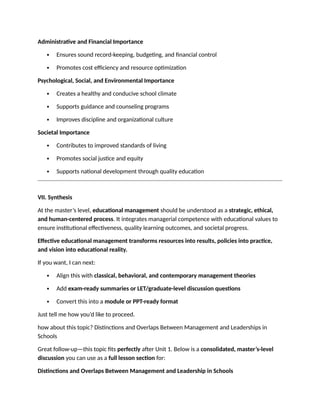
Ensures sound record-keeping, budgeting, and financial control
Promotes cost efficiency and resource optimization
Psychological, Social, and Environmental Importance
Creates a healthy and conducive school climate
Supports guidance and counseling programs
Improves discipline and organizational culture
Societal Importance
Contributes to improved standards of living
Promotes social justice and equity
Supports national development through quality education
VII. Synthesis
At the master’s level, educational management should be understood as a strategic, ethical,
and human-centered process. It integrates managerial competence with educational values to
ensure institutional effectiveness, quality learning outcomes, and societal progress.
Effective educational management transforms resources into results, policies into practice,
and vision into educational reality.
If you want, I can next:
Align this with classical, behavioral, and contemporary management theories
Add exam-ready summaries or LET/graduate-level discussion questions
Convert this into a module or PPT-ready format
Just tell me how you’d like to proceed.
how about this topic? Distinctions and Overlaps Between Management and Leaderships in
Schools
Great follow-up—this topic fits perfectly after Unit 1. Below is a consolidated, master’s-level
discussion you can use as a full lesson section for:
Distinctions and Overlaps Between Management and Leadership in Schools
6.
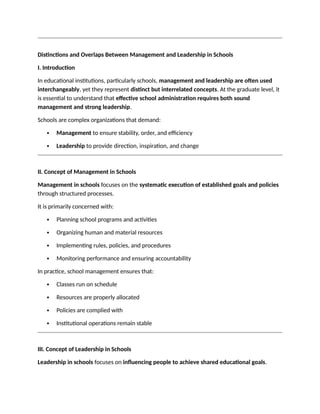
Distinctions and OverlapsBetween Management and Leadership in Schools
I. Introduction
In educational institutions, particularly schools, management and leadership are often used
interchangeably, yet they represent distinct but interrelated concepts. At the graduate level, it
is essential to understand that effective school administration requires both sound
management and strong leadership.
Schools are complex organizations that demand:
Management to ensure stability, order, and efficiency
Leadership to provide direction, inspiration, and change
II. Concept of Management in Schools
Management in schools focuses on the systematic execution of established goals and policies
through structured processes.
It is primarily concerned with:
Planning school programs and activities
Organizing human and material resources
Implementing rules, policies, and procedures
Monitoring performance and ensuring accountability
In practice, school management ensures that:
Classes run on schedule
Resources are properly allocated
Policies are complied with
Institutional operations remain stable
III. Concept of Leadership in Schools
Leadership in schools focuses on influencing people to achieve shared educational goals.
7.
It involves:
Articulatingand communicating a clear vision
Inspiring teachers and students
Building a positive school culture
Initiating and sustaining change
Unlike management, leadership:
Does not rely solely on formal authority
Emphasizes trust, motivation, and professional commitment
Is essential in driving innovation and school improvement
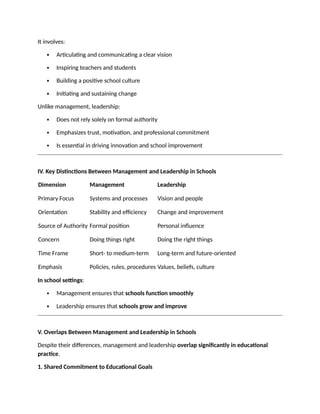
IV. Key Distinctions Between Management and Leadership in Schools
Dimension Management Leadership
Primary Focus Systems and processes Vision and people
Orientation Stability and efficiency Change and improvement
Source of Authority Formal position Personal influence
Concern Doing things right Doing the right things
Time Frame Short- to medium-term Long-term and future-oriented
Emphasis Policies, rules, procedures Values, beliefs, culture
In school settings:
Management ensures that schools function smoothly
Leadership ensures that schools grow and improve
V. Overlaps Between Management and Leadership in Schools
Despite their differences, management and leadership overlap significantly in educational
practice.
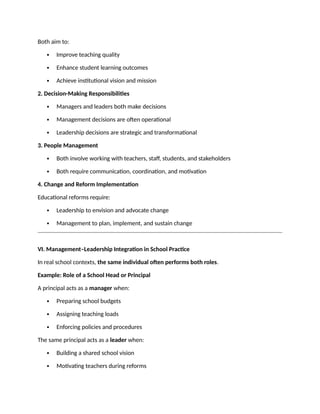
1. Shared Commitment to Educational Goals
8.
Both aim to:
Improve teaching quality
Enhance student learning outcomes
Achieve institutional vision and mission
2. Decision-Making Responsibilities
Managers and leaders both make decisions
Management decisions are often operational
Leadership decisions are strategic and transformational
3. People Management
Both involve working with teachers, staff, students, and stakeholders
Both require communication, coordination, and motivation
4. Change and Reform Implementation
Educational reforms require:
Leadership to envision and advocate change
Management to plan, implement, and sustain change
VI. Management–Leadership Integration in School Practice
In real school contexts, the same individual often performs both roles.
Example: Role of a School Head or Principal
A principal acts as a manager when:
Preparing school budgets
Assigning teaching loads
Enforcing policies and procedures
The same principal acts as a leader when:
Building a shared school vision
Motivating teachers during reforms
9.
Creating aculture of collaboration and innovation
VII. Implications for Educational Administrators
For graduate students and future school leaders, the challenge is not choosing between
management and leadership, but integrating both.
Strong management without leadership results in efficiency without growth
Strong leadership without management results in vision without execution
Effective schools require leaders who can manage and managers who can lead.
VIII. Synthesis
Management and leadership in schools are distinct yet complementary dimensions of
educational administration. Sustainable school improvement depends on the balanced
integration of managerial competence and leadership capacity.
At the master’s level, educational administrators are expected to:
Understand both concepts theoretically
Apply them strategically
Adapt them to complex and changing school environments