Instructions for use
Title
Amicrobial pustulosis associated with IgA nephropathy and
Sjögren's syndrome
Author(s)
Natsuga, Ken; Sawamura, Daisuke; Homma, Erina; Nomura,
Toshifumi; Abe, Masataka; Muramatsu, Ryuichi; Mochizuki,
Toshio; Koike, Takao; Shimizu, Hiroshi
Citation
Journal of the American Academy of Dermatology, 57(3): 523-
526
Issue Date 2007-09
Doc URL http://hdl.handle.net/2115/30143
Right
Type article (author version)
Additional
Information
Hokkaido University Collection of Scholarly and Academic Papers : HUSCAP
Journal of the American Academy of Dermatology
CASE REPORTS
Amicrobial pustulosis associated with IgA nephropathy and Sjogren’s syndrome
Ken Natsuga, MD a
*, Daisuke Sawamura, MD, PhD a
, Erina Homma, MD a
,
Toshifumi Nomura, MD a
, Masataka Abe, MD, PhD a
, Ryuichi Muramatsu, MD b
,
Toshio Mochizuki, MD, PhD c
, Takao Koike, MD, PhD c
, and Hiroshi Shimizu,
MD, PhD a
From the Department of Dermatologya
and Department of Medicine IIc
, Hokkaido
University Graduate School of Medicine, Sapporo, Japan; and Division of
Dermatology, Iwamizawa Municipal General Hospital, Iwamizawa, Japanb
*Correspondence and reprint requests to:
Ken Natsuga, M.D.
Department of Dermatology,
Hokkaido University Graduate School of Medicine,
N15, W7, Sapporo 060-8638, Japan
Telephone: +81-11-716-1161 ext. 5962
Fax: +81-11-706-7820
e-mail: natsuga@med.hokudai.ac.jp
Funding Sources: None
Conflict of Interest Disclosure: None declared
809 words, 2 tables, 2 figures, and 11 references
SUMMARY
Amicrobial pustulosis is a rare clinical entity characterized by a relapsing pustular
eruption involving mainly the skin folds. We describe a case of amicrobial pustulosis
associated with autoimmune diseases (APAD). The patient suffered from IgA
nephropathy and Sjogren’s syndrome. Skin symptoms improved dramatically after
corticosteroid pulse therapy and tonsillectomy.
Amicrobial pustulosis associated with autoimmune diseases (APAD) is an extremely
rare cutaneous manifestation of systemic autoimmune conditions. This disease was first
recognized as an entity in 1991 by Crickx et al.1
and since then only less than twenty
cases have been described to date in the English literature.2-8
Although the definite
diagnostic criteria have not been fully established, almost all the reported APAD cases
showed similar characteristics; no pathogenic microorganisms isolated, ineffective
antibiotic therapeutics, and underlying autoimmune diseases. Here we report a case of
APAD associated with IgA nephropathy and Sjogren’s syndrome.
CASE REPORT
A 31-year-old man was referred to our dermatology clinic complaining of multiple
pustules over his entire body. He noticed an itchy eruption first on his thighs two years
ago, and pustular lesions occurred on his whole body six months ago. He visited a local
hospital three months ago because of worsening of the symptoms. Systemic
corticosteroids (prednisone, 0.5mg/kg/day, PO) ameliorated his condition in two weeks,
although a month of oral minocycline 100mg daily with topical clindamycin phosphate
and nadifloxacin was ineffective. After tapering systemic corticosteroids, his skin
symptoms recurred.
His past medical history was unremarkable. He has not taken any drugs that could
have caused his eruption. His family had no health problems.
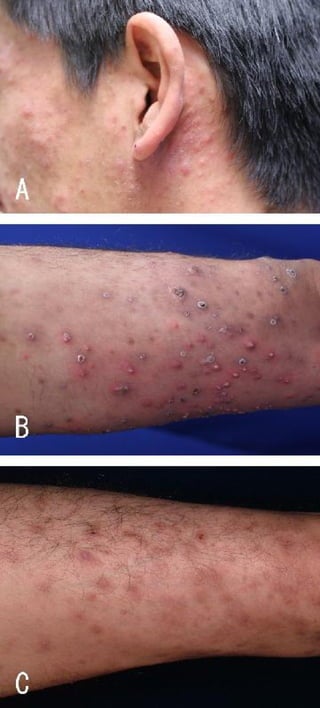
On physical examination, he presented with multiple pustules measuring up to 5 mm in
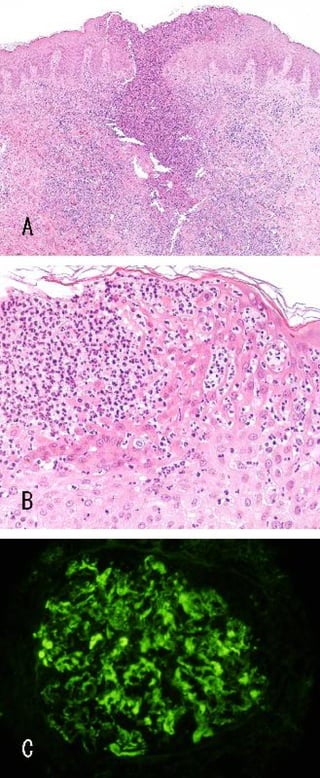
diameter on his scalp, auricles, axillae, and thighs (Fig 1). Skin specimens of a pustule
from his thigh showed diffuse infiltration of neutrophils extending from the epidermis
into the papillary dermis (Fig 2). The infiltration of eosinophils was not observed. The
epidermis revealed spongiform abscess. On direct immunofluorescence, there was no
deposition of IgG, IgA, IgM, and complements. Bacterial cultures from the pustules
detected no microorganisms, except in one sample a small number of Staphylococcus
aureus were detected from a swab culture implying a secondary colonization. No fungal
organisms were detected. Topical nadifloxacin 1% cream was ineffective. Partial
clinical improvement was observed after a four week application of clobetasol
propionate 0.05% ointment.
Laboratory examinations including complete blood count, complements, hepatic, and
renal functions were within the normal limits except for IgG 2409mg/dl (normal range,
870-1700mg/dl), IgA 922mg/dl (normal range, 110-410mg/dl), IgE 21878.2IU (normal
range, 0-400IU), C-reactive protein 1.25mg/dl (normal range, 0-0.39mg/dl), and an
erythrocyte sedimentation rate of 69mm in the first hour. Antinuclear (1:160), anti-SS-A
41.6index (normal, 0-9.9index), and anti-double-strand DNA 12.0U/ml (normal
0-10U/ml) antibodies were found, while other autoantibodies including rheumatoid
factor, anti-Sm, and anti-SS-B were not present. M-protein was not detected upon serum
immunoelectrophoresis. The diagnosis of Sjogren’s syndrome was made from the
findings of positive anti-SS-A antibody, dry eyes confirmed by the Schirmer test, and
from focal aggregates of lymphocytes from a salivary gland biopsy. Urinalysis showed
hematuria and proteinuria of 300 mg per day, which lead to a renal biopsy. The kidney
specimens showed diffuse mesangial proliferation and extracellular matrix expansion
where IgA deposits were confirmed by immunofluorescence (Fig 2). The diagnosis of
IgA nephropathy was made. The patient underwent corticosteroid pulse therapy and
tonsillectomy for IgA nephropathy, which resulted in a complete remission of his skin
symptoms for six months (Fig 1).
DISCUSSION
APAD is a rare clinical entity, the diagnosis of which can be made after excluding
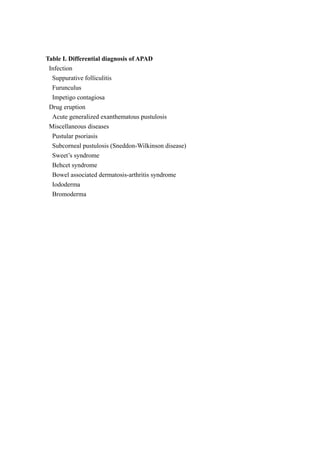
pustular dermatoses summarized in Table I. Bacterial and fungal cultures should be
promptly performed to rule out infectious disease. The characteristic distribution of
pustules on cutaneous folds, such as the ear, scalp, and external genital area may be
helpful in the diagnosis of APAD. A relatively chronic clinical course can be seen.
Histological features include intraepidermal spongiform pustules with a neutrophilic
infiltrate in the dermis. Topical and systemic antibiotics fail to improve skin symptoms.
Systemic corticosteroids,2-4
topical corticosteroids,2,5
chloroquine,3
dapsone,4
cyclosporine A,4
colchicin,6
cimetidine,7
and zinc8
have been used to treat APAD.
Interestingly, all the patients previously described with APAD were female, whereas our
patient was male. Female predominance may be explained by the underlying
autoimmune disorders, such as SLE, which are known to show a similar female
prevalence.
The reported APAD cases all had immunological abnormalities including several
antibody subtypes and hypergammaglobulinemia, although most of them did not
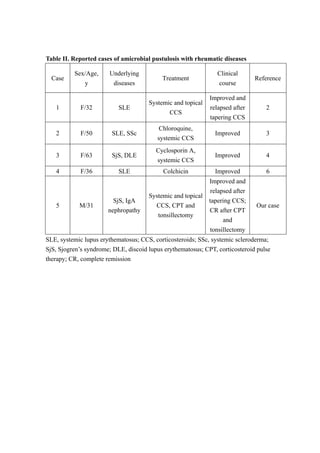
necessarily meet the diagnostic criteria for a particular autoimmune disease. Only four
cases fulfilling the typical classification criteria for rheumatic diseases have been
reported (Table II). Three cases harbored systemic lupus erythematosus (SLE),2,3,6
one
of which overlapped with systemic sclerosis.3
One case had Sjogren’s syndrome.4
We
have added IgA nephropathy to the list of autoimmune disorders leading to amicrobial
pustulosis. Whereas the treatment of IgA nephropathy is controversial,9
some
retrospective studies demonstrated the efficacy of corticosteroid pulse therapy and
tonsillectomy,10,11
which were significantly effective for APAD in our case. Marzono et
al. demonstrated an impaired neutrophil function in some APAD patients, 7
though no
additional data regarding the pathomechanisms in APAD are currently available. Our
case might be a clue to performing further studies clarifying the mechanism of pustule
formation in autoimmune diseases.
REFERENCES
1. Crickx B, Diego ML, Guillevin L, Picard C, Grossin M, Belaich S. Pustulose
amicrobienne et lupus erythemateux systemique. Communication no. 11. Journees
Dermatologiques de Paris, March 1991.
2. Lagrange S, Chosidow O, Piette JC, Wechsler B, Godeau P, Frances C. A peculiar
form of amicrobial pustulosis of the folds associated with systemic lupus erythematosus
and other auto-immune diseases. Lupus 1997;6:514-20.
3. Stefanidou MP, Kanavaros PE, Stefanaki KS, Tosca AD. Amicrobial pustulosis of the
folds. A cutaneous manifestation associated with connective tissue disease.
Dermatology 1998;197:394-6.
4. Kuyama M, Fujimoto W, Kambara H, Egusa M, Saitoh M, Yamasaki O, et al.
Amicrobial pustular dermatosis in two patients with immunological abnormalities. Clin
Exp Dermatol 2002;27:286-9.
5. Inui S, Azukizawa H, Asada H, Itami S. Amicrobial pustulosis with antinuclear
antibodies and rheumatoid factor. Br J Dermatol 2006;154:568-9.
6. Kerl K, Masouye I, Lesavre P, Saurat JH, Borradori L. A case of amicrobial
pustulosis of the folds associated with neutrophilic gastrointestinal involvement in
systemic lupus erythematosus. Dermatology 2005;211:356-9.
7. Marzano AV, Capsoni F, Berti E, Gasparini G, Bottelli S, Caputo R. Amicrobial
pustular dermatosis of cutaneous folds associated with autoimmune disorders: a new
entity? Dermatology 1996;193:88-93.
8. Beneton N, Wolkenstein P, Bagot M, Cosnes A, Wechsler J, Roujeau JC, et al.
Amicrobial pustulosis associated with autoimmune diseases: healing with zinc
supplementation. Br J Dermatol 2000;143:1306-10.
9. Appel GB, Waldman M. The IgA nephropathy treatment dilemma. Kidney Int
2006;69:1939-44.
10. Hotta O, Miyazaki M, Furuta T, Tomioka S, Chiba S, Horigome I, et al.
Tonsillectomy and steroid pulse therapy significantly impact on clinical remission in
patients with IgA nephropathy. Am J Kidney Dis 2001;38:736-43.
11. Xie Y, Nishi S, Ueno M, Imai N, Sakatsume M, Narita I, et al. The efficacy of
tonsillectomy on long-term renal survival in patients with IgA nephropathy. Kidney Int
2003;63:1861-7.
FIGURE LEGENDS
Fig 1.
Multiple pustules on the left ear auricle (A), and the left thigh (B). Complete remission
of the pustules was observed after corticosteroid pulse therapy and tonsillectomy(C).
Fig 2.
Skin biopsy specimen of a pustule from his thigh showed a neutrophil infiltrate in the
epidermis and the dermis (A). (Hematoxylin-eosin stain; original magnification x10.)
Intraepidermal spongiform abscesses were observed (B). (Hematoxylin-eosin stain;
original magnification x200.) Immunofluorescence study of the renal biopsy specimen
revealed IgA deposits in the glomerular mesangium (C). (Original magnification x400.)
Table I.
Differential diagnosis of APAD
Table II.
Reported cases of amicrobial pustulosis with rheumatic diseases
Table I. Differential diagnosis of APAD
Infection
Suppurative folliculitis
Furunculus
Impetigo contagiosa
Drug eruption
Acute generalized exanthematous pustulosis
Miscellaneous diseases
Pustular psoriasis
Subcorneal pustulosis (Sneddon-Wilkinson disease)
Sweet’s syndrome
Behcet syndrome
Bowel associated dermatosis-arthritis syndrome
Iododerma
Bromoderma
Table II. Reported cases of amicrobial pustulosis with rheumatic diseases
Case
Sex/Age,
y
Underlying
diseases
Treatment
Clinical
course
Reference
1 F/32 SLE
Systemic and topical
CCS
Improved and
relapsed after
tapering CCS
2
2 F/50 SLE, SSc
Chloroquine,
systemic CCS
Improved 3
3 F/63 SjS, DLE
Cyclosporin A,
systemic CCS
Improved 4
4 F/36 SLE Colchicin Improved 6
5 M/31
SjS, IgA
nephropathy
Systemic and topical
CCS, CPT and
tonsillectomy
Improved and
relapsed after
tapering CCS;
CR after CPT
and
tonsillectomy
Our case
SLE, systemic lupus erythematosus; CCS, corticosteroids; SSc, systemic scleroderma;
SjS, Sjogren’s syndrome; DLE, discoid lupus erythematosus; CPT, corticosteroid pulse
therapy; CR, complete remission

Amicrobial_pustulosis.pdf

  • 1.
    Instructions for use Title Amicrobialpustulosis associated with IgA nephropathy and Sjögren's syndrome Author(s) Natsuga, Ken; Sawamura, Daisuke; Homma, Erina; Nomura, Toshifumi; Abe, Masataka; Muramatsu, Ryuichi; Mochizuki, Toshio; Koike, Takao; Shimizu, Hiroshi Citation Journal of the American Academy of Dermatology, 57(3): 523- 526 Issue Date 2007-09 Doc URL http://hdl.handle.net/2115/30143 Right Type article (author version) Additional Information Hokkaido University Collection of Scholarly and Academic Papers : HUSCAP
  • 2.
    Journal of theAmerican Academy of Dermatology CASE REPORTS Amicrobial pustulosis associated with IgA nephropathy and Sjogren’s syndrome Ken Natsuga, MD a *, Daisuke Sawamura, MD, PhD a , Erina Homma, MD a , Toshifumi Nomura, MD a , Masataka Abe, MD, PhD a , Ryuichi Muramatsu, MD b , Toshio Mochizuki, MD, PhD c , Takao Koike, MD, PhD c , and Hiroshi Shimizu, MD, PhD a From the Department of Dermatologya and Department of Medicine IIc , Hokkaido University Graduate School of Medicine, Sapporo, Japan; and Division of Dermatology, Iwamizawa Municipal General Hospital, Iwamizawa, Japanb *Correspondence and reprint requests to: Ken Natsuga, M.D. Department of Dermatology, Hokkaido University Graduate School of Medicine, N15, W7, Sapporo 060-8638, Japan Telephone: +81-11-716-1161 ext. 5962 Fax: +81-11-706-7820 e-mail: natsuga@med.hokudai.ac.jp Funding Sources: None Conflict of Interest Disclosure: None declared
  • 3.
    809 words, 2tables, 2 figures, and 11 references
  • 4.
    SUMMARY Amicrobial pustulosis isa rare clinical entity characterized by a relapsing pustular eruption involving mainly the skin folds. We describe a case of amicrobial pustulosis associated with autoimmune diseases (APAD). The patient suffered from IgA nephropathy and Sjogren’s syndrome. Skin symptoms improved dramatically after corticosteroid pulse therapy and tonsillectomy.
  • 5.
    Amicrobial pustulosis associatedwith autoimmune diseases (APAD) is an extremely rare cutaneous manifestation of systemic autoimmune conditions. This disease was first recognized as an entity in 1991 by Crickx et al.1 and since then only less than twenty cases have been described to date in the English literature.2-8 Although the definite diagnostic criteria have not been fully established, almost all the reported APAD cases showed similar characteristics; no pathogenic microorganisms isolated, ineffective antibiotic therapeutics, and underlying autoimmune diseases. Here we report a case of APAD associated with IgA nephropathy and Sjogren’s syndrome. CASE REPORT A 31-year-old man was referred to our dermatology clinic complaining of multiple pustules over his entire body. He noticed an itchy eruption first on his thighs two years ago, and pustular lesions occurred on his whole body six months ago. He visited a local hospital three months ago because of worsening of the symptoms. Systemic corticosteroids (prednisone, 0.5mg/kg/day, PO) ameliorated his condition in two weeks, although a month of oral minocycline 100mg daily with topical clindamycin phosphate and nadifloxacin was ineffective. After tapering systemic corticosteroids, his skin symptoms recurred. His past medical history was unremarkable. He has not taken any drugs that could have caused his eruption. His family had no health problems. On physical examination, he presented with multiple pustules measuring up to 5 mm in diameter on his scalp, auricles, axillae, and thighs (Fig 1). Skin specimens of a pustule from his thigh showed diffuse infiltration of neutrophils extending from the epidermis
  • 6.
    into the papillarydermis (Fig 2). The infiltration of eosinophils was not observed. The epidermis revealed spongiform abscess. On direct immunofluorescence, there was no deposition of IgG, IgA, IgM, and complements. Bacterial cultures from the pustules detected no microorganisms, except in one sample a small number of Staphylococcus aureus were detected from a swab culture implying a secondary colonization. No fungal organisms were detected. Topical nadifloxacin 1% cream was ineffective. Partial clinical improvement was observed after a four week application of clobetasol propionate 0.05% ointment. Laboratory examinations including complete blood count, complements, hepatic, and renal functions were within the normal limits except for IgG 2409mg/dl (normal range, 870-1700mg/dl), IgA 922mg/dl (normal range, 110-410mg/dl), IgE 21878.2IU (normal range, 0-400IU), C-reactive protein 1.25mg/dl (normal range, 0-0.39mg/dl), and an erythrocyte sedimentation rate of 69mm in the first hour. Antinuclear (1:160), anti-SS-A 41.6index (normal, 0-9.9index), and anti-double-strand DNA 12.0U/ml (normal 0-10U/ml) antibodies were found, while other autoantibodies including rheumatoid factor, anti-Sm, and anti-SS-B were not present. M-protein was not detected upon serum immunoelectrophoresis. The diagnosis of Sjogren’s syndrome was made from the findings of positive anti-SS-A antibody, dry eyes confirmed by the Schirmer test, and from focal aggregates of lymphocytes from a salivary gland biopsy. Urinalysis showed hematuria and proteinuria of 300 mg per day, which lead to a renal biopsy. The kidney specimens showed diffuse mesangial proliferation and extracellular matrix expansion where IgA deposits were confirmed by immunofluorescence (Fig 2). The diagnosis of IgA nephropathy was made. The patient underwent corticosteroid pulse therapy and
  • 7.
    tonsillectomy for IgAnephropathy, which resulted in a complete remission of his skin symptoms for six months (Fig 1).
  • 8.
    DISCUSSION APAD is arare clinical entity, the diagnosis of which can be made after excluding pustular dermatoses summarized in Table I. Bacterial and fungal cultures should be promptly performed to rule out infectious disease. The characteristic distribution of pustules on cutaneous folds, such as the ear, scalp, and external genital area may be helpful in the diagnosis of APAD. A relatively chronic clinical course can be seen. Histological features include intraepidermal spongiform pustules with a neutrophilic infiltrate in the dermis. Topical and systemic antibiotics fail to improve skin symptoms. Systemic corticosteroids,2-4 topical corticosteroids,2,5 chloroquine,3 dapsone,4 cyclosporine A,4 colchicin,6 cimetidine,7 and zinc8 have been used to treat APAD. Interestingly, all the patients previously described with APAD were female, whereas our patient was male. Female predominance may be explained by the underlying autoimmune disorders, such as SLE, which are known to show a similar female prevalence. The reported APAD cases all had immunological abnormalities including several antibody subtypes and hypergammaglobulinemia, although most of them did not necessarily meet the diagnostic criteria for a particular autoimmune disease. Only four cases fulfilling the typical classification criteria for rheumatic diseases have been reported (Table II). Three cases harbored systemic lupus erythematosus (SLE),2,3,6 one of which overlapped with systemic sclerosis.3 One case had Sjogren’s syndrome.4 We have added IgA nephropathy to the list of autoimmune disorders leading to amicrobial pustulosis. Whereas the treatment of IgA nephropathy is controversial,9 some retrospective studies demonstrated the efficacy of corticosteroid pulse therapy and tonsillectomy,10,11 which were significantly effective for APAD in our case. Marzono et
  • 9.
    al. demonstrated animpaired neutrophil function in some APAD patients, 7 though no additional data regarding the pathomechanisms in APAD are currently available. Our case might be a clue to performing further studies clarifying the mechanism of pustule formation in autoimmune diseases.
  • 10.
    REFERENCES 1. Crickx B,Diego ML, Guillevin L, Picard C, Grossin M, Belaich S. Pustulose amicrobienne et lupus erythemateux systemique. Communication no. 11. Journees Dermatologiques de Paris, March 1991. 2. Lagrange S, Chosidow O, Piette JC, Wechsler B, Godeau P, Frances C. A peculiar form of amicrobial pustulosis of the folds associated with systemic lupus erythematosus and other auto-immune diseases. Lupus 1997;6:514-20. 3. Stefanidou MP, Kanavaros PE, Stefanaki KS, Tosca AD. Amicrobial pustulosis of the folds. A cutaneous manifestation associated with connective tissue disease. Dermatology 1998;197:394-6. 4. Kuyama M, Fujimoto W, Kambara H, Egusa M, Saitoh M, Yamasaki O, et al. Amicrobial pustular dermatosis in two patients with immunological abnormalities. Clin Exp Dermatol 2002;27:286-9. 5. Inui S, Azukizawa H, Asada H, Itami S. Amicrobial pustulosis with antinuclear antibodies and rheumatoid factor. Br J Dermatol 2006;154:568-9. 6. Kerl K, Masouye I, Lesavre P, Saurat JH, Borradori L. A case of amicrobial pustulosis of the folds associated with neutrophilic gastrointestinal involvement in systemic lupus erythematosus. Dermatology 2005;211:356-9. 7. Marzano AV, Capsoni F, Berti E, Gasparini G, Bottelli S, Caputo R. Amicrobial pustular dermatosis of cutaneous folds associated with autoimmune disorders: a new entity? Dermatology 1996;193:88-93. 8. Beneton N, Wolkenstein P, Bagot M, Cosnes A, Wechsler J, Roujeau JC, et al. Amicrobial pustulosis associated with autoimmune diseases: healing with zinc supplementation. Br J Dermatol 2000;143:1306-10. 9. Appel GB, Waldman M. The IgA nephropathy treatment dilemma. Kidney Int 2006;69:1939-44. 10. Hotta O, Miyazaki M, Furuta T, Tomioka S, Chiba S, Horigome I, et al. Tonsillectomy and steroid pulse therapy significantly impact on clinical remission in patients with IgA nephropathy. Am J Kidney Dis 2001;38:736-43. 11. Xie Y, Nishi S, Ueno M, Imai N, Sakatsume M, Narita I, et al. The efficacy of tonsillectomy on long-term renal survival in patients with IgA nephropathy. Kidney Int 2003;63:1861-7.
  • 11.
    FIGURE LEGENDS Fig 1. Multiplepustules on the left ear auricle (A), and the left thigh (B). Complete remission of the pustules was observed after corticosteroid pulse therapy and tonsillectomy(C). Fig 2. Skin biopsy specimen of a pustule from his thigh showed a neutrophil infiltrate in the epidermis and the dermis (A). (Hematoxylin-eosin stain; original magnification x10.) Intraepidermal spongiform abscesses were observed (B). (Hematoxylin-eosin stain; original magnification x200.) Immunofluorescence study of the renal biopsy specimen revealed IgA deposits in the glomerular mesangium (C). (Original magnification x400.)
  • 12.
    Table I. Differential diagnosisof APAD Table II. Reported cases of amicrobial pustulosis with rheumatic diseases
  • 15.
    Table I. Differentialdiagnosis of APAD Infection Suppurative folliculitis Furunculus Impetigo contagiosa Drug eruption Acute generalized exanthematous pustulosis Miscellaneous diseases Pustular psoriasis Subcorneal pustulosis (Sneddon-Wilkinson disease) Sweet’s syndrome Behcet syndrome Bowel associated dermatosis-arthritis syndrome Iododerma Bromoderma
  • 16.
    Table II. Reportedcases of amicrobial pustulosis with rheumatic diseases Case Sex/Age, y Underlying diseases Treatment Clinical course Reference 1 F/32 SLE Systemic and topical CCS Improved and relapsed after tapering CCS 2 2 F/50 SLE, SSc Chloroquine, systemic CCS Improved 3 3 F/63 SjS, DLE Cyclosporin A, systemic CCS Improved 4 4 F/36 SLE Colchicin Improved 6 5 M/31 SjS, IgA nephropathy Systemic and topical CCS, CPT and tonsillectomy Improved and relapsed after tapering CCS; CR after CPT and tonsillectomy Our case SLE, systemic lupus erythematosus; CCS, corticosteroids; SSc, systemic scleroderma; SjS, Sjogren’s syndrome; DLE, discoid lupus erythematosus; CPT, corticosteroid pulse therapy; CR, complete remission