Week of 4/26- 4/30 The United States Constitution
Who were the framers?There were 55 different framers of the constitutionAlexander Hamilton, Thomas Jefferson, Benjamin Franklin and George Washington are some of the more known names who helped frame the constitution.Alexander Hamilton and Gouverneur Morris are the two most prevalent writers of the constitution.
The United States ConstitutionCreated the three branches of governmentDefined the roles of each Branch of GovernmentDefined how the House of Representatives and the Senate would be representative of their statesArticle V allowed for amendments, or changes to the constitution with a two thirds passing vote from both houses
The Inclusion of the Bill of RightsOur framers were worried about individual rights being protected by our constitution so to ensure each individual could not be denied these rights a Bill of Rights was created that protects citizens rights.
Bill of RightsFirst Amendment   Congress shall make no law respecting an establishment of religion, or prohibiting the free exercise thereof; or abridging the freedom of speech, or of the press; or the right of the people peaceably to assemble, and to petition the Government for a redress of grievances.
Bill of Rights cont.Second Amendment   A well regulated Militia, being necessary to the security of a free State, the right of the people to keep and bear Arms, shall not be infringed.
Bill of Rights cont.Third Amendment   No Soldier shall, in time of peace be quartered in any house, without the consent of the Owner, nor in time of war, but in a manner to be prescribed by law.
Bill of Rights cont.Fourth Amendment    The right of the people to be secure in their persons, houses, papers, and effects, against unreasonable searches and seizures, shall not be violated, and no Warrants shall issue, but upon probable cause, supported by Oath or affirmation, and particularly describing the place to be searched, and the persons or things to be seized.
Bill of Rights cont.Fifth Amendment   No person shall be held to answer for any capital, or otherwise infamous crime, unless on a presentment or indictment of a Grand Jury, except in cases arising in the land or naval forces, or in the Militia, when in actual service in time of War or public danger; nor shall any person be subject for the same offence to be twice put in jeopardy of life or limb; nor shall be compelled in any criminal case to be a witness against himself, nor be deprived of life, liberty, or property, without due process of law; nor shall private property be taken for public use, without just compensation.
Bill of Rights cont.Sixth Amendment   In all criminal prosecutions, the accused shall enjoy the right to a speedy and public trial, by an impartial jury of the State and district where in the crime shall have been committed, which district shall have been previously ascertained by law, and to be informed of the nature and cause of the accusation; to be confronted with the witnesses against him; to have compulsory process for obtaining witnesses in his favor, and to have the Assistance of Counsel for his defense.
Bill of Rights cont.Seventh Amendment    In suits at common law, where the value in controversy shall exceed twenty dollars, the right of trial by jury shall be preserved, and no fact tried by a jury, shall be otherwise re-examined in any court of the United States, than according to the rules of the common law.
Bill of Rights cont.Eighth Amendment    Excessive bail shall not be required, nor excessive fines imposed, nor cruel and unusual punishments inflicted.
Bill of Rights cont.Ninth Amendment   the enumeration in the Constitution, of certain rights, shall not be construed to deny or disparage others retained by the people.
Bill of Rights cont.Tenth Amendment    The powers not delegated to the United States by the Constitution, nor prohibited by it to the States, are reserved to the States respectively, or to the people.
What’s so Supreme about the Supreme Court?The courts established in the constitution uphold the laws enacted by our legislative branch. The Supreme Court is the highest of our judicial system.
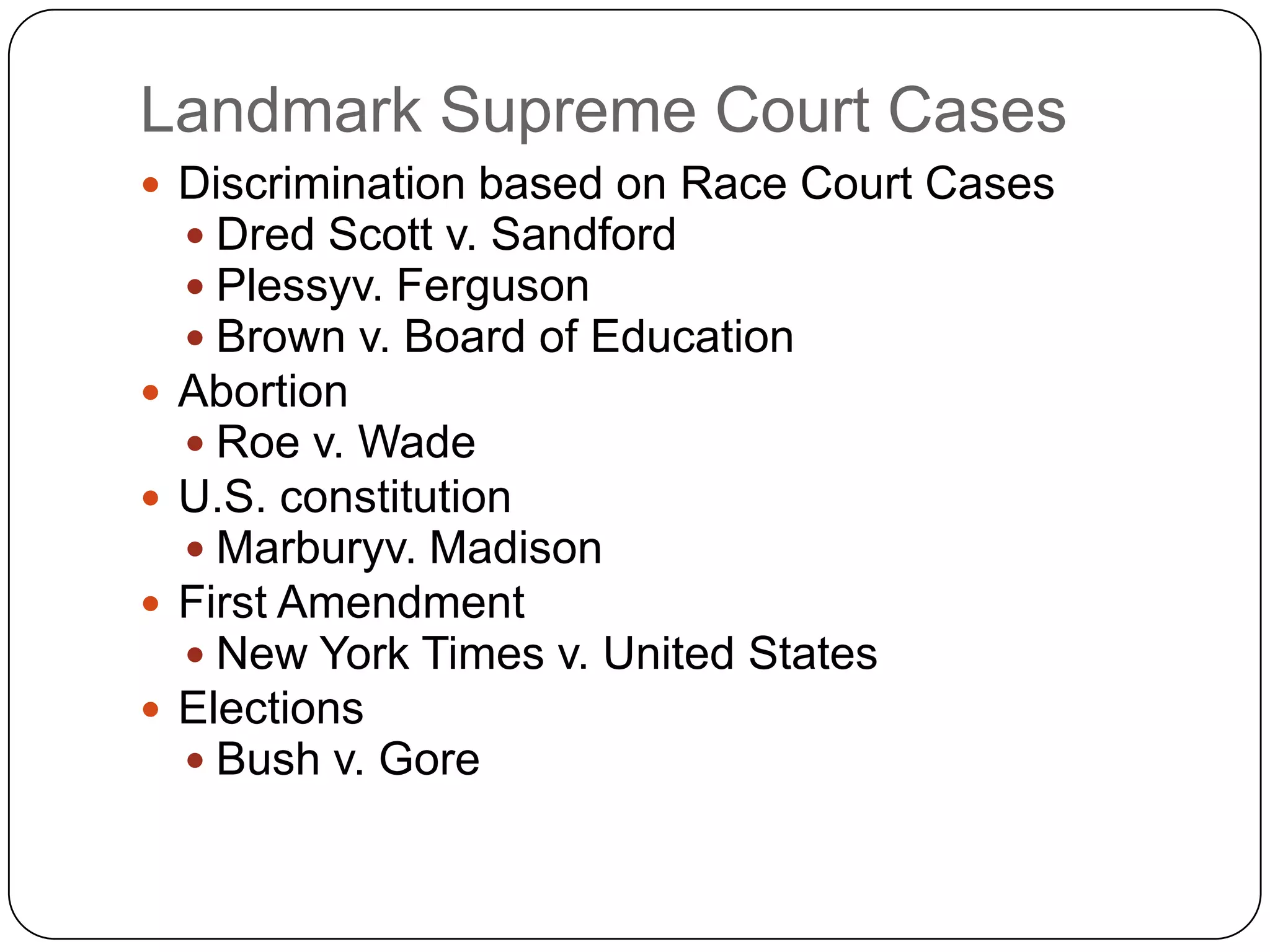
Landmark Supreme Court CasesDiscrimination based on Race Court CasesDred Scott v. SandfordPlessyv. FergusonBrown v. Board of EducationAbortionRoe v. WadeU.S. constitutionMarburyv. MadisonFirst AmendmentNew York Times v. United StatesElectionsBush v. Gore

Constitution

  • 1.
    Week of 4/26-4/30 The United States Constitution
  • 2.
    Who were theframers?There were 55 different framers of the constitutionAlexander Hamilton, Thomas Jefferson, Benjamin Franklin and George Washington are some of the more known names who helped frame the constitution.Alexander Hamilton and Gouverneur Morris are the two most prevalent writers of the constitution.
  • 3.
    The United StatesConstitutionCreated the three branches of governmentDefined the roles of each Branch of GovernmentDefined how the House of Representatives and the Senate would be representative of their statesArticle V allowed for amendments, or changes to the constitution with a two thirds passing vote from both houses
  • 4.
    The Inclusion ofthe Bill of RightsOur framers were worried about individual rights being protected by our constitution so to ensure each individual could not be denied these rights a Bill of Rights was created that protects citizens rights.
  • 5.
    Bill of RightsFirstAmendment Congress shall make no law respecting an establishment of religion, or prohibiting the free exercise thereof; or abridging the freedom of speech, or of the press; or the right of the people peaceably to assemble, and to petition the Government for a redress of grievances.
  • 6.
    Bill of Rightscont.Second Amendment A well regulated Militia, being necessary to the security of a free State, the right of the people to keep and bear Arms, shall not be infringed.
  • 7.
    Bill of Rightscont.Third Amendment No Soldier shall, in time of peace be quartered in any house, without the consent of the Owner, nor in time of war, but in a manner to be prescribed by law.
  • 8.
    Bill of Rightscont.Fourth Amendment The right of the people to be secure in their persons, houses, papers, and effects, against unreasonable searches and seizures, shall not be violated, and no Warrants shall issue, but upon probable cause, supported by Oath or affirmation, and particularly describing the place to be searched, and the persons or things to be seized.
  • 9.
    Bill of Rightscont.Fifth Amendment No person shall be held to answer for any capital, or otherwise infamous crime, unless on a presentment or indictment of a Grand Jury, except in cases arising in the land or naval forces, or in the Militia, when in actual service in time of War or public danger; nor shall any person be subject for the same offence to be twice put in jeopardy of life or limb; nor shall be compelled in any criminal case to be a witness against himself, nor be deprived of life, liberty, or property, without due process of law; nor shall private property be taken for public use, without just compensation.
  • 10.
    Bill of Rightscont.Sixth Amendment In all criminal prosecutions, the accused shall enjoy the right to a speedy and public trial, by an impartial jury of the State and district where in the crime shall have been committed, which district shall have been previously ascertained by law, and to be informed of the nature and cause of the accusation; to be confronted with the witnesses against him; to have compulsory process for obtaining witnesses in his favor, and to have the Assistance of Counsel for his defense.
  • 11.
    Bill of Rightscont.Seventh Amendment In suits at common law, where the value in controversy shall exceed twenty dollars, the right of trial by jury shall be preserved, and no fact tried by a jury, shall be otherwise re-examined in any court of the United States, than according to the rules of the common law.
  • 12.
    Bill of Rightscont.Eighth Amendment  Excessive bail shall not be required, nor excessive fines imposed, nor cruel and unusual punishments inflicted.
  • 13.
    Bill of Rightscont.Ninth Amendment the enumeration in the Constitution, of certain rights, shall not be construed to deny or disparage others retained by the people.
  • 14.
    Bill of Rightscont.Tenth Amendment The powers not delegated to the United States by the Constitution, nor prohibited by it to the States, are reserved to the States respectively, or to the people.
  • 15.
    What’s so Supremeabout the Supreme Court?The courts established in the constitution uphold the laws enacted by our legislative branch. The Supreme Court is the highest of our judicial system.
  • 16.
    Landmark Supreme CourtCasesDiscrimination based on Race Court CasesDred Scott v. SandfordPlessyv. FergusonBrown v. Board of EducationAbortionRoe v. WadeU.S. constitutionMarburyv. MadisonFirst AmendmentNew York Times v. United StatesElectionsBush v. Gore