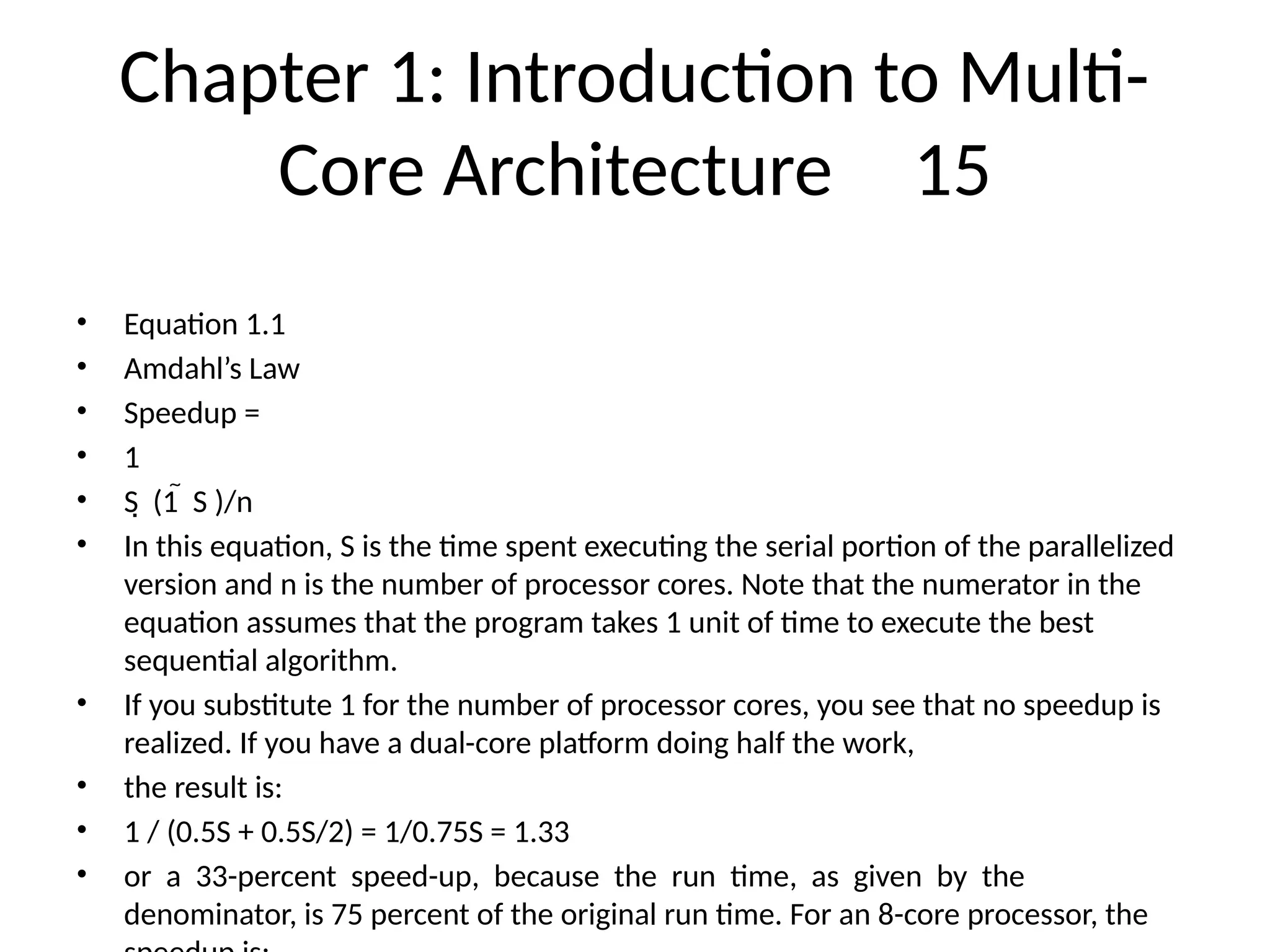
Given this outcome, you can see the first corollary of Amdahl’s law: decreasing the serialized portion by increasing the parallelized portion is of greater importance than adding more processor cores. For example, if you have a program that is 30-percent parallelized running on a dual-core system, doubling the number of processor cores reduces run time from 85 percent of the serial time to 77.5 percent, whereas doubling the amount of parallelized code reduces run time from 85 percent to 70 percent. This is illustrated in Figure 1.7. Only when a program is mostly parallelized does adding more processors help more than parallelizing the remaining code. And, as you saw previously, you have hard limits on how much code can be serialized and on how many additional processor cores actually make a difference in performance.










![Chapter 2: System Overview of
Threading 25
• printf("Total number of threads are %dn", totalThreads);
• }
• }
• }
• Listing 2.1
• “Hello World” Program Using OpenMP
• #include <pthread.h> #include <stdio.h> #include <stdlib.h> #define
NUM_THREADS
• 5
• void *PrintHello(void *threadid)
• {
• printf("n%d: Hello World!n", threadid); pthread_exit(NULL);
• }
• int main(int argc, char *argv[])
• {](https://image.slidesharecdn.com/simplifiedmulticorepresentation-250819071729-6d8df187/75/Amdahl-s-law-is-explained-in-the-above-power-point-presentations-29-2048.jpg)




![46
• Multi-Core Programming
• The basic error diffusion algorithm does its work in a simple three- step process:
• Determine the output value given the input value of the current pixel. This
step often uses quantization, or in the binary case, thresholding. For an 8-
bit grayscale image that is displayed on a 1-bit output device, all input values in
the range [0, 127] are to be displayed as a 0 and all input values between [128,
255] are to be displayed as a 1 on the output device.
• Once the output value is determined, the code computes the error
between what should be displayed on the output device and what is actually
displayed. As an example, assume that the current input pixel value is 168.
Given that it is greater than our threshold value (128), we determine that
the output value will be a 1. This value is stored in the output array. To
compute the error, the program must normalize output first, so it is in the
same scale as the input value. That is, for the purposes of computing
the display error, the output pixel must be 0 if the output pixel is 0 or 255
if the output pixel is 1. In this case, the display error is the difference between the](https://image.slidesharecdn.com/simplifiedmulticorepresentation-250819071729-6d8df187/75/Amdahl-s-law-is-explained-in-the-above-power-point-presentations-50-2048.jpg)




![136
• Multi-Core Programming
• Tackling the topic of OpenMP in a single chapter is an intimidating task. Therefore,
this chapter serves as a bridge for you, allowing you to reach a point where you
have a fundamental understanding of threading with OpenMP from which you
can build your broader practical knowledge. The power and simplicity of
OpenMP can be demonstrated by looking at an example. The following loop
converts each 32-bit RGB (red, green, blue) pixel in an array into an 8-bit grayscale
pixel. The one pragma, which has been inserted immediately before the loop, is all
that is needed for parallel execution under OpenMP.
• #pragma omp parallel for
• for ( i = 0; i < numPixels; i++)
• {
• pGrayScaleBitmap[i] = (unsigned BYTE) ( pRGBBitmap[i].red * 0.299 +
• pRGBBitmap[i].green * 0.587 +
• pRGBBitmap[i].blue * 0.114 );](https://image.slidesharecdn.com/simplifiedmulticorepresentation-250819071729-6d8df187/75/Amdahl-s-law-is-explained-in-the-above-power-point-presentations-80-2048.jpg)

![Chapter 6: OpenMP†: A Portable
Solution for Threading 139
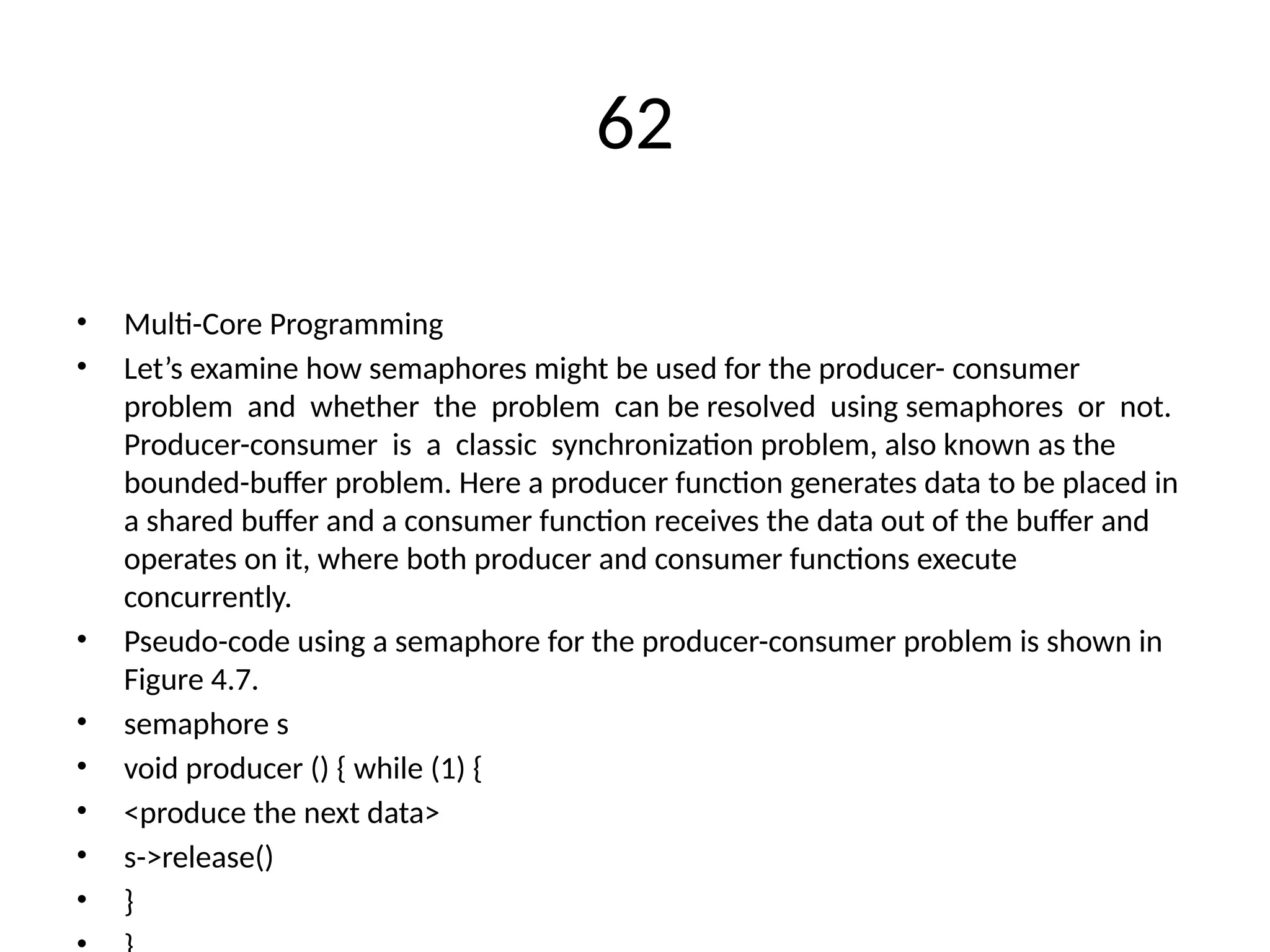
• Let’s take a look at the following example where d = 1 and n = 99. The write
operation is to location x[k] at iteration k in S1, and a read from it at iteration k+1
in S2, thus a loop-carried flow dependence occurs. Furthermore, with the read
from location y[k–1] at iteration k in S1, a write to it is performed at iteration k+1
in S2, hence, the loop-carried anti- dependence exists. In this case, if a parallel for
pragma is inserted for threading this loop, you will get a wrong result.
• // Do NOT do this. It will fail due to loop-carried
• // dependencies.
• x[0] = 0;
• y[0] = 1;
• #pragma omp parallel for private(k)
• for ( k = 1; k < 100; k++ ) { x[k] = y[k-1] + 1; // S1
• y[k] = x[k-1] + 2; // S2
• }
• Because OpenMP directives are commands to the compiler, the compiler will](https://image.slidesharecdn.com/simplifiedmulticorepresentation-250819071729-6d8df187/75/Amdahl-s-law-is-explained-in-the-above-power-point-presentations-83-2048.jpg)
![140
• Multi-Core Programming
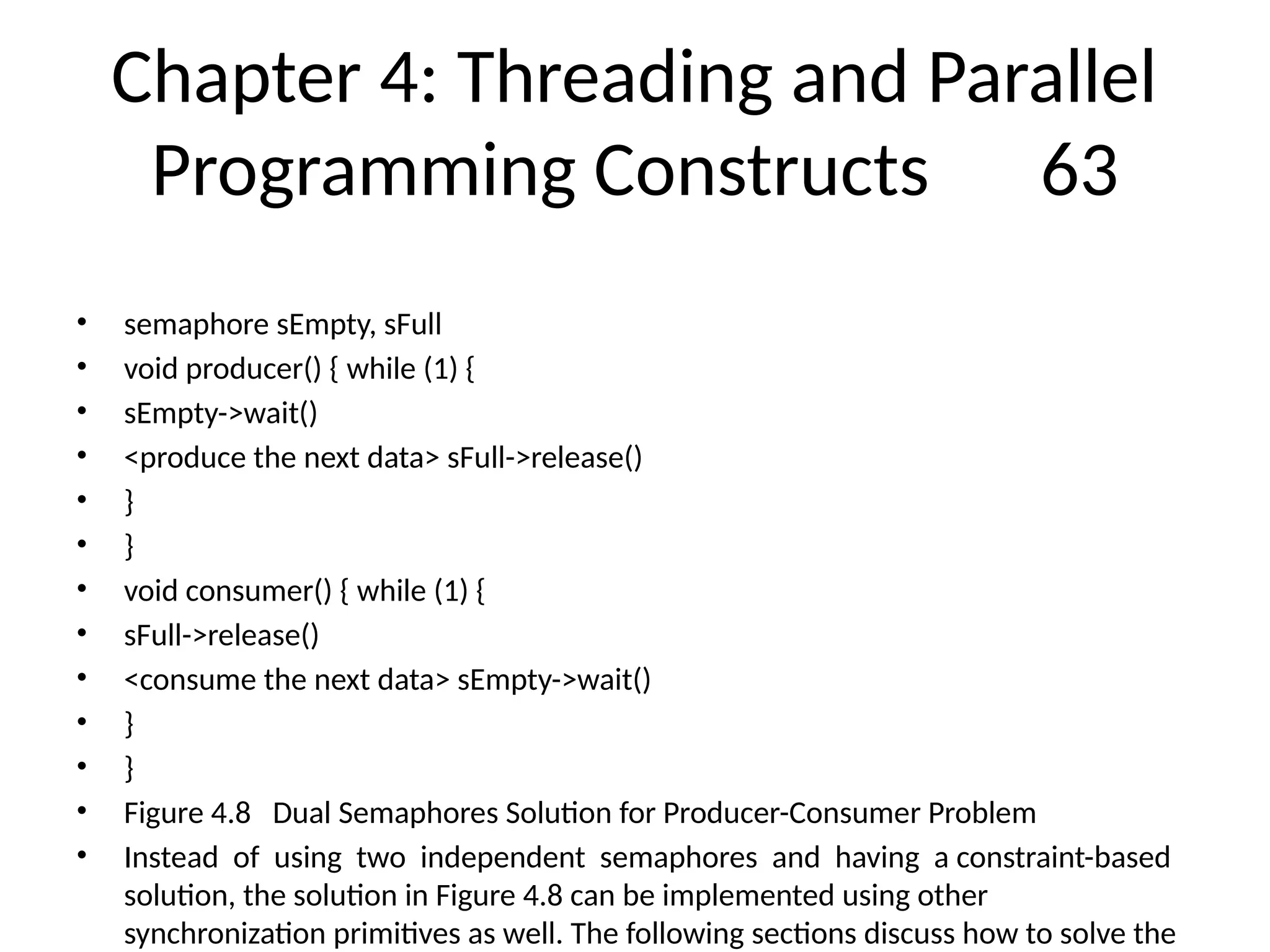
• Besides using the parallel for pragma, for the same example, you can also use the
parallel sections pragma to parallelize the original loop that has loop-carried
dependence for a dual-core processor system.
• // Effective threading of a loop using parallel sections
• #pragma omp parallel sections private(k)
• { { x[0] = 0; y[0] = 1;
• for ( k = 1; k < 49; k++ ) { x[k] = y[k-1] + 1; // S1
• y[k] = x[k-1] + 2; // S2
• }
• }
• #pragma omp section
• { x[49] = 74; y[49] = 74;
• for ( k = 50; k < 100; k++ ) { x[k] = y[k-1] + 1; // S3
• y[k] = x[k-1] + 2; // S4](https://image.slidesharecdn.com/simplifiedmulticorepresentation-250819071729-6d8df187/75/Amdahl-s-law-is-explained-in-the-above-power-point-presentations-84-2048.jpg)

![Chapter 6: OpenMP†: A Portable
Solution for Threading 143
• // This also works. The variable x is now private.
• #pragma omp parallel for for ( k = 0; k < 100; k++ )
• {
• int x; // variables declared within a parallel
• // construct are, by definition, private x = array[k];
• array[k] = do_work(x);
• }
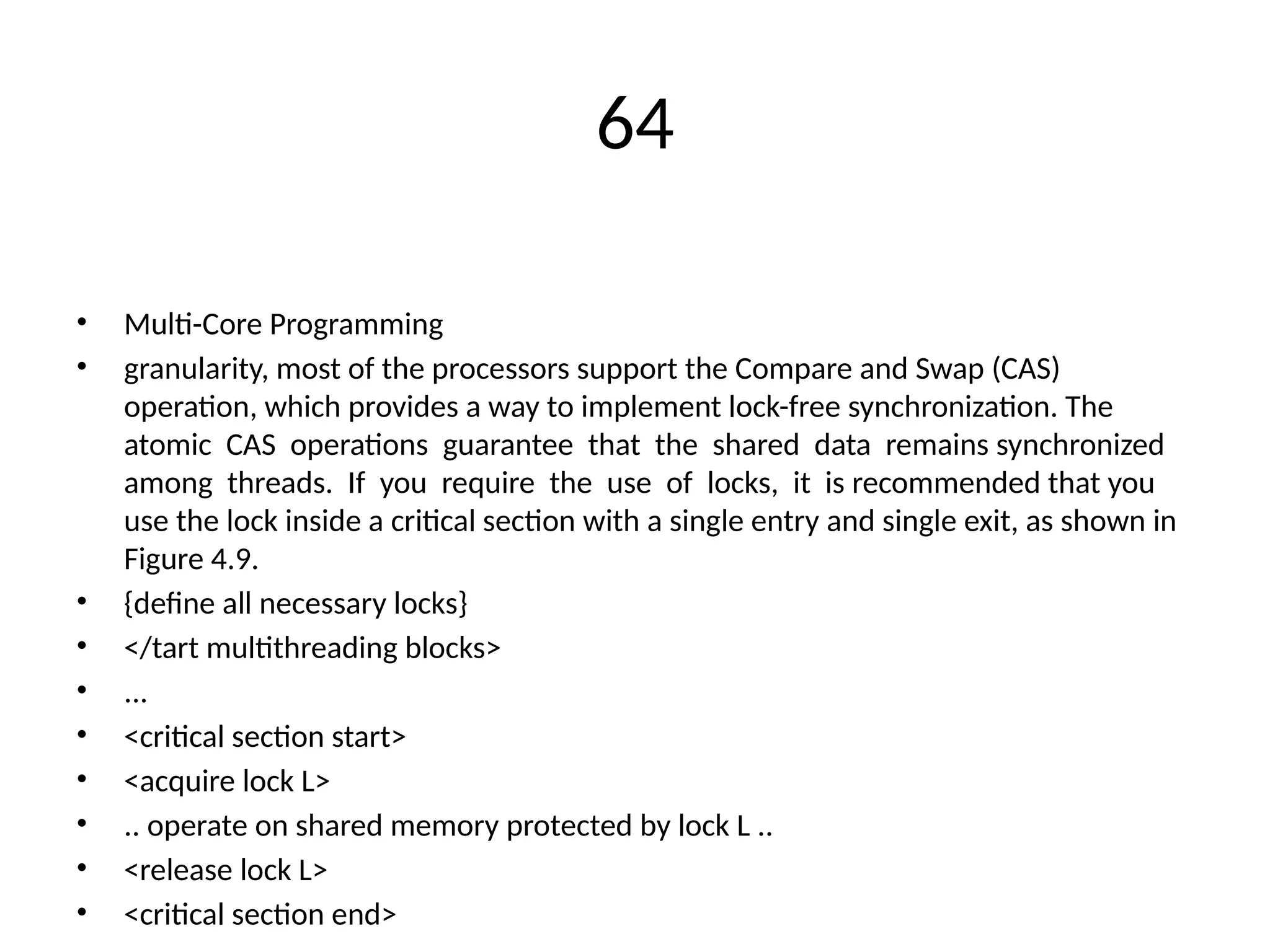
• Every time you use OpenMP to parallelize a loop, you should carefully examine all
memory references, including the references made by called functions.
• Loop Scheduling and Partitioning
• To have good load balancing and thereby achieve optimal performance in a
multithreaded application, you must have effective loop scheduling and
partitioning. The ultimate goal is to ensure that the execution cores are busy most,
if not all, of the time, with minimum overhead of scheduling, context switching
and synchronization. With a poorly balanced workload, some threads may](https://image.slidesharecdn.com/simplifiedmulticorepresentation-250819071729-6d8df187/75/Amdahl-s-law-is-explained-in-the-above-power-point-presentations-87-2048.jpg)

![156
• Multi-Core Programming
• Considering the code example, let’s see how it works. The following code converts
a color image to black and white.
• for ( row = 0; row < height; row++ ) { for ( col = 0; col < width; col++ ) {
• pGray[col] = (BYTE)
• ( pRGB[row].red * 0.299 + pRGB[row].green * 0.587 + pRGB[row].blue * 0.114 );
• }
• pGray += GrayStride; pRGB += RGBStride;
• }
• The issue is how to move the pointers pGray and pRGB to the correct place within
the bitmap while threading the outer “row” loop. The address computation for
each pixel can be done with the following code:
• pDestLoc = pGray + col + row * GrayStride; pSrcLoc = pRGB + col + row *
RGBStride;
• The above code, however, executes extra math on each pixel for the address](https://image.slidesharecdn.com/simplifiedmulticorepresentation-250819071729-6d8df187/75/Amdahl-s-law-is-explained-in-the-above-power-point-presentations-100-2048.jpg)

![Chapter 6: OpenMP†: A Portable
Solution for Threading 159
• However, sometimes you may require that a statement in a high-level language
complete in its entirety before a thread is suspended. For example, a
statement x++ is translated into a sequence of machine instructions such as:
• load reg, [x]; add reg 1; store [x], reg;
• It is possible that the thread is swapped out between two of these machine
instructions. The atomic pragma directs the compiler to generate code to ensure
that the specific memory storage is updated atomically. The following code
example shows a usage of the atomic pragma.
• int main()
• { float y[1000];
• int k, idx[1000];
• #pragma omp parallel for shared(y, idx) for ( k = 0; k < 8000; k++) {
• idx[k] = k % 1000;
• y[idx[k]] = 8.0;
• }](https://image.slidesharecdn.com/simplifiedmulticorepresentation-250819071729-6d8df187/75/Amdahl-s-law-is-explained-in-the-above-power-point-presentations-103-2048.jpg)
![Chapter 6: OpenMP†: A Portable
Solution for Threading 163
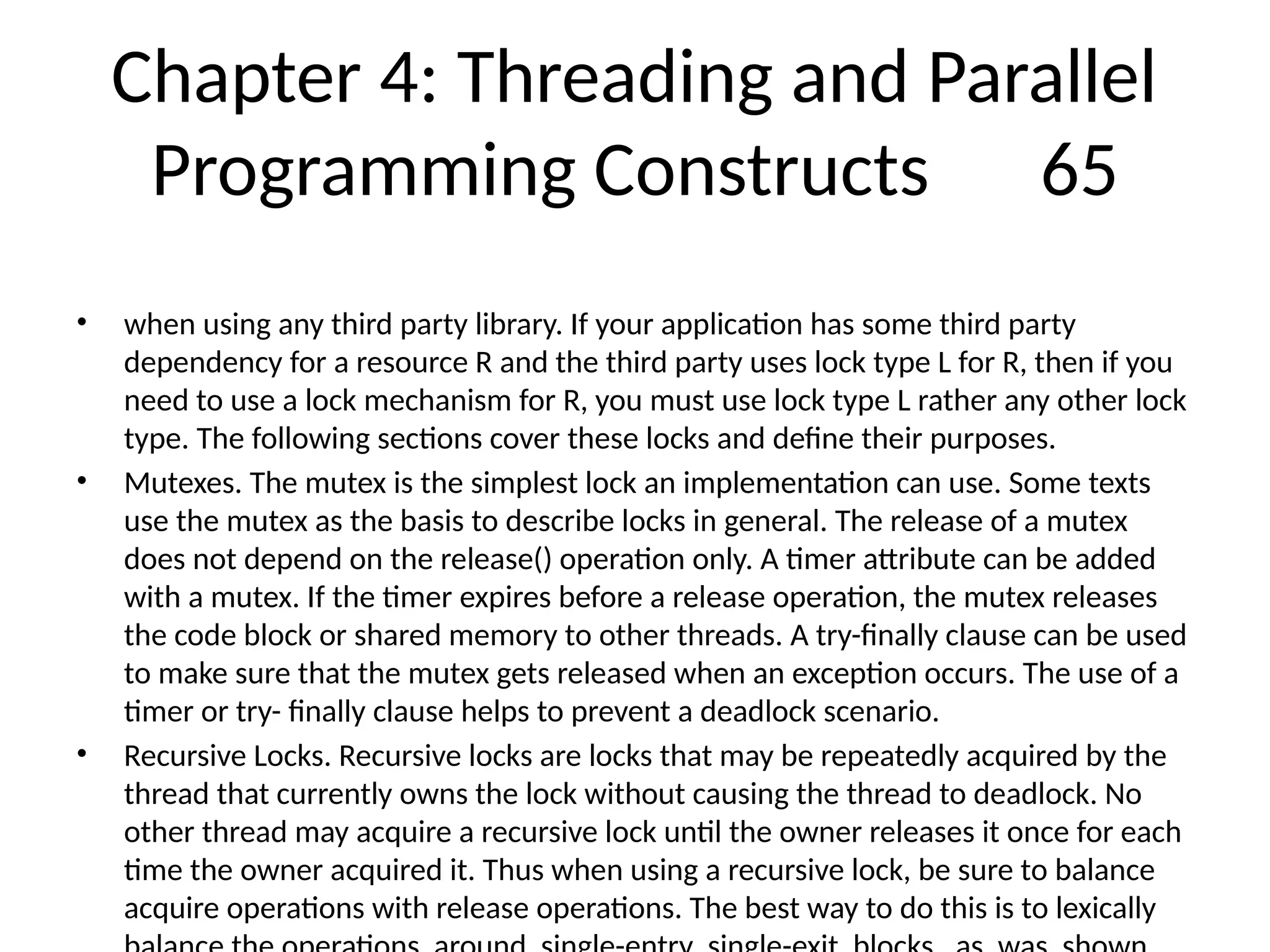
• Figure 6.2 uses these functions to perform data processing for each element in
array x. This example illustrates a few important concepts when using the function
calls instead of pragmas. First, your code must be rewritten, and with any
rewrite comes extra documentation, debugging, testing, and maintenance work.
Second, it becomes difficult or impossible to compile without OpenMP support.
Finally, because thread values have been hard coded, you lose the ability to have
loop- scheduling adjusted for you, and this threaded code is not scalable
beyond four cores or processors, even if you have more than four cores or
processors in the system.
• float x[8000]; omp_set_num_threads(4);
• #pragma omp parallel private(k)
• { // This code has a shortcoming. Can you find it? int num_thds =
omp_get_num_threads();
• int ElementsPerThread = 8000 / num_thds;
• int Tid = omp_get_thread_num();
• int LowBound = Tid*ElementsPerThread;](https://image.slidesharecdn.com/simplifiedmulticorepresentation-250819071729-6d8df187/75/Amdahl-s-law-is-explained-in-the-above-power-point-presentations-107-2048.jpg)