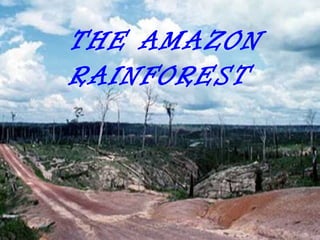
THE AMAZON
RAINFOREST
INDEX…..
• The rainforest: a fantastic structure
• The wonders of nature
• The climate
• People in the forest
• The resources of the forest
• The importance of the forest for life
• The abuse of the forest resources
• How are these areas used?
• We have to solve this problem
• Rescue is arriving!
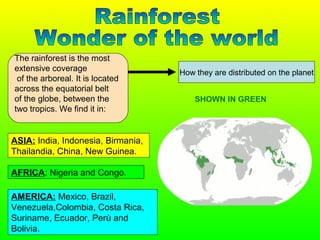
How they are distributed on the planet
The rainforest is the most
extensive coverage
of the arboreal. It is located
across the equatorial belt
of the globe, between the
two tropics. We find it in:
AMERICA: Mexico, Brazil,
Venezuela,Colombia, Costa Rica,
Suriname, Ecuador, Perù and
Bolivia.
AFRICA: Nigeria and Congo.
ASIA: India, Indonesia, Birmania,
Thailandia, China, New Guinea.
SHOWN IN GREEN
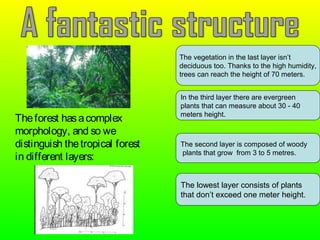
Theforest hasacomplex
morphology, and so we
distinguish thetropical forest
in different layers:
The vegetation in the last layer isn’t
deciduous too. Thanks to the high humidity,
trees can reach the height of 70 meters.
In the third layer there are evergreen
plants that can measure about 30 - 40
meters height.
The second layer is composed of woody
plants that grow from 3 to 5 metres.
The lowest layer consists of plants
that don’t exceed one meter height.
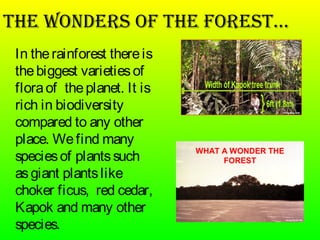
THE WONDERS OF THE FOREST…
In therainforest thereis
thebiggest varietiesof
floraof theplanet. It is
rich in biodiversity
compared to any other
place. Wefind many
speciesof plantssuch
asgiant plantslike
choker ficus, red cedar,
Kapok and many other
species.
WHAT A WONDER THE
FOREST
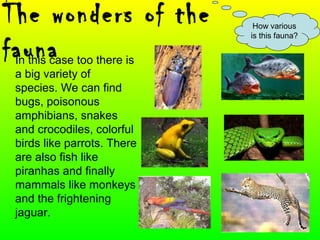
How various
is this fauna?
The wonders of the
faunaIn this case too there is
a big variety of
species. We can find
bugs, poisonous
amphibians, snakes
and crocodiles, colorful
birds like parrots. There
are also fish like
piranhas and finally
mammals like monkeys
and the frightening
jaguar.
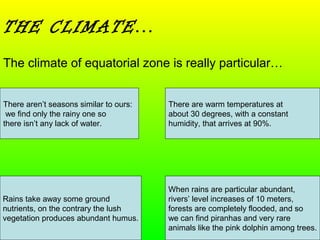
THE CLIMATE…
The climate of equatorial zone is really particular…
There aren’t seasons similar to ours:
we find only the rainy one so
there isn’t any lack of water.
There are warm temperatures at
about 30 degrees, with a constant
humidity, that arrives at 90%.
Rains take away some ground
nutrients, on the contrary the lush
vegetation produces abundant humus.
When rains are particular abundant,
rivers’ level increases of 10 meters,
forests are completely flooded, and so
we can find piranhas and very rare
animals like the pink dolphin among trees.
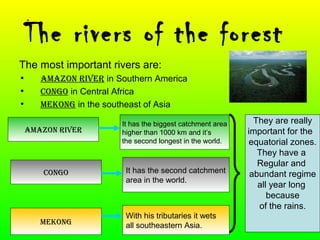
The rivers of the forest
The most important rivers are:
• AmAzon river in Southern America
• Congo in Central Africa
• mekong in the southeast of Asia
AmAzon river
It has the biggest catchment area
higher than 1000 km and it’s
the second longest in the world.
Congo It has the second catchment
area in the world.
mekong
With his tributaries it wets
all southeastern Asia.
They are really
important for the
equatorial zones.
They have a
Regular and
abundant regime
all year long
because
of the rains.
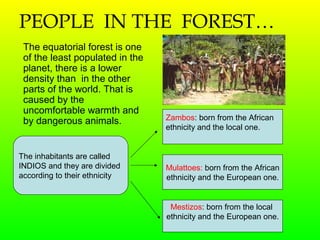
PEOPLE IN THE FOREST…
The equatorial forest is one
of the least populated in the
planet, there is a lower
density than in the other
parts of the world. That is
caused by the
uncomfortable warmth and
by dangerous animals.
The inhabitants are called
INDIOS and they are divided
according to their ethnicity
Zambos: born from the African
ethnicity and the local one.
Mulattoes: born from the African
ethnicity and the European one.
Mestizos: born from the local
ethnicity and the European one.
Visit the forest…
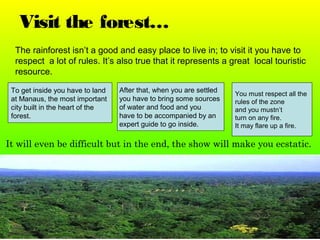
The rainforest isn’t a good and easy place to live in; to visit it you have to
respect a lot of rules. It’s also true that it represents a great local touristic
resource.
You must respect all the
rules of the zone
and you mustn’t
turn on any fire.
It may flare up a fire.
It will even be difficult but in the end, the show will make you ecstatic.
To get inside you have to land
at Manaus, the most important
city built in the heart of the
forest.
After that, when you are settled
you have to bring some sources
of water and food and you
have to be accompanied by an
expert guide to go inside.
THE RESOURCES
The forest’s ecosystem is really
fragile.
The rainforest provides a big
quantity of resources.
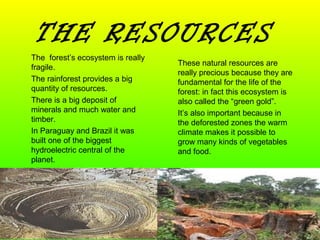
There is a big deposit of
minerals and much water and
timber.
In Paraguay and Brazil it was
built one of the biggest
hydroelectric central of the
planet.
These natural resources are
really precious because they are
fundamental for the life of the
forest: in fact this ecosystem is
also called the “green gold”.
It’s also important because in
the deforested zones the warm
climate makes it possible to
grow many kinds of vegetables
and food.
IMPORTANCE OF …
The rainforest has also the nickname of lungslungs
of the Earthof the Earth, because vegetation uses water
and in particular carbon gas to produce
carbohydrates and oxygen during the
photosynthesis.
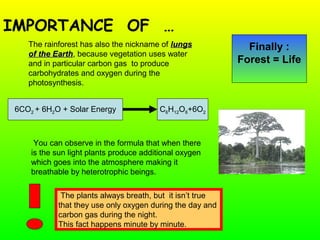
6CO2 + 6H2O + Solar Energy C6H12O6+6O2
You can observe in the formula that when there
is the sun light plants produce additional oxygen
which goes into the atmosphere making it
breathable by heterotrophic beings.
Finally :
Forest = Life
The plants always breath, but it isn’t true
that they use only oxygen during the day and
carbon gas during the night.
This fact happens minute by minute.
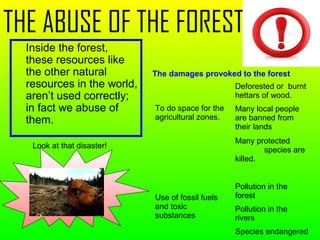
THE ABUSE OF THE FORESTS
Inside the forest,
these resources like
the other natural
resources in the world,
aren’t used correctly;
in fact we abuse of
them.
To do space for the
agricultural zones.
Deforested or burnt
hettars of wood.
Many local people
are banned from
their lands
Many protected
species are
killed.
Use of fossil fuels
and toxic
substances
Pollution in the
forest
Pollution in the
rivers
Species endangered
The damages provoked to the forest
Look at that disaster!
HOW ARE THESE AREAS
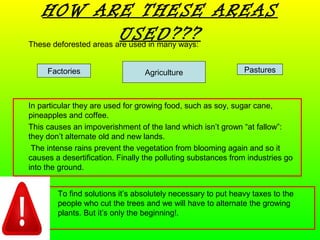
USED???These deforested areas are used in many ways:
PasturesFactories Agriculture
In particular they are used for growing food, such as soy, sugar cane,
pineapples and coffee.
This causes an impoverishment of the land which isn’t grown “at fallow”:
they don’t alternate old and new lands.
The intense rains prevent the vegetation from blooming again and so it
causes a desertification. Finally the polluting substances from industries go
into the ground.
To find solutions it’s absolutely necessary to put heavy taxes to the
people who cut the trees and we will have to alternate the growing
plants. But it’s only the beginning!.
Man has always needed Nature to feed himself, but there is a limit
to everything!
The 80% of the forest is still unspoiled but the deforestation is
increasing!
First it is necessary to do accurate controls, to find all the illegal
activities that take place in this zone.
Authorities should help the institutions that keep this fantastic and
delicate ecosystem alive.
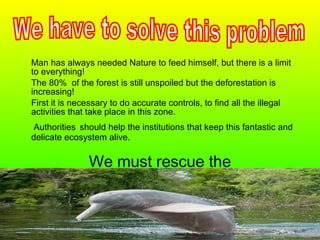
We must rescue the
endangered species
Rescue is aRRiving !!!
Fortunately we aren’t the first people
who realize that the rainforest and so the
global climate is in danger. Many institutions
have taken some measures about this topic.
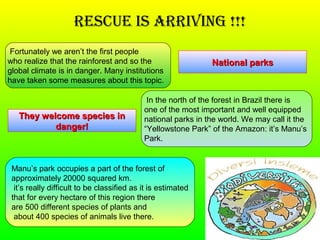
In the north of the forest in Brazil there is
one of the most important and well equipped
national parks in the world. We may call it the
“Yellowstone Park” of the Amazon: it’s Manu’s
Park.
National parksNational parks
They welcome species inThey welcome species in
danger!danger!
Manu’s park occupies a part of the forest of
approximately 20000 squared km.
it’s really difficult to be classified as it is estimated
that for every hectare of this region there
are 500 different species of plants and
about 400 species of animals live there.
Amazon rainforest

Amazon rainforest

  • 1.
  • 2.
    INDEX….. • The rainforest:a fantastic structure • The wonders of nature • The climate • People in the forest • The resources of the forest • The importance of the forest for life • The abuse of the forest resources • How are these areas used? • We have to solve this problem • Rescue is arriving!
  • 3.
    How they aredistributed on the planet The rainforest is the most extensive coverage of the arboreal. It is located across the equatorial belt of the globe, between the two tropics. We find it in: AMERICA: Mexico, Brazil, Venezuela,Colombia, Costa Rica, Suriname, Ecuador, Perù and Bolivia. AFRICA: Nigeria and Congo. ASIA: India, Indonesia, Birmania, Thailandia, China, New Guinea. SHOWN IN GREEN
  • 4.
    Theforest hasacomplex morphology, andso we distinguish thetropical forest in different layers: The vegetation in the last layer isn’t deciduous too. Thanks to the high humidity, trees can reach the height of 70 meters. In the third layer there are evergreen plants that can measure about 30 - 40 meters height. The second layer is composed of woody plants that grow from 3 to 5 metres. The lowest layer consists of plants that don’t exceed one meter height.
  • 5.
    THE WONDERS OFTHE FOREST… In therainforest thereis thebiggest varietiesof floraof theplanet. It is rich in biodiversity compared to any other place. Wefind many speciesof plantssuch asgiant plantslike choker ficus, red cedar, Kapok and many other species. WHAT A WONDER THE FOREST
  • 6.
    How various is thisfauna? The wonders of the faunaIn this case too there is a big variety of species. We can find bugs, poisonous amphibians, snakes and crocodiles, colorful birds like parrots. There are also fish like piranhas and finally mammals like monkeys and the frightening jaguar.
  • 7.
    THE CLIMATE… The climateof equatorial zone is really particular… There aren’t seasons similar to ours: we find only the rainy one so there isn’t any lack of water. There are warm temperatures at about 30 degrees, with a constant humidity, that arrives at 90%. Rains take away some ground nutrients, on the contrary the lush vegetation produces abundant humus. When rains are particular abundant, rivers’ level increases of 10 meters, forests are completely flooded, and so we can find piranhas and very rare animals like the pink dolphin among trees.
  • 8.
    The rivers ofthe forest The most important rivers are: • AmAzon river in Southern America • Congo in Central Africa • mekong in the southeast of Asia AmAzon river It has the biggest catchment area higher than 1000 km and it’s the second longest in the world. Congo It has the second catchment area in the world. mekong With his tributaries it wets all southeastern Asia. They are really important for the equatorial zones. They have a Regular and abundant regime all year long because of the rains.
  • 9.
    PEOPLE IN THEFOREST… The equatorial forest is one of the least populated in the planet, there is a lower density than in the other parts of the world. That is caused by the uncomfortable warmth and by dangerous animals. The inhabitants are called INDIOS and they are divided according to their ethnicity Zambos: born from the African ethnicity and the local one. Mulattoes: born from the African ethnicity and the European one. Mestizos: born from the local ethnicity and the European one.
  • 10.
    Visit the forest… Therainforest isn’t a good and easy place to live in; to visit it you have to respect a lot of rules. It’s also true that it represents a great local touristic resource. You must respect all the rules of the zone and you mustn’t turn on any fire. It may flare up a fire. It will even be difficult but in the end, the show will make you ecstatic. To get inside you have to land at Manaus, the most important city built in the heart of the forest. After that, when you are settled you have to bring some sources of water and food and you have to be accompanied by an expert guide to go inside.
  • 11.
    THE RESOURCES The forest’secosystem is really fragile. The rainforest provides a big quantity of resources. There is a big deposit of minerals and much water and timber. In Paraguay and Brazil it was built one of the biggest hydroelectric central of the planet. These natural resources are really precious because they are fundamental for the life of the forest: in fact this ecosystem is also called the “green gold”. It’s also important because in the deforested zones the warm climate makes it possible to grow many kinds of vegetables and food.
  • 12.
    IMPORTANCE OF … Therainforest has also the nickname of lungslungs of the Earthof the Earth, because vegetation uses water and in particular carbon gas to produce carbohydrates and oxygen during the photosynthesis. 6CO2 + 6H2O + Solar Energy C6H12O6+6O2 You can observe in the formula that when there is the sun light plants produce additional oxygen which goes into the atmosphere making it breathable by heterotrophic beings. Finally : Forest = Life The plants always breath, but it isn’t true that they use only oxygen during the day and carbon gas during the night. This fact happens minute by minute.
  • 13.
    THE ABUSE OFTHE FORESTS Inside the forest, these resources like the other natural resources in the world, aren’t used correctly; in fact we abuse of them. To do space for the agricultural zones. Deforested or burnt hettars of wood. Many local people are banned from their lands Many protected species are killed. Use of fossil fuels and toxic substances Pollution in the forest Pollution in the rivers Species endangered The damages provoked to the forest Look at that disaster!
  • 14.
    HOW ARE THESEAREAS USED???These deforested areas are used in many ways: PasturesFactories Agriculture In particular they are used for growing food, such as soy, sugar cane, pineapples and coffee. This causes an impoverishment of the land which isn’t grown “at fallow”: they don’t alternate old and new lands. The intense rains prevent the vegetation from blooming again and so it causes a desertification. Finally the polluting substances from industries go into the ground. To find solutions it’s absolutely necessary to put heavy taxes to the people who cut the trees and we will have to alternate the growing plants. But it’s only the beginning!.
  • 15.
    Man has alwaysneeded Nature to feed himself, but there is a limit to everything! The 80% of the forest is still unspoiled but the deforestation is increasing! First it is necessary to do accurate controls, to find all the illegal activities that take place in this zone. Authorities should help the institutions that keep this fantastic and delicate ecosystem alive. We must rescue the endangered species
  • 16.
    Rescue is aRRiving!!! Fortunately we aren’t the first people who realize that the rainforest and so the global climate is in danger. Many institutions have taken some measures about this topic. In the north of the forest in Brazil there is one of the most important and well equipped national parks in the world. We may call it the “Yellowstone Park” of the Amazon: it’s Manu’s Park. National parksNational parks They welcome species inThey welcome species in danger!danger! Manu’s park occupies a part of the forest of approximately 20000 squared km. it’s really difficult to be classified as it is estimated that for every hectare of this region there are 500 different species of plants and about 400 species of animals live there.