I.S.F.D LENGUAS VIVAS BARILOCHE –
PRÁCTICA DOCENTE III
ENTREGA DE PLANIFICACIÓN
ALUMNO PRACTICANTE:
Institución educativa: First English Institute
Año y sección: 5th Seniors
Nivel lingüístico del curso: intermediate
Cantidad de alumnos: 14
Tipo de Planificación: Clase
Unidad Temática: “Spies”
Clase Nº: 10
Duración de la clase: 80 minutos
Fecha de la clase: 25 de junio
Fecha de entrega de la planificación: 21 de junio
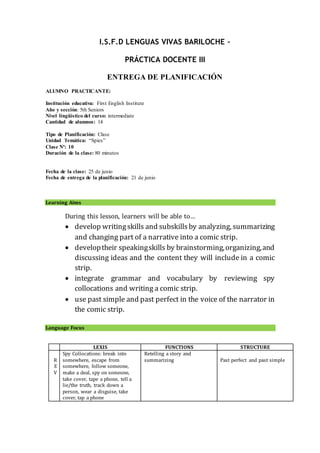
Learning Aims
During this lesson, learners will be able to…
 develop writingskills and subskills by analyzing, summarizing
and changing part of a narrative into a comic strip.
 developtheir speakingskills by brainstorming,organizing,and
discussing ideas and the content they will include in a comic
strip.
 integrate grammar and vocabulary by reviewing spy
collocations and writing a comic strip.
 use past simple and past perfect in the voice of the narrator in
the comic strip.
Language Focus
LEXIS FUNCTIONS STRUCTURE
R
E
V
Spy Collocations: break into
somewhere, escape from
somewhere, follow someone,
make a deal, spy on someone,
take cover, tape a phone, tell a
lie/the truth, track down a
person, wear a disguise, take
cover, tap a phone
Retelling a story and
summarizing Past perfect and past simple
N
E
W
Materials
Slides to present while I give my class:
https://docs.google.com/presentation/d/e/2PACX-1vQacOHG3-
3yG7RmGWpXbb5kTKPOfDjAXdyfGhakyEK9UtAuy_noSbW0vqSFJAMqaz5och0Lt6zLgl-
J/pub?start=false&loop=false&delayms=3000
Procedures
I will greet students and engage in casual conversation. Then, I will
check attendance.
(10 minutes)
I will tell students that we are going to review what we have seen in
previous classes. To review the spy collocations, I will tell students to
write the following verbs in a column in their notebooks:
 Break into:
 Decode:
 Escape from:
 Make:
 Spy on:
 Take:
 Tap:
 Tell:
 Track down:
 Wear:
Then, I will say ten phrases and they must write them next the
corresponding verb. I will read:
Cover, the criminal, the neighbors, his smart phone, a disguise, prison, a
deal, a secret message, a bank, the truth.
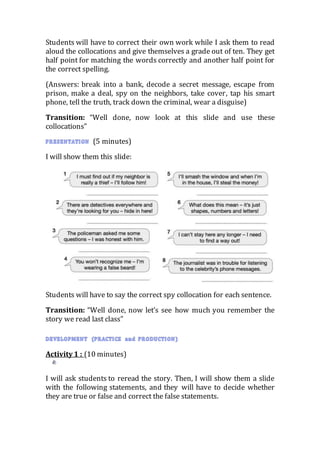
Students will have to correct their own work while I ask them to read
aloud the collocations and give themselves a grade out of ten. They get
half point for matching the words correctly and another half point for
the correct spelling.
(Answers: break into a bank, decode a secret message, escape from
prison, make a deal, spy on the neighbors, take cover, tap his smart
phone, tell the truth, track down the criminal, wear a disguise)
Transition: “Well done, now look at this slide and use these
collocations”
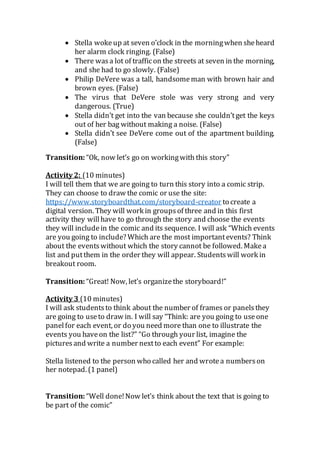
(5 minutes)
I will show them this slide:
Students will have to say the correct spy collocation for each sentence.
Transition: “Well done, now let’s see how much you remember the
story we read last class”
Activity 1 : (10 minutes)
I will ask students to reread the story. Then, I will show them a slide
with the following statements, and they will have to decide whether
they are true or false and correct the false statements.
 Stella wokeup at seven o’clock in the morningwhen sheheard
her alarm clock ringing. (False)
 There wasa lot of trafficon the streets at seven in the morning,
and she had to go slowly. (False)
 Philip DeVere was a tall, handsomeman with brown hair and
brown eyes. (False)
 The virus that DeVere stole was very strong and very
dangerous. (True)
 Stella didn’t get into the van because she couldn’tget the keys
out of her bag without making a noise. (False)
 Stella didn’t see DeVere come out of the apartment building.
(False)
Transition: “Ok, now let’s go on workingwith this story”
Activity 2: (10 minutes)
I will tell them that we are going to turn this story into a comic strip.
They can choose to draw the comic or use the site:
https://www.storyboardthat.com/storyboard-creator to create a
digital version. They will work in groupsof three and in this first
activity they willhave to go through the story and choose the events
they will include in the comic and its sequence. I will ask “Which events
are you going to include? Which are the most importantevents? Think
about the eventswithout which the story cannot be followed. Makea
list and putthem in the order they will appear. Studentswill work in
breakout room.
Transition: “Great! Now, let’s organizethe storyboard!”
Activity 3 (10 minutes)
I will ask studentsto think about the number of frames or panels they
are going to useto draw in. I will say “Think: are you going to useone
panel for each event, or do you need more than one to illustrate the
events you haveon the list?” “Go through your list, imagine the
picturesand write a number nextto each event” For example:
Stella listened to the person who called her and wrotea numberson
her notepad. (1 panel)
Transition: “Well done!Now let’s think about the text that is going to
be part of the comic”
Activity 4: (15 minutes)
I will show them a slide with a modelcomic strip just to show the main
elements of acomic strip: Comicshavea speechbubble orballoonthat
contains the dialog of the characters and cloud-like bubbles that will
be used to show what a character is thinking. They also have captions
which are the boxes that are separate from the rest of the panels to
providecontext for what is happeningthrough the voice of a narrator.
After explaining this, the students will have to decide what the
characters are going to say or think in each paneland if the panelneeds
the voiceof a narrator to makethe context clear to the readersor maybe
just communicate a situation just with a picture without words. I will
ask students to focus on the text for the first 3 panels of the story.
Transition: “Good! Now, let’s start to create the comic!”
Activity 5: (15 minutes)
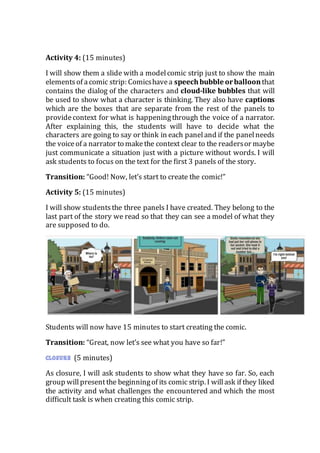
I will show studentsthe three panels I have created. They belong to the
last part of the story we read so that they can see a model of what they
are supposed to do.
Students will now have 15 minutes to start creating the comic.
Transition: “Great, now let’s see what you have so far!”
(5 minutes)
As closure, I will ask students to show what they have so far. So, each
group willpresentthe beginningof its comic strip. I willask if they liked
the activity and what challenges the encountered and which the most
difficult task is when creating this comic strip.
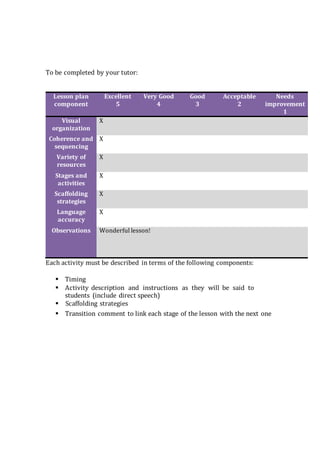
To be completed by your tutor:
Lesson plan
component
Excellent
5
Very Good
4
Good
3
Acceptable
2
Needs
improvement
1
Visual
organization
X
Coherence and
sequencing
X
Variety of
resources
X
Stages and
activities
X
Scaffolding
strategies
X
Language
accuracy
X
Observations Wonderful lesson!
Each activity must be described in terms of the following components:
 Timing
 Activity description and instructions as they will be said to
students (include direct speech)
 Scaffolding strategies
 Transition comment to link each stage of the lesson with the next one

Alvarez marina lesson plan 10

  • 1.
    I.S.F.D LENGUAS VIVASBARILOCHE – PRÁCTICA DOCENTE III ENTREGA DE PLANIFICACIÓN ALUMNO PRACTICANTE: Institución educativa: First English Institute Año y sección: 5th Seniors Nivel lingüístico del curso: intermediate Cantidad de alumnos: 14 Tipo de Planificación: Clase Unidad Temática: “Spies” Clase Nº: 10 Duración de la clase: 80 minutos Fecha de la clase: 25 de junio Fecha de entrega de la planificación: 21 de junio Learning Aims During this lesson, learners will be able to…  develop writingskills and subskills by analyzing, summarizing and changing part of a narrative into a comic strip.  developtheir speakingskills by brainstorming,organizing,and discussing ideas and the content they will include in a comic strip.  integrate grammar and vocabulary by reviewing spy collocations and writing a comic strip.  use past simple and past perfect in the voice of the narrator in the comic strip. Language Focus LEXIS FUNCTIONS STRUCTURE R E V Spy Collocations: break into somewhere, escape from somewhere, follow someone, make a deal, spy on someone, take cover, tape a phone, tell a lie/the truth, track down a person, wear a disguise, take cover, tap a phone Retelling a story and summarizing Past perfect and past simple
  • 2.
    N E W Materials Slides to presentwhile I give my class: https://docs.google.com/presentation/d/e/2PACX-1vQacOHG3- 3yG7RmGWpXbb5kTKPOfDjAXdyfGhakyEK9UtAuy_noSbW0vqSFJAMqaz5och0Lt6zLgl- J/pub?start=false&loop=false&delayms=3000 Procedures I will greet students and engage in casual conversation. Then, I will check attendance. (10 minutes) I will tell students that we are going to review what we have seen in previous classes. To review the spy collocations, I will tell students to write the following verbs in a column in their notebooks:  Break into:  Decode:  Escape from:  Make:  Spy on:  Take:  Tap:  Tell:  Track down:  Wear: Then, I will say ten phrases and they must write them next the corresponding verb. I will read: Cover, the criminal, the neighbors, his smart phone, a disguise, prison, a deal, a secret message, a bank, the truth.
  • 3.
    Students will haveto correct their own work while I ask them to read aloud the collocations and give themselves a grade out of ten. They get half point for matching the words correctly and another half point for the correct spelling. (Answers: break into a bank, decode a secret message, escape from prison, make a deal, spy on the neighbors, take cover, tap his smart phone, tell the truth, track down the criminal, wear a disguise) Transition: “Well done, now look at this slide and use these collocations” (5 minutes) I will show them this slide: Students will have to say the correct spy collocation for each sentence. Transition: “Well done, now let’s see how much you remember the story we read last class” Activity 1 : (10 minutes) I will ask students to reread the story. Then, I will show them a slide with the following statements, and they will have to decide whether they are true or false and correct the false statements.
  • 4.
     Stella wokeupat seven o’clock in the morningwhen sheheard her alarm clock ringing. (False)  There wasa lot of trafficon the streets at seven in the morning, and she had to go slowly. (False)  Philip DeVere was a tall, handsomeman with brown hair and brown eyes. (False)  The virus that DeVere stole was very strong and very dangerous. (True)  Stella didn’t get into the van because she couldn’tget the keys out of her bag without making a noise. (False)  Stella didn’t see DeVere come out of the apartment building. (False) Transition: “Ok, now let’s go on workingwith this story” Activity 2: (10 minutes) I will tell them that we are going to turn this story into a comic strip. They can choose to draw the comic or use the site: https://www.storyboardthat.com/storyboard-creator to create a digital version. They will work in groupsof three and in this first activity they willhave to go through the story and choose the events they will include in the comic and its sequence. I will ask “Which events are you going to include? Which are the most importantevents? Think about the eventswithout which the story cannot be followed. Makea list and putthem in the order they will appear. Studentswill work in breakout room. Transition: “Great! Now, let’s organizethe storyboard!” Activity 3 (10 minutes) I will ask studentsto think about the number of frames or panels they are going to useto draw in. I will say “Think: are you going to useone panel for each event, or do you need more than one to illustrate the events you haveon the list?” “Go through your list, imagine the picturesand write a number nextto each event” For example: Stella listened to the person who called her and wrotea numberson her notepad. (1 panel) Transition: “Well done!Now let’s think about the text that is going to be part of the comic”
  • 5.
    Activity 4: (15minutes) I will show them a slide with a modelcomic strip just to show the main elements of acomic strip: Comicshavea speechbubble orballoonthat contains the dialog of the characters and cloud-like bubbles that will be used to show what a character is thinking. They also have captions which are the boxes that are separate from the rest of the panels to providecontext for what is happeningthrough the voice of a narrator. After explaining this, the students will have to decide what the characters are going to say or think in each paneland if the panelneeds the voiceof a narrator to makethe context clear to the readersor maybe just communicate a situation just with a picture without words. I will ask students to focus on the text for the first 3 panels of the story. Transition: “Good! Now, let’s start to create the comic!” Activity 5: (15 minutes) I will show studentsthe three panels I have created. They belong to the last part of the story we read so that they can see a model of what they are supposed to do. Students will now have 15 minutes to start creating the comic. Transition: “Great, now let’s see what you have so far!” (5 minutes) As closure, I will ask students to show what they have so far. So, each group willpresentthe beginningof its comic strip. I willask if they liked the activity and what challenges the encountered and which the most difficult task is when creating this comic strip.
  • 6.
    To be completedby your tutor: Lesson plan component Excellent 5 Very Good 4 Good 3 Acceptable 2 Needs improvement 1 Visual organization X Coherence and sequencing X Variety of resources X Stages and activities X Scaffolding strategies X Language accuracy X Observations Wonderful lesson! Each activity must be described in terms of the following components:  Timing  Activity description and instructions as they will be said to students (include direct speech)  Scaffolding strategies  Transition comment to link each stage of the lesson with the next one