“ E very  new beginning comes from some other beginning’s end” Nothing new is being told or presented in this paper that which has  not  been told or presented earlier by someone somewhere about application of High Strength Aluminium Alloy  extrusion in Defence FOREWORD
Introduction The determiners for the effectiveness and success of any ammunition hardware are its: Lethality Range Here again, the proven experience is that attaining of the desired Lethality and Range is based on the: Weight of the  ammunition hardware
Doubtless, the technical feasibility has it that light weight  component  would carry: more  explosives and travel longer distance Now the question is: What material should go in to give out a proven and functional component/hardware ?
It should be a material of: High strength to weight ratio Excellent fatigue strength Fracture toughness Corrosion resistance and Good workability Tried-and-tested experience is that one can find all the above qualities in: Aluminum Alloy
Unrivaled rigidity and exceptionally robust High strength to weight ratio makes Aluminum Alloy An ideal material for strategic and typical applications in  Defence in the form of: Sheets/Plates Forgings  Extrusions Rolled rings & Extrusions
Manifold increase in the demand for military hardware results in the corresponding increase in the use of Aluminum Alloy extrusions. Present-day scenario in the country More than 250  active extruders produce variety of extrusions for varied applications  but T only 2 or   3   private players  alone produce  meager  quantity strategic High  strength  Aluminum  Alloy
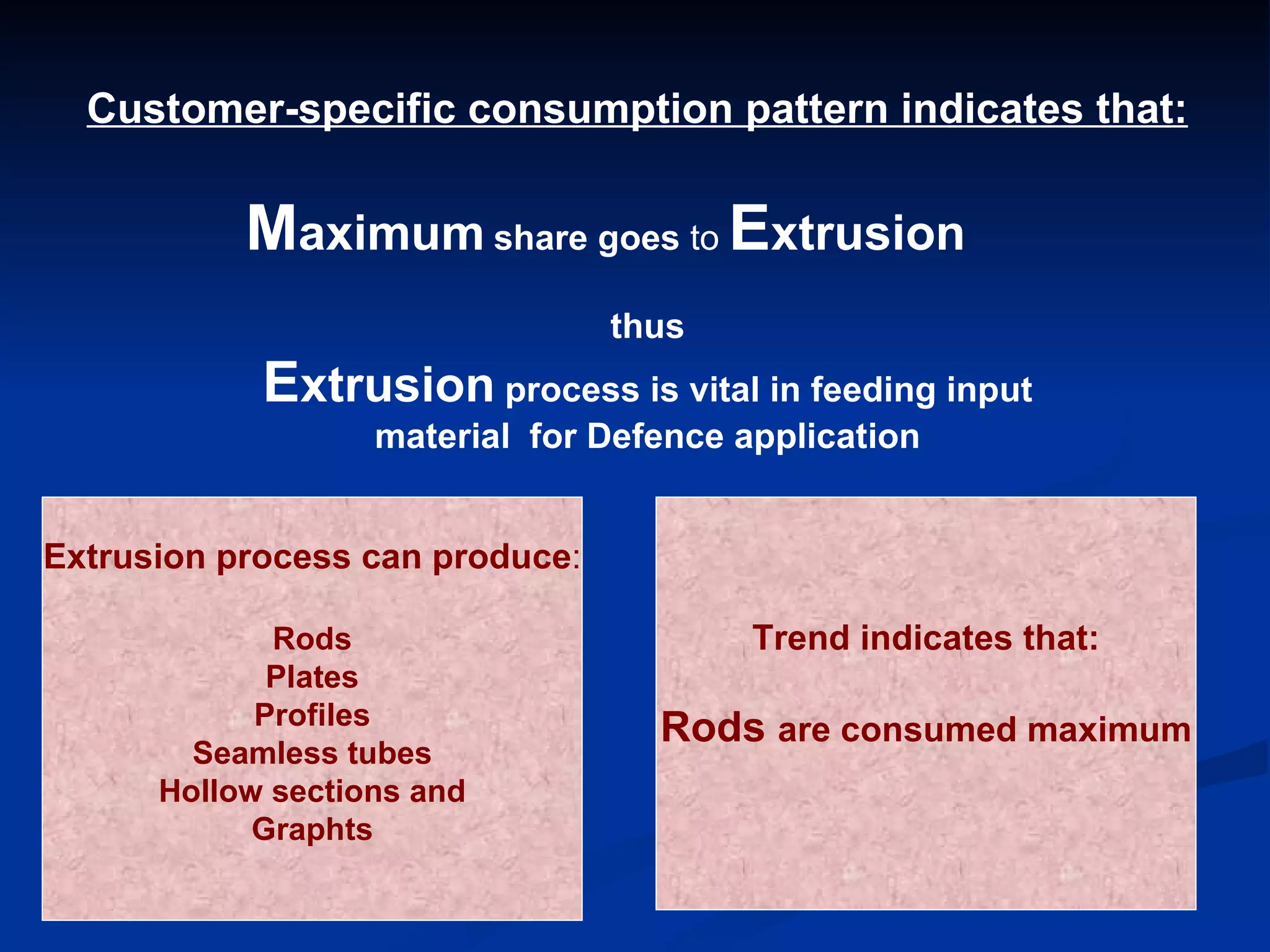
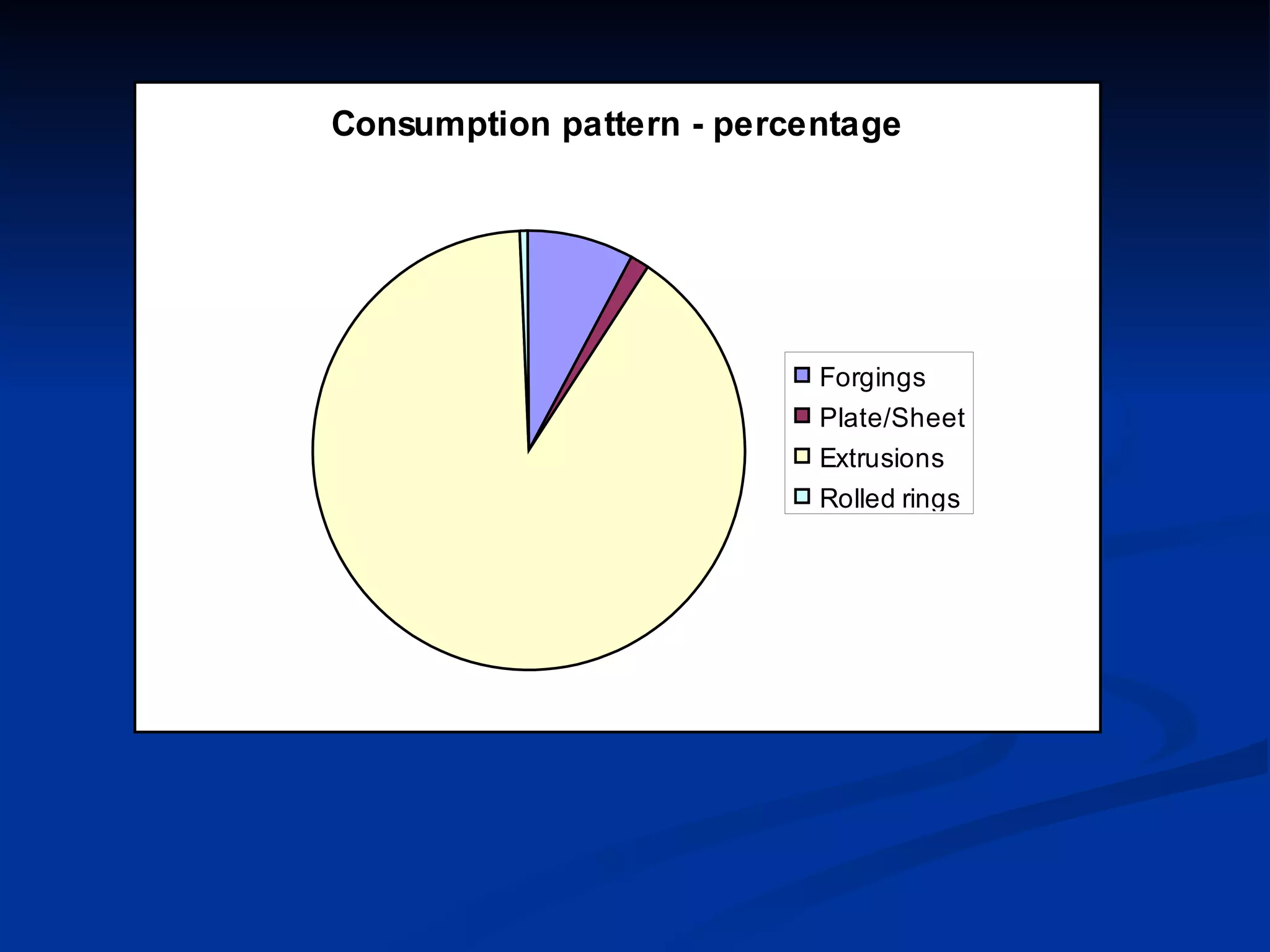
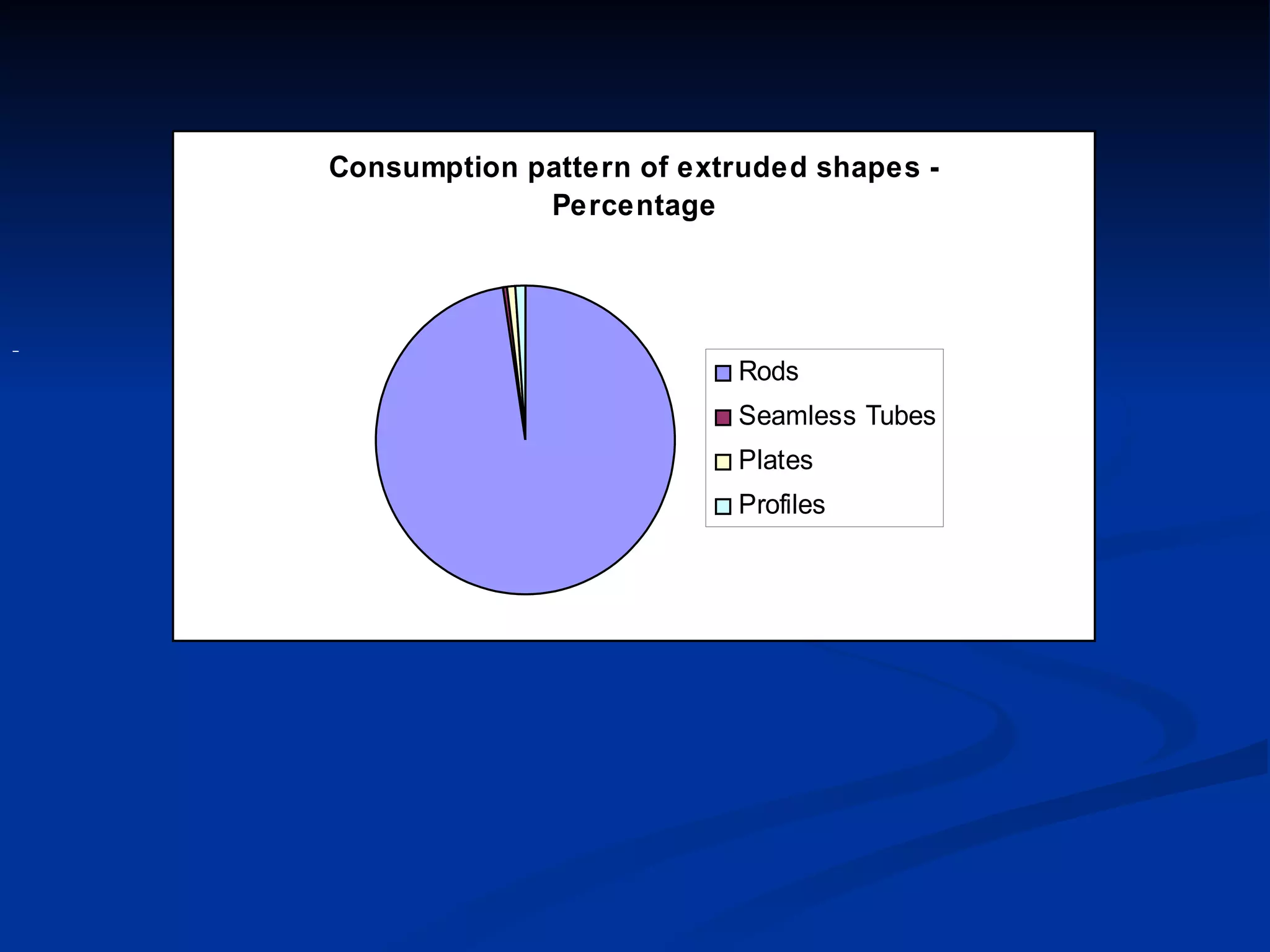
Customer-specific consumption pattern indicates that: M aximum   share goes  to   E xtrusion thus E xtrusion  process is vital in feeding input material  for Defence application Extrusion process can produce : Rods Plates Profiles Seamless tubes Hollow sections and Graphts Trend indicates that: Rods  are consumed maximum
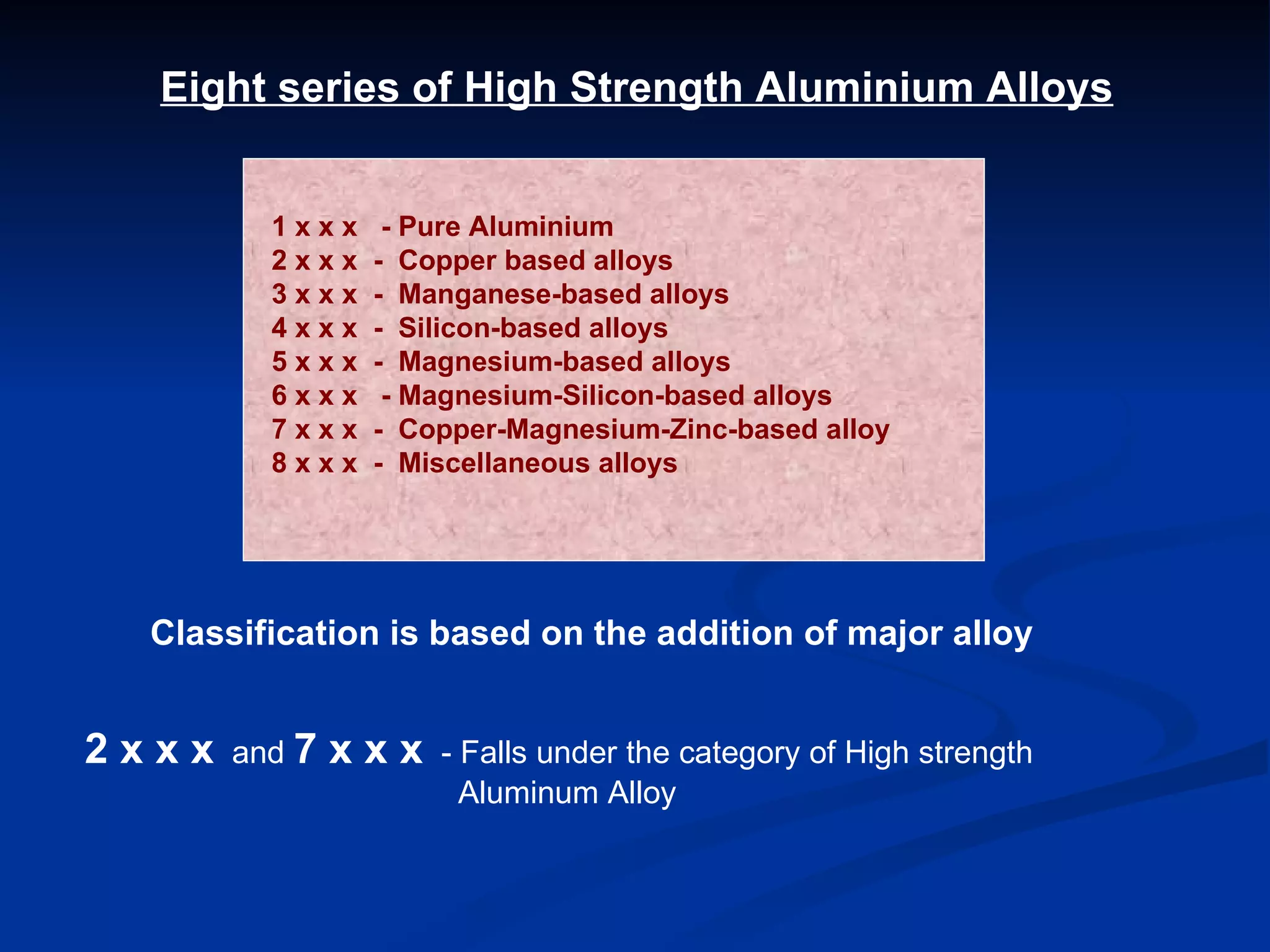
Eight series of High Strength Aluminium Alloys Classification is based on the addition of major alloy 1 x x x  - Pure Aluminium  2 x x x  -  Copper based alloys 3 x x x  -  Manganese-based alloys 4 x x x  -  Silicon-based alloys 5 x x x  -  Magnesium-based alloys 6 x x x  - Magnesium-Silicon-based alloys 7 x x x  -  Copper-Magnesium-Zinc-based alloy 8 x x x  -  Miscellaneous alloys 2 x x x   and  7 x x x   - Falls under the category of High strength  Aluminum Alloy


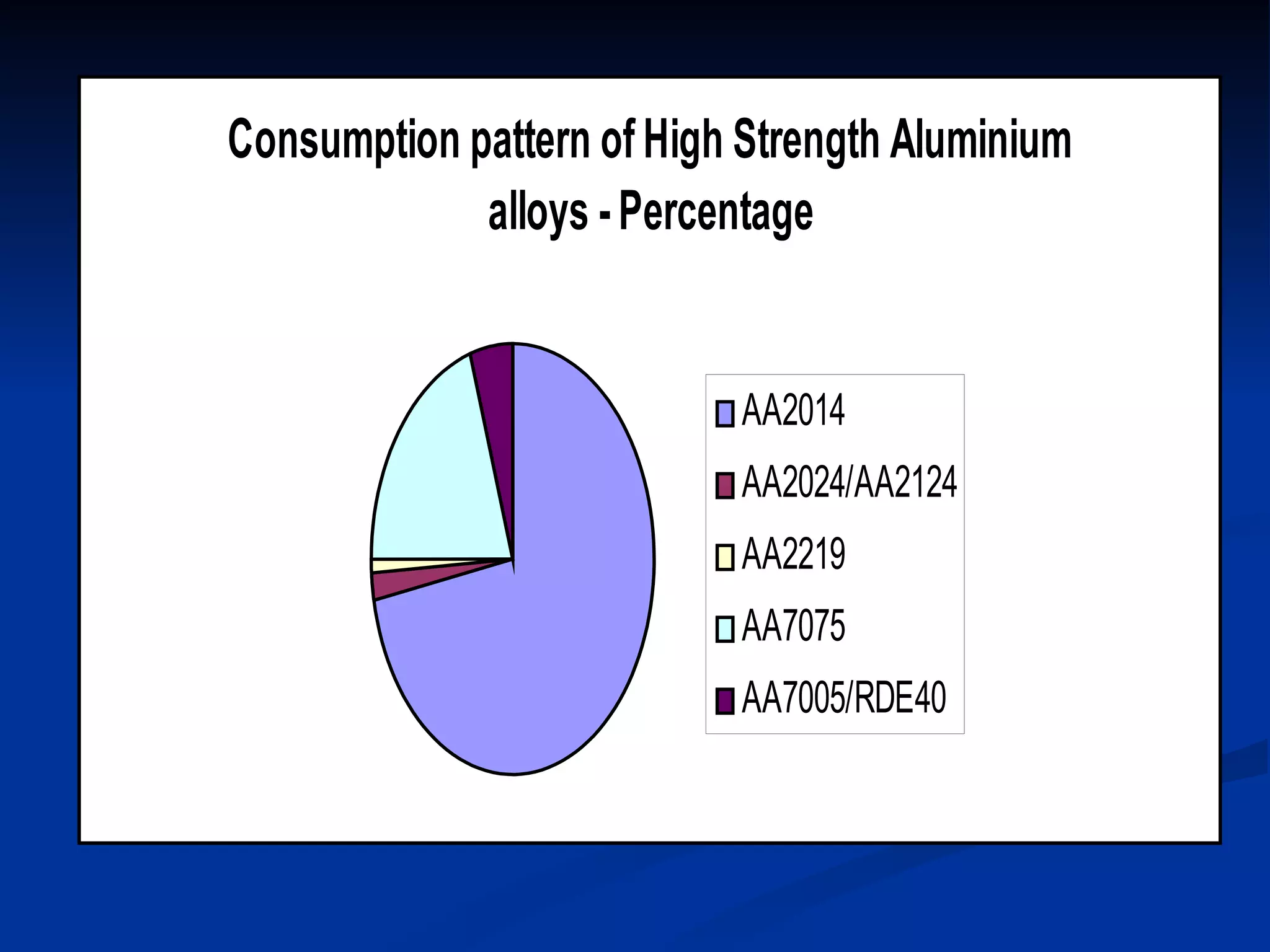
Consumption pattern of  extruded materials a view ! Consumption figures are only approximate and based on the Consumption pattern date of 2009-10
Opportunities Despite self-sufficiency in commercial grade  Aluminum Alloy, the need to emphasise on opportunities  arise owing to 2 or 3  private players in the country produce High Strength Aluminium Alloy for Defence  applications .
Production of High Strength  Alumionium Alloy is mostly confined to Ordnance Factories, whose production meets part of their internal use that is  assisted to some extent by importation.
Significant growth and demand in the following areas results in the corresponding demand and requirement of High Strength Aluminium Alloy: Defence requirement  - growing leaps and bounds 2. Indian Aerospace Industry  - rapid and massive growth Demand for Military hardware  - manifold increase Need for new-generation Military Hardware  - increasing trend Ambitious projects by ISRO
Immm The following are a few  areas where there are challenges   foreseen and foreseeable in extrusion of High Strength Alluminium Alloys:  Challenges Technology Development of New Alloys 3.  Capital Investment 4.  Nature of Demand  5.  Type-testing of material for aircraft application
Technology Challenges that foreseen and foreseeable in Highly demand in terms of technology and expertise as  compared to production of commercial grade  Aluminium Alloys. Aluminium Alloys have tendency to crack during DC casting and hence  stringent quality extrusions needed to meet requirement of Defence sector. Aluminium alloys  are subjected to vigorous testing to  meet quality requirement of Defence Sector whereas Commercial grade Aluminium alloys are not. Completely different Extrusion process for High Strength Aluminium  Alloy and hence there is an intrinsic need for  technical expertise. Casting and extrusion apart,  need proper control in each state to achieve the desired properties. * Need to understand and introduce suitable technology.
Development of New alloys   is itself a challenge !! * Product-development  is a  dynamic initiative  – needs informed decisions  for use of better alloys with improved properties. From the perspective of strategic applications, Scientists and Engineers worldwide are putting their best efforts to develop new Aluminium Alloys. Comparatively much less emphasis in India for development of new Aluminium alloys. Government departments like DMRL,Hyderabad embarked upon in this direction. Premier institutions like IIts and NITs should be encouraged to take up development of new High Strength Aluminium alloys. Leading Indian companies in the filed of Aluminium can  sponsor projects to develop new Aluminium alloys. Development of new Aluminium Alloys, the only  way to participate in the global race in the in the arena of High Strengh Aluminium Alloys.
Capital Investment a challenge inherent  ?!! Need huge investment for demandingly higher capacity  quality equipments for extrusion of High Strength Aluminium Alloys. High   strength  Aluminium alloy but  low strength  Returns – an obvious  vacillation to make huge investment ?! Accustomed to commercial-grade alloys – Unexplored area of High Strength  Aluminium Alloys – How to surmount this  indecisiveness rather than calling it a stumbling block? Private players -  Able, but not willing to invest – Hesitation due to consumption by  Defence sector alone for strategic application – Comparing with commercial-grade Alluminium alloy -  Doubting long-term Returns from High Strength Al.Alloy ?! *  Venturesome attitude  - While it is  important  to win, it is  imperative  to compete  -  Foreseeable growth in leaps and bounds in Defence requirement/consumption -  Success not far off.!!
Demand  for High strength Aluminium Alloy extrusions . A determining factor!! Present trend :  Requirement of variety of sizes but quantity in few Kilograms!! –  Perceived as negative  factor. The deterrent :  Comparatively less quantity despite   huge investment for extrusion. The need of the hour is :  A telescopic vision. Why telescopic vision ?:  With a  view to spot the  a positive factor  from  the perceived negative factor. * What is the positive factor:  High value per Kilogram of   High Strength Al.Alloy coupled   with encouraging potential for increase     requirement
Ty Type-testing  of material for Aircraft application. * This is again an aspect  revolving around  QUALITY , a factor  which every aspiring competitor – giver and taker -  wishes for ! QUALITY  and  COMPROMISE  -  Two watchwords. No doubt QUALITY gains the all-time upper hand in the present-day hectic and complex  corridor of business competition. * A guide to

Alm alloy

  • 1.
    “ E very new beginning comes from some other beginning’s end” Nothing new is being told or presented in this paper that which has not been told or presented earlier by someone somewhere about application of High Strength Aluminium Alloy extrusion in Defence FOREWORD
  • 2.
    Introduction The determinersfor the effectiveness and success of any ammunition hardware are its: Lethality Range Here again, the proven experience is that attaining of the desired Lethality and Range is based on the: Weight of the ammunition hardware
  • 3.
    Doubtless, the technicalfeasibility has it that light weight component would carry: more explosives and travel longer distance Now the question is: What material should go in to give out a proven and functional component/hardware ?
  • 4.
    It should bea material of: High strength to weight ratio Excellent fatigue strength Fracture toughness Corrosion resistance and Good workability Tried-and-tested experience is that one can find all the above qualities in: Aluminum Alloy
  • 5.
    Unrivaled rigidity andexceptionally robust High strength to weight ratio makes Aluminum Alloy An ideal material for strategic and typical applications in Defence in the form of: Sheets/Plates Forgings Extrusions Rolled rings & Extrusions
  • 6.
    Manifold increase inthe demand for military hardware results in the corresponding increase in the use of Aluminum Alloy extrusions. Present-day scenario in the country More than 250 active extruders produce variety of extrusions for varied applications but T only 2 or 3 private players alone produce meager quantity strategic High strength Aluminum Alloy
  • 7.
    Customer-specific consumption patternindicates that: M aximum share goes to E xtrusion thus E xtrusion process is vital in feeding input material for Defence application Extrusion process can produce : Rods Plates Profiles Seamless tubes Hollow sections and Graphts Trend indicates that: Rods are consumed maximum
  • 8.
    Eight series ofHigh Strength Aluminium Alloys Classification is based on the addition of major alloy 1 x x x - Pure Aluminium 2 x x x - Copper based alloys 3 x x x - Manganese-based alloys 4 x x x - Silicon-based alloys 5 x x x - Magnesium-based alloys 6 x x x - Magnesium-Silicon-based alloys 7 x x x - Copper-Magnesium-Zinc-based alloy 8 x x x - Miscellaneous alloys 2 x x x and 7 x x x - Falls under the category of High strength Aluminum Alloy
  • 9.
  • 10.
  • 11.
  • 12.
  • 13.
    Consumption pattern of extruded materials a view ! Consumption figures are only approximate and based on the Consumption pattern date of 2009-10
  • 14.
    Opportunities Despite self-sufficiencyin commercial grade Aluminum Alloy, the need to emphasise on opportunities arise owing to 2 or 3 private players in the country produce High Strength Aluminium Alloy for Defence applications .
  • 15.
    Production of HighStrength Alumionium Alloy is mostly confined to Ordnance Factories, whose production meets part of their internal use that is assisted to some extent by importation.
  • 16.
    Significant growth anddemand in the following areas results in the corresponding demand and requirement of High Strength Aluminium Alloy: Defence requirement - growing leaps and bounds 2. Indian Aerospace Industry - rapid and massive growth Demand for Military hardware - manifold increase Need for new-generation Military Hardware - increasing trend Ambitious projects by ISRO
  • 17.
    Immm The followingare a few areas where there are challenges foreseen and foreseeable in extrusion of High Strength Alluminium Alloys: Challenges Technology Development of New Alloys 3. Capital Investment 4. Nature of Demand 5. Type-testing of material for aircraft application
  • 18.
    Technology Challenges thatforeseen and foreseeable in Highly demand in terms of technology and expertise as compared to production of commercial grade Aluminium Alloys. Aluminium Alloys have tendency to crack during DC casting and hence stringent quality extrusions needed to meet requirement of Defence sector. Aluminium alloys are subjected to vigorous testing to meet quality requirement of Defence Sector whereas Commercial grade Aluminium alloys are not. Completely different Extrusion process for High Strength Aluminium Alloy and hence there is an intrinsic need for technical expertise. Casting and extrusion apart, need proper control in each state to achieve the desired properties. * Need to understand and introduce suitable technology.
  • 19.
    Development of Newalloys is itself a challenge !! * Product-development is a dynamic initiative – needs informed decisions for use of better alloys with improved properties. From the perspective of strategic applications, Scientists and Engineers worldwide are putting their best efforts to develop new Aluminium Alloys. Comparatively much less emphasis in India for development of new Aluminium alloys. Government departments like DMRL,Hyderabad embarked upon in this direction. Premier institutions like IIts and NITs should be encouraged to take up development of new High Strength Aluminium alloys. Leading Indian companies in the filed of Aluminium can sponsor projects to develop new Aluminium alloys. Development of new Aluminium Alloys, the only way to participate in the global race in the in the arena of High Strengh Aluminium Alloys.
  • 20.
    Capital Investment achallenge inherent ?!! Need huge investment for demandingly higher capacity quality equipments for extrusion of High Strength Aluminium Alloys. High strength Aluminium alloy but low strength Returns – an obvious vacillation to make huge investment ?! Accustomed to commercial-grade alloys – Unexplored area of High Strength Aluminium Alloys – How to surmount this indecisiveness rather than calling it a stumbling block? Private players - Able, but not willing to invest – Hesitation due to consumption by Defence sector alone for strategic application – Comparing with commercial-grade Alluminium alloy - Doubting long-term Returns from High Strength Al.Alloy ?! * Venturesome attitude - While it is important to win, it is imperative to compete - Foreseeable growth in leaps and bounds in Defence requirement/consumption - Success not far off.!!
  • 21.
    Demand forHigh strength Aluminium Alloy extrusions . A determining factor!! Present trend : Requirement of variety of sizes but quantity in few Kilograms!! – Perceived as negative factor. The deterrent : Comparatively less quantity despite huge investment for extrusion. The need of the hour is : A telescopic vision. Why telescopic vision ?: With a view to spot the a positive factor from the perceived negative factor. * What is the positive factor: High value per Kilogram of High Strength Al.Alloy coupled with encouraging potential for increase requirement
  • 22.
    Ty Type-testing of material for Aircraft application. * This is again an aspect revolving around QUALITY , a factor which every aspiring competitor – giver and taker - wishes for ! QUALITY and COMPROMISE - Two watchwords. No doubt QUALITY gains the all-time upper hand in the present-day hectic and complex corridor of business competition. * A guide to