Allen and Cowdery The Exceptional Child: Inclusion in Early Childhood Education, Ninth Edition. © 2022 Cengage. All
Rights Reserved. May not be scanned, copied or duplicated, or posted to a publicly accessible website, in whole or in part.
Normal and Exceptional Development
Chapter 4
Allen and Cowdery The Exceptional Child: Inclusion in Early Childhood Education, Ninth Edition. © 2022 Cengage. All
Rights Reserved. May not be scanned, copied or duplicated, or posted to a publicly accessible website, in whole or in part.
Allen and Cowdery The Exceptional Child: Inclusion in Early Childhood Education, Ninth Edition. © 2022 Cengage. All
Rights Reserved. May not be scanned, copied or duplicated, or posted to a publicly accessible website, in whole or in part.
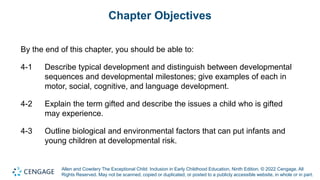
Chapter Objectives
By the end of this chapter, you should be able to:
4-1 Describe typical development and distinguish between developmental
sequences and developmental milestones; give examples of each in
motor, social, cognitive, and language development.
4-2 Explain the term gifted and describe the issues a child who is gifted
may experience.
4-3 Outline biological and environmental factors that can put infants and
young children at developmental risk.
Allen and Cowdery The Exceptional Child: Inclusion in Early Childhood Education, Ninth Edition. © 2022 Cengage. All
Rights Reserved. May not be scanned, copied or duplicated, or posted to a publicly accessible website, in whole or in part.
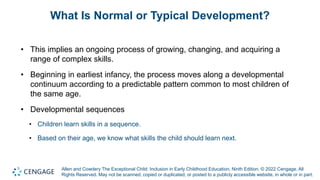
What Is Normal or Typical Development?
• This implies an ongoing process of growing, changing, and acquiring a
range of complex skills.
• Beginning in earliest infancy, the process moves along a developmental
continuum according to a predictable pattern common to most children of
the same age.
• Developmental sequences
• Children learn skills in a sequence.
• Based on their age, we know what skills the child should learn next.
Allen and Cowdery The Exceptional Child: Inclusion in Early Childhood Education, Ninth Edition. © 2022 Cengage. All
Rights Reserved. May not be scanned, copied or duplicated, or posted to a publicly accessible website, in whole or in part.
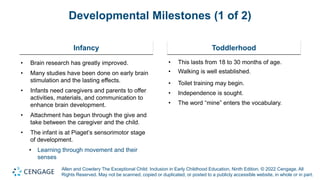
Developmental Milestones (1 of 2)
Infancy
• Brain research has greatly improved.
• Many studies have been done on early brain
stimulation and the lasting effects.
• Infants need caregivers and parents to offer
activities, materials, and communication to
enhance brain development.
• Attachment has begun through the give and
take between the caregiver and the child.
• The infant is at Piaget’s sensorimotor stage
of development.
• Learning through movement and their
senses
Toddlerhood
• This lasts from 18 to 30 months of age.
• Walking is well established.
• Toilet training may begin.
• Independence is sought.
• The word “mine” enters the vocabulary.
Allen and Cowdery The Exceptional Child: Inclusion in Early Childhood Education, Ninth Edition. © 2022 Cengage. All
Rights Reserved. May not be scanned, copied or duplicated, or posted to a publicly accessible website, in whole or in part.
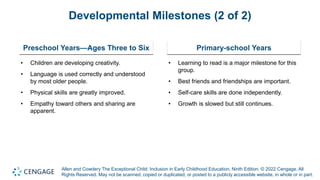
Developmental Milestones (2 of 2)
Preschool Years—Ages Three to Six
• Children are developing creativity.
• Language is used correctly and understood
by most older people.
• Physical skills are greatly improved.
• Empathy toward others and sharing are
apparent.
Primary-school Years
• Learning to read is a major milestone for this
group.
• Best friends and friendships are important.
• Self-care skills are done independently.
• Growth is slowed but still continues.
Allen and Cowdery The Exceptional Child: Inclusion in Early Childhood Education, Ninth Edition. © 2022 Cengage. All
Rights Reserved. May not be scanned, copied or duplicated, or posted to a publicly accessible website, in whole or in part.
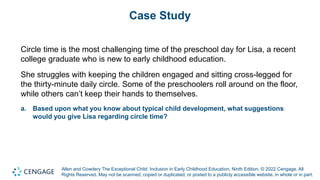
Case Study
Circle time is the most challenging time of the preschool day for Lisa, a recent
college graduate who is new to early childhood education.
She struggles with keeping the children engaged and sitting cross-legged for
the thirty-minute daily circle. Some of the preschoolers roll around on the floor,
while others can’t keep their hands to themselves.
a. Based upon what you know about typical child development, what suggestions
would you give Lisa regarding circle time?
Allen and Cowdery The Exceptional Child: Inclusion in Early Childhood Education, Ninth Edition. © 2022 Cengage. All
Rights Reserved. May not be scanned, copied or duplicated, or posted to a publicly accessible website, in whole or in part.
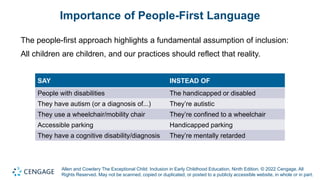
Importance of People-First Language
The people-first approach highlights a fundamental assumption of inclusion:
All children are children, and our practices should reflect that reality.
SAY INSTEAD OF
People with disabilities The handicapped or disabled
They have autism (or a diagnosis of...) They’re autistic
They use a wheelchair/mobility chair They’re confined to a wheelchair
Accessible parking Handicapped parking
They have a cognitive disability/diagnosis They’re mentally retarded
Allen and Cowdery The Exceptional Child: Inclusion in Early Childhood Education, Ninth Edition. © 2022 Cengage. All
Rights Reserved. May not be scanned, copied or duplicated, or posted to a publicly accessible website, in whole or in part.
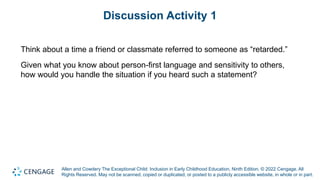
Discussion Activity 1
Think about a time a friend or classmate referred to someone as “retarded.”
Given what you know about person-first language and sensitivity to others,
how would you handle the situation if you heard such a statement?
Allen and Cowdery The Exceptional Child: Inclusion in Early Childhood Education, Ninth Edition. © 2022 Cengage. All
Rights Reserved. May not be scanned, copied or duplicated, or posted to a publicly accessible website, in whole or in part.
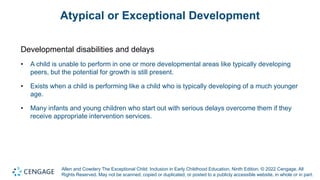
Atypical or Exceptional Development
Developmental disabilities and delays
• A child is unable to perform in one or more developmental areas like typically developing
peers, but the potential for growth is still present.
• Exists when a child is performing like a child who is typically developing of a much younger
age.
• Many infants and young children who start out with serious delays overcome them if they
receive appropriate intervention services.
Allen and Cowdery The Exceptional Child: Inclusion in Early Childhood Education, Ninth Edition. © 2022 Cengage. All
Rights Reserved. May not be scanned, copied or duplicated, or posted to a publicly accessible website, in whole or in part.
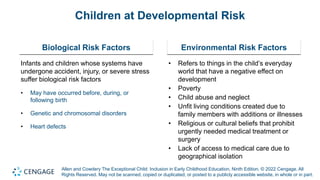
Children at Developmental Risk
Biological Risk Factors
Infants and children whose systems have
undergone accident, injury, or severe stress
suffer biological risk factors
• May have occurred before, during, or
following birth
• Genetic and chromosomal disorders
• Heart defects
Environmental Risk Factors
• Refers to things in the child’s everyday
world that have a negative effect on
development
• Poverty
• Child abuse and neglect
• Unfit living conditions created due to
family members with additions or illnesses
• Religious or cultural beliefs that prohibit
urgently needed medical treatment or
surgery
• Lack of access to medical care due to
geographical isolation
Allen and Cowdery The Exceptional Child: Inclusion in Early Childhood Education, Ninth Edition. © 2022 Cengage. All
Rights Reserved. May not be scanned, copied or duplicated, or posted to a publicly accessible website, in whole or in part.
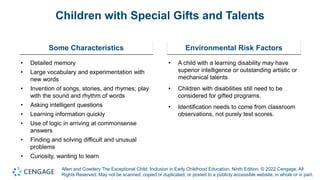
Children with Special Gifts and Talents
Some Characteristics
• Detailed memory
• Large vocabulary and experimentation with
new words
• Invention of songs, stories, and rhymes; play
with the sound and rhythm of words
• Asking intelligent questions
• Learning information quickly
• Use of logic in arriving at commonsense
answers
• Finding and solving difficult and unusual
problems
• Curiosity, wanting to learn
Environmental Risk Factors
• A child with a learning disability may have
superior intelligence or outstanding artistic or
mechanical talents
• Children with disabilities still need to be
considered for gifted programs.
• Identification needs to come from classroom
observations, not purely test scores.
Allen and Cowdery The Exceptional Child: Inclusion in Early Childhood Education, Ninth Edition. © 2022 Cengage. All
Rights Reserved. May not be scanned, copied or duplicated, or posted to a publicly accessible website, in whole or in part.
Discussion Activity 2
Have you or any of your siblings, friends, or relatives been described as gifted
or talented?
Describe the exceptional characteristics that led to such a label.
Allen and Cowdery The Exceptional Child: Inclusion in Early Childhood Education, Ninth Edition. © 2022 Cengage. All
Rights Reserved. May not be scanned, copied or duplicated, or posted to a publicly accessible website, in whole or in part.
Summary
Now that the lesson has ended, you should have learned how to:
• Describe typical development and distinguish between developmental sequences and
developmental milestones; give examples of each in motor, social, cognitive, and language
development.
• Explain the term gifted and describe the issues a child who is gifted may experience.
• Outline biological and environmental factors that can put infants and young children at
developmental risk.

Allen Chapter 4

  • 1.
    Allen and CowderyThe Exceptional Child: Inclusion in Early Childhood Education, Ninth Edition. © 2022 Cengage. All Rights Reserved. May not be scanned, copied or duplicated, or posted to a publicly accessible website, in whole or in part. Normal and Exceptional Development Chapter 4 Allen and Cowdery The Exceptional Child: Inclusion in Early Childhood Education, Ninth Edition. © 2022 Cengage. All Rights Reserved. May not be scanned, copied or duplicated, or posted to a publicly accessible website, in whole or in part.
  • 2.
    Allen and CowderyThe Exceptional Child: Inclusion in Early Childhood Education, Ninth Edition. © 2022 Cengage. All Rights Reserved. May not be scanned, copied or duplicated, or posted to a publicly accessible website, in whole or in part. Chapter Objectives By the end of this chapter, you should be able to: 4-1 Describe typical development and distinguish between developmental sequences and developmental milestones; give examples of each in motor, social, cognitive, and language development. 4-2 Explain the term gifted and describe the issues a child who is gifted may experience. 4-3 Outline biological and environmental factors that can put infants and young children at developmental risk.
  • 3.
    Allen and CowderyThe Exceptional Child: Inclusion in Early Childhood Education, Ninth Edition. © 2022 Cengage. All Rights Reserved. May not be scanned, copied or duplicated, or posted to a publicly accessible website, in whole or in part. What Is Normal or Typical Development? • This implies an ongoing process of growing, changing, and acquiring a range of complex skills. • Beginning in earliest infancy, the process moves along a developmental continuum according to a predictable pattern common to most children of the same age. • Developmental sequences • Children learn skills in a sequence. • Based on their age, we know what skills the child should learn next.
  • 4.
    Allen and CowderyThe Exceptional Child: Inclusion in Early Childhood Education, Ninth Edition. © 2022 Cengage. All Rights Reserved. May not be scanned, copied or duplicated, or posted to a publicly accessible website, in whole or in part. Developmental Milestones (1 of 2) Infancy • Brain research has greatly improved. • Many studies have been done on early brain stimulation and the lasting effects. • Infants need caregivers and parents to offer activities, materials, and communication to enhance brain development. • Attachment has begun through the give and take between the caregiver and the child. • The infant is at Piaget’s sensorimotor stage of development. • Learning through movement and their senses Toddlerhood • This lasts from 18 to 30 months of age. • Walking is well established. • Toilet training may begin. • Independence is sought. • The word “mine” enters the vocabulary.
  • 5.
    Allen and CowderyThe Exceptional Child: Inclusion in Early Childhood Education, Ninth Edition. © 2022 Cengage. All Rights Reserved. May not be scanned, copied or duplicated, or posted to a publicly accessible website, in whole or in part. Developmental Milestones (2 of 2) Preschool Years—Ages Three to Six • Children are developing creativity. • Language is used correctly and understood by most older people. • Physical skills are greatly improved. • Empathy toward others and sharing are apparent. Primary-school Years • Learning to read is a major milestone for this group. • Best friends and friendships are important. • Self-care skills are done independently. • Growth is slowed but still continues.
  • 6.
    Allen and CowderyThe Exceptional Child: Inclusion in Early Childhood Education, Ninth Edition. © 2022 Cengage. All Rights Reserved. May not be scanned, copied or duplicated, or posted to a publicly accessible website, in whole or in part. Case Study Circle time is the most challenging time of the preschool day for Lisa, a recent college graduate who is new to early childhood education. She struggles with keeping the children engaged and sitting cross-legged for the thirty-minute daily circle. Some of the preschoolers roll around on the floor, while others can’t keep their hands to themselves. a. Based upon what you know about typical child development, what suggestions would you give Lisa regarding circle time?
  • 7.
    Allen and CowderyThe Exceptional Child: Inclusion in Early Childhood Education, Ninth Edition. © 2022 Cengage. All Rights Reserved. May not be scanned, copied or duplicated, or posted to a publicly accessible website, in whole or in part. Importance of People-First Language The people-first approach highlights a fundamental assumption of inclusion: All children are children, and our practices should reflect that reality. SAY INSTEAD OF People with disabilities The handicapped or disabled They have autism (or a diagnosis of...) They’re autistic They use a wheelchair/mobility chair They’re confined to a wheelchair Accessible parking Handicapped parking They have a cognitive disability/diagnosis They’re mentally retarded
  • 8.
    Allen and CowderyThe Exceptional Child: Inclusion in Early Childhood Education, Ninth Edition. © 2022 Cengage. All Rights Reserved. May not be scanned, copied or duplicated, or posted to a publicly accessible website, in whole or in part. Discussion Activity 1 Think about a time a friend or classmate referred to someone as “retarded.” Given what you know about person-first language and sensitivity to others, how would you handle the situation if you heard such a statement?
  • 9.
    Allen and CowderyThe Exceptional Child: Inclusion in Early Childhood Education, Ninth Edition. © 2022 Cengage. All Rights Reserved. May not be scanned, copied or duplicated, or posted to a publicly accessible website, in whole or in part. Atypical or Exceptional Development Developmental disabilities and delays • A child is unable to perform in one or more developmental areas like typically developing peers, but the potential for growth is still present. • Exists when a child is performing like a child who is typically developing of a much younger age. • Many infants and young children who start out with serious delays overcome them if they receive appropriate intervention services.
  • 10.
    Allen and CowderyThe Exceptional Child: Inclusion in Early Childhood Education, Ninth Edition. © 2022 Cengage. All Rights Reserved. May not be scanned, copied or duplicated, or posted to a publicly accessible website, in whole or in part. Children at Developmental Risk Biological Risk Factors Infants and children whose systems have undergone accident, injury, or severe stress suffer biological risk factors • May have occurred before, during, or following birth • Genetic and chromosomal disorders • Heart defects Environmental Risk Factors • Refers to things in the child’s everyday world that have a negative effect on development • Poverty • Child abuse and neglect • Unfit living conditions created due to family members with additions or illnesses • Religious or cultural beliefs that prohibit urgently needed medical treatment or surgery • Lack of access to medical care due to geographical isolation
  • 11.
    Allen and CowderyThe Exceptional Child: Inclusion in Early Childhood Education, Ninth Edition. © 2022 Cengage. All Rights Reserved. May not be scanned, copied or duplicated, or posted to a publicly accessible website, in whole or in part. Children with Special Gifts and Talents Some Characteristics • Detailed memory • Large vocabulary and experimentation with new words • Invention of songs, stories, and rhymes; play with the sound and rhythm of words • Asking intelligent questions • Learning information quickly • Use of logic in arriving at commonsense answers • Finding and solving difficult and unusual problems • Curiosity, wanting to learn Environmental Risk Factors • A child with a learning disability may have superior intelligence or outstanding artistic or mechanical talents • Children with disabilities still need to be considered for gifted programs. • Identification needs to come from classroom observations, not purely test scores.
  • 12.
    Allen and CowderyThe Exceptional Child: Inclusion in Early Childhood Education, Ninth Edition. © 2022 Cengage. All Rights Reserved. May not be scanned, copied or duplicated, or posted to a publicly accessible website, in whole or in part. Discussion Activity 2 Have you or any of your siblings, friends, or relatives been described as gifted or talented? Describe the exceptional characteristics that led to such a label.
  • 13.
    Allen and CowderyThe Exceptional Child: Inclusion in Early Childhood Education, Ninth Edition. © 2022 Cengage. All Rights Reserved. May not be scanned, copied or duplicated, or posted to a publicly accessible website, in whole or in part. Summary Now that the lesson has ended, you should have learned how to: • Describe typical development and distinguish between developmental sequences and developmental milestones; give examples of each in motor, social, cognitive, and language development. • Explain the term gifted and describe the issues a child who is gifted may experience. • Outline biological and environmental factors that can put infants and young children at developmental risk.