Allen and Cowdery, The Exceptional Child: Inclusion in Early Childhood Education, Ninth Edition. © 2022 Cengage. All
Rights Reserved. May not be scanned, copied or duplicated, or posted to a publicly accessible website, in whole or in part.
Arranging the Learning Environment
Chapter 13
Allen and Cowdery, The Exceptional Child: Inclusion in Early Childhood Education, Ninth Edition. © 2022 Cengage. All
Rights Reserved. May not be scanned, copied or duplicated, or posted to a publicly accessible website, in whole or in part.
Allen and Cowdery, The Exceptional Child: Inclusion in Early Childhood Education, Ninth Edition. © 2022 Cengage. All
Rights Reserved. May not be scanned, copied or duplicated, or posted to a publicly accessible website, in whole or in part.
Chapter Objectives (1 of 2)
By the end of this chapter, you should be able to:
13-1 highlight the importance of arranging the environment in an inclusive
classroom.
13-2 define preventive discipline, describe the procedure, and explain its
value in guiding young children with and without challenging behaviors.
13-3 explain how types of learning are impacted by the physical arrangement
of the classroom.
Allen and Cowdery, The Exceptional Child: Inclusion in Early Childhood Education, Ninth Edition. © 2022 Cengage. All
Rights Reserved. May not be scanned, copied or duplicated, or posted to a publicly accessible website, in whole or in part.
Chapter Objectives (2 of 2)
By the end of this chapter, you should be able to:
13-4 understand the key elements in planning early learning environments,
which include safety, visibility, matching children and equipment, ease
of movement, promoting independence, teachers’ availability, offering
choice, novelty versus familiarity, and structured flexibility.
13-5 discuss the major issues in planning a program schedule for children in
an inclusive setting.
13-6 describe smooth transitions and the learnings available to children
during transitions.
Allen and Cowdery, The Exceptional Child: Inclusion in Early Childhood Education, Ninth Edition. © 2022 Cengage. All
Rights Reserved. May not be scanned, copied or duplicated, or posted to a publicly accessible website, in whole or in part.
The Inclusive Classroom Environment
Arrange environments so all children can be successful.
• Loud and distracting noises can be difficult for children
• Ensure safety with floors and areas of movement
• Minimize clutter and confusion
• Provide a consistent and structured routine with clear expectations
Allen and Cowdery, The Exceptional Child: Inclusion in Early Childhood Education, Ninth Edition. © 2022 Cengage. All
Rights Reserved. May not be scanned, copied or duplicated, or posted to a publicly accessible website, in whole or in part.
Preventive Discipline (1 of 2)
• Ensure environment and schedule sets children up for success
• Have clear and well communicated expectations
• Support positive behaviors
Allen and Cowdery, The Exceptional Child: Inclusion in Early Childhood Education, Ninth Edition. © 2022 Cengage. All
Rights Reserved. May not be scanned, copied or duplicated, or posted to a publicly accessible website, in whole or in part.
Preventive Discipline (2 of 2)
Accomplishes the following:
• Communicates to children how to behave, and then facilitates children’s efforts
• Makes it easy for children to learn the vast number of behaviors and skills necessary for
growing up confident and competent in a world that expects much of young children
• Helps children avoid unnecessary and ego-deflating errors that squander children’s time
• Assures a positive climate in which teachers enjoy teaching, and children of different
developmental levels enjoy learning together
Allen and Cowdery, The Exceptional Child: Inclusion in Early Childhood Education, Ninth Edition. © 2022 Cengage. All
Rights Reserved. May not be scanned, copied or duplicated, or posted to a publicly accessible website, in whole or in part.
Knowledge Check Activity 1
In what way do guidance procedures reduce prejudice and promote positive
outcomes?
a. Helping children learn to behave appropriately reduces the differences that often set them
apart and produce unfavorable attitudes toward them
b. Arranging the learning environment in a conducive way
c. Facilitated by adult anticipation
d. Through caring and effective teaching
Allen and Cowdery, The Exceptional Child: Inclusion in Early Childhood Education, Ninth Edition. © 2022 Cengage. All
Rights Reserved. May not be scanned, copied or duplicated, or posted to a publicly accessible website, in whole or in part.
Knowledge Check Activity 1 Answer
In what way do guidance procedures reduce prejudice and promote positive
outcomes?
Answer: a. Helping children learn to behave appropriately reduces the differences that
often set them apart and produce unfavorable attitudes toward them.
Allen and Cowdery, The Exceptional Child: Inclusion in Early Childhood Education, Ninth Edition. © 2022 Cengage. All
Rights Reserved. May not be scanned, copied or duplicated, or posted to a publicly accessible website, in whole or in part.
Arrangements for Learning
• Set up the environment for learning to take place
• Arrangements, materials and activities should be sensitive to
developmental sequences
Allen and Cowdery, The Exceptional Child: Inclusion in Early Childhood Education, Ninth Edition. © 2022 Cengage. All
Rights Reserved. May not be scanned, copied or duplicated, or posted to a publicly accessible website, in whole or in part.
Types of Learning
Most preschool programs plan three broad types of experiences for learning:
• Through self-help routines
• Through teacher-structured activities
• Through discovery learning periods (free-play or child-initiated activities)
Allen and Cowdery, The Exceptional Child: Inclusion in Early Childhood Education, Ninth Edition. © 2022 Cengage. All
Rights Reserved. May not be scanned, copied or duplicated, or posted to a publicly accessible website, in whole or in part.
Self-help Routines
Self-help or independence skills
• Independence-promoting skills related to socially prescribed routines
• Such as toileting, dressing, eating, cleaning up, and doing one’s share
• Indirectly provide help by arranging the environment so that all types of children can work
and play together
• Appropriately sized furnishings and accessories promote independence
• Poorly functioning equipment results in induced incompetence in children with disabilities
Allen and Cowdery, The Exceptional Child: Inclusion in Early Childhood Education, Ninth Edition. © 2022 Cengage. All
Rights Reserved. May not be scanned, copied or duplicated, or posted to a publicly accessible website, in whole or in part.
Arrangements to Promote Self-help (1 of 3)
Toilet facilities
• Major developmental task for most children
• Toilets are of appropriate size and height
• Adequate space for maneuvering
• For crutches or a walker or pulling a wheelchair parallel with toilet
• A handrail to allow independence in sitting and standing
• A footstool for feet to reduce fear of falling in
Allen and Cowdery, The Exceptional Child: Inclusion in Early Childhood Education, Ninth Edition. © 2022 Cengage. All
Rights Reserved. May not be scanned, copied or duplicated, or posted to a publicly accessible website, in whole or in part.
Arrangements to Promote Self-help (2 of 3)
Cubby areas
• A place for each child to place personal belongings
• Increases responsibility and organizational skills
• Teaches importance of respecting each other’s property
• Allow for independence by saving materials or getting items for nap time
Allen and Cowdery, The Exceptional Child: Inclusion in Early Childhood Education, Ninth Edition. © 2022 Cengage. All
Rights Reserved. May not be scanned, copied or duplicated, or posted to a publicly accessible website, in whole or in part.
Arrangements to Promote Self-help (3 of 3)
Sleeping area
• Quiet area free from distractions
• Create an environment conducive to resting
• Close blinds, play soft music, bring something to cuddle from home
• Cots should be stored where children can help with setup and cleanup.
• Provide alternatives for children who require less rest
• Small baskets of books and quiet toys
Allen and Cowdery, The Exceptional Child: Inclusion in Early Childhood Education, Ninth Edition. © 2022 Cengage. All
Rights Reserved. May not be scanned, copied or duplicated, or posted to a publicly accessible website, in whole or in part.
Teacher-Structured Activities
• Have a space where a teacher can work with a small group, large group, or
one-on-one.
• Lessons are taught related to skills the children need to work on.
• After the lesson, the goal is for the children to continue practice on their
own.
Allen and Cowdery, The Exceptional Child: Inclusion in Early Childhood Education, Ninth Edition. © 2022 Cengage. All
Rights Reserved. May not be scanned, copied or duplicated, or posted to a publicly accessible website, in whole or in part.
Discovery Learning
• Free play, child-initiated activities, and free-choice periods
• Uninterrupted blocks of time fundamental to early learning
• Both indoors and outdoors
• Children discover while engaging with materials.
• Play is a form of learning through a child-initiated activities.
• Location is determined by furniture, storage, and the cleanup requirements
of each area
Allen and Cowdery, The Exceptional Child: Inclusion in Early Childhood Education, Ninth Edition. © 2022 Cengage. All
Rights Reserved. May not be scanned, copied or duplicated, or posted to a publicly accessible website, in whole or in part.
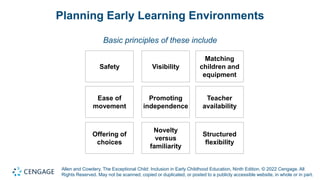
Planning Early Learning Environments
Basic principles of these include
Safety Visibility
Matching
children and
equipment
Ease of
movement
Promoting
independence
Teacher
availability
Offering of
choices
Novelty
versus
familiarity
Structured
flexibility
Allen and Cowdery, The Exceptional Child: Inclusion in Early Childhood Education, Ninth Edition. © 2022 Cengage. All
Rights Reserved. May not be scanned, copied or duplicated, or posted to a publicly accessible website, in whole or in part.
Safety
Order and organization
• Arrange equipment so that everything has its place
• Order the environment and reset it so that each child can play with it new
Safe outdoor environments
• Supervision
• Age appropriate
• Safe fall zones
• Equipment and surface maintenance
Allen and Cowdery, The Exceptional Child: Inclusion in Early Childhood Education, Ninth Edition. © 2022 Cengage. All
Rights Reserved. May not be scanned, copied or duplicated, or posted to a publicly accessible website, in whole or in part.
Visibility
• Children will be taking risks as they try out new things, therefore, they need
to be visible.
• Teachers need to see all areas of the room and outdoors at all times.
• Find a place to stand to allow 100 percent visibility
Allen and Cowdery, The Exceptional Child: Inclusion in Early Childhood Education, Ninth Edition. © 2022 Cengage. All
Rights Reserved. May not be scanned, copied or duplicated, or posted to a publicly accessible website, in whole or in part.
Matching Children and Equipment
• Check toys for safety
• Include all parts of the toy
• Check for choking hazards
• Toys need to be appropriate for the youngest learner and yet not bore the
more advanced
Allen and Cowdery, The Exceptional Child: Inclusion in Early Childhood Education, Ninth Edition. © 2022 Cengage. All
Rights Reserved. May not be scanned, copied or duplicated, or posted to a publicly accessible website, in whole or in part.
Ease of Movement
• The class needs to be set up so the children can move freely through the
room.
• The children should not have so much freedom that they begin to run and
cause safety issues.
Allen and Cowdery, The Exceptional Child: Inclusion in Early Childhood Education, Ninth Edition. © 2022 Cengage. All
Rights Reserved. May not be scanned, copied or duplicated, or posted to a publicly accessible website, in whole or in part.
Promoting Independence
• In arranging the environment, all materials that children are allowed to have
should be where the children can reach them.
• Children should know how to put the toys back.
• Shelves should be labeled for ease.
• Simple directions should be used for transitions.
Allen and Cowdery, The Exceptional Child: Inclusion in Early Childhood Education, Ninth Edition. © 2022 Cengage. All
Rights Reserved. May not be scanned, copied or duplicated, or posted to a publicly accessible website, in whole or in part.
Teachers’ Availability
• If the classroom is organized effectively, teachers can teach.
• Zone teaching is one way. Teachers work in a zone or area and enhance
learning while the children are in that play area.
Allen and Cowdery, The Exceptional Child: Inclusion in Early Childhood Education, Ninth Edition. © 2022 Cengage. All
Rights Reserved. May not be scanned, copied or duplicated, or posted to a publicly accessible website, in whole or in part.
Offering Choice
• One of the most effective and most often overlooked forms of preventive
discipline
• Empowering because it allows them to assert their independence
• Works effectively with children who frequently say “no” when offered only
one option
• Provides opportunity for a child developing language to practice requesting
either with words, pointing, sign language, or other system
• Can prevent a child from having a tantrum because they feel they have
some control of the situation.
Allen and Cowdery, The Exceptional Child: Inclusion in Early Childhood Education, Ninth Edition. © 2022 Cengage. All
Rights Reserved. May not be scanned, copied or duplicated, or posted to a publicly accessible website, in whole or in part.
Novelty versus Familiarity
• Children thrive in environments that are familiar and consistent
• Important to provide new materials, displays, and perspectives
• Changes can lead to increased use of language, critical thinking, and
problem-solving skills
• Novelty keeps the excitement going
Allen and Cowdery, The Exceptional Child: Inclusion in Early Childhood Education, Ninth Edition. © 2022 Cengage. All
Rights Reserved. May not be scanned, copied or duplicated, or posted to a publicly accessible website, in whole or in part.
Structured Flexibility
• A well-structured environment, where rules and expectations are consistent,
provides a secure framework that supports children’s freedom
• Children can explore and test limits, and teachers can react spontaneously
to the infinite variations in children’s learning
Allen and Cowdery, The Exceptional Child: Inclusion in Early Childhood Education, Ninth Edition. © 2022 Cengage. All
Rights Reserved. May not be scanned, copied or duplicated, or posted to a publicly accessible website, in whole or in part.
Case Study
After the children finish lunch, they can play in one of several areas while they wait for their
classmates to finish eating and get ready to head outdoors. These areas include a train table,
fine motor area, housekeeping, and reading corner.
As the children finish lunch, some of the staff move from the lunch tables and help facilitate
play in the play areas. Almost every day, at least two children begin chasing each other around
the train table and then in between the two lunch tables. One child is usually in pursuit of the
other, who has taken a preferred toy and run off with it.
A staff member usually redirects them back to the play area and facilitates turn-taking or
appropriate requesting of a toy from a peer. Things typically settle down for a few minutes, and
then another similar interaction occurs.
The staff has reported that they find this time of the day frustrating, as they feel like all they are
doing is putting out fires and counting the minutes until they can take the children outside.
Allen and Cowdery, The Exceptional Child: Inclusion in Early Childhood Education, Ninth Edition. © 2022 Cengage. All
Rights Reserved. May not be scanned, copied or duplicated, or posted to a publicly accessible website, in whole or in part.
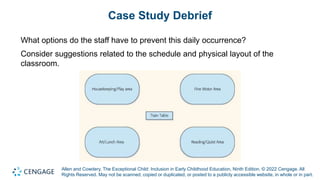
Case Study Debrief
What options do the staff have to prevent this daily occurrence?
Consider suggestions related to the schedule and physical layout of the
classroom.
Allen and Cowdery, The Exceptional Child: Inclusion in Early Childhood Education, Ninth Edition. © 2022 Cengage. All
Rights Reserved. May not be scanned, copied or duplicated, or posted to a publicly accessible website, in whole or in part.
Scheduling Principles
• Accommodating individual differences—lessons relate to each individual’s
needs
• Varying activity levels—vary high-movement activities with quiet activities to
allow children to regain their energy
• Ensuring orderly sequences—the schedule should flow, not be choppy
without connections. Build in transitions
• Giving advance notice—let children know that one activity is ending and a
new one is about to begin
Allen and Cowdery, The Exceptional Child: Inclusion in Early Childhood Education, Ninth Edition. © 2022 Cengage. All
Rights Reserved. May not be scanned, copied or duplicated, or posted to a publicly accessible website, in whole or in part.
Application of Scheduling Principles
• Schedules are based on type of program, number of teachers, and number
and type of children
• Critical elements are the sequencing of activities and the allocating of
ample time for children’s learning needs and interests
• Full-day child care settings, early morning, late afternoon, meal, and nap
times all require extra special planning
Allen and Cowdery, The Exceptional Child: Inclusion in Early Childhood Education, Ninth Edition. © 2022 Cengage. All
Rights Reserved. May not be scanned, copied or duplicated, or posted to a publicly accessible website, in whole or in part.
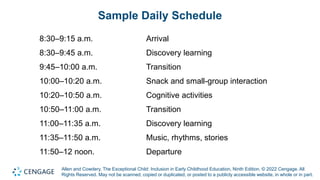
Sample Daily Schedule
8:30–9:15 a.m. Arrival
8:30–9:45 a.m. Discovery learning
9:45–10:00 a.m. Transition
10:00–10:20 a.m. Snack and small-group interaction
10:20–10:50 a.m. Cognitive activities
10:50–11:00 a.m. Transition
11:00–11:35 a.m. Discovery learning
11:35–11:50 a.m. Music, rhythms, stories
11:50–12 noon. Departure
Allen and Cowdery, The Exceptional Child: Inclusion in Early Childhood Education, Ninth Edition. © 2022 Cengage. All
Rights Reserved. May not be scanned, copied or duplicated, or posted to a publicly accessible website, in whole or in part.
Learning Goals, Schedule, and Embedded
Learning Opportunities
• A challenge to ensure that children are always engaged in learning
• Learning goals come from the IEP or the curriculum for that age group
• They are taught throughout the day in a variety of settings using a variety of
materials
• By targeting times in which IEP goals are to be taught, teachers provide
regular opportunities to practice and strengthen skills
Allen and Cowdery, The Exceptional Child: Inclusion in Early Childhood Education, Ninth Edition. © 2022 Cengage. All
Rights Reserved. May not be scanned, copied or duplicated, or posted to a publicly accessible website, in whole or in part.
Teacher Schedules
• Specifies the location and activities throughout the day
• Teacher-structured activities such as planning, preparing, etc. to be
scheduled
• Planned staff meetings to discuss classroom and children's needs
Allen and Cowdery, The Exceptional Child: Inclusion in Early Childhood Education, Ninth Edition. © 2022 Cengage. All
Rights Reserved. May not be scanned, copied or duplicated, or posted to a publicly accessible website, in whole or in part.
Discussion Activity 1
1. Break into small groups
2. Discuss the benefits of providing a consistent schedule for children
3. Discuss the benefits of providing a consistent schedule for teachers
4. Describe how each of the following principles applies when planning
activity schedules:
• Accommodating individual differences
• Varying activity levels
• Ensuring orderly sequences
• Giving advance notice
Allen and Cowdery, The Exceptional Child: Inclusion in Early Childhood Education, Ninth Edition. © 2022 Cengage. All
Rights Reserved. May not be scanned, copied or duplicated, or posted to a publicly accessible website, in whole or in part.
Discussion Activity 1 Debrief
1. What are the benefits of providing a consistent schedule for children?
2. What are the benefits of providing a consistent schedule for teachers?
3. How do the following principles apply when planning activity schedules?
• Accommodating individual differences
• Varying activity levels
• Ensuring orderly sequences
• Giving advance notice
Allen and Cowdery, The Exceptional Child: Inclusion in Early Childhood Education, Ninth Edition. © 2022 Cengage. All
Rights Reserved. May not be scanned, copied or duplicated, or posted to a publicly accessible website, in whole or in part.
Transitions
The underlying principle of smooth transitions is that each child moves
individually, at their own pace, from one activity to the next
Diverse learning needs of children in various cognitive activities prompt
teachers to hold children for differing lengths of time
Effective transitions require detailed planning and an adequate ratio of
teachers to children
Allen and Cowdery, The Exceptional Child: Inclusion in Early Childhood Education, Ninth Edition. © 2022 Cengage. All
Rights Reserved. May not be scanned, copied or duplicated, or posted to a publicly accessible website, in whole or in part.
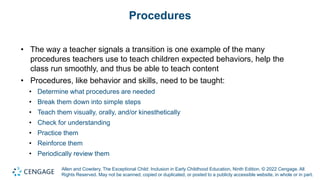
Procedures
• The way a teacher signals a transition is one example of the many
procedures teachers use to teach children expected behaviors, help the
class run smoothly, and thus be able to teach content
• Procedures, like behavior and skills, need to be taught:
• Determine what procedures are needed
• Break them down into simple steps
• Teach them visually, orally, and/or kinesthetically
• Check for understanding
• Practice them
• Reinforce them
• Periodically review them
Allen and Cowdery, The Exceptional Child: Inclusion in Early Childhood Education, Ninth Edition. © 2022 Cengage. All
Rights Reserved. May not be scanned, copied or duplicated, or posted to a publicly accessible website, in whole or in part.
Discussion Activity 2
1. Break into small groups
2. Make a list of five classroom procedures one might observe in a preschool
class
3. Describe how a teacher can teach and reinforce these procedures to
increase independence of all children
Allen and Cowdery, The Exceptional Child: Inclusion in Early Childhood Education, Ninth Edition. © 2022 Cengage. All
Rights Reserved. May not be scanned, copied or duplicated, or posted to a publicly accessible website, in whole or in part.
Discussion Activity 2 Debrief
1. What five classroom procedures did your group come up with?
2. How could a teacher teach and reinforce these procedures to increase
independence of all children?
Allen and Cowdery, The Exceptional Child: Inclusion in Early Childhood Education, Ninth Edition. © 2022 Cengage. All
Rights Reserved. May not be scanned, copied or duplicated, or posted to a publicly accessible website, in whole or in part.
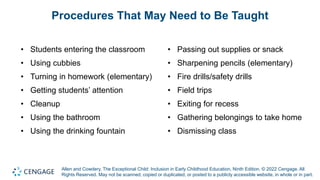
Procedures That May Need to Be Taught
• Students entering the classroom
• Using cubbies
• Turning in homework (elementary)
• Getting students’ attention
• Cleanup
• Using the bathroom
• Using the drinking fountain
• Passing out supplies or snack
• Sharpening pencils (elementary)
• Fire drills/safety drills
• Field trips
• Exiting for recess
• Gathering belongings to take home
• Dismissing class
Allen and Cowdery, The Exceptional Child: Inclusion in Early Childhood Education, Ninth Edition. © 2022 Cengage. All
Rights Reserved. May not be scanned, copied or duplicated, or posted to a publicly accessible website, in whole or in part.
Considerations
For Infants and Toddlers
• Use the environment to teach, everything
from the flooring to the lighting.
• Set up the environment so the teacher
can enjoy the children exploring without
constant worry about safety.
• Aim for continuity of care, where a
caregiver stays with a child for years
instead of months.
For Early Elementary Years
• Children should be encouraged to be
independent and responsible for own
behavior and learning.
• Children are expected to improve their
literacy skills.
• A balance of high physical activity with
quiet activity is necessary.
• Provide for differentiation through
varieties of activities and materials.
Allen and Cowdery, The Exceptional Child: Inclusion in Early Childhood Education, Ninth Edition. © 2022 Cengage. All
Rights Reserved. May not be scanned, copied or duplicated, or posted to a publicly accessible website, in whole or in part.
Summary (1 of 2)
Now that the lesson has ended, you should have learned how to:
• Highlight the importance of arranging the environment in an inclusive classroom.
• Define preventive discipline, describe the procedure, and explain its value in guiding young
children with and without challenging behaviors.
• Explain how types of learning are impacted by the physical arrangement of the classroom.
Allen and Cowdery, The Exceptional Child: Inclusion in Early Childhood Education, Ninth Edition. © 2022 Cengage. All
Rights Reserved. May not be scanned, copied or duplicated, or posted to a publicly accessible website, in whole or in part.
Summary (2 of 2)
Now that the lesson has ended, you should have learned how to:
• Understand the key elements in planning early learning environments, which include
safety, visibility, matching children and equipment, ease of movement, promoting
independence, teachers’ availability, offering choice, novelty versus familiarity, and
structured flexibility.
• Discuss the major issues in planning a program schedule for children in an inclusive
setting.
• Describe smooth transitions and the learnings available to children during transitions.

Allen Chapter 13

  • 1.
    Allen and Cowdery,The Exceptional Child: Inclusion in Early Childhood Education, Ninth Edition. © 2022 Cengage. All Rights Reserved. May not be scanned, copied or duplicated, or posted to a publicly accessible website, in whole or in part. Arranging the Learning Environment Chapter 13 Allen and Cowdery, The Exceptional Child: Inclusion in Early Childhood Education, Ninth Edition. © 2022 Cengage. All Rights Reserved. May not be scanned, copied or duplicated, or posted to a publicly accessible website, in whole or in part.
  • 2.
    Allen and Cowdery,The Exceptional Child: Inclusion in Early Childhood Education, Ninth Edition. © 2022 Cengage. All Rights Reserved. May not be scanned, copied or duplicated, or posted to a publicly accessible website, in whole or in part. Chapter Objectives (1 of 2) By the end of this chapter, you should be able to: 13-1 highlight the importance of arranging the environment in an inclusive classroom. 13-2 define preventive discipline, describe the procedure, and explain its value in guiding young children with and without challenging behaviors. 13-3 explain how types of learning are impacted by the physical arrangement of the classroom.
  • 3.
    Allen and Cowdery,The Exceptional Child: Inclusion in Early Childhood Education, Ninth Edition. © 2022 Cengage. All Rights Reserved. May not be scanned, copied or duplicated, or posted to a publicly accessible website, in whole or in part. Chapter Objectives (2 of 2) By the end of this chapter, you should be able to: 13-4 understand the key elements in planning early learning environments, which include safety, visibility, matching children and equipment, ease of movement, promoting independence, teachers’ availability, offering choice, novelty versus familiarity, and structured flexibility. 13-5 discuss the major issues in planning a program schedule for children in an inclusive setting. 13-6 describe smooth transitions and the learnings available to children during transitions.
  • 4.
    Allen and Cowdery,The Exceptional Child: Inclusion in Early Childhood Education, Ninth Edition. © 2022 Cengage. All Rights Reserved. May not be scanned, copied or duplicated, or posted to a publicly accessible website, in whole or in part. The Inclusive Classroom Environment Arrange environments so all children can be successful. • Loud and distracting noises can be difficult for children • Ensure safety with floors and areas of movement • Minimize clutter and confusion • Provide a consistent and structured routine with clear expectations
  • 5.
    Allen and Cowdery,The Exceptional Child: Inclusion in Early Childhood Education, Ninth Edition. © 2022 Cengage. All Rights Reserved. May not be scanned, copied or duplicated, or posted to a publicly accessible website, in whole or in part. Preventive Discipline (1 of 2) • Ensure environment and schedule sets children up for success • Have clear and well communicated expectations • Support positive behaviors
  • 6.
    Allen and Cowdery,The Exceptional Child: Inclusion in Early Childhood Education, Ninth Edition. © 2022 Cengage. All Rights Reserved. May not be scanned, copied or duplicated, or posted to a publicly accessible website, in whole or in part. Preventive Discipline (2 of 2) Accomplishes the following: • Communicates to children how to behave, and then facilitates children’s efforts • Makes it easy for children to learn the vast number of behaviors and skills necessary for growing up confident and competent in a world that expects much of young children • Helps children avoid unnecessary and ego-deflating errors that squander children’s time • Assures a positive climate in which teachers enjoy teaching, and children of different developmental levels enjoy learning together
  • 7.
    Allen and Cowdery,The Exceptional Child: Inclusion in Early Childhood Education, Ninth Edition. © 2022 Cengage. All Rights Reserved. May not be scanned, copied or duplicated, or posted to a publicly accessible website, in whole or in part. Knowledge Check Activity 1 In what way do guidance procedures reduce prejudice and promote positive outcomes? a. Helping children learn to behave appropriately reduces the differences that often set them apart and produce unfavorable attitudes toward them b. Arranging the learning environment in a conducive way c. Facilitated by adult anticipation d. Through caring and effective teaching
  • 8.
    Allen and Cowdery,The Exceptional Child: Inclusion in Early Childhood Education, Ninth Edition. © 2022 Cengage. All Rights Reserved. May not be scanned, copied or duplicated, or posted to a publicly accessible website, in whole or in part. Knowledge Check Activity 1 Answer In what way do guidance procedures reduce prejudice and promote positive outcomes? Answer: a. Helping children learn to behave appropriately reduces the differences that often set them apart and produce unfavorable attitudes toward them.
  • 9.
    Allen and Cowdery,The Exceptional Child: Inclusion in Early Childhood Education, Ninth Edition. © 2022 Cengage. All Rights Reserved. May not be scanned, copied or duplicated, or posted to a publicly accessible website, in whole or in part. Arrangements for Learning • Set up the environment for learning to take place • Arrangements, materials and activities should be sensitive to developmental sequences
  • 10.
    Allen and Cowdery,The Exceptional Child: Inclusion in Early Childhood Education, Ninth Edition. © 2022 Cengage. All Rights Reserved. May not be scanned, copied or duplicated, or posted to a publicly accessible website, in whole or in part. Types of Learning Most preschool programs plan three broad types of experiences for learning: • Through self-help routines • Through teacher-structured activities • Through discovery learning periods (free-play or child-initiated activities)
  • 11.
    Allen and Cowdery,The Exceptional Child: Inclusion in Early Childhood Education, Ninth Edition. © 2022 Cengage. All Rights Reserved. May not be scanned, copied or duplicated, or posted to a publicly accessible website, in whole or in part. Self-help Routines Self-help or independence skills • Independence-promoting skills related to socially prescribed routines • Such as toileting, dressing, eating, cleaning up, and doing one’s share • Indirectly provide help by arranging the environment so that all types of children can work and play together • Appropriately sized furnishings and accessories promote independence • Poorly functioning equipment results in induced incompetence in children with disabilities
  • 12.
    Allen and Cowdery,The Exceptional Child: Inclusion in Early Childhood Education, Ninth Edition. © 2022 Cengage. All Rights Reserved. May not be scanned, copied or duplicated, or posted to a publicly accessible website, in whole or in part. Arrangements to Promote Self-help (1 of 3) Toilet facilities • Major developmental task for most children • Toilets are of appropriate size and height • Adequate space for maneuvering • For crutches or a walker or pulling a wheelchair parallel with toilet • A handrail to allow independence in sitting and standing • A footstool for feet to reduce fear of falling in
  • 13.
    Allen and Cowdery,The Exceptional Child: Inclusion in Early Childhood Education, Ninth Edition. © 2022 Cengage. All Rights Reserved. May not be scanned, copied or duplicated, or posted to a publicly accessible website, in whole or in part. Arrangements to Promote Self-help (2 of 3) Cubby areas • A place for each child to place personal belongings • Increases responsibility and organizational skills • Teaches importance of respecting each other’s property • Allow for independence by saving materials or getting items for nap time
  • 14.
    Allen and Cowdery,The Exceptional Child: Inclusion in Early Childhood Education, Ninth Edition. © 2022 Cengage. All Rights Reserved. May not be scanned, copied or duplicated, or posted to a publicly accessible website, in whole or in part. Arrangements to Promote Self-help (3 of 3) Sleeping area • Quiet area free from distractions • Create an environment conducive to resting • Close blinds, play soft music, bring something to cuddle from home • Cots should be stored where children can help with setup and cleanup. • Provide alternatives for children who require less rest • Small baskets of books and quiet toys
  • 15.
    Allen and Cowdery,The Exceptional Child: Inclusion in Early Childhood Education, Ninth Edition. © 2022 Cengage. All Rights Reserved. May not be scanned, copied or duplicated, or posted to a publicly accessible website, in whole or in part. Teacher-Structured Activities • Have a space where a teacher can work with a small group, large group, or one-on-one. • Lessons are taught related to skills the children need to work on. • After the lesson, the goal is for the children to continue practice on their own.
  • 16.
    Allen and Cowdery,The Exceptional Child: Inclusion in Early Childhood Education, Ninth Edition. © 2022 Cengage. All Rights Reserved. May not be scanned, copied or duplicated, or posted to a publicly accessible website, in whole or in part. Discovery Learning • Free play, child-initiated activities, and free-choice periods • Uninterrupted blocks of time fundamental to early learning • Both indoors and outdoors • Children discover while engaging with materials. • Play is a form of learning through a child-initiated activities. • Location is determined by furniture, storage, and the cleanup requirements of each area
  • 17.
    Allen and Cowdery,The Exceptional Child: Inclusion in Early Childhood Education, Ninth Edition. © 2022 Cengage. All Rights Reserved. May not be scanned, copied or duplicated, or posted to a publicly accessible website, in whole or in part. Planning Early Learning Environments Basic principles of these include Safety Visibility Matching children and equipment Ease of movement Promoting independence Teacher availability Offering of choices Novelty versus familiarity Structured flexibility
  • 18.
    Allen and Cowdery,The Exceptional Child: Inclusion in Early Childhood Education, Ninth Edition. © 2022 Cengage. All Rights Reserved. May not be scanned, copied or duplicated, or posted to a publicly accessible website, in whole or in part. Safety Order and organization • Arrange equipment so that everything has its place • Order the environment and reset it so that each child can play with it new Safe outdoor environments • Supervision • Age appropriate • Safe fall zones • Equipment and surface maintenance
  • 19.
    Allen and Cowdery,The Exceptional Child: Inclusion in Early Childhood Education, Ninth Edition. © 2022 Cengage. All Rights Reserved. May not be scanned, copied or duplicated, or posted to a publicly accessible website, in whole or in part. Visibility • Children will be taking risks as they try out new things, therefore, they need to be visible. • Teachers need to see all areas of the room and outdoors at all times. • Find a place to stand to allow 100 percent visibility
  • 20.
    Allen and Cowdery,The Exceptional Child: Inclusion in Early Childhood Education, Ninth Edition. © 2022 Cengage. All Rights Reserved. May not be scanned, copied or duplicated, or posted to a publicly accessible website, in whole or in part. Matching Children and Equipment • Check toys for safety • Include all parts of the toy • Check for choking hazards • Toys need to be appropriate for the youngest learner and yet not bore the more advanced
  • 21.
    Allen and Cowdery,The Exceptional Child: Inclusion in Early Childhood Education, Ninth Edition. © 2022 Cengage. All Rights Reserved. May not be scanned, copied or duplicated, or posted to a publicly accessible website, in whole or in part. Ease of Movement • The class needs to be set up so the children can move freely through the room. • The children should not have so much freedom that they begin to run and cause safety issues.
  • 22.
    Allen and Cowdery,The Exceptional Child: Inclusion in Early Childhood Education, Ninth Edition. © 2022 Cengage. All Rights Reserved. May not be scanned, copied or duplicated, or posted to a publicly accessible website, in whole or in part. Promoting Independence • In arranging the environment, all materials that children are allowed to have should be where the children can reach them. • Children should know how to put the toys back. • Shelves should be labeled for ease. • Simple directions should be used for transitions.
  • 23.
    Allen and Cowdery,The Exceptional Child: Inclusion in Early Childhood Education, Ninth Edition. © 2022 Cengage. All Rights Reserved. May not be scanned, copied or duplicated, or posted to a publicly accessible website, in whole or in part. Teachers’ Availability • If the classroom is organized effectively, teachers can teach. • Zone teaching is one way. Teachers work in a zone or area and enhance learning while the children are in that play area.
  • 24.
    Allen and Cowdery,The Exceptional Child: Inclusion in Early Childhood Education, Ninth Edition. © 2022 Cengage. All Rights Reserved. May not be scanned, copied or duplicated, or posted to a publicly accessible website, in whole or in part. Offering Choice • One of the most effective and most often overlooked forms of preventive discipline • Empowering because it allows them to assert their independence • Works effectively with children who frequently say “no” when offered only one option • Provides opportunity for a child developing language to practice requesting either with words, pointing, sign language, or other system • Can prevent a child from having a tantrum because they feel they have some control of the situation.
  • 25.
    Allen and Cowdery,The Exceptional Child: Inclusion in Early Childhood Education, Ninth Edition. © 2022 Cengage. All Rights Reserved. May not be scanned, copied or duplicated, or posted to a publicly accessible website, in whole or in part. Novelty versus Familiarity • Children thrive in environments that are familiar and consistent • Important to provide new materials, displays, and perspectives • Changes can lead to increased use of language, critical thinking, and problem-solving skills • Novelty keeps the excitement going
  • 26.
    Allen and Cowdery,The Exceptional Child: Inclusion in Early Childhood Education, Ninth Edition. © 2022 Cengage. All Rights Reserved. May not be scanned, copied or duplicated, or posted to a publicly accessible website, in whole or in part. Structured Flexibility • A well-structured environment, where rules and expectations are consistent, provides a secure framework that supports children’s freedom • Children can explore and test limits, and teachers can react spontaneously to the infinite variations in children’s learning
  • 27.
    Allen and Cowdery,The Exceptional Child: Inclusion in Early Childhood Education, Ninth Edition. © 2022 Cengage. All Rights Reserved. May not be scanned, copied or duplicated, or posted to a publicly accessible website, in whole or in part. Case Study After the children finish lunch, they can play in one of several areas while they wait for their classmates to finish eating and get ready to head outdoors. These areas include a train table, fine motor area, housekeeping, and reading corner. As the children finish lunch, some of the staff move from the lunch tables and help facilitate play in the play areas. Almost every day, at least two children begin chasing each other around the train table and then in between the two lunch tables. One child is usually in pursuit of the other, who has taken a preferred toy and run off with it. A staff member usually redirects them back to the play area and facilitates turn-taking or appropriate requesting of a toy from a peer. Things typically settle down for a few minutes, and then another similar interaction occurs. The staff has reported that they find this time of the day frustrating, as they feel like all they are doing is putting out fires and counting the minutes until they can take the children outside.
  • 28.
    Allen and Cowdery,The Exceptional Child: Inclusion in Early Childhood Education, Ninth Edition. © 2022 Cengage. All Rights Reserved. May not be scanned, copied or duplicated, or posted to a publicly accessible website, in whole or in part. Case Study Debrief What options do the staff have to prevent this daily occurrence? Consider suggestions related to the schedule and physical layout of the classroom.
  • 29.
    Allen and Cowdery,The Exceptional Child: Inclusion in Early Childhood Education, Ninth Edition. © 2022 Cengage. All Rights Reserved. May not be scanned, copied or duplicated, or posted to a publicly accessible website, in whole or in part. Scheduling Principles • Accommodating individual differences—lessons relate to each individual’s needs • Varying activity levels—vary high-movement activities with quiet activities to allow children to regain their energy • Ensuring orderly sequences—the schedule should flow, not be choppy without connections. Build in transitions • Giving advance notice—let children know that one activity is ending and a new one is about to begin
  • 30.
    Allen and Cowdery,The Exceptional Child: Inclusion in Early Childhood Education, Ninth Edition. © 2022 Cengage. All Rights Reserved. May not be scanned, copied or duplicated, or posted to a publicly accessible website, in whole or in part. Application of Scheduling Principles • Schedules are based on type of program, number of teachers, and number and type of children • Critical elements are the sequencing of activities and the allocating of ample time for children’s learning needs and interests • Full-day child care settings, early morning, late afternoon, meal, and nap times all require extra special planning
  • 31.
    Allen and Cowdery,The Exceptional Child: Inclusion in Early Childhood Education, Ninth Edition. © 2022 Cengage. All Rights Reserved. May not be scanned, copied or duplicated, or posted to a publicly accessible website, in whole or in part. Sample Daily Schedule 8:30–9:15 a.m. Arrival 8:30–9:45 a.m. Discovery learning 9:45–10:00 a.m. Transition 10:00–10:20 a.m. Snack and small-group interaction 10:20–10:50 a.m. Cognitive activities 10:50–11:00 a.m. Transition 11:00–11:35 a.m. Discovery learning 11:35–11:50 a.m. Music, rhythms, stories 11:50–12 noon. Departure
  • 32.
    Allen and Cowdery,The Exceptional Child: Inclusion in Early Childhood Education, Ninth Edition. © 2022 Cengage. All Rights Reserved. May not be scanned, copied or duplicated, or posted to a publicly accessible website, in whole or in part. Learning Goals, Schedule, and Embedded Learning Opportunities • A challenge to ensure that children are always engaged in learning • Learning goals come from the IEP or the curriculum for that age group • They are taught throughout the day in a variety of settings using a variety of materials • By targeting times in which IEP goals are to be taught, teachers provide regular opportunities to practice and strengthen skills
  • 33.
    Allen and Cowdery,The Exceptional Child: Inclusion in Early Childhood Education, Ninth Edition. © 2022 Cengage. All Rights Reserved. May not be scanned, copied or duplicated, or posted to a publicly accessible website, in whole or in part. Teacher Schedules • Specifies the location and activities throughout the day • Teacher-structured activities such as planning, preparing, etc. to be scheduled • Planned staff meetings to discuss classroom and children's needs
  • 34.
    Allen and Cowdery,The Exceptional Child: Inclusion in Early Childhood Education, Ninth Edition. © 2022 Cengage. All Rights Reserved. May not be scanned, copied or duplicated, or posted to a publicly accessible website, in whole or in part. Discussion Activity 1 1. Break into small groups 2. Discuss the benefits of providing a consistent schedule for children 3. Discuss the benefits of providing a consistent schedule for teachers 4. Describe how each of the following principles applies when planning activity schedules: • Accommodating individual differences • Varying activity levels • Ensuring orderly sequences • Giving advance notice
  • 35.
    Allen and Cowdery,The Exceptional Child: Inclusion in Early Childhood Education, Ninth Edition. © 2022 Cengage. All Rights Reserved. May not be scanned, copied or duplicated, or posted to a publicly accessible website, in whole or in part. Discussion Activity 1 Debrief 1. What are the benefits of providing a consistent schedule for children? 2. What are the benefits of providing a consistent schedule for teachers? 3. How do the following principles apply when planning activity schedules? • Accommodating individual differences • Varying activity levels • Ensuring orderly sequences • Giving advance notice
  • 36.
    Allen and Cowdery,The Exceptional Child: Inclusion in Early Childhood Education, Ninth Edition. © 2022 Cengage. All Rights Reserved. May not be scanned, copied or duplicated, or posted to a publicly accessible website, in whole or in part. Transitions The underlying principle of smooth transitions is that each child moves individually, at their own pace, from one activity to the next Diverse learning needs of children in various cognitive activities prompt teachers to hold children for differing lengths of time Effective transitions require detailed planning and an adequate ratio of teachers to children
  • 37.
    Allen and Cowdery,The Exceptional Child: Inclusion in Early Childhood Education, Ninth Edition. © 2022 Cengage. All Rights Reserved. May not be scanned, copied or duplicated, or posted to a publicly accessible website, in whole or in part. Procedures • The way a teacher signals a transition is one example of the many procedures teachers use to teach children expected behaviors, help the class run smoothly, and thus be able to teach content • Procedures, like behavior and skills, need to be taught: • Determine what procedures are needed • Break them down into simple steps • Teach them visually, orally, and/or kinesthetically • Check for understanding • Practice them • Reinforce them • Periodically review them
  • 38.
    Allen and Cowdery,The Exceptional Child: Inclusion in Early Childhood Education, Ninth Edition. © 2022 Cengage. All Rights Reserved. May not be scanned, copied or duplicated, or posted to a publicly accessible website, in whole or in part. Discussion Activity 2 1. Break into small groups 2. Make a list of five classroom procedures one might observe in a preschool class 3. Describe how a teacher can teach and reinforce these procedures to increase independence of all children
  • 39.
    Allen and Cowdery,The Exceptional Child: Inclusion in Early Childhood Education, Ninth Edition. © 2022 Cengage. All Rights Reserved. May not be scanned, copied or duplicated, or posted to a publicly accessible website, in whole or in part. Discussion Activity 2 Debrief 1. What five classroom procedures did your group come up with? 2. How could a teacher teach and reinforce these procedures to increase independence of all children?
  • 40.
    Allen and Cowdery,The Exceptional Child: Inclusion in Early Childhood Education, Ninth Edition. © 2022 Cengage. All Rights Reserved. May not be scanned, copied or duplicated, or posted to a publicly accessible website, in whole or in part. Procedures That May Need to Be Taught • Students entering the classroom • Using cubbies • Turning in homework (elementary) • Getting students’ attention • Cleanup • Using the bathroom • Using the drinking fountain • Passing out supplies or snack • Sharpening pencils (elementary) • Fire drills/safety drills • Field trips • Exiting for recess • Gathering belongings to take home • Dismissing class
  • 41.
    Allen and Cowdery,The Exceptional Child: Inclusion in Early Childhood Education, Ninth Edition. © 2022 Cengage. All Rights Reserved. May not be scanned, copied or duplicated, or posted to a publicly accessible website, in whole or in part. Considerations For Infants and Toddlers • Use the environment to teach, everything from the flooring to the lighting. • Set up the environment so the teacher can enjoy the children exploring without constant worry about safety. • Aim for continuity of care, where a caregiver stays with a child for years instead of months. For Early Elementary Years • Children should be encouraged to be independent and responsible for own behavior and learning. • Children are expected to improve their literacy skills. • A balance of high physical activity with quiet activity is necessary. • Provide for differentiation through varieties of activities and materials.
  • 42.
    Allen and Cowdery,The Exceptional Child: Inclusion in Early Childhood Education, Ninth Edition. © 2022 Cengage. All Rights Reserved. May not be scanned, copied or duplicated, or posted to a publicly accessible website, in whole or in part. Summary (1 of 2) Now that the lesson has ended, you should have learned how to: • Highlight the importance of arranging the environment in an inclusive classroom. • Define preventive discipline, describe the procedure, and explain its value in guiding young children with and without challenging behaviors. • Explain how types of learning are impacted by the physical arrangement of the classroom.
  • 43.
    Allen and Cowdery,The Exceptional Child: Inclusion in Early Childhood Education, Ninth Edition. © 2022 Cengage. All Rights Reserved. May not be scanned, copied or duplicated, or posted to a publicly accessible website, in whole or in part. Summary (2 of 2) Now that the lesson has ended, you should have learned how to: • Understand the key elements in planning early learning environments, which include safety, visibility, matching children and equipment, ease of movement, promoting independence, teachers’ availability, offering choice, novelty versus familiarity, and structured flexibility. • Discuss the major issues in planning a program schedule for children in an inclusive setting. • Describe smooth transitions and the learnings available to children during transitions.